“Oh, my eyes! See him wabble! Why, he’ll
be over the wall into the river, machine and all,
if he doesn’t watch out.”
“Say, Dan, did you ever see a fellow run a car
as bad as Maxey? If we didn’t know better we’d
think he had a fit,” declared Billy Speedwell, who
sat with his brother, and several of their chums,
on a high, grassy bank overlooking the Colasha
River and above the road, a mile or two below
Riverdale.
“He certainly does make a mess of it,” admitted
the older Speedwell lad, gazing down the
road, as were his friends, at a drab-painted automobile
which was approaching them.
They were five boys, all members of the Riverdale
Outing Club and all rode motorcycles which
just now were leaning, in a row, against the bank.
The chums had come out after school for a short
spin into the country. It was fall, which fact was
proven by the brilliant coloring of the leaves.
2Beyond where the Riverdale boys lay on the
short turf, and coming toward them, was the
erratically-guided car. The drab racer seldom
kept the middle of the road for a full minute at a
time. It actually “wabbled,” just as Jim Stetson
said.
And yet the fellow at the wheel of the machine
had been driving it up and down the roads for
nearly three months.
No instruction, and no practice, seemed to avail
with Maxey Solomons, however. His father was
one of the richest men in the county, and when
Maxey expressed a wish to own and drive a car,
Mr. Solomons made no objection. Indeed, the
wealthy clothing manufacturer seldom thwarted
the least of his son’s desires.
But the drab auto seemed aiming for trouble
now. It nearly ran up the bank on the inner side
of the road; then it shifted to the other side under
the manipulation of Maxey at the steering wheel,
just grazing the stone fence that separated the
highway at this point from the sheer drop of
fifty feet or more to the bank of the river.
“As sure as you live,” cried Monroe Stevens,
“he’ll back over the dump!”
The boys with the motorcycles jumped to their
feet the better to watch the manœuvers of the
drab car and its owner. Shaving the stone wall,
Maxey came back into the middle of the road and
wabbled along for some rods toward the group
of Riverdale youths.
3Suddenly the spectators heard the purring of
a fast moving car coming from the direction of the
town. The road was quite straight for a couple
of miles here; but there was a sharp turn behind
the group of boys that hid the approaching car.
They knew it was coming at great speed. No
warning was sounded on the horn as the car approached
the turn. The driver of the unknown
auto was very reckless.
Dan Speedwell was first to realize that Maxey
Solomons was very likely to get into much more
serious trouble than he was having at the moment,
if the fast motor car swept around the
corner upon him without any warning. It was
well known that the only really successful way by
which Maxey could pass any vehicle on the road,
was by pulling out to one side, and stopping until
the other machine went by!
Although moving so slowly, the drab car was
steadily approaching the turn in the highway.
Maxey was not two hundred yards from where
the boys stood upon the grassy bank.
Knowing that he would only startle Maxey by
running toward him, Dan leaped away in the
other direction. He reached the turn in the road
and saw the racing automobile coming in a cloud
of dust.
4Surely the reckless driver of the machine must
slow down to round this curve. Dan Speedwell
could see him plainly—a little, goggled-eyed fellow,
completely disguised in coat and motor-cap,
alone in the driver’s seat.
There were two passengers, however, and Dan
knew that they must see him as he sprang out
upon a jutting tree-root, and waved his cap
wildly to attract their attention. One of the men
leaned forward and tapped the chauffeur on the
shoulder. He pointed to Dan above them on
the bank; but the boy’s warning motions did not
seem to do the least bit of good. The driver of
the madly-running car did not reduce its speed.
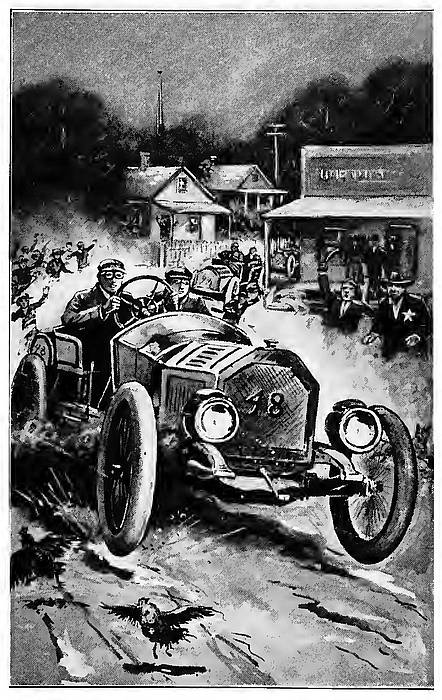
On came the racing automobile, and the cloud
of dust which traveled with it flew down to the
curve in the road. The driver shifted his wheel
and the machine took the turn on its outer tires,
with the others in the air—Dan could actually
see daylight between the wheels and the ground.
The boy saw, too, that it was a heavy touring
car; that it was painted maroon, and that a
blanket, or robe was trailing over the back of the
tonneau, fairly dragging in the dust, in fact, and
so hiding the plate on which was the license
number.
Without a single blast of the horn the car
charged around the bend. The group of boys on
the bank yelled excitedly at Maxey down below.
That erratic youth beheld the maroon car coming
and literally “threw up his hands!”
5The road was wide enough so that the racing
car could have passed Maxey’s machine on the
outside. But, unfortunately, it had stopped so
that the rear wheels, bearing the larger weight
of the car, was on the outer slope of the roadway,
which was rounded to properly shed the water.
The drab car began to run backward. Maxey
did not know enough to put on the brakes.
The few seconds that elapsed after the fast-traveling
auto came around the bend in the road
would not have been sufficient for the chauffeur
of that car to stop; and he merely swerved to the
outer side of the road, intending to pass Maxey’s
stalled car at full speed.
Maxey himself was immovable with terror at
the appearance of the charging auto. He could
not even leap from his seat. And when his own
car began to run backward, directly into the path
of the other machine, young Solomons only
opened his mouth to emit a yell.
The drab car ran back into the shallow gutter.
The stone wall behind it needed some repairs,
several of the top layer of stones having fallen
into the chasm below the road. This left the
barrier at the spot scarcely eighteen inches high.
6The unguided motor car ran back until its rear
wheels came against this broken wall. The
chauffeur of the maroon automobile swerved his
car again, but only slightly. His heavier
machine, running fast, charged down upon poor
Maxey and his car like a huge battering-ram.
There was nothing the boys on the bank could
do to save Maxey, or his car. And, at that late
moment, there was little the wheelman of the
maroon car could do to avert the catastrophe.
His reckless driving of his machine made it impossible
for him to stop in time.
The collision stopped Maxey’s cry of fright in
the middle. The lighter car was flung up and
backward by the swiftly moving and heavier touring
automobile. The latter passed on in a flash,
and practically unharmed. The drab car was
flung over the low stone wall and, upside down,
with the cushions and other gear raining from it,
dropped into space.
CHAPTER II
7
DAN SPEEDWELL AT HIS BEST
Billy Speedwell, at the head of the other
lads, leaped into the road and sprinted to the
spot where Maxey’s automobile had been thrown
over the embankment. They saw that the unfortunate
youth had clung to his wheel; but he
had gone out of sight with the wreckage.
Their interest in and sympathy for Maxey
blinded them to the further actions of the maroon
car and the three men in it. But Dan Speedwell,
coming back toward the scene of the catastrophe,
noted well the conduct of these men.
The chauffeur had made no proper attempt to
avoid the collision; and now he neither slowed
down nor glanced back to see what had become
of the drab car and its driver.
When Dan Speedwell reached the place where
his motorcycle rested beside the road, in company
with those of the other boys, the maroon car was
a mile away along the straight highway. There
was plainly no intention on the part of the
three men to stop and inquire as to the damage
their car had done.
8The other boys thought only of Maxey and his
machine. Dan, angered by the indifference of
the other automobilists, had no intention of letting
them escape if he could help it. His mind
was made up on the instant. He seized his wheel
and rolled it out into the road.
The balloon of smoke which trailed the flying
maroon car was already far down the road. It
seemed impossible for a boy on a motorcycle to
seek to overtake that flying vehicle. But Dan
knew that farther on the automobile could not
safely maintain its present pace, and he knew
likewise the speed which he could get out of his
machine.
Dan and Billy Speedwell had owned their
motorcycles a short time only; but within that
time they had learned to handle the machines
with the best. Both at the Compton motordrome,
and in the Riverdale baseball park the
Speedwell boys had won high place in trials of
speed. These races are narrated in the first
volume of this series, entitled: “The Speedwell
Boys on Motorcycles.”
Their Flying Feathers, the newest model produced
by the Darringford Machine Shops, in
Riverdale, had been given to the brothers by
Robert Darringford whose life Dan and Billy
had saved from a fire that had destroyed a part
of the machine shop plant.
9Their parents were not in circumstances to give
the boys such expensive gifts as two hundred dollar
motorcycles. Mr. Speedwell owned some
dairy cows and a few acres of land on the outskirts
of Riverdale, and Dan and Billy delivered
the milk to their customers in town, even during
the school terms. When this story opened it
chanced to be a Saturday afternoon, or the Speedwell
brothers would not have been idling here
with their friends on the river road.
What Dan knew he could do under favorable
conditions with his Flying Feather urged him to
start in pursuit of the heartless trio who had left
Maxey Solomons and his wrecked car to their
fate.
Before the other boys missed him, Dan’s
machine was popping like the explosion of an
automatic gun, and he was several rods away
from the scene of the collision. The youth settled
himself firmly in his seat, opened his engine
to almost its highest speed, and dashed away
along the road.
The lad did not sight that car, however, for
some time. The river road followed the winding
course of the stream itself, and it was fringed
with woods for a good part of the way. There
10were few dwellings on the highway between Riverdale
and Upton Falls. The men in the car
could have chosen no better stretch of road in
the county for escape. There were likely to be
few vehicles, and no constables at all at this hour
of the day.
It was perilous to run so fast on a public road,
even when the way was as smooth and well kept
as this highway to Upton Falls. But the act of
those men in the racing automobile had roused
Dan Speedwell’s indignation. For all he knew,
Maxey Solomons had met serious injury in the
wreck of his auto; the men guilty of the crime
must be apprehended.
On this hard track the automobile ahead left
no trail; but for the first few miles Dan was positive
that the maroon car had not gone into any
by-way. In fact, there were no by-ways save into
private estates, and those offered no escape for
the fugitives.
The youth was quite sure that the men were
strangers in the vicinity; he was confident that the
car was not familiar to the locality, at least, for
he and Billy were so much interested in the automobile
game that there was not a car in this end
of the county that they did not know.
The three men were strangers. They had deliberately
made it impossible for anyone to read
the numbers on the license behind the car. They
were evidently of that reckless class of automobilists
who ride through the country districts with
regard for neither law nor safety.
11A few moments only had elapsed since Dan
started after the car when he reached the first
public cross-road—a highway turning away from
the river. But this road was macadamized, too,
and offered no trace of the automobile’s wheels.
However, Dan did not believe the trio in the
maroon auto would turn aside, and he kept
straight on.
Although the distance to Upton Falls was considerable,
the pace of the motorcycle ate up the
miles speedily. Dan and his steed of steel came
soon to the outskirts of the town. The pedestrians
he passed looked after the flying boy with
wonder. Dan reached the head of Main street
and, as he began its descent toward Market
Square, and the hotel, he saw an automobile
standing before the wide porch of the latter
building.
The maroon car! Dan was sure of it even at
that distance. The trio of reckless men who had
perhaps injured Maxey Solomons had stayed
their flight at the Falls hotel.
Even as Dan sped down the street, however, he
observed that the men he followed were climbing
into their car again. The blanket had been
drawn in over the back seat of the car and the
movements of the three were leisurely enough.
12They were probably convinced that there was no
pursuit.
The boy saw several men in the square whom
he knew. One was a deputy sheriff and this officer
stepped quickly out into the street and held
up his hand for Dan and his Flying Feather to
reduce speed.
Dan shut off his engine. The maroon car was
just starting. The short man at the wheel
guided the auto carefully out into the road, and
turned toward the highway that led to Barnegat.
“Stop them!” cried Dan, waving his hand at
the departing auto. “Arrest those men, Mr.
Polk!”
“What do you mean, Dan?” demanded the
deputy, running along by the boy’s side as the
Flying Feather slowed down.
“Do as I say! They’ve perhaps killed a boy
up the road. At any rate, they smashed his automobile.
Then they drove on, full tilt, and I
followed them.”
“Nonsense, Dan! Not those men,” cried Mr.
Polk.
“Yes they did. I tell you it was a maroon car,
with three men in it. I was close enough.”
“To see the license numbers?” interrupted the
deputy sheriff.
13“They had the sign covered. But they came
this way and I have followed them too closely to
be mistaken. Stop them, I say!”
“Dan! you don’t know who these men are,”
gasped Mr. Polk, as the motorcycle came to a
halt and the excited boy leaped off.
“I don’t care who they are!” declared Speedwell,
his righteous indignation still inspiring him.
“I saw what they did——”
“Are you sure? Can’t you be mistaken?”
“Didn’t they just come from Riverdale?”
“Ye-es. They came from that direction.”
“And I have been chasing them. There was
no other car.”
“But the gentlemen are beyond suspicion of any
such act as you relate, Dan!” cried the deputy
sheriff. “One of them is Thomas Armitage, of
Compton, and the other is Raleigh Briggs, who
has offered the prize for the cross-country run of
a thousand miles which is to be arranged next
month—you’ve heard of it. Why, Dan, neither
of them would allow his chauffeur to commit
such an act of violence as you relate.”
CHAPTER III
14
THE MYSTERY OF THE MAROON CAR
Dan Speedwell was completely taken aback
by this statement of the deputy sheriff. He knew
that Mr. Polk must have surety for his words.
The men in the maroon automobile were well
known and perfectly responsible citizens.
Indeed, as Dan wheeled his motorcycle nearer
to the car he saw that the two in the tonneau of
the auto were much different-looking individuals
from those he expected to find. The men who
had wrecked Maxey Solomons’ auto, and perhaps
killed the young man himself, would certainly not
possess the personal appearance of these gentlemen!
Mr. Briggs Dan knew by reputation. He was
the most enthusiastic motorist in Crandall County.
The thousand mile endurance test which he had
suggested, and to the winner of which he had
promised a gold cup, interested Dan and Billy
Speedwell not a little, although they owned no
automobile, and at this time had no immediate
expectation of getting a car.
15“What does the young man want, Polk?” inquired
Mr. Armitage, a gray-mustached man with
a ruddy face and pleasant smile. “He asked us
to stop; didn’t he?”
“There’s a mistake been made somewhere,
Mr. Armitage,” declared the deputy sheriff, with
some hesitation. “Dan is a good boy, and trustworthy.
But it seems he has been following you
and Mr. Briggs on his motorcycle——”
“What for?” asked the gentleman, quickly.
“Because of something that happened up the
road. He says that the automobile he followed
wrecked another machine and hurt the driver.”
“Our auto?” cried Mr. Armitage.
“Why, Dan says it was a maroon car, like
yours, and that it came direct from Riverdale.”
“By which road?” asked Mr. Briggs, quickly.
“The river road,” said Dan. “I was sure I
had followed the right car—there was no other
all the way.”
“But we did not come to the Falls that way,”
said Mr. Briggs. “We traveled by the pike,
and we stopped at Mr. Maury’s place for some
minutes.”
“Oh, I know it could not have been your machine,”
said Dan, hastily. “The men who ran
down Maxey Solomons have escaped by some
means. They must have taken a cross road toward
the other side of the county.”
16“You did not get their number?”
Dan quickly related the incidents which had
brought him to this place, and in such haste. The
gentlemen in the car were sympathetic and interested.
“Come!” said, Mr. Armitage, “this matter
must be looked into. The rascals should be apprehended.
They are getting farther and farther
away each minute, it is likely. Come,
Briggs, what do you say? You have been bragging
about the speed of this car. Let’s see what
Henri can get out of her.”
“I am with you, Armitage,” declared his
friend. “Hop aboard, Polk. You are a county
officer. Those men must be arrested, if possible,
and held until we learn what damage they have
done.”
“I’ll go with you, Mr. Briggs,” said the
deputy.
He leaped into the tonneau. Mr. Armitage
looked at Dan, who stood by his motorcycle.
“The boy had better go with us,” said Mr.
Armitage. “He is evidently an observant lad,
and he will not be likely to make a second mistake
in the automobile.”
“Yes! let the boy come,” said Mr. Briggs.
“If he was a witness to the accident he speaks
of, we will need his testimony if we overtake the
guilty ones.”
17“But my machine?” said Dan, doubtfully.
“Lift it right up here,” commanded Mr.
Briggs. “We’ll fasten it on the running board.
Then, young man, you get in beside Henri, and
we’ll be off.”
Dan was quick to obey these suggestions.
His Flying Feather he stood upright on the running
board of the car, and he saw that it was
fastened securely. In five minutes they were off,
after Mr. Polk left word at the sheriff’s office for
the officers to watch for the mysterious car and
its three occupants.
The auto dashed off along the pike toward
Riverdale. There were three cross roads that
the offenders against law might have taken, as
long as they did not complete their run to Upton
Falls. But there were by-roads, too, on which
they might have hidden and the deputy sheriff
advised stopping to inquire at every farmhouse,
and of every teamster whom they met. It was
some time, however, ere they picked up the trail
of the maroon car, and then they obtained the
clue in quite a strange way.
As they came to the lane leading up to a barn,
the farmer came running out with a pitch fork
in his hand. Before Mr. Polk could speak, the
man demanded:
18“Ye got ’em, hev ye, Sheriff? Wa’al I’m glad
of it! I’ll go right down with ye t’ th’ ’squire’s
office, an’ I guess, he’ll make ’em pay a pretty
price for their fun. That calf of mine run int’
a barbed wire fence an’ tore herself all up——”
“Hold on, Mr. Jackson!” exclaimed the
deputy. “You’re getting your dates mixed, I
guess. These gentlemen certainly have done you
no harm.”
“No harm!” yelled the farmer. “When
they come up through the Indian Bridge road not
an hour ago, they skeered my heifer into a conniption
fit, and come pretty nigh runnin’ over me
when I come out at ’em.”
“Not these gentlemen,” said Polk. “I can
vouch for them. One is Mr. Thomas Armitage,
whom you ought to know, Jackson.”
“I swan!” exclaimed the farmer. “I voted
for him for Congress.”
“Much obliged to you, I am sure,” said Mr.
Armitage. “And I hope that you will not think
I so illy deserved your vote as to race an automobile
through these roads to the endangering
of life and limb of good citizens.”
“Wa’al!” ejaculated the puzzled Mr. Jackson,
“it was a car jest the same color as yours,
Mr. Armitage.”
“And how many men were in it, Mr. Jackson?”
interposed Polk.
“Come to think on’t, there warn’t but three,”
admitted the farmer.
19“Did you see the license number?”
“Not much! They went so quick I couldn’t
see much but the color of the car.”
“And in which direction did they disappear?”
asked the deputy.
The farmer pointed up the side road, away
from the river.
“They are making for the railroad,” declared
Mr. Briggs, in some excitement. “Drive ahead,
Henri.”
They came to the railroad—the Barnegat &
Montrose Branch of the R., V. & D.—and halted
long enough to speak to the flagman. He had
seen the flying car, too. They were on the right
track.
But a mile beyond the pursuing party came to
a place where the highway branched in three directions.
There was no house in sight. The
escaping car might have taken any one of the
roads.
“We’re stuck!” ejaculated Mr. Polk. “We
might as well take one at random and see if we
can run down a clue upon it.”
“Wait!” urged Dan Speedwell. “Perhaps
I can do better than that.”
He got out of the machine and ran into the
first road at the right. He had noticed that these
highways here were not so well made as those
nearer the river. There was a chance that he
might find some trace of the passing of the
strange car which they followed.
20And he was right in this surmise, although he
did not find it in this first road. Marks of the
tires of an automobile—and fresh marks—were
visible in the middle road. As far as Dan could
see no other machine had passed this way.
He leaped back beside the chauffeur and they
drove on again at top speed. A mile beyond
they halted at a farm house to inquire. The
passing of an automobile in a cloud of dust had
been noticed less than an hour before; but the
sight was too common to have attracted much attention,
and the occupants of the house had been
too far from the road to note the color of the machine,
or the number of men in it.
Mr. Briggs’ car was certainly fast, and Mr.
Briggs’ chauffeur was the most marvelous manipulator
of an automobile that Dan Speedwell had
ever seen. And to sit directly beside the Frenchman
and observe the skill and art with which he
handled the levers and the wheel was a sheer delight
to the boy.
He thought to himself:
“Ah! if Billy and I only owned an auto! If
we could only take part in this endurance test
that Mr. Briggs is going to arrange! If we
could handle an auto half as well as this Frenchman!”
21But the boy’s thoughts were disturbed suddenly
by Mr. Polk, who remarked:
“It looks to me as though these fellows were
aiming for Port Luther, or even Cadenz. Unless
they turn back toward Riverdale and Compton
they will be obliged to strike some of the coast
towns.”
“Quite right, Polk,” admitted Mr. Armitage.
“Then, here is Landers Station just ahead.
There is a train coming down now. I’ll take that
train and go on. The railroad is more direct
than the highways and I may be able to head
those fellows off at Port Luther.”
“And we stick to the trail in the car, Polk!”
agreed the gentleman. “What do you say,
Briggs?”
“It suits me. Henri, shall I take your place
for a while?” Mr. Briggs asked his chauffeur.
“The young man here will change with me,
Monsieur,” returned the kindly Frenchman, who
had seen how eagerly interested Dan was in the
management of the automobile.
And when they halted at the railroad station to
allow the deputy sheriff to take the train, the
chauffeur did indeed change places with Dan
Speedwell. Once at the wheel the youth proved
that Henri had not been mistaken in him. For
a lad of sixteen Dan handled the car with great
dexterity.
22The maroon car was out of sight of the station
before the train bearing the deputy was on its
way again; but the automobilists were obliged to
halt frequently to inquire for the motor car of
which they were in pursuit. And there were more
autos than one ahead of them now. Sometimes
they lost the trail of the maroon car completely;
but when they reached the lively little town of
Larned they learned that the fugitives had halted
at the local garage for gasoline, and that they
had left, still following the road toward the
coast, but at a moderate pace.
“Half an hour behind them—or thereabout,”
exclaimed Mr. Armitage, with satisfaction.
“We should be able to pick that up.”
But even as they started from the garage they
met with an accident. A forward tire blew out
and the car came down with a solid bump on the
roadway.
“Now!” cried Mr. Armitage. “Look at this
delay! Isn’t it abominable?”
But Mr. Briggs was a man of quick thought.
He was observant, too. He spoke to the owner
of the garage. There was a good car standing
on the floor and it was for hire. In two minutes
it had been run out, Henri was at the wheel, and
Mr. Armitage and Mr. Briggs in the tonneau of
the hired machine.
23Dan had expressed his desire to return to
Riverdale. It would soon be night, and he and
Billy had many chores to do. They were now
thirty miles from home, and the boy feared to go
farther without permission from his parents.
“And quite right,” Mr. Armitage said. “But
hold yourself ready to-morrow, my boy, if we
have the good fortune to overtake those fellows
in the maroon car. We shall need you for a
witness.”
Dan promised and Mr. Briggs, who had consulted
with Henri for a moment, said:
“My chauffeur tells me that you are quite able
to run our car back to Holliday’s garage at
Riverdale. This man here will put on a new tire
and you can get back to town easier in my car
than on your machine. Do you want to do me
that favor?”
Dan’s sparkling eyes and flushed face replied
for him before his lips could form the words. It
was so decided, and the others got off quickly
in the hired auto. Within the hour Dan started
the beautiful touring car on the back track, delighted
with his charge, and looking forward to
nothing more than a pleasant run over familiar
roads to his home town.
It was growing dusk, however, long before he
reached Riverdale. Indeed he was all of ten
miles from the town when he stopped to light his
lamps. Before he started the auto again he observed
another car bearing down upon him from
ahead, its lights blazing in the dusk.
24Dan had pulled out to the side of the road and
apprehended no danger. But the coming car was
braked quickly when a few rods from him, and
its driver brought it to a complete stop beside
Mr. Briggs’ vehicle.
One of the four men in the machine leaped out
and, to Dan’s amazement, stepped into the front
of the maroon car beside him.
“Hold up your hands!” commanded this man,
in excited tones. “We’ve got you, at least, if
your pals have escaped. Hold up your hands!”
Dan shrank back and demanded a reason for
threatening him in this savage way.
“You know what I want,” said the man.
“You are in the hands of the law. I arrest you,
for the robbery of the Farmers’ National Bank
at Riverdale!”
CHAPTER IV
25
BILLY ACTS ON IMPULSE
The sight of Maxey Solomons and his automobile
tossed over the embankment and out of
view—as a mad bull might toss a dog—frightened
Billy Speedwell and his mates; at the
moment they did not, like Dan, think of bringing
the three men in the maroon motor car to
account for their rashness.
With cries of fear they ran along the road to
the broken place in the stone wall. Motor car
and driver had disappeared over the brink of
the chasm. The tops of several trees, the roots
of which were embedded in the soil of the river
bank, were visible above the wall. The motor
car had crashed into these tree-tops; but the boys
did not dream, at first, that the branches would
stay such a heavy object.
When they came to the break in the stone wall
and leaned over it, they saw the drab automobile
hanging in the air, not more than twenty feet
below the road. It was upside down and it had
stuck in the crotched branches of two of the tall
trees.
26At first they saw nothing of Maxey; but of
course, they could not see to the ground at the
foot of the fifty-foot precipice over which young
Solomons and his automobile had fallen.
“He’s dead!” groaned Monroe Stevens.
“Crushed to death down there—poor chap!”
agreed Jim Stetson.
“My goodness!” said Billy. “Who’ll tell
his father? The old gentleman will be all broken
up. He just about lived for Maxey.”
“And the auto isn’t worth a cent, either,”
added Brace Henderson.
At that moment a muffled voice reached their
ears, and startled them all.
“Help! Mercy on us—isn’t this dreadful?
Help!”
Billy cried his surprise ahead of the others:
“It’s Maxey! He is under the auto!”
They could not see the owner of the wrecked
car—not even his legs dangled into view. But
Maxey’s voice was unmistakable.
“What you doing down there, Max?” cried
Monroe Stevens, loudly. “Why don’t you crawl
out?”
“I can’t!” wailed the voice of the hidden
youth.
“Why can’t you?” queried Henderson.
“I don’t dare,” admitted Solomons.
27All the cushions of the automobile had rattled
to the ground. Its driver was clinging to the
wheel, or some other stationary fixture, and not
being a particularly brave youth, he could only
hang on.
“Somebody’s got to help him,” declared Billy.
“But we haven’t a rope,” objected Jim
Stetson. “How can we get him up here?”
“Belts, boys!” cried the quick-witted Billy
Speedwell. “Buckle ’em together. I can jump
into the top of one of those trees, and I’ll carry
the line of belts down, fasten it to the tree, and
then to Maxey, and swing him off.”
“You’ll fall, Billy,” objected Monroe, who
was older and felt himself responsible for Billy’s
safety, now that Dan had gone.
“Not a bit of it!” declared Billy. “Come
on with the belts.”
There being no better way suggested, the boys
followed Billy’s plan. They watched him in
some trepidation, however, as he let himself over
the broken wall and leaped for a swinging branch
of one of the trees into which the automobile had
fallen.
He reached a limb directly below Maxey.
That young man was clinging—as Billy had
supposed—to the steering gear. He was afraid to
drop upon the limb where Billy stood. Indeed,
had he done so, he would have had no means of
balancing himself. Billy Speedwell had kicked
off his shoes before descending the tree and he
was barely able to keep his equilibrium.
28“Catch the end of this belt, Maxey!” he cried.
“Oh, I can’t!”
“I tell you that you’ve got to!”
But, although Maxey was usually easily influenced,
Billy could not put pluck into him at this
juncture. The younger boy had to finally climb
into the overturned automobile, cling with one
hand and his feet to the car, and buckle an end
of the string of belts around Maxey’s waist.
The rescuer tossed the end of the line of
belts to Monroe and Brace Henderson, and they
helped Maxey out upon the roadway again. Billy
followed, and when the adventure was over not
alone Maxey Solomons, but the boys of the Riverdale
Club, felt the reaction. The peril threatening
the owner of the wrecked automobile had indeed
been great.
“I’m afraid your car is done for, Maxey,” said
Monroe Stevens, with sympathy.
“I don’t care!” sighed the rich man’s son.
“I wouldn’t ride home in it if it was right-side
up here in the road. I never want to ride in a
motor car again.”
“Pshaw!” said Jim. “Now you’re talking
reckless. It’s too bad you’ve got the car in that
bad fix.”
29“I tell you I don’t want the car. If it can be
got out of the tree I’ll sell it. I won’t ever ride
in it again.”
“You don’t mean that, Maxey?” said Billy,
earnestly.
“Yes, I do.”
“But it’s a new machine.”
“I’d sell her for half what she’s worth,”
Maxey persisted.
Monroe Stevens laughed, and said: “According
to your own tell, Maxey, she isn’t worth anything.”
“But, if anybody thinks she’s worth buying?”
began the owner.
“Isn’t that just like you?” cried Jim. “I
suppose you’d want half what your father paid
for her.”
“I might want—but would I get it?” returned
Maxey, shrewdly.
“Just what will you take for the car?” demanded
Billy, still in earnest.
Monroe Stevens looked at Speedwell suddenly,
and with interest.
“My gracious, Billy! I forgot that you and
Dan are capitalists. You could buy old Maxey
out, couldn’t you?”
“So he could,” cried Jim. “Billy and Dan
banked the thousand dollars reward the Darringfords
offered for the apprehension of the fellow
who set the shops afire. Now, Maxey, if you
really want to sell, you’d better put a real price
on your car.”
30Billy flushed. He was stirred by impulse to
buy the wrecked car. He had seen just how
badly it was smashed and he knew that if Maxey
would sell cheap enough somebody would get a
bargain. The drab racing machine was of a
standard make and there was good reason why
Maxey might have thought of entering it in the
thousand mile endurance run. A car of the same
kind had won such a contest only the season before.
Young Solomons looked at Billy thoughtfully.
Something seemed to be working in his mind.
“You came down and saved me, Billy Speedwell,”
he said. “Of course, the other boys
helped, and I’m grateful to all of you. But Billy
came first to my help.”
“Shucks!” grunted Billy. “Forget it!”
“No. I’m not likely to forget it,” returned
Maxey, gravely. “If you want that car—just as
it lies there in the tree-top—you can have it for
five hundred dollars. She cost twenty-two
hundred and fifty. I can show you the receipted
bill.”
“Whew!” cried Jim. “You don’t want anything
for it, do you, Maxey? I don’t believe you
can get it out of the tree.”
31But Billy had made up his mind already about
that phase of the matter. And how he wanted
to own that racing car!
He and Dan had watched the auto as it was
handled by the professional chauffeur, and knew
that it was a wonderfully good machine. But
if the car was lifted safely back to the road, it
would cost a good deal to rebuild it and put it in
running shape again. Still——
“I’ll think about it, Maxey,” he said, slowly.
“No, Billy,” said the owner of the wrecked
car, seriously. “If you take time to think about
it, so will I take time to think about it. I won’t
feel the way I do now, to-morrow maybe. You
see? You can have it now for five hundred dollars.
I maybe won’t want to sell at all when I
think about it a while.”
Both Dan and Billy had put their money into
the bank untouched. Billy had just an even five
hundred dollars. He could not expect Dan to
back him up with any of his money in such a
wild bargain as this. But there was the car—Billy
believed it could be saved and repaired for
a comparatively small sum—and one-fourth of
its purchase price, for a car less than three
months old, was a bargain indeed!
Billy took it.
CHAPTER V
32
THE ROBBERY AT THE BANK
Dan Speedwell, in Mr. Briggs’ maroon car,
was at first badly frightened, and then angry.
The pressure of the muzzle of a revolver against
his stomach precluded his seeing the humor of the
situation.
“Ouch!” he exclaimed. “Take it away!”
“Surrender!” cried the man with the weapon,
and then Dan realized that his captor was Josiah
Somes, one of Riverdale’s constables, and a pompous,
officious little man.
“Surrender, in the name of the law!” repeated
Mr. Somes, using the instrument a good
deal like a gimlet.
“Oh!” gasped Dan. “Who do you think
you’ve got hold of, Somes?”
“Eh? Ye know me, do ye?” growled the constable.
“Then, Mr. Bank Robber, you know
that Josiah Somes ain’t to be fooled with.”
“I don’t want to fool with you when you act
so careless with that pistol. Take that gun
away!” cried Dan.
33“Hold up your hands!” ordered Mr. Somes.
“I’ve got to search you.”
By this time one of the other men in the strange
automobile, had gotten out, and brought a lantern
to the side of the maroon car. He flashed the
light into the boy’s face, and at the same moment
Dan recognized Hiram Baird, the cashier of the
Farmers’ Bank.
“Mr. Baird!” gasped Dan. “Take him
away, will you?”
“Dan Speedwell!” rejoined the cashier, in
amazement. “Why, how is this?”
“One of them Speedwell boys!” cried Somes,
glaring into Dan’s face, and dropping the pistol’s
point, to Dan’s great relief.
“That’s certainly who it is,” said the cashier
of the bank.
“Wa’al! It’s nothing more than I could expect,”
said Somes, shaking his head. “Them
boys are always racing around the country on
them motor wheels of theirn—huh! Where’s
the other robbers?” and he grabbed Dan by the
collar.
“What do you mean?” demanded the boy,
angrily.
“You helped them get away,” declared the
constable. “The car was seen standing before
the door of the bank after hours. They shut
Mr. Baird into the strong room and he was almost
smothered before the president came back
and found him there.”
34This garbled account of a very interesting happening
was sufficient for the moment to explain
his position to Dan. He knew now why the trio
of men in the first maroon car had refused to
halt when they had wrecked Maxey Solomons’
automobile.
“You’ve made a mistake, gentlemen,” said
Dan, quietly. “I really wish you would put up
that gun, Mr. Somes. You’ll do yourself, or me,
an injury.”
“Yes, do put away the pistol, Josiah,” urged
Mr. Baird.
“But this young villain——”
“Nonsense, Josiah!” exclaimed the cashier.
“We know Dan is not mixed up in the robbery.”
“Then how came he by the car? A maroon
car. This is it—I’m positive of it.”
“No it isn’t,” declared Dan.
“But, really, Dan,” said Mr. Baird, puzzled,
“I saw the car stop at the bank door myself, and
this one looks just like it.”
“And what happened then?” asked Dan, curiously.
“Two men came in. The third sat where you
do—in the driver’s seat. It was after three, but
the door had not been locked. I was alone. One
of the men covered me with a pistol, and the
35other locked the door. Then they backed me into
the vault and locked it. We had not put away
the money. They got fifteen thousand dollars in
bills and specie. They might have got much
more had they known where to look for it. I
had to stay in the vault until Mr. Crawley came
in at half-past five.”
“And they sent for me,” added the pompous
Somes, “and put me on the case. I remembered,
of course, seeing this maroon car standing by the
bank.”
“Not this car,” urged Dan, again.
“Why ain’t it?” snapped the constable.
“Because this car is the property of Mr.
Briggs—and you don’t accuse him of being a
bank robber, do you?”
“Mercy!” ejaculated Mr. Baird. “One of
our largest depositors!”
“Well!” cried Somes. “How came you with
the machine?”
Dan repeated the narrative of his adventures
that afternoon and evening. Mr. Baird, of
course, saw how reasonable it was, and believed
him. Somes disliked to say he was mistaken.
“I think I’d better arrest him, and take the
machine back to town, Mr. Baird,” he said.
“Nonsense!” exclaimed the cashier. “Get into
Mr. Crawley’s machine here, and let us follow
the trail Dan has told us of. Perhaps Mr.
Armitage and Mr. Briggs have caught up with
the thieves.”
36Dan was much excited by the story of the robbery.
To think that the bold thieves had ridden
down the river road out of the town, and within
a short distance of the scene of their first crime,
had committed the desperate act which (so Dan
supposed) had brought about Maxey Solomons’
serious injury, or death, and the wrecking of that
youth’s automobile! They were certainly desperate
characters. He hoped, with all his heart,
that the gentlemen whom he had left in pursuit,
and Deputy Sheriff Polk, would apprehend them.
But he did not believe Josiah Somes would be of
much aid.
Dan came safely to Holliday’s garage and delivered
the maroon car, to be called for by its
owner. Then he got upon his Flying Feather and
motored home as quickly as possible, for it was
already late and he and Billy had the milk to
pick up at Mr. Speedwell’s dairies.
His younger brother had arrived at home
ahead of him; but before he left town Dan had
learned how Maxey Solomons had been saved.
Billy, however, had something on his mind, and
he even listened to Dan’s tale of his “arrest” by
Josiah Somes without showing very much interest.
37“What’s the matter with you, boy?” demanded
Dan, as they finally finished the chores
about the stable and milkhouse and sat down a
few minutes on the granary stairs before going
into the house for the night.
“What makes you think there’s anything the
matter?” returned Billy, quickly.
“Come on, boy! ’Fess up,” laughed Dan.
“What’s on your mind? If it’s anything good,
don’t keep your brother out of it; and if you’re
in a fix of any kind, maybe I can help you.”
“You’re all right, Dan. But I reckon this is
something I’ve got into myself, and I mean to
stand by it,” admitted Billy. “I expect you’ll
think I’m crazy.”
“Don’t know. Can’t say. Open up!” urged
his brother.
“Well—I’ve bought an automobile!” blurted
out Billy Speedwell.
“You’ve done what?”
Billy repeated his statement, gloomily enough.
Dan stared at him in the light of the barn lantern
and remarked:
“Well, you don’t look any crazier than common.
And I expect you’re telling me the truth.
But I don’t understand it. How did you buy it—from
whom—what with?”
“Hold on!” exclaimed Billy. “Let me tell
you all about it.”
38“That’s right. It don’t sound very real to
me,” said Dan, rubbing his head. “By the way,
where’s the machine?”
“Up in the air,” returned Billy, with a grin.
“Huh! in a garage attached to one of those
‘castles in Spain’ that they tell about?”
“I bought Maxey’s wrecked machine. I paid
five hundred dollars for it—or, I promised to do
so on Monday—and I don’t even know whether
I can get the thing out of the tree where it’s
roosting!”
Billy blurted all this out in a hurry. The information
left Dan fairly speechless.
CHAPTER VI
39
A FIRST DIFFICULTY
“For goodness sake tell me all about it, Billy,”
urged Dan.
His brother did so, relating the particulars of
how Maxey Solomons had been rescued from
the automobile and the conversation which had
followed.
“You know how Maxey is. He changes his
mind mighty easily. And, Dannie, I really believe
the car is worth a whole lot more than five
hundred dollars.”
“But it’s every cent you’ve got, Billy!”
“I know it. That’s what’s bothering me. It’s
going to cost something to hoist the car out of
the tree, and then it’ll cost I don’t know how
much to put it into shape again—as much as fifty
dollars, perhaps.”
“Is that all, Billy?” queried his brother, in
surprise.
“The car isn’t damaged much. I found and
saved everything that dropped out of it when it
was overturned. The thing is wrenched some, I
suppose, and dented and marred. That’s all.
And it cost over two thousand dollars.”
40“I know,” said Dan, nodding. “I know all
about it. I rode in the car one day with Maxey,
too. It’s a dandy!”
“You bet it is!” cried Billy, eagerly, and evidently
much relieved because his brother took the
news as he had. “Suppose we could fix it up
and enter for the gold cup that Mr. Briggs has
offered? Wouldn’t that be great?”
“That’s all right, Billy. I’ll go over and look
at the car with you on Monday. Perhaps we can
get it onto the road without much trouble. But
say! I never knew you to be so selfish before,
boy.”
“How?” grunted Billy, in surprise.
“Why, you might have given a fellow a chance
to buy in with you.”
“Dannie!”
“Going to have it all to yourself, are you?”
“I thought you’d say I was crazy to do it,” explained
Billy, eagerly. “I have been afraid to
tell mother and father. Of course, they said
we could do exactly what we pleased with that
money the Darringfords gave us——”
“Don’t worry about it. I believe you’ve made
a good investment,” declared Dan, confidently.
“And if you’ll sell me a half interest in the car,
I’ll draw out half my money, and then we’ll
divide the cost of repairing the machine between
us.”
41“Bully!” shouted Billy, smacking his brother
on his sturdy shoulder. “That will be fine.”
“I’d do the same for you, Billy-boy,” said Dan.
“And I’m just as eager to enter that endurance
test as you are.”
“And suppose we could win the cup, old boy!”
Dan chuckled. “We’ll have an old rival in
that run—if we have the luck to get into it.”
“Who’s that?” demanded his brother.
“Chance Avery. Burton Poole has taken him
into partnership in his motor car. You know,
Poole’s got a good car. Chance has been rather
out of conceit with the motorcycle business ever
since the races at the baseball park.”
“When you walked away from him, eh?” said
Billy.
“But I heard him bragging down to Mr. Appleyard’s
store yesterday that he and Burton were
going to have a try for the gold cup—and they
expected to ‘lift’ it.”
“It’s just providential, then,” said Billy, seriously,
“that Maxey’s machine was wrecked, and
I got a chance to buy it.”
The Speedwell family numbered but six—besides
the parents and Dan and Billy, there were
only Carrie, ten years old, and Adolph, who was
just toddling around and learning to talk. They
42were, in spite of their somewhat straitened circumstances,
a very happy family. Mr. Speedwell
was not a strong man, but was gaining in
health now that he worked out of doors instead
of in a shop. With the help of his two big boys
(Dan was sixteen and Billy a year younger) he
was making the small dairy pay.
Although the boys had long ridden bicycles,
and still owned their steeds of steel, the motorcycles
on which they had taken their spin along
the river road that day had been presented to
them by Mr. Robert Darringford, and were the
best wheels the Darringford Machine Shops could
turn out. Now the fact that Dan and Billy were
about to own an automobile was indeed a matter
for discussion and interest around the evening
lamp.
“For a poor man’s sons, I believe you two are
doing pretty well,” remarked quiet Mr. Speedwell.
He never went back upon what he said;
having told the boys they could do what they
pleased with the thousand dollars they had
earned, he was not likely to criticize Billy’s impulsive
bargain.
That afternoon Dan and Billy hurried home
on their machines and went at once to the woodlot
with their axes. They cut and shaped two white-oak
timbers, loaded them into the heavy wagon
with such timber chains and ropes as they chanced
43to have about the barns, and drove back through
the town and out upon the river road to the spot
where the accident had occurred.
Jim Stetson and Wiley Moyle, both members
of the Riverdale Outing Club, and in their same
grade at the local academy, saw the Speedwells
driving through town, and they climbed into the
wagon.
“By gravey!” ejaculated Wiley. “I didn’t
believe it when they told me. Do you mean,
Billy, that you’ve given up five hundred good dollars
to Maxey Solomons for that smashed-up
car?”
“Dan and I have bought it,” admitted Billy,
cheerfully.
“You must both be crazy, then,” declared
young Moyle. “You’ll never get it out of those
trees without smashing it all to bits. What do
you want a motor car for, anyway? You’ve got
motorcycles; and it wasn’t long ago you were
riding bicycles like the rest of us. The club will
go to the dogs if all the members get buzz-carts.”
“Don’t you fret,” returned Dan, laughing.
“As long as we can keep Captain Chance Avery
in bounds, you fellows who ride bikes will not be
neglected in club affairs.”
“Remember how Dan fought for you at the
meeting following the Barnegat run,” said Jim.
“And he and Billy owned their motors then.”
44“But an auto is different,” grumbled Wiley.
“Look at Burton Poole—and the Greenes.
They don’t care about going on the club runs at
all any more because the autos have been shut
out.”
“Fisher Greene isn’t stuck on the things,” said
Billy, laughing.
“No. There’s never any room for Fisher in
the car,” said Jim Stetson, “and he has to stick
to his old bike.”
Although Wiley was such a “knocker,” as Jim
expressed it, he lent a sturdy hand to the unloading
of the wagon. Dan had brought tools, and
after carefully planning the arrangement of the
contrivance he proposed building, the elder
Speedwell began digging a post hole beside the
road, and inside the wall. There was a turf
bank here and the work of excavating was comparatively
easy.
While the quartette of boys were thus engaged
an automobile came into view from down the
road. It approached swiftly, and Wiley Moyle
suddenly recognized it.
“See who has come!” he scoffed. “Here’s
Burton Poole’s buzz-wagon with Captain
Chance at the wheel. Chance is going to win the
gold cup, he says, and he and Poole are in partnership
with that old lumber wagon.”
45Chanceford Avery, who was considerable older
than most of the club members, was a dark complexioned,
sharp featured young man, not much
liked by the boys of Riverdale, but who made himself
agreeable to most of the girl members of the
Outing Club.
Some months before he had shown his enmity
to the Speedwells, and he never let an opportunity
escape for being unpleasant to the brothers.
When he saw what the boys were about beside
the road, he brought the automobile to an abrupt
halt.
“Haven’t you got a cheek to dig that bank
up in that manner, Speedwell?” he said.
“You’ll get into trouble.”
“Guess not,” returned Dan, cheerfully. “It
never entered my head we’d have to get a permit
to set a post down here, as long as we are going
to take the post right up again and fill in the
hole. I’ve saved the sod whole, too.”
“At any rate, there’s one thing sure,” snapped
Billy, who didn’t like young Avery at all, any
more than he did Francis Avery, Chanceford’s
brother, and the superintendent of the Darringford
shops; “we haven’t got to come to you for
a permit.”
“Aw, stop your rowing, you fellows,” advised
Burton Poole, who was a good-natured, easy-going
chap. “What are you going to do, Dan?”
Dan explained briefly, still keeping on with his
work.
46“You’ll have a fat time trying to get that old
hulk of a car up here,” sneered Chance Avery.
“And after you get it up, what good is it?”
“That we’ll see about later,” returned the
older Speedwell, rather gruffly.
“Max Solomons made a fool of you,” declared
Chance. “He is blowing around town
how he got the best of you fellows. Why, the
car wasn’t good for much when it got pitched
over the bank.”
“You’d laugh the other side of your mouth if
this old car ever beat you and Poole, wouldn’t
you now?” demanded Billy.
“I suppose you fellows intend entering with it
in the thousand mile endurance run?” laughed
Chance.
“Bet your life we are!” cried Billy, before his
brother could stop him.
“Listen to that, will you, you fellows?” said
Chance. “These Speedwells are the limit!”
“We’ve been able to beat you before now,
Chanceford Avery,” snapped Billy. “Now go
along! Nobody wants you here.”
Chance might have stopped longer to argue
the point, but Burton, who was all for peace,
urged him on. Their car, which was really a very
good one, hummed away toward town. Inside of
twenty minutes a carriage rattled down to the
place where the boys were at work.
47“Hey, you, Dan Speedwell!” exclaimed an unpleasant
voice, and Dan looked up from settling
the big timber in the ground to see Josiah Somes,
the Riverdale constable.
“How d’ye do, Mr. Somes,” returned the
youth. “Haven’t caught those robbers in the
maroon car yet, have you?”
The other boys laughed. Josiah’s ability as a
detective was a joke about town.
“Well, them other fellers haven’t caught the
scoundrels, either,” snarled Somes. “I guess
there ain’t no medals on Polk, if he is a deputy!”
“Wish you luck,” said Dan, good naturedly.
“Never you mind about them bank robbers.
I ain’t here looking for them,” said the constable.
“I want you.”
“What!” cried Dan. “Are you going to arrest
me again, Mr. Somes?”
“I want to know who gave you permission to
dig that hole, and clutter up this place with them
contraptions.”
Dan and Billy looked meaningly at each other.
Both boys knew at once that Chance Avery had
set Josiah Somes after them—and the constable
was only too willing to do them an ill turn.
“Come on!” the man snarled. “Hop into
my buggy, Dan Speedwell. I’m going to take
you before the ’Squire and see what he’s got to
say about this.”
CHAPTER VII
48
THE HAND IN THE DARK
The three other boys were not a little alarmed
by the constable’s word and manner; but Dan did
not show any fear.
“Just pack the earth and stones well around
the post, Billy,” he said to his brother, cheerfully,
“while I go back to town with Mr. Somes, and
get this matter straightened out.”
Dan knew a little something himself about the
town ordinances; he was aware that a permit was
necessary for the opening of an excavation in
a public road. But it was a rule often ignored in
such small matters as this. Chance Avery had
set the officious constable at this work, and Somes
was just mean enough to delight in making the
Speedwells trouble.
And on the way to the house of ’Squire English
they would pass the office of the council clerk.
Dan knew this gentlemen very well, and as Somes
pulled up his horse to speak to a friend, the boy
hopped out upon the sidewalk.
“Hey! where you going?” demanded the constable.
49“I’ll be right back,” said Dan, dodging into
the building and leaving the constable fussing in
the carriage.
The boy found Mr. Parker at his desk and explained
quickly what he and Billy were doing
down there beside the river road.
“Digging a hole to set a post? Well, go
ahead! I reckon nobody will object,” said the
clerk. “You’ll fill it in all right, Dan?”
“But somebody has objected,” explained the
boy. And he told Mr. Parker of the difficulty.
“Pshaw! Josiah ought to be in better business,”
declared the clerk, and he hastily filled out
a permit, headed “Highway Department” and
gave it to the youth. “Show that to Justice English,”
he advised.
He nodded and smiled and Dan knew that the
gentleman appreciated the joke on the constable.
The latter was sputtering loudly when Dan returned
to the sidewalk. He had got out of the
carriage and hitched his horse.
“Here! you come along with me, Dan Speedwell!”
cried the constable. “You’re trying to
run away.”
Dan saw Chance Avery grinning widely on the
other side of the square. It was plain that the
captain of the Riverdale Club congratulated himself
that he had got the Speedwells into trouble.
50They went into ’Squire English’s office. The
old gentleman was a crotchety man, stern and
brusk of speech, and a terror to the evil-doers
who came before him. He did not like boys, having
forgotten that he was ever one himself.
“What now? What now, Josiah?” he
snapped, looking up from his papers, and glaring
under bristling brows at Dan Speedwell.
“This here boy—and some others that I didn’t
bring in—are digging holes in the turf along the
river road, just beyond Mr. Abram Sudds’ place.
You know that piece of turf there, ’Squire, that
the town spent so much to grade and make handsome.
Well this here Dan Speedwell was digging
a hole in it.”
“You’re old enough to know better than to
do that, young man,” said the ’Squire, to Dan.
“What did you do it for?”
Dan silently tendered the paper Mr. Parker
had given him. The justice put on his glasses,
looked at it, and turned on the constable wrathfully.
“What do you mean by bringing him here,
when he’s got a permit to set his post? Think
I’ve got nothing more to do, Josiah, than to
monkey with foolish cases?”
“Why—why—he never told me he had a permit!”
cried the chagrined constable.
“You never gave me a chance to tell you,” declared
Dan.
51“Get out of here—the whole of you!”
snarled Justice English, as the crowd that had
followed Dan and Somes in began to giggle and
whisper, just as delighted over the constable’s
taking down as they would have been had Dan
been punished.
The boys, on Dan’s return from the ’Squire’s
office, rigged a clumsy, but efficient, swing-arm
for the derrick before they were obliged to
go home. But it grew too dark for anything
more to be done that night. So they piled into
the wagon and started for the other side of town.
As they halted at a certain corner to let Jim
and Wiley get out of the wagon, a party of girls
came along and hailed them.
“Oh, boys!” cried Lettie Parker, who was a
jolly girl with more than a suspicion of red in
her hair, and the quick temper which is supposed
to go with it. “Oh, boys! you are just whom
we wished to see. I don’t believe any of you
have heard about the candy-pulling out at Stella
Mayberry’s.”
“Stel Mayberry’s?” cried Jim. “I knew she
was going to have one; but I didn’t hear when.”
“It’s to-night. She wasn’t at school to-day, so
the word didn’t get around. I got a note from
her, and so did Mildred,” Lettie said. “And
we’ve been around inviting folks.”
“Never heard a thing about it,” declared Billy.
52“But she means for you boys to come,” Mildred
Kent, the doctor’s daughter, said, more
quietly. She spoke to Dan. “I hope you can
come. We’ll go over on our wheels as soon after
supper as we can.”
“We’ll be late getting there, Mildred,” said
Dan Speedwell.
“But we can all come back together. You
know where she lives?”
“Oh, yes. Down the river road.”
“We’ll hurry along,” said Billy, “so as to
get over to Mayberry’s as early as possible.”
The Speedwells drove away. They went
around to several other farmers to pick up the
evening’s milk before going home. Then, when
their chores were all done and they had supper,
Dan and Billy mounted their motorcycles and
dashed away through the town and out the river
road toward the farmhouse which was the scene
of the evening party.
While within the immediate confines of Riverdale
they had to run moderately; but it was already
after half-past eight, they wanted to reach
Mayberry’s before the fun was all over, and
therefore “let out” the motors when they got
upon the river road.
The white highway before them was deserted
clear down to the bend at which Dan Speedwell
had first seen the maroon car of the bank robbers
on Saturday afternoon. That trio of criminals
had gotten away: all pursuit had been futile.
53But as the two boys shot around the bend they
sighted an automobile chugging slowly toward
them. It was not far beyond where the shadowy
outline of their rudely constructed derrick was
visible.
An automobile on this road was no uncommon
sight; but the attention of Dan and Billy was
called particularly to it because it showed no
lights!
The boys flashed past the slowly moving machine
at racing pace; yet Billy gained some particular
knowledge of the car and its single occupant.
“Hey, Dannie!” he shouted. “Did you see
him?”
“The fellow at the wheel?”
“Yes.”
“I couldn’t help seeing him; but I’m not sure
who it was. The car I know,” responded Dan.
“Poole’s?” asked Billy, eagerly.
“That’s what it was—Burton Poole’s car,” said
the older brother.
“Then I’m sure I made no mistake. My eyes
didn’t fool me. That’s Chance Avery in the car
alone, running without a light. It would be a
good joke to report him for breaking a town
ordinance and have him up before Judge English,”
cried Billy.
54The candy-pull broke up at an early hour, for
all hands had to face lessons on the morrow.
The girls had come out on motorcycles, too, and
they were a gay party that started for Riverdale
after bidding the Mayberrys, and those guests
who lived near the farm, good-night.
Dan and Mildred Kent got off a little in advance
of the rest of the riders, and led the company
by several hundred yards. They were very
good friends, Dan having dragged Mildred to
school on his sled when they were both in the
primary grade, and the fact that Doctor Kent
was wealthy and the Speedwells were comparatively
poor never made the least difference in
their friendship.
“I heard the boys saying something about you
and Billy buying an auto, Dan,” said Mildred
Kent. “Is it a joke?”
“We can’t tell about that yet, Milly,” responded
Dan, chuckling. “Just at present it
looks like a joke, for, as Billy says, the machine
is up in the air.”
“Do tell me what you have done,” urged Mildred.
“Wait until we get along the river road a bit
and I’ll show you the car.”
“You don’t mean it’s Maxey Solomons’?”
55“It was his,” admitted Dan, cheerfully.
“And if we can get it out of the tree where it
lodged last Saturday, we’ll show some of the
folks around here that it is a real flying machine,
although we hope to keep it out of the air for
the future.”
They were wheeling along the road at a fast
clip, but easily. Just as Dan spoke there sounded
ahead an echoing crash—the fall of some object
which made quite a startling noise on this quiet
evening.
“What can that be?” demanded Mildred.
“I declare I don’t know,” said Dan, and quite
involuntarily increased his speed.
There followed the sudden noise of a rapidly
driven automobile—a car that was just starting
ahead of them. In half a minute Dan knew that
the car was hurrying toward Riverdale. Before
he and Mildred had traveled three hundred yards
the motor car was almost out of their hearing.
“What do you suppose has happened?” cried
the girl.
Dan did not reply. It was a moonless night,
but the heavens were brilliant with stars and their
light made pretty plain objects along the road.
Their swift motorcycles had brought Dan and
Mildred almost to the spot where the Speedwells
had set their derrick in the afternoon. The contrivance
had disappeared!
56“Stop!” shouted Dan, and shut off his power
and leaped from his saddle. He ran to the side
of the road. There was the stump of the post he
and Billy had set. It had not broken off, but had
been chopped down with an axe!
And the whole apparatus had been allowed to
fall over the precipice. In the darkness below
the wall Dan could not see whether or not the falling
derrick had crashed upon the automobile in
the tree-top.
CHAPTER VIII
57
ON WATCH
“Oh, Dan! what is it?” cried Mildred, dismounting
from her own motorcycle, and running
to the gap in the wall through which the lad was
leaning, seeking to peer into the gulf. “What
has happened?”
“Somebody has knocked down our derrick. I
hope the auto has escaped,” muttered Dan.
He ran back to his machine, lifted off the storage
battery lamp, and came with it to the verge of
the precipice again. Its bright ray flashed into
the depths revealed one thing at least—the auto
was still wedged in the tree limbs. The heavy
timbers had missed it in their fall.
“Oh, Dan! the car is there,” cried Mildred,
“And can you ever get it up to the roadway—do
you believe you can?”
“We won’t be able to get it up here if many
such tricks as this are played on us,” grunted Dan.
“Ah! here’s Billy.”
The remainder of the party came up swiftly
and stopped their cycles.
58“What’s happened?” cried Billy, first to reach
his brother’s side.
Dan pointed to the post, chopped off at the
ground. All could see it.
“The car—is it hurt?” questioned Billy.
“I don’t think so,” replied his brother.
“The rascal! I’d like to pitch him over that
wall myself,” declared the younger Speedwell, in
a passion.
“Who is it? Who did it, Billy? Do you
know?” were the questions fired at the impulsive
lad.
Dan touched his brother’s arm, and Billy accepted
the warning.
“I won’t say anything more—now,” Billy said,
mysteriously. “But you can see what a mean
trick it is—just as we got the derrick in place,
too.”
“I believe you!” cried Jim Stetson. “I
skinned a knuckle and pretty near broke my back
helping you. I’d give something to get hold of
the fellow who did it, myself.”
“Couldn’t be old Somes, could it?” asked
Wiley Moyle. “He was almost mad enough to
bite you fellows, to-night.”
“Nonsense! Josiah wouldn’t do such a
thing. He has too much respect for the law,”
said Monroe Stevens.
59“I think it is very fortunate,” put in Mildred
Kent, earnestly, “that the person—whoever he
was—did not manage to utterly ruin the automobile.
Suppose he comes here before you can get
the derrick erected again, and throws these boulders
down upon the car?”
“He’ll not do that!” declared Dan, firmly.
“How do you know?”
“Because either Billy or I will be on this spot
until we get the car out of the place. We have
too much money invested in the machine to have
it wrecked.”
“Right, Dannie!” declared his brother. “And
I’ll stay here now. You go on home, ask father
to help you with the milk in the morning, and
then come down with the team and another post
as early as you can. If there’s any way of getting
the car up, we’ll get at it without further delay.”
It was so arranged, and Billy sat down beside
the break in the wall while the others motored
away. His own machine he carefully hid in a
clump of bushes, and proposed to keep awake until
morning so that the mean-spirited person
whom he suspected of cutting down the pole,
should not return and do any damage to the
motor car.
Billy heard dogs barking in the distance—they
seemed to start far down the road toward the
Mayberry farm at which he and his young friends
60had spent such a pleasant evening. First one dog,
and then another, joined the chorus, the sound of
which drew nearer.
“Somebody coming along the road,” thought
the lad. “They’re coming fast and stirring up
a racket as they come. Somebody is traveling
fast, for the houses are a good way apart, and the
dogs join each other in hailing the passer-by in
one, two, three order.”
“Ha! an auto, I bet,” pursued Billy. “Coming
at a stiff pace. There’s the hum of her!
No other sound. Gee! she’s spinning the miles
behind her. Hear her purr!”
Billy rose to his knees and peered down the
road. He was still in the shadow and could not
be seen. There was a flash of light at the far
bend—but it was no lamp. Billy knew a car had
turned the corner, but it had not a single headlight
lit.
Then, to his amazement, he saw that there were
figures in the car—one at the wheel, the other in
the tonneau. And it was a somewhat larger car
than Billy had expected.
A car without a light had no business on the
road in the first place; that fact was suspicious.
And when the car halted directly before the
crouching boy, Billy was indeed amazed.
“Is this the spot?” asked the man on the front
seat, turning to speak over his shoulder.
61“I—don’t—know,” returned the other, in a
low voice. “It looks so different by night.”
“Hang it! you and I were past here on Saturday.”
“Well! we went so fast that I couldn’t tell
what the place looked like. I know that Sudds
lives here somewhere. Ha!”
“What’s the matter?” asked the man at the
wheel, whom Billy noticed was rather small.
“I believe this is the spot where that auto went
over the bank; eh?”
The chauffeur stood up, evidently trying to peer
into the darkness beside the road. Billy’s heart
beat loudly. He was so near that he could have
almost reached out his hand and touched the rear
wheel of the car.
There was something about this automobile
that awoke in Billy Speedwell a feeling of suspicion.
It was too dark for him to see the color
of the automobile exactly; but he was apprehensive.
“Sudds’ place is farther along,” exclaimed the
chauffeur, sitting down. “He ought to be on the
lookout somewhere. We’ll run on slow, and
then back again if we don’t pick him up.”
“All right,” growled the second man.
They were both looking forward and away
from Billy. The boy, shaking with nervousness,
but willing to risk much to prove to himself that
62his suspicion was right, crept out of the shadow
behind the car. The machine started and Billy
leaped lightly up behind, and clung to the back
of the large, folded canopy top of the
tonneau.
The car rolled on smoothly—almost silently;
her engine throbbed steadily. They turned the
bend and Billy knew that the dwelling of Abram
Sudds, a granite mansion set high on the bank beside
the road, was in sight, although he could not
see it.
The car purred on. Billy clung desperately,
afraid to drop off now, for he would be revealed
the instant he came out of the shadow of the automobile’s
folded-back top. Impulsively he had
jumped into trouble, and without a thought for
the wrecked auto he was watching, and in which
his brother and himself had invested five hundred
dollars!
But the mystery of this car, and the men in it,
had taken hold of him strongly. As they ran
slowly past the Sudds property Billy glanced
about for the man whom the two in the car evidently
expected.
There was no one in the road. They ran on to
the next house and there the chauffeur turned
slowly. There was a street light here and its
dim radiance shone for an instant on the side
panels of the car as it turned. Billy, craning his
63neck around the corner of the car to look, saw the
light flash upon the shiny varnish.
The car was painted maroon! There had
been two maroon cars in the neighborhood of
Riverdale within the past few days. Billy was
very sure indeed that this car did not belong to
Mr. Briggs!
CHAPTER IX
64
THIEVES IN THE NIGHT
The maroon car turned slowly and ran back
along the road. At the wrought-iron, ornate
gate before the Sudds’ front steps it halted suddenly.
Billy shot another glance around the car.
A man had stepped out of the shadow of the
gate post. The two in the car evidently recognized
their comrade.
“Come on!” the new-comer said, commandingly.
“You run on around the corner, George,
and wait for us. Keep your power on. We
may be ten minutes—we may be half an hour;
but you wait.”
“All right,” assented the man at the wheel,
and the car moved on slowly while Billy saw the
speaker, and the man who had ridden in the back
of the car, walk in at the gate and mount the
steps.
The Sudds mansion was high above the street,
and the door was gained by mounting several terraces.
The couple of strangers were up three
sets of granite steps when the maroon car slipped
around the bend and Billy lost sight again of the
house.
65Now, Billy Speedwell had not the first idea
what he should do. He believed these three men
were criminals. He was sure this was the maroon
car Dan had chased on his motorcycle on
Saturday—the car that had thrown Maxey Solomons
and his auto over the embankment. And
the men in it had robbed the Farmers’ Bank of
Riverdale of fifteen thousand dollars!
They had dared come back into the neighborhood.
Not only had they come back, but Billy
believed they were here for quite as bad a purpose
as that which had made them notorious in the
neighborhood two days before.
An honest car does not usually run without
lights. The river road chanced to be deserted at
this late hour (it was now approaching midnight)
and standing where the chauffeur stopped it, this
maroon auto could scarce be seen until one was
right upon it.
But Billy dared not climb down behind. The
throb of the slowly running engine shook the car
and made noise enough to drown any slight sound
he might create. But the chauffeur, George, was
standing up and looking all about him. He
would spy a rat running across the road, let alone
a boy.
66But, if the other two came down to the automobile,
would not they see Billy clinging behind the
car? The thought gave young Speedwell courage
to make a change of base, and make it quickly.
He lifted himself up carefully, sliding his legs
into the bag of the collapsed tonneau top. There
he lay stretched out, perfectly invisible in the half
darkness, but able to see all that went on behind
the car, at least.
What he intended to do, Billy had not thought.
His jumping on the machine was one of those impulsive,
thoughtless acts for which he was noted.
He very well knew now that Dan would not have
done this without having seen his way clear to escape!
He heard the chauffeur moving about for a few
moments. He undoubtedly looked over his machine;
but this scrutiny did not bring him near
the hiding Billy. Then George got into the car
and sat ready to speed up the moment his comrades
joined him.
It seemed to the lad in the back of the car that
much more than half an hour had passed. He
grew very weary with waiting.
Then suddenly, shattering the silence of the
night, came a sound that startled Billy like a pistol
shot. A heavy window went up with a bang.
Billy heard the chauffeur utter a sudden exclamation.
Then a voice in the distance began
to shout; but it was so far away that Billy could
not distinguish the words uttered.
67It was an alarm, however. He heard a policeman’s
rattle, as the householder who had opened
the window swung the loud-sounding contrivance
with a vigorous arm. A woman shrieked, too;
then followed the quick bark of a pistol—a sound
that dwarfed the other noises.
Footsteps pounded on the road behind the car,
and the two men for whom it was waiting appeared.
One carried a bundle; the other held
onto his arm and seemed to be in pain as he stumbled
on.
“He winged me! he winged me!” cried the
wounded man.
“Get in and stop your howling!” commanded
the other, who seemed to be the leader.
He pushed his comrade into the tonneau, leaped
in himself with the bundle, and said to the chauffeur:
“Go to it, George! This is getting to be too
hot a neighborhood for us to linger in!”
As he spoke the car leaped ahead. Billy
gasped, and then lay still. Wherever the criminals
were aiming to go, it seemed that the boy
was forced to accompany them!
The maroon car sped along the straight stretch
of two miles to the next bend in the road. Billy,
looking out behind, saw no pursuit. Around the
68curve the car whipped, and they were safe! Or,
so it seemed, for there was no pursuit. Probably
there was no suspicion that the thieves had gotten
away in an automobile, for the purring of the
car was scarcely audible, she ran so easily.
The boy could hear nothing that was said by
the trio. Sometimes the sound of voices drifted
back to him; but he could distinguish no words.
The machine kept up a swift pace and ran boldly
down to Upton Falls. Billy knew the locality
well; but until the car stopped he could do nothing
toward either his own escape, or raising an
alarm.
Remembering how Dan had chased this car
before on Saturday, and the fact that the men had
cut across country toward the coast villages, Billy
was surprised that they did not follow the same
route again; but he soon discovered that the
thieves were afraid of the machine running out of
gas.
As they spun quietly down into the square, Billy
peered ahead again, and saw the flaring electric
sign in front of Rebo’s garage. Although they
had not passed another car on the road, Upton
Falls was one of the roads to Barnegat, and there
was a good deal of night travel. Mr. Rebo advertised
to cater to the trade twenty-four hours
in the day, and Billy knew there would be at least
one man on duty here.
69The trio of robbers knew this, too, it was evident.
One of them hopped out of the car the
moment it stopped and rapped on the office window.
A sleepy voice replied, and the door was
quickly opened.
By this time the two men in the back of the
automobile, as well as the chauffeur, were coated
and masked. The dust masks and great goggles
completely hid their features.
Billy had hoped that there would be more than
one man at the garage, or that somebody would
stroll along whose attention he might call. He
feared to leap out of concealment and reveal himself
to the trio of thieves.
He knew that one of the Upton Falls constables
was supposed to patrol the streets of the
town at night; but he did not show up at this juncture.
The man on duty at the garage went about
his work sleepily enough. It was plain by the
muttered conversation Billy overheard from the
gang, that they were impatient, but dared not
show how hurried they were.
“We’d never ought to have had to run down
here,” growled the leader, who was a big, aggressive
man, and seemed to have the other two under
his thumb.
“I tell you we burned a lot of gas running up
and down, waiting for you,” was the chauffeur’s
reply.
70“Well! It’s the back track for ours, anyway.
If they look for a car at all, it won’t be running
toward Sudds’ house.”
“You’ll not take the river road!” exclaimed
the third man, earnestly.
“The pike,” growled the other.
The man came out with the gasoline can, and
there was no more discussion. But Billy had
heard something of importance. He dared not
show himself, for the glare of the garage lights
would betray to the robbers just where he had
been hiding.
Nevertheless, he made up his mind to make
some good use of the information he had gleaned.
He swiftly drew a letter from his pocket, tore a
blank page from it, and with a bit of lead-pencil
scribbled a line on the paper. The chauffeur was
already cranking up the maroon car. The machine
quickly began to throb.
Billy waited until the car had started. He saw
that the chauffeur was making a turn in the square,
preparatory to taking the back track as he had
been instructed.
The garage man stood gaping on the walk, and
staring after the maroon car. Billy thrust out his
hand and waved the paper in the air. The man’s
jaws came together with a snap. The boy was
almost certain that he had observed the waving
paper.
71Therefore Billy let it float back into the road.
He even had the satisfaction of seeing the man
step into the roadway to pick it up before the
motor car struck a very swift pace. The next
moment the shadow of the trees and houses shut
out Billy Speedwell’s view of the spot.
CHAPTER X
72
JOSIAH SOMES ON THE WARPATH
Dan Speedwell had gone back to Riverdale
with his young friends in a much disturbed state
of mind. That anybody should be mean enough
to have tried to utterly ruin the racing car which
he and Billy had bought of Maxey Solomons, not
only angered Dan, but hurt him. Like his brother
he suspected who the person was who had
chopped down the derrick, and sent it crashing
over the edge of the cliff to the bank of the river.
It was eleven o’clock when he reached home.
He and Billy were usually astir before three each
morning, and with the younger boy absent Dan
would have all the milking and other chores to do
by himself. He did not propose to arouse his
father until about time to start with the milk
wagons for Riverdale.
He put away his motorcycle, took his axe and
a lantern, and started for the small woodlot that
was a part of the Speedwell farm. That day,
when cutting the two timbers that had now fallen
over the cliff beside the river road, Dan had
marked several other oak trees of practical use in
this emergency.
73“We’ll not go to school in the morning,” decided
the older brother; “but we’ll rig another
derrick and get that car out upon the road before
more harm is done.”
Dan went along the county road to the bars
and climbed over them into the few acres of timber
Mr. Speedwell owned. He had been hunting
’coons and ’possums on many a night and was not
afraid to fell a tree by lamp-light. He cut away
some of the brush, chose the direction in which
he wished the tree to fall, and set to work with the
axe.
The reverberating blows rang through the
wood, and the chips flew. Dan was not alone a
sturdy youth; he was a good woodsman. In five
minutes the tree fell with a crash that could have
been heard afar. And as the echo of it died away
our hero was aware of a swiftly approaching
sound along the highroad. It was the throbbing
of an automobile, and now a horn sounded:
“Honk! honk! honk!”
“Joy-riders,” muttered Dan, preparing to trim
the tree. “Hello! they’re slowing down.”
The throbbing of the car ceased. The boy was
near the edge of the wood and heard voices in a
moment. Some of the occupants were getting out
of the car.
74“Hello in there!” shouted a voice. “What
luck have you had, brother?”
“They think I’m hunting,” exclaimed Dan.
“And I declare! I believe that is Mr. Armitage.
It sounds just like his voice.”
Dan Speedwell picked up his lantern and
walked toward the road. For a second time the
jolly voice hailed him:
“Hello! Who’s there? Where’s the dogs?”
“I haven’t any dogs, and I’m not hunting,” explained
Dan, coming out to the bars.
“Hullo!” rejoined the same voice. “Isn’t
that young Speedwell?”
“I thought I recognized your voice, Mr. Armitage,”
said Dan.
“And Mr. Briggs is here. This is the car
you took a ride in Saturday night, young man,”
and the gentleman laughed. “How are you? I
hear Josiah Somes tried to mix you and Mr.
Briggs’ car up with the robbery of the Farmers’
Bank.”
“He did indeed,” admitted Dan.
“I’m glad to see you again, boy,” said Mr.
Briggs, likewise leaning out of the tonneau.
“Some of our boys and hired men started out an
hour ago after ’coons. Have you heard or seen
anything of them?”
“No, sir. I reckon they went over toward the
swamp. We only own a small piece of these
woods, and the ’coons and ’possums have been
driven all away to the swamp side.”
75“There!” exclaimed Mr. Armitage, “I told
you I was sure we were taking the wrong road,
Briggs.”
“And we’ve got to go clear around by Meadville
to find a road fit to drive this machine over!”
exclaimed his friend.
“No, sir,” said Dan, quickly. “You can go
into town and turn at Peckham’s Corner. There’s
a good road going into the swamp which branches
from the Port Luther turnpike.”
“I know it!” cried Mr. Armitage. “I remember
now.”
“Sure you can find it, Tom?”
“We—ell——”
“Do you know the way, Henri?” asked Mr.
Briggs, of the Frenchman at the wheel.
“No, Monsieur,” replied Henri, quickly. “I
am not what you call familiar with the ways.”
Dan could not help offering. Besides, his
whole body tingled for another ride in the swift,
easy-running car. And Henri might let him run
the machine again!
“I can go with you, Mr. Armitage,” he said,
quickly. “We can run around to the swamp in
half an hour—at night. You won’t mind traveling
fast. And the road back here passes within
half a mile of our house, although there is no
cross-road—not even a wood-team path. I can
walk from the turnpike to our house in less than
ten minutes.”
76“Say, that’s kind of you, Speedwell,” said Mr.
Briggs. “But it’s late. Your folks will expect
you home.”
“They’re abed. I wasn’t really expecting to
go to sleep to-night,” said Dan, laughing. “You
see, we have to milk early, and Billy is away. I
have his share of the work to do, too.”
“I am afraid we are imposing on you,” said
Mr. Armitage.
“No, sir.”
“Perhaps the boy is itching to get in Henri’s
place again,” laughed the owner of the maroon
car.
“Yes, sir; that’s it,” admitted Dan, with a
broad smile.
“Jump aboard, then,” said Mr. Briggs. “If
Henri wants you to show him how to properly
handle a six-cylinder Postlethwaite, why you may
do so.”
The Frenchman’s little, waxed mustache shot
up toward his eyebrows in a smile, and he slid
over and allowed Dan to take the steering wheel
of the motor car. The boy laid his axe on the
footboard and turned down his lantern and put
that in a secure place, too. Then, with a hand
on the gear lever and another on the wheel, and
77his foot on the clutch pedal, he brought the beautiful
car into motion as easily as Henri himself
could have turned the trick.
“You are going to make one fine chauffeur,”
whispered Henri, in Dan’s ear. “That was
magnificent!”
There was nobody else on the road. They
came down into Riverdale as swiftly—and almost
as silently—as a cloud shadow chasing
across a wheat-field. The town street lights
were quickly in view. They came within sight
of Peckham’s Corner, just above the Court
House.
And there—right in the roadway—suddenly
flashed a lantern. It gyrated curiously, as though
the bearer of the lamp was dancing from side to
side. And those in the car heard a raucous voice
shouting.
“What’s the matter here?” demanded Mr.
Briggs, as Dan began to reduce speed.
“Look out, Speedwell!” warned Mr. Armitage.
“There’s a rope stretched across the
road.”
“It’s right at Josiah Somes’ house,” exclaimed
Dan.
“Is that fellow going to hold us up?” demanded
Briggs.
“Josiah must be on the war-path,” chuckled
Mr. Armitage. “He’s out holding up automobilists
so as to fill the coffers of the local ’Squire
and his own pockets.”
78Dan was obliged to shut off power and brake
hard. The heavy car barely stopped in season.
“Surrender!” yelled the voice of Mr. Somes.
He bore the lantern in one hand, and a revolver
of the largest size in the other, and he waved
both of these indiscriminately.
“What’s the matter with you?” demanded
Mr. Briggs, wrathfully.
The constable evidently did not recognize the
gentleman. He continued to paw the air and
make threatening gestures with his weapon, as
he shouted:
“Hold up your hands! Pile out of that car!
I swear I got ye now, ye robbers, you! Move
lively!”
“Say! who do you think you are speaking to?”
demanded Mr. Armitage.
“You can’t fool me,” declared the constable
wildly. “They jest telephoned me to stop ye.
Ye robbed Colonel Sudds of jewelry and money
this very night. But I know ye done more than
that. You are the fellers that robbed the
Farmers’ Bank on Saturday, and I’m goin’ t’
march ye t’ jail for it!”
CHAPTER XI
79
ON A HOT TRAIL
The first thought Dan Speedwell had was for
Billy. Mr. Sudds’ residence was the nearest
house to the spot where Maxey’s automobile had
been overthrown, and where he had left Billy to
watch over the wrecked auto for the night.
If Colonel Sudds had been robbed within a
short time, did Billy know anything about it, and
had he got into any trouble? Dan knew his impulsive
brother so well, that he feared at once for
his safety.
But Mr. Thomas Armitage, and Mr. Briggs
burst into a shout of laughter.
“Oh, Josiah! you’re the only man who could
possibly make the same mistake twice, hand-running.
When will you ever wake up?” demanded
Mr. Armitage, when he could speak for laughter.
The constable’s face lengthened enormously
and he put away the big pistol with much haste
and chagrin.
“I—I don’t s’pose you know anything about
the robbery of Mr. Sudds, gents,” he muttered.
“But see here! ’Twarn’t half an hour ago they
80telephoned to me from Sudds’ house that they’d
been robbed; then come another message saying
to stop a maroon car; that the men in it had robbed
Mr. Sudds, and was also suspected of being
the bank robbers. I remembered that them robbers
had a car like this——”
“And that fact ought to earn them a term in
jail alone,” growled Mr. Briggs. “I have a
good mind to send my car back to the factory and
have it repainted.”
“Tell me!” interrupted Dan Speedwell,
eagerly, “who telephoned you, Mr. Somes?”
“Man at Rebo’s Garage,” said the constable,
shortly.
“Rebo’s! That’s at the Falls,” observed Mr.
Armitage.
“Sure enough!” agreed Mr. Briggs. “What
did they say about it?”
“Why—I was some flustered,” admitted
Somes, doggedly. “Ye see, I was sound asleep
when I heard from the Sudds’ of the robbery
there.”
“When did this happen?” asked Dan, quickly.
“Not half an hour ago, I tell ye!” snapped
the constable. “Ha! you’re Dan Speedwell,
ain’t ye?”
“Yes.”
“Well, your brother’s mixed up in this thing,
now I tell ye!”
81“Oh, how?” cried Dan. “What do you
mean?”
“Surely not in the robbery of Mr. Sudds’
house?” said Mr. Armitage.
“Wa’al, it’s mighty funny,” snapped Josiah.
“As I tell ye, they telephoned me that two men
had entered through a lower window, opened the
library safe, and took jewelry and money—ten
thousand dollars’ wuth. One of the men had
been in the house early in the evening—so they
thought. He was a stranger, and made out he
had some business with the colonel.”
Mr. Sudds was a “colonel” by courtesy, having
at one time served on the Governor’s staff.
“So I scrabbled on me clothes, meanin’ to start
right down there to see about the robbers. My
telephone rung agin, jest as I got to the door, and
Mrs. Somes called me back. It was the man at
Rebo’s.”
“In Upton Falls? Yes?” said Dan, eagerly.
“He says a maroon automobile had just stopped
there for gasoline——”
“Yes?” urged Dan.
“And he says,” pursued the constable, “that
when the car started away, somebody dropped a
piece of paper out of it. He says he believed
somebody was hangin’ onto the back of the car,
and throwed the paper so he’d see it. He ran
and picked it up, read it, and then telephoned
me. Of course, he knew I’d ’tend to it,” said
Josiah, pompously.
82“Yes, yes!” agreed Dan. “What did the
paper say?”
“Why, as near as I can remember, it said:
‘Telephone authorities at Riverdale to stop maroon
car, headed that way. Men in her have robbed
Mr. Sudds and I think they are the ones who
robbed Farmers’ Bank.’ And your brother’s
name was signed to it. Now, Dan Speedwell,
either it’s a hoax, or your brother is mixed up
in these robberies,” declared the constable, with
a tone of satisfaction that made Dan angry.
“Well, well, Josiah!” said Mr. Armitage.
“You’d better let us by. If you are going to try
to catch the real robbers’ automobile, you’ll want
some help, won’t you?”
“Wait!” cried Dan, again, as the constable
dropped the rope. “Tell me one thing.”
“Wal, what is it?” returned Josiah, grudgingly.
“How long ago did the man at Rebo’s ’phone
you?”
“Jest now.”
“What does that mean?” cried Dan. “Ten
minutes ago, or more?”
“I jest got word, and ran out of the house,
heard you comin’ and stopped ye.”
“Ten minutes it would be, then, Speedwell,”
said Mr. Armitage. “What’s on your mind?”
83“And did the man say the other car had just
left the garage?”
“Yes he did,” drawled Josiah.
“I see!” cried Mr. Armitage. “If the maroon
car is coming this way it has not yet reached
Riverdale.”
“But it must be near,” urged Dan, anxiously.
“Oh! I believe my brother is really with the robbers—perhaps
as a prisoner. Can’t we head them
off?”
“Does it seem reasonable that they would
come back this way, having robbed Mr. Sudds
within the hour?” queried Mr. Briggs.
“It would be a shrewd move,” said his friend.
“It’s a hot trail, I believe,” cried Dan.
“Run through the town, and onto the pike,”
advised Mr. Armitage, “Perhaps we may meet
with them.”
Dan shot the car ahead without further word.
Everything else was forgotten by the lad but his
anxiety to learn the truth about his brother’s connection
with the other maroon automobile. Dan
was deeply worried.
CHAPTER XII
84
A GREAT RUN
Instead of turning at Peckham’s Corner, as
they had intended had the party kept on after
the ’coon hunters, the swift automobile ran on into
Riverdale. They passed the Court House and
shot through the public square. The town was
asleep and nobody challenged them.
A little beyond this was the brick structure in
which county prisoners were kept, and the sheriff
lived in a wing of the prison. Mr. Armitage
touched Dan’s shoulder lightly and the boy
slowed down.
“We’d better speak to Midge,” said the gentleman.
“We can’t wait for him, but he had better
know what’s afoot. If there’s a deputy
here——”
“Why didn’t Mr. Sudds telephone here, instead
of to Constable Somes?” queried Mr.
Briggs, as his friend got out of the automobile.
“It was Mrs. Sudds who telephoned. To the
women-folk, Josiah is bigger than the president.
That tin star he wears is what gets them.”
85Mr. Armitage went up the steps of the sheriff’s
house, chuckling. He rang the bell, and almost
immediately the door opened. There was a light
in the office; connected with the jail, and there
was usually one or two deputies on watch in the
office all night.
“Why, Polk you’re just the man for us,” said
the hearty voice of Mr. Armitage. Then, in a
low tone he explained what was afoot. The
deputy, whose turn it was to be on duty at the
Riverdale jail, spoke to his partner inside, got
his hat, and came back with Armitage to the car.
“Evening, Mr. Briggs. Hello Dan!” he said.
“I’ve been dead sore ever since those fellows
escaped us on Saturday night. If there’s a chance
of catching ’em, I want to be with you.”
“Hop in,” said Mr. Briggs. “If they are
coming directly to town, we ought to meet them
on the pike in a very few moments.”
Dan had already started the motor car again
and they ran swiftly out of town. Passing the Darringford
Machine Shops they could see the gaunt
skeleton of the new office building being erected
on the site of the old one that had been burned
in the summer. As they shot into the straight
pike, the road seemed deserted.
They came soon to the first cross-road—a lane
which cut over the country and joined the Port
Luther highway. Polk shouted to Dan to stop.
86“What is it now?” demanded Mr. Briggs,
quickly.
“Let me get out and see if a car has recently
turned into this road from the direction of the
Falls. It’s sandy here,” said the deputy.
Before he could put his suggestion into words
Henri, the Frenchman, was out in the roadway
in his stead. He carried Dan’s lantern with
him, and turned the wick up so he might see.
“There is no marks of a tire, Monsieur,” said
Henri, confidently. “The car has not turned this
way——”
“Hark!” exclaimed Dan.
The humming of a fast-driven machine in the
distance suddenly came to their ears. It was approaching
from the right direction—and its approach
was speedy.
“Let me back into this road and wait till she
passes,” suggested Dan. “We’ll put the lights
out and they won’t see us as they go by.”
“Good!” exclaimed Polk. “Do it.”
The strange car came on like the wind. A
bend in the pike had hidden it thus far; but suddenly
the increased volume of sound proved that
it had darted around this bend into the straight
stretch of road leading to the Darringford
Shops.
Then the flickering rays of their lamps came into
view. The members of Dan’s party leaned forward,
straining their eyes to catch the first glimpse
of the car. Was it the mate to this one which
Mr. Briggs owned?
87And then, with surprising suddenness, the sound
of the other car showed that its power was being
reduced. Dan had stopped the engine of their
auto, and Henri stooped in front of it, with his
hand on the crank, ready to start the instant the
other car was past.
Suddenly the Frenchman uttered a yell of
fright. The lights of the strange car swerved,
and in a breath it had dashed right into this lane
where the silent car stood!
Had Dan not backed well into the side of the
road, there would surely have been a collision.
The lamps of the turning automobile revealed
at the last moment the standing car, and the
chauffeur of the other swerved well to the right
hand.
Henri leaped aside, and the guard of the other
auto just shaved him. The two vehicles escaped
each other by a narrow margin. Only Mr. Armitage
kept his head. He leaped up with a shout,
and held the lantern which had been turned low
again, so that its light fell upon the passing car.
It was painted maroon.
“There they go!” yelled Polk.
They saw the three men in the car—the small
man at the wheel and the two in the tonneau.
88One of these latter stood up, and something
glittered in his hand. But no shot was fired.
But Dan Speedwell was seriously troubled.
Where was Billy?
For a moment the older boy forgot what he
was doing, and he sprang to his feet, too.
“Billy!” he shouted, his voice sounding high
and shrill above the sudden puffing of the car he
was in. Henri had grabbed the crank at once
and turned over the flywheel.
The fugitive car was already gathering speed
again; but something white fluttered from the
back of the racing automobile.
“I saw him, Dan!” cried Mr. Armitage.
“He’s lying there in the slack of the canopy.
I don’t believe the scoundrels know they are being
spied upon.”
“Turn around, boy, and get after them!”
cried Polk. “We’ll rescue him!”
It was not yet one o’clock. The leading machine
had raced to Upton Falls and back again.
Without much doubt, it was now headed across
the county, aiming for the same section in which
it had escaped pursuit on Saturday night.
But as Dan Speedwell felt the car he drove
throb and shake under his manipulation, and
realized that it responded to his will and touch,
he could not but believe that his was the better
one.
89On and on the cars tore along the road. The
red spark of light ahead seemed to draw nearer.
Dan knew that he was gaining upon the other machine.
Suddenly the spark of light ahead vanished.
Dan did not reduce his speed, but he wondered
for a moment if the rascals, becoming wary of
pursuit, had put out all their lights again.
They could observe the lamps on Mr. Briggs’
car and Dan dared not run dark in this narrow
road. One collision they had escaped by a
hand’s breadth; he was not likely to risk another
right away.
But before he could comment upon the disappearance
of the rear light of the fugitive automobile,
Polk cried from the tonneau:
“There she goes around the corner. They’ve
struck the Port Luther turnpike.”
“And turned toward the coast?” demanded
Mr. Armitage.
“Don’t know. Too far away for us to be sure
whether she turned right or left,” said the deputy.
“Slow down when you get there, then, Dan,”
said the proprietor of the motor car, understanding
what Mr. Armitage wanted. “There must
be some mark of her tires in the earth. The Port
Luther road is not macadamized.”
90But Dan did not reduce speed yet. He could
see the roadway very plainly in the strong radiance
of the car’s lights. If the tires of the machine
they were chasing made as plain a trail at
the corner as they did in certain soft spots in
this lane, there would be no need for them to reduce
speed, save to make the turn in safety.
Henri saw this, too. He shrugged his
shoulders and held up a warning hand as Mr.
Armitage leaned forward to shout in Dan’s ear.
“Wait!” cried the Frenchman, eagerly.
They were at the corner. The glare of the
lights revealed a wide patch of the road. The
wheel-marks of the fugitive car had swerved to
the right hand. The robbers were racing on to
the north—were, in fact, running around Riverdale,
and away from the coast.
But, as Dan brought Mr. Briggs’ car out of
the lane, and shot her into the broader highway,
he looked ahead in vain for the tail-light of the
other maroon automobile. He knew that the pike
here was straight for five miles; there wasn’t a
light upon it!
This was the road Dan had first agreed to
drive his party to, had they taken the turn at
Peckham’s. But they were several miles below
Peckham’s road. The fugitive car could not
have turned into this last highway, for it could
not, running at top speed, have covered five
miles, even, before the pursuing auto took the
turn into the pike.
91“Running without lights,” was Dan Speedwell’s
quick decision. “And why can we not do
the same on this broad road? At least, those
fellows cannot so easily gage our speed,” and he
suggested the idea to Henri. The Frenchman
spoke to his employer and then shut off the
lights in front. The tail lamp they allowed to
show, to warn any vehicle behind—although so
far they had discovered no car on any of these
roads, save the machine run by the bank robbers.
They skimmed along this wider way at fast
speed. Indeed, Dan believed that he had never
traveled so fast before save on the racetrack with
his Flying Feather motorcycle.
Dan felt that before them, flashing in and out
of the shadows as they, too, were, was another
car, running likewise without lights and at top
speed. The noise of their own machine drowned
all other sounds. Suppose he should bring this
great vehicle crashing into the rear of that other
flying car?
With Billy in the back! The thought shook
Dan Speedwell. For an instant he was tempted
to pull down—to reduce speed—to take no further
risk in this wild chase.
But then, the thought that Billy might need him—that
the robbers might have already discovered
that they carried a spy with them—urged the
brother to cling to the trail like a hound on the
scent of game.
92They shot around a curve in the road. Henri
held up his hand. Some sound—a noise louder
than the roar of their passage—had come to
him.
“What is it?” shouted Dan, but not reducing
speed.
“A blow-out!” cried the Frenchman, and
pointed ahead.
“It’s the other car!” shouted Polk, leaning
over the back of the front seat. “We’re going
to catch ’em. They’ve burst a tire!”
CHAPTER XIII
93
A SHARP TURN
Billy Speedwell, in the hood of the robbers’
car, speeding over these lonely roads at this late
hour of the night, had many sensations. He had
his own anxieties and fears—nor were they much
connected with the wrecked automobile in the
tree-tops; nevertheless, they were poignant
troubles.
Billy was much shaken as the motor car
bounced over the way. The pace was not quite
so wild, however, as it had been on the run down
to the Falls. George was handling the car with
more caution. Billy could hear a low murmur of
voices—now and then a little cry. The man who
had been shot, and who had kept perfectly still
while at Rebo’s garage, was having his wound
dressed, without doubt.
Nothing occurred to alarm Billy, or to spur his
wit to any action, until the car suddenly took the
turn into the lane, where the second maroon machine
was in hiding. The short turn surprised
Billy quite as much as it surprised his brother
and those with him.
Billy heard the shouting, saw a light flashed,
94and realized that the car he was with had barely
grazed another touring automobile standing
without lights in the narrow roadway. Then he
recognized his brother’s voice as Dan shouted his
name!
Billy could do nothing but wave his hand—and
he did not know that the signal was seen.
He realized on the instant, however—as did the
three robbers—that they were pursued. Somehow,
Billy’s written information had reached
Dan Speedwell’s ear, and he—with others—were
out to catch the men who had looted the
Sudds’ house and who (so Billy believed) had
robbed the Riverdale bank.
Billy knew quite well the direction in which
he was traveling. In a very few minutes they
would pass a spot in the big swamp which lay
less than half a mile from his own home. And
Billy Speedwell very much wished that he was
safe in his home at that moment!
Lights flashed beside the road, but at some distance
ahead. Billy knew that they were already
in the thick woods lying behind his own home.
The flaring of the lights assured him that they
had come upon a hunting party.
Indeed, as George shut off the power, and the
noise of the engine ceased, the yelping of the dogs
could be plainly heard. They had treed something
right beside the highway.
95“Switch on the lights quick!” whispered the
man who seemed to command the trio. “They
are too busy to have seen us yet.”
“But can’t we take some side road?” asked
the wounded one.
“There is none, I tell you; I know the country
like a book. We have got to pass that crowd
of fools.”
The lamps were already alight; the chauffeur
spun the flywheel and the car moved on. It might
have seemed to any of the party of hunters, who
noticed at all, that the automobile had only then
flashed around the curve in the road.
It leaped ahead again, but not before Billy
heard the approaching purr of the car in pursuit.
Dan and his friends were close behind!
“Hold on!” yelled somebody. “Look out for
the dogs.”
The thieves uttered exclamations of anger, but
George slowed down. The excited canines were
leaping about in the roadway. The ’coon had
taken to a tall, straight tree, directly on the line
of the highway. The branch on which the animal
crouched overhung the road.
The torches and lanterns flashed in front of the
car. The chauffeur brought it down to a creeping
pace. Those beside the road obtained a good
view of the car, and of the men in it. This was
in all probability not to the liking of the latter.
Beside, there was the license plate behind—no
dragging robe covered those numbers now.
96Already a man with an axe was at the base
of the tree. He struck a blow, or two, before the
motor car crawled past. They were going to fell
the tree so as to get their quarry.
The maroon car passed. Billy heard the
sound of the pursuing auto, growing louder and
louder. He decided that the moment had come
for him to escape from the car, for the hunters
would protect him from the vengeance of the
criminals.
And even as he was about crawling out of the
canopy, and dropping to the lighted roadway,
the boy was startled by a sharp detonation—followed
by the shaking of the automobile as it
was brought to a sudden stop.
“A blow-out!” thought Billy.
The car was stalled. He heard the three
thieves express their fear and anger. He knew
he would be less likely to be observed by them
now than at any time. He leaped down and
scuttled into the bushes in a moment.
“Hullo!” shouted one of the men of the hunting
party. “A breakdown?”
Then another hunter heard a fast-approaching
car, and uttered a cry of warning:
“Look out for the dogs! Here’s another of
those plaguy autos.”
97Billy was aware, from his place of concealment,
that the three robbers were extremely busy
men. They soon had a lantern beside the burst
tire, and tools spread about the road. George
and the wounded one were jacking up the car so
as to get off the old tire and replace it with a
new one.
With a sudden shout, the leader of the trio
of robbers left the car and bounded toward the
’coon tree. He passed Billy so near that the boy
shrank back with an affrighted cry. He thought
he had been discovered.
But the man did not stop for Billy Speedwell.
Indeed, he probably did not hear the lad’s cry.
He had seen the lights of the pursuing automobile
at the turn in the road.
He dashed in among the hunters who, with
their flaring torches and lanterns and dogs, were
gathered about the tree in which the ’coon had
taken refuge. The man with the axe had already
cut half through the tall trunk.
Without a word, but giving the axeman a
strong push to one side, the leader of the thieves
seized the axe, wrenching it from the other’s
hands. Then, with mighty blows, he set upon
the work of felling the tree. The hunters were
amazed. They did not know whether it was a
joke, or not. But suddenly one observed the object
of the stranger.
“Look out, there!” he cried. “You’ll have
that tree down across the road.”
98And, even as he spoke, with the second motor
car still some rods away, and slowing down, the
event he had prophesied occurred! With a
crash the tree fell. The motor rascal was an excellent
woodsman. He had known just how to
slant his axe to make the tree fall in the right
direction.
As it came down to earth the yelping dogs
made a dash for the ’coon, and for some moments
there was a lively scrimmage in the brush across
the highway; but nobody had paid any attention
to this event.
The pursuing car stopped in bare season to
escape collision with the fallen tree. It had been
completely blocked from further pursuit.
“Stop them! Hold them!” shouted Mr.
Briggs and Mr. Armitage.
“Are you there, Billy?” yelled Dan Speedwell.
The leader of the party in the first maroon
car leaped back toward that crippled machine.
At the moment one of his mates whistled a shrill
signal, while George, the chauffeur, shouted:
“All ready! We’re off!”
Mr. Polk, as well as several of the hunters,
made for the man. He eluded them with ease,
sprang into the middle of the road, and sprinted
for the forward car. There was only Billy
Speedwell between him and escape.
CHAPTER XIV
99
A FAILURE AND A SUCCESS
But Billy was a factor to be counted on.
There was peril in any attempt to halt the leader
of the bank robbers. The lad knew that well
enough. He would have tackled either of the
others with a better liking for the job; he knew
them to be less desperate.
He shot out of the shadow of the bushes, still
on hands and knees, and threw his body across
the track of the running man. The fellow could
neither dodge, nor overleap the boy; the latter
had timed his intervention too well. So he
tripped upon Billy, and sprawled like a huge frog
in the roadway.
Billy was not hurt. He sprang up, saw that his
antagonist was down, and immediately jumped
upon his back, shouting:
“Come on! Come on! I’ve got him! Help!”
The fellow struggled to get up. He was able
to lift the boy’s weight with ease. In half a minute
Billy knew he would be shaken off. Why
didn’t some of those ’coon hunters take a hand
in the proceedings?
100Billy heard the sound of running feet behind
him; but it was a long way behind. Then came
an answering shout from Dan:
“Hold to him, Billy! Hang to him!”
Billy did his best. But he was light weight for
the leader of the motor-robbers. That individual
got to his feet, reached behind him, and shoved
the lad loose, pushing him far from him upon
the road.
Fortunately he did not stay to punish the boy,
but bounded on. Dan was beside his brother in
a moment, leaning over him and seizing Billy’s
shoulder in an anxious grip.
“You’re not hurt, Billy? Say you’re not
hurt?” he cried. “Did that man——”
“Oh, ouch!” gasped the younger boy, getting
his breath. “Never mind me! Get him, Dan!”
But with a loud blast the robbers’ automobile
shot ahead. They were off.
Mr. Briggs wanted to run back and take the
Speedwells home; but there was a path through
the woods right here to their house, and the boys
refused to cause any trouble. The hunters cut
up the tree and cleared the roadway so that the
maroon car could go on; but the automobile
driven by the men who had robbed Mr. Sudds
and the bank was then far, far out of reach.
101Everywhere in town there was talk of the robbers.
Mr. Sudds had lost anywhere from ten
to a hundred thousand dollars’ worth of jewelry,
so gossip said. But the Speedwell boys did not
add to it, although they might have told some
interesting particulars of the robbery and how
the thieves had gotten away.
Josiah Somes, having been able to do nothing
but annoy Mr. Briggs and his friends, was discreetly
silent regarding the telephone message
he had received from Rebo’s garage at Upton
Falls. So nobody stopped Dan, or Billy, to ask
them about the midnight race of the automobiles.
The boys hurried home and begged permission
to remain away from classes that morning.
They would make the time up on their lessons
later; it was quite important that they should get
the car out of the tree before further trouble ensued.
Billy’s motorcycle was hidden down there
on the river road, too.
The brothers got the new post Dan cut at midnight,
and another stick for the arm of the derrick,
hurried to the place, and raised a new lifting
apparatus. The auto and the motorcycle
were both safe, nor did anybody come to trouble
them while they worked.
There was a steep path down to the shore of
the river, and up this Billy lugged the tangle of
rope and chain, with the hoisting tackle, that had
fallen with the derrick when their enemy had cast
the apparatus over the precipice.
102Meanwhile, Dan dug a hole for the new post,
and it was set up, and the derrick re-rigged. It
was Billy who climbed down to the overturned
auto again. He fastened it in a strong sling,
brought the ends of the rope in a loop over it,
and hooked the falls into it, which Dan pulled
taut.
The latter had already unhitched the horses
from the wagon, and now had them rigged to the
second pulley, ready to start the weight of the
wrecked car out of the tree. Billy refused to
come up.
“I must see her start, Dan. Perhaps something
will catch—we mustn’t break or mar it any
more than possible,” declared Billy, quite
nervously.
“Look out for yourself, old man,” Dan returned,
and then spoke to the horses.
Bob and Betty strained to their collars; the
rope tauntened; the motor car began to squeak
and the tree branches to rustle.
“She’s coming!” yelled Billy.
He stood on a limb, clinging to another with
one hand. The car started, stuck a little, and
then came loose with so sudden a jerk that the
bulk of it was dashed against the boy!
“Whoa!” cried Dan; and it was well he stopped
the team. Billy was flung off his unstable
footing; but he had presence of mind enough to
seize the car itself, and so hung on, his body
swinging with the auto.
103“Are you all right, Billy?” demanded Dan,
anxiously.
“Right—oh!” returned the younger boy.
“Let her go! I’m coming up with her.”
And he did. In five minutes the scratched
automobile was hoisted out of the gulf, and the
boys worked it over the farm wagon body. Upon
that they lowered it carefully.
It was safe! And as far as Billy and Dan
could see, it was not much damaged—not materially
so, at least.
They dismantled the derrick and let the posts
fall over the cliff, with those that had been cut
down in the night. Then Billy went down below
again and got the fisherman to help him up the
path with the cushions and the rest of the automobile
outfit, Dan meanwhile filling up the holes
in the bank, and replacing the turf.
Everything once loaded on the wagon, the
boys drove away. In passing through the town
several people remarked upon the condition of
the wrecked vehicle which the boys had purchased
of Maxey Solomons, and more than one
intimated that the Speedwells had spent their
good money for something that neither they—nor
anybody else—could make use of!
104The boys knew that they would have to take
the wrecked car to the Darringford shops to
have it rebuilt and put in running order; but
first they wished to assemble the parts as well
as they could in their own workshop. Upside
down as the car lay, Dan and Billy could see several
bad breaks in the mechanism. The boys
were not altogether sure that they would be able
to put the wrecked car into good condition with
the five hundred dollars that remained of their
savings-bank hoard. But they said nothing to
each other regarding these doubts.
CHAPTER XV
105
SECRET SERVICE
Mr. Speedwell possessed some little ingenuity
in mechanics himself, and perhaps Dan had
inherited his taste for the same study. The boys
knew they had a hard task before them when, on
getting the wrecked car out of the farm wagon,
they turned it over and ran it in upon the shop
floor. Their father’s opinion was anxiously
awaited by the brothers.
He was not a man who grew enthusiastic without
cause, and was slow in forming his judgment.
It was not until he had been able to
thoroughly go over the wrecked car that he told
Dan and Billy what he thought of their bargain.
“If we had the tools here, we three could put
that car in as good condition as she was when
she came from the shop,” he finally said, wiping
his hands on a bit of waste. “As she stands
she is worth three times what you gave for her,
I am sure. And after we have made all the repairs
we can make, the expense of putting her
in first-class shape and repainting her—if you
are content with a plain warship drab color—ought
not to be above seventy-five dollars.”
106“Bully!” shouted Billy, flinging his cap into
the air.
“And can you help us at once, Dad?” asked
Dan, eagerly. “We want to enter for that
thousand mile endurance test if we can. It will
come in Thanksgiving week, and we sha’n’t have
to miss school.”
“I will go to work on it this very day,” returned
Mr. Speedwell, smiling at their enthusiasm.
But he pointed out again that there would be
many things besides the repainting of the car that
they could not do. And so, after school the next
afternoon, Dan and Billy went over to the Darringford
shops to see what kind of an arrangement
they could make for the repair of the drab
car.
The boys had a friend in Mr. Robert Darringford,
who was really the head of the concern;
but they did not wish to seem to ask a
favor of him, so went directly to the overseer of
the department in which the wrecked car would
have to be repaired. This overseer was the
father of one of their fellow-club members,
“Biff” Hardy, and Biff himself worked in the
shop.
107“Fred was telling me about the car you boys
got hold of,” said Mr. Hardy. “I guess he
knows something about it, and he saw it in the
tree.”
“What does he say?” asked Billy, quickly.
“Says we can fix it up like new.”
“And you can do it at once?”
“Don’t see any reason why we shouldn’t. Of
course, Mr. Avery can tell you better than I,” said
the foreman.
Dan and Billy looked doubtfully at each other.
They did not like to ask any favor of the superintendent
of the shops, for Francis Avery,
Chanceford’s brother, was not their friend.
“You know of nothing now that will be ahead
of our job?” asked Dan, gravely.
“Not a thing. I was just going over the order
book. There is very little outside repairing to
be done just now.”
“Then, if we get the machine down here to-morrow
it’s likely that you can go right to work
on it?”
“Guess so,” said Mr. Hardy, confidently.
As they walked up town the brothers chanced
to pass the Farmers’ National Bank. Through
the barred window Mr. Baird, the cashier, saw
them, and beckoned them to enter.
“Boys, I have a very serious proposal to make
you,” the cashier said. “We have just had a
conference with Mr. Briggs, one of our big depositors.
He has told us of the race he had with
108the car of those robbers who broke into Mr.
Sudds’ house, and whom we are sure are the same
that robbed this bank.”
“And I am positive they are the same men,”
said Dan.
“Me, too,” agreed Billy. “And they’ve got
some automobile! It’s as good a car as Mr.
Briggs’ new one.”
“Well, as to that I cannot say,” returned the
cashier. “But Mr. Briggs has told us of the
connection of you two brothers with the thieves,
and he has put a thought into my mind.”
“And that is?” asked Dan, seriously.
“That you boys—at least, Billy, here—will be
able to recognize and identify those robbers.”
“I should say I would!” declared Billy.
“At least, the fellow who bosses them, and the
man who was wounded at Mr. Sudds’, were both
without masks or goggles for part of the time.
I’d know them anywhere. And the chauffeur,
George, I believe I should know by his figure.”
“I couldn’t be sure myself,” said Dan, doubtfully.
“I made a mistake in that matter of
identification once. I took Henri, Mr. Briggs’
own chauffeur, for one of the thieves.”
“Well, we will say, then, that Billy is the only
one who can positively identify the men; but you
both know the car.”
109“If I ever see one like it it will either be the
robbers’ car or Mr. Briggs’,” laughed Dan.
“They can’t spring a third one on me.”
“Well. You see what I am getting at,” said
Mr. Baird, impressively. “It is in your power
to aid the bank. I understand that you boys have
bought a motor car?”
“Yes, sir.”
“And you will be riding around the country
in it a good deal.”
“We hope to,” declared the brothers, in
chorus.
“Then, it is my firm belief, boys, that you will
some day run up against those three men, either
with or without the maroon car,” declared Mr.
Baird, impressively.
“Oh, do you think so?” cried Dan.
“They have been successful in at least two
robberies. Of course, the whole county—half
the state, indeed—is awake to their actions now,
and they will have to keep quiet for a while.
But, having been so successful in this manner of
work—this automobile-highway robbery—they
will wish to try it again.”
“That seems reasonable,” admitted Dan.
“And if we could only find them!” cried Billy.
“That is the idea,” said Mr. Baird. “If you
find them, bring about their arrest. The bank
will back you up in it, no matter how much it
110costs, in time, trouble, or money. And, boys,
you will lose nothing yourselves if you bring
about the arrest of the thieves.”
The Speedwells went forth considerably excited.
“I tell you, Dan!” Billy whispered,
“wouldn’t it be great if we came across those
three rascals?”
“It would give me a whole lot of satisfaction
to see them put where the dogs wouldn’t bite
them!” agreed the older boy. “But I’d like to
have their car.”
“Do you suppose it is a Postlethwaite, like
Mr. Briggs’?” asked Billy.
“It’s a six-cylinder car without doubt, and
looks enough like Mr. Briggs’ to be own sister to
it. Hullo! Here’s Burton Poole and his car,” Dan
added.
“Come along!” said Billy, shortly. “Chance
Avery is with him. I could give that fellow a
piece of my mind.”
“It wouldn’t do any good,” admonished Dan.
“We don’t know that he chopped down our derrick.”
“Well, I’m pretty sure. Who else would be
mean enough? We haven’t many enemies, I
hope.”
“No. Hullo, Burton!”
111The car Dan had mentioned came to a halt
right beside the Speedwell boys, and its owner
hailed Dan. Therefore the latter had to speak.
Chance Avery, who was driving it, had shut off
the power, and now he got down and took out the
gasoline can. They were all in front of Appleyard’s
store.
“I hear you got Maxey’s car out of the tree,
all hunky-dory,” said Burton, heartily, “and I’m
glad of it.”
“You don’t suppose your partner will offer us
his congratulations; do you?” asked Billy,
significantly, as Chance went off, scowling, to buy
gasoline.
“Oh, well, he has a grouch,” laughed Burton
Poole. “But, he’s making this old car hum! I
never could get such speed out of her.”
“You don’t give her enough attention,”
laughed Dan, as Burton got out lazily, and
opened the gasoline tank.
“Never mind; I add weight to her when we’re
racing,” chuckled Poole.
He turned carelessly away from the open tank
as he spoke and suddenly spied a youngster standing
on the curb—a little fellow of not more than
ten years with a lighted cigarette stuck in his
mouth! Poole suddenly grew angry.
“Ted Berry! What are you smoking that thing
for?” he demanded, sharply.
112Little Berry was Burton’s nephew, and in
spite of Burton’s haughtiness and laziness, he was
rather a decent fellow, and took an elder-brotherly
interest in his sister’s boy.
“G’wan!” returned Teddy Berry, who had
begun to run with a pretty rough set of youngsters,
and resented his young uncle’s interference.
“You didn’t pay for this smoke.”
“Let me get my hands on you!” began Burton,
in wrath, leaping for the saucy little fellow.
Ted, however, was as elusive as an eel. He
dodged under Burton’s arm and would have got
away had he not slid on the mud in the gutter,
right behind the automobile.
“Now I’ve got you!” cried Burton, leaping
again and catching the little fellow by the shoulder.
Ted had withdrawn the cigarette from his
mouth. It was in his hand as his uncle grabbed
him. The next instant it flashed through the air—both
Dan and Billy saw it—and there sounded
a deafening explosion and a tongue of flame
leaped from the auto’s gasoline tank!
CHAPTER XVI
113
INGRATITUDE OF CHANCE AVERY
There had been enough gasoline—rather,
enough of the vapor—left in the tank to ignite the
instant the lighted cigarette fell into it. And the
flames spread with surprising rapidity.
A crowd ran toward the square, where the auto
stood; but nobody seemed to know at first what
to do. Some shouted for water, others merely
yelled “Fire! Fire!” at the top of their voices.
And one fleet-footed youngster made for the hose
house, intending to arouse the volunteer firemen.
Burton Poole let his small nephew escape and
turned with a startled visage toward his car.
Chance Avery had heard the explosion, too, and
dashed out of Appleyard’s store to see the car
burst into flames. He grabbed a pail of water
from a man who was running with it, and was
about to dash the fluid upon the flames when Dan
Speedwell shouted to him to stop.
“Not water, Avery! You’ll only make it
spread!” cried Speedwell. “Here, Billy! Get
me that shovel.”
114Billy obeyed on the instant. The shovel was
in the idle hands of a laborer—a man who did
not know enough to use it in this emergency.
There was a heap of sand in front of Appleyard’s,
where the cement walk was being repaired.
Dan seized the shovel from his brother, and began
heaving the sand in a shower upon the blazing
car.
Wherever the sand landed the fire was snuffed
out. A well aimed shovelful quenched the flames
which flared from the opening of the tank. In
a very few moments every spark was out—and
thanks to Dan Speedwell, and to Dan alone.
But only one of the partners thanked Dan.
Burton Poole wrung his hand and clapped him on
the shoulder, and told him he was “a good fellow.”
But Avery kept his face averted and
examined the damage done to the automobile with
lowering brow.
“It will have to go to the shop,” growled
Chance, and would say no more.
Dan and Billy went home on their motorcycles
and found that already Mr. Speedwell had put
in several hours upon the auto. They were able
to hitch Bob and Betty to a truck and drag the
car, on its own wheels, down to the Darringford
shops. There they delivered it to Mr. Hardy
with the expectation that in a day or two, at the
latest, they would be riding in their own machine.
115They were busy making up lost recitations for
several days. And when they went down to the
shops to inquire about the machine they found
nothing done to it. A big rush of extra work
was on, they were informed. The repair gang
couldn’t get at the drab racer.
This began to bother the Speedwells after they
had called twice and found nothing done. Then
they saw Chance Avery and Burton Poole running
about town again in their machine. It had
been repaired, and repainted, and was as bright
as though new.
The brothers noticed this fact about Burton
Poole’s machine one evening when they attended
a business and social meeting of the Riverdale
Outing Club. Chance Avery, who was still president
and captain of the club, despite his unpopularity
with the majority of the members, seemed
to feel amused on this evening whenever he looked
at Dan or Billy Speedwell.
During the social hour Jim Stetson and his sister,
Ruth, invited a few friends to run up to their
uncle’s cottage at Karnac Lake. The last time
the Stetsons had had a party at the lodge it was
something of a failure because of certain incidents
that attended the run.
“We certainly are not going to chance the risk
of being chased by elks and letting Mildred get
lost in the Big Swamp,” chattered Ruth, with her
116arm around the waist of the doctor’s daughter.
“We’re going in cars. The Greenes will go, and
we depend upon you, Burton, to bring a part of
the crowd. And let’s see—oh, yes, you, Dan
Speedwell! You and Billy have a car?”
“So we suppose,” returned Dan, rather ruefully.
“It’s being put in shape now; but your
party isn’t until next week Friday, is it?”
“That is the time,” said Ruth Stetson. “I
am going to ask you to bring Milly here, and
Lettie Parker, and Kate O’Brien and Maybell
Turner, beside two of the boys. Can you do
it?”
“Why, the car will hold that number,” said
Dan, quietly. “I think we shall not fail you.”
Chance lounged near, with his hands in his
pockets and there was a sneering smile on his face.
“Aren’t you counting chickens before they’re
hatched, Speedwell?” he suggested. “You
don’t know whether that broken-down car of
yours is going to run at all, do you?”
“Oh, I guess she will be all right when they get
through with her down at Darringfords,” returned
Dan, easily.
“That car will never be fixed in those shops,”
remarked Chance.
“Who says so?” demanded Billy, hotly.
117“I say so,” snarled Chance. “I know all
about it. The car isn’t worth repairing in the
first place. It’s too badly wrecked. You
Speedwells might as well go down and take your
ramshackle old car home again.”
“Biff” Hardy caught Dan by the sleeve as he
and Billy were going out.
“What is it?” asked the older Speedwell.
“You’d better mark what Chance told you, old
man,” whispered Hardy.
“What do you mean?” asked Dan, in surprise.
“You just think he’s gassin’, do you?”
“What else can it be? What has he to do
with the Darringford shops?”
“Well, you must admit,” said Biff, with a
broad grin on his freckled face, “that Frank
Avery has something to do with the shops.”
“Naturally. He’s superintendent.”
“And I only know what father said. He’s
worried about it. Burton Poole’s car came in to
be repaired and repainted after your car was on
the floor. Dad had to drop everything else and
fix up Poole’s car. But the Super forbade his
touching your machine. It stands right there yet,
and Avery says that no more outside repairing
can be done for a month.”
“Not until after the thousand mile run!”
gasped Dan.
CHAPTER XVII
118
A FRIEND IN NEED
The Speedwell boys went home in no very
pleasant frame of mind. Heretofore they had
experienced sufficient trouble through Chance
Avery and his brother to know that the superintendent
of the Darringford shops was quite
capable of giving Chance great help in his attempt
to “get even” with anybody whom he disliked.
And neither Chance nor Francis Avery could
ever forgive the Speedwell boys for beating
Chance in the manufacturers’ motorcycle races
held at the Riverdale Baseball Park not long before.
Chance had been picked by the superintendent
of the Darringford shops to ride a Flying
Feather, and carry the colors of the local shops
to victory. But at the last moment Dan Speedwell,
likewise riding one of the Darringfords’
machines, had beaten out the field and left
Chance sadly in the rear.
“And they are going to make it impossible—if
they can—for us to do anything to Chance and
Burton in this endurance test of autos that Mr.
Briggs is financing,” grumbled Billy. “Oh,
pshaw, Dan! What makes folks so mean?”
119“I don’t know. We’ll ask Doc Bugs,” laughed
Dan, referring to one of the academy instructors
who was very much inclined to harp upon the
microbe theory, and bacilli. “There’s something
mean got into Chance, and his brother’s caught
it. That’s all I know about it.”
“But we’re not going to let them beat us so
easy,” growled Billy.
“Not so’s you’d notice it,” agreed the older
brother.
“What will we do?”
“First we’ll go over to the shops to-morrow
and find out just where we stand.”
“But if they won’t fix the auto there, what will
we do? We can’t cart the machine clear to
Compton, and it would cost a mint of money to
have men from the manufacturing plant come
here to make repairs.”
“We’ll see,” said Dan. “Let’s sleep over it.”
That was like Dan; he always thought a thing
out by himself. Billy, more impulsive and ready
to discuss a point, found his brother sometimes
exasperating. It kept him “guessing,” he complained;
he never knew just what Dan would
finally do.
120He was not surprised, however, the next afternoon
after the second session, that Dan should
head for the Darringford shops instead of taking
wheel for home. They came to the small gate
in the stockade-fence that surrounded the machine
shops, spoke to the gate-keeper, and went in to
the repair department. When Mr. Hardy saw
them in the doorway he looked slightly discomposed.
In truth his somewhat smutted face
changed color.
“Sorry, boys,” he said, hurrying toward them;
“we haven’t had a chance to touch your machine
yet. Hurried to death.”
“Of course, your outside jobs take their
regular turn, don’t they, Mr. Hardy?” asked
Dan, smoothly.
“Oh, of course! Er—that is—it’s the general
rule.”
“Then no other outside job has been put in
ahead of ours?”
“Why—now——”
“What do those fellows want?” asked a sharp
voice suddenly, and Dan and Billy turned to see
the superintendent of the shops eyeing them with
disfavor.
Mr. Hardy waved the boys toward Mr. Avery.
“You’ll have to talk to him, boys,” he said.
“I haven’t anything to do with it.”
“What are they bothering you about,
Hardy?” demanded the superintendent.
121“We have been waiting some days for our
automobile to be fixed, Mr. Avery,” said Dan,
firmly.
“And you’ll wait a few days longer, I guess,”
said the man, unpleasantly.
“But we are in a hurry, and the understanding
was——”
“With whom did you have any understanding
when you brought that car here?” interrupted
Avery.
“Mr. Hardy.”
“And if he told you that he could put aside
our regular work for outside jobs, he overstepped
his bounds.”
“He told us nothing of the kind,” said Dan,
quickly. “He only said our car should have
precedence over other outside work that might
come in.”
“Well, it will,” said Avery, with a laugh.
“It hasn’t,” exclaimed Dan, sharply.
“What’s that?”
“Since our machine was brought here Burton
Poole’s has been repaired and repainted. Ours
hasn’t been touched.”
“Look here, young saucebox!” exclaimed
Avery, in a passion, “Who told you to come here
and tell me my business? Your car will wait its
turn——”
122“You gave its turn to Poole’s car,” declared
Dan, stubbornly. “You know you did. You
do not mean that our car shall be repaired.”
Somebody had stopped quietly behind them.
A stern voice said:
“What’s the matter, Avery?”
“Mr. Robert!” exclaimed Billy.
Robert Darringford stood there, his automobile
coat thrown back, his Norfolk jacket unbelted,
and cap and goggles pushed back from
his pleasant face. He was just drawing off his
gauntlets.
“What’s the matter, Mr. Avery?” he repeated,
as the flaming face of the superintendent
was turned toward him.
“These young rascals have become impudent!”
declared the superintendent. “I’ve
told you before, Mr. Robert, that I consider
your attitude toward these Speedwells as utterly
wrong——”
“Come, come,” said the younger Darringford,
good-naturedly enough, yet with a tone of voice
that halted Avery in his headlong speech. “Let’s
get at the trouble. Of course, Dan and Billy are
my friends. I have told you that several
times.”
“And they presume upon your notice of them,”
declared the superintendent. “Your undignified
treatment of them gives them a license which they
abuse.”
123“And how have they abused my kindness
now?” queried Darringford, gravely.
“They have brought us an old, ramshackle car
here to be patched up. You know Hardy’s department
is working overtime. All outside work
must take its chance. We cannot do this now.”
“And the boys are impatient, are they?” demanded
Darringford, smiling, however, quite
kindly upon Dan and Billy.
“When we brought our car here, the shop was
not so busy,” said Dan, interrupting. “Mr.
Avery knows that. He has had a car repaired
here since ours has stood on the floor.”
“How is this, Avery?” asked Mr. Robert,
sharply.
“The boy tells an untruth,” snapped the other.
Then, thinking better of it, he added: “Or, at
least, I know nothing about it. I only know that
Burton Poole had a machine here to be fixed, and
I ordered Hardy to get it out of the way.”
“And why not this one?” queried Mr. Robert,
pointing to the drab car.
“Well——”
“Chance is driving Poole’s car, isn’t he?”
asked Mr. Robert, with marked emphasis.
“Well, sir! You know yourself we are over-driven
here!” cried Avery, in despair of clearing
his skirts completely of the ugly charge of favoritism.
124“Quite true. We will excuse you, Mr. Avery.
I will attend to the Speedwells’ car,” said the
young proprietor of the shops.
He turned his back on his superintendent—not
without a little bow, however—and said
pleasantly to Dan:
“Now, young man, as spokesman for you and
your brother, tell me how you came in possession
of a Breton-Melville car, this year’s type,
racing rig, and apparently one that has been misused,
at that?”
Dan laughed. Mr. Robert’s keen eye was not
to be mistaken. One would not have thought
that he had more than glanced casually at the
wreck of Maxey Solomons’ automobile.
But between them (for Billy was bound to put
in a word here and there) the Speedwells told
him of their good fortune in obtaining possession
of the wrecked car. Mr. Robert grew more and
more interested. He began to take off his coat,
and his cap and auto-goggles followed. Mr.
Avery waited in the near distance, covertly watching
the “young boss.”
“It’s a great chance for you, boys!” declared
Mr. Robert. “Why, do you know, I’m going to
enter for Briggs’ endurance test myself. I believe
I’ve got a car that can even beat out a
Breton-Melville,” and his eyes twinkled. “But
it would be too bad if your car wasn’t ready in
time, so that we could find out just how good a
machine it is.”
125“We mean to get it repaired somehow,” said
Dan, firmly. “If not here——”
“And why not here?” demanded Mr. Robert.
He glanced quickly around and began to strip off
his Norfolk jacket. “Hey, Hardy! Have you
got an extra suit of overalls anywhere about? I
want ’em.”
“Sure, Mr. Robert,” declared the foreman,
coming briskly forward.
“What Mr. Avery says is quite true, boys,”
declared young Darringford, seriously. “This
department is driven to death. But then—I’m
sort of an outsider and I’m not driven to death.
I’m going to shuck my coat, and get into these
duds—that’s it, Hardy! thank you—and then
we’ll see what is the matter with the vitals of that
machine. Mr. Avery,” he added, with a humorous
twist of his lips, “won’t mind if I use the
tools here to repair your machine. I am rather
a privileged character myself about the shops.
But you know, Dan and Billy, we always back
up our foremen and superintendent; and it is
quite true that the men are too busy to do your
work at present.”
CHAPTER XVIII
126
ON THE ROAD TO KARNAC LAKE
The Speedwell boys could have imagined no
better outcome of this affair. Yet they were both
too independent to have courted Mr. Robert’s attention
and complained to him of the unfair treatment
they had received at the hands of the superintendent
of the shops.
As for the car itself, the boys knew very well
that they could leave their Breton-Melville in no
better hands. Mr. Robert, though college-bred,
had put on overalls and worked every summer in
the shops since he was fifteen years of age. He
was a finished mechanic. That is why his men
respected and liked him so much.
Dan and Billy retired, full of glee over the
turn matters had taken. Their car would be put
in order—in first-class order—and they need
have no fear but that the work would be done
promptly. In fact, the first of the week Mr.
Robert sent word to them that they could take
the car home.
127They settled their bill at the office like any
other customer, and it was no small one. They
doubted if Mr. Robert had charged them much
for his own time; but the repairs cost over eighty
dollars. When they ran the car out of the yard
the enamel paint was scarcely dry. But the
mechanism worked like that of a fine watch!
Were they proud as they sped swiftly through
the Riverdale streets? Well!
There was nothing beautiful about the drab
car, saving her lines. She was neither a touring
car nor one built for show. But Mr. Robert
had assured them that he had never gone over
and assembled the parts of a finer piece of auto
work than this same Breton-Melville car.
“I shall have to look out for my own laurels,
I very well see,” laughed the acting head of the
Darringford shops. “And Mr. Briggs himself
will have to get the best there is out of his Postlethwaite
if he expects to beat you boys in that endurance
test.”
So Dan and Billy had reason for feeling proud
of their car, although it had few of the attractive
qualities of the usual auto. It was plainly furnished,
and there was not so much brass work
as on most cars. As it sped along, to the observer
from the sidewalk it had the appearance of being
stripped down to the very skeleton of a car.
128The Stetson’s run to Karnac Lake was arranged
for Friday afternoon, immediately after
the close of classes. Dan and Billy were hard-working
boys, both in school and on the dairy
farm; they had to arrange their schedule, as Billy
said, with considerable care to be able to accompany
their friends on this run to the cottage in
the woods.
Karnac Lake was a beautiful spot, some fifty
miles up the river, and the road was a good automobile
path all the way. Burton Poole and
Chance Avery were boasting of having “done it”
in an hour and a half.
“If they can do it in that time, in that machine
of Burton’s,” declared Dan Speedwell, after
they had tried out their Breton-Melville car
for two evenings along the county pike, “we can
do as well. Take my word for it, Billy.”
“I believe you,” agreed his brother.
“Then we won’t leave it all for dad to do on
Saturday morning,” Dan said. “We can run
back, help him milk, take our routes as usual, and
then race back to Karnac and get there by mid-forenoon
again.”
“Agreed!” said Billy. “I wish we had
motor-wagons to use in distributing the milk, anyway.
Wouldn’t that be a great scheme?”
“All to the good. But one motor-wagon
would do it. We could get over both routes in
less time than it takes us to deliver one route with
a horse.”
129“It’s us for a motor-truck, then,” cried Billy.
“I’ve got a scheme,” said Dan, slowly.
“Maybe it won’t work; and then again——”
“What is it?” asked Billy, eagerly.
“I don’t know as I’ll tell you just yet,” said
Dan, grinning at him.
And just then something called Billy away—some
duty or other—and he forgot later to ask
Dan to explain his tantalizing statement.
The Speedwells made their preparations well
in advance, and between sessions Friday noon ran
home on their Flying Feathers and came back to
town in their Breton-Melville car. They backed
it into Holliday’s garage, where it would come
to no harm during the afternoon, and as soon as
school was over they ran to the garage, filled up
their tank, strapped a spare five gallon can of
gasoline on the running board, as well as a pair
of extra tires (that had cost them a pretty penny)
in their enamel-cloth covers, and ran out on the
street.
Dan guided the car around to Mildred’s house,
where the girls and boys who were to ride with
them had agreed to assemble. The doctor’s
daughter with Lettie and Kate and Maybell were
already there and Wiley Moyle and young Fisher
Greene soon arrived. Fisher was always being
crowded out of the auto belonging to his family;
but he had objected so strenuously on this occasion
that room had to be found in one of the
130machines and he had elected to come with the
Speedwells, for he and Billy were pretty good
chums.
Fisher sat beside Dan on the front seat; four
of the party squeezed into the rear of the tonneau
and the remaining two—Wiley Moyle and Katie
O’Brien—faced the latter quartette. They were
comfortably seated, their possessions stowed
away, and Dan ran the car out into the Court
House square just as the clock in the tower struck
four.
They had not long to wait for the rest of the
party. Chance Avery shot the Poole car into the
square from a by-street, narrowly escaped running
over Rover, Mr. Appleyard’s old dog, and
very much frightened old lady Massey, who was
about to cross the street. And he brought the
car to an abrupt stop with a grin on his face,
while his open muffler allowed the exhaust to
deafen the whole neighborhood.
“For pity’s sake, close that muffler, Chance!”
shouted Monroe Stevens, who was riding in the
Greene’s car, and which now came into sight with
Perry Greene at the wheel. “We can’t hear ourselves
talk.”
“I hope the Town Council puts a stop to that,”
declared Fisher Greene, in the Speedwell car.
“Puts a stop to what, young fellow?” demanded
Chance Avery, in no pleasant tone.
131“They’re going to fine those automobilists who
run through the streets with their mufflers open,”
said Fisher. “Just to show off, you know—make
other folks notice that there’s an auto running
by. It’s a good deal like little Ted Berry
smoking cigarettes. It makes him sick, and his
uncle punishes him for it; but Ted thinks it’s making
a man of him. I reckon that would-be chauffeurs
who run with their mufflers open, figure it
out the same as Teddy.”
Everybody laughed but Chance; he only
scowled and demanded of Jim Stetson:
“Well, are you folks ready?”
“All right, girls?” asked the master of ceremonies,
standing up in the Greenes’ car.
Even Lettie Parker had forgotten that she was
seated beside Billy and Mildred in the tonneau
of the smallest and least showy of the equipages.
They were all so anxious to be off.
“Do go on, boys!” cried Miss Parker.
“And, oh dear me! I do want you to get outside
of town where you can race. I never did go fast
enough yet in an automobile.”
“Lettie’s fairly gone on autos,” drawled
Billy. “And if she ever gets a machine of her
own——”
“Which I intend to do some day, Mr.
Smartie!” cried the bronze-haired girl.
132“Oh, I believe you!” responded Billy, who
was nothing if not a tease. “And then we’ll see
her riding around town with her nose in the
air—worse than even Nature ever intended,” he
added, with a sly glance at the tip of Miss
Parker’s pretty nose, which really was a little
tip-tilted!
“All right for you, Billy Speedwell,” Miss
Parker declared. “You shall never ride in my
car when I do get it.”
“No. I sha’n’t want to. I’d rather be somewhere
up near the head of the procession,” said
the teasing Billy.
“Say!” cried Lettie, in a heat, “you don’t
call this being at the head of the procession, do
you? We’re number three, all right, and there
are none to follow.”
“Run her up a little, Dannie!” begged Wiley
Moyle. “That Chance Avery is pulling ahead
as though he was already running for the golden
cup.”
“I didn’t know this was to be a motor race,”
laughed Dan, quietly putting the lever up a notch.
“I thought we were out for pleasure.”
“Well, it’s no pleasure to be behind everybody
else, and taking their dust,” complained Lettie
Parker.
“Be careful, Dan, no matter what they say to
you,” said Mildred Kent, warningly, in her quiet
way. “You know, our mothers all expect us to
get safely home again.”
133The Greene automobile, which was a heavy,
practical family touring car, was being put to its
best pace. Chance Avery was running away from
the party, being already half a mile, or more,
ahead of the Greenes.
Dan’s advancing the speed lever was not
noticeable in the throbbing or jar of the car; the
Breton-Melville was one of the quietest-running
automobiles in the market. And this speed was
nothing to it—as yet.
But in a very few moments they were running
directly behind the heavy car of the Greenes.
The dust was choking.
“Oh, do get out of the wake of that old lumber
wagon!” cried Lettie, not very politely. “This
dust will smother us.”
“And you wouldn’t be contented to run far
enough behind to escape the worst of it,” grunted
Billy.
“Well, Billy Speedwell!” snapped the council
clerk’s daughter, “there’s only one comfortable
place in an automobile run—I see that plainly.”
“Where’s that?” asked the innocent Billy.
“A place in the first car,” returned Lettie.
“Let the other people have your dust.”
Suddenly the girls uttered a startled and
chorused “Oh, my!” Dan Speedwell had sheered
the car to the left, it darted ahead as though
suddenly shot from a gun, and in a flash had
rounded and left behind the heavy touring car,
and they were running second.
134“Oh, Dannie!” gasped Mildred. “How did
you do it?”
“Perry must have run backwards,” grunted
Billy, with scorn. “Of course! We can’t get
any speed out of this old wreck of a car. Ha!
shoot it to them, Dan!”
The Breton-Melville was humming like a huge
top. The road flowed away beneath the wheels
as though it traveled on a great spool in the direction
opposite to their flight. The girls caught
their breaths and held on with both hands.
In half a minute, it seemed, Dan had brought
his car up till it was nosing the rear of Burton
Poole’s automobile. Wiley Moyle uttered a
startled cry:
“What you going to do, Dan? Jump her?”
CHAPTER XIX
135
AN EXCITING RUN
Wiley had shouted the joke so loudly that
those in the forward car heard him, and it was
repeated to Chance Avery. As Dan swerved to
the left a bit, preparatory to running out beside
Burton Poole’s car, Chance glanced around.
They could not see him scowl, for his mask and
goggles covered his face.
But it was plain that the captain of the Riverdale
Club was not going to be beaten so easily.
He forced the Poole car ahead, and Dan immediately
gave up all intention of passing the
first automobile.
“Go to it, boy!” shouted Fisher Greene.
“Show ’em what’s in this car.”
“No,” said Dan, easily. “We’re not out for
a race, but for a pleasant run.”
“You’re afraid!” mocked Wiley.
“Perhaps,” returned Dan, cheerfully.
Even Billy kept his temper and grinned at the
gibes of Wiley and Fisher. The Breton-Melville
car had shown what she could do for a few
moments, and that satisfied Billy, as it did his
136brother. The Speedwells knew that of the three
cars, their drab machine was running the
smoothest, with less cost, and was as easily governed
as any.
They ran on for the rest of the distance to
Karnac Lake in the same order, letting Chance,
in the Poole car, keep the lead, while the Speedwell
and Greene machines ran close together and
the occupants were sociable.
They arrived at Stetson Lodge, as the lake
cottage was called, in ample season to remove
the dust of the journey, and become acquainted
with other folk of the cottage colony invited in
for supper. It was a merry evening for all, the
Stetsons being people who knew very well how
to make their guests feel at home.
At eleven o’clock, or a little later, the party
broke up. The neighboring guests went home
and the members of the party sought their several
rooms. Dan and Billy had already explained
to Jim Stetson that they intended to run home in
their car and return soon after breakfast, or
even before, Saturday morning.
“You can’t do it, fellows,” said Jim, as he
went out with them, and held the lantern while
they ran the drab car out from under the shed
and lit the lamps, both fore and aft. “Fifty
miles each way—huh! something will happen to
the machine as sure as shooting.”
137“If she can’t run a hundred miles in twelve
hours without going to the repair shop,” snorted
Billy, “there isn’t much use in our entering for
the thousand mile run.”
“You’re right there, Billy-boy,” said Dan, as
he cranked up and the engine began to whirr and
pop.
“Well, good luck!” exclaimed Jim, as he
closed the shed. “We have to keep these doors
locked. You see, that M’Kim chap—Harrington
M’Kim—is just crazy about automobiles and
uncle doesn’t know what he might do next. He
came over here one day last summer and borrowed
uncle’s car without saying ‘by your leave’,
and started off with it. They caught him, however,
in time.”
“What’s the matter with him?” asked Billy.
“Why—I’m not sure that there’s much the
matter with him, if his folks wouldn’t watch over
him so close and nag him all the time. The poor
chap is epileptic——”
“Has fits?”
“Yes. Dreadful ones sometimes. But he’ll
outgrow them, the doctor says. Only his folks
are rich, and they hire maids, and governesses,
and tutors and such folk, to watch him all the
time. They don’t dare have him play like other
boys, or with other boys. He’s in bad now, I tell
you.”
138“But running an automobile is no job for a fellow
who may have a fit at any moment,” said
Billy.
“I believe you,” said Jim. “Well, you’re
off!”
“Bye-bye!” shouted Billy, as Dan whirled the
car out of the yard. But before they were a mile
on the road the brothers changed places. Billy
slipped to the wheel and Dan sat beside him.
“Now, youngster!” chuckled Dan, “let’s see
what you can do to her. We have a clear road
before us. Up hill and down dale—just about
what we’ll have for the thousand mile run. And
we’ve got no weight behind. Let her go!”
The drab car climbed the hill without a break,
slid over the summit, and coasted down the other
side at a pace which made the brothers stoop to
get a breath. Their lights showed a long, clear
stretch of road ahead; but when they came to a
bend they went around it so quickly that Dan was
obliged to fling himself far out from the car on
the inner side to keep the tires on the ground.
And his weight was barely sufficient for that.
At racing speed they came down into Riverdale.
The town was silent and only the street
lights winked at them as they roared through
the streets and out past Josiah Somes’ home.
That watchdog of the public welfare was not on
hand to stretch his rope for them, and in a very
few minutes they ran quietly into their own
yard—time from Karnac, one hour and thirteen
minutes.
139But as soon as the engine had cooled off they
had to go over the entire machine, tighten bolts,
replace some, clean thoroughly, oil the bearings,
and otherwise give the Breton-Melville a
thorough grooming.
“That’s all right,” said Dan. “She can do
fast time—there’s no doubt of it. But that isn’t
the way to win an endurance test of a thousand
miles, Billy.”
“I expect not,” agreed his brother.
“Fast traveling will shake the best car to
pieces. And we are not up in the mechanics of
the automobile yet—we can’t stop anywhere on
the road and repair the vitals of our craft, as
these professionals do.”
“We’ve got to learn,” said Billy, thoughtfully.
“That’s the checker! If we are going in for
mechanics—motorcycles, motor cars—perhaps,
Billy, power boats——”
“Ouch! you’re treading on a sore corn,”
grunted Billy, but with a grin. “I was watching
those scooters running up and down the river
under the bridge the other day till my tongue
fairly hung out of my mouth! My goodness me,
Dannie! what couldn’t we do with a motor boat—eh?”
140“We couldn’t plow for corn with it, I reckon,”
laughed the elder brother. “But it would be fine
to own a launch like the Pedoe, or the Mainspring
II.”
“And how about John Lovell’s Blue Streak?”
exclaimed Billy. “I saw her on the Fourth.
Why, she cut the water like a shark going to
dinner!”
“Well, to get back to what I was saying,”
Dan observed. “If we are going in for these
things, we must have some technical training.
We can’t think of going to school after next year.
Father can’t afford to send us. But we must get
in somewhere—into some shop where we can
learn mechanics.”
“The Darringford Shops, for instance?” suggested
Billy.
“One of us might; but the other ought to take
up the electrical branches, I believe.”
While they were talking, they were at work
upon the body and mechanism of their Breton-Melville.
Before it was time to do the usual
chores they had put the car in fine shape again,
got an hour’s nap which did them a world of
good, and they were loading up the wagons when
their father came out of the house.
“Aren’t you boys paying rather dearly for
your fun?” he asked, good-naturedly. “I
hardly expected you’d get back here. Your
mother and I did not hear you come in. And
how does the car run?”
141“Dandy and good, Dad!” cried Billy, while
Dan said:
“Now, there wasn’t any need of your getting
up so early. We’re not going to let you pay for
our fun, that’s sure. When Billy and I get our
schemes to working right, we’ll deliver this milk
in half the time it takes now—and, naturally, at
half the expense.”
“Yes,” interposed Billy, giggling. “Dan’s
going to take the bottles around to the customers
in a motor launch!”
But Dan only smiled quietly at this. They got
off with the milk wagons in good season, and were
back betimes, also, and without mishap. Mrs.
Speedwell had a good breakfast ready for them,
and they ate and were off again in the car at a
few minutes past seven o’clock.
The run back to Karnac Lake was a more
moderate one than that they had taken at midnight;
nevertheless they arrived at the Stetson
cottage about nine o’clock. They put their own
car into the shed which did service as a garage
and found the whole crowd out on the drive along
the lakeside—a fine macadamized piece of road
sixty feet wide and following the lake shore for
nearly ten miles.
142Chance Avery had Poole’s car out and was
driving up and down, “doing stunts,” as Wiley
Moyle called it.
“Why don’t you fellows bring out your bunch
of scrap iron and show that chap some fancy running?”
Fisher Greene demanded. “Perry won’t
get our car in the ring. I hate to see Chance
Avery always carrying off the honors.”
“No,” said Dan. “We’ve just taken fifty
miles at a good clip and we’ll have to overhaul
her again before we go back to-night. Let
Chance do his monkey business without any
rival.”
But the girls thought that Avery was really a
remarkable chauffeur. He did handle Burton
Poole’s car with some dexterity; nevertheless,
Dan was quite decided in his own mind that the
Poole automobile was by no means as good a machine
as their own Breton-Melville.
Burton, however, had his car furnished nicely.
There was little wonder that the girls preferred
to ride in it. They all became tired after a little
while, however, and either joined in, or stood to
watch, a doubles’ set at tennis. Chance left his
car, and joined Mildred Kent beside the tennis
court.
Suddenly Jim Stetson began to shout. He was
one of the players and had just started service
when he dropped ball and racquette and started
on a run for the road, yelling:
143“Get out of that, Harrington! Drop it!”
At the moment the car began to pop and they
all saw it move away from the curb. A slight fellow
in a blazer coat, and without a hat, was at
the wheel. He was a pasty-faced fellow, thin, unhealthy-looking,
and with a pronounced squint in
his eyes.
He grinned over his shoulder at Jim, and
stuck out his tongue. Meanwhile he put the car
up to a good speed and fairly flew away up the
drive.
“It’s Harrington M’Kim!” cried Ruth Stetson.
“Oh, that boy will do some damage to that
car!”
“He’ll wreck it, or break his own neck,” declared
Monroe Stevens. “Why did you leave it
so it could be started by the first chap that came
along, Chance?”
But there was no use in scolding the captain of
the Outing Club. Poole’s car was sailing up the
drive at a pace which made pursuit afoot a futile
game.
“Somebody get out another car and give
chase!” cried Jim.
“But then Harrington will only run faster,”
objected his sister.
Suddenly they saw the car describe a graceful
curve and return toward them. The reckless
youth handled Poole’s auto like a veteran.
144“We’ve got a chance to stop him when he
comes by,” declared Avery.
“How?” sneered Jim Stetson. “He’d run
right over you. He wouldn’t care. I tell you
he doesn’t act as though he had good sense.”
“What do they let such a fellow go loose for,
then?” cried Chance Avery.
As he spoke they were all startled by the change
which they saw plainly flash into young Harrington
M’Kim’s features. His countenance writhed,
he fell back in the seat, let go of the wheel and
his body was convulsed in the grip of the epileptic
seizure. The automobile was running wild!
CHAPTER XX
145
OFF ON THE ENDURANCE TEST
The boy was a sad sight himself; but the peril
which menaced him and—incidentally—Burton
Poole’s auto, moved some of the onlookers more
than did the pitiful condition of young Harrington
M’Kim.
The car was rushing down toward the Stetson
cottage, which was the last house in the row
before the drive turned abruptly away from the
lake. At this corner a low wall guarded the path;
but the bricks were built up only two feet high,
and that wildly running auto would mount the
sidewalk and this brick wall, too, and be dashed
into the water which here lapped the foot of the
embankment.
It was a sad predicament for M’Kim. But to
one of those who saw the car flying down the
drive, the fate of the machine seemed more important
than the fate of the boy!
“Stop it! The car will be wrecked!” yelled
Chance Avery, and he fairly danced up and down
in his excitement. But he did not make any
reckless attempt to halt the career of the automobile.
146Fortunately the car had been headed straight
down the middle of the road before M’Kim’s
seizure. It came at fast speed, for the reckless
youth had set the gas lever well forward. It
swept down upon the horror-stricken group.
It was Dan Speedwell who made the first
move. He cleared the sidewalk in three strides
and dashed into the road directly in the path of
the flying car. The girls screamed again. Mildred
Kent called to him.
“Dan! Dannie! You’ll be killed!”
And it did seem an utterly reckless and useless
thing for Dan to do. He was putting his
life in jeopardy, so it seemed, without there being
a possibility of his either aiding the boy in the
car, or stopping the auto itself.
The writhing figure on the front seat attracted
less attention now than did Dan. They saw him
stand, unmoved, directly in the track of the car.
The heavy machine rolled down upon him and—it
seemed—would crush him in an instant.
It was then that Dan Speedwell leaped aside.
The automobile flashed by, but Dan was quick
enough to catch hold with both hands.
He was whirled off his feet and was dragged
for several yards. Then he got a knee upon the
run board, then raised himself, slipped to the
147wheel, and as the car came to the sharp turn, he
threw back the lever, cast out the gear, and guided
the fast-flying auto so that it would take the bend
in the road on a long curve.
It was all over, then. Dan turned the car
about and came easily back before his excited
friends reached the corner. M’Kim lay still, the
paroxysm past. Dan ran the car in toward the
curb and halted.
“Dan! you dear fellow, you!” shouted Burton
Poole, first to seize his hand. “I suppose I’m
selfish to not think more of M’Kim—but the car!
You saved it for us.”
“You’re all right, Dannie,” cried his brother,
pumping away at his other hand.
Jim and Fisher Greene raised a more or less
familiar chant:
“Dan! Dan! He’s the man! Dan! Dan! Dan
Speedwell!”
They were all shouting the chant in a moment—all
but Chance Avery. Chance looked the car
over to make sure that it was not injured. But
he never gave the lad who had saved it a word
of thanks. Friends of M’Kim cared for the unfortunate
youth.
The pleasant day by the lake passed without
incident after that. They rode home in the evening,
a merry party indeed. Mildred Kent
elected to sit beside Dan in the front seat.
There was a new moon riding above the tree-tops,
and the stars were brilliant.
148“Dannie,” said the girl, laying her friendly
hand upon his jacket sleeve, “I want to tell you
how proud I am that you stopped that car and
saved it from going over the wall. I know
Chance Avery has treated you meanly, and it
must have taken some effort on your part to jump
in and save the car he has boasted is going to
beat yours for the golden cup. It was real noble
of you—you heaped coals of fire on Avery’s
head.”
But Dan and Billy both had occasion to think
a good deal about Burton Poole’s automobile before
Thanksgiving week came around. Chance
Avery allowed no opportunity to pass wherein he
could belittle the Speedwells’ drab car, or cast
doubt upon the possibility of our heroes getting a
hundred miles on the trail laid out by Mr. Briggs
for the endurance test.
The circulars containing the rules of the road
and other information were studied more than
the school text books those final few days before
the Thanksgiving vacation. Even Dan, who was
particularly faithful to his studies, found it hard
to keep up to the mark.
He and Billy had bought maps of the states
through which they hoped to travel. The course
was laid out as a rough triangle, making Compton
the starting point and touching two large
149cities, bringing up finally at Compton again as a
finish. The measured distance over the route
chosen was exactly a thousand and eight miles.
They knew that they could easily comply with
all the demands Mr. Briggs made, and with all
the conditions of the race. They had learned
by this time the minutest particulars about their
car. Either of the Speedwells could have taken
the Breton-Melville auto apart and assembled
the parts again perfectly.
Among the Riverdale Outing Club members
the interest lay in the rivalry between the local
cars, more than in the general outcome of the
race. There were to be several contestants from
the town in the endurance run, but it was generally
acknowledged that none of them had much
chance—if the result of the run was governed
by speed—saving Burton Poole’s car and that of
the Speedwell boys.
And the owners of the Breton-Melville car
knew that the speed possibilities of their auto
was only a part of the game. It would never do
to race over the roads at the pace they had come
from Karnac Lake at midnight. No machine, no
matter how well built, could stand many miles of
such work without shaking to pieces.
150The boys had gone over the route by map, and
planned just where they would halt for their
meals and for necessary sleep. They had read
accounts of former runs, and knew about what to
expect on the road. Although the run was well
advertised, there would doubtless be many obstructions
on the route, and the weather, of
course, could not be arranged to suit the contestants.
The rules were that any contestant could run
ten hours in each twenty-four—consecutively, not
otherwise; time lost on repairs or stoppages beyond
the automobilists’ control, not allowed.
The cars were to be started within ten minutes of
each other, and their time would be registered at
each station. Stoppages for refreshment, or
sleep, had to be reported exactly, too.
One week before the starting of the race there
were entered sixty-five cars in the endurance test.
Then came the drawings, and Dan and Billy
found themselves to be forty-eighth on the list.
The first car would be started out of the Compton
Motordrome at four o’clock in the morning, and,
allowing ten minutes for each car to get under
way, the Speedwell boys would not be sent out
until ten minutes before noon. Their first day’s
run, therefore, would end at ten minutes to ten
at night.
The rules allowed them to make the nearest
station at the end of a day’s run; but any extra
time had to be subtracted from the following
151day’s schedule. It was a much discussed question
as to how long it would take the best car to get
over the route under Mr. Briggs’ rules; Dan and
Billy believed that it would take between four
and five days.
“Twenty miles an hour, on an average, will be
mighty good time,” Dan said to his brother. “Of
course, we read about sixty, and seventy, and
eighty and even ninety and more miles an hour, in
automobile racing. We’ve traveled at the rate
of ninety miles on our motorcycles—for a mile,
or so. But that isn’t what counts.”
“Just the same, if a fellow could get ahead
and keep his lead—” began Billy.
“Yes! Keeping it is what counts. But if any
of these fellows start racing over the sort of
roads there are between Greenbaugh and Olin
City, for instance, they’ll shake their machines to
pieces inside of five miles. Remember, we’ve got
to climb a mountain chain twice during the run,
and it will be a stiff pull each time.”
“Don’t you fret. You’re the doctor,” grunted
Billy. “I’m not going to put in my oar. I’ll
trust to your judgment every time, old man.”
“Well, I may make a mistake,” admitted Dan.
“But I’m glad for one that Chance and Burton
are not near us.”
152“No, they’re lucky to get away among the
first—seven will be tacked onto the hood of their
car,” said Billy, who had been studying the advertised
list of entries. “And do you notice
where Mr. Briggs’ maroon Postlethwaite is?
He’s running near us—forty-one.”
“We’ll have good neighbors, then,” chuckled
Dan.
“I don’t suppose the cars will remain long in
the order they start, do you?”
“I don’t know. We can leave when we please
on the second day’s run. I want, if possible, to
make the Holly Tree Inn at Farmingdale on our
first day.”
“Whew!” ejaculated Billy, after consulting
his guide. “That’s three hundred miles—nearly.
Do you think we can do it?”
“I don’t know. I mean to try.”
“And you were the one who said that racing
wouldn’t pay.”
“And it won’t; but the roads are as good as
any we shall have during the entire run. Our
car will be—is now, in fact—in perfect shape.
If we have any mechanical trouble, Billy, it won’t
be on the first day. She can stand thirty miles
an hour. We’ll carry our eats with us, and our
biggest load will be gasoline. I don’t propose to
stop but once a day to buy juice—make up your
mind to that, Billy-boy!”
153There was an element of chance in the race,
however, which lent zest to it. An accident
might make even the best of the cars fail to win
laurels. Down to the evening before the start,
and on the arrival of all of the contestants at the
Compton Motordrome, no one could say surely
which automobile, and which team, had the better
chance of winning the golden cup.
The motordrome was gay with lights and red-fire.
There were races, and speeches, and a big
crowd assembled and remained all night to see the
starting of the first cars. There was an all-night
bicycle race for amateurs in which Biff Hardy
and Wiley Moyle carried off the honors for the
Riverdale Club; but although there were motorcycle
races, too, the Speedwells decided to keep
out of them. They could not afford to risk an
accident.
And there was another thing Dan did not risk.
When they left their Breton-Melville under the
shed, to go to the big gate and watch the first
cars get under way, Dan left somebody to watch
the drab auto—and somebody whom he could
trust.
The Speedwells stood in the crowd and saw the
first cars get away in the light of the search-lamps.
It was a cloudy morning and the string
of autos up the straight road soon looked like
so many glow-worms. When number seven
rolled down to the starting line and the big
placards were fastened on, fore and aft, Dan
154and Billy made off for a house where they had
engaged a bed. They got five hours refreshing
sleep and then had a most excellent breakfast.
When they went back to the motordrome at
a few minutes past eleven, they found their father
and mother and the children waiting for them.
Mr. Speedwell had driven over and brought his
boys a great box of lunch to carry in their car.
He had engaged a man to help him with the milk
routes while Dan and Billy were absent.
There were plenty of Riverdale folk to cheer
for the Speedwells as they got away, too. Mildred
Kent and Lettie Parker were in the Greenes’
auto and the girls wished the team handling number
forty-eight the best of good luck as the drab
car started.
The boys waved their caps as the Breton-Melville
slid smoothly out of the motordrome gate
and over the starter’s line. There was a big
crowd in Compton now to watch the remaining
cars get under way. The police kept the street
open for some distance; then the road broadened
and the houses became few and far between.
The shouts of the onlookers grew distant.
The drab car began to purr like a great cat. Behind
they saw number forty-nine thrusting its
battleship prow out of a balloon of dust that
traveled with it. Dan advanced the spark. Right
before them was number forty-seven, that had
155started ten minutes earlier. The Breton-Melville,
like a drab rocket, curved out for this car
and passed it as though forty-seven was at a
standstill!
The great race had begun, and Billy, in his
heart, secretly counted the passing of this car
as the first milestone on their way to victory.
CHAPTER XXI
156
THE FIRST TEN HOURS
This road race was much different from the
usual test of speed on the open highway. There
were no guards lines, or men with flags at cross
roads to warn the unwary drivers of horses, or
pedestrians. The cars in this endurance run had
to take all the chances, and suffer the delays usual
to an automobile run in the suburban districts.
The Speedwells in their forty-eight were less
than five miles out of Compton when they passed
forty-seven. On the edge of Pachusett, half a
mile farther on, they found forty-six in the
ditch! A big load of hay was overturned across
the road, and the hay wagon had lost a wheel.
How this wreck had occurred the Speedwells
did not stop to ask. There was a crowd of a
couple of hundred persons around the scene of
the wreck, and it was plain that neither the automobilists
nor the farmers needed any help.
There had been frost enough the night before
to make the fields hard, and this was a cloudy
day. Dan made up his mind instantly to go
157around the obstruction. He and Billy got out
and removed a section of the roadside fence and
steered their drab car out into a turnip field.
Number forty-nine was then in view; but the
Speedwells got away quickly and ran through
Pachusett as fast as they dared. Two stern-looking
constables, with big tin stars on the breasts of
their coats, held their Waterbury watches on number
forty-eight as it sung along Main Street; but
they evidently could not figure out just how fast
the boys were going.
It had not rained for some time, and the roads
were very dusty in places. Where the roadway
was lightly built the autos ahead of the Speedwells
had already cut deeply into the surface. It
was soon hard traveling, and the dust and sand
sifted over them, and over the car, until they
looked like millers.
“This is why the faster we get ahead this first
day, and the more cars we put behind us, the better
off we will be for the rest of the run,” said
Dan.
“I guess so! Lettie Parker hit it right the day
we went to Karnac Lake. The best place in a
run of this kind is right up ahead,” agreed
Billy.
According to the road map there was a splendid
piece of macadamized highway between Bannister
and City Ford, and it was thirty-eight miles
158long. It was a piece of road greatly favored by
automobilists, and it was always well traveled.
But this run had been so well advertised that
ordinary motor car drivers out for pleasure on
this stretch of road would give the right of way
to the racing cars.
It was a wide road and almost level. There
was not a bridge or a railroad crossing for the
entire thirty-eight miles. When the Speedwells
struck the head of this piece of highway, Dan
slipped out of the chauffeur’s seat, and allowed
his brother to get under the wheel.
Billy was eager to feel the throb and jump of
the mechanism under his hand. They had
stopped a few moments before, too, tried certain
bolts, filled the gasoline tank, and “watered
her.” Everything seemed as taut as when they
rolled out of the Compton Motordrome.
“Now, boy, go to it!” his brother said.
“Show them what you can do.”
And Billy was not backward in doing this. He
had an ambition to be a fast driver and all the
conditions were in his favor. Number forty-eight
began to travel immediately, and soon he
had brought her up to such speed that—as Dan
yelled in his ear—the telegraph poles beside the
road looked like a picket fence!
159They had passed number forty-five before this,
and now, in quick succession they overtook forty-four,
thirty-nine and seventeen—the latter having
been held back by some slight breakage. But
this was too early in the game to be sure that they
had passed these cars for good!
Billy, however, gave his dust to several other
cars in the race before they traversed that thirty-eight
miles of beautiful, hard road. And their
time was forty-three minutes!
“Good boy!” cried Dan, as they slowed down
to a twelve-mile speed as they struck the head
of Market Street in City Ford. “We have run
a hundred and five miles and our time is three
hours and ten minutes.”
“Why, at this rate,” cried Billy, “we’ll be able
to get beyond the Holly Tree Inn to-night.
Don’t you think so?”
“I have my doubts about it,” said Dan.
“There is no other piece of road like that we’ve
just come over. There’ll be little racing for the
rest of the day, but just steady plugging along.
And we’ve got to eat, old man!”
“Let me stick to the wheel while you take a
bite, Dan,” begged the younger boy, “and then
I’ll eat. I wonder how far some of the head
cars will get to-day? Where’s Mr. Briggs’
car?”
“Haven’t seen it yet. We haven’t passed that
maroon baby, you may very well believe!”
“And Mr. Darringford’s car?” queried Billy.
160“Why, he’s behind. Didn’t you notice? His
number is fifty-three.”
“And number seven?” said Billy. “That’s
the car I want to give the dust of the road.”
“You’ll wait a bit for that,” said his brother.
“Chance and Burton started too far in advance
for us to think of passing them yet.”
“You never can tell,” Billy observed, shaking
his head. “Maybe they’ll break down.”
“I hope not,” returned Dan, quickly. “If we
beat them I want them to have the best chance
possible.”
“Say! I’d like to show ’em up right around
Greenbaugh,” said Billy, quickly. “You know,
Chance went to Greenbaugh Seminary one year—before
his brother came to the Darringford
shops.”
“Well?”
“Chance has been blowing around that the
Greenbaugh Seminary fellows will give him an
ovation when he goes through the town. Of
course, he’ll want to be clear ahead of most of
the crowd, so as to show ’em what a great driver
he is. I don’t care how far ahead he is of the
other cars, but when he parades down Greenbaugh’s
High Street, I want him to be taking the
dust of number forty-eight,” concluded Billy
with energy.
161“My! but you’re right vicious!” chuckled
Dan, as they rumbled out upon the river bridge
and left City Ford behind them.
Our heroes climbed hills and descended short,
sharp runs; they passed through forest and field;
the “slow down” signs faced them frequently
and Billy chafed as they ran through the hamlets
at what he considered a snail’s pace.
At some places crowds had gathered to watch
the contestants pass. Then again other automobiles
joined in the procession and kept up with
some of the entries for miles. These incidents retarded
speed, if anything. The road race was
much different from the track trials Dan and
Billy had seen.
In some small towns there was little order as the
automobiles came through so close together. The
constables were more interested in seeing that the
motorists did not exceed the speed limit than in
keeping the streets clear. Reckless boys would
run back and forth across the roadway. It was
perilous even to travel at the legal rate.
The Speedwells had passed several more cars.
At one big, well-lighted roadhouse there were a
dozen of the contestants in the race, having put
their cars under the sheds for the night. Mr.
Briggs’ big Postlethwaite was just being backed
into a stall as the Speedwells shot by. Henri
waved his hand to Dan and called good luck after
them. It was some satisfaction to the boys to
162know that they had gotten the best of at least
twenty of the other cars. They had then won on
them from half an hour to two hours in time.
They had only an hour of their own time remaining,
however, and the Holly Tree Inn at
Farmingdale was still forty miles away. The
roads were reported only fair. But comparatively
few cars had been over them and they
would not be so badly cut up as were many which
lay behind.
And within that forty miles the map showed
but two hamlets where it would be necessary to
slow down. Both were liberal towns—twelve
miles an hour was the limit.
The Breton-Melville car was running smoothly.
Not an hour before they had oiled up and
groomed her nicely. There was a possibility of
making the Holly Tree within the time stipulated.
“And if we don’t, we’ll have to stop at
Sharpe’s Crossroads to register and stay for the
night,” said Billy, nervously. “That’s the ticket,
isn’t it, Dan?”
“That is the result of failure,” smiled his
brother. “But we’re not going to fail!”
They had interchanged these remarks at a spot
where they had to run slowly. Once free again
Dan let the car out with a suddenness that made
the machine leap like a horse under the spur.
They shot along the country road, overhung with
163trees which made the darkness deeper, their head-lamps
parting the gloom before them, and displaying
objects with clearness. The Speedwells
had fitted their car with good lamps; but no headlight
will reveal an obstruction in the road far
enough in advance for a car to be brought to a
stop, if it is running at top speed.
They were taking chances, that was a fact.
Dan Speedwell was not usually reckless; but he
had a double incentive in thus “running on his
luck.” Not alone did he desire to make the
Holly Tree Inn within the ten-hour limit; but car
number seven had not yet been passed!
Burton Poole’s auto was still ahead. Dan believed
that Chance Avery would drive Poole’s car
at top speed this first day. And Billy himself
longed to beat car number seven no more than
Dan did, although the latter said less about it.
When the clock, screwed under the wind shield,
showed twenty minutes after nine they had
traveled seventeen of the forty miles. And right
ahead was the second village. For three miles
and more they would have to reduce speed—or,
were supposed to.
But it is a nice problem to run one of these
racing cars at a twelve mile an hour gait!
When number forty-eight came to the head of
Main Street, the lights revealed a straggling row
of houses on either side, a general store, or two,
a postoffice, and a clear street. If Dan reduced
speed at all, Billy never noticed it!
164They roared through the little town like a
limited express going by a flag station. There
may have been constables in that town; but they
were not on hand. At least, Dan and Billy
Speedwell never saw them as they shot along the
main thoroughfare and out into the country on
the other side.
Faster and faster the machine seemed to fly.
When they took the curves Billy threw his weight
upon the other side, leaning far off from the step
and doing his best to keep the tires on the ground.
They flashed past the little collection of houses
as Sharpe’s Crossroads. The clock pointed to
twenty minutes to ten. It was nine miles to the
Farmingdale Inn.
The car took a curve and the wheels skidded;
but Dan did not reduce speed. He got back into
the center of the road before they reached a
covered bridge over the river.
The bridge was well lighted. Good fortune in
that!
As the car rushed down to the covered way
Billy suddenly uttered a frightened yell. There
was a car stalled right in the path!
The covered bridge was divided by a partition
into two driveways. The stalled machine was
in the right-hand track—the way the Speedwells
165should take according to all rules of the road.
Its rear lamp was shut off and the Breton-Melville
would have crashed into it had not the
bridge lights revealed the danger.
And even then it is doubtful if Dan could have
braked in time. Indeed, he did not try to. He
swerved to the left and saw that that side of the
bridge was clear.
The drab car shot across the bridge at terrific
speed. The boys could not halt to see what was
the matter with the stalled auto. A few moments
only did they have to run into Farmingdale. And
they would have to reduce speed on the outskirts
of the town.
For several miles they had traveled more than
a mile a minute!
The day’s race was done, however; the lights
of the Holly Tree Inn were in sight. They
rolled into the yard, where several autos were
already standing, with two minutes to spare. It
was twelve minutes to ten.
But as Dan and Billy threw aside their coats
and got out to stretch their legs, the younger boy
said:
“What car do you suppose that was in the
bridge, Dannie?”
“Give it up. Didn’t see any number on it.”
“I know. And Mr. Briggs’ car is behind us—we
passed it.”
166“Sure,” declared Dan, in surprise.
“Well, that car in the bridgeway was a maroon
auto; I didn’t know there was more than one
maroon car in the race; did you?” queried Billy,
seriously.
CHAPTER XXII
167
UNDERHAND WORK
Before Dan Speedwell could let this statement
of his brother’s fairly penetrate his mind the
younger lad said, sharply:
“And here’s another!”
“Another what, Billy?” asked Dan. “Not
another maroon auto?”
“Bosh! no! But another car, just the same,
that we’re interested in.”
“Number seven!” cried Dan, seeing Burton
Poole’s car standing under the inn shed.
“Chance is here, all right, all right!” exclaimed
Billy. “We’ve caught up to them.”
“It doesn’t seem possible,” murmured Dan.
“Golly! won’t Chance be sore!”
“They must have met with an accident,” the
older Speedwell declared.
“We’ve made as good a run as anybody, I bet,”
said Billy, joyfully.
“We don’t know that,” remarked Dan, shaking
his head.
“Come on in! Let’s see what they’ve got to
say about it.”
168“Now Billy,” urged Dan, stopping his younger
brother, and speaking seriously. “Don’t you
stir up a rumpus. If Chance Avery turns up, you
let him alone. No heckling, mind!”
“Aw, well——”
“If we are running as good as he is we can
afford to keep still about it,” said Dan, wisely.
“And if we’re not——”
“Pshaw!”
“If we’re not,” continued Dan, smiling, “he’ll
know it fast enough. Let’s not wrangle with him.
I want to beat him as badly as you do—and I
hope we’ll beat him a plenty; but there’s no use
crowing over him——”
“Hullo!” exclaimed a voice behind them, and
the brothers turned swiftly to see Burton Poole
arm in arm with Chance himself. By the look on
Avery’s face Dan feared that the fellow had heard
at least a part of what had been said.
“How under the sun did you get here, Speedwell?”
demanded Poole, in vast surprise. “Is
that a flying machine you’ve got? I declare,
you have beaten some of the best cars in the
race!”
“We don’t know that they are beaten yet—except
one,” said Dan, quickly. “That one’s in the
ditch.”
“But I don’t see how you could have got so
far——”
169“But you got here,” snapped Billy. “I don’t
see why you should expect to run so much better
than we do.”
“Well, my car is a much better auto,” said
Poole, with conviction; “and we had a daylight
run. What time did you get away? Almost
noon, wasn’t it?”
“Ten minutes to twelve,” said Dan.
Poole and Chance looked at each other quickly,
and the former said:
“I told you you were wrong, Chance. They
got here on time.”
“And with two minutes to spare,” said Billy,
tartly. “Oh, I saw the man taking our time on
the inn steps as we came in. We’d have heard
about it before now if we had run over the
schedule.”
Chance growled something in Burton’s ear and
they walked away.
“Ha!” ejaculated Billy. “They both thought
it would be a walk-over for them. They never
expected to see us during the run.”
“Well, they’ve seen us now. Let’s get to
work, Billy-boy. We’ve got to overhaul this car
before we sleep.”
“If you say so, Dan,” said Billy, yawning
wearily.
170“It’s best. We want to get away bright and
early—by seven o’clock at least. No running after
dark again for us. The cars that started late had
that handicap.”
“I know,” admitted Billy.
“Now, in the morning, those cars that we have
passed, and that have put up short of this place,
will be out on the road in good season. We want
to keep ahead of those we have already
passed.”
“And show some of those that are still ahead
of us, our dust, too!” interposed Billy.
“Exactly. Therefore,” concluded his brother,
“let’s put our car in proper shape to-night.”
And they did that, although it took them until
nearly one o’clock in the morning. But then Dan
and Billy had the satisfaction of knowing that
their car was again in as good order as it was
when it rolled out of the motordrome at Compton
the previous noon.
They were weary enough when they went to
bed. All the other contestants who had put up
at the inn were long since asleep; but some of them
would be obliged to spend an hour or two in the
morning overhauling and grooming their cars.
Dan and Billy were eating an early breakfast—the
clock stood at 6:15—when Burton Poole came
into the dining room, yawning.
“And here’s two more of ’em!” Poole cried.
“My! but I didn’t want to get up at all. Chance
has been out an hour or more.”
171“Your car ready?” asked Billy, with his mouth
full.
“Yep. You know, we got in at three o’clock
and had plenty of time.”
“Then you’ll be getting under way soon?” suggested
Dan.
“We’ll give you a rub on the road, I reckon,”
said Burton, lazily. “See what Chance says
about it. Oh! here he is.”
Avery came in and, as usual, scowled at Dan
and Billy.
“We want to start when the Speedwells do,
don’t we, Chance?” asked Burton. “I’d like to
see how that old car of theirs runs.”
“We’ll start when we’re ready,” growled
Chance. “I don’t want to know anything about
the Speedwell’s car—or when they start.”
“Well!” began Billy, but Dan reached over
and put a hand on his arm.
“Drop it, youngster!” he commanded.
Billy conquered his anger with an effort, and
the brothers were very soon done. They had
their gasoline to get and they had already taken
the cans around to the nearest supply depot. They
proposed to pick them up after leaving the
hotel.
Dan reported their time after running the car
out of the stable yard. Chance and Burton could
easily have been ready, but it was evident that
the former deliberately delayed their start until
after the Speedwells should get under way.
172The Breton-Melville car had sufficient gasoline
in her tank to run forty or fifty miles; so they
stopped at the fuel station only long enough to
strap on the extra cans. It was exactly seven
when the car left the Holly Tree Inn, and they
could run until five in the afternoon—practically
ten hours of daylight.
It was a warm morning, and there was a fog in
the valleys. The frost of overnight had turned
to patches of black damp upon the ploughed fields.
The roads were just moist enough to be treacherous.
There was no car ahead of number forty-eight
within sight, and she steamed away from Farmingdale
in fine shape. Dan did not try to get any
particular speed out of her. Beyond Farmingdale
the roads were rather bad for some miles and
there were many turns and twists in the way. He
feared to travel fast, for the wheels of the drab
car could easily skid, and bring them to grief.
Nevertheless, they beat out fifty-three miles in
the first two hours. Then they had to stop to feed
her gasoline, and while Billy attended to this duty
Dan looked her over a little.
“See who’s coming!” exclaimed Billy, looking
back as he tipped the contents of the can into the
tank.
173“I see them. Chance has waked up. He’s going
to pass us, I reckon, and show us some fancy
running.”
“Oh I don’t know,” grunted Billy. “They’re
slowing down.”
“Huh!” said Dan. “All right there?”
“Yep.”
“Open her up a little more and we’ll see what
we can do ourselves.”
He cranked up and then got into the car. Billy
was already there. The car started slowly. Then
she stopped!
“What’s the matter now?” gasped Billy.
They heard the exhaust of number seven behind
them. Billy leaped out on one side; Dan on the
other. They could find nothing the matter, but
it was a fact that the Breton-Melville had
stopped dead.
Dan cranked up again and they were getting in
when the car run by Chance Avery and Burton
Poole passed them slowly. The former was at
the wheel; the Speedwells could see his wide grin
as he turned his begoggled face toward them.
“Want a tow?” shouted Burton.
Dan waved his hand. He knew that there
wasn’t an ounce of meanness in Burton Poole.
“Let’s show those fellow——” began Billy and
then—to their amazement—their engine stopped
again.
174“Well, isn’t that the limit?” cried the younger
Speedwell. “She never acted so before.”
“That’s no reason why she shouldn’t begin,”
said Dan, grimly. “We’ve been lucky heretofore.”
“But what’s the matter with her?”
“If I knew I’d tell you,” returned Dan, and
went to cranking again.
But this time the engine wouldn’t start at all.
It was dead.
“Do you suppose anybody got at this machine
while we were away from it?” cried Billy.
“No. There were watchmen at the stables.
I saw to that.”
“Chance was up and out mighty early,” said
the unconvinced Billy.
“If he’d done anything to the mechanism it
would have shown up before now,” declared Dan.
But that there was something wrong there
could be no doubt. They were stalled for fifteen
minutes, and then one of the other racing cars
went by.
“Get a horse!” the chauffeur yelled at them.
Billy was getting anxious. But that would not
help them. For some reason the engine would
not work. They were stalled between towns and—as
far as the Speedwell brothers could see—there
was something the matter with their car
that they could not correct.
175“We might as well kiss our show for the gold
cup ‘good-by’!” wailed Billy. “And that
Chance Avery will have the laugh on us. Did
you see him grin as he sailed by?”
Dan was thoughtful. He began to pay more
attention to his brother’s suspicion of Avery.
The fellow did go by them as though he had expected
the breakdown and knew it would be a
fatal one!
And Chance had held back in starting. It
seemed that he wanted to be behind the Speedwells
and so overtake and enjoy their discomfiture.
Dan was not sure but that Billy was right.
What could Chance have done to the machine?
Nothing! Dan was positive of that. Not alone
were there watchmen in the stableyard, but the
young fellow knew from his own examination that
no part of the mechanism of the car had been
tampered with.
Yet Chance——
Dan suddenly turned on his heel and went to
the gasoline tank. He opened it; he looked in,
he dipped in a stick and smelled of it. Then he
opened an auxiliary tank faucet, and let the fluid
run upon the ground.
It was water mixed with gasoline!
Billy ran to him when he heard his cry of rage.
“What is it, Dan?” he asked, amazed by the
look in his brother’s countenance.
176Dan was not often in a rage. When he was
really angry it was well to “stand from under,”
as Billy expressed it.
And just now Dan was almost beside himself
with sudden passion. He shut off the faucet and
sprang to the cans strapped on the running board
of the car. One after the other he opened. All
water!
“The scoundrel! The blackguard!” cried
Dan. “If I had him here I’d make him drink
the stuff. Oh, the rascal!”
Billy very quickly was made aware of the
catastrophe. They were ten miles from any gasoline
supply station, without an ounce of the fluid,
and there was not a farmhouse, even, in sight.
They could neither telephone for a new supply,
nor hire a wagon to bring it to them.
“It will take till noon to get any—noon at the
earliest,” groaned Billy. “Dan, we’ve lost all
chance of winning Mr. Briggs’ trophy.”
CHAPTER XXIII
177
QUEER ACTIONS OF NO. 41
Dan stood silently, his teeth on his lower lip,
his face heavy with thought. Billy continued:
“How ever did Chance do it?”
“That’s where he went when he got up so early
this morning at the inn. He went to the gasoline
station, bribed somebody there, and got the cans
filled with water. One thing is sure, we’ll make
whoever helped him suffer for it.”
“But what good will that do?” demanded Billy,
“when we have lost the race?”
“We haven’t lost the race!” snapped his
brother.
“We’re stalled here, I tell you!” cried Billy,
waving his arms excitedly.
“I know it.”
“What are you going to do for power? How
you going to get to the next station—fly? You
say the word and I’ll run all the way to the nearest
town and buy the gasoline, and bring it back
in a wagon. But it will take oceans of time.”
“I know it,” gritted Dan. “We’ve got to
have it quicker than that—listen!”
178“Another car coming. Another set of joshers,”
complained Billy, who did not like being
made a target for fun.
The car they heard was coming at full speed.
Dan hesitated, and then stepped around the drab
car and looked up the road. The running automobile
appeared.
“Hooray!” yelled Billy. “It’s Mr. Briggs’
car. He’ll help us.”
The huge “forty-one” was plain upon the
hood of the automobile. As it came on, however,
the chauffeur showed no intention of reducing
speed.
This was not a bad bit of road where the Speedwell
boys were stalled. Car forty-one was evidently
striving to make up some of the miles it
had lost on the previous day. It came on like the
wind!
Dan and Billy both waved their hands. The
car did not swerve, nor did the chauffeur pay
them the compliment of pulling down in the least.
The huge Postlethwaite swept on, was guided
around the stalled car with skill, and rushed past
and on around the next curve in the road—and
all so quickly that the boys were speechless for a
moment with surprise.
“Did you ever?” finally gasped Billy.
“Henri never even winked at us,” growled
Dan.
179“And if he had, you wouldn’t have seen that
wink,” observed his brother, with a nervous gasp.
“Say! that was mean!”
“Of course, they didn’t have to stop.”
“No. But it wouldn’t have hurt Mr. Briggs
to pull down for a moment.”
“He never even looked at us.”
“No. He sat in there beside Henri, ready to
help him take the curves. I never thought he’d
be so mean,” complained Billy.
“Here’s another!” exclaimed his brother.
They turned to see a second automobile come
around the bend in the road. It was not going so
fast. It was numbered thirty-seven.
Before it reached the Speedwells it slowed
down and the man at the wheel demanded:
“Did you see that maroon car just now?”
“Of course!” exclaimed Dan and Billy together.
“It was number forty-one, wasn’t it?” demanded
the chauffeur of thirty-seven, and he
seemed very angry.
“Yes.”
“Well, we’re going to report that car. It
ought to be barred out of the race,” sputtered the
man.
“What’s that?” gasped Dan, while Billy
looked, open-mouthed, at the angry automobilist.
180“I tell you, it ought to be barred out,” cried the
stranger, and his companion agreed with a vigorous
nod. “They come pretty near taking a wheel
off of us. Look at that scratch along the side
of our car; will you?”
“I see it,” admitted Dan, vastly puzzled.
“That maroon car did it,” cried the man. “It
ought to be——”
“But say!” blurted out Billy. “That was
Mr. Briggs’ car—Mr. Briggs who started this
endurance test—the man who offers the gold
cup!”
“Mr. Raleigh Briggs!” cried the angry man.
“That’s the number of his car—forty-one,”
Dan interposed, quickly.
“Well, he ought to be spoken to,” said the
man, more mildly. “We were giving him the
right of the road as fast as possible; I never saw
a man drive so recklessly in all my life!”
The angry automobilist was driving on, when
Dan said:
“By the way, can you let us have a gallon of
juice? We are stalled——”
“Haven’t any to spare!” snapped the man, as
he threw on his speed.
“Ha!” ejaculated Billy. “I wish Mr. Briggs
had tipped him into the ditch!”
“If it was Mr. Briggs,” muttered Dan, but his
brother did not hear him.
181“What’ll we do?” queried Billy again. “You
don’t mean to stay here and beg of every car you
see, do you? They’ll all turn us down.”
“All these cars aren’t driven by such fellows,”
growled Dan.
“But say! When Mr. Briggs himself would
act so mean——”
“Here’s another!” cried Dan, and this time
he leaped into the very center of the road, determined
to make the coming car slow down, at least.
When it shot into sight Billy gave a sudden
cheer.
“Number fifty-three! Oh, Dannie! that’s Mr.
Robert!”
But at that word his brother stepped quickly
out of the way. He could not hold up Darringford,
who had already been so kind to them. But
the young proprietor of the Darringford Machine
Shops began to slow down as soon as he saw that
the drab car was in trouble.
“What’s the matter, boys?” he shouted, craning
his head out of the car to see them.
“Oh, Mr. Robert!” cried Billy, boldly. “Can
you lend us a gallon of gasoline?”
“What! gone stale between towns?” laughed
the young man. “I am surprised at you, boys.”
“It was not our fault, I assure you,” said Dan,
quietly. “Somebody played a trick on us. They
filled our cans at Farmingdale with water instead
of gasoline.”
182“Why! that’s a despicable trick,” declared
Mr. Robert, as Dan opened one of the cans and
poured the water into the road.
“It has lost us nearly an hour already,” said
Billy.
“It shall lose you no more time. Give me that
empty can,” said Mr. Robert, quickly. “Take
one of our full ones. That’s right. Now, come
on, boys, and show me what your Breton-Melville
can do!” and, the exchange being made, he
waved to his chauffeur to go on again.
And the Speedwells were not far behind him.
They filled their tank after draining out the water.
They had to start slowly, and it took them nearly
an hour to run the next ten miles. Then they
reached a gasoline station and were very sure
that the right fluid was run into their cans.
The Breton-Melville worked like a charmed
car after that one accident. On the long grade
which they struck about eleven o’clock—the climb
over the mountain range—she acted perfectly.
But eighteen miles an hour was her best speed going
up.
At the summit (they reached the Tip Top
House at three) the boys halted to overhaul their
gear and oil up. They hoped to make Greenbaugh,
in the valley, before the end of their ten
mile run; but they were eighty-seven miles away.
They had traveled already a hundred and forty-two
miles from the Holly Tree Inn. The trick
183Chance Avery had played them certainly had set
them back in this day’s running a good many
miles!
But several of the early cars to start—the
small numbers—had been passed by the Speedwells;
as they figured it coming up the mountain
there were only fifteen cars ahead of them, including
number seven.
“And Mr. Briggs’ car,” added Billy. “She
must be tearing down the mountain already.
Hey!” he called to one of the men working
around the stables, “has number forty-one passed
on? Of course it has! How long ago?”
“Number forty-one?” repeated the man, referring
to a list of the cars he carried in his
pocket. “No, sir. She ain’t showed up yet.”
“Why, she passed us miles back!” cried Billy,
and Dan looked up from his work in surprise,
too.
“No. She hasn’t come,” said the man, with
confidence.
“Why—why—what does it mean?” gasped
the younger Speedwell. “It can’t be possible
that we passed Mr. Briggs anywhere, and missed
him.”
“He must be ahead of us,” agreed Dan.
184“I know my list is right,” said the man. “I
been noting every car that’s in the race. You see
how I’ve put a star against those that have got
by. Number forty-one ain’t one of ’em.”
“A big maroon car—a Postlethwaite,” suggested
Dan.
“No, sir. Ain’t no maroon car gone through.
I’m mighty sure of that!”
“Well, what do you know about that?” murmured
Billy, staring at his brother. “Think that
was a delusion back there on the road? Maybe
we didn’t see Mr. Briggs’ car, either?”
“Maybe we didn’t,” replied Dan, gravely.
“But I guess that man in thirty-seven wouldn’t
agree that it was a delusion that scratched up his
panels.”
“Whew! I should say not.”
At that moment the hostler with the checked
list broke in on their conversation.
“How far did you come to-day?” he asked.
“Hundred and forty miles,” grunted Billy.
He wasn’t proud of their speed.
“Then you slept at Farmingdale?”
“Yep.”
“Hear about the robbery of the postoffice
there before you started?”
“No!” cried Billy. “Last night?”
“Yes. Cleaned it out. Three or four thousand
dollars’ worth of stamps, registered mail,
and thirteen hundred dollars in cash. Nice little
haul for some band of robbers,” said the hostler.
185He went away and Dan and Billy stared at each
other for a moment. Billy put his thoughts in
words first:
“The maroon car stood in that bridge over
the Farmingdale River last night, when we came
through. No honest car would have hidden
there.”
“Where is Mr. Briggs and the real forty-one
car?” demanded Dan.
“Oh, Dan! that couldn’t have been him who
drove by us so fast this morning.”
“And scratched number thirty-seven, too,” said
Dan.
“It’s the other maroon car,” declared Billy,
excitedly. “It’s the bank robbers.”
“But where is Mr. Briggs?” demanded his
brother, again.
“Goodness only knows. Those thieves are
onto the fact that their car is the mate to Mr.
Briggs’ auto. It’s plain they are using that fact
to hide their tracks.”
“And meanwhile,” repeated Dan, for the third
time, “what has happened to Mr. Briggs?”
“I give it up!”
“I’m going to find out,” declared Dan.
“Here! you ’tend to this. I want to telephone.”
But when he ran in to the hotel office he found
one of the racing timekeepers there and from
him he learned that Mr. Briggs’ car was reported
about fifty miles back on the road. It
had suffered a breakdown.
186“Are you sure it’s his car?” demanded Dan.
“I tell you that there is another maroon car on
the road.”
“Not in the list of racers,” said the timekeeper.
“No, sir. But are you sure it is Mr. Briggs
that has broken down?”
“I just spoke to him over the telephone. I
know him personally. I know his voice.”
“Then there can be no mistake. But I believe
that there is another maroon car running under
Mr. Briggs’ number,” and Dan explained briefly
what he knew about the car belonging to, or used
by, the men who had robbed Mr. Sudds and the
Farmers’ Bank.
“This robbery of the postoffice at Farmingdale
last night,” continued Dan Speedwell,
“looks very much like the work of the same
crowd, too. Besides, my brother and I are quite
sure that these men passed us on the road this
morning. It was not Mr. Briggs in that maroon
car, that is sure. He would have stopped and
spoken to us when he saw that we were stalled.”
“I’ll send your information up and down the
line,” promised the timekeeper. “But there certainly
has been no maroon car past here—in
either direction—to-day, or yesterday.”
187When Dan got back to the car, Billy already
had her cranked up. They ran swiftly out into
the highway, reached the down grade, shut off
power, and began to coast. For some ten or fifteen
miles the map showed that the road into the
valley was very crooked; they dared not put much
power to their car. And sometimes when she
merely coasted, the speedometer showed a forty-five
and fifty mile an hour pace!
Eighty-seven miles in an hour and three-quarters—that
was the work cut out for them. Half
of it was down grade, at least; but it was only
when they were within twenty miles of the foot
of the mountain that the Speedwells were able to
let her out and show just what the Breton-Melville
car could do on a gentle slope, and on a
good road.
They took that stretch of twenty miles in seventeen
minutes!
At the end of that sharp run Billy counted on
his fingers and declared that there were but eight
cars ahead of them.
It was four o’clock when they drove through
New Hapsburg at a twelve mile an hour rate.
Suddenly they came upon a car around which
there was quite a crowd. It was one of the contesting
machines, Dan and Billy knew, and as
they shut off their engine they heard several
wrangling voices in the crowd.
188“I tell ye I don’t care anything about no race!”
cried one harsh voice. “You’re under arrest for
exceeding the speed limit through the streets of
this here city.”
“Another Josiah Somes!” chuckled Billy.
“What car is it that’s pinched?”
“My goodness, that’s Burton Poole standing
up there and waving his pocketbook,” cried Dan.
“Oh, glory!” shouted Billy. “It’s number
seven.”
Then they saw Chance Avery. His face was
red, and he was too angry for words. He saw
the Breton-Melville car sliding past and he undoubtedly
had heard Billy’s joyous exclamation.
If looks could burst a tire, Dan and Billy would
have had a bad blow-out right there!
“It won’t hold them long,” said Dan, as their
car pulled past the crowd. “Burton will pay the
fine and they’ll come after us. Their time isn’t
up, it’s likely, before half-past five. They will
reach Greenbaugh if we do.”
“And we’re going to reach it,” acclaimed
Billy, cheerfully. “Here’s the town line,
Dannie. Let her go!”
CHAPTER XXIV
189
AN OBSTACLE RACE
They reached the station on High street,
Greenbaugh, with a few minutes to spare. There
were four cars already standing at the Carpenter
House, the best hotel in the place. It was too
expensive an inn for the Speedwell boys, however,
and they drove around to another hostelry
on a side street.
Besides, the Carpenter House veranda, and the
yard, and the street in front of the hotel, were
full of shouting, chaffing students from the
seminary. Whether Chance Avery was so very
popular with his former fellow students, or not,
there was a great number interested in the motor
car race.
“We want to keep away from them. Then
we’ll be sure to escape trouble. I don’t want to
talk with Chance just now,” said Dan Speedwell.
“For I’m sore and I might say something I’d be
sorry for later.”
“He played us as mean a trick as ever was
played,” declared Billy.
190“He did indeed. But we have caught up with
him again. He won’t get past the Carpenter
House to-night.”
Which was a fact, for after Dan and Billy
had cleaned up their car and had put their next
day’s supply of gasoline under lock and key this
time, to be sure of it, they went out on High
street and saw Chance and Burton Poole with a
crowd of college fellows, going to one of the
students’ boarding houses for supper.
The Speedwells ate their own supper, and then
walked about the town quietly. They learned
that forty of the racing cars had reached Greenbaugh
during the evening. The streets were
crowded with sight-seers. Late in the evening
the seminary boys made a demonstration.
They had fireworks on the campus and then
paraded the streets in autos and afoot, Burton
Poole’s car in the lead with great placards
on it.
Red fire and a noisy demonstration accompanied
the parade; but the town police kept good
order. There was a big, six-seated car that belonged
in the town, and was hired by the seminary
boys. This had a prominent place in the parade,
and the next morning, when Dan and Billy got
out at daybreak, they saw this machine, loaded
with noisy but sleepy-looking fellows, rolling
down to the High street.
191“They’ve made a night of it!” exclaimed
Dan. “And I bet Chance and Burton have been
with them. They’ll feel just like running an auto
to-day—I don’t think!”
“All right. If they want to give themselves a
handicap,” returned Billy, “I won’t complain.”
“Let’s hurry and get away. I don’t want to
see Chance Avery to-day if I can help it.”
“You mean to keep ahead of him, then?”
chuckled Billy.
“I’d like to.”
But when they ran their car out to the front
of the Carpenter House, several of the contestants
had already gotten under way, and among
them was Burton Poole’s machine. The big
automobile crowded with students accompanied it
out of town. Number seven had nearly half an
hour’s start of the Speedwells’ car.
But the Breton-Melville ran very easily. No
cars passed the boys for the first five miles. Then
they saw a cloud of dust ahead and realized that
they were catching up with the students—and
probably Poole’s car.
The six-seated observation car could not run
very fast, and it was so broad and heavy that it
occupied more than a fair share of the road.
Dan and Billy could not see beyond this elephantine
car, and did not know how near number seven
was.
192The road was good and their motor had been
running very nicely. As the big car, with its
cheering crowd, continued to fill the road, Dan
was obliged to pull down a little.
“Hoot again,” said Billy. “We want to get
by. If Chance and Burton want to play horse
along the way, let them. We’re out for the gold
cup.”
At that moment an auto came up behind them
and slid by swiftly. It was number twelve.
When this car came up with the big omnibus, one
of the students on the back seat yelled something
to the man managing the car, and it swerved out
just enough to let number twelve by.
Dan tried to follow. But before he could get
the nose of number forty-eight into the opening,
the omnibus swung back into the middle of the
road again. The highway was narrow. There
was no sidewalk on either hand. It was a typical
country road and on either hand was a steep bank
down to a barbed wire fence. To go into the
ditch would finish any car!
“Hey there!” yelled Billy, standing up.
“Let us by. Don’t hog the road, fellows.”
“Who are you, sonny?” returned one of the
smart boys on the back seat.
“Let ’em sit up and beg proper,” suggested
another of the seminary youths.
193“Take your turn, brother,” advised another
of the students. “We’ve got the road now and
we mean to keep it.”
“Be still, Billy,” advised Dan, quickly. “They
can hold us back but a little way. The road
widens soon!”
But Dan was not a good prophet that time.
The students evidently intended to hold back
Chance Avery’s rival at any cost. Within five
minutes, after guying the Speedwells unmercifully,
and holding them down to a snail’s pace, the
chauffeur of the heavy car suddenly brought it
square across the road, backed a little, and then
halted. His car was an effectual barrier to all
traffic, going in either direction!
“Oh! Oh! Oh! Some-thing’s-bust-ed!” yelled
the gang in chorus.
Dan and Billy then got a sight of the road
ahead. It was empty. Chance was perhaps ten
miles ahead, or more. And the Speedwells were
stalled. The driver of the students’ car could
claim that he could not move his auto. There
were no policemen about. The following contestants
might be held here for an hour, or
more.
Dan and Billy were helpless. And the students
were having a fine time at their expense. Dan
had to fairly threaten his brother to keep Billy
silent; to enter into a wordy discussion with the
fellows would only have pleased the scamps too
194well. They were primed to make sport of the
Riverdale boys and undoubtedly would have
handled them roughly had Dan allowed Billy to
loosen his tongue.
For ten minutes the big car stood there, the
chauffeur making believe fumble with the mechanism.
Then suddenly there sounded a warning
automobile horn from the direction of Greenbaugh.
A car, in a cloud of dust, was dashing
over the road toward them.
“Now, by jings!” exclaimed Billy, “they’ll
have to do something.”
“No reason why they shouldn’t hold up the
whole string of contestants for a while,” muttered
Dan. “Wait.”
But this car did not seem to be one of the
racers. At least, it had no placard on it. Suddenly
Billy exclaimed:
“Isn’t that Mr. Briggs’ car? He’s caught up
with us!”
“It’s not numbered,” objected Dan.
“I don’t care! It’s maroon—and a big
car——”
Meanwhile the students on the omnibus did
nothing toward pulling out. The maroon car reduced
speed abruptly. There were three men in
it—a small one at the wheel and two others in
the tonneau. All were coated and masked with
dust goggles.
195“What’s the matter with you?” demanded one
of the men in the tonneau, standing up.
Billy caught Dan by the hand, and whispered:
“It’s him!”
Dan needed no explanation. He knew what
his brother meant at once. This was the leader
of the trio of bank robbers—the motor thieves.
Billy knew the fellow’s voice.
A chorus of contradictory explanations were
shouted by the seminary boys. It was plain that
they proposed to hold up this car, too, rather than
let the Speedwells by.
“You can’t move your car, eh?” snapped the
man in the maroon auto.
He sprang out fearlessly and strode to the side
of the huge machine. As he started to climb up
to the front seat one of the fellows tried to push
him back.
That particular seminary student was instantly
treated to the surprise of his life. The man
reached out, seized the boy’s collar, and ripped
him from his hold on the car. He pitched him
bodily, with one fling, into the ditch beside the
road.
He then vaulted into the chauffeur’s seat, seized
the lever, and started the machine. The engine
was still running. Instead of starting it ahead,
the man deliberately backed the car into the ditch
on the other side of the road, and leaped down,
leaving it there with its forward wheels in the
air!
196Half the students had tumbled off when the car
bounced into the ditch. The maroon machine
was brought by the chauffeur past the disabled
omnibus, and the man who had wrecked it leaped
into his own machine again.
“Quick, Billy!” whispered Dan. “We’ll get
after them.”
Their own car was ready. They ran right
around the big machine, in the wake of the
maroon auto. The latter was speeding away
along the narrow road.
“We must catch them, Dan!” cried Billy, as
number forty-eight began to hum again.
“We will indeed,” agreed his brother. “It’s
the robbers’ car—no doubt of it. We must hang
to them until we find an officer to make the arrest.
Whatever happens—whether we win the race for
the golden cup, or not, we must not let that
maroon car escape this time!”
CHAPTER XXV
197
THE CAR AND THE CUP
The Breton-Melville car, driven by the Speedwell
brothers, was not forty seconds behind the
big maroon automobile at the start. The latter
was perhaps five hundred yards ahead; but she
never gained on the Speedwells a yard during the
run that followed.
Olin City was somewhere about a hundred and
eighty miles from the spot where the Greenbaugh
Seminary boys had obstructed the road. The
two cars—the maroon and the drab—raced over
the highways to Olin City in just four hours.
Just before reaching Olin City the two flying
autos passed a machine that had suffered a blow-out.
It was number seven. Chance and Burton
Poole were out of the car working as rapidly as
they could to adjust a new tire.
Billy had something else to think of, and he
did not even yell at Chance. The fact that they
had passed number seven, after all Chance had
done to try and retard them, was a small matter
now.
198The three desperate criminals ahead must be
apprehended. They came to the Olin City line
and the maroon car still kept on with but slightly
reduced speed. The first policeman they saw
held up a warning hand to them. Then he
leaped into the middle of the road as Dan and
Billy roared down upon him.
“Get him aboard—quick, Dan!” advised the
younger brother. “Then we’ll see if we can’t
overtake those scoundrels.”
Dan was already shutting down. The car had
not quite stopped when the police officer leaped
aboard.
“Say, you boys! We’ll have to stop you if you
can’t obey the law,” declared the officer.
“How about that car ahead?” demanded Dan.
“They got away from me.”
“We can catch it for you, if you say so,” said
Billy, grinning. “And it will be a great catch,
too. Those fellows, I believe, robbed the postoffice
at Farmingdale night before last.”
“You don’t mean it!” exclaimed the policeman.
“Indeed I do,” said Dan, earnestly. “At
least, my brother and I are positive that they are
the men who robbed the Farmers’ Bank of Riverdale
and committed another robbery in that town.”
“The motor car thieves!” exclaimed the
policeman. “You don’t mean it?”
199“We do. We’re sure of it.”
“Wait! Let those two other men get aboard,”
said the officer, beckoning to two brother officers
standing on the corner. When the men had hopped
into the tonneau, the first officer said:
“Now let her go. If you can catch that big
car, do it. Never mind the law—smash it to
flinders!”
The maroon automobile had slowed down a
good bit. The criminals were not desirous of getting
arrested for breaking the speed law. And
when Dan brought his car close up behind the
maroon painted machine, and the biggest policeman
leaped into the thieves’ car, the latter believed
they were arrested merely for an infringement
of the city ordinance.
“We will fix this up all right with the judge,
officer,” said the leader of the gang. “The
court is sitting—yes?”
“I reckon so,” said the cop. “But we’ll run
over to the chief’s office first. I shouldn’t be surprised
if he’d like to see you.”
The three criminals exchanged glances. They
might have shown fight there on the public street,
but Dan steered his machine around the maroon
car and headed it off. The chauffeur had to
stop. The three officers each seized their man
and—the arrest was made!
200It then became necessary for the boys to go to
the office of the chief of police, too. The delay
was considerable, but after hearing the story of
the Speedwells the commander of the Olin City
police force worked quickly.
He called up the Riverdale Bank over the long
distance ’phone and Mr. Crawley and Mr. Baird
went sponsor for the Speedwell brothers. They
were therefore allowed to depart, for the
criminals would have to be extradited from this
state to the one in which the first crime had been
committed.
Burton Poole’s car—and others—had gotten
ahead of the Speedwell boys by this time and
they had but an hour more to run that day. They
whirled out of Olin City, however, in a cloud of
dust and made Breckenridge Station, thirty-two
miles on the road, in that hour.
When they registered with the timekeeper in
Breckenridge they were seven hundred and forty-nine
miles over the course. There were two hundred
and fifty-nine miles between them and the
Compton Motordrome.
“And the worst of the running yet to come,”
said Dan. “How many cars did he say were
ahead of us?”
“Thirteen have gone on, having from fifteen
minutes to two hours to run on to-day’s record.
And here comes a slew of them up the street,”
said Billy.
201Indeed, there was a larger number of cars in
Breckenridge that night than there had been at
Greenbaugh at the end of the previous day’s run.
In the morning the cars had to be started ten
minutes apart as they were at the beginning of
the endurance test. And it was raining—a fine,
penetrating drizzle—that made the traveling
most unpleasant. The wheels skidded, too, and
the best car in the race could not make time over
the slushy roads.
Besides, the second climb of the mountain chain
was just ahead. The Speedwells struck it an
hour before noon. Half way up the steep ascent
they passed number seven—stuck in the muddy
ruts. Chance and Burton were floundering
around, trying to pry out their heavy car.
“This isn’t any fun!” shouted Poole, recognizing
the Speedwells. “But how did you manage
to catch up to us again?”
“We never would have escaped Chance
Avery’s friends outside of Greenbaugh if he’d
had his way!” cried Billy in reply. “But now I
tell you what it is, Burton: It looks to me as
though we were seeing you for the last time in
this race. Fare thee well!” he added with a
mocking smile.
“You’d better not crow too loud, youngster,”
growled Dan. “We don’t know what may happen
to us yet.”
202But nothing could convince Billy now that they
hadn’t got Poole’s car beaten. Their own lighter
machine worked much better on the heavy road.
There were ten cars in advance of them when
the Speedwells reached the pass through the hills
and started down the incline which ended at the
plain on which Riverdale, Compton, and neighboring
towns were built. With seven of these
cars they caught up at Lorillord at the end of
their fourth day’s run. They were then seventy-two
miles from Compton. The three cars ahead
were respectively sixty-eight miles, fifty-nine miles,
and fifty-six miles from the end of the endurance
run.
“If it clears off before morning, we’re beaten,”
said Dan, with confidence. “But our car
is a regular mudlark. If it keeps on raining we
may plough through and catch up to all three of
those other cars.”
“Suppose they wait till it clears off before they
start to-morrow?” suggested Billy.
“If you’ll read your little book you’ll find that
isn’t allowed. There’s only fifteen hours’ recess
allowed between the end of one day’s run and the
beginning of another.”
The boys were first up in the morning. The
weather bureau reported no hope of a change in
the falling weather; but the other autoists at the
hotel hesitated to set forth early.
203Not so, however, Dan and Billy. They had
overhauled their car as usual the night before.
They were well acquainted with the stretch of
road before them. At seven o’clock they wheeled
out before the hotel, took the time from the
starter, and whirled away, spraying the mud on
either side from under their wheels, in a wide
fan.
Only one of their rivals was on the road before
them, and Dan and Billy raced and passed that
car within the first fifteen minutes, and did not
see it again until it reached the Compton Motordrome.
There was one car, however, that kept close on
their trail. They heard it frequently and sometimes
caught glimpses of it; but it was so far
away that neither Dan nor Billy could identify
it. They, however, feared this speedy car. Indeed,
although they knew now that they would
arrive first at the end of the run, they were not
sure that they would have won this glorious
race.
It was with fear and trembling that they passed
over the line, ran into the big arena and saw
their time marked up on the board: A thousand
and eight miles in forty-three hours and four
minutes.
The car behind them shot into the motordrome
and proved to be Mr. Darringford’s.
204“I believe I’ve beat you, boys!” he cried,
leaping out of his car.
But the time keeper announced his time as
forty-three hours, fifteen minutes, twenty-four
seconds.
“I declare!” laughed the gentleman, “it will
be nothing to brag of, no matter who wins the
gold cup. The weather was against fast running
yesterday and this morning. Here comes another!”
It was number seven. The heavy car rolled in
beside the Speedwells’ and came to a groaning
halt. It was nearly shaken to pieces. Chance
had certainly punished his partner’s auto hard
during those last few miles.
But to no purpose. Their time was forty-four
hours flat, and there were several cars that
beat number seven. Burton came and shook
hands warmly with Dan and Billy, while Chance
sneaked away.
“I just found out about what Chance did to
you back at Farmingdale,” Burton said. “I
want you to know that I had nothing to do with
any such mean business—nor did I know he put
his friends at the seminary up to holding you
back on the road. Mr. Briggs was at the hotel
we stopped at last night and he had the whole
story—and about your capturing the motor car
robbers, too. I hope you’ve won the race. I’d
205like to have beaten you if I could have done so
fairly; but Chance and I get through with each
other right here and now—believe me!”
It was some time before the uncertainty regarding
who had captured the race was over. Finally
however, it was shown beyond doubt that the
Speedwell boys were the winners. The nearest
car to their record had made the distance in forty-three
hours, nine and one-half minutes. Among
the first few cars it had been a remarkably close
race.
Dan and Billy went home by train and carried
the handsome gold cup with them. The little
speech Mr. Briggs made, praising their pluck,
and particularly their bravery, made the ears of
the boys burn. Their capture of the motor and
bank robbers had been printed in the papers and
Dan and Billy were lionized not a little when they
got home.
The Riverdale Star again had a long story in
it about them. And the editor ran a picture of
their Breton-Melville car, too. The boys could
have sold the auto at a fancy price had they so
desired.
“I don’t know but we’re foolish not to take
the offer,” said Billy. “We might get a cheaper
car, and own a motor launch beside. And I
would love to have a launch by next spring.”
206But one day Mr. Baird, the bank cashier, sent
for them. The boys learned that the three
motor thieves had been convicted of the robbery
of the bank, and had received sentences aggregating
thirteen years.
“The Farmers’ Bank has put to your joint
account, boys, the sum of five hundred dollars,”
the cashier told them. “We do not claim that
that entirely repays you for your work in identifying
the robbers and causing their arrest. Mr.
Crawley and I both feel we are still your
debtors,” and he shook the boys’ hands warmly.
This unexpected windfall perhaps explains why
our readers who have become interested in the adventures
of Dan and Billy can follow their history
further in the next volume of this series, to
be entitled, “The Speedwell Boys and Their
Power Launch; Or, To the Rescue of the Castaways.”
Dan and Billy remain true to their speedy automobile
and to their beautiful Flying Feather
motorcycles; but they have conquered swift locomotion
on the land; now they long to try their
fortunes on the water. And having proved themselves
to be courageous, industrious and honorable
we may believe thoroughly in their future
success.
THE END
THE BOYS’ OUTING LIBRARY
12 mo. Cloth. Illustrated. Jacket in full color.
Price, per volume, 65 cents, postpaid.
THE SADDLE BOYS SERIES
By CAPT. JAMES CARSON
The Saddle Boys of the Rockies
The Saddle Boys in the Grand Canyon
The Saddle Boys on the Plains
The Saddle Boys at Circle Ranch
The Saddle Boys on Mexican Trails
THE DAVE DASHAWAY SERIES
By ROY ROCKWOOD
Dave Dashaway the Young Aviator
Dave Dashaway and His Hydroplane
Dave Dashaway and His Giant Airship
Dave Dashaway Around the World
Dave Dashaway: Air Champion
THE SPEEDWELL BOYS SERIES
By ROY ROCKWOOD
The Speedwell Boys on Motorcycles
The Speedwell Boys and Their Racing Auto
The Speedwell Boys and Their Power Launch
The Speedwell Boys in a Submarine
The Speedwell Boys and Their Ice Racer
THE TOM FAIRFIELD SERIES
By ALLEN CHAPMAN
Tom Fairfield’s School Days
Tom Fairfield at Sea
Tom Fairfield in Camp
Tom Fairfield’s Pluck and Luck
Tom Fairfield’s Hunting Trip
THE FRED FENTON ATHLETIC SERIES
By ALLEN CHAPMAN
Fred Fenton the Pitcher
Fred Fenton in the Line
Fred Fenton on the Crew
Fred Fenton on the Track
Fred Fenton: Marathon Runner
Send For Our Free Illustrated Catalogue.
CUPPLES & LEON COMPANY, PublishersNew York
The Webster Series
By FRANK V. WEBSTER
Mr. WEBSTER’S style is very much like
that of the boys’ favorite author, the late
lamented Horatio Alger, Jr., but his tales
are thoroughly up-to-date.
Cloth. 12mo. Over 200 pages each. Illustrated.
Stamped in various colors.
Price per volume, 65 cents, postpaid.
Only A Farm Boy
or Dan Hardy’s Rise in Life
The Boy From The Ranch
or Roy Bradner’s City Experiences
The Young Treasure Hunter
or Fred Stanley’s Trip to Alaska
The Boy Pilot of the Lakes
or Nat Morton’s Perils
Tom The Telephone Boy
or The Mystery of a Message
Bob The Castaway
or The Wreck of the Eagle
The Newsboy Partners
or Who Was Dick Box?
Two Boy Gold Miners
or Lost in the Mountains
The Young Firemen of Lakeville
or Herbert Dare’s Pluck
The Boys of Bellwood School
or Frank Jordan’s Triumph
Jack the Runaway
or On the Road with a Circus
Bob Chester’s Grit
or From Ranch to Riches
Airship Andy
or The Luck of a Brave Boy
High School Rivals
or Fred Markham’s Struggles
Darry The Life Saver
or The Heroes of the Coast
Dick the Bank Boy
or A Missing Fortune
Ben Hardy’s Flying Machine
or Making a Record for Himself
Harry Watson’s High School Days
or The Rivals of Rivertown
Comrades of the Saddle
or The Young Rough Riders of the Plains
Tom Taylor at West Point
or The Old Army Officer’s Secret
The Boy Scouts of Lennox
or Hiking Over Big Bear Mountain
The Boys of the Wireless
or a Stirring Rescue from the Deep
Cowboy Dave
or The Round-up at Rolling River
Jack of the Pony Express
or The Young Rider of the Mountain Trail
The Boys of the Battleship
or For the Honor of Uncle Sam
CUPPLES & LEON CO., Publishers,NEW YORK
THE BOMBA BOOKS
By ROY ROCKWOOD
12mo. Cloth. Illustrated. With colored jacket
Price per volume, 65 cents, postpaid
Bomba lived far back in the jungles of the
Amazon with a half-demented naturalist
who told the lad nothing of his past. The
jungle boy was a lover of birds, and hunted
animals with a bow and arrow and his trusty
machete. He had a primitive education in
some things, and his daring adventures will
be followed with breathless interest by thousands.
1. BOMBA THE JUNGLE BOYor The Old Naturalist’s Secret
In the depth of the jungle Bomba lives a life replete with thrilling
situations. Once he saves the lives of two American rubber hunters
who ask him who he is, and how he had come into the jungle. He
sets off to solve the mystery of his identity.
2. BOMBA THE JUNGLE BOY AT THE MOVING
MOUNTAINor The Mystery of the Caves of Fire
Bomba travels through the jungle, encountering wild beasts and
hostile natives. At last he trails the old man of the burning mountain
to his cave and learns more concerning himself.
3. BOMBA THE JUNGLE BOY AT THE GIANT
CATARACTor Chief Nascanora and His Captives
From the Moving Mountain Bomba travels to the Giant Cataract,
still searching out his parentage. Among the Pilati Indians he finds
some white captives, and an aged opera singer who is the first to
give Bomba real news of his forebears.
4. BOMBA THE JUNGLE BOY ON JAGUAR ISLANDor Adrift on the River of Mystery
Jaguar Island was a spot as dangerous as it was mysterious and
Bomba was warned to keep away. But the plucky boy sallied forth
and met adventures galore.
5. BOMBA THE JUNGLE BOY IN THE ABANDONED
CITYor A Treasure Ten Thousand Years Old
Years ago this great city had sunk out of sight beneath the trees
of the jungle. A wily half-breed and his tribe thought to carry away
its treasure of gold and precious stones. Bomba follows.
Send For Our Free Illustrated Catalogue
CUPPLES & LEON COMPANY, PublishersNew York
THE BOY RANCHERS SERIES
By WILLARD F. BAKER
12mo. Cloth. Illustrated. Jacket in full colors
Price per volume, 65 cents, postpaid
Stories of the great west, with cattle ranches as
a setting, related in such a style as to captivate
the hearts of all boys.
1. THE BOY RANCHERS
or Solving the Mystery at Diamond X
Two eastern boys visit their cousin. They
become involved in an exciting mystery.
2. THE BOY RANCHERS IN CAMP
or The Water Fight at Diamond X
Returning for a visit, the two eastern lads learn, with delight, that
they are to become boy ranchers.
3. THE BOY RANCHERS ON THE TRAIL
or The Diamond X After Cattle Rustlers
Our boy heroes take the trail after Del Pinzo and his outlaws.
4. THE BOY RANCHERS AMONG THE INDIANS
or Trailing the Yaquis
Rosemary and Floyd are captured by the Yaqui Indians but the
boy ranchers trailed them into the mountains and effected the rescue.
5. THE BOY RANCHERS AT SPUR CREEK
or Fighting the Sheep Herders
Dangerous struggle against desperadoes for land rights brings out
heroic adventures.
6. THE BOY RANCHERS IN THE DESERT
or Diamond X and the Lost Mine
One night a strange old miner almost dead from hunger and hardship
arrived at the bunk house. The boys cared for him and he told
them of the lost desert mine.
7. THE BOY RANCHERS ON ROARING RIVER
or Diamond X and the Chinese Smugglers
The boy ranchers help capture Delton’s gang who were engaged in
smuggling Chinese across the border.
Send For Our Free Illustrated Catalogue
CUPPLES & LEON COMPANY, PublishersNew York
THE BASEBALL JOE SERIES
By LESTER CHADWICK
12mo. Illustrated. Price per volume, $1.00, postpaid
1. BASEBALL JOE OF THE SILVER STARS
or The Rivals of Riverside
Joe is an everyday country boy who loves to
play baseball and particularly to pitch.
2. BASEBALL JOE ON THE SCHOOL NINE
or Pitching for the Blue Banner
Joe’s great ambition was to go to boarding
school and play on the school team.
3. BASEBALL JOE AT YALE
or Pitching for the College Championship
In his second year at Yale Joe becomes a varsity pitcher.
4. BASEBALL JOE IN THE CENTRAL LEAGUE
or Making Good as a Professional Pitcher
From Yale College to a baseball league of our Central States.
5. BASEBALL JOE IN THE BIG LEAGUE
or A Young Pitcher’s Hardest Struggles
From the Central League Joe goes to the St. Louis Nationals.
6. BASEBALL JOE ON THE GIANTS
or Making Good as a Twirler in the Metropolis
Joe was traded to the Giants and became their mainstay.
7. BASEBALL JOE IN THE WORLD SERIES
or Pitching for the Championship
What Joe did to win the series will thrill the most jaded reader.
8. BASEBALL JOE AROUND THE WORLD
or Pitching on a Grand Tour
The Giants and the All-Americans tour the world.
9. BASEBALL JOE: HOME RUN KING
or The Greatest Pitcher and Batter on Record
Joe becomes the greatest batter in the game.
10. BASEBALL JOE SAVING THE LEAGUE
or Breaking up a Great Conspiracy
Throwing the game meant a fortune but also dishonor.
11. BASEBALL JOE CAPTAIN OF THE TEAM
or Bitter Struggles on the Diamond
Joe is elevated to the position of captain.
12. BASEBALL JOE CHAMPION OF THE LEAGUE
or The Record that was Worth While
A plot is hatched to put Joe’s pitching arm out of commission.
13. BASEBALL JOE CLUB OWNER
or Putting the Home Town on the Map
Joe develops muscle weakness and is ordered off the field for a
year.
Send For Our Free Illustrated Catalogue
CUPPLES & LEON COMPANY, PublishersNew York
THE COLLEGE SPORTS SERIES
By LESTER CHADWICK
12mo. Cloth. Illustrated. Jacket in Colors
Price per volume, $1.00, postpaid
Mr. Chadwick has played on the diamond
and on the gridiron himself.
1. THE RIVAL PITCHERS
A Story of College Baseball
Tom Parsons, a “hayseed,” makes good on
the scrub team of Randall College.
2. A QUARTERBACK’S PLUCK
A Story of College Football
A football story, told in Mr. Chadwick’s best style, that is bound
to grip the reader from the start.
3. BATTING TO WIN
A Story of College Baseball
Tom Parsons and his friends Phil and Sid are the leading players
on Randall College team. There is a great game.
4. THE WINNING TOUCHDOWN
A Story of College Football
After having to reorganize their team at the last moment, Randall
makes a touchdown that won a big game.
5. FOR THE HONOR OF RANDALL
A Story of College Athletics
The winning of the hurdle race and long-distance run is extremely
exciting.
6. THE EIGHT-OARED VICTORS
A Story of College Water Sports
Tom, Phil and Sid prove as good at aquatic sports as they are
on track, gridiron and diamond
Send For Our Free Illustrated Catalogue
CUPPLES & LEON COMPANY, PublishersNew York
Transcriber's Notes
Punctuation has been standardized. Minor spelling and typographic errors
were corrected silently, except as noted below.
Table of contents, chapter 1 title - changed "Manoeuvers" to
"Manœuvers" to be consistent with other usage in the book
page 28 - changed "re-action" to "reaction"
page 80 - changed "re-painted" to "repainted" to be
consistent with other use of "repainting" and "repainted"
in the book