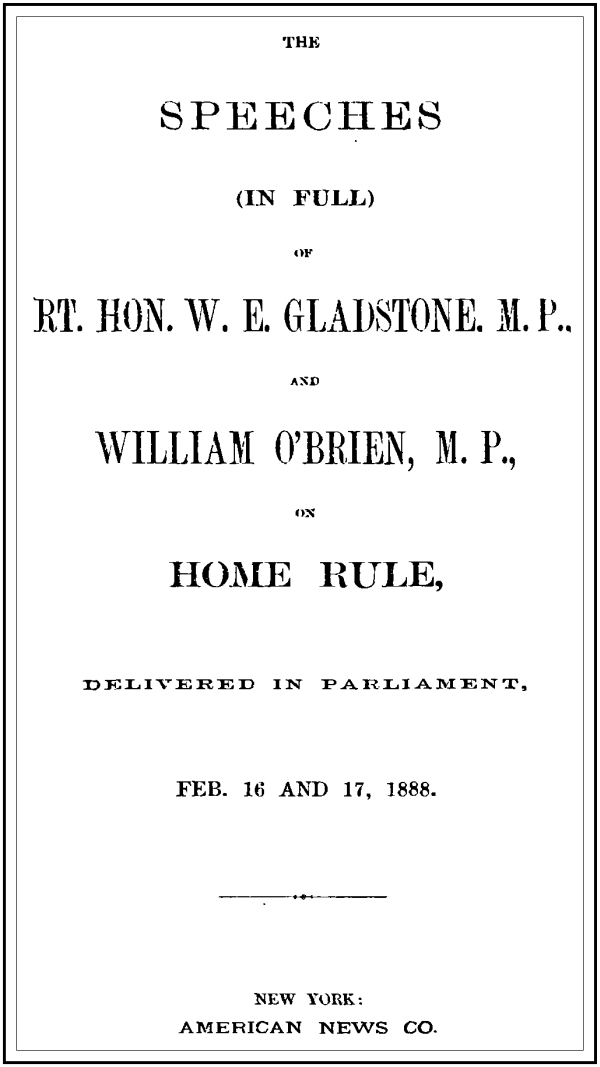
Mr. Gladstone. In following the right honorable gentleman, I shall only
touch those portions of his speech which go the heart of the question.
In my opinion, they constituted a very small part of his address
(cheers), the rest being criminatory and incriminatory matter, which,
however amusing to a portion of the House, really assists us very little
in getting at the root of the great question before us. I do this
particularly because there is a great difficulty, owing to the enormous
range of the question, in confining the debate within the narrow limits
to which we all desire to confine it. My honorable and learned friend,
the member for Inverness (Mr. Finlay), last night, when no member of the
Government seemed in a condition to follow the speech of the honorable
member for Northeast Cork (Mr. W. O'Brien), (Opposition cheers),
gallantly stepped into the breach, and performed that office on behalf
of ministers, which has so often been performed by those who are
sometimes termed "Dissenting Liberals"; namely, that of finding
expedients of defence for the Government which they and their adherents
behind them have been unable to discover. (Opposition cheers.) My
honorable and learned friend said he thought it high time that the
debate should draw to a close. I can perfectly understand reasons why he
should desire that there might be no debate at all on this subject
(laughter and cheers), but when he says that the discussion has
extended to unreasonable length, I point to the speech of the
Attorney-General last night, of the length of which I am far from
complaining, but which was evidently in sharp contradiction with the
view of my honorable and learned friend.
Why, sir, it has not been possible to include in this debate a number of
questions which deserve, and may yet have to receive detailed criticism.
For example, the law of public meetings has hardly been touched, and yet
it is gravely involved in the proceedings of the recess. ("Hear,
hear.") The relations between landlord and tenant have hardly been
touched, and to that notwithstanding a similiar observation will apply.
("Hear, hear.") The treatment given to prisoners of a particular class
has not been the subject of discussion, and I will make none of these
three matters subject of discussion; but at the same time no one can
doubt that all of them, and many more besides, are fit for the attention
of the House. ("Hear, hear.") I must proceed by the method of
selection, and I am bound to say that so far as I am personally
concerned, if it had not been for the pointed references to me, and the
perfectly fair and just challenges delivered against certain portions of
my speeches in the recess, I should gladly have remained out of sight. I
am of opinion that such speeches as have been made by the honorable
member for the city of Cork in moving his amendment, and by the
honorable member for East Cork on the memorable occasion of the opening
of last night's debate (Home Rule cheers), go more to the heart of the
matter, and more to the mind of the country, than anything that can be
said or urged by those who, whatever else may be said of them, cannot
deny that they stand in the position of leaders of a party, and are
liable to the imputation of party interests. On the other hand, these
gentlemen are in a position to say that they have shown us independence
of party. They have dealt a death blow to Liberal administrations, and
the members of those Liberal administrations never have complained, and
would not have been justified in complaining. They are the advocates and
the organs of a nation. (Opposition cheers.) They are in a condition
to speak with an effect to which they cannot make any just pretension
when they address themselves to the heart and to the understanding of
another nation on whose judgment they are content to rely. ("No," from
the Ministerial benches, and counter cheers.)
But, sir, there was a part of the speech of the right honorable
gentlemen which he introduced with an apology, and which I think it
right hriefly to follow. He referred to the communication between Lord
Carnarvon and the member for Cork, and I cannot question for a moment
the denials he has made. But what were those denials? I attended as well
as I could to his statement, and his denials were three. In the first
place, he denied that any engagement or agreement had been made. Sir, I
am not aware of its having been asserted. He denied, secondly, that it
ever had been stated to be the intention of a Conservative Government to
grant a measure of Home Rule. I am not aware, sir, that that has ever
been stated. Thirdly, he denied on the part of Lord Carnarvon, and I
accept the denial with all my heart, that Lord Carnarvon had ever used
any words inconsistent with the maintenance of the Union. (Ministerial
cheers.) But these three denials leave entirely untouched the material
parts of the case. What are these material parts? If the right honorable
gentleman wishes to dispose of them, I can only say that they are not
disposed of by what he has said to-night, and he must set about with a
new set of statements and denials in order to get rid of them.
(Opposition cheers.) It was stated by the honorable member for the
city of Cork, that he found himself in substantial—I might say, in
entire agreement with Lord Carnarvon on the question of Home Rule. That
has not been denied. (Home Rule cheers.) It has been stated that Lord
Carnarvon spoke for himself, and that I do not question, in so far as a
Lord Lieutenant can speak for himself. (Opposition cheers.) The right
honorable gentleman, the Chief Secretary, did not deny in the speech he
has just made, and certainly there was space in that speech for such
denial, that Lord Carnarvon and the honorable member for Cork were in
substantial agreement on the policy of Home Rule.
Mr. Balfour. I may say that, from the abstract I read, Lord Carnarvon
clearly, in my idea, did not express his opinion about the Home Rule
policy.
Mr. Gladstone. The honorable member for Cork declared that he had an
interview with Lord Carnarvon, and that he found himself in agreement
with Lord Carnarvon on the subject. The right honorable gentleman has
not denied that. (Home Rule cheers.)
Mr. Balfour. I interpreted Lord Carnarvon's statement as distinctly
denying that.
Mr. Gladstone. I ask for the words of Lord Carnarvon's statement which
contains that denial. (Cheers.)
Mr. Balfour. I will obtain them as quickly as I can, but it would take me out of the House to do so now.
(An honorable member: "Send for them.")
Mr. Gladstone. It is a very dangerous practice to make statements of
that kind and importance without the material on which they are founded.
(Ministerial cries of "Oh.") I affirm that I am in the recollection of
the House that whatever inference or interpretation the right honorable
gentleman made upon the declarations of Lord Carnarvon, there was not a
word in the passage he read which contained, or which approached to
containing, a denial of the statement of the honorable member for Cork,
that he and Lord Carnarvon were in substantial agreement on the policy
of Home Rule.
Now I ask the right honorable gentleman what he thinks of another
statement made by Lord Carnarvon in the House of Lords, and within the
memory of all of us, in which, speaking of the measure of entended
government that ought to be granted to Ireland, he said that they ought
to meet all the just demands of that country for local self-government,
and likewise ought to be directed in some degree towards giving
reasonable satisfaction to national aspirations? Does the right
honorable gentleman say that he is in favor of giving reasonable
satisfaction to national aspirations? On the contrary, it is the very
phrase and the very idea which, on no consideration, will he recognize,
and it is the phrase and the idea which form the basis of the views of
Lord Carnarvon, and here the right honorable gentleman cannot contradict
me. Well, I think, having got so far, I may go farther. Lord Carnarvon,
being Lord Lieutenant of Ireland and being a member of the Cabinet, or
whether he was a member of the Cabinet or not, was absolutely bound to
make kown his views to Lord Sailsbury, if not to the Cabinet at large.
He did make known his views to Lord Salisbury in the fulfilment of a
primary duty. Lord Salisbury continued to repose his confidence in Lord
Carnarvon. For months afterwards Lord Carnarvon continued to be Lord
Lieutenant. When he retired he did so professedly on account of his
health and amid the expressed regrets of his colleagues. Now, sir, we
are called separatists. (Ministerial cheers.) We are denounced as
such. (Renewed Ministerial cheers.) I am glad to have any of my
assertions supported by honorable gentlemen opposite, whose approval is conveyed in that semi-articulate
manner which they find so congenial. (Opposition cheers and laughter.)
But we are called separatists, and because we wish to give effect to the
national aspirations of Ireland within the limits of the Constitution
and with supreme regard to the unity of the Empire. (Ministerial cries
of "Oh," and Opposition cheers.) Lord Salisbury, as the head of a
Conservative Government, was content to stand before the country, having
in Ireland a Lord Lieutenant who was prepared to give satisfaction,
reasonable satisfaction, as we are, to national aspirations, and at the
same time to give Ireland everything in the way of local self-government
that ought to be conceded consistently with the unity of the Empire.
(Opposition cheers.)
Now, it appears then that a Tory Lord Lieutenant may dally as he pleases
with the sirens of Home Rule. It appears that when a general election is
pending, the Prime Minister may regard the entertainment of a Home Rule
policy as no object whatever to placing unbounded confidence in a Tory
Lord Lieutenant. But when the election is over (Home Rule cheers),
when the Lord Lieutenant is gone, and when Liberals declare that they
desire to meet the national aspirations of Ireland with a reasonable and
safe satisfaction, then, forsooth, they are to be denounced as
separatists. (Opposition cheers.) I must say a word upon the
entertaining speech of the honorable and gallant member for North
Armagh. I was struck, I confess, when, after all his assaults upon us,
the honorable gentleman gravely concluded with an argument in favor of
law and order, but with an insinuation that his countrymen would not be
very much disposed to adopt that doctrine. Well, I don't agree with him
about his countrymen, but if we were engaged in an endeavor to show that
Irishmen were not sufficiently good to recognize the principles of law
and order, undoubtedly the instance to which I should refer would be the
honorable gentleman himself. The honorable and gallant gentleman is
here, forsooth, to instruct and to educate us on the subject of law and
order, while he reserves to himself the right of declaring, and more
than once declaring, in this House, as far as I remember—(Col.
Saunderson: "Yes.") So much the better. All right. (Laughter and
cheers.) He declared that "if Parliament passed ant act for granting to Ireland a carefully guarded
portion of the independence she once possessed, he will be the man to
resist and to recommend resistance." (Opposition cheers.) He is
dealing with gentlemen below the gangway, and he has the consummate art
and the consummate courage to advertise himself as the apostle of law
and order. (Cheers.) Then the honorable member referred to a speech of
mine in which I referred to the lamentable murder of Constable Whelehan
in the county of Clare. The Chief Secretary was not ashamed in this
House, where he could not be answered, to say that I had made adverse
comments on the conduct of Whelehan, a man who had lost his life in the
service of his country.
Mr. Balfour. I said it in this House on Friday last, and I say it again.
(Ministerial cheers.)
Mr. Gladstone. I have no intention of charging the right honorable
gentleman with anything which is not true in fact. I am glad he has
contradicted me. I did not recollect, for I did not hear it. But it was
totally and absolutely untrue. (Opposition cheers.) Either he had not
read what I said, or if he has read it, and the same applies to the
honorable and gallant member for North Armagh, they have absolutely
misrepresented the purport of the speech they professed to quote. I
never named Whelehan except to deplore his death, and to express the
hope that his murderers would be punished. In my reference to that
speech, there is not a word to show that Whelehan was the man who was
the unhappy organ of the police in ministering pecuniary payment to the
infamous informer, nor is there one word in all that reference of blame
to her Majesty's Government. On the contrary, there is an express
declaration that I laid no blame upon her Majesty's Government with
reference to the case of Whelehan. Why, then, did I refer to it? On this
account: The honorable and gallant gentleman, in the careless way in
which he refers to these things, said I must be cognizant of the fact
that prices were paid for obtaining information I said at Nottingham; I
made no reference at all to the rather difficult question of payment of
prices for obtaining information: but what I referred to was the payment
of prices, not for obtaining information, but for concocting and
concerting crimes. (Cheers.) After the gradual revelations that were
made to us of the mode in which Ireland is administered, according to
the traditions of that country, it is perfectly possible that such
things may have been done, though I have never heard of them. But when I
did learn in that particular instance of that foul and loathsome
practice of paying money for such a purpose to a man, as far as we are
yet informed, who was to attend a meeting of the criminals for the
purpose of putting a hand to the arrangement and the execution of it
(loud cheers), then I did think it was time to protest in the name of
the Liberal party, if not of the whole country, against the practice
which, in my opinion, is in itself odious to the last degree, which
would not be for a moment tolerated in England, and in reference to
which I thought it wise and right to point out that it was dangerous as
well as odious, that when in a similar case the population of England
had become cognizant of similar practices, they themselves had resorted
to the commission of crime for the purpose of marking the detestation
with which they regarded it. ("Hear, hear.")
I pass on to the remarks of the right honorable gentleman the Chief
Secretary for Ireland, and I feel bound to refer to the observation he
made during the general debate on the address last week, to what he
called the practice of members on this side of the House of making
statements outside this House which they would not repeat within it, and
especially to his adverse and rather angry comments on tne pacific tone of the speech which I had just
delivered. The right honorable gentleman overflows with pugnacious
matter. He is young and inexperienced in debate, and bold and able as I
confess him to be, I think that when he has been fifty-six years in the
service of his country, it is possible that his stock of contentious
eagerness may be a little abated. (Laughter and cheers.) I have many
reasons, but if I must give a reason why I was particularly anxious to
avoid the needless introduction of contentious or polemical or
accusatory matter in speaking on the opening debate on the address. I
felt that an Irish debate was pending; and in the second place, the
great object I had in view was to assist and to promote the purpose of
the Government,—to promote, I will also say, the honor, dignity,
and efficiency of this House, by giving what I may call in homely
language a good start to the business of the session, by detaching it
from everything like controversy. But if the right honorable gentleman
laments the uncombative character of that discussion, I think he will
derive probably ample satisfaction in the future. There is no fear, I
believe, that Irish debate will be wanting in animation, possibly in
animosity, so long as the right honorable gentleman continues to be
Chief Secretary. (Opposition cheers and laughter.) The right honorable
gentleman even on that occasion found in my pacific speech matter
deserving of indignant rebuke. I repeat my lamentations that some of the
most difficult and the nicest parts of the law are removed by the
operation of the Coercion Act of last year from judges and juries to men
whom I termed of an inferior stamp. That was the observation I ventured
to make, and the right honorable gentleman was rather wrathful over it.
I fully admit that he is a perfect master of tu quoque. He said,
"Whoever they are, they are the men whom Lord Spencer appointed." In the
first place, that is quite inaccurate; and in the second place, if
inaccurate, it was totally irrelevant. It is perfectly inaccurate.
Mr. Balfour. I said that sixty out of seventy-three were appointed
mostly by Lord Spencer, or else were the appointments of previous
Governments revived by him.
Mr. Gladstone. And so the right honorable gentleman thinks that what he
calls reviving—that is to say not dismissing—is the same
thing as appointing. ("Hear, hear," and laughter.)
The gentlemen of whose conduct as resident magistrates I especially
complained, were Mr. Eldon, Captain Seagrave, Mr. Cecil Roche, Mr.
Meldon, and Mr. Carew. These five, and undoubtedly these are the
gentlemen I had specially in view when I spoke of men of an inferior
stamp, not one of these was appointed by Lord Spencer. (Cheers.) But
supposing they were, the statement of the right honorable gentleman was
absolutely and ludicrously irrelevant. What I was speaking of was not
the discharge by the resident magistrates of their ordinary and
traditionary duties, but the extraordinary duties which the right
honorable gentleman and the Government have insisted in putting upon
them. The right honorable gentleman was especially indignant with me,
because at a given date in the recess, or before the termination of
the session, I telegraphed to some correspondent the words, "Remember
Mitchelstown," and that in a speech at Nottingham I had developed my
meaning of that phrase with all the force I could. The right honorable
gentleman thought fit to point at me the reproach that I was not
disposed to maintain here what I have said elsewhere.
Now I have referred to my own statement at Nottingham about
Mitchelstown, and I can only say I not only adhere to it, but I
strengthen it. I never in my life uttered words, or sent words by letter
or telegram, which I more rejoice to have used, and am better content to
have used, than the words, "Remember Mitchelstown." (Loud Opposition
cheers.) It was not done inconsiderately. It was done considerately,
for the sake of Ireland and the country, and for the sake of preventing
the enormous mischiefs, probable sufferings, probable bloodshed, and the
consequent resistance to the law that might arise in Ireland in
consequence of what had occurred at Mitchelstown, and of its adoption
and appropriation by the right honorable gentleman. (Cheers.) What was
it? It was this: A legal meeting ("Hear, hear") of 4,000 men
assembled; the police, under the plea of the common practice of having
an official reporter at the meeting, instead of prior communication with
those who held it, instead of going to the platform at a point where it
was open and accessible, formed a wedge of twenty men, and endeavored by
force to drive that wedge into the middle of the crowd. I am here to say
that a public meeting is an orderly assembly; that to observe order in a
public meeting is part of the law of the land ("Hear, hear"); that the
driving a wedge into the meeting was an illegality on the part of the
police; and that the police who drove it into the crowd were themselves
guilty of illegality, and ought to have been given into custody.
(Cheers.)
On this deplorable occasion the agents of the law were the breakers of
the law, and those breakers of the law, acting in the first instance
under subordinate authority, were adopted and sanctioned by the right
honorable gentleman, with the full authority of the Government.
(Cheers.) What was the second act of the police? Their wedge was not
strong enough; they were pressed back out of the crowd, and it seems to
me with perfect propriety and legality, whereupon they brought a
large force of police and charged the crowd, because the crowd had not
concurred and co-operated in the former illegality. That was a fresh
illegality committed by the police. Then violence began; then began the
use of batons; then began the use of sticks and cudgels; then began the
sufferings of the men in the crowd, and of individual members of the
police, on which the right honorable gentleman is eloquent, and which I
regret as much as he does. But the police in these two illegalities of
attacking and batoning the crowd were defeated. The crowd did not pursue
them. (Cheers.) According to all the information before us, the crowd
were recalled, and again took their places in the square. A mere
scattering and sprinkling of most probably boys, we know not how and to
what extent, were in the street where the police barracks are to be
found; and among them, those boys or others, succeeded in breaking three
windows of the police barracks. (Laughter.) Those three windows were
exalted and uplifted by the right honorable gentleman into a general
attack on the barracks, compelling the police, in self-defence, to fire
on the people. In one sense I must say the police did not fire on the
people, for no mass of people was there to fire on. I said at
Nottingham, and it is the result of all the inquiry I have made, that
there was not more than twenty people in the street opposite the
barracks, and under these circumstances the police actually fired into
the windows of the opposite house, where there were peaceful people,
women, and children; and they fired deliberately at individuals, two old
men and one boy, whom they destroyed. That I do not hesitate here to
denounce—I think I did not use the words at Nottingham—as
cruel, wanton, and disgraceful bloodshed (Loud cheers.) It recalls the
period of Lord Sidmouth, and was bloodshed which, so far as I know, has
had no example in its wantonness and causelessness since the memorable
occasion in Manchester, which is popularly known as the Massacre of
Peterloo. (Cheers.)
Now, I have given the right honorable gentlemen my views about
Mitchelstown. (Opposition cheers and derisive Ministerial cheers.) It
was time that I should say, "Remember Mitchelstown." Mitchelstown might
have become what in one particular class of language is termed a
"prerogative instance." The Mitchelstown police, commended by the
right honorable gentleman, were held up to the police in Ireland as the
pattern which they were to follow. (Cheers.) They were told they had
acted only in self-defence, and the measure and meaning of self-defence,
as exhibited at Mitchelstown, I feared, and it was reasonable to fear,
would be the meaning and the measure of self-defence on every other
occasion, when, by legality or illegality, the police found an
opportunity of coming into collision with the people. (Cheers.) I tell
the right honorable gentleman frankly that, in my opinion, he had
become, by clear implication, a breaker of the law. (Cheers.) He had
given to the breaking of the law authoritative countenance and approval,
and not only so, but he had done it under circumstances where that
authoritative approval, conveyed to the mind of the police, would
naturally, justly, and excusably, almost necessarily, have pointed out
to them that that was to be the model and rule of their conduct in every
example of the kind. (Cheers.) Sir, it was in the interests of law and
order that I denounced the conduct of the police. (Opposition cheers
and derisive Ministerial cheers, in which Mr. Balfour joined.) It will
be a long time, I think, before he can discover an instance, either on
this bench or among any of those who are our friends, in which the law
and order of the country, and the security and the lives of the people,
had been treated with such recklessness as they then were by the right
honorable gentleman and his colleagues. (Cheers.) I have done my best
to inform myself, and in conformity with, I believe, uncontradicted and
consentient statements, I contend that the inferences I have drawn from
these facts are just inferences, and that it was not only natural but
necessary to adopt precautions on the part, I will say, of England,
against the fatal imitations which Mitchelstown might have produced, and
to take securities for law and order in Ireland, first of all, as I
pointed out to the people of England, that these things ought to be
watched; and secondly, by making known to the Government, and to their
agents and their organs beyond the the Channel, that if such occurrences
did happen, they would not pass uncensured. (Cheers.) I believe I
never spoke more useful—I will go further, and say more
fruitful—words than when I telegraphed, "Remember Mitchelstown."
(Loud Opposition cheers and derisive Ministerial cheers.) I now
come to the statistics of the right honorable gentleman, with reference
to boycotting. The Government are particularly stingy in their
statistics, but they have given some figures as to boycotting. I do not
recollect that boycotting was ever made a portion of Government
statistics before.
Mr. Balfour. We have made statistics before on boycotting.
Mr. Gladstone. Yes; but I am speaking of the ancient and traditional
practice which this Conservative Government are always so indisposed to
follow. (Opposition cheers and laughter.) Statistics of crime deal
with facts and matter of record; statistics of boycotting, as far as I
understand, are matter of opinion. ("Hear, hear.") What amounts to
boycotting,—what is the test of it? There must be, and will be,
cases of harsh and unreasonable persecution under the name of
boycotting. It is never to be forgotten, though it is very common to
forget it, that when you have a state of things that prevails in
Ireland,—old and sore relations of friction between class and
class, the sense of still remaining suffering or grievance, and
consequent instability of social order,—the criminal elements that
will always subsist in every community (though I thank God to say that I
believe they subsist in Ireland more narrowly than almost anywhere
else), I will find their way into social questions, and undoubtedly you
will have bad, and very bad, cases exhibited in matters such as these.
Therefore the exhibition of particular instances is a very unsafe and
insufficient test. They ought to be quoted with great accuracy. The
right honorable gentleman has been defending to-night his chosen
instruments of the present year. ("Hear, hear.") Yes, but he was met
immediately with point blank contradictions on matters of fact, and at
present I shall enter no further into that question, which evidently
must be made the subject of further examination. ("Hear, hear.") But
the right honorable gentleman gave us last year a case of boycotting
which was touching to the last degree,—the case of the Galway
midwife. (Cheers and laughter.) Does the right honorable gentleman say
that the instance he selected last year—the instance of the Galway
midwife—was well founded? (Cheers.)
Mr. Balfour. Absolutely correct in every particular. (Ministerial
cheers.)
Mr. Gladstone. All I can say is, that here likewise the
right honorable gentleman has been met with a point blank contradiction.
("Hear, hear.") But what are we to say of boycotting
statistics as a basis for legislation or for congratulation on
the rising felicity of a country, when the right honorable gentleman,
out of the thousands of cases he has had before him, can
only select for us two upon which he is at once met by having
his facts challenged, and his conclusions falsified? (Cheers.)
Let me point out this. My right honorable friend, the member
for Newcastle, well remarked on a former occasion, that there is
a chapter of statistics which, if the right honorable gentleman
had chosen to enter it, would have been far more to the purpose
on this occsion than these he has laid before us, though they are
not wholly without value; and that is the statistics of evicted or
derelict land. ("Hear, hear.") There could be no difficulty whatever
for the right honorable gentleman to have called for returns
of the acreage on farms, which, in different counties in Ireland,
either all over Ireland or in selected counties, had been derelict
a year, two years, or three years ago, in the time of Lord
Spencer and down to the present date, and had shown us how,
under the recovered liberty of the Irish people, about which he
boasts, the acreage of these derelict farms had gradually been
diminished. The right honorable gentleman has not only
avoided but shirked that question (cheers), and he shirked
it because he substituted for any attempt at a rational answer to
my right honorable friend, a jeremiad upon the state of feeling
which he thought might be produced in Ireland when he found
my right honorable friend using language which, in his opinion,
was capable of being interpreted into sympathy with the operations
of the Land League. ("Hear, hear.") A more unjust
charge never was made. (Opposition cheers). But, just or
unjust, it has nothing to do with the question.
The right honorable gentleman found himself, and the Queen
has been instructed to found herself in her speech, and the organs
of the Government have based themselves in their articles,
upon the assertion that liberty, as they phrase it, is
returning to the people of Ireland. If that liberty were returning,
it would be exhibited in a proportionate diminution of derelect
farms. ("Hear, hear," from Mr. Balfour.) Then why
have you not shown it? (Opposition cheers.) There is one
part of the statistics that we have read with increased satisfacfaction,
that is the diminution in the amount of crime, limited
as that diminution is. I thought when the right honorable gentleman
constructed his artificial return, he had some very special
purpose in view. It is the first time that I have known the
month of January do such good service, and when I look into
the return, I find out the cause: The return of offences reported
to the constabulary are reported under three major heads,—offences
against the person, offences against property, and
offences against the public peace. With regard to the offences
against the person and property, I find that if I take the five
months only of last year, after the passing of the Coercion Act,
and compare them with the corresponding five months of the
year before, there is no diminution whatever. ("Hear, hear.")
But in the month of January there was in offences against the
person a sudden, a most well-timed, and fortunate, and rapid
decline, for they fell from ten to three. The right honorable
gentleman drew January into his service; by means of that
declension, he was able to show a diminution of six per cent of
offences against person and property. I am extremely glad of
it, and wish there had been a great deal more. The offences
which have sensibly and really diminished are those against the
public peace, and I rejoice that they have diminished. But
why? The right honorable gentleman stands up and says that
the cause of the diminution is the Coercion Act, but I think I
have shown that whereas the diminution of crime proper, as
directed against person and property, is an exceedingly small
diminution, the diminution of offences against the public peace
is much larger. I make it out to be that that they fell in these
six months from three hundred and twenty-four to two hundred
and thirty-eight, or a diminution of about twenty-five per
cent. These are exactly the offences that would diminish
under the operation of a conciliatory Land Act. (Opposition
cheers.)
The right honorable gentleman has the boldness to say that
we, on this side of the House, never gave any credit to the Land
Act. Why, sir, the Land Act, grossly imperfect as it was,
culpably imperfect in the matter of arrears (cheers), contained
a great and important provision which the member for
Cork in vain had demanded in the September before, which,
if it had then been granted, you probably never might have
heard of the Plan of Campaign. (Cheers.) It was denounced
to the House by the Government of that day as being a provision
totally incompatible with that morality, forsooth, on which
right honorable gentlemen prided themselves. (Laughter.) I
speak of the provision which, under a great responsibility, her
Majesty's Government, though far too late, introduced as a
most valuable gift. It was quite evident that, so far as
offences against the public peace were concerned, the reopening
of the judicial rents, and the concession made to leaseholders,
could not but operate in the most powerful manner in favor of
that diminution. (Cheers.) There are two other questions to
be considered, viz., how the law has been administered, and
how the administration of the law has succeeded. Has the
administration of the law been of a character to reconcile, or
has it been of a character to estrange, or has it been calculated
to teach respect for the Government, or to bring the Government
into increasing hatred or contempt? I am not going into
details of prison treatment, but I am going to touch the case of
two members of Parliament, with reference to a matter other
than prison treatment. I am not cognizant by direct and personal
knowledge of the facts, but I have received them from
quarters thought to be thoroughly informed. Unless I had
so received them, I would not think of laying them before the
House.
Mr. Sheehy, a member of this House, has been arrested and
remanded without bail. It was a misfortune which might have
been taken into consideration at the time that his wife was ill of
a disease known as scarlatina, or scarlet fever. He was offered
bail by the Government if he would promise not to open his lips
in public. By Government—that, I presume, means the Executive
Government. I want to know what title the resident
magistrate had to make such a condition as that. (Opposition
cheers.) Most dangerous is this introduction of the new discretion
of resident magistrates,—a discretion of imposing new
restrictions upon prisoners. Why is it necessary to impose
these conditions? If Mr. Sheehy chose to commit an offence
while he was under bail, he could be taken up for that, and I
want to hear from the Chancellor of the Exchequer, or some
member of the Government, a distinct account of the new doctrine
that those conditions may be imposed, which are written, I
believe, neither in law nor in custom, which have been set in
action in Ireland, but which in England, we know, are not heard
of, and would not be heard of or tolerated for a moment.
(Cheers.) Mr. Sheehy, I must say, very properly entirely declined
to accede to that condition, and he was tried and
sentenced to three months' imprisonment. He appealed, as he
was entitled to do, and bail was accepted for his appearance at
quarter sessions, so that he would have been able to obey the
almost sacred domestic form of tie which was at the time incumbent
upon him. But as he was going out of the door of the
court he was arrested again on another charge, and brought
away immediately to a distant part of the country, his wife
being in the very crisis of her illness, and her life seriously
threatened. On the second charge he was sentenced, not to
three months, which would have enabled him to appeal, but to
one months imprisonment, (Nationalist cheers), depriving him
of the power of appeal.
Mr. Chance. Which had been promised by the right honorable
gentleman to the House.
Mr. Gladstone. The right honorable gentleman, the Chief
Secretary, is perfectly aware of that promise. He is perfectly
aware that in the debate last year he was charged by my right
honorable friend near me (Sir W. Harcourt) with breech of
faith with regard to that promise, and to that charge of breach
he has remained, I must say, very patiently silent. (Opposition
cheers.) Now, is that the sort of administration of the act
of last year which her Majesty's Government are prepared to defend?
(Opposition cheers.) Is it thus that Ireland is to be
reconciled? (Nationalist cheers.) Is it thus that the Irish nation
is to be converted? Is it in this House of Commons, the
most ancient and the noblest of all the temples of freedom,
that such operations as this are to be either passed over in
silence or defended by those engaged in them? (Loud Opposition
cheers.) I cannot understand the extreme severity of
treatment in certain particulars, if I am rightly informed, meted
out to this gentleman; but I wish to keep for the present to what
relates most distinctly to the administration of the law as apart
from prison discipline, and in that view alone I would mention
the case of Alderman Hooper and others. Alderman Hooper
was sentenced for publishing reports of the National League
branches that had been suppressed, although, as I understand,
there are plenty of these reports published within the cognizance
of the Government, with respect to which those who publish
them have not been sentenced and have not been proceeded
against.
Well, Mr. Alderman Hooper was proceeded against, and was
sentenced for publishing these reports for a term of one month.
He would have had there no right of appeal, but was again
simultaneously charged for publishing another report; another
sentence of one month was pronounced upon him. These
sentences, though cumulative with regard to him, were not cumulative
with regard to the right to appeal. (Cheers.) Therefore,
while the right honorable gentleman professed to give the right
of appeal for all sentences above a month, by this clever device
he has contrived to inflict upon Alderman Hooper, a member of
this House, an imprisonment of two months, and yet that Alderman
Hooper should have no right of appeal. And there again,
sir, I say I am sorry to use strong words, but I am tempted to
do so outside this House, and I will do so in this House.
(Opposition cheers) This was explained to be not only a
constitutional violence, not only a clear evasion of the spirit of
the law, but an incredible meanness (loud Opposition cheers),
a meanness in the method of administering the Crimes Act,
and a spirit is displayed which, if the Irish people had only a
hundredth part of the courage, the pluck, and perseverance
which they had shown through seven centuries, could only tend
to alienate and estrange them from those who attempt so to
govern them. (Opposition cheers.) The word that I have thus
used I am going to use again. (Ministerial laughter.) I am
very desirous to invite the concurrence of the Chancellor of the
Exchequer in the propriety of my application of it, or whether
he considers that nobleness would be a better description of the
circumstances which I am about to describe. Without knowing
what I am going to say, the right honorable gentleman accepts
my challenge, and, therefore, I am justified in exhibiting a
specimen of the nobleness with which this administration of
Ireland is conceived and executed.
I have before me a list of six people prosecuted, not for publishing
reports of suppressed branches, but for selling them.
Their names are: Macnamara, at Tralee; Mahony, Tralee;
Molloy, Tralee; Brosman, Killarney; Green, at Killarney, also;
and at Ennis, another Macnamara. (Irish honorable members:
"This same man twice.") Two of the cases were dismissed, but
four of them were sent to prison,—one for a month with hard
labor, another for a month with hard labor, another for two
months with hard labor, and another released on a promise not
to do it again. Again this method of interfering with private
freedom by arbitrary restriction, governed by no law, justified
by no usage, devised by this spirit of Irish administration
(cheers), and with respect to which I want to know how far
this importation into the law and jurisprudence of the country
is to be carried under the auspices of her Majesty's Government.
Well, now, sir, I want to know from the Chancellor of
the Exchequer, if he is to speak to-night, does he see nobleness
in the prosecution of these men? ("Hear, hear.") Does he think
it rational to prosecute these men? (Cheers.) Does he think
it right to require of the vender of a newspaper that he should
read its contents? Does he think it right to require that he
should have formed his judgment of those contents, that he
should have made up his mind whether the proceedings described
in the newspaper were legal or illegal? and is that the
responsibility which he thinks ought to be imposed on the vender
of a newspaper under pain of being condemned to one month
or two months' imprisonment? This administration of the
Crimes Act, to which I must advisedly apply, until I am better
instructed, the term "meanness," has yet, at any rate, had no
defence offered in the course of this debate. (Cheers.) The
remaining point of the administration of the law on which I will
comment is of a different character. It is with respect to exclusive
dealing.
It will be remembered that we, in our charges against the
bill last year, did not say that it justified the proceedings of
exclusive dealing. I do not believe the act does justify them;
but this I am bound to say, that the interpretation of the act
appears to be deliberately applied in a variety of instances for
the punishment of simple exclusive dealing. The right honorable
gentleman ought to know, if he does not, for I delivered
the speech in his hearing, that when I spoke of the dismissal
of curates by rectors and the deprivation of their daily bread,
that men with wives and children were to be turned out upon
the world, I was not, as the right honorable gentlemen charged
me, comparing them with cases of conspiracy, but I was
comparing them with cases of exclusive dealing, which, while
they are practised freely both in Ireland by the opponents of
the Nationalists, and in England by the party of the right
honorable gentleman (Opposition cheers), unpunished by
the law, I believe it is stretching and straining even the
deplorable and shameful act of last session to make it include
such cases. Now, sir, I wish to mention eight cases, but first I
find I was quite wrong in saying that two of the cases for selling
newspapers had been dismissed. They were not. The
defendants were released upon promise, and the other four
punished. I have now before me eight cases of exclusive dealing,
two of which were dismissed, but in all of which the Government
proceeded. In one of these cases a man was punished
with a month's hard labor for refusing to shoe a horse for a
boycotted person; another, for refusing to sell groceries to a boycotted
person; a third, for refusing to shoe a horse; and a fourth,
for declining to deal with emergency men. Those are all cases
of exclusive dealing. They are not cases of conspiracy. In
fact, these men have been punished for doing in Ireland that
which would be perfectly lawful in England, and which, I
believe, is perfectly lawful even in Ireland, under any fair interpretation
of the act. Now, has the act succeeded, or it has
failed? I do not think gentlemen will object to the proposition
that its real object was to put down the National League and
the Plan of Campaign.
Now I come again to the speech of the honorable member for
East Cork (Mr. W. O'Brien) which, I venture to say, was a memorable
speech. (Cheers). To him, as I have never had the privilege
of private or personal communication, I will say publicly in
this House that though, as he says, imprisonment under the condition
he describes is a hard and severe thing, which drives the
iron into the soul of a man and leaves him such that he hardly
can be again what he was before, yet I trust that the right honorable
gentleman has derived some consolation and encouragement
to persevere, at least, in lawful and patriotic efforts for
setting right the wrongs of his country. I hope he has derived
it from the enthusiastic reception that he encountered in this
House and out of it, and, I will add, for the credit of honorable
gentlemen opposite, from the respectful, and, to some extent,
I think, the symathetic silence with which they also accorded
him a kindly reception. (Cheers.) The speech of the honorable
member was of an importance which has not in the smallest
degree been appreciated by the Chief Secretary. The right
honorable gentleman has argued the case in his old manner;
and whereas the honorable gentleman charged him with having
said that he pleaded ill-health against the prison dress, what appears
is that the Chief Secretary says that the honorable member
had sheltered himself by ill-health against the demand to
wear prison dress. For that statement of the right honorable
gentleman, as amended and admitted, there is not a shadow of
foundation. (Irish cheers.) That you cannot contradict,
although you have plenty of myrmidons, and, perhaps, some
minions. You cannot show that either by word or act, the honorable
member entered this ignominious plea. Why has the
right honorable gentleman passed by in silence another personal
statement of the honorable member, which I tell him he had no
right to pass by, and with respect to which I will now put it to
him and the House, that after he has had an opportunity of making
Lord Salisbury's defence, he has utterly failed to tender any
defence at all? (Cheers.)
Mr. Balfour. He did not require any.
Mr. Gladstone. That is just the matter I am going to
argue, and we will see how it stands. The statement of the
member for Cork was to this effect, that Lord Salisbury in one
of his speeches, after some jocose references which exhibit the
tase of the Prime Minister (Opposition cheers), and which are a
great deal too common in speeches proceeding from such quarters,
held up to British indignation the illegality of the conduct
of the member for East Cork, and stated that it had led
to disturbances, to attacks upon persons which even placed life
in danger, and to gross outrages. In reply, the honorable gentleman
stated that his intervention at Mitchelstown produced no
act of violence whatever, but on the contrary averted it. The
Chief Secretary has not been able to controvert that statement.
(Cheers.) Not being able to controvert it, he has passed it by.
He has neither the courage to prosecute, nor the generosity to
withdraw. (Cheers.) Lord Salisbury made an allegation of a
gross and grievous character, which his nephew in this House
cannot say a word in support of.
Now, however, he says that that allegation of Lord Salisbury,
injurious as it is, and remaining without a shadow of
defence, needs no apology. (Cheers.) I hold that until Lord
Salisbury can show that he was justified in the broad and most
important statement that he made, a personal apology from him
is due to the member for East Cork. (Opposition cheers.)
This is a personal matter, but it is no slight thing that charges
of this kind should be made by the Prime Minister, and that
then, forsooth, we should have a shuffling and a shrinking from
any attempt to deal with them. With regard to the act for
which the member for East Cork was put in prison, the honorable
gentleman, has pointed out the attendant circumstances
and the consequences of his act; but the right honorable
gentleman instead of admitting the virtue of those
pleas, generalized his charge, and said it was the habitual and
settled practice of the Irish members to do these things. Why,
then, did they select for prosecution this instance, in which the
member for Cork is able to state, without contradiction, that his
intervention, whatever judgment may be given on the naked
question of its legality, not only saved tenants from distress,
but the public peace from disorder and outrage? (Cheers.)
Now I wish to call attention to the most important part of
the statement that I am presuming to make. When I heard
the address read from the chair, I said that the heart of it was
the challenging paragraph; and when I heard the speech of the
member for East Cork last night, I said to myself, "Never did
I hear so challenging a speech." The assertions of the member
for East Cork opened up the whole question, and gave to the
Government the opportunity by contradiction, by grappling
with those assertions, of establishing their case and of showing
that their designs against the National League and the Plan of
Campaign were, at least, in process of accomplisment. Here I
must say a word about the Plan of Campaign. It is an interference
with the law. It has, no doubt, substituted its authority
for the law. Far be it from me to assert that necessarily such a
plan in the abstract is an evil. But it is something more. It
is a sign that the law does not do its work. It is a sign that
the conditions of legality do not exist. It is a warning to set
about restoring them. This is not the only place where extra
legal combinations and anti-legal combinations have been
brought into existence for the purpose of mitigating social disorder.
Having cited several of such organizations, such as the
Swing organization, the Camorra society in Italy, and Lynch
law in America, the right honorable gentleman said, these, all
of them, are in their nature evils, but such is the imperfection
of man and the imperfection of his institutions, that sometimes
things that are evils in themselves are the cure of greater evils,
and in respect of the Plan of Campaign, what has to be shown,
is that without it Ireland would have been happier and more
tranquil than it is at present.
Having recapitulated Mr. O'Brien's six statements as to the
beneficial effects of the plan, Mr. Gladstone continued: Now,
whereas we now appear to know that there are about forty cases
settled under the Plan of Campaign, there is no case in which
payments made under the plan have been censured as rapacious
or unreasonable by a single Land Commission. Now, be it
recollected that I am not arguing upon the propriety of the plan.
I am arguing upon its success. I have shown that there is not
the smallest shred of contradiction against any one of those
allegations, and that, taken as they stand, they show that at
this moment, notwithstanding the boasts of the administration,
the Plan of Campaign stands in Ireland entire, successful, and
triumphant. Since it has been under the proscription of the
right honorable gentleman for a certain time, it appears,
according to the facts before us, to weigh considerably heavier
than it did before he had anything to do with it, and well this
illustrates the success of the right honorable gentleman's
policy. (Home Rule cheers.)
There is one still more important point. The right honorable
gentleman made no attempt to connect the National League or
the Plan of Campaign with the commission of crime and outrage.
The Attorney-General did make an attempt, and what was the
narrow basis of that attempt? Why, it was one upon which a
tight-rope dancer might perhaps have found a footing, but from
which men with only ordinary means of locomotion must have
fallen. (Laughter.) He got hold of two crimes,—one of the
Plan of Campaign, and one of the National League, and how did
he establish the connection? Intuitively, out of his inner consciousness,
for as he could not see the causes of the crimes, he
thought it reasonable to put them down to these institutions,
and, to prevent jealousy, he gave one crime to each. (Laughter.)
What course was open to the honorable and learned gentleman?
What course remains open to the Government if they intend, as
they ought deliberately and seriously, to show a connection between
crime and outrage, and these considerable powers which
they are laboring to put down? There are two courses they
might pursue. If there were grounds for this imputation, the
Attorney-General ought to have searched the evidence in all the
numerous prosecutions the Government have instituted, and to
have shown from that evidence that witnesses testified, and that
judicial authority acknowledged, facts which tended to show
that a connection existed between crime and the National
League, and crime and the Plan of Campaign.
Not the smallest attempt was made by the honorable and
learned gentleman or by the Government to do anything of the
kind. The reason was that they could find no such evidence,
and I give no credit to the Plan of Campaign or to the National
League for the absence of such evidence, because to encourage
crime on the part of either, or to tolerate it, would be suicidal
to them. (Cheers.) The right honorable gentleman might
have pursued the course which I took in 1881, when arguing the
unhappy bill of that year (unhappy as to the nature of its provisions),
which was designed to meet what was at the time a
most threatening evil. I argued that the Land League, as i
operated at that time, was an organization imparting danger to
the country. I showed, or tried to show, that wherever you
traced the footsteps of the League, you traced the increase of
crime. The Attorney-General did not pursue that course, because
he knew it would result in total failure. Therefore I
think we have evidence before us, so far as it goes, and it goes
pretty far, to show that as regards these great objects which
the Government have had in view, of putting down the National
League and the Plan of Campaign, their efforts have resulted in
total failure.
Whether it be the Land Act, with its beneficial or imperfect
provisions, or whether it be that dawning of the rays of hope,
that beginning of the knitting together of the heart of one
nation to the heart of the other, the diminution of crime is a
matter of rejoicing, and we wish it were greater, we congratulate
the Government, and we heartily hope that in the hands of beneficial
and benign causes it may continue to decrease. Well,
such is the retrospect. What is the prospect? What is to
come? Will the Government continue still to deal with signs,
and never to look at the substance, to legislate against symptoms
and manifestations and never to touch the disease, to try
and prune off from the rankly luxurious vegetation, here a
twig and there a leaf, and never to ask themselves whether the
proper purpose and design is not to bring it out by the
roots? There are many things which are said by the Government
in debate, but there is one thing which they and their supporters
most rarely say. I think, as far as my recollection and
experience goes, I may almost venture to go further, and assert
they never say,—I never had heard them express a confidence
that they will be able to establish a permanent resistance to the
policy of Home Rule. (Opposition cheers.)
I am glad not to be met with adverse challenges when I say
this. If this be a question of time at all, then it is most important
to consider what is the right time. I don't disguise any
more than the honorable member for East Cork the strength of
the combinations that are opposed to us. They are very strong
indeed; they have nearly the whole wealth of the country;
they have nearly the whole of the high station of the country;
they have most of the elements of social strength which abound
in them; they have with these all the things which belong to
wealth, to rank, and to station in this country, which is vast in
its amount, they are very strong, and by their strength they
may secure delay, but delay in a subject of this kind, a controversy
of nations, is not an unmixed good. It has its
dangers and its inconveniences. You are happily free at this
moment from the slighest shadow of foreign complications.
You have at this moment the constitutional assent of Ireland,
pledged in the most solemn form, for the efficacy of the policy
which I am considering. But the day may come when your
condition may not be so happy. I do not expect, any more
than I desire, these foreign complications, but still it is not wise
wholly to shut them out.
What I fear is rather this, that if resistance to the national
voice of Ireland be pushed too far, those who now guide the
mind of that nation may gradually lose their power, and may
be supplanted and displaced by ruder and more dangerous
spirits. These very institutions, the National League and the
Plan of Campaign, which would vanish into thin air upon a
rational settlement of the Irish difficulty, might with their
power drive such deep roots into the soil, they might acquire
such a mastery, if not over the understandings, over the passions
of the people, for passions in these cases will always be
let loose, they might acquire a strength which may enable
them hereafter to offer serious hindrances to government which
is good. I venture to express a hope that there will be deeper
reflection upon these matters. In the present administration of
Ireland, it is too plain you are endeavoring to do what the
language of Lord Salisbury shows is too clearly your intention,
what has long been endeavored, but under circumstances wholly
different. For seven hundred years, with Ireland practically
unrepresented, with Ireland prostrate, with the forces of this
great and powerful island absolutely united, you tried and
failed to do that which you are now trying to do with Ireland
fully represented in your Parliament, with Ireland herself raised
to a position which is erect and strong, and with the mind of
the people so devoted that if you look to the elections of the
last twelve months you find that the majority of the people have
voted in favor of the concession of Home Rule.
If this is to continue, I would venture to ask gentlemen opposite
under such circumstances as these, and with the experience
you have, is your persistence in this system of administration, I
will not say just, but is it wise, is it politic, is it hopeful, is it
conservative? (Cheers.) Now, at length, bethink yourselves of
a change, and consent to administer, and consent finally to
legislate for Ireland and for Scotland in conformity with the constitutionally
expressed wishes and the profound and permanent
convictions of the people; and ask yourselves whether you will
at last consent to present to the world the spectacle of a truly
and not a nominally United Empire. (Loud Opposition
cheers.)