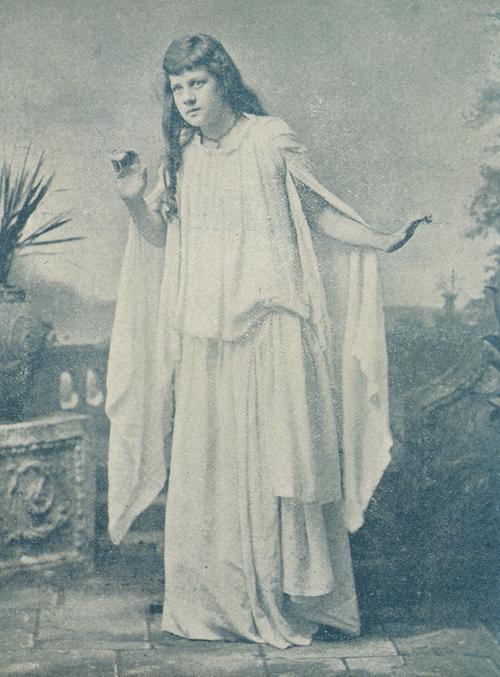
“Hush thy babble, O fountain! Let me listen, let me listen!”
Whole book · 164 sections
“Hush thy babble, O fountain! Let me listen, let me listen!”
THE SPEAKER’S
FOR
Home, Church and School.
CONSISTING OF
Recitals, Dialogues and Dramas.
WRITTEN AND EDITED BY
With Annotations, Hints upon Gesture
and Dramatic Poses, by
PRINCIPAL OF MT. VERNON INSTITUTE
OF ELOCUTION AND LANGUAGES, PHILADELPHIA.
S. I. BELL & CO.
PHILADELPHIA AND CHICAGO.
Copyright, 1892, by S. I. Bell.
In preparing this work for the public it has been our aim to choose the very best, and every selection has been made with a special view to elocutionary merits. The “Speakers’ Ideal” is composed of carefully selected pieces from the writings of well known authors, and as a source of supply to the giver of dramatic entertainments, from which they may obtain at once a suitable subject for declamation, recital, dialogue and drama, this volume is without a peer.
The work contains many new pieces not found in any other book, and we have been able to secure a number of selections in the original manuscript, which are here published for the first time. Most of the recitations are accompanied by Annotations for Gesture, by which the amateur, as well as the elocutionist, may be guided in the necessary action, and by a method so extremely simple that the novice who has never had the privilege of instructions in the art of elocution will be enabled to give that indispensable accompaniment, without which, there can be neither natural, oratorical, nor dramatical delivery. This important feature has been carefully prepared by one who stands at the head of the profession as an instructor of elocution, and is found in no other “Speaker.”
Another of the chief characteristics of this work is the large number of full-page and exquisitely engraved half-toned plates, which have been taken from life and produced at large expense expressly for this book. The “Speakers’ Ideal” contains every characteristic of a complete book of elocution, and is, strictly speaking, the only “Speaker” ever published.
The unprecedented success that has attended the sale of the first editions, is proof that our hope to supply a long-felt want has been fully realized, and it is with entire confidence in its merits that we present this work to the public.
THE PUBLISHERS.
As a tree without leaves, so is recitation without gesture; but the most beautiful pieces are sometimes marred and burlesqued by awkward or inappropriate action. Our object, therefore, in presenting our system of notation is not to teach gesture—for that can only be acquired from a teacher—but to guide the reciter in a general way.
Gestures are divided, 1st, into front, oblique, lateral and backward; and 2d, into descending, horizontal and ascending; for instance, if the hand is thrown to the front, it must take a position on a level with the shoulder, or above, or below, which three divisions constitute the positions last named. The same applies to the oblique, which lies anywhere between the front and the lateral; to the lateral, which, as its name indicates, lies to the side; and to the backward. These positions are designated by the following letters: D. F., descending front; D. O., descending oblique; D. L., descending lateral; D. B., descending backward; H. F., horizontal front; H. O., horizontal oblique; H. L., horizontal lateral; H. B., horizontal backward; A. F., ascending front; A. O., ascending oblique; A. L., ascending lateral; A. B., ascending backward. b placed before the above combinations indicates that both hands are used. When not mentioned to the contrary, the supine hand, palm upwards, is used. P. represents prone hand, or palm downward; V. vertical, or palm outward; Ind., index finger as in pointing. This must be carefully distinguished from P. Ind., which means Prone Index or the back of the hand upward, and finger pointing. Cl., expresses clinched hand or fist. Par. expresses both arms parallel towards right or left. If a gesture is illustrative and cannot be expressed by any of the above letters, it will be called special and designated by Sp. All gestures of a bold, descriptive, or emphatic character should be made from the shoulder, whilst unimportant or conversational gestures proceed from the elbow. Good taste dictates that a few gestures, properly made, are preferable to a large number crudely constructed.
Let your gestures be so modulated, and so accord with the sentiment, that they may seem a part of a perfect whole.
FRANCES L. PEIRCE.
Then came the memorable order from Burnside, which must have thrilled every member of the regiment: “Tell Sturgis to send the Fifty-first Pennsylvania to take the bridge.”
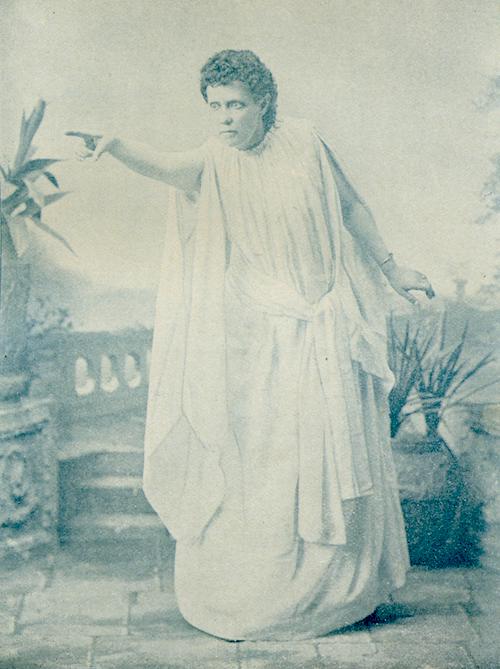
“Nathan said unto David, ‘Thou art the man.’”
I’ve got one of the best Pa’s in this world. Pa is very fond of me, too; in fact, no one ever comes to our house when Pa’s home that he don’t commence to praise me before he even asks the guest to be seated. Pa’s not rich, so we often have to make both ends meet by resorting to novel expedients; and even then, the ends don’t stay together worth speaking of. Pa’s memory is none of the best; poor, dear man, I’ve known him to eat two soft-boiled eggs while trying to determine whether or not he had seasoned them. The other day Pa brought young Judson, the lawyer, home to dinner; we had codfish and potatoes with warmed-up coffee from breakfast. Ma almost fainted. Judson said he doted on cod-fish—but then he is a lawyer—Ma trod on my foot—said she in a whisper, “Tell your father not to ask him to have more coffee.” Pa caught the word coffee. “Why, yes,” yelled out Pa, “Judson, my boy, pass over your cup!” I never felt so mortified in my life; there wasn’t a single drop in the pot!
“You must pardon us,” stammered Ma. “Never mind excuses,” interrupted Pa, “Pour out the nectar, Matilda—why—why—”
“Yes, why,”—mother’s face was scarlet—“it is why—why have you not had the hole in the bottom of this pot mended? the coffee’s all leaked out.” Poor ma! how I pitied her.
Last night the Higgins girls called to know if we liked the style of their new silk dresses—such stuck-up mortals I never saw—their father used to mend Pa’s boots—owes his fortune to a judicious use of chalk and an old pump—and styles himself a retired milk dealer. Pa happened to be in the parlor when the Higgins girls floated in. “Hannah,” said Pa, “go upstairs and get the silk dress you’ve just finished.” “Why Pa, how you do talk,” said I, my heart almost ceasing to beat. “Don’t be so modest, Hannah,” he continued, “show the young ladies how handy you are.” “Oh, Pa!” I cried, trying to get his mind off the dress, “did you ever see such beautiful bonnets?” The fates were against me. “Ladies,” said Pa, “that girl is worth her weight in gold; she’s just finished trimming over a last season’s hat, and has just made the handsomest dress out of her Ma’s old silk frock that ever a human eye rested on!” The Higgins girls giggled, and I—I could have sunk through the floor.
One day Pa said he would take us to a matinee. It was on a Monday, but Ma said she’d put off the washing, although the washerwoman declared she’d never put up with such tomfoolery again. Pa came home later than usual, and almost hurried us to death. At last we arrived at the theatre, streaming with perspiration. A grand opera was to be given, and the entrance was crowded. Pa began searching for his tickets. He first dove into one pocket, then into another; meantime we were elbowed and jostled by the throng. “Strange,” groaned Pa, “I put them in my vest pocket.” Just at that moment Judson and his two sisters alighted from a hack. Pa turned white as chalk, then red as a canned lobster. “Come, quick,” he gasped, “this way.” We followed him to the corner. “What’s the matter, dearie?” asked Ma. “Why,” groaned Pa, “Judson’s got my tickets. I gave them to him last night, but forgot all about it until he just now jumped out of the hack.” So we lost that opera and a good washerwoman, too. Still, Pa’s awful nice.
—Geo. M. Vickers.
Many years ago there lived in a tiny cottage, a widow and her two children, Frank and Edith. The cottage stood by the roadside, not far from a village, and was almost hidden from view by the pretty roses and vines that clung to its sides.
One warm summer afternoon, when Frank was away to the village with his donkey and cart, and the widow was busy sewing in the back part of the cottage, little Edith, who had been weaving a wreath of flowers, lay fast asleep on the front porch, shaded from the rays of the sun by the arbor that covered the door. She lay there with her long golden hair partly hiding her pretty face, with the unfinished wreath still held in her hands, and her little straw hat filled with buds and sprays, upset at her side.
Now, the road that passed the cottage was much used by travelers, as it led in both directions to large cities; but on this particular afternoon not a human being, nor an animal, nor a vehicle of any sort could be seen on its white, gleaming surface; and save the drone of a passing bee, or an occasional chirp from a cricket under the porch, not a sound broke the deep stillness. Even the birds seemed to be dozing, so nap-inspiring was that sultry summer afternoon.
An hour later and Edith was still sleeping, when the distant rumble of wheels could be heard. They were yet a long way down the road, although from their peculiar rattle it was evident they belonged to a light wagon—perhaps some farmer returning from market. Presently a cloud of white dust rose above the trees and indicated the point reached by the wagon, but the latter could not yet be seen from the cottage on account of the intervening foliage that skirted the roadside. A few moments later an odd-looking, top-heavy vehicle, drawn by two lank horses, emerged into view. Behind the wagon, mounted on a mule, rode a dark-visaged man.
When the wagon arrived in front of the house it stopped, and the man on the mule advanced to the garden fence, dismounted, and threw his reins over the gate post. He then opened the gate, and was about to pass to the rear of the cottage when he spied little Edith. The slanting sunbeams had crept so close to her face that it was only a question of a few moments when the bright glare would end her sleep.
The man paused and glanced cautiously about him; then, taking another look at Edith, he stealthily moved on until he reached the back part of the house. The widow sat in a large arm-chair near the kitchen door, which was open. In her lap lay an old garment that she had been mending; the cool breeze that came through the door from the front of the house blew the pendant honey-suckle against her cheek, but she heeded it not, for she, too, like little Edith, had succumbed to the influence of the sleepy afternoon.
The dark-visaged man no sooner took in the situation than he quickly, but quietly, returned to the wagon and said some strange words to a big, stupid-looking fellow who was perched on the front seat of the odd-shaped vehicle, and from whose hands dangled the lines of the lank horses. The fellow stood up, and shading his eyes with his huge, brawny hand, peered toward the house: then fastening his lines to a hook in the wagon bow, he jumped lightly to the ground and followed his companion to where little Edith lay sleeping.
In the back portion of the wagon sat two persons; one was an old woman with a swarthy, wrinkled face, and the other was a beautiful little girl about ten years of age. Her hair was not black as was that of the old woman, it was of a rich chestnut hue, and her complexion, although darkened by the sun, was extremely fair; but her eyes! oh, they were the rarest of brown eyes! and as she turned them inquiringly towards the old crone, they seemed like pansies wet with dew; so velvety, so liquid. Without saying a word, she let her long silken lashes drop until her lovely eyes were fixed upon the blankets that lay at her feet. The old woman was restless and looked through the curtain windows towards the cottage.
Mean while the men had reached the porch. Their movements were noiseless and cat-like. The dark-visaged man drew a handkerchief from his breast pocket, and the stupid looking fellow held a stout cord in his right hand. In an instant they gagged and bound little Edith and rapidly bore her to the rear of the wagon, when, opening the leather door, they handed her struggling form to the old crone, who stood ready to receive her. Quickly shutting the wagon door, the stupid-looking fellow mounted his seat, the dark-visaged man leaped upon the back of his mule, and in a twinkling the gypsies had disappeared behind a bend in the road.
As soon as the little girl with brown eyes saw the men bring Edith to the wagon she trembled and began to weep. The old crone shook her finger at her and bade her to have a care what she did. Then turning to Edith she said, “I will remove the gag from your mouth if you promise not to make any noise.” Edith, who was almost frightened to death, nodded her head whereupon the old crone untied the handkerchief not from kindness, but fear that the child would suffocate. Poor Edith sobbed as though her heart would break, and more than once looked appealingly at the brown-eyed girl. The latter, whenever the crone turned her head, glanced at Edith and tried in every possible way to mutely assure her of her sympathy and friendship.
The gypsies drove very fast for several miles, when they suddenly left the main road and turned into a narrow lane that led through a dense forest. The horses were then allowed to slacken their speed. After an hour’s drive the party came upon a gypsy encampment in an open space. The forest trees formed a semi-circle about the sides and rear of the camp while the front was somewhat protected from view by the wagons, which were ranged on a line with the lane.
The lank horses neighed as they entered the clearing, and in a moment the wagon was surrounded by a swarm of tawny-skinned people, men, women and children. Without speaking a word to any one, save the crone, the dark-visaged man led Edith and the brown-eyed little girl to a tent which they entered. “Now,” said he, for the first time speaking to Edith, “if you are a good girl, you will be treated well, but if you are a cross and troublesome, look out! And you, Little Brown Eyes,” he: continued, “see that your mate eats her supper when it comes. That’s all.” He then left them.
Edith advanced to the little girl and was about to speak, when the latter raised her finger, shook her head, and pointed to the door. Edith looked in the direction indicated, and saw the old crone seated without, just in the act of lighting her pipe. “You can talk, but speak low; old Myra will try to hear what we say,” and the little brown-eyed girl kissed Edith on the forehead.
“Oh, I am so dreadfully frightened,” whispered Edith, “will they never take me home again?” “I cannot tell,” replied the child. “I, too, was taken from my home, a long, long time ago; but Myra and Ike—that was Ike who came with us to the tent—say they will take me home some day. My name is Mary, yet they call me Little Brown Eyes; maybe they’ll call you Little Blue Eyes.”
This conversation was cut short by the entrance of a gypsy boy, who brought two tin plates of chicken stew, some bread and a big bowl of milk. He said nothing, merely placing their supper on the ground, when he walked out again without so much as looking at them. Little Brown Eyes sat on one end of an empty sack and motioned Edith to sit on the other end; which she did.
She little girls, in spite of their low spirits, could not resist the savory smell of the stew, for they were very hungry, and in a short time nothing remained of what the gypsy boy brought them except the empty bowls and the two tin plates. All at once there was a great noise in the camp. The tramping of horses’ feet could be heard, and the voices of men shouting; what could it mean? The little girls looked at one another in utter wonderment. “Let us peep out,” said Little Brown Eyes, and raising one corner of the canvas they looked out. Everything was in confusion. A body of horsemen were pulling down the tents, some of the gypsies were fleeing to the woods, while others were opposing the horsemen with all their might. Just then the dark-visaged man and Myra entered the tent. “Come, quick,” yelled the man, “this way,” and taking hold of each little girl, he pulled them to the door. Edith uttered a scream. Immediately the horsemen galloped toward them. “My papa! my papa!” cried Little Brown Eyes. A fine looking gentleman leaped from his horse, and in a moment his daughter was clasped in his arms. “Take these people prisoners,” said he, “they shall pay dearly for kidnapping my daughter. Who is this?” he continued, looking at Edith. “This, papa, is a little girl Ike stole to-day, as she lay asleep on her front porch.” “Poor child, we must return her to her parents,” spoke Little Brown Eyes’ papa; “come, we will go away from here at once.” So the little girls were led away to the lane where stood waiting a splendid carriage. “Oh, see! there comes brother Frank in his donkey-cart,” and clapping her hands with joy, Edith pointed down the lane, where, sure enough, her brother came jogging along as complacently as if nothing had happened.
The rest of the horsemen rode up to the carriage, and were about to start, when one of their number said, “Look! we have fixed the gypsies.” All looked toward the camp. It was in a blaze; both tents and wagons were being devoured by the red-tongued flames. “Why, Edith,” shouted Frank, who had just reached the carriage, “what on earth are you doing here?” The heat from the burning camp became so intense that Edith’s face was almost scorched, “Edith,” shouted Frank, louder than before. Edith looked at her brother, rubbed her eyes, and then looked again. “Where are the gypsies?” she asked—“Ha! ha! ha!” laughed Frank, “you have been dreaming; you are almost baked by the sun.”
—Geo. M. Vickers.
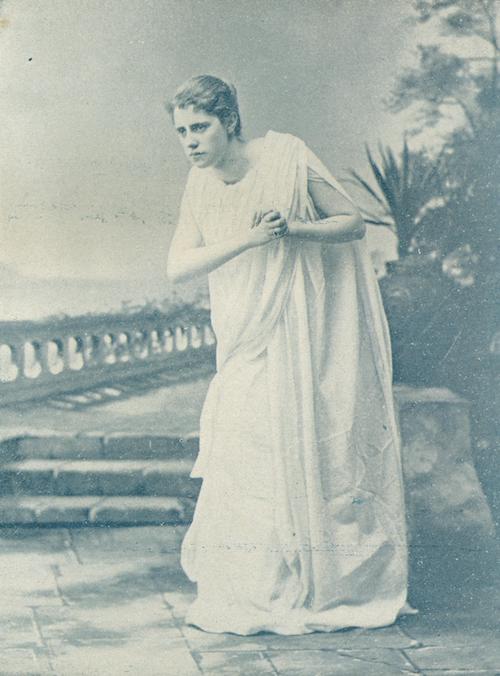
“When, lo! from out the lake arose a horrid monster form.”
Oh dear! If ever I try to learn another piece I hope to be swallowed by a whale ten times the size of the one that lunched on Jonah. Here I’ve been three weeks trying to get “The Flight of the Hottentots” by heart, and to-morrow night I am to recite at the contest; but I’m bound that that squint-eyed Caddy Screech shall not out-do me this time. Well, here it goes again: [Reads from the book without gesture.]
Oh, grief! now for the gestures: [With hesitation as though forgetting lines.]
Confound[52] the gestures! they bother me worse than anything else. Why didn’t the fool that wrote the piece say which way they stole, up[53] a hill, down[54] a hill, or across[55] the road? Well, I’ll try the next two lines.
They must have been acrobats to get over the ground in that shape; I’m desperate, I am!
No; I mustn’t put my finger up like that.[60] Why should a person when alone be required to do it? Am I to warn myself to listen when I have ears? or if at all necessary, why not do it effectually and hold up both fingers, thus?[61] I’ll skip that part.
Now this is a puzzler.
Was it a whoop, a yell, a shriek, a halloo—but fiddle! Who ever heard a sentry cry? Why soldiers are brave men, and never weep. That is unquestionably a poetical li-cence.
What on earth were the drums rolled for? It looks to me as though the Hottentots were drummed out of camp.
I don’t believe there was a flight of the Hottentots. What authority[63] is there for the flight? What made them fly anyhow? Well, I must move on:
That’s better. The Principal could not beat that, particularly the Behold, and the s-w-i-f-t. Next comes the climax—a long respiration, and—and—
Now I object to this vague style of literature. The poet is silent as to how they reached it. With their hands, thus![69] or with their feet, thus![70] or on horseback, with a whoa![71] whoa! Dobbin? How am I to gesticulate correctly, not knowing the facts? I’ll do the poem to suit myself, and if I fail to win the prize, it will be through the stupidity of the judges, so there!
Geo. M. Vickers.
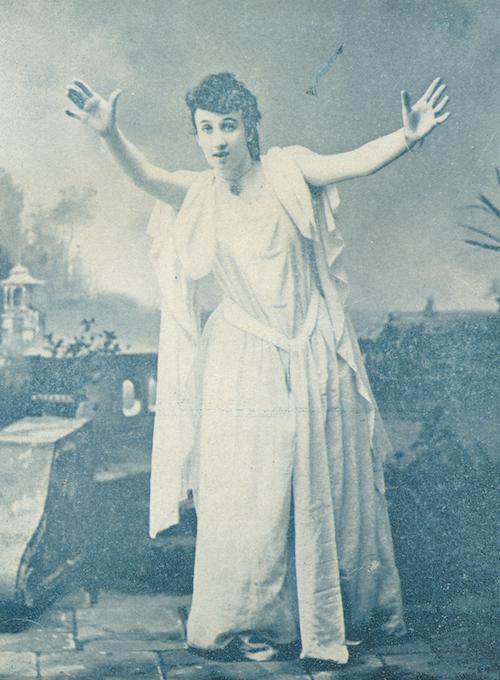
“Fly, fly, beloved mistress, the devils of the mountains are upon us!”
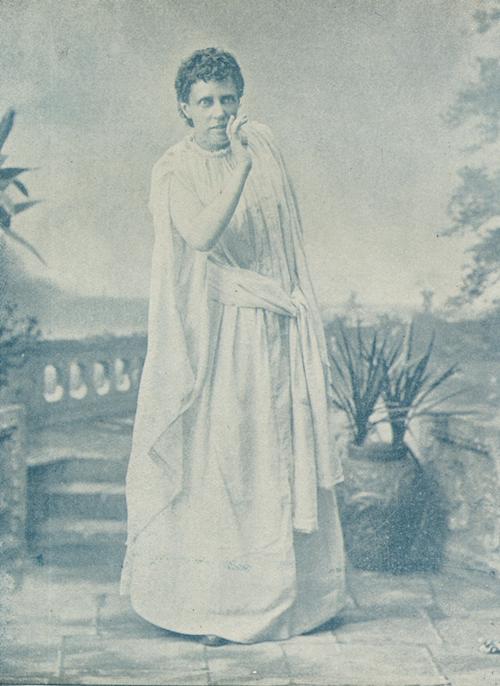
“And one sly maiden spake aside,
‘The little witch is evil-eyed.’”
As Discovered by Professor Peekwell, Samuel Searcher And Philip Deadlight.
Professor.—Civilization is the science of discontent.
Searcher.—How do you make that out?
Professor.—Gentlemen, allow me to explain. In the first place, all that man requires on this terrestrial ball can be expressed in three words, namely: food, shelter and raiment.
Searcher.—How about a wife?
Deadlight.—And segars?
Professor.—I use the term man as including the human race.
Searcher.—Well, go on.
Deadlight.—I’m ashamed of you, Professor; would you have us go back to savage life?
Professor.—Yes, but only in fancy, for the purpose of illustration. Let us drop down on a remote island in the Indian Ocean. It is night-fall. The last rosy tints of sunset are fading from the western sky. The murmur of the distant surf mingles with the soft lullaby of the Indian mother who soothes her babe to sleep.
Searcher.—Why didn’t the goose use soothing syrup?
Deadlight.—Or a cradle?
Professor.—Beneath a tall palm, circled about the embers of a dying fire, sit the tawny natives. They are listening to the words that fall from the lips of an aged chief. With rapture they hang upon the oft-told legend of the isle. In their hearts they wonder at the old man’s wisdom. As he dilates upon their by-gone deeds, and their present might, their eyes involuntarily wander toward the rich foliage that gently sways on yonder high hill top; now they glance at the bright stars that peep forth from the upper blue, and now at the dim ocean that stretches away on either hand like a desert waste. Contentment almost perfect sits on every brow. Each savage has his spear, his hut of twigs: thus the Great Creator hath set them to fulfill their mission; and yet the spear and hut are the initial steps in the march of civilization; only luxury lies beyond them; comparative luxury is the acme of civilization.
Searcher.—You’re a crank!
Deadlight.—No, he’s a philosopher. Think of the blessings of savage life! No creditors to ring your door bell, and make you leap out of your chair with consternation.
Searcher.—That is a point.
Deadlight.—Then there’s no fashion to ruin a man every time the seasons change. Look at that bonnet yonder! I’ll wager it cost thirty dollars.
Searcher.—And that dude’s coat, to say nothing of his monstrous collar.
Professor.—Hold on——
Deadlight.—And there’s no bank cashier to skip away with your limited balance.
Professor.—Hold on, I say. Civilization is good; it elevates mankind; but the higher our civilization the greater our wants; therefore civilization is the science of discontent.
Searcher.—Humph!
Deadlight.—Ahem!
Professor.—We will now adjourn.
Geo. M. Vickers.
Characters.
Nicholas Neverslip, a modern husband.
Patrick Dolan, an Irish lad.
Matilda, Neverslip’s wife.
Miss Spyall, a gossip.
Biddy Crogan, a domestic.
Scene:—A drawing room. Time, evening. Table and two chairs, C. Nicholas discovered standing near L. E. with cane and gloves in his hands: he calls to his wife, who is supposed to be up stairs dressing for the opera.
Nicholas.—My dear, it is half-past seven; do hurry; I am sure we will be late.
Matilda.—I am coming—be with you in one minute. Has Biddy fastened the back gate?
Nicholas (aside).—I know we’ll be late (calls), Biddy! (crosses to R. E.)
Biddy.—I’m here, sur. [Enter Biddy R. E.] What do you want wid me, sur?
Nicholas.—Biddy, is the back gate fastened?
Biddy.—I’ll see, sur, (turns to go).
Nicholas.—Biddy!
Biddy.—Sur!
Nicholas.—Biddy, I am going to the opera; that is, we are, Mrs. Neverslip and myself.
Matilda (calls).—Nicholas!
Nicholas.—Well, what’s the matter?
Matilda.—Where did you lay my fan?
Nicholas.—I never touched your fan. (looks at his watch.) It is twenty minutes to eight; I declare we will be late.
Biddy (aside).—I wonder if he manes to keep me shtandin’ here all night?
Nicholas (to Matilda).—I am going!
Matilda.—Here I come.
Nicholas.—It is time you were coming.
Matilda.—Oh, dear!
Nicholas.—What’s the matter?
Matilda.—Oh, you’ve hurried me so that I’ve gone and dressed without my fichu; I can never go without it.
Nicholas (aside).—Confound her fish-hook. (aloud) Snails and turtles! are you never coming?
Biddy (aside).—I’m nather a gate post nur a clothes prop. (aloud) Mr. Neverslip, I’ll be goin’ to the kitchen; I lift the banes on the sthove; I think they’re burnin’. [Exit Biddy R. E.]
Nicholas.—For mercy sake do come.
Matilda (singing).—I am coming, darling, coming——
Nicholas.—How provokingly cool you are. [Enter Matilda L. E.]
Matilda.—Now, my dear, we’ll be off. [Both start toward L. E.] Why, where’s your hat?
Nicholas (feels his head).—Good gracious! It is up stairs—Matilda, dear, will you get it for me?
Matilda.—You cruel man——(knock heard from without.)
Both.—Horrors! Some one at the door!
Nicholas.—Biddy!
Biddy.—Ay, sur! [Enter Biddy R. E.]
Nicholas.—Biddy, we’re out.
Biddy.—Yer what?
Nicholas.—We’re out; that is, we soon will be. We do not wish to see anyone—you comprehend?
Biddy (angrily).—Don’t want to see anyone I comprehend! Sur, I’m an honest Irish girl, and I niver comprehended anybody. (arms akimbo) Niver!
[Prolonged knock at the door.]
Nicholas.—Go to the door and say we’re out!
Biddy (aside).—The man is surely out of his head. [Exit Biddy L. E.]
Matilda.—Oh my! we’ll never get off.
Nicholas.—My dear it’s all your own fault.
Matilda (puts handkerchief to eyes).—Dear, dear! Nicholas. Hark!
Miss Spyall (from without).—Take this card to——
Biddy (from without).—They’re out, mum.
Miss Spyall.—Then I’ll just step in a moment and write a line or two.
Biddy.—But they’re out!
Matilda.—Oh grief! It is that awful Spyall; good-bye opera to-night.
Nicholas.—We might as well give up now.
[Enter Biddy L. E. walking backward followed by Miss Spyall.]
Miss Spyall (aside).—Out of the street; ah! I understand! (Extends hands to Nicholas and Matilda)—(aloud) How delighted I am to see you! What! going out?
Biddy.—Yis, out; they’re out—outward bound, I forgot part of the wurruds.
Nicholas.—Silence, Bridget!
Matilda.—We need you no longer, Biddy.
Biddy.—Indade, ye’ll give me two wakes’ notice. I’ll not lave now.
Matilda.—I mean we do not need you here. You may go to the kitchen. Oh, bother! My hair is coming down. Biddy get me a hair-pin, quick! [Exit Biddy R. E.]
Miss Spyall.—What a beautiful dress; is it all silk?
Nicholas.—Part muslin, Miss.
Matilda.—Nicholas, you shock me.
Nicholas (Pulls out watch and starts to go).—Oh, oh, oh!
Miss Spyall.—Going to church?
Nicholas.—No, not to church.
Miss Spyall.—Oh, I see; the museum.
Nicholas.—We have an engagement.
Miss Spyall.—A wedding? That’s it! I know. Who is it? Do tell me if it is Nancy Beadle? I thought she and John——
Matilda.—My husband and I are about going down town on important business, it is time we were there now.
Miss Spyall.—Anything important? You know I can be trusted.
Nicholas.—Gone! gone! gone!
Miss Spyall.—Hey?
Matilda.—Miss Spyall, you will please excuse me this evening, we must go at once.
[Enter Biddy R. E. with, clothes-pins in each hand.]
Nicholas (pointing to watch).—We’ve lost our seats. (Matilda and Miss Spyall take seats.)
Biddy (to Nicholas).—Niver moind me; still, I’ll bring two chairs from the dining-room if ye insist. (To Matilda) Here’s the puns, mum.
Matilda.—Stupid girl, these are clothes-pins.
Miss Spyall.—What a silly creature.
Biddy (aside).—The spalpeen!
Nicholas.—Excuse me. I must get my hat. [Exit L. E.]
Matilda.—Oh, he’s a darling man!
Miss Spyall.—Spe-len-did!(A crash heard.)
Matilda.—What have you done?
Nicholas (groans).—Broken my shins, smashed my hat and upset your toilet stand!
Matilda.—You wretch-edly unfortunate man.
[Enter Nicholas L. E. limping with smashed hat in hand.]
Miss Spyall.—I must be going.
Matilda.—We are going to the opera.
Nicholas.—To hear the final chorus.
Miss Spyall.—How delightful!
Matilda.—Biddy, keep a sharp look out.
[Exit all except Biddy L. E.]
Biddy.—Yis, I’ll kape a sharp look out. I’ll first take a look at the back gate. Poor Pat’s been waitin’ at that same gate for a whole hour; faith he’s stharved wid the cold (starts and listens) Arrah, what’s that? Sure some one’s in the kitchen. I hear a brogan on the stairs—the saints protect me. [Enter Pat R. E., looking around cautiously.] Oh, Pat Dolan! How dare ye frighten me loike that? How did ye enter the house?—What if the folks had been in?
Pat.—Whist, me darlin’; I saw them lave by the front door, and in the wink of an eye, its meself that lepped over the fince; I thried the back door, it was unlatched, and here I am, Biddy dear!
Biddy.—Niver do the loikes of that again. You might be shot for a burglar or a dynamiter.
Pat. (sitting at table).—Niver fear, Biddy dear; go ye and bring a crust of bread and sup of—of something stronger than tay, if yer have it; sure I’ve room here for a loaf, and I’m thrimblin’ wid wakeness——
Biddy.—I’ll see what’s lift in the pantry. Be aisy till I come back. (Starts to go.)
Pat.—Biddy!
Biddy.—What, darlint? (Pauses.)
Pat.—Do ye hear anything?
Biddy.—Its the Niverslips! Run for your life!
Pat.—Be aisy; it’s me poor heart beatin’; and nothin’ more. It always bates whin I see that face.
Biddy (Looks over her shoulder).—What face? I see no face!
Pat.—Don’t be a greenhorn. I mane your own lovely countenance.
Biddy.—Oh, ye blarney! [Exit R. E.]
Pat. (Rises from chair and walks up and down the stage).—Humph! this is a very foine house. It lacks the comforts of a home, howiver, for there’s not the sign of a pipe or a ’bacca bowl about the room. They’re evidently mane people.
[Enter Biddy R. E. carrying tray, on which are loaf of bread, a knife, a black bottle and two glasses.]
Look at that now! If that isn’t the tip of hospitality my name’s not Patrick Dolan.
Biddy (places tray on table).—Now, Pat, ye must not thrifle over the sup, (fills glass from bottle) but drink it at once. It would niver do to have the folks foind ye here.
Pat (takes glass).—Here’s to our wedding day, (drinks) Oh! ah! (jumps to his feet and runs about stage holding his throat) I’m pizened, I’m kilt.
Biddy (following him about).—Shpeak, shpeak, me darlint Pat.
Pat (gasping and pointing to bottle).—Look—look—look at that! What’s in the bottle?
Biddy.—Sure I can’t read. (Hands bottle to Pat.)
Pat.—Saint Patrick defind me! (reads) “Pure Jamaica Ginger,” Oh! its atin me up! (Noise heard without.)
Biddy.—Hark! (Both listen.)
Nicholas (from without).—We should have taken an umbrella; hurry in or we shall be drowned with the rain.
Pat (agitated).—Put me away! hide me! cover me up!
Biddy.—Run! No—shtop—they’re here! get under the table.
Pat (crawls under table).—Bad luck to the rain!
Biddy.—Arrah! What shall I do? He’s opening the door wid the noight key. Kape shtill, Pat.
Nicholas.—Walk in Miss Spyall; it is only a shower.
[Enter Neverslip, Matilda and Miss Spyall L. E.]
Miss Spyall (aside).—Refreshments, as I live! (Aloud) I feel real chilly! If I were home I’d have a bowl of hot tea, or something warm.
Biddy.—I was thinkin’ mum, that ye might be cold.
Matilda.—What’s that, Biddy?
Biddy.—I thought ye’d need a warrum drink and a bite, so I’ve the bottle and bread handy for yez. (Points to bottle.)
Nicholas (takes bottle).—Jamaica Ginger.
Matilda.—The idea! Bread and ginger. Why, Biddy, you are certainly becoming insane.
Miss Spyall (aside).—I thought they were too mean to have cake and wine, I thought it was a pound cake. How disappointed and hungry I feel. (Aloud) I wonder if it still rains?
Nicholas.—Be seated, ladies. Biddy, go to the door, and see if it has stopped raining.—(Matilda and Miss Spyall take seats at table).
I will see if I can find an umbrella for Miss Spyall. [Exit L. E.]
Pat.—(Pat’s head rises slowly from behind table).
Miss Spyall.—Does Mr. Neverslip smoke much?
Matilda.—Never at all. Why do you ask?
Miss Spyall.—I thought I detected a strong odor of an old pipe.
Pat.—(aside) Ye spalpeen! (Pulls her ear and stoops behind table).
Miss Spyall.—Oh! (indignantly).—Don’t do that again. I dislike such familiarity.
Matilda (astonished).—Why, what’s the matter with you?
Miss Spyall.—I guess if I were to pull your ear you would know how it feels. There! (They turn their backs to each other angrily).
(Pat peeps from under table and pulls Matilda’s ear).
Matilda (springing to her feet).—You impudent gossip! How dare you? (rubs her ear) If you want exercise, try pedestrianism; I will excuse your presence. (Points to door).
Miss Spyall (rising and backing off).—I am shocked beyond expression. (aside) If I only get out—the woman’s surely mad.
[Enter Nicholas L. E. with umbrella.]
Matilda.—My dear, give Miss Spyall the umbrella; she is surely ill and should get home with all possible speed.
Miss Spyall.—Not at all, not at all, sir; it is your insolent wife who needs your attention.
Nicholas.—What is the meaning of such singular language? (picks up bottle) You have not been tampering with this?
[Enters Biddy R. E. holding shawl in her hands.]
Biddy.—Look at me shplendid shawl! An illigant present that oi’ve just received. (unfolds shawl and advances towards rear of table.)
Nicholas.—Some other time, Biddy; we are engaged at present.
Miss Spyall (aside).—The whole family are certainly crazy.
Matilda.—I’m in no humor to look at shawls; I prefer taking a dissolving view of somebody’s back. (looks at Miss Spyall.)
Biddy (holds up shawl with both hands).—Pat, get behind the shawl.
Pat.—(crawls behind the shawl, screens himself from view, and moves off with Biddy).
Biddy. (backing towards the door)—It shows better at a distance, mum.
Nicholas. (advancing to Biddy).—This must cease.
Biddy.—Don’t come too close; ye’ll shpoil the effect.
Matilda.—Take the shawl from her.
Nicholas.—Let me have it. (pulls shawl from Biddy, exposing Pat to view).
Pat (bowing).—Yez’ll pardon me, but I was always bashful.
Nicholas.—Explain yourself, at once!
Matilda.—Look after the teaspoons!
Miss Spyall (aside).—Here’s a nut to crack! Here’s a scandal.
Biddy (crying and holding apron to eyes).—I’ll tell yez the truth. Patsy and meself are engaged to be married, and seein’ as I was to be lift alone in this big barn of a house, an’ bein’ timid, the poor man jist happened in to kape me company for a few minutes.
Pat.—What she says is intirely true, your honors; it’s meself that can bring a reference the lingth of me arrum.
Nicholas.—Enough. Biddy is too good a girl to be guilty of even a wrong thought. Our spoons are safe, and I (all advancing to front) have but one suggestion to make, that in future you entertain him in the kitchen, where you will not be likely to be disturbed by unwelcome visitors.
Matilda.—If I thought I would be free from unwelcome visitors (looking at Miss Spyall) I’d go to the kitchen too.
Pat.—The nixt kitchen we mate in will be the kitchen of Mr. and Mrs. Patrick Dolan; how do ye loike that?
Miss Spyall (aside).—Well I’m supplied with a lot of fresh news anyhow. (All take positions.)
NICHOLAS.—And as there appears to be a wedding near at hand, we must prepare for it; so we’ll say good night—and dream of getting ready.
[CURTAIN.]
Geo. M. Vickers.
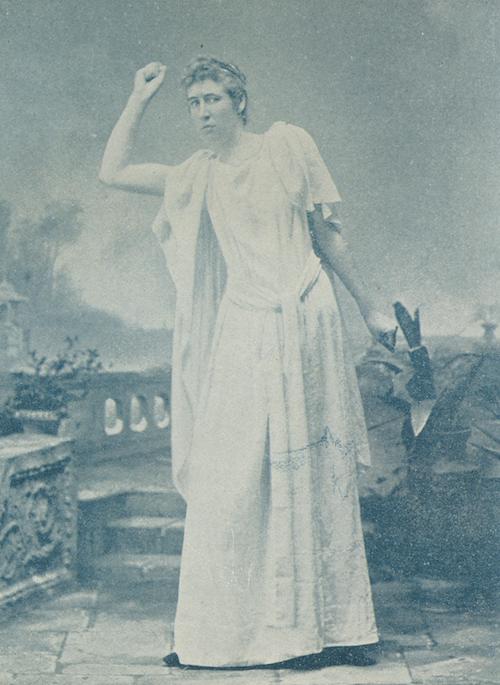
“I hate him, for he is a Christian.”
Sitting in our Library some few weeks ago we were startled by a resounding knock upon the door, and in answer to our summons, “Come in,” a large woman entered, followed by a bouncing girl of seventeen or thereabouts. The costumes of both bespoke them to be just from the rural districts. After a courtesy from the woman, followed by a fac-simile from the girl, the former said: “We’ve heard that you was a good hand at learnin’ people fur to speak pieces, and Samanthy here hez to spout at the next meetin’ of our Lyceum, and she wants you fur to larn her somethin’ funny. You see, all the young folks down our way has gone just cracked over speakin’ pieces, and the school ma’am has been coachin’ ’em, but Samanthy wants to do better nor the rest, and wants to hev it to say that she has took lessons from a reg’lar purfessor, so I thought if you would find her a piece and coach her on it, I wouldn’t begrudge a quarter of a dollar, even if I has to save it out of my egg-money, then if she’ll hold on to what she larns she can go ahead of the hull caboodle of ’em.” Seeing in the credulous face of the old woman a rich chance for some fun at her expense we said: “Is it howld on ye say? An’ didn’t I howld on till the heart of me was clane broke intoirely, an’ me wastin’ that thin you could clutch me wid yer two hands.” “Oh, law!” exclaimed the old woman, “is elocution so bad on you as that, but you don’t seem to look the wuss for it now.” “Seems! madam, nay, it is! I know not seems! Oh that this too, too solid flesh would melt, thaw, and resolve itself into a dew.” “Oh, I catch your meanin’ now. You mean you was thin and then you got fleshy. That’s just like my husband’s sister’s son’s wife. You see she was always kind o’ sickly, but she was such a shrew.”—“Oh, yes, ’tis about twenty years since Abel-Law, a short, round-favored, merry old soldier of the Revolutionary war was wedded to a most abominable shrew.” “No marm, you’re mistaken, her husband’s name was Timothy Titcomb, and he never was a soldier, but he was jest like a rollin’ stone, he never made nothin’—” “Off a rollin’ shtone vas der root of all efil, und a settin’ hens vould catch der early vorm by chance der usual vay, alzo der early bird vould not got fat on moss ofer he don’t had vorms, ain’t it?” The girl who had been standing at one side with her mouth wide open, here pulled her mother’s sleeve and whimpered, “Mom, let’s go. I’m afeared! I think that woman’s mad.” We turned upon her with—
Samantha subsided and flew behind her mother like a chicken behind an old hen. The old woman laid her hand tenderly on our shoulder, and said sympathizingly: “Poor creetur she’s lost a child; I think I’d go crazy, too, if I lost Samanthy. Poor lamb!”
“Massy sakes!” cried the woman, “what do you call yourself, Dutch, Irish or American?” “My father and mother are Irish, and I am Irish too.” “Mon dieu, madame, vat you please.”
The woman then said, “Samanthy, I think it is time we was takin’ the train. I don’t think I could trust you to come here alone. Good day, marm, we must be goin’. I would like to send you some of my yarb tea. Its powerful soothin’ to the nerves.”
By this time she had the door shut, but she went to some of the neighbors and asked if our place was not a private lunatic asylum.
F. Lizzie Peirce.
Can anybody tell why, when Eve was manufactured from one of Adam’s ribs, a hired girl wasn’t made at the same time to wait on her?
We can, easily. Because Adam never came whining to Eve with a ragged stocking to be darned, a collar button to be sewed on, or a glove to be mended “right away quick now.” Because he never read the newspaper until the sun got down behind the palm trees, and then stretched himself, yawning out, “Ain’t supper most ready, my dear.” Not he. He made the fire and hung over it the tea-kettle himself we’ll venture, and pulled the radishes and peeled the bananas, and did everything else that he ought to. He milked the cows and fed the chickens and looked after the pigs himself. He never brought home half a dozen friends to dinner when Eve hadn’t any fresh pomegranates and the mango season was over. He never stayed out until 11 o’clock to a ward meeting, hurrahing for the out-and-out candidate, and then scolded because poor Eve was sitting up and crying inside the gates. To be sure he acted rather cowardly about the apple-gathering time, but that don’t depreciate his general helpfulness about the garden! He never played billiards, nor drove fast horses, nor choked Eve with cigar-smoke. He never loafed around corner groceries while solitary Eve was rocking little Cain’s cradle at home. In short, he did not think she was specially created for the purpose of waiting on him, and wasn’t under the impression that it disgraced a man to lighten his wife’s cares a little. That is the reason that Eve did not need a hired girl, and we wish it was the reason that none of her descendants did.
—Anon.
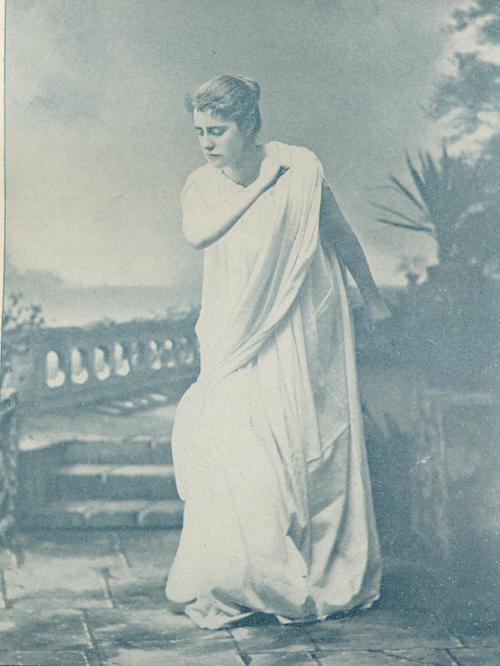
“Ha, ha! take that! and that! and that!”
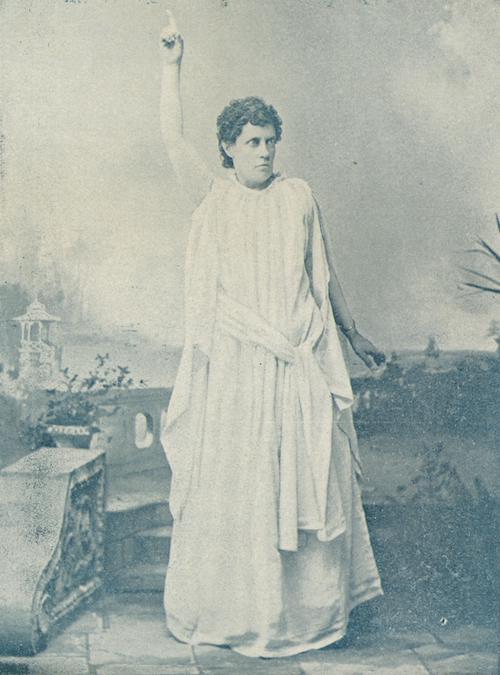
“Cursed, thrice cursed may you be evermore, and as my people
on Mount Ebal spoke, so speak I thrice, Amen! Amen! Amen!”
Yesterday, while waiting on the corner for a street-car, a woman, laden with an umbrella, a bandbox and a baby, accosted me with “Say, mister, can I git to Market street on these yer cars?” “You can,” I replied. “How long must I wait?” “Madam,” said I, noticing the string slipping from her bandbox, “may I hold your umbrella and bandbox until the car arrives? See, here it comes!” “I’d rather you’d hold Berthy, if you will, mister, ’cause this darned string’s a slippin’ off—quick!—ketch it! Land o’ misery! There be all my things scattered over the bricks! Do hold Berthy while I pick ’em up.” Here was a dilemma. The car was not forty yards off, while the sidewalk was strewn with every conceivable article, from a broken hair brush to a pair of old worsted slippers. “Hurry up, then, madam,” cried I, as I reached for the child, “I have an appointment and must take this car.” Just as I took her from the woman’s arms, Berthy set up a yell that would have paralyzed a huckster. Before the woman had gathered up half the articles the car was upon us. Leaving her bandbox, she ran to the crossing, and with a “Hold on there, you!” signaled the driver to stop. The latter, taking in the situation, kept on, but a fat man standing on the platform pulled the bell and the car stopped, about half a dozen yards beyond the flag-stones. The conductor, who was inside, collecting fares, ran out, and, grasping the bell-strap with one hand and beckoning with the other, screeched: “If you want to ride down, come on; I ain’t a-goin’ to anchor here all day!” As soon as the woman took up her bandbox and umbrella, I started for the car. “Tell your wife to come,” yelled the conductor. I looked back and there stood the woman on the corner. “Do you think I’m a-goin’ to wade through that mud?” screamed the woman, “for if you do, you’re mistaken. Just back that ve-he-cle to me, right quick, too!” I had reached the platform with Berthy in my arms, but the woman, looking cyclones, still refused to move an inch. I shrieked out, “Walk along the pavement and get on here!” A cross old maid looking through the window at my elbow remarked aloud: “Hear him abuse his poor wife!” The fat man suggested that I should manage the freight and let my wife take the baby. The woman slowly picked her way through the mire and stepped on the car. The conductor gave the bell a wicked snap, and with a jerk that almost threw us over the dasher, the car started down the street like a ten-penny nail from a slap-jack. “Here, madam,” said I, in desperation, “take the child, I have forgotten my pocket book.” She dropped into a seat and took her baby. Just as I was rushing from the car the word “scoundrel!” was hissed into my ear. Turning quickly, my horrified eyes beheld the stony gaze of my wife. “Go!” she muttered. Well, I did go! Friends do you see this bald spot on my head? Well, that reminds me never to fool with other people’s babies.
—Geo. M. Vickers.
[Supposed to be related by a veteran French officer.]
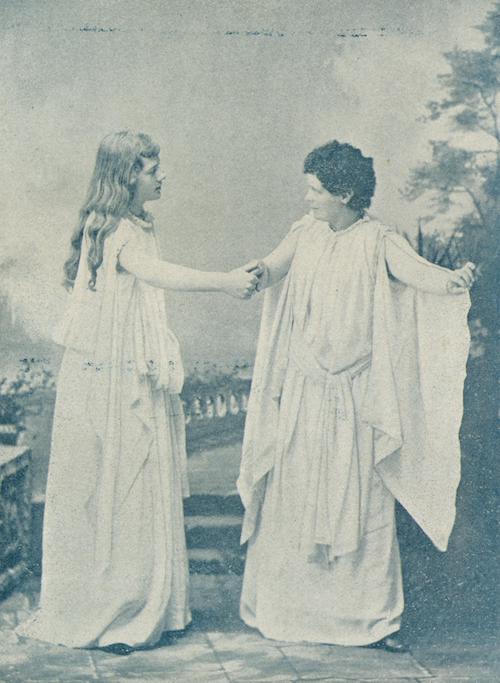
“Come, let us within.”
Bill Jones is my fireman; we have run together on old “thirty-six” for more than twenty years. One night when we were off duty, said Bill, “Jim, let’s take in a show.” “Where?” I replied, at the same time scanning the bill-board at the end of the depot. “See!” cried Bill, “Mons. De Froglimb, the great French piano virtuoso—” “That’s enough, Bill,” said I, “we’ll go”—and we did. He was a Frenchman; looked like an animated switch-signal. I am an old engineer, and have often whistled through the wind, but that virtuoso!—Well, as soon as he sat down on the stool I knew by the way he handled himself that he understood the machine he was running. He tapped the keys away up one end, just as if they were gauges and he wanted to see if he had water enough. Then he looked up as if he wanted to know how much steam he was carrying, and the next moment he pulled open the throttle and sailed out on the main line as if he was a half an hour late.
“You could hear her thunder over culverts and bridges, and getting faster and faster, until the fellow rocked about in his seat like a cradle. Somehow I thought it was old ‘thirty-six’ pulling a passenger train and getting out of the way of a ‘special.’ The fellow worked his keys on the middle division like lightning, and then he flew along the north end of the line until the drivers went around like a buzz-saw, and I got excited. About the time I was fixing to tell him to cut her off a little, he kicked the dampers under the machine wide open, pulled the throttle away back in the tender, and, Jerusalem jumpers! how he did run! I couldn’t stand it any longer, and yelled to him that she was ‘pounding’ on the left side, and if he wasn’t careful he’d drop his ashpan.
“But he didn’t hear me. No one heard me. Everything was flying and whizzing. Telegraph poles on the side of the track looked like a row of cornstalks, the trees appeared to be a mud bank, and all the time the exhaust of the old machine sounded like the hum of a bumblebee. I tried to yell out, but my tongue wouldn’t move. He went around the curves like a bullet, slipped an eccentric, blew out his soft plug, went down grades fifty feet to the mile, and not a confounded brake set. She went by the meeting point at a mile and a half a minute and calling for more steam. My hair stood up like a cat’s tail, because I knew the game was up.
“Sure enough, dead ahead of us was the head-light of the ‘special.’ In a daze I heard the crash as they struck, and I saw cars shivered into atoms, people mashed and mangled, and bleeding, and gasping for water. I heard another crash as the French professor struck the deep keys away down on the lower end of the southern division, and then I came to my senses. There he was, at a dead standstill, with the door of the fire-box of the machine open, wiping the perspiration off his face, and bowing at the people before him. If I live to be a thousand years old I’ll never forget the ride that Frenchman gave me on a piano.”
[Recited by F. Lizzie Peirce at the Annual Re-union of the Independent Literary Society, August 8th, 1885.]
[This piece is very effective given in costume.]
We used to keep a cow when we lived in the country, and sich a cow! Law sakes! Why, she used to come to be milked as reg’lar as clock-work. She’d knock at the gate with her horns, jest as sensible as any other human critter.
Her name was Rose. I never knowed how she got that name, for she was black as a kittle.
Well, one day Rose got sick, and wouldn’t eat nothing, poor thing! and a day or so arter she died. I raly do believe I cried when that poor critter was gone. Well, we went for a little spell without a cow, but I told Mr. Scruggins it wouldn’t do, no way nor no how; and he gin in. Whenever I said must Mr. Scruggins knowed I meant it. Well, a few days arter, he come home with the finest cow and young calf you ever seed. He gin thirty dollars for her and the calf, and two levies to a man to help bring her home. Well, they drove her into the back yard, and Mr. Scruggins told me to come out and see her, and I did; and I went up to her jest as I used to did to Rose, and when I said “Poor Sukey,” would you believe it? the nasty brute kicked me right in the fore part of my back; her foot catched into my dress—bran-new dress, too—cost two levies a yard, and she took a levy’s-worth right out as clean as the back of my hand.
I screeched right out and Mr. Scruggins kotched me jest as I was dropping, and he carried me to the door, and I went in and sot down. I felt kind o’ faintish, I was so abominable skeered.
Mr. Scruggins said he would larn her better manners, so he picked up the poker and went out, but I had hardly began to get a leetle strengthened up afore in rushed my dear husband a-flourishing the poker, and that vicious cow arter him like all mad. Mr. Scruggins jumped into the room, and, afore he had time to turn round and shut the door, that desperate brute was in, too.
Mr. Scruggins got up on the dining-room table, and I run into the parlor. I thought I’d be safe there, but I was skeered so bad that I forgot to shut the door, and, sakes alive! after hooking over the dining-room table and rolling Mr. Scruggins off, in she walked into the parlor, shaking her head as much as to say: “I’ll give you a touch now.” I jumped on a chair, but thinking that warn’t high enough, I got one foot on the brass knob of the Franklin stove, and put the other on the mantel-piece. You ought to ha’ seen that cow in our parlor; she looked all round as if she was ’mazed; at last she looked in the looking-glass, and thought she seed another cow exhibiting anger like herself; she shuck her head and pawed the carpet, and so did her reflection, and—would you believe it?—that awful brute went right into my looking-glass.
Then I boo-hoo’d right out. All this while I was getting agonized; the brass knob on the stove got so hot that I had to sit on the narrer mantel-piece and hold on to nothing. I dussent move for fear I’d slip off.
Mr. Scruggins came round to the front door, but it was locked, and then he come to the window and opened it. I jumped down and run for the window, and hadn’t more’n got my head out afore I heard that critter a-coming after me. Gracious! but I was in a hurry; more haste, less speed, always; for the more I tried to climb quick the longer it took, and just as I got ready to jump down, that brute of a cow kotched me in the back and turned me over and over out of the window.
Well, when I got right side up, I looked at the window and there stood that cow, with her head between the white and red curtains, and another piece of my dress dangling on her horns.
Well, my husband and me was jest starting for the little alley that runs alongside of the house, when the cow give a bawl, and out of the window she come, whisking her tail, which had kotched fire on the Franklin stove, and it served her right.
Mr. Scruggins and me run into the alley in such haste we got wedged fast. Husband tried to get ahead, but I’d been in the rear long enough, and I wouldn’t let him. That dreadful cow no sooner seen us in the alley, than she made a dash, but thank goodness! she stuck fast, too.
Husband tried the gate, but that was fast, and there wasn’t nobody inside the house to open it. Mr. Scruggins wanted to climb over and unbolt it, but I wouldn’t let him. I wasn’t going to be left alone again with that desperate cow, even if she was fast; so I made him help me over the gate. Oh, dear, climbing a high gate when you’re skeered by a cow is a dreadful thing, and I know it!
Well, I got over, let husband in, and then it took him and me and four other neighbors to get that dreadful critter out of the alley. She bellered and kicked, and her calf bellered to her, and she bawled back again; but we got her out at last, and such a time! I’d had enough of her; husband sold her for twenty dollars next day. It cost him seventy-five cents to get her to market, and when he tried to pass off one of the five dollar bills he got, it turned out to be a counterfeit.
Mr. Scruggins said to his dying day that he believed the brother of the man that sold him the cow bought it back again. I believe it helped to worry my poor husband into his grave. Ah, my friends, you better believe I know what a cow is.
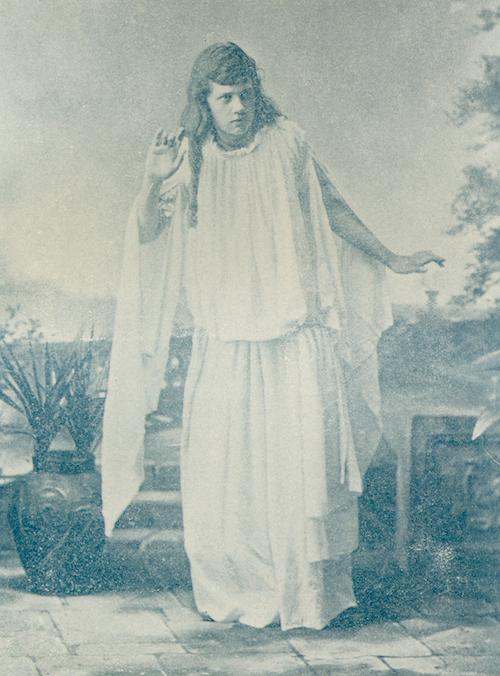
“Hark! ’tis the train; the mother’s ear leans to the sound.”
[First Honor at Commencement of the Mt. Vernon Institute of Elocution and Languages, 1885.]
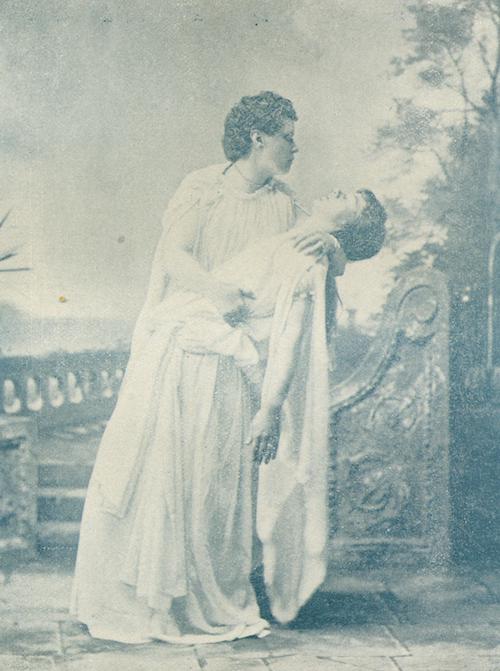
“Alas! poor soul, what woe is thine!”
A Yankee, visiting London, and passing along one of the principal thoroughfares of trade and travel, stopped to look at some beautiful specimens of writing paper exposed for sale in a shop window; he gazed long and earnestly at the gorgeous display, when presently he turned and encountered the proprietor of the establishment standing at the door. The Yankee politely said:
“Will ye tell me what ye du with them nice bits of paper?”
“Yes, we keep them to tie up gape-seed in,” was the snappish response.
“Oh, ye du, du ye?” said Jonathan, with a sly twinkle in his eye, as he walked on. Passing down the street a short distance our indignant Yankee accosted another merchant, to whom he said: “Mister, can ye tell me what that feller duz for a livin’ what keeps them nice bits o’ paper in his winder?”
“Yes, sir; he writes letters for persons who desire his assistance.”
“Du ye think he’d write a letter for me if I’d pay him fur it?”
“Certainly he would, and be glad of the chance.”
Our bright-eyed hero thanked him, and turned abruptly away, walking briskly in the direction from which he came. The shop was soon reached, and, fortunately, the same individual stood on the door-step. The Yankee lost no time in addressing the cockney, and thus at once began:
“I say, mister, I heerd that ye write letters fur folks what can’t write; what’ll ye tax me to write a letter to my uncle Peter?”
“I will charge you five shillings,” he said, in such a changed tone of voice that the Yankee had to look again to see that he had not mistaken the person.
“Will ye write jest what I tell ye tu, and spell all the words right?”
“To be sure I will.”
“And if ye don’t, I won’t pay ye; will ye agree to that?”
“As I understand my business thoroughly, of course I will agree to that.”
“Wall, then, ye may commence.”
The scribe arranged his paper, ink and pen, and pronounced himself ready.
“My dear uncle Peter:—ready fur more?”
“Yes.”
“‘Rived here in London last week,—have ye got that deown?”
“Yes, go on.”
“Thought I’d take a stroll through the woods,—got that deown and spelt right?”
“Yes, yes; go on, and do not bother me so.”
“I pay ye five shillings by-and-bye, don’t I?”
“Yes, but you have no need to detain me so if you do.”
“Wall, I walked and walked and walked and walked and walked and—”
“What’s the use of saying it over so many times?”
“None o’ your business,—I pay ye five shillings,—and walked and walked and walked—”
“See here, this page is full of the words ‘and walked.’”
“Turn over then,—and walked and walked, and I couldn’t find any woods. Have ye got all that deown and spelt right?”
“Yes, but why don’t you go on.”
“Jest then I stopped to think what I should du, or where to go,—got that all deown?”
(Snappishly) “Yes.”
“Wall, then I seen a sign, and on it wuz: ‘Teams to hire,’ so I went up and told the man to give me a fust-rate team with a hoss I could easy manage myself. My! but you write fast. Is all that deown?” (Surprised).
“It is, and I would like to have the rest of your letter, sir.”
“Wall, that hoss started off all right, but in less than two minutes she got stubborner than any mule; and I hed to get eout, and lick her and kick her and prick her and lick her and kick her and prick her, (continue to repeat these words very rapidly), and she wouldn’t go. Is that all deown, and spelt right?”
“You are only losing time, sir, in repeating that last phrase.”
“That’s my business,—When I see’d she wouldn’t go fur lickin’, I tried to coax her, and coaxed and coaxed and coaxed and coaxed and coaxed, but she wouldn’t go; then I got crosslike and went—” (here the Yankee makes a chirruping sound which bids defiance to orthography).
“I can’t spell that,” said the Englishman.
“Oh, ye can’t spell that, can’t ye? Then ye needn’t write any more for me.”
“Need not write any more!”
“No more,” was the composed reply of the Yankee, as he laid his hand over his fat pocket and said:
“I ’spose ye remember our agreement?”
“Yes, I do, but what’s to be done with all this paper?”
“Keep it to tie up gape-seed in. Good bye, sir!” and the Yankee made a speedy exit.
Arranged by S. Anna Gesemyer.
Oh, dear! these are dull times. What is a body to do? Bills cannot be collected, the season for business is over, and prospects for relief look decidedly blue. How can a woman buy a Saturday’s marketing for eight persons with only five dollars? The idea is preposterous! I could cry my eyes out with perplexity, but what’s the use?
Moses Flint is a good husband; he dotes on me, I know; yet he has no more idea of the cost of a shoulder of mutton than a Kickapoo Indian has of a sewing machine. Well, there’s no use of standing here talking about it; it must be done, but how? Oh, my poor head!
One pound of butter, fifty cents; observe—sixteen ounces of butter for eight persons, just two ounces apiece, to last until Monday morning. Why, Moses himself eats two ounces at a meal! The thought distracts me. Butter, fifty; potatoes, twenty-five; onions, fifteen; he will have onions on Sunday; won’t eat ’em through the week; says they interfere with his business; but it makes no difference the day he spends with me. I wonder if my nostrils are better adapted to smell onions than those of his customers? Men are strange mortals, anyhow; my Moses will get shaved and polish his boots to go to the lodge, but let me ask him to go with me to the dressmakers, or to the Muggins’, and he won’t even put on a clean collar. The lodge must be a very particular place.
Cabbage for slaw, ten; there is a dollar gone already. A pair of chickens, one dollar and fifty cents; rabbits would be cheaper, but he insists on chickens. It provokes me so. Last Sunday every blessed one wanted a drum-stick; of course two fowls have but four drum-sticks, therefore, as intimated before, only four got the four, which left the other four to envy the lucky four who got the four drum-sticks, and to content themselves with breasts and wings. For my part, I got only a neck and a gizzard. Well, I’ll do the best I can, but I’ll manage to squeeze out enough for two yards of that cherry-colored ribbon at Jones’, dinner or no dinner, or my name isn’t Sarah Flint.
—Geo. M. Vickers.
With a little ingenuity and with six musical voices this piece may be made a very pleasing and attractive feature in an evening’s entertainment. Procure a piece of sheeting at least six feet in length by five in width. Fasten the lower lengthwise edge to the floor of the stage, and the upper edge, by means of cords or other fastenings, to the ceiling. Cut three holes about the height of a person’s face in standing and of the shape and size of the face, and three others at kneeling height; then around these holes paint or paste on paper to represent the petals of immense sunflowers, with stalks attached. The singer’s faces occupy the holes, and the words are sung to the air of “The Little Brown Jug.”
Expression consists in so modulating the voice by means of the different degrees of pitch, force, rate, and rhetorical pause, as to perfectly convey every shade of meaning contained in the sentiment; in other words, it is painting with sound. As perfect a picture can be conveyed to the ear by means of voice as to the eye through color; and in order to utilize this life-coloring of modulation in reading, you must first acquire a thorough conception of the meaning of the author; try to place yourself in sympathy with the sentiments you are to utter, adopt them and put them into your own words, notice how you express them, what degrees of force come natural to them, what pitch and slides, degrees of rate, what pauses between words and upon words best bring out their meaning, and then take up again the author’s words, and try to give them as nearly as possible like your own; you will find the battle is half won. One of the greatest obstacles in the way of giving true expression is the presence of the printed page before the eye. The words are repeated one after the other mechanically, while the thoughts are perhaps upon another subject. An artist cannot paint a picture without first drawing it in his mind; so we cannot paint a word picture unless its impression is made upon the brain; hence the key to expression consists in understanding what you read.
A future number will contain directions for the remedy of unmanageable voices.
—F. Lizzie Peirce.
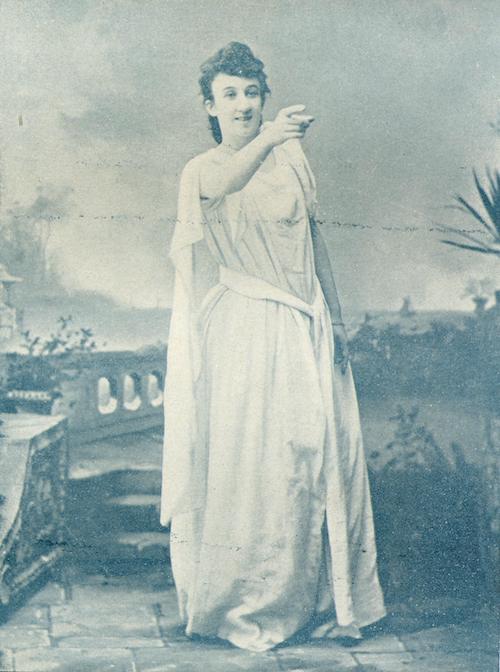
“Look at the fly on that man’s head! Look! another fly.”
MUSICAL DIALOGUE WITH TABLEAU.
CHARACTERS.
| The Guard, | Gentleman. | ||
| The Angel of Order, | ⎫ | Ladies. | |
| The Angel of Literature, | ⎪ | ||
| The Angel of Music, | ⎬ | ||
| The Angel of Love, | ⎪ | ||
| The Angel of the Word of God. | ⎭ | ||
| ⎫ | A small boy. | ||
| Two Ragged Children, | ⎬ | ||
| ⎭ | A little girl. | ||
| A Chorus of Sunday-school Scholars. | |||
Preparations.—A large Gothic chair raised one step or more from the floor of the pulpit for a throne. A crown (made of pasteboard and covered with gold paper will answer), placed on the top of the chair. A scepter is needed. The ladies taking the parts should be dressed in white; they may each wear a long flowing veil of illusion or other light material, with star on the forehead. The veil should not cover the face, but fall back over the shoulders.
The Guard should wear a Knight Templar or other suitable uniform, and should take charge of and guard the throne before ORDER presents herself.
The Angel of Order (comes up the aisle, with a bell or some emblem of order in her hand, and ascending the pulpit advances towards the throne and addresses the Guard as follows):
I am the Angel of Order; “Order is heaven’s first law,”—a glorious law, seen in those beauteous isles of light that come and go, as circling months fulfil their high behest. Nor less on earth discerned mid rocks snow-clad or wastes of herbless sand.
Throughout all climes, beneath all varying skies, fixing for e’en the smallest flower that blooms, its place of growth.
I am the child of beauty and wisdom. My attendants are comfort, neatness, and activity. I come to be the angel of the Sunday-school. Let me occupy this throne and issue my decrees, and confusion will be unknown; officers, teachers and scholars shall be under my control.
All the regulations essential to a proper conducting of the school shall be enforced. Punctuality in attendance, propriety in behavior, attention to instruction, and obedience to rules shall be insisted upon. I will have a place for everything, and everything shall be in its place.
Guard (replies).—Angel of Order, I welcome thee; what thou hast said is true; what would this universe be without thy mighty presence? Were thy power abolished but for a moment, “the war of elements, the wreck of matter and the crush of worlds” would be the immediate and inevitable result. Thou art needed everywhere, and we must have thee in our school, but thou canst not be the Supreme Angel of the school. Stand here upon the right of the throne (conducts her to the right of the throne).
The Angel of Literature (comes up the aisle with books, papers and tracts in her hand, ascending the pulpit, advances toward the throne, and addresses the Guard as follows):
I am the Angel of Literature. The written thoughts and emotions of men constitute my domain. The pen and the press are the instruments of my progress, and are mightier than the sword. I, too, am an applicant for this throne. Give me authority and I will supply the school with books and papers, with leaves and tracts,—of these there shall be no lack. The library shall be replenished from time to time with entertaining, instructive and religious volumes,—well bound and beautiful. And all will be glad for my presence and rejoice in my power (advances toward the throne).
Guard (replies).—Angel of Literature, I greet thee also with pleasure. Thy sphere is a noble one, and thy mission worthy. The mind must be stored with knowledge and stimulated with truth. It is thine to impart information and administer culture,—to aid in the education of our race. We give thee a place in our school, but cannot crown thee as its Ruling Angel. Stand here upon the left (leads her to the left of the throne).
The Angel of Music (comes up the aisle starting from the vestibule of the church, having in her hand a harp, or other instrument, and a roll of music, singing):
[
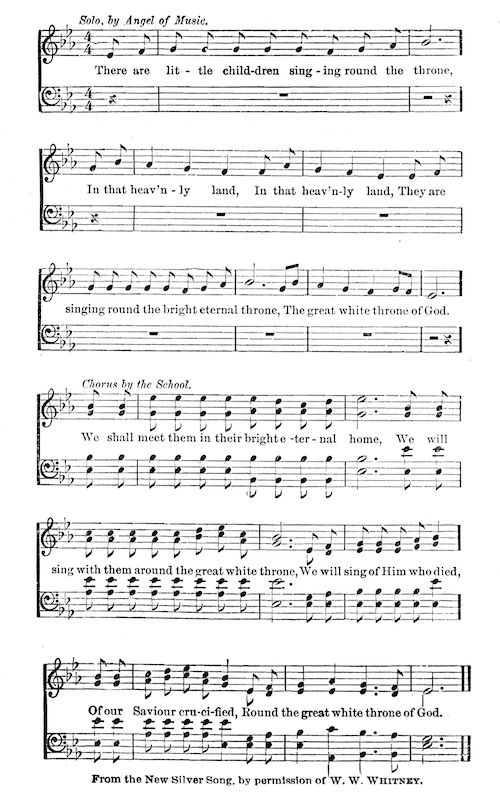
The Angel of Music (advances toward the Guard, and addresses him as follows):
I am the Angel of Music. Melody and Harmony are my children. I open my mouth in song and my voice trembles with sweet sounds. I touch the keys of the instrument and the air is full of delightful strains. I give strength to the weak; encourage the wavering; cheer the sick, and assist in the triumph of the dying. I make heaven jubilant with anthems of praise. My voice is heard on earth in the lullabys of the nursery, in the songs of childhood, in the hymns of the sanctuary and in the ballads of the nation. My power is felt by the refined and the savage.
Let me be the ruling angel of the Sunday-school. I will furnish each department with an organ. I will teach all to sing. The tunes and the time shall be perfect, and no discord shall be heard amid the blended notes. Books of music shall be in abundance and all hearts shall thrill with gladness.
[
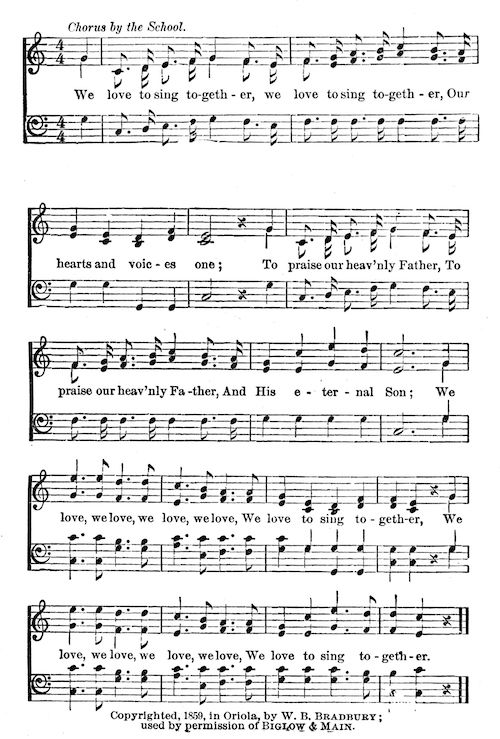
Guard (replies).—Angel of Music, I have listened to thy song, and its sweetness has captivated my soul. Surely thy work is sublime and thy influence great.
We cheerfully assign thee a place in our midst, but thou canst not be the Supreme Angel of the school (leads her to the right of the throne).
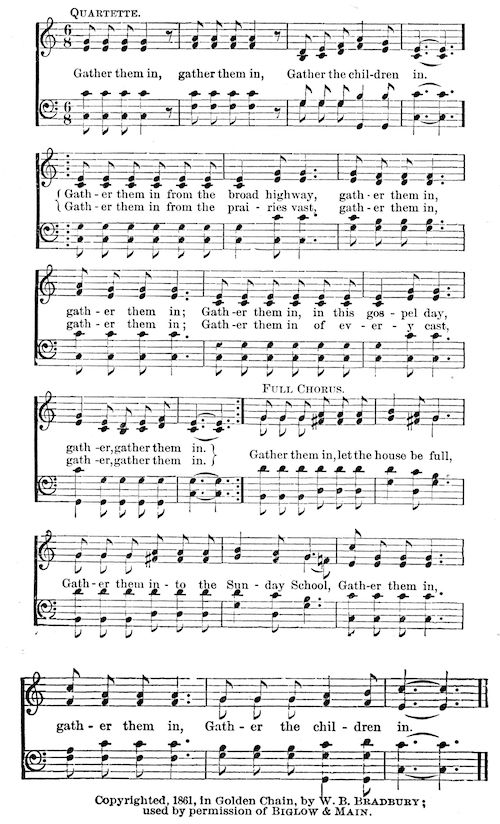
The Angel of Love (comes up the aisle leading a little boy and girl, each wearing a loose, ragged garment that can be easily thrown off. She advances toward the Guard and addresses him as follows):
I am the Angel of Love. I dwell in the bosom of God and in the hearts of men. Heaven is the scene of my highest manifestation, but I breathe benedictions on the earth. I relieve the needy and cheer the disconsolate with words and deeds of sympathy. The light of my smile kindles a radiance in many dark places of sorrow. My scepter subdues the hardest heart, and my speech often wins the prodigal back to his father’s house. I make home happy and bless the church with prosperity. I am a candidate for this throne. Give me place, and I will cause with magic power springs of happiness to rise, and flowers of social delight to bloom in the pathway of all; the aged and the young shall alike rejoice, and the entire school shall witness how good and pleasant it is to dwell together in unity. Besides this, I will go out into the highways and hedges, into the lanes and alleys; visit the abodes of the poor and the haunts of ignorance, and will gather the children in that they may be enriched with the treasures of grace, and made wise unto salvation.
[
Guard.—Angel of Love, fairest daughter of the skies, thy smile is radiant with blessing, and thy coming is ever a benediction. Without thee, this world would be a wilderness, drear and cold, where naught but cruelty and sorrow would abound. Truly thou art welcome. Let thy voice be heard and thy power be felt among us. Bind our hearts together with a threefold cord which cannot be broken, and may the glory of thy presence surround us ever as with a halo; but to thee, as to all who have preceded thee, I am compelled to say, thy place is not upon the throne, as the ruling angel of the Sunday-school. Guard (leads her to the left, beside the Angel of Literature; the boy and girl during the singing having thrown off their ragged garments, take their places one on each side of her).
The Angel of the Word of God (comes up the aisle, carrying a Bible in her arms, and advancing toward the Guard, addresses him as follows):
I am the Angel of the Word of God; Order is indispensible, Literature is needed, Music is to be desired, Love must ever abide. Each has her place and her work, but higher than all, and the inspirer of all, is the Bible. I come as the lamp of truth to a benighted world; the bearer of intelligence from the throne of God—a revelation to men of duty and destiny. I come as the chart and compass to guide men safely over the sea of life to the desired haven. My mission is to instruct both adults and children in the way of holiness that leads to heaven. I teach the sublime truths of faith and salvation—of God and immortality.
Wherever I go, the wilderness and solitary places are glad for me, and the deserts rejoice and blossom as the rose.
If all would heed my words and partake of my spirit, the whole world would soon recover the charms of Eden.
Instead of sin and misery, there would be everywhere purity and bliss. I come to train these children and youth in the ways of piety, and develop in them the elements of true manhood and womanhood; to qualify them for usefulness here, and blessedness hereafter. I wish to be crowned the angel of the Sunday-school.
Guard.—Angel of the Word of God, All Hail! A thousand welcomes. For thee we have waited long and rejoice in thy coming. Thou hast said well—Order is indispensible. Literature is needed. Music is to be desired. Love must ever abide. These are thy handmaids and shall remain with us, but thou shalt be supreme. Ascend the throne (she takes her place on the throne). On thy head I put this crown. In thy hand I place this scepter. Rule thou over us. Fill our minds with thy wisdom, our hearts with thy spirit, that our lives may show forth the praise of Him who created us, and redeemed us by the blood of His Son. Order, Literature, Music, Love, these shall assist thee, and our School shall be a Bible School. Thou art the Angel of the Sunday-school!
TABLEAU.
The Guard.—(Standing immediately in front of the throne, will sheath his sword, take off his hat, and say):
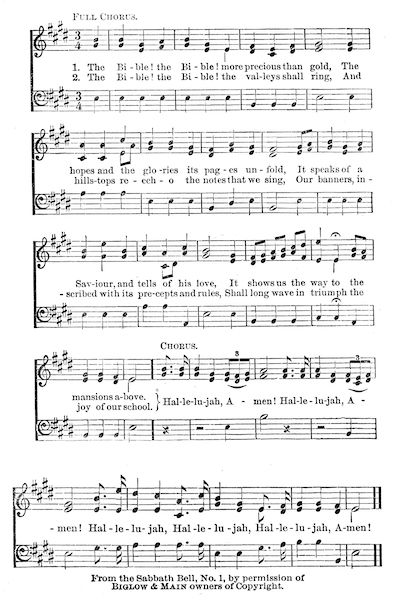
Order, Literature, Music, Love, let us bow in token of our submission to the Word of God. (They all kneel and the Angel of the Word of God holds the Bible out on her hand while the school rises and sings):
[
CURTAIN.
Rev. D. W. Gordon.
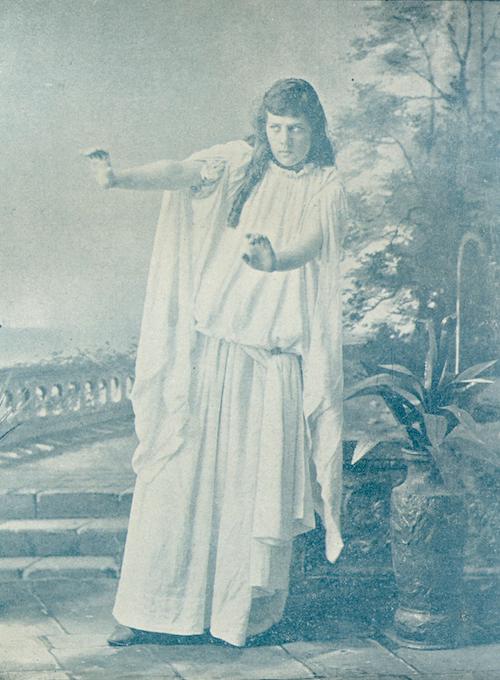
“Hence! horrible shadow,
e the Unreal mockery, hence!”
[Represent bell tones with the voice upon the italicized words.]
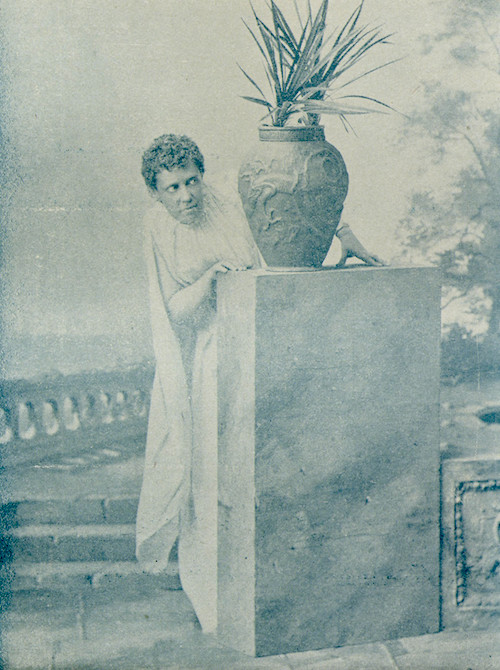
“And seeing, unseen, I watched the perfidy of him I deemed most true.”
OR,
The Squire’s Daughter.
A COMEDY IN TWO ACTS.
CHARACTERS:
MASQUERADERS.
Act I. Interior of widow’s cottage.
Act II. The masquerade.
Costumes: For first act—modern. For second act—Squire, sailor; Raymore, Chinese; Dingle, knight; Weatherspout, monk; Dorothy, gypsy; Mrs. Felton, ghost; Em’ly, peasant; Miss Philp, duchess; Mercy, French maid. Masqueraders to suit fancy.
Act I.
Scene: Interior of widow Felton’s cottage. Table, C. Rocking-chair, L. C. Door Pract. in F., windows, etc. Time, morning. Mrs. Felton discovered seated in rocking-chair; Em’ly standing R. facing L.
Em’ly.—Mother, I was never so insulted in my life; she threw the dress on her toilet stand, and fairly ground her teeth with rage.
Mrs. Felton.—Dear! dear! dear! what shall we do! I depended on the money for making that dress to pay at least a month’s rent. Did you explain our distressed condition to Miss Philp?
Em’ly.—Mother, dear, I did my best to reason with her, but she only stamped her foot, and bade me hold my saucy tongue. She said the dress was ruined.
Mrs. Felton.—Our lot is indeed hard. What a dreadful misfortune my sickness has proved to be.
Em’ly.—Dorothy Clyde stopped me on the road opposite the mill; she saw that my eyes were red, and pressed me so hard that I made a clean breast of the whole matter. She said she would be over about ten o’clock with her father, the Squire.
Mrs. Felton.—Oh, if your poor, dear papa had only lived, how different our lot would be to-day. Alas! I fear we shall soon be homeless.
Em’ly (Kneels at her side).—Do not give way to such gloomy thoughts; God has promised to care for the widow and the fatherless; let us trust in His goodness.
Mrs. Felton.—My child, your mother is justly rebuked. We will trust in the Lord, come what may.
[Knock at the door.]
Em’ly (Rises and opens door).—Oh! walk in, Miss Philp.
(Enter Miss Philp and Mercy, the latter bearing a bundle.)
Miss Philp.—Walk in! Do you suppose I would run in, crawl in or creep in? Walk in! Of course I’ll walk in, and when I am ready, I shall walk out again. Humph!
Mrs. Felton.—Em’ly, dear, give the lady a chair. Pray be seated, Miss Philp.
Miss Philp (Dusts the chair with her handkerchief).—I think I shall stand.
Em’ly.—The chairs are perfectly clean, Miss Philp; I carefully dusted them early this morning.
Miss Philp.—I prefer to stand, however.
Mrs. Felton (To Mercy).—Sit down, Mercy.
Mercy.—Thank you. (Attempts to sit on chair.)
Miss Philp.—Stop! how dare you sit when your mistress is standing! Place that bundle on the table; such brazen conduct is intolerable. And as for you, madam, you have not only ruined my robe, but you have prevented my attendance at the ball to-night.
Mrs. Felton.—Mercy!
Mercy (starts).—Eh?
Mrs. Felton.—It was merely an ejaculation. (To Miss Philp).—I deeply regret having incurred your displeasure.
Em’ly.—Perhaps we can remedy the defect if it is but trifling; it is yet early in the day.
Mercy (Places bundle on table).—Why yes; I will open it (Begins to untie bundle).
Mrs. Felton.—That’s it; how stupid we are.
Miss Philp.—Don’t include me; I am not willing to be classified with dolts.
Em’ly.—Oh, dear, no!
Mrs. Felton.—I meant no offense.
Mercy (Takes dress from paper).—Look at it, Mrs. Felton.
Miss Philp.—Silence! Stop talking all together like quacking ducks; your din will drive me distracted. Have you no refinement, no breeding? How I dislike to mingle with vulgar persons. Young woman, ah, that is, Em’ly, hold up that dress.
Em’ly (Takes up dress).—Yes, miss.
Miss Philp.—Just try it on, so that I may show your mother her stupid work.
Mrs. Felton.—Pardon me, but—
Miss Philp.—Silence! I am talking.
Mercy (Aside).—Shame upon you, you spitfire!
Em’ly (Putting on dress).—I am sure we can fix it in time for this evening.
Mercy (Assisting Em’ly).—How well you become fine clothes; you were intended to be a lady. Just see what a graceful figure.
Miss Philp.—Ridiculous; the idea! Why the girl looks like a jointed doll.
Mrs. Felton.—Em’ly, dear, hold still.
Em’ly (Raises dress to her eyes).—Mother—
Miss Philp.—Here, don’t wipe your eyes on that dress, if you please.
Em’ly.—Mother, I do not think it womanly in Miss Philp to thus take advantage of our reverse in fortune.
Mrs. Felton.—There, there, Em’ly! Never mind, let me examine the dress. Where is the fault, Miss Philp?
Miss Philp.—The sleeves are too long, the neck is too small, and the skirt is too short.
Mrs. Felton.—Alas! I fear it is spoiled. My mind has been so burdened with trouble that I am beside myself.
Mercy.—It fits Em’ly to perfection.
Em’ly.—How can we ever pay you for the material? What shall we do?
Miss Philp.—Madam, what is your bill for making this dress?
Mrs. Felton.—I sent you the bill.
Miss Philp.—Ah, yes, I recollect. (Draws bill from pocket and reads.) “To making dress, twelve dollars.” Well, it is of no use to me; you may keep it—take the dress and receipt the bill.
Mrs. Felton.—But our rent—if we do not pay something to-day we may be turned out into the world, homeless.
Miss Philp.—I am not a charity visitor; you should study economy. Ahem! Mercy, follow me. [Exits door F. followed by Mercy.]
Mrs. Felton.—My child, my child! (They embrace and stand weeping.)
[Enter Squire and Dorothy; they pause and observe Mrs. Felton and Em’ly.]
Squire (Aside).—This is, indeed, a tableau. (Aloud) Ladies!
Mrs. Felton. and Em’ly.— (Start) Oh!
Dorothy (Taking their hands).—Why are you weeping? Papa will fix things all right. Do not worry.
Squire.—Mrs. Felton, your husband was a man whom I esteemed highly. He at one time rendered me a valuable service, and it is but common gratitude that I now befriend his family. Here is a check for double the amount of all arrears of rent due on your cottage. (Hands her check.) Accept it as a loan until you are able to return it.
Mrs. Felton.—I could not think of it.
Squire.—You must!
Dorothy.—Take it for my sake; do not refuse; take it and welcome.
Mrs. Felton.—Oh, what kindness!
Em’ly (Kisses Dorothy on forehead).—My own, dear Dorothy.
Squire.—Now for a little talk on another subject. Be seated. (All take chairs) Mrs. Felton, you are aware that I am agent for the Dingle estate, of which your cottage is a part. I have long acted in that capacity as a matter of courtesy to my old friend, Caspar Dingle. I shall look after his property no longer.
Mrs. Felton.—No doubt it is a great annoyance to you—
Squire.—Not at all. Listen. I am rich, and my friend Dingle, in order to augment his already immense estate, desires his son Morley to become the husband of my daughter.
Dorothy (Confused).—Oh, papa, how can you talk of that horrid young man! You know I detest his very name.
Squire.—My dear child, if you will allow me to talk, I can easily show you the necessity of taking these ladies into our confidence.
Dorothy.—Pardon me, papa, dear; although I have never met Mr. Morley Dingle, yet from your description of his interview with you, I am sure he is very rude and ill-bred.
Squire.—True. Now in order that he may have a pretext for visiting our village, he will in future collect his rents in person. He will be here to-day, perhaps may now be on his way to your cottage.
Mrs. Felton. and Em’ly.— Oh, horrors!
Squire.—You have my check.
Mrs. Felton.—True, true, kind sir; I had for the moment forgotten it.
Squire.—Morley Dingle knows that my daughter has a generous nature and abhors meanness in any guise; therefore, he would act his best were he introduced to her. I prefer Dorothy should see him in his ordinary character.
Dorothy.—And how can I, papa?
Squire.—He will call here for the rent. He knows Mrs. Felton is largely indebted. Ladies, my plan is this: You and I will take a walk in the grove back of the cottage. Dorothy will remain and represent herself to be Em’ly; she can promise the rent within a week; plead for time, anything, so that his manliness may be thoroughly tested.
Dorothy.—No, no, papa!
Squire.—Take off your hat, throw an old shawl over your shoulders. (Points through window.) See! there he comes. Let us be off.
Em’ly (Aside).—I wish I could stay and peep.
Mrs. Felton.—I hope he will not be cross to the dear child—
Squire.—Come, quick!
[Exit all except Dorothy.]
Dorothy (Hurriedly searching).—What can I get? (picks up apron) Ah, this will do! (removes hat) I hear his footstep on the gravel walk. (Listens.) Gracious, how my heart beats!
[Loud knock at the door.]
I wish papa was here.
[Prolonged knock.]
Well, he can’t eat me, anyhow. (Opens door.)
[Enter Dingle.]
Dingle (Surveying Dorothy through eye-glasses).—Ah! I presume you are the daughter of the, ah—
Dorothy.—Yes, sir; I am the daughter.
Dingle.—Is it possible!
Dorothy.—Sir, will you be seated?
Dingle (Aside).—What airs these poor creatures assume. (Aloud) Miss, (takes card from case) this will probably explain both who I am and the nature of my business.
Dorothy (Takes card and reads aloud).—“Morley Dingle, Dingleton, Dingle Township, Pennsylvania,” (aside) Dingle, dong, dingle—(Aloud) I am not prepared to pay you anything to-day, Mr. Dingle. There has been very little money earned in this house since the last payment was made.
Dingle (Sits on a chair and puts feet on table).—You must settle with me before I leave this village, or give up the house (pulls book from pocket). Let me see; yes, here it is—Felton—March, April, May, June—twelve dollars a month, just forty-eight dollars. What do you take me for?
Dorothy (Aside).—How I would like to tell you. (Aloud.) O sir, if you but knew the sufferings of the poor I am sure your sympathy would guide your action.
Dingle.—Not a bit of it. The laws of this State protect the defenseless landlord more effectively than any other government on the globe—except Ireland. I’m proud that I am a Pennsylvanian.
Dorothy.—Surely, sir, you would not invoke the law to distress a poor widow and her child?
Dingle.—John Felton signed a lease giving me the right to sell all his effects for any arrears of rent due upon this house.
Dorothy.—Does not the law exempt a certain amount of household chattels?
Dingle.—John Felton waived the benefit of the exemption law.
Dorothy.—But he is dead.
Dingle.—Young woman, his family must suffer the consequences of his act.
Dorothy (Indignantly).—This is unjust; it is contrary to the letter and spirit of the law.
Dingle (Looking through eyeglass).—You talk like a member of the bar; that is, a country member—a squire.
Dorothy.—The exemption law was enacted as a merciful barrier against the sweeping tide of adversity—a life-boat for helpless castaways: how then dare any man’s hand thwart the law and defeat its purpose? To waive that law repeals it: is this an absolute monarchy?
Dingle.—This government is run upon a solid cash basis: if you have cash, you can smile at waivers. The remedy, young woman, is cash. That’s my prescription for landlords’ warrants; it’s a powerful antidote. (Taps his pocket and laughs).
Dorothy.—You shock me, sir; you fill me with alarm; would you strip us of these poor household necessities.
Dingle.—I am a benefactor to women. If I see they have no possibility of keeping house I resort to heroic measures—I sell ’em out. What’s the result? They get situations, get plenty to eat and comfortable quarters.
Dorothy.—And the little children?
Dingle (Pulls out watch).—It is time to end this nonsense. Have the rent by to-night. Good morning. [Exit door F.]
Dorothy (Sits in chair).—So that’s the suitor for my heart and hand! Whew!
[Enter Squire, followed by Mrs. Felton and Em’ly].
Squire (Pointing with cane).—There he goes! Look at him; see how pompously he struts; observe the elevation of his nose! [All look towards window]. Take care! down he goes! [All laugh boisterously].
Dorothy.—Poor fellow, I wonder if he is hurt!
Em’ly.—His hat is completely demolished.
Mrs. Felton.—Rather a bad fall.
Squire.—Off he starts again. There goes the strut—up goes the nose—the lesson is lost. (To Mrs. Felton) Madam, now that we have arranged for the masquerade, banish your sorrows: forget the trials of the day in the pleasures of the evening. Your daughter knows her part well; she will personate Dorothy in her conversation with Dingle, until all unmask.
Dorothy.—And my voice will convince him that I am his delinquent tenant.
Em’ly.—Dorothy, dear, do you really think Miss Philp will not recognize this dress?
Dorothy.—She will be too eager to be seen by Morley Dingle, Esquire, to even waste a thought on the toilet of any one save her precious self. [All listen.]
Weatherspout (From without).—This way, Leslie, this way; I’ve not forgotten the art of climbing rail fences, even if I am seventy-five.
Squire.—My old friend Weatherspout, as I live!
[Enter Weatherspout].
Weatherspout (Pausing on the threshold). I—I—beg pardon!
Squire.—Come in, my long-tried friend.
Weatherspout.—The door was open and it seemed kind o’ natural to walk right in—so Leslie and—(turning to door) why, I thought he came in! We have just helped ourselves to a draught of your delicious spring water.
Em’ly (Goes to door).—Come in, Leslie.
[Enter Leslie Raymore.]
Leslie.—Pardon my intrusion, ladies; I assure you I had no idea you were engaged.
Mrs. Felton.—You are welcome.
Dorothy. and Em’ly.—No apology is necessary.
Weatherspout.—Ladies, Mr. Raymore has been in my employment for a number of years; in fact, since his boyhood. I have every confidence in his honor and integrity.
Squire.—We all know Leslie, and every one is acquainted with you, Mr. Weatherspout: and it is exceedingly gratifying to hear of the cordial relations which exist between two such worthy men—but you were about to say—
Weatherspout.—I was about to remark that I have come here solely for the purpose of attending the masquerade ball to-night.
Leslie.—Mr. Weatherspout has stated the fact. I showed him the invitation from Squire Clyde, and he gave me permission to accept only on condition that I would allow him to accompany me.
Squire.—Which I take as a high compliment to myself, and shall do all in my power to make you remember the hospitalities of Clyde Hall. [All make show of conversing.]
Dorothy (To Leslie).—I am so glad you have come.
Leslie.—I am more than glad; I cannot express my happiness.
Dorothy.—And papa wrote his consent—were you not surprised?
Leslie.—No, Dorothy, love; your father is sensible, and judges a man by his personal worth rather than by the weight of his purse.
Dorothy.—You have told no one?
Leslie.—Only my employer.
Dorothy.—You rogue! No wonder he came with you.
Squire.—Yes, yes; that is so, we had better go to the mansion. Mrs. Felton, we will depart. Recollect, Em’ly, until we unmask you are Dorothy Clyde—that is, to Morley Dingle. Good day, ladies.
[All exit except Mrs. Felton and Em’ly.]
Mrs. Felton.—Em’ly, my child, God is good. Something seems to tell me that there are better days in store for us.
Em’ly.—Let us hope, mother; (takes her hand) my heart, too, seems lighter.
Mrs. Felton.—We will hope.
[CURTAIN.]
End of the first act.
Act II.
Scene: Interior of Clyde Hall. Seats arranged at wings. Door pract. in Flat, through which flowers are visible. Em’ly and Dingle discovered standing C. Both are masked.
Dingle.—By yonder fair moon whose radiance is reflected in a thousand dewy gems; by the glorious splendors of this summer night, I adjure you to remove that mask.
Em’ly.—Sir Knight, if eloquence could tempt me to reveal my face before the proper time, then your words would win your wish. I am not what you think I am. Knights woo not poor peasant maids, and I am poor, and humble, too.
Dingle.—The wealth of those bright eyes would make one rich though he were a beggar.
Em’ly.—Flattery from friends is at best embarrassing; from strangers it is wholly out of place.
Dingle (Aside).—There’s no humbleness in that remark. (Aloud) I crave your forgiveness; I am the last man in the world who would do an ungallant act.
Em’ly (Aside).—You are among the latest who did. (Aloud) Are you always mindful of a woman’s feelings? Do you treat them all with gentle courtesy?
Dingle (Aside).—There’s a little sarcasm in that; I wonder what she means? (Aloud) Certainly! I would scorn, loathe, abhor a man who could forget his duty in that regard.
Em’ly.—Even though she owed him money?
Dingle.—Eh! (Aside) What is she driving at? (Aloud) Miss Clyde, you are severe.
Em’ly.—If any one designated me as Miss Clyde they erred. Once more I repeat that I am not Dorothy Clyde.
Dingle (Laughs).—We will not discuss that point. I have danced with you twice to-night, and I have danced with no one else; and yet I have had the honor of twice dancing with the lady whose name you mentioned.
Em’ly.—The music has ceased. The guests will come this way. Excuse me.
[Exits hastily L.]
Dingle (Looking L).—O Jupiter, what a beauty! How lightly she trips across the hall. Sweet Dorothy, thou hast won my heart.
[Enter Dorothy R.]
But why does she persist in denying her identity? A servant volunteered to point out both her and the Felton girl; she evidently desires to—
Dorothy (Coughs).
Dingle (Aside).—The tenant’s daughter. I would recognize that haughty minx though she were doubly masked.
Dorothy.—Pardon me, sir; I would inquire the way to the banquet room.
Dingle (Aside).—It will never do to let her recognize my voice; I will assume a falsetto tone. (Aloud) You had better find a servant, Miss Gypsy Queen; I am not posted in the commissary department.
Dorothy.—I perceive that all knights are not Quixotes in gallantry. Thanks, however, for your suggestion.
Dingle (Sarcastic bow).—Don’t mention it, fair fortune-teller.
Dorothy.—If you knew me you would try to be more courteous; thus have you unmasked your nature, though your face is still unseen.
[Exit L.]
Dingle.—The saucy beggar! Well, in some natures poverty serves to intensify pride; I will seek the Squire.
[Exits R.]
(Enter Weatherspout and Miss Philp, Door F.; she leans upon his arm.)
Weatherspout.—The night is lovely; years and years ago it was my delight to wander forth beneath the moon’s soft rays—
Miss Philp.—Years and years ago! There! you talk like a sexagenarian. I will wager you what you will that you are under twenty-five! Aye, that I know your name!
Weatherspout.—In a few minutes the guests will assemble and unmask; if you guess my name I will anticipate that ceremony. Can you not detect the tremor of age in my voice?
Miss Philp (Aside).—The servant volunteered to tell me this man’s name. He is merely assuming the ancient quaver. His form is as straight as a pin oak. (Aloud) My eyes are not deceived, Mr. Morley Dingle.
Weatherspout.—Not knowing the party for whom you take me, I am unable to rate the value of your compliment.
Miss Philp (Aside).—It is Dingle, sure! (Aloud) Then, holy Monk, be my father confessor and learn that Mr. Morley Dingle is a perfect Adonis, a gentleman of rare attainments, one whose name any woman would be proud to—to—that is—include among her list of friends.
Weatherspout.—Or read upon her teaspoons—I comprehend.
Miss Philp.—Of course I speak from hearsay only; I have not the pleasure of a personal acquaintance with the gentleman; although I think I have enjoyed his company this evening.
Weatherspout.—My child, you are mistaken; I am not Dingle. I am glad for your sake that you are deceived. You will also be satisfied when you have reflected upon the matter.
Miss Philp (Angrily).—Do you know to whom you are talking?
Weatherspout.—Candidly, I do not.
Miss Philp (Aside).—I see; he fears I will penetrate his disguise. (Aloud) Oh, you are deep, very deep.
Weatherspout (Offering his arm).—Permit me to escort you to the drawing-room.
Miss Philp (Takes his arm).—What a dreamy, soul-inspiring night.
Weatherspout (Yawning).—Very.
[They exit L.]
Squire (From without).—I will tell you. Step this way. (Enter Squire and Leslie R., each holding mask in hand) Knowing that Dingle was anxious to identify my daughter, and that Miss Philp was dying to meet Dingle, I instructed a trusty servant to mislead them by making certain remarks within their hearing. The thing has worked like a charm, and the most ludicrous blunders have resulted.
Leslie.—I thought that Dorothy was unusually interested in the movements of certain couples. So the little rogue is a party to your conspiracy!
Squire.—The motive justifies the means; I desire to reclaim an arrogant young man and a silly woman; both are difficult cases, yet I hope to succeed.
Leslie.—Some one is calling—hark!
Mercy (Without).—Quick! quick! Squire, quick! (Enters L. running) Oh! oh! oh—!
Squire.—Speak, girl, what is amiss?
Mercy.—Oh, sir, you wouldn’t joke if you knew the trouble. It may end in bloodshed!
Squire.—Who’s joking?
Mercy.—You asked me a conundrum.
Squire.—Never!
Mercy.—You asked me what is a miss—every girl knows what a miss is.
[Exits R. running.]
Leslie.—The girl is mixed. [Leslie and Squire mask.]
Dingle (Without).—You shall apologize or fight. (Enter L.) Ah, here are gentlemen who will see fair play. Come on, sir, come on!
[Enter Weatherspout L.]
Weatherspout.—Silence! Give me a chance to explain.
Dingle (Drawing sword).—Retract, sir! Eat your words! (Flourishes sword) Feast upon them! Swallow them!
Weatherspout.—Gentlemen, hear him! His tongue would madden an auctioneer with envy.
Dingle.—Ha! more insults! Hold me back! (Makes a pass at Weatherspout.) Let me dissect him!
[Squire and Leslie take hold of Dingle.]
Squire.—Remember where you are!
Leslie.—Do nothing rash, sir!
Weatherspout.—Release him; I fear his jargon, not his blade; let me explain, and if he then insists on satisfaction, I will thrash him with my staff.
Dingle.—My honor! (Flourishes his sword) must I submit to this!
Squire.—Let the monk speak.
Weatherspout.—While standing on the porch enjoying the cool breeze, my companion, a lady, playfully called me Dingle. I replied that the air was filled with Dingles, whereupon this fellow sprang from behind a bush, and would have throttled me, had I not sneezed in his face.
Dingle.—What right had he to mention my name?
Squire.—You are a masked knight—how should he know you are the champion of one Dingle?
Dingle (Aside).—What a donkey I have made of myself. (Aloud) Gentlemen, there is a blunder here. Mr. Monk, I ask your pardon (Sheathes his sword). I apologize.
[Enter Mrs. Felton D. F. She pauses C.]
Squire.—Gentlemen, you’ve raised the dead with your noise. Look!
Weatherspout.—Beg pardon, sir?
Leslie.—Were you addressing me?
Dingle.—What did you observe, sir?
Squire.—I say it is a shame when even spirits cannot rest.
[All look at each other for explanation.]
Dingle.—My dear sir, you’ve indulged too freely in lobster salad; you’ve got the nightmare.
Squire (Points at Mrs. Felton).—Brave Sir Knight, look over your shoulder.
Dingle (Turns slowly, sees Mrs. F., and runs off L.)
Weatherspout (Same business).
Leslie.—Well, gentlemen—(Turns and sees Mrs. F.) Ugh! (Runs off R.)
Mrs. Felton (Removing pillow case from head).—Is it possible that I am such a hideous object that priests, soldiers and brigands flee from my presence?
Squire (Removes mask).—My dear Mrs. Felton, they were frightened almost to death before you came; they were longing to disperse, and you furnished the excuse.
Mrs. Felton.—This has been a night of excitement and pleasure to the young folks; to me it has proved a season of consternation. One man was so terrified on meeting me in the hall that he fell into a tub of egg flip; another individual dropped the arm of his lady-love and ran howling into the midst of the dancers.
Squire.—When the guests behold your face, their fears will turn to admiration.
Mrs. Felton.—Oh, now, really, Squire!
Squire.—I have long sympathized with you in your bereavement; I have observed your trials and sorrows with positive pain; sympathy often ends in love—
Mrs. Felton (Aside).—Is he going to propose? (Aloud) Don’t, don’t, Squire.
Squire.—I repeat, sympathy often ends in love; Dorothy loves you well.
Mrs. Felton (Aside).—Dorothy! (Aloud) She does, I am sure. Ahem!
Squire (Falls on his knee).—And so does her father.
[Enter Mercy L.; she pauses unobserved.]
Mrs. Felton (Takes his hand).—This is indeed an honor.
Squire.—A true woman is an honor beyond price. I am the honored one (Look bashfully at each other).
Mercy (Aside).—Well, if this isn’t the spooniest collection of humans I ever was thrown among, then my name’s not Mercy. (Aloud) Excuse me.
Squire.— (Start) Eh!
Mrs. Felton.— (Start) Oh, my!
Mercy.—I’ve lost my mistress and I want to find her. It’s time to go home.
Squire.—The masqueraders are coming; (Mrs. Felton and Squire mask) you will soon see your mistress. (Waltz music in distance, to continue until masqueraders enter, when change to march.) They are now dancing the last waltz.
Mrs. Felton.—How sweetly the strains of music fall upon the ear.
Squire (Extending his arms).—Do you waltz, my dear madam?
Mercy.—The idea!
Mrs. Felton (Retreating).—Oh, no, no, no.
Mercy.—Here they come!
(Squire and Mrs. Felton take position C. Mercy L. E.)
Squire.—They come, my dear Mrs. Felton.
Mrs. Felton.—Yes, they come.
Squire.—My dear madam, let them come.
[Enter Dingle and Em’ly, Leslie and Dorothy, Weatherspout and Miss Philp, 2 L. E., followed by masqueraders; all countermarch to music, and take final positions as follows: Dingle and Em’ly R. C., Leslie and Dorothy L. C., Weatherspout and Miss Philp R., masqueraders form semi-circle in rear.]
Squire (Removing mask).—As your host I bid you each and all unmask.
(All unmask.)
Miss Philp (Astonished).—Only look! (Aside) Old as sin!
Squire.—I will first present my daughter.
Dingle (Bows to Em’ly).
Squire.—Ladies and gentlemen (takes Dorothy’s hand), this is Miss Dorothy Clyde (all bow).
Dingle (Aside).—The widow’s daughter! (Aloud to Em’ly) Surely, this is a joke; are you not Miss Clyde?
Dorothy.—No, sir; my name is Dorothy Clyde, and the young lady at your side is the one who did not hear your gallant views on the subject of arrears of rent.
Dingle.—Do you mean to say—?
Em’ly.—She means to say that I am Em’ly Felton.
Squire.—And that you are by no means a stranger to Dorothy.
Miss Philp.—And Mr. Dingle, pray what has become of him?
Squire.—The ladies first. This is Miss Philp, my friends; this is Miss Felton, and last, but not least, this is my esteemed—ah—that is—my very esteemed friend, her mother. Now, Miss Philp, allow me to introduce to your kind consideration Mr. Morley Dingle, of Dingleton, Dingle Township, Pennsylvania.
Dorothy (Aside).—Dingle, dong, dingle.
Dingle.—I am pleased to make your acquaintance, Miss.
Miss Philp.—It is such a pleasure to place your name—
Weatherspout (Aside).—On your teaspoons, if you could.
Miss Philp.—Among those of my chosen friends.
Squire.—Perhaps it would give Mr. Dingle exquisite pleasure to escort you home.
Dingle.—I have already a lady.
Dorothy (To Dingle).—Are you going to distrain the household chattels?
Dingle.—Not with such good collateral security. I was wrong. I deeply regret my action.
Dorothy.—Then the court has reversed its decision?
Dingle.—Completely! The waiver is a fraud.
Squire.—Ladies and gentlemen, this is my old chum, Caleb Weatherspout, and this is my future son-in-law, Leslie Raymore.
Weatherspout.—Of the firm of Weatherspout & Raymore.
Miss Philp.—Mercy, get my wrap, quick.
Mercy.—Must you go home alone?
Weatherspout.—Not by any means. I shall see you both safely home.
Miss Philp (Aside).—He don’t look so aged after all. (Aloud) How kind, sir.
Squire.—Now that we have thrown off our masks, let us keep them off.
Mrs. Felton.—And let us clasp hands in the light of a perfect understanding.
(All join hands.)
Leslie.—This is mainly due to Dorothy Clyde—
Em’ly (Nods to Dorothy).—The Squire’s Daughter.
[Curtain.]
—Geo. M. Vickers.
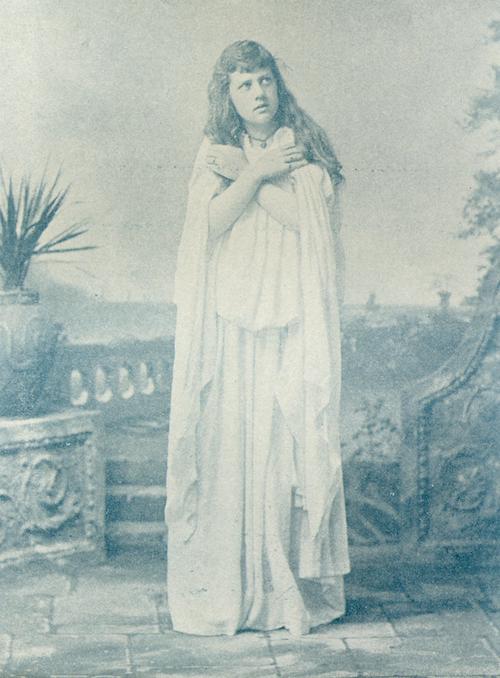
A jocund, sacrilegious son of Belial, who suffered from bronchitis, having exhausted his finances at the annual joust, in order to make good the deficit, resolved to ally himself to a comely, lenient and docile young lady of the Malay or Caucasian race. He accordingly purchased a calliope, a coral necklace of chameleon hue, and securing a suite of rooms at a hotel, he engaged the head waiter as his coadjutor. He then dispatched a letter of the most unexceptionable calligraphy extant, with a sentimental hemistich, inviting the young lady to an orchestral concert.
She was harassed, and with a truculent look revolted at the idea, refused to consider herself sacrificable to his desires, and sent a polite note of refusal, on receiving which, he procured a carbine and bowie knife, said that he would not now forge fetters hymeneal with the queen, went to an isolated spot, severed his jugular vein, and discharged the contents of his carbine into his abdomen, with a grimace at the raillery of his acquaintances. He succumbed and was irrefragably dead, and neither vagaries nor pageantry were permitted when he was conveyed to the mausoleum followed by his enervated canine.
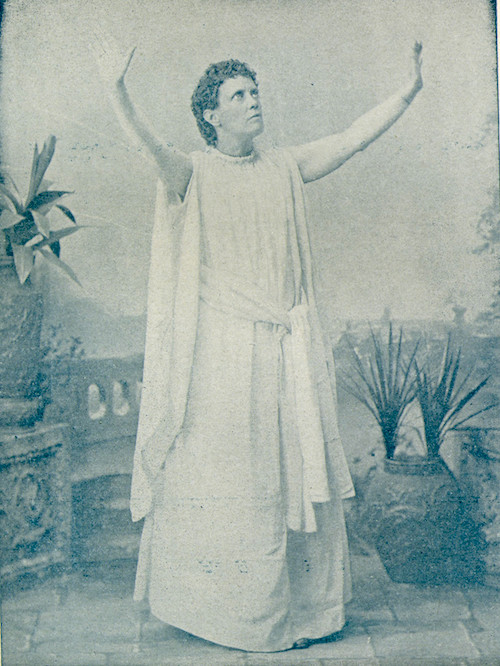
“Hide your faces, Holy Angels!”
[An organ accompaniment, and singing by a concealed choir, will add very materially to the effect of this piece.]
’Tis a cold winter night, and the earth is robed in a gown of snow. The moon is partly hidden by the driving clouds, and but dimly lights the sleeping world.
The scene is a grave-yard. In the centre stands an old church. From its stained glass windows the warm light softly gleams. Slowly tottering along the narrow path is seen a human form; it is a rough old tramp, lonely, and almost bowed to the earth. He seeks among the tall, white tombs; now he sinks wearily down on a hard, rough mound. There is no marble slab to mark out the spot; only the drifted snow, only the bare leafless willow that moans and sighs above it.
Hark! he speaks; his voice is feeble; he mournfully cries, “Mother, I’ve come home to die with you. Here on your long-neglected grave, here let me pillow my head and fancy I sleep in your arms; and the soft music within that dear church, let me fancy ’tis your sweet voice as you lull me to sleep. I dare not enter yon church, where in youth I worshiped my God.”
See! he lays his head on that cold, hard mound, and sobs like a tired little child, “Oh, mother, I am weary, so weary of life, of toil so bitter and labor so hard. I long for rest, but I am afraid to die.” He pauses, he listens, for within the church a voice speaks slowly and reverently, “Come unto me all ye that labor and are heavy laden, and I will give you rest.” The tramp replies, “Could I but know those words were meant for such a sinner as I!”—and heavy sobs convulse his poor, wretched frame.
Now the choir sings:
The wind moans piteously through the tall, gaunt trees, and he murmurs half inaudibly, “The prayers that were taught me in sweet boyhood years I then repeated with smiles, but now tears dim my eyes as I think of that patient mother who lies beneath this mound. I killed her! I broke her heart! But mother, oh, hear me to-night! With my poor, weary form I will guard you and sleep on your snow-covered grave. Could I know that when dead I could meet you in Heaven, I would rest calmly here on this rough pillow, but alas for my sins, so many, so vile! ’Tis only the pure and holy and good that ever dare hope they may enter therein.”
Each note of the organ peals out, full of tenderest pathos, each word from the singers comes clearly and plainly:
Now he kneels in the snow and his head is bent low, he clasps his trembling hands, then with one yearning look towards Heaven, he sinks like a child, weary of play, sleepy and tired, on that snow-covered pillow, the pillow of death.
Now the flakes fall faster and faster still, they cover him gently, like a mother that covers her child, lest she waken it out of its slumber.
Now more holy than ever, grander than ever, the old organ peals out, and the choir sings:
—Lizzie G. Vickers.
My name’s Jack. I’m eight years old. I’ve a sister Arathusa, and she calls me a little torment. I’ll tell you why: You know Arethusa has got a beau, and he comes to see her every night, and they turn the gas ’way, ’way down ’till you can’t hardly see. I like to stay in the room with the gas on full blaze, but Arathusa skites me out of the room every night. I checked her once, you better believe. You know she went to the door to let Alphonso in, and I crawled under the sofa. Then they came in, and it got awful dark, and they sat down on the sofa, and I couldn’t hear nothing but smack! smack! smack! Then I reached out and jerked Arethusa’s foot. Then she jumped and said, “Oh, mercy, what’s that?” and Alfonso said she was a “timid little creature.” “Oh, Alfonso, I’m happy by your side, but when I think of your going away it almost breaks my heart.” Then I snickered right out, I couldn’t help it, and Arathusa got up, went and peeked through the key-hole and said, “I do believe that’s Jack, nasty little torment, he’s always where he isn’t wanted.” Do you know this made me mad, and I crawled out from under the sofa and stood up before her and said, “you think you are smart because you wear a Grecian Bend. I guess I know what you’ve been doing, you’ve been sitting on Alphonso’s lap, and letting him kiss you like you let Bill Jones kiss you. You ought to be ashamed of yourself. If it hadn’t been for that old false front of yours, Pa would have let me have a velocipede like Tom Clifford’s. You needn’t be grinding them false teeth of yours at me, I ain’t a-going out of here. I ain’t so green as I look. I guess I know a thing or two. I don’t care if you are 28 years old, you ain’t no boss of me!”
Published by permission of T. J. Carey, Editor of “Excelsior Readings and Recitations.”
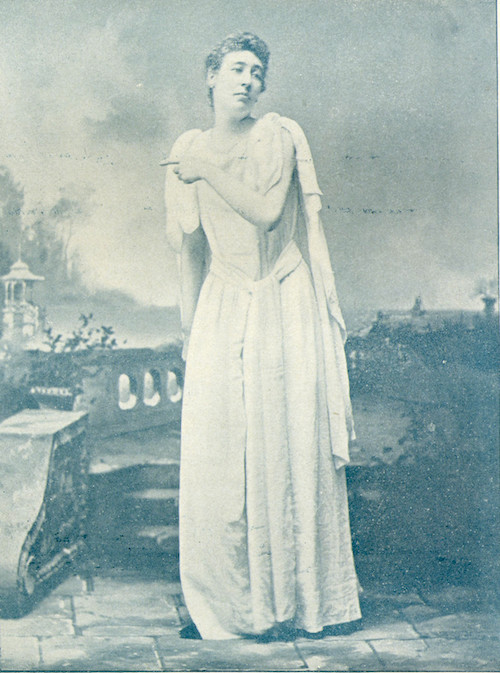
“But she, forsooth, must charm a man.”
I DO wish somebody would tell me how to get a wife. For the last ten years I’ve been continually proposing, at all sorts of times, in all sorts of places, to all sorts of girls, and in all sorts of positions. I have knelt in the clear moonlight, while the soft zephyrs of June fanned my heated brow, and with my hands on my heart made the most passionate appeal romantic maiden could desire. I have proposed in the giddy mazes of the waltz; I have besought a fair girl to be mine while skating, reminding her at the time that the path of life was far too slippery to be trodden alone; I have popped the question on the stairs, and in fact everywhere I could; the last time being in the surf at Long Branch, where I begged the object of my affections to let us breast the waves of life together.
But it’s of no earthly use! No one will have me except some superannuated female, and I’m not partial to aged charmers, though, goodness knows, I want a wife almost bad enough to take one. I’ve hardly a button on any of my shirts, or other undergarments, and am consequently obliged to fasten them with pins, (which occasionally prick me at most inconvenient times). My toes are poking out of my socks, and my fingers out of my gloves, while to crown all, I, who am a great lover of cleanliness, am forced to sit in a horribly dirty room. I have changed my boarding house ever so many times, but it does’nt make a particle of difference. My landlady always says it isn’t her business to “clean up” after me; the servants invariably remark that its no business of theirs, and I’m sure nobody can say that I ought to get a broom and dustpan and keep my own room clean.
My washerwoman is everlastingly cheating me, besides continually suppressing various articles of clothing; and when I mildly inquire where they have gone to, she solemnly swears she never had them; though I could swear equally solemnly that she had. Then she cuts the pearl buttons off my shirts, and declares they came off in “the wash;” and if I venture timidly to suggest that she should put them on again, she thanks God that all the gentlemen are not as mean as I am.
Oh, dear! It’s very hard upon a poor fellow not to be able to get a wife when he wants one! I’m not so very bad looking either; to be sure I squint a little, but then that peculiarity is sometimes admired, and if it were not, surely some kind-hearted girl might shut her eyes to the fact and confer upon me the inestimable benefit of becoming my partner for life. I’m not bad-tempered, and don’t drink nor smoke. I’m only thirty, and though I now belong to a club, I’ll promise to give it up if required. I possess enough money to keep a wife comfortably; have a good disposition; and what more could a girl ask. If, after trying six months longer, I cannot induce any girl to have me, I will emigrate to some tropical climate where clothes are almost superfluous, and washerwomen unknown, and consequently where a wife will not be one of the absolute necessities of civilized life.
And there was the elephant-ah, that g-r-e-a-t animal-ah of which Goldsmith describes in his Animated Nater-ah, which is as big as a house-ah, and his bones as big as a tree-ah, depending somewhat upon the size of the tree-ah; and there was Shem, and there was Ham, and there was Japhet-ah, a-l-l a-gwine into the show-room.
Therefore, my bruddren, if you’s a-gwine to git saved, you’s got to git aboard de Ship of Faith. Dere ain’t no udder way my bruddren. Dere ain’t no gitting up de back stairs, nor goin’ ’cross lots, you’s got to git aboard de Ship of Faith, for
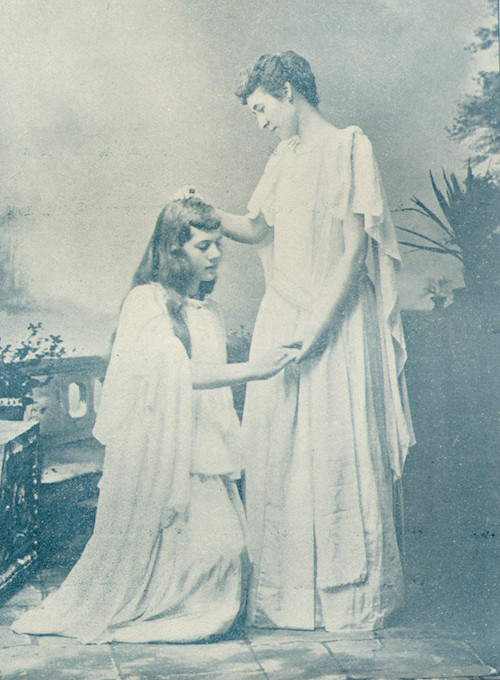
In fulfillment of our promise in a former number, we will now endeavor to give a few ideas upon the important subject of “suiting the action to the word.” Gestures are of two kinds, curved and straight, or emphatic and descriptive.
In the preparation for emphatic gestures the hand should be brought up on the oblique to different degrees of elevation, depending upon the force of emphasis, and then given a stroke on whatever line the sense requires.
Descriptive gestures require the curved preparation, i. e., the hand is brought in front of the body in the direction of the opposite shoulder, and then a graceful sweep is made in the line desired.
In the preparation of a selection for recitation, the first requisite is to lay out your picture, and locate every object that is mentioned; let it be firmly set in your mind so that you will not change the position of any portion of the scene during the course of the recitation.
A very fine piece for practice upon this is the “Ballad of Breakneck,” in the present number. Suppose you turn to it and imagine yourself to be standing upon the banks of the Hudson, in a position commanding the view down the river; by examining the marked gestures you will be able to locate the entire scene. In the delivery of a piece, always try to see with your mind’s eye what you are describing to your audience, and if the object is supposed to be in sight, let the eye follow the gesture; this, however, should be avoided in emphatic gestures, or where the thing described is supposed to be hidden from view.
The following rules will serve as a guide in deciding the directions that gestures should take:
Front gestures express unity, personality, direct address, and forward motion; also refer to the future.
Oblique gestures express plurality, general assertion, and are used in addressing numbers.
Lateral gestures express vastness in time, numbers, space or idea; also casting away, and negation.
Backward gestures express remoteness in time or space.
Descending gestures pertain to the will, express determination and emphasis.
Horizontal gestures pertain to the intellect, and are used in argument and address.
Ascending gestures pertain to the imagination, and express exultation.
—F. Lizzie Peirce.
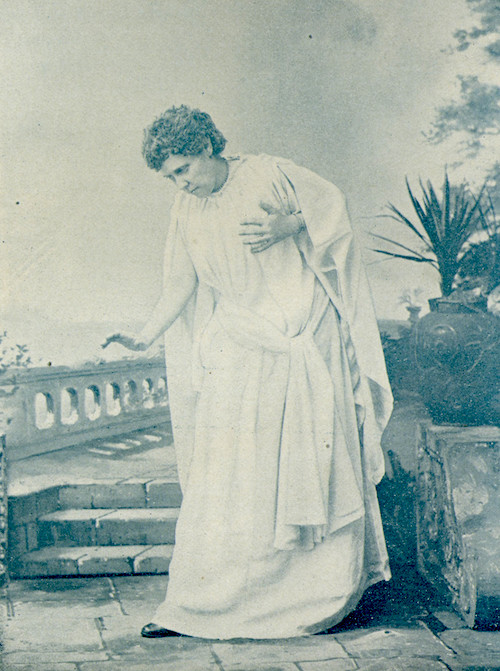
A Shakesperian Travesty
In One Act.
Characters.
Scene:—A parlor; door pract. C. flat; window L. flat, open; table beneath window; rocking chair R. C.; chairs at wings; Mrs. Petruchio discovered standing in door.
Mrs. Pet.—’Tis a good thing that Jessica has finished dusting this parlor; no nonsense will I tolerate from man, woman, or child within this domicile. (Enters and throws herself in rocking chair.) Petruchio ran affairs while living; but, in his demise—poor fellow—I re-inherited the freedom of my tongue. (Calls) Jessica!
Jessica (from without).—I am here; please wait; don’t scold; here I am. (Enters L.) Your pleasure, madam.
Mrs. Pet.—Have you washed the front steps, scrubbed the pavement and wrung out the clothes that were wet by the rain?
Jessica.—Alas! all these, and more, have I done. I have picked the beans, mixed the batter for muffins, put the mackerel in soak for breakfast, and——
Mrs. Pet.—Enough! Why thus parade before my fancy’s eye the coarse details of cookery. I tell you ’tis scarce an hour since I ate—the subject is distasteful.
Jessica.—But, madam, you asked me what——
Mrs. Pet. (stamps foot).—Silence!
Jessica.—You are dreadfully cross. When I came to you and told you the story of my life, how I eloped with poor, dear Lorenzo, who was all a woman could ask, while the money I took from father lasted——
Mrs. Pet.—And who hastily departed simultaneously with the last ducat——
Jessica.—Do not wound my spirit. I repeat, you promised to give me shelter, to shield me, treat me kindly——
Mrs. Pet.—Shut up! move! Lorenzo, you say, has gone to Padua to seek a position as pen-wiper to Ballario; believe it not; he is in Venice suing for a divorce before the Duke. Unhappy woman, move!
Jessica (aside).—As Jessica Shylock I was envied as a rich man’s child; as Jessica Lorenzo I am——
Mrs. Pet.—What’s the use of whining; you will never see Lorenzo more.
Jessica.—
I leave for Venice this very night!
Mrs. Pet.—Away to the kitchen and put on the beans!
Jessica (looks off L).
Mrs. Pet.—
Jessica (points L).—T. O. M.
Mrs. Pet.—T. O. M.? Tom who?
Jessica.—No, no! The—old—man; my father, Moses Shylock, is creeping up the gravel path. Hide me! Do not betray me!
Mrs. Pet.—
Away to the kitchen and you are safe!
Jessica.—I love my father, but I fear his righteous rage.
Mrs. Pet.—Stay, then; confess and ask his pardon.
Jessica (Shakes head sadly and exits R).
Mrs. Pet.—
[Enter Shylock, door F.]
Mrs. Pet.—How now, Shylock? What news among the merchants? What will you loan upon my ulster?
Shylock.—Take it to my brother Solomon, on the Rialto; he’ll give you liberally and charge you naught for camphor.
Mrs. Pet.—Have you heard from your daughter, and your son-in-law, Lorenzo, lately?
Shylock.—No, no; not I. All hope to find her long hath fled. One-half the jewels that she took no doubt Lorenzo pawned; and yet the thankless knave sent me not e’en a ticket to redeem the goods!
Mrs. Pet.—’Tis said, for satisfaction’s sake, you now refuse to grant renewal of your loans, e’en though the interest thereon be paid; ay, that Antonio, the poor butcher, will lose the meats that now are forfeit. Why take his venison? Wilt answer, Shylock?
Shylock.—
Mrs. Pet.—If I were his wife you would not thus berate the man. If Petruchio could speak, he’d say so too.
Shylock.—I seek my truant child; I heard she lived, not long since, hereabouts.
Mrs. Pet.—Excuse me, Mr. Shylock, call again.
Shylock.—Have you any old garments to sell?
Mrs. Pet.—Leave, and call again; two neighbors now approach who may mistake the object of your visit. Go! Leave by the side door.
Shylock.—
Mrs. Pet (looking L).—O, you miserly old money-grabber, if you think I will tell on poor Jessica, you know but little of Kate Petruchio! Go! go! go! you old parent, you stingy father, and con over your collaterals of watches, fiddles, bibles and pistols!
[Enter Miss Helena and Mrs. Othello, door F.; they pause and observe Mrs. Petruchio.]
If I was your wife wouldn’t I take the kinks out of those grizzly locks, though!
Mrs. Othello (to Helena).—What should this mean?
Helena.—O what a noble mind is here o’erthrown!
Mrs. Pet.—Ah, ladies, kind, sweet neighbors, how glad I am to see you here!
Mrs. Othello.—Do you have any pain here? (Touches head).
Helena.—Is not the plumb-bob of your mental plumb-line out of plumb?
Mrs. Pet.—
Saw you not that animated gaberdine descend my garden path?
Mrs. Othello.—You do not mean our mutual uncle, Moses Shylock; from whom, however, I never borrow.
Helena.—Nor I.
Mrs. Petruchio.—Do you mean to insinuate that I presume upon his kinship to obtain loans?
Mrs. Othello.—What have I done that thou dar’st wag thy tongue in noise so rude against me?
Helena.—Hist! he comes!
Mrs. Petruchio.—Who comes?
Helena.—My Romeo.
Mrs. Othello.—Your Romeo! Forsooth you have not spoken to him more than twice.
Romeo (Without, singing).—
Helena.—
Mrs. Pet.—
Romeo (without, sings).—
Helena.—
Romeo (without, sings).—
Mrs. Pet.—Horrible! monstrous! was ever sound so nerve-destroying heard save from the larynx of a dying calf? I despise these daylight serenades.
Mrs. Othello.—
Mrs. Pet.—Ha! this is more than I can brook; my tongue’s my own to wag it as I will, therefore attempt not to criticise my criticisms——I repeat, the fellow sings like a Scandinavian bag-pipe.
Helena.—Ladies, pray be still! He may hear your dreadful comments.
[Knock heard at door.]
’Tis he!
Mrs. Othello.—Let him not in until I depart! If Mr. Othello should happen to step in and find me in company with this gallant youth his jealousy would know no bounds!
[Knock repeated.]
Mrs. Pet.—Nonsense! I hope he does come, I’d like to give him my opinion of jealous husbands—
Romeo (without).—I suppose there’s no one home. (Knocks). Hello! anybody in?
Helena (opens door).—Mr. Romeo! how delightful this surprise.
Romeo (enters).—To me this is a pleasure sweet, sweet beyond comparison. (Aside.) Her looks do argue her replete with modesty.
Helena.—It gives me wonder, great as my content, to see you here before me.
Mrs. Pet.—
Mrs. Othello.—
[Looks about cautiously.]
Yea, I could laugh and weep (aside.) It entirely depends upon the movements of Mr. Othello. He’s so jealous.
Mrs. Pet.—Be seated, friend Romeo; Miss Helena will entertain you while Mrs. Othello and I see that the festive board is spread below. Come, away to the pantry!
[Exit followed by Mrs. Othello.]
Romeo (places a chair for Helena).
Helena.—Thank you, sir. (Aside.) I know not why I love this youth.
Romeo.—
Helena.—Dost thou love me? I know thou wilt say ay, and I will take thy word.
Romeo (takes chair).—
Helena.—You have bereft me of all words.
Romeo (aside).—
[Knock at door.]
[Rises and opens door.]
[Enter Shylock with old garments on his arm.]
Helena (rising).—
Romeo.—
Shylock (to Helena).—
[Throws garments on floor.]
Helena.—
Romeo.—
Shylock.—Peace! one word: in yonder pile, for little more than half the cost, a seal-skin wrap and overcoat may grace your youthful forms.
Romeo (to Shylock in undertone).—I pray thee, gentle signor of the Gilded Balls, say naught before this maid that will reveal the fact that half my garments now repose upon your shelves.
Helena (to Shylock).—To-night I’ll steal into thy place of trade, and, under cover of the evening’s shades, examine well the seal-skin sack whereof you speak. Say nothing now, sir; mum’s the word!
Shylock.—’Tis in my memory locked, and you yourself shall keep the key of it.
[Enter Jessica, Mrs. Petruchio and Mrs. Othello.]
Jessica.—Oh! Oh! (jumps behind Mrs. Petruchio).
Mrs. Othello.—Hide me! Save me!
Mrs. Pet.—Thou shalt be punished for thus frightening me, thou man of loans. Be quiet sweet Mrs. Othello, thy husband is not here.
Mrs. Othello.—Mr. Romeo, what brings this, our general kinsman, here upon the scene?
Romeo.—His business calls him here.
Mrs. Pet.—Romeo, put him out: mind not his glaring eyes, but put him hence!
Romeo.—
Mrs. Pet.—
Helena (to Shylock).—
Mrs. Pet.—See here, old man, just tell me what you want?
Shylock.—
Romeo.—Poor man!
Helena.—Why not advertise her in the papers?
Mrs. Othello.—Or, like my husband, employ a private detective?
Shylock (to Mrs. Petruchio).—Woman, tell me where to find my child! Lorenzo, he has been set free by the Venice court’s decree. If the proof you wish to see, take the train for the city by the sea.
Mrs. Pet.—I know not where Jessica Shylock lives, nor care to hear your family cares.
Shylock.—
Mrs. Pet.—Me wear a wig? O wrinkled Jew, take back thy child, whom only kindness taught me to conceal. No more courage now remains: away with her! In saying that I wear a wig, you crush my heart, and now I fain would be alone.
Jessica (embraces Shylock).—Father, forgive me!
Romeo.—See! the Jew relents!
Helena.—O gentle Romeo!
Mrs. Othello.—I hope I shall get home before the Moor returns!
Shylock (takes Mrs. Petruchio’s hand.)
Mrs. Pet.—Think you, sir, my reason’s fled. (Withdrawing hand indignantly.) Marry you? Never! Sooner would I see you hanged.
Shylock.—But are you happy?
Romeo.—
Shylock.—Go to, and why?
Mrs. Othello.—
Helena.—
All.—Yes, go! (pounding and pushing him.) Go! go! go!
Shylock (runs to centre and kneels).—Mercy! (All take positions.)
[Curtain.]
—George M. Vickers.
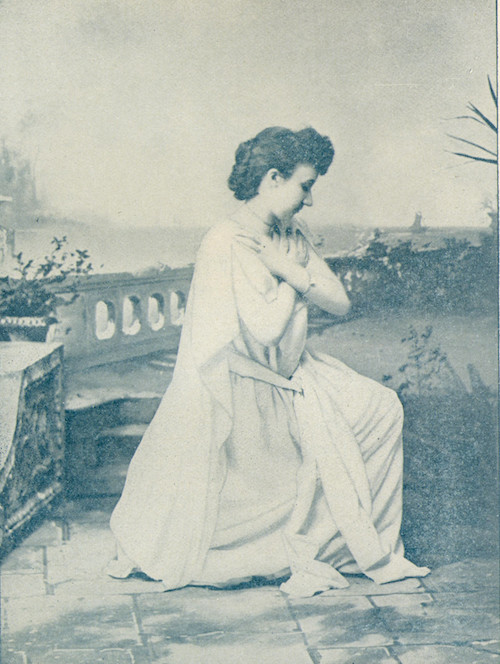
“Father, Thy will, not mine, be done.”
My antiquated hearers, male and female. Squenchin’ my native modesty which is natural to the weaker vessels of whom I am which, I feel impelled to speak to you this evenin’ on the subject of woman—her origin, her mission, her destiny. A subject, bein’ as I am a woman myself, I hev given much attention to.
Man, my hearers, claims to be the superior of woman! Is it so? and ef so, in what, and how much?
Wuz he the fust creation? He wuz, my hearers, but what does that prove?
Man wuz made fust, but the experience gained in makin’ man wuz applied to the makin’ of a betterer and more finerer bein’ of whom I am a sample.
Nachur made man but saw in a brief space of time that he couldn’t take keer of himself alone, and so he made a woman to take keer uv him, and that’s why we wuz created; tho’ seein’ all the trouble we hev, I don’t doubt that it would hev been money in our pockets if we hedn’t been made at all.
Imagine, my beloved hearers, Adam afore Eve wuz created! Who sewed on his shirt buttons? Who cooked his beefsteak? Who made his coffee in the mornin’ and did his washin’?
He wuz mizzable, he wuz,—he must have boarded out and eat hash!
But when Eve come, the scene changed. Her gentle hand soothed his achin’ brow when he come in from a hard day’s work. She hed his house in order; she hed his slippers and dressin’ gown ready, and after tea he smoked his meerschaum in peace.
Men, cruel, hard-hearted men, assert that Eve wuz the cause of his expulsion from Eden—that she plucked the apple and give him half; oh, my sisters, it’s true, it’s too true, but what uv it?
It proves fustly, her goodness. Had Adam plucked the apple, if it had been a good one, he’d never a thought of his wife at home, but would have gobbled it down himself, and perhaps have taken her the core.
Eve, angel that we all are, thought of him and went halvers with him.
Secondly, it wuz the means of good anyhow. It introduced death into the world, which separated ’em while they still hed love for each other.
I appeal to the sterner sex present to-night. S’posin’ all of you had been fortunate enough to win such virgin souls as me, could you endure charms like mine for an eternity. If I had a husband, I know he’d bless Eve for introducin’ death into the world.
Woman is man’s equal, but is she occupyin’ her true speer? Alas, not! We are deprived of the ballot, we ain’t allowed to make stump speeches, or take part in politics. Is it right? How many men vote who know what they are votin’ for?
I demand the ballot. I want to take part in torchlight processions! I want to demonstrate my fitness for governing by coming home elevated on election nights. I demand the right of going to Congress. I want to assume that speer which nachur fitted me for equally with man, but from which masculine jealousy has thus far excluded me.
There hev been women in the world who have done something. There was the Queen of Sheba, who was excelled only by Solomon, and all that surpassed her in him wuz that he could support 3,000 women.
Bless Solomon’s heart! I’d like to see him do it now. Where could he find a house big enough to hold ’em with their dozen Saratoga trunks apiece?
How shall we gain our lost rights and assume that position in the world to which we are entitled to?
Oh, my sisters, these is a question upon which I have cogitated long and vigorously.
We might do it by pisonin’ all the men, but we would be robbed of one-half of our triumph, for they wouldn’t be alive to see how well we did things without ’em.
We might resolve to do no more of the degradin’ work they have imposed onto us. But if we didn’t, who would?
One week’s eatin’ what they would cook, would sicken any well-regulated woman, and besides, they might not let us eat at all.
Matrimony, thus far in the world’s history, has been our only destiny.
I am glad I had always strength of mind enough to resist all propositions leadin’ to my enslavement.
I had too much respect for myself to make myself the slave of a man.
Wunst, indeed, I might have done so, but the merest accident in the world saved me. A young man in my younger days, when the bloom wuz on the peach, ere sleepless nights spent in meditatin’ on the wrongs of my sex had worn furrows into these wunst blushing cheeks, a young man come to our house, and conversed sweetly with me.
It wuz my fust beau, and oh, my sisters, had he that night asked me to be his’n, I should have been weak enough to have said Yes, and I would have been a washer of dishes and a mender of stockin’s for life.
But fate saved me! He did’nt ask me.
—Revised by F. Lizzie Peirce.
Oration delivered at the Commencement of the Mt. Vernon Institute of Elocution and Languages, June, 1886.
Through the whole of Shakespeare’s plays, we find every prominent character stamped with a separate individuality, which is preserved in every detail and characteristic, whether in the insane jealousy of Othello, the impetuosity of Harry Hotspur, the constancy of Portia, the vindictiveness of Shylock, the wickedness of Don John, or the benign, forgiving spirit of Prospero.
There is a silvery vein of wit threading his plays, gleaming and flashing like a sparkling brook in the sunshine.
It runs smoothly in the calmly-uttered and thoughtful sentences of Hamlet; it bubbles and laughs in the saucy badinage of Beatrice and Celia; seeks the shadow in the melancholy of Jacques; enters the realm of the pun in the wordy self-assertion of Polonius, and descends to the comic and sometimes the vulgar in Falstaff and Dogberry.
In the character of Hamlet we find a keen sense of humor, overcast by the ever-present suspicion of his father’s foul end, and a vague distrust of those around him. A certain sarcasm lurks in the depths, and imparts an incisiveness to every well-turned sentence. He says to Guildenstern:
Hamlet.—Will you play upon this pipe?
Guildenstern replies:
Guild.—My lord, I cannot.
Ham.—I pray you.
Guild.—Believe me, I cannot.
Ham.—I do beseech you.
Guild.—I know no touch of it, my lord.
Ham.—’Tis as easy as lying: Govern these ventages with your finger and thumb, give it breath with your mouth, and it will discourse most excellent music. Look you, these are the stops.
Guild.—But these cannot I command to any utterance of harmony; I have not the skill.
Ham.—Why, look you, now, how unworthy a thing you make of me! You would play upon me; you would seem to know my stops; you would pluck out the heart of my mystery; you would sound me from my lowest note to the top of my compass: and there is much music, excellent voice in this little organ; yet cannot you make it speak! ’Sblood, do you think I am easier to be played on than a pipe? Call me what instrument you will, though you can fret me, you cannot play upon me.
Hamlet deals largely in simile and metaphor; no finer instance occurring than in the passage where he is called upon to account for the body of Polonius. Rosencranz, repelling his insinuations, asks:
Ros.—Take you me for a sponge, my lord?
Ham.—Ay, sir, that soaks up the king’s countenance, his rewards, his authorities. But such officers do the king best service in the end: he keeps them like an ape, in the corner of his jaw; first mouthed, to be last swallowed: when he needs what you have gleaned, it is but squeezing you, and, sponge, you shall be dry again.
With a feeling of relief we turn to merry, heart-whole Beatrice, and we glory in the ease with which she puts to rout the valiant soldier Benedick. With what exquisite nonchalance she remarks:
Beat.—I wonder that you will still be talking, Signor Benedick, nobody marks you.
She throws down the gauntlet of defiance to Cupid in the words:
Beat.—I had rather hear my dog bark at a crow, than a man swear he loves me.
And she retains her woman’s right to the last word in her parting shot:
Beat.—You always end with a jade’s trick. I know you of old.
Her merry derision of Don Pedro is shown in her reply to his gallant offer:
Don P.—Will you have me, my lady?
Beat.—No, my lord, unless I could have another for working days. Your grace is too costly to wear every day.
Of the same bright, refreshing character is Celia, but Beatrice is more brusque, while Celia has a tender vein of womanliness which tones her raillery, while her sprightliness is more strongly thrown out in the early scenes of the play by its contrast with the constantly recurring melancholy of Rosalind. This antithesis is clearly observable in the following:
Cel.—Why cousin! why Rosalind! Cupid have mercy! not a word?
Ros.—Not one to throw at a dog.
Cel.—No, thy words are too precious to cast away upon curs; throw some of them at me; come, lame me with reasons.
Ros.—Then were two cousins laid up; when the one should be lamed with reasons and the other mad without any.
Cel.—But is this all for your father?
Ros.—No, some of it is for my child’s father. Oh, how full of briers is this working-day world.
Cel.—They are but burs, cousin, thrown upon thee in holiday foolery; if we walk not in the trodden paths, our very petticoats will catch them.
Ros.—I could shake them off my coat; these burs are in my heart.
Cel.—Hem them away.
Ros.—I would try if I could cry “hem” and have him.
Cel.—Come, come; wrestle with thy affections.
Ros.—O, they take the part of a better wrestler than myself!
Cel.—O, a good wish upon you! You will try in time in despite of a fall.
After Rosalind and her cousin leave the court for the Forest of Arden, Rosalind’s spirits rise, and then it is she who becomes the prominent sprightly character in the play. She receives Orlando after a short absence with the reproach:
Ros.—Why how now, Orlando, where have you been all this while? You a lover! And you serve me such another trick, never come in my sight more.
Orl.—My fair Rosalind, I come within an hour of my promise.
Ros.—Break an hour’s promise in love! He that will divide a minute into a thousand parts, and break but a part of the thousandth part of a minute in the affairs of love, it may be said of him that Cupid hath clapped him on the shoulder, but I’ll warrant him heartwhole.
Orl.—Pardon me, dear Rosalind.
Ros.—Nay, and you be so tardy, come no more in my sight: I had as lief be wooed of a snail.
Orl.—Of a snail!
Ros.—Ay, of a snail; for though he comes slowly, he carries his house on his head; a better jointure, I think, than you make a woman.
In Polonius we meet with a character in direct contrast to those we have mentioned. The old gentleman, like many of the present day, loves to hear himself talk, and, owing to his high political position, has probably become so accustomed to receiving the applause of fawning courtiers, that the habit of punning has become a second nature to him; even after receiving the gentle reprimand of his Queen, it still is impossible for him to abstain from them, as is instanced in the conversation on the cause of Hamlet’s peculiarities.
Let us now turn to Portia, happy, witty Portia, with a soul far above the fickle spendthrift, Bassanio, but with all a woman’s devotion, adoring him in spite of his faults. Her gentle dignity in accepting the hoped-for result of his choice of the caskets is sweetly evinced in the following:
In the Trial Scene we discover the contrasting side of Portia’s character, and we will close with a quotation from her speech to Shylock.
F. Lizzie Peirce.
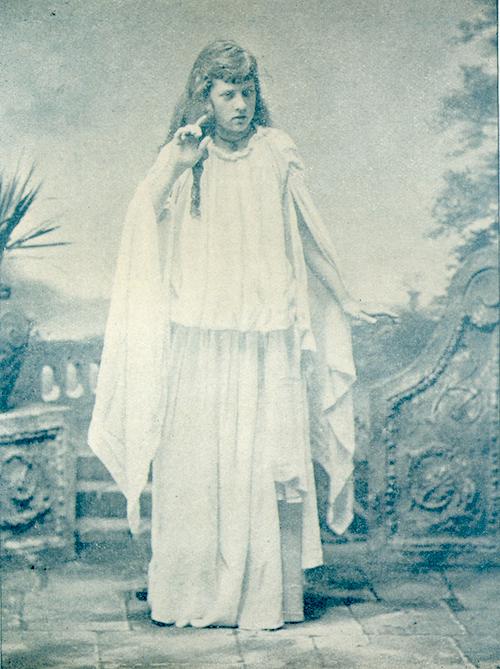
“Let me think!”
Brown, Jones and Robinson, three of as good fellows as ever melted the heart of a country trader to the merry music of the pliant chin, sat one evening of last week in the smoking compartment of a chair car on the R. and T. H. Western Railroad. With them was a tall, thin, dyspeptic man with sandy hair, dressed in a rusty suit of black. Nature had endowed him with long legs, and his tailor with short pants. His coat collar was rich enough in accumulated grease to keep a soap factory going for a month. His mouth was of brass, and his cheek as hard as last year’s cider. He was a book agent. Already had he gobbled up the drummers for a Life of Christ and Pocket Encyclopedia of 215 numbers, when suddenly a real Jesse-James-like train bandit opened the door and stood, pistol in hand, before the quartet.
Brown’s soul sank down into the heels of his boots. Beads of perspiration big as snow balls stood on Jones’ classic brow, while his hair lifted his hat two solid inches from the crown of his head. Robinson murmured the first verse of “Ever of Thee I’m Fondly Dreaming,” and thought he was praying. But the book agent bounded from his seat with a “How do, stranger? Delighted to see you. Do let me show you my superb ‘History of Boone County,’ a perfect bonanza of domestic peace and happiness to every householder who is fortunate enough to possess one. Three hundred pages of elegant letter press, printed on toned paper and embellished with fine steel engravings and an official map of the State. A carefully compiled, correct topographical and historical——”
“Shut up!” roared the bandit.
“Shut up? You bet it will, and fastens itself with a double-action brass clasp—my own invention—and from its simplicity of design and beauty of construction worth half the price of the book. Given away, sir; literally given away, for $3 in boards or $4.50 in morocco with beveled edges.”
“If yer say——”
“I do say it, sir. Look at this exquisite title page with a vignette portrait of the gifted author. Here you see a genealogical abstract chart in which you can write the names of your illustrious ancestors and beloved family—births, marriages, deaths and——”
“Stop!” shrieked the bandit, as the agent grasped him by the buttonhole.
“You may well say ‘stop,’ sir; I’ve said enough to make you ache to possess this beautiful volume, but I haven’t begun to——”
“Sit down!” the robber roared in a voice that made the puffs of the engine sound like the sighs of a sick zephyr, and loosened all the joints of Jones’s limbs.
“Biographical sketches of eminent men, glowing obituary, with an original poem on death, agricultural statistics, tables of mortality, valuable notes on immigration, trade reports, all the geological——”
“Lemme go, or I’ll blow the roof of yer head off,” shrieked the robber, as he wrested himself from the agent’s grasp and dropped off the rear car into the gathering gloom of the coming night.
Then Robinson drew from his pocket his faithful revolver and looked big. Jones rolled his sleeves up and asked where the villain was gone to. Brown fished from under the spittoon a roll of bills and hoped they didn’t think he had been scared. But the agent sank wearily to his seat, and for the first time in all that long journey was silent for nearly four consecutive minutes.
—Evansville Argus.
The old army overcoat that used to be such a familiar sight on our streets is one of the rarest now; indeed, it is so seldom seen that we involuntarily turn and gaze after it, as something that brings sad and often cruel memories. The other day an old man wearing a coat of this kind, which reached to his heels, stopped at a cottage a little way out of town and asked leave to rest awhile on the porch.
“I’m a bit tired,” he said to the woman who opened the door, “an’ if you don’t mind I’ll sit here and rest myself for a spell.”
“You’re welcome,” said the woman kindly, with a glance at the martial blue. Then she left him alone, but after a little while returned with a bowl of coffee and a plate of white biscuit.
“Eat,” she said, gently; “I had a boy who was a soldier.”
“But I’m not a soldier,” answered the old man. “I never was a soldier; my boy went to war and was killed. He was all I had, too. This coat was his; seems like he’s near me when I have it on. I gave him to his country; the handsomest and bravest boy he was, too, in the whole regiment. God bless him. He did his duty, died on the field, and this coat was all that came back to his poor old dad. No; I never was a soldier.”
The woman went in and brought out some cake and the whitest honey, and added it to the coffee and biscuit.
“Are you alone in the world?” she asked.
“Oh, no,” answered the old man, cheerfully; “I’ve got a sister, but she’s old and lame, and she has a daughter that is sickly and ailing. You see I have them to work for, and they are a sight of comfort to me. Many’s the time I’d have broken down since Mary died but for them poor critters. Mary was my wife, ma’am; she was a master hand to nuss sick folks, and she thought after Tim died as it were her duty to go into the hospital service and nuss the soldiers, and she died these sixteen years ago; but she did a heap of good work first. Many a soldier has kissed her shadow on the wall! Mary, darlin’, God wanted ye in the ranks up there; I’ve often wished that I had been a soldier, if only to be fit for the little mother and Tim; but I never was.”
He drank the coffee, ate the good food thankfully, and offered to pay for it with some hoarded pieces of old worn silver; but the woman shook her head.
“Put back your money. My son was a soldier,” she said.
“But I am not a soldier. Well, well,” (as he looked into her face,) “I thank you, and I take it for his sake.”
He wished good-night to his kind entertainer and turned away. As he walked off, slow and limping, bent by infirmity, the long skirt of his army overcoat struck bright and blue against the splendor of the sunset; he shaded his eyes with one trembling hand and looked wistfully at the rose and amethyst door that seemed to open in the west. What saw he there? A little, round-shouldered woman with a small, homely face; a lank, overgrown boy, with sparse, red hair. Ay, and of such as these are angels made. So, watching, he passed down into the shadows and disappeared.
The woman at the gate looked after him.
“No soldier!” she said gently, “but I wonder if the boy who died on his first battle-field ever fought as he has, or sacrificed as much to his country? All the soldiers didn’t go into the war with flying flags and rolling drums. Some of them stayed at home and fought harder battles. I’m glad I gave him a bite and a sup. He is a soldier, and a brave one, too, and one day he will know it!”
And I think she was right.
—Detroit Free Press.
First Honor at the Third Annual Commencement of the Mt. Vernon Institute of Elocution and Languages, 1886.
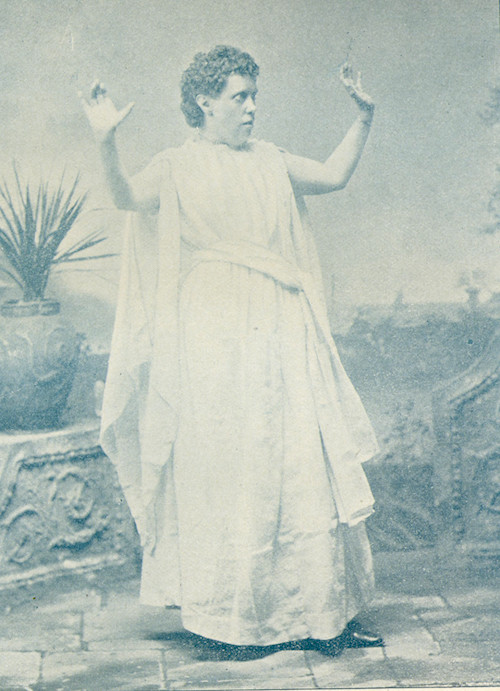
“Merciful heavens! is that true?”
A Pageant.
Personifications.
| January. | ⎫ | Gentlemen. | February. | ⎫ | Ladies. |
| March. | ⎪ | April. | ⎪ | ||
| July. | ⎬ | May. | ⎬ | ||
| August. | ⎪ | June. | ⎪ | ||
| October. | ⎪ | September. | ⎪ | ||
| December. | ⎭ | November. | ⎭ | ||
Robin Redbreasts; Lambs and Sheep; Nightingale and Nestlings.
Various Flowers, Fruits, etc.
Scene:—A Cottage with its Grounds.
(A room in a large, comfortable cottage; a fire burning on the hearth; a table on which the breakfast things have been left standing. January discovered seated at the fire.)
(Two Robin Redbreasts are seen tapping with their beaks at the lattice, which January opens. The birds flutter in, hop about the floor, and peck up the crumbs and sugar thrown to them. They have scarcely finished their meal, when a knock is heard at the door. January hangs a guard in front of the fire, and opens to February, who appears with a bunch of snowdrops in her hand.)
(She hands a few of her snowdrops to January, who retires into the background. While February stands arranging the remaining snowdrops in a glass of water on the window-sill, a soft butting and bleating are heard outside. She opens the door, and sees one foremost lamb, with other sheep and lambs bleating and crowding towards her.)
(February opens a second door in the background, and the little flock files through into a warm and sheltered compartment out of sight.)
(A rattling of door and windows; branches seen without, tossing violently to and fro.)
(She turns the handle of the door, which bursts open, and discloses March hastening up, both hands full of violets and anemones.)
(Hands violets and anemones to February, who retires into the background.)
(Before March has done speaking, a voice is heard approaching accompanied by a twittering of birds. April comes along singing, and stands outside and out of sight to finish her song.)
(As she speaks April shows March her apron full of flowers and nest full of birds. March wanders away into the grounds. April, without entering the cottage, hangs over the hungry nestlings watching them.)
(May arrives unperceived by April, and gives her a kiss. April starts and looks round.)
(She divides an armful of all sorts of flowers with April, who strolls away through the garden.)
(June appears at the further end of the garden, coming slowly towards May, who seeing her, exclaims:)
(May, eating strawberries, withdraws among the flower beds.)
(June falls asleep; and is not awakened by the voice of July, who behind the scenes is heard half singing, half calling.)
(Enter July, a basket of many-colored irises swung upon his shoulders, a bunch of ripe grass in one hand, and a plate piled full of peaches balanced upon the other. He steals up to June, and tickles her with the grass. She wakes.)
(Enter August, carrying a sheaf made up of different kinds of grain.)
(August descries September toiling across the lawn.)
(September arrives, carrying upon her head a basket heaped high with fruit.)
(While September is speaking, August lifts the basket to the ground, selects various fruits, and withdraws slowly along the gravel walk, eating a pear as he goes.)
(October enters briskly, some leafy twigs bearing different sorts of nuts in one hand, and a long, ripe hop-vine trailing after him from the other. A dahlia is stuck in his button-hole.)
(October wreathes the hop-vines about September’s neck, and gives her the nut twigs. They enter the cottage together, but without shutting the door. She steps into the background; he advances to the hearth, removes the guard, stirs up the smouldering fire, and arranges several chestnuts ready to roast.)
(October, shrugging his shoulders, withdraws into the background, while November throws her pine cones on the fire and sits down listlessly.)
(Through the window December is seen running and leaping in the direction of the door. He knocks.)
(He opens the door and enters, loaded with evergreens in berry, etc.)
(While December concludes his song, all the other months troop in from the garden, or advance out of the background. The twelve join hands in a circle, and begin dancing round to a stately measure as the Curtain falls.)
—Christina G. Rossetti.
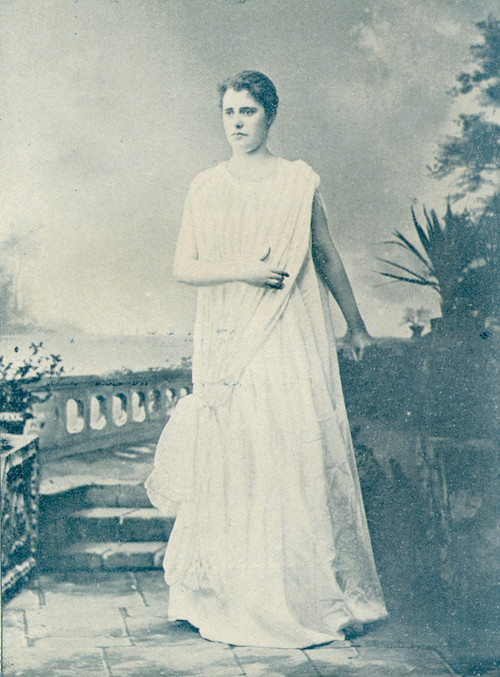
Published by special permission.
Geoffrey, surnamed Winthrop, sat in the depot at Chicago waiting for his train and reading the Tribune, when a squadron of street Arabs (incomparable for squalor), thronged from a neighboring alley, uttering hideous cries, accompanied by inimitable gestures of heinous exultation, as they tortured an humble black and tan dog.
“You little blackguards!” cried Winthrop, stepping outside and confronting them, adding the inquiry, “Whose dog is that?”
“That audacious Caucasian has the bravado to interfere with our clique,” tauntingly shrieked the indisputable little ruffian, exhibiting combativeness.
“What will you take for him?” asked the lenient Geoffrey, ignoring the venial tirade.
“Twenty-seven cents,” piquantly answered the ribald urchin, grabbing the crouching dog by the nape.
“You can buy licorice and share with the indicorous coadjutors of your condemnable cruelty,” said Winthrop, paying the price and taking the dog from the boy. Then catching up his valise and umbrella, he hastened to his train. Winthrop, satisfied himself that his sleek protégé was not wounded, and then cleared the cement from the pretty collar, and read these words:
“Leicester. Licensed, No. 1770.”
Hearing the pronunciation of his name, the docile canine expressed gratitude and pleasure, and then sank exhausted at his new patron’s feet and slept.
Among the other passengers was a magazine contributor, writing vagaries of Indian literature, also two physicians, a somber, irrevocable, irrefragable allopathist, and a genial homeopathist, who made a specialty of bronchitis. Two peremptory attorneys from the legislature of Iowa were discussing the politics of the epoch, and the details of national finance, while a wan, dolorous person, wearing concave glasses, alternately ate troches and almonds for a sedative, and sought condolence in a high lamentable treble from a lethargic and somewhat deaf and enervate comrade not yet acclimated.
Near three exemplary brethren (probably sinecurists) sat a group of humorous youths; and a jocose sailor (from Asia) in a blouse waist and tarpaulin hat, was amusing his patriotic juvenile listeners by relating a series of the most extraordinary legends extant, suggested by the contents of a knapsack, which he was calmly and leisurely arranging in a pyramidal form on a three-legged stool. Above swung figured placards, with museum and lyceum advertisements too verbose to be misconstrued.
A mature matron of medium height and her comely daughter soon entered the car, and took seats in front of Winthrop (who recalled having seen them one Tuesday in February in the parquet of a theatre). The young lady had recently made her debut into society at a musical soiree at her aunt’s. She had an exquisite bouquet of flowers that exhaled sweet perfume. She said to her parent, “Mamma, shall we ever find our lost Leicester?”
Geoffrey immediately addressed her, saying, as he presented his card—
“Pardon my apparent intrusiveness; but prithee, have you lost a pet dog?”
The explanation that he had been stolen was scarcely necessary, for Leicester, just awakening, vehemently expressed his inexplicable joy by buoyantly vibrating between the two like the sounding lever used in telegraphy (for to neither of them would he show partiality) till, succumbing to ennui, he purported to take a recess, and sat on his haunches, complacently contemplating his friends. It was truly an interesting picture.
They reached their destination ere the sun was beneath the horizon. Often during the summer Winthrop gallantly rowed from the quay with the naive and blithe Beatrice, in her jaunty yachting suit, but no coquetry shone from the depths of her azure eyes. Little Less, their jocund confidante and courier (and who was as sagacious as a spaniel) always attended them on these occasions, and whene’er they rambled through the woodland paths. While the band played Beethoven, Mendelssohn, Bach, and others, they promenaded the long corridors of the hotel. And one evening, as Beatrice lighted the gas by the etagere in her charming boudoir in their suite of rooms, there glistened brilliantly a valuable solitaire diamond on her finger.
Let us look into the future for the sequel to perfect this romance, and around a cheerful hearth we see again Geoffrey and Beatrice, who are paying due homage to their tiny friend Leicester.
—Quarterly Elocutionist.
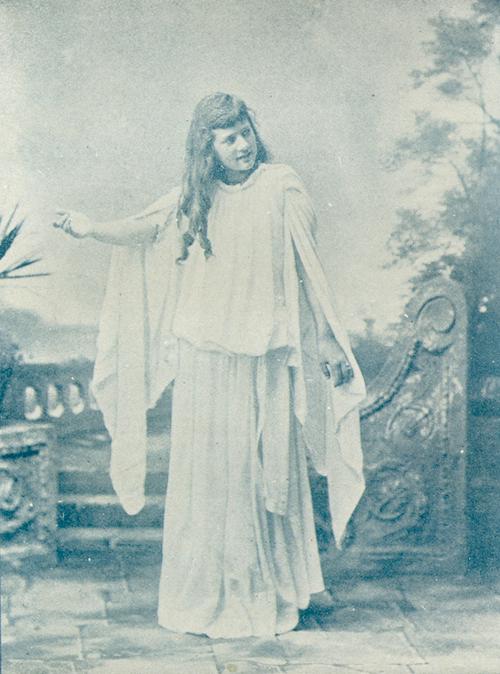
This piece is most effective if given sitting by the right side of a table.
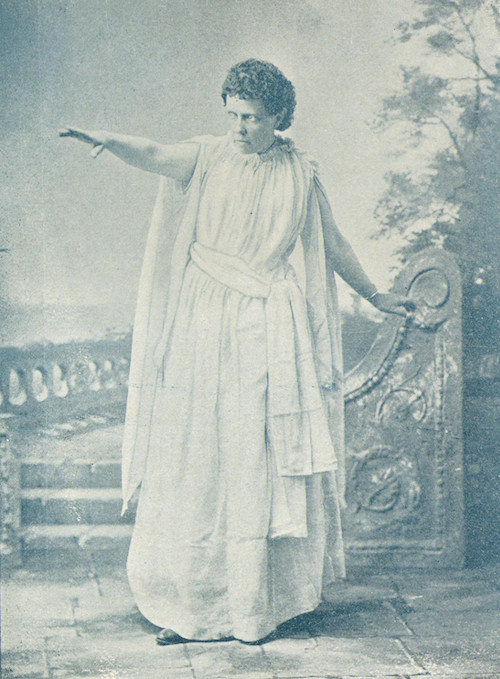
“Two fox-tails float and drift and drive adown the stream.”
A FARCE, IN ONE ACT.
CHARACTERS.
Scene: A City Street in the Morning.
(Tommy discovered standing in centre of stage, near flat, holding a string in right hand, to which are attached several small rubber balloons inflated with gas.)
Tommy.—Well, here goes for another hard day’s work. This standin’ on yer feet, an’ shoutin’ all day is wicked on the toes and lungs. Hello! here comes a swell. Balloons! balloons! Here’s yer genuine rubber air wessels filled with gas!
(Enter Dupewell—Left.)
Dupewell (Swinging cane and not noticing Tommy).—Something must be done to raise the wind.
Tommy.—Balloons! balloons! balloons!
Dupewell.—Shut up! shut up, sir! Your goods are too suggestive of the present state of my stomach.
Tommy.—Don’t lean on me that way; I’m a poor boy, I want to be encouraged, for me stock’s light, trade’s dull, and both pockets is empty.
Dupewell.—Poor fellow! Perhaps I can give you a start in life, but it all depends upon—
Tommy.—Oh, sir, I never had nobody to take me by the hand and say, “Tommy, here’s a chance, take it!” I’ve been lookin’ for a openin’ all me life—
Dupewell.—And the biggest kind of a one right under your nose. (Points cane at Tommy’s mouth.)
Tommy.—I can’t see it.
Dupewell.—Well, I’ll explain. How many balloons have you sold to-day?
Tommy.—Not one; haven’t broke a string.
Dupewell.—Good! People are beginning to throng the street. Now listen; if you will strictly obey all my instructions, I will to-night give you more cash, and a squarer meal than your pockets ever held or your palate ever tasted.
Tommy.—That’s what I dreamed last night; I seed a great big—
Dupewell.—Never mind your dream. What do you want for your balloons, all of them?
Tommy.—Fifty cents.
Dupewell.—If I purchase them, will you enter my employ at once, and promise to obey me, unquestioned, in all things?
Tommy.—When do you eat breakfast?
Dupewell.—In a short time; as soon as we attend to a small affair. Do you solemnly—
Tommy.—Hold on! I never swear. I’ll be bound, I’ll affirm, I’ll promise to agree; but don’t ask me to swear; ’tain’t right.
Dupewell.—That will answer; your word will do. (Takes half-dollar from pocket and looks at it.) (Aside.)—Farewell ’till next we meet. (Aloud.)—Well, sir, here is the money.
Tommy (Taking money).—Here’s your balloons.
Dupewell.—I don’t want them just now. Tommy, loan me that coin a few minutes.
Tommy (backing away).—Can’t do that.
Dupewell (angrily).—What! disobey my first request? Besides, you hold good collateral. (Points to balloons.)
Tommy (aside).—This is a bad openin’; he’s leanin’ on me heavy at the start. (Hands money to Dupewell.) I don’t see how I’m to make a profit on this sale.
Dupewell (hurriedly).—Tut! Now for business; mark what I say; there are some persons coming this way. I’ll step off in this direction a few paces. Watch me. When I raise my hat, let your balloons go, fall on your knees and groan; say nothing to any one, but groan in reply to every question. I will attend to the rest.
Tommy.—Let me hold the fifty cents.
Dupewell.—Silence. (Exit L.)
Tommy (looking after Dupewell).—That’s a queer fellow. I think I’ll skeet. Oh! there goes his hat. (Lets the balloons go, falls on his knees and groans.)
(Enter Oliver Openface—R.)
Openface (trying to assist Tommy to arise).—My poor fellow, what ails you? Do tell me, are you sick?
(Re-enter Dupewell—R.)
(Tommy groans and looks upward.)
Dupewell (to Openface).—Sad! sad! Know the man well; worthy case—sick wife—eleven children, oldest four years—wounded in late war—lost his balloons; look! (Points upward.)
Openface.—Ah, I see. (Pulls out handkerchief and wipes eyes.) What shall we do?
Dupewell.—Make donation—encourage honesty. (Hands fifty cents to Tommy, who takes it and groans.)
Openface (examining his wallet).—I have nothing less than a fifty-dollar bill. (Holds note in his hand.)
(Dupewell takes note.)
Openface.—Hold on, there. (Reaches for note.)
Dupewell.—No, no! Let this poor man get it changed around the corner; thoroughly honest—trusted him with thousands—be responsible myself. (Aside to Tommy)—Meet me at the Hero’s Inn. (Makes believe to give note to Tommy, but puts it in his own pocket.) (Aloud) Go, now! Run! The gentleman’s waiting. (Exit Tommy, running.)
Dupewell (touching Openface on arm and pointing up).—How small those balloons appear; a mere speck.
Openface (looking up).—I cannot see them; my eyes are too old.
Dupewell (points).—See! There they go! (Takes wallet from Openface’s pocket.) See! see!
Openface (impatiently).—I’d like to see that fellow coming with my change.
Dupewell (starting to go).—I’ll see what keeps him.
Openface.—But hold on—
Dupewell (aside).—That’s what I intend to do. (Taps wallet.) (Aloud.)—Be back in a second. (Exit R.—hurriedly.)
Openface.—I just recollect that there is a dollar bill in the middle pocket of my wallet; see what time I could have saved if—(feels in his pockets)—if—if—I had only—(still feeling in his pockets)—if I had only thought of it before. (Discovers that his wallet is gone.) Come back you, there! Watch! Thieves!
(Falls on his knees) Police! Police!
(Enter Policeman—R.)
Policeman (poking Openface in side with club).—Git up! Git up!
Openface.—Police! I’m robbed, I’m—I’m—murder!
(Enter Pedestrians—Running.)
Policeman.—He’s got ’em bad; a genteel case of the tremmens.
(Pedestrians laugh.)
Policeman.—Somebody git a push-cart; there’s one down at the corner grocery.
Pedestrian.—I
I’ll go, I’ll go! (Exit.)
Openface (attempts to rise).—Let me up, let me get up, I’m a——
Policeman (putting him down again).—Keep quiet; I’ve ordered the carriage; I’ll watch the snakes.
(Pedestrians laugh.)
Openface.—Let me speak.
Policeman (to pedestrians).—Here comes a lady. Clear the sidewalk.
(Pedestrians gather around Openface so that Tilly cannot see him.)
Policeman (aside).—What a beauty!
(Enter Tilly, carrying parasol.)
Tilly.—Dear me! I wonder what has happened.
Openface.—I am a gentleman, let me go! I have been basely robbed, let me go, I say!
Policeman.—Shut up! shut up!
Tilly.—That voice, that beloved voice! Surely I have heard that voice before!
Policeman (bowing low).—No doubt, lady, you have often listened to my tones when I’ve been on the beat——
Pedestrian (aside).—Which is all the time.
Tilly.—I do not mean your voice.
Openface (groans).—Let me rise.
Tilly.—’Tis he! My father!
Policeman (motioning her away).—Go home, Miss, go home; he’s got ’em bad; he wouldn’t know you.
Tilly (places handkerchief to her eyes).—My heart will surely break.
Policeman.—Oh! now we’ll get him off in good shape; here comes the push-cart.
(Enter Pedestrian, carrying an arm chair.)
Policeman.—Why didn’t you bring the barrow?
Pedestrian.—The groceryman just left with a load of onions and won’t be back for an hour.
Policeman.—Make way for the chair.
(Pedestrians divide to R. and L.)
Openface (stands up).—I will go straight to the Mayor and enter a complaint.
Tilly (rushes to Openface).—My father!
Openface.—My darling child! (They embrace.)
Tilly.—Oh, how did it happen?
Policeman.—What’s this mean?
Openface.—It means that I have been swindled on the highway, and that you have treated me in a villainous manner.
Pedestrians.—Hear! hear!
(Enter Dupewell and Tommy. The latter wears a straw hat and long linen duster.)
Openface.—I will give one hundred dollars for the arrest of the thieves!
Tilly.—And I will owe a debt of gratitude that years can ne’er efface.
Tommy (aside).—This is the opening I’ve been looking for. Here’s a chance for a fortune and a wife.—(Seizes Dupewell.)—(Aloud)—Here’s the thief!
Dupewell (takes wallet from his breast and slips it into Tommy’s pocket).—’Tis false, I deny the charge!
Policeman (arrests Dupewell).—Is this the man?
Openface.—He looks like one of the thieves, but I am not certain; the other one I could identify at once by his clothes.
Policeman.—If you cannot identify him I must let him go. (Releases Dupewell.)
Dupewell.—Pity must give way to justice;—(Points to Tommy)—Seize him, he is the robber!
Policeman.—Ah, ha! Come here. (Taking hold of Tommy.)
Dupewell.—Feel his pockets, search him.
Tommy.—You’re welcome to feel in these pockets. I’ve got nothing but loose change, the proceeds of a horse I just sold.
Policeman.—Let me see. (Taking wallet from Tommy’s pocket.) Is this your property? (Hands it to Openface.)
Openface.—It is; and yet I never saw this man before!
Tommy.—Of course he didn’t.
Dupewell.—Take off his coat and hat.
Policeman.—Come sir; take them off!
Tommy (struggles to escape).—I didn’t take it; I didn’t, I didn’t, let me go!
Dupewell (assists to remove Tommy’s hat and duster).—Now—(to Openface),—is this the culprit?
Openface.—It is; just as the rascal appeared when he committed the crime.
Dupewell.—I claim the reward.
Openface.—Come home with me. You shall dine with me; I will then reward you; you shall be my friend for life!
Policeman.—Bring the chair here.
Tilly.—Never mind sir; papa will order a coupé.
Policeman.—It is for this rogue. (Tommy is forced into the chair, after which it is raised up by two pedestrians, a third using Tommy’s legs for shafts.)
Tommy.—Bad luck’s leanin’ on me heavy—at last I’ve found an openin’; but it’s the openin’ of the jail door. Ah! it’s all wrong, it’s all wrong.
(All form in line with Tommy at the head; Dupewell supports Tilly on his arm; next Openface and Pedestrians.)
Policeman.—Forward, march!
(March is played by Piano or Orchestra, while procession countermarches.)
Tommy (kicking in chair).—It’s all wrong! It’s all wrong! wrong! Balloons! balloons! it’s all wrong.
Openface.—Hold! (The procession halts.) My dear sir, (to Dupewell) the cry of balloons! balloons! from that young man in the chair reminds me that I had my wallet when you called my attention to the fugitive balloons that were growing smaller and smaller as they arose in the air!
Dupewell.—Well, sir!
Openface.—It is not well, sir, for you, sir, for I had my wallet then, and it was only after you left me that I missed it. Release the unhappy youth and let the iron talons of the law clutch this monstrous scoundrel who would fasten his crime upon a verdant youth.
(Tommy is released and Dupewell is placed in the chair.)
Tommy.—Luck’s openin’ an’ shuttin’ like an alligator’s jaw; where’ll it end?
Tilly.—You shall go home with us; we will try to educate you and give you profitable employment.
Openface.—It is even so; I will get you a government appointment, but! but, sir! hereafter beware of taking up with strangers in matters of business; bad associates have ruined many a man. Let the phalanx move.
(Music continues.)
Policeman.—Forward, march!
(Procession countermarches.)
Dupewell (will).—It’s all wrong! it’s all wrong! it’s all wrong!
[Curtain.]
—Geo. M. Vickers.
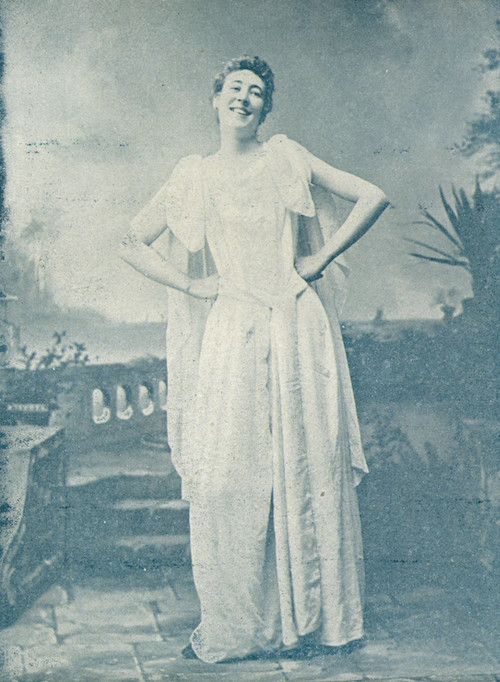
“Ha, ha, ha! well, I believe I do bear a part with a tolerable grace.”
She had never mailed a letter before, and so she approached the stamp clerk’s window with the same air that she would enter a dry goods store.
“I would like to look at some stamps, please,” she said.
“What denomination do you want?” asked the clerk.
“Denomination!” This was remarked in surprise. She hadn’t supposed that stamps belonged to any church at all.
“Yes,” replied the clerk, who saw no necessity for holding a lengthy palaver over the sale of a stamp, especially when other people were waiting. “Is it for a letter or a newspaper?”
“Oh, I want to send a letter to my Uncle John; he’s just moved to—”
“Then you need a two-cent stamp,” interrupted the clerk, offering her one of that value.
“I hardly like that color,” she observed, holding the brick-tinted stamp up to the light and surveying it critically.
The clerk looked at her in astonishment. In his long experience in the postal business he had never before met a customer who objected to the color of the stamps.
“That is a two-cent stamp, madame. Please stand aside and let the gentleman behind you come up.”
“Haven’t you got them in any other color?” she asked, wholly oblivious to the “gentleman behind.”
The clerk began to act cross.
“I never did like that shade of red,” she added.
“There is only one color,” he replied, curtly.
“That is strange,” she mused. “I’d think you’d keep them in different shades, so that there’d be some choice.”
The clerk said nothing, but he kept getting crosser every minute, and murmurs of disapprobation began to rise from the ever-lengthening line of people who would have been thankful to get their stamps without criticizing their hue.
“You are sure you have none in a brighter red, or even in a different color—Nile green, or seal brown, or jubilee blue, for instance?”
“You can put two one-cent stamps on your letter if you like,” said the clerk, who began to see that the customer could not be frowned away from the window.
“Let me see them, please.”
Two blue stamps were solemnly handed to her, and the crowd began to hope that at last she was suited.
“Ah, that will do,” she said, as she took up the one-cent stamps and eyed them as if they were samples of dress goods. “I like that shade better. I’ll take only one, if you please.”
And she handed the other back to the clerk, who took it mechanically, but managed to add:
“If it’s for a letter you’ll need two. These are one-cent stamps and letter postage is two cents per ounce.”
“Oh, I don’t want to put two stamps on my letter,” she said; “I don’t think they will look well.”
“It requires two cents to carry a letter, madame, and you must either put a two-cent stamp on or two ones. It won’t go without. And I must ask you to please hurry, for you are keeping a great many people away from the window.”
“That’s singular. I don’t like the look of two together. You are sure the other doesn’t come in seal brown, or”—
“No!” thundered the clerk, getting very red in the face.
“Then I’ll have to see if I can’t suit myself elsewhere.”
And she departed.
The clerk replaced his despised red and blue stamps, mopped his perspiring brow, and began to make up for lost time.
The trumpet sounded short and sharp. The starters, one for each chariot, leaped down, ready to give assistance if any of the fours proved unmanageable. Again the trumpet blew, and simultaneously the gate-keepers threw[765] the stalls open. Forth from each stall, like missiles in a volley from so many great guns, rushed[766] the six contesting fours—the Corinthian’s, Messala’s, the Athenian’s, the Byzantine’s, the Sidonian’s, and Ben-Hur’s—and the vast assemblage rose[767] and, leaping upon the benches, filled[768] the circus with yells and screams.
The competitors were under view from nearly every part[769] of the circus, yet the race was not begun; they had first to make successfully the chalked line, stretched for the purpose of equalizing the start. If it were dashed upon, discomfiture of man and horses might occur; on the other hand, to approach it timidly was to incur the hazard of being thrown behind in the beginning of the race—a certain loss of the great advantage of being next the wall[770] on the inner line of the course.
Each driver looked first for the rope, then for the coveted inner line. With all six aiming at the same point[771] and speeding furiously, a collision seemed inevitable. Quick the eye, steady the hand, unerring the judgment required. The fours neared the rope together. Ben-Hur was on the extreme left[772] of the six. At Messala, who was more than an antagonist to him, he gave one searching look, and saw the soul of the man, cunning, cruel, desperate, in a tension of watchfulness and fierce resolve.
In that brief instant all his former relations with Messala came before him. First, happy childhood, when, loving and beloved, they played together. Then, manhood that brought a change in Messala, and the Roman’s inborn contempt of Jews asserted itself and broke the friendship. Then the bitter day, when, by the accidental falling of a loose tile, the Roman procurator was nearly killed, and he, Ben-Hur, was accused of willfully throwing the missile. One word from Messala would have saved the family from ruin, but the word was not spoken. Nay, more, it was Messala that urged on the Roman authorities and prevented even a fair trial of the case. It was Messala’s influence that had banished[773] him to the galleys for life, that had consigned his mother and sister to an uncertain fate, whose very uncertainty was more torture[774] than their certain death would have been. It was Messala that had stolen his property and with it had bought the silence of the authorities on the cruel deeds; and was it not money that belonged to the House of Hur that Messala was betting with in this very race? Was it human nature[775] to resist an opportunity for vengeance like this? No.[776] At whatever cost[777] he would humble his enemy.
He saw that Messala’s rush would, if there was no collision, and the rope fell, give him the wall. Therefore, he yielded it for the time. Just then the trumpeter blew a signal. The judges dropped[778] the rope. And not an instant too soon, for the hoof of one of Messala’s horses struck it as it fell. The Roman shook out[779] his long lash, loosed the reins, leaned forward, and with a triumphant shout[780] took the wall.
“Jove with us![781] Jove with us!”[781a] yelled the Roman faction, in a frenzy of delight.
“Jove with us!”[782] screamed a young nobleman.
“He wins![783] Jove with us!” answered his associates.
Messala having passed, the Corinthian was the only contestant on the Athenian’s right, and to his side he tried to turn his four; but the wheel of the Byzantine, who was next on the left, struck the tail-piece of his chariot, knocking[784] his feet from under him. There was a crash, a scream of rage and fear, and the unfortunate Athenian fell[785] under the hoofs of his own steeds. Sanballat, a friend of Ben-Hur, turned to a group of Roman noblemen.
“A hundred sestertii on the Jew!”[786] he cried.
“Taken!”[787] answered one of the group.
“Another hundred on the Jew!” shouted Sanballat. Nobody appeared to hear him. The situation below was too absorbing, and they were too busy shouting, “Messala! Messala! Jove with us!”
While the spectators were shivering at the Athenian’s mishap, and the Sidonian, Byzantine, and Corinthian were striving to avoid involvement in the ruin, Ben-Hur drew head to the right,[788] and, with all the speed of his Arabs, darted[789] across the trails of his opponents, and took the course[790] neck and neck with Messala, though on the outside. And now, racing together, side by side, a narrow interval between them, the two neared the second goal. Making the turn here was considered the most telling test of a charioteer. A hush[791] fell over the circus. Then, it would seem, Messala observed Ben-Hur and recognized him, and at once the audacity of the man flamed out.
“Down, Eros![792] up, Mars!”[793] he shouted, whirling his lash. “Down, Eros! up, Mars!” he repeated, and gave the Arab steeds of Ben-Hur a cut, the like of which they had never known.
The blow was seen in every quarter. The silence deepened and the boldest held his breath.[794] The affrighted four sprang forward[795] as with one impulse, and forward leaped[796] the car. The car trembled with a dizzy lurch, but Ben-Hur kept his place and gave the horses free rein, and called to them in a soothing voice, trying to guide them round[797] the dangerous turn, and before the fever of the people began to abate he had back the mastery. Nor that only; on approaching the first goal he was again side by side with Messala, bearing with him the sympathy and admiration of every one[798] not a Roman. Even Messala, with all his boldness, felt it unsafe to trifle further.
On[799] whirled the cars. Three rounds were concluded; still Messala held the inside position; still Ben-Hur moved with him side by side; still the other competitors followed as before. The contest began to have the appearance of a double race, Messala and Ben-Hur in the first, the Corinthian, Sidonian, and Byzantine in the second. In the fifth round the Sidonian succeeded in getting a place outside Ben-Hur, but lost it directly. The sixth round was entered upon without change of relative position. Gradually the speed had been quickened; men and beasts seemed to know alike that the final crisis was near. The interest, which from the beginning had centred chiefly in the struggle between the Roman and the Jew, with an intense general sympathy for the latter, was fast changing to anxiety on his account. On all the benches the spectators bent forward, motionless.
“A hundred sestertii on the Jew!”[800] cried Sanballat to the Romans.
There was no reply.
“A talent, or five talents, or ten;[801] choose ye!”
“I will take thy sestertii,” answered a Roman youth.
“Do not so,” interposed a friend.
“Why?”
“Messala has reached his utmost speed. See him[802] lean over his chariot-rim, the reins loose as flying ribbons, then look at the Jew!”
“By Hercules!” replied the youth, “I see, I see! If the gods help him not, he will be run away with by the Israelite. No; not yet! Look![803] Jove with us! Jove with us!”
If it were true that Messala had gained his utmost speed, he was slowly but certainly beginning to forge ahead. His horses were running with their heads low down; from the balcony their bodies appeared actually to skim the earth; their nostrils showed blood-red in expansion; their eyes seemed straining in their sockets. The good steeds were doing their best! How long could they keep the pace? It was but the commencement of the sixth round. On they dashed! As they neared the second goal, Ben-Hur turned in behind[804] the Roman’s car. The joy of the Messala faction reached its bound. They screamed, and howled, and tossed[805] their colors, and Sanballat filled his tablets with their wagers. Ben-Hur was hardly holding a place at the tail of his enemy’s car.
Along the home-stretch—sixth round—Messala leading; next him, pressing close, Ben-Hur. Thus to the first goal, and around it, Messala, fearful of losing his place, hugged the stony wall with perilous clasp; a foot to the left[806] and he had been dashed[807] to pieces; yet when the turn was finished, no man, looking at the wheel-tracks of the two cars, could have said, “Here[808] went Messala, there[809] the Jew.” They left but one trace behind them.
And now all the people drew a long breath, for the beginning of the end was at hand. First, the Sidonian gave the scourge to his four, and they dashed[810] desperately forward, promising for an instant to go to the front. The effort ended in promise. Next, the Byzantine and the Corinthian each made the trial with like result, after which they were practically out of the race. Thereupon, all the factions except the Romans joined hope in Ben-Hur, and openly indulged their feeling.
“Ben-Hur! Ben-Hur!”[811] they shouted. “Speed thee,[812] Jew!”
“Take the wall now!”
“On![813] loose the Arabs! Give them rein and scourge!”
“Let him not have the turn on thee again. Now or never!”[814]
Either he did not hear, or could not do better, for half-way round the course and he was still following; at the second goal, even still no change.
And now, to make the turn, Messala began to draw in[815] his left-hand steeds. His spirit was high; the Roman genius was still present. On the pillars,[816] only six hundred feet away, were fame, fortune, promotion, and a triumph[817] ineffably sweetened by hate,[818] all in store for him! That moment Ben-Hur leaned forward over his Arabs and gave them the reins.[819] Out flew[820] the many-folded lash in his hand; over the backs of the startled steeds it writhed[821] and hissed,[822] and hissed[823] and writhed[824] again and again, and, though it fell not, there were both sting and menace in its quick report. Instantly, not one, but the four as one, answered with a leap[825] that landed them alongside the Roman’s car. Messala, on the perilous edge of the goal, heard but dared not look to see what the awakening portended. The thousands on the benches understood it all. They saw the four close outside Messala’s outer wheel, Ben-Hur’s inner wheel behind the other’s car. Then, with a cunning touch[826] of the reins, Ben-Hur caught Messala’s fragile wheel with the iron-shod point of his axle and crushed[827] it. There was a crash loud enough to send a thrill through the circus, and out over[828] the course a spray of shining white and yellow flinders flew. Down on its right side toppled the bed of the Roman’s chariot. There was a rebound, as of the axle hitting the hard earth; another and another; then the car went to pieces, and Messala, entangled in the reins, pitched forward[829] headlong, and lay still, crushed, and bleeding, and crippled for life. Above the noises of the race arose one voice, that of Ben-Hur:
[830]“On, Altair! On, Rigel! What, Antares! dost thou linger now? Good horse-oho, Aldebaran! I hear them singing in the tents. I hear the children singing, and the women singing of the stars, of Altair, Antares, Rigel, Aldebaran, victory—and the song will never end. Well done! On, Antares! The tribe is waiting for us, and the master is waiting! ’tis done! ’tis done! Ha! ha! We have overthrown the proud! The hand that smote us is in the dust! Ours the glory! Ha! ha!—steady! The work is done—soho! Rest!”
And Ben-Hur turned the goal of victory and revenge,[831] and the race was won![832]
—Gen. Lew Wallace.
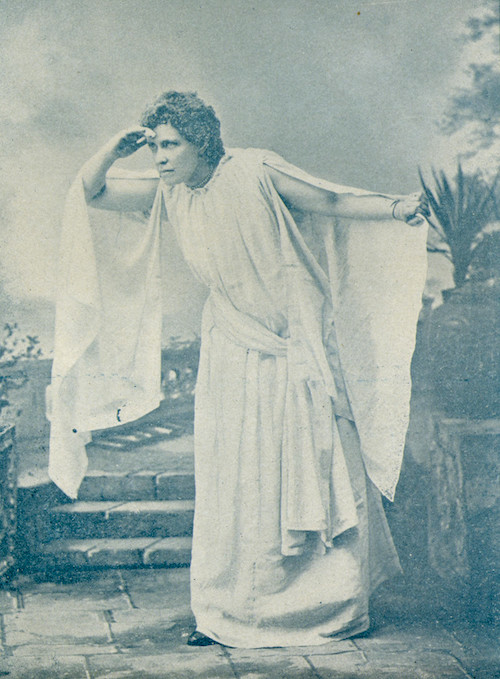
Act III.
Scene II. Belmont. A room in Portia’s house. Enter Bassanio, Portia, Gratiano, Nerissa, and attendants.
Extract from an oration delivered upon the occasion of the first Centenary Anniversary of the Encampment at Valley Forge.
My countrymen, the century that has gone by[999] has changed the face of nature and wrought a revolution in the habits of mankind. We stand to-day at the dawn[1000] of an extraordinary age. Freed[1001] from the chains of ancient thought and superstition, man has begun to win the most extraordinary victories in the domain of science. One by one he has dispelled[1002] the doubts of the ancient world. Nothing is too difficult for his hand to attempt—no region too remote[1003]—no place too sacred[1004] for his daring eye to penetrate. He has robbed the earth[1005] of her secrets and sought to solve the mysteries of the heavens![1006] He has secured and chained[1007] to his service the elemental forces of nature—he has made the fire[1008] his steed—the winds[1009] his ministers—the seas[1010] his pathway—the lightning[1011] his messenger. He has descended into the bowels[1012] of the earth, and walked in safety on the bottom[1013] of the sea. He has raised his head above the clouds,[1014] and made the impalpable air[1015] his resting-place. He has tried to analyze the stars, count[1016] the constellations, and weigh the sun. He has advanced with such astounding speed[1017] that, breathless, we have reached a moment when it seems as if distance had been annihilated,[1018] time made as naught, the invisible seen, the inaudible heard, the unspeakable spoken, the intangible felt, the impossible accomplished.[1019] And already we knock at the door of a new century[1020] which promises to be infinitely brighter[1021] and more enlightened and happier than this. But in all this blaze of light which illuminates the present and casts its reflection into the distant recesses of the past, there is not a single ray which shoots into the future.[1022] Not one step have we taken toward the solution of the mystery of life. That remains as dark and unfathomable[1023] as it was ten thousand years ago.
We know[1024] that we are more fortunate than our fathers. We believe[1025] that our children shall be happier than we. We know[1026] that this century is more enlightened than the last. We believe that the time to come[1027] will be better and more glorious than this. We think, we believe, we hope, but we do not know.[1028] Across that threshold[1029] we may not pass; behind that veil we may not penetrate. Into that country it may not be for us to go. It may be vouchsafed to us to behold[1030] it, wonderingly, from afar, but never to enter in. It matters not. The age in which we live is but a link in the endless and eternal chain. Our lives are like the sands upon the shore;[1031] our voices like the breath of this summer breeze[1032] that stirs the leaf for a moment and is forgotten. Whence we have come and whither we shall go, not one[1033] of us can tell. And the last survivor of this mighty multitude shall stay but a little while.
But in the impenetrable To Be, the endless generations are advancing[1034] to take our places as we fall. For them as for us shall the earth roll on[1035] and the seasons come and go, the snowflakes fall, the flowers bloom, and the harvests be gathered in. For them as for us shall the sun, like the life of man, rise out[1036] of darkness in the morning and sink[1037] into darkness in the night. For them as for us shall the years march by[1038] in the sublime procession of the ages. And here,[1039] in this place of sacrifice, in this vale of humiliation, in this valley of the shadow[1040] of that Death out of which the life of America arose, regenerate and free, let us believe with an abiding faith[1041] that, to them, Union will seem as dear,[1042] and Liberty as sweet,[1043] and Progress as glorious,[1044] as they were to our fathers and are to you[1045] and me, and that the institutions which have made us happy, preserved by the virtue of our children, shall bless the remotest generations of the time to come.[1046] And unto Him[1047] who holds in the hollow of His hand the fate of nations, and yet marks[1048] the sparrow’s fall, let us lift up our hearts this day, and into His eternal care[1049] commend ourselves, our children, and our country.
—H. A. Brown.
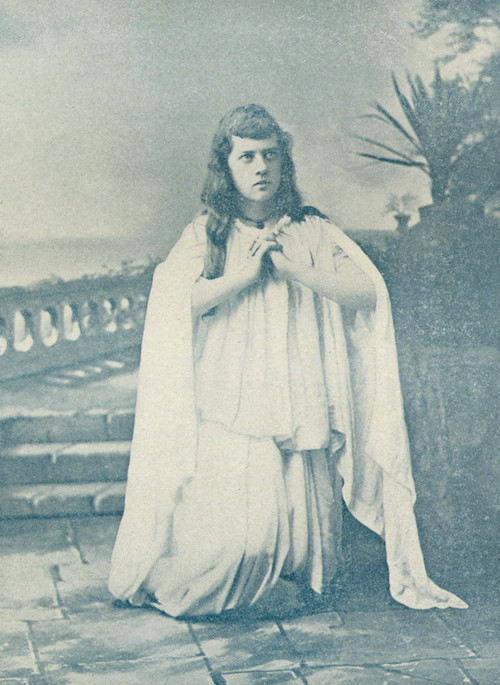
“Now I lay me down to sleep.”
Jud Brownin, when visiting New York, goes to hear Rubinstein, and gives the following description of his playing.
Well, sir, he had the blamedest, biggest, catty-cornedest pianner you ever laid eyes on; somethin’ like a distracted billiard-table on three legs. The lid was hoisted, and mighty well it was. If it hadn’t been, he’d a tore the entire inside clean out and scattered ’em to the four winds of heaven.
Played well? You bet he did; but don’t interrupt me. When he first sit down, he ’peared to keer mighty little ’bout playin’, and wisht he hadn’t come. He tweedle-leedled a little on the treble, and twoodle-oodled some on the base—just foolin’ and boxin’ the thing’s jaws for bein’ in the way. And I says to a man settin’ next to me, says I, “What sort of fool playin’ is that?” And he says, “Heish!” But presently his hands commenced chasin’ one another up and down the keys like a parcel of rats scamperin’ through a garret very swift. Parts of it was sweet, though, and reminded me of a sugar squirrel turnin’ the wheel of a candy cage.
“Now,” I says to my neighbor, “he’s showin’ off. He thinks he’s a doin’ of it, but he ain’t got no idee, no plan of nothin’. If he’d play me a tune of some kind or other, I’d—”
But my neighbor says, “Heish,” very impatient.
I was just about to get up and go home, bein’ tired of that foolishness, when I heard a little bird wakin’ up away off in the woods, and call sleepy-like to his mate, and I looked up and see that Ruby was beginning to take some interest in his business, and I sit down again. It was the peep of day. The light came faint from the east, the breezes blowed gentle and fresh; some more birds waked up in the orchard, then some more in the trees near the house, and all begun singin’ together. People began to stir, and the gal opened the shutters. Just then the first beam of the sun fell upon the blossoms a little more, and it techt the roses on the bushes, and the next thing it was broad day; the sun fairly blazed, the birds sung like they’d split their little throats; all the leaves was movin’, and flashin’ diamonds of dew, and the whole wide world was bright and happy as a king. Seemed to me like there was a good breakfast in every house in the land, and not a sick child or woman anywhere. It was a fine mornin’.
And I says to my neighbor, “That’s music, that is.”
But he glared at me like he’d like to cut my throat.
Presently the wind turned; it began to thicken up, and a kind of gray mist came over things; I got low-spirited directly. Then a silver rain begun to fall. I could see the drops touch the ground; some flashed up like long pearl earrings, and the rest rolled away like round rubies. It was pretty, but melancholy. Then the pearls gathered themselves into long strands and necklaces, and then they melted into thin silver streams, runnin’ between golden gravels, and then the streams joined each other at the bottom of the hill, and made a brook that flowed silent, except that you could kinder see the music, specially when the bushes on the banks moved as the music went along down the valley. I could smell the flowers in the meadow. But the sun didn’t shine, nor the birds sing; it was a foggy day, but not cold.
The most curious thing was the little white angel boy, like you see in pictures, that run ahead of the music brook and led it on, and on, away out of the world, where no man ever was, certain. I could see that boy just as plain as I see you. Then the moonlight came, without any sunset, and shone on the graveyards where some few ghosts lifted their hands and went over the wall, and between the black, sharp-top trees, splendid marble houses rose up, with fine ladies in the lit-up windows, and men that loved ’em, but could never get a-nigh ’em, who played on guitars under the trees, and made me that miserable I could have cried, because I wanted to love somebody, I don’t know who, better than the men with the guitars did.
Then the sun went down, it got dark, the wind moaned and wept like a lost child for its dead mother, and I could a got up then and there and preached a better sermon than any I ever listened to. There wasn’t a thing in the world left to live for, not a blame thing, and yet I didn’t want the music to stop one bit. It was happier to be miserable than to be happy without being miserable. I couldn’t understand it. I hung my head and pulled out my handkerchief, and blowed my nose loud to keep me from cryin’. My eyes is weak, anyway. I didn’t want anybody to be a-gazin’ at me a-snivelin’, and it’s nobody’s business what I do with my nose. It’s mine. But some several glared at me, mad as blazes. Then, all of a sudden, old Rubin changed his tune. He ripped out and he rared, he tipped and he tared, he pranced and he charged like the grand entry at a circus. ’Peared to me that all the gas in the house was turned on at once, things got so bright, and I hilt up my head, ready to look any man in the face, and afraid of nothin’. It was a circus, and a brass band, and a big ball all a-goin’ on at the same time. He lit into them keys like a thousand of brick; he gave ’em no rest day or night; he set every livin’ joint in me a-goin’; and, not bein’ able to stand it no longer, I jumped, sprang onto my seat, and jest hollered:
“Go it, Rube!”
Every blamed man, woman, and child in the house riz on me and shouted, “Put him out! Put him out!”
“Put your great-grandmother’s grizzly-gray-greenish cat into the middle of next month!” I says. “Tech me, if you dare! I paid my money, and you just come a-nigh me!”
With that some several policemen run up, and I had to simmer down. But I could ’a’ fit any fool that laid hands on me, for I was bound to hear Ruby out or die.
He had changed his tune again. He hop-light ladies and tip-toed fine from end to end of the key-board. He played soft and low and solemn. I heard the church-bells over the hills. The candles of heaven was lit, one by one I saw the stars rise. The great organ of eternity began to play from the world’s end to the world’s end, and all the angels went to prayers. * * * Then the music changed to water; full of feeling that couldn’t be thought, and began to drop—drip, drop—drip, drop, clear and sweet, like tears of joy falling into a lake of glory. It was sweeter than that. It was as sweet as a sweetheart sweetened with white sugar mixt with powdered silver and seed diamonds. It was too sweet. I tell you the audience cheered. Rubin he kinder bowed like he wanted to say, “Much obleeged, but I’d rather you wouldn’t interrup’ me.”
He stopt a moment or two to ketch breath. Then he got mad. He run his fingers through his hair, he shoved up his sleeves, he opened his coat-tails a leetle further, he drug up his stool, he leaned over, and, sir, he just went for that old pianner. He slapt her face, he boxed her jaws, he pulled her nose, he pinched her ears, and he scratched her cheeks, until she fairly yelled. He knockt her down, and he stampt on her shameful. She bellowed, she bleated like a calf, she howled like a hound, she squealed like a pig, she shrieked like a rat, and then he wouldn’t let her up. He ran a quarter-stretch down the low grounds of the base, till he got clean in the bowels of the earth, and you heard thunder galloping after thunder, through the hollows and caves of perdition, and then he fox-chased his right hand with his left till he got way out of the treble into the clouds, whar the notes was finer than the pints of cambric needles, and you couldn’t hear nothin’ but the shadders of ’em. And then he wouldn’t let the old pianner go. He for’ard two’d, he crost over first gentleman, he chassade right and left, back to your places, he all hands’d aroun’ ladies to the right, promenade all, in and out, here and there, back and forth, up and down, perpetual motion, double twisted and turned and tacked and tangled into forty eleven thousand double bow knots.
By jinks! it was a mixtery. And then he wouldn’t let the old pianner go. He fecht up his right wing, he fecht up his left wing, he fecht up his centre, he fecht up his reserves. He fired by file, he fired by platoons, by company, by regiments, and by brigades. He opened his cannon—siege guns down thar, Napoleons here, twelve-pounders yonder—big guns, little guns, middle-sized guns, round shot, shells, shrapnels, grape, canister, mortar, mines, and magazines, every livin’ battery and bomb a-goin’ at the same time. The house trembled, the lights danced, the walls shuk, the floor come up, the ceilin’ come down, the sky split, the ground rokt—heavens and earth, creation, sweet potatoes, Moses, ninepences, glory, tenpenny nails, Sampson in a ’simmon tree, Tump Tompson in a tumbler-cart, roodle-oodle-oodle-oodle—ruddle-uddle-uddle-uddle—raddle-addle-addle-addle—riddle-iddle-iddle-iddle—reedle-eedle-eedle-eedle—p-r-r-r-r-r-lang! Bang!!!! lang! per-lang! p-r-r-r-r-r! Bang!!!
With that bang! he lifted himself bodily into the air, and he come down with his knees, his ten fingers, his ten toes, his elbows, and his nose, striking every single, solitary key on the pianner at the same time. The thing busted, and went off into seventeen hundred and fifty-seven thousand five hundred and forty-two hemi-demi-semi-quivers, and I know’d no mo’.
When I come to, I were under ground about twenty foot, in a place they call Oyster Bay, a-treatin’ a Yankee that I never laid eyes on before, and never expect to again. Day was br’akin’ by the time I got to the St. Nicholas Hotel, and I pledge you my word I did not know my name. The man asked me the number of my room, and I told him, “Hot music on the half-shell for two!”
Adapted from Helen Potter’s rendering, by Frances E. Peirce.
Nydia was a Thessalonian, and well-born. Being taken prisoner by the Romans, she was sold into slavery, and treated with great cruelty. Her blindness, beauty, and pitiful condition appealed to the sympathies of Glaucus, a wealthy young Athenian, who purchased her. Arbaces, envious of her possession, and an enemy of Glaucus, captured and imprisoned her, and caused Glaucus to be accused of murder and condemned to fight a lion in the arena. The lion refused, however, to touch him, and Nydia, escaping from her prison at the time of the dreadful eruption of Vesuvius, found Glaucus, and conducted him and his fiancée to the sea. Finding that he loved another, she drowned herself.
Kind Sosia, chide[1050] me not. I cannot endure to be so long alone; the solitude appals[1051] me. Sit with me, I pray, a little while. Nay,[1052] fear not that I should attempt to escape. Place thy seat[1053] before the door. Keep thine eye on me, I will not stir from this spot. Alas! why[1054] am I imprisoned here? [1055]What is the hour? Evening, thou sayest? Hast thou heard how went the trial of the Athenian, Glaucus? He is condemned for shedding priestly blood![1056] The gods forbid! ’Tis false, ’tis false, I say! Arbaces saw[1057] the deed? Arbaces, the Egyptian? Arbaces hates the priest; hates Glaucus, too. Come, Truth,[1058] and triumph o’er thy foes. (Exit Sosia.)
What shrieks are those I hear;[1059] so near and yet so far! It seems this way,[1060] here! Ah! yes. (Calls.) Who is it in distress? Who cries aloud? Calenus, the priest? What, you saw Arbaces strike the blow! Then you can prove dear Glaucus innocent. But why are you here? (Aside.) Ah! me! if free to speak, he could save[1061] my master! (Calls again.) Listen, if you were free, would you give testimony against Arbaces, the rich and powerful Arbaces? Would you the truth proclaim? Would you save the Athenian? Your priestly word can save him. If I procure you liberty, you will not play me false? No, no! I will not doubt you; you could not be so cruel! Remember, Calenus, you have promised![1062]
How can I release the priest?[1063] how best the truth make known? how gain the præetor’s ear? Ah! these gems[1064] I have worn so long may clear the way. I was not born a slave—no, no! My birth is equal his. Why, then freedom would give me the right to love dear Glaucus.
Sosia! Sosia! Come hither,[1065] guard. Sosia, how much dost thou require to make up the purchase of thy freedom? Two thousand sesterces! The gods be praised![1066] Not more? Seest thou these bracelets[1067] and this chain?[1068] I’ll give them thee if thou wilt let me out, only for one little hour; let me out at midnight; I will return before to-morrow’s dawn; nay, thou[1069] canst go with me, keep me in sight, and bring me back again. How could I flee from thee against thy will? I am blind! Thou sayest me nay?[1070] Is there no hope, then? Oh! he is leaving me![1071] I shall go mad,[1072] mad! Stay,[1073] one moment—only one—thou wilt not at least refuse to take a letter for me; thy master cannot kill thee for that. Thou wilt? The gods be praised![1074] Bring me a tablet of wax and a stilus. (Writes.)
“[1075]Nydia, the slave, to Sallust, the friend of Glaucus. I am a prisoner in the house of Arbaces. Hasten to the prætor and procure my release, and we shall yet save Glaucus from the lion. There is another prisoner within these walls, whose witness can exonerate the Athenian from the charge against him; one who saw the crime—who can prove the criminal is a villain hitherto unsuspected. Fly! hasten! quick! quick! Bring with you armed men, lest resistance be made, and a cunning and dexterous smith; for the dungeon of my fellow-prisoner is thick and strong. Oh! by thy right hand, and thy father’s ashes, lose not a moment.”
Sosia, I am blind and in prison. Thou mayest think to deceive me—thou mayest pretend only to take the letter to Sallust, but here I solemnly dedicate[1076] thy head to vengeance, thy soul to the infernal[1077] powers, if thou wrongest thy trust, and I call upon thee to place thy right hand of faith in mine,[1078] and repeat after me these words: “By the ground on which we stand—by the elements which contain life, and can curse life—by Orcus, the all-avenging—by the Olympian Jupiter, the all-seeing—I swear that I will discharge my trust and faithfully deliver into the hands of Sallust this letter. And if I perjure myself in this oath, may the full curses of heaven and hell be wreaked upon me.” Enough!—I trust thee—take thy reward.[1079] It is already dark—depart at once. (Exit Sosia.)
And I, alas, I am a slave forevermore.[1080] No more can look for freedom—for love. Tears, tears! Why, why should eyes that cannot see have power to weep?
Hark![1081] the lion roars as if in fear. It is the amphitheatre and the games are on! I hear a cry, I hear a voice[1082]—“The lion touches not the victim!” Aye, even the wild beasts love Glaucus. “Arbaces, the Egyptian, is the murderer! Glaucus is innocent! Set him free! Set him free!” He is saved, he is saved![1083] What heaviness[1084] fills the air? The ground trembles as though rocked by an earthquake, or is it the throbbing of my heart?[1085] What does it mean? Sosia, Sosia! Unlock the door and let me out. [1086]What sounds do I hear? What thunder shakes the ground; what cries—what strange sounds; the air is hot and stifling—I cannot breathe! Oh! Sallust, is that thy voice? Speak! and tell me what has happened. Vesuvius all ablaze, and the sun gone down at noon? Ah! the gods[1087] are angry! Canst thou tell me of Glaucus? Hast thou seen him? crouched beneath the arch of the Forum? Ah, then, I can find him, for I am free! Some friendly hand slipped the bolts of my prison.
[1088]Glaucus! Glaucus! How can I hope to reach his ears amidst all this tumult and confusion? Hark![1089] a new sound comes from afar. It is the chant of the Christians on their way to their temple to worship.
(Chanted.)
Glaucus! Glaucus![1090] He answers my call. Ah! take[1091] my hand; this way,[1092] this way; to the sea, to the sea! Trust me, I know the way! To the sea, to the sea! (Exit.)
(Chant off the stage.)
—Lord Lytton.
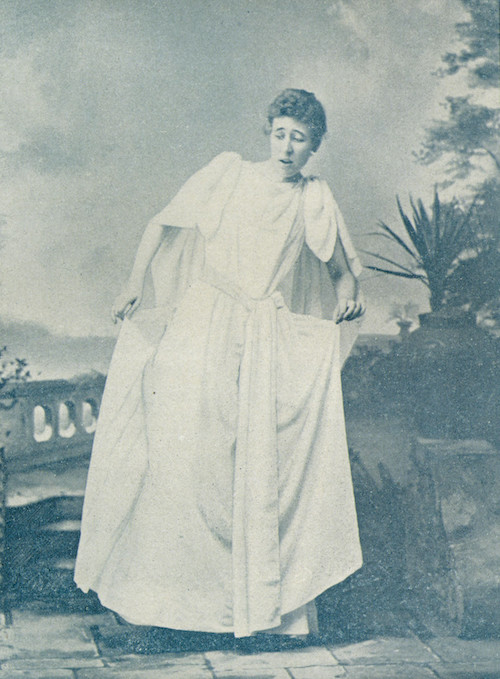
“Shoo! shoo! a mouse, a great mouse! shoo! shoo!”
ADAPTED BY FRANCES E. PEIRCE.
Argument.—Henry Bertram is stolen by the gypsies when a child; he is abandoned by them, serves in the army, and finally wanders back to his native place. The gypsies discover him, and, to extort money from the man who holds illegal possession of young Bertram’s estates, conspire to carry him off by force or to murder him. From this dilemma old Meg Merrilies delivers him at the peril of her life. Shot by her own people, she dies heroically proclaiming his heirship to the estates of Ellangowan.
Act II.
Scene III. A wild forest, cliff and hills in the distance; a gypsy hut in the centre.
Bert.—My good woman, do you know me, that you look at me so hard?
Meg.—Ay, better than you know yourself!
Bert.—Aye, aye. That is, you’ll tell my fortune.
Meg.—Yes, because I know your past.
Bert.—Indeed! Then you have read a perplexed page.
Meg.—It will be clearer soon.
Bert.—Never less likely.
Meg.—Never more so! If, with a simple spell, I cannot recall times which you have long forgotten, hold me the most miserable impostor. Hear me, hear me, Henry—Henry Bertram! Hark! hark to the sound of other days! Listen, and let your heart awake. (Sings. Air, Gypsy Girl.)
Bert.—These words do, indeed, thrill my bosom with strange emotions. Woman, speak more plainly, and tell me why those sounds thus agitate my inmost soul, and what ideas they are that thus darkly throng upon my mind at hearing them.
Meg.—
Bert.—Bertram! Bertram! Why does that name sound so familiar to me?
Meg.—And now, begone! Franco, Franco, guide these strangers on their way to Kippletringan; Kippletringan! Yet stay; let me see your hand. What say these lines of fortunes past? Wandering, and woe, and danger, and crosses in love and friendship! What of the future? Honor, wealth, prosperity, love rewarded and friendship reunited! But what of the present? Ay! there’s a trace, which speaks of danger, of captivity, perchance; but not of death! If you are attacked, be men, and let your hands defend your heads! I will not be far distant from you in the moment of need. And now begone! Fate calls you! Away, away, away! (Exit.)
Act III.
Scene I. Sea-shore, with the castle on the rocks.
Meg.—So, so; his death is purposed; and they have chosen the scene of one murder to commit another. Right! the blood spilt on that spot has long cried for vengeance, and it shall fall upon them. Sebastian, speed to Dinmont and the youth; tell them not to separate for their lives—guide them to the glen near the tower; there let them wait till Glossin and Hatteraick meet in the cavern, and I will join them. Away, and do my bidding! (Exit Sebastian.) Now to send to Mannering; I must remain on the watch myself—Gabriel I dare not trust. Ha! who comes now? ’Tis Abel Sampson, Henry Bertram’s ancient tutor! It shall be so. (Advance.) Stop! I command ye!
Lucy.—She’s mad!
Meg.—No; I am not mad! I’ve been imprisoned for mad, scourged for mad, banished for mad; but mad I am not! Halt, and stand fast, or ye shall rue the day while a limb of you hangs together! Stay, thou tremblest! (Take out an old black whiskey bottle and hold it out to Sampson, left.) Drink of this and put some heart in ye, or I will— Can your learning tell you what that is, eh? Will you remember my errand now? Ay! then tell Colonel Mannering, if ever he owed a debt to the house of Ellangowan, and hopes to see it prosper, he must come instantly, armed and well attended, to the glen, below the tower of Derncleugh, and fail not on his life! You know the spot! Ay, Abel Sampson, there blazed my hearth for many a day! and there, beneath the willow that hung its garlands over the brook, I’ve sat and sung to Harry Bertram, songs of the old time. That tree is wither’d now, never to be green again, and old Meg Merrilies will never, never sing blythe songs more. But I charge you, Abel Sampson, when the heir shall have his own—as soon as he shall—that you tell him not to forget Meg Merrilies, but to build up the old walls in the glen for her sake, and let those that live there be too good to fear the beings of another world, for, if ever the dead come back among the living, I will be seen in that glen many a night after these crazed old bones are whitened in the mouldering grave! ha! ha! (Laugh and stagger back.)
I have said it, old man! ye shall see him again, and the best lord he shall be that Ellangowan has seen these hundred years. But you’re o’er long here. To Mannering! Away! and bid him come to that spot instantly, or the heir of Ellangowan may perish forever! Away, away! (Exit while speaking the last two words.)"
—Sir Walter Scott.
This piece won the Post-Graduate medal at the Ninth Annual Commencement of the Mt. Vernon Institute of Elocution and Languages, 1892.
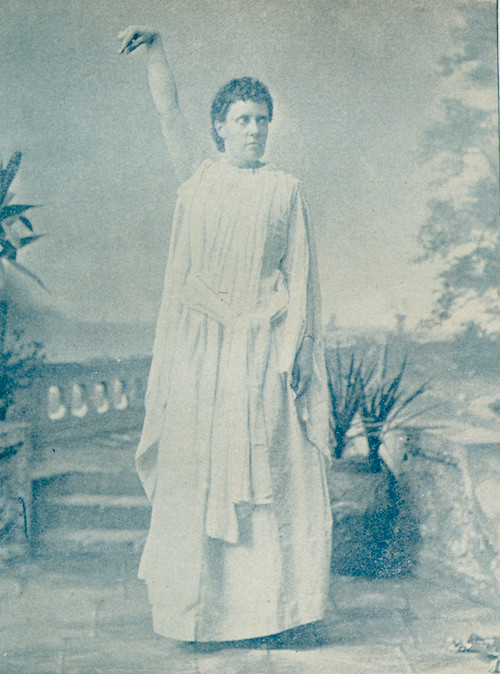
Arranged by Laura Coleman, who won with it the first gold graduating medal at the Eighth Commencement of the Mt. Vernon Institute of Elocution and Languages, 1891.
A chamber with a low, dark ceiling,[1356] supported by massive rafters[1357] of oak; floors[1358] and walls[1359] of dark stone, unrelieved by wainscot or plaster—bare, rugged, and destitute.
A dim, smoking light,[1360] burning in a vessel of iron, threw[1361] its red and murky beams over the fearful contents of a table. It was piled high[1362] with the unsightly forms of the dead. Prostrate among these mangled bodies, his arms flung carelessly[1363] on either side, slept and dreamed Aldarin[1364]—Aldarin, the Fratricide.
He hung on the verge of a rock, a rock of melting bitumen, that burned his hands to masses of crisped and blackened flesh. The rock projected over[1365] a gulf, to which the cataracts of earth might compare as the rivulet[1366] to the vast ocean.[1367] It was the Cataract of Hell. He looked below. God of Heaven,[1368] what a sight! Fiery waves, convulsed and foaming, with innumerable whirlpools[1369] crimsoned by bubbles of flame. Each whirlpool swallowing millions[1370] of the lost. Each bubble bearing on its surface the face of a soul, lost[1371] and lost forever.[1372]
Borne on by[1373] the waves, they raised[1374] their hands and cast their burning eyes to the skies, and shrieked the eternal death-wail of the lost.
Over this scene, awful and vast, towered a figure[1375] of ebony blackness, his darkened brow concealed[1376] in the clouds, his extended arms grasping[1377] the infinitude of the cataract, his feet resting upon islands of bitumen far in the gulf[1378] below. The eyes of the figure were fixed upon Aldarin,[1379] as he clung with the nervous clasp of despair to the rock, and their gaze curdled[1380] his heated blood.
He was losing his grasp; sliding and sliding from the rock, his feet hung over[1381] the gulf. There was no hope for him. He must fall—fall[1382]—and fall forever. But lo! a stairway,[1383] built of white marble, wide, roomy, and secure, seemed to spring from the very rock to which he clung, winding upward from the abyss, till it was lost in the distance far, far above. He beheld two figures slowly descending[1384]—the figure of a warrior[1385] and the form of a dark-eyed woman.[1386] He knew those figures; he knew them well. They were his victims! Her face, his wife’s! beautiful as when he first wooed her in the gardens of Palestine;[1387] but there was blood[1388] on her vestments, near the heart, and his lip was spotted with one drop of that thick, red blood. “This,” he muttered, “this, indeed, is hell,[1389] and yet I must call for aid—call to them!”[1390] How the thought writhed like a serpent round his very heart.
He drew himself along the rugged rock, clutching[1391] the red-hot ore in the action. He wanted but a single inch, a little inch and he might grasp the marble of the stairway. Another and a desperate effort. His fingers clutched it,[1392] but his strength was gone. He could not hold it in his grasp. With an eye of horrible intensity he looked above. “Thou wilt save me,[1393] Ilmerine, my wife. Thou wilt drag me up to thee.” She stooped. She clutched his blackened fingers and placed them around the marble.[1394] His grasp was tight and desperate. “Julian, O Julian! grasp this hand.[1395] Aid me, O Julian! my brother!” The warrior stooped, laid hold on his hand, and drawing it toward the casement, wound it around[1396] another piece of marble. But again his strength fails. [1397]“Julian, my brother; Ilmerine, my wife, seize me! Drag me from this rock of terror! Save me! O save me!”[1398] She stooped. She unwound finger after finger. She looked at his horror-stricken face and pointed to the red wound in her heart.[1399] He looked toward the other face. “Thou, Julian,[1400] reach me thy hand. Thy hand, or I perish!” The warrior slowly reached forth his hand from beneath the folds of his cloak. He held before the eyes of the doomed a goblet of gold.[1401] It shone and glimmered through the foul air like the beacon fire of hell.
“Take it away![1402] ’Tis the death bowl!” shrieked Aldarin’s livid lips. “I murdered thee. Thou canst not save.” He drew back from the maddening sight. He lost his hold, he slid from the rock, he fell.[1403]
[1404]Above, beneath, around, all[1405] was fire, horror,[1406] death; and still he fell.[1407] “Forever and forever,” rose the shrieks of the lost. All hell groaned aloud, “Ever, ever. Forever and forever,” and his own soul muttered back, “This—this—is—hell!”[1408]
—George Lippard.
Adapted by C. R. Bechtel.
The escape of Cassy and Emmeline irritated the before surly temper of Legree to the last degree; and his fury, as was to be expected, fell upon the defenceless head of Tom. When he hurriedly announced the tidings among his hands, there was a sudden light in Tom’s eye, a sudden upraising of his hands, that did not escape him. He saw that he did not join the muster of the pursuers. He thought of forcing him to do it, but, having had, of old, experience of his inflexibility when commanded to take part in any deed of inhumanity, he would not, in his hurry, stop to enter into any conflict with him.
Tom, therefore, remained behind, with a few who had learned of him to pray, and offered up prayers for the escape of the fugitives.
When Legree returned, baffled and disappointed, all the long-working hatred of his soul toward his slave began to gather in a deadly and desperate form.
“Well, Tom!” said Legree, walking up and seizing him grimly by the collar of his coat, and speaking through his teeth, in a paroxysm of determined rage, “do you know, I’ve made up my mind to kill you?”
“It’s very likely, Mas’r,” said Tom, calmly.
“I have,” said Legree, with grim, terrible calmness, “done—just—that—thing, Tom, unless you’ll tell me what you know about these yer gals!”
Tom stood silent.
“D’ye hear?” said Legree, stamping, with a roar like that of an incensed lion. “Speak!”
“I han’t got nothing to tell, Mas’r,” said Tom, with a slow, firm, deliberate utterance.
“Do ye dare to tell me, ye old black Christian, ye don’t know?” said Legree.
Tom stood silent.
“Speak!” thundered Legree, striking him furiously. “Do you know anything?”
“I know, Mas’r, but I can’t tell anything. I can die!”
Legree drew in a long breath, and, suppressing his rage, took Tom by the arm, and, approaching his face almost to his, said in a terrible voice, “Hark’e, Tom! ye think, ’cause I’ve let ye off before, I don’t mean what I say; but this time I’ve made up my mind, and counted the cost. You’ve always stood it out agin me; now I’ll conquer ye or kill ye!—one or t’other. I’ll count every drop of blood there is in you, and take ’em, one by one, till ye give up!”
Tom looked up at his master, and answered, “Mas’r, if you was sick, or in trouble, or dying, and I could save ye, I’d give ye my heart’s blood; and if taking every drop of blood in this poor old body would save your precious soul, I’d give ’em freely, as the Lord gave His for me. O Mas’r! don’t bring this great sin on your soul! It will hurt you more than ’twill me! Do the worst you can—my troubles’ll be over soon; but, if ye don’t repent, yours won’t never end!”
Like a strange snatch of heavenly music heard in the lull of a tempest, this burst of feeling made a moment’s blank pause.
Legree stood aghast and looked at Tom, and there was such a silence that the tick of the old clock could be heard measuring, with silent touch, the last moments of mercy and probation to that hardened heart.
It was but a moment. There was one hesitating pause—one irresolute, relenting thrill—and the spirit of evil came back with sevenfold vehemence, and Legree, foaming with rage, smote his victim to the ground.
* * * * *
Two days after, a young man drove a light wagon up through the avenue of China-trees fronting Legree’s house, and, throwing the reins hastily on the horse’s neck, sprang out and inquired for the owner of the place.
It was George Shelby, the son of Tom’s former master.
He was soon introduced into the house, where he found Legree in the sitting-room.
Legree received the stranger with a kind of surly hospitality.
“I understand,” said the young man, “that you bought, in New Orleans, a boy named Tom. He used to be on my father’s place, and I came to see if I couldn’t buy him back.”
Legree’s brow grew dark, and he broke out, passionately:
“Yes, I did buy such a fellow, and a fine bargain I had of it, too! The most rebellious, saucy, impudent dog! Set up my niggers to run away; got off two gals worth eight hundred or a thousand dollars apiece. He owned to that, and when I bid him tell me where they was, he up and said he knew, but he wouldn’t tell, and stood to it, though I gave him the cussedest flogging I ever gave nigger yet. I b’lieve he’s trying to die, but I don’t know as he’ll make it out.”
“Where is he?” said George, impetuously. “Let me see him.”
The cheeks of the young man were crimson and his eyes flashed fire, but he prudently said nothing as yet.
“He’s in dat ar shed,” said a little fellow, who stood holding George’s horse.
Legree kicked the boy and swore at him, but George, without saying another word, turned and strode to the spot.
Tom had been lying two days since the fatal night, not suffering, for every nerve of suffering was blunted and destroyed. He lay, for the most part, in a quiet stupor, for the laws of a powerful and well-knit frame would not at once release the imprisoned spirit. By stealth, there had been there, in the darkness of the night, poor desolated creatures, who stole from their scanty hours’ rest that they might repay to him some of those ministrations of love in which he had always been so abundant. Truly, those poor disciples had little to give—only the cup of cold water—but it was given with full hearts.
When George entered the shed, he felt his head giddy and his heart sick.
“Is it possible—is it possible?” said he, kneeling down by him. “Uncle Tom, my poor, poor old friend!”
Something in the voice penetrated to the ear of the dying. He moved his head gently, smiled, and said—
Tears, which did honor to his manly heart, fell from the young man’s eyes, as he bent over his poor friend.
“Oh! dear Uncle Tom! do wake—do speak once more! Look up! Here’s Mas’r George—your own little Mas’r George. Don’t you know me?”
“Mas’r George!” said Tom, opening his eyes, and speaking in a feeble voice. “Mas’r George!” He looked bewildered.
Slowly the idea seemed to fill his soul, and the vacant eye became fixed and brightened, the whole face lighted up, the hard hands clasped, and tears ran down the cheeks.
“Bless the Lord! it is—it is—it’s all I wanted! They haven’t forgot me. It warms my soul; it does my old heart good! Now I shall die content! Bless the Lord, oh! my soul!”
“You sha’n’t die! you mustn’t die, nor think of it. I’ve come to buy you, and take you home,” said George, with impetuous vehemence.
“Oh! Mas’r George, ye’re too late. The Lord’s bought me, and is going to take me home, and I long to go. Heaven is better than Kintuck.”
“Oh! don’t die! It’ll kill me!—it’ll break my heart to think what you’ve suffered—and living in this old shed here! Poor, poor fellow!”
“Don’t call me poor fellow!” said Tom, solemnly. “I have been poor fellow, but that’s all past and gone now. I’m right in the door, going into glory! Oh! Mas’r George! Heaven has come! I’ve got the victory!—the Lord Jesus has given it to me! Glory to His name!”
At this moment the sudden flush of strength which the joy of meeting his young master had infused into the dying man gave way. A sudden sinking fell upon him; he closed his eyes; and that mysterious and sublime change passed over his face that told the approach of other worlds.
He began to draw his breath with long, deep inspirations, and his broad chest rose and fell heavily. The expression of his face was that of a conqueror.
“Who—who—who shall separate us from the love of Christ?” he said, in a voice that contended with mortal weakness, and, with a smile, he fell asleep.
There is no monument to mark the last resting-place of our friend. He needs none! His Lord knows where he lies, and will raise him up, immortal, to appear with Him when He shall appear in His glory.
Pity him not! Such a life and death is not for pity! Not in the riches of omnipotence is the chief glory of God, but in self-denying, suffering love! And blessed are the men whom He calls to fellowship with Him, bearing their cross after Him with patience. Of such it is written: “Blessed are they that mourn, for they shall be comforted.”
—Harriet Beecher Stowe.
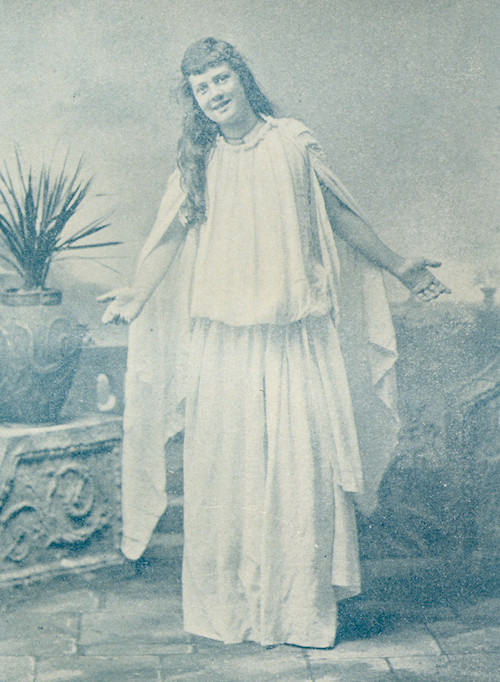
This piece won the class medal at the Ninth Annual Commencement of the Mt. Vernon Institute of Elocution and Languages, 1892.
Sit on chair at right side of a common table.
It is the Fourth Day of July, 1776.
In the old State-house[1476] in the city of Philadelphia are gathered half a hundred men to strike[1477] from their limbs the shackles of British despotism. There is silence[1478] in the hall—every face is turned toward the door[1479] where the committee of three, who have been out all night penning a parchment, are soon to enter. The door opens, the committee appears.[1480] That tall man[1481] with the sharp features, the bold brow, and the sand-hued hair, holding the parchment in his hand, is a Virginia farmer, Thomas Jefferson. That stout-built man[1482] with stern look and flashing eye, is a Boston man, one John Adams. And that calm-faced man[1483] with hair drooping in thick curls to his shoulders, that[1484] is the Philadelphia printer, Benjamin Franklin.
The three advance to the table.[1485]
The parchment is laid[1486] there.
Shall it be signed or not? A fierce debate ensues. Jefferson[1487] speaks a few bold words. Adams[1488] pours out his whole soul. The deep-toned voice of Lee[1489] is heard, swelling[1490] in syllables of thunder-like music. But still there is doubt, and one pale-faced man whispers something about “axes,[1491] scaffolds, and gibbet.”
“Gibbet?” echoes a fierce, bold voice through the hall. “Gibbet? They may stretch our necks on all[1492] the gibbets in the land; they may turn every rock[1493] into a scaffold; every tree[1494] into a gallows; every home[1495] into a grave, and yet the words of that parchment[1496] there can never[1497] die! They may pour our blood[1498] on a thousand scaffolds, and yet from every drop that dyes the axe a new champion of freedom will spring[1499] into birth. The British King may blot out[1500] the stars of God from the sky, but he cannot blot out His words written on that parchment[1501] there. The works[1502] of God may perish; His words, never![1503]
“The words of this declaration will live in the world long after our bones are dust. To the mechanic[1504] in his workshop they will speak hope; to the slave[1505] in the mines, freedom; but to the coward kings,[1506] these words will speak in tones of warning[1507] they cannot choose but hear.
“They will be terrible as the flaming syllables on Belshazzar’s wall![1508] They will speak in language startling as the trump of the Archangel[1509] saying: ‘You have trampled on mankind long enough! At last the voice of human woe has pierced[1510] the ear of God, and called His judgment down! You have waded[1511] to thrones through rivers of blood; you have trampled[1512] on the necks of millions of fellow-beings. Now kings, now purple hangmen, for you[1513] come the days of axes and gibbets and scaffolds.’
“Such is the message of that declaration to mankind,[1514] to the kings of the earth. And shall we falter now? And shall we start back[1515] appalled when our feet touch the very threshold[1516] of Freedom?
“Sign[1517] that parchment! Sign,[1518] if the next moment the gibbet’s rope is about your neck! Sign,[1519] if the next minute this hall rings[1520] with the clash of the falling axes! Sign[1521] by all your hopes in life or death, as men, as husbands,[1522] as fathers,[1523] brothers,[1524] sign your names to the parchment, or be accursed[1525] forever!
“Sign, and not only for yourselves, but for all ages,[1526] for that parchment will be the text-book of freedom,[1527] the Bible[1528] of the rights of men forever. Nay,[1529] do not start and whisper with surprise! It is truth,[1530] your own hearts witness it; God[1531] proclaims it. Look at this strange history of a band[1532] of exiles and outcasts, suddenly transformed into a people,[1533] a handful of[1534] men, weak in arms, but mighty[1535] in God-like faith; nay, look at your recent achievements, your Bunker Hill,[1536] your Lexington,[1537] and then tell me, if you can,[1538] that God has not given America to be free!
“It is not given to our poor human intellect to climb to the skies,[1539] and to pierce[1540] the councils of the Almighty One. But methinks I stand among the awful clouds[1541] which veil[1542] the brightness of Jehovah’s throne.
“Methinks I see the recording angel[1543] come trembling up to that throne to speak his dread message. ‘Father,[1544] the old world is baptized[1545] in blood. Father, look with one glance of Thine eternal eye, and behold evermore that terrible[1546] sight, man trodden beneath the oppressor’s feet, nations lost in blood, murder and superstition walking hand in hand over the graves of the victims, and not a single voice[1547] to whisper hope to man!’
“He stands there,[1548] the angel, trembling with the record of human guilt. But hark![1549] The voice of Jehovah speaks from out the awful cloud: ‘Let there be light again! Tell my people, the poor and oppressed, to go out from the old world, from oppression and blood, and build my altar in the new!’
“As I live, my friends, I believe that to be His voice! Yes, were my soul trembling on the verge[1550] of eternity, were this hand[1551] freezing in death, were this voice choking[1552] in the last struggle, I would still, with the last impulse of that soul, with the last wave[1553] of that hand, with the last gasp of that voice, implore[1554] you to remember this truth—God has given America to be free![1555] Yes, as I sank[1556] into the gloomy shadows of the grave, with my last faint whisper I would beg you to sign[1557] that parchment for the sake of the millions whose very breath is now hushed[1558] in intense expectation as they look up to you for the awful words, ‘You are free!’”[1559]
The unknown speaker fell exhausted in his seat, but the work was done. A wild murmur runs[1560] through the hall. “Sign!” There is no doubt now. Look how they rush forward![1561] Stout-hearted John Hancock has scarcely time to sign his bold name before the pen is grasped by another,[1562] another,[1563] and another.[1564] Look how the names blaze[1565] on the parchment! Adams and Lee, Jefferson and Carroll, Franklin and Sherman!
And now the parchment is signed.
Now, old man[1566] in the steeple, now bare your arm and let the bell speak![1567] Hark[1568] to the music of that bell! Is there not a poetry in that sound, a poetry more sublime than that of Shakespeare[1569] and Milton? Is there not a music in that sound that reminds you of those sublime tones which broke from angel lips when the news of the child Jesus burst on the hill-tops of Bethlehem?[1570] For the tones of that bell now come pealing, pealing, pealing.[1571] “Independence now[1572] and Independence forever.”[1573]
To be addressed to an old shoe which the speaker holds in his hand.
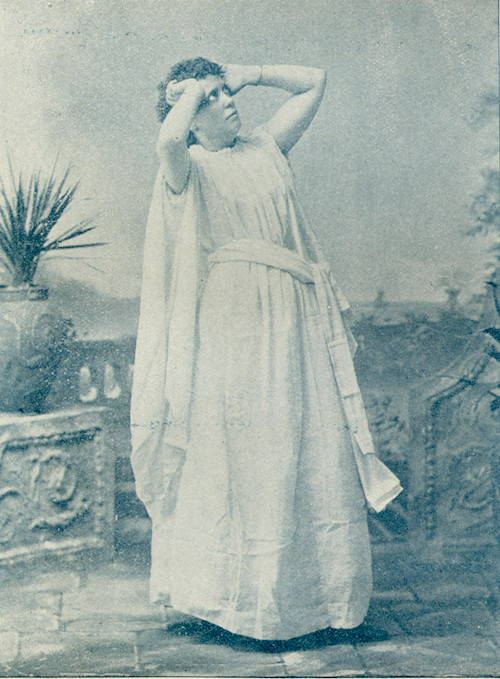
“Blessed mother, save my brain!”
Dear Teacher:
I have been requested by the young ladies of this school (or institution) to offer you a slight token of our affection and regard. I cannot tell you how delighted I am to be the means of conveying to you the expression of our united love. What we offer you is a poor symbol of our feelings, but we know you will receive it kindly, as a simple indication of the attachment which each one of us cherishes for you in her heart of hearts. You have made our lessons pleasant to us—so pleasant that it would be ungrateful to call them tasks. We know that we have often tried your temper and forbearance, but you have dealt gently with us in our waywardness, teaching us, by example as well as precept, the advantages of magnanimity and self-control. We will never forget you. We shall look back to this school (or institution) in after life, not as a place of penance, but as a scene of mental enjoyment, where the paths of learning were strewn with flowers; and whenever memory recalls our school-days, our hearts will warm toward you as they do to-day. I have been requested by my school-mates not to address you formally, but as a beloved and respected friend. In that light, dear teacher, we all regard you. Please accept, with our little present, our earnest good wishes. May you always be as happy as you have endeavored to make your pupils, and may they—nothing better could be wished for them—be always as faithful to their duties to others as you have been in your duties to them.
I’ve been sick.
Mamma said ’mokin’ was a nasty, dirty, disgraceful habit, and bad for the window curtains.
Papa said it wasn’t. He said all wise men ’moked, and that it was good for rheumatism, and that he didn’t care for the window curtains, not a—that thing what busts and drowns people; I forgot its name. And he said women didn’t know much anyway, and that they couldn’t reason like men.
So next day papa wasn’t nice a bit—that day I frew over the accawarium, and papa ’panked me—and I felt as if I had the rheumatism ever’ time I went to sit down, and so I just got papa’s pipe and loaded it and ’moked it, to cure rheumatism where papa ’panked me.
And they put mustard plaster on my tummick till they most burned a hole in it, I guess.
I fink they fought I was going to die.
I fought so too.
Mamma said I was goin’ to be a little cherub, but I fought I was goin’ to be awful sick. Nurse said I was goin’ to be a cherub, too—then she went to put a nuzzar mustard plaster on. I didn’t want her to, and she called me somefing else. I guess that was ’cause I frew the mustard plaster in her face.
I don’t want to be a cherub anyway; I’d rather be little Tommie for a while yet.
But I wont ’moke any more.
I guess mamma was right. Maybe I’m sumfin’ like a window curtain. ’Mokin’ isn’t good for me.
| DRAMATIC. | |
| PAGE | |
| Ballad of Breakneck, The, | 134 |
| Ben Hassan’s Dream, | 234 |
| Ben-Hur’s Chariot Race, | 301 |
| Corsican, The, | 277 |
| Dream of Aldarin, The, | 368 |
| Dream of Eugene Aram, The, | 337 |
| Dying to Win, | 10 |
| Felon’s Wife, The, | 127 |
| Fra Giacomo, | 271 |
| Jingles, | 158 |
| Lost in the Mountains, | 195 |
| Mad, | 358 |
| Nell, | 292 |
| Nydia, the Blind Girl of Pompeii, | 333 |
| Old Actor’s Story, The, | 227 |
| Sir Rupert’s Wife, | 22 |
| Spanish Mother, The, | 59 |
| Swore Off, | 376 |
| Uncle Ned’s Tale, | 254 |
| Woman’s Vengeance, A, | 363 |
| PATHETIC. | |
| Back to Griggsby’s, | 154 |
| Crazy Nell, | 21 |
| Dead Letter, The, | 4 |
| Death of Uncle Tom, The, | 371 |
| Dog Story, A, | 122 |
| Dolores, | 308 |
| Dukite Snake, The, | 354 |
| Enguerrande’s Child, | 209 |
| Ivy-Clad Ruin, | 265 |
| Mary, Queen of Scots, | 73 |
| Moon, The, | 125 |
| New Mother, A, | 166 |
| Not in the Ranks, | 225 |
| Old Spinster, The, | 156 |
| One Day Solitary, | 346 |
| Roderick Lee, | 51 |
| Suicide, The, | 126 |
| Tommy’s Death-Bed, | 82 |
| Waiting for the Mail, | 300 |
| Wayward Life, A, | 140 |
| Why She Didn’t Stay in the Poor-House, | 144 |
| Yes, I’m Guilty, | 266 |
| HUMOROUS. | |
| Book-Agent Beats the Bandit, The, | 223 |
| Charlie’s Story, | 237 |
| Chemist to His Love, The, | 138 |
| Engineer’s Ride on a Piano, The, | 64 |
| Experience with a Refractory Cow, | 70 |
| Going to Market, | 85 |
| Holding a Baby, | 57 |
| How “Ruby” Played, | 327 |
| Humors of Elocution, | 41 |
| I’m Getting Too Big to Kiss, | 299 |
| Lecture by One of the Sex, | 206 |
| Little Torment, The, | 142 |
| Meeting at Wendletown, The, | 178 |
| Merry Mike, | 220 |
| Pa, | 8 |
| Reason Why, The, | 43 |
| Ruling Passion, The, | 297 |
| Studying for the Contest, | 19 |
| Thora, | 317 |
| Village Choir, The, | 222 |
| Wanted, a Wife, | 153 |
| Yankee Still Ahead, The, | 79 |
| PATRIOTIC. | |
| Gallant Fifty-first, The, | 3 |
| Last Salute, The, | 17 |
| Proud Flag of Freedom, The, | 194 |
| Soldier’s Offering, A, | 296 |
| Unknown Speaker, The, | 380 |
| Valley Forge, | 325 |
| World’s Hero, The, | 66 |
| DIALOGUES AND DRAMAS. | |
| All Wrong, | 283 |
| Civilization, | 30 |
| Crowning of the Sunday-School Angel, | 88 |
| Dorothy Clyde, | 102 |
| Getting Ready, | 32 |
| Meg Merrilies, | 350 |
| Merry Sunflower, | 86 |
| Months, The, | 238 |
| Petruchio’s Widow, | 181 |
| Scene from “Merchant of Venice,” | 313 |
| JUVENILES. | |
| Boy and The Boot, The, | 387 |
| Elf-Child, The, | 411 |
| Farewell, Old Shoe, | 388 |
| For a Little Girl, | 391 |
| Johnny’s Soliloquy, | 394 |
| Katie’s Wants, | 401 |
| Little Foxes, | 390 |
| Little Millie’s Declamation, | 407 |
| Little Tommie’s First Smoke, | 410 |
| Lulu’s Complaint, | 409 |
| New Baby, The, | 400 |
| Nobody’s Dog, | 393 |
| Nose Out of Joint, The, | 404 |
| Only Child, The, | 408 |
| Oration for a Boy, An, | 408 |
| Presentation Speech, | 406 |
| Queer Little Stitches, | 402 |
| Richard Dingle’s Speech, | 175 |
| Speckled Hen, The, | 397 |
| Tale of a Dog and a Bee, | 389 |
| They Say, | 392 |
| Unfinished Prayer, The, | 412 |
| Valedictory, | 405 |
| Wind in a Frolic, The, | 396 |
| MISCELLANEOUS. | |
| Bill, the Engineer, | 146 |
| Calls of The Bells, The, | 99 |
| Contrasts in Shakespeare, | 215 |
| Coquette, The, | 67 |
| Echo and the Ferry, | 46 |
| Enchanted Shirt, The, | 268 |
| Exercise in Pronunciation, | 124 |
| Go Fan Yourself, | 291 |
| Grain of Truth, A, | 276 |
| Hints on Expression, | 87 |
| King’s Kiss, The, | 214 |
| Legend of the Wissahickon, | 161 |
| Little Brown Eyes, | 12 |
| Little Christel, | 131 |
| Maiden Song, | 201 |
| Notation of Gestures, | 2 |
| Nothing to Wear, | 44 |
| Read This if You Can, | 262 |
| Six O’Clock, | 236 |
| Stars, The, | 143 |
| True Remedy, The, | 151 |
| Word Pictures, | 176 |
This book was written in a period when many words had not become standardized in their spelling. Words may have multiple spelling variations or inconsistent hyphenation in the text. These have been left unchanged unless indicated below. Dialect and misspelled words were not corrected, unless indicated below.
“The Unfinished Prayer,” listed in the Contents on page 412, was not included in the original book.
Illustrations were moved to the nearest break between works. Obvious printing errors, such as backwards, upside down, missing or partially printed letters, were corrected. Apostrophes and diacriticals were adjusted as needed. Final stops missing at the end of sentences and abbreviations were added. Duplicate letters at line endings or page breaks were removed.
Footnotes were renumbered sequentially and were moved to the end of the work to which they pertain. Anchors [1], [305], and [332] were not printed in the original. There are two anchors [456] and [781]. Footnotes resolve to the first of each. Anchor [1151] was added to title of “One Day Solitary” as the footnote applies to whole poem. There are two footnotes numbered [356]; the second is noted [356a], without a link. Duplicate of footnote [646] was deleted.
Links to audio files were added for music. The music files are the music transcriber's interpretation of the printed notation and are placed in the public domain. At the time of this writing, music file links will not work in mobile e-book formats like epub or Kindle/mobi. Users who are reading the e-book in one of these formats can listen to the music or download music files in the HTML version. Lyrics to musical scores are presented as poetry following the illustration of the music.
Spelling corrections: