CHARLES V.’s son and successor, Philip II., was more a statesman than a
soldier. In his youth, however, remarks the learned compiler of the
Catalogue, he was accounted a clever tilter, and jousts were frequently
organised on the occasions of his visits to Italy, Germany, and
Flanders. The Conde de Valencia indignantly rebuts the allegation that
this Monarch was opposed to martial exercises and even physically
deformed. “The truth of the latter statement may be judged by examining
his armour, the lines of which are a model of proportion and
regularity.”
To Philip are ascribed six harnesses, arranged like those of his father,
each on two or more figures.
The first suit (A189-A216) is styled the arnés de lacerías, from the
tracery of its decorative lengths. It was made at Augsburg in 1545, by
Desiderius Colman, a year before that artificer turned out the Mühlberg
suit for Charles V. We extract the following particulars from the
Catalogue of 1898:
“It is the young prince’s first armour on becoming a man (18), as stated
in the Inventory of the Royal Armoury of 1594. From childhood the
Colmans had made his armour, as they had done for his august father, and
when it ceased to fit him he distributed it among the youths of the
Court. This armour, then, was ordered of Desiderius Colman; but the
decoration was doubtless by a Spanish artist in the service of the
Prince, named Diego de Arroyo; clear proof of this we find in a note in
the Chamberlain’s book, dated Feb. 3rd, 1544 (a date which also appears
on the left cuisse of the equestrian figure A190), reading thus:
‘Firstly, Diego de Arroyo designed all the pieces of a suit of armour to
be engraved, to send to Germany, so that by it a suit of armour might be
made for His Highness—three ducats are given him.’ ”
Arroyo’s design is composed of wide vertical bands, with Oriental
lacework in the centre, engraved on a white ground, and on both edges,
gilded foliations mingled with extremely beautiful decorations of the
Renaissance period.
Colman in person took his work to Valladolid, at that time the residence
of the Court. This appears from the following Imperial schedule, given
at Worms, July 29th, 1545. “The King: Don Francisco de los Cobos, &c.,
and our Chief Accountant of Castile: Colman, our armourer, we have sent to your Court to take certain
armour which he is conveying to the Prince our son, and we have granted
as salary for each day he may occupy, two florins of fifteen bacos
each, and we have paid him here six weeks and because on returning he
will need more money, we charge you to provide for paying him there a
like amount in this respect.—I the King.”
The first figure (A189, plate 43) shows a suit of foot-armour for
jousting. It has an armet with high ridged comb, visor with two slits
for the occularium, and beavor freely perforated. The
tastefully-decorated breastplate has laminated gussets, and taces to
which are attached the conspicuous lamboys. The border of this kilt of
steel is embossed, gilded, and etched with the devices of the Golden
Fleece, griffins, and scrolls. Espaliers protect the shoulders, rondels
the armpits, and small coudes the elbows. The gauntlet of the right hand
is notable (plate 106A): it extends in several articulations to the
inside of the wrist, where it is closed with a hinge to prevent its
slipping off the hand. The leg-armour is peculiar to this description of
harness, and has high laminated cuisses accommodated to the curves of
the knee; genouillères are, therefore, dispensed with. (Compare the suit
A149, made in 1541.)
The second figure (A190) bears a fine mid-sixteenth century tilting helm
in three pieces. The beavor, perforated at the sides, is screwed on to
the upper part of the breast-plate, and is secured to the other parts of
the head-piece by side screws, on which the visor revolves; the back of
the helm, including skull-piece, comb, and tail-piece is fastened to the
backplate, and at the sides of the head to the beavor and visor. On the
arm is one of the pieces mentioned at A101, and “slashed” in imitation
of the civil dress of the time. With these pieces is shown a target,
beautifully etched with fantastic figures in the German style. The
superb barding of the horse does not belong to the suit or the period,
and will be described later.
To figure A191 are attached a notable morion, with roped comb, and arm
guards, waved or imbricated with gold and steel alternately, and
delicately etched. The tassets, cuisses, and gauntlets display the same
decoration as the rest of the armour. The shield A193 was designed by
Diego de Arroyo, like the other pieces.
The armour A217-A230, made in Germany about 1549 for Philip when he was
heir-apparent, is that in which he is represented by Titian (Prado
Gallery, No. 454) and Rubens (No. 1607). It was in this suit also, that
Velazquez represented the Conde de Benavente, who lived nearly a
hundred years after it was forged (No. 1090). The component pieces are
striped and bordered by wide bands of engraved and gilded arabesques,
designed in all probability by Diego de Arroyo. In the second figure
(A218, plate 49) the tassets are of unequal length. The fingers of the
right gauntlet are united, those of the left joined in couples. The
cuisses are laminated, and reach to about the middle of the thigh. This
armour appears to have consisted of more pieces than any other in the
collection.
Philip’s third suit (A231-A238) was made for him at Landshut in Bavaria,
in 1550, by Sigmund Wolf. Many of the pieces are now at Brussels. The
ornamentation is chaste, consisting of narrow bands, etched with
graceful scrolls and volutes on white burnished steel.
The parade armour (A239-A242) was made for Philip at Augsburg by
Desiderius Colman and Georg Sigman, in 1552. An order exists, issued by
Philip, directing his treasurer to pay 2,000 gold escudos, on account of
3,000 escudos, which it seems was the price of this splendid harness.
The history of this suit is not without interest. We borrow the
following details from Conde de Valencia:
“When Colman undertook this important work, all embossed and damascened,
he showed that he could produce very different work to that which
generally left his workshops; that is, tilting and war-armour, which
only required superficial ornamentation, like the engraving and low
relief on the parts least exposed to lance-thrusts. His recognised
superiority in this branch of his industry, and especially forging, is
attested by his almost exclusively supplying the Emperor and his son,
and by the many suits he made for the chief captains and officers of the
Imperial Army. Under such circumstances he was justified in wishing to
excel also in the making of armour for parade or de luxe, his rivals
the Negrolis of Milan, who a little while before had made various
magnificent pieces for Charles V.: among them, armour A139.
“However, it does not seem that Colman possessed the necessary skill to
undertake a work of this kind alone. So at least it would appear from
his co-operating with a person, whose artistic capacity he recognised to
such a degree, that he permitted him to place his signature beside his
own on the principal piece of the armour.
“This associate was a German silversmith, named Georg Sigman, who,
though resident in Augsburg, had not succeeded in getting the
municipality to register him as a master in the trade to which he
belonged. Colman saw doubtless in the skill of this artist a powerful
medium that would permit him to rival the Negrolis in the ornamentation
of armour de luxe, and accepted his assistance in return for his using
his influence at the Imperial Court on Sigman’s behalf.”
The scheme of the decoration is as creditable as the execution. On a
ground of blackened steel all the pieces are adorned with broad vertical
bands, embossed with grotesques, and bordered by narrow outer bands,
which are in their turn bordered by pretty trefoil work projecting over
the plain ground.
The crest of the burgonet is decorated with laurels and exquisite
traceries; the rest of its surface is covered with small figures, birds,
scrolls, and foliations charmingly relieved and intertwined. On either
side of the crest are medallions representing heroic combats, all
delicately chiselled, and with gilded profiles.
At the junction of the visor and helmet may be seen the marks and
initials of Colman and Sigman, with the date 1550. Sigman, not content
with stamping his initials beside those of his principal, has repeated
them with the date 1549 beneath the plume-holder, to commemorate the
two years he was employed upon the decoration of the work.
The cuirass is composed of overlapping plates placed horizontally. This
species of defence was called the lorica, from being originally made of
leather which was modelled, while wet, to the muscles of the human body,
and was imitated in the bronze cuirass in late Roman times. The four
upper plates which formed the gorget are missing. They were joined to
one on which is engraved and gilded the collar of the Golden Fleece.
Beneath it hangs the Fleece itself, supported by two nymphs, and
beginning the exquisite series of groups which run down the central
band. The remaining bands are equally well conceived and executed. The
cuisses are similarly composed of plates set horizontally and decorated
vertically. About half-way down the thigh the lower edge of the plate is
decorated, so that at this point the upper plates could be disconnected
from the lower, and used as simple tassets. The genouillères are
decorated with masks and satyrs. The arm-guards are similar to the rest
of the suit. The coudes are admirably embossed and gilded, the design
showing a woman wearing the Collar of the Golden Fleece and an Imperial
tiara; on each side of her are warriors armed in classic style; the
Imperial Eagle is shown on the inside of the piece, and a mask at the
elbow. Note the laminated gorget (A239 bis, plate 47B), beautifully
decorated in the same way as the rest of the armour, and suitable for
wearing over a coat of mail or leather doublet.
The shield A241 (plate 146), belonging to this harness, has a peculiar
interest as commemorating the rivalry that existed between the great
German and Italian armourers of the sixteenth century. It is in one
piece, blackened and richly decorated, embossed and inlaid with gold.
From the boss spread radiations enclosed by a laurel wreath, and outside
this by a narrow band with the following inscription in German:
DESIDERIO COLMAN CAYS MAY HARNASCHMACHER AVSGEMACHT IN AVGVSTA DEN 15
APRILIS IM 1552 JAR (Desiderius Colman, Armourer of His Cæsarean
Majesty, finished this on April 15th, 1552). At equal distances round
the shield are disposed circular medallions encircled by wreaths of
laurel and myrtle, and designed with the following subjects: Strength in
a triumphal car drawn by men, Victory in another car drawn by lions,
Minerva drawn by horses, and Peace borne on the shoulders of Kings.
Between the medallions are seen other Kings enthroned and surrounded
by other figures, masks, cartouches, and foliations in great profusion.
In the rim between two laurel wreaths, hunting scenes and bull-fights
are depicted. In one group Colman has symbolised his supposed triumph
over his Milanese competitor by a bull overthrowing a man whose shield
bears the word “Negrol.” As a matter of fact the shield is a far less
creditable performance than the rest of the armour, nor does the best of
Colman’s work deserve to be preferred to the Medusa shield executed by
Negroli. In justice to the German it should be added, however, that the
shield shows every sign of having been left unfinished. The war-saddle
(A242, plate 47B) is the finer work. The subject of the design of the
centre-band is Venus riding the waves in a shell drawn by dolphins, and
attended by cupids. The sword G47 (see infra) also belonged to this
harness.
The armour of Philip II., called the Burgundy-Cross-Armour, was made in
1551 by Sigmund Wolf. The order exists authorising the payment to the
armourer on account of the Prince of “two hundred gold escudos in token
and part payment of some gilded armour” made for him.
The suit is very richly decorated with bands of the natural colour of
the steel on which are etched alternately the Cross of Burgundy or of
St. Andrew, and the emblems of the Golden Fleece—all gilded. On the
breastplate of the first figure (A263, plate 50) is engraved the image
of the Madonna. The cuisses are high and laminated as in former
examples. The horse’s bard is very handsome, and seems to be a
reproduction in metal of the richly-embroidered caparison usually worn
by the Imperial chargers.
The suit A243-262 was made for Philip by Wolf, of Landshut, somewhere
about 1554, the date being fixed by the chanfron of the horse being
charged with the arms of England, which Philip could only have assumed
on his marriage with Mary Tudor. The panoply includes a greater number
of pieces for tilting than any other owned by this Prince, and
demonstrates his partiality for manly exercises. The decoration consists
of wide vertical bands on a ground of burnished steel, gilded and etched
with black waves or undulations, and bordered on either side by narrow
bands exhibiting a similar design. The armour appears to have comprised
about eighty-five pieces, of which seventy-four are in the Madrid
collection.
The first figure (A243, plate 48) is conspicuous by the enormous
reinforcing piece, or overguard, on the left elbow, and for the symmetry
and elegance of the leg-armour.
The gay barding for the horse does not belong to the armour: it comes
from the armour of Prince Charles, son of Philip II.: in his inventories
all the pieces are enumerated, although the general lines and character
of the ornamentation agree with the bards of the Emperor’s time. It was
made in Nuremberg by the German armourer, Conrad Lochner the younger,
whose mark, together with that of the city, is stamped on the
breastpiece and crupper. It includes saddle; reinguard; croupière;
fléchière; poitrel, with large linch-pins; collar; mainfaire, and
chanfron, the latter with two large twisted ram’s horns, and above the
hind part of the head the shield with the Royal arms. All these pieces
are decorated with graceful bands etched with alternating imbrications
of iron and gold, which border and cross them in various directions. In
the spaces where the steel preserves its natural colour, there are a
large number of volutes and palms in relief. The bridle is late
sixteenth century, of long strips well filed, like the perforated
copas, which are decorated with gold.
The third figure (A245, plate 49) shows various reinforcing pieces for
the tilt, to be worn on the preceding suit, A244, with the exception of
the helm and tassets—“the total weight being thirty-nine kilogrammes, which could only be
supported during the short time occupied by three or four courses and in
breaking as many lances.”
The various pieces are adjusted and shaped with marvellous precision.
The helm is a triumph of the armourer’s craft, with an occularium four
millimetres wide, ventail on the right hand side, and strong beavor
coming well down on to the left shoulder, where is screwed a manteau
d’armes or target, with raised trellis-work and floral devices etched on
the panels. The tassets are of unequal length. The leg-armour again
illustrates Wolf’s skill and eye for symmetry. The fifth figure (A247)
has preserved the colours of the decorative bands very well.
The same scheme of decoration is exhibited by the armour (A274-A276)
made in 1558 for the unfortunate Prince Charles, son of Philip II. It
was made for him by Sigmund Wolf when the Prince was thirteen or
fourteen years of age. The difference in size between the right and left
pauldrons goes to prove that the Prince was slightly deformed, as has,
indeed, been often asserted. The first figure (A274, plate 52) has a
morion with high comb, visor, and beavor secured by a hook on the left
and a button on the right side. The tassets are continued to the knee after the lobster-tail style
then becoming fashionable.
Of the arms and detached pieces of armour ascribed to Philip II., and
included in the Armoury, the most remarkable is the sword (G47)
belonging to the parade-armour A239.
The blade is of diamond section, with a short groove below the tang. The
first third of its length is adorned with engravings and small squares
of gold, enclosed in which we find these inscriptions, on one side—PRO
FIDE ET PATRIA. PRO CHRISTO ET PATRIA. INTER ARMA SILENT LEGES SOLI DEO
GLORIA; on the other—PVGNA PRO PATRIA. PRO ARIS ET FOCIS; NEC TEMERE,
NEC TIMIDE, FIDE SED CVI VIDE. On the ricasso is the mark of the maker,
Clement Horn, of Solingen. The hilt is the most remarkable in the
collection. It is blued and carved in gold relief in the Italian
renaissance style. The centre of the guard is decorated with numerous
figures in high relief on a gilded ground; one quillon curves downwards,
the other upwards, and both end in the heads and busts of men entwined
about with spirals. From a cartouche engraved with the Judgment of Paris
on the guard, springs an exquisite counter-guard composed of two
beautiful Caryatides united by volutes. The grip is of quadrangular
section, and formed with four pieces of rock-crystal engraved in gold.
The pommel, which is the most admirable part of the composition, is
formed by two volutes, which hold and press between them the head of an
old Satyr, whose expression reveals his vexation; in the curves of the
volutes are two little genii. They grasp and tread on festoons of fruit,
which are gathered up at the back of the pommel by the god Vertumnus,
beneath whom, on an oval cartouche, Hercules is seen in combat with the
Nemean lion.
The sword G48, believed to have been the work of the Toledo maker
Martinez Menchaca, and the property of Philip II., is flat, with three
pierced channels in its upper third. The hilt is German, and highly
ornate. The quillons and guards resemble the coils of a serpent, and are
elaborately chased and incrusted with silver. They are further adorned
with masks, torsos, and nude figures within medallions, the whole being
designed and executed with much taste. The hilt of the sword, G49,
attributed to the Conde de Coruña (Viceroy of Nueva España in 1580), is
another beautiful piece of work, the decoration being less elaborate,
but on the whole more tasteful than that of the sword G48. It is of
Spanish (Toledo) make, but the maker’s name remains unknown.
Perhaps the most magnificent suit in the whole Armoury is the Parade
Armour (A290, plates 53, 53D) made for King Sebastian of Portugal
(1554-1578) by Anton Pfeffenhauser of Augsburg.
“Examined from the artistic point of view,” says the Conde de Valencia,
“this is Pfeffenhauser’s masterpiece, and places him on a level with, if
not above, the best German armourers of his time. True, he falls into
the mistake of over-ornamentation, and his figures are incorrectly
designed; but the composition and embossing are bolder than Colman’s,
and, above all, his chiselling is of inimitable precision and clearness.
With regard to the style of the decoration, on comparing the capricious
combinations of figures, scrolls, and other features of the
ornamentation with the designs published by Hefner Altenech, we are led
to believe that it was the work of either Hans Mielich, of Munich, or
some other German artist of the same age and equal ability.”
The sixteen pieces of the armour are blackened, and gilded only at the
nails, clasps, and plume-holder. The burgonet is cast in one piece and
richly embossed. On the comb are seen Tritons, sea-horses, dolphins, and
Nereids; the major portion of the surface is occupied by battle scenes,
the warriors wearing classic garb, and fighting on the backs of
elephants—an allusion, like the coat-of-arms carried by one of the
warriors, to the Portuguese conquests in India; at the base of the skull
are represented Diana, Hercules, Neptune, and Amphitrite; and on the
cheek-pieces, each of three laminæ, are the images of Strength and
Justice.
The decoration of the other pieces consists in the customary wide
vertical bands, traversing the body from the gorget to the ankle. On the
widest and midmost band is the figure of Jupiter; beneath him is Diana;
and, lastly, the infant Hercules strangling the serpents. The other
bands, both on breast and backplates, likewise display mythological
subjects. The pauldrons are even more richly ornamented than the other
pieces: at the back and front they are embossed with designs
representing respectively Power, Victory, Peace, and Navigation.
The coudes display the four figures of the Cardinal Virtues. Beautiful
emblematic groups and figures adorn the genouillères and demi-jambs. The
tassets are detachable half-way up the thigh. The gauntlets correspond
in decoration and elegance with the rest of this magnificent suit.
The armour of Philip III. belongs to the period of the decadence of the
armourer’s craft. The final victory of the firearm in the long struggle
between attack and defence was now very generally recognised, and
complete suits of armour were worn mainly for display. Tilting, too, was
going rapidly out of fashion. By the middle of the seventeenth century
the burgonet, cuirass, and tassets were well-nigh the only pieces of
armour worn in the field.
The suit B1 to B3 (plates 82 et seq.) presented to Philip III. when
Prince, at the age of seven, by his brother-in-law, Carlo Emmanuele,
Duke of Savoy, is obviously one of the harnesses intended for ornament,
and not defence. It is a beautiful example of Italian art, including
twelve pieces, worked in gilded iron, and decorated with innumerable
figures, masks, &c., in the low relief contained in cartouches, scrolls,
and bands—all embossed and damascened. There is no leg-armour attached
to the suit, and the gauntlets have disappeared.
The helmet, or celada de engole, has a large mask on the visor, and at
the sides Victory and Fame; on the outside part of the collar, Strength
and Prudence, and on the other, the Ducal Crown; on the breastplate the
figure of Fortuna, accompanied by two winged genii, with a phylactery on
which is the word SPANIA; and in different places, Justice, Temperance,
and various small symbolic figures, which may also be seen on the
backplate, the pauldrons, and the armlets. It bears no armourer’s mark.
B2. Infantry morion, forged in one piece, with similar decoration to the
preceding; a mask, in front on the forehead figures representing
Abundance and Prosperity, grotesques, and trophies.
B3. Shield, for combat on foot. A medallion covers the centre, on which
are represented Jupiter, Neptune, and Mars destroying the Moors; around
are four Ephesian Dianas on estipites (pedestals in the form of
inverted pyramids), and between them an equal number of panels with
warlike and mythological subjects: the decoration of the groundwork is
completed by other subjects similar to those of the preceding pieces.
Diameter 0.39.
The half-suit B4-5 (plate 84), also presented to the successor of Philip
II. in his childhood, is believed to be the work of Lucio Picinino. The
decoration is very beautiful and less profuse than in the preceding
example. On the wide middle band of the breastplate may be seen a mask
upheld by two nude figures, the goddess Pallas, satyrs, &c. Festoons
with masks extend from band to band. The pauldrons bear grotesque masks,
and the coudes symbolical figures.
The harness, A291-294 (plate 54), seems to have been made in Milan by
Lucio Picinino, and was presented by the Duke of Savoy to Philip III.
“Although it belongs to the decadent period of the Italian Renaissance,”
remarks the Conde de Valencia, “it is assuredly one of the handsomest
pieces of work turned out by the Milanese armourers of the late
sixteenth century.” The panoply is unfortunately very incomplete, owing
to the strange course having been adopted of dressing with parts of it
the corpse of the Infante Carlos, who died in 1632.
The whole suit is profusely decorated with reliefs and gold and silver
damascene work. The burgonet displays three masks—on the visor (which
is in two pieces), and at the base of the skull. The upper edge of the
breastplate is roped. In the centre of the chest is an embossed mask;
beneath it a panel with the figure of Victory, seemingly held in
position by chains, and by two male figures. Below it and on either side
are grotesque masks. The pauldrons (one of which has a bufe or
passe-garde), the tassets, cuisses, genouillères, and demi-jambs are
similarly decorated with cartouches and medallions with martial and
allegorical subjects.
“The rich covering for the horse is also incomplete. It is composed of
pieces of the two distinct bards mentioned in the Inventory, one ‘inlaid
with gold and silver, fluted, and in relief, all adorned with blue
stones (lapis lazuli) and yellow stones and illuminated crystals’; and
the other, ‘with the same pieces as the one above, lacking nothing, and
this is of gilded iron in relief.’
“Saddles, chanfrons, and mainfaires of both bards are preserved, these
sets being that of the dragon chanfron on the horse A190, and that with
the inlaid work on the present figure; but the cruppers and poitrels of
both have been broken up, and their component parts have been mostly
dispersed abroad. What was preserved in the Armoury, now without stones
or crystals, together with other remains found in the ancient edifice
after the fire, constitute the crupper and poitrel of this horse.”
To the first decade of the seventeenth century belongs the suit
(A338-A346) attributed to the third Duke of Escalona. It has a tilting
helmet with visor in two pieces, and a shutter in the ventail; the
leg-armour is still complete. The elaborate ornamentation, consisting of
wide vertical bands etched, alternating with trophies, medallions, and
lacework, has lost much of its richness, owing to the disappearance of
the blackening and gilding.
The horse’s barding is older than the armour; it is of the early
sixteenth century, and the style of the ornamentation appears to be
Spanish Renaissance. The several pieces of which it is composed are
decorated with trophies, flowers, grotesques, and other devices in good
taste, etched, and part of them engraved by hand. On the poitrel may be
seen St. James on horseback, fighting against the Moors, accompanied by
two warriors of antiquity. The chanfron has the escutcheon of the
Alvarez de Toledo family, the surname of the celebrated Duke of Alba,
from whom possibly it might have come.
The days had passed when Spanish Kings sent to Augsburg for their
harness, and in 1620 we hear of a Royal armour factory at Pamplona in
Navarre. The first specimen of its work is the parade armour made for
the Duke of Savoy by order of Philip III. (A350-353, plate 62). Being a
presentation suit, it was lavishly decorated with vertical bands and
panels, with a bordering of trefoils of silver in relief. The initial
letter, and the ducal crown and palms of Savoy figure in the
ornamentation; and on the centre band of the cuirass may be seen the
arms of the County of Nice—a crowned eagle gazing at the sun.
Philip III.’s half-suit of armour, numbered A354-355, was also forged at
Pamplona. It is of steel-plated iron, and of extraordinary thickness. It
is blued and decorated at the borders with bands on which are chiselled
flowing scrolls, animals, grotesques, &c. A graceful edging of silver
trefoils in relief finishes off the bands. The helmet, or cabasset, has
a drooping brim, and is forged in two pieces. The breastplate is adorned
by the Collar of the Golden Fleece, and another collar or riband
(engraved), from which hangs the medal of the Immaculate Conception. A
curious feature is the seven indentations made by the bullets of an
arquebus, and each set with silver pearls. These marks do not say much
for the quality of the metal, which is ten millimetres thick. The
backplate, which is only three millimetres thick, has been perforated by
the bullet. The arms are defended by espaliers reaching to the elbow,
where they meet the cuffs of the gauntlets.
At Pamplona were also made six half-suits of boys’ armour for the three
sons of Philip III.—the Infantes Philip, Charles, and Ferdinand. These
suits (B13-B20, plates 87, &c.) are composed of closed helmet, gorget,
cuirass, and the usual arm armour. The steel is blued, and each piece is
decorated at the edge with the Collar of the Golden Fleece. The rest of
the surface is divided by beautiful foliations in silver into
diamond-shaped sections, in which are displayed the Tower and Lion of
Spain, the Pillars of Hercules, warlike trophies, and the Double-headed
Eagle.
The suit A360-368 (plate 58) was made in the first years of the century,
in Italy, apparently for the Prince Filippo Emmanuele of Savoy, who died
in 1605, aged 19. It consists of closed tilting helmet, gorget, cuirass,
tassets, and the usual pieces for the limbs. All the pieces are richly
decorated, but the blackening of the groundwork and the gilding of the
ornamentation have disappeared. The crown of Savoy, with the palms and
olive-branch, and groups of trophies are etched in rhomboidal sections
formed by intertwined lovers’ knots, the emblem of the ducal house.
The same scheme of decoration is apparent on the two suits (A369, A377)
of Italian make that were the property of the victor of St. Quentin,
Prince Emmanuele Filiberto of Savoy, Grand Admiral of Spain (1588-1624).
On the first suit certain Spanish heraldic devices, such as the Tower
and Lion, may also be seen associated with the emblems of Savoy.
The last period of armour is illustrated by the suits belonging to King
Philip IV. Six of these were sent to him from Brussels by his aunt, the
Infanta Isabel Clara Eugenia, wife of the Archduke Albrecht.
The first of these (A380-393) dates from 1624. It is shown on two
figures, both with the same decoration of vertical bands traced on a
groundwork of gold. On the shield may be deciphered the initials M. P.
with a crown and three fleurs-de-lys, which leads the Conde de Valencia
to hazard the conjecture that the armourer may have been one of the
Petits, who served Louis XIII. of France. The harness includes the
complete leg-armour, which now was never worn in the field; but the
second figure (A381, plate 60) has, instead, the lobster-tail tassets,
which were in actual use.
The second presentation suit (A394-401) is that in which Philip IV. is
represented by Velazquez in the portraits in the Prado, numbered 1,066
and 1,077. It seems to have been originally blackened with the edges and
rivets gilded, but probably lost its hue when worn by the illustrious
Don Juan José, natural son of Philip IV., in his Italian campaign in
1652.
The armour A408-413 was among the gifts presented by the Archduchess
Isabel Clara. It was very elegantly decorated with bands of gold and
silver, chiselled by hand in zig-zag fashion. The next suit, A414-421,
from the same donor, was worn by Don Juan José, who is shown wearing the
cuirass on a bust in the Prado gallery.
The two remaining suits attributed to Philip IV. were the gift of his
brother, the Cardinal Infante Ferdinand. The first (A422, plate 59) has
the lobster-tail tassets, and is blued and decorated with vertical bands
of medallions with various subjects. This suit was formerly, for some
obscure reason, ascribed to Columbus. The second suit (A423-428) was
originally blued and gilt, but the natural colour of the metal has now
reasserted itself. The armour is distributed over three figures, and
includes several pieces fast becoming obsolete at that time (1632).
Notice the unusual size of the garde-de-rein on the first figure.
With these suits the Cardinal sent another for his boy-nephew, Prince
Baltasar Carlos (1629-1646). This armour is little more than a toy, and
preserves its blackening and gilding almost unimpaired.
The magnificently engraved collar and gorget numbered A434-A441 (plates
93, 94) are now known to represent the siege of Ostend (1601-1604) and
the Battle of Nieuport (1600). The details are executed with marvellous
clearness, and the chiselling reflects the greatest credit on the
unknown artist. The horseman in the centre group on the gorget is
probably the Archduke Albrecht, who distinguished himself by his valour
at the Battle of Nieuport. These pieces were worn over a buff jerkin,
such as was used by Cromwell’s Ironsides.
This brief survey of the principal objects of interest in the Royal
Armoury at Madrid may be fittingly concluded with some account of the
origin and vicissitudes of that establishment. Its nucleus was the
armour accumulated by the Emperor Charles V., not with a view to a
collection, but for his personal use. Philip II. was not slow to
recognise the value of the treasure bequeathed him by his father. On his
return to Madrid, upon the death of his wife, Mary Tudor, Philip
deposited all the Emperor’s armour in a building specially designed for
its reception, and added to it from time to time trophies won from the
enemies of Spain, and such antiquities of national and military interest
as he could procure. His good example was followed by his successors
till the manufacture of defensive armour altogether ceased at the end of
the seventeenth century, while the spoils of war became every year
rarer towards the close of the eighteenth.
A calamity befell the collection at the outbreak of the War of
Independence. The people of Madrid, in their eagerness to procure arms,
invaded the building on December 1st, 1808, and carried off more than
three hundred swords and other weapons with which to attack the French.
And three years later Joseph Buonaparte foolishly piled the contents of
the Armoury in the garrets, in order to make room for the dancers in the
hall.
In the reign of Isabel II. the collection was re-installed and
re-arranged. A catalogue was issued for the first time in 1849, the
author being Don Antonio Martinez del Romero—a work displaying
considerable research and industry, but full of errors, and completely
superseded by the catalogue published in 1898 by the Conde de Valencia
de San Juan.
It was to that gentleman that the late King Alfonso XII., soon after his
accession, entrusted the complete re-organisation of the collection.
This was a work presenting extraordinary difficulties, and after three
years of incessant labour, the Conde had the mortification of seeing a
fierce fire break out, which in the night of July 9th, 1884, reduced to
ashes sixty-two flags taken from the enemy, twenty leather shields, and
all the wooden figures prepared for the arrangement of the armour.
Without hesitation the work was begun all over again. The King added new
and priceless acquisitions to the collection, among these being eleven
examples of fifteenth-century brigandine armour (quilted jackets with
the additional protection of plates of iron secured among the pads)
discovered in Aragon, and several of the finest pieces in the armouries
of the Dukes of Osuna and del Infantado.
Her Majesty Queen Cristina, during her regency, was not forgetful of the
interest taken by her lamented husband in this magnificent Museum of
Arms; and, thanks to her, the number of its treasures has been
materially increased. Nor is it likely that any opportunity of adding to
the value and usefulness of the collection will be neglected during the
reign of a young Monarch devoted, like so many of his illustrious
ancestors, to manly exercises and chivalrous traditions.
PLATE 1.

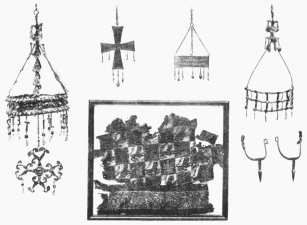 (1 TO 5). CROWNS AND VOTIVE CROSSES OF GUARRAZAR.
(6). REMAINS OF ST. FERDINAND’S ROBE.
(7). MOORISH SPURS OF ST. FERDINAND.
PLATE 1A.
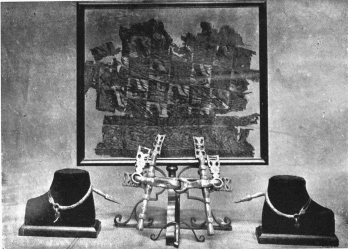 CLOAK AND SPURS OF ST. FERDINAND AND VISIGOTHIC BIT.
PLATE 2.
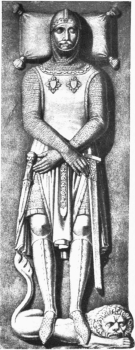 DON BERNARDO GUILLEN DE ENTENZA, 13TH CENTURY.
PLATE 3.
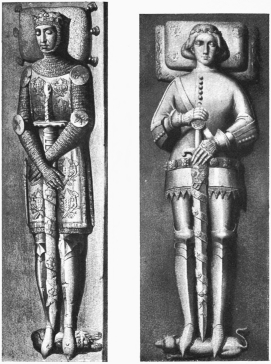
DON GUILLELMO
RAMON DE MONCADA,
SENESCHAL OF CATALONIA,
DIED CIRCA 1280 |
DON JUAN ALFONSO,
LORD OF AJOFRIN,
DIED ABOUT 1386. |
PLATE 4.
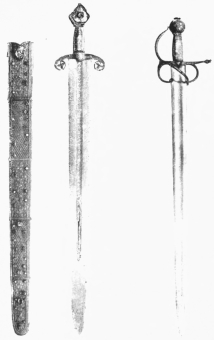
G 22. SWORD AND SCABBARD,
PROBABLY BELONGING TO
ST. FERDINAND. | G 21.
THE LOBERA OF
ST. FERDINAND. |
PLATE 5.
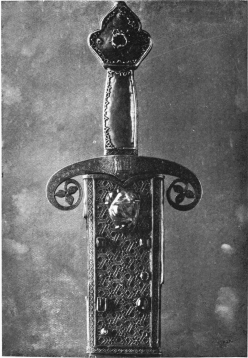 G 22. SWORD AND SCABBARD THAT PROBABLY BELONGED TO ST. FERDINAND.
PLATE 6.
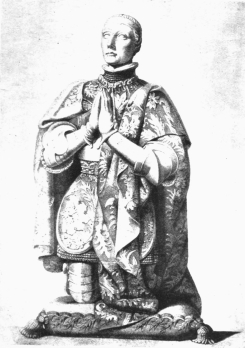 PEDRO I., KING OF CASTILE.
PLATE 7.
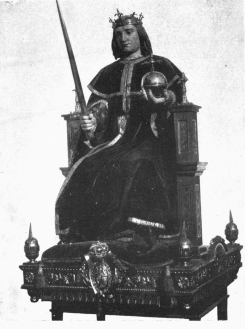 EFFIGY OF ST. FERDINAND, KING OF SPAIN.
PLATE 8.
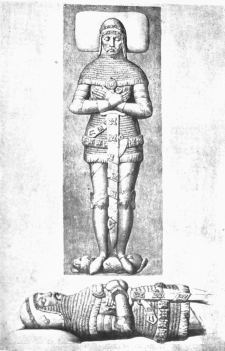 SEPULCHRAL EFFIGY OF DON BERNARDO DE ANGLESOLA, CIRCA 1384.
PLATE 9.
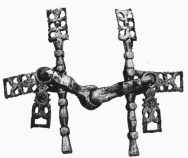 F 123. BIT, BELIEVED TO HAVE BELONGED TO VITIZA, KING OF THE VISIGOTHS.
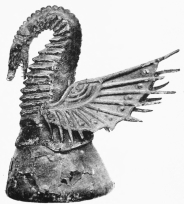 D 11. HELMET-CREST OF MARTIN I. OF ARAGON.
PLATE 10.
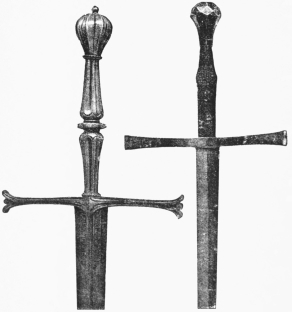
G 4. PONTIFICAL SWORD
PRESENTED BY POPE EUGENE IV.
TO JOHN II. OF CASTILE. |
G 13. 15TH CENTURY WAR
SWORD. PROBABLY BELONGED
TO FERDINAND THE CATHOLIC. |
PLATE 11.
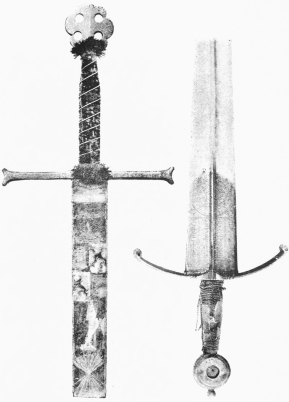
G 1. CEREMONIAL SWORD OF
FERDINAND AND ISABELLA. | G 23. 15TH CENTURY SWORD
OF UNKNOWN ORIGIN. |
PLATE 12.
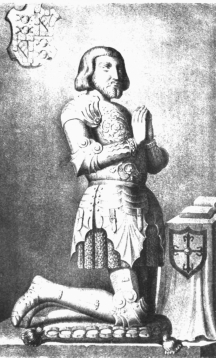 JUAN PACHECO, MARQUIS OF VILLENA, GRAND MASTER OF ST. JAMES, DIED
1474.
JUAN PACHECO, MARQUIS OF VILLENA, GRAND MASTER OF ST. JAMES, DIED
1474.
PLATE 13.
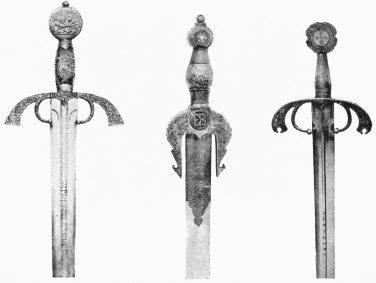
G 29. WAR SWORD OF THE GRAN
CAPITAN, GONZALO FERNANDEZ
DE CORDOBA (1453-1515). |
G 28. SWORD OF THE CARDINAL
INFANTE FERNANDO, BROTHER
OF PHILIP IV. |
G 31. WAR SWORD OF
FERDINAND THE
CATHOLIC. |
PLATE 14.
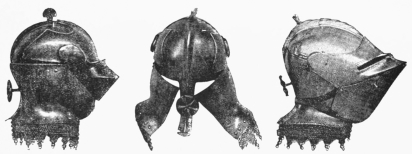
A 9.
ARMET, EARLY 16TH
CENTURY (CLOSED). |
A 9.
THE SAME
(OPEN). |
A 5.
ARMET, LATE 15TH CENTURY AND
BEGINNING OF 16TH CENTURY. |
PLATE 15.
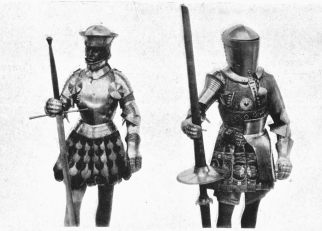
| A 11. ARMOUR OF PHILIP THE HANDSOME. | A 16. TILT ARMOUR OF PHILIP THE HANDSOME. |
PLATE 15A.
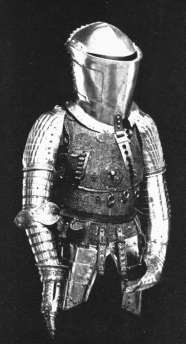 A 16. TILTING ARMOUR OF PHILIP THE HANDSOME.
PLATE 15B.
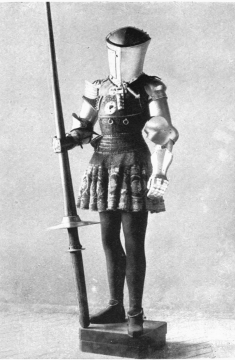 A 16. TILTING ARMOUR OF PHILIP THE HANDSOME.
PLATE 15C.
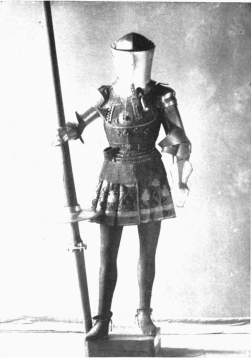 A 16. TILTING ARMOUR OF PHILIP THE HANDSOME.
PLATE 15D.
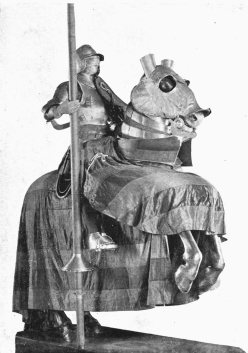 TILTING ARMOUR, EARLY 16TH CENTURY, ATTRIBUTED IN THE 1849 CATALOGUE TO
MAXIMILIAN OF AUSTRIA.
TILTING ARMOUR, EARLY 16TH CENTURY, ATTRIBUTED IN THE 1849 CATALOGUE TO
MAXIMILIAN OF AUSTRIA.
PLATE 16.
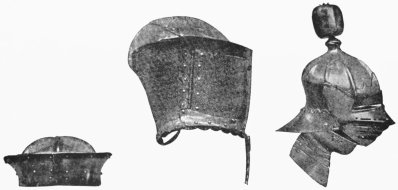
A 11. ‘CAPERUZA’ OF
PHILIP I. OF
CASTILLE. |
A 17. HELMET WITH UNUSUALLY
LARGE SHUTTER, LATE
15TH
CENTURY. |
D 14. LATE 15TH CENTURY HELMET
IN THE MOORISH STYLE. IT
IS
THE ONLY ONE OF THE KIND
IN THE ARMOURY. |
PLATE 17.
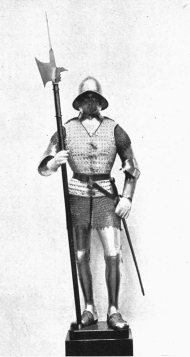 C 1. SPANISH MAN-AT-ARMS, 15TH CENTURY.
PLATE 17A.
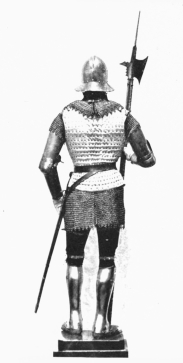 C 1. SPANISH MAN-AT-ARMS, 15TH CENTURY (BACK VIEW).
PLATE 17B.
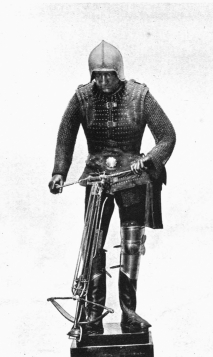 C 4. SPANISH CROSSBOWMAN, 15TH CENTURY.
PLATE 17C.
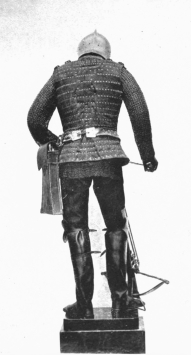 C 4. SPANISH CROSSBOWMAN, 15TH CENTURY (BACK VIEW).
PLATE 17D.
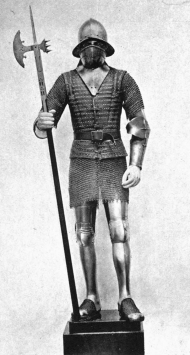 C 2. SPANISH HALBERDIER, 15TH CENTURY.
PLATE 17E.
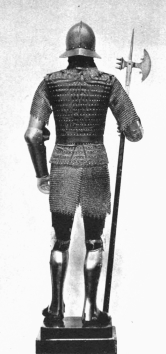 C 2. SPANISH HALBERDIER, 15TH CENTURY (BACK VIEW).
PLATE 18.
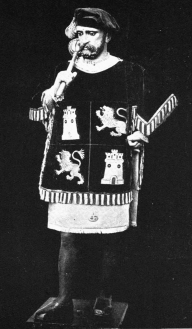 MACE-BEARER OF THE 16TH CENTURY WITH SURCOAT DISPLAYING THE ARMS OF
CASTILE AND LEON.
MACE-BEARER OF THE 16TH CENTURY WITH SURCOAT DISPLAYING THE ARMS OF
CASTILE AND LEON.
PLATE 19.
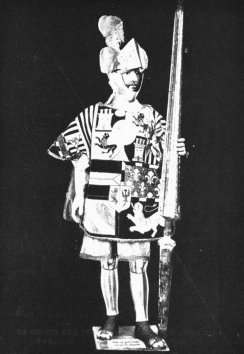 A KING OF ARMS.
PLATE 20.
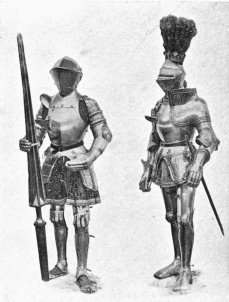
A 101. ROYAL TILT ARMOUR OF
CHARLES V. | A 19. WAR ARMOUR OF
CHARLES V. |
PLATE 20A.
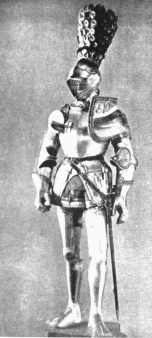 A 19. WAR ARMOUR OF THE EMPEROR CHARLES V. (1517).
PLATE 21.
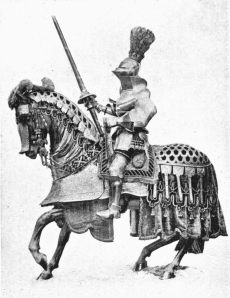 A 26. TILTING HARNESS OF CHARLES V.
PLATE 22.
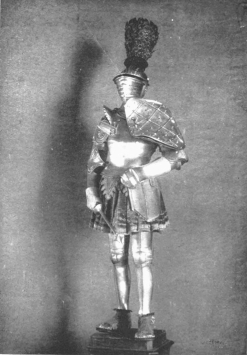 A 27. TILTING ARMOUR OF CHARLES V.
PLATE 23.
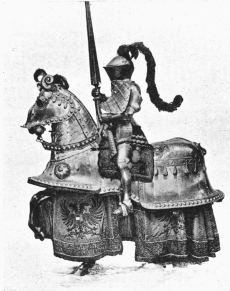 A 37. TILTING HARNESS OF CHARLES V. MADE BY COLMAN HELMSCHMIED.
PLATE 24.
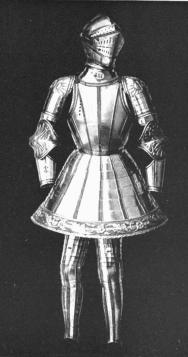 A 49. OAK-LEAF SUIT WITH LAMBOYS OF CHARLES V.
PLATE 25.
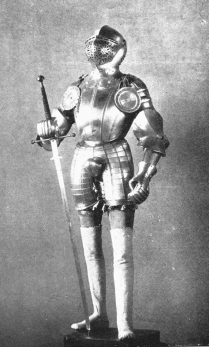 A 56. FIGURE SHOWING PIECES OF THE OAK-LEAF ARMOUR.
PLATE 26.
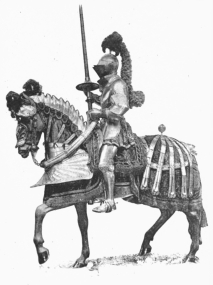 A 65. TILTING HARNESS OF CHARLES V.
PLATE 27.
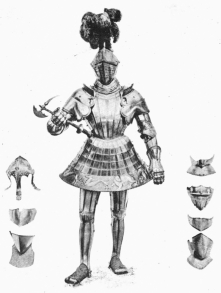 A 93. FOOT ARMOUR, WITH LAMBOYS, BELONGING TO CHARLES V., WITH
REINFORCING PIECES FOR HELMET.
A 93. FOOT ARMOUR, WITH LAMBOYS, BELONGING TO CHARLES V., WITH
REINFORCING PIECES FOR HELMET.
PLATE 27A.
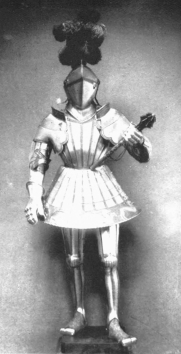 A 93. FOOT ARMOUR OF CHARLES V. MADE BY HELMSCHMIED IN 1526.
PLATE 28.
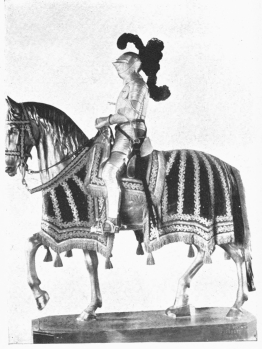 A 112. ARMOUR PRESENTED TO CHARLES V. BY THE DUKE OF MANTUA.
PLATE 29.
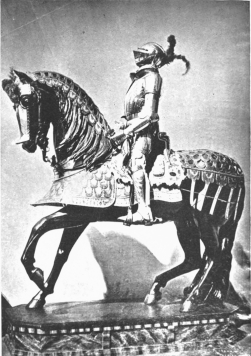 A 114. ARMOUR PRESENTED TO CHARLES V. BY THE DUKE OF MANTUA.
PLATE 30.
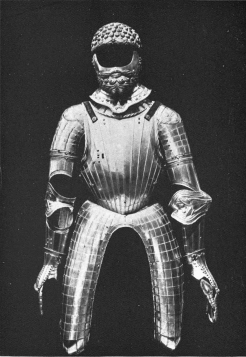 A 116. CORNUCOPIA ARMOUR OF CHARLES V.
PLATE 31.
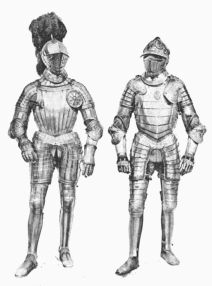
| A 129. WAR HARNESS OF CHARLES V. | A 130. ITALIAN ARMOUR OF CHARLES V. |
PLATE 31A.
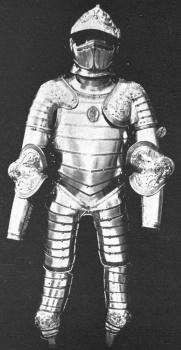 A 139. ARMOUR OF CHARLES V. (WORK OF NEGROLI).
PLATE 32.
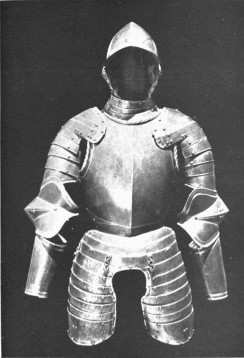 A 147. FOOT ARMOUR OF CHARLES V.
PLATE 33.
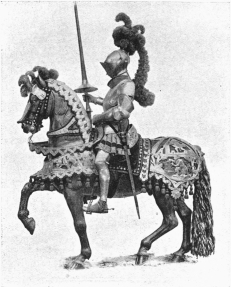 A 149. ARMOUR OF CHARLES V. (1541).
PLATE 34.
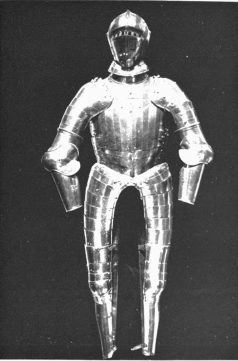 A 160. ARMOUR OF CHARLES V., PROBABLY MADE BY NEGROLI.
PLATE 35.
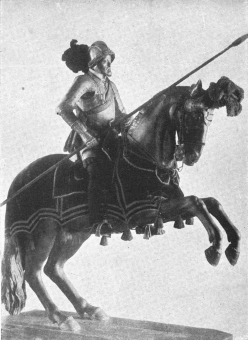 A 164. CHARLES V. AT MÜHLBERG.
PLATE 36.
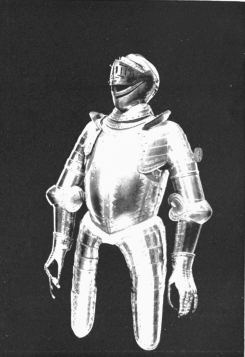 ARMOUR OF CHARLES V. (PIECES OF THE MÜHLBERG HARNESS).
PLATE 37.
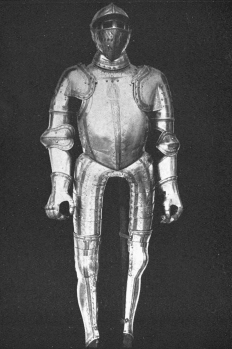 PIECES OF THE MÜHLBERG HARNESS OF CHARLES V.
PLATE 37A.
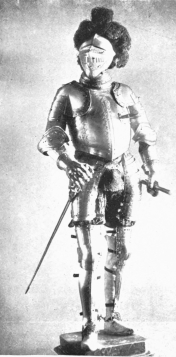 HARNESS COMPOSED OF PIECES OF THE MÜHLBERG HARNESS (1547).
PLATE 38.
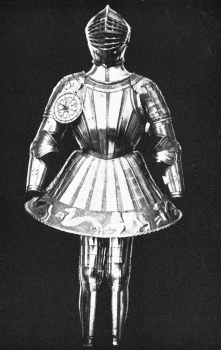 ARMOUR OF CHARLES V., WITH LAMBOYS.
PLATE 39.
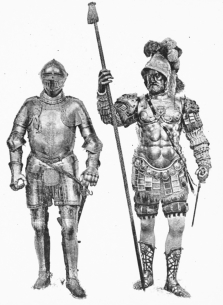
A 165. MÜHLBERG ARMOUR OF
CHARLES V. |
A 138. ARMOUR OF CHARLES V.
AFTER THE ROMAN STYLE. |
PLATE 40.
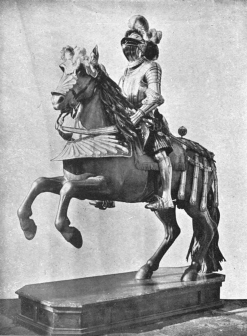 EQUESTRIAN ARMOUR OF CHARLES V.
PLATE 41.
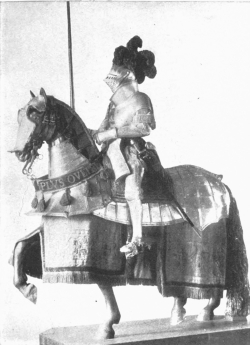 ARMOUR OF CHARLES V., MADE BY COLMAN.
(1849 Catalogue.)
PLATE 41A.
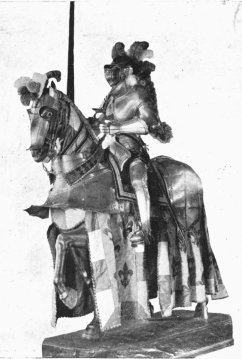 ARMOUR OF CHARLES V., AUGSBURG OR NUREMBERG MAKE.
(1849 Catalogue.)
PLATE 42.
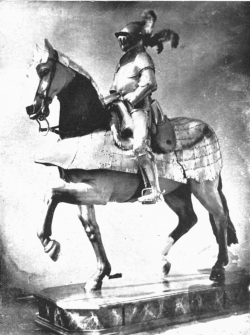 EQUESTRIAN ARMOUR OF THE MARQUIS OF VILLENA, 16TH CENTURY.
PLATE 43.
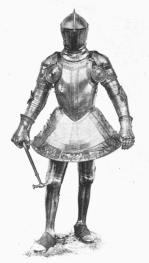 A 189. FOOT ARMOUR OF PHILIP II., MADE BY DESIDERIUS COLMAN.
PLATE 43A.
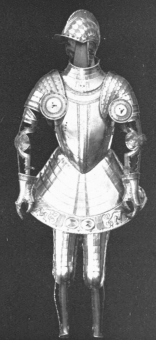 A 189. FOOT ARMOUR OF PHILIP II., MADE BY DESIDERIUS COLMAN.
PLATE 44.
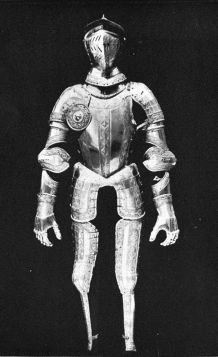 A 217. ARMOUR OF PRINCE PHILIP (II.), OF GERMAN MAKE.
PLATE 45.
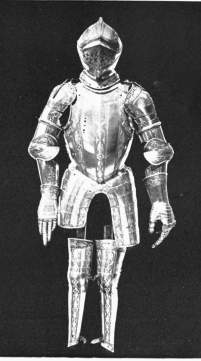 A 218. ARMOUR OF PRINCE PHILIP (II.) MADE IN GERMANY IN 1549.
PLATE 46.
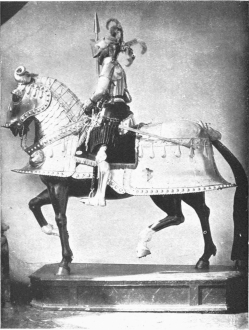 A 231. ARMOUR MADE FOR PRINCE PHILIP (II.) BY
WOLF OF LANDSHUT (1550).
PLATE 47.
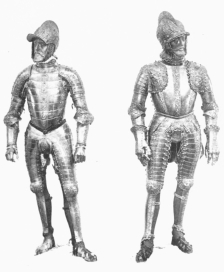
A 239. PARADE ARMOUR OF
PHILIP II. | PARADE ARMOUR OF KING
SEBASTIAN OF PORTUGAL. |
PLATE 47A.
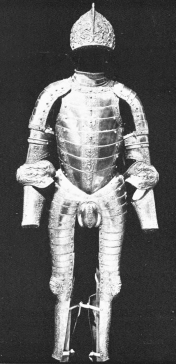 A 239. SUIT MADE FOR PRINCE PHILIP (II) AT AUGSBURG IN 1552.
PLATE 47B.
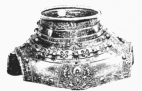 A 239. GORGET OF PHILIP II. WHEN HEIR-APPARENT. FOR
PARADE (1552). IT HAS THE COLLAR OF THE GOLDEN FLEECE.
A 239. GORGET OF PHILIP II. WHEN HEIR-APPARENT. FOR
PARADE (1552). IT HAS THE COLLAR OF THE GOLDEN FLEECE.
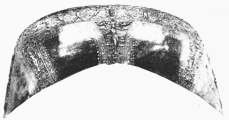 A 242. SADDLE-PLATE BELONGING TO THE SAME ARMOUR AS THE
PRECEDING.
A 242. SADDLE-PLATE BELONGING TO THE SAME ARMOUR AS THE
PRECEDING.
PLATE 48.
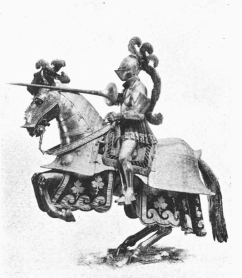 A 243. EQUESTRIAN ARMOUR OF PHILIP II. MADE BY SIGMUND WOLF OF
LANDSHUT.
A 243. EQUESTRIAN ARMOUR OF PHILIP II. MADE BY SIGMUND WOLF OF
LANDSHUT.
PLATE 49.
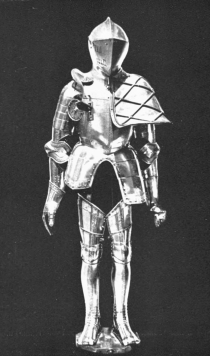 A 245. TILTING ARMOUR MADE FOR PRINCE PHILIP (II.) BY WOLF OF LANDSHUT
(1554).
A 245. TILTING ARMOUR MADE FOR PRINCE PHILIP (II.) BY WOLF OF LANDSHUT
(1554).
PLATE 50.
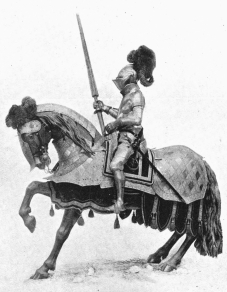 A 263. ‘BURGUNDY CROSS’ ARMOUR OF PHILIP II.
PLATE 50A.
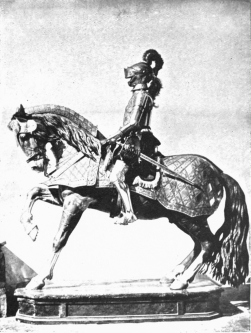 THE ‘BURGUNDY CROSS’ SUIT OF PHILIP II.
PLATE 50B.
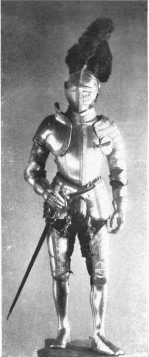 ‘BURGUNDY CROSS’ ARMOUR OF PHILIP II.
PLATE 51.
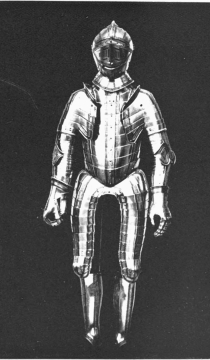 ARMOUR OF KING PHILIP II.
PLATE 52.
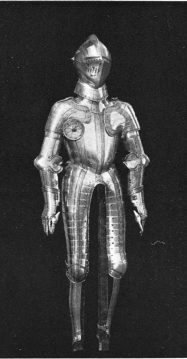 A 274. COMPLETE ARMOUR OF PRINCE CHARLES, SON OF PHILIP II.
PLATE 52A.
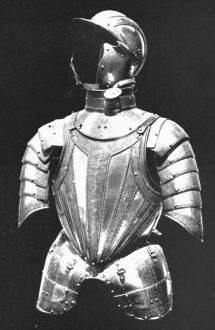 A 289. SUIT PRESENTED TO PHILIP II. BY THE CONDE DE NIEVA.
PLATE 52B.
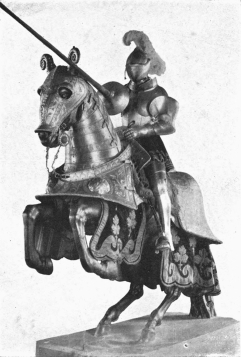 ARMOUR OF PHILIP II., ENGRAVED WITH THE ROYAL ARMS OF ENGLAND.
PLATE 53.
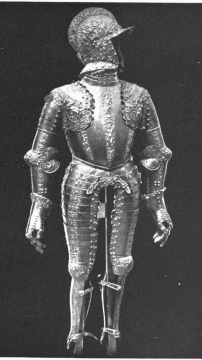 A 290. ARMOUR OF KING SEBASTIAN OF PORTUGAL.
PLATE 53A.
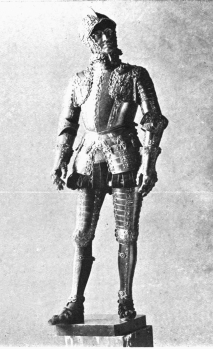 A 290. ARMOUR OF KING SEBASTIAN OF PORTUGAL (2ND VIEW).
PLATE 53B.
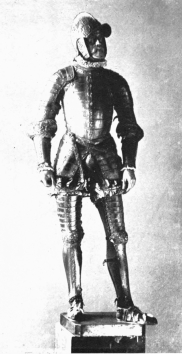 A 290. ARMOUR OF KING SEBASTIAN OF PORTUGAL (3RD VIEW).
PLATE 53C.
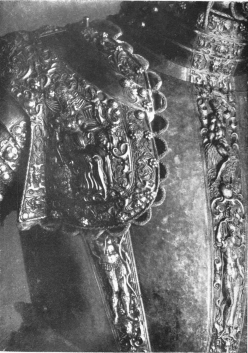 A 290. ARMOUR OF KING SEBASTIAN (DETAILS).
PLATE 53D.
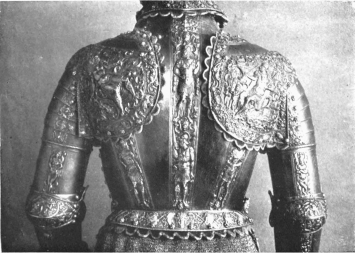 A 290. ARMOUR OF KING SEBASTIAN, BACK PLATE (DETAILS).
PLATE 54.
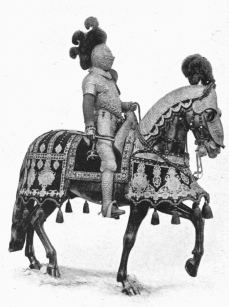 A 291. EQUESTRIAN PARADE ARMOUR OF PHILIP III.
PLATE 54A.
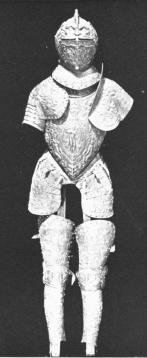 A 291. ARMOUR OF PHILIP III., MADE BY LUCIO PICININO OF MILAN.
PLATE 55.
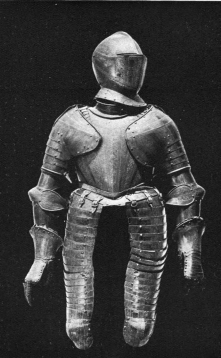 A 347. ARMOUR PRESENTED BY THE ARCHDUKE ALBERT TO PHILIP III.
PLATE 56.
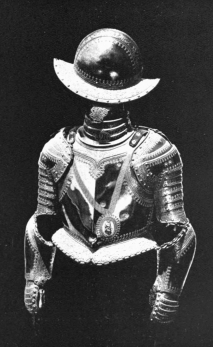 A 354. HALF SUIT MADE AT PAMPLONA FOR PHILIP III.
PLATE 57.
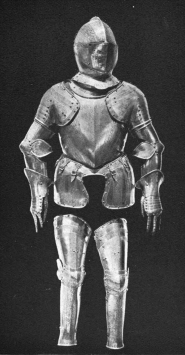 A 356. WAR ARMOUR, EARLY 17TH CENTURY, MILANESE MAKE.
PLATE 58.
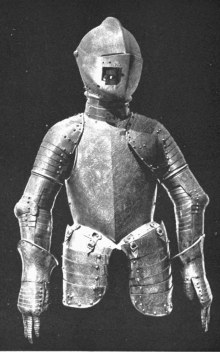 A 360. HALF ARMOUR OF PRINCE FILIPPO EMMANUELE OF SAVOY, EARLY 17TH
CENTURY.
A 360. HALF ARMOUR OF PRINCE FILIPPO EMMANUELE OF SAVOY, EARLY 17TH
CENTURY.
PLATE 58A.
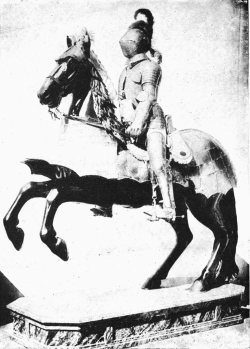 ARMOUR OF PRINCE FILIPPO EMMANUELE OF SAVOY (1586-1605).
PLATE 59.
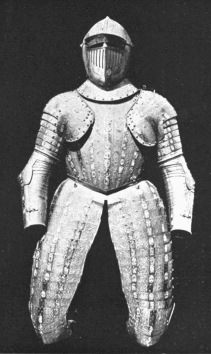 A 422. MILANESE ARMOUR OF KING PHILIP IV.
PLATE 60.
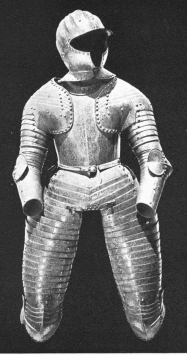 ARMOUR SENT FROM FLANDERS IN 1624 BY THE INFANTA ISABEL CLARA EUGENIA TO
PHILIP IV.
ARMOUR SENT FROM FLANDERS IN 1624 BY THE INFANTA ISABEL CLARA EUGENIA TO
PHILIP IV.
PLATE 61.
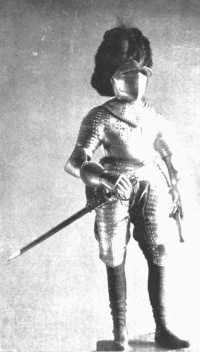 ARMOUR ASCRIBED TO KING PHILIP IV.
PLATE 62.
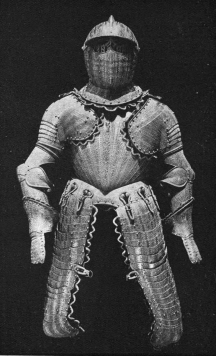 ARMOUR MADE AT PAMPLONA FOR THE DUKE OF SAVOY, 1620.
PLATE 63.
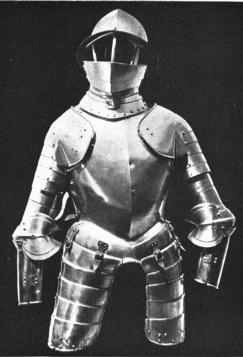 A 277. ARMOUR ASCRIBED ON DOUBTFUL AUTHORITY TO DIEGO GARCIA DE
PAREDES.
A 277. ARMOUR ASCRIBED ON DOUBTFUL AUTHORITY TO DIEGO GARCIA DE
PAREDES.
PLATE 64.
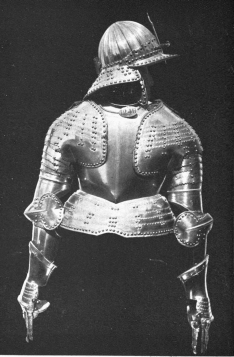 ARMOUR ASCRIBED TO DON ALONSO CESPEDES, THE CASTILIAN ALCIDES, DIED
1569.
ARMOUR ASCRIBED TO DON ALONSO CESPEDES, THE CASTILIAN ALCIDES, DIED
1569.
PLATE 65.
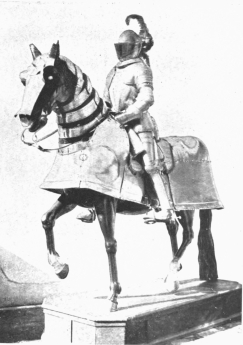 ARMOUR OF FERNANDO D’ALARCON, 16TH CENTURY.
(1849 Catalogue.)
PLATE 66.
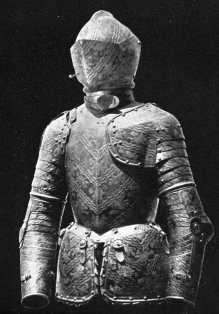 HALF ARMOUR OF THE 3RD COUNT OF ALTAMIRA.
(1849 Catalogue.)
PLATE 67.
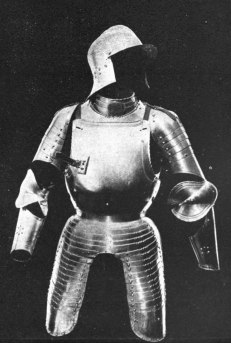 HALF ARMOUR OF JOHN OF ALDANA.
(1849 Catalogue.)
PLATE 68.
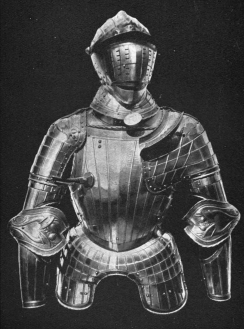 HALF ARMOUR OF ALFONSO D’AVALOS, NEPHEW OF THE MARQUIS OF PESCARA.
(1849 Catalogue.)
PLATE 69.
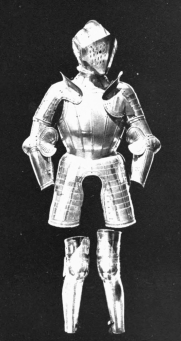 MILANESE ARMOUR OF THE FAMOUS WARRIOR ANTONIO DE LEIVA.
(1849 Catalogue.)
PLATE 70.
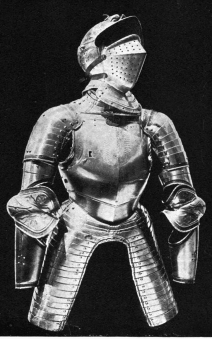 HALF ARMOUR OF THE POET GARCILASO DE LA VEGA.
(1849 Catalogue.)
PLATE 71.
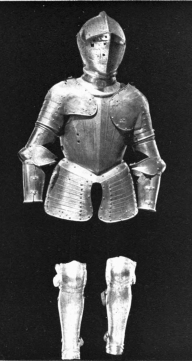 ARMOUR OF LUIS HURTADO DE MENDOZA.
(1849 Catalogue.)
PLATE 72.
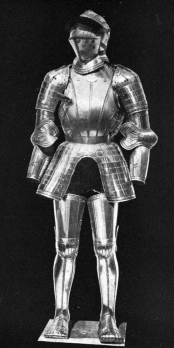 COMPLETE ARMOUR OF THE MARQUIS OF PESCARA, GENERAL OF CHARLES V.
(1849 Catalogue.)
PLATE 73.
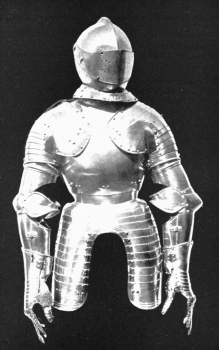 HALF ARMOUR OF JUAN DE PADILLA, BEHEADED BY ORDER OF CHARLES V. IN 1520.
(1849 Catalogue.)
PLATE 74.
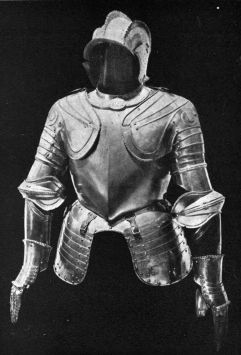 HALF ARMOUR OF JUAN ARIAS DE AVILA, COUNT OF PUÑONROSTRO.
(1849 Catalogue.)
PLATE 75.
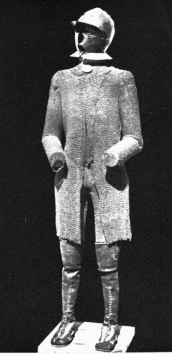 COAT OF MAIL ASCRIBED TO ALFONSO V. OF ARAGON AND I. OF SICILY.
(1849 Catalogue.)
PLATE 76.
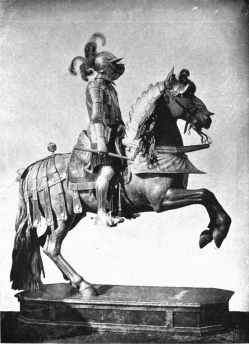 HARNESS ASCRIBED TO CHARLES V.
PLATE 77.
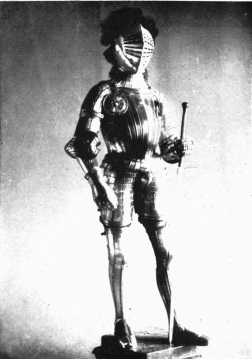 HARNESS ASCRIBED TO CHARLES V.
(1849 Catalogue.)
PLATE 78.
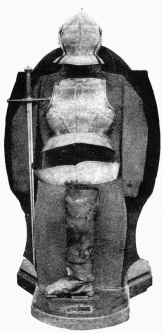 M 11-17. ARMOUR OF JOHN FREDERICK, ELECTOR OF SAXONY, TAKEN AT THE
BATTLE OF MÜHLBERG, 1547.
M 11-17. ARMOUR OF JOHN FREDERICK, ELECTOR OF SAXONY, TAKEN AT THE
BATTLE OF MÜHLBERG, 1547.
PLATE 78A.
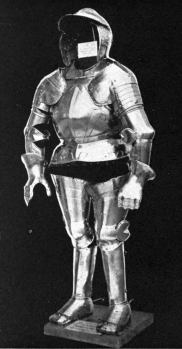 ARMOUR OF THE ELECTOR JOHN FREDERICK THE MAGNANIMOUS, DUKE OF SAXONY,
TAKEN AT MÜHLBERG.
ARMOUR OF THE ELECTOR JOHN FREDERICK THE MAGNANIMOUS, DUKE OF SAXONY,
TAKEN AT MÜHLBERG.
PLATE 79.
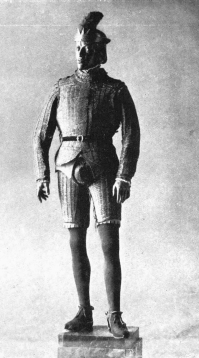 C 11. BRIGANTINE OF MILANESE MAKE WHICH BELONGED TO THE EMPEROR
MAXIMILIAN.
C 11. BRIGANTINE OF MILANESE MAKE WHICH BELONGED TO THE EMPEROR
MAXIMILIAN.
PLATE 79A.
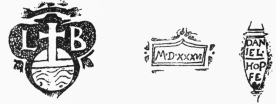
MARK ON THE BREASTPLATE
OF A CHILD’S CORSELET
(17TH CENTURY). |
SIGNATURE OF THE NOTED ENGRAVER
OF AUGSBURG, DANIEL HOPFER,
WITH DATE. |
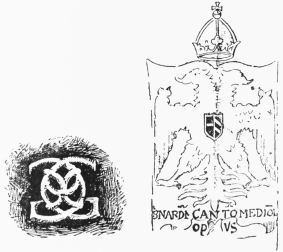
MONOGRAM OF GUIDOBALDO II.
DUKE OF URBINO, ON
SUIT A 188. |
C 11. INSIDE OF BRIGANTINE OF
MAXIMILIAN I., WITH ARMS OF
AUSTRIA AND BURGUNDY. |
PLATE 80.
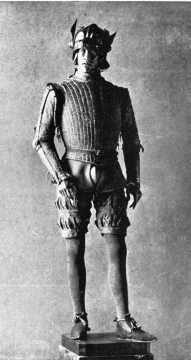 MILANESE BRIGANTINE WHICH BELONGED TO CHARLES V.
PLATE 81.
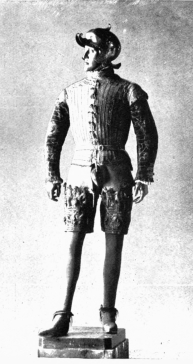 MILANESE BRIGANTINE WHICH BELONGED TO CHARLES V.
PLATE 82.
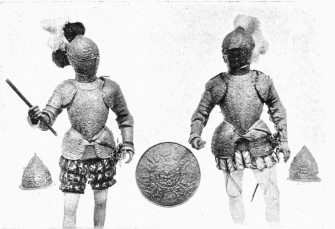
B 1. BOY’S HALF ARMOUR
WHICH BELONGED TO
PHILIP III. | B 3. SHIELD.
SUBJECT: GODS
OVERWHELMING
THE MOORS. | B 4. BOY’S HALF ARMOUR
WHICH BELONGED TO
PHILIP III. |
PLATE 83.
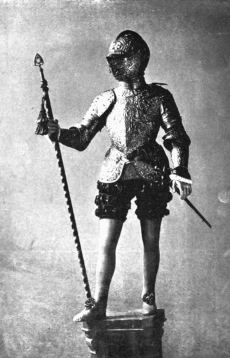 B 1. BOY’S HALF ARMOUR. MADE IN ITALY FOR THE INFANTE, AFTERWARDS PHILIP
III.
B 1. BOY’S HALF ARMOUR. MADE IN ITALY FOR THE INFANTE, AFTERWARDS PHILIP
III.
PLATE 83A.
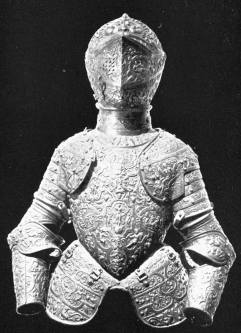 D 1. BOY’S HALF ARMOUR. MADE FOR THE INFANTE, AFTERWARDS PHILIP III.
(SECOND VIEW.)
D 1. BOY’S HALF ARMOUR. MADE FOR THE INFANTE, AFTERWARDS PHILIP III.
(SECOND VIEW.)
PLATE 84.
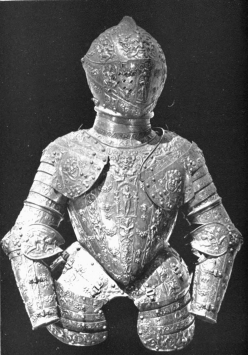 B 4. HALF ARMOUR PRESENTED TO THE INFANTE, AFTERWARDS PHILIP III., BY
THE DUKE OF TERRANOVA.
B 4. HALF ARMOUR PRESENTED TO THE INFANTE, AFTERWARDS PHILIP III., BY
THE DUKE OF TERRANOVA.
PLATE 85.
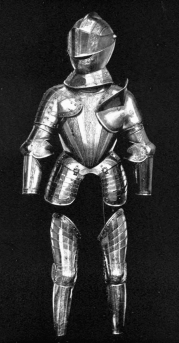 B 9. MILANESE ARMOUR PRESENTED TO THE INFANTE, AFTERWARDS PHILIP III.,
BY THE DUKE OF TERRANOVA.
B 9. MILANESE ARMOUR PRESENTED TO THE INFANTE, AFTERWARDS PHILIP III.,
BY THE DUKE OF TERRANOVA.
PLATE 85A.
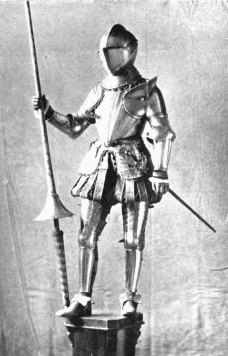 B 9. ARMOUR OF THE INFANTE, AFTERWARDS PHILIP III., MILANESE MAKE
(SECOND VIEW.)
B 9. ARMOUR OF THE INFANTE, AFTERWARDS PHILIP III., MILANESE MAKE
(SECOND VIEW.)
PLATE 86.
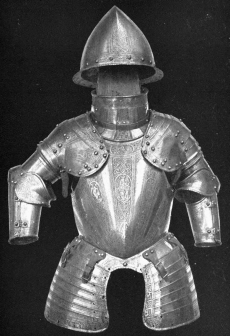 B 12. BOY’S HALF ARMOUR, WITH MEDALLION ON BREASTPLATE OF MUTIUS
SCAEVOLA.
B 12. BOY’S HALF ARMOUR, WITH MEDALLION ON BREASTPLATE OF MUTIUS
SCAEVOLA.
PLATE 87.
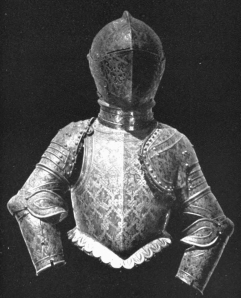 B 18. BOY’S HALF ARMOUR MADE FOR THE INFANTE FERNANDO, SON OF PHILIP
III.
B 18. BOY’S HALF ARMOUR MADE FOR THE INFANTE FERNANDO, SON OF PHILIP
III.
PLATE 88.
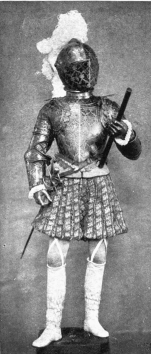 HALF ARMOUR BELONGING TO PRINCE PHILIP, AFTERWARDS PHILIP IV.
PLATE 89.
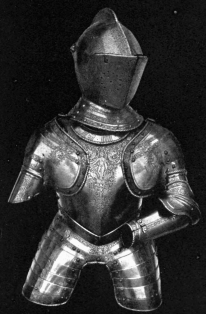 BOY’S HALF ARMOUR, MILANESE MAKE, LATE 16TH CENTURY.
PLATE 90.
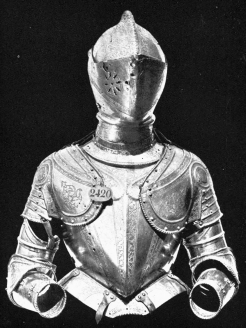 BOY’S HALF ARMOUR.
PLATE 91.
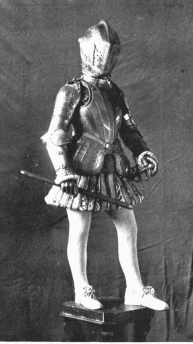 BOY’S HALF ARMOUR, END OF 16TH CENTURY (ITALIAN).
PLATE 92.
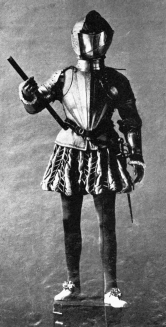 BOY’S HALF ARMOUR.
PLATE 93.
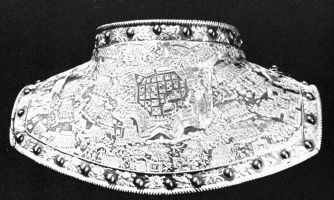 A 434. GORGET. SUBJECT: THE SIEGE OF OSTEND, 1601.
PLATE 94.
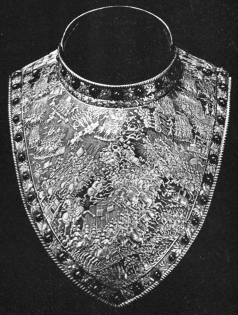 A 434. GORGET OF PHILIP II. SUBJECT: THE BATTLE OF NIEUPORT.
PLATE 95.
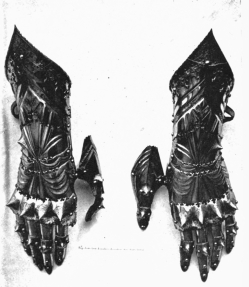 E 88-89. SUPERB PAIR OF GAUNTLETS BELONGING TO CHARLES V.
PLATE 96.
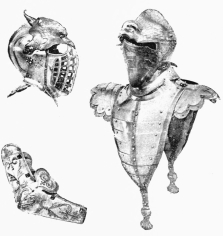 A 151. LIGHT WAR-ARMOUR OF CHARLES V., CORSELET AND ARMLET OF RARE FORM,
ALSO TWO HELMETS.
A 151. LIGHT WAR-ARMOUR OF CHARLES V., CORSELET AND ARMLET OF RARE FORM,
ALSO TWO HELMETS.
PLATE 97.
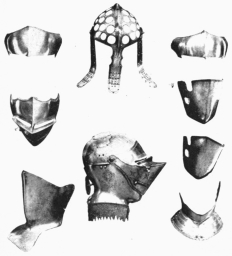 A 75-83. ARMET WITH REINFORCING PIECES.
PLATE 98.
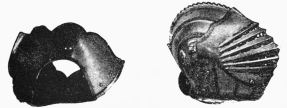
A 54. A CURIOUS BEVOR IN TWO
PIECES, NAILED ON LEATHER. | A 49. CHARLES V.’S TILTING
HELMET. |
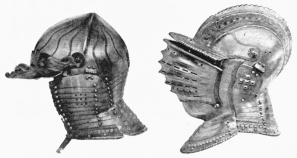
A 29. HELMET BELONGING TO
THE ‘K.D.’ SUIT. | A 27. HELMET OF
CHARLES V. |
PLATE 99.
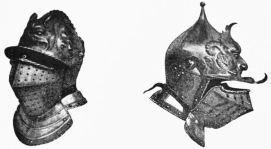
A 120. BURGONET BY
COLMAN. | A 118. MORION OF
CHARLES V. |
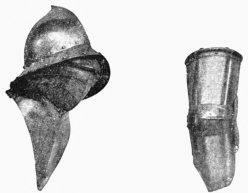 CABASSET AND LEG ARMOUR OF A SPANISH PIKEMAN, LATE 15TH
CENTURY.
CABASSET AND LEG ARMOUR OF A SPANISH PIKEMAN, LATE 15TH
CENTURY.
PLATE 100.
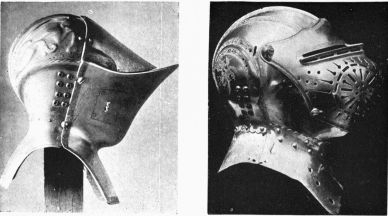
| A 56. HELMET OF CHARLES V. | A 57. TILTING HELMET OF CHARLES V. |
PLATE 101.
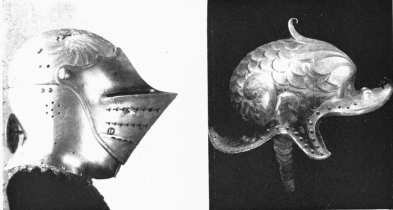
| A 75. HELMET OF CHARLES V. | A 59. ‘DOLPHIN’ HELMET OF CHARLES V. |
PLATE 102.
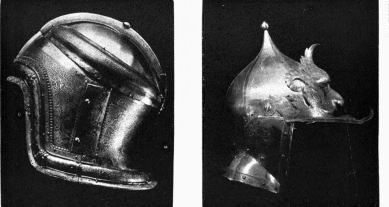
| D 12. HELMET MADE BY NEGROLI OF MILAN. | A 118. BURGONET OF CHARLES V. |
PLATE 103.
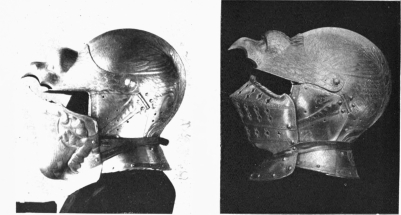
A 151. BURGONET OF CHARLES V., WITH BEVOR
BOUGHT FROM SIR RICHARD WALLACE. |
A 151. BURGONET OF CHARLES V., WITH BEVOR
NOT BELONGING TO HELMET. |
PLATE 104.
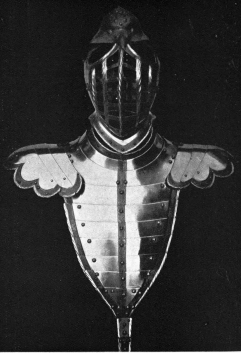 A 151. CORSELET OF CHARLES V.
PLATE 105.
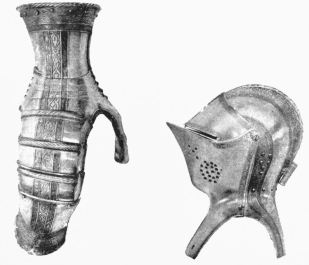
| A 189 | A190 |
| GAUNTLET AND HELMET OF PHILIP II. |
PLATE 106.
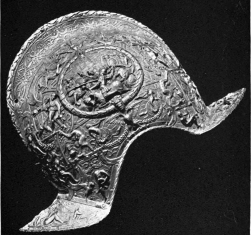 HELMET OF PHILIP II., MADE AT AUGSBURG IN 1549, BELONGING TO THE SUIT A
239.
HELMET OF PHILIP II., MADE AT AUGSBURG IN 1549, BELONGING TO THE SUIT A
239.
PLATE 107.
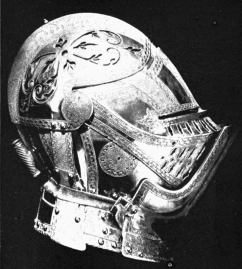 A 243. HELMET OF PHILIP II., MADE BY WOLF OF LANDSHUT IN 1554.
PLATE 108.
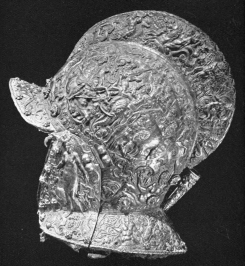 A 290. BURGONET OF KING SEBASTIAN OF PORTUGAL.
PLATE 109.
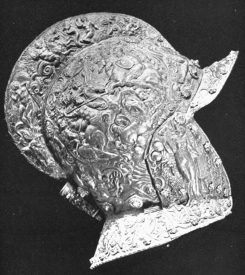 A 290. BURGONET OF KING SEBASTIAN OF PORTUGAL.
PLATE 110.
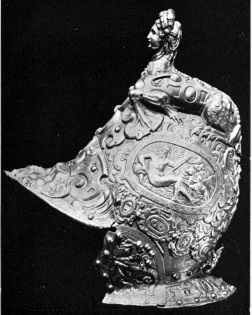 A 292. BURGONET MADE FOR PHILIP III. BY LUCIO PICININO.
PLATE 111.
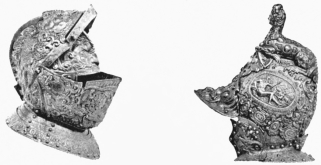
A 291. HELMET OF PHILIP III.,
WITH THREE BEAUTIFUL MASKS, ON VISOR,
NAPE, AND FRONT; PROBABLY ITALIAN,
LATE 16TH CENTURY. |
A 292. BURGONET, THE MISSING
PARTS OF WHICH ARE IN THE
KENSINGTON MUSEUM. |
PLATE 112.
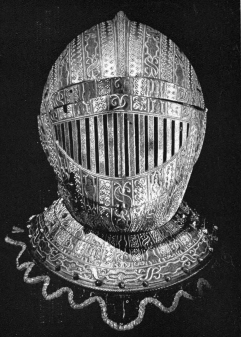 A 350. HELMET FOR THE DUKE OF SAVOY (FRONT VIEW).
PLATE 113.
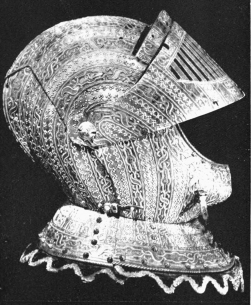 A 350. HELMET FOR THE DUKE OF SAVOY (SIDE VIEW).
PLATE 114.
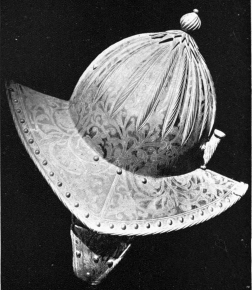 A 417. CABASSET PRESENTED TO PHILIP IV. BY THE INFANTA ISABEL EUGENIA.
PLATE 115.
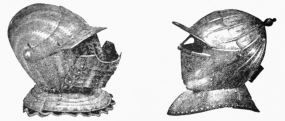
A 350. HELMET WITH MOVABLE
VISOR, MADE IN PAMPLONA,
APPARENTLY FOR THE
DUKE OF SAVOY, 1620. | A 380. BURGONET, EARLY 17TH
CENTURY (BELONGED TO
PHILIP IV.). |
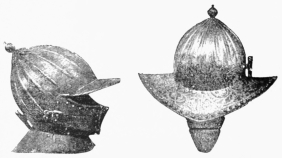
A 414. HELMET OF PHILIP IV., PRESENTED
TO HIM, WITH OTHER ARMOUR, BY
THE INFANTA ISABEL EUGENIA. | A 417. CABASSET PRESENTED TO
PHILIP IV. BY THE INFANTA
ISABEL EUGENIA. |
PLATE 116.
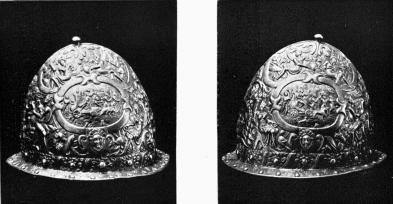 B 2. MORION WHICH BELONGED TO PHILIP III. WHEN A BOY. SUBJECT, THE
GODDESS OF PLENTY.
B 2. MORION WHICH BELONGED TO PHILIP III. WHEN A BOY. SUBJECT, THE
GODDESS OF PLENTY.
PLATE 117.
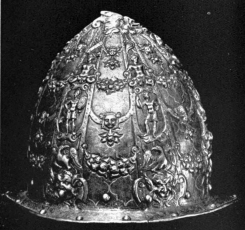 B 5. MORION GIVEN TO PHILIP III. WHEN A CHILD BY THE DUKE OF
TERRANOVA.
B 5. MORION GIVEN TO PHILIP III. WHEN A CHILD BY THE DUKE OF
TERRANOVA.
PLATE 118.
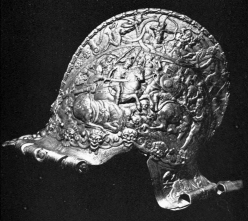 D 3. BURGONET OF CHARLES V., DESIGNED BY GIULIO ROMANO.
PLATE 119.
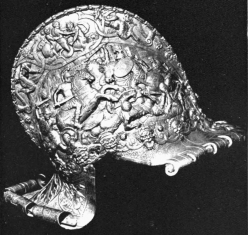 D 3. BURGONET OF CHARLES V., DESIGNED BY GIULIO ROMANO
(SECOND SIDE).
PLATE 120.
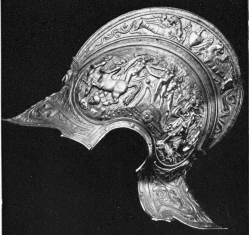 D 5. BURGONET, 16TH CENTURY. SUBJECT, BACCHUS AND ARIADNE
(LEFT SIDE).
PLATE 121.
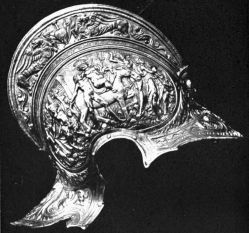 D 5. BURGONET, 16TH CENTURY. SUBJECT, SILENUS
SUPPORTED BY BACCHUS.
PLATE 122.
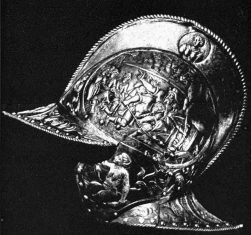 D 7. BURGONET, 16TH CENTURY. SUBJECT, THE HORSE OF TROY
(LEFT SIDE).
PLATE 123.
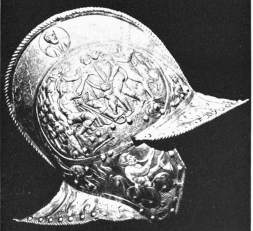 D 7. BURGONET, 16TH CENTURY. SUBJECT, THE JUDGMENT
OF PARIS (RIGHT
SIDE).
PLATE 124.
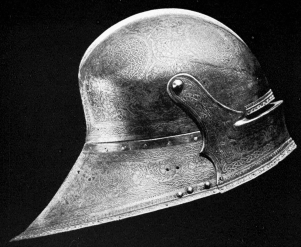 D 13. MILANESE SALADE, 15TH CENTURY.
PLATE 125.
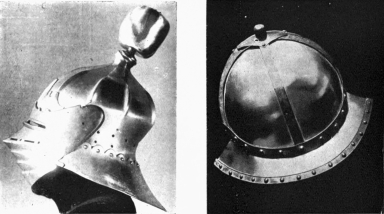
| D 14. MOORISH SALADE ASCRIBED TO PHILIP I. |
D 26. SPANISH MORION, EARLY 16TH CENTURY,
WITH THE INSCRIPTION, ‘NON
TIMEO MILIA POPULI.’ |
PLATE 126.
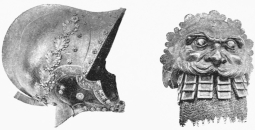
A 188. ROMAN HELMET
(CHARLES V.). | A 183. MASK ON SHOULDER-GUARD
OF CHARLES V.’S ROMAN SUIT. |
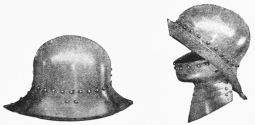
D 22. CABASSET WHICH BELONGED
TO PHILIP THE HANDSOME. | D 16. LATE 15TH CENTURY HELMET.
PROBABLY BELONGED TO PHILIP
THE HANDSOME. |
PLATE 127.
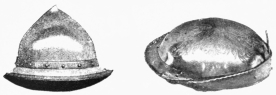
D 25. SPANISH FOOT-SOLDIER’S
MORION, EARLY 16TH
CENTURY. | D 23. PARADE HEADPIECE OF
CHARLES V. |
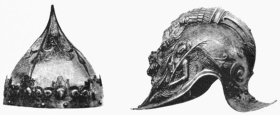
D 29. PARADE HEADPIECE,
MIDDLE 16TH CENTURY
(ORIGIN UNKNOWN). | D 30. PARADE BURGONET MADE.
FOR CHARLES V. BY THE
NEGROLIS IN 1545. |
PLATE 128.
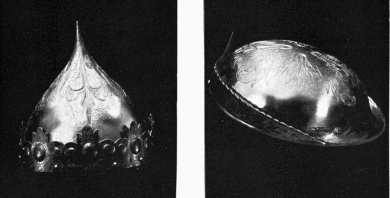
| D 29. HELMET, MIDDLE OF 16TH CENTURY. | D 28. STEEL CAP BELONGING TO CHARLES V. |
PLATE 129.
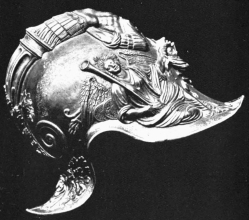 D 30. BURGONET OF CHARLES V., MADE BY NEGROLI.
PLATE 130.
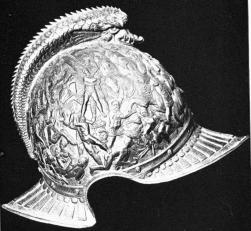 M 5. HELMET OF FRANCIS I. OF FRANCE, TAKEN AT
THE BATTLE OF PAVIA.
PLATE 131.
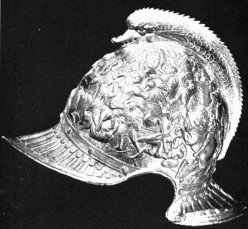 M 5. HELMET OF FRANCIS I. OF FRANCE, TAKEN AT
THE BATTLE OF PAVIA.
PLATE 132.
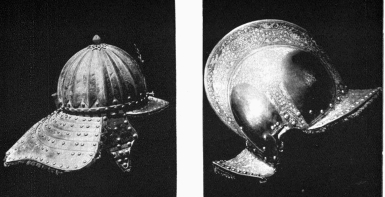
B 21. HELMET WHICH BELONGED TO PRINCE
BALTAZAR CARLOS, 1629-1646. |
D 31. BURGONET ASCRIBED ON INSUFFICIENT
GROUNDS TO ANTONIO DE LEYVA
(16TH CENTURY). |
PLATE 133.
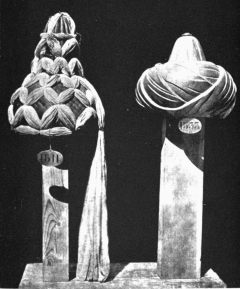 1511. SATIN AND VELVET TURBAN FOUND IN THE PALACE OF MUSTAFA, BEY OF
ORAN, IN 1722.
1511. SATIN AND VELVET TURBAN FOUND IN THE PALACE OF MUSTAFA, BEY OF
ORAN, IN 1722.
1533. STEEL TURBAN OF ALI PASHA TURKISH ADMIRAL AT LEPANTO.
PLATE 134.
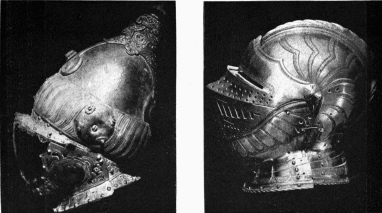
| TURKISH HELMET, TAKEN AT LEPANTO. | HELMET OF PHILIP III. |
PLATE 135.
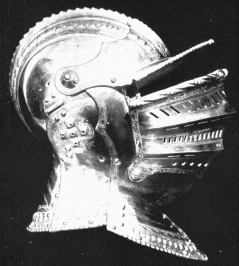 HELMET OF THE 16TH CENTURY.
PLATE 136.
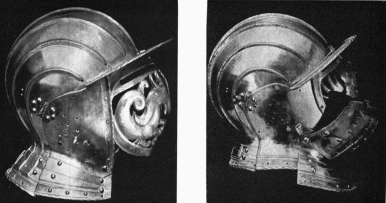
HELMET OF CHARLES V., BELONGING TO
THE CORNUCOPIÆ SUIT. | HELMET OF CHARLES V., BELONGING TO
THE CORNUCOPIÆ SUIT. |
PLATE 137.
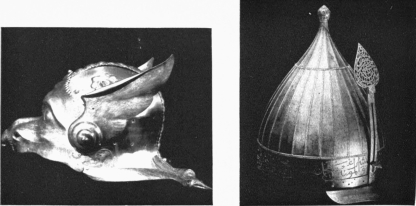
C 11. SALADE, WITH DETACHABLE DECORATIVE PIECES
(BELONGED TO MAXIMILIAN I. OR PHILIP I.). | M 19. HELMET OF ALI PASHA, TURKISH
ADMIRAL, DEFEATED AT LEPANTO. |
PLATE 138.
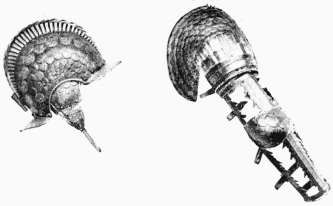 A 191. MORION AND ARM-GUARD OF CHARLES V.
PLATE 139.
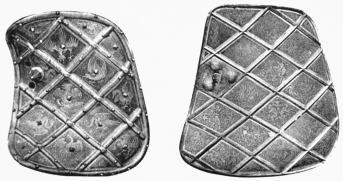
| A 27. SHIELD USED IN TILTING. |
A 57. SHIELD USED IN TILTING,
DESIGNED BY HOPFER. |
PLATE 140.
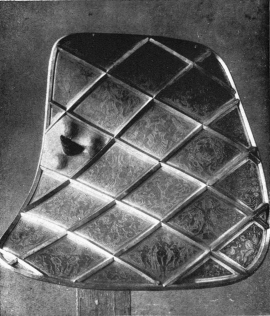 A 57. SHIELD DESIGNED BY HOPFER.
PLATE 141.
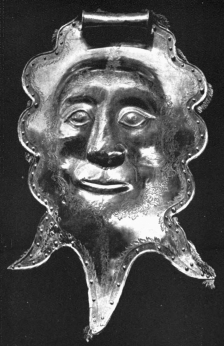 SHIELD, WITH A MASK IN RELIEF, BELONGING TO
THE HARNESS OF CHARLES V., A
149-156.
PLATE 142.
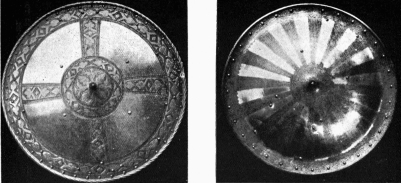
SHIELD OF PHILIP II., BELONGING TO
THE ARMOUR A 217-230. |
SHIELD OF THE EMPEROR CHARLES V., BELONGING
TO THE HARNESS A 159-163. |
PLATE 143.
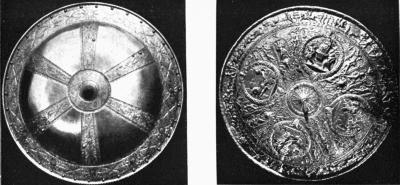
| A 265. SHIELD OF PHILIP II. |
A 241. GERMAN SHIELD, 16TH CENTURY, BY
DESIDERIO COLMAN: WAR, PEACE,
WISDOM, AND STRENGTH. |
PLATE 144.
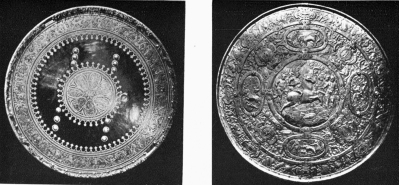
SHIELD OF PHILIP III., MUSKET-PROOF, BELONGING
TO THE HARNESS A 354. | A 293. SHIELD. SUBJECT: ALEXANDER SUBDUING
BUCEPHALUS. |
PLATE 145.
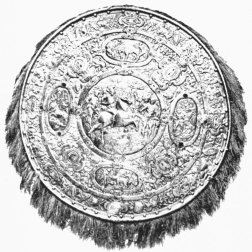 A 293. SHIELD ACCOMPANYING ARMOUR OF PHILIP III.
1578-1621. IN THE
CENTRE, ALEXANDER THE
GREAT SUBDUING BUCEPHALUS.
PLATE 146.
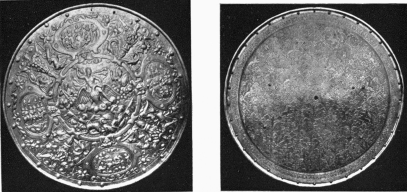
B 3. SHIELD WHICH BELONGED TO PHILIP III. WHEN A BOY.
SUBJECT: JUPITER, NEPTUNE, AND MARS
OVERWHELMING THE MOORS. | A 374. SHIELD BELONGING TO PRINCE FILIPPO EMMANUELE
OF SAVOY, 1588-1624 (ITALIAN). |
PLATE 147.
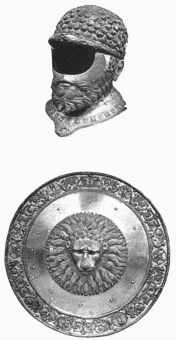 D1, D2. HELMET AND SHIELD OF CHARLES V.
PLATE 148.
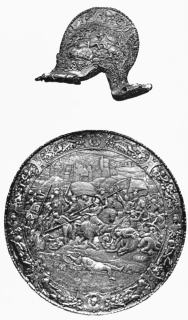 D3, D4. BURGONET AND SHIELD OF CHARLES V.
PLATE 149.
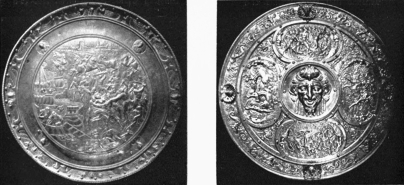
D 8. SHIELD (ITALIAN) WITH DESIGN REPRESENTING
THE ABDUCTION OF HELEN, 16TH CENTURY. | D 6. SHIELD OF ITALIAN WORKMANSHIP
16TH CENTURY. |
PLATE 150.
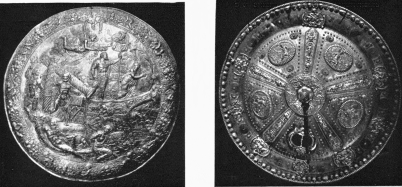
D 63. THE ‘PLUS ULTRA’ SHIELD, DESIGNED
BY GIROLAMO ROMANI. | D 10. SHIELD, EARLY 17TH CENTURY.
DESIGN: WARRIORS IN COMBAT. |
PLATE 150A.
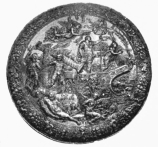 D 63. SHIELD CALLED ‘PLUS ULTRA,’ WITH APOTHEOSIS OF
CHARLES V.
D 63. SHIELD CALLED ‘PLUS ULTRA,’ WITH APOTHEOSIS OF
CHARLES V.
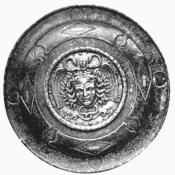 D 64. THE MEDUSA SHIELD, MADE BY NEGROLI FOR CHARLES V.
PLATE 151.
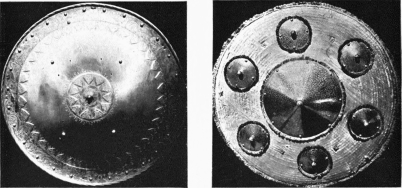
SHIELD OF THE EMPEROR CHARLES V., FORMING
PART OF THE MÜHLBERG ARMOUR. | D 66. ITALIAN SHIELD, MOORISH STYLE,
16TH CENTURY. |
PLATE 152.
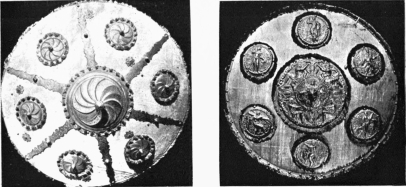
D 67. ITALIAN SHIELD, MOORISH STYLE,
16TH CENTURY. | SHIELD PRESENTED TO CHARLES V. BY
DON FERDINANDO DE GONZAGA. |
PLATE 153.
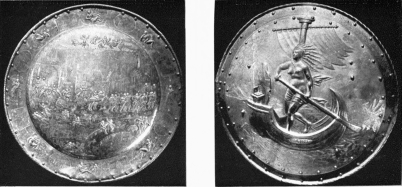
D 69. ITALIAN SHIELD, 16TH CENTURY.
DESIGN: THE TRIUMPH OF LOVE. | D 68. SHIELD OF AUGSBURG MAKE, 16TH CENTURY. |
PLATE 154.
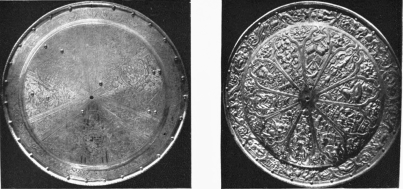
SHIELD ASCRIBED TO THE MARQUIS OF VILLENA,
16TH CENTURY. | D 71. SHIELD OF THE END OF THE
16TH CENTURY. |
PLATE 155.
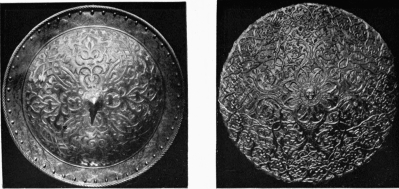
| SHIELD OF PHILIP II. | SHIELD OF THE MILANESE SCHOOL, 16TH CENTURY. |
PLATE 156.
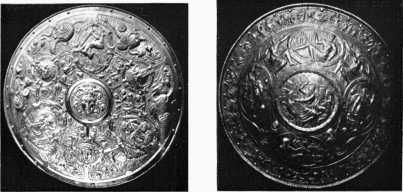
D 72. SHIELD, LATE 16TH CENTURY.
DESIGN: THE MEDUSA’S HEAD. |
SHIELD REPRESENTING JUPITER, SATURN, VENUS
AND CUPID, MERCURY, AND MARS, 16TH CENTURY. |
PLATE 157.
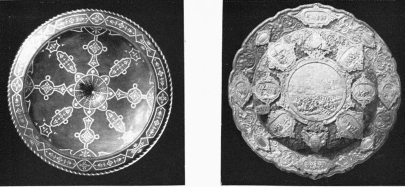
SHIELD, THE WORK OF E. DE ZULOAGA,
19TH CENTURY. | UNFINISHED SHIELD, THE WORK OF E. DE ZULOAGA,
19TH CENTURY. |
PLATE 158.
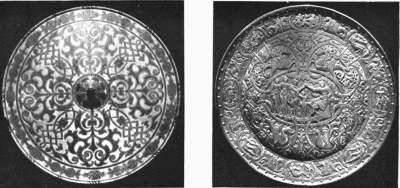
SHIELD, THE WORK OF E. DE ZULOAGA,
19TH CENTURY. |
D 73. SPANISH SHIELD, 17TH CENTURY.
DESIGN: THE JUDGMENT OF PARIS. |
PLATE 159.
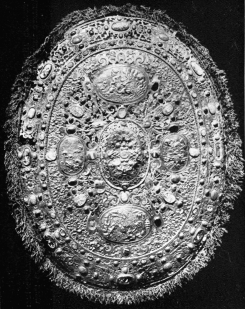 D 78. SHIELD PRESENTED TO PHILIP III. BY THE DUKE OF SAVOY IN 1603.
PLATE 160.
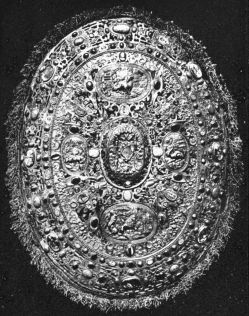 D 79. SHIELD PRESENTED TO PHILIP III. BY THE
DUKE OF SAVOY IN 1603.
PLATE 161.
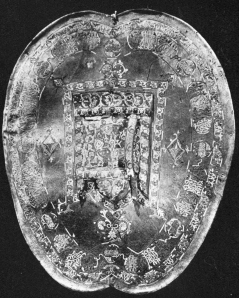 D 86. MOORISH LEATHER SHIELD, END OF 15TH CENTURY.
PLATE 161A.
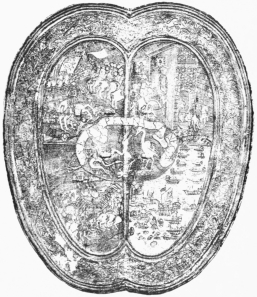 D 88. OVAL LEATHER SHIELD, LATE 16TH CENTURY. THE FACE
DECORATED WITH
ADMIRABLE MEXICAN-INDIAN
FEATHER-WORK.
PLATE 162.
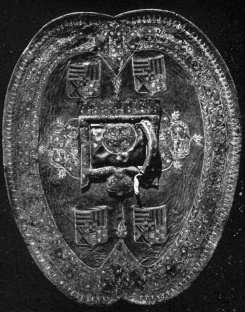 LEATHER SHIELD, WITH THE ARMS OF THE MENDOZA FAMILY.
PLATE 163.
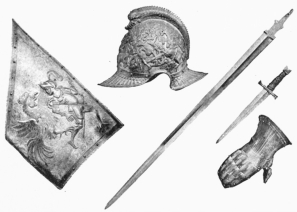 M 1-5. ARMS OF KING FRANCIS I. OF FRANCE, TAKEN AT THE
BATTLE OF PAVIA,
1525, BY THE TROOPS OF CHARLES V.
PLATE 163A.
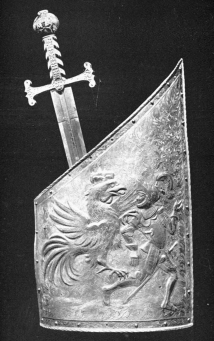 M 6. SHIELD AND SWORD OF FRANCIS I. OF FRANCE, TAKEN
AT THE BATTLE OF
PAVIA. DESIGN: THE GALLIC COCK
ATTACKING A WARRIOR AND PUTTING HIM TO
FLIGHT.
PLATE 164.
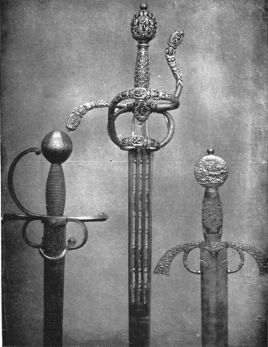
G 45. SWORD OF
HERNANDO CORTES. | G 48. SWORD OF
PHILIP II. | G 29. SWORD OF
GONSALVO DE CORDOBA. |
PLATE 165.
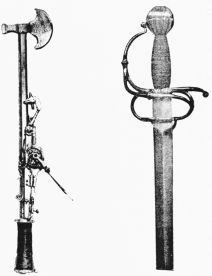
K 60. PISTOL AND
AXE COMBINED
OF PHILIP II. | G 45. SWORD ATTRIBUTED TO
HERNANDO CORTES,
CONQUEROR OF MEXICO,
1485-1547. |
PLATE 166.
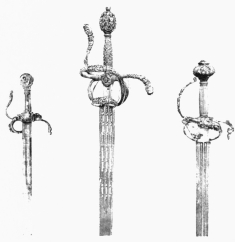
G 47. SWORD OF
PHILIP II.,
WORN WITH
PARADE
ARMOUR. | G 48. TOLEDAN
SWORD
ATTRIBUTED
TO
PHILIP II. | G 49. TOLEDAN SWORD OF
THE COUNT OF CORUNNA
(16TH CENTURY). THE
GUARD IS ONE OF THE
MOST BEAUTIFUL IN
THE ARMOURY. |
PLATE 166A.
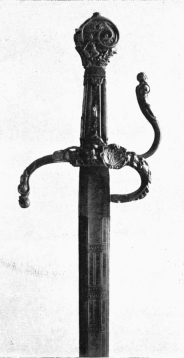 G 47. SWORD OF PHILIP II., WITH THE MARK OF
CLEMENT HORN OF SOLINGEN.
PLATE 167.
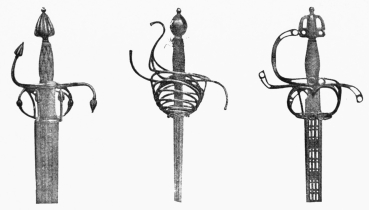
G 54. SPANISH
SWORD,
MIDDLE OF
16TH CENTURY. |
G 59. SPANISH SWORD,
LATE 16TH CENTURY. BEARS MARK OF
JUANES EL VIEJO. |
G 55. SPANISH SWORD,
LATE 16TH CENTURY,
MADE BY SEBASTIAN
HERNANDEZ OF TOLEDO. |
PLATE 168.
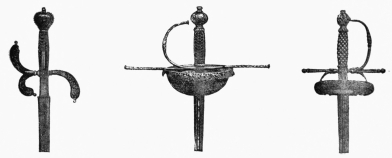
G 61. SWORD OF THE
DUKE OF WEIMAR,
COMMANDER OF THE
SWEDISH ARMY,
DEFEATED AT THE
BATTLE OF
NORDLINGEN, 1624. | G 80. SWORD
ATTRIBUTED TO
PHILIP III.
IT BEARS THE
DATE 1604,
TOLEDO
MAKE. | G 64. SWORD
ATTRIBUTED TO
COUNT DE LEMOS,
1576-1622,
MADE BY TOMÁS
DE AYALA OF
SEVILLE. |
PLATE 169.
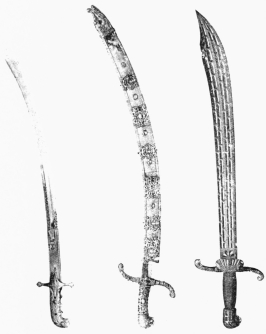
G 151. PERSIAN SWORD,
16TH CENTURY,
PROBABLY BROUGHT
FROM TUNIS
BY CHARLES V. | G 62. STRADIOT’S SABRE,
EARLY 17TH CENTURY,
PRESENTED BY THE
DUKE OF SAVOY TO
PHILIP III. (1603). |
G 43.
16TH CENTURY
CUTLASS. |
PLATE 170.
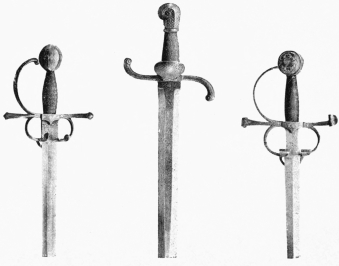
G 34. WAR SWORD
OF CHARLES V.,
ITALIAN MAKE. | G 33. ITALIAN WAR
SWORD OF
CHARLES V. | G 35. SWORD OF
PIZARRO,
CONQUEROR OF PERU. |
PLATE 171.
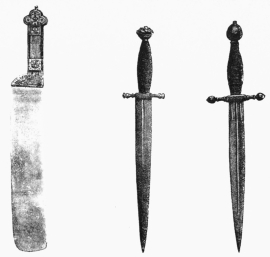
G 160. KNIFE USED BY THE
CARVER AT THE KING’S
TABLE, AS REQUIRED BY
THE ETIQUETTE OF
THE HOUSE OF BURGUNDY. |
DAGGER,
EARLY
16TH
CENTURY. |
16TH CENTURY
DAGGER,
SUPPOSED TO HAVE
BELONGED TO
CHARLES V. |
PLATE 172.
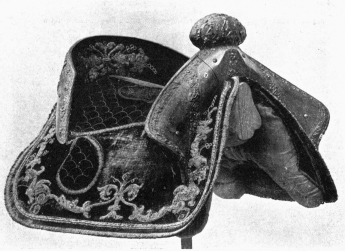 A 242. WAR SADDLE OF PHILIP II., MADE BY DESIDERIUS COLMAN OF
AUGSBURG.
A 242. WAR SADDLE OF PHILIP II., MADE BY DESIDERIUS COLMAN OF
AUGSBURG.
PLATE 172A.
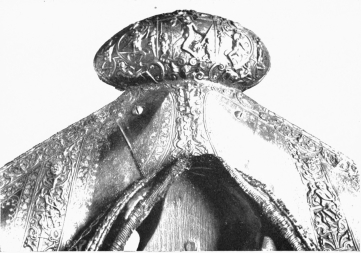 A 242. POMMEL AND CANTLE OF SADDLE OF PHILIP II.
PLATE 172B.
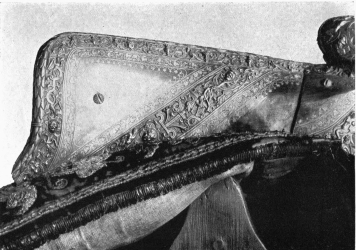 A 242. CANTLE-PLATE OF SAME SADDLE.
PLATE 172C.
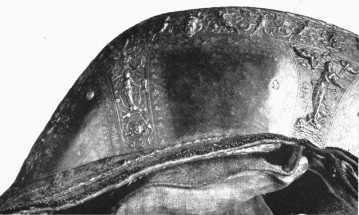 A 242. BURR-PLATE OF SADDLE.
PLATE 172D.
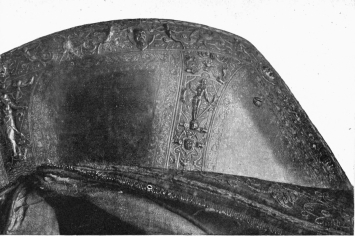 A 242. BURR-PLATE OF SADDLE.
PLATE 173.
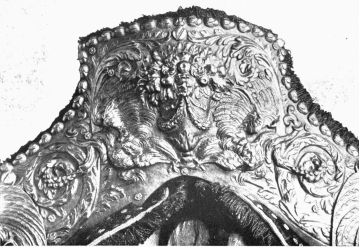 A 291. CANTLE-PLATES OF SADDLE MADE BY LUCIO PICININO.
PLATE 173A.
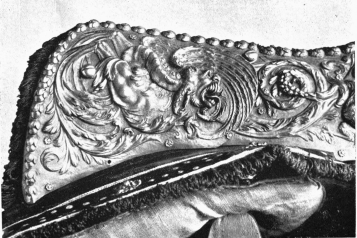 A 291. CANTLE-PLATE OF SAME SADDLE.
PLATE 173B.
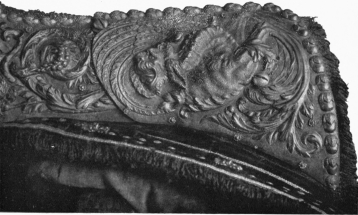 A 291. BURR-PLATE OF SAME SADDLE.
PLATE 174.
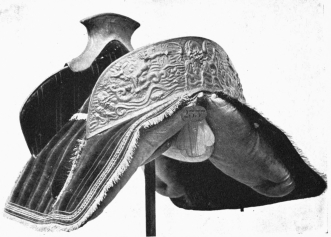 SADDLE (ITALIAN), 16TH CENTURY. (MARINE MONSTERS.)
PLATE 175.
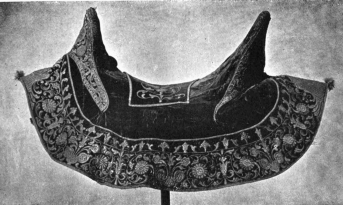 MOORISH SADDLE, WITH SHORT STIRRUPS, 18TH CENTURY.
PLATE 176.
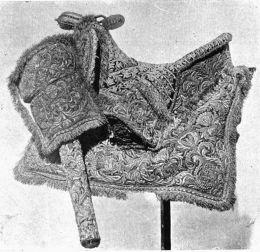 TURKISH SADDLE GIVEN TO CHARLES III.
PLATE 177.
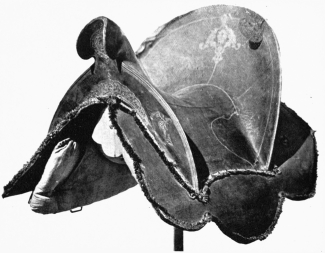 ARAB SADDLE, WITH SHORT STIRRUPS, TAKEN IN THE PALACE OF THE
BEY OF ORAN
IN 1732.
PLATE 178.
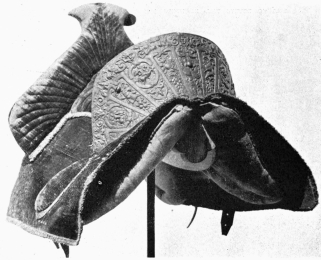 MILITARY SADDLE, LATE 16TH CENTURY.
PLATE 179.
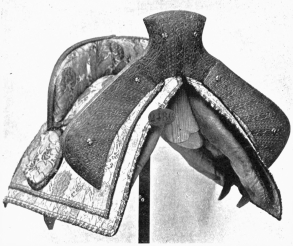 A 352. SADDLE MADE AT PAMPLONA FOR THE DUKE OF SAVOY (1620).
PLATE 180.
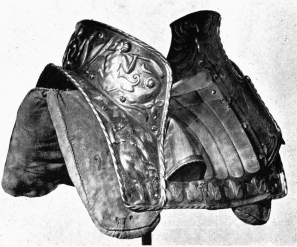 IRON WAR SADDLE OF THE EMPEROR CHARLES V.
PLATE 181.
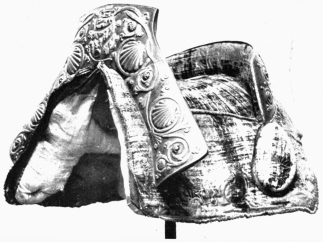 F 22. ITALIAN SADDLE, 16TH CENTURY, PROBABLY PRESENTED BY
FEDERICO
GONZAGA TO CHARLES V.
PLATE 182.
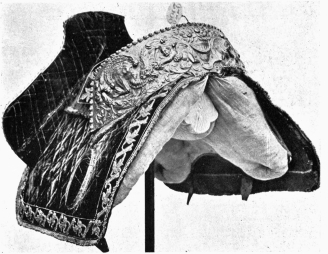 MILITARY SADDLE: DESIGN IN BERRUGUETE STYLE.
PLATE 183.
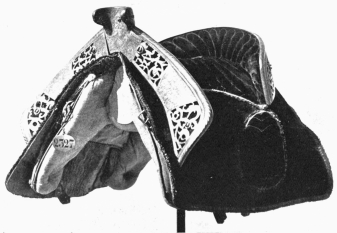 2327. MILITARY SADDLE.
PLATE 184.
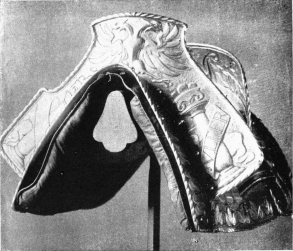 MILITARY SADDLE, AUGSBURG MAKE.
PLATE 185.
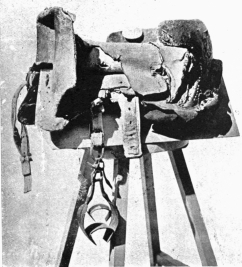 SADDLE, EARLY 15TH CENTURY, FROM MAJORCA.
PLATE 186.
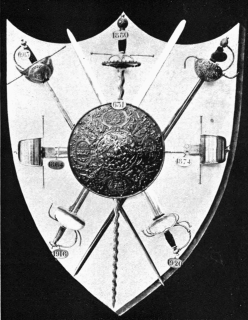 1913. SWORD, WITH THE TOLEDO BLADE OF THE DUKE OF OLIVARES.
1880. ‘FLAMING’ SPANISH SWORD OF PHILIP IV.
1917. SWORD OF D. SUERO DE QUINONES, LATE 16TH CENTURY.
1864. DAGGER, SCALLOPED HALF-WAY.
1916. SWORD, WITH ROUND POINT, OF GARCILASO DE LA VEGA.
1920. SWORD, WITH TOLEDO BLADE, OF THE MARQUIS OF POVAR.
631. SHIELD REPRESENTING JUPITER SENDING LIGHTNING ON THE ARABS.
1874. DAGGER GIVEN BY LOUIS XV. OF FRANCE TO THE KING OF SPAIN.
PLATE 187.
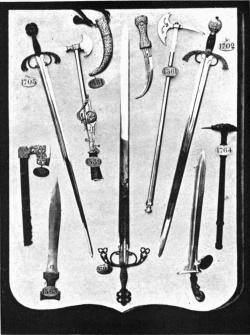 1705. SWORD OF ISABEL THE CATHOLIC.
1589. PETRONEL OF CHARLES V., WITH BATTLE-AXE.
1581. YATAGHAN OF MUSTAFA, BEY OF ORAN.
1561. BATTLE-AXE, 15TH AND 16TH CENTURIES.
1563. KRISS OR MALAY DAGGER.
1702. SWORD OF THE GREAT CAPTAIN.
1591. ALFANGE OR INDIAN SCIMITAR.
1587. BATTLE-AXE, BYZANTINE STYLE.
1764. MARTEL-DE-FER OF CHARLES V.
1698. SWORD, 16TH CENTURY.
PLATE 188.
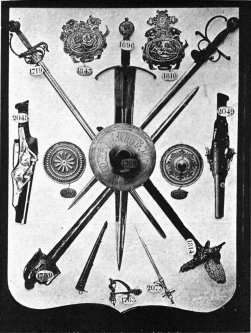 1719. SWORD OF THE COUNT OF CORUNNA.
1843, 1816. PIECES OF THE BARDING OF A HORSE.
1696. SWORD, 15TH CENTURY.
1716. SWORD OF PHILIP I., THE HANDSOME.
2045, 2049. PISTOLS, 16TH AND 17TH CENTURIES.
2077. DAGGER, FOUR EDGED, 16TH CENTURY.
1814. SWORD, FOUND IN THE TAGUS, AND GIVEN TO PHILIP II.
1359, 1315. ARMPIT SHIELDS.
1763. SPURS, IN FILIGREE SILVER.
1328. LANCE-SHIELD OF THE PRINCE OF PARMA.
1759. SWORD OF BERNAL DIAZ DEL CASTILLO.
PLATE 189.
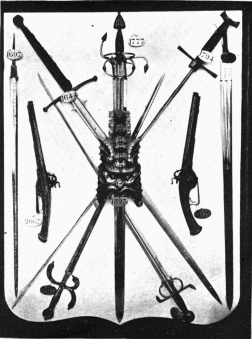 1697. SWORD OF THE PRINCE OF CONDE.
1644. TWO-HANDED SWORD, EARLY 15TH CENTURY.
1777. SWORD OF PHILIP II.
1794. SWORD OF DON JOHN OF AUSTRIA.
1708. GERMAN SWORD OF FREDERICK HENRY, COUNT OF NASSAU.
1845. SWORD OF JOHN OF URBINO.
1692. MAGNIFICENT TOLEDAN BLADE, UNMOUNTED.
2067, 2076. A PAIR OF PISTOLS, 17TH CENTURY.
1823. PIECE OF A HORSE’S BARDING.
PLATE 190.
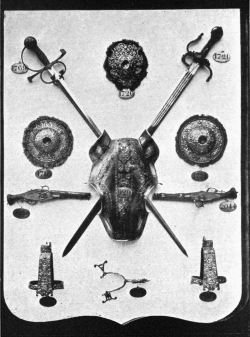 1769. SWORD OF PIZARRO.
1726. HEAD STALL.
1721. VERY REMARKABLE SWORD OF THE RENAISSANCE.
1718, 1771. RONDELS.
2044. PISTOLS, 16TH AND 17TH CENTURIES.
929. HEAD STALL FOR CHARGER OF THE COUNT OF NIEBLA.
1770, 1761. BEAUTIFUL STIRRUPS, WITH FIGURES.
1768. UNIQUE SPUR.
PLATE 191.
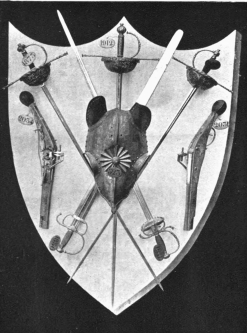 1873. SWORD
1912. SWORD OF PHILIP III.
1872. SWORD OF CHARLES II.
1850. GERMAN SWORD.
1911. SWORD OF THE DUKE OF MONTEMAR.
2034, 2031. PISTOLS.
523. CHAMFRON.
PLATE 192.
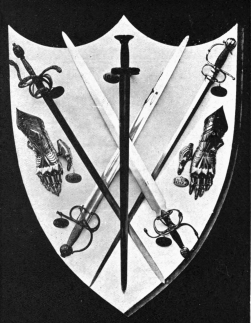 1773. SWORD OF PHILIP II.
1659. SWORD WITH FOUR SIDES (GERMAN), 16TH CENTURY.
1807. SWORD OF HERNAN CORTES.
1856, 1857. MAGNIFICENT PAIR OF GAUNTLETS.
1727. LOBERA SWORD OF ST. FERDINAND.
1645. SWORD OF DON DIEGO HURTADO DE MENDOZA.
PLATE 193.
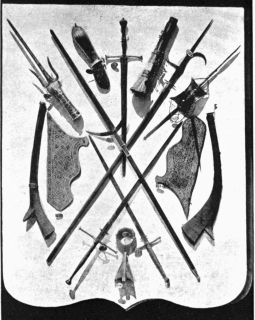 1562. MOORISH BOARDING GAUNTLET, 14TH TO 15TH CENTURY.
1619. SWORD PRESENTED TO JOHN II. OF CASTILE BY THE POPE EUGENIUS IV.
1562. MOORISH BOARDING GAUNTLET, 14TH TO 15TH CENTURY.
1619. SWORD PRESENTED TO JOHN II. OF CASTILE BY THE POPE EUGENIUS IV.
1711. HALBERD OF CHARLES V.
1529. IRON RING, WITH POINTS INSIDE.
1588. BRACELET OF ALI PASHA, TURKISH ADMIRAL AT LEPANTO.
1502, 1544. MOORISH QUIVERS.
1556, 1605. MALAY BATTLE-AXES, IN WOOD.
1620. SWORD OF DIEGO GARCIA PAREDES.
1606. WOODEN STIRRUP.
1644. TWO-HANDED SWORD, EARLY 15TH CENTURY.
1554. QUIVER WITH ARROWS OF THE CACIQUE GUARIMACOA.
2535. HALBERD PLATE, 15TH CENTURY.
1585. MOORISH BOARDING WEAPON, 15TH CENTURY.
PLATE 194.
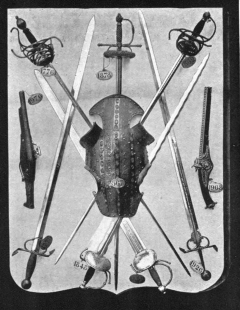 1776. ESPADON OR LARGE TWO-HANDED SWORD OF CHARLES V.
1878. SWORD OF THE COUNT LEMOS.
1862. VALENCIAN SWORD OF FERDINAND D’ALARCON.
1976, 1968. BEAUTIFUL PISTOLS OF 16TH CENTURY.
567. CHAMFRON WHICH BELONGED TO PHILIP IV.
1775. ESPADON OF DIEGO GARCIA DE PAREDES.
1848. FLAMING SWORD OF DON JUAN OF AUSTRIA, SON OF PHILIP IV.
1852. SWORD OF PEDRO MENDEZ DE AVILES.
PLATE 195.
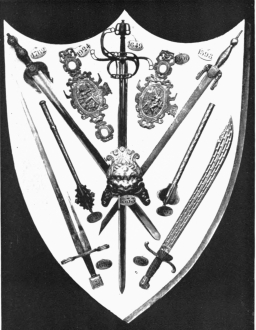 1762. SWORD OF CARDINAL FERNANDO, BROTHER OF PHILIP IV.
1924, 1806, 1833. PIECES OF BARDING FOR A HORSE.
1649. SWORD OF THE COUNT OF BENAVENTE, MADE AT ZARAGOZA.
1634. ESPADON.
1599. SCIMITAR OF DON JUAN OF AUSTRIA.
1598. SPANISH-MORESQUE SWORD.
1729, 1767. MACES, 15TH AND 16TH CENTURIES.
PLATE 196.
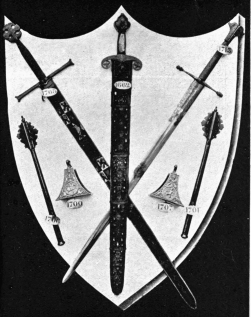 1765. TWO-HANDED SWORD OF FERDINAND V., THE CATHOLIC.
1662. SWORD IN ITS SHEATH, STUDDED WITH JEWELS.
1713. TWO-HANDED SWORD OF CHARLES V.
1706, 1701. MACES OF THE CONSTABLE OF BOURBON, TIME OF CHARLES V.
1700, 1707. STIRRUPS, OF TURKISH FORM OF CHARLES V.
PLATE 197.
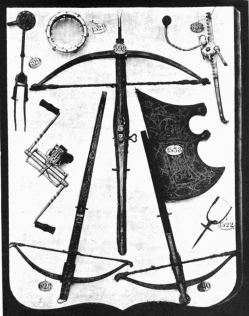 629. GILDED HANDLE TO CROSSBOW.
1529. IRON RING, WITH SPIKES INSIDE, WHICH THE MOORS USED AS AN
INSTRUMENT OF EXECUTION.
598. FLEMISH CROSSBOW, 16TH CENTURY.
628. CROSSBOW, INCRUSTED WITH IVORY.
640. CROSSBOW OF THE DUKE OF ALBA.
1522. ARABIAN SPUR.
1538. SHIELD FOR CROSSBOWMAN.
GAFFLES FOR STRETCHING THE STRING OF THE CROSSBOW.
PLATE 198.
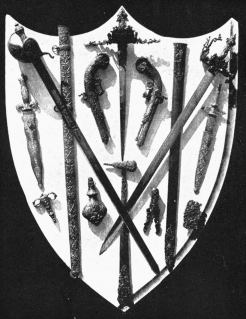 TROPHY FORMED OF DIFFERENT WEAPONS, BY E. DE ZULOAGA.
PLATE 199.
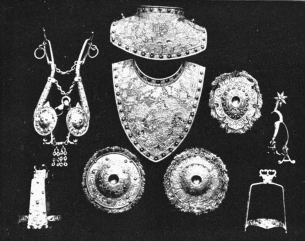 TROPHY FORMED OF SEVERAL PIECES OF ARMOUR OF PHILIP II.
PLATE 200.
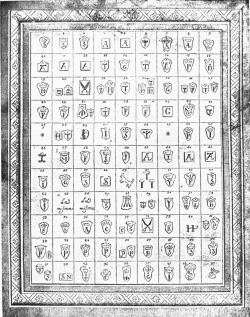 MARKS USED BY THE PRINCIPAL SWORD-MAKERS OF TOLEDO
UNTIL THE BEGINNING
OF THE 18TH CENTURY.
PLATE 200A.
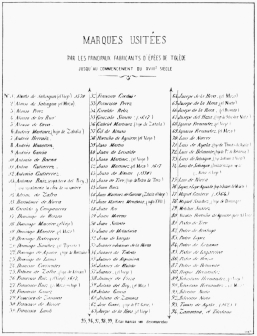 KEY TO THE FOREGOING.
PLATE 201.
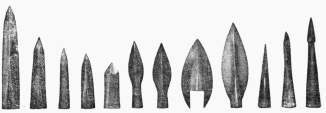 HEADS OF SPANISH LANCES AND PIKES, 15TH TO 17TH CENTURIES.
‘THE PIKE I
WOULD HAVE, IF IT MIGHT BE, OF SPANISH ASH, AND BETWEEN
20 AND 22 FEET
LONG.’—SUTCLIFFE, PRACTICE OF ARMS, (1593).
PLATE 202.
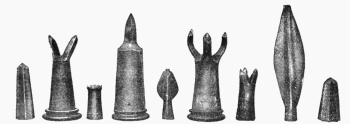 HEADS OF SPANISH LANCES USED FOR TILTS AND TOURNAMENTS, 15TH TO
17TH
CENTURIES, POINTED, ROUND HEADED, OR FURCATED.
PLATE 203.
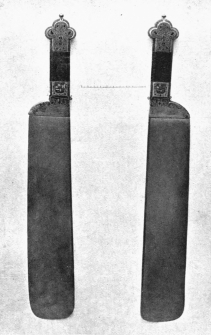 SPANISH KNIVES EMPLOYED BY THE CHIEF CARVER AT THE ROYAL TABLE,
THE
HANDLES OF WHICH ARE RICHLY DECORATED WITH THE
SPANISH ARMS OF THE TIME
OF PHILIP IV.
PLATE 204.
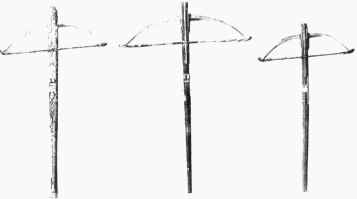
J 28. HUNTING
CROSSBOW,
EARLY 16TH
CENTURY. | J 18. SPANISH
HUNTING
CROSSBOW OF
CHARLES V. | J 37. SMALL
HUNTING
CROSSBOW,
16TH CENTURY. |
PLATE 205.
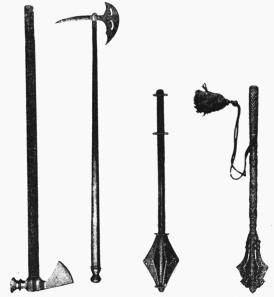
H 9.
MARTEL-DE-FER,
EARLY 16TH
CENTURY. |
H 6.
BATTLE-AXE,
MIDDLE 16TH
CENTURY. |
H 14.
BATTLE-MACE,
LATE 15TH
CENTURY. |
H 15.
BATTLE-MACE
OF
CHARLES V. |
PLATE 206.
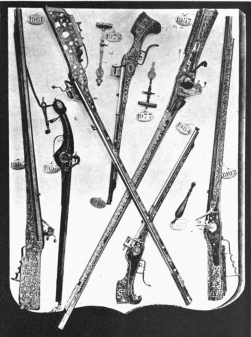 1987, 1992. SPANISH ARQUEBUSES, END OF 16TH CENTURY.
1955. PETRONEL, 16TH CENTURY.
1961. SPANISH ARQUEBUS, WITH OCTAGONAL BARREL INLAID WITH MOTHER OF
PEARL AND IVORY, 16TH CENTURY.
1972, 1977, 1946. KEYS OR CRANKS TO COCK THE ARQUEBUSES.
PLATE 207.
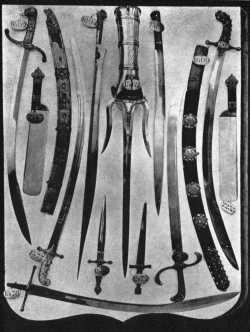 1602. ELEGANT SABRE OF A ‘CHEF D’ESTRADIOTS’ (VENETIAN) GIVEN TO PHILIP
III.
1602. ELEGANT SABRE OF A ‘CHEF D’ESTRADIOTS’ (VENETIAN) GIVEN TO PHILIP
III.
2243, 2285. SPANISH KNIVES, WITH SPANISH ARMS, TIME OF PHILIP IV.
1577, 1578. PERSIAN SABRES.
1604. GOURMA, OR DAGGER.
1579. SABRE OF UNKNOWN ORIGIN.
1600. MISRAE OR SCIMITAR OF ALI PASHA, TURKISH ADMIRAL AT LEPANTO.
1572. MISERECORDE, OR DAGGER, OF DIEGO GARCIA DE PAREDES.
1566. DAGGER OF CHARLES V.
1580. DAGGER OF THE KABYLES.
1562. MANOPLE OR MOORISH BOARDING-SWORD, 14TH-15TH CENTURIES.
PLATE 208.
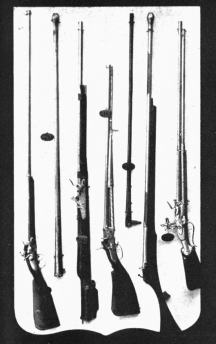 2167. REPEATING HUNTING-GUN.
2296. TURKISH CANNON TINDER.
2140. HUNTING GUN WITH 12 SHOTS.
2164. REPEATING GUN, MADE IN 1705.
2534. THE BARREL OF A BREECH-LOADING GUN.
2294. TURKISH GUN TINDER.
2142. MODEL OF A GUN WITH 14 SHOTS.
PLATE 209.
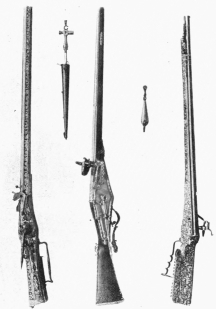 1. ARQUEBUS OF DON JOHN OF AUSTRIA (K 14).
2. ARQUEBUS HANDLE, DAGGER, AND PRIMER COMBINED (G 151).
3. ARQUEBUS OF DON JOHN JOSEPH OF AUSTRIA (K 23).
4. ARQUEBUS HANDLE AND PRIMER (K 12).
5. NUREMBERG ARQUEBUS, 16TH CENTURY (K 11).
PLATE 210.
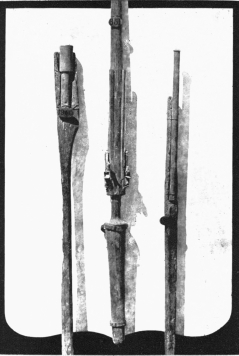 1940, 1944. BARRELS, 15TH CENTURY.
651. LANCE, WITH TWO LITTLE BARRELS, 17TH CENTURY.
PLATE 211.
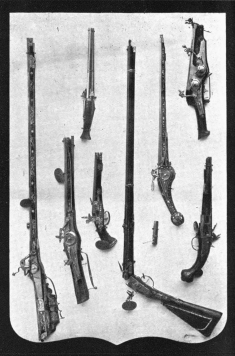 903. SPANISH ARQUEBUS, 15TH CENTURY.
1978. PETRONEL, 1547.
2080. PISTOL, WITH THREE BARRELS.
2126. PISTOL, WITH RIFLE BARREL.
2225. HUNTING GUN OF PHILIP V., BREECH-LOADING.
2024. PETRONEL, 16TH CENTURY.
2635. REVOLVER, 18TH CENTURY.
2045. PISTOL, WITH TWO BARRELS, 16TH CENTURY.
PLATE 212.
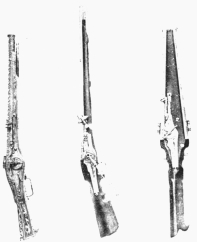
K 30.
SMALL
ARQUEBUS OF
CHARLES V.
(ITALIAN MAKE). |
K 33.
SMALL
SPANISH
ARQUEBUS,
1531. |
K 55.
SMALL
PISTOL-ARQUEBUS,
MIDDLE 16TH
CENTURY. |
PLATE 213.
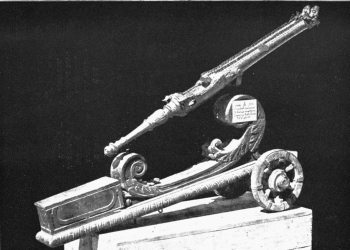 DOUBLE BREECH-LOADING CANNON, IN BRONZE, USED IN SPAIN FROM
THE END OF
THE 15TH CENTURY.
PLATE 214.
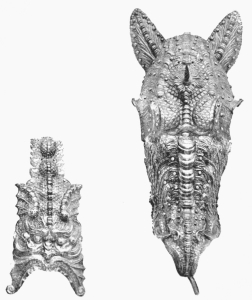
A 190. TAILPIECE
OF A
HORSE’S BARD,
1545. | A 190. CHANFRON, REPRESENTING
THE HEAD AND NECK OF A
FANTASTIC DRAGON, COVERED
WITH SCALES OF GOLD, 1545. |
PLATE 215.
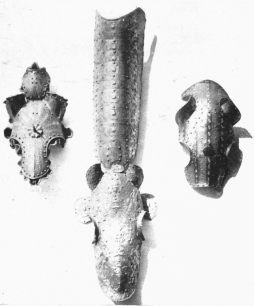 531. HEAD-STALL OF PHILIP III.’S HORSE.
534. CHANFRON AND MAINFAIRE OF A HORSE OF PHILIP III.
567. CHANFRON OF HORSE OF PHILIP IV.
PLATE 216.
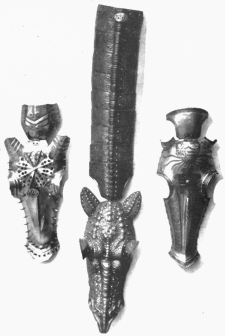 525. CHANFRON (MOORISH).
558. CHANFRON AND MAINFAIRE, 16TH CENTURY.
565. CHANFRON, WITH THE IMPERIAL ARMS IN COLOURS.
PLATE 217.
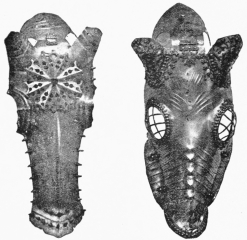
F 110. CHANFRON,
EARLY 16TH CENTURY. |
F 113. CHANFRON,
EARLY 16TH CENTURY. |
PLATE 218.
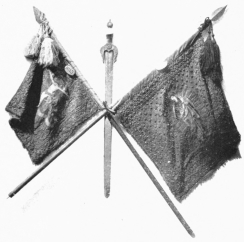 1762. SWORD OF CARDINAL D. FERNANDO, BROTHER OF PHILIP IV.
1613, 1624. CHRISTIAN STANDARDS, FROM THE BATTLE OF LEPANTO.
PLATE 219.
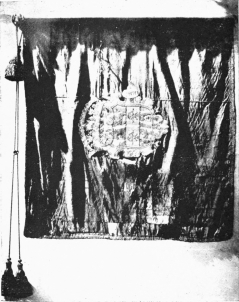 FLAG CARRIED AT THE OBSEQUIES OF PHILIP II.
PLATE 220.
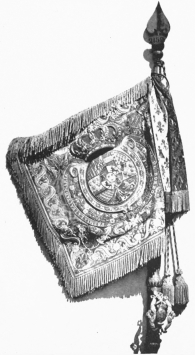 STANDARD OF THE EX-BODYGUARD.
PLATE 221.
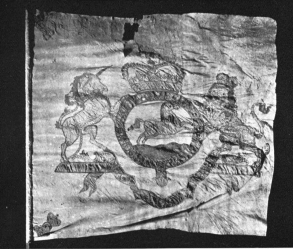 STANDARD TAKEN FROM THE ENGLISH WHO BESIEGED CARTHAGENA
(AMERICA) IN
1741.
PLATE 222.
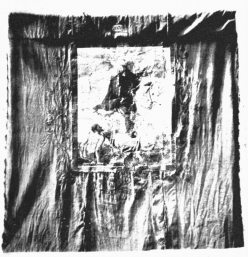 FLAG FROM THE BATTLE OF LEPANTO, WITH A PAINTING
REPRESENTING CHRIST AND
ST. MARTIN.
PLATE 223.
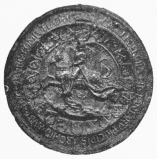 SEAL OF CHARLES V. WHEN COUNT
OF FLANDERS, SHOWING HIM ON
HORSEBACK IN ARMOUR.
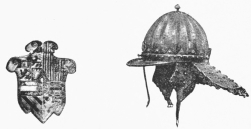
SMALL SHIELD ON HEAD-STALL,
WITH THE ARMS OF PHILIP II.
WHEN HEIR-APPARENT, AND
ALSO THOSE OF HIS WIFE,
QUEEN MARY OF ENGLAND. | SALADE-MORION
OF THE
PRINCE OF ASTURIAS,
BALTASAR CARLOS OF AUSTRIA
(1629-1646). |
PLATE 224.
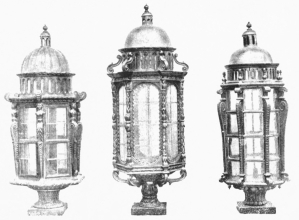 LANTERNS FROM FLAG-SHIPS GAINED BY THE MARQUES DE SANTA CRUZ
IN VARIOUS
NAVAL ENGAGEMENTS (M 75, 77, 76).
PLATE 225.
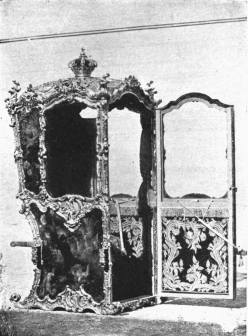 SEDAN CHAIR OF PHILIP V.
(From the Coach-houses of the Royal Palace, Madrid.)
PLATE 226.
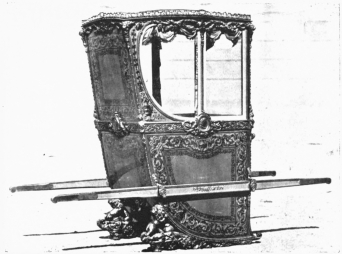 SEDAN CHAIR OF FERDINAND VI.
(From the Coach-houses of the Royal Palace, Madrid.)
PLATE 227.
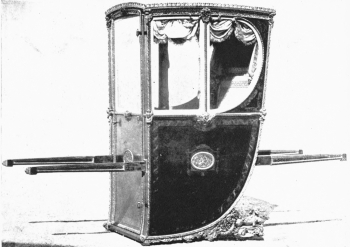 SEDAN CHAIR OF CHARLES IV.
(From the Coach-houses of the Royal Palace, Madrid.)
PLATE 228.
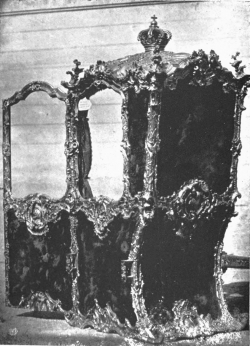 SEDAN CHAIR OF PHILIP V.
(From the Coach-houses of the Royal Palace, Madrid.)
PLATE 229.
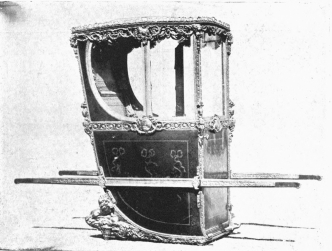 SEDAN CHAIR OF CHARLES III.
(From the Coach-houses of the Royal Palace, Madrid.)
PLATE 230.
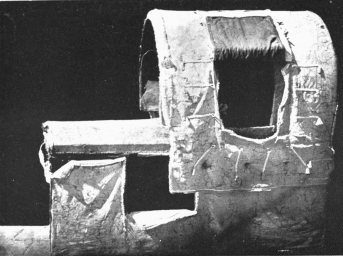 CAMPAIGN LITTER OF THE EMPEROR CHARLES V.
PLATE 231.
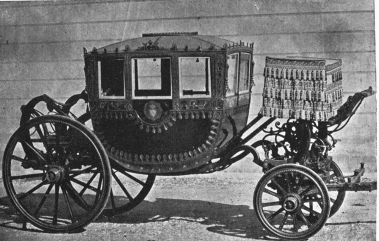 CARRIAGE GIVEN BY NAPOLEON I. TO CHARLES IV.
(From the Coach-houses of the Royal Palace, Madrid.)
PLATE 232.
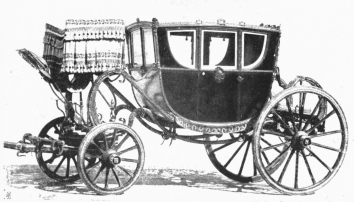 GALA COACH OF CHARLES IV.
(From the Coach-houses of the Royal Palace, Madrid.)
PLATE 233.
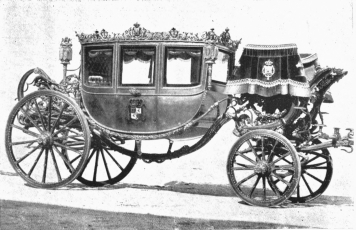 CARRIAGE OF THE PRESIDENT OF THE CORTES.
(From the Coach-houses of the Royal Palace, Madrid.)
PLATE 234.
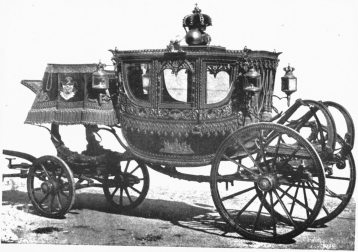 THE CROWN COACH.
(From the Coach-houses of the Royal Palace, Madrid.)
PLATE 235.
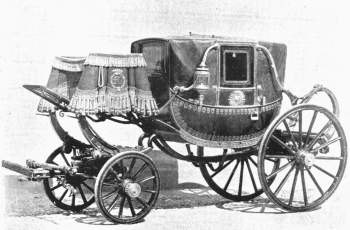 WEDDING COACH OF FERDINAND VII. AND MARIA CHRISTINA.
(From the Coach-houses of the Royal Palace, Madrid.)
PLATE 236.
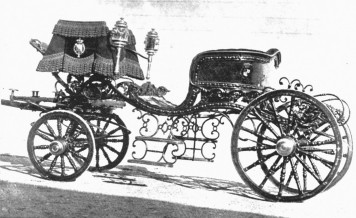 CARRIAGE OF THE MACE-BEARERS OF THE CORTES.
(From the Coach-houses of the Royal Palace, Madrid.)
PLATE 237.
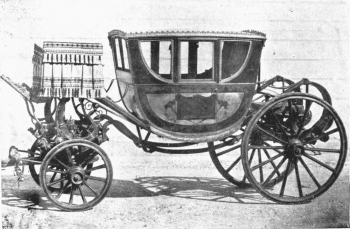 CARRIAGE, WITH GILT PANELS, OF CHARLES IV.
(From the Coach-houses of the Royal Palace, Madrid.)
PLATE 238.
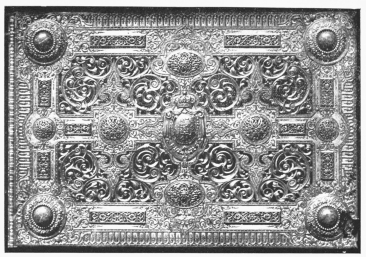 COVER OF AN ALBUM, EXTERIOR, THE WORK OF E. DE ZULOAGA.
PLATE 239.
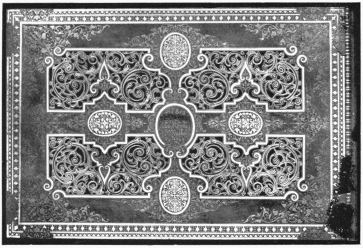 COVER OF AN ALBUM, INTERIOR, THE WORK OF E. DE ZULOAGA.
PLATE 240.
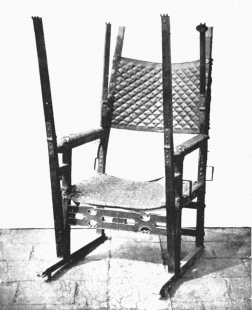 PORTABLE CHAIR, IN LEATHER, OF THE EMPEROR CHARLES V.
PLATE 241.
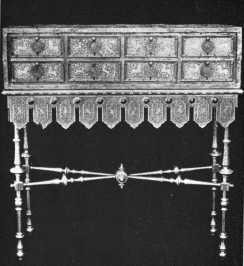 MAGNIFICENT BUREAU, IN ENGRAVED IRON.
BELONGED TO CHARLES V.
PLATE 242.
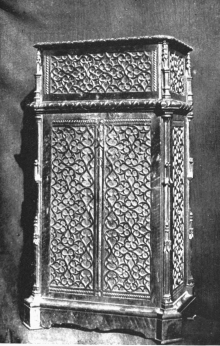 WOODEN TRUNK, WITH ORNAMENTS IN THE POINTED STYLE.
PLATE 243.
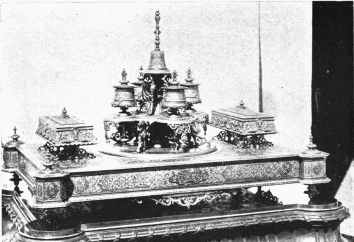 IRON INKSTAND, EMBOSSED AND INLAID, THE WORK OF E. DE ZULOAGA.
PLATE 244.
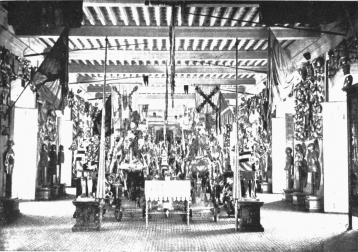 GENERAL VIEW OF THE INTERIOR OF THE ARMOURY.
PLATE 245.
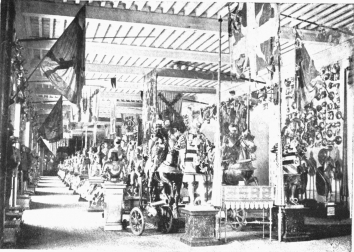 GENERAL VIEW OF THE INTERIOR OF THE ARMOURY.
PLATE 246.
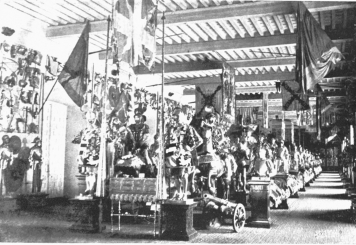 GENERAL VIEW OF THE INTERIOR OF THE ARMOURY.
PLATE 247.
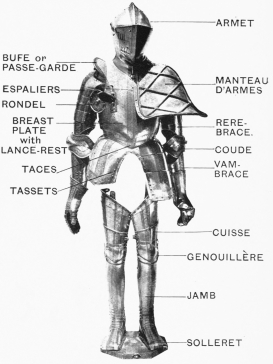 FIGURE EXPLAINING VARIOUS TECHNICAL TERMS
USED IN THE TEXT.
PLATE 248.
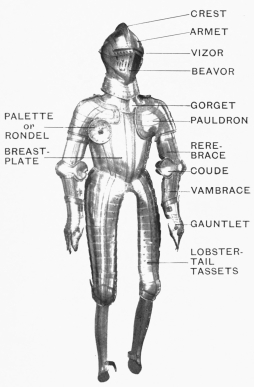 FIGURE EXPLAINING VARIOUS TECHNICAL TERMS
USED IN THE TEXT.
THE
SPANISH SERIES
Edited by ALBERT F. CALVERT
A new and important series of volumes, dealing with Spain in its various
aspects, its history, its cities and monuments. Each volume will be
complete in itself in an uniform binding, and the number and excellence
of the reproductions from pictures will justify the claim that these
books comprise the most copiously illustrated series that has yet been
issued, some volumes having over 300 pages of reproductions of pictures,
etc.
Crown 8vo.
MURILLO. A Biography and Appreciation. Illustrated by over 165
reproductions from photographs of his most celebrated pictures.
SPANISH ARMS AND ARMOUR. A Historical and Descriptive Account of
the Royal Armoury at Madrid. Illustrated with 386 reproductions
from photographs.
THE ESCORIAL. A Historical and Descriptive Account of the Spanish
Royal Palace, Monastery and Mausoleum. Illustrated with plans and
278 reproductions from pictures and photographs.
CORDOVA. A Historical and Descriptive Account of the Ancient City
which the Carthaginians styled the “Gem of the South.” With over
155 Illustrations.
SEVILLE. A Historical and Descriptive Account. With 300
Illustrations.
THE PRADO. A Guide and Handbook to the Royal Picture Gallery of
Madrid. Illustrated with 221 reproductions from photographs of Old
Masters.
IN PREPARATION
- Goya
- Granada
- Velazquez
- Toledo
- Royal Palaces
- Madrid
- Leon, Burgos, &c.
- Valladolid, Segovia, &c.
UNIFORM WITH THIS VOLUME
MURILLO
A BIOGRAPHY AND APPRECIATION. ILLUSTRATED BY OVER 165 REPRODUCTIONS FROM
PHOTOGRAPHS OF HIS MOST CELEBRATED PICTURES
While the names of Murillo and Velazquez are inseparably linked in the
history of Art as Spain’s immortal contribution to the small band of
world-painters, the great Court-Painter to Philip IV. has ever received
the lion’s share of public attention. Many learned and critical works
have been written about Murillo, but whereas Velazquez has been
familiarised to the general reader by the aid of small, popular
biographies, the niche is still empty which it is hoped that this book
will fill.
In this volume the attempt has been made to show the painter’s art in
its relation to the religious feeling of the age in which he lived, and
his own feeling towards his art. Murillo was the product of his
religious era, and of his native province, Andalusia. To Europe in his
lifetime he signified little or nothing. He painted to the order of the
religious houses of his immediate vicinity; his works were immured in
local monasteries and cathedrals, and, passing immediately out of
circulation, were forgotten or never known.
UNIFORM WITH THIS VOLUME
SPANISH ARMS AND ARMOUR
A HISTORICAL AND DESCRIPTIVE ACCOUNT OF THE ROYAL ARMOURY AT MADRID.
ILLUSTRATED WITH 386 REPRODUCTIONS FROM PHOTOGRAPHS
Although several valuable and voluminous catalogues of the Spanish Royal
Armoury have, from time to time, been compiled, this “finest collection
of armour in the world” has been subjected so often to the disturbing
influences of fire, removal, and re-arrangement, that no hand catalogue
of the Museum is available, and this book has been designed to serve
both as a historical souvenir of the institution and a record of its
treasures.
The various exhibits with which the writer illustrates his narrative are
reproduced to the number of over 300 on art paper, and the selection of
weapons and armour has been made with a view not only to render the
series interesting to the general reader, but to present a useful text
book of European armoury for the guidance of artists, sculptors,
antiquaries, costumiers, and all who have practical interest in
historical accuracy.
UNIFORM WITH THIS VOLUME
THE ESCORIAL
A HISTORICAL AND DESCRIPTIVE ACCOUNT OF THE SPANISH ROYAL PALACE,
MONASTERY AND MAUSOLEUM. ILLUSTRATED WITH PLANS AND 278 REPRODUCTIONS
FROM PICTURES AND PHOTOGRAPHS
The Royal Palace, Monastery, and Mausoleum of El Escorial, which rears
its gaunt, grey walls in one of the bleakest but most imposing districts
in the whole of Spain, was erected to commemorate a victory over the
French in 1557. It was occupied and pillaged by the French two and
a-half centuries later, and twice it has been greatly diminished by
fire; but it remains to-day, not only the incarnate expression of the
fanatic religious character and political genius of Philip II., but the
greatest mass of wrought granite which exists on earth, the leviathan of
architecture, the eighth wonder of the world.
In the text of this book the author has endeavoured to reconstitute the
glories and tragedies of the living past of the Escorial, and to
represent the wonders of the stupendous edifice by reproductions of over
two hundred and seventy of the finest photographs and pictures
obtainable. Both as a review and a pictorial record it is hoped that the
work will make a wide appeal among all who are interested in the
history, the architecture, and the art of Spain.
UNIFORM WITH THIS VOLUME
CORDOVA
A HISTORICAL AND DESCRIPTIVE ACCOUNT OF THE ANCIENT CITY WHICH THE
CARTHAGINIANS STYLED THE “GEM OF THE SOUTH,” WITH OVER 155 ILLUSTRATIONS
Gay-looking, vivacious in its beauty, silent, ill-provided, depopulated,
Cordova was once the pearl of the West, the city of cities, Cordova of
the thirty suburbs and three thousand mosques; to-day she is no more
than an overgrown village, but she still remains the most Oriental town
in Spain.
Cordova, once the centre of European civilisation, under the Moors the
Athens of the West, the successful rival of Baghdad and Damascus, the
seat of learning and the repository of the arts, is now no more than a
third-rate provincial town; but the artist, the antiquary and the lover
of the beautiful, will still find in its streets and squares and patios
a mysterious spell that cannot be resisted.
UNIFORM WITH THIS VOLUME
SEVILLE
A HISTORICAL AND DESCRIPTIVE ACCOUNT, WITH 300 ILLUSTRATIONS
Seville, which has its place in mythology as the creation of Hercules,
and was more probably founded by the Phœnicians, which became
magnificent under the Roman rule, was made the capital of the Goths, was
the centre of Moslem power and splendour, and fell before the military
prowess of St. Ferdinand, is still the Queen of Andalusia, the Spanish
Athens, the foster-mother of Velazquez and Murillo, the city of poets
and pageantry and love.
Seville is always gay, and responsive and fascinating to the receptive
visitor, and all sorts of people go there with all sorts of motives. The
artist repairs to the Andalusian city to fill his portfolio; the lover
of art makes the pilgrimage to study Murillo in all his glory. The
seasons of the Church attract thousands from reasons of devotion or
curiosity. And of all these myriad visitors, who go with their minds
full of preconceived notions, not one has yet confessed to being
disappointed with Seville.
The author has here attempted to convey in the illustrations an
impression of this laughing city where all is gaiety and mirth and
ever-blossoming roses, where the people pursue pleasure as the serious
business of life in an atmosphere of exhilarating enjoyment.
UNIFORM WITH THIS VOLUME
THE PRADO
A GUIDE AND HANDBOOK TO THE ROYAL PICTURE GALLERY OF MADRID. ILLUSTRATED
WITH 221 REPRODUCTIONS FROM PHOTOGRAPHS OF OLD MASTERS
This volume is an attempt to supplement the accurate but formal notes
contained in the official catalogue of a gallery which is considered the
finest in the world. It has been said that the day one enters the Prado
for the first time is an important event like marriage, the birth of a
child, or the coming into an inheritance; an experience of which one
feels the effects to the day of one’s death.
The excellence of the Madrid gallery is the excellence of exclusion; it
is a collection of magnificent gems. Here one becomes conscious of a
fresh power in Murillo, and is amazed anew by the astonishing apparition
of Velazquez; here is, in truth, a rivalry of miracles of art.
The task of selecting pictures for reproduction from what is perhaps the
most splendid gallery of old masters in existence, was one of no little
difficulty, it is believed that the collection is representative, and
that the letterpress will form a serviceable companion to the visitor to
The Prado.
UNIFORM WITH THIS VOLUME
TOLEDO
A HISTORICAL AND DESCRIPTIVE ACCOUNT OF THE “CITY OF GENERATIONS,” WITH
OVER 480 ILLUSTRATIONS
The origin of Imperial Toledo, “the crown of Spain, the light of the
world, free from the time of the mighty Goths,” is lost in the
impenetrable mists of antiquity. Mighty, unchangeable, invincible, the
city has been described by Wörmann as “a gigantic open-air museum of the
architectural history of early Spain, arranged upon a lofty and
conspicuous table of rock.”
But while some writers have declared that Toledo is a theatre with the
actors gone and only the scenery left, the author does not share the
opinion. He believes that the power and virility upon which Spain built
up her greatness is reasserting itself. The machinery of the theatre of
Toledo is rusty, the pulleys are jammed from long disuse, but the
curtain is rising steadily if slowly, and already can be heard the
tuning-up of fiddles in its ancient orchestra.
In this belief the author of this volume has not only set forth the
story of Toledo’s former greatness, but has endeavoured to place before
his readers a panorama of the city as it appears to-day, and to show
cause for his faith in the greatness of the Toledo of the future.
UNIFORM WITH THIS VOLUME
GRANADA AND THE ALHAMBRA
A BRIEF HISTORY OF THE MOSLEM RULE IN SPAIN, TOGETHER WITH A PARTICULAR
ACCOUNT OF THE CONSTRUCTION, THE ARCHITECTURE, AND THE DECORATION OF THE
MOORISH PALACE, WITH OVER 450 ILLUSTRATIONS
This volume is the third and abridged edition of a work which the author
was inspired to undertake by the surpassing loveliness of the Alhambra,
and by his disappointment in the discovery that no such thing as an even
moderately adequate illustrated souvenir of “this glorious sanctuary of
Spain” was obtainable. Keenly conscious of the want himself, he essayed
to supply it, and the result is a volume that has been acclaimed with
enthusiasm alike by critics, artists, architects, and archæologists.
In his preface to the first edition, Mr. Calvert wrote: “The Alhambra
may be likened to an exquisite opera which can only be appreciated to
the full when one is under the spell of its magic influence. But as the
witchery of an inspired score can be recalled by the sound of an air
whistled in the street, so—it is my hope—the pale ghost of the Moorish
fairy-land may live again in the memories of travellers through the
medium of this pictorial epitome.”
UNIFORM WITH THIS VOLUME
VELAZQUEZ
A BIOGRAPHY AND APPRECIATION. ILLUSTRATED WITH 142 REPRODUCTIONS FROM
PHOTOGRAPHS OF HIS MOST CELEBRATED PICTURES
Diego Rodriguez de Silva y Velazquez—“our Velazquez,” as Palomino
proudly styles him—has been made the subject of innumerable books in
every European language, yet the General Editor of this Spanish Series
feels that it would not be complete without the inclusion of yet another
contribution to the broad gallery of Velazquez literature.
The great Velazquez, the eagle in art—subtle, simple, incomparable—the
supreme painter, is still a guiding magnet of the art of to-day. This
greatest of Spanish artists, a master not only in portrait painting, but
in character and animal studies, in landscapes and historical subjects,
impressed the grandeur of his superb personality upon all his work.
Spain, it has been said, the country whose art was largely borrowed,
produced Velazquez, and through him Spanish art became the light of a
new artistic life.
The author cannot boast that he has new data to offer, but he has put
forward his conclusions with modesty; he has reproduced a great deal
that is most representative of the artist’s work; and he has endeavoured
to keep always in view his object to present a concise, accurate, and
readable life of Velazquez.
UNIFORM WITH THIS VOLUME
MADRID
A HISTORICAL AND DESCRIPTIVE ACCOUNT OF THE SPANISH CAPITAL, WITH OVER
300 ILLUSTRATIONS
Madrid is at once one of the most interesting and most maligned cities
in Europe. It stands at an elevation of 2,500 feet above the sea level,
in the centre of an arid, treeless, waterless, and wind-blown plain; but
whatever may be thought of the wisdom of selecting a capital in such a
situation, one cannot but admire the uniqueness of its position, and the
magnificence of its buildings, and one is forced to admit that, having
fairly entered the path of progress, Madrid bids fair to become one of
the handsomest and most prosperous of European cities.
The splendid promenades, the handsome buildings, and the spacious
theatres combine to make Madrid one of the first cities of the world,
and the author has endeavoured with the aid of the camera, to place
every feature and aspect of the Spanish metropolis before the reader.
Some of the illustrations reproduced here have been made familiar to the
English public by reason of the interesting and stirring events
connected with the Spanish Royal Marriage, but the greater number were
either taken by the author, or are the work of photographers specially
employed to obtain new views for the purpose of this volume.
UNIFORM WITH THIS VOLUME
GOYA
A BIOGRAPHY AND AN APPRECIATION. ILLUSTRATED BY REPRODUCTIONS OF 600 OF
HIS PICTURES
The last of the old masters and the first of the moderns, as he has been
called, Francisco José de Goya y Lucientes is not so familiarised to
English readers as his genius deserves. He was born at a time when the
tradition of Velazquez was fading, and the condition of Spanish painting
was debased almost beyond hope of salvation; he broke through the
academic tradition of imitation; “he, next to Velazquez, is to be
accounted as the man whom the Impressionists of our time have to thank
for their most definite stimulus, their most immediate inspiration.”
The genius of Goya was a robust, imperious, and fulminating genius; his
iron temperament was passionate, dramatic, and revolutionary; he painted
a picture as he would have fought a battle. He was an athletic, warlike,
and indefatigable painter; a naturalist like Velazquez; fantastic like
Hogarth; eccentric like Rembrandt; the last flame-coloured flash of
Spanish genius.
It is impossible to reproduce his colouring; but in the reproductions of
his works the author has endeavoured to convey to the reader some idea
of Goya’s boldness of style, his mastery of frightful shadows and
mysterious lights, and his genius for expressing all terrible emotions.
UNIFORM WITH THIS VOLUME
LEON, BURGOS AND SALAMANCA
A HISTORICAL AND DESCRIPTIVE ACCOUNT, WITH OVER 350 ILLUSTRATIONS
In Leon, once the capital of the second kingdom in Spain; in Burgos,
which boasts one of the most magnificent cathedrals in Spain, and the
custodianship of the bones of the Cid; and in Salamanca, with its
university, which was one of the oldest in Europe, the author has
selected three of the most interesting relics of ancient grandeur in
this country of departed greatness.
Leon to-day is nothing but a large agricultural village, torpid, silent,
dilapidated; Burgos, which still retains traces of the Gotho-Castilian
character, is a gloomy and depleting capital; and Salamanca is a city of
magnificent buildings, a broken hulk, spent by the storms that from time
to time have devastated her.
Yet apart from the historical interest possessed by these cities, they
still make an irresistible appeal to the artist and the antiquary. They
are content with their stories of old-time greatness and their
cathedrals, and these ancient architectural splendours, undisturbed by
the touch of a modernising and renovating spirit, continue to attract
the visitor.
UNIFORM WITH THIS VOLUME
VALLADOLID, OVIEDO, SEGOVIA, ZAMORA, AVILA AND ZARAGOZA
A HISTORICAL AND DESCRIPTIVE ACCOUNT, WITH OVER 325 ILLUSTRATIONS
The glory of Valladolid has departed, but the skeleton remains, and
attached to its ancient stones are the memories that Philip II. was born
here, that here Cervantes lived, and Christopher Columbus died. In this
one-time capital of Spain, in the Plaza Mayor, the fires of the Great
Inquisition were first lighted, and here Charles V. laid the foundation
of the Royal Armoury, which was afterwards transferred to Madrid.
More than seven hundred years have passed since Oviedo was the proud
capital of the Kingdoms of Las Asturias, Leon, and Castile. Segovia,
though no longer great, has still all the appurtenances of greatness,
and with her granite massiveness and austerity, she remains an
aristocrat even among the aristocracy of Spanish cities. Zamora, which
has a history dating from time almost without date, was the key of Leon
and the centre of the endless wars between the Moors and the Christians,
which raged round it from the eighth to the eleventh centuries.
In this volume the author has striven to re-create the ancient greatness
of these four cities, and has preserved their memories in a wealth of
excellent and interesting illustrations.
UNIFORM WITH THIS VOLUME
ROYAL PALACES OF SPAIN
A HISTORICAL AND DESCRIPTIVE ACCOUNT OF THE SEVEN PRINCIPAL PALACES OF
THE SPANISH KINGS. PROFUSELY ILLUSTRATED
Spain is beyond question the richest country in the world in the number
of its Royal Residences, and while few are without artistic importance,
all are rich in historical memories. Thus, from the Alcazar at Seville,
which is principally associated with Pedro the Cruel, to the Retiro,
built to divert the attention of Philip IV. from his country’s decay;
from the Escorial, in which the gloomy mind of Philip II. is perpetuated
in stone, to La Granja, which speaks of the anguish and humiliation of
Christina before Sergeant Garcia and his rude soldiery; from Aranjuéz to
Rio Frio, and from El Pardo, darkened by the agony of a good king, to
Miramar, to which a widowed Queen retired to mourn: all the history of
Spain, from the splendid days of Charles V. to the present time, is
crystallised in the Palaces that constitute the patrimony of the Crown.
The Royal Palaces of Spain are open to visitors at stated times, and it
is hoped that this volume, with its wealth of illustrations, will serve
the visitor both as a guide and a souvenir.
BY ALBERT F. CALVERT
THE ALHAMBRA
OF GRANADA, BEING A BRIEF HISTORY OF THE MOSLEM RULE IN SPAIN FROM THE
REIGN OF MOHAMMED THE FIRST TO THE FINAL EXPULSION OF THE MOORS,
TOGETHER WITH A PARTICULAR ACCOUNT OF THE CONSTRUCTION, THE ARCHITECTURE
AND THE DECORATION OF THE MOORISH PALACE, WITH 80 COLOURED PLATES AND
NEARLY 300 BLACK AND WHITE ILLUSTRATIONS (NEW EDITION)
Size 10 × 7-1/2. Price £2 2s. net
PRESS NOTICES
“It is hardly too much to say that this is one of the most magnificent
books ever issued from the English Press.”
Building World.
“One is really puzzled where to begin and when to stop in praising the
illustrations.”
Bookseller.
“The most complete record of this wonder of architecture which has ever
been contemplated, much less attempted.”
British Architect.
“A treasure to the student of decorative art.”
Morning Advertiser.
“Mr. Calvert has given us a Book Beautiful.”
Western Daily Press.
“It is the last word on the subject, no praise is too high.”
Nottingham Express.
“May be counted among the more important art books which have been
published during recent years.”
The Globe.
“Has a pride of place that is all its own among the books of the month.”
Review of Reviews.
“Has in many respects surpassed any books on the Alhambra which up to
the present have appeared in our own country or abroad.”
El Graduador, Spain.
“It is one of the most beautiful books of modern times.”
Ely Gazette.
“One of the most artistic productions of the year.”
Publishers’ Circular.
“The most beautiful book on the Alhambra issued in England.”
Sphere.
“The standard work on a splendid subject.”
Daily Telegraph.
“A remarkable masterpiece of book production.”
Eastern Daily Press.
“A perfect treasure of beauty and delight.”
Keighley News.
“A magnificent work.”
Melbourne Age, Australia.
“Immense collection of fine plates.”
The Times.
“A standard work, the compilation of which would credit a life’s
labour.”
Hull Daily Mail.
MOORISH REMAINS IN SPAIN
BEING A BRIEF RECORD OF THE ARABIAN CONQUEST AND OCCUPATION OF THE
PENINSULA, WITH A PARTICULAR ACCOUNT OF THE MOHAMMEDAN ARCHITECTURE AND
DECORATION IN THE CITIES OF CORDOVA, SEVILLE AND TOLEDO, WITH MANY
COLOURED PLATES, AND OVER 400 BLACK AND WHITE ILLUSTRATIONS, DIAGRAMS,
ETC., DEDICATED BY PERMISSION TO H.M. KING ALFONSO XIII.
Crown 4to. (7-1/2 × 10 ins.) Price £2 2s. net
PRESS NOTICES
“The making of this book must surely have been a veritable labour of
love; and love’s labour has certainly not been lost.”
Pall Mall Gazette.
“The best age of Moorish architecture in Spain is shown with remarkable
vividness and vitality.”
The Scotsman.
“A most gorgeous book.... We cheerfully admit Mr. Calvert into the ranks
of those whom posterity will applaud for delightful yet unprofitable
work.”
Outlook.
“A large and sumptuous volume.”
Tribune.
“The illustrations are simply marvels of reproduction.”
Dundee Advertiser.
“One of the books to which a simple literary review cannot pretend to do
justice.”
Spectator.
“A special feature of a work of peculiar interest and value are the
illustrations.”
Newcastle Chronicle.
“The illustrations are given with a minuteness and faithfulness of
detail, and colour, which will be particularly appreciated and
acknowledged by those who are most acquainted with the subject
themselves.”
Liverpool Post.
“It is impossible to praise too highly the care with which the
illustrations have been prepared.”
Birmingham Daily Post.
“It is illustrated with so lavish a richness of colour that to turn its
pages gives one at first almost the same impression of splendour as one
receives in wandering from hall to hall of the Alcazar of Seville; and
this is probably the highest compliment we could pay to the book or its
author.”
Academy.
“It is certainly one of the most interesting books of the year.”
Crown.
“The occasional delicacy of design and harmony of colour can scarcely be
surpassed ... a valuable and profusely illustrated volume.”
Guardian.
“An excellent piece of work.”
The Times.
“Mr. Calvert has performed a useful work.”
Daily Telegraph.
“A truly sumptuous volume.”
The Speaker.
“Mr. Calvert has given a very complete account of the evolution of
Moresco art.”
The Connoisseur.
LIFE OF CERVANTES
A NEW LIFE OF THE GREAT SPANISH AUTHOR TO COMMEMORATE THE TERCENTENARY
OF THE PUBLICATION OF “DON QUIXOTE,” WITH NUMEROUS PORTRAITS AND
REPRODUCTIONS FROM EARLY EDITIONS OF “DON QUIXOTE”
Size Crown 8vo. 150 pp. Price 3/6 net
PRESS NOTICES
“A popular and accessible account of the career of Cervantes.”
Daily Chronicle.
“A very readable and pleasant account of one of the great writers of all
time.”
Morning Leader.
“We recommend the book to all those to whom Cervantes is more than a
mere name.”
Westminster Gazette.
“Nothing could be more useful than this careful and authoritative book.”
Vanity Fair.
“It is made trebly interesting by the very complete set of Cervantes’
portraits it contains, and by the inclusion of a valuable bibliography.”
Black and White.
“Nothing better could be desired.”
Literary World.
“A capital and most interesting little book.”
The Queen.
“Excellent little volume.”
The Graphic.
“A book full of information and of convenient compass.”
Onlooker.
“A handy, compendious life, with good Quixotic pictures.”
Rapid Review.
“Can be heartily recommended to all who want to know something of the
life of Cervantes.”
Nottingham Express.
“Mr. Calvert is entitled to the gratitude of book-lovers for his
industrious devotion at one of our greatest literary shrines.”
Birmingham Post.
“Should be greatly appreciated by all lovers of the chivalrous Knight.”
Dublin Express.
“A most interesting résumé of all facts up to the present time known.”
El Nervion de Bilbao, Spain.
“The most notable work dedicated to the immortal author of Don Quixote
that has been published in England.”
El Graduador, Spain.
“Although the book is written in English no Spaniard could have written
it with more conscientiousness and enthusiasm.”
El Defensor de Granada, Spain.


