Tom seated himself at the table and looked into his wife's face with a
smile:
"Nancy, it's a meal fit for a king!"
The supper over, he smoked his pipe before the cabin fire of blazing
logs, while she cleared the wooden dishes. He watched her get the paper,
goose-quill pen and ink as a prisoner sees the scaffold building for his
execution.
"Now we're all ready," she said cheerfully.
The man laid his pipe down with a helpless look. A brief respite flashed
through his mind. Maybe he could sidestep the lessons before she pinned
him down.
"Lord, Nancy, I forgot my gun. I must grease her right away," he cried.
He rose with a quick decisive movement and took his rifle from the rack.
She knew it was useless to protest and let him have his way.
Over every inch of its heavy barrel and polished walnut stock he rubbed
a piece of greased linen with loving care, drew back the flint-lock and
greased carefully every nook and turn of its mechanism, lifted the gun
finally to his shoulder and drew an imaginary bead on the head of a
turkey gobbler two hundred yards away. A glowing coal of hickory wood in
the fire served for his game.
He lowered the gun and held it before him with pride:
"Nancy, she's the dandiest piece o' iron that wuz ever twisted inter the
shape of a weepon. Old 'Speakeasy's her name! She's got the softest
voice that ever whispered death to a varmint or an Injun—hit ain't much
louder'n the crack of a whip, but, man alive, when she talks she says
somethin'. 'Kerpeow!' she whispers soft an' low! She's got a voice like
yourn, Nancy—kinder sighs when she speaks——"
"Well," the wife broke in with a shake of her dark head, "has mother's
little boy played long enough with his toy?"
"I reckon so," Tom laughed.
"Then it's time for school." She gently took the rifle from his hands,
placed it on the buck horns and took her seat at the table.
The man looked ruefully at the stool, suddenly straightened his massive
frame, lifted his hand above his head and cocked his eye inquiringly:
"May I git er drink er water fust?"
The teacher laughed in spite of herself:
"Yes, you big lubber, and hurry up."
Tom seized the water bucket and started for the door.
"Where are you going?" she cried in dismay.
"I'll jest run down to the spring fer a fresh bucket——"
"O Tom!" she exclaimed.
"I'll be right back in a minute, Honey," he protested softly. "Hit's
goin' ter be powerful hot—I'll need a whole bucket time I'm through."
Before she could answer he was gone.
He managed to stay nearly a half hour. She put the baby to sleep and sat
waiting with her pensive young eyes gazing at the leaping flames. She
heard him stop and answer the call of an owl from the woods. A
whip-poor-will was softly singing from the bushes nearby. He stopped to
call him also, and then found an excuse to linger ten minutes more
fooling with his dogs.
The laggard came at last and dropped on his stool by her side. He sat
for five minutes staring helplessly at the copy she had set. Big beads
of perspiration stood on his forehead when he took the pen. He held it
awkwardly and timidly as if it were a live reptile. She took his clumsy
hand in hers and showed him how to hold it.
"My, but yo' hand's soft an' sweet, Nancy,—jest lemme hold that a
while——"
She rapped his knuckles.
"All right, teacher, I'll be good," he protested, and bent his huge
shoulders low over his task. He bore so hard on the frail quill pen the
ink ran in a big blot.
"Not so hard, Tom!" she cried.
"But I got so much strenk in my right arm I jist can't hold it back."
"You must try again."
He tried again and made a heavy tremulous line. His arm moved at a
snail's gait and wobbled frightfully.
"Make the line quicker," she urged encouragingly. "Begin at the top and
come down——"
"Here, you show me how!"
She took his rough hand quietly in hers, and guided it swiftly from
right to left in straight smooth lines until a dozen were made, when he
suddenly drew her close, kissed her lips, and held the slender fingers
in a grip of iron. She lay still in his embrace for a moment, released
herself and turned from him with a sigh. He drew her quickly to the
light of the fire and saw the unshed tears in her eyes.
"What's the use ter worry, Nancy gal?" he said. "Give it up ez a bad
job. I wouldn't fool with no sech scholar ef I wuz you. Ye can't teach
an old dog new tricks——"
"I won't give up!" she cried with sudden energy. "I can teach you and I
will. I won't give up and be nobody. O Tom, you promised me before we
were married to let me teach you—didn't you promise?"
"Yes, Honey, I did——" he paused and his fine teeth gleamed through the
black beard—"but ye know a feller'll promise any thing ter git his
gal——"
"Didn't you mean to keep your word?" She broke in sharply.
"Of course I did, Nancy, I never wuz more earnest in my life—'ceptin
when I got religion. But I had no idee larnin' come so hard. I'd ruther
fight Injuns an' wil' cats or rob a bee tree any day than ter tackle
them pot hooks you're sickin' after me——"
"Well, I won't give up," she interrupted impatiently, "and you'd just as
well make up your mind to stick to it. You can do what other men have
done. You're good, honest and true, you're kindhearted and popular.
They've already made you the road supervisor of this township. Learn to
read and write and you can make a good speech and go to the
Legislature."
"Ah, Nancy, what do ye want me ter do that fur, anyhow, gal? I'd be the
happiest man in the world right here in this cabin by the woods ef you'd
jest be happy with me. Can't ye quit hankerin' after them things,
Honey?"
She shook her dark head firmly.
"You know, Nancy, we wuz neighbors to Dan'l Boone. We thought he wuz
about the biggest man that ever lived. Somehow the love o' the woods an'
fields is always singin' in my heart. Them still shinin' stars up in the
sky out thar to-night keep a callin' me. I could hear the music o' my
hounds in my soul ez I stood by the spring a while ago. Ye know what
scares me most ter death sometimes, gal?" He paused and looked into her
eyes intently.
"No, what?" she asked.
"That you'll make a carpenter outen me yit ef I don't mind."
Again a smile broke through the cloud in her eyes: "I don't think
there's much danger of that, Tom——"
"Yes ther is, too," he laughed. "Ye see, I love you so and try ter make
ye happy, an' ef there wuz ter come er time that there wuz plenty o'
work an' real money in it, I'd stick to it jist ter please you, an' be a
lost an' ruined soul! Yessir, they'd carve on my headstone jest one
line:
"BORN A MAN—AND DIED A JACKLEG CARPENTER.
"Wouldn't that be awful?"
The momentary smile on the woman's sensitive face faded into a look of
pain. She tried to make a good-natured reply, but her lips refused to
move.
The man pressed on eagerly:
"O Nancy, why can't ye be happy here? We've a snug little cabin nest,
we've enough to eat and enough to wear. The baby's laughin' at yer heels
all day and snugglin' in her little bed at night. The birds make music
fur ye in the trees. The creek down thar's laughin' an' singing' winter
an' summer. The world's too purty an' life's too short ter throw hit
away fightin' an' scramblin' fur nothin'."
"For something—Tom—something big——"
"Don't keer how big 'tis—what of it? All turns ter ashes in yer hands
bye an' bye an' yer life's gone. We can't live these young days over
again, can we? Ye know the preacher says: 'What shall hit profit a man
ef he gain the whole world an' lose his life?' Let me off'n these
lessons, Honey? I'm too old; ye can't larn me new tricks now. Let me off
fer good an' all, won't ye?"
"No," was the firm answer. "It means too much. I won't give up and let
the man I love sign his name forever with a cross mark."
"I ain't goin' ter sign no more papers nohow!" Tom broke in.
"I signed our marriage bond with a mark, Tom," she went on evenly, "just
because you couldn't write your name. You've got to learn, I won't give
up!"
"Well, it's too late to-night fur any more lessons, now ain't it?"
"Yes, we'll make up for it next time."
The tired hunter was soon sound asleep dreaming of the life that was the
breath of his nostrils.
Through the still winter's night the young wife lay with wide staring
eyes. Over and over again she weighed her chances in the grim struggle
begun for the mastery of his mind. The longer she asked herself the
question of success or failure the more doubtful seemed the outcome. How
still the world!
The new life within her strong young body suddenly stirred, and a
feeling of awe thrilled her heart. God had suddenly signalled from the
shores of Eternity.
When her husband waked at dawn he stared at her smiling face in
surprise.
"What ye laughin' about, Nancy?" he cried.
She turned toward him with a startled look:
"I had a vision, Tom!"
"A dream, I reckon."
"God had answered the prayer of my heart," she went on breathlessly,
"and sent me a son. I saw him a strong, brave, patient, wise, gentle
man. Thousands hung on his words and great men came to do him homage.
With bowed head he led me into a beautiful home that had shining white
pillars. He bowed low and whispered in my ear: 'This is yours, my angel
mother. I bought it for you with my life. All that I am I owe to you.'"
She paused a moment and whispered:
"O Tom, man, a new song is singing in my soul!"
The woman rose quietly and went the rounds of her daily work. She made
her bed to-day in trance-like silence. It was no gilded couch, but it
had been built by the hand of her lover and was sacred. It filled the
space in one corner of the cabin farthest from the fire. A single post
of straight cedar securely fixed in the ground held the poles in place
which formed the side and foot rail. The walls of the cabin formed the
other side and head. Across from the pole were fixed the slender hickory
sticks that formed the springy hammock on which the first mattress of
moss and grass rested. On this was placed a feather bed made from the
wild fowl Tom had killed during the past two years. The pillows were of
the finest feathers from the breasts of ducks. A single quilt of ample
size covered all, and over this was thrown a huge counterpane of bear
skins. Two enormous bear rugs almost completely covered the dirt floor,
and a carpet of oak leaves filled out the spaces.
The feather bed beaten smooth, the fur covering drawn in place and the
pillows set upright against the cabin wall, she turned to the two bunks
in the opposite corner and carefully re-arranged them. They might be
used soon. This was the corner of her home set aside for guests. Tom had
skillfully built two berths boat fashion, one above the other, in this
corner, and a curtain drawn over a smooth wooden rod cut this space off
from the rest of the room when occupied at night by visitors.
The master of this cabin never allowed a stranger to pass without urging
him to stop and in a way that took no denial.
A savory dish of stewed squirrel and corn dumplings served for lunch.
The baby's face was one glorious smear of joy and grease at its finish.
The mother took the bucket from its shelf and walked leisurely to the
spring, whose limpid waters gushed from a rock at the foot of the hill.
The child toddled after her, the little moccasined feet stepping
gingerly over the sharp gravel of the rough places.
Before filling the bucket she listened again for the crack of Tom's
rifle, and could hear nothing. A death-like stillness brooded over the
woods and fields. He was probably watching for muskrat under the bluff
of the creek. He had promised to stay within call to-day.
The afternoon dragged wearily. She tried to read the one book she
possessed, the Bible. The pages seemed to fade and the eyes refused to
see.
"O Man, Man, why don't you come home!" she cried at last.
She rose, walked to the door, looked and listened—only the distant
rattle of a woodpecker's beak on a dead tree in the woods. The snow
began to fall in little fitful dabs. It was two miles to the nearest
cabin, and her soul rose in fierce rebellion at her loneliness. It was
easy for a man who loved the woods, the fields and running waters, this
life, but for the woman who must wait and long and eat her heart out
alone—she vowed anew that she would not endure it. By the sheer pull of
her will she would lift this man from his drifting life and make him
take his place in the real battle of the world. If her new baby were
only a boy, he could help her and she would win. Again she stood
dreaming of the vision she had seen at dawn.
The dark young face suddenly went white and her hand gripped the facing
of the door.
She waited half doubting, half amused at her fears. It was only the
twinge of a muscle perhaps. She smiled at her sudden panic. The thought
had scarcely formed before she blanched the second time and the firm
lips came together with sudden energy as she glanced at the child
playing on the rug at her feet.
She seized the horn that hung beside the door and blew the pioneer's
long call of danger. Its shrill note rang through the woods against the
hills in cadences that seemed half muffled by the falling snow.
Again her anxious eyes looked from the doorway. Would he never come! The
trembling slender hand once more lifted the horn, a single wild note
rang out and broke suddenly into silence. The horn fell from her limp
grasp and she lifted her eyes to the darkening sky in prayer, as Tom's
voice from the edge of the woods came strong and full:
"Yes, Honey, I'm comin'!"
There was no question of doctor or nurse. The young pioneer mother only
asked for her mate.
For two fearful hours she gripped his rough hands until at last her
nails brought the blood, but the man didn't know or care. Every
smothered cry that came from her lips began to tear the heart out of his
body at last. He could hold the long pent agony no longer without words.
"My God, Nancy, what can I do for ye, Honey?"
Her breath came in gasps and her eyes were shining with a strange
intensity.
"Nothing, Tom, nothing now—I'm looking Death in the face and I'm not
afraid——"
"Please lemme give ye some whiskey," he pleaded, pressing the glass to
her lips.
"No—no, take it away—I hate it. My baby shall be clean and strong or I
want to die."
The decision seemed to brace her spirit for the last test when the
trembling feet entered the shadows of the dim valley that lies between
Life and Death.
The dark, slender figure lay still and white at last. A sharp cry from
lusty lungs, and the grey eyes slowly opened, with a timid wondering
look.
"Tom!" she cried with quick eager tones.
"Yes, Nancy, yes!"
"A boy?"
"Of course—and a buster he is, too."
"Give him to me—quick!"
The stalwart figure bent over the bed and laid the little red bundle in
her arms. She pressed him tenderly to her heart, felt his breath on her
breast and the joyous tears slowly poured down her cheeks.
Before the first year of the boy's life had passed the task of teaching
his good-natured, stubborn father became impossible. The best the wife
could do was to make him trace his name in sprawling letters that
resembled writing and painfully spell his way through the simplest
passages in the Bible.
The day she gave up was one of dumb despair. She resolved at last to
live in her boy. All she had hoped and dreamed of life should be his and
he would be hers. Her hands could make him good or bad, brave or
cowardly, noble or ignoble.
He was a remarkable child physically, and grew out of his clothes faster
than she could make them. It was easy to see from his second year that
he would be a man of extraordinary stature. Both mother and father were
above the average height, but he would overtop them both. When he
tumbled over the bear rugs on the cabin floor his father would roar with
laughter:
"For the Lord's sake, Nancy, look at them legs! They're windin' blades.
Ef he ever gits grown, he won't have ter ax fer a blessin', he kin jest
reach up an' hand it down hisself!"
He was four years old when he got the first vision of his mother that
time should never blot out. His father was away on a carpenter job of
four days. Sleeping in the lower bunk in the corner, he waked with a
start to hear the chickens cackling loudly. His mother was quietly
dressing. He leaped to his feet shivering in the dark and whispered:
"What is it, Ma?"
"Something's after the chickens."
"Not a hawk?"
"No, nor an owl, or fox, or weasel—or they'd squall—they're cackling."
The rooster cackled louder than ever and the Boy recognized the voice of
his speckled hen accompanying him. How weird it sounded in the darkness
of the still spring night! The cold chills ran down his back and he
caught his mother's dress as she reached for the rifle that stood beside
her bed.
"You're not goin' out there, Ma?" the Boy protested.
"Yes. It's a dirty thief after our horse."
Her voice was low and steady and her hand was without tremor as she
grasped his.
"Get back in bed. I won't be gone a minute."
She left the cabin and noiselessly walked toward the low shed in which
the horse was stabled.
The Boy was at her heels. She knew and rejoiced in the love that made
him brave for her sake.
She paused a moment, listened, and then lifted her tall, slim form and
advanced steadily. Her bare feet made no noise. The waning moon was
shining with soft radiance. The Boy's heart was in his throat as he
watched her slender neck and head outlined against the sky. Never had he
seen anything so calm and utterly brave.
There was a slight noise at the stable. The chickens cackled with louder
call. Five minutes passed and they were silent. A shadowy figure
appeared at the corner of the stable. She raised the rifle and flashed a
dagger-like flame into the darkness.
A smothered cry, the shadow leaped the fence and the beat of swift feet
could be heard in the distance.
The Boy clung close to her side and his voice was husky as he spoke:
"Ain't you afraid, Ma?"
The calm answer rang forever through his memory:
"I don't know what fear means, my Boy. It's not the first time I've
caught these prowling scoundrels."
Next morning he saw the dark blood marks on the trail over which the
thief had fled, and looked into his mother's wistful grey eyes with a
new reverence and awe.
The Boy was quick to know and love the birds of hedge and field and
woods. The martins that built in his gourds on the tall pole had opened
his eyes. The red and bluebirds, the thrush, the wren, the robin, the
catbird, and song sparrows were his daily companions.
A mocking-bird came at last to build her nest in a bush beside the
garden, and her mate began to make the sky ring with his song. The
puzzle of the feathered tribe whose habits he couldn't fathom was the
whip-poor-will. His mother seemed to dislike his ominous sound. But the
soft mournful notes appealed to the Boy's fancy. Often at night he sat
in the doorway of the cabin watching the gathering shadows and the
flicker of the fire when supper was cooking, listening to the tireless
song within a few feet of the house.
"Why don't you like 'em, Ma?" he asked, while one was singing with
unusually deep and haunting voice so near the cabin that its echo seemed
to come from the chimney jamb.
It was some time before she replied:
"They say it's a sign of death for them to come so close to the house."
The Boy laughed:
"You don't believe it?"
"I don't know."
"Well, I like 'em," he stoutly declared. "I like to feel the cold
shivers when they sing right under my feet. You're not afraid of a
little whip-poor-will?"
He looked up into her sombre face with a smile.
"No," was the gentle answer, "but I want to live to see my Boy a fine
strong man," she paused, stooped, and drew him into her arms.
There was something in her tones that brought a lump into his throat.
The moon was shining in the full white glory of the Southern spring. A
night of marvellous beauty enfolded the little cabin. He looked into her
eyes and they were shining with tears.
"What's the matter?" he asked tenderly.
"Nothing, Boy, I'm just dreaming of you!"
The first day of the fall in his sixth year he asked his mother to let
him go to the next corn-shucking.
"You're too little a boy."
"I can shuck corn," he stoutly argued.
"You'll be good, if I let you go?" she asked.
"What's to hurt me there?"
"Nothing, unless you let it. The men drink whiskey, the girls dance.
Sometimes there's a quarrel or fight."
"It won't hurt me ef I 'tend to my own business, will it?"
"Nothing will ever hurt you, if you'll just do that, Boy," the father
broke in.
"May I go?"
"Yes, we're invited next week to a quilting and corn-shucking. I'll go
with you."
The Boy shouted for joy and counted the days until the wonderful event.
They left home at two o'clock in the wagon. The quilting began at three,
the corn-shucking at sundown.
The house was a marvellous structure to the Boy's excited imagination.
It was the first home he had ever seen not built of logs.
"Why, Ma," he cried in open-eyed wonder, "there ain't no logs in the
house! How did they ever put it together?"
"With bricks and mortar."
The Boy couldn't keep his eyes off this building. It was a simple,
one-story square structure of four rooms and an attic, with little
dormer windows peeping from the four sides of the pointed roof.
McDonald, the thrifty Scotch-Irishman, from the old world, had built it
of bricks he had ground and burnt on his own place.
The dormer windows peeping from the roof caught the Boy's fancy.
"Do you reckon his boys sleep up there and peep out of them holes?"
The mother smiled.
"Maybe so."
"Why don't we build a house like that?" he asked at last. "Don't you
want it?"
The mother squeezed his little hand:
"When you're a man will you build your mother one?"
He looked into her eyes a moment, caught the pensive longing and
answered:
"Yes. I will."
She stooped and kissed the firm mouth and was about to lead him into the
large work-room where the women were gathering around the quilts
stretched on their frames, when a negro slave suddenly appeared to take
her horse to the stable. He was fat, jolly and coal black. His yellow
teeth gleamed in their blue gums with a jovial welcome.
The Boy stood rooted to the spot and watched until the negro
disappeared. It was the first black man he had ever seen. He had heard
of negroes and that they were slaves. But he had no idea that one human
being could be so different from another.
In breathless awe he asked:
"Is he folks?"
"Of course, Boy," his mother answered, smiling.
"What made him so black?"
"The sun in Africa."
"What made his nose so flat and his lips so thick?"
"He was born that way."
"What made him come here?"
"He didn't. The slave traders put him in chains and brought him across
the sea and sold him into slavery."
The little body suddenly stiffened:
"Why didn't he kill 'em?"
"He didn't know how to defend himself."
"Why don't he run away?"
"He hasn't sense enough, I reckon. He's got a home, plenty to eat and
plenty to wear, and he's afraid he'll be caught and whipped."
The mother had to pull the Boy with her into the quilting room. His eyes
followed the negro to the stable with a strange fascination. The thing
that puzzled him beyond all comprehension was why a big strong man like
that, if he were a man, would submit. Why didn't he fight and die? A
curious feeling of contempt filled his mind. This black thing that
looked like a man, walked like a man and talked like a man couldn't be
one! No real man would grin and laugh and be a slave. The black fool
seemed to be happy. He had not only grinned and laughed, but he went
away whistling and singing.
In three hours the quilts were finished and the men had gathered for the
corn-shucking.
Before eight o'clock the last ear was shucked, and a long white pile of
clean husked corn lay glistening in the moonlight where the dark pyramid
had stood at sunset.
With a shout the men rose, stretched their legs and washed their hands
in the troughs filled with water, provided for the occasion. They sat
down to supper at four long tables placed in the kitchen and work room,
where the quilts had been stretched.
Never had the Boy seen such a feast—barbecued shoat, turkeys, ducks,
chickens, venison, bear meat, sweet potatoes, wild honey, corn dodgers,
wheat biscuit, stickies and pound cake—pound cake until you couldn't
eat another mouthful and still they brought more!
After the supper the young folks sang and danced before the big fires
until ten o'clock, and then the crowd began to thin, and by eleven the
last man was gone and the harvest festival was over.
It was nearly twelve before the Boy knelt at his mother's knee to say
his prayers.
When the last words were spoken he still knelt, his eyes gazing into the
flickering fire.
The mother bent low:
"What are you thinking about, Boy? The house you're going to build for
me?"
"No."
"What?"
"That nigger—wasn't he funny? You don't want me to get you any niggers
with the house do you?"
"No."
"I didn't think you would," he went on thoughtfully, "because you said
General Washington set his slaves free and wanted everybody else to do
it too."
He paused and shook his head thoughtfully. "But he was funny—he was
laughin' and whistlin' and singin'!"
The air of the Southern autumn was like wine. The Boy's heart beat with
new life. The scarlet and purple glory of the woods fired his
imagination. He found himself whistling and singing at his tasks. He
proudly showed a bee tree to his mother, the honey was gathered and
safely stored. A barrel of walnuts, a barrel of hickory-nuts and two
bushels of chestnuts were piled near his bed in the loft.
But the day his martins left, he came near breaking down. He saw them
circle high in graceful sweeping curves over the gourds, chattering and
laughing with a strange new note in their cries.
He watched them wistfully. His mother found him looking with shining
eyes far up into the still autumn sky. His voice was weak and unsteady
when he spoke:
"I—can—hardly—hear—'em—now; they're so high!"
A slender hand touched his tangled hair:
"Don't worry, Boy, they'll come again."
"You're sure, Ma?" he asked, pathetically.
"Sure."
"Will they know when it's time?"
"Some one always tells them."
"Who?"
"God. That's what the Bible means when it says, 'the stork knoweth her
appointed time.' I read that to you the other night, don't you
remember?"
"But maybe God'll be so busy he'll forget my birds?"
"He never forgets, he counts the beat of a sparrow's wing."
The mother's faith was contagious. The drooping spirit caught the flash
of light from her eyes and smiled.
"We'll watch for 'em next spring, won't we? And I'll put up new gourds
long before they come!"
Comforted at last, he went to the woods to gather chinquapins. The
squirrels were scampering in all directions and he asked his father that
night to let him go hunting with him next day.
"All right, Boy!" was the hearty answer. "We'll have some fun this
winter."
He paused as he saw the mother's lips suddenly close and a shadow pass
over her dark, sensitive face.
"Hit's no use ter worry, Nancy," he went on good-naturedly. "I promised
you not ter take him 'less he wanted ter go. But hit's in the blood, and
hit's got ter come out."
Tom picked the Boy up and placed him on his knee and stroked his dark
head. Sarah crouched at his feet and smiled. He was going to tell about
the Indians again. She could tell by the look in his eye as he watched
the flames leap over the logs.
"Did ye know, Boy," he began slowly, "that we come out to Kaintuck with
Daniel Boone?"
"Did we?"
"Yes sirree, with old Dan'l hisself. It wuz thirty years ago. I wuz a
little shaver no bigger'n you, but I remember jest as well ez ef it wuz
yistiddy. Lordy, Boy, thar wuz er man that wuz er man! Ye couldn't a
made no jackleg carpenter outen him——" He paused and cast a sly wink
at Nancy as she bent over her knitting.
"Tell me about him?" the Boy cried.
"Yessir, Dan'l Boone wuz a man an' no mistake. The Indians would ketch
'im an' keep er ketchin' 'im an' he'd slip through their fingers
slicker'n a eel. The very fust trip he tuck out here he wuz captured by
the Redskins. Dan'l wuz with his friend John Stuart.
"They left their camp one day an' set out on a big hunt, and all of a
sudden they wuz grabbed by the Injuns."
"Why didn't they shoot 'em?" the Boy asked.
"They wuz too many of 'em an' they wuz too quick for Dan'l. He didn't
have no show at all. The Injuns robbed 'em of everything they had an'
kept 'em prisoners.
"But ole Dan'l wuz a slick un. He'd been studyin' Injuns all his life
an' he knowed 'em frum a ter izard. They didn't have nothin' but bows
an' arrers then an' he had a rifle thes like mine. He never got
flustered or riled by the way they wuz treatin' him, but let on like he
wuz happy ez er June bug. Dan'l would raise his rifle, put a bullet
twixt a buffalo's eyes an' he'd drap in his tracks. The Injuns wuz
tickled ter death an' thought him the greatest man that ever lived—an'
he wuz, too. So they got ter likin' him an' treatin' 'im better. For
seven days an' nights him an' Stuart helped 'em hunt an' showed 'em how
ter work er rifle. The Injuns was plum fooled by Dan'l's friendly ways
an' didn't watch 'im so close.
"So one night Dan'l helped 'em ter eat a bigger supper than ever. They
wuz all full enough ter bust, an' went ter sleep an' slept like logs.
Hit wuz a dark night an' the fire burned low, an' long 'bout midnight
Dan'l made up his mind ter give 'em the slip.
"Hit wuz er dangerous job. Ef he failed hit wuz death shore-nuff, for
nothin' makes a Injun so pizen mad ez fer anybody ter be treated nice by
'em an' then try ter get away. The Redskins wuz all sleepin' round the
fire. They wuz used ter jumpin' in the middle o' the night or any
minute. Mebbe they wuz all ersleep, an' mebbe they wasn't.
"Old Dan'l he pertended ter be sleepin' the sleep er the dead, an' I
tell ye he riz mighty keerful, shuck Stuart easy, waked him up an'
motioned him ter foller. Talk about sneakin' up on a wild duck er a
turkey—ole Dan'l done some slick business gettin' away frum that fire!
Man, ef they'd rustled a leaf er broke a twig, them savages would a all
been up an' on 'em in a minute. Holdin' tight to their guns—you kin bet
they didn't leave them—and a steppin' light ez feathers they crept away
from the fire an' out into the deep dark o' the woods. They stopped an'
stood as still ez death an' watched till they see the Injuns hadn't
waked——"
The pioneer paused and his white teeth shone through his black beard as
he cocked his shaggy head to one side and looked into the Boy's wide
eyes.
"And then what do you reckon Dan'l Boone done, sir?"
"What?"
"Waal, ye seed the way them bees made fer their trees, didn't ye, when
they got a load er honey?"
"Yes, that's the way I found their home."
"But you had the daylight, mind ye! And Dan'l was in pitch black night,
but, sir, he made a bee-line through them dark woods straight for his
camp he'd left seven days afore. And, man, yer kin bet they made tracks
when they got clear o' the Redskins! Hit wuz six hours till day an' when
the Injuns waked they didn't know which way ter look——"
Tom paused and the Boy cried eagerly:
"Did they get there?"
"Git whar?" the father asked dreamily.
"Get back to their own camp?"
"Straight ez a bee-line I tell ye. But the camp had been busted and
robbed and the other men wuz gone."
"Gone where?"
Tom shook his shaggy head.
"Nobody never knowed ter this day—reckon the Injuns scalped 'em——"
He paused again and a dreamy look overspread his rugged face.
"Like they scalped your own grandpa that day."
"Did they scalp my grandpa?" the Boy asked in an awed whisper.
"That they did. Your Uncle Mordecai an' me was workin' with him in the
new ground, cleanin' it fur corn when all of a sudden the Injuns riz
right up outen the ground. Your grandpa drapped dead the fust shot, an'
Mordecai flew ter the cabin fer the rifle. A big Redskin jumped over a
log an' scalped my own daddy before my eyes! He grabbed me an' started
pullin' me ter the woods, an' then, Sonny, somethin' happened——"
Tom looked at the long rifle in its buck's horn rest and smiled:
"Old 'Speakeasy' up thar stretched her long neck through a chink in the
logs an' said somethin' ter Mr. Redskin. She didn't raise her voice much
louder'n a whisper. She jist kinder sighed:
"Kerpeow!"
"I kin hear hit echoin' through them woods yit. That Injun drapped my
hands before I heerd the gun, an' she hadn't more'n sung out afore he
wuz lyin' in a heap at my feet. The ball had gone clean through him——"
Tom paused again and looked for a long time in silence into the glowing
coals. The little cabin was very still. The Boy lifted his face to his
mother's curiously:
"Ma, you said God counted the beat of a sparrow's wing?"
"Yes."
"Well, what was He doin' when that Indian scalped my grandpa?"
The mother threw a startled look at the bold little questioner and
answered reverently:
"Keeping watch in Heaven, my Boy. The hairs of your head are numbered
and not one falls without his knowledge. We had to pay the price of
blood for this beautiful country. Nothing is ever worth having that
doesn't cost precious lives."
Again the cabin was still. An owl's deep cry boomed from the woods and a
solitary wolf answered in the distance. The Boy's brow was wrinkled for
a moment and then he suddenly looked up to his father's rugged face:
"And what became of Dan'l Boone?"
"Oh, he lit on his feet all right. He always did. He moved on with
Stuart, built him another camp in the deepest woods he could find and
hunted there all winter—jest think, Boy, all winter—every day—thar
wuz a man that wuz a man shore nuff!"
"Yes, sirree!" the listener agreed.
The mother lifted her head and thoughtfully watched the sparkling eyes.
"And do you want to know why Daniel Boone was great, my son?" she
quietly asked.
"Yes, why?" was the quick response.
"Because he used his mind and his hands, while the other men around him
just used their hands. He learned to read and write when he was a little
boy. He mixed brains with his powder and shot."
"Did he, Pa?" the questioner cried.
The father smiled. He could afford to be generous. The Boy looked to him
as the authority on Daniel Boone.
"Yes, I reckon he did. He wuz smart. I didn't have no chance when I wuz
little."
"Then I'm going to learn, too. Ma can teach me." He leaped from his
father's lap and climbed into hers. "You will, won't you, Ma?"
The mother smiled us she slowly answered:
"Yes, Honey, I'll begin to-morrow night when you get back from hunting."
Slowly but surely the indomitable will within the Boy's breast conquered
the cries of aching muscles, and he went about his daily farm tasks
with the dogged persistence of habit. He had learned to whistle at his
work and his eager mind began to look for new worlds to conquer.
At the right moment the tempter appeared. It rained on Saturday and
Austin, his neighbor, came over to see him. They cracked walnuts and
hickory-nuts in the loft while the rain pattered noisily on the board
roof. Austin had a definite suggestion for Sunday that would break the
monotony of life.
"Let's me an' you not go ter meetin' ter-morrow?" the neighbor ventured
for a starter.
"All right!" the Boy agreed. "Preachin' makes me tired anyhow."
"Me, too, an' I tell ye what I'll do. I'll get my Ma ter let me come ter
your house to stay all day, an' when your folks go off ter meetin', me
an' you'll have some fun!"
"What?"
"We'll stay all day on the creek banks, find duck nests, turkey and
quail nests, an',——" Austin paused and dropped his voice, "go in
swimmin' if we take a notion——"
The Boy slowly shook his head.
"No, less don't do that."
"Why?"
"'Cause Ma don't 'low me to go in the creek till June—says I might
ketch my death o' cold."
"Shucks! I've been in twice already!"
"Have ye?"
"Yep!"
"And ye didn't get sick?"
"Do I look sick?"
"Not a bit."
"Well, then?"
"All right—we'll go."
The spirit of freedom born of the fields and woods had grown into
something more than an attitude of mind. He was ready for the deed—the
positive act of adventure. He didn't like to disobey his mother. But he
couldn't afford to let Austin think that he was a molly-coddle, a mere
babe hanging to her skirts. He was doing a man's work. It was time he
took a few of man's privileges.
He revelled in the situation of adventure that night and saw himself the
hero of stirring scenes.
Next morning on Austin's arrival he asked his mother to let him stay at
home and play.
"Don't you want to go to meeting and hear the new preacher?" she asked
persuasively.
"No, I'm tired."
The mother smiled indulgently. He was young—far too young yet to know
the meaning of true religion. She was a Baptist, and the first principle
of her religion was personal faith and direct relations of the
individual soul with God. She remembered her own hours of torture in
childhood.
"All right, Boy," she said graciously. "Be good now, while we're gone."
His big toe was digging in the dirt while he murmured:
"Yes'm."
The wagon had no sooner disappeared than he and Austin were flying with
swift bare feet along the path that led to the creek. It was the hottest
day of the spring—a close air and broiling sun to be remembered longer
than the hottest day of August.
They ran for a mile without a pause, rolled in the sand on the banks of
the creek and shouted their joy in perfect freedom. They explored the
deep cane brakes and stalked imaginary buffaloes and bears without
number, encountering nothing bigger than a grey fox and a couple of
muskrats.
"Let's cross over!" Austin cried. "I saw a bear track on that side one
day. We can trail him to his den and show him to your Pap when he comes
home. Here's a log!"
The Boy looked dubiously, measured it with his eye, and shook his head.
"Nope—it's too little and too high in the air—it'll wobble," he
declared.
"But we can coon it over!" Austin urged. "We can grab hold of a limb
over there and slide down—it's easy—come on!"
Before he could make further objection, the young adventurer quickly
straddled the swaying pole, and, with the agility of a cat, hopped
across, grasped one of the limbs and slipped to the sand.
"Come on!" he shouted. "See how easy it is!"
The Boy looked doubtfully at the swaying sapling and wished he had gone
to hear that preacher after all. It would never do to say he was afraid.
The other fellow had done it so quickly. And it was no use to argue with
Austin that his legs were shorter, his body more compact and so much
easier to hold his balance. The idea of cowardice was something too vile
for thought. The Boy felt that he was doomed to fall before he moved
but he waved a brave little hand in answer:
"All right, I'm comin'!"
Half way across the pole began to tear its roots from the bluff. He felt
it sinking, stopped and held his breath as it suddenly broke with a
crash and fell.
"Look out! Hold tight!" Austin yelled.
He did his best, but lost his balance and toppled head downward into the
deep still water.
His mouth flew open at the first touch of the chill stream; he gasped
for breath and drew into his lungs a strangling flood. The blood rushed
to his brain in a wild explosion of terror. He struck out madly with his
long arms and legs, fighting with desperation for breath and drinking in
only the agony and fear of death. His mother's voice came low and faint
and far away in some other world, saying softly:
"Be good now, while we're gone!"
Again he struck out blindly, fiercely, madly into the darkness that was
slowly swallowing him body and soul.
His hand touched something as he sank, he grasped it with instinctive
terror and knew no more until he waked in the infernal regions with the
Devil sitting on his stomach glaring into his eyes and holding him by
the throat trying to choke him to death. His head was down a steep hill.
With a mighty effort he threw the Devil off, loosed his hold and sucked
in a tiny breath of air, and then another and another, coughing and
spluttering and wheezing foam and water from his mouth and ears and nose
and eyes.
At last a voice gasped:
"Is—that—you—Austin?"
"You bet it's me! I got ye a breathin' all right now—who'd ye think it
wuz?"
The Boy coughed again and squeezed his lungs clear of water.
"Why—I was afraid I was dead and you was the Old Scratch and had me."
"Well, I thought you was a goner shore nuff till yer hand grabbed the
pole I stuck after ye. Man alive, but you did hold onto it! I lakened
ter never got yer hand loose so's I could pull ye up on the bank and
turn ye upside down and squeeze the water outen ye."
"Did you sit on my stomach and choke me?" the Boy asked.
"I set on yer and mashed the water out, but I didn't choke you."
"I thought the Old Scratch had me!"
For an hour they talked in awed whispers of Sin and Death and Trouble
and then the blood of youth shook off the nightmare.
They were alive and unhurt. They were all right and it was a good joke.
They swore eternal secrecy. The day was yet young and it was a glorious
one. Their clothes were wet and they had to be dried before night. That
settled it. They would strip, hang their clothes in the hot sun and
wallow in the sand and play in the shallow water until sundown.
"And besides," Austin urged, "this here's a warnin' straight from the
Lord—me and you must learn ter swim."
"That's so, ain't it?" the Boy agreed.
"It's what I calls a sign from on high—and it pints right into the
creek!"
They agreed that the thing to do was to heed at once this divine
revelation and devote the whole Sabbath day to the solemn work—in the
creek.
They found a beautifully sunny spot with an immense sand bar and wide
shallow safe waters. They carefully placed their clothes to dry and
basked in the bright sun. They practiced swimming in water waist deep
and Austin learned to make three strokes and reach the length of his
body before sinking.
They rolled in the sun again and ate their lunch. They ran naked through
the woods to a branch that flowed into the creek, followed it to the
source and drank at a beautiful spring.
Through the long afternoon they lived in a fairy world of freedom, of
dreams and make-believe. They talked of great hunters and discussed the
best methods of attacking all manner of wild beasts.
The sun was sinking toward the western hills when they hastily picked up
their clothes and found a safe ford across which they could wade,
holding their things above their heads.
The Boy reached the house just as the wagon drove up to the door. He
hurried to help his father with the horse. A sense of elation filled his
mind that he was shrewd enough to keep his own secrets. Of course, his
mother needn't know what had happened. He was none the worse for it.
In answer to her question of how he had spent the day he vaguely
answered:
"In the woods. They're awfully pretty now with the dogwood all in
bloom."
He talked incessantly at supper, teasing Sarah about her jolly time at
the meeting. Toward the end of the meal he grew silent. A curious
sensation began on his back and shoulders and arms. He paid no attention
to it at first, but it rapidly grew worse. The more he tried to shake
off the feeling the more distinct and sharp it grew. At last every inch
of his body seemed to be on fire.
He rose slowly from the table and walked to his stool in the corner
wondering—wondering and fearing. He sat in dead silence for half an
hour. The perspiration began to stand out on his forehead. It was no use
longer to try to fool himself, there was something the matter—something
big—something terrible! A fierce and scorching fever was burning him to
death. He dared not move. Every muscle quivered with agony when he
tried.
The mother's keen eye saw the tears he couldn't keep back.
"What's the matter, Boy?" she tenderly asked while his father was at the
stable putting the wagon under the shed.
"I don't know 'm," he choked. "I'm all on fire—I'm burnin' up——"
She touched his forehead and slipped her arm around his shoulders.
He screamed with pain.
The mother looked into his face with a sudden start.
"Why, what on earth, child? What have you been doing to-day?"
He hesitated and tried to be brave, but it was no use. He felt that he
would drop dead the next moment unless relief came. He buried his face
in her lap and sobbed his bitter confession.
"Do you think I'm going to die?" he asked.
She smiled:
"No, my Boy, you're only sunburned. How long were you naked in the sun?"
"From 'bout ten o'clock till nearly sundown——"
He moved again and screamed with agony.
The mother tenderly undressed the little, red, swollen body. The rough
clothes had stuck to the blistered skin in one place and the pain was so
frightful he nearly fainted before they were finally removed.
For two days and nights she never left his side, holding his hand to
give him courage when he was compelled to move. Almost his entire body,
inch by inch, was blistered. She covered it with cream and allowed only
two greased linen cloths to touch him.
On the second day as he lay panting for breath and holding her hand with
feverish grasp he looked into her pensive grey eyes through his own
bleared and bloodshot with pain and said softly:
"I'm sorry, Ma."
She pressed his hand:
"It's all right, my Boy; your mother loves you."
"I'm not sorry for the pain," he gasped. "What hurts me worse is that
you're so sweet to me!"
The dark face bent and kissed his trembling lips:
"It's all for the best. You couldn't have understood the preacher Sunday
when he took the text: 'The stars in their courses fought against
Sisera.' You learned it for yourself the only way we really learn
anything. God's in the wind and rain, the sun, the storm. All nature
works with him. You can easily fool your mother. It's not what you seem
to others; it's what you are that counts. God sees and knows. You see
and know in your little heart. I want you to be a great man—only a good
man can ever be great."
And so for an hour she poured into his heart her faith in God and His
glory until He became the one power fixed forever in the child's
imagination.
The Boy lost his skin but grew another and incidentally absorbed some
ideas he never forgot.
On the day he was able to put on his clothes, it poured down rain and
work in the fields was impossible. A sense of delicious joy filled him.
He worked because he had to, not because he liked it. He was too proud
to shirk, too brave to cry when every nerve and muscle of his little
body ached with mortal weariness, but he hated it.
The sun rose bright and warm and shone clear in the Southern sky next
morning before he was called. He climbed down the ladder from his loft
wondering what marvellous thing had happened that he should be sleeping
with the sun already high in the heavens.
"What's the matter, Ma?" he asked anxiously. "Why didn't you call me?"
"It's too wet to plow. Your father's going to chop wood in the clearing.
He wanted you to pile brush after him, but I asked him to let you off to
go fishing for me."
He ate breakfast with his heart beating a tattoo, rushed into the
garden, dug a gourd full of worms, drew his long cane rod from the
eaves of the cabin, and with old Boney trotting at his heels was soon on
his way to a deep pool in the bend of the creek.
Fishing for her! His mother understood. He wondered why he had ever
been fool enough to disobey her that Sunday. He could die for her
without a moment's hesitation.
It was glorious to have this marvellous day of spring all his own. The
birds were singing on every field and hedge. The trees flashed their
polished new leaves. The sweet languor of the South was in the air and
he drew it in with deep breaths that sent the joy of life tingling
through every vein.
Four joyous hours flew on tireless wings. He had caught five catfish and
a big eel—more than enough for a good meal for the whole family.
He held them up proudly. How his mother's eyes would sparkle! He could
see Sarah's admiring gaze and hear his father's good-natured approval.
He had just struck the path for home when the forlorn figure of a rough
bearded man came limping to meet him.
He stepped aside in the grass to let him pass. But the man stopped and
gazed at the fish.
"My, my, Sonny, but you've got a fine string there!" he exclaimed.
"Pretty good for one day," the Boy proudly answered.
"An' just ter think I ain't had nothin' ter eat in 'most two days."
"Don't you live nowhere?" the youngster asked in surprise.
"I used ter have a home afore the war, but my folks thought I wuz dead
an' moved away. I'm tryin' ter find 'em. Hit's a hard job with a
Britisher's bullet still a-pinchin' me in the leg."
"Did you fight with General Washington?"
"Lordy, no, I ain't that old, ef I do look like a scarecrow. No, I fit
under Old Hickory at New Orleans. I tell ye, Sonny, them Britishers
burnt out Washington fur us but we give 'em a taste o' fire at New
Orleans they ain't goin' ter fergit."
"Did we lick 'em good?"
"Boy, ye ain't never heard tell er sich a scrimmage—we thrashed 'em
till they warn't no fight in 'em, an' they scrambled back aboard them
ships an' skeddaddled home. Britishers can't fight nohow. We've licked
'em twice an' we kin lick 'em agin. But the old soldier that does the
fightin'—everybody fergits him!"
The Boy looked longingly at his string of fish for a moment with the
pride of his heart, and then held up his treasure.
"You can have my fish if ye want 'em; they'll make you a nice supper."
The old soldier stroked the tangled hair and took his string of fish.
"You're a fine boy! I won't fergit you, Sonny!"
The words comforted him until he neared the house. And then a sense of
bitter loss welled up in spite of all.
"Did I do right, Ma?" he asked wistfully.
She placed her hand on his forehead:
"Yes—I'm proud of you. I know what that gift cost a boy's heart. It was
big because it was all you had and the pride of your soul was in it."
The sense of loss was gone and he was rich and happy again.
When the supper was over and they sat before the flickering firelight he
asked her a question over which his mind had puzzled since he left the
old soldier.
"Why is it," he said thoughtfully, "British soldiers can't fight?"
The mother smiled:
"Who said they couldn't fight?"
"The old soldier I gave my fish to. He said we just made hash out o'
them. We've licked 'em twice and we can do it again!"
The last sentence he didn't quote. He gave it as a personal opinion
based on established facts.
"We didn't win because the British couldn't fight," the mother gravely
responded.
"Then why?" he persisted.
"The Lord was good to us."
"How?"
The question came with an accent of indignation. Sometimes he couldn't
help getting cross with his mother when she began to give the Lord
credit for everything. If the Lord did it all why should he give his
string of fish to an old soldier!
The grey eyes looked into his with wistful tenderness. She had been
shocked once before by the fear that there was something in this child's
eternal why that would keep him out of the church. The one deep desire
of her heart was that he should be good.
"Would you like to hear," she began softly, "something about the
Revolution which my old school teacher told me in Virginia?"
"Yes, tell me!" he answered eagerly.
"He said that we could never have won our independence but for God. We
didn't win because British soldiers couldn't fight. We held out for ten
years because we outran them. We ran quicker, covered more ground, got
further into the woods and stayed there longer than any fighters the
British had ever met before. That's why we got the best of them. Our men
who fought and ran away lived to fight another day. General Washington
was always great in retreat. He never fought unless he was ready and
could choose his own field. He waited until his enemies were in snug
quarters drinking and gambling, and then on a dark night, so dark and
cold that some of his own men would freeze to death, he pushed across a
river, fell on them, cut them to pieces and retreated.
"The number of men he commanded was so small he could not face his foes
in the open if he could avoid it. His men were poorly armed, poorly
drilled, half-clothed and half-starved at times. The British troops were
the best drilled and finest fighting men of the world in their day,
armed with good guns, well fed, well clothed, and well paid."
She paused and smiled at the memory of her teacher's narrative.
"What do you suppose happened on one of our battlefields?"
"I dunno—what?"
"When the Red-coats charged, our boys ran at the first crack of a gun.
They ran so well that they all got away except one little fellow who had
a game leg. He stumbled and fell in a hole. A big British soldier raised
a musket to brain him. The little fellow looked up and cried: 'All
right. Kill away, ding ye—ye won't get much!'
"The Britisher laughed, picked him up, brushed his clothes and told him
to go home."
The Boy laughed again and again.
"He was a spunky one anyhow, wasn't he?"
"Yes," the mother nodded, "that's why the Red-coat let him go. And we
never could have endured if God hadn't inspired one man to hold fast
when other hearts had failed."
"And who was he?" the Boy broke in.
"General Washington. At Valley Forge our cause was lost but for him. Our
men were not paid. They could get no clothes, they were freezing and
starving. They quit and went home in hundreds and gave up in despair.
And then, Boy——"
Her voice dropped to a tense whisper:
"General Washington fell on his knees and prayed until he saw the
shining face of God and got his answer. Next day he called his ragged,
hungry men together and said:
"'Soldiers, though all my armies desert, the war shall go on. If I must,
I'll gather my faithful followers in Virginia, retreat to the mountains
and fight until our country is free!'
"His words cheered the despairing men and they stood by him. We were
saved at last because help came in time. Lord Cornwallis had laid the
South in ashes, and camped at Yorktown, his army of veterans laden with
spoils. He was only waiting for the transports from New York to take his
victorious men North, join the army there and end the war, and then——"
She drew a deep breath and her eyes sparkled:
"And then, Boy, it happened—the miracle! Into the Chesapeake Bay in
Virginia, three big ships dropped anchor at the mouth of the York River.
Our people on the shore thought they were the transports and that the
end had come. But the ships were too far away to make out their flags,
and so they sent swift couriers across the Peninsula, to see if there
were any signs in the roadstead at Hampton. There—Glory to God! lay a
great fleet flying the flag of France. The French had loaned us twenty
millions of dollars, and sent their navy and their army to help us. Had
the Lord sent down a host from the sky we couldn't have been more
surprised. They landed, joined with General Washington's ragged men, and
closed in on Cornwallis. Surprised and trapped he surrendered and we
won.
"But there never was a year before that, my Boy, that we were strong
enough to resist the British army had the mother country sent a real
general here to command her troops."
"Why didn't she?" the Boy interrupted.
Again the mother's voice dropped low:
"Because God wouldn't let her—that's the only reason. If Lord Clive had
ever landed on our shores, Washington might now be sleeping in a
traitor's grave."
The voice again became soft and dreamy—almost inaudible.
"And he didn't come?" the Boy whispered.
"No. On the day he was to sail he put the papers in his pocket, went
into his room, locked the door and blew his own brains out. This is
God's country, my son. He gave us freedom. He has great plans for us."
The fire flickered low and the Boy's eyes glowed with a strange
intensity.
A barbecue, with political speaking, was held at the village ten miles
away. The family started at sunrise. The day was an event in the lives
of every man, woman and child within a radius of twenty miles. Many came
as far as thirty miles and walked the whole distance. Before nine
o'clock a crowd of two thousand had gathered.
The dark, lithe young mother who led her boy by the hand down the
crowded aisle of the improvised brush arbor that day performed a deed
which was destined to change the history of the world.
The speaker who held the crowd spellbound for two hours was Henry Clay.
The Boy not only heard an eloquent orator. His spirit entered for all
time into fellowship with a great human soul.
In words that throbbed with passion, he pictured the coming glory of a
mighty nation whose shores would be washed by two oceans, whose wealth
and manhood would be the hope and inspiration of the world. Never before
had words been given such wings. The ringing tones found the Boy's soul
and set his brain on fire. A big idea was born within his breast. This
was his country. His feet pressed its soil. Its hills and plains, its
rivers and seas were his. His hands would help to build this vision of a
great spirit into the living thing. He breathed softly and his eyes
sparkled. When the crowd cheered, he leaped to his feet, swung his
little cap into the air and shouted with all his might. When the last
glowing picture of the peroration faded into a silence that could be
felt, and the tumult had died away, he saw men and women crowding around
the orator to shake his hand.
"Take me, Ma!" he whispered. "I want to see him close!"
The mother lifted him in her arms above the crowd, pressed forward, and
the Boy's shining eyes caught those of the brilliant statesman. Over the
heads of the men by his side the orator extended his hand and grasped
the trembling outstretched fingers.
He smiled and nodded, that was all. The Boy understood. From that moment
he had an ideal leader whose words were inspired.
The mother's dark face was lit for a moment with tender pride. She made
no effort to reach the orator's side. It was enough that she had seen
the flash from her Boy's eyes. She was content. The day was filled with
a great joy.
The summer camp meetings began the following week. The grounds were
located a mile from the straggling little village which was the center
of the county's activities. All religious denominations used the
spacious auditorium for their services. The Methodists camped there an
entire month. The Baptists stayed but two weeks. The Baptist temperament
frowned on the social frivolities which were inseparable from these long
intimate associations at close quarters. The more volatile temperament
of the Methodists revelled in them, and Methodism grew with astounding
rapidity under the system.
The auditorium was simply a huge quadrangular shed with board roof
uphold by cedar posts. At one end of the shed stood the platform on
which was built the pulpit, a square box-like structure about four feet
high. The seats were made of rough-hewn half logs set on pegs driven in
augur holes. There were no backs to them. A single wide aisle led from
the end facing the pulpit, and two narrow ones intersected the main
aisle at the centre.
In front of the pulpit were placed the mourner's benches facing the
three sides of the space left for the free movement of the mourners
under the stress of religious emotion.
The Boy's mother and father were devout members of the Baptist Church,
but they were not demonstrative. They modestly and reverently took their
seats in an inconspicuous position about midway the building, entering
from one of the small aisles on the side. The Boy had often been to a
regular church service before, but this was his first camp meeting.
Four preachers sat in grim silence behind the pulpit's solid box front.
The Boy could just see the tops of their heads over the board that held
the big gilt-edged Bible.
The entire first two days and nights were given to a series of terrific
sermons on Death, Hell, and the Judgment, with a brief glimpse of the
pearly gates of Heaven and a few strains from the golden harps inside
for the damned to hear by way of contrast. The first purpose of the
preachers was to arouse a deep under-current of religious emotional
excitement that at the proper moment would explode and sweep the crowd
with resistless fire. Usually the fuse was timed to explode on the
morning of the third day. Sometimes, when sermons of extraordinary
power had followed each other in rapid succession, the fire broke out by
a sort of spontaneous combustion on the night of the second day.
It did so this time. The mother had no trouble in keeping the Boy by her
side through these first two days. He felt instinctively the growing
emotional tension about him, and knew in his bones that something would
break loose soon. He was keyed to a high pitch of interest to see just
what it would be like.
The storm broke in the middle of the second sermon on the second night.
The preacher had worked himself into a frenzy of emotional excitement.
His arms were waving over his head, his eyes blazing, his feet stamping,
his voice screaming in anguish as he described the agony of a soul lost
forever in the seething cauldron of eternal hell fire!
A tremulous startled moan, half-wail, half-scream came from a girl just
in front of the Boy, as she dropped her head in her hands.
"What's the matter with her?" he whispered. "Has she got a pain?"
His mother pressed his hand:
"Sh!"
And then the storm broke. From every direction came the startled cries
of long pent terror and anguish. The girl staggered to her feet and
started stumbling down the aisle to the mourners' bench without
invitation, and from every row of seats they tumbled, crowding on her
heels, sobbing, wailing, screaming, groaning.
The preacher ceased to talk and, in a high tremulous voice, that rang
through the excited crowd as the peal of the Archangel's trumpet, began
to sing:
"Come humble sinners in whose breasts
A thousand thoughts revolve!"
The crowd rose instinctively and all who were not mourning, joined in
the half-savage, terror-stricken wail of the song. The sinners that
hadn't given up at the first break of the storm could not resist the
thrill of this wild music. One by one they pushed their way through the
crowd, found the aisle and staggered blindly to the front.
The Boy noticed curiously that it seemed to be the rule for them to
completely cover their streaming eyes with a handkerchief or with the
bare hands and go it blindly for the mourners' benches. If they missed
the way and butted into anything, a church member kindly took them by
the arm and guided them to a vacant place where they dropped on their
knees.
The Boy had leaped on the bench and stood beside his mother to get a
better view of the turmoil. He couldn't keep his eyes off a tall,
red-headed, thick-bearded man just across the aisle three rows behind
who kept twitching his face, looking toward the door and struggling
against the impulse to follow the mourners. Presently he broke down with
a loud cry:
"Lord, have mercy!"
He placed his hands over his face and started on a run to the front.
The Boy giggled, and his mother pinched him.
"Did ye see that red-headed feller, Ma," he whispered. "He didn't do
fair. He peeked through his fingers—I saw his eyes!"
"Sh!"
The preachers had come down from the pulpit now and stood over the
wailing prostrated mourners and exhorted them to repent and believe
before it was forever and eternally too late. Three of them were talking
at the same time to different groups of mourners. The louder they
exhorted the louder the sinners cried. The fourth preacher walked down
the aisle searching for those who were yet hardening their hearts and
stiffening their necks. He paused beside a prim little old maid who had
lately arrived from Tidewater Virginia. Her bright eyes were dry.
"Dear lady, are you a child of God?" the preacher cried.
The prim figured stiffened indignantly:
"No, sir! I'm an Episcopalian!"
The preacher groaned and passed on and the Boy stuffed his fist in his
mouth.
For half an hour the roar of the conflict was incessant, and its
violence indescribable. It was broken now and then by a kindly soul
among the elderly women raising a sweet old-fashioned hymn.
Suddenly an exhorter threw his hands above his head and, in a voice that
soared above the roar of mourners and their attendants, cried:
"Behold the Lamb of God that taketh away the sins of the world!"
Quick as a flash came an answering shout from the red-headed man who
leaped to his feet and with wide staring eyes looked up at the roof.
"I see him! I see Jesus up a tree!"
A fat woman lifted her head and shouted:
"Hold him till I get there!"
And she started for the red-headed man. There was a single moment of
strange silence and the Boy laughed aloud.
His mother caught and shook him violently. He crammed his little fist
again into his mouth, but the stopper wouldn't hold.
He dropped to his seat to keep the people from seeing him, buried his
face in his hands and laughed in smothered giggles in spite of all his
mother could do.
At last he whispered:
"Take me out quick! I'm goin' to bust—I'll bust wide open I tell ye!"
She rose sternly, seized his arm and led him a half mile into the woods.
He kept looking back and laughing softly.
She gazed at him sorrowfully:
"I'm ashamed of you, Boy! How could you do such a thing!"
"I just couldn't help it!"
He sat down on a stone and laughed again.
"What makes the fools holler so?" he asked through his tears.
"They are praying God to forgive their sins."
"But why holler so loud? He ain't deaf—is He? You said that God's in
the sun and wind and dew and rain—in the breath we breathe. Ain't He
everywhere then? Why do they holler at Him?"
The mother turned away to hide a smile she couldn't keep back, and a
cloud overspread her dark face. Surely this was an evil sign—this
spirit of irreverent levity in the mind of a child so young. What could
it mean? She had forgotten that she had been teaching him to think, and
didn't know, perhaps, that he who thinks must laugh or die.
After that she let him spend long hours at the spring playing with boys
and girls of his age. He didn't go into the meetings again. But he
enjoyed the season. The watermelons, muskmelons, and ginger cakes were
the best he had ever eaten.
During the Christmas holidays the father got ready for a coon hunt in
which the Boy should see his first battle royal in the world of sport.
Dennis came over and brought four extra dogs, two of his own and two
which he had borrowed for the holidays.
A sudden change came over the spirit of old Boney—short for Napoleon
Bonaparte. He understood the talk about coons as clearly as if he could
speak the English language. He was in a quiver of eager excitement. He
knew from the Boy's talk that he was going, too. He wagged his tail,
pushed his warm nose under his little friend's arm, whining and
trembling while he tried to explain what it meant to strike a coon's
trail in the deep night, chase him over miles of woods and swamps and
field, tree him and fight it out, a battle to the death between dog and
beast!
At two o'clock, before day, his father's voice called and in a jiffy he
was down the ladder, his eyes shining. He had gone to sleep with his
clothes on and lost no time in dressing.
Without delay the start was made. Down the dim pathway to the creek and
then along its banks for two miles, its laughing waters rippling soft
music amid the shadows, or gleaming white and mirror-like in the
starlit open spaces.
In half an hour the stars were obscured by a thin veil of fleecy clouds,
and, striking no trail in the bottoms, they turned to the big tract of
woods on the hills and plunged straight into their depths for two miles.
"Hush!"
Tom suddenly stopped:
Far off to the right came the bark of a dog on the run.
"Ain't that old Boney's voice?" the father asked.
"I don't think so," the Boy answered.
The note of wild savage music was one he had never heard before.
"Yes it was, too," was the emphatic decision. He squared his broad
shoulders and gave the hunter's shout of answer-joy to the dog's call.
Never had the Boy heard such a shout from human lips. It sent shivers
down his spine.
The dog heard and louder came the answering note, a deep tremulous boom
through the woods that meant to the older man's trained ear that he was
on the run.
"That's old Boney shore's yer born!" the father cried, "an' he ain't got
no doubts 'bout hit nother. He's got his head in the air. The trail's so
hot he don't have ter nose the ground. You'll hear somethin' in a minute
when the younger pups git to him."
Two hounds suddenly opened with long quivering wails.
"Thar's my dogs—they've hit it now!" Dennis cried excitedly.
Another hound joined the procession, then another and another, and in
two minutes the whole pack of eight were in full cry.
Again the hunter's deep voice rang his wild cheer through the woods and
every dog raised his answering cry a note higher.
"Ain't that music!" Tom cried in ecstacy.
They stood and listened. The dogs were still in the woods and with each
yelp were coming nearer. Evidently the trail led toward them, but in the
rear and almost toward the exact spot at which they had entered the
forest.
"Just listen at old Boney!" the Boy cried. "I can tell him now. He can
beat 'em all!"
Loud and clear above the chorus of the others rang the long savage boom
of Boney's voice, quivering with passion, defiant, daring, sure of
victory! It came at regular intervals as if to measure the miles that
separated him from the battle he smelled afar. He was far in the lead.
He was past-master of this sport. The others were not in his class.
The Boy's heart swelled with pride.
"Old Boney's showin' 'em all the way!" he exclaimed triumphantly.
"Yer can bet he always does that, Sonny!" the father answered. "That's a
hot trail. Nigh ez I can figger we're goin' ter have some fun. There's
more'n one coon travelin' over that ground."
"How can you tell?" Dennis asked incredulously.
"Hit's too easy fer the other pups—they'd lose the scent now an' then
ef they weren't but one. They ain't lost it a minute since they struck
it—Lord, jest listen!"
He paused and held his breath.
"Did ye ever hear anything like hit on this yearth!" Dennis cried.
Every dog was opening now at the top of his voice at regular intervals,
the swing and leap of their bodies over the brush and around the trees
registering in each stirring note.
Again Tom gave a shout of approval.
The sound of the leader's voice suddenly flattened and faded.
"By Gum!" the old hunter cried, "they've left the woods, struck that
field an' makin' for the creek! Ye won't need that axe ter-night,
Dennis."
"Why?"
"Wait an' see!" was the short answer.
They hurried from the woods and had scarcely reached the edge of the
field when suddenly old Boney's cry stopped short and in a moment the
others were silent.
"Good Lord, they've lost it!" Dennis groaned.
And then came the quick, sharp, fierce bark of the leader announcing
that the quarry had been located.
Tom gave a yell of triumph and started on a run for the spot.
"Up one o' them big sycamores in the edge o' that water I'll bet!"
Dennis wailed.
"You'll need no axe," was the older man's short comment.
They pushed their way rapidly through the cane to the banks of the creek
and found the dogs scratching with might and main straight down into the
sand about ten feet from the water's edge.
"Well, I'll be doggoned," Dennis cried, "if I ever seed anything like
that afore! They've gone plum crazy. They ain't no hole here. A coon
can't jist drap inter the ground without a hole."
The old hunter laughed:
"No, but a coon mought learn somethin' from a beaver now an' then an'
locate the door to his house under the water line an' climb up here ter
find a safe place, couldn't he?"
"I don't believe it!" Dennis sneered.
"You'll have ter go to the house an' git a spade," Tom said finally.
"It'll take one ter dig a hole big enough ter ever persuade one er these
dogs ter put his nose in that den. Hit ain't more'n a mile ter the
house—hurry back."
Dennis started on a run.
"Don't yer let 'em out an' start that fight afore I git here!" he
called.
"You'll see it all," Tom reassured him.
He made the dogs stop scratching and lie down to rest.
"Jest save yer strenk, boys," Tom cried. "Yer'll need it presently."
They sat down, the father lit his pipe and told the Boy the story of a
great fight he had witnessed on such a creek bank once before in his
life.
Day was dawning and the eastern sky reddening.
The Boy stamped on the solid ground and couldn't believe it possible
that any dog could smell game through six feet of earth.
He lifted Boney's long nose and looked at it curiously. His wonderful
nostrils were widely distended and though he lay quite still in the sand
on the edge of the hole his muscles were quivering with excitement and
his wistful hound eyes had in them now the red glare of coming battle.
It was quick work when Dennis arrived to throw the sand and soft earth
away and open a hole five feet in depth and of sufficient width to allow
all the dogs to get foothold inside.
Suddenly the spade crashed through an opening below and the rasp of
sharp desperate teeth and claws rang against its polished surface.
"Did you hear that?" Tom laughed.
Another spadeful out and they could be plainly seen. How many it was
impossible to tell, but three pairs of glowing bloodshot eyes in the
shadows showed plainly.
Tom straightened his massive figure and gave a shout to the dogs. They
all danced around the upper rim of the hole and barked with fierce
boastful yelps, but not one would venture his nose within two feet of
those grim shining eyes.
"Well, Dennis," Tom sighed, "I reckon I'll have ter shove you down thar
an' hold ye by the heels while yer pull one of 'em out!"
"I'll be doggoned ef yer do!" he remarked with emphasis.
Tom laughed. "You wuz afeared ye wouldn't git here in time ye know."
"Oh, I'm in time all right!"
The hunter put his hands in his pockets and gazed at the warriors below.
"Waal, we'll try ter git a dog ter yank one of 'em out an' then they'll
all come. But I have my doubts. I don't believe that Godamighty ever yet
built a dog that'll stick his nose in that hole. Hit takes three dogs
ter kill one coon in a fair fight. Old Boney's the only pup I ever seed
do it by hisself. But it's askin' too much o' him ter stick his nose in
a place like that with three of 'em lookin' right at him ready ter tear
his eyes out. But they ain't nothin' like tryin'——"
He paused and looked at the old warrior of a hundred bloody fields,
pointed at the bottom of the hole and in stern command shouted:
"Fetch 'em out, Bone!"
With a deep growl the faithful old soldier sprang to the front. With
teeth shining in white gleaming rows he scrambled within a foot of the
opening of the den, circled it twice, his eyes fixed on the flashing
lights below. They followed his every move. He tried the stratagem of
right and left flank movements, but the space was too narrow. He dashed
straight toward the opening once with a loud angry cry, hoping to get
the flash of a coward's back. He met three double rows of white
needle-like teeth daring him to come on.
He squatted flat on his belly and growled with desperate fury, but he
wouldn't go closer. The hunter urged in vain.
"Hit's no use!" he cried at last. "Jest ez well axe er dog ter walk into
a den er lions. I don't blame him."
The Boy's pride was hurt.
"I can make him bring one out," he said.
Tom shook his head:
"Not much. Less see ye?"
The Boy stepped down to the dog's side.
"Look out, ye fool, don't let yer foot slip in thar!" his father
warned.
The Boy knelt beside the dog, patted his back and began to talk to him
in low tense tones:
"Fetch 'im out, Bone! Go after 'm! Sick 'em, boy, sick 'em!"
Closer and closer the brave old fighter edged his way, only a low mad
growl answering to the Boy's urging. His eyes were blazing now in the
red rays of the rising sun like two balls of fire. With a sudden savage
plunge he hurled himself into the den and quick as a flash of lightning
his short hairy neck gave a flirt, and a coon as large as one of the
hounds whizzed ten feet into the air, and, with his white teeth shining,
struck the ground, lighting squarely on his feet. A hound dashed for him
and one slap from the long sharp claws sent him howling and bleeding
into the canes.
But old Boney had watched him in the air, and, circling the pack that
faced the coon, with a quick leap had downed him. Then every dog was
with him and the battle was on. Eight dogs to one coon and yet so sharp
were his claws, so keen the steel-like points of his teeth, he sometimes
had four dogs rolling in agony beside the growling mass of fur and teeth
and nails.
The fight had scarcely begun when one of the remaining coons leaped out
of the den. Tom's watchful eye had seen him. He pulled three dogs from
the first battle group and hurled them on the new fighter. He had
scarcely started this struggle when the third sprang to the top of the
earthen breastwork, surveyed the field and with sullen deliberation,
trotted to the water's edge, jumped in and, placing two paws on a
swaying limb, dared any dog to come.
Here was work for the veteran! Boney was the only dog in the pack who
would dare accept that challenge. Tom choked him off the first coon,
pulled him to the bank and showed him his enemy in the water. He looked
just a moment at the snarling, daring mouth and made the plunge.
The boy had followed the dog and watched with bated breath. He circled
the coon twice, swimming in swift graceful curves. But his enemy was too
shrewd. A flank movement was impossible. The coon's fierce mouth was
squarely facing him at every turn and the dog plunged straight on his
foe.
To his horror the Boy saw the fangs sink into his friend's head, four
sets of sharp claws circle his neck, a tense grey ball of fur hanging
its dead weight below. The water ran red for a moment as both slowly
sank to the bottom.
Eyes wide with anguish he heard his father cry:
"By the Lord, he'll kill that dog shore—he's a goner!"
"No, he won't neither!" the Boy shouted, leaping into the water where he
saw them go down.
Before his father could warn him of the danger his head disappeared in
the deep still eddy.
"Look out for us, Dennis, with a pole I'm goin' ter dive fer 'em!"
In a moment they came to the surface, the man holding the Boy, the Boy
grasping his dog, the coon fastened to the dog's head.
"Well, don't that beat the devil!" Tom laughed, as he carried them to a
little rocky island in the middle of the creek.
The Boy intent on saving his dog had held his breath and was not even
strangled. The dog had buried his nose in the coon's throat and was
chewing and choking with savage determination.
Tom stood over them now on the little island with its smooth stone-paved
battle arena ringed with the music of laughing waters. He threw both
hands above his shaggy head and yelled himself hoarse—the wild cry of
the hunter's soul in delirious joy.
"Yaaaiih! Yaaaiiih!"
A moment's pause, and then the low snarl and growl and clash of tooth
and claw! Again the hunter's gnarled hands flew over his head.
"Yaaaiih! Yaaaaiiih! Yaaiih! Yaaaaiiiihhh!!"
On the shore Dennis stood first over one group of swirling, rolling,
snarling brutes, and then over the other, yelling and cheering.
The coon on the island suddenly broke his assailant's death-like grip,
and, with a quick leap, reached the water. Boney was on him in a moment
and down they went beneath the surface again.
The Boy sprang to the rescue.
His father brushed him roughly aside:
"Keep out! I'll git 'em!"
Three times the coon made the dash for deep water and three times Tom
carried both dog and coon back to the little island yelling his battle
cry anew.
The smooth stones began to show red. Fur and dog hair flew in little
tufts and struck the ground, sometimes with the flat splash of red
flesh.
The Boy frowned and his lips quivered. At last he could hold in no
longer. Through chattering teeth he moaned:
"He'll kill Boney, Pa!"
"Let him alone!" was the sharp command. "I never see sich a dog in my
life. He'll kill that coon by hisself, I tell ye!"
Again his enemy broke Boney's grim hold on his throat, sprang back four
feet and, to the dog's surprise, made no effort to reach the water.
Instead he stood straight and quivering on his hind legs and faced his
enemy, his white needle-like fangs gleaming in two rows and his savage
fore-claws opening and closing with deadly threat.
The old warrior, taken completely by surprise by this new stratagem of
his foe, circled in a vain effort to reach the flank or rear. Each turn
only brought them again face to face, and at last he plunged straight on
the centre line of attack. With a quick side leap the coon struck the
dog's head a blow with his claw that split his ear for three inches as
cleanly and evenly as if a surgeon's knife had been used.
With a low growl of rage and pain, Boney wheeled and repeated his
assault with the same results for the other ear. He turned in silence
and deliberately crept toward his foe. There would be no chance for a
side blow. He wouldn't plunge or spring. He might get another bloody
gash, but he wouldn't miss again.
This time he found the body, they closed and rolled over and over in
close blood-stained grip. For the first time Tom's face showed doubts,
and he called to Dennis:
"Choke off two dogs from that fust coon an' throw 'em in here!"
They came in a moment and clinched with Boney's enemy. The charge of two
new troopers drove the coon to desperation. The sharp claws flew like
lightning. The new dogs ran back into the water with howls of pain and
scrambled up the bank to their old job.
Boney paid no attention either to the unexpected assault of his friends
or their ignoble desertion. Every ounce of his dog-manhood was up now.
It was a battle to the death and he had no wish to live if he couldn't
whip any coon that ever made a track in his path.
The Boy's pride was roused now and the fighting instinct that slumbers
in every human soul flashed through his excited eyes. He drew near and
watched with increasing excitement and joined with his father at last in
shouts and cheers.
"Did ye ever see such a dog!" he cried through his tears.
"He beats creation!" was the admiring answer.
The Boy bent low over the squirming pair and his voice was in perfect
tune with his dog's low growl:
"Eat him up, Bone! Eat him alive!"
"Don't touch 'em!" Tom warned. "Let 'im have a fair fight—ef he don't
kill that coon I'll eat 'im raw, hide an' hair!"
Boney had succeeded at last in fastening his teeth in a firm grip on the
coon's throat. He held it without a cry of pain while the claws ripped
his ears and gashed his head. Deeper and deeper sank his teeth until at
last the razor claws that were cutting relaxed slowly and the long lean
body with its beautiful fur lay full length on the red-marked stones.
The dog loosed his hold instantly. His work was done. He scorned to
strike a fallen foe. He started to the water's edge to quench his thirst
and staggered in a circle. The blood had blinded him.
The Boy sprang to his side, lifted him tenderly in his arms, carried him
to the water and bathed his eyes and head.
"He's cut all to pieces!" he sobbed at last. "He'll die—I just know
it!"
"Na!" his father answered scornfully. "Be all right in two or three
days."
The Boy went back and looked at the slim body of the dead coon with
wonder.
"Why did this one fight so much harder than the ones on the bank?" he
asked thoughtfully.
"'Cause she's their mother," Tom said casually, "an' them's her two
children."
Something hurt deep down in the Boy's soul as he looked at the graceful
nose and the red-stained fur at her throat. He saw his mother's straight
neck and head outlined again against the starlit sky the night she stood
before him rifle in hand and shot at that midnight prowler.
His mouth closed firmly and he spoke with bitter decision:
"I don't like coon hunting. I'm not coming any more."
"Good Lord, Boy, we got ter have skins h'ain't we?" was the hearty
answer.
"I reckon so," he sorrowfully admitted. But all the way home he walked
in brooding silence.
The following winter brought the event for which the mother had planned
and about which she had dreamed since her boy was born—a school!
The men gathered on the appointed day, cut the logs and split the boards
for the house. Another day and it was raised and the roof in place.
Tom volunteered to make the teacher's table and chair and benches for
the scholars. He had the best set of tools in the county and he wished
to do it because he knew it would please his wife. There was no money in
it but his life was swiftly passing in that sort of work. He was too
big-hearted and generous to complain. Besides the world in which he
lived—the world of field and wood, of dog and gun, of game and the open
road was too beautiful and interesting to complain about it. He was glad
to be alive and tried to make his neighbors think as he did about it.
When the great day dawned the young mother eagerly prepared breakfast
for her children. She wouldn't allow Sarah to help this morning. It must
be a perfect day in her life. She washed the Boy's face and hands with
scrupulous care when the breakfast things were cleared away, and her
grey eyes were shining with a joy he had never seen before. He caught
her excitement and the spirit of it took possession of his imagination.
"What'll school be like, Ma?" he asked in a tense whisper.
"Oh, this one won't be very exciting; maybe in a little room built of
logs. But it's the beginning, Boy, of greater things. Just spelling,
reading, writing and arithmetic now—but you're starting on the way that
leads out of these silent, lonely woods into the big world where great
men fight and make history. Your father has never known this way. He's
good and kind and gentle and generous, but he's just a child, because
he doesn't know. You're going to be a man among men for your mother's
sake, aren't you?"
She seized his arms and gripped them in her eagerness until he felt the
pain.
"Won't you, Boy?" she repeated tensely.
He looked up steadily and then slowly said:
"Yes, I will."
She clasped him impulsively in her arms and hurried from the cabin
leading the children by the hand. The Boy could feel her slender fingers
trembling.
When they drew near the cross roads where the little log house had been
built, she stopped, nervously fixed their clothes, took off the Boy's
cap and brushed his thick black hair.
They were the first to arrive, but in a few minutes others came, and by
nine o'clock more than thirty scholars were in their seats. The mother's
heart sank within her when she met the teacher and heard him talk. It
was only too evident that he was poorly equipped for his work. He could
barely read and could neither write nor teach arithmetic. The one
qualification about which there was absolute certainty, was that he
could lick the biggest boy in school whenever the occasion demanded it.
He conveyed this interesting bit of information to the assemblage in no
uncertain language.
The mother could scarcely keep back her tears. By the end of the week it
was plain that her children knew as much as their teacher.
"What's the use?" Tom asked in disgust. "Hit's a waste o' time an'
money. Let 'em quit!"
"No, I can't take them out!" was the firm reply. "They may not learn
much, but if the school keeps going, don't you see, a better man will
come bye and bye, and then it will be worth while."
Tom shook his head, but let her have her own way.
"Besides," she went on, "he'll learn something being with the other
children."
"Learn to fight, mebbe," the husband laughed.
He did, too, and the way it came about was as big a surprise to the Boy
as it was to the youngster he fought.
The small bully of the school lived in the same direction as the Boy and
Sarah. They frequently walked together for a mile going or coming and
grew to know one another well. The Boy disliked this tow-head urchin
from the moment they met. But he was quiet, unobtrusive and modest and
generally allowed the loud-mouthed one to have his way. The tow-head
took the Boy's quiet ways for submission and insisted on patronizing his
friend. The Boy good-naturedly submitted when it cost him nothing of
self-respect.
At the close of school, the tow-head whispered:
"Come by the spring with me, I want to show you somethin'!"
"No, I don't want to," he replied.
"Let Sarah go on an' we'll catch her—I got a funny trick ter show you.
You'll kill yourself a-laughin'."
The Boy's curiosity was aroused and he consented.
They hastened to the spring where the embers of a fire at which the
scholars were accustomed to warm their lunch, were still smouldering.
The tow-headed one drew from the corner of the fence a turtle which he
had captured and tied, scooped a red-hot coal from the fire with a
piece of board and placed it on the turtle's back.
The poor creature, tortured by the burning coal, started in a scramble
trying to run from the fire. The tow-head roared with laughter.
The Boy flushed with sudden rage, sprang forward and knocked the coal
off.
The two faced each other.
"You do that again an' I'll knock you down!" shouted the bully.
"You do it again and I'll knock you down," was the sturdy answer.
"You will, will you?" the tow-head cried with scorn. "Well, I'll show
you."
With a bound he replaced the coal.
The Boy knocked it off and pounced on him.
The fight was brief. They had scarcely touched the ground before the Boy
was on top pounding with both his little, clinched fists.
"Stop it—you're killin' me!" the under one screamed.
"Will you let him alone?" the Boy hissed.
"You're killin' me, I tell ye!" the tow-head yelled in terror. "Stop it
I say—would you kill a feller just for a doggoned old cooter?"
"Will you let him alone?"
"Yes, if ye won't kill me."
The Boy slowly rose. The tow-head leaped to his feet and with a look of
terror started on a run.
"You needn't run, I won't hit ye again!" the Boy cried.
But the legs only moved faster. Never since he was born did the Boy see
a pair of legs get over the ground like that. He sat down and laughed
and then hurried on to join Sarah.
He didn't tell his sister what had happened. His mother mustn't know
that he had been in a fight. But when he felt the touch of her hand on
his forehead that night as he rose from her knee he couldn't bear the
thought of deceiving her again and so he confessed.
"It wasn't wrong, was it, to fight for a thing like that?" he asked
wistfully.
"No," came the answer. "He needed a thrashing—the little scoundrel, and
I'm glad you did it."
The school flickered out in five weeks and the following summer another
lasted for six weeks.
And then they moved to the land Tom had staked off in the heart of the
great forest fifteen miles from the northern banks of the Ohio. He would
still be in sight of the soil of Kentucky.
The Boy's heart beat with new wonder as they slowly floated across the
broad surface of the river. He could conceive of no greater one.
"There is a bigger one!" his father said. "The Mississippi is the
daddy of 'em all—the Ohio's lost when it rolls into her
banks—stretchin' for a thousand miles an' more from the mountains in
the north way down to the Gulf of Mexico at New Orleans."
"And it's all ours?" he asked in wonder.
"Yes, and plenty more big ones that pour into hit from the West."
The Boy saw again the impassioned face of the orator telling the
glories of his country, and his heart swelled with pride.
They left the river and plunged into the trackless forest. No roads had
yet scarred its virgin soil. Only the blazed trail for the first ten
miles—the trail Tom had marked with his own hatchet—and then the
magnificent woods without a mark. Five miles further they penetrated,
cutting down the brush and trees to make way for the wagon.
They stopped at last on a beautiful densely wooded hill near a stream of
limpid water. A rough camp was quickly built Indian fashion and covered
with bear skins.
The next day the father put into the Boy's hand the new axe he had
bought for him.
"You're not quite eight years old, Boy," he said, encouragingly, "but
you're big as a twelve-year-old an' you're spunky. Do you think you can
swing an axe that's a man's size?"
"Yes," was the sturdy answer.
And from that day he did it with a song on his lips no matter how heavy
the heart that beat in his little breast.
At first they cut the small poles and built a half-faced camp, and made
it strong enough to stand the storms of winter in case a cabin could not
be finished before spring. This half-faced camp was made of small logs
built on three sides, with the fourth open to the south. In front of
this opening the log fire was built and its flame never died day or
night.
To the soul of the Boy this half-faced camp with its blazing logs in the
shadow of giant trees was the most wonderful dwelling he had ever seen.
The stars that twinkled in the sky beyond the lacing boughs were set in
his ceiling. No king in his palace could ask for more.
But into the young mother's heart slowly crept the first shadows of a
nameless dread. Fifteen miles from a human habitation in the depths of
an unmarked wilderness with only a hunter's camp for her home, and she
had dreamed of schools! To her children her face always gave good cheer.
But at night she lay awake for long, pitiful hours watching the stars
and fighting the battle alone with despair.
Yet there was never a thought of surrender. God lived and her faith was
in Him. The same stars were shining above that sparkled in old Virginia
and Kentucky. Something within sang for joy at the sight of her
Boy—strong of limb and dauntless of soul. He was God's answer to her
cry, and always she went the even tenor of her way singing softly that
he might hear.
His father set him to the task of clearing the first acre of ground for
the crop next spring. It seemed a joke to send a child with an axe into
that huge forest and tell him to clear the way for civilization. And yet
he went with firm, eager steps.
He chose the biggest tree in sight for his first task—a giant oak three
feet in diameter, its straight trunk rising a hundred feet without a
limb or knot to mar its perfect beauty.
The Boy leaped on the fallen monarch of the woods with a new sense of
power. Far above gleamed a tiny space in the sky. His hand had made it.
He was a force to be reckoned with now. He was doing things that counted
in a man's world.
Day after day his axe rang in the woods until a big white patch of sky
showed with gleaming piles of clouds. And shimmering sunbeams were
warming the earth for the seed of the coming spring. His tall thin body
ached with mortal weariness, but the spirit within was too proud to
whine or complain. He had taken a man's place. His mother needed him and
he'd play the part.
The winter was the hardest and busiest he had ever known. He shot his
first wild turkey from the door of their log camp the second week after
arrival. Proud of his marksmanship he talked of it for a week, and yet
he didn't make a good hunter. He allowed his father to go alone oftener
than he would accompany him. There was a queer little voice somewhere
within that protested against the killing. He wouldn't acknowledge it to
himself but half the joy of his shot at his turkey was destroyed by the
sight of the blood-stained broken wing when he picked it up.
The mother watched this trait with deepening pride. His practice at
writing and reading was sheer joy now. Her interest was so keen he
always tried his best that he might see her smile.
It was time to begin the spring planting before the heavy logs were
rolled and burned and the smaller ones made ready for the cabin. The
corn couldn't wait. The cabin must remain unfinished until the crop was
laid by.
It had been a long, lonely winter for the mother. But with the coming of
spring, the wooded world was clothed in beauty so fresh and marvellous,
she forgot the loneliness in new hopes and joys.
Settlers were moving in now. Every week Tom brought the news of another
neighbor. Her aunt came in midsummer bringing Dennis and his dogs with
fun and companionship for the Boy.
The new cabin was not quite finished, but they moved in and gave their
kin their old camp for a home, all ready without the stroke of an axe.
Dennis was wild over the hunting and proposed to the Boy a deer hunt all
by themselves.
"Let's just me and you go, Boy, an' show Tom what we can do with a rifle
without him. You can take the first shot with old 'Speakeasy' an' then
I'll try her. The deer'll be ez thick ez bees around that Salt Lick
now."
The Boy consented. Boney went with him for company. As a self-respecting
coon dog he scorned to hunt any animal that couldn't fight with an even
chance for his life. As for a deer—he'd as lief chase a calf!
Dennis placed the Boy at a choice stand behind a steep hill in which the
deer would be sure to plunge in their final rush to escape the dogs when
close pressed in the valley.
"Now the minute you see him jump that ridge let him have it!" Dennis
said. "He'll come straight down the hill right inter your face."
The Boy took his place and began to feel the savage excitement of his
older companion. He threw the gun in place and drew a bead on an
imaginary bounding deer.
"All right. I'll crack him!" he promised.
"Now, for the Lord's sake, don't you miss 'im!" Dennis warned. "I don't
want Tom ter have the laugh on us."
The Boy promised, and Dennis called his dogs and hurried into the
bottoms toward the Salt Lick. In half an hour the dogs opened on a hot
trail that grew fainter and fainter in the distance until they could
scarcely be heard. They stopped altogether for a moment and then took up
the cry gradually growing clearer and clearer. The deer had run the
limit of his first impulse and taken the back track, returning directly
over the same trail.
Nearer and nearer the pack drew, the trail growing hotter and hotter
with each leap of the hounds.
The Boy was trembling with excitement. He cocked his gun and stood
ready. Boney lay on a pile of leaves ten feet away quietly dozing.
Louder and louder rang the cry of the hounds. They seemed to be right
back of the hill now. The deer should leap over its crest at any moment.
His gun was half lifted and his eyes flaming with excitement when a
beautiful half grown fawn sprang over the hill and stood for a moment
staring with wide startled eyes straight into his.
The savage yelp of the hounds close behind rang clear, sharp and
piercing as they reared the summit. The panting, trembling fawn glanced
despairingly behind, looked again into the Boy's eyes, and as the first
dog leaped the hill crest made his choice. Staggering and panting with
terror, he dropped on his knees by the Boy's side, the bloodshot eyes
begging piteously for help.
The Boy dropped his gun and gathered the trembling thing in his arms. In
a moment the hounds were on him leaping and tearing at the fawn. He
kicked them right and left and yelled with all his might:
"Down, I tell you! Down or I'll kill you!"
The hounds continued to leap and snap in spite of his kicks and cries
until Boney saw the struggle, and stepped between his master and his
tormenters. One low growl and not another hound came near.
When Dennis arrived panting for breath he couldn't believe his eyes. The
Boy was holding the exhausted fawn in his lap with a glazed look in his
eyes.
"Well, of all the dam-fool things I ever see sence God made me, this
takes the cake!" he cried in disgust. "Why didn't ye shoot him?"
"Because he ran to me for help—how could I shoot him?"
Dennis sat down and roared:
"Well, of all the deer huntin', this beats me!"
The Boy rose, still holding the fawn in his arms.
"You can take the gun and go on. Boney and me'll go back home——"
"You ain't goin' ter carry that thing clean home, are you?"
"Yes, I am," was the quiet answer. "And I'll kill any dog that tries to
hurt him."
Dennis was still laughing when he disappeared, Boney walking slowly at
his heels.
He showed the fawn to his mother and told Sarah she could have him for a
pet. The mother watched him with shining eyes while he built a pen and
then lifted the still trembling wild thing inside.
Next morning the pen was down and the captive gone. The Boy didn't seem
much surprised or appear to care. When he was alone with his mother she
whispered:
"Didn't you go out there last night and let it loose when the dogs were
asleep?"
He was still a moment and then nodded his head.
His mother clasped him to her heart.
"O my Boy! My own—I love you!"
The second winter in the wilderness was not so hard. The heavy work of
clearing the timber for the corn fields was done and the new cabin and
its furniture had been finished except the door, for which there was
little use.
The new neighbors had brought cheer to the mother's heart.
An early spring broke the winter of 1818 and clothed the wilderness
world in robes of matchless beauty.
The Boy's gourds were placed beside the new garden and the noise of
chattering martins echoed over the cabin. The toughened muscles of his
strong, slim body no longer ached in rebellion at his tasks. Work had
become a part of the rhythm of life. He could sing at his hardest task.
The freedom and strength of the woods had gotten into his blood. In this
world of waving trees, of birds and beasts, of laughing sky and rippling
waters, there were no masters, no slaves. Millions in gold were of no
value in its elemental struggle. Character, skill, strength and manhood
only counted. Poverty was teaching him the first great lesson of human
life, that man shall eat his bread in the sweat of his brow and that
industry is the only foundation on which the moral and material universe
has ever rested or can rest.
Solitude and the stimulus of his mother's mind were slowly teaching him
to think—to think deeply and fearlessly, and think for himself.
Entering now in his ninth year, he was shy, reticent, over-grown,
consciously awkward, homely and ill clad—he grew so rapidly it was
impossible to make his clothes fit. But in the depths of his hazel-grey
eyes there were slumbering fires that set him apart from the boys of his
age. His mother saw and understood.
A child in years and yet he had already learned the secrets of the toil
necessary to meet the needs of life. He swung a woodman's axe with any
man. He could plow and plant a field, make its crop, harvest and store
its fruits and cook them for the table. He could run, jump, wrestle,
swim and fight when manhood called. He knew the language of the winds
and clouds, and spoke the tongues of woods and field.
And he could read and write. His mother's passionate yearning and
quenchless enthusiasm had placed in his hand the key to books and the
secrets of the ages were his for the asking.
He would never see the walls of a college, but he had already taken his
degree in Industry, Patience, Caution, Courage, Pity and Gentleness.
The beauty and glory of this remarkable spring brought him into still
closer communion with his mother's spirit. They had read every story of
the Bible, some of them twice or three times, and his stubborn mind had
fought with her many a friendly battle over their teachings. Always too
wise and patient to command his faith, she waited its growth in the
fulness of time. He had read every tale in "Æsop's Fables" and brought a
thousand smiles to his mother's dark face by his quaint comments. She
was dreaming now of new books to place in his eager hands. Corn was ten
cents a bushel, wheat twenty-five, and a cow was only worth six dollars.
Whiskey, hams and tobacco were legal tender and used instead of money.
She had ceased to dream of wealth in goods and chattels until conditions
were changed. Her one aim in life was to train the minds of her children
and to this joyous task she gave her soul and body. It was the only
thing worth while. That God would give her strength for this was all she
asked.
And then the great shadow fell.
The mother and children were walking home from the woods through the
glory of the Southern spring morning in awed silence. The path was
hedged with violets and buttercups. The sweet odor of grapevine,
blackberry and dewberry blossoms filled the air. Dogwood and black-haw
lit with white flame the farthest shadows of the forest and the music of
birds seemed part of the mingled perfume of flowers.
The boy's keen ear caught the drone of bees and his sharp eye watched
them climb slowly toward their storehouse in a towering tree. All nature
was laughing in the madness of joy.
The Boy silently took his mother's hand and asked in subdued tones:
"What is the pest, Ma, and what makes it?"
"Nobody knows," she answered softly. "It comes like a thief in the
night and stays for months and sometimes for years. They call it the
'milk-sick' because the cows die, too—and sometimes the horses. The old
Indian women say it starts from the cows eating a poison flower in the
woods. The doctors know nothing about it. It just comes and kills,
that's all."
The little hand suddenly gripped hers with trembling hold:
"O Ma, if it kills you!"
A tender smile lighted her dark face as the warmth of his love ran like
fire through her veins.
"It can't harm me, my son, unless God wills it. When he calls I shall be
ready."
All the way home he clung to her hand and sometimes when they paused
stroked it tenderly with both his.
"What's it like?" he asked at last. "Can't you take bitters for it in
time to stop it? How do you know when it's come?"
"You begin to feel drowsy, a whitish coating is on the tongue, a burning
in the stomach, the feet and legs get cold. You're restless and the
pulse grows weak."
"How long does it last?"
"Sometimes it kills in three days, sometimes two weeks. Sometimes it's
chronic and hangs on for years and then kills."
Every morning through the long black summer of the scourge he asked her
with wistful tenderness if she were well. Her cheerful answers at last
brought peace to his anxious heart and he gradually ceased to fear. She
was too sweet and loving and God too good that she should die. Besides,
both his father and mother had given him a lesson in quiet, simple
heroism that steadied his nerves.
He looked at the rugged figure of his father with a new sense of
admiration. He was no more afraid of Death than of Life. He was giving
himself without a question in an utterly unselfish devotion to the
stricken community. There were no doctors within thirty miles, and if
one came he could but shake his head and advise simple remedies that did
no good. Only careful nursing counted for anything. Without money,
without price, without a murmur the father gave his life to this work.
No neighbor within five miles was stricken that he did not find a place
by that bedside in fearless, loving, unselfish service.
And when Death came, this simple friend went for his tools, cut down a
tree, ripped the boards from its trunk, made the coffin, and with tender
reverence dug a grave and lowered the loved one. He was doctor, nurse,
casket-maker, grave-digger, comforter and priest. His reverent lips had
long known the language of prayer.
With tireless zeal the mother joined in this ministry of love, and the
Boy saw her slender dark figure walk so often beside trembling feet as
they entered the valley of the great shadow, that he grew to believe
that she led a charmed life. Nor did he fear when Dennis came one
morning and in choking tones said that both his uncle and aunt were
stricken in the little half-faced camp but a few hundred yards away. He
was sorry for Dennis. He had never known father or mother—only this
uncle and aunt.
"Don't you worry, Dennis," the Boy said tenderly. "You'll live with us
if they die."
They both died within a few days. The night after the last burial,
Dennis crawled into the loft with the Boy to be his companion for many a
year.
And then the blow fell, swift, terrible and utterly unexpected. He had
long ago made up his mind that God had flung about his mother's form the
spell of his Almighty power and the pestilence that walked in the night
dared not draw near. An angel with flaming sword stood beside their
cabin door.
Last night in the soft moonlight a whip-poor-will was singing nearby and
he fancied he saw the white winged sentinel, and laughed for joy.
When he climbed down from his loft next morning his mother was in bed
and Sarah was alone over the fire cooking breakfast.
His heart stood still. He walked with unsteady step to her bedside and
whispered:
"Are you sick, Ma?"
"Yes, dear, it has come."
He grasped her hot outstretched hand and fell on his knees in sobbing
anguish. He knew now—it was the angel of Death he had seen.
Death stood at the door with drawn sword to slay not to defend, but the
Boy resolved to fight. She should not give up—she should not die. He
would fight for her with all the hosts of hell and single-handed if he
must.
He rose from his knees still holding her hand, his first hopeless burst
of despair over, his heart beating with desperate resolution.
"You won't give up, will you, Ma?" he whispered.
She smiled wanly and he rushed on with breathless intensity: "I'm not
going to let you die. I won't—I tell you I won't. I'll fight this
thing—and you've got to help me—won't you?"
"I'm ready for God's will, my Boy," she said simply.
"I don't want you to say that!" he pleaded. "I want you to fight and
never give up. Why you can't die, Ma—you just can't. You're my only
teacher now. There ain't no schools here. How can I learn books without
you to help me? Say you'll get well. Please say it for me—please, just
say it——"
He paused and couldn't go on for a moment, "Say you'll try then—just
for me—please say it!"
"I'll try, Boy," she said tenderly at last.
He flew to the creek bank and in two hours came home with an armful of
fresh sarsaparilla roots. He cut and pounded them into a soft pulp and
made a poultice. Sarah helped him put it in place. He made his mother
drink the bitters every hour. He got stones ready and had them hot to
wrap in cloths and put to her feet the moment they felt cold. He
wouldn't take her word for it either. He kept slipping his little hands
under the cover to feel.
The mother smiled at his tender, eager touch.
"Now, Boy," she said softly. "I'm feeling comfortable, will you do
something for me?"
"What is it?" he cried eagerly.
She smiled again:
"Read to me. I want to hear your voice."
"All right—what?"
"The Bible, of course."
"What story?"
"Not a story this time—the twenty-third Psalm."
The Boy took the worn Bible from the shelf, sat down on the edge of the
bed, opened, and began in low tones to read:
"The Lord is my Shepherd, I shall not want——"
His voice choked and he stopped:
"O, Ma, I just can't read that now—why—why did he let this come to you
if He's your Shepherd—why—why—why!"
He buried his face in his hands and her slender fingers touched his
hair:
"He knows best, my son—read on—the words are sweet to my soul from
your lips."
With an effort he opened the Book again:
"He maketh me to lie down in green pastures;
"He leadeth me beside the still waters.
"He restoreth my soul:
"He leadeth me in the paths of righteousness for His name's sake.
"Yea, though I walk through the valley of the shadow of death,
"I will fear no evil; for thou art with me——"
Again the voice choked into silence and he closed the Book.
"I can't—I can't read it. I'm afraid you're going to give up!" he
sobbed. "O Ma, you won't, will you? Please say you won't?"
"No, no, I won't give up, my Boy," she said soothingly. "I'm just ready
for anything He sends——"
"But I don't want you to say that!" he broke in passionately. "You must
fight. You mustn't be ready. You mustn't think about dying. I won't let
you die—I tell you!"
She stroked his forehead with gentle touch:
"I won't give up for your sake——"
"It's a promise now?" he cried.
"Yes, I promise——"
"Then I'm going for a doctor right away——"
"You can't find him, Boy," his father said. "It's thirty miles across
the Ohio into Kentucky where he lives. An' in all this sickness he ain't
at home. Hit's foolishness ter go——"
"I'll find him," was the firm response.
The father made no further protest. He helped him saddle the horse,
buckled the stirrups to fit his little bare legs and gave him as clear
directions as he could.
"The moon'll be shinin' all night, Boy," were his last words. "Yer can
cross the river before eight o'clock. Ef ye git lost on t'other side ax
yer way frum the fust house ye come to——"
The Boy nodded, and when had fixed his bare toes in the stirrups he
leaned low and whispered:
"You won't give up, Pa, will ye? You'll fight for her till I get back?"
The big gnarled fist closed over the little hand on the pommel of the
saddle, and the father's voice was husky:
"As long as there's breath in her body—hurry now."
The last command was not needed. The horse felt the quiver of tense
suffering in the low voice and the nervous touch of the switch on his
side. With a quick bound he was off at a full gallop down the trail
toward the river.
The sun had set before they reached the open country beyond the great
forest, but by seven o'clock the Boy saw from the hill top the shining
mirror of the river in the calm moonlit valley. Before night he had
succeeded in rousing the ferryman and reached the opposite shore.
He lost the way once about nine o'clock and a settler whose light he saw
in the woods called sharply from the door with his rifle in hand:
"Who are you?"
"I'm just a little boy," the voice faltered. "I'm trying to find the
doctor's house. My mother's about to die and I'm lost. I want you to
show me the road."
The rifle was lowered and the cabin stirred. The man dropped back and a
woman appeared in the door way.
"Won't ye come in, Honey, and rest a minute and me give ye somethin' to
eat while Pa's gettin' ready to go with ye a piece?"
"No'm I can't eat nuthin'——"
He didn't dare go near that tender voice that spoke so clearly its
sympathy in the night. He would be crying in a minute if he did and he
couldn't afford that.
The settler caught a horse and rode with him an hour to make sure he
wouldn't miss the way again.
He reached the doctor's house by eleven o'clock, and to his joy found
him at home. The rough old man refused to move an inch until he had fed
his horse and eaten a hearty meal.
The Boy tried to eat, but couldn't. The food stuck squarely in his
throat. It was no use.
He went outside and waited beside his horse until the doctor was ready.
It seemed an eternity, the awful wait. How serene the still beauty of
the autumn night! Not a breath of wind stirred. The full moon hung in
the sky straight overhead, flooding the earth with silver radiance,
marking in clear and vivid lines the shadows of the trees on the ground.
Bitter wonder and rebellion filled his young soul. How could God sit
unmoved among those shining stars and leave his mother to die!
The doctor came at last and they started.
In vain he urged that they gallop.
"I won't do it, sir!" the old man snapped. "Your horse has come thirty
miles. I'll not let you kill him and I'm not going to kill myself
plunging over a rough road at night."
They reached the cabin at daylight. The Boy saw the glow of the flame in
the big fireplace through the woods and his heart beat high with new
hope. Now that the doctor was here he felt sure her life could be saved.
The Boy stood close by his side when he felt her pulse, and looked at
the strange whitish-brown coating on her tongue.
"You can do something, Doctor?" he asked anxiously.
"Yes," was the short answer.
He asked for a towel and bowl and opened his saddlebags. He examined the
point of his lancet and bared the slender arm.
"What are ye goin' ter do?" Tom asked with a frown.
"Bleed her, of course. It's the only thing to do——"
The Boy suddenly pushed himself between the doctor and the bed and
looked up into his stern face with a resolute stare:
"You shan't do it. I don't know nothin' much about doctorin' but I got
sense enough to know that'll kill her—and you shan't do it!"
The doctor looked angrily at the father.
"I say so, too," Tom replied. "She's too weak for that."
With a snort of anger, the old man threw the lancet into his saddlebags,
snapped them together and strode through the cabin door.
The Boy followed him wistfully to the stable, and when he seized the
bridle to put on the horse, caught his hand and looked up:
"Please don't go," he begged. "I'm mighty sorry I made you mad. I didn't
go to do it. You see——" his voice faltered—"I love her so I just
couldn't let you cut her arm open and see her bleed. I didn't mean to
hurt your feelings. Won't you stay and help us? Can't ye do somethin'
else for her? I'll pay ye. I'll go work for ye a whole year or five
years if ye want me—if you'll just save her—just save her, that's
all—don't go—please don't!"
Something in the child's anguish found the rough old man's heart. His
eyes grew misty for a moment, he slipped one arm about the Boy's
shoulders and drew him close.
"God knows I'd stay and do something if I could, Sonny, but I don't know
what to do. I'm not sure I'm right about the bleeding or I'd stay and
make you help me do it. But I'm not sure—I'm not sure—and I can do no
good by staying. Keep her warm, give her all the good food her stomach
will retain. That's all I can tell you. She's in God's hands."
With a heavy heart the Boy watched him ride away as the sun rose over
the eastern hills. The doctor's last words sank into his soul. She was
in God's hands! Well, he would go to God and beg Him to save her. He
went into the woods, knelt behind a great oak and in the simple words of
a child asked for the desire of his heart. Three times every day and
every night he prayed.
For four days no change was apparent. She was very weak and tired, but
suffered no pain. His prayer was heard and would be answered!
The first symptom of failure in circulation, he promptly met by placing
the hot stones to her feet. And for hours he and Sarah would rub her
until the cold disappeared.
On the morning of the seventh day she was unusually bright.
"Why, you're better, Ma, aren't you?" he cried with joy.
Her eyes were shining with a strange excitement:
"Yes. I'm a lot better. I'm going to sit up awhile. I'm tired lying
down."
She threw herself quickly on the side of the bed and her feet touched
the bear-skin rug. She rose trembling and smiling and took a step. She
tottered a bit, but the Boy was laughing and holding her arm. She
reached the chair by the fire and he wrapped a great skin about her feet
and limbs.
"Look, Pa, she's getting well!" the Boy shouted.
Tom watched her gravely without reply.
She took the Boy's hand, still smiling:
"I had such a wonderful dream," she began slowly—"the same one I had
before you were born, my Boy. God had answered my prayer and sent me a
son. I watched him grow to be a strong, brave, patient, wise and gentle
man. Thousands hung on his words and the great from the ends of the
earth came to do him homage. With uncovered head he led me into a
beautiful home with white pillars. And then he bowed low and whispered
in my ear: 'This is yours, my angel mother. I bought it for you with my
life. All that I am I owe to you'——"
Her voice sank to a whisper that was half a sob and half a laugh.
"See how she's smiling, Pa," the Boy cried. "She's getting well!"
"Don't ye understand!" the father whispered. "Look—at her eyes—she's
not tellin' you a dream—she's looking through the white gates of
heaven—it's Death, Boy—it's come—Lord God, have mercy!"
With a groan he dropped by her side and her thin hand rested gently on
his shaggy head.
The Boy stared at her in agonizing wonder as she felt for his hand and
feebly held it. She was gazing now into the depths of his soul with her
pensive hungry eyes.
"He good to your father, my son——" she paused for breath and looked at
him tenderly. She knew the father was the child of the future—this Boy,
the man.
"Yes!" he whispered.
"And love your sister——"
"Yes."
"Be a man among men, for your mother's sake——"
"Yes, Ma, I will!"
The little head bent low and the voice was silent.
They went to work to make her coffin at noon. An unused walnut log of
burled fibre had been lying in the sun and drying for two years, since
Tom had built the furniture for the cabin. Dennis helped him rip the
boards from this dark, rich wood, shape and plane it for the pieces he
would need.
The Boy sat with dry eyes and aching heart, making the wooden nails to
fasten these boards together.
He stopped suddenly, walked to the bench at which his father was working
and laid by his side the first pins he had whittled.
"I can't do it, Pa," he gasped. "I just can't make the nails for her
coffin. I feel like somebody's drivin' 'em through my heart!"
The rugged face was lighted with tenderness as he slowly answered:
"Why, we must make it, Boy—hit's the last thing we kin do ter show our
love fur her—ter make it all smooth an' purty outen this fine dark
wood. Yer wouldn't put her in the ground an' throw the cold dirt right
on her face, would you?"
The slim figure shivered:
"No—no—I wouldn't do that! Yes, I'll help—we must make it beautiful,
mustn't we?"
And then he went back to the pitiful task.
They dug her grave, these loving hands, father and son and orphan waif,
on a gentle hill in the deep woods. As the sun sank in a sea of scarlet
clouds next day, they lowered the coffin. The father lifted his voice in
a simple prayer and the Boy took his sister's hand and led her in
silence back to the lonely cabin. He couldn't stay to see them throw
the dirt over her. He couldn't endure it.
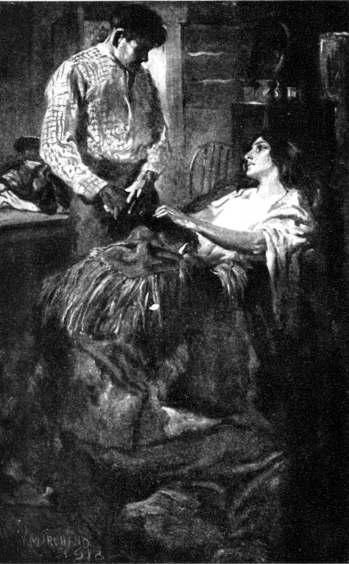
"'Be a man among men for your mother's sake—'"
He had heard of ghosts in graveyards, and he wondered vaguely if such
things could be true. He hoped it was. When the others were asleep, just
before day, he slipped noiselessly from his bed and made his way to her
grave.
The waning moon was shining in cold white splendor. The woods were
silent. He watched and waited and hoped with half-faith and half-fear
that he might see her radiant form rise from the dead.
A leaf rustled behind him and he turned with a thrill of awful joy. He
wasn't afraid. He'd clasp her in his arms if he could. With firm step
and head erect, eyes wide and nostrils dilated, he walked straight into
the shadows to see and know.
And there, standing in a spot of pale moonlight, stood his dog looking
up into his eyes with patient, loving sympathy. He hadn't shed a tear
since her death. Now the flood tide broke the barriers. He sank to the
ground, slipped his arm around the dog's neck, and sobbed aloud.
He wrote a tear stained letter to the only parson he knew. It was his
first historic record and he signed his name in bold, well rounded
letters—"A. LINCOLN." Three months later the faithful old man came in
answer to his request and preached her funeral sermon. Something in the
lad's wistful eyes that day fired him with eloquence. Through all life
the words rang with strange solemn power in the Boy's heart:
"O Death, where is thy sting! O grave, where is thy victory! Blessed are
they that die in the Lord! Death is not the chill shadow of the
night—but the grey light of the dawn—the dawn of a new eternal day.
Lift up your eyes and see its beauty. Open your ears and hear the stir
of its wondrous life!"
When the last friend had gone, the forlorn little figure stood beside
the grave alone. There was a wistful smile on his lips as he slowly
whispered:
"I'll not forget, Ma, dear—I'll not forget. I'll live for you."
Nor did he forget. In her slender figure a new force had appeared in
human history. The peasant woman of the old world has ever taught her
child contentment with his lot. And patient millions beyond the seas
bend their backs without a murmur to the task their fathers bore three
thousand years ago.
Free America has given the race a new peasant woman. Born among the
lowliest of her kind, she walks earth's way with her feet in the dust,
her head among the stars.
This one died young in the cabin beside the deep woods, but not before
her hand had kindled a fire of divine discontent in the soul of her son
that only God could extinguish.