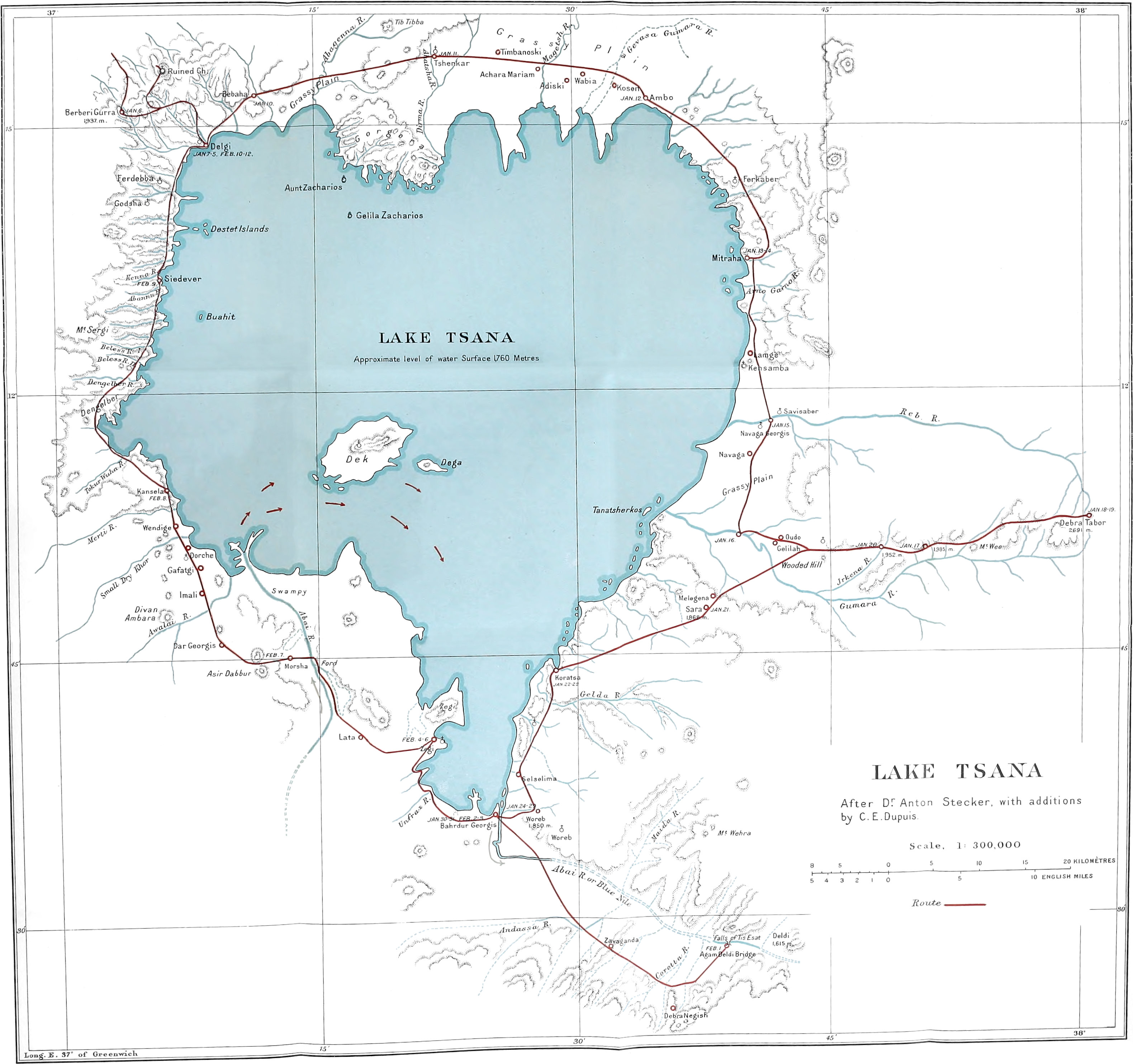
In The Pall Mall
Gazette of August 19, 1904, an interesting account of an
interview with M. Hugues Leroux was published. M. Leroux had just
returned from a “diplomatic and scientific mission” to Abyssinia.
He had been the bearer of an autograph letter from M. Loubet to the
Emperor Menelek. M. Leroux brought back much interesting
information which concerns only the present circumstances of the
country—e.g. that the Emperor “is striving to follow out
what he himself calls a policy of good-humour. He wants to be on
good terms with all the world, but he does not want to be devoured.
He is anxious to open up Abyssinia, but to commerce, not to
conquest.” And again, “he has at last granted permission for the
railway from Djibouti, which hitherto went only as far as Harrar,
to be carried up to Addis Abiba. He will probably refuse the
British and Italian requests to build branch lines connecting this
railway with Zeila and Massouah, the towns on the coast to the
north and the south of Djibouti which belong respectively to Great
Britain and Italy, his comment upon this scheme being, ‘I would
like one ladder up to my front door, but not three.’”
M. Leroux had been entrusted with an autograph reply from the
Emperor Menelek to the President of the French Republic. But he bore away from
Ethiopia a much more interesting document, which—if it is genuine
and is rightly described by the traveller and the interviewer—is
invaluable for the clue that it gives to the origin of the
Abyssinian nation. It is said to be “a most extraordinary
Abyssinian manuscript, which is certain to make a great sensation
when the translation of it is published, for it throws a flood of
light upon the early history of the Jews. The Abyssinian monarchs
have always considered this manuscript to be among their most
sacred possessions. It was appropriated by the English at the
capture of Magdala, but on Emperor John succeeding to the throne,
he opened diplomatic negotiations and recovered it from the British
Museum, where it had been deposited. It is written in the Geez
language, which is of Hebraic origin, of great antiquity, and known
only to the priests. It relates that after the plagues of Egypt
some hundreds of thousands of Jews did not follow Moses across the
Red Sea, but went west, down the Blue Nile, to found a kingdom of
their own, which they called Saba—‘Saba’ merely meaning west. These
were the original Abyssinians.”
We are told that “the original of this manuscript had remained
seventeen hundred years in an island of Lake Zouai, whose
inhabitants are still of the purest Jewish type, but they were
Christianized at a very early date, and their religion has now
degenerated into fetishism. They knew nothing as to the contents of
the manuscript, which they nevertheless regarded as a very precious
object.” Whatever may be the real antiquity of this document its
existence and the importance attributed to it seem to give evidence
of a tradition of great age, and this tradition offers a credible
explanation of the fact that such a people as the Abyssinian is found in the
mountains of East Africa. No doubt the Habashes are now, almost
universally, a race of mixed blood, but they possess a national
character which is quite distant from that of the neighbouring
tribes. The Semitic invasion may have taken place immediately after
the captivity of the Jews in Egypt or at an earlier or later date,
but it was powerful enough to affect the whole polity and
population of Ethiopia.
Generally, writers upon Abyssinia ascribe the incursion to the
reign of King Solomon, and this is in accordance with a legend that
is believed throughout the country. The Queen of Sheba was, of
course, the Queen of Ethiopia; her visit to the wise and
much-married king provided her with an heir; “her son Menelek was
in due time transmitted to his august sire. The young prince was
duly instructed in all the mysteries of Jewish law and science, and
being anointed king under the name of David, he was returned to his
native land, escorted by a large suite of the nobles of Israel, and
a band of her most learned elders under the direction of Ascarias,
the son of Zadok, the High Priest.
“The gates of the temple of Jerusalem were left unguarded, and
the doors miraculously opened in order that the holy ark of Zion
and the tables of the law might, without difficulty, be stolen and
carried away. The journey was prosperously performed, and the
Queen-Mother, on resigning the reins of authority to her son at her
death, about nine hundred and seventy years before the birth of
Christ, caused a solemn obligation to be sworn by all that
henceforth no female should hold sway in the land; and that those
princes of the blood royal upon whom the crown did not devolve
should, until the succession opened to them or during the natural
term of existence, be kept close prisoners on a lofty mountain; a cruel and despotic
enactment which, through a long succession of ages, was jealously
observed.”[123]
“The impetuous zeal of the emigrants,” wrote Mr. Stern, “found
ample scope for its loftiest inspiration in the new world to which
they were transplanted, and in the course of a few years the
worship of the God of Israel extensively supplanted the idolatries
of Ethiopia.
“From these vague traditions,” the same writer prudently added,
“in which truth and fiction are inextricably jumbled together, the
inquirer does not gain much trustworthy information on the history
of Ethiopia and the settlement of the Jews in that country.”[124]
Mr. Augustus Wylde visited a charming and sequestered spot
where, according to one legend, the stolen ark was deposited. “We
halted for lunch just vis-à-vis to the first sources of the
Taccazze. . . . Just before reaching the sources, on a hill on the
north side of the valley, is the church of Chevenan Gorgis, in a
splendid grove of juniper trees; immediately above the sources on
the hill is another church, also surrounded by juniper trees,
dedicated to Debbessa Jesu; tradition has it that when Menelek, the
son of the Queen of Sheba by King Solomon, came from Jerusalem with
the ark, it was placed on the ground at this spot, where he camped,
and these springs gushed forth, and he immediately ordered a temple
to be built on the spot.
“On leaving this camp Menelek commenced his march towards the
east, and on the bearers of the ark putting it down, after about an
hour’s march, they found that they could not move it, as it firmly
adhered to the
ground. This spot is supposed by some of the Abyssinians to be the
true resting-place of the ark that was brought from Jerusalem;
there is a church built over the spot called Eyela Kudus Michael. .
. . It is nearly impossible for a stranger to obtain admittance to
this church, and the place in the Holy of Holies where the ark is
supposed to rest is shown to no one. This ark cannot be in two
places; the people of the north declare it is in the sacred grove
of Axum in the church of Selata Musser (place of Moses), and the
priests of the Eyela district declare it is in their church, so
they always quarrel and wrangle over this vexed question, the same
as European priests do over their sacred relics.”[125]
Perhaps the soundest opinion which can be formed under present
conditions as to the origin of the Abyssinian people has been
expressed by Mr. Wylde:—“The race, as the name Habash or Abyssinian
denotes, is a mixture, undoubtedly of very long standing, but most
likely of Jew with the inhabitants of Southern Arabia and the
non-negro races of Eastern Africa.”[126]
According to tradition, Christianity was introduced into the
country in the fourth century.
“In the year 330 after the birth of our Saviour, Meropius, a
merchant of Tyre, having undertaken a commercial voyage to India,
landed on the coast of Ethiopia, where he was murdered by the
barbarians, and his two sons, Frumentius and Edesius, both devout
men, being made prisoners, were carried as slaves before the
Emperor. The abilities, the information, and the peaceable
demeanour of the brothers soon gained not only their release but
high office in the court; and living in the full confidence of the
monarch until his decease, and subsequently under the protection of
the Queen-mother,
the good-will of the entire nation quickly succeeded. The work of
conversion was commenced, and proceeding with wonderful rapidity
and success, a thriving branch was shortly added to the great
Eastern Church.
“Bearing the happy tidings, Frumentius appeared in Alexandria,
and was received with open arms by the Patriarch Athanasius. Loaded
with honours, and consecrated the first bishop of Ethiopia, a
relation was thus happily commenced with Egypt, which has remained
firm and friendly to the present day, and throughout fifteen
centuries has bestowed upon a Coptish priest the high office of
Patriarch Abouna (i.e. our Father) of the Ethiopic
Church.
“On his return to the country of his hopes, Frumentius found
that the spark of life had spread rapidly throughout the gloomy
darkness of the land. Baptism was instituted, deacons and
presbyters appointed, churches erected, and a firm foundation laid
whereon to establish the Christian religion in Abyssinia.
“During the succeeding century, priests and apostles, men of
wonderful sanctity, flocked into the Empire from all parts of the
East, and miracles the most stupendous are related in the legends
of those days. Mountains were removed, and the storms of the angry
ocean stilled by the mere application of the staff. The adder and
the basilisk glided harmless under foot, and rivers stayed their
roaring torrent, that the sandal of the holy man should remain
unstained by the flood. Aragáwi raised the dead—the fingers of
Likános flamed like tapers of fire—Samuel rode upon his lion; and
thus the kingdom of Arwé, the old serpent of Ethiop, was utterly
overthrown.”[127]
The conservatism of the Abyssinian people in matters of religion is well
illustrated by the fact that throughout the many and violent
vicissitudes of their history since the introduction of
Christianity they have always received their Patriarch from the
mother-church. His position is one of great authority. “The chief
man in the country after the king of kings is the Abouna, or
archbishop, the head of the Church; without the Abouna no king can
be crowned, and it is he that, at his own or the king’s wish, can
excommunicate any of his subjects, or the king himself, if
necessary, and then the king can only rule by the strength of his
followers who adhere to him. These archbishops come from the Coptic
Monastery at Alexandria or Cairo, and when they reach Abyssinia,
they never leave it on any consideration.”[128] Moreover, “the Abyssinian Church, in common
with all other Christian communities in Asia and Africa, is
strictly episcopal. The Abouna, or primate, who is consecrated to
his office by the Patriarch of Alexandria, the revered successor of
St. Mark, can alone confer the priestly title. Every candidate,
before presenting himself for ordination, must have acquired some
knowledge in the reading of the sacred language of Ethiopia, and in
the complicated ceremonies of the liturgical service. On the day
appointed for ordination the primate, in full canonicals and seated
on the episcopal throne, receives the applicants for the sacred
office. All being properly ranged before the chair of St. Mark,
each candidate, instead of the imposition of hands, receives the
Abouna’s consecrating breath. Former archbishops, less scrupulous
than the present successor of Frumentius, indiscriminately breathed
on all, whether qualified or not, who could pay the requisite fee
of two salts—fourpence.[129]
“Deacons are
selected from among boys, who are only allowed to serve in the
Church till they attain the age of twelve or thirteen; after that
period their purity of life is suspected, and they are no longer
considered fit to approach the sacred shrine of the
tabot.[130] The bishop and monks may not marry,
while the priests may; and as, on the death of their wives, they
cannot contract a second alliance, the reverend wooers invariably
choose for their partners the most robust and sprightly lasses in
the land.
“The debterahs, or scribes, constitute the lowest but
the most influential body in the Church. These worthies enjoy no
ecclesiastical rank and are under no ecclesiastical discipline, and
yet no service can be properly performed unless they take part in
it. Their chief duty consists in chanting the Psalms and Liturgy,
but their uncouth gesticulation and discordant shouting, instead of
elevating devotion, tend rather, at least in European estimation,
to convert the service of God into a sinful burlesque and the
sanctuary into a bedlam. The scanty learning of the country is
exclusively monopolized by this order; and they are so proud of
their erudition that they deem it a disgrace to exchange, by the
breathing of the Abouna, the proud title of debterah for
the less learned appellation of kas, or priest.
“These literati,
notwithstanding their better acquaintance with the sacred volume
and the lives of the saints, are considered the most arrant
scoundrels in the land. Gondar, which contains a considerable
number of the fraternity, is notorious for the dissolute profligacy
of its inhabitants; and it is proverbial throughout the country
that wherever debterahs abound there vice and immorality
thrive.”[131]
Mansfield Parkyns found that many of the debterahs, or
defterers, professed to practise witchcraft. He wrote:
“There are persons in the country who are supposed to be able to
call up spirits and obtain from them any information they may
require. These men are mostly defterers (or Scribes), and
are regarded with a certain amount of rather dubious respect. The
scene of their incantation is generally some ravine, with a stream
running through it. As I have only heard the reports of the common
people on the subject, I cannot describe accurately what ceremonies
are observed, or what form the devil assumes on quitting the water
at their summons. My informants, however, assured me that he came
as a great chief, with the usual train of shield-bearers behind him
and gunners before him.”[132]
The Abyssinian liturgy is not impressive, according to European
ideas. Stern was present at one of the services, and gave a lively
description of it. “The deafening tom-tom of the negareet,
intermingled with the nasal chorus of a host of debterahs
in varying cadences, reverberated on my ear. This indication that
the service had already begun put a stop to our contemplation of
the grand mountain scene, and in a most reverent mood we hastened
to the uproarious sanctuary. A wooden gate in a circular wall brought us
within an open grassy space that formed the cemetery, and the spot
where, adjoining to the church, rises the Bethlehem in which the
priests prepare the eucharistic bread. A crowd of men and women, as
if in some place of amusement and dissipation, were spread in
picturesque knots over the soft turf. The majority were busily
plying their tongues, but I fear from the burst of merriment which
now and then broke from one or the other of those animated groups
that their conversations had very little to do either with religion
or the service in honour of the saint. Not belonging to this impure
class, who are justly excluded from the interior of the sacred
edifice (i.e. those whose marriage is secular and
dissoluble), we mounted a few steps, and then, through a partition
occupied by the laity, stepped into a second compartment concentric
with the outer one, and there found ourselves at the porch of the
enclosure which constitutes the sanctum sanctorum.
“Crowds of priests and debterahs thronged the whole of
that corridor. The debterahs constitute the choir in all
their churches; and their devotionless mien, as they chanted to the
monotonous sound of the negareet, quite excited my
indignation. During the maddening noise created by the
debterahs, the priests, robed in gaudy canonicals, were
exerting to the utmost their cracked voices in intoning the liturgy
and psalms. At certain intervals an ecclesiastic, clad in his
garish finery, and attended by an incense-waving boy-deacon and a
bearer of the Ethiopic Gospel, marched out of his sanctum into the
cemetery to edify the godless and profane multitude by reading to
them a portion of Scripture in an unknown tongue. A reverend
gentleman near me, who was evidently a great Church dignitary, as
he wore a huge
turban, and had a very stupid unmeaning face, pointed his gaunt
fingers towards the daubed walls, and condescendingly inquired
whether I knew St. George and Miriam, the mother of God? . . .
“Unable to perform any religious rite without the savage
accompaniment of tinkling keys and other discordant sounds, the
sacrament of the mass (Corban), the most solemn service of
the Church, is also performed amidst the most confused and
distracting clangour. The liturgy and consecration service over,
all, except the communicants, leave the place of worship. These now
approach the vestibule of the holy of holies, where the officiating
priests, enveloped in clouds of incense, are busily occupied in
washing their hands—this ceremony is copied from Pilate’s example.
The water, which this act sanctifies, must not be spilled on the
ground, but, as a regeneration emblem, it is sprinkled on the
bended heads and the garments of the faithful, whilst the priest
says, ‘If you think that I have now cleansed your garments and
purified your bodies, and yet continue to cherish hatred and malice
in your hearts, I tell you that the body of Christ will prove to be
a burning fire to consume you, and His blood a bottomless sea to
drown you!’ After this exhortation the tabot, the
substitute for the altar, is taken out of the holy of holies, and
each communicant receives a small piece of wheaten bread and a
spoonful of raisin wine. To prevent the desecration of the sacred
elements every one, before he quits the church, drinks a cup of
water, and also refrains from expectorating that day.”[133]
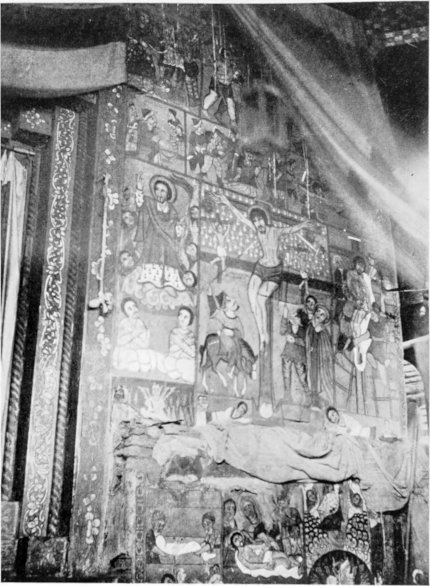
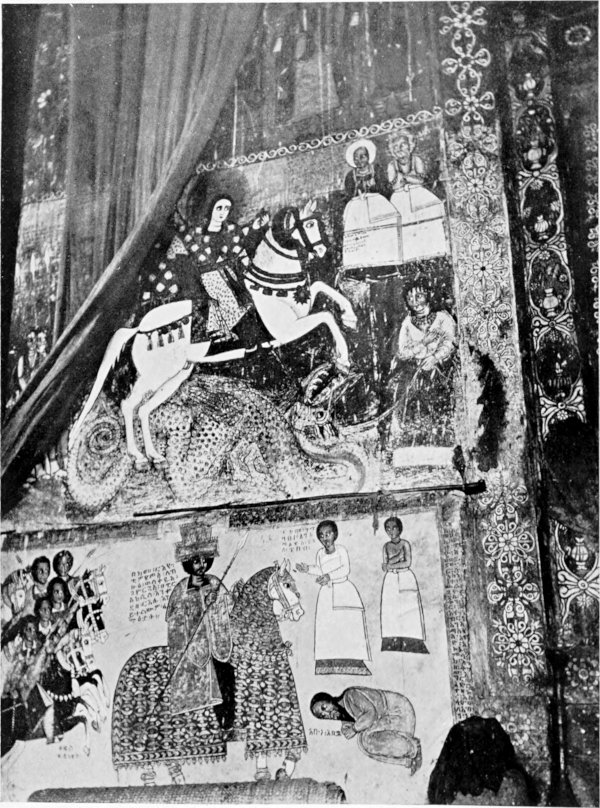
The ecclesiastical art of Abyssinia has already been mentioned.
Stern has given an account of a singular instance of its
development and of an equally strange result of the devotional use of pictures.
He visited “Kudus Yohannes, which next to that at Quosquam, is the
handsomest and most gorgeously bedaubed of the forty-four churches
in and around Gondar.” Here “one aspiring artist, weary perhaps of
the antiquated cherubims and saints, the blazing flames and leafy
bowers, which are the ordinary ornaments of the churches, had
sought immortal fame by painting quite a new subject—the Migration
of the Israelites. In his picture he represented them marching in
soldier-like attitude over the heaving and surging waves of the Red
Sea, clad in British uniform, with muskets and bayonets on their
shoulders.” Again, Major Harris, at the time of his mission to
Sahela Selassie, who was then Negus, had presented His Majesty with
a portrait of Queen Victoria. This “lay securely guarded amidst the
regalia of the Ethiopian Empire till the death of the despot. His
heir and successor, Hailu Malakot, to atone for some indiscretion,
presented it in pious contrition to the Cathedral Church, and there
the people flock on all grand festivities to worship it as the
representation of the Virgin Mary.”[134]
Reference has been made to certain Abyssinian saints, to whose
exploits Major Harris alluded. But these are neither the most
notable nor the most venerated in the ecclesiastical chronicles.
Tekla Haimanot—facile princeps—“is said to have converted the
devil, and induced him to become a monk for forty days, though what
became of him afterwards we are at a loss to know. The same holy
man, wishing to ascend a steep mountain with perpendicular sides
was accommodated in answer to prayer with a boa-constrictor, which
took him up on its back.”[135] Before the birth of this
saint, “a glorious light rested for several days over the parental
house. At the baptism of the child the priest was so dazzled by its
supernatural beauty that, lost in admiration, he dropped the babe,
and might have killed it, had not an invisible hand kept it
suspended above the hard floor.” In due course Tekla Haimanot
became a monk, and “the mortifications, self-imposed penances and
incredibly long fasts which followed his initiation into the
monastic brotherhood are faithfully recorded in the annals of the
Church for the edification of the faithful.” Later, he visited the
Holy Sepulchre, after marvellous adventures among the Moslems, and
was subsequently ordained priest by the Copt Patriarch in Egypt. He
then proceeded to the Galla country, where his mother had been kept
prisoner, and converted the heathen by hundreds of thousands. On
one occasion he repaired to the monastery of Debra Damo, but here
“the brotherhood did not much sympathize in the general jubilee
that greeted the austere monk. The monastery stands on the summit
of a perpendicular rock, and, being quite inaccessible, no visitor
can reach it unless drawn up by a rope. The Evil One did not like
the ascetic to tamper with the merry fellows on the rock, and, to
effect his wicked purpose, he maliciously cut the frail support
when Tekla Haimanot was in mid-air, and probably he would have been
dashed to pieces in a ravine below, had not immediately six wings
unfurled themselves under his garb and borne him aloft. In
commemoration of this miraculous volant power, the saint is
represented, in most of the churches dedicated to him, as nearly
smothered in a profusion of gorgeous plumage.”
Tekla Haimanot’s ascetic practices in “tenantless wastes and
malarious jungles” did not suffice him as the years advanced. “He
hit upon an original idea of mortifying the flesh. There is in Shoa
a small lake, which the saint in his peregrinations had often
passed. To these waters he now repaired. The good people who
followed him from all parts to hear his discourses and to obtain
his blessing entreated him not to expose his precious person to the
alligators and other aquatic monsters; but the holy man, who knew
that all his exploits for the glory of the Church had not yet been
accomplished, fearlessly stepped into the deep. Seven successive
years he continued in the water, and probably he would have expired
on his liquid couch, had not one of his legs dropped off. The
clamour for this valuable relic created quite a dissension in the
Church, but the monarch judiciously put a stop to the fierce war
between the rival claimants by ordering it to be kept as a
Palladium in the royal metropolis. This sacred talisman possesses
more wonderful sanitary virtues than all the drugs in the universe.
Patients from every province of the country visit the shrine to
make votive offerings and to quaff the healing water in which the
saint’s leg is weekly washed.”[136]
That the miracles above related are stock miracles—if one may
use such a phrase—and that the same legends are connected with more
than one saint is evident from the following gesta sanctorum
cited by Mansfield Parkyns:—
“Gabro Menfus
Kouddos (Slave of the Holy Ghost) was a great saint from his birth;
nay, more—he was born a saint. No sooner did he enter the world
than he stood up, and three days after his birth he bowed his head
thrice, saying in a distinct voice, ‘Glory be to the Father, and to
the Son, and to the Holy Ghost.’ He never tasted of his mother’s
milk, nor during the whole period of his life partook of food or
drink of any sort. Once, when praying on a mountain, he fell over a
precipice two hundred cubits deep. Two angels immediately joined
their spread wings under him to support him; but he refused their
assistance, saying that he trusted to God alone for help. Another
time he was ascending a very high mountain, and, being fatigued,
the Holy Trinity came and assisted him. Many other equally absurd
and almost blasphemous stories are related of him; at last, after a
very long life, I forget of how many years, the Almighty sent
Azrael, the angel of death, to take him. But the saint refused to
die, saying, that as he had neither eaten nor drunk, he could not
die. So all the saints came to him in turn for the purpose of
persuading him to leave earth for Paradise. St. John the Baptist
first addressed him, saying that he had gone the way of all flesh,
notwithstanding his many privations and sufferings. Gabro Menfus
Kouddos, however, at once met him with the answer, ‘Yes; but
you could not fast even for forty days, but fed on locusts
and wild honey.’ Thus he replied to all the saints, and at last
even to the Virgin and our Saviour. Still, however, the decrees of
the Omnipotent must be obeyed, and his life was taken from him; but
then there was a dispute among the elements as to what was to
become of his body. The earth refused to receive it, as he had
never partaken of her produce. A similar refusal was
made by the water,
for he had never taken a drop within his lips. The fire had also
equally strong objections. So the saint was restored to life, and
taken up alive into heaven. His tomb is, however, shown at
Zoukwahla in Shoa; but it is said to contain only one of his ribs,
which, at the time of his ascent to heaven, he took out and left on
earth as a memento for his followers.
“Abouna Aragawy was one of the nine missionaries sent to
Abyssinia by St. Athanasius. His doctrine and the miracles which he
wrought gained for him many followers; but from some of the
unbelieving he suffered persecution. This is the account given by
some historians; while others assert that, overcome by his
popularity, he sought retirement from this world, in order to
devote the remainder of his days to religious duty. Be it as it
may, he came to the rock on which is now the celebrated monastery
of Debra Damo. After walking several times round it, without
finding any means of access to its summit, he prayed to the
Almighty, who sent him an enormous boa-constrictor, which offered
to carry him up in its mouth; but he said, ‘I fear your mouth; turn
round and let me take your tail.’ So the snake did as he was
desired; and the saint, holding fast by its tail, was drawn up to
the summit of the rock in perfect safety. The snake having
performed its duty offered to leave the saint if he wished it; but
Aragawy begged that it would remain, making, however, the condition
of its not alarming or destroying any of his disciples who might
come to visit him. They then took possession of the caves and holes
which are in the mountain, where they are by many supposed to be
still living. Some, however, pretend that the snake is dead; but no
one is so wanting in faith as for a moment to deny that the saint
yet lives there, and will continue to live till the day of judgment. No
curious person, however, dares to venture into the cave. The monks
will not allow lights to be taken in; and the people assert that a
spirit which protects the place will not permit any one who enters
to come out alive.
“When I first went to Rohabaita it was reported that an immense
snake had some years before been killed there by a hunter. The man
was severely reproached by the priests, who said that the snake was
the guardian angel of the place. It was reported to have been
twenty-seven cubits, or forty feet in length, and was probably of
the boa tribe.”[137]
Another saint of remarkable powers was Tederos (St. Theodore).
He resided at the hamlet near Rohabaita which now bears his name.
Here, “on the face of the rock is the little hole wherein he lived;
it is barely high enough for a person to squat in; and the marks
worn in the stone by the crown of his head, the soles of his feet,
and his elbows are still shown. His miracles were many. Among
others, a leopard ate up his son, the saint, returning home, missed
him, and set out in search of him. When in the forest he called
aloud to him three times, and at the third time the leopard
appeared: on seeing him, the saint guessed how the matter stood
with the unfortunate youth; but, nothing discouraged, he coolly
ordered the beast to return him safe and sound. Now this was rather
difficult, as the leopard had, no doubt, half digested him;
nevertheless, so great was the saint’s power that the boy left the
leopard’s maw none the worse, perhaps rather the better, for having
been dismembered and reconstructed. Being asked where a church
should be built, the saint threw his staff, desiring the inquirers
to build where they found the staff had fallen. After many days it was found
several miles off in Serawi, on the other side of the valley,
exactly on the spot where now stands the church of Debra
Mariam.
“Many other wonderful stories were told me of his feats, but I
have forgotten them. The most useful act attributed to him was that
he caused the rock below him to become hollow, in order to receive
the rain-water. The hollow still exists, though I should strongly
suspect it to be of Nature’s construction; or, if the saint had a
hand in its design, he must have been a clumsy fellow, for with
half the labour he might have made a place capable of containing
twice the quantity of water.”[138]
Parkyns was not sure of the parentage of the youth who was
disgorged by the leopard. “I hope I am right in giving St. Theodore
a son,” he wrote. “I don’t know whether his being a father would
preclude his being a saint: however, it was a youth nearly related
to him, if I remember the story right.”
Some chroniclers “pretend that St. Matthew and St. Bartholomew
actually visited the country. Some even go so far as to assert that
the Virgin Mary herself, with the child Jesus, came into Abyssinia
when she fled to Egypt, and show a place in a high mountain which
is called her throne or seat.”[139] Bruce wrote that “in the
Synaxar, or history of their saints, one is said to have thrown the
devil over a high mountain; another persuaded him to live as a monk
for forty years; another had a holy longing for partridges, upon
which a brace perched on his plate—martyrs ready roasted.”[140]
“In many cases,” Parkyns wrote, “the patron saint is preferred to the Almighty;
and a man who would not hesitate to invoke the name of his Maker in
witness to a falsehood would have difficulty in disguising his
perjury if he were appealed to in the name of St. Michael or St.
George. It is also a well-known fact, and most common of
occurrence, that a favour besought in the name of God would often
be refused, while, if the request were immediately after repeated
in the name of the Virgin or of some favourite saint, it would
probably be granted. This may be observed in the appeal of the
common street beggar in Tigre, whose ordinary cry is, ‘Silla
Izgyheyr! Silla Medhainy Allam!’ (For the sake of God! For the sake
of the Saviour!)—while, if he be very importunate, he will change
his usual whining tone, and add with persuasive emphasis, ‘Silla
Mariam! Silla Abouna Tekla Haimanout!’” (For the sake of Mary! For
the sake of Tekla Haimanout!)
It has already been said that Tekla Haimanot and other early
celebrities of the Church were monks. Monasteries are plentiful in
the land, and there are also hermits who practise asceticism in
desolate and lonely places. Mr. Herbert Vivian gained admission to
a conventual house, and has given a lively description of it.[141] The sanctity of the Abyssinian monk or
anchorite is in proportion to his prowess in mortifying the flesh,
and this class of men still retains much religious
prestige and influence in the land. But probably the
pristine rigour of their life has been much relaxed, and the
remarks of Major Cornwallis Harris are applicable at the present
time.
“Education was in former days to be obtained alone from the
inmate of the monastic abode, and a life of scanty food, austerity,
and severe fasting was embraced only by the more enthusiastic. But the
skin-cloak and the dirty headdress now envelope the listless monk,
who, satisfied with a dreamy and indolent existence, basks during
the day on the grassy banks of the sparkling rivulet, and prefers a
bare sufficiency of coarse fare to the sweeter morsel earned by the
sweat of the brow.”[142]
The same writer’s account of the consecration of a friar is
interesting. “The monk is admitted to the order of his choice by
any officiating priest. A prayer is repeated, the skull-cap blessed
with the sign of the cross, and the ceremony is complete. But a
more imposing rite attends the oath of celibacy before the Abouna.
The clergy assemble in numbers, and fires are lighted around the
person of the candidate. His loins are bound about with the
leathern girdle of Saint John, and the prayer and the requiem for
the dead rise pealing from the circle. The glaswa—a narrow
strip of black cloth adorned with coloured crosses—is then placed
on the shaven crown, and shrouded from view by the enveloping
shawl; and the archbishop, clad in his robes of state, having
repeated the concluding prayer and blessing, signs with his own
hand the emblem of faith over the various parts of the body.”[143]
Consul Plowden wrote in a somewhat censorious mood of the
Abyssinian regulars. “Monasteries are not wanting to complete the
resemblance to the Roman Catholic Church and to the Middle Ages,
where every immorality is practised; nor solitary hermits, who
dwell in gloomy forests, feeding on roots, and exposed to ferocious
animals, and who are sometimes as sincere as they are useless.” He
added, “nunneries alone are absent from the picture; though vows of
celibacy are
sometimes taken, if rarely kept save at an advanced age.”
With regard to religious sisterhoods he was in error. Bruce
wrote that, “all women who choose to renounce acquaintance with men
are allowed to turn priests, they then wear a skull-cap, like the
men; and these priests, male and female, all pretend to possess
charms of a nature both offensive and defensive, which are most
generally believed in.”[144] The same writer asserted
that he and his party on one occasion, after passing the River
Taccazze, “at last reached a plain filled with flowering shrubs,
roses, jessamines, etc., and animated by a number of people passing
to and fro. Several of these were monks and nuns from Waldubba, in
pairs, two and two together. The women, who are both young and
stout, were carrying large burdens of provisions on their
shoulders, which showed that they did not entirely subsist upon the
herbs of Waldubba. The monks, their compagnons de voyage,
had sallow faces, yellow cowls, and yellow gowns.”[145]
Bruce may have been mistaken as to the character of these young
women; but not all who take the vows are strict in the observance
of them. Mr. Augustus Wylde met a nun in the flesh, a lady of high
rank in the country, whose charms were neither “offensive nor
defensive.” He wrote, “before getting to Mokareet we were joined by
Ras Mangesha’s young sister. She is supposed to be a nun and devote
her time to charity and good actions, and she has asked permission
of Hailou to join us and camp with us for the next three or four
days. I now quote from my diary—
“I believe this
is a got-up job, as Hailou had his hair replaited this morning and
put on clean cloths, and the pair are evidently very old friends.
She is dressed in the most spotless white garments of the very best
quality, and is most clean and neat in her appearance. From under
her clean white hood a pretty face appears with a pair of roguish
merry eyes. . . . She sent over her pretty waiting-maid as soon as
camp was pitched, asking me to come and pay her a visit, but I was
too seedy with fever, so sent Schimper to make my excuses; when he
came back his first remark in his precise manner of talking was:
‘Oh, Mr. Wylde, I do not think she is a very good lady, she has
asked me for many things, and she wants your umbrella.’ Of course I
had to send it, and next morning on the way to Merta I had some of
the sweetest of smiles, and we kept up a long conversation; she had
never seen an Englishman before, and she wanted to know if they all
had red heads and moustaches and were big men . . .
“I found out that she was considered very ‘rapid’ even for
Abyssinia, where the young ladies are fast, and that her brother
had sent her to a nunnery as he could not keep her in order, and
she absolutely refused to marry the men of his choice; she was
changing her quarters from one nunnery to another, and was
evidently sweet on Hailou.”
But Mr. Wylde had met other nuns, “good pious old ladies at
Abbi-Addi and Macalle, who fasted for over half the number of days
in the year, and were perpetually praying and singing from the
early grey dawn till late at night, and they seemed to live a calm
and peaceful life in their beautiful natural surroundings, and
bothered themselves very little with the troubles of this life, and
passed their days in eating, sleeping, and praying, and doing what
little acts of charity they could in the way of tending the sick and feeding any poor
beggars that came to their houses.”[146]
Many rites and ceremonies of Hebrew origin have been
incorporated in Abyssinian Christianity, e.g. circumcision
is practised. Considering the history and traditions of the people,
this respect for Judaic ordinances is not surprising. Major Harris
devoted a chapter of his book to “Abyssinian Rites and Practices
which would appear to have been borrowed from the Hebrews,” and
most of the authors who have written about the country have alluded
to the same subject. Perhaps the most remarkable example of the
influence of Jewish doctrines is the veneration in which the
tabot is held.
“The Jewish temple consisted of three distinct divisions—the
forecourt, the holy, and the holy of holies. To the first laymen
were admitted, to the second only the priest, and to the third the
high priest alone. All entrance was denied to the Pagan, a custom
which is rigorously enforced in Abyssinia; and her churches are in
like manner divided into three parts.
“Eight feet in breadth, the first compartment stretches, after
the fashion of a corridor, entirely around the building. It is
styled Kene Máhelet, and, strewed throughout with green
rushes, forms the scene of morning worship. To the right of the
entrance is the seat of honour for priests and erudite scribes; and
beyond this court, save on certain occasions, the bare foot of the
unlearned layman cannot pass.
“Makdas is the second compartment. This is the
sanctuary in which the priests officiate, and a corner is set apart
for laymen during the administration of the holy supper, whilst a
cloth screens the mysteries of the interior. Here also hang,
arranged around the walls, the bones of many deceased worthies, which
have been carefully gathered from the newly opened sepulchre, and
are deposited by the hand of the priest in cotton bags. By the
nearest relative the first opportunity is embraced of transporting
these mouldering emblems of mortality to the sacred resting-place
of Debra Libanos, where the living and the dead are alike blessed
with a rich treasure of righteousness, since the remains of Tekla
Haimanot, the patron saint of Abyssinia, still shed a bright halo
over the scene of his miracles upon earth.
“To Kedis Kedisen, the holy of holies, none but the
Alaka[147] is admitted. Behind its veil the sacrament is
consecrated, the communion vessels are deposited, and the
tremendous mysteries of the tabot, or ark of the covenant,
are shrouded from the eyes of the uninitiated. The gold of the
foreigner has penetrated the secret of the contents of this box,
which are nothing more than a scroll of parchment, on which is
inscribed the name of the patron saint of the church; but the
priest who dared to open his lips on the subject to one of his own
countrymen would incur the heavy penalties due to the
sacrilege.”[148]
Another foreigner whose gold “penetrated the secret” of the
Kedis Kedisen was Mr. Herbert Vivian. In company with a
friend he was, for a consideration of two dollars, admitted to the
sanctum sanctorum of the Church of St. Raguel at Entotto.
“The custodians seemed to know very well that they were doing
wrong, and displayed huge anxiety to get the thing over as quickly
as possible. They hurried us up the rickety steps, opened the door
of the sanctuary, took great care to keep us as far off as possible, and kept
exclaiming, ‘Now that is all. I hope you are satisfied. Let us go
away again. You ought really to give us some more dollars for what
we have done.’ There was, however, really next to nothing to see.
In the darkness I could just make out the tabernacle inside the
holy of holies. It was a kind of ark, covered with cheap draperies
and surmounted by a crucifix. A few lanterns lay about. That was
all. At any rate, that was all that we could induce the priest to
show us.”[149]
Mr. Hormuzd Rassam has given a sketch of a tabot in his
book, with the following description: “The tabot is a
square block of wood on which the emblem of the cross, with some
appropriate passage of Scripture, is sometimes represented. No
church can be consecrated without it, and in the church from which
it has been removed the Lord’s Supper cannot be celebrated. It is
placed upon the altar in the centre of the holy of holies, and by
the ignorant clergy is regarded with as much veneration as the
consecrated elements.”[150] Annually, on the eve of
the festival which commemorates Christ’s baptism, the
tabot is carried out of the church by the chief
officiating priest, “and left all night covered in a tent or hut
erected for the purpose near a stream or pool. At daybreak the
following morning it is taken to the water, and after being
sprinkled with a few drops is again enveloped in the church-cloth,
and replaced under the tent until the time arrives for its formal
restoration to the church—a grand religious ceremony, accompanied
with singing of psalms and dancing.” In this recessional solemnity,
which Mr. Rassam saw, “the priests led the way, bearing various
sacred symbols, and
chanting psalms all the while, followed by a train of about three
hundred men and a score of damsels, all dancing, singing, and
screeching as they went.”[151]
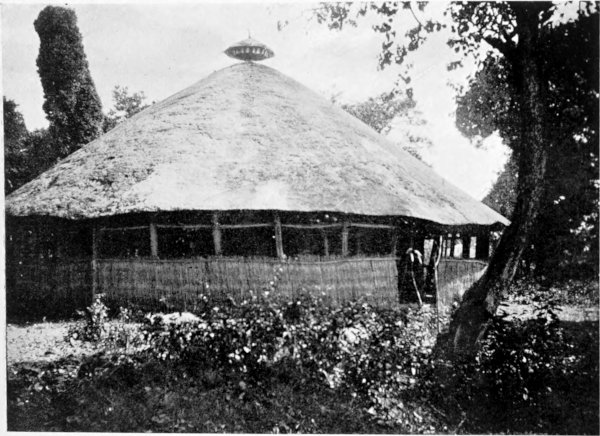
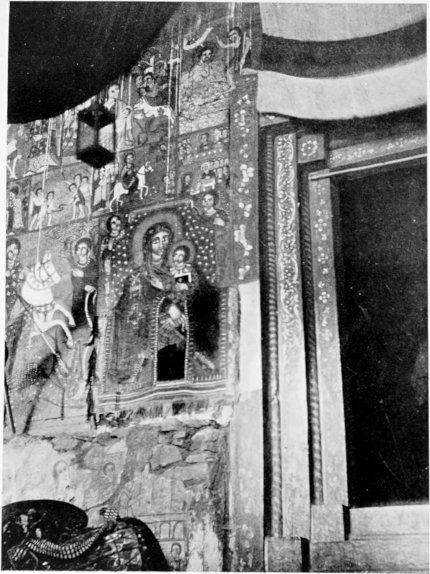
The appearance of Abyssinian churches has already been alluded
to, but the following general description, given by Major Harris,
may serve to bring the principles of their construction clearly
before the reader. “There are, perhaps, more churches in Abyssinia
than in any other part of the Christian world; and he who has
erected one believes that he has atoned for every sin. But even the
best are very miserable edifices of wattle plastered with mud, only
to be distinguished from the surrounding hovels by a thin coating
of whitewash, which is dashed over the outside to point with the
finger of pride to the peculiar privilege of the two great powers
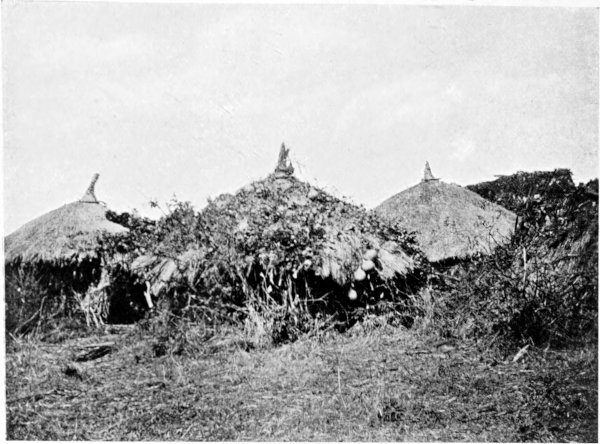
in the land. Circular in form, with a door to each quarter of the
compass, and a conical thatch, they have an apex surmounted by a
brazen cross, which is usually adorned with ostrich eggs; and the
same depraved and heathenish taste pervades the decorations of the
interior. Sculpture is strictly forbidden; but the walls are
bedaubed with paintings of the patron saint of the church, the
Blessed Virgin, and a truly incongruous assemblage of cherubim and
fallen angels, with the evil one himself enveloped in hell flames.
Timbrels and crutches depend in picturesque confusion from the bare
rafters of the roof, and no ceiling protects the head from the
descent of the lizard and the spider.”[152] Mr. Hormuzd Rassam has given a sketch of the
ground plan of an Abyssinian church, showing the entrances and
“courts.”[153] According to him “the outer enclosure is for the
congregation generally, male and female, the former occupying the
western portion, and praying with their faces towards the east; the
latter standing opposite to them and facing the west.”[154]
The “crutches” mentioned by Major Harris astonished Mr. Vivian
at a later date. He saw them in a monastery, and “imagined they had
been contributed by lame people, to whom the saint of the place had
restored the use of their legs. As a matter of fact, however, they
were merely the crutches which every priest uses in the ritual of
the dance.”[155] The manner in which these singular adjuncts of
the priestly office are employed has been described by Mr. Vivian.
He attended a service at Trinity Church in Addis Abiba, and has
given a very interesting account of the ceremonies. At a certain
stage “all the priests grasp their long crutches and go through a
kind of gymnastic exercise, which reminds me of the use of spears
at a Somali dance. The crutches are five feet long, and must, I
imagine, have originally taken their origin from spears, adapted
for civilian use. The tops are either of ivory or brass, some of
them elaborately carved. . . . One priest acts as conductor, and
the others imitate his movements, all singing loudly through their
noses. . . . The crutches are held in the middle and darted at the
ground, now near, now far, with a forward movement made by slightly
bending the right knee. It is as though spears were being poised
and aimed playfully at objects on the floor. The crutches are then
lifted, crook end up, a foot into the air, they are poised, they
are swung, with ever-increasing vigour. All of a sudden the whole exercise
ceases without any warning whatever.”[156]
Major Harris wrote, with regard to certain other clerical
functions—“The Father Confessor is bound to the strictest secrecy;
and it is believed that on this point a dread oath is taken before
ordination, when all the mysteries are expounded by the Abouna, and
especially those which have reference to the preparation of bread
for the holy supper. In a small house styled Bethlehem,[157] which rises immediately behind every church,
the mysterious ceremony is performed. The deacon can alone bake the
cake; and the most vigilant guard is invariably preserved against
the approach or intrusion of females or other improper visitors
during the hour of solemn preparation.”[158]
The first appendix to Vol. III. of Major Harris’s book contains
a list of the sacred writings used by the Abyssinian Church. These
include, inter alia—
- The Old Testament.
- The four gospels with readings, and all the other books of the
New Testament.
- Genset. A book used in funeral solemnities, ascribed
to Athanasius, and stated to have been discovered by Helena at the
digging out of the Holy Cross.
- Retna Haimanot. The orthodox faith.
- Henoch. The prophecies of Enoch.
- Gadela Tekla Haimanot. Life of Tekla Haimanot. (And
the lives of many other saints.)
- Synodos. Canons of the Church, attributed to the
Apostles.
- Sena Febrak. History of the Creation; containing
certain fabulous traditions concerning the Creation and the
Antediluvian world,
said to have been communicated to Moses on Mount Sinai, but not
recorded in the Book of Genesis.
- Tamera Mariam. Miracles of the Holy Virgin, wrought
during her sojourn in Abyssinia, where she is said to have tarried
three years and six months with the infant Jesus, before her return
to Palestine.
- Nagara Mariam. Words of the Holy Virgin.
- Ardeet. Words said to have been spoken by Christ
before his ascension.
- Kedasie. Liturgy of the Abyssinian Church.
- Gadela Adam. History of Adam.
- Auda Negest. Book for prognostication.
- Kufalik. Mysteries revealed to Moses on Mount Sinai,
not written in the Pentateuch.
- Serata beita Chrestian. Institutions of the Christian
Church.
- Degwa. Book of anthems, in which all the pieces of the
liturgy that are chanted are set to music by St. Yareed, a native
of Simien, who lived thirteen centuries ago and is believed to live
still.
- Lefafa Zedik. Prayers and spells against evil spirits
and diseases, a book much esteemed, and buried along with the
corpse.
- Zalota Musa. Prayers of Moses against the influence of
evil spirits.
- Melka Michael. Prayers to St. Michael.
- Mazafa Tomar. A letter which Christ is said to have
written.
- Germama. Prayers to frighten evil spirits.
- Fekaric Yasoos. Christ’s prophecy of the consummation
of the world.
- Haimanot Abao. Doctrines of the Abyssinian Church,
comprising extracts from the Holy Scriptures, from synods,
councils, and writings of the Fathers.
- Gelota Monakosat. Prayers of the monks.
- Felekisus. Book on monastic subjects.
- Gadela Yob. Life of Job.
- Raia Miriam. Dream of the Holy Virgin.
- Gadela Samoetal. Lives of the martyrs.
The second appendix of the same volume contains a summary of the
“Senkesar, or Synaxaria, being a Collectio Vitarum Sanctarum
together with the Calendar of the Ethiopic Christian Church.” The
compiler of the
summary wrote, “The following calendar, translated from the Latin
of Ludolf, has been considerably enlarged by a comparison at
Ankóber with a complete copy of the ‘Senkesar.’ The lives of the
Saints, or the detail of miracles written against each day, are
publicly read in the churches at the services beginning at the
cock’s first crowing.”
The first month of the Abyssinian year is September. It is not
surprising that in the long list of saints, patriarchs, prophets,
martyrs, virgins, hermits, kings, “Fathers,” presbyters, emperors,
and male and female ascetics whose deeds are commemorated between
New Year’s Day (September 1, by Ethiopian reckoning) and the
festival of St. Andrew and Moses, Bishop of Ferme, (being the
thirtieth and last day of August according to the same
computation), there should occur many names of worthies who are
unknown to most European readers. For instance—
- Abba Anbasa, who rode upon a lion.
- Eustathius, who brought a dead child back to life. (This
miracle is attributed to many of the saints.)
- Ananias, who baptized St. Paul.
- Pantaleon.
- Jemrah, a martyr. On the spot where his blood was spilt there
grew up a fine vine.
- Naakweto-Laab, the last Emperor of Ethiopia, of the family of
Zague. He did not die.
- Cosmus, Metropolite. It is said that the image of Mary shed
tears when it beheld his excruciating tortures.
- The two hundred and ninety-two brothers and forty-nine sisters
of Cosmus.
- Abba Marina, who was discovered after death to have been a
woman.
- Barsufius.
- Johannes Cama, whose fingers and nails seemed burning like
candles during prayer.
- Abba Libanus,
who brought water out of a rock.
- Daniel, the woman-hater, who vowed never to look at a
woman.
- The forty-nine old hermits.
- Joseph, who was saved out of a fiery oven.
- The 80,107 martyrs with Isidorus.
- Atom and Arianus.
- Eusebius, who, “being threatened to be burnt, was taken to
heaven by Uriel the archangel, and remained there fourteen
years.”[159]
And many others whose sanctity is as little known
in the Western Churches.
If there is anywhere a leisured and adventurous student of
comparative hagiology, he would obtain some interesting results by
tracing the origin and growth of the legends which glorify these
worthies.
A survey of what has been said shows that Consul Plowden was
fully justified when he wrote, “the Christianity professed and
taught in Abyssinia is much materialized.” Nevertheless, the
credulity and superstition which prevail in the country are not in
essence grosser than the unwarranted beliefs which were accepted in
Europe when the Aurea Legenda passed as sound devotional
reading, and it would be as unjustifiable to judge the intellectual
capability of the Habashes by their faith in myths as it would have
been to estimate the ability of our forefathers by a similar
standard. Nor is it certain that any sudden reformation would
improve the religious state of the people. An intemperate zeal for
enlightening them might, by introducing an ideal far above their
real sympathies and comprehension, discredit the old conceptions
without effectually substituting the new. Moreover, the fabulous feats of
the saints may require a cautious and sparing criticism; for to
differentiate the degrees of probability in miracles, among an
unscientific but argumentative race, would, perhaps, be more likely
to promote scepticism as to all thaumaturgy than to lead to the
repudiation of certain miracles and the continued acceptance of
others.
It is, of course, the fact that at present “religion” consists
of little more than a mere series of outward observances.
Veneration of the fabric of the church takes the place of devotion
within its precincts. Dufton wrote:—“The prayers are read in
Ethiopic” (Geez), “a language which the people know nothing about,
so that little profit can be derived from the service. Indeed, most
persons content themselves with kissing the floor or the walls of
the edifice, and such is a criterion of a man’s piety; he kisses
the church, they say, and so esteem him a good Christian. Some will
utter a prayer. The petition takes a form similar to the following,
which an old woman was heard to offer up during my visit, though
the last clause is probably in most cases omitted—
“‘O Lord, give me plenty to eat and drink, good raiment, and a
comfortable home, or else kill me outright!’”
Mr. Vivian visited the Church of the Blessed Virgin at Entotto,
and noticed that all the Abyssinians who were with him “hastened to
kiss the floor-beam and side-posts or lintels of the door in the
outer wall.” And at Trinity Church in Addis Abiba “whenever a
peasant approached the church on a mule, he dismounted and kissed a
large black stone which stood some twenty yards away. Other persons
of a more pious turn of mind went right up to the entrance and
kissed not only the
lintels, but even the floor-beam of the doorway. This was also done
by everybody who was coming to church, and my servant, in whom I
had never detected any semblance of piety on the road, was
particularly punctilious in this respect.”[160]
But it is not the case that the Habashes avoid all religious
duties that are irksome. Parkyns wrote: “Their fasts are more
numerous perhaps than those of any other Christian people, more
than two-thirds of the year being assigned to abstinence. Nor in
their fasting do they get off as easily as Roman Catholics; for it
is not sufficient that they should abstain from animal food only;
an Abyssinian, during fast-time, neither eats nor drinks anything
till late in the afternoon. . . . It is true the Mohammedans do
nearly the same during their month of Ramadan; but they only change
the day into night, feasting during the night-time on more
luxurious food than many of them could allow themselves during the
remainder of the year; while the Abyssinian, when he does eat,
confines himself to dried peas, dressed in a sort of bad oil, or to
an equally unpalatable dish made of a kind of spinach, called
‘hamly’ or ‘goummen.’ . . . Many of the Abyssinian fasts are of
long duration. The time of day when the people may eat is
determined by the length of a man’s shadow, measured by his own
feet, and varies in different fasts. Thus the fast of Advent is
during the last ten days of the month Hedar (October) and the whole
of Tahsas (November), and during each day till a man’s shadow
measures nine and a half feet. The fast of Lent lasts till sunset
during fifty-five days. . . . Besides these are the Wednesdays and
Fridays, making nearly 260 days of fasting. . . . Some of the
priests are very
rigorous in keeping all these fasts, and many even voluntarily add
a number for their own observance. The people, too, in general are
tolerably attentive to this duty; and I have frequently met with
men undergoing extreme labour, yet persevering in what they have
been brought up to consider as one of the most essential parts of
their religion; for, strictly speaking, a man who has been known to
neglect the rules of the Church is looked upon almost as an
infidel, and should he die in such a state of disobedience, his
body would be refused sepulture in the churches. Good Friday and
the following day are passed by the priests and the rigidly devout
in an absolute fast of forty-eight hours.”[161]
Plowden remarked: “So much do they attach importance to this
(fasting) and other outward forms that a man of Hamazayn[162] will slay his near relative, and returning
home calmly, will be horror-stricken should his wife have ground
flour on a saint’s day, or prepared his meal before the hours of
fasting have expired.”[163]
It must be owned that the Habashes recompense themselves as far
as possible for the severity of their abstinence by gluttony at the
numerous feasts which the Church also ordains.
Major Cornwallis Harris drew attention to a singular custom in
the following words—“Fasts, penances, and excommunication form the
chief props of the clerical power; but the repentant sinner can
always purchase a substitute to undergo the two former, and the ban
of the Church is readily averted by a timely offering.”[164] This seems to indicate an opinion among the
Abyssinians that a sin is expiated not by the contrition of the
evil-doer, but by a
formal amount of punishment undergone somewhere by some one—no
matter by whom.
The Abyssinian Church teaches, and the great majority of the
people accept, the doctrine of transubstantiation. Those who hold
this belief “assert that the actual body and blood of our Saviour
are partaken of by the faithful, but that an angel takes them away
from an unbeliever, and restores the bread and wine, in his hands,
in their natural state, such as they were previous to the
benediction. The wine is merely an infusion of dried
raisins.”[165] Stern tells the story of a miracle which is
supposed to have established the fact of transubstantiation, and
adds, “The erudite reject the legend, and, in their sentiments,
approximate to the Lutheran doctrine of consubstantiation.”[166] The Church also teaches the doctrine of
purgatory and that “prayers for the dead are necessary, and
absolution indispensable. The souls of the departed do not
immediately enter upon a state of happiness, the period being in
exact accordance with the alms and prayers that are expended upon
earth.”[167] Stern declared that “the number of masses
requisite for the repose of the soul has not been defined by the
Church, and thus the misery or bliss of the defunct is at the mercy
of niggardly relatives and exacting priests.”[168] Both writers attribute the introduction of
this opinion to the Jews.
The badge of Ethiopian Christianity, worn by all classes, is the
mateb, a blue neck-thread of silk or wool. This is the
distinctive mark of the Abyssinians’ creed; they hardly believe
that one who does not wear it is in reality a Christian, and, said Dufton,
besides disdaining their Mohammedan and Jewish neighbours, “they
often include in their contempt every form of Christianity even
which does not conform to their own”[169]—in which prejudice they are not so singular as
at a first glance they may appear to be. Commonly a silver ring or
cross is attached to the cord.
The general character of the clergy appears from what has
already been related. Parkyns saw them in remote places and in
their least spiritual aspect. For instance, in describing the feast
on St. Michael’s day at Addy Harisho, he wrote: “An old priest came
up to me and offered, on the part of himself and his brethren, to
perform, if I pleased, the religious dance and song used by them on
such occasions. I never shall forget their ludicrous efforts to
appear graceful, at the same time staggering every step; while the
expression of devotion they affected to assume was reduced to a
languid smile and thickening eyelids, expressive of nothing but
liquor. A hiccup or two occasionally interfered with the solemn
words they were chanting; and the stately movements they had begun
with changed gradually, and by degrees the dance became a reel, or
rather reeling movement, the words only which accompanied it
remaining solemn. At last an old priest, suddenly forgetting the
original chant, changed its words to those of a jovial drinking
ditty: ‘Don’t you stop the liquor, and I will dance for ever!’
Instead of the marks of disapprobation from his fellow-priests,
they only burst into a loud laugh, and, declaring the entertainment
to be changed for the better, all with one consent followed his
example and his tune.”[170]
Nevertheless,
Parkyns wrote of the priests with tolerance and good humour. And it
is worthy of note that two other British writers who knew the
country well have had a good word to say for the clergy. Plowden,
after mentioning some of their faults, observed: “It is just to say
that they have preserved the Christian faith, impure indeed, but
still alive, in the midst of foreign invasion, domestic
degradation, and the extinction of Government, and that it is under
their protection that agriculture flourishes, and villages are
built where deserts would else be seen.”[171] Mr. Augustus Wylde, among several remarks in a
similar sense, said: “I have found the clergy, if left alone,
peaceable, simple-minded men, very hospitable and always willing to
do me a good turn, and ready to help me and pass me on to their
neighbouring friends, and I expect other travellers would find them
the same as long as they treated them properly.”[172]
An interesting instance of the survival of a Jewish institution
among the Christians of Abyssinia is that of Cities of Refuge.
Plowden wrote, “All the larger towns are entirely under their (the
priests’) control, and being cities of refuge, sacred even from the
Ras, are filled with dissolute and dangerous characters.”[173] Parkyns mentioned Axum as a place of this
kind, and added, “at Adoua the whole of that part called after the
church, in fact the parish, is sanctuary (‘guddam’), and no person
having taken refuge there can be arrested, although he walk about
the public streets in broad daylight, so long as he does not pass
the parish boundaries.”[174] Stern alluded to the
subject, and had formed the impression that churches in general
were sanctuaries. “In most cases the murderer may elude the violent
rage of his pursuers by taking refuge in a church, where the
priests will negotiate the price of his release.”[175] He mentioned also certain rivers—the Taccazze
and the Abai—forming the limits of provinces, which the “avenger of
blood” may not pass.[176]
The Jewish Sabbath is still held in veneration by the Abyssinian
Christians. Parkyns observed that a feast called “adam Souaur,” or
“left Saturday,” was observed, “as that day was formerly the Jewish
Sabbath, but given up by the Christians for the Sunday at the time
of the resurrection of our Saviour. The priests collect a quantity
of rushes, and bless them in the church; and then a priest and a
deacon take them out into the parish, the deacon carrying the
bundle, and the priest distributing the rushes to all passers-by,
binding them on the head of the receiver. They also visit the
houses with them, and generally receive a handsome present.”[177] It would be interesting to discover the origin
of this custom. Major Harris, writing in 1843, said, “The Jewish
Sabbath is strictly observed throughout the kingdom. The ox and ass
are at rest. Agricultural pursuits are suspended. Household
avocations must be laid aside, and the spirit of idleness reigns
throughout the day.”[178] The same writer has
given a brief history of the observance.[179]
It is well known that at one time Abyssinia was, so far as the
Emperor’s power extended at that period, converted to Roman
Catholicism by the instrumentality of Portuguese missionaries. The
connection with Portugal commenced in 1499, when Pedro Covilham
penetrated by way of the Mediterranean and the Red Sea, to
Shoa, where the
Emperor then held his court. He was well received. An ancient
Ethiopian law decreed that no foreigner who reached Abyssinia
should be allowed to leave the country, but Covilham was permitted
to send home an account of his experiences. At a later date a
further communication from the traveller induced the Portuguese
Government to despatch an embassy, which, after many privations and
adventures, arrived in Shoa in October, 1520. It brought no
presents, and was not cordially welcomed. However, the Emperor
desired to send an answer to the King of Portugal, and therefore—in
defiance of the ancient usage—allowed the ambassador to return to
Lisbon, taking with him an Ethiopian envoy. But certain of the
Portuguese were detained in Abyssinia, among whom was a priest
named John Bermudez.
Some years later this man was appointed Abouna, or Patriarch, on
the death of the incumbent of that office. He made his way to Rome,
where Pope Paul III. confirmed his title, and he thence proceeded,
in accordance with the Emperor’s desire, to Portugal, and solicited
the aid of European troops to assist the Abyssinians in repelling
the Mohammedan invasion which then threatened the country.
The Portuguese Government despatched an expedition of some four
hundred men under Don Christopher de Gama. These troops disembarked
at Massowah in 1542. In an engagement with the Mohammedan forces on
August 30 of that year the Abyssinian allies took to flight, and
the Portuguese were surrounded. They cut their way through the
enemy and effected their retreat, but Don Christopher, who had been
wounded, was captured by the enemy and murdered by the Mohammedan
commander. His skull was sent to Constantinople as a trophy. The surviving
Portuguese besought of the Emperor an opportunity to avenge their
leader, and they shortly afterwards took part in an action in which
the Mohammedan forces were routed with great slaughter.
These circumstances added to the influence of Bermudez, but he
insisted rigorously on the complete acceptance of Roman doctrine
and ritual by the Abyssinians, and thus incurred the resentment of
the Emperor. As a consequence he lost the advantages which he and
his compatriots had gained, and finally abandoned his task and
quitted the country, embarking at Massowah, where he had
landed.
A subsequent mission under the leadership of Oviedo, Bishop of
Hieropolis, which reached Massowah in 1558, failed equally, after
many adventures—including an Abyssinian Council at which the
Emperor and the bishop publicly and heatedly disputed about points
of doctrine—and in 1560 Oviedo received orders from Rome to
withdraw from Ethiopia and proceed to Japan.
Peter Paez was the next missionary who attempted to bring
Abyssinia into communion with the Catholic Church. After suffering
shipwreck in the Red Sea and enduring a seven years’ captivity in
the hands of the Turks he landed at Massowah in 1600. Paez was a
man of prudence and ability. He prepared himself for his task by
learning the Geez language and opening a school at Maiguagua, in
which he was able to study the character of the Abyssinian people.
He acquired a reputation as a teacher and disputant, and in 1604
was summoned to the court, where the reigning Emperor, Za Dengel,
received him as a person of distinction. He soon acquired influence
over this monarch, who sanctioned the use of the Roman ritual and
shortly became a
convert to Catholicism. A rebellion—one of the ordinary incidents
of Abyssinian politics—was organized against him, and he was slain.
A period of civil war ensued, during which his successor shared the
same fate.
The crown then passed to the Emperor Segued (called also
Socinios and Susneus).[180] Paez aroused his
interest by his skill in architecture and his other talents, was
received into favour, and for the second time induced the ruler of
the country to recognize the authority of the Catholic Church.
Letters announcing the event, signed by the Emperor himself, were
sent to the Pope and the King of Portugal. Paez died in 1623,
shortly after receiving Segued’s formal abjuration of heresy and
administering to him the sacrament of penance.
Upon receipt of the Emperor’s letter, the Pope, in 1624,
despatched to Ethiopia a mission headed by Alphonso Mendez, a
Jesuit and doctor of divinity. This envoy and his followers reached
Abyssinia in 1625. On February 11, 1626, before the court and the
magnates of the country, the Emperor avowed his submission to the
head of the Catholic Church, and took the oath of obedience to the
Holy See. A proclamation was then made that “all persons intended
for priests should embrace the Catholic religion under pain of
death, and that all should follow the forms of the Church of Rome
in the celebration of Easter and Lent under the same penalty.”
The change of creed was not popular in the country. It was
opposed by force, and became the occasion of a renewal of civil
war. The Emperor found that he had alienated his subjects, and, in
spite of the protests and resistance of Mendez, he issued, in 1632,
an edict by which he restored the ancient religion to its former
authority, and abdicated in favour of his son. Segued died a few
months afterwards, still professing the Catholic faith. His
successor banished Mendez and his retinue, whereupon they sought
protection with the Prince of Bar, who had been at enmity with the
Abyssinian king; but this chieftain delivered them to the Turks.
Father Jerome Lobo, who wrote a history of the mission, and some of
his companions, reached Europe after many adventures; others were
ransomed from the Pasha of Souakim and proceeded to India, and the
few Jesuits who had remained in Abyssinia were put to death.
Of nine Capuchins who endeavoured to enter the country soon
after these events, seven were killed, the three who arrived last
being murdered by the Pasha of Souakim, at the Emperor of
Abyssinia’s request, as soon as they reached the coast.
No subsequent attempt of similar importance was made to convert
the Abyssinian nation to Catholicism, and the story of the struggle
between the Roman and the Alexandrian forms of belief may be said
to have ended with the banishment of Mendez.
There have been theological contentions in the Abyssinian Church
as in others, and it has not escaped schism. The fiercest dispute
arose about the number of the births of Christ, and the sword has
been used—as elsewhere—to lend force to arguments. Major Harris
wrote: “At the expense of a bloody civil war, Gondar, with Godjam,
Damot, and all the south-western provinces of Amhára, has long
maintained the three births of Christ—Christ proceeding from the
Father from all eternity, styled ‘the eternal birth;’ His
incarnation, as
being born of the holy Virgin, termed His ‘second or temporal
birth;’ and His reception of the Holy Ghost, denominated His ‘third
birth.’ The Tigre ecclesiastics, on the other hand, whose side is
invariably espoused by the Primate of Ethiopia, deny the third
birth, upon the ground that the reception of the Holy Ghost cannot
be so styled.”[181] Bishop Samuel Gobat, whose book was
published in 1834, gave a fuller account of the controversy, which
Parkyns quoted.[182] In Stern’s time the Abouna (primate) was
supported by King Theodore in his opposition to the doctrine of the
three births, and “the royal herald made proclamation that in
future all who adhered to the obnoxious dogma of the threefold
birth would be taught obedience by the giraffe
(scourging). The Shoa clergy denounced this decision as arbitrary
and tyrannical, as indeed it was; but an application of the
promised whip wrought a wonderful change among that insubordinate
body.”[183] The same author on one occasion saw about a
dozen priests in chains, who were brought before the Abouna to be
admonished because “they had pertinaciously clung to the abolished
dogma of the three births of Christ.”[184] The penalty which they incurred “consisted of
several months’ successive fasts, divers fines, and the promise of
the giraffe.”
For a detailed account of Abyssinian Christianity and
ecclesiastical history, reference should be made to the books
already mentioned in this volume—Bruce, Gobat, Harris, Lobo,
Legrand, Stern, Dufton, Plowden, and Parkyns especially—and to the
works of F. Alvarez[185] and Job Ludolphus.[186] A digest of the writings of the early
travellers and missionaries in Abyssinia was published by F.
Balthazar Tellez, and translated into English by John Stevens
(1710).
Mention has already been made of the Falashas (Jews) of
Abyssinia. These people, said Stern, “claiming a lineal descent
from Abraham, Isaac, and Jacob, pride themselves on the fame of
their progenitors and the purity of the blood that circulates in
their own veins. Intermarriages with those of another tribe or
creed are strictly interdicted,[187] nay, even the visit to
an unbeliever’s house is a sin, and subjects the transgressor to
the penance of a thorough lustration and a complete change of dress
before he can return to his own home. Their stern uncompromising
sectarian spirit has been highly beneficial in excluding from their
community that licentious profligacy in which all the other
inhabitants of Ethiopia riot; and it is generally admitted that
Falasha men and women seldom, if ever, stray from the path of
virtue, or transgress the solemn law of the decalogue.”[188]
Various accounts, of which two have already been mentioned, are
given of the origin of the Jewish colony in Abyssinia. It is
commonly believed among the people that a large retinue returned
with Maqueda, Queen of Sheba, from her visit to King Solomon.
Harris remarked, “The tradition of Queen Maqueda has
been ascribed to
the invention of those fugitive Jews, who, after the destruction of
Jerusalem by the Emperor Titus, emigrated into the northern States
by way of the Red Sea, who disseminated it with the design of
obtaining the desired permission to settle in the country, and
whose descendants are the Falashas still extant among the mountains
of Simien and Lasta.”[189] According to Stern, “the
most probable conjecture is that at a very early period—perhaps
when Solomon’s fleet navigated the Red Sea—some adventurous Jews,
impelled by love of gain, settled among the pleasant hills of
Arabia Felix; whilst others of a more daring and enterprising
spirit were induced to try their fortune in the more remote
mountain scenes of Ethiopia. . . . Subsequent troubles in Palestine
and the final overthrow of the Jewish monarchy by Nebuchadnezzar
increased the number of the emigrants, and in the lapse of a few
centuries the Jews formed a powerful state in Arabia, and a
formidable and turbulent people in the Alpine regions between Tigre
and Amhara in Ethiopia.”[190] Mr. Vivian alluded to “a
colony of aboriginal Jews up in the mountains of Tigre. They live
in pastoral fashion, like the old Hebrew patriarchs, upon the
produce of the flocks and herds. They have been there for
centuries, perhaps even for thousands of years, and the Abyssinians
confess that they have always failed to dislodge them from their
inaccessible fastnesses.”[191] Falashas are also found
in the provinces bordering on Lake Tsana, including Godjam, and it
was in this district that Stern visited them. It seems probable
that the Jews who have retained their religion are the
descendants of
those who refused to conform to the doctrines of the Coptic Church
when they were generally adopted in the country. Bruce mentions
that “about one hundred and eighty years after the establishment of
Christianity, a religious war is said to have taken place between
the converted and unconverted Abyssinians (the Christians and the
Jews),”[192] and if one may judge by the steady and
successful opposition which Hebrews in other countries have offered
to the most strenuous methods of conversion, it appears likely that
a portion of those in Abyssinia adhered to their ancient creed.
There is a tradition that in the tenth century the Jews obtained
ascendency in Ethiopia, and preserved their supremacy for about
three centuries. “In the year 960 the Jews, supported by their king
and by his daughter Judith, a woman of great beauty, resolved to
attempt the subversion of the Christian religion and the
destruction of the race of Solomon (Queen Maqueda’s descendants
having been converted to the Alexandrian doctrines). They surprised
the mountain of Damo, the residence of the Christian princes, the
whole of whom, about four hundred, were massacred, excepting one
infant, who escaped into the powerful and loyal province of Shoa. A
solitary representative of the blood of Solomon and the Queen of
Sheba was thus preserved. Judith took possession of the throne, and
not only enjoyed it herself for forty years, but transmitted it to
five of her posterity. On the death of the last of these the crown
descended to one of his relations, a Christian, and is said to have
remained in his family (who, though Christians, were not of the
line of Solomon) for five generations. Finally, Tekla Haimanot, the
famous saint, persuaded the reigning king to restore the crown to
the house of
Solomon, whose descendants had survived in Shoa.”[193]
Differing accounts of the former political status of the Hebrews
in the land have been given by various writers; Stern said that in
their “mountain fastnesses of Simien and Bellesa they maintained,
under their own kings and queens, called Gideon and Judith, a
chequered and independent existence till the beginning of the
seventeenth century.”[194] Harris, following Bruce
more closely, wrote, “Christianity became the national religion of
Abyssinia in the beginning of the fourth century. The Falashas,
descendants of the Jews who were believed to have accompanied
Menelek from Jerusalem, had meanwhile waxed extremely powerful, and
refusing to abandon the faith of their forefathers, they now
declared independence. Electing a sovereign of their own creed,
they took possession of the almost impregnable mountain fastnesses
of Simien, where their numbers were augmented by continual
accessions from the Jews who were expelled from Palestine and from
Arabia. Under the constant titles of Gideon and Judith, a
succession of kings and queens held a limited sway until, in the
middle of the tenth century,” the Princess Esther brought
about the revolution which Bruce ascribed to Judith—one writer
probably using the name and the other the title of the usurper in
question. Whatever the circumstances may really have been, there
seems reason to believe that the Jews were at one time sufficiently
influential to impose a dynasty of their choice upon the
nation.
Stern has given a full and very interesting account of the
Falashas whom he saw. According to this they dwell as a rule, though not invariably,
apart from the remainder of the population, and “their settlements
are strikingly distinguished from the Christian villages by the red
earthen pot on the apex of their mesquid, or place of
worship, which towers from the centre of the thatched huts by which
it is environed. . . . Husbandry and a few simple trades—such as
smiths, potters, and weavers—constitute the sole occupations in
which they engage; commerce they unanimously repudiate as
incompatible with their Mosaic Creed, and it is quite a
disappointment not to find a single merchant among a quarter of a
million of people, the lineal descendants of those who are supposed
to have acquired a taste for traffic and riches on the very eve of
their emancipation from Egyptian servitude.”
Though they had very few copies of the Scriptures in Stern’s
time they were well acquainted with the Old Testament, especially
the Pentateuch and the Psalms. “Their sacrifices,” he wrote, “are
most capriciously offered, and with the exception of the Paschal
Lamb, neither the offering on the Sabbath nor on the day of
atonement is in accordance with the original command. . . . Every
Falasha settlement has a hut at its outskirts, and there the
unclean and impure must take refuge during the prescribed number of
days. This ritual scrupulosity involves many social hardships and
inflicts on numbers many a keen pang. Particularly in the hour of
dissolution, when the sweet expressions of friendship and love are
so soothing to the agonized soul and anguished frame, the dying
Falasha has no affectionate hand clasped in his, and no words of
comfort from beloved objects whispered in his ears. The inflexible
law forbids the last offices to the weeping relative, and the
helpless sufferer is in death’s agonizing convulsions dragged from the weary couch
into the open air, where the polluted and unclean remove him from
the bare ground to the tainted and lonely hut.”
On the Sabbath “the service, which consists in chanting psalms
and hymns relieved by allegorical stories and a few verses or a
chapter of the book of Leviticus, lasts a considerable time, and in
some places the plaintive notes of the worshippers may even be
heard across the quiet valley and around the lonely hill throughout
the night. . . . Broad phylacteries and the garments of fringes are
utterly unknown among them, nor do they wash the cup or practise
any of the decrees of the rabbins. . . . About the advent of the
Messiah they have no intelligent or definite idea. ‘We believe that
Jerusalem will again be rebuilt,’ is the answer on the lip of every
Falasha, when questioned as to the future destiny of his nation.
This event they regard as the consummation of their brightest
hopes—the realization of their fondest mundane visions. . . .”
Asceticism, borrowed from the Christian hermits, has become a
practice among the Falasha priests, who “after their initiation
frequently pass months and years in swampy marshes, stern wilds and
poisonous jungles, where roots or dried peas, which latter they
carry with them, are their only means of subsistence. Numbers
succumb to the noxious influence of the atmosphere, others perish
of famine, whilst not a few become the prey of the lion, hyena, and
other voracious beasts which inhabit those unsightly tracts.” There
are also Falasha monks, and “the dwellings and convents of these
ascetics are carefully isolated from the abodes of the impure and
unholy people.”
There were, in Stern’s day, three Falasha high-priests in
Abyssinia, one in the province of Quara, the other in Armatgioho, and the third, Aboo
Maharee, in Dembea. The missionary had some indecisive discussion
with the last-named, a man about sixty years of age, “of a noble
and commanding figure, swathed in a white shama, and
holding a long bamboo staff, which in the distance looked like the
crosier of a bishop.” He had a “high and expressive forehead,
melancholy restless eyes, and a countenance once no doubt mild and
pleasing, but to which self-imposed penances and a repulsive
practice had imparted an expression most strange and
unearthly.”
“The common people have all an erect, upright carriage;” the
women are intelligent and sympathiques, and the younger of
them attractive. To judge by Stern’s description,[195] the Falashas are generally a worthy, simple
and devout race, bigoted but “exemplary in their morals, and
cleanly in their habits”—in which latter respect they form a
striking contrast to their co-religionists in the slums of London.
Plowden said of the Abyssinian Jews, “They are still found in some
numbers, and, though despised, are not persecuted; this may be
owing to their poverty. They know nothing of the Hebrew tongue, but
some read the Mosaic books in Geez, and are as scrupulous in their
ceremonials as their brethren elsewhere. They are the best masons
in the country.”[196]
“The mesquids, like the Christian churches, consist of
three divisions, with an entrance towards the east. The admission
into these different courts is rigorously regulated by Levitical
law, and the severest penalty would be inflicted on any one who
should incautiously pollute the sacred edifice. In the rear of
every place of worship is a small enclosure with a huge stone in
the centre; and on
this crude altar the victim is slaughtered, and all other
sacrificial rites performed.”[197]
For a notice of a curious superstition of which a class of
Jewish people are often the object among Christian Abyssinians, see
p. 288.
In the “Jewish Year-Book”[198] for 1904 the number of
Jews in Abyssinia is computed at 50,000; the “American Jewish Year
Book” estimates it to be 120,000. Both these figures must be
conjectural, and the former differs very widely from that given by
Stern, who had had opportunities of obtaining information in the
country. Considering the fecundity of the Jews in most parts of the
world it is unlikely that their numbers have diminished in Ethiopia
during the last forty years.
In Plowden’s time there was a large and prosperous Mohammedan
population in Abyssinia. He wrote: “In all large towns they have a
separate quarter, with mosques and public prayers. From the
advantage that their commerce in slaves gives them over their
Christian competitors, the Mussulman traders are the most wealthy,
and are, therefore, generally appointed to the high post of Negadeh
Ras, or collector of all customs, literally ‘head of merchants.’ To
enforce their authority these keep large bodies of armed men, and
confidently predict the final triumph of the faith of the Prophet
in Abyssinia. The Abyssinian Mussulmans, as distinguished from the
Galla, are all traders; they will not eat meat killed by
Christians, and are frequently their superiors in morality and
intelligence. They live on terms of equality, good humour and
friendship with the Christians, openly defend their creed, and
receive any proselyte that offers, and do not appear to think that
the restrictions in
the Koran respecting strong drinks apply to them at all.” Plowden
added that they, like the Christians, did not generally seclude
their women.
King Theodore, early in his reign, issued an edict which
“required peremptorily the expulsion from the country, or the
instant return to the bosom of the Church of his apostate
countrymen,” i.e. Mohammedans.[199] Circumstances prevented him from enforcing
this decree. It was revived by King Johannes, and no doubt, had in
other parts of Abyssinia the effect which Stecker observed in
Korata.[200] But Mohammedans are still to be
found—e.g. in the district of Axum[201] and in Shoa.[202]
Allusion has already been made to the Waitos.[203] Plowden wrote of them: “They call themselves
Mohammedans, but are not recognized by the other followers of that
creed. They principally reside near the Lake Tsana, and are a very
handsome race. They are regarded with as much aversion as the
Jews.”[204] It must be owned that the appreciation of
their personal appearance is a matter of taste.
Another singular sect is that known as Koomants, or Kamants.
These people, “found only in the neighbourhood of Gondar, are
acknowledged by neither Christian, Mussulman, or Jew, and have a
bastard creed, a
compound of all three. They are skilful carpenters, and supply all
Gondar with wood. They are despised, but being very courageous, and
having lately shown an inclining towards Christianity, it is not
improbable that their distinctions will soon disappear; many even
now have ceased a practice which was the chief separating cause.
They hung heavy weights in the lobe of the ear of the girls, who
are thereby excluded from any chance of marriage with
Christians.”[205] Hormuzd Rassam on one occasion halted at a
village of Kamants called Saraba, north of Lake Tsana, in the
direction of Gondar. He saw there “a place of worship, which they
hold in great veneration. The entire space between the spring and
this temple, or, more strictly, grove—they have no building for
their religious services—is regarded as sacred, and no Christian or
Mohammedan is allowed to enter within the hallowed precincts. When
engaged in prayer, they take up a position under a tree, on the
banks of the stream, or in the wood about half a mile from the
spring. It is owing to this practice that the Christian Abyssinians
style them ‘Worshippers of wood,’ or simply ‘Wood.’ Their religion
is as great a mystery in Abyssinia as that of the Ansairies is in
Syria, and although the late king (Theodore) obliged them to wear
the ‘mateb’ cord, yet they still continue to practise certain rites
and ceremonies unknown either to Christians or Mussulmans. They
only eat meat which has been slaughtered by themselves, and eschew
fish and coffee; yet they adopt Christian names, and have a kind of
baptism, which their Christian countrymen designate a
‘mockery.’”[206]
Stern’s first
experience of these people was agreeable. In a deep valley called
Walee Dubba, on the way to Tschelga, he met some young women who
had jars of dallah, a beer made from sprouting barley, to
sell. “It was quite an unexpected surprise,” he wrote, “to see the
solitude of an African wilderness enlivened with the gay song and
sprightly converse of a number of young lasses, who, clad in
rustling leather petticoats, moved about amongst the various groups
resting under the leafy foliage, with a grace and innate modesty
which elicited admiration, whilst at the same time it forbad all
unbecoming liberty.” At Tschelga he questioned some of the Kamants
“about their knowledge of God and their hopes of eternity; but they
had so little to communicate, beyond a belief in a Supreme Being
and the existence of a future state, that the most simple query
caused them the utmost wonder and surprise. . . . Their language is
Amharic, but amongst themselves they speak in the Falasha tongue;
and the striking Jewish features of many a man and woman amongst
them inclined us to credit the report which assigns to them a
Jewish origin.” The same writer has mentioned the legendary
derivation of their name,[207] and he described them as
industrious, energetic, and active. He saw many of their women in
Gondar, and remarked that “it was a strange sight to see these
young females—clad in simple leather petticoats and equally simple
earrings of wood, which, according to the orthodox fashion, must be
weighty enough to
distend in a few years the flap of the ear down to the
shoulders—walking about in the market, or groaning under a heavy
burden of wood, utterly unconcerned about everything except the
graceful ornament that dangled round their necks.”[208]
At the present time European creeds are represented in Abyssinia
by converts, whose change of faith is due to the activity of
missionaries. Mr. Wylde wrote upon this subject—“I believe the
majority of the Abyssinians care a great deal for their religion,
and it is only the more worthless ones that are found round the
different mission stations; people who are willing to change their
faith the same as they would their clothes, and when they have worn
out all that are to be got, revert to their original one again,
without perhaps being any the better or any the worse for the
experience, but only to be marked by others as being utterly
worthless and unreliable characters. I will never have a male
servant in my employ that has been near a mission, if I can help
it. Female servants are different; they usually are taught to sew,
wash, and cook, and are generally cleanly in their habits, but when
they get to a certain age the majority of them run away from these
establishments, as they cannot stand the discipline and restraint;
and I don’t blame them, as a more unlovely and monotonous life does
not exist.”[209]
There is a code of law in Abyssinia, which is called Fatha
Negest, or Feth Negust. According to Major Harris
this volume of “The Judgments of the Kings” is said to have fallen
from heaven in the time of Constantine the Great, and he includes
it among the books of which MSS. are still extant in the country.[210] Plowden stated that it was supposed “to have
been compiled by the Council of Three Hundred, in the earlier ages
of the Church, and regarded originally as of almost equal authority
with the sacred writings.”[211] He further remarked that
this code “is a bad translation from that of Justinian; three parts
of it being occupied with Church affairs and regulations, and a
small portion only with the civil and criminal law, this latter
being also much mixed up with the institutions of the Pentateuch.
Bad as it is, there are probably not twenty persons in the country
that are conversant with it; and some singular judgments are given
on its authority, much after the fashion of the sortes
Virgilianæ. Though it is consulted with much ceremony, and
considered a sacred volume, law is, in fact, simplified to the will
of the chief. Still, the fact of there being a written law has
assisted in retarding the degradation of the people.”[212]
The following extract from Parkyns’s work shows the spirit of
Ethiopian jurisprudence in dealing with serious crime: “As for the
laws of the country, they are for the most part formed on the basis
of the old Mosaic dispensation. ‘An eye for an eye, and a tooth for
a tooth’ is followed nearly to the letter—so much so that, if a man
kill another, the murderer must be put to death by the nearest
relatives of the deceased with precisely the same kind of weapon as
that with which he killed his victim.”[213] The murderer may redeem his life by paying a
ransom, which, in Stern’s time, varied from fifty to two hundred
and fifty Maria Theresa dollars. If he did not possess the requisite amount
he was chained to a relative of the deceased and obliged to beg
till he had collected the stipulated sum. The severity of the
punishments in vogue varies with the temperament of different
rulers, the Emperor being the final authority in such matters, and
a right of appeal to him is admitted in favour of all accused
persons.[214] Mutilation is a common penalty.[215] “This,” said Mr. Wylde, “has not the terrors
that it would have in England, as some of the thieves in Abyssinia
have been operated on a second and a third time, and I saw one man
with his left foot being the only extremity left, and he was being
fed by the priests at the church at Adowa.”[216]
All Abyssinian litigants are required to find security. “These
securities must be persons whom the judge is certain of being able
to seize if necessary. If the charge be serious they must be
persons of property, and are liable both for the appearance of
their principals, and for the sentence whatever that may be. This
custom obtains both in civil and criminal law. In default of such
security, each party is chained by the wrist; an additional
expense, as the chains must be hired, and the jailor—that is, the
person to whom he is chained, paid a sum fixed by law. This bail is
the prop of Abyssinian society; no commercial or market transfer
takes place without it. The Abyssinian judge or creditor cares
nothing for the principal in a cause; the bail is seized, and in
self-defence produces his man; and it is an honourable trait that
the principal rarely absconds. A friend will thus become security
in a case of murder, though rendering himself thereby
liable to suffer
death, or to pay the price of blood, to them a fortune.
“After both parties have given security the plaintiff only is
allowed to produce his witnesses; the defendant can, when they are
called by name, admit or reject their evidence, in almost every
case great indulgence being shown in this respect. . . . In small
affairs, such as a sudden dispute on the high road, the meeting of
an absconded debtor, or any civil matter, the first decent person
to be found is obliged to act as a temporary judge, if adjured by
the ‘death of the chief’ paramount. He must then place the accused
in bonds, which is done by tying his cloth (shama) to that
of his accuser, and escort or send them to the nearest magistrate,
who, should the accused demand it, must in like manner forward him
to his immediate master or chief, where the case is first heard,
the plaintiff having right of appeal; the law in this being,
however, highly favourable to the defendant, the plaintiff not
being always disposed for a long journey.”[217]
Every man is his own advocate. Those who wish to read an account
of the proceedings “in court” should refer to “Modern Abyssinia,”
p. 308, or “Wanderings among the Falashas,” pp. 48, 170. The
hearing usually gives occasion for a good deal of eloquence and a
great deal of lying.
There is no sort of general education in Abyssinia. Men of
attainments are found in the upper classes, and some of the higher
officials are capable linguists. But as regards the bulk of the
nation learning has advanced little since the days of Harris. “The
stores of literature being bound up in a dead letter (the Geez
language), few excepting the priests and defterers can
decipher them, and
many of these learned men are often more indebted to the memory of
their early youth than to the well-thumbed page in their hand. The
ignorance of the nation is, indeed, truly deplorable; for those
children only receive the rudiments of an education who are
designed for the service of the Church; and, the course of study
adopted being little calculated to expand the mind of the neophyte,
a peculiar deficiency is presented in intellectual features.”[218] Plowden remarked of the priests that they
“teach but one book to the children of the laity, ‘The Psalms of
David;’ and without forbidding other learning, discourage it,
confining it as much as possible to the clergy and the
scribes.”[219] Allusion has already been made to the classes
held by the priests in the precincts of the churches.[220] Such instruction as is obtainable is given, of
course, to all pupils under clerical supervision. There are no
secular schools, and at the present time, as Mr. Vivian remarked,
“no one in Abyssinia ever does get any education beyond learning to
read and write, and quote passages from the Gospels.”[221] Those whose acquirements exceed this standard
are not indebted for them to native teachers.
The habits of the young girls, among the generality of the
people, do not foster any strict notions of morality. Parkyns
wrote: “The boys are turned out wild to look after the sheep and
cattle, and the girls, from early childhood, are sent to fetch
water from the well or brook, first in a gourd, and afterwards in a
jar proportioned to their strength. If the well be far from the
village, the girls usually form parties to go thither and amuse
themselves on the road by singing sentimental or love songs; while,
during their halt at the well for an hour or so, they engage in romps of all kinds,
in which parties of the other sex frequently join. This early
licence lays the foundation for worse, when at a later period they
are sent to the woods to collect fuel.”[222]
Courtship can hardly be said to exist. “In Abyssinia young
people begin to think of marriage at a very early age. I have seen
brides of eight or nine years old; and boys at a proportionally
youthful age are considered marriageable. When a lad wishes to
marry he only inquires for a girl who may possess twice the number
of oxen that he can muster, or their value. His proposals are made
to the girl’s father, and, unless there is some strong motive for
rejecting him, he is accepted, and everything is arranged without
consulting the lady’s taste or asking her consent. They are usually
betrothed three or four months before marriage, during which time
the bridegroom frequently visits his father-in-law elect, and
occasionally propitiates him with presents of honey, butter, a
sheep, or a goat; but he is never allowed to see his intended wife
even for a moment, unless, by urgent entreaty or a handsome bribe,
he induces some female friend of hers to arrange the matter, by
procuring him a glance at his cruel fair one. For this purpose he
conceals himself behind a door or other convenient hiding-place,
while the lady, on some pretext or other, is led past it. Should
she, however, suspect a trick, and discover him, she would make a
great uproar, cover her face, and, screaming, run away and hide
herself, as though her sense of propriety were greatly offended by
the intrusion; although previous to his making the offer she would
have thought it no harm to romp with him, or any other male
acquaintance, in the most free and easy manner. Even after she has
been betrothed, she
is at home to every one, except to him who most sighs for the light
of her countenance.
“In Tigre, and especially in Shire, there is a superstition that
if a girl leave her father’s house during the interval between her
betrothal and marriage she will be bitten by a snake.
“When the wedding day approaches the girl is well washed, her
hair combed and tressed, and she is rendered in every way as
agreeable as possible. She has then to undergo a course of diet and
medicine.”[223]
Of marriages there are three kinds. The foregoing extract refers
to the usual merely civil contract; for such unions there are
“bridesmen” (arkees), who have peculiar privileges in the
community, including that of theft, remain “on duty” after the
nuptials, and occupy the most singular relation to the newly wedded
damsel.[224] There are also bridesmaids, who keep their
faces covered during the wedding, which is a very simple ceremony.
Mr. Wylde and an Italian friend obtained an illicit view of an
Abyssinian bride and bridesmaids, and were rewarded by the sight of
some very charming girls. Both he and Parkyns have written
entertaining descriptions of an Abyssinian marriage of this
kind.[225]
Rassam has given the following particulars with regard to such
contracts. “The parties simply swear, in the presence of two
witnesses, that they will live together as husband and wife. This
bond may be dissolved at any time by mutual consent; in that case,
the wife is entitled to retain whatever property she possessed
before wedlock, as also any presents which she may have received
from her husband during coverture, unless a stipulation to the contrary was agreed
to by both sides, on their union. Most Abyssinian marriages are of
this sort, and the generality of the respectable classes so wedded
live together as husband and wife until separated by death.”[226]
Harris wrote: “In Shoa a girl is reckoned according to the value
of her property; and the heiress to a house, a field, and a
bedstead is certain to add a husband to her list before many
summers have shone over her head. Marriage is generally concluded
by the parties declaring, before witnesses, ‘upon the life of the
King,’ that they intend to live happily together, and the property
of each being produced is carefully appraised. A mule or an ass, a
dollar, a shield and a sheaf of spears on the one side,[227] are noted against the lady’s stock of wheat,
cotton, and household gear; and the bargain being struck, the
effects become joint for the time, until some domestic difference
results in either taking up their own, and departing to seek a new
mate.
“Favourite slaves and concubines are respected as much as wedded
wives. No distinction is made betwixt legitimate and illegitimate
children; and, to the extent of his means, every subject follows
the example set by the monarch (Sahela Selassie), who, it has been
seen, entertains upon his establishment, in addition to his lawful
spouse, no fewer than five hundred concubines.
“Few married couples even live long together without violating
their vow; and the dereliction being held of small account, a
beating is the only punishment inflicted upon the weaker party. The
jewel chastity is here in no repute; and the utmost extent of
reparation to be
recovered in a court of justice for the most aggravated case of
seduction is but fivepence sterling.
“Morality is thus at the very lowest ebb; for there is neither
custom nor inducement to be chaste, and beads, more precious than
fine gold, bear down every barrier of restraint. Honesty and
modesty both yield to the force of temptation, and pride is seldom
offended at living in a state of indolent dependence upon others.
The soft savage requires but little inducement to follow the bent
of her passions according to the dictates of unenlightened nature;
and neither scruples of conscience nor the rules of the loose
society form any obstacle whatever to their entire
gratification.”[228]
Plowden confirms the observation that “no distinction is made
between legitimate and illegitimate children,” and adds, “all share
alike on the decease of their father.”[229]
The reader will have noticed that Rassam’s account of the
duration and even tenour of these alliances does not agree with the
comments made by Harris. Stern observed that the wedded pair “may,
perhaps, become attached to each other and live in peace and
conjugal bliss; or, as it frequently happens, they may become
disgusted with each other after the lapse of a brief period and
separate.”[230]
Parkyns wrote:—“The civil marriage may be dissolved on the
shortest notice and for the most trifling reasons. Parties have
only to express their wish to separate, and a division of property
and children takes place. The boys, if there be any, usually go to
the father, and the girls to the mother. This having
been done, the
parties are at liberty to contract a second marriage as soon as
they please. It is not an uncommon thing for a man thus separated
from his wife to maintain her in a house near his own, furnish her
with the necessary means of subsistence for herself and family, and
continue apparently in perfect friendship with her, while at the
same time he takes another bride in her place.”[231]
The custom of entering into civil contracts of this kind is of
old standing; for Lobo remarked, “A husband that doth not like his
wife may easily find means to make the marriage void; and, what is
worse, may dismiss the second wife with less difficulty than he
took her, and return to the first; so that marriages in this
country are only for a term of years, and last no longer than both
parties are pleased with each other; which is one instance how far
distant these people are from the purity of the primitive
believers, which they pretend to have preserved with so great
strictness. The marriages are, in short, no more than bargains,
made with this proviso that when any discontent shall arise on
either side, they may separate, and marry whom they please, each
taking back what they brought with them.”[232]
According to Mr. Vivian, provision is sometimes made at the time
of the secular marriage for the event of divorce—“a certain sum is
agreed upon for payment by the husband. My friend, the
coffee-planter at Harrar, had to promise to pay £10 to his little
Galla wife if ever he sent her away, but that was considered an
exceptionally heavy fee.”[233]
There are, however, nuptials of greater sanctity. Rassam thus described them:
“The most binding marriage with the Abyssinians consists of an
interchange of vows between the bridegroom and bride, confirmed by
their jointly partaking of the holy Eucharist; in fact, the union
in this case is solemnized much in the same way as in other
Christian Churches. Here, however, as elsewhere, certain breaches
of their mutual vows by either party dissolves the tie and renders
the transgressor legally obnoxious to punishment; but as Abyssinian
law in such matters has been disregarded for centuries, and Might
has taken the place of Right, it follows that an offending husband
generally escapes with impunity; so also does the guilty wife, if
she happens to belong to the family of a powerful chief. Hence, an
unprincipled husband, when tired of his wife, finds no difficulty
whatever in getting rid of her; and such repudiation is undoubtedly
very common. Many cases of the kind fell under my own cognizance,
and, in nearly all, the husbands were leading incontinent lives; on
the other hand, I never heard of a single instance of a wife who
had been sacramentally married proving unfaithful to her husband,
even after his repudiation of her. Most women so situated remain
single, and many become nuns. In consequence of this deplorable
state of things, Abyssinian females generally entertain a great
distrust of the opposite sex, and not one in twenty would willingly
contract the more binding marriage.”[234]
Mr. Vivian confirmed this observation. “Marriage is not popular
with the women,” he wrote, “in either of these countries”
(Abyssinia and Somaliland), “and they will only consent to it when
physical force is actually used.” He added, with regard to
Abyssinia, “The
permanent marriage seems to be very rare, only priests and persons
of extraordinary piety indulging in it.”[235] It is to be hoped that these worthies do not
resort to violence in order to gratify their wish. Plowden said of
this form of wedlock, that “it is usual in old age only to take the
sacrament together in the church, thereby pledging themselves to
fidelity.”[236]
Doubtless this account of the Abyssinian usage is correct, for
it agrees with the observations made by Parkyns. “Church
marriages,” he wrote, “are rarely solemnized except between
persons, who, having first been civilly married, and having
afterwards lived happily together till the decline of life, begin
to feel that they could not hope to suit themselves better, and so
determine to sanctify the marriage by going to church and partaking
of the Sacrament. The bond is then considered indissoluble.”[237] Stern stated that the Negus is in the same
position as the clergy with regard to monogamy.[238]
“According to the canons of the Abyssinian Church, the King is
bound by the same marital laws as a priest; and, consequently, if
his wife dies, he dare not marry another. The bereaved predecessors
of Theodoros scrupulously evaded such a contingency by substituting
the regularly stored harem in the place of the one lawful
wife.”[239]
Rassam made the following observations on the third form of
wedlock: “This last is little better than concubinage. The
contracting parties merely engage to cohabit during pleasure, and
while so living are regarded as husband and wife. The national
Church recognizes
only the sacramental marriage as valid; but the laity, as a rule,
set all ecclesiastical law in such matters at defiance. Hence, a
wealthy Abyssinian Christian, who is debarred by the two higher
degrees of wedlock from having more than one wife, may nevertheless
have as many third-rate wives as he pleases, and cohabit with them
simultaneously. In the course of my inquiries into these
matrimonial customs, and the laws affecting inheritances among this
peculiar people, I applied to the Abouna to aid me in the research.
His reply was, ‘My son, you have asked me questions which I am
unable to answer. This only I can tell you; Abyssinian marriages,
with few exceptions, are so abominably revolting that the issue are
all bastards.’”[240]
From the opinions quoted it may be judged that the inclination
towards conjugal constancy is usually greater in the wife than in
the husband, but this is not invariably the case. Rassam tells the
following story of a couple at Magdala. “The husband was in such
dread of losing his partner, knowing that, as he had been united to
her by the secondary (civil) marriage only, she might leave him any
day, that her refusal to accompany him to the altar, there to
partake of the Lord’s Supper with him, in token of their more
indissoluble union, nearly drove him mad. The matter was eventually
referred to the Abouna, my intervention being also sought, and
after considerable trouble we overcame the obstinacy of the lady,
and induced her to be sacramentally joined to her lovesick
lord.”[241] Of course this may have been only an instance
of an Ethiopian woman’s mistrust of the male sex.
Lobo gave some curious details of the penalties that followed upon infidelity when
he was in the country. “They have here a particular way of
punishing adultery: A woman convicted of that crime is condemned to
forfeit all her fortune, is turned out of her husband’s house in a
mean dress, and is forbid ever to enter it again. She has only a
needle given her to get her living with. Sometimes her head is
shaved, except one lock of hair which is left her, and even that
depends on the will of her husband, who has it likewise in his
choice whether he will receive her again or not. If he resolves
never to admit her, they are both at liberty to marry whom they
will. There is another custom amongst them yet more extraordinary,
which is, that the wife is punished whenever the husband proves
false to the marriage-contract; this punishment indeed extends no
farther than a pecuniary mulct; and what seems more equitable, the
husband is obliged to pay a sum to his wife. When the husband
prosecutes his wife’s gallant, if he can produce any proofs of a
criminal conversation, he recovers, for damages, forty cows, forty
horses, and forty suits of clothes, and the same number of other
things. If the gallant be unable to pay him, he is committed to
prison, and continues there during the husband’s pleasure; who, if
he sets him at liberty before the whole fine is paid, obliges him
to take an oath that he is going to procure the rest, that he may
be able to make full satisfaction. Then the criminal orders meat
and drink to be brought out, they eat and drink together; he asks a
formal pardon, which is not granted at first; however, the husband
forgives first one part of the debt, and then another, till at
length the whole is remitted.”[242]
According to Mr. Wylde, Abyssinian girls have many attractions
for men. “They perfectly understand the utility of ‘feeding the beast’ with a nice
dinner to keep him good-tempered, and from what I have seen of
these young ladies, they do everything they possibly can to make a
man happy, and being good-tempered, jolly girls, they seldom ‘nag,’
and no wonder the southern Italians have taken a liking for them,
and find themselves perfectly happy in their society.” He admits
that “their great drawback is their dirtiness;” but adds, “all
those that get the chance of being clean keep themselves very neat
and tidy.” However, “nearly all the lower-class Abyssinian women
use oil or fat for their heads; this they do to keep the small
parasites quiet, as they cannot get about when the head and hair
are thickly besmeared and saturated, and the oil or fat also serves
for softening the skin of the face and preventing it from chapping
in the cold weather, or blistering during the hot season of the
year.”[243] Mr. Vivian remarked of the Ethiopian woman,
“though her features are comely, she is not the sort of person one
would care to choose as a companion. For one thing, I do not
suppose that she ever washes herself in her life, the butter on her
hair grows rancid and emits a peculiarly pungent odour, which
affronts the nostrils when you pass her in the desert, and wherever
she goes she carries with her a large black cluster of flies
congregated on her back.”[244] Probably she would “find
herself” under the influence of a cleaner civilization.
Conceptions of medicine among the Abyssinians have changed for
the better during recent years. Harris has given an account of some
of the singular notions and practices which prevailed in his day.
He took a supply of medical stores into the country, and he and the doctor with the
expedition (Assistant-Surgeon Kirk) acted as physicians
extraordinary to the King, with the following results:—
“The most particular inquiries were instituted relative to the
mode of counteracting the influence of the evil eye, and much
disappointment expressed at the unavoidable intimation that the
dispensary of the foreigners contained neither ‘the horn of a
serpent,’ which is believed to afford an invaluable antidote
against witchcraft; no preservative against wounds in the
battlefield, nor any nostrum for ‘those who go mad from looking at
a mad dog.’ ‘We princes also fear the small-pox,’ said his Majesty,
‘and therefore never tarry long in the same place. Nagási, my
illustrious ancestor, suffered martyrdom from this scourge. Have
you no medicine to drive it from myself?’
“Vaccine lymph there was in abundance, but neither Christian,
Moslem, nor Pagan had yet consented to make trial of its virtues.
Glasses hermetically sealed, betwixt which the perishable fluid had
been deposited, were exhibited, and its use expounded. ‘No, no!’
quoth the King, as he delivered the acquisition to his master of
the horse, with a strict injunction to have it carefully stitched
in leather, ‘this is talakh medanit, very potent medicine
indeed; and henceforth I must wear it as a talisman against the
evil that beset my forefathers.’
“‘You must now give me the medicine which draws the vicious
waters from the leg,’ resumed his Majesty, ‘and which is better
than earth from Mount Lebanon; the medicine which disarms venomous
snakes, and that which turns the grey hairs black; the medicine to
destroy the worm in the ear of the Queen which is ever burrowing
deeper; and, above all, the medicine of the seven colours, which so
sharpens the intellect as to enable him who swallows enough of it to
acquire every sort of knowledge without the slightest trouble.
Furthermore, you will be careful to give my people none of
this.’”[245]
Plowden, writing of the defterers, said: “They are
often more learned than the priests, and equally take advantage of
the general ignorance. Their principal gain is by writing amulets
and charms against every disease, almost against death. . . . They
also profess medicine, and as they do not much analyze the effects
of their drugs, many an unfortunate falls a victim to some
poisonous plant administered as a love philtre. Most of them are
hangers-on of the different churches; they are generally cunning,
debauched, and mischief-makers.”[246]
Mr. Wylde, speaking of the Abyssinian clergy of the present
time, says, “They know that the days are gone by when every one
came to them for some charm or a little holy water to cure a
complaint; the very practical nineteenth-century doctor is to be
found, and not only the congregation has deserted to the modern
school of medicine, but the priest himself will trust in the new
treatment in preference to running the risk in getting cured by
faith or unfiltered holy water.”[247]
A peculiar disease is found in Abyssinia, chiefly but not
exclusively among the women. Dufton describes a typical case: “I
had the satisfaction of seeing in Gaffat a case of bouda.
This term is given to a phenomenon of mental abstraction, which the
natives explain as ‘being possessed by the devil.’ The case I am
about to mention happened to a female in the service of one
of the Europeans.
Her symptoms began in a kind of fainting fit, in which the fingers
were clenched in the palms of the hands, the eyes glazed, the
nostrils distended, and the whole body stiff and inflexible.
Afterwards she commenced a hideous laugh in imitation of the hyena,
and began running about on all fours; she was then seized by the
bystanders, and a bouda doctor having been called in, this
individual began questioning her as to the person who had possessed
her with this hyena devil. She said he was a man living in
Gooderoo, south of Abyssinia, and also told how long the spirit
would be in possession, and what was required to expel him. Great
care must be taken of persons thus afflicted, as cases of this kind
sometimes end in death. All their demands for dress, food, trifles
of any sort, must be strictly attended to. In the height of the
frenzy they will sometimes carry out the idea of their hyena
identity to such an extent as to attack any animal that may happen
to be in the way. One woman fancied she would like a little
donkey-flesh; so to gratify her strange taste she seized hold by
her teeth to the hinder part of one which happened to be near. Off
went the astonished beast at a pace that nothing in the form of
persuasion will lead him to adopt for the gratification of man.
Off, too, clinging tight with her teeth to his haunches, went the
frenzied girl. Only force would induce her to forego the tender
morsel.
“They have several cures for this strange attack; but the
never-failing one is a mixture of some obscene filth, which is
concealed in some part of the house, whereupon the woman is said to
go directly, on all fours, to where it is and swallow it. This
would seem incredible, but thousands of corroborative facts, known
to Abyssinian residents, put it beyond a doubt.
“The power of
possessing persons with the devil is attributed mostly to Jewish
blacksmiths; and women and children are terrified when they meet,
in a solitary place, a blacksmith who is a Jew. These sorcerers are
also said to be endued with the power of changing the shape of the
object of their incantations.”[248]
Stern has given some interesting particulars with regard to
these seizures. “During the rainy season, when the weather, like
the mind, is cheerless and dull, the boudas, as if in
mockery of the universal gloom, celebrate their saturnalia. In our
small settlement, the monotony of our existence was constantly
diversified by a bouda scene. Towards the close of August,
when every shrub and tree began to sprout and blossom, the disease
degenerated into a regular epidemic; and in the course of an
evening two, three, and not unfrequently every hut occupied by
natives would ring with that familiar household cry. A heavy
thunderstorm, by some mysterious process, seemed invariably to
predispose the people to the bouda’s torturing
influence.
“I remember one day, about the end of August, we had a most
terrific tempest. . . . The noise and tumult of the striving
elements had scarcely subsided, when a servant of Mr. Mayer, a
stout, robust, and masculine woman, began to exhibit the
bouda symptoms. She had been complaining the whole noon of
languor, faintness, and utter incapacity for all physical exertion.
About sunset her lethargy increased, and she gradually sank into a
state of apparent unconsciousness. Her fellow-servants, who were
familiar with the cause of the complaint, at once pronounced her to
be possessed. To outwit the conjuror, I thought it advisable to try
the effect of strong liquid ammonia on the nerves of
the Evil One. The
place being dark, faggots were ignited; and in their bright
flickering light we beheld a mass of dark figures squatted on the
wet floor around a rigid, motionless, and apparently dead woman. I
instantly applied my bottle to her nose; but although the potent
smell made all near raise a cry of terror, it produced no more
effect on the passive and insensible patient than if it had been
water from the newly formed rivulets.”
The landlord of the settlement, “an amateur exorcist, almost by
instinct, as if anticipating something wrong in that part of his
domains occupied by the Franks, made his appearance in the very
nick of time. This bloated and limping dotard, who had wasted his
youth and manhood in folly and vice, for which, in his old age, he
sought to atone by discarding one after the other of his former
wives, and by poring over the legends of saints and martyrs, no
sooner hobbled into the hut than the possessed woman, as if struck
by a magnetic wire, burst into loud fits of laughter and the
paroxysms of a raving maniac. Half a dozen stalwart fellows caught
hold of her, but frenzy imparted a vigour to her frame which even
the united strength of these athletes was barely sufficient to keep
under control. She tried to bite, kick, and tear every one within
reach; and when she found herself foiled in all those mischievous
attempts, she convulsively grasped the unpaved wet floor, and, in
imitation of the hyena, gave utterance to the most discordant
sounds. Manacled and shackled with leather thongs, she was now
partly dragged and partly carried to an open grassy spot; and there
under the starry vault of heaven, and in the presence of a
considerable number of people, the conjurer, in a businesslike
manner, began his exorcising art. The poor sufferer, as if
conscious of the dreaded old man’s presence, struggled frantically to escape
his skill; but the latter, disregarding her entreaties and
lamentations, her fits of unnatural gaiety and bursts of thrilling
anguish, with one hand laid an amulet on her heaving bosom, whilst,
with the other, he made her smell a rag, in which the root of a
strong scented plant, a bone of a hyena, and some other abominable
unguents were bound up. The mad rage of the possessed woman being
instantaneously hushed by this operation, the conjurer addressed
himself to the bouda (evil spirit), and, in language not
fit for ears polite, requested him to give his name.” The demon is
always masculine, whatever may be the sex of the person possessed.
Question and answer followed, and finally the “conjurer” formally
exorcised the demon. “‘I command thee in the name of the Blessed
Trinity, the twelve apostles, and the three hundred and eighteen
bishops at the council of Nicaea, to leave this woman, and never
more to molest her.’
“The bouda did not feel disposed to obey the conjurer;
but on being threatened with a repast of glowing coals, which the
majority do not relish, he became docile, and in a sulky and
ventriloquizing tone of voice, promised to obey the request.
“Still anxious to delay his exit, he demanded something to eat;
and to my utter disgust, his taste was as coarse as the torments
inflicted on the young woman were ungallant. Filth and dirt of the
most revolting description, together with an admixture of water,
were the choice delicacies he selected for his supper. This strange
fare, which the most niggardly hospitality could not refuse,
several persons hastened to prepare, and when all was ready, and
the earthen dish had been hidden in the centre of a leafy shrub,
the conjurer said to the bouda, ‘As thy father did, so do
thou.’ These words
had scarcely escaped the lips of the exorcist, when the possessed
person leaped up, and, crawling on all fours, sought the dainty
repast which she lapped with a sickening avidity and greediness.
She now laid hold of a stone, which three strong men could scarcely
lift, and raising it aloft in the air, whirled it madly round her
head for two seconds, and then fell senseless on the ground. In
half an hour she recovered, but was quite unconscious of what had
transpired.
“Three other women had similar attacks that same evening, and
that, too, without any premonitory symptoms. I tried to deceive
one, and instead of the disgusting concoction, put a wooden dish
with bread and water in her way; but on smelling it she shrank from
its contents, and rapidly crept on till the strong effluvia brought
her to the spot where the loathsome viands were concealed. . .
.
“Next in importance to the bouda is the zar.
This malady is exclusively confined to unmarried women, and has
this peculiar feature, that during the violence of the paroxysm it
prompts the patient to imitate the sharp discordant growl of the
leopard. I recollect that the first time I saw a case of this
description, it gave me a shock which made my blood run cold. The
sufferer was a handsome, gay, and lively girl, a little above
fifteen. In the morning she was engaged as usual in her work, when
a quarrel ensued between her and other domestics. The fierce
dispute, though of a trifling character, roused the passions of the
fiery Ethiopian to such a pitch that it brought on an hysterical
affection. The natives all cried, ‘She is possessed,’ and certainly
her ghastly smile, nervous tremor, wild stare, and unnatural howl,
justified the notion. To expel the zar, a conjurer, as in
the bouda complaint, was formerly considered indispensable; but
by dint of perseverance the medical faculty of the country, to
their infinite satisfaction, have at length made the happy
discovery that a sound application of the whip is quite as potent
an antidote against this evil as the necromancer’s spell.”[249]
Parkyns said that he had seen “above a hundred” cases of
bouda. He alluded to the superstition with regard to
blacksmiths. “In Abyssinia their trade is hereditary, and
considered as more or less disgraceful, from the fact that
blacksmiths are, with very rare exceptions, believed to be all
sorcerers, and are opprobriously called bouda. . . .
“Few people will venture to molest or offend a blacksmith,
fearing the effects of his resentment. The greater part of the
‘possessed’ are women; and the reason of their being attacked is
often that they have despised the proffered love of some
bouda, or for other similar cause.
“It is a custom in Abyssinia to conceal the real name by which a
person is baptized, and to call him only by a sort of nickname,
which his mother gives him on leaving the church. . . . The reason
for the concealment of the Christian name is that the
bouda cannot act upon a person whose real name he does not
know. Should he, however, have obtained the true name of his
victim, he takes a particular kind of straw, and muttering
something over it, bends it into a circle, and places it under a
stone. The person thus doomed is taken ill at the very moment of
the bending of the straw; and should it by accident snap under the
operation, the result of the attack will be that the patient
dies.
“This malady and
the Tigritiya are no doubt often purposely counterfeited by
servant-maids to evade their work, and by others to excite pity,
attract attention, and get themselves pulled about by the men. . .
.
“The first case which I ever saw, and which I consequently
watched very attentively and noted down, was that of a
servant-woman at Rohabaita. The first day she complained of general
languor, and of a stupid heavy feeling about the head. Towards
evening this seemed to increase, when she cried a little, but was
perfectly reasonable, and excused herself by saying that it was
only because she felt low and melancholy. An hour after this,
however, she burst out into hysterical laughter, and complained of
violent pain in the stomach and bowels. It was at this stage that
the other servants began to suspect that she was under the
influence of the bouda. In a short time she became quiet,
and by degrees sank into a state of lethargy, approaching to
insensibility. Either from excellent acting and great fortitude, or
from real want of feeling, the various experiments which we made on
her seemed to have no more effect than they would have had on a
mesmeric somnambulist. We pinched her repeatedly; but pinch as hard
as we could, she never moved a muscle of her face, nor did she
otherwise express the least sensation. I held a bottle of strong
sal-volatile under her nose, and stopped her mouth, and this having
no effect, I steeped some rag in it and placed it in her nostrils;
but although I am sure that she had never either seen, smelt, or
heard of such a preparation as liquid ammonia, it had no more
effect on her than rosewater. She held her thumbs tightly bent
inside her hands, as if to prevent their being seen. On my
observing this to a bystander, he told me that the thumbs were the
bouda’s particular perquisite, and that he would allow no
person to take them. Consequently, several persons tried to open
her hand and get at them; but she resisted with what appeared to me
wonderful strength for a girl, and bit their fingers till in more
than one instance she drew blood. I, among others, made the
attempt, and though I got a bite or two for my pains, yet either
the devil had great respect for me as an Englishman and a good
Christian, or she had for me as her master, for the biting was all
a sham, and struck me as more like kissing than anything else,
compared with the fearful wounds she had inflicted on the rest of
the party.
“I had a string of amulets which I usually wore, having on it
many charms for various maladies; but I was perfectly aware that
none for the bouda was among them. Still, hoping thereby
to expose the cheat, I asserted that there was a very celebrated
one, and laid the whole string on her face, expecting that she
would pretend to feel the effects, and act accordingly; but to my
surprise and disappointment, she remained quite motionless. Several
persons had been round the village to look for some talisman, but
only one was found. On its being applied to her mouth, she for an
instant sprang up, bit at it, and tore it, but then laughed, and
said it was weak, and would not vex him. . . . I deluged
her with bucketfuls of water, but could not even elicit from her a
start or a pant, an effect usually produced by water suddenly
dashed over a person. At night she could not sleep, but became more
restless, and spoke several times. She once remarked, in her
natural tone of voice, that she was not ill, nor attacked by the
bouda, but merely wished to return to Adoua. She said this
so naturally that I was completely taken off my guard, and told her
that of course she might go, but that she must wait till the morrow. The other people
smiled, and whispered me that it was only a device of the
bouda’s to get her into the forest, and there devour
her.
“Singular coincidences not unfrequently occur in such a way as
to encourage superstitious persons in their credulity; and, strange
to say, that very night, for the first and last time that I ever
heard him during my stay at Rohabaita, the hyena kept howling and
laughing close to the village. . . .
“At night I ordered the people to close the door of the hut, and
lie across it, some inside and some out. These precautions,
however, did not satisfy them; and they insisted on having the
young woman bound hand and foot, as the only means of preventing
her escape. She lay pretty still, merely moaning, and occasionally
starting up when the hyena called. I was lying on a couch, she and
the other people on the floor. Determined to see the issue of the
affair, I watched her narrowly, and when the guard dropped off to
sleep, one by one, I pretended to do so likewise. She also was
perfectly still for near an hour, and I fancied that she too had
fallen asleep, when suddenly, the hyena calling close by, she, to
my astonishment, rose without her bonds, which I had seen, as I
imagined, securely fastened. She then crept on all-fours towards
the door, which she succeeded in partly opening. I was just going
to spring on her when one of the heavily sleeping guards made a
noise, which sounded something like a grunt or a snore, and it
appeared to me that she stifled a laugh. This led me to believe
more and more that she was shamming; but I said nothing, and she
returned of her own accord to her place. Although she did not sleep
during the whole night, yet she remained still as long as the people were quiet,
only moaning a little whenever any one, by yawning or otherwise,
showed signs of waking. Next day she appeared a little better, and
talked more rationally, but still very wildly, and would neither
eat nor drink. Once we allowed her to leave the hut for a moment,
on pretence of necessity, and she went quietly enough; but on her
return being delayed longer than we considered right, parties were
sent out in quest of her, and after a long search she was
discovered more than a mile from the hut, and making for the
thickest of the jungle.
“The second night was passed much as the former one; but the
following day we prevailed on her to take a little bread. On
swallowing a piece about the size of a nut she became very sick;
and a draught of water produced a similar result. A better night
seemed to do her good, for on the following day she managed to eat
a little, and by slow degrees recovered her health.
“Since this occurrence I have witnessed many hoaxes easy to
discover, but also many which I could never see through, although I
tried every method that my small stock of ingenuity could
invent.
“I remember once a poor weakly girl on whom I had tried several
false charms, but without her moving. She was lying, apparently
senseless, in the inner court of a house at Adoua, and numbers of
persons were passing to and fro to see her, when, suddenly starting
up, she screamed and struggled with so much strength, that, on
seizing her by the legs and shoulders, I and three other powerful
men could scarcely keep her down. A man near me said, ‘I am sure
some one has with him a strong charm; if so, let him produce it.’
All denied the fact; but just then a stranger entered from the
outer court, when she cried out, ‘Let me alone, and I will speak.’ This man was an
Amhara soldier, perfectly unknown to all of us, but who, hearing
one of our people inquire for charms in a house where he was
drinking, had volunteered to try one which he wore, and which he
declared to be very potent. On placing the amulet near her, she
yelled and screamed horribly. The owner (addressing her as a woman)
said, ‘Will you declare yourself if I take it away?’ She howled
still more at this insult, as she called it, and said, ‘I am no
woman.’ The question was then repeated several times in the
masculine, but she invariably attempted to evade a direct answer,
till, as if worn out, she exclaimed, ‘I will tell all; only take it
far from me!’ It was accordingly removed to some distance from her,
and she immediately sank down as if exhausted.”
When the cure had made some progress, “the bouda,
anxious to delay his exit as long as possible, demanded food (as he
always does) before leaving her. A basin was fetched, in which was
put a quantity of any filth that could be found (of fowls, dogs,
etc.), and mixed up with a little water and some ashes. I took the
basin myself, and hid it where I was positive she could not see me
place it, and covered it up with some loose stones which were
heaped in the corner. The bouda was then told that his
supper was prepared, and the woman rose and crawled down the court
on all fours, smelling like a dog on either side, till, passing
into the yard where the basin was, she went straight up to it, and,
grubbing it out from the place where it was hidden, devoured its
abominable contents with the utmost greediness. The bouda
was then supposed to leave her, and she fell to the ground, as if
fainting. From this state she recovered her health in a few
days.
“I had forgotten to mention that one of the
principal symptoms
is a great longing for charcoal, of which the patient will eat any
quantity she can obtain. The first proof of the devil’s leaving her
is her allowing her thumbs to be taken hold of.”
On another occasion Parkyns, suspecting a hoax, concocted a
charm which was composed of two or three bits of dry bamboo roots
wrapped in a piece of paper, an old leaf or two, some pipe-ashes,
and a tuft of hair cut from the tail of his dog. Then “proceeding
to the place where the sufferer lay, I ordered a large-mouthed jar
to be filled with dry mules’ dung and lighted. When this had been
done, and the smoke began to rise in clouds, I put into it a small
quantity of my charm, with every appearance of caution and care,
which done, we seized the unfortunate victim, and with some
difficulty forced her head close to the jar’s mouth, and then
rolled a quarry (shama) round it and the jar, so
as at once to keep her fast, and prevent the escape of the smallest
quantity of smoke. As may be imagined, in a moment she began to
cough violently, and at last, being almost suffocated, cried out,
‘Let me off, for pity’s sake; I am not ill, but only shamming.’ I
solemnly asserted this to be only a device of the Evil One to get
away from the charm, and held on, till her cries for pity, for the
sake of the Virgin, of Oubi, etc., becoming more confused, and her
cough more violent, I feared lest she might suffer too much if kept
longer.
“That magic vessel was preserved in a conspicuous situation in
the hut where the women worked till I left the place; and I must
say that the attacks of bouda were less frequent after
this occurrence than before; though I still had occasional cases
where the sunken eye and vacant stare cheated me into tenderness
of heart, and I
refrained from the use of my singular but most efficacious
remedy.”
Parkyns has also given an account of a similar disorder called
tigritiya, which may be the same as the zar
mentioned by Stern, though from the description, it appears to be
more serious. The tigritiya, says Parkyns, is the near
relation of the bouda, “but generally a far more
disagreeable and dangerous devil than he. His dependents are
supposed to be found in great numbers in Godjam, which province,
indeed, is celebrated for sorcerers of all kinds. The first
symptoms usually are the gradual wasting away of the attacked
person, without any cause being apparent either to herself or her
relatives. At last, however, after dieting, and the ordinary
medicines have been unsuccessfully tried, it becomes a matter of
suspicion to her friends, who determine, on ascertaining, whether
or no she be afflicted with this devil. The first thing to be
observed is to feed her daintily and dress her neatly. As her
complaint and this treatment advance, she becomes peevish and
fretful, and is always longing for something or other. Whatever she
demands must be procured, else she will become sulky, and, covering
up her head, remain sometimes for days without eating or speaking.
Ornaments of all kinds require to be borrowed for her, often at
much trouble to her unfortunate relations; for she is rarely
satisfied unless she gets an assortment of those worn by both
sexes, even to the lion’s skin of a warrior; and these are
frequently almost impossible to procure. With some persons it is
necessary to have recourse to music before the real cause of their
complaint can be discovered. Drums and other musical instruments
are collected outside the chamber door, and the musicians suddenly
strike up all together, when the patient is not expecting it. If her illness
be of an ordinary kind, she will, of course, beg of them to desist,
but, if possessed, she will leap or fall from her couch to the
ground, and commence shrugging her shoulders and swinging her head
to and fro in time with the music; beginning with a slight
movement, but gradually increasing in pace as she appears to become
excited, till at last her motions are so violent that a spectator
is led to fear for the safety of her neck. It is truly wonderful to
see a sick person whom you have just beheld stretched on a bed, a
weak, emaciated bag of bones, apparently without strength to rise,
keeping up this very fatiguing motion with a velocity and power of
endurance that would be astonishing even in an ordinarily strong
person. On the music’s ceasing she rests, and then begins to speak,
telling his name (that is, the devil’s) and his family;
and it is usually after this that she demands the trinkets,
specifying each article that she requires, and making their
production the condition of her dancing again. She, as I before
said, generally contrives to name objects that are most difficult
to obtain, such as the silver-ornamented velvet worn only by great
war-chiefs; and much sorrow and trouble does this cause to her
relations, for she will not be persuaded to show any sign of
animation if a single article she has named be not forthcoming; and
on her dancing and singing is supposed chiefly to depend her chance
of recovery.
“The mode of ejecting the Old Gentleman from his temporary
possession is something similar to what we have already described.
After the patient has been induced to dance pretty frequently, it
is to be hoped that the devil is put into a tolerably good humour,
which desideratum can only be obtained by making
frequent and polite
inquiries when he will be pleased to have music, and by promptly
procuring everything he may demand, by the mouth of the possessed,
whether it be food or wearing apparel. The auspicious moment
arriving, the friends of the sufferer inquire of her when he will
be disposed to quit his present residence and go to his own place.
The first time this question is ventured upon, the spirit generally
replies that he is not yet satisfied with the entertainment he has
received at their hands, and seizes the opportunity of demanding
something more. After a time, however, if things go on well, he
fixes a day for taking his leave, usually the seventh after the day
on which he makes his announcement. The happy time having arrived,
a large party is assembled in some wild spot in the country, and
there must be feasting, dancing, and music, as before, but, if
possible, carried on with more than usual spirit. The patient joins
in with the rest; and the devil, when satisfied, announces his
intention to depart. This he signifies through the medium of his
victim, who takes off her finery; then, bowing her head, she kisses
her hands in token of farewell, and starts off, running at a pace
which few men could equal. She cannot, however, keep it up for more
than from fifty to a hundred yards, when she falls to the ground
senseless. At this moment the spirit is supposed to have left her;
and lest he should find himself worse off outside than in, and,
changing his mind, return to her, five or six active young men are
prepared beforehand, and as soon as she starts they follow her,
and, coming up with her just as she is falling, place themselves in
threatening attitudes round her body, one holding a drawn sword,
another firing a charge of powder out of a matchlock, and a third
brandishing a lance. This is supposed to intimidate the fiend, and prevent his
return, should he be so disposed.
“The woman, who but a moment before was outdoing all the party,
both in the dance and in running, now lies stretched on the ground
helpless and emaciated, as if after a long illness. She faintly
calls for water, which is given her; and when a little restored,
she is asked her name, which she answers correctly; and as a
conclusive proof of her freedom from the power of the Evil One, she
is requested to repeat the formerly so much dreaded
words—‘B’ism Ab, ou Weld, ou Menfus Kouddos’ (in the name
of the Father, and of the Son, and of the Holy Ghost). A sheep or a
fowl is killed, broiled on the embers, and eaten with bread. The
patient’s friends partake of this food when the devil goes out of
her. The bones and remains of the meat are burned with fire, and
the fragments of the bread buried in the ground. These are so left
for the devil, that if he should come back to the place he may
remain and feed, and not go on and bother the woman. Thus is the
cure complete, though it often takes a considerable time to effect
it.”
The characteristics of the disease have been mentioned fully
because they seem to have some bearing on certain Biblical
episodes.
Sometimes, in the case of bouda, recourse is had to a
very simple and direct method of cure. Parkyns wrote:—“Many
instances have been related to me, wherein the friends of the
possessed, having procured charms of sufficient power to force the
spirit to declare his name and residence, but not equal to turning
him out, went at once to the place indicated, and, seizing on the
blacksmith, brought him forcibly to their home, where, having fed
him well, he was commanded to quit his victim, and at the same time
his life was threatened, lances being pointed at his breast.”[250] It is not stated whether this procedure is
effective.
Mr. Wylde dismissed the demon lightly:—“The bouda, or
evil spirit, that attacks some of the young women, nearly always
ugly virgins or hysterical and plain-looking girls that men will
never notice, is to my mind the greatest fraud of all their
superstitions. Every one has written about it, and I am afraid that
they have drawn a good deal on their imagination, and the
missionaries who have visited the country have, perhaps, been quite
as bigoted as the people they have tried to describe. I believe
that these peculiar fits which the women have, when they do all
sorts of filthy things, are nothing more than hysteria; many women
even in civilized countries are not responsible for their actions
when suffering from these complaints, and people who are inclined
to believe in the miraculous take for granted what the ignorant
peasantry say. I have seen several young women suffering from the
‘bouda’ and a bucket of cold water that I have thrown over
them, and a good smacking from my servant, has soon sent the devil
away, and the only after effect has been that they have been sulky,
because they were not made much of.”[251]
Parkyns was not a missionary, and he was a shrewd and
levelheaded observer. His comments are to the point:—“To many of my
readers it will doubtless appear, and very naturally, that all
these symptoms are impostures resorted to by the pretended
sufferers as a means of procuring the borrowed finery, and enjoying
the gaieties and festivities which are considered as the means of
curing the disorder. This sounds very probable; and I cannot deny
that such is my own opinion, though there are still some points which
have rather puzzled me. First, as in the bouda, the
extraordinary talent for acting which they display, and then the
fact that the imposture has not been discovered and published
centuries ago, but that it is still believed by the very people
among whom it has so long been and still daily continues to be
practised. How is it possible that a woman, who in her youthful
days may have been guilty of such a hoax, should suffer herself to
be imposed upon and led into so much trouble and expense by her
children afterwards? And yet this is of common occurrence. From
this last remark let it not be supposed that young women are the
only sufferers; men and women of all ages are liable, though the
young of the fair sex are perhaps the most frequently
possessed.
“One of my servants, who, by the great anxiety he showed in
watching and tending the patients, was evidently convinced of the
truth of their sufferings, had himself been attacked many years
before, and assured me that after his recovery he had not the
slightest recollection of anything that had taken place while the
fit was on him, but that his friends had told him all about it. How
was it possible that this man, supposing his own illness to have
been feigned, could be cheated by the same means?
“Lastly, the most puzzling thing of all is when a person acts
sickness to such perfection that Azrael himself is deceived, and,
mistaking the feigned malady for a real one, finishes it by
seriously taking away the life of the shammer.
“The following case will illustrate what I mean. I had a servant
named Bairou, a youth of about nineteen, who, from having been
several years in the service of Europeans, had acquired a few of
their notions; and,
among others, had learnt to ridicule the superstitions of his
countrymen. He had a sister who had been ill for several months,
and no one knew what her complaint was. At his request I went to
visit her more than once, but was unable to do anything for her.
The fact is, my doctoring is on a very limited scale; and, as even
the most eminent physicians agree that the greatest difficulty is
to ascertain what is really the matter with the patient, I stood
very little chance with Bairou’s sister, who complained of nothing,
and showed no marked signs of ailing except in entire prostration
of strength, and a rapid falling off of flesh. She gradually got
worse, till one day her brother came to me and requested me to lend
him my ornaments, and also to beg some more from my friends at the
camp. I asked whether he was going to be ‘arkee’ to some friend
about to marry; but he answered with a melancholy smile that he
wanted them for his sister; as, having tried everything else, their
friends had proposed to see if she were possessed, and he, though
not believing in such nonsense, was willing to allow them to try
the experiment, lest, if anything happened to her, they should
upbraid him afterwards for having caused her death by his obstinacy
and incredulity.
“I, of course, quite approved of his determination, and easily
succeeded in obtaining the articles required of me. She was dressed
up in the borrowed finery as she lay on the couch; and at a signal
the musicians outside commenced playing. At the first notes her
eyes began to brighten, and, raising herself up for the first time
during many days, she swayed her body to and fro for a few moments,
after the manner of one possessed; but, becoming quickly exhausted,
she sank back, saying, with a faint smile, ‘It is too late now!’
She repeated these words twice; they were the last I ever heard her
utter. Three hours
after she was a corpse. Was this, too, a sham? Or what may it be
called? Possibly some freak of her disordered imagination.”[252]
Stern had the tendency to moralize which prevailed at the time
when he wrote, but there can be little doubt that he offered a
sound opinion in the following passage:—“In bringing this
demoniacal subject to a close, I am forcibly reminded of the words,
‘Be sure your sin will find you out.’ That there is something in
these diseases and in their mode of cure which transcends ordinary
disorders no one who has stood beside a frantic and agonized
patient and wondered at the sudden and more than dramatic
transition from raving frenzy to childlike docility can well deny;
but without deciding whether it is epilepsy, catalepsy, or
hysteria, I am quite sure that fiends and spirits have less to do
with the matter than the irregular life and dissolute course which
so many pursue.”[253]
It would, indeed, be a matter for astonishment if marked nervous
affections did not occur in a country where, among the people of
both sexes, unwholesome diet and parasitical irritation so often
combine their results with those of sensual habits of body and mind
acquired early in life.
It has already been said that the Abyssinian soldier wears no
uniform, and is not easily distinguished by his appearance from the
civilian. But there is a distinct military class, with
characteristics of its own. “There is no harder worker,” said Mr.
Wylde, “than the Abyssinian peasant, and no more harmless and
hospitable person when left alone and properly treated[254]; and no more truculent, worthless, conceited,
lazy, and useless
individual than the Abyssinian soldier, who formerly did nothing
but prey upon the defenceless cultivator. Circumstances are now
altering this, but before the country settles down to modern
civilization and makes any great strides forward, a civil
revolution must take place, which may not be far distant.”[255] The same writer has pointed out that the
soldiery “were called into existence by Abyssinia being surrounded
by Mohammedan enemies, and little by little they increased and
multiplied till they got out of all proportion to the wants of a
peaceful country.” The king’s exchequer cannot provide pay for
these men, so, to keep them quiet, they are allowed to live by
exaction. Mr. Wylde’s strictures apply to the “lazy, loafing lot of
mercenaries who have never done anything in their lives except
fighting and looting, men without homes and without territory,
ready to fight for those who give the highest pay, and who do not
value the lives of their fellow-Christians at the price of a sheep
or a jar of hydromel;” and he adds, “I am writing only of the
mercenary soldier whose father and grandfather, perhaps, were the
same, and not of the bulk of the fighting force of the country, who
are yeomen farmers and their servants, or the peasants and their
families.”[256]
The state of feeling between the peasantry and the soldiery
might have serious consequences if the Abyssinian monarch undertook
an important campaign outside his territory. “The great danger to
an unpopular king attempting such an expedition would be, in the
absence of the army, a rising of an oppressed peasantry, backed up
by some European Power, to put down the military party. The arming
of the peasantry and farmer class with modern weapons has not
altogether been a
blessing to the present ruler, and may end not only in his
downfall, but in that of the barons as well.”[257]
The fighting value of the Abyssinian army is by no means a
quantité négligeable in the politics of Eastern Africa, and
it would be very easy to underrate it. Mr. Wylde, in his narrative
of the battle of Adoua, has given a very complete account of the
numbers, armament and temper of the Negus’s forces, and he does not
agree with the estimate formed by Mansfield Parkyns of their
personal valour.[258] He has also described the tactics which
they customarily adopt in attacking, and has made some interesting
observations on the employment of artillery, mounted infantry, and
cavalry in the country.”[259]
The limitations to the activity of the forces are chiefly
determined by commissariat difficulties. “The Abyssinian hordes are
the same as the locust, they live on what they can get from the
surrounding country; and when they have devoured everything, they
have to move on to another place where supplies are procurable. At
the outside an Abyssinian who is not one of the regular soldiers
can keep the field for a couple of months, and then he has to take
one transport animal with him, with a boy or girl, generally the
latter, to look after his riding animal and to cook his food. The
regular troops are the same; they have to bring supplies with them,
which they get from their leaders before they set out on the
campaign; after these are finished, unless fresh supplies come
forward, they have to live on the country.”[260]
Probably the
most recently published paper dealing with the Abyssinian army is
the despatch, dated June 2, 1904, of Colonel Rochfort, C.B., R.A.,
included in the official account of the operations in
Somaliland.[261] Colonel Rochfort accompanied the forces which
his Majesty Menelek II., on the invitation of the British
Government, sent in 1903, “to intercept the Mullah’s retreat,
should he attempt to escape to the south or west.” As might be
imagined from the nature of the document, it contains no
descriptive account of the Abyssinian Expedition, and very little
critical comment upon it. But the following particulars may serve
to convey some idea of Abyssinian operations in the field at the
present time. The strength of the force first employed was about
five thousand men, nearly all of whom were mounted on mules. It
left Harrar for its destination (the Webi Shebeli, near Hilowen) on
February 18, 1903, under the command of Fituari Gabri.
Surprise parties were sent out to visit all wells within reach
to the north, and “the Abyssinians carried out these raids with
considerable dash and some success, showing their mobility by the
ease with which they covered long distances, sometimes a hundred
miles in forty-eight hours; but as at this time they had no special
arrangements for carrying water, their scope was necessarily
restricted.
“During these operations the main body was attacked by a
considerable number of Dervishes. The attack was delivered in thick
bush on the arrival of the force in bivouac, and before the zareba
was formed; it was pushed home with resolution, but repulsed with
loss. The pursuit was carried out with vigour, and the Dervish
casualties were estimated at three hundred. The Abyssinians returned their
loss at thirty-one killed and wounded. The Abyssinians were now
living on the country, and exigencies of supply rendered it
necessary to move down stream to Mekunna. . . .
“On the morning of May 28 the Abyssinians left Hahi, and after a
series of forced marches surprised the Habr Suliman section of the
Bagheri tribe on the morning of May 31 at Jeyd, which is thirty
miles south of Bur. The Dervishes suffered heavy losses, and all
their camels and stock were captured. . . . This terminated the
first phase of the operations, and the force returned to
Harrar.”
Later, the Negus consented to send another expedition, and
“expressed the wish for an increase in the number of medical
officers to accompany his force, and also suggested the issue of
water-bottles to his men. At the conclusion of the first phase of
the operations I had represented to the War Office that the absence
of any special arrangements for carrying water had seriously
affected the mobility of the Abyssinians; this want was now
remedied by the issue of one thousand twelve-gallon tanks; pumps
and waterproof sheets for improvising drinking-troughs were also
supplied by his Majesty’s Government.
“There is no organized system of supply in the Abyssinian army,
and hitherto arrangements made individually to carry one month’s
supply on a mule or donkey had been found sufficient to enable
expeditions to reach a district from which supplies could be drawn;
such a course did not meet the conditions under which the present
force was about to act, owing to the distance to be covered, the
necessity for carrying water, and the total absence of any grain,
either on the road or in the probable zone of operations. After
some unavoidable
delay, arrangements were improvised for carrying two months’
supply,[262] and his Highness Ras Makunnan,[263] who personally interested himself in the
despatch of the force, subsequently supplemented this supply by
sending three small convoys as transport became available. The
force commenced concentration in the neighbourhood of Harrar on
November 27, 1903. . . . The advanced party reached Wardair on
January 12, 1904. . . . The resources of the country in the
neighbourhood of the River Fafan and the arrival of two more small
convoys enabled the force to keep the field until March 28, 1904,
when the Abyssinian commander (Fituari Gabri) was advised that the
retreat of the Mullah through the Sorl, pursued by the British
columns, rendered the presence of the Abyssinian expedition no
longer necessary, and the force marched for Harrar.”[264]
Those who wish to acquaint themselves with the home life of the
Abyssinian people should read the works of Mansfield Parkyns and
Mr. Augustus Wylde. The latter has given especially full details of
the surroundings and habits of the middle and lower classes of the
nation.
Mr. Wylde has chapters on “Shooting in Abyssinia” and “Outfit
and Rifles.” His book also contains an appendix on “Animals met
with in Abyssinia and on the Borders,” ranging in its scope from
lions to sand-martins. There are several passages dealing with
sport and natural history in Parkyns’s volume, and Mr. Vivian’s
work contains observations on the same subjects.
Stecker’s scientific notes have been frequently mentioned. His brief but pithy
treatise amply repays study. Harris’s “Highlands of Ethiopia” has
valuable appendices on the climate, geology, botany, and zoology of
the southern provinces (Vol. II).
Probably no country at the present time offers a better field
for research, sport, and exploration than Abyssinia.