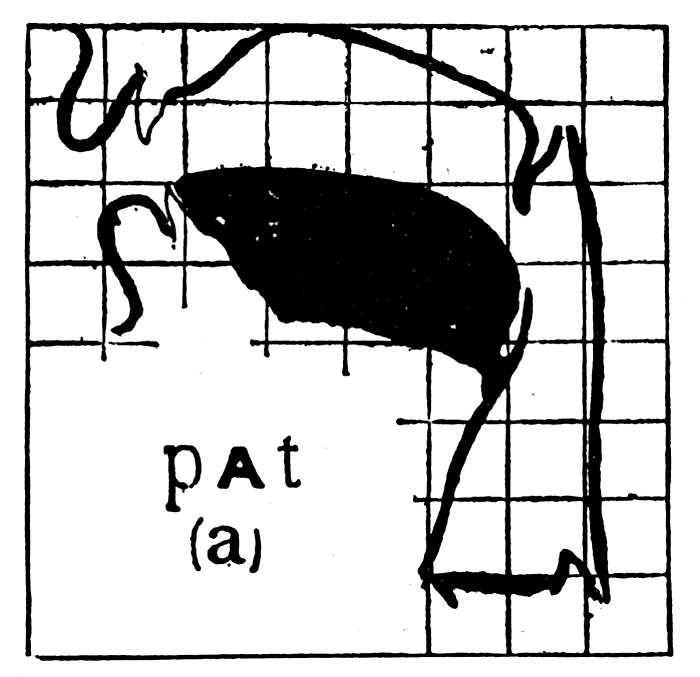
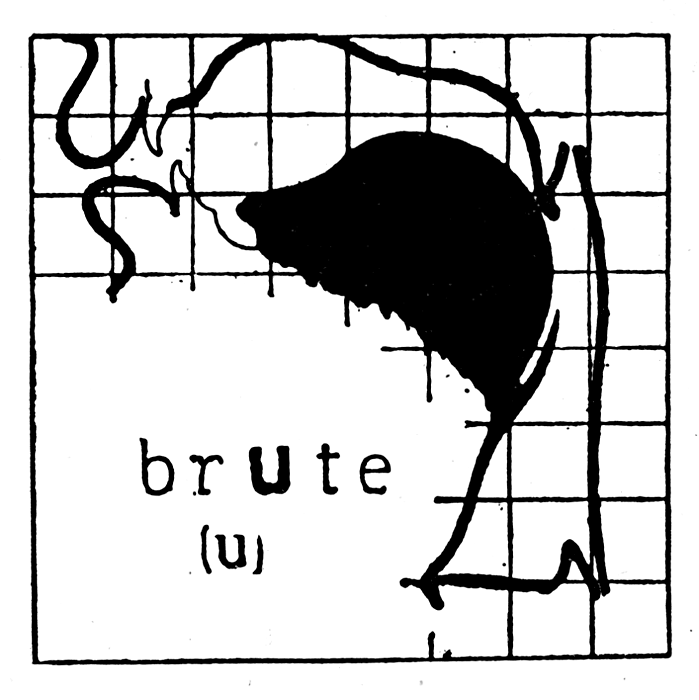
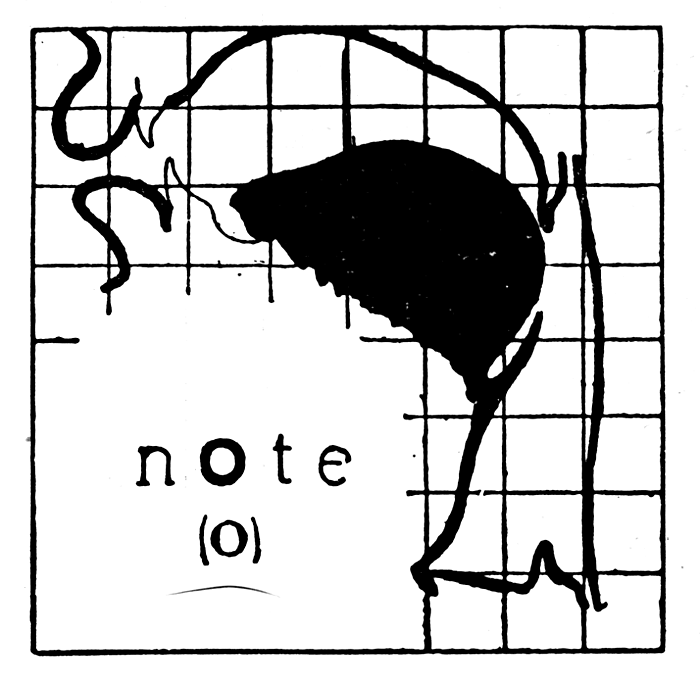
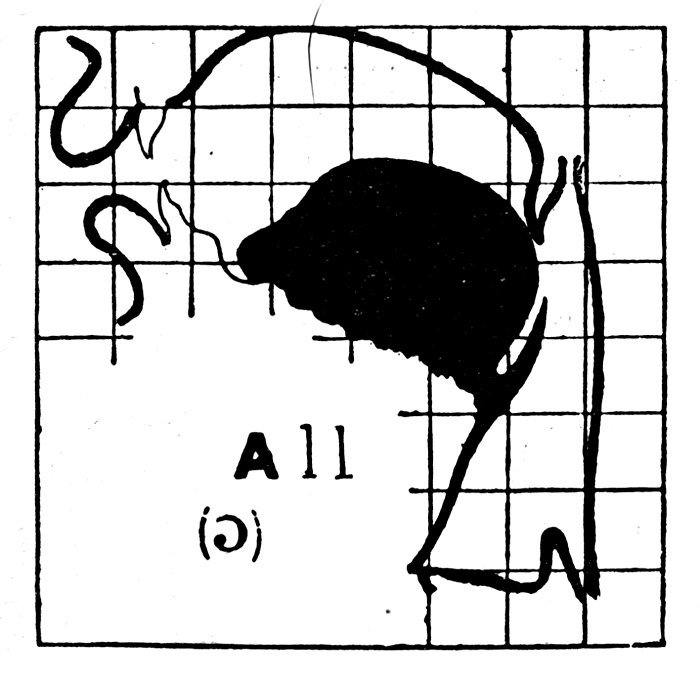
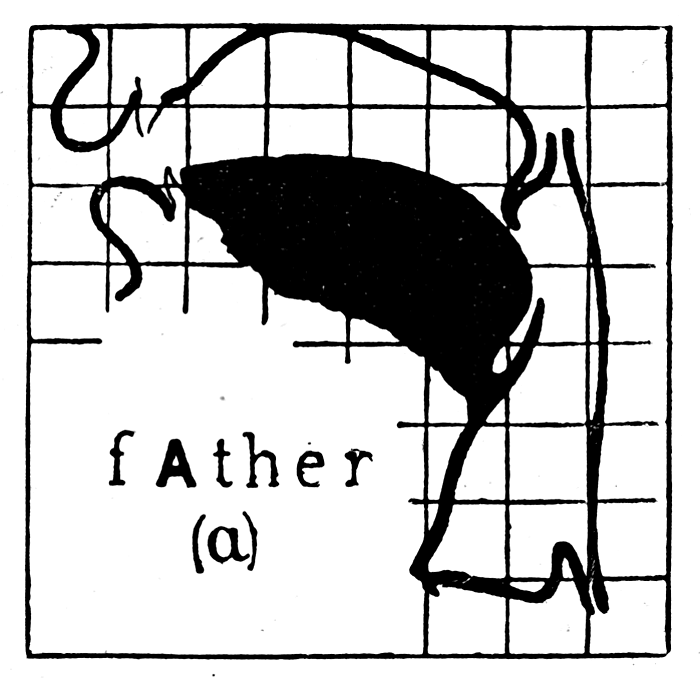
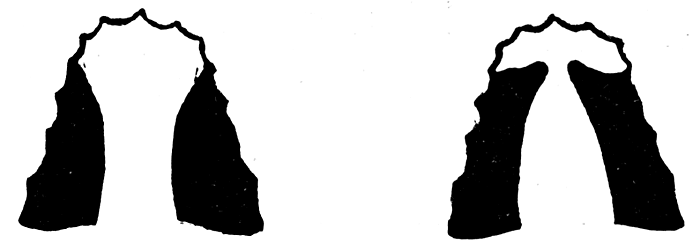
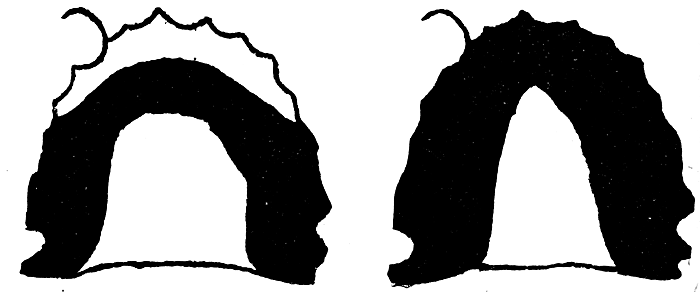
Consonants—stops.
21. The sounds which present least difficulty to the
student are the stops, in producing which the flow
of breath is completely checked. We have already
seen in § 11 that every stop, strictly speaking, consists
of three parts, the closing and the opening of the
passage and the pause between, and that only the
closing or only the opening need be heard for the
ear to distinguish the sound. The interval between
the closure and the opening may be noticeable, in
which case we call the consonant double.
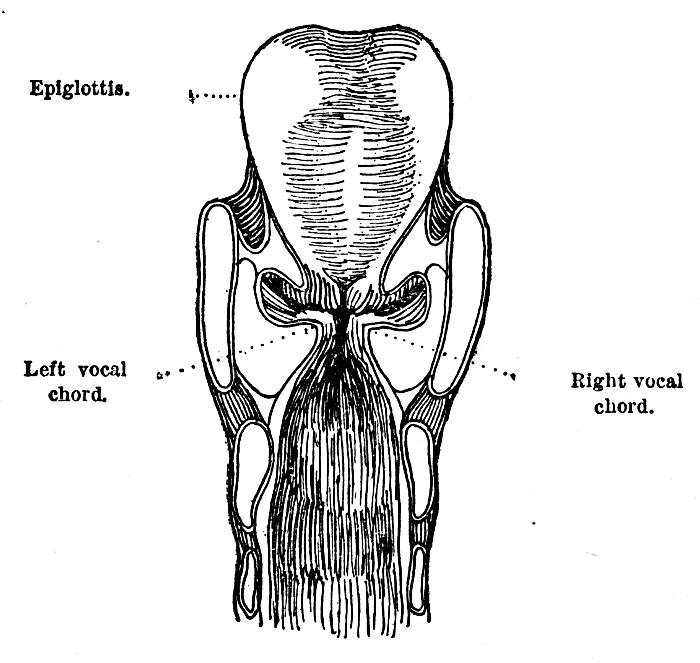
Stops may be voiced or voiceless, that is, they
may be produced with or without vibration of the
vocal chords (see § 7).
Stops may be produced by stopping the breath at
some point in the mouth and then letting it burst
through the obstacle; these are oral stops.
The breath, stopped at some point in the mouth,
may be allowed to pass out through the nose; the
sounds thus produced are called nasal.[14]
Utter the following sounds, and determine whether
they are voiced or voiceless, oral or nasal:
[p, g, n, t, b, k, m, d, ŋ.][15]
According to the place of articulation we distinguish
lip[16] stops, point[17] stops, front (palate)[18] stops
and back (palate)[19] stops.
22. Lip stops.—When the breath is stopped at the
lips, three different sounds may be produced.
1. [p], when there has been no vibration of the
vocal chords.
In precise or emphatic speech, sufficient breath
escapes after the opening of the passage to give the
effect of [h][20]; thus Pay, pay![21] [pͪei, pͪei]. This
occurs mostly before accented vowels, and sometimes
finally[22]: I hope [ai houpͪ].[23]
[p] is written p or pp; rarely ph (as in a common
pronunciation of diphtheria [dipθiːᵊriə], for which see
§ 27).
Notice the spelling of hiccough [hikʌp].
2. [b], when there has been vibration of the vocal
chords.
[b] is written b or bb.
3. [m], when the velum is lowered and part of the
breath passes out through the nose. (Generally speaking,
this sound is voiced; but when it is immediately
followed by a voiceless sound, it may be partly voiced,
then voiceless (phonetic sign: mˑ). Then lamp is
strictly [læmmˑp]. We may say: [m] is unvoiced or
devocalized before a voiceless stop.) Notice the
difference in length of [m] in lamb, hammer, glum,
moon; in which of these words is it short?
In comfort, triumph the [m] is often labiodental: the
breath is stopped by the upper teeth and lower lip,
not by both lips.
In prism, schism the m may have syllabic value;
it then does the work usually performed by a vowel.
We say [prizəm] or [prizm̩], where [m̩] is the sign
for syllabic m.
[m] is written m or mm.
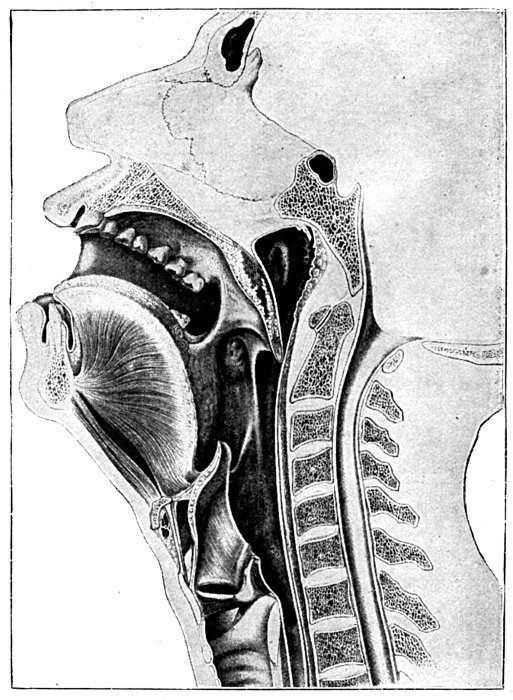
23. In the production of the lip stops the tongue plays
no part, except by leaving a free passage; but it is
active in the production of the stops we next have
to consider. This is therefore the right place to give
the names by which we designate the various parts
of the tongue. We distinguish
the point,
the blade (above and behind the point when the
tongue lies flat),
the front (yet further behind), and
the back; also
the ridge or dorsum (an imaginary line drawn
along the middle of the top of the tongue from end
to end), and
the rim (running all round the edge of the tongue
when it lies flat).
When the narrowing or closure of the passage is
made by the front rim of the tongue, we say it is of
apical formation; when it is made by the surface of
the tongue behind the front rim, we say it is of dorsal
formation.
24. Point stops.[24]—The breath is stopped by the action
of the point of the tongue touching the teeth (in
which case we have true dentals) or the upper gums
(this is known as alveolar articulation, "alveoli"
being the learned word for the gums). In English
the point of the tongue rarely touches the teeth;
usually it touches the upper gums, sometimes the
hard palate (this should be avoided), in which case
it approaches [k]. See the diagram on p. 126.
Hence in careless speech at last sometimes becomes
[ə´klɑːst].[25] Little children are heard to say [ikl] for
little; compare also the change from Latin tremere to
French craindre.
Three different sounds may be produced with this
stoppage:
1. [t], when there has been no vibration of the
vocal chords.
In precise or emphatic speech, sufficient breath
escapes after the opening of the passage to give the
effect of [h]; thus take it! [tʰeik it]. This occurs
mostly before accented vowels, and sometimes finally;
he sent me such a charming note [hi sent mi sʌtʃ ə
tʃɑːmiŋ noutʰ].[26]
In certain kinds of uneducated southern English
speech [t] is occasionally dropped between vowels,
in such words as water, butter.
[t] is written t or tt; d in the ed of verbs after
voiceless sounds, as in stopped [stɔpt]; rarely th, in
words of foreign origin.
2. [d], when there has been vibration of the vocal
chords.
[d] is written d or dd.
3. [n], when the velum is lowered and the breath
passes out through the nose. (Generally speaking,
this sound is voiced; but when it is immediately
preceded or followed by a voiceless sound, it may
become voiceless (n̥) in part. Then sneer is strictly
[sn̥niə], hint [hinn̥t].) Notice the difference in length
of [n] in mine, own, manner, an, name; in which of
these words is it long?
In month, anthem the [n] is a true dental: the
tongue touches the teeth.
In listen, open we may have syllabic n [n̩]. Compare
what was said about syllabic m in § 22.
[n] is written n or nn.
25. Front and back stops.—The breath is stopped by
some part of the ridge of the tongue meeting
the front or hard palate, giving front stops; or
the back or soft palate, giving back stops.
Say [ku] and then [ki]; now whisper them. In
which case is the closure more forward in the
mouth? Compare with these the place of closure
when you say [kɑ].
From these examples it will be seen that the
effect for the ear is very much the same, and we
shall here make use of the same signs for front and
back stops.
In cockney speech there is a distinct tendency to
make the closure so far forward that the [k, g] are
perceptibly modified. (This pronunciation is suggested
by the spelling gyarden, kyind, employed by
those who try to represent cockney speech.) The
"palatalizing" tendency is not to be encouraged; a
more effective [k] is produced by distinctly backward
articulation. Slight variations in the place of
closure due to the place of articulation of neighbouring
sounds in a word are inevitable.
Three different sounds may be produced with this
stoppage.
1. [k], when there has been no vibration of the
vocal chords.
In precise or emphatic speech, sufficient breath
escapes after the opening of the passage to give the
effect of [h]; thus come, come! [kʰʌm, kʰʌm]. This
occurs mostly before accented vowels, sometimes
finally, give him a good shake! [giv im ə gud ʃeikʰ].[27]
[k] is written c, k, ck, cc (as in accuse [ə´kjuwz]),
ch (as in chord [kɔːd]), q (as in queen [kwijn]); [ks]
as ks, cc, x, xc.
2. [g], when there has been vibration of the vocal
chords.
Sometimes [g] is pronounced with the tip of the
tongue so that it sounds like [d]; thus glory becomes
dlory [dlɔːri]. The way in which [l] is produced
(see § 33) explains this.
[g] is written g and gg; rarely gh (as in ghost
[goust]). For [ks] and [gz] written x see § 30.
3. [ŋ], when the velum is lowered and the breath
passes out through the nose. (Generally speaking,
this sound is voiced; but when it is immediately
followed by a voiceless sound, it may be at first
voiced, then voiceless [̇ŋ̇]; the [ŋ] may be unvoiced
(see § 23, 3) before a voiceless stop. Then length is
strictly [leŋŋ̇θ] or [leŋŋ̇kθ].) Notice the difference
in length of [ŋ] in sing, singer, drink, bang; in which
of these words is it short?
[ŋ] is written ng, as in long [lɔŋ], and n before g,
k, or x, as in longer [lɔŋgə], lank [læŋk], lynx [liŋks].
What does ng represent in singer? in finger? in
English?
The "dropping of g" is really an incorrect term.
There is no [g] in the ending-ing [iŋ];[28] what does
take place is the substitution of [n] for [ŋ]. This
occurs in baby speech, in vulgar speech, and in the
speech of some sections of society. It is on no
account to be tolerated.
The opposite mistake is made only by the uneducated,
who pronounce kitchen as [kitʃiŋ], chicken
as [tʃikiŋ], and sudden as [sʌdiŋ].
Notice the substitution of this sound by the uneducated
for the unfamiliar palatal nasal [ɲ] in
Boulogne [bulɔɲ], the uneducated [bulɔŋ],[29] and for
the equally unfamiliar nasal vowel [ɑ̃] in the French
word continent [kɔ̃tinɑ̃], the uneducated [kɔntinɔŋ].
For [n] becoming [m] or [ŋ] by assimilation, see
§ 49.
26. Consonants—continuants.
It will be seen that the articulations of these
sounds are more difficult to analyse than those of
the stops. There is, roughly speaking, only one
way of closing a passage entirely; but there are
various ways of closing it partially.
The continuants usually go in pairs, one being
voiceless, the other voiced.
Lip continuants.—The breath passes between the
two lips (hence the term bilabials); the tongue is in
a position somewhat closer than the [u] position, i.e.
bunched up at the back (see § 43), and we may therefore
call these sounds lip-velar continuants.
The voiced sound [w] is that commonly used in
standard English, whether the spelling be w or wh.
In northern English and in Scotch the voiceless [ʍ]
is used where the ordinary spelling has wh.
It is very doubtful whether [ʍ] has a right to be
regarded as a normal sound in standard English.
It is taught by professors of elocution, and is
therefore commonly heard at recitals and also at
amateur theatricals. On the regular stage it is by
no means the rule, and in the pulpit it is probably
the exception. If it comes naturally to pupils, who
bring it with them from the North, they need not
be interfered with; there is certainly no good reason
why it should be forced on speakers of southern
English, who generally produce a grossly exaggerated
and quite ludicrous travesty of the northern
sound. Which do you use yourself? If [ʍ], is it
natural to you, or acquired? Do the rest of your
family use it? Any of your friends? What proportion
of children in your class?
It may be noted that after voiceless sounds [ʍ]
sometimes takes the place of [w], even in standard
English; twenty is pronounced [twenti] or [tʍenti]
and swim [swim] or [sʍim]. Sometimes also the
sound [ʍ] is heard in where pronounced with great
emphasis, in the case of speakers who do not ordinarily
use it.
It should be noted that these sounds are not continuants
in the strict sense of the term, for the lips
are gradually brought nearer and gradually drawn
apart. The sounds do not continue in the same
position at all; hence they have been described as
"gliding," not "held."
The word conquer is sometimes pedantically pronounced
[kɔŋkwə] instead of [kɔŋkə]; but it is the
rule to sound the [w] in conquest. Compare liquor
[likə], exchequer [eks´tʃekə].
A w has often influenced a following a. Consider
the following cases:
was, warm, squabble, quality, quack, quarrel, quaff,
wasp, water, waft, walk, swallow.
27. Lip teeth continuants.—The breath passes between
the lower lip and the upper teeth (also
between the interstices of the upper teeth); the
sounds produced in this way are also called labiodentals.
The voiceless sound [f] is usually written f or ff,
also ph (in words taken from Greek); note also the
gh in laugh, etc.
Notice our reluctance to pronounce phth [fθ], as
shown in the dropping of ph in phthisis, and the
frequent substitution of p for ph in diphtheria,
diphthong, naphtha, ophthalmia, which is, however,
avoided by careful speakers.
The voiced sound [v] is usually written v.
Sounds very like [f, v] can be produced with
both lips. Though they do not ordinarily occur
in English, it will be good practice for you to
produce them.
When [v] is final, it is not voiced to the end, but
passes into whispered [v] (symbol v̥), which sounds
very much like voiceless [f]; in other words, the
vocal chords cease to vibrate before the breath
ceases to pass between the lower lip and the upper
teeth. We may say: final [v] is devocalised.
Observe thief, but thieves and to thieve; loaf, but
loaves; shelf, but shelves and to shelve.
The ph in nephew is pronounced [v], but [f] is
heard in dialects.
28. Point continuants.—We have seen above (§ 24)
that in English the tongue, as a matter of fact,
rarely touches the teeth in the case of point
stops. Similarly the narrowing of the passage which
leads to the production of point continuants (except
[θ,ð]) is not necessarily between the tongue and the
teeth; in some cases it is indeed a good deal farther
back.
The point continuants include:
1. The hushing, hissing,[30] and lisping sounds, and
the r sounds, in which the place of articulation is
along the middle line of the mouth (medial formation);
and
2. The l sounds, the narrowing for which is between
the side rim or rims of the tongue and the
side teeth (lateral formation).
The r sounds and the l sounds are sometimes called
liquids.
29. The hushing sounds.—For the production of the
sh sounds the passage is narrowed between the blade
(see § 23) of the tongue and the hard palate. A broad
current of air is broken against the edge of the teeth.
There is some friction between the tongue and the
gums, but that against the front teeth is more
noticeable.
Watch a Frenchman uttering these sounds, and
see what he does with his lips. Do you use your
lips in the same way?
The voiceless [ʃ] is usually written sh; also s after
consonants (as in tension [tenʃən], censure [senʃə]).
It is written ss, c or t before a front vowel (e or i),
(as in passion [pæʃən], capricious [kə´priʃəs], station
[steiʃən]). In all these cases [ʃ] arose from [sj].
Observe the colloquial pronunciation of this year
as [ðiʃ jəː]; six years [sikʃ jəːz].
The combination [tʃ] is very common, and is usually
written ch or tch. In some cases it arises from [tj],
when t follows the chief accent of the word and
precedes either a front vowel (e or i) or u[31] which
goes back to [juː] (as in righteous [raitʃəs], nature
[neitʃə]). The combination [kʃ] similarly goes
back to [ksj] in anxious [æŋkʃəs] (notice anxiety
[æŋ(g)´zaiəti]). Luxury is [lʌkʃəri], but luxurious is
[ləg´zuːriəs] or [ləg´zjuːriəs], sometimes [ləg´ʒuːriəs].
The pronunciation of associate as [ə´sousieit],[32]
officiate as [o´fisieit], instead of [ə´souʃieit, o´fiʃieit], is
pedantic; [pro´pisieit] is also faulty for [pro´piʃieit].
The voiced [ʒ] standing alone between vowels is
not common in English, being found only where s
is followed by a front vowel, or by u which goes
back to [juː]. Here the development is from [sj]
to [zj] and then to [ʒ]. Examples are vision [viʒən],
measure [meʒə]. The spelling z is found only in
azure [æʒə] or [eiʒjə], sometimes [æʒjuə].
Observe the careless pronunciation of as usual as
[æʒ juwʒuəl], praise ye the Lord as [preiʒ jij ðə lɔːd].
India rubber is generally pronounced [indʒə rʌbə].
On the other hand, the combination [dʒ] is quite
common. This is written j (as in jet [dʒet]), g before
e or i. (as in gem [dʒem], gin [dʒin], age [eidʒ];
observe also gaol [dʒeil]), and sometimes dg (as in
edge [edʒ]). It is spelled ch in ostrich, sandwich,
Greenwich, Harwich, Woolwich, and in spinach.
What is the value of ng in the following words:—hang,
longing, lounging, language, engage, hunger, hinge,
ungraceful?
30. The hissing sounds.—Distinguish clearly the voiceless
[s] as in seal and the voiced [z] as in zeal. Compare
the manner of production of the hissing and the
hushing sounds: utter [ʃ] and [s]. (Why will these
show the distinction more clearly than [ʒ] and [z]?)
You will find that the breath is more widely diffused
when you utter [ʃ]; in producing [s] your tongue
forms a narrow channel and the breath is thus
directed against a point. See the diagram on p. 126.
The usual spelling of both voiceless [s] and voiced
[z] is s. Notice that
1. The s of inflections is [z] after a voiced sound:
compare fills [filz], glances [glɑːnsiz], dogs [dɔgz], faces
[feisiz], but hits [hits], cats [kæts].
2. The final s of some words of one syllable is [z]:
as, has, is, his, was; but this, us.
3. Sometimes the verb has [z], the substantive or
adjective [s]:
| use [juwz] |
use [juws] |
| diffuse [di´fjuwz] |
diffuse [di´fjuws] |
| close [klouz] |
close [klous] |
| lose [luwz] |
loose [luws] |
(Notice the difference in the length of the vowel.)
4. Notice also that we have
|
[z] |
|
[s] |
| in |
reserve |
in |
research |
|
disease |
|
disobey |
|
dissolve |
|
dissolvent, dissolute |
|
presumption |
|
presuppose |
Find other examples (there are many). How do
you pronounce disarm?
5. x represents [ks]
in exercise, excellent, and in extra, exceed, express, extol,
but [gz] in exert, examine, anxiety, exult, exonerate, exorbitant,
exotic.
Do you agree with this statement?
Try to find a rule for the pronunciation of x.
In exile both pronunciations of x may be heard,
[ks] being perhaps the more common.
For the dropping of h in compounds with ex- see
§ 47.
The voiceless [s] is usually written s, but also ss,
and c or sc before e and i (as in city, scene, but not in
sceptic [skeptik]).
Say which of the sounds [ʃ, ʒ, tʃ, dʒ, s, z] occur in
the following words:
church, machine, ledger, leisure, seizure, cease, ease,
scissors, chisel, lesion, legion, singe, excessive, example.
Notice that final [z] is unvoiced towards the end;
thus is is strictly [izz̥]; compare what was said about
final [v] in § 27.
The term lisping is given to various mispronunciations
of the s sounds. It may be due to a lasting
or a passing malformation of the teeth, palate, or
tongue,[33] or it may be simply a bad habit. A slight
habitual lisp is often heard, and parents and friends
have been known foolishly to encourage a child in
the belief that the lisp is "pretty"; it is important to
drive this idea out of the child's head. The treatment
of lispers is varied; generally they can produce
the right sound after some experimenting.
When the right sound has been found and distinguished
by the child, the rest is entirely a matter of
perseverance. There must be frequent repetition in
many combinations. The exercises should be practised
sparingly at first, and gradually increased, otherwise
the strain may be too great and interfere with the
child's regular work.
31. The lisping sounds.—Distinguish clearly the
voiceless [θ] as in thistle, and the voiced [ð] as in this.
Compare the manner of production of the lisping and
the hissing sounds: utter [θ] and [s]. You will find
that in the case of [θ] the breath is not passing
through a narrow channel, and issues between the tips
of the upper teeth and of the tongue. The tongue may
be between the teeth, and the sounds are accordingly
sometimes called interdental; but this is by no means
essential. Our English lisping sounds are usually
formed between the point of the tongue and the
back of the front upper teeth; part of the tongue
fills up the small gap between the teeth, without
advancing beyond their back surface.
Which of the following words have [θ] and which
have [ð]?
thorn, thou, bath*, baths*, bathe*, then, think, clothe*,
cloth*, with, father, thump, lethal, leather, lath, lathe,
lithe, loath*, loathe*, breath*, breathe*, heathen, heath,
heaths, wreathe*, wreath*, wreaths*, seethe, truth*,
truths*.
What do you notice with regard to the words
marked with an asterisk? Of what does it remind
you in connection with the hissing sounds?
Notice that final [ð] is unvoiced or whispered towards
the end; compare what has been said about
final [v] and final [z].
A fault, common especially in bad southern
English, and found almost invariably in baby speech,
is the substitution of [v, f] for [ð, θ]. The baby says
[fʌm] for [θʌm], the cockney [nafiŋk] for [nʌθiŋ],
[fevə] for [feðə]. This fault should on no account be
tolerated; the child (we are of course not referring
to the baby) can produce the lisping sounds without
difficulty. It need only be told to place the tongue
between the teeth. When once the difference in the
manner of production of [f] and [θ] is known, the
child can also hear the difference; all that is now
required is perseverance.
In careless speech [h] is sometimes substituted for
[θ], thus I think so becomes [ai hiŋk sou]. This also
has its parallel in baby speech, e.g. [hugə] for sugar.
32. The liquids.—This designation comprises the r
sounds and the l sounds.
The sounds written r are extremely varied, and
are likely to give some trouble to the student. He
should in the first place ascertain from his friends
(we are assuming that these speak standard English)
whether they notice anything peculiar about his r.
If they do not, it is probable that he uses the
untrilled r. (The phonetic sign for this is [ɹ], but it
is customary to use [r], unless exceptional accuracy
be desired.)
This sound is produced by allowing the breath to
pass between the raised point of the tongue and the
ridge of the upper gums.[34] When the breath makes
the tip of the tongue vibrate, we have the trilled or
rolled [r]. Can you roll your r? Does anyone you
know habitually do so? Have you noticed whether
Frenchmen or Germans ever do it?
Another kind of r is that produced at the back of
the mouth, by the help of the uvula (see § 8), and
called the throat r or uvular r (phonetic sign: [R]),
as distinguished from the tongue or teeth r (lingual
or dental r). It is not a normal sound in standard
English, but is occasionally found. It used to be
frequent in Durham and Northumberland (the
"Northumbrian burr"), but is dying out there now.
Notice that after [t] and [d] the narrowing for [r]
is particularly small, and therefore the friction of the
breath particularly noticeable. Say such words as
dry, drink, droll, try, trill, trap, and carefully observe
the nature of the [r]. Notice also that after voiceless
sounds the [r] often becomes voiceless [r̥], as in
praise, try, increase. Sometimes tried almost sounds
like chide, because the passage of the breath is not
stopped and the vocal chords have not begun to
vibrate. Try to utter a voiceless [r̥] by itself;
practise the series [r r̥ r r̥ r].
There is also a peculiar variety of r found after g,
as in great, green, grass. This r is a kind of palatal
blade continuant, and its use should be avoided, as
it is generally held to be affected.
In standard English the written r is only pronounced
initially (as in red), between a consonant and
a vowel (as in bread, angry), and between vowels, the
second of which is not only written, but actually
pronounced (as in very).[35]
It is not pronounced between a vowel and a consonant
(as in arm, lord), nor when it is final in the
spelling or followed by a vowel which is only written
and not actually pronounced (as in bar, bare). Its
place is in many cases taken by the neutral vowel
[ə] (see § 38).
Observe that a final r is pronounced when the
next word begins with a vowel. (Is there anything
like this in French?) Thus we say better [betə], but
[betər ən betə]; ever [evə], but [fər evər ənd evə];
here [hiə], but [hiᵊr ən ðɛːə]; stir up [stəːr ʌp], but
[stəː ðə faiə]. There is, however, nowadays a tendency
to leave even this r unpronounced.
The fact that such words as better have two forms,
with and without [r], has led to the addition of [r]
when there is no justification for it. Even educated
people are often heard to pronounce the idea of it as
[ði aidiər əv it]; The India Office sometimes becomes
[ði indjər ɔfis]; china ornaments becomes [tʃainər
ɔːnəmənts]; and clergymen have been known to say
[vik´tɔːjər auə kwijn]. Similarly, in vulgar speech
[ðə windər iz oupən], [pə´pɑːr əz gɔn aut], etc., are
quite common.
There is an affected pronunciation of this [ə]
which makes it approximate to a deep [ɑ]; the
comic papers represent my dear fellow as "my deah
fellah" to indicate the speech of a swell.
The substitution of [w] for [r] is a mannerism
which should not be tolerated; it is the result of a
bad habit, not of any defect of the organs of speech.
When a word contains the letter r twice, careless
speakers incline to drop one of them; February
becomes [febjuəri], temporarily [tempərili], library
[laibri], literary [litəri], supernumerary [sjuwpənjuwməri],
contemporary [kəntempəri]. Veterinary usually
becomes [vetənri] or [vetnəri].
33. In order to produce the sound of [l], we let
the breath pass out between the side rims of the
tongue and the side gums and teeth; the point of
the tongue touches the roof of the mouth somewhere
along the middle line.
Utter [l] with the point of the tongue drawn
back as far as possible; then utter [l] several times,
gradually bringing the point of the tongue forward,
until it eventually touches the teeth. You will
notice a difference in the quality of the sound: the
sound is "dark"[36] when the tongue is farther back,
"clear" when it is forward in the mouth. Notice
that when the tongue is drawn back, it is bunched
up behind. In standard English the [l] is frequently
pronounced with the tongue fairly back in the
mouth; the "darkness" of the [l] is particularly
noticeable when it comes at the end of a word.[37]
Excessive withdrawal of the tongue tip is not to
be encouraged in children; they should rather
practise the "clear" [l], though they need not go so
far as actually to "let the tongue touch the teeth."
This is, however, a good rule, and if instilled in
the children will do something to counteract any
tendency to "darkness" of the [l]. It is not likely
that they will acquire the habit of actually touching
the teeth when they say [l]; but a sufficiently "clear"
[l] can be obtained if the point of contact is at the
upper gums, and even a little farther back than
that. It should be noted that the [l] may be "dark,"
even when the point of the tongue touches the teeth,
if the back of the tongue is raised.
In cockney speech the [l] is sometimes lost, through
no contact taking place; tail is pronounced [tæjɔ] or
something similar, with a very open [ɔ] (see § 43) in
place of [l], and after consonants also the final l, as
in giggle, is very liable to disappear. This recalls the
treatment of final r in standard English. In careless
speech the [l] also disappears in only and in all right.
Colonel is pronounced [kəːnəl]; the older spelling
coronel explains this.
Notice that when [l] comes next to a voiceless
sound, it may become partly or wholly voiceless [l̥].
Thus clear becomes [kl̥iːə], halt [hɔl̥t]. The friction
becomes noticeable then; try to utter [l̥] and
observe this. The voiceless sound is the familiar
Welsh ll.
In bubble, riddle, etc., we may have syllabic l [l̩].
Compare what was said about syllabic m in § 22,
and about syllabic n in § 24.
The l is not pronounced in calf, half, salve,[38] balk,
caulk, chalk, falcon,[39] folk, stalk, talk, walk, yolk, almond,
alms, balm, calm, palm, psalm, qualm, salmon, solder,
should, would, could (where it is not etymologically
justified); golf is usually [gɔlf], but also [gɔf][3], and
rarely [gɔːf].[40]
It was said above that for [l] we let the breath
pass out at both sides of the mouth; but, as a
matter of fact, most people let it out only on one
side. On which side does it pass out in your own
case? Is the same true of your whole family?
Ascertain which is the usual side in the case of
friends.
34. Front continuants.—Watch with your mirror
what the tongue does when you utter the word he.
You see that it rises in front. Raise it a little more,
until the passage becomes quite narrow; the vowel
will pass into the sound which we have at the
beginning of yes [jes], and which we also have in
sue [sjuːw], for which see § 45. As a rule the
friction is very slight, and indeed hardly perceptible
to the ear; but in the slowly uttered, deliberate yes
the friction can often be heard very distinctly. The
sound is also noteworthy as being, like [w] and [ɹ],
"gliding," not "held" (see §§ 26, 32). In careless
speech it sometimes passes into [ʒ] after [d]; during
is pronounced [dʒuwriŋ] instead of [djuwriŋ], the
dew becomes [dʒuw], it made you start [it mei dʒu
stɑːt]. Soldier is regularly pronounced [souldʒə],
not [souldjə]; and verdure, grandeur, have both pronunciations,
[djə] being preferred by careful speakers.
After voiceless sounds, as in Tuesday, tube, [j]
occasionally passes into the corresponding voiceless
[ç], which is the consonant sound in the German
ich; and sometimes it even becomes [ʃ], compare the
careless pronunciation of don't you know [dountʃənou],
last year [lɑːs tʃiə], he'll meet you [hijl mijtʃu]; I shall
hit you is in vulgar speech [ɑi ʃəl itʃə]. For this
development in unstressed syllables, see § 45.
Back continuants.—When we utter the vowel
sound of who the back of the tongue is raised; if we
raise it a little higher, there is friction, and we
obtain the back continuants. These do not normally
belong to standard English. The voiceless [x] is,
however, not uncommon in the pronunciation of
words taken from Scotch, Welsh, or German; even
in such words [k] is generally substituted. The
Scotch loch is pronounced [lɔx] or [lɔk]; the German
Hoch(heimer) is always spelt and pronounced hock
[hɔk]. In Scotch [x] occurs normally.
Throat r (uvular r).—This sound, which does not
normally belong to standard English, has been
referred to in § 32.
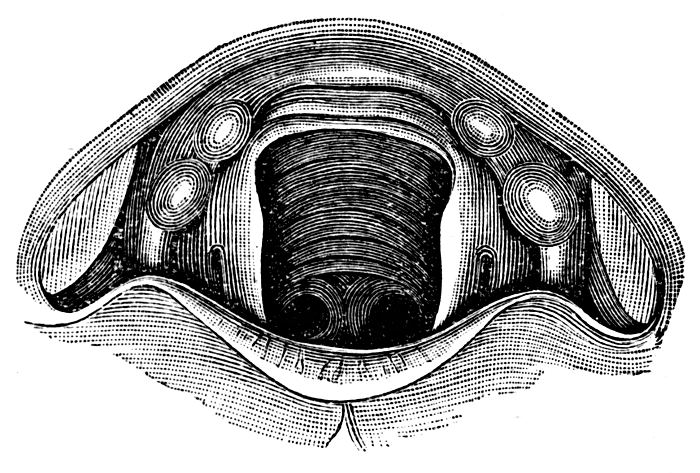
35. The h sounds.—We considered the glottis (the
interval between the vocal chords) in § 6. We saw
that when it is quite open, the breath passes through
without producing any audible sound. When, however,
the glottis is somewhat narrowed, the breath
brushes past the vocal chords, and an h is produced;
this we may call a voiceless glottal continuant.[41]
Now there may be various kinds of glottal [h].
The passage between the vocal chords may be more or
less narrow, and it may remain uniform or gradually
grow narrower or wider. The current of breath may
be strong or weak; it may be of uniform force, or
gradually grow stronger or weaker. When there is
a strong current of breath, and the opening is very
narrow, we call it "wheezing."
In standard English the h is a glottal continuant
only when there is precise and emphatic utterance.
Ordinarily it is produced in the mouth passage.
When we say ha, the vocal chords are not drawn
together until the vowel is sounded; the mouth,
however, gets into position for uttering the vowel a
little before the time, and the breath as it passes
through produces an h sound. In [hɑ] then, we
practically have a voiceless [ɑ] followed by the
ordinary voiced [ɑ]; in he, a voiceless [i] followed by
the ordinary [i] vowel; in who, a voiceless [u] followed
by the ordinary [u]. Whisper these words,
and also hay and hoe; and after each, whisper the
[h] only. Notice that the ear detects an actual
difference in these h sounds.
A good deal depends on the current of breath
with which the [h] is uttered. In standard English
the current does not keep on growing in volume
until the vowel is sounded; it distinctly diminishes
before the vowel appears. This may be graphically
represented by the signs [<h>].
If the current of breath does not diminish in this
way, but starts weakly and does not reach its
maximum force until the vowel is reached, the ear
does not receive the impression of a distinct [h].
This sound may be written [h<] or simply [<].
This (the "soft breath") precedes initial vowels
in standard English; it is the sound which in
cockney speech commonly represents the more
distinct [<h>]; those who use it are said to "drop
their h's." Conscious of the defect, they often prefix
a full, even an exaggerated [h] to words which have
no h. It need hardly be said that carelessness in
the use of h is not to be tolerated. It is interesting
to note that no h is ever dropped in the speech of
Americans, except in the weak forms of he, him, her.
[h] occurs in standard English only before stressed
vowels. Initial h before unstressed vowels is only
pronounced when preceded by a pause.
Notice that:
1. Written h is not pronounced in heir, honest,
honour, hour, and words derived from these.
It is now pronounced in standard English in herb,
hospital, humble, humour (a fair number of educated
speakers still pronounce this word without [h]).
2. It is regarded as correct to say a history, but an
historical novel; a habit, but an habitual action; many,
however, pronounce the h in both cases.
3. Certain words drop the h when they occur in
an unstressed position in the sentence; this is a
regular feature of standard colloquial speech, and
does not convey the slightest suggestion of vulgarity.
It must be recognised that such words have two
forms, weak and strong, according as they are used
without or with emphasis. Compare the following
sentences:
| Tom |
has |
been |
there. |
Has |
he |
though? |
| tɔm |
əz |
bijn (bin) |
ðeːə. |
hæz |
i |
ðou? |
| I |
gave |
her |
a |
book. |
What, |
to |
her? |
| ai |
geiv |
ər |
ə |
buk. |
wɔt, |
tu |
həː? |
Find as many words having strong and weak
forms as you can by observing the ordinary speech
of those around you. Then compare the list given
in § 47.
For the dropping of h in the second part of compound
words, see § 47.
36.
VOWELS
We have considered the sounds produced when the
passage through which the breath passes is closed
(stops) or narrowed (continuants); we now have
to consider the sounds produced when the passage is
wide enough for the breath to pass through without
audibly brushing against the sides. These sounds
are the vowels.
"Voice," produced by the vibration of the vocal
chords, may be said to give body to the vowel; the
shape of the passage through which the breath passes
determines the features that distinguish one vowel
from another, i.e. its quality. The shape of this
passage is capable of almost infinite variation, which
leads to a corresponding variety of resonances, and
these determine the quality of the vowels.
Picture to yourself the inside of the mouth, and
consider how the cavity may become larger or smaller,
according as you separate or draw together the jaws;
see what a difference it makes if you raise the tongue
at the back, or in the middle, or in the front; bear
in mind that the position of the lips may also modify
the sound, as you will notice if, for instance, you
utter [u] as in who, first with the lips forming a long
narrow slit, and again with the lips forming a very
small circle (of the same size as the end of a lead
pencil).
37. Of the well-defined vowels that which is articulated
with least effort is [ɑ].[42] It is the earliest vowel
sound uttered by the baby, before it has acquired
control over the muscles of the tongue. It is also
common as an interjection. Utter it, and watch the
tongue with your mirror; you will see that the
middle of the tongue ridge is slightly raised. The
opening of the mouth is generally larger than in the
case of the other vowels. See the diagram on p. 125.
Utter the standard English sound of a in hat,
for which the sign is [æ]. Say several times [ɑ æ]
and watch the tongue as you do so; you will see
that it moves forward and is a little higher in front
and lower at back for [æ]. The opening of the
mouth is often quite as large for [æ] as for [ɑ].
Now try to produce the sound which lies between
the two, with the tongue occupying an intermediate
position; you will obtain the sound [a], which is the
northern English vowel in hat, and the vowel in the
French word chat; in standard English it occurs only
as the first part of the diphthongs in bite [bait] and
bout [baut].[43] This [a] is sometimes called the "clear"
a sound. See the diagram on p. 123.
Next, draw the tongue a little back, and you will
obtain a variety of [ɑ] which is "dark" and has a
suggestion of the vowel in all [ɔːl]. This sound is
commonly substituted for the "pure" or "neutral"
[ɑ] in cockney speech, so that fast is made to sound
like [fɔːst], park like [pɔːk].
This "darkening" of the a sound should not be
permitted; in order to counteract it, it may be
advisable to make the class utter [ɑ] singly and in
chorus, until they are quite clear as to the nature of
the required sound.
It is sometimes found that precise speakers, through
an excessive desire to avoid any suspicion of cockney
leanings in their speech, substitute [a] for [ɑ], saying,
for instance, [faːðə] in place of [fɑːðə]; it is particularly
ladies of real or would-be refinement who
commit this mistake. A mistake it is, like every
other deviation from what is generally recognised
by the educated.
In other cases the "clear" pronunciation of a is
often heard, e.g., in glass, bath, past, answer, demand,
grant, everlasting. Both [a] and [æ] occur, particularly
in the speech of ladies. What is the American
pronunciation of half?
In standard English there is practically no short
[ɑ],[44] but only the long [ɑː], which should be neither
"dark" nor "clear." If we analyse it carefully, we
often find[45] that it is not a single vowel of uniform
value, only the first part being "pure" [ɑ], the rest
being a faint variant; but for practical purposes we
may regard it as uniform in quality, as in good
speech it is a pure long vowel.
38. There is a short sound closely akin to it (in
position, but not in sound), which we have in but,
much, etc., and for which the sign is [ʌ]. The back
of the tongue is raised a little in the production of
this sound, and sometimes the front also; and in consequence
there are several varieties of it. It occurs
only in syllables having some stress; we have [ʌ]
in teacup, unfit, until; but not in welcome, which
is not felt to be a compound. When it is unstressed,
it becomes the dull vowel [ə]; unstressed but is [bət].
Observe the vulgar pronunciation of just as [dʒest].
The dull vowel [ə] occurs very commonly in ordinary
speech; most unstressed syllables contain this
vowel or the variety of [i] mentioned below. It is
found, for instance, in the italicised syllables of
vowel, variety, carpenter, ordinary. The long [əː] is
variously written; we have it in fern, fir,[46] fur, word.
(In northern English there is some variety in the [ə],
according to the written vowel which it represents.)
Notice the precise and the ordinary pronunciation of
such words as paternal, polite, potato. The uneducated
often insert [ə] in such words as Henry [henəri], umbrella
[ʌmbərelə]; and sometimes they substitute [i]
for [ə], as in miracle, wrongly pronounced [mirikl̩],
philosopher, wrongly pronounced [fi´lɔsifə], and in
oracle, pigeon.
The letters e, i, and y in unstressed syllables
represent a very laxly articulated sound, for which
the sign [i] is used in this book. It varies somewhat
in different speakers; several sounds intermediate
between the open [ɪ] and the middle [e] may
be heard. This serves to explain the uncertainty of
spelling in such cases as ensure and insure, enquire
and inquire.
Sometimes the vowel disappears altogether, as in
business, medicine, venison.
The letter o in unstressed syllables preceding the
chief stress is usually [ə], but in precise speech an
o-sound is heard in such words as conceive, official,
possess. After the chief stress [ɔ] is rarely heard; but
epoch [ijpɔk] and other uncommon words keep the [ɔ].
39. The front vowels.—Utter the word he and notice
what the tongue does. You can do so by looking into
your mirror, or by putting a finger just inside your
front upper teeth, or by whispering the sound, and
feeling what happens.
You will generally find that you can analyse vowels
best if you whisper them, because the "voice" does not
interfere with your appreciation of the mouth resonances.
By this time your muscular consciousness (see § 9) should
be considerably developed, and you should be conscious of
what your tongue, lips, etc., are doing, without having
recourse to a mirror.
You will find that you are raising your tongue very
high in front: [ɑ] and [i] are extremes; in the one
case the front of the tongue is practically as low
as it can be, in the other it is raised as high as possible.
You might raise the tongue farther, but the
resulting sound would not be a vowel. The passage
would be too narrow, there would be friction, and a
continuant would be the result (see § 34).
Utter a pure [ɑ] and gradually raise the front of
the tongue until you reach [i]. You may either keep
your vocal chords vibrating all the time, or you may
whisper the sounds; but see that the tongue moves
slowly and steadily. You will realise that very many
sounds lie between [ɑ] and [i]; as they are all produced
with the raising of the front of the tongue,
they are called front vowels.
We have already noticed clear [a], and have met
with [æ], which is the vowel sound in hat [hæt].
When unstressed the [æ] gives place to [ə]; that
[ðæt] becomes [ðət].
The uneducated sometimes substitute a closer
sound (the middle e) for [æ]; they say [keb] for
cab, [ketʃ] for catch, [θeŋks] for thanks, [beŋk] for
bank. The same mistake may also be heard in the
pronunciation of carriage, radish, January. In any,
many the first vowel is always [e]. What is it in
manifold?
The sound [æ] is only found short. There is
a kindred long sound [ɛː], as in fair, for which
the tongue is rather higher. It is often called the
open [ɛ], [æ] being a still more open sound.
A difference in the formation of [æ] and [ɛː] must
be noticed; it is not confined to this pair of vowels.
In uttering a vowel sound we may adjust the articulations
so favourably that the resulting sound is clear
and decided; this may be called tense articulation,
producing tense vowels. If we do not trouble to
adjust the articulations carefully, if we have lax
articulation, we obtain lax vowels. In standard
English we do not articulate tensely, except in
precise and emphatic speech. (Notice how tensely
the French and the Germans articulate their accented
long vowels.) In teaching children the terms tight
and loose may be used.
The articulation of [ɛː] is relatively tense, that of
[æ] is lax. For [ɛ] see the diagram on p. 123.
Notice that [ɛː] is always followed by a more or
less distinct [ə]; there is [ðɛːə], Mary is [mɛː(ə)ri].
Consider the value of -ear- in bear and bearing.
There is a vulgar pronunciation of I dare say as
[ai desei], instead of [ai dɛːə sei].
40. The diphthongs in bite and bout are pronounced by
the uneducated in many ways not permissible in
standard English. The first element should be "clear"
[a]. A "pure" [ɑ] would not be offensive here,
though it is much less common;[47] but any pushing
forward of the tongue beyond the [a] limit, any
substitution of [æ] for [a], is not to be tolerated.
The nasalising of these diphthongs adds to the unpleasant
effect. Probably the best means of counteracting
these tendencies is to insist on [ɑi] and [ɑu];
if the pure [ɑ] has been practised, as was suggested
above, it will form a stepping-stone to the acquisition
of good diphthongs.
Notice how a German pronounces these diphthongs;
you will find that he dwells much longer on the first
element than we do, and that it is more open.
The ending -ile in agile, docile, fertile, futile, hostile,
puerile is pronounced [ail], and not [il] as used to
be the case.
41. The next sounds in the series, obtained by raising
the tongue a little higher than for [ɛ], are "middle"
[e] and "close" [e]. The vowel in pen, get, fell is
usually the middle [e]; some speakers (perhaps
mostly ladies) use the close [e] here, but the very
close [e], heard in French été, is not found in standard
English. For ordinary purposes the sign [e] may
serve to designate both [e] and [e], as they are so
closely connected. When unstressed, the [e] gives
place to [ə]; thus unstressed them is [ðəm]. Notice
that 'em really goes back to the old form hem.
For [e] see the diagram on p. 122.
Observe the colloquial tendency to pronounce get
as [git].
A fairly close [e] is in standard English the first
element of the diphthong in laid, tame, late, etc.
There is not one uniform vowel sound in these
words; pronounce aid quite slowly, and you will
notice that the tongue rises before the consonant is
reached. The diphthong is long when a voiced
sound follows it, short before a voiceless sound.
Thus laid [leid] is longer than late [leit]. Test this
statement by finding other words containing the
diphthong, and pronouncing them to yourself or
getting others to pronounce them. What is the
quantity of the [ei] when the diphthong is final?
In vulgar speech the first element of the diphthong
tends to [ɑ], sometimes almost to [ɔ].
Listen to a foreigner's pronunciation of English
words containing this diphthong; what do you
notice?
The vowel in says and said is short [sez, sed], as
also in ate [et]. The pronunciation of -ain as [ein]
in such words as fountain, captain, bargain, is a
pedantic affectation.
How do you pronounce villain, curtain?
42. Two front vowels remain to be considered, the
i sounds. Say bid and bead. You recognise that
one is longer than the other; are they otherwise
the same? Say bid and repeat it with the same
vowel drawn out; then say bead, and repeat it with
the vowel shortened. If you are careful in each
case to change only the length, and not the quality
of the vowel, you will perceive that the vowels in
bid and in bead are different.
The vowel in bid is laxly articulated and is known as
the open [ɪ]. In unstressed syllables (see § 38) it is
often very open indeed, and when it is final, as in very,
the tongue is raised very little higher than for close or
even middle e. The sign for this sound is [e˔] or
[ɪ˕]. (Here ˔ means more close, ˕ more open.) Can
you hear any difference between the two vowels of lily?
The great phonetician Ellis remarked that the
pronunciation of the i in six is the touchstone of
foreigners, especially of those belonging to the
Romance nations; they usually articulate it too
tensely. Ask a Frenchman to say fini, and compare
his sounds with those in finny.
Notice the frequent cockney pronunciation of -y as
[ei], e.g., in windy [windei].
Often [ə] is substituted for this sound, as in unity,
ability, pronounced [juwnəti, ə´biləti], also in April,
visible; but this is avoided by some speakers.
The [i] in the diphthongs [ai] and [ɔi], as in buy,
boy, is very low.
In bead we have not a single vowel, but a kind of
diphthong. If you utter it slowly, you will find
that the tongue does not remain in a uniform
position, but rises a little towards the end, the
sound becoming closer. It may begin close, in
which case the further rising reduces the passage so
much that we have [j]; bead in this case is [bijd].
Or the vowel may begin fairly open and rise to
the close position; then bead is [bɪid].[48] When the
diphthong is followed by a voiceless sound, it is
shortened; beat [bijt] [bɪit] is shorter than bead.
Compare also seed, seat, sit; feed, feet, fit. Careful
speakers pronounce been like bean, not like bin; most
speakers, however, use the shortened form in
ordinary speech.
For [i] see the diagram on p. 122.
In dear, fear, etc., we have a rather open vowel, of
varying length, followed by [ɔ]; we may write [diə], but
strictly it is [dɪə, dIˑə] and sometimes [dIːə]. Before
[r], as in dearest, the [ə] becomes faint or disappears.
Standard English contains no [i] as close as the French
[i] and the German [iː]. Convince yourself of this
by asking foreigners to pronounce words containing
these sounds, in their own language or in English.
Notice the frequent pronunciation of ear, year, as
[jəː], and that of dear as [djəː].
We are now able to give the whole series of vowels
from [i] to [ɑ] occurring in standard English.
close i (diagram, p. 122)
\
open ɪ
\
close e (diagram, p. 122)
\
middle e
\
open ɛ (diagram, p. 123)
\
more open æ
\
clear a (diagram, p. 123)
\
ɑ (diagram, p. 125)
It will be good practice for you to utter this series
of sounds, from [ɑ] to [i] and vice versa, and long as
well as short.
The raising of the tongue for the [i] sounds is best
seen if the upper and lower teeth are kept well apart.
43. The back vowels.—When the front vowels have
been carefully differentiated, the back vowels will
be found to present little difficulty. Owing to the
fact that the back of the tongue does not admit of
so much variety of movement as the front of the
tongue, the number of sounds in the series [ɑ] to [u]
is smaller than in the series [ɑ] to [i].
You will see that there is some resemblance between
the sounds of the two series. Thus we had a lax [æ]
and a tense [ɛː] in the front vowels; and there are
corresponding open o sounds when the tongue is
raised a little at the back.
The articulation of these sounds is often unsatisfactory
owing to the lower jaw not being moved
down sufficiently, the teeth being hardly separated.
The back vowels gain in quality (cp. § 36) if they are
produced with lip rounding. The opening is large in
the case of the sounds in which the tongue is only
slightly raised; as it rises higher, the opening of the
lips grows smaller, until for [u] it is only the size of
the end of an ordinary lead pencil. This lip rounding
is rare with southern English speakers who have not
had special voice training; they usually bring together
or separate the lips without rounding.
The short vowel sound in not, what, etc., is a laxly
articulated, open [ɔ], much more open than any o in
French or German, with the front of the tongue even
lower than for [ɑ]. It is lengthened a little before
a voiced final consonant, as in dog [dɔg]; but it
should never be made quite long. The pronunciation
[gɔːd] for God is detestable. Before ss [s], st [st],
sp [sp], th [θ], and f, ff, or ph [f], the long sound is
occasionally heard. Determine whether in the following
words you use the long or the short sound: loss,
ost, froth, cross, cough, soft, coffee, off, officer, cloth, moss,
gospel. Extend the inquiry to your friends.
When the short [ɔ] is in an unstressed syllable it
either disappears entirely (as in lesson, where the [n] is
syllabic, see § 24), or it may become [ə], as in minor
[mainə], or it may become the sound [ö], which will
be explained in § 44. Thus October is [ɔk´toubə] or
[ök´toubə]; connect is [kɔ´nekt] only in precise speech,
but usually [kö´nekt] or [kə´nekt].
The long [ɔ] in law, laud, lord is rather tensely
articulated, certainly not so laxly as the short [ɔ].[49]
Before voiceless sounds the vowel is somewhat
shortened, as in short (compare shawl and shot). It
is in standard English the only sound of stressed or
(or oar) before a consonant;[50] there is no difference
in sound between laud and lord, fought and fort, stalk
and stork, cawed and cord. It is true that some
speakers try to make a distinction. The long [ɔː] is
not a simple long vowel, but really a diphthong
of which the second element is [ə][51]; and in words
containing a written r, these precise speakers somewhat
lengthen the [ə] element. Thus they will say
[lɔːᵊd] for laud, and [lɔːəd] for lord. It may be added
that they generally do so only if the distinction has
been spoken about, and they have expressed their
firm belief in its existence; then, for a while, the
[ɔːə] may be heard. A simple test, which the student
should apply to his friends, is that of asking them
to write down the word he utters. If he says [fɔːt],
meaning fought, most people will write down fort,
because the sound gives them no guidance, and the
substantive is likely to occur to them first. Similarly,
if he says [lɔːd], meaning laud, they will write down
lord.[52]
The word lore, which hardly occurs in ordinary
speech, is often pronounced [lɔːə] in order to distinguish
it from law, the [ə] sound being much more
distinct than in law, more, bore, etc. Consider the
value of -ore- in more water, and in more ink.
There is much variation in the pronunciation of
the words daunt, flaunt, gaunt, gauntlet, haunch, haunt,
jaundice, jaunt, launch, laundry, paunch, saunter, staunch,
taunt, vaunt. The general tendency seems to be in
favour of [ɔː], not [ɑː].
When unstressed, the sound is often shortened to
[ɔ] or [ö][53]; thus autumnal becomes [ɔ´tʌmnəl] or
[ö´tʌmnəl]; or when stressed is [ɔː], unstressed [ɔ] or
[ö] or [ə].
A variety of the open [ɔ], not equally open in all
speakers of standard English, is the first element in
the diphthong found in boy [bɔi]. The pronunciation
[böi[53]] is also heard.
In vulgar speech [ɔi] sometimes becomes [ɑi]; thus
boil is pronounced [bɑil]. Only in choir (also written
quire) is this pronunciation current in good speech.
44. Utter the sound usually called "long o" and found
in bode, boat, etc,; you will observe that the sound is
not uniform, as the tongue rises a little before the
consonant is reached.[54] Indeed the action of the
tongue is quite similar to what we noticed in the
case of [ei] in § 41; and also to [iːj] or [Iːi] in § 42,
where, however, it is less obvious to the ear. The
diphthongal character of the "long o" is so essential,
that when a stranger merely says [oːnoː] for oh no!
we at once recognise that he is not English.
The first element of this diphthong is a middle [o],
sometimes a fairly close [o]; in standard English the
[o] is never so close as in French [o] or in German
[ɔː].[55] (Watch foreigners when they utter these sounds;
notice how tensely they articulate, and how much
more they round their lips than we do.) In cockney
speech the first element is pronounced with the
tongue lower and raised in front.—The second is a
u sound; place a finger against the interval between
the upper and lower teeth, and notice how they are
brought a little closer towards the end of the diphthong.
Observe also the action of the lips. The
diphthong is longer before voiced than before
voiceless continuants; verify this statement by saying,
or getting others to say, bode and boat, goad and
goat, robe and rope, brogue and broke.
In syllables that are weakly stressed, the first
part of the diphthong becomes [o], [ö][56] or even [ə],
the second part disappearing altogether. Thus fellow
is in precise speech [feloːu], but in ordinary speech
[felo, felö], and in careless (but not necessarily
vulgar) speech [felə].[57] In "ladies' speech" the [öü]
occurs even in stressed syllables, and may then be
confidently described as a sign of affectation.
The prefix pro-, when stressed, is generally pronounced
[prou]. In process and progress [prɔ] is
sometimes heard; in the substantives project and
produce it is the rule.
45. The u sounds are clearly parallel to the i sounds.
In both cases we have a laxly articulated short sound,
and a diphthong in which the tongue rises towards
the end.
The short sound in would, book, etc., is open, and
the sign for it is [ᴜ]. Do you notice any difference
in the length of the vowel sound in the words should
and put, pull and cook? Observe others, if you are
uncertain in your own case. (You will sometimes
find it hard to determine what is your natural, instinctive
way of pronouncing a word, when once
you have grown accustomed to watching your own
speech.)
When this [ᴜ] is unstressed it becomes [ü][58] or [ə],
or is dropped altogether. Thus helpful becomes
[helpfül, helpfəl], and should becomes [ʃüd, ʃəd,
ʃd, ʃt].
The vowel sound in who is not uniform. (See
what was said about the corresponding i sound in
§ 42). It may begin as close [u][59], in which case the
further rising towards the end reduces the passage
so much that we have [w]; who in this case is
[huːw]. Or the vowel may begin fairly open and
rise to the close position; then who is [hUːu].
When the diphthong is followed by a voiceless
sound, it is somewhat shortened; hoot is [huwt]
or [hᴜut]; compare root with rude. A half-long
vowel is now generally heard in room; some speakers
make it quite short.
In unstressed syllables the first element is
shortened and often becomes [ü]; thus July is
[dʒüw´lai].
Before [ə] the diphthong loses its second element;
cruel is [kruəl]. When the [ə] represents a written
r, the first element often changes to a vowel with
lower tongue position. Thus poor is pronounced
[pᴜə, poə], and some educated speakers of southern
English even say [pɔː], riming with door, floor; but
this can hardly be considered standard English.
Notice also the various pronunciations of your, sure.
Before spoken [r], as in poorest, enduring, the [ə]
becomes very faint or disappears.
The so-called "long u" in such words as due, dew,
dude consists of three parts. The second and third
are the vowel sounds in do, which have just been
discussed; the first is [j], which after voiceless sounds
tends to become the voiceless [ç] and even [ʃ], as
was mentioned in § 34. Thus tune is in ordinary
speech [tjuwn], and often [tçuwn]; in careless speech
it may even become [tʃuwn].
The -ture in nature, creature, forfeiture, etc., is
generally pronounced [tʃə][60]; the pronunciation [tjə]
or [tjü] sounds affected in ordinary speech. Venture
is usually [ventʃə], sometimes [venʃə], [ventjə], or
[ventjü]. Censure is always [senʃə].
In allude, *allusion, lute, lucent, luminous, *flute,
salute,*absolute, *absolution, dissolute, *dissolution,
*superstition, *Susan both [uw] and [juw] may be
heard; [uw] is probably more common in the words
marked with an asterisk. Precise speakers prefer
[juw] in all the words given. In assume, presume
[juw] is regularly heard. As a rule [j] is not
inserted after [r], [ʃ], [ʒ], or consonant plus [l].
Notice the pronunciation of casual [kæʒuəl]
or [kæʒwəl], sensual [senʃuəl], usual [juwʒuəl] or
[juwʒəl], visual [vizjuəl]. Educate is [edjukeit] or
[edʒukeit]; careful speakers prefer the former.
As the "long u" begins with a consonantal sound
it is correct to say a uniform, a university, a union,
a European, a eulogy. To write an before such words
is a gross mistake.
We find the [u] element changed in unstressed
syllables; thus value becomes [væljü], regular becomes
[regjülə, regjələ], and, very colloquially, [reglə].
We are now able to give the whole series of
vowels from [u] to [ɑ] occurring in standard English:
ü close u (diagram, p. 124)
/
open ᴜ
/
close o (diagram, p. 124)
/
ö middle o
/
open ɔ (diagram, p. 125)
/
dark ɑ
Practise this series, as was suggested in § 42, in
connection with the [i] to [ɑ] series.