NOTES — Graybeard and Goldhair — PAGE 1 — PAGE 2 — PAGE 3 — PAGE 4 — PAGE 5 — PAGE 6 — PAGE 7 — PAGE 8 — PAGE 9 — PAGE 10 — PAGE 11 — PAGE 12 — PAGE 13 — PAGE 14 — PAGE 17 — PAGE 18 — PAGE 19 — PAGE 20 — PAGE 21 — PAGE 22 — PAGES 23 – 25 — The Awakening — PAGE 26 — PAGE 27 — PAGE 28 — PAGE 29 — PAGE 30 — PAGE 31 — PAGE 32 — PAGE 33 — PAGE 34 — PAGE 35 — PAGE 36 — The Crawl — PAGE 37 — PAGE 38 — PAGE 39 — PAGE 40 — PAGE 41 — PAGE 42 — PAGE 43 — PAGE 44 — PAGE 45 — PAGE 46 — PAGE 47 — PAGE 48 — PAGE 49 — PAGE 50 — PAGE 51 — PAGE 52 — PAGE 53 — PAGE 54 — PAGE 55 — PAGE 56 — PAGE 57 — PAGE 58 — PAGE 59 — PAGE 60 — PAGE 61 — PAGE 62 — PAGE 63 — PAGE 64 — PAGE 65 — PAGE 66 — PAGE 67 — PAGE 68 — PAGE 69 — PAGE 70 — PAGE 71 — PAGE 72 — PAGE 73 — PAGE 74 — PAGE 75 — PAGE 76 — PAGE 77 — PAGE 78 — PAGE 80 — PAGE 81 — PAGE 82 — PAGE 83 — PAGE 84 — PAGE 85 — PAGE 86 — PAGE 87 — PAGE 88 — PAGE 89 — PAGE 90 — PAGE 91 — PAGE 92 — PAGE 93 — The Return of the Ghost — PAGE 94 — PAGE 95 — PAGE 97 — PAGE 98 — PAGE 99 — PAGE 100 — PAGE 101 — PAGE 102 — PAGE 103 — PAGE 104 — PAGE 105 — PAGE 106 — PAGE 108 — Jamie — PAGE 109 — PAGE 110 — PAGE 111 — PAGE 112 — PAGE 113 — PAGE 114 — PAGE 115 — PAGE 116 — PAGE 117 — PAGE 118 — PAGE 122 — PAGE 123
127
By Julius T. House, Ph.D. (Chicago)
Head of the Department of English at the State Normal School, Wayne, Nebraska
128
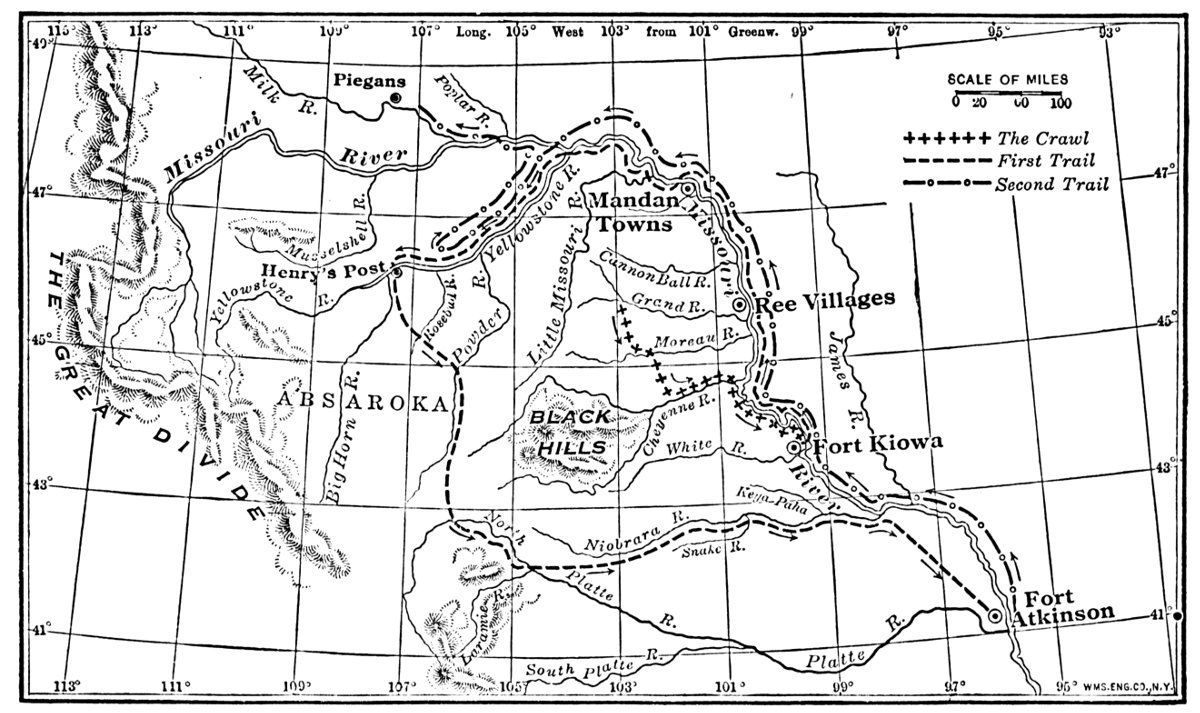
Map showing the route of Hugh Glass in his search for Jamie. The “first trail,” running northward from Fort Kiowa, traces the hero’s wanderings up to his arrival at Fort Atkinson (page 112). The “second trail” indicates Hugh’s journey from that point to his meeting with the boy among the Piegans. Fort Atkinson was situated on the west bank of the Missouri River sixteen miles up-stream from where Omaha now stands.
129
Before beginning the poem carefully read the Introduction.
In the study of this poem it is necessary to learn the geography and topography of the country. Define “topography.” Tell about Leavenworth Campaign; Major Henry.
The story of Hugh Glass is historical and may be found in the following works: Chittenden’s History of the American Fur Trade, New York, 1902; Sage’s Scenes in the Rocky Mountains, Boston, 1857; Ruxton’s Adventures in Mexico, London, 1847; Howe’s Historical Collections of the Great West, Cincinnati, 1857; Cooke’s Scenes and Adventures in the U. S. Army, Philadelphia, 1857; The Missouri Intelligencer for June 18, 1825. Accounts of the death of Hugh Glass, in 1832, are given in The Life and Adventures of James P. Beckwourth, London, 1892, and in Maximilian’s Travels, London, 1843.
2. ‘Twas when the guns that blustered at the Ree
Ree—Aricara or Rickaree Indians. Locate them in 1823.
Where are they now?
3. Had ceased to brag, and ten score martial clowns
Why “clowns”? See Introduction.
6. A withering blast the arid South still blew,
What is “South”? Why capitalized? Did Homer and Vergil
personify the winds?
9. Southward before the Great White Hunter’s face:
Who is the Great White Hunter? What is the time of year?
13013. With eighty trappers up the dwindling Grand,
Why “dwindling”?
14. Bound through the weird, unfriending barren-land
“Unfriending” whom?
15. For where the Big Horn meets the Yellowstone;
Locate the junction of the streams.
1. Deep-chested, that his great heart might have play,
Describe Hugh Glass. Hugh’s physical characteristics are drawn
in large lines. Compare this with the more elaborate descriptions
of persons in other books. Which is more effective?
2. Gray-bearded, gray of eye and crowned with gray
Our author’s descriptions leave much room for the play of the
reader’s imagination. Is this method effective with you?
4. And, for the grudging habit of his tongue,
“For”—by reason of.
8. And hate in him was like a still, white hell,
Why “white”?
9. A thing of doom not lightly reconciled.
What does “reconciled” modify? What is this figure called?
14. Old Hugh stared long upon the pictured blaze,
What were the pictures Hugh saw in the blaze? Would you like
to know more of Hugh’s past? Why does not the author tell us
more concerning it?
17. The veil was rent, and briefly men discerned
What “veil”?
19. Beneath the still gray smoldering of him.
What figure in “still gray smoldering”? Was Hugh a good
fighter? A man whose anger was to be feared?
131
2. So, tardily, outflowered the wild blond strain
Whence the “wild blond strain”?
4. A Ganymedes haunted by a Goth
Who was Ganymedes? The Goths?
5. When the restive ghost was laid,
What was the “restive ghost”? How old was Jamie?
17. When Ashley stormed a bluff town of the Ree,
Who was Ashley? See Introduction.
20. Yet, hardly courage, but blind rage agrope
What is courage?
23. Tore off the gray mask, and the heart shone through.
What was the “gray mask”?
24. For, halting in a dry, flood-guttered draw,
Define “draw” as here used. How does it differ from “ravine”?
from “gully”?
24. As though spring-fire should waken out of snow.
Explain the figure.
4. So with their sons are women brought to bed,
Of whom is Hugh thinking when he uses these words?
13. Nor could these know what mocking ghost of Spring
Express in other words the idea contained in “mocking ghost
of Spring.”
16. So might a dawn-struck digit of the moon
Explain the figure and interpret it in terms of Hugh’s feelings for
Jamie.
13218. And ache through all its craters to be green.
What is the present condition of the surface of the moon?
21. Pang dwelling in a puckered cicatrice
Define “cicatrice.” Explain the figure.
23. Yet very precious was the hurt thereof,
24. Grievous to bear, too dear to cast away.
These lines constitute a paradox. Define “paradox.” Explain
the meaning of the lines. Can pain be “precious”?
What lines in this page forecast an approaching disaster? Can you
recall such forecasts in other pieces of literature?
10. A phantom April over melting snow,
Why “phantom” April?
11. Deep in the North some new white wrath is brewed.
Express the meaning of this line in other language. How does
it apply to the story?
16. Tales jaggéd with the bleak unstudied word,
Was the language of Hugh’s stories polished? Effective? Are
men natural story tellers? Answer from your own experience.
What does the life of primitive man tell us with regard to the
matter?
17. Stark saga-stuff.
Define “saga.” What is meant by the words: “stark saga-stuff”?
19. A mere pelt merchant, as it seemed to him;
Define: pelt, epic, whist. Is “Hugh Glass” epic in material
and form?
133
Which of these men loves the other more? In case of severe trial will
each be true to the other? Is either likely to be vengeful? unforgiving?
fickle?
3. That myth that somehow had to be the truth,
What is “that myth”? What feeling is expressed in “had to be
the truth”?
4. Yet could not be convincing any more.
Why could it not “be convincing any more”?
17. And so with merry jest the old man went;
Note in the passage the second forecast of disaster.
9. The dusty progress of the cavalcade
10. The journey of a snail flock to the moon;
What feeling in Jamie is made clear in this figure?
11. Until the shadow-weaving afternoon
Explain the figure “shadow-weaving afternoon,” etc.
17. Hoofbeats of ghostly steeds on every hill,
18. Mysterious, muffled hoofs on every bluff!
19. Spurred echo horses clattering up the rough, etc.
Explain “hoofbeats of ghostly steeds,” “muffled hoofs,” “echo
horses.”
21. The lagging air droned like the drowsy word
Why “drowsy” word? The transfer of an epithet is called a
“trope,” from a Greek word meaning to turn.
1. Lean galloper in a wind of splendid deeds,
Note the vivid imagery and the effect of the broken meter.
1344. The horse stopped short—then Jamie was aware, etc.
What gives the effect of loneliness in these lines?
Note the effect of vast stretches of space in the use of the names
of heavenly bodies to denote the points of the compass. A sense
of the infinity of space arises often in the reader of this poem.
Any imaginative person feels this sense ever deepening upon him
on looking long at the prairies.
11. Save for a welter of cawing crows,
What is the effect of the cawing of the crows in the general stillness?
Note that the meter is intentionally changed. What effect?
13. One faint star, set above the fading blush, etc.
What is the effect of the mention of the star and its growing from
faint to clear?
16. For answer, the horse neighed.
What is the effect of the neighing of the horse?
17. Some vague mistrust now made him half afraid, etc.
Mistrust of what? Is disaster near?
1. “Somewhere about the forks as like as not;
2. And there’ll be hunks of fresh meat steaming hot,
3. And fighting stories by a dying fire!”
Why does Jamie talk to himself?
4. The sunset reared a luminous phantom spire
5. That, crumbling, sifted ashes down the sky.
What is the effect of these two lines?
8. And in the vast denial of the hush
9. The champing of the snaffled horse seemed loud.
What is the effect of these two lines? What is the “vast denial”?
Why mention “the champing of the horse”? Pages 9 and 10
135are used to induce in the reader a sense of extreme loneliness.
Where is the climax? What devices have been employed for the
purpose?
17. The laggard air was like a voice that sang,
Why is the air now as a voice that sings rather than drowsy and
weird?
18. And Jamie half believed he sniffed the tang
19. Of woodsmoke and the smell of flesh a-roast;
These lines indicate the lad’s eagerness.
2. And in the whirlwind of a moment there, etc.
Could Jamie perceive so much in so brief a time under such circumstances?
Does the picture in “huddled, broken thing”
seem realistic?
11. A landscape stares with every circumstance etc.
Jamie’s experience in the preceding lines is here explained. Did
you ever notice how plainly things stand out in a flare of lightning?
14. Then before his eyes, etc.
Is this consistent with the part of Jamie in the fight with the
Rees?
22. Heard the brush crash etc.
Onomatopœia. Define “rubble.”
1. A swift thought swept the mind of Jamie clear, etc.
Is the change in Jamie from anger to coolness good psychology?
Why?
1368. Swerved sharply streamward. Sliddering in the sand,
Note onomatopœia. How did Jamie elude the bear?
17. Like some vague shape of fury in a dream,
Why did the sight of the bear seem thus to Jamie?
4. Would think of such a “trick of getting game”!
For a moment Jamie feels as if Hugh were still living and he can
now triumph in his skill. Was that natural in a boy?
6. Like a dull blade thrust back into a wound.
Memory of sorrow “like a dull blade,” etc. Is that true to life?
10. Like some familiar face gone strange at last.
Meaning of “gone strange at last”?
In this and the next three pages note the sincerity and the boyishness
of Jamie’s affection and grief. It is necessary to understand
Jamie now that the reader may interpret his later conduct.
Define: eld, blear.
6. Had wiped the pictured features from a slate! etc.
Note two powerful similes in these lines. Do they convey adequately
the horror of the spectator? This “ruined face” of
Hugh’s has much in the remainder of the story. The lines
are not pleasant to read, but life is not always pleasant. Homer
and Shakespeare often wrote lines that shock by their naked
truth.
15. Still painted upon black that alien stare
Why “alien stare”?
16. To make the lad more terribly alone.
Why “more terribly alone”?
13721. Pale vagrants from the legendry of death
Pale vagrants, i.e. ghosts.
Define: funereal, alien, legendry, potential.
6. For, though the graybeard fought with sobbing breath, etc.
A wrestling match in which death has a “strangling grip” on
Hugh. Note the vividness of physical imagery, “neck veins
like a purple thong tangled with knots.” What biblical allusion
in “break upon the hip”?
11. There where the trail forked outward far and dim;
What “trail forked outward”?
13. His moan went treble like a song of pain,
Does the voice become like a shrill song under such circumstances?
20. For dying is a game of solitaire, etc.
A grim epigram.
Define: treble, solitaire.
The rest of this division of the poem develops the catastrophe of
cowardice and treachery. The elements of it are (1) Jamie’s youthfulness
and unsettled character, (2) Le Bon’s ability to play upon his
weakness, (3) the actual nearness of the Rees, (4) the apparently hopeless
condition of Hugh prolonged over several days.
12. That mercenary motives prompted him.
Do you believe the protestations of Jules that mercenary motives
do not prompt him? Does he “protest too much”?
16. The Rickarees were scattered to the West:
Why mention the Indians so early?
13819. Three days a southwest wind may blow
A southwest wind on the plains is always warm, and seldom
carries rain.
Explain the application.
Why does Jules talk always as though the death of Hugh were certain?
10. Unnumbered tales accordant with the case,
Do you think Le Bon knew these tales?
18. A bear’s hug—ugh!’ And Jamie winced etc.
What was the effect on Jamie?
Define: dialectic, colophon.
8. So summoning a mood etc.
How do Le Bon’s stories change as night comes on? Is his
psychology effective? Note the increase in the fears of Jamie.
11. Of men outnumbered: and like him of old, etc.
“Him of old”—Æneas in Æneid, Book II.
23. Gray-souled, he wakened to a dawn of gray,
“Gray-souled”—meaning? “A poet is known by his epithets.”
Define: lugubriously, garrulous.
1. And felt that something strong had gone away.
What strong thing had gone away?
5. Jules, snug and snoring in his blanket there, etc.
Is it natural that the conscious living Jules should seem more
real to the boy than his unconscious friend?
6. Just so, pain etc.
Note the epigram. Is it a true one?
13914. But grappled with the angel.
Jacob in Genesis.
18. Many men May tower, etc.
Would such a statement be peculiarly true of a boy like Jamie?
Recall his conduct in the Ree fight.
24. Nor might a fire be lit,
Note the shrewdness of Jules in failing to light a fire.
What shows that Jamie is at the breaking point?
4. And with it lulled the fight, as on a field, etc.
The crisis of the disease.
9. It would soon be o’er, etc.
Jules talks in sentimental vein. Sentimental people are very
often cruel.
17. To dig a hole that might conceal a man;
Would Jamie have resented the digging of a grave four days
earlier?
Jules easily weeps. So do many insincere people.
Define: beleaguered, mutability, immemorial, funerary.
The last stage of Jamie’s breakdown.
Had you any doubt that Jules would beget panic in Jamie? How
much do you blame Jamie? Why did Le Bon take Hugh’s gun, blanket,
and knife?
Note that the last line of the first division of the poem rhymes with
the first line of the second division. Have you noticed that many times
the rhyming lines close one paragraph and open the next? The effect
140of this device is to keep the mind of the reader in strain for what is to
follow.
What is a couplet? Is the poem written in couplets? How is the
cæsura handled in this poem? Compare with Pope’s method in
“Essay on Man.”
3. But some globose immensity of blue
Note epithets in this line. How comprehensive!
7. So one late plunged into the lethal sleep, etc.
The sensation of the awakening is likened to the possible experience
of one in death. The author is much interested in such
matters.
Define “lethal.” What literary associations with this word?
12. The quiet steep-arched splendor of the day.
At what time of day did Hugh awake?
2. But when he would obey, the hollow skies etc.
Note the suddenness of the loss of consciousness as expressed in
the metaphor: “the hollow skies,” etc.
5. Remote unto his horizontal gaze
6. He saw the world’s end kindle to a blaze etc.
At what time did Hugh re-awaken?
What is the effect upon the reader of the expression “world’s
end” rather than “east”?
9. Dawn found the darkling reaches of his mind, etc.
A figure from archæology. Explain.
13. Men school the dream to build the past anew
What part of speech is “school”?
17. Wherein men talked as ghosts above a grave.
This is the second suggestion that Hugh was vaguely conscious
of what happened before his awakening.
Define: shards, torsos, rubble, sag.
141
5. Sickened with torture he lay huddled there.
Note the vividness of such words as, “sickened,” “torture,”
“huddled,” which appeal both to muscular sense and to sight.
7. Proportioned to the might that felt the chain.
Explain.
10. That vacancy about him like a wall, etc.
The power of that which yields and yet restrains suggests the
sense of helplessness that came to Hugh. This feeling is often
brought out in the later portions of the poem.
20. Grimly amused, he raised his head, etc.
What was the effect of “the empty distance” and “the twitter
of a lonely bird” on Hugh? Why question whether there was
something wrong?
Define: collusive, bleak.
On this and the following page we have the stages by which Hugh
learns that he has been deserted. Note the steps: (1) Major Henry is
prompt, (2) many hoof prints of horses, (3) the grave known for a grave
by its shape, (4) ash heap and litter of a camp, (5) the trail.
8. Of course the horse had bolted
That is, run away.
17. A grave—a grave, etc.
Does Hugh really wonder if he has been dead and has arisen?
For the third time it is stated that Hugh heard the talk of his
comrades while he was prostrate from the bear’s attack.
25. Suspicion, like a little smoky lamp etc.
Note simile. Is it effective?
142
1. That daubs the murk but cannot fathom it,
Hugh’s suspicions are vague as yet.
6. The smoky glow flared wildly,
What “smoky glow”?
10. A gloom-devouring ecstasy of flame,
11. A dazing conflagration of belief!
Suspicion passes to certainty. Explain the whole figure from
the beginning.
12. Plunged deeper than the seats of hate and grief, etc.
Does nature sometimes seem to mock our moods? The older
literatures seem unconscious of this psychology. Note Bryant’s
“Death of the Flowers.”
Define: daub, grotesque, ecstasy, apathetic, complacence, connivance.
2. His manifest betrayal by a friend
Why does the desertion of Jamie make that of others seem nothing?
13. Yet not as they for whom tears fall like dew etc.
Hugh’s tears are not shallow; they indicate a lasting sorrow.
Those who weep easily, easily forget.
18. He lay, a gray old ruin of a man, etc.
Both physically and emotionally, a remarkable metaphor.
20. And then at length, as from the long ago, etc.
His suffering makes the time of friendship seem long ago. A
song may be both sweet and sad, as may also love.
25. ... as in a foggy night
1. The witchery of semilunar light, etc.
A fine comparison of the spiritual to the material.
Define: zany, retrospective.
1436. As under snow the dæmon of the Spring.
“Dæmon,” spirit.
8. Nor might treachery recall, etc.
He had been loved, nothing could change that; he could go on
loving and nothing could change that either. This is the high
note in devotion. “If ye love them that love you, what thank
have ye?”
16. Upon the vessel of a hope so great, etc.
The lover is only the vessel of the great passion.
21. Now, as before, collusive sky and plain etc.
Sky and plain have conspired to take Hugh’s life, so it seems to
him. They represent distance that yields but still is unconquered.
This idea haunts the “Crawl.”
1. For, after all, what thing do men desire, etc.
Food and shelter are necessary to any life; all values rest upon
them. This idea is fundamental in modern thinking.
20. Jamie was a thief!
Why Jamie more than others?
Define “gage.”
5. And through his veins regenerating fire etc.
Anger made him strong, while grief made him weak. Is that
not true to nature?
7. Now once again he scanned the yellow plain, etc.
Hugh projects his subjective condition on nature. This idea
occurs often in the poem. Is it a true conception?
14414. Alas for those who fondly place above, etc.
A continuation of the philosophy found on page 32. Love is the
supreme thing, not the person who is loved. The way is itself
the goal.
19. A bitter-sweet narcotic to the will, etc.
Note how Hugh’s hate arouses his energies. For his purposes it
is stronger than love.
Define: bellowsed, regenerating, lethargy, conspirant, merging,
vulnerable, narcotic.
11. Leaning to the spring, etc.
The final horror, his face, fixes Hugh’s hate to a steady, burning
purpose, seeming equal to his task.
5. That waste to be surmounted as a wall,
6. Sky-rims and yet more sky-rims steep to climb—
In gazing across a vast space to the horizon, one seems to be
looking uphill. This is especially noticeable on the ocean.
7. That simulacrum of enduring Time—
One traveling long distances by his own power, and having no
means of measurement, conceives space not in miles, but in
duration of effort.
8. The hundred empty miles ‘twixt him and where
Why “empty” miles?
11. One hairsbreadth farther from the earth and sky
He was as remote from all things as it was possible to be, so why
not try!
Define “simulacrum.”
145
The Crawl is the most detailed account of physical suffering and endurance
extant in poetry. Note the large number of words that make
direct appeal to the sensations of thirst, weariness, chronic pain, fever,
delirium. Again the sense of loneliness, of betrayal, of a conspiracy to
destroy him appears everywhere in Hugh’s experience. The monotony
of the journey appears in its slowness, which is indicated in many ways.
Before describing the Crawl, Neihardt first found out what vegetable
growths would be found on the trail, the character of the soil, how the
streams would erode, etc. The poet is true to all nature, even natural
science.
3. And through it ran the short trail to the goal.
What was the “goal”? Ree villages lay nearly directly east.
4. Thereon a grim turnpikeman waited toll:
Who is the “grim turnpikeman”?
7. Should make their foe the haunter of a tale.
Hugh was killed on the Yellowstone by the Rees in 1832.
9. The scoriac region of a hell burned black
The bad lands of the Little Missouri, so made to appear by spontaneous
combustion of lignite deposits.
13. Should bid for pity at the Big Horn’s mouth.
Locate the Big Horn’s mouth, where Henry and his men spent
the winter of 1823–1824.
2. Whereon the feeders of the Moreau head—
Head waters of the Moreau. Locate the Moreau.
1463. Scarce more than deep-carved runes of vernal rain.
The rune was a character in the ancient alphabet and ultimately
came to stand for poetry. Here the original meaning as a deep
cut is restored.
6. Defiant clumps of thirst embittered grass, etc.
Note how exactly the characteristics of an arid landscape are
set forth in such phrases as “thirst embittered grass,” “parched
earth,” “bared and fang-like roots,” “dwarf thickets,” “stunted
fruits.” The poet is shown by exactness, not inaccuracy.
15. And made the scabrous gulch appear to shake
The very sound of the word “scabrous” suggests dryness.
20. And where the mottled shadow dripped as ink etc.
The shadow of leaves on the yellow earth is black. The description
is absolutely accurate. “A poet is known by his epithets.”
3. Amid ironic heavens in the West—
Why “ironic heavens”?
6. A purpling panorama swept away.
Why “purpling”?
7. Scarce farther than a shout might carry
How far had Hugh traveled in the day?
16. Into the quiet house of no false friend.
What “quiet house”?
17–20. Alas for those who seek a journey’s end—etc.
The philosophy of these lines is that the way is the important
thing, not the end. This is a part of Neihardt’s life-philosophy.
21. Now swoopingly the world of dream broke through
Note that no two of Hugh’s dreams are alike. In this dream his
revenge is futile. Is that the nature of revenge, to defeat itself?
How many lines are taken to tell this dream? How much in
little space!
147
1. Gazing far, etc.
Another remarkable description of the sky and prairie and their
effect upon Hugh.
Make a list of epithets descriptive of both sky and prairie as
you find them on pages 26–27–28–29–30–32–34–36–39. Epithets
may be adjectives or verbs or nouns. Such are “globose immensity,”
“smoky steep,” “serene antagonist,” “negativity of
might.”
9. Seemed that vast negativity of might; etc.
In what sense is the might of distance negative?
What was the “frustrate vision of the night”?
What does the poet mean by saying it came “moonwise”?
What is Hugh’s mood when he feels that the foe is “naught but
yielding air”?
13. A vacancy to fill with his intent!
What is the grammatical construction of “to fill”?
15. Three-footed; and the vision goaded him.
What vision “goaded him”?
24. Served but to brew more venom for his hate,
Why is hate spoken of as venomous? What has modern Physiology
to say of this?
25. And nerved him to avail the most with least.
What is meant by “avail the most with least”?
10. Devoured the chance-flung manna of the plains
“Manna”—what is the reference?
18. The coulee deepened; yellow walls flung high, etc.
Accurate description of arid conditions by their effect on Hugh.
148
6. It had the acrid tang of broken trust
7. The sweetish, tepid taste of feigning love!
A projection of the subjective into the objective.
14. Clear as a friend’s heart, ‘twas, and seeming cool—
The same as above.
22. And lo, the tang of that wide insolence
23. Of sky and plain was acrid in the draught!
Note again the attitude of nature, as Hugh sees it, in its “wide
insolence.”
25. How like fine sentiment the mirrored sky etc.
The cruelty of sentimentalism. Note on this page the steps by
which the sense of thirst is induced in the reader and the corresponding
disappointment increased; “dry as strewn bones
bleaching to a desert sky,” “grateful ooze,” “sucked the mud,”
“sweetish, tepid taste,” “taunted thirst,” “damp spots,” then
the description of the pool and the “famished horses.” Is not
the reader as thirsty as Hugh and nearly as keenly disappointed?
8. Nor did he rise till, vague with stellar light, etc.
Compare with Bryant’s “Forest Hymn.”
At what line does Hugh fall asleep? At what line does he begin
to awake? How many days since “The Crawl” began?
17. And Hugh lay gazing till the whole resolved etc.
What is the difference between this dream and that of the previous
night? Why? Does Hugh still love Jamie? Would he kill
him in such a mood? How many lines in the dream?
Define: specious, gulch, buttressing, Host, nave, architrave.
149
Hugh has not yet reached the prairie on the divide between the Grand
and the Moreau, though he has journeyed two days. How far do you
think he has crawled?
3. Loath to go, Hugh lay beside the pool and pondered fate, etc.
Why is Hugh less eager to renew his journey than on the previous
morning? Do you suppose his dream had anything to do with
the matter? His weariness?
11. Sustaining wrath returning with the toil.
Why does wrath return?
23. Of strength that had so very much to buy.
What had his strength “to buy”?
Define: efface, cauldron.
11. Sleep out the glare. With groping hands for sight,
Hugh sleeps on the afternoon of the third day of his journey.
Explain “groping hands for sight.”
14. Or sensed—the dusky mystery of plain.
Why dusky mystery? Can you see a prairie by starlight?
15. Gazing aloft, he found the capsized Wain
“Capsized Wain,” Bear. What time of night?
16–17. Thereto he set his back;
What direction did he take? How much knowledge of the constellations
must have meant to primitive men! To sailors! To
hunters! Read Bryant’s “Hymn to the North Star.”
19. The star-blanched summit of a lonely butte
20. And thitherward he dragged his heavy limb.
Note the butte used to guide the crawler. Could a plainsman
see a butte by starlight? Could a “tenderfoot”?
15021. It seemed naught moved, etc.
The movement on a prairie and in the night seems objectless.
It gives a supreme sense of monotony. Time stopped. We
measure time by events; no events, no time.
Define: blanched, incipient.
4. Sheer deep upon unfathomable deep, etc.
A curious but vivid figure, expressing a sense of darkness and uninterrupted
silence.
8. So lapsed the drowsy æon of the night—
The monotony makes the hours seem a moment drawn out.
10. And then, as quickened to somnambulance, etc.
Note the steps of the dawning, and the suddenness of the coming
of day. The description is not only vivid but accurate.
20. Scarce had he munched the hoarded roots, when came etc.
Why the difference between this and previous dreams?
Define “tensile.”
8. It was the hour when cattle straggle home etc.
A fine lyric. This is one of many memory pictures of Hugh’s
travels. Nothing in the poem tells directly of Hugh’s past.
This silence suggests tragedy dimly illumined by the memory
pictures. Is Hugh an imaginative man? Enumerate the evening
sounds. Note the steps marking the transition from evening
to night. How many days has Hugh crawled? Hugh is known
to have been a Pennsylvanian of Scotch descent.
Define “peripheries.”
151
1. Blank as the face of fate. In listless mood etc.
Fate is associated with the inevitable and unrevealed. “In listless
mood” etc.—the end of a day of feverish dreams finds
Hugh weakened and caring less to live.
3. And met the night. The new moon, low and far, etc.
Note the phase of the moon.
7. The kiote voiced the universal lack.
Hunger.
8. As from a nether fire, the plain gave back
9. The swelter of the noon-glare to the gloom.
The heat of the prairie is often very noticeable after sunset.
12. Why seek some further nowhere on the plain?
What “nowhere”?
14. So spoke some loose-lipped spirit of despair;
Why “loose-lipped”?
15. And still Hugh moved, volitionless—a weight, etc.
Volitionless—The power of habit is compared to that of the moon
over the tides.
18. Now when the night wore on in middle swoon,
21. To breathe became an act of conscious will.
22. The starry waste was ominously still.
24. As through a tunnel in the atmosphere—
Note the steps of the coming storm: middle swoon, a drowsy night,
stifling condition of the air, utter silence with sense of impending
disaster, as through a tunnel, etc.
The description of the storm is exact to the minutest detail. It
is not interspersed with more or less sentimental comments as
is Byron’s description of the storm on the Alps (Childe Harold,
Canto III), yet it gains in power by its adherence to truth.
152
4. An oily film seemed spread upon the sky
Storm still approaching. “The oily film,” the gradual darkening
of the atmosphere.
9. Upon hell’s burlesque sabbath for the lost,
What could be more hopeless than “Sabbath in Hell”?
12. Hugh chose not, yet he crawled;
Habit keeps him moving.
13. He felt the futile strife was nearly o’er.
Hugh will die unless relief comes.
14. And as he went, a muffled rumbling grew,
Far away thunder, the next step in the approach of the storm.
16. Somehow ‘twas coextensive with his thirst,
Confusion of objective and subjective, a not uncommon experience
of extreme weakness.
12. Star-hungry, ranged in regular array, etc.
Note the use of constellations to indicate the vast expanse and
swift movement of the cloud; another illustration of the poet’s
power to see things in the large. Locate the constellations named.
Explain the figure, “star-hungry.”
19. Deep in the further murk sheet-lightning flared.
Sheet-lightning—covering the sky like a sheet, sometimes called
heat lightning—a common phenomenon in prairie storms.
24. What turmoil now? Lo, ragged columns hurled, etc.
Explain “ragged columns.”
2. Along the solid rear a dull boom runs!
Explain “solid rear.”
15311. Reveals the butte-top tall and lonely there
12. Like some gray prophet contemplating doom.
The second time the butte has been described.
16. Ghosts of the ancient forest—or old rain, etc.
Geology tells us that these plains were once covered with forests.
19. That e’er evolving, ne’er resolving sound
20. Gropes in the stifling hollow of the night.
Never fully developing. “Evolving,” “resolving”—technical
expressions in music.
The rush of the rain, the constant flare of lightning, the sudden cessation,
as well as the slow and dread beginning, are characteristic of storms
in semi-arid countries. This poem reveals every phase of nature on the
prairies and none more vividly than the storm.
Define: hurtling, wassail, sardonic, flaw, ravin, murk, cosmic,
sodden.
3. The butte soared, like a soul serene and white
4. Because of the katharsis of the night.
The butte appears again, this time as the symbol of a soul that
has struggled and triumphed. The principle of Katharsis, purification,
is a principle of the Greek drama as worked out by
Aristotle. To what degree is it a principle of life?
5. All day Hugh fought with sleep and struggled on
Which day? Why does Hugh no longer travel at night?
16. Hope flared in Hugh, until the memory came
17. Of him who robbed a sleeping friend and fled.
Explain.
15418. Then hate and hunger merged; etc.
Note again that Hugh finds Jamie’s treachery everywhere. It is
an obsession with him.
Define “amethyst.”
How many days has Hugh crawled? How far has he journeyed?
5. Swooped by. The dream of crawling and the act etc.
An appeal to the muscular sense.
Such dreams bespeak extreme weariness.
8. The butte, outstripped at eventide, now seemed etc.
The butte now becomes the measure of a progress infinitely slow,
a source of discouragement.
13. Whose hand-in-pocket saunter kept the pace.
Why “hand-in-pocket”?
16. What rest and plenty on the other side!
Hugh must have encouragement. The break in the prairie, the
crest of the divide, furnishes that. Explain the psychology. How
far is the divide from the Grand?
20. All day it seemed that distant Pisgah Height
Why “Pisgah”?
Define “lush.”
Hugh is near to starvation. The adventure with the gopher goes
from waking reality to dream on the following night and to waking dream
the next day, revealing how sick Hugh had become.
10. The battered gray face leered etc.
Note that the vivid picture of the face of Hugh is secured by the
choice of a few meaningful words, battered, leered, slaver, anticipating
jaws.
15513. Evolving twilight hovered to a pause
The twilight pause means what?
18. Hugh jerked the yarn. It broke.
Note the brevity of the climax, “It broke.”
19. Down swooped the night,
How many days of journeying? The dream is a nightmare
while the previous one was relatively peaceful. Why the difference?
3. Woke hordes of laughers down the giddy yawn
What “hordes of laughers”?
5. Dream dawn, dream-noon, dream-twilight!
Night and day are “telescoped” for Hugh by the monotony of
crawling either awake or in dreams and never getting anywhere.
17. Dream-dawn, dream-noon, dream-night! And still obsessed
Why the repetition?
18. By that one dream more clamorous than the rest,
What is the one dream? Why is it a dream?
Define: gully, turbid, relict.
3. Yet had the pleasant lie befriended him,
4. And now the brutal fact had come to stare.
What was the “pleasant lie”? The brutal fact?
7. And nursed that deadly adder of the soul,
8. Self-pity. Let the crows swoop down and feed, etc.
Sentimentalism is soul-flabbiness.
15. And lo, a finger-nail, etc.
The accumulation of great results by infinitesimal accretions is
one of the everlasting surprises in life.
15621. So fare the wise on Pisgah.
How do the wise use their Pisgahs? To enjoy or to inspire to
further effort?
Define: facture, dwarfed, Titan, triumvirate.
2. Some higher Hugh observed the baser part.
What was the higher, what the baser part?
3. So sits the artist throned above his art, etc.
The hurt is nothing, the achievement is all. No man who is
worth anything but counts his work as more than all else.
5. It seemed the wrinkled hills pressed in to stare, etc.
The manifestations of nature become Hugh’s audience and he
falls into the throes of composition. Most of our thinking is in
words uttered to persons present, absent, or imagined.
11. So wrought the old evangel of high daring, etc.
The true philosophy of life, to be a “victor in the moment.”
23. That day the wild geese flew
What is the effect of their cries? Describe the appearance of
the sky.
Define: recks, travail, evangel.
Present, past and fancy are all mingled in Hugh’s experiences this day,
showing his weakened condition, and the feeling for Jamie obsesses him.
9. Hate slept that day,
Was it hate or an inversion of love?
18. At last the buzzard beak no longer tore
What “buzzard beak”?
Define: lethargy, maudlin.
157
4. And now serenely beautiful etc.
These lines were suggested to the author by a picture, “The
Death of Absalom.”
6. Thus vexed with doleful whims the crawler went etc.
Hugh would have died at this time had he not drifted into the
rugged vale.
11. Told how the gray-winged gale blew out the day.
Why “gray-winged”?
20. It seemed no wind had ever come that way,
21. Nor sound dwelt there, nor echo found the place.
How is utter quiet expressed!
7. Returning hunger bade him rise; in vain
8. He struggled with a fine-spun mesh of pain etc.
An appeal to muscular sense.
16. In that hip-wound he had for Jamie’s sake
That “hip-wound” brings back the desire for revenge, a close
association of ideas. Have you had such experiences?
19. Was turned again with every puckering twinge.
“Puckering twinge,” another appeal to muscular sense.
20. Far down the vale a narrow winding fringe etc.
Having passed the divide Hugh slept at the head of a valley that
farther down becomes the bed of a little creek flowing into the
Moreau.
Define: mesh, trammelled, puckering, betokened.
158
6. These two, as comrades, struggled south together—
Contrast the two “comrades,” each journeying to the many
fathomed peace, one consumed with “lust to kill,” the other
singing on the way. A bit of wise philosophy is suggested.
9. And one went crooning of the moon-wooed vast;
What is the “moon-wooed vast” and to what is it compared?
12. All streams ran thin; and when he pressed a hand etc.
Why did he do this?
20. Far-spread, shade-dimpled in the level glow,
Another of many sunset pictures in the poem and no two are alike.
“Far-spread, shade-dimpled in the level glow,” a prairie sunset
in one line.
24. Hugh saw what seemed the tempest of a dream
Why a “dream” tempest?
Define: phasic, weather-breeding.
3. A dust cloud deepened down the dwindling river;
4. Upon the distant tree-tops ran a shiver etc.
Note the pictures suggested in “dust cloud deepened,” “upon
the distant tree-tops ran a shiver,” “huddle thickets writhed,”
“green gloom gapes,” “mill and wrangle in a turbid flow.”
13. Bound for the winter pastures of the Platte!
The Platte was an especially fine bison country.
17. The lopped moon weltered in the dust-bleared East.
How long since Hugh began his journey?
18. Sleep came and gave a Barmecidal feast.
In the Arabian Nights one of the Barmecides, a wealthy family,
159served a beggar a pretended feast on beautiful dishes that were
empty.
19. About a merry flame were simmering etc.
The appeal to the sense of hunger is powerful. Compare Vergil,
Æneid, Book I, 210–215.
21. And tender tongues that never tasted snow,
Why “never tasted snow”?
2. So sounds a freshet when the banks are full etc.
Note comparison of the movement of the herd to a swollen river
clogged by débris.
8. Through which the wolves in doleful tenson tossed
Tenson: among the troubadours a contest between two singers.
9. From hill to hill the ancient hunger-song.
Hunger is the oldest form of suffering, and prayer for food the
oldest prayer.
15. With some gray beast that fought with icy fang.
Why “icy” fang? “white world”?
Define: eerie, myriads.
8. The herd would pass and vanish in the night
How long was the herd in passing?
During this time, and for fifty years thereafter, bison herds often
covered the plains as far as the eye could see. In the 60’s
travellers on the old Oregon trail often journeyed through one
solid herd for as much as three days, and on either side the
prairie was filled to the horizon.
16023. So might a child assail the crowding sea!
The comparison of the on-rushing herd to high sea tide, notable
in itself, is greatly strengthened by the comparison of Hugh to
a child assaulting the waters. Note the impulse of the defeated
to act in absurd ways. Note the epithet, “crowding.”
2. Slept till the white of morning o’er the hill
3. Was like a whisper groping in a hush.
The comparison of light to sound, “the white of morning like a
whisper,” is unusual but true.
4. The stream’s low trill seemed loud.
Why seemed the low trill loud?
9. Smacked of the autumn, and a heavy dew etc.
What association of sensations brings the picture of the autumn
fields?
Note how quickly the vision passed, an illustration of the author’s
power of concentration. Hugh was born in Pennsylvania. What
was his father’s business? How do you know from this and
other passages? See the lyrical passage on page 47.
15. He brooded on the mockeries of Chance,
On page 58 we saw Hugh in the act of literary composition; now
we see him a philosopher. This is a common fact among what
we call the “common” people. Note the grave-digger scene in
Hamlet, Act V.
Define: smacked, hoar, frore.
1. Revealed the havoc of the living flood, etc.
Point out each word and statement that pictures the havoc
wrought in the valley by the herd.
1619. A food-devouring plethora of food
Devouring what food? What plethora?
10. Had come to make a starving solitude!
What idea is modified by the word “starving”?
16. That still the weak might perish.
Express this idea in other terms. Note unusual use of the word
“still.” State the biological “law of evolution.”
24. Within himself the oldest cause of war
What is the “oldest cause of war”? The newest?
Define: plethora, raucous, guerdon.
8. He saw a bison carcass black with crows, etc.
This picture is unique, cruel, almost revolting, but wonderfully
true.
18. To die contending with a living foe,
19. Than fight the yielding distance and the lack.
To engage in a short struggle with a visible foe with a definite
end near and certain is far easier than to endure the long drawn
and indefinite. This is because man is primarily well equipped
for the immediate struggle of hunting and war, but is not gifted
by nature with power to endure.
5. The wolf’s a coward, who, in goodly packs, etc.
The wolf pack symbolizes the mob. The law of mob life is
cruelty, and cruelty is always cowardly.
10. How some great beast that shambled like a bear
Why “shambled like a bear”?
24. Woe in the silken meshes of the friend,
16225. Weal in the might and menace of the foe.
The friend often weakens his friend. The opposition of the
enemy develops his strength.
Define: lacerated, vituperative, prodigious, frenzy, weal.
14. When sleep is weirdest and a moment’s flight,
Dreams often come just before waking.
20. Hoof-smitten leagues consuming in a dust.
What is the syntax of “leagues”? Explain the line.
23. A corpse, yet heard the muffled parleying etc.
Note how the idea that he was really dead haunts Hugh both
sleeping and waking. Find other places in the poem where this
is true.
3. The babble flattened to a blur of gray—
A comparison of sound to light.
15. Could they be the Sioux?
The Sioux had been allies in the Leavenworth Campaign, while
the Rees were enemies. Note page 1.
Note on this page the vivid picture of the Indians riding in the
fog.
24. The outflung feelers of a tribe a-stir
Meaning of “feelers”?
8. And wasna!
Bison meat, shredded, dried, and mixed with bison tallow and
dried bullberries, the mixture being packed in bladders.
16311. But kinsman of the blood of daring men.
Actual “blood brotherhood” between Indian and White was not
uncommon and bravery and loyalty were the basis of such relation.
13. O Friend-Betrayer at the Big Horn’s mouth, etc.
Note how Hugh’s imagination rushes on to the killing of Jamie.
17. From where a cloud of startled blackbirds rose
What startles the blackbirds?
Note on this page, and the next, various hints of the coming of
the Indians and how important the matter was to the starving
watcher from the bluff.
20. Embroiled the parliament of feathered shrews?
What are the “feathered shrews”?
22. Flackering strepent; now a sooty shower, etc.
“Flackering strepent”—fluttering and noisy, a fitting description
of the startled flock; onomatopœia.
The entire picture of the blackbirds is notable. They are a
“boiling cloud,” “a sooty shower,” with big flakes and driven
by a squall, they are “cold black fire.” All these terms are
startling but exact.
Define: parfleche, panniers, maize, parliament, shrews.
4. What augury in orniscopic words
5. Did yon swart sibyls on the morning scrawl?
A rhetorical question to indicate the dread interest Hugh felt
in the question “Sioux or Ree?”
Note the fancy that words are written on the sky.
13. In their van
14. Aloof and lonely rode a gnarled old man etc.
“Gnarled” like a tree. A most vivid picture of Elk Tongue, a
famous Ree chief.
16416. Beneath his heavy years, yet haughtily
17. He wore them like the purple of a king.
His great age is like a royal robe. “Gray hairs are a crown of
glory.”
18. Keen for a goal, as from the driving string etc.
In how many and significant ways his face is described in these
lines: keen for a goal, like a flinty arrow-head, with a brooding
stare. Directions for a statue could scarcely be more exact or
more full of suggestion.
Define: ruck, augury, orniscopic, swart, sibyl, attenuated, gnarled,
piebald.
Read the entire description of the Indians at one sitting and get the
unified effect.
12. Such foeman as no warrior ever slew.
Hunger.
18. And hurled them shivering back upon the beast.
According to the Greek myth men were little better than beasts
until Prometheus brought fire to them from heaven in a reed.
How nearly does the myth accord with truth?
21. Hope fed them with a dream of buffalo etc.
With primitive man feast and famine were often close together.
23. Home with their Pawnee cousins on the Platte,
Locate the Platte. The Rees and Pawnees speak the same
tongue with slight variations.
Define “ravelled.”
2. The rich-in-ponies rode, etc.
The first scene in the moving picture shows the contrast of rich
and poor that existed even in the most primitive society.
1653. For much is light and little is a load etc.
What is meant? The sentence is a paradox.
10. Whining because the milk they got was thinned etc.
The squaws with their crying babies are the material of the
second scene, followed by the striplings.
14. How fair life is beyond the beckoning blue, etc.
“Distance lends enchantment.”
15. Cold-eyed the grandsires plodded, for they knew, etc.
Note contrasting words: striplings, grandsires; strutted, plodded.
One group saw visions, the other was disillusioned.
17. In what lone land.
What is meant?
20. Stooped to the fancied burden of the race;
What is the “burden of the race”?
25. The lean cayuses toiled.
Cayuse, a broncho, originally one bred by the Cayuse Indians.
27. To see a world flow by on either side,
How does the world “flow by”?
The dog was an ever present feature of Indian life. Note the author’s
familiarity with the dog.
12. Yielded to the squaws’
13. Inverted mercy and a slow-won grave.
“The female of the species is more deadly than the male.” Why?
For the sake of the protection of the young. Indian fighters
had a special horror of falling into the hands of the squaws.
Hate and love are opposite sides of the same shield. In proportion
as woman loves her children and the protectors of them she
hates anybody and anything that menaces them.
16614. Since Earth’s first mother scolded from a cave
A true picture of social origins.
17. To match the deadly venom brewed above
18. The lean, blue, blinding heart-fires of her love.
Note the witches’ cauldron that bubbles here and the fire that
burns below it.
20. But thrice three seasons yet should swell the past, etc.
Glass was killed by the Rees in 1832.
21. So was it writ, ere Fate’s keen harriers etc.
Why is Fate capitalized?
Define: palimpsest, harriers.
3. For that weird pass whereto the fleet are slow,
The fleet are the young, but the old reach the “weird pass” first.
16. Scarce had he crossed the open flat, and won etc.
On this page and the next we have the temptation of Hugh to
kill the squaw. (a) Do you feel that Hugh will kill her? (b) Would
he be justified in so doing? (c) Would you be satisfied to have
the hero of the story slay a weak old woman, though an Indian?
Whom does Hugh see sitting haloed like a saint? (page 79)
What impression on Hugh does the whole adventure make?
3. He reached a river. Leaning to a pool etc.
Was the reaction against his own pity natural?
14. That somehow some sly Jamie of a dream
15. Had plundered him again;
Again the obsession concerning Jamie. There seems a suggestion
of insanity in this. Is the pursuit of vengeance always insane?
16718. Now when the eve in many-shaded grays etc.
Another prairie sunset. Note that every description of the
prairie is woven directly into the story. No two are alike.
21. Hugh paused perplexed. Elusive, haunting, dim, etc.
A comparison of pure sense to pure idea is unusual but true, for
ideas rest upon sense perception.
Define: crone, fleered.
4. It seemed the sweet
5. Allure of home.
Association by sense of smell—smoke, fire, home in the evening.
12. Hearth-lit within, its windows were as eyes etc.
The comparison of an old farmhouse to an old mother. Point
out pathos in each.
21. A two-tongued herald wooing hope and fear,
Meaning? Compare Æneid, Book I, 661.
Select a lyric from this page.
Define: troll, recrudescent.
2. And reached a bluff’s top. In a smudge of red etc.
Another sunset picture. Where were the “pools of gloom”?
How comes the “mottled” effect?
10. He lay upon the bare height, fagged, forlorn,
Hugh is again near to collapse.
17. Then with a start etc.
How well the first stage of the finding and appropriation of fire
has been pictured as the effect of smell! Now comes the second
stage. The whole incident epitomizes in wonderful way the
168meaning of fire to mankind. Note the beauty of the comparison
of the flame to a lily.
Define: mottled, pluming.
4. With pounding heart Hugh crawled along the height
Why “with pounding heart”?
15. Keen to possess once more the ancient gift.
Of Prometheus to man.
Define: doddering, burgeoning, tenuous.
1. Arose, and made an altar of the place.
Fire worship is as old as the race. Hugh is the priest, the East
Wind a religious novice who sings in the ceremonials, the night
is the temple, and in response to the worship, “Conjuries of
interwoven breath,” the fire god appears in the burning wood.
5. The Wind became a chanting acolyte.
Why have an East Wind?
10. Once more the freightage of the fennel rod
Prometheus used a fennel rod to bring fire to mortals.
11. Dissolved the chilling pall of Jovian scorn.
Jove despised men and refused them fire.
13. The face apocalyptic, and the sword
14. The glory of the many-symboled Lord
17. Voiced with the sound of many waters,
All this is from Revelations, Chapter I.
Define: acolyte, epiphanic.
169
11. Then set about to view an empty camp
12. As once before, etc.
See pages 29 and 30.
1. Among the ash-heaps; and the lean dogs ran
2. And barked about him, for the love of man etc.
Some one has said that the dog was a candidate for humanity
and just missed it.
8. For ‘tis the little gifts of grudging Chance,
9. Well husbanded, make victors.
This is a principle of economy often illustrated.
18. Scarce more of marvel and the sense of might, etc.
Tennyson makes poetry out of a miraculous sword, Neihardt
out of a man-made knife. One is romanticism, the other realism.
Which is more poetic?
1. Not having, but the measure of desire etc.
“A man’s riches consist of what he can do without.” Socrates
taught this philosophy.
2. Who gaining more, seek most, etc.
Explain.
7. That twain wherewith Time put the brute to school,
Who was the “brute”? How “put to school”?
6. What gage of mastery in fire and tool!—
The control of fire was the first great step in civilization and
someone has said that the invention of the bow and arrow wrought
170greater changes in human life than any other invention. By
enabling man to kill at a greater range it increased his supply
of meat and so made it possible to live in larger groups.
Why didn’t Hugh roast the dog instead of boiling? Note details of
preparation. Hugh ate the entire dog. Two starved Indian hunters
have been known to eat the whole carcass of a deer at one sitting.
13. Hugh slept. And then—as divers, mounting, sunder etc.
A vivid expression of a common experience on waking from especially
profound sleep.
Define: bulimic, gage.
3. And was the friendlike fire a Jamie too? etc.
The natural return of a monomania.
12. The sting of that antiquity of pain
After a long rest, his former suffering seemed ancient.
14. That yielding victor, fleet in being slow
Always more space to be conquered, hence slow and certain to
win over Hugh.
16. So readily the tentacles of sense, etc.
Thinkers are just beginning to realize something of the hypnotic
power of habit and custom in the individual and in society. The
loss of the accustomed may disintegrate the life. Our author
shows keen understanding when he likens the effect upon Hugh
of the loss of fire to that of the loss of a dear one by death. A
moment ago he was here, vital, real. Now he is gone. How
strange is the world without him!
171
7. A yelping of the dogs among the bluffs, etc.
The one sound in the desolate night, the yelping of the dogs,
starts a train of ideas. The power of abstraction has made man
able to survive where less intelligent forms have perished.
Flint can be used to skin a dog, so can steel, the two smitten together
make fire, so Hugh found his “unlocked door to life.”
22. Spilled on it from the smitten stone a shower
23. Of ruddy seed; and saw the mystic flower
24. That genders its own summer, bloom anew!
Explain the metaphor.
An absolutely new figure regarding fire.
10. Set laggard singers snatching at the tune.
What “laggard singers”?
13. And, pitching voices to the timeless woe,
Life fundamentally sad.
14. Outwailed the lilting. So the Chorus sings etc.
In the Greek theater the Chorus sang after the actor had spoken,
always taking an opposite tone. So Hugh’s joyous song is
drowned in the wailing of the dogs.
8. He hobbled now along a withered rill etc.
Note the quiet of the autumn spell over the secluded place, and
the onomatopœia indicating the falling of the plums and whispering
leaves; also the crying of the lonesome dog that makes the
stillness more intense and sad.
17210. A cyclopean portal yawning sheer.
“Cyclopean portal,” Homer’s Odyssey.
25. Above the sunset like a stygian boat,
The boat of Charon on the Styx, the river of the underworld.
1. The new moon bore the spectre of the old,
Explain.
3. The valley of the tortuous Cheyenne.
Locate the Cheyenne.
4. And ere the half moon sailed the night again, etc.
How long since Hugh left the forks of the Grand?
17. Grown Atlantean in the wrestler’s craft.
Explain “Atlantean.”
Read “The River and I,” Chapter I, by the same author, to get
his feeling for the Missouri.
1. Not long Hugh let the lust of vengeance gnaw
Note that the first line of the division of the poem rhymes with
the last line of the former. How often does this happen in the
poem? This device keeps the mind on a stretch and so keeps
interest alive. The same device is often used by the author in
passing from one paragraph to the next.
5. I can not rest; for I am but the ghost etc.
The old obsession that he actually died by the Grand, though
here used less seriously than in other places.
17312. With such a blizzard of a face for me!
The epithet reveals how Hugh’s gray “ruined face” impressed
men.
13. For he went grayer like a poplar tree, etc.
The simile of the face of Glass in mentioning Jamie’s treachery
and the poplar tree shaken by the first wind of a storm is true
to nature, for a poplar turns the gray side of its leaves when
shaken.
Define: fend, kenneled.
1. From where the year’s last keelboat hove in view
The keelboat, shaped with keel and hence so called, from forty
to sixty feet long, carrying as much as sixty tons and pulled by
fifteen to twenty-five men, was used on the Missouri and other
navigable rivers before the day of the steamboat.
10. Until the tipsy Bourgeois bawled for Glass
The head of a trading post in the fur trading period was called
Bourgeois, a French word meaning tradesman.
12. The graybeard, sitting where the light was blear, etc.
The whole account of Hugh’s telling of this great tragedy is of
the highest excellence. We already know that Hugh is a story
teller; we have seen him composing this very tale (page 58), and
we know how his imagination sometimes carries him beyond the
actual, as when he saw Jamie dead (page 60). The effect of his
face, with its changing expressions suiting all the moods associated
with love and betrayal, his chanting songlike tones, is
shown in the muscular responses of the listeners and their shudders
when the story ends. The supreme touch comes when Hugh
tells of the slaying of Jamie as if already done.
17419. And his the purpose that is art’s, etc.
To centre attention on human experience at the crucial moment
and so render it immortal.
20. Whereby men make a vintage of their hearts etc.
Turn sorrow into beauty. Is there comfort in a sad story well
told?
Select the lines on this page that convey a sense of monotony.
16. Past where the tawny Titan gulps the cup
Titan, the Missouri.
22. And there old times came mightily on Hugh, etc.
Do you believe Hugh capable now of killing Jamie?
24. Some troubled glory of that wind-tossed hair
Hugh’s memory of Jamie is sad, not bitter.
Define: cutbank, wry, tawny.
2. So haunted with the blue of Jamie’s eyes, etc.
The blue is sad but not treacherous as once.
8. Past where the Cannon Ball and Heart come in
Locate the Cannon Ball and the Heart.
18. The chaining of the Titan. Drift ice ran.
The story of the freezing of the river is worth noting for its vividness,
its alliterations and onomatopœia.
19. The wingéd hounds of Winter ceased to bay.
What were the “wingéd hounds”?
175
5. To wait the far-off Heraclean thaw,
Heraclean—Hercules. What chained Titan did Hercules release?
12. His purpose called him at the Big Horn’s mouth—
Locate the Big Horn. What purpose? Who was there?
18. And took the bare, foot-sounding solitude
Why “foot-sounding”?
22. He seemed indeed a fugitive from Death etc.
Another reference to Hugh’s fancy that he had actually died.
It gives added force to that fancy to make his frosted breath
suggest a shroud.
24. Now the moon was young
Note the phase of the moon for later reference.
6. With Spring’s wild rage, the snow-born Titan girl, etc.
The Yellowstone is larger at the junction than is the Missouri.
Hence the Missouri is the Titan girl rushing into the arms of her
lover. But in the winter with snow covering the ice, “A winding
sheet was on the marriage bed.” Why “snow-born”?
15. Gray void seemed suddenly astir with wings etc.
Note onomatopœia in the lines indicating that snow begins to
fall.
1. The bluffs loomed eerie, and the scanty trees
Describe the appearance of the trees.
15. The tumbling snowflakes sighing all around,
What associations brought Hugh a dream of boyhood?
17618. The Southwind in the tousled apple trees
19. And slumber flowing from their leafy gloom.
These lines are an intentional “literary echoing” of one of the
most beautiful of the Sapphic fragments,—fragment 4 in Bergk’s
text.
Define: penumbral, susurrant.
The blizzard is a storm characteristic of the plains. It generally
lasts three days, is terribly cold, and the whirling snow is blinding.
4. Black blindness grew white blindness
Indicating the slight difference between night and day.
Note in how few lines the poet pictures the passing of the day.
5. All being now seemed narrowed to a span, etc.
All else was shut from sight and to a degree from the mind.
7. As with the waning day the great wind fell.
The sudden cessation of the wind at the close of the third day of
the storm is characteristic, as is also the intense cold. Forty
degrees below zero is not unusual, often even fifty degrees.
10. When, heifer-horned, the maiden moon lies down
A reference to the maiden Diana, goddess of the moon.
How long was Hugh on this journey?
3. Yon sprawling shadow, pied with candle-glow etc.
Another of the gripping memory pictures. Can a man who
dreams such a waking dream kill another, even one who has
betrayed him, in cold blood?
17721. Or was this but the fretted wraith of Hugh etc.
The feeling that he is a ghost comes to Hugh twice in this incident
of finding the fort. His long journey, his weakened physical
condition and his exhausted emotions combine to make life seem
unreal.
14. Joy filled a hush twixt heart-beats like a bird; etc.
Joy rather than anger comes first in his feeling about Jamie.
That is significant.
7. “My God! I saw the Old Man’s ghost out there!”
Belief in ghosts was common among the trappers.
12–21. “Hugh strove to shout,” etc.
For the last time we see Hugh with the feeling that he is dead.
Are you surprised that Hugh does not kill Le Bon? Would you excuse
the deed if he had?
Locate the Country of the Crows (Absaroka), the Big Horn, the
Powder, Fort Atkinson.
16. Now up the Powder, etc.
Trace the journey on the map.
Locate the Laramie.
178
2. The Niobrara races for the morn—
Locate the Niobrara. It is a very swift stream. Note the entire
description of the coming of spring on the prairie. It is a lyric
and includes a description of both late and early-coming of spring.
3. Here at length was born
Upon the southern slopes the baby spring, etc.
A slow spring.
6. Not such as when announced by thunder-claps etc.
A description of a swiftly coming spring.
9. Clad splendidly as never Sheba’s Queen,
Sheba’s Queen—The Bible, 1st Kings.
15. And no root dreamed what Triumph-over-Death
16. Was nurtured now in some bleak Nazareth, etc.
The coming of spring suggests the resurrection.
19. And everywhere the Odic Presence dwelt.
“Odic”: from “od,” an arbitrary scientific term signifying the
mysterious vital force in nature.
21. And when they reached the valley of the Snake,
Locate the Snake.
22. The Niobrara’s ice began to break,
The next step in the coming of spring.
4. The geese went over,
A sure sign that spring is almost come.
6. The little river of Keyapaha
Locate the Keyapaha.
17910. To where the headlong Niobrara etc.
Locate the mouth of the Niobrara. A student in one of my
classes once wrote an interesting essay telling how her father’s
farm had been swept away by the rushing of the Niobrara into
the Missouri at the spring flood. At such times the smaller
river hurls the Missouri as much as a mile beyond its normal
course.
13. A giant staggered by a pigmy’s sling.
What Bible story is here referred to?
18. There all the vernal wonder-work was done: etc.
From here on select the color words that give the picture of the
progress of spring. Another lyric.
14. Of wizard-timber and of wonder-stuff etc.
Are day dreams built of “wizard-timber and of wonder-stuff”?
Note the alliteration.
1. Into the North, a devil-ridden man.
The first picture of Jamie since he deserted Hugh. Will it arouse
Hugh’s pity?
13. Up the long watery stairway to the Horn,
What is the “watery stairway to the Horn”? Horn—Big
Horn River.
14. And the year was shorn etc.
How long is it since the story opened?
Note the entire description of the coming of autumn.
19. That withered in the endless martyrdom
Why “martyrdom”?
18020. The scarlet quickened on the plum etc.
Note the steps of the coming of autumn at the Heart, among the
Mandans, at the Yellowstone, the Powder.
1. Was spattered with the blood of Summer slain.
A remarkable figure.
8. Aye, one who seemed to stare upon a ghost etc.
A second picture of Jamie’s suffering.
14. And to forgive and to forget were sweet: etc.
There will be no murder; our interest now is that the men may
meet and in the manner of reconciliation.
15. ‘Tis for its nurse etc.
Explain. Is this not true?
20. But at the crossing of the Rosebud’s mouth
Locate the Rosebud.
3. Alas, the journey back to yesterwhiles! etc.
There is no going back to the old days.
13. He came with those to where the Poplar joins etc.
Locate the Poplar.
22. From Mississippi to the Great Divide
Locate the Great Divide.
5. Upon Milk River valley,
Locate Milk River.
1817. Above the Piegan lodges,
Piegans—one of the principal divisions of the Blackfoot tribe
of Indians. Locate the Piegan village.
7. Lest on the sunset trail slow feet should err.
What is the “sunset trail”?
16. You saw no Black Robe?
Black Robe, priest, so-called by all Indians.
18. “Heaped snow—sharp stars—a kiote on the rise.”
The answer is true to the laconic Indian speech, but it is
beautiful.
2. By their own weakness are the feeble sped; etc.
Three paradoxes—“He that loseth his life shall find it.”
The vision of Hugh as seen by Jamie corresponds to the description
of Hugh on pages 59 and 60. May we say that Jamie may indeed have
seen Hugh? The Society for Psychic Research records such phenomena.
15. O, Father, I had paid too much for breath!
For what will a man give his life? What higher values than life
are there? It is Satan who says in Job, “All that a man hath
will he give for his life.”
Show that the principle of Katharsis is illustrated in this poem.
Printed in the United States of America.