February 26. No news of
Robert and Nadeshda. Have
been glancing through this diary.
How conceited I am, taking credit to
myself for everything. I wonder if I
am vainer than most people, or does
everybody make the same ridiculous discovery
about himself when he takes
himself off his guard? What an imperfect
record this is of our launching. But
then, if I had made it perfect I should
have had to go into so many wearisome
details, not to speak of my having so
little time. Still, it would have been
interesting to read some day, when I
shall have forgotten the little steps—for
although we've had in all only a month
before the season and five weeks between
New Year's and Ash Wednesday, so
much has been crowded into that time.
It's amazing what one can accomplish
if one uses every moment to a single
purpose. And I've not only used my
own time, but Robert's and Jessie's and
the time of their and my friends, and
that of Nadeshda and a dozen other people.
They and I all worked together
to make my enterprise a success—and
Jim and the Senator, and "ma" Burke
was a great help after the first few
weeks. Yes, and I mustn't forget Cyrus.
He has made himself astonishingly popular.
I see now that he showed a better
side to every one than he did to me.
Perhaps I can guess why. I wonder if
he really cares or did care—for me, or
was it just "ma" trying to get me into
the family, and he willing to do anything
she asked of him?
But to go back to my vanity—I see
that Jessie, Rachel and Cyrus were the
real cause of my success. Jessie and
Rachel alone could make anybody, who
wasn't positively awful, a go. Then
Nadeshda, bent on marrying Cyrus at
first, was a big help—and every mama
with a marriageable daughter was hot
on Cyrus' trail. So it's easy to make
an infallible recipe for getting into society:
First, wealth; second, willingness
to act on competent advice; third, get
a "secretary" who knows society and
has intimate friends in its most exclusive
set, and who also knows how to
arrange entertainments; fourth, have a
marriageable son, if possible, or, failing
that, a daughter, or, failing that, a near
relative who will be well dowered; fifth,
organize the campaign thoroughly and
pay particular attention to getting yourself
liked by the few people who really
count. You can't bribe them; you can't
drive them; you must amuse them. The
more leisure people have the harder it
is to amuse them.
Looking back, I can see that "ma"
Burke passed her social crisis when, on
January 5, Mrs. Gaether asked her to
assist at her reception. For Mrs.
Gaether was the first social power who
took "ma" up simply and solely because
she liked her.
We have spent a great deal of money,
but not half what the Tevises have spent.
But our money counted because it was
incidental. Mere money won't carry any
one very far in Washington—I don't
believe it will anywhere, except, perhaps,
in New York.
I ought to have kept some sort of
record of what we've done from day to
day—I mean, more detailed than my
books. However, I'll just put in our
last full day before Lent, as far as I can
recall it. No, I'll only write out what
Mrs. Burke alone did that day:
7:30 to 10. She and I, in her room,
went over the arrangements for the ball
we were giving in the evening.
10 to 12:30. She went to see half a
dozen people about various social matters,
besides doing a great deal of shopping.
12:30 to 1:45. More worrying consultation
with me, then dressing for
luncheon.
1:45 to 3:45. A long and tiresome
luncheon at one of the embassies.
3:45 to 6:30. More than twenty calls
and teas—a succession of exhausting
rushes and struggles.
6:30 to 7:15. In the drawing-room
here, with a lot of people coming and
going.
7:15 to 8. Dressing for dinner—a
frightful rush.
8 to 8:30. Receiving the dinner
guests.
8:30 to 10:45. The dinner.
10:45 to midnight. Receiving the
guests for the dance—on her feet all the
time.
Midnight to 6 in the morning. Sitting,
but incessantly busy.
6 to 9. In bed.
9. A new and crowded day.
This has been a short season, but I
don't think it was the shortness, crowding
much into a few days, that made
the pressure so great. It's simply that
year by year Washington becomes socially
worse and worse. As I looked
round at that last ball of ours I pitied
the people who were nerving themselves
up to trying to enjoy themselves.
Almost every one was, and looked,
worn out. Here and there the unnatural
brightness of eyes or cheeks
showed that somebody—usually a young
person—had been driven to some sort of
stimulant to enable him or her to hold
the pace. Quick to laugh; quick to
frown and bite the lips in almost uncontrollable
anger. Nerves on edge, flesh
quivering.
Yet, what is one to do? To be "in
it" one must go all the time; not to go
all the time, not to accept all the principal
invitations, is to make enemies
right and left. Besides, who that gets
into the hysterical state which the
Washington season induces can be content
to sit quietly at home when on
every side there are alluring opportunities
to enjoy?
No wonder we see less and less of the
men of importance. No wonder the
"sons of somebodies" and the young
men of the embassies and legations and
departments, most of them amiable
enough, but all just about as near nothing
as you would naturally expect, are the
best the women can get to their houses.
It is foolish; it is frightful. But it is
somehow fascinating, and it gives us
women the chance to go the same reckless
American gait that the men go in
their business and professions.
I am utterly worn out. I might be
asleep at this moment. Yet I'm sitting
here alone, too feverish for hope of rest.
And I can see lights in Cyrus' apartment
and in Senator Burke's sitting-room,
and I don't doubt poor "ma" is
tossing miserably in a vain attempt to
get the sleep that used to come unasked
and stay until it was fought off.
It is Lent, and the season is supposed
to be over. But the rush is still on, and
other things which crowd and jam in
more than fill up the vacant space left by
big, formal parties. It seems to me that
there is even as much dancing as there was
two weeks ago. The only difference is
that it isn't formally arranged for beforehand.
I'd like to "shut off steam"—indeed,
it seems to me that I must if "ma"
Burke is not to be sacrificed. But how
can we? People expect us to entertain,
and we must go out to their affairs also.
The only escape would be to fly, and
we can't do that so long as Congress
is sitting.
February 27. Robert and Nadeshda
are both in town, he with us, she at the
embassy. They are to be married the
twelfth of April. The engagement is to
be announced to-morrow. I've never seen
any one more demure than Nadeshda, or
happier. I suspect she's going to settle
down into the most domestic of women.
Indeed, I know it—for, as she says, she's
afraid of him, obeys him as a dog its master,
and the domestic side of her is the
only one he'll tolerate. I've always heard
that her sort of woman is the tamest,
once it's under control. She has will
but no continuity. He has a stronger
will and his purposes are unalterable.
So he'll continue to dominate her.
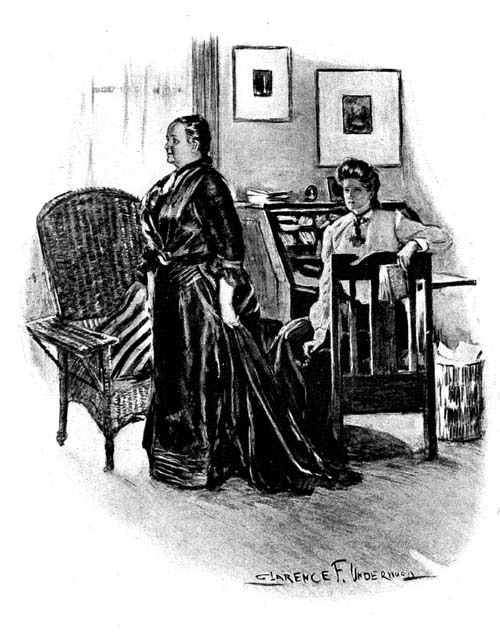
"Ma" Burke asked him, "How did
you make out with her folks?"
He smiled, then laughed.
"I don't know—exactly," he said.
"They couldn't talk my language nor
I theirs. So it was all done through an
interpreter. And he was Mrs. Dean's
brother-in-law, Prince Glückstein,
and a regular trump. He saw them
half a dozen times before I did.
When I saw them everything was
lovely. They left me alone with her
after twenty minutes. Finally it was
agreed that we should come back on
the same steamer, her brother accompanying
her."
"But why on earth didn't you cable
us?" she demanded.
"I did," he replied.
"But you didn't tell us anything,"
she returned.
"I told you all there was to tell," he
replied.
"You only said you were coming,"
she objected.
"Well," he answered, looking
somewhat surprised, "I knew you'd
know I wouldn't come without her."
I'm glad he didn't get it into his
head to "take after" me. A woman
stands no more chance with a man like
that than a rabbit with a greyhound.
February 29. "Ma" Burke is dreadfully
ill—has been for two days. The
doctors have got several large Latin
names for it, but the plain truth is that
she has broken down under the strain
she seemed to be bearing so placidly.
She didn't give up until she was absolutely
unable to lift herself out of bed.
"I knew it was coming," she said, "but
I thought I had spirit enough to put
it off till I had more time."
It wasn't until she did give up that
her face really showed how badly off
she was. I was sitting by her bed when
"pa" Burke and Cyrus came in. I
couldn't bear to look at them, yet I
couldn't keep my eyes off their faces.
Both got deadly white at sight of her,
and "pa" rushed from the room after a
moment or two. The doctor had cautioned
him against alarming her by
showing any signs of grief. But "pa"
couldn't stand it. He went to his study,
and the housekeeper told me he cried
like a baby. Cyrus stayed, and I couldn't
help admiring the way he put on cheerfulness.
"I'll be all right in a few days," said
"ma." "It wasn't what I did; it was
what I et. I'm such a fool that I can't
let things that look good go by. And
I went from house to house, munching
away, cake here, candy there, chocolate
yonder, besides lunches and dinners
and suppers. I et in and I et out. Now,
I reckon I've got to settle the bill.
Thank the Lord I don't have to do it
standing up."
Cyrus and I went away from her
room together. "If she wasn't so good,"
said he, more to himself than to me,
"I'd not be so—so uncertain."
"I feel that I'm to blame," said I
bitterly. "It was I that gave her all
those things to do."
He was silent, and his silence frightened
me. I had felt that I was partly
to blame. His silence made me feel
that I was wholly to blame, and that
he thought so.
"If I could only undo it," I said, in
what little voice I could muster.
"If you only could," he muttered.
I was utterly crushed. Every bit of
my courage fled, and—but what's the
use of trying to describe it? It was as
if I had tried to murder her and had
come to my senses and was realizing
what I'd done.
I suppose I must have shown what
was in my mind, for, all of a sudden,
with a sort of sob or groan, he put his
arms round me—such a strong yet such
a gentle clasp! "Don't look like that,
dear!" he pleaded. "Forgive me—it
was cowardly, what I said—and not
true. We're all to blame—you the least.
Haven't I seen, day after day, how you've
done everything you could to spare her—how
you've worn yourself out?"
He let me go as suddenly as he had
seized me.
"I'm not fit to be called a man!" he
exclaimed. "Just because I loved you,
and was always thinking of you, and
watching you, and worrying about you,
I neglected to think of mother. If I'd
given her a single thought I'd have
known long ago that she was ill."
Just then Mrs. Burke's maid called
me—she was only a few yards away,
and must have seen everything. I hurried
back to the room we had quitted
a few minutes before. "You must cheer
up those two big, foolish men, child,"
she said. "You all think I'm going to
pass over, but I'm not. You won't get
rid of me for many a year. And I rely
on you to prevent them from going all
to pieces."
She paused and looked at me wistfully,
as if she longed to say something
but was afraid she had no right to. I
said: "What is it—ma?"
Her face brightened. "Come, kiss
me," she murmured. "Thank you for
saying that. We're very different in lots
of ways, being raised so different. But
hearts have a way of finding each other,
haven't they?"
I nodded.
"What I wanted to say was about—Cyrus,"
she went on. "My Cyrus told
me that he don't see how he could get
along without you, no way, and I advised
him to talk to you about it, because
I knew it'd relieve his mind and
because it'd set you to looking at him in
a different way. Anyhow, it's always
a good plan to ask for what you want.
And he did—and he told me you wouldn't
hear to him. Don't think I'm trying to
persuade you. All I meant to say is
that—"
She stopped and smiled, a bright
shadow of that old, broad, beaming smile
of hers.
"I'd do anything for you!" I exclaimed,
on impulse.
"I'm afraid that wouldn't suit Cyrus,"
she drawled, good humoredly. "He'd
be mad as the Old Scratch if he knew
what I was up to now. Well—do the
best you can. But don't do anything
unless it's for his sake. Only—just look
him over again. There's a lot to Cyrus
besides his cowlick. And he's been so
dead in love with you ever since he first
saw you that he's been making a perfect
fool of himself every time he looked at
you or spoke to you. Sometimes, when
I've seen the way he's acted up, like a
farmhand waltzing in cowhides, I've felt
like taking him over my knees and laying
it on good and hard."
I was laughing so that I couldn't
answer—the reaction from the fear that
she might be very, very ill had made me
hysterical. I could still see that she was
sick, extremely sick, but I realized that
our love for her had just put us into a
panic.
"Do the best you can, dear," she ended.
"And everything—all the entertaining
here and the going out—must be kept
up just the same as if I was being
dragged about down stairs instead of lying
up here resting."
She insisted on this, and would not be
content until she had my promise. "And
don't forget to cheer pa and Cyrus up.
I never was sick before—not a day.
That's why they take on so."
I think I have been succeeding in
cheering them up. And everything is
going forward as before—except, of
course, that we've cut out every engagement
we possibly could.
It's amazing how many friends "ma"
Burke has made in such a short time.
Ever since the news of her illness got
out, the front door has been opening and
shutting all day long. And those of the
callers that I've seen have shown a real
interest. This has made me have a better
opinion of human nature than I had
thought I could have. I suppose half
the seeming heartlessness in this world
is suspicion and a sort of miserly dread
lest one should give kindly feeling without
getting any of it in return. But
"ma" Burke, who never bothers her
head for an instant about whether people
like her, and gets all her pleasure
out of liking them, makes friends by the
score.
I'm in a queer state of mind about
Cyrus.
March 3. "Ma" Burke was brought
down to the drawing-room for tea
to-day. She held a regular levee. Those
that came early spread it round, and by
six o'clock they were pouring in. She
looked extremely well, and gloriously
happy. All she had needed was complete
rest and sleep—and less to eat.
"After this," she said, "I'm not going
to eat more than four or five meals a
day. At my age a woman can't stand
the strain of ten and twelve—my record
was sixteen—counting two teas as one
meal." For an hour there was hilarious
chattering in English, French, German,
Italian, Russian, and mixtures of all five.
I think the thing that most fascinates
Mrs. Burke about Washington is the
many languages spoken. She looks at
me in an awed way when I trot out my
three in quick succession. And she regards
the women as superhuman who
speak so many languages so fluently that
they drift from one to the other without
being quite sure what they're speaking.
There certainly were enough going
on at once to-day, and a good many of
the women smoked.
But to return to Mrs. Burke. When
only a few of those we know best were
left this afternoon, and Nadeshda was
smoking, Jessie, who is always so tactful,
said to Robert: "I'm glad to see
that you don't object to Nadeshda's
smoking."
Mrs. Burke laughed. "Why should
he?" said she. "Why, when we were
children ma and pa used to sit on opposite
sides of the chimney, smoking their
pipes. And ma dipped, too, when it wasn't
convenient for her to have her pipe."
"Do you smoke, Mrs. Burke?" asked
Jessie, with wide, serious eyes. "I never
saw you."
"No, I don't," she confessed. "Tom
used to hate the smell of it, so I never
got into the habit."
Nadeshda was tremendously amused
by what Mrs. Burke had said about
pipes. "I didn't know it was considered
nice for a lady to smoke in America
until recently," said she. "And
pipes! How eccentric! Mama smokes
cigars—one after dinner, but I never
heard of a lady smoking a pipe."
"Ma wasn't a lady—what you'd call
a lady," replied Mrs. Burke. "She was
just a plain woman. She didn't smoke
because she thought it was fashionable,
but because she thought it was comfortable.
As soon as we children got a little
older we used to be terribly ashamed of
it—but she kept right on. And now it's
come in style."
"Not pipes," said Jessie.
"Not yet," said "ma," with a smile.
When I thought they had all gone,
and I was writing in my "office" for a
few minutes before going up to dress,
Nadeshda came in to me. "Ma" Burke
used often to say that Nadeshda's eyes
were "full of the Old Scratch," but certainly
they were not at that moment.
She was giving me a glimpse of that
side which, as Browning, I think, says,
even the meanest creature has and shows
only to the person he or she loves.
Not that Nadeshda loves me, but she
has that side turned outermost nowadays
whenever she hasn't the veil drawn
completely over her real self.
"My dear," she said in French, "what
is it? Why these little smiles all afternoon
whenever you forgot where you
were?"
I couldn't help blushing. "I don't
quite know, myself," I replied—and it
was so.
"Oh, you cold, cold, cold Americans!"—then
she paused and gave me one of
her strange smiles, with her eyes elongated
and her lips just parted—"I mean,
you American women."
"Cold, because we don't set ourselves
on fire?" I inquired.
"But yes," she answered, "yourselves,
and the men, too. Never mind. I shall
not peep into your little secret." She
laughed. "It always chills me to grope
round in one of your cold American
women's hearts."
"I wish you could tell me what my
secret is—and that's the plain truth,"
said I.
She laughed again, shrugged her
shoulders, pinched my cheek, nodded
her head until her big plumed hat was
all in a quiver and was shaking out volumes
of the strong, heavy perfume she
uses. And without saying anything
more she went away.
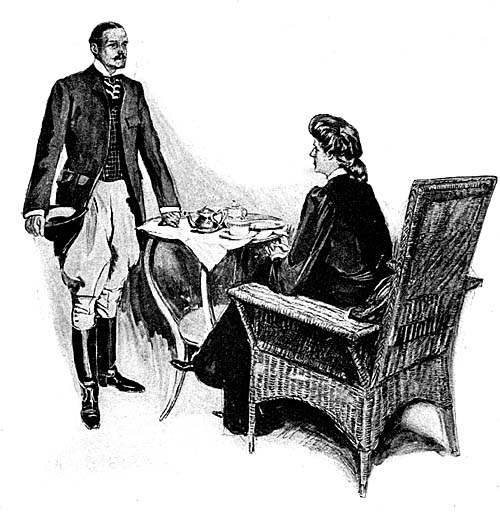
March 4. Cyrus and I sat next each
other at dinner at the Secretary of War's
to-night. It has happened several times
this winter, as the precedence is often
very difficult to arrange at small dinners.
Old Alex Bartlett took me in, and
as he's stone deaf and a monstrous eater
I was free.
Cyrus had taken in a silent little girl
who has just come out. She had exhausted
her little line of prearranged
conversation before the fish was taken
away. So Cyrus talked to me.
"She's grateful for my letting her
alone," said he when I tried to turn
him back to his duty. "Besides, if I
didn't meet you out once in a while
you'd forget me entirely. And I don't
want that, if I can avoid it."
"Thank you," said I, for lack of anything
else to say, and with not the remotest
intention of irritating him. But
he flushed scarlet, and frowned.
"You always and deliberately misconstrue
everything I say," said he bitterly.
"I know I'm unfortunate in trying to
express myself to you, but why do you
never attribute to me anything but the
worst intentions?"
"And why should you assume that
every careless reply I make is a carefully
thought out attack on you?" I retorted.
"Don't you think your vanity
makes you morbid?"
"You know perfectly well that it
isn't vanity that makes me think you
especially dislike me," said he.
"But I don't," I answered. "I confess
I did at first, but not since I've come
to know you better."
"Why did you dislike me at first?"
he asked. "You began on me with almost
the first moment of our acquaintance."
"That's true—I did," I admitted. "I
had a reason for it—didn't Nadeshda tell
you what it was?"
He looked frightened.
"Be frank, if you want me to be
frank," said I.
"I never for an instant believed what
she said," he replied abjectly. Then
after a warning look from me, he added—"Really
believed it, I mean."
"And what was it that you didn't
really believe?" I demanded.
He looked at me boldly. "Nadeshda
and one or two others told me that you
and your friends had arranged it for me
to marry you. But, of course, I knew it
wasn't so."
"But it was so," I replied. "You
were one of the considerations that determined
my friends in trying to get
me my place."
"Well—and why didn't you take me
when I finally fell into the trap?"
I let him see I was laughing at him.
He scowled—his cowlick did look
so funny that I longed to pull it. "Simply
couldn't stand me—not even for the
sake of what I brought," he said. And
then he gave me a straight, searching
look. "I wonder why I don't hate you,"
he went on. "I wonder why I am such
an ass as to care for you. Yes—even if
I knew you didn't care for me, still I'd
want you. Can a man make a more degrading
confession than that?"
"But why?" said I, very careful not
to let him see how eagerly I longed to
hear him say the words again. "Why
should you want—me?"
He gave a very unpleasant laugh. "If
you think I'm going to sit here and exhibit
my feelings for your amusement
you're going to be disappointed. It's
none of your business why. Certainly
not because I find anything sweet or
amiable or even kind in you."
"That's rude," said I.
"It was intended to be," said he.
"Please—let's not quarrel now," said
I coldly. "It gives me the headache
to quarrel during dinner."
And he answered between his set
teeth, "To quarrel with you—anywhere—gives
me—the heartache, Gus."
I had no answer for that, nor should
I have had the voice to utter it if I
had had it. And then Mr. Bartlett began
prosing to me about the Greeley-Grant
campaign. And when the men
came to join the women after dinner
Cyrus went away almost immediately.
I am so happy to-night.
March 5. Cyrus came to me in my
office to-day—as I had expected. But
instead of looking woebegone and abject,
he was radiant. He shut the door behind
him. "You—guilty of cowardice,"
he began. "It isn't strange that I never
suspected it."
"What do you mean?" I asked, not
putting down my pen.
He came over and took it out of my
fingers, then he took my fingers and
kissed them, one by one. I was so
astounded—and something else—that I
made not the slightest resistance. "It's
useless for you to cry out," he said, "for
I've got the outer door well guarded."
I started up aflame with indignation.
"Who—whom—" I began.
"Ma," he replied.
"Oh!" I exclaimed, looking round
with a wild idea of making a dart for
liberty.
"Ma," he repeated, "and it's not of the
slightest use for you to try to side-step.
You're cornered." He had both my
hands now and was looking at me at
arm's length. "So you are afraid to
marry me for fear people—your friends—will
say that—I walked right into
the trap?"
I hung my head and couldn't keep
from trembling, I was so ashamed.
"And if it wasn't for that you'd accept
my 'proposition'—now—wouldn't
you?"
"I would not," I replied, wrenching
myself away with an effort that put my
hair topsy-turvy—it always does try to
come down if I make a sudden movement,
and I washed it only yesterday.
"What gorgeous hair you have!" he
said. "Sometimes I've caught a glimpse
of it just as I was entering a room—and
I've had to retreat and compose
myself to make a fresh try."
"You've been talking to your mother!"
I exclaimed—I'd been casting about
for an explanation of all this sudden
shrewdness of his in ways feminine.
"I have," said he. "It's as important
to her as to me that you don't escape."
"And she told you that I was in love
with you!" I tried to put a little—not
too much—scorn into the "you."
"She did," he answered. "Do you
deny that it's true?"
"I have told you I would never accept
your 'proposition,'" was my answer.
"So you did," said he. "Then you
mean that you're going to sacrifice my
mother's happiness and mine, simply
because you're afraid of being accused
of mercenary motives?"
"I shall never accept your 'proposition,'"
I repeated, with a faint smile
that was a plain hint.
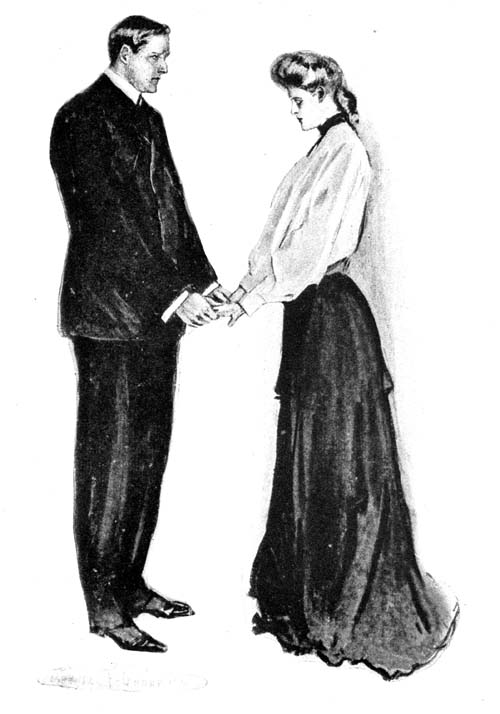
He came very close to me and looked
down into my face. "What do you
mean by that?" he demanded. And
then he must have remembered what his
proposition was—a strictly business arrangement
on both sides. For, with a
sort of gasp of relief, he took me in his
arms. I do love the combination of
strength and tenderness in a man. He
had looked and talked and been so
strong up to that instant. Then he was
so tender—I could hardly keep back the
tears.
"Wouldn't you like me to tell mother?"
he asked. "She's just in the next
room—and—"
I nodded and said, "I never should
have caught you if it hadn't been for
her."
"Nor I you," said he. And he put
me in a chair and opened the door. I
somehow couldn't look up, though I
knew she was there.
"I don't know whether to laugh or
cry," said "ma" Burke. "So I guess
I'll just do both." And then she seated
herself and was as good as her word.
TRANSCRIBER'S NOTE:
Obvious typographical errors have been corrected.