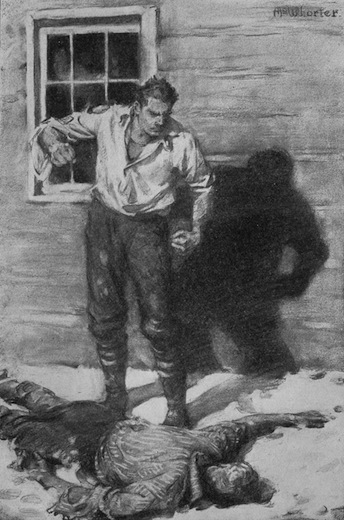
As Reivers led the way out of the shop Toppy saw
that Miss Pearson was standing in the door of
the office across the way. He saw also that she was
looking at him. He did not respond to her look nor
volunteer a greeting, but deliberately looked away
from her as he kept pace with Reivers, who was setting
the way toward the gate of the stockade.
It was a morning such as the one when, back in
Rail Head, the girl had kicked up the snow and said
to him, “Isn’t it glorious?” But since then Toppy
felt bitterly that he had grown so much older, so
disillusioned, that never again would he be guilty
of the tender feelings that the girl had evoked that
morning. The sun was bright, the crisp air invigorating,
and the blood bounded gloriously through his
young body. But Toppy did not wax enthusiastic.
He was grimly glad of the mighty stream of life
that he felt surging within him; he would have use
for all the might later on. But no more. The world
was a harder, a less pretty place than he, in his inexperience,
had fancied it before coming to Hell
Camp.
“What’s this lesson?” he asked gruffly of Reivers.
“What are you going to show me?”
“A little secret in the art of keeping brute-men satisfied
with the place in life which a superior mind
has allotted to them,” replied Reivers. “What is the
78
first need of the brute? Food, of course. And the
second is—fight. Give the lower orders of mankind,
which is the kind to use in running a camp efficiently,
plenty of food and fight, and the problem of restlessness
is solved.
“That’s history, Treplin, as you know. If these
foolish, timid capitalists and leaders of men who are
searching their petty souls for a remedy to combat
the ravages of the modern disease called Socialism
only would read history intelligently, they would find
the remedy made to order. Fight! War! Give the
lower brutes war; let ’em get out and slaughter one
another, and they’d soon forget their pitiful, clumsy
attempts to think for themselves. Give them guns
with a little sharp steel on the end of the barrel, turn
them loose on each other—any excuse would do—and
they’d soon be so busy driving said steel into one
another’s thick bodies that the leaders could slip the
yoke back on their necks and get ’em under hand
again, where they belong.
“And they’d be happier, too, because a man-brute
has got to have so much fighting, or what he calls
his brain begins to trouble him; and then he imagines
he has a soul and is otherwise unhappy. If there is
fighting, or the certain prospect of fighting, there’s
no alleged thinking. There’s the solution of all difficulties
with the lower orders. Of course you’ve noticed
how perfectly contented and happy the men in
this camp are?” he laughed, turning suddenly on
Toppy.
“Yes,” said Toppy. “Especially Rosky and his
bunch.”
The Snow-Burner smiled appreciatively.
“Rosky, poor clod, hadn’t had any fighting. I’d
overlooked him. Had I known that thoughts had begun
to trouble his poor, half-ox brain, I’d have given
79
him some fighting, and he’d have been as content for
the next few weeks as a man who—who’s just been
through delirium tremens.
“He had no object in life, you see. If he’d had
a good enemy to hate and fight, he wouldn’t have been
troubled by thoughts, and consequently he wouldn’t
now be lying in his bunk with his leg in splints.
“There is the system in a nutshell—give a man an
enemy to hate and wish to destroy, and he won’t be
any trouble to you during working-hours or after.
That’s what I do—pick out the ones who might get
restless and set them to hating each other. And now,”
he concluded, as they reached the gate and passed
through, “you’ll have a chance to see how it works
out.”
The big gate, opened for them by two armed guards,
swung shut behind them, and Toppy once more looked
around the enclosure in which he had had his first
glimpse of the Snow-Burner’s system of handling the
men under him. The place this morning, however,
presented a different, a more impressive scene. It
was all but filled with a mass of rough-clad, rough-moving,
rough-talking male humanity.
Perhaps a hundred and fifty men were waiting
in the enclosure. For the greater part they were
of the dark, thick and heavily clumsy type that Toppy
had learned to include under the general title of
Bohunk; but here and there over the dark, ox-like
faces rose the fair head of a tall man of some Northern
breed. Slavs comprised the bulk of the gathering;
the Scandinavians, Irish, Americans—the “white
men,” as they called themselves—were conspicuous
only by contrast and by the manner in which they
isolated themselves from the Slavs.
And between the two breeds there was not much
room for choice. For while the faces of the Slavs
80
were heavy with brute stupidity and malignity, those
of the North-bred men reeked with fierceness, cruelty
and crime. The Slavs were at Hell Camp because they
were tricked into coming and forced to remain under
shotgun rule; the others were there mostly because
sheriffs found it unsafe and unprofitable to seek any
man whom the Snow-Burner had in his camp. They
were “hiding out.” Criminals, the majority of them,
they preyed on the stupid Slavs as a matter of course;
and this situation Reivers had utilised, as he put it,
“to keep his men content.”
Though there was a gulf of difference between the
extreme types of the crowd, Toppy soon realised that
just now their expressions were strangely alike. They
were all impatient and excited. The excitement
seemed to run in waves; one man moved and others
moved with him. One threw up his head and others
did likewise. Their faces were expectant and cruel.
It was like the milling of excited cattle, only worse.
“Come along, Treplin,” said Reivers, and led the
way toward the centre of the enclosure. The noises
of the crowd, the talking, the short laughter, the
shuffling, ceased instantly at his appearance. The
crowd parted before him as before some natural force
that brushed all men aside. It opened up even to
the centre of the yard, and then Toppy saw whither
Reivers was leading.
On the bare ground was roped off a square which
Toppy, with practised eye, saw was the regulation
twenty-four-foot prize-fight ring. Rough, unbarked
tamarack poles formed the corner-posts of the ring,
and the ropes were heavy wire logging-cable. A yard
from one side of the ring stood a table with a chair
upon it. Reivers, with a careless, “Take a seat on
the table and keep your eyes open,” stepped easily
upon the table, seated himself in the chair and looked
81
amused as the men instinctively turned their faces up
toward him.
“Well, men,” he said in a voice which reached like
cold steel into the far corners of the enclosure, “court
is open. The first case is Jan Torta and his brother
Mikel against Bill Sheedy, whom they accuse of stealing
ninety-eight dollars from them while they slept.”
As he spoke the names two young Slavs, clumsy
but strongly built, their heavy faces for once alight
with hate and desire for revenge, pushed close to one
side of the ring, while on the other side a huge red-haired
Celt, bloated and evil of face, stepped free of
the crowd.
“Bill stole the money, all right,” continued Reivers,
without looking at any of them. “He had the chance,
and being a sneak thief by nature he took it. That’s
all right. The Torta boys had the money; now Bill’s
got it. The question is: Is Bill man enough to keep
it? That’s what we’re going to settle now. He’s got
to show that he’s a better man than the two fellows
he took the money from. If he isn’t, he’s got to give
up the money, or the two can have him to do what
they want to with him. All right, boys; get ’em
started there.”
At his brisk order four men whom Toppy had seen
around camp as guards stepped forward, two to
Sheedy, two to the Torta brothers, and proceeded first
to search them for weapons, next to strip them to the
waist. Sheedy hung back.
“Not two av um tuh wanst, Mr. Reivers?” he asked
humbly. “One after deh udder it oughta be; two
tuh wanst, that ain’t no way.”
“And why not, Bill?” asked Reivers gently. “You
took it from both of them, didn’t you? Then keep it
against both of ’em, Bill. Throw ’em in there, boys!”
Toppy looked around at the rows of eager faces
82
that were pressing toward the ringside. Prize-fights
he had witnessed by the score. He had even participated
in one or two for a lark, and the brute lust
that springs into the eyes of spectators was no stranger
to him. But never had he seen anything like this.
There was none of the restraint imposed upon the
human countenance by civilisation in the fierce faces
that gathered about this ring.
Out of the dull eyes the primitive killing-animal
showed unrestrained, unashamed. No dilettante interest
in strength or skill here; merely the bare bloodthirsty
desire to see a fellow-animal fight and bleed.
Up above, the sky was clean and blue; the rough
log walls shut out the rest of the world; the breathing
of a mob of excited men was the only sound upon
the quiet Sunday air. It was the old arena again;
the merciless, gore-hungry crowd; the maddened
gladiators; and upon the chair on the table, Reivers,
lord of it all, the king-man, to whom it was all but
an idle moment’s play.
Reivers, above it all, untouched by it all, and yet
directing and swaying it all as his will listed. Laws,
rules, teachings, creeds—all were discarded. Primitive
force had for the nonce been given back its rule.
And over it, and controlling it, as well as each of the
maddened eight-score men around the ring—Reivers.
And so thoroughly did Reivers dominate the whole
affair that Toppy, sitting carelessly on the edge of
the table, was conscious of it, and knew that he, too,
felt instinctively inclined to do as the men did—to
look to Reivers for a sign before daring to speak or
make a move. The Snow-Burner was in the saddle.
It wasn’t natural, but every phase of the situation
emanated from his master-man’s will. It was even
his wish that Toppy should sit thus at his feet and
look on, and his wish was gratified.
83
But it was well that the visor of Toppy’s cap hid
his eyes, else Reivers might have wondered at the
look that flashed up at him from them.
“Throw ’em in!” snapped Reivers, and the handlers
thrust the three combatants, stripped to the waists
but wearing calked lumberjack shoes, through the
ropes.
A cry went up to the sky from a hundred and fifty
throats around the ringside—a cry that had close kinship
with the joyous, merciless “Au-rr-ruh” of a wolf
about to make its kill. Then an instant’s silence as
the rudely handled fighters came to their feet and
faced for action. Then another hideous yelp rent
the still air; the fighters had come together!
“Queer ring-costumes, eh, Treplin?” came Reivers’
voice mockingly. “Our own rules; the feet as well
as the hands. Lord, what oxen!”
The two Slavs had sprung upon their despoiler like
two maddened cattle. Sheedy, rushing to meet them,
head down, swung right and left overhand; and with
a mighty smacking of hard fist on naked flesh, one
Torta rolled on the ground while his brother stopped
in his tracks, his arms pressed to his middle. The
crowd bellowed.
“Yes, I knew Sheedy had been a pug,” said Reivers
judicially.
Sheedy deliberately took aim and swung for the jaw
of the man who had not gone down. The Slav instinctively
ducked his head, and the blow, slashing
along his jawbone, tore loose his ear. Half stunned,
he dropped to his knees, and Sheedy stepped back
to poise for a killing kick. But now the man who
had been knocked down first was on his feet, and
with the scream of a wounded animal he hurled himself
through the air and went down, his arms close-locked
around Sheedy’s right leg. Sheedy staggered.
84
The ring became a little hell of distorted human speech.
Sheedy bellowed horrible curses as he beat to a pulp
the face that sought to bury itself in his thigh; his
assailant screeched in Slavish terror; and the bull-like
roar of his brother, rising to his feet with cleared
senses and springing into the battle, intermingled with
both. Sheedy’s red face went pale.
Around the ringside the faces of the Slavs shone
with relief. The fight was going their way; they
roared encouragement and glee in their own guttural
tongue. The others—Irish, Americans, Scandinavians—rooting
for Sheedy only because he was of their
breed, were silent.
“Hang tough, Bill,” said one man quietly; and then
in a second the slightly superior brains in Sheedy’s
head had turned the battle. Like a flash he dropped
flat on his back as his fresh assailant reached out to
grip him. The furious Slav followed him helplessly
in the fall; and a single gruff, appreciative shout came
from the few “white men.”
For they had seen, even as the Slav stumbled, Bill
Sheedy’s left leg shoot up like a catapult, burying
the calked shoe to the ankle in the man’s soft middle
and flinging him to one side, a shuddering, senseless
wreck. The man with his arms around Sheedy’s leg
looked up and saw. He was alone now, alone against
the big man who had knocked him down with such
ease. Toppy saw the man’s mouth open and his face
go yellow.
“Na, na, na!” he cried piteously, as Sheedy’s blows
again rained upon him. “I give up, give up, give
up!”
He tried to bury his face in Bill’s thigh; and Bill,
mad with success, strove to pound him loose.
“Kill him, Bill!” said one of the Irishmen quietly.
“You got him now; kill him.”
85
“Stop.” Reivers did not raise his voice. He
seemed scarcely interested. Yet the roars around the
ring died down. Sheedy stopped a blow half delivered
and dropped his arms. The Slav released his
clawlike hold and ran, sobbing, toward his prostrate
brother.
“All right, Bill; you keep the money—for all
them,” said Reivers. “Clear out the ring, boys, and
get that other pair in there.”
The guards, springing into the ring as if under a
lash, picked up the senseless man and thrust him like
a sack of grain through the ropes and on to the ground
at the feet of a group of his countrymen. Toppy
saw these pick the man up and bear him away. The
man’s head hung down limply and dragged on the
ground, and a thin stream of blood ran steadily out
of one side of his mouth. His brother followed, loudly
calling him by name.
“Very efficacious, that left leg of Bill’s; eh, Treplin?”
said Reivers lightly. “Bill was the superior
creature there. He had the wit and will to survive
in a crisis; therefore he is entitled to the rewards
of the superior over the inferior, which in this case
means the ninety-eight dollars which the Torta boys
once had. That’s justice—natural justice for you,
Treplin; and all the fumbling efforts of the lawmakers
who’ve tried through the ages to reduce life to a
pen-and-paper basis haven’t been able to change the
old rule one bit.
“I’ll admit that courts and all the fakery that goes
with them have reduced the thing to a battle of brains,
but after all it’s the same old battle; the stronger
win and hold. And,” he concluded, waving his hand
at the crowd, “you’ll admit that Bill, and those Torta
boys wouldn’t be at their best in a contest of intelligence.”
86
Toppy refused Reivers the pleasure of seeing how
the brutality of the affair disgusted him.
“Why don’t you follow the thing out to its logical
conclusion?” he said carelessly. “The thing isn’t settled
as long as the Torta boys can possibly make reprisals.
To be a consistent savage you’d have to let
’em go to it until one had killed the other. But even
you don’t dare to do that, do you, Reivers?”
Reivers laughed, but the look that he bent on Toppy’s
bland face indicated that he was a trifle puzzled.
“Then you wouldn’t be running the camp efficiently,
Treplin,” he said. “It wouldn’t make any difference
if they were all Tortas; but Bill’s a valuable man.
He furnishes some one a bellyful of hating and fighting
every week. No; I wouldn’t have Bill killed for
less than two hundred dollars. He’s one of my best
antidotes for the disease of discontent.”
The guards now had pulled two other men up to
the ropes and were searching and stripping them.
Toppy stared at the disparity in the sizes of the men
as the clothes were pulled off them. One stood up
strong and straight, the muscles bulging big beneath
his dark skin, his neck short and heavy, his head
cropped and round. He wore a small, upturned moustache
and carried himself with a certain handy air
that indicated his close acquaintance with ring-events.
The other man was short and dark, obviously an Italian;
the skin of his body was a sickly white, his face
olive green. He stood crouched, and beneath his
ragged beard two teeth gleamed, like the fangs of a
snarling dog.
“Antonio, the Knife-Expert, and Mahmout, the
Strangling Bulgarian,” announced Reivers laughingly.
“Tony tried to stick Mahmout because of a little lady
back in Rail Head, and made such a poor job of
it that Mahmout has offered to meet him in the ring;
87
Tony with his knife, Mahmout with his wrestling-tricks.
Start ’em off.”
The Bulgarian was under the ropes and upright in
the ring before the Italian had started. He was in
his stocking-feet, and despite the clumsiness of his
build he moved with a quickness and ease that told
of the fine co-ordination of the effective athlete.
When the Italian entered the ring he held his right
hand behind his back, and in the hand gleamed the
six-inch blade of a wicked-looking stiletto.
A shiver ran along Toppy’s spine, but he continued
to play the game.
“Evidently Mahmout isn’t a valuable man; you
don’t care what happens to him,” he said.
“Not particularly,” replied Reivers seriously. “He’s
a good man on the rollways—nothing extra. Still, I
hardly believe Tony can kill him—not this time, at
least.”
The faces around the ring grew fiercer now.
Growled curses and exclamations came through
clenched teeth. Here was the spectacle that the brute-spirit
hungered for—the bare, living flesh battling for
life against the merciless, gleaming steel.
The big Bulgarian moved neatly forward, bent over
at the waist, his strong arms extended, hands open
before him in the practised wrestler’s guard and attack.
His feet did not leave the ground as he sidled
forward, and his eyes never moved from the Italian’s
right arm. The latter, snarling and panting, retreated
slightly, then began to circle carefully, his small eyes
searching for the opening through which he could leap
in and drive home his steel.
The Bulgarian turned with him, his guard always
before him, as a bull turns its head to face the circling
wolf. Without a sound the knife-man suddenly
stopped and lunged a sweeping slash at the menacing
88
hands. Mahmout, grasping for a hold on hand or
wrist, caught the tip of the blade in his palm, and a
slow bellow of rage shook him as he saw the blood
flow. But he did not lower his guard nor take his
eyes from his opponent.
The Italian retreated and circled again. A horrible
sneer distorted his face, and the knife flashed in
the sunlight as he slashed it to and fro before the
other’s hands. The crowd growled its appreciation.
Three times Antonio leaped forward, slashed, and
leaped back again; and each time the blood flowed
from Mahmout’s slashed fingers. But the wrestler’s
guard never lowered nor did he falter in his set plan
of battle. He was working to get his man into a
corner.
The Italian soon saw this and, leaping nimbly sidewise,
lunged for Mahmout’s ribs. The right arm of
the Bulgarian dropped in time to save his life, but
the knife, deflected from its fatal aim, ripped through
the top muscles of his back for six inches. The mob
roared at the fresh blood, but Mahmout was working
silently. In his spring the Italian had only leaped
toward another corner of the ring.
Mahmout leaped suddenly toward him. Antonio,
stabbing swiftly at the hands reached out for him,
jumped back. A cry from a countryman in the crowd
warned him. Swiftly he glanced over his shoulder,
saw that he was cornered, and with a low, sweeping
swing of the arm he threw the knife low at Mahmout’s
abdomen.
The blade glinted as it flashed through the air;
it thudded as it struck home; but the death-cry which
the mob yelped out died short. With the expert’s
quickness Mahmout had flung his huge forearms before
the speeding blade. Now he held his left arm
89
up. The stiletto, quivering from the impact, had
pierced it through.
With a fierce roar Mahmout plucked out the knife,
hurled it from the ring and dived forward. The
Italian fought like a fury, feet, teeth and fingernails
making equal play. He sank his teeth in the injured
left arm. Mahmout groped with his one sound hand
and methodically clamped a hold on an ankle. He
made sure that the hold was a firm one; then he
wrenched suddenly—once. The Italian screamed and
stiffened straight up under the appalling pain. Then
he fell flat to the ground, and Toppy saw that his
right foot was twisted squarely around and that the
leg lay limp on the ground like a twisted rag.
“Stop,” said Reivers, and Mahmout stepped back.
“Take Tony’s knife away from him, boys. Mahmout
wins—for the time being.”
“Inconsistent again,” muttered Toppy. “Your
scheme is all fallacies, Reivers. You give Tony a
knife with which he may kill Mahmout at one stroke,
but you don’t let Mahmout finish him when he’s got
him down. Why don’t you carry your system to its
logical conclusion?”
“Why don’t I?” chuckled Reivers, stepping down
from the table. “Why, simply because Signor Antonio
is the camp cook, and cooks are too scarce to
be destroyed unnecessarily. Now come along, Treplin.
Court’s adjourned; a light docket to-day. I’ve
been thinking of your wanting to learn how to run
a logging-camp. I’m going to give you a change of
jobs. You’ll be no good in the blacksmith-shop till
your ankle’s normal again. Come along; I’ll show you
what I’ve picked out for you.”
He turned away from the ring as from a finished
episode in the day’s work. That was over. Whether
Torta or Antonio lived or died, were whole or
90
crippled for the rest of their lives, had no room in his
thoughts. He strode toward the gate as if the yard
were empty, and the crowd opened a way far before
him. Outside the gate he led the way around
the stockade toward where the river roared and tumbled
through the chutes of Cameron Dam.
A cliff-like ledge, perhaps thirty feet in height,
situated close to one end of the dam, was Reivers’
objective, and he led Toppy around to the side facing
the river. Here the dirt had been scraped away
on the face of the ledge, and a great cave torn in
the exposed rock. The hole was probably fifty feet
wide, and ran from twelve to fifteen feet under the
brow of the ledge. Toppy was surprised to see no
timbers upholding the rocky roof, which seemed at
any moment likely to drop great masses of jagged
stone into the opening beneath.
“My little rock-pile,” explained Reivers lightly.
“When my brutes aren’t good I put ’em to work here.
The rock goes into the dam out there. Just at present
Rosky’s band of would-be malcontents are the
ones who are suffering for daring to be dissatisfied
with the—ah—simplicity, let us say, of Hell Camp.”
He laughed mirthlessly.
“I’m going to put you in charge of this quarry,
Treplin. You’re to see that they get one hundred
wheelbarrows of rock out of here per hour. You’ll
be here at daylight to-morrow.”
Toppy nodded quietly.
“What’s the punishment here?” he asked, puzzled.
“It looks like nothing more than hard work to me.”
Reivers smiled the same smile that he had smiled
upon Rosky.
“Look at the roof of that pit, Treplin,” he said.
“You’ve noticed that it isn’t timbered up. Occasionally
a stone drops down. Sometimes several stones.
91
But one hundred barrows an hour have to come out
of there just the same. And those rocks up there,
you’ll notice, are beautifully sharp and heavy.”
Toppy felt Reivers’ eyes upon him, watching to see
what effect this explanation would have, and consequently
he no more betrayed his feelings than he had
at the brutal scenes of the “court.”
“I see,” he said casually. “I suppose this is why
you made me read up on fractures?”
“Partly,” said Reivers. He looked up at the jagged
rocks in the roof of the pit and grinned. “And sometimes
an accident here calls for a job for a pick and
shovel. But I’m just, Treplin; only the malcontents
are put to work in here.”
“That is, those who have dared to declare themselves
something besides your helpless slaves.”
“Or dared to think of declaring themselves thus,”
agreed Reivers promptly.
“I see.” Toppy was looking blandly at the roof,
but his mind was working busily.
“Just why do you give me charge of this hole,
Reivers—if you don’t mind my asking? Isn’t it rather
an unusual honour for a green hand to be put over a
crew like this?”
“Unusual! Oh, how beastly banal of you, Treplin!”
laughed Reivers carelessly. “Surely you didn’t
expect me to do the usual thing, did you? You say
you want to learn how to handle a camp like this.
You’re an interesting sort of creature, and I’d like to
see you work out in the game of handling men, so I
give you this chance. Oh, I’ll do great things for you,
Treplin, before I’m done with you! You can imagine
all that I’ve got in store for you.”
The smile vanished and he turned away. He was
through with this incident, too. Without another
word or look at Toppy he went back to the stockade,
92
his mind already busy with some other project.
Toppy stood looking after him until Reivers’ broad
back disappeared around the corner of the stockade.
“No, you clever devil!” he muttered. “I can’t imagine.
But whatever it is, I promise I’ll hand it back
to you with a little interest, or furnish a job for a
pick and shovel.”
He walked slowly back to the blacksmith-shop. He
was glad to be left alone. Though he had permitted
no sign of it to escape him, Toppy had been enraged
and sickened at what he had seen in the stockade.
He admitted to himself that it was not the
fact that men had been disabled and crippled, nor
the brutal rules that had governed, nor that men had
been exposed to death at the hands of others before
his eyes, that had stirred him so. It was—Reivers.
Reivers sitting up there on the table playing with
men’s bodies and lives as with so many cards—Reivers,
the dominant, lord over his fellows.
The veins swelled in Toppy’s big neck as he thought
of Reivers, and his hitherto good-natured face took
on a scowl that might have become some ancestral
man-captain in the days of mace and mail, but which
never before had found room on Toppy’s countenance—not
even when the opposing half-backs were guilty
of slugging. But he was playing another game now,
an older one, a fiercer one, and one which called to
him as nothing had called before. It was the man-game
now; and out there in the old, stern forest,
spurred by the challenge of the man who was his natural
enemy, the primitive fighting-man in Toppy shook
off the restraint with which breeding, education and
living had cumbered him, and stood out in a fashion
that would have shocked Toppy’s friends back East.
Near the shop he met Miss Pearson. By her manner
93
he saw that she had been waiting for him, but
Toppy merely raised his cap and made to pass on.
“Mr. Treplin!” There was astonishment at his
rudeness in her exclamation.
“Well?” said Toppy.
“Your ankle?”
“Oh, yes. Pardon me for not expressing my thanks
before. It’s almost well—thanks to you and Mr.
Reivers.”
She made a slight shrinking movement and stood
looking at him for a moment. She opened her lips,
but no words came.
“Old Scotty told me about your kindness in coming
to see me, you and Mr. Reivers together,” said
Toppy. “It was a relief to learn that your confidence
in Reivers was justified.”
She looked up quickly, straight into his eyes. A
troubled look swept over her face. Then with a toss
of the head she turned and crossed the road, and
Toppy swung on his way to the room in the rear of
the shop and closed the door behind him with a vicious
slam.