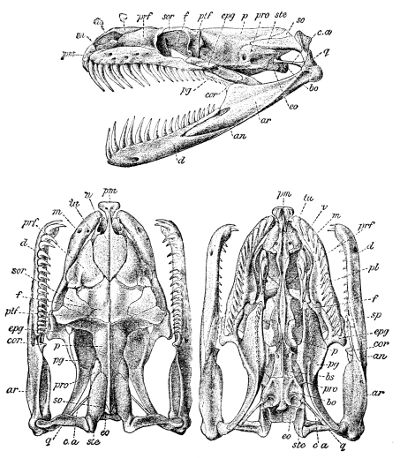
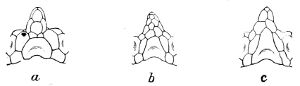
Maxillary, palatine, and pterygoid bones movable;
transverse bone present; pterygoid extending to
quadrate or mandible; supratemporal present, attached
scale-like to cranium, suspending quadrate;
prefrontal not in contact with nasal; maxillary
horizontal, not movable perpendicularly to the transverse
bone; no coronoid bone. Teeth in both jaws.
No vestiges of pelvic arch.
An enormous group, comprising the great majority
of snakes. Divided into three parallel series:
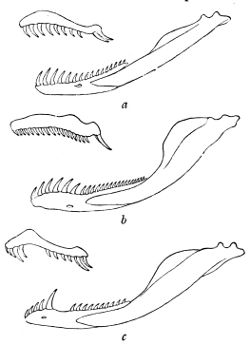
A. Aglypha, with all the teeth solid.
B. Opisthoglypha, with one or more of the posterior
maxillary teeth grooved.
C. Proteroglypha, with the anterior maxillary teeth
grooved or canaliculated.
The third, which is not represented in Europe,
includes some of the most deadly snakes, such as the
Cobras, Kraits, Death-adders, etc.
The European genera are thus distributed in the
two other series:
Aglypha (Colubrinæ): Tropidonotus, Zamenis,
Coluber, Coronella, Contia.
Opisthoglypha (Dipsadomorphinæ): Cœlopeltis,
Macroprotodon, Tarbophis.
These genera give but a feeble idea of the
variety of forms included in this family, which
comprises adaptations to every mode of life for which
snakes are fitted.
The distribution of the family coincides with that
of the order, extending over the whole world with
the exception of the Arctic and Antarctic regions,
and Ireland and New Zealand, as well as most of
the smaller islands of the Pacific Ocean.
Maxillary teeth increasing in size posteriorly.
Head more or less distinct from neck; eye moderate
or rather small, with round pupil. Body more or
less elongate; scales keeled, with apical pits. Tail
moderate.
This large genus, comprising about ninety species,
and of almost cosmopolitan distribution, with the
exception of South America and the greater part of
Australia, may be divided into several subgenera, two
of which are represented in Europe—Tropidonotus
proper, with the common T. natrix, and Nerodia,
Baird and Girard, with two closely related species
of more thoroughly aquatic habits, T. tessellatus and
T. viperinus.
3. Tropidonotus natrix, Linnæus
(Natrix vulgaris, Laurenti; Coluber torquatus, Lacepède)
The Grass-Snake, or Ring-Snake
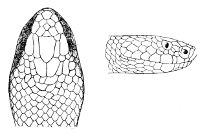
Form.—Moderately slender; snout short, obtuse,
not prominent; eyes and nostrils lateral, the former
moderately large. Tail four to six and a half times
in the total length.
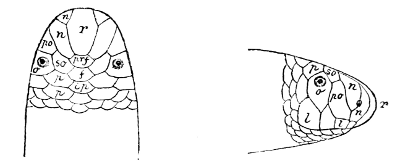
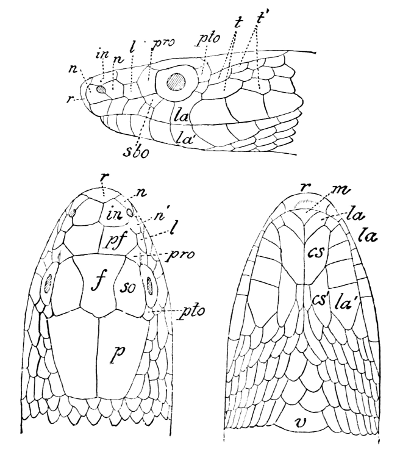
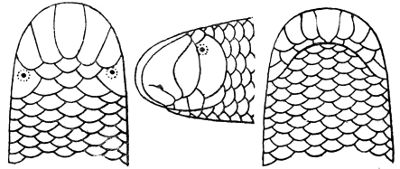
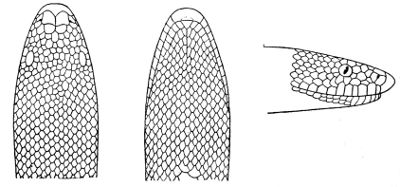
Head-Shields.—Rostral broader than deep, visible
from above. Nasal divided, very rarely semidivided.
Internasals at least as broad as long, trapezoid,
shorter than the prefrontals. Frontal broader than
the supraocular, once and one-third to once and a half
as long as broad, as long as or a little shorter than
its distance from the end of the snout, shorter than
the parietals, not in contact with the preocular.
Loreal deeper than long. One (rarely two) pre-
and three (rarely two or four) postoculars. Temporals
1 + 2. Upper labials seven (rarely six or
eight), third and fourth (or fourth and fifth) entering
the eye. Four or five lower labials in contact with
the anterior
chin-shields,
which are
shorter than
the posterior.
Scales with
two apical
pits, in nineteen
rows,
strongly
keeled on the body, of outer row smooth or faintly
keeled. Ventral shields 157 to 181; anal divided;
subcaudals 50 to 88.
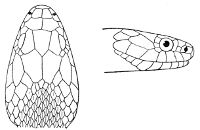
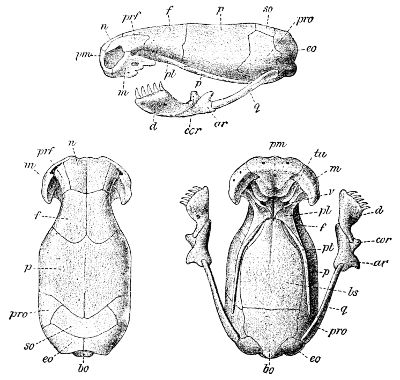
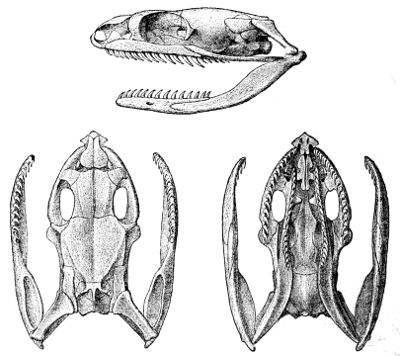
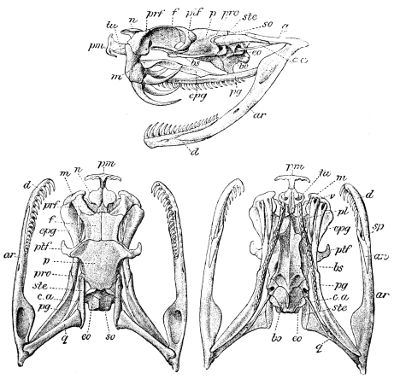
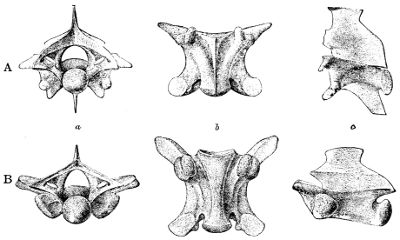
Fig. 16 (after Sordelli)
Coloration.—Very variable. We shall first describe
the typical form, and then allude to the
principal varieties and individual variations with
which we are acquainted.
Grey, bluish-grey, olive, or brown, above, usually
with black spots or narrow bars on the back, and
vertical bars on the sides; upper lip whitish or
yellowish, with the sutures between the shields black;
the preocular, and sometimes the postoculars, yellow
in the young; a white, yellow, or orange collar on the
nape, sometimes uninterrupted, more often divided
in the middle, bordered behind by two black subtriangular
or crescentic blotches, which usually meet
on the median line; the bright collar often becomes
faint, or even entirely disappears, in large females
(Plate II., first figure); belly usually checkered black
and grey or white, more rarely grey with small black
spots, or entirely black. Iris dark brown or reddish-brown,
with a golden circle round the pupil. This
is the form found in England and Central Europe
and in some parts of Southern Europe.
In Jersey, in the Spanish Peninsula, and in
Cyprus, the white or yellow collar, which is always
present in the very young, soon disappears, and so
does usually the black collar, which is either much
reduced or entirely absent (var. astreptophorus,
Seoane). Some large specimens from the Spanish
Peninsula are uniform olive, without any markings.
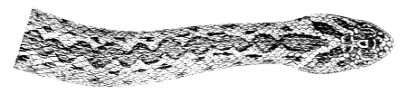
Another variation (Plate II., third figure), rare in
France, but common in Italy, South-Eastern Europe,
and Asia Minor (var. persa, Pallas; bilineatus, Bibr.;
murorum, Bonap.) has the collar well marked, though
widely interrupted in the middle, and a white, yellow,
or orange streak extends along each side of the back,
which may bear the usual black markings in addition.
In some specimens from Austria and Corfu (var.
subfasciatus, Werner) the belly is white, with black
bars occupying the free edge of each ventral shield.
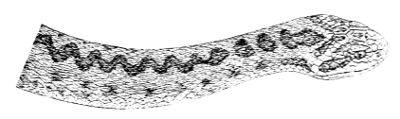
A very remarkable variety (var. cettii, Gené) from
Corsica and Sardinia (Plate II., second figure) is grey
or olive above, with the black markings confluent
into more or less regular annuli, which are nearly
as wide as the spaces between them; these annuli
are often broken up on the middle line of the back,
and alternating; the collar is absent, or is transformed
into the first annulus, and the upper surface
of the head is more or less spotted or blotched with
black. This pattern is most distinct in young and
half-grown specimens; in large examples the annuli
may break up into spots, disposed with great symmetry
in transverse series. The belly is black,
spotted with white.
A specimen 20 inches long, from Bona, Algeria
(Lataste collection), has the posterior half of the
head, from between the eyes and behind the postocular
shields, of an intense black, followed by the
usual yellow and black collar; two light dots close
together on the parietal shields.
Some specimens are entirely or nearly entirely
black. In the var. picturatus, Jan, from the Caucasus,
the upper parts are sprinkled all over with light
dots, and the yellow collar is present; the belly is
grey, dotted with black, and with white spots on
the sides. In others the body is black above, and
checkered black and white beneath (var. scutatus,
Pall.), or entirely black (var. ater, Eichw.). This
melanism never appears until the second or third
year of life, the young being marked like the typical
form.
Albinos have occasionally been met with, yellowish
flesh-colour with reddish markings, and a white or
yellow collar, the eye and the tongue red. Such an
albino, from Horsted Keynes, Sussex, is preserved
in the British Museum. A remarkable aberration, to
be regarded as an imperfect albino, has been found
in Dorsetshire, and described as uniform whitish,
with a well-defined broad longitudinal central dorsal
pale yellow-brown band.
Size.—May reach a length of 6 feet 8 inches.
Such giants, females, known from Sardinia, Sicily,
and Istria, are, however, very exceptional, individuals
of this species seldom exceeding a length of 4 feet.
The largest British specimen on record, from Wales,
is stated to measure 5 feet 10 inches. Males rarely
exceed 3 feet.
Monstrosity.—A dicephalous young, with the two
well-formed heads side by side, is preserved in the
British Museum, and several others have been
described, one being reported to have lived for
about a month.
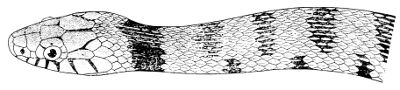
TROPIDONOTUS NATRIX
After Sordelli
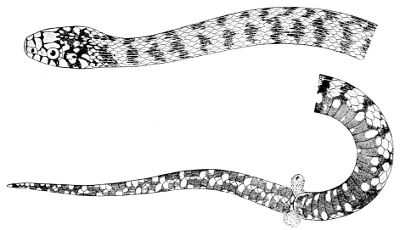
T. NATRIX, VAR. CETTII
After Sordelli
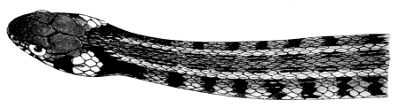
T. NATRIX, VAR. PERSA
Distribution.—Tropidonotus natrix occurs all over
Europe, with, of course, the exception of Ireland,
as far north as the extreme south-east of Scotland,
and the
sixty-fifth degree in Scandinavia and Finland,
and as high up as 7,450 feet in the Italian Alps.
With the exception of a few districts in England and
in Central Europe, as well as in the extreme north,
it is common everywhere, in the north as well as
in the south. On the Mediterranean islands it is
absent from the Baleares and Malta. In North
Africa it is known from Algeria and Tunisia, north
of the Atlas, where it does not seem, however, to
be at all common. It has a wide range in Asia,
extending eastwards to Lake Baikal, and southwards
to Cyprus, Asia Minor, and Northern Persia. In
the south-east of its range, the bilineated variety
predominates over the typical form. The melanistic
so-called varieties are not geographically restricted,
but occur all over the habitat of the species, though
not recorded from England.
Habits.—Although fond of water, and often seen
swimming in ponds or streams or creeping by the
water’s edge, this snake is far less aquatic than its
two congeners described hereafter; it often occurs
on dry chalk hills or in woods far from any water.
It is moderately agile in its movements, and easily
caught, on which occasions it hisses loudly and
emits a nauseous smell from its anal glands, together
with the renal dejections, but makes no attempt to
bite; exceptionally an individual may go so far as
to strike with open mouth, but cases of this snake
really biting are extremely rare. However, Gené
says of the male of his Natrix cettii, “iracundum et
mordacissimum animal.” Dr. Gadow relates his
experience with aggressive specimens which inhabited
a swamp with a little stream to the north
of Oporto, close to the coast. To his utter surprise,
some of them actually made for him, swimming
along rapidly with the head erect, about 6 inches
above the water, and darting forwards with widely
opened jaws; but they did not bite. According to
Professor Kathariner, this snake when caught has
been observed to sham death, lying rigid and motionless,
with open gape. Some specimens do well in
captivity, and are known to have lived for many
years; others refuse all food and die of starvation.
After a time they become tolerably tame, and cease
to produce the offensive odour when handled.
The food consists of frogs and toads—the latter
being preferred notwithstanding their poisonous
secretion, which protects them from the attacks of
most animals—occasionally of newts, seldom of fish;
these snakes are reported to have a predilection for
tree-frogs, and to feed occasionally on mice and birds,
but most observers agree that they will not take
anything higher in the zoological scale than frogs.
The prey is swallowed alive, and, if not very large,
four or five frogs or toads are often taken in succession;
a case is known of a snake having swallowed
twenty very small frogs at one meal. The young
feed on worms and batrachian larvæ, in addition
to very small frogs and toads.
The Grass-snake gets on very well with the
Adder, to whose venom it is immune.
It has more than once been met with swimming
in the sea, and a case is reported of one having been
captured in the open sea twenty-five miles from the
nearest land, no doubt carried away by the current,
but still perfectly lively.
The hibernating season is spent in holes in walls
or at the root of trees, often under manure-heaps,
and the awakening occurs in March or April, soon to
be followed by the first exuviation and the pairing.
Reproduction.—Pairing takes place in April or in
May, according to the climate, and the eggs are
laid between June and August, the young emerging
six to ten weeks later. It is probable that a second
pairing occasionally takes place in the autumn, as
eggs have sometimes been found in manure-heaps
at the end of winter. Females do not breed until
about 2 feet long, males a little sooner. The eggs
number 11 to 48, according to the size of the
female, and, after being produced in a string, stick
together in a mass, without any regularity.
The eggs measure 1 to
11⁄2
inches in length, and
when newly laid are about once and a half as long
as broad. They often contain at the time they are
produced a more or less developed embryo. They
are sometimes laid in recesses in walls, in heaps
of sawdust near sawmills, under dead leaves, but
preferably in manure, for which purpose females
often approach farms during the period of oviposition.
Holes near baking ovens at the back of village houses
are sometimes selected as breeding resorts. The
female rolls herself up, and by violent contortions
makes a sort of chamber in the manure, in which
she may remain for some days after the eggs have
been produced. It is not very unusual for several
females to congregate for the purpose of laying, and
as many as 1,200 eggs have been found in the same
hole. The young on emerging has lost the umbilical
cord, and measures 6 to
81⁄2
inches. It often
remains for a considerable time, sometimes until
the following spring, in the hole or manure-heap in
which it was born, feeding principally on worms.
Very young specimens are never found in the water.
4. Tropidonotus tessellatus, Laurenti
(Coluber hydrus, Pallas)
The Tessellated Water-Snake
Form.—Rather slender; head rather long and
narrow; snout obtuse, not prominent; eyes and
nostrils directed upwards and outwards, the former
rather small, the latter somewhat valvular. Tail
four to six times in the total length.
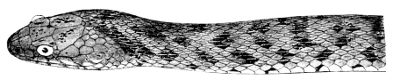
TROPIDONOTUS TESSELLATUS

TROPIDONOTUS VIPERINUS
After Sordelli
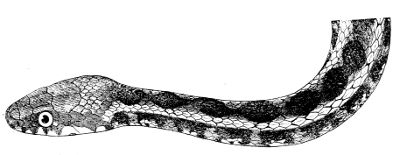
T. VIPERINUS, VAR. AUROLINEATUS
After Sordelli
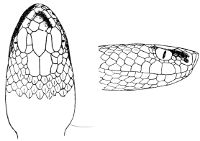
Head-Shields.—Rostral broader than deep, visible
from above. Nasal often semidivided. Internasals
usually as long as broad or longer, subtriangular,
truncate in front, as long or nearly as long as the
prefrontals. Frontal a little broader than the supraocular,
once and a half to twice as long as broad, as
long as or a little shorter than its distance from the
end of the snout, shorter than the parietals, not in
contact with the preocular. Loreal as deep as or
deeper than long. Two (rarely one or three) preoculars,
with or without a small subocular below;
three postoculars, often with one or two suboculars
below. Temporals 1 + 2. Upper labials eight (rarely
seven, nine, or
ten), fourth or
fourth and fifth
(rarely third or
fifth) entering
the eye. Five
(rarely four)
lower labials in
contact with the
anterior chin-shields,
which are shorter than the posterior.
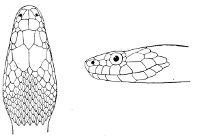
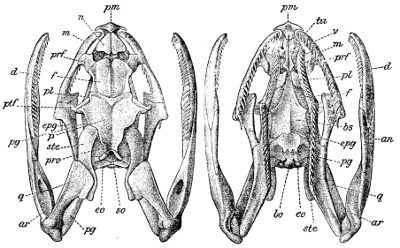
Fig. 17
Scales with two apical pits, in nineteen rows,
strongly keeled, of outer row smooth or feebly keeled.
Ventrals 160 to 187; anal divided; subcaudals
48 to 79.
Coloration.—Olive, olive-grey, or brown above, with
dark spots usually arranged quincuncially or forming
narrow bars on the back (Plate III.); sides often with
lighter vertical bars; a more or less distinct
Λ-shaped
dark band on the nape, sometimes produced as a
median streak to the frontal shield; upper lip
yellowish, with dark bars on the sutures between the
shields. Lower parts whitish, yellow, orange, or
red, marbled or checkered with black, or nearly
entirely black. Iris golden, bronzy, or coppery red.
Some specimens depart very strikingly from the
coloration thus briefly defined. We will now
mention the principal variations which have been
described: Sides of body checkered with black and
yellow or black and red (var. rubro-maculosus,
Dürigen). With four dark stripes along the anterior
part of the back (var. lineaticollis, Werner). Above
with four light streaks in addition to the dark
markings. Uniform grey or light brown above (var.
concolor, Jan, hagenbecki, Werner). Uniform black or
blackish (var. nigrescens, De Betta). The most
remarkable variety is the var. vosseleri, Werner,
from Asia Minor: above with small black and
yellowish spots, beneath yellowish with three blackish
stripes beginning at some distance from the head,
the median much weaker than the outer; the scales
are less strongly keeled than in the typical form.
There are also specimens with two very regular
black stripes along the belly.
A case of chlorochroism, in a specimen from Dalmatia,
has been observed by Peracca. The snake was
sulphur yellow with black markings; a black band
along the belly; iris golden.
An imperfect albino, which has been met with
several times in Dalmatia, has been described as
var. flavescens, Werner. Yellowish-white or brownish-yellow
above, with small blackish spots; belly
whitish in the middle, with a series of black spots,
bright yellow on the sides; eye and tongue red.
Size.—This snake occasionally reaches a length of
4 feet, but specimens over 3 feet are rare. The
largest specimen in the British Museum measures
3 feet 10 inches.
Distribution.—The Tessellated Snake has a wide
range in Europe and Asia. It is found south of the
Alps, from Liguria to Naples, and eastwards, extending
northwards over the greater part of Austria-Hungary,
and even as far as Saxony, and again reappears
to the west in various localities of the Middle
Rhine district (from Bingen to Coblenz and Kreuznach,
from Nassau to Lahnstein) and of the Moselle.
From Southern Russia it extends into Siberia as far as
the Altai, the extreme west of China, and the extreme
north-west of India; it is also found in Asia Minor,
Transcaucasia, Persia, Mesopotamia, Syria, and the
neighbouring parts of Egypt. Italy and the Rhine
constitute the western limit of its range in Europe.
It does not ascend to any considerable altitude
in the mountains of Europe, but it is on record from
6,000 feet elevation in Chitral.
Habits.—This is a far more aquatic species than
the preceding, being seldom found in summer away
from the water, in which it swims and dives to
perfection; which does not prevent it from being
equally agile on land. In accordance with these
thoroughly aquatic habits, it feeds mostly on fish,
although occasionally taking frogs and toads and
their tadpoles. Small fish are swallowed in the
water, but large ones are landed. This snake does
not object to salt water, and it has been observed
on the seashore near Odessa, chasing small fish,
mostly gobies, in shallow water. Hibernation and
pairing take place on land, and it is not until the
latter function is accomplished that the snakes of
this species resort to the water, which the females
leave again for oviposition. Like the Grass-snake,
the Tessellated Snake seldom bites.
Reproduction.—Pairing takes place in spring, when
large numbers have been observed to congregate for
the purpose. As in the Viperine Snake, a second
pairing may occur in the autumn, Dr. Werner having
found a pair in copula on September 14, at Trebinje,
Herzegovina, the female laying her eggs in the
following July, which with the beginning of August
is the time for oviposition. The eggs measure a
little over an inch in length and two-thirds of an
inch in width, and number 5 to 25; they are deposited
under stones, in the fissures of walls and rocks, or
under the refuse of tanneries.
5. Tropidonotus viperinus, Latreille
The Viperine Water-Snake
Form.—Moderately slender; head shorter than
in the preceding species; snout obtuse, not prominent;
eyes and nostrils directed upwards and
outwards, the former rather small, the latter somewhat
valvular; tail four to six times in the total
length.
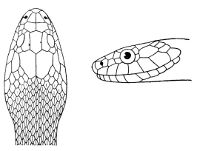
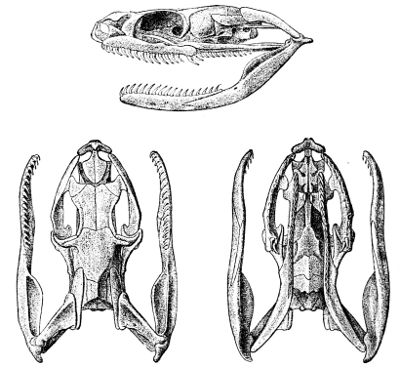
Fig. 18 (after Sordelli)
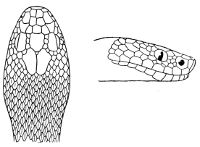
Head-Shields.—Rostral broader than deep, visible
from above. Nasal usually semi-divided. Internasals
as long as
broad or longer,
subtriangular,
truncate in front,
as long as the prefrontals.
Frontal
usually broader
than the supraocular,
once and
a half to twice
as long as broad, as long as or slightly longer
than its distance from the end of the snout, shorter
than the parietals, not in contact with the preocular.
Loreal as deep as or a little deeper than long. One
or two preoculars and two (rarely three) postoculars.
Temporals 1 + 2 or 1 + 3. Upper labials seven (rarely
eight), third and fourth (or third, fourth, or fourth
and fifth) entering the eye. Four (rarely five) lower
labials in contact with the anterior chin-shields,
which are usually shorter than the posterior.
Scales with two apical pits, in twenty-one (rarely
nineteen or twenty-three) rows, strongly keeled, of
outer row smooth or feebly keeled. Ventrals 147 to
164; anal divided; subcaudals 46 to 72.
Coloration.—Grey, brown, or reddish above with
two alternating series of dark brown or black spots
on the back, or with a black zigzag dorsal band
(Plate III., second figure), rarely with a single series
of black vertebral spots; a lateral series of black
spots, usually ocellar, with yellow centres; upper
surface of head with dark symmetrical markings;
a more or less distinct dark band on the temple, and
another on each side of the nape, often edged with
yellow in front; upper lip yellow, with dark bars
on the sutures between the shields, or dark with a
yellow spot on each shield. Lower parts yellow or
red, checkered with black, or entirely black; the
black of the belly may be connected with the ocellar
lateral spots by black vertical bars. Iris golden,
often mixed with brown.
A specimen from Ponte Carrega, near Genoa,
preserved in the Genoa Museum, is remarkable as
being of a dark olive-grey, with three series of black
and yellow ocellar spots. It is further exceptional
in having the scales in nineteen rows. A second
specimen, from the same locality, with the normal
number of scales, has some of the vertebral spots
ocellar. Specimens with ocellar vertebral spots are
found also in Sardinia and in Spain.
As in T. natrix, there occur, in the South of
France, in Sardinia, in the Spanish Peninsula, and
in North Africa, specimens with two light yellow
or reddish lines along the back (Plate III., third
figure), in addition to the usual markings (C. aurolineatus,
Gervais, T. chersoides, Duméril and Bibron).
Melanism is rare in this species, only one specimen
being known, from Nantes in Southern Brittany;
uniform black, with the exception of a few white
spots on the belly. A remarkable variety (var.
incertus, Fatio), connecting this species with the
preceding, occurs in Switzerland near Geneva. Not
only is its coloration sometimes very similar to
that of T. tessellatus, but it agrees with it in the scales
being often disposed in nineteen rows instead of
twenty-one, and in the presence of eight upper
labials, fourth or third and fourth entering the eye;
however, the frequent presence of ocellar spots
on the sides, and the low number of ventral shields
(147 to 151), show that it should be referred to
T. viperinus.
Size.—Rarely reaches a length of 3 feet in Europe,
the largest specimens being from Sardinia. An
Algerian specimen 3 feet 3 inches long is on record.
Distribution.—France as far north as Southern
Brittany, the Forest of Fontainebleau, and the
Department Aube, the whole of the Spanish Peninsula
and the Balearic Islands, Southern Switzerland,
north and south of the Alps, Liguria, Piedmont,
Corsica, Sardinia, and Sicily. In Africa in
Morocco, Algeria, and Tunisia, penetrating into the
northern parts of the Sahara.
In Liguria, Piedmont, and Ticino, T. viperinus
occurs alongside with T. tessellatus. It reaches an
altitude of nearly 4,000 feet in the Alps.
Habits.—Very much the same as in the preceding
species, although slightly less thoroughly aquatic,
large individuals being sometimes met with at some
distance from water. Ponds and marshes are the
favourite abode of the Viperine Snake, huge numbers
being often found on the borders, diving into
the water when disturbed. Frogs and toads, tadpoles,
newts, fishes, and large earthworms, are its
principal food when adult, the young feeding chiefly
on batrachian larvæ, young fishes, and earthworms.
A case is known of this snake having eaten a water-shrew
(Crossopus fodiens). When a fish has been
caught, it is usually eaten on land; in captivity dead
fish are rather readily accepted, provided they be
quite fresh. Some specimens bite when handled;
others are as gentle as the Grass-snake.
For hibernation, hollow trees, fissures in rocks,
holes in the ground or in railway embankments,
are selected, and numerous individuals sometimes
congregate in the same retreat. In the mild winters
of the South of Europe they remain quiet, without
being torpid, and resume activity very early in the
spring.
In the Alemtejo, according to Gadow, when
during the rainless and hot summer the small rivers
have nearly dried up, these snakes collect in great
quantities in the remaining stagnant and muddy
pools, and, as the stock of suitable fish gets exhausted,
are often reduced to a deplorably emaciated
condition. By the month of August they have
become so thoroughly aquatic that they cannot be
kept alive in dry surroundings for twenty-four hours,
apparently dying from some kind of cutaneous
suffocation. The same observer once caught a
Viperine Snake in a ditch whilst it was swallowing
an eel of nearly its own length.
Some specimens show so great a superficial resemblance
to the Common Adder, Vipera berus,
which, however, being a more northern reptile, very
seldom occurs in the same localities—that this snake
well deserves its name Viperinus. A celebrated
herpetologist, Constant Duméril, was once himself
deceived by this resemblance and bitten by a Vipera
berus which he had picked up in the Forest of Senart,
near Paris, believing it to be a Tropidonotus viperinus;
whilst, conversely, a specimen of the harmless snake
was killed in mistake for a Viper by no less an expert
than Dr. Viaud-Grandmarais.
Breeding.—This snake pairs in March and April,
and sometimes again in the autumn; but the eggs
are only laid at one season, in June or July, and
hatch in August, September, or October. The eggs,
numbering four to twenty, are deposited in holes not
far from water, often in abandoned galleries of voles
or moles. The young at birth measure 4 to
61⁄2
inches, and soon resort to the water, where, unlike
those of the Grass-snake, they are frequently met
with.
Maxillary teeth increasing in size posteriorly, the
two last often separated from the others by a narrow
interspace. Head elongate, distinct from neck;
eye rather large, with round pupil. One or more
subocular shields. Body much elongate; scales
smooth, with apical pits. Tail long.
The species of this genus, about thirty in number,
are distributed over Europe, North Africa, Asia, and
North and Central America. Three inhabit Europe.
6. Zamenis gemonensis, Laurenti
(Coluber viridiflavus, Lacepède; C. atrovirens, Shaw)
The European Whip-Snake
Form.—Slender; snout rounded, with distinct
canthus, moderately prominent, concave on each
side in front of the eye. Tail three and one-third
to four and one-third times in the total length.
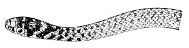
ZAMENIS GEMONENSIS
Young, after Sordelli

Z. GEMONENSIS, VAR. PERSICUS
After Sordelli

Z. GEMONENSIS, VAR. VIRIDIFLAVUS
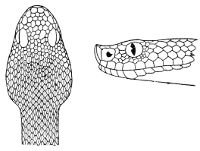
Head-Shields.—Rostral a little broader than deep,
the portion visible from above measuring one-fourth
to two-fifths its distance from the frontal. Frontal
more or less bell-shaped, not or but little broader
than the supraocular, once and two-thirds to twice
as long as broad, as long as or a little longer than
its distance from the end of the snout, a little
shorter than the parietals. Loreal as long as deep
or longer. One preocular (rarely two), extending to
the upper surface of the head, but never in contact
with the frontal; a small subocular below the preocular;
two postoculars (rarely three). Temporals
2 + 2 or 2 + 3
(rarely 1 + 2).
Upper labials
eight, fourth and
fifth entering the
eye, fifth and
seventh deepest.
Five lower labials
(rarely four) in
contact with the
anterior chin-shields, which are usually shorter than
the posterior.
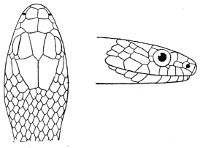
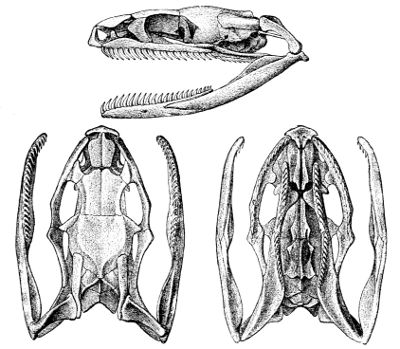
Fig. 19 (after Sordelli)
Scales with two apical pits, in nineteen (rarely
seventeen or twenty-one) rows. Ventral shields
more or less distinctly angulate laterally, 160 to 230
(usually under 200 in the typical form and the var.
caspius, 190 or more in the vars. viridiflavus and
asianus); anal divided; subcaudals 87 to 131.
Coloration.—In the typical Z. gemonensis the upper
parts are yellowish-brown or pale olive, anteriorly
with blackish cross-bars or numerous small black
spots, the black scales with a yellowish shaft, the
lower parts yellowish-white or pale yellow, rarely
more orange; the sides of the head are yellow, the
shields edged with blackish. A female,
31⁄4
feet long,
from Levico, Trentino, preserved in the Genoa
Museum, is uniform reddish-brown above, with mere
traces of darker markings on the head and nape.
There is every gradation between this form and the
var. viridiflavus or atrovirens (Plate IV., third figure),
which is dark green or black above, with yellow spots
forming transverse series or bars on the anterior
part of the body, and longitudinal streaks, following
the series of scales, on the posterior part and on the
tail; the yellow sometimes predominates over the
black, or may appear as a shaft along each dark
scale; the preocular and postocular shields are
yellow, the labials likewise yellow, with black spots
or bars. The lower parts are yellow or greenish-white,
with or without black dots, and usually with
a series of large black spots on each side.
Some specimens of both the typical form and the
var. viridiflavus are entirely black or nearly black.
(Z. carbonarius, Bonaparte; Z. sardus, Suckow). In
some localities and islands only black specimens
occur.
In the var. caspius, Iwan (trabalis, Pallas, Plate V.,
first figure; persicus, Jan, Plate IV., second figure),
from Hungary, Bosnia, Herzegovina, Corfu, Bulgaria,
Roumania, Greece, Turkey, Southern Russia,
Northern Asia Minor, and North-West Persia, the
upper parts are pale olive or reddish-brown, with or
without brown or black spots, and each scale bears a
yellowish or pale brown longitudinal streak; there is
often a dark longitudinal streak on the nape; the
belly is uniform orange or red.
Another variety, var. asianus, Boettger, from Asia
Minor, Rhodes, Cyprus, and Syria, has the upper
parts brown or olive, each scale with a longitudinal
light streak, and there are usually large black
spots relieved by yellowish shafts; the belly is red,
spotted or dotted with black. Melanism is frequent
in this form, such specimens being entirely black
except on the chin and throat, which are yellow
variegated with red.
The very young of the typical form, as well
as that of the var. viridiflavus, has a striking livery
(Plate IV., first figure), the head and nape black
with yellow markings, or olive with black-edged yellow
markings, contrasting sharply with the pale olive-grey
of the body; the most conspicuous and constant of the
yellow markings consist of a bar between the eyes,
interrupted on the frontal shield, but sometimes continuous
with the yellow of the postoculars, five or six
small round spots on the parietal shields, and a
V- or W-shaped line just behind the parietals, followed
by one or two others separating the dark
cross-bars which may be present on the nape, and
occasionally even continue some way down the
anterior part of the body. This livery persists in
some half-grown specimens.
In young individuals from Syria (var. asianus) the
head is not differently coloured from the olive-brown
body, and the markings described above appear as
mere traces; on the other hand, the whole body has
black and yellow spots or cross-bars above, and the
belly is profusely marked with round black spots.
In the new-born of the var. caspius, of which I
have examined only one specimen, 11 inches long,
from the Crimea, the head is olive-brown like the
body, which bears dark brown spots and narrow
cross-bars; and there is a dark brown streak along
the middle of the nape, as is sometimes the case in
the typical form. The belly is unspotted. A young
from Malta is intermediate in its markings between
the typical form and this variety.
The young of the so-called black variety are not
black at birth, but similar to the normal young of the
races to which they belong.
The four principal forms—viridiflavus, gemonensis,
caspius, and asianus—are so completely connected that
I cannot regard them as more than geographical
races or varieties.
Size.—This handsome snake grows to a length of
6 feet, the var. caspius even to 8 feet. I have seen a
specimen of this variety, from Salonica, which
measures
72⁄3
feet.
Distribution.—From the Atlantic coast of Europe
to South-Western Asia. The typical form, in its
narrowest sense, inhabits the Southern Tyrol, the
north-eastern corner of Italy, and the countries to
the east of the Adriatic, as far as Greece and Crete.
The specimens from France, Switzerland, Italy,
Giglio, Montecristo, Elba, Corsica, Sardinia, Sicily,
and Malta, are mostly referable to the form known
as Z. viridiflavus. Farther to the east the species
is represented by the vars. caspius and asianus, of
which the distribution has been mentioned above.
From Spain, this snake is only on record from Catalonia,
not far from the French frontier.
Rare or local in the north of its range (Maine-et-Loire,
Vienne, Indre, Sarthe, Haute-Saône, Yonne,
Aube, in France, Switzerland north of the Alps), it
is one of the commonest snakes in Italy and on the
borders and islands of the Adriatic, as well as on
practically all the islands of the Mediterranean east
of the Baleares. The highest altitudes at which it
has been met with are 3,900 feet in the Alps, 4,500
feet in the Balkan Peninsula.
Habits.—The name “Whip-snake,” under which
an American representative of this genus (Z. flagelliformis)
is known, like that of “Fouet” and “Loucinglant,”
which have been bestowed on it in some
parts of France, expresses the quick movements with
which, when captured, this snake lashes its long,
slender tail, at the same time furiously biting the
hand that has seized it. The generic term Zamenis,
of Greek derivation, alludes to its viciousness, which
also accounts for its German name, “Zornnatter.”
This snake, occurring in Malta, may well have been
the “Viper” which fastened on the hand of St. Paul.
Some specimens have been kept for months in captivity
without losing their savage temper, hissing and
flying with open mouth at anyone approaching the
glass walls of their prison; others, on the other hand,
become quite tame in a very short time, such as one
which I kept for nearly two years. Except when
sunning itself on a cold early morning in the spring,
this snake is always on the alert, and difficult to
capture, uncoiling itself and darting away like an
arrow at the least disturbance. It lives in preference
among shrubs or on the edges of woods, avoiding
damp localities, and females at least appear to have
sedentary tastes. Lataste tells us of one, near
Bordeaux, which he repeatedly met for over two
years within 20 yards of the same spot, a bush
between a wood and a meadow, without ever being
able to capture it.
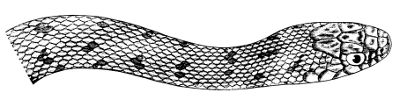
ZAMENIS GEMONENSIS, VAR. CASPIUS
After Sordelli
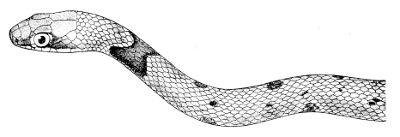
ZAMENIS DAHLII
After Sordelli
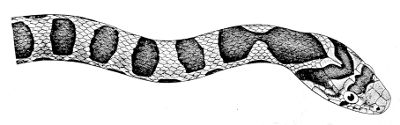
ZAMENIS HIPPOCREPIS
After Sordelli
The food of this snake is very varied, consisting of
voles and mice, young birds which it takes from the
nests, being a good climber on bushes and low trees,
occasionally of frogs, but above all of other reptiles:
lizards, slow-worms, and snakes, which it does not
attempt to crush before deglutition. It has even
been observed in Istria to eat locusts (Acridium
ægyptium) and sphyngid moths.
Reproduction.—Eggs, laid at the end of June or
beginning of July in a well-sheltered hole, are a little
over twice as long as broad, and measure 1·2 to
1·4 inches in length. The number of eggs is eight
to fifteen according to Fatio, about a dozen according
to Tomasini, five according to Werner. The
pairing was observed by Schreiber at the end of May,
the male and female seizing each other reciprocally
by the neck with their jaws; this mode of pairing
must not, however, be regarded as the rule in this
species, for in other cases observed by Schreiber and
by Honnorat the pairs were simply entwined by
their coils.
7. Zamenis dahlii, Fitzinger
Dahl’s Whip-Snake
Form.—Very slender; head narrow, snout moderately
prominent, obtuse. Tail about one-third of the
total length.
Head-Shields.—Rostral a little broader than deep,
just visible from above. Frontal not or but little
broader than the supraocular, once and two-thirds to
once and three-fourths as long as broad, as long as
or longer than its distance from the end of the snout,
shorter than the parietals. Loreal longer than deep.
One preocular, usually in contact with the frontal,
with a subocular below it; two postoculars. Temporals
2 + 2 or 2 + 3 (rarely 1 + 2). Upper labials
eight or nine, fourth and fifth or fifth and sixth
entering the eye. Four or five lower labials in
contact with the anterior chin-shields, which are
shorter than the
posterior.
Scales with a
single apical pit,
very narrow, in
nineteen rows.
Ventral shields
very distinctly angulate
laterally,
205 to 218; anal
divided; subcaudals 98 to 132.
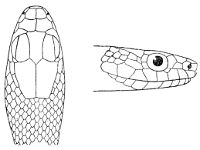
Fig. 20 (after Sordelli)
Coloration.—Olive in front, with a few large black,
white- or yellow-edged spots on each side, the anterior
of which is sometimes confluent with its fellow and
forms a nuchal collar, as in the specimen figured on
Plate V.; the greater part of the body and tail
uniform pale olive, yellowish, or reddish above,
yellowish-white beneath. Head uniform olive-brown
above, the labial, preocular, and postocular shields
yellowish-white.
Total Length.—3 feet, rarely nearly 4 feet.
Distribution.—Southern Europe east of the Adriatic,
as far north as Dalmatia, Asia Minor, Cis- and Trans-Caucasia,
North-Western Persia, Cyprus, and Syria.
Has also been recorded from Lower Egypt.
Habits.—This snake is even more lively than
Z. gemonensis, and does not stand captivity long. It
seeks dry, bushy localities, and feeds on small lizards,
occasionally on locusts. It does not seem to be very
common anywhere in Europe, except perhaps in
Dalmatia, whence most of the specimens sold by
dealers are imported.
Reproduction.—The pairing has been observed at
the end of May. According to Werner, the eggs
number usually three only, measuring
11⁄2
inches by 1⁄2
inch.
8. Zamenis hippocrepis, Linnæus
The Horseshoe Whip-Snake
Form.—Slender; snout obtuse, feebly prominent.
Tail one-fifth to one-fourth of the total length.
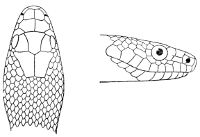
Fig. 21 (after Sordelli)
Head-Shields.—Rostral once and one-third to once
and a half as broad as deep, the portion visible
from above measuring
about
one-fourth to
one-third its
distance from
the frontal.
Frontal bell-shaped,
considerably
broader
in front than the
supraocular, once and one-fourth to once and a half
as long as broad, as long as or a little longer than its
distance from the end of the snout, shorter than the
parietals. Loreal longer than deep, sometimes divided
into two. One preocular (sometimes divided into
two), in contact with the frontal; two postoculars; a
series of three or four suboculars, usually completely
separating the eye from the labials. Temporals
2 + 3 or 3 + 3. Eight or nine (rarely ten) upper
labials, fifth or sixth very rarely entering the eye.
Four lower labials in contact with the anterior chin-shields,
which are shorter than the posterior.
Scales with two apical pits, in twenty-five to
twenty-nine rows, usually twenty-seven. Ventral
shields very distinctly angulate laterally, 222 to 258;
anal divided (rarely entire); subcaudals 77 to 107.
Coloration.—Brown, pale olive, reddish, yellow, or
orange above, with a dorsal series of large dark brown,
black-edged rhomboidal spots, often bordered with
yellow, on each side of which is a series of smaller,
alternating spots (Plate V.); these spots may become
entirely black in the adult, and so large as to reduce
the ground colour to a mere network or series of
X-shaped pale lines. A dark cross-band between
the eyes, and a
Λ-
or horseshoe-shaped band on
the back of the head, which may be confluent with
an elongate spot on the nape; a light circle often
present in the middle between the parietal shields.
The spots often more or less confluent into three
longitudinal streaks on the tail. Yellow, orange, or
red beneath, with or without black dots, but constantly
with a lateral series of black spots, which
may be very large or unite with the spots higher up
on the sides to form vertical bars.
Size.—Examples 5 feet long are on record; the
largest examined by me measures 4 feet 3 inches.
Distribution.—Spain and Portugal, Sardinia, Pantellaria,
Morocco, Algeria, Tunisia. Does not reach
the North of Spain nor penetrate into the Sahara.
Habits.—This very handsome snake is as a rule
as irascible as its European congeners. In Spain as
well as in Algeria it is often found about the dwellings
of man, occasionally entering houses in search of
mice, on which it principally feeds; it is also fond
of birds, and, climbing with great facility, plunders
the nests of sparrows in towns and villages. It
must be regarded as a useful commensal of man, and
deserving of protection.
Reproduction.—F. Doumergue found in a hole in a
rock near Oran, in September, the recently-laid eggs,
five in number and as large as pigeons’.
Maxillary teeth equal or nearly equal in length.
Head elongate, distinct from neck; eye moderately
large, with round pupil. Body more or less elongate;
scales smooth or feebly keeled, with apical pits.
Tail moderate or long.
This large genus, embracing close upon fifty
species, is represented in Europe, Asia, and North
and tropical America. Five species in Europe. Very
nearly allied to Zamenis, but distinguished principally
by the posterior teeth of the upper jaw not being at
all enlarged, and, further, in being, like Coronella,
constrictors.
9. Coluber quatuorlineatus, Lacepède
(Elaphis cervone, Aldrovandi; Coluber quatuorradiatus,
Gmelin)
Aldrovandi’s Snake
Form.—Moderately slender. Snout obtuse,
scarcely prominent. Tail one-sixth to one-fourth
of the total
length.
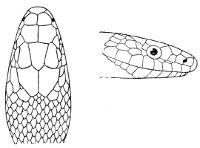
Fig. 22 (after Sordelli)
Head-Shields.—Rostral
broader
than deep, just
visible from
above. Frontal
once and one-fourth
to once
and a half as
long as broad, as long as its distance from the
rostral, shorter than the parietals. Loreal nearly
as long as deep, with one or two small shields
below it. One preocular, rarely divided, with
a subocular below it; two or three postoculars.
Temporals 2 + 3 or 3 + 4. Upper labials eight
(exceptionally nine), fourth and fifth (or fifth and
sixth) entering the eye. Four or five (rarely three)
lower labials in contact with the anterior chin-shields,
which are longer than the posterior.
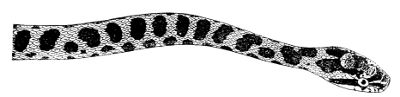
COLUBER QUATUORLINEATUS
Young, after Sordelli
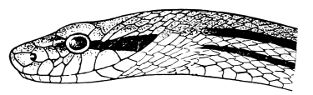
COLUBER QUATUORLINEATUS
After Werner
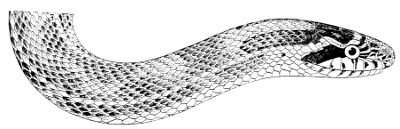
COLUBER QUATUORLINEATUS, VAR. SAUROMATES
After Sordelli
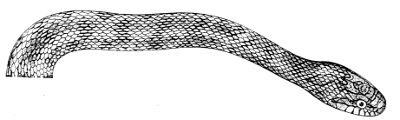
COLUBER DIONE
After Sordelli
Scales feebly but distinctly keeled, except on the
outer rows, with two apical pits, in twenty-five (rarely
twenty-three or twenty-seven) rows. Ventral shields
not or but very obtusely angulate laterally, 195 to
234; anal divided; subcaudals 56 to 90.
Coloration.—Young (Plate VI., top) with three or
five alternating longitudinal series of dark brown,
black-edged spots on a yellowish, grey, or pale
brown ground, the spots of the median series largest,
transversely elliptical or rhomboidal; a dark streak
across the forehead, black bars on the labial shields,
and a black oblique streak from the eye to the angle
of the mouth. In specimens from Italy and the
countries bordering the Adriatic (the typical C.
quatuorlineatus) the markings very gradually disappear
with age, with the exception of the temporal streak,
whilst a pair of black streaks appear along each side
of the body, at a short distance from the head, the
lower corresponding to the postocular streak, the
adult being brown without spots, but four-lined
(Plate VI., second figure). In more eastern specimens
(C. sauromates, Pallas), which may be regarded as
representing the original form, the markings of the
young persist throughout life, or, if they disappear,
they are not replaced by dark streaks (Plate VI.,
third figure). Lower parts pale yellow, closely
spotted or marbled with brown, these markings
usually disappearing in the adult, except on the tail.
Iris dark brown.
Size.—The largest European snake, stated to
reach a length of 8 feet. The largest specimen examined
by me measures, however, only
41⁄2
feet.
Distribution.—Aldrovandi’s Snake inhabits Southern
Italy and Sicily, Istria, Croatia, Dalmatia, Herzegovina,
Greece, and eastwards to Southern Russia,
Transcaucasia, Asia Minor, and Persia. It has been
observed at an altitude of 2,600 feet in Herzegovina.
All the specimens from Roumania, Bulgaria,
Turkey, and eastwards, belong to the var. sauromates,
which is regarded by some authors as worthy of
specific rank. The reported occurrence of C. quatuorlineatus
in various parts of France is certainly due to
confusion with C. scalaris and C. longissimus.
Habits.—Dry as well as marshy localities are the
abode of this large and handsome snake, which
often approaches the dwellings of man, attracted by
the poultry. Comparatively slow in its movements,
it is more easily captured than any of the other large
Colubrids of Europe, and does well in captivity,
where it should be provided with a tank, in which it
will remain for hours under water. It is as good at
swimming as at climbing. Biting readily when captured,
it becomes of gentle disposition after a short
period of captivity. In consequence of its slow, phlegmatic
temperament, it often allows itself to be picked
up when surprised in liberty, but as soon as it feels the
grasp it turns round and defends itself. It appears
to feed exclusively on mammals and birds, up to the
size of a rat or dove, and will readily take dead food.
It has a predilection for eggs, and has often been
observed to swallow hens’ eggs.
Reproduction.—In Herzegovina pairing takes
place from the middle of June to the middle of July,
and the eggs are laid soon after, to hatch in September
or beginning of October. The eggs number six
to sixteen, and measure 2 inches by
11⁄3
inches. The
young measure 8 to 14 inches at birth.
10. Coluber dione, Pallas
The Dione Snake
Form.—Similar to the preceding. Head more
convex, a little narrower; snout obtuse, scarcely
prominent. Tail about one-fifth of the total length.
Head-Shields.—Rostral broader than deep, just
visible from above. Frontal once and one-fourth
to once and a half as long as broad, as long as its
distance from the end of the snout, shorter than the
parietals. Loreal as long as deep, or a little longer
than deep. A large preocular, with a subocular
below it, the latter very exceptionally absent; two
or three postoculars. Temporals 2 + 3 or 3 + 3.
Upper labials eight or nine (very rarely seven),
fourth and fifth or fifth and sixth entering the eye.
Four or five lower labials in contact with the
anterior chin-shields, which are nearly as long as
the posterior.
Scales smooth or faintly keeled, with two apical
pits, in twenty-five or twenty-seven (rarely twenty-three)
rows. Ventral
shields not or
but very obtusely
angulate laterally,
172 to 214; anal
divided; subcaudals
50 to 80.
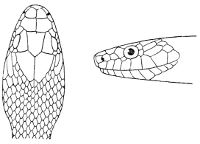
Fig. 23 (after Sordelli)
Coloration.—Pale
brown or
greyish-olive
above, with blackish cross-lines or dark brown or
reddish, black-edged spots, and usually two or three
more or less distinct pale longitudinal bands; two
dark longitudinal stripes on the nape, usually united
on the head and terminating on the frontal shield; a
curved dark cross-band from eye to eye, and another,
oblique, from the eye to the angle of the mouth.
Lower parts yellowish, usually dotted or spotted
with blackish.
Size.—Seldom exceeds a length of 3 feet. The
largest specimen examined by me measures 37
inches.
Distribution.—Across temperate Asia from Asia
Minor, Transcaucasia, and the southern border
of the Caspian Sea, to the Amur, Corea, and China.
In Europe the habitat of this snake is restricted
to the steppes of Southern Russia, between the
Caucasus and the Lower Ural. The specimen
figured on Plate VI. is from Sarepta, on the Volga.
Habits.—This snake frequents arid, sandy localities,
and is only exceptionally found in small woods.
Nothing more is known of its habits.
11. Coluber longissimus, Laurenti
(Coluber æsculapii, Lacepède; C. flavescens, Gmelin)
The Æsculapian Snake
Form.—Slender. Snout obtuse, scarcely prominent;
head narrow. Tail about one-fifth to one-fourth
of the total length.
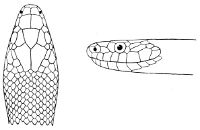
Fig. 24
Head-Shields.—Rostral broader than deep, just
visible from above. Frontal once and one-fourth
to once and
one-third as
long as broad,
as long as its
distance from
the rostral or
the end of the
snout, shorter
than the parietals.
Loreal
as long as deep or longer than deep. One pre- and
two postoculars. Temporals 2 + 3. Upper labials
eight or nine, fourth and fifth or fifth and sixth entering
the eye. Four or five lower labials in contact
with the anterior chin-shields, which are as long as
or a little longer than the posterior.
Scales smooth or feebly keeled on the posterior part
of the body, with two apical pits, in twenty-three
(rarely twenty-one) rows. Ventral shields distinctly
angulate laterally, 212 to 248; anal divided; subcaudals
60 to 91.
Coloration.—Yellowish-grey to dark olive-brown
above, some of the scales with whitish lines on the
margins occasionally forming a network; sometimes
with a yellowish vertebral stripe or with four darker
stripes along the body (var. romanus, Suckow); upper
lip, and often also a triangular patch on each side
behind the temple, pale yellow; a more or less distinct
dark band on the temple, and a vertical dark
bar below the eye (Plate VII., first figure). Lower
parts uniform pale yellow. Young (second figure)
with dark brown dorsal spots, forming four to seven
longitudinal series, a
Λ-shaped
black marking on the
nape behind the yellow nuchal blotches, which are
brighter than in the adult, a dark brown bar across
the forehead, and a black vertical line below the
eye; belly greyish or yellowish-olive. Iris dark grey
or brown. Tongue pinkish-brown.
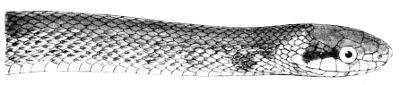
COLUBER LONGISSIMUS

COLUBER LONGISSIMUS
Young, after Sordelli
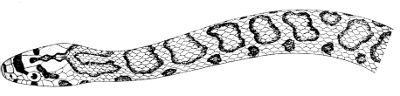
COLUBER LEOPARDINUS
After Sordelli
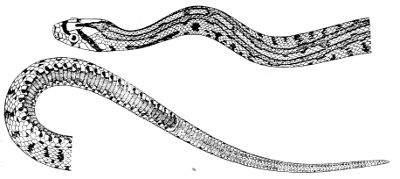
C. LEOPARDINUS, VAR. QUADRILINEATUS
After Sordelli
Melanism is rare in this snake. Such specimens
are entirely black above and beneath (var. niger,
Nikolsky), or blackish-grey to black above, dark
grey beneath (var. subgriseus, Werner), the angular
line on each side of the belly often remaining light.
An albino found near Vienna has been described as
pale orange-yellow above, with small white spots;
pupil and tongue red.
Size.—Grows to 6 feet. Specimens over
41⁄2
feet
are, however, very rarely met with.
Distribution.—Generally distributed over the
greater part of Austria, Italy, with Sardinia and
Sicily, and the whole of South-Eastern Europe, this
snake has a very broken range in France, Switzerland,
Germany, and is found, quite isolated, as far
north as Denmark and Poland. According to
Segerus, quoted by Lacepède, it used to be quite
common near Copenhagen at the end of the
eighteenth century, but it is now much rarer. Its
northern limit in France is in Southern Brittany,
the Department Orne, and the Forest of Fontainebleau;
in Germany, Schlangenbad, near Wiesbaden,
perhaps also Baden-Baden and Treves. It is on
record from Southern Spain. Its discontinuous
distribution in Central Europe, and its presence
in various localities near former Roman thermal
stations, has been ascribed to its introduction from
Italy as an inmate of the temples erected to
Æsculapius; but I am more inclined to look upon
its sporadic occurrence in the North as the indication
of a once more widely distributed species
now in process of extinction over part of its
range.
In Asia the Æsculapian Snake is only found in
Transcaucasia. It occurs in the mountains as well
as in the plain, being recorded from 5,200 feet
altitude in the Tyrol, 3,200 feet in the Apennines.
Habits.—The Æsculapian Snake lives in woods;
among shrubby vegetation; in meadows, where it is
often found under haystacks; occasionally about
old walls. It climbs well, and often ascends trees.
Although a good swimmer, it seldom enters the
water of its own accord. It feeds chiefly on small
mammals, occasionally on birds and their eggs, and
lizards. Specimens which I kept in confinement fed
on mice only, refusing sparrows and lizards. Very
savage when fresh caught, most individuals soon
become tame, and like being handled by people to
whom they are accustomed, although still resenting
the intrusion of strangers. However, this snake
never becomes so thoroughly domesticated as the
Smooth Snake, and cannot be trained to take food
from the hand, according to R. Rollinat, who has
devoted many years to experiments on the taming
of reptiles. This observer had no difficulty in feeding
his Æsculapian Snakes on mice and voles placed
dead in their cage.
This snake is particularly sensitive to cold, and
does not emerge until late in the spring from the
vole galleries and hollow trees which constitute its
winter-quarters. It also avoids excessive heat, never
showing itself in the daytime during the hotter
months in the South of Europe.
Reproduction.—Pairing takes place between the
middle of May and the middle of June. The eggs
are laid towards the end of June or in July, in holes
in walls or hollow trees, under moss, sometimes even
in the dung-heaps of farms, and hatch in September.
According to trustworthy observers, the eggs, which
measure
11⁄2
to 2 inches in length, and less than 1 inch
in width, number only five or six, rarely up to
eight.
The young on emerging are highly suggestive of
young Grass-snakes in colour and markings, as well
as in their much less slender shape as compared with
the adult. They measure about 5 inches, and are
at once most ready to bite.
12. Coluber leopardinus, Bonaparte
(Coluber quadrilineatus, Pallas)
The Leopard Snake
Form.—Slender. Snout obtuse, scarcely prominent.
Tail about one-fifth of the total length.
Head-Shields.—Rostral broader than deep, just
visible from above. Frontal once and one-third to
once and a half as long as broad, as long as its distance
from the end of the snout, shorter than the parietals.
Loreal longer than deep. One pre- and two postoculars.
Temporals 1 + 2 or 2 + 3. Upper labials
eight (rarely seven), fourth and fifth (rarely third and
fourth) entering the eye. Four or five lower labials in
contact with the anterior chin-shields, which are
longer than the
posterior.
Scales smooth,
with two apical
pits, in twenty-five
or twenty-seven
rows.
Ventral shields
rounded, not
angulate laterally,
222 to 260; anal divided; subcaudals 68-90.
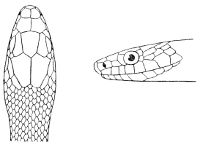
Fig. 25 (after Sordelli)
Coloration.—Typical form (Plate VII., third figure)
greyish or pale brown above, with one dorsal series
of dark brown, reddish-brown, or bright red, black-edged
transverse spots and a lateral alternating
series of smaller black spots with or without lighter
centres; usually a [Y]-shaped dark marking on the
occiput and nape; a crescentic black band from
eye to eye across the prefrontal shields, an oblique
black band from behind the eye to the angle of the
mouth, and a black spot or vertical bar below the
eye. Lower parts white, checkered with black, or
nearly entirely black. Iris reddish-golden.
In some specimens (var. quadrilineatus) the dorsal
spots are replaced by two brown or red, black-edged
stripes bordering a pale greyish or yellowish vertebral
stripe (Plate VII., fourth figure); such specimens
are so coloured from birth. This colour variety,
which is so strikingly different from the typical form,
is connected with the latter by the var. schwoederi,
Werner, in which the spots form two vertebral
series, and the var. elsneri, Werner, in which the light
vertebral band is broken up by dark transverse bars,
producing a ladder-like pattern.
Size.—Rarely exceeding a length of 3 feet.
Distribution.—Southern Italy, Sicily, Malta, Istria,
Dalmatia, and other parts of the Balkan Peninsula,
Grecian islands, Crimea, Asia Minor. The altitudinal
range does not extend beyond 1,600 feet.
Habits.—This is not only the prettiest European
snake as regards its markings, whether in the form
of spots or of stripes, but also the most graceful in its
movements. Unless compelled to fly for safety,
there is something slow and deliberate in its behaviour
which is more suggestive of Coronella than of
most other species of Coluber. It is fond of climbing,
and if the terrarium in which it is kept be provided
with a bush or small tree, it will spend most of the
time gracefully coiled round the branches. Usually
very savage when fresh caught, some specimens
become quite tame in captivity. In Dalmatia, where
it is not uncommon, this snake is found principally
among prickly shrubs, in hedges, or on old walls. It
awakens from its winter slumber later than other
South European snakes. Although occasionally
taking lizards, its principal food consists of mammals
and birds, which are killed before being devoured,
the Leopard Snake being, like the other members of
the genus Coluber, a constrictor.
Reproduction.—According to Werner, the eggs, two
to five in number, are deposited in midsummer;
they are remarkably elongate:
21⁄2
inches long, 2⁄3
inch
broad.
13. Coluber scalaris, Schinz
The Ladder Snake
Form.—Moderately slender. Snout pointed,
strongly projecting beyond the mouth. Tail one-sixth
to one-fifth of the total length.
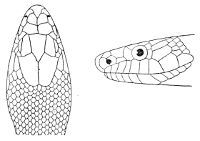
Fig. 26 (after Sordelli)
Head-Shields.—Rostral deeper than broad, forming
an acute angle above, wedged in between the internasals,
the portion visible from above nearly as long
as its distance
from the frontal.
Frontal
about once and
one-third to
once and a half
as long as broad,
as long as or
shorter than its
distance from
the end of the snout, nearly as long as the parietals.
Loreal longer than deep. One pre- and two or three
post-oculars. Temporals 2 + 3 or 2 + 4. Upper
labials seven or eight (rarely nine), fourth or fourth
and fifth (or fifth and sixth) entering the eye. Four
or five lower labials in contact with the anterior chin-shields,
which may be either longer or shorter than
the posterior.
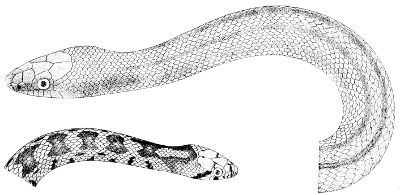
COLUBER SCALARIS
After Sordelli
Scales smooth, with two apical pits, in twenty-seven
(rarely twenty-five or twenty-nine) rows. Ventral
shields not angulate laterally, 201 to 220; anal
divided, rarely entire; subcaudals 48 to 68.
Coloration.—Young yellowish-grey, or pale brown,
above, with a series of regular H-shaped black or
blackish-brown markings along the back, forming a
ladder-like pattern—whence the name scalaris—and
small black spots on the sides; a V-shaped black
marking on the snout, a black oblique streak from
the eye to the angle of the mouth, and a black spot
below the eye; belly yellow, spotted or checkered
with black or nearly entirely black. These dorsal
markings disappear in the adult, and are replaced by
a pair of brown stripes running along the back
(Plate VIII.); the belly loses the black markings,
and becomes uniform yellow. Iris dark brown.
Size.—Grows to a length of
31⁄2
feet, exceptionally
41⁄2
feet.
Distribution.—The Mediterranean coast of France,
Spain and Portugal, and Minorca. Its occurrence in
Algeria is very doubtful.
Habits.—Not uncommon near the coast in France,
in hedges and vineyards, often climbing on shrubs.
In the Spanish Peninsula, according to Boscá, it is
common in forests and on the sheltered side of
valleys, under stones or in holes in the ground. A
specimen I kept alive for a short time showed a more
furious temper than I have ever witnessed in any
snake, repeatedly flying with open mouth against the
glass of its cage whenever I entered the room in
which it was kept. Other specimens are reported to
have become quite tame after a certain time. It is
one of the quickest of European snakes, one of the
most difficult to catch; it is a good climber. The
food consists of mice, birds, and lizards; the young
are said to occasionally eat grasshoppers.
Reproduction.—According to J. von Fischer, the
eggs, nine in number, are deposited twenty-five days
after the pairing, which takes place in May or June,
and measure about 2 inches by
2⁄3
inch.
Genus CORONELLA, Laurenti
Maxillary teeth increasing in size posteriorly.
Head not or but slightly distinct from neck; eye
rather small, with round pupil. No subocular shields.
Body moderately elongate; scales smooth, with apical
pits. Tail moderate.
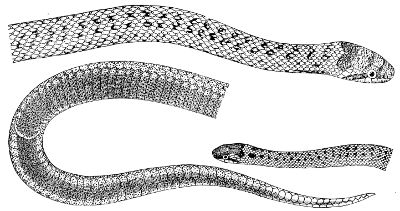
CORONELLA AUSTRIACA
After Sordelli
This genus, embracing about twenty species, is
represented in the different parts of the Northern
Hemisphere, extending a little beyond the Equator
in East Africa. Two species are European.
14. Coronella austriaca, Laurenti
(Coluber lævis, Lacepède)
The Smooth Snake
Form.—Moderately slender; snout more or less
prominent, sometimes decidedly pointed; tail one-fourth
(males) to one-sixth (females) of the total
length. The considerable differences to be observed
in the shape of the snout are merely individual, specimens
with more prominent snout and a corresponding
development of the
rostral shield (C.
italica, Fitz., fitzingeri,
Bonap.) occurring
over the
greater part of
the range of the
species.
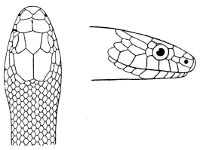
Fig. 27 (after Sordelli)
Head-Shields.—Rostral
at least as
deep as broad, more or less produced posteriorly
between the internasals, the portion visible from
above at least half as long (in some specimens
quite as long) as its distance from the frontal,
rarely separating the internasals. Frontal once and
one-fourth to once and a half as long as broad,
much broader than the supraocular, as long as
or longer than its distance from the end of the
snout, shorter than the parietals, widely separated
from the preocular. Nasal rarely undivided; loreal
longer than deep. One (very rarely two) pre- and two
postoculars. Temporals 2 + 2 or 2 + 3 (very rarely
1 + 2). Upper labials seven (rarely eight), third and
fourth (or fourth and fifth) entering the eye. Four
lower labials (rarely three) in contact with the anterior
chin-shields, which are as long as or longer than the
anterior.
Scales with one or two apical pits, the pit usually
single on the back and paired on the sides, in nineteen
(rarely twenty-one) rows.[2] Ventral shields 153 to
199; anal divided (rarely entire); subcaudals 41 to 70.
Coloration.—Grey, brown, or reddish above, with
small blackish, dark brown, or brick-red spots usually
disposed in pairs, sometimes forming cross-bars;
sometimes with one or three lighter stripes; one or two
black dots precede on each scale the single or paired
apical pit; frequently two blackish, dark brown, or
brick-red stripes on the nape, usually confluent with
a large dark blotch on the occiput; the top of the
head occasionally nearly entirely blackish, especially
in the young; a dark streak on each side of the head,
from the nostril to the angle of the mouth, passing
through the eye, sometimes extending along the side
of the neck or even of the whole body. Lower
parts red, orange, brown, grey, or black, uniform or
speckled or closely spotted with black and white, the
sides often lighter (Plate IX.).
A colour variety, of which I have examined a single
specimen from near Vienna, is pale brown above,
with four black lines along the anterior part of the
body, and two small, yellowish, dark-edged spots
close together on the back of the head, separated by
the suture between the parietal shields.
Werner has described another variety, also from
near Vienna, which resembles Coluber leopardinus,
having two series of large, brown, dark-edged
spots along the back, some of the spots alternating,
others uniting across the back. Apparently very
similar to the last variety, and also said to be
suggestive of Coluber leopardinus, is the var. scalaris,
Sternfeld, from Lüneburg in Hanover, reddish-brown
above, with two rows of bright red, black-edged
spots, partly confluent and connected across
the spine by transverse bars producing a ladder-like
pattern. Specimens of a uniform greyish-brown,
without any markings, are very rare. The
var. veithi, Schreiber, established on a single specimen
from Carinthia, represents a case of melanism:
bluish-black, with the normal markings of an intense
black. Two specimens of a “black variety” are said
to have been found in this country, near Poole.
Size.—Seldom exceeds a length of 2 feet, and in
many districts, in England for instance, does not
appear to often reach that size. The largest specimen,
from Austria, examined by me, measures
25 inches; one from Hampshire measures 24 inches.
Distribution.—The range of the Smooth Snake
extends over nearly the whole of Europe, as far
north as 63° in Norway; it becomes rare and more
local in the south, being absent from part of Spain
and the islands of the Mediterranean, with the
exception of Sardinia. It is common in the hilly
parts of Belgium, Northern and Central France,
Germany, and Austria. In Sweden it appears to be
restricted to the oak region. In Great Britain it
has been found in four counties in the South of
England: Surrey, Hampshire, Dorsetshire, and Berkshire,
in some parts of which it is less uncommon
than usually supposed. Its reported occurrence in
Dumfriesshire is the result of an error; the snake
figured as Coluber dumfriesiensis represents an American
species. In a very interesting article written for
Science Gossip in 1888, Mr. A. L. Beldy says that
about 1868, when Bournemouth was but a very
small village, surrounded by large expanses of moorland,
Coronella austriaca was extraordinarily abundant,
and during a hot summer examples were to be seen
literally in scores and great numbers were killed.
Since then, however, their numbers have gradually
decreased. About 1880 the snake was occasionally
found near Wellington College, Berks, and as many
as five were captured by one person in the course of
one year; it is believed to be now extinct in that
neighbourhood. From South-Eastern Europe the
range of this species extends to South-Western Asia.
The ascertained altitudinal range is 4,000 feet in
the Alps, 6,000 feet in Bosnia, and 6,500 feet in the
Caucasus.
Habits.—The Smooth Snake lives on heathland,
stony wastes, and wooded hills, showing a preference
for dry localities. Although not infrequent on the
Dorsetshire and Hampshire heaths, where it was first
discovered in 1853, it was not recorded as a British
reptile until 1859; it was discovered much later on
the sandy heaths between Haslemere and Farnham,
where it occurs in small numbers, and in Berkshire.
These localities are likewise inhabited by the rarer
British lizard, the Sand Lizard. Notwithstanding
its gentle, timid appearance, this snake when fresh
caught is usually very ready to bite; either it snaps
angrily, or, without hissing or other warning, it
suddenly fastens its jaws into the finger of its
captor, even if it be gently handled. The food
consists mostly of lizards, occasionally of slow-worms
or small snakes, more rarely of voles or
mice, even shrews, which are seized, constrictor-like,
and crushed by the coils of the body. O. von
Tomasini has observed one swallowing a Coluber
longissimus as large as itself.
In Central Europe this snake becomes active
towards the end of March or beginning of April, and
retires in September or October. It does well in
captivity, and becomes very tame. It is one of the
most intelligent of snakes, second to none in educability;
it can be trained to feed in the hand of
its master.
Reproduction.—The Smooth Snake pairs in early
spring, and is ovoviviparous. The young, two to
fifteen in number, are born late in August or in
September, enveloped by a thin membrane which
they tear immediately; they measure 5 to 6 inches.
Embryos
31⁄2
or 4 inches long have the scaling and
the characteristic markings fully developed, but the
scales and shields much abbreviated, the former
broader than long. A dicephalous young is preserved
in the Bosnian Museum at Sarajev, and another
was caught near Karlsruhe, in Germany, in 1881,
and kept alive for some time. According to Rollinat,
a second autumnal pairing sometimes takes place in
France.
15. Coronella girondica, Daudin
(Coluber riccioli, Metaxa)
The Southern Smooth Snake
Distinguished from the preceding by a somewhat
more slender form, a more obtuse, scarcely prominent
snout, a much lower rostral shield, which is considerably
broader than deep and just visible from
above, not penetrating between the internasals, constantly
eight upper labials, fourth and fifth entering
the eye, and the scales in twenty-one (rarely nineteen
or twenty-three) rows. Ventrals 170 to 200;
anal divided; subcaudals 49 to 72.

CONTIA MODESTA
After Sordelli
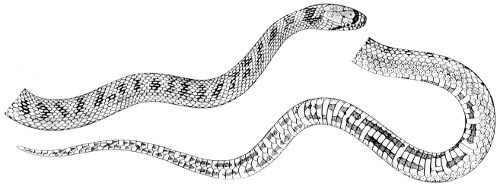
CORONELLA GIRONDICA
After Sordelli
Coloration.—Brown, greyish, yellowish, or reddish
above, with dark brown or black spots or transverse
bars, sometimes with four dark stripes in addition;
dark dots in front of the apical pits as in the preceding
species; a pair of elongate dark spots or a U-shaped
marking on the nape; a dark streak from the eye
to the angle of the mouth, and a dark cross-bar
from eye to eye, across the prefrontal shields; a dark
line below the eye.
Lower parts yellow,
orange, or coral red,
with large, mostly
quadrangular black
spots, often arranged
in chess-board
fashion, or
with two series of
black spots (Plate X.), which may be confluent into two longitudinal
bands.
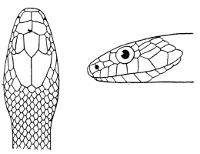
Fig. 28 (after Sordelli)
Total Length.—26 inches.
Distribution.—South of France (as far north as
the Charente-Inférieure to the west, the Dauphiné
to the east), the whole of Spain and Portugal,
Southern Tyrol, Italy, and Sicily. It has not been
recorded from higher than 2,500 feet in the
Alps. Rare in Northern Morocco and Algeria. In
many localities in Europe it occurs alongside with
C. austriaca.
Habits.—All that is known to me of the habits
of this close ally of the preceding species is derived
from the works of Bonaparte, Gené, and Schreiber,
and from a note by Gachet, who observed it near
Bordeaux and described it under the name of
Coluber rubens. According to these authors, it
frequents dry and rocky localities as well as old
walls, in which it finds a refuge and a good supply
of the lizards on which it feeds. A large specimen
from Albano, near Rome, preserved in the Genoa
Museum, had swallowed a full-grown Chalcides
tridactylus. This Coronella is crepuscular, rarely
showing itself in the daytime, leaving its retreat
only after sunset, and has been observed to crawl
about by moonlight. Its movements are slow,
which accounts for crushed specimens being often
met with on paths or roads. Contrary to the rule
in C. austriaca, it is extremely gentle, seldom attempting
to bite.
Reproduction.—Whether this species is ovoviviparous,
like its European congener, has not, I think,
been ascertained. All we know on this matter is
that a female found dead on a road near Bordeaux
by M. Lataste at the end of June contained eggs
which showed no trace of embryos. This does not,
however, settle the question, as the young would
not be born until at least two months later. According
to Gené, pairing takes place in May, when
specimens have been observed to congregate in
considerable numbers.
Genus CONTIA, Baird and Girard
Maxillary teeth subequal. Head not or but
slightly distinct from neck; eye moderate or rather
small, with round pupil. Nasal single; no subocular
shields. Body moderately elongate; scales smooth,
with apical pits. Tail moderate.
This genus, with certain modifications in the
above definition, is made to embrace about twenty-five
species from South-Western Asia and Sind and
North and Central America. One of the species
inhabiting Asia extends into a very small part of
Europe.
16. Contia modesta, Martin
The Dwarf Snake
Form.—Moderately slender. Head small, quite
flat above; snout obtuse, feebly prominent. Length
of tail four to five times in the total length.
Head-Shields.—Rostral a little broader than deep,
visible from above. Suture between the internasals
as long as or a little shorter than that between the
prefrontals. Frontal once and a half to once and
two-thirds as long as broad, as long as or longer
than its distance from the end of the snout, shorter
than the parietals, as broad as or a little broader
than the supraocular, widely separated from the
preocular. Nostril in the middle or upper part of
the nasal. Loreal square or longer than deep. One
(rarely two) pre- and two (rarely one) postoculars.
Temporals 1 + 2; parietal sometimes nearly touching
the fifth upper labial. Upper labials seven,
third and fourth entering the eye. Four (rarely
five) lower labials in
contact with the anterior
chin-shield;
posterior chin-shields
smaller than the anterior,
and separated
from each other by
one or two rows of
scales.
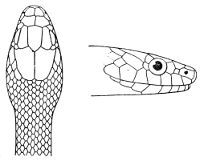
Fig. 29 (after Sordelli)
Scales with a single
apical pit, in seventeen rows. Ventral shields 150
to 191; anal divided; subcaudals 53 to 78.
Coloration.—Not unlike that of a young Zamenis
gemonensis. Greyish-olive above, uniform or each
scale lighter in the centre. The greater part of the
upper surface of the head behind the snout, together
with the nape, black in the young, with a
yellow cross-bar or a pair of yellow spots between
the eyes, the bar sometimes confluent with the
yellow postoculars, and a horseshoe-shaped band
of the same colour on the temples and across the
occiput (Plate X.); the black of the nape again edged
with yellow behind. More or less distinct traces
of these markings are preserved in adult specimens.
Upper lip yellowish, with black spots or bars on
the sutures between the shields. Lower parts uniform
white or yellowish.
In the var. semimaculata, Boettger, from Chios,
small dark spots are scattered over the upper parts
of the anterior half of the body.
Size.—This snake rarely reaches a length of
19 inches. It is the smallest Colubrid of Europe.
Distribution.—The Caucasus up to about 5,000
feet, Asia Minor, Chios, Cyprus, Syria, Mesopotamia,
and North-Western Persia. The northern slope
of the Caucasus appears to be the only part of
Europe included in its habitat. The British Museum
possesses two specimens labelled as from Constantinople,
but the presence of this species in European
Turkey requires confirmation.
A closely allied species, which has been confounded
with C. modesta, C. collaris (Ménétriès), and which
also inhabits the Caucasus without having been
recorded from the northern slope, is distinguished
by having the scales in fifteen rows (very rarely
seventeen), and the posterior chin-shields in contact
with each other.
Habits.—Nothing is known as regards this species,
but the North American members of the genus
Contia are chiefly insectivorous and oviparous.
Maxillary teeth small and subequal, followed after
a short interspace by one or two very large grooved
fangs situated below the posterior border of the eye;
anterior mandibular teeth strongly enlarged. Head
not very distinct from neck, with angular canthus
rostralis and projecting supraocular; eye large, with
round pupil; nostril a crescentic slit in a single or
divided nasal. Body elongate; scales smooth, more
or less distinctly grooved longitudinally in the adult,
with apical pits. Tail moderately long.
The range of this genus, which comprises only
two species, extends over Southern Europe, South-Western
Asia, and North Africa.
17. Cœlopeltis monspessulana, Hermann
(Natrix lacertina, Wagler; Coluber insignitus, I. Geoffroy)
The Montpellier Snake
Form.—Slender; head elongate, narrow, concave
above on the snout and between the eyes; snout
projecting, rounded, with raised canthus and concave
loreal region. Tail about one-fifth to one-fourth
of the total length.
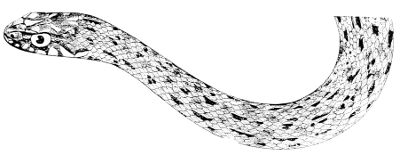
CŒLOPELTIS MONSPESSULANA
After Sordelli
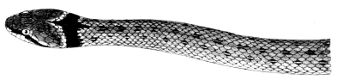
MACROPROTODON CUCULLATUS
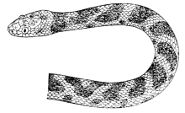
TARBOPHIS IBERUS
After Sordelli
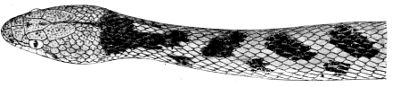
TARBOPHIS FALLAX
Head-Shields.—Rostral nearly as deep as broad,
just visible from above. Internasals much shorter
than the prefrontals. Frontal very narrow, twice to
twice and a half as long as broad, its width in the
middle not more than half that of the supraocular,
widening in front and extending beyond the supraoculars
to join the preoculars, longer than its distance
from the end of snout, as long as or a little longer
than the parietals. Two loreals. One preocular, the
upper portion of which is much enlarged, and encroaches
upon the area occupied in other snakes by
the prefrontal and the supraocular; two (rarely three)
postoculars. Temporals 2 + 3 or 4. Upper labials
eight (rarely nine), fourth and fifth (or fifth and
sixth) entering the eye. Four or five lower labials
in contact with the anterior chin-shields, which are
as long as or shorter than the posterior.
Scales with
single apical
pits, in seventeen
or nineteen
rows,
longitudinally
grooved in the
adult, less distinctly
in the
young. Ventral
shields 160 to 189; anal divided; subcaudals 68
to 102.
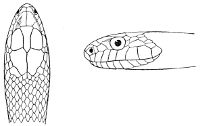
Fig. 30
Coloration.—The young is elegantly marked with
dark brown and yellowish-white on a pale brown
ground. On the head, the principal dark markings
usually are an oblique band on the posterior half of the
supraocular shield, and another, or a large spot, on
the parietal, sometimes produced backwards, and
forming with its fellow a
Λ-shaped
band, separated
from a large occipital blotch by a yellowish space;
anterior half of the frontal shield and shields on the
snout edged with dark brown; a dark streak, sometimes
broken up into small spots, on the temporal
region; yellow spots on the pre- and post-oculars;
lips brown, with large, yellow, black-edged spots, or
yellow with brown spots; chin with three brown
longitudinal streaks. Back with a vertebral series of
large roundish dark spots or narrow cross-bars;
small spots on the sides, these sometimes forming
longitudinal series or accompanied by yellowish streaks
or dots; these markings often confluent into three
longitudinal streaks on the tail. Belly pale brownish,
greyish, or reddish, with numerous pale spots, sometimes
with a dark brown line on each side. The
adult is greyish, reddish-brown, or olive above. Some
specimens preserve more or less the markings of the
young, and the dark dorsal markings (Plate XI.) may
be edged with yellowish and ocellar in appearance
(var. insignitus, Geoffroy); the belly is yellowish, with
small dark spots which usually form longitudinal
series, and may be confluent into streaks. A variety
common in Dalmatia (neumayeri, Fitzinger) is brown
or olive above, without spots, sides with a bluish-grey
lateral band, the scales on which are edged with
black, the belly uniform yellow. Other specimens
are brown or reddish, with light edges to the scales
on the sides, or with yellowish lateral lines, or dark
olive or dark brown above and black on the sides,
each scale with a yellowish central spot; in the last-mentioned
the second third of the back may be almost
entirely black, and the belly dark olive-grey in the
middle and yellowish on the sides. Iris brown,
with a golden or coppery circle round the pupil.
Size.—This handsome snake grows to a length of
61⁄2
feet. Specimens 5 to 6 feet long are not uncommon.
Distribution.—Mediterranean coast of France and
Western Liguria, Spain and Portugal, Sicily, Lampedusa,
eastern coast of the Adriatic, Greece and
eastern islands of the Mediterranean, Mediterranean
coast of Asia and Sinaitic Peninsula, eastwards to
the Caucasus and Persia, North Africa from Egypt
to Rio de Oro. It is not known to occur above
2,300 feet altitude in Europe.
Habits.—A lively, swift snake, living on land and
on low bushes, often found near human habitations.
Some specimens are very vicious, whilst others show
a gentle disposition after a short period of captivity.
A specimen nearly 6 feet long, which I kept for
some time, never attempted to bite when handled,
and some have become so tame as to take food from
the hand. The sense of sight appears to be better
developed than in any other European snake. The
food consists chiefly of mammals, even large rats
and young rabbits, birds such as chickens, partridges,
and quails, lizards, and other snakes, which, if of
considerable size, are not swallowed until paralyzed
or killed by the effect of the poison. In Eastern
Europe, Vipera ammodytes is said to be the principal
enemy of Cœlopeltis, and the two snakes are consequently
seldom found together in the same locality.
Many experiments have been made on the action
of the poison of this Opisthoglyph. Peracca and
Deregibus, as well as, later, Phisalix, found a striking
similarity with the symptoms of Cobra poison in
their experiments on small animals, the suspension
of the respiration occurring in a few minutes, the
blood being otherwise unaffected. It has been
stated by some authors that Cœlopeltis poison has
little or no action on man, but a French zoologist,
E. Taton-Baulmont, having been bitten in the index-finger
by a four-foot-long specimen at Algiers, the
swelling extended within thirty hours up to the
shoulder, and was accompanied by fever and nervous
troubles. As a rule, however, the bite of this snake
has no poisonous effect on man, from the fact that
the fangs conveying the venom are situated so far
back in the mouth as not to come into action.
Reproduction.—According to Werner, the eggs,
four to twelve in number, are laid in July, and
measure 2 inches in length and
1⁄2
inch in width.
Genus MACROPROTODON, Guichenot
Maxillary teeth few and very unequal in size, fourth
and fifth or fifth and sixth enlarged and followed by
an interspace, the two last teeth fang-like and grooved,
situated just behind the eye; sixth mandibular tooth
fang-like, and separated from the remainder by an
interspace. Head slightly distinct from neck; eye
rather small, the pupil vertically elliptic or subelliptic
when contracted. Body moderately elongate;
scales smooth, with apical pits. Tail moderate
or rather short.
A single species.
18. Macroprotodon cucullatus, I. Geoffroy
The False Smooth Snake
Form.—Very similar to the Smooth Snakes, with
which it has been confounded, but snout broader and
very strongly depressed.
Tail
five and a half to
six and a half
times in the total
length.
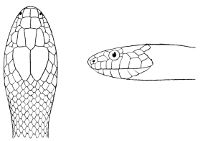
Fig. 31
Head-Shields.—Rostral
at
least twice as
broad as deep,
not or but scarcely visible from above. Internasals
as long as or a little shorter than the prefrontals.
Frontal not much broader than the supraocular
in the adult, once and a half to twice as
long as broad, as long as or longer than its distance
from the end of the snout, shorter than the
parietals. Nasal usually semidivided. Loreal once
and a half to twice as long as deep. One preocular,
extending to the upper surface of the head, but not
reaching the frontal; two (rarely one or three) postoculars.
Temporals 1 + 2. Upper labials eight, fourth
and fifth entering the eye, sixth usually in contact
with the parietal. Four or five lower labials in contact
with the anterior chin-shields, which are as long
as or a little shorter than the posterior.
Scales with mostly single apical pits, the pits
sometimes paired on the sides of the body, in twenty-one
or twenty-three rows (nineteen to twenty-five in
North African specimens). Ventral shields 153 to
192; anal divided; subcaudals 40 to 54.
Coloration.—Pale brown or greyish above, with
small dark brown or blackish spots or with more or
less distinct darker and lighter longitudinal streaks.
Upper surface of head with dark brown vermiculations;
a dark brown or black, often light-edged
occipito-nuchal band, extending downwards to the
gular region and produced forwards into a point to
between the parietal shields; a dark brown or black
streak on each side of the head from the end of the
snout, through the eye, to the last lower labial shield,
traversing the four last upper labials, which are yellowish
above and below the streak (Plate XI.). Lower
parts yellow or coral red, with black spots, which
may form a tessellated pattern, two longitudinal
series, or be so crowded as to fuse into a band along
the middle of the belly and tail.
The above description is taken from Spanish
specimens (Badajos, Algeciras, Andalucia), but the
variations are very great when we take North Africa
into consideration. The nuchal band may be
narrow or broken up into spots, the median of
which sometimes forms a longitudinal streak, or
so much enlarged as to fuse with the dark markings
on the upper surface of the head; in some specimens
(from Morocco and Algeria) the upper surface of the
head and the nape may be entirely ink black, or the
whole head black above and beneath with the exception
of a whitish streak bordering the upper lip.
The dark streak from the eye to the angle of the
mouth may be absent, or reduced to a short oblique
streak below the eye. Irrespective of the variations
in the markings of the upper parts, the lower parts
may be more or less spotted with black, or immaculate.
Some specimens of this small snake bear a general
resemblance to Coronella girondica, with which Macroprotodon
has sometimes been confounded. But a
careful examination of its whole structure shows it
to be more affine to Cœlopeltis and Tarbophis, the
other European representatives of the Opisthoglyphous
Colubrids.
Size.—The largest European specimen examined
measures
171⁄2
inches. Specimens up to 22 inches
long occur in Algeria and Tunisia.
Distribution.—In Europe this snake is only known
from Spain (Estremadura, New Castille, Andalucia),
Portugal (Alemtejo), the Balearic Islands (Majorca
and Minorca), and the island of Lampedusa. In
North Africa it is generally distributed from the
north coast of Egypt to the Rio de Oro; in Algeria
it penetrates into the northern parts of the Sahara.
The specimen figured on Plate XI. is from Algeciras.
Habits.—Appear to be similar to those of Coronella
girondica. Crepuscular in its habits, it is usually
found under stones or in burrows in the ground.
Unless pursued, when it darts off with great rapidity,
its movements are slow. It is very ready to bite,
but no experiments have been made on the effects
of its poison. The food consists chiefly of small
lizards.
Reproduction.—All that is known on this head is
that, according to Doumergue, eggs are laid in July in
Algeria.
Genus TARBOPHIS, Fleischmann
Maxillary teeth few, anterior longest, gradually
decreasing in size posteriorly, and followed, after an
interspace, by a pair of enlarged, grooved fangs,
situated below the posterior border of the eye;
anterior mandibular teeth strongly enlarged. Head
distinct from neck; eye moderate or rather small,
with vertically elliptic pupil. Body moderately
elongate; scales smooth, oblique, with apical pits.
Tail moderate or rather short.
The eight species of this genus inhabit South-Eastern
Europe, South-Western Asia, and Africa.
Two are dealt with here.
19. Tarbophis fallax, Fleischmann
(Ailurophis vivax, Bonaparte)
The Cat-Snake
Form.—Moderately slender. Head much depressed.
Tail five and a half to seven times in the
total length.
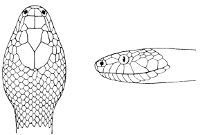
Fig. 32
Head-Shields.—Rostral broader than deep, just
visible from above. Internasals shorter than the prefrontals.
Frontal
much
broader than
the supraocular,
once and
one-fourth to
once and a
half as long as
broad, as long
as its distance
from the end of the snout, shorter than the
parietals. Nasal divided or semidivided. Loreal
twice and a half to thrice as long as deep, entering
the eye below the preocular, which is in contact with
the frontal. Two (rarely three) postoculars. Temporals
small, scale-like, 2 or 3 + 3 or 4. Upper
labials eight (rarely seven or nine), third, fourth, and
fifth (rarely fourth and fifth, or fourth, fifth, and
sixth) entering the eye. Three or four lower labials
in contact with the anterior chin-shields; posterior
chin-shields very small and widely separated from
each other by scales.
Scales with single or paired apical pits, in nineteen
or twenty-one rows, usually nineteen in European
specimens. Ventral shields 186 to 222; anal divided;
subcaudals 48 to 73.
Coloration.—Greyish above, with 40 to 57 brown
or black spots or bars on the body; a lateral series
of smaller spots or vertical bars, alternating with the
dorsals; the first spot, on the nape, elongate, usually
with one or three linear processes in front, extending
on the head (Plate XI.); usually a dark streak on each
side of the head, from the eye to the angle of the
mouth. Lower parts whitish, speckled, spotted, or
marbled with grey or brown. Iris brown, with a
golden circle round the pupil.
Size.—This species grows to a length of 2 feet
10 inches.
Distribution.—From Istria and Dalmatia to Greece,
the Archipelago, Constantinople, Asia Minor, Cyprus,
and Northern Syria; 2,600 feet appears to be its
altitudinal limit.
Habits.—Although to a certain extent crepuscular
or nocturnal, the Cat-snake is often seen hunting in
the daytime, its food consisting almost exclusively
of lizards, rarely of small mammals. Its movements
are rather slow. The names Katzenschlange and
Ailurophis, translated Cat-snake, probably originated
from the way in which this snake stalks its prey, and
suddenly pounces upon it. According to Eiffe, the
poison causes the death of a Lacerta vivipara in one
minute, and P. de Grijs observed the larger Lacerta
agilis to die in two or three minutes. As a rule
even fresh-caught specimens allow themselves to be
handled without attempting to bite; some specimens,
on the other hand, are very savage. Stony localities,
old walls, and ruins, are the favourite abodes of this
snake, which does well in captivity.
Reproduction.—Seven or eight eggs are laid in
July; they measure about
11⁄4
inches in length and
1⁄2
inch in width.
20. Tarbophis iberus, Eichwald
The Caucasian Cat-Snake
Very closely allied to the preceding, and differing
from it only in the following points: Parietals
shorter, slightly longer than the frontal, and anal
entire. Loreal twice to twice and a half as long as
deep. Fourth and fifth, or third, fourth, and fifth,
labials entering the eye. Scales in nineteen or
twenty-one rows. Ventrals 203 to 235; subcaudals
54 to 70.
Grey above, with 35 to 40 blackish spots on the
body, the anterior largest and darkest; a lateral
series of smaller spots or vertical bars. Lower parts
blackish, with small whitish spots and dots. Reaches
a length of
31⁄2
feet.
This species inhabits the Caucasus, and, being on
record from the northern slope (Kuban River), has
to be included in the European fauna. It occurs
also in Mesopotamia, a specimen from Bagdad being
preserved in the British Museum. The young
specimen figured on Plate XI. is stated to be from
Constantinople.
Nothing is known of its habits, which are probably
the same as those of Tarbophis fallax.