The Whisky Smugglers
A modern form of smuggling little
suspected by the average Englishman is found in the illicit
whisky-distilling yet carried on in the Highlands of Scotland and
the wilds of Ireland, as the records of Inland Revenue
prosecutions still annually prove. The sportsman, or the
more adventurous among those tourists who roam far from the
beaten track, are still likely to discover in rugged and remote
situations the ruins of rough stone and turf huts of no
antiquity, situated in lonely rifts in the mountain-sides, always
with a stream running by. If the stranger is at all
inquisitive on the subject of these solitary ruins, he will
easily discover that not only are they not old, but that they
have, in many cases, only recently been vacated. They are,
in fact, the temporary bothies built from the abundant materials
of those wild spots by the ingenious crofters and other
peasantry, for the purpose of distilling whisky that shall not,
between its manufacture and its almost immediate consumption, pay
duty to the revenue authorities.
This
illegal production of what is now thought to be the
“national drink” of Scotland and Ireland, is not of
any considerable antiquity, for whisky itself did not grow
popular until comparatively recent times. Robert Burns, who
may not unfairly be considered the poet-laureate of whisky, and
styles it “whisky, drink divine,” would have had
neither the possibility of that inspiration, nor have filled the
official post of exciseman, had he flourished but a few
generations earlier; but he was born in that era when
whisky-smuggling and dram-drinking were at their height, and he
took an active part in both the drinking of whisky and the
hunting down of smugglers of it.
One of the most stirring incidents of his career was that
which occurred in 1792, when, foremost of a little band of
revenue officers, aided by dragoons, he waded into the waters of
Solway, reckless of the quicksands of that treacherous estuary,
and, sword in hand, was the first to board a smuggling brig,
placing the crew under arrest and conveying the vessel to
Dumfries, where it was sold. It was this incident that
inspired him with the poem, if indeed, we may at all fitly claim
inspiration for such an inferior Burns product:
THE DE’IL’S
AWA’ WI’ THE EXCISEMAN
The De’il cam’ fiddling thro’ the town,
And danc’d awa’ wi’ the
exciseman;
And ilka wife cry’d, “Auld Mahoun,
I wish you luck o’ your prize, man.”
We’ll mak’ our maut and brew our drink,
We’ll dance, and sing, and rejoice, man;
And monie thanks to the muckle black De’il,
That danced awa’ wi’ the exciseman.
There’s threesome reels, and foursome reels,
There’s hornpipes and strathspeys, man;
But the ae best dance e’er cam’ to our lan’,
Was—the De’il’s awa’
wi’ the exciseman.
Whisky, i.e. usquebaugh, signifying in Gaelic
“water of life,” originated, we are told, in the
monasteries, where so many other comforting cordials were
discovered, somewhere about the eleventh or twelfth
century. It was for a very long period regarded only as a
medicine, and its composition remained unknown to the generality
of people; and thus we find among the earliest accounts of
whisky, outside monastic walls, an item in the household expenses
of James the Fourth of Scotland, at the close of the fifteenth
century. There it is styled “aqua
vitæ.”
A sample of this then new drink was apparently introduced to
the notice of the King or his Court, and seems to have been so
greatly appreciated that eight bolls of malt figure among the
household items as delivered to “Friar James Cor,”
for the purpose of manufacturing more, as per sample.
But for generations to come the nobles and gentry of Scotland
continued to drink wine, and the peasantry to drink ale, and it
was only with the closing years of another century that whisky became at
all commonly manufactured. We read that in 1579 distillers
were for the first time taxed in Scotland, and private stills
forbidden; and the rural population did not altogether forsake
their beer for the spirit until about the beginning of the
eighteenth century. Parliament, however, soon discovered a
tempting source of revenue in it, and imposed constantly
increasing taxation. In 1736 the distillers’ tax was
raised to 20s. a gallon, and there were, in addition,
imposts upon the retailers.
It might have been foreseen that the very natural result of
these extortionate taxes would be to elevate illegal distilling,
formerly practised here and there, into an enormously increased
industry, flourishing in every glen. Only a very small
proportion of the output paid the duties imposed. Every
clachan had its still, or stills.
This state of things was met by another Act which prohibited
the making of whisky from stills of a smaller capacity than five
hundred gallons; but this enactment merely brought about the
removal of the more or less openly defiant stills from the
villages to the solitary places in the hills and mountains, and
necessitated a large increase in the number of excisemen.
Seven years of these extravagant super-taxes sufficed to
convince the Government of the folly of so overweighting an
article with taxation that successful smuggling of it would
easily bring fortunes to bold and energetic men. To do so
was thus abundantly proved to be a direct provocation
to men of enterprise; and the net result the Government found to
be a vastly increased and highly expensive excise establishment,
whose cost was by no means met by the revenue derived from the
heavy duties. Failure thus becoming evident, the taxes were
heavily reduced, until they totalled but ten shillings and
sixpence a gallon.
But the spice of adventure introduced by illegal distilling
under the old heavy taxation had aroused a reckless frame of mind
among the Highlanders, who, once become used to defy the
authorities, were not readily persuaded to give up their illegal
practices. The glens continued to be filled with private
stills. Glenlivet was, in especial, famed for its
whisky-smugglers; and the peat-reek arose in every surrounding
fold in the hills from hundreds of “sma’
stills.” Many of these private undertakings did
business in a large way, and openly sold their products to
customers in the south, sending their tubs of spirits under
strong escort, for great distances. They had customers in
England also, and exciting incidents arose at the Border, for not
only the question of excise then arose, but that of customs duty
as well; for the customs rates on spirits were then higher in
England than in Scotland. The border counties of
Northumberland and Cumberland, Berwick, Roxburgh, and
Dumfriesshire were infested with smugglers of this double-dyed
type, to whom must be added the foreign contrabandists, such as
the Dutchman, Yawkins, who haunted the coasts of
Dumfriesshire and Galloway with his smuggling lugger, the
Black Prince, and is supposed to be the original of Dirk
Hatteraick, in Scott’s romance, “Guy
Mannering.”
The very name of this bold fellow was a terror to those whose
duty it was to uphold law and order in those parts; and it was,
naturally, to his interest to maintain that feeling of dread, by
every means in his power. Scott tells us how, on one
particular night, happening to be ashore with a considerable
quantity of goods in his sole custody, a strong party of
excisemen came down upon him. Far from shunning the attack,
Yawkins sprang forward, shouting, “Come on, my lads,
Yawkins is before you.”
The revenue officers were intimidated, and relinquished their
prize, though defended only by the courage and address of one
man. On his proper element, Yawkins was equally
successful. On one occasion he was landing his cargo at the
Manxman’s Lake, near Kirkcudbright, when two revenue
cutters, the Pigmy and the Dwarf, hove in sight at
once, on different tacks, the one coming round by the Isles of
Fleet, the other between the point of Rueberry and the Muckle
Ron. The dauntless free-trader instantly weighed anchor and
bore down right between the luggers, so close that he tossed his
hat on the deck of the one and his wig on that of the other,
hoisted a cask to his maintop, to show his occupation, and bore
away under an extraordinary pressure of canvas, without receiving
injury.
So,
at any rate, the fantastic legends tell us, although it is but
fair to remark, in this place, that no practical yachtsman, or
indeed any other navigator, would for a moment believe in the
possibility of such a feat.
To account for these and other hairbreadth escapes, popular
superstition freely alleged that Yawkins insured his celebrated
lugger by compounding with the Devil for one-tenth of his crew
every voyage. How they arranged the separation of the stock
and tithes is left to our conjecture. The lugger was
perhaps called the Black Prince in honour of the
formidable insurer. Her owner’s favourite
landing-places were at the entrance of the Dee and the Cree, near
the old castle of Rueberry, about six miles below
Kirkcudbright. There is a cave of large dimensions in the
vicinity of Rueberry, which, from its being frequently used by
Yawkins and his supposed connection with the smugglers on the
shore, is now called “Dirk Hatteraick’s
Cave.” Strangers who visit this place, the scenery of
which is highly romantic, are also shown, under the name of the
“Gauger’s Leap,” a tremendous precipice.
“In those halcyon days of the free trade,” says
Scott, “the fixed price for carrying a box of tea or bale
of tobacco from the coast of Galloway to Edinburgh was fifteen
shillings, and a man with two horses carried four such
packages.”
This condition of affairs prevailed until peace had come,
after the final defeat of Napoleon at Waterloo. The
Government then, as always, sadly in need of new sources of
revenue, was impressed with the idea that a fine sum might
annually be obtained by placing these shy Highland distillers
under contribution. But there were great difficulties in
the way. The existing laws were a mere dead letter in those
regions, and it was scarce likely that any new measures, unless
backed up by a display of military force, would secure
obedience. The Duke of Gordon, at that period a personage
of exceptionally commanding influence with the clansmen, was
appealed to by the Government to use his authority for the
purpose of discouraging these practices; but he declared, from
his place in the House of Lords, that the Highlanders were
hereditary distillers of whisky: it had from time immemorial been
their drink, and they would, in spite of every discouragement,
continue to make it and to consume it. They would sell it,
too, he said, when given the opportunity of doing so by the
extravagantly high duty on spirits. The only way out of the
difficulty with which the Government was confronted was, he
pointed out, the passing of an Act permitting the distilling of
whisky on reasonable terms.
The result of this straightforward speech was the passing of
an Act in 1823 which placed the moderate excise duty of
2s. 3d. a gallon on the production of spirits, with
a £10 annual license for every still of a capacity of forty
gallons: smaller stills being altogether illegal.
These provisions were reasonable enough, but failed to
satisfy the peasantry, and the people were altogether so opposed
to the regulation of distilling that they destroyed the licensed
distilleries. It was scarce worth the while of retailers,
under those circumstances, to take out licenses, and so it
presently came to pass that for every one duly licensed dealer
there would be, according to the district, from fifty to one
hundred unlicensed.
And so things remained until by degrees the gradually
perfected system of excise patrols wore down this resistance.
In the meanwhile, the licensed distillers had a sorry time of
it.
Archibald Forbes, many years ago, in the course of some
observations upon whisky-smugglers, gave reminiscences of George
Smith, who, from having in his early days been himself a
smuggler, became manager of the Glenlivet Distillery. This
famous manufactory of whisky, in these days producing about two
thousand gallons a week, had an output in 1824 of but one hundred
gallons in the same time; and its very existence was for years
threatened by the revengeful peasantry and proprietors of the
“sma’ stills.” Smith was a man of fine
physical proportions and great courage and tenacity of purpose,
or he could never have withstood the persecutions and dangers he
had long to face. “The outlook,” he said,
“was an ugly one. I was warned, before I began, by my
neighbours that they meant to burn the new distillery to the ground, and
me in the heart of it. The Laird of Aberlour presented me
with a pair of hair-trigger pistols, and they were never out of
my belt for years. I got together three or four stout
fellows for servants, armed them with pistols, and let it be
known everywhere that I would fight for my place till the last
shot. I had a pretty good character as a man of my word,
and through watching, by turns, every night for years, we
contrived to save the distillery from the fate so freely
predicted for it. But I often, both at kirk and market, had
rough times of it among the glen people, and if it had not been
for the Laird of Aberlour’s pistols I don’t think I
should have been telling you this story now.”
In ’25 and ’26 three more small distilleries were
started in the glen; but the smugglers succeeded very soon in
frightening away their occupants, none of whom ventured to hang
on a second year in the face of the threats uttered against
them. Threats were not the only weapons used. In 1825
a distillery which had just been started at the head of
Aberdeenshire, near the banks o’ Dee, was burnt to the
ground with all its outbuildings and appliances, and the
distiller had a very narrow escape of being roasted in his own
kiln. The country was in a desperately lawless state at
this time. The riding-officers of the Revenue were the mere
sport of the smugglers, and nothing was more common than for them
to be shown a still at work, and then coolly defied to make a
seizure.
Prominent among these active and resourceful men was
one Shaw, proprietor of a shebeen on the Shea Water, in the wilds
of Mar. Smugglers were free of his shy tavern, which, as a
general rule, the gaugers little cared to visit singly.
Shaw was alike a man of gigantic size, great strength, and of
unscrupulous character, and stuck at little in the furtherance of
his illegal projects. But if Shaw was a terror to the
average exciseman, George Smith, for his part, was above the
average, and feared no man; and so, when overtaken by a storm on
one occasion, had little hesitation in seeking the shelter of
this ill-omened house. Shaw happened to be away from home
at the time, and Smith was received by the hostess, who, some
years earlier, before she had married her husband, had been a
sweetheart of the man who now sought shelter. The
accommodation afforded by the house was scanty, but a bedroom was
found for the unexpected guest, and he in due course retired to
it. Mrs. Shaw had promised that his natural enemies, the
smugglers, should not disturb him, if they returned in the night;
but when they did return, later on, Shaw determined that he would
at least give the distillery man a fright. Most of them
were drunk, and ready for any mischief, and would probably have
been prepared even to murder him. Shaw was, however, with
all his faults, no little of a humorist, and only wanted his joke
at the enemy’s expense.
The band marched upstairs solemnly, in spite of some little
hiccoughing, and swung into the bedroom, a torch carried by the
foremost man throwing a fitful glare around. The door was
locked when they had entered, and all gathered in silence round
the bed. Shaw then, drawing a great butcher’s knife
from the recesses of his clothes, brandished it over the
affrighted occupant of the bed. “This gully, mon, iss
for your powels,” said he.
But Smith had not entered this House of Dread without being
properly armed, and he had, moreover, taken his pistols to bed
with him, and was at that moment holding one in either hand,
under the clothes. As Shaw flourished his knife and uttered
his alarming threats, he whipped out the one and presented it at
Shaw’s head, promising him he would shoot him if the whole
party did not immediately quit the room; while with the other
(the bed lying beside the fireplace) he fired slyly up the
chimney, creating a thunderous report and a choking downfall of
soot, in midst of which all the smugglers fled except Shaw, who
remained, laughing.
Shaw had many smart encounters with the excise, in which he
generally managed to get the best of it. The most dramatic
of these was probably the exploit that befell when he was
captaining a party of smugglers conveying two hundred kegs of
whisky from the mountains down to Perth. The time was
winter, and snow lay thick on field and fell; but the journey was
made in daytime, for they were a numerous band and well armed,
and feared no one. But the local Supervisor
of Excise had by some means obtained early news of this
expedition, and had secured the aid of a detachment of six
troopers of the Scots Greys at Coupar-Angus, part of a squadron
stationed at Perth. At the head of this little force rode
the supervisor. They came in touch with the smugglers at
Cairnwell, in the Spittal of Glenshee.
“Gang aff awa’ wi’ ye, quietly back up the
Spittal,” exclaimed the supervisor, “and leave the
seizure to us.”
“Na, faith,” replied Shaw; “ye’ll get
jist what we care to gie!”
“Say ye so?” returned the excise officer
hotly. “I’ll hae the whole or nane!”
The blood rose in Shaw’s head, and swelled out the veins
of his temples. “By God,” he swore,
“I’ll shoot every gauger here before ye’ll get
a drap!”
The supervisor was a small man with a bold spirit. He
turned to his cavalry escort with the order “Fire!”
and at the same time reached for Shaw’s collar, with the
exclamation, “Ye’ve given me the slip often enough,
Shaw! Yield now, I’ve a pistol in each pocket of my
breeches.”
“Have ye so?” coolly returned the immense and
statuesque Shaw, “it’s no’ lang they’ll
be there, then!” and with that he laid violent hands upon
each pocket and so picked the exciseman bodily out of his saddle,
tore out both pistols and pockets, and then pitched him, as
easily as an ordinary man could have done a baby, head over heels
into a snow-drift.
Meanwhile, the soldiers had not fired; rightly
considering that, as they were so greatly outnumbered, to do so
would be only the signal for an affray in which they would surely
be worsted. A wordy wrangle then followed, in which the
exciseman and the soldiers pointed out that they could not
possibly go back empty-handed; and in the end, Shaw and his
brother smugglers went their way, leaving four kegs behind,
“just out o’ ceeveelity,” and as some sort of
salve for the wounded honour of the law and its armed
coadjutors.
Not many gaugers were so lion-hearted as this; but one, at
least, was even more so. This rash hero one day met two
smugglers in a solitary situation. They had a cart loaded
up with whisky-kegs, and when the official, unaided, and with no
human help near, proposed single-handed to seize their
consignment and to arrest them, they must have been as genuinely
astonished as ever men have been. The daring man stood
there, purposeful of doing his duty, and really in grave danger
of his life; but these two smugglers, relishing the humour of the
thing, merely descended from their cart, and, seizing him and
binding him hand and foot, sat him down in the middle of the road
with wrists tied over his knees and a stick through the crook of
his legs, in the “trussed fowl” fashion. There,
in the middle of the highway, they proposed to leave him; but
when he pitifully entreated not to be left there, as he might be
run over and killed in the dark, they considerately carried him to the
roadside; with saturnine humour remarking that he would probably
be starved there instead, before he would be noticed.
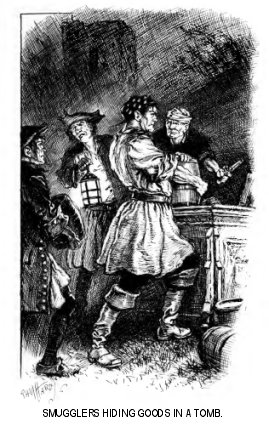
The flood-tide of Government prosecutions of the
“sma’ stills” was reached in 1823–5, when
an average of one thousand four hundred cases annually was
reached. These were variously for actual distilling, or for
the illegal possession of malt, for which offence very heavy
penalties were exacted.
Preventive men were stationed thickly over the face of the
Highlands, the system then employed being the establishment of
“Preventive Stations” in important districts, and
“Preventive Rides” in less important
neighbourhoods. The stations consisted of an officer and
one or two men, who were expected by the regulations not to sleep
at the station more than six nights in the fortnight.
During the other eight days and nights they were to be on outside
duty. A ride was a solitary affair, of one exciseman.
Placed in authority over the stations were
“supervisors,” who had each five stations under his
charge, which he was bound to visit once a week.
George Smith, of Glenlivet, already quoted, early found his
position desperate. He was a legalised distiller, and paid
his covenanted duty to Government, and he rightly considered
himself entitled, in return for the tribute he rendered, to some
measure of protection. He therefore petitioned the Lords of
the Treasury to that effect; and my lords duly replied,
after the manner of such, that the Government would prosecute any
who dared molest him. This, however, was not altogether
satisfactory from Smith’s point of view. He desired
rather to be protected from molestation than to be left open to
attack and the aggressors to be punished. A dead man
derives no satisfaction from the execution of his assassin.
Moreover, even the prosecution was uncertain. In
Smith’s own words, “I cannot say the assurance gave
me much ease, for I could see no one in Glenlivet who dared
institute such proceedings.”
It was necessary for a revenue officer to be almost killed in
the execution of his duty before the Government resorted to the
force requisite for the support of the civil power. A
revenue cutter was stationed in the Moray Firth, with a crew of
fifty men, designed to be under the orders of the excise officers
in cases of emergency.
But the smugglers were not greatly impressed with this
display, and when the excisemen, accompanied with perhaps
five-and-twenty sailors, made raids up-country, frequently met
them in great gangs of perhaps a hundred and fifty, and
recaptured any seizures they had made and adopted so threatening
an attitude that the sailors were not infrequently compelled to
beat a hasty and undignified retreat. One of these
expeditions was into Glenlivet itself, where the smugglers were
all Roman Catholics. The excisemen, with this in mind,
considered that the best time for a raid would be Monday
morning, after the debauch of the Sunday afternoon and night in
which the Roman Catholics were wont to indulge; and accordingly,
marching out of Elgin town on the Sunday, arrived at Glenlivet at
daybreak. At the time of their arrival the glen was, to all
appearance, deserted, and their coming unnoticed, and the sight
of the peat-reek rising in the still air from some forty or fifty
“sma’ stills” rejoiced their hearts.
But they presently discovered that their arrival had not only
been observed but foreseen, for the whole country-side was up,
and several hundred men, women, and children were assembled on
the hill-sides to bid active defiance to them. The
excisemen keenly desired to bring the affair to a decisive issue,
but the thirty seamen who accompanied them had a due amount of
discretion, and refused to match their pistols and cutlasses
against the muskets that the smugglers ostentatiously
displayed. The party accordingly marched ingloriously back,
except indeed those sailors who, having responded too freely to
the smugglers’ invitation to partake of a “wee
drappie,” returned gloriously drunk. The excisemen,
so unexpectedly baulked of what they had thought their certain
prey, ungraciously refused a taste.
This formed the limit of the sorely tried Government’s
patience, and in 1829 a detachment of regulars was ordered up to
Braemar, with the result that smuggling was gradually reduced to
less formidable proportions.
The
Celtic nature perceives no reason why Governments should confer
upon themselves the rights of taxing and inspecting the
manufacture of spirits, any more than any other commodity.
The matter appears to resolve itself merely into expediency: and
the doctrine of expediency we all know to be immoral. The
situation was—and is, whether you apply it to spirits or to
other articles in general demand—the Government wants
revenue, and, seeking it, naturally taxes the most popular
articles of public consumption. The producers and the
consumers of the articles selected for these imposts just as
naturally seek to evade the taxes. This, to the Celtic
mind, impatient of control, is the simplest of equations.
About 1886 was the dullest time in the illicit
whisky-distilling industry of Scotland, and prosecutions fell to
an average of about twenty a year. Since then there has
been, as official reports tell us, in the language of
officialdom, a “marked recrudescence” of the
practice. As Mr. Micawber might explain, in plainer
English, “there is—ah—in fact, more whisky made
now.” Several contributory causes are responsible for
this state of things. Firstly, an economical Government
reduced the excise establishment; then the price of barley, the
raw material, fell; and the veiled rebellion of the crofters in
the north induced a more daring and lawless spirit than had been
known for generations past. Also, restrictions upon the
making of malt—another of the essential constituents from
which the spirit is distilled—were at this time removed, and any
one who cared might make it freely and without license.
Your true Highlander will not relinquish his
“mountain-dew” without a struggle. His
forefathers made as much of it as they liked, out of inexpensive
materials, and drank it fresh and raw. No one bought
whisky; and a whole clachan would be roaring drunk for a week
without a coin having changed hands. Naturally, the
descendants of these men—“it wass the fine time they
had, whateffer”—dislike the notion of buying their
whisky from the grocer and drinking stuff made in up-to-date
distilleries. They prefer the heady stuff of the old
brae-side pot-still, with a rasp on it like sulphuric acid and a
consequent feeling as though one had swallowed lighted petroleum:
stuff with a headache for the Southerner in every drop, not like
the tamed and subdued creature that whisky-merchants assure their
customers has not got a headache in a hogshead.
The time-honoured brae-side manner of brewing whisky is not
very abstruse. First find your lonely situation, the
lonelier and the more difficult of access, obviously the
better. If it is at once lonely and difficult of approach,
and at the same time commands good views of such approaches as
there are, by so much it is the better. But one very
cardinal fact must not be forgotten: the site of the proposed
still and its sheltering shieling, or bothy, must have a
water-supply, either from a mountain-stream naturally passing, or
by an artfully constructed rude system of pipes.
A
copper still, just large enough to be carried on a man’s
back, and a small assortment of mash-tubs, and some pitchers and
pannikins, fully furnish such a rustic undertaking.
The first step is to convert your barley into malt; but this
is to-day a needless delay and trouble, now that malt can be made
entirely without let or hindrance. This was done by
steeping the sacks of barley in running water for some
forty-eight hours, and then storing the grain underground for a
period, until it germinated. The malt thus made was then
dried over a rude kiln fired with peats, whose smoke gave the
characteristic smoky taste possessed by all this bothy-made
stuff.
It was not necessary for the malt to be made on the site of
the still, and it was, and is, generally carried to the spot,
ready-made for the mash-tubs. The removal of the duty upon
malt by Mr. Gladstone, in 1880, was one of that grossly overrated
and really amateur statesman’s many errors. His
career was full of false steps and incompetent bunglings, and the
removal of the Malt Tax was but a small example among many
Imperial tragedies on a grand scale of disaster. It put new
and vigorous life into whisky-smuggling, as any expert could have
foretold; for it was precisely the long operation of converting
the barley into malt that formed the illegal distiller’s
chief difficulty. The time taken, and the process of
crushing or bruising the grains, offered some obstacles not
easily overcome. The crushing, in particular,
was a dangerous process when the possession of unlicensed malt
was an offence; for that operation resulted in a very strong and
unmistakable odour being given forth, so that no one who happened
to be in the neighbourhood when the process was going on could be
ignorant of it, while he retained his sense of smell.
Brought ready-made from the clachan to the bothy, the malt was
emptied into the mash-tubs to ferment; the tubs placed in charge
of a boy or girl, who stirs up the mess with a willow-wand or
birch-twig; while the men themselves are out and about at work on
their usual avocations.
Having sufficiently fermented, the next process was to place
the malt in the still, over a brisk heat. From the still a
crooked spout descends into a tub. This spout has to be
constantly cooled by running water, to produce condensation of
the vaporised alcohol. Thus we have a second, and even more
important, necessity for a neighbouring stream, which often, in
conjunction with the indispensable fire, serves the excisemen to
locate these stills. If a bothy is so artfully concealed by
rocks and turves that it escapes notice, even by the most
vigilant eye, amid the rugged hill-sides, the smoke arising from
the peat-fire will almost certainly betray it.
The crude spirit thus distilled into the tub is then emptied
again into the still, which has been in the meanwhile cleared of
the exhausted malt and cleansed, and subjected to a second
distilling, over a milder fire, and with a small piece of soap
dropped into the liquor to clarify it.
The question of maturing the whisky never enters into the
minds of these rustic distillers, who drink it, generally, as
soon as made. Very little is now made for sale; but when
sold the profit is very large, a capital of twenty-three
shillings bringing a return of nine or ten pounds.
But the typical secret whisky-distiller has no commercial
instincts. It cannot fairly be said that he has a soul
above them, for he is just a shiftless fellow, whose soul is not
very apparent in manner or conversation, and whose only ambition
is to procure a sufficiency of “whusky” for self and
friends; and a “sufficiency” in his case means a
great deal. He has not enough money to buy taxed whisky;
and if he had, he would prefer to make his own, for he loves the
peat-reek in it, and he thinks “jist naething at
a’” of the “puir stuff” that comes from
the great distilleries.
He is generally ostensibly by trade a hanger-on to the
agricultural or sheep-farming industries, but between his spells
of five days at the bothy (for it takes five days to the making
of whisky) he is usually to be seen loafing about,
aimlessly. Experienced folk can generally tell where such
an one has been, and what he has been doing, after his periodical
absences, for his eyelids are red with the peat-smoke and his
clothes reek with it.
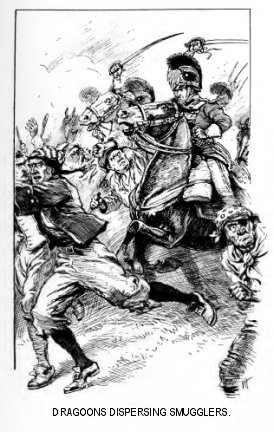
Perhaps the busiest centre of Highland illicit whisky-distilling is now to be located in the Gairloch,
but anything in the shape of exact information on so shy a
subject is necessarily not obtainable. Between this
district and the Outer Hebrides, islands where no stills are to
be found, a large secret trade is still believed to exist.
Seizures are occasionally made but the policy of the Inland
Revenue authorities is now a broad one, in which the existence of
small stills in inconsiderable numbers, although actually known,
is officially ignored: the argument being that undue official
activity, with the resultant publicity, would defeat itself by
advertising the fact of it being so easy to manufacture whisky,
leading eventually to the establishment of more stills.
The illegal production of spirits does, in fact, proceed all
over Great Britain and Ireland to a far greater extent than
generally suspected; and such remote places as the Highlands are
nowadays by no means the most favourable situations for the
manufacture. Indeed, crowded towns form in these times the
most ideal situations. No one in the great cities is in the
least interested in what his neighbour is doing, unless what he
does constitutes a nuisance: and it is the secret
distiller’s last thought to obtrude his personality or his
doings upon the notice of the neighbours. Secrecy, personal
comfort, and conveniences of every kind are better obtained in
towns than on inclement brae-sides; and the manufacture and
repair of the utensils necessary to the business are effected
more quickly, less expensively, and without the prying curiosity of a
Highland clachan.
It follows from this long-continued course of illegal
distilling that the Highlands are full of tales of how the
gaugers were outwitted, and of hairbreadth escapes and curious
incidents. Among these is the story of the revengeful
postmaster of Kingussie, who, on his return from a journey to
Aberlour on a dark and stormy night, called at Dalnashaugh inn,
where he proposed to stay an hour or two. The pretty maid
of the inn attended diligently to him for awhile, until a posse
of some half-dozen gaugers entered, to rest there on their way to
Badenoch, where they were due, to make a raid on a number of
illicit stills. The sun of the postmaster suddenly set with
the arrival of these strangers. They were given the
parlour, and treated with the best hospitality the house could
afford, while he was banished to the kitchen. He was
wrathful, for was he not a Government official, equally with
these upstarts? But he dissembled his anger, and, as the
evening wore on and the maid grew tired, he suggested she had
better go to bed, and he would be off by time the moon
rose. No sooner had she retired than he took the
excisemen’s boots, lying in the inglenook to dry, and
pitched them into a great pot of water, boiling over the
blaze.
When the moon had risen, he duly mounted his pony and set out
for Badenoch, where he gave out the news that the gaugers were
coming.
The excisemen could not stir from the inn for a
considerable time, for their boiled boots refused to be drawn on;
and by the time they had been enabled to stretch them and to set
out once more on their way, the Badenoch smugglers had made off
with all their gear, leaving nothing but empty bothies for
inspection. The local historian is silent as to what
happened afterwards to the postmaster, the only possible author
of this outrage.
A smuggler of Strathdearn was unfortunate in having the excise
pouncing suddenly upon him in his bothy, and taking away his only
cask of whisky. The hated myrmidons of a Sassenach
Government went off with the cask, and were so jealous of their
prize that they took it with them to the inn where they were to
pass the night. All that evening they sang songs and were
merry with a numerous company in an upper room; but even at their
merriest they did not forget their capture, and one of their
number sat upon it all the time.
It chanced, however, that among these merry fellows were some
of the smuggler’s friends, who were careful to note exactly
the position of the cask. They procured an auger and bored
a hole from the room below, through the flooring and into the
cask, draining all the whisky away. When the excisemen had
come to the end of their jollification, they had only the empty
cask for their trouble.
One of the brae-side distillers of Fortingal brought a cart
laden with kegs of whisky into Perth, by arrangement with an
innkeeper of that town; but the innkeeper refused to pay a fair
price.
“Wha will her sell it till, then?” asked the
would-be vendor.
The innkeeper, a person of a saturnine humour, mentioned a
name and a house, and the man went thither with his cart.
“What is it, my man?” asked the occupier, coming
to the door.
“Well, yer honour, ’tis some o’ the finest
whusky that iver was made up yon, and niver paid the
bawbee’s worth o’ duty.”
“D’ye know who I am?” returned the
householder. “I’m an officer of excise, and I
demand to know who sent you to me.”
The smuggler told him.
“Now,” said the exciseman, “go back to him
and sell him your whisky at his own price, and then
begone.”
The man did as he was bidden; sold his consignment, and left
the town. It was but a few hours afterwards that the
innkeeper’s premises were raided by the excise, who seized
the whisky and procured a conviction at the next Assizes, where
he was heavily fined.
One of the last incidents along the Border, in connection with
whisky-smuggling between Scotland and England, occurred after the
duty had been considerably lowered. This was a desperate
affray which took place on the night of Sunday, January 16th,
1825, at Rockcliffe Cross, five miles from Carlisle on the Wigton
road. One Edward Forster, officer of excise, was on duty
when he observed a man, whose name, it afterwards appeared, was
Charles Gillespie, a labourer, carrying a suspicious object, and
challenged him. This resulted in an encounter in which the
excise officer’s head was badly cut open. Calling aid
of another labourer, who afterwards gave evidence, he remarked
that he thought the smuggler had almost done for him, but pursued
the man and fired upon him in the dark, with so good an aim that
he was mortally wounded, and presently died. It was a
dangerous thing in those times for an excise officer to do his
duty, and at the inquest held the coroner’s jury returned a
verdict of “Murder”; the men who formed the jury
being doubtless drawn from a class entirely in sympathy with
smuggling, and possibly engaged in it themselves. Forster,
evidently expectant of that verdict, did not present himself, and
was probably transferred by his superiors to some post far
distant. There the affair ends.
About the same time, on the Carlisle and Wigton road, two
preventive men at three o’clock in the morning met a man
carrying a load, which, when examined, proved to be a keg of
spirits. Two other men then came up and bludgeoned the
officers, one of whom dropped his cutlass; whereupon a smuggler
picked it up, and, attacking him vigorously, cut him over the
head. The smugglers then all escaped, leaving behind them
two bladders containing eight gallons of whisky.


