“WHAT do you make of it all, Sally?”
The two girls were sitting in the pine grove on the heights of Slipper
Point. They sat each with her back against a tree and with the
enchanting view of the upper river spread out panoramically before them.
Each of them was knitting,—an accomplishment they had both recently
acquired.
“I can’t make anything of it at all, and I’ve thought of it day and
night ever since,” was Sally’s reply. “It’s three weeks now since the
day we came through that tunnel and discovered where it ended. And
except what Miss Camilla told us that day, she’s never mentioned a thing
about it since.”
“It’s strange, how she stopped short, just after she’d said the writing
was her brother’s,” mused Doris. “And then asked us in the next breath
not to question her about it any more, and to forgive her silence in
the matter because it probably concerned something that was painful to
her.”
“Yes, and kept the paper we found in the cave,” went on Sally. “I
believe she wanted to study it out and see what she could make of it. If
she’s sure it was written by her brother, she will probably be able to
puzzle it out better than we would. One thing, I guess, is certain,
though. It isn’t any secret directions where to find treasure. All our
little hopes about that turned out very differently, didn’t they?”
“Sally, are you glad or sorry we’ve discovered what we did about that
cave?” demanded Doris suddenly.
“Oh, glad, of course,” was Sally’s reply. “At first, I was awfully
disgusted to think all my plans and hopes about it and finding buried
treasure and all that had come to nothing. But, do you know what has
made me feel differently about it?” She looked up quickly at Doris.
“No, what?” asked her companion curiously.
“It’s Miss Camilla herself,” answered Sally. “I used to think you were
rather silly to be so crazy about her and admire her so much. I’d never
thought anything about her and I’d known her ‘most all my life. But
since she asked us that day to come and see her as often as we liked and
stop at her house whenever we were up this way, and consider her as our
friend, I’ve somehow come to feel differently. I’m glad we took her at
her word and did it. I don’t think I would have, if it hadn’t been for
you. But you’ve insisted on our stopping at her house so frequently, and
we’ve become so well acquainted with her that I really think I—I
almost—love her.”
It pleased Doris beyond words to hear Sally make this admission. She
wanted Sally to appreciate all that was fine and admirable and lovely in
Miss Camilla, even if she were poor and lonely and deaf. She felt that
the friendship would be good for Sally, and she knew that she herself
was profiting by the increased acquaintance with this friend they had so
strangely made.
“Wasn’t it nice of her to teach us to knit?” went on Sally. “She said we
all ought to be doing it now to help out our soldiers, since the country
is at war.”
“She’s taught me lots beside that,” said Doris. “I just love to hear her
talk about old potteries and porcelains and that sort of thing. I do
believe she knows more about them than even grandfather does. She’s
making me crazy to begin a collection myself some day when I’m old
enough. She must have had a fine collection once. I do wonder what
became of it.”
“Well, I don’t understand much about all that talk,” admitted Sally. “I
never saw any porcelains worth while in all my life, except that little
thing she has on her mantel. And I don’t see anything to get so crazy
about in that. It’s kind of pretty, of course, but why get excited about
it? What puzzles me more is why she never has said what became of all
her other things.”
“That’s a part of the mystery,” said Doris. “And her brother’s mixed up
in it somehow, and perhaps her father. That much I’m sure of. She talks
freely enough about everything else except those things, so that must be
it. Do you know what I’m almost tempted to think? That her brother did
commit some crime, and her father hid him away in the cave to escape
from justice, but she couldn’t have known about it, that’s plain.
Because she did not know about the cave and tunnel at all till just
lately. Perhaps she wondered what became of him. And maybe they sold all
her lovely porcelains to make up for what he’d done somehow.”
“Yes,” cried Sally in sudden excitement. “And another idea has just come
to me. Maybe that queer paper was a note her brother left for her and
she can’t make out how to read it. Did you ever think of that?”
“Why, no!” exclaimed Doris, struck with the new idea. “I never thought
of it as anything he might have left for her. Do you remember, she
said once they were awfully fond of each other, more even than most
brothers and sisters? It would be perfectly natural if he did want to
leave her a note, if he had to go away and perhaps never come back. And
of course he wouldn’t want any one else to understand what it said. Oh,
wait!—I have an idea we’ve never thought of before. Why on earth have
we been so stupid!—”
She sprang up and began to walk about excitedly, while Sally watched
her, consumed with curiosity. At length she could bear the suspense no
longer.
“Well, for pity’s sake tell me what you’ve thought of!” she demanded.
“I’ll go wild if you keep it to yourself much longer.”
“Where’s that copy?” was all Doris would reply. “I want to study it a
moment.” Sally drew it from her pocket and handed it to her, and Doris
spent another five minutes regarding it absorbedly.
“It is. It surely is!” she muttered, half to herself. “But how are we
ever going to think out how to work it?” At last she turned to the
impatient Sally.
“I’m a fool not to have thought of this before, Sally. I read a book
once,—I can’t think what it was now, but it was some detective
story,—where there was something just a little like this. Not that it
looked like this, but the idea was the same. If it is what I think, it
isn’t the note itself at all. The note, if there is one, must be
somewhere else. This is only a secret code, or arrangement of the
letters, so that one can read the note by it. Probably the real note is
written in such a way that it could never be understood at all without
this. Do you understand?”
Sally had indeed grasped the idea and was wildly excited by it.
“Oh, Doris,” she cried admiringly. “You certainly are a wonder to have
thought all this out! It’s ten times as interesting as what we first
thought it was. But how do you work this code? I can’t make anything out
of it at all.”
“Well, neither can I, I’ll have to admit. But here’s what I think. If
we could see what that note itself looks like, we could perhaps manage
to puzzle out just how this code works.”
“But how are we going to do that?” demanded Doris. “Only Miss Camilla
has the note, if there is a note; and certainly we couldn’t very
well ask her to let us see it, especially after what she said to us that
day.”
“No, we couldn’t, I suppose,” said Doris, thoughtfully. “And yet—” she
hesitated. “I somehow feel perfectly certain that Miss Camilla doesn’t
know the meaning of all this yet, hasn’t even guessed what we have,
about this paper. She doesn’t act so. Maybe she doesn’t even know there
is a note,—you can’t tell. If she hasn’t guessed, it would be a mercy
to tell her, wouldn’t it?”
“Yes, I suppose so,” admitted Sally dubiously. “But I wouldn’t know how
to go about it. Would you?”
“I could only try and do my best, and beg her to forgive me if I were
intruding,” said Doris. “Yes, I believe she ought to be told. You can’t
tell how she may be worrying about all this. She acts awfully worried,
seems to me. Not at all like she did when we first knew her. I believe
we ought to tell her right now. Call Genevieve and we’ll go over.”
Sally called to Genevieve, who was playing in the boat on the beach
below, and that young lady soon came scrambling up the bank. Hand in
hand, all three started to the home of Miss Camilla and when they had
reached it, found her sitting on her tiny porch knitting in apparently
placid content. But, true to Doris’s observation, there were anxious
lines in her face that had not been seen a month ago. She greeted them,
however, with real pleasure, and with her usual hospitality proffered
refreshments, this time in the shape of some early peaches she had
gathered only that morning.
But Doris who, with Sally’s consent, had constituted herself spokesman,
before accepting the refreshment, began:
“Miss Camilla, I wonder if you’ll forgive us for speaking of something
to you? It may seem as if we were intruding, but we really don’t intend
to.”
“Why, speak right on,” exclaimed that lady in surprise. “You are too
well-bred to be intrusive, that I know. If you feel you must speak of
something to me, I know it is because you think it wise or necessary.”
Much relieved by this assurance, Doris went on, explaining how she had
suddenly had a new idea concerning the mysterious paper and detailing
what she thought it might be. As she proceeded, a new light of
comprehension seemed to creep into the face of Miss Camilla, who had
been listening intently.
“So we think it must be a code,—a secret code,—Miss Camilla. And if
you happen to have any queer sort of note or communication that you’ve
never been able to make out, why this may explain it,” she added.
When she had finished, Miss Camilla sat perfectly still—thinking. She
thought so long and so intently that it seemed as if she must have
forgotten completely the presence of the three on the porch with her.
And after what seemed an interminable period, she did a strange thing.
Instead of replying with so much as a word, she got up and went into
the house, leaving them open-mouthed and wondering.
“Do you suppose she’s angry with us?” whispered Sally. “Do you think we
ought to stay?”
“No, I don’t think she’s angry,” replied Doris in a low voice. “I think
she’s so—so absorbed that she hardly realizes what she’s doing or that
we are here. We’d better stay.”
They stayed. But so long was Miss Camilla gone that even Doris began to
doubt the wisdom of remaining any longer.
But presently she came back. Her recently neat dress was grimy and
dishevelled. There was a streak of dust across her face and a cobweb lay
on her hair. Doris guessed at once that she had been in the old, unused
portion of her house. But in her hand she carried something, and
resuming her seat, she laid it carefully on her knee. It was a little
book about four inches wide and six or seven long, with an old-fashioned
brown cover, and it was coated with what seemed to be the dust of years.
The two girls gazed at it curiously, and when Miss Camilla had got her
breath, she explained:
“I can never thank you enough for what you have told me today. It throws
light on something that has never been clear to me,—something that I
have even forgotten for long years. If what you surmise is true, then a
mystery that has surrounded my life for more than fifty years will be at
last explained. It is strange that the idea did not occur to me when
first you girls discovered the cave and the tunnel, but even then it
remained unconnected in my mind with—this.” She pointed to the little
book in her lap. Then she went on:
“But, now, under the circumstances, I feel that I must explain it all to
you, relying still on your discretion and secrecy. For I have come to
know that you are both unusually trustworthy young folks. There has been
a dark shadow over my life,—a darker shadow than you can perhaps
imagine. I told you before of my father’s opinions and leanings during
the years preceding the Civil War. When that terrible conflict broke
out, he insisted that I go away to Europe with my aunt and stay there
as long as it lasted, providing me with ample funds to do so. I think
that he did not believe at first that the struggle would be so long.
“I went with considerable reluctance, but I was accustomed to obeying
his wishes implicitly. I was gone two years, and in all that time I
received the most loving and affectionate letters constantly, both from
him and also my brother. They assured me that everything was well with
them. My brother had enlisted at once in the Union Army and had fought
through a number of campaigns. My father remained here, but was doing
his utmost, so he said, in a private capacity, to further the interests
of the country. Altogether, their reports were glowing. And though I was
often worried as to the outcome, and apprehensive for my brother’s
safety, I spent the two years abroad very happily.
“Then, in May of 1863, my first calamity happened. My aunt died very
suddenly and unexpectedly, while we were in Switzerland, and, as we had
been alone, it was my sad duty to bring her back to New York. After her
funeral, I hurried home here, wondering very much that my father had not
come on to be with me, for I had sent him word immediately upon my
arrival. My brother, I suspected, was away with the army.
“I was completely astounded and dismayed, on arriving home, at the
condition of affairs I found here. To begin with, there were no servants
about. Where they had gone, or why they had been dismissed, I could not
discover. My father was alone in his study when I arrived, which was
rather late in the evening. He was reserved and rather taciturn in his
greeting to me, and did not act very much pleased to welcome me back.
This grieved me greatly, after my long absence. But I could see that he
was worried and preoccupied and in trouble of some kind. I thought that
perhaps he had had bad news about my brother Roland, but he assured me
that Roland was all right.
“Then I asked him why the house was in such disorder and where the
servants were, but he only begged me not to make inquiries about that
matter at present, but to go to my room and make myself as comfortable
as I could, and he would explain it all later. I did as he asked me and
went to my room. I had been there about an hour, busying myself with
unpacking my bag, when there was a hurried knock at my door. I went to
open it, and gave a cry of joy, for there stood my brother Roland.
“Instead of greeting me, however, he seized my hand and cried: ‘Father
is very ill. He has had some sort of a stroke. Hurry downstairs to him
at once. I must leave immediately. I can’t even wait to see how he is.
It is imperative!’
“ ‘But, Roland,’ I cried, ‘surely you won’t go leaving Father like this!’
But he only answered, ‘I must. I must! It’s my duty!’ He seized me in
his arms and kissed me, and was gone without another word. But before he
went, I had seen—a dreadful thing! He was enveloped from head to foot
in a long, dark military cape of some kind, reaching almost to his feet.
But as he embraced me under the light of the hall lamp, the cloak was
thrown aside for an instant and I had that terrible glimpse. Under the
concealing cloak my brother was wearing a uniform of Confederate gray.
“I almost fainted at the sight, but he was gone before I could utter a
word, without probably even knowing that I had seen. This, then, was
the explanation of the mysterious way they had treated me. They had gone
over to the enemy. They were traitors to their country and their faith,
and they did not want me to know. For this they had even sent me away
out of the country!...
“But I had no time to think about that then. I hurried to my father and
found him on the couch in his study, inert in the grip of a paralytic
stroke that had deprived him of the use of his limbs and also of
coherent speech. I spent the rest of the night trying to make him
easier, but the task was difficult. I had no one to send for a doctor
and could not leave him to go myself, and of course the nearest doctor
was several miles away. There was not even a neighbor who could be
called upon for assistance.
“All that night, however, my father tried to tell me something. His
speech was almost absolutely incoherent, but several times I caught the
sound of words like ‘notebook’ and ‘explain.’ But I could make nothing
of it. In the early morning another stroke took him, and he passed away
very quietly in my arms.
“I can scarcely bear, even now, to recall the days that followed. After
the funeral, I retired very much into myself and saw almost no one. I
felt cut off and abandoned by all humanity. I did not know where my
brother was, could not even communicate with him about the death of our
father. Had he been in the Union Army I would have inquired. But the
glimpse I had had that night of his rebel uniform was sufficient to seal
my lips forever. There was no one in the village whom I knew well enough
to discuss any such matters with, nor any remaining relative with whom I
was in sympathy. I could only wait for my brother’s return to solve the
mystery.
“But my brother never returned. In all these years I have neither seen
him nor heard of him, and I know beyond doubt that he is long since
dead. And I have remained here by myself like a hermit, because I feel
that the shame of it all has hung about me and enveloped me, and I
cannot get away from it. Once, a number of years ago, an old village
gossip here, now long since gone, said to me, ‘There was something queer
about your father and brother, now wasn’t there, Miss Camilla? I’ve
heard tell as how they were “Rebs” on the quiet, during the big war
awhile back. Is that so?’ Of course, the chance remark only served to
confirm the suspicions in my mind, though I denied it firmly to her when
she said it.
“I also found to my amazement, when I went over the house after all was
over, that many things I had loved and valued had strangely disappeared.
All the family silver, of which we had had a valuable set inherited from
Revolutionary forefathers, was gone. Some antique jewelry that I had
picked up abroad and prized highly was also missing. But chief of all,
my whole collection of precious porcelains and pottery was nowhere to be
found. I searched in every conceivable nook and cranny in vain. And at
last the disagreeable truth was forced on me that my father and brother
had sold or disposed of them, for what ends I could not guess. But it
only added to my bitterness to think they could do such a despicable
thing without so much as consulting me.
“But now, at last, I come to the notebook. I found it among some papers
in my father’s study desk, a while after his death, and I frankly
confess I could make nothing of it whatever. It seemed to be filled with
figures, added and subtracted, and, as my father had always been rather
fond of dabbling with figures and mathematics, I put it down as being
some quiet calculations of his own that had no bearing on anything
concerning me. I laid it carefully away with his other papers, however,
and there it has been, in an old trunk in the attic of the unused part
all these years. When you spoke of a ‘secret code,’ however, it
suddenly occurred to me that the notebook might be concerned in the
matter. Here it is.”
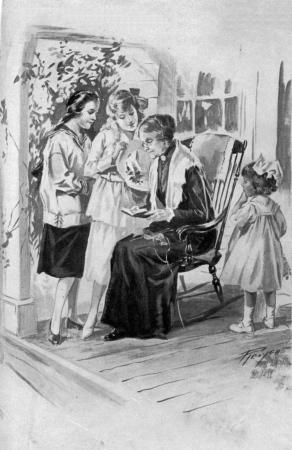
She held it out to them and they crowded about her eagerly. But as she
laid it open and they examined its pages, a disappointed look crept into
Sally’s eyes.
“Why, there’s nothing here but numbers!” she exclaimed, and it was
even so. The first few lines were as follows:
56 + 14 - 63 + 43 + 34 + 54 + 64 + 43 +
16 - 52 + 66 + 52 + 15 + 23 - 66 + 24 -
15 + 44 + 43 - 43 + 64 + 43 + 24 + 15 -
61 + 53 - 36 + 24 + 14 - 51 + 15 + 53 +
54 + 43 + 52 + 43 + 43 + 15 - 16 + 66 +
52 + 36 + 52 + 15 + 43 + 23 -
And all the rest were exactly like them in character.
But Doris, who had been quietly examining it, with a copy of the code in
her other hand, suddenly uttered a delighted cry:
“I have it! At least, I think I’m on the right track. Just examine
this code a moment, Miss Camilla. If you notice, leaving out the line of
figures at the top and right of the whole square, the rest is just the
letters of
 “Why, there’s nothing there but numbers”
the alphabet and the figures one to nine and another ‘o’ that probably
stands for ‘naught.’ There are six squares across and six squares down,
and those numbers on the outside are just one to six, only all mixed up.
Don’t you see how it could be worked? Suppose one wanted to write the
letter ‘t.’ It could be indicated by the number ‘5’ (meaning the square
it comes under according to the top line of figures) and ‘1’ (the number
according to the side line). Then ‘51’ would stand for letter ‘T,’
wouldn’t it?”
“Great!” interrupted Sally, enthusiastically, who had seen the method
even quicker than Miss Camilla. “But suppose it worked the other way,
reading the side line first? Then ‘T’ would be ‘15.’ ”
“Of course, that’s true,” admitted Doris. “I suppose there must have
been some understanding between those who invented this code about which
line to read first. The only way we can discover it is to puzzle it out
both ways, and see which makes sense. One will and the other won’t.”
It all seemed as simple as rolling off a log, now that Doris had
discovered the explanation. Even Miss Camilla was impressed with the
value of the discovery.
“But what is the meaning of these plus and minus signs?” she queried. “I
suppose they stand for something.”
“I think that’s easy,” answered Doris. “In looking over it, I see there
are a great many more plus than minus signs. Now, I think the plus signs
must be intended to divide the numbers in groups of two, so that each
group stands for a letter. Otherwise they’d be all hopelessly mixed up.
And the minus signs divide the words. And every once in a while, if you
notice, there’s a multiplication sign. I imagine those as the periods at
the end of sentences.”
They all sat silent a moment after this, marveling at the simplicity of
it. But at length Doris suggested:
“Suppose we try to puzzle out a little of it and see if we are really on
the right track? Have you a piece of paper and a pencil, Miss Camilla?”
Miss Camilla went indoors and brought them out, quivering with the
excitement of the new discovery.
“Now, let’s see,” began Doris. “Suppose we try reading the top line
first. ‘56’ would be ‘1’ and ‘14’ would be ‘2.’ Now ‘12’ may mean a word
or it may not. It hardly seems as if a note would begin with that. Let’s
try it the other way. Side line first. Then ‘56’ is ‘m,’ and ‘14’ is
‘y.’ ‘My’ is a word, anyway, so perhaps we’re on the right track.
Let’s go on.”
From the next series of letters she spelled the word “beloved” and after
that “sister.” It was plain beyond all doubting that at last they had
stumbled on a wonderful discovery.
But she got no further than the words, “my beloved sister,” for, no
sooner had Miss Camilla taken in their meaning than she huddled back in
her chair and, very quietly, fainted away.