Once upon a time, in a country a long way
from here, there stood a flourishing city, full
of commerce; and in that city lived a merchant so
lucky in all his ventures that it seemed as if
fortune waited on his wishes. But while enormously
rich, he had a very long family of six sons and six
daughters; and as yet not one of them was settled
in life. The boys were too young to go out in the
world; and the girls, who had everything at home
the heart could desire, were in no hurry to risk a
change by choosing a husband, although many rich
and noble suitors paid court to them.
But one day an unexpected disaster brought
this pleasant state of things to an end. Their
house caught fire and was burnt to the ground;
and with it perished not only the magnificent
furniture, but the merchant's account books, bank
notes, gold and silver, and the precious wares on
which his wealth depended. Scarcely anything
was saved.
This was but the beginning of their misfortunes.
Their father, who up to now had prospered in
everything he touched, lost in a very short while
every ship he had upon the sea. Some were
wrecked, others captured by pirates. His agents
failed; his clerks in foreign countries proved unfaithful;
and, in short, from the height of riches
he suddenly fell into the direst poverty.
Nothing was left to him but one poor little
country cottage, at least a hundred leagues from
the city in which he had lived. In this he was
driven to find refuge, and to this he carried off his
family, who were in despair since the overthrow.
The daughters especially could not endure the
thought of dwelling in such a den (as they called
it). At first they had felt sure that on hearing
the news their suitors would be tripping one
another up in haste to renew their offers of
marriage. But in this they were soon undeceived.
Their downfall was no sooner known than all these
flattering wooers took to their heels in a troop.
They fared no better with their intimate friends,
who at once dropped their acquaintance. Nay,
those to whom our merchant had formerly shown
the greatest kindness were now the most eager to
speak ill of him.
So nothing was left for this hapless family but
to take their departure from the city and shut
themselves up in the cottage, which stood in the
depth of a dismal and almost trackless forest. No
servants now to wait on them! The sons tilled
the ground and swept out the farm sheds; and
the daughters, dressed like country girls in coarse
linen frocks, were forced to turn their delicate
hands to the roughest employment and live on
hard fare of which there was little enough.
Only the youngest daughter showed a brave
heart. She had been despondent as any of them
to begin with; but after weeping—as well she
might—for her father's misfortunes, she recovered
her natural gaiety, made the best of things, tried
to forget how ungrateful the world had been,
kept her father and her brothers amused with
her cheerful wit, and after she had done her
work, would sing and play. But her sisters would
not join with her in making the best of things.
'It is very easy for you to be happy,' the eldest
grumbled. 'You have low tastes and were born
for this kind of life.' The fact is, they were all
jealous of her because of her sweet temper and good
looks. So beautiful, indeed, was this youngest
sister that in the old days every one had agreed
to call her Beauty—by that and by no other name
she was known. Alone of them she might
easily, in the first days of their ruin, have found
a husband; but she could not think of this while
she could be of use to help and console her
family.
Two years passed, and there came news which
seemed to offer a hope to escape. One of their
father's ships, long supposed to be lost, had arrived
in port with a rich cargo. The message further
advised his return to the city with speed, or his,
agents might sell the goods too cheaply and he
would lose his gains. So, whilst his children
danced with joy at the news, the merchant set
about preparing for his long journey.
In their transport his daughters loaded him
with commissions for gowns and jewels it would
have taken a fortune to buy. Only Beauty would
not ask for anything. Her father, noting her
silence, interrupted the others who still kept adding
to their list of requirements.
'Well, Beauty,' he said, 'and what shall I
bring home for you? Surely you, too, wish for
something?'
'Dear father,' she answered, 'I wish for the
most precious thing in the world; and that is to
see you home again safe and sound.'
This answer covered the sisters with confusion,
and vexed them so that one of them, speaking up
for the others, said tartly: 'This small miss is
putting on airs. She thinks, no doubt, she cuts a
figure with her affected fine sentiments!'
Her father, however, was touched by her good
feeling. Nevertheless he told her to choose something—'For,'
said he, 'at your age it is only
natural to like dresses and pretty presents.'
'Well, dear father,' said she, 'since you insist, I
will beg you to bring me home a rose. I have not
seen one since we came to live here, and I love
roses.' In this way Beauty contrived to obey her
father and yet to put him to no expense.
The day came for the merchant to embrace
them all and bid them farewell. He made the
best of his way to the great city; and arrived
there to be met with a great disappointment. To
be sure his vessel had come safely to port; but
his partners, believing him dead, had taken
possession of it and divided the cargo between
them. To make good his claim he was forced to
bring a number of tedious law-suits. He won
them in the end; but only to find, after six
months of trouble and expense, that he was almost
as poor as when he started.
To make his misery complete he was forced to
travel back in the winter, in the most inclement
weather; so that by the time he reached the skirts
of the forest he was ready to drop with fatigue.
But reminding himself that his home was now not
many leagues away, he called up what strength,
remained to him.
As he pushed on through the forest, night overtook
him; and in the piercing cold, half buried—his
horse and he—in the deep snow that hid
every pathway, the poor merchant feared that his
last hour had come. Not so much as a hut did he
pass. The only shelter to be found was the trunk
of a hollow tree; and there he cowered through
the long night, kept awake by his hunger and the
howling of the wolves. Nor did the day bring
him much comfort: for thick snow lay everywhere,
and not a path was to be seen. It was only after
a weary search that he managed to recover his horse,
which had wandered away and partly sheltered
itself in another hollow tree. He mounted, and
now in a little while discovered a sort of track
which presently grew easier.
Following this, he found himself in an avenue
of trees, at the entrance of which he halted and
rubbed his eyes. For no snow had fallen in this
avenue, and the trees were tall orange-trees, planted
in four rows and covered with flowers and fruit;
and here and there among the trees were statues,
some of single figures, others of groups representing
scenes of war, but all coloured like real life.
At the end of the avenue, straight in front of him,
rose a magnificent castle in many terraces. The
merchant rode around to the stable courtyard, which
he found empty; and there, with half-frozen hands,
he unbridled and stabled his horse. Within the
doorway he found a staircase of agate with balusters
of carved gold. He mounted it and passed through
room after room, each more splendidly furnished
than the last. They were deliciously warm, too,
and he began to feel his limbs again. But he was
hungry; where could he find some one to give
him food? Everywhere was silence; and yet the
place had no look of being abandoned. Drawingrooms,
bedchambers, galleries—all stood unlocked....
At last, tired of roaming, he came
to a halt in an apartment where some one had
lit a bright fire. A sofa drawn up cosily beside
it, invited him to sit and warm his limbs; and
resting there, he closed his eyes and fell into
deep and grateful slumber.
As weariness had sent him to sleep, so hunger
awoke him. He opened his eyes and saw at his
elbow a table with meats and wine upon it. He
had been fasting for more than twenty-four hours,
and lost no time in falling-to. He hoped that he
might soon have sight of this most hospitable
entertainer, whoever he might be, and an opportunity
of thanking him. Still no one appeared;
and now this good food did for him what fatigue
had done before. He dropped off again into an
easy slumber which lasted for four hours almost.
Again awaking, he saw at his elbow another small
table—of porphyry this time—upon which the unknown
hands had set out a dainty meal of cakes,
crystallised fruits and liqueurs. To this, too, he
did justice. But, as the time still passed and no
one appeared, he began to feel terrified, and resolved
to search once more through all the rooms....
But still he found no one.
He had been fasting, for more than twenty-four hours,
and lost no time in falling to.
He was standing lost in thought, when of a
sudden it came into his mind that some kindly
power had perhaps prepared this palace of wonder
for him, that it with all its riches might indeed be
his. Possessed by this notion he once again made
a tour of the rooms and took stock of their treasures,
planning in his mind how he would divide them
amongst his children, assigning this apartment to
one and that to another, and whispering to himself
what joy he would carry home after all from his
journey. Then he went down into the garden,
where—though it was the depth of winter—the
birds were singing and the air breathed the scent
of a thousand flowers.
'Surely,' he told himself, 'my daughters will be
happy here and never desire any more to go back to
the city. Quick! Let me saddle my horse at once
and ride home with the news!'
The way to the stable was an alley fenced on
either hand with palings, and over the palings hung
great clusters of roses in bloom. They reminded
him of his promise to Beauty. He plucked one,
and was about to pluck a whole nosegay, when he
was startled by a horrible noise behind him, and
attempted to turn. But behind him stood a hideous
Beast who was overtaking him and reaching out
towards him.
'Who gave you leave to pluck my roses?'
roared this monster. 'Was it not enough that
I made you welcome in my palace and treated you
kindly? And you show your gratitude by stealing
my flowers! But your insolence shall not go unpunished!'
The good merchant, terrified no less by the
sight of this Beast than by his threats, let drop the
rose and flung himself on his knees.
'My Lord,' he cried, 'have pity on me! I am
not ungrateful; but after all your kindness I could
not guess that so small a thing would offend you.'
This speech did not at all abate the Beast's
wrath. 'Hold your tongue, sir,' he commanded,
'if you can offer me nothing but flatteries and
false titles. I am not "my lord." I am the Beast;
and your words will not save you from the death
you deserve.'
The merchant, although in fear of his life,
plucked up courage to tell the monster that the
rose which he had been bold to pluck was for one
of his daughters, by name Beauty. Then, in hope
either to delay the Beast's vengeance or to touch
his compassion, he launched into the tale of all his
misfortunes, and of his reasons for the journey,
not forgetting to mention Beauty again and her
request.
The Beast considered for a moment before
answering him in a somewhat milder tone: 'I will
forgive you; but only on condition that you give
me one of your daughters. Some one must make
amends for this trespass.'
'Heaven forgive me,' the merchant entreated,
'but how can I promise such a thing! Even were
I cruel enough to purchase my life at the cost of a
child, on what excuse could I bring her?'
'No excuse is necessary,' replied the Beast
shortly. 'Whichever you bring must come here of
her own free will, or not at all. Go home and try
if there be one brave and loving enough to sacrifice
herself to save your life. You seem to be an honest
man. Give me your word to return here at the end
of a month and bring whichever of your daughters
you can persuade to come with you. If you can
persuade none of them, you must come alone; and
I warn you that, if you fail of it, I shall come and
fetch you.'
What was the poor man to do? He promised,
for he saw death staring him in the face; and
having given his promise he hoped to be allowed to
depart. But the Beast informed him that he could
not go until next day.
'Then,' said he, 'at daybreak you will find a
horse ready for you who will carry you home in less
than no time. Now go and eat your supper, and
await my commands.'
The merchant, more dead than alive, crept back
to his rooms. There, before a blazing fire, he
found a delicious supper spread, inviting him to eat.
But so distraught was he, that no food, however
delicious, could have tempted him had he not been
afraid that the Beast might be hiding somewhere to
watch him. In fear of this he forced himself to sit
and taste of the dishes.
A loud noise in the next room warned him that
the Beast was coming. Since he could not escape,
he mustered what courage he could to conceal his
terror, and faced about to the doorway.
'Have you made a good supper?' was the
Beast's first question.
The merchant in humblest voice answered that,
thanks to his host's kind attention, he had fared
excellently well.
'I am paying you a visit,' said the Beast, 'to
warn you again to be honest with your daughter.
Describe me to her just as I am. Let her be free
to choose whether she will come or no; but tell her
that, her course once chosen, there can be no
retreat, nor even reflection after you have brought
her to me. To break faith then will avail nothing:
she will but destroy you without winning her own
release.'
Again the spirit-broken merchant repeated his
promise.
The Beast appeared to be content at length.
'Retire to bed now,' he commanded, 'and do not
get up to-morrow until you see the sun and hear a
golden bell rung. Then, before starting, you will
find breakfast laid for you here; your horse will be
standing ready saddled in the courtyard; and you
may carry back the rose to your daughter Beauty—as
you call her. For the rest, I count on seeing
you back in a month's time. So, farewell.'
The merchant, who dared not disobey a single
one of these orders, retired to bed at once, though
without any temptation to sleep; and again, though
he passed a wretched night, he was punctual to rise
with the sun. A golden bell rang; and prompt on
the sound he found breakfast laid, still by unseen
hands. After breakfast he went down to the stables,
and on his way paused to pick up the rose, which
lay in the alley where it had dropped from his hand.
It was fresh as ever, and smelt as sweetly as though
it yet grew on the tree.
A few paces further on he found his horse
standing ready saddled, with a handsome cloak of
furs, far warmer than his own, lying across the
saddle. He put it on and mounted, and now he
had to wonder at yet another miracle. His horse
set off at an incredible speed, so that before he
could even turn in the saddle the palace had sunk
out of sight.
Could the horse have felt the weight on the
good man's mind, it had never made such a pace.
But it took its own way, insensible to rein or bridle;
nor halted until it reached the door of the cottage.
The merchant's sons and daughters had rushed
out at his approach; though it was not until he
drew quite close that they recognised their father in
this horseman superbly cloaked, with a rose at his
holster, and mounted on a horse that travelled at
such a speed. When they recognised him, they
made sure that he brought the best of news. But
the tears that trickled down his cheeks as he dismounted
told them another story.
His first motion then was to pluck the fatal rose
from the pommel and hand it to Beauty, saying:
'Here is what you asked me to bring. You little
know what it will cost you all.'
This, and his sorrowful look, gave the eldest
daughter her cue. 'I was certain of it!' she said.
'Did I not say, all along, that to force a rose at this
time of the year would cost you more than would
have bought presents for all the rest of us? A rose,
in mid-winter! and such a rose! There—one has
only to look at it to see that you took good care
Beauty should have her present, no matter at what
cost to us!'
'It is all too true,' answered their father sorrowfully,
'that this rose has cost me dear—far dearer
than all the presents you others begged of me.
But the cost is not in money; for would to God
I could have bought it with the last penny in my
purse!'
His speech, you may be sure, excited their
curiosity, and they gave him no rest until he had
told the whole of his story. It left their hopes
utterly dashed: and the daughters lamented their
lot, while their brothers hardily declared that they
would never allow their father to return to this
accursed castle—they would march thither in a
body and destroy the horrible Beast who owned it.
But their father assured them that he had given his
word and would rather die than break it.
Thereat the sisters turned upon Beauty and
started to upbraid and rail against her.
'It is all your fault,' they declared; 'and
this is what comes of your pretended modesty!
Why could you not have asked for dresses and
jewels as we did? Even if you could not get
them, at least the demand would have cost
nothing. But you chose to be singular—you, with
your precious rose! and now our father must die,
and we must all suffer through your affectation!'
Poor Beauty controlled her tears and
answered them: 'Yes, I am to blame for all
this, though, indeed, dear sisters, I did it
innocently; for how could I guess that to ask
for a rose in the middle of summer, as it was
then, would give rise to all this misery? But
what does that matter? Innocent or guilty, I
cannot allow you to suffer for what was my
fault; and so I will go back with our father
to save him from his promise. That will be in
a month's time, and in this little month, I beg of
you, let us be happy together without reproaches.'
At first her brothers would not hear of any such
sacrifice, and her father was equally set against it,
until the sisters again fired up in their jealousy and
accused him of being distressed only because it
happened to be Beauty; if another of his daughters
(they hinted) had offered to pay this price for his life,
he would have accepted it cheerfully enough!
Beauty closed this talk by saying firmly that,
whether they wished it or not, she would go—'And
who knows,' said she, forcing a brave smile,
'but this fate of mine, which seems so terrible, may
cover some extraordinary and happy fortune?' She
said it merely to hearten them; but her sisters,
fancying her deluded by vanity and self-conceit,
smiled maliciously and applauded. So their father
gave way, and it was agreed that Beauty must go.
For her part she desired only that the few days
remaining to her might be as happy as possible;
and so, as they passed she spoke little of what was
before her, and, if at all, only to treat it lightly and
as a piece of good fortune. When the time drew
near she shared up all her trinkets and little possessions
with her sisters—for, badly as they had treated
her, they were the only friends she had. Yet
jealousy had made their hearts so wicked that when
the fatal day arrived they actually rejoiced to hear
the neighing of a horse which, punctually sent by
the Beast, arrived at the door of the cottage.
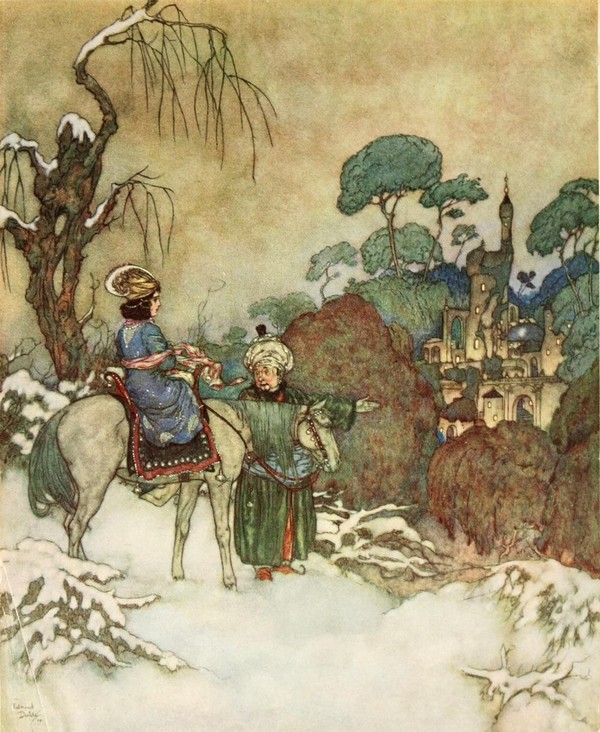
Soon they caught sight of the castle in the distance.
The brothers would have rushed out and slain
the beautiful animal; but Beauty, mastering their
anger with a few tender words, bade her father
mount into the saddle; and so, after bidding her
sisters farewell with a tenderness that forced them
to weep at the last, climbed to the pillion behind
him quite as if she were setting out for a holiday.
They were off! The horse seemed to fly rather
than to gallop; so smoothly that Beauty could
scarcely feel the motion save by the soft wind that
beat on her cheek. Soon they caught sight of the
castle in the distance. Her father, less happy than
she, again and again asked and begged her to alight
and return—a most idle offer, for he had no real
control of the reins. But Beauty did not listen,
because her mind was made up.
Nevertheless, she was awed, and all the more
when, as the fleet horse galloped up to the courtyard,
they were met by a great salvo of guns and, as the
echoes died away, by the sound of soft music
within the palace.
The horse had come to a stop, by a flight of
agate steps; a light shone down these steps from
a porchway within which the violins kept their
throbbing. Beauty slipped down from the saddle,
and her father, alighting after her, took her by the
hand and led her to the chamber in which he had
first supped; where, sure enough, they found a
cheerful fire and a score of candles lit and burning
with an exquisite perfume, and—best of all—a table
laid with the daintiest of suppers.
The merchant, accustomed to the ways of their
host, knew that the supper was meant for them, and
Beauty fell-to with a good appetite. Her spirits
indeed were rising. There had been no sign of any
Beast in all the many rooms through which she had
passed, and everything in them had seemed to breathe
of gaiety and good living.
But this happy frame of mind did not last long.
They had scarcely finished supper when the Beast
was heard coming through the distant rooms. At
the sound—the heavy padding of his feet, the roar
of his breath—Beauty clung to her father in terror,
and had almost fainted against the arm which he
flung around her. But when the Beast stood before
her in the doorway, after a little shudder she walked
towards him with a firm step, and, halting at a little
distance, saluted him respectfully. This behaviour
evidently pleased the Beast. After letting his eyes
rest on her face for a while, he said, in a tone that
might well have struck terror into the boldest heart
(and yet it did not seem to be angry):—
'Good evening, my good sir! Good evening,
Beauty!'
The merchant was too far terrified to find his
voice; but Beauty controlled hers and answered
sweetly:—
'Good evening, Beast!'
'Have you come here of your own free will?'
asked the Beast. 'And are you willing to let your
father return and leave you here?'
Beauty answered that she was quite willing.
'Indeed? And yet what do you suppose will
happen to you after he has gone?'
'Sir,' said Beauty, 'that is as it pleases you, and
you only can tell.'
'Well answered,' replied the Beast; 'and since
you have come of your own accord, you shall stay.
As for you, my good sir,' said he to the merchant,
'you will take your departure at sunrise. The
bell will give you warning; delay not to rise, eat
your breakfast, and depart as before. But remember
that you are forbidden ever to come within sight of
my palace again.'
Then, turning to Beauty, he said:—
'Take your father into the next room, and choose
between you everything you think will please your
brothers and sisters. You will find there two travelling
trunks: fill them as full as they will hold.'
Sorrowful as she was at the certainty of losing
her father so soon and for ever, Beauty made ready
to obey the Beast's orders, and he left them as he
had come, saying:—
'Good night, Beauty! Good night, good sir!'
When they were alone, Beauty and her father
went into the next room, which proved to be a
store-chamber piled with treasures a king and
queen might have envied. After choosing and
setting apart in heaps,—one for each of her sisters,—the
most magnificent dresses she could find, Beauty
opened a cupboard which had a door of crystal
framed in gold, and stood for a moment dazzled by
the precious stones that lay piled on every shelf.
After choosing a vast number and adding them to
her heaps, she opened yet another wardrobe and
found it full of money in gold pieces. This set her
pondering.
'I think, father,' she said, 'that we had better
empty these trunks again, and fill them with
money. For money can always be turned to
account, whereas to sell these precious stones you
would have to go to some jeweller, who very likely
would cheat you, and perhaps be suspicious of
them. But with these pieces of gold you can buy
land, houses, furniture, jewels—what you will—and
no one will ask any questions.'
Her father agreed. Yet he first of all tried to
make room for the money by emptying out the few
things he had packed for himself. But this was no
good: for it seemed that the trunks were made in
folds which opened the wider the more he put in.
Somehow the more they packed, the more room
there seemed to be, and they ended by replacing all
the dresses and precious stones they had taken out.
But now the trunks were so heavy that an elephant
would have sunk under them.
'It is all a cheat!' cried the merchant. The
Beast is mocking us, and only pretended to give
us these things, knowing that I could not carry
them away.'
'Wait a little,' advised Beauty. 'That would
be a sorry jest, and I cannot help thinking that the
Beast is honest; and that since he offered these
gifts he will find you also the means to carry them.
The best thing we can do is to strap up the trunks
and leave them ready here.'
So they did this and went back to the little
room, where to their amazement they found a breakfast
laid on the table. For a moment they could
scarcely believe that the night had flown by whilst
they were occupied in ransacking the treasure
chamber and packing the trunks. But, glancing at
the windows, they saw that day was indeed breaking;
and presently a bell sounded, warning the
merchant to eat quickly and depart.
He finished his meal, and they went down
together to the courtyard, where two horses stood
ready—the one laden with the two trunks, the
other saddled for the merchant to ride. And now
Beauty and her father would fain have spent a long
time in bidding one another farewell. But the two
horses neighed and pawed the ground so impatiently
that he was afraid to linger. Tearing himself from
his daughter's arms he mounted in haste, and could
scarcely turn to say good-bye before both horses
sprang away swift as the wind and he was lost to
sight in an instant.
Poor Beauty! She gazed and gazed through
her tears, and so mounted the stairs sorrowfully back
to her own chamber. On reaching it she felt herself
oppressed with sleepiness, for she had passed
the night without undressing, and, moreover, for a
month past her sleep had been broken and haunted
with terrors. So, having nothing better to do, she
went to bed, and was nestling down in the perfumed
sheets when her eyes fell on the little table by the
bedside. Some one had set a cup of hot chocolate
there, and, half asleep, she reached out her hand for
it and drank it; whereupon her eyes closed and
she fell into a delicious slumber, such as she had
not known since the day when her father brought
home the fatal rose.
She dreamed that she was walking alongside an
endless canal, the banks of which were bordered
with tall orange-trees and myrtles in flower. There,
as she wandered disconsolately lamenting her fate,
of a sudden a young Prince stood before her. He
was handsome as the God of Love in picture-books,
and when he spoke it was with a voice that went
straight to her heart. 'Dear Beauty,' he said, 'you
are not so unfortunate as you suppose. It is here
you shall find the reward of your goodness, denied
to you elsewhere. Use your wits to find me out
under the disguise which hides me—that is, if as I
stand here now you find me not altogether contemptible.
For I love you tenderly—you alone—and
in making me happy you can attain to your own
happiness. Beloved, never distrust your own true
heart, and it shall lead you where the heart has
nothing left to desire!' So saying, the charming
apparition knelt at her feet, and again besought her
to accept his devotion and become mistress over all
his life.
'Ah! What can I do to make you happy?'
she asked earnestly.
'Only be grateful,' he answered, 'and do not
believe all that your eyes would tell you. Above
all, do not abandon me until you have rescued me
from the cruel sufferings I endure.'
With that the dream melted away, but only to
be succeeded by another. She found herself face to
face with a stately and beautiful lady; and the lady
was speaking to her with dignity, yet most kindly.
'Dear Beauty,' she said, 'do not grieve for what
you have left behind; a far higher destiny lies before
you. Only, if you would deserve it, beware of being
misled by appearances.'
Beauty found her dreams so agreeable that she
was in no hurry at all to awake, and even when her
eyes opened to the daylight she had more than half
a mind to close them again. But a clock, chiming
out her own name twelve times, warned her that it
was midday and time to get up. She rose, therefore,
and found her dressing-table set out with
brushes and combs and everything she could want;
and having dressed carefully, and with a lightness of
heart for which she found it hard to account, she
passed into the next room and found her dinner on
the table.
Dinner does not take very long when you are
all by yourself. Beauty, when she had eaten enough,
sat down on a sofa and began to think of the handsome
youth she had seen in her dream. 'He told
me I could make him happy. Why, then, it must
be that the horrible Beast, who appears to be master
here, is keeping him a prisoner. How can I set
him free?... They both warned me not to trust
to appearances. It is all very puzzling.... But
one thing is clear at any rate, that I am very silly to
be vexing my head over a dream. I will forget all
about it, and look for something to do to amuse
myself.'
She sprang up, and started to make a tour of
discovery through the many rooms of the palace.
They were even grander than she had expected.
The first she entered was lined with mirrors from
floor to ceiling, where she saw herself reflected on
every side. The next thing to catch her eye was
a bracelet, hanging from one of the chandeliers.
Set in the bracelet was a gold locket, and opening
this she was startled indeed; for it contained a
portrait in miniature of the gallant youth she had
seen in her dream. She could not be mistaken; so
closely were his features engraved on her memory—yes,
and, it may be, on her heart. She slipped
the bracelet on her wrist, without stopping to think
that it did not belong to her, and went on to explore
further. She passed into a long picture
gallery, and there again she met the Prince's face.
It smiled down at her, this time from a life-sized
portrait, and it seemed to smile so wistfully that she
caught herself blushing.
From the gallery her steps had led her to a
chamber filled with instruments of music. Beauty
was an accomplished musician; so, sitting down,
she amused herself by tuning and trying over one
instrument after another; but she liked the harp
best because that went best with her voice.
Leaving the music-room at length, she found
herself in a long chamber like the picture gallery,
but lined with books. It held an immense library;
and Beauty, ever since she had lived in the country,
had been forced to do without reading, for her
father had sold all his books to pay his debts.
Now, as her eyes travelled along the shelves, she
knew she need never have any fear that time would
pass heavily here. The dusk was gathering before
she had half-studied even the titles of the thousands
of volumes; and numbers of candles, waxen and
scented, in chandeliers with lustres of diamonds
and rubies, were beginning to light themselves in
every room.
In due time Beauty found supper laid and
served for her, with the same good taste and
orderliness as before, and still she had seen no
living face. What did this matter? Her father
had warned her that she would be solitary; and
she was beginning to tell herself that she could be
solitary here without much discomfort, when she
heard the noise of the Beast approaching. She
could not help trembling a little; for she had not
yet found herself alone with him, and knew not
what would happen—he might even be coming
to devour her. But when he appeared he did not
seem at all ferocious.
'Good evening, Beauty,' he said gruffly.
'Good evening, Beast,' she answered gently,
but shaking a little.
'Do you think you can be content here?' he
asked.
Beauty answered politely that it ought not to
be hard to live happily in such a beautiful palace.
After this they talked for an hour, and in the
course of their talk Beauty began to excuse many
things in the Beast—his voice, for example. With
such a nose how could he help roaring through
it? Really, he appeared to be wanting in tact
rather than purposely terrible; though, to be sure,
this want of tact terrified her cruelly, when at length
he blurted out:—
'Will you be my wife, Beauty?'
'Ah! I am lost!' thought Beauty. The Beast
could not be so dull-witted after all, for, though
she kept the cry to herself, he answered quickly,
and just as if she had uttered it aloud:—
'Not at all. I wish you to answer just "yes"
or "no."'
'Oh! no, Beast.'
'Very well, then,' said this tractable monster.
'Since you will not, I had best be going. Good
night, Beauty.'
'Good night, Beast,' answered Beauty, relieved
of her fright. She felt sure now that he did not
mean to hurt her, and as soon as he had taken his
leave she went off to bed, and was asleep in no
time.
But almost as quickly she was dreaming, and
in her dream at once she saw her unknown lover
standing beside her, handsome as ever, but more
sorrowful than before.
'Dear Beauty,' he said, 'why are you so cruel to
me? I love you the better for being so stubborn,
and yet it lengthens out my misery.'
She could not understand this at all. Her
dream wavered and it seemed to her that he took
a hundred different shapes in it. Now he had a
crown between his hands and was offering it to
her; now he was kneeling at her feet; now he
smiled, radiant with joy; and again he buried his
head in despair and wept till the sound of his
sobbing pierced her heart. Thus, in one aspect
or another, he was with her the night through.
She awoke with him in her thoughts, and her first
act was to unclasp the locket on her wrist and
assure herself that the miniature was like him.
It certainly was the same face, and his, too, was
the face that smiled down from the larger portrait
in the gallery. But the face in the locket gave
her a more secret joy and she unclasped and gazed
on it again and again.
This morning she went down into the gardens,
where the sun shone inviting her to ramble. They
were beyond imagination lovely. Here stood a
statue showered over with roses; there fountain
on fountain played and threw a refreshing spray
so high in the air that her eyes could scarcely
reach to its summit. But what most surprised
her was that every nook and corner recalled those
she had seen in her dreams with the unknown
Prince standing beside her. At length she came
to the long canal with the oranges and myrtles
in the shade of which she had first seen him
approach. It was the very spot, and she could no
longer disbelieve that her dreams were real. She
felt sure, now, that he must somehow be imprisoned
here, and resolved to get at the truth
that very evening, should the Beast repeat his visit.
Tired at length of wandering, she returned to
the palace and discovered a new room full of
materials for work to engage the most idle—tape-bags,
distaffs and shuttles, frames for tapestry,
ribbons to make into bows, silks for embroidery,
scissors, and thimbles. Beyond this needlework
room a door opened upon the most wonderful
sight of all—an aviary full of the rarest birds, yet
all so tame that they flew to Beauty, and perched
themselves on her shoulders.
'Dear birds,' she said, 'I wish you were closer
to my own room, that I might sit and hear you
singing.'
She had scarcely said it when, opening a door
beyond the aviary, she found herself in her own
chamber—yes, her very own!—which she had
thought to be quite on the other side of the
building. The door, when she came to examine
it, had a shutter which could be opened to hear,
and closed again when she grew tired of it.
This aviary opened on another inhabited by
parrots, parroquets, and cockatoos. These no
sooner saw Beauty than they began to scream and
chatter; one wishing her 'Good morning,' another
inviting her to luncheon, while a third yet more
gallant cried 'Kiss me! Kiss me!' Others again
whistled airs from grand opera or declaimed
pieces of poetry by the best authors. It was
plain that in their several ways they all had the
same object—to amuse her.
Beyond the aviaries lay a monkey house. Here
were apes of all sorts—Barbary apes, mandarin
apes, apes with blue faces, baboons, marmosets,
chimpanzees—and all came frisking about her,
bowing and scraping, to show how much they
appreciated the honour of this visit. To celebrate
it they stretched a tight-rope and danced, and
threw somersaults with an agility which Beauty
found highly diverting; and yet she could not
help sighing that none of these animals were able
to tell her news of her unknown Prince Charming.
She patted and made much of them, however, and
asked if some of them would be kind enough to
come with her and keep her company.
At once, and as if they had only been waiting
for this command, two large she-apes in sweeping
court-dresses stepped to her side and became her
maids of honour; two brisk little marmosets
volunteered for pages and held up her train;
while an affable baboon, his face wreathed with
smiles, bowed, presented a gloved hand, and
begged leave to squire her. With this singular
escort Beauty marched back to luncheon, and
while she ate it the birds piped and fluted around
her for accompaniment to the parrots, who lifted
up their voices and chanted the latest and most
fashionable tunes. Nay more; the meal was no
sooner ended than the apes begged her to allow
them to entertain her with a light comedy; which
(leave being granted) they proceeded to act in a
highly creditable manner and with appropriate
dumb-show, while the parrots spoke the words
from the wings very distinctly and in accents that
exactly conformed with the various parts. At the
close one of the actors advanced, laid his hand
on his heart and—still with the parrot for interpreter—thanked
Beauty for the indulgence she had
shown to their poor efforts.
That night again, after supper, the Beast paid
her his accustomed visit. He put the same questions,
and received her answers as before; and, as
before, the conversation ended by his taking leave
of her with a 'Good night, Beauty.' The two
she-apes, as ladies-in-waiting, thereupon undressed
their mistress and saw her to bed. Before leaving
they thoughtfully opened the window-shutter, that
the soft night-warbling of the birds might soothe
her to sleep and dream of her lover.
In this fashion day followed day, and still
Beauty found plenty to amuse her. At the end
of a week she made the most wonderful discovery
of all. There was one large room which she had
entered but once, because it seemed to her rather
dull, and dark too. It was empty; and although
it had four windows in each wall, but two of them
admitted any light. One day, as she passed the
door, the fancy took her to open one of these
windows. She stepped in and drew the shutter,
when to her astonishment it opened, not upon
daylight at all, but what seemed to be a dim hall
lit only by a glimmer, distant and faint, behind the
chinks of a thick curtain at the further end. She
was wondering what this might mean, when the
curtain went up and in a sudden flood of light
she found herself gazing, as from a box, into a
theatre crowded from floor to ceiling, and with an
audience brilliant in dresses and jewels.
An orchestra played the overture, and gave
place to the actors—real actors this time, not apes
and parrots. The play was charming, and Beauty
in ecstasy with every scene of it. When the
curtain fell she still lingered in her box, hoping to
see the fashionable crowd disperse; but somewhat
to her chagrin the lights went out almost at once
and the theatre was dark again. Still it had been
very pleasant, and she promised herself to become
a constant playgoer.
That evening when the Beast paid his visit, she
told him all about the comedy. 'Eh? You like
that sort of thing, do you?' asked the monster.
'Well, you shall have as much of it as you like.
You are so pretty.' Beauty could not help smiling
inwardly at his clumsy compliments. But she
smiled no longer when he put to her once again his
blunt question:—
'Beauty, will you be my wife?'
'No, Beast,' she answered as before; but she
was really beginning to get frightened, he was so
gentle and so persistent. She sat up so long
thinking over this that it was almost daylight
before she closed her eyes in bed; and at once,
as if impatient at being kept waiting, the lover of
her dreams presented himself. Perhaps for this
reason he was not in the best of tempers; at
any rate he taxed her with being moody and
discontented.
'I should be happy enough,' she answered, 'if
the Beast did not pester me so. I—I almost
think, by his foolish compliments, that he would
like me to marry him.' Beauty expected her dream-lover
to show some jealousy at this; seeing that he
merely stood glum, she went on, 'Would you
really be content if I married him?... but alas!
no; were he as charming as he is hideous, you
know that I love you and can never love any one
else.' By all rights the Prince should have been in
raptures at this avowal; but all his answer was:
'Dearest, love him who best loves you. Do not be
led astray by appearances, and so you will free me
from captivity. 'This was not only puzzling; it
seemed to Beauty to be just a little selfish. 'At
least,' she said, 'tell me what to do! Since liberty
appears to be your first wish, believe me, I would
liberate you at any sacrifice, if only I knew how.'
But this was what she could never discover; and
because of it her nights now, though she longed for
them, troubled her more than her days.
Her days passed pleasantly enough, and still in
fresh discoveries. One by one in their turn she
opened the windows of the great hall, and they
revealed:—
First, a grand performance of Opera; and she
listened not to the singers only, but to the murmur
of the audience between the acts. To listen to this
and to gaze on human faces, gave her an inexpressible
pleasure.
Next, a great Fair in progress. When first she
looked the throng had not arrived and she inspected
the booths at leisure, with their various wares. As
the spectators drifted in, the drums began to beat,
the hobby horses to revolve, the showmen to shout,
the marionettes to perform in their little theatre.
It was ravishing.
After this she beheld a fashionable promenade,
with a richly dressed crowd passing, re-passing,
exchanging good-days, remarking how superb was
the weather, and pausing to con and criticise the
shop windows to right and left.
The next spectacle was a gaming-room, with the
players seated at their cards or roulette, the
croupiers spinning the ball or raking the money.
Beauty, with nothing to stake, had leisure to
observe their faces, and how sadly some left the
tables who had come smiling with money in their
pockets. She saw, too, that some were being
cheated; and it vexed her, because she could not
warn them.
Next, she was gazing at the Royal Palace,
where the King and Queen were holding a reception.
She saw ambassadors with their wives, lords
and ladies and state counsellors; and watched
them as they passed by the throne making their
lowest bows.
A water picnic followed this. The boats lay
moored alongside a bank where the merry-makers
sat or lounged and talked to the sound of lutes.
The picnic ended in a ball, with violins playing
and couples advancing and retreating on the waxed
floor that shone in the light of a thousand
candles. Oh, how Beauty longed to be one of
the dancers!
But perhaps the last window gave her the most
pleasure. For through it she was able to see the
whole world at one gaze and all that was going on
in it. State embassies, royal weddings, coronations,
pageants, armies, revolutions, sieges, pitched battles—she
could sit at her ease and watch them all,
which was far more amusing than it is to read about
them in a newspaper.
She ought, you will say, to have been happy as
the day was long. But no: a life becomes flat and
stale which is a perpetual round of pleasure and
leaves nothing to sigh or to hope for. Beauty
began to long for a sight of her father and her
brothers and sisters. She concealed this for a while,
however, and turned her thoughts to what was more
pressing; for she could not beg leave to go home
until something had been done to rescue her dear
Unknown and restore him to liberty. The Beast
alone (she reflected) could tell her the secret; and
she thought to herself that, being himself so blunt
of speech, he would forgive some bluntness in
her. So one evening she asked him point-blank:
'Beast, are we alone in this palace, with nobody
but ourselves?'
'Of course we are,' he answered gruffly; but
the question appeared in some way to sting him,
for almost at once he rose and bade her good
night.
Now Beauty, whatever else she thought of the
Beast, had by this time learnt to trust him for
honest. It was a dreadful disappointment, therefore,
to be forced to believe on his word that her
Prince Charming had no existence outside of her
fancy. She slept ill that night. In her dream she
was wandering again and sorrowfully alongside the
canal when her lover appeared and took her hands
between his while he scanned her face all bathed in
tears.
'What has gone wrong, dear Beauty?' he
demanded. 'Why are you in this distress?...
Ah, it is the Beast who persecutes you! But,
never fear, you shall be delivered here and now from
his attention'—and with these words the Prince
snatched out a dagger and rushed on the monster,
who now for the first time came into the dream,
advancing slowly down the bank of the canal.
Strange to say, he offered no resistance even when
the dagger almost touched his throat. But Beauty,
whom an unseen power held back as she would
have run to prevent the murder, on the instant
found voice to cry, 'Stay! Stay, rash fool! or kill
me before you kill him who has been my best
friend!' 'Friend?' answered back the Prince, still
with his dagger lifted; 'and am I no more than
that?' 'You are an unfaithful one, at any rate,'
persisted Beauty; 'if, knowing well that I would
lay down my life for you, you would take the life
of one who has done me so much kindness. 'But
while she pleaded the figures wavered in her dream,
still struggling together, and vanished, giving place
to the same stately lady she had seen in her former
vision. 'Courage, Beauty!' said this fresh phantom;
'your happiness is not far off, if only you
will go your own way and trust not to appearances.'
This dream left Beauty so uneasy that next day
she opened one window after another to cure her
restlessness; and, when this would not do, all the
windows together; but still in vain. That night,
when the Beast paid his usual visit, he detected
almost at once that she had been weeping, and
demanded the reason.
'Ah, sir,' said Beauty, 'if only I might go
home!'
'You wish to go home? 'The Beast's face
turned pale—which, for such a face, was no easy
matter. He staggered backwards with a deep sigh,
or rather, a roar of grief. 'Ah, Beauty, Beauty!
Would you desert a poor Beast? What more can
I do to make you happy? Or is it because you
hate me, that you wish to be gone?'
Ah! what a fright you have given me!
she murmured.
'No, Beast,' answered Beauty gently; 'I do
not hate you, and I should be very sorry never to
see you again. But I do long to see my own
people. Let me go home for two months only,
and I promise to come back and stay with you for
the rest of my life.'
The Beast had fallen flat and lay along the
carpet at her feet. His eyes were closed, and for
some while his heavy sighs alone told her that he
was neither dead nor in a swoon. By and by he
lifted his head:—
'I can deny you nothing,' he said sadly. 'But
no matter, though it cost me my life.... In the
room next to your bedroom you will find four
chests: fill them with everything you would like
to take with you. Be sure to keep your word; for
if you break it and come back to find your poor
Beast dead, you will be sorry when it is too late.
Come back at the end of two months and you will
find me alive; and to come back you will not need
chariot or horses. Only say good-bye, that night,
to your father, and brothers, and sisters; and, when
you are in-bed, turn this ring round on your finger
and say firmly: "I wish to go back to my palace
and see my Beast again." That is all. Good night,
Beauty! Sleep soundly, and in good time you shall
see your father once more.'
As soon as he was gone Beauty set to work to
fill the four boxes with all the riches and finery
that heart could desire. She filled them to the
brim; and then, tired out, she went to bed. But
for a long while she could not close her eyes for
excitement. It was not until close upon sunrise
that sleep visited her and, with it, another dream.
In this dream she saw her beloved Unknown
stretched at full length on a bank of turf. His face
was hidden, and she could hear that he was sobbing.
But when, touched by the sight of his grief, she
drew near to console him, he lifted his face to her
and said:—
'Cruel Beauty, how can you ask what ails me?
when you are leaving me, and your going is my
death warrant!'
'But, dearest Prince,' said Beauty, 'I am only
going to tell my father and brothers and sisters
that I am well and happy. In a short while I
shall be back, never to leave you again.... But,
for that matter,' she went on as a new thought
struck her, 'why should we be separated at all? I
will put off my going for another day, and to-morrow
I will beg the Beast to let you go with me.
I am sure he will not refuse.'
'I can only go with you, if you promise me
never to come back,' replied the Prince. 'And,
after all, when you have once delivered me, why
should we ever come back? The Beast will be
hurt in his feelings and very angry no doubt; but
by that time we shall be beyond his power.'
'You forget,' Beauty reminded him sharply,
'that I have promised him to return, and that,
moreover, he says he will die of grief if I break my
word.'
'And what if he does?' demanded her lover.
'Is not your happiness worth more than the life of
a monster? Of what use is he in the world except
to frighten folks out of their wits?'
'Ah, you do not understand!' cried Beauty.
'This monster—as you call him—is only a monster
in his face, and through no fault of his. He has
the kindest heart in the world, and how could I be
so ungrateful after all he has done for me!'
'I believe,' said her lover bitterly, 'that if you
saw us fighting, of the two you would rather let
me perish than this Beast of yours.'
Beauty told him that he was cruel and unjust,
and begged him to talk of something else. She set
the example, too. Seeing that he was piqued and
proud, she addressed a long speech to him, full of
endearments, to win him back to a good humour,
and was growing astonished at her own eloquence
when, in the middle of it, she awoke.
Her last words seemed to mingle with the sound
of familiar voices. She sprang out of bed and drew
her curtain.... It was very strange! As the
sunlight poured in she saw that she was in a room
much more poorly furnished than that in which she
had fallen asleep. She dressed in haste, and opening
the door, found that the next room too was like
no apartment in the Beast's palace. But at her
feet stood the four chests she had packed overnight;
and, while she marvelled, again she heard a voice
talking, and ran towards it. For it was her
father's.
She rushed out and fell into his arms. He,
poor man, stared at her as though she had sprung
from another world, and the others were no less
astonished. Her brothers embraced her with transports
of joy, while her sisters—who, to tell the
truth, had not overcome their jealousy—pretended
to be quite as glad. They plied her with a thousand
questions, which she answered very good-naturedly,
putting aside her own impatience; for she too had
a number of questions to ask. To begin with, this
house of theirs was not the cottage in which she
had left them, but a fine new one her father had
been able to buy with the Beast's presents. If not
wealthy, he was in easy circumstances; with the
bettering of their fortunes his sisters had found other
wooers and were soon to be married; and altogether
Beauty had the satisfaction of knowing that she had
at least brought prosperity back to her family. 'As
for you, my dearest child,' said the merchant, 'when
your sisters are married, you shall keep house for
your brothers and me, and so my old age will be
happy.'
This was all very well, but Beauty had to tell
her father that she must leave him again in two
months' time; whereat he broke out into lamentations.
'Dear father,' said the sensible girl, 'it is
good of you to weep; but it is useless, and I would
rather have your advice, which is sure to be
useful.' Thereupon she told him all the story.
Her father considered for a while, and then said:—
'I can only give you the same counsel that, by
your own admission, you are always receiving from
these phantoms of your dreams. "Do not trust to
appearance," they say, and "Be guided by your
heart's gratitude"; and they tell you this over and
over again. What can it mean, child, but one
thing? The Beast, you say, is frightful. His appearance
is certainly against him. Then judge him
rather by the gratitude which you certainly owe
him. It is plain that he has a good heart—"handsome
is as handsome does"—it is clear to me that
these phantoms would have you say "Yes" to the
Beast, and I too advise you to consent.'
Beauty saw the wisdom of this and knew very
well that her father was counselling her for the
best. Nevertheless it needed something more than
this to reconcile her with marrying a monster,
and she felt relieved at the thought that for two
whole months she could put off deciding. Strange
to say, as the days went by and the time of her
departure drew nearer, she found herself looking
forward to it rather than repining. For one thing
distressed her and spoilt all her happiness—she
never dreamed at all now.
The days went by, and as they drew to an end
her brothers and even her father (forgetting his
former good counsel) employed all persuasions to
hinder her departure. But her mind was made up;
and when the two months were passed she was
resolute on everything but the hour of her parting.
Every morning, when she got up, she meant to say
good-bye, but somehow another night came and the
farewells were still unspoken.
She reproached herself (as well she might), and
was still thus cruelly torn between two minds, when
one night a dream visited her—the first for two
months and more.
She dreamed that she was back at the Beast's
palace, and wandering by a lonely path in the
gardens which ended in a tangle of brushwood
overhanging a cave. As she drew nearer she
heard a terrible groaning, and running in haste
she found the Beast stretched there on the point
of death. Still in her dream she was bending
over him when the stately lady stepped forth from
the bushes and addressed her in a tone of grave
reproach:—
'I doubt, Beauty, if even now you have come
in time. Cruel, cruel of you to delay! when your
delay has brought him so near to death!'
Terrified by this dream Beauty awoke in her
bed with a start. 'I have done wickedly!' she
cried. 'Am I too late? Oh, indeed I hope not!'
She turned the ring upon her finger and said aloud
in a firm voice: 'I wish to go back to my palace
and see my Beast again!'
With that she at once fell asleep, and only woke
up to hear the clock chiming, 'Beauty, Beauty,'
twelve times on the musical note she so well
remembered. She was back, then, at the palace.
Yes, and—oh, joy!—her faithful apes and parrots
were gathered around the bed, wishing her good
morning!
But none of them could tell her any news of
the Beast. They were here to serve her, and all
their thoughts ended with their duty. Their good
master—the lord of this splendid palace—what was
he to them? At any rate nothing was to be learnt
from them, and Beauty was no sooner dressed than
she broke away impatiently, wandering through the
house and the gardens to fill up the time until evening
should bring his accustomed visit. But it was
hard work filling up the time. She went into the
great hall and resolutely opened the windows one by
one. The shows were there as before; but opera and
comedy, fête and pageant, held no meaning for her:
the players were listless, the music was null, the
processions passed before her eyes but had lost
their power to amuse.
Supper-time came at length; but when after
supper the minutes passed and passed and still no
Beast appeared, then indeed Beauty was frightened.
For a long while she waited, listened, told herself
this and that, and finally in a terror rushed down
into the gardens to seek for him. The alleys were
dark; the bushes daunted her with their black
shadows; but still up and down ran poor Beauty,
calling to the Beast, and calling in vain.
She was drenched with the dew, utterly lost
and weary, when, after three hours, pausing for a
moment's rest, she saw before her the same solitary
path she had seen in her dream: and there in the
moonlight she almost stumbled over the Beast.
He lay there, stretched at full length and asleep—or
so she thought. So glad was she to have
found him that she knelt and stroked his head,
calling him by name over and over. But his flesh
was cold beneath her hand, nor did he move or
open his eyes.
'Ah, he is dead!' she cried, aghast.
But she put a hand over his heart, and to her
inexpressible joy she felt that it was still beating.
Hastily she ran to a fountain near by, and dipping
water into her palms from its basin she ran and
sprinkled it on his face, coaxing him with tender
words as his eyes opened, and slowly—very slowly—he
came to himself.
'Ah! what a fright you have given me!' she
murmured. 'Dear Beast, I never knew how I loved
you until I feared that you were dead—yes, dead,
and through my fault! But I believe, if you had
died, I should have died too.'
'Beauty,' said the Beast faintly, 'you are very
good if indeed you can love such an ugly brute as
I am. It is true that I was dying for you, and
should have died if you had not come. I thought
you had forsaken me. But are you sure?'
'Sure of what?' asked Beauty.
'That you love me?'
'Let us go back to supper,' said Beauty, raising
his head.
'Yes, let us go back to supper, 'agreed the
Beast, lifting himself heavily on her arm. He still
leaned on her, as they walked back to the palace
together. But the supper—which they found laid
for two—seemed to revive him, and in his old
stupid way he asked her about the time she had
spent at home, and if her father and brothers and
sisters had been glad to see her.
Beauty, though weary enough after her search
through the park and gardens, brisked herself up
to tell of all that had happened to her in her
absence. The Beast sat nodding his head and
listening in his old dull way—which somehow
seemed to her the most comfortable way in the
world. At length he rose to go. But at the doorway
he put the old blunt question.
'Beauty, will you marry me?'
'Yes, dear Beast,' said Beauty; and as she said
it a blaze of light filled the room. A salvo of
artillery sounded, a moment later, from the park.
Bang, bang! fireworks shot across the windows of the
palace; sky rockets and Roman candles exploded and
a magnificent set-piece wrote across the darkness in
letters of fire—'long live beauty and the beast!'
Beauty turned to ask what all these rejoicings
might mean; and, with that, she gave a cry. The
Beast had vanished, and in his place stood the
beloved Prince of her dreams! He smiled and
stretched out his hands to her. Scarcely knowing
what she did, she was stretching hers, to take them,
when above the banging of fireworks in the avenues
there sounded a rolling of wheels. It drew to the
porch, and presently there entered the stately lady
she had seen in her dreams. It was the very same;
and, all astounded as she was, Beauty did reverence
to her.
But the stately lady was as eager to do reverence
to Beauty. 'Best and dearest,' said she, 'my
son is going to love you always; as how should he
not, seeing that by your courage you have rescued
him from the enchantment under which he has lain
so long, and have restored him to his natural form?
But suffer also his mother, a Queen, to bless you!'
Beauty turned again to her lover and saw that
he, who had been a Beast, was indeed the Prince of
her dreams and handsomer than the day. So they
were married and lived happy ever after; nay, so
happy were they that all over the world folks told
one another and set down in writing this wonderful
history of Beauty and the Beast.
MORAL
Maidens, from this tale of Beauty
Learn, and in your memory write—
Daily leads a Path of Duty
Through the Garden of Delight;
Where the loveliest roses wear
Daunting thorns, for you to dare.
ANOTHER
Many shy, unhappy creatures
From the covert watch your mirth:
'Foul are we,' they mourn; 'our features
Blot the sun, deform the earth.'
Pity, love them, speak them fair;
Half their woe ye may repair.