Therefore there was nothing to be done. Perhaps after the lapse of years
Mark might be told the strange sequel to the story. Sir Charles might be
visited from time to time in the place where he would choose to hide
himself. It would be by no means an enviable fate for a man who had
lived and enjoyed the world as Sir Charles had done, but he must lie on
the bed that he had made.
"It shall be exactly as you say," Beatrice said. "One moment and I will
be with you again. I have some friends, downstairs, who will wonder at
my long absence. I will go and make some excuse for you. Perhaps you had
better come to the foot of the stairs."
At the foot of the stairs leading to the great hall, Mark stood waiting.
At the sight of him Sir Charles drew back, muttering something by no
means complimentary to the young man, under his breath.
"I stay in the bedroom till he has gone," he said, as he stepped back.
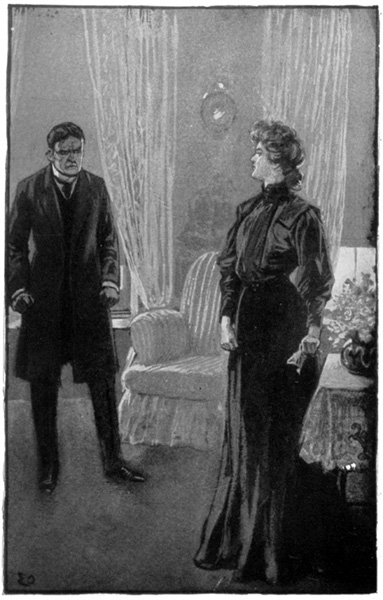
Beatrice hoped that her face did not betray signs of very much
agitation. All the same, she rather wondered why Mark looked at her so
very fixedly. Perhaps it was an uneasy conscience that was troubling the
girl. Mark's first words startled her.
"So you have been the first to find it out?" he said.
"Find out what?" Beatrice stammered. "I—I don't understand what you
mean."
"My dear girl, why try to blind me to the truth? Field told me
Berrington actually knows that your father was concealed at 100,
Audley Place. And I know all about that disgraceful City business,
because my father told me all about it. Sir Charles has come back, he
was with you just now; he is going to make his way to the Continent."
Beatrice had no reply for the moment; her face was red with shame.
"Forgive me," she whispered at length. "You have guessed everything. I
suppose it was your quick instinct that told you my companion was my
father. But, my dearest Mark, cannot you see that he must fly? He has
the money from Sartoris——"
"Who gave it him on purpose," Mark said eagerly. "Who bought a valuable
thing for a mere song, thus putting a fortune in his pocket, and getting
Sir Charles out of the way for good and all, at the same time. My
dearest child, whatever your father may think or say, those ruby mine
concessions are of fabulous value. My father has gone into the matter
carefully, and he is prepared to back his opinion by large sums of
money. My father is never wrong in these things. There is a fortune here
for Sir Charles and also for Miss Decié. Let your father come out and
say that he has been the victim of swindlers who had resolved to get his
property from him. Let him call on my father, who to-morrow will give
him a cheque for ten times the amount required to get him out of all his
troubles. I can guarantee that."
"You mean to say that your father is actually prepared——"
"Certainly he is—on condition that Sir Charles and he are equal
partners. I'll go and get my father to come round here now. Only I'll
see Sir Charles first."
Beatrice would have dissuaded him, but he would take no refusal. He
burst into the bedroom of the discomfited baronet and asked him to
remove his disguise. Sir Charles was too weak to do more than
remonstrate in a gentlemanly way, but his troubled face grew clear as
Mark proceeded with the argument. The sanguine side of the baronet's
nature came up again.
"Really, my dear boy, this is exceedingly kind of you," he said. "Fact
is, I had not the least idea that I was being treated in a really
scandalous manner. I regarded Sartoris as a thoroughly good fellow who
was going out of his way to do me a service. And if your father says
that those mines are valuable, I am prepared to believe him, for there
is no shrewder judge in the City. As Sartoris is dead, that deed that I
signed falls to the ground."
"It would fall to the ground in any case," Mark said, "seeing that it
was obtained by fraud. Now be so good as to dress yourself properly, and
I will take a cab and go and fetch my father. The whole business can be
settled on the spot."
Mark went off, Beatrice saying that she must go back to Mary Grey.
She hung lovingly on the arm of Mark as they crossed the corridor. The
light was low there and nobody was about.
"I hope you are going to forgive me, dear," she said. "I came very near
to paying a heavy penalty for not trusting in you, Mark. But everything
is going my way now."
"Our way," Mark protested. "I don't care whether anybody is looking or
not, I am going to kiss you, dearest. You have always belonged to me and
to nobody else. I cannot possibly regard you in the light of Stephen
Richford's widow. If I were you, I would not say anything to the others
until after I have settled matters between your father and mine. Let
Mary Grey have a good night's rest, and pack her off to bed as soon as
possible."
Mary was safely in bed and asleep before Mark came back. Berrington
stayed long enough for Beatrice to tell him exactly what had happened.
The melancholy shade that Beatrice had seen so long on Berrington's face
had vanished altogether.
"My poor little girl is going to have peace and happiness at last," he
said, with a deep thrill in his voice. "We shall value it all the more
because we have waited for it so long, so that the three years of our
probation will not be altogether wasted. I expect there will be a good
deal of talk about Carl Sartoris for a few days to come, but that need
not concern Mary, who has never been identified with that scoundrel, and
whose name is Grey, after all. In the course of a few days I am going to
take Mary away and we shall be married very quietly. I am determined to
try to get the roses back to her cheeks again."
"I hope you will be happy, as you deserve to be," Beatrice said with
some emotion. "But I shall be sorry to lose two such good, kind friends,
and——"
"You are not going to lose us," Berrington said. "I am going to give up
soldiering altogether. I have only carried it on for the last few years,
because I needed something to keep me from brooding over my troubles. I
am going to settle down on my property at last. Good-night."
Beatrice shook Berrington warmly by the hand, and he kissed her little
fingers. He had barely departed before Mark was back with a little wiry
man with a keen face and a pair of grey eyes that seemed to see into
everything.
"So this is Beatrice," he said, as he shook hands. "You must let me call
you that, my dear, because you are going to be my daughter, Mark tells
me. I am a plain man who has more or less lived for business all his
life, but begins to see lately that business is not everything. It does
not make for happiness, for instance. When I was ill I began to see
that. But at any rate the result of my business can make others happy."
Beatrice blushed and smiled. She began to see that she was going to like
Mark's father very much indeed. In quite a natural way she kissed him.
The little grey man beamed with pleasure.
"Now that was real nice of you," he said. "Mark has a great deal more
sense and discretion than I gave him credit for. He is making a name for
himself, too. But you can't live on that kind of thing, at least not at
first, and I'm going to give Mark £5000 a year, on condition that he
takes a pretty little place in the country, where I can come and see you
week ends. My dear, I feel that we are going to be very good friends
indeed."
"I am quite certain of it," Beatrice said with tears in her eyes.
"Everybody is so good to me. I can't think why, but they are."
"You'll find out if you look at yourself in the glass," Mr. Ventmore
laughed. "There the secret lies. Not a bad compliment, eh, from a man
who never tried his hand at that kind of thing before? And now let me go
and see that father of yours. Did I bring my cheque-book, Mark?"
Mark gaily answered his father that he did, and together the two went up
the stairs. When they came down at length, there was an expression on
the face of Mr. Ventmore that showed that he was by no means displeased
with himself. Sir Charles was whistling an opera tune and was regarding
a cigar with an air of critical attention.
"Everything is settled," he said. "Those City people will be paid off
to-morrow, and I shall be free of them altogether. I shall never touch
business again, Beatrice; this has been a lesson to me. And if not a
rich man, I shall be very comfortably off. Whatever luxuries you may
need in the future will not have to be schemed for. My dear girl, will
you order a chicken and some salad and a pint of some good dry champagne
to be brought here? I'm particularly ravenous with hunger. Wonderful how
one's appetite comes back when you get your mind free from worry. And to
think of those concessions being of that value, after all. Ring the
bell, please."
The next day was a good one for the evening papers. Sir Charles was
interviewed till he was hot and angry and disposed to order his
tormentors out of the room. Scotland Yard had its own version of the
case, too, which was not quite in accordance with the real facts. But as
Berrington said, the excitement soon cooled down, and the next sensation
drove the recollection of Sir Charles's wonderful experience out of the
public mind. Sir Charles and his daughter went off to the country, so
as to escape so much attention, and Berrington and Mary Grey went along.
At the end of the week there was a wedding at the pretty church in the
village, and Mary was happy at last. Mark and Beatrice would have to wait
for six months or so, because there was public opinion to be thought of,
though as a matter of fact the thing was the most empty form.
"I hope we shall be as happy as they are," Mark said as he and Beatrice
watched the train slowly glide into the darkness. "They have earned it,
too."
"I think we both have," Beatrice said. "But don't look backward,
especially on a day like this. Let us go into the big wood, and pick
daffodils."
And in the train Berrington had gathered his wife to his heart and
kissed her tenderly. He looked down into the soft eyes from which the
shadow had gone for ever.
"And you are happy at last, darling?" he said; "though you are very
silent."
"Silent, yes," Mary said quietly. "Quiet, too. But thank God no longer
the Slave of Silence!"
By far the best work of this clever writer.—Chicago News.
A MAKER OF HISTORY
Illustrated by Fred Pegram. 12mo. Cloth. $1.50
Thoroughly readable and exciting from end to end. Carries the reader
along breathlessly.—New York Sun.
Mr. Oppenheim has surpassed himself in "A Maker of History." It is an
enthralling tale, with a surprisingly well-sustained mystery and a
series of plots, counterplots, and well managed climaxes.—Brooklyn
Times.
A story of absorbing interest turning on a complicated plot worked out
with dexterous craftsmanship. He has ingeniously utilized the incident
of the Russian attack on the North Sea fishing fleet to weave together a
capital yarn of European secret service.—Literary Digest.
THE MASTER MUMMER
Illustrated by F. H. Townsend. 12mo. Cloth. $1.50
Will be found of absorbing interest to those who love a story of action
and romance.—Academy, London.
This brilliant, imaginative story, with its buoyant humor, clear-cut
characterization, prodigality of invention, tenderness and pathos, is on
many accounts one of the most distinguished works of fiction of the
year.—Philadelphia North American.
The girl is a fascinating creation, the hero is vigorously manly, and
all the characters move through the pages with a strong and hearty
sweep.—Pittsburgh Times.
LITTLE, BROWN, & COMPANY, Publishers, BOSTON
A PRINCE OF SINNERS
Illustrated by Oscar Wilson. 12mo. Cloth. $1.50
Thoroughly matured, brilliantly constructed, and convincingly
told.—London Times.
It is rare that so much knowledge of the world, taken as a whole, is set
between two covers of a novel.—Chicago Daily News.
It is an excellent piece of work, polished in style, brisk but balanced
in incident, real but romantic in character.—Brooklyn Eagle.
A well-compacted and exceedingly interesting story of English political
and social life, making no demands upon one's credulity, but satisfying
the requirements in the way of a thoroughly good novel. The characters
are all drawn with real fidelity to life.—Harry Thurston Peck, Editor
of The Bookman.
ANNA THE ADVENTURESS
Illustrated by F. H. Townsend. 12mo. Cloth. $1.50
A story of London life that is at once unusual, original, consistent,
and delightful.—Buffalo Express.
An exciting book and a well-written one.... Our author has given us
pictures of Paris and London life which are full of
interest.—Baltimore Sun.
The consequences of a bold deception Mr. Oppenheim has unfolded to us
with remarkable ingenuity. The story sparkles with brilliant
conversation and strong situations.—St. Louis Republic.
An entrancing story which has seldom been surpassed as a study of
feminine character and sentiment.—Outlook, London.
LITTLE, BROWN, & COMPANY, Publishers, BOSTON
MYSTERIOUS MR. SABIN
Illustrated by J. Ambrose Walton. 12mo. Cloth. $1.50
Emphatically a good story—strong, bold, original, and admirably
told.—Literature, London.
Intensely readable for the dramatic force with which the story is told,
the absolute originality of the underlying creative thought, and the
strength of all the men and women who fill the pages.—Pittsburgh
Times.
THE YELLOW CRAYON
Containing the Further Adventures of "Mysterious Mr. Sabin"
Illustrated by Oscar Wilson. 12mo. Cloth. $1.50
The efforts of Mr. Sabin, one of Mr. Oppenheim's most fascinating
characters, to free his wife from an entanglement with the Order of the
Yellow Crayon, give the author one of his most complicated and absorbing
plots. A number of the characters of "Mysterious Mr. Sabin" figure in
this delightful work.
THE TRAITORS
Illustrated by Oscar Wilson and F. H. Townsend
12mo. Cloth. $1.50
A brilliant and engrossing story of love and adventure and Russian
political intrigue. A revolution, the recall of an exiled king, the
defence of his dominion against Turkish aggression, furnish a series of
exciting pictures and dramatic situations.
LITTLE, BROWN, & COMPANY, Publishers, BOSTON
THE BETRAYAL
Illustrated by John Cameron. 12mo. Cloth. $1.50
In none of Mr. Oppenheim's fascinating and absorbing books has he better
illustrated his remarkable faculty for holding the reader's interest to
the end than in "The Betrayal." The efforts of the French Secret Service
to obtain important papers relating to the Coast Defence of England are
the motif of its remarkable plot.
A MILLIONAIRE OF
YESTERDAY
Illustrated by J. W. G. Kennedy. 12mo. Cloth. $1.50
Mr. Oppenheim has never written a better story than "A Millionaire of
Yesterday." He grips the reader's attention at the start by his vivid
picture of the two men in the West African bush making a grim fight for
life and fortune, and he holds it to the finish. The volume is thrilling
throughout, while the style is excellent.
THE MAN
AND HIS KINGDOM
Illustrated by Ch. Grunwald. 12mo. Cloth. $1.50
This brilliant, nervous, and intensely dramatic tale of love, intrigue,
and revolution in a South American State is so human and life-like that
the reader is bewildered by the writer's evident daring, and his equal
fidelity to things as they are.
LITTLE, BROWN, & COMPANY, Publishers, BOSTON
Transcriber's Note:
Inconsistent hyphenation and capitalization have been retained as in the
original text. Inconsistent usage of American versus British spelling
has also been retained. In the original text, positive contractions
(He'll, I'd, I'll, I'm, they've, etc.) were printed with half spaces
before the apostrophe. These spaces have been removed in this edition.
The following corrections were made:
Missing close quotes added: p. 43: On the other hand, if there
is——"; p. 43: But the lady who wrote that
letter——"; p. 178: Can you speak freely to me for a time?";
p. 237: who was a cripple."; p. 312: don't understand what you mean."
Missing open quotes added: p. 221: "The figures 4. 4. '93, I mean."; p.
222: "4. 4. '93 means the fourth of April 1893
Extra open quotes removed: p. 262 (before Look) Look at that 'e,' too,
in the word 'nine.'
Single quote to double quote: p. 213: "If you knew all that I do you
would not hesitate for a moment. If you care to write it down——"
-
Typos: try to tray (p. 17: pseudo waiter with his tray); then to than
(p. 17: Scarcely had he left the conservatory by a door leading to the
corridor than Richford strolled in.); his to her (p. 37: To her great
surprise); at to as (p. 53: as Beatrice finished her story); in to if
(p. 55: as if his vis a vis was); must to most (p. 61: most
exquisitely furnished); inspentor to inspector (p. 91: The inspector
smeared his hand further along the carpet.); quiet to quite (p. 121:
quite another matter); does to dose (p. 124: a strong dose of
sal-volatile); mappd to mapped (p. 129: mapped out a line for himself);
somethink to something (p. 130: with something like a lovelight); had to
has (p. 139: But it looks as if he has paid for his indiscretion.);
colon to period (p. 147: so many threads in the plot.); undertand to
understand (p. 147: I understand that you sent for me.); Satoris to
Sartoris (p. 177: Not that he failed to trust Mary Sartoris.); wondred
to wondered (p. 203: Whatever were they doing here, just now, Mary
wondered?); Bumah to Burmah (p. 219: And that property is probably a
ruby mine in Burmah.); extra 'be' removed (p. 234: Will you be so good
as to come this way and shut the door?); extra comma removed (p. 301:
after "Your brother treated Violet Decié"); post-morten to post-mortem
(p. 309: A post-mortem would have prevented that part); Phillip to
Philip (p. 132: He was passionately in love, Philip.)
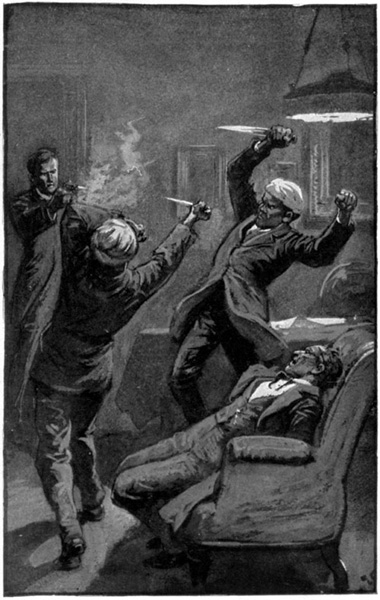 "Nothing daunted, the pair made a rush at Berrington who
fired right and left." Frontispiece. See page 191.
"Nothing daunted, the pair made a rush at Berrington who
fired right and left." Frontispiece. See page 191.