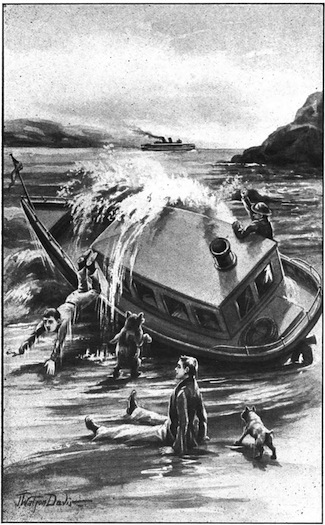
Case hastened to put the Rambler under motion,
and, with Fontenelle and Howard still on board,
headed her into the current. At a signal from Fontenelle,
the launch Cartier drew up her anchor and
followed.
To Captain Joe’s vicious barking was now added
the surly voice of the bear cub, so the boys knew
that the animals were not far away. In fact, as
they paused to investigate the ugly nose of the
bulldog was pushed through the curtain of shrubbery
at the edge of the stream, and Teddy leaped
snarling into the water.
Fontenelle greeted the approach of the animals
to the boat with shouts of laughter. Even in their
haste to reach the boat, the animals could not avoid
snapping and striking at each other, playfully. No
more shots were heard, but presently a great tramping
in the undergrowth came at the point where
Joe and Teddy had made their appearance, indicating
human presence there. All on board the
Rambler anxiously awaited the appearance of those
who were struggling in the jungle.
“Would the menagerie run away and leave the
boys in captivity?” asked Fontenelle, as the bulldog
and the bear cub were assisted, streaming, to
the deck. “They seem to have had a long run.”
“Indeed, they would not,” replied Case. “If
Clay and the others were tied up in the woods,
Captain Joe and Teddy would be there with them.
No, it is my opinion that it is Alex making all
that racket in the brush. He’s a noisy little chap,
and particularly troublesome when hungry.”
The next moment proved Case’s reasoning to be
correct, for the undergrowth parted again and the
three boys appeared on the bank.
“Ship ahoy!” Alex shouted, wrinkling his
freckled nose. “Do you want to take on passengers?”
“I hope,” Case called back, “that you fellows
haven’t gone and lost the rowboat. And where is
the two-foot fish you were going to bring for
breakfast? I don’t see it anywhere.”
“Well,” Jule called out, as the Rambler edged
toward the bank, “if we have lost a boat, you seem
to have found one.”
“What do you mean by that?” asked Case.
Jule pointed, and Case went to the gunwale of
the Rambler and looked down upon the fragile
canoe in which Max had paddled up the river.
“I didn’t know that we were towing it,” he said,
“but its presence here accounts for Max getting
away without being seen or heard. He never
stopped to get his boat, and may be swimming under
water yet, for all I know. I hope he’s clear down
at the bottom.”
“No danger of one of those wharf rats getting
drowned,” Fontenelle laughed. “I have seen them
remain under water for what seemed to me to be
five minutes, and Max is some riverside boy.”
“Shoot the canoe over,” cried Clay, “and we’ll
come aboard.”
“Where’s your boat?” demanded Case.
“Well, you see,” explained Clay, “when we
missed the Rambler, we started for the St. Lawrence
by the water route, but when ruffians on the
bank began shooting, we tied up the boat and took
to the thicket.”
Case released the line and sent the light canoe
spinning over the surface of the river. Clay caught
the rope deftly and one by one the boys paddled
over to the motor boat. Alex threw himself down
on the deck and gazed imploringly up at Case.
“I expected,” he said whimsically, “that you’d
welcome me on the bank of the river with a pie!”
“The next time you get us into trouble,” Case
laughed, “I’ll meet you on the bank of the river
with a club.”
The three boys were presented to Fontenelle and
Howard and then preparations for breakfast were
begun.
“Alex got taken prisoner up in the woods,” Jule
grinned. “We cut him loose and tied up the cook.
We were thinking of getting breakfast there, but
we preferred fish and pancakes to lead and gunpowder,
so we made a run for the boat.”
“Is the cook tied up yet?” asked Case.
“I reckon they cut him loose in about ten minutes,”
Alex replied, “for they seemed to be about
three steps behind us all the way to the river, but
they didn’t catch us.”
“Do you think we would better go back after
the rowboat?” Case asked, as the boys sat down
to a breakfast of bacon, eggs, pancakes, beans and
hot coffee. “We ought not to loose it.”
“Look here,” Jule said. “We’ve been sowing
rowboats over the world for a year or two. We
lost two on the Amazon, one on the Columbia, two
on the Colorado and had three smashed on the Mississippi.
Now, I think we’d better go back and
get this boat.”
“All right,” Alex grinned. “You go on back
and get it.”
“Well, don’t you ever think I can’t,” Jule replied.
“I can sneak up there and swipe that boat from
under their noses. But you needn’t think I’m going
to set out as long as there is anything here to eat.”
While the boys took breakfast, the situation as
explained to Case by Fontenelle was described to
them, and after a time Case beckoned Clay away
to a corner of the cabin and asked him a question
over which he had been puzzling ever since the
arrival of Fontenelle.
“Now you understand the situation,” Case said,
“and I want you to answer this question right off
the handle. I’ve decided it half a dozen ways, but
I have been fortunate enough so far to keep my
mouth shut.”
“What is the question?” asked Clay.
“Wait,” Case said. “I’ll make a little explanation
first. These Fontenelle people have only the
legend of the lost channel and the loss of the charter
and the family jewels in this section. They
haven’t a single clew which tells them to look in
any special spot first.
“So far as I can make out, young Fontenelle
and his friends come down here every summer, in
answer to the demands of the elder Fontenelle, for
a sort of a vacation. So far as I can make out,
they have never honestly searched for the lost channel.
In fact, the young man has doubts of its
existence. Now, what I want to know is this.”
“Why didn’t you say so before?” asked Clay
with a smile. “I know what your question is. You
want to know if we ought to show Fontenelle the
map which was brought to the Rambler so mysteriously.”
“Aw, of course, you could guess it after I had
stated the case fully,” Case declared. “But you
haven’t told me what you think about it. Ought
we to give Fontenelle the map?”
“Well,” Clay answered, cautiously, “the map
doesn’t belong to us. It wasn’t intended for us. It
was handed to us by a man who evidently believed
that he was turning it over to Fontenelle.”
“Yes,” Case said, “it does look as if the map
belongs to Fontenelle, but look here! He doesn’t
believe in this search. It is my idea that he doesn’t
even care whether he secures the lost property or
not. He won’t consider the matter seriously if we
give it to him. He’ll just laugh and poke it away
among a lot of old papers and that will be the
end of it.”
“You are undoubtedly right,” Clay answered.
“Now,” Case went on, “we’ve had enough
trouble with these outlaws to arouse my fighting
blood. Besides, I’d like to have a look at that lost
channel. Lost channels appeal to me, you know!
I’d give a lot to find it. Why not keep the map
and go on with the search?”
“But the other fellows would be searching, too,
and the whole event would deteriorate into a big
summer outing,” Clay insisted.
“All right, then,” Case suggested. “Suppose
we go on up the river to Quebec, and Montreal, and
the Thousand Islands, and then come back after
these fellows have gone home, and find that channel.”
“That listens pretty good to me,” Clay answered.
“I am willing to go on at once if it is a sure thing
that we come back, but I don’t want to sneak away
from these fellows after they have started the
fight.”
“That shows courage, all right enough,” Case
added, “but I’d rather hunt for this lost channel
with these toughs on the wharf at Quebec, and,”
he added, more seriously, “that’s where I think
they’ll be by the time we get back here. They won’t
stay here long after Fontenelle goes away.”
“Very well,” Clay replied, “if Jule and Alex
are willing, we’ll be on our way this afternoon.”
This understanding having been reached, the two
boys went back to their guests, while Jule went
ashore in the canoe.
“Now, watch the little rat,” Alex laughed.
“He’ll tie that boat up and blunder through the briers,
when he might paddle up the stream close to the
bank without taking any chances.”
But Jule did nothing of the kind. He kept on
up the stream in the canoe. Presently he rounded
a bend and disappeared from sight.
In a short time Fontenelle and his friend left
the Rambler with the understanding that the two
crews were to meet in the evening if the boys did
not sail away in the afternoon. As a matter of
fact, as the reader already knows, the boys had
decided to leave before the parting took place, but
they did not care to be urged to remain and join in
the summer vacation picnic which was sure to follow.
They had started out for a trip covering the whole
length of the St. Lawrence river from the Gulf to
Lake Ontario, and were determined to cover the
course before shipping their boat back to Chicago.
In less than an hour Jule was back with the rowboat,
having seen nothing of the outlaws.
“They probably thought the whole Canadian
navy was coming after them,” Alex said, pointing
from the Rambler to the Cartier and back again.
“Looks like we were coming out in force.”
In the middle of the afternoon the boys notified
Fontenelle of their intention to proceed on their
journey, and the Rambler passed on up the St.
Lawrence.
It was a golden day in summer, the waters
sparkled and danced in the sunlight, and the shipping
passing to and fro on the river made a pleasant
picture of marine life. The boys enjoyed the
situation thoroughly.
“I have always had a longing to visit Quebec,”
Clay said as the boat headed for a little cove to
avoid the wash of a giant steamer, “and I propose
that we spend two or three days there looking over
things.”
“That suits me,” Alex cut in. “When we get
there, I’ll go down on the docks and find that boy
Max. And when I find him, there’ll be one wharf
rat less on the docks.”
“You better keep away from the docks,” warned
Case. “You’d get lost on South Clark street between
any two blocks you could name.”
“Well, I always find myself again,” Alex declared.
“Yes, you do,” Case jeered. “The last time
you got lost, it took two boys and a bear and a
bulldog to find you. And I don’t think you are
worth the trouble at that!”
The boys immediately had a friendly struggle
on the deck, in which Teddy and Captain Joe
promptly mixed.
That night the boys arranged for another campfire
on the north bank of the St. Lawrence. They
put up their hammocks, anchored the boat close
inshore, and prepared for a long sleep.
“If there isn’t any lost channels or charters
from French kings or strayed family jewels hiding
about here,” Jule commented, “we’ll certainly enjoy
ourselves in this camp.”
Nothing came to disturb them during the night.
They watched the procession of craft of all descriptions
on the river until nine o’clock, then went to
sleep with a danger signal swinging from the prow
of the Rambler. They were early astir in the
morning and on their way upstream.
There was no need of haste, yet the boys seemed
to enjoy themselves most when the boat was in
motion, so they plowed slowly up the river until
night, enjoying the wild scenery and stopping now
and then at a little settlement. That was the first
of many days of uninterrupted pleasure on the
most extensive water system of the North American
continent.
On the second night, they made another camp
with only Captain Joe and Teddy standing guard.
Alex was out after fish early in the morning, and
at six o’clock he served one of his long-wished for
fish a la Indian breakfasts.
Just before nightfall, they came within sight
of Quebec and moored at a pier a short distance
down the river.
“Now,” laughed Case, “if any treasure seekers
or outlaws or river pirates appear to us during the
night, we’ll call the police. We’ve had trouble
enough for one trip.”
“I’m going to sleep ten hours every night until
we get to the Thousand Islands,” declared Jule.
“I’m hungry and sleepy most of the time.”
“And we’ll come back down the rapids, won’t
we?” asked Alex.
“You bet we will,” replied Clay. “We’ll come
down like a shot.”
“We’ll need to,” Jule suggested, “because we’ll
lose time in the canal going up.”
There was no open campfire or swinging hammocks
for the boys that night. The city of Quebec
twinkled its myriad lights from plateau and cliff,
and the boys were not sure of whom they might
meet during the dark hours. They cooked their
supper early in order to make an evening trip in
the lower part of the city.
“I wonder,” Case said, as, leaving Jule and Clay
on board, he started away with Alex, “what the
man who delivered the map to us is thinking about
concerning his mistake now. He might have been
paid to deliver that document to Fontenelle, and
the error may make him trouble.”
“And I was just thinking,” Alex put in, “what
the fellows who delivered the warning to us are
thinking concerning themselves. They wasted a
lot of ammunition and lost a good many hours’
sleep on our account.”
“Perhaps we’ll find out all about it when we go
back to find the lost channel,” Case suggested. “Do
you know,” he added, “I’m looking forward to
that lost channel stunt with a good deal of enthusiasm.”
“Do you really think there’s a lost channel
there?” asked Alex.
“There is something in it,” Case asserted. “Men
don’t draw maps entirely on imagination.”
“Then why don’t the men who drew the map
go and tell Fontenelle all about it?”
“He tried to tell him all about it when he delivered
the map to us, but as you know, the map
reached the wrong hands.”
The boys walked the streets, comparing them
unfavorably with those of Chicago, until nearly
ten o’clock and then turned to go to the boat. When
they came to the river front again, Alex stopped
suddenly and caught Case by the arm.
“Look there,” he whispered, “What do you
know about that?”
“About what?” asked Case, puzzled.
“Don’t you see him down there at the head of
the pier?” asked Alex, nodding his head in that
direction.
“I guess you’re the boy that’s got loose packing
in his head to-night,” laughed Case. “What do
you see?”
“What do I see?” repeated Alex. “That’s
Max, the wharf rat, the cable cutter, the motor
destroyer. Shall we go and get him?”
“Go and get him?” repeated Case. “He’d have
a flock of wharf rats around us in about two minutes.”
“Well,” Alex insisted, “we’d better stay here
and see where he goes, anyway. If we can locate
the fellow now, we can go after him any time.”
“Then I guess we can go after him any time,”
Case chuckled, “because he’s heading for that eating
house with the tin fish sign in front of it.”
“Then here we go for the tin fish,” Alex declared,
and in five minutes, they were seated at a
little table in an alcove separated only by a heavy
cloth curtain from the main room of a third-rate
French restaurant.
When a waiter appeared they gave their orders
and sat watching the main room through the folds
of the curtain.
“There!” Alex finally said in a whisper. “He’s
coming in.”
“Yes,” grunted Case, “and he’s got a dozen
wharf rats with him. I guess they’ve got us in as
neat a trap as one boy ever set for another!”