Sealth, second chief of the allied tribes in early days and previously of the
Squamish and Duwamish, was the greatest Indian character of the country.
Like the historic chief of the Mingoes, he was a friend of the white man and
enemies he had none. A statesman and not a warrior he swayed the minds of
his people with the magic of oratory rather than of war. Without a knowledge
of the polyglot language common to all the tribes and the early white
men, he was able by his superiority of mind to mould the turbulent and warlike
spirits about him to his way of thinking, and to not only control them individually
but to unite them into one grand peace union and to ever after maintain
over them against all opposition a power as potent for good as the spirit
and nature of the one who prompted it. Many chiefs who had before enjoyed
chiefship without hinderance and directed and controlled his people at his own
sweet will yielded to the superior power of Sealth, acted his part after the federation
only as a lieutenant or sub-chief. Many old-timers yet survive who
enjoyed the friendship of the old chief. Samuel F. Coombs, who probably has
as intimate a knowledge of the early Indians as any one living, says of the old
chief Sealth:
“The first time I ever saw Chief Sealth was in the summer of 1860, shortly
after my arrival, at a council of chiefs in Seattle. At that time there was an unusually
large number of Indians in town, over 1000 of them being congregated
on the sandy beach. Most of the Indians were standing around talking in
groups or listening to the deliberations of the council of about twenty of the
oldest Indians seated in a circle on the ground. The chief figure was a venerable-looking
old native, who was apparently acting as judge, as all who spoke
addressed themselves to him. Matters of grave importance were evidently
being discussed, and I was greatly impressed with the calm and dignified manner
in which the old judge disposed of the matter in dispute and the great attention
and respect shown him when speaking. From an intelligent-looking
Indian who could speak English I learned that the old judge was Chief Seattle,
or, as he was then known, Sealth, and that those seated about him were ex-chiefs
and leading Indians of the various tribes then living about here.
Among them were Seattle Curley from the mouth of the Duwamish; Tecumseh,
from the Black river; Shilshole Curley, from Salmon bay; Lake John
from Lake Washington, and Kitsap, from Kitsap county.
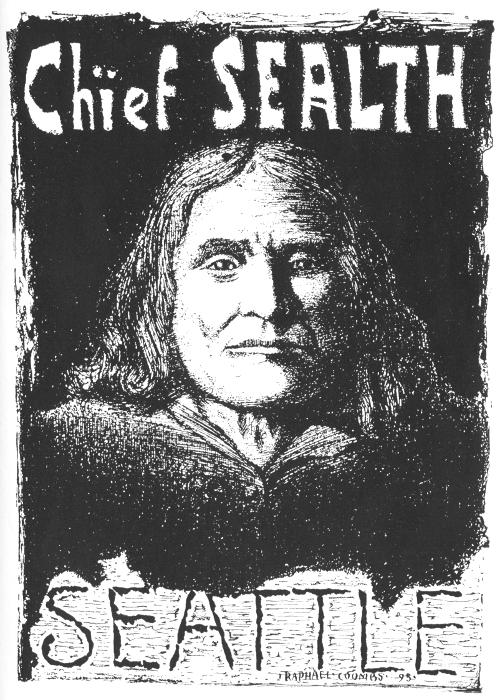
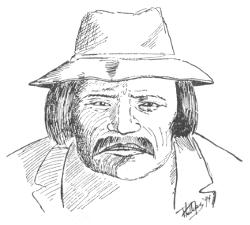
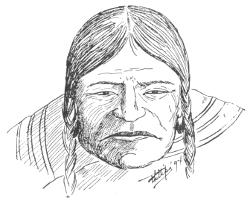
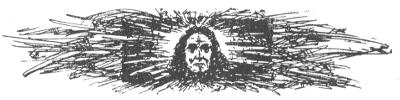
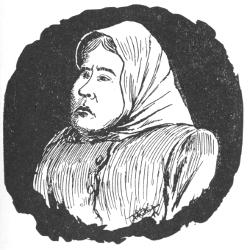
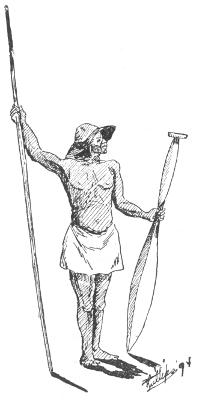
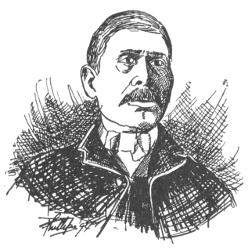
Chief SEALTH
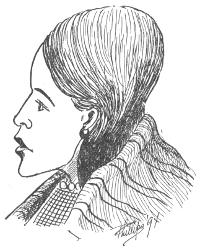
SEATTLE
RAPHAEL · COOMBS · 95 ·
“With this young man as an interpreter I interviewed several of the oldest
natives as to how Sealth became head chief of so many tribes. They said that
about fifty years before that time, when Sealth was 20 or 22 years old, news
reached the various tribes in this vicinity that a large number of the mountain
or upper Green and White river Indians were preparing to make a raid upon
the salt water tribes. Great anxiety was felt among the latter, as the mountain
tribes were redoubtable warriors, and had on several previous occasions
vanquished the salt water tribes and carried off many of their people as slaves.
Accordingly a council of war, composed of the chiefs and leading warriors of
the tribes expecting to be attacked, met at the Old-Man-House near Port Madison.
This place was the principal rendesvous of these tribes for potlatches
and councils. At this council many plans were discussed as to the best method
of resisting the invaders. None of those suggested by the older men, however,
was satisfactory, and then the younger men were called upon for suggestions.
At length young Sealth, a member of the Old-Man-House tribe, presented
his plan, and it was so well devised and so clearly presented, that
without listening to any others, it was adopted and he was appointed to carry
t out, being given command of the expedition.
“Information had reached the salt water tribes that a large force of the
mountain tribes intended to come down the Green and White rivers in canoes
and inaugurate their attack at night. Sealth organized a band of warriors, and
the day before the raid was expected they went up the river to a place on
White river, near where John Fountain now lives above Black river bridge,
and where the bluff on one side reaches to the river edge. The river here
makes a short bend, and the current is very swift. A little below the bend a
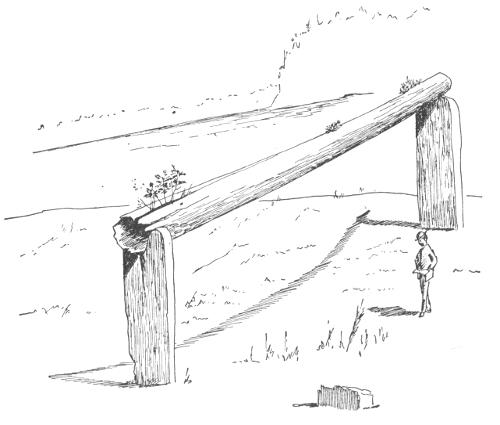
large fir tree standing on the bank was felled in such a way that it reached
across the river and lay only a few inches above the water, so that no canoe
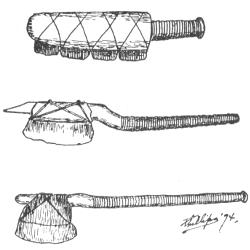
could go under without upsetting. The work of felling the tree was done with
rude axes, some made of stone, and it took the band nearly the whole day to
bring it down and get it into position, which was finally accomplished before
sunset. Sealth then ambushed his warriors, armed with bows and arrows,
lances, tomahawks and knives, on either side of the stream, and confidently
awaited the invaders.
“As soon as it was dusk five large canoes loaded with 100 selected warriors
started down the stream, and as there was a strong current it was not long before
they fell into the trap. The leading canoes were successively swamped before
their occupants could realize the nature of the obstruction. The cries of
their unfortunate companions, however, enabled those in the last two canoes to
reach the shore before coming to the log. In the meantime thirty of the occupants
of the leading canoes were either drowned, killed or captured by Sealth’s
warriors, and those who reached shore in safety betook themselves up the river
again, and their account of the disaster which had befallen their companions
so discouraged the remainder of the expedition that they retired to their mountain
homes.
“When Sealth and his warriors returned to the bay with such substantial
proofs of the victory gained over their former persecutors great was the rejoicing
among the salt water tribes and the hero of the hour was the young warrior
who, by his cleverness, boldness and courage, had delivered them from a
great danger. A grand council of the tribes was called, composed of the chiefs
and leading warriors and medicine men from the following six tribes: Old-Man-House,
Moxliepush, Duwamish, Black River, Shilshole and Lake, whose
chiefs were Kitsap, Seattle Curley, Tecumseh, Salmon Bay Curley and Lake
John, Seattle Curley being chief of both the Moxliepush and the Duwamish
tribes. At this council Sealth was made great chief of all the tribes and the
former chiefs became tyees, or sub-chiefs. The Moxliepush, Black River and
Lake tribes, however, did not consent to a consolidation and Sealth, having
assumed the authority conferred upon him by the majority, determined to
make his authority respected by all. He organized an expedition composed of
the bravest of his followers and made a tour of the three rebellious tribes,
going by way of Shilshole and Salmon bays, Lake Union and across the portage
to Lake Washington and thence to Black river and back to Old-Man-House.
Though prepared to give battle if necessary he subdued his opponents
by diplomacy. He held councils at various places on his route, made
speeches to the tribesmen and won them over from their chiefs, and when they
had submitted he took a number of hostages from each tribe along with him.
In this way he gained the submission of all the rebellious chiefs and tribesmen
without fighting a battle or killing a man. When the first white man came
here Chief Sealth had quite a number of these hostages, who were called slaves
by the other Indians, but who were not treated any differently, so far as the
whites could observe, than the other Indians. Indeed, many of these so called
slaves afterwards became Chief Sealth’s principal lieutenants.
“After Chief Sealth had consolidated the tribes and enforced his right to the
chieftainship, he still further strengthened his influence over the tribes by
checking other raids by unfriendly tribes from the north and south, and concluded
treaties of friendship with them. He even carried his wise rule so far
as to anticipate the formation of the Chinook language by the Hudsons Bay
traders by so adapting the several distinct dialects then prevailing amongst the
different tribes scattered over a large area, that at length they could converse
with one another, where before they could not. Thus he brought about the
formation of a language common to all the tribes from the Snohomish and Snoqualmie
as far south and west as Olympia.
“By his great exploits in war, his wisdom and prudence in council, and the
nobility of his character, Chief Sealth obtained a wonderful influence over all
the natives in this section, whether belonging to his tribes or to others. And
thus it was that, when I first saw him, his deep voice, slow and grave speech
were listened to with such marked deference and respect by all. He was the
supreme arbiter in their disputes, and his decisions were accepted as final and
conclusive and carried out with unquestioning obedience. Having early been
converted to the Catholic faith, he introduced and successfully carried out
many moral reforms among his people. He reprimanded them often for drunkenness,
fighting and their loose sexual relations with the whites. He was a
great peacemaker and always avoided bloodshed whenever possible. He even
undertook to subvert the ancient traditional customs of his race in regard to
bloody retaliation for mortal wrongs, and to inculcate among his people Christian
principles.
“Though a man of great natural abilities, Chief Sealth never learned either
the Chinook or the English languages; nor did any of the older Indians whom
I knew. An interpreter was always necessary whenever any of the whites
wished to converse with him. In appearance he was dignified, but somewhat
bent with age when I knew him, and at that time he always walked with a
staff in his hand. He looked like a superior man among his people. Though
the top of his head had been flattened in childhood, the malformation was not
so apparent as it was in all the other old Indians of his day. During the summer
months and when I first saw him he wore but a single garment. That was
a Hudsons Bay company’s blanket, the folds of which he held together with
one hand, and from their midst appeared the broad chest and strong arm of
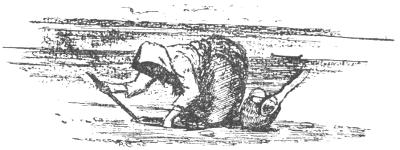
bronze which grasped his staff. The sketch herewith represented the old chief
as he appeared on the streets of Seattle thirty-four years ago.
“The later years of Chief Sealth were passed at his headquarters at the Old-Man-House
in Kitsap county, near Port Madison, and in visiting the tribes,
administering justice, reproof and counsel to his devoted people. He was
often in Seattle, where he was respected by all the white people. The Old-Man-House,
where he resided was a famous gathering place for the natives
from all over the Sound, and some of the potlatches held there have been attended
by as many as 8,000 Indians. I saw one there at which there was
fully 1,500 present.
“After a long illness, during which the old chief was frequently visited by
natives and early white settlers from all over the Sound, he died at the Old-Man-House.
His funeral was attended by several hundred white people and
by more of his own people. G. A. Meigs, proprietor of the Port Madison
mill, shut down his mill and on his steamer took all the employes and others
over to the funeral. A great many also went over from Seattle. As the old
chief was a Catholic he was buried with the ceremonies of that church,
mingled with which were customs peculiar to the natives. The ceremonies
were imposing and impressive, and the chanting of the litanies by the native
singers was very beautiful.
“During his life Chief Sealth had two or three successive wives, but he
did not have many children.
“Princess Angeline was his only child by his first wife. When I first knew
her she was a washerwoman for the white people, among whom she was a great
favorite, and although she was a buxom widow and not bad-looking, she was
always esteemed as a virtuous, good woman. She had a daughter who married
a half-breed, and by whom she had a son, now living, named Joe Foster.
His parents died early and old Angeline has reared him, slaved for him and
begged for him. She has gotten him out of many scrapes and her whole heart
is wrapped up in the boy, ‘My papa’s great-grandchild.’
“Angeline had a half-sister who married a chief on Lake Samamish and
died some time ago, but I don’t know any more about her. I think Chief
Sealth also left by his last wife a son, who is now living at Old-Man-House.
This son has a grandson there who is a dwarf. He is 20 years old and is
only thirty inches tall, is very bright, well formed, talks English and is the pet
of all the Indians on the reservation.
“During the past thirty-three years I have on many occasions endeavored
to learn from the oldest and most intelligent Indians something of their earlier
recollections; for instance as to when the heaviest earthquake occurred. They
said that one is said to have occurred a great many years before any white men
had ever been seen here, when mam-ook ta-mahn-a-wis was carried on by hundreds.
This is the same performance they go through when they are making
medicine men, and consists of shouting, singing, beating on the drums and
sticks and apparently trying to make as much noise as they can. While making
a medicine man I have seen upwards of 100 painted Indians driving on the
streets here a young man stripped nearly naked, with a long lariat fastened to
a girdle around his waist. At one time it took them over a week to make a
ta-mahn-a-wis man of the fellow they were driving. After he became supernaturally
fixed he came near dying, and old Dr. Maynard, the only physician
then in town, was called in to give him a dose of civilized medicine.
“The only total eclipse of the sun visible here during the past thirty-four
years occurred about twenty-five years ago during a clear afternoon. The white
settlers were preparing their smoked glasses. Ex-Chief Lake John happened
to come by about that time, and I told him in Chinook that the sun was to be
darkened in about an hour from that time. He very sharply inquired how I
knew, and I told him I was in klosh tum-tum with the Sah-ha-le tyee, or that
I was on good terms with God. He laughed heartily at such a ridiculous
notion, but when the sun began to be obscured I handed him a piece of smoked
glass, and after looking through it he became very grave, and looking at the
sky in amazement he said with great seriousness, ‘De-late mi-ka cum-tux,’
you have told the truth. When the eclipse became total the howling and
pounding of drums over at Plummer’s point, where the Indians were assembled,
could be heard all over town.
“In 1880, when the deep snow occurred in January, there being over four
feet of the beautiful, I inquired of an old Indian if he had ever seen snow so
deep before, and he said no, but that his father had told him that there was
one fall of snow many years before which was equal to it. Lake Union has
been frozen all over twice, and a number of times has formed two to five inches
thick in sheltered places of the lake. Only twice since 1856 has it been as cold
as it was this winter.
“A son of Pat Kanim, the old chief of the Snoqualmies, who now lives on
the Tulalip reservation, told me that his father had been a good, true friend of
the whites during the Indian war, and he corroborated what A. A. Denny has
said in his history of that war. He said that Mr. Denny had with good reason
placed confidence in his father, notwithstanding that others thought he
was not worthy of it. He said that Leschi and Nelson were the leaders in the
massacre near Slaughter, where eight whites were killed in 1855. These were
the same tribes that had attempted the raid fifty years before which Chief
Sealth foiled, and the same which attacked the town of Seattle in 1856. This
time they came across Lake Washington instead of down the river, landing
their canoes where is now located Leschi park. They had not forgotten Sealth’s
plan of resisting an invasion by the river route.”
To Dr. Maynard it is said belongs the honor of naming the city of Seattle
after the old chief and also of conferring the name Angeline on his daughter.
There is one descendant of the old chief who is at once the pride and the
one particular character of the Queen City today. That descendant is Angeline,
daughter of the old chief; Princess Angeline she is called. She is not
courtly or noble in bearing and never showed any superior powers of intellect,
indeed, it is not saying too much to say that to the present residents who know
her she does not exhibit even average Indian intelligence, though great and
enfeebled old age may in a measure account for it. Angeline had a revelation
last year when she was shown a painting of the old chief, life size and true to
the original. It is said of her that at least she showed that she had a tender
memory and soft heart, for she cried and went about the streets muttering in
her Indian way: “Utch i-dah, utch-i-dah; nika papa hias klosh.” Wonderful!
wonderful! good picture of Sealth.
Poor old Angeline. Bent, decrepit and carrying the weight of 80 years with
an effort, she still possessed a heart full of tenderness that could only find
relief in a flood of tears.
Long, long ago it had been that old Angeline saw the royal old chieftain,
her father, for the last time. Only in her Indian memory had she communed
with him who was once lord of all around in the neighborhood of Elliott bay.
But now she stood face to face once more and looked into the kindly face of the
old chief, who has been dead these many years. It was Chief Sealth, life size,
as he appeared thirty-five or forty years ago, with his big, blue-bordered Hudsons
Bay company blanket hanging in Grecian folds from his dusky shoulders.
No wonder poor old Angeline cried and sobbed and broke down in the rush of
tender recollections that must have filled her old soul. No wonder she exclaimed:
“Utch-i-dah! utch-i-da! nika papa hias klosh.”
It was her old-time friend Samuel Coombs, the pioneer, who took old Angeline
to see the picture of the old chief, painted by Mr. Coombs’ son Raphael for
the chamber of commerce of this city. Angeline, the last survivor of the old
chief’s family, did not know what was wanted of her, but she knew that her
old friend meant her no harm and she trudged along, muttering in her peculiar
guttural Indian dialect until she came plunk upon the big painting. It shows
the old chief as he first appeared to the whites about 40 years ago, standing
erect with a big shock of raven hair, a broad face, kindly eye and the picture
of a perfect Indian, showing in a marked degree the great intelligence the old
chief is known to have possessed. He is as nature found him, bereft of ornament
save the big gray blanket with its broad border of blue about his shoulders.
Angeline’s judgment ought to be taken as to the merits of the picture. She
pronounces it good, very good, and it will probably become the one great
memento of the now vanished royal rule that prevailed over the woods and
bays and tribes hereabouts before the white man came and took possession.
In the perspective of the picture are the snowy lines of the grand Olympic
mountains, looking very pretty and true to reality. Angeline leaned against
the counter and cried till her Indian tears fell thick and fast. “Nika papa
hias klosh,” she muttered as she turned away towards the door and then
trudged off down the street, but not for long. She trudged back for another
look and many times during the afternoon she passed and repassed the window,
muttering that it was good, and peeking through the big plate windows, for
the picture had been set therein for the passerby to look at. Young Coombs’
picture is from a photograph of the old chief furnished by the old pioneer,
Hon. A. A. Denny, taken years ago.
To the older settlers Angeline’s name was given by some of the Indians as
Wee-wy-eke and by herself as Kakii-Silma; very pretty names both of them.
A daughter of Angeline, known to the whites by the unpretentious name of
Betsey, had the prettily sounding Indian name of Che-wa-tum.
There is another little painting by young Coombs, just as full of interest as
that of the old chief. It is a reproduction in oil of the old log cabin, the first
log cabin built by the white settlers forty or more years ago, on Alki point.
The picture is from a sketch taken a dozen years ago while yet the old log hut
was in a state of preservation and it is said to be a very realistic likeness. The
picture is now the property of Mr. Denny and he treasures it as one of his
most valued mementoes.
In his little book, “Pioneer Days on Puget Sound,” Mr. Denny, speaking
of the first log house says:
“Our first work was to provide shelter for the winter, and we finished
the house begun by brother and Lee Terry for J. N. Low, and took shelter in
it from the rain, which was falling more or less every day; but we did not
regard it with much concern and seldom lost any time on that account. We
next built a log house for myself, which increased our room very materially
and made all more comfortable. We had now used up all the timber suitable
for log houses, which we could get without a team, and we split cedar and
built houses for Bell and Boren, which we considered quite a fancy, but not so
substantial as log houses. About the time we had completed our winter quarters,
the brig Leonesa, Captain Daniel S. Howard, came to anchor in the bay.
Seeing that the place was inhabited by whites, the captain came ashore seeking
a cargo of piles, and we readily made a contract to load the vessel. We had
no team at the time, but some of us went to work cutting the timber nearest
the water, and rolled and hauled in by hand, while Lee Terry went up Sound
and obtained a yoke of oxen, which he drove on the beach from Puyallup with
which to complete the cargo, but we had made very considerable progress by
hand before his arrival.
“Alki point had not been a general camping place for the Indians, but soon
after we landed and commenced clearing the land, they commenced to congregate
and continued coming until we had over 1,000 in our midst and most of
them remained all winter. Some of them built their houses very near ours,
even on the ground we had cleared, and although they seemed very friendly
towards us, we did not feel safe in objecting to their building, and it was
very noticeable that they regarded their proximity to us as a protection against
other Indians.”
Little more than one generation ago, at a date which would extend quite
beyond the date birth of very many people in Seattle, there was assembled on
the neck of land known as Elliott point, Alki point, Duwamish head and West
Seattle, or as the Indians called it Squ-ducks, a large band of Indians and a
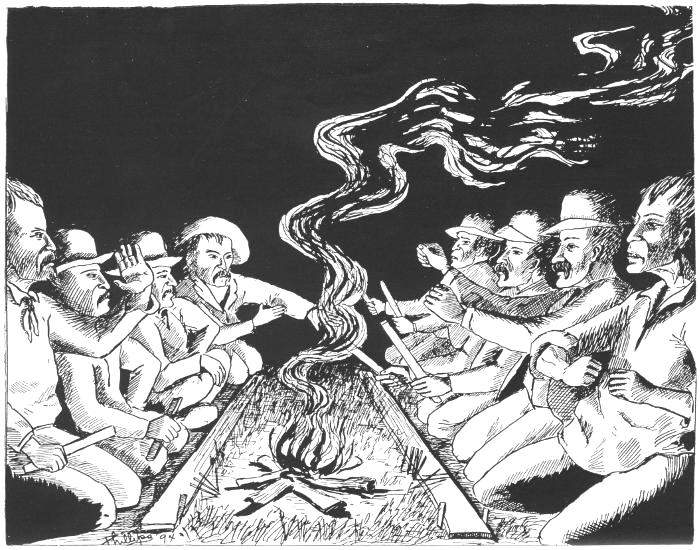
great pow wow was going on.
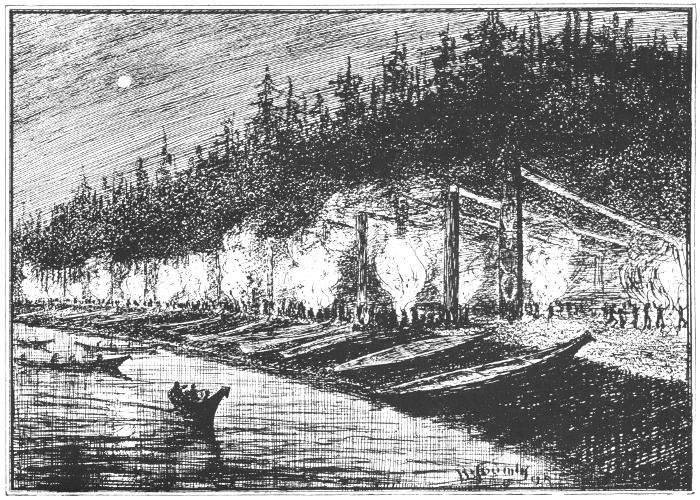
One thousand natives of the Duwamish and other tribes with a few stragglers
from distant local tribes were assembled and sat about their smouldering
fires, lounged lazily in brown-colored canoes or were snoring under rakish tents
much as the Indians of today do about Ballast island or the hop fields.
All was excitement.
History records the fact that the day was a beautiful one, a brilliant sun
shedding a brilliant light over a most primeval and rural scene.
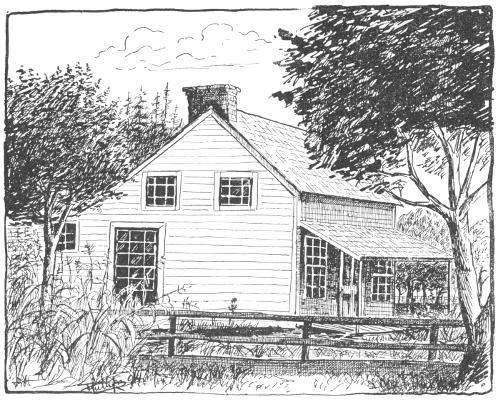
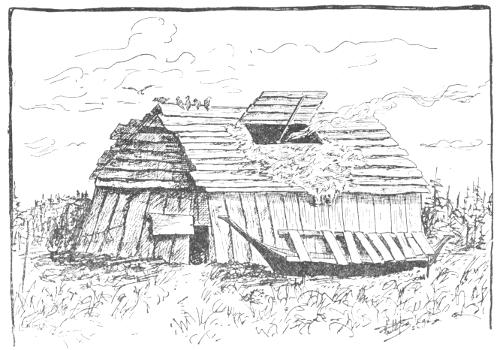
OLDEST HOUSE IN KING COUNTY—J. W. MAPLE’S, WHITE RIVER
Over all this vast congregation of God’s simple-minded children there ruled
a chief—old Chief Sealth—then a patriarch, aged, yet stately and dignified;
an Indian simple and untutored, though yet an orator of the highest rank.
Old Chief Sealth, a name honored and revered even at that early day; a
name since become historic and wreathed with an enduring, undying fame.
It was at a day when the flames of Indian warfare were beginning to smoulder
after a long seige of war, of ambush and bloodshed on Puget Sound, though
the old patriarch of the forest, Chief Sealth, had refrained from lending a hand
in the bloody work of his tribal relations and neighbors. He, like many of
the proud chieftains in the earlier settlement of the Atlantic and middle states,
stood by the white men—the invaders we might say—when their brethren wore
the war paint and carried the scalp-lock at their girdle.
On this historic day old Sealth sat gloomily down in front of his wigwam
waiting in stolid indifference for the coming of the Boston man, who was to
treat with him that day and bring him news from the great white chief at
Washington.
At last the great white chief’s agent, Colonel M. T. Simmons, made his appearance,
coming from the direction of Olympia, and landed in front of the
staid old Siwash chief’s camp. The ceremony of an introduction was gone
through with in the Chinook jargon, Colonel Simmons being a master in that
tongue, and being an emissary of the government of much repute among the
Indians.
We can imagine the old chief receiving in his dignified, though simple style,
this messenger from the government. We of today might clothe our imagination
with the vision of Princess Angeline, the old chief’s daughter, then a
maiden of comely, though dusky, looks, standing respectfully near and listening,
possibly in eagerness, to this bartering away of her father’s domain—her
own heritage—to the stranger.
Princess Angeline now broken and enfeebled by 40 years of care and bitter
memories, yet lives by that same seaside and almost within sight of the identical
spot whereon that great pow wow was held. Well for poor old Angeline
that her sensibilities are stunted and seared, that time has graciously smothered
any remembrance of those days of freedom, when none but her people
and kindred owned and traversed these woods and waters.
But to the story.
Colonel Simmons had left Olympia on the 15th day of May, 1858, to visit
the several Indian tribes on Puget Sound and conclude the treaties with them
and arrange for the disbursement of annuities and provisions. The commissioner
had first called at Fort Kitsap, G. A. Page local agent, where some 400
Indians waited for him. Colonel Simmons, after the preliminaries necessary for
such an august occasion, was the first to address the assemblage of chiefs and
Indians. His speech was in Chinook and no interpreter was needed. He
referred to the promises that had been made and which were about to be realized,
and wound up with the reference at the close of his speech to the propensities
of the Indian for rum and the evil effects therefrom.
The venerable old chief being first in authority among the assembled red
men, was the first to speak. With the dignity becoming the occasion and the
position of a great chief, he arose, wrapped his heavy blanket more closely
about his shoulders, and began his address. The reference of Colonel Simmons
to the Indian thirst for strong drink touched the old man’s quick, though he
did not show it by any outward sign or expression of feature. No, old Chief
Sealth was too august, too grand for that. Colonel Simmons would learn of
his displeasure, but in a manner and with weapons of his own choice. Sealth
would show that he was an orator. Translated, he said:
“I am not a bad man; I want you to understand what I say; I do not
drink rum; neither does New-E-Chis, (another chief present) and we continually
advise our people not to do so.
“I am and always have been a friend to the whites. I listen to what Mr.
Page (the resident agent) says to me, and I do not steal nor do any of my people
steal from the whites.
“Oh, Mr. Simmons, why do not our papers come back to us? You always
say they will come back, but they do not come. I fear that we are forgotten
or that we are to be cheated out of our land.
“I have been very poor and hungry all winter and am very sick now. In a
little while I will die. I should like to be paid for my lands before I die.
Many of my people died during the cold winter without getting their pay.
When I die my people will be very poor—they will have no property, no chief
and no one to talk for them. You must not forget them, Mr. Simmons, when
I am gone.
“We are ashamed when we think of the Puyallups, as they have now got
their papers. They fought against the whites whilst we, who have never been
angry with them, get nothing. When we get our pay we want it in money.
The Indians are not bad. It is the mean white men that are bad to them. If
any person writes that we do not want our papers they tell lies.
“Oh, Mr. Simmons; you see I am sick, I want you to write quickly to the
great chief what I say. I am done.”
Then the old chief retired. Calm his mein, unruffled his spirits, dignified
his tirade, though age had bent his stately bearing, for old Chief Sealth had
even then—long before that day when he arose to call in question the integrity
of a great nation which had promised to pay him for his birthright and had
not done so—passed the milestones on life’s great highway, when man’s and
Indian’s, too, allotted days of labor are over.
It was the same old story. The dominion of the untutored child of the
forest had been usurped by the ruthless hand of civilization and the Indian life
had been crushed out.
It had followed the red man from the bleak New England shore to a last
great stand on the borders of the western sea. Chief Sealth, like Powantonimo,
Red Jacket, Black Hawk, Tecumseh and all the great line of chiefs of
the American red man, had given up their ancestral possessions to the pale
faces and was ready to die of a broken heart.
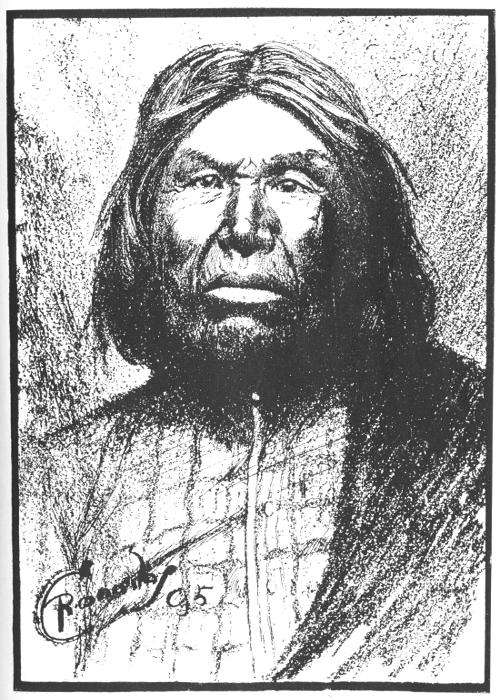
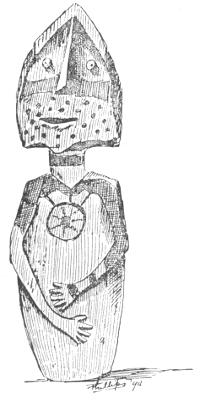
DUKE OF YORK
On the evening of the same day (May 15) Simmons and party reached
Skagit Head, under Captain R. C. Fay, where some 800 Indians of the tribes
of Skagits, Snohomish, Snoqualmies and others were assembled. He made
about the same speech to them as at Fort Kitsap, when Hetty Kannim, a sub-chief,
answered him as follows:
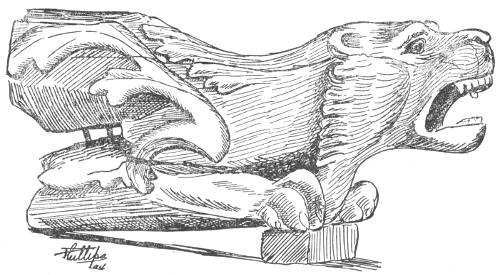
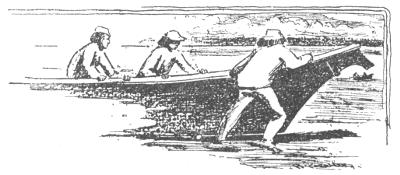
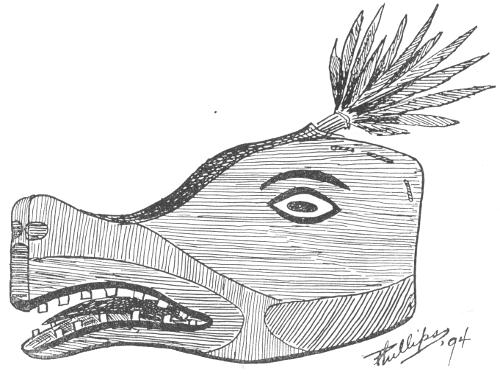
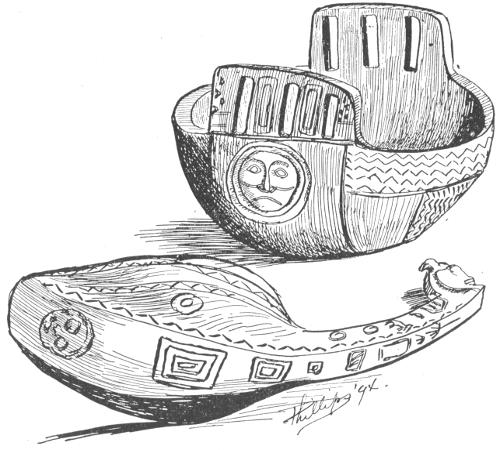
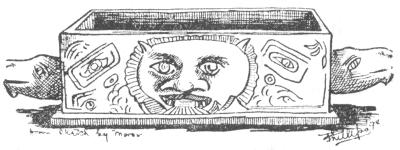
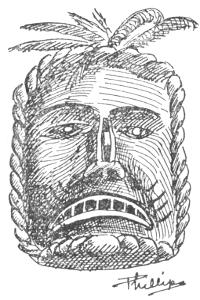
EAST INDIAN CARVING, FIGUREHEAD BARK ENTERPRISE
“I am but a sub-chief, but I am chosen for my people to speak for them
today. I will speak what I think and I want any of the drinking Indians to
contradict me if they can. Liquor is killing our people off fast. Our young
men spend their money and their work for it. Then they get angry and kill
each other and sometimes kill their wives and children. We old men do not
drink and we beg our boys to not trade with cultus (bad) Boston men for
liquor. We have all agreed to tell our agent when any liquor boats are about
and help to arrest the man who sells it. I will now talk about our treaties.
When is the Great Father who lives across the mountains going to send us our
papers back? Four summers have passed since you and Governor Stevens told
us we would get our pay for lands. We remember well what you said to us
over there (pointing to Elliott bay) and our hearts are very sick because you did
not do as you promised. We saw the Puyallups and the Nisquallys get their
annual pay and our hearts were sick because we could get nothing. We never
fought with the whites. We considered it good to have good white people
among us. Our young women can gather berries and clams and our young
men can fish and hunt and sell what they get to the whites. We are willing
that the whites shall take the timber, but we want the game and the fish and
we want our homes, where there is plenty of game and fish and good lands
for potatoes. We want our Great Father to know what our hearts are and we
want you to send our talk to him at once. I have done.”
“Hiram,” a Snoqualmie then spoke:
“We want our treaty to be concluded as soon as possible. We are tired of
waiting. Our reason is that our old people, and there are many of them, are
dying. Look at those old men and women; they have only a little while
to live and they want to get their pay for their lands. The white people have
taken it and you, Mr. Simmons, promised us we should be paid, you and
Governor Stevens. Suspense is killing us.
“We are afraid to plant potatoes on the river bottom, lest some bad white
man shall come and make us leave. You know what we are Mr. Simmons.
You was the first American we ever knew and our children will remember you
as long as they remember anything. I was but a boy when I first knew you.
You know we do not want to drink liquor, but we cannot help it when the bad
Boston man brings it to us and urges us to drink. When our treaties were
made we told our hearts to you and Governor Stevens and they have not
changed since. I have done.”
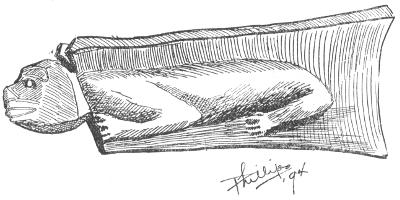
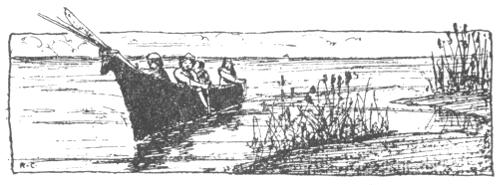
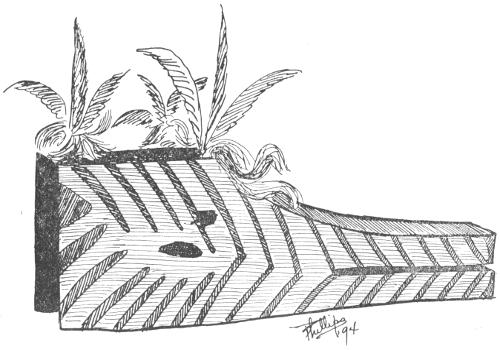
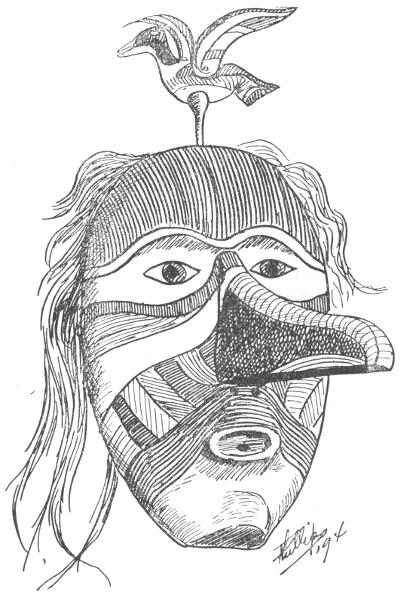
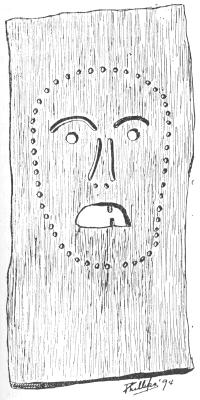
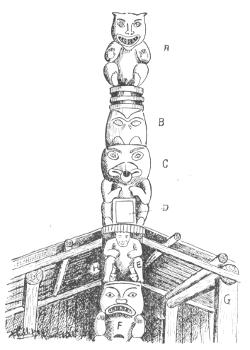
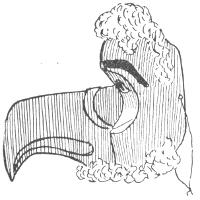
CANOE HEAD TOTEM, SKOKOMISH
“Bonaparte,” a Snohomish chief, then spoke as follows:
“What I have to say is not of much consequence. My children have all
been killed by rum, and I am very poor. I believe what Mr. Simmons tells
about our treaty, but most Indians think he lies. My heart is not asleep. I
have known Mr. Simmons a long time and he never lied to me, and I think he
will tell the Great Father that we want to get our pay. I have done.”
The Indians at Point no Point were then seen and many speeches of a like
character were made and then the party returned to Olympia.