Friday, 10 a.m.
Dearest G.,—After all my letter did
not get off last night, as the roads were
too dangerous to admit of Dr. W. motoring
Lord S. to Kingstown. He got a permit
to pass our troops, but there were too
many Sinn Fein positions and snipers to
make it possible for them to pass through.
If the position improves, he will go to-night,
so I may be able to send this too,
if I can write enough to make it worth
while, but I am still rather shaky from a
fright I had last night.
Yesterday morning the Red Cross ambulance
sent in to the hotel to ask for volunteer
workers to act as stretcher-bearers
and do all sorts of jobs connected with the
Red Cross, and N. and several men staying
in the hotel volunteered. I was glad
he should, as he is of course safer attached
to the Red Cross than roaming the streets
making rescues on his own, and if he was
killed or wounded we should at least hear
of it. But the risks are many and great,
as in this kind of street fighting, where all
the firing is from windows or from housetops,
the ambulance are frequently under
fire.
However, N. having volunteered
promptly went off, and we saw him no
more. While we were having dinner
Mr. O'B., who had been out all day with
the ambulance, was dining with us. H.
was called to the telephone to receive this
message: "You must not expect to see
or hear from me till this is over."
H. asked who the message was from,
and the answer came back: "Your son"
in a voice that H. was sure was not N.'s.
H. then asked where the message came
from, and was told "The Castle."
He returned to us greatly perturbed,
and we held a consultation. We all
agreed there was only one interpretation
to be put on it, viz., that N. had been
taken prisoner by the rebels, and that
someone who was well disposed to H. had
taken this opportunity of letting him know,
and that saying the message came from
the Castle was just a blind. H. rang up
the head of the Red Cross, and he told
us only two of the Red Cross volunteers
were missing who had been out that day,
and both of them were known, and N.
was not one of them, so we were still more
mystified.
It then occurred to H. that it might be
possible to trace back the message and find
out where it really had been sent from,
so he called up the exchange, and after
a little delay he heard the message had
actually been sent from the Castle and by
N., who was there.
Imagine our relief! though still completely
in the dark as to why the boy had
not come back like other workers, and
why we were not to expect to see him
again.
Next morning in walked the truant, not
best pleased that we had been inquiring
for him. His explanation was quite simple.
He had been attached to a branch of the
ambulance that had its depôt at the
Castle, so worked from there and returned
to the Castle at night. Hearing this, and
not knowing in the least to what part of
the city his work would take him, and the
impossibility of sending any message or
note to tell us where he was, and knowing
how anxious I should be if he did not
return, he asked the Castle authorities if
he might send a message to relieve our
minds! He was told he might do so,
but it must only be one sentence, and he
must have the censor in the box with him.
This so flustered N. that he could think of
nothing to say but the words I have quoted;
they seemed to him to express the position
exactly, and he never dreamt of the
interpretation we should put on them.
As it was I spent an hour I don't ever like
to remember and which unnerved me more
than I thought possible, and all I got was
a trouncing from N. for being so "nervy."
Surely much is expected from mothers
these days!
The volunteer workers, among other
things, enter houses where there are known
to be wounded Sinn Feiners and bring
them out and take them to hospitals.
This N. was doing yesterday. One of
the most awful things in this terrible
time is that there must be scores of dead
and dying Sinn Feiners, many of them
mere lads, that no one can get at in the
houses, and where they will remain till
after the rebellion; and in some cases the
houses take fire and they are all burnt.
However, whatever is possible is being
done.
Yesterday was the worst day we have
had, as there was desperate fighting in
Grafton Street, just at our back, and the
side streets; and several volleys in our
street.
In the morning I was sitting on a settee
near the window of the lounge, knitting
and looking out and listening to the firing
in Grafton Street, when shots were fired
just outside our windows, and Mr. B., the
manager, came in and said, "We must
shut all the shutters, Mrs. N., it is getting
a bit too hot, and I am taking no risks."
So all the shutters were closed, and I
moved to the drawing-room above, which
also overlooks the street.
All the afternoon an awful battle raged
in the neighbourhood of the river and
quays, and the din of the great guns and
machine-guns was tremendous. We now
have 30,000 troops and plenty of artillery
and machine-guns, so the result cannot be
uncertain, though there is desperate work
to be done before the end is in sight.
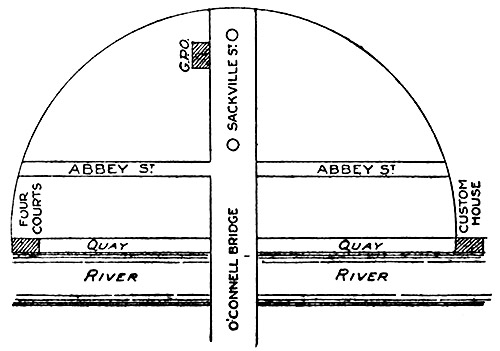
The troops are said to have formed
a huge semi-circle with the G.P.O. as the
centre, and, starting from the river, are
driving the rebels back street by street, till
eventually they will be in a small enclosure,
when they will bombard it to pieces.
The G.P.O. has such valuable records,
etc., and the contents of the safes are so
precious, that they will not raze it to the
ground if they can help it; but it has so
much subterranean space, that would afford
cover to thousands of Sinn Feiners, that
we hear they are going to fire some "gas"
shells into it and then rush it!
Up to yesterday afternoon they had got
to Abbey Street on the right, and no doubt
were closing in equally on other sides. The
shells had started several fires; nearly all the
shops on the quay on the side of the Custom
House were burning yesterday afternoon,
and later in the evening many others
broke out.
I cannot give you any idea of what it
was like when I went to bed. I sent for
Mrs. B., the manager's wife, such a splendid
little woman, and together we watched
it from my window, which is high up and
looked in the right direction.
It was the most awe-inspiring sight I
have ever seen. It seemed as if the whole
city was on fire, the glow extending right
across the heavens, and the red glare
hundreds of feet high, while above the roar
of the fires the whole air seemed vibrating
with the noise of the great guns and
machine-guns. It was an inferno! We
remained spell-bound, and I can't tell
you how I longed for you to see it. We
had only just come down from the window—we
had been standing on the window
ledge leaning out—when H. came and told
us no one was to look out of the windows
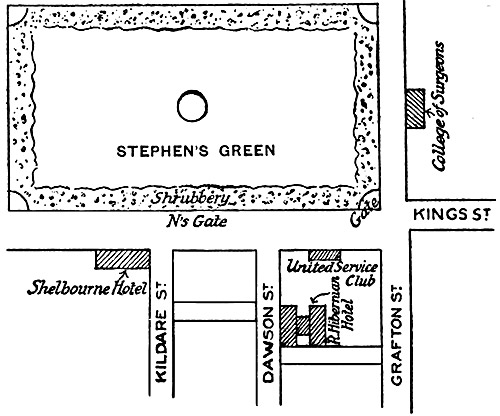
as there was cross-firing from the United
Service Club and another building, and
Mr. O'B., who was watching the fires
from his window, had a bullet a few inches
from his head!!
About 2 a.m. I woke to find the room
illuminated in spite of dark blinds and
curtains, and I rushed to the window and
saw an enormous fire; it seemed to be in
the direction of the Four Courts, which is
in the hands of the Sinn Feiners, and we
hear this morning that a portion of the
buildings was burnt last night.[A]
Yesterday Lord S. had a narrow escape
from a sniper who has been worrying this
street for two days and could not be
located. He was picking off soldiers during
the fighting in Grafton Street, but later
turned his attention to the cross streets
between this and Grafton Street, and there
as nearly as possible got Lord S., who
was coming back to us from the Castle.
The military thought the man was on
our roof, which made us all bristle with
indignation—the mere idea of the wretch
being on our hotel; but a thorough search
proved he was not here, though he evidently
had access to some roof.
In this respect we are much better off
than our friends the V.'s. They came into
their town house only about a month
ago, and being in Upper Mount Street it
was in one of the most active haunts of
the snipers. They had several on their
roof, and when they went up to bed
at night they could hear the snipers walking
about and talking on the roof. Does
it not make one creep to think of it?
Mr. V. had his bed put on the upper landing
exactly under the trap-door on to the
roof, so that had the rebels attempted
to enter the house at night they would have
come down "plop" on to him in his bed.
He surrounded himself with all the arms
he could muster, and the wretched Mrs. V.
lay in bed and quaked, expecting any
minute to hear a battle royal raging outside
her bedroom door. In this street an
old lady of seventy-three was shot through
the leg in her own room, and was taken
to Dr. W.'s home, where she had to have
her leg amputated; and in another house
a servant flashed on her electric light when
going to bed and was instantly shot
through the head! Our friend Miss K.
also had a narrow escape. She had only
just left her drawing-room, when a bullet
passed straight through the room and
buried itself in a picture.
Yesterday afternoon, when the firing in
Grafton Street was over, the mob appeared
and looted the shops, clearing the great
provision shops and others. From the
back of this hotel you look down on an
alley that connects with Grafton Street,—and
at the corner, the shop front in Grafton
Street, but with a side entrance into this
lane, is a very large and high-class fruiterer.
From the windows we watched the proceedings,
and I never saw anything so
brazen! The mob were chiefly women and
children, with a sprinkling of men. They
swarmed in and out of the side door bearing
huge consignments of bananas, the
great bunches on the stalk, to which the
children attached a cord and ran away
dragging it along. Other boys had big
orange boxes which they filled with tinned
and bottled fruits. Women with their
skirts held up received showers of apples
and oranges and all kinds of fruit which
were thrown from the upper windows by
their pals; and ankle-deep on the ground
lay all the pink and white and silver
paper and paper shavings used for packing
choice fruits. It was an amazing sight,
and nothing daunted these people. Higher
up at another shop we were told a woman
was hanging out of a window dropping
down loot to a friend, when she was shot
through the head by a sniper, probably our
man; the body dropped into the street
and the mob cleared. In a few minutes
a hand-cart appeared and gathered up the
body, and instantly all the mob swarmed
back to continue the joyful proceedings!
H. and Lord S. were sitting at the window
for a few minutes yesterday when the fruit
shop was being looted, and saw one of the
funniest sights they had ever seen. A
very fat, very blousy old woman emerged
from the side street and staggered on to
the pavement laden with far more loot
than she could carry. In her arms she had
an orange box full of fruit, and under her
shawl she had a great bundle tied up which
kept slipping down. Having reached the
pavement, she put down her box and sat
on it, and from her bundle rolled forth
many tins of fruit. These she surveyed
ruefully, calling on the Almighty and all
the saints to help her!! From these she
solemnly made her selection, which she
bound up in her bundle and hoisted, with
many groans and lamentations, on her
back and made off with, casting back
many longing looks at the pile of things
left on the pavement, which were speedily
disposed of by small boys.
On Wednesday when the looting was
going on in Sackville Street a fine, large
boot shop was receiving attention from
swarms of looters. Ragged women and
children were seen calmly sitting in the
window trying on boots and shoes, and
one old woman with an eye to future needs
made up a bundle of assorted sizes and tied
them up in her apron. She had only
reached the pavement, when she bethought
her to leave her bundle in a corner and
return for a further consignment which
she tied up in her shawl. On returning
to the street great was her rage and
indignation on finding the original bundle
had disappeared. Then were there sore
lamentations and violent abuse of the
police, who could not even "protect the
property of a poor old woman."
In Sackville Street was a very large shop
called Clery's; for some reason the looters
were afraid to start on it, and old women
passed up and down gazing longingly at
fur coats and silken raiment and saying
sorrowfully, "Isn't Clery's broke yet?"
and "Isn't it a great shame that Clery's
is not broke!" Humour and tragedy
are so intermixed in this catastrophe.
A very delicate elderly lady who is staying
here said to me this morning, in answer
to my inquiry as to how she had slept:
"I could not sleep at all. When the guns
ceased the awful silence made me so nervous!"
I know exactly what she meant.
When the roar of the guns ceases you can
feel the silence.
4 p.m.
When I had got so far this morning I
got an urgent message from the Red Cross
asking me to make more armlets for the
workers. With two other ladies I had been
making them yesterday, so I collected
my helpers and we worked till lunch, when
another request came that we would make
four large Red Cross flags, as they were
going to try to bury some of the dead
and needed the flags for the protection of
the parties. We have just finished them,
and are wondering what will be the next
call. It is such a good thing I have my
sewing-machine here.
On Wednesday evening Lord S. was at
Mercer's Hospital with a doctor when
eleven dead were brought in, and a priest
brought in a rifle he had taken from a dead
Sinn Feiner. It had an inscription in
German and the name of the factory in
Berlin, which Lord S. copied. It is
believed that nearly all the arms and
ammunition are of German make, and it
is said that the cruiser that was sunk on
Saturday was bringing heavy guns and
forty officers, but I don't know if there is
any truth in that. The opinion is very
strong that the Sinn Feiners were led to
believe that they would have great German
reinforcements, and that all they had to
do was to hold the troops here for a couple
of days while the Germans landed a big
force on the west coast of Ireland. We
also hear that Sir R. Casement has been
shot in London, but you probably know
a great deal more about that than I do,
as we see no papers and are completely
cut off from all news.
On Wednesday three of the ringleaders
were caught, and it is said they were shot
immediately! It is also believed that
Larkin was shot on the top of a house in
St. Stephen's Green, but as the rebels
still hold the house it has not been possible
to identify him, but he is said to have been
here on Monday.[B]
5 p.m.
Colonel C. has just come in, having been
in the thick of it for forty-eight hours.
He tells us the Post Office has been set
on fire by the Sinn Feiners, who have left
it. If this is true, and it probably is, I
fear we have lost all our valuable possessions,
including my diamond pendant,
which was in my jewel-case in H.'s safe.
To-day about lunch-time a horrid
machine-gun suddenly gave voice very
near us. We thought it was in this street,
but it may have been in Kildare Street;
also the sniper reappeared on the roofs,
and this afternoon was opposite my bedroom
window judging from the sound.
I pulled down my blinds. A man might
hide for weeks on the roofs of these houses
among the chimney stacks and never be
found as long as he had access to some
house for food. When we were working
in my room this afternoon he fired some
shots that could not have been more
than twenty yards away.
The serious problem of food is looming
rather near, as nothing has come into the
city since Saturday. Boland's bakery,
an enormous building, is in the hands of
the rebels, who have barricaded all the
windows with sacks of flour, and it is said
it will have to be blown up. There is
not a chance of getting them out in any
other way. The rebels also have Jacob's
biscuit factory, where there are still huge
stores of flour. Every prominent building
and every strategic position was taken
before the authorities at the Castle woke
to the fact that there was a rebellion!
I was almost forgetting to tell you
how splendidly one of H.'s men behaved
when the G.P.O. was taken. When the
rebels took possession they demanded the
keys from the man who had them in
charge. He quietly handed over the keys,
having first abstracted the keys of H.'s
room!
Imagine such self-possession at such a
terrible moment.
A young man has come to stay in the
hotel who saw the taking of the G.P.O.
He was staying at the hotel exactly opposite
the building and went into the G.P.O.
to get some stamps. As he was leaving
the office a detachment of about fifteen
Irish Volunteers marched up and formed
up in front of the great entrance. He
looked at them with some curiosity,
supposing they were going to hold a
parade; two more detachments arrived,
and immediately the word of command was
given, and they rushed in through the door.
Shots were fired inside the building, and,
as the young man said, he "hooked it"
back to the hotel, which was one of those
burnt a few days later. The whole thing
occupied only a few moments, as, being
Bank Holiday, there was only a small
staff in the building.
6.30 p.m.
A party of soldiers and a young officer
have just arrived to search the roof for
the sniper. They say he is on the roof
of the annexe, which is connected with
the main building by covered-in bridges.
They are now on the roof and shots are
being fired, so I expect they have spotted
him.
When N. was out last night another
ambulance had a bad experience. They
had fetched three wounded Sinn Feiners
out of a house, and were taking them to
hospital, when they came under heavy
fire. The driver was killed, so the man
beside him took the wheel and was
promptly wounded in both legs. The car
then ran away and wrecked itself on a
lamp post. Another ambulance had to
run the gauntlet and go to the rescue!
On the whole as far as possible the rebels
have respected the Red Cross, but not the
white flag. In house-to-house fighting
there can be no connected action, and
yesterday when a house was being stormed
the rebels hung out a white flag, and
when the troops advanced to take them
prisoners they were shot down from a
house a few doors higher up the street,
so now no more white flag signals are to
be recognised. If they want to surrender
they must come out and take their own
risks.
We asked N. if he knew what had
happened to the ambulance that had two
men missing yesterday, and he told us
they were in the act of entering a Sinn
Fein house to bring out wounded with
two other men when the ambulance came
under such heavy fire that, as it contained
one or two other wounded men, it had to
beat a retreat and moved off. Two of the
volunteer helpers ran after it and succeeded
in reaching it and climbed in, but
the other two took refuge in the area,
and N. did not know how or when they
were rescued. This is an instance of the
extreme danger that attends the ambulance
work. The marvel is that the casualties
are so few.
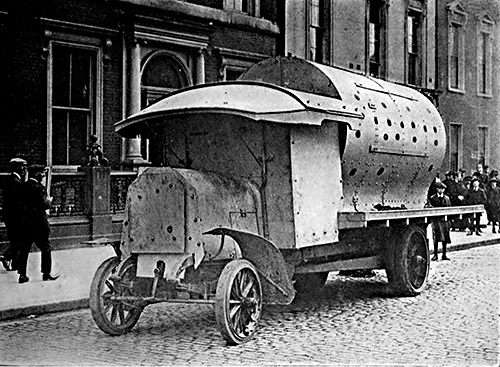
Guinness's Brewery have made three
splendid armoured cars by putting great
long boilers six feet in diameter on to their
large motor lorries. Holes are bored down
the sides to let in air, and they are painted
grey. The driver sits inside too. They
each carry twenty-two men or a ton of
food in absolute security. N. saw them
at the Castle being packed with men;
nineteen got in packed like herrings, and
three remained outside. Up came the
sergeant: "Now then, gentlemen, move
up, move up: the car held twenty-two
yesterday; it must hold twenty-two to-day";
and in the unfortunate three were
stuffed. It must have been suffocating,
but they were taken to their positions in
absolute safety.
Saturday, 29th, 10 a.m.
Last night was an agitating one. The
sniper was very active, and after dinner
several shots struck the annexe, one or
two coming through the windows, and one
broke the glass roof of the bridge. Mr. B.,
who never loses his head, decided to get
all the people out of the annexe, with
staff (about forty people); and all we in
the main building, whose rooms look out
on the back, were forbidden to have lights
in our rooms at all. There was such a
strong feeling of uneasiness throughout the
hotel, and always the danger of its being
set on fire, that about 10 p.m. H. said
we must be prepared at any moment to
leave the hotel if necessary. So we went
up to our room and in pitch darkness
groped about and collected a few things
(F.'s miniature and the presentation portrait
of him, my despatch case with his
letters, my fur coat, hat and boots),
and we took them down to the sitting-room,
which H. uses as an office, on the
first floor. All the people in the hotel
were collected in the lounge, which is
very large and faces the street, and the
whole of the back was in complete darkness.
The firing quieted down, and about
11.30 we crept up to our room and lay
down in our clothes. When dawn broke
I got up and undressed and had two
hours' sleep. All the rest of the guests
spent the night in the lounge.
This morning we hear an officer has been
to say that the shots fired into the hotel
last night were fired by the military.
People were constantly pulling up their
blinds for a moment with the lights on to
look at the city on fire, and the military have
orders to fire on anything that resembles
signalling without asking questions.
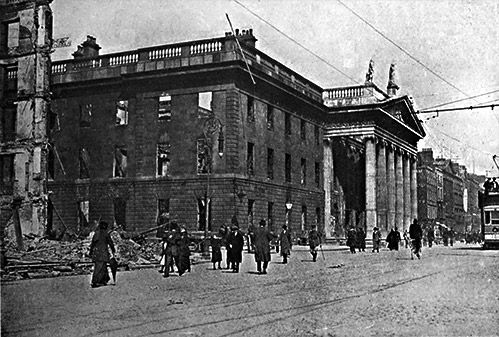
Reliable news has come in this morning
that nothing remains of the G.P.O. but
the four main walls and the great portico.
It is absolutely burnt out. The fires last
night were terrible, but we dared not look
out. Eason's Library and all the shops
and buildings between O'Connell Bridge
and the G.P.O. on both sides of Sackville
Street are gone.
It is difficult to think of the position
without intense bitterness, though God
knows it is the last thing one wishes for
at such a time. In pandering to Sir E.
Carson's fanaticism and allowing him to
raise a body of 100,000 armed men for the
sole purpose of rebellion and provisional
government the Government tied their own
hands and rendered it extremely difficult
to stop the arming of another body of
men, known to be disloyal, but whose
avowed reason was the internal defence of
Ireland! In Ulster the wind was sown,
and, my God, we have reaped the whirlwind!
We hear that many of our wounded are
being sent to Belfast, as the hospitals
here are crowded, and the food problem
must soon become acute. Mr. O'B. told
me his ambulance picked up four wounded,
three men and a woman, and took them
to the nearest hospital. The woman was
dying, so they stopped at a church and
picked up a priest; arrived at the hospital
the authorities said they could not
possibly take them in as they had not
enough food for those they had already
taken, but when they saw the condition
of the woman they took her in to die, and
the others had to be taken elsewhere.
If the main walls of the G.P.O. remain
standing it may be we shall find the safe
in H.'s room still intact. It was built
into the wall, and my jewel-case was in
it, but all our silver, old engravings, and
other valuables were stored in the great
mahogany cupboards when we gave up
our house in the autumn, as being the
safest place in Dublin.
4 p.m.
Sir M. N. has just rung up to say the
rebels have surrendered unconditionally.
We have no details, and the firing continues
in various parts of the town. But if the
leaders have surrendered it can only be a
question of a few hours before peace is
restored, and we can go forth and look on
the wreck and desolation of this great city.
So ends, we hope, this appalling chapter
in the history of Ireland—days of horror
and slaughter comparable only to the
Indian Mutiny. This seems a suitable
place, dear G., to end this letter, and I
hope to start a happier one to-morrow.
Yours,
L. N.