The author acknowledges with thanks
the generous co-operation of the Eastern
Region Stewardess Division of American
Airlines and Miss Mary Cody and Miss
Joan McGuckin, Supervisors of Stewardesses,
for the information given in the
preparation of this book.
“That’s why,” Vicki explained to her family,
“the Electra is so challenging. Mary Carter
warned us stewardesses, while she was retraining
us for the Electra, that this beauty flies so fast
there’s hardly time to get all our jobs done.”
“You mean it’s a hard assignment, don’t you?”
said Ginny. She was fourteen, and Vicki’s younger
sister.
Their mother, Betty Barr, said, “I’m sure if I
had your job on a jet-prop—Or is it a jet? Which
is it, Lewis?”
Professor Barr looked amused. “You know perfectly
well. The all-jet without propellers,” he
said, “the Boeing 707, is used more for long hauls—nonstop
coast to coast, or across oceans. The
Electra 188, with jet engines and propellers, is
used mainly for intercity travel. I trust I have the
facts correct, Victoria.”
He smiled at Vicki who looked so much like
him—fair hair, light-blue eyes, the thoughtful
Barr gaze—that it was a family joke.
“Well, anyhow,” said Vicki’s mother, “if I had
to get sixty-eight passengers safely on, off, and
fed, in two hours—Whew!”
“Fortunately I’m not going to have to do everything
all by myself,” Vicki answered. “Jean Cox
and I will work the New York-Chicago-San
Francisco run together on the Electra.”
They were having a leisurely early lunch at
home, at The Castle, before Vicki started out for
Chicago. It was Thursday, February twelfth, Lincoln’s
Birthday, an appropriate day to be in Lincoln’s
state, Illinois. The holiday explained why
Mr. Barr was not teaching at nearby State University
that day. The holiday did not account
for Vicki’s presence at home. As a flight stewardess,
she often worked on holidays.
Vicki popped in and out of The Castle between
assignments, whenever she could. That wasn’t often.
Perhaps now that Federal Airlines was transferring
her to the Electra and one of its transcontinental
runs, she might be lucky enough to see
her family more often.
Her mother was wondering about the same
thing. “Will your being based in San Francisco
mean that we won’t see much of you?”
Vicki went over her schedule again with her
family. She and Jean Cox would fly regularly with
the same crew on the New York-Chicago-San
Francisco run, and return flight. They would have
at least an overnight stop in Chicago, and some
rest days in New York and San Francisco, “mostly
in San Francisco where our plane will be serviced.”
Also, since passenger traffic was sometimes
heavier in the East, Vicki and Jean would occasionally
fly the New York-Chicago and Chicago-New
York “turn-around” run. The fast cruising
speed of the Electra—up to five hundred miles
per hour—made these schedules possible.
“Anyway, I’ll be in and out of Chicago,” Vicki
told her family. “If I haven’t time to run down to
Fairview to see you, maybe you’ll drive up to
Chicago to see me?”
“I’ll come up,” her mother promised. “Now if
you don’t start for Chicago, young lady, the
Electra may take off for New York without you.”
“Heaven forbid! I’ve been studying, practicing,
and dreaming jet-props!” So had her stewardess
friends, so had pilots and navigators—all of them
had been training intensively for the new aircraft
at Federal Airlines’ schools in New York and
Texas. “I wouldn’t miss today for anything!”
Her family drove Vicki to the Fairview station
in plenty of time for the noon train to Chicago.
Freckles, their spaniel, sensed Vicki’s excitement
and ran around the platform so wildly that for
safety they had to lock him in the car.
“Do you think, dear,” Mrs. Barr asked Vicki,
“that you’ll meet any especially interesting people
on this new plane?”
“I wouldn’t be a bit surprised.”
They could hear the train coming. In another
minute it pounded in alongside the platform.
Vicki’s mother and sister hugged her. “Good luck!
See you soon!” Mr. Barr picked up her overnight
kit, helped her aboard the train, and found her a
seat. He bent over to kiss her.
“You look mighty little to be flying coast to
coast, Victoria.”
“I feel like an eagle in the sky—you know, the
words of the spiritual? Dad! The train’s starting
to move!”
He got off, and then her family was waving to
her, and the train slid quickly out of the station.
She was on her way.
By three o’clock Vicki was in Chicago, and a
little before four she reached Midway Airport.
That allowed comfortably for an hour’s preflight
ground duties before departure time at five P.M.
In the stewardesses’ lounge, Vicki changed into
her blue uniform and cap, then picked up her
topcoat, purse, and overnight kit. She walked over
to the operations area where she initialed the crew
check-in sheet, wrote in the time, and noticed that
Jean Cox had signed in five minutes ago.
Vicki found Captain Jordan in the busy meteorologist’s
room. Jean was there, too.
“Good afternoon, Captain Jordan—Jean. Reporting
in for our very first Electra flight!”
The pilot, a graying, solidly built man in blue
uniform, smiled at her and Jean grinned. Jean Cox
looked like a good-natured imp, with her cropped
brown hair and twinkling eyes. Vicki knew that
her fellow stewardess, despite the elfish grin, was
absolutely reliable—just as their million-mile
Captain Tom Jordan was a rock of strength. He
told his two stewardesses:
“Dan McGovern will be our copilot, and Chuck
Smith our navigator. Good men, both of them. I
expect the five of us will work together fine as a
unit. Now, then—”
Captain Jordan gave Vicki and Jean the flight
plan and briefed them on the route and the flight
conditions for this trip. Vicki knew that the passengers
who asked questions about the flight
might include anyone from a businessman who
flew his own private plane to an aviation engineer,
so she listened carefully. The pilot planned to fly
above the day’s overcast, at an altitude of around
22,000 feet. “Our cruising speed will be about 400
to 420 miles per hour,” he said.
Captain Jordan then handed Vicki and Jean the
Stewardess Briefing Book, which they quickly
read and initialed. He answered a couple of questions
for them, discussed the ETA—estimated
time of arrival—and said, “See you aboard.”
“Aye, aye, sir,” said Jean, for both of them.
The two girls hurried back to the stewardesses’
lounge. There they prepared the necessary report
forms for the trip.
“Do I look all right, Vic?” Jean asked.
They both checked their appearance—a stewardess
had to be perfectly groomed and turned
out—before leaving the operations area of the
building.
They hurried down a flight of stairs into Hangar
One. In the vast high shed, Captain Jordan had
two men in blue uniform with him. The five of
them met beside a DC-7 which a repair crew was
tuning up. The engines roared; Captain Jordan
had to shout.
“Miss Vicki Barr, Miss Jean Cox, this is our first
officer, Dan McGovern—”
The girls shook hands with their copilot, who
was a large, quiet, serious-looking man.
“—and our navigator, Chuck Smith.”
Chuck Smith was young, small, and wiry,
with an ingratiating grin.
“See you aboard,” they all said.
The two stewardesses went outdoors onto the
windy airfield. A little distance away their immense
silver Electra stood waiting for them. The
plane was 104 feet long with a 99-foot wing span.
Its sheer size took their breath away.
Vicki and Jean had forty minutes’ work to do
before the passengers came aboard. They had
many things to check—it would be just too bad
if, once aloft, they discovered there was not
enough water for making coffee, or found the ventilation
or heating system wasn’t functioning perfectly.
Hurrying up and down the long cabin
aisle, they took pride in their handsome Electra.
Wide reclining chairs were upholstered in blue, in
beige, and a few in pumpkin color; the silver-beige
walls and curtains and coral-colored carpet
harmonized. Vicki took special satisfaction in the
semicircular observation lounge with its wide windows
in the rear of the plane.
While Jean checked their service kit, all emergency
equipment, cabin and lavatory lights, seat
belts, and a dozen or more other items, Vicki was
busy in the buffet area amidship. The two tall,
wide, metal buffets, facing each other, held drawers
and compartments for everything she and Jean
would need to store, heat, and serve sixty-eight
dinners, and to brew gallons of fresh coffee. Vicki
found it a big job to check every item. Next, the
caterer brought aboard precooked dinners on individual
trays, water, bags of coffee, and Vicki
checked all items off on her report form. She
called through the open service door to the commissary
men on the ground:
“We’re short one dinner.” She saw the fueling
crew hosing kerosene for the plane’s four jet engines
into the storage tanks inside the wings. Daylight
was fading; the first of their passengers were
gathering behind the wire gate, looking on.
Captain Jordan came aboard and went into the
cockpit. In a minute or two his copilot and navigator
followed. The cockpit door stood open until
departure time; Vicki could see the complex instrument
panel, and the three airmen at work with
their air maps and weather charts. She turned on
the music—a little early, but they all were keyed
up about this flight, and it helped to have lilting
music fill the cabin.
Twenty minutes later Vicki and Jean were
breathless but ready. They repowdered their
faces, and smiled expectantly at each other. Jean
said:
“I must say you look poised and calm.”
“Calm? Who, me? Well, here’s wishing us good
luck.”
Jean said a fervent amen, and then pressed
down on the switch which released a folding staircase
from the plane to the ground. Slowly the
stairs for the passengers’ use dropped down into
place. Then Jean took up her post just inside the
main entrance door, to greet their passengers.
Vicki stood smiling in the aft cabin to greet them
and assist them in getting seated.
Mothers with babies and small children straggled
aboard first. Vicki directed them to window
seats in the quieter locations.
“Miss, will you be able to heat my baby’s bottle?”
one mother asked her.
“Yes, I’ll be glad to.”
Vicki turned to a young couple who looked like
honeymooners. Their faces shone, and the girl
wore flowers. “Welcome aboard,” Vicki said to
them, and nearly added, “Congratulations.” She
suggested the forward cabin compartment which
was smaller and more private.
Most of the passengers, many of them businessmen
with brief cases, found seats by themselves
in the large main cabin and, beyond the buffet
area, in the aft cabin. For several minutes the wide
aisle swarmed with people.
“Please be seated,” Vicki said to them as they
passed her, “and then I’ll hang up your coats.”
A white-haired, well-dressed couple came very
slowly down the aisle. They must be in their mid-sixties,
Vicki thought. The elderly woman looked
pleasant, but the heavy-set man was scowling and
grumbling about something. He had a look of authority,
of command.
Vicki went forward to help them. “Good afternoon.
Would you like to sit here?”
The man nodded curtly. He helped his wife
into the window seat, then placed her hatbox
up on the luggage rack.
“If you don’t mind, sir,” said Vicki, “may I put
that hatbox in the closet? It might bounce off the
rack during flight, and the sharp corners might
hurt somebody.”
The elderly man sat down as if he had not
heard her. Then he remarked, “The hatbox can
stay where it is.”
Vicki gulped, and said with her sweetest smile,
“Yes, of course, if you prefer.” The man’s wife
half smiled at her as if to say, “You mustn’t mind.”
CHAPTER II Vicki Meets the Bryants
All the passengers were aboard now. Jean
had closed the main cabin door.
Captain Jordan flashed on the “No Smoking—Fasten
Seat Belts” sign. Vicki went up and down
the aisle checking to see that passengers had fastened
their seat belts. The airplane began to vibrate.
She made her welcoming announcement
over the plane’s public-address system, adding,
“Captain Jordan will keep you informed of flight
data en route.” Then both stewardesses found
seats—the observation lounge was the only vacant
place—and strapped in for the take-off.
Suddenly the Electra was taxiing and in instants
they were racing past the end of the runway.
Even more suddenly—no wail, no warm-up
of the engines—zoom! Whoosh! Up they went!
Jean and Vicki were so amazed that they stared
at each other. “Jet engines!” they exclaimed.
“Look at our rate of climb! And steep—almost
straight up!”
The plane tore into the sky. The “No Smoking—Fasten
Seat Belts” sign went off. Here in the
cabin there were music, air at a comfortable temperature
and pressure, newspapers, magazines,
and pillows which Vicki and Jean distributed.
The captain’s call button sounded on the board in
the buffet area, and he spoke over the plane’s communications
system to the two hostesses.
“Everybody comfortable?”
“Yes, Captain,” said Vicki.
“You can tell our passengers we reached our
cruising altitude within five minutes after take-off.
Anyone especially interesting aboard?”
“We’ll tell you soon, sir,” said Vicki.
The passengers were interested in the Electra
and asked questions. With sixty-eight aboard,
Vicki and Jean could not stop to visit. But they
chatted with the passengers while they set up at
each seat the tray tables for dinner and spread
linen tablecloths. The white-haired couple, Vicki
learned, were Mr. and Mrs. Marshall Bryant. The
lady told her this; the elderly man had fallen
asleep, as if overtired. One genial man was a movie
star, perennially young, even though he had five
children. Several passengers recognized him,
judging by their interested glances. He asked Vicki
several stiff technical questions about the jet-propelled
Electra.
From across the aisle a woman touched Vicki’s
sleeve. “My two youngsters are getting hungry,
I’m afraid. Could you please—?”
“Yes, indeed, we’ll serve dinner soon. And we
always serve the children first.”
Vicki made her way along the slightly swaying
plane toward the buffet area. She was waylaid by
only three passengers on the way. One man
wanted to know if there was a razor aboard which
he could borrow. There was. A woman asked
Vicki how to adjust the individual air vents and
reading lights. And a determined-looking man
announced to the stewardess that he was a vegetarian.
“Y-yes, sir,” said Vicki, and made her smiling
way to the sky kitchen. Once inside the closed accordion
curtains, Vicki lost her smile and her face
became as desperate as Jean’s, in her struggle with
several oven drawers full of turkey dinners.
“Hi,” Jean greeted her. “Better put your smock
on, like me. I’m scared we’ll still be serving dinners
ten minutes after landing in New York.”
“We’ll do fine,” Vicki said without believing it,
and started to make coffee.
“Parsley, parsley, where’s the parsley?” Jean
muttered. “Somewhere in this overgrown filing
cabinet—oh, yes, here.”
“Can we spare extra rolls for some hungry
kids?” Vicki peered in the roll warmer. “Yes, we
can.”
She collected nine rolls on a tray, one for each
of the children aboard. On her way back to the
buffet area with her empty tray, Vicki noticed
that something was wrong in the Bryants’ area.
Two men passengers were standing over Mr.
Bryant, one loosening his collar and tie, and the
call button rang. Vicki hurried to them. The people
nearby were considerately snuffing out their
cigarettes and opening air vents.
“My husband has a heart condition,” Mrs.
Bryant said anxiously to Vicki. “I don’t think he’s
having a heart attack, but he—”
Vicki concealed her alarm and looked at Mr.
Bryant who was lying back weakly in his chair.
He was conscious but exhausted, breathing with
some difficulty. His face was pale and sweaty.
“Uncomfortable—” he muttered.
“He needs oxygen,” Vicki said. “I’ll get the oxygen
bottle, Mrs. Bryant. Is he in any pain?...
No? That’s good. I’ll be right back.” To the two
men standing by rather uselessly, Vicki said,
“Thank you, gentlemen. I am trained to give first
aid.”
The men nodded and resumed their seats. Vicki
sped to the storage compartment, being careful to
look calm for the benefit of the other passengers,
and hurried back down the aisle carrying a walk-around
oxygen bottle and a blanket. She paused a
moment at the buffet area.
“Jean, is there a doctor aboard?”
“Not among my passengers. Who’s sick?”
“That elderly man. Mr. Bryant. Heart condition.”
“Want me to notify Captain Jordan for you?”
Jean asked.
“Yes, phone him. I’ll report soon. Please start
serving dinners, Jean. We must keep it pleasant
aboard just as usual.”
Vicki hastened back to the Bryants. She covered
the man with the blanket.
“Miss Barr, I must tell you”—Mrs. Bryant
made an effort to control her trembling voice and
hands—“that my husband is more exhausted
than ill. He had three quite tiring days in Chicago
on business, and it’s been hard on him.”
Vicki said soothingly, “Certain people need extra
oxygen at high altitudes, where the air is thin.
Our cabin air is pressurized, but for someone who
is a cardiac, and for other special needs, we carry
extra oxygen.”
As she talked, she placed the oxygen bottle on
Mr. Bryant’s lap; he was able to hold it steady.
Vicki opened the bottle’s knob, then adjusted the
constant-flow mask snugly over Mr. Bryant’s
mouth and nose.
Almost at once his breathing grew easier. A
little color returned to his face. When he seemed
comfortable again, Vicki removed the mask and
closed the knob. Just the same, she was worried.
He was still weak, and he was an elderly person
with an impaired heart.
“Mr. Bryant, Mrs. Bryant, if you wish to have
a doctor’s care within just a few minutes,” Vicki
said earnestly, “we can arrange it for you. The
pilot can make an emergency landing. Captain
Jordan will radio ahead to the nearest airport to
have a doctor and ambulance waiting to meet our
plane.”
Mrs. Bryant murmured, “That’s wonderful.
What do you think, Marshall?”
“No. Not necessary. Make myself conspicuous.
Inconvenience all these people.”
“Not at all, sir,” Vicki said. “Captain Jordan
probably will be able to make up the time.”
“No. I’m all right. Only a weak spell. Thank
you, anyway.”
Vicki asked respectfully, “Did a doctor give his
permission for you to fly, sir?”
“The doctor most certainly did not—” Mrs. Bryant
started, but the man interrupted. “Fool doctors
would keep me in a rocking chair. I have to
do what I think is right.”
Vicki mentioned briefly the regulation for Federal
and all airlines: a person with a serious heart
condition was not supposed to fly unless he had
a doctor’s written permission to do so, on the
grounds that the trip was necessary, and unless he
had someone to accompany him who could nurse
him. The airlines relied on cardiacs not to board a
plane without such certification.
“If we had known in advance, Mr. Bryant,” Vicki
said, “we would have been obliged to keep you
off the plane.”
“Well, you took excellent care of me, young lady.
It worked out, didn’t it?”
Mrs. Bryant shook her head. “You are so self-willed,
Marshall. So stubborn.”
Vicki turned to her. “The oxygen I gave your
husband is only first aid, you know. Do you feel a
doctor should see him immediately?”
“Well, I’ve seen him have worse spells than this
one—not in the air, either.” The elderly lady hesitated.
“He does seem much better now—”
Vicki said that it was really up to the captain of
the plane to decide whether to make an emergency
landing. She excused herself, went forward
past curious passengers, unlocked the cabin door,
and stepped up into the cockpit.
In the cabin dozens of black-and-white dials on
the instrument panel glowed, needles flickered,
the radar screen flashed. At a signal from Captain
Jordan, the copilot took over the controls.
“Well, Vicki? How is that man?”
“He came fairly close to fainting, Captain Jordan.
He’s elderly, a little overweight, and he has a
heart condition. However, since he’s had therapeutic
oxygen, he’s not in any distress. And his
wife seems fairly satisfied with the way he looks
now.”
“I’d much rather land than take chances with a
passenger’s life.” Captain Jordan looked at his
wrist watch, thinking. “I’ll tell you what. Observe
him for ten minutes and if he shows any sign of
relapse call me. We can come down at Clarkville.
In any case, Vicki, we’re going to have a doctor
and an ambulance on hand at New York. We’ll
radio ahead to La Guardia Airport.”
“Thank you, Captain,” said Vicki.
“That’s all for now, Vicki. Keep me informed.”
Vicki returned to the Bryants. Mr. Bryant was
sitting up erect now; it was a relief to see that.
She told them of the captain’s decision.
“I am so grateful!” Mrs. Bryant exclaimed. “I’m
sure we won’t need to make a special stop.”
Mr. Bryant apparently was not a man to yield
a point easily, but he did say, “Very good of you
airlines people. Very good indeed.”
Vicki brought the Bryants their dinners right
away, and both old people perked up as they ate
the hot food. She raced through serving all her
other passengers. Jean cheerfully doubled up on
jobs, so that Vicki finished her in-flight chores on
time.
“Do you know we haven’t sat down once since
take-off?” Jean said breathlessly.
“Jean, you’ve been an angel on this trip! For a
while there I thought you had four hands.”
“Save the compliments. We’re coming in for a
landing in twenty minutes.”
Twenty-one minutes later they were down at
La Guardia Airport. Vicki summoned the passenger
agent. He gave Mr. Bryant his arm on the way
out of the plane to the waiting ambulance. Vicki
escorted Mrs. Bryant, walking slowly.
Vicki waited for the Bryants outside the ambulance
while the doctor checked over the elderly
man. She hated to leave Jean alone to say good-by
to the other passengers and pick up in the cabin
afterward, but she’d make it up to Jean some other
time. The passenger agent had sent a man to locate
the Bryants’ car and chauffeur. He would
bring the car onto the airfield as near to the ambulance
as possible.
The doctor stepped out and said to Vicki:
“All right, stewardess, he may go home. I think
it’s safe for this gentleman to drive to the city
now.”
He helped Mrs. Bryant down out of the ambulance,
then Mr. Bryant. Their car pulled up at that
moment. Captain Jordan came hurrying over, carrying
his flight papers.
“Miss Barr, are both Bryants all right?”
“Yes, Captain. Tired but all right.”
The Bryants thanked him, and he went off.
They particularly thanked Vicki. They climbed
into their car, and asked Vicki if she wished to
drive into metropolitan New York with them.
“It’s kind of you, but I still have some duties
here.”
“Then you must come to lunch,” Mrs. Bryant
said. “You’ve been a wonderful help, and I want
a chance to thank you properly.”
“I was only doing my job,” said Vicki.
“Come to lunch tomorrow,” Mr. Bryant barked
at her. “Can you?”
Vicki was so startled she stammered, “Y-y-yes,
th-thank you.”
Mrs. Bryant smiled, and told her the address.
“At twelve, Miss Barr?” Then she said an odd
thing. “You know, my dear, we have a granddaughter
whom we’ve never seen. Lucy. I hope
she’s like you.”
Vicki must have looked puzzled, because Mrs.
Bryant smiled again. “We’ll talk about that tomorrow.
Good-by for now, little Miss Barr.”
CHAPTER III The Story of Lucy
Vicki went to the Bryants’ house not knowing
quite what to expect. It was Friday the thirteenth,
but since she was not foolish enough to be superstitious,
the date alone did not account for her
sense of something special about to happen.
“Well, I can expect lunch and conversation,”
Vicki thought, and went up the white marble
steps of the Bryants’ house. She was a little intimidated
by its grandeur, and by the butler who
admitted her. “My goodness, this is much too
grand for me,” Vicki thought. “They must be awfully
rich.”
The butler said, “Who shall I say is calling?”
“Miss Victoria Barr.” Vicki tried to stand up
taller than she was and look older. It never
worked.
“Oh, yes, Miss Barr, you are expected.”
She gave the butler her coat and followed him
from the entrance hall, past a formal high-ceilinged
living room, and into a big, sunny sitting
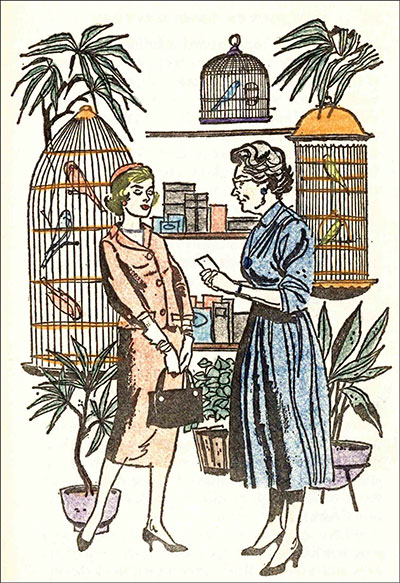
room. It was cheerful in here, with flowered
chintzes, green plants, and several extraordinarily
beautiful parakeets in cages shaped like pagodas
and dollhouses. Vicki exclaimed aloud “Oh!
Lovely!”—without meaning to, just as the butler
announced her.
Mrs. Bryant was sitting half hidden in an immense
wing chair. She put aside the needlepoint
she was working on and made a point of getting
up to greet her young guest.
“How nice to see you again, Miss Barr. You
were so busy yesterday on your plane that there
was almost no chance to visit with you.”
“I kept you busy, for one thing,” Mr. Bryant
said. “A tiresome old codger, wasn’t I, young
lady?”
Vicki smiled shyly, and said Mr. and Mrs. Bryant
were kind to let her come. She asked Mr. Bryant
how he was feeling.
“Better, thanks, better. Oh, I’m perfectly all
right!” He started to pace up and down.
Mrs. Bryant changed the subject. She invited
Vicki to sit next to her on the couch in the winter
sunshine, and they chatted about the Electra. Mr.
Bryant joined in with a question or two. He
seemed less forbidding today. Still, Vicki thought,
this imposing man would probably never be easy
to get along with. She’d as soon attempt to be
friends with a polar bear—he reminded her of an
old, still powerful bear with his heavy, rolling gait
and thatch of yellowish-white hair.
“Where’s Dorn?” he demanded. “Not here yet?”
His wife said, “Mr. Dorn telephoned to say he
will be a little late. It was unavoidable, dear.”
“Humph. Well, I’ll lie down again for a few minutes.
Excuse me, ladies.” He abruptly thumped
out of the room.
Mrs. Bryant waited until he was out of earshot,
then smiled at Vicki.
“When I invited you to lunch yesterday, Miss
Barr,” said Mrs. Bryant, “I thought you would be
our only guest. But this morning a young lawyer
who is doing a particularly important piece of
work for us telephoned and asked whether he
couldn’t see us about noon today. So he’ll be here
for lunch, too. I’m sure you and I will have our
visit, anyway.”
Vicki was a little disappointed, and offered to
leave rather than intrude.
“No, indeed!” Mrs. Bryant exclaimed. “I want
you to stay. Mr. Dorn is going to tell us about
Lucy—our granddaughter whom we’ve never
seen.” She looked very thoughtful. “Does that
seem odd to you?”
Vicki was not quite sure what to answer. “Unless,”
she said, “your granddaughter has always
lived at a great distance from you.”
“Yes, she has. In every sense. Tell me, Miss Barr,
in the course of your stewardess work are you ever
in San Francisco?”
“I’ll be in and out of San Francisco all the time,
now that I’m based there.”
“That’s extremely interesting.” But Mrs. Bryant
did not say why. “Well. Shall we look at my parakeets?”
Vicki walked along with Mrs. Bryant and admired
the exquisite birds in their cages. Her elderly
hostess pointed out the birds’ markings in
every tone of blue and rose and green. Yet her
mind seemed to be on something else.
“I hope you won’t find it tiresome at lunch,
Vicki, listening to a conversation about a girl you
know nothing about.”
“What is Lucy like?” Vicki asked.
Mrs. Bryant said helplessly, “I don’t know. It
is odd, isn’t it? Our daughter’s daughter, and we
don’t even know what she looks like. Except for
an old snapshot. Lucy was ten when it was taken,
and she’s twenty-one now.”
From a desk drawer Mrs. Bryant took a small,
faded snapshot, in a frame, and handed it to Vicki.
Vicki studied it. The little girl’s face was rather
blurred. She could have been any little girl sitting
on a porch step. Her hair was either dark blond
or light brown; it was hard to tell which.
“I suppose Lucy’s hair might be darker by
now,” said Mrs. Bryant, as Vicki gave her back the
snapshot. “Our daughter Eleanor wrote in one of
her rare letters that Lucy had my disposition.
They named her Lucy after me, in spite of—everything.
But I must be boring you.”
“I’m very much interested, Mrs. Bryant.”
“Well, I am rather keyed up about Mr. Dorn’s
visit. So many old memories come to mind today.
The silver rings, for one thing. I hadn’t thought
about them in years. There are only two like them.
Lucy has one and I have the other.”
Vicki glanced at Mrs. Bryant’s hand. Her hostess
noticed.
“No, I’ve put mine away. I never wear rings of
any kind,” Mrs. Bryant said. “They annoy me. But
this pair of silver rings has an interesting history.”
They had an identical lacelike, open design.
Mrs. Bryant had long ago given one ring to her
daughter Eleanor, and Eleanor in turn had given
the ring to her daughter, young Lucy.
“Almost all Mr. Bryant and I know about our
granddaughter is that she has the ring. We had
a few facts about her schooling and a sketchy description
of her. Eleanor wrote us those things before
she died.” Mrs. Bryant looked down at her
tightly clasped hands. “As for the letters from
Lucy’s father—” Mrs. Bryant stared past Vicki,
past the birds. “We never answered certain of
those letters and we were wrong. So terribly
wrong!”
Then the whole grievous story of Lucy came
tumbling out. Mrs. Bryant, in telling Vicki, tried
hard not to blame her husband. But Vicki understood
that Marshall Bryant was a man who valued
money and important connections above all else.
Mrs. Bryant could not cope with his domineering
ways.
Mrs. Bryant handed the faded snapshot to Vicki
The Bryants had planned a brilliant marriage
for their only child. They were bitterly disappointed
when Eleanor married against their
wishes a boy who had little money and limited
education. They felt, unjustly, that Jack was a fortune
hunter. Marshall Bryant made several attempts
to break up the marriage. When he failed,
he disowned his daughter. He was determined
that Jack Rowe should never get hold of the Bryant
money, no matter what the penalty to Eleanor
or to any children Eleanor would have.
The young couple moved to California “—to get
as far away from us as possible, I suppose,” said
Mrs. Bryant, and also because Jack had job opportunities
there. As for Jack’s family, they were
scattered over the United States and were not in
touch.
The young couple made several overtures to the
Bryants, especially after their daughter was born.
They named her Lucy after her grandmother. But
the old couple refused any reconciliation. They
never saw their granddaughter. “I wanted to, but
Mr. Bryant was adamant. No one can blame Eleanor
and Jack for feeling resentful.” A rupture and
silence of many years ensued. Once Mrs. Bryant
wrote to her daughter, offering aid for small Lucy,
but Eleanor never answered.
When young Lucy’s mother died a few years
ago, her father wrote this news to the grandparents
and asked if they wished to attend the funeral.
Marshall Bryant decided that they would
not go. Mrs. Bryant murmured, “It was hard to
lose Eleanor without ever seeing her again.” Jack
Rowe had suggested that the Bryants might, at
long last, wish to see their granddaughter. But
Marshall Bryant hinted that Rowe’s motive was
a desire to gain their fortune. Young Lucy’s father,
as a result, felt freshly antagonized, and wrote
them a bitter letter. Once more the two families
ceased to communicate.
Recently, within the past year, Marshall Bryant
had developed a severe heart condition. “He’s still
active,” said Mrs. Bryant, “but he may not have
long to live. This knowledge has—has modified
his personality. He is more concerned than ever
about what will become of his fortune after he and
I pass away. I am afraid he is not a charitable
enough man to leave the bulk of it to institutions
for—as he says—strangers to enjoy. Also, he now
feels great remorse for disowning Eleanor, and for
refusing any contact with her daughter.”
As for herself, Mrs. Bryant said, she had grieved
for years about the family rupture. For a long time
she encouraged Marshall Bryant to make amends
for the past. Finally, this past Christmas Day, they
decided to find their granddaughter, Lucy Rowe,
and arrange for her to inherit the Bryant fortune.
“If Lucy wishes to live with us, we’d be so
happy.”
“I’m so glad,” Vicki said softly, “that you’re trying
to find her.”
“You’re right to say ‘trying,’ because all we definitely
know about her is her last address in San
Francisco. That’s the one on Jack Rowe’s letter
five years ago.” For a moment Mrs. Bryant closed
her eyes. Then she said matter-of-factly, “A five-year-old
address and an old snapshot aren’t much
to go on, are they? That’s why were relying on
Mr. Dorn to locate Lucy for us.”
Mrs. Bryant explained that she and her husband
were too elderly, and he too ill, to travel to
San Francisco and search for the girl themselves.
Also, Mrs. Bryant said, they hesitated to approach
Lucy directly, either in person or by mail. “After
all the antagonism which my husband—and I, too—showed
them, Eleanor and Jack naturally felt
antagonistic toward us. I’m afraid some of that
feeling may have been instilled in Lucy. She might
not be glad to see her grandparents.”
So Marshall Bryant had engaged his law firm to
locate young Lucy and bring her East. He planned
to transfer a generous part of the inheritance to
her immediately. The law firm assigned Thurman
Dorn, a young man, to do the traveling and investigating
involved in finding Lucy. Mr. Bryant was
pleased with the choice. Though Thurman Dorn
was relatively new in the firm, his uncle, now
dead, had for many years done fine work for Mr.
Bryant through the same law firm.
“My husband and I feel we know young Thurman
Dorn,” said Mrs. Bryant. “Our lawyers have
told us that he came from Chicago, his home town,
with the highest recommendation from one of his
law school professors.” She mentioned the name of
the law firm, Steele and Wilbur. Vicki recognized
it as a respected company. “Mr. Dorn has persuaded
us to stay entirely in the background and
to let him act as intermediary with Lucy. I do
think that’s the most discreet way in such a delicate
situation.”
A painful situation for a sick man and his elderly
wife, Vicki thought. She said, “I do hope Mr.
Dorn’s search will be successful in every way.”
“Thank you, my dear. Mr. Dorn was in San
Francisco three or four weeks ago, and got his
search for Lucy under way. Unfortunately he
could not find her on that trip—she has been away—but
perhaps he has some other leads or news
to tell us about today.”
“Oh! Do you think he’ll bring Lucy with him?”
Mrs. Bryant smiled shakily. “I’m afraid to hope
for so much. Let’s go find my husband. He’s feeling
anxious, too.”
When Thurman Dorn arrived a few minutes
later, he was alone. Vicki was impressed by his
air of professional competence, and by his personal
dignity. He was about twenty-seven, a formal,
cool young man, evidently highly educated,
very correct in his manners and attire. His meticulously
tailored gray suit, his British-looking mustache,
the stiff way he stood, reminded Vicki of a
fashion plate. Or perhaps of a stone statue. She
wished someone less formal, less unsentimental
were to bridge the gap between young Lucy Rowe
and her grandparents. Well, perhaps it took someone
as cool, deliberate, and as obviously hard-headed
as Mr. Dorn to trace Lucy in the first
place. Vicki could see how highly Marshall Bryant
valued this young lawyer.
Mrs. Bryant introduced Vicki and Thurman
Dorn. He said “how do you do” to her with a delightful
little bow and smile, and remarked—when
Mrs. Bryant said, “Vicki Barr is a flight
stewardess with Federal Airlines”—that he was
an air-travel enthusiast. However, he quickly
turned away, and had little further to say to Vicki
during lunch. She was sure that Mrs. Bryant’s
mention of her work did not interest him and
probably never registered with him at all.
He was busy describing to Mr. Bryant—and to
Mrs. Bryant, too, though secondarily—the progress
of the search for Lucy in San Francisco.
“Now, Mr. Bryant, and Mrs. Bryant, you already
know that this search is not proceeding as
easily and quickly as we would wish,” Thurman
Dorn said. “Reaching Miss Lucy takes time and
patience. So will effecting a reconciliation.”
The elderly couple listened to him, their hopes
visibly rising and falling as he spoke.
“You know that I made only partial progress
when, at your request, I visited San Francisco for
a week, and personally conducted a search for
your granddaughter.”
“I remember receiving your bills from the St.
Clair Hotel,” Mr. Bryant said dryly.
Young Dorn accepted this with a deferential
smile. “And unfortunately I had to come back and
tell you the disappointing news that by the time
I had located Lucy’s present home and work addresses,
she had just gone off for a trip. For, I believe,
a month or more.”
Mrs. Bryant turned toward Vicki. “At least Mr.
Dorn learned that Lucy has gone traveling with
respectable friends, another girl and the girl’s
mother.”
Mr. Bryant looked up from serving himself seconds
from the dish the maid offered. “Well, sir,
it’s about a month now since you’ve been out
there. You say Lucy will be back in San Francisco
soon. How soon can you go out there again, and
get on with this job?”
“Very soon, I hope, sir,” Dorn said. “Although it
would be a waste of my time and your money to
wait around San Francisco until Miss Lucy returns.”
“Don’t see how a girl who you say is a secretary
can afford to stay away longer than a month,” Marshall
Bryant grumbled. “Dorn, are you certain that
this Lucy Rowe is actually our granddaughter?”
“No, I’m not certain. It’s only a reasonable presumption
at this point, Mr. Bryant. Let me actually
see and talk to the girl. I want to question
her—yes, discreetly—about certain particulars of
the Bryant family history, which she would be
likely to know. I want to see whether she has any
of your old letters, or photographs of yourselves
or your daughter Eleanor. That brings me to my
reason, or one of the reasons, for asking you to let
me come today.”
“The name Lucy Rowe isn’t so unusual,” Mr.
Bryant interrupted. “Might be more than one girl
by that name in a city as large as San Francisco.”
“Exactly my view, too, sir,” said Mr. Dorn. “You
have told me many details of the family history
and shown me documents, but a few questions occur
to me. Also, it would help in proving this Lucy
Rowe’s identity if you could let me really study
those documents, and study any letters in your
daughter Eleanor’s handwriting or any family
photographs. If you happen to have any available
that I could examine, say, overnight—or for a few
hours this afternoon—”
“Good idea,” said Marshall Bryant. “Plenty of
those things in the safe, right here in the house.
I’ll lend them to you overnight or for a day or two.
Whatever you say.”
“That will be a help,” said Mr. Dorn. “I’ll return
them to you promptly.”
One thing puzzled Vicki. Why had no one at the
luncheon table mentioned Jack Rowe, the girl’s
father? She murmured her question to Mrs. Bryant.
“Because Lucy’s father died two years ago in
an auto accident,” Mrs. Bryant answered her.
“Lucy did not write and tell us. Lucy has never
written to us, except one or two Christmas letters
when she was a child—which my husband asked
me not to answer.” Mrs. Bryant sighed. “So we
had no way of knowing about Jack until Mr. Dorn
investigated and reported to us about three
weeks ago. I’m sorry about Jack, if only because
his passing has left Lucy entirely alone in the
world.”
“She has you and her grandfather,” Vicki said.
“If we can find her, and if she can forget old
difficulties. However”—the elderly woman brightened—“on
the basis of what he’s already learned,
Mr. Dorn is hopeful that everything will work out
well.” Then she said, “Oh, Mr. Dorn! Didn’t you
say you had some further word about Lucy?”
“Yes, Mrs. Bryant. I’ve had a letter from one of
her friends whom I was unable to meet in person.
Her friend writes that Lucy is an accomplished
swimmer and horsewoman. You know how Californians
go in for sports and outdoor living. Her
friend also wrote my firm—sorry I forgot to bring
the letter—that Miss Lucy is fond of birds and
knows something about them.”
“She’ll be interested in your parakeets,” Mr.
Bryant said to his wife, “and she’ll enjoy the swimming
pool.”
“Let’s hope so. We old people might be dull
company for her. She sounds like a delightful girl,
Mr. Dorn.”
The lawyer said, “From everything I’ve learned
so far, she sounds like a charming girl, and a girl
of considerable character.”
Marshall Bryant looked gratified, while his wife
looked so eager that Vicki felt almost afraid for
her. How every detail which Mr. Dorn was able
to supply increased their desire to meet their
granddaughter! How disappointed they would
be if Lucy were not all they wanted her to be, or
if—Heaven forbid—Dorn could not locate their
granddaughter after all.
As they were rising from the dining table Mrs.
Bryant reminded the lawyer about the silver ring.
“If you want another look at it, it’s in the safe, too.”
“Thank you, Mrs. Bryant. I will examine it
again. It will be interesting to learn whether Lucy
Rowe still has the silver ring which is twin to
yours.”
“Now, young man, how soon are you going back
to San Francisco?” Mr. Bryant pressed him. “How
about this week?”
The lawyer was inclined to wait until the next
week, in order to be sure that Lucy Rowe was
back in San Francisco. He offered to telegraph her
employers and friends there to learn if and when
she had returned. This was reasonable, the Bryants
had to agree, but they were disappointed
about the delay.
“I am sorry about the delay, too,” said the lawyer,
“but let us make haste slowly. Let’s be a little
cautious and discreet. There is a large inheritance
involved here, you are well known, and if any false
moves were made, they’d invite a lot of publicity—newspaper
stories, pictures in the paper, and so
forth.”
Mr. Bryant made a gesture of distaste, while
Mrs. Bryant pretended to shudder. There was a
moment’s awkwardness. The lawyer turned to
Vicki and said:
“I understand that you—ah—were of service to
Mr. Bryant yesterday when he was taken ill.”
“Not at all,” said Vicki. “I’m just sorry Mr. Bryant
didn’t feel well enough to enjoy his flight on
the Electra. Mr. Dorn, when you fly out to the
West Coast do you go on the Electra, via Chicago?”
She said it only to make conversation, thinking
someday Dorn might be one of her passengers.
But suddenly his expression changed. She was
surprised at the odd look on his face. Was he
thinking of something else?
Mrs. Bryant said, “I believe, Mr. Dorn, you told
us your mother still lives in Chicago?”
“Yes, I sometimes go home week ends to see
her. Very occasionally.”
“Of course. Well—I think my husband is waiting
to see you.”
“Oh, yes. Will you excuse me, Mrs. Bryant?
Miss—ah—” He had forgotten her name. The
young lawyer followed Mr. Bryant into the library.
Vicki felt that it was time to say good-by to her
hostess. But Mrs. Bryant led her back into the
room with the parakeets. By now the sun had
moved to the far end of the room, and the birds
were asleep. Mrs. Bryant took Vicki’s hand.
“I hope all this talk about our granddaughter
wasn’t dull for you.”
“On the contrary, Mrs. Bryant! I couldn’t help
thinking ‘Suppose it were my grandparents whom
I’d never seen, who were looking for me—’”
“You’re sympathetic, Vicki. I wonder—You’re
going to be in San Francisco often?” Vicki nodded.
“Then I wonder whether I could ask you to do me
a great favor—but only if it won’t take too much
of your time.”
Vicki said, and meant it, that if the favor had
anything to do with Lucy, she would be only too
happy to give it her free time.
Mrs. Bryant smiled. “Then I wish very much
that you’d see whether you can learn anything
further about our granddaughter. While I have
every confidence in Mr. Dorn and his careful,
discreet approach, this delay is very hard. Even
another week or ten days seem such a long time
to wait.”
“I’ll be in San Francisco day after tomorrow,”
Vicki said.
“Wonderful. If Lucy is back by then, won’t you
try to telephone her and give her my love? All I
have is her last address in Sutro Heights in the
suburbs, it’s five years old—I think Mr. Dorn mentioned
that she had moved in with friends in the
city, in order to be nearer her place of employment.
I wish I had thought to write down that
firm name, but we are leaving everything, all the
details, to Mr. Dorn.”
“Do you think Mr. Dorn will consider that I’m
interfering? I wouldn’t want to cause any—any
complications for him.”
“I don’t see how you could.” Mrs. Bryant went
to her desk for Lucy’s last address, and copied it
for Vicki. “It might be more tactful, though, not
to let Mr. Dorn know that you are taking part.”
Vicki agreed. “And let’s not mention it to my husband,
either,” Mrs. Bryant said with a gleam of
mischief. “Here’s the address, my dear. Thank you
very, very much.”
“Don’t say that yet, Mrs. Bryant. First, let’s see
what I can do.”
She thanked Mrs. Bryant for her hospitality,
and said good-by. Mrs. Bryant walked to the front
door with Vicki, and stood looking after her as she
went down the marble steps. She looked so hopeful
and yet afraid to hope that Vicki thought:
“I’m going to do everything I can to help those
two old people.”
CHAPTER IV A Puzzling Discovery
“I don’t even want to hear anyone suggest that
we go sightseeing around San Francisco today,”
said Jean Cox from the other twin bed, on Monday
morning. “I want to stay right here in our nice
hotel room and sleep.”
“I wasn’t going to suggest sightseeing—not yet,
anyway,” said Vicki, at the mirror.
“Then why are you up and dressed so early?
After those week-end runs we put in, why aren’t
you unconscious, too?”
On Saturday their crew had flown from New
York to Chicago, stayed overnight in Chicago, and
on Sunday had flown on from Chicago to San
Francisco. Now they were to have a day in San
Francisco to rest. Vicki figured she would rest
later and look for Lucy Rowe first. She told Jean
her plans.
“Well”—Jean yawned and stretched under the
covers—“all I can say is that a frail-looking,
dreamy-looking little blonde like you has more
stamina than some of us husky people.”
Vicki grinned. “Is there anything I can do for
you before I leave?”
“Just go away, my love, and let me sleep.”
They arranged to be in touch later in the day.
Vicki softly let herself out into the hotel corridor
and went downstairs to the busy lobby. Part of
the fun of being a flight stewardess was living all
over the United States, and staying at the pleasant
hotels where the airline put up their crews. Along
with her breakfast Vicki enjoyed a magnificent
view of San Francisco’s hills.
Ever since talking with Mrs. Bryant, Vicki had
kept Lucy Rowe’s old address safely in her purse.
Now she took it out. At the hotel desk she asked
for directions to Sutro Heights. Vicki made her
way there—riding up and down steep hills—walking
down a long wooden stairway from one
street level to another. She climbed past a cliff-top
park with white-painted statues, high above
beach and ocean.
“San Franciscans certainly have their ups and
downs,” Vicki thought, puffing. “But what views!”
On three sides she looked down over the blue Pacific.
The air was sea-fresh, cool, springlike. Vicki
was so enchanted that she almost forgot about the
address in her purse.
It led her to a modest, leafy street and an unpretentious
cottage. There were a yard and an attempt
at flower beds; children’s toys littered the
porch. When Vicki rang the doorbell, a pleasant
young woman in shirt and jeans came to the door.
She looked not much older than Vicki, or than
Lucy’s age, twenty-one.
“I’m looking for Lucy Rowe,” said Vicki, and
introduced herself. She was careful not to mention
the Bryants, not to intrude on the lawyer’s province.
She said she understood that the Rowes
lived here, or used to. “I wonder whether you
could tell me what Lucy Rowe’s address is now?”
“My goodness, I should be able to! Lucy and
I went to high school together; we’re old neighbors,
too. After her mother died my family
bought their house. This house. Come in, Miss
Barr. I’m Jill Joseph. Come in, don’t mind the
boys—”
The living room seemed to be overrun with very
small boys and puppies. Young Mrs. Joseph
shooed the whole group outdoors, and she and
Vicki sat down to talk.
“I haven’t any address for Lucy at the moment,”
Mrs. Joseph said, “because she’s away. Lucy is a
darling. Are you a friend of hers?”
“I’m a friend of a friend of hers,” Vicki said. “An
elderly lady who hasn’t heard from Lucy, or had
any news of her, since Eleanor—Mrs. Rowe died.”
“Why, that was five years ago!”
“Would you fill me in?” Vicki asked.
Jill Joseph nodded. “Five years ago Lucy and
I still had another year to go in high school. Then
she lost her mother. This house was quite a lot of
work for Lucy and her father—you know how full
the last year of high school is, and Mr. Rowe
worked hard at—” She named a large San Francisco
department store. “So Lucy and her father
moved to a small apartment near here, and we
bought their house.”
“I see. What sort of work did Mr. Rowe do?”
“For a long time he worked at any job the department
store gave him. The Rowes never had
an easy time of it financially.” The neighbor hesitated.
“It was hard on Lucy’s mother; she seemed
to be used to more than the Rowes could afford. A
lot of us wondered about Eleanor Rowe. Not that
she ever complained—
“Anyway,” the young woman went on briskly,
“Lucy’s father finally worked himself up to be
head of the store’s delivery service, I think it was.”
“What was Jack Rowe like?” Vicki asked.
“Nice. The most devoted husband and father
you ever saw. He would have made a good doctor;
he was so kind and patient and gentle.”
So this was the son-in-law the Bryants had
considered unworthy of their daughter, Vicki
thought.
“Lucy’s mother was nice, too,” the neighbor
said, “though she was quiet and sort of sad, sometimes.
She worried about what would become of
Lucy. Lucy used to try to laugh her out of it....
My goodness, I’m chattering!”
“Won’t you tell me more about Lucy?” Vicki
said. “I’m not even sure what she looks like.”
“Well, she’s taller than you are, and slim—but
she’s strong. Good at all sports, and she knows a
lot about naturelore.” Mr. Dorn had reported
that, Vicki recalled. “Brown hair, brown eyes,
only sometimes they look hazel,” Mrs. Joseph said.
“She—she’s active and friendly. Isn’t it hard to
describe someone you know? The chief thing
about Lucy is that she’s a nice person, and it
shows.”
“Does she miss her mother very much?” Vicki
asked. “And her father?”
“Yes, terribly. Lucy’s such a loyal and warmhearted
person. She always befriends lost dogs,
and hungry cats, and people who need her.”
It was out of lonesomeness and a need to be
with people, the neighbor said, that after her father
died in an auto accident two years ago Lucy
moved into downtown San Francisco to live with
another girl and the girl’s mother. Also, Lucy
wanted to be nearer her job. After graduation
from high school she had taken an intensive three-months’
business course, and had been working as
a secretary ever since—nearly four years by now.
“Can you tell me the name and address of her
employer? And of the girl and her mother?” Vicki
asked.
“Yes, I’ll write them down for you. But you
won’t be able to see Mary and Mrs. Scott. They’ve
gone off on a trip. Lucy is away, too.”
So Dorn had learned, Vicki reminded herself.
She asked:
“Do you know when she’ll be back?”
“She wasn’t sure herself, when she called me
up to say good-by. Why don’t you ask at the women’s
hotel where she’s been living? Maybe she left
word. It’s the Hotel Alcott.”
“The women’s hotel?” Vicki felt confused. “I
thought Lucy had been living with Mary and Mrs.
Scott?”
“Well, she did until recently. I’m not sure how
recently. Lucy and I aren’t in constant touch.” Jill
Joseph explained that the Scotts’ household was a
small one, and Lucy had felt she was crowding
them.
Vicki could not remember whether Mr. Dorn
had reported where Lucy lived. She’d had the
impression, and perhaps the Bryants did, too, that
Lucy lived with the girl and her mother with
whom she was now traveling. Well, Vicki thought,
she’d clear up this point.
“If I telephone Lucy’s employer,” Vicki asked,
“couldn’t they tell me when she’ll be back?”
“I think she gave up her job at the Interstate
Insurance Company, though you can ask them.”
“Gave up her job?” Dorn had not reported this.
“Why?”
“Something about a new job. The kids were having
a squabble, and I couldn’t get it straight over
the telephone.”
“You mean Lucy starts on a new job when she
comes back from her trip with the Scotts?”
“Lucy isn’t traveling with Mary and Mrs. Scott.
And I think traveling is part of her new job.”
This news did not tally with Mr. Dorn’s report,
or more accurately, it went beyond the lawyer’s
report. Well, it was possible Lucy had been away
during the period that Dorn was looking for her,
and then had returned to give up her job and take
a new one. Then, too, Jill Joseph admitted she
didn’t have all the facts straight.
“I’ll inquire at the Hotel Alcott,” Vicki said,
“and at the Interstate Insurance Company.”
“Try telephoning the Scotts, too. Perhaps they
are back now and have heard from Lucy.”
Vicki and Jill Joseph chatted a while longer.
Vicki gathered that Lucy’s life was rather bleak.
Even though she had friends and one or two not
important beaux, she missed her family and home,
and felt alone. Evenings after work she often kept
herself busy taking college courses, and attending
church choir practice.
“I guess the Reverend Mr. Hall has done more
than anyone to help Lucy feel less alone,” Mrs.
Joseph said. “He’s a wonderful man. He knew her
parents, and he’s known Lucy all her life. He used
to be in charge of a church here in Sutro Heights,
but he’s been transferred to Russian Hill. I’ll give
you his address, too.”
A few minutes later Vicki thanked Jill Joseph
and said good-by to her. “You’ve been a great
help. More than you know.”
“Anything I can do for Lucy—well, she needs
all the help and love her friends can give her.”
How wonderful it was going to be for Lucy,
Vicki thought as she traveled back to the center
of town, to discover that her grandparents cared
for her. What a happy change in her life there
would be.
On the way Vicki stopped at a drugstore and
called the Scotts from a telephone booth. Their
telephone rang repeatedly without answer. Vicki
then called the Interstate Insurance Company
and talked to the personnel manager.
“Miss Lucy Rowe?” he repeated. “Just a moment
while I look up her card.” A pause. “Miss
Rowe resigned from our employ on January
twenty-second.”
Vicki scribbled down this date, and noted that
it was now Monday, February sixteenth. A little
less than a month ago ... just about the time
Mr. Dorn said she had left San Francisco. Well,
then, Dorn was right. Vicki asked whether the
personnel manager could tell her anything further
about Lucy.
“Well, I can tell you that she’s an excellent secretary,
was with us for over three years, and we
were sorry to lose her.”
“That’s a fine record, isn’t it? Thank you very
much, sir.”
Vicki hung up. She telephoned the Scotts twice
again on her way back to downtown San Francisco.
No answer. On a third call a man’s voice
answered.
“Mary Scott? She and her mother went away on
a long trip. This is the superintendent. I’m in their
place fixin’ a leaky pipe.... No, ma’am, I don’t
know when they’ll be home.”
“Thank you,” Vicki said. Next she tried the Reverend
Mr. Hall’s number. Here she kept getting
busy signals. She decided to stop for lunch, then
visit Lucy’s place of residence.
Arriving at the Hotel Alcott in the early afternoon,
she found it to be a pleasant, friendly, plain
sort of place. A few people, mostly women, were
in the lobby. She spoke to the desk clerk.
“I wonder if you can help me? I’m looking for
Miss Lucy Rowe.”
“Oh, yes, Lucy!” The middle-aged woman behind
the desk smiled, but shook her head. “You
won’t find Lucy here, young lady. She checked
out.”
“Can you please tell me when? And where she
is now?”
The woman hesitated. Vicki produced her airline
identification card to introduce herself and
explained that she had a message to deliver to
Lucy. The woman seemed satisfied. She opened a
ledger.
“Lucy checked out on—let me see—Saturday,
February seventh.”
That would be—today was Monday, February
sixteenth—only nine days ago. Yet Mr. Dorn reported
that Lucy had left San Francisco a month
ago. Vicki could not account for the discrepancy.
She asked the desk clerk:
“I wonder whether Lucy has been out of town—taken
any short trips—in the last month or
two?”
“Yes, recently some of the girls here persuaded
her to go off for week ends with them, to ski, or
to hike in the mountains.”
“Can you tell me,” Vicki asked the desk clerk,
“whether Lucy was away about a month ago?”
“I’m sorry, but I don’t remember the dates.”
“Well, will you please tell me one more thing?”
Vicki was trying to figure dates, starting with the
fact of Dorn’s visit about a month ago. “Did Lucy
live at the Hotel Alcott a month ago?”
The woman consulted the ledger again. “Yes.
Lucy was with us just barely a month.”
It was possible, Vicki thought, that Lucy might
not yet have moved to the Hotel Alcott at the time
of Dorn’s visit.
“If you’re trying to locate Lucy, Miss Barr,” said
the clerk, “I think the best way to do it would be
through Mrs. Heath.”
“Who is Mrs. Heath?”
“A very nice older woman who is now Lucy’s
employer. Mrs. Elizabeth Heath. A writer. Gray
hair, well-dressed, and distinguished-looking. She
stayed with us at the hotel for a while. She was
looking for a secretary-companion, and Lucy
turned out to be just the right girl for the job.” The
hotel clerk said this with a certain pride and satisfaction.
“It’s a happy arrangement for both of
them, I think.”
Vicki was surprised, but she felt better. Here
was definite and reassuring news of Lucy. She
asked the woman for Mrs. Heath and Lucy’s address.
“They haven’t sent us their address yet,” the
woman said. “Probably they’re just traveling
around. Mrs. Heath had a car, and as I understood
it, her plan was to travel around California and
stay at inns here and there, and write her memoirs
in a leisurely sort of way. Mrs. Heath may rent a
house. It sounds like a lovely job for Lucy. A lot
of the girls here at the Alcott would like to have
such a job.”
“It does sound like a pleasant job,” Vicki
agreed, “but how can I find Lucy, Miss—?” The
clerk said her name was Mrs. Stacey. “Hasn’t anyone
here heard from Lucy since she left? Not
even a post card?”
“She’s been gone only a little over a week,” the
hotel clerk pointed out. “She’ll write to her friends
here, I’m sure. She may already be in touch with
the minister, Mr. Hall; he’s a great friend of hers.”
Vicki said she had his address and telephone
number and would call him right away. She
thanked Mrs. Stacey for all her kindness.
When Vicki again telephoned the Reverend Mr.
Hall, she was able to reach him. He was rather
chary of giving any information on the telephone.
Vicki explained who she was, and told him a little
of why she was looking for Lucy Rowe.
“Ah, I see. As a matter of fact, Miss Barr, I myself
would like to know where Lucy is at the moment.”
The minister’s voice was friendly and direct.
Vicki thought she heard an undertone of worry.
“Mr. Hall, I’m here at the Hotel Alcott, and
they’ve told me Lucy has a fine job with a Mrs.
Heath.”
“Yes, I know. Everybody is enthusiastic about
Lucy’s new job except myself. I advised her to
consider, and make haste slowly, but she—”
Vicki heard voices in the background. “However,
I cant go into this on the telephone.”
“May I come to see you, Mr. Hall?” Vicki asked.
“It’s important for me to locate Lucy.”
“Yes, indeed, though today is all filled up.” He
suggested that Vicki telephone him again in a day
or two. Vicki promised she would, thanked him,
and hung up.
Vicki went back to her hotel. She wanted to
pack and to rest so that she would be fit for work:
she was scheduled for an eight A.M. Electra flight
the next morning.
Jean Cox was rested after extra sleep. “What
did you find out about Lucy Rowe?” she asked.
“Don’t ask me yet. I haven’t any answers—only
some new questions.”
CHAPTER V The Girl in the Portrait
From San Francisco to Chicago on Tuesday, and
back on Wednesday, left Vicki free by Thursday
morning. She at once telephoned the minister. He
said she might come over immediately.
Vicki found her way to Russian Hill, an area of
steep, far-flung streets crisscrossed with leafy
lanes. The church she was seeking was a handsome
modern stone building. The minister’s residence
next door, in contrast, was one of the old
wooden houses with lacelike balconies and ornate
cupolas that had survived the San Francisco
earthquake and fire. A housekeeper admitted her
and led her into Mr. Hall’s study.
Vicki’s first impression of the minister was of a
pair of extraordinarily perceptive eyes. He received
Vicki simply, without any ceremony, and
made her feel at ease. She presented her credentials,
wishing she could tell the minister about
Lucy’s grandparents, and their wonderful plans
for her.
“I’m glad you have come to me, Miss Barr,” he
said. “Are you a little worried, too, about Lucy?”
“I don’t know what to think, Mr. Hall. I had
been advised by Lucy’s—ah—friends in New
York that she was probably on vacation traveling
with friends. Now I find that isn’t exactly how it
is, unless there’s been some misunderstanding.”
The minister said that was possible. “Let me
speak frankly to you, Miss Barr. I wasn’t keen
about Lucy’s taking this job, at least not so
quickly. I asked her to get a little better acquainted
with Mrs. Heath first, before she went
off traveling with her. It’s true Mrs. Heath showed
Lucy unimpeachable references, and she seems
to be a substantial person.”
“Did you meet Mrs. Heath?” Vicki asked.
“I very much wanted to,” the minister said,
“but unfortunately the lady was too ill with a virus
to see me. We did have a pleasant telephone conversation.
I was left with the impression that she
is above reproach. Still, I’m not satisfied.” He
looked out the window where a lemon tree
stood. “You see—”
The minister said that Lucy had met Mrs.
Heath at the women’s hotel, and liked her from
the start. In some ways Mrs. Heath reminded
Lucy of her mother, whom she missed. Within a
short time, only about a week, they were good
friends and Mrs. Heath asked Lucy whether she’d
like to be her secretary and traveling companion.
Lucy came to Mr. Hall to talk it over with him.
Mrs. Heath’s offer was attractive, a long-term job,
interesting work, a good salary plus all her living
costs paid for by Mrs. Heath, and a chance to
travel. Lucy felt confined, living in the city and
working at a routine job, so Mrs. Heath’s plan appealed
to her.
“I pointed out to Lucy that she needn’t be in
such a hurry to give up her job and accept this
new one,” said the minister. “But she told me Mrs.
Heath was eager to start work on her book. At
any rate, as Lucy pointed out to me, they did not
rush off at once.”
Lucy gave up her job at the insurance company
and for the next two weeks helped Mrs. Heath
prepare for their trip, and did some library research
for her. “I must admit Lucy seemed interested
and happy,” said the minister. In those two
weeks Mrs. Heath allowed Lucy plenty of time
to wind up her own affairs in San Francisco. Then,
using Mrs. Heath’s car, or, rather, a car which
Mrs. Heath rented for several months, they
started out.
“When did they start?” Vicki asked.
“It was a Saturday, I believe the first Saturday
in February.”
Vicki scribbled down this date, with a note.
“And did they say where they were going?”
“Oh, yes, certainly,” the minister answered. “I
don’t wish to give you the wrong impression about
Mrs. Heath,” the minister said to Vicki. “I only
wish Lucy had gone more slowly and made sure
that she and Mrs. Heath really would be compatible
over a period of several months’ close association—and
checked a little on Mrs. Heath’s financial
ability to pay all the bills and Lucy’s salary.”
“Are you worried, too, about Lucy?” Dr. Hall asked
Their plan, the minister told Vicki, was to head
slightly north and east of Sacramento, into the
Mother Lode country. Mrs. Heath had made
an earlier trip through the hill region and had
said that she might possibly rent a house in the
area.
“I received a post card from Lucy,” said Mr.
Hall. “Just a moment.”
The minister picked up a picture post card
from his desk and handed it to Vicki. It was postmarked
Placerville, California, February seventh,
at four P.M. Vicki glanced at the desk calendar.
February seventh was the first Saturday in February.
“Wasn’t this post card mailed the same day that
Lucy and Mrs. Heath started out?” Vicki asked.
“Yes. Evidently Lucy mailed the post card
en route. She says nothing, actually—‘Beautiful
country, beautiful weather. Will write soon.’ But
she hasn’t written since, Miss Barr. Not to me or,
so far as I can learn, to any of her friends. And I
don’t know where she is.”
Vicki felt a sharp misgiving. “Have you—have
you planned to take any steps to get in touch with
her, Mr. Hall?”
He hesitated. “It’s not quite two weeks since
Lucy left. I believe they planned to work on Mrs.
Heath’s book, so that possibly Lucy hasn’t had a
chance to write to me. I don’t mean to alarm you,
Miss Barr.”
“But I think you are a little alarmed, Mr. Hall?”
He thought for a moment. “Now that you pose
the question, yes, I am uneasy about Lucy.”
“Did a Mr. Dorn ever call you?”
“Dorn? No.”
That troubled Vicki. She also wondered what
really lay behind Lucy’s change of jobs. She remarked
as much to Mr. Hall.
“Yes, I feel there is more to know about Lucy’s
job situation than we do know,” he said. He reflected.
“Maybe Gravy could tell you something
more.”
Vicki smiled. “I beg your pardon, but did you
say someone’s name is Gravy?”
The minister smiled back at her. “Graves.
Knowlton Graves. He and his wife are young people,
friends of Lucy’s. She’s the one who dubbed
him Gravy. He’s a painter, and he’s been doing
Lucy’s portrait. I think that because of work on
the portrait the Graveses had been seeing Lucy
oftener than anyone else had, just before she left.”
“Do you think Mr. and Mrs. Graves would be
willing to talk to me about Lucy?” Vicki asked.
“We’ll see.” Mr. Hall picked up the telephone
and dialed a number. He talked to Knowlton
Graves, paving the way for Vicki. “Yes, I think
Miss Barr can come over right away.” Vicki
nodded. “What?... Yes, I’ll tell her. Thanks
very much,” and the minister hung up. He turned
to Vicki.
“Gravy wants me to tell you, with due apologies,
that he has a heavy work schedule. If you’re
willing to go over to Telegraph Hill for just a short
visit, he’d be very glad to see you.”
Vicki got to her feet. “Even a few minutes’ talk
could be revealing.”
Mr. Hall wrote down the Graveses’ address,
and gave Vicki directions for getting there. She
thanked the minister warmly for all his help and
kindness. He said, just as warmly:
“I feel you and I are in league for Lucy’s best
interests.” He smiled, and his eyes seemed to look
through and through her. “Perhaps you have more
news of Lucy than you were willing to confide in
me on a first visit. Come back and see me again,
whether or not you learn any news.”
Gravy was a large, noisy young man. He
boomed at her that his wife Maggie was out shopping,
he’d made a mess of the studio, and if she
was a friend of Lucy’s how come he’d never met
her before?
Vicki followed him into a workmanlike studio,
explaining that she was only the friend of a friend
of their mutual friend.
“How’s that again?” Gravy boomed at her. He
looked at her sternly. “Interesting planes in your
face. Ever sit for a portrait?”
Vicki perched on a paint-splattered wooden
chair and said firmly, “No, and I’m afraid I’m too
busy to. Can we talk about Lucy?”
“Okay. Gosh, you look serious. There isn’t anything
wrong, is there? About Lucy, I mean.”
“I don’t know that anything’s wrong,” Vicki
said carefully. “It’s just that I’ve heard confused
reports about her, and she’s gone off traveling with
a woman she hardly knows. That wasn’t wise.”
“My wife feels the same way you do—though
I say that Heath woman sounds all right. Don’t
worry.” Gravy moved a pile of unframed canvases
out of the way, and sat down facing Vicki.
“Lucy likes that Mrs. Heath. She was motherly to
Lucy, I guess that’s why.”
Vicki asked whether the Graveses had heard
from Lucy. They had not, and Gravy was untroubled
about it. He said blithely:
“All I want is for Lucy to drop by here one of
these days, so I can finish her portrait. Want to
see it?”
He rummaged through the pile of canvases,
pulled out one, and set it on an easel so Vicki
could see it. She took a long, curious look. Allowing
for the painter’s rather abstract style, she
could see from Gravy’s portrait what Lucy Rowe
looked like—a girl with big eyes, light-brown hair,
a rather square face which in a feminine version
recalled Marshall Bryant’s. Vicki could also see a
little of Lucy’s pleasant personality from the easy
way she had tossed a bulky green wool scarf
around her shoulders, and her friendly half-smile.
“Lucy looks as if she’s about to speak,” Vicki
said.
“Well, we did talk a lot while we were doing
this portrait,” Gravy said. “She was all excited
about the job offer from Mrs. Heath.”
“Did she ever talk about anyone else?” Vicki
asked. “About her parents, or—or her grandparents?”
“It’s funny that you should ask that. Sure, she
always talked about her parents. But during the
sittings a lot of stuff about her grandparents came
out. Funny she never would mention their name,
it was such a touchy subject with her.” Gravy
looked searchingly at Vicki. “I guess it’s all right
to repeat it, it’s not exactly a secret. A confidence,
maybe. Well—
“Lucy told Maggie and me she’d always felt no
one but her parents ever really wanted her or
cared about her. She just couldn’t believe her
friends care a whole lot about her, or that some
day she’ll find a husband who cares for her and
needs her. You know what that feeling comes out
of? From the way her grandparents rejected her
and her parents, all of Lucy’s life. Made them feel
humiliated, left out. Wouldn’t answer their letters.
Never even cared to meet their granddaughter.
The three Rowes didn’t have any close relatives.
They sort of huddled together by themselves;
then Lucy lost her mother, and then her father.
So now Lucy feels alone, and unwanted.
“Well! Along came this Mrs. Heath, and she
was motherly to Lucy. Besides, she needed Lucy,
she wanted Lucy to be with her—to help her with
the book and to be her traveling companion. She
even decided to go to the hills to please Lucy.
Pretty nice of her, hey? You should have seen how
much happier that girl was, all of a sudden! My
wife says that’s why Lucy took the new job almost
without hesitating. I tell you, Lucy’s heart is in
that job.”
Vicki felt puzzled as she listened to all this. How
could a lawyer like Mr. Dorn, a man trained to
make investigations, not have unearthed the fact
of Lucy’s job with Mrs. Heath? Except that Mrs.
Stacey had said Lucy had been in and out of San
Francisco several times with her friends, just
around the time Mr. Dorn was here....
“Mr. Graves, did a man named Dorn get in
touch with you?”
“Dorn? Never heard of him.”
“Did Lucy mention a Mr. Dorn to you?”
Gravy shook his head. Well, Vicki thought,
Dorn and Lucy must have just missed each
other, and some of her friends must have given
him a garbled or incomplete account of her trip
and plans and the respectable older lady with
whom she was traveling.
“You said Mrs. Heath and Lucy were going to
the hills. Can you tell me where in the hills?”
Vicki asked.
“About a three hours’ drive from San Francisco,
in the foothills of the Sierra Nevada Mountains,”
Gravy said. “It’s east of the Great Valley, in the
Mother Lode country with all those little pear-growing
towns like Placerville and Auburn and
Grass Valley. It’s west of the mountains on the
way to Donner Pass. Just about where the hills
really start to roll and climb and start turning into
mountains. That’s where Lucy spent some happy
vacations with her parents when she was a child.”
As Gravy talked, Vicki visualized a map of California
in her mind and tried to fix the locale. “Isn’t
the Mother Lode country where they first discovered
gold in 1848?” Vicki asked.
“Right. That was gold-rush country. They’re
still mining a little gold in them thar hills,” Gravy
said with a grin.
Vicki asked him what that stretch of hills was
like.
“It’s high, about fifteen-hundred to two-thousand-feet
elevation, and Lucy talked about the
pine trees. There are a few little towns scattered
trough there, and a lot of small two-to five-acre
pear farms and almond farms. Lucy said it was
really pretty, kind of quiet and peaceful, not too
many people around.”
“Isolated?” Vicki suggested.
“Well”—Gravy thoughtfully rubbed his chin—“I
suppose if this Mrs. Heath wanted to find a
real private location to hole up and write her
book, she wouldn’t have too many neighbors to
bother her in the Sierra foothills. Especially if she
didn’t stay at inns, if she rented a house—”
So Lucy and Mrs. Heath were somewhere in the
Sierra foothills, around the pear-growing towns!
Gravy had said that was about three hours’ driving
time from San Francisco. By private plane,
Vicki figured, it would take much less time. If she
visited and inquired at the main villages in the
area, she probably would learn something about
the two women. Strangers in a rural area would
surely be noticed.
“That’s what I could do,” Vicki thought. “It’s
not much of a trip, and it shouldn’t be too difficult
to look around a bit. I did promise Mrs. Bryant
I’d do my best.”
She noticed Gravy glance, with embarrassment,
toward the large clock on the wall.
“Oh, I’m sorry, Mr. Graves,” said Vicki. “Mr.
Hall told me I mustn’t detain you too long.”
“Gosh, I’m sorry. Guess I told you everything
I could about Lucy. Maybe Maggie could’ve remembered
something more—”
Vicki said she hoped to meet his wife another
time, thanked the painter, and went to the door.
“If you see Lucy,” said Gravy, letting her out,
“tell her one more sitting will finish up the portrait.
So long, now.”
If she saw Lucy! She wanted to try.
Vicki found a drugstore, ordered a coke, and
took her bid sheet out of her purse. The bid sheet
showed her scheduled flying days and her days
off.
She had three rest days—today, tomorrow, and
Saturday. Her next assigned flight, with Jean Cox,
was not until nine A.M. on Sunday. That was fine.
This afternoon she could arrange to rent a private
plane and study maps. Tomorrow, and if necessary
Saturday, she could search for Lucy. That
should be enough time.
Vicki had one misgiving. Suppose Lucy and
Mrs. Heath were no longer in the Placerville region,
where Lucy had mailed the post card? Suppose
Mrs. Heath had decided to move on, or—a
fleeting suspicion occurred to Vicki—suppose
Mrs. Heath had never intended to settle in that
region? The whole story of the sudden job offer
disturbed Vicki as much as it had the minister.
“There’s only one way to find out,” Vicki decided,
“and that’s to go look for Lucy Rowe.”
CHAPTER VI Vicki Searches
The next morning Vicki went to Novato airport,
in Marin County, forty minutes from San
Francisco. Having been out there late yesterday
afternoon, she was briefed for her flight. Placerville,
her first stop, was about a hundred and
twenty-five miles away. Joe and Ed Foster, the
men from whom she was renting a Cessna 150,
had marked on her air map the routes, landmarks,
and sites of small airports in and near Placerville
and surrounding villages.
The trim little Cessna 150 was a single-engine,
two-place airplane, with landing lights, wing
lights for navigation, and a two-way radio. Vicki
carefully went over the plane, making a line
check. It was in A-1 condition and fully fueled.
She climbed in, with a lift up from Joe Foster.
“All okay?” he asked. Vicki smiled and nodded.
“Now remember, this plane has a fast rate of
climb. Watch it.”
“I’ll remember.” Yesterday afternoon she had
taxied the Cessna around a little, to see how the
plane handled, and had fallen in love with the instantly
responsive aircraft. Vicki said:
“I’ll bring her back late this afternoon, Mr. Foster.”
She would rather not do night flying in an
unfamiliar airplane over country which was new
to her.
Foster waved. “Happy landings.”
“Thanks. See you.”
Vicki closed the door, put her feet on the pedals,
cracked the throttle forward slightly, released
the brakes, and pressed the starter button. The
plane went skimming along the airstrip. As the
Cessna left the ground, Vicki felt she was simply
floating up into the air. While she was figuring
how rapidly to reach the altitude and air speed
she wanted, the Cessna reached these and almost
flew off by itself.
“Whoa, there!” Vicki exclaimed aloud. This was
exhilarating! She put the nose down a little, leveled
off, and turned northeast.
Once across the comparatively low Coast Range
mountains, Vicki looked down on the Sacramento
River flowing through rich farms and cattle prairie.
Vicki bypassed the city of Sacramento, capital
of California, and went sailing along over the
Great Valley. Her cockpit was full of sunshine,
and the plane flew quietly, smoothly. She was
making sixty miles an hour. The plane could do
eighty or more, but Vicki had landmarks to watch
for.
Another hour passed. Vicki saw the towns below
grow smaller and farther apart, and the land
begin to roll slightly. Blue outlines of hills appeared
on the horizon. Vicki climbed to a higher
altitude. The temperature grew much cooler.
Vicki buttoned her jacket. A few minutes later she
saw much higher outlines on the horizon—the immense,
distant peaks of the Sierra Nevadas loomed
up like a great wall. Vicki consulted her air chart,
and looked down to locate Placerville. It was the
first of the villages, nestled low on this side of the
distant mountains.
Vicki found the local airstrip and made a neat
landing. A mechanic at work in the hangar told
her it was ten minutes’ walk into town.
“Or you can hitch a ride, miss.”
“Thanks, I’ll walk.” She was wary of driving
with strangers; and besides, the countryside of
nut and fruit ranches offered a beautiful walk.
In the village Vicki inquired first at the small
hotel. The owner put down his newspaper and
obligingly looked through the register. It had just
a few guests listed; Lucy and Mrs. Heath were
not among them.
“Did you see any older woman with a young,
brown-haired woman?” Vicki asked the hotel
owner.
“No, miss. Why don’t you ask at the Pines Motel?
You can ’phone from here.”
Vicki telephoned. The motel had no record, no
recall of the two women. She went to the Placerville
restaurants, garage, police office, and asked.
No news.
Vicki flew on to the next town, Auburn. She
talked with friendly tradesmen and local people
at a roadside stand heaped with cherries, almonds,
grapes, walnuts, and apples. No one, not
even the motel keeper or the gas-station owner,
had seen the woman and the girl Vicki described.
Neither had Auburn’s police officers.
In the next town, Marysville, Vicki inquired
again, with no results. In each village—a few of
them were almost ghost towns of gold-rush fame—she
got the same story. No one had seen the
two women. By midafternoon Vicki felt badly discouraged.
“Well, shall I give up?”
Vicki thought it over. So far she had tried only
the villages. The minister and the painter had
mentioned the possibility that Mrs. Heath might
rent a house in the Sierra foothills. “A house off
by itself in the hills—that’s the next thing to look
for and ask about.”
Vicki took the Cessna up again, thinking hard
about the best way to locate such a house. She
had been aloft fifteen minutes when she decided
it would be a wise precaution to replenish her gas
supply. The air chart showed a small airport off
to the northeast. Vicki hoped she could buy gas
there. She turned, reduced speed, and watched
for an airport.
Just off the highway, she spotted a meadow
with airstrips mowed in the grass. Three or four
planes and cars were parked outside a barn, which
must be the hangar.
She circled low over the meadow twice, to let
the people below know she wanted to land. Two
men in coveralls came out of the hangar. They motioned
to her how to come down, pointing to the
windsock atop the barn. Vicki waggled the plane
wings in reply, flew into their air pattern, and
coasted in for a landing. By this time, three other
men wearing coveralls had come out to watch her.
They gave Vicki friendly smiles as she stepped out
of the plane.
“Hello, anything we can do for you?” one asked
her. They were all young men, deeply tanned,
with sun squint lines around their eyes, and immediately
interested in Vicki’s Cessna 150.
“Thanks, I’d like to buy some gas here,” Vicki
said. “And maybe you’ll advise me how to find a
place I’m looking for.”
“Glad to do both,” said one young man. “I’m
Wes Clark.”
He introduced the four others—the two McKee
brothers, a redhead called Red Jones, and the tall
man who had spoken first, Jack Whiting. Vicki
told them her name, and said her home was in
Fairview, Illinois.
They all said hello, and invited Vicki to see
their airplane. She was interested in their heavy
plane and special equipment, and asked what they
were doing.
“We’re prospecting from the sky,” Wes Foster
said. “We search for ore buried in the ground.
Mostly for mineral pockets. Want to see how we
aerial miners work?”
“I certainly want to know what that long torpedolike
thing tied to the back of your plane is,”
Vicki admitted.
The McKee brothers said, “That’s ours.” They
were electronic experts, and at work they sat inside
the big instrument to watch for the telltale
jump of dial needles, as the “snooper” plane flew
over mountains, lakes, and valleys. The young
men explained to Vicki that a strong radioactive
source—such as uranium—showed on the detectors.
“Do you need maps?” Vicki asked. She was
thinking of her own search for a secluded house
in the hills.
“Sure, we use maps. Whiting here is our aerial
photographer. He makes an aerial survey with a
movie camera that’s co-ordinated with the electronic
needles. Then he pieces the photographs
together into one big map, and that gives us and
our geologist an over-all picture of the region
we’re exploring.”
Red Jones, stammering slightly, told Vicki he
was the geologist of the team. She asked if she
might see the map he used.
“We were just looking at it in the hangar. Come
on in, Miss Barr.”
They all went into the hangar where equipment
and a large photographic map were spread out on
a table. Jack Whiting and Wes Clark started to
explain the map to Vicki. They said it showed the
contours of the dips and peaks of the rugged terrain
around there. The photo-map resembled a
complicated diagram; it was not easy for Vicki
to read.
“Well, are you looking for anything in particular?”
Whiting, the aerial photographer, asked her.
“Yes. An isolated house,” said Vicki.
“Hmm. That’s a tall order. There are several
houses and buildings off by themselves, way up
in the hills.”
Wes Clark suggested that they start by locating
such houses on the photo-map. They located several
small marks on the map which were houses.
However, Whiting remembered that two of the
buildings were power stations, one a sportsman’s
hunting lodge, one a house they knew to be
boarded up.
“What’s this?” Vicki put her finger on a blurred
spot on the photo-map. It was the size of a pinhead.
“That’s half a dozen houses and a general store,
too small even to be a village,” the younger
McKee brother said. “No post office or anything.
The ranchers around there call the place Pine
Top.”
“No, I don’t mean the cluster of houses,” Vicki
insisted, “I mean this tiny dark spot. Could it be
a hidden house?”
The young man peered at the blur. “Could be,”
the aerial photographer finally said. “Lots of forest
and high, winding roads at that point. If it’s
a house, it’s hidden, all right. The camera doesn’t
tell what that blur is, I’m afraid.”
Vicki looked searchingly at the map. She could
not see any other mark which suggested a private
house. Only the one above Pine Top.
“I think,” she said slowly, “I’ll gamble on it and
fly to Pine Top.”
“Maintain enough altitude,” Wes Clark advised
her. “You can get gas from someone at Pine Top,
if necessary.”
“Gas!” Vicki remembered. “I need some right
now, if you can spare it.”
The airfield had a commercial, self-service gas
pump. Wes Clark said with a grin, “Our advice is
free, but you have to pay for the gas.”
“I’m glad to have both,” said Vicki.
The young men helped her to refuel her plane,
and watched her climb in. Wes Clark looked at
his wrist watch and said:
“It’s pretty late in the afternoon to head for Pine
Top. I wouldn’t try it for the first time at dusk, if
I were you.”
They were right. To explore half-mountainous
terrain, by air, in fading light would be foolhardy.
Besides, she was growing tired, and there was still
the return flight to San Francisco to make.
“All right, I’ll try for Pine Top tomorrow,” she
said. She smiled and waved at the five young men.
“Thanks a lot for everything. I hope to see you
all again sometime.”
“See you,” they repeated. “Get home safely.
Happy landings.”
That night Vicki dreamed of Pine Top and of
a dark, fantastic house clinging to a wooded
mountainside. Those troubled pictures were the
reflection of her worry about Lucy.
Actually, when she was wide awake on Saturday
noon, and looking down from the Cessna 150
in the bright sky, Pine Top turned out to be a
cheerful place. There wasn’t much of Pine Top,
just a few houses clustered together in the refreshing
green of forests and hilly grazing lands.
She looked down and circled, losing altitude,
searching for an area to land. The one level place
she could see was a back road—a wide, empty,
dirt road. Vicki came down bumpily, then staked
down the plane at the side of the road, and hiked
toward the houses.
No one was in sight, only a yellow hound-dog.
The general store seemed the likeliest place to
make inquiries. Going in, Vicki found it deserted.
She looked around at the shelves, counters, boxes,
and barrels piled with provisions for living deep
in the country. She noticed a bell on the counter,
rang it, then waited.
Presently a man and woman came in, carrying
baskets of garden produce. They said good morning
to Vicki, and looked at her curiously.
“Was that you flying around here a while ago?”
the man asked. Vicki smiled and nodded.
“Well! What’re you doing in these parts, young
lady?”
“We don’t often see strangers,” the woman put
in. She said their names were Carl and Angie Potter.
“My, that’s a handsome jacket you’re wearing.”
“Thank you,” said Vicki. “I wonder if you’d
give me some advice?” The couple were eager to
help. “I wonder if you’ve seen an elderly lady and
a brown-haired girl about my age with her?”
“Why, sure enough, we have,” the man said.
Vicki’s hopes leaped up. “They came here in a car
about two weeks ago.”
“The lady’s name is Mrs. Elizabeth Heath,” the
woman said importantly. “I saw her name on an
identification tag tied on her suitcase—I noticed
it when I carried some of the groceries out to her
car. I can’t figure out whether the girl is her
daughter or niece or exactly what. They bought
a whole carload of groceries from us, same day
they got here, and went on up to the old Glidden
place.”
“The house up in the hills?” Vicki asked.
“Uh-huh. Nobody’s seen hide nor hair of them
since,” said the man. “Bill Jenkins from the telephone
company strung up a wire to their house,
so we know Mrs. Heath has the phone working
again. But except for phoning me to bring more
groceries, she hasn’t called up nobody here.”
The woman sniffed. “That Mrs. Heath was uppity
when she bought her groceries from us. The
girl seemed real nice, though.”
“It’s the girl I want to see.” Vicki felt a great
sense of relief at actually having located Mrs.
Heath and Lucy. “How far is the Glidden place
from here?” she asked.
“Oh, about twenty minutes up an awfully curvy,
narrow piece of road. We could drive you up
there.”
They all piled into the couple’s jalopy. The narrow
road up to the house climbed and wound.
“On a wet day,” said Mr. Potter, “anyone who
drives on this road’ll break his neck.”
At the top of the road the land leveled off, and
they reached a high stone wall. Behind it, Vicki
could see only treetops and the second floor of a
house. The Potters said the wall completely enclosed
the Glidden place.
Mr. Potter stopped the car before a large
wooden door in the wall. “We’ll have to honk,”
he said. When there was no answer, he tried the
door. “Locked,” he said.
Angie Potter raised her voice. “Oh, Mrs. Heath!
Mrs. Hea-ea-eath!” Still no answer. “Maybe nobody’s
home.”
Vicki said, “The upstairs windows are open, and
the curtains are open, too. Someone’s probably at
home.”
Mr. Potter honked, Mrs. Potter called, Vicki
knocked on the wooden door in the wall. They
made so much noise that a flock of birds swooped
out of a nearby tree, and flew away.
“Not very neighborly,” Mrs. Potter grumbled.
Vicki felt discomfited. Granted that Mrs. Heath
wanted an isolated place in which to write her
book; still, did the two women have to isolate
themselves so rigidly?
“Well, we might as well go,” said Mrs. Potter.
They made a cautious descent down the narrow,
steep road. The Potters drove Vicki back to
the spot where she had parked the plane. They
would not hear of accepting the payment she offered,
and said good-by.
She waited until the Potters drove safely off the
back road. Then she got into the Cessna, taxied as
far as the road permitted, and took off. In the air
she figured out a route which would take her clear
of the jutting hillside, yet bring her over the
house.
Within sight of the wall and the house, the fast
plane rolled a little when Vicki overcontrolled it
to fly more slowly. First she followed the wall,
to get her bearings in relation to the house and
road, and to look for a possible place to land.
She was surprised to see that the property covered
quite a bit of acreage. The far end of it was
hilly woods, but this led into a long, fairly level
stretch of meadow which would afford a landing
area. The meadow led up to the house.
Before she knew it, Vicki had flown over the
house, which was not very large. She had to circle
around and fly back for a better look. The house
was rather rustic and long and low. It was not far
from the road behind the wall. A garden surrounded
it in front and on both sides.
But the most interesting thing she saw below
was two women working in the garden on the
sunny south side of the house. One woman was
gray-haired. The other figure was a girl’s, with
brown hair; she had thrown around her shoulders
a bulky green woolen scarf like the scarf in
the portrait.
“Lucy!” Vicki thought in excitement. “There’s
Lucy Rowe! I’ve found her.”
In the instant that Vicki flew over them, they
looked up at the plane which had now flown past
twice. Vicki thought, “Won’t they be astonished
when I land inside their wall!”
She headed over the meadow, thinking about
wind direction and landing speeds. Then she remembered
to glance at her wrist watch—and was
alarmed at the time. There simply wasn’t time
today to land and talk to Lucy and Mrs. Heath.
Her free time had nearly run out.
Vicki was obliged to fly past the meadow, beyond
the wooded hillside, and out over Pine Top
country in the direction of the coast and San
Francisco. She was exceedingly disappointed.
“Well, I’ll have ample time off next week,”
Vicki consoled herself. “I’ll come back.”
CHAPTER VII Which Lucy?
“Vicki, there’s a Miss L. Rowe aboard!” Jean
said excitedly. “I just discovered it when I had to
check tickets and passengers’ names!”
Vicki stopped her preparations for lunch and
stepped outside the buffet into the aisle. “Where,
Jean? Where is she?”
“’Way up forward. You can’t see her from here.
A stunning girl. Brown suit, brown hair.”
“I can’t stop and go up there now.” Vicki
craned to see down the length of the Electra
cabin. “Has she a squarish face?”
“I’m not sure.” Some of the passengers noticed
their excitement. The two stewardesses stepped
back into the privacy of the buffet. “Vic, could
she be your Lucy Rowe?”
“Hmm. It’s possible—”
Today was Tuesday. She had seen Lucy Rowe
from the air on Saturday, in California. Since then
Vicki had flown to Chicago, had a rest day in
Chicago on Monday, and now was flying from
Chicago to New York. The Electra had taken off
from Chicago half an hour ago, at noon. With
Jean she had greeted the boarding passengers but
hadn’t seen anyone she could have imagined to
be Lucy Rowe. Still, with sixty-eight passengers
enplaning, she might not have noticed every face.
“Yes, it’s possible she’s my Lucy Rowe,” said
Vicki. “I’m surprised, of course. Lucy must have
left Pine Top rather suddenly—or at any rate,
awfully soon after I was there. It seems like a
strange coincidence.”
“One point,” Jean said. “Her ticket reads ‘Miss
L. Rowe.’ It doesn’t read Lucy. Her first name
might be Lillian, for all we know.”
“I’ll go forward and speak to her first chance I
get,” said Vicki. Not that Gravy’s abstract portrait
provided a sure means of identifying the girl, by
any means. “Did she come on from California?”
“Her ticket doesn’t say, it just reads Chicago
as point of origination. But she could have started
from California, and changed planes in Chicago.
That could involve two separate tickets.”
“That’s right. So her ticket doesn’t tell us anything.
Gosh, I’m intrigued! It could very well be
the right girl. Well, back to the coffeemaker.”
Captain Tom Jordan had been delayed several
minutes in take-off and had notified the stewardesses
he intended to make up the time during
flight. That meant Vicki and Jean had even less
than the usual two hours in which to take care of
the needs of sixty-eight persons, and set up and
serve sixty-eight hot luncheons. The stewardesses
hadn’t a minute to spare. Vicki’s one chance to see
Miss L. Rowe was when she brought her a lunch
tray.
“Are you enjoying the flight, Miss Rowe?”
“Yes, it’s very smooth and pleasant.”
The girl glanced up as she spoke. She was in
her early twenties and did rather resemble the
girl in Gravy’s vague portrait, except that her
hair was dark brown. Vicki had expected from
the portrait that it would be light brown. As for
the squarish face, Vicki could not decide whether
Gravy had exaggerated its shape. Her large eyes
and wide mouth resembled the portrait. Did this
girl look like a topnotch secretary? She was trimly
dressed, well groomed, and well made up. Did she
look like an outdoors girl? That was harder to
guess.
Vicki looked to see whether Miss L. Rowe wore
the Bryant family’s silver ring; but she wore no
rings at all. This, too, proved nothing. Most
women wore little or no jewelry while traveling.
Vicki longed to ask Miss Rowe her first name, but
she had no right, no excuse, no time to do so. She
smiled at the girl and went on with her tasks.
The trouble started shortly before they were
due to land. The captain’s buzzer sounded on the
stewardesses’ call board, and Vicki—wanting another
glance at Miss L. Rowe—went forward to
the cockpit, unlocking and then closing the steel
door behind her.
In the bright light of the cockpit she saw that
the faces of the two pilots and the navigator were
strained but calm. Chuck Smith, the young navigator,
had his jacket off and sleeves rolled up, and
there were grease stains on his shirt and arms.
Captain Jordan said: “Vicki, we’re having a
little trouble. We discovered the nose wheel has
not retracted properly.” Vicki knew it was not uncommon
for nose wheels to get stuck like this.
“We’ve tried everything we can to repair it, but
no luck,” Captain Jordan went on. “I’ve decided
to make our scheduled landing, anyway. I think
the shock of landing will jolt the wheel down into
place. We have tricycle landing gear, so that this
landing won’t be too risky. In fact, I expect it to be
a success. However, if it doesn’t work, we’d better
be prepared.”
Vicki was trained for emergencies. Her heart
pounded but she listened calmly to the pilot.
“I want you and Jean to inform the passengers
of our situation, and to use emergency landing
procedures. Just in case.”
“Yes, sir. How soon?”
“Start right away. You have about twenty minutes
to prepare.”
“Yes, Captain Jordan.” Twenty minutes was
ample time.
Back in the cabin she found Jean and repeated
the pilot’s message. Then each stewardess went
to her half of the cabin and explained quietly to
the passengers. Vicki stressed that the landing
very probably would be a success, but because of
the risk they must be prepared. The passengers
took the announcement as calmly as it was made.
Vicki realized that these sixty-eight people looked
to her and Jean for leadership; they must keep
cool and move fast and accurately.
First, they saw to it that every passenger had
his seat belt fastened tightly, that all seats were in
upright position, and that no one was smoking.
Then Vicki selected four men who told her they
had had military or aviation experience. Vicki
quickly showed them how to operate the lounge-door
exit, window exits, ropes, and evacuation
slides when the plane landed. She and Jean were
responsible for opening the main-entrance door
and the buffet-service door. Jean, meanwhile, selected
three passengers, showed them how to operate
the three window exits, and seated them there.
Next, the stewardesses briefed the passengers on
locations of all the exits. They showed the passengers
how to brace their feet and arms, how to
press their heads against the seat in front of them
in order to avoid being thrown forward and getting
bloody noses. The stewardesses quickly distributed
pillows and blankets for extra protection.
Jean showed the woman with the one baby
aboard how to lock the baby in her arms. Some
of the men passengers removed parcels from the
overhead luggage racks and stowed them in the
luggage and coat closets.
“Will you please remove all sharp objects,”
Vicki said, walking along the plane aisle. “Please
remove your glasses, all pens and pencils,
brooches, belts with buckles, any sharp objects—”
since these things could stab. “Will the men please
loosen their ties.” Then she hurried to check the
fire extinguishers, first-aid kit, all emergency
equipment.
Sooner than Vicki expected, they were flying
in over New York City. The captain’s buzzer
sounded. He said, “We’re cleared and coming
down any minute now.” Jean sat down in the
forward cabin adjacent to the main-entrance
door, Vicki sat down in an aisle seat across from
the buffet-service door. They strapped themselves
in.
Soaring down above the length of La Guardia
Airport, everything below looked as usual as on
any other winter afternoon—except that two
emergency trucks for extinguishing fire came racing
after them on the ground. Vicki said a little
prayer. She spoke confidently to the passengers
near her.
Dropping—dropping—now Vicki could see the
faces of the men on the field as the Electra flew
low past them. They stopped working to watch,
and to help if necessary. Then the plane gave a
terrific jolt, a jar which Vicki felt to the roots of
her teeth. Men and women swayed and rolled
in their seats, the baby cried, as the Electra
touched ground. The plane shuddered all over
and rolled on to a stop. Safe! No one thrown—nothing
broken nor on fire—The nose wheel must
have come down exactly as Captain Jordan
planned.
“Praise be!” Vicki exclaimed. She unstrapped
and jumped to her feet.
She and Jean ran to reassure the children and
the elderly among their passengers. Everyone was
shaken up, profoundly sobered, but relieved and
grateful. The men were inclined to joke now that
the danger was over. The two stewardesses made
certain, and Captain Jordan came out to make
certain, that each passenger was all right. Not one
person showed panic or caused any trouble. Captain
Jordan praised the stewardesses for their
share in maintaining high morale.
The cabin was littered with passengers’ garments,
handbags, eyeglasses, and pens. For several
minutes Jean and Vicki were busy picking
these up. Everyone helped them. Or almost everyone—Vicki
noticed that Miss L. Rowe, like a few
others, did not bother to help anyone but herself.
Something glistened on the plane’s carpet.
Vicki picked it up: it was a gold charm off a
woman’s bracelet, inscribed “Dorothy.” She held
it high and asked: “Does anyone own a charm
marked ‘Dorothy’?” Several women shook their
heads. Vicki hastily consulted the manifest with
its list of names. No woman passenger aboard had
the name “Dorothy” or the initial “D.”
“Does anyone own this gold charm?” Vicki
asked, carrying it conspicuously all through the
cabin. It was a valuable piece of jewelry. No one
claimed it. She knew it was unlikely that the
charm had been left on the plane from a previous
flight, since the cleaning crews at terminals did a
thorough job. The owner was aboard this very
minute. Why didn’t Dorothy—whoever she was—claim
it?
The passengers began leaving the plane, the
stewardesses managing an orderly evacuation.
There went Miss L. Rowe! Vicki was seized by
an irresistible curiosity to see whether the
Bryants or Mr. Dorn would meet the girl. With
a promise to Jean Cox and the passenger agent to
come back, Vicki went down the plane stairs after
Miss Rowe. She followed her at a short distance
across the airfield, into the crowded terminal
building, and out again at the front portico to the
taxi stand. Vicki watched Miss L. Rowe get directly
into a taxi by herself, without looking
around to see whether anyone was waiting to
meet her. Apparently she didn’t expect to be met.
“Well, I guess she isn’t the right L. Rowe,” Vicki
thought. “If she were, the Bryants would at least
have sent their car and chauffeur for her. Or is
her arrival a surprise? Even if it were, Mr. Dorn
probably would be on hand to escort her to the
Bryants’ house,” Vicki reasoned. “Wrong girl.
That’s that. Just a coincidence of names and brown
hair.”
In all likelihood the Bryants’ granddaughter—the
girl with the brown hair and green scarf
which tallied with the portrait—was still at the
hill house near Pine Top.
Vicki still had the gold charm clutched in her
hand. The “Lost and Found” desk was only a few
steps away. She went over and turned the charm
in. It was odd, she thought, that no one on the
plane had claimed it.
On her return to the Electra, she joined Jean
in completing the final, routine picking up in the
cabin and putting equipment back into place.
After handing in their reports to the Flight Stewardess
Supervisor, Vicki and Jean went to the
stewardesses’ sleeping lounge to have a nap and
tidy up. Now that the emergency was met and
past, they admitted they felt tired.
“We were lucky,” Jean murmured from the
other cot.
“Luck and skill and a well-engineered plane,”
Vicki answered.
She lay there on the cot thinking about the
landing preparations, the unclaimed charm, and
Miss L. Rowe. Her thoughts drifted on to the
Bryants. Suddenly she sat up, took a few coins
from her purse, and walked next door to the
stewardesses’ lounge.
“Where you going?” Jean called after her
sleepily.
“I’m going to telephone Mrs. Bryant.”
She wanted to tell Lucy’s grandmother that although
she had not yet been able to deliver her
message, she had, to the best of her belief, located
Lucy and actually seen her from the air.
A secretary answered. The Bryants were not at
home. She evidently knew from Mrs. Bryant who
Vicki was. Vicki decided not to relay her news of
Lucy secondhand and asked the secretary for an
appointment. Vicki said she expected to be in
New York again, with free time, next Sunday and
Monday.
“I’m sure that Mrs. Bryant would be delighted
to see you at lunch or tea,” said the secretary.
“I’ve put you down for tea at four on Sunday,
Miss Barr.”
“Thank you, that’s perfect. Until Sunday, then.”
Between that memorable Tuesday and the following
Sunday, the first of March, Vicki flew three
more Electra flights between New York and Chicago,
with two days off in Chicago between
flights. On one rest day her mother took the local
train from Fairview up to Chicago, and they spent
a happy day together.
On her other rest day, Vicki stayed at her Chicago
hotel. Resting, she tried to plan exactly
what she was going to tell Lucy’s grandmother
when she visited the Bryants’ house on Sunday.
What disturbed Vicki was the fact that she had
learned some things about Lucy which Mr. Dorn,
in San Francisco a month or so earlier, had not
learned and possibly could have learned. Allowing
that Mr. Dorn had missed meeting Lucy, as
she herself had, and allowing that her own visit
came a month later, still, either she or Mr. Dorn
could be mistaken. And Vicki did not want to
give Mrs. Bryant any wrong information, or raise
any false hopes.
“I’m going to ask Mrs. Bryant the exact dates
when Mr. Dorn was in San Francisco,” Vicki
thought. “Because if he was there during the
time Lucy became involved with Mrs. Heath, it’s
strange he didn’t find out about that. Unless”—an
odd idea struck her—“Mrs. Heath dodged
Mr. Dorn’s inquiries and managed to keep him
from learning of Lucy’s new job? Mrs. Heath
avoided meeting the minister, didn’t she? She
managed things so that a good friend like Gravy
never met her, didn’t she? Hmm.”
Reviewing the few facts she had learned about
Lucy’s new job, Vicki had to admit they were
sketchy and elusive. It even occurred to her, in a
wave of skepticism, that the girl she had seen
from the air might not necessarily be Lucy Rowe.
A green scarf and light-brown hair were not conclusive
proof.
“Oh, it’s likely that girl is Lucy Rowe,” Vicki
thought, impatient with herself. “Why don’t I be
sensible and see, on Sunday, what Mr. Dorn has
learned in the meantime? Maybe what he’s discovered
by then and what I’ve discovered will
tally, after all.”
She daydreamed about Sunday, and the pleasure
she hoped it would give Mrs. Bryant to hear
her news of Lucy.
The minute Vicki entered the Bryant house on
Sunday afternoon she sensed the excitement there.
The whole household had changed its mood:
every lamp and chandelier in every room was
alight, bouquets of fresh-cut flowers bloomed
everywhere, dance music came from a radio. The
house seemed young!
Mr. and Mrs. Bryant, when Vicki entered the
room with the parakeets, looked as if they had
waked up from a long sleep, refreshed and happy.
They both were beaming. Mr. Bryant had a flower
in his buttonhole, and Mrs. Bryant was as flushed
as a girl in her rustling taffeta dress. Vicki had
never seen them in such festive spirits. Around
the tea service were trays of tiny, fancy sandwiches
and cakes, ready for a party. Vicki, trying
not to look inquisitive, said good afternoon.
“Vicki, how nice to see you!” Mrs. Bryant took
her hand and drew her into the room. “You’re
right on time. Our other guests are coming at
five, but I especially wanted you here early. You’ll
see why.”
“I’m so glad to see you again,” said Vicki. “I
hope you’re both well.”
“We’re feeling exceedingly well,” said Mr.
Bryant. “Mrs. Bryant has a surprise which she
thinks you’ll enjoy.”
“Now, Marshall, you mustn’t spoil my surprise.
First I want to ask Vicki where she’s been flying
recently, and all about the fascinating people on
her plane—”
“I think I hear her coming downstairs,” Marshall
Bryant interrupted.
Mrs. Bryant looked flustered. Vicki, to help her,
said her last few trips were probably not as special
as Mrs. Bryant’s surprise. The elderly lady
smiled at her delightedly.
“Well, my dear, it is a most wonderful surprise
for Mr. Bryant and me. Just wait—one more
moment, now—” Vicki heard someone’s light,
quick footsteps. “Vicki, Mr. Dorn has found our
granddaughter. Ah, here she is!”
A slender dark-haired girl, taller than Vicki,
came into the room. She was the Miss L. Rowe
who had been on Vicki’s plane. She lightly kissed
both elderly people, and smiled politely when
Mrs. Bryant said:
“Lucy, this is Vicki Barr who is about your age.
She’s the one who was so helpful to your grandfather
on our airplane trip.”
“How do you do, Miss Barr?” If the girl recognized
her, she gave not the slightest sign.
“I remember you on my plane earlier this
week,” Vicki said pleasantly. She started to say
how excited she’d been on finding a Miss L. Rowe
aboard, but caught herself just in time. Mrs.
Bryant had requested her not to mention her own
search to anyone. It was likely that Mrs. Bryant
had not told even Lucy this secret. Then Vicki
noticed that Lucy Rowe was staring at her
blankly, as if she had never seen the flight stewardess
before.
“You remember, Miss Rowe,” Vicki said, “the
day we nearly had to make an emergency landing.”
Lucy Rowe gave her a forced smile and turned
away. Vicki was astonished.
“Why, Lucy,” her grandmother said, “you
didn’t tell us about any difficulty in landing!”
“It was nothing. I didn’t want to alarm you,”
the girl said. “May I have a cup of that nice, hot
tea? I’m not used to your cold weather in New
York—but I expect I’ll love it here. Who else is
coming today? I’m so eager to be presented to
your friends.... No, I won’t mind a bit that
they’re all older people.”
Lucy chattered on. Although Mrs. Bryant was
eager for the two girls to be friendly, it seemed to
Vicki that Lucy avoided conversing with her.
Particularly it seemed that Lucy did not want
last Tuesday’s flight mentioned again. Evidently
it embarrassed her in some way.
“I wonder why?” Vicki thought. She would not
be so tactless as to raise the subject again, of
course. “But why does Lucy Rowe act as if she’s
never seen me before?”
Vicki felt embarrassed and disappointed. She’d
anticipated a lively, warmhearted, approachable
girl—from the several descriptions of Lucy Rowe—not
someone so very charming and sophisticated.
Lucy was affectionate toward the Bryants,
and they were already devoted to their new-found
granddaughter. Vicki saw the lacelike silver ring
that Lucy wore. She recognized it as the Bryant
family’s ring, no doubt about that. Vicki said,
hoping to prompt her to talk:
“What a lovely and unusual ring you’re wearing,
Miss Rowe.”
“Thank you.” Lucy held out her hand for Vicki
to inspect the ring, and said, “I value this ring
more than I can tell you, because it’s a family
heirloom. Mother gave it to me, and I’ve worn it
constantly ever since she died. It hasn’t ever been
off my finger, not even once.”
Mrs. Bryant murmured appreciatively, even
Marshall Bryant looked touched. But Vicki was
thinking, “You didn’t wear the silver ring last
Tuesday on my flight. I looked, I made sure—”
Why was Lucy lying? A lie about the ring—an
evasion about having been on Vicki’s plane—what
else would she lie about? Vicki was puzzled
and troubled. She managed to conceal it, for if
something was amiss here, she must not arouse
the girl’s suspicions. She needed to gain more information.
“I think it’s wonderful that Mr. Dorn found
your granddaughter so soon,” Vicki said to Mrs.
Bryant, hoping she would talk.
“Yes, Mr. Dorn found her on his second trip to
San Francisco,” Mrs. Bryant said, looking warmly
at Lucy. “He flew out there just last week on Friday,
and by the following Sunday—exactly a
week ago today, I remember it was Washington’s
Birthday, February twenty-second—he wired us
that he had found our young lady.”
“Last Sunday,” Vicki thought. “And I saw the
girl I took to be Lucy at Pine Top last Saturday.”
Lucy said, with a little laugh, “I was the most
surprised girl in the world when Mr. Dorn appeared
and told me that my grandparents wanted
me. And the happiest girl.”
Marshall Bryant lighted a fresh cigar and gave
a grunt of approval. “Dorn is a good man.”
Vicki thought, “Have I made a mistake and
traced the wrong Lucy? I don’t see how. Yet
surely Mr. Dorn, who’s a lawyer, and who has
time and money to work with, didn’t make any
mistake?”
“Of course we wanted to meet our granddaughter
instantly, the very next day after Mr. Dorn’s
telegram,” Mrs. Bryant said with a smile. “He
flew back to New York and came to tell us—Lucy,
darling, you can’t imagine how absurdly disappointed
your grandfather and I were when Mr.
Dorn told us that you needed a little time to settle
your affairs in San Francisco, and would fly east
by yourself.”
“I could hardly wait, too,” Lucy said. “I practically
ran, in San Francisco, doing all my good-bys
and chores. Even so, the fastest I could get
here to you was Thursday.”
“Thursday!” Vicki nearly exclaimed aloud.
“Why, this Miss L. Rowe was on my plane on
Tuesday. She left La Guardia Airport, alone, at
three o’clock Tuesday afternoon—I saw her—but
she didn’t meet her grandparents until Thursday!
Where was she during that interval?”
Lucy leaned toward her grandparents. “And
when Mr. Dorn met me at La Guardia Airport on
Thursday afternoon I was terribly nervous about
meeting you! He had to talk quietly to me for
about half an hour before I’d even get in the car.”
Another lie, Vicki thought angrily. Or had this
girl returned to the airport two afternoons later
and pretended to Mr. Dorn that she had just got
off the plane? So this was why, Vicki realized,
Lucy Rowe did not want any mention of her
having been on the New York-bound plane on
Tuesday afternoon. Vicki said guardedly:
“New York is a wonderful place but so is your
city, Miss Rowe. I’m just getting to know San
Francisco on occasional visits. It’s a fascinating
place. In what part of the city did you live?”
“For a while I lived on Telegraph Hill, wonderful
views from there. Then three other girls and I
took a beach house one summer. It was fun, but
such a lot of commuting to my job.”
No mention of the women’s hotel, Hotel Alcott.
No mention of sharing an apartment with Mary
Scott and her mother. That did not tally with
what Vicki had learned. Lucy had answered
readily, even glibly. Vicki tried another tack.
“Some of the best views in New York,” she said,
“are from high up in the office buildings. Is that
true in San Francisco? Was it so on your job?”
Lucy looked amused. “I worked so hard at
Whitney Decorators that there wasn’t much time
to admire the views.”
“Poor darling,” said her grandmother.
“Oh, no, it was a perfectly nice job with nice
people,” Lucy said. “But I was awfully happy to
give it up and come to you.”
No mention of working for the Interstate Insurance
Company. Was the interior-decorator job
a fact or another lie? If a fact, when had Lucy
worked for a decorator? And why didn’t she mention
her job with Mrs. Heath? Lucy made it sound
as if she had been employed in a San Francisco
office building at the time when Mr. Dorn had
found her a week ago. Vicki knew she had resigned
from Interstate about a month earlier, and had
gone to Pine Top a couple of weeks later. Why all
these lies? If this girl was actually Lucy, she was
trading on the love of her grandparents. Or if she
was an impostor, she must be very clever to have
fooled Mr. Dorn.
Vicki said to her, “I’m not sure, but I think that
I met an acquaintance of yours while I was in
San Francisco. Jill—I can’t remember her last
name—” Vicki pretended.
“Was it Jill Baker?” said Lucy. “Such a nice
girl.”
Vicki nodded and did not press the point.
Not Jill Baker—that name was Jill Joseph. Unless
Baker had been Jill’s name before her marriage?
Vicki decided to check the next time she
was in San Francisco. She noticed that Lucy did
not mention her old friend Jill’s living in her family’s
former house, nor their having been in school
together—in fact, nothing about Jill. Didn’t this
girl know Jill Joseph? Lucy again chattered along,
changing the subject. Or was the omission of no
importance?
Just then Thurman Dorn came in.
CHAPTER VIII A Game of Wits
For a moment Vicki wished she had never gotten
mixed up in the search for Lucy Rowe. The
lawyer looked so cold, so professional, that her
own small efforts to find Lucy shrank to absurdity.
How impertinent she would appear if Mrs.
Bryant happened to tell about Vicki’s search—how
difficult it would be to justify to the lawyer
her doubts about this girl.
Vicki glanced beseechingly toward the grandmother.
Very, very slightly, Mrs. Bryant shook
her head. Did that mean she was not going to reveal
their secret? Vicki hoped so. She glanced
away just in time to hear and answer Mr. Dorn’s
“How do you do?”
“Careful, now,” Vicki warned herself. “Don’t
say or ask anything which could alert Lucy that
I suspect her. And I mustn’t intrude on Mr. Dorn’s
territory, particularly since Mr. Bryant has praised
him so highly.”
The lawyer seated himself at Marshall Bryant’s
right. He was a perfectly correct and formal figure
as he accepted a cup of tea from Lucy. She made
a little fuss over the young lawyer, and her grandmother
teased her about it.
“Well, just think of what Mr. Dorn has done for
me!” Lucy answered, laughing. “He’s the one who
found me, and I shall always be grateful to him.”
She shook her head, remembering. “Last Sunday,
this stranger came to me asking to see my family
letters and my silver ring. Asking me to identify
myself. At first I didn’t know whether to take
Mr. Dorn seriously.”
Vicki longed to know if they had met at Pine
Top, but she could not afford to ask questions.
Thurman Dorn smiled a little. “I can tell you
now, Miss Lucy, that a month earlier I was exasperated
at not finding you. And your grandparents”—he
turned toward them deferentially—“were
exasperated with me. It’s a good thing for
all of us that you came back to San Francisco from
your vacation. If you hadn’t met me in the lobby
of the St. Clair Hotel last Sunday, I believe I
would have sent out some sort of alarm for you.”
So they had met last Sunday in San Francisco,
Vicki noted. That meant Lucy had come in from
Pine Top. Reasonable enough. But why did Lucy
give Dorn and the Bryants the impression that
her tour with Mrs. Heath was a “vacation”? Vicki
wanted to see whether Lucy would mention, in
the course of conversation, Mrs. Heath or the
Reverend Mr. Hall or Knowlton Graves.
Curiously, she did not mention them and Mr.
Dorn did not, either. He did talk in detail about
his methods of search and the fine co-operation he
had received from the San Francisco Post Office
and Police Department. Mr. Dorn named persons
and places involved in his search—Whitney Decorators,
Lucy’s old Telegraph Hill residential address
(where he couldn’t find her), a Dr. Alice
James who was Lucy’s and Lucy’s mother’s physician.
Vicki had not unearthed any of these in
the course of her own search in and around San
Francisco. Not one of them! This was nightmarish!
“Then who is the girl I traced to Pine Top?”
Vicki thought again, in utter bewilderment. “Is
this girl the same girl I saw? No, she isn’t. This
girl’s hair is very dark brown, sable brown, and
that girl’s was almost dark blond.”
Yet, Vicki thought, in tracing Lucy Rowe herself,
she had received straightforward answers
from Jill Joseph, Mrs. Stacey at the Hotel Alcott,
Mr. Hall, Gravy. They obviously were not lying
because all their accounts of Lucy Rowe tallied
and dovetailed. Vicki could only think:
“Either Mr. Dorn has been misled by this girl
who is lying, or—less likely—the lawyer’s lying.
Or—more likely—I’ve made some glaring error.”
In fairness to all concerned, she could do only
one thing: check back on the facts in San Francisco,
this coming week. She must try to keep an
open mind. Even so, she felt uneasy about this
avowed Lucy and her several lies and evasions.
She was startled out of her thoughts when the
girl said:
“Mr. Dorn, Miss Barr met a friend of mine in
San Francisco. Isn’t that a coincidence?”
“Small world,” he said casually, though he paid
attention to Vicki for the first time since he had
come in. “Are you in San Francisco often, Miss
Barr?”
Vicki noticed that Mrs. Bryant had grown tense.
Evading Dorn’s question, she simply said:
“I’m in San Francisco only when my airline
sends me there. It isn’t too often.”
“Oh, yes, I remember now,” said Dorn. “You’re
a stewardess on—?”
“Federal Airlines,” said Vicki.
Mr. Dorn nodded and lost interest, and started
to talk to Marshall Bryant about something else.
Vicki half waited for Lucy to ask her a question
about Jill Baker or make some further remark
about Vicki’s being in San Francisco. But Lucy,
too, dropped the subject.
Mr. Bryant, Mr. Dorn, and Lucy went into the
next room to discuss some legal papers. Mrs.
Bryant came over to Vicki.
“Will you accompany me upstairs, my dear?
I want to—ah—show you something of interest.”
A pretext? So that they could talk together
privately? Vicki wondered whether the elderly
lady shared her doubts as to whether this girl
was actually the Bryants’ granddaughter.
She did not. Indeed, she told Vicki how happy
she was “that Mr. Dorn has found Eleanor’s
daughter,” and what a fine girl she considered
her to be. “I can see something of Eleanor in her,
in little ways.”
“In what ways?” Vicki asked. “Does she look
like her mother?”
“N-no, Lucy doesn’t really resemble Eleanor—or
Jack Rowe, either. But then I never resembled
my parents! No, she reminds me of Eleanor
in a certain dignity and reserve which she has,
and in—oh—maybe I’m imagining it, but in little
mannerisms—
“And Lucy knows so much about our family
history,” Mrs. Bryant went on. “It’s gratifying to
me, naturally, that she takes such a great interest
in the family. It—In fact, it’s—” The lady hesitated.
“I almost wonder, considering her youth
and the family’s separation, how it’s possible for
her to have learned so much family history. In
such detail, too.”
Vicki waited for Mrs. Bryant to think further
about her doubt, to pay attention to this danger
signal. But the elderly lady smiled and said:
“Lucy’s family loyalty accounts for her remarkable
knowledge, of course.”
Vicki said nothing, but she did not necessarily
agree. The Marshall Bryant family was a prominent
one; from time to time newspapers and magazines
mentioned their activities and printed
photographs; Mr. Bryant’s career was listed in
Who’s Who. What was there to prevent a clever,
unscrupulous girl from going to the public library
in any big city, looking up these facts, and memorizing
them?
A question occurred to Vicki: How had this
girl, if she was an impostor, discovered that
Thurman Dorn was seeking the young heiress to a
fortune? She could have found out in a number
of ways—something overheard, a newspaper notice
inquiring about Lucy Rowe, even a word
dropped by Lucy herself. And how had this girl
sidetracked Mr. Dorn from finding the true Lucy?
Was it more than a coincidence that Dorn had
been unable to find Lucy on his first trip to San
Francisco? Was it more than a coincidence that
another girl named Lucy Rowe had gone away on
a job to a lonely place like Pine Top? Vicki shivered.
Mrs. Bryant was saying, “I couldn’t be happier,
and I couldn’t be more grateful to Thurman Dorn.
He’s done a wonderful thing in reuniting the
three of us.” The lady said hastily, “I appreciate
the interest you took in this matter, Vicki. I hope
you didn’t put yourself to any trouble.”
“Nothing worth mentioning, at least not now,
Mrs. Bryant.” How and what could she tell of her
own search under the circumstances?
“My husband says Mr. Dorn located Lucy comparatively
quickly, after so many years of silence.”
Vicki remembered the questions she wanted to
ask. “Mrs. Bryant, about Mr. Dorn’s search—do
you happen to recall the exact dates of his first
trip to San Francisco?”
“I remember every detail of the search for our
granddaughter. Mr. Dorn said he was in San
Francisco his first trip from January tenth to
twenty-third. His second trip was February twentieth
to twenty-second.” Vicki imprinted these
dates on her memory. “Don’t you think Mr. Dorn
was quick to find Lucy on his second trip? Apparently
his efforts on the first trip paid off.”
“Yes, indeed,” Vicki said, trying to keep the
doubt out of her voice. “Mrs. Bryant, you—you
haven’t told anyone that you wanted me to try to
get in touch with Lucy?”
“Oh, no, indeed!” Mrs. Bryant laughed.
“Wouldn’t you and I look foolish, now that Lucy
is here? I was foolish ever to make such a request
of you, I’m afraid. Why don’t we simply forget
our little secret?”
Vicki smiled, but she had no intention of dropping
her search, not after meeting that dark-haired
girl today.
“Vicki, as a matter of sentiment, this morning I
took the other silver ring out of the safe here in
the house to show you. Come in here with me,
won’t you?”
Vicki followed Lucy’s grandmother into an old-fashioned
bedroom. From a bureau drawer she
took a silver ring, exactly like the one the dark-haired
girl wore.
“You see, Vicki? It is unusual. There isn’t another
ring like it anywhere except Lucy’s. A jeweler
made just the two from his own original design,
and then destroyed the pattern. Mr. Bryant
had them made when Eleanor was born.”
“It’s lovely, like filigree or lace,” Vicki said.
Mrs. Bryant said she would return the ring to
the safe, and suggested they go downstairs.
Mr. Bryant and Mr. Dorn had finished their
business, and Lucy had disappeared in order to
powder her nose. It was five o’clock. Other guests
were beginning to arrive. Although the Bryants
urged her to stay, Vicki asked to be excused. She
had experienced quite enough for one afternoon.
She returned to the apartment which she
shared with several other Federal Airlines stewardesses.
Jean Cox was at home, writing letters
to her family. She said Charmion Wilson and Dot
Crowley had just come in from their Texas run,
and were asleep in the front bedroom. Tessa and
Celia were working aloft somewhere along the
Atlantic seaboard. The stewardesses’ housekeeper,
Mrs. Duff, was out visiting friends.
Vicki was glad that the apartment, so often full
of guests and parties, was quiet this Sunday. She
wanted to be alone for a little while, to write down
the names, dates, and addresses she had learned
this afternoon at the Bryants’, and to plan her
next steps.
It was the following Wednesday, March fourth,
before Vicki’s scheduled New York-Chicago-San
Francisco flight landed her in San Francisco
again. She had fumed at the delay but now she
had three days—Thursday, Friday, Saturday—off.
“And I’m going to make good use of them!”
She wanted tremendously to fly at once to Pine
Top, but it would be foolish to go unprepared,
with spotty information. Her first step, obviously,
must be to check on the statements she had heard
Lucy and Mr. Dorn make on Sunday.
Vicki decided to make full use of the telephone.
In her hotel room she collected paper, pencils,
the telephone directory, her list of names and addresses,
which Dorn and Lucy had mentioned in
accounting for Lucy’s recent past. Then Vicki sat
down at the telephone.
First she called up Jill Joseph, out in Sutro
Heights. When Jill answered, Vicki could hear in
the background a babble of children’s voices and
dogs barking. She and Vicki exchanged hellos,
and then Vicki asked:
“Have you heard from Lucy?”
“No, I haven’t,” Jill Joseph answered. “It’s beginning
to worry me. Have you?”
Vicki hesitated. “I’m still trying to get news of
her. Tell me again—is her hair light brown or
dark brown?”
“Light brown. Lucy calls it dirty blond.”
The alleged Lucy Rowe at the Bryants’ house
had dark, sable-brown hair.
“Would Lucy color her hair, do you think?”
Vicki asked.
“I can’t imagine why she would, its natural
color is pretty. She never has tinted it.”
Vicki said she had an even stranger question,
and asked Jill Joseph what her maiden name had
been.
“Rossiter. Why, for goodness’ sake?”
“Do you know—or does Lucy know—anyone
named Jill Baker?” Vicki asked.
“Never heard of Jill Baker. Vicki, all these
questions—is something wrong?”
Again Vicki hesitated. “There may be. I’m trying
to find out. One more question—did you ever
hear from a Mr. Dorn?” Jill had not. “Or from a
girl, or anyone else, inquiring about Lucy?”
“No,” said Jill Joseph. “You’re the only one.”
Well, that proved nothing. Mr. Dorn’s line of investigation
need not have included an old friend
whom Lucy now saw only occasionally. “Vicki? If
something’s wrong, why don’t you report it to the
police?”
“Because I’m not positive anything is wrong.
Besides, there’s a delicate situation here.” Vicki
was not at liberty to mention the Bryants and their
dislike of publicity; if the police stepped in, the
newspapers would get wind of the story. Vicki
said, “I really don’t think it’s necessary to go to
the police. Don’t worry.”
“Well, I am worried. Let me know as soon as
you have any news of Lucy, will you, please?”
Vicki promised, said good-by, and hung up.
Would the Scotts be home from their trip by
now? According to Jill Joseph, Lucy had lived
with Mary Scott and Mrs. Scott. Dorn and Lucy
in New York had never mentioned them. Why?
Vicki tried the Scotts’ telephone number, which
Jill Joseph had given her earlier.
A woman’s voice answered. Vicki introduced
herself, and explained that she was trying to locate
Lucy Rowe.
“This is Mrs. Scott,” the voice said. “I don’t see
why you should have any trouble in locating Lucy,
Miss Barr. She has an excellent job with a Mrs.
Heath.... Well, no, Mary and I haven’t heard
from her.... No, Lucy was not traveling with
us, not at any time.”
But Mr. Dorn had told the Bryants that day at
luncheon that Lucy was traveling with another
girl and the girl’s mother. Had the lawyer lied?
Such a minor point to lie about. Or had he honestly
misunderstood Lucy’s trip with Mrs. Heath
to be a trip with the Scotts? There was no way of
knowing. Vicki set aside this question of traveling
and tried another.
“Mrs. Scott, did Lucy live with you and your
daughter?”
“Yes, she shared our apartment for several
months. Then, last January, she moved to the
Hotel Alcott for women.”
Last Sunday, when Vicki asked Lucy Rowe
where she’d lived in San Francisco, the girl had
not mentioned the Scotts and the Hotel Alcott.
Instead, she’d talked of living on Telegraph Hill
and, one summer, sharing a beach house with
three other girls.
“Mrs. Scott,” Vicki asked, “can you give me
Lucy’s former address on Telegraph Hill?”
“Why, Lucy never lived on Telegraph Hill, to
the best of my knowledge.” No wonder Mr. Dorn
had said he couldn’t find Lucy there.
“Did she share a beach house one summer with
three other girls?” Vicki asked.
“If she did, Lucy never mentioned it to us. And
it isn’t like her to be secretive. I think you must
have some wrong information, Miss Barr.”
“I guess I have.” Unless the alleged Lucy’s story
of the beach house and living on Telegraph Hill
was an out-and-out falsehood. Or unless she was
another Lucy Rowe?
“Mrs. Scott, Lucy Rowe isn’t an uncommon
name. The Lucy Rowe I’m looking for is the
daughter of Eleanor Bryant Rowe and Jack Rowe,
both of them deceased.”
“Yes, that’s right. That’s the Lucy we know—the
Lucy who stayed with us.”
Then the presumed granddaughter in New
York was lying. Vicki sighed. “I’m sorry to have
troubled you, Mrs. Scott.”
“Not at all. Any more questions?... Good-by,
then, Miss Barr.”
Well, in fairness to Mr. Dorn, he had not mentioned
the beach house and Telegraph Hill. The
lie was the girl’s.
Vicki consulted her list of names and addresses.
She was feeling rather grim about these lies. She
decided to check with Whitney Decorators,
where the presumed Lucy had said she had been
employed.
There was no Whitney Decorators listed in the
regular telephone directory, nor in the Classified
Advertisements telephone book. Vicki called a
professional association of decorators. They had
no knowledge of a firm or person named Whitney.
Next, Vicki called Information. She waited while
the operator looked up the name.
“We have no record of any firm by that name.
However, there are several persons named Whitney
listed in your regular directory, if you care to
call them.”
Vicki did that. Not one of them was a decorator
nor even in any allied field. Not one of them had
ever heard of a Lucy Rowe.
So that was that. An outright lie! Vicki tried
to recall whether Mr. Dorn had been party to this
lie. No, as she remembered the talk last Sunday,
only Lucy had mentioned Whitney Decorators.
“I suppose,” Vicki thought, “that seeing her
silver ring and family letters convinced Mr. Dorn
that he had found the right Lucy. How in the
world did she come by the ring and other family
things, if she’s an impostor? It doesn’t seem possible!
Unless she stole them from the true Lucy?”
That was perfectly possible—though Vicki had
no way of proving it, as yet.
Dr. Alice James.... Let’s see, it was Dorn
who last Sunday had brought up this physician’s
name. Vicki remembered how he had made rather
a point of telling that Dr. James had been both
Lucy’s and Lucy’s mother’s physician.
Vicki had difficulty in locating an address and
telephone number for Dr. Alice James, in San
Francisco or in any of its suburbs. She used the
same methods as in her search for Whitney Decorators,
with the same result: there was no record
of any Dr. Alice James. No such person existed.
Lucy in New York had lied again. And on this
point, Mr. Dorn had lied.
Up to now Vicki had more or less dismissed her
doubts about why Dorn’s findings did not tally
with hers, by taking the blame for any error upon
herself. But now she was brought up short. Mr.
Dorn was guilty of a lie about the search for Lucy
Rowe!
It struck her as odd that, so far as she had
checked today, he had lied only about this one
point—about the nonexistent Dr. Alice James. On
what other points involving Dorn could she check?
“Well, Mr. Dorn said he met Lucy last Sunday
in the lobby of the St. Clair Hotel,” Vicki recalled,
“and Mr. Bryant, that first day at lunch,
mentioned Dorn’s being at the St. Clair Hotel. I
assume Dorn stayed there on his second visit last
week, too. Let’s see what a check turns up on
that.”
She tried calling the St. Clair Hotel, but the
desk would not release any information over the
telephone. Vicki powdered her nose, put on her
hat and gloves, and went over to the hotel.
She was obliged to see the hotel manager, prove
who she was, and state her business (as far as she
discreetly could) before she could persuade him
to have an assistant look up back records. The
assistant, a Mr. Craig, finally told her:
“Mr. Thurman Dorn stayed at this hotel from
January twelfth through January twenty-first, and
overnight on February twenty-first.”
But these dates did not fully tally with Mrs.
Bryant’s statement! According to her, Dorn was
in San Francisco, and presumably at this hotel,
January tenth to twenty-third, and February
twentieth to twenty-second. Two days were unaccounted
for at the beginning of his January trip,
and two days were unaccounted for at the end of
his January trip. Also, two days were unaccounted
for on his February trip. Where had Dorn been?
At another San Francisco hotel? Not likely, no
point to it. At Pine Top? But in January, Lucy
and Mrs. Heath had not yet left San Francisco for
Pine Top, so Dorn would have had no reason to
be there. And in February—on Sunday, February
twenty-second—Dorn and Lucy had said they
met in this hotel lobby.
Where had Mr. Dorn been on those unaccounted-for
days, and what had he been doing?
Since he flew from coast to coast, traveling had
not eaten up those several extra days. Unless he
had made a stopover somewhere en route, and
not come directly from New York to San Francisco?
But that was sheer speculation.
Vicki walked back toward her own hotel, wondering.
A total of six days unaccounted for! A
great deal could happen in six days. Especially
during the course of an intensive search—That
brought another question to mind. Why had
neither the presumed Lucy nor Mr. Dorn ever
mentioned Mrs. Heath or Graves, the painter, or
the Reverend Mr. Hall? Lucy Rowe was closely
associated with these three people, yet the Bryants
had never been informed of their existence.
“Even if Lucy in New York hadn’t wanted Mr.
Dorn to know about these three people,” Vicki
thought, “Dorn could have found about them on
his own, just as I did.”
Her mistrust of Dorn grew. Either the lawyer
had made an inadequate, misleading investigation—or
he had discovered the existence of Mrs.
Heath, Gravy, Mr. Hall, but was not telling the
Bryants about them for some reason. The reason
was sadly obvious. Dorn—Dorn and the alleged
Lucy together—did not want to give the Bryants
the names and addresses of three persons who
could help the grandparents find the true Lucy.
“Yet that may not be true at all. I’m only speculating,”
Vicki reminded herself. “Before I can believe
anything, or say anything to the Bryants, I
must get proof—more facts.”
Even more urgent than proof was the need—assuming
the Lucy in New York to be an impostor—to
find the true Lucy Rowe. Was she the girl
seen at Pine Top? If not, who was that light-brown-haired
girl? “I promised myself to fly back
to Pine Top,” Vicki thought. “It seems the time
is now.”
Returning to her hotel room, she picked up the
telephone, called Novato Airport, and reserved
the Cessna 150 for tomorrow. Perhaps she would
discover something of real importance back there
in the hills.
CHAPTER IX Secrets at Midnight
Timing was important. Vicki had figured her
flight from San Francisco in the Cessna 150 to
bring her in over Pine Top just about dusk. With
nightfall, and the story she planned to tell, she
hoped to have to stay overnight at the hidden
house. She hoped to give Mrs. Heath no choice,
no chance decently to send her away. During the
night there should be time and privacy to talk
with Lucy, or whoever the girl really was—provided
Mrs. Heath did not intrude on them.
It was a bold plan, not foolproof by any means.
Vicki had sense enough to be scared.
High up in the hills, Vicki left the few houses
of Pine Top behind. She headed the plane higher
over the wooded mountainside, flew over the
woods and wall at the extreme end of the Glidden
place. Then she cut her speed as she came soaring
out above the meadow. This was the landing site
inside the walled grounds which she had chosen
last time.
Vicki could not see either woman anywhere
down there on the shadowy grounds, but lights
were on in the house. Someone was at home. Landing
on the meadow near the rear of the house, she
made the plane’s perfectly tuned engine as noisy
as she could, so the women would hear her.
The kitchen door flew open. A girl came out,
running toward the plane. An older woman followed
more slowly. Vicki already was opening the
engine hood and had assumed an anxious expression.
“What do you mean by landing on our
grounds?” the woman called out.
“I was forced down—I beg your pardon—”
Vicki called back. “I’m having engine trouble—”
The girl reached her side. “Are you all right?”
In one swift glance in the half-light, Vicki took
in the girl’s light-brown hair and open, friendly
gaze. She was very like the girl in Gravy’s portrait,
rather tall and athletic as Jill Joseph had said.
What’s more, she wore the Bryant silver ring!
“I’ve found her,” Vicki thought, but she hid her
exultation.
“Yes, thanks, I’m all right,” she answered.
“You can’t stay here,” the woman said, coming
up. “This is really annoying! Surely you weren’t
forced to land right in our laps!”
“I’m sorry,” Vicki said again. “I’ll try to repair
the engine and take off in a few minutes. Although
in this fading light it’s hard”—she looked
in the engine—“to see where the trouble is.”
She glanced up to study the elusive Mrs. Elizabeth
Heath. The woman did have quite an air of
authority, of poise. She was well-dressed and held
her gray head high. Beside her, Lucy seemed
very young and unsure of herself.
“Can I help you?” the girl asked Vicki. She was
a warmhearted girl, as Jill had said. “Not that I
know about plane engines—”
“I don’t know an awful lot about them myself,”
Vicki said pointedly.
“Then how do you expect to make the repair?”
Mrs. Heath said in exasperation. “I think you
had better call up a garage—you may use my
telephone—or an airport, and have them come
and get you out of here.”
The girl said, “I’m afraid there isn’t a garage
within miles of here, Mrs. Heath. And no airport.”
Mrs. Heath fumed while Vicki poked in the engine.
Vicki straightened up.
“This engine is rough from carburetor trouble.
Or there may be a little water in the engine. Whatever
it is, I don’t want to fly at night with a rough
engine and be forced down in the dark.”
There was a silence. Then Mrs. Heath said,
“No, I suppose you can’t be expected to take such
a risk.”
Lucy asked, “Can’t she possibly stay here overnight,
Mrs. Heath?”
“Well, I don’t wish to appear harsh, but I really
hadn’t counted on having a guest. We were planning
to do some work this evening, you know.”
Vicki apologized for disturbing them, and
said that if they could possibly put her up she
wouldn’t be a nuisance. “Of course I’d want to
reimburse you, and I’d leave early in the morning,”
Vicki pleaded.
“But really—” Mrs. Heath protested.
“Perhaps someone in Pine Top could take you
in,” Lucy said. “I could—I mean, we could,” Lucy
corrected herself, “drive her down to Pine Top
and ask around.”
“No, no,” Mrs. Heath said hastily. “We’ve
steered clear of our inquisitive neighbors so far.
Besides, I shouldn’t care to drive down that mountain
road at night.” In a friendlier tone she said,
“You may have the extra bedroom. I’m Mrs.
Heath, and this is my young friend, Lucy Rowe.”
“How do you do?” Vicki said and gave her
name. “I’ve flown in from San Francisco. My home
is in Illinois. I’ve been in San Francisco just for
a short stay.”
“I’m from San Francisco,” Lucy said eagerly,
“and a little homesick for it.”
Mrs. Heath interrupted, saying they had better
go in the house and see about dinner. She led the
way around through the side garden and, via a
side door, into the large, long living room of the
country house. Mrs. Heath was being an amiable
if resigned hostess. She asked Lucy to take their
guest up to the extra room and see that she would
be comfortable.
“But please come right down, Lucy,” said Mrs.
Heath. Didn’t she want Lucy to talk alone with a
stranger? “I’m sure that we’re all hungry for dinner.”
Upstairs, Lucy led Vicki to a small, rear bedroom.
The large front bedroom adjoining was
Mrs. Heath’s, with its door closed. Across from
Mrs. Heath’s room was Lucy’s smaller front room,
with its door open. A short hall connected all three
bedrooms and the bathroom. Vicki noted the layout,
planning where it would be safest to talk with
Lucy late tonight.
“Here are fresh towels,” Lucy said, bringing
them into Vicki’s room, “and I’ll lend you a housecoat
and slippers.”
Vicki seized the moment of privacy.
“Miss Rowe—Lucy—”
“Yes, please call me Lucy.”
“Lucy, do you know of a Mr. Dorn? Thurman
Dorn?”
“Why, no, I’ve never heard of him. Should I?
Perhaps Mrs. Heath would know him.”
“Please don’t mention his name to Mrs. Heath,”
Vicki said. “Please! I’ve brought you an extremely
important message, but Mrs. Heath mustn’t know.
That’s why I landed the plane here—”
“You what—?” The girl was startled.
“Girls!” Mrs. Heath called. “What’s taking you
so long up there?”
“We’ll be down in a minute,” Lucy called back,
and looked searchingly at Vicki. “What message?
From whom?”
Vicki hesitated. She did not want to upset Lucy
visibly in front of Mrs. Heath.
“It’s not something I can tell you quickly or—or
simply,” Vicki said. She also would rather obtain
proofs of Lucy’s identity before revealing too
much. “Can we talk after Mrs. Heath has gone to
bed?”
“I don’t understand why we need to be secretive.
Mrs. Heath is my friend—”
“Lucy, I don’t blame you for wondering about
me. But your old friend, the Reverend Mr. Hall,
knows me and in a way he sent me to you.”
“Mr. Hall! How do you know I know Mr. Hall?
I don’t understand this at all!”
“There isn’t anything difficult to understand,”
Vicki reassured her. “I’m looking for a girl named
Lucy Rowe, that’s all. Her parents were Jack and
Eleanor Rowe.” Vicki was careful not to mention
the Bryant name—not to give away any leads.
“According to the minister, that’s you, isn’t it?”
“Why are you looking for this girl?”
“For a confidential reason. A happy, wonderful
reason.”
Lucy did not or could not believe this.
“But I’ve come to you as a friend,” Vicki said.
“Mr. Hall can vouch for me—and honestly, I’m
bringing you the most wonderful news—”
Lucy swallowed hard. “Of course, if he vouches
for you—But at least tell me, who sent you?”
Vicki put her hand on Lucy’s, and touched the
silver ring. “Your grandmother sent me.”
The girl stiffened, distrustful again. “I have no
grandmother. I don’t know what you’re talking
about.” She was pale and trying not to cry.
“If you’re not the granddaughter, where did you
get your silver ring?”
Lucy took a deep quivering breath. She admitted
she was Marshall and Lucy Bryant’s long-unwanted
granddaughter. Vicki noted that Lucy,
not herself, was the first to bring up the Bryant
name.
“If you want proof of who I am, Vicki, I have
proof. Right here in the house with me. Letters,
photographs, this ring. My mother gave it to me
when I was a child. There are only two rings like
these in existence.”
There were supposed to be only two such
rings, Vicki thought. She had seen three rings—one
which Mrs. Bryant had taken from her trinket
box, one on the hand of Lucy in New York, one
on the hand of the Lucy here beside her.
One of the two Lucys was an impostor. The
Lucy in New York also possessed letters and documents
to prove her identity. Those things could
be forged, a ring could be copied. Which girl was
the true Lucy? Vicki believed her to be this
friendly light-brown-haired girl, the girl of the
portrait, the girl whom Mr. Hall, Jill Joseph, the
clerk at the Hotel Alcott had reported to be with
Mrs. Heath—the girl whom Mr. Dorn easily
could have traced, if he had wanted to.
Mrs. Heath called again. The girls started
downstairs together. Vicki whispered, “Not a
word to Mrs. Heath about this,” and Lucy nodded.
She was still shaken.
The lady announced with some impatience that
she was keeping dinner hot in the warming oven.
Would Lucy make the salad and coffee, while she
herself set the table? Lucy hurried into the
kitchen. Vicki went into the kitchen, too, to help.
In low voices they arranged to meet at midnight
to talk further. Lucy thought the guest bedroom
would be the safest place. Mrs. Heath would have
no reason to enter Vicki’s room, even if the light
were on.
“You two girls,” said Mrs. Heath, coming into
the kitchen, “seem to have a great deal to say to
each other.”
Lucy murmured an apology for their delay, and
hurried to finish making the salad. Vicki helped
Mrs. Heath bring the food to the dining table, in
an area just off the living room. Then the three of
them sat down.
Dinner was rather strained. Vicki’s hostess
seemed to expect the intruder to account for herself.
Vicki talked about her flight stewardess job
with Federal Airlines, and her enthusiasm for the
sport of private flying. Lucy listened with interest;
Mrs. Heath was thoughtful.
“About two weeks ago,” the lady said, “a small
plane flew back and forth over our house and
meadow. It upset me—it seemed so deliberate.
Was that you, by any chance?”
Vicki did not dare glance at Lucy. “It must
have been someone else, Mrs. Heath. I was quite
lost this afternoon, that’s how I got here.” She disliked
telling an untruth, but she was not sure
enough of Mrs. Heath’s friendship for Lucy to
reveal anything of importance.
Mrs. Heath talked about her book of memoirs
“—though I’m afraid we haven’t actually done
much on it, have we, Lucy? I’m still in the planning
stage.” Then Mrs. Heath mentioned a plan
for her and Lucy to go abroad.
“I don’t really want to go,” Lucy said uncomfortably.
“Not very much.”
“It’s only perhaps,” said her employer. Lucy
looked down at her plate and kept still.
Mrs. Heath changed the subject to the countryside
around here. They had many lovely trees and
birds to enjoy, without ever leaving their own
grounds. Mrs. Heath remarked that Lucy particularly
liked birds. Vicki started to say something
about Mrs. Bryant’s collection of parakeets,
then caught herself just in time.
During the evening Mrs. Heath and Lucy did
not work on the book after all. They chatted with
their guest and watched television for a while.
Vicki borrowed a flashlight and went outdoors
to make sure that the plane was safely staked down
and the wheels chocked. At nine o’clock Mrs.
Heath announced it was bedtime.
“We’re early birds in the country. Good night,
Vicki. Rest well.”
The girls wished her good night and started to
go upstairs.
“Lucy!” Mrs. Heath called her back. “Help me
lock up down here.”
Was she trying to keep her and Lucy apart?
Vicki wondered. Did Mrs. Heath suspect something?
That was hard to tell. In any case, Mrs.
Heath was keeping a close watch. She and Lucy
would have to be careful tonight.
From nine until midnight was a long stretch.
Vicki changed into the borrowed night clothes
and put out her light. She heard Lucy go to bed
and, at last, Mrs. Heath. She rested but was afraid
to sleep lest she and Lucy both sleep straight
through the night. The house was absolutely
quiet. The night grew chilly.
On the stroke of midnight, by the luminous
figures on her wrist watch, her door opened
soundlessly and someone slipped in. Vicki was
surprised at how hard her heart beat. She waited
until the figure stepped into the moonlight, until
she saw Lucy’s face, then whispered:
“Wait. I’ll get out of bed.”
“Don’t turn on the light, not yet.”
Both girls perched on the edge of the bed,
wrapped in robes and sweaters. They were able to
see each other’s faces clearly in the moonlight.
Lucy said softly that Mrs. Heath was asleep on
the other side of the wall.
“She’s a sound sleeper.”
“I hope so!”
“I don’t see why you mistrust Mrs. Heath, she’s
almost like a mother to me,” Lucy said warmly.
“Well, never mind that—I’m dying to know what
my grandparents want! What are they like? Is
my grandfather still awfully stern?”
“In some ways he is,” Vicki said. “But he’s
not so formidable, and Mrs. Bryant is lovely. Both
of them want to know their granddaughter and—well,
make up for—” She realized she was saying
too much too soon. “Lucy, first I must have more
proof of who you are. Not that I question your
word, but—”
Lucy nodded. “That’s all right. Though I can’t
imagine why anyone would have any doubts at all
about knowing I’m Lucy Rowe.”
Vicki kept silent about the other Lucy Rowe in
New York, established in the Bryants’ house. She
could discuss that difficult situation later. Lucy
was digging into the pockets of her robe.
“Here, Vicki, I want you to see these.” She
handed Vicki a few worn documents. “I’ll just
turn on this little bedside lamp, and tilt the
shade.” She did so. “The letter on top is—well,
read it, Vicki.”
Vicki unfolded the letter, so old it was tearing
at the creases. The ink had faded and the note
paper was losing its tint. This letter was authentic,
all right. It was addressed “Dearest Eleanor,” and
was signed “Mother.” It proposed a family reconciliation
and offered aid for small Lucy. Vicki
glanced up inquiringly. Lucy said:
“Mother never accepted Grandmother’s offer.
I guess she never even answered this letter. We
all had such strained feelings about—about my
father. He was a darling. Here’s a snapshot of
him.”
Lucy handed Vicki a thin bundle of old snapshots
and photographs. One was of her parents
taken at a picnic. One was of Mr. and Mrs. Bryant,
very formal, taken years before. One was a print
of the same snapshot of Lucy as a little girl, seated
on the porch steps, which Mrs. Bryant had shown
Vicki earlier. These pictures, too, impressed Vicki
as being authentic, not clever forgeries.
“I’d have more photographs and letters to show
you,” Lucy said, “except that Mrs. Heath insisted
on putting them away for safekeeping. She wanted
me to give her all the letters and photographs for
her to put away—she even urged me to let her
put away this silver ring.”
“She did!” Vicki exclaimed, then remembered
to lower her voice. “Where did she put your
things?”
“They’re locked in her room somewhere, along
with her own valuables, and she keeps her door
locked, too. She says it’s safer that way in the
country.”
“Is that really necessary?”
“Well, you see, I do want to please her. So I
gave her most of my letters and photos to put
away, but I just have to keep a few things with
me all the time. I’ve done that ever since my parents
died, I suppose it’s awfully sentimental. And
of course the silver ring. I couldn’t bear to part
with it, even though Mrs. Heath predicts that I’ll
lose it gardening, or something.”
“I don’t think you’ll lose your ring,” Vicki said
dryly. “I think it’s strange that Mrs. Heath made
such a point of putting away your very personal
things.”
“No, it isn’t. She locked away all her own things,
too. And she says any time I want my things, I
only need to ask her.”
“We-ell—Ssh! Do I hear her moving around?”
“Oh, my! Sometimes she knocks on my door
when she doesn’t feel well—”
Both girls listened. Lucy put out the lamp, and
moonlight poured into the room again. On the
other side of the wall Mrs. Heath was stirring.
They held their breaths. They heard bedsprings
creak, then quiet. Lucy let out a sigh of relief.
“I guess she just turned over in her sleep.”
Nevertheless, they kept perfectly still for a few
minutes, and left the lamp off. Lucy ventured to
speak again, softly, eagerly.
“You still haven’t told me the message from
my grandparents, Vicki.”
“I’ve told you most of it, or you’ve guessed it.
They want to give you all the advantages and good
things which they feel you, as their granddaughter,
are entitled to.”
Lucy murmured, “That’s wonderful,” then
asked what made them change their minds, after
so many years? Vicki explained how Mr. Bryant’s
severe heart attack had made him stop and take
moral stock of his life. She added that Lucy’s
grandmother had for a long time grieved about
the family separation.
“Now they want you to come live with them,
Lucy, or near them, if you wish.”
The eagerness drained out of Lucy’s voice.
“They don’t really want me.”
“Lucy, they do want you! Very much!”
“But I can’t decently leave Mrs. Heath now. If
you had brought me this news a few weeks ago,
it would have been wonderful—it would have
transformed my life! But it’s impossible now. I’ve
promised to stay with her—she needs me.”
“Why did Mrs. Heath talk at dinner about going
abroad?” Vicki asked. “Have you also promised
to go out of the country with her?”
“It’s just a vague plan Mrs. Heath has had ever
since I met her. I don’t know exactly what she has
in mind.”
Vicki asked whether they would go soon.
“I suppose it might be soon. Mrs. Heath does
things on the spur of the moment.”
Vicki found this a troubling prospect. If Lucy
went abroad and stayed a long time, she might
never be reunited with her grandparents. Even if
she remained abroad a short time the separation
was risky; the Bryants were elderly people, Mr.
Bryant had a heart ailment. However, on this
point Lucy was stubborn. Vicki saw that she felt
really committed to her job with Mrs. Heath.
“Lucy, do you ever,” Vicki said tentatively,
“wonder about your employer? Don’t you ever
have any doubts about her and her plans?”
“How did you guess that?” Lucy exclaimed.
Then she seemed confused. “I shouldn’t really
have said that. Mrs. Heath is kind to me, and this
is a pleasant job. But to tell you the truth, some
things do strike me as strange. Especially now that
I have a chance to talk about it—I mean, now
that you make me think about it.”
“What things?”
Lucy gave a sigh of relief. “All right, I’ll tell
you, though maybe I’m being disloyal.”
Ever since they had come to Pine Top, Lucy
said, Mrs. Heath had not actually written anything,
though the book was their reason for being
here. Mrs. Heath had not given Lucy any dictation
beyond a few letters, mail orders, to San
Francisco stores. As for the mail, what there was
of it, Mrs. Heath handled it herself and never let
Lucy touch outgoing or incoming letters.
“But surely you could mail a letter if you
wanted to,” Vicki said. “When you go down to
Pine Top or drive into the nearest sizable town.”
“But we haven’t left these premises since we
first got here,” Lucy said. “We’ve stayed right
here for—let’s see—a month now.”
“What! Why, for goodness’ sake?”
“Oh, Mrs. Heath says she’s thinking out her
book, she’s concentrating and doesn’t want to be
distracted. Besides, she hasn’t been feeling very
well.”
“But you could leave this place for a few hours,
surely, just for a change of scene,” Vicki said.
“Mrs. Heath wants me with her. We’re busy
enough. We keep house and cook—we brought
a big supply of food in the car, and Mrs. Heath
phones Mr. Potter when we need more. She tells
him to leave it at the wall door, and she leaves
payment for him in our mailbox. Mrs. Heath
doesn’t like being bothered with deliveries. And,
well, there’s the garden to take care of, we read,
we chat. It sounds pretty dull, doesn’t it?” Lucy
said uncertainly. She seemed to be reconsidering
their routine. “Mrs. Heath has kept me busy doing
some rather pointless research for her.”
“Hmm.” It was extraordinary, Vicki thought,
that for a month Lucy had not seen nor talked
with anyone except Mrs. Heath. “Don’t you get
restless or lonesome?”
“Yes, I do! I wanted to call up a couple of my
friends in San Francisco, but Mrs. Heath discouraged
me from doing so. She won’t even let
me answer the telephone, though it seldom rings.
It’s in her bedroom, and she keeps her bedroom
door locked.”
“But why locked?”
“Because of the valuables she keeps in there,
she says.” Again Lucy seemed to reconsider. “It
is odd, isn’t it?”
“Lucy, I want to say something which I hope
won’t offend you. I know that you’re fond of Mrs.
Heath—you’ve mistakenly made her almost a substitute
for your own mother. Well, like her or not,
it sounds to me as if Mrs. Heath is keeping you a
prisoner here.”
Lucy remained silent and motionless. The
moonlight had shifted, the room was darker now,
so that Vicki could not read her expression. At last
Lucy said:
“That’s a harsh thing for you to say. But—but
I’ve once or twice thought the same thing. A prisoner.”
“You could leave, you know.”
“It’s not so simple, Vicki. I haven’t any money.”
Mrs. Heath did not pay her a salary on a weekly
basis. That would not make much sense here in
these hills. She promised to pay Lucy’s salary in a
lump sum later on. Mrs. Heath had given her a
sum in advance, when Lucy first took the job
with her. But the girl had spent it on clothes and
paid some old bills. “And Mrs. Heath persuaded
me to bank what was left.”
“You could leave if you wanted to,” Vicki
pointed out. “Even without money. There are always
people who’ll help you, and organizations
who’ll help, if you seriously need help in an emergency.”
“Well, I don’t feel I have the right to leave. I
promised to stay with her for a certain length of
time. It’s more than a business obligation, Vicki.
She cares more for me than my grandparents ever
did. And Mrs. Heath needs me. She depends on
me.”
But Vicki had seen that Mrs. Heath was neither
ill nor dependent. In fact, she was a vigorous
woman with a decided will. True, the employer
had to be considered, but Lucy needed to consider
her own welfare, as well. Vicki suspected
Mrs. Heath of playing upon Lucy’s sympathies,
and her lonesomeness for her family.
“Lucy, how did you happen to strike up such a
close acquaintance with Mrs. Heath in the first
place?”
“Well, it was rather sudden,” Lucy admitted.
At the women’s hotel, Lucy said, the residents
easily became acquainted in the lobby, in the dining
room, in the television lounge. She and Mrs.
Heath had liked each other from the start. She
felt complimented when Mrs. Heath decided almost
at once that Lucy was exactly the girl she
had been looking for, to be her secretary-companion.
In offering the job, Mrs. Heath showed
Lucy unassailable credentials and identification.
“She comes from Chicago,” Lucy said. “I think
she has friends in New York, too. I overheard her
phoning once when she had given me an all-morning
gardening chore. I ran out of seeds and
then the spade handle broke and I came up to her
room to tell her about it, only her door was
locked. I heard her, though. She was having trouble
getting her number. She was trying very especially
to reach someone in New York. I guess
you think I’m awful to be an eavesdropper, Vicki.”
“Not at all, under these strange circumstances.
What did you hear?”
“Well, it was a person-to-person call, but I don’t
know whom she was calling. All I heard was the
New York telephone number. I guess it’s a business
place, because she kept asking for an extension
number. I remember the number because it’s
an easy one and it’s like one I called a lot when I
was a secretary at Interstate Insurance. It’s—”
“Wait.” Vicki turned on the bedside lamp, took
a slip of paper from her purse, and wrote down
the New York number. It was not familiar to her.
“I’m going to keep this number, Lucy.”
“What are you going to do with it?”
“I don’t know at the moment. Don’t worry. I
won’t do anything to embarrass you or get you in
trouble. I think you’re already in trouble, being
here in this isolated house almost as a prisoner.
Why, Lucy, you’re being held here incommunicado!
Don’t you realize that?”
“But I—Mrs. Heath is so nice to me.”
“Nice! Yes, on the surface, in little things. You’re
letting your sympathies blind you to the facts. I’m
a great deal more suspicious of this woman and
these living arrangements than you are. Listen to
me, Lucy! I think you’d better get out of here.
Fast. This is an unhealthy situation for you. I wish
you’d fly out of here with me tomorrow morning.”
Lucy hesitated. “It’s so sudden. I need time to
think, though what you’re saying is true—I need
to think about my grandparents, too. I hardly
know how I feel about them.”
She was leaving the question open. Vicki was
dissatisfied with that. Once she herself had left
this hidden house, she might not be able to gain
entrance and see Lucy again, and she would not
be able to communicate with Lucy by telephone
or letter. This was their only chance, tonight, to
set up some arrangement to help Lucy leave. To
escape, actually—because Mrs. Heath would not
want to let the girl go.
Vicki thought hard. If she came back here to
get Lucy, she’d better not use a plane and alert
Mrs. Heath a second time. She’d better use a car,
which she could rent, and which she could park
out of sight and sound down the road from the
house. Lucy could meet her there. They’d need a
signal for the day and hour. If only she could use
the telephone! Well, she could, in a way.
“Lucy, do you know the telephone number in
this house?”
“Yes, I got it from the telephone company man
when he hooked up the phone here for us. It’s—”
Vicki wrote it down.
“Lucy, I’m going to come back here secretly and
get you. I’ll be waiting in a car at the first sharp
curve at the top of the road. It will be noon. All
you’ll have to do is slip away and run down the
road. Don’t take any luggage with you, not even
a coat or purse, nothing to arouse Mrs. Heath’s
suspicion. Do you understand?”
“Yes, but—You’re really going to do all this
for me? You honestly think I’m not safe here?”
“Lucy, pay attention! I’ll be waiting at noon.”
“What day?” The girl sounded frightened.
“I don’t know the day yet, but on that morning
I’ll send you a signal by telephone. I know you
can’t receive a phone call, but here’s a way. The
telephone will ring, Mrs. Heath will answer it, and
I’ll say—”
Vicki stopped. No, she would be driving from
San Francisco to Pine Top that morning. Someone
else would have to make that call. The minister?
Yes, she could rely on Mr. Hall to do it. Vicki resumed:
“Mr. Hall, not I, will telephone on that morning.
Early, before his church service, if it’s a Sunday.
Mrs. Heath will answer and he’ll say it’s the telephone
company making a test call, and hang up.
Then he’ll call again, right away. You’ll hear the
phone ring a second time, but when Mrs. Heath
answers, he’ll hang up without speaking. As if it
were an error.”
“And Mrs. Heath will be annoyed enough to
mention the two phone calls to me. I’ll be listening
every morning for the phone to ring. To ring
twice.”
“Good girl.” Vicki sighed. “I’d much rather
you’d fly out of here with me in the morning. It
would be surer and safer.”
“I—I can’t.”
“Well, the morning you hear the telephone
signal, you’re to meet me at noon. Promise, Lucy?”
The girl took a deep breath. “Promise. But I’m
scared.”
“I’ll come back as soon as I can.”
They whispered good night and Lucy crept
back to her room.
CHAPTER X The Signal
Vicki’s departure the next morning did not
go well. For one thing, Mrs. Heath was suspicious
when Vicki “repaired” the plane engine. “So
easily?” she said—and Vicki wondered how much
the woman guessed. For another thing, Lucy was
fearful again this morning when Vicki hinted,
“It’s such a fine, clear day. Just come for a little
flight, Lucy.” One look at Lucy’s face showed
she longed to leave.
Mrs. Heath said quickly to Lucy, “I’m not feeling
well again this morning. Please don’t leave me
alone.”
Lucy looked at the older woman almost guiltily.
“Maybe someday I’ll take a ride with you, Vicki,”
was the most the girl would say.
Her employer sighed. “You girls probably think
me very strict, but I’d like to remind you that I’m
half ill, I have important work to do. You know
very well, my dear,” she said to Lucy, “that I
need you.”
The woman played on the girl’s pity, and Vicki
saw that Lucy had not the heart to walk out
openly. Also, as Lucy herself had pleaded last
night, she obviously needed more time to think.
There was nothing now Vicki could do except
thank them both and climb into the plane.
Just before she slammed the door, Vicki called:
“I should be back in the San Francisco area by
noon. Noon.”
Lucy nodded. She and Mrs. Heath walked a
safe distance away from the plane, waving to her.
In minutes Vicki took off.
From the air, the hidden house quickly sank
out of sight. Oddly enough, she reached Novato
Airport, outside San Francisco, precisely at noon.
Who was Mrs. Heath? This was what Vicki
wanted to learn now. Who was this woman who
had coincidentally appeared at the Hotel Alcott
and out of the blue offered Lucy a job? Why was
she detaining Lucy?
And who was the “Lucy Rowe” in New York?
The girl who had flown into New York on Vicki’s
plane, yet had not then worn the silver ring? Suddenly
Vicki remembered an incident of that flight
with its near-emergency landing—the lost gold
charm inscribed Dorothy! It had fallen off someone’s
bracelet or out of someone’s purse or pocket.
Yet when the stewardess tried to return the valuable
trinket, no one had claimed it. Why not? Did
Dorothy not wish to identify herself?
Suppose, Vicki thought in a flash of insight, that
the alleged Miss L. Rowe on that flight was actually
Miss Dorothy “Somebody.” In that case
she wouldn’t dare claim the inscribed charm—it
would publicly reveal her to be an impostor.
And by now Vicki was convinced that the dark-haired
“Lucy” at the Bryants’ house was in fact
an impostor.
“Or am I only guessing about the charm?” Well,
she could think of ways to find out when she was
again in New York. This afternoon she had other
points to check.
That telephone number in New York which
Lucy said Mrs. Heath had called—apparently a
business place—who was at the other end? Vicki
tried a bold plan. She asked on her hotel phone
for that New York number herself.
She heard the connection go through, heard
the San Francisco operator say, “San Francisco
calling,” and give the New York operator the number,
then a telephone ringing three thousand miles
away—ringing as clearly as if it were next door.
A crisp, businesslike voice answered. “Two-three-four-five.
Good afternoon.”
Vicki was disappointed. She had hoped that
whoever answered would say the firm name—if
there were a firm name in this case.
“Hello?” said the voice in her ear.
“Hello,” Vicki replied, and swallowed nervously.
“This is Mrs. Heath calling.” There, the
step was taken!
The hidden house quickly sank out of sight
“Oh, yes, Mrs. Heath. One moment, please, and
I’ll ring Mr. Dorn.”
Mr. Dorn! He and Mrs. Heath were linked!
She’d never suspected it—Thurman Dorn’s voice
came on.
“Hello, Mother,” he said.
Vicki nearly dropped the telephone. She was
careful not to answer, not to make a sound.
“Mother? Is anything wrong? Whatever are
you doing in San Francisco?” A pause. “Hello?
Mother? Hello!”
Vicki held her breath. She hoped Dorn would
think something had gone wrong with their telephone
connection. He repeated his hellos, then
buzzed his receptionist, and demanded, “What’s
happened to my San Francisco call, Sally?”
“You’re still connected, Mr. Dorn.”
Now his voice sounded angry. “Mother? Is that
you? Hello?”
Dorn hung up, and Vicki hung up, too. Whew!
Her heart was banging away over the discovery.
In the next instant Vicki realized that by pretending
to be Mrs. Heath, she had put herself in
a dangerous position. Even more, she had put
Lucy in danger! For Thurman Dorn could easily
check by calling Mrs. Heath. Then, when she informed
him that Vicki Barr had flown in as an uninvited
guest at the hidden house, and that Lucy
had half wanted to leave with her, Dorn would
know Vicki Barr was on their trail. And Lucy
might really disappear.
“Oh, what have I done!” Vicki groaned.
But it was done now, and no use fretting about
it. She had gained an immensely valuable piece of
information, but at a high price. She had known
all along that the search for Lucy was risky. One
thing stood out urgently—now that she had probably
aroused Dorn’s suspicions, she must get Lucy
out of that hidden house and away from Mrs.
Heath as soon as possible. Tomorrow, or next day
at the latest. Time was of the essence. She and
Lucy would need time, too, to reach the Bryants
and some degree of safety. But she was scheduled
for a Federal flight day after tomorrow, Sunday.
Time!
Vicki at once telephoned the Federal Airlines
office at San Francisco’s International Airport,
and asked for her Flight Stewardess Supervisor.
But Miss Middleton was in a conference which
would last the rest of the afternoon, and no one
else was authorized to change Vicki’s flight schedule.
“Please tell Miss Middleton,” Vicki said into the
phone, “I’ll come in to see her tomorrow, at eight
in the morning.” A day lost, and no help for it. A
day for Dorn to use—
Mother and son! Mr. Dorn, the lawyer assigned
to find Lucy, and Mrs. Heath, the employer who
took Lucy away with her to the hills—they were
in collusion!
“The next thing is to prove it,” Vicki realized.
“Mr. and Mrs. Bryant are so delighted with their
bogus granddaughter that they might never accept
the true Lucy without proof.”
Proof. Facts, which were matters of record. She
remembered that Dorn stayed at the St. Clair
Hotel from January twelfth to twenty-first, and on
February twenty-first, during his first and second
visits to “search” for Lucy. Vicki called up the
hotel, asked for the man who had advised her before,
and inquired:
“Can you tell me, please, whether a Mrs. Elizabeth
Heath was at the St. Clair Hotel around the
middle of January? And again in February, around
Washington’s Birthday?”
She waited, then was told:
“Yes, Mrs. Heath registered here last January
twelfth and stayed two days.”
“Did she leave a forwarding address?”
“Yes, Mrs. Heath moved from here to the Hotel
Alcott.”
“Was she accompanied by a Mr. Thurman
Dorn when she checked in?”
“We have no record of that.... You’re welcome,
Miss Barr.”
They’d arrived together in San Francisco, and
had been discreet enough to register separately.
Mr. Dorn must have gained some information
quickly about Lucy. For two days later Mrs. Heath
had moved into the Hotel Alcott where Lucy had
just moved in, too. And Mrs. Heath had lost no
time in striking up an acquaintance with Lucy,
offered her a job, lured her away from San Francisco
where anyone could find her, hid her out in
the hills. The next move, Vicki saw plainly, was to
lure Lucy into going abroad. A very smooth way
to make Lucy disappear, so that they could put
their own confederate into the Bryants’ house to
inherit the Bryant fortune!
And Mr. Dorn? While his mother was busy getting
Lucy out of the way, what had he been
doing? Finding a suitable hide-out house, arranging
to rent a car? So Mr. Dorn’s “report” to the
Bryants that Lucy was on a trip, was traveling
with friends, was a prearranged lie! The same lies
as the glib ones the false Lucy told.
“Never mind reconstructing the details of their
scheme,” Vicki told herself. “I haven’t time now.
The urgent thing is to go get Lucy.”
She glanced out the window. It was dusk. She
could not do much more today beyond setting up
the signal.
By telephone she reached the minister’s residence
but only the secretary was in. Another conference
and delay! Vicki made an appointment
to see Mr. Hall, or at least talk with him on the
telephone, early the next morning after she’d seen
her supervisor. She would know by then how
much time she had to rescue Lucy.
She made one further telephone call, to a car
rental agency. On a gamble, she reserved a car
for either tomorrow or Sunday morning, depending
on what free time Federal Airlines allowed
her. It was about a three-hour drive to Pine Top—if
she made an early enough start and drove fast,
she could keep the noon rendezvous.
Vicki sat down to think over Lucy’s dangerous
situation—and her own. She wanted very much
to report what she had found to the police, and
leave the responsibility for rescuing the girl to
them. But she recalled Lucy’s fear that her grandparents
did not really want her. Bringing Lucy to
them via the police might turn her grandparents
against her.
Vicki sighed. “I’d better get Lucy out of that
hidden house before Mrs. Heath and Mr. Dorn
think up any new plans for her.”
Early the next day, Saturday morning, rain
poured down. An all-day March rain, from the
Weather Bureau prediction. In the hotel room
Vicki turned the radio on and heard that small
aircraft were ordered grounded, most big commercial
airliners continued to fly on schedule, and
for drivers road conditions were fair.
“Fair is good enough to drive to Pine Top,”
Vicki decided. “Providing I can get there by noon—first,
providing I can get extra time off to allow
for any delays or unexpected developments.” For
she might not get back from Pine Top today—she
might miss her scheduled nine A.M. flight
tomorrow.
She bundled up and went to take the bus out to
International Airport. San Francisco was wrapped
in fog; it made halos of street lamps and shadows
of people. Vicki barely found the bus which appeared
to be floating. It crawled at a maddeningly
slow pace the thirteen miles out to International
Airport.
“I’ll never be able to reach Pine Top by noon,”
Vicki mourned. “Not in this fog. Why, just going
to the car rental place and then driving out of San
Francisco could take an hour.” She’d have to go
tomorrow—unless tomorrow she found herself in
uniform aboard the Electra.
In the fog she groped her way to the Federal
Airlines building, using the Hangar One entrance.
It was a quarter to eight. Miss Middleton was
already in her office. For the first time in her career
as a stewardess, Vicki asked to be excused
from making a scheduled flight. Miss Middleton,
on learning that Vicki had urgent personal business,
granted her a leave of absence of three days,
to be made up later.
“Provided,” said the supervisor, “I can find a
stewardess to take your place. I’ll phone you at
your hotel some time after noon today.”
That settled it. No trip to Pine Top today.
Vicki went to one of the telephone booths in the
corridor. She called the car rental agency and
said she would want a car tomorrow, not today.
Then, though it was early to disturb him, Vicki
called the minister. He was at breakfast, and very
glad and relieved to hear from her.
“Have you found Lucy, Miss Vicki?”
“Yes, I have.”
“Good, good! Where is she?”
“At a place called Pine Top, and it isn’t good
at all, Mr. Hall. I’m going to get her out of there—tomorrow,
I hope—But, in order to rescue
Lucy, I’ll need your help here in San Francisco.”
“Anything you say, Miss Vicki. Your tone of
voice alarms me. Do you want to come to see me
and talk it over?”
They discussed meeting. But since Vicki had to
be back at her hotel by noon, they decided they
might as well talk fully on the telephone. Vicki
dropped more coins into the telephone box at the
operator’s request.
“Well, Mr. Hall, Lucy is in serious trouble.”
Vicki described the situation with Mrs. Heath.
“I don’t understand why this Mrs. Heath wants
to detain the girl,” said the minister. “It is detention.
But why? Can you tell me why?”
His voice sounded so concerned that Vicki
could almost see the minister’s face, his quiet expression
and perceptive eyes. Why should she not
confide in him? He was Lucy’s good and old
friend.
“Yes, I’ll tell you why, Mr. Hall,” Vicki said into
the telephone. “It’s a long story, it goes back to
Lucy’s grandparents—”
“Her grandparents! Her only surviving grandparents
are the Marshall Bryants, in New York.”
“Yes. They want Lucy at last, you see. But a
terrible thing has happened because of the inheritance.”
Vicki told the minister the whole story
of the Bryants, Thurman Dorn, and the false Lucy.
Then she told him of her own search which had
led her to Lucy and Mrs. Heath and the truth.
“I am appalled,” the minister said, after she had
finished. “Why not go to the police at once?”
“Because it could ruin Lucy’s first meeting with
her grandparents.” Vicki explained Lucy’s nervousness
about meeting the Bryants, after years of
being ostracized. She mentioned their abhorrence
of publicity.
“Yes, I see,” the minister said reluctantly.
“What alternative is there? What do you plan to
do, Miss Vicki?”
She told him of her plan to return to Pine Top.
She told Mr. Hall of the telephone signal Lucy
was listening for, and described exactly what he
must do, and gave him the telephone number of
the hidden house.
“I’ll call you tomorrow, Mr. Hall, just before I
start out by car for Pine Top. It’s a three-hour
drive, so I’ll call you early. You’re to signal by
telephone at, say, nine A.M. That will give Lucy
three hours’ notice.”
“Of course I’ll do it. But, Miss Vicki! Isn’t it
dangerous for you, and for Lucy, too, to attempt
this escape?”
She replied that Mrs. Heath might not be watching
Lucy so closely in broad daylight. On the big
grounds of the Glidden place, among its many
trees and bushes, Lucy with her outdoors chores
could quite naturally “wander” out of sight.
“If the plan doesn’t work”—Vicki caught her
breath at the chance—“if anything goes wrong,
Mr. Hall, then you’d better call the police.”
“How will I know your plan hasn’t succeeded?”
“When I drive back to San Francisco bringing
Lucy, I’ll call you. That should be about three or
three thirty. Four, at the latest. I’ll call you then.
Or if there’s trouble at any point, I’ll try to phone
you.”
“And if I don’t hear from you by four tomorrow
I’m to call the police?”
“Yes, Mr. Hall. Thank you very, very much.”
“I don’t like it,” he said. “It’s dangerous—”
“I don’t like it much myself. But it’s the best
we can do.”
They left it at that, and said good-by until the
next day. Vicki felt grateful that she had someone
like Mr. Hall to rely on.
In the fog Vicki found the airport’s bus stop.
She rode back slowly over blurred roads and
bridges. When she got off the bus in downtown
San Francisco, the pavement seemed bottomless
under her feet. She reached her hotel, glad to
be indoors where there were lights. Though it was
nowhere near noon, Vicki settled down in her
room to wait for the Flight Supervisor’s call.
Waiting, the day seemed the longest of her life.
Vicki did everything she could think of to pass
the time. She read, she sewed a little, sent down
for a sandwich, visited with a stewardess next
door, read some more. At four o’clock the telephone
rang. It was the Flight Stewardess Supervisor
to notify Vicki that her request for extra time
off was granted.
Vicki went downstairs to the lobby about five
o’clock. The stewardesses of several airlines who
stayed at this hotel had a favorite corner, where
they looked for one another and exchanged flying
news. This afternoon two girls in Trans-USA’s
gray uniform were sitting there, having hot tea.
Vicki knew them slightly; they were Peggy Bennett
and Nancy Notaro.
“Hello, you look as if you’ve just come in from
a flight,” Vicki greeted them.
“And such a flight! Grueling,” said Peggy.
“Come sit down, Vicki.” She said they had flown
by jet nonstop from New York, a five-and-a-half-hour
run, starting at one thirty New York time that
afternoon.
“The most demanding passengers you ever
saw,” Nancy said, as Vicki joined them. “I admit
that they were interesting people. But one young
man nearly drove Peg and me out of our minds.
A lawyer, I think.”
“He was awfully anxious to get here,” Peggy
said to excuse him. “Our Boeing 707 didn’t go fast
enough to suit Mr. Dorn.”
Vicki froze. “Did you say Dorn? Do you remember
his first name?”
“I think it was Thurman,” said Nancy. “Why,
Vicki, what’s the matter? Aren’t you feeling
well?”
“N-no, I’m not. Was anyone traveling with Mr.
Dorn?”
“He was alone. Vicki, you’ve turned white!
Here, have some of this tea—”
“I think I’d better go to my room,” Vicki said,
and excused herself.
Upstairs in her room she did some rapid figuring.
Yesterday afternoon she had guardedly telephoned
Dorn’s office in New York, giving her
name as Mrs. Heath and then keeping silent. Today
Dorn had taken the fastest plane he could
board to San Francisco. His action could mean
only one thing:
His suspicions were aroused by her telephone
call. He probably telephoned his mother right
back, learned she had not just called him—and
learned about Vicki Barr’s surprise visit to the
hidden house the night before. Mrs. Heath would
have told him how Vicki Barr struck up a sympathetic
acquaintance with Lucy. The woman
had been disturbed about that; Dorn would be
disturbed, too. Further, Mrs. Heath had probably
told him that Vicki Barr had flown back to San
Francisco earlier on the day of the faked telephone
call.
So Dorn knew now that Vicki Barr was checking
up on him and Mrs. Heath. He was certain enough
of it to take the first plane to San Francisco, to
come here and circumvent her. This was what
Vicki had feared, and it had come true.
“What will Dorn do next?” Vicki wondered.
“Steady, now. I mustn’t panic. Well, he’ll go to
Pine Top, and take Mrs. Heath and Lucy out of
there. Take them some place where I can’t find
them again. This time Lucy will really disappear.
And then Thurman Dorn will deal with me.”
She shivered. “Stop it,” she scolded herself. “I
must try to think clearly.”
How soon, how fast, could Dorn reach Pine
Top? The city was still wrapped in fog; so were
its outlying highways, the radio reported. That
meant Dorn could not fly or drive to Pine Top today,
not with night closing in. He’d probably start
out for Pine Top first thing tomorrow morning,
weather permitting—just as she herself planned
to do.
“Suppose I encounter Dorn on the highway
while I’m driving to Pine Top?” She would have
to disguise herself a little, and drive a closed car.
“Or suppose he goes to Pine Top in a private plane—he’d
arrive before I do. Will that ruin Lucy’s
getaway, our getaway?”
At least she had one small advantage. She already
had a car reserved. Dorn would encounter
some delay in renting a car, or renting a private
plane and the services of a pilot, since these were
much in demand and often sold out in advance.
Probably he would be able to hunt around and
rent something, but it would take him extra time.
Time!
When she went to bed, Vicki noticed that the
fog had turned into a driving rain.
She rose very early Sunday morning. It was still
raining hard. The radio predicted an all-day
downpour and reported that roads were washed
out in several localities. Motorists were advised to
cancel their plans and stay off the highways.
“Oh, how awful!” Vicki thought. “Another day
lost! Well, I’ll go to Pine Top tomorrow—I hope.”
She immediately made two telephone calls. One
was to Mr. Hall, asking him to call Pine Top tomorrow
instead of today. The other was to the
car rental agency, changing her reservation to the
next day. Then Vicki ventured out in the rain to
attend church. She lived through the rest of that
Sunday somehow.
Monday morning she again was up early. The
weather was clear. She dressed quietly, without
waking Jean Cox, tied a scarf over her head to
conceal her light hair, and took along a bulky coat
and dark glasses. These things were to make her
less recognizable in case she met Dorn anywhere
along the way. She took a scarf, sunglasses, and
sweater for Lucy. Although she was too worried
to feel hungry, she fortified herself with breakfast
at one of the few restaurants open that early. Here
she purchased sandwiches, and had the thermos
bottle she had brought along filled with coffee.
Now she and Lucy need not stop for lunch, lose
precious time, make themselves visible in case
Dorn was out looking for them.
That is, if she herself could reach the appointed
place in the road without mishap, if Lucy could
keep the rendezvous, if they actually could make
their getaway.
Before she reached the car rental agency, Vicki
put on the coat and dark glasses.
A sedan was driven out for her, with its gas tank
filled to capacity. Vicki signed the necessary papers,
paid a deposit, and then went to a telephone
booth. She called the minister.
“I’m leaving now, Mr. Hall. Getting an early
start. You’ll phone—signal—around nine?”
“Yes, at nine. I’ll be listening for your telephone
call this afternoon to learn that you and Lucy are
safe. Good luck, Miss Vicki.”
“Thanks, Mr. Hall. I’ll need it.”
Out on the highway traffic was light, and she
made good time. Vicki kept watch in the rear-vision
mirror to see if any car was following her,
but so far, so good. Of course Dorn could be heading
for Pine Top on any of several alternate roads.
The drive seemed a long one. It helped that she
had twice flown over this Mother Lode country;
the small towns and rivers were familiar landmarks
and guides. But the car was slow compared
to a plane, particularly when the land grew rolling
and then hilly.
At twenty minutes before noon she was driving
through Pine Top, and there still was no sign
of a car or a private plane coming in from the
same direction as she was. Vicki headed the car
up the steep, winding hill which led to the hidden
house.
She drove to the first sharp curve at the top of
the road, found an area of trees a little off the road
to provide some concealment for the car, and
backed into it. Vicki turned off the ignition and
waited. The birds were singing. The sun shone
down on the empty road.
“What if Lucy doesn’t come?” Vicki thought.
“What if she loses her nerve and doesn’t try? Or
tries but can’t get out? The wooden door in the
wall is kept locked—but surely somewhere she
could find a place to climb over the wall.”
The minutes dragged.
“Or suppose she and Mrs. Heath have already
left? Mrs. Heath had a rented car. Dorn could
have phoned them to leave at once.” If only she
could go close enough to the house to see and hear
what was going on! Was Dorn there? Was Mrs.
Heath keeping an extra close watch on Lucy?
Vicki got out of the car to stretch her legs. She
wanted badly to venture around the bend in the
road to see whether Lucy was coming—it was a
minute or two until noon. But she stayed in the
little enclosure of trees, half out of sight.
She heard a car coming up the hill. Vicki
stepped behind her own car just as a black sedan
whizzed by—the man driving was its only occupant.
He had red hair. Thank goodness it wasn’t
Dorn.
Suddenly a figure came running around the
bend, hair flying. It was Lucy!
“Here I am!” Vicki hissed.
“Hurry! Where’s the car?” Lucy gasped. “Get
in!”
They got in, slammed the doors, Vicki turned
on the ignition, and tore out of her hiding place.
They streaked down the steep road.
“Are you all right, Lucy? Is anyone else at the
house?”
“No. A man is coming this morning—driving—he
phoned Saturday night and Sunday morning.
Mrs. Heath had me pack our suitcases this morning.
Hurry, Vicki! Mrs. Heath is probably looking
for me by now, and she has a car!”
They sped through Pine Top and onto the open
highway. Vicki saw a car coming—any car coming
might be Dorn. She kept on going, at the top
speed allowed.
“Lucy, there’s a scarf and sunglasses on the seat.
Put them on, cover up your face and hair all you
can. How’d you get out?”
“I pretended to be gardening near the wall,
climbed a tree, dropped onto the top of the wall,
and scrambled down on the outside.” Lucy gave
a shaky laugh. “I tore my stockings. I must be
a sight. I didn’t bring even a purse or sweater or
anything with me. Nothing except my family documents
in the pocket of my dress.”
“That’s all that matters.” The silver ring was on
Lucy’s hand.
“Mr. Hall phoned twice, around nine,” Lucy
said. “Mrs. Heath got awfully annoyed at the ‘telephone
company testing.’ She complained to me—but
I’d heard the phone signal, anyway.” Lucy
let out a long sigh of relief. “Where are we going?”
“Back to San Francisco. To catch a plane to
New York.”
“Think we’ll make it to San Francisco safely?”
“We have a fast car, a good chance. Sit back and
try to relax, Lucy.”
They rode for many miles in silence. Both girls
were tense. After a while Vicki asked Lucy to open
up the sandwiches and coffee. They had a hard
time swallowing any food, and lapsed into silence
again. Then Lucy said:
“If and when we get to New York, do you plan
to take me to my grandparents?”
“Yes, we’ll go directly to the Bryants’.”
Lucy seemed fearful.
Vicki reproved her. “Besides, unless you want
to go to the police, it’s the only place where either
of us will be safe.”
Vicki omitted saying: “Provided we can reach
the Bryants before Dorn does.” She did not want
to frighten Lucy further. And Lucy was already
nervous enough about facing her grandparents.
CHAPTER XI Escape
At a gas station Vicki slowed down, looking
around cautiously for any car which might be
Dorn’s before she stopped. No sign of Dorn—yet.
Vicki bought gas and did not linger. Out on the
highway she picked up speed and said to Lucy:
“Now, listen to me. Mrs. Heath and her son are
trying to keep you away from the Bryants and
your rightful inheritance. They want the Bryant
wealth for themselves.”
“But how could they? I don’t understand—who
is Mrs. Heath’s son?”
“He’s Dorn, a lawyer your grandparents hired
to find you—that was when Mrs. Heath was luring
you out to the hills. Then when you were practically
a prisoner, Dorn brought a girl he said was
Lucy Rowe to your grandparents—”
“But I’m Lucy Rowe!”
“—and they’ve accepted her on his word and
‘evidence’ and because of the silver ring she
wears.” Lucy gasped. “Their next step is to persuade
you to go abroad and stay there. Now, this
other girl, who’s in collusion with Dorn and Mrs.
Heath, is living in your grandparents’ house and
pretending to be you.”
Lucy burst into tears. “That’s terrible. Are you
sure, Vicki? How do you know?”
“I met the girl at the Bryants’ house, that’s how
I know. And I only hope,” Vicki said tensely,
“that Dorn and Mrs. Heath don’t stop us from
ever reaching New York.”
Lucy said, crying, “Even so, please let’s not go
to the police. Not even to report them. I don’t
want my grandparents to hear about me first from
the police. I want to meet them in a—a happy
way—”
“You shall. Don’t cry any more, Lucy. Don’t
look so afraid. I think Dorn and Mrs. Heath’s
main intent now is to reach the Bryants first with
their story, before you and I do. They probably
won’t waste time trying to stop us.” Vicki did not
entirely believe this, but Lucy could not stand
much more strain.
They were approaching the outskirts of San
Francisco. Vicki stopped at a public telephone
booth and called the minister. It was a little past
three o’clock in the afternoon.
“Miss Vicki!” he said. “What a relief to hear
from you! Are you all right? Is Lucy with you?”
“Yes, Mr. Hall. Here she is.” Vicki handed Lucy
the receiver, whispering, “Be quick.” She moved
away, but heard Lucy say:
“Oh, Mr. Hall, if only I’d listened to you!”
Lucy talked to him for a minute or two, then
gave the phone back to Vicki.
“I’m going to try to get us on a plane to New
York this afternoon,” Vicki said to him. “I think
Federal Airlines will find room aboard for us.
Please don’t worry, Mr. Hall. Thank you for everything.
We’ll keep in touch with you.”
Vicki next called Federal’s reservations desk.
As one of their stewardesses, she could fly free on
vacation and, in addition, she could get a pass
when she had the mileage coming to her. Luckily
she had it now. Vicki pleaded for a seat for herself
and one for her friend, Lucy Rowe. Since
Vicki insisted this was an emergency, Reservations
agreed to accept her check for Lucy’s fare and
told her to go out to International Airport and
wait. If, at the last minute, a flight had two seats
still unpurchased or had two cancellations, she
and Lucy were welcome to them.
First they returned the rented car, then traveled
by taxi to the airport. In the rotunda Vicki
and Lucy made themselves as inconspicuous as
they could around a corner—Dorn and Mrs.
Heath might walk through the terminal at any
time! The two girls waited out one flight after another.
Passenger traffic was heavy; not a single
Federal flight had space for them.
Vicki began to worry, and to grow tired and
hungry. Lucy was drooping. Vicki went again and
again to the reservations desk, reminding them,
begging for seats. The evening wore on. By now,
Dorn and Mrs. Heath had had ample time to drive
from Pine Top to San Francisco and, as they themselves
were doing, try to get space on a flight. Who
was going to win this grim race? Finally, at ten
thirty Reservations cleared Vicki and Lucy to go
aboard a Federal DC-7 air coach. It wasn’t as fast
a plane as the Electra, but at least it flew a direct
transcontinental route. They would have to
change planes at Chicago.
The two stewardesses were acquaintances of
Vicki’s, and they were surprised to see her come
aboard. Noticing how tired she and Lucy were,
they brought them sandwiches and hot coffee
once they were aloft, and then blankets. The two
girls were too exhausted to say or think another
single thing. They fell asleep and slept through
the quiet night flight.
Next thing Vicki knew, a stewardess was shaking
her. “Wake up, Vic. We’re coming in at Chicago
in five minutes.”
Vicki awakened Lucy. It was half dark and cold
as they left the plane, two bedraggled figures, and
boarded another plane. Take-off time was seven
A.M. The girls slept again. At ten thirty A.M., New
York time, they landed at Idlewild Airport. A Federal
crew car gave them a ride into Manhattan.
Vicki asked to be let off at the apartment she
shared with several other stewardess friends. It
was just as well that no one but their housekeeper,
Mrs. Duff, was at home.
CHAPTER XII The Silver Rings
“I can’t meet my grandparents for the first
time looking like this,” Lucy said. “I know it’s important
for us to get to them before Mr. Dorn does,
but it’s important for me to look nice, too.”
“Don’t worry,” Vicki said, “I’ll lend you some
clothes. You go shower and change now. I will,
too, but first I must make some telephone calls.”
She telephoned La Guardia Airport and asked
for the “Lost and Found” Desk.
“Hello, this is the Federal Airlines stewardess,”
Vicki said into the telephone, “who turned in a
gold charm, inscribed Dorothy. One of my passengers
lost it. Can you tell me whether anyone has
ever claimed it?”
“It’s still here,” the clerk told her. “No one has
even inquired about it, so far as I know.”
That confirmed her suspicion—the owner was
afraid to come for it. The reason why might prove
interesting.
Next, she telephoned the Bryants’ house. Mrs.
Bryant was surprised and pleased to hear from
her. Vicki asked whether she could come over to
see them, and added that she’d like to bring a
friend to meet them. “Soon, please? It’s important.”
“We’d be delighted to see you and your friend,”
said Mrs. Bryant, “but it can’t be this morning.
We’re expecting guests for lunch at twelve thirty.
Why don’t you and your friend come at two?”
“At two,” Vicki repeated. She longed to ask
whether the luncheon guests would include Mr.
Dorn, or whether the Bryants had heard from
Dorn yesterday or today. But she couldn’t very
well ask. “We’ll be there at two. Thank you very
much, Mrs. Bryant.”
Lucy had come in, wearing a bathrobe, and
heard Vicki make the appointment. She looked
woebegone, still lost. Vicki had to encourage her.
“Yes, I know my grandparents want me,” Lucy
said excitedly, “but the other ‘Lucy’—Is she more
attractive than I am?”
“Not nearly as likable,” Vicki said to soothe
her.
“I can’t help feeling nervous, though, especially
since you’ve told me what Mr. Dorn’s been up to,”
Lucy said.
“Come on. Let’s find you some clothes that will
fit you and be becoming.”
Vicki borrowed from her own and Jean’s wardrobes.
She made herself presentable, then Mrs.
Duff gave them a quick lunch. As they ate, the
girls debated whether Lucy still had, in certain
ways, the hardest part of her ordeal to struggle
through.
On the way over to the Bryants’, Lucy was silent
and preoccupied. She wore the silver ring, and
had the family documents in her purse. When she
saw the mansion her grandparents lived in, she
hesitated. Vicki took her hand and escorted her
up the marble steps.
“I’ll never fit in here,” Lucy whispered, as they
followed the butler toward the room with the
parakeets.
“Yes, you will,” Vicki whispered back. “Wait
and see.”
Mr. and Mrs. Bryant were waiting for them.
Vicki’s heart sank when she saw that ‘Lucy’—the
false Lucy—was with them. She had wanted so
much to talk to them alone! Mrs. Bryant rose and
came forward to greet the two girls.
“How nice to see you, Vicki. And I’m so glad
you’ve brought your friend. I asked our Lucy to
stay and meet her.”
The true Lucy stared at the impostor. There
was no real resemblance between them, except
that both were brown-haired, around the same
age, and either Lucy might have once been the
little girl in the snapshot. The true Lucy must
have seen the silver ring on the other Lucy’s hand,
for she thrust her hand in her pocket to hide her
own silver ring. Vicki took her friend’s arm, to
give her courage.
As Mr. Bryant and the sophisticated-looking
girl rose from the sofa, Vicki said, “This is my
friend from San Francisco, Lucy Rowe.” It took
all her courage to come right out and say that.
She watched the false Lucy closely.
“Lucy Rowe!” Mrs. Bryant exclaimed, and a
look of wonder crossed her face.
“What a coincidence,” the other girl said, after
a pause. “How do you do, Miss Rowe?”
Lucy was unable to speak. She looked into Mrs.
Bryant’s face with her feelings naked in her eyes.
Marshall Bryant said:
“Quite a coincidence, eh, Miss Vicki? Two girls
with the same name. Well, well. Let’s all sit down,
anyway.” He sat down heavily. “I ate too much
lunch.”
Lucy stared at her grandfather. She stayed as
close as she could to Vicki, her hand still in her
pocket.
“How odd that we’ve never met,” the false Lucy
said smoothly to the true Lucy. “I’m from San
Francisco, too, you know.”
“It—it is quite a coincidence, isn’t it?” Mrs. Bryant
said shakily.
Vicki drew a deep breath and said what sooner
or later had to be said. “It’s more than a coincidence,
Mrs. Bryant. This young woman is—is your
granddaughter, and I can—”
“That’s preposterous!” the false Lucy exclaimed.
She was furious. “I am the Bryants’ granddaughter,
and I resent—”
“—and I can prove it,” Vicki went on evenly.
“There has been a terrible mistake here. If one
can call it a mistake.”
Marshall Bryant snorted. “Young lady, you’re
having a pipe dream. Thurman Dorn is a good
man, a good lawyer. He doesn’t make mistakes.
Do you think I’d hire an incompetent man?”
Vicki was shaking all over. “It isn’t simply a mistake,
Mr. Bryant. Forgive me for contradicting
you, but Mr. Dorn has deliberately brought you
the wrong girl.”
“Rot!” the big man said, and the false Lucy
drew herself up in scorn. Only Mrs. Bryant, her
hands trembling so badly that she had to clasp
them, said to the newcomer:
“Tell me, my dear. Do you believe yourself to
be our granddaughter?”
Slowly Lucy drew her hand out of her pocket
and extended it. “Here is the ring you gave my
mother. And here are photographs of us all—and
a letter you wrote my mother—”
The false Lucy laughed. No one took the things
Lucy offered. She stood there abashed. The false
Lucy cried, “Why, Grandpa, they’re fakes—forgeries,
that’s all.” Mrs. Bryant glanced back and
forth between the two Lucys, bewildered and
hurt. Finally she reached out and took the photographs
and letters, and examined them.
“Marshall,” she said, “I did write this letter to
Eleanor.” He made a gesture of disbelief. Mrs.
Bryant turned to the newcomer. “Where did you
get this letter?”
“Mother gave it to me. Just as she gave me this
ring.”
“I also have my mother’s ring.” The false
Lucy indignantly held up her hand with the silver
ring. She was still assured, but her face had turned
a sickly white.
Marshall Bryant exploded. “Someone here is lying!
If you think I’ll set aside the detailed proof
of my lawyer, and reject this lovely young woman
we’re so fond of—if you expect me to take the
word of a girl I’ve never seen or heard of before—Why,
it is preposterous! Vicki, where in the
world did you find this girl, and what in the world
are you thinking of?”
Vicki said as bravely as she could, “Mr. Bryant,
I have proof that she is your granddaughter, if
you’ll only listen to me.”
“I think we’d better listen, Marshall,” said Mrs.
Bryant. “I—er—before Mr. Dorn had found Lucy,
I requested our young friend—since she sometimes
flies in and out of San Francisco—to see
whether she could learn anything about our
granddaughter.”
“You did!” Marshall Bryant turned to Vicki.
“And you actually investigated? But you’re not a
trained investigator.”
“Just the same, please listen to what I found
out,” Vicki pleaded.
The butler came in to say that Mr. Thurman
Dorn was at the door, and asked whether the Bryants
would see him.
“We certainly will see him!” Mr. Bryant said.
“Right away! Lucky for us he’s here.”
Mrs. Bryant murmured that this seemed to be
their day for coincidences. Vicki said, “This is
no coincidence, either, Mrs. Bryant. Mr. Dorn has
just flown in from San Francisco where he was
yesterday—intending to stop me from bringing
Lucy to you.”
Marshall Bryant stared at her as if she were out
of her mind, and the false Lucy smiled pityingly.
They waited for Dorn. Lucy said to Vicki, very
low, “This is scarcely the reception I’d dreamed
of.”
Dorn came in. His suit was rumpled, as if he
had slept in it all night. However, he was as self-possessed
as ever, and gave Vicki and her Lucy
a look of utter contempt.
“I see these two fakers beat me here,” he said.
“Good afternoon, Mrs. Bryant, Lucy. How are
you, sir? May I impose on your hospitality and
ask for some hot coffee? I’ve just flown to San
Francisco and back on your behalf. I flew all last
night on a wretchedly slow coach plane, a long,
roundabout Dallas-Memphis local,” he said disgustedly.
“The only plane I could get on last night
without a reservation—”
He sank into a chair. Vicki and Lucy exchanged
glances. Getting here before Dorn hadn’t done
them much good. Marshall Bryant spoke to him
sympathetically while Mrs. Bryant ordered the
coffee.
Vicki decided to attack Dorn before he could
attack her.
“Mr. Dorn, I’ve found out how your mother,
Mrs. Heath, lured Lucy out of San Francisco—”
“Your mother?” said Mr. Bryant in surprise.
“—and kept Lucy virtually a prisoner in—”
“Stop lying!” Dorn ordered. “You’re a ridiculous
little amateur detective who’s been meddling—”
“—prisoner in a lonely house near the Sierra
Nevadas, until I got her out of there yesterday!
And that’s where you were yesterday, Mr. Dorn—in
Pine Top!”
Dorn’s eyes narrowed. The false Lucy kept perfectly
still. The lawyer retorted:
“Miss Barr, you evidently are stupid and irresponsible.
Perhaps this girl with you is, too.
Dreaming up some fantastic tale! Prisoner!” He
turned to Mr. Bryant. “What has she told you?”
Mrs. Bryant answered. “They showed us another
silver ring, and these photographs and letters.”
Dorn smiled dryly. “Documents can be forged,
or stolen. A silver ring can be copied, too, by a
clever jeweler.” He turned to the true Lucy and
thundered at her, “How did you manage to steal
and forge these things?”
As Lucy drew back in fright, Vicki said:
“Any stealing and forging that was done, you
did. From the Bryants’ safe here in their house.
You borrowed their family documents and the
ring—to ‘study.’ You said—”
Both Bryants were listening to her now. Vicki
turned to them.
“There’s a minister in San Francisco, a Mr. Hall,
who’s known Jack and Eleanor Rowe, and Lucy,
ever since Lucy was born. Would you take his
word?”
Mrs. Bryant gasped. “What else did you find
out? Mr. Dorn, why did you never mention the
minister to us?”
“Because there is no such person in their family
history,” he said boldly. “Lucy”—he turned toward
the false Lucy—“did you ever know a minister
named Hall?”
“No, our minister’s name was Dr. John Sands.”
“Ah, you see!” Marshall Bryant said with satisfaction.
“I shall get in touch with Dr. Sands.”
“I wish, Grandpa,” said the false Lucy, “that
Dr. Sands was still alive. He’d tell you the truth.”
The true Lucy said suddenly, “Ask Mr. Hall.
I’ll give you his address and telephone number.”
Marshall Bryant eyed her distrustfully, but his
wife said, “You haven’t answered my question,
Vicki. What else did you find out?”
Dorn tried to prevent Vicki from speaking. He
heaped her with scorn and flatly denied all allegations—but
Mrs. Bryant insisted.
Vicki started to enumerate her points: the so-called
Lucy had not worked for Whitney Decorators
because no such firm had ever existed. Her
alleged doctor, Dr. Alice James, did not exist. The
addresses where she’d said she lived did not exist.
“Lies, lies!” Dorn said to Mr. Bryant. “I visited
every one of those persons and places myself. You
have my word for it.”
Marshall Bryant nodded. Vicki said to him:
“Mr. Dorn is the one who’s lying. You have only
his word for these things, and he and his mother
and this girl he misrepresents to be your granddaughter—they’re
all in collusion together.”
“I’ll take you to court for libel, Vicki Barr!”
Dorn fairly shouted.
She ignored that, and appealed to the Bryants.
“Send an impartial investigator to San Francisco,
or go yourselves. You’ll find out from the Interstate
Insurance Company that that’s where Lucy
worked, ever since she got out of school. Talk to
Mr. Hall. Talk to Jill Joseph who lives in Lucy’s
old house in Sutro Heights—she and her parents,
the Rossiters, knew Lucy’s parents—”
“Ridiculous,” said Dorn, with a little laugh.
“Perhaps this other girl’s name actually is Lucy
Rowe—though I doubt it—but even if it is, that
does not make her your granddaughter and your
heir. Can’t you see how easy it is for an unscrupulous
girl to claim to be your kin whom you’ve
never seen? A crude attempt, I must say.”
Vicki saw that she was getting nowhere. The
more points she raised, the more Dorn, with a lawyer’s
great verbal skill, twisted and bypassed
them. He managed to make Vicki’s statements appear
implausible. He enumerated proofs of his
own correctness. Lucy, sitting beside her, was
numb with misery.
Vicki looked at the false Lucy and had an inspiration.
She addressed her directly, sharply:
“See here, Dorothy, I know a good deal about
you—”
The false Lucy started.
“Yes, I know it was you who lost the gold charm
inscribed Dorothy on my plane that day. I know
you came here from Chicago, not San Francisco—”
“I didn’t—”
“Her name isn’t Dorothy,” Dorn broke in.
“—and I know,” Vicki kept on, “that you arrived
two days earlier than you pretended to the
Bryants. Where were you those two days?”
“Lies,” Dorn said. “She—”
Mrs. Bryant turned to the agitated girl. “Two
days earlier? Is this true?”
“Don’t you know,” Vicki kept at the girl, “that
impersonating another person is a crime and you
can go to jail for it?”
“I’m not—I didn’t—” the fake Lucy stammered.
“You’d better tell the truth,” Marshall Bryant
warned her.
The false Lucy burst into tears. “He talked me
into doing it,” she cried. “Thurman said as soon
as we were married, my name would be Dorn
and no one would ever know of this impersonation.
Calling myself Lucy Rowe was just for a little
while—”
Marshall Bryant in his anger was having difficulty
in breathing. Vicki feared he might suffer
another heart attack. “Just for a little while,” he
repeated heavily. “While you tricked us into believing
that you were our granddaughter, eh? I
suppose you planned to keep up the pretense and
call yourself Lucy indefinitely. Only now you’ve
lost your nerve!”
“Thurman never told me that there was a real
Lucy Rowe; he never told me I’d be cheating
someone,” the other girl asserted, weeping. “Don’t
blame me! He and his mother told me that Lucy
was dead, only you didn’t know it, and that we
might as well have the inheritance for ourselves
instead of letting some stupid charities have it.
Thurman and Mrs. Heath are to blame, not me.”
Dorn tried to break in, but the girl went on half
hysterically. “They said that with my dramatic
school training and being a quick study, I could
easily play Lucy’s part—”
“You’re telling half-truths,” Dorn said. “You
never objected to becoming rich, did you?”
“Keep quiet, both of you,” Marshall Bryant ordered.
The old man turned toward Vicki. “What’s
this about Dorn’s mother?”
“Yes, didn’t you once tell us,” Mrs. Bryant asked
the young lawyer, “that your mother in Chicago
was widowed and had remarried? What is your
mother’s name?” Dorn tugged hard at his mustache
and refused to answer. “Mr. Dorn,” Mrs.
Bryant reminded him, “we can find out from your
law firm.”
Dorn muttered, “Her name is Heath. Elizabeth
Heath. She’s a widow for the second time; she’s
alone except for me.”
“So you thought you’d provide for your
mother, yourself, and your fiancée at my expense,”
Marshall Bryant said bitterly. “No wonder you
were in such a hurry to have me sign over a parcel
of stocks and bonds to Lucy—Dorothy—whatever
her name is.” The girl gave her name, very
low: Dorothy Clinton. “Well, I’ll rescind that immediately!”
“About Mrs. Heath,” Mrs. Bryant said. “She actually
kept this girl, our—our granddaughter”—it
was hard for her to reverse her thinking—“out
of sight?”
“Yes, on a pretense of a job,” Vicki answered.
“Not only that! They also planned to get her to
go abroad and maybe never return.”
The Bryants both caught their breaths. Mr.
Bryant got up and pulled at the wall cord to summon
the butler. “I’m going to call the police,” he
said.
“Wait just a minute, sir,” Dorn said. “You still
have no final proof of who this girl is.”
“I have proof!” the true Lucy spoke up. “I have
some proof with me and much more if I can get
my things back from Mrs. Heath. Besides, I’m
sure Mr. Hall and some of my San Francisco
friends and old teachers will come East to vouch
for me. They’ve known me all my life, and known
my mother and father, too.”
“All right, all right,” the elderly man said, and
passed his hand over his eyes. No one except Vicki
noticed the butler waiting at the door. Mrs. Bryant
stared dazedly at Dorn.
“Maybe you’d better start your explanations
with the very beginning of this rotten scheme,”
Marshall Bryant said. “You’re going to have to explain
to us—and the police—sooner or later.”
Dorn put his head in his hands. “Very well, I
will.” Then he said, “I have some papers in my
brief case in the hall, sir”—Dorn stood up—“if
you’ll permit me to get them.”
Suddenly he seized the false Lucy by the hand,
and they ran out of the room. The butler was so
stunned by surprise that he was motionless. So
was everyone for a few seconds—until Vicki
sprang to her feet. “Don’t let them get away!” She
and the butler ran after them. She saw Dorn and
the girl racing down the marble steps and along
the street.
Vicki and the Bryants’ man tore after them.
They were heading toward a taxicab waiting at
the curb a few houses up. Vicki saw a gray-haired
woman in the taxi who looked familiar. Mrs.
Heath!
“Driver!” Vicki called out. “Don’t take those
people! They’re criminals!”
“Catch that man!” the butler shouted.
The taxi driver jumped out and caught Dorn.
He struggled to tear free, while Dorothy screamed
at the butler to let her go. Vicki reached Mrs.
Heath just as the woman tried to slip away. Out
of nowhere a policeman appeared on the run.
“What’s all the shouting about?” he demanded.
“What’s the matter here?”
From the top of his house steps Marshall Bryant
told them all to come into the house. “Pay the
driver his fare,” he directed the butler, “so he
can go.” The policeman herded the rest of them
into the house, with Dorothy screaming now at
Dorn. Vicki walked in beside Mrs. Heath who
looked as if she, too, had slept in her clothes last
night. Mrs. Heath scornfully would not even
glance in Vicki’s direction.
They all sat down in the room with the parakeets,
where Mrs. Bryant and Lucy waited together.
Marshall Bryant explained the situation
briefly to the policeman, who said:
“You’d better phone the precinct for a couple
of detectives, Mr. Bryant. This is out of my jurisdiction.
I’ll stay until they get here, though.”
Mr. Bryant instructed the butler to telephone.
Then he said to Dorn: “Talk!”
Thurman Dorn sat crumpled in a chair, head
bent. He plucked at his fingers as he almost inaudibly
told the whole story.
He had always had to struggle along and economize,
he said, and he felt that as an educated
man he was entitled to more than a small-salaried
job. His mother and his fiancée, too, were ambitious
and resentful of “scrimping along.” They felt
they were entitled to wealth just as much as people
like the Bryants. Thurman Dorn was determined
to get rich as quickly as possible. His attitude
was “Once you have a great deal of money,
people won’t care or dare ask how you acquired
it.”
When the Bryants engaged him to search for
their granddaughter and heir whom they had
never seen, Dorn calculated this was his main
chance. The Bryant fortune was so big that he was
willing to risk committing a crime. He believed
that his cleverness and knowledge of the law
would protect him. And he believed he had
evolved a foolproof scheme: to present his fiancée
to the Bryants as their unknown granddaughter,
then marry her and through her gain the Bryant
fortune. He flew to Chicago and talked his mother
and Dorothy into the scheme.
First, though, Dorn had to learn whether Lucy
Rowe could be gotten out of the way. He and Mrs.
Heath went on to San Francisco in mid-January
and learned—something the Bryants did not then
know—that Jack Rowe had died two years earlier.
This left Lucy alone in the world, and suited
Dora’s scheme perfectly. Dorn also learned that
Lucy was working as a secretary at Interstate, had
moved several times in the past few years, and
had just moved into the women’s hotel.
The next step was for Mrs. Heath to move to
the Hotel Alcott, strike up an acquaintance with
Lucy, and offer her a job out of town or “traveling.”
At the same time, Mrs. Heath learned a great
deal more about Lucy and passed the information
along to Dorn. Meanwhile, Dorn located a
well-hidden house in the back country and rented
it and a car for Mrs. Heath.
Then Dorn flew alone to Chicago, where for
two days he coached Dorothy in the role of Lucy.
To do this, he used the information gained by Mrs.
Heath, and by himself in talking with the Bryants.
Dorothy memorized certain facts of Lucy’s life
and acted out a personality designed to please
the Bryants. Dorn carefully supplied her with a
story about Lucy’s recent past. He promised
Dorothy further advice on the role of Lucy.
Dorn then flew on to New York, and reported
to the Bryants that he could not yet find their
granddaughter who was away on a month’s trip.
He was allowing his mother time to get Lucy out
of San Francisco and into hiding. He also borrowed
from the Bryants, from the safe in their
house, family letters and photographs and Mrs.
Bryant’s silver ring, ostensibly to “study” them.
Actually Dorn in the next hour had the photographs
and letters photostated, and he mailed
them to Dorothy in Chicago to study for developing
her role. The same day he took the silver ring
to a jeweler and had it sketched to be copied.
Within a few days the third silver ring was ready
and he mailed it to Dorothy. Meantime, Dorn
had promptly returned all the originals to the Bryants.
The rest of their scheme was to persuade Lucy
to leave the United States and stay abroad.
Unfortunately for them, Vicki had observed
the false Miss L. Rowe on her Chicago-New York
flight. By that time Dorothy had devised a
make-up and hair style which helped her to resemble,
superficially, the faces in the Bryant family
photographs. Dorn, who had never taken Vicki
seriously and did not bother to remember with
what airline she was a stewardess, never told Dorothy
to stay off Federal Airlines. On Dorothy’s
part, it was a piece of carelessness that on that
flight she had worn, and lost, the gold charm inscribed
with her own name. Arriving in New
York on a Tuesday, Dorothy went to a hotel, and
on that day and Wednesday, she and Dorn held
a final, thorough rehearsal of her role. On Thursday,
Dorn brought her to the Bryants, saying,
“Here is your granddaughter who has just flown
in from San Francisco.” Dorothy had acted her
role so convincingly that the Bryants did not
doubt this charming girl was truly their granddaughter.
“That’s all,” Dorn finished. His voice sounded
hollow. “My second trip to San Francisco was just
for show, so that I could come back and say ‘I’ve
found your granddaughter.’”
“Lies from start to finish,” Marshall Bryant said
angrily. “I’ll see that the three of you pay for this!
What a fool you’ve been, Dorn! You threw aside a
promising career with Steele and Wilbur—one of
the most reputable law firms in the country. When
your employers hear about the vicious scheme—”
Two men quietly came into the room.
“We’re precinct detectives,” one of them said,
and they showed their identification. “We’ve been
standing in the hall and heard the whole thing.”
“Can you arrest these three swindlers at once?”
Marshall Bryant demanded. “For what they’ve
done to my wife and me and to an innocent girl?”
“Yes, sir,” said the detective. “You are under
arrest, Dorn, and so are you two women, on a
conspiracy charge.”
“I know my rights,” Dorn asserted. “I’m a lawyer,
and you can’t—”
“I can,” said the detective. “Let me quote the
law to you, Mr. Dorn. The unlawful acts you three
persons planned to commit, and in part did commit,
are fraud, misrepresentation, and obtaining
money or property under false pretenses.”
“I object, I vehemently object!” Dorn said.
“We may have planned it, but we haven’t actually
obtained the inheritance.”
“That’s beside the point,” the detective said.
“Quote: ‘Persons agreeing together to commit a
crime can be prosecuted for conspiracy. In a conspiracy
it does not matter whether the unlawful
act agreed upon is carried out or not.’ You’re under
arrest for conspiracy. Get up. All three of
you.”
Dorn shrugged and said no more. He, Mrs.
Heath, and Dorothy stood up. The false Lucy
pulled the silver ring off her finger and bitterly
threw it at Dorn.
Marshall Bryant said, “You’re being arrested for
conspiracy, but I’m going to bring action against
you in the courts for a whole lot more. For
fraud and misrepresentation, and for detention of
Lucy.”
“They’ll draw heavy sentences,” the detective
said. “All right, get going.”
When they were gone, the Bryants and Lucy
and Vicki were unable to speak for a few minutes.
They looked at one another.
“Miserable business,” Marshall Bryant growled.
Mrs. Bryant went to sit next to Lucy, and put
her arm around her. “My child, you don’t have to
be afraid any more.”
“Nor alone any more?” Lucy asked timidly.
“Nor alone any more,” the grandmother answered.
“Will she, Marshall? We shall make up
to you for all the hard things you’ve been through.
Tell me, my dear, did your mother have a pet
name for you?”
“Yes, it was Lucinda,” Lucy said. “Sometimes
Lucinda Belle, just for fun.”
“That used to be your grandfather’s special
name for me” Mrs. Bryant said, and both the old
people smiled at Lucy.
Mrs. Bryant leaned forward to touch Vicki’s
hand. “Vicki, how can we ever thank you?” she
said. “You and Lucy and all of us must always be
friends.”
Vicki smiled as she looked at Lucy’s happy face.
“I think we will be,” she said.
Transcriber’s Note:
The 1960 copyright date on this book was not renewed so is now in the
public domain in the United States of America.