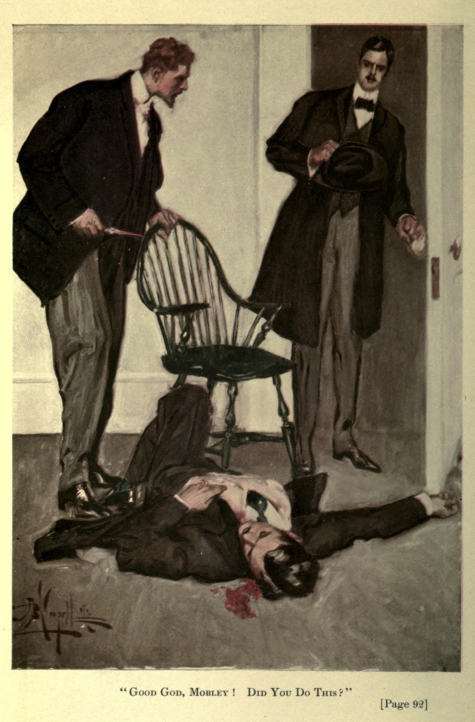
Is this a dagger which I see before me,
The handle toward my hand?
—MACBETH.
THE SILVER BLADE
BOOK I—A DUPLEX PROBLEM
About six o'clock on an evening in the early part of a
recent November, the drowsy quiet sometimes
pervading police headquarters was rudely broken by
the precipitate entrance of a young man, who made his
way hurriedly to the door marked, in neat gilt letters, "CHIEF
OF POLICE."
In addition to the reserve squad, whose vigil never ends,
many other officers were present in the lazy transition stage
between going on and going off duty. The attention of
them all was immediately attracted to the stranger, and
held by his extraordinary manner, from the instant he
became visible in the flickering gas-lights until he finally
disappeared.
In the first place, he was not such a one as usually comes
to the city-hall basement, either voluntarily or when haled
hither by one of the law's myrmidons; for he was fashionably,
even fastidiously, attired, with a marked preciosity
of manner which would have been even more noticeable
under ordinary conditions.
But it was not over any idiosyncrasy of apparel or customary
detail of personality that the aroused curiosity of the
officers lingered. Inured as they were to uncommon and
surprising events, they were nevertheless startled by this
young man's advent, and greatly interested in his extreme
discomposure. It was obvious to the most casual glance
that he was the victim of a fright so potent that it possessed
him to the complete exclusion of every other feeling, made
him oblivious of the scrutiny to which he was subjected,
and drove him blindly to the commission of some idea
fixed by the terror which mastered him. And there was
one other still more powerful emotion depicted in his
pallid, twitching countenance: a horror unspeakable.
Looking neither to the right nor the left, the stranger
walked directly to the Chief of Police just as that official
was in the act of closing and locking his office door for the
night. The latter looked up inquiringly, and, struck at
once by the young man's appearance, asked with sudden
sharpness:
"What's the matter? What has happened?"
The young man, his wild regard fastened on the Chief,
tried to answer; but he was incapable of speech, and the
effort resulted only in a queer, gasping sound.
With the directness of a man accustomed to prompt
action, the Chief of Police opened his door once more, and
guided the young man into the smaller room beyond. The
visitor, dazed by his emotions and unable to respond to any
suggestion less forceful than the actual pressure of the
persuasive hand on his arm, probably would have remained
indefinitely motionless on the threshold before any
customary invitation to enter.
The Chief struck a match and ignited a gas-jet above a
big roll-top desk. The action, simple in itself, seemed to
loose the young man's faculty of speech; just as the official
turned, he darted suddenly forward, grasped the other's
arm, and began incontinently:
"Murder! Murder has been done!" The words had
the effect of a cry, although uttered in a hoarse whisper.
"Murder, I tell you. Come with me at once; don't
delay." He shook the Chief's arm excitedly, and strove
to draw him toward the door.
"Hurry! Hurry! For God's sake, hurry!"
The Chief of Police easily disengaged his imprisoned
arm.
"There, there .... sit down there," said he, in a tone
he might have used to calm a terrified child. "You are
upset. Sit there awhile and try to collect yourself. Come;
make an effort. Pull yourself together and tell me about it."
"But the murderer!" the young man went on, still with
high excitement, but unconsciously sinking back into the
chair under the gentle pressure of the Chief's hand. "The
murderer will escape! Great Heavens, man! even now
he may be assaulting the doctor—Mobley—do you hear
me?—he may have killed him! Send officers—go
yourself—anything but to sit here idle. Come!" He made
as if to rise again; but the other pressed him back.
"Steady," said the Chief quietly. "Mobley? Do you
mean Doctor Mobley Westbrook? Has he been murdered?"
"No-no-no," in a burst of exasperation. "It was—it
was—I mean—good God, what do I mean? It—it
happened in his office."
The Chief regarded him for a moment with eyes that
were mere pin-points of light.
"You are Mr. J. Howard Lynden, are you not?" he
presently asked. The other nodded a quick affirmative.
"I thought so," he continued. "Who is the murderer?
Who has been murdered?—or has any murder been done?
You don't make yourself clear."
Lynden twisted nervously upon his chair. "Heavens! you
do not doubt me?" he cried. "Why, Mobley's office
is like a shambles. It's horrible!—horrible!
Mobley—Doctor Westbrook, that is—was standing right over the
dying man with—with—" He checked himself abruptly,
as an expression of horror deepened in his pale countenance.
Since the introduction of Doctor Mobley Westbrook's
name, the Chief of Police was paying closer attention to
the incoherent recital; he regarded the young man gravely,
and evidently concluded that the situation was serious
enough to warrant some initiative on his own part. He
was accustomed to panic-stricken people who intruded
thus unceremoniously upon him, and experience had taught
him that, oftener than not, the circumstances were far
from warranting the excitement.
Concerning his present visitor, he was aware, in a general
way, that the young man was well known about town, the
inheritor of a considerable fortune from his father, and that
his name figured prominently as a leader of cotillons, on the
links of the Country Club, and among the names of the
many others who formed the society set of the city.
But all these qualifications did not supply the force
so conspicuously absent from Mr. Lynden's personality,
lacking which his perturbation was not very impressive.
He was not at all bad looking: he was even handsome
in a way; but the Chief of Police, as he looked, could not
help remarking that a more resolute man would have been
less the slave of his emotions in a situation like the present.
While the young man sat drumming with nervous fingers on
the arms of his chair, the Chief pressed a button beneath
his desk, whereupon the door was almost immediately
opened by an officer, who, without entering, respectfully
awaited his superior's commands.
To him the Chief said, "If Converse is in, tell him to
come to my office;" and as the door closed, "I want
Captain Converse to hear this," he explained to Lynden; "it
seems to be a matter for his department."
The two had not long to wait. A man entered, cast a
piercing glance at the visitor, and took his stand at a corner
of the roll-top desk, waiting with an air of deferential
attention. He was a man of physique so immense—with
such a breadth of shoulders and absence of neck—that his
more than average height was much disguised. Above
all, he was one whose appearance must attract attention in
any gathering of his kind; for even as Lynden seemed to
lack those desirable traits, so force and resolution flowed
from this man's rugged personality, making their influence
felt subtly and insistently. His air of quiet composure was
evocative of confidence. Endowed with the impassiveness
of an Indian, one could hardly imagine him excited
or agitated in any circumstances.
The Chief recognized his presence with a brief nod,
and at once addressed Lynden:
"Repeat what you have told me; see if you can't make
it plainer."
The visitor recounted the bare facts in a more connected
manner. "But I was so shocked," he supplemented, "that
I am afraid I can't make myself intelligible. The facts
explain nothing to my mind further than that an atrocious
murder has been committed, that the victim is still lying
in Doctor Westbrook's office, and that no one seems to
know who is responsible for the deed."
"You say the man was stabbed?" queried the Chief.
"Yes," was the reply; "stabbed in the throat."
"But I fail to understand," the Chief frowned. "Do
you mean to say that a man was stabbed in the presence
of Doctor Westbrook, and that he knows nothing about it?"
"No—no. It seems to have occurred in the hall just
outside Mobley's door; the man fell through the door into
the office, Mobley said. I don't know—I am so
confused." Which last statement he confirmed by at once
becoming involved in a wild incoherency of utterance.
After he had quieted somewhat, he sat trembling for a
moment, suddenly bursting forth again:
"Wait!" he cried, his face lighting. "I forgot to say
there was another man present in Doctor Westbrook's
office—a stranger to me. I never saw him before."
"And he?"
"Just like Mobley and myself, he appeared to be overcome
by the shocking occurrence."
The Chief of Police plainly showed his perplexity.
"According to your statement—the man who was
killed—will you repeat his name?"
"De Sanchez. General Westbrook's friend, Alberto de
Sanchez."
"According to your statement he was bleeding profusely.
Had the weapon been withdrawn from the wound?"
The young man evinced unaccountable hesitancy. He
moved uneasily, and glanced from his questioner to the
impassive figure standing at a corner of the desk. This
man, called Converse, had taken no part in the talk; he
stood silent and motionless, seemingly paying no heed to
what was going forward; but now he shot a swift glance
at Lynden, whose nervousness measurably increased. That
look was remarkable in a way: the eyes, steely gray, were
in themselves without expression; they failed, however,
to veil an intentness and concentration of mind which
disclosed beyond a doubt that their owner was abnormally
alive to every detail of speech and manner; they could not
hide a power of will lying behind their quick regard,
which mocked deception, and Mr. Lynden shuddered.
Instantly the brief glance was withdrawn; but the young
man, if such had been his intention, attempted no liberties
with the truth. The confusion with which he now spoke,
however, suggested strongly that the thought had entered
his mind, although he may not have entertained it there.
"I—I—I would rather that you, or some officer,
accompany me to Mobley's office," he faltered. "I consider
it rather unfair, in my condition, to press me further.
I wouldn't for the world present anything in a false light.
I feel that the situation is not only serious, but extremely
delicate."
"It is that," the Chief agreed, emphatically. "For that
very reason you must tell all you know. Now, why should
you hesitate in regard to the weapon? Come now, what
about it?"
"Well, sir, I answer you under protest; remember, I
did not see the blow struck."
"Sure?"
The young man nearly sprang from his chair. The
interruption, a penetrating, sibilant bullet of speech, came
from the massive figure of Mr. Converse; again that shrewd
regard was fastened on him, and the sweat started from his
brow.
"No!" he cried, explosively; "I did not. By George,
how nervous I am!—but I think half-truths should not be
told. No one is less capable of perpetrating such a deed
than Mobley Westbrook. Why, you know the man!" He
appealed with feverish eagerness to the two figures now
sternly confronting him. "Every one knows Mobley
Westbrook's character; would he do such a thing?"
"But come to the point—come to the point, man!"
the Chief demanded, rapping sharply upon the desk with
his knuckles. "What of the weapon—was it a
knife—sword—axe—hatchet? Where was it?"
"Well, Mobley had some kind of a—blade, a—dagger
in his hand; but—"
"Ah! And standing over a man whose very life-blood
is ebbing away beneath his eyes!" The Chief's manner
was politely ironical, and struck the young man cold. "You
must admit that you portray an astonishing set of
circumstances to surround a man not only innocent but ignorant
of an offence," concluded the official, pointedly.
Lynden indeed started from his chair. "I knew it!
I knew it!" cried he, wildly. "I knew you would put such
a construction upon my words; now, damn it! I'll not say
another word. Go—go! Go and see for yourselves how
wrong you are!"
The Chief of Police ignored this vehement advice.
Instead, he curtly admonished Lynden to remain a few
moments where he was; and leaving the wretched news-bearer
alone with his own reflections, he and Converse withdrew
from the room.
After a minute or two the Chief returned. "I have
sent for a carriage," said he. "As soon as it arrives I must
request you to accompany Captain Converse to Doctor
Westbrook's offices; are you willing to do that?" He
awaited the reply with an interest mingled with doubt of
what its probable tenor might be; when the young man
acquiesced with an alacrity and relief obviously sincere,
his doubt merely grew. He contemplated Lynden an
instant longer, and with a curt nod, seated himself at his
desk again.
Almost at once, however, the large figure of the
Captain—or plain Mr. Converse, as he much preferred to be
known—appeared in the doorway.
"Come!" he whispered; and the whisper rasped upon
Lynden's nerves. Confound the man! was he afraid he
would betray some momentous secret, so that he did not
talk like other people? Nevertheless, he arose and
followed him,—under the heavy stone arches, shrouded with
gloom in the flickering gas-light, out into the cool night air
and into a waiting hack. Two other men followed close
behind, and entered a second hack; immediately the two
vehicles, one behind the other, were going at full speed in
the direction of Doctor Westbrook's offices.
Under the soothing influence of rubber tires spinning
easily over the smooth asphalt, the young man was fast
regaining his lost composure. He was so rapt in his own
thoughts that for a time he quite forgot his still companion,
and presently he laughed—mirthlessly, but a laugh signifying
sudden relief. Quite as suddenly it was checked, as
he met the inquiring, probing glance of his vis-à-vis.
"It is astonishing that I never thought of it before," he
explained, in an embarrassed way. "That other man—the
stranger—can set Mobley right in an instant. Do
you think Doctor Westbrook could have done it?"
Immediately he regretted the question, for it entailed
hearkening to that uncomfortable hissing voice. It was
Mr. Converse's misfortune that, properly speaking, he had
no voice at all. His entire speech was a series of sibilant
utterances, wonderfully distinct and possessed of remarkable
carrying power when one considered their quality.
It is likely that he was sensitive about his vocal defect, since
he was known as a silent, taciturn man among his confrères.
On certain rare occasions, however,—under, for example,
the spur of an inflexible purpose or the influence of a
sympathetic nature,—it was also known that he could wax
eloquent; his forceful individuality supplied, in a large
measure, the place of a normal, flexible voice.
The head of the detective department might have been
anywhere between forty and sixty years of age, so far as one
could gather from his huge frame and stolid countenance.
His hair was gray, and thinning slightly at the temples;
but behind his illegible exterior there reposed a vigor
and a reserve of power—revealed now and then, as in the
lightning-like glance cast at Lynden in the Chief's
office—which could not be reconciled with age. He was, in fact,
fifty-two.
His face was full and round, smooth-shaven, expressionless—such
a visage as one associates with some old sea-dog;
a countenance that has long been subjected to the
hardening processes of wind and weather. As the young
man waited for a reply, the immovable features
underwent a curious change; the mouth gradually assumed a
pucker, as though the facial muscles were inelastic and
unused to such exercise; his right eyebrow lifted, which,
as the other remained motionless, was made all the more
noticeable,—the effect being an expression of inquiry and
speculation that seemed ludicrously out of place. Lynden
became familiar with this queer transformation later on;
he learned to associate it with the futility of seeking to
penetrate the wall of reserve which ever surrounded this
unusual man, and perceived that it came and went as a sort
of involuntary warning to place least trust in his frankest
confidences. Now it introduced the response to his question,
"Do you think Doctor Westbrook could have done it?"
"The Doctor is a strong, vigorous man, isn't he? I
don't see why he couldn't."
"My dear sir," Lynden anxiously expostulated, "you
don't know Mobley Westbrook, or you never could
entertain such a thought."
"Pardon me," said Mr. Converse, carelessly, "the thought
seems to be your own; I was simply giving you the first
fact that occurred to me, to justify your opinion. I have
formed none myself."
"You interpret my words strangely."
"No; your silence."
The young man, with another shudder, drew back to
the corner of the vehicle farthest from his companion.
The receding lights outside followed the carriage in
squares of diminishing illumination, which, shining through
the window, made strange play of light and shadow over that
inscrutable visage. All at once it became deeply portentous
to Lynden; as if by sudden divination he became possessed
of a conviction that it was destined to take a high place
in his affairs,—signifying, perhaps, the controlling influence
in a strange drama, the first scene of which was now upon
the boards.
"It is very remarkable," the Captain mused, presently,
as if the episode were too much for him.
Lynden started from his reverie.
"Yes," he murmured, not meeting the other's eye.
"Yes; it is very remarkable." Both lapsed into a silence
that continued until the end of the ride.
As the vehicle proceeds, a few words about those whose
names have been mentioned, together with some others
who will figure in this narrative, will give a better idea of the
importance of the tragedy, the ill tidings of which Lynden
had been the bearer.
Both by reason of recognized ability in his profession and
of his high family connections, Doctor Mobley Westbrook
was leader of the medical fraternity in the city of his birth and
residence. He was still youthful in spite of his thirty-five
years; democratic in his tastes, immensely popular in every
class of society, and for these reasons considerably at odds
with his father.
Notwithstanding his popularity, his single excursion
into politics had only shown his unfitness for the national
game; a circumstance mentioned here because later on he
is to have it brought back to him in a manner both forcible
and disagreeable.
Singularly enough,—for from another and altogether
different sentiment the General himself was popular,—General
Westbrook was known to hold his son in some disfavor
because he was so well and universally esteemed.
His exclusive nature could not brook the physician's
democratic inclinations; it made the latter an alien. The
General did not understand it, and what he could not
understand he disliked.
The two personalities were remarkably divergent in every
way. General Peyton Westbrook was an exaggerated type
of the old-school Southern gentleman. Strikingly
handsome, elegant in appearance, his erect and rigid bearing,
together with a falcon-like glance suggested a stature
which one in describing would be likely to pronounce tall
when in reality it was not much over five feet. His
graceful slenderness added considerably to the illusion.
His hair was white, his features cameo-like—aristocratic,
and stamped with the overweening family pride,
to which, with him, every other human emotion was
subservient.
It is probable that his presence and name were better
known in every part of the State than those of any other
living man. For the class which he represented was that
noble body of patricians—handsome and recklessly brave
men, and beautiful, high-minded women—who have given
the world criterions by which human excellence and human
weakness alike may be measured; and his position was a
personal hobby, persistently and consistently ridden.
Of his standing he was perhaps pardonably proud. Besides
his social position and that of his wife, who had been
a Shepardson, and of his lovely daughter, Joyce, he had
fought gallantly, if not brilliantly, through the war between
the States; but he was just narrow-minded enough to
allow his pride and egoism to exclude the rest of humanity.
There was but one uniting link between Mobley and his
father and mother—the latter even more distant and
unapproachable than her spouse—and that was the daughter
and sister, Joyce. Whatever their differences, the
family was held together by affection for this beautiful girl.
The love that bound Joyce and Mobley was deep and
abiding. It is not surprising, then, when the question of
his sister's marriage became gossip, that Mobley should
have taken a stand on the subject which brought about a
final and complete rupture from his father and mother.
The name with which his sister's had been linked was no
other than that of this same Alberto de Sanchez, who now
lay dead, with a ghastly knife-wound in his throat, in the
Doctor's own office.
James Howard Lynden—or "Jim," as Doctor Westbrook
called him—had long been on intimate terms with the
Westbrook family. And it was he who now accompanied
the silent Mr. Converse through a small but curious group
gathered about the entrance leading to the Doctor's office;
the first stage of an intermingling of interests widely diverse;
the bringing together of lives as far asunder as the stars.
Doctor Westbrook's offices were in the Nettleton
Building in Court Street. It and its neighbor
on the east, the Field Building, were of that
solid old style of structure devoted to business, which
knew not the elevator nor steam heat, nor any of the
many devices that enter into the complexities, and often
questionable conveniences, of the modern office edifice.
They were not, and never had been, of an imposing
appearance, boasting as they did only three stories; but they
were nevertheless the blue-bloods among the city's
commercial houses, preserving their exclusive position amidst
the newer generation of garish sky-scrapers which rudely
intercepted the vision on every hand.
The occupants of these monuments of the old regime
were in full accord with their habitations,—solid,
conservative, and even aristocratic. As often as not a modest
sign—if it could be deciphered at all—notified the visitor
that behind certain doors could be found "Harvey Nettleton,
Estate of," or, "Richard Fairchild, Estate of," or some
name equally well known, and associated with a glory that
had departed. In most instances, well might the present
owners of those family names cry "Ichabod!" for they had
long since ceased to have any interest in the estates other
than the shadowy interests which lie in memories and vain
regrets.
As Mr. Lynden and his taciturn companion passed
through the Nettleton Building entrance, where the curious
little throng was restrained by the presence of a couple of
mute policemen, the Captain's entire manner underwent
a complete and sudden transformation; his expressionless
countenance remained wooden, but into his eyes there
arrived an intentness and brightness entirely absent from
them before; his rather lethargic and apparently purposeless
movements giving way to a brisk mode of proceeding which
one would hardly have expected from his cumbrous frame.
His demeanor was become at once alert and wary, and he
had little to say to Lynden.
It was now night outside, and the stairs were faintly
illuminated by the single incandescent lamp which hung
at their head in the hall of the second story. The sole
indication that Mr. Converse was striving to allow nothing
to escape his observation was the quickness with which he
stooped, when near the top, and picked something from the
stairs—something too small for Lynden to catch even a
glimpse of—which, whatever it was, the Captain scrutinized
intently a moment, and, without comment, dropped into the
large pocket-book he brought forth from an inside pocket.
The two continued on their way until they reached Doctor
Westbrook's office.
Everything was as Lynden had left it, save for the fact
that Doctor Westbrook, and the stranger mentioned by the
young man, had been joined by several other persons.
One was a swarthy, lean man, whose face was pitted by
small-pox, and whose rather dull eyes remained expressionless
behind a pair of gold-rimmed pince-nez. He was
standing aloof from the others, and seemed to be taking
only languid interest in what was going forward.
Occasionally he coughed in a manner that told much to the
physician's trained ear; save for this, he remained silent.
Mr. Merkel, the coroner, and a uniformed policeman were
also present.
"Ah!" exclaimed Mr. Merkel to Converse as he and his
companion appeared. "So they have sent you, have they?
How fortunate! how exceedingly fortunate! This, gentlemen,"
he continued, addressing the other occupants of the
room, "is Captain Converse. He will pardon me, I know,
if I add—the great detective. Nothing has been disturbed,
Captain, nothing has been disturbed. You will find everything
just as I did. It is a bad business, a bad business."
Mr. Merkel was fussy, important, and wholly incompetent;
and the Captain was so accustomed to his repetitions
of phrases that were not, to say the least, pregnant
with meaning, that he ignored them and turned to an
inspection of the dead man.
The body lay just as it had fallen. Somebody had placed
a handkerchief over the face, a covering that also hid an ugly
wound in the throat. Mr. Converse stooped and removed
this, and began a minute but rapid examination of the still
form. It reposed in the Doctor's reception-room, close to
the wall, partially on its back and partially on its right side.
The right arm was extended, the fingers of that hand still
in a position as though upon the point of grasping something.
Curved naturally across the breast, the left arm suggested
restful slumber rather than death by violence; but whatever
the eyes had last looked upon, before the film dimmed
their lustre, it had stamped upon the handsome features an
indelible expression of mingled terror and horror, which one
could scarcely regard without an inward tremor of something
very like fear. It was an expression likely to remain
disagreeably in the memory for a long time.
A search of the dead man's pockets revealed nothing
unusual, except that, in a petty way, he had been a violator
of the law; for the first thing Mr. Converse drew forth was
a nickel-plated, pearl-handled revolver of 32-caliber. The
remainder consisted of a number of letters, all relating to
business matters; two long envelopes, evidently but recently
sealed, and addressed simply, "El Señor Juan de Vargas"; a
purse containing money; a gold watch; a fountain pen, and
pencil; two memorandum books; a silver match-box; a
pouch of dark tobacco, and brown cigarette papers; a
handkerchief; a penknife; a bunch of keys,—these were all.
When these effects were inventoried, while Mr. Merkel
was assorting them at Doctor Westbrook's writing-table,
the dark man with the pince-nez stepped forward. All
eyes were turned toward him, excepting, apparently, those
of Converse, which continued to give the body and the
reception-room floor their attention.
"Pardon, señores," said the dark man, bestowing a bow
upon the entire group, and ending it at the Coroner; "is
there anything addressed to Juan Vargas, or Juan de Vargas?
I am he."
Mr. Merkel looked at him sternly, and held up the two
long envelopes.
"I see the name of Vargas—er—ah—inscribed on
these. Are you Mr. Vargas?"
The other remained unmoved, replying simply, "I am
Juan de Vargas."
"What connection have you with the deceased gentleman?"
continued the Coroner, without relaxing in the
least the sternness of his look. "Can you tell us anything
of this affair?"
Señor de Vargas shrugged his shoulders. "Nothing,
señores; I lament that I cannot. The contents of the
envelopes should tell you about the extent of our connection;
they contain but a deed, some shares of stock, no more.
Señor de Sanchez would have delivered them to me to-night.
Open them by all means."
The man's eyes, dull and unmoving, continued to regard
Mr. Merkel. Had he been discussing the weather his tones
could have been no more dispassionate.
The Coroner tore open the envelopes, and, as the man
had said, one contained a deed, conveying certain land to
Juan Sebastian de Vargas y Escolado, the notary's
certificate showing it had been signed and acknowledged that
very day before Clay Fairchild. Alberto de Sanchez had
made the transfer. The other envelope disclosed a certificate
for one thousand shares of stock in the Paquita Gold
Mining and Milling Company, also made over to Señor
Vargas in due form. The papers told no more.
"Good!" exclaimed Señor de Vargas. "We agreed
yesterday, and I have made the first payment of ten thousand
dollars for myself and associates. I was but awaiting the
deed and the stock."
At this juncture Doctor Westbrook interposed:
"I happen to know that this gentleman is Señor de
Vargas," said he. "He called here with—with Señor de
Sanchez last evening. I have heard something of this deal
between the two, and I believe it represents the occasion of
this gentleman's presence in the city at this time."
Señor de Vargas acknowledged this speech with a grave
"Gracias, señor." Turning to Mr. Merkel again, "I hope
there will not be much delay?" he queried, mildly, with a
certain precision of enunciation that alone marked him of
an un-English-speaking race.
Since he had comprehended the magnitude of the transaction
as disclosed by the deed and certificates, and after
Doctor Westbrook's interposition, the Coroner's manner
toward the Mexican had noticeably altered.
"No more than necessary," he replied deferentially;
"no more than necessary, sir. I am sorry, but these papers
will have to remain among the deceased's other effects until
after the inquest, anyhow. Mr. Mountjoy, our district
attorney, is the proper authority for you to see."
"Good!" returned the Mexican. "I desire not for my
humble affairs to stand in the path of justice." Bowing
once more, he returned to his former position away from
the others.
Converse suddenly passed over to the Coroner, and laid
a bloody dagger upon the table. Its silver blade, crimsoned
in part, was grewsome and startling beneath the bright glare
of the shaded incandescent lamp. Mr. Merkel involuntarily
drew back his hands, the strange gentleman who had been
with the Doctor since the tragedy visibly shuddered, and
for an instant—the smallest portion of a second—the
dull eyes of Señor Vargas took on a strange light, as though
the pupils had all at once distended, allowing a glimpse
to the uttermost depths, then became dull again. It was like
the abrupt opening and closing of a shutter. Otherwise
his features did not change, nor did he move. The more
phlegmatic policeman looked upon the little weapon without
apparent emotion; the Doctor and Howard Lynden with
none at all.
However, as the Captain placed it upon the table his
eyes took in every occupant of the room in one rapid sweeping
glance, only to drop as he stooped and whispered to the
Coroner, who there upon nodded and turned to the waiting
group.
"Now, gentlemen," said he, "this is not the inquest, of
course; but let us hear what you have to say about this.
You first, Doctor Westbrook; you first."
"What I can tell you will seem much less than it should,"
the Doctor returned. "It was about five o'clock, and I
was sitting at my table—there, where you are now. I had
just finished a letter to no other than Señor de Sanchez
himself."
"Is this it?" the Coroner interrupted, extending a letter
to the speaker. Doctor Westbrook replied affirmatively,
and proceeded with his recital.
"I had just completed and blotted it, and was preparing
to address the envelope, when I heard footsteps in the hall.
I paused, with the pen in my hand, and listened, for I was
expecting Señor de Sanchez to call at my office this evening,
though not so early, and I imagined the footsteps might be
his. As I listened, I noted that my door was not quite shut,
and the footfalls advanced steadily down the hall, approaching
my office. When immediately outside the door, and
while I was looking up expectant of the caller's entrance,
they ceased abruptly. There was a slight sound of scraping
on the floor of the hall, as though the man—whom I could
not then see—were endeavoring to rub something from
his shoe-sole on the boards, or had slipped slightly;
without the slightest warning, his whole weight plunged
against the door. It was thrown violently open by the
impact, and I was horrified to behold Señor de Sanchez
stagger through, his right hand extended in front of him,
as if groping for support. As he crossed the threshold he
lurched to his right and struck the wall, along which he slid
to the floor, just as you now see him."
During his relation of these particulars, the Doctor's
manner was perfectly cool and collected. The next incident
fairly electrified his intent listeners.
"As he was falling," he continued, "I noticed the dagger
handle protruding from the left side of his throat."
"Is this the one?"
It was Converse's sibilant whisper which now rudely
broke into the recital. At the same time he thrust the silver
blade close to the other's face.
Doctor Westbrook at first merely glanced at the weapon;
but something about it evidently caught and held his attention,
and an emotion vastly different from mere recognition
overspread his countenance; it was astonishment, pure and
simple.
"God bless my soul!" he gasped, in extreme amazement;
"that is mine—my paper-knife—and I did not
recognize it! What does this mean?" He sat with his eyes
glued upon it, the centre of a dumfounded group. The
Captain continued a moment to hold it forward, his gaze
fixed inscrutably upon the physician's puzzled and
bewildered countenance.
Presently Converse drew the weapon slowly back again,
and replaced it upon the table.
"So that is yours?" the Coroner soberly asked.
"It is," replied the Doctor; "and I did not recognize it
until this minute. How did it—why—" he began
vaguely; but Merkel interrupted.
"Well," said he, with a wave of the hand that seemed to
dispose of all complications, "it will be time enough for
questions when you have finished."
"De Sanchez was falling," resumed the Doctor after a
moment's reflection, "when I noticed the dagger handle.
The body had scarcely touched the floor before I had
stooped and wrenched the blade from the wound. It did
not come easily; it required a severe tug to loosen it, and
the withdrawal of the blade was followed by such a gush
of blood that I knew some important artery must be severed.
The man's death was practically instantaneous. After I
had extracted the blade I had no time to render him any
further service; I simply stood dumfounded until
Jim—Mr. Lynden—grasped my arm and shook me."
"But, Doctor Westbrook," insisted Mr. Merkel, "was
there no one else in the hall? Did you hear no other
footsteps? Didn't you see or hear some one else when the door
was thrust wide open? Surely the murderer couldn't
have left so quickly without attracting the attention of some
one of you. It is simply incredible." He grasped the arms
of his chair, leaning forward in his eagerness, his heavy
countenance overshadowed with perplexity.
As the Doctor started to reply, Converse glanced sharply
toward him; when Lynden's name was presently mentioned,
shifting his scrutiny to that gentleman.
"I must say no to all those questions," was the Doctor's
reply. "I saw nobody but De Sanchez. I heard nothing
but his footsteps, and the noise he made in collapsing through
this door. Ask Jim Lynden, there; he was in the hall at
the time; he followed so closely behind De Sanchez that
he arrived here before the man died."
Lynden merely shook his head, hopelessly, as if he had
no vocabulary to express himself. The Coroner was
impressed by the young man's mien, and after regarding him
a moment with a scowl, turned again to Doctor Westbrook.
"Was any one else present, Doctor?" he asked.
The physician's face was suddenly illumined.
"Yes; why, certainly. Howe!" he exclaimed. "Howe,
where were you?"
The man, who apparently had been a stranger to everybody
in the room, now advanced.
"I was in there—your laboratory—looking into the
light-well."
Converse noiselessly disappeared into the room indicated,
returning in a few seconds to eye the stranger with increased
interest.
"And who are you, if I may ask?" bluntly demanded
the Coroner.
"My name is Ferdinand Howe, sir," the stranger replied,
with dignity. "My home is in Bruceville, Georgia,
and I am in your city on business for the bank of which I
happen to be the cashier. Doctor Westbrook and I are
old college-mates, and I know about as much of this affair
as he has told you; that is to say, I was there—the other
side of that partition in the laboratory—when the murdered
man fell where you now see him. The first intimation I
had that anything was amiss was when the outside door
crashed open and the body fell to the floor. I ran into
this room, saw the man gasp twice, and then lie motionless.
I never saw him, and never heard of him, before this night.
That is all."
Mr. Howe appeared to be about the Doctor's age, and
was a fair type of the American man of business. He was
well groomed, clean, and possessed of a clear, steady eye.
"And you saw and heard no one else?" Mr. Merkel
persisted.
Howe shook his head. "No, sir; no one. There was not
the slightest thing to indicate—"
He stopped. He shot a swift, startled glance at Doctor
Westbrook; but the Doctor remained unconscious of it,
evidently absorbed in his own cogitations. Mr. Converse's
eyes watched the speaker through mere slits, so nearly closed
were they; but a gleam came from between the contracted
lids that might have betrayed a quickened interest
somewhere in the depths of his big frame.
"No," concluded Howe presently, in tones measurably
subdued; "I neither saw nor heard anybody else, but—" With
compressed lips he indicated by a nod the form on the
floor. "You must remember," he concluded, "I was in
the next room, looking out the window into the light-well."
Converse looked quickly from the speaker to Lynden.
That young man was staring strangely at Howe, evidently
impressed by something unusual in his concluding words.
Suddenly the young man caught Converse's intent look,
and his own eyes lowered. Next they shifted to Doctor
Westbrook, at whom he continued to look in a moody
silence.
The Coroner, apparently more and more at sea, stared
first at one and then another of the room's occupants, at
the partition which separated the reception-room from the
laboratory, and lastly through the open doorway into the
hall. The most extreme of the different points were not
over six feet apart; and for three men—wide awake and in
full possession of their faculties—to be so close to such a
crime and know nothing of it until it was all over! How could
human ingenuity supply an explanation for so incongruous
a circumstance? Had the man committed suicide? The
most cursory examination of the wound demonstrated beyond
doubt that, however else it might have been inflicted,
Alberto de Sanchez was incapable of having administered it
himself.
Meanwhile the Captain was moving from one to another
of the group, his whisper barely audible, but persistent and
pervading the entire room. Occasionally he made a brief
memorandum upon an envelope,—cabalistic marks which
no one but himself could have deciphered. Then the
whisper again for a moment, followed by a deferential
lowering of his gray head as he hearkened to the reply. Had
one been observing him closely he would have noticed that
the circle of inquiry gradually narrowed. The policeman
he paid no attention to at all; he was soon through with
Señor Vargas; but from Lynden he passed to Howe; next
to Doctor Westbrook; and from one to another of the last
three, as a word from one suggested a new inquiry to be
asked of another. His movements were silent, his manner
unobtrusive, distracting no attention from Mr. Merkel and
his investigation. Now and then he paused and stared
contemplatively into vacancy for a moment, with the odd
lifting of his right eyebrow, and with his mouth thoughtfully
pursed; but the mask of his countenance told nothing,
and only once did he include the whole group with a question.
It was after he had been whispering quietly for some minutes
with Howe.
"Who can give me young Mr. Fairchild's address?
You, Doctor?" he asked.
"Clay?" Dr. Westbrook returned. "Yes. It is close to
the terminus of the Washington Heights car line. The
conductor can direct you to it; the houses are not
numbered out there."
Converse nodded, and chose a slip of paper from the
table. After looking at it, first on one side and then on the
other, it apparently did not suit his purpose; for he
subjected another bit of paper to a similar scrutiny before
pencilling a hurried line thereon, although he did not replace
the first slip. The note he handed to the policeman with a
whispered word, and the policeman instantly quitted the
room. Had one still been observing Mr. Converse he would
have seen him abstractedly place the first bit of paper in his
waistcoat pocket.
Well, it seemed that no one present could throw additional
light upon the manner of Señor de Sanchez's death. Mr. Merkel
arose from his chair at the Doctor's table, and looked
a pointed inquiry at the Captain, who responded by a short
negative shake of his head. As if relieved of a distasteful
responsibility, the Coroner said:
"Such of you as desire to go may do so. Captain Converse
and I will have to look about a bit. He must have an
opportunity to apply his wonderful skill, gentlemen; and
you will all be notified of the inquest; you will be duly
notified..... Doctor Westbrook, I will send a wagon for
the body," he concluded. "Good-night, gentlemen." He
turned to the table again, and to a contemplation of the
dead man's personal effects, as though picking out an answer
to this latest riddle propounded by death.
Whatever of restraint had been upon the group, it was
released by the Coroner's words, and each member showed
it in his own way. Ferdinand Howe instantly advanced to
Doctor Westbrook, and, smiling, held out his hand.
"Well, Mobley," said he, as they grasped hands, "this
is a regrettable affair. It has been a shocking interruption
to my visit; a visit which I now suppose will be indefinitely
extended. If I can be of service, don't hesitate to call upon
me. I shall be at the hotel any time I am wanted.
Good-night." And he quitted the room.
Next, Señor Vargas bowed before the Doctor, saying in a
low, conventional tone:
"My sympathies, Señor Doctor, that anything so deplorable
should have occurred in your apartments." He turned
to the Coroner:
"Don Alberto was a fellow-countryman," he went on;
"he had many relatives and friends, by whom he was much
beloved. But Mexico is far away, señor, and should there
be any delay in communicating with those relatives or those
friends, it is I, his countryman, upon whom you should call.
Upon my own responsibility I request that every attention be
accorded the body, and that no expense be considered. I
also will be at—what you call la posado?—the 'otel.
I thank you for your courtesy."
His departure left, besides the Captain and Mr. Merkel,
only Howard Lynden and the Doctor; as the door closed
behind the Mexican, the Doctor said:
"Now, then, we here are all about equally interested; if
you have any idea how this dreadful crime was committed,
pray enlighten us. Surely even vulgar curiosity is pardonable
under the circumstances." He looked inquiringly from
the Coroner to Mr. Converse.
The latter made no remark, but watched the Doctor
steadily, while Mr. Merkel dubiously shook his head, and
replied:
"It seems as though we scarcely had made a beginning
yet. We shall be obliged to go much farther,
Doctor—much farther."
"I will begin right now, then," Converse whispered.
"Mr. Lynden, you can help me if you will."
All four were in the act of emerging from the room, when
the Captain, as though an idea had just occurred to him,
turned suddenly and touched Doctor Westbrook upon the
arm.
"By the way, Doctor," he whispered, close to that gentleman's
ear, "I notice you have several penholders on your
table; are you particularly partial to any one of them?
No, no, don't stop; go on."
The Doctor turned a surprised visage to his questioner.
"Why, yes, since you have mentioned it. I always
use the black celluloid holder. Why?"
"It is just an idea of mine; I took a particular fancy to
that holder..... And have you had occasion to put a new
point in it lately?"
Doctor Westbrook now did stop. He frowned heavily
as he pondered a moment, while the Captain watched him
steadily.
"Yes," he presently said. "I placed a new pen-point
in it this evening. I found the other broken—bent—quite
useless."
"Thank you, thank you," Mr. Converse said, hastily.
"Good-night, Doctor Westbrook."
While the Doctor and Mr. Merkel continued on out of
the building, Converse devoted his attention to the hall
window which opened into the light-well. There he stood
until the others had disappeared; whereupon he and Lynden
reëntered the Doctor's office.
By running a board partition down the centre of
the room nearest the hall, Doctor Westbrook had by
the simplest means given himself a place of reception;
one where his patients could wait while he was engaged
in the room overlooking Court Street, there being still
another for his drugs and medicines.
There was not much wasted space in the laboratory.
Against the walls stood cases filled with bottles of many
sizes and colors, and other cases displaying glittering, sinister
instruments; in one corner stood a carboy of distilled water,
and by the window, opening into the light-well, stood the
table where the Doctor compounded such prescriptions as
he did not send to a regular apothecary.
The light-well opened like a chasm between the Field
and Nettleton buildings; its bottom, on a level with the
second-story floors, was of heavy semi-opaque glass, so that
such rays of light as were not diverted into the windows
on the one hand or the other found a way to the shop space
on the ground floor. At present an arc lamp beneath this
skylight suffused a soft and mellow radiance throughout
the entire light-well.
Mr. Converse let himself down to a narrow ledge bordering
the skylight, and with an injunction to the young man to
wait, made his way around it to a window diagonally opposite,
which the latter recognized as belonging to the offices
of Petty & Carlton, attorneys, in the Field Building. Here
the Captain drew himself up with remarkable agility, and
disappeared through the window. All the windows letting
into the light-well were open, the watcher was noticing,
when his attention was attracted by Mr. Converse's sharp
whisper.
"Stand where you are a few minutes, Mr. Lynden,"
said he. "I want to experiment a bit, and I shall call
on you for a report presently."
He lowered himself to the ledge again, passed over to
Nettleton Building side, and to the hall window of the latter.
There he stooped and scrutinized the ledge intently, and next
the window-sill; after which, with a little spring, he raised
himself to the window, and crawled through it into the hall.
A sudden quiet fell,—a quiet unbroken by any sound.
Standing there alone in the gloom, one undoubtedly would
have been impressed by the blank, staring windows that
were like wide and lidless eyes; and as he looked, Lynden
seemed to become sensible of a feeling of dread at the
awfulness of the crime which had been committed so near at hand,
for he shuddered visibly, as if the windows had some purpose
in staring,—as if they were in reality eyes that still retained
some expression of their horror at a deed witnessed but a
moment since.
Noting the alacrity with which Converse let his heavy
frame in and out of windows, a spectator might fancy it an
easy matter for one lurking in the light-well to do likewise,
at the ripe moment strike a swift blow, and then leap back
again.
But whatever the current of Lynden's meditations, it
was abruptly diverted. He fell to listening intently. The
door between the hall and the reception-room was being
slowly and cautiously opened; still slowly and with an
apparent effort to occasion no betraying noise, some one
advanced on tiptoe into the room. The young man faced
deliberately about until he could see the door in the partition,
and waited. Toward it the almost silent footfalls were
moving; presently there appeared at the aperture the
expressionless face of Mr. Converse, who, when he perceived
Lynden's startled attitude, gave utterance to a low chuckle.
"I was not endeavoring to frighten you, Mr. Lynden,"
said he; "I was simply trying a little experiment. When
did you first hear me?"
"I heard the door open, and next, you tiptoeing across the
room. I did not know what to think." He was pale and
trembling.
"Not another sound? No footsteps in the hall? Nothing
of that kind?"
Lynden shook his head. "No; the first thing I heard
was the door opening," he repeated.
"Well," continued the Captain, reflectively, pursing his
mouth, and lifting his right eyebrow at the young man, "I
don't believe anybody could have made less noise than I
did in there"—he nodded his head toward the partition—"nor
more than I made in the hall. And you heard nothing
until the door began to open—h-m-m!" He looked around
the laboratory,—at the shelves of bottles, at the partition
not reaching quite to the ceiling; he stepped to the window,
and, leaning out, contemplated the hall window. "It's
confoundedly queer," he concluded.
"What is?"
"Why, the way noises act here. You know, that
man—Mr. Ferdinand Howe—was standing at this window, and
heard nothing in the hall. I almost believe, if the deceased
had been shot instead of stabbed he would not have heard
it..... But let us have a look at the other side of the hall....
Let me see," he went on, in a meditative way, "Room
4; that must be Mr. Nettleton's private office; as my
friend Mr. Follett would say,—his 'lair.' He has no use
for lawyers." He pushed open the door directly opposite
the Doctor's suite.
The room was large and had three windows opening into
the light-well. Through these windows sufficient light
from the arc lamp beneath the skylight found its way to
cause the furnishings to loom shadowy and ghost-like in a
sort of feeble twilight, and to make it easy to find an
incandescent lamp, which Mr. Converse turned on, illuminating
the apartment with a brighter and more cheerful radiance.
He surveyed the room, and looked at Lynden.
"I suppose," said he, "the door has not been locked
this evening?"
The young man merely shook his head. For some reason
since passing to this side of the hall, he had become strangely
taciturn, though he watched the Captain's every movement
eagerly, and cast many furtive glances toward the denser
shadows.
Converse, knelt and examined the floor closely on either
side of the door. Lynden's nerves were at such a tension
that he actually started at a whispered ejaculation from the
Captain as he picked up a tiny hairpin,—the kind a woman
would have specified as "invisible."
So, then, there had been some one behind this door—and
that one a woman!
Why should this circumstance affect Lynden so strangely? for
it would seem that, in the undisturbed stillness of these
deserted chambers, there was a potent, disquieting influence
which kept him in a qui vive of nervous expectancy,—an
invisible something in the atmosphere of the place filling him
with an apprehensive dread. It was really remarkable
that his observant companion did not notice his agitation;
and still it was difficult to imagine how he could, for he
was crossing the floor in a crouching attitude, apparently
directing his entire attention to the floor with a concentration
that permitted no individual thread of the heavy carpet
to escape his earnest scrutiny.
Mr. Nettleton was a lawyer, and he occupied two rooms,
both of which opened directly into the hall. The two men
were now in the one that the lawyer used as his consultation
room, and the course being pursued by Mr. Converse
would soon take him to the connecting door between the
two offices. Arriving at that point, he stood erect and paused
a moment, plunged in thought. He said nothing, and
seemingly had become oblivious of his companion's attendance.
Just to the left of the connecting door, and in the general
office, stood the desk occupied during business hours by
Clay Fairchild. Above this desk was another incandescent
light, which the Captain lighted, after which he took
up whatever trail he had been following so closely, at the
exact point where he had left it, continuing, in a stooping
posture, to the hall door of the general office. From the
point where he had picked up the hairpin, immediately
within the entrance to Room 4, he had pursued a course
away from the hall, through the connecting door to Room 5,
and back again toward the hall to the hall entrance of the
latter room,—the whole forming, roughly, an arc, the chord
of which was the hall.
At the door of Room 5 he stood upright once more, and
the young man became aware all at once that he was being
eyed quizzically.
"Look!" the Captain whispered. Stooping again, he
pointed to the heavy ply of the moquette carpet.
For a moment Lynden could descry nothing unusual;
his heart was thumping in a manner for which he could
assign no reason; but when the Captain traced an outline
with his thumbnail, he could see quite distinctly the imprint
of a small, partial footprint, such as a woman's French
heel might make.
"That appears at just two other places," Converse
continued; "at the entrance to Room 4, where I found the
hairpin, and just inside this room; and there, beyond that
desk, near the connecting door. They were made by a
woman who stood a while at the first door, and who then, I
believe,—though I can't be positive,—tiptoed to the
connecting door, where she paused again for a while. She
either tiptoed between those points, or stood for a time; the
marks wouldn't have remained had she walked directly
through the two rooms."
Lynden stared at the tiny impression—so faint that
nobody else would ever have remarked it—and seemingly
sought to frame a reply that he could voice naturally.
"Wonderful! Wonderful!" was all he said, but in tones
so low that they were scarcely louder than Mr. Converse's
whisper.
The latter now turned to the rest of the room. Swiftly,
but apparently permitting not the least article to escape his
observation, he made the circuit of the apartment, and
finally paused at Clay Fairchild's desk. Almost instantly
his eyes singled out one from among the mass of papers
which littered it. This he carefully folded, and placed,
with the article he had picked up on the stairway, which
Lynden had been unable to see, in the capacious pocketbook.
He seemed reluctant to leave this desk; after he had
turned away he paused and cast another look at it, sniffing
as one striving to locate the source of a faint odor. Lynden
paused too; he glanced hurriedly from right to left, his brow
lined, his expression troubled and perplexed.
At length they returned to Mr. Nettleton's private office,
which was subjected to as close and thorough an examination
as had been the room just quitted. Only one thing
seemed especially to hold Converse's attention, and that
was the space beneath the lawyer's desk. Here he got
down to his hands and knees, and struck no less than five
matches in an effort to obtain a better light. Whether the
dusty space told him anything Lynden could not determine.
They passed back into the hall again. Converse walked
directly to the entrance of Suite 2, immediately adjoining
Doctor Westbrook's offices, on the side nearest the stairway.
A small card pasted on the ground glass of this door bore
the words "To Let." Converse ignited another match,
in the added light of which he examined the door-knob.
His companion observed him touch it with the tip of a finger,
and shake his head, as if something incomprehensible had
all at once presented itself.
"Does the janitor sleep in the building?" the Captain
inquired after a moment; when the young man nodded
affirmatively, he added: "Can you get the keys of this floor
for me? It will save some time and trouble, and I want
to finish before the reporters come."
"Certainly. His room is in the third story."
Converse watched him until he disappeared around
the corner toward the stairway, and straightway did something
very strange. With the silence and speed of a cat he
made his way back to Fairchild's desk. Over this he
bent and smelt the papers which lay there. But that
would not do. Hastily he tried the top right-hand drawer.
It was unlocked—as were all the other drawers—and
opened easily. That for which he was searching was not
there, either. He turned rapidly to another drawer, and
another, and another, until every drawer in the desk had
been opened and closed again, its contents having been
hastily but thoroughly gone over; and still the object of
this hurried search was not found. Quickly he glanced
from side to side. To the left of the desk was a waste-paper
basket, which had not been recently emptied, and over this
he inhaled deeply, as one would drink in the fragrance of a
rose. He thrust a hand among the debris of papers, and
in a moment drew forth a dainty lace handkerchief, to which
clung the unmistakable odor of stephanotis. Again the
capacious pocket-book; and when Lynden returned with
the keys the Captain was contemplating the door-knob of
Suite 2 with unabated interest.
Lynden sniffed as the other ran over the key-tags in a
search for No. 2.
"What is that perfume?" he demanded sharply.
"Ah, do you like that, now?" rejoined Converse, with
the first display of enthusiasm he had yet shown. "That
is an odor I am very partial to, and hope to have more
of—if I can find where this came from."
The young man moistened his lips, and his eyes turned
away from the other's steady look.
Converse now had the door to No. 2 open, but he did
not enter this room. It needed only the match he now
struck to disclose layer upon layer of dust, the undisturbed
accumulation of months.
"Now, then," said he, as he closed and locked the door
again, "back to the light-well for a minute or two, and I
am through."
He let himself out of the hall window, and made another
circuit of the ledge around the skylight. The light-well
was more or less a catch-all for the windows opening into it;
it therefore contained many scraps of paper, every one of
which he glanced at before casting it aside. Only one
thing here seemed to interest him,—something he picked
up far out on the skylight and scrutinized. Lynden was
afforded another glimpse of the pocket-book.
"What is it?" he asked.
"A cigarette butt," was the reply; "interesting only
because it is the second one of the same kind I have found
to-night."
Presently, when he announced that he had finished,
Lynden said it had fallen to them to turn out the lights and
lock the doors, as the negro janitor was too frightened to
venture into the second story that night. This was soon
accomplished, and the two had turned to depart, when
both abruptly stopped. A light had flashed forth through
the ground glass of Room 6.
"What room is that?" asked Converse; for the door
was bare of significance excepting for the single figure "6,"
now standing out boldly against the light behind.
"The record and abstract room of the Guaranty Trust
Company," was the reply. "He must have come in while
you were in the light-well."
"He? Who?" Converse queried bluntly.
Both were standing as they had paused when the light
first surprised them, and Lynden turned to his interlocutor
with some surprise at the quickening eagerness of his tone,
but he answered merely:
"Slade,—William Slade; he prepares the company's
abstracts of title, you know."
Converse's manner became completely impersonal again.
"Can you find some excuse for knocking?" he asked.
"Would you mind doing so? I should like to have a glimpse
of him."
"Not at all; if I can make him hear. He's quite deaf."
Lynden, after knocking once perfunctorily, did not wait
for a summons to enter. He immediately threw the door
wide open, crying, without much show of deference:
"Hello, Mr. Slade! You work late to-night."
A little, dingy, dreary figure of a man, perched on a
high stool, and bending over a huge canvas-bound volume,
slowly raised his head, and gazed at his unceremonious
callers with the vacant look that one sees in the eyes of deaf
people who have not heard distinctly. His smooth-shaven
face was like leather, shot and crisscrossed with a network
of fine wrinkles. Almost on the tip of his nose he was
balancing a pair of steel-rimmed spectacles, and the eyes
which now looked over them were remarkably bright and
sparkling, like a mouse's, conveying to the casual glance
an alertness which they did not actually possess.
"Howard Lynden, close the door," was the odd creature's
greeting, in a voice hoarse and rasping. The sharp little
eyes shifted to the Captain, and back to Lynden again.
There was no cordiality in either his tone or manner.
The young man took a step forward, laid his hand upon
the tall desk at which the little man was seated, raised his
voice and asked, "Did you know there had been a murder
committed on this floor this evening?"
"Murder?" querulously, and with no show of interest.
"Murder?"
"Yes; murder. The man died in Doctor Westbrook's
office—stabbed."
Without displaying the least curiosity at so unexpected,
so sensational an announcement, Mr. Slade slowly wagged
his head, saying only, "I heard nothing of it." He dipped
his pen into the ink-well, with an air of dismissing his
callers and the subject alike.
"I saw your light, and just dropped in to learn if you
knew of it," Lynden concluded, as he followed the Captain
toward the hall. Lowering his voice, and addressing the
latter, "Is there anything else?" he inquired; at once the
wrinkled, meagre visage and twinkling eyes became
suspicious and alert.
"What is that?" demanded Slade, with obvious mistrust.
"Nothing," the young man returned shortly. "Good-night."
Mr. Slade's parchment-like countenance again bent over
the big volume, and his pen flew industriously. It was
startling, when the door had nearly closed, to have the
rasping voice come after them with the suddenness of an
explosion.
"Howard Lynden!" it cried. That gentleman,
surprised, thrust his head back into the room.
With pen poised in hand, with spectacles still balanced
near the tip of his thin nose, the ill-favored mask of Slade's
countenance was again confronting the detective and his
companion.
"What time was that murder?" asked the abstracter.
"At five o'clock," Lynden rejoined, he and the Captain
again advancing into the room.
"And the murdered man?"
"General Westbrook's friend, Señor de Sanchez."
The little eyes turned once more quickly to the Captain
and back to Lynden as he asked the next question:
"Ah! And who was—the—murderer?" He spoke
deliberately, his harsh voice lowering itself strangely.
"That the police would very much like to know."
Again the little eyes shifted to Mr. Converse.
"An officer?" inquired Slade.
The Captain nodded. Slade's brusque manner returned;
dropping his eyes to his work once more, he said, with an
air of finality:
"I am sorry, gentlemen, I can tell you nothing. This
is my first intelligence that a crime had been committed.
Good-night. Howard Lynden, close the door tightly after
you."
When the two were once more in the hall the Captain said,
"Mr. Slade developed a mighty sudden interest."
"Yes," returned his companion; "a queer bird—irascible,
and touchy about his deafness. His father was
an overseer, you know," as though this fully accounted
for Mr. Slade's undesirable qualities. "But his curiosity
got the better of him that time; he couldn't let us go
without finding out more."
"He and I would have some difficulty in getting along
together without a sign language," remarked Mr. Converse,
dryly.
The two were near the foot of the stairs, but they were
not destined to leave the building without another interruption.
A man came precipitately, though noiselessly, in at
the entrance, who, when he observed they were descending,
stopped short and awaited their approach at the foot of the
stairs. He was one of the two men who had followed them
from headquarters, and he now, after touching his hat
respectfully to Mr. Converse, looked askance at Lynden.
The Captain, with a nod of apology to the young man, drew
the newcomer to one side.
"Well, Adams?" said he.
"We found Mr. Fairchild's all right," the man whispered;
"but Mr. Fairchild was not there. He has not returned
from the office, and his sister and mother are very anxious.
The mother is something of an invalid—didn't see her
at all. Talked with the sister, who seemed, anyhow, to be
the head. Pretended to want a notary and quizzed her,
but she could tell me nothing. I don't believe horses could
draw anything from her if she didn't want to tell. Captain
Converse, sir, she had an eye that looked right into me
all the time I was talking, and I know she thought I was
lying when I said I wanted a notary." The man showed
two rows of glistening white teeth in an unpleasant grin.
"I did want a notary, but she didn't know I was so
particular about which one. But I don't believe she knows where
he is. I left Barton to watch the house, and I came on to
report."
"Very good."
"And what shall I do now?"
"Keep your eye on this man here with me until I can
send you relief; I shall keep Barton watching the house."
The manner of the man called Adams was both stealthy
and ingratiating; his visage seemed unable to rid itself of a
perpetual smile, which, taken with a pair of crafty, shifting
eyes, gave him a sinister appearance. During the entire
time he and Mr. Converse were talking, he kept looking past
the latter at Lynden; and that this surreptitious espionage
was extremely unpleasant was made manifest by the young
man's growing uneasiness.
Still smiling, shooting a last rapid glance at Lynden, he
departed as abruptly and noiselessly as he had come.
Converse turned to his companion, fixing him with a
steely eye; and what he said seemed unaccountably to agitate
the young man.
"I wish to remind you that you are a very important
witness in this affair. I shall venture a hint and a word of
advice: if you are not more circumspect on the witness-stand
than you have been to-night, you will have a mighty
bad hour; if you are contemplating a trip from the city,
why—change your mind." With a curt "Good-night,"
he left Lynden speechless in the doorway of the Nettleton
Building.
Lynden remained motionless many minutes. When
he at last produced a cigarette from his pocket, the cupped
hands holding the lighted match trembled so he had difficulty
in igniting it. Abruptly he started away in a direction
opposite that taken by the huge figure of the Captain.
Behind him moved a shadow so stealthily, its outlines
so dim, that it was scarcely to be distinguished from the
surrounding night.
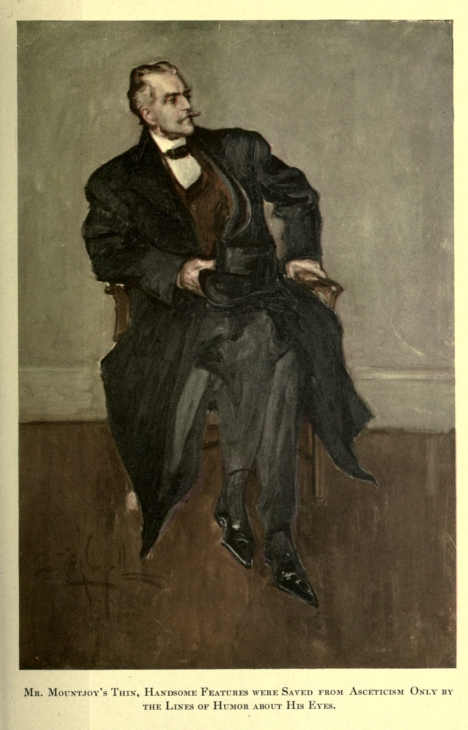
Early the next morning Mr. Mountjoy, the district
attorney, and the Coroner were seated in the former's
office with a flat desk between them. Upon this
set forth in orderly array, were the letters, papers, and
other personal effects gleaned from the pockets of the dead
man; dominating the whole was the sinister and grewsome
little silver blade,—Doctor Westbrook's paper-knife.
The regard of both officials rested upon it as they
meditated and waited for the Captain.
Remove those bloodstains and the weapon became a
dainty toy, but withal a dangerous one. The point was
like a needle's, and terminated a slender, tapering blade,
silver-like in its brightly polished steel, two-edged, and of
indubitable fineness. The guard, a solid piece of beautifully
engraved gold, was shaped somewhat like a Cupid's
bow, while the hilt, of silver, was decorated with an
intricate, graceful pattern of chasing, inlaid with gold, and
surrounding a scroll upon which was engraved in script the
single word:
Paquita
The chasing, in addition to being an exquisite work of
art, possessed also the utility of supplying an excellent
purchase for any hand grasping it.
And what hand was upon that pretty hilt when last it
was held in anger? Whose fingers had tightened slowly
over the dainty feminine name, as the unsuspecting victim
approached? Did "Paquita" contain a hidden charm—some
invisible potency—to guide the hand to its hideous,
self-appointed task?
Alas, if it could but tell! If, instead of the prænomen,
redolent as it was of fresh maiden innocence, the scroll had
borne some word pointing to the assassin! And yet, after
all, could it be possible that the momentous intelligence
actually was there, and only human eyes were blind? If
such be the case, it will require a vision more than human
to seek it out and read what is there written. Surely; for
the weapon bore no other mark or testimony.
The District Attorney's voice disturbed the quiet.
"It is an amazing thing," said he, in a speculative tone,
"what a nice tangle this case is beginning to promise.
Relate the bare facts, as we know them, to any disinterested
person, and he would instantly say that Mobley Westbrook
committed the deed. To be suddenly come upon, a smoking
dagger in your hand—standing over a dying man—the
provocation supplying a motive—and all that—h-m-m! pretty
bad."
But Mr. Mount joy the next instant laughed in a way that
signified it to be the height of absurdity to think of
Doctor Westbrook as a murderer.
"There is not a phase or side of the man's character,"
he continued, "with which the crime can be made to fit.
I can more easily imagine Mobley Westbrook—but of
course I know him so well that personal bias influences
me largely in his favor. It would require evidence quite
conclusive, though, to move me to proceed against him.
It's queer, anyhow, a family of their quiet, humdrum
respectability being mixed with an affair of this nature,
even remotely; there is more behind it than we now imagine;
and I believe there will be plenty of work for one John
Converse."
As if this colloquy had been a scene on a stage, and the
two last words a cue, the door opened, and the Captain of
detectives himself entered. He walked to the desk with
manner quiet and deferential, gravely returning the
salutations of the two officials seated there.
"Here's John to speak for himself," said the Coroner.
"Theseus has come to lead us from this labyrinth of
mystery," laughed Mr. Mountjoy. "Silent and enigmatical
servant of Destiny, who knows what momentous knowledge
is hidden behind that impassive exterior? John, are you
ready to point the stern and unrelenting finger of denunciation
at the guilty wretch, and say, 'Thou art the man!'?"
But the Captain did not respond to the lawyer's bantering
humor. Instead, he seated himself on one side of the
table, remarking merely:
"Gentlemen, this is a very serious case."
"Serious!" cried the District Attorney, his mood in no
wise changing. "Serious? which is but one method of
informing us that there has been a dearth of clues." He
suddenly leaned forward, rested his elbows upon the table,
and interlocked his slender fingers. "Come, John, what
have you discovered?" he concluded more soberly.
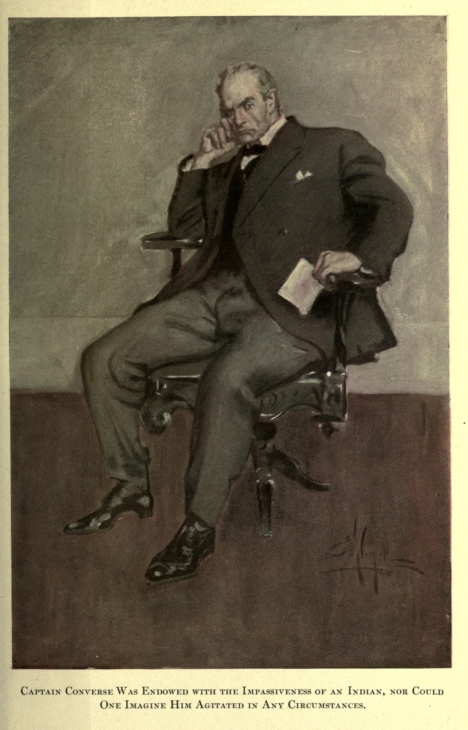
CAPTAIN CONVERSE WAS ENDOWED WITH THE IMPASSIVENESS
OF AN INDIAN, NOR COULD ONE IMAGINE HIM AGITATED
IN ANY CIRCUMSTANCES.
For answer Mr. Converse drew forth his large and well-worn
pocket-book, from which he took one by one, and laid
upon the desk, two slips of paper, a small hairpin, two
half-consumed cigarettes—the paper of which was a dark
brown, like butcher's wrapping-papers—and lastly, a dainty
bit of cambric and lace, to which clung a delicate odor of
stephanotis,—a lady's handkerchief.
Mr. Merkel adjusted his spectacles; the District
Attorney became wholly serious; and together they bent over
the grotesque assortment, staring as though the mystery
might be disclosed then and there.
Presently both sat back in their chairs, and turned
expectantly to Converse.
"Well, sir," he began gravely, "I believe we must look
to a certain lady for a detailed account of her connection
with this case."
"A woman!" ejaculated the lawyer. "Well, I am not
surprised; it could not promise much without a woman—no
more than that affair of the Garden could have been
without Eve.... And do you know who she is?"
Mr. Converse raised a protesting hand.
"No," said he; "not yet. But a woman was in Mr. Nettleton's
offices so close to the time the crime was committed
that her presence is quite the most important factor
at present—that, and Clay Fairchild's disappearance."
Both listeners showed their astonishment.
"So that young Fairchild has disappeared, has he?"
remarked Mr. Merkel. "I always thought he was a steady
sort of chap. But you can never tell about these young
fellows, especially when they get tangled with a woman. I
wonder who she is?" he added, musingly, and colored
when Mr. Mountjoy laughed.
"That is just a puzzling feature of the thing," the
Captain resumed. "I have had no trouble in securing a
complete record of the young man's private life, and it proves to
be unexceptionably clean. No woman figures in it to any
great extent. Young Fairchild is very poor; but he is the
head of one of these old families here, and is on a footing
with people like the Westbrooks, the Nettletons, and their
class, that a great many with more money can't boast of.
He is one of 'the quality'; and though his poverty prevents
him from figuring at all in society, he is nevertheless
a frequent visitor in many of the best homes in the city."
"Aye, I know those Fairchilds," said Mr. Mountjoy,
nodding his head slowly; "fine old stock, but dropped
from sight since Dick, the scamp, went smash. There's
a girl, too, isn't there? Mother an invalid? Thought so.
Proceed, John."
"It appears that he was always a studious boy," Mr. Converse
went on, "and there is only one thing that seems
to be in his disfavor. It is this: although he has been
acting as Mr. Nettleton's clerk and stenographer, and is
a notary public, he entered Mr. Nettleton's office for the
purpose of studying law. Now, Mr. Nettleton says that
while young Fairchild was diligent in his duties, and
possessed of no bad habits, he disappointed his patron by
evincing a lack of interest in his studies, which he gradually
came to neglect. It seems that he has literary aspirations,
and his present vocation is a necessity. His mother and sister,
excepting for a little property belonging to the latter, are
both dependent on him, and he has always been particularly
solicitous of their welfare. I must confess that his
lighting out the way he has, and our failure to find the
slightest trace of his whereabouts, coupled with the
circumstance of the woman, are at present very puzzling. But
we will get to this later; we can secure a better grasp of the
entire situation by commencing at the beginning.
"Well, when De Sanchez entered the Nettleton Building
yesterday evening there were in the east end of the second
floor at least five persons,—Doctor Mobley Westbrook,
who was in his reception-room; Fairchild, who was in one
or the other of Mr. Nettleton's rooms; Mr. Ferdinand
Howe, who was in the Doctor's laboratory; William Slade,
who was in Room 6; and some woman. Mr. J. Howard
Lynden entered the building only a few seconds after De
Sanchez, and both were bound for the Doctor's office. It is
self-evident that the criminal was present also, and I can
account for no one else. Indeed, unless the witnesses were
blind or are now resorting to deliberate falsehood, it is
absolutely impossible that any person besides those indicated
could have been present.
"Of the six individuals named we may at once drop
Slade and Howe, leaving us Fairchild, the woman, Doctor
Westbrook, and Lynden to be considered as possibilities.
"Beginning with Fairchild, and in connection with the
lady, I will preface what I have to say with the statement
that his place in the case is very difficult to determine; but
that it is at least of great moment, I am convinced.
"For the present there is only a hypothetical motive
for his curious behavior; but he was in the neighborhood
of the crime at the time of its commission, and did not leave
the building until several minutes afterward—and then
under very peculiar circumstances. The hypothetical
motive by which I shall try to explain his conduct is affection
for the woman.
"Now, the hall dividing the rooms in the eastern wing of
the Nettleton is just twelve feet wide, and we may take it
as an established fact that the blow was delivered between
Doctor Westbrook's entrance and the hall door to Mr. Nettleton's
private office, the two doors being directly opposite
each other. We may even go a bit farther and say that
De Sanchez was closer to the Doctor's door, for, owing
to the nature of the wound, all volition was immediately
removed from the deceased's movements. The act of his
falling through the door would indicate that he had already
turned to enter the Doctor's office, was close to it, and was
projected through the doorway simply by the momentum
of the speed at which he had been walking. That gives us
four possible routes whereby the murderer could have come
into contact with his victim at the spot mentioned, and it is
necessary to bear these in mind:
"1. Through the hall from the stairway;
"2. From Doctor Westbrook's office;
"3. Through the window at the end of the hall,
which opens into the light-well; and
"4. Through Mr. Nettleton's private office.
"Assuming the truth of all the statements, the story I
obtained from Lynden obviates the first; number two we will
set aside on the strength of Doctor Westbrook's statement,
partially corroborated by Howe. Regarding the third
route—that is to say, the hall window opening into the
light-well—we have two persons who were looking into the
light-well from two different points, from about five minutes
before, and during the time the deed was committed, until
several seconds thereafter. These two are Mr. Howe and
Judge Elihu Petty, of Petty & Carlton, who was looking
from his window in the Field Building, diagonally across from
where Howe was standing. Both these gentlemen are positive
that no one entered or left the Nettleton hall window,
and that there was no movement of any kind at any of the
other windows during the time they were looking into the
light-well. Indeed, it seems impossible that there could have
been under the circumstances. Looking from any of the
windows mentioned, the entire light-well is within one's
range of vision; and while it is true that twilight had set
in, it was by no means dark or even nearly so when the
deed was committed; and we may assume that it was
impossible for anybody to have entered the hall by way of the
light-well without attracting the attention of either Howe
or Judge Petty.
"Fortunately we have a basis from which to estimate the
exact time the blow was struck, and, in fact, all the other
known incidents in this affair. That was the five o'clock
whistles. We may set it down, then, as another established
fact, that the blow was delivered in not to exceed four
seconds of that hour. Howe knows the exact time he took
up his position at the laboratory window; it was there he
was standing when De Sanchez fell through the reception-room
door, and at that moment he heard the whistles begin
blowing. Judge Petty remembers the circumstance also,
and connects it with Howe's sudden disappearance from the
laboratory window; and Doctor Westbrook is now able to
recall the fact of the whistles blowing being coincident with
the deceased's tragic entrance.
"These facts confine us to Mr. Nettleton's private office
to seek a solution, and there we find a number of
circumstances justifying a closer examination.
"The facts here warrant the following assumptions:
That between four-thirty and five o'clock yesterday afternoon,
Clay Fairchild and some woman—name unknown—were
in Mr. Nettleton's offices; that Mr. Fairchild did not depart
until after five o'clock; that the lady was familiar with the
arrangement of the second floor; that so far we know no
one who either saw her enter the building, or saw her while
she was inside it, or saw her leave; that she went into
Mr. Nettleton's private office from the hall, where she stood
behind the door for a while; that she next tiptoed on through
to Mr. Nettleton's general office, where she stopped again
at the connecting door, close by Fairchild's desk, at which
point, in her agitation, she dropped this handkerchief into
the waste-paper basket. She then made her way to the hall
door of Mr. Nettleton's general office, where she again
stopped behind the door, as though waiting for some one
to pass.
"Now, if this woman was the assassin, her actions are
easily explained. She stood behind the private office
door—whence, with the door ajar, one has a view down the
length of the hall to the stairway—and awaited the
victim's approach; just as he turned to enter the Doctor's
office she sprang out and administered the death wound,—in
such haste to get back that she made no effort to
recover the weapon, but hurried on through Mr. Nettleton's
office to the hall door of the general office. Here warning
footsteps announce that there is some one else in the hall,
and standing close to the partially opened door, with her
hand on the knob, she waits until Lynden passes. It is
but a second after that he is standing at the threshold of the
Doctor's open door, overcome by the scene it discloses, and
both deaf and blind for a moment to all else. She takes
advantage of that moment to pass on down the hall to the
stairway, and so out of the building, probably unobserved
by any one except Fairchild. An agile person would have
had just about time before Lynden appeared at the head
of the stairs to strike such a blow as killed De Sanchez, and
then either spring into the light-well or run into
Mr. Nettleton's office.
"Now, all this could not have happened without Fairchild's
knowledge, and we are not lacking light on his
participation in the murder under the theory I am now
unfolding.
"Under the circumstances, knowledge can mean only
connivance. The known facts coincide precisely, and
explain every hypothesis upon which this theory is based;
and to get at his connection with the affair, please observe
these two bits of paper."
Mr. Converse unfolded one of them, and flattened it on
the desk, and as he did so, asked:
"Is it not singular that two men, apparently unknown
to each other, should have betrayed interest in Doctor
Westbrook's paper-knife in an identical manner? But such
is the fact.
"This one was torn from a sheet of typewriter paper,
such as Fairchild uses; I found it on his desk. Here we
have a fairly good drawing of the dagger in question, made
painstakingly, and as though to illustrate a verbal description.
But he drew it from memory, as a close inspection of the
sketch will indicate. He has either omitted or distorted
several little details which not only appear quite plain on
the dagger itself, but are quick to catch the observer's notice.
But most convincing of this circumstance are the words
alongside the picture blade in Fairchild's handwriting,
'about 6 inches.' The blade is, in reality, exactly five inches
long: then why, if he had it before him, together with the
office ruler, which lay on the desk, should he have guessed
at the blade's length?
"This other came from Doctor Westbrook's desk in the
reception-room. It is widely different from Fairchild's
drawing, and was made by a person who is something of
an artist. Furthermore, he had the weapon before him, for
the intricate design on the hilt is copied faithfully; besides,
many trifling details, such as the peculiar shape of the little
knobs at each end of the guard, the script in which the word
'Paquita' is engraved, are all rendered exactly in the sketch.
From it we are even able to form an idea when it was
drawn: some time on the evening of November third, or
the day before the murder. So we may say that the weapon
had not been removed from the Doctor's table prior to that
time. Observe this spattered blot and the hole in the paper
beneath it. That was caused by the artist bringing the pen
down on the paper with such force that the pen broke, the
ink was spattered, and the paper perforated as you now
see it.
"Doctor Westbrook has four penholders on this table;
but he is so partial to a particular one of them that he
invariably selects it in preference to the other three when he
wishes to write. He used it about four o'clock Tuesday
afternoon—the third—and did not have occasion to use
it again till yesterday evening, when he started to write the
letter to De Sanchez. Then he discovered that the point
was bent and broken; and we may infer the sketch to have
been made between four o'clock on the afternoon of the
third and five o'clock last evening.
"During that time a score or more of people were in and
out of the Doctor's office, and we have no handwriting to
guide us in this instance, as the word 'Paquita' here is a
faithful copy of the script in the scroll—too faithful to
betray many individualities. But still, it is easy to infer
who sketched this dagger. Observe the blot again: it is
located immediately at the end of the word 'Paquita,' and
was made just as the artist concluded that word. Now,
what emotions would cause one to so maltreat a pen?
Anger or impatience,—the two being very near akin. It
follows there was some suggestion in the word 'Paquita'
which angered the artist; and this immediately suggested
to me the man Vargas.
"On the evening of the third he called at Doctor
Westbrook's offices in company with Señor de Sanchez. He
and the latter were negotiating the deal involving the deed
and the shares of stock in the Paquita Gold Mining
Company, and, as I have found out, Vargas was having some
difficulty in closing the matter. Only that afternoon had
they come to an understanding; but De Sanchez had not
yet delivered the papers. Vargas was becoming very
anxious and impatient over the delay of getting them into
his possession. When they called on the Doctor Tuesday
evening, the latter and De Sanchez retired to the
consultation-room, leaving Vargas in the reception-room, and as he
sat idly at the table his eye was caught by the dagger, and
he fell to sketching it. The word 'Paquita' on the hilt
brings suddenly to mind his anxiety and impatience; and
by a natural, involuntary gesture he ruins the Doctor's pen
and blots the drawing.
"I will interpolate here, so that we may dismiss him,
that this person Vargas attracted my attention owing to the
very fact of his presence in the city at this time, his association
with deceased, and the coincidence of the name 'Paquita'
occurring both on the dagger-hilt and as the name of the
mining company. But I have been able to follow the
negotiations between the two, and to trace Vargas's movements
all yesterday afternoon, and each succeeding fact tends
cumulatively to absolve him from any participation in the
affair. Warren, a clerk at the La Salle House, knew of the
deal; both parties frequently talked about it in his presence;
and it evidently was just what it appears to be. We are
extremely fortunate in having this unprejudiced witness to
save confusion upon this particular point. On the
afternoon of Tuesday De Sanchez and Vargas approached him
in rather an elated mood, and invited him to join them in
a bottle of wine to celebrate the consummation of the
negotiations. Right there, you see, this deal is removed from
the chance of being a motive. As the party separated, De
Sanchez mentioned half-past four on the following afternoon,
yesterday, as the hour for delivering the papers. Vargas
was on hand promptly at the appointed time, but the
other was not; and after waiting, with growing impatience,
the former left the hotel and did not return until about six
o'clock. But it is not probable that he entered the
Nettleton Building near the time of the murder, for it would
have been utterly impossible for him to do so without being
seen; and he was still awaiting De Sanchez when informed
of his death by the clerk, Warren. Then he hastened to
Doctor Westbrook's offices.
"Now, let us return to Fairchild. I learned a fact of
some importance from the Doctor this morning. Yesterday,
as he was leaving his office at about one o'clock, he met
Fairchild at the reception-room entrance; the latter, in a
hurried manner, asked Doctor Westbrook if he could
borrow the dagger for a few minutes, to which the Doctor
assented. Doctor Westbrook continued on out, not giving
the matter another thought, while Fairchild went into the
reception-room. The Doctor don't know whether he got
the dagger then; as a paper-knife, the Doctor uses it only to
cut magazines or books, or the little papers in which he puts
up powders—and often, when it is not right at hand, he
resorts to his pocket-knife, rather than hunt for it in the
mass of magazines and papers that usually litter his table.
It could easily be absent from its place several days without
his missing it.
"Mr. Nettleton left his office yesterday afternoon at
four-thirty, and he had no lady callers during the entire
day; hence the following assumption—for want of a better
one—will fit the present theory: During the noon hour,
while Mr. Nettleton was at lunch, Fairchild and the woman
were together; the crime was contemplated and discussed
between them, the man volunteering to secure the weapon;
which he did, but was surprised by encountering the Doctor,
who generally goes out to make his visits at that time
of day.
"However, she was the active spirit; hers was the hand
that held the weapon, while the more timid man waited at
his desk in the adjoining room. There she paused in her
flight, and told him the deed had been committed; and
there he waited until about a quarter-past five, when, moved
by that irresistible impulse which leads some murderers to
gloat over their handiwork, he crossed the hall and looked
upon the dead man. This happened while Lynden was
on his way to headquarters with the news of the murder.
Fairchild's actions were so singular that they attracted
both Doctor Westbrook's and Howe's attention. Overcome
with horror, he turned and fled without a word. That
is the last seen of Clay Fairchild, and that is why I sent
a note to Barton and Adams, who were waiting below, to
find him.
"Under this theory I can as yet conjecture but a single
motive—Fairchild's interest in the woman; and as to what
hers is, we must wait until her identity is established."
Converse paused. His eyes narrowed, and he ran the
tip of his tongue across his lips with a deliberate lateral
movement.
"I'd like very much to lay my hand on that fair lady,"
said he, presently, in a quiet manner; but an observer
might have remarked that a shudder convulsed the corpulent
figure of Mr. Merkel, and that Mr. Mountjoy shot at him
a quick, keen look, and then nodded his head in silent
approval.
The Captain went on at once.
"There is one incongruous element in this theory,
however. When the blow was struck the deceased was in the
act of turning toward Doctor Westbrook's door, and
consequently his back was almost squarely presented to
Mr. Nettleton's. The wound, as you know, is not only on the
left side of the throat, but tends backward toward the spinal
column, which the point of the blade penetrated. Suspended
from the centre of the hall, and on a line with the
centre of the two doorways, is an electric light. Now, then,
the murderer coming from behind the victim could, under
the present circumstances, strike the blow in one of two
ways: it was either a left-handed person, or, if right-handed,
the murderer must have stepped to deceased's left, and a
little in front of him, facing in the same direction, and struck
to the right and backward. If the latter theory is correct,
the murderer would have been between De Sanchez and the
hall window opening into the light-well, and so close to the
window that he—or she, if it was a woman—would have
been not only plainly visible from the windows on the
opposite side of the light-well, but would have cast a distinct
shadow because of the electric light. If the murderer was
left-handed he would not have been obliged to go so far to
De Sanchez's left, and consequently would have remained
so nearly beneath the electric light that the only shadow
would have been on the hall floor.
"Now, from the point where Judge Petty was looking
into the light-well, one cannot quite see Doctor Westbrook's
door through the Nettleton hall window; but the hall
window would be so far within such a person's range of
vision that the slightest obscuring of the light would attract
notice. Judge Petty recollects that the light was burning
at five o'clock yesterday evening, and he is positive that
there was no shadow at the hall window, and that no one
approached close to it while he was looking into the light-well.
"Now mark this—at least, as a singular coincidence—while
Doctor Westbrook is not what you might call
left-handed, he can use both hands equally well."
"Ambidextrous," suggested Mr. Mountjoy.
Converse nodded. "Exactly," said he;
"ambidextrous." He continued:
"Regarding the woman's identity, now there are one or
two little points deserving special attention. Lynden states
positively that he neither saw nor passed anybody in the hall
nor on the stairway; yet, there was something about
Mr. Nettleton's offices and the indications of a woman's recent
presence there that disturbed him strangely. While in the
very act of asserting that he had neither seen nor passed
anybody, he stopped as though struck by a sudden doubt,
although he did not alter his statement. A similar
incident happened with Howe while we were all gathered in the
Doctor's office last night after the murder. He also paused
in the midst of a statement that there was nothing to
indicate who the assassin might be, and Lynden was
impressed by his hesitation, as though it reminded him of his
own. Are these gentlemen trying to conceal anything?
What possible object could Howe have in doing so? Yet I
believe that both of them are perturbed by some misgiving
which they hesitate to put into words. Their doubt may
contain the key to the whole riddle; but it will be a delicate
matter getting at it. Assuming that it points to the lady's
identity, we may surprise one or the other of them into
betraying it; but it is no easy task to make a man speak of
something which he will not admit even to himself."
"Your deductions seem natural," said Mr. Mountjoy,
at length. "But this unknown woman? Is
there any one in the city to whom you could ascribe
a motive? Will you have to go into the past record of Señor
de Sanchez? And Fairchild—Heaven knows there can't
be anything between him and such a mysterious, blood-thirsty
female. How are we to account for his participation
in the crime? I think it well to secure such a record;
also De Sanchez's association with General Westbrook in
Mexico. There is no telling how the darkness may be
illuminated from some unexpected quarter. At present,
John, to me it is completely baffling."
But Mr. Converse had neglected nothing that his experience
suggested as being a likely means of casting light
upon the crime.
"Yes, sir," he rejoined, in his steady manner. "Yes,
sir; I admit the case offers many puzzling phases, and
apparently contradictory circumstances; but you must
remember that we have been at work on it less than
twenty-four hours; the woman's identity may be shown in a
manner we cannot now imagine, and any hour may bring the
news of Fairchild's apprehension.
"Besides, I have been beforehand in looking up the
deceased's past. I should receive a telegram from Mexico
to-day. The net is well spread, I think. A man is
watching Fairchild's house—in fact, the whole department are
keeping a look-out for him; and the other actors are being
shadowed by capable men."
"But from all the facts in your possession," interrupted
Mr. Mountjoy, "have you considered the possibility—aside
from the statements of the witnesses, I mean, and
simply upon what you know to be the facts—of either
Doctor Westbrook or Howard Lynden being the assassin?"
"Yes, sir, I have," was the reply. "But for the present
we may dismiss them shortly, though I shall not cease to
consider every development in this case in the light of its
possible application to all the parties.
"Could the Doctor, then, have delivered the fatal thrust?
From the present facts we must give him the benefit of the
doubt, and abide the results of further investigation. It is
very fortunate for him that his friend Howe happened to
be present just when he was; and it is strange, his coming
all the way from Georgia to be a piece in this puzzling
game. But here he is.
"Howe's importance arises from the peculiar acoustics
of that portion of the Nettleton Building about Doctor
Westbrook's office." Converse then told of his experience
with Lynden in the Doctor's laboratory, concluding:
"It is not at all surprising that Howe could not hear a struggle
in the hall, while, at the same time, he could hear such
faint sounds as the scratching of a pen and the rustling of
paper while the Doctor was writing in the reception-room.
"As for Lynden, we have to show he so quickened his
pace that he overtook De Sanchez at Doctor Westbrook's
door. He shared with all the frequenters of the Doctor's
office a knowledge of the dagger and where it usually
reposed. Under such a theory, however, Lynden's actions
would have displayed a carelessness and a reckless disregard
for consequences which I don't think the man capable of.
He did not know who had or had not gone home from the
other offices that line the hall, and the deceased was not
surprised by the sudden onrush of a determined murderer.
Had such been the case, how about Doctor Westbrook's
statement that De Sanchez came on steadily to the reception-room
door?—for, singularly enough, in the reception-room
one can hear quite distinctly sounds arising in the hall.
Besides, the Doctor does not remember having heard Lynden
at all until the young man grasped his arm."
"Well, now, tell us of the cigarette stubs." This from
the District Attorney.
Converse picked them both up, one in each hand, and
contemplated them with uplifted brow and puckered lips.
"Gentlemen," he began at length, "these two snipes
have caused me more mental worry—I have had more
trouble in fitting them into any place where they could
belong—than anything else concerning this case.
"You will observe that both of them are but half
consumed, and that when rolled neither was moistened by the
tongue to hold it together. Any one who has travelled in
Mexico or the extreme Southwest will recognize this as a
national and local characteristic. The paper of both is
identical—coarse and a dark brown; and the tobacco is
from a black Mexican growth. I suppose, outside the Mexican
quarter you could not find a man in the city who smokes
such a cigarette—excepting Vargas. It is just such a
cigarette as nine out of ten of the lower class of
Mexicans—men, women, and children—smoke. Yet the tastes
of neither De Sanchez nor Vargas were too fastidious for
them; the papers and tobacco are identical with those
found in the deceased's pocket, and they are just like those
Mr. Vargas smokes.
"The first I picked up near the top of the Nettleton
Building stairway, while I was accompanying Lynden to
Doctor Westbrook's offices; the second I found on the
skylight at the bottom of the light-well. The ends that had
been held in the mouth were still moist when I found them,
so they had not been long discarded. De Sanchez, of course,
is responsible for the first; but how about the other?
Could he, after throwing one cigarette away at the point
where I found the first, roll and light another and smoke
it half up as he walked down the hall, then flip the second
out the hall window into the light-well just before turning
toward the Doctor's door? I believe not.
"The second could have come from any window abutting
upon the light-well, of either the Field or the Nettleton
Buildings. But who threw it, and why was he there at
that particular time? Well, it took two men more than
an hour this morning to eliminate all except five windows
out of a possible twenty; and those five told nothing. I
examined them myself. Yet it might be possible that the
second stub came from the unknown woman.
"Did she steady her nerves and beguile the time until
her victim's approach, with a cigarette? It may be—"
Here, for the first time, Mr. Merkel interrupted.
"A Mexican woman!" he fairly shouted; "some dark-eyed
señorita—" His enthusiasm suddenly cooled as Mr. Mountjoy's
look of surprise at his outburst rapidly changed
to one of much meaning.
At this juncture the door opened, and a clerk appeared
from the outer office, holding a telegram in his hand.
"For you, Captain," said he, handing him the message.
Neither of the other two could conceal his impatience,
as, with annoying deliberation, Converse opened the
yellow envelope.
"Well," said he, presently, "it is indeed from Mexico—the
reply to my inquiry. Here it is." He read aloud:
A. de S. has no police record, but have obtained following
facts: Age, 38; family, old, aristocratic, and very
wealthy; A. educated in Paris; returned here when twenty-one.
Was in banking and broking business several years
ago with P. Westbrook, but severed partnership about four
years ago. Reason not known. A. always prominent in
society; rather wild when young; but nearest approach to
woman entanglements are following: Engagement broken
with Señorita Aurora de Pacheco. Understood to have
been by reason of disagreement in marriage settlements.
She has since married into prominent family, and now on
best of terms with De S. family. A rumored liaison with
a circus performer, supposed to have committed suicide,
but unable to ascertain details; liaison with a Mme. Claude
Le Tellier, now residing Nice, France, on pension from De
S. family. For last twelve years A. de S. known as unusually
steady. Rumored he fell in love with Miss Westbrook
when she visited here about four years ago, and that he has
followed her for purpose of marrying. GRINNELL.
"Well!" said the District Attorney, "this is not
promising: Señorita Somebody"—with a sidewise look at
Mr. Merkel—"now a matron and probably the mother of other
señoritas; a circus performer—"
"It's the madame that interests me," Converse quietly
broke in. "Grinnell would not, of course, know whether
she is in Nice at the present time. I will go to headquarters,
ascertain who our correspondent at that place is, and send
him the lady's name. That should bring us what we want
to know about her.
"That is about all now," he concluded. "I have gone
over these different phases of the case in order that you might
formulate a line of inquiry to be followed at the inquest.
In the meantime, I will work out one or two little ideas of
my own, laying the results before you as soon as they mature.
Good morning."
That day Mr. Converse received two more messages, one
of them a cable despatch. The first read:
Rumor connecting A. de S. with circus performer very
vague. Seems to have occurred in Paris 17 or 18 years ago.
No trace of her identity here. GRINNELL.
The cablegram contained the following:
Mme. C. Le T. died Oct. 28. GAILLARD.
He tossed the cable message to one side; but for several
minutes he pondered over the second message from Mexico.
He then prepared, with much care, a long despatch, which
was sent immediately to Paris.
Away from the presence of his superiors and those whose
concern it was to be put in possession of everything
bearing upon the case, John Converse was the last man to
advance any theory to account for Alberto de Sanchez's
untoward end.
His seemingly unerring judgment and his uniform success
in dissipating the clouds of mystery in which his associates
sometimes lost themselves were governed by an extreme
caution, and based upon a vast knowledge of humanity.
His had been an unusually eventful life. Of New England
parentage, he had early run away to sea; and to portray the
stirring experiences of this period of his life would require
a whole volume for itself.
But those experiences had given him wonderful powers
of observation, which were able to grasp and contemplate
every detail in its just proportions to the whole, a trait that
was simply the complement to his unemotional and methodical
temperament.
If he hesitated, however, in advancing theories, the papers
did not,—either probable or improbable; and as it was
one of his maxims never to ignore a suggestion coming
from the outside, he followed these reports with the same
intensity of eagerness that characterized all his proceedings.
The murder, owing not only to the prominence of every
one concerned therein, but also to the suggestive veil of
mystery which surrounded it, had been "featured" every
day since the tragedy, and he was impressed by the unanimity
with which the press hit upon Robert Nettleton's offices as
the probable lurking-place of the murderer.
None of the papers, of course, was in as full possession
of all the known facts as the Captain was; but a certain
evening sheet, after theorizing at length on Fairchild's
unaccountable disappearance, concluded with the assertion
that the end would show the controlling factor of the
mysterious murder to have been a woman.
"I believe that gentleman is eminently correct," was the
Captain's comment, as he laid the paper aside. "If his
insight had been only a little clearer, if he had looked only
a little farther, and seen who that woman is, it would save
a deal of trouble and worry."
He left his private office and walked to the mail repository
at the police clerk's desk. He found several letters addressed
to himself; but one, the writing of which was very like
copper-plate engraving, caught his instant attention by the
peculiarity of its address. It read:
For Detective on De Sanchez Case,
Police Headquarters,
City.
After the Captain had returned to his desk he turned his
attention to this letter. The mark of the cancelling-machine
showed that it had been mailed at the main post-office that
morning. What the envelope contained made him suddenly
sit upright.
The writer knows that C. Fairchild had no hand in the
murder of the man De Sanchez. When you discover the
female who was in the second story of the Nettleton on
Wed. P.M., Nov. 4, at the hour of 5, you will know why C. F. has
vanished.
Again—the unknown woman!
There was no address to this brief epistle, no date, no
signature—nothing else; yet there was an added light in
Mr. Converse's gray eyes, as he laid the missive on the desk
before him, that lent something like an expression of
satisfaction to his almost illegible countenance. He scrutinized
the single sheet of paper long and attentively before finally
folding and returning it to the envelope.
"Who in the city can write such a hand?" he mused.
After he had placed the anonymous missive in his
pocket-book, he drew toward himself a number of bound
typewritten sheets—the record of the De Sanchez case.
Turning until he found the paragraphs he sought, he read
the following:
Besides the front entrance, opening into Court Street,
the Nettleton has but one other outside doorway or means
of exit. Opening into a high-walled court in the rear
is a single door, used only for the purpose of admitting
fuel in the winter; during the summer it is open not more
than once or twice, when the trash-bin accumulations are
removed. During the interim it is locked by a bolt, a No. 4
Yale compound spring lock, and a common padlock passed
through staples. Inspection of this door revealed beyond
doubt that it had not been disturbed for weeks.
The reader turned back to the statements of the different
persons in the second story at the fatal moment, and his
glance passed them all over until it fell upon the following:
William Slade, 62; bachelor; abstracter of titles for the
Guaranty Trust Co. Is very deaf; was engaged in his
regular duties in Room 6 on the evening of Nov. 4, at 5
o'clock, yet it cannot be shown that he knew anything of the
murder. His statement is to the effect that he first learned of
it at about 8:30 o'clock that night.
He closed the volume, placed it in a drawer of his desk,
and after securing his hat, left department headquarters,
and made his way to Court Street.
Here he consumed the better part of the day by interrogating
closely every individual whose place of business
had an outlook toward the Nettleton entrance, a quest the
results of which were purely negative. He called at all
the newspaper offices; and the next morning, again in the
evening, and for a week thereafter, every local paper
contained the following advertisement:
          ┌─────────────────────────────────────────────────────┐
          │                 $25--REWARD--$25.                   │
          │                                                     │
          │  The above sum will be paid any person who saw      │
          │  a lady leave the Nettleton Building at or about 5  │
          │  o'clock on the evening of Wednesday, Nov. 4th.     │
          │  Apply in person at No. 18 Ash Lane.                │
          └─────────────────────────────────────────────────────┘
The address given was that of the house where Mr. Converse
had his lodgings; and whatever else he might think of
the De Sanchez case, it was evident he had become
convinced that there was "a woman at the bottom of it"—and
one very hard to find.
Late in the afternoon, after he had returned to his private
office, he found the reply to the cable message sent his Paris
correspondent awaiting him. He opened it and read:
Nothing ascertainable of A. de S. here further than that
his name appears on the roster of College of St. Ignatius for
three years, inclusive, September, 1883, to September, 1886.
Examination of records of women suicides during period
fails to connect him with any of them. No one during that
time or near it could be circus performer. Might glean
something if I had name. NOIZET.
Unfortunately, he had no name to send.
Mr. Merkel was not in readiness for the inquest
into the Nettleton Building affair until the Monday
following; and at the hour set for the hearing the
outer of his two offices, which made a fairly large courtroom,
was literally packed by a throng of gaping, perspiring
spectators.
In a corner by themselves sat the witnesses who were to
testify. General Westbrook is of this group; also J. Howard
Lynden, plainly ill at ease. The Doctor and his friend,
Ferdinand Howe, are seated behind the General, an expression
of concern on their countenances that is noted and
commented on by the crowd. Why should Dr. Westbrook
be so pale? Why should his face be so drawn? The affair
is not of such consequence to him.
Still aloof from the others sits Señor Vargas, lean and
swarthy, his eyes still dull behind their gold-rimmed
pince-nez, and his pitted countenance not yet quickened to an
interest by the sudden tragic death of his compatriot.
Occasionally he coughs in a manner that seems to afford
Doctor Westbrook some diversion from his own pressing
care, for now and then he glances toward the Mexican
gentleman with quite a professional air.
At length the door to the Coroner's private office opens,
and through it file Mr. Merkel, self-important, Mr. Mountjoy,
John Converse, a stenographer, and various clerks
and petty officials. Converse, the Coroner, and the District
Attorney seat themselves about a separate table away from
one occupied by numerous reporters and newspaper artists;
and immediately the tedious ordeal of securing a jury is
entered upon.
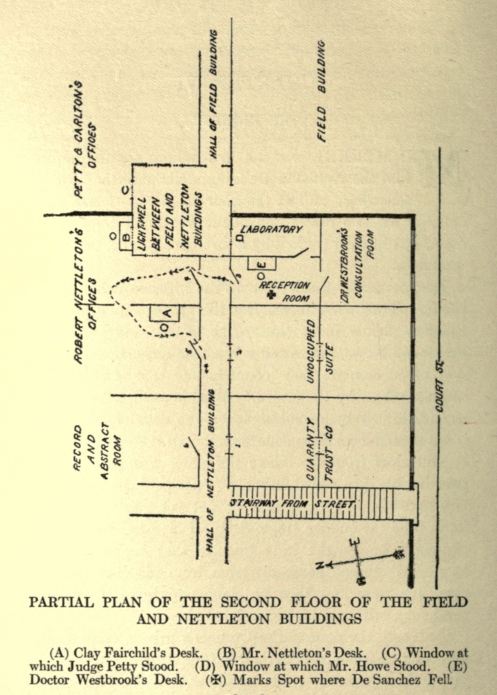
PARTIAL PLAN OF THE SECOND FLOOR OF THE FIELD
AND NETTLETON BUILDINGS
(A) Clay Fairchild's Desk.
(B) Mr. Nettleton's Desk.
(C) Window at which Judge Petty Stood.
(D) Window at which Mr. Howe Stood.
(E) Doctor Westbrook's Desk.
(✠) Marks Spot where De Sanchez Fell
After six freeholders are accepted and sworn in, the
captain of detectives is duly put upon his oath to tell the
truth, the whole truth, and nothing but the truth. A brief
delay follows while the District Attorney asks for an application
of the rule excluding witnesses. The witnesses are
duly excluded.
Captain Converse established the corpus delicti; after
which he related at length the results of his investigation,
very much as he already had told them to Mr. Mountjoy
and the Coroner.
As he returned to his seat by the table, a stir spread
throughout the apartment; a rustling as of forest leaves
before a tempest sibilated upon one theme: the unknown
woman; but the sounds sank at once to anticipatory silence
when the clerk arose and made ready to read from a sheet
of paper in his hand the name of the next witness. Perhaps
the avid curiosity is to be satisfied by the woman's name.
"James Howard Lynden."
On the wall facing the witness-chair was suspended a
large map of those portions of the Nettleton and Field buildings
which formed the locus operandi of the tragedy, and this
Lynden contemplated seriously. The rooms were named
and numbered thereon, the points of interest designated by
letters or otherwise; and the reader is here referred to the
plan (page 88), as occasion may arise, for a clearer
understanding of the evidence.
The witness began his testimony in a well-modulated
voice, which could be distinctly heard in every part of the
room. In reply to interrogatories, he stated that he was a
cotton-broker, twenty-eight years of age, and that his office
was in Court Street, a few doors west of the Nettleton
Building. He had been acquainted with the deceased, having met
him frequently in a social way, but between them there had
never been more than ordinary civilities exchanged. He
next related such facts of the tragedy as he had imparted
to Mr. Converse and the Chief of Police. The Coroner
asked:
"What time did you leave your office on the evening
of November fourth?"
"It was a very few minutes to five o'clock."
"Now, Mr. Lynden, begin at the time you left your office,
and describe in detail the events from then onward."
"I merely walked leisurely toward the Nettleton Building
for the purpose of stopping at Doctor Westbrook's office,
before proceeding to my club for dinner. I have been in
the habit of doing this several evenings in the week, and
last Wednesday evening was no more eventful than scores
of others until I arrived within forty or fifty feet of the
Nettleton entrance."
"And what occurred then?"
"I observed Señor de Sanchez turn in at the entrance."
"What direction was he going when you first observed
him?"
"West—toward me."
"Very well; proceed, Mr. Lynden."
"I continued on to the doorway, where I turned into the
Nettleton Building, going directly upstairs without pausing."
"Did you see Señor de Sanchez?"
"Yes. Just as I began ascending the stairs he was
turning to the right—to the east—at the top. There was a
lighted incandescent lamp at that point, and I beheld him
distinctly."
"Do you know what time that was?"
"It could have been only two or three seconds to five
o'clock, for I heard the whistles begin to blow before I reached
the top of the stairs."
"You are sure it was before you arrived at the top that
you heard the whistles blow?"
"Oh, yes; I haven't a doubt of it. I remember the
circumstance perfectly."
"Now, when you reached the head of the stairs—at the
second story—did you see Señor de Sanchez?"
"No, sir. I saw him no more until I arrived at Doctor
Westbrook's office—until I beheld him dying on the floor
of the Doctor's reception-room."
Responding to a number of interrogations, the witness
added that not more than thirty seconds elapsed between
the time of his seeing De Sanchez turn at the head of the stairs
and seeing him lying on the reception-room floor; that
there was a lighted incandescent lamp before the entrance
to this room; that there had been no one in the hall, and that
it was impossible for anybody to have been concealed there.
He continued:
"When I arrived at Doctor Westbrook's office the door
was wide open. Señor de Sanchez was lying on his right
side, his feet toward the door, and not much more than
a yard beyond the threshold. Blood was spurting,—in
rhythm with the heart-beats, it seemed,—from a wound
in his throat, as though some large artery had been severed.
This ceased in a second or two.
"I paused just at the threshold, dazed and utterly
dumfounded by the sight that met my eyes. Doctor Westbrook,
Mr. Howe, and myself held our respective attitudes three
or four seconds,—possibly it was longer,—but during that
time Señor de Sanchez only breathed two long sighs and
became apparently dead.
"I believe, then, I was first to speak. 'Good God,
Mobley!' I cried, 'What does this mean?' He still seemed
dazed and made no reply. I advanced into the room and
seized his arm, and said, 'For God's sake, tell me! Did
you do this?' I was very much excited, and could not
grasp the full import of what I beheld; but when he felt
my touch, he aroused himself, and, recoiling a step or two,
cried in tones of amazement, 'Jim! Jim! I do this? My
God, Jim! No, no, no!' Then checking himself, he asked
me, 'But who did? You must have seen; who was in the
hall, man?'
"I next looked at Mr. Howe. He was exceedingly
agitated and said nothing. He stood shaking his head
like one whose mind could not digest the horror of the deed.
I turned again to Doctor Westbrook and looked at the
silver-bladed dagger he was holding in his hand. 'But
that dagger,' I said, 'what does that mean?' He looked at
it in a preoccupied manner, as though he did not see it.
Suddenly becoming sensible of the fact that he was holding
it in his hand, he exclaimed, 'You don't think I stabbed
him, do you? Why, man, I just drew the knife from the
wound.' I felt immensely relieved."
A deep exhalation burst from the massed throng, as
though they had been holding their breath in an anxiety not
to miss a word of this recital. Under the influence of this
eagerness and galvanic expectancy, Lynden was growing
restless; but he kept his gaze on the coroner, and continued
to respond to that official's interrogations without
hesitation. In answer to a number of these, witness said:
"I did not identify the dagger at the time. I am
thoroughly familiar with the ornamental little weapon which
Doctor Westbrook uses as a paper-knife, and have handled
it many times. In fact, I was present when it was given the
Doctor by his sister. She secured it, I believe, about four
years ago, during a visit to Mexico, and at the time of the
presentation she told a story—quite a tragic romance—in
which it had—"
"We may omit that, Mr. Lynden," interrupted the
Coroner. "Where did Doctor Westbrook usually keep this
dagger, or paper-knife?"
"When not in use, it always lay on the table in his
reception room."
Every eye was turned toward the dagger as Mr. Merkel
arose and took it in his hand. And not one of those eyes
missed the sombre stains which now dulled the lustre of its
silvery blade.
"Is this the dagger?"
"That is the one that lay on Doctor Westbrook's table—his
paper-knife. I am unable to identify it with the one
he held in his hand; the hilt was then concealed, and the
blade was very bloody; but it might be—I had no such
thought at the time."
Mr. Merkel returned the dagger to the table and resumed
his seat. The District Attorney leaned toward him and
whispered a few words; whereupon—evidently on a
suggestion—he asked:
"Are you familiar with the arrangement of the second
floor of the Nettleton Building, Mr. Lynden,—more
particularly, those rooms to the right or east of the stairway?"
"I am."
"Describe them, please."
Once more Lynden fixed his attention upon the plan
suspended before him.
"Well, to begin with, the Nettleton Building faces in a
southerly direction. From the head of the stairway the
hall extends east to the light-well between the Nettleton and
Field buildings. Beginning at the head of the stairs, the
first room to the right, or on the south side of the hall, is the
first office of the Guaranty Trust Company; the next suite
is vacant, and then comes Doctor Westbrook's suite. I may
add, that the numbers run in the order I am naming the
suites: the Guaranty Trust Company's offices are number
one, number two is unoccupied, and the Doctor's is number
three.
"Now, passing over to the north side of the hall, the
entrance to number four is directly opposite Doctor
Westbrook's. It is the door to Mr. Nettleton's private office.
Next to that, and facing the unoccupied suite, is Room 5,
Mr. Nettleton's general office. Adjoining this is number
six, a room occupied by the Guaranty Trust Company as a
record and abstract room. That brings us back to the
stairway again, but on the opposite side of the hall whence we
started."
"Then there are six doors—three on each side—opening
into the hall?"
"That is correct."
"Now, Mr. Lynden, are not the upper portions of those
doors ground or frosted glass?"
At this apparently harmless and irrelevant question, the
witness's composure dropped from him like a cloak cast
aside; a swift, startled expression came into his light blue
eyes, and he answered with obvious hesitation:
"I believe so."
"Don't you know?
"Yes."
"Well, are they?"
"Yes."
"Then, if a light were burning in one of those rooms
and a person should be standing close to the door of that
room, and on the inside, would there not be a pretty distinct
shadow or silhouette of that person on the ground glass of
that particular door?"
"I should imagine there would," said Lynden at length,
but in a voice both low and unnatural.
"Well, in your frequent visits to Doctor Westbrook's
office at such hours as the lamps were lighted, have you not
observed that to be a fact?"
Without altering his attitude, the young man shook his
head.
"No," said he; "I cannot say that I have."
At the next question an audible murmur of disappointment
rippled through the room. It was as though the
Coroner were searching for something while blindfolded,
and had suddenly taken the wrong turning when about to
lay his hand on the object of his quest. But if he was not
over-astute, he had at least gathered wisdom from
experience—to the extent of knowing that more than one road
leads to Rome.
"Now, then, Mr. Lynden," he began once more, "when
you arrived at the head of the stairs on the evening of
November fourth, did you look down the length of the hall to your
right—to the east?"
Witness answered, with visible relief:
"I did."
"How light was it? Was it light enough for you to see
distinctly?"
"In addition to the two incandescents, the window at
the end of the hall at the light-well was wide open and it
was only twilight outdoors."
"Then, if anybody had been in the hall anywhere between
the head of the stairs and the light-well window, you would
have seen him?"
"I certainly should; there was no one there."
"I must ask you to recollect carefully, Mr. Lynden:
Was there a lady—a woman—in the hall? Or did you
pass a woman either in the hall or on the stairway?"
"Lady!" the witness exclaimed. "No—no; there
was no lady—there was no one in the hall or on the stairs." He
cast a furtive, uneasy glance at the expressionless visage
of Mr. Converse, concluding, "I neither saw nor passed
any one."
"Well, let us return to the head of the stairs. When
you arrived there, what did you do?"
"I proceeded directly to Doctor Westbrook's office."
"As you walked down the hall, did you observe the doors
on either side—whether they were open or closed?"
Here was a return to those mysterious doors. The
young man's grip on the chair-arms tightened, and once
again his answer was preceded by obvious hesitancy.
"Some were entirely closed," he said, slowly; "others
were more or less open."
"Well, which ones were more or less open?"
"Doctor Westbrook's was—" he began; but the Coroner
quickly interrupted:
"Did you notice it first?"
Silence. The young man sat rigid as a statue.
"Please answer, Mr. Lynden."
The insistence was soft, but inexorable. The witness
seemed to have lost the power of speech, and was obliged
to clear his throat before he could reply.
"Sir," he finally began, "I was not thinking of the doors,
nor was I particularly observing whether they were open or
closed. I will say this, however, in the hope that you will
find the information you desire: that it is customary for the
tenants of the Nettleton Building to leave their doors
unfastened when departing in the evening, for the benefit of
the janitor. As soon as he has cleaned the rooms, he locks
the doors for the night. For that reason, I suppose, it would
be safe to assume that those rooms whence the occupants
had gone for the night were unlocked—in the event, of
course, that the janitor had not yet placed them in order."
"The information is valuable, Mr. Lynden; but you stated
that some doors were entirely closed, while others were more
or less open. I will put my question in another way. Which
was the first door you observed to be entirely closed?"
"That to number six."
"Was there a light in that room?"
"Yes."
"Did you observe any shadow on the door?"
"No."
"The next door you noticed to be closed—which was it?"
"The regular offices of the Guaranty Trust Company."
"Any light there?"
"They were dark."
"Well, the next door you noticed to be closed entirely?"
With a visibly growing reluctance to answer, each moment
his voice becoming more and more strained, the young
man replied:
"Number two—the vacant suite."
But the interrogations were relentless.
"The next?"
He moistened his lips, and his voice was barely audible.
"I observed no other doors closed," said he.
"Now, then, we have got this far—note it, please,
Mr. Stenographer,—we have got this far: The doors to numbers
one, two, and six were closed. That leaves three, four, and
five—were they open or closed?"
No one heard the reply.
"Louder, if you please; the jury can't hear you."
"I said that number three was open."
"You have already testified that Doctor Westbrook's
door was open," was the dry remark with which his answer
was met. "Was number four open?"
"I did not notice."
"Not notice?" in a tone of intense surprise. "Did you
not see it?"
"Sir, when I had arrived at that point I was so shocked
by the sight in the Doctor's office that I did not observe the
condition of doors or windows."
"Well, as you passed the door to Room 5—Mr. Nettleton's
general office—you had not yet heard or beheld anything
shocking, had you? Did you notice whether it was
open or closed?"
There was an enthralling significance in the witness's
manner which everybody present felt, and a conviction was
natural that the young man knew something that he was
resolved at any cost not to reveal. It was exasperating
that the Coroner should so play about the mainspring of
the witness's discomposure—as he plainly was doing—without
being able to light upon a point that must force from
him some admission, sufficient at least to serve as a fulcrum
whereby the rest might be pried from him.
"Come, Mr. Lynden, the jury awaits your answer."
The witness's reply came hoarsely, as if it were indeed
literally dragged forth:
"It was not closed—entirely."
"Ah, one of the 'more or less' doors: which was it, more
or less?"
"I do not understand."
"Was the door to Room 5 of Mr. Nettleton's suite open
or closed; and if not closed, how far was it open?"
The young man lowered his head a moment in an attitude
of reflection.
"I should say it stood ajar about three or four inches,"
was the reply.
"Was there a light in that room?"
"Yes."
"Is there not a desk against the east wall of that room at
which Clay Fairchild ordinarily sits, which is visible from
the hall when the door is three or four inches ajar?"
"Yes."
"On the evening of November fourth, as you passed
Room 5, did you observe this desk?"
"I did not; I could not see into the room."
Both Mr. Converse and Mr. Mountjoy were watching
him through lids narrowed to mere slits, with an intentness
of which he was plainly sensible.
"And why not?" came the next question. Lynden
faltered:
"Be—because the—the aperture was closed by—by
something."
"By what?"
"I cannot say."
"Was it a human form?"
Witness's voice was again becoming inaudible.
"I—I cannot say," said he, nervously,—"yes, it
was a human form."
"Was it that of a man or a woman?"
So low that the jury, leaning as far forward as they could,
scarcely caught the murmur, came the answer:
"It—it looked like a woman."
"Did you recognize her?"
Witness considered his response a long time. When
finally it came, a sigh of disappointment welled from the
crowd; it seemed that after all the baiting his examination
was to come to naught.
"No," said he.
The Coroner persisted.
"Come, Mr. Lynden," said he, "was there not something
about that form that struck you as being familiar?—that
suggested the individuality of the person standing there?"
"I tell you I do not know who it was; I do not know,"
burst from the witness. "Whatever I beheld, if it was any
one or anything at all, is but a shadow in my mind,—a
nameless shadow, void of substance and form, and a nameless
shadow it must remain. I can add no more to that,
sir, nor shall I try."
Unless the witness had chosen deliberately to lie, it was
evident that he could tell no more of the vague figure—that
it was indeed only a shadow—and not pursuing this line of
inquiry further, the Coroner took up another.
After Mr. Merkel and the District Attorney had conferred
together with heads bowed over the table, the former began.
"Mr. Lynden," said he, "you say you enjoy friendly
relations with General Westbrook's family. Have you
recently heard any rumors connecting the name of Señor de
Sanchez with any member of that family in a matrimonial
way?"
"I have heard such rumors—yes; but nothing more.
I certainly have heard nothing to that effect from any one
in a position to know."
"Did you ever hear Doctor Westbrook deny the possibility
of such a marriage?"
"Yes."
"When?"
"Last Tuesday night."
"The night before Señor de Sanchez's death?"
"Yes."
As the Doctor himself further on relates at length the
substance of what occurred between him and De Sanchez the
night before the latter's death, it may here be omitted from
Lynden's testimony. The only other point touched upon
while this witness was upon the stand was shown in the
following question:
"On the evening of November fourth, when you saw
De Sanchez turn in at the Nettleton Building entrance, did
you observe whether he was smoking?"
"I did not."
"That is all, Mr. Lynden; you may step aside."
With what relief he descended from the dais supporting
the witness-chair can only be imagined. The examination
of the first witness in the De Sanchez case had been a long and
tedious affair. And what was there to show for it? Not
much more than the public already knew; and there
remained the woman—still unknown. And Mr. Lynden's
extreme agitation—what did that signify? If he did not
know the woman—if what he had beheld behind the nearly
closed door was only a shadow—why had he not said so at
once? Certainly, at this rate, the mystery which
surrounded the case was only becoming deeper as the
investigation proceeded.
However, speculation was forgotten in curiosity over
whom the next witness might be.
"Mobley Westbrook," read the clerk; and an officer
retired to the Coroner's private room to summon him.
Doctor Westbrook walked unhesitatingly and
with a firm tread to the witness-chair; but once
seated, it was more apparent than ever that his
personal appearance had undergone a marked change.
It was difficult to define: his head and beard appeared to
be more shaggy and unkempt than usual; certain faint
lines cast a vague and almost imperceptible shadow over his
frank and open countenance; and without abating in the
least their steady and unwavering glance, his eyes
contained within their depths an added expression, fleeting
and indeterminate.
These changes, slight as they were, combined to produce
varying effects: they might have been the result of sickness,
or they might have been caused by mental perturbation.
With the latter thought in his mind, John Converse studied
the Doctor attentively. Presently he leaned across the table,
and whispered to Mr. Mountjoy. That gentleman nodded
with an air of understanding, adding, "Another witness
who has something to conceal."
Doctor Westbrook's testimony, however, belied this
assertion. He answered promptly all questions, and added
many details in an obvious effort to make his statements
clear and concise. But he could tell little more than he had
related to Mr. Converse and Mr. Merkel on the night of the
murder. He repeated the story precisely as he had then
narrated it, and almost in the same words. He corroborated
Lynden's testimony regarding what had taken place after
that gentleman's arrival; and in describing the wound, he
made it clear that his surmise on the fatal night was correct.
"In addition to the severing of the carotid artery," said
he, "the autopsy demonstrated that the point of the blade
passed between the fourth and fifth cervical vertebrae, also
severing the spinal cord."
Concerning the letter addressed to De Sanchez, together
with the presence of Howe in his office at the time of
the murder, he testified at length. He was expecting the
deceased to call upon him some time during the evening
of the fourth, and while awaiting his arrival he was most
agreeably surprised by the entrance of his old friend
Ferdinand Howe.
"It was about half-past four," the witness continued,
"when Mr. Howe entered my office. In the pleasant
surprise of the meeting I forgot completely about De Sanchez
for several minutes. When he again recurred to my mind
I suddenly resolved not to see him at all. I explained to
Ferdinand that I was expecting a caller whom I did not
care to meet, and as it was not necessary that I should,
I requested him to wait a few minutes while I wrote and
despatched a brief note."
"Did you hear the five-o'clock whistles blow?"
"Yes, they were blowing when De Sanchez burst through
the door."
"Now, Doctor Westbrook, returning to the letter you
wrote on the evening of November fourth—you say it was
directed to Señor de Sanchez?"
"It was."
"I will ask you to look at this letter, and state whether
or not this is the one you had just completed when deceased
burst in upon you."
The witness merely glanced at the missive before stating
positively that it was; whereupon the Coroner read it aloud.
After the date and superscription it ran as follows:
It will be useless to renew our conversation of last night.
You can make no representations that will influence me to
change my mind. So long as the lady herself is only submitting
to the wishes of her parents in accepting your attentions,
I shall continue to oppose any union between herself
and you.
My father's attitude in this matter is incomprehensible
to me, and I am confident that I would retain the support
of the lady's and my own friends in preventing your project.
Rest assured that I shall not hesitate at adopting any
measures to thwart your purpose. Your insistence, knowing
as you do that you have neither the lady's love nor respect,
is ungentlemanly, and can only lead to consequences, to say
the least, disagreeable to yourself.
MOBLEY WESTBROOK.
This letter was then marked "Exhibit B," and became
a part of the records of the case.
"Was it your intention to send this letter to Señor de
Sanchez?" the examination proceeded.
"Yes. Had events terminated differently, I should have
sent the letter to him that same night."
Mr. Merkel here referred to the missive, saying, "In
this letter occurs the phrase, 'My father's attitude in this
matter is incomprehensible to me.' Now, what did you
mean by that?—or rather, why did you make use of that
particular phrase in the sense you did? What occasioned it?"
Doctor Westbrook frowned as at a disagreeable memory.
"The favor with which he looked upon De Sanchez's
addresses to my sister," he replied.
"De Sanchez was a suitor for your sister's hand?"
"He was."
"What was incomprehensible in the fact that your
father favored him?"
"A number of things that should be quite obvious, sir.
It is very unpleasant going into this."
"Pardon me, Doctor, but it is none the less necessary."
"Well, to begin with, Señor de Sanchez was not of our
nationality, and I never before knew my father to be in any
way partial to foreigners—quite the contrary. I am
convinced—although it is merely an impression amounting to
conviction—that my father did not personally like De
Sanchez. Again, other facts, when arrayed together, present
a false perspective. Several years ago General Westbrook
quite suddenly severed intimate business relations with Señor
de Sanchez: concerning this he has never, so far as I know,
uttered a word of explanation. All communication between
them ceased abruptly, and I don't believe my father ever
mentioned the man's name until he appeared here."
"Do you know that General Westbrook did favor Señor
de Sanchez as a suitor?"
"I do."
"Please state how."
"From his own lips. When the rumors linking De
Sanchez's and my sister's names became persistent, I went
to see my father; but he—" The Doctor checked himself,
concluding in a different tone: "It is very painful going
into this matter. Unless it is absolutely essential—"
"I will touch upon it as lightly as possible, Doctor. That
conversation with General Westbrook was characterized
by some warmth, was it not?"
"Very bitter words were used—at least, by me."
"And he then gave you to understand that he would
continue to support Señor de Sanchez as a suitor to his
daughter's hand?"
"That is correct."
Abandoning this line of inquiry, the Coroner again
picked up the dagger with its sombre stains, which the
witness identified as his paper-knife. A juror interposed
with a question.
"Doctor Westbrook," said he, "was it commonly known
by your friends and acquaintances that this dagger—'Exhibit
A'—usually lay on your writing-table in the room
where your patients wait?"
"Oh, yes," the Doctor replied. "There is not one of
them who has not, at one time or another, had it in his
hands and expressed curiosity concerning it. It was the
occasion of innumerable questions, and I suppose I have
been reminded a hundred times that such a present carried
with it bad luck—that knives cut friendship, and much
to the same effect."
The Coroner took up once more the thread of the
examination.
"Now, Doctor Westbrook, the dagger was obviously
removed from your desk some time before the commission
of the crime. Did you miss it from its accustomed place?"
"No, sir. It might have been gone for several days,
for all I know. I used it solely as a paper-cutter, and then
not always, unless it was right at hand."
"Did you notice it at any time during the day of
November fourth?"
"I cannot say; I am so accustomed to and familiar
with its presence, that the circumstance scarcely would have
impressed me."
The whole of the witness's testimony up to this point
was barren enough of excitement or anything in the nature
of a surprise; but the next question elicited the particulars of
Clay Fairchild's strange request for the dagger on the day
of the tragedy. Witness added:
"He stated that he wished to show it to some one. I
assented, passed on out, and never thought of it again until
it recurred to me during a conversation with the detective
after the murder."
"Do you know whether he returned it?"
"No. I do not know that he got it in the first place; I
did not wait to see."
"Do you lock the doors when leaving your office,
Doctor?"
"Only those opening into the laboratory and the front
room. Except at night—after I have finally departed—the
reception-room door is never fastened. It is scarcely
ever closed."
"On the afternoon of November fourth, then, when you
left your office at one o'clock, was the door open as
usual?—the door opening from the hall into your reception-room?"
"Certainly."
At this point the inquisitive juror again shot forward
with a question:
"Did Fairchild ever before ask you to lend him the
dagger?"
"Not that I now recall," was the reply.
"But he knew of it, didn't he? and where you commonly
kept it?"
"Oh, yes. He frequently came into my office, and I
remember once telling him, as I have told some hundreds
of others, how the dagger came into my possession, together
with its romantic little history."
Mr. Merkel here resumed.
"Now then, Doctor, let us go back to the evening of
November third, the night before Señor de Sanchez's death.
At what time did he call at your office?"
"At about five-thirty or six o'clock."
"Was he alone?"
"No, sir. He was accompanied by Señor Vargas."
"Please relate just what happened at that time."
"Señor de Sanchez and I went immediately into my
consultation-room, while Señor Vargas remained in the
reception-room. The former began, in a polite enough
manner, to ask me my reasons for objecting to him as a suitor
for my sister, and he presently assumed an insinuating
attitude that soon angered me and made me refuse to listen
further to his representations. Although he was a model
of suavity throughout the interview, I presently gathered the
idea that his words were hiding a covert threat; that he
was holding something back which he considered would be
sufficient to cause me to change my mind. I abruptly
interrupted his flow of speech, and told him, in words
incapable of misconstruction, that my mind was made up, and
if he continued to press his attentions where they were not
wanted, he should regret it.
"As he was leaving, De Sanchez said, 'You desire to know
more of my past relations with your honored father?' To
this I replied that I cared nothing about them. He then
said, 'I am sure that you would rather have the facts in
your own bosom than that they should become known
inadvertently to your and his friends.' This was so directly
a threat that I immediately closed the interview. He
smiled, bowed, and passed out. As he did so he continued,
'I shall take great pleasure in relating these facts to
you—you only, Doctor; and I have no doubt that I can surprise
you—even to commending my humble person to your
charming—' Oh, I fail to remember all the insulting
nonsense he unburdened himself of. It was much to the
same effect."
"Well?"
"I told him to go to the devil. He merely laughed again
and said that he was then on his way to my father's. After
remarking that he would return the next evening at about
five o'clock, he rejoined Señor Vargas and withdrew.
"When I had thought it over, my anger cooled somewhat,
and I resolved to hear what the man had to say—to know
if he would really go to the extreme of saying anything that
would reflect upon a member of my family. This, I finally
concluded, would put such an advantage into my hands that
I could bring his attentions to an end for all time."
"You never heard, then, what it was he intended to say?"
"No. When next I saw him he was practically a dead man."
"Recurring once more to the night of the fourth, Doctor,
did not Clay Fairchild come into your office shortly after
De Sanchez expired?"
"He did."
"Relate the circumstance in full, please."
"About four or five minutes after Jim—Mr. Lynden—had
left to notify the police of the tragedy, the door
suddenly opened, and Clay entered the room. He stopped,
his hand on the knob, and stood staring at De Sanchez with
a look of bewilderment. This quickly gave way to an
expression of horror, such as I never saw before in a sane
human countenance. All at once he looked at me, and
apparently tried to speak; but a queer, choking sound in
the throat was the only result. Without an instant's
warning—before Howe or I could realize it—he darted through
the door and ran swiftly down the hall. Before that,
however, I called upon him to speak and explain himself. I
fail to remember just what I said; but his actions were very
strange, and I didn't know what to make of them."
"Did Mr. Fairchild have on his hat when he entered
your office?"
"He had on his hat and a light overcoat."
Next there followed a minute description of the young
man's dress, together with his personal appearance, such as
had been given to the police shortly after his disappearance:
Height, about six feet; weight, 168 pounds; eyes
and hair, very dark, the latter worn rather long and inclined
to curl; form, slender, with a stoop to the shoulders, so slight
as to be scarcely noticeable; all of his movements slow and
deliberate, a striking feature being an air of interested
attention with which he listened to anybody addressing him,
together with a low and decisive manner of speech—almost
a drawl. The description contained the further information
that he was not easily moved from his natural reserve, a
circumstance making his conduct after the murder all the
more remarkable, suggesting that he was then laboring under
an extraordinary emotion.
With their heads almost touching, the Coroner and the
District Attorney whispered briefly together; after which
Mr. Merkel addressed the witness.
"When your office door was thrown open, and De Sanchez
staggered through, did you not, in looking up, have that
portion of the hall between your room and Mr. Nettleton's
private office directly before your eyes?"
"Yes. But while, at the time, I was not looking for
any one else but De Sanchez, I am now able to recall that
no one was there—that that part of the hall was empty.
The occasion was so startling that the association of ideas
did not suggest the possibility of the assassin being near by,
or even that a murder had been committed. It was some
minutes before I came to a realization of the gravity of what
had happened."
"Can you recall whether Mr. Nettleton's door was open
or closed?"
"Not positively. But I believe if it had been wide open
and no light in his office, I should have noticed it—the
circumstance would have been unusual."
"Then, his door might have been ajar or closed
completely, but not entirely open?"
"Yes; I believe that is correct. I have a strong impression
that it was entirely closed, or very nearly so; yet I would
not make a positive statement to that effect."
During the entire time Doctor Westbrook occupied the
stand Mr. Mountjoy watched him narrowly, and seemed to
weigh carefully each word of the witness's replies. They
followed the interrogations so promptly, the manner of their
utterance was so convincing, that the truth of the Doctor's
statements could not be doubted. Still, there was that
fleeting shade of apprehension in his eyes, the vague shadow of
worry that clouded his face. What caused them?
"We have been groping all about the focal point,"
Mr. Mountjoy whispered to the Coroner and Converse. "We
have not yet laid our finger upon the primum mobile. There
is a question that will open up the whole thing, if we can
only find it. Think!" And he stopped, staring fixedly at
the detective.
The Captain remained silent a few moments—a long
time it seemed to those who waited—before he spoke.
Then he whispered to Mr. Merkel, who turned immediately
to the witness and asked:
"Doctor, do you know, or have you any reason to believe,
there was any person other than yourself, Ferdinand Howe,
J. Howard Lynden, Clay Fairchild, and William Slade on
the second floor of the Nettleton Building at or about the
time of Señor de Sanchez's death?"
The answer came unhesitatingly.
"I have not."
But was that an expression of relief that hid the worry
in his eyes, that lightened the shadow on his face? or
were the worry and the shadow still there? Neither the
District Attorney nor Mr. Converse could determine.
"Very well, Doctor, that is all," said the Coroner. "Call
General Westbrook."
Stiffly erect, and with an air of obeying only the inevitable
mandate of Justice, the General entered the room.
However, little additional light was shed upon the
mystery by his testimony; though it cannot be said that
it was entirely devoid of interest. He related at length his
acquaintance with the deceased, but with a reserve no
one could ever attempt or expect to penetrate. He stated
that their relations in Mexico,—which had been solely of a
business nature,—had been dissolved by mutual agreement;
that there had been no subsequent correspondence
between them, as their affairs had been entirely wound up;
and that his social connection with Señor de Sanchez dated
only from that gentleman's arrival in the city. He would
not undertake to say that Señor de Sanchez had or had not
a living enemy. If there were any such he was in complete
ignorance of that person's existence.
"General, did not Señor de Sanchez desire to marry your
daughter?"
"He did."
"With your approval, of course?"
"Yes."
"And Mrs. Westbrook's?"
"Certainly," returned the witness, with a mild expression
of astonishment.
"But Doctor Westbrook rather emphatically opposed it,
did he not?"
The General suddenly glared, and Mr. Merkel stirred
uneasily.
"Pardon me," the latter added with a propitiatory tone,
"er-ah—General; I shouldn't ask the question were it not
necessary." The witness then coldly replied:
"Doctor Westbrook saw fit to obtrude himself into my
private affairs in a manner that would have had no effect
one way or another on the result."
"You mean?" Mr. Merkel innocently asked.
"Just what I say, sir."
"You—you say he intruded, General," the Coroner
persisted. "Is it not a fact that his attitude in this matter
has brought about a severance of his relations with the rest
of the family?"
"We hold no communication."
"Was Miss Westbrook opposed to the proposed marriage?"
"This is nonsense. What have the vagaries and whims
of a young girl to do with this—"
"Again, General, pardon me; I must press the question,"
interrupted the Coroner. "If it is possible, we will avoid
calling upon Miss Westbrook to testify."
General Westbrook stared at his questioner in speechless
astonishment, for so long a time that the latter was obliged
to speak again.
"We may presume, then, that she was not in complete
sympathy with the idea?"
The witness all at once smiled—the kind of smile his
opponents had learned to dread.
"I would not take it upon myself to correct any ideas
you may have formed upon the subject," he said, pleasantly,
while an audible, but quickly suppressed, titter ran round the
room, and the heavy countenance of the Coroner became
a dull red.
Mr. Mountjoy relieved the situation—and certainly
relieved Mr. Merkel—finally eliciting the fact that Miss
Westbrook was at first not in sympathy with the idea of
accepting Señor de Sanchez's attentions; that she had later
asserted a woman's prerogative by changing her mind and
agreeing to receive him, although the matter had not arrived
at the stage of a definite engagement.
"At the last interview between Doctor Westbrook and
yourself," Mr. Merkel then resumed, "was he not very
vehement in expressing his opinion on the subject of the
proposed marriage?"
"I believe he was not very successful in concealing his
feelings."
"Will you repeat what Doctor Westbrook said on that
occasion?"
"I would rather not attempt it."
"I assure you, General, it is essential."
"I cannot recall his exact language."
"Well, its purport."
"His statements amounted to this: that the marriage
should not take place as long as he was alive to prevent it;
that he should certainly find ways and means of preventing
its celebration—no more and no less."
Ferdinand Howe followed the General. His testimony,
of course, was of prime importance; but as its nature is
already familiar it need not be repeated here—with a
single exception. After corroborating the Doctor's
evidence regarding Fairchild's behavior when the latter
encountered the body, the witness added:
"Mobley cried, 'Clay, what do mean? Why do you stare
at me so?' But the look of horror only deepened; his
jaw dropped, and his eyes became fairly glassy. I believe,
then, Mobley half rose from his chair. 'Speak!' he cried.
But the young man seemed incapable of doing so. He
uttered a peculiar gurgling cry, darted abruptly through the
open door, and disappeared."
Judge Elihu Petty, of the firm of Petty & Carlton,
attorneys, testified that on the evening of November fourth,
at about five o'clock, he was in his office in the Field
Building. After confirming the previous testimony regarding
the light-well and the impossibility of anybody having
entered the Nettleton hall window by that means, the
witness continued with a description of the other Nettleton
windows. He asserted that in broad daylight, and at other
times when there was a light in Mr. Nettleton's private
office, he could see the books on the further wall of the
room mentioned.
Question by the Coroner: "Could you see the books on
the evening of November fourth?"
"No, sir. While there was light enough outside, yet it
was so late that the interior shadows were dense enough to
prevent me seeing any distance into the room. There was
no light in that room."
"Had there been a person in Mr. Nettleton's private
room at that time, could you have seen him?"
Witness shook his head doubtfully.
"Not unless such person had approached quite close to
the windows," he presently replied. "It is possible that
somebody might have been there without my seeing him.
But I saw no one."
Judge Petty stated that he remembered the five-o'clock
whistles, associating the circumstance with Mr. Howe's
abrupt disappearance from the Doctor's window, which
ended his testimony.
The calling of Señor Vargas—Juan Sebastian de
Vargas y Escolado, as he announced his name after being
sworn—occasioned a quick accession of interest; and he
surprised even the Coroner by revealing an unexpected
acquaintance with his dead compatriot, and an intimate
knowledge of his life and affairs. Aside from this, Señor
Vargas added nothing to the information regarding the
tragedy; but as the only hope, it would seem, of eliciting
anything at all lay in the past, witness was questioned
closely, the examination covering the whole period of his
acquaintance with the deceased. He continued to evince a
stolid lack of interest; on the other hand, however, it seemed
obvious that he had nothing to reserve, and he answered all
questions fully and with an apparent desire to throw
whatever light he might upon the mystery. As his examination
lengthened considerably, it will here be merely summarized.
The witness had known De Sanchez ever since his (the
witness's) residence in Mexico—about seven or eight
years. Socially he knew little of the deceased; but early
in their acquaintance they had become interested in a
number of commercial undertakings, which, proving profitable,
led naturally to other enterprises. There never had been
anything in the nature of a partnership,—so far as the world
knew, at least,—but a mutual confidence had grown up
between them, and each frequently intrusted the other
with large sums; "an association," added Señor Vargas,
"that has more than doubled my fortune." They usually
struck a balance twice in the year, when funds were divided
and other enterprises planned.
Question: "Did Señor de Sanchez owe you anything at
the time of his death?"
Answer: "Neither of us was indebted to the other, except
in this way: at the present time there is a joint account
approximating one hundred and eighty-two thousand dollars.
I have my own figures; but I shall abide by his. He was
a careful business man,—so much so, that I can confidently
assert that a proper division of this sum can be made,
to a centavo, from his private books. Our association was
exceptionally pleasant and profitable; there was never the
shadow of a dispute or misunderstanding between us."
"Were the relations between you amicable at the time
you left Mexico?"
"As much so as they ever were. On the day Señor de
Sanchez left Mexico City he executed to me a power of
attorney to certain lands of which he was at that time
negotiating a sale. I consummated the deal, and deposited to
his account the sum of sixty-two thousand dollars."
"Why, then, should you have experienced difficulty in
closing with him the Paquita Gold Mine matter, which led
you, as you say, to follow him here?"
The witness considered some time, and presently replied:
"I do not want it to appear that I desire to reserve any
information; but understand, please, that this is a matter
in which I am merely acting as an agent for other parties,
and that it is not closed yet. Perhaps you will appreciate
my position from the fact that Señor de Sanchez owned
the property, and I am making a purchase for a party of
English capitalists."
Mr. Merkel smiled knowingly, adding, "And of course
you have no interest in the property yourself. I see."
But the knowing look brought no answering light to the
dark, impassive features; and neither, apparently, did
witness feel called upon to make any response at all.
"Señor Vargas," said the Coroner, "we are seeking to
ascertain if the unfortunate gentleman had an enemy; or
if any of his affairs or business transactions were of such a
nature that they would antagonize anybody to the point
of such extreme retaliation as has been meted out to him.
Now, from your association with Señor de Sanchez, do you
know of any such person, or any such affair?"
Witness slowly shook his head.
"I know of no such affair or enemy—at least, I am sure
there is no enemy in Mexico."
For the first time during the entire proceedings the
District Attorney ignored the Coroner to put an interrogation
himself.
"In Mexico?" he asked, quickly. "Do you know or
suspect an enemy in this country—here—or elsewhere?"
"No, no, señor. Perhaps I should not have said that;
but in Spain—in Mexico—Don Alberto could not have
loved so beautiful a maiden as the Señorita Westbrook
without making many enemies, and bitter ones too. I was
thinking of that alone." He spread out his hands in true
Latin fashion. "Eso se comprende—it is a matter of
course—but I know nothing."
The inquiry now turned to the relations between General
Westbrook and De Sanchez. It appeared that the witness
had never met the General, and knew nothing of their
mutual affairs. The two had separated amicably, so far
as he knew. He had no reason to think otherwise. "When
the Señorita Westbrook departed from Mexico, after her
visit with her father, the Señor General accompanied his
daughter home, and never returned."
So ended the testimony. The audience rapidly dwindled
away as the jury filed out to deliberate; while the few who
remained separated into groups and fell to discussing the
"De Sanchez Mystery,"—now more of a mystery than ever.
For a reason not made known to the witnesses, they,
with the exception of General Westbrook and Judge Petty,
are requested to remain until the jury report. The request,
regardless of the politeness in which it was couched, might
have excited some doubt and apprehension among those
who obeyed it, if the officers, in managing to keep near
them, had been less adroit in doing so. Nobody can
conjecture at whom the jury's verdict will point, and they are
quite an hour in making up their own minds.
When they finally file back into the room there are very
few remaining to hear what the result of their deliberations
may be. The foreman slurred over the verdict with such
haste that it was all but unintelligible. It ran:
We, the jury, in the matter of the death of Alberto de
Sanchez, find that said De Sanchez came to his death by a
dagger wound in the throat, at the hand of some person or
persons to this jury unknown.
So ended the first act of the drama of the "De Sanchez
Mystery." As for Mr. Converse, "Now I can get to work,"
he confided to himself, as he walked home to his lodgings
in Ash Lane.
The exterior of No. 18 Ash Lane did not present an
inviting appearance. It was a dingy, battered, and
weather-worn brick structure, marking a remote epoch
in the past; and besides Mr. Converse, it contained one other
tenant, a little old man whose entire body was so twisted
and contorted into deformity by rheumatism, that one
wondered what incentive could prevail upon him to move.
A sign above the double door conveyed to the casual wayfarer
the information that the busy, cheerful cripple's name
was "A. Follett." Long before the remainder of the
legend—"Dealer in Scrap Iron, Brass, Copper, Castings, and All
Sorts of Junk"—could be deciphered, the stranger was
aware of the business conducted here; for as far as the eye
could penetrate into the recesses of the lower floor, it was
met by a conglomeration of cast-off material which promised
insanity to anybody rash enough to attempt its assortment
and classification.
Close by the double entrance a gate in a high board fence
gave access to the yard. Through this each day passed the
peripatetic collectors of such refuse as Mr. Follett dealt in,
and their burdens were disposed of by a black
Hercules—Mr. Follett's back and legs and arms—who answered to
the name of Joe.
The Captain's daily associates would have been quite
staggered had they known that the cheerful, grizzled, and
battered dealer in junk was his closest friend and his only
confidant, and that he discussed all his most perplexing
problems with Mr. Follett. Mr. Converse, however, had
demonstrated more than once that his confidence was not
misplaced; that his friend's judgment, shrewd insight, and
discretion were of a value not to be expressed by words. In
Mr. Converse's sailor days the two had been companions on
many a memorable voyage, and each was as comprehensive
of the other's silences as if they had been filling the moments
with golden speech.
On the Monday night subsequent to the inquest and
one week after that event, the two are sitting in the snug
front room upstairs, and it is Mr. Follett who first speaks.
"So, John," he remarks, "the newspapers have something
to stir up the interest in your dead Mexican man." He
laughed softly and waved his pipe with a feeble gesture
toward the Captain. "But I'm thinkin' it won't hurry you
up none to crowd the canvas on you."
"You are thinking of the reward?" queried Mr. Converse.
The other nodded and continued: "Twenty thousand
dollars is a heap o' money, John; many men would do
murder over an' over again for it. Sometimes I can't
believe that these ideas o' rewardin' an' punishin' are right.
No matter how high the reward, nor how hard the punishment,
some people will do wrong in the face o' one an' in
spite o' the other.... Twenty thousand American, is it?"
"Yes; and we are to draw on the De Sanchez estate
through the Mexican consul for expenses necessary to
pursuing the investigation."
Mr. Follett expressed his wonder in a prolonged whistle.
"John, this is what you will have when you run down the
murderer. Then you can retire. Then you can get that
little cottage an' all them flowers you sometimes talk about:
funny idea for an old sailor man." He changed the trend
of his talk abruptly, and added, with a more serious note:
"We must increase the reward for that woman. Everything
centres an' circles about her, an' that's what discourages
me. When you get clear o' the harbor on a cruise o' this
kind, it's like tryin' to navigate without chart or compass,
an' the stars all hid, to have a woman mixed in it to the
extent that this one seems to be. Make it a hundred—two
hundred—dollars; but find that woman."
"Abram, you are right," Mr. Converse rejoined, with
unusual warmth. "I am no nearer to laying my finger upon
her than I was the day of the murder. As you say, we must
find the woman; everything hinges upon her. But look
you, Abram, we, every one of us, missed a very fine point
at the inquest that now is as plain as the nose on your face."
Mr. Follett unconsciously and thoughtfully fell to rubbing
that member, while he attended to his friend's words.
"What was it Howard Lynden was afraid of betraying?"
continued Mr. Converse, warming to his subject. "What
was it Mr. Ferdinand Howe was afraid of betraying? What
worried Doctor Westbrook?" He stared hard at Mr. Follett,
and answered the questions himself. "It's just
this: they have reason to suspect that the woman is mixed
up some way in the matter; but how? They asserted
under oath that no woman was present; did they one and all
perjure themselves? I don't believe it."
The listener nodded gravely to signify that he was
following the argument, but offered no interruption.
"No; I believe that every man Jack of them told all he
knew of the affair. Doctor Westbrook would not lie; I
don't think under the circumstances Howe would, and
Lynden—well, he just couldn't. Any woman that you
might name will not supply an adequate reason for them all
to unite in an oath of falsehood."
"Yet," observed Mr. Follett, "it is the woman, and we
must look for the one least likely to have been there."
"Exactly. And they are banded together to shield her
name. We failed to hit upon the right question, or to put
it in the proper way, so leaving them an opportunity for
evasion without downright falsehood.
"Again, Abram, would these complications involve the
woman or some one else? Are they shielding her for her
sake or their own? If you could answer me those questions,
Abram, I could tell you the rest. Where is the Mexican
woman now, who smokes a cigarette while she waits for her
victim? That's Merkel's idea. Poppycock! There's no
Mexican woman on the face of the earth that all of those
men would be so anxious to shield."
"John, there's one thing about this here female that you
haven't considered yet," began Abram Follett. "She may
know nothin' about the murder; she may only have showed
a common weakness o' the sex by bein' where she had no
business; she may be in the same boat with those three
men, an' they are simply a-tryin' to save her from fallin'
overboard, thinkin' she couldn't throw any light on how
Mr. de Sanchez came to be a dead man all of a sudden,
but could get herself in a pretty bad fix. They are not
the best judges, o' course; but if there's anything in
that 'nonymous letter you got about her, why, there's
somebody else knows who she is, an' it's some one who could
be made to tell.
"Now then, John, listen to me a bit: there's only one
other person we know o' havin' been on that floor at the time
o' the killin'—Bill Slade; an' I know two or three things
about him—though I've never sot eyes on the man that I
know of—that might interest you. First, his father,
before the war, was the Fairchild overseer; secondly, Bill
Slade himself is to-day the owner o' the old Fairchild
homestead. What we don't know that might show how they're
all tangled up together—if they really are—might be a
hull lot.... Truth can't be downed, John, but it sometimes
has a mighty hard time a-gettin' up to where it can be
seen an' recognized. Oftener than not we don't want to
recognize it; we just hand it a rap over the head by way o'
conveyin' the information that it mustn't get too
conspicuous."
"There's a good deal about Slade that is hard to understand;
I'll think it over." The Captain was still looking
hard at Mr. Follett.
"Another thing, John: that letter gives me the idea
everything ain't a-goin' smooth with them people; there's
a conflictin' interest somewhere, you mark my words. They
ain't just plain common folks, either, that we have to do
with; not the kind that goes about their business peacefully
an' ca'mly, day after day, under the heft of a secret o'
this kind; especially when so many shares it."
"Speaking of Slade," said Mr. Converse, abruptly breaking
the current of the conversation, "reminds me of something
odd. I don't know that you have ever heard of it,
but there is a peculiarity about Slade and General
Westbrook that is the foundation of a joke of long standing at
the General's expense, although they are few enough who
would have the hardihood to take that liberty with him to
his face.
"It seems that always when Slade and the General meet,
wherever it may be—on the street, at the bank, in offices
or business houses,—the former is possessed of some powerful
emotion. He steps to one side, oblivious of everything
besides General Westbrook, at whom he stares as though he
were quite overcome by his greatness. At the same time
Slade is continually mumbling unintelligibly to himself.
After a bit he seems to realize his queer actions, and recovers
himself all at once with a sheepish look around, as if to see
whether anybody has been observing him; and if General
Westbrook has not already departed, Slade blurts out a
confused apology and hurries away. It's queer enough in that
dried-up little man; for he bears the reputation of a miser,
is as sour as vinegar, lives to himself in a little cubbyhole
of a room, and hasn't, I suppose, one intimate friend in the
world. People will say, 'Slade? Why, yes, I know old
Slade. Who don't?' Yet the truth is that nobody really
does know him. He's simply a machine, and as long as
he works smoothly and in good order he's taken for granted,
like the Lee monument or the changes of the moon.
"Anyhow, the General accepts it all seriously, as a tribute
from an inferior to his own high mightiness, and he unbends
to the old codger quite graciously—for him. Whatever
it is Slade has in mind, or what he mutters to himself, no one
seems to know; but 'Slade's Blessing' has come to be a
by-word in the city.
"Now then, on the night of the eleventh—last Wednesday
night—the headquarters man, Adams, who is watching
Vargas, made a report in which 'Slade's Blessing' figures in
rather a curious and incomprehensible manner. It
appears that Slade went to the La Salle House, apparently
looking for some one; Vargas was sitting in the rotunda,
smoking, when all at once who should come in but General
Westbrook. Slade was then standing right by Vargas's
chair, when he caught sight of the General, and the old scene
began. Westbrook came directly up to Vargas and spoke
in an absent-minded way to Slade, who made his usual
embarrassed exit. Now, Vargas did not show that he had
noticed this incident—which should have been strange and
novel to him—and there may not be any connection between
it and what followed, but the next morning Vargas called
on Slade at the Guaranty Trust Company's offices. He
remained only a few minutes; but he called again shortly
before five o'clock the same evening, and accompanied Slade
to the latter's room, where he remained with the abstracter
until nearly seven o'clock."
"Belay a moment, John. Did the two know each other
before?"
"Oh, no; not at all."
Mr. Follett nodded, and his friend continued:
"Vargas went to Slade's lodging again the next day, and
again on Friday—each time at five o'clock,—and remained
from an hour and a half to two hours. It's pretty clear that
the first visit to Slade at the office was merely to make an
appointment, and that the others followed therefrom. But
what does it mean? Has Vargas begun a little detective
work on his own account? This question is prompted by
what followed at the La Salle House between General
Westbrook and Vargas on Wednesday night after Slade had
left them.
"The General approached and made himself known to
Vargas. You know they had met only casually—at the
inquest—and the meeting Wednesday night appeared no
more than a refreshing of each other's memory. Yet when
General Westbrook departed he seemed to be greatly
disturbed—so much so that Adams says he had half a mind
to follow him. It is true that the two conversed some time,
but nothing appeared which would account for the General's
agitation; the talk seemed to be merely chatty, pleasant,
marked by smiles, and all that. It did not seem to occur to
Adams that a man might 'smile, and smile, and be a villain'
still; and, after all, it may be that the matter has to do with
some property titles. But why enlist the services of Señor
Vargas, a stranger? I thought that Vargas himself might
be interested in some realty here; but I've had that looked
up, and his name does not appear of record anywhere in the
county. In this connection I have been having the records
carefully gone over to see if any of these people are mixed
up by some old deal. The result has been somewhat queer;
but we'll pass that up for the present."
"It's no easy matter just a-sortin' out the known facts,
is it?" observed Mr. Follett.
The Captain shook his head. "But to sum up, Abram,"
he added, "we have a number of people connected by a lot
of little circumstances, which, at the present moment, have
mighty wide gaps between, and seem to point to nothing."
"I tell ye, John, a thing that's standin' stronger in my
mind than all else comes from what you've just told me,
an' from what I've told you about this man Slade.
"You know, before the war, old Bill Slade, the father,
was the Fairchild overseer. I've heard the son's story,
an' it appears that he was always little an' mean an'
picayunish—not the kind that could do any big dirty thing;
just little an' sneakin'. But old Bill was ambitious for his
boy, who was just a young feller at the end o' the war, an'
he charted out a course for young Bill that pointed from the
Fairchild plantation straight to the United States Supreme
Court; but he failed to mark off all the rocks an' shoals, an'
the set o' the currents; he knew little o' the craft's qualities
that was to make the voyage; an' the consequence is, that
young Bill landed high an' dry right where he is to-day.
He never drank, as I've often heard, nor chewed nor smoked,
nor he never fought, nor did anything else to show that he
had any good red blood in him—just natcherally unable
to do anything good or bad." Mr. Follett abruptly altered
his tone. "Has there been anything betwixt him and the
Fairchilds since, besides him now ownin' their old home
an' lettin' it go to rack an' ruin?" he asked.
"That's being gone into now. Nothing has been turned
up so far that sheds any light upon the problem of the
murder."
Mr. Converse's reply was thoughtful; his companion's
run of talk seemed more to be a harmonious accompaniment
to his own reflections than a source either of information or
available ideas. Yet he listened patiently, self-contained
and reserved, his occasional responses showing that he was
following the other's words.
"Another point, John," Mr. Follett went on. "From
what you've told me o' this Mr. Vargas, he seems to be a
man who looks pretty sharp to his own affairs without
botherin' himself about other people's. You know, meddlin'
with other folks' business is the surest sign that you can't
'tend to your own. That don't seem to be his style, so you
can be pretty sure that him mixin' himself in this matter on
another tack has somethin' important behind it."
Here, quite naturally enough, fell one of the familiar,
pleasant silences that characterized the friendship between
these two men. The Captain's manner soon began to reveal
an impatience. He smoked innumerable pipes of tobacco—not
in his usual steady way, but alternating between fits
of puffing like an engine for a space, and then permitting the
fire in the bowl to die out. Several times he rose and walked
slowly to and fro the length of the room, his hands clasped
behind him, his eyes unseeing—oblivious of everything but
the problem upon which his tenacious mind was fastened.
Once or twice he paused at the window and looked out into
the darkness.
All these evidences of extreme mental effort were to the
still, crippled figure in the big chair so many indications that
the Captain had seized upon an idea that he was revolving
to a definite end. Neither by word nor gesture would
Mr. Follett break in upon these cogitations until the other saw
fit to enlighten him. The issue would be yielded in good
time, and he awaited it in silent, patient eagerness.
Once Mr. Converse threw one of the windows wide open,
and the sudden in-rush of cool night air began rapidly to
dissipate the smoke which hung in well-defined strata of blue.
The stillness of the night was unbroken by any sound, until
presently, many blocks away, could be heard the faint
clatter of a galloping horse. As with all distant sounds in
a sleeping city, it would now and then become completely
extinguished behind some intervening wall or building, only
to burst forth again with added clamor.
How often are the greatest crises ushered in by the most
trivial of incidents! Mr. Converse was only dimly aware of
the beating hoofs, and his train of thought was not at all
interrupted by any reflection that horse and rider might
portend aught for him; then the circumstance was entirely
forgotten as the Federal Building clock boomed forth one
loud, deep-throated stroke that rang high on the night: one
o'clock.
The vibrations were still trembling audibly when he turned
of a sudden from the window.
"Abram, I have it," he announced in a tone of finality.
"I know how to find Fairchild."
Whatever Mr. Follett might have responded was never
uttered; for all at once the thud of hoofs became loud and
insistent. The rider was evidently in Ash Lane now, and
approaching at a pace that would soon bring him opposite
No. 18.
"Listen!" whispered Mr. Converse; and both waited
in tense expectation while the wild rider drew nearer and
nearer.
The horse was pulled up to a sharp standstill immediately
below, just as Converse turned to the window once more.
In the light which fell from the lamp behind him he could
make out the faint glint of brass buttons and the brighter
reflection from a nickel-plated star: the rider was an officer
of the mounted force. What errand required such speed,
and at such an hour?
"Is it you, Captain Converse?" the rider began, breathlessly.
"You are to come to headquarters right away."
"What is it?" demanded the Captain.
"The Old Man told me to say it was a new development
in the De Sanchez case; he sent me himself. McCaleb
came in off his beat half an hour or so ago, and he looked as
though he'd been seeing ghosts. Whatever it is, he brought
in the news, and it must be mighty important to rout the
Old Man out at this hour." "The Old Man," be it known,
was the Chief of Police.
"Very well, Harrison, I'll be along at once." The
messenger wheeled his blowing horse and disappeared into the
night again.
Converse was not long in following. As he left the room
Mr. Follett cried cheerfully after him, "Sail, ho!" The
latter was accustomed to these unceremonious interruptions
of their post-prandial communions, and he forbore any
display of curiosity.
But if Mr. Follett's figurative farewell was a prognostication
that the voyage of discovery was no longer to be conducted
in unknown seas, or, to drop metaphor altogether,
that some fact had come to light which promised explanation
of the mystery, he was scarcely a true prophet. This the
Captain had presented to him in a startling manner almost
as soon as he entered the Chief's private office. He was
impressed at once by that official's unusual agitation and the
white, excited countenance of the young officer who stood
by his desk, nervously and alternately mopping his brow and
the inside of his helmet.
The Chief glared at Converse as though the Captain
himself had been guilty of some unusual offence.
"Another murder, Converse!" he cried, with unsteady
articulation. "Good Lord, what kind of a force have I
got under me, anyhow? McCaleb, here, has just brought in
a most astounding report. I don't know which way to turn;
I feel—"
"May I inquire who has been murdered?" said Converse,
quietly.
"General Westbrook!" thundered the Chief, banging his
fist down on the desk; "one of our very best citizens is the
victim of a dastardly assassination!"
The fact that John Converse was not given to betraying
either surprise or astonishment only enhanced the
effect of the involuntary step he took backward in the
face of the intelligence flung at him by the Chief of Police.
For a minute, perhaps, he returned the gaze of the agitated
official; then the indomitable tenacity of the man began to
manifest itself in a setting and tightening of the solid jaw;
and when he presently turned to the excited McCaleb, the
stunning effect of the news had been entirely overcome—he
was quite himself again, masterful, determined, and
inspiring confidence. Both the Chief and the young patrolman
began at once to respond to his quieting influence.
Officer Harry McCaleb was of an aptness and intelligence
promising rapid advancement. It was no secret that he had
aspirations looking to success in the detective service; and
it was of him that the Captain demanded particulars of the
crime.
"Tell me what you know," said he, his manner advising
promptness and despatch.
The young patrolman delivered his account with a glibness
and attention to details that betokened forethought on
the subject.
"Captain Converse," he began, "this month I am on the
night shift, and my beat takes in Vine Street and General
Westbrook's neighborhood. Mike Clancy's my partner.
You know it's a pretty big beat for two men to
cover—especially as we are obliged to remain together,—and we
can't pass any one point oftener than once in every two
hours, or such a matter.
"Well, sir, to-night we passed the Westbrook place last
at about ten-thirty. Everything was perfectly quiet at that
time, and we had no occasion to be more than ordinarily
vigilant. We continued on our beat, and in the natural
run of events should have been back at the Westbrook
corner—Tenth and Vine, sir—at about twelve-thirty. At
twelve o'clock we were over in the next block—on Live
Oak, to the rear of the Westbrook place, and between Tenth
and Eleventh. You know it's a part of our duty after dark
to watch people getting off cars to see if they belong in our
territory, and we can't gauge our time very well when we
meet many cars on Live Oak Street.
"It was just at twelve—the Federal Building clock had
just struck, sir—when Mike stopped short. 'What's that,
McCaleb?' says he. It's one of those perfectly still nights,
you know, when sounds carry a long way." Converse had
a fleeting memory of a madly galloping horse. 'Was that
a shot?' asked Mike. I had heard something, too, but
couldn't tell whether it was a shot or not; and anyhow,
neither of us could locate it. We waited quite a while,
listening; then, hearing nothing more, we went on. In about
ten minutes—maybe fifteen—we stopped suddenly again;
we heard a woman scream. There was no mistaking the
direction this time; it was one of those piercing, long-drawn-out
screams that makes a man's blood run cold. We had
no trouble following the sounds, for the screams kept up, as
fast as the woman could get her breath. 'Help! Murder!'
she was yelling; and Mike and I raced down Tenth Street
to the Westbrook place, as fast as we could.
"Well, sir, when we got there it was as though bedlam had
broke loose; the neighbors were pouring out on all sides;
some society affair was going on last night, and most of them
had just got home. A woman was running up and down the
Westbrook front gallery, wringing her hands in a distracted
way, and every now and then stopping to scream 'Murder!'
"Stop a moment, Mac," interposed Converse.....
"Chief, call a cab, please; I don't want to waste any
time—I can listen to Mac as we ride..... Now, Mac, go on."
"Well, as Mike and I vaulted the front fence, I yelled out
that we were officers, and Mike set his whistle going for
Hartman and Corrigan in the next beat, in case we should need
help; though they never heard it. The lady fell back against
one of the big gallery pillars and waited till we came up.
Then we saw it was Mrs. Westbrook. She looked as if she
were being beaten by some one we couldn't see, and was
trying to shrink away from the blows.
"The whole house was a blaze of light, every electric
lamp being turned on, it seemed like; and the niggers—well,
sir, they were all plum crazy. Mrs. Westbrook had
evidently been to whatever was going on, because she was
all dressed up in one of those shiny white dresses, and had
lots of jewelry on. I could see the diamonds on her fingers
sparkling with her heart-beats, for she had her hands locked
tight together and pressed against her bosom. When we got
close enough to her we could hear her moaning to herself,
'Oh, my God! Peyton! Peyton! Peyton! Oh, my God!
Peyton!' over and over again, like a machine, and it was some
time before we could get her to notice us.
"Just then two or three of the neighbors came up. One
of them, a lady, grabbed Mrs. Westbrook, and asked, 'What
is it, Lou?' and Mrs. Westbrook just had time to whisper,
'Peyton—in there—dead!' before slipping down the pillar
in a faint.
"Of course we waited for nothing more. Leaving her
with the lady, we hurried into the house through the front
door, which was standing wide open.
"I never saw anything like it in my life, Captain; back
under the stairs a big yellow wench was sitting on the floor,
holding Miss Westbrook's head in her lap, and moaning
and rocking to and fro. The young lady herself was lying
out in such a way that we thought at first she was dead too.
The telephone was right above her head—"
Here the recital was once more broken in upon, this time
by the arrival of the cab. Mr. Converse and the patrolman
hastened into it. "General Westbrook's—hurry!" said
the Captain to the driver, who, having had experience in
such matters, lashed the horses to a gallop in an effort to
obey the injunction.
Once under way, Officer McCaleb resumed his story:
"As I was saying, the telephone was right above where
Miss Westbrook was lying. She was still holding the receiver
in her hand, a part of the cord attached to it, the whole thing
torn loose—evidently while she was trying to use the 'phone.
She must have fainted then. It took only a second or two
to see that nothing worse was the matter with her; and after
stirring the nigger woman up to getting water and bringing
her mistress round, we went on hunting for the General.
We had to search, too; for every one that hadn't fainted was
wild with terror.
"Pretty soon, however, we came upon him in a downstairs
room—sure enough dead, Captain Converse, with a
knife sticking in him. I left Mike there to keep the crowd
out, and after 'phoning to headquarters from a neighbor's,
I hurried in myself to make sure."
Not until the young man had finished did Converse
vouchsafe a question.
"A knife, you say?" he mused, the words being hardly
so much an interrogation as an expression of the importance
he seemed to attach to the circumstance. "A knife?"
"Yes, sir. But I neglected to say there was a revolver
lying on the floor. I didn't have time to see much; but it
was out in pretty plain view, lying close to the General."
"His, likely. But wait till we get there," said Mr. Converse;
then, as an afterthought, "Who else was at the
house?"
"I saw no one, sir,—that is, before the neighbors arrived."
"Doctor Westbrook?"
"No, sir."
Shortly the conveyance was grinding over the gravelled
driveway which led from the street to the porte-cochère.
The house itself was a commodious colonial mansion,
possessing the familiar, massive-pillared Greek front. Setting
in the midst of a wide expanse of beautiful park, shaded
by magnolia, catalpa, and numerous oak and elm trees, it
was merely a variation, in details alone, of a uniform style
of architecture at once simple and imposing, which lent to
the neighborhood an air of distinction and aloofness, and
imparted that genuine spirit of the old Southern home
which is both impressive and incapable of imitation.
The few neighbors who remained had succeeded in bringing
some sort of order out of the chaos that had greeted
officers McCaleb and Clancy upon their arrival. The negro
servants had been banished to their own quarters, where they
were out of the way; all lights had been extinguished excepting
the few needed, and the house was shrouded in the unbroken
stillness which exists like a vacuum behind the swift
turbulence following a sudden and tragic death.
The Captain was received with something of the awe that
always greets a man of his profession when he first enters
upon such a scene, when those who meet him are as far
removed from the law's intricate machinery as were General
Westbrook's friends and intimates. Old as it was, the
neighborhood had never in the past sustained so rude and
violent a shock to its calm respectability. Mr. Converse
was now indeed the Captain, the god in the car.
An elderly gentleman, evidently a neighbor, met them at
the door. He led the officers straight back through the
wide and richly furnished hall, past the carved oaken stairway,
which rose like an invitation to a multitude, to a lateral
hall extending the width of the house. Here he turned to
the left, and presently paused before a curtained door; a
door so massive and solid that, together with the voluminous
folds of the heavy velvet curtain which hung before it, it
promised to afford an effective barrier to sounds arising
within the room beyond, causing the sharpest of noises
emanating therefrom to strike muffled and dead upon the
ear of anybody in the hall.
Mr. Converse placed a restraining hand upon the arm
outstretched to open the door.
"Just a moment, sir," said he. "Is Doctor Westbrook
here?"
"No, sir; but efforts are being exerted to find him. It
appears that he is in attendance upon some suburban patient."
"Who discovered the tragedy?"
"Miss Westbrook. She is completely prostrated, sir."
"Very good; now open the door."
The portal swung open and revealed, obviously, the household
library. Save for the door, the windows, and the narrower
spaces between the windows, its walls were entirely
concealed by book-laden shelves; the apartment was
otherwise scantily furnished.
By a large, old-fashioned fireplace in the southwest corner
stood a heavy leathern couch; besides this the room
contained nothing more in the way of large furniture except a
heavy oaken table which stood in the bay of the east
window. There was a swivelled desk-chair before the table;
a Morris chair, a straight-backed wooden chair, and a light
ladder whereby the higher shelves were made accessible.
All this at a glance.
Presently, however, a number of details challenged Captain
Converse's attention.
First of all, let us, as briefly as possible, dismiss the
grewsome, silent figure in the centre of the floor. It lay
flat upon its back beside the desk-chair; the arms were
wide outstretched, and a dagger handle of ebony, or some
other black wood, protruded from the left breast, into which
the blade had been driven to the hilt. Surprisingly little
blood had found its way through the wound, since the blade
must have been reposing in the stilled heart—a well-aimed,
deadly blow, signifying a cool and sinister intent. Death
could not have ridden more swiftly on a thunderbolt; and
plainly it had met its victim here just as he was either in the
act of rising hastily from the swivel-chair, or at the moment
he had gotten to his feet.
A brief inspection showed that most of the room's
windows were closed and fastened, as were also the inside
wooden blinds, and that lace curtains hung from the ceiling
to the window-seats.
Before the table the swivel-chair was turned so that it
faced two pairs of French windows in the front or north wall.
These opened on a wide veranda extending across the entire
front of the house. One pair of these windows now stood
open, and between them stood the room's third chair,—the
straight-backed one,—and upon it the Captain's attention
seemed to linger.
If General Westbrook had been seated in the desk-chair,
who had occupied this one so near the handily opened
window? It faced the one before the desk, and their relative
positions irresistibly suggested a tête-à-tête, the silent figure
on the floor that this tête-à-tête had been brought to an abrupt
and violent termination. Both chairs had been forcibly
pushed back a foot or more, as if the occupants of each had
arisen with precipitation; for the swivel-chair had raked up
one end of a magnificent tiger-skin, tearing the felt lining; and
the one by the window could be traced back to where it had
formerly stood, by the four deep scorings that its legs had
made in the polished surface of the floor.
The occupancy of the straight-backed chair seemed to
contain the crux of the matter. And here was presented
another suggestion: whoever had chosen a seat so close to
the open window had done so with an eye to hasty and easy
retreat. This spot seemed to have attracted Mr. Converse's
attention immediately after his first cursory glimpse; he
still stood just inside the doorway, and his eyes, after
travelling over various details of the scene before him, returned
again and again to the vacant seat.
At last his regard rested upon Officer Mike Clancy, standing
respectfully at attention, and he pointed to the object of
his interest.
"Clancy," he asked, "who's been sitting in that chair?"
"Sure, an' there's been no wan, sorr, since Oi've been
in the room."
"Not yourself?"
Clancy cast an appreciative glance at the comfortable
Morris chair, and then one of contempt at the less inviting
seat.
"Oi hov not," he replied, with deliberate emphasis. Such
innocence of his questioner's intent was not to be doubted:
the chairs had not been disturbed.
If the Captain evinced an unusual interest in the straight-backed
chair, one other article must be mentioned to which
his eye reverted many times,—the nickel-plated desk
telephone, overturned upon the blotting-pad, its hooks free of
the receiver. It was more than likely that when Miss
Westbrook attempted to use the instrument in the hall, she
received no response from Central, the line already, doubtless,
having been put out of commission.
Close by the nerveless fingers of the General's right hand
was a revolver. An inspection of this revealed a weapon of
familiar make, of .38 calibre; and the pungent odor of freshly
burnt powder, which still clung about it, together with two
exploded shells, told its own story of recent and apparently
ineffectual use.
It was only natural to turn from the revolver to a partially
open drawer on the right side of the desk, and to the desk
itself; and here once more the mute witnesses gave their
unspoken testimony. Had General Westbrook been seated at
his desk writing when some midnight caller interrupted him?
Had a conference then followed which crescendoed rapidly
through the various stages of a quarrel, a verbis ad verbera, to
a sudden resort to violence? Well, here was the cover off
the ink-well; a spreading spot of ink on the blotting-pad
marked where a pen had been dropped; a tablet was
conveniently at hand, but not one scrap of paper that had been
written upon, except one or two neat piles of envelopes
containing letters addressed to the dead man, and other
documents of various kinds, none of which, probably, had
engaged his attention during the minutes preceding the abrupt
blotting out of his life.
But in these particulars could be read the fact that the
unfortunate gentleman had, some time during the night,
been actually writing at his desk. Then, the chair forcibly
shoved backward; the right hand, overturning the telephone
in its precipitancy, flying to the drawer where the revolver
reposed, presented a picture to the Captain's mental vision
almost as comprehensive as a photograph. The General
had not been surprised: an explanation of the interval
between the dropping of the pen and the hurried opening of
the drawer lay in the occupancy of the two chairs; this hiatus
contained the whole story of the crime.
Thoughtfully Converse set the telephone upright again.
He hung the receiver upon the hooks, and after a minute or
so of waiting endeavored to catch Central. But it was of
no use; no response came; the line evidently had been, as
he had already thought, "cut out" as being out of order—which
naturally would follow upon a continuous signal with
no request for a number.
Next, he picked up the writing-tablet, and upon it his
scrutiny became almost instantly glued. He seemed to be
as absorbed in the unsullied whiteness of its top sheet as if it
had been covered with written characters. His stiff lips
presently pursed; his right eyebrow lifted in a familiar
quizzical manner; and he looked from the tablet in his hand
to the fireplace, black and cold. After all, there was
evidently a message in those blank pages: the last one used
had been hastily and carelessly rent from the binding gum,
as the saw-tooth particles of paper yet adhering to the
tablet, in this one instance, affirmed.
The elderly gentleman who had admitted the two officers
had been watching Mr. Converse with as much interest as
that evinced by McCaleb himself, and the young patrolman
was taking advantage of his opportunity greedily. The
elderly gentleman now stepped forward.
"Pardon me," he began, "but if the question is not
premature, are you able to form a theory? Have you any idea
as to the identity of the assassin?"
Converse eyed the old man askance, and the latter went
on immediately:
"Besides yourselves and Doctor Bane I am the only man
in the house. I am a near neighbor; I reside on the opposite
corner. Wilson is my name, Slayden Wilson. I was
going to say, that perhaps I may be needed else—"
"By all means, don't let us detain you," urged Converse
with suspicious haste.
"Thank you. And if you require anything—" his eye
wandered until it rested upon the bell-button beside the
door—"if you require anything, press the button there."
"Very good," Converse returned. "Try to prepare the
ladies for a meeting, as I shall want to question them—the
servants too."
The old gentleman withdrew, closing the door noiselessly
after him.
Mr. Converse still held the writing-tablet in his hand, and
now he laid it upon the table. As he did so, McCaleb—all
the time close to his elbow—quietly observed.
"Do you suppose somebody's got away with it, sir?"
"It looks that way," the older man replied, abstractedly;
then abruptly breaking off, he fixed a keen look upon the
young man. "What do you mean, McCaleb?" he asked.
"Are you not looking for some writing?"
"Aye, aye, Mac," was the quiet reply, the speaker's
glance kindling shrewdly, "aye, aye, Mac, you are correct."
He pointed to a blotter lying on the desk.
"See there, Mac; my fingers are just itching to get hold
of that writing; but I fear it's gone. Mac, you haven't
the first idea of its importance."
The young man slowly shook his head. "I'm afraid not,
sir," said he simply.
"Well, it's just this: if we had it, we would know who
is—" The speaker dropped suddenly into a reverie, leaving
the thought incomplete. He picked up the blotter and stared
fixedly at it for a moment; laid it back again on the table,
still watching it, and concluded in a preoccupied manner,
"What a game! what a game! How near—and how far—to
both these deaths!"
McCaleb caught his breath.
"You don't say!" he exclaimed in a whisper. "De
Sanchez—"
The Captain merely nodded once.
The blotter all at once became an object of magnetic
interest for the young man, and he bent over it and began
studying its cryptic markings with puckered brow.
"See what you can make of it," suggested Converse.
After a while McCaleb stood upright again, took a long
breath, and shook his head.
"I can make nothing of it," said he; "the lines are too
crisscrossed and mixed, the fragments of words too short and
indistinct. Maybe—if I had a lens—something more to
go on—"
"But is there nothing that particularly attracts your
attention?"
Once more McCaleb frowned heavily and concentrated
his mind upon the blotter.
"I suppose this is the one General Westbrook was using?"
he asked.
"Yes."
In silence he studied it some moments longer.... "No,"
said he, with an air of finality; "I can make out nothing but
a lot of curlicues that look like figure three's with tails to 'em.
I can't imagine what they mean."
Converse chuckled in his throat. "My question was
hardly fair," said he. "You hadn't the advantages in the
first case I had. I'll tell you this much, though: they're
letter 'z's.'"
"Oh, I begin to see. I suppose you would like me to
confirm your opinion, by coming independently to the same
conclusions. Well, I'll try again."
Once more the Captain nodded, and moved over to the
open window.
Without touching it, he began carefully to look over the
straight-backed chair, at the polished hard-wood floor about
it, and at the narrow section of panelled wall behind—one
of the room's wall spaces uncovered by books. Presently
a barely audible exclamation escaped him—a mere breath
of satisfaction, which, nevertheless, instantly brought
McCaleb to his side.
"What is it?" the young man asked, breathlessly.
The Captain pointed to a small round hole in the oak
panel, somewhat lower than his own shoulder as he stood,
from which protruded what appeared to be half an inch of
black yarn.
"You'll have to keep yourself better in hand, Mac,"
was his only verbal recognition of the young man's curiosity,
while he extracted the particle of fabric from the tiny
aperture.
"Ah, I see," McCaleb continued; "General Westbrook
nearly winged him, didn't he? The man must have been
standing right up against the wall to have the bullet carry
away a piece of his coat like that."
Again Converse looked at the young man appreciatively.
"We'll make a detective of you yet," said he. "But the
man wasn't standing so close to the wall, though. And
why 'a man'? It is simply one of those rare chances where
the thread of cloth clung to the bullet a bit longer than usual.
If you'll notice the floor closely, you'll see—from this chair,
where he sat for some time, to the desk; from the desk to the
window there, and away. What that person took with"—the
briefest of pauses before the pronoun—"him I'd give a
good deal to have.... Those are about the actions of the
General's caller. Do you notice anything peculiar about
the footmarks on the floor?"
The Captain's manner was quiet and deliberate; and
McCaleb, the pupil, followed the vague markings with the
intentness and thoroughness of a born specialist. Slight
as they were, the imprints would have been lacking entirely
had it not been for the dampness of the night; but they held
a meaning.
"The man came on to the desk," McCaleb began, but
paused. "I suppose it was a man?" he asked.
The answer was a steady look.
In a moment the young man went on: "Well, the party
came up to the desk after stabbing the General. I imagine
that's where your missing paper went—what he was after.
And right here—just as he got out of his chair—he seems
to have slipped. Probably in a hurry; or else the bullet
clipped him about that time—eh?—or her."
Converse shook his head dubiously. "I can't say," he
returned, meditatively. "There's something about those
footmarks that is mighty peculiar, Mac; I can't just make it
out." He mused a moment longer, but presently bestirred
himself again. "Two shots were fired from that gun, you
know," he concluded; "have you located the other bullet?"
McCaleb looked blank for an instant, as if he had been
guilty of some vital oversight. However, he turned at once
to a search for the missing bullet.
The glass doors before the books simplified the matter
somewhat: the radiating lines from a bullet-hole in one of the
panes would be so conspicuous that the most cursory glance
would scarcely overlook them. Elsewhere there was no
indication of the second missile; and with a little laugh
McCaleb abruptly stopped and indicated by the wave of a
hand the open window.
"If you have eliminated every other possibility, all right,"
said Converse. "Now, Mac, you may telephone for Merkel." At
which last statement McCaleb smiled: the Coroner
would not be in the way now.
The young man departed on his errand, and Converse
went over and knelt before the fireplace.
To Policeman Clancy, the quiet, self-contained, confident
man scanning the bricks and the crevices between them with
an eagle-like scrutiny was the embodiment of awful and
mysterious possibilities.
Although it is now the morning of November seventeenth,
the mild and spring-like Southern autumn has
not yet presented any wintry aspects, and the wide,
old-fashioned fireplace in the Westbrook library gives no
indication that it has been recently used.
If any papers had been removed from the General's desk,
they had not been destroyed here—unless, indeed, the
fireplace had been cleaned since midnight, which was scarcely
likely. Still, the Captain continued to scrutinize the bricks;
and when McCaleb returned, he was carefully picking
between them with the point of his pencil.
"Find anything?" asked the young man, as Converse
stood upright.
"No; and yet, some paper has been burnt here recently.
But it could not have been the missing one.... Have you
a pocket-lamp?"
From the recesses of his blue coat McCaleb produced a
short black tube with a bull's-eye in one end—an electric
dark-lantern, operated by the simple means of pressing and
releasing a button in its side. This the Captain took and
moved toward the open window. He got down on his hands
and knees, looked intently at the sill, and, still in a crouching
attitude, passed out to the veranda—or, in local parlance,
"gallery"—McCaleb following close behind. His course
led him directly to the east end, where he cautioned his
companion to move carefully.
"I want to examine these marks again by daylight," he
explained; "but they are pretty distinct even now. There
is just enough moisture to-night to soften the turf and cause
smaller bits of gravel from the driveway to cling to one's
feet."
While talking, he flashed the light upon various points
between the gallery's edge and the open window.
"See, Mac; just like the traces inside. Lucky—there
might have been none."
Together they moved silently, swiftly; their eyes kindling
with a keen alertness that missed not the least particular.
The nature of the occasional brief comments indulged in by
one or the other indicated clearly that each took it for granted
that their thoughts were running in the same channel.
McCaleb's thin, aquiline features were tense, his black
eyes fairly luminous with eager concentration.
"Strange way to make a call," he muttered, peering over
the end of the gallery. "Seems to have come openly, too."
The response was an indefinite sound, incapable of
interpretation by any written character.
All at once Converse diverted the beam of light to the
ground, immediately voicing a feeling of satisfaction, of
doubt removed.
"It was a man!" he exclaimed. "Look!"
There in the turf at the end of the gallery was a clearly
defined imprint of a masculine shoe heel.
"Careful there, Mac," the Captain went on, as the other
started to let himself down to the ground; "go as far to the
right as you can."
They moved rapidly over the lawn, one on each side of a
very plain trail.
"And look here!" McCaleb presently cried. Both came
to a stop. The distinct imprints of two heels lay nearly side
by side, the only apparent difference between them being
that one pointed toward the house and the other away
from it.
"The fellow departed just as he came," was the older
man's comment; "straight from the end of the gallery to the
drive. Not much to be seen there, though—too hard.
But let us try it."
With Converse going in advance and flashing the light
from side to side, they started down the driveway. They
had advanced but a short distance when the leader came to
an abrupt pause.
"Hello!" he ejaculated, softly; "our caller left by a
different route after all. Now, why did he turn off here?"
The driveway lay between two parallel rows of cedars,
set so closely that they almost formed a hedge. Simultaneously
with the exclamation, Converse stepped to one side,
directing the light to a spot beneath the low-hanging
branches. Here the shadow was so dense, even in daytime,
that the soil was quite free from grass or any growth,
excepting a few wan, straw-like weeds; it was, besides, quite
moist.
"Tiptoeing, too, you see," went on the Captain. "He
took alarm at something.... One solitary, isolated heelmark;
I wonder if he's left an entire footprint anywhere?"
"You can see where he pressed through the branches,"
observed McCaleb.
"Yes. If he followed a straight course, he struck the
walk at about the front gate. Come a little farther down
the drive."
Nearly every step of this sally into the night presented
something novel to the two eager searchers. They had
proceeded but a few yards, when of a sudden the leader once
more came to a halt, at the same time extending a restraining
hand.
"Wait a bit, Mac," he admonished. He dropped to one
knee and cast the eye of light about over the space in front
of him. "There's been some one else here," he presently
announced in his whisper; "somebody's been standing here
and moving about—quite a while to kick up the hard
gravel like this. Explains why the other turned off back
there.... A-h-h—"
A quizzical lifting of the eyebrow—a puckering of the
lips—absorbed the thought.
A little hollow, worn by the passage of many wheels over
the hard road-bed, was filled with the product of attrition—a
soft sand, fine and plastic; and to this the Captain
pointed. McCaleb could see the outline of a small French
heel, and beside it a second, which had been partially
obliterated by another foot—the latter unmistakably masculine.
"A woman!" the young man breathed; his astonishment
was complete. "Well, well! a woman, after all." He looked
at the Captain with open curiosity; but Mr. Converse was
grimly silent.
If he had been alive before to overlook no possible detail,
the concentration with which he now began an inspection
of the driveway seemed to include within his scrutiny each
separate grain of sand.
"Don't move," he curtly enjoined; McCaleb instantly froze.
Slowly, inch by inch, he went over a space covering the
radius of about a rod from where they had paused. Again
and again he returned to the footprints in the little depression,
and once he passed swiftly back to the point where the
first trail diverged from the driveway so abruptly. He
examined the solitary heelmark here with an added interest,
in the end producing from his pocket a finely graduated
ivory rule, which he applied to the print in a variety of ways.
Returning again to the depression, he made a careful
comparison by means of the measure. At last he turned to
McCaleb.
"I was afraid you would disturb something," he
explained. "Our trail is becoming a little involved; it was
too plain to last. This promises to be a wonderful case,
Mac,—a wonderful case. I wish I were twenty years
younger."
"What do you make of it, sir?"
Mr. Converse considered before replying, and when he
did his whisper was no more than audible.
"Mac, keep this to yourself, and do not ask me to go any
farther into it just now." He threw the light upon the young
man's sharp-featured countenance, and subjected it to a
momentary but searching scrutiny. "A woman was here,"
he went on, "and some man; but I'm afraid her identity
will cause a devil of a mess."
It was obvious that he was much impressed by what he
had read in the driveway, and he presently concluded, in a
vastly altered manner:
"You see, Mac, how carefully one must act in a case of
this kind; there is never any telling what might turn up,
nor what a lot of needless worry—not to say danger—an
innocent person may be made to suffer. The fact that a
woman figures so prominently in the De Sanchez case, and
yet is kept in the shadowy background, coupled with the fact
that we have stumbled upon these impressions here, looks
pretty bad for that woman if she happens to be the same in
both instances. It may be only a coincidence, but a man
and woman were here—here when General Westbrook was
done to his death, and here when the assassin departed.
Why? Now let us drop this as though it had never come to
our knowledge—until we know more.... I believe you
said Mrs. Westbrook wore some sort of evening gown when
you and Clancy got here."
"Yes, she did; Miss Westbrook, too."
"Did you notice what colors?"
"Mrs. Westbrook's costume was of some light color,
but Miss Westbrook's was—"
With a startled exclamation the young man stopped and
stared strangely at Converse. For some incomprehensible
reason his mind was flooded with the vision of a bit of fabric
protruding from a bullet-hole in a carved oak panel.
"Well?" curtly.
"Black," McCaleb said, in a whisper, "dead black."
For a moment the Captain returned the other's regard
in silence; then he said in his customary quiet way:
"Very good, Mac. Now, let us get through with the
driveway."
They proceeded to the handsome wrought-iron gates, but
without observing anything more of moment; and passing
through them to the sidewalk, they continued to the front
gate. Just inside the latter the Captain paused and
indicated with the lamp the bordering bed of flowers.
"Just as I expected," he observed; "here's where the
midnight caller made his exit. Still tiptoeing, too—see?
The bed was a little too wide for him to jump across, and
his toe sank deep into the soft earth—an active, athletic
man to make a jump like that. He cut right across the lawn
from the driveway."
The attention of the two was now diverted by the sound of
a rapidly driven horse being brought to an abrupt standstill,
and both paused to listen. Presently the front gate clanged,
and an approaching dim figure finally resolved itself into the
ponderous form of the Coroner.
"Bless my soul! Captain Converse!" he cried, as soon
as he recognized the Captain. "Here we are together again.
This is dreadful—dreadful, isn't it?" After he had given
expression to his feelings at some length in a similar strain,
the Captain saw an opportunity to interrupt.
"Mr. Merkel, you must let me run this thing for a while."
The other looked blank.
"Oh, all I desire is a day or two unhampered—" Converse
paused, tentatively.
"Well—er—ah—as to that," returned the Coroner,
in his important, official manner,—"as to that, John, I
cannot commit myself to act against my better judgment."
"I should say not!" exclaimed Converse, apparently
amazed at the implication that he could harbor such a
thought.
"It is my desire, of course," the other went on, with a
comical, heavy air of patronage that made McCaleb confide
a thin-lipped smile to the darkness, "that we work together
in perfect harmony; I wish to aid to the extent of my powers;
but there are responsibilities attaching to my office; there
are responsibilities—"
"To be sure there are," Converse interrupted with prompt
acquiescence; "and with your permission, I will assume
them entirely. Now, what I want is, that you will not act
at all for a while. Of course you will not. Delay the inquest
for a day or two, and I will show you some things that will
astonish you."
"Very well," responded Mr. Merkel, after a moment of
gravid deliberation; "I agree to be guided by you for the
present—within certain limits, of course,—unless my better
judgment—"
"Good! very good!" was the satisfied interruption.
"We'll handle this conscientiousness of yours as if it were
cut glass;" and passing his hand beneath Mr. Merkel's arm
with an air of irresistible cordiality, the Captain added,
"Now, let us go to the house. Come, Mac."
The elderly gentleman, Mr. Slayden Wilson, met the trio
in the hall, and to his tender mercies Converse intrusted the
Coroner with a request that the latter be conducted to the
library. "Then return to me here," he concluded, still
addressing the guide.
Mr. Converse watched the two disappear; then seated
himself, and soon was in a deep study. McCaleb was not
without skill himself, but their discoveries of the night told
him no more than what they might baldly signify to any
observer, and he watched the Captain, filled with a deep
curiosity, but too accustomed to discipline to ask questions.
With a slight shake of the head, like a diver coming to the
surface of a pool, Mr. Converse presently came out of his
meditations, and immediately brought joy to the heart of
McCaleb.
"Mac," said he, "your detective career begins to-night.
A word from me to the Commission depends upon the way
you accomplish what I want you to do. See every darkey on
the place, singly, and find out—first, what time Miss
Westbrook returned home last night, and if she returned alone;
second, was anybody at all seen skulking about the premises
during the night; third, were any shots heard, how
many, at what time, and what was thought of the occurrence.
Let them talk; impressions are sometimes of value.
Now go."
As the young man departed for the servants' quarters,
Mr. Slayden Wilson reappeared.
"Now, then," Converse began at once, "I suppose at
present the ladies are not in a condition to be seen?"
"Oh, no, sir; I could not disturb them now; Doctor Bane
has succeeded in getting them to sleep. They know nothing,
however; I can assure you of that. This terrible tragedy
has been a prostrating shock to both of them."
"Well, that can wait. I want the servant who attended
the door to-night and Miss Westbrook's maid. If they're
asleep, wake 'em up."
"Sam and Melissa are quite ready; I took occasion to
impress upon them the necessity of remaining cool under
the ordeal of a searching examination, and if they are in
possession of any facts you will surely learn them. You
will find Sam quite intelligent for a darkey; but I am certain
that both are ignorant of—'
"We'll see," was the curt interruption; "hurry, please."
And Mr. Wilson disappeared, noiselessly, up the broad
stairway.
In a short time he returned, closely followed by a
stout, middle-aged negress, whose face, much swollen with
weeping, reflected the degree of terror often described as
speechless. She approached Mr. Converse with obvious
reluctance and trepidation; but upon observing her condition
his sternness relaxed, and he sought to reassure her that he
was somewhat less formidable than an ogre.
"Sam is in the servants' quarters," Mr. Slayden Wilson
explained. "He does not fully realize what the taking away
of a kind master and friend means. Ordinarily he is
inclined to be jocular, and the shock has not yet had time to
exert its sobering influence, so pray overlook any
facetiousness or apparent levity."
"Very good—if you will only fetch him."
It was not difficult to calm Melissa when it became
evident to her understanding that this burly, unassuming man
desired nothing more momentous of her than the shoes worn
the preceding night by her mistress.
Miss Joyce's shoes—the idea!
But astonishment and awakened curiosity made her
pliable, and the articles of apparel were not long in
forthcoming.
Converse placed one on the palm of his right hand; but
whatever of softness and femininity it might have imparted,
such influences were apparently lost upon the impassive figure
who scrutinized it so closely. His cold eyes took in the fact
that the heel and sole were stained with yellow sand, and
that innumerable bits of fine gravel yet clung to it.
To any person beneath that roof—save himself and McCaleb,
of course,—the circumstance would have appeared
ridiculously trifling, yet it made him terribly, dangerously
silent and absorbed.
"Fo' de lan' sake, seh," said Melissa, unable longer to
restrain her wonder, "what you see in Miss Joyce's shoe
to stare at hit dat erway?"
What, indeed? But the Captain did not reply directly;
he handed the little shoe back to Melissa, saying:
"I hear Sam coming; but I haven't heard yet where the
ladies were last night—at a ball, perhaps?"
"Oh, no, seh; dey wuz at Miz Farquier's 'ception."
"To be sure. And Miss Westbrook was feeling badly
and came home before her mother.... Wait there, Sam;
I'll be ready for you in two seconds.... That's how she
happened to find her father, isn't it?"
"Yes, seh," was the reply; and Melissa proceeded to
tell all she knew of the circumstance.
Further than that the hour was late, she did not
know when Miss Westbrook returned from the Farquier
reception. The young lady had come up the stairs alone,
roused her maid, and inquired for her father, who had been
feeling ill for a week or more, and upon being informed that
he was still in the library, she went at once downstairs again.
The rest was confusion in the darkey's mind.
"So Miss Westbrook came upstairs before entering the
library?" asked the Captain.
"Oh, yes, seh; she suttenly did."
"How do you know that?"
"I don' know; I des knows hit," was the rather enigmatic
reply. "What fo' she ax me 'bout her pa, if she done
been in de lib'ry?"
Obviously, it was useless to answer this reasoning.
Sam, the butler, had somewhat more to tell. It was his
duty to make everything fast after the family were all in of
a night, and he had been dozing in his waiting-room off the
rear hall. About midnight he had been startled into
wakefulness by a sound which he took to be a shot; but failing
to locate its source, and hearing nothing more, he settled
himself for another nap, when Miss Westbrook arrived and
he was obliged to admit her. She was a trifle flushed and
out of breath, as if she had been running.
"I ax her ef she seen somebody in de yahd," added Sam.
"When I ax dat, she look at me mighty queer; den she laugh
an' say: 'Why, de idea, Sam! You must have been
dreaming.'" She then laughed again softly, and ran lightly up
the stairs.
About when there had last been a fire in the library, Sam
spoke at some length.
"Lemme see, seh," he beat his memory. "On Sunday
Marse Peyton went to Bellefontaine, de plantation, an' de
nex' night Marse Howa'd Lynden an' Clay Fai'chile was
heah to see Miss Joyce. I minds dat, seh, kase dey both
sot an' sot dere eyin' one an'er lak dey wanter see which
can stay de longes', wiv Miss Joyce pokin' fun at 'em all de
time. Bimeby Marse Peyton come in, an' de young gen'lmen
dey goes home. Miss Joyce see dat Marse Peyton is
cold an' wo'n out. She tole me to make a fiah in de lib'ry,
while she mix him a toddy. Dat was a Monday night—de
second Monday befoah Marse de Sanchez got kilt."
"That would be in October."
"Yes, seh. I minds it was de fust night Miss Joyce been
right peart sence Marse de Sanchez been comin' to de house,
an' Marse Peyton was mighty glad to see her dat way."
There had been no fire since until the morning before the
General's death, when Sam discovered that some papers had
evidently been destroyed in the library fireplace, the ashes
of which had blown out over the floor. He had procured
a broom and dustpan and removed them.
"What do you do with the ashes, Sam?" asked Converse.
"Dere's a ash-hopper in de stable-yahd; de niggers
leaches 'em for lye, seh."
"Have they made any lye recently?"
They had not, and the subject of ashes was temporarily
dropped.
Responding to further questions, Sam could not say
whether the General had received any disquieting message
by mail or otherwise; but he had been "po'ly" for about a
week, and against his rather vigorous objections Doctor
Bane had been called by Miss Joyce.
"Well, Sam, I guess that is all for the present,"
Mr. Converse was concluding, when a startling period was put
to his words. Hasty footsteps on the gallery, a ringing of
the bell, accompanied by a wild beating upon the door,
announced somebody's frantic haste and impatience to enter.
"Quick Sam! Open the door," he commanded, shortly.
At once Doctor Westbrook strode across the threshold,
breathless and quivering with agitation. His eyes lighted
instantly upon Converse, and with a quick intake of breath
he stopped short.
"It's true, then!" burst incontinently from him. "My
God, it's true! Is my father dead? Where is he?"
But before there was time for any reply, an inarticulate,
half-repressed cry sounded from the stairway, and the next
instant Captain Converse beheld a figure in a loose, flowing,
white dishabille rush swiftly, lightly down the steps, and
precipitate itself into the open arms of the physician.
"Mobley!"
The word was wrung from the figure in a sobbing,
despairing cry.
But why should Mr. Converse's aspect abruptly become
so grim and portentous? Did the odor of stephanotis blind
him utterly to the brother's and sister's grief?
At any rate, he certainly sniffed once more, and, with a
dubious shake of the head, walked away and left them alone
together.
When Mr. Converse so abruptly left the brother
and sister in the hall, he proceeded directly to the
library, whence the body had already been removed.
Merkel had left the room, so he found himself quite alone
with his own thoughts, which, for a time, turned sombrely
upon what was to him entirely an unknown quantity:—Joyce.
After a while he seated himself in the swivel-chair,
and fell to contemplating the cryptic blotter.
Under his methodical examination the tangled lines finally
resolved themselves into portions of written words,—all
backwards, of course,—and of more or less length according
to the extent the ink of the original writing had dried before
the application of the blotter.
In the first place, if the blotter had been a new one or
nearly so when it was last used, then the writing upon which
General Westbrook had been engaged the preceding night
was lengthy. Again, the longest line was one which had been
heavily underscored; it contained three words fairly easy
to decipher, and a portion of a fourth. When reversed they
read: "......ndum of Castillo Estate." As Converse
perused it he felt a strange thrill, a feeling of exultation,
run through his big frame, as if something tangible to work
upon were at last before his eyes; he read in it a hope that
he would not have to do with a Herodias or a Semiramis.
"Memorandum of Castillo Estate"—evidently, from the
heaviness with which it had been written and underlined,
was the caption of the lost document.
There was one letter which, in connection with others
and fragments of other letters, was repeated no less than
twelve times—the letter "z," McCaleb's curlicue. What
could the absorbed reader conclude otherwise than that he
had an even dozen terminations of the name De Sanchez?
Clearly, then, the missing document had primarily to do with
the estate of one Castillo,—a name with which Converse
was not entirely unfamiliar, as shall later on be seen,—and
Alberto de Sanchez had been intimately connected therewith.
So much for the blotter.
His cogitations were interrupted by the simultaneous
entrance of McCaleb and Doctor Westbrook. The latter
sank heavily into the Morris chair and into a brooding reverie
that ignored the others, while the Captain drew McCaleb
into the embrasure of the bay-window behind the desk.
"Well?" he queried.
"Well, sir, to begin with, I've learned some queer things
from the darkies, especially Stonewall Jackson, the coachman.
Trust the servants, sir, to know what their masters
are about. I'll make what I got from Stonewall as brief
as possible."
It appeared that Miss Westbrook, on a plea of headache,
had slipped away, unnoticed by the company, from the
Farquier residence, at about ten o'clock, the coachman driving
her directly home. She had dismissed him at the gate, with
instructions to go at once and wait for her mother.
Mrs. Westbrook did not depart from the reception till near
midnight, at which time she appeared in much haste,
commanding Stonewall to hurry. McCaleb continued:
"Mrs. Westbrook seemed to be anxious and impatient
to get home. Stonewall noticed that all the way she
continued to lean forward and peer into the shadows beneath
the trees which line the sidewalk on either side of the street.
I fancy her servants do not venture to take any liberties with
Mrs. Westbrook, but Stonewall could not refrain from asking
if she was looking for some one; she paid no attention to
him, and he commenced watching the sidewalk on his own
account. Isn't it pretty plain she had some reason to be
suspicious of the young lady's manoeuvres last night?"
The response was merely a nod.
"Now then, when the carriage was about midway between
Tenth and Eleventh streets, and nearing this corner, Stonewall
suddenly caught sight of a man in the act of turning
from Vine Street to Tenth. He was coming from the direction
of the house, and he disappeared in the shadows beneath
the shade trees so quickly that he couldn't have told who it
was even if he had known him. Before the carriage got to
the corner another man showed up, who seemed to be following
the first; for he stepped right into the glare of the
electric light at the corner, and stood looking down Tenth
Street after the other fellow. The carriage was rapidly
nearing the corner, and all at once Mrs. Westbrook spotted
Number Two. As soon as she saw him, Stonewall says, she
laughed in a quiet way, and leaned back in the seat as though
she had either found what she was looking for, or was satisfied
that any suspicions she might have had were unfounded."
"What do you mean by that?"
"Of course Stonewall didn't put it in just the way I have.
I had some difficulty in getting his meaning, and I am using
my own choice of words in repeating what he said. The
point is, that just as soon as Mrs. Westbrook saw this man
she was relieved of some anxiety or fear."
"Ah! And who was this mysterious stranger?—for
I see you know him."
"Yes, sir. I'll get to that immediately."
"Go on."
"Well, suddenly Number Two became aware of the approaching
carriage, and it's plain he didn't want to be seen
after all; he was so bent on watching Number One, when
he stepped so briskly into the light, that he was heedless of
his own actions. He wheeled around, gave one glance
toward the carriage, and disappeared down Tenth Street as
quickly as the other man had. But during that brief look
Stonewall had an opportunity to recognize him."
"And it was—"
"Lynden."
If Mr. Converse was surprised he showed it not at all;
he said nothing, and McCaleb, after eyeing him a moment,
continued:
"The darkies all had a lot to say; but there was only one
thing more that struck me as being important, and I got it
out of a little yellow wench—a sort of housemaid. She
says General Westbrook was hoodooed last Monday night—the
night of the De Sanchez inquest, Captain,—and her
yarn has made quite an impression on the other darkies."
The speaker suddenly felt that his hearer's interest had
quickened, and he paused an instant to marshal his thoughts.
But Converse interposed with a quickness that indicated
impatience to hear all there was to be related.
"You didn't let it go at that, I suppose?" he asked.
"Oh, no. Sally's story amounts to this. General
Westbrook has not been sick at all; he was hoodooed by a
black man that wasn't a nigger."
"'A black man not a nigger'?" Converse repeated,
vaguely. "What the deuce!" He clapped McCaleb upon
the shoulder with such suddenness that it startled him.
"Mac, you're a jewel!" he ejaculated, with a very noticeable
moderation of his sibilant voice. "Go on."
"I'm glad the matter is intelligible to you, Captain; I
confess—"
"Never mind now; get ahead with your yarn.... Monday
night—the night of the inquest—after he had gotten
home—on Tuesday they called in Doctor Bane—Sam
missed that messenger. I see. Good! Good! What next?"
"Well, this black man brought the General a letter.
Sally was sweeping the front gallery and she saw all that
happened. When the man called, General Westbrook went
out on the gallery through one of the big windows; he
seemed much surprised when the man handed him the
envelope, and asked, 'Who is this from?' But the man shook
his head and smiled, and went away immediately without
a word. The General, after watching him out of sight, went
back into the library, holding the letter away from him by one
corner, as if he were half afraid of it. Sally says she knew
the messenger was a 'conjure man' the moment she laid eyes
on him, and her suspicions seem to have been confirmed
almost at once. It wasn't more than a minute after General
Westbrook returned to the library that Sally heard him call
out as if he were in pain. She peeped in, and what she saw
seems to have scared her pretty bad. The General was
sitting at his desk with the 'conjure paper' in his hand; his
face was the color of ashes, his jaw open, his eyes staring;
and he didn't pay the least bit of attention to Sally. She
watched him a moment, dropped her broom, and went
flying to notify Mrs. Westbrook. That's all, sir."
"Day is breaking," said the Captain, after a moment,
"and I want you to get an hour or two of sleep before reporting
to me for further duty. I'll have my hands full to-day.
Clancy can report off for you, and I'll fix it with the Chief.
Wear plain clothes."
He left the window and advanced into the room.
"Clancy," he continued, "you may go. Have the Sergeant
detail a man for special duty here to-day, and notify him that
I am using McCaleb."
There are times when a man's grief is, to a limited extent,
its own antidote. And it was so with Doctor Westbrook as
he sat brooding; for when Mr. Converse dismissed the two
policemen he noted that the physician was still sitting
precisely in the attitude assumed by him when he had first
dropped into the Morris chair. He was patently oblivious
to what was going on about him; and observing this also,
Mr. Converse went in search of Merkel.
He found the Coroner in the hall, conversing with the
undertaker's man, and drew him aside.
"Mr. Merkel," began the Captain, bluntly, "the moment
has arrived when you must let me run things alone."
That Merkel's dignity was ruffled and his official pride
affronted was quite plain; nevertheless, after a wordy exposition
of the irregularity of the proceeding, the "responsibilities
of his office," and the duties incumbent upon him, he
departed. Secretly, he cherished the idea of some time
overwhelming John Converse with a brilliant tour de force;
but the opportunity had never been perceptible to his
obtuseness, and the Captain, of course, knew nothing of the
other's ambition. If he had, perhaps he would have smiled.
Mr. Converse returned to the library with a distinct
feeling of satisfaction. Apparently the Doctor had not
stirred. After a brief contemplation of the dejected figure,
the detective advanced and laid his hand upon one bowed
shoulder.
"Come, Doctor," said he; "I must have a little talk
with you."
The Doctor looked up dully, uncomprehending.
"Rouse yourself," continued Converse, "for there is
a more desperate crisis in your affairs than the death of
your father. Do you hear me? Do you understand?" Then,
as Doctor Westbrook continued to stare at him
wonderingly, he added, "You must pull yourself
together—for your sister's sake."
The final appeal penetrated the stunned intelligence;
on a sudden the Doctor straightened up, the light of
understanding once more in his eyes.
"My sister?" he repeated; "Joyce? What do you
mean? What of her?"
"Can you attend to what I say now?" returned Converse.
He was now masterful, compelling the other's attention.
"Then listen to me before I ask or you answer my questions." He
paused for a moment, his keen eyes fixed squarely
upon the physician's.
"Doctor Westbrook," he continued, presently, "you
know whether, in the death of Alberto de Sanchez, there
is any circumstance which may affect your sister nearly;
you may not know that, in the death of your father, the
circumstances involve her quite as clos—"
"Stop!"
The Doctor sprang from his chair; the emotions beneath
which he had so lately been crushed were suddenly
submerged and swept away in a wave of anger.
"You will leave my sister out of this wretched affair,
sir," he commanded, white with indignation.
Converse, however, was far from faltering before this
stern, not to say menacing, attitude; his own huge frame
was the embodiment of resolution, the cold light of his eye
the reflection of an inflexible, constraining personality,
intent with a fixed determination; and the look with which he
met Dr. Westbrook's infuriated glance did more to calm
the latter than any speech could have done. The Doctor
all at once sat down again, signifying by a slight gesture that
the other might proceed.
"Doctor," the Captain went on immediately, "you will
do well if you try to curb your impatience, for at the very
best what I have to say to you will not be pleasant. Perhaps
you will see it in the light of necessity when I tell you
I have taken pains to secure this conference against
interruption." And he concluded, grimly, "It is necessary—or
something worse."
"Well, what is it?" was the response, uttered with a touch
of testiness. "I hope the result will justify your assurance.
I'm in no humor to trifle."
"And you will find it no trifling matter." The speaker
paused; concluding with a deliberateness of manner that
made the words vastly portentous: "Doctor Westbrook,
if the Coroner and the District Attorney had in their
possession the facts—not theories, mind, but facts which
can now be proved,—if they had laid before them all that I
know, they would order your sister placed under immediate
arrest."
If the Captain's intention was to impress the gravity of
the situation upon the physician, he must have been
eminently satisfied. Doctor Westbrook collapsed as if he had
received a powerful physical blow; his face was haggard
already, and now his eyes became fixed upon his interlocutor,
intent, fascinated.
"So, you see, Doctor," Converse went on, "I am going
outside my duty in giving you this opportunity to clear up
some particulars, which it has been in your power to do
since—well, I will fix the time by the death of De Sanchez."
After a silence which seemed to grow interminable, Doctor
Westbrook cleared his throat, and hoarsely asked: "What
do you wish? Dispense with preliminaries; what do you
want of me?"
"Very good. I want you to summon Miss Westbrook
here, and in your presence I shall put to her a number of
questions. Of course she may answer them or not as
she sees fit; but you must understand now and clearly,
Doctor, that whatever the next immediate action taken by
me may be, it will depend largely upon the outcome of this
interview. If I am inconsiderate in any particular, pray
say so, and I shall try to accommodate myself to your own
and your sister's feelings in the matter. Now go; consult
Miss Westbrook's wishes, but please be expeditious. Meet
me here"—with a glance at his watch—"say, in thirty
minutes." And without another word or a look back he
quitted the room.
In the hall he encountered Sam, who, since the tragedy,
seemed to have no more weighty occupation than to wander
aimlessly about in a feeble effort to adjust himself to a novel
and incomprehensible condition. His face lighted at sight
of the Captain.
"Sam," said Mr. Converse, "I should like to have a
look at that ash-hopper now."
"Sho', seh!" exclaimed the darkey in the lowest note of
his mellow voice; "you isn't really in ea'nest about dem
ashes, is you?"
Mr. Converse was much in earnest.
"Well, seh," and Sam scratched his bald spot in perplexity,
"you all p'leece officehs is sho' a mighty queer lot." Then,
with a sudden assumption of his stateliest manner,
"Howsomeveh, seh, if you'll please to follow me, I'll be
'bleeged to show you de ash-hopper."
The ashes were of the soft, fluffy white kind that remain
after a complete combustion of wood; in this case kept
clear of other refuse, and sheltered from the weather, in
anticipation of future lye.
"Have the ashes from the kitchen been dumped here since
you cleaned the library grate last?" Converse inquired.
"Yes, seh; twicet."
"Very good, Sam. You may go back to the house."
Once alone, Converse picked up a stick and began
carefully to rake off the top layer of ashes, penetrating into
the heap not more than a quarter of an inch at a time. He
repeated this operation no more than four or five times,
when he stopped, and with his fingers extracted a
conspicuous bit of black—unmistakably the ash of incinerated
paper. It was too small to possess any advantage in itself;
but it was the counterpart of many minute particles such as
he had picked with the point of his pencil from between the
bricks of the library fireplace.
After a brief examination he cast the flake of ash aside,
and proceeded more carefully to rake over the pile.
"If there is only a larger piece, only one that will show
the writing," the delver muttered to himself, "if there is only
one that has not been entirely burnt, my search will not have
been in vain. But these flakes are all too small and fragile....
No such luck.... Ah-h-h!"
The final ejaculation was merely a breath, but pregnant
with satisfaction. The point of the stick had revealed a
small piece of paper, one edge charred, but containing a
number of written words—one a name which sent a thrill
through the searcher.
The fragment had once been the lower left-hand corner
of a sheet of the commonest kind of note-paper, and inside
the charred edge could be read the commencement of two
lines—evidently the last two—and a portion of the
signature, all written in Spanish, and by a feminine hand:
Eso es
¿ Acabo V? No
Paquita y
At this moment Mr. Converse—for the first time in his
life, perhaps,—had reason to bless certain years spent with
Abram Follett in Latin America; for to his understanding,
and without any great knowledge of the Spanish language,
the words signified:
It is ... (or, is not?)
Are you ready? No ...
Paquita and ...
Was this a portion of the "conjure paper"? Was this
the message that had hoodooed the unfortunate General—containing,
beyond the scope of the physician's skill, a potent
cause for mental distress? Was it the herald of his wretched
end?
And Paquita—again the pretty feminine prænomen!
Disclosing no identity, it flaunted itself at every stage of the
investigation with a vagueness of allusion tantalizing and
vexing to an extreme; ever presenting to the mind's eye
no more than a faint, nebulous image of maiden loveliness,
at once precocious and ingenuous. "Paquita and—" whom?
What other name had completed the signature to
the destroyed missive?
Mr. Converse produced the familiar and well-worn
pocket-book; and therein, with extraordinary care, he
deposited the precious fragment of paper.
Further search disclosed nothing more of value, and in a
few minutes he went back to the house to confront Doctor
Westbrook and Joyce.
As Mr. Converse entered the library he stopped
short almost on the threshold, conscious of a sudden
shock. Could that nonchalant, self-possessed girl be
the innocent—
Before the thought was complete his feelings took a
pendulum sweep backward: from extreme surprise and acute
disappointment that his sympathies had been wasted, to
admiration and pity, and a satisfying conviction that, after
all, his sympathies were greatly needed. He bent upon her
a keener, more discerning look, and all at once comprehended
that a wealth of profound and conflicting emotions were
possible behind the marble exterior presented to him.
Joyce cast at him a look of such dumb terror that for
once he was at a complete loss how to proceed. He realized
the many and varied potentialities for evil with which her
imagination must have invested him—what a terrible monster
he must appear to her—and felt keenly the disadvantage
of his vocal infirmity, anticipating that it would further
prejudice him in her estimation. Yet he must speak, and
she must be made to hear him.
With the revulsion of feeling he advanced into the room.
And as he did so he perceived a tremor pass over the slight
frame; she groped an instant, blindly, with her left hand
until it found and interlocked with her brother's.
The Doctor was seated in the Morris chair, while his sister
stood close by his right side. Now that she required its
support, his stronger masculine nature had asserted itself,
and, save for the haggard visage, Doctor Westbrook was quite
his natural self again. Whatever had passed between them
during the last half-hour, they had undoubtedly arrived at
an agreement to brave out the present interview together.
She was robed in a simple morning-gown of a dead and
dull black. The hint of fragrance, which seemed an aura
of her presence, had apparently lost its interest for
Mr. Converse.
"Miss Westbrook," he began, and beheld his fears justified
by another shudder at the first sound of his sibilant voice.
But he went on as evenly and as gently as his vocal defect
would permit. "Miss Westbrook, I have asked for this
interview out of a consideration for you and your family,
which the Doctor understands, I believe, and which you will
understand also, no doubt before we are through. As a
detective I am often called upon to do things that are distasteful
to myself, and this is not the least disagreeable task
I have ever found before me. But I can't shirk a plain duty,
Miss Westbrook; so if I attempt to perform that plain duty
in a manner that will be the least distressing to yourself, may
I count upon your coöperation and approval?"
Without altering her attitude, or the slightest change in
her pale countenance, she slowly and silently inclined her
head the merest trifle in acquiescence.
"Very good, Miss Westbrook; thank you. You make
it lighter for all of us. Now, may I suggest that you be
seated? At best we shall be engaged for some time."
Her left hand was still clasped in her brother's; but
further than to indicate with her free hand a chair in which
Mr. Converse was at liberty to seat himself if he chose, she
made no response. He took advantage of the opportunity
to the extent of resting one knee on the chair-seat and his
elbows on the back—the straight-backed chair which had
stood by the veranda window.
"Now then, Miss Westbrook, let us go back to the evening
of November fourth," Converse proceeded. He found
no encouragement in her frozen attitude; but his own
manner could have been no more cheerful, yet tempered by
a sense of his surroundings and the occasion, nor have
betrayed more of an easy confidence, had he known that the
locked lips were to open, and by a word exorcise the spell of
mystery which held them all. "During the evening of
November fourth—Wednesday—were you not in the Nettleton
Building?"
So promptly that it would have staggered a man less used
to surprises, came the reply:
"I refuse to answer."
Even the Captain was taken aback, although it was not
in his immobile features to yield a hint of the fact. As he
put the question, he noted a convulsive tightening of the hand
that still clasped the Doctor's; but the soft eyes did not
waver nor the beautiful face alter its expression. The words
were faintly spoken; nevertheless they were vibrant with a
determined and set purpose, and Converse was overwhelmed
with that sense of helpless impatience which is apt to assail
one in the face of mistaken obstinacy.
"This is very unfortunate," he observed with deepened
gravity. "Miss Westbrook, I would not presume to advise
you, but you are wrong, wrong—and how can I convince
you?" He regarded the still figure, as unresponsive as a
waxen image. No assistance there. He glanced at Doctor
Westbrook, only to meet another pair of eyes showing an
unalterable purpose.
"This conversation might as well end here and now," he
at length concluded, addressing the Doctor; and added with
pointed deliberation, "You know what that means."
Doctor Westbrook glanced at the silent, motionless figure
beside him, and moved uneasily. Was is possible that the
uncompromising attitude of this mere girl, and it alone,
was responsible for the deadlock? To a certain extent she
was herself a mystery, an enigma, and what with her
immobility and silence, her dimness of outline in the darkened
library, she was as intangible and inscrutable as Paquita.
Out of the shadow that marked where she stood the violet
eyes glowed like two stars, the beautiful features, surrounded
by their halo of ebon hair, now only a denser shadow, loomed
as pallid as death, and the Captain was irritatingly aware of
his inability so far to grasp at anything definite by which to
frame his speech. At any rate, whether or no she was the
controlling spirit, it would seem the Doctor endeavored to
temporize.
"Mr. Converse," he began presently, "you have called
our attention to the fact that you are simply performing a
duty,—that you are doing so with a delicate consideration
for our feelings which perhaps we don't deserve,—but I
assure you, sir, we do appreciate your tact and thoughtfulness,
and it must appear that we are making a poor return
for such kindness. But consider this: there are possible
issues to this crisis that may prove disastrous to persons
entirely unblameworthy. Can you not imagine the
possibility of a situation in which we should be compelled
to move with the utmost caution, wherein we must rely
solely upon our own judgment? Good God!" he suddenly
exploded, "think of Joyce—my sister—think of a fair
young girl being entangled in anything so damnable!"
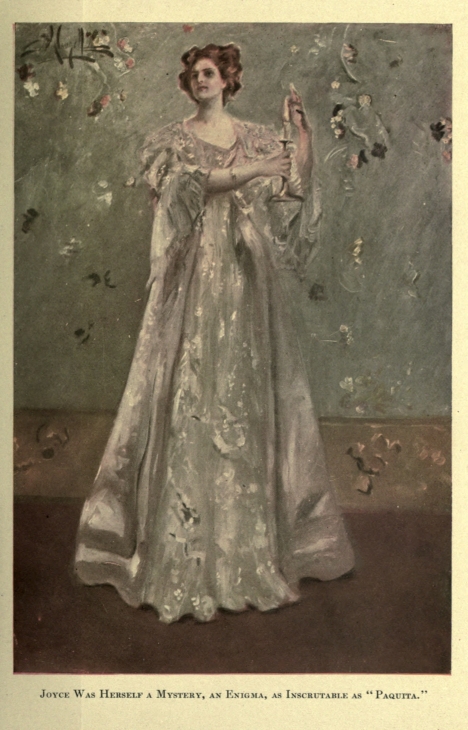
Joyce Was Herself a Mystery, an Enigma,
as Inscrutable as "Paquita."
Converse cast a covert glance at the girl, to note the effect
of this outburst; but her manner revealed not the slightest
alteration. It was plain that such determination would
betray nothing by either a word or sign. But why? Speculation
upon this question led swiftly and surely to the darkest
possibilities—nay, probabilities—that might elucidate
her conduct.
He made another effort.
"If you would but dismiss the idea that I am an enemy—"
"Ah," interrupted the Doctor, quickly; "I understand
your impersonal attitude exactly, Mr. Converse. You are
not an enemy. If the way were clear before you to do so,
I think we could count on you as a trustworthy friend to
extricate us from our difficulties. On the other hand—well,
to be brief, it is this impersonal attitude which may prove
inimical to us. I—I—pardon me, I can't be more
explicit."
"I might construe such a statement to mean that, were I
to perform my duty in the light of actual facts, the operation
would be—well, disagreeable to you."
The response was a lifting of the brows and a shrug of the
shoulders, which said quite plainly—perhaps more plainly
than the Doctor intended,—"I cannot prevent your placing
any construction upon my words you may see fit."
"If you will permit the observation, Doctor," Converse
remarked, dryly, "your words are contradictory to come
from a man entirely innocent."
A flash from the physician's eyes gave warning of an
angry rejoinder; but another unconscious movement of the
hand which held his so tightly brought his sister sharply
to mind, it would seem, and the words, when uttered,
betrayed a note of helplessness.
"My God!" he exclaimed, "don't I know it? But what
do mere denials amount to in the face of this suspicion?"
"Yet there is something within your knowledge, and
arising out of these crimes, which you unequivocally refuse
to tell me."
"I have nothing to say, Mr. Converse."
"Not even in the face of evidence seriously compromising
Miss Westbrook?"
Of a sudden the alert Captain became aware of a change
in the statue-like girl. It was slight, indefinable—telepathic
rather than openly perceptible,—but he fancied the
fixed look with which she regarded him assumed an added
intentness at this stage. He even felt for one brief instant
that she meant to speak; but if such had been her purpose,
a second thought prevailed, and she remained motionless and
silent. He turned abruptly to her.
"Miss Westbrook," said he, "is it of any use for me to
make another appeal to you?"
Although he waited for an answer, she made no sign that
would indicate she had heard. With an air of finality, he
presently pushed back the chair and stood upright.
"Well," he went on, "after the course this talk has taken
there remains but one thing for me to do. I regret that you
feel you would be conferring a favor instead of accepting an
opportunity—which happens to be the situation; but I—"
Doctor Westbrook raised a protesting hand.
"Just a moment," he interposed with anxious haste.
"You assert that my sister's situation is critical." Again
the Captain had the feeling that Miss Westbrook's impassivity
cloaked a strained attention; but, as before, if the emotion
existed, her frozen attitude yielded no token of it. Was
she anxious for an expression of his views upon this point?
"Suppose," the Doctor continued, "the least admission on
our part would lead to complications which would hopelessly
involve her, is it our place to speak? If the situation is
such that a full explanation cannot be given,—tell me, is
not our position onerous—unbearable? ... Now then,
Mr. Converse, be candid," he concluded, with an abrupt,
confidential dropping of his voice, "is it not the truth that
you would not have asked her if she was present that evening,
if you could prove that she was? And tell me, what has
all this to do with last night's crime?"
For a moment Converse felt a tide of anger rising within
him; he all at once realized that, as an officer of the
law—as a mere machine operating in a fixed routine—he had
made a mistake; he had allowed a generous impulse to
interpose and thwart an end of great importance; and now, when
it was too late, he must make an effort to remedy his error.
Without the least warning, he fastened his compelling,
probing regard full upon Joyce. It was a look that had made
hardened criminals tremble, and at last the girl's
impassiveness gave way. With an involuntary clutching of the
clasped hand she shrank closer to her brother. For a
moment she returned the look; then her glance wavered—fell;
the sooty lashes swept her cheeks, where two spots of
color began slowly to appear, and the statue was quickened
into life.
"And would you really care to know, Miss Westbrook,
what I think of it?" he asked, with a significant quietness
that startled her into speech.
"Yes—I—I—" she faltered and stopped. She looked
wildly from the Doctor to the terrible figure confronting her;
then with a mighty effort she regained control of herself, and
concluded in a voice firmer, but very low, "It is of no interest
to me."
Mr. Converse acknowledged the reply with a bow of
exaggerated deference.
"You overlook Mr. Clay Fairchild," he remarked, dryly.
Another tightening of the clasped hands, and another tremor
through the girl's slight frame, were the sole responses to
this final chance shot, until Doctor Westbrook's voice broke in.
"Pardon me, I have not," said he. "But I wasn't
aware that he was under consideration."
"Perhaps not," was the crisp retort, "openly. He is
an important factor, however." His glance swerved to
Joyce with a light that asked quite plainly, "Is he not?"
But only the Doctor replied. "Indeed?" with ingenuous
surprise. "But he seems quite effectually to have
effaced himself."
Converse shot another glance at Joyce.
"Well, as for that," he said, slowly, "I have reason to
believe that I might have laid hands upon him, if I had been
in this neighborhood last night between—h-m-m-m—between
ten and twelve o'clock." If he expected this avowal
of what he imagined the circumstances to be to make any
impression upon the girl he was disappointed; for she was
again the frozen image, not to be swayed by any influence
under his control.
But not so the Doctor. He looked at the detective, with
knitted brow, for a moment; then, after a hasty side-glance
at his sister, "I see," he said; "I am merely a peg upon
which to hang references to things of which I am entirely
ignorant. Come, Mr. Converse, you expect frankness from
us; be open yourself."
The Captain shrugged his shoulders. "My attempt at
frankness met with rather a cool reception"—with some
sarcasm—"but I will adopt your suggestion, and have
done.... Miss Westbrook, at what time last night did
you leave Mrs. Farquier's?" The abruptness of the address
startled her again momentarily; but somewhat to
Mr. Converse's surprise, she answered almost at once.
Her recital agreed in all essentials with what Mr. Converse
already knew of her movements. She had heard the
shots, but had been unable to locate them; and it was but a
minute or two thereafter that she had come upon her father's
stark body in the library.
At this juncture a knock sounded upon the library door.
"Allow me," the Captain interposed, quickly, addressing
the Doctor; "I think it is one of my men."
He opened the door, disclosing McCaleb, who appeared
much less ornate in the more sober garments of the ordinary
citizen.
"Wait just outside the door until I call you, Mac," said
Converse, in an aside clearly audible to the Doctor and
Joyce; "I think I shall need you in a minute." He
unceremoniously closed the door in the young man's face.
"Now then, Miss Westbrook," he resumed, turning again
to her, "will you tell me what you were doing on the
premises—in the yard—between ten and twelve o'clock at night?"
"See here, Mr. Converse," the Doctor broke in, rather
sharply; "I don't know what this is all about, but I protest
against the personal nature of this question. My sister is
neither on the witness-stand nor accused—"
With a single imperative gesture, the speaker was silenced.
"Tell me, Miss Westbrook, were you alone?"
The lovely, subdued eyes flashed forth a startled look;
but Joyce made no reply.
"Miss Westbrook, I will go further in offering you this
opportunity: I will say that I know you were not alone.
Come, now, who was with you?"
Still silence. The mention of Fairchild's name had
produced no effect; it might be well to try another.
"Was it Mr. Lynden?"
The girl responded precisely as she had to the first
question, the same words uttered in the same tone:
"I refuse to answer."
Another shrug of the shoulders signalized the end of
Mr. Converse's forbearance. He strode hastily to the door, but
turned and paused with his hand upon the handle.
Was it a stifled cry that had reached his ears? The girl
was now standing with the back of her free hand pressed
tightly to her lips, and in her eyes was a look of despair that
smote him to the heart. Great heavens, what did she
mean? Was man ever confronted by such perverseness, or
beset by a more irritating perplexity! Why did she not speak?
"I make one more appeal to you," he said, after regarding
her a moment. "Do not misconstrue this. If you do
not speak, my alternative is to arrest you. Do you comprehend
that? When I open this door, it will be to introduce
an officer who will become your custodian. Will you not
believe that my motives in thus appealing to you are prompted
solely by a desire to spare you the distress that will be
inflicted if you do not open your lips? Consider before you
answer; will you give me your confidence? Shall the door
remain closed—or shall I open it?"
For one brief moment Joyce had all the appearance of
some hunted thing hopelessly cornered. She looked wildly
from the officer to her brother, who sat with set and rigid
features, and back to the officer again. All at once, it seemed,
her resolution was made; or, if she had hesitated, strength
was given her to maintain her purpose. Her agitation
vanished, and she returned Mr. Converse's look fearlessly
and half defiantly.
"I have nothing to confide," was the response, uttered
with firmness and the quiet of a determination not to be
swayed.
With a bow, Converse threw open the door.
"Come in, McCaleb," he said, his manner now brisk
and business-like; then, turning to the Doctor: "This man
is an officer who, for the present, will be responsible for Miss
Westbrook's movements. Now then, Doctor, hear my final
word. I have made one mistake in allowing consideration
for your sister—young and inexperienced as she is—to
come between me and my duty. I am going to assume the
risk again by offering you another opportunity. I see that
you feel the matter keenly, but this issue of our conference
is the fault of you two. Still, it is terrible thus to thrust the
stigma of such a crime upon a mere girl—little short of the
crime itself,—and in the hope that I can soon clear up this
fog of mystery, I am going to be guilty of a dereliction. Give
me your word that Miss Westbrook will neither attempt to
leave the house nor communicate with anybody outside,
without first reporting to McCaleb, and for the present—until
it becomes unavoidable to act otherwise—she may
remain here."
With a sudden movement, Doctor Westbrook released
Joyce's hand, and pressed his own hand to his brow.
"Good God!" he groaned, "this is intolerable. Joyce—dear
sister—tell—"
But he got no further. The final word acted like the
touch that releases a taut spring, and she fairly precipitated
herself upon him, sending one look of such utter terror and
desperation at Mr. Converse that his perplexity deepened
into blank amazement, and at the same time she clapped a
hand over her brother's mouth.
"You swore you would not," she whispered, almost
fiercely. "Mobley, you swore. If they were to tear me
limb from limb before your eyes I would not consent to have
you tell."
The Doctor's head dropped, and with a gentle movement
he took the small hand from out his beard, kissed it tenderly,
and sat abstractedly caressing it.
Joyce's lovely countenance grew beatific in its exultation.
"Converse," despairingly, "I give you my word."
"Unless you or the young lady cause it to be otherwise,"
said the Captain, softly, "the matter may remain private
among us four—unless, of course," he supplemented, "the
next day or two fails to reveal something substantial to lay
before the District Attorney. I do not extend any false hopes.
The seriousness of Miss Westbrook's position can scarcely
be magnified.... McCaleb, you have heard; act accordingly
until you receive other instructions."
"May my sister retire?" asked Doctor Westbrook.
"Certainly. Her movements are not to be restricted or
spied upon, or interfered with in any manner or degree—within
the house, of course. You understand this, Mac."
The young man nodded. His manner was extremely
sober; it was quite patent that he was not insusceptible to
the beauty of his charge.
Joyce started slowly toward the door, close by which
McCaleb yet stood. She was probably half-way between
the group of two—her brother, old and haggard in the chair,
the other as menacing and inexorable as Fate,—and the
younger man who looked at her with frank pity, when she
paused and turned to her brother. There was a faint smile
upon her lips; her eyes were soft, and it appeared as if she
were about to speak. But before any one of the three could
offer her the least assistance, she sank quietly to the floor,
unconscious.