Containing and setting forth Observations lately made with the
aid of a newly invented Telescope respecting the Moon’s
Surface, the Milky Way, Nebulous Stars, an
innumerable multitude of Fixed Stars, and
also respecting Four Planets never before
seen, which have been named
THE COSMIAN STARS.3
IN the present small treatise I set forth some matters
of great interest for all observers of natural phenomena
to look at and consider. They are of great
Introduction.interest, I think, first, from their intrinsic excellence;
secondly, from their absolute novelty; and lastly, also
on account of the instrument by the aid of which
they have been presented to my apprehension.
The number of the Fixed Stars which observers
have been able to see without artificial powers of
sight up to this day can be counted. It is therefore
decidedly a great feat to add to their number, and to
set distinctly before the eyes other stars in myriads,
which have never been seen before, and which surpass
the old, previously known, stars in number more
than ten times.
Again, it is a most beautiful and delightful sight to
behold the body of the Moon, which is distant from
us nearly sixty semi-diameters[4] of the Earth, as near
as if it was at a distance of only two of the same
measures; so that the diameter of this same Moon
appears about thirty times larger, its surface about
nine hundred times, and its solid mass nearly 27,000
times larger than when it is viewed only with the
naked eye; and consequently any one may know
with the certainty that is due to the use of our
senses, that the Moon certainly does not possess a
smooth and polished surface, but one rough and
uneven, and, just like the face of the Earth itself, is
everywhere full of vast protuberances, deep chasms,
and sinuosities.
Then to have got rid of disputes about the Galaxy
or Milky Way, and to have made its nature clear to
the very senses, not to say to the understanding,
seems by no means a matter which ought to be considered
of slight importance. In addition to this, to
point out, as with one’s finger, the nature of those stars
which every one of the astronomers up to this time
has called nebulous, and to demonstrate that it is very
different from what has hitherto been believed, will be
pleasant, and very fine. But that which will excite
the greatest astonishment by far, and which indeed
especially moved me to call the attention of all astronomers
and philosophers, is this, namely, that I have
discovered four planets, neither known nor observed
by any one of the astronomers before my time, which
have their orbits round a certain bright star, one of
those previously known, like Venus and Mercury round
the Sun, and are sometimes in front of it, sometimes
behind it, though they never depart from it beyond
certain limits. All which facts were discovered and
observed a few days ago by the help of a telescope5
devised by me, through God’s grace first enlightening
my mind.
Perchance other discoveries still more excellent
will be made from time to time by me or by other
observers, with the assistance of a similar instrument,
so I will first briefly record its shape and preparation,
as well as the occasion of its being devised, and then
I will give an account of the observations made by
me.
Galileo’s account
of the
invention of
his telescope.About ten months ago a report reached my ears
that a Dutchman had constructed a telescope, by the
aid of which visible objects, although at a great
distance from the eye of the observer, were seen
distinctly as if near; and some proofs of its most
wonderful performances were reported, which some
gave credence to, but others contradicted. A few
days after, I received confirmation of the report in a
letter written from Paris by a noble Frenchman,
Jaques Badovere, which finally determined me to give
myself up first to inquire into the principle of the
telescope, and then to consider the means by which I
might compass the invention of a similar instrument,
which a little while after I succeeded in doing,
through deep study of the theory of Refraction;
and I prepared a tube, at first of lead, in the ends of
which I fitted two glass lenses, both plane on one
side, but on the other side one spherically convex,
and the other concave. Then bringing my eye to the
concave lens I saw objects satisfactorily large and
near, for they appeared one-third of the distance off
and nine times larger than when they are seen with the
natural eye alone. I shortly afterwards constructed
another telescope with more nicety, which magnified
objects more than sixty times. At length, by sparing
neither labour nor expense, I succeeded in constructing
for myself an instrument so superior that objects
seen through it appear magnified nearly a
thousand times, and more than thirty times nearer
than if viewed by the natural powers of sight
alone.
Galileo’s
first observations
with
his telescope.It would be altogether a waste of time to enumerate
the number and importance of the benefits which
this instrument may be expected to confer, when
used by land or sea. But without paying attention
to its use for terrestrial objects, I betook myself to
observations of the heavenly bodies; and first of all,
I viewed the Moon as near as if it was scarcely two
semi-diameters6 of the Earth distant. After the
Moon, I frequently observed other heavenly bodies,
both fixed stars and planets, with incredible delight;
and, when I saw their very great number, I began to
consider about a method by which I might be able to
measure their distances apart, and at length I found
one. And here it is fitting that all who intend to
turn their attention to observations of this kind
should receive certain cautions. For, in the first
place, it is absolutely necessary for them to prepare
a most perfect telescope, one which will show very
bright objects distinct and free from any mistiness,
and will magnify them at least 400 times, for then
it will show them as if only one-twentieth of their
distance off. For unless the instrument be of such
power, it will be in vain to attempt to view all the
things which have been seen by me in the heavens,
or which will be enumerated hereafter.
But in order that any one may be a little more
certain about the magnifying power of his instrument,
he shall fashion two circles, or two square pieces of
paper, one of which is 400 times greater than the
other, but that will be when the diameter of the
greater is twenty times the length of the diameter of
the other. Then he shall view from a distance
simultaneously both surfaces, fixed on the same wall,
the smaller with one eye applied to the telescope, and
the larger with the other eye unassisted; for that
may be done without inconvenience at one and the
same instant with both eyes open. Then both figures
will appear of the same size, if the instrument magnifies
objects in the desired proportion.
After such an instrument has been prepared, the Method of measuring small angular distances between
heavenly bodies by the size of the aperture of the telescope.method
of measuring distances remains for inquiry, and this we shall
accomplish by the following contrivance:—

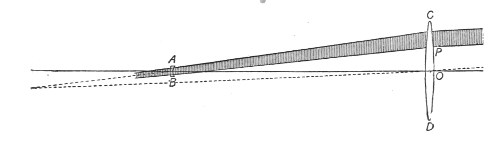
For the sake of being more easily understood, I
will suppose a tube A B C D.7 Let E be the eye of the
observer; then, when there are no lenses in the
tube rays from the eye to the object F G would be
drawn in the straight lines E C F, E D G, but when
the lenses have been inserted, let the rays go
in the bent lines E C H, E D I,—for they are contracted,
and those which originally, when unaffected
by the lenses, were directed to the object F G, will
include only the part H I. Hence the ratio of the
distance E H to the line H I being known, we shall be
able to find, by means of a table of sines, the magnitude
of the angle subtended at the eye by the object
H I, which we shall find to contain only some minutes.
But if we fit on the lens C D thin plates of metal,
pierced, some with larger, others with smaller apertures,
by putting on over the lens sometimes one
plate, sometimes another, as may be necessary, we
shall construct at our pleasure different subtending
angles of more or fewer minutes, by the help of
which we shall be able to measure conveniently the
intervals between stars separated by an angular
distance of some minutes, within an error of one or
two minutes. But let it suffice for the present to
have thus slightly touched, and as it were just put
our lips to these matters, for on some other opportunity
I will publish the theory of this instrument in
completeness.
Now let me review the observations made by me
during the two months just past, again inviting the
attention of all who are eager for true philosophy to
the beginnings which led to the sight of most important
phenomena.
The Moon.
Ruggedness
of its surface.
Existence of
lunar mountains
and
valleys.
Let me speak first of the surface of the Moon,
which is turned towards us. For the sake of being
understood more easily, I distinguish two parts in it,
which I call respectively the brighter and the darker.
The brighter part seems to surround and pervade the
whole hemisphere; but the darker part, like a sort of
cloud, discolours the Moon’s surface and makes it
appear covered with spots. Now these spots, as they
are somewhat dark and of considerable size, are plain
to every one, and every age has seen them, wherefore
I shall call them great or ancient spots, to distinguish
them from other spots, smaller in size, but so thickly
scattered that they sprinkle the whole surface of the
Moon, but especially the brighter portion of it. These
spots have never been observed by any one before
me; and from my observations of them, often repeated,
I have been led to that opinion which I have
expressed, namely, that I feel sure that the surface of
the Moon is not perfectly smooth, free from inequalities
and exactly spherical, as a large school of
philosophers considers with regard to the Moon and
the other heavenly bodies, but that, on the contrary,
it is full of inequalities, uneven, full of hollows and
protuberances, just like the surface of the Earth itself,
which is varied everywhere by lofty mountains and
deep valleys.
Sketches by Galileo to shew:—
the indentation of the terminator and illuminated summits of mountains in the dark part
of the moon;
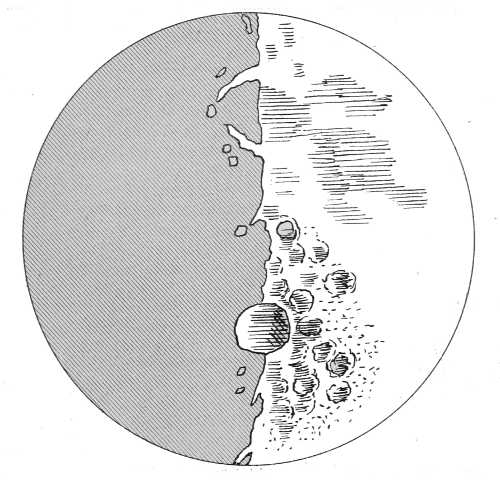
the shape of a lunar mountain and of a walled plain.
Galileo:’Sidereus Nuncius,’ Venice 1610.
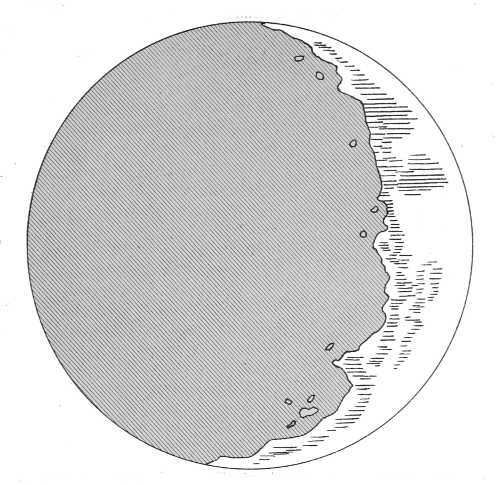
The appearances from which we may gather these
conclusions are of the following nature:—On the
fourth or fifth day after new-moon, when the Moon
presents itself to us with bright horns, the boundary
which divides the part in shadow from the enlightened
part does not extend continuously in an ellipse, as
would happen in the case of a perfectly spherical body,
but it is marked out by an irregular, uneven, and very
wavy line, as represented in the figure given, for
several bright excrescences, as they may be called,
extend beyond the boundary of light and shadow
into the dark part, and on the other hand pieces
of shadow encroach upon the light:—nay, even a
great quantity of small blackish spots, altogether
separated from the dark part, sprinkle everywhere
almost the whole space which is at the time flooded
with the Sun’s light, with the exception of that part
alone which is occupied by the great and ancient spots.
I have noticed that the small spots just mentioned
have this common characteristic always and in every
case, that they have the dark part towards the Sun’s
position, and on the side away from the Sun they
have brighter boundaries, as if they were crowned
with shining summits. Now we have an appearance
quite similar on the Earth about sunrise, when we
behold the valleys, not yet flooded with light, but the
mountains surrounding them on the side opposite to
the Sun already ablaze with the splendour of his
beams; and just as the shadows in the hollows of the
Earth diminish in size as the Sun rises higher, so
also these spots on the Moon lose their blackness as the
illuminated part grows larger and larger. Again, not
only are the boundaries of light and shadow in the
Moon seen to be uneven and sinuous, but—and this
produces still greater astonishment—there appear very
many bright points within the darkened portion of the
Moon, altogether divided and broken off from the
illuminated tract, and separated from it by no inconsiderable
interval, which, after a little while, gradually
increase in size and brightness, and after an hour or
two become joined on to the rest of the bright portion,
now become somewhat larger; but in the meantime
others, one here and another there, shooting up as if
growing, are lighted up within the shaded portion,
increase in size, and at last are linked on to the same
luminous surface, now still more extended. An
example of this is given in the same figure. Now,
is it not the case on the Earth before sunrise, that
while the level plain is still in shadow, the peaks of
the most lofty mountains are illuminated by the Sun’s
rays? After a little while does not the light spread
further, while the middle and larger parts of those
mountains are becoming illuminated; and at length,
when the Sun has risen, do not the illuminated parts
of the plains and hills join together? The grandeur,
however, of such prominences and depressions in the
Moon seems to surpass both in magnitude and extent
the ruggedness of the Earth’s surface, as I shall hereafter
show. And here I cannot refrain from mentioning
what a remarkable spectacle I observed while the
Moon was rapidly approaching her first quarter, a
representation of which is given in the same illustration,
placed opposite page 16. A protuberance of the
shadow, of great size, indented the illuminated part in
the neighbourhood of the lower cusp; and when I had
observed this indentation longer, and had seen that it
was dark throughout, at length, after about two hours,
a bright peak began to arise a little below the middle
of the depression; this by degrees increased, and
presented a triangular shape, but was as yet quite
detached and separated from the illuminated surface.
Soon around it three other small points began to
shine, until, when the Moon was just about to set,
that triangular figure, having now extended and
widened, began to be connected with the rest of the
illuminated part, and, still girt with the three bright
peaks already mentioned, suddenly burst into the
indentation of shadow like a vast promontory of
light.
At the ends of the upper and lower cusps also
certain bright points, quite away from the rest of the
bright part, began to rise out of the shadow, as is seen
depicted in the same illustration.
In both horns also, but especially in the lower one,
there was a great quantity of dark spots, of which
those which are nearer the boundary of light and
shadow appear larger and darker, but those which are
more remote less dark and more indistinct. In all
cases, however, just as I have mentioned before, the
dark portion of the spot faces the position of the
Sun’s illumination, and a brighter edge surrounds the
darkened spot on the side away from the Sun, and
towards the region of the Moon in shadow. This
part of the surface of the Moon, where it is marked
with spots like a peacock’s tail with its azure eyes, is
rendered like those glass vases which, through being
plunged while still hot from the kiln into cold water,
acquire a crackled and wavy surface, from which circumstance
they are commonly called frosted glasses.8
The lunar
spots are
suggested to
be possibly
seas bordered
by ranges of
mountains.Now the great spots of the Moon observed at the same
time are not seen to be at all similarly broken, or full
of depressions and prominences, but rather to be even
and uniform; for only here and there some spaces,
rather brighter than the rest, crop up; so that if any
one wishes to revive the old opinion of the Pythagoreans,
that the Moon is another Earth, so to say,
the brighter portion may very fitly represent the
surface of the land, and the darker the expanse of
water. Indeed, I have never doubted that if the
sphere of the Earth were seen from a distance, when
flooded with the Sun’s rays, that part of the surface
which is land would present itself to view as brighter,
and that which is water as darker in comparison.
Moreover, the great spots in the Moon are seen to be
more depressed than the brighter tracts; for in the
Moon, both when crescent and when waning, on the
boundary between the light and shadow, which projects
in some places round the great spots, the adjacent
regions are always brighter, as I have noticed in
drawing my illustrations, and the edges of the spots
referred to are not only more depressed than the
brighter parts, but are more even, and are not broken
by ridges or ruggednesses. But the brighter part
stands out most near the spots, so that both before
the first quarter and about the third quarter also,
around a certain spot in the upper part of the figure,
that is, occupying the northern region of the Moon,
some vast prominences on the upper and lower sides
of it rise to an enormous elevation, as the illustrations
show. This same spot before the third quarter is seen
to be walled round with boundaries of a deeper shade,
which just like very lofty mountain summits appear
darker on the side away from the Sun, and brighter
on the side where they face the Sun; but in the case
of the cavities the opposite happens, for the part of
them away from the Sun appears brilliant, and that
part which lies nearer to the Sun dark and in shadow.
After a time, when the enlightened portion of the
Moon’s surface has diminished in size, as soon as
the whole or nearly so of the spot already mentioned
is covered with shadow, the brighter ridges of the
mountains mount high above the shade. These two
appearances are shown in the illustrations which are
given.
Description
of a lunar
crater, perhaps
Tycho.9
There is one other point which I must on no
account forget, which I have noticed and rather
wondered at. It is this:—The middle of the Moon, as
it seems, is occupied by a certain cavity larger than
all the rest, and in shape perfectly round. I have
looked at this depression near both the first and third
quarters, and I have represented it as well as I can
in the second illustration already given. It produces
the same appearance as to effects of light and shade
as a tract like Bohemia would produce on the Earth,
if it were shut in on all sides by very lofty mountains
arranged on the circumference of a perfect
circle; for the tract in the Moon is walled in with
peaks of such enormous height that the furthest side
adjacent to the dark portion of the Moon is seen
bathed in sunlight before the boundary between
light and shade reaches half-way across the circular
space. But according to the characteristic property
of the rest of the spots, the shaded portion of this too
faces the Sun, and the bright part is towards the dark
side of the Moon, which for the third time I advise to
be carefully noticed as a most solid proof of the
ruggednesses and unevennesses spread over the whole
of the bright region of the Moon. Of these spots,
moreover, the darkest are always those which are
near to the boundary-line between the light and the
shadow, but those further off appear both smaller in
size and less decidedly dark; so that at length, when
the Moon at opposition becomes full, the darkness of
the cavities differs from the brightness of the prominences
with a subdued and very slight difference.
Reasons for
believing
that there is a
difference of
constitution
in various
parts of the
Moon’s surface.These phenomena which we have reviewed are
observed in the bright tracts of the Moon. In the
great spots we do not see such differences of depressions
and prominences as we are compelled to recognise
in the brighter parts, owing to the change of their
shapes under different degrees of illumination by the
Sun’s rays according to the manifold variety of the
Sun’s position with regard to the Moon. Still, in the
great spots there do exist some spaces rather less
dark than the rest, as I have noted in the illustrations,
but these spaces always have the same appearance,
and the depth of their shadow is neither intensified
nor diminished; they do appear indeed sometimes a
little more shaded, sometimes a little less, but the
change of colour is very slight, according as the Sun’s
rays fall upon them more or less obliquely; and
besides, they are joined to the adjacent parts of the
spots with a very gradual connection, so that their
boundaries mingle and melt into the surrounding
region. But it is quite different with the spots which
occupy the brighter parts of the Moon’s surface, for,
just as if they were precipitous crags with numerous
rugged and jagged peaks, they have well-defined
boundaries through the sharp contrast of light and
shade. Moreover, inside those great spots certain
other tracts are seen brighter than the surrounding
region, and some of them very bright indeed, but
the appearance of these, as well as of the darker parts,
is always the same; there is no change of shape or
brightness or depth of shadow, so that it becomes a
matter of certainty and beyond doubt that their
appearance is owing to real dissimilarity of parts, and
not to unevennesses only in their configuration, changing
in different ways the shadows of the same parts
according to the variations of their illumination by the
Sun, which really happens in the case of the other
smaller spots occupying the brighter portion of the
Moon, for day by day they change, increase, decrease,
or disappear, inasmuch as they derive their origin
only from the shadows of prominences.
Explanation
of the evenness
of the
illuminated
part of the
circumference
of the
Moon’s orb
by the analogy
of terrestrial
phenomena,
or by
a possible
lunar atmosphere.
But here I feel that some people may be troubled
with grave doubt, and perhaps seized with a difficulty
so serious as to compel them to feel uncertain about
the conclusion just explained and supported by so
many phenomena. For if that part of the Moon’s
surface which reflects the Sun’s rays most brightly is
full of sinuosities, protuberances, and cavities innumerable,
why, when the Moon is increasing, does the outer
edge which looks toward the west, when the Moon is
waning, the other half-circumference towards the east,
and at full-moon the whole circle, appear not uneven,
rugged, and irregular, but perfectly round and circular,
as sharply defined as if marked out with a pair of
compasses, and without the indentations of any protuberances
or cavities? And most remarkably so,
because the whole unbroken edge belongs to that part
of the Moon’s surface which possesses the property of
appearing brighter than the rest, which I have said to
be throughout full of protuberances and cavities. For
not one of the Great Spots extends quite to the circumference,
but all of them are seen to be together
away from the edge. Of this phenomenon, which
affords a handle for such serious doubt, I produce two
causes, and so two solutions of the difficulty.
The first solution which I offer is this:—If the protuberances
and cavities in the body of the Moon
existed only on the edge of the circle that bounds the
hemisphere which we see, then the Moon might, or
rather must, show itself to us with the appearance
of a toothed wheel, being bounded with an irregular
and uneven circumference; but if, instead of a single
set of prominences arranged along the actual circumference
only, very many ranges of mountains with
their cavities and ruggednesses are set one behind the
other along the extreme edge of the Moon, and that
too not only in the hemisphere which we see, but also
in that which is turned away from us, but still near
the boundary of the hemisphere, then the eye, viewing
them afar off, will not at all be able to detect the
differences of prominences and cavities, for the intervals
between the mountains situated in the same
circle, or in the same chain, are hidden by the jutting
forward of other prominences situated in other ranges,
and especially if the eye of the observer is placed in
the same line with the tops of the prominences mentioned.
So on the Earth, the summits of a number of
mountains close together appear situated in one plane,
if the spectator is a long way off and standing at the
same elevation. So when the sea is rough, the tops of
the waves seem to form one plane, although between
the billows there is many a gulf and chasm, so deep
that not only the hulls, but even the bulwarks, masts,
and sails of stately ships are hidden amongst them.
Therefore, as within the Moon, as well as round her
circumference, there is a manifold arrangement of
prominences and cavities, and the eye, regarding them
from a great distance, is placed in nearly the same
plane with their summits, no one need think it strange
that they present themselves to the visual ray which
just grazes them as an unbroken line quite free from
unevennesses. To this explanation may be added
another, namely, that there is round the body of the
Moon, just as round the Earth, an envelope of some
substance denser than the rest of the ether, which is
sufficient to receive and reflect the Sun’s rays, although
it does not possess so much opaqueness as to be able
to prevent our seeing through it—especially when it
is not illuminated. That envelope, when illuminated
by the Sun’s rays, renders the body of the Moon
apparently larger than it really is, and would be able
to stop our sight from penetrating to the solid body
of the Moon, if its thickness were greater; now, it is
of greater thickness about the circumference of the
Moon, greater, I mean, not in actual thickness, but
with reference to our sight-rays, which cut it obliquely;
and so it may stop our vision, especially when it is
in a state of brightness, and may conceal the true
circumference of the Moon on the side towards the
Sun.
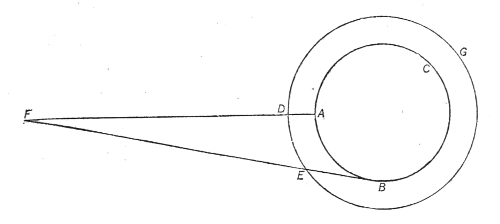
This may be understood more clearly from the
adjoining figure, in which the body of the Moon, A B C,
is surrounded by an enveloping atmosphere, D E G.
An eye at F penetrates to the middle parts of the
Moon, as at A, through a thickness, D A, of the atmosphere;
but towards the extreme parts a mass of
atmosphere of greater depth, E B, shuts out its boundary
from our sight. An argument in favour of this
is, that the illuminated portion of the Moon appears
of larger circumference than the rest of the orb which
is in shadow.
Perhaps also some will think that this same cause
affords a very reasonable explanation why the greater
spots on the Moon are not seen to reach to the edge
of the circumference on any side, although it might
be expected that some would be found about the edge
as well as elsewhere; and it seems credible that there
are spots there, but that they cannot be seen because
they are hidden by a mass of atmosphere too thick
and too bright for the sight to penetrate.
Calculation
to show that
the height of
some lunar
mountains
exceeds four
Italian miles10
(22,000
British feet).
I think that it has been sufficiently made clear,
from the explanation of phenomena which have been
given, that the brighter part of the Moon’s surface is
dotted everywhere with protuberances and cavities;
it only remains for me to speak about their size, and
to show that the ruggednesses of the Earth’s surface
are far smaller than those of the Moon’s; smaller, I
mean, absolutely, so to say, and not only smaller in
proportion to the size of the orbs on which they are.
And this is plainly shown thus:—As I often observed
in various positions of the Moon with reference to the
Sun, that some summits within the portion of the
Moon in shadow appeared illumined, although at
some distance from the boundary of the light (the
terminator), by comparing their distance with the
complete diameter of the Moon, I learnt that it sometimes
exceeded the one-twentieth (1/20th) part of the
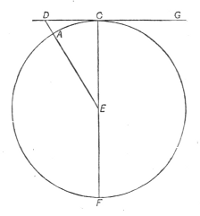 diameter. Suppose the distance
to be exactly 1/20th
part of the diameter, and let
the diagram represent the
Moon’s orb, of which C A F is
a great circle, E its centre,
and C F a diameter, which
consequently bears to the
diameter of the Earth the
ratio 2:7; and since the diameter of the Earth, according
to the most exact observations, contains 7000
Italian miles, C F will be 2000, and C E 1000, and the
1/20th part of the whole, C F, 100 miles. Also let C F
be a diameter of the great circle which divides the
bright part of the Moon from the dark part (for,
owing to the very great distance of the Sun from the
Moon this circle does not differ sensibly from a great
one), and let the distance of A from the point C be
1/20th part of that diameter; let the radius E A be
drawn, and let it be produced to cut the tangent line
G C D, which represents the ray that illumines the
summit, in the point D. Then the arc C A or the
straight line C D will be 100 of such units, as C E contains
1000. The sum of the squares of D C, C E is
therefore 1,010,000, and the square of D E is equal to
this; therefore the whole E D will be more than 1004;
and A D will be more than 4 of such units, as C E contained
1000. Therefore the height of A D in the Moon,
which represents a summit reaching up to the Sun’s
ray, G C D, and separated from the extremity C by
the distance C D, is more than 4 Italian miles; but
in the Earth there are no mountains which reach to
the perpendicular height even of one mile. We are
therefore left to conclude that it is clear that the
prominences of the Moon are loftier than those of
the Earth.
diameter. Suppose the distance
to be exactly 1/20th
part of the diameter, and let
the diagram represent the
Moon’s orb, of which C A F is
a great circle, E its centre,
and C F a diameter, which
consequently bears to the
diameter of the Earth the
ratio 2:7; and since the diameter of the Earth, according
to the most exact observations, contains 7000
Italian miles, C F will be 2000, and C E 1000, and the
1/20th part of the whole, C F, 100 miles. Also let C F
be a diameter of the great circle which divides the
bright part of the Moon from the dark part (for,
owing to the very great distance of the Sun from the
Moon this circle does not differ sensibly from a great
one), and let the distance of A from the point C be
1/20th part of that diameter; let the radius E A be
drawn, and let it be produced to cut the tangent line
G C D, which represents the ray that illumines the
summit, in the point D. Then the arc C A or the
straight line C D will be 100 of such units, as C E contains
1000. The sum of the squares of D C, C E is
therefore 1,010,000, and the square of D E is equal to
this; therefore the whole E D will be more than 1004;
and A D will be more than 4 of such units, as C E contained
1000. Therefore the height of A D in the Moon,
which represents a summit reaching up to the Sun’s
ray, G C D, and separated from the extremity C by
the distance C D, is more than 4 Italian miles; but
in the Earth there are no mountains which reach to
the perpendicular height even of one mile. We are
therefore left to conclude that it is clear that the
prominences of the Moon are loftier than those of
the Earth.
The faint
illumination
of the Moon’s
disc about
new-moon
explained to
be due to
earth-light.
I wish in this place to assign the cause of another
lunar phenomenon well worthy of notice, and although
this phenomenon was observed by me not lately, but
many years ago, and has been pointed out to some
of my intimate friends and pupils, explained, and
assigned to its true cause, yet as the observation of it
is rendered easier and more vivid by the help of a
telescope, I have considered that it would not be
unsuitably introduced in this place, but I wish to
introduce it chiefly in order that the connection and
resemblance between the Moon and the Earth may
appear more plainly.
When the Moon, both before and after conjunction,
is found not far from the Sun, not only does its orb
show itself to our sight on the side where it is furnished
with shining horns, but a slight and faint
circumference is also seen to mark out the circle of
the dark part, that part, namely, which is turned away
from the Sun, and to separate it from the darker background
of the sky. But if we examine the matter
more closely, we shall see that not only is the extreme
edge of the part in shadow shining with a faint
brightness, but that the entire face of the Moon, that
side, that is, which does not feel the Sun’s glare, is
illuminated with a pale light of considerable brightness.
At the first glance only a fine circumference
appears shining, on account of the darker part of
the sky adjacent to it; whereas, on the contrary,
the rest of the surface appears dark, on account of the
contiguity of the shining horns, which destroys the
clearness of our sight. But if any one chooses such
a position for himself, that by the interposition of a
roof, or a chimney, or some other object between
his sight and the Moon, but at a considerable distance
from his eye, the shining horns are hidden, and the
rest of the Moon’s orb is left exposed to his view,
then he will find that this tract of the Moon also,
although deprived of sunlight, gleams with considerable
light, and particularly so if the gloom of the
night has already deepened through the absence of
the Sun; for with a darker background the same
light appears brighter. Moreover, it is found that
this secondary brightness of the Moon, as I may call
it, is greater in proportion as the Moon is less distant
from the Sun; for it abates more and more in proportion
to the Moon’s distance from that body, so
much so that after the first quarter, and before the
end of the second, it is found to be weak and very
faint, although it be observed in a darker sky;
whereas, at an angular distance of 60° or less, even
during twilight, it is wonderfully bright, so bright
indeed that, with the help of a good telescope, the
great spots may be distinguished in it.
This strange brightness has afforded no small perplexity
to philosophical minds; and some have
published one thing, some another, as the cause to
be alleged for it. Some have said that it is the
inherent and natural brightness of the Moon; some
that it is imparted to that body by the planet Venus;
or, as others maintain, by all the stars; while some
have said that it comes from the Sun, whose rays,
they say, find a way through the solid mass of the
Moon. But statements of this kind are disproved
without much difficulty, and convincingly demonstrated
to be false. For if this kind of light were
the Moon’s own, or were contributed by the stars,
the Moon would retain it, particularly in eclipses,
and would show it then, when left in an unusually
dark sky, but this is contrary to experience. For
the brightness which is seen on the Moon in eclipses
is far less intense, being somewhat reddish, and
almost copper-coloured, whereas this is brighter and
whiter; besides, the brightness seen during an eclipse
is changeable and shifting, for it wanders over the
face of the Moon, so that that part which is near the
circumference of the circle of shadow thrown by the
Earth is bright, but the rest of the Moon is always
seen to be dark. From which circumstance we
understand without hesitation that this brightness is
due to the proximity of the Sun’s rays coming into
contact with some denser region which surrounds
the Moon as an envelope; owing to which contact a
sort of dawn-light is diffused over the neighbouring
regions of the Moon, just as the twilight spreads in
the morning and evening on the Earth:11 but I will
treat more fully of this matter in my book upon the
System of the Universe.12
Again, to assert that this sort of light is imparted
to the Moon by the planet Venus is so childish as to
be undeserving of an answer; for who is so ignorant
as not to understand that at conjunction and within
an angular distance of 60° it is quite impossible for
the part of the Moon turned away from the Sun to be
seen by the planet Venus?
But that this light is derived from the Sun penetrating
with its light the solid mass of the Moon, and
rendering it luminous, is equally untenable. For
then this light would never lessen, since the hemisphere
of the Moon is always illumined by the Sun,
except at the moment of a lunar eclipse, yet really it
quickly decreases while the Moon is drawing near to
the end of her first quarter, and when she has passed
her first quarter it becomes quite dull. Since, therefore,
this kind of secondary brightness is not inherent
and the Moon’s own, nor borrowed from any of the
stars, nor from the Sun, and since there now remains
in the whole universe no other body whatever except
the Earth, what, pray, must we conclude? What must
we assert? Shall we assert that the body of the
Moon, or some other dark and sunless orb, receives
light from the Earth? Why should it not be the
Moon? And most certainly it is. The Earth, with
fair and grateful exchange, pays back to the Moon an
illumination like that which it receives from the
Moon nearly the whole time during the darkest
gloom of night. Let me explain the matter more
clearly. At conjunction, when the Moon occupies
a position between the Sun and the Earth, the
Moon is illuminated by the Sun’s rays on her half
towards the Sun which is turned away from the Earth,
and the other half, with which she regards the Earth,
is covered with darkness, and so in no degree illumines
the Earth’s surface. When the Moon has slightly
separated from the Sun, straightway she is partly
illumined on the half directed towards us; she turns
towards us a slender silvery crescent, and slightly
illumines the Earth; the Sun’s illumination increases
upon the Moon as she approaches her first quarter,
and the reflexion of that light increases on the Earth;
the brightness in the Moon next extends beyond the
semicircle, and our nights grow brighter; at length
the entire face of the Moon looking towards the Earth
is irradiated with the most intense brightness by the
Sun, which happens when the Sun and Moon are on
opposite sides of the Earth; then far and wide the
surface of the Earth shines with the flood of moonlight;
after this the Moon, now waning, sends out
less powerful beams, and the Earth is illumined less
powerfully; at length the Moon draws near her first
position of conjunction with the Sun, and forthwith
black night invades the Earth. In such a cycle the
moonlight gives us each month alternations of brighter
and fainter illumination. But the benefit of her light
to the Earth is balanced and repaid by the benefit of
the light of the Earth to her; for while the Moon is
found near the Sun about the time of conjunction, she
has in front of her the entire surface of that hemisphere
of the Earth which is exposed to the Sun, and
vividly illumined with his beams, and so receives
light reflected from the Earth. Owing to such reflexion,
the hemisphere of the Moon nearer to us,
though deprived of sunlight, appears of considerable
brightness. Again, when removed from the Sun
through a quadrant, the Moon sees only one-half of
the Earth’s hemisphere illuminated, namely the
western half, for the other, the eastern, is covered
with the shades of night; the Moon is, therefore, less
brightly enlightened by the Earth, and accordingly
that secondary light appears fainter to us. But if
you imagine the Moon to be set on the opposite side
of the Earth to the Sun, she will see the hemisphere
of the Earth, now between the Moon and the Sun,
quite dark, and steeped in the gloom of night; if,
therefore, an eclipse should accompany such a position
of the Moon, she will receive no light at all, being
deprived of the illumination of the Sun and Earth
together. In any other position, with regard to the
Earth and the Sun, the Moon receives more or less
light by reflexion from the Earth, according as she
sees a greater or smaller portion of the hemisphere of
the Earth illuminated by the Sun; for such a law is
observed between these two orbs, that at whatever
times the Earth is most brightly enlightened by the
Moon, at those times, on the contrary, the Moon is
least enlightened by the Earth; and contrariwise.
Let these few words on this subject suffice in this
place; for I will consider it more fully in my System
of the Universe, where, by very many arguments and
experimental proofs, there is shown to be a very
strong reflexion of the Sun’s light from the Earth, for
the benefit of those who urge that the Earth must
be separated from the starry host, chiefly for the
reason that it has neither motion nor light, for I will
prove that the Earth has motion, and surpasses the
Moon in brightness, and is not the place where the
dull refuse of the universe has settled down; and I
will support my demonstration by a thousand arguments
taken from natural phenomena.
Stars. Their
appearance
in the
telescope.
Hitherto I have spoken of the observations which I
have made concerning the Moon’s body; now I will
briefly announce the phenomena which have been,
as yet, seen by me with reference to the Fixed Stars.
And first of all the following fact is worthy of consideration:—The
stars, fixed as well as erratic, when
seen with a telescope, by no means appear to be
increased in magnitude in the same proportion as
other objects, and the Moon herself, gain increase of
size; but in the case of the stars such increase appears
much less, so that you may consider that a telescope,
which (for the sake of illustration) is powerful enough
to magnify other objects a hundred times, will scarcely
render the stars magnified four or five times. But
the reason of this is as follows:—When stars are
viewed with our natural eyesight they do not present
themselves to us of their bare, real size, but beaming
with a certain vividness, and fringed with sparkling
rays, especially when the night is far advanced; and
from this circumstance they appear much larger than
they would if they were stripped of those adventitious
fringes, for the angle which they subtend at the eye
is determined not by the primary disc of the star, but
by the brightness which so widely surrounds it.
Perhaps you will understand this most clearly from
the well-known circumstance that when stars rise
just at sunset, in the beginning of twilight, they
appear very small, although they may be stars of the
first magnitude; and even the planet Venus itself, on
any occasion when it may present itself to view in
broad daylight, is so small to see that it scarcely
seems to equal a star of the last magnitude. It is
different in the case of other objects, and even of the
Moon, which, whether viewed in the light of midday
or in the depth of night, always appears of the same
size. We conclude therefore that the stars are seen
at midnight in uncurtailed glory, but their fringes are
of such a nature that the daylight can cut them off,
and not only daylight, but any slight cloud which
may be interposed between a star and the eye of the
observer. A dark veil or coloured glass has the same
effect, for, upon placing them before the eye between
it and the stars, all the blaze that surrounds them
leaves them at once. A telescope also accomplishes
the same result, for it removes from the stars their
adventitious and accidental splendours before it
enlarges their true discs (if indeed they are of that
shape), and so they seem less magnified than other
objects, for a star of the fifth or sixth magnitude seen
through a telescope is shown as of the first magnitude
only.
The difference between the appearance of the
planets and the fixed stars seems also deserving of
notice. The planets present their discs perfectly
round, just as if described with a pair of compasses,
and appear as so many little moons, completely illuminated
and of a globular shape; but the fixed stars
do not look to the naked eye bounded by a circular
circumference, but rather like blazes of light, shooting
out beams on all sides and very sparkling, and with a
telescope they appear of the same shape as when they
are viewed by simply looking at them, but so much
larger that a star of the fifth or sixth magnitude
seems to equal Sirius, the largest of all the fixed stars.13
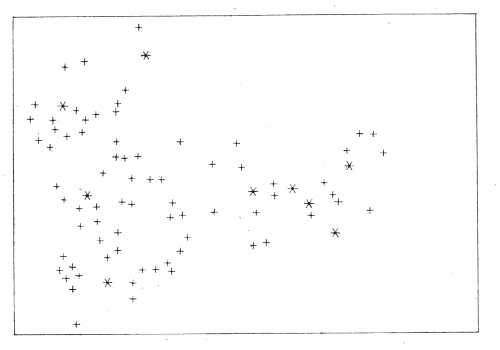
Orion’s Belt and Sword; 83 Stars
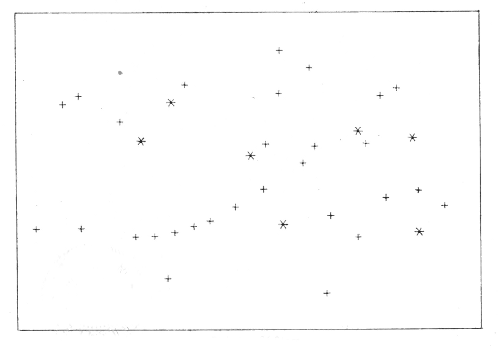
Pleiades; 36 Stars
Galileo: “Sidereus Nuncius.”
Telescopic
Stars: their
infinite multitude.
As examples,
Orion’s Belt
and Sword
and the
Pleiades are
described
as seen by
Galileo.But beyond the stars of the sixth magnitude you
will behold through the telescope a host of other stars,
which escape the unassisted sight, so numerous as to
be almost beyond belief, for you may see more than
six other differences of magnitude, and the largest of
these, which I may call stars of the seventh magnitude,
or of the first magnitude of invisible stars, appear
with the aid of the telescope larger and brighter
than stars of the second magnitude seen with the
unassisted sight. But in order that you may see one
or two proofs of the inconceivable manner in which
they are crowded together, I have determined to
make out a case against two star-clusters, that from
them as a specimen you may decide about the rest.
As my first example I had determined to depict
the entire constellation of Orion, but I was overwhelmed
by the vast quantity of stars and by want
of time, and so I have deferred attempting this to
another occasion, for there are adjacent to, or scattered
among, the old stars more than five hundred new
stars within the limits of one or two degrees. For
this reason I have selected the three stars in Orion’s
Belt and the six in his Sword, which have been long
well-known groups, and I have added eighty other
stars recently discovered in their vicinity, and I have
preserved as exactly as possible the intervals between
them. The well-known or old stars, for the sake of
distinction, I have depicted of larger size, and I have
outlined them with a double line; the others, invisible
to the naked eye, I have marked smaller and with
one line only. I have also preserved the differences
of magnitude as much as I could.
As a second example I have depicted the six stars
of the constellation Taurus, called the Pleiades (I say
six intentionally, since the seventh is scarcely ever
visible), a group of stars which is enclosed in the heavens
within very narrow precincts. Near these there lie
more than forty others invisible to the naked eye, no
one of which is much more than half a degree off any
of the aforesaid six; of these I have noticed only
thirty-six in my diagram. I have preserved their
intervals, magnitudes, and the distinction between the
old and the new stars, just as in the case of the
constellation Orion.
The Milky
Way consists
entirely of
stars in
countless
numbers and
of various
magnitudes.
The next object which I have observed is the
essence or substance of the Milky Way. By the aid
of a telescope any one may behold this in a manner
which so distinctly appeals to the senses that all the
disputes which have tormented philosophers through
so many ages are exploded at once by the irrefragable
evidence of our eyes, and we are freed from wordy
disputes upon this subject, for the Galaxy is nothing
else but a mass of innumerable stars planted together
in clusters. Upon whatever part of it you direct the
telescope straightway a vast crowd of stars presents
itself to view; many of them are tolerably large and
extremely bright, but the number of small ones is
quite beyond determination.
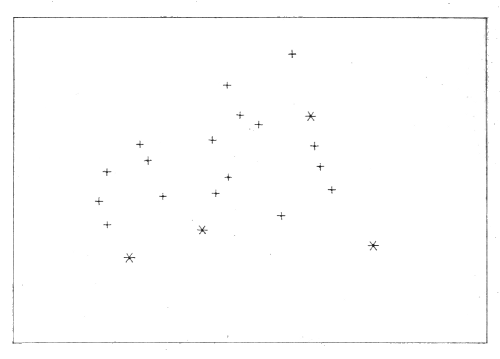
Star-cluster in Orion’s Head
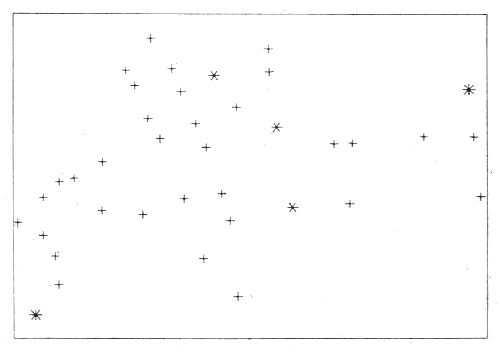
Star-cluster of Praesepe in Cancer
Galileo: “Sidereus Nuncius,” Venice, 1610.
Nebulæ resolved
into
clusters of
stars: as
examples,
the nebulæ in
Orion’s Head
and Præsepe.
And whereas that milky brightness, like the brightness
of a white cloud, is not only to be seen in the
Milky Way, but several spots of a similar colour shine
faintly here and there in the heavens, if you turn the
telescope upon any of them you will find a cluster of
stars packed close together. Further—and you will
be more surprised at this,—the stars which have been
called by every one of the astronomers up to this day
nebulous, are groups of small stars set thick together
in a wonderful way, and although each one of them
on account of its smallness, or its immense distance
from us, escapes our sight, from the commingling of
their rays there arises that brightness which has
hitherto been believed to be the denser part of the
heavens, able to reflect the rays of the stars or the
Sun.
I have observed some of these, and I wish to subjoin
the star-clusters of two of these nebulæ. First, you
have a diagram of the nebula called that of Orion’s
Head, in which I have counted twenty-one stars.
The second cluster contains the nebula called Præsepe,
which is not one star only, but a mass of more
than forty small stars. I have noticed thirty-six
stars, besides the Aselli, arranged in the order of the
accompanying diagram.
Discovery of
Jupiter’s
satellites,
Jan. 7, 1610:
record of
Galileo’s
observations
during two
months.
I have now finished my brief account of the
observations which I have thus far made with regard
to the Moon, the Fixed Stars, and the Galaxy.
There remains the matter, which seems to me to
deserve to be considered the most important in this
work, namely, that I should disclose and publish to
the world the occasion of discovering and observing
four PLANETS, never seen from the very beginning of
the world up to our own times, their positions, and
the observations made during the last two months
about their movements and their changes of magnitude;
and I summon all astronomers to apply themselves
to examine and determine their periodic times,
which it has not been permitted me to achieve up
to this day, owing to the restriction of my time.
I give them warning however again, so that they may
not approach such an inquiry to no purpose, that they
will want a very accurate telescope, and such as I
have described in the beginning of this account.
On the 7th day of January in the present year,
1610, in the first14 hour of the following night, when I
was viewing the constellations of the heavens through
a telescope, the planet Jupiter presented itself to my
view, and as I had prepared for myself a very excellent
instrument, I noticed a circumstance which I had
never been able to notice before, owing to want of
power in my other telescope, namely, that three little
stars, small but very bright, were near the planet;
and although I believed them to belong to the number
of the fixed stars, yet they made me somewhat
wonder, because they seemed to be arranged exactly
in a straight line, parallel to the ecliptic,15 and to be
brighter than the rest of the stars, equal to them
in magnitude. The position of them with reference
to one another and to Jupiter was as follows (Fig. 1).
On the east side there were two stars, and a single
one towards the west. The star which was furthest
towards the east, and the western star, appeared
rather larger than the third.
I scarcely troubled at all about the distance between
them and Jupiter, for, as I have already said, at first
I believed them to be fixed stars; but when on January
8th, led by some fatality, I turned again to look
at the same part of the heavens, I found a very different
state of things, for there were three little stars all
west of Jupiter, and nearer together than on the
previous night, and they were separated from one
another by equal intervals, as the accompanying illustration
(Fig. 2) shows.
At this point, although I had not turned my
thoughts at all upon the approximation of the stars to
one another, yet my surprise began to be excited, how
Jupiter could one day be found to the east of all the
aforesaid fixed stars when the day before it had been
west of two of them; and forthwith I became afraid
lest the planet might have moved differently from the
calculation of astronomers, and so had passed those
stars by its own proper motion. I therefore waited
for the next night with the most intense longing, but
I was disappointed of my hope, for the sky was
covered with clouds in every direction.
But on January 10th the stars appeared in the
following position with regard to Jupiter; there were
two only, and both on the east side of Jupiter, the
third, as I thought, being hidden by the planet
(Fig. 3). They were situated just as before, exactly
in the same straight line with Jupiter, and along
the Zodiac.
When I had seen these phenomena, as I knew that
corresponding changes of position could not by any
means belong to Jupiter, and as, moreover, I perceived
that the stars which I saw had been always the same,
for there were no others either in front or behind,
within a great distance, along the Zodiac,—at length,
changing from doubt into surprise, I discovered that
the interchange of position which I saw belonged not
to Jupiter, but to the stars to which my attention had
been drawn, and I thought therefore that they ought
to be observed henceforward with more attention
and precision.
Accordingly, on January 11th I saw an arrangement
of the following kind (Fig. 4), namely, only
two stars to the east of Jupiter, the nearer of which
was distant from Jupiter three times as far as from
the star further to the east; and the star furthest to
the east was nearly twice as large as the other one;
whereas on the previous night they had appeared
nearly of equal magnitude. I therefore concluded,
and decided unhesitatingly, that there are three stars
in the heavens moving about Jupiter, as Venus and
Mercury round the Sun; which at length was established
as clear as daylight by numerous other subsequent
observations. These observations also established
that there are not only three, but four, erratic
sidereal bodies performing their revolutions round
Jupiter, observations of whose changes of position
made with more exactness on succeeding nights the
following account will supply. I have measured also
the intervals between them with the telescope in the
manner already explained. Besides this, I have given
the times of observation, especially when several were
made in the same night, for the revolutions of these
planets are so swift that an observer may generally
get differences of position every hour.
Jan. 12.—At the first hour of the next night I saw
these heavenly bodies arranged in this manner (Fig. 5).
The satellite16 furthest to the east was greater than the
satellite furthest to the west; but both were very
conspicuous and bright; the distance of each one from
Jupiter was two minutes. A third satellite, certainly
not in view before, began to appear at the third hour;
it nearly touched Jupiter on the east side, and was
exceedingly small. They were all arranged in the
same straight line, along the ecliptic.
Jan. 13.—For the first time four satellites were in
view in the following position with regard to Jupiter
(Fig. 6).
There were three to the west, and one to the east;
they made a straight line nearly, but the middle
satellite of those to the west deviated a little from the
straight line towards the north. The satellite furthest
to the east was at a distance of 2´ from Jupiter; there
were intervals of 1´ only between Jupiter and the
nearest satellite, and between the satellites themselves,
west of Jupiter. All the satellites appeared of the same
size, and though small they were very brilliant, and
far outshone the fixed stars of the same magnitude.
Jan. 14.—The weather was cloudy.
Jan. 15.—At the third hour of the night the four
satellites were in the state depicted in the next diagram
(Fig. 7) with reference to Jupiter.
All were to the west, and arranged nearly in the
same straight line; but the satellite which counted
third from Jupiter was raised a little to the north.
The nearest to Jupiter was the smallest of all; the
rest appeared larger and in order of magnitude;
the intervals between Jupiter and the three nearest
satellites were all equal, and were of the magnitude
of 2´ each; but the satellite furthest to the
west was distant 4´ from the satellite nearest to
it. They were very brilliant, and not at all twinkling,
as they have always appeared both before and
since. But at the seventh hour there were only
three satellites, presenting with Jupiter an appearance
of the following kind (Fig. 8). They were, that
is to say, in the same straight line to a hair; the
nearest to Jupiter was very small, and distant from
the planet 3´; the distance of the second from this
one was 1´; and of the third from the second 4´ 30´´.
But after another hour the two middle satellites were
still nearer, for they were only 30´´, or less, apart.
Jan. 16.—At the first hour of the night I saw three
satellites arranged in this order (Fig. 9). Jupiter was
between two of them, which were at a distance of
0´ 40´´ from the planet on either side, and the third
was west of Jupiter at a distance of 8´. The satellites
near to Jupiter appeared brighter than the satellite
further off, but not larger.
Jan. 17, after sunset 0 hours 30 minutes, the
configuration was of this kind (Fig. 10). There was
one satellite only to the east, at a distance of 3´ from
Jupiter; to the west likewise there was only one
satellite, distant 11´ from Jupiter. The satellite on
the east appeared twice as large as the satellite to the
west; and there were no more than these two. But
four hours after, that is, nearly at the fifth hour, a
third satellite began to emerge on the east side, which,
before its appearance, as I think, had been joined with
the former of the two other satellites, and the position
was of this kind (Fig. 11). The middle satellite was
very near indeed to the satellite on the east, and was
only 20´´ from it; and was a little towards the south
of the straight line drawn through the two extreme
satellites and Jupiter.
Jan. 18, at 0 h. 20 m. after sunset, the appearance
was such as this (Fig. 12). The satellite to the east
was larger than the western one, and was at a distance
from Jupiter of 8´, the western one being at a
distance of 10´.
Jan. 19.—At the second hour of the night the
relative position of the satellites was such as this
(Fig. 13); that is, there were three satellites exactly
in a straight line with Jupiter, one to the east, at a
distance of 6´ from Jupiter; between Jupiter and the
first satellite to the west in order, there was an interval
of 5´; this satellite was 4´ off the other one more to
the west. At that time I was doubtful whether or no
there was a satellite between the satellite to the east and
Jupiter, but so very close to Jupiter as almost to touch
the planet; but at the fifth hour I saw this satellite distinctly,
by that time occupying exactly the middle position
between Jupiter and the eastern satellite, so that
the configuration was thus (Fig. 14). Moreover, the
satellite which had just come into view was very small;
yet at the sixth hour it was nearly as large as the rest.
Jan. 20: 1 h. 15 m.—A similar arrangement was
seen (Fig. 15). There were three satellites, so small
as scarcely to be distinguishable; their distances
from Jupiter, and from one another, were not more
than 1´. I was doubtful whether on the western side
there were two satellites or three. About the sixth
hour they were grouped in this way (Fig. 16). The
eastern satellite was twice as far away from Jupiter as
before, that is 2´; on the western side, the satellite in
the middle was distant from Jupiter 0´ 40´´, and from
the satellite still further to the west 0´ 20´´; at length,
at the seventh hour, three satellites were seen on the
western side (Fig. 17). The satellite nearest to Jupiter
was distant from the planet 0´ 20´´; between this one
and the satellite furthest to the west there was an
interval of 40´´, but between these another satellite was
in view slightly southward of them, and not more
than 10´´ off the most westerly satellite.
Jan. 21: 0 h. 30 m.—There were three satellites
on the east side; the satellites and Jupiter were at
equal distances apart (Fig. 18). The intervals were by
estimation 50´´ each. There was also one satellite on
the west, distant 4´ from Jupiter. The satellite on
the east side nearest to Jupiter was the least of all.
Jan. 22: 2 h.—The grouping of the satellites was
similar (Fig. 19). There was an interval of 5´ from
the satellite on the east to Jupiter; from Jupiter to
the satellite furthest to the west 7´. The two interior
satellites on the western side were 0´ 40´´ apart, and
the satellite nearer to Jupiter was 1´ from the planet.
The inner satellites were smaller than the outer ones,
but they were situated all in the same straight line,
along the ecliptic, except that the middle of the three
western satellites was slightly to the south of it,
but at the sixth hour of the night they appeared in
this position (Fig. 20). The satellite on the east was
very small, at a distance from Jupiter of 5´ as before;
but the three satellites on the west were separated by
equal distances from Jupiter and from each other;
and the intervals were nearly 1´ 20´´ each. The
satellite nearest Jupiter appeared smaller than the
other two on the same side, but they all appeared
arranged exactly in the same straight line.
Jan. 23, at 0 h. 40 m. after sunset, the grouping of
the satellites was nearly after this fashion (Fig. 21).
There were three satellites with Jupiter in a straight
line along the ecliptic, as they always have been; two
were on the east of the planet, one on the west; the
satellite furthest to the east was 7´ from the next one,
and this satellite 2´ 40´´ from Jupiter; Jupiter was
3´ 20´´ from the satellite on the west; and they were
all of nearly the same size. But at the fifth hour the
two satellites which had been previously near Jupiter
were no longer visible, being, as I suppose, hidden
behind Jupiter, and the appearance presented was
such as this (Fig. 22).
Jan. 24.—Three satellites, all on the east side, were
visible, and nearly, but not quite, in the same straight
line with Jupiter, for the satellite in the middle was
slightly to the south of it (Fig. 23). The satellite
nearest to Jupiter was 2´ distant from the planet;
the next in order 0´ 30´´ from this satellite, and
the third was 9´ further off still; they were all very
bright. But at the sixth hour two satellites only
presented themselves to view in this position, namely
in the same straight line with Jupiter exactly, and
the distance of the nearest to the planet was lengthened
to 3´; the next was 2´ further off, and unless
I am mistaken, the two satellites previously observed
in the middle had come together, and appeared as
one.
Jan. 25, at 1 h. 40 m., the satellites were grouped
thus (Fig. 24). There were only two satellites on the
east side, and these were rather large. The satellite
furthest to the east was 5´ from the satellite in the
middle, and it was 6´ from Jupiter.
Jan. 26, at 0 h. 40 m., the relative positions of
the satellites were thus (Fig. 25). Three satellites
were in view, of which two were east and the
third west of Jupiter; this one was distant 3´ from
the planet. On the east side the satellite in the
middle was at a distance of 5´ 20´´; the further satellite
was 6´ beyond; they were arranged in a straight
line, and were of the same size. At the fifth hour the
arrangement was nearly the same, with this difference
only, that the fourth satellite was emerging on the east
side near Jupiter. It was smaller than the rest, and
was then at a distance of 0´ 30´´ from Jupiter; but
was raised a little above the straight line towards the
north, as the accompanying figure shows (Fig. 26).
Jan. 27, 1 h. after sunset, a single satellite only
was in view, and that on the east side of Jupiter in
this position (Fig. 27). It was very small, and at a
distance of 7´ from Jupiter.
Jan. 28 and 29.—Owing to the intervention of
clouds, I could make no observation.
Jan. 30.—At the first hour of the night the satellites
were in view, arranged in the following way
(Fig. 28). There was one satellite on the east side, at
a distance of 2´ 30´´ from Jupiter; and there were two
satellites on the west, of which the one nearer to
Jupiter was 3´ off the planet, and the other satellite 1´
further. The places of the outer satellites and Jupiter
were in the same straight line; but the satellite in
the middle was a little above it to the north. The
satellite furthest to the west was smaller than the
rest.
On the last day of the month, at the second hour,
two satellites on the east side were visible, and one
on the west (Fig. 29). Of the satellites east of the
planet, the one in the middle was 2´ 20´´ distant from
Jupiter; and the satellite further to the east was 0´ 30´´
from the middle satellite; the satellite on the west
was at a distance of 10´ from Jupiter. They were in
the same straight line nearly, and would have been
exactly so, only the satellite on the east nearest to
Jupiter was raised a little towards the north. At the
fourth hour, the two satellites on the east were still
nearer together, for they were only 20´´ apart (Fig. 30).
The western satellite appeared rather small in these
two observations.
Feb. 1.—At the second hour of the night the
arrangement was similar (Fig. 31). The satellite
furthest to the east was at a distance of 6´ from
Jupiter, and the western satellite 8´. On the east
side there was a very small satellite, at a distance of
20´´ from Jupiter. They made a perfectly straight
line.
Feb. 2.—The satellites were seen arranged thus
(Fig. 32). There was one only on the east, at a distance
of 6´ from Jupiter. Jupiter was 4´ from the
nearest satellite on the west; between this satellite
and the satellite further to the west there was an
interval of 8´; they were in the same straight line
exactly, and were nearly of the same magnitude.
But at the seventh hour four satellites were there—two
on each side of Jupiter (Fig. 33). Of
these satellites, the most easterly was at a distance
of 4´ from the next; this satellite was 1´ 40´´ from
Jupiter; Jupiter was 6´ from the nearest satellite on
the west, and this one from the satellite further to
the west, 8´; and they were all alike in the same
straight line, drawn in the direction of the Zodiac.
Feb. 3: 7 h.—The satellites were arranged in the
following way (Fig. 34):—The satellite on the east
was at a distance of 1´ 30´´ from Jupiter; the nearest
satellite on the west, 2´, and there was a long distance,
10´, from this satellite to the satellite further
to the west. They were exactly in the same straight
line, and of equal magnitude.
Feb. 4: 2 h.—Four satellites attended Jupiter, two
on the east and two on the west, arranged in one perfectly
straight line, as in the adjoining figure (Fig. 35).
The satellite furthest to the east was at a distance of
3´ from the next satellite. This one was 0´ 40´´ from
Jupiter; Jupiter 4´ from the nearest satellite on the
west; and this one from the satellite further to the
west 6´. In magnitude they were nearly equal; the
satellite nearest to Jupiter was rather smaller in appearance
than the rest. But at the seventh hour (Fig. 36)
the eastern satellites were at a distance of only
0´ 30´´ apart. Jupiter was 2´ from the nearest satellite
on the east; and from the satellite on the west, next
in order, 4´; this one was distant 3´ from the satellite
further to the west. They were all equal in magnitude,
and in a straight line, drawn in the direction of
the ecliptic.
Feb. 5.—The sky was cloudy.
Feb. 6.—Two satellites only appeared, with Jupiter
between them, as is seen in the accompanying figure
(Fig. 37). The satellite on the east was 2´ from
Jupiter, and that on the west 3´. They were in the
same straight line with Jupiter, and were equal in
magnitude.
Feb. 7.—There were two satellites by the side of
Jupiter, and both of them on the east of the planet,
arranged in this manner (Fig. 38). The intervals
between the satellites and Jupiter were equal, and of
1´ each; and a straight line would go through them
and the centre of Jupiter.
Feb. 8: 1 h.—Three satellites were there, all on
the east side of Jupiter, as in the diagram (Fig. 39).
The nearest to Jupiter, a rather small one, was distant
from the planet 1´ 20´´; the middle one was 4´
from this satellite, and was rather large; the satellite
furthest to the east, a very small one, was at a distance
of 0´ 20´´ from this satellite. It was doubtful
whether there was one satellite near to Jupiter or two,
for sometimes it seemed that there was another satellite
by its side towards the east, wonderfully small, and
only 10´´ from it. They were all situated at points in
a straight line drawn in the direction of the Zodiac.
At the third hour the satellite nearest to Jupiter was
almost touching the planet, for it was only distant 10´´
from it; but the others had become further off, for the
middle one was 6´ from Jupiter. At length, at the fourth
hour, the satellite which was previously the nearest to
Jupiter joined with the planet and disappeared.
Feb. 9: 0 h. 30 m.—There were two satellites on
the east side of Jupiter, and one on the west, in an
arrangement such as this (Fig. 40). The satellite
furthest to the east, which was a rather small one, was
distant 4´ from the next satellite; the satellite in
the middle was larger, and at a distance of 7´ from
Jupiter. Jupiter was distant 4´ from the western
satellite, which was a small one.
Feb. 10: 1 h. 30 m.—A pair of satellites, very
small, and both on the east of the planet, were
visible, in the following position (Fig. 41). The
further satellite was distant from Jupiter 10´, the
nearer 0´ 20´´, and they were in the same straight
line; but at the fourth hour the satellite nearest to
Jupiter no longer appeared, and the other seemed so
diminished that it could scarcely be kept in sight,
although the atmosphere was quite clear, and the
satellite was further from Jupiter than before, since
its distance was now 12´.
Feb. 11: 1 h.—There were two satellites on the
east, and one on the west (Fig. 42). The western
satellite was at a distance of 4´ from Jupiter. The
satellite on the east, nearest to the planet, was
likewise 4´ from Jupiter; but the satellite further
to the east was at a distance from this one of
8´; they were fairly clear to view, and in the same
straight line; but at the third hour the fourth satellite
was visible near to Jupiter on the east, less in
magnitude than the rest, separated from Jupiter by a
distance of 0´ 30´´, and slightly to the north out of
the straight line drawn through the rest (Fig. 43).
They were all very bright and extremely distinct,
but at 5 h. 30 m. the satellite on the east nearest
to Jupiter had moved further away from the planet,
and was occupying a position midway between the
planet and the neighbouring satellite further to the
east. They were all in the same straight line exactly,
and of the same magnitude, as may be seen in the
accompanying diagram (Fig. 44).
Feb. 12: 0 h. 40 m.—A pair of satellites on the
east, a pair likewise on the west, were near the planet
(Fig. 45). The satellite on the east furthest removed
from Jupiter was at a distance of 10´, and the further
of the satellites on the west was 8´ off. They were
both fairly distinct. The other two were very near to
Jupiter, and very small, especially the satellite to the
east, which was at a distance of 0´ 40´´ from Jupiter.
The distance of the western satellite was 1´. But at
the fourth hour the satellite which was nearest to
Jupiter on the east was visible no longer.
Feb. 13: 0 h. 30 m.—Two satellites were visible
in the east, two also in the west (Fig. 46). The
satellite on the east near Jupiter was fairly distinct;
its distance from the planet was 2´. The satellite
further to the east was less noticeable; it was distant
4´ from the other. Of the satellites on the west, the
one furthest from Jupiter, which was very distinct,
was parted from the planet 4´. Between this satellite
and Jupiter intervened a small satellite close to the
most westerly satellite, being not more than 0´ 3´´ off.
They were all in the same straight line, corresponding
exactly to the direction of the ecliptic.
Feb. 15 (for on the 14th the sky was covered with
clouds), at the first hour, the position of the satellites
was thus (Fig. 47); that is, there were three satellites
on the east, but none were visible on the west. The
satellite on the east nearest to Jupiter was at a distance
of 0´ 50´´ from the planet; the next in order was
0´ 20´´ from this satellite, and the furthest to the east
was 2´ from the second satellite, and it was larger than
the others, for those nearer to Jupiter were very small.
But about the fifth hour only one of the satellites
which had been near to Jupiter was to be seen; its
distance from Jupiter was 0´ 30´´. The distance of
the satellite furthest to the east from Jupiter had
increased, for it was then 4´ (Fig. 48). But at the
sixth hour, besides the two situated as just described
on the east, one satellite was visible towards the west,
very small, at a distance of 2´ from Jupiter (Fig. 49).
Feb. 16: 6 h.—Their places were arranged as
follows (Fig. 50); that is, the satellite on the east was
7´ from Jupiter, Jupiter 5´ from the next satellite on
the west, and this 3´ from the remaining satellite still
further to the west. They were all of the same magnitude
nearly, rather bright, and in the same straight
line, corresponding accurately to the direction of the
Zodiac.
Feb. 17: 1 h.—Two satellites were in view, one on
the east, distant 3´ from Jupiter; the other on the
west, distant 10´ (Fig. 51). The latter was somewhat
less than the satellite on the east; but at the sixth
hour the eastern satellite was nearer to Jupiter, being
at a distance of 0´ 50´´, and the western satellite was
further off, namely 12´. At both observations they
were in the same straight line with Jupiter, and were
both rather small, especially the eastern satellite in the
second observation.
Feb. 18: 1 h.—Three satellites were in view, of
which two were on the west and one on the east; the
distance of the eastern satellite from Jupiter was 3´,
and of the nearest satellite on the west 2´; the remaining
satellite, still further to the west, was 8´ from the
middle satellite (Fig. 52). They were all in the same
straight line exactly, and of about the same magnitude.
But at the second hour the satellites nearest to the
planet were at equal distances from Jupiter, for the
western satellite was now also 3´ from the planet. But
at the sixth hour the fourth satellite was visible between
the satellite on the east and Jupiter, in the following
configuration (Fig. 53). The satellite furthest
to the east was at a distance of 3´ from the next in
order; this one was at a distance of 1´ 50´´ from
Jupiter; Jupiter was at a distance of 3´ from the
next satellite on the west, and this 7´ from the satellite
still further to the west. These were nearly equal in
magnitude, only the satellite on the east nearest to
Jupiter was a little smaller than the rest, and they were
all in the same straight line parallel to the ecliptic.
Feb. 19: 0 h. 40 m.—Two satellites only were in
view, west of Jupiter, rather large, and arranged
exactly in the same straight line with Jupiter, in the
direction of the ecliptic (Fig. 54). The nearer satellite
was at a distance of 7´ from Jupiter and of 6´ from the
satellite further to the west.
Feb. 20.—The sky was cloudy.
Feb. 21: 1 h. 30 m.—Three satellites, rather small,
were in view, placed thus (Fig. 55). The satellite
to the east was 2´ from Jupiter; Jupiter was 3´
from the next, which was on the west; and this one was
7´ from the satellite further to the west. They were
exactly in the same straight line parallel to the ecliptic.
Feb. 25: 1 h. 30 m. (for on the three previous
nights the sky was overcast).—Three satellites appeared,
two on the east, which were at a distance of
4´ apart, the same as the distance of the nearer satellite
from Jupiter; on the west there was one satellite at a
distance of 2´ from Jupiter. They were exactly in
the same straight line in the direction of the ecliptic
(Fig. 56).
Feb. 26: 0 h. 30 m.—A pair of satellites only
were present, one on the east, distant 10´ from
Jupiter; the other was on the west, at a distance of
6´ (Fig. 57). The eastern satellite was slightly smaller
than the western. At the fifth hour three satellites
were visible; for, besides the two already noticed, a
third satellite was in view, on the west, near Jupiter,
very small, which previously had been hidden behind
Jupiter, and it was at a distance of 1´ from the planet
(Fig. 58).
But the satellite on the east was seen to be further
off than before, being at a distance of 11´ from
Jupiter. On this night, for the first time, I determined
to observe the motion of Jupiter and the
adjacent planets (his satellites) along the zodiac, by
reference to some fixed star; for there was a fixed
star in view, eastwards of Jupiter, at a distance of
11´ from the satellite on the east, and a little to the
south, in the following manner (Fig. 59).
Feb. 27: 1 h. 4 m.—The satellites appeared in the
following configuration. The satellite furthest to the
east was at a distance of 10´ from Jupiter; the next
in order was near Jupiter, being at a distance of
0´ 30´´ from the planet. The next satellite was on the
western side, at a distance of 2´ 30´´ from Jupiter;
and the satellite further to the west was at a distance
of 1´ from this. The two satellites near to Jupiter
appeared small, especially the satellite on the east;
but the satellites furthest off were very bright, particularly
that on the west, and they made a straight
line in the direction of the ecliptic exactly. The
motion of the planets towards the east was plainly
seen by reference to the aforesaid fixed star, for Jupiter
and his attendant satellites were nearer to it, as may
be seen in the accompanying figure (Fig. 60). At the
fifth hour the satellite on the east, near to Jupiter,
was 1´ from the planet.
Feb. 28: 1 h.—Only two satellites were visible, one
on the east, at a distance of 9´ from Jupiter, and
another on the west, at a distance of 2´; they were
both rather bright, and in the same straight line with
Jupiter, and a straight line drawn from the fixed
star perpendicular to this straight line fell upon the
satellite on the east, as in the figure (Fig. 61). At
the fifth hour a third satellite was seen at a distance
of 2´ from Jupiter, on the east, in the position shown
in the figure (Fig. 62).
March 1: 0 h. 40 m.—Four satellites, all on the
east of the planet, were seen; the satellite nearest to
Jupiter was 2´ from the planet; the next 1´ from
this; the third was 0´ 20´´ from the second, and was
brighter than the others; and the satellite still further
to the east was at a distance of 4´ from it, and was
smaller than the others (Fig. 63). They made a
straight line very nearly, only the satellite third from
Jupiter was slightly above the line. The fixed star
formed with Jupiter and the most easterly satellite
an equilateral triangle, as in the figure.
March 2: 0 h. 40 m.—Three satellites were in
attendance, two on the east and one on the west, in
the configuration shown in the diagram (Fig. 64).
The satellite furthest to the east was 7´ from
Jupiter; from this satellite the next was distant 0´ 30´´,
and the satellite on the west was separated from
Jupiter by an interval of 2´. The satellites furthest
off were brighter and larger than the remaining
satellite, which appeared very small. The satellite
furthest to the east seemed to be raised a little
towards the north, out of the straight line drawn
through the other satellites and Jupiter.
The fixed star already noticed was at a distance of
8´ from the western satellite, that is, from the perpendicular
drawn from that satellite to the straight
line drawn through all the system, as shown in the
figure given.
These determinations of the motion of Jupiter and
the adjacent planets (his satellites) by reference to a
fixed star, I have thought well to present to the
notice of astronomers, in order that any one may be
able to understand from them that the movements
of these planets (Jupiter’s satellites) both in longitude
and in latitude agree exactly with the motions [of
Jupiter] which are extracted from tables.
These are my observations upon the four Medicean
planets, recently discovered for the first time by me;
and although it is not yet permitted me to deduce by
calculation from these observations the orbits of these
bodies, yet I may be allowed to make some statements,
based upon them, well worthy of attention.
Deductions
from the
previous
observations
concerning
the orbits
and periods
of Jupiter’s
satellites.
And, in the first place, since they are sometimes
behind, sometimes before Jupiter, at like distances,
and withdraw from this planet towards the east and
towards the west only within very narrow limits
of divergence, and since they accompany this planet
alike when its motion is retrograde and direct, it can
be a matter of doubt to no one that they perform
their revolutions about this planet, while at the same
time they all accomplish together orbits of twelve
years’ length about the centre of the world. Moreover,
they revolve in unequal circles, which is evidently
the conclusion to be drawn from the fact that
I have never been permitted to see two satellites in
conjunction when their distance from Jupiter was
great, whereas near Jupiter two, three, and sometimes
all (four), have been found closely packed together.
Moreover, it may be detected that the revolutions of
the satellites which describe the smallest circles round
Jupiter are the most rapid, for the satellites nearest
to Jupiter are often to be seen in the east, when the
day before they have appeared in the west, and contrariwise.
Also the satellite moving in the greatest
orbit seems to me, after carefully weighing the
occasions of its returning to positions previously
noticed, to have a periodic time of half a month.17
Besides, we have a notable and splendid argument to
remove the scruples of those who can tolerate the
revolution of the planets round the Sun in the Copernican
system, yet are so disturbed by the motion of
one Moon about the Earth, while both accomplish an
orbit of a year’s length about the Sun, that they
consider that this theory of the constitution of the
universe must be upset as impossible; for now we
have not one planet only revolving about another,
while both traverse a vast orbit about the Sun, but
our sense of sight presents to us four satellites circling
about Jupiter, like the Moon about the Earth, while
the whole system travels over a mighty orbit about
the Sun in the space of twelve years.
Explanation
of the variations
in
brightness
of Jupiter’s
satellites.
Lastly, I must not pass over the consideration of
the reason why it happens that the Medicean stars, in
performing very small revolutions about Jupiter,
seem sometimes more than twice as large as at other
times. We can by no means look for the explanation
in the mists of the Earth’s atmosphere, for they appear
increased or diminished, while the discs of Jupiter
and neighbouring fixed stars are seen quite unaltered.
That they approach and recede from the Earth at the
points of their revolutions nearest to and furthest
from the Earth to such an extent as to account for so
great changes seems altogether untenable, for a strict
circular motion can by no means show those phenomena;
and an elliptical motion (which in this case
would be nearly rectilinear) seems to be both untenable
and by no means in harmony with the phenomena
observed. But I gladly publish the explanation
which has occurred to me upon this subject, and
submit it to the judgment and criticism of all true
philosophers. It is certain that when atmospheric
mists intervene the Sun and Moon appear larger, but
the fixed stars and planets less than they really are;
hence the former luminaries, when near the horizon,
are larger than at other times, but stars appear
smaller, and are frequently scarcely visible; also they
are still more diminished if those mists are bathed in
light; so stars appear very small by day and in the
twilight, but the Moon does not appear so, as I have
previously remarked. Moreover, it is certain that
not only the Earth, but also the Moon, has its own
vaporous sphere enveloping it, for the reasons which I
have previously mentioned, and especially for those
which shall be stated more fully in my System; and
we may consistently decide that the same is true with
regard to the rest of the planets; so that it seems to
be by no means an untenable opinion to place round
Jupiter also an atmosphere denser than the rest of
the ether,18 about which, like the Moon about the
sphere of the elements, the Medicean planets (Jupiter’s
satellites) revolve; and that by the intervention of
this atmosphere they appear smaller when they are in
apogee; but when in perigee, through the absence or
attenuation of that atmosphere, they appear larger.
Want of time prevents my going further into these
matters; my readers may expect further remarks
upon these subjects in a short time.
Original Configurations of Jupiter’s Satellites observed
by Galileo in the months of January,
February, and March 1610, and published with
the 1st edition of his book Sidereus Nuncius,
Venice, 1610.
A PART OF THE PREFACE TO
KEPLER’S DIOPTRICS
FORMING
A CONTINUATION OF GALILEO’S
SIDEREAL MESSENGER.
In the preface to Kepler’s Dioptrics there are introduced
letters of Galileo about the new and astonishing discoveries
which he had made in the heavens by the aid of the telescope
since the publication of his work, The Sidereal Messenger. The
portion of the preface which refers to Galileo, containing these
letters and Kepler’s remarks upon them, is added here, as
continuing the original account of Galileo’s astronomical discoveries.
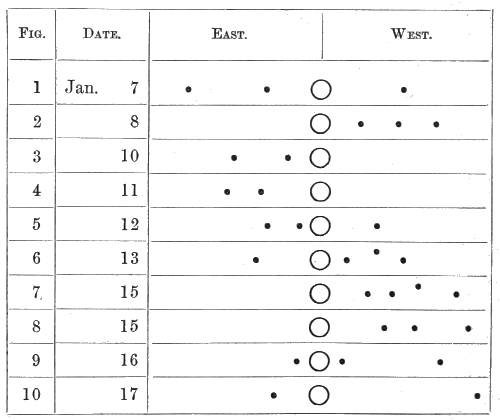
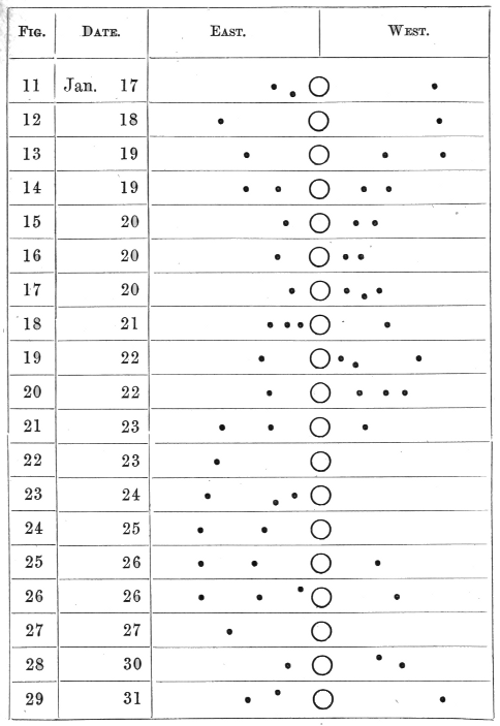
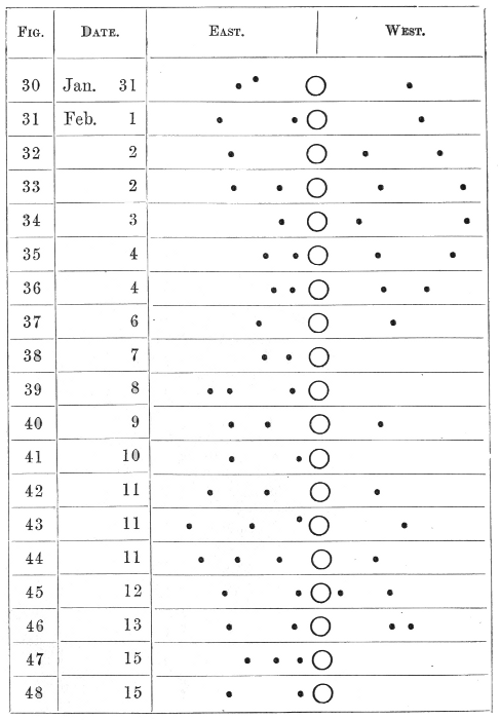
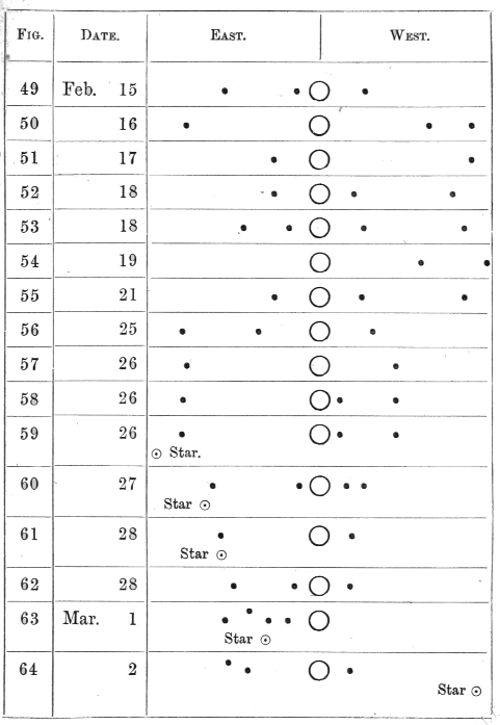
 Quella di mezzo è assai più grande delle
laterali; sono situate una da oriente, l’altra da occidente,
nella medesima linea retta a capello; non sono
giustamente secondo la dirittura del Zodiaco, ma
l’occidentale si eleva alquanto verso Borea; forse sono
parallele all’ Equinoziale?]. Se si guarderanno con un
occhiale che non sia di grandissima moltiplicazione,
non appariranno tre stelle ben distinte, ma parrà, che
Saturno sia una stella lunghetta in forma di un’ oliva,
così,
Quella di mezzo è assai più grande delle
laterali; sono situate una da oriente, l’altra da occidente,
nella medesima linea retta a capello; non sono
giustamente secondo la dirittura del Zodiaco, ma
l’occidentale si eleva alquanto verso Borea; forse sono
parallele all’ Equinoziale?]. Se si guarderanno con un
occhiale che non sia di grandissima moltiplicazione,
non appariranno tre stelle ben distinte, ma parrà, che
Saturno sia una stella lunghetta in forma di un’ oliva,
così,  Ma servendosi di un occhiale che moltiplichi
più di mille volte in superficie, si vedranno tre globi
distintissimi, che quasi si toccano, non apparendo trà
essi maggior divisione di un sottil filo oscuro. Or
ecco trovata la corte a Giove, e due Servi a questo
Vecchio che l’aiutano a camminare nè mai se gli
staccano dal fianco. Intorno agli altri Pianeti non ci
è novità alcuna, ec.”
Ma servendosi di un occhiale che moltiplichi
più di mille volte in superficie, si vedranno tre globi
distintissimi, che quasi si toccano, non apparendo trà
essi maggior divisione di un sottil filo oscuro. Or
ecco trovata la corte a Giove, e due Servi a questo
Vecchio che l’aiutano a camminare nè mai se gli
staccano dal fianco. Intorno agli altri Pianeti non ci
è novità alcuna, ec.”