Twas a long journey to the prison of Bicêtre, which is two miles to the
south of the city of Paris, a great building that had once (they say) been
a palace, but now in the time of my experience was little better than a
vestibule of hell. I was driven to it through a black loud night of rain,
a plunging troop of horse on either hand the coach as if I were a
traveller of state, and Buhot in front of me as silent as the priest had
been the day we left Dunkerque, though wakeful, and the tip of his
scabbard leaning on my boot to make sure that in the darkness no movement
of mine should go unobserved.
The trees swung and roared in the wind; the glass lozens of the carriage
pattered to the pelting showers; sometimes we lurched horribly in the ruts
of the highway, and were released but after monstrous efforts on the part
of the cavaliers. Once, as we came close upon a loop of a brawling river,
I wished with all fervency that we might fall in, and so end for ever this
pitiful coil of trials whereto fate had obviously condemned poor Paul
Greig. To die among strangers (as is widely known) is counted the saddest
of deaths by our country people, and so, nowadays, it would seem to
myself, but there and then it appeared an enviable conclusion to the
Spoiled Horn that had blundered from folly to folly. To die there and then
would be to leave no more than a regret and an everlasting wonder in the
folks at home; to die otherwise, as seemed my weird, upon a block or
gallows, would be to foul the name of my family for generations, and I
realised in my own person the agony of my father when he got the news, and
I bowed my shoulders in the coach below the shame that he would feel as in
solemn blacks he walked through the Sabbath kirkyard in summers to come in
Mearns, with the knowledge that though neighbours looked not at him but
with kindness, their inmost thoughts were on the crimson chapter of his
son.
Well, we came at the long last to Bicêtre, and I was bade alight in the
flare of torches. A strange, a memorable scene; it will never leave me.
Often I remit me there in dreams. When I came out of the conveyance the
lights dazzled me, and Buhot put his hands upon my shoulders and turned me
without a word in the direction he wished me to take. It was through a
vast and frowning doorway that led into a courtyard so great that the
windows on the other side seemed to be the distance of a field. The
windows were innumerable, and though the hour was late they were lit in
stretching corridors. Fires flamed in corners of the yard—great
leaping fires round which warders (as I guessed them) gathered to dry
themselves or get warmth against the chill of the early April morning.
Their scabbards or their muskets glittered now and then in the light of
the flames; their voices—restrained by the presence of Buhot—sounded
deep and dreadful to me that knew not the sum of his iniquity yet could
shudder at the sense of what portended.
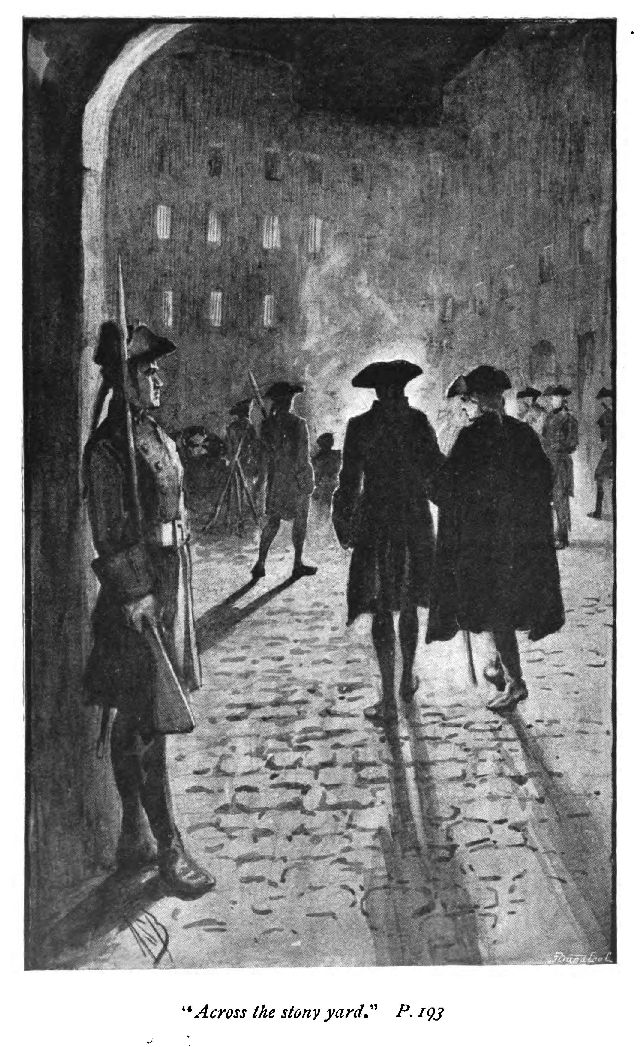
It were vain for me to try and give expression to my feeling as I went
past these fires across the stony yard, and entered between a guard or two
at the other side. At the root of my horror was the sentiment that all was
foreign, that I was no more to these midnight monsters round their
torturing flames than a creature of the wood, less, perhaps, for were they
not at sworn war with my countrymen, and had not I a share at least of the
repute of regicide? And when, still led by the silent officer, I entered
the building itself and walked through an unending corridor broken at
intervals by black doors and little barred borrowed lights, and heard
sometimes a moan within, or a shriek far off in another part of the
building, I experienced something of that long swound that is insanity.
Then I was doomed for the rest of my brief days to be among these unhappy
wretches—the victims of the law or political vengeance, the forçat
who had thieved, or poisoned, perjured himself, or taken human blood!
At last we came to a door, where Buhot stopped me and spoke, for the first
time, almost, since we had left Versailles. He put his hand out to check a
warder who was going to open the cell for my entrance.
“I am not a hard man, M. Greig,” said he, in a stumbling English, “and
though this is far beyond my duties, and, indeed, contrary to the same, I
would give you another chance. We shall have, look you, our friend the
priest in any case, and to get the others is but a matter of time. 'Tis a
good citizen helps the law always; you must have that respect for the law
that you should feel bound to circumvent those who would go counter to it
with your cognisance.”
“My good man,” I said, as quietly as I could, and yet internally with
feelings like to break me, “I have already said my say. If the tow was
round my thrapple I would say no more than that I am innocent of any plot
against a man by whose family mine have lost, and that I myself, for all
my loyalty to my country, would do much to serve as a private individual.”
“Consider,” he pleaded. “After all, this Hamilton may be a madman with
nothing at all to tell that will help us.”
“But the bargain is to be that I must pry and I must listen,” said I, “and
be the tale-pyat whose work may lead to this poor old buffoon's and many
another's slaughtering. Not I, M. Buhot, and thank ye kindly! It's no'
work for one of the Greigs of Hazel Den.”
“I fear you do not consider all,” he said patiently—so patiently
indeed that I wondered at him. “I will show you to what you are condemned
even before your trial, before you make up your mind irrevocably to refuse
this very reasonable request of ours,” and he made a gesture that caused
the warder to open the door so that I could see within.
There was no light of its own in the cell, but it borrowed wanly a little
of the radiance of the corridor, and I could see that it was bare to the
penury of a mausoleum, with a stone floor, a wooden palliasse, and no
window other than a barred hole above the door. There was not even a stool
to sit on. But I did not quail.
“I have been in more comfortable quarters, M. Buhot,” I said, “but in none
that I could occupy with a better conscience.” Assuming with that a sort
of bravado, I stepped in before he asked me.
“Very good,” he cried; “but I cannot make you my felicitations on your
decision, M. Greig,” and without more ado he had the door shut on me.
I sat on the woollen palliasse for a while, with my head on my hands,
surrendered all to melancholy; and then, though the thing may seem beyond
belief, I stretched myself and slept till morning. It was not the most
refreshing of sleep, but still 'twas wonderful that I should sleep at all
in such circumstances, and I take it that a moorland life had been a
proper preparation for just such trials.
When I wakened in the morning the prison seemed full of eerie noises—of
distant shrieks as in a bedlam, and commanding voices, and of ringing
metals, the clank of fetters, or the thud of musket-butts upon the stones.
A great beating of feet was in the yard, as if soldiers were manoeuvring,
and it mastered me to guess what all this might mean, until a warder
opened my door and ordered me out for an airing.
I mind always of a parrot at a window.
This window was one that looked into the yard from some official's
dwelling in that dreadful place, and the bird occupied a great cage that
was suspended from a nail outside.
The bird, high above the rabble of rogues in livery, seemed to have a
devilish joy in the spectacle of the misery tramping round and round
beneath, for it clung upon the bars and thrust out its head to whistle, as
if in irony, or taunt us with a foul song. There was one air it had,
expressed so clearly that I picked up air and words with little
difficulty, and the latter ran something like this:
Ah! ah! Pierrot, Pierrot!
Fais ta toilette,
Voila le barbier! oh! oh!
Et sa charrette—
all in the most lugubrious key.
And who were we that heard that reference to the axe? We were the scum,
the sordes, the rot of France. There was, doubtless, no crime
before the law of the land, no outrage against God and man, that had not
here its representative. We were not men, but beasts, cut off from every
pleasant—every clean and decent association, the visions of sin
always behind the peering eyes, the dreams of vice and crime for ever
fermenting in the low brows. I felt 'twas the forests we should be
frequenting—the forests of old, the club our weapon, the cave our
habitation; no song ours, nor poem, no children to infect with fondness,
no women to smile at in the light of evening lamps. The forest—the
cave—the animal! What were we but children of the outer dark,
condemned from the start of time, our faces ground hard against the
flints, our feet bogged in hag and mire?
There must have been several hundreds of the convicts in the yard, and yet
I was told later that it was not a fourth of the misery that Bicêtre held,
and that scores were leaving weekly for the bagnes—the hulks
at Toulon and at Brest—while others took their places.
Every man wore a uniform—a coarse brown jacket, vast wide breeches
of the same hue, a high sugar-loaf cap and wooden shoes—all except
some privileged, whereof I was one—and we were divided into gangs,
each gang with its warders—tall grenadiers with their muskets ready.
Round and round and across and across we marched in the great quadrangle,
every man treading the rogues' measure with leg-weary reluctance, many
cursing their warders under breath, most scowling, all hopeless and all
lost.
'Twas the exercise of the day.
As we slouched through that mad ceremony in the mud of the yard, with rain
still drizzling on us, the parrot in its cage had a voice loud and shrill
above the commands of the grenadiers and officers; sang its taunting song,
or whistled like a street boy, a beast so free, so careless and remote,
that I had a fancy it had the only soul in the place.
As I say, we were divided into gangs, each gang taking its own course back
and forward in the yard as its commander ordered. The gang I was with
marched a little apart from the rest. We were none of us in this gang in
the ugly livery of the prison, but in our own clothing, and we were, it
appeared, allowed that privilege because we were yet to try. I knew no
reason for the distinction at the time, nor did I prize it very much, for
looking all about the yard—at the officers, the grenadiers, and
other functionaries of the prison, I failed to see a single face I knew.
What could I conclude but that Buhot was gone and that I was doomed to be
forgotten here?
It would have been a comfort even to have got a glimpse of Father
Hamilton, the man whose machinations were the cause of my imprisonment,
but Father Hamilton, if he had been taken here as Buhot had suggested, was
not, at all events, in view.
After the morning's exercise we that were the privileged were taken to
what was called the salle dépreuve, and with three or four to each
gamelle or mess-tub, ate a scurvy meal of a thin soup and black
bread and onions. To a man who had been living for a month at heck and
manger, as we say, this might naturally seem unpalatable fare, but truth
to tell I ate it with a relish that had been all the greater had it been
permitted me to speak to any of my fellow sufferers. But speech was
strictly interdict and so our meal was supped in silence.
When it was over I was to be fated for the pleasantest of surprises!
There came to me a sous-officer of the grenadiers.
In French he asked if I was Monsieur Greig. I said as best I could in the
same tongue that I was that unhappy person at his service. Then, said he,
“Come with me.” He led me into a hall about a hundred feet long that had
beds or mattresses for about three hundred people. The room was empty, as
those who occupied it were, he said, at Mass. Its open windows in front
looked into another courtyard from that in which we had been exercising,
while the windows at the rear looked into a garden where already lilac was
in bloom and daffodillies endowed the soil of a few mounds with the colour
of the gold. On the other side of the court first named there was a huge
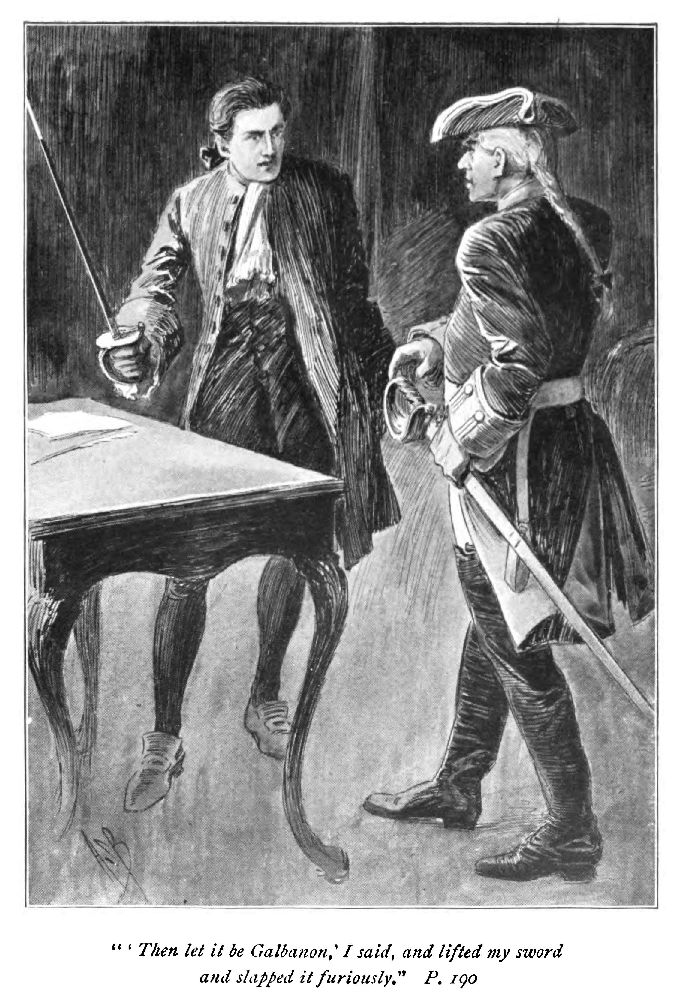
building. “Galbanon,” said my guide, pointing to it, and then made me
understand that the same was worse by far than the Bastille, and at the
moment full of Marquises, Counts, Jesuits, and other clergymen, many of
them in irons for abusing or writing against the Marchioness de Pompadour.
I listened respectfully and waited Monsieur's explanation. It was manifest
I had not been brought into this hall for the good of my education, and
naturally I concluded the name of Galbanon, that I had heard already from
Buhot, with its villainous reputation, was meant to terrify me into a
submission to what had been proposed. The moment after a hearty meal—even
of soup maigre—was not, however, the happiest of times to
work upon a Greig's feelings of fear or apprehension, and so I waited,
very dour within upon my resolution though outwardly in the most
complacent spirit.
The hall was empty when we entered as I have said, but we had not been
many minutes in it when the tramp of men returning to it might be heard,
and this hurried my friend the officer to his real business.
He whipped a letter from his pocket and put it in my hand with a sign to
compel secrecy on my part. It may be readily believed I was quick enough
to conceal the missive. He had no cause to complain of the face I turned
upon another officer who came up to us, for 'twas a visage of clownish
vacuity.
The duty of the second officer, it appeared, was to take me to a new cell
that had been in preparation for me, and when I got there it was with
satisfaction I discovered it more than tolerable, with a sufficiency of
air and space, a good light from the quadrangle, a few books, paper, and a
writing standish.
When the door had been shut upon me, I turned to open my letter and found
there was in fact a couple of them—a few lines from her ladyship in
Dunkerque expressing her continued interest in my welfare and adventures,
and another from the Swiss through whom the first had come. He was still—said
the honest Bernard—at my service, having eluded the vigilance of
Buhot, who doubtless thought a lackey scarce worth his hunting, and he was
still in a position to post my letters, thanks to the goodwill of the
sous-officer who was a relative. Furthermore, he was in hopes that Miss
Walkinshaw, who was on terms of intimacy with the great world and
something of an intriguante, would speedily take steps to secure my
freedom. “Be tranquil, dear Monsieur!” concluded the brave fellow, and I
was so exceedingly comforted and inspired by these matters that I
straightway sat down to the continuation of my journal for Miss
Walkinshaw's behoof. I had scarce dipped the pen, when my cell door opened
and gave entrance to the man who was the cause of my incarceration.
The door shut and locked behind him; it was Father Hamilton!
It was indeed Father Hamilton, by all appearance none the worse in body
for his violent escapade, so weighty with the most fatal possibilities for
himself, for he advanced to me almost gaily, his hand extended and his
face red and smiling.
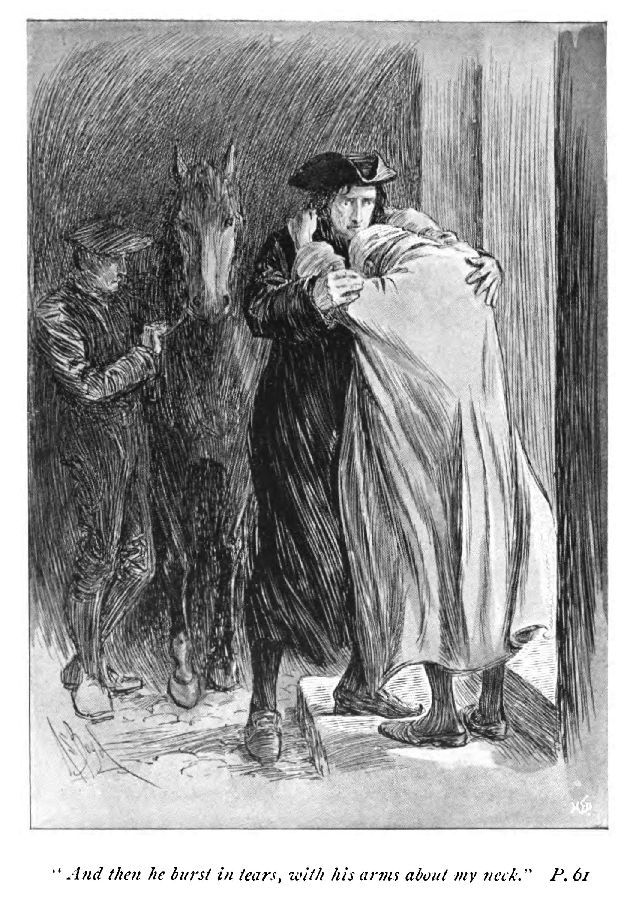
“Scotland! to my heart!” cries he in the French, and throws his arms about
me before I could resist, and kisses me on the cheeks after the amusing
fashion of his nation. “La! la! la! Paul,” he cried, “I'd have wanted
three breakfasts sooner than miss this meeting with my good secretary lad
that is the lovablest rogue never dipped a pen in his master's service.
Might have been dead for all I knew, and run through by a brutal rapier,
victim of mine own innocence. But here's my Paul, pardieu! I would
as soon have my croque-mort now as that jolly dog his uncle, that
never waked till midnight or slept till the dull, uninteresting noon in
the years when we went roving. What! Paul! Paul Greig! my croque-mort!
my Don Dolorous!—oh, Lord, my child, I am the most miserable of
wretches!”
And there he let me go, and threw himself upon a chair, and gave his vast
body to a convulsion of arid sobs. The man was in hysterics, compounding
smiles and sobs a score to the minute, but at the end 'twas the natural
man won the bout, else he had taken a stroke. I stood by him in perplexity
of opinions whether to laugh or storm, whether to give myself to the
righteous horror a good man ought to feel in the presence of a murtherer,
or shrug my shoulders tolerantly at the imbecile.
“There!” said he, recovering his natural manner, “I have made a mortal
enemy of Andrew Greig's nephew. Yes, yes, master, glower at Misery, fat
Misery—and the devil take it!—old Misery, without a penny in
'ts pocket, and its next trip upon wheels a trip to the block to nuzzle at
the dirty end in damp sawdust a nose that has appreciated the bouquet of
the rarest wines. Paul, my boy, has't a pinch of snuff? A brutal bird out
there sings a stave of the Chanson de la Veuve so like the
confounded thing that I heard my own foolish old head drop into the
basket, and there! I swear to you the smell of the sawdust is in my
nostrils now.”
I handed him my box; 'twas a mull my Uncle Andy gave me before he died,
made of the horn of a young bullock, with a blazon of the house on the
silver lid. He took it eagerly and drenched himself with the contents.
“Oh, la! la!” he cried; “I give thanks. My head was like yeast. I wish it
were Christmas last, and a man called Hamilton was back in Dixmunde
parish. But there! that is enough, I have made my bed and I must lie on't,
with a blight on all militant jesuitry! When last I had this box in my
fingers they were as steady as Mont St. Michel, now look—they are
trembling like aspen, n'est-ce pas? And all that's different is
that I have eaten one or two better dinners and cracked a few pipkins of
better wine, and—and—well-nigh killed a police officer. Did'st
ever hear of one Hamilton, M. Greig? 'Twas a cheery old fellow in Dixmunde
whose name was the same as mine, and had a garden and bee-hives, and I am
on the rack for my sins.”
He might be on the rack—and, indeed, I daresay the man was in a
passion of feelings so that he knew not what he was havering about, but
what impressed me most of all about him was that he seemed to have some
momentary gleams of satisfaction in his situation.
“I have every ground of complaint against you, sir,” I said.
“What!” he interrupted. “Would'st plague an old man with complaints when
M. de Paris is tapping him on the shoulder to come away and smell the
sawdust of his own coffin? Oh, 'tis not in this wise thy uncle had done,
but no matter!”
“I have no wish, Father Hamilton, to revile you for what you have brought
me,” I hastened to tell him. “That is far from my thoughts, though now
that you put me in mind of it, there is some ground for my blaming you if
blaming was in my intention. But I shall blame you for this, that you are
a priest of the Church and a Frenchman, and yet did draw a murderous hand
upon a prince of your own country.”
This took him somewhat aback. He helped himself to another voluminous
pinch of my snuff to give him time for a rejoinder and then—“Regicide,
M. Greig, is sometimes to be defended when——”
“Regicide!” I cried, losing all patience, “give us the plain English of
it, Father Hamilton, and call it murder. To call it by a Latin name makes
it none the more respectable a crime against the courts of heaven where
the curse of Babel has an end. But for an accident, or the cunning of
others, you had a corpse upon your conscience this day, and your name had
been abhorred throughout the whole of Europe.”
He put his shoulders up till his dew-laps fell in massive folds.
“'Fore God!” said he, “here's a treatise in black letter from Andrew
Greig's nephew. It comes indifferently well, I assure thee, from Andrew's
nephew. Those who live in glass houses, cher ami,—those who
live in glass houses——”
He tapped me upon the breast with his fat finger and paused, with a
significant look upon his countenance.
“Oh, ye can out with it, Father Hamilton!” I cried, certain I knew his
meaning.
“Those who live in glass houses,” said he, “should have some pity for a
poor old devil out in the weather without a shelter of any sort.”
“You were about to taunt me with my own unhappy affair,” I said, little
relishing his consideration.
“Was I, M. Greig?” he said softly. “Faith! a glass residence seems to
breed an ungenerous disposition! If thou can'st credit me I know nothing
of thine affair beyond what I may have suspected from a Greig travelling
hurriedly and in red shoes. I make you my compliments, Monsieur, of your
morality that must be horror-struck at my foolish play with a pistol, yet
thinks me capable of a retort so vile as that you indicate. My dear lad, I
but spoke of what we have spoken of together before in our happy chariot
in the woods of Somme—thine uncle's fate, and all I expected was,
that remembering the same, thou his nephew would'st have enough tolerance
for an old fool to leave his punishment in the hands of the constitute
authority. Voilà! I wish to heaven they had given me another cell,
after all, that I might have imagined thy pity for one that did thee no
harm, or at least meant to do none, which is the main thing with all our
acts else Purgatory's more crowded than I fancy.”
He went wearily over to the fire and spread his trembling hands to the
blaze; I looked after him perplexed in my mind, but not without an
overpowering pity.
“I have come, like thyself, doubtless,” he said after a little, “over vile
roads in a common cart, and lay awake last night in a dungeon—a
pretty conclusion to my excursion! And yet I am vastly more happy to-day
than I was this time yesterday morning.”
“But then you were free,” I said, “you had all you need wish for—money,
a conveyance, servants, leisure——”
“And M' Croque-mort's company,” he added with a poor smile. “True, true!
But the thing was then to do,” and he shuddered. “Now my part is done,
'twas by God's grace a failure, and I could sing for content like one of
the little birds we heard the other day in Somme.”
He could not but see my bewilderment in my face.
“You wonder at that,” said he, relinquishing the Roman manner as he always
did when most in earnest. “Does Monsieur fancy a poor old priest can take
to the ancient art of assassination with an easy mind? Nom de nom!
I could skip to the block like a ballet-dancer if 'twere either that or
live the past two days over again and fifty years after. I have none of
the right stomach for murder; that's flat! 'tis a business that keeps you
awake too much at night, and disturbs the gastric essence; calls, too, for
a confounded agility that must be lacking in a person of my handsome and
plenteous bulk. I had rather go fishing any day in the week than imbrue.
When Buhot entered the room where I waited for a less worthy man and I
fired honestly for my money and missed, I could have died of sheer
rapture. Instead I threw myself upon his breast and embraced him.”
“He said none of that to me.”
“Like enough not, but 'tis true none the less, though he may keep so
favourable a fact out of his records. A good soul enough, Buhot! We knew
him, your uncle and I, in the old days when I was thinner and played a
good game of chess at three in the morning. Fancy Ned Hamilton cutting
short the glorious career of old Buhot! I'd sooner pick a pocket.”
“Or kill a prince!”
“Felicitations on your wit, M. Greig! Heaven help the elderly when the new
wit is toward! N'importe! Perhaps 'twere better to kill some
princes than to pick a pocket. Is it not better, or less wicked, let us
say, to take the life of a man villainously abusing it than the purse of a
poor wretch making the most of his scanty livres?”
And then the priest set out upon his defence. It is too long here to
reproduce in his own words, even if I recalled them, and too specious in
its terms for the patience of the honest world of our time. With his hands
behind his back he marched up and down the room for the space of a
half-hour at the least, recounting all that led to his crime. The tale was
like a wild romance, but yet, as we know now, true in every particular. He
was of the Society of Jesus, had lived a stormy youth, and fallen in later
years into a disrepute in his own parish, and there the heads of his
Society discovered him a very likely tool for their purposes. They had
only half convinced him that the death of Charles Edward was for the glory
of God and the good of the Church when they sent him marching with a
pistol and £500 in bills of exchange and letters of credit upon a chase
that covered a great part of three or four countries, and ended at Lisbon,
when a German Jesuit in the secret gave him ten crusadoes to bring him
home with his task unaccomplished.
“I have what amounts almost to a genius for losing the opportunities of
which I do not desire to avail myself,” said Father Hamilton with a
whimsical smile.
And then he had lain in disgrace with the Jesuits for a number of years
until it became manifest (as he confessed with shame) that his experience
of leisure, wealth, and travel had enough corrupted him to make the
prospect of a second adventure of a similar kind pleasing. At that time
Charles, lost to the sight of Europe, and only discovered at brief and
tantalising intervals by the Jesuit agents, scarce slept two nights in the
same town, but went from country to country incognito, so that
'twas no trivial task Father Hamilton undertook to run him to earth.
“The difficulty of it—indeed the small likelihood there was of my
ever seeing him,” he said, “was what mainly induced me to accept the
office, though in truth it was compelled. I was doing very well at
Dunkerque,” he went on, “and very happy if I had never heard more of
prince or priesthood, when Father Fleuriau sent me a hurried intimation
that my victim was due at Versailles on Easter and ordered my instant
departure there.”
The name of Fleuriau recalled me to my senses. “Stop, stop, Father
Hamilton!” I cried, “I must hear no more.”
“What!” said he, bitterly, “is't too good a young gentleman to listen to
the confession of a happy murderer that has failed at his trade?”
“I have no feeling left but pity,” said I, almost like to weep at this,
“but you have been put into this cell along with me for a purpose.”
“And what might that be, M. Greig?” he asked, looking round about him, and
seeing for the first time, I swear, the sort of place he was in. “Faith!
it is comfort, at any rate; I scarce noticed that, in my pleasure at
seeing Paul Greig again.”
“You must not tell me any more of your Jesuit plot, nor name any of those
involved in the same, for Buhot has been at me to cock an ear to
everything you may say in that direction, and betray you and your friends.
It is for that he has put us together into this cell.”
“Pardieu! am not I betrayed enough already?” cried the priest,
throwing up his hands. “I'll never deny my guilt.”
“Yes,” I said, “but they want the names of your fellow conspirators, and
Buhot says they never expect them directly from you.”
“He does, does he?” said the priest, smiling. “Faith, M. Buhot has a good
memory for his friend's characteristics. No, M. Greig, if they put this
comfortable carcase to the rack itself. And was that all thy concern?
Well, as I was saying—let us speak low lest some one be listening—this
Father Fleuriau-”
Again I stopped him.
“You put me into a hard position, Father Hamilton,” I said. “My freedom—my
life, perhaps—depends on whether I can tell them your secret or not,
and here you throw it in my face.”
“And why not?” he asked, simply. “I merely wish to show myself largely the
creature of circumstances, and so secure a decent Scot's most favourable
opinion of me before the end.”
“But I might be tempted to betray you.”
The old eagle looked again out at his eyes. He gently slapped my cheek
with a curious touch of fondness almost womanly, and gave a low, contented
laugh.
“Farceur!” he said. “As if I did not know my Don Dolorous, my merry
Andrew's nephew!” His confidence hugely moved me, and, lest he should
think I feared to trust myself with his secrets, I listened to the
remainder of his story, which I shall not here set down, as it bears but
slightly on my own narrative, and may even yet be revealed only at cost of
great distress among good families, not only on the Continent but in
London itself.
When he had done, he thanked me for listening so attentively to a matter
that was so much on his mind that it gave him relief to share it with some
one. “And not only for that, M. Greig,” said he, “are my thanks due, for
you saved the life that might have been the prince's instead of my old
gossip, Buhot's. To take the bullet out of my pistol was the device your
uncle himself would have followed in the like circumstances.”
“But I did not do that!” I protested.
He looked incredulous.
“Buhot said as much,” said he; “he let it out unwittingly that I had had
my claws clipped by my own household.”
“Then assuredly not by me, Father Hamilton.”
“So!” said he, half incredulous, and a look of speculation came upon his
countenance.
CHAPTER XXIV — PHILOSOPHY IN A FELON'S CELL
It seemed for a while as if we were fated to lie forgotten in Bicêtre till
the crack of doom; not that we were many days there when all was done, but
that in our natural hourly expectation at first of being called forth for
trial the hours passed so sluggishly that Time seemed finally to sleep,
and a week, to our fancy—to mine at all events—seemed a month
at the most modest computation.
I should have lost my reason but for the company of the priest, who, for
considerations best known to others and to me monstrously inadequate, was
permitted all the time to share my cell. In his singular society there was
a recreation that kept me from too feverishly brooding on my wrongs, and
his character every day presented fresh features of interest and
admiration. He had become quite cheerful again, and as content in the
confine of his cell as he had been when the glass coach was jolting over
the early stages of what had been intended for a gay procession round the
courts of Europe. Once more he affected the Roman manner that was due to
his devotion to Shakespeare and L'Estrange's Seneca, and “Clarissa
Harlowe,” a knowledge of which, next to the Scriptures, he counted the
first essentials for a polite education. I protest he grew fatter every
day, and for ease his corpulence was at last saved the restraint of
buttons, which was an indolent indulgence so much to his liking that of
itself it would have reconciled him to spend the remainder of his time in
prison.
“Tiens! Paul,” he would say, “here's an old fool has blundered
through the greater part of his life without guessing till now how easy a
thing content is to come by. Why, 'tis no more than a loose waistcoat and
a chemise unbuttoned at the neck. I dared not be happy thus in Dixmunde,
where the folks were plaguily particular that their priest should be
point-devise, as if mortal man had time to tend his soul and keep a
constant eye on the lace of his fall.”
And he would stretch himself—a very mountain of sloth—in his
chair.
With me 'twas different. Even in a gaol I felt sure a day begun untidily
was a day ill-done by. If I had no engagements with the fastidious
fashionable world I had engagements with myself; moreover, I shared my
father's sentiment, that a good day's darg of work with any thinking in it
was never done in a pair of slippers down at the heel. Thus I was as
peijink (as we say) in Bicêtre as I would have been at large in the
genteel world.
“Not,” he would admit, “but that I love to see thee in a decent habit, and
so constant plucking at thy hose, for I have been young myself, and had
some right foppish follies, too. But now, my good man Dandiprat, my petit-maître,
I am old—oh, so old!—and know so much of wisdom, and have seen
such a confusion of matters, that I count comfort the greatest of
blessings. The devil fly away with buttons and laces! say I, that have
been parish priest of Dixmunde—and happily have not killed a man nor
harmed a flea, though like enough to get killed myself.”
The weather was genial, yet he sat constantly hugging the fire, and I at
the window, which happily gave a prospect of the yard between our building
and that of Galbanon. I would be looking out there, and perhaps pining for
freedom, while he went prating on upon the scurviest philosophy surely
ever man gave air to.
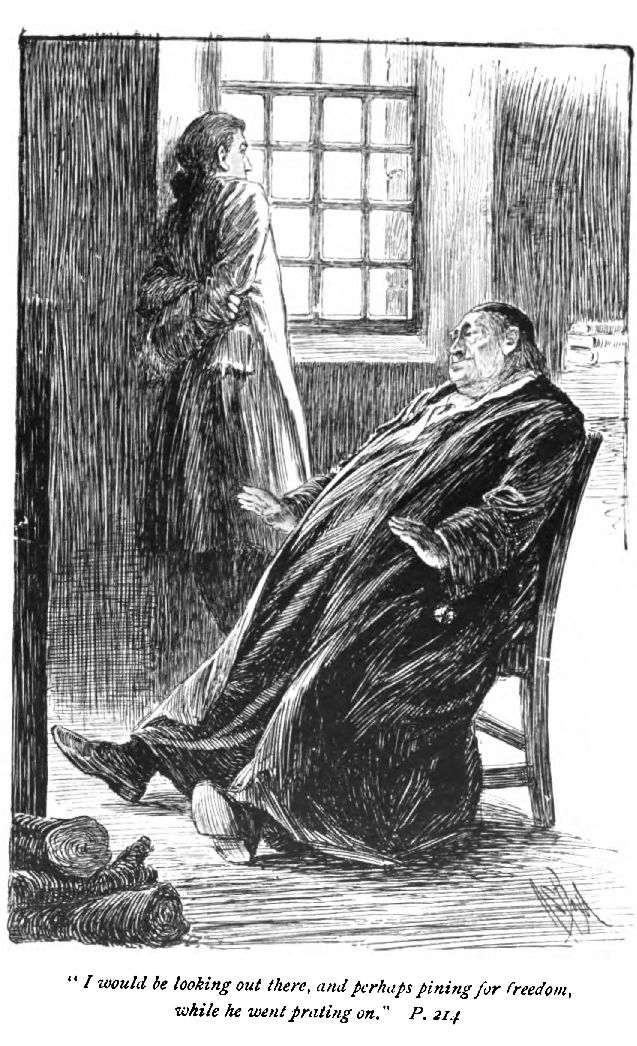
“Behold, my scrivener, how little man wants for happiness! My constant
fear in Dixmunde was that I would become so useless for all but eating and
sleeping, when I was old, that no one would guarantee me either; poverty
took that place at my table the skull took among the Romans—the
thought on't kept me in a perpetual apprehension. Nom de chien! and
this was what I feared—this, a hard lodging, coarse viands, and sour
wine! What was the fellow's name?—Demetrius, upon the taking of
Megara, asked Monsieur Un-tel the Philosopher what he had lost. 'Nothing
at all,' said he, 'for I have all that I could call my own about me,' and
yet 'twas no more than the skin he stood in. A cell in Bicêtre would have
been paradise to such a gallant fellow. Oh, Paul, I fear thou may'st be
ungrateful—I would be looking out there, and perhaps pining for
freedom,” he went prating on, “to this good Buhot, who has given us such a
fine lodging, and saved us the care of providing for ourselves.”
“'Tis all very well, father,” I said, leaning on the sill of the window,
and looking at a gang of prisoners being removed from one part of Galbanon
to another—“'tis all very well, but I mind a priest that thought
jaunting round the country in a chariot the pinnacle of bliss. And that
was no further gone than a fortnight ago.”
“Bah!” said he, and stretched his fat fingers to the fire; “he that cannot
live happily anywhere will live happily nowhere at all. What avails
travel, if Care waits like a hostler to unyoke the horses at every stage?
I tell thee, my boy, I never know what a fine fellow is Father Hamilton
till I have him by himself at a fireside; 'tis by firesides all the wisest
notions come to one.”
“I wish there came a better dinner than to-day's,” said I, for we had
agreed an hour ago that smoked soup was not very palatable.
“La! la! la! there goes Sir Gourmet!” cried his reverence. “Have I
infected this poor Scot that ate naught but oats ere he saw France, with
mine own fever for fine feeding from which, praise le bon Dieu! I
have recovered? 'Tis a brutal entertainment, and unworthy of man, to place
his felicity in the service of his senses. I maintain that even smoked
soup is pleasant enough on the palate of a man with an easy conscience,
and a mind purged of vulgar cares.”
“And you can be happy here, Father Hamilton?”
I asked, astonished at such sentiments from a man before so ill to please.
He heaved like a mountain in travail, and brought forth a peal of laughter
out of all keeping with our melancholy situation. “Happy!” said he, “I
have never been happy for twenty years till Buhot clapped claw upon my
wrist. Thou may'st have seen a sort of mask of happiness, a false face of
jollity in Dunkerque parlours, and heard a well-simulated laughter now and
then as we drank by wayside inns, but may I be called coxcomb if the
miserable wretch who playacted then was half so light of heart as this
that sits here at ease, and has only one regret—that he should have
dragged Andrew Greig's nephew into trouble with him. What man can be
perfectly happy that runs the risk of disappointment—which is the
case of every man that fears or hopes for anything? Here am I, too old for
the flame of love or the ardour of ambition; all that knew me and
understood me best and liked me most are dead long since. I have a state
palace prepared for me free; a domestic in livery to serve my meals;
parishioners do not vex me with their trifling little hackneyed sins, and
my conclusion seems like to come some morning after an omelet and a glass
of wine.”
I could not withhold a shudder.
“But to die that way, Father!” I said.
“C'est égal!” said he, and crossed himself. “We must all die
somehow, and I had ever a dread of a stone. Come, come, M. Croque-mort,
enough of thy confounded dolours! I'll be hanged if thou did'st not steal
these shoes, and art after all but an impersonator of a Greig. The lusty
spirit thou call'st thine uncle would have used his teeth ere now to gnaw
his way through the walls of Bicêtre, and here thou must stop to converse
cursedly on death to the fatted ox that smells the blood of the abattoir—oh
lad, give's thy snuff-box, sawdust again!”
Thus by the hour went on the poor wretch, resigned most obviously to
whatever was in store for him, not so much from a native courage, I fear,
as from a plethora of flesh that smothered every instinct of
self-preservation. As for me I kept up hope for three days that Buhot
would surely come to test my constancy again, and when that seemed
unlikely, when day after day brought the same routine, the same cell with
Hamilton, the same brief exercise in the yard, the same vulgar struggle at
the gamelle in the salle d'épreuve—I could have
welcomed Galbanon itself as a change, even if it meant all the horror that
had been associated with it by Buhot and my friend the sous-officer.
Galbanon! I hope it has long been levelled with the dust, and even then I
know the ghosts of those there tortured in their lives will habitate the
same in whirling eddies, for a constant cry for generations has gone up to
heaven from that foul spot. It must have been a devilish ingenuity, an
invention of all the impish courts below, that placed me at a window where
Galbanon faced me every hour of the day or night, its horror all revealed.
I have seen in the pool of Earn in autumn weather, when the river was in
spate, dead leaves and broken branches borne down dizzily upon the water
to toss madly in the linn at the foot of the fall; no less helpless, no
less seared by sin and sorrow, or broken by the storms of circumstance,
were the wretches that came in droves to Galbanon. The stream of crime or
tyranny bore them down (some from very high places), cast them into this
boiling pool, and there they eddied in a circle of degraded tasks from
which it seemed the fate of many of them never to escape, though their
luckier fellows went in twos or threes every other day in a cart to their
doom appointed.
Be sure it was not pleasant each day for me to hear the hiss of the lash
and the moans of the bastinadoed wretch, to see the blood spurt, and
witness the anguish of the men who dragged enormous bilboes on their
galled ankles.
At last I felt I could stand it no longer, and one day intimated to Father
Hamilton that I was determined on an escape.
“Good lad!” he cried, his eye brightening. “The most sensible thing thou
hast said in twenty-four hours. 'Twill be a recreation for myself to
help,” and he buttoned his waistcoat.
“We can surely devise some means of breaking out if——”
“We!” he repeated, shaking his head. “No, no, Paul, thou hast too risky a
task before thee to burden thyself with behemoth. Shalt escape by thyself
and a blessing with thee, but as for Father Hamilton he knows when he is
well-off, and he shall not stir a step out of Buhot's charming and
commodious inn until the bill is presented.”
In vain I protested that I should not dream of leaving him there while I
took flight; he would listen to none of my reasoning, and for that day at
least I abandoned the project.
Next day Buhot helped me to a different conclusion, for I was summoned
before him.
“Well, Monsieur,” he said, “is it that we have here a more discerning
young gentleman than I had the honour to meet last time?”
“Just the very same, M. Buhot,” said I bluntly. He chewed the stump of his
pen and shrugged his shoulders.
“Come, come, M. Greig,” he went on, “this is a bêtise of the most
ridiculous. We have given you every opportunity of convincing yourself
whether this Hamilton is a good man or a bad one, whether he is the tool
of others or himself a genius of mischief.”
“The tool of others, certainly, that much I am prepared to tell you, but
that you know already. And certainly no genius of mischief himself; man!
he has not got the energy to kick a dog.”
“And—and—” said Buhot softly, fancying he had me in the key of
revelation.
“And that's all, M. Buhot,” said I, with a carriage he could not mistake.
He shrugged his shoulders again, wrote something in a book on the desk
before him with great deliberation and then asked me how I liked my
quarters in Bicêtre.
“Tolerably well,” I said. “I've been in better, but I might be in waur.”
He laughed a little at the Scotticism that seemed to recall something—perhaps
a pleasantry of my uncle's—to him, and then said he, “I'm sorry they
cannot be yours very much longer, M. Greig. We calculated that a week or
two of this priest's company would have been enough to inspire a distaste
and secure his confession, but apparently we were mistaken. You shall be
taken to other quarters on Saturday.”
“I hope, M. Buhot,” said I, “they are to be no worse than those I occupy
now.”
His face reddened a little at this—I felt always there was some vein
of special kindness to me in this man's nature—and he said
hesitatingly, “Well, the truth is, 'tis Galbanon.”
“Before a trial?” I asked, incredulous.
“The trial will come in good time,” he said, rising to conclude the
parley, and he turned his back on me as I was conducted out of the room
and back to the cell, where Father Hamilton waited with unwonted agitation
for my tidings.
“Well, lad,” he cried, whenever we were alone, “what stirs? I warrant they
have not a jot of evidence against thee,” but in a second he saw from my
face the news was not so happy, and his own face fell.
“We are to be separated on Saturday,” I told him.
Tears came to his eyes at that—a most feeling old rogue!
“And where is't for thee, Paul?” he asked.
“Where is't for yourself ought to be of more importance to you, Father
Hamilton.”
“No, no,” he cried, “it matters little about me, but surely for you it
cannot be Galbanon?”
“Indeed, and it is no less.”
“Then, Paul,” he said firmly, “we must break out, and that without loss of
time.”
“Is it in the plural this time?” I asked him.
He affected an indifference, but at the last consented to share the whole
of the enterprise.
CHAPTER XXV — WE ATTEMPT AN ESCAPE
Father Hamilton was not aware of the extent of it, but he knew I was in a
correspondence with the sous-officer. More than once he had seen us in the
salle dépreuve in a manifest understanding of each other, though he
had no suspicion that the gentleman was a Mercury for Miss Walkinshaw,
whose name seldom, if ever, entered into our conversation in the cell.
From her I had got but one other letter—a brief acknowledgment of
some of my fullest budgets, but 'twas enough to keep me at my diurnal on
every occasion almost on which the priest slept. I sent her (with the
strictest injunction to secrecy upon so important a matter) a great deal
of the tale the priest had told me—not so much for her entertainment
as for the purpose of moving in the poor man's interests. Especially was I
anxious that she should use her influence to have some one communicate to
Father Fleuriau, who was at the time in Bruges, how hazardous was the
position of his unhappy cat's-paw, whose state I pictured in the most
moving colours I could command. There was, it must be allowed, a risk in
entrusting a document so damnatory to any one in Bicêtre, but that the
packet was duly forwarded to its destination I had every satisfaction of
from the sous-officer, who brought me an acknowledgment to that effect
from Bernard the Swiss.
The priest knew, then, as I say, that I was on certain terms with this
sous-officer, and so it was with no hesitation I informed him that,
through the favour of the latter, I had a very fair conception of the
character and plan of this building of Bicêtre in which we were interned.
What I had learned of most importance to us was that the block of which
our cell was a part had a face to the main road of Paris, from which
thoroughfare it was separated by a spacious court and a long range of iron
palisades. If ever we were to make our way out of the place it must be in
this direction, for on two sides of our building we were overlooked by
buildings vastly more throng than our own, and bordered by yards in which
were constant sentinels. Our block jutted out at an angle from one very
much longer, but lower by two storeys, and the disposition of both made it
clear that to enter into this larger edifice, and towards the gable end of
it that overlooked the palisades of the Paris road, was our most feasible
method of essay.
I drew a plan of the prison and grounds on paper, estimating as best I
might all the possible checks we were like to meet with, and leaving a
balance of chances in our favour that we could effect our purpose in a
night.
The priest leaned his chin upon his arms as he lolled over the table on
which I eagerly explained my diagram, and sighed at one or two of the
feats of agility it assumed. There was, for example, a roof to walk upon—the
roof of the building we occupied—though how we were to get there in
the first place was still to be decided. Also there was a descent from
that roof on to the lower building at right angles, though where the
ladder or rope for this was to come from I must meanwhile airily leave to
fortune. Finally, there was—assuming we got into the larger
building, and in some unforeseeable way along its roof and clear to the
gable end—a part of the yard to cross, and the palisade to escalade.
“Oh, lad! thou takest me for a bird,” cried his reverence, aghast at all
this. “Is thy poor fellow prisoner a sparrow? A little after this I might
do't with my own wings—the saints guide me!—but figure you
that at present I am not Philetas, the dwarf, who had to wear leaden shoes
lest the wind should blow him away. 'Twould take a wind indeed to stir
this amplitude of good humours, this sepulchre of twenty thousand good
dinners and incomputible tuns of liquid merriment. Pray, Paul, make an
account of my physical infirmities, and mitigate thy transport of
vaultings and soarings and leapings and divings, unless, indeed, thou
meditatest sewing me up in a sheet, and dragging me through the realms of
space.”
“We shall manage! we shall manage!” I insisted, now quite uplifted in a
fanciful occupation that was all to my tastes, even if nothing came of it,
and I plunged more boldly into my plans. They were favoured by several
circumstances—the first, namely, that we were not in the uniform of
the prison, and, once outside the prison, could mingle with the world
without attracting attention. Furthermore, by postponing the attempt till
the morrow night I could communicate with the Swiss, and secure his
cooperation outside in the matter of a horse or a vehicle, if the same
were called for. I did not, however, say so much as that to his reverence,
whom I did not wish as yet to know of my correspondence with Bernard.
Finally, we had an auspicious fact at the outset of our attempt, inasmuch
as the cell we were in was in the corridor next to that of which the
sous-officer had some surveillance, and I knew his mind well enough now to
feel sure he would help in anything that did not directly involve his own
position and duties. In other words, he was to procure a copy of the key
of our cell, and find a means of leaving it unlocked when the occasion
arose.
“A copy of the key, Paul!” said Father Hamilton; “sure there are no bounds
to thy cheerful mad expectancy! But go on! go on! art sure he could not be
prevailed on—this fairy godfather—to give us an escort of
cavalry and trumpeters?”
“This is not much of a backing-up, Father Hamilton,” I said, annoyed at
his skeptic comments upon an affair that involved so much and agitated
myself so profoundly.
“Pardon! Paul,” he said hastily, confused and vexed himself at the
reproof. “Art quite right, I'm no more than a croaker, and for penance I
shall compel myself to do the wildest feat thou proposest.”
We determined to put off the attempt at escape till I had communicated
with the sous-officer (in truth, though Father Hamilton did not know it,
till I had communicated with Bernard the Swiss), and it was the following
afternoon I had not only an assurance of the unlocked door, but in my hand
a more trustworthy plan of the prison than my own, and the promise that
the Swiss would be waiting with a carriage outside the palisades when we
broke through, any time between midnight and five in the morning.
Next day, then, we were in a considerable agitation; to that extent indeed
that I clean forgot that we had no aid to our descent of twenty or thirty
feet (as the sous-sergeant's diagram made it) from the roof of our block
on to that of the one adjoining. We had had our minds so much on bolted
doors and armed sentinels that this detail had quite escaped us until
almost on the eve of setting out at midnight, the priest began again to
sigh about his bulk and swear no rope short of a ship's cable would serve
to bear him.
“Rope!” I cried, in a tremendous chagrin at my stupidity. “Lord! if I have
not quite forgot it. We have none.”
“Ah!” he said, “perhaps it is not necessary. Perhaps my heart is so light
at parting with my croque-mort that I can drop upon the tiles like
a pigeon.”
“Parting,” I repeated, eyeing him suspiciously, for I thought perhaps he
had changed his mind again. “Who thinks of parting?”
“Not I indeed,” says he, “unless the rope do when thou hast got it.”
There was no rope, however, and I cursed my own folly that I had not asked
one from the sous-officer whose complaisance might have gone the length of
a fathom or two, though it did not, as the priest suggested, go so far as
an armed convoy and a brace of trumpeters. It was too late now to repair
the overlook, and to the making of rope the two of us had there and then
to apply ourselves, finding the sheets and blankets-of our beds scanty
enough for our purpose, and by no means of an assuring elegance or
strength when finished. But we had thirty feet of some sort of cord at the
last, and whether it was elegant or not it had to do for our purpose.
Luckily the night was dark as pitch and a high wind roared in the
chimneys, and in the numerous corners of the prison. There was a sting in
the air that drew many of the sentinels round the braziers flaming in the
larger yard between the main entrance and the buildings, and that further
helped our prospects; so that it was with some hope, in spite of a heart
that beat like a flail in my breast, I unlocked the door and crept out
into the dimly-lighted corridor with the priest close behind me.
Midway down this gallery there was a stair of which our plan apprised us,
leading to another gallery—the highest of the block—from which
a few steps led to a cock-loft where the sous-officer told us there was
one chance in a score of finding a blind window leading to the roof.
No one, luckily, appeared as we hurried down the long gallery. I darted
like a fawn up the stair to the next flat, Father Hamilton grievously
puffing behind me, and we had just got into the shadow of the steps
leading to the cock-loft when a warder's step and the clank of his chained
keys came sounding down the corridor. He passed within three feet of us
and I felt the blood of all my body chill with fear!
“I told thee, lad,” whispered the priest, mopping the sweat from his face,
“I told thee 'twas an error to burden thyself with such a useless carcase.
Another moment or two—a gasp for the wind that seems so cursed ill
to come by at my years, and I had brought thee into trouble.”
I paid no heed to him, but crept up the steps and into the cock-loft that
smelt villainously of bats.
The window was unfastened! I stuck out my head upon the tiles and sniffed
the fine fresh air of freedom as it had been a rare perfume.
Luckily the window was scarcely any height, and it proved easy to aid his
reverence into the open air. Luckily, further, it was too dark for him to
realise the jeopardies of his situation for whether his precarious
gropings along the tiles were ten feet or thirty from the yard below was
indiscoverable in the darkness. He slid his weighty body along with an
honest effort that was wholly due to his regard for my interests, because
'twas done with groans and whispered protestations that 'twas the maddest
thing for a man to leave a place where he was happy and risk his neck in
an effort to discover misery. A rime of frost was on the tiles, and they
were bitter cold to the touch. One fell, too, below me as I slid along,
and rattled loudly over its fellows and plunged into the yard.
Naturally we stopped dead and listened breathless, a foolish action for
one reason because in any case we had been moving silently at a great
height above the place where the tile should fall so that there was no
risk of our being heard or seen, but our listening discovered so great an
interval between the loosening of the tile and its dull shattering on the
stones below that the height on which we were perched in the darkness was
made more plain—more dreadful to the instincts than if we could
actually measure it with the eye. I confess I felt a touch of nausea, but
nothing compared with the priest, whose teeth began to chitter in an ague
of horror.
“Good Lord, Paul!” he whispered to me, clutching my leg as I moved in
front of him, “it is the bottomless pit.”
“Not unless we drop,” said I. And to cheer him up I made some foolish
joke.
If the falling tile attracted any attention in the yard it was not
apparent to us, and five minutes later we had to brace ourselves to a
matter that sent the tile out of our minds.
For we were come to the end of the high building, and twenty feet below
us, at right angles, we could plainly see the glow of several skylights in
the long prison to which it was attached. It was now the moment for our
descent on the extemporised rope.
CHAPTER XXVI — A RIMEY NIGHT ON ROOF-TOPS, AND A NEW USE FOR AN OLD KIRK BELL
I fastened the rope about a chimney-head with some misgivings that by the
width and breadth of the same I was reducing our chance of ever getting
down to the lower building, as the knotted sheets from the outset had been
dubious measure for the thirty feet of which my sous-officer had given the
estimate. But I said never a word to the priest of my fears on that score,
and determined for once to let what was left of honesty go before
well-fattened age and test the matter first myself. If the cord was too
brief for its purpose, or (what was just as likely) on the frail side, I
could pull myself back in the one case as the priest was certainly unfit
to do, and in the other my weight would put less strain upon it than that
of Father Hamilton.
I can hear him yet in my imagination after forty years, as he clung to the
ridge of the roof like a seal on a rock, chittering in the cold night
wind, enviously eyeing some fires that blazed in another yard and groaning
melancholiously.
“A garden,” said he, “and six beehives—no, 'faith! 'twas seven last
summer, and a roomful of books. Oh, Paul, Paul! Now I know how God cast
out Satan. He took him from his warm fireside, and his books before they
were all read, and his pantoufles, and set him straddling upon a frozen
house-top to ponder through eternal night upon the happy past. Alas, poor
being! How could he know what joys were in the simplicity of a room of
books half-read and a pair of warm old slippers?”
He was fair rambling in his fears, my poor priest, and I declare scarcely
knew the half of what he uttered, indeed he spoke out so loudly that I had
to check him lest he should attract attention from below.
“Father Hamilton,” said I, when my cord was fastened, “with your
permission I'll try it first. I want to make it sure that my seamanship on
the sloop Sarah, of Ayr, has not deserted me to the extent that I
cannot come down a rope without a ratline or tie a bowling knot.”
“Certainly, Paul, certainly,” said he, quite eagerly, so that I was
tempted for a second to think he gladly postponed his own descent from
sheer terror.
I threw over the free end of the cord and crouched upon the beak of the
gable to lower myself.
“Well, Paul,” said his reverence in a broken voice. “Let us say 'good-bye'
in case aught should happen ere we are on the same level again.”
“Oh!” said I, impatient, “that's the true croque-mort spirit
indeed! Why, Father, it isn't—it isn't—” I was going to say it
was not a gallows I was venturing on, but the word stuck in my throat, for
a certain thought that sprung to me of how nearly in my own case it had
been to the very gallows, and his reverence doubtless saw some delicacy,
for he came promptly to my help.
“Not a priest's promise—made to be broken, you would say, good
Paul,” said he. “I promised the merriest of jaunts over Europe in a coach,
and here my scrivener is hanging in the reins! Pardon, dear Scotland, milles
pardons and good-bye and good luck.” And at that he made to embrace
me.
“Here's a French ceremony just about nothing at all,” I thought, and began
my descent. The priest lay on his stomach upon the ridge. As I sank, with
my eyes turned upwards, I could see his hair blown by the wind against a
little patch of stars, that was the only break in the Ethiopia of the sky.
He seemed to follow my progress breathlessly, and when I gained the other
roof and shook the cord to tell him so he responded by a faint clapping of
his hands.
“Art all right, lad?” he whispered down to me, and I bade him follow.
“Good-night, Paul, good-bye, and God bless you!” he whispered. “Get out of
this as quick as you can; 'tis more than behemoth could do in a month of
dark nights, and so I cut my share of the adventure. One will do't when
two (and one of them a hogshead) will die in trying to do't.”
Here was a pretty pickle! The man's ridiculous regard for my safety
outweighed his natural inclinations, though his prospects in the prison of
Bicêtre were blacker than my own, having nothing less dreadful than an
execution at the end of them. He had been merely humouring me so far—and
such a brave humouring in one whose flesh was in a quaking of alarms all
the time he slid along the roof!
“Are you not coming?” I whispered.
“On the contrary, I'm going, dear Paul,” said he with a pretence at
levity. “Going back to my comfortable cell and my uniformed servant and M.
Buhot, the charmingest of hostellers, and I declare my feet are like ice.”
“Then,” said I firmly, “I go back too. I'll be eternally cursed if I give
up my situation as scrivener at this point. I must e'en climb up again.”
And with that I prepared to start the ascent.
“Stop! stop!” said he without a second's pause, “stop where you are and
I'll go down. Though 'tis the most stupendous folly,” he added with a
sigh, and in a moment later I saw his vast bulk laboriously heaving over
the side of the roof. Fortunately the knots in the cord where the
fragments of sheet and blanket were joined made his task not so difficult
as it had otherwise been, and almost as speedily as I had done it myself
he reached the roof of the lower building, though in such a state he
quivered like a jelly, and was dumb with fear or with exertion when the
thing was done.
“Ah!” he said at last, when he had recovered himself. “Art a fool to be so
particular about an old carcase accursed of easy humours and accused of
regicide. Take another thought on't, Paul. What have you to do with this
wretch of a priest that brought about the whole trouble in your ignorance?
And think of Galbanon!”
“Think of the devil! Father Hamilton,” I snapped at him, “every minute we
waste havering away here adds to the chances against any of us getting
free, and I am sure that is not your desire. The long and the short of it
is that I'll not stir a step out of Bicêtre—no, not if the doors
themselves were open—unless you consent to come with me.”
“Ventre Dieu!” said he, “'tis just such a mulish folly as I might
have looked for from the nephew of Andrew Greig. But lead on, good
imbecile, lead on, and blame not poor Father Hamilton if the thing ends in
a fiasco!”
We now crawled along a roof no whit more easily traversed than that we had
already commanded. Again and again I had to stop to permit my companion to
come up on me, for the pitch of the tiles was steep, and he in a peril
from his own lubricity, and it was necessary even to put a hand under his
arm at times when he suffered a vertigo through seeing the lights in the
yard deep down as points of flame.
“Egad! boy,” he said, and his perspiring hand clutching mine at one of our
pauses, “I thrill at the very entrails. I'd liefer have my nose in the
sawdust any day than thrash through thin air on to a paving-stone.”
“A minute or two more and we are there,” I answered him.
“Where?” said he, starting; “in purgatory?”
“Look up, man!” I told him. “There's a window beaming ten yards off.” And
again I pushed on.
In very truth there was no window, though I prayed as fervently for one as
it had been a glimpse of paradise, but I was bound to cozen the old man
into effort for his own life and for mine. What I had from the higher
building taken for the glow of skylights had been really the light of
windows on the top flat of the other prison block, and its roof was wholly
unbroken. At least I had made up my mind to that with a despair benumbing
when I touched wood. My fingers went over it in the dark with frantic
eagerness. It was a trap such as we had come out of at the other block,
but it was shut. Before the priest could come up to me and suffer the
fresh horror of disappointment I put my weight upon it, and had the good
fortune to throw it in. The flap fell with a shriek of hinges and showed
gaping darkness. We stretched upon the tiles as close as limpets and as
silent. Nothing stirred within.
“A garden,” said he in a little, “as sweet as ever bean grew in, with the
rarest plum-tree; and now I am so cold.”
“I could be doing with some of your complaint,” said I; “as for me, I'm on
fire. Please heaven, you'll be back in the garden again.”
I lowered myself within, followed by the priest, and found we were upon
the rafters. A good bit off there was a beam of light that led us,
groping, and in an imminent danger of going through the plaster, to an
air-hole over a little gallery whose floor was within stretch as I lowered
myself again.
Father Hamilton squeezed after me; we both looked over the edge of the
gallery, and found it was a chapel we were in!
“Sacré nom!” said the priest and crossed himself, with a
genuflexion to the side of the altar.
“Oh, Lord! Paul,” he said, whispering, “if 'twere the Middle Ages, and
this were indeed a sanctuary, how happy was a poor undeserving son of
Mother Church! Even Dagobert's hounds drew back from the stag in St.
Denys.”
It was a mean interior, as befitted the worship of the misérables
who at times would meet there. A solemn quiet held the place, that seemed
wholly deserted; the dim light that had shown through the air-hole and
guided us came from some candles dripping before a shrine.
“Heaven help us!” said the priest. “I know just such another.”
There was nobody in the church so far as we could observe from the little
gallery in which we found ourselves, but when we had gone down a flight of
steps into the body of the same, and made to cross towards the door, we
were suddenly confronted by a priest in a white cope. My heart jumped to
my mouth; I felt a prinkling in the roots of my hair, and stopped dumb,
with all my faculties basely deserted from me. Luckily Father Hamilton
kept his presence of mind. As he told me later, he remembered of a sudden
the Latin proverb that in battles the eye is first overcome, and he fixed
the man in the stole with a glance that was bold and disconcerting. As it
happened, however, the other priest was almost as blind as a bat, and saw
but two civil worshippers in his chapel. He did not even notice that it
was a soutane; he passed peeringly, with a bow to our inclinations,
and it was almost incredulous of our good fortune I darted out of the
chapel into the darkness of a courtyard of equal extent with that I had
crossed on the night of my first arrival at Bicêtre. At its distant end
there were the same flaming braziers with figures around them, and the
same glitter of arms.
Now this Bicêtre is set upon a hill and commands a prospect of the city of
Paris, of the Seine and its environs. For that reason we could see to our
right the innumerable lights of a great plain twinkling in the darkness,
and it seemed as if we had only to proceed in that direction to secure
freedom by the mere effort of walking. As we stood in the shadow of the
chapel, Father Hamilton eyed the distant prospect of the lighted town with
a singular rapture.
“Paris!” said he. “Oh, Dieu! and I thought never to clap an eye on't
again. Paris, my Paul! Behold the lights of it—la ville lumière
that is so fine I could spend eternity in it. Hearts are there, lad, kind
and jocund-”
“And meditating a descent on unhappy Britain,” said I.
“Good neighbourly hearts, or I'm a gourd else,” he went on, unheeding my
interruption. “The stars in heaven are not so good, are no more notably
the expression of a glowing and fraternal spirit. There is laughter in the
streets of her.”
“Not at this hour, Father Hamilton,” said I, and the both of us always
whispering. “I've never seen the place by day nor put a foot in it, but it
will be droll indeed if there is laughter in its streets at two o'clock in
the morning.”
“Ah, Paul, shall we ever get there?” said he longingly. “We can but try,
anyway. I certainly did not come all this way, Father Hamilton, just to
look on the lowe of Paris.”
What had kept us shrinking in the shadow of the chapel wall had been the
sound of footsteps between us and the palisades that were to be
distinguished a great deal higher than I had expected, on our right. On
the other side of the rails was freedom, as well as Paris that so greatly
interested my companion, but the getting clear of them seemed like to be a
more difficult task than any we had yet overcome, and all the more
hazardous because the footsteps obviously suggested a sentinel. Whether it
was the rawness of the night that tempted him to a relaxation, or whether
he was not strictly on duty, I know not, but, while we stood in the most
wretched of quandaries, the man who was in our path very soon ceased his
perambulation along the palisades, and went over to one of the distant
fires, passing within a few yards of us as we crouched in the darkness.
When he had gone sufficiently out of the way we ran for it. So plain were
the lights of the valley, so flimsy a thing had seemed to part us from the
high-road there, that never a doubt intruded on my mind that now we were
as good as free, and when I came to the rails I beat my head with my hands
when the nature of our folly dawned upon me.
“We may just go back,” I said to the priest in a stricken voice.
“Comment?” said he, wiping his brow and gloating on the spectacle
of the lighted town.
“Look,” I said, indicating the railings that were nearly three times my
own height, “there are no convenient trap-doors here.”
“But the cord—” said he simply.
“Exactly,” I said; “the cord's where we left it snugly tied with a bowling
knot to the chimney of our block, and I'm an ass.”
“Oh, poor Paul!” said the priest in a prostration at this divulgence of
our error. “I'm the millstone on your neck, for had I not parleyed at the
other end of the cord when you had descended, the necessity for it would
never have escaped your mind. I gave you fair warning, lad, 'twas a
quixotic imbecility to burden yourself with me. And are we really at a
stand? God! look at Paris. Had I not seen these lights I had not cared for
myself a straw, but, oh lord! lad, they are so pleasant and so close! Why
will the world sleep when two unhappy wretches die for want of a little
bit of hemp?”
“You are not to blame,” said I, “one rope was little use to us in any
case. But anyhow I do not desire to die of a little bit of hemp if I can
arrange it better.” And I began hurriedly to scour up and down the
palisade like a trapped mouse. It extended for about a hundred yards,
ending at one side against the walls of a gate-house or lodge; on the
other side it concluded at the wall of the chapel. It had no break in all
its expanse, and so there was nothing left for us to do but to go back the
way we had come, obliterate the signs of our attempt and find our cells
again. We went, be sure, with heavy hearts, again ventured into the
chapel, climbed the stairs, went through the ceiling, and stopped a little
among the rafters to rest his reverence who was finding these manoeuvres
too much for his weighty body. While he sat regaining sufficient strength
to resume his crawling on rimey tiles I made a search of the loft we were
in and found it extended to the gable end of the chapel, but nothing more
for my trouble beyond part of a hanging chain that came through the roof
and passed through the ceiling. I had almost missed it in the darkness,
and even when I touched it my first thought was to leave it alone. But I
took a second thought and tried the lower end, which came up as I hauled,
yard upon yard, until I had the end of it, finished with a bell-ringer's
hempen grip, in my hands. Here was a discovery if bell-pulls had been made
of rope throughout in Bicêtre prison! But a chain with an end to a bell
was not a thing to be easily borrowed.
I went back to where Father Hamilton was seated on the rafters, and told
him my discovery.
“A bell,” said he. “Faith! I never liked them. Pestilent inventions of the
enemy, that suggested duties to be done and the fleeting hours. But a
bell-rope implies a belfry on the roof and a bell in it, and the chain
that may reach the ground within the building may reach the same desirable
place without the same.”
“That's very true,” said I, struck with the thing. And straight got
through the trap and out upon the roof again. Father Hamilton puffed after
me and in a little we came upon a structure like a dovecot at the very
gable-end. “The right time to harry a nest is at night,” said I, “for then
you get all that's in it.” And I started to pull up the chain that was
fastened to the bell.
I lowered behemoth with infinite exertion till he reached the ground
outside the prison grounds in safety, wrapped the clapper of the bell in
my waistcoat, and descended hand over hand after him.
We were on the side of a broad road that dipped down the hill into a
little village. Between us and the village street, across which hung a
swinging lamp, there mounted slowly a carriage with a pair of horses.
“Bernard!” I cried, running up to it, and found it was the Swiss in the
very article of waiting for us, and he speedily drove us into Paris.
CHAPTER XXVII — WE ENTER PARIS AND FIND A SANCTUARY THERE
Of the town of Paris that is so lamentably notable in these days I have
but the recollection that one takes away from a new scene witnessed under
stress of mind due to matters more immediately affecting him than the
colour, shape, and properties of things seen, and the thought I had in
certain parts of it is more clear to me to-day than the vision of the
place itself. It is, in my mind, like a fog that the bridges thundered as
our coach drove over them with our wretched fortunes on that early morning
of our escape from Bicêtre, but as clear as when it sprung to me from the
uproar of the wheels comes back the dread that the whole of this community
would be at their windows looking out to see what folks untimeously
disturbed their rest. We were delayed briefly at a gate upon the walls; I
can scarcely mind what manner of men they were that stopped us and thrust
a lantern in our faces, and what they asked eludes me altogether, but I
mind distinctly how I gasped relief when we were permitted to roll on.
Blurred, too—no better than the surplusage of dreams, is my first
picture of the river and its isles in the dawn, but, like a favourite
song, I mind the gluck of waters on the quays and that they made me think
of Earn and Cart and Clyde.
We stopped in the place of the Notre Dame at the corner of a street; the
coach drove off to a remise whence it had come, and we went to an
hospital called the Hôtel Dieu, in the neighbourhood, where Hamilton had a
Jesuit friend in one of the heads, and where we were accommodated in a
room that was generally set aside for clergymen. It was a place of the
most wonderful surroundings, this Hôtel Dieu, choked, as it were, among
towers, the greatest of them those of Our Lady itself that were in the
Gothic taste, regarding which Father Hamilton used to say, “Dire
gothique, c'est dire mauvais gout,” though, to tell the truth, I
thought the building pretty braw myself. Alleys and wynds were round about
us, and so narrow that the sky one saw between them was but a ribbon by
day, while at night they seemed no better than ravines.
'Twas at night I saw most of the city, for only in the darkness did I dare
to venture out of the Hôtel Dieu. Daundering my lone along the cobbles, I
took a pleasure in the exercise of tenanting these towering lands with
people having histories little different from the histories of the folks
far off in my Scottish home—their daughters marrying, their sons
going throughither (as we say), their bairns wakening and crying in their
naked beds, and grannies sitting by the ingle-neuk cheerfully cracking
upon ancient days. Many a time in the by-going I looked up their pend
closes seeking the eternal lovers of our own burgh towns and never finding
them, for I take it that in love the foreign character is coyer than our
own. But no matter how eagerly I went forth upon my nightly airing in a roquelaure
borrowed from Father Hamilton's friend, the adventure always ended, for
me, in a sort of eerie terror of those close-hemming walls, those tangled
lanes where slouched the outcast and the ne'er-do-weel, and not even the
glitter of the moon upon the river between its laden isles would comfort
me.
“La! la! la!” would Father Hamilton cry at me when I got home with a face
like a fiddle. “Art the most ridiculous rustic ever ate a cabbage or set
foot in Arcady. Why, man! the woman must be wooed—this Mademoiselle
Lutetia. Must take her front and rear, walk round her, ogling bravely.
Call her dull! call her dreadful! Ciel! Has the child never an eye
in his mutton head? I avow she is the queen of the earth this Paris. If I
were young and wealthy I'd buy the glittering stars in constellations and
turn them into necklets for her. With thy plaguey gift of the sonnet I'd
deave her with ecstasies and spill oceans of ink upon leagues of paper to
tell her about her eyes. Go to! Scotland, go to! Ghosts! ghosts! devil the
thing else but ghosts in thy rustic skull, for to take a fear of Lutetia
when her black hair is down of an evening and thou canst not get a glimpse
of that beautiful neck that is rounded like the same in the Psyche of
Praxiteles. Could I pare off a portion of this rotundity and go out in a
masque as Apollo I'd show thee things.”
And all he saw of Paris himself was from the windows of the hospital,
where he and I would stand by the hour looking out into the square. For
the air itself he had to take it in a little garden at the back,
surrounded by a high wall, and affording a seclusion that even the priest
could avail himself of without the hazard of discovery. He used to sit in
an arbour there in the warmth of the day, and it was there I saw another
trait of his character that helped me much to forget his shortcomings.
Over his head, within the doorway of the bower, he hung a box and placed
therein the beginnings of a bird's nest. The thing was not many hours done
when a pair of birds came boldly into his presence as he sat silent and
motionless in the bower, and began to avail themselves of so excellent a
start in householding. In a few days there were eggs in the nest, and
'twas the most marvellous of spectacles to witness the hen sit content
upon them over the head of the fat man underneath, and the cock, without
concern, fly in and out attentive on his mate.
But, indeed, the man was the friend of all helpless things, and few of the
same came his way without an instinct that told them it was so. Not the
birds in the nest alone were at ease in his society; he had but to walk
along the garden paths whistling and chirping, and there came flights of
birds about his head and shoulders, and some would even perch upon his
hand. I have never seen him more like his office than when he talked with
the creatures of the air, unless it was on another occasion when two
bairns, the offspring of an inmate in the hospital, ventured into the
garden, finding there another child, though monstrous, who had not lost
the key to the fields where blossom the flowers of infancy, and frolic is
a prayer.
But he dare not set a foot outside the walls of our retreat, for it was as
useless to hide Ballageich under a Kilmarnock bonnet as to seek a disguise
for his reverence in any suit of clothes. Bernard would come to us rarely
under cover of night, but alas! there were no letters for me now, and mine
that were sent through him were fewer than before. And there was once an
odd thing happened that put an end to these intromissions; a thing that
baffled me to understand at the time, and indeed for many a day
thereafter, but was made plain to me later on in a manner that proved how
contrary in his character was this mad priest, that was at once assassin
and the noblest friend.
Father Hamilton was not without money, though all had been taken from him
at Bicêtre. It was an evidence of the width and power of the Jesuit
movement that even in the Hôtel Dieu he could command what sums he needed,
and Bernard was habituated to come to him for moneys that might pay for
himself and the coachman and the horses at the remise. On the last
of these occasions I took the chance to slip a letter for Miss Walkinshaw
into his hand. Instead of putting it in his pocket he laid it down a
moment on a table, and he and I were busy packing linen for the wash when
a curious cry from Father Hamilton made us turn to see him with the letter
in his hand.
He was gazing with astonishment on the direction.
“Ah!” said he, “and so my Achilles is not consoling himself exclusively
with the Haemonian lyre, but has taken to that far more dangerous
instrument the pen. The pen, my child, is the curse of youth. When we are
young we use it for our undoing, and for the facture of regrets for after
years—even if it be no more than the reading of our wives' letters
that I'm told are a bitter revelation to the married man. And so—and
so, Monsieur Croque-mort keeps up a correspondence with the lady. H'm!” He
looked so curiously and inquiringly at me that I felt compelled to make an
explanation.
“It is quite true, Father Hamilton,” said I. “After all, you gave me so
little clerkly work that I was bound to employ my pen somehow, and how
better than with my countrywoman?”
“'Tis none of my affair—perhaps,” he said, laying down the letter.
“And yet I have a curiosity. Have we here the essential Mercury?” and he
indicated Bernard who seemed to me to have a greater confusion than the discovery
gave a cause for.
“Bernard has been good enough,” said I. “You discover two Scots, Father
Hamilton, in a somewhat sentimental situation. The lady did me the honour
to be interested in my little travels, and I did my best to keep her
informed.”
He turned away as he had been shot, hiding his face, but I saw from his
neck that he had grown as white as parchment.
“What in the world have I done?” thinks I, and concluded that he was angry
for my taking the liberty to use the dismissed servant as a go-between. In
a moment or two he turned about again, eying me closely, and at last he
put his hand upon my shoulder as a schoolmaster might do upon a boy's.
“My good Paul,” said he, “how old are you?”
“Twenty-one come Martinmas,” I said.
“Expiscate! elucidate! 'Come Martinmas,'” says he, “and what does that
mean? But no matter—twenty-one says my barbarian; sure 'tis a right
young age, a very baby of an age, an age in frocks if one that has it has
lived the best of his life with sheep and bullocks.”
“Sir,” I said, indignant, “I was in very honest company among the same
sheep and bullocks.”
“Hush!” said he, and put up his hand, eying me with compassion and
kindness. “If thou only knew it, lad, thou art due me a civil attention at
the very least. Sure there is no harm in my mentioning that thou art
mighty ingenuous for thy years. 'Tis the quality I would be the last to
find fault with, but sometimes it has its inconveniences. And Bernard”—he
turned to the Swiss who was still greatly disturbed—“Bernard is a
somewhat older gentleman. Perhaps he will say—our good Bernard—if
he was the person I have to thank for taking the sting out of the wasp,
for extracting the bullet from my pistol? Ah! I see he is the veritable
person. Adorable Bernard, let that stand to his credit!”
Then Bernard fell trembling like a saugh tree, and protested he did but
what he was told.
“And a good thing, too,” said the priest, still very pale but with no
displeasure. “And a good thing too, else poor Buhot, that I have seen an
infinity of headachy dawns with, had been beyond any interest in cards or
prisoners. For that I shall forgive you the rest that I can guess at. Take
Monsieur Grog's letter where you have taken the rest, and be gone.”
The Swiss went out much crestfallen from an interview that was beyond my
comprehension.
When he was gone Father Hamilton fell into a profound meditation, walking
up and down his room muttering to himself.
“Faith, I never had such a problem presented to me before,” said he,
stopping his walk; “I know not whether to laugh or swear. I feel that I
have been made a fool of, and yet nothing better could have happened. And
so my Croque-mort, my good Monsieur Propriety, has been writing the lady?
I should not wonder if he thought she loved him.”
“Nothing so bold,” I cried. “You might without impropriety have seen every
one of my letters, and seen in them no more than a seaman's log.”
“A seaman's log!” said he, smiling faintly and rubbing his massive chin;
“nothing would give the lady more delight, I am sure. A seaman's log! And
I might have seen them without impropriety, might I? That I'll swear was
what her ladyship took very good care to obviate. Come now, did she not
caution thee against telling me of this correspondence?”
I confessed it was so; that the lady naturally feared she might be made
the subject of light talk, and I had promised that in that respect she
should suffer nothing for her kindly interest in a countryman.
The priest laughed consumedly at this.
“Interest in her countryman!” said he. “Oh, lad, wilt be the death of me
for thy unexpected spots of innocence.”
“And as to that,” I said, “you must have had a sort of correspondence with
her yourself.”
“I!” said he. “Comment!”
“To be quite frank with you,” said I, “it has been the cause of some
vexatious thoughts to me that the letter I carried to the Prince was
directed in Miss Walkinshaw's hand of write, and as Buhot informed me, it
was the same letter that was to wile his Royal Highness to his fate in the
Rue des Reservoirs.” Father Hamilton groaned, as he did at any time the
terrible affair was mentioned.
“It is true, Paul, quite true,” said he, “but the letter was a forgery.
I'll give the lady the credit to say she never had a hand in it.”
“I am glad to hear that, for it removes some perplexities that have
troubled me for a while back.”
“Ah,” said he, “and your perplexities and mine are not over even now, poor
Paul. This Bernard is like to be the ruin of me yet. For you, however, I
have no fear, but it is another matter with the poor old fool from
Dixmunde.”
His voice broke, he displayed thus and otherwise so troubled a mind and so
great a reluctance to let me know the cause of it that I thought it well
to leave him for a while and let him recover his old manner.
To that end I put on my coat and hat and went out rather earlier than
usual for my evening walk.
CHAPTER XXVIII — THE MAN WITH THE TARTAN WAISTCOAT
It was the first of May. But for Father Hamilton's birds, and some scanty
signs of it in the small garden, the lengthened day and the kindlier air
of the evenings, I might never have known what season it was out of the
almanac, for all seasons were much the same, no doubt, in the Isle of the
City where the priest and I sequestered. 'Twas ever the shade of the
tenements there; the towers of the churches never greened nor budded; I
would have waited long, in truth, for the scent of the lilac and the
chatter of the rook among these melancholy temples.
Till that night I had never ventured farther from the gloomy vicinity of
the hospital than I thought I could safely retrace without the necessity
of asking any one the way; but this night, more courageous, or perhaps
more careless than usual, I crossed the bridge of Notre Dame and found
myself in something like the Paris of the priest's rhapsodies and the same
all thrilling with the passion of the summer. It was not flower nor tree,
though these were not wanting, but the spirit in the air—young girls
laughing in the by-going with merriest eyes, windows wide open letting out
the sounds of songs, the pavements like a river with zesty life of
Highland hills when the frosts above are broken and the overhanging boughs
have been flattering it all the way in the valleys.
I was fair infected. My step, that had been unco' dull and heavy, I fear,
and going to the time of dirges on the Isle, went to a different tune; my
being rhymed and sang. I had got the length of the Rue de Richelieu and
humming to myself in the friendliest key, with the good-natured people
pressing about me, when of a sudden it began to rain. There was no close
in the neighbourhood where I could shelter from the elements, but in front
of me was the door of a tavern called the Tête du Duc de Burgoyne shining
with invitation, and in I went.
A fat wife sat at a counter; a pot-boy, with a cry of “V'ià!” that was
like a sheep's complaining, served two ancient citizens in skull-caps that
played the game of dominoes, and he came to me with my humble order of a
litre of ordinary and a piece of bread for the good of the house.
Outside the rain pelted, and the folks upon the pavement ran, and
by-and-by the tavern-room filled up with shelterers like myself and kept
the pot-boy busy. Among the last to enter was a group of five that took a
seat at another corner of the room than that where I sat my lone at a
little table. At first I scarcely noticed them until I heard a word of
Scots. I think the man that used it spoke of “gully-knives,” but at least
the phrase was the broadest lallands, and went about my heart.
I put down my piece of bread and looked across the room in wonder to see
that three of the men were gazing intently at myself. The fourth was hid
by those in front of him; the fifth that had spoken had a tartan waistcoat
and eyes that were like a gled's, though they were not on me. In spite of
that, 'twas plain that of me he spoke, and that I was the object of some
speculation among them.
No one that has not been lonely in a foreign town, and hungered for
communion with those that know his native tongue, can guess how much I
longed for speech with this compatriot that in dress and eye and accent
brought back the place of my nativity in one wild surge of memory. Every
bawbee in my pocket would not have been too much to pay for such a
privilege, but it might not be unless the overtures came from the persons
in the corner.
Very deliberately, though all in a commotion within, I ate my piece and
drank my wine before the stare of the three men, and at last, on the
whisper of one of them, another produced a box of dice.
“No, no!” said the man with the tartan waistcoat hurriedly, with a glance
from the tail of his eye at me, but they persisted in their purpose and
began to throw. My countryman in tartan got the last chance, of which he
seemed reluctant to avail himself till the one unseen said: “Vous avez
le de'', Kilbride.”
Kilbride! the name was the call of whaups at home upon the moors!
He laughed, shook, and tossed carelessly, and then the laugh was all with
them, for whatever they had played for he had seemingly lost and the dice
were now put by.
He rose somewhat confused, looked dubiously across at me with a reddening
face, and then came over with his hat in his hand.
“Pardon, Monsieur,” he began; then checked the French, and said: “Have I a
countryman here?”
“It is like enough,” said I, with a bow and looking at his tartan. “I am
from Scotland myself.”
He smiled at that with a look of some relief and took a vacant chair on
the other side of my small table.
“I have come better speed with my impudence,” said he in the Hielan'
accent, “than I expected or deserved. My name's Kilbride—MacKellar
of Kilbride—and I am here with another Highland gentleman of the
name of Grant and two or three French friends we picked up at the door of
the play-house. Are you come off the Highlands, if I make take the
liberty?”
“My name is lowland,” said I, “and I hail from the shire of Renfrew.”
“Ah,” said he, with a vanity that was laughable. “What a pity! I wish you
had been Gaelic, but of course you cannot help it being otherwise, and
indeed there are many estimable persons in the lowlands.”
“And a great wheen of Highland gentlemen very glad to join them there
too,” said I, resenting the implication.
“Of course, of course,” said he heartily. “There is no occasion for
offence.”
“Confound the offence, Mr. MacKellar!” said I. “Do you not think I am just
too glad at this minute to hear a Scottish tongue and see a tartan
waistcoat? Heilan' or Lowlan', we are all the same” when our feet are off
the heather.
“Not exactly,” he corrected, “but still and on we understand each other.
You must be thinking it gey droll, sir, that a band of strangers in a
common tavern would have the boldness to stare at you like my friends
there, and toss a dice about you in front of your face, but that is the
difference between us. If I had been in your place I would have thrown the
jug across at them, but here I am not better nor the rest, because the
dice fell to me, and I was one that must decide the wadger.”
“Oh, and was I the object of a wadger?” said I, wondering what we were
coming to.
“Indeed, and that you were,” said he shamefacedly, “and I'm affronted to
tell it. But when Grant saw you first he swore you were a countryman, and
there was some difference of opinion.”
“And what, may I ask, did Kilbride side with?”
“Oh,” said he promptly, “I had never a doubt about that. I knew you were
Scots, but what beat me was to say whether you were Hielan' or Lowlan'.”
“And how, if it's a fair question, did you come to the conclusion that I
was a countryman of any sort?” said I.
He laughed softly, and “Man,” said he, “I could never make any mistake
about that, whatever of it. There's many a bird that's like the woodcock,
but the woodcock will aye be kennin' which is which, as the other man
said. Thae bones were never built on bread and wine. It's a French coat
you have there, and a cockit hat (by your leave), but to my view you were
as plainly from Scotland as if you had a blue bonnet on your head and a
sprig of heather in your lapels. And here am I giving you the strange
cow's welcome (as the other man said), and that is all inquiry and no
information. You must just be excusing our bit foolish wadger, and if the
proposal would come favourably from myself, that is of a notable family,
though at present under a sort of cloud, as the other fellow said, I would
be proud to have you share in the bottle of wine that was dependent upon
Grant's impudent wadger. I can pass my word for my friends there that they
are all gentry like ourselves—of the very best, in troth, though not
over-nice in putting this task on myself.”
I would have liked brawly to spend an hour out any company than my own,
but the indulgence was manifestly one involving the danger of discovery;
it was, as I told myself, the greatest folly to be sitting in a tavern at
all, so MacKellar's manner immediately grew cold when he saw a swithering
in my countenance.
“Of course,” said he, reddening and rising, “of course, every gentleman
has his own affairs, and I would be the last to make a song of it if you
have any dubiety about my friends and me. I'll allow the thing looks very
like a gambler's contrivance.”
“No, no, Mr. MacKellar,” said I hurriedly, unwilling to let us part like
that, “I'm swithering here just because I'm like yoursel' of it and under
a cloud of my own.”
“Dod! Is that so?” said he quite cheerfully again, and clapping down,
“then I'm all the better pleased that the thing that made the roebuck swim
the loch—and that's necessity—as the other man said, should
have driven me over here to precognosce you. But when you say you are
under a cloud, that is to make another way of it altogether, and I will
not be asking you over, for there is a gentleman there among the five of
us who might be making trouble of it.”
“Have you a brother in Glasgow College?” says I suddenly, putting a
question that had been in my mind ever since he had mentioned his name.
“Indeed, and I have that,” said he quickly, “but now he is following the
law in Edinburgh, where I am in the hopes it will be paying him better
than ever it paid me that has lost two fine old castles and the best part
of a parish by the same. You'll not be sitting there and telling me surely
that you know my young brother Alasdair?”
“Man! him and me lodged together in Lucky Grant's, in Crombie's Land in
the High Street, for two Sessions,” said I.
“What!” said MacKellar. “And you'll be the lad that snow-balled the bylie,
and your name will be Greig?”
As he said it he bent to look under the table, then drew up suddenly with
a startled face and a whisper of a whistle on his lips.
“My goodness!” said he, in a cautious tone, “and that beats all. You'll be
the lad that broke jyle with the priest that shot at Buhot, and there you
are, you amadain, like a gull with your red brogues on you, crying
'come and catch me' in two languages. I'm telling you to keep thae feet of
yours under this table till we're out of here, if it should be the morn's
morning. No—that's too long, for by the morn's morning Buhot's men
will be at the Hôtel Dieu, and the end of the story will be little talk
and the sound of blows, as the other man said.”
Every now and then as he spoke he would look over his shoulder with a
quick glance at his friends—a very anxious man, but no more anxious
than Paul Greig.
“Mercy on us!” said I, “do you tell me you ken all that?”
“I ken a lot more than that,” said he, “but that's the latest of my
budget, and I'm giving it to you for the sake of the shoes and my brother
Alasdair, that is a writer in Edinburgh. There's not two Scotchmen
drinking a bowl in Paris town this night that does not ken your
description, and it's kent by them at the other table there—where
better?—but because you have that coat on you that was surely made
for you when you were in better health, as the other man said, and because
your long trams of legs and red shoes are under the table there's none of
them suspects you. And now that I'm thinking of it, I would not go near
the hospital place again.”
“Oh! but the priest's there,” said I, “and it would never do for me to be
leaving him there without a warning.”
“A warning!” said MacKellar with contempt. “I'm astonished to hear you,
Mr. Greig. The filthy brock that he is!”
“If you're one of the Prince's party,” said I, “and it has every look of
it, or, indeed, whether you are or not, I'll allow you have some cause to
blame Father Hamilton, but as for me, I'm bound to him because we have
been in some troubles together.”
“What's all this about 'bound to him'?” said MacKellar with a kind of
sneer. “The dog that's tethered with a black pudding needs no pity, as the
other man said, and I would leave this fellow to shift for himself.”
“Thank you,” said I, “but I'll not be doing that.”
“Well, well,” said he, “it's your business, and let me tell you that
you're nothing but a fool to be tangled up with the creature. That's
Kilbride's advice to you. Let me tell you this more of it, that they're
not troubling themselves much about you at all now that you have given
them the information.”
“Information!” I said with a start. “What do you mean by that?”
He prepared to join his friends, with a smile of some slyness, and gave me
no satisfaction on the point.
“You'll maybe ken best yourself,” said he, “and I'm thinking your name
will have to be Robertson and yourself a decent Englishman for my friends
on the other side of the room there. Between here and yonder I'll have to
be making up a bonny lie or two that will put them off the scent of you.”
A bonny lie or two seemed to serve the purpose, for their interest in me
appeared to go no further, and by-and-by, when it was obvious that there
would be no remission of the rain, they rose to go.
The last that went out of the door turned on the threshold and looked at
me with a smile of recognition and amusement.
It was Buhot!
CHAPTER XXIX — WHEREIN THE PRIEST LEAVES ME, AND I MAKE AN INLAND VOYAGE
What this marvel betokened was altogether beyond my comprehension, but the
five men were no sooner gone than I clapped on my hat and drew up the
collar of my coat and ran like fury through the plashing streets for the
place that was our temporary home. It must have been an intuition of the
raised that guided me; my way was made without reflection on it, at pure
hazard, and yet I landed through a multitude of winding and bewildering
streets upon the Isle of the City and in front of the Hôtel Dieu in a much
shorter time than it had taken me to get from there to the Duke of
Burgundy's Head.
I banged past the doorkeeper, jumped upstairs to the clergyman's quarters,
threw open the door and—found Father Hamilton was gone!
About the matter there could be no manner of dubiety, for he had left a
letter directed to myself upon the drawers-head.
“My Good Paul (said the epistle, that I have kept till now as a memorial
of my adventure): When you return you will discover from this that I have
taken leave a l'anglaise, and I fancy I can see my secretary
looking like the arms of Bourges (though that is an unkind imputation).
'Tis fated, seemingly, that there shall be no rest for the sole of the
foot of poor Father Hamilton. I had no sooner got to like a loose collar,
and an unbuttoned vest, and the seclusion of a cell, than I must be
plucked out; and now when my birds—the darlings!—are on the
very point of hatching I must make adieux. Oh! la belle équipée! M.
Buhot knows where I am—that's certain, so I must remove myself, and
this time I do not propose to burden M. Paul Greig with my company, for it
will be a miracle if they fail to find me. As for my dear Croque-mort, he
can have the glass coach and Jacques and Bernard, and doubtless the best
he can do with them is to take all to Dunkerque and leave them there. I
myself, I go sans trompette, and no inquiries will discover to him
where I go.”
As a postscript he added, “And 'twas only a sailor's log, dear lad! My
poor young Paul!” When I read the letter I was puzzled tremendously, and
at first I felt inclined to blame the priest for a scurvy flitting to rid
himself of my society, but a little deliberation convinced me that no such
ignoble consideration was at the bottom of his flight. If I read his
epistle aright the step he took was in my own interest, though how it
could be so there was no surmising. In any case he was gone; his friend in
the hospital told me he had set out behind myself, and taken a candle with
him and given a farewell visit to his birds, and almost cried about them
and about myself, and then departed for good to conceal himself, in some
other part of the city, probably, but exactly where his friend had no way
of guessing. And it was a further evidence of the priest's good feeling to
myself (if such were needed) that he had left a sum of a hundred livres
for me towards the costs of my future movements.
I left the Hôtel Dieu at midnight to wander very melancholy about the
streets for a time, and finally came out upon the river's bank, where some
small vessels hung at a wooden quay. I saw them in moonlight (for now the
rain was gone), and there rose in me such a feeling as I had often
experienced as a lad in another parish than the Mearns, to see the road
that led from strangeness past my mother's door. The river seemed a
pathway out of mystery and discontent to the open sea, and the open sea
was the same that beat about the shores of Britain, and my thought took
flight there and then to Britain, but stopped for a space, like a wearied
bird, upon the town Dunkerque. There is one who reads this who will judge
kindly, and pardon when I say that I felt a sort of tenderness for the
lady there, who was not only my one friend in France, so far as I could
guess, but, next to my mother, the only woman who knew my shame and still
retained regard for me. And thinking about Scotland and about Dunkerque,
and seeing that watery highway to them both, I was seized with a great
repugnance for the city I stood in, and felt that I must take my feet from
there at once. Father Hamilton was lost to me: that was certain. I could
no more have found him in this tanglement of streets and strange faces
than I could have found a needle in a haystack, and I felt disinclined to
make the trial. Nor was I prepared to avail myself of his offer of the
coach and horses, for to go travelling again in them would be to court
Bicêtre anew.
There was a group of busses or barges at the quay, as I have said, all
huddled together as it were animals seeking warmth, with their bows
nuzzling each other, and on one of them there were preparations being made
for her departure. A cargo of empty casks was piled up in her, lights were
being hung up at her bow and stern, and one of her crew was ashore in the
very act of casting off her ropes. At a flash it occurred to me that I had
here the safest and the speediest means of flight.
I ran at once to the edge of the quay and clumsily propounded a question
as to where the barge was bound for.
“Rouen or thereabouts,” said the master.
I asked if I could have a passage, and chinked my money in my pocket.
My French might have been but middling, but Lewis d'Or talks in a language
all can understand.
Ten minutes later we were in the fairway of the river running down through
the city which, in that last look I was ever fated to have of it, seemed
to brood on either hand of us like bordering hills, and at morning we were
at a place by name Triel.
Of all the rivers I have seen I must think the Seine the finest. It runs
in loops like my native Forth, sometimes in great, wide stretches that
have the semblance of moorland lochs. In that fine weather, with a sun
that was most genial, the country round about us basked and smiled. We
moved upon the fairest waters, by magic gardens, and the borders of
enchanted little towns. Now it would be a meadow sloping backward from the
bank, where reeds were nodding, to the horizon; now an orchard standing
upon grass that was the rarest green, then a village with rusty roofs and
spires and the continual chime of bells, with women washing upon stones or
men silent upon wherries fishing. Every link of the river opened up a
fresher wonder; if not some poplared isle that had the invitation to a
childish escapade, 'twould be another town, or the garden of a château,
maybe, with ladies walking stately on the lawns, perhaps alone, perhaps
with cavaliers about them as if they moved in some odd woodland minuet. I
can mind of songs that came from open windows, sung in women's voices; of
girls that stood drawing water and smiled on us as we passed, at home in
our craft of fortune, and still the lucky roamers seeing the world so
pleasantly without the trouble of moving a step from our galley fire.
Sometimes in the middle of the days we would stop at a red-faced, ancient
inn, with bowers whose tables almost had their feet dipped in the river,
and there would eat a meal and linger on a pot of wine while our barge
fell asleep at her tether and dreamt of the open sea. About us in these
inns came the kind country-people and talked of trivial things for the
mere sake of talking, because the weather was sweet and God so gracious;
homely sounds would waft from the byres and from the barns—the laugh
of bairns, the whistle of boys, the low of cattle.
At night we moored wherever we might be, and once I mind of a place called
Andelys, selvedged with chalky cliffs and lorded over by a castle called
Gaillard, that had in every aspect of it something of the clash of weapons
and of trumpet-cry. The sky shone blue through its gaping gables and its
crumbling windows like so many eyes; the birds that wheeled all round it
seemed to taunt it for its inability. The old wars over, the deep fosse
silent, the strong men gone—and there at its foot the thriving town
so loud with sounds of peaceful trade! Whoever has been young, and has the
eye for what is beautiful and great and stately, must have felt in such a
scene that craving for companionship that tickles like a laugh within the
heart—that longing for some one to feel with him, and understand,
and look upon with silence. In my case 'twas two women I would have there
with me just to look upon this Gaillard and the town below it.
Then the bending, gliding river again, the willow and the aspen edges, the
hazy orchards and the emerald swards; hamlets, towns, farm-steadings,
châteaux, kirks, and mills; the flying mallard, the leaping perch, the
silver dawns, the starry nights, the ripple of the water in my dreams, and
at last the city of Rouen. My ship of fortune went no further on.
I slept a night in an inn upon the quay, and early the next morning,
having bought a pair of boots to save my red shoes, I took the road over a
hill that left Rouen and all its steeples, reeking at the bottom of a
bowl. I walked all day, through woods and meadows and trim small towns and
orchards, and late in the gloaming came upon the port of Havre de Grace.
The sea was sounding there, and the smell of it was like a salutation. I
went out at night from my inn, and fairly joyed in its propinquity, and
was so keen on it that I was at the quay before it was well daylight. The
harbour was full of vessels. It was not long ere I got word of one that
was in trim for Dunkerque, to which I took a passage, and by favour of
congenial weather came upon the afternoon of the second day.
Dunkerque was more busy with soldiers than ever, all the arms of France
seemed to be collected there, and ships of war and flat-bottomed boats
innumerable were in the harbour.
At the first go-off I made for the lodgings I had parted from so
unceremoniously on the morning of that noisy glass coach.
The house, as I have said before, was over a baker's shop, and was reached
by a common outer stair that rose from a court-yard behind. Though
internally the domicile was well enough, indeed had a sort of
old-fashioned gentility, and was kept by a woman whose man had been a
colonel of dragoons, but now was a tippling pensioner upon the king, and
his own wife's labours, it was, externally, somewhat mean, the place a
solid merchant of our own country might inhabit, but scarce the place
wherein to look for royal blood. What was my astonishment, then, when, as
I climbed the stair, I came face to face with the Prince!
I felt the stair swing off below me and half distrusted my senses, but I
had the presence of mind to take my hat off.
“Bon jour, Monsieur, said he, with a slight hiccough, and I saw
that he was flushed and meant to pass with an evasion. There and then a
daft notion to explain myself and my relations with the priest who had
planned his assassination came to me, and I stopped and spoke.
“Your Royal Highness—-” I began, and at that he grew purple.
“Cest un drôle de corps!” said he, and, always speaking in French,
said he again:
“You make an error, Monsieur; I have not the honour of Monsieur's
acquaintance,” and looked at me with a bold eye and a disconcerting.
“Greig,” I blurted, a perfect lout, and surely as blind as a mole that
never saw his desire, “I had the honour to meet your Royal Highness at
Versailles.”
“My Royal Highness!” said he, this time in English. “I think Monsieur
mistakes himself.” And then, when he saw how crestfallen I was, he smiled
and hiccoughed again. “You are going to call on our good Clancarty,” said
he. “In that case please tell him to translate to you the proverb, Oui
phis sait plus se tait.”
“There is no necessity, Monsieur,” I answered promptly. “Now that I look
closer I see I was mistaken. The person I did you the honour to take you
for was one in whose opinion (if he took the trouble to think of me at
all) I should have liked to re-establish myself, that was all.”
In spite of his dissipation there was something noble in his manner—a
style of the shoulders and the hands, a poise of the head that I might
practise for years and come no closer on than any nowt upon my father's
fields. It was that which I remember best of our engagement on the stair,
and that at the last of it he put out his hand to bid me good-day.
“My name,” says he, “is Monsieur Albany so long as I am in Dunkerque. À
bon entendeur salut! I hope we may meet again, Monsieur Greig.” He
looked down at the black boots I had bought me in Rouen. “If I might take
the liberty to suggest it,” said he, smiling, “I should abide by the
others. I have never seen their wearer wanting wit, esprit, and
prudence—which are qualities that at this moment I desire above all
in those that count themselves my friends.”
And with that he was gone. I watched him descend the remainder of the
stair with much deliberation, and did not move a step myself until the tip
of his scabbard had gone round the corner of the close.
CHAPTER XXX — A GUID CONCEIT OF MYSELF LEADS ME FAR ASTRAY — === MISSING PAGES (274-288) ===
Clancarty and Thurot were playing cards, so intent upon that recreation
that I was in the middle of the floor before they realised who it was the
servant had ushered in.
“Mon Dieu! Monsieur Blanc-bec! Il n'y a pas de petit chez soi!”
cried Thurot, dropping his hand, and they jumped to their feet to greet
me.
“I'll be hanged if you want assurance, child,” said Clancarty, surveying
me from head to foot as if I were some curiosity. “Here's your exploits
ringing about the world, and not wholly to your credit, and you must walk
into the very place where they will find the smallest admiration.”
“Not meaning the lodging of Captain Thurot,” said I. “Whatever my
reputation may be with the world, I make bold to think he and you will
believe me better than I may seem at the first glance.”
“The first glance!” cried his lordship. “Gad, the first glance suggests
that Bicêtre agreed with our Scotsman. Sure, they must have fed you on
oatmeal. I'd give a hatful of louis d'or to see Father Hamilton, for if he
throve so marvellously in the flesh as his secretary he must look like the
side of St. Eloi. One obviously grows fat on regicide—fatter than a
few poor devils I know do upon devotion to princes.”
Thurot's face assured me that I was as welcome there as ever I had been.
He chid Clancarty for his badinage, and told me he was certain all along
that the first place I should make for after my flight from Bicêtre (of
which all the world knew) would be Dunkerque. “And a good thing too, M.
Greig,” said he.
“Not so good,” says I, “but what I must meet on your stair the very man-”
“Stop!” he cried, and put his finger on his lip. “In these parts we know
only a certain M. Albany, who is, my faith! a good friend of your own if
you only knew it.”
“I scarcely see how that can be,” said I. “If any man has a cause to
dislike me it is his Roy—”
“M. Albany,” corrected Thurot.
“It is M. Albany, for whom, it seems, I was the decoy in a business that
makes me sick to think on. I would expect no more than that he had gone
out there to send the officers upon my heels, and for me to be sitting
here may be simple suicide.”
Clancarty laughed. “Tis the way of youth,” said he, “to attach far too
much importance to itself. Take our word for it, M. Greig, all France is
not scurrying round looking for the nephew of Andrew Greig. Faith, and I
wonder at you, my dear Thurot, that has an Occasion here—a veritable
Occasion—and never so much as says bottle. Stap me if I have a
friend come to me from a dungeon without wishing him joy in a glass of
burgundy!”
The burgundy was forthcoming, and his lordship made the most of it, while
Captain Thurot was at pains to assure me that my position was by no means
so bad as I considered it. In truth, he said, the police had their own
reasons for congratulating themselves on my going out of their way. They
knew very well, as M. Albany did, that I had been the catspaw of the
priest, who was himself no better than that same, and for that reason as
likely to escape further molestation as I was myself.
Thurot spoke with authority, and hinted that he had the word of M. Albany
himself for what he said. I scarcely knew which pleased me best—that
I should be free myself or that the priest should have a certain security
in his concealment.
I told them of Buhot, and how oddly he had shown his complacence to his
escaped prisoner in the tavern of the Duke of Burgundy's Head. At that
they laughed.
“Buhot!” cried his lordship. “My faith! Ned must have been tickled to see
his escaped prisoner in such a cosy cachette as the Duke's Head,
where he and I, and Andy Greig—ay! and this same priest—tossed
many a glass, Ciel! the affair runs like a play. All it wants to
make this the most delightful of farces is that you should have Father
Hamilton outside the door to come in at a whistle. Art sure the fat old
man is not in your waistcoat pocket? Anyhow, here's his good health....”