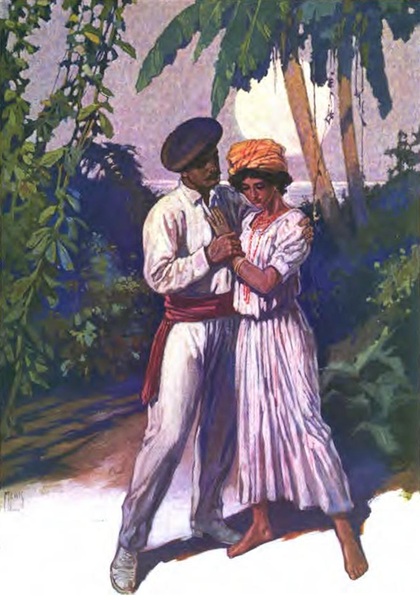
He was awakened from sleep next morning by a voice outside
his door.
It was the voice of Captain Sagesse. Then a knock came
to the door and instantly on the knock it opened and the
Captain came into the room.
Gaspard had slept late, it was full morning and the light
was strong enough to shew Sagesse’s face and its expression.
Something was evidently the matter. He shut the
door and crossed the room.
“Here’s a pretty thing,” said Sagesse. “I am betrayed,
my affair has been blown on—Have you spoken?”
“Spoken—on what?”
“Mon Dieu! What else but the expedition.”
“I, never—not a word—at least—”
“Yes?”
“I said to one man that I was going on a voyage with
you, but I said nothing of the nature of the voyage.”
“Who was the man you spoke to?”
“An old gentleman of the name of Seguin.”
“Hell!” cried Sagesse, springing up from the chair on
which he had taken his seat. “Seguin. There is only one
Seguin on the island—ah, that’s where the money is coming
from—” He ceased speaking, sat down on the chair again,
crushed his panama hat, which he had taken off, between
the palms of his hands and stared at the floor with a frown
on his forehead and his lips pursed up.
The evening before, Jules, his first mate and henchman,
had brought him wind of a rumour that was circulating
amidst the drinking bars of the harbour side.
A rumour that Missie Sagesse had discovered the whereabouts
of a wreck laden with kegs of gold dollars, that he
was going to hunt for it, but would, most likely, fail as
another expedition was starting, financed by a man much
richer and more powerful than the Captain.
The whole thing had originated with Jules himself who,
in his cups, had talked to a coloured woman of the secret
which Sagesse had hinted to him. The hatred of the harbour
side for Sagesse had supplied the other imaginary
expedition.
In reality, nothing was known of any importance. Yet
Sagesse, with whom suspicion was almost a disease, was
sure that Gaspard had betrayed him. The only thing that
made him feel uncertain on the matter was the fact that
Gaspard was presumably unacquainted with any rich man
capable of working mischief. And now Gaspard had
confessed speaking to Seguin on the matter! Seguin, one
of the richest men in the island and Sagesse’s greatest
enemy.
The whole thing was plain.
Another man would have given rein to his temper, accused
Gaspard to his face of the imaginary betrayal, come
to blows with him.
But that was not the way of Captain Sagesse.
Gaspard was necessary to him as a working partner. If
money were found, a white man, single-handed, might have
an exceedingly difficult time with the black crew of La
Belle Arlésienne. He had not time to find another white
man to take Gaspard’s place, simply because now that the
secret was known, the expedition must start as quickly as
possible. No, it would be very impolitic to fight with him
now, afterwards—ah, yes, afterwards when the money was
salved and safe on board the ship, when he had discovered
the temper of the crew under treasure-strain, then it would
be different. He promised himself some satisfaction then,
and promising himself this he unbent his brows and ceased
to purse his lips.
“After all,” said he, “what does it matter? You say you
told nothing to Paul Seguin. I believe you. All the same,
he has got wind of the affair, he is going to send a man on
the same job—”
“Tenez,” said Gaspard, “same job, how can he, when
nobody knows about the island but you and me?”
“Ah,” said Sagesse, “that’s the mystery—how indeed?
But he knows it and that is enough for me. I start in three
days’ time.”
“Three days!”
“Yes, by working overtime, I’ll have the cargo out of the
Belle day after to-morrow night—”
“Vé, but you will want time to get your tackle—”
“Oh, mon Dieu,” said Sagesse, “Do you think I ever say
I’m going to do a thing without having my plans ready
made? Come with me and you will see. We can have
breakfast somewhere together and talk everything over
when I have done my business.”
Gaspard got up and dressed and then the two men left
the house and walked down the Rue du Morne side by side
towards the harbour. Often in his life, Sagesse had been
approached on the subject of sunken treasure. The Caribbean
and the Atlantic about the Bahamas give a fine field
for theoretical treasure-seekers, locations of sunken ships
had been brought to him off Rum Cay, off Grand Cayman,
off Matanzas. The ships were there right enough only
waiting to be rifled, but Sagesse would have nothing to do
with them. He had a profound knowledge of the sea and
its trickery. He knew that though the ships were there
they were tormented by currents, currents that varied with
the ebb and flow so that divers could work only at slack;
he knew the power of these currents to heap sand and hide
treasure. He had seen the end of a broken deep-sea cable
brought up, half a mile of it tied in knots by the mischievous
hands of the currents as though some giant had been
playing with it.
“When a treasure ship lies a prey to the currents of the
sea, there is no use in hunting for treasure or for anything
but disappointment,” was an axiom with him.
What led him to the present adventure was the fact that
the ship was lying in a still lagoon in which diving operations
could be conducted as easily as in a lake. She was
not sanded up but coralled over, and if there was “stuff”
in her a few charges of dynamite would soon lay her open.
The morning was bright over the sea when they reached
the harbour side, La Belle Arlésienne was lying out on the
blue water, the lighters beside her and the cargo coming
out to the tune of winch pawls and the chanty of the
negroes—
A Fort de France Ay ho!
A Fort de France Ay ho!
Bonjou Doux-Doux,
Ay ho!
A Fort de France,
A Fort de France,
Ay ho!
To southward of La Belle Arlésienne a big three-master
was getting up anchor, a cable ship the Grappler was
tramping the bay taking soundings. The water sinks to a
tremendous depth here between Martinique and Dominica
and from the Grappler away out on the violet blue of the
“deeps” came the faint sewing-machine whirr of the Kelvin
sounder at work.
Canotiers were paddling their tiny cargoes round the
steamer from New York that had arrived the evening before
and would start at noon; one could see the little canotiers,
lemon-coloured slips of children standing up and diving for
coins flung by the passengers.
It was a picture full of the spirit of morning, full of
colour, and light, and movement, the hot wind of the tropics
stirring flags and shaking out sail-cloth; sea gulls were
fishing, flickering snow-white in the wind, their querulous
cries came across the bay with the clank of the winch
pawls, capstan pawls, and anchor-chain, and the endless
chanty—
A Fort de France Ay ho!
A Fort de France Ay ho!
Bonjou Doux-Doux,
Ay ho!
A Fort de France,
A Fort de France,
Ay ho!
Faint, musical with distance.
Sagesse, leading the way, they passed along the shore
edge to the Place Bertine.
The sunlight was just striking the Place Bertine over
the shoulder of Pelée. In the blaze of morning light with
the sea and wind shaking the tamarind trees, it formed a
bright picture; women’s coloured dresses, turbans of yellow
madras, men, some clad in white, some half naked,
rolling the sugar hogsheads, laughing, and singing as they
worked, all coloured men, from the white Creole to the jet-black
negro; children—and you may be sure that wherever
there is sugar either in cane or barrel you will find children—playing
games, running messages; children black as
sloes, yellow as bananas, honey-coloured babies naked as
on the day they were born; over all the warm tropic wind
blowing lazily, mixing the scent of the sea with the perfume
of the land, cigar scent—for even the women are
smoking the black Martinique bouts,—and the subtle ubiquitous
scent of sugar in bulk.
Sagesse led the way across the Place to the row of warehouses
and go-downs bordering it on the shore edge. He
paused at an archway giving entrance to a big twilit warehouse,
peeped into the gloom of the place as if in search
of someone or something, and then entered followed by
Gaspard.
It was an extraordinary warehouse, this, smelling of tar,
sail-cloth, and rope. Piles of rusty chain, cable, old
anchors, capstan bars, spars of all sorts, blocks of all sizes
lay about, and in the gloom, ropes and remnants of tackle
hanging from the beams overhead gave a last touch to the
picture. One might have fancied it a cave in which a ship
had come to wreck, or several ships for the matter of that.
In the midst of all the rubbish and odds and ends, the
owner of the place, Monsieur Jaques, known as Jaques tout
court by shipmasters from Port of Spain to Port Royal,
moved about superintending three men who were engaged
with palm and needle patching a sail spread on a vacant
space of the floor.
There are some men who, vulture-like, make their living
out of the ruin and dead bones of things, only in that way
do they prosper, Jaques was one of these men, though you
would never have guessed his vulturous instincts from his
appearance which was that of a plump prosperous-looking
business man, rather past the prime of life, grey-headed,
clean-shaven, always smiling, always calm, always polite,
always seeming to yield to your wishes—but iron in driving
a bargain.
His business in life was the buying up of old ships and
odds and ends of ships for next to nothing, and selling the
remains at a profit. If you wanted an anchor or a suit of
sails or a spar, he could always supply you. He would
buy wrecks even when they were sunken—that is to say, of
course, if they were lying in shallow water. He had bought
in this way the Amine-Martell, lying on the thunderous
beach to westward of Grande Anse. The bay in which she
was lying was a death trap inaccessible from the sea or
from the land, the cliffs were sheer walls of black rock
polished and flawless; by lowering men over the cliff edge
by ropes he had salved thirty-five thousand dollars in gold
coin—a profitable business considering the fact that he had
paid only two thousand dollars for her as she lay.
From Curaçoa to Porto Rico he had conducted salvage
operations, fighting the sea for the pickings of ships, conducting
the operations in person when there seemed a
chance of good profits on the job.
Sagesse took Monsieur Jaques aside and explained what
he wanted whilst Gaspard sat on a spar-end and watched
the sail-patchers at work.
“I’ve got some diving work on hand,” said Sagesse. “I
want two divers’ suits, a pump, everything complete. Have
you them, and how much will you charge to hire them for
two months?”
“Two thousand dollars deposit and five hundred for the
hire,” replied Jaques without a moment’s hesitation.
“Three hundred and not a cent more.”
“My price is five hundred—and if you don’t like it I
am sorry. I have already been approached by a gentleman
on the same subject. I am expecting him here any moment,
if he concludes the bargain with me, where else will you
get diving apparatus—not in Martinique.”
This of course was a lie, but the mind of Sagesse, fogged
with suspicion, saw in it a confirmation of the rumour that
another expedition was on foot. Jaques, watchful as a bird
of prey, saw the effect of his words without understanding
entirely the reason.
“Who is this other person, then,” said Sagesse. “You
can at least tell me his name.”
“I never give names in business, Captain, but as you have
been my customer up to this, I will whisper something in
your ear.”
“Yes.”
“Well,” said Jaques, lowering his voice, “I expect he is a
gentleman on the same business as yourself.”
“The Devil!” said Sagesse. Then, recollecting himself,
he laughed.
“If he is, he’s on a business that won’t bring him much
profit—well, I can’t waste any more time, let’s see the suits
and the apparatus.”
Jaques led the way through a door to the back premises,
where in a shed were the diving suits, the pump, the air
tubes, all nearly new and in good working order. The pump
was constructed so that it could be fixed in a boat or be
used from on board ship. La Belle Arlésienne had a boat
that would do for the work to a nicety, she would have to be
hauled across the islet and floated in the lagoon. The
busy mind of the captain was arranging all these details as
he examined the gear. Then, turning to Jaques:
“Three hundred for the hire and not a cent more.”
“Five hundred and not a cent less. Why should I let
you have a thing for three hundred which I can hire out
to someone else for five—that is not business.”
“Four hundred, come, the money down and the deposit.”
“Five hundred and not a cent less.”
“Four-fifty.”
“Why should I defraud myself of fifty dollars.”
“Well, five hundred be it.”
“And of course, M. le Capitaine, you will be responsible
for any injury to the apparatus.”
“There will be no injury—and now that we have concluded
business, I’ll tell you the name of the man who
wanted to cut me out—who wanted to hire these things.”
Jaques, pleased with the bargain he had struck, delighted
with the success of his ruse, and more delighted with the
fact that it was the wily Captain Sagesse who had fallen
a victim to his bluff, said nothing, but smiled.
“Shall I tell you?”
“If it pleases you.”
“Well, it was Paul Seguin—am I not right?”
“I cannot say—I never tell secrets of business.”
“Look here,” said Sagesse. “I want this matter put
right. You and I have known each other for years. I want
the information because I believe I have been betrayed on
some business I have in hand. See here, if you whisper the
name of the man who came to you about those diving suits,
I’ll never tell, but I’ll be sure in my mind and on my guard,
and I’ll pay you five dollars for the information.”
He took the money from his pocket as he spoke. “You’ll
not tell—it will be kept entirely between ourselves?”
“Yes, I promise.”
“Then give me your ear.” Jaques approached his head
close to the other’s and in a low voice said:
“Paul Seguin.”
“Thanks,” said Sagesse, handing over the money which
Monsieur Jaques pocketed. Five dollars for just a lie was
the best bargain he had ever made.
As Sagesse came through the warehouse, he found Gaspard
still seated on the spar end watching the sail-patchers
at their work. He could have shot him with all the pleasure
in life, yet he greeted him cheerily and with a smile.
It is a profound popular mistake to attribute no sense of
honour to a scoundrel.
He has the keenest sense of honour—in others. He
feels when he is betrayed just as an honourable man feels
only, perhaps, more acutely.
“And now that we have finished business,” said Jaques,
“will you not take some refreshment, you and your friend?”
He opened a door leading from the warehouse to a room,
half sitting-room, half office, ushered them in, and opening
another door, called for coffee, rum, and cigarettes.
In a moment, a servant, bearing a huge tray spread with
the ordinary Martinique petit déjeuner, entered. Gaspard
scarcely heard the entrance of the servant, he was examining
a picture hanging on the pine boarding of the wall, a
small, old-fashioned wood-engraving that had struck his
eye immediately he entered and now held him fascinated as
the serpent on the Place du Fort had held old M. Seguin.
It represented a man small and hideous, holding in one
hand an immense sword and in the other hand a whip.
He was dressed in a shirt and loose trousers, a broad
sash was round his waist and from the sash peeped the
butt of a pistol.
The thing was horrible and grotesque. The man’s head
and face were scarcely larger than the head and face of a
child; yet the face had in it the ferocity of a demon; it
was of extraordinary breadth across the cheek bones.
The limbs, as far as the clothing allowed them to be
seen, were deformed, and as Gaspard stood fascinated and
repelled, a shiver ran through him. He had seen this man—this
thing—before—where? Impossible to say; in some
past life, in some dream—glimpsed, perhaps, in the midst
of some crowd, through the fumes of tobacco in some bar—somewhere,
at some time in his life, he had seen that hideous
head.
More, he felt that the creature, half man, half demon,
had entered his life once, bringing evil into it. Yet, wildly
searching his memory, he could remember nothing of the
circumstance.
“Coffee or cognac?”
Monsieur Jaques was speaking and Gaspard turned from
the picture and accepting a cup of coffee and a cigarette,
took his seat at the table with the others.
Jaques, a cigar in his mouth and a cup of coffee before
him, was deep in trade talk with Sagesse and Gaspard,
pretending interest in their conversation, but hearing
nothing, gazed round the room, taking in its details.
The walls were decorated with drawings of ships, Carib
paddles, gourds, a glass case containing beetles and tarantulas,
things of sea and land, but mostly of the sea.
Here was a chart of the Yucatan Straits marked in ink
with the soundings of a wreck; beside it a chart of the
waters just westward of Nassau where lies a great pond
of the sea nearly two hundred miles from north to south
surrounded with shoal water and reefs, this chart was
marked, too, with the position of a wreck. A battle-lantern
that might have lit Van Horne on some night expedition,
hung from a staple near the charts, Jaques had picked
it up in the sands near San Juan; an old curaçoa flask with
a leathern handle, the earliest form of the bottle in which
the Dutch exported their liqueur, hung by the lantern. The
history of the Caribbean and the Spanish Main lay here
in these things and many more, but let his eyes rove as
they might, Gaspard could not stop them from returning
to the picture that had fascinated him.
Taking advantage of a pause in the conversation between
Jaques and Sagesse, Gaspard leaned forward:
“Excuse me, monsieur,” said he, pointing to the picture,
“but you have a strange portrait on your wall, and the
strangest thing about it is that I feel I have seen the
gentleman before.”
Jaques looked at the picture and laughed. “Ma foi,”
said he, “if you have seen him alive you are older than I
am. You have most likely seen him in a print, but not
such a good print as that one, it is by Coullier, very old,
and I picked it up for a song.”
“And the name of the man?”
“It is Simon Serpente.”
“Who was he?”
“What! you have never heard of Simon Serpente—ah,
but I forgot, you are, no doubt, fresh to the West Indies.
Well, monsieur, Simon Serpente was a devil—He was a
man all the same—”
Here Sagesse nodded as though he knew all about Simon
Serpente.
“But,” continued Jaques, “he was all the same a devil.
We have had a good many devils in these parts in the old
days, but Simon out-Heroded them all. He was one of
the last of the pirates and the worst. Kidd, Horne, Singleton
were not so bad as him. What do you say, Monsieur
le Capitaine?”
“O, from all accounts he was a tough man,” said Sagesse.
“I’ve never held with these cut-throat scoundrels, if they’d
lived in my day I’d have rooted them out if I’d been in
power. The government could have done it then, only they
were bribed. Don’t tell me, the governors in those days
grew fat on pirates.”
“That is true,” said Jaques, “and Serpente kept his head
out of the noose more than once by gilding it, all the same,
Serpente was feared for himself, they said he was not a
man, they said that no one could kill him and that when
he departed this life he would have to die by his own hand,
people imagined that he brought bad luck to anyone who
crossed his path or at whom he looked crookedly.”
“All that is women’s talk,” said Sagesse, “there is no
such thing as bad luck—or devil for the matter of that—go
on.”
“Well,” said Jaques, “if there is no such thing as bad
luck, at all events, Serpente did not bring good luck and he
got such a name for being the Devil himself that he made
men frightened of him, even the fellows of his own stamp.
“He’d been pirating for years and he’d made a very
large fortune, no one knew where he had hidden it, wind
got about that he had an island of his own somewhere in
the Caribbean but no one ever tried to find it, for, I tell
you quite plainly, that had his treasure been lying on the
beach down there, people would have let it lie—”
“Fools,” said Sagesse.
“Perhaps so, but, all the same, I doubt if I would have
cared to meddle with it myself. People said it was the
Devil’s treasure and that it was well-guarded—I am not so
sure that they were fools either. I know Monsieur le Capitaine,
you are sceptical on these points, but I have seen bad
effects following upon money got by force and blood and
inherited. Anyhow, the money of Simon Serpente I would
not have touched. Dieu! the things that man was credited
with I would not speak of, even before you, and so he
went through life till all at once he gave up pirating. It
was a most extraordinary ending to his piracy too, for he
fell foul of Laropé off Matanzas. Laropé, you must know,
was a brother pirate, his ship was the Golden-Shell, Serpente’s
ship was the Puerto Mexico, both ships had been
chasing a brigantine when Serpente signalled Laropé to
haul off, that the prize was his, as he had sighted it first;
Laropé refused, and the next thing he knew, was that his
maintop mast had been shot away.
“Then, forgetting the brigantine, the two pirates closed.
It was off Matanzas and the shore was crowded with people
watching, they said that the guns could be heard at
Havana, the wind being from the east. The upshot was
that Serpente laid the Puerto Mexico alongside the Golden-Shell,
boarded her, put every man to death and hanged
Laropé from his own main yard for a pirate.
“Then Serpente, leaving the Golden-Shell to float derelict,
sailed away in the direction of Cape Sable. He never
hoisted the black flag again and the next thing we hear
about him is that he turned his ship into a slaver. Turned
respectable, so to speak.
“Men no longer feared him so much now. They said that
if he was really a devil he would not have turned over a
new leaf. They began to remember his crimes and a movement
was set on foot against him.
“He heard this, but he did not seem to mind, putting it
down most likely, to idle talk, till one day definite news
came to him as he was leaving the American coast with a
cargo of slaves that a corvette was out against him and that
when he was caught he would be hanged.
“Surely enough, two days out from port, he sighted a corvette
and she chased him. The Puerto Mexico could give
heels to anything in those waters, and by sundown the corvette
was only showing her topsails above the horizon and
by next dawn she was gone; but Serpente knew that all
was over with him in these seas. The Devil had branded
him with such a face and form that he could not hope to
hide himself, so he perhaps made sail for that island of his
where he had placed his treasure—at all events he was
never seen again.”
“Ah, Mon Dieu!” suddenly cried Gaspard. He rose to
his feet and went over to the picture on the wall.
Of a sudden it had flashed upon him where he had seen
the frame-work of that face, that contorted form—the hideous
skull on the island, the bones, could they have been
the remains of Simon Serpente?
The thing seemed madly improbable, till across his mind
flashed the vision of the pouch and belt, with the initials
S. S. on the buckle.
Then he felt, on a sudden, physically ill.
The hideous demon of the picture had, then, entered into
his life, he could not doubt that the skeleton was that
of Serpente and that the money in the belt was that of
Serpente.
And he had warred with Yves over that money and he
had killed Yves. For a moment he saw Evil in all its horror
and the tenacious clutch which Evil has upon life. To
look at this hideous monkey-man was bad enough, but to
feel that you were his inheritor, and that, quarrelling over
this inheritance, you had killed your friend, was beyond
words shocking.
It is so seldom that God gives us an objective view of
evil, that the sight when it comes is prodigious and soul-shaking.
Gaspard looked at the picture of the man whose money
had soiled his hands. This man, dead long years ago,
Anisette, living, but thousands of miles away, these two
were of the same brand, belonged to the company of evil,
they could touch nothing without tainting it and betraying
it to evil, just as they had tainted Gaspard and betrayed
him into the hands of Sagesse.
Controlling his emotion, he turned again to the table
from which Sagesse was now rising to go.
Monsieur Jaques accompanied them through the storehouse,
bade them good-bye, and next moment they were in
the brilliant sunshine of the Place Bertine, Sagesse leading
the way to the water’s edge.
“I am going on board to see how things are getting on,”
said he, “you had better come with me and help. We can
have something to eat aboard and you will want to overhaul
your cabin—Hi there, bring your boat along here!”
He called to a longshoreman—a negro, black, and fantastic
as a golliwog—who was paddling his boat along the
shore edge, the man brought the boat up as directed and
they stepped in.
The morning had become utterly windless, and the sea
like a mirror. Away out towards Dominica, a becalmed,
inter-island schooner lay helpless, the snow-white sails casting
a mile-long reflection on the water, the three-master
which had been getting her anchor up had scarcely filled
her sails when the calm fell, striking the life out of her. St.
Pierre, coloured houses and motionless palms, stood fronting
the blue, and passionately burning sea. It was the
scenery of a most vivid dream, such infinities of colour and
light and silence cast on the mind the unreality of mirage.
The very sounds from the city and the shipping in the bay
were dream sounds, voices of visionary sailors, murmurs
from lotus-land.
Even the old Belle Arlésienne, that hag of the ocean, was
touched by the magic of the day. Masts and spars and
rigging, sun-blistered sides, all were reflected in the mirror
of the harbour whilst her copper shewed up through
the emerald-tinted shadows of the water; and the southern
weeds and strips of fuci growing from the copper waved
as if blown by a faint wind.
The cargo was coming out as fast as winches worked by
hand could lift it, Jules was overseeing the work and he
cast down the ladder for them to come on board. Sagesse
when he reached the deck, looked around to see how things
were going, then he entered the deck-house followed by
Gaspard.
“You’ll take the same cabin,” said Sagesse, pointing to
the dog hole on the starboard side, “I’ll tell Jules to get
one of the niggers to clear it out for you, there’s a lot of
old truck there that wants shifting and it will give you
more room, you won’t have much gear to bring on board, I
expect.”
“Not much—you say you are starting in three days, to-day
is Tuesday—”
“I start on Friday.”
“Ah, yes, on Friday—well, it seems to me that is not a
very good day to start on.”
“Cordieu!” cried Sagesse, suddenly shewing irritation,
“what sort of old woman’s talk is that. What is wrong
with Friday?”
Gaspard leaned against a bulkhead with his arms folded,
he had scarcely spoken a word since leaving Jaques’ store
and Sagesse had noticed his silence.
“I do not know what is wrong with Friday, but I do
know that with a whole week to choose from, I would choose
some other day, especially starting on an expedition of this
sort. However, you can choose what day you like. I have
only one question to ask you.”
“Yes?”
“Will you release me from the business and get someone
else to take my place?”
Sagesse rapped out a laugh, took his seat at the table,
folded his arms and, leaning over his folded arms, stared at
his companion.
He did not speak for a moment. He seemed trying to
read Gaspard’s innermost thoughts. Then “No,” he cried,
“a hundred times no, you are part of the business, you
gave your word, and now you want to back out—I find this
morning my plans betrayed to this cursed Seguin. I say
nothing about that; but this I say, you come with me or I
will take you along with a member of La Garde Royale, we
will hunt for the remains of a gentleman who was killed—we
will look for his clothing and his bones. We will—”
Sagesse stopped as Gaspard, leaving the bulkhead, took a
seat at the table right opposite to him.
“You will do a lot,” said Gaspard, “if I take you by the
throat and drag you out on deck and fling you into the
harbour like the carrion you are. I have given you my
word to go with you, on your cursed expedition, and go I
will. Let no more be said. You talk of hunting for bones,
you will find them. Skeleton Island ought to be the name
of that place and if you don’t leave your own skeleton there
you will be lucky.”
“Threats!” cried Sagesse, making as if to rise from the
table.
“Threats—I never threaten and I am not threatening
you now. I say you will be lucky if you don’t leave your
bones behind you for the place is cursed—see you here—”
He leaned across the table facing Sagesse, and, lowering
his voice—“See you here, I told you how I fought with
a man out there and how, by accident, I killed him; well, I
did not tell you all—after he was dead things happened.”
“Yes?”
“Even before he was dead I did not like the place, that
ship down in the water seemed to me the devil’s own ship,
no one ever saw a ship like that before, she was like an old
drowning corpse and then all of a sudden just at sundown,
she came to life, lit up as though she were hung with
lamps—”
“Phosphorus,” said Sagesse.
“It was not, it was just the light in the sky, God’s good
sunlight, but I have never seen such a thing before. Well,
what happened next day? I killed my friend, I flung my
knife at him, but I did not mean to kill, no, but the devil
who lives on that island, took care that the knife did its
work. Next day, as I was standing on the reef, looking out
for ships, I felt someone standing behind me. There was
no one to be seen but there was someone there, the very
gulls in that place are not right, Bon Dieu, they shout at
one—then, in the night someone beat a drum close to my
tent—I nearly left my reason behind in that place—well,
now, listen, I escaped, I said to myself, ‘never will I go
back there,’ look at my luck. I meet you. I take too much
rum, I talk to you and shew you that cursed gold, and
what’s the result? Well, I’m going back, against my
will—”
“To make your fortune against your will,” said Sagesse
with a sneer, “and you call that bad luck.”
“Fortune,” cried Gaspard, echoing the sneering tone of
the other, “and you expect to take a fortune from that
place?”
“If it is there, I will take it.”
“I tell you if it were lying on the beach, you will not
take it.”
“And who will prevent me?”
“There is one there who will prevent you.”
“And who is he?”
“Simon Serpente.”
Sagesse looked at his companion as if doubting his reason.
“Simon Serpente.”
“Yes, in the last few hours I have discovered whose
ship that is lying there in the water, and whose money that
was we found in the belt. I told you there was a skeleton
by the money; well, see here, the skull wasn’t bigger than
that.” He held his hands together as if clasping lightly
the head of a child, “and it was not a right skull, why, I
said to Yves, ‘Well, he must have been a beauty, the fellow
this belonged to,’ then the bones were not the bones of an
ordinary man, the minute I set eyes on that picture of Serpente,
I said to myself, ‘I have seen that thing before, but
where?’ It wasn’t till Monsieur Jaques told me his story,
that I recognised the truth of the thing and that the skeleton
was the skeleton of Serpente.”
“Rubbish,” replied Sagesse, “you are full up of fo’csle
fancies; Serpente—I don’t believe myself a quarter I have
heard about the chap—you talk like some old Creole woman.
If Serpente ever lived, he died in some grog shop, like the
rest of his sort, filled with balloon juice; or got knocked on
the head in some fight down a back alley—”
“One moment—I shewed you the belt and the pouch
which I brought from the island; on the buckle of the belt
two letters were scratched, you examined them yourself—what
were they?”
Sagesse started in his chair. He had cast his memory
back.
“Cordieu!” cried he, “I remember now.”
“What were the letters?”
“By my faith, it’s strange, S. S. It would be the fellow’s
initials.”
“Just so.”
“Simon Serpente.”
“Just so.”
“You did not scratch those letters yourself?”
Gaspard laughed.
“Did I know at that time anything about Serpente?”
“That is true.”
Sagesse’s face had flushed, he sat with his fingers drumming
on the table and his eyes fixed on his fingers.
He seemed plunged in reverie of an exciting nature, then,
suddenly recovering himself, he brought his great fist
down with a bang on the table.
“That’s luck—one can’t doubt—He went to his hive—He’d
have been making for Europe, something happened to
his ship and sunk it, who knows what, but one may swear
that he left his bones close to his money.”
Then to Gaspard: “Can’t you see?”
“What?”
“The gold, it’s there as sure as I am here.”
“I am certain of that.”
“Then what are you grumbling about, Mordieu, you look
as though you had lost a fortune instead of having found
one.”
“Perhaps it would be better to lose a fortune than find
one like that. Have it as you will, though, but at least
remember my words if anything should happen.”
“And what may they be, those words of yours?” asked
Sagesse rising, going to the locker, and pouring himself
out a dram.
“Just this, there’s a curse on that place as sure as my
name is Gaspard Cadillac, and the man who goes hunting
there for treasure will find more than he expects.”
Sagesse drank off his dram.