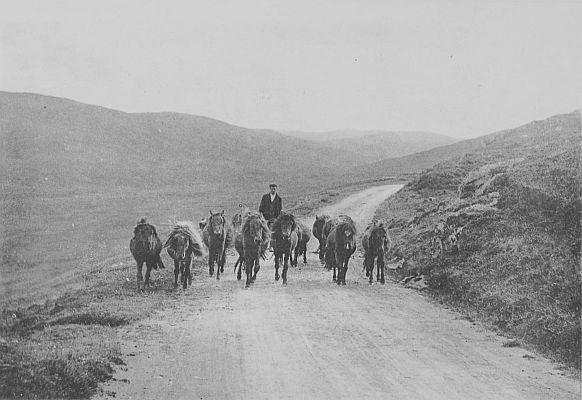
CHAPTER II . — The Pony in Shetland.
The Shetland pony is almost more conspicuous
in the simple farming economy of his own
Islands than other horses are in British
agriculture. He has been the constant theme
of travellers and dwellers in Shetland; and
their references show that he has been a
dominant interest there throughout the whole
known history of his home. The statements
which have already been quoted are continued
and corroborated up to our own day;
and everywhere we find the same description
of the ponies—their small size and their
courage and endurance.[27]
Typical of many accounts of them is that
given by Campbell in 1750. “There are little
horses in this Island, which the Inhabitants
call Shelties; they are so very small that one
may lay his leg over them from the ground;
but notwithstanding their Smallness they are
both strong and active, and live many years,
even till they are blind with Age: I have
heard say, some of them live till they are
upwards of thirty, and they are never kept
within Doors, but are foaled in the Fields,
live in the Fields, and die in the Fields. They
do little Work, unless it be to carry some
Sea Weed, to dung the Ground in the Seed-Time.
There is no Horse-hire.”[28]
Throughout the narratives of eye-witnesses
we find everywhere the fact that the ponies
are reared and kept in conditions of great
hardship. A Highland Society’s report in 1801
tells us that “the horses live in the open fields,
summer and winter, night and day, and never
get a mouthful except what they can gather,
not even when the ground is covered with
snow. At the season of labour they are, of
consequence, miserable, lean, and weak; so
late as the middle of June they are little
else than skin and bone, covered with long
hair like goats, yet, even in that situation,
their spirit is astonishingly great.”[29]
“They would be more numerous,” says
Gifford, “if in any way cared for; but
they lie out in the open fields summer and
winter, and get no food but what they
can find for themselves; so in bad winters
many of them die with hunger and cold.
It will, no doubt, be wondered at by strangers
that so little care is taken about
these sheep and horses which are so useful
and beneficial; the reason whereof is, that
the poor inhabitants, having used their utmost
endeavours, can scarce find food and shelter
for their oxen and cows, without which they
could not live; and in hard winters many
of them die for want of fodder, so they have
none to bestow on their sheep and horses, until
they find more time to improve the land.”[30]
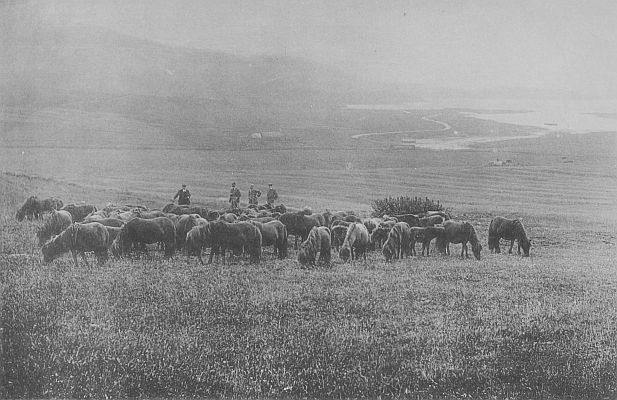
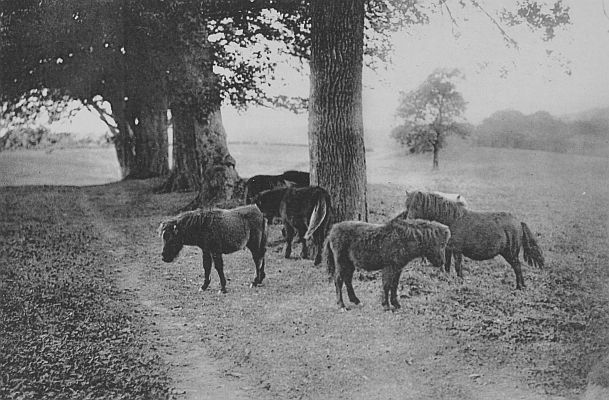
BY THE VOE.
It should perhaps be kept in mind, as a
qualification of these comments, that while
dependent on some degree of help in finding
food in winter, and especially so in the
poorer parts of Shetland, the pony is much
less in need of shelter than most other
animals, and appears, indeed, to thrive much
better even when he is exposed to severe
weather conditions than when he is kept
indoors. But the lot of the Island pony is
still a hard one in the long winters, when the
scanty livelihood which he can gather on the
mosses, by the dyke-sides, and on the sea-shore
is but poorly supplemented by the
occasional sheaf of oats which is all that his
owner can usually allow him.
The great majority of the ponies in the
Islands are in the hands of crofters, either
owned by them or held on the system of
“halvers,” under which merchants or others
supply brood mares in return for a half
interest in their progeny.
The mares nursing foals are kept usually
about the croft until their foals are old
enough to follow them to the “Scathold”;
other ponies spend their whole summer in
the hills, returning to the nearer fields, after
the crops are cleared, when the approach of
winter makes some additional food necessary.
It is still too common, though less so than
formerly, to leave the foals unweaned, with
the result that the mares so treated usually
foal but once in two years. This wasteful
plan is due to the difficulty of finding food
for the weaned foals; but the attempted
economy so completely defeats its own object
that it cannot fail to die out.
In the beginning of last century we find
the Highland Society’s report, already quoted,
referring to “an absurd custom among the
farmers of preserving for stallions ... the
most unpromising of the young of the
species”;[31] and very competent observers
state in 1845 that “the ponies are now much
smaller in size than they were thirty years ago,
entirely owing to the fact that all the best and
stoutest are exported, and stallions of the most
puny size are allowed to go at large.”[32]
It would appear from this that the selective
process by which the small size of the
pony has been fixed and exaggerated was
not, at this period, one deliberately and
consciously promoted, but was contrary to
the wishes of those who regarded the interest
of the breed, and was the result of
economic pressure which encouraged the export
of the larger and more valuable ponies,
leaving the smaller and cheaper stallions to
be employed as stud animals. Larger and
not smaller ponies were in point of fact
desired; and the decline in size, which seems
to have taken place at this period, was a
consequence of the poverty and perhaps also
of the short-sighted thrift of the crofting
owners.
This fact, indeed, sets aside the argument
of Mr Vero Shaw[33] and others, that the breed
must always have been kept pure, because
no cross could be used to improve it by
reducing its size. The temptation to introduce
alien blood came from the opposite motive—a
desire to increase size; and when we read
that in 1788 “a fine young horse of the
Norway breed had perished in a marsh,”[34] we
see that the materials for cross-breeding, as
well as the motive to practise it, were actually
in existence—the results probably remaining
in the larger ponies now used for draught
in Shetland.
It must be observed that a scarcity of
really good stallions, probably arising from
the same causes as formerly, is still the chief
impediment to the improvement of the Shetland
pony in his native home. But this cause
no longer operates to reduce size, as fashion
has created a demand for excessively small
ponies, which tempts the poorer owners rather
to sell than to keep them.
In 1865 we have the first record of an actual
attempt to reduce the size of the pony, in the
very interesting notes on Shetland pony
breeding made by “The Druid” in ‘Field
and Fern.’
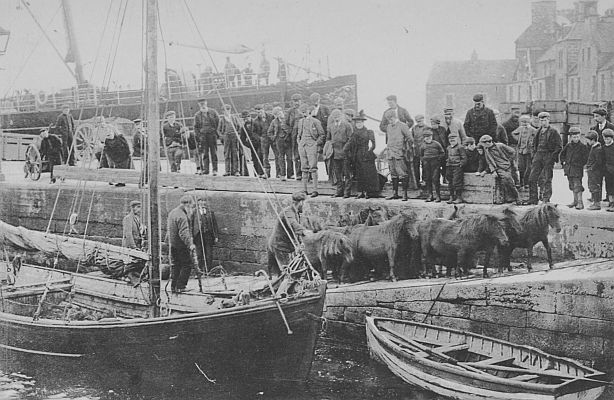
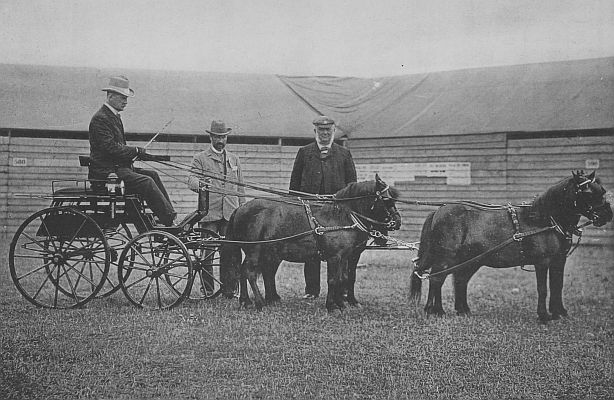
GOING SOUTH.
“Colonel Balfour, grandfather to the present
proprietor of Shapinsay, began pony breeding
at the end of the last century. He improved
the form; and when the colours did not come
as they expected, the natives, with a few
drops of whiskey to quicken them, laid the
entire blame on Spunky, the Orcadian water-kelpie.
“He was black, they say, and the sire of
some of the finest original ponies of the
islands; and if he was disturbed in his courtships,
he vanished under the waves in a mass
of blue flame.
“The Hellersay stock have been quite able
to dispense with him, as North Unst has furnished
them with some of its choicest jewels.
“Brisk, the chestnut, dates very far back,
and headed the Balfour stud for wellnigh
thirty years, and his brother Swift was in
the flesh for nearly forty-six.
“The piebald Cameron cost £24, and although
he rather spoilt the colours, he
introduced a better shape, a smaller head,
and decidedly truer action. Odin, of the same
colour, also kept up the form; Thor got them
nearly all skewbalds like himself; and Lord
Minimus was a grey and sire of grey beauties.
They are shifted from island to island as the
grass suits, and require the most careful drafting
to keep them at nine hands. Mr Balfour
has about 40 in all, of which the majority are
duns and creams; and they are always broken
at three, and made very tractable in a week.
Her Majesty has a pair of them; and some
of the more fancy colours were once picked
up by Ducrow.”[35]
Colonel Balfour, whose enterprise is referred
to by “The Druid,” was probably the first to
attempt breed improvement in the Shetland
pony. His grandson, in “The Druid’s” day,
was in all likelihood the first breeder who
made a systematic and deliberate effort to
accentuate the small size which the poverty
of nature and man had already fixed as a
breed-characteristic; and his example has
not been very widely followed in Shetland.
It cannot, in fact, be said that, on the whole,
any clear idea dominates the plans or purposes
of pony breeders in the Islands. Individual
breeders here and there have pursued an
enlightened course in endeavouring to improve
their herds; and it is natural that
their choice of breeding stock should have
been determined largely by the nature of the
commercial demand. They have thus been
led to concentrate their attention mainly on
the production of animals with the weight of
body and strength of bone which have been
demanded by British and foreign buyers. On
the other hand, the conditions of existence
in Shetland have greatly contributed to the
preservation of an active type of pony such
as can gain its livelihood on the poor and
mossy pastures of the Islands.
It must be remembered that in many
districts there has been, as has already been
said, a great dearth of good sires, so that
selection of suitable breeding stock has been
difficult, and mating has often been carried
on, of necessity, very much at haphazard. It
is thus all the more remarkable that the pony,
so long neglected and so little cultivated in its
home, should display so high a degree of
excellence as it does. Much of the credit of
this belongs to the Marquis of Londonderry,
whose stud in Bressay, under the charge of
Mr Brydon and Mr Meiklejohn, developed a
strain of ponies which fixed many of the best
qualities of the breed and became a potent
centre of its improvement; and no account of
the Island ponies would be complete which
did not mention the successful activity of
Messrs John Anderson & Sons of Hillswick,
the late Mr Bruce of Sumburgh, Mr Anderson
Manson, and the Messrs Sandison. Notable
throughout Shetland, the fine quality of the
pony is specially conspicuous in Unst, which
still retains the superiority which “The
Druid” found in it in 1865. “The best ponies
come from Unst; but both there and everywhere
the breeders are far too indifferent
to the points of a sire, as long as they are
foal-getters. About a quarter of Unst has
a skeleton of red sandstone and serpentine,
with a thin soil studded with large red stones
and the knobs of rock sticking up. Yet
among these rocky incumbrances one sees
scores of ponies picking the green grass,
which the light of Heaven and the breath of
the Gulf Stream force up from so barren-looking
a bed. Still, Unst may be regarded
as the heart of Shetland; and a sunny,
genial-looking spot it is, when other parts
of the country are dismal enough, in the late
northern spring. The heather and the bog-grasses
elsewhere do not make much milk,
and the mare ponies sink so much in condition
that they are invariably barren every other
year. If well kept they reach 44 inches; but
the average is from 38 to 42. Their owners
frequently lose sight of them for a couple of
summers, and recognise them when wanted,
not by any formal ‘Exmoor Brand’ on the
saddle place or the hoof, but by a peculiar
slit or bits of tape, clout, or leather tied
through a hole in the ear. Each cottar
has generally a few ponies on the hill, and
when the May and October sales at the
different stations are at hand they circumvent
them for a selection by the dealers with
a line of forty or fifty fathoms. Still, the
hard-working Shetlander is little more than
nominal lord of his pony: poverty is his lot
from the cradle to the grave, and, as the
phrase goes, he is ‘still in tow.’ In his dire
need the merchants become his mortgagees,
just as the curers are to the herring-fishers:
they advance money on the security of his
foals, and he doesn’t get the best of it with
‘halvers’ mares.”[36]
The chief defects of the Island ponies are to
be found in the movement and conformation
of the hocks—“cow hocks” being common,
and also a tendency to excessive bending of
the joints. There is, in fact, a look of “curbiness”
about many of the ponies which renders
it surprising that curb itself—like almost
every other unsoundness—occurs but rarely.
How far these hock defects are caused or
aggravated by undue hardship in early life
cannot easily be estimated, but they can
certainly be greatly mitigated by more
generous treatment. Apart from them—and
from a tendency to roach backs, undoubtedly
aggravated by poor rearing—the Island
ponies present few common defects that are
practically serious; but their general appearance
is often much deteriorated by
insufficient care in early life.
In colour the pony is much more variegated
in the Islands than on the British mainland,
where black and brown increasingly predominate.
In some parts of Shetland—notably
in the western district of Sandness—piebalds
and skewbalds are more common
than self-coloured ponies; while chestnuts,
yellow duns, and mouse-duns (sometimes
curiously called “greys”) are exceedingly
frequent.
But we still find as “The Druid” did in
1865: “Duns are in great request; but the
colour is not so much an object if the bone be
only good. Greys and chestnuts are scarce;
bay has not its wonted supremacy; and bays
and blacks are most common. Some buyers
began to go against piebalds from a belief
that they had Iceland blood in them, and
were softer and slower in consequence.”[37]
The employment of Shetland ponies in
Shetland is now much less than it was
formerly. Speaking generally, they have
become a breeding stock, kept for sale rather
than for work. Somewhat larger ponies—from
11 to 12½ hands—are in very common
use in carts; and these are probably cross-bred
ponies partly of Shetland ancestry. But
the introduction of wheeled vehicles in the
latter part of last century almost made an
end, in practice, of the pony as a means of
transport in its own home.
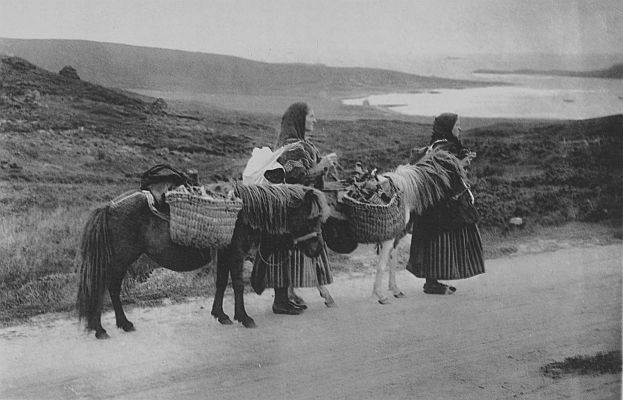
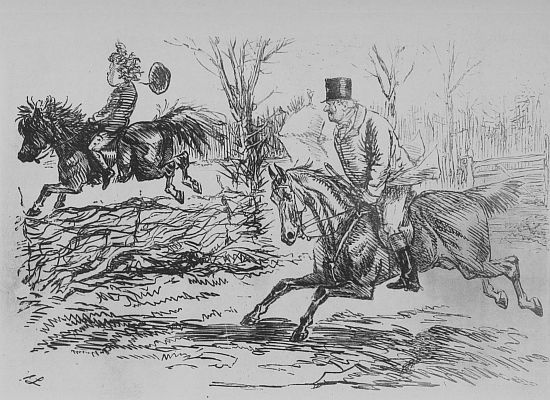
COMING FROM MARKET.
The fact—apt to be forgotten in controversies
about Shetland pony type—is that the
pony never until quite recently was a draught
animal. Roads did not exist in Shetland
until they were made, in and after 1847, in
order to give employment for the relief of
distress caused by the potato famine. Till
then wheeled vehicles were practically unknown,
and the ponies were used only as
pack and saddle animals. We read of them
“travelling through the country among the
rocks and mosses”;[38] and Edmonstone gives
us a luminous glimpse at once of Shetland
society and of the stature of the riding
ponies:—
“Winter is the season of general mirth and
festivity in Zetland, although the wish to visit
each other is greatly interrupted by the difficulties
which are attendant on travelling. As
there are no regular roads, a journey over
land is a serious undertaking, for the ground
is wet and unequal and the ponies are low.”[39]
One seems to see the cavalcade picking its
way through the moss, riders holding up their
feet to avoid the soft ground through which
their mounts find a path, and ladies tremulous
over the fate of the precious burdens of the
pack-ponies.
Hibbert gives us an even more complete
picture of the Shetland pony in use a hundred
years ago:—
“A walk through the valley near Woodwick
leads to a large open lawn at the end of the
Loch of Cliff, which seemed very populous
and well cultivated. I arrived there on the
Sabbath morning; the natives of the Vale
were all in motion in their way to the Kirk of
Baliasta. The peasant had returned home
from the bleak scathold, where he had ensnared
the unshod pony that was destined to
convey him to the parish kirk. No currycomb
was applied to the animal’s mane,
which, left to nature’s care, ‘ruffled at speed
and danc’d in every wind.’ The nag was
graced with a modern saddle and bridle,
while on his neck was hung a hair-cord,
several yards in length, well bundled up,
from the extremity of which dangled a
wooden short-pointed stake. The Shetlander
then mounted his tiny courser, his suspended
heels scarcely spurning the ground. But
among the goodly company journeying to the
kirk, females and boys graced the back of the
shelty with much more effect than long-legged
adults of the male sex, whose toes were often
obliged to be suddenly raised for the purpose
of escaping the contact of an accidental
boulder that was strewed in the way. A
bevy of fair ladies next made their appearance,
seated in like manner on the dwarfish
steeds of the country, who swept over the
plain with admirable fleetness, and witch’d
the world with noble horsemanship. The
parishioners at length arrived near the kirk,
when each rider in succession, whether of high
or low degree, looked out for as green a site of
ground as could be selected, and, after dismounting,
carefully unravelled the tether
which had been tied to the neck of the
animal. The stake at the end of the cord
was then fixed into the ground, and the steed
appeared to be as satisfactorily provided for
during the divine service as in any less
aboriginal district of Britain, where it would
be necessary to ride up to an inn, and to
commit the care of the horse to some saucy
lordling of the stables.”[40]
Peat-carrying appears to have been one of
the main duties of the pony in the early part
of last century.
“It appears that the use of the shelty,
which is seldom more than from nine to
eleven hands high, is principally confined to
the carrying home of peat; yet, in the transportation
of other kinds of light burdens, his
back is still surmounted with a wooden
saddle. When hay or any light bulky substance
is to be carried, maiseys are used,
which are made of ropes prepared from floss
or rushes, these being reticulated in meshes
of some inches in width. A net of this kind
is passed round the horse, so as to secure the
hay or other light substance that rests upon
the boards of the klibbar. This ancient
saddle is also found of use when the shelty
is required by the female rider to bear her
to the parish kirk; she then throws over his
back a native coarse manufacture of the country,
woven into the shape of a saddle-cloth,
and when upon this covering the klibbar is
fixed, its projecting pieces of wood which the
female holds by, form it into a kind of sidesaddle.”[41]
Till recent times, long after the ridden
shelties had given place to the road-using gig,
ponies were almost universally employed as
carriers of peat.
Cowie writes in 1874: “The peats are
now dry, and are either built into a stack
on the hill, thence to be gradually removed
in cassies during the year, or are
immediately conveyed home on the backs
of ponies, or in carts. The apparatus by
which the pony is now literally turned
into a beast of burden consists of a pair of
straw panniers or maysies attached to a
wooden clibber.
“This process of transport is termed
leading the peats. Long strings of ponies
engaged in this way may be seen in the
month of July, under the command of peat
boys.”[42]
In the remoter Islands, ponies are still to
be seen carrying creels of peats: but even
this is now an extinct use in most districts.
The pure-bred pony in the Islands has never
been a draught animal to any great extent;
and with the introduction of wheeled conveyances
its employment has almost entirely
disappeared.
Another ancient use—in a sense a by-product—of
the pony has also ceased. We
find in the old laws of Shetland not merely
prohibition to “ride, labour, or use any other
man’s horse without liberty of the owner,”
but also to “cut any other man’s horse—tail
or main—under the pain of ten pounds.”[43]
Thus did the horse-owning fisherman protect
the material of his lines. But this use
of the pony became extinct even before the
changes had set in which are relegating line-fishing
to the region of dead industries.
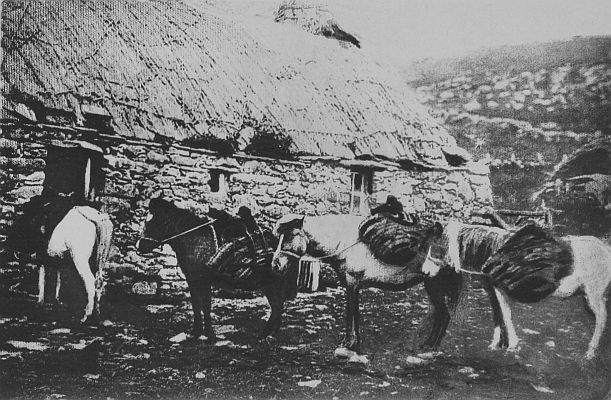
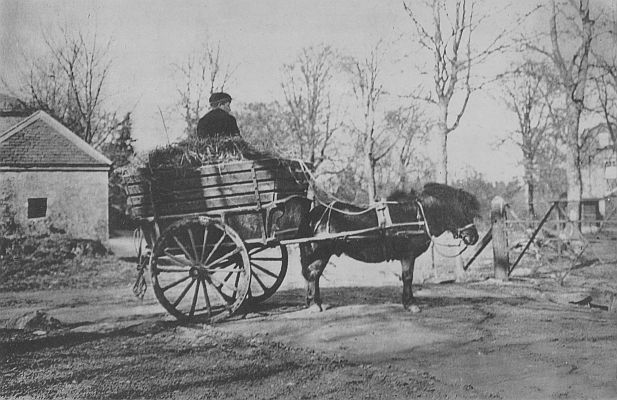
CARRYING PEATS.
Yet, although the local employment of
the pony is a thing of the past, its production
remains a profitable part of Shetland
farming.
The early records show very low prices for
ponies. The ‘Statistical Account,’ 1845,
places them at from £1, 10s. to £5; “The
Druid,” in 1865, sets the value of horses at
£7, and of mares at £5;[44] and even in 1871,
when the coal-pits had been using Shetland
ponies for twenty years, Cowie valued the
horse at £8 to £10, and the mare at £3
to £5. Such prices bear no relation to those
of recent years, when good stallions have
realised from £18 to £20 for pit work, while
better ponies, when fully pedigreed, command
very much larger prices. At the earlier rates
ponies can have yielded but a poor profit;
but under recent conditions they must give
a large return on the comparatively small
cost of breeding and rearing them in Shetland;
and this increasing profit encourages
the hope that crofters and others in Shetland
may be more energetic in the future than
they have been in the past, in improving the
pony which is one of the best assets of
their Islands.
THE FETLAR PONY.
The Island of Fetlar contains, besides pure Shetland
ponies, a distinctive breed of its own.
The Fetlar pony is not, indeed, of pure race.
Its origin is traced to an animal which has often
been called a “mustang,” but was in point of fact
a grey Arab, presented by the famous General
Bolivar to the late Sir Arthur Nicolson. From
1837 onwards, for some years, this horse was
crossed with the native ponies of the Island,
which were presumably somewhat larger than
those of other parts of Shetland, Fetlar being
one of the best grazings in the Islands. For many
years the influence of this horse showed itself
in a large proportion of grey ponies in Fetlar.
Later, another Arab was introduced; and an
Orkney garron cross was also used. The resulting
product is a pony of about twelve hands—ranging
from eleven to thirteen—from which the
grey colouring is now practically eliminated. The
ponies bred in this way show a degree of unity
in type and size which is truly remarkable, in view
of the apparently very different sources from which
they are sprung. Indeed, the singular fidelity to
type of this essentially cross-bred pony is highly
suggestive of a common element in the ancestry
of the Arab and the Shetland pony. The Fetlar
is, in type and quality, one of the best of native
ponies. It has a good deal in common with the
ponies of the outer Hebrides.
CHAPTER III . — The Modern Pony.
The Shetland pony, as now produced on the
British mainland, is chiefly derived from the
stud established by the Marquis of Londonderry
in the Islands of Bressay and Noss in
1870,[45] and carried on by him there under
the management of Mr Robert Brydon and
the late Mr Meiklejohn until its dispersal
in 1899. It was in this stud that the
standard was set by which showyard judging
has proceeded during the last twenty years;
and it was here also that the type of the
modern pony was created and fixed by
selection and close inbreeding.
The stud was originally intended for the
purpose of breeding pit-ponies for its owner’s
collieries in Northumberland; and this purpose
is reflected in the type which is characteristic
of the “Londonderry” pony. It is
commonly said that the governing formula
of the stud was “as much weight as possible,
and as near the ground as it can be got”;
and, so far as it goes, this formula—admirably
adapted as it is for defining a pit-pony—is
no bad description of the result attained
in many instances. While the original object
of the stud was never lost sight of in
its policy and management, it was carried
out by skilful and enthusiastic breeders,
who set themselves to eliminate defects of
conformation which were common among the
Island ponies. The consequence was a degree
of breed improvement which is perhaps without
a parallel as the result of less than thirty
years of breeding and management.
But not only is the source of improvement
in the modern pony to be found chiefly in
this one stud. It is also traceable—as in so
many other breeds—mainly to a single animal.
If it be true that the modern pony is
substantially the “Londonderry” pony, it is
hardly less true that the “Londonderry” pony
is the pony that is bred from the horse Jack
(16), foaled in 1871, which came into Lord
Londonderry’s possession as a colt, and was
the sire or grandsire of almost all the stallions
used in the stud, as well as of a third
of all the mares that are recorded as belonging
to it.
Some idea of the extraordinary predominance
of Jack in the stud may be gathered
from the entries in the first nine volumes of
the ‘Shetland Pony Stud-Book,’ in whose tenth
volume the dispersal sale of the stud at Seaham
Harbour is recorded. We find that in
the period covered by these entries, nineteen
stud horses were used to a greater or less
extent. Of these, in addition to Jack himself,
there were his three sons, Laird of Noss (20),
Lord of the Isles (26), and Odin (32); and his
eight grandsons, Thor (83), Sigurd (103),
Emeer (131), Runolf (62), Najal (75), Lava
(121), and Otkell; while Oman (33), his
great-grandson on the dam’s side, was also
considerably used. We find also that these
ponies related to Jack were much more
extensively bred from than the unrelated
sires, so that of the four hundred and ninety
foals entered as produce, two hundred and
forty-eight are by Jack and his three sons,
and a hundred and sixty by his eight grandsons;
while thirty-six are by Oman, and only
forty-six by sires wholly unrelated to Jack.
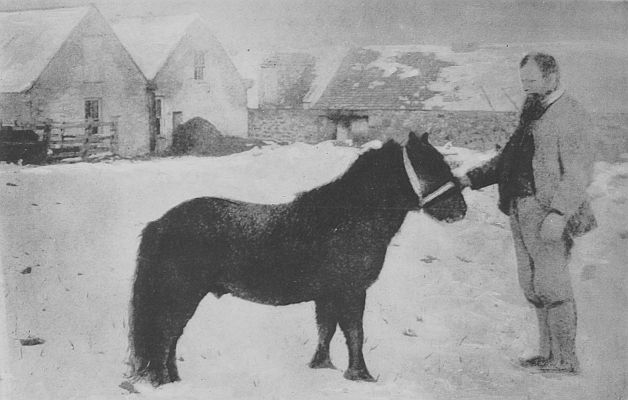
JACK (16).
An analysis of the list of dams bred from
in the stud accentuates the meaning of these
figures; since out of a total of a hundred
and twenty-five entered in the Stud-Book,
seventy-six are by Jack and his three sons,
while ten are by his grandsons.
The result of this selection of breeding
stock appears in the extent to which the
progeny are inbred to Jack. Of the hundred
and twenty-five mares, fifty are sired by Jack,
his sons, and grandsons, out of dams similarly
sired; while forty are sired by Jack
and his three sons, out of mares sired by
them. Of the four hundred and ninety foals
entered, two hundred and eighty-two are
sired by Jack and his sons and grandsons,
out of mares by the same list of sires.
Of the fifty-one mares not bred from Jack
and his direct descendants, twelve were
daughters of Prince of Thule (36), and
thirty-six by his son Oman.
Prince of Thule is thus, next to Jack and
his sons, the most important sire element
in the stud. His influence, however, is considerably
reduced by the almost exclusive
extent to which he was mated with mares
sired by Jack and his sons. Of the twelve
mares sired by him, seven are from daughters
of Jack, one from a daughter of Odin, and
one from a daughter of Laird of Noss; while
twenty-four of the dams of his thirty-four
foals are daughters of Jack and his three
sons.
The influence of his son Oman is similarly
discounted, five of his six daughters bred from
being daughters of Jack’s sons, while twenty-eight
of all his thirty-six foals have dams
similarly bred.
It is probable that the results of an out-cross
of this kind upon an inbred stock like
that created by the continuous use of Jack
and his sons will be slight and transient;
and in point of fact the general influence of
Prince of Thule upon the Londonderry Stud
has not been greater than might have been
expected.
The singular predominance of the Jack race
in the modern pony is illustrated by the showyard
results of recent years.
At twelve shows of the Highland and
Agricultural Society held since the Londonderry
Stud was broken up in 1899, a
hundred and sixteen first and second prizes
have been awarded in Shetland pony classes.
Of these, a hundred and fourteen have been
gained by the progeny of sires actually in
use in the Londonderry Stud: Laird of
Noss, Lord of the Isles, Odin, Oman, and
Thor; and of their sons and grandsons.
Laird of Noss, his sons Harold (117),
Duncan (147), and Hector (183), and his
grandson Merry Hero (244), sired fifteen;
Lord of the Isles, his sons Multum in
Parvo (28), Sigurd (103), Vespa (166), and
Naughty (204), and his grandson Rattler
(210), twenty-one; Odin, his sons Olaf (59),
Bonaparte (168), Uniacke (177), Palmer (228),
Besieger (235), Diamond (257), and Peace
(325), and his grandsons Monkshood (274)
and Norman (276), twenty-eight; Oman, his
sons Frederick (223) and Seaweed (333), and
his grandson Glencairn (314), twenty-five;
while Thor was himself sire of twenty-five;
and it is noteworthy that the winner of the
two distinctions not gained by the offspring
of Londonderry sires was bred from a dam
inbred to Jack’s grandson Multum in Parvo.
Taken as a whole, this practically exclusive
domination of the showyard, for twelve
years, by twenty-six sires of Londonderry
origin, of which three are sons and fifteen
are grandsons of Jack, while the remaining
eight are descended from him, and all of
them without exception are otherwise closely
related to his stock, is a remarkable demonstration
of the influence of a single stud
and a single horse upon the breed as we
have it to-day.
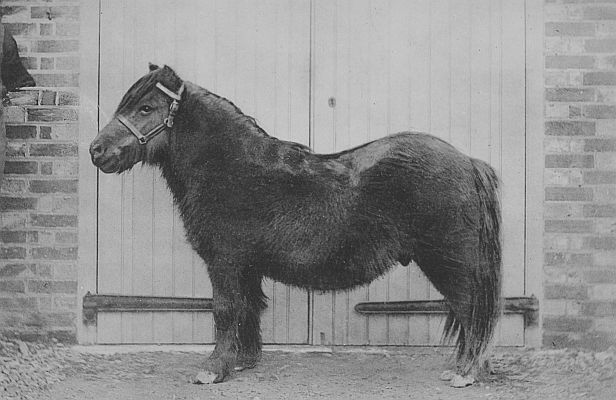
ODIN (32.)
Of Jack’s parentage nothing is known. It
is probable, however, that he was himself an
inbred animal; for close inbreeding is still,
and always has been, the general practice
among pony breeders in Shetland, probably
rather through necessity or carelessness than
as the result of deliberate intention; and
Jack’s prepotency as a sire lends colour to
this supposition.
He was a black, 40 inches high, and the
only portrait of him which we possess shows
him to have been a short-backed and close-coupled
horse of remarkable bone and substance,
finely proportioned, and with a bold
and upright carriage. He must have had a
sound and vigorous constitution, since he
lived to the age of thirty, and was at stud
to the end of his life.
His most famous son, Odin, also a black
horse, was 38 inches high. Odin’s dam,
Nugget, was sired by Tom Thumb (44), whose
height is stated as 34 inches, and who was
brought back from work in the pits in 1879
with the view of producing ponies of small
size.
Odin was a horse of immense power and
robustness, and great masculinity of appearance.
His bone and weight were his most
salient characteristics; but he was a vigorous
and active mover, with strong hock action,
though not perfectly straight in his going.
He was disfigured by a head heavy even out
of proportion to his general bulk and weight.
He was probably the most successful sire
among Jack’s sons, his male descendants
being conspicuously better than the females.
Laird of Noss, also a son of Jack, was a
black pony, 38 inches high, with some white
marks on his near side. He was a pony of
somewhat lighter build and more upstanding
carriage than Odin, with a finer head and
less bone. He is best known as the sire of
the famous horse Harold, of Duncan, and of
Hector; and it is through them that his
strain is perpetuated.
Jack’s other son, among the Londonderry
sires, was Lord of the Isles, a pony which,
like his brothers, was black, but was two
inches smaller than they, his height being
given as 36 inches. He was a thick and
compact pony, less used in the stud than
Odin, who appears to have been most
approved by the stud management, as only
sixty-three foals by Lord of the Isles are
recorded against a hundred and nineteen
by Odin. Lord of the Isles is chiefly
interesting as the first instance of the
introduction into the blood of the Londonderry
sires of the cross of Prince of Thule,
which has already been referred to. His
dam Handy was a daughter of Prince of
Thule; and it may perhaps have been from
this source that his reduced size came, for
Prince of Thule was himself only 36 inches
high. It is significant, too, that Multum
in Parvo, a brown horse 37 inches high,
sired by Lord of the Isles out of his own
dam Dandy, is described by those who knew
Prince of Thule well as being exceedingly
like him.
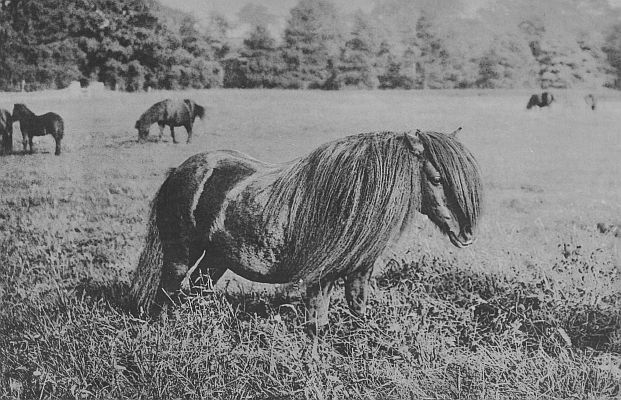
MULTUM IN PARVO (28.)
Multum in Parvo is probably the best-known
son of Lord of the Isles, whose blood
is otherwise mainly transmitted through the
descendants of his daughters. He died in
1912 at the age of twenty-eight, having been
foaled in 1884. His crest had latterly fallen
over; but he still retained a singular air of
distinction and a picturesque quality hardly
to be discerned in many of the more massive
ponies. He must always have lacked power
and weight and strength of action; but his
look of breeding, his quality, and the magnificent
abundance and straightness of his
curtain-like mane and forelock, attested an
element in his breeding which should not be
lost sight of.
This estimate of Lord of the Isles as a sire
is borne out by the conspicuous qualities of
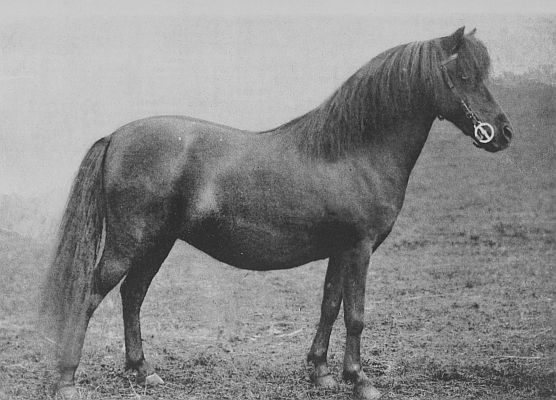
his daughter Boadicea (998). This beautiful
black mare, 36 inches high, is no doubt somewhat
deficient in bone. But she stands almost
by herself among Shetland ponies as an
example, approaching closely to perfection,
of what a riding-pony ought to be, with a
small and exquisitely shaped head carried
high on a clean-cut and well-arched neck,
shoulders that would not disgrace a good
thoroughbred, fine withers and short strong
back, and the safe and easy action that
properly belongs to an animal of her type.
Lord of the Isles’ name appears in the
pedigrees of a large proportion of the best
Shetland ponies, especially through his famous
daughter Beauty (167); but apart from every
other claim that he may have, and in spite of
his perhaps too limited use in the Londonderry
Stud, the fact that he is the sire of Multum in
Parvo and of Boadicea entitles him to rank as
a stallion of the first importance.
With these sons of Jack used in the Londonderry
Stud must be mentioned his grandson
Thor, now the sole survivor of the original
Londonderry stallions. He is a son of Odin
out of Fra (185), and is a brown horse 38
inches high. Like Lord of the Isles, he is
related on his dam’s side to Prince of Thule,
her sire; and he represents, therefore, almost
the same combination of strains as Lord of the
Isles. At twenty-seven years old he retains
in a remarkable degree the vigour and vitality
of youth. Slightly grey now over the cheekbones,
and fallen a little in his spine, he still
holds his crest erect, and moves with freedom,
speed, and gaiety. He is perhaps a little
larger in head than is desirable; but he is a
pony of great substance and power, with
abundance of well-shaped bone; and he displays
very pure Shetland character. He was
freely used in the Londonderry Stud, fifty-six
of his foals being entered in the Stud-Book—a
larger number than is credited to any
other stallion except the sons of Jack.
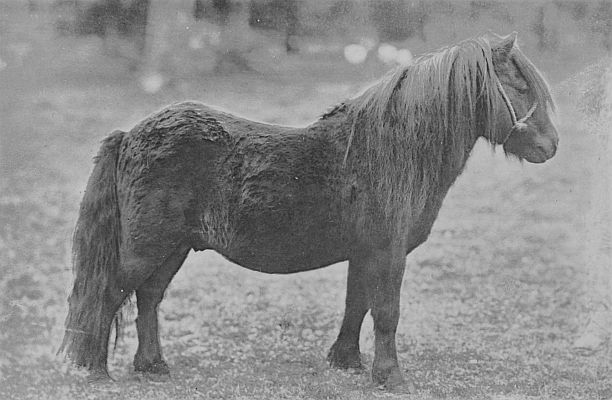
THOR (83.)
He has hitherto excelled as a sire of mares
rather than of stallions—Beatrice (1533),
Bracelet (1604), Perfection (1489), and Stella
(1496) being among the most famous of his
daughters. For about six years after the
Londonderry Stud was broken up he appears
to have been comparatively little bred from;
but during the last six seasons he has been
more largely used.
A still greater degree of the Prince of
Thule cross was introduced in Oman, a dark-brown
horse 34 inches high. Oman was a
son of Prince of Thule; and his dam Norna
was a daughter of Lord of the Isles, himself, it
will be remembered, a son of a Prince of Thule
mare. Oman was a compact and massive
pony, showing great quality and good action.
Among his best-known sons have been Frederick
(223) and Seaweed (333); while he was
the sire of such mares as Belle of Bressay
(1192), Sea Serpent (1535), Silver Queen
(1197), and Harriet (1194).
Prince of Thule represents the one considerable
element in the Londonderry Stud
which was unconnected with Jack, and
tended perhaps to counteract his influence.
He is described by those who knew him as
a pony of exquisite quality, with a small
thoroughbred head, prominent wide-set reddish
hazel eyes, and an exceedingly fine
muzzle. He was short-backed, with strong
quarters, somewhat inclined to droop, but
finished with a well-carried tail; and he was
somewhat cow-hocked. He had big wide feet;
and his bone was strong, with large joints.
His rein was long and his withers high,
though his shoulders were somewhat straight;
he was a conspicuously close mover. In
colour he was a seal brown, with very bright
tan muzzle and flanks; and his mane hung to
his knees and his forelock below his nose.
Another sire which had a much less important
place in the stud was Lion, a dun
pony 36 inches high, bred by Mr Bruce of
Sumburgh. He is described as a well-coupled
pony, but rather long and low.
It will be recognised that Prince of Thule is
the source, and probably the only immediate
source among the Londonderry sires, of whatever
may be found in the modern pony to
represent that “oriental” type which it has
already been said has all along been an integral
element in the Island pony. The Jack
blood is mainly, if not indeed exclusively, that
of the Scandinavian type as opposed to the
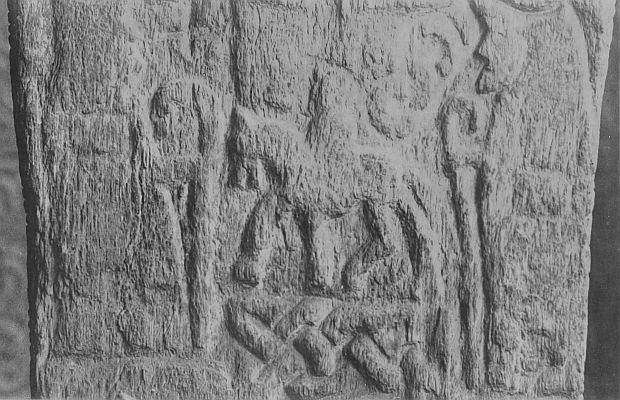
other type, which is depicted on the Bressay
stone, and which is represented in modern
times by Multum in Parvo and Boadicea.
In Prince of Thule, and whatever impression
he may have made on the pony of to-day,
is to be found the main source, within
the Londonderry strain, to which those must
turn who desire to produce the riding as
distinct from the draught or pit-pony. It
has already been said that his influence is
largely counteracted by the extent to which
he and his son Oman were mated with
mares by Jack and his sons. But his stock
remain the best hope of breeding ponies
which should combine the many excellences
of the typical “Londonderry” pony with the
quality and activity in which it is apt to
be somewhat lacking. It is worthy of note
that the combination of Prince of Thule
and Odin blood has always produced a
large proportion of good foals.
When we come to examine the female lines
in the Londonderry Stud, we find, as has
already been noted, that they are largely the
produce of the sires which we have just reviewed;
and we find also that a great proportion
of the best animals produced trace from
a few of the original mares. No complete
analysis in this respect can be attempted;
but it will be found that four mares bulk
largely in the formation of the stud.
I. Darling (174), by Jack (16), was the
dam of Darling II. (175), by Laird
of Noss, of Dixie (664), by Odin,
and of Beauty (167), by Lord of
the Isles—Beauty being the dam
of Besieger (235) and Bretta (811),
both by Odin; while Bretta became
the dam of Beatrice and Bracelet
by Thor, and of Belle of Bressay
(1192) by Oman.
II. Fra (185), by Prince of Thule, was the
dam of Thor by Odin, of Harold by
Laird of Noss, of Frederick by
Oman, and of Hildigunna (668) by
Lord of the Isles.
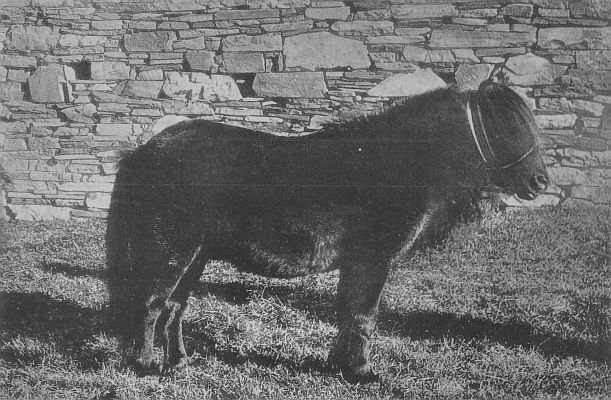
PRINCE OF THULE (36.)
III. Peggy, by Jack, was the dam of Pride
(202) and Princess (203), both by
Prince of Thule—Pride being the
dam of Petite (1196) by Odin, and
Princess being the dam of Pansy
(1282) by Oman, and of Perfection
(1489) by Thor.
IV. Swertha (211), by Odin, was the dam
of Silver Queen (1197) by Oman,
and of Sigurd (103) and Sweetie
(676), both by Lord of the Isles—Sweetie
being the dam of Strawberry
(1635) and Sapphire (1276),
both by Odin, and of Snowdon
(1112) by Thor.
These are the leading mares of the stud. It
will be observed that two of them are daughters
of Jack, one of his son Odin, and one of
Prince of Thule; while two of their dams are
daughters of Jack, one of his son Lord of the
Isles, and one of Prince of Thule.
The development of the Shetland pony in
the studs of present-day breeders has been
greatly advanced by the ‘Shetland Pony Stud-Book,’
which was first issued in 1890, and
which has since been published annually with
increasing usefulness and success. The twenty-three
volumes which have now appeared form a
record invaluable to breeders. Dissatisfaction
on the part of certain breeders in Shetland,
who found out too late the ill effect of neglecting
to enter their ponies (a dissatisfaction
stimulated perhaps by interested persons), has
recently led to the formation of a ‘Shetland
Island Pony Stud-Book,’ registering only ponies
bred in the Shetland Islands. This book,
however, is of very secondary interest and
importance, and its restricted scope naturally
prevents it from becoming a complete Stud-Book
of the breed. Multiplication of Stud-Books
is evidently disadvantageous to a
breed; and it is to be hoped that the Stud-Book
proper may soon become once more
the combined record of all pedigreed ponies
in Shetland as well as in other parts of
Britain.
Useful Stud-Books of the breed are published
in the United States of America and
in Canada.
The pony as we find it in the showyards
of Britain and in the studs of the principal
breeders exhibits, in the main, the characteristics
of the Londonderry strain.
Its size remains, as it always has been, its
most marked characteristic. No ponies over
42 inches in height are admitted to the Stud-Book;
and a height of more than 40 inches
is properly regarded as a serious fault. This,
indeed, is a matter of vital importance, since
any considerable increase of size deprives the
pony of its individuality and brings it into comparison
with other breeds. On the other hand,
there has, in recent years, been a tendency to
undue diminution of size—the former desire
of breeders to increase height having given
place to a morbid ambition to produce pigmy
ponies. It must be kept in mind that ponies
of sizes less than 34 inches are of little use
for practical purposes, since, unless they are
quite disproportionately massive, they cannot
have sufficient weight and strength for
draught, while the undue shortening of their
legs deprives them of the leverage and
activity necessary for saddle or harness. It
must also be remembered that the cannon-bone
cannot be shortened beyond a certain
point, and that any exaggerated shortness of
the fore-leg is therefore only to be obtained
by a disproportionate reduction of length of
arm, fatal to symmetry and productive of
cripples. Anything which tends to make
the pony merely an oddity and a toy, and
to take it out of the category of useful or
usable horses, is fatal to the prospects of the
breed and should be resisted by breeders
and judges.
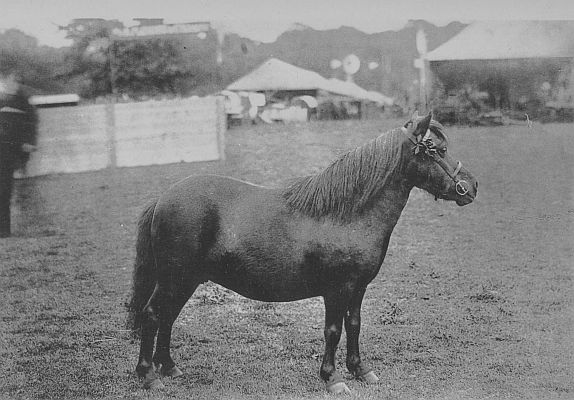
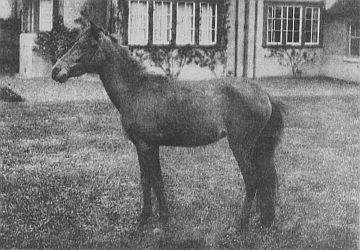
SAPPHIRE (1276.)
Speaking generally, about 38 inches is the
height which will be found, while retaining
the individual character of the breed, to lend
itself best to symmetry and activity. There
are, no doubt, excellent ponies both larger
and smaller; but a study of the recorded
measurements of the best animals will uphold
the view that this is the height at which,
speaking generally, the pony can be produced
at its best.
The most salient and essential feature
of the Shetland pony, next to its size, is
its general air of hardihood and vitality.
Stamina and robustness—capacity to endure
both work and hardship—are among its most
essential merits; and they should appear in
its demeanour, displayed in spirit, boldness,
and a high though docile and generous temper.
Ponies which show feebleness of appearance
or constitution should be rigidly excluded
from the stud and the show-ring, and soundness
should be made essential.
The Shetland pony is one of the soundest
of horses—bone defects being almost unknown
in it; and a vigilant watch should be maintained
against anything that might impair
its character in this respect. But second only
in importance to physical soundness is the
temper and disposition of the pony; and
sluggishness and a lethargic mien should be
counted as serious faults.
The general symmetry of all good horses is
very much the same; and the Shetland pony is
no exception. But, in particular, he should be
deep through the heart, short and strong in
back, well ribbed up, and well sprung in
barrel. The shoulders should be long and
well sloped, showing sharp and distinct
withers. The quarters should be broad and
long, and well filled up, with the tail set high
and carried gaily. The neck should be long,
well arched, and powerful, fine at the gullet,
and carrying the head high and well forward.
Perhaps in no point is the present-day
Shetland pony so often defective as in shoulder.
Many of the most substantial and characteristic
ponies of the “Londonderry” strain are
short and straight in shoulder and wholly
lacking in withers. Such ponies as these
may be useful in the coal-pits, but they are
useless above ground. They can never be
really fine and active movers; and they can
never be—what the Shetland pony ought to
be—the child’s riding-pony. Shoulders and
withers that will hold a saddle should be
regarded as a sine quâ non of a really good
pony. In this respect much yet remains to
be done in the improvement of the breed.
In other directions great advance has been
made; and long backs, flat sides, and short
and drooping quarters are less in evidence
every year. The general style and symmetry
of the pony are steadily improving.
Nothing in the proportions of a pony more
affects his appearance than the size, form, and
carriage of his head. Undoubtedly many of
the most massive and powerful of present-day
Shetland ponies are disfigured by heads which
are not merely out of proportion to their size,
but which are also carried much too low. This
last defect commonly arises from; and goes
with, defective shoulders; but, from whatever
cause it proceeds, it must be regarded as a
most serious blemish, fatal alike to the appearance
of the pony and to his safety and
pleasantness as a mount. To eliminate it
from the breed without sacrificing the substance
and power with which it is often
associated may be a matter of skill, time,
and patience; but breeders ought not to be
satisfied until this object has been attained.
The head itself should be small and short,
wide across the forehead, relatively long from
ear to eye, with a muzzle short and fine
and somewhat hollowed, or almost “dished,”
immediately below the eyes, which should
be large, full, and prominent, looking well
forward, so as to be clearly seen from in
front. “Ringle” or “wall” eyes are a serious
though not a common defect and should be
discouraged. The ears should be small and
erect, wide set, but pointing well forward,
the nostrils wide and open. The shape and
carriage of the head are even more important
than its size.
BOADICEA (998.)
It is perhaps in limbs and joints that the
modern pony marks the largest advance upon
his unimproved Island forefathers. Reference
has already been made to the apparent
“curbiness” of the hocks of many Island
ponies. This is a defect that has very largely
been bred out of the Londonderry strain, in
which good joints, and particularly good
hocks, have, with occasional exceptions no
doubt, become well established. Strong and
muscular limbs should characterise the Shetland
pony—long and powerful forearms and
thighs, large, low-set knees and hocks, flat
and clean bone below them, and fairly long
pasterns. A common fault in some strains
is lack of muscle in the second thighs, which
is often so exaggerated that the pony has
the appearance of having a deep hollow
behind the thigh instead of an easy line from
the quarters to the hocks.
On the whole, the feet of the Shetland pony
are good—large, round, and open, of fairly
hard and very sound texture. Occasionally,
however, narrow and contracted feet are
found; and these should be regarded as a
serious defect.
The coat of the pony is one of its
most familiar and characteristic peculiarities,
consisting as it does of fine thick fur
below and an outer covering of longer and
harder hair growing through it. Any weakness
of coat is a serious fault, not only as
being a departure from a deep-rooted characteristic
of the breed, but also on the most
practical grounds. No better protection could
be imagined against wind and rain than the
thick undercoat, waterproofed by the outer
hair, from whose damped locks the water
drips along the pony’s sides, while the under
parts of the body remain dry and warm.
In summer the shaggy coat,—falling off in
ragged masses, is replaced by a sleek and
fine hair. At all seasons the tail, mane, and
forelock are as picturesque as they are useful
in protecting the pony against weather and
flies. They should be abundant, the hair
strong in texture, and straight, falling flat,
and, like the foot hair, free from any tendency
to curl. It is an interesting characteristic of
the Shetland pony that many animals shed
in autumn the upper lock of the tail in such
a way as to look as though the hair had been
scrubbed off, although on actual examination
it will be found that the hair is cast from the
root and grows in again. A similar appearance
is undoubtedly represented in prehistoric
horse-portraits.
All colours are permissible in the Shetland
pony, although black and dark-brown are
now most common, and are preferred in the
Islands by the oldest traditions, which associate
piebald and skewbald colours with softness
of temper and with a strong suspicion of
Norwegian cross. White markings in ponies
other than piebalds and skewbalds are an
undeniable blemish, particularly if they take
the form of white stockings and the accompanying
white hoofs. Dun, grey roan, and
dappled grey are good colours, which should
not be allowed to die out: the dappled grey
should have blue hoofs.
Action is increasingly regarded, and rightly
so, by judges in the showyard; and it is of
the utmost importance in practice. It should,
of course, be perfectly true and straight:
dishing, straddling, and wide hock action are
glaring faults. But action should also be
vigorous, light, and springy, not showing the
roundness that often disfigures hackney gait,
but with fore-legs well thrown forward from
the shoulder both in walking and trotting,
while knees, pasterns, and hocks are freely
and powerfully flexed. It must be admitted
that in many Shetland ponies activity has
been unduly sacrificed to abnormal shortness
of limb. This is a point which demands
careful attention; and it may be worth while
to note that the ponies in the Islands are, as
a rule, singularly active, as indeed the
conditions of their existence require that
they should be.
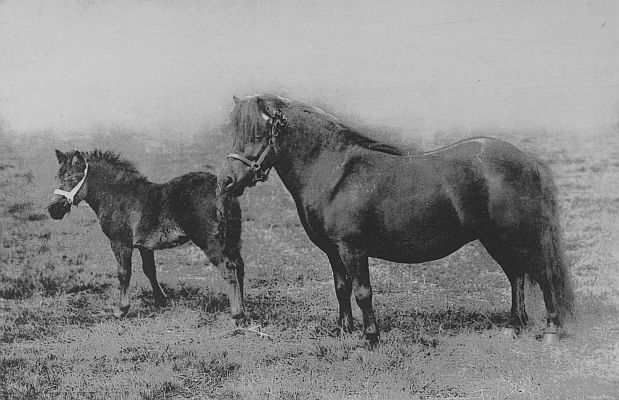
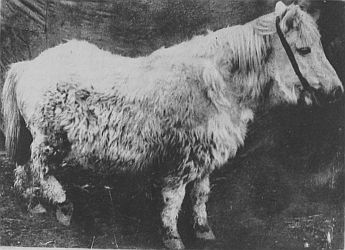
STELLA (1692.)
In one other respect modern show standards
and conditions threaten rather to impair than
to improve the breed. The appearance of the
pony in the Islands almost invariably suggests
a strong and vigorous frame: in the showyard
there are few ponies whose appearance
suggests any frame at all. This is, no doubt,
greatly aggravated by the extreme and excessive
fatness of most ponies in the ring;
but it points to a real defect also. Every
good horse ought to suggest to the imagination
the general structure of his bony framework;
and it ought scarcely to be possible
to conceal this by any reasonable degree of
condition, or to bring about, in a horse, a
general appearance of bonelessness such as
might be proper to the carcase of a perfectly
fattened Aberdeen-Angus bullock. Partly
from the practice of showing ponies much
too fat, and partly also from the fact that
breeders have neglected to seek for strength
of frame as distinct from mere thickness of
bones, the Shetland pony in the showyard
has undergone some little deterioration in
this respect. It should not be forgotten by
breeders or judges that a pony whose
shoulders, hips, and stifles are not prominent
in his appearance, is either defective in
structure or very improperly overfed.
It may well be the case that a rather too
exclusive use of the excellent “Londonderry”
strain of ponies requires now to be corrected
by a careful introduction of new blood, and
that it is desirable to make use for that purpose
of active, large-framed, vigorous mares
of other Island strains. It cannot be too
strongly emphasised that no risk should be
run of sacrificing the results already attained—the
power substance and well-formed
joints and limbs, in which the “Londonderry”
ponies excel. On the other hand, there is
room, in very important respects, for progress
and improvement in order to bring the Shetland
pony to perfection.
APPENDIX — The Making of the Shetland Pony
by
J. COSSAR EWART, M.D., F.R.S.
PROFESSOR OF NATURAL HISTORY IN THE UNIVERSITY OF EDINBURGH
The Making of the Shetland Pony.
“The horses that are ancient we honour because we know not
whence they came, but the new ones we slight because we know
their beginning.”
The Shetland pony belongs to an ancient
breed famed for its intelligence and docility,
strength and hardiness, but especially remarkable
because of its small size.
In a recent article on the Shetland pony it
is said that “the highest authorities rather
incline to the view that he is an instance of
arrested development, and that all the equine
race originally sprang from ancestors far more
diminutive than the smallest Shetland.”
It is doubtless true that the remote ancestors
of the Equidæ were small, but it does not
necessarily follow that Shetland, Java, and
other pigmy breeds owe their diminutive size
to arrested development. A human pigmy
of West Africa is as well developed as a
Hottentot of South Africa, and a toy terrier
is as well developed as a mastiff. There is
hence no à priori reason for assuming that
Shetland ponies are not as well developed—mentally
and physically as perfect—as Clydesdales
or Arabs. Moreover, all animals during
their development repeat, more or less, their
ancestral history, climb their own ancestral
tree, hence if there is arrested development
we should find evidence of reversion to more
or less ancient types. Is there any evidence
that in mind or body the Shetland is an
instance of arrested development, or that he
owes his diminutive size to reversion towards
remote small ancestors?
It will be well at the outset to ascertain
whether the small size is due to reversion or
to dwarfing, induced, partly by unfavourable
surroundings, partly by inbreeding and artificial
selection.
The Size of the Shetland Pony.—Nature unaided
has made a pigmy hippopotamus, pigmy
elephants, and pigmy races of man, but there
is no evidence that nature unaided in Europe
or Asia in pre-glacial or post-glacial times
produced a wild pigmy race of true horses—i.e.,
of horses with only one complete toe for
each foot.
The smallest wild horses in Britain at the
end of the Palæolithic period (i.e., according to
a recent estimate some six thousand years ago)
were apparently never under 12 hands at the
withers. During the Bronze age, alike in wild
and tame varieties, a size of at least 48 inches
seems to have been maintained all over
Europe. Further, remains from Roman military
stations indicate that the smallest horses
in Britain during the first century were probably
never under 46 inches at the withers.
It may hence be assumed that Shetland and
other small breeds are not directly descended
from pigmy wild races, but are the dwarfed
descendants of one or more small varieties or
breeds which had long lived under domestication.
A consideration of pigmy races makes it
evident that dwarfing may be either equal or
unequal, that it may result in the formation
of a miniature having all the leading traits of
the large race to which it belongs, or give rise
to a pigmy variety in which certain parts are
more dwarfed than others. In some small
strains of dogs the relative proportion of all
the parts are practically the same as in large
strains, but sometimes in a small strain not
only are the limbs more dwarfed than the
trunk but certain parts of the limbs are more
reduced than others. An example of unequal
or disproportional dwarfing we have in the
dachshund. In this breed the dwarfing has
been carried further in the legs than in the
body, and in the forearm than in the foot.
In a normally constructed small hound in
which the length of the body is 390 mm., the
length from the elbow to the ground is 215
mm., from the elbow to the wrist 145 mm.,
and from the wrist to the end of the longest
toe 95 mm. But in a typical dachshund with
a body of approximately the same size (390
mm.) the length from the elbow to the ground
is only 137 mm., the distance from the elbow
to the wrist being 95 mm. and from the wrist
to the end of the longest toe 90 mm.—i.e., in
a dachshund, while the foot may only be
reduced 5 mm., the reduction in the forearm
may amount to 50 mm. (2 inches).
In the case of pigmy horses are the proportions
of their normal ancestors invariably
retained, or are the legs in some cases more
dwarfed than the trunk, and as in the dachshund
is the dwarfing greater in one part of
the limb than in another? In Java ponies I
have had under observation for some years
the head and limbs bear practically the same
relation to the body as in well-proportioned
Arabs.
For example, in a 41-inch Java mare (fig. 1)
the height at the withers, as in typical desert
Arabs, is 2·7 times the length of the head,
and the neck and limbs are relatively as long
as in Arabs and other slender-limbed breeds.
But while in tropical islands the relative
proportion of the various parts of pigmy
horses may be maintained, in islands near
the Arctic Circle dwarfing may imply undue
shortening of the limbs, and that certain parts
of the limb are more reduced than others.
A striking instance of unequal reduction we
have in the Udganger or Nordlands ponies,
once common in Bodo, a small island within
the Arctic Circle off the coast of Norway.
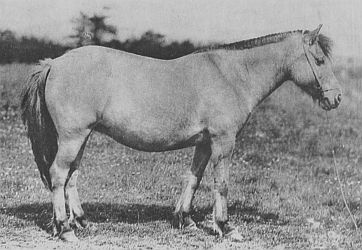
Fig. 2 shows that the limbs of the Bodo
ponies were relatively nearly as much dwarfed
as in a dachshund, while fig. 3 shows that
Iceland ponies of the Nordlands type may
closely agree in conformation with Exmoor
and other well-built ponies of the Celtic
race.
Very little is known about the make and
size of the horses which first reached Shetland.
The evidence as far as it goes indicates that
they belonged to small varieties measuring
from 11 to 12 hands at the withers. If horses
were introduced from Norway during the
Norse occupation, the majority of them would
in all probability belong to the Nordlands
race—i.e., the race from which the modern
fjordhest is believed to have mainly sprung.
Probably unequal dwarfing more or less
pronounced took place at a comparatively
early period in some of the smaller islands,
while in the more fertile parts of the main
island, and in the rich island of Fetlar, the
reduction in size (as in Java ponies) would
be nearly uniform. It is conceivable that
some of the unimproved ponies now living in
Shetland, and also some of the improved
ponies bred and reared far from their ancestral
island home, are as well proportioned as
members of the Exmoor or Welsh breeds.
One must, however, be prepared to find that
not a few of the inbred pedigree ponies have
undergone unequal dwarfing, one part of the
limbs, as in the dachshund, having undergone
more reduction than the adjacent parts.
Dwarfing in Shetland Ponies of the Celtic or
Riding Type.—That well-proportioned Shetland
ponies of the riding or Celtic type still
exist is suggested by the measurements
of Pamela and certain other fine-limbed
pedigree ponies. Pamela (40 inches at
the withers, 25 inches from elbow to ground,
and 5·25 inches below the knee), in the form
and length of the head, length of the limbs
and their relation to the height at the withers,
very closely agrees with the 41-inch Java
pony.
The skeletons of Shetland ponies of the
riding type available for study (viz., of Highland
Chieftain, Egil, and Eric) also indicate that
in a considerable number of cases the dwarfing
is uniform. Though in many Shetland ponies
the distance between the knees and the
fetlocks looks very short, the front cannon-bones
may be relatively as long as in thoroughbred
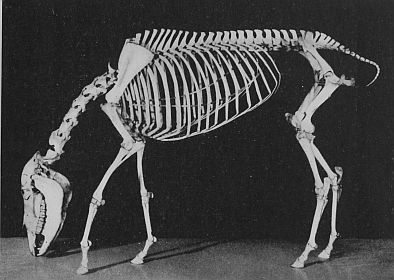
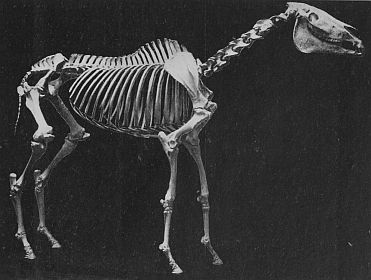
race-horses. In Highland Chieftain[F1]
(fig. 4) the front cannon-bones (metacarpals)
are 136 mm. long and 20 mm. wide
at the middle of the shaft; in Persimmon,[F2]
the famous thoroughbred 16·2 race-horse (fig.
5), the metacarpals measure 276 mm. by
38 mm. As Highland Chieftain measured
33 inches, and has cannon-bones measuring
136 mm., he was half the height of Persimmon,
and has cannon-bones practically half the
length. In Highland Chieftain the cannon-bones
(fig. 4) are not only relatively as long
as in Persimmon (fig. 5), they bear almost
exactly the same relation to the bones of the
forearm and arm as in Persimmon—the radius
(chief forearm bone) being relatively only 8
mm. shorter, the humerus (upper arm bone) relatively
only 10 mm. longer. Nevertheless the
cannon-bones of Highland Chieftain are relatively
shorter than in typical Celtic ponies.
In a 33-inch Shetland built on Celtic lines
the cannon-bones should measure 142 mm.,
hence it may be assumed the cannon-bones of
Highland Chieftain have been dwarfed to the
extent of 6 mm. or one-quarter of an inch.
The only striking difference between Highland
Chieftain and a typical 12-hands Celtic
pony is in the face. In modern horses, while
the form of the cranium or brain-box is nearly
constant, the face varies both in size and in
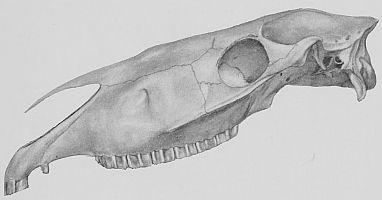
its relation to the cranium. In the wild
steppe horse (Equus przewalskii) of Mongolia,
which during part of the year subsists on
hard dry food, the jaws are so long that the
length of the face (fig. 8) is twice the width
across the orbits, thus giving a frontal index
of 50; whereas in a broad-browed Iceland
or Highland pony the face may be only 1·6
times the width, which implies a frontal
index of 60. In the Celtic race (to which
Highland Chieftain mainly belongs) the
normal frontal index is 54—i.e., the length
of the face is 1·8 times the width—but, as in
Highland Chieftain, the length of the face is
only 1·5 times the width, the frontal index[F3]
is as high as 65. Further, in Highland
Chieftain the profile instead of being convex
as in steppe horses (fig. 8), or nearly straight
as in many Exmoor ponies, was decidedly concave
or dished (fig. 4). The difference between
the profile of a Shetland pony and that of a
steppe horse is brought out by figs. 6 and 8.
In the case of Egil[F4] the dwarfing of
the limbs seems to have been more pronounced.
Egil may be regarded as an
unimproved 40-inch pony; he met his death
some forty years ago by falling over a cliff
near Hillswick, Shetland—i.e., before the
Marquis of Londonderry set about making
a short-limbed strain suitable for pit work.
A comparison of the skeleton of Egil with
that of an Exmoor pony in the British
Museum shows that in the northern island
pony the limbs were relatively shorter by
one inch, and the face by half an inch,
than in the southern moorland pony, but,
notwithstanding the shortening of the limbs,
the front cannon-bones in Egil, as in fine-limbed
prehistoric races, are in length seven
times the width.
As Egil probably belonged to an unimproved
stock, it may be asked, Does his
skeleton lend support to the view that modern
pigmy horses reproduce, apart from their size,
the characteristics of their remote ancestors?
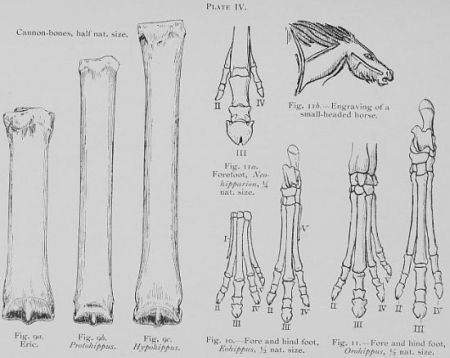
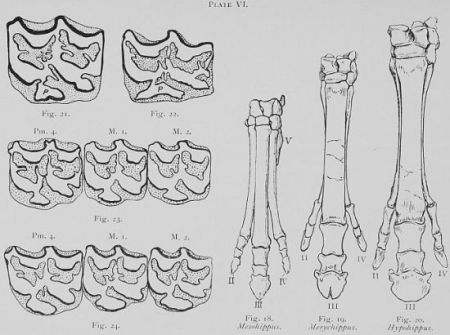
In Miocene, as in prehistoric times, there
were light as well as heavy horses, but in the
light as well as in the heavy each limb had
three hoofs (fig. 18). In Neohipparion, a late
Miocene three-toed horse, about 40 inches
at the withers, the skull is longer by 12 mm.,
and the molar teeth are more specialised than
in Egil, the 40-inch modern island pony. In
the Equidæ the cannon-bones are especially
interesting; strange as it may appear, the
middle cannon-bones are relatively longer and
more slender in the extinct Neohipparion than
in modern race-horses. In Egil the front
cannon-bone is 175 mm. (6·75 inches) long
and 25 mm. wide; in Neohipparion the corresponding
bone has a length of 210 mm.
(8·25 inches)—is longer than in a 48-inch
Exmoor pony,—and is so slender that the
length is nearly nine times the width—i.e.,
relatively more slender than in desert Arabs.
Further, in Neohipparion the middle metatarsal
(hind cannon-bone) is as long as the femur
(thigh-bone), whereas in even the 16·2 hands
race-horse Persimmon (fig. 5) the middle
metatarsal is only three-fourths the length
of the femur. But, though in the 40-inch
Shetland pony the skull and the cannon-bones
are actually shorter than in the ancient
40-inch Miocene horse (Neohipparion), the
second and fourth digits are as rudimentary,
are as much “splint” bones, in Egil as in
Arabs and thoroughbreds. There is hence
no evidence of reversion in Egil, no attempt
to reproduce the second and fourth toes,
which, though shorter, were as complete in
Neohipparion and his three-toed contemporaries
(figs. 19 and 20) as the large functional
middle toe,—in other words, in pigmy horses
there is evidence of arrested growth but not
of arrested development. In Egil, as in
Highland Chieftain, there is also evidence
of arrested growth in the facial part of the
skull; the profile is concave and the frontal
index high (65) as in Highland Chieftain.
Having seen that, apart from the face,
the only essential difference between the
skeleton of an unimproved Shetland and the
skeleton of an Exmoor pony is a difference
in size, let us next direct attention to the
skeleton of Eric, a 36·5-inch improved
pedigree pony of the riding type, for some
time in the possession of Mr Charles M.
Douglas of Auchlochan. In Eric, who
died when six years old, the fore limb from
the elbow to the ground was 22 inches, the
length from the point of the hock to the
ground 15·4 inches, the circumference below
the knee 5·25 inches, and the width of the
fore-shank 1·2 inches. All four ergots were
present, but the hind chestnuts were absent.
Though the setting-on of the tail, the somewhat
rounded hindquarters and the presence
of ergots, indicated that Eric, like practically
all modern Shelties, included horses of the
“forest” type amongst his ancestors, his
skull, teeth, and limbs made it evident that
he mainly belonged to the Celtic or riding
type.
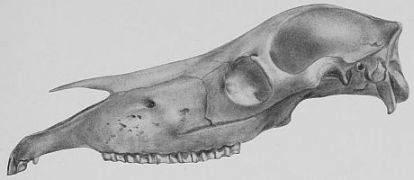
In Eric the face (fig. 6) is so short that
the frontal index is 67, the length being
only 1·4 times the width instead of 1·8 as
in 12-hands ponies of the riding type. The
length of Eric’s head when alive was
410 mm. (16¼ inches). A typical Celtic
pony with a 410 mm. head measures 40
inches at the withers. Eric, though having
the head of at least a 40-inch pony, only
measured 36·5 inches. It may hence be
assumed that, through dwarfing, his total
height was reduced by 3·5 inches.
Further, as Eric’s metacarpal (fig. 9a),
instead of measuring 166 mm. (the normal
length in a 40-inch pony), had only a length
of 143 mm., it follows that practically one
inch of the dwarfing was due to a reduction in
the length of the cannon-bones. Moreover, as
Eric actually measured 36·5 inches, his metacarpals
should have measured 152 mm. instead
of 143 mm.—143 mm. being the length in a
normal pony measuring 34 inches at the withers.
Though Eric had the head and trunk of a
40-inch pony and the metacarpals of a 34-inch
pony, the metacarpals bear the same
relation to the radius and the humerus as
in Persimmon—i.e., in Eric the relative
lengths of the different parts of the limb were
maintained (not lost, as in the dachshund)
during the dwarfing process.
Although the cannon-bones in Eric had
been considerably reduced in length, they
had not been reduced in width—i.e., they
are as wide as the metacarpals of the 40-inch
Shetland pony Egil, in which the limbs
closely conform to the Celtic type. It thus
appears that, in the case of ponies, reduction
in height at the withers, and especially in
the length below the knee, is not necessarily
accompanied by loss of “bone.”
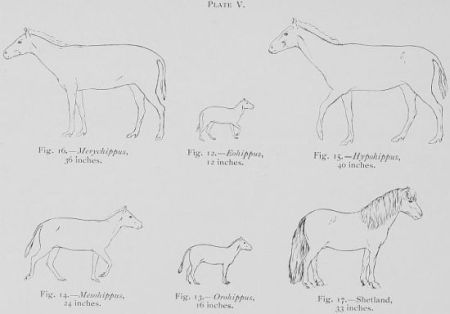
It was at one time the ambition of some
breeders to have Shetland ponies as small as
their remote three-toed Miocene ancestors. As
a matter of fact, ponies smaller than some
of the Miocene species have long existed
in Shetland. Eric, though an average-sized
pony, was at least a hand smaller
than the late Miocene horse, Protohippus
sejunctus, in which the front cannon-bones
(fig. 9b) were 177 mm. long and 21 mm. wide—i.e.,
34 mm. (1·37 inches) longer but 5 mm.
narrower than in Eric; while Seedpearl
(31·75 inches at the withers) and other still
smaller living ponies have shorter limbs than
the very ancient three-toed Mesohippus from
the Badlands of South Dakota. But while
some Shetland ponies are actually smaller
and have relatively decidedly shorter legs
than the horses which flourished long before
man appeared on the scene, they never have
three toes and their teeth are always decidedly
longer if not more complex than in
the most advanced Miocene species. Hence,
as already said, though in Shetland ponies
there is evidence of arrested growth, there
is no evidence of arrested development. It
has been pointed out that the facial part
of the skull of Eric is so short that the
frontal index is extremely high—67 instead
of 54. Even more remarkable than the
shortening of the face is the reduction in
Eric of the capacity of the nasal chambers.
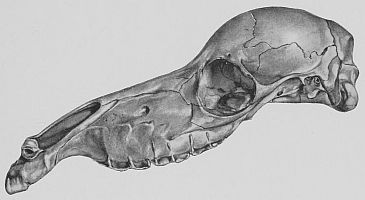
In new-born foals, owing to the relatively
large size of the cranium, the face is always
more or less dished (fig. 7). In the case
of the wild horse of Mongolia, the increase
in the size of the nasal chambers soon gets
rid of the dishing, and in course of time
the nasal bones are bulged outwards, so as
to give rise to a more or less marked
“Roman-nose” (fig. 8). But in Eric and
many other Shelties of the riding or Celtic
type, owing to the expansion of the nasal
chambers being prematurely arrested, the
profile in the adult (fig. 6) differs but little
from that of the new-born foal (fig. 7).
Shetland Ponies of the Cart-horse or “Forest”
Type.—For want of material nothing very
definite can be said about the nature of the
dwarfing of ponies of the heavy or cart-horse
type. In a typical 12-hands Celtic
pony the metacarpals are 200 mm. long,
27·5 mm. wide, but in a typical 12-hands
“forest” horse the metacarpals are, on an
average, 193 mm. long and 35·1 mm. wide.
An undwarfed, thick-set, 36-inch Sheltie
built on the same lines as a 12-hands
“forest” horse should have metacarpals about
145 mm. in length and 26·4 mm. in width,
and should measure 5·5 inches below the
knee.
The measurements available indicate that
in a pedigree 36-inch Sheltie of the “forest”
type, the front cannon-bones will probably
measure 137 mm. by 26·2 mm., that the
circumference below the knee will be 5·5
inches, and the distance from the elbow to
the ground 21·5 inches—in Eric (36·5 inches)
the length from elbow to the ground was
22·25 inches. If these figures are approximately
correct, it follows that in a 36-inch
Sheltie of the cart-horse type the limbs may
be at least an inch shorter than in a dwarfed
36-inch pony of the riding type, and that
the dwarfing may be unaccompanied by any
loss of “bone.”
This conclusion is supported by the measurements
of Odin, a 38-inch pony, 6 inches
below the knee; of Vulcan, a 32-inch
pony, 5 inches below the knee; and of other
ponies of the Londonderry type belonging
to the Ladies Hope, and also by those of
Everlasting, Frederick, and other thick-set
Auchlochan ponies. For example, in Everlasting,
a 38-inch pony, the distance from
the elbow to the ground is 22·75 inches,
the circumference below the knee 5·5 inches,
the bone being “round,” and the shank ·5
inches broader than in the flat-boned riding
pony Eric.
In heavy horses, but especially in Shire
colts, one (or more) of the limbs has occasionally
an extra digit ending in a well-formed
hoof. In a three-weeks’ horse embryo there
are no rudiments of limbs; at four weeks
the limbs are represented by paddle-like
structures; at five weeks the paddles contain
rudiments of three toes—miniatures of the
three toes of Hypohippus (fig. 20).
In ordinary circumstances the development
of the outer and inner toes (ii. and iv.) is
soon arrested, but occasionally one of these
rudiments develops into a toe as large and
complete as in three-toed Miocene horses of
the “forest” type. When this happens,
when in addition to the third toe there is a
toe corresponding to the human forefinger,
we have a marvellous instance of reversion.
If in the Shetland breed there is a tendency
to reversion, one would expect to find now
and then extra digits in ponies of the heavy
or “forest” type. I have, however, never
heard of a Shetland pony with extra digits.
Dwarfing of the face and the reduction
of the nasal chambers has apparently been
carried further in some of the miniature
cart-horses than in Eric and other flat-boned
Shelties. In Jupiter,[F5] e.g., the head,
though wider across the orbits, is shorter
than in Eric, and decidedly more dished.
Ancient horses adapted for a forest life had
face pits in front of the orbits, which probably,
like the corresponding pits in deer,
lodged scent glands. Further, in ancient
“forest” horses the upper lip was probably
decidedly longer and more prehensible than
in modern breeds. In broad-browed, big-boned
Shetland ponies there is no indication
of a pit for a scent gland, but there is sometimes
an unusually long and decidedly mobile
upper lip, which may or may not be due to
reversion.
The Causes of the Dwarfing of Shetland
Ponies.—Given sufficient food and shelter,
horses up to 15 hands—the size of the
tallest prehistoric Old World wild horse—can
easily be bred and reared in both the
Western and Northern Islands of Scotland.
On the other hand, large breeds are soon
dwarfed when, in addition to a limited
supply of food, the conditions during a considerable
part of the year are extremely
unfavourable. If Shetland ponies have not
sprung from a small wild pigmy race, it
may be safely asserted that their small size
is mainly due to isolation in small areas
where they were forced to shift for themselves
under, as a rule, extremely unfavourable
conditions.[F6] Obviously the environment
may play a double part. It may (1) arrest
growth by failing to provide sufficient food
and shelter, and (2) it may eliminate the
individuals which, by growing beyond a
certain size, require during times of stress
more food and shelter than are available.
Considerable stress has been laid by writers
on the dwarfing influence of the surroundings.
It is said, e.g., that “horses taken to
the barren and cold islands of Shetland
become gradually smaller and hardier, like
ponies, and the hair becomes thicker and
longer. Long-continued exposure to such
conditions ultimately results in the production
of an animal like the Shetland pony,
small in size, extremely hardy, able to withstand
the most severe winter climate, and
to subsist on a minimum of food.”[F7] It
might be said that this view is supported
by experiments in the Western Islands. At
the beginning of the eighteenth century the
Captain of Clanranald (who was killed in
1715 at the battle of Sheriffmuir) brought
from Spain “some Spanish horses which he
settled in his principal island of South Uist.
These in a considerable degree altered and
improved the horses in that and the adjacent
islands. Even in 1764, not only the form
but the cool fearless temper of the Spanish
horse could be discerned in the horses of
that island.... These at that time, both
in figure and disposition, were thought the
best horses observed in the Highlands, and
though of low stature were judged more
valuable than any other horses of the same
size.” The descendants of the Spanish horses
introduced by Clanranald for a time increased
the size of the horses in the adjacent islands.
Nevertheless, in spite of the introduction of
the Spanish horses at the beginning of the
eighteenth century, and the introduction of
many south-country horses during the second
half of the eighteenth century, the Highland
and Island horses at the beginning of
the nineteenth century were “sometimes
only 9 and seldom 12 hands high.” Moreover,
though some of them were “of an
excellent form,” with “great strength in
proportion to their size,” agile and spirited,
many were “short necked, chubby headed,
and thick and flat at the withers.”[F8]
Evidence in support of the view that the
descendants of the Spanish and south-country
horses, introduced about 1710 and after 1745,
were soon either eliminated or dwarfed, we
have from Dr Johnson and others. Dr Johnson
tells us that the pony he rode in Coll
was very low, and that a bulky man on one
of the native horses made “a very disproportionate
appearance,” and, after referring
to the small horses of Rum, mentions that
he had heard of a yet smaller race in Barra,
“of which the highest is not above 36
inches.” Barra was one of the islands which
benefited by the introduction of Spanish
horses by Clanranald.
That dwarfing may be the direct result of
an inadequate supply of nourishment during
development is suggested by the condition
of fœtuses I found some years ago in a wild
rabbit. The right uterine horn of this rabbit
contained four young, the left eight. The
eight in the left horn were as well developed
as the four in the right horn, but only half
the size and half the weight. Evidently the
amount of nourishment available in this case
was limited, and as the eight in the left horn
only received as much as the four in the right
horn, they were only half the size.
But while dwarfing may be, or appear to
be, directly caused by the environment, there
are other possible causes. Sometimes the
small size of one or more members of a family
or litter is due to reversion to small ancestors.
For example, in a litter of five puppies bred
some months ago (from parents in which West
Highland and Mexican (Spanish?) blood prevails)
there is marked variation in size.
When these pups of mixed origin were
weighed three days after birth, two males
weighed 7·5 oz. each, two females 5·5 oz.
each, and one male 4·5 oz. When again
weighed at the end of the twelfth week, the
largest male scaled 106 oz., the smallest male
44 oz., the larger female 58 oz., and the
smaller female 46 oz. In this case the small
male reproduced his small Mexican great-grandsire,
while the large males took after
their West Highland ancestors.
But dwarfs often enough turn up in old-established
“pure” breeds, and now and
again a dwarf is found in an otherwise
normal human family. There is no reason
for supposing that such dwarfs are the result
of reversion. Just as one of a litter of pups
may prove a dwarf, one of five or six foals,
full brothers and sisters, may prove a dwarf.
It may, I think, be assumed that in the
case of horses living under natural conditions,
“spontaneous variation,” without the aid of
reversion, will, as a rule, provide sufficient
material to admit of a variety being evolved
well adapted in size and other respects for
the conditions which at the moment prevail.
It need hardly be pointed out that little
will be gained by speculating as to whether
dwarfing is due to the direct influence of
the environment, to reversion, or to spontaneous
variation.
Many breeders, more especially breeders
of dogs, seem to think that dwarfing is invariably
the result of inbreeding. It is
doubtless true that the members of many
recently formed pigmy breeds are closely
inbred, but it is well to bear in mind that
there are closely inbred large as well as
closely inbred small breeds—that size is
largely a matter of selection—that in the
case of natural races size depends more on
the surroundings and the extent of the range
than on the consanguinity.
The view that dwarfing is caused by inbreeding
is insisted on by Sir Everett Millais
in a book on Rational Breeding. Sir Everett
states that, though in the case of the Shetland
pony the “climate, bad food, &c., had been
a factor in reducing the size, the primary
cause was inbreeding due to isolation.”
It seems to me, however, highly probable
that until artificial selection began in earnest
about thirty years ago, inbreeding had little
influence in determining the size of Shetland
ponies—that isolation had been a decidedly
more potent factor than inbreeding. Scottish
red deer are decidedly smaller now than they
were in Roman times; but this is not so much
due to inbreeding as to the range of most of
the herds being restricted, and to the best
stags being cut off before they have a chance
of improving the herd. The Scottish deer in
New Zealand, though all descended from a few
imported individuals, instead of dwindling in
size, are larger and carry finer heads than
their home-bred relatives,—the wider range
and better conditions have more than compensated
for the inevitable in-and-in breeding.
It is doubtless true that in-and-in breeding
sooner or later diminishes the vigour, size,
and fertility, and, in addition, restricts variation.
But under natural conditions, if the
range is sufficiently extensive, occasional reversion
to vigorous ancestors will prevent
dwarfing provided there is rigid elimination
of the unfit.
If Shetland ponies are the pigmy descendants
of one or more ancient races at
least as tall as Exmoor and Welsh ponies,
one would expect them to increase in size
when bred and reared under favourable conditions.
It has been again and again asserted
that “the climate and comparative privation
of the Shetland Isles were necessary to maintain
the small stature of the ponies, and that
the breed would inevitably lose this and all
other characteristics if bred away from Shetland
and under more generous conditions.”
Some of the ponies recently brought south
from Shetland have increased so much in size
that, if otherwise eligible, they could not be
registered in the ‘Shetland Pony Stud-Book’—i.e.,
they are now over 42 inches at the
withers.[F9] The majority of these tall ponies,
however, are piebalds or skewbalds, which in
make and other respects resemble Iceland
ponies,—if their history were traced, a
piebald Iceland pony would probably be
found amongst their recent ancestors. It is
not surprising that young cross-bred Shetland
ponies increase considerably in size when
grazed on rich lowland pastures, or that now
and again a pure-bred pedigree pony should
grow above the recognised standard; but these
exceptions only serve to prove the rule, now
widely recognised by breeders, that pure-bred
Shetlanders remain small however
favourable their surroundings. Seeing that
in the majority of pedigree ponies the dwarfing
has gone so far that the metacarpals are
actually shorter than in the remote three-toed
Miocene ancestors, what is surprising is
that there is not an immediate response to
the stimuli which genial surroundings and
abundant food imply.
Some 500 years ago a female rabbit and
her young were turned out on the small island
of Porto Santo near Madeira. In course of
time this island was so overrun with rabbits
that it was for a time abandoned as a settlement.
As the rabbits increased in number
they dwindled in size, became reddish above
and grey beneath, and lost the black marking
from the points of the ears and the tip of the
tail. Some of these Porto Santo rabbits which
reached the London Zoological Gardens in
1861 reacquired the colour and markings of
the common wild rabbit within four years.
The Porto Santo rabbits having recovered the
ancestral colours soon after reaching Europe,
it might have been anticipated that the Shetland
pony would recover some of his lost
inches when taken to the south of England—to
the area containing the remains of the
12-to 13-hands wild races from which
small British breeds have mainly sprung.
There is, however, no longer any doubt that
the small size is, as a rule, maintained however
favourable the surroundings. Why the
Sheltie fails to respond to the growth stimuli
which favourable surroundings so abundantly
provide it is extremely difficult to explain.
In the language of the day, one can only
say that the limbs have forgotten how to
grow beyond a certain size, and add that
this loss of “memory” may be the result
of breeding from the smallest individuals
regardless of their consanguinity. In 1892
Mr Christopher Wilson, in a letter to Mr
Meiklejohn, then in charge of the Bressay
Stud, said: “With regard to the Shetland
ponies, your great object is to keep them
small.... There is no class of animal to
which inbreeding can be better applied, as
all you will lose by inbreeding is size, which
is what you want.... To inbreed them
there is only one plan. Select your very
best stallion and put him to a certain number
of mares, and then put all the good fillies
when three years old to their father; also,
select your very best mare and put her to
another stallion, and go on breeding from
her to the same stallion until you have a
colt, then put that colt to his mother, and
use the produce to breed from with the
produce obtained by putting the fillies above
mentioned to their father.” A better plan for
fixing the size could hardly be imagined. If
followed for some years the size of the bones
and muscles would doubtless be so effectively
stereotyped that, however much their
“memory” was jogged by “fresh fields and
pastures new,” there would be little or no
response. Although close in-and-in breeding
was undoubtedly practised, the Shetland Pony
Stud-Book indicates that the advice of the
originator of the “Sir George” strain of
hackney ponies was not literally followed.
The Ancestors of the Shetland Pony.—From
pigmy horses it seems but a step to the little
“fossil” horses of bygone days. It is hence
not surprising that many are led to inquire to
which particular branch of the equine family
tree the Shetland pony belongs.
Not many years ago it was said the horse
tribe was at the start represented by a primitive
race about the size of a fox but with as
many hoofs as a tapir—four in front and three
behind,—that in course of time a new race
arose (with three hoofs in front as well as
behind) which eventually gave rise to the
one-toed ancestor of all the living Equidæ.
Now, however, we know that in Eocene
times there were several kinds or species of
four-toed “horses” from which were derived,
in the Oligocene and Miocene periods, numerous
three-toed species, some of them doomed
to early extinction, others to bring forth one-toed
races which in due time produced the
ancestors of the modern horses, asses, and
zebras.
Hence it is now admitted that, in the past
as in the present, the horse tribe was always
represented by several species, not a few of
which at times occupied the same area. It is
also now admitted that the modern domestic
breeds include several wild prehistoric species
among their ancestors.
Is it possible to say which of the wild horses
of prehistoric times contributed to the making
of the Shetland pony? To be in a position to
hazard an answer to this question it will be
necessary to refer to the more important links
which are believed to connect modern breeds
with Hyracotherium, generally regarded as the
remote polydactylous ancestor of the horse
family.
Hyracotherium lived in the south-eastern
part of England—his remains occur in the
London Clay near Herne Bay and in the Red
Crag of Suffolk—i.e., in deposits formed two
or three or it may be six million years ago.
This ancient fossil horse—though not unlike
a long-faced fox terrier—Owen regarded as a
relation of the Hyrax or Coney of Palestine,
hence the name Hyracotherium. Evolved in
Western Europe—perhaps in England—this
primitive small-brained terrier-on-hoofs
not only wandered across Europe and Asia,
but actually crossed into America—then freely
connected with north-eastern Asia—and
ranged at least as far south as New Mexico.
So conservative was this small forerunner of
the great horse family that the American
representative from the Wasatch deposits only
differs from the parent form in having slightly
more complex teeth. The fore and hind foot of
the American variety of Hyracotherium—generally
known as Eohippus—is represented in fig.
10, and fig. 12 gives a restoration of Eohippus.
Though at the beginning of the Eocene
period the milk-givers were backward and
small (Eohippus was probably only 12 inches
at the withers), the struggle for existence was
probably keen enough. At any rate, the
European varieties of Hyracotherium either
died off without leaving descendants or gave
rise to odd-toed ungulates which took no part
in forming the modern Equidæ. But for the
American branch of the Hyracotherium family
there would have been no horses. In course
of time Eohippus was supplanted by Protorohippus
(a 14-inch horse longer in the limbs
and with more complex teeth), which towards
the close of the Eocene period gave place to
the still more specialised Orohippus. It may be
mentioned that Epihippus, a slightly modified
descendant of Orohippus, may have lived side
by side with the remote ancestor of the
camels—a quaint even-toed ungulate about
the size of a “jack-rabbit.”
The limbs of Orohippus[F10] are represented in
fig. 11, and a restoration is given in fig. 13.
North America during Eocene times “was
clad with forests in which grew both evergreen
and deciduous trees distinctly modern
in character. The moist climate gave rise to
many streams and lakes, along the shores of
which grew sedgy meadows that in turn gave
rise to grassy plains.”[F11] In the following
(Oligocene) period similar conditions for a
time prevailed, but later, owing to the increasing
aridity, broad meadow-lands and
prairies made their appearance. The new
environment produced larger and more active
flesh-eaters, fleeter and more intelligent
horses. One of the new and improved species
is Mesohippus bairdi, an 18-inch horse with
only a splint-like metacarpal representing the
outer or fifth digit—a digit complete in all
the Eocene horses. In this as in all the other
Oligocene horses three of the four premolars,
as in the recent Equidæ, resembled molars.
Small and slender-limbed, Mesohippus bairdi
was adapted for living in the open, but a
larger species (Mesohippus intermedius) might
be described as a “forest” horse,—though
only 24 inches high, this forest-dwelling form
had as long cannon-bones as a 33-inch Shetland
pony of the “forest” or cart-horse type.
Another American Oligocene type (Miohippus)
from Oregon deserves mention, not so much
because it was more specialised, but because
it had a representative (probably a descendant)
in Europe known as Anchitherium,
which in Miocene times ranged from France
to Bavaria. In this European species the
last vestiges of the first and fifth digits had
apparently disappeared. The fore limb of
Mesohippus is represented in fig. 18, and a
restoration is given in fig. 14.
It is impossible to say how many thousands
of years are represented by the Eocene and
Oligocene deposits, but an idea of the time
that has elapsed since the beginning of the
Tertiary period will be gained if it is mentioned
that “when the fox-like Hyracotherium
was wandering on the marshes of Kent not
only was the Himalaya non-existent, but that
along the line of its very heart—where the
kiang now lives at an elevation of from
thirteen thousand to sixteen thousand feet—extended
an arm of the sea of no inconsiderable
depth.”[F12]
During the Miocene period the horse passed
through the most interesting phases of his
evolution, his elaborate dental battery was
almost brought to perfection, and the second
and fourth toes were gradually dwarfed and
hidden out of sight, not even a trace of the
hoofs being left, as in sheep, to suggest polydactylous
ancestors. As already hinted,
though Europe was the birthplace of the
remote ancestor of the Equidæ, it is in the
Miocene deposits of North America that we
have a record of the most important phases
of their evolution. The remarkable progress
made in Miocene times was doubtless necessary
to enable horses and other grass-eaters
to keep abreast of the profound changes
in the environment—the great increase of
prairies in some areas, and the upheavals
which resulted in the appearance of extensive
mountain ranges in others.
The Oligocene species which proved sufficiently
plastic to respond to the new conditions
varied in different directions, and
gave rise to, amongst other types, one well
adapted for a forest life, and one highly
specialised for ranging far and wide over
boundless prairies.
In Hypohippus we have an example of a
“forest” horse, in the American Hipparion
(Neohipparion) we have a horse more specialised
for a desert life than the fleetest Arab,
while in Merychippus we have a link with
Oligocene species deserving attention, because,
on the one hand, it gave rise through Neohipparion
to the Hipparions, now extinct, but
once common in Europe and Asia; and because,
on the other hand, through Protohippus
it seems to be the ancestor of the slender-limbed
species of the “desert” or plateau
type, now best represented by Celtic and
Mexican ponies.
In Merychippus the orbit is complete, and
the crowns of the permanent molars are
cemented as in recent horses, but the hoof
bone has a cleft at the apex (fig. 19), and
in some cases there is a minute vestige of
the “splint” bone of the fifth or outer digit
of the fore-foot. In fig. 11a, the fore-foot of
Neohipparion, the Miocene race-horse, is represented.
Fig. 19 gives the fore-foot, and
fig. 16 is a restoration of Merychippus.
Hitherto Merychippus, through Protohippus
and Pliohippus, has been by many regarded
as the progenitor of all the modern horses,
as well as of the extinct Hipparions. That
slender-limbed horses with short-pillared
molars are mainly descended from one or
more varieties of Merychippus is possible,
but it seems to me that modern breeds
with short broad cannon-bones and long-pillared
molars are probably mainly descended
from browsing ancestors with limbs
of the Hypohippus type.
Hypohippus, like Eohippus, but unlike all
the known Oligocene horses, had in the fore
limb, in addition to three complete and functional
toes, a distinct vestige of the first
metacarpal—i.e., of the bone which in man
carries the thumb. No vestige of a first
metacarpal has ever been found in slender-limbed
breeds, but once and again a vestige
of the first metacarpal occurs in coarse-limbed
breeds. The vestigial first metacarpal, taken
along with other facts, suggests, as already
said, that coarse-limbed breeds include a
browsing race with limbs of the Hypohippus
type amongst their ancestors. A few years
ago it was assumed that Hypohippus, the
40-inch forest horse of Dakota and Montana,
became “extinct during the Miocene, leaving
no descendants.”[F13] Now, however, it is
admitted that browsing horses possibly
“identical with Hypohippus of the Miocene
of America”[F14] lived in China at the beginning
of the Pliocene. Though it is inconceivable
that a species with the short-crowned
teeth of Hypohippus could give
rise to any of our modern breeds, it is possible
that in the Pliocene of Eastern Asia
a race (with Hypohippus-like limbs but
long-crowned molars) may be found bearing
the same relation to long, low, big-boned
modern “forest” horses that Merychippus bears
to fine-boned modern plateau or desert horses.
The fore-foot of Hypohippus is represented
in fig. 20. When a toe corresponding to the
second digit of Hypohippus (II. fig. 20) appears
in a modern horse it has sometimes, as in
Hypohippus and Eohippus (I. fig. 10), a
vestige of the first metacarpal at its upper.
Fig. 15 is a restoration of Hypohippus.
Ponies in Prehistoric Times.—During the
Pleistocene period some eight or more species
of true horses and ponies inhabited North
America. Apparently before Palæolithic man
reached the New World all these American
species had become extinct. About the
American true horses which, like Hipparion,
reached and found a home in Eastern Asia,
very little is known. Some of their descendants
found their way during Pliocene times
into India; others reached south-eastern
Europe.
One of the Indian Pleistocene species
(E. namadicus) from the Narbada valley had
large long-pillared molars like E. complicatus
of North America and E. fossilis of England
(fig. 22); another (E. sivalensis), well represented
in Pliocene deposits of the Indian
Siwaliks, is the oldest true horse about which
we have definite information. Like Pliohippus,
E. sivalensis had short-pillared molars,
but instead of measuring, like Pliohippus,
12 hands at the withers, this Indian species
reached, in some cases, a height of 15 hands.
Some of the Kirghiz breeds, in which the
face is strongly bent downwards on the
cranium, probably include this ancient
Siwalik race amongst their ancestors. Some
of the Eastern races which reached Europe[F15]
in pre-glacial times found a congenial home
in Tuscany and Umbria. Others, moving in
a north-western direction, found their way
into Britain, while others crossed by one or
more land connections into North Africa.
About the late Pleistocene descendants of the
varieties and species which reached Europe
before the Ice Age, a considerable amount of
information has been gained from engravings
and coloured drawings on the walls of caves
occupied by Palæolithic man, and from fragments
of skulls, teeth, and limb-bones found
in Pleistocene deposits. Up to the end of
last century naturalists, as a rule, assumed
that the wild horses hunted during the Early
Stone Age all belonged to the same species,
the so-called (E. fossilis), and when about
1870 Prjevalsky discovered wild horses in
Mongolia, it was further assumed that these
wild herds were the descendants of E. fossilis,
and hence represented the wild species from
which all the modern domesticated breeds
had sprung.
Partly from fossil teeth and limb-bones, and
partly from the engravings on the walls of
caves and on pieces of horn, the conclusion
was arrived at that E. fossilis, the assumed
common ancestor of modern breeds, was characterised
by a large coarse head, coarse limbs,
and long-pillared molars (fig. 22). Prjevalsky’s
horse when first discovered was said to be
characterised by coarse limbs as well as by a
large heavy head. As it was further assumed
a generation ago that all domestic horses had
long-pillared molars, and that the cannon-bones
varied with the surroundings—being
short and broad in some areas, long and
narrow in others—there seemed no escape
from the conclusion that all the horses now
living under domestication are descended
from one and the same wild Pleistocene
ancestor.
But though in Prjevalsky’s horse the head
is coarse, the limbs are nearly as fine as in
thoroughbred race-horses, and though in horses
of the Prjevalsky or steppe type the pillars
of the molars are long, they are not long in
all modern horses. Moreover, though there
is evidence of the existence in Europe in
prehistoric times of a species with a coarse
head and relatively fine cannon-bones, there
is no evidence of the existence of a species
which combined a coarse head with short
broad cannon-bones. On the other hand, it
has been ascertained that since Miocene times
there have been living side by side in Europe
big-boned and fine-boned species, and that,
except by dwarfing, long narrow cannon-bones
are rarely if ever transformed into short,
broad cannon-bones.
The skulls from the Roman military station
at Newstead proved conclusively that there
lived in Scotland during the first century
large and small horses with short-pillared
molars (fig. 23). This led to the discovery
that in Shetland and other ponies of the
Celtic type, and in Arabs and thoroughbreds
of the Libyan or Siwalik type, some of the
molars have as short pillars as in E. stenonis
(fig. 21) of the Val d’Arno Pliocene deposits.
The investigations of the last decade having
indicated that during the Ice Age in Europe,
as in America, there were always several
species of horses living contemporaneously, an
attempt must be made to ascertain from which
of the wild prehistoric species Shetland ponies
are mainly descended. In addition to steppe
horses of the Prjevalsky make and horses
allied in skull, teeth, and limbs to E. sivalensis
of India, there were in prehistoric times large
and small varieties of browsing or forest
horses, and “Celtic” and “Libyan” varieties
of slender-limbed plateau or desert horses.
Although trees and plateaus are conspicuous
by their absence in the northern islands, the
study of Shetland ponies makes it evident that
they have mainly sprung from “forest” and
“plateau” ancestors. Evidence of this we
have in the limbs and skull as well as in the
teeth. A fairly accurate estimate of the type
to which a horse belongs, and also of its
height, can often be gained from a study of
the cannon-bones. For example, in 12-hands
ponies of the “Celtic” variety the metacarpals
are on an average 200 mm. long and 26·6 mm.
wide at the middle of the shaft, whereas in
12-hands ponies of the “forest” type the
length is on an average 193 mm. and the
width 35 mm.—i.e., in the one case the
length is 7·5 times the width, in the other
only 5·5 times. In Preglacial times there
were horses in Umbria with metacarpals
190 mm. by 32 mm., and horses with metacarpals
220 mm. by 30 mm. The 190 mm.
metacarpals probably belonged to a long, low,
broad-browed 12-hands “forest” pony, while
the 220 mm. metacarpals doubtless belonged
to a 13-hands fine-limbed pony of the “desert”
type. During the Glacial period horses of
the “forest” and “desert” as well as of
the “steppe” type were common all over
Europe.[F16] From the “Elephant-Bed” at
Brighton bones of a 12-hands “forest” horse
have been recovered. Kent’s Cavern, Torquay,
in addition to the bones of a 12-hands “forest”
horse, has produced cannon-bones of the same
size and width as the fine-boned 13-hands
Umbrian pony.
The “Elephant-Bed” and Kent’s Cavern
small “forest” horses are best represented to-day
by the long, low, broad-browed Iceland
ponies, while the 13-hands small fine-boned
race of Kent’s Cavern is best represented by
Exmoor and other ponies of the “Celtic”
type—i.e., by ponies with short-pillared
molars, and only two of the eight callosities
(chestnuts and ergots) invariably found on
typical “forest” horses. Whether modern
Shetland ponies are mainly descended from
prehistoric British races or from a Norse race
of the fjord type it is impossible to say. The
Magdalenians, who occupied Kent’s Cavern
while hunting the reindeer in the south of
England towards the close of the Old Stone
Age, had no domestic animals. Neither had
their successors, the Azilians, who some 8000
years ago frequented the MacArthur and other
caves near Oban. The Mediterranean race
(now best represented by the Basques), which
followed in the wake of the Azilians, perhaps
brought sheep or cattle into Britain, but there
is no evidence that they possessed horses.
Professor Ridgeway believes “the use of the
horse by man in the British Islands cannot be
placed before the end of the Bronze or the
beginning of the Iron Age.”[F17]
Through the courtesy of Sir William
Turner I recently had the opportunity of
examining some horse, sheep, and dog bones
found near Grangemouth 30 feet below the
surface, at the point where the Carron joins
the Forth. Two imperfect horse skulls belonged
to ponies of the “forest” type, which
probably measured 12 hands at the withers,
a broken sheep skull belonged to a member
of the peat or turbary race, and a dog skull
differed but little from that of a modern greyhound.
Taking into consideration the position
and nature of the deposit, one may
provisionally assume that the bones belong
to animals which lived in the Forth valley
about the end of the Neolithic Age,—the dog
and sheep undoubtedly lived under domestication,
but whether the horses were tame
or wild is uncertain.
The next horse bones from Scotch deposits
available for study consisted of the skulls and
limb-bones from Newstead, already referred
to. Several of the horses in the possession
of the Roman auxiliaries who garrisoned the
Border Fort in the first century were over
15 hands, and had the face bent downwards
on the cranium as in Kirghiz horses,—in one
case the deflection is so great that the hard
palate forms an angle of nearly 20´ with the
cranium (in the forest horse the face is in
a line with the cranium). In one of the bent
skulls the molars have as short pillars as
in E. stenonis (fig. 21) of the Italian
Pliocene.[F18] Two of the Newstead skulls belong
to ponies about 12 hands high, one to
a pony, Arab-like in make, with metacarpals
measuring 214 mm. by 28·8 mm.—i.e., to a
fine-boned pony about 13 hands at the withers.
The skull and teeth of the 12-hands
ponies indicate that one was about two-thirds
“forest,” the other two-thirds “Celtic”; the
teeth as well as the skull and cannon-bones of
the 13-hands pony indicate that it was nearly
a pure member of the Celtic or Libyan race.
According to Dio Cassius, the Caledonians
“went to war on chariots as their horses
were small and fleet.” The two 12-hands
Newstead ponies were probable members of
the race which the Caledonians, Mætæ, and
other tribes of northern Britain yoked to
their war chariots. It is conceivable that
soon after the Roman period ponies were
taken from the mainland of Scotland to both
the Western and Northern Islands. That
ponies, resembling in make and size the
small Newstead horses, reached Shetland
some centuries before the northern islands
fell into the hands of the Norsemen, is
suggested by a broken pelvic bone belonging
to a pony between 11 and 12 hands, found
in 1911 at the Jarlshoff broch, Sumburgh,
by Mr Charles M. Douglas. During the
autumn of 1912, by permission of Mrs Bruce
of Sumburgh, and with the help of Mr
Bennet Clark, I examined a number of
old hearths at Jarlshoff, probably formed
about the same time as the deposit in
which Mr Douglas found the broken pelvic
bone.
The bones of the Celtic shorthorn and of
turbary sheep, the presence of hammer-stones,
pieces of pottery and scrapers, of limpet and
other shells, together with the bones and implements
collected during the excavations by
the late Mr John Bruce of Sumburgh, support
Mr Douglas’s view that horses reached Shetland
some centuries before the turbulent Norse
jarls, harassed by Harold Fairhair, began to
settle in the Northern and Western Islands
of Scotland.
It may hence be assumed that Shetland
ponies are mainly descended from the “small
and fleet” race yoked to the chariots of the
Caledonians at the battle of Mons Graupius.
This ancient race (which was probably
brought to Britain during the late Celtic
period) was probably originally a blend of
the slender-limbed, Arab-like ponies of the
Swiss Lake-dwellers and of a thick-set race
of the Elephant-Bed type. That the Shetland
blend is an old one is suggested by the
account Herodotus gives of the horses belonging
to a tribe on the north of the Danube.
This tribe (the Sigynnæ), Herodotus says,
“had horses with shaggy hair, five fingers
long, all over their bodies, and which were
small and flat-nosed, and incapable of carrying
men,[F19] but when yoked under a chariot
were very swift, in consequence of which the
natives drove in chariots.” Judging by this
description, the chief difference between typical
modern Shelties and the small horses of
Central Europe in the time of Herodotus is a
difference of size.