The institution of marriage is a provision made by Divine
Providence to promote human happiness; but owing
to the imprudence and haste with which it is sometimes
contracted, it not unfrequently becomes a source of extreme
wretchedness. This union should never be formed, except by
those who have a strong affection for each other; and even then, the
utmost degree of prudence should regulate their conduct, both in the
appointment of the time when it should take place, and the adjustment
of the various interests which it involves. When persons marry
mainly for the purpose of adding to their worldly estate, or obtaining
a higher position in society, it rarely happens that an alliance
entered into from such motives can be productive of domestic happiness.
And even when the purest feelings of affection and love influence
the youthful pair, inspiring them with the determination to
sacrifice the esteem of friends, and the attractions of this world's
wealth, rather than break the solemn vow and separate for life, they
should beware of rashness and headlong impetuosity, pondering
well the desirableness of the connection they are about to form, and
feeling well assured that it is really a step which must conduce to
their welfare.
When persons, who have no parents or judicious friends whom
they can consult, are making arrangements for marriage, they should
exercise more than ordinary discretion, lest they plunge themselves
into difficulties from which no one can rescue them. But when parents
are living, not to consult them, and pay some degree of deference
to their opinion, is an offence against the law of propriety, and
generally productive of the most fatal evils. Parents are more deeply
interested in the marriage of their children than any other persons,
and no pledges ought to be given between the contracting parties till
they have been spoken to on the subject. This is a mark of respect
to which they are justly entitled. And are they not, from their
age, and experience, and affection, qualified to give advice? How
far it is binding on a young person to obey his or her parents, who
may disapprove of a proposed marriage, is a question which I shall
not presume to decide; but that no young person ought to give or
receive any inviolable pledge, till they have been solicited to give
their opinion and sanction, is a point too obvious to the dictates of
good sense and filial attachment, to need any lengthened discussion.
But how very rarely is this the case! An affection is formed and cherished—it
grows up into ardent and romantic attachment—interviews
take place—letters and presents are exchanged—and after the imagination
has been captivated with bright visions of future happiness,
the parents are requested to give their permission, not their advice.
If, now, they object, either from caprice, or from a full conviction
that the proposed union is improper or unsuitable, what direful
consequences often result! Their objections, in some cases, are
treated with scorn, and the marriage takes place in defiance of their
authority; and, in some instances, when their objections are admitted
to be valid, they are still doomed to see the fairest flower of their
family fade and die under the slow, yet fatal influence of a passion,
which is too strong to be quenched, and too baneful to be cherished.
These evils, which are so often springing up within the domestic
circle—destroying the peace and the happiness of parents and of
children, and setting at variance the members of the same household—might
be avoided, if, before adopting any decisive measures, the
parents—who have a right to expect such a mark of respect, who
have so much of their own respectability and happiness at issue,
and who are, in general, so well qualified to give judicious counsel—were
consulted.
But do not parents sometimes bring upon themselves, and upon
their children, the very evils which they are anxious to avoid? Do
they not, by their reserve—by their sternness—by their positive unwillingness
to admit their children into familiar intercourse, and by
their uniform habit of neglecting to encourage them to ask their
advice in their different pursuits in life, indirectly compel them to
concealment, from the dread of a furious outbreak of passion? How
many a dutiful son has been known to say, "I would consult my
father, but he will not listen to my solicitation!" How many an
amiable daughter has said, on an offer being made her, "I should like
to take counsel from my parents, but they will not give it. They
will condemn my attachment without inquiry—without respecting
my feelings, and without assigning any reasons for their decision!"
Thus, the inexperienced child is often thrown on her own resources,
in reference to the most momentous step in life, in consequence of
being unable to apply for the advice of her parents; and dire necessity
compels her to profound secresy, till the fact of her attachment,
having been discovered by some accident, is heard with indignation.
An order to discontinue all further correspondence with the object
of her affection is now peremptorily issued, which merely serves to
increase the ardour of her attachment, and make her resolute in her
choice, without regard to consequences. Let parents, then, if they
wish to guide and control their children on these important occasions,
induce them to repose in them an implicit confidence—to consult
them, as friends, on every occasion of difficulty; and by the avoidance
of dictation, imperative command, or stern, unexplained prohibition,
endeavour to rule over them by a mild authority, tempered
with the purest affection; and, by a course of practical wisdom, in
assigning plain, palpable, and important reasons for the advice they
give, make it evident that they are influenced by a regard for their
children's welfare, rather than by mere caprice or an arbitrary will.
And though instances may occur in the history of human life, in
which such a wise method of procedure may fail in the accomplishment
of its object; and a perverse or reserved disposition may lead
the son or daughter to set at naught the kindest and best advice,
when given in the most unexceptionable manner; yet there is reason
to believe, that where parents have acted towards their children as
they ought to act, such a disastrous result will be of rare occurrence.
As we are commanded by prayer and supplication, with thanksgiving,
to make known all our requests unto God, I cannot conceive
of any matter in which we ought to seek his direction more earnestly,
than in the choice of the person who is to be our companion
for life. He knows our tempers, our dispositions, and our propensities;
the future temptations and trials to which we shall be
subjected, and all the various ills that will intersect our path in
life; and he has promised, that if we acknowledge him in all our
ways, he will direct our steps. Ought we not to implore his guidance
in the selection of a suitable partner, to share our sorrows, and
enhance our joys?—one who will soothe us, under the agitations of
distress, tranquillize the irritation of passion, assist us by judicious
counsel, and who will give a higher tone to our character, by inducing
us to add to "virtue, knowledge; and to knowledge, temperance;
and to temperance, patience; and to patience, godliness; and to godliness,
brotherly kindness; and to brotherly kindness, charity." But
how rarely is this duty attended to, even by those who make a profession
of religion, till they see one who captivates their heart; and
then the sanction of God is requested, rather than his counsel; and
he is importuned to remove the obstructions which impede the
gratification of our wishes, instead of being solicited to keep us from
forming an alliance which will be injurious to our happiness, our
usefulness, and our honour!
And are not Christian parents, in general, too inattentive to this
branch of their duty? Are they not, in the case of the marriage of
their children, apt to depend too much on their own judgment to
decide on its fitness? And are they not more frequently influenced
in their decision by the love of wealth, and of worldly respectability,
than by those moral and religious considerations, which ought ever
to maintain an absolute authority over them? As their own peace,
and the present and eternal happiness of their children, and their
children's children, depend so much on this important measure, they
ought often to pray, as their children are rising to maturity, that
he who fixes the bounds of our habitation, and determines for us the
number of our years on earth, would be pleased to form their connections,
and sanctify their marriage by his blessing? Is it not by
the adoption of such a course of practical devotion, that parents are
encouraged to expect that their sons and their daughters will be preserved
"from the hand of strange children, whose mouth speaketh
vanity, and whose right hand is a right hand of falsehood:" and be
induced to form those alliances which will be no less a source of
happiness than of honour—handing down not only their names, but
their principles, their example, and their influence to bless and adorn
the succeeding generation.
The intimacy which subsisted between Emma Holmes and her
young friend Miss Orme proved essentially injurious to the moral
tone and feelings of her mind; and eventually brought on the
family a series of trials which overwhelmed them in the deepest
sorrow. This intimacy commenced at school, just as her character
began to receive its complexion and its tendencies; and when she
stood most in need of those checks and restraints, and that salutary
advice, which she would have received, if her companion had been
imbued with the grace of pure religion. From the cast of her mind,
which bore no resemblance to that of either of her sisters, she
imbibed, at an early age, strong prejudices against evangelical piety;
and though at one period she felt the reproaches of an evil conscience,
and the terrors of the law falling upon her, yet she soon cast them
off, and became still more volatile and gay. The inconsistent conduct
of some professors was the immediate cause of effacing her deep and
solemn impressions of the vanity of the world and the importance
of religion; and though she would readily admit that this circumstance
was no valid argument against the reality of personal piety,
yet she could never conquer that painful aversion which it had
excited in her mind against the love of the truth.
This strong aversion was strengthened and increased by many accidental
circumstances, from which at the time no bad effects were apprehended.
Her sister Louisa had established a periodical interchange
of visits between her own family and the Corries, and their uncouth
phraseology of speech was no less offensive to Emma's taste, than
their dogmatic opinions were revolting to her moral feelings. Their
intellectual weakness imperceptibly destroyed that reverence for
the Christian faith which she had felt, when contemplating it as
associated with minds of a higher order, and greater degree of
refinement. Their perpetual recurrence to a few favourite opinions—the
tenacity with which they held them, even when fairly refuted
by sound argument—the self-complacency which they discovered in
their assumed superior illumination, after an unsuccessful effort to
support the dogmas of their belief—and the sang-froid with which
they condemned as unenlightened and unconverted every one who
professed sentiments differing from their own—excited in her mind
a great dislike to evangelical religion. While these good people
required from the chosen few a more entire renunciation of the world
than is compatible with its claims on our attention; and while they
visited with severe censures the slightest degree of conformity to its
style of dress or of living—condemning even a taste for music,
poetry, or art, as a proof of a carnal mind; they gave to the unconverted
the utmost latitude, and maintained that pious parents should
not attempt to impose any restrictions on their children, assigning
as a reason that if they were not elected to eternal life, this was the
only state in which they could enjoy happiness, and that to deprive
them of it by prohibiting them from "walking in the ways of their
own heart, and in the sight of their own eyes," would be an act of
cruelty and folly. In vain did Mr. Holmes argue, that secret things
belong to God, and the revealed promises and prohibitions to us
and to our children; they invariably met his arguments by saying,
that the mysteries of the kingdom were concealed from the wise
and the prudent, being revealed only to babes.
These speculative notions, if confined within their own pious
circle, would have done but little injury, but being introduced as
the theme of frequent discussion and debate in Emma's presence,
they supplied her with a powerful argument in justification of her
own predilections.
It was at this period, when her mind was vacillating between a
lingering reverence and a positive aversion to evangelical religion,
that she happened to pay a visit to Redhill, the seat of Colonel
Orme, her friend's father. Here she passed at once from the chastened
seriousness and fervent devotion of domestic order and piety,
to the levity and gaiety of fashionable life; and being removed from
the control of her parents, she devoted herself to worldly pleasures
and amusements with an ardour of feeling which bespoke the
energy of her ruling passion. The Colonel was a good-natured,
pleasant man; he had been gay in his younger days, but was now
become very domestic in his habits. He was a professed infidel; and
though he had too much politeness to make a direct attack upon
religion in Emma's presence, he nevertheless availed himself of every
favourable opportunity to lower it in her estimation. He related
facetious stories which had been got up for the purpose of burlesquing
the doctrines of the new birth, and salvation by grace—introduced
some grave tales to calumniate the conduct of the evangelical
clergy, and gave it as his decided opinion, that the fanaticism of
the country would destroy the energy and glory of the English
character.
Mrs. Orme was quite the lady of fashion, fond of dress and cards,
operas and balls; and as for Sunday, she was sometimes seen at
church, but then it was principally to show a mark of respect to the
clergyman, who was a particular friend of the Colonel's.
The Colonel had three daughters by his present wife, and one son
by a former marriage. As it required all his income to support
the style in which he lived, he could make no provision for his son
beyond the commission he had obtained for him in the army, yet he
flattered himself on being able to form for him some good alliance;
and understanding that Mr. Holmes was possessed of great wealth,
he resolved, if possible, to secure Emma as a partner for his son.
He broached the subject to his wife and eldest daughter, and both
agreed that the idea was most excellent.
"Indeed, Papa," said Miss Orme, "I think she is the very woman
for Charles. I am sure he will be captivated with her. Such
beauty, such elegance of manners, so much wit; and I should suppose,
from the style in which the Holmeses live, such a handsome
fortune."
"I don't look at beauty," said Mrs. Orme, "for that will fade;
nor at elegance of manners, for that obtains no distinction in the
present day; nor yet at wit, for that often brings people into
trouble; but I look at the fortune. Can you form any idea how
much she is likely to have? Have you ever spoken to her on the
subject?"
"O dear, yes, Mamma; I said to her one day, as we were walking
down the Green Lanes, just when we came opposite that beautiful
house, with the lawn and carriage sweep before it: 'I suppose,
Emma, nothing less than a carriage and four will please you,' at
which she smiled. I do think she expects a very handsome fortune."
"Ay, ay," said the Colonel, "these London citizens never retire
from business till they have feathered their nest very comfortably;
but they are, like old birds, rather wary, and we must be cautious
how we set the nets, or we shall not be able to catch the game. This
business requires management, and as I understand how to manœuvre
you must leave it to me. You women are too hasty in your
movements."
"Well, well," said Mrs. Orme, "I don't care who takes the management
of the business, so that it is managed properly. But I must
suggest one idea before I have done, and that is, Emma herself had
better be asked the question, whether she is engaged, or has any
objection to the army."
"Yes, exactly so, Mamma. That idea struck me just now; and I
think it a most excellent one; and as we are to walk out in the
evening, I will propose it. I have no doubt but she will tell me;
and if, Papa, she feels any reluctance, I could argue the case with
her, and I have no doubt I should succeed. I am so delighted the
idea ever entered your mind."
"You will each keep at your posts," said the Colonel, "and not
move or speak in this business till I give the word of command.
The first thing to be done is to ascertain if Charles will put off his
present engagement with Miss Collingwood, and the next is to see
whether he will take a fancy to Miss Holmes."
"Why, Colonel," said his wife, "I am surprised to hear you talk
so irrationally! Do you think he would hesitate breaking off that
engagement a single moment? Why, he said to me just before he
left home, 'I am apprehensive, from what I heard at the mess, that
Collingwood is not the man of wealth I thought he was when my
intimacy with his family commenced, and I must make more particular
inquiries.'"
"Perhaps he won't object," said the Colonel, "though you know
it is a point of honour which every man can't pass; but as he has
passed it once, he may again."
In the evening, just before they sat down to cards, the Colonel
opened the campaign, by saying, "It is natural for every man to give
a decided preference to his own profession; but for my part, if I
were to begin life again, and had my choice, I would enter the army.
There it is a man acquires glory."
"And there it is," said Emma, "he is exposed to danger."
"Why, very true, Miss Holmes, but you know that the field of
danger is where the crown of honour is won!"
"Yes, but what sacrifice of feeling does it require?"
"Why, very true, but you know feeling is rather sentimental!"
"Sentimental, Sir!" said the lively young lady, "and did you think
so when you received your wound in the head? It was then, I suspect,
felt to be real."
"Why, yes," said the Colonel, somewhat embarrassed, "very true;
but we don't pay much regard to feeling when engaged in the conflict."
"So I suppose; nor much regard to feeling in prospect of the conflict,
and still less when it is over."
"There you are mistaken; for before the battle begins, a death-like
horror comes over the most courageous spirit; but when it is
over, the shout of victory gives an ecstasy of delight."
"But how is it changed when you look round on the mangled
bodies of the slain—on your friends and comrades weltering in their
blood—or think of the wives and children whom the sword makes
widows and orphans!"
"Ah, true, that's the worst of it: but you know that wars and
fightings have been from the beginning, and will be to the end; and
some must engage in them."
"I presume," said Emma, addressing herself to Mrs. Orme, "you
must have felt intense agony of mind, every time the Colonel left
you for actual service!"
"At first I did, but after I got used to it, I did not regard it, for
use, you know, my dear, is second nature; and then there was so
much pleasure on his return."
"There is, certainly," said the Colonel, "some danger attending
the profession of arms; but it is the most honourable profession in
which a gentleman can be engaged; and though humanity may
shudder at sight of the evils attending it, yet a true soldier is one
of the most tender-hearted men living."
"Your eloquence, Sir," said Miss Emma, "brings to my recollection
what I once read:—'One murder makes a villain—a thousand
a hero;' and though you descant most feelingly on the tenderness of
a soldier's heart, you no doubt refer to it, when touched by the point
of the sword."
"Or," said the Colonel gallantly, "when pierced by a woman's
eye!"
Here the conversation ended, and they passed the evening at their
favourite game. "I fear," said Mrs. Orme, as soon as she found
herself alone with her husband, "she has no predilection for the
profession; and if so, our hopes are blasted."
"Yes, yes, she has, only she has thrown up a masked battery in
her own defence; but when Charles comes, you will see with what
ease he will destroy it."
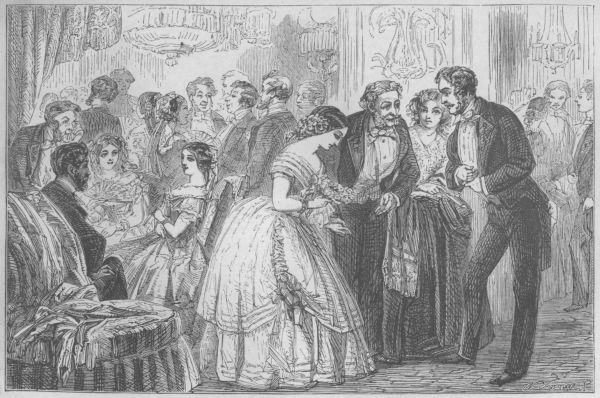
A few days after this conversation, Colonel and Mrs. Orme entertained
a large party at dinner, at which a brilliant company of fashionable
friends and acquaintances was present. As this was the first
party that had been invited during her visit, Emma bestowed a more
than ordinary attention on her personal appearance. Her dress, if
not expensive, was elegant, and though there were other ladies who
surpassed her in the richness of their attire, there was no one who
equalled her in the beauty of her figure, or the grace and elegance
of her movements. She now felt herself, for the first time in her life,
in a position which gave her an opportunity of displaying her attractions,
which she did with so much grace, that she excited the envy
and admiration of the company, who were astonished when they
heard that this was the daughter of Mr. Holmes. In the course of
the evening the rumble of wheels was heard at the door, and soon
after a handsome young man entered the drawing-room, whom
Emma at once perceived to be Charles Orme, on his parents and
sister hastening forward to meet him. He had just got leave of
absence, he said, for a few weeks, and sooner than he expected, which
had brought him to Redhill, without previously sending any notice.
Emma was quite charmed with his appearance, and still more so
when the Colonel, walking up to her, said, "Allow me, Miss Holmes,
to introduce to you my son Charles—Charles, Miss Emma Holmes.
"This is an unlooked-for pleasure, Miss Holmes," said Captain
Orme, performing his part in the ceremony of the introduction with
the most polished gallantry; "I have often heard of you from my
sister in her letters. What charming weather this is! Pray, may
I have you as a partner, as I see they are getting up a quadrille?"
Emma gracefully consented; and from that moment her destiny
in life was fixed. On the other hand, Captain Orme was quite
struck with her beauty; and though the apparent heartiness of
his manner, at his first introduction, was merely the result of that
vanity which seeks to engross for itself the company of the most
elegant woman present, he could not help experiencing, even in his
cold and selfish heart, a somewhat deeper and more serious feeling,
as he conversed with this young and beautiful girl. Colonel and
Mrs. Orme viewed, with great satisfaction, the evident impression
made on their son by Emma's beauty; and, accordingly, after their
guests had departed, they communicated to him the matrimonial
speculation they had in view for him.
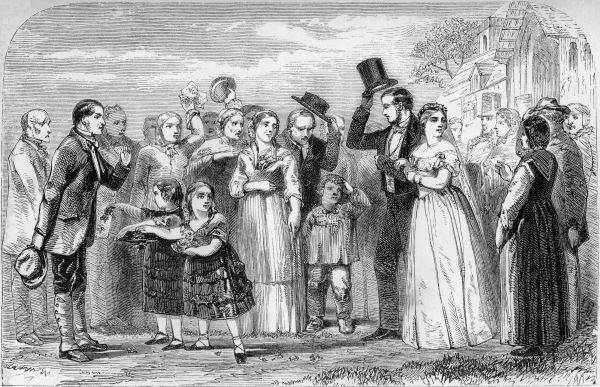
FIRST MEETING OF CAPTAIN ORME AND EMMA HOLMES.
Vol. ii. p. 352.
"I am sure, Charles," said his father, "there could not be a more
desirable match: youth, beauty, and last, not least (with a significant
leer), a very handsome fortune."
"Has she her fortune at her own command?" asked his son.
"Why, no, the wealth of the Holmes family has all been accumulated
by the old man; and I should suppose the amount of this girl's
fortune must be dependent on his will. But he will, doubtless, give
her a handsome portion, if he is satisfied with the match."
"Now, that is just the difficulty," said Mrs. Orme. "The family,
always strong Evangelicals, have lately turned Dissenters, because,
forsooth, Mr. Vaughan's sermons are not sufficiently methodistical
to please them. Mr. Holmes has a great prejudice against the military
profession, as one both of a questionable nature in itself, and
beset with numerous temptations. We must, then, play our cards
well, and act with caution."
"The first thing," said the Colonel, "is for you, Charles, to pay
your addresses to Miss Holmes. I do not think there will be much
difficulty with her."
"Well, I should rather suppose there would not," replied the
modest youth, contemplating, with considerable satisfaction, his
elegant figure in the mirror over the drawing-room chimney-piece;
"it shall not be my fault if she does not become Mrs. Orme. But
good night. I was up all last night at Lady Fortescue's ball, and
must be off to bed."
"One word, Charles," said his mother, "what are you going to do
with Miss Collingwood?"
"O, that has all been over for some time. I learned that her
father has nothing to depend on but his pay, and that his daughter's
fortune, left her by an aunt, amounts only to three thousand pounds,
and is so tied up, that I should never be able to touch a shilling of
it. So I am well out of that affair."
The Captain was a young man about the age of twenty-five. He
had inherited from his mother a handsome fortune, which he received
on coming of age; but such had been his profuse extravagance, before
and after he entered the army, that when he had paid his
so-called debts of honour, and the Jew brokers who had advanced
him money, he found himself unable to defray the bills of his tradesmen,
who were clamorous for the settlement of their accounts.
Various were the expedients which he employed to keep them from
carrying their threats into execution; and at length he resolved on
marriage, as the only alternative he could devise, to extricate himself
from his embarrassments. He first paid his addresses to the eldest
daughter of a country gentleman, but soon quitted her on ascertaining
the small amount of fortune which she possessed. A similar reason, as
above-mentioned, induced him to desert Miss Collingwood, the daughter
of a retired major in the Indian army; and now he prepared
to pay his addresses to the more accomplished and the more wealthy
daughter of Mr. Holmes. He, of course, concealed from the latter
the history of his former life, spoke of the fortune which fell to him
by the death of his mother, as though it were still in his possession,
and assured her that he had no other motive in view than the honour
and felicity of being permitted to call her his wife. Unaccustomed
to the duplicity of the world, and fudging of others, from the integrity
of her own heart, she listened to his overtures with pleasure,
and though she proposed speaking to her parents before she ventured
to give any decisive reply, yet this was overruled by Mrs. Orme, who
suggested the expediency of deferring it for the present. "You know,
my dear," said the intriguing woman, "your Papa and Mamma, from
their peculiar sentiments on religion, may feel some objection to
Charles's profession, and it will be necessary to adopt some plan to
reconcile them to it; and, as an opening has now been made, the
Colonel and I both think that we had better establish a close intimacy
with the Elms, before anything is said on the subject."
On her return home, she intermingled with the family as usual,
preserved the same degree of decorum in her attention to religious
duties, and at times appeared thoughtful and sedate, which induced
her unsuspecting sister to imagine that she was beginning to feel the
deep impressions of religion on her heart. Amidst all her gaiety,
and sprightliness, and aversion to decided piety, she had always displayed
an honest frankness when speaking on the subject, but now
she had a part to act which required duplicity; and having been
tutored to this vice at the Colonel's, she soon became a proficient.
As her sister Louisa had made some reference to her comparative
sedateness, and expressed, in very delicate terms, her hope that it
was the beginning of the great change, she resolved to assume a
more uniform gravity of manner, that she might more effectually
conceal the passion which had taken such strong hold of her feelings.
She made no allusion to the scenes of gaiety she had recently witnessed,
and in which she moved as one of the most admired figures;
nor did she express any wish to repeat her visit, which rather tended
to confirm the hopes of her sister.
"Jane and I," said Miss Holmes, as they were all rising from the
dinner table, "are going to see Mrs. Kent; will you accompany us,
Emma?"
"Certainly. I long to see the old lady. She is a real Christian,
I have no doubt; and if her mind had received the same degree of
cultivation as her heart, she would have exhibited the majesty and
force no less than the amiable traits of religion."
"I was not aware," replied Miss Holmes, with a smile of pleasure,
"that you ever associated such qualities with the pure religion of
Jesus Christ."
"O yes, I do; and I am delighted when I see them embodied in a
living character; but they must be blended to produce their full
effect."
"But is not the beauty of religion more attractive than its
grandeur?"
"It may be so to some persons, but not to me. I prefer a mind
that can discourse on the doctrines of Christianity in a style of
speech which bears some analogy to their sublime greatness."
"I hope, dear Emma," said Miss Holmes, "you do not now feel
that strong antipathy to the Corries which you have heretofore
manifested; for though they are weak Christians, yet you must
acknowledge they are pious."
"Yes, they may be pious," replied Emma, with some sarcastic
warmth of manner; "but who that has any feeling of respect for
the honour of Christianity does not regret that their piety is not
confined to a cloister? Mrs. Kent exhibits the beauty of religion,
the Corries its deformity: Mrs. Kent would make an infidel believe,
but the Corries would make a Christian doubt; she, by the artless
simplicity of her instructions, would
... 'rear the tender thought,
And teach the young idea how to shoot;'
till the principle of grace grows up laden with the fruits of righteousness;
they, by their vanity and self-conceit, their dogmatism, and
perverse obstinacy of opinion, would shake the strongest faith.
Or, to speak in plain terms, such Christians as the Corries should
never speak on religious subjects in the presence of the irreligious;
for if they do, they will confirm the enmity which they wish to
subdue, and give a degree of encouragement to sin which they do
not intend."
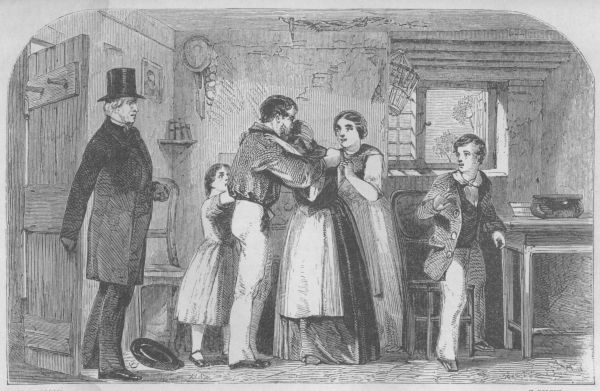
The old woman had just finished reading a letter when the young
ladies entered her cottage; and though she received them with her
usual kind manner, yet she could not conceal the powerful agitation
of her feelings.
"I hope," said Miss Holmes, "we are not intruding."
"No, Miss, I am very glad to see you; and I hope you will not
allow my distress to give you any trouble."
"O," said Emma, "if you are in trouble let us know the cause of
it; though I ought to apologize for having asked such an impertinent
question."
"The question is not impertinent, and therefore I beg you will
say nothing about an apology. I have just received a letter from
my dear boy, who has been absent from me these fourteen years,
and as I had not heard from him for many months I thought
he was dead."
"Where is he?"
"He is with his regiment at the Cape of Good Hope, very ill in
the hospital, and says he does not expect that I shall ever hear from
him again. He was once a good, obedient son, much attached to his
mother, but he fell into evil company, and was enticed to enlist as a
soldier. He said nothing to me about it for many days after he had
done it, or I could have got him off by speaking to Squire Ridgeway;
but I did not know anything about it till the night before he was
marched off, and since then I have never seen him; and now he is
confined in the hospital so far off that I can't go to nurse him, nor
speak to him about the Saviour who came into the world to save
sinners. I hope you will excuse me, ladies, but a mother can't help
weeping."
While the poor old woman was telling this affecting tale, the
countenance of Emma underwent very perceptible changes, from
the deep crimson blush to a deathlike paleness, till, overpowered
by her feelings, she fainted in the arms of her sister. She was taken
into the open air, and various expedients were adopted to restore
her, which after a short time proved successful. "Dear creature,"
said Mrs. Kent, fanning her, "she has a tender heart, and can't bear
to hear of another's sorrows. I am grieved that I said anything
about my affliction, it has proved too much for her."
"She has," Miss Holmes remarked, "a great esteem for you, which
is the cause of her having felt so great an interest in your calamity;
but she will soon be better."
On recovering, she expressed her regret that the weakness of her
nerves should occasion so much trouble; and having taken a draught
of water, she rose, and leaning on the arms of her sisters, soon after
walked home. During the evening she endeavoured to resume her
usual cheerfulness, but she could not, and dreading a recurrence of
the fit, she complained of indisposition, and retired to rest. In the
morning, when her sister Louisa went into her room, she found her
in a sweet sleep; and, as she was stealing away, she saw a miniature
lying on her dressing-table, and on looking at it thought it bore a
strong resemblance to Captain Orme, who, after Emma's return
home, had one day called with his sister.
The following day Mr. and Mrs. Holmes were surprised by a call
from the Colonel and Miss Orme, who came to invite them to meet
a select dinner party; and, though they had resolved not to intermix
with the gay world, yet they knew not how to refuse such an
expression of politeness, especially as they had been so kind to
Emma. They therefore consented.
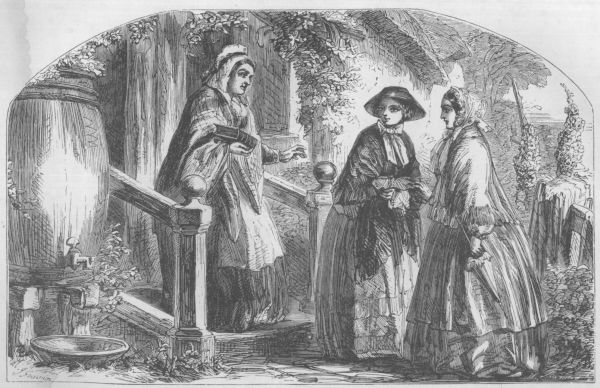
"Mamma requested me," said Miss Orme to her young friend,
"to offer you the loan of this book, which she thinks you will like.
It is a very religious one. You may open it at your leisure."
The emphasis which was placed on this sentence, viewed in connection
with the miniature painting, awakened the suspicion of Miss
Holmes, who now believed that some secret correspondence was
going on between her sister and Captain Orme; and an accidental
occurrence took place in the course of the day, which removed every
doubt from her mind. Emma on taking her handkerchief out of her
reticule, as she was retiring from the parlour after dinner, dropped
a letter, which her mother picked up, and read. She immediately
presented it to Mr. Holmes, who also read it. This was a letter
which Mrs. Orme had inclosed between the leaves of the book she
had sent to Emma, informing her that Charles was well, and wanted
to meet her that evening, at Mrs. Paton's. She added that she
hoped she had contrived to keep all at the Elms ignorant of the
affair, as the Colonel was still of opinion that they should not be
spoken to on the business till everything was properly arranged.
This letter, which explained the obscure parts of Emma's conduct,
involved the whole family in great perplexity; and they were at
a loss to know what course to pursue, that would save her from the
snares which had been laid to entrap her. At length it was resolved
to replace the letter, and leave the room. This was done, and on
passing through the hall, Mr. Holmes met her, and said,
"I am going, my dear, to take a ride in the carriage this afternoon,
will you go with me?"
"Certainly, Papa."
On entering the parlour she found her letter, and eagerly seized
it, presuming that it had escaped detection.
She had given her promise to accompany her father when her
feelings were strongly excited by the dread of having Mrs. Orme's
letter to her discovered; but now she began to complain of indisposition,
and wished to decline the proposed ride. However, her
objections were overruled, and she went.
On the following morning, her father, finding her alone, took the
opportunity of alluding to his anxiety for her spiritual and temporal
welfare, and hoped that she would take no important step in life
without the advice and approbation of her parents.
"Do you think it possible, Papa, that I could be so unwise or
so undutiful as to take any important step without consulting
you?"
"Tell me, my dear child," said her father, taking her by the hand,
"have you not already been induced to do so, and that by the persuasion
of others?"
This question, proposed in the mildest accents, and with every
expression of parental tenderness, staggered and confounded her,
and, after a momentary pause, she fell on her knees and implored
forgiveness.
"Yes, my father, I have been induced to act a part which I
sincerely regret. Forgive me, I beseech you."
She frankly confessed the whole plot; offered to return every
letter and present she had received, and promised that she would
never suffer herself to be again beguiled from the path of duty.
These presents Mr. Holmes sent back to the Colonel's, accompanied
by the following letter:—
"Sir,—Since your call on Thursday morning, I have detected the
intimacy which has been formed between my daughter and your
son; and am surprised that you and Mrs. Orme should so far forget
the obligations which are due to a parent, as to dissuade my child
from consulting me on a measure of so much importance to our
happiness, and her own. Had the young people resolved to practise
this species of deception on me without your knowledge or consent,
I should blame them only; but as this plot has been got up by you,
I must say, that the amount of their fault is lost in the greater
magnitude of yours; and I have no doubt but your object is to
repair the ruined fortune of your son at the expense of my daughter's
happiness. You will therefore allow me to say, that all intimacy
between our families has ceased.—Yours," &c.
After this abrupt termination of an intimacy which had opened
before her the prospect of a connection for life, she appeared for
a few days relieved from an oppressive burden of anxiety, and was
assiduous in her attention to her parents; but her appearance and
her manners soon proved that her affections were entangled, and
that nothing but time and the tenderest treatment on their part
could disengage them. She became low and dejected—careless of her
person—unwilling to mingle in any company—the healthful bloom
of her countenance passed away, succeeded by the sickly and pallid
hue; she seldom took part in conversation, and endeavoured
to avoid all intercourse with the other members of the family.
At length her mother became much alarmed, and said it was her
opinion, that unless they consented to a renewal of the intimacy
with the Ormes, they must prepare to follow their daughter to the
grave. "I never can give my consent to the connection," said Mr.
Holmes; "and would rather follow her to the grave than see her
united to such a person. Captain Orme is a man who has squandered
his fortune; destroyed the strength of his constitution by
dissolute habits; is involved in debt by his extravagance; and
would sacrifice the happiness, and even the life of Emma, with as
little remorse as he now feels for his past crimes. He is bad, but his
parents, if possible, are worse; for they have not only given the sanction
of their approbation to his conduct, but attempted to corrupt
our child, and thus ruin our domestic happiness."
The conduct of a female, who accepts the addresses of a gentleman
without consulting her parents, or her guardians, is deserving
of censure; but when she is beguiled into the measure by the entreaties
and persuasion of others, and especially those who have
children or wards of their own, the voice of censure should reserve
its severest expressions of reprobation for her tempters and seducers.
Their delinquency, it is true, does not cancel hers, but it offers some
slight degree of extenuation. What evils often result from that
system of manœuvring, which is so much tolerated, nay, even applauded,
in society! These match-makers and busy-bodies—these
common nuisances and pests—who trample on all the sacred principles
of honour and of friendship, and display such indifference when
detected—ought to be excluded from every family which wishes to
preserve the honour and happiness of its female members. Nor
ought we to hold in less detestation and abhorrence, the conduct of
those who allow our children to hold secret and forbidden intercourse
with each other at their houses, or consent to become the
agents through whom a correspondence is carried on. Such persons
may express their tender sympathy for the young people who are
not permitted to meet openly and in the face of day, and may pass
some heavy censures on the cruelty of their parents; but can they,
on reflection, approve of their own doings, and think themselves
entitled to respect? Impossible! They are acting a part over which
they wish the veil of secrecy to be thrown; and, often sacrificing
on the same altar the virtue and happiness of the child, with the
peace and honour of the parent, can offer no other apology for their
conduct, than that "they did not mean any harm."
Mr. Holmes saw, with great anxiety, the declining health of his
beloved Emma; and on surprising her, in tears, one morning as he
entered her room, he expressed his fears that she was unhappy.
"Yes, my father, I am unhappy; and I believe that I shall never
see another happy day in this unhappy world."
"But I understood, when I spoke to you on the subject, that it was
your determination to renounce all further thoughts of Captain Orme."
"Yes, I said I would return his letters, and never suffer myself
to be again beguiled from the path of duty; but I cannot subdue
my feelings. I think if you knew him you would not object."
"My dear girl, I have strong objections to his profession, which
is not favourable to the cultivation of those domestic virtues on
which the happiness of a wife depends."
"But, Papa, he is one of the most attentive and amiable of men;
and would, I have no doubt, make me happy."
"It is very rarely, indeed, that a rake ever makes a good husband."
"A rake! Papa; you are misinformed."
"Ah, my child, you are not aware of the deception which has been
practised on you, by those you once thought, and perhaps still think,
your friends. I have made the most minute inquiry respecting his
habits, his property, and his character; and I can assure you, on
evidence the most decisive, that he is dissolute in his habits—impoverished
in his fortune—and his general character is the very reverse
of what you imagine."
"O Papa! I think you have been deceived. He has his mother's
fortune, which is very handsome. I have seen the original deeds
which secured it to him."
"He had his mother's fortune, my dear, but he squandered it away
before he came of age; and when it was actually transferred to him,
it was not sufficient to pay all his debts."
"Are you sure, Papa, that you are not misinformed?"
"Perfectly sure, my dear Emma."
"And may I be permitted to ask, how you gained this information,
which is so contrary to every statement I have received; and which,
if true, must change my opinion of him?"
"I gained it, in the first instance, through the medium of your
brothers; but as I was unwilling to believe such an unfavourable
account, even on their testimony, I obtained a personal interview
with several of his creditors, who gave me ocular proof of the correctness
of their statements. Indeed, one of them arrested him last
week, for the sum of twenty pounds, which had been due more than
a year and a half; and others have been induced to wait a few months
longer, from the representations of the Colonel, who has told them
that his son is just on the eve of marrying a wealthy citizen's daughter,
when every claim shall be settled."
"Impossible! Such treachery cannot dwell in the human bosom!"
"It is true, my child."
"I am forced to believe it, Papa, and yet I cannot. Perhaps it is
only a temporary embarrassment, arising from some act of generosity,
or some species of fraud, that has been practised on him. And
you know, Papa, a gentleman who is reduced to poverty, may rise
again in society; and gaining wisdom by his experience, he may
become more careful."
"Yes, my dear, if he be a man of probity and virtue; but if not,
he will never rise."
"And is not Charles Orme a man of probity and virtue?"
"I am sorry to say he is not. He may appear such in your presence,
and he may be described as such by his own family, but when
his mode of life is inquired into, he will be found frequenting places
and societies which a virtuous man would shun as offensive to his
taste, and destructive of his honour."
When a forbidden passion has once gained an ascendency over the
mind of a female, it very often throws such a spell around her, that
she becomes either unable or unwilling to see the inevitable ruin
that lies before her; and though she will listen to the advice of her
friends with apparent interest, and sometimes profess to adopt it,
under a full conviction that it is such as she ought to follow, yet as
soon as she comes into contact with the fatal object on which her
affections are irrecoverably placed, she feels an influence which destroys
all her wise resolves, and hurries her to her doom.
Thus it was with the infatuated Emma, who, after struggling
with her affections for many months, and endeavouring to recover
that mental peace which she formerly enjoyed, rashly determined to
follow the impulse of her will, though her ruin should be the inevitable
consequence.
The family had accepted an invitation to spend a few days with
an intimate friend, who resided near Tunbridge Wells, but as Emma
did not wish to go into company at present, she was excused, and
took leave of her parents and sisters with the tenderest expressions
of attachment, and said she hoped they would enjoy the visit. On
their return they were informed by the housekeeper that Miss Emma
had not been home since the day after they left, but had requested
her to present the following letter to her father as soon as she saw
him:—
"My dear Father,—Before you receive this, I shall have committed
an act which will plunge you and every one of our family
into the greatest distress; but I have been compelled to it by dire
necessity. I could not conquer my passion for Captain Orme, and
am therefore now his wife. Had I not consented, my life would
have fallen a sacrifice to my feelings; and as I am not prepared to
die, I judged it prudent to perpetuate a life, with some chance for
happiness, rather than lose it, with a certain prospect of misery.
I hope you and my dear mother will forgive me; and if you cannot
suffer me to visit you, I hope you will pray for me. My present
home is at the Colonel's, and though I do not expect to find it such
a one as that which I have left, yet I trust it will not be without
its comforts. With every affectionate regard to you, my dear Mamma,
and sisters, and brothers, I am your undutiful, yet much attached,
"Emma."