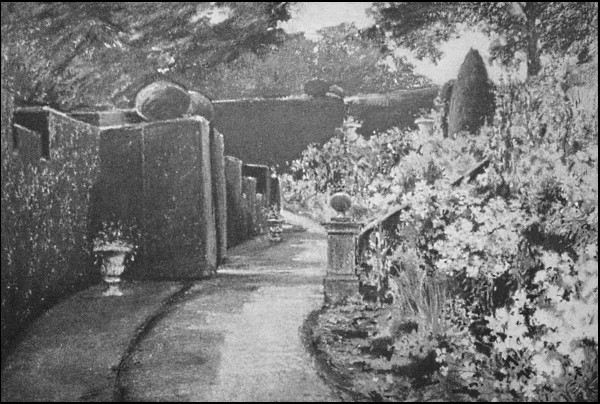
The Elizabethan garden was usually four-square,
bordered all around by hedges and intersected by
paths. There was an outer hedge that enclosed the
entire garden and this was a tall and thick hedge
made of privet, sweetbrier, and white thorn intermingled
with roses. Sometimes, however, this outer
hedge was of holly. Again some people preferred
to enclose their garden by a wall of brick or stone.
On the side facing the house the gate was placed.
In stately gardens the gate was of elaborately
wrought iron hung between stone or brick pillars on
the top of which stone vases, or urns, held brightly
blooming flowers and drooping vines. In simple
gardens the entrance was a plain wooden door,
painted and set into the wall or hedge like the quaint
little doors we see in England to-day and represented
in Kate Greenaway's pictures that show us how the
style persists even to the present time.
Stately gardens were usually approached from a
terrace running along the line of the house and commanding
a view of the garden, to which broad flights
of steps led. Thence extended the principal walks,
called "forthrights," in straight lines at right angles
to the terrace and intersected by other walks parallel
with the terrace. The lay-out of the garden, therefore,
corresponded with the ground-plan of the mansion.
The squares formed naturally by the intersection
of the "forthrights" and other walks were filled
with curious beds of geometrical patterns that were
known as "knots"; mazes, or labyrinths; orchards;
or plain grass-plots. Sometimes all of the spaces or
squares were devoted to "knots." These ornamental
flower-beds were edged with box, thrift, or thyme
and were surrounded with tiny walks made of gravel
or colored sand, walks arranged around the beds so
that the garden lovers might view the flowers at
close range and pick them easily.
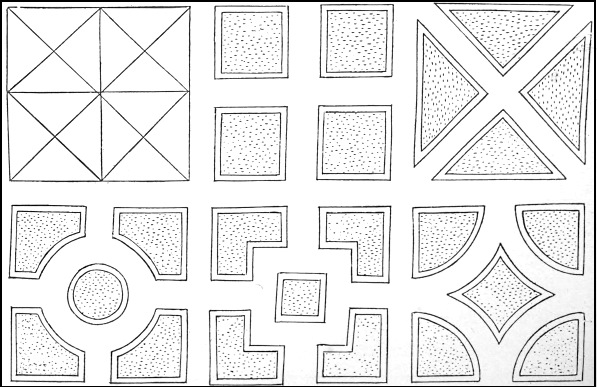
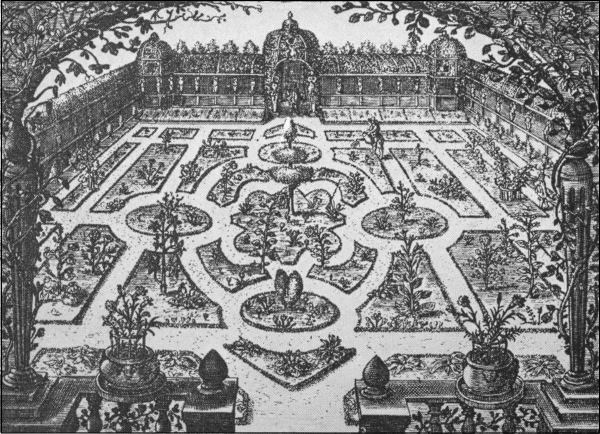
It will be remembered that in "Love's Labour's
Lost" Shakespeare speaks of "the curious knotted
garden." There are innumerable designs for these
"knots" in the old Elizabethan garden-books, representing
the simple squares, triangles, and rhomboids
as well as the most intricate scrolls, and complicated
interlacings of Renaissance design that resemble the
motives on carved furniture, designs for textiles and
ornamental leather-work (known as strap-work, or
cuirs). Yet these many hundreds of designs were
not sufficient, for the amateur as well as the professional
gardener often invented his own garden
"knots."
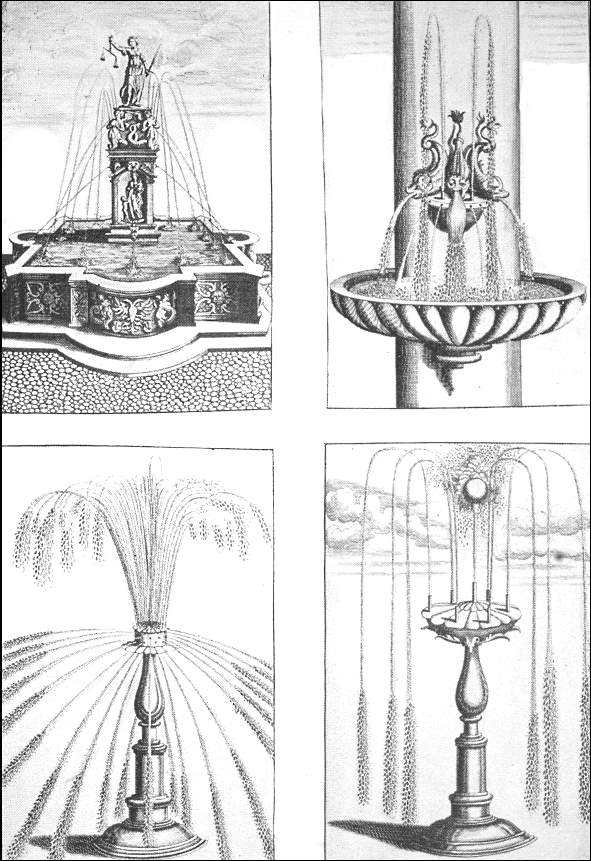
Where the inner paths intersected, a fountain or
a statue or some other ornament was frequently
placed. Sometimes, too, vases, or urns, of stone or
lead, were arranged about the garden in formal style
inspired by the taste of Italy. Sometimes, also,
large Oriental or stone jars were placed in conspicuous
spots, and these were not only intended for
decoration but served as receptacles for water.
There were four principles that were observed in
all stately Elizabethan gardens. The first was to
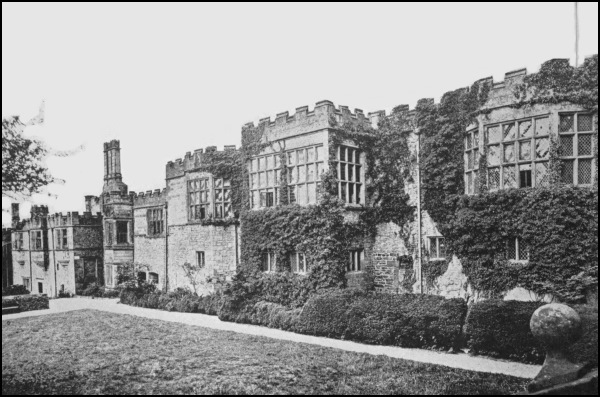
lay out the garden in accordance with the architecture
of the house in long terraces and paths of right
lines, or "forthrights," to harmonize with the
rectangular lines of the Tudor buildings, yet at the
same time to break up the monotony of the straight
lines with beds of intricate patterns, just as in the
case of architecture bay-windows, clustered and
twisted chimneys, intricate tracery, mullioned windows,
and ornamental gables relieved the straight
lines of the building.
The second principle was to plant the beds with
mixed flowers and to let the colors intermingle and
blend in such a way as to produce a mosaic of rich,
indeterminate color, ever new and ever varying as
the flowers of the different seasons succeeded each
other.
The third principle was to produce a garden of
flowers and shrubs for all seasons, even winter, that
would tempt the owner to take pleasure and exercise
there, where he might find recreation, literally
re-creation of mind and body, and become freshened
in spirit and renewed in health.
The fourth principle was to produce a garden
that would give delight to the sense of smell as well
as to the sense of vision—an idea no longer sought
for by gardeners.
Hence it was just as important, and infinitely
more subtle, to mingle the perfumes of flowers while
growing so that the air would be deliciously scented
by a combination of harmonizing odors as to mingle
the perfumes of flowers plucked for a nosegay, or
Tussie-mussie, as the Elizabethans sometimes
quaintly called it.
Like all cultivated Elizabethans, Shakespeare appreciated
the delicious fragrance of flowers blooming
in the garden when the soft breeze is stirring their
leaves and petals. There was but one thing to which
this subtle perfume might be compared and that was
ethereal and mysterious music. For example, the
elegant Duke in "Twelfth Night," reclining on his
divan and listening to music, commands:
That strain again! It had a dying fall.
O it came o'er my ear like the sweet south
That breathes upon a bank of violets
Stealing and giving odor.
Lord Bacon also associated the scent of delicate
flowers with music. He writes: "And because the
breath of flowers is far sweeter in the air (whence
it comes and goes like the warbling of music) than
in the hand, therefore nothing is more fit for delight
than to know what be the flowers and plants
that do best perfume the air. Roses, damask, and
red, are fast flowers of their smells, so that you may
walk by a whole row of them and find nothing of
their sweetness, yea though it be in a morning's dew.
Bays, likewise, yield no smell as they grow, rosemary
little, nor sweet marjoram. That which above
all others yields the sweetest smell in the air is the
violet, especially the white double violet, which
comes twice a year—about the middle of April and
about Bartholomew-tide. Next to that is the musk-rose,
then the strawberry leaves dying, which yield
a most excellent cordial smell, then the flower of
the vines, it is a little dust, like the dust of a bent,
which grows upon the cluster in the first coming
forth; then sweetbrier, then wall-flowers, which are
very delightful to be set under a parlor or lower
chamber window; then pinks and gilliflowers; then
the flowers of the lime-tree; then the honeysuckles,
so they be somewhat afar off; of bean flowers, I
speak not, because they are field flowers. But those
which perfume the air most delightfully not passed
by as the rest but being trodden upon and crushed
are three: burnet, wild thyme and water-mints.
Therefore, you are to set whole alleys of them to
have the pleasure when you walk or tread."
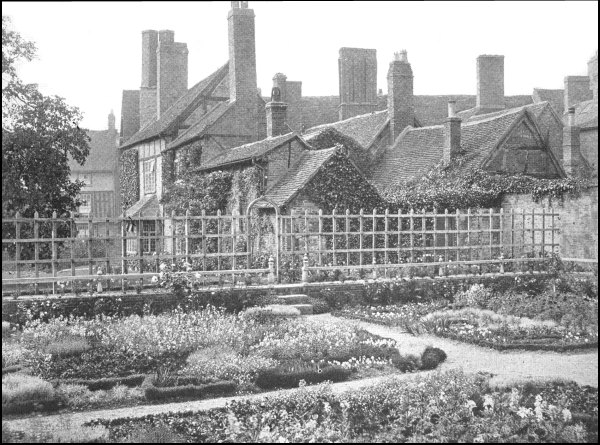
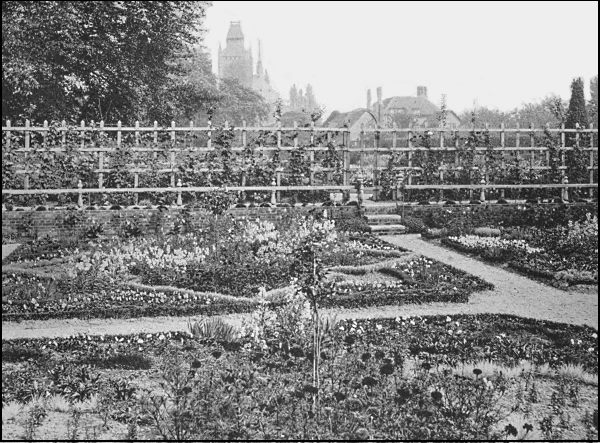
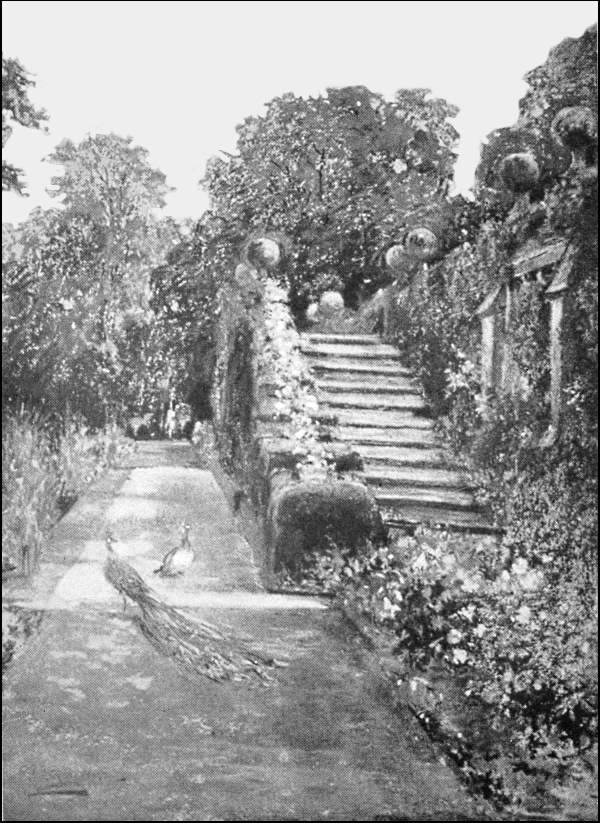
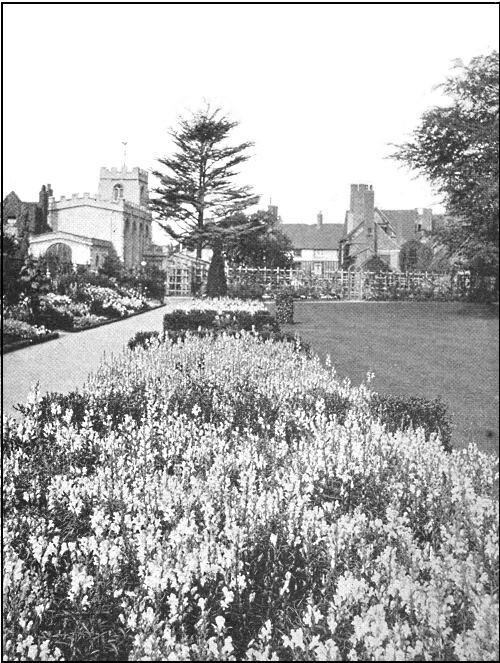
THE KNOT-GARDEN, NEW PLACE, STRATFORD-UPON-AVON
Shakespeare very nearly follows Bacon's order
of perfume values in his selection of flowers to adorn
the beautiful spot in the wood where Titania sleeps.
Oberon describes it:
I know a bank where the wild thyme blows,
Where oxlips and the nodding violet grows,
Quite over-canopied with luscious woodbine,
With sweet musk-roses and with eglantine.
There sleeps Titania sometime of the night,
Lulled in these flowers with dances and delight.
Fairies were thought to be particularly fond of
thyme; and it is for this reason that Shakespeare
carpeted the bank with this sweet herb. Moreover,
as we have just seen, Bacon tells us that thyme is
one of those plants which are particularly delightful
if trodden upon and crushed. Shakespeare accordingly
knew that the pressure of the Fairy Queen's
little body upon the thyme would cause it to yield a
delicious perfume.
The Elizabethans, much more sensitive to perfume
than we are to-day, appreciated the scent of
what we consider lowly flowers. They did not hesitate
to place a sprig of rosemary in a nosegay of
choice flowers. They loved thyme, lavender,
marjoram, mints, balm, and camomile, thinking that
these herbs refreshed the head, stimulated the
memory, and were antidotes against the plague.
The flowers in the "knots" were perennials,
planted so as to gain uniformity of height; and those
that had affinity for one another were placed side
by side. No attempt was made to group them; and
no attempt was made to get masses of separate color,
what Locker-Lampson calls "a mist of blue in the
beds, a blaze of red in the celadon jars" and what
we try for to-day. On the contrary, the Elizabethan
gardener's idea was to mix and blend the flowers
into a combination of varied hues that melted into
one another as the hues of a rainbow blend and in
such a way that at a distance no one could possibly
tell what flowers produced this effect. This must
have required much study on the part of the gardeners,
who kept pace with the seasons and always
had their beds in bloom. Sir Henry Wotton, Ambassador
to Venice in the reign of James I, and
author of the "Elements of Architecture," but far
better known by his lovely verse to Elizabeth of
Bohemia beginning, "You meaner beauties of the
night," was an ardent flower lover. He was greatly
impressed by what he called "a delicate curiosity
in the way of color":
"Namely in the Garden of Sir Henry Fanshaw
at his seat in Ware Park, where I well remember he
did so precisely examine the tinctures and seasons
of his flowers that in their settings, the inwardest
of which that were to come up at the same time,
should be always a little darker than the outmost,
and so serve them for a kind of gentle shadow, like
a piece not of Nature but of Art."
Browne also gives a splendid idea of the color
effect of the garden beds of this period:
As in a rainbow's many color'd hue,
Here we see watchet deepen'd with a blue;
There a dark tawny, with a purple mix'd;
Yellow and flame, with streaks of green betwixt;
A bloody stream into a blushing run,
And ends still with the color which begun;
Drawing the deeper to a lighter strain,
Bringing the lightest to the deepest again;
With such rare art each mingled with his fellow,
The blue with watchet, green and red with yellow;
Like to the changes which we daily see
Around the dove's neck with variety;
Where none can say (though he it strict attends),
Here one begins and there another ends.
Using such cunning as they did dispose
The ruddy Piony with the lighter Rose,
The Monkshood with the Buglos, and entwine
The white, the blue, the flesh-like Columbine
With Pinks, Sweet-Williams; that, far off, the eye
Could not the manner of their mixture spy.
By the side of the showy and stately flowers,
as well as in kitchen gardens, were grown the
"herbs of grace" for culinary purposes and the
medicinal herbs for "drams of poison." Rosemary—"the
cheerful Rosemary," Spenser calls it—was
trained over arbors and permitted to run over
mounds and banks as it pleased. Sir Thomas More
allowed it to run all over his garden because the
bees loved it and because it was the herb sacred to
remembrance and friendship.
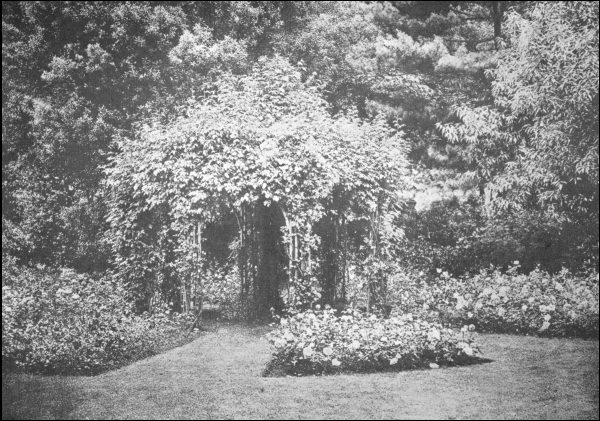
In every garden the arbor was conspicuous. Sometimes
it was a handsome little pavilion or summer-house;
sometimes it was set into the hedge; sometimes
it was cut out of the hedge in fantastic topiary
work; sometimes it was made of lattice work; and
sometimes it was formed of upright or horizontal
poles, over which roses, honeysuckle, or clematis
(named also Lady's Bower because of this use) were
trained. Whatever the framework was, plain or
ornate, mattered but little; it was the creeper that
counted, the trailing vines that gave character to
the arbor, that gave delight to those who sought the
arbor to rest during their stroll through the gardens,
or to indulge in a pleasant chat, or delightful flirtation.
Shakespeare's arbor for Titania
Quite over-canopied with luscious woodbine,
With sweet musk-roses and with eglantine,
was not unusual. Nor was that retreat where saucy
Beatrice was lured to hear the whisperings of Hero
regarding Benedick's interest in her. It was a
pavilion
Where honeysuckles ripened by the sun
Forbid the sun to enter.
Luxuriant and delicious was this bower with the
flowers hot and sweet in the bright sunshine.
Eglantine was, perhaps, the favorite climber for
arbors and bowers. Browne speaks of
An arbor shadow'd with a vine
Mixed with rosemary and with eglantine.
Barnfield, in "The Affectionate Shepherd,"
pleads:
I would make cabinets for thee, my love,
Sweet-smelling arbors made of eglantine.
And in Spenser's "Bower of Bliss":
Art, striving to compare
With Nature, did an arbor green dispread
Framed of wanton ivy, flow'ring fair,
Through which the fragrant eglantine did spread
His prickling arms, entrayl'd with roses red,
Which dainty odors round about them threw;
And all within with flowers was garnished,
That when Zephyrus amongst them blew
Did breathe out bounteous smells and painted odors shew.
A beautiful method of obtaining shady walks was
to make a kind of continuous arbor or arcade of
trees, trellises, and vines. This arcade was called
poetically the "pleached alley."[6] For the trees,
willows, limes (lindens), and maples were used, and
the vines were eglantine and other roses, honeysuckle
(woodbine), clematis, rosemary, and grapevines.
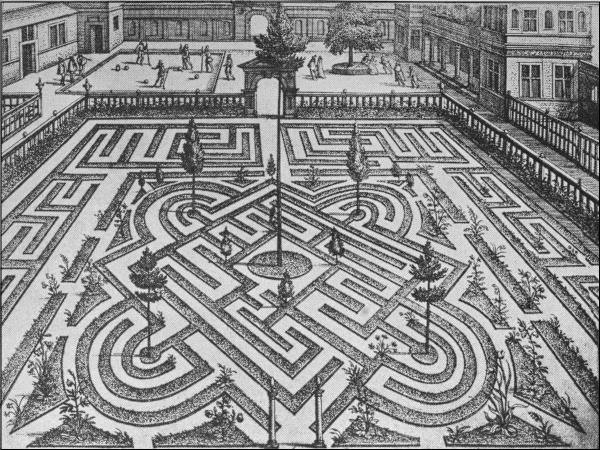
Another feature of the garden was the maze, or
labyrinth. It was a favorite diversion for a visitor
to puzzle his way through the green walls, breast
high, to the center; and the owner took delight in
watching the mistakes of his friend and was always
ready to give him the clue. When James I on his
"Southern Progress" in 1603 visited the magnificent
garden known as Theobald's and belonging to Lord
Burleigh, where we have already seen[7] Gerard was
the horticulturist, the King went into the labyrinth
of the garden "where he re-created himself in the
meanders compact of bays, rosemary and the like,
overshadowing his walk."
The labyrinth, or maze, was a fad of the day. It
still exists in many English gardens that date from
Elizabethan times and is a feature of many more
recent gardens. Perhaps of all mazes the one at
Hampton Court Palace is the most famous.
The orchard was another feature of the Elizabethan
garden. It was the custom for gentlemen
to retire after dinner (which took place at eleven
o'clock in the morning) to the garden arbor, or
to the orchard, to partake of the "banquet" or
dessert. Thus Shallow addressing Falstaff after
dinner exclaims:
"Nay, you shall see mine orchard, where, in an
arbor, we will eat a last year's pippin of my own
grafting with a dish of carraways and so forth."[8]
The uses of the Elizabethan garden were many:
to walk in, to sit in, to dream in. Here the courtier,
poet, merchant, or country squire found refreshment
for his mind and recreation for his body. The garden
was also intended to supply flowers for nosegays,
house decoration, and the decoration of the
church. Sweet-smelling herbs and rushes were
strewn upon the floor as we know by Grumio's order
for Petruchio's homecoming in "The Taming of the
Shrew." One of Queen Elizabeth's Maids of
Honor had a fixed salary for keeping fresh flowers
always in readiness. The office of "herb-strewer to
her Majesty the Queen" was continued as late as
1713, through the reign of Anne and almost into
that of George I.
The houses were very fragrant with flowers in
pots and vases as well as with the rushes on the floor.
Flowers were therefore very important features in
house decoration. A Dutch traveler, Dr. Leminius,
who visited England in 1560, was much struck by
this and wrote:
"Their chambers and parlors strewed over with
sweet herbs refreshed me; their nosegays finely intermingled
with sundry sorts of fragrant flowers in
their bed-chambers and private rooms with comfortable
smell cheered me up and entirely delighted all
my senses."
We have only to look at contemporary portraits
to see how essential flowers were in daily life. For
instance, Holbein's "George Gisze," a London merchant,
painted in 1523, has a vase of choice carnations
beside him on the table filled with scales,
weights, and business paraphernalia.
The Elizabethan lady was just as learned in the
medicinal properties of flowers and herbs as her
Medieval ancestor. She regarded her garden as a
place of delight and at the same time as of the
greatest importance in the economic management
of the household.
"The housewife was the great ally of the doctor:
in her still-room the lady with the ruff and farthingale
was ever busy with the preparation of cordials,
cooling waters, conserves of roses, spirits of herbs
and juleps for calentures and fevers. All the herbs
and flowers of the field and garden passed through
her fair white hands. Poppy-water was good for
weak stomachs; mint and rue-water was efficacious
for the head and brain; and even walnuts yielded
a cordial. Then there was cinnamon water and the
essence of cloves, gilliflower and lemon water, sweet
marjoram water and the spirit of ambergris.
"These were the Elizabethan lady's severer toils,
besides acres of tapestry she had always on hand.
Her more playful hours were devoted to the manufacture
of casselettes, month pastilles, sweet waters,
odoriferant balls and scented gums for her husband's
pipe (God bless her!) and there were balsams and
electuaries for him to take to camp, if he were a
soldier fighting in Ireland or in the Low Countries,
and wound-drinks if he was a companion of
Frobisher and bound against the Spaniard, or the
Indian pearl-diver of the Pacific. She had a specific
which was of exceeding virtue in all swooning of
the head, decaying of the spirits, also in all pains
and numbness of joints and coming of cold.
"That wonderful still-room contains not only
dried herbs and drugs, but gums, spices, ambergris,
storax and cedar-bark, civet and dried flowers and
roots. In that bowl angelica, carduus benedictus
(Holy Thistle), betony, juniper-berries and wormwood
are steeping to make a cordial-water for the
young son about to travel; and yonder is oil of
cloves, oil of nutmegs, oil of cinnamon, sugar, ambergris
and musk, all mingling to form a quart of
liquor as sweet as hypocras. Those scents and spices
are for perfumed balls to be worn round the ladies'
necks, there to move up and down to the music of
sighs and heart-beating, envied by lovers whose letters
will perhaps be perfumed by their contact.
"What pleasant bright London gardens we dream
of when we find that the remedy for a burning fever
is honeysuckle leaves steeped in water, and that a
cooling drink is composed of wood sorrel and Roman
sorrel bruised and mixed with orange juice and
barley-water. Mint is good for colic; conserves of
roses for the tickling rheum; plaintain for flux;
vervain for liver-complaint—all sound pleasanter
than those strong biting minerals which now kill or
cure and give nature no time to heal us in her own
quiet way."[9]
Bacon's "Essay on Gardening" is very detailed
and very practical, and it must be remembered that
he was addressing highly cultivated and skilfully
trained amateurs and professional gardeners when
he wrote:
"God almighty first planted a garden; and indeed
it is the purest of human pleasures; it is the greatest
refreshment to the spirit of man. And a man shall
ever see that when ages grow to civility and elegancy
men come to build stately sooner than to garden
finely, as if gardening were the greater perfection."
The Elizabethan Age, with its superlatively cultivated
men and women, was certainly one of those
ages of civility and elegancy of which Bacon speaks.
The houses were stately and the gardens perfection,
affording appropriate setting for the brilliant courtiers
and accomplished ladies of both Tudor and
early Stuart times.
We sometimes hear it said that Francis Bacon's
garden was his ideal of what a garden should be
and that his garden was never realized. This, however,
is not the case. Old prints are numerous of
gardens of wealthy persons in the reign of Elizabeth
and James I. Then, too, we have Sir William
Temple's description of Moor Park, and "this garden,"
says Horace Walpole, "seems to have been
made after the plan laid down by Lord Bacon in
his Forty-sixth Essay."
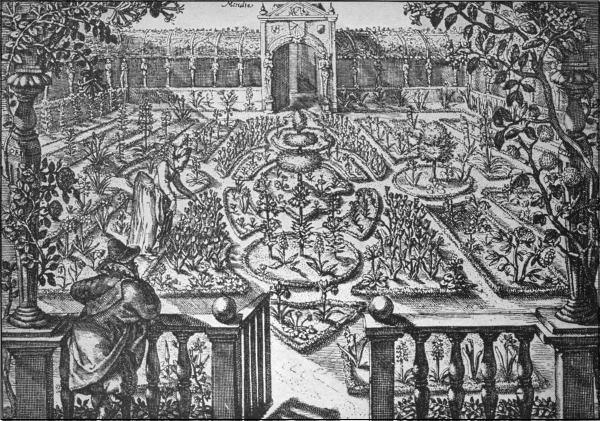
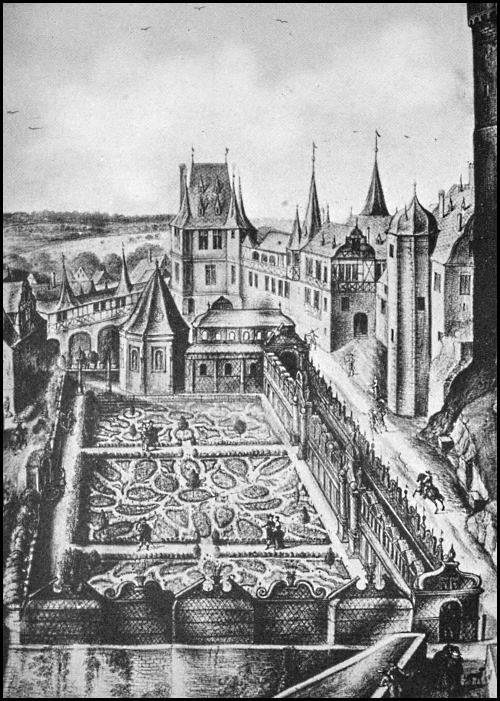
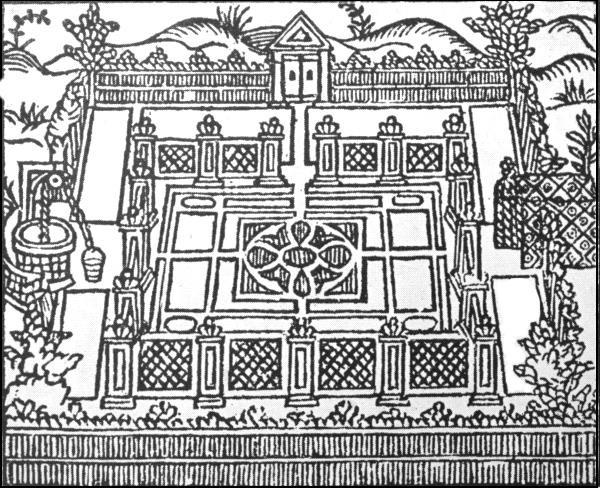
TYPICAL GARDEN OF SHAKESPEARE'S TIME—CRISPIN DE PASSE (1614)
Sir William's account is as follows:
"The perfectest figure of a garden I ever saw,
either at home or abroad, was that of Moor Park in
Hertfordshire, when I knew it about thirty years
ago. It was made by the Countess of Bedford,
esteemed among the perfectest wits of her time and
celebrated by Dr. Donne; and with very great care,
excellent contrivance and much cost.
"Because I take the garden I have named to have
been in all kinds the most beautiful and perfect, at
least in the figure and disposition, that I have ever
seen, I will describe it for a model to those that meet
with such a situation and are above the regards of
common expense.
"It lies on the side of a hill, upon which the house
stands, but not very steep. The length of the house,
where the best rooms and of most use or pleasure
are, lies upon the breadth of the garden; the great
parlor opens into the middle of a terrace gravel walk
that lies even with it, and which may lie, as I remember,
about three hundred paces long and broad
in proportion; the border set with standard laurels
and at large distances, which have the beauty of
orange-trees out of flower and fruit. From this walk
are three descents by many stone steps, in the middle
and at each end, into a very large parterre. This
is divided into quarters by gravel walks and
adorned with two fountains and eight statues in
the several quarters. At the end of a terrace walk
are two summer-houses, and the sides of the parterre
are ranged with two large cloisters open to the
garden, upon arches of stone, and ending with two
other summer-houses even with the cloisters, which
are paved with stone, and designed for walks of
shade, there being none other in the whole parterre.
Over these two cloisters are two terraces covered
with lead and fenced with balustrades; and the
passage into these airy walks is out of the two summer-houses
at the end of the first terrace walk. The
cloister facing the south is covered with vines and
would have been proper for an orange-house, and
the other for myrtles or other more common greens,
and had, I doubt not, been cast for that purpose, if
this piece of gardening had been then in as much
vogue as it is now.
"From the middle of this parterre is a descent by
many steps flying on each side of a grotto that lies
between them, covered with lead and flat, into the
lower garden, which is all fruit-trees ranged about
the several quarters of a wilderness which is very
shady; the walks here are all green, the grotto embellished
with figures of shell rock-work, fountains
and water-works. If the hill had not ended with the
lower garden, and the wall were not bounded by a
common way that goes through the park, they might
have added a third quarter of all greens; but this
want is supplied by a garden on the other side of
the house, which is all of that sort, very wild, shady,
and adorned with rough rock work and fountains."
To write of Elizabethan gardens without giving
Bacon's beautifully worked out theories would be
like performing "Hamlet" without the character of
Hamlet. Bacon's Essay is too long to quote in its
entirety, but the specific instructions are as follows:
"For gardens (speaking of those which are indeed
prince-like), the contents ought not well to
be under thirty acres of ground; and to be divided
into three parts: a green in the entrance; a heath or
desert in the going forth; and the main garden in
the midst, besides alleys on both sides. And I like
well that four acres of ground be assigned to the
green, six to the heath, four and a half to either
side and twelve to the main garden. The green hath
two pleasures: the one because nothing is more
pleasant to the eye than green grass kept finely
shorn; the other because it will give you a fair alley
in the midst, by which you may go in front upon
a stately hedge, which is to enclose this garden.
But because the alley will be long, and in great heat
of the year or day, you ought not to buy the shade
in the garden by going in the sun through the green;
therefore, you are of either side the green to plant
a covert alley upon carpenter's work, about twelve
foot in height, by which you may go in shade into
the garden.
"The garden is best to be square, encompassed
on all the four sides with a stately arched hedge.
The arches to be upon pillars of carpenter's work,
of some ten foot high and six foot broad, and the
spaces between of the same dimension with the
breadth of the arch; over the arches let there be an
entire hedge of some four foot high, framed also
upon carpenter's work; and upon the upper hedge,
over every arch, a little turret with a belly, enough
to receive a cage of birds; and over every space,
between the arches, some other little figure, with
broad plates of round colored glass, gilt, for the
sun to play upon. But this hedge I intend to be
raised upon a bank, not steep, but gentle slope, of
some six foot, set all with flowers. Also I understand
that this square of the garden should not be
the whole breadth of the ground, but to leave on
either side ground enough for diversity of side alleys,
into which the two covert alleys of the green may
deliver you. But there must be no alleys with
hedges at either end of this great enclosure.
"For the main garden I do not deny there should
be some fair alleys, ranged on both sides with fruit-trees,
and arbors with seats set in some decent order;
but these to be by no means set too thick, but to
leave the main garden so as it be not close, but the
air open and free. For, as for shade, I would have
you rest upon the alleys of the side grounds, there
to walk, if you be disposed, in the heat of the year,
or day, but to make account that the main garden is
for the more temperate parts of the year and in the
heat of the summer for the morning and the evening,
or overcast days.
"For the side grounds you are to fill them with
variety of alleys, private, to give a full shade, some
of them wheresoever the sun be. You are to frame
some of them likewise for shelter, that when the
wind blows sharp you may walk as in a gallery.
And these alleys must be, likewise, hedged at both
ends to keep out the wind, and these closer alleys
must be ever finely graveled and no grass, because of
going wet. In many of these alleys, likewise, you
are to set fruit-trees of all sorts, as well upon the
walls as in ranges. And this would be generally
observed that the borders wherein you plant your
fruit-trees be fair and large and low (and not steep)
and set with fine flowers, but thin and sparingly
lest they deceive the trees. At the end of both the
side grounds I would have a mount of some pretty
height, leaving the wall of the enclosure breast high,
to look abroad into the fields.
"For the heath, which was the third part of our
plot, I wish it to be framed, as much as may be, to
a natural wildness. Trees, I would have none in it;
but some thickets made only of sweetbrier and
honeysuckle and some wild vine amongst; and the
ground set with violets, strawberries and primroses;
for these are sweet and prosper in the shade; and
these to be in the heath, here and there, not in any
order. I also like little heaps in the nature of molehills
(such as are in wild heaths) to be set, some
with wild thyme, some with pinks, some with
germander that gives a good flower to the eye; some
with periwinkle, some with violets, some with strawberries,
some with cowslips, some with daisies, some
with red roses, some with lilium convallium,[10] some
with sweet williams, red, some with bear's foot[11] and
the like low flowers, being withal sweet and sightly.
Part of which heaps to be with standards of little
bushes pricked upon their top and put without. The
standards to be roses, juniper, holly, barberries (but
here and there, because of the smell of their blossom),
red currants, gooseberries, rosemary, bays,
sweetbrier and the like. But these standards to be
kept with cutting that they grow not out of course.
"For the ordering of the ground within the great
hedge, I leave it to variety of device; advising,
nevertheless, that whatsoever form you cast it into,
first it be not too busy or full of work. Wherein
I, for my part, do not like images cut out in juniper,
or other garden stuff—they be for children. Little
low hedges, round like welts, with some pretty pyramids,
I like well, and in some places fair columns
upon frames of carpenter's work. I would also have
the alleys spacious and fair. You may have closer
alleys upon the side grounds, but none in the main
garden. I wish also in the very middle a fair mount
with three ascents and alleys, enough for four to
walk abreast, which I would have to be perfect
circles without any bulwarks or embossments, and
the whole mount to be thirty foot high; and some
fine banqueting-house with some chimneys neatly
cast and without too much glass.
"As for the making of knots, or figures, with divers
colored earths that they may lie under the windows
of the house, on that side which the garden stands,
they be but toys. You may see as good sights many
times in tarts."
Fountains Bacon considered "a great beauty and
refreshment," but he did not care for pools, nor did
he favor aviaries "unless they were large enough to
have living plants and bushes set in them and supply
natural nesting for the birds."
We have already seen that Bacon was very choice
regarding "the flowers that best perfume the air";
and he felt it was very essential that people should
know what to plant for the different seasons. So
he tells us:
"There ought to be gardens for all months of the
year, in which, severally, things of beauty may be
in season. For December and January and the latter
part of November, you must take such things as
are green all winter: holly, ivy, bays, juniper,
cypress-trees, yew, pine, apple-trees, fir-trees, rosemary,
lavender, periwinkle, the white, the purple,
and the blue; germander, flags; orange-trees, lemon-trees
and myrtle, if they be stoved; and sweet
marjoram warm set. There followeth for the latter
part of January and February, the mezerion tree
which then blossoms; crocus vernus, both the yellow
and the gray; primroses, anemones, the early
tulip, hyacinthus orientalis, chamaires fritellaria.
For March there come violets, especially the single
blue, which are the earliest, the yellow daffodil, the
daisy, the almond-tree in blossom, the peach-tree in
blossom, the cornelian tree in blossom, sweetbrier.
In April follow the double white violet, the wallflower,
the stock gilliflower, the cowslip, flower-de-luces,
and lilies of all natures, rosemary flowers,
the tulip, the double peony, the pale daffodil, the
French honeysuckle, the cherry-tree in blossom, the
damson and plum-trees in blossom, the white thorn
in leaf, the lilac tree. In May and June come pinks
of all sorts, roses of all kinds except the musk, which
comes later, honeysuckles, strawberries, bugloss,
columbine, the French marigold (Flos Africanus),
cherry-tree in fruit, ribes, figs in fruit, rasps, vine-flowers,
lavender in flowers, the sweet satyrian, with
the white flower, herbal muscaria, lilium convallium,
the apple-tree in blossom. In July come gilliflowers
of all varieties, musk-roses, the lime tree in blossom,
early pears and plums in fruit, gennitings, quodlins.
In August come plums of all sorts in fruit, pears,
apricots, barberries, filberts, musk-melons, monkshood
of all colors. In September come grapes,
apples, poppies of all colors, peaches, melocotones,
nectarines, cornelians, wardens, quinces. In October
and the beginning of November come services,
medlars, bullaces, roses cut, or removed to come late,
hollyhocks and such like. These particulars are for
the climate of London; but my meaning is perceived
that you may have ver perpetuum, as the place
affords."
LABYRINTH, VREDEMAN DE VRIES
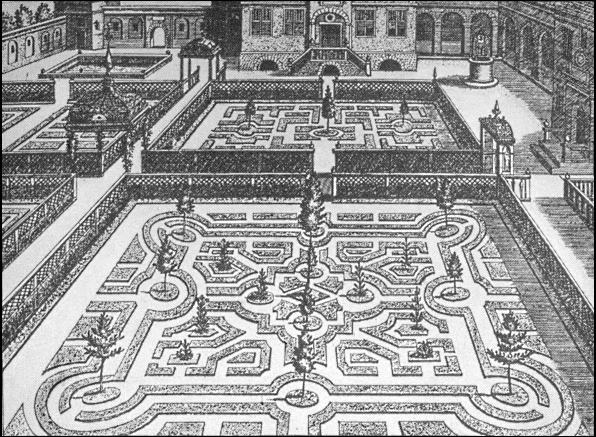
"A CURIOUS-KNOTTED GARDEN"—CRISPIN DE PASSE (1614)
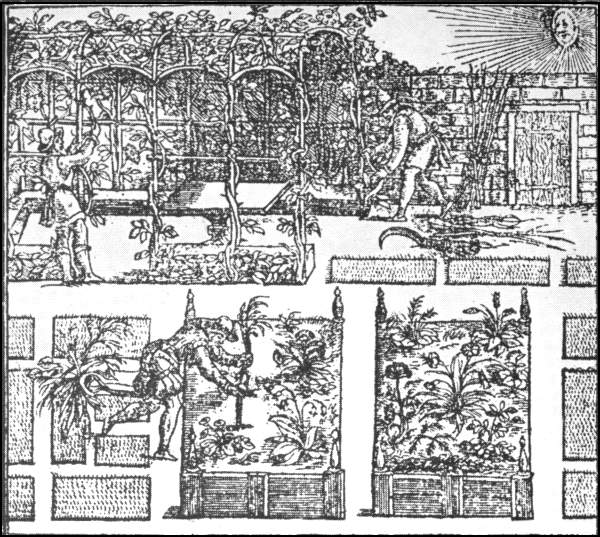
Gardening was a serious business. The duties
of gardeners were not light. We are told that
"Gardeners should not only be diligent and painful,
but also experienced and skilful; at the least, one of
them to have seen the fine gardens about London
and in Kent; to be able to cast out the Quarters of
the garden as may be most convenient that the
Walks and the Alleys be long and large; to cast
up Mounts, to tread out Knots in the Quarters of
arms and fine devices, to set and sow in them sweet-smelling
flowers and strewing herbs; to have in the
finest parts of the garden Artichokes, Pompions,
Melons, Cucumbers and such-like; in other places
convenient Radishes, Keritts, Carrats and other
roots with store of all kind of herbs for the Kitchen
and Apothecary; to know what Flowers and Herbs
will best endure the Sun and which need most to be
shaded: in like sort, for the East and North winds,
not only to be skilful in planting and grafting of
all kinds of fruit-trees, but also how to place them
in best order; and to be able to judge of the best
times and seasons to plant and graft all fruits and
to set and sow all flowers, herbs and roots; and
also the best time when to cut and gather all herbs
and seeds and fruits, and in what sort to keep and
preserve them; to make fair Bowling Alleys well
banked and sealed, which, being well kept, in many
houses are very profitable to the gardeners."
The instructions in the Elizabethan manuals for
grafting, pleaching, and plashing (see page 50) are
most explicit and elaborate. There are rules for the
care of every flower and herb. Nothing is too small
for attention, The old authors even say what flowers
should be picked often and what flowers prefer to
be let alone. One old gardener gives the following
details with regard to the sowing of seeds:
"If you will [he writes], you may sow your seeds
in rows, or trails, either round about the edges of
your beds to keep them in fashion, and plant either
herbs or flowers in the body of your beds, or you
may furnish your beds all over, making three, four,
or five rows, or trails, according to the bigness of
your bed; the order, or manner, is to make each trail
of like distance and range your line and by it, either
with your finger or a small stick, to make your trail
about an inch thick, or thereabout; and therein to
sow your seed, not over-thick. If you put your
seeds in a white paper, you may (if the seeds are
small) very easily and equally sow them by shaking
the lower end of your paper with the forefinger of
that hand you sow with. The paper must not be
much open at the end. Then with your hand, or a
trowel, to smooth the earth into each trail."

 M CM XX II