After a fortnight at Louvencourt the brigade went
into the line again on August 18th, this time on
the right of the divisional front. During our
period in reserve important events had taken place south
of the Somme. A lightning stroke, chiefly delivered by
the Canadian Corps who had been suddenly and secretly
rushed down from the Lens area, had altered the whole
aspect of the war, for the German Army, which not long
before had entertained such high hopes of reaching the
coast and Paris, was driven to anxiously defending his
line. Weak spots in the Hun armour were being sought
out and pierced so that on the whole the enemy was
having a bad time. Anticipating trouble on the third
army front he had withdrawn his outposts to a safer line
all along the Ancre and up to Puisieux, and our men
had been able to walk cautiously forward several hundred
yards.
Such was the situation when the 7th took over the front
line, at the moment quite unsuspicious of the stirring events
in which they were shortly to take a share. Major Rae
commanded the battalion, the C.O. being away on Paris
leave, while Capt. Barratt had resumed the duties of
Adjutant. The Company Commanders for this tour of
duty were Lt. C. B. Douglas, "A," Capt. Grey Burn,
"B," Lt. Abbott, "C" and Capt. J. Baker, "D." Suddenly,
without previous warning, operation orders were
received on August 20th for a big attack to commence
along the whole army front the following morning. This
was rapid work indeed, and the hurried state of preparation
can be better imagined than described, especially
in view of the extraordinary nature of the barrage which
called for most accurate timing and an elaborate barrage
table. The manner in which Major Rae and Capt. Barratt
swiftly dealt with all these details and communicated their
wishes to the people concerned, a task of no small magnitude
under more favourable conditions, calls for the
keenest appreciation from all who took part in that first
important battle.
The division expected to cover, in the first day's
fighting, the large mass of high ground which is flanked
on its western edge by Serre and overlooks Miraumont
on the eastern side. A Prussian division was known to be
defending this part of the line. The 7th were to take part
in the initial assault in the right brigade sector, while the
125th brigade were on the left. A thick mist enshrouded
the land in the early morning of August 21st, and doubtless
many men on both sides thought of the similar
conditions which prevailed on the 21st of another month
when the Hun attacked with such terrible results. Here
was the revenge and it was to take place, curiously
enough, under like circumstances. At 4.50 a.m. the attack
commenced, preceded by a short but destructive barrage
over the enemy position. For the Fleur de Lys "C" and
"D" companies led off, their objective being a part of
the sunk road running across the front from Puisieux to
Beaumont Hamel. It was impossible to see more than
forty yards, and this rendered control by the officers
practically out of the question. The section commanders,
however, in many cases Lance-Corporals and even privates,
rose magnificently to the occasion, with the result that
touch was maintained and the direction of advance preserved.
Short, sharp struggles took place at various
points, but the Boche were overpowered, and eventually
a good line was established on the objective. "C"
company lost 2nd-Lt. Harland, M.C., and Lt. Lofthouse,
both wounded, while "D" company, although keeping
their officers, had Sgt. W. Brown killed.
The next phase of the battle comprised the attack of
"A" and "B" companies who passed through the first
objectives and advanced to the top of the ridge. Lieut.
H. N. Kay of "B" company was shot dead at close
range during the clearing of a dug-out in the early stages
of this fight, while later on this company suffered heavy
casualties, Sgt. Green, D.C.M., M.M., being killed and
Sgts. Guttery and Gleeson wounded. On reaching the
final objective Lt. Douglas carried out work of the
greatest value in the organisation of his company. In
spite of the strongly increasing enemy shell-fire he moved
about amongst his men with such coolness and disregard
for personal danger that his example inspired the men
for the strong counter attacks which later took place.
For his splendid leadership and initiative he was afterwards
awarded the Military Cross. Capt. Grey Burn
and his company on the right were having an awkward
time from enemy snipers, but he organised his now small
numbers very carefully, and personally kept the enemy
under close observation. Seeing an enemy concentration
in progress, evidently for a counter-attack, he quickly
gave information, and the gunners were able to disperse
the enemy with a very effective barrage.
The conduct of all ranks during the counter-attack,
which was launched early in the afternoon, was so
splendid that it broke up the Hun effort. Later in the day
the enemy made another attack with a strong body of
picked storm-troops from another division brought up
specially from the reserves, but the greeting they received
from our rifle, Lewis gun, and machine-gun fire caused
enormous casualties, and the attack collapsed. Capt.
Grey Burn was decorated with the M.C. for his share
in this splendid day's work. The ground captured in the
first day's fighting, representing an advance of 5,000
yards, was consolidated and held for the next two days,
during which time the left of the division was executing
a turning movement to encircle Miraumont from the north.
The work of the signallers, under Lt. Smith, cannot be too
highly praised for their contribution to the success of
this battle, because communications throughout the operation
were excellent and twice served to bring down a
barrage in short time, so assisting the infantry to smash
the enemy attacks. The stretcher bearers nobly performed
their work under most trying conditions, what with
the heavy mist followed later by intense heat, the badly
broken ground and the long distances they had to carry
the wounded under shell fire. Lce-Cpl. Twist, M.M., of
"D" company, performed prodigies of strength and
valour in this way, receiving a bar to his M.M., and Pte.
Greer, M.M., of "B" company, proved an able second
to him. Lt. Stanier was badly wounded whilst with "A"
company, losing the sight of one eye.
The next movement was the crossing of the River Ancre
in the early hours of August 23rd. This was well done by
"B" company, "A" company, now under the command of
Capt. Nelson, being in support with "C" company.
During the advance, and with the co-operation of the East
Lancs. north of Miraumont, large bodies of prisoners were
cut off and rounded up on the far side of the Ancre.
When the ground had been made good and it was
ascertained that the Hun had definitely retired, it was
thought that the day's work was done. This, however,
proved to be wrong, as a further advance to Warlencourt
was ordered, and it was to commence as soon as possible.
The 6th moved off about dusk with the 7th in support,
and although the right flank was exposed this did not
hinder the advance. The greater part of the movement
was carried out in darkness and over strange ground,
but the leadership was very skilful and the brigade came
in contact with the enemy on the outskirts of Warlencourt
about 10.30 p.m. Boche M.G. nests quickly opened
a terrific fire, but few casualties were caused. A rapid
deployment took place and positions quickly occupied in
case of a surprise. The enemy fire, however, increased
in intensity, and the cover afforded being of the scantiest,
it was decided to withdraw a short distance to a line of
trenches and there await daylight. Fortunately no serious
losses had been incurred, and when dawn broke it was
found that the enemy had retired still further during the
night.
At this point the division was pinched out of the line
by the Naval Division on the right and the N.Z. Division
on the left converging across our front in the next day's
advance, and we were enabled to take advantage of a
short respite from the struggle. The vigour and effectiveness
of the 42nd division's attack has been since
proved by an unexpected tribute from the enemy. The
following extract from Ludendorf's "Memoirs of the
War, 1914-1918," Vol. II., page 692, refers to the fighting
at this time:—
"On August 21st the English attacked south of Arras
between Boisleux and the Ancre.... As the offensive
developed, the enemy succeeded on the north in pushing
us back from the Ancre. At this point a Prussian
division ... given a sector covered by the river, had
failed badly. This threw the whole line into confusion....
The situation there became extremely critical about
August 25th."
The 7th marched back a short distance to Irles, and
made themselves comfortable in the German dug-outs
there for a day and a half. Looking back over those
days of new experiences for the battalion one realises the
valuable work accomplished by Lt. Wilkinson and his
transport section. When out of the line he invariably
carried off the honours in the "spit and polish" transport
competitions frequently held in the division, but it
was on difficult occasions such as these that he showed
up to prouder advantage. The transport lines had been
brought up to Colincamps, and the distance from there to
Warlencourt was about twelve miles. The roads were
in an impossible condition so that all supplies had to
be carried on pack animals, and the fact that nothing
failed reflects the greatest credit upon the administrative
arrangements of Capt. and Q.M. Wood and the transport
officer.
During our few hours' absence from the line the Naval
Division had been in some heavy fighting as we saw when
we arrived on the night of August 27th in the support
position near Loupart Wood. Skilfully sited machine guns
had taken terrible toll of the brave naval men, and their
bodies still lay where they had fallen, so that one of
our first jobs was to bury them. The front line ran along
the western outskirts of Ligny-Thilloy, but it was suspected
that the enemy would not make a vigorous stand
here. His shelling was particularly beastly, however, and
if he did intend to retire further he was at least taking
the necessary artillery precautions. By August 30th
preparations were complete for another forward move,
but early morning showed us that the Hun had gone, so
we were merely required to follow him up.
The pre-arranged plan was carried out, and after the
127th brigade had made good the high ground east of
Thilloy, in face of some opposition, the East Lancs. came
through and took up the advance on what had now become
a one brigade front. They had not gone far before they
encountered the enemy in strength holding Riencourt,
and they promptly attacked it. The 8th Manchesters
bore the brunt of this attack and they suffered very
heavily, little ground being gained. A brilliant night
show by the 10th the next night, however, subdued Riencourt,
and this rendered the line sufficiently straight to
be able to continue the advance. The 127th brigade
took over the front again and rapid preparations were
made to co-operate in an attack which was to take place
along the whole army front. It was now clear that our
higher command were not disposed to allow the enemy to
settle anywhere, if possible. It promised to be ding-dong
work amidst ever-changing scenes, with the guns
making the most of their opportunities and struggling
over the torn ground behind the infantry as best they
might. But the supply services experienced the biggest
demand upon their wits and resources, uprooted from
their comfortable and secure villages and cast out upon
the shelterless land of the devastated area just like the
infantry. Their work was wonderful, however, and very
rarely had Tommy occasion to grouse about either the
quality or the quantity of the food that was served up to
him under these trying conditions. It was common
knowledge that when the Boche had come over in March,
he had not been so well treated, and had been forced in
the urgency of his plight to eat horses and mules killed
in the fighting.
It was evident that we had now got the full measure of
our foes, and were in the comfortable position of being
able to give battle when and where we pleased, and be
practically confident of success. The front was becoming
shorter also, with the result that a divisional sector was
considerably smaller than formerly, and this entailed
of course longer periods out of the line for the soldier.
Leave also continued to flow, and proved an important
factor in keeping up the morale of the troops. How
different from the old days, when we used to advertise
our intentions to the Hun when a stunt was impending
by stopping leave in the army concerned! Capt. Grey
Burn, M.C., went to England for a month on August 31st,
and Lt. S. J. Wilson was put in command of "B" company
for the coming operations, while in the continued
absence of Capt. Palmer, Lt. Hammond was in charge of
"C" company. Lt. Smithies, recently joined from the
second line, took over the duties of intelligence officer.
Col. Manger was required to temporarily command the
126th brigade, and this left Major Rae in command of
the battalion once more.
The next village in our line of advance, now practically
due east, was Villers-au-Flos, and this, with the high
ground beyond it, was to be taken in the first stride of
the coming battle, a matter of 2,500 yards. After this
the L.F's. would leap-frog through and exploit success
as far as possible. This time the 5th and 6th were detailed
to execute the first shock of the assault with the 7th in
close support. As a matter of fact "C" company were
sent forward to act under the orders of the 5th in view
of the extra opposition which was expected on the right
sector. On the night of September 1st the remainder of
the battalion, in order "B," "A," "D," companies moved
up close to Riencourt, to occupy old, shallow trenches,
and await the needs of the brigade either during or after
the assault.
Soon after dawn the barrage opened, and simultaneously
the Manchesters advanced accompanied by a single tank.
The New Zealanders were carrying out a similar task on the
left, while the 17th division had to get through Beaulencourt
and over a large stretch of bare country on the
right. The 6th Manchesters progressed in fine style, and
everything went according to plan. The enemy put up a
stiff fight for it and hung on to the last in the cunningly
concealed machine gun posts. It was in this part of the
fighting that Lieut. Welch (a one-time 7th officer) with a
section of Stokes' mortar men performed a gallant deed
that earned for him the D.S.O. The progress of events
on the right, however, was not so clear and straightforward.
As was expected the 5th encountered strong
opposition, for they advanced along a double row of old
German trenches which contained a large number of
dug-outs, and disconcerting masses of wire at irregular
intervals. It was thus difficult to maintain cohesion in
the attack, while every dug-out contained machine gun
crews who had been unharmed by the barrage, and who,
owing to the delay in getting ahead, had been able to
come out and man their positions without interruption. The
5th, therefore, lost heavily, particularly on their right flank,
and before very long "C" company of the 7th found
themselves in the front, almost isolated, and taking a
stern part in the assault.
They pushed on until all the enemy trenches had been
cleared to the south-east corner of Villers-au-Flos, and
then stayed in order to get in touch with the remnants of
the 5th on their left, after which Lieut. Hammond reported
progress. In view of the danger from this flank,
for we were already well ahead of the troops on our
right, "B" company was ordered forward to protect the
southern and eastern sides of Riencourt, and so prevent
any Hun attempt to get in behind our forward line. Later
it was found that the 5th positions required more strength,
and "A" company were sent up for that purpose, while
Capt. Baker was ordered to take his company to form a
defensive flank behind the 6th, for the New Zealanders
were still echeloned to the rear. Evening of September
2nd thus found the 6th at the tip of a sharp salient, and
the enemy still very active in front, with his shelling
steadily increasing in intensity. "B" company were thus
ordered to continue the advance on the right and attain
the final objective, slow and complicated work for it all took
place in the dark. First the 1,500 yards from Riencourt
to "C" company had to be traversed, and from there it
was another 1,000 yards to the required position;
meanwhile the enemy was continually shelling with 5.9's
at important points and with whizz-bangs promiscuously.
Nothing was known of the enemy in front, and the situation
on the right was equally obscure. Patrols worked
cautiously ahead however and fortunately no opposition
was encountered, so that the final objective was made
before dawn.
As daylight broke on the 3rd Sept. it was found
that the next village, Barastre, had been rapidly evacuated
by the enemy who had left a quantity of material behind
him. Although the men were dog-tired "B" company
sent out a large fighting patrol to try to get in touch with
him, but they traversed well beyond Bus, the next village,
and returned according to orders without seeing him.
Meanwhile a squadron of cavalry (Scots Greys) had been
ordered up, and they preceded the advance of the 125th
brigade who by this time were marching through in
accordance with previous plans. They encountered Hun
rearguards near Ytres, but the attack was resumed
at once, and in the course of the next two days the enemy
was pressed back into the Hindenburg system in the
vicinity of Havrincourt.
The Manchesters had now the opportunity of seeing
how great an organisation must follow in the wake of
advancing infantry. First came the field guns, drawn
by teams of mules, followed by the 6-in. howitzers, bouncing
along in jolly fashion over the uneven roads behind
motor lorries containing their ammunition. Then the
observation balloons appeared, still observing, at a height
of about 100 feet, being pulled steadily by motor conveyances.
Intermingled amongst these were staff cars, ambulances,
motor lorries for all purposes, infantry transport,
D.A.C. waggons and various other impedimenta of a
moving army. Most of these people took up their abode
around Barastre, occupying old British huts, or erecting
tents and bivouac sheets, so that ground which twelve hours
previously had been Hun land, gingerly approached by us,
had become a huge camp seething with an active soldier
population of Britishers.
On September 6th the division came out for a long-delayed
rest, and marched back to Warlencourt in Corps
reserve. A few tents were provided, but only a small
portion of the battalion could be accommodated in them,
so it was necessary to dig in once more. There was quite
a quantity of material about, however, and it did not
take us long to make ourselves weather-proof and more
or less comfortable. Fortunately, the Huns had not had
time to destroy the two wells in the village, although the
explosive charges had been laid, so that water did not
prove the difficulty it might otherwise have done. A
special order of the day from the brigadier admirably
epitomised our feelings of satisfaction with our work in the
war up to this date, so it would be as well to quote it at
length:—
Manchesters,
You have added a new anniversary to those which your
gallantry has already made famous. On 4th June, 1915, in
Gallipoli, you forced your way like a spearhead into and
through line upon line of Turkish trenches. On 25th March,
1918, at Achiet and Bucquoy, you stemmed and stopped the
onrush of the tide of Huns that was to have found its way to
the Coast.
Yesterday, after three months of unbroken fighting in
trenches and in the open, and in face of stubborn resistance
by Huns more than equal in numbers, you stormed and took
Villers-au-Flos with the utmost dash and determination; a feat
which would have been notable if performed by battalions at
full strength and fresh from a period of rest.
When Manchester hears of this new proof of your prowess,
she may well be as proud of her sons as I am of commanding
such soldiers.
Anthony Henley, Brig.-Gen.,
Commanding 127th Inf. Brigade.
3rd September, 1918.
The fortnight at Warlencourt was spent in refitting, and
intensive training in attack. One day was occupied by a
demonstration of an assault by a company, using live
ammunition. This was carried out by "D" company in
the presence of the corps commander and large numbers
of officers and N.C.O's. of the division, and was followed
by educational criticism by the General.
It was obvious that all this had a specific purpose, and
we were not left long to wonder what the purpose was.
A tremendous battle was brewing, and rumours placed
its magnitude at from three army fronts to the whole
allied front. Anyhow, the chief thing that concerned us
was that the 42nd was to take part in the cracking of the
hardest nut in the German defence, namely, the Hindenburg
system. The enemy had had three weeks in which
to consolidate his already perfected ramification of
trenches and dug-outs, and there was no doubt as to
their determination to definitely stop the British advance
there. If this failed they had lost the War.
On September 22nd the division marched up, and took
over the front from the 37th division, the 125th brigade
occupying the forward positions just east of Havrincourt
Wood. The 7th found themselves out in reserve just north
of the Canal du Nord behind Hermies, and it was pleasing
to see the old haunts again. Men thought grimly of the
experiences we had been through since those happy days
more than a year ago, and these sights served to call up
the memory of many a pal who had since made the big
sacrifice. And now, perhaps, we should get an opportunity
of seeing those mysterious lands beyond Flesquieres,
Marcoing and so on, that we had gazed upon so
long. As far as possible training was continued and a
certain amount of company re-organisation took place.
Owing to the weakness of companies they had been
reduced to three platoons, some of these being much below
strength. Reinforcements had been expected, but they did
not materialise to an appreciable extent. However, the
exigencies of the task in hand demanded that the four
platoon formation should be adopted in spite of the small
numbers. In view of this, therefore, it was necessary to
crowd in rapid training in attack on this principle, so that
each man should be well acquainted with his function.
After the battle surplus had been eliminated the company
commanders were as follows:—"A" company, Capt. Nelson,
"B" Lt. S. J. Wilson, "C" Capt. Allen, M.C., and
"D" Lieut. Gresty, M.C. Lt.-Col. Manger commanded
the battalion, while Capt. Creagh had returned and was
Adjutant. Two days before the attack Capt. Nelson went
into hospital with dysentery which had frequently recurred
in a violent form during the preceding weeks. A slight
re-adjustment was thus demanded amongst the officers to
give every company a fair share of leadership and Lieut.
Hammond was sent to command "A" company.
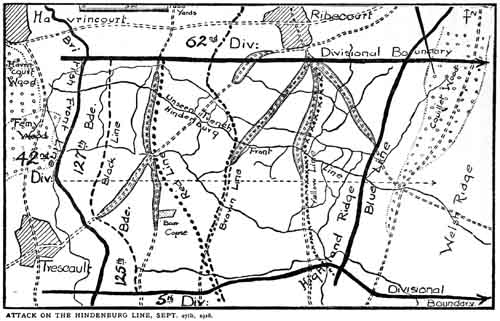
Briefly the plan of attack was as follows. The divisional
frontage was covered by the 125th brigade on the right
and the 127th brigade on the left, with the remaining
brigade in support. As far as the 127th brigade was
concerned, the attack was to be accomplished in five
bounds. The first objective, along the whole of the
brigade front, was the work of the 5th Manchesters, and
consisted in capturing the German front line which ran
chiefly along Chapel Wood Switch. The next four objectives,
called for convenience the Red, Brown, Yellow and
Blue Lines, were to engage the attention of the 7th on
the right and the 6th on the left of the brigade front, and
were to be taken by the leap-frog method by companies.
Thus, in the 7th, "C" company's objective was the Red
Line, "A" the Brown, "D" the Yellow, and "B" the
Blue Line. These lines were by no means parallel to
one another, their shape being largely controlled by the
configuration of the ground and the German trenches.
It is also important to note that the Hindenburg system
was being taken in enfilade on this part of the front.
Two or three great parallel trenches ran along in the
direction of the advance, and they were full of deep dug-outs
capable of holding thousands of men. Our main
security lay in the fact that a simultaneous attack was
taking place along a widely extended front, and the
enemy would not be able to fill these dug-outs with
counter-attacking troops drawn from other fronts.
Space does not allow of a detailed description of the
orders for attack, but it can easily be imagined
that they were pretty considerable in view of the
heavy work to be accomplished by the artillery. As this
portion of the German line was known to be powerfully
defended by large numbers of troops, extensive trench
systems, dug-outs and wire, it was part of the strategy
of Foch to concentrate artillery here, and records showed
that on the two days September 27th and 28th shells
were consumed at an unprecedented rate. In our sector
alone, the programme comprised the capturing of 3,500
yards in depth of the most strongly defended ground in
France, including the vicinities of the famous Highland and
Welsh Ridges of terrible memory in the Battle of Cambrai.
Every yard of this ground was subjected to a continuous
creeping shrapnel barrage lasting for almost three hours,
while moving steadily ahead of this was a terrific bombardment
by all calibres from 4.5 howitzers upwards upon
the enemy's main trenches and supposed defence points.
The brigade frontage, measured north to south, was
1,250 yards, and this was equally divided between the 6th
and 7th. As we were going over one company behind
another, each company was responsible for nearly 700
yards—a very large front considering our depleted
numbers. There is no doubt, as far as we were concerned,
the task looked formidably ambitious.
On the morning of Sept. 26th final operation orders
were issued, and that night we moved up to our assembly
positions in a huge dug-out near Femy Wood, capable
of holding the whole battalion. It was slow work moving
along the canal and across the Trescault-Havrincourt
road, and it is not surprising that eventually the intervals
between platoons closed up and the four companies were
strung out in one long line. The confidence felt in the
success of the operations, was evident by the fact that
the 6-inch howitzers were installed in front of the Trescault
road within 500 yards of the enemy. Whilst we were
assembling there were motor lorries on the road unloading
stacks of ammunition for them! By the time the battalion
had been packed into the dug-out dawn was swiftly
approaching, which meant the commencement of the
battle, for Zero for the third army was 5.25 a.m. The
VIth corps, the 62nd division of which touched up with our
left, were to have three hours' fighting before we commenced,
and for this reason we welcomed the shelter of
the dug-out while it was in progress. The configuration
of the ground was responsible for the manner in which
the battle was to grow along the whole front. The advance
of the 127th brigade was to take place along the
shoulder of a long hill running broadly east to west.
North of this high ground was a long valley stretching
through Ribecourt towards Marcoing. Another shoulder
similar to but higher than ours flanked the valley on
the north, and it was this, together with the commanding
village of Flesquieres, that the VIth corps were to make
good before our attack commenced. Again, the 125th
brigade, who were on our right, and also on the higher
part of the shoulder, were to open the 42nd divisional
assault half an hour ahead of ourselves.
About 8 o'clock "C" company led the way out of the
dug-out and took up their assault positions near the
front line. At the appointed hour, following behind the
5th, they moved forward to the attack, in the formation
which we had practised so frequently, and which was the
most suitable for the large frontage that had to be
covered. All four platoons were in line, and each platoon
was divided into four sections, the two rifle sections on
the flanks, and the two L.G. sections in the middle and
echeloned to the rear. This was the artillery formation
useful for covering the ground previous to the actual
assault, each section moving in file (i.e., two ranks) well
opened out. When close to the enemy position the platoons
extended and formed two lines, with a L.G. in
the centre of each line, and riflemen on the flanks. Every
Company went over in this formation, and strict orders were
issued that no man was to enter the enemy trenches for
the purpose of covering the ground, but to keep out in
the open, otherwise great confusion would arise, and
officers would lose control of their men.
Misfortune greeted "C" company from the start. Capt.
Allen, M.C. and 2nd-Lt. Ray were killed immediately,
and casualties were soon very heavy. It was evident the
enemy was making the most of his superior position and
the clear sweep of ground. The remnants of the company
pushed on, however, and reached their objective. "A" company
followed and they also suffered severely from the
moment they advanced out of Ferny Wood. Then it was
noticed that most of the machine gun fire was from the right
flank, and our men were being subjected to a terrible enfilading
fire as they moved across the open. All the officers
became casualties, Lt. Hammond wounded, 2nd-Lt. McAlmont
wounded, 2nd-Lt. T. Woods wounded, and 2nd-Lt.
Carley, killed. The few men of the company, now led by
C.S.M. Joyce, reached the Red Line and joined "C" company,
which, Lt. Edge, M.C., having been hit, was now
under the command of 2nd-Lt. Jones. It was impossible,
with the small number of men, scattered over a wide front,
to continue the advance for the moment. "D" company,
moving up according to programme, were treated similarly
to the previous two companies and men began to
drop long before they anticipated meeting any resistance.
Thus, before they had gone very far 2nd-Lt. Thrutchley
and 2nd-Lt. Wright were wounded, which left Lt. Gresty,
M.C. and 2nd-Lt. Milne to carry on the leadership, a
task which they performed in fine style. They quickly
arrived at the Red Line, and then took cover for a short
period. Soon after this, "B" company came along, but
on nearing the Red Line, they found many men of "D"
turned about firing rifles and L.G. towards their right
rear. It was now obvious that the ground to the right
of us had not been cleared at all, and the enemy was left
free to work his will upon us from the higher ground.
By this time a tank had arrived and materially assisted
us in dealing with the problem. Gresty then decided to
push on and his company mounted the rising ground in
front. From this point they unfortunately swerved to
the left, probably being influenced by a road which ran
diagonally across the front towards Ribecourt, but nothing
could stop their irresistible dash. As they crossed this
road Milne, with a handful of his platoon, added to our
already considerable number of prisoners, by capturing
a large crowd of Huns.
With characteristic impetuosity, reminiscent of the La
Signy Farm days, Gresty and the men of "D" following
up under the barrage, rushed across the Brown Line and
made for the Yellow Line. They were now only a small
gallant band but they were undaunted. Prisoners captured
were told to go down to the rear, which they did
right gladly without an escort, so that the assaulting party
who now in formation and well-nigh in size, began to
resemble a Rugby football team, could preserve their
strength. Two 77 m.m. guns lay in their path, and at
their approach the Boche gunners spiked them and made
off, leaving them an easy prey to the 7th. After this,
Gresty decided that he was on his objective, as indeed
he was, but he was more or less in the 6th sector, and
when he was quickly joined by a company of the 6th he
began to realise it. There was trouble on his right, however,
as well as from the front, and the small party of men
were disposed to defend the ground they had captured,
a difficult enough task in view of the fact that they had
to find positions to face in two or three different directions.
Touch was obtained with the 62nd division in Ribecourt,
and it was found that the VIth corps had had great
success in their part of the battle, so that already the
advance was proceeding towards Marcoing.
"B" company's effort was really a separate story. As
soon as "D" company had disappeared over the crest in
front of the Red Line they continued the advance. 2nd-Lt.
Pearson was on the extreme right and he had been
instructed to keep touch with the L.F's. From the
beginning, however, he had not seen them, and his platoon
was moving along "in the air," and naturally meeting
with strong resistance. They had not expected to meet
the enemy for another 1,500 yards if events had worked
out "according to plan," but they were now fighting them
at every step. Gallant deeds were performed in dealing
with Hun machine guns, and many prisoners were taken,
but greatest of all were the achievements of Pte. Jack
White. Single-handed he rushed a machine gun post,
bayonetted the man on the gun and pursued the remainder
of the team with fire, inflicting casualties. Later on he
again rushed forward alone to a strongly held trench,
but was killed practically on the parapet. His name
was recommended for a V.C., but unfortunately nothing
more was heard of it. In view of the heavy casualties,
Lt. Wilson went across to Pearson and told him to close
his platoon slightly towards the left, in order to keep a
cohesion in the company, for it was evident that the Hun
resistance promised to be strong, and there was no hope
now of assistance from the right flank. In this manner the
high ground near the Brown Line was reached, but the
company was suffering from fire both from the front and the
right flank. 2nd-Lts. Siddall and Gapp were wounded, as
well as three platoon sergeants, and there was no knowledge
as to what had happened to "D" company. At
this moment the Germans developed a counter-attack
from the right in a manner to be expected from an intelligent
and courageous enemy. The obvious thing for
them to do was to cut in behind "B" company's right
flank and attempt to regain a footing in "Unseen Trench"
which had just been taken from them. From an offensive
force we were suddenly transformed into a defensive
force, and the men were still out in the open. Wilson
drew back his right flank so as to face the Huns, but kept
his left in touch with the 6th on the road in front of the
Brown Line, and from this position, the men being disposed
in shell holes, "B" company held up the enemy
attack and defended the ground won. The Huns were on
higher ground and when they had been finally driven to
earth they kept up vigorous sniping at very close range,
a form of fighting that we returned with interest. Pearson
was hit in the stomach and later died on the way down,
so that Wilson and C.S.M. Shields were left to control
the remainder of the company.
The arrival of 2nd-Lt. Smith with signalling apparatus
enabled communication to be obtained with battalion
H.Q. Lt. Wilson outlined the situation and was told in
return that the L.F's. had not yet reached Boar Copse,
having met with powerful resistance. He was further
ordered to hang on to his position and wait until the
L.F's. had drawn up in line. Meanwhile a company of
the 5th was sent up to strengthen the flank. Continuous
touch by means of patrols were kept with the enemy, and
his movements were carefully watched. Within 300 yards
were a couple of German 77 m.m. guns, pluckily worked
by the gunners at point blank range until our machine
gunners, who had now arrived, co-operated with L.G's.
from the 6th and ourselves in putting them out of action.
They were taken by the 10th in the night. Meanwhile
Gresty and the company of the 6th on the Yellow Line
had been ordered to fall back 300 yards to a less isolated
position, and a sound front and flank was thus established.
The battle had now reached a stage when the next
move would be ordered by the brigade or even by the
division. Careful observation of the enemy led us to
suppose that he was weakening and Gresty and Wilson
intimated that when the L.F's. arrived at the Brown
Line, having re-organised their companies, they should
be prepared to continue the advance in the 7th sector.
Division had decided otherwise, however, and had ordered
up a battalion of the 126th brigade. Rapid preparations were
made for a night attack to complete the divisional task, the
10th Manchesters to cover the 127th brigade front and
the L.F's. to continue on their right. Before nightfall,
the enemy having withdrawn from the trenches immediately
in front, "B" company pushed on again and
established a good line running north and south in front
of the Brown Line, and touching up with the L.F's. who
had now arrived. This considerably simplified the work
of the 10th, who were able to assemble in the night on
an even front.
The night attack was a success. The Huns were evidently
demoralised and put up no fight at all, surrendering in
large batches without firing a shot when our men arrived
at their dug-outs, so that the Blue Line was made good
before dawn. Then came the work of exploiting success,
and on the 42nd divisional front this was carried out by
the 8th Manchesters, and the 5th East Lancs., the 126th
brigade having taken over the front during the afternoon of
Sept. 28th. They were able to make good progress over
Welsh Ridge before encountering serious resistance.
Later in the day the New Zealand Division marched
through to follow up the enemy, so that the 42nd could
go down for a rest. Gladly did the Fleur de Lys pack
up their traps and march back over the ground that had
recently seen such stern work. The brigadier had been
up and personally thanked Lts. Gresty and Wilson for
the work achieved by "D" and "B" companies, remarking
that having seen the ground, and knowing the
difficulties which had to be encountered, he thought all
the men were heroes in having accomplished so much.
Such praise coming from so sound a soldier was naturally
received with gratitude and pride, and we felt that once
again the name of the 7th Manchesters had been scored
honourably and deeply in the records of warfare. The
battalion reassembled in the big dug-out and there
realised sadly the abundance of accommodation now
afforded.
It had been a glorious fight but won at a terrible cost.
Out of the 450 or so men who went over there had been
more than 300 casualties. Of the sixteen officers who
started out four only remained. 2nd-Lt. Pearson's death
was particularly sad. He had gone out in the ranks in
1914 with the 7th, and had been twice wounded on
Gallipoli, after which he served continuously with the
battalion till the winter of 1917, when he went home for
a commission. He had returned as an officer only a few
weeks previously, and in this fight proved himself a
courageous and skilful leader of men.
About 600 prisoners had been taken by the battalion,
as well as the two field guns, large numbers of machine
guns and other booty. More important was the death-blow
to the German resistance. The Hindenburg Line
had been smashed, the enemy was obviously demoralised,
and they were in full flight for the next piece of ground
which could offer a suitable position for delaying our
rapid advance. The awards to the 7th for this battle
included a bar to his Military Cross for Lt. Gresty, and
Military Crosses for Lt. Wilson, 2nd-Lt. Milne, 2nd-Lt.
Siddall, and 2nd-Lt. Thrutchley. C.S.M. McHugh, M.M.,
C.S.M. Tabbron, and Sgt. Mather received the D.C.M.,
while twenty N.C.O's. and men obtained the M.M., Pte.
Greer being given a bar to his M.M.
The following Special Order of the Day indicates the
value of the work done by the Manchesters in this day's
fighting:—
29th September, 1918.
Manchesters,
For the second time in this month of September you have
struck the enemy a heavy blow. It has brought us appreciably
nearer to the complete victory which our country is determined
to achieve.
I do not yet know the full amount of our booty. It can be
estimated from the two miles of our advance, and from the
prisoners, considerably more than a thousand in number.
I wish to record my admiration for the splendid behaviour
of all ranks. The victory was won under conditions of exceptional
difficulty, and, as at Villers-au-Flos, against an enemy
superior in numbers to the attackers; and it was won by the
magnificent determination and devotion of the troops.
Anthony Henley, Brig.-Gen.,
Commanding 127th Inf. Brigade.


