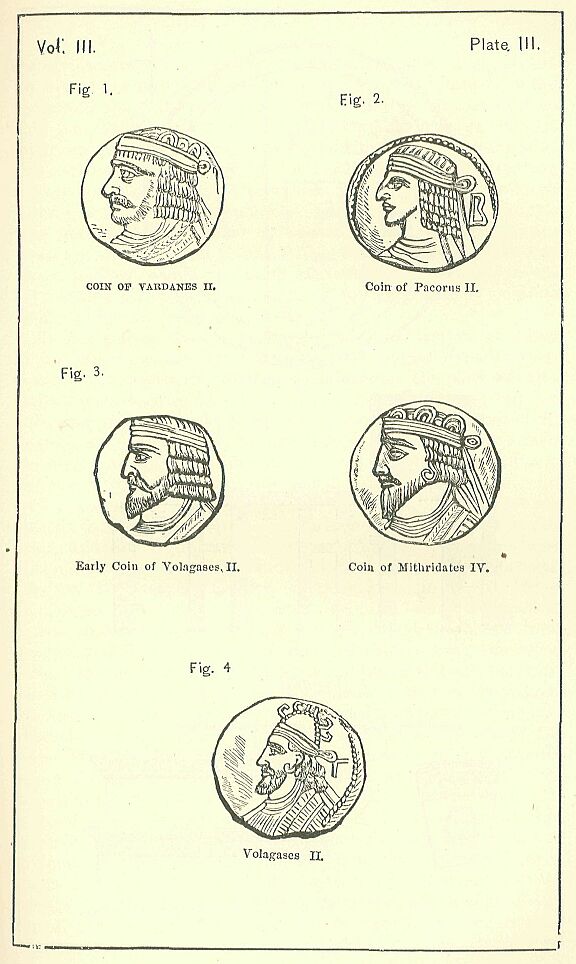
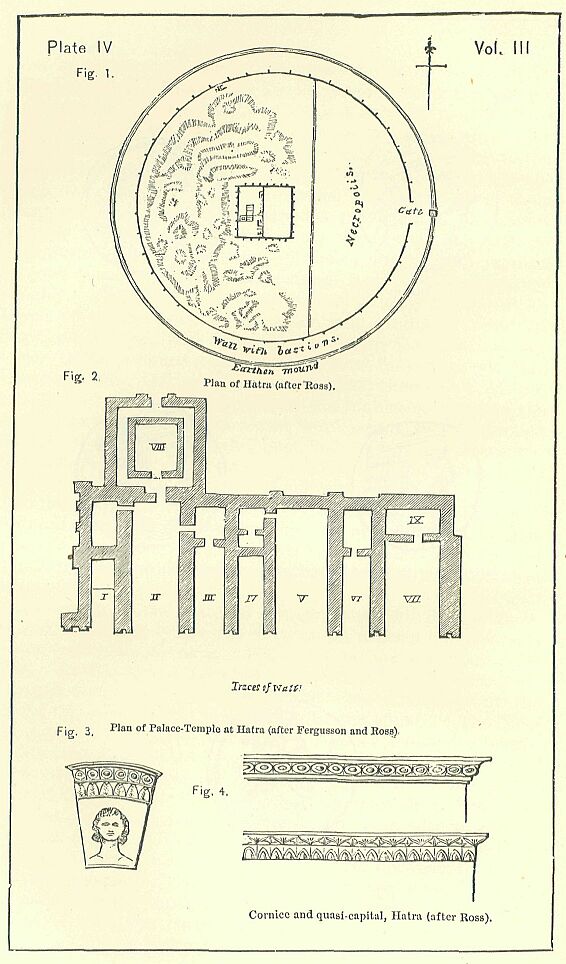
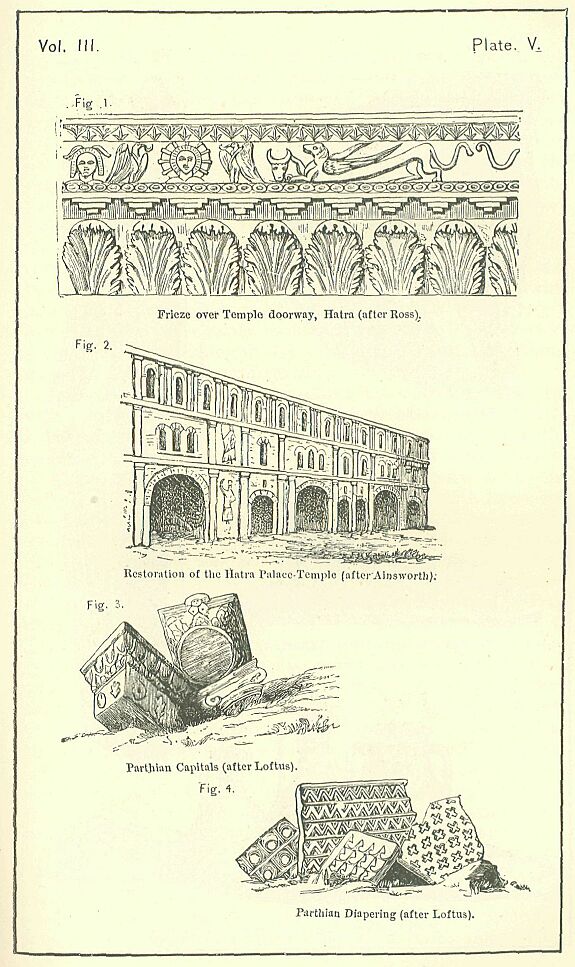
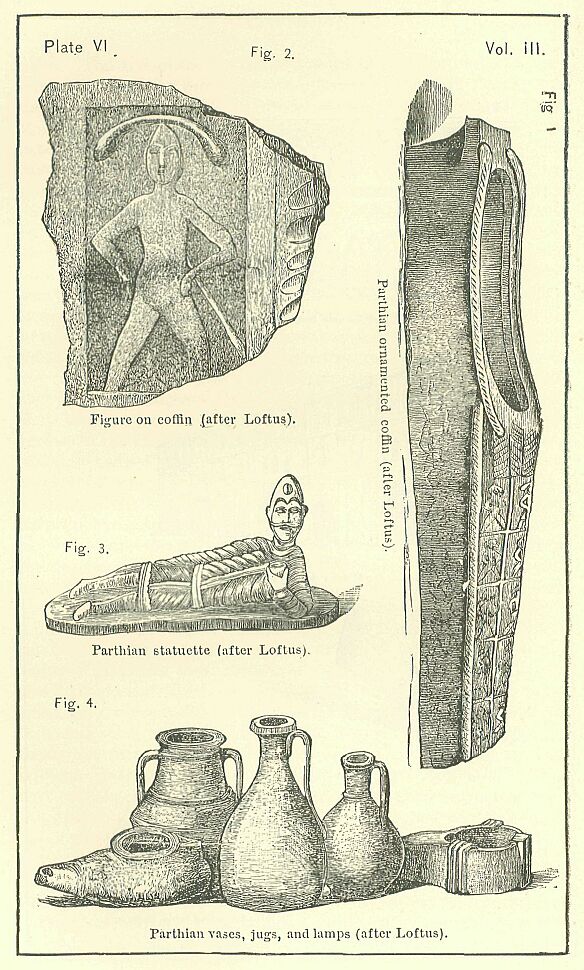
The Seven Great Monarchies, by George Rawlinson, The Sixth Monarchy
Whole book · 28 sections
THE SEVEN GREAT MONARCHIES
OF THE ANCIENT EASTERN WORLD; OR, THE HISTORY, GEOGRAPHY, AND ANTIQUITIES
OF CHALDAEA, ASSYRIA BABYLON, MEDIA, PERSIA, PARTHIA, AND SASSANIAN, OR
NEW PERSIAN EMPIRE. BY GEORGE RAWLINSON, M.A., CAMDEN
PROFESSOR OF ANCIENT HISTORY IN THE UNIVERSITY OF OXFORD IN THREE VOLUMES.
VOLUME III. WITH MAPS AND ILLUSTRATIONS
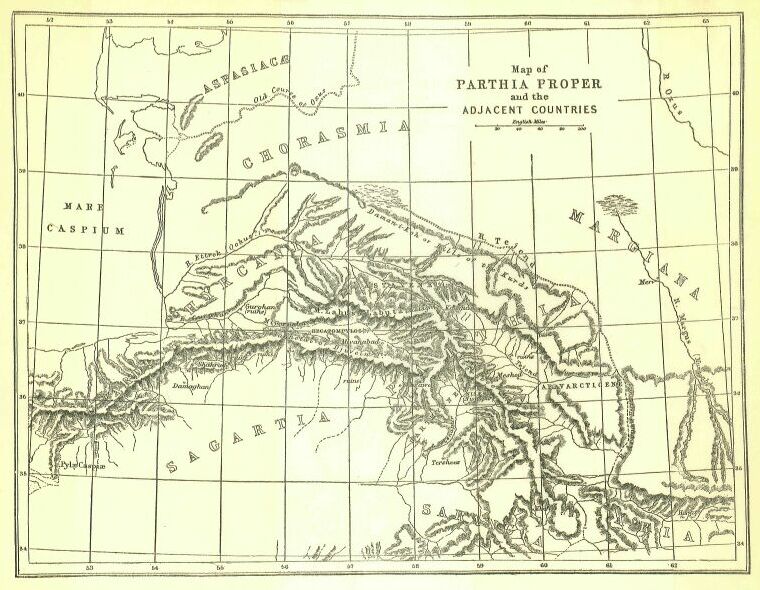
Geography of Parthia Proper, Character of the Region, Climate,
Character of the Surrounding Countries.
The broad tract of desert which, eastward of the Caspian Sea, extends from
the Mougbojar hills to the Indian Ocean, a distance of above 1500 miles,
is interrupted about midway by a strip of territory possessing features of
much beauty and attraction. This strip, narrow compared to the desert on
either side of it, is yet, looked at by itself, a region of no
inconsiderable dimensions, extending, as it does from east to west, a
distance of 320, and from north to south of nearly 200 miles. The mountain
chain, which running southward of the Caspian, skirts the great plateau of
Iran, or Persia, on the north, broadens out, after it passes the
south-eastern corner of the sea, into a valuable and productive
mountain-region. Four or five distinct ranges here run parallel to one
another, having between them latitudinal valleys, with glens transverse to
their courses. The sides of the valleys are often well wooded; the flat
ground at the foot of the hills is fertile; water abounds; and the streams
gradually collect into rivers of a considerable size.
The fertile territory in this quarter is further increased by the
extension of cultivation to a considerable distance from the base of the
most southern of the ranges, in the direction of the Great Iranic desert.
The mountains send down a number of small streams towards the south; and
the water of these, judiciously husbanded by means of reservoirs and kanats,
is capable of spreading fertility over a broad belt at the foot of the
hills; which, left to nature, would be almost as barren as the desert
itself, into which it would, in fact, be absorbed.
It was undoubtedly in the region which has been thus briefly described
that the ancient home of the Parthians lay. In this neighborhood alone are
found the geographic names which the most ancient writers who mention the
Parthians connect with them. Here evidently the Parthians were settled at
the time when Alexander the Great overran the East, and first made the
Greeks thoroughly familiar with the Parthian name and territory. Here,
lastly, in the time of the highest Parthian splendor and prosperity, did a
province of the Empire retain the name of Parthyene, or Parthia Proper;
and here, also, in their palmiest days, did the Parthian kings continue to
have a capital and a residence.
Parthia Proper, however, was at no time coextensive with the region
described. A portion of that region formed the district called Hyrcania;
and it is not altogether easy to determine what were the limits between
the two. The evidence goes, on the whole, to show that, while Hyrcania lay
towards the west and north, the Parthian country was that towards the
south and east, the valleys of the Ettrek and Gurghan constituting the
main portions of the former, while the tracts east and south of those
valleys, as far as the sixty-first degree of E. longitude, constituted the
latter.
If the limits of Parthia Proper be thus defined, it will have nearly
corresponded to the modern Persian province of Khorasan. It will have
extended from about Damaghan (long. 54° 10’) upon the west, to the
Heri-rud upon the east, and have comprised the modern districts of
Damaghan, Shah-rud, Sebzawar, Nishapur, Meshed, Shebri-No, and Tersheez.
Its length from east to west will have been about 300 miles, and its
average width about 100 or 120. It will have contained an area of about
33,000 square miles, being thus about equal in size to Ireland, Bavaria,
or St. Domingo.
The character of the district has been already stated in general terms;
but some further particulars may now be added. It consists, in the first
place, of a mountain and a plain region—the mountain region lying
towards the north and the plain region towards the south. The mountain
region is composed of three main ranges, the Daman-i-Koh, or Hills of the
Kurds, upon the north, skirting the great desert of Rharaem, the Alatagh
and Meerabee mountains in the centre; and the Jaghetai or Djuvein range,
upon the south, which may be regarded as continued in the hills above
Tersheez and Khaff. The three ranges are parallel, running east and west,
but with an inclination, more or less strong, to the north of west and the
south of east. The northern and central ranges are connected by a
water-shed, which runs nearly east and west, a little to the south of
Kooshan, and separates the head streams of the Ettrek from those of the
Meshed river. The central and southern ranges are connected by a more
decided, mountain line, a transverse ridge which runs nearly north and
south, dividing between the waters that flow westward into the Gurghan,
and those which form the river of Nishapur. This conformation of the
mountains leaves between the ranges three principal valleys, the valley of
Meshed towards the south-east, between the Kurdish range and the Alatagh
and Meerabee; that of Miyanabad towards the west, between the Alatagh and
the Jaghetai; and that of Nishapur towards the south, between the eastern
end of the Jaghetai and the western flank of the Meerabee. As the valleys
are three in number, so likewise are the rivers, which are known
respectively as the Tejend, or river of Meshed, the river of Nishapur, and
the river of Miyanabad.
The Tejend, which is the principal stream of the three, rises from several
sources in the hills south of Kooshan, and flows with a south-easterly
course down the valley of Meshed, receiving numerous tributaries from both
sides, until it reaches that city, when it bends eastward, and, finding a
way through the Kurdish range, joins the course of the Heri-rud, about
long. 01° 10’. Here its direction is completely changed. Turning at an
angle, which is slightly acute, it proceeds to flow to the west of north,
along the northern base of the Kurdish range, from which it receives
numerous small streams, till it ends finally in a large swamp or marsh, in
lat. 39°, long. 57°, nearly. The entire length of the stream, including
only main windings, is about 475 miles. In its later course, however, it
is often almost dry, the greater portion of the water being consumed in
irrigation in the neighborhood of Meshed.
The river of Nishapur is formed by numerous small streams, which descend
from the mountains that on three sides inclose that city. Its water is at
times wholly consumed in the cultivation of the plain; but the natural
course may be traced, running in a southerly and south-westerly direction,
until it debouches from the hills in the vicinity of Tersheez. The
Miyanabad stream is believed to be a tributary of the Gurghan. It rises
from several sources in the transverse range joining the Alatagh to the
Jaghetai, the streams from which all flow westward in narrow valleys,
uniting about long. 57° 35’. The course of the river from this point to
Piperne has not been traced, but it is believed to run in a general
westerly direction along the southern base of the Alatagh, and to form a
junction with the Gurghan a little below the ruins of the same name. Its
length to this point is probably about 200 miles.
The elevation of the mountain chains is not great. No very remarkable
peaks occur in them; and it may be doubted whether they anywhere attain a
height of above 6000 feet. They are for the most part barren and rugged,
very scantily supplied with timber, and only in places capable of
furnishing a tolerable pasturage to flocks and herds. The valleys, on the
other hand, are rich and fertile in the extreme; that of Meshed, which
extends a distance of above a hundred miles from north-west to south-east,
and is from twenty to thirty miles broad, has almost everywhere a good and
deep soil, is abundantly supplied with water, and yields a plentiful
return even to the simplest and most primitive cultivation. The plain
about Nishapur, which is in length from eighty to ninety miles, and in
width from forty to sixty, boasts a still greater fertility.
The flat country along the southern base of the mountains, which ancient
writers regard as Parthia, par excellence, is A strip of territory about
300 miles long, varying in width ac cording to the labor and the skill
applied by its inhabitants to the perfecting of a system of irrigation. At
present the kanats, or underground water-courses, are seldom
carried to a distance of more than a mile or two from the foot of the
hills; but it is thought that anciently the cultivation was extended
considerably further. Ruined cities dispersed throughout the tract
sufficiently indicate its capabilities, and in a few places where much
attention is paid to agriculture the results are such as to imply that the
soil is more than ordinarily productive. The salt desert lies, however, in
most places within ten or fifteen miles of the hills; and beyond this
distance it is obviously impossible that the “Atak” or “Skirt” should at
any time have been inhabited.
It is evident that the entire tract above described must have been at all
times a valuable and much coveted region. Compared with the arid and
inhospitable deserts which adjoin it upon the north and south, Khorasan,
the ancient Parthia and Hyrcania, is a terrestrial Paradise. Parthia,
though scantily wooded, still produces in places the pine, the walnut, the
sycamore, the ash, the poplar, the willow, the vine, the mulberry, the
apricot, and numerous other fruit trees. Saffron, asafoetida, and the gum
ammoniac plant, are indigenous in parts of it. Much of the soil is suited
for the cultivation of wheat, barley, and cotton. The ordinary return upon
wheat and barley is reckoned at ten for one. Game abounds in the
mountains, and fish in the underground water-courses. Among the mineral
treasures of the region may be enumerated copper, lead, iron, salt, and
one of the most exquisite of gems, the turquoise. This gem does not appear
to be mentioned by ancient writers; but it is so easily obtainable that we
can scarcely suppose it was not known from very ancient times.
The severity of the climate of Parthia is strongly stated by Justin.
According to modern travellers, the winters, though protracted, are not
very inclement, the thermometer rarely sinking below ten or eleven degrees
of Fahrenheit during the nights, and during the daytime rising, even in
December and January, to 40° or 50°. The cold weather, however, which
commences about October, continues till nearly the end of March, when
storms of sleet and hail are common. Much snow falls in the earlier
portion of the winter, and the valleys are scarcely clear of it till
March. On the mountains it remains much longer, and forms the chief source
of supply to the rivers during the spring and the early summer time. In
summer the heat is considerable, more especially in the region known as
the “Atak;” and here, too, the unwholesome wind, which blows from the
southern desert, is felt from, time to time as a terrible scourge. But in
the upland country the heat is at no time very intense, and the natives
boast that they are not compelled by it to sleep on their house-tops
during more than one month in the year.
The countries by which Parthia Proper was bounded were the following:
Chorasmia, Margiana, Aria, Sarangia, Sagartia, and Hyrcania.
Chorasmia lay upon the north, consisting of the low tract between the most
northerly of the Parthian mountain chains and the old course of the Oxus.
This region, which is for the most part an arid and inhospitable desert,
can at no time have maintained more than a sparse and scanty population.
The Turkoman tribes which at the present day roam over the waste, feeding
their flocks and herds alternately on the banks of the Oxus and the
Tejend, or finding a bare subsistence for them about the ponds and pools
left by the winter rains, represent, it is probable, with sufficient
faithfulness, the ancient inhabitants, who, whatever their race, must
always have been nomads, and can never have exceeded a few hundred
thousands. On this side Parthia must always have been tolerably safe from
attacks, unless the Cis-Oxianian tribes were reinforced, as they sometimes
were, by hordes from beyond the river.
On the north-east was Margiana, sometimes regarded as a country by itself,
sometimes reckoned a mere district of Bactria. This was the tract of
fertile land upon the Murg-ab, or ancient Margus river, which is known
among moderns as the district of Merv. The Murg-ab is a stream flowing
from the range of the Paropamisus, in a direction which is a little east
of north; it debouches from the mountains in about lat. 36° 25’, and
thence makes its way through the desert. Before it reaches Merv, it is
eighty yards wide and five feet deep, thus carrying a vast body of water.
By a judicious use of dykes and canals, this fertilizing fluid was in
ancient times carried to a distance of more than twenty-five miles from
the natural course of the river; and by these means an oasis was created
with a circumference of above 170, and consequently a diameter of above
fifty miles. This tract, inclosed on every side by deserts, was among the
most fertile of all known regions; it was especially famous for its vines,
which grew to such a size that a single man could not encircle their stems
with his two arms, and bore clusters that were a yard long. Margiana
possessed, however, as a separate country, little military strength, and
it was only as a portion of some larger and more populous territory that
it could become formidable to the Parthians.
South of Margiana, and adjoining upon Parthia toward the east, was Aria,
the tract which lies about the modern Herat. This was for the most part a
mountain region, very similar in its general character to the mountainous
portion of Parthia, but of much smaller dimensions. Its people were fairly
warlike; but the Parthian population was probably double or triple their
number, and Parthia consequently had but little to fear in this quarter.
Upon the south-east Parthia was bordered by Sarangia, the country of the
Sarangae, or Drangae. This appears to have been the district south of the
Herat valley, reaching thence as far as the Hamoon, or Sea of Seistan. It
is a country of hills and downs, watered by a number of somewhat scanty
streams, which flow south-westward from the Paropamisus to the Hamoon. Its
population can never have been great, and they were at no time aggressive
or enterprising, so that on this side also the Parthians were secure, and
had to deal with no formidable neighbor.
Sagartia succeeded to Sarangia towards the west, and bordered Parthia
along almost the whole of its southern frontier. Excepting in the vicinity
of Tebbes and Toun (lat. 34°, long. 56° to 58°), this district is an
absolute desert, the haunt of the gazelle and the wild ass, dry, saline,
and totally devoid of vegetation. The wild nomads, who wandered over its
wastes, obtaining a scanty subsistence by means of the lasso, were few in
number, scattered, and probably divided by feuds. Southern Parthia might
occasionally suffer from their raids; but they were far too weak to
constitute a serious danger to the mountain country.
Lastly, towards the west and the north-west, Parthia was bordered by
Hyrcania, a region geographically in the closest connection with it, very
similar in general character, but richer, warmer, and altogether more
desirable. Hyrcania was, as already observed, the western and
north-western portion of that broad mountain region which has been
described as intervening between the eastern shores of the Caspian and the
river Arius, or Heri-rud. It consisted mainly of the two rich valleys of
the Gurghan and Ettrek, with the mountain chains inclosing or dividing
them. Here on the slopes of the hills grow the oak, the beech, the elm,
the alder, the wild cherry; here luxuriant vines spring from the soil on
every side, raising themselves aloft by the aid of their stronger sisters,
and hanging in wild festoons from tree to tree; beneath their shade the
ground is covered with flowers-of various kinds, primroses, violets,
lilies, hyacinths, and others of unknown species; while in the flat land
at the bottom of the valleys are meadows of the softest and the tenderest
grass, capable of affording to numerous flocks and herds an excellent and
unfailing pasture. Abundant game finds shelter in the forests, while
towards the mouths of the rivers, where the ground is for the most part
marshy, large herds of wild boars are frequent; a single herd sometimes
containing hundreds. Altogether Hyrcania was a most productive and
desirable country, capable of sustaining a dense population, and well
deserving Strabo’s description of it as “highly favored of Heaven.” The
area of the country was, however, small, probably not much exceeding one
half that of Parthia Proper; and thus the people were not sufficiently
numerous to cause the Parthians much apprehension.
The situation and character of Parthia thus, on the whole, favored her
becoming an imperial power. She had abundant resources within herself; she
had a territory apt for the production of a hardy race of men; and she had
no neighbors of sufficient strength to keep her down, when she once
developed the desire to become dominant. Surprise has been expressed at
her rise. But it is perhaps more astonishing that she passed so many
centuries in obscurity before she became an important state, than that she
raised herself at last to the first position among the Oriental nations.
Her ambition and her material strength were plants of slow growth; it took
several hundreds of years for them to attain maturity: when, however, this
point was reached, the circumstances of her geographical position stood
her in good stead, and enabled her rapidly to extend her way over the
greater portion of Western Asia.
CHAPTER II.
Early notices of the Parthians. Their Ethnic character and connections.
Their position under the Persian Monarchs, from Cyrus the Great to Darius
III. (Codomannus.)
The Parthians do not appear in history until a comparatively recent
period. Their name occurs nowhere in the Old Testament Scriptures. They
obtain no mention in the Zendavesta. The Assyrian Inscriptions are wholly
silent concerning them. It is not until the time of Darius Hystaspis that
we have trustworthy evidence of their existence as a distinct people. In
the inscriptions of this king we find their country included under the
name of Parthva or Parthwa among the provinces of the Persian Empire,
joined in two places with Sarangia, Aria, Chorasmia, Bactria, and
Sogdiana, and in a third with these same countries and Sagartia. We find,
moreover, an account of a rebellion in which the Parthians took part. In
the troubles which broke out upon the death of the Pseudo-Smerdis, B.C.
521, Parthia revolted, in conjunction (as it would seem) with Hyrcania,
espousing the cause of that Median pretender, who, declaring himself a
descendant of the old Median monarchs, set himself up as a rival to
Darius. Hytaspes, the father of Darius, held at this time the Parthian
satrapy. In two battles within the limits of his province he defeated the
rebels, who must have brought into the field a considerable force, since
in one of the two engagements they lost in killed and prisoners between
10,000 and 11,000 men. After their second defeat the Parthians made their
submission, and once more acknowledged Darius for their sovereign.
With these earliest Oriental notices of the Parthians agree entirely such
passages as contain any mention of them in the more ancient literature of
the Greeks. Hecatseus of Miletus, who was contemporary with Darius
Hystaspis, made the Parthians adjoin upon the Chorasmians in the account
which he gave of the geography of Asia. Herodotus spoke of them as a
people subject to the Persians in the reign of Darius, and assigned them
to the sixteenth satrapy, which comprised also the Arians, the Sogdians,
and the Chorasmians. He said that they took part in the expedition of
Xerxes against Greece (B.C. 480), serving in the army on foot under the
same commander as the Chorasmians, and equipped like them with bows and
arrows, and with spears of no great length. In another passage he
mentioned their being compelled to pay the Persian water tax, and spoke of
the great need which they had of water for the irrigation of their millet
and sesame crops.
It is evident that these notices agree with the Persian accounts, both as
to the locality of the Parthians and as to the fact of their subjection to
the Persian government. They further agree in assigning to the Parthians a
respectable military character, yet one of no very special eminency. On
the ethnology of the nation, and the circumstances under which the country
became an integral part of the Persian dominions, they throw no light. We
have still to seek an answer to the questions, “Who were the Parthians?”
and “How did they become Persian subjects?”
Who were the Parthians? It is not until the Parthians have emerged from
obscurity and become a great people that ancient authors trouble
themselves with inquiries as to their ethnic character and remote
antecedents. Of the first writers who take the subject into their
consideration, some are content to say that the Parthians were a race of
Scyths, who at a remote date had separated from the rest of the nation,
and had occupied the southern portion of the Chorasmian desert, whence
they had gradually made themselves masters of the mountain region
adjoining it. Others added to this that the Scythic tribe to which they
belonged was called the Dahse; that their own proper name was Parni, or
Aparni; and that they had migrated originally from the country to the
north of the Palus Maeotis, where they had left the great mass of their
fellow tribesmen. Subsequently, in the time of the Antonines, the theory
was started that the Parthians were Scyths, whom Sesostris, on his return
from his Scythian expedition, brought into Asia and settled in the
mountain-tract lying east of the Caspian.
It can scarcely be thought that these notices have very much historical
value. Moderns are generally agreed that the Scythian conquests of
Sesostris are an invention of the Egyptian priests, which they palmed on
Herodotus and Diodorus. Could they be regarded as having really taken
place, still the march back from Scythia to Egypt round the north and east
of the Caspian Sea would be in the highest degree improbable. The
settlement of the Parthians in Parthia by the returning conqueror is, in
fact, a mere duplicate of the tale commonly told of his having settled the
Colchians in Colchis, and is equally worthless. The earlier authors,
moreover, know nothing of the story, which first appears in the second
century after our era, and as time goes on becomes more circumstantial.
Even the special connection of the Parthians with the Dahse, and their
migration from the shores of the Palus Mteotis, may be doubted. Strabo
admits it to be uncertain whether there were any Dahse at all about the
Mseotis; and, if there were, it would be open to question whether they
were of the same race with the Dahse of the Caspian. As the settlement of
the Parthians in the country called after their name dated from a time
anterior to Darius Hystaspis, and the Greeks certainly did not set on foot
any inquiries into their origin till at least two centuries later, it
would be unlikely that the Parthians could give them a true account. The
real groundwork of the stories told seems to have been twofold. First,
there was a strong conviction on the part of those who came in contact
with the Parthians that they were Scyths; and secondly, it was believed
that their name meant “exile.” Hence it was necessary to suppose that they
had migrated into their country from some portion of the tract known as
Scythia to the Greeks, and it was natural to invent stories as to the
particular circumstances of the migration.
The residuum of the truth, or at any rate the important conviction of the
ancient writers, which remains after their stories are sifted, is the
Scythic character of the Parthian people. On this point, Strabo, Justin,
and Arrian are agreed. The manners of the Parthians had, they tell us,
much that was Scythic in them. Their language was half Scythic, half
Median. They armed themselves in the Scythic fashion. They were, in fact,
Scyths in descent, in habits, in character.
But what are we to understand by this? May we assume at once that they
were a Turanian people, in race, habits, and language akin to the various
tribes of Turkomans who are at present dominant over the entire region
between the Oxus and the Parthian mountain-tract, and within that tract
have many settlements? May we assume that they stood in an attitude of
natural hostility to the Arian nations by which they were surrounded, and
that their revolt was the assertion of independence by a down-trodden
people after centuries of subjection to the yoke of a stranger? Did Turan,
in their persons, rise against Iean after perhaps a thousand years of
oppression, and renew the struggle for predominance in regions where the
war had been waged before, and where it still continues to be waged at the
present day?
Such conclusions cannot safely be drawn from the mere fact that the
Scythic character of the Parthians is asserted in the strongest terms by
the ancient writers. The term “Scythic” is not, strictly speaking,
ethnical. It designates a life rather a descent, habits rather than blood.
It is applied by the Greeks and Romans to Indo-European and Turanian races
indifferently, provided that they are nomads, dwelling in tents or carts,
living on the produce of their flocks and herds, uncivilized, and, perhaps
it may be added, accustomed to pass their lives on horseback. We cannot,
therefore, assume that a nation is Turanian simply because it is
pronounced “Scythic.” Still, as in fact the bulk of those races which have
remained content with the nomadic condition, and which from the earliest
times to the present day have led the life above described in the broad
steppes of Europe and Asia, appear to have been of the Turian type, a
presumption is raised in favor of a people being Turanian by decided and
concordant statements that it is Scythic. The presumption may of course be
removed by evidence to the contrary; but, until such evidence is produced
it has weight, and constitutes an argument, the force of which is
considerable.
In the present instance the presumption raised is met by no argument of
any great weight; while on the other hand it receives important
confirmation from several different quarters. It is said, indeed, that as
all, or almost all, the other nations of these parts were confessedly
Arians (e.g. the Bactrians, the Sogdians, the Chorasmians, the Margians,
the Arians of Herat, the Sagartians, the Sarangians, and the Hyrcanians),
it would be strange if the Parthians belonged to a wholly different ethnic
family. But, in the first place, the existence of isolated nationalities,
detached fragments of some greater ethnic mass, embodied amid alien
material, is a fact familiar to ethnologists; and, further, it is not at
all certain that there were not other Turanian races in these parts, as,
for instance, the Thamanasans. Again, it is said that the Parthians show
their Arian extraction by their names; but this argument may be turned
against those who adduce it. It is true that among the Parthian names a
considerable number are not only Arian, but distinctly Persian—e.g.,
Mith-ridates, Tiridates, Artabanus, Orobazus, Rhodaspes—but the bulk
of the names have an entirely different character. There is nothing Arian
in such appellations as Amminapes, Bacasis, Pacorus, Vonones, Sinnaces,
Abdus, Abdageses, Gotarzes, Vologeses, Mnasciras, Sanatroeces; nor
anything markedly Arian in Priapatius, Himerus, Orodes, Apreetseus,
Ornos-pades, Parrhaces, Vasaces, Monesis, Exedares. If the Parthians were
Arians, what account is to be given of these words? That they employed a
certain number of Persian names is sufficiently explained by their
subjection during more than two centuries to the Persian rule. We are also
distinctly told that they affected Persian habits, and desired to be
looked upon as Persians. The Arian names borne by Parthians no more show
them to be Arians in race than the Norman names adopted so widely by the
Welsh show them to be Northmen. On the other hand, the non-Arian names in
the former case are like the non-Norman names in the latter, and equally
indicate a second source of nomenclature, in which should be contained the
key to the true ethnology of the people.
The non-Arian character of the Parthians is signified, if not proved, by
the absence of their name from the Zendavesta. The Zendavesta enumerates
among Arian nations the Bactrians, the Sogdians, the Margians, the
Hyrcanians, the Arians of Herat, and the Chorasmians, or all the important
nations of these parts except the Parthians. The Parthian country it
mentions under the name of Nisaya or Nisaea, implying apparently that the
Parthians were not yet settled in it. The only ready way of reconciling
the geography of the Zendavesta with that of later ages is to suppose the
Parthians a non-Arian nation who intruded themselves among the early Arian
settlements, coming probably from the north, the great home of the
Turanians.
Some positive arguments in favor of the Turanian origin of the Parthians
may be based upon their names. The Parthians affect, in their names, the
termination -ac or -ah, as, for instance, in Arsac-es, Sinnac-es,
Parrhaces, Vesaces, Sana-trseces, Phraataces, etc.—a termination
which characterizes the primitive Babylonian, the Basque, and most of the
Turanian tongues. The termination -geses, found in such names as
Volo-geses, Abda-geses, and the like, may be compared with the -ghiz of
Tenghiz. The Turanian root annap, “God,” is perhaps traceable in
Amm-inap-es. If the Parthian “Chos-roes” represents the Persian “Kurush”
or Cyrus, the corruption which the word has undergone is such as to
suggest a Tatar articulation.
The remains of the Parthian language, which we possess, beyond their
names, are too scanty and too little to be depended on to afford us any
real assistance in settling the question of their ethnic character.
Besides the words surena, “Commander-in-chief,” and Jcarta or Jcerta,
“city,” “fort,” there is scarcely one of which we can be assured that it
was really understood by the Parthians in the sense assigned to it. Of
these two, the latter, which is undoubtedly Arian, may have been adopted
from the Persians: the former is non-Arian, but has no known Turanian
congeners.
If, however, the consideration of the Parthian language does not help us
to determine their race, a consideration of their manners and customs
strengthens much the presumption that they were Turanians. Like the
Turkoman and Tatar tribes generally, they passed almost their whole lives
on horseback, conversing, transacting business, buying and selling, even
eating on their horses. They practised polygamy, secluded their women from
the sight of men, punished unfaithfulness with extreme severity, delighted
in hunting, and rarely ate any flesh but that which they obtained in this
way, were moderate eaters but great drinkers, did not speak much, but yet
were very unquiet, being constantly engaged in stirring up trouble either
at home or abroad. A small portion of the nation alone was free; the
remainder were the slaves of the privileged few. Nomadic habits continued
to prevail among a portion of those who remained in their primitive seats,
even in the time of their greatest national prosperity; and a coarse,
rude, and semi-barbarous character attached always even to the most
advanced part of the nation, to the king, the court, and the nobles
generally, a character which, despite a certain varnish of civilization,
was constantly showing itself in their dealings with each other and with
foreign nations. “The Parthian monarchs,” as Gibbon justly observes, “like
the Mogul (Mongol) sovereigns of Hindostan, delighted in the pastoral life
of their Scythian ancestors, and the imperial camp was frequently pitched
in the plain of Ctesiphon, on the eastern bank of the Tigris.” Niebuhr
seems even to doubt whether the Parthians dwelt in cities at all. He
represents them as maintaining from first to last their nomadic habits,
and regards the insurrection by which their empire was brought to an end
as a rising of the inhabitants of towns—the Tadjiks of those times—against
the Ilyats or wanderers, who had oppressed them for centuries. This is, no
doubt, an over statement; but it has a foundation in fact, since wandering
habits and even tent-life were affected by the Parthians during the most
flourishing period of their empire.
On the whole, the Turanian character of the Parthians, though not
absolutely proved, appears to be in the highest degree probable. If it be
accepted, we must regard them as in race closely allied to the vast hordes
which from a remote antiquity have roamed over the steppe region of upper
Asia, from time to time bursting upon the south, and harassing or
subjugating the comparatively unwarlike inhabitants of the warmer
countries. We must view them as the congeners of the Huns, Bulgarians, and
Comans of the ancient world; of the Kalmucks, Ouigurs, Usbegs, Eleuts,
etc., of the present day. Perhaps their nearest representatives will be,
if we look to their primitive condition at the founding of their empire,
the modern Turkomans, who occupy nearly the same districts; if we regard
them in the period of their great prosperity, the Osmanli Turks. Like the
Turks, they combined great military prowess and vigor with a capacity for
organization and government not very usual among Asiatics. Like them, they
remained at heart barbarians, though they put on an external appearance of
civilization and refinement. Like them, they never to any extent
amalgamated with the conquered races, but continued for centuries an
exclusive dominant race, encamped in the countries which they had overrun.
The circumstances under which the Parthians became subjects of the Persian
empire may readily be conjectured, but cannot be laid down positively.
According to Diodorus, who probably followed Ctesias, they passed from the
dominion of the Assyrians to that of the Medes, and from dependence upon
the Medes to a similar position under the Persians. But the balance of
evidence is against these views. It is, on the whole, most probable that
neither the Assyrian nor the Median empire extended so far eastward as the
country of the Parthians. The Parthians probably maintained their
independence from the time of their settlement in the district called
after their name until the sudden arrival in their country of the great
Persian conqueror, Cyrus. This prince, as Herodotus tells us, subdued the
whole of Western Asia, proceeding from nation to nation, and subjugating
one people after another. The order of his conquests is not traceable; but
it is clear that after his conquest of the Lydian empire (about B.C. 554)
he proceeded eastward, with the special object of subduing Bactria.43 To
reach Bactria, he would have to pass through, or close by, Parthia. Since,
as Herodotus says, “he conquered the whole way, as he went,” we may fairly
conclude that on his road to Bactria he subjugated the Parthians. It was
thus, almost certainly, that they lost their independence and became
Persian subjects. Competent enough to maintain themselves against the
comparatively small tribes in their near neighborhood, the Chorasmians,
Hyrcanians, Arians of Herat, Bactrians, and Sagartians, it was not
possible for them to make an effectual resistance to a monarch who brought
against them the entire force of a mighty empire. Cyrus had, it is
probable, little difficulty in obtaining their submission. It is possible
that they resisted; but perhaps it is more probable that their course on
this occasion was similar to that which they pursued when the Macedonian
conqueror swept across these same regions. The Parthians at that period
submitted without striking a blow. There is no reason to believe that they
caused any greater trouble to Cyrus.
When the Persian empire was organized by Darius Hystaspis into satrapies,
Parthia was at first united in the same government with Chorasmia,
Sogdiana, and Aria. Subsequently, however, when satrapies were made more
numerous, it was detached from these extensive countries and made to form
a distinct government, with the mere addition of the comparatively small
district of Hyrcania.40 It formed, apparently, one of the most tractable
and submissive of the Persian provinces. Except on the single occasion
already noticed, when it took part in a revolt that extended to nearly
one-half the empire, it gave its rulers no trouble; no second attempt was
made to shake off the alien yoke, which may indeed have galled, but which
was felt to be inevitable. In the final struggle of Persia against
Alexander, the Parthians were faithful to their masters. They fought on
the Persian side at Arbela; and though they submitted to Alexander
somewhat tamely when he invaded their country, yet, as Darius was then
dead, and no successor had declared himself, they cannot be taxed with
desertion. Probably they felt little interest in the event of the
struggle. Habit and circumstance caused them to send their contingent to
Arbela at the call of the Great King; but when the Persian cause was
evidently lost, they felt it needless to make further sacrifices. Having
no hope of establishing their independence, they thought it unnecessary to
prolong the contest. They might not gain, but they could scarcely lose, by
a change of masters.
CHAPTER III.
Condition of Western Asia under the earlier Seleucidce. Revolts of
Bactria and Parthia. Conflicting accounts of the establishment of the
Parthian Kingdom. First War with Syria.
The attempt of Alexander the Great to unite the whole civilized world in a
single vast empire might perhaps have been a success if the mind which
conceived the end, and which had to a considerable extent elaborated the
means, had been spared to watch over its own work, and conduct it past the
perilous period of infancy and adolescence. But the premature decease of
the great Macedonian in the thirty-third year of his age, when his plans
of fusion and amalgamation were only just beginning to develop themselves,
and the unfortunate fact that among his “Successors” there was not one who
inherited either his grandeur of conception or his powers of execution,
caused his scheme at once to collapse; and the effort to unite and
consolidate led only to division and disintegration. In lieu of Europe
being fused with Asia, Asia itself was split up. For nearly a thousand
years, from the formation of the great Assyrian empire to the death of
Darius Codomannus, Western Asia, from the Mediterranean to Affghanistan,
or even to India, had been united tinder one head, had acknowledged one
sovereign. Assyria, Media, Persia, had successively held the position of
dominant power; and the last of the three had given union, and
consequently peace, to a wider stretch of country and a vaster diversity
of peoples than either of her predecessors. Under the mild yoke of the
Achaemenian princes had been held together for two centuries, not only all
the nations of Western Asia, from the Indian and Thibetan deserts to the
AEgean and the Mediterranean, but a great part of Africa also, that is to
say, Egypt, north-eastern Libya, and the Greek settlements of Cyrene and
Barca. The practical effect of the conquests of Alexander was to break up
this unity, to introduce in the place of a single consolidated empire a
multitude of separate and contending kingdoms. The result was thus the
direct opposite of the great conqueror’s design, and forms a remarkable
instance of the contradiction which so often subsists between the
propositions of man and the dispositions of an overruling Providence.
The struggle for power which broke out almost immediately after his death
among the successors of Alexander may be regarded as having been brought
to a close by the battle of Ipsus. The period of fermentation was then
concluded, and something like a settled condition of things brought about.
A quadripartite division of Alexander’s dominions was recognized,
Macedonia, Egypt, Asia Minor, and Syria (or south-western Asia) becoming
thenceforth distinct political entities. Asia Minor, the kingdom of
Lysimachus, had indeed less of unity than the other three states. It was
already disintegrated, the kingdoms of Bithynia, Pontus, and Cappadocia,
subsisting side by side with that of Lysimachus, which was thus limited to
western and south-western Asia Minor. After the death of Lysimachus,
further changes occurred; but the state of Pergamus, which sprang up this
time, may be regarded as the continuation of Lysimachus’s kingdom, and as
constituting from the time of Eumenes I. (B.C. 263) a fourth power in the
various political movements and combinations of the Graeco-Oriental world.
Of the four powers thus established, the most important, and that with
which we are here especially concerned, was the kingdom of Syria (as it
was called), or that ruled for 247 years by the Seleucidae. Seleucus
Nicator, the founder of this kingdom, was one of Alexander’s officers, but
served without much distinction through the various compaigns by which the
conquest of the East was effected. At the first distribution of provinces
(B.C. 323) among Alexander’s generals after his death, he received no
share; and it was not until B.C. 320, when upon the death of Perdiccas a
fresh distribution was made at Triparadisus, that his merits were
recognized, and he was given the satrapy of Babylon. In this position he
acquired a character for mildness and liberality, and made himself
generally beloved, both by his soldiers and by those who were under his
government. In the struggle between Antigonus and Eumenes (B.C. 317-316),
he embraced the side of the former, and did him some good service; but
this, instead of evoking gratitude, appears to have only roused in
Antigonus a spirit of jealousy. The ambitious aspirant after universal
dominion, seeing in the popular satrap a possible, and far from a
contemptible, rival, thought it politic to sweep him out of his way; and
the career of Seleucus would have been cut short had he not perceived his
peril in time, and by a precipitate flight secured his safety. Accompanied
by a body of no more than fifty horsemen, he took the road for Egypt,
escaped the pursuit of a detachment sent to overtake him, and threw
himself on the protection of Ptolemy.
This event, untoward in appearance, proved the turning-point in Seleucus’s
fortunes. It threw him into irreconcilable hostility with Antigonus, while
it brought him forward before the eyes of men as one whom Antigonus
feared. It gave him an opportunity of showing his military talents in the
West, and of obtaining favor with Ptolemy, and with all those by whom
Antigonus was dreaded. When the great struggle came between the
confederate monarchs and the aspirant after universal dominion, it placed
him on the side of the allies. Having recovered Babylon (B.C. 312),
Seleucus led the flower of the eastern provinces to the field of Ipsus
(B.C. 301), and contributed largely to the victory, thus winning himself a
position among the foremost potentates of the day. By the terms of the
agreement made after Ipsus, Seleucus was recognized as monarch of all the
Greek conquests in Asia, with the sole exceptions of Lower Syria and Asia
Minor.
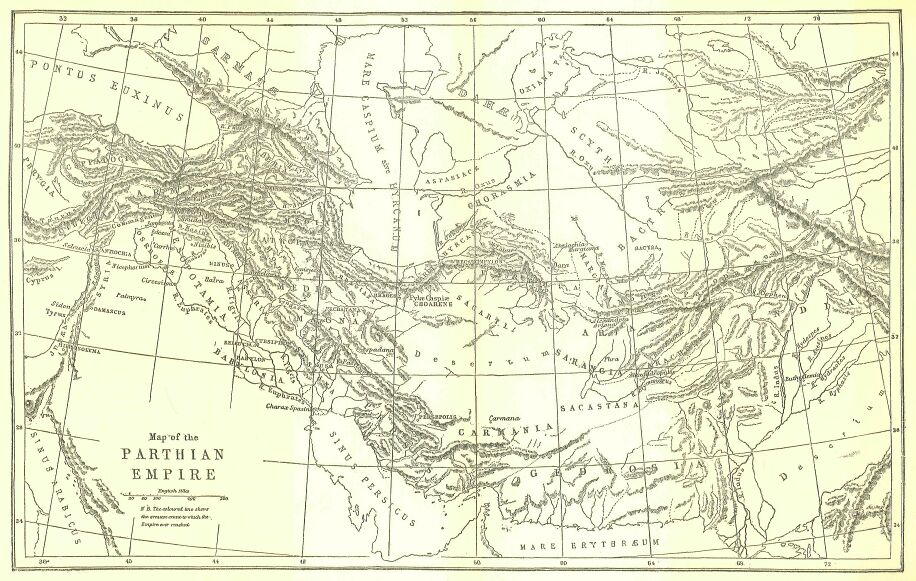
The monarchy thus established extended from the Holy Land and the
Mediterranean on the west, to the Indus valley and the Bolor
mountain-chain upon the east, and from the Caspian and Jaxartes towards
the north, to the Persian Gulf and Indian Ocean towards the south. It
comprised Upper Syria, Mesopotamia, parts of Cappadocia and Phrygia,
Armenia, Assyria, Media, Babylonia, Susiana, Persia, Carmania, Sagartia,
Hyrcania, Parthia, Bactria, Sogdiana, Aria, Zarangia, Arachosia,
Sacastana, Gedrosia, and probably some part of India. Its entire area
could not have been much less than 1,200,000 square miles. Of these, some
300,000 or 400,000 may have been desert; but the remainder was generally
fertile, and comprised within its limits some of the very most productive
regions in the whole world. The Mesopotamian lowland, the Orontes valley,
the tract between the Caspian and the mountains, the regions about Merv
and Balkh, were among the richest in Asia, and produced grain and fruits
in incredible abundance. The rich pastures of Media and Armenia furnished
excellent horses. Bactria gave an inexhaustible supply of camels.
Elephants in large numbers were readily procurable from India. Gold,
silver, copper, iron, lead, tin, were furnished by several of the
provinces, and precious stones of various kinds abounded. Moreover, for
above ten centuries, the precious metals and the most valuable kinds of
merchandise had flowed from every quarter into the region; and though the
Macedonians may have carried off, or wasted, a considerable quantity of
both, yet the accumulations of ages withstood the drain, and the hoarded
wealth which had come down from Assyrian, Babylonian, and Median times was
to be found in the days of Seleucus chiefly within the limits of his
Empire.
The situation which nature pointed out as most suitable for the capital of
a kingdom having the extension that has been here indicated was some
portion of the Mesopotamian valley, which was at once central and fertile.
The empire of Seleucus might have been conveniently ruled from the site of
the ancient Nineveh, or from either of the two still existing and still
flourishing cities of Susa and Babylon. The impetus given to commerce by
the circumstances of the time rendered a site near the sea preferable to
one so remote as that of Nineveh, and the same consideration made a
position on the Tigris or Euphrates more advantageous than one upon a
smaller river. So far, all pointed to Babylon as the natural and best
metropolis; and it was further in favor of that place that its merits had
struck the Great Conqueror, who had designed to make it the capital of his
own still vaster Empire. Accordingly Babylon was Seleucus’s first choice;
and there his Court was held for some years previously to his march
against Antigonus. But either certain disadvantages were found to attach
to Babylon as a residence, or the mere love of variety and change caused
him very shortly to repent of his selection, and to transfer his capital
to another site. He founded, and built with great rapidity, the city of
Seleucia upon the Tigris, at the distance of about forty miles from
Babylon, and had transferred thither the seat of government even before
B.C. 301. Thus far, however, no fault had been committed. The second
capital was at least as conveniently placed as the first, and would have
served equally well as a centre from which to govern the Empire. But after
Ipsus a further change was made—a change that was injudicious in the
extreme. Either setting undue store by his newly-acquired western
provinces, or over-anxious to keep close watch on his powerful neighbors
in those parts, Lysimachus and Ptolemy, Seleucus once more transferred the
seat of empire, exchanging this time the valley of the Tigris for that of
the Orontes, and the central position of Lower Mesopotamia for almost the
extreme western point of his vast territories. Antioch arose in
extraordinary beauty and magnificence during the first few years that
succeeded Ipsus, and Seleucus in a short time made it his ordinary
residence. The change weakened the ties which bound the Empire together,
offended the bulk of the Asiatics, who saw their monarch withdraw from
them into a remote region, and particularly loosened the grasp of the
government on those more eastern districts which were at once furthest
from the new metropolis and least assimilated to the Hellenic character.
Among the causes which led to the disintegration of the Seleucid kingdom,
there is none that deserves so well to be considered the main cause as
this. It was calculated at once to produce the desire to revolt, and to
render the reduction of revolted provinces difficult, if not impossible.
The evil day, however, might have been indefinitely delayed had the
Seleucid princes either established and maintained through their Empire a
vigorous and effective administration, or abstained from entangling
themselves in wars with their neighbors in the West, the Ptolemies and the
princes of Asia Minor.
But the organization of the Empire was unsatisfactory. Instead of pursuing
the system inaugurated by Alexander and seeking to weld the heterogeneous
elements of which his kingdom was composed into a homogeneous whole,
instead of at once conciliating and elevating the Asiatics by uniting them
with the Macedonians and the Greeks, by promoting intermarriage and social
intercourse between the two classes of his subjects, educating the
Asiatics in Greek ideas and Greek schools, opening his court to them,
promoting them to high employments, making them feel that they were as
much valued and as well cared for as the people of the conquering race,
the first Seleucus, and after him his successors, fell back upon the old
simpler, ruder system, the system pursued before Alexander’s time by the
Persians, and before them perhaps by the Medes—the system most
congenial to human laziness and human pride—that of governing a
nation of slaves by means of a class of victorious aliens. Seleucus
divided his empire into satrapies, seventy-two in number. He bestowed the
office of satrap on none but Macedonians and Greeks. The standing army, by
which he maintained his authority, was indeed composed in the main of
Asiatics, disciplined after the Greek model; but it was officered entirely
by men of Greek or Macedonian parentage. Nothing was done to keep up the
self-respect of Asiatics, or to soften the unpleasantness that must always
attach to being governed by foreigners. Even the superintendence over the
satraps seems to have been insufficient. According to some writers, it was
a gross outrage offered by a satrap to an Asiatic subject that stirred up
the Parthians to their revolt. The story may not be true; but its currency
shows of what conduct towards those under their government the satraps of
the Seleucidae were thought, by such as lived near the time, to have been
capable.
It would, perhaps, have been difficult for the Seleucid princes, even had
they desired it, to pursue a policy of absolute abstention in the wars of
their western neighbors. So long as they were resolute to maintain their
footing on the right bank of the Euphrates, in Phrygia, Cappadocia, and
upper Syria, they were of necessity mixed up with the quarrels of the
west. Could they have been content to withdraw within the Euphrates, they
might have remained for the most part clear of such entanglements; but
even then there would have been occasions when they must have taken the
field in self-defence. As it was, however, the idea of abstention seems
never to have occurred to them. It was the fond dream of each “Successor”
of Alexander that in his person might, perhaps, be one day united all the
territories of the great Conqueror. Seleucus would have felt that he
sacrificed his most cherished hopes if he had allowed the west to go its
own way, and had contented himself with consolidating a great power in the
regions east of the Euphrates.
And the policy of the founder of the house was followed by his successors.
The three Seleucid sovereigns who reigned prior to the Parthian revolt
were, one and all, engaged in frequent, if not continual, wars with the
monarchs of Egypt and Asia Minor. The first Seleucus, by his claim to the
sovereignty of Lower Syria, established a ground of constant contention
with the Ptolemies; and though he did not prosecute the claim to the
extent of actual hostility, yet in the reign of his son, Antiochus I.,
called Soter, the smothered quarrel broke out. Soter fomented the
discontent of Cyrene with its subjection to Egypt, and made at least one
expedition against Ptolemy Philadelphus in person (B.C. 264). His efforts
did not meet with much success; but they were renewed by his son,
Antiochus II., surnamed “the God”, who warred with Philadelphus from B.C.
260 to B.C. 250, contending with him chiefly in Asia Minor. These wars
were complicated with others. The first Antiochus aimed at adding the
kingdom of Bithynia to his dominions, and attacked successively the
Bythynian monarchs, Zipcetas and Nicomedes I. (B.C. 280-278). This
aggression brought him into collision with the Gauls, whom Nicomedes
called to his aid, and with whom Antiochus had several struggles, some
successful and some disastrous. He also attacked Eumenes of Pergamus (B.C.
263), but was defeated in a pitched battle near Sardis. The second
Antiochus was not engaged in so great a multiplicity of contests; but we
hear of his taking a part in the internal affairs of Miletus, and
expelling a certain Timachus, who had made himself tyrant of that city.
There is also some ground for thinking that he had a standing quarrel with
the king of Media Atropatene. Altogether it is evident that from B.C. 280
to B.C. 250 the Seleucid princes were incessantly occupied with wars in
the west, in Asia Minor and in Syria Proper, wars which so constantly
engaged them that they had neither time nor attention to spare for the
affairs of the far east. So long as the Bactrian and Parthian satraps paid
their tributes, and supplied the requisite quotas of troops for service in
the western wars, the Antiochi were content. The satraps were left to
manage affairs at their own discretion; and it is not surprising that the
absence of a controlling hand led to various complications and disorders.
Moreover, the personal character of the second Antiochus must be taken
into account. The vanity and impiety, which could accept the name of
“Theus” for a service that fifty other Greeks had rendered to oppressed
towns without regarding themselves as having done anything very
remarkable, would alone indicate a weak and contemptible morale, and might
justify us, did we know no more, in regarding the calamities of his reign
as the fruit of his own unfitness to rule an empire. But there is
sufficient evidence that he had other, and worse, vices. He was noted,
even among Asiatic sovereigns, for luxury and debauchery; he neglected all
state affairs in the pursuit of pleasure; his wives and male favorites
were allowed to rule his kingdom at their will; and their most flagrant
crimes were neither restrained nor punished. Such a character could have
inspired neither respect nor fear. The satraps, to whom the conduct of
their sovereign could not but become known, would be partly encouraged to
follow the bad example, partly provoked by it to shake themselves free of
so hateful and yet contemptible a master.
It was, probably, about the year B.C. 256, the fifth of the second
Antiochus, when that prince, hard pressed by Philadelphus in the west, was
also, perhaps, engaged in a war with the king of Atropatene in the north,
that the standard of revolt was first actually raised in the eastern
provinces, and a Syrian satrap ventured to declare himself an independent
sovereign. This was Diodotus, satrap of Bactria a Greek, as his name
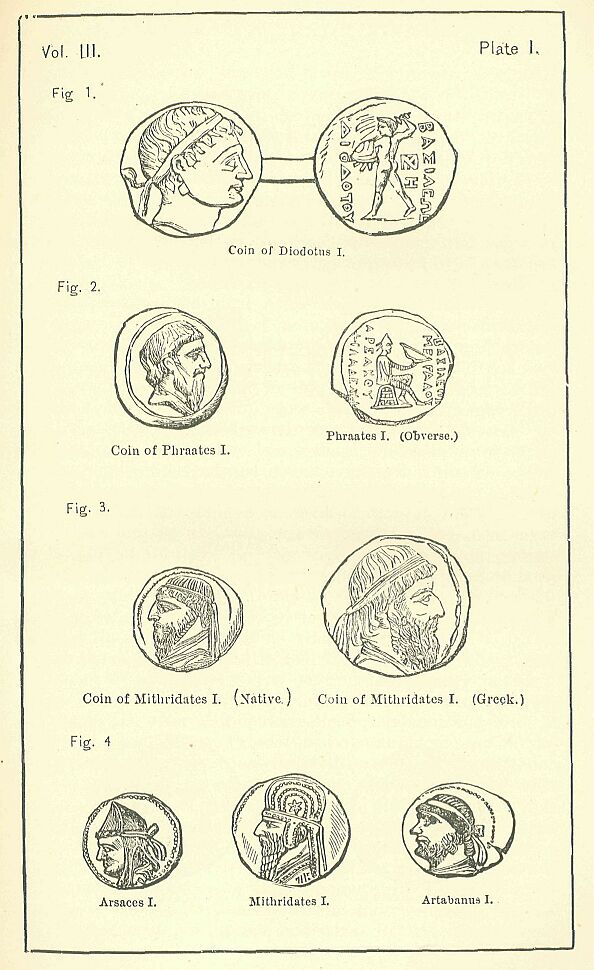
shows. Suddenly assuming the state and style of king he issued coins
stamped with his own name, and established himself without difficulty as
sovereign over the large and flourishing province of Bactria, or the tract
of fertile land about the upper and middle Oxus. This district had from a
remote antiquity been one with special pretensions. The country was
fertile, and much of it strong; the people were hardy and valiant; they
were generally treated with exceptional favor by the Persian monarchs; and
they seem to have had traditions which assigned them a pre-eminence among
the Arian tribes at some indefinitely distant period. We may presume that
they would gladly support the bold enterprise of their new monarch; they
would feel their vanity flattered by the establishment of an independent
Bactria, even though it were under Greek kings; and they would
energetically second him in an enterprise which gratified their pride,
while it held out to them hopes of a career of conquest, with its
concomitants of plunder and glory. The settled quiet which they had
enjoyed under the Achaemenide and the Seleucidae was probably not much to
their taste; and they would gladly exchange so tame and dull a life for
the pleasures of independence and the chances of empire.
It would seem that Antiochus, sunk in luxury at his capital, could not
bring himself to make even an effort to check the spirit of rebellion, and
recover his revolted subjects. Bactria was allowed to establish itself as
an independent monarchy, without having to undergo the ordeal of a bloody
struggle. Antiochus neither marched against Diodotus in person, nor sent a
general to contend with him. The authority of Diodotus was confirmed and
riveted on his subjects by an undisturbed reign of eighteen years before a
Syrian army even showed itself in his neighborhood.
The precedent of successful revolt thus set could not well be barren of
consequences. If one province might throw off the yoke of its feudal lord
with impunity, why might not others? Accordingly, within a few years the
example set by Bactria was followed in the neighboring country of Parthia,
but with certain very important differences. In Bactria the Greek satrap
took the lead, and the Bactrian kingdom was, at any rate at its
commencement, as thoroughly Greek as that of the Seleucidae. But in
Parthia Greek rule was from the first cast aside. The natives rebelled
against their masters. An Asiatic race of a rude and uncivilized type,
coarse and savage, but brave and freedom-loving, rose up against the
polished but effeminate Greeks who held them in subjection, and claimed
and established their independence. The Parthian kingdom was thoroughly
anti-Hellenic. It appealed to patriotic feelings, and to the hate
universally felt towards the stranger. It set itself to undo the work of
Alexander, to cast out the Europeans, to recover to the Asiatics the
possession of Asia. It was naturally almost as hostile to Bactria as to
Syria, although danger from a common enemy might cause it sometimes to
make a temporary alliance with that kingdom. It had, no doubt, the general
sympathy of the populations in the adjacent countries, and represented to
them the cause of freedom and autonomy.
The exact circumstances under which the Parthian revolt took place are
involved in much obscurity. According to one account the leader of the
revolt, Arsaces, was a Bactrian, to whom the success of Diodotus was
disagreeable, and who therefore quitted the newly-founded kingdom, and
betook himself to Parthia, where he induced the natives to revolt and to
accept him for their monarch. Another account, which is attractive from
the minute details into which it enters, is the following:—“Arsaces
and Tiridates were brothers, descendants of Phriapites, the son of
Arsaces. Pherecles, who had been made satrap of their country by Antiochus
Theus, offered a gross insult to one of them, whereupon, as they could not
brook the indignity, they took five men into counsel, and with their aid
slew the insolent one. They then induced their nation to revolt from the
Macedonians, and set up a government of their own, which attained to great
power.” A third version says that the Arsaces, whom all represent as the
first king, was in reality a Scythian, who at the head of a body of
Parnian Dahce, nomads inhabiting the valley of the Attrek (Ochus), invaded
Parthia, soon after the establishment of Bactrian independence, and
succeeded in making himself master of it. With this account, which Strabo
seems to prefer, agrees tolerably well that of Justin, who says that
“Arsaces, having been long accustomed to live by robbery and rapine,
attacked the Parthians with a predatory band, killed their satrap,
Andragoras, and seized the supreme authority.” As there was in all
probability a close ethnic connection between the Dahae and the Parthians,
it would be likely enough that the latter might accept for a king a
chieftain of the former who had boldly entered their country, challenged
the Greek satrap to an encounter, and by defeating and killing him freed
them—at any rate for the time—from the Greek yoke. An
oppressed people gladly adopts as chief the head of an allied tribe if he
has shown skill and daring, and offers to protect them from their
oppressors.
The revolt of Arsaces has been placed by some as early as the year B.C.
256. The Bactrian revolt is assigned by most historians to that year; and
the Parthian, according to some, was contemporary. The best authorities,
however, give a short interval between the two insurrections; and, on the
whole, there is perhaps reason to regard the Parthian independence as
dating from about B.C. 250. This year was the eleventh of Antiochus Theus,
and fell into the time when he was still engaged in his war with Ptolemy
Philadelphus. It might have been expected that when he concluded a peace
with the Egyptian monarch in B.C. 249, he would have turned his arms at
once towards the east, and have attempted at any rate the recovery of his
lost dominions. But, as already stated, his personal character was weak,
and he preferred the pleasures of repose at Antioch to the hardships of a
campaign in the Caspian region. So far as we hear, he took no steps to
re-establish his authority; and Arsaces, like Diodotus, was left
undisturbed to consolidate his power at his leisure.
Arsaces lived, however, but a short time after obtaining the crown. His
authority was disputed within the limits of Parthia itself; and he had to
engage in hostilities with a portion of his own subjects. We may suspect
that the malcontents were chiefly, if not solely, those of Greek race, who
may have been tolerably numerous, and whose strength would lie in the
towns. Hecatompylos, the chief city of Parthia, was among the colonies
founded by Alexander; and its inhabitants would naturally be disinclined
to acquiesce in the rule of a “barbarian.” Within little more than two
years of his coronation, Arsaces, who had never been able to give his
kingdom peace, was killed in battle by a spear-thrust in the side; and was
succeeded (B.C. 247) by his brother, having left, it is probable, no sons,
or none of mature age.
Tiridates, the successor of Arsaces, took upon his accession his brother’s
name, and is known in history as Arsaces II. The practice thus begun
passed into a custom, each Parthian monarch from henceforth bearing as
king the name of Arsaces in addition to his own real appellation, whatever
that might be. In the native remains the assumed name almost supersedes
the other; but, fortunately, the Greek and Roman writers who treat of
Parthian affairs, have preserved the distinctive appellations, and thus
saved the Parthian history from inextricable confusion. It is not easy to
see from what quarter this practice was adopted; perhaps we should regard
it as one previously existing among the Dahan Scyths.
If the Parthian monarchy owed its origin to Arsaces I., it owed its
consolidation, and settled establishment to Arsaces II., or Tiridates.
This prince, who had the good fortune to reign for above thirty years, and
who is confused by many writers with the actual founder of the monarchy,
having received Parthia from his brother, in the weak and unsettled
condition above described, left it a united and powerful kingdom, enlarged
in its boundaries, strengthened in its defences, in alliance with its
nearest and most formidable neighbor, and triumphant over the great power
of Syria, which had hoped to bring it once more into subjection. He
ascended the throne, it is probable, early in B.C. 247, and had scarcely
been monarch a couple of years when he witnessed one of those vast but
transient revolutions to which Asia is subject, but which are of rare
occurrence in Europe. Ptolemy Euergetes, the son of Philadelphus, having
succeeded to his father’s kingdom in the same year with Tiridates, marched
(in B.C. 245) a huge expedition into Asia, defeated Seleucus II.
(Callinicus) in Syria, took Antioch, and then, having crossed the
Euphrates, proceeded to bring the greater part of Western Asia under his
sway. Mesopotamia, Assyria, Babylonia, Susiana, Persia, Media, submitted
to him. He went in person as far as Babylon, and, according to his own
account, was acknowledged as master by all the Eastern provinces to the
very borders of Bactria. The Parthian and Bactrian kingdoms cannot but
have trembled for their newly won independence. Here was a young warrior
who, in a single campaign, had marched the distance of a thousand miles,
from the banks of the Nile to those of the Lower Euphrates, without so
much as receiving a check, and who was threatening to repeat the career of
Alexander. What resistance could the little Parthian state hope to offer
to such an enemy? It must have rejoiced Tiridates to hear that while the
new conqueror was gathering somewhat too hastily the fruits of victory,
collecting and despatching to Egypt the most valuable works of art that he
could find in the cities which he had taken, and levying heavy
contributions on the submitted countries, a revolt had broken out in his
own land, to quell which he was compelled to retire suddenly and to
relinquish the greater part of his acquisitions. Thus the threatened
conquest proved a mere inroad, and instead of a power of greater strength
replacing Syria in these regions, Syria practically retained her hold of
them, but with enfeebled grasp, her strength crippled, her prestige lost,
and her honor tarnished. Ptolemy had, it is probable, not retired very
long, when, encouraged by what he had seen of Syria’s weakness, Tiridates
took the aggressive, and invading the neighboring district of Hyrcania,
succeeded in detaching it from the Syrian state, and adding it to his own
territory. This was throwing out a challenge which the Syrian monarch,
Callinicus, could scarcely decline to meet, unless he was prepared to
lose, one by one, all the outlying provinces of his empire.
Accordingly in B.C. 237, having patched up a peace with his brother,
Antiochus Hierax, the Syrian monarch made an expedition against Parthia.
Not feeling, however, altogether confident of success if he trusted wholly
to his own unaided efforts, he prudently entered into an alliance with
Diodotus the Bactrian king, and the two agreed to combine their forces
against Tiridates. Hereupon that monarch, impressed with a deep sense of
the impending danger, quitted Parthia, and, proceeding northwards, took
refuge with the Aspasiacae, a Scythian tribe which dwelt between the Oxus
and the Jaxartes. The Aspasiacae probably lent him troops; at any rate, he
did not remain long in retirement, but, hearing that the Bactrian king,
whom he especially feared, was dead, he contrived to detach his son and
successor from the Syrian alliance, and to draw him over to his own side.
Having made this important stroke, he met Callinicus in battle, and
completely defeated his army.
This victory was with reason regarded by the Parthians as a sort of second
beginning of their independence. Hitherto their kingdom had existed
precariously, and as it were by sufferance. It could not but be that the
power from which they had revolted would one day seek to reclaim its lost
territory; and, until the new monarchy had measured its strength against
that of its former mistress, none could feel secure that it would be able
to maintain its existence. The victory gained by Tiridates over Callinicus
put an end to these doubts. It proved to the world at large, and also to
the Parthians themselves, that they had nothing to fear—that they
were strong enough to preserve their freedom. Considering the enormous
disproportion between the military strength and resources of the narrow
Parthian State and the vast Syrian Empire—considering that the one
comprised about fifty thousand and the other above a million of square
miles; that the one had inherited the wealth of ages and the other was
probably as poor as any province in Asia; that the one possessed the
Macedonian arms, training, and tactics, while the other knew only the rude
warfare of the Steppes—the result of the struggle cannot but be
regarded as surprising. Still it was not without precedent, and it has not
been without repetition. It adds another to the many instances where a
small but brave people, bent on resisting foreign domination, have, when
standing on their defence, in their own territory, proved more than a
match for the utmost force that a foe of overwhelming strength could bring
against them. It reminds us of Marathon, of Bannock-burn, of Morgarten. We
may not sympathize wholly with the victors, for Greek civilization, even
of the type introduced by Alexander into Asia, was ill replaced by Tatar
coarseness and barbarism; but we cannot refuse our admiration to the
spectacle of a handful of gallant men determinedly resisting in the
fastness of their native land a host of aliens, and triumphing over their
would-be oppressors.
The Parthians themselves, deeply impressed with the importance of the
contest, preserved the memory of it by a solemn festival on the
anniversary of their victory, which they still celebrated in the time of
Trogus.
CHAPTER IV.
Consolidation of the Parthian Kingdom. Death of Tiridates and accession
of Arsaces III. Attack on Media. War of Artabanus (Arsaces III.) with
Antiochus the Great. Period of inaction. Great development of Bactrian
power. Reigns of Priapatius (Arsaces IV.) and Phraates I. (Arsaces V.)
Selbucus might perhaps not have accepted his defeat as final had he been
altogether free to choose whether he would continue the Parthian war or
no. The resources of his Empire were so vast, his command of men and money
so unbounded, that he could easily have replaced one army by another, and
so have prolonged the struggle. But renewed troubles had broken out in the
western portion of his dominions, where his brother, Antiochus Hierax, was
still in arms against his authority. Seleucus felt it necessary to turn
his attention to this quarter, and having once retired from the Parthian
contest, he never afterwards renewed it. Tiridates was left unmolested, to
act as he thought fit, and either to attempt further conquests, or to
devote himself to securing those which he had effected. He chose the
latter course, and during the remainder of his reign—a space of
above twenty years—he employed himself wholly in strengthening and
adorning his small kingdom. Having built a number of forts in various
strong positions, and placed garrisons in them, he carefully selected a
site for a new city, which he probably intended to make his capital. The
spot chosen combined the advantages of being at once delightful and easily
defensible. It was surrounded with precipitous rocks, which enclosed a
plain of extraordinary fertility. Abundant wood and copious streams of
water were in the neighborhood. The soil was so rich that it scarcely
required cultivation, and the woods were so full of game as to afford
endless amusement to hunters. To the town which he built in this locality
Tiridates gave the name of Dara, a word which the Greeks and Romans
elongated into Dareium. Unfortunately, modern travellers have not yet
succeeded in identifying the site, which should, however, lie towards the
East, perhaps in the vicinity of Meshed.
We may presume that Tiridates, when he built this remarkable city,
intended to make it the seat of government. Hecatompylos, as a Greek town,
had the same disadvantages, which were considered in later times to render
Seleucia unfit for the residence of the Parthian Court and monarch. Dara,
like Ctesiphon, was to be wholly Parthian. Its strong situation would
render it easy of defence; its vicinity to forests abounding in game would
give it special charms in the eyes of persons so much devoted, as the
Parthian princes were, to the chase. But the intention of Tiridates, if we
have truly defined it, failed of taking permanent effect. He may himself
have fixed his abode at Dara, but his successors did not inherit his
predilections; and Hecatompylos remained, after his reign, as before it,
the head-quarters of the government, and the recognized metropolis of
Parthia Proper.
After passing in peace and prosperity the last twenty years of his reign,
Tiridates died in a good old age, leaving his crown to a son, whose
special name is a little uncertain, but who is called by most moderns
Artabanus I.
Artabanus, having ascended the Parthian throne about B.C. 214, and being
anxious to distinguish himself, took advantage of the war raging between
Antiochus III., the second son of Seleucus Callinicus, and Achseus, one of
his rebel satraps, to advance into Media, and to add to his dominions the
entire tract between Hyrcania and the Zagros mountains. Of the manner in
which he effected his conquests we have no account; but they seem to have
been the fruit of a single campaign, which must have been conducted with
great vigor and military skill. The Parthian prince appears to have
occupied Ecbatana, the ancient capital of the Median Empire, and to have
thence threatened the Mesopotamian countries. Upon receiving intelligence
of his invasion, Antiochus levied a vast army, and set out towards the
East, with a determination to subjugate all the revolted provinces, and to
recover the limits of the old Empire of Nicator. Passing the Zagros chain,
probably by way of Behistun and Kermanshaw, he easily retook Ecbatana,
which was an open town, and undefended by the Parthians, and proceeded to
prepare for a further advance eastward. The route from Ecbatana to the
Caspian Gates crosses, of necessity, unless a considerable circuit be
taken, some large tracts of barren ground, inlets or bays of the Great
Salt Desert of Iran. Artabanus cherished the hope that here the
difficulties of the way would effectually bar his enemy’s progress, more
especially as his troops were so numerous, and as water was scanty
throughout the whole region. The streams which flow from Zagros towards
the East are few and scanty; they mostly fail in summer, which, even in
Asia, is the campaigning season; and those who cross the desert at this
time must depend on the wells wherewith the more western part of the
region is supplied by means of kanats or underground conduits,
which are sometimes carried many miles from the foot of the mountains. The
position of the wells, which were few in number, was known only to the
natives; and Artabanus hoped that the Syrian monarch would be afraid to
place the lives of his soldiers in such doubtful keeping. When, however,
he found that Antiochus was not to be deterred by any fears of this kind,
but was bent on crossing the desert, he had recourse to the barbaric
expedients of filling in, or poisoning, the wells along the line of
route-which the Syrian prince was likely to follow. But these steps seem
to have been taken too late. Antiochus, advancing suddenly, caught some of
the Parthian troops at their barbarous work, and dispersed them without
difficulty. He then rapidly effected the transit, and, pressing forward,
was soon in the enemy’s country, where he occupied the chief city,
Hecatompylos. Up to this point the Parthian monarch had declined an
engagement. No information has come down to us as to his motives; but they
may be readily enough conjectured. To draw an enemy far away from his
resources, while retiring upon one’s own; to entangle a numerous host
among narrow passes and denies; to decline battle when he offers it, and
then to set upon him unawares, has always been the practice of weak
mountain races when attacked by a more numerous foe. It is often good
policy in such a case even to yield the capital without a blow, and to
retreat into a more difficult situation. The assailant must follow
whithersoever his foe retires, or quit the country, leaving him unsubdued.
Antiochus, aware of this necessity, and rendered confident of success by
the evacuation of a situation so strong, and so suitable for the Parthian
tactics as Hecatompylos, after giving his army a short rest at the
captured capital, set out in pursuit of Artabanus, who had withdrawn his
forces towards Hyrcania. To reach the rich Hyrcanian valleys, he was
forced to cross the main chain of the Elburz, which here attains an
elevation of 7000 or 8000 feet. The route which his army had to follow was
the channel of a winter-torrent, obstructed with stones and trunks of
trees, partly by nature, partly by the efforts of the inhabitants. The
long and difficult ascent was disputed by the enemy the whole way, and
something like a pitched battle was fought at the top; but Antiochus
persevered, and, though his army must have suffered severely, descended
into Hyrcanian and captured several of the towns. Here our main authority,
Polybius, suddenly deserts us, and we can give no further account of the
war beyond its general result—Artabanus and the Parthians remained
unsubdued after a struggle which seems to have lasted some years;
Artabanus himself displayed great valor; and at length the Syrian monarch
thought it best to conclude a peace with him, in which he acknowledged the
Parthian independence. It is probable that he exacted in return a pledge
that the Parthian monarch should lend him his assistance in the expedition
which he was bent on conducting against Bactria; but there is no actual
proof that the conditions of peace contained this clause. We are left in
doubt whether Artabanus stood aloof in the war which Antiochus waged with
Euthydemus of Bactria immediately after the close of his Parthian
campaigns, or whether he lent his aid to the attempt made to crush his
neighbor. Perhaps, on the whole, it is most probable that, nominally, he
was Antiochus’s ally in the war, but that, practically, he gave him little
help, having no wish to see Syria aggrandized.
At any rate, whether Euthydemus had to meet the attack of Syria only, or
of Syria and Parthia in combination, the result was, that Bactria, like
Parthia, proved strong enough to maintain her ground, and that the Syrian
King, after a while, grew tired of the struggle, and consented to terms of
accommodation. The Bactrian monarchy, like the Parthian, came out of the
contest unscathed—indeed we may go further, and say that the
position of the two kingdoms was improved by the attacks made upon them.
If a prince possessing the personal qualities that distinguished the third
Antiochus, and justified the title of “Great” which he derived from his
oriental expedition—if such a prince, enjoying profound peace at
home, and directing the whole force of his empire against them, could not
succeed in reducing to subjection the revolted provinces of the northeast,
but, whatever military advantages he might gain, found conquest
impossible, and returned home, having acknowledged as independent kings
those whom he went out to chastise as rebellious satraps, it was evident
that the kingdoms might look upon themselves as firmly established, or, at
least, as secure from the danger of re-absorption into the Syrian State.
The repulse of Callinicus was a probable indication of the fate of all
future efforts on the part of Syria to reduce Parthia; the conditions of
peace granted by Antiochus to both countries, after a series of military
successes, constituted almost a proof that the yoke of Syria would never
be re-imposed on either the Parthian or the Bactrian nation.
With the departure of Antiochus from the East, about B.C. 206, we enter
upon a period when Parthian history is, for a quarter of a century, almost
a blank. Nothing more is known of Arsaces III. after Antiochus retired;
and nothing at all is known of his successor, Priapatius, beyond his name
and the length of his reign, which lasted for fifteen years (from about
B.C. 196 to 181). The reigns of these princes coincide with those of
Euthydemus and his son, Demetrius, in Bactria; and perhaps the most
probable solution of the problem of Parthian inactivity at this time is to
be found in the great development of Bactrian power which now took place,
and the influence which the two neighboring kingdoms naturally exercised
upon each other. When Parthia was strong and aggressive, Bactria was, for
the most part, quiet; and when Bactria shows signs of vigorous and active
life, Parthia languishes and retires into the shade.
The Bactrian Kingdom, founded (as we have seen) a little before the
Parthian, sought from the first its aggrandizement in the East rather than
in the West. The Empire of Alexander had included all the countries
between the Caspian Sea and the Sutlej; and these tracts, which constitute
the modern Khorasan, Afghanistan, and Punjaub, had all been to a certain
extent Hellenized by means of Greek settlements and Greek government. But
Alexander was no sooner dead than a tendency displayed itself in these
regions, and particularly in the more eastern ones, towards a relapse into
barbarism, or, if this expression be too strong, at any rate towards a
rejection of Hellenism. During the early wars of the “Successors” the
natives of the Punjaub generally seized the opportunity to revolt; the
governors placed over the various districts by Alexander were murdered;
and the tribes everywhere declared themselves free. Among the leaders of
the revolt was a certain Chandragupta (or Sandracottus), who contrived to
turn the circumstances of the time to his own special advantage, and built
up a considerable kingdom in the far East out of the fragments which had
detached themselves from what was still called the Macedonian Empire. When
Seleucus Nicator, about B.C. 305, conducted an expedition across the
Indus, he found this monarch established in the tract between the Indus
and the Ganges, ruling over extensive dominions and at the head of a vast
force. It is uncertain whether the two rivals engaged in hostilities or
no. At any rate, a peace was soon made; and Seleucus, in return for five
hundred elephants, ceded to Sandracottus certain lands on the west bank of
the Indus, which had hitherto been regarded as Macedonian. These probably
consisted of the low grounds between the Indus and the foot of the
mountains—the districts of Peshawur, Bunnoo, Murwut, Shikarpoor, and
Kurrachee—which are now in British occupation. Thus Hellenism in
these parts receded more and more, the Sanskritic Indians recovering by
degrees the power and independence of which they had been deprived by
Alexander.
This state of things could not have been pleasing to the Greek princes of
Bactria, who must have felt that the reaction towards barbarism in these
parts tended to isolate them, and that there was a danger of their being
crushed between the Parthians on the one hand and the perpetually
advancing Indians on the other. When Antiochus the Great, after concluding
his treaty with Euthydemus, marched eastward, the Bactrian monarch
probably indulged in hopes that the Indians would receive a check, and
that the Greek frontier would be again carried to the Indus, if not to the
Sutlej. But, if so, he was disappointed. Antiochus, instead of making war
upon the Indians, contented himself with renewing the old alliance of the
Seleucidae with the Maurja princes, and obtaining a number of elephants
from Sophagesenus, the grandson of Sandracottus. It is even possible that
he went further, and made cessions of territory in return for this last
gift, which brought the Indian frontier still nearer than before to that
of Bactria, At any rate, the result of the Indian expedition of Antiochus
seems to have been unsatisfactory to Euthydemus, who shortly afterwards
commenced what are called “Indian Wars” on his south-eastern frontier,
employing in them chiefly the arms of his son, Demetrius. During the
latter years of Euthydemus and the earlier ones of Demetrius, the Bactrian
rule was rapidly extended over the greater portion of the modern
Afghanistan; nor did it even stop there. The arms of Demetrius were
carried across the Indus into the Punjaub region; and the city of
Euthymedeia upon the Hydaspes remained to later times an evidence of the
extent of his conquests. From B.C. 206 to about B.C. 185 was the most
flourishing period of the Bactrian monarchy, which expanded during that
space from a small kingdom into a considerable empire.
The power and successes of the Bactrian princes at this time account
sufficiently for the fact that the contemporary Parthian monarchs stood
upon their guard, and undertook no great expeditions. Arsaces III., who
continued on the throne for about ten or twelve years after his peace with
Antiochus, and Priapatius, or Arsaces IV., his son, who succeeded him, and
had a reign of fifteen years, were content, as already observed, to watch
over their own State, husbanding its resources, and living at peace with
all their neighbors. It was not till Phraates I. (Arsaces V.), the son of
Priapatius, had mounted the throne, B.C. 181, that this policy was
departed from, and Parthia, which had remained tranquil for a quarter of a
century, once more aroused herself, and assumed an attitude of aggression.
The quarter to which Phraates I. directed his arms was the country of the
Mardians, a poor but warlike people, who appear to have occupied a portion
of the Elburz range, probably that immediately south of Mazanderan and
Asterabad. The reduction of these fierce mountaineers is likely to have
occupied him for some years, since their country was exceedingly strong
and difficult. Though the Mardi were (nominally, at any rate) subjects of
the Seleucidae, we do not hear of any assistance being rendered them, or,
indeed, of any remonstrance being made against the unprovoked aggression
of the Parthian monarch. The reign of Phraates I. in Parthia coincides
with that of Seleucus IV. (Philopator) in Syria; and we may account for
the inactivity of this prince, in part by his personal character, which
was weak and pacific, in part by the exhaustion of Syria at the time, in
consequence of his father’s great war with Rome (B.C. 197-190), and of the
heavy contribution which was imposed upon him at the close of it. Syria
may scarcely have yet recovered sufficient strength to enter upon a new
struggle, especially one with a distant and powerful enemy. The material
interests of the Empire may also have seemed to be but little touched by
the war, since the Mardi were too poor to furnish much tribute; and it is
possible, if not even probable, that their subjection to Syria had long
been rather formal than real. Seleucus therefore allowed the Mardians to
be reduced, conceiving, probably, that their transfer to the dominion of
the Arsacidse neither increased the Parthian power nor diminished his own.
But the nation which submits to be robbed of a province, however
unproductive and valueless, must look to having the process repeated at
intervals, until it bestirs itself and offers resistance. There is reason
to believe that Phraates had no sooner conquered the Mardians than he cast
his eyes on an adjacent district, and resolved to add it to his
territories. This was the tract lying immediately to the West of the
Caspian Gates, which was always reckoned to Media, forming, however, a
distinct district, know as Media Rhagiana. It was a region of much natural
fertility, being watered by numerous streams from the Elburz range, and
possessing a soil of remarkable productiveness. Its breadth was not great,
since it consisted of a mere strip between the mountains and the Salt
Desert which occupies the whole centre of the Iranic tableland; but it
extended in length at least a hundred and fifty miles, from the Caspian
Gates to the vicinity of Kasvin. Its capital city, from a remote
antiquity, was Rbages, situated near the eastern extremity of the strip,
probably at the spot now called Kaleh Erij, about twenty-three miles from
the “Gates.” On this region it is clear that Phraates cast a covetous eye.
How much of it he actually occupied is doubtful; but it is at least
certain that he effected a lodgment in its eastern extremity, which must
have put the whole region in jeopardy. Nature has set a remarkable barrier
between the more eastern and the more western portions of Occidental Asia,
about midway in the tract which lies due south of the Caspian Sea. The
Elburz range in this part is one of so tremendous a character, and
northward abuts so closely on the Caspian, that all communication between
the east and the west necessarily passes to the south of it. In this
quarter the Great Desert offering an insuperable obstacle to transit, the
line of communication has to cling to the flanks of the mountain chain,
the narrow strip between the mountains and the desert—rarely ten
miles in width—being alone traversable. But about long. 52° 20’ this
strip itself fails. A rocky spur runs due south from the Elburz into the
desert for a distance of some twenty or thirty miles, breaking the line of
communication, and seeming at first sight to obstruct it completely. This,
however, is not the case absolutely. The spur itself is penetrable by two
passes, one where it joins the Elburz, which is the more difficult of the
two, and another, further to the south, which is easier. The latter now
known as the Girduni Sudurrah pass, constitutes the famous “Pylae
Caspiae.” Through this pass alone can armies proceed from Armenia, Media,
and Persia eastward, or from Turkestan, Khorasan, and Afghanistan into the
more western parts of Asia. The position is therefore one of primary
importance. It was to guard it that Rhages was built so near the eastern
end of its territory. So long as it remained in the possession of Syria,
Parthian aggression was checked. Rhagiana, the rest of Media, and the
other provinces were safe, or nearly so. On the other hand, the loss of it
to Parthia laid the eastern provinces open to her, and was at once almost
equivalent to the loss of all Rhagiana, which had no other natural
protection. Now we find that Phraates surmounted the “Gates,” and effected
a lodgment in the plain country beyond them. He removed a portion of the
conquered Mardians from their mountain homes to the city of Charax, which
was on the western side of the Gates, probably on the site now occupied by
the ruins known as Uewanikif. Their location in this strong post was a
menace to the neighboring town of Rhages, which can scarcely have
maintained itself long against an enemy encamped at its doors. We are not
informed, however, of any results which followed on the occupation of
Charax during the lifetime of Phraates. His reign lasted only seven years—from
B.C. 181 to B.C. 174—and it is thus probable that he died before
there was time for his second important conquest to have any further
consequences.
Phraates had sufficient warning of his coming decease to make preparations
with respect to a successor. Though he had several sons, some of whom were
(we must suppose) of sufficient age to have ascended the throne, he left
his crown to his brother, Mithridates. He felt, probably, that the State
required the direction of a firm hand, that war might at any time break
out with either Syria or Bactria; while, if the career of conquest on
which he had made Parthia enter were to be pursued, he could trust his
brother better than any of his sons to conduct aggressive expeditions with
combined vigor and prudence. We shall see, as the history proceeds, how
Mithridates justified his choice. Phraates would also appear to have borne
his brother especial affection, since he takes the name of “Philadelphus”
(brother-loving) upon his coins. It must have been a satisfaction to him
that he was able by his last act at once to consult for the good of his
country, and to gratify a sentiment on which it is evident that he prided
himself.
CHAPTER V.
Reign of Mithridates I. Position of Bactria and Syria at his accession.
His first war with Bactria. His great Expedition against the Eastern
Syrian provinces, and its results. His second war with Bactria,
terminating in its conquest. Extent of his Empire. Attempt of Demetrius
Nicator to recover the lost Provinces fails. Captivity of Demetrius. Death
of Mithridates.
The reign of Mithridates I. is the most important in the Parthian history.
[PLATE 1. Fig. 3.] Receiving from his
brother Phraates a kingdom of but narrow dimensions, confined (as it would
seem) between the city of Charax on the one side, and the river Arius, or
Hori-rud, on the other, he transformed it, within the space of
thirty-seven years (which was the time that his reign lasted), into a
great and nourishing Empire. It is not too much to say that, but for him,
Parthia might have remained a more petty State on the outskirts of the
Syrian kingdom, and, instead of becoming a rival to Rome, might have sunk
shortly into obscurity and insignificance.
As commonly happens in the grand changes which constitute the
turning-points of history, the way for Mithridates’s vast successes was
prepared by a long train of antecedent circumstances. To show how the rise
of the Parthians to greatness in the middle of the second century before
our era was rendered possible, we must turn aside once more from our
proper subject and cast a glance at the condition of the two kingdoms
between which Parthia stood, at the time when Mithridates ascended the
throne.
The Bactrian monarchs in their ambitious struggles to possess themselves
of the tracts south of the Paropamisus, and extending from the Heri-rud to
the Sutlej and the mouths of the Indus, overstrained the strength of their
State, and by shifting the centre of its power injured irretrievably its
principle of cohesion. As early as the reign of Demetrius a tendency to
disruption showed itself, Eucratidas having held the supreme power for
many years in Bactria itself, while Demetrius exercised authority on the
southern side of the mountains. It is true that at the death of Demetrius
this tendency was to a certain extent checked, since Eucratidas was then
able to extend his sway over almost the whole of the Bactrian territory.
But the old evil recurred shortly, though in a less pronounced form.
Eucratidas, without being actually supplanted in the north by a rival,
found that he could devote to that portion of the Empire but a small part
of his attention. The southern countries and the prospect of southern and
eastern conquests engrossed him. While he carried on successful wars with
the Arachotians, the Drangians, and the Indians of the Punjaub region, his
hold on the more northern countries was relaxed, and they began to slip
from his grasp. Incursions of the nomad Scyths from the Steppes carried
fire and sword over portions of these provinces, some of which were Even,
it is probable, seized and occupied by the invaders.
Such was, it would seem, the condition of Bactria under Eucratidas, the
contemporary of Mithridates. In Syria, Antiochus Epiphanes had succeeded
his brother Seleucus IV. (Philopator) about a year before Mithridates
ascended the Parthian throne. He was a prince of courage and energy; but
his hands were fully occupied with wars in Egypt, Palestine, and Armenia,
and the distant East could attract but a small share of his thought or
attention. The claim put forward by Egypt to the possession of Coele-Syria
and Palestine, promised to Ptolemy V. (it was affirmed) as a dowry with
Cleopatra, the daughter of Antiochus the Great, led to hostilities in the
south-west which lasted continuously for four years (B.C. 171 to B.C.
168), and were complicated during two of them with troubles in Judaea,
rashly provoked by the Syrian monarch, who, unaware of the stubborn temper
of the Jews, goaded them into insurrection. The war with Egypt came to an
end in B.C. 168; it brought Syria no advantage, since Rome interposed, and
required the restitution of all conquests. The war with the Jews had no
such rapid termination. Antiochus, having not only plundered and
desecrated the Temple, but having set himself to eradicate utterly the
Jewish religion, and completely Hellenize the people, was met with the
most determined resistance on the part of a moiety of the nation. A
patriotic party rose up under devoted leaders, who asserted, and in the
end secured, the independence of their country. Not alone during the
remaining years of Epiphanes, but for half a century after his death,
throughout seven reigns, the struggle continued; Judaea taking advantage
of every trouble and difficulty in Syria to detach herself more and more
completely from her oppressor; being a continual thorn in her side, a
constant source of weakness, preventing more than anything else the
recovery of her power. The triumph which Epiphanes obtained in the distant
Armenia (B.C. 166-5), where he defeated and captured the king, Artaxias,
was a poor set-off against the foe which he had created to himself at his
doors through his cruelty and intolerance.
In another quarter, too, the Syrian power received a severe shake through
the injudicious violence of Epiphanes. The Oriental temples had, in some
instances, escaped the rapacity of Alexander’s generals and “Successors;”
their treasuries remained unviolated, and contained large hoards of the
precious metals. Epiphanes, having exhausted his own exchequer by his wars
and his lavish gifts, saw in these un-plundered stores a means of
replenishing it, and made a journey into his south-eastern provinces for
the purpose. The natives of Elymais, however, resisted his attempt, and
proved strong enough to defeat it; the baffled monarch retired to Tabae,
where he shortly afterward fell sick and died. In the popular belief his
death was a judgment upon him for his attempted sacrilege; and in the
exultation caused by the event the bands which joined these provinces to
the Empire must undoubtedly have been loosened.
Nor did the removal of Epiphanes (B.C. 164) improve the condition of
affairs in Syria. The throne fell to his son, Antiochus Eupator, a boy of
nine, according to Appian, or, according to another authority, of twelve
years of age. The regent, Lysias, exercised the chief power, and was soon
engaged in a war with the Jews, whom the death of Epiphanes had encouraged
to fresh efforts. The authority of Lysias was further disputed by a
certain Philip, whom Epiphanes, shortly before his death, had made tutor
to the young king. The claims of this tutor to the regent’s office being
supported by a considerable portion of the army, a civil war arose between
him and Lysias, which raged for the greater part of two years (B.C.
163-2), terminating in the defeat and death of Philip. But Syrian affairs
did not even then settle down into tranquillity. A prince of the Seleucid
house, Demetrius by name, the son of Seleucus IV., and consequently the
first cousin of Eupator, was at this time detained in Rome as a hostage,
having been sent there during his father’s lifetime as a security for his
fidelity. Demetrius, with some reason, regarded his claim to the Syrian
throne as better than that of his cousin, the son of the younger brother,
and being in the full vigor of early youth, he determined to assert his
pretensions in Syria, and to make a bold stroke for the crown. Having
failed to obtain the Senate’s consent to his quitting Italy, he took his
departure secretly, crossed the Mediterranean in a Carthaginian vessel,
and, landing in Asia, succeeded within a few months in establishing
himself as Syrian monarch.
From this review it sufficiently appears that the condition of things,
both in Syria and Bactria, was favorable to any aspirations which the
power that lay between them might entertain after dominion and
self-aggrandizement. The Syrian and Bactrian kings, at the time of
Mithridates’s accession, were, both of them, men of talent and energy; but
the Syrian monarch was soon involved in difficulties at home, while the
Bactrian had his attention attracted to prospects of advantage in a remote
quarter, Mithridates might, perhaps, have attacked the territory of either
with an equal chance of victory; and as his predecessor had set him the
example of successful warfare on his western frontier, we might have
expected his first efforts to have been in this direction, against the
dependencies of Syria. But circumstances which we cannot exactly trace
determined his choice differently. While Eucratidas was entangled in his
Indian wars, Mithridates invaded the Bactrian territory where it adjoined
Parthia, and added to his Empire, after a short struggle, two provinces,
called respectively Turiua and that of Aspionus. It is conjectured that
these provinces lay towards the north and the north-west, the one being
that of the Turanians proper, and the other that of the Aspasiacae, who
dwelt between the Jaxartes and the Oxus. But there is scarcely sufficient
ground for forming even a conjecture on the subject, since speculation has
nothing but the names themselves to rest upon.
Successful in this quarter, Mithridates, a few years later, having waited
until the Syrian throne was occupied by the boy Eupator, and the two
claimants of the regency, Lysias and Philip, were contending in arms for
the supreme power, made suddenly an expedition towards the west, falling
upon Media, which, though claimed by the Syrian kings as a province of
their Empire, was perhaps at this time almost, if not quite, independent.
The Medes offered a vigorous resistance to his attack; and, in the war
which followed, each side had in turn the advantage; but eventually the
Parthian prince proved victorious, and the great and valuable province of
Media Magna was added to the dominons of the Arsacidae. A certain Bacasis
was appointed to govern it, whether as satrap or as tributary monarch is
not apparent; while the Parthian king, recalled towards home by a revolt,
proceeded to crush rebellion before resuming his career of conquest.
The revolt which now occupied for a time the attention of Mithridates was
that of Hyrcania. The Hyrcanians were Arians in race; they were brave and
high-spirited, and under the Persian monarchs had enjoyed some exceptional
privileges which placed them above the great mass of the conquered
nations. It was natural that they should dislike the yoke of a Turanian
people; and it was wise of them to make their effort to obtain their
freedom before Parthia grew into a power against which revolt would be
utterly hopeless. Hyrcania might now expect to be joined by the Medes, and
even the Mardi, who were Arians like themselves, and could not yet have
forgotten the pleasures of independence. But though the effort does not
seem to have been ill-timed, it was unsuccessful. No aid was given to the
rebels, so far as we hear, by any of their neighbors. Mithridates’s prompt
return nipped the insurrection in the bud; Hyrcania at once submitted, and
became for centuries the obedient vassal of her powerful neighbor.
The conquest of Media had brought the Parthians into contact with the rich
country of Susiana or Elymais; and it was not long before Mithridates,
having crushed the Hyrcanian revolt, again advanced westward, and invaded
this important province. Elymais appears to have a had a king of its own,
who must either have been a vassal of the Seleucidse, or have acquired an
independent position by revolt after the death of Epiphanes. In the war
which followed between this monarch and Mithridates, the Elymseans proved
wholly unsuccessful, and Mithridates rapidly overran the country and added
it to his dominions. After this he appears to have received the submission
of the Persians on the one hand and the Babylonians on the other, and to
have rested on his laurels for some years, having extended the Parthian
sway from the Hindoo Koosh to the Euphrates.
The chronological data which have come down to us for this period are too
scanty to allow of any exact statement of the number of years occupied by
Mithridates in effecting these conquests. All that can be said is that he
appears to have commenced them about B.C. 163 and to have concluded them
some time before B.C. 140, when he was in his turn attacked by the
Syrians. Probably they had been all effected by the year B.C. 150; since
there is reason to believe that about that time Mithridates found his
power sufficiently established in the west to allow of his once more
turning his attention eastward, and renewing his aggressions upon the
Bactrian kingdom, which had passed from the rule of Eucratidas under that
of his son and successor, Heliocles.
Heliocles, who was allowed by his father a quasi-royal position, obtained
the full possession of the Bactrian throne by the crime of parricide. It
is conjectured that he regarded with disapproval his father’s tame
submission to Parthian ascendency, and desired the recovery of the
provinces which Eucratidas had been content to cede for the sake of peace.
We are told that he justified his crime on the ground that his father was
a public enemy; which is best explained by supposing that he considered
him the friend of Bactria’s great enemy, Parthia. If this be the true
account of the circumstances under which he became king, his accession
would have been a species of challenge to the Parthian monarch, whose ally
he had assassinated. Mithridates accordingly marched against him with all
speed, and, easily defeating his troops, took possession of the greater
part of his dominion. Elated by this success, he is said to have pressed
eastward, to have invaded India, and overrun the country as far as the
river Hydaspes, but, if it be true that his arms penetrated so far, it is,
at any rate, certain that he did not here effect any conquest. Greek
monarchs of the Bactrian series continued masters of Oabul and Western
India till about B.C. 126; no Parthian coins are found in this region; nor
do the best authorities claim for Mithridates any dominion beyond the
mountains which enclose on the west the valley of the Indus.
By his war with Heliocles the empire of Mithridates reached its greatest
extension. It comprised now, besides Parthia Proper, Bactria, Aria,
Drangiana, Arachosia, Margiana, Hyrcania, the country of the Mardi, Media
Magna, Susiana, Persia and Babylonia. Very probably its limits were still
wider. The power which possessed Parthia, Hyrcania, and Bactria, would
rule almost of necessity over the whole tract between the Elburz range and
the Oxus, if not even over the region between the Oxus and the Jaxartes;
that which held the Caspian mountains and eastern Media could not fail to
have influence over the tribes of the Iranic desert; while Assyria Proper
would naturally follow the fortunes of Babylonia and Susiana. Still the
extent of territory thus indicated rests only on conjecture. If we confine
ourselves to what is known by positive evidence, we can only say that the
Parthian Kingdom of this period contained, at least, twelve provinces
above enumerated. It thus stretched from east to west a distance of
fifteen hundred miles between the Suleiman mountains and the Euphrates,
varying in width from three or four hundred miles—or even more—towards
the west and east, to a narrow strip of less than a hundred miles toward
the centre. It probably comprised an area of about 450,000 square miles;
which is somewhat less than that of the modern Persia.
Unlike the modern Persia, however, the territory consisted almost entirely
of productive regions. The excellent quality of the soil in Parthia
Proper, Hyrcania, and Margiana, has been already noticed. Bactria, the
next province to Margiana towards the east, was less uniformly fertile;
but still it contained a considerable proportion of good land along the
course of the Oxus and its tributaries, which was cultivated in vineyards
and cornfields, or else pastured large herds of cattle. The Mardian
mountain territory was well wooded; and the plain between the mountains
and the Caspian was rich in the extreme. Media, where it adjoined on the
desert, was comparatively sterile; but still even here an elaborate system
of artificial irrigation brought a belt of land under culture. Further
west, in the Zagros chain, Media comprised some excellent pasture lands,
together with numerous valleys as productive as any in Asia. Elymais was,
in part, of the same character with the mountainous portion of Media,
while beyond the mountain it sank down into a rich alluvium, not much
inferior to the Babylonian. Babylonia itself was confessedly the most
fertile country in Asia. It produced wheat, barley, millet, sesame,
vetches, dates, and fruits of all kinds. The return of the wheat crop was
from fifty to a hundred-and-fifty-fold; while that of the barley crop was
three hundred-fold. The dates were of unusual size and superior flavor;
and the palm, which abounded throughout the region, furnished an
inexhaustible supply both of fruit and timber.
The great increase of power which Mithridates had obtained by his
conquests could not be a matter of indifference to the Syrian monarchs.
Their domestic troubles—the contentions between Philip and Lysias,
between Lysias and Demetrius Soter, Soter and Alexander Balas, Balas and
Demetrius II., Demetrius II. and Tryphon, had so engrossed them for the
space of twenty years (from B.C. 162 to B.C. 142) that they had felt it
impossible, or hopeless, to attempt any expedition towards the East, for
the protection or recovery of their provinces. Mithridates had been
allowed to pursue his career of conquest unopposed, so far as the Syrians
were concerned, and to establish his sway from the Hindoo Koosh to the
Euphrates. But a time at last came when home dangers were less pressing,
and a prospect of engaging the terrible Parthians with success seemed to
present itself. The second Demetrius had not, indeed, wholly overcome his
domestic enemy, Tryphon; but he had so far brought him into difficulties
as to believe that he might safely be left to be dealt with by his wife,
Cleopatra, and by his captains. At the same time the condition of affairs
in the East seemed to invite his interference, Mithridates ruled his new
conquests with some strictness, suspecting, probably, their fidelity, and
determined that he would not by any remissness allow them to escape from
his grasp. The native inhabitants could scarcely be much attached to the
Syro-Macedonians, who had certainly not treated them very tenderly; but a
possession of 170 years’ duration confers prestige in the East, and a
strange yoke may have galled more than one to whose pressure they had
become accustomed. Moreover, all the provinces which Parthia took from
Syria contained Greek towns, and their inhabitants might at all times be
depended on to side with their countrymen against the Asiatics. At the
present conjuncture, too, the number of the malcontents was swelled by the
addition of the recently subdued Bactrians, who hated the Parthian yoke,
and longed earnestly for a chance of recovering their freedom. Thus when
Demetrius II., anxious to escape the reproach of inertness, determined to
make an expedition against the great Parthian monarch, he found himself
welcomed as a deliverer by a considerable number of his enemy’s subjects,
whom the harshness, or the novelty, of the Parthian rule had offended. The
malcontents joined his standard as he advanced; and supported, as he thus
was, by Persian, Elymsen, and Bactrian contingents, he engaged and
defeated the Parthians in several battles. Upon this, Mithridates, finding
himself inferior in strength, had recourse to stratagem, and having put
Demetrius off his guard by proposals of peace, attacked him, defeated him,
and took him prisoner. The invading army appears to have been destroyed.
The captive monarch was, in the first instance, conveyed about to the
several nations which had revolted, and paraded before each in turn, as a
proof to them of their folly in lending him aid, but afterwards he was
treated in a manner befitting his rank and the high character of his
captor. Assigned a residence in Hyrcania, he was maintained in princely
state, and was even promised by Mithridates the hand of his daughter,
Ehodo-guns. The Parthian monarch, it is probable, had the design of
conquering Syria, and thought it possible that he might find it of
advantage to have a Syrian prince in his camp, well disposed towards him,
connected by marriage, and thus fitted for the position of tributary
monarch. But the schemes of Mithridates proved abortive. His career had
now reached its close. Attacked by illness not very long after his capture
of Demetrius, his strength proved insufficient to bear up against the
malady, and he died after a glorious reign of about thirty-eight years,
B.C. 136.
CHAPTER VI.
System of government established by Mithridates I. Constitution of the
Parthians. Government of the Provinces. Laws and Institutions. Character
of Mithridates I.
The Parthian institutions possessed great simplicity; and it is probable
that they took a shape in the reign of Arsaces I., or, at any rate, of
Tiridates, which was not greatly altered afterwards. Permanency is the law
of Oriental governments; and in a monarchy which lasted less than five
hundred years, it is not likely that many changes occurred. The Parthian
institutions are referred to Mithridates I., rather than to Tiridates,
because in the reign of Mithridates Parthia entered upon a new phase of
her existence—became an empire instead of a mere monarchy; and the
sovereign of the time could not but have reviewed the circumstances of his
State, and have determined either to adopt the previous institutions of
his country, or to reject them. Mithridates I. had attained a position
which entitled and enabled him to settle the Parthian constitution as he
thought best; and, if he maintained an earlier arrangement, which is
uncertain, he must have done so of his own free will, simply because he
preferred the existing Parthian institutions to any other. Thus the
institutions may be regarded as starting from him, since he approved them,
and made them those of the Parthian EMPIRE.
Like most sovereignties which have arisen out of an association of chiefs
banding themselves together for warlike purposes under a single head, the
Parthian monarchy was limited. The king was permanently advised by two
councils, consisting of persons not of his own nomination, whom rights,
conferred by birth or office, entitled to their seats. One of these was a
family conclave (concilium domesticum), or assembly of the full-grown
males of the Royal House; the other was a Senate comprising both the
spiritual and the temporal chiefs of the nation, the Sophi, or “Wise Men,”
and the Magi, or “Priests.” Together these two bodies constituted the
Megistanes, the “Nobles” or “Great Men”—the privileged class which
to a considerable extent checked and controlled the monarch. The monarchy
was elective, but only in the house of the Arsacidae; and the concurrent
vote of both councils was necessary in the appointment of a new king.
Practically, the ordinary law of hereditary descent appears to have been
followed, unless in the case where a king left no son of sufficient age to
exercise the royal office. Under such circumstances, the Megistanes
usually nominated the late king’s next brother to succeed him, or, if he
had left behind him no brother, went back to an uncle. When the line of
succession had once been changed, the right of the elder branch was lost,
and did not revive unless the branch preferred died out or possessed no
member qualified to rule. When a king had been duly nominated by the two
councils, the right of placing the diadem upon his head belonged to the
Surena, the “Field-Marshal,” or “Commander in Chief of the Parthian
armies.” The Megistanes further claimed and sometimes exercised the right
of deposing a monarch whose conduct displeased them; but an attempt to
exercise this privilege was sure to be followed by a civil war, no monarch
accepting his deposition without a struggle; and force, not right,
practically determining whether he should remain king or no.
After a king was once elected and firmly fixed upon the throne, his power
appears to have been nearly despotic. At any rate he could put to death
without trial whomsoever he chose; and adult members of the Royal House,
who provoked the reigning monarch’s jealousy, were constantly so treated.
Probably it would have been more dangerous to arouse the fears of the
“Sophi” and “Magi.” The latter especially were a powerful body, consisting
of an organized hierarchy, which had come down from ancient times, and was
feared and venerated by all classes of the people. Their numbers at the
close of the Empire, counting adult males only, are reckoned at eighty
thousand;’ they possessed considerable tracts of fertile land, and were
the sole inhabitants of many large towns or villages, which they were
permitted to govern as they pleased. The arbitrary power of the monarchs
must, in practice, have been largely checked by the privileges of this
numerous priestly caste, of which it would seem that in later times they
became jealous, thereby preparing the way for their own downfall.
The dominion of the Parthians over the conquered provinces was maintained
by reverting to the system which had prevailed generally through the East
before the accession of the Persians to power, and establishing in the
various countries either viceroys, holding office for life, or sometimes
dependent dynasties of kings. In either case, the rulers, so long as they
paid tribute regularly to the Parthian monarchs and aided them in their
wars, were allowed to govern the people beneath their sway at their
pleasure. Among monarchs, in the higher sense of the term, may be
enumerated the kings of Persia, Elymaiis, Adiabene, Osrhoene, and of
Armenia and Media Atropatene, when they formed, as they sometimes did,
portions of the Parthian Empire. The viceroys, who governed the other
provinces, bore the title of Vitaxae, and were fourteen or fifteen in
number. The remark has been made by the historian Gibbon that the system
thus established “exhibited under other names a lively image of the feudal
system which has since prevailed in Europe.” The comparison is of some
value, but, like most historical parallels, it is inexact, the points of
difference between the Parthian and the feudal system being probably more
numerous than those of resemblance, but the points of resemblance being
very main points, not fewer in number, and striking.
It was with special reference to the system thus established that the
Parthian monarchs took the title of “King of Kings”, so frequent upon
their coins, which seems sometimes to have been exchanged for what was
regarded as an equivalent phrase, “Satrap of Satraps”. This title seems to
appear first on the coins of Mithridates I.
In the Parthian system there was one anomaly of a very curious character.
The Greek towns, which were scattered in large numbers throughout the
Empire, enjoyed a municipal government of their own, and in some cases
were almost independent communities, the Parthian kings exercising over
them little or no control. The great city of Seleucia on the Tigris was
the most important of all these: its population was estimated in the first
century after Christ at six hundred thousand souls; it had strong walls,
and was surrounded by a most fertile territory. It had its own senate, or
municipal council, of three hundred members, elected by the people to rule
them from among the wealthiest and best educated of the citizens. Under
ordinary circumstances it enjoyed the blessing of complete
self-government, and was entirely free from Parthian interference, paying
no doubt its tribute, but otherwise holding the position of a “free city.”
It was only in the case of internal dissensions that these advantages were
lost, and the Parthian soldiery, invited within the walls, arranged the
quarrels of parties, and settled the constitution of the State at its
pleasure. Privileges of a similar character, though, probably, less
extensive, belonged (it would seem) to most of the other Greek cities of
the Empire. The Parthian monarchs thought it polite to favor them; and
their practice justified the title of “Phil-Hellene,” which they were fond
of assuming upon their coins. On the whole, the policy may have been wise,
but it diminished the unity of the Empire; and there were times when
serious danger arose from it. The Syro-Macedonian monarchs could always
count with certainty on having powerful friends in Parthia, whatever
portion of it they invaded; and even the Romans, though their ethnic
connection with the cities was not so close, were sometimes indebted to
them for very important assistance.
We are told that Mithridates I., after effecting his conquests, made a
collection of the best laws which he found to prevail among the various
subject peoples, and imposed them upon the Parthian nation. This statement
is, no doubt, an exaggeration; but we may attribute, with some reason, to
Mithridates the introduction at this time of various practices and usages,
whereby the Parthian Court was assimilated to those of the earlier Great
Monarchies of Asia, and became in the eyes of foreigners the successor and
representative of the old Assyrian and Persian Kingdoms. The assumption of
new titles and of a new state—the organization of the Court on a new
plan—the bestowal of a new character on the subordinate officers of
the Empire, were suitable to the new phase of its life on which the
monarchy had now entered, and may with the highest probability, if not
with absolute certainty, be assigned to this period.
It has been already noticed that Mithridates appears to have been the
first Parthian sovereign who took the title of “King of Kings.” The title
had been a favorite one with the old Assyrian and Persian monarchs, but
was not adopted either by the Seleucidae or by the Greek kings of Bactria.
Its revival implied a distinct pretension to that mastery of Western Asia
which had belonged of old to the Assyrians and Persians, and which was, in
later times, formally claimed by Artaxerxes, the son of Sassan, the
founder of the New Persian Kingdom. Previous Parthian monarchs had been
content to call themselves “the King,” or “the Great King”—Mithridates
is “the King of Kings, the great and illustrious Arsaces.”
At the same time Mithridates appears to have assumed the tiara, or tall
stiff crown, which, with certain modifications in its shape, had been the
mark of sovereignty, both under the Assyrians and under the Persians.
Previously the royal headdress had been either a mere cap of a Scythic
type, but lower than the Scyths commonly wore it; or the ordinary diadem,
which was a band round the head terminating in two long ribbons or ends,
that hung down behind the head on the back. According to Herodian, the
diadem, in the later times, was double; but the coins of Parthia do not
exhibit this peculiarity. [PLATE 1, Fig. 4.]
Ammianus says that among the titles assumed by the Parthian monarchs was
that of “Brother of the Sun and Moon.” It appears that something of a
divine character was regarded as attaching to the race. In the civil
contentions, which occur so frequently throughout the later history,
combatants abstained from lifting their hands knowingly against an
Arsacid, to kill or wound one being looked upon as sacrilege. The name of
Deos was occasionally assumed, as it was in Syria; and more
frequently kings took the epithet of [Greek], which implied the divinity
of their father. After his death a monarch seems generally to have been
the object of a qualified worship; statues were erected to him in the
temples, where (apparently) they were associated with the images of the
great luminaries.
Of the Parthian Court and its customs we have no account that is either
complete or trustworthy. Some particulars, however, may be gathered of it
on which we may place reliance. The best authorities are agreed that it
was not stationary, but migrated at different times of the year to
different cities of the Empire, in this resembling the Court of the
Achaemenians. It is not quite clear, however, which were the cities thus
honored. Ctesiphon was undoubtedly one of them. All writers agree that it
was the chief city of the Empire, and the ordinary seat of the government.
Here, according to Strabo, the kings passed the winter months, delighting
in the excellence of the air. The town was situated on the left bank of
the Tigris, opposite to Seleucia, twelve or thirteen miles below the
modern Baghdad. Pliny says that it was built by the Parthians in order to
reduce Seleucia to insignificance, and that when it failed of its purpose
they built another city.
Vologesocerta, in the same neighborhood with the same object; but the
account of Strabo is more probable—viz., that it grew up gradually
out of the wish of the Parthian kings to spare Seleucia the unpleasantness
of having the rude soldiery, which followed the Court from place to place,
quartered upon them The remainder of the year, Strabo tells us, was spent
by the Parthian kings either at the Median city of Ecbatana, which is the
modern Hamadan, or in the province of Hyrca—In Hyrcania, the palace,
according to him, was at Tape and between this place and Ecbatana he no
doubt regarded the monarchs as spending the time which was not passed at
Ctesiphon. Athenaeus, however, declares that Rhages was the spring
residence of the Parthian kings; and it seems not unlikely that this
famous city, which Isidore, writing in Parthian times, calls “the greatest
in Media,” was among the occasional residences of the Court. Parthia
itself was, it would seem, deserted; but still a city of that region
preserved in one respect a royal character, being the place where all the
earlier kings were interred.
The pomp and grandeur of the Parthian monarchs are described only in the
vaguest terms by the classical writers. No author of repute appears to
have visited the Parthian Court. We may perhaps best obtain a true notion
of the splendor of the sovereign from the accounts which have reached us
of his relations and officers, who can have reflected only faintly the
magnificence of the sovereign. Plutarch tells us that the general whom
Orodes deputed to conduct the war against Crassus came into the field
accompanied by two hundred litters wherein were contained his concubines,
and by a thousand camels which carried his baggage. His dress was
fashioned after that of the Medes; he wore his hair parted in the middle
and had his face painted with cosmetics. A body of ten thousand horse,
composed entirely, of his clients and slaves, followed him in battle. We
may conclude from this picture, and from the general tenor of the
classical notices, that the Arsacidae revived and maintained very much
such a Court as that of the old Achaemenian princes, falling probably
somewhat below their model in politeness and refinement, but equalling it
in luxury, in extravagant expenditure, and in display.
Such seems to have been the general character of those practices and
institutions which distinguish the Parthians from the foundation of their
Empire by Mithridates, Some of them, it is probable, he rather adopted
than invented; but there is no good reason for doubting that of many he
was the originator. He appears to have been one of those rare individuals
to whom it has been given to unite the powers which form the conqueror
with those which constitute the successful organizer of a State. Brave and
enterprising in war, prompt to seize an occasion and to turn it to the
best advantage, not even averse to severities where they seemed to be
required, he yet felt no acrimony towards those who had resisted his arms,
but was ready to befriend them so soon as their resistance ceased. Mild,
clement, philanthropic, he conciliated those whom he subdued almost more
easily than he subdued them, and by the efforts of a few years succeeded
in welding together a dominion which lasted without suffering serious
mutilation for nearly four centuries. Though not dignified with the
epithet of “Great,” he was beyond all question the greatest of the
Parthian monarchs. Later times did him more justice than his
contemporaries, and, when the names of almost all the other kings had sunk
into oblivion, retained his in honor, and placed it on a par with that of
the original founder of Parthian independence.
CHAPTER VII.
Reign of Phraates II. Expedition of Antiochus Sidetes against Parthia.
Release of Demetrius. Defeat and Death of Sidetes. War of Phraates with
the Northern Nomads. His death and character.
Mithridates was succeeded by his son, Phraates, the second monarch of the
name, and the seventh Arsaces. This prince, entertaining, like his father,
the design of invading Syria, and expecting to find some advantage from
having in his camp the rightful occupant of the Syrian throne, treated the
captive Demetrius with even greater kindness than his father had done, not
only maintaining him handsomely, but even giving him his sister Ehodogune,
in marriage. Demetrius, however, was not to be reconciled to his captivity
by any such blandishments, and employed his thoughts chiefly in devising
plans by which he might escape. By the help of a friend he twice managed
to evade the vigilance of his guards, and to make his way from Hyrcania
towards the frontiers of his own kingdom; but each time he was pursued and
caught without effecting his purpose. The Parthian monarch was no doubt
vexed at his pertinacity, and on the second occasion thought it prudent to
feign, if he did not even really feel, offence: he banished his ungrateful
brother-in-law from his presence, but otherwise visited his crime with no
severer penalty than ridicule. Choosing to see in his attempts to change
the place of his abode no serious design, but only the wayward conduct of
a child, he sent him a present of some golden dice, implying thereby that
it was only for lack of amusement he had grown discontented with his
Hyrcanian residence.
Antiochus Sidetes, the brother of Demetrius, had been generally accepted
by the Syrians as their monarch, at the time when the news reached them of
that prince’s defeat and capture by Mithridates. He was an active and
enterprising sovereign, though fond of luxury and display. For some years
(B.C. 140-137) the pretensions of Tryphon to the throne gave him full
occupation; but, having finally established his authority after a short
war, and punished the pretender with death, he found himself, in B.C. 137,
at liberty to turn his arms against foreign enemies. He would probably
have at once attacked Parthia, but for the attitude of a nearer neighbor,
which he regarded as menacing, and as requiring his immediate attention.
Demetrius, before his departure for the East, had rewarded the Jews for
services rendered him in his war with Tryphon by an open, acknowledgment
of their independence. Sidetes, though indebted to the Jewish High Priest,
Simon, for offers of aid against the same adversary, could not bring
himself to pay the price for it which Demetrius had thought reasonable—an
independent Palestine appeared to him a danger close to his doors, and one
that imperilled the very existence of the Syrian State. Accordingly, he
had no sooner put down Tryphon than he resolved to pick a quarrel with the
Jews, and to force them to resume their old position of vassalage to
Syria. His general, Cendebseus, invaded their country, but was defeated
near Azotus. Antiochus had to take the field in person. During two years,
John Hyrcanus, who had succeeded his father, Simon (B.C. 135), baffled all
his efforts; but at last, in B.C. 133, he was forced to submit, to
acknowledge the authority of Syria, to dismantle Jerusalem, and to resume
the payment of tribute. Sidetes then considered the time come for a
Parthian expedition, and, having made great preparations, he set out for
the East in the spring of B.C. 129.
It is impossible to accept without considerable reserve the accounts that
have come down to us of the force which Antiochus collected. According to
Justin, it consisted of no more than 80,000 fighting men, to which was
attached the incredible number of 300,000 camp-followers, the majority
being composed of cooks, bakers, and actors. As in other extreme cases the
camp-followers do but equal or a little exceed the number of men fit for
service, this estimate, which makes them nearly four times as numerous, is
entitled to but little credit. The late writer, Orosius, corrects the
error here indicated; but his account seems to err in rating the
supernumeraries too low. According to him, the armed force amounted to
300,000, while the camp-followers, including grooms, sutlers, courtesans,
and actors, were no more than a third of the number. From the two
accounts, taken together, we are perhaps entitled to conclude that the
entire host did not fall much short of 400,000 men. This estimate receives
confirmation from an independent statement made by Diodorus, with respect
to the number who fell in the campaign—a statement of which we shall
have to speak later.
The army of Phraates, according to two accounts of it (which, however,
seem to represent a single original authority), numbered no more than
120,000. An attempt which he made to enlist in his service a body of
Scythian mercenaries failed, the Scyths being willing to lend their aid,
but arriving too late to be of any use. At the same time a defection of
the subject princes deprived the Parthian monarch of contingents which
usually swelled his numbers, and threw him upon the support of his own
countrymen, chiefly or solely. Under these circumstances it is more
surprising that he was able to collect 120,000 men than that he did not
bring into the field a larger number.
The Syrian troops, magnificently appointed and supported by a body of Jews
under John Hyrcanus, advanced upon Babylon, receiving on their way the
adhesion of many of the Parthian tributaries, who professed themselves
disgusted by the arrogance and pride of their masters. Phraates, on his
part, advanced to meet his enemies, and in person or by his generals
engaged Antiochus in three battles, but without success. Antiochus was
three times a conqueror. In a battle fought upon the river Lycus (Zab) in
further Assyria he defeated the Parthian general, Indates, and raised a
trophy in honor of his victory. The exact scene of the other combats is
unknown, but they were probably in the same neighborhood. The result of
them was the conquest of Babylonia, and the general revolt of the
remaining Parthian provinces, which followed the common practice of
deserting a falling house, and drew off or declared for the enemy.
Under these circumstances Phraates, considering that the time was come
when it was necessary for him to submit or to create a diversion by
raising troubles in the enemy’s territory, released Demetrius from his
confinement, and sent him, supported by a body of Parthian troops, to
reclaim his kingdom. He thought it probable that Antiochus, when the
intelligence reached him, would retrace his steps, and return from Babylon
to his own capital. At any rate his efforts would be distracted; he would
be able to draw fewer reinforcements from home; and he would be less
inclined to proceed to any great distance from his own country.
Antiochus, however, was either uninformed of the impending danger or did
not regard it as very pressing. The winter was approaching; and, instead
of withdrawing his troops from the occupied provinces and marching them
back into Syria, he resolved to keep them where they were, merely dividing
them, on account of their numbers, among the various cities which he had
taken, and making them go into winter quarters. It was, no doubt, his
intention to remain quiet during the two or three winter months, after
which he would have resumed the war, and have endeavored to penetrate
through Media into Parthia Proper, where he might expect his adversary to
make his last stand.
But Phraates saw that the position of affairs was favorable for striking a
blow before the spring came. The dispersion of his enemy’s troops deprived
him of all advantage from the superiority of their numbers. The
circumstance of their being quartered in towns newly reduced, and
unaccustomed to the rudeness and rapacity of soldiers and camp-followers,
made it almost certain that complications would arise, and that it would
not be long before in some places the Parthians, so lately declared to be
oppressors, would be hailed as liberators. Moreover, the Parthians were,
probably, better able than their adversaries to endure the hardships and
severities of a campaign in the cold season. Parthia is a cold country,
and the winters, both of the great plateau of Iran and of all the mountain
tracts adjoining it, are severe. The climate of Syria is far milder.
Moreover, the troops of Antiochus had, we are informed, been enervated by
an excessive indulgence on the part of their leader during the marches and
halts of the preceding summer. Their appetites had been pampered; their
habits had become unmanly; their general tone was relaxed; and they were
likely to deteriorate still more in the wealthy and luxurious cities where
they were bidden to pass the winter.
These various circumstances raised the spirits of Phraates, and made him
hold himself in readiness to resume hostilities at a moment’s notice. Nor
was it long before the complications which he had foreseen began to occur.
The insolence of the soldiers quartered upon them exasperated the
inhabitants of the Mesopotamian towns, and caused them to look back with
regret to the time when they were Parthian subjects. The requisitions made
on them for stores of all kinds was a further grievance. After a while
they opened communications with Phraates, and offered to return to their
allegiance if he would assist them against their oppressors. Phraates
gladly listened to these overtures. At his instigation a plot was formed
like that which has given so terrible a significance to the phrase
“Sicilian vespers.” It was agreed that on an appointed day all the cities
should break out in revolt: the natives should take arms, rise against the
soldiers quartered upon them, and kill all, or as many as possible.
Phraates promised to be at hand with his army, to prevent, the scattered
detachments from giving help to each other. It was calculated that in this
way the invaders might be cut off almost to a man without the trouble of
even fighting a battle.
But, before he proceeded to extremities, the Parthian prince determined to
give his adversary a chance of escaping the fate prepared for him by
timely concessions. The winter was not over; but the snow was beginning to
melt through the increasing warmth of the sun’s rays, and the day
appointed for the general rising was probably drawing near. Phraates felt
that no time was to be lost. Accordingly, he sent ambassadors to Antiochus
to propose peace, and to inquire on what conditions it would be granted
him. The reply of Antiochus, according to Diodotus, was as follows: “If
Phraates would release his prisoner, Demetrius, from captivity, and
deliver him up without ransom, at the same time restoring all the
provinces which had been taken from Syria, and consenting to pay a tribute
for Parthia itself, peace might be had; but not otherwise.” To such terms
it was, of course, impossible that Phraates should listen; and his
ambassadors, therefore, returned without further parley.
Soon afterwards the day appointed for the outbreak arrived. Apparently, no
suspicion had been excited. The Syrian troops were everywhere quietly
enjoying themselves in their winter quarters, when, suddenly and without
warning, they found themselves attacked by the natives. Taken at
disadvantage, it was impossible for them to make a successful resistance;
and it would seem that the great bulk of them were massacred in their
quarters. Antiochus, and the detachment stationed with him, alone, so far
as we hear, escaped into an open field and contended for their lives in
just warfare. It had been the intention of the Syrian monarch, when he
took the field, to hasten to the protection of the troops quartered
nearest to him; but he no sooner commenced his march than he found himself
confronted by Phraates, who was at the head of his entire army, having, no
doubt, anticipated Antiochus’s design and resolved to frustrate it. The
Parthian prince was anxious to engage at once, as his force far
outnumbered that commanded by his adversary; but the latter might have
declined the battle, if he had so willed, and have, at any rate, greatly
protracted the struggle. He had a mountain region—Mount Zagros,
probably—within a short distance of him, and might have fallen back
upon it, so placing the Parthian horse at great disadvantage; but he was
still at an age when caution is apt to be considered cowardice, and
temerity to pass for true courage. Despite the advice of one of his
captains, he determined to accept the battle which the enemy offered, and
not to fly before a foe whom he had three times defeated. But the
determination of the commander was ill seconded by his army. Though
Antiochus fought strenuously, he was defeated, since his troops were
without heart and offered but a poor resistance. Antiochus himself
perished, either slain by the enemy or by his own hand. His son, Seleucus,
a boy of tender age, and his niece, a daughter of Demetrius, who had
accompanied him in his expedition, were captured. His troops were either
cut to pieces or made prisoners. The entire number of those slain in the
battle, and in the previous massacre, was reckoned at 300,000.
Such was the issue of this great expedition. It was the last which any
Seleucid monarch conducted into these countries—the final attempt
made by Syria to repossess herself of her lost Eastern provinces.
Henceforth Parthia was no further troubled by the power that had hitherto
been her most dangerous enemy, but was allowed to enjoy without
molestation from Syria the conquests which she had effected. Syria, in
fact, had from this time a difficulty in preserving her own existence. The
immediate result of the destruction of Antiochus and his host was the
revolt of Judaea, which henceforth maintained its independence
uninterruptedly. The dominions of the Seleucidae were reduced to Cilicia
and Syria Proper, or the tract west of the Euphrates, between Amanus and
Palestine. Internally, the state was agitated by constant commotions from
the claims of various pretenders to the sovereignty: externally, it was
kept in continual alarm by the Egyptians, Arabians, or Romans. During the
sixty years which elapsed between the return of Demetrius to his kingdom
and the conversion of Syria into a Roman province, she ceased wholly to be
formidable to her neighbors. Her flourishing period was gone by, and a
rapid decline set in, from which there was no recovery. It is surprising
that the Romans did not step in earlier and terminate a rule which was but
a little removed from anarchy. Rome, however, had other work on her hands;
and the Syrian kingdom continued to exist till B.C. 65, though in a feeble
and moribund condition.
But Phraates could not, without prophetic foresight, have counted on such
utter prostration following as the result of a single—albeit a
terrible—blow. Accordingly, we find him still exhibiting a dread of
the Seleucid power even after his great victory. He had released Demetrius
too late to obtain any benefit from the hostile feeling which that prince
probably entertained towards his brother. Had he not released him too soon
for his own safety? Was it not to be feared that the Syrians might rally
under one who was their natural leader, might rapidly recover their
strength, and renew the struggle for the mastery of Western Asia? The
first thought of the dissatisfied monarch was to hinder the execution of
his own project. Demetrius was on his way to Syria, but had not yet
arrived there, or, at any rate, his arrival had not been as yet reported.
Was it not possible to intercept him? The Parthian king hastily sent out a
body of horse, with orders to pursue the Syrian prince at their best
speed, and endeavor to capture him before he passed the frontier. If they
succeeded, they were to bring him hack to their master, who would probably
have then committed his prisoner to close custody. The pursuit, however,
failed. Demetrius had anticipated, or at least feared, a change of
purpose, and, having prosecuted his journey with the greatest diligence,
had reached his own territory before the emissaries of Phraates could
overtake him.
It is uncertain whether policy or inclination dictated the step which
Phraates soon afterwards took of allaying himself by marriage with the
Seleucidae. He had formally given his sister, Ehodogune, as a wife to
Demetrius, and the marriage had been fruitful, Rhodogune having borne
Demetrius several children. The two houses of the Seleucidae and Arsacidae
were thus already allied to some extent. Phraates resolved to strengthen
the bond. The unmarried daughter of Demetrius whom he had captured after
his victory over Antiochus took his fancy; and he determined to make her
his wife. At the same time he adopted other measures calculated to
conciliate the Seleucid prince. He treated his captive, Seleucus, the son
of Antiochus, with the greatest respect. To the corpse of Antiochus he
paid royal honors; and, having placed it in a silver coffin, he
transmitted it to the Syrians for sepulture.
Still, if we may believe Justin, he entertained the design of carrying his
arms across the Euphrates and invading Syria, in order to avenge the
attack of Antiochus upon his territories. But events occurred which forced
him to relinquish this enterprise. The Scythians, whom he had called to
his aid under the pressure of the Syrian invasion, and who had arrived too
late to take part in the war, demanded the pay which they had been
promised, and suggested that their arms should be employed against some
other enemy. Phraates was unwilling either to requite services not
rendered, or to rush needlessly into a fresh war merely to gratify the
avarice of his auxiliaries. He therefore peremptorily refused to comply
with either suggestion. Upon this, the Scythians determined to take their
payment into their own hands, and began to ravage Parthia and to carry off
a rich booty. Phraates, who had removed the headquarters of his government
to Babylonia, felt it necessary to entrust affairs there to an officer,
and to take the field in person against this new enemy, which was
certainly not less formidable than the Syrians. He selected for his
representative at the seat of Empire a certain Himerus (or Evemerus), a
youth with whom he had a disgraceful connection, and having established
him as a sort of viceroy, marched away to the northeast, and proceeded to
encounter the Scythians in that remote region. Besides his native troops,
he took with him a number of Greeks, whom he had made prisoners in his war
with Antiochus. Their fidelity could not but be doubtful; probably,
however, he thought that at a distance from Syria they would not dare to
fail him, and that with an enemy so barbarous as the Scythians they would
have no temptation to fraternize. But the event proved him mistaken. The
Greeks were sullen at their captivity, and exasperated by some cruel
treatment which they had received when first captured. They bided their
time; and when, in a battle with the Scythians, they saw the Parthian
soldiery hard pressed and in danger of defeat, they decided matters by
going over in a body to the enemy. The Parthian army was completely routed
and destroyed, and Phraates himself was among the slain. We are not told
what became of the victorious Greeks; but it is to be presumed that, like
the Ten Thousand, they fought their way across Asia, and rejoined their
own countrymen.
Thus died Phraates I., after a reign of about eight or nine years. Though
not possessing the talents of his father, he was a brave and warlike
prince, active, enterprising, fertile in resources, and bent on
maintaining against all assailants the honor and integrity of the Empire.
In natural temperament he was probably at once soft and cruel. But, when
policy required it, he could throw his softness aside and show himself a
hardy and intrepid warrior. Similarly, he could control his natural
harshness, and act upon occasion with clemency and leniency. He was not,
perhaps, without a grim humor, which led him to threaten more than he
intended, in order to see how men would comport themselves when greatly
alarmed. There is some evidence that he aimed at saying good things;
though it must be confessed that the wit is not of a high order.
Altogether he has more character than most Oriental monarchs; and the
monotony of Arsacid biography is agreeably interrupted by the idiosyncrasy
which his words and conduct indicate.
CHAPTER VIII.
Accession of Artabanus II. Position of Parthia. Growing pressure upon
her, and general advance towards the south, of the Saka or Scyths. Causes
and extent of the movement. Character and principal tribes of the Saka.
Scythic war of Artabanus. His death.
The successor of Phraates was his uncle, Artabanus, a son of Priapatius.
It is probable that the late king had either left no son, or none of
sufficient age to be a fit occupant of the throne at a season of
difficulty. The “Megistanes,” therefore, elected Artabanus in his nephew’s
place, a man of mature age, and, probably, of some experience in war. The
situation of Parthia, despite her recent triumph over the
Syro-Macedonians, was critical; and it was of the greatest importance that
the sceptre should be committed to one who would bring to the discharge of
his office those qualities of wisdom, promptness, and vigor, which a
crisis demands.
The difficulty of the situation was two-fold. In the first place, there
was an immediate danger to be escaped. The combined Greeks and Scythians,
who had defeated the Parthian army and slain the monarch, might have been
expected to push their advantage to the utmost, and seek to establish
themselves as conquerors in the country which lay apparently at their
mercy. At any rate, the siege and sack of some of the chief towns was a
probable contingency, if permanent occupation of the territory did not
suit the views of the confederates. The new monarch had to rid Parthia of
her invaders at as little cost as possible, before he could allow himself
to turn his attention to any other matter whatsoever. Nor did this, under
the circumstances, appear to be an easy task. The flower of the Parthian
troops had been destroyed in the late battle, and it was not easy to
replace them by another native army. The subject-nations were at no time
to be depended upon when Parthia was reduced to straits, and at the
present conjecture some of the most important were in a condition
bordering upon rebellion. Himerus, the viceroy left by Phraates in
Babylonia, had first driven the Babylonians and Seleucians to desperation
by his tyranny, and then plunged into a war with the people of Mesene,
which must have made it difficult for him to send Artabanus any
contingent. Fortunately for the Parthians, the folly or moderation of
their enemies rendered any great effort on their part unnecessary. The
Greeks, content with having revenged themselves, gave the new monarch no
trouble at all: the Scythians were satisfied with plundering and wasting
the open country, after which they returned quietly to their homes.
Artabanus found himself quit of the immediate danger which had threatened
him almost without exertion of his own, and could now bend his thoughts to
the position of his country generally, and the proper policy to pursue
under the circumstances.
For there was a second and more formidable danger impending over the State—a
danger not casual and temporary like the one just escaped, but arising out
of a condition of things in neighboring regions which had come about
slowly, and which promised to be permanent. To give the reader the means
of estimating this danger aright, it will be necessary to take a somewhat
wide view of the state of affairs on the northern and north-eastern
frontiers of Parthia for some time previously to the accession of
Artabanus, to trace out the causes which were at work, producing important
changes in these regions, and to indicate the results which threatened,
and those which were accomplished. The opportunity will also serve for
giving such an account of the chief races which here bordered the empire
as will show the nature of the peril to which Parthia was exposed at this
period.
In the wide plains of Northern Asia, extending from the Arctic Ocean to
the Thian Chan mountains and the Jaxartes, there had been nurtured from a
remote antiquity a nomadic population, at no time very numerous in
proportion to the area over which it was spread, but liable on occasions
to accumulate, owing to a combination of circumstances, in this or that
portion of the region occupied, and at such times causing trouble to its
neighbors. From about the close of the third century B.C. symptoms of such
an accumulation had begun to display themselves in the tract immediately
north of the Jaxartes, and the inhabitants of the countries south of that
river had suffered from a succession of raids and inroads, which were not
regarded as dangerous, but which gave constant annoyance. Crossing the
great desert of Kharesm by forced marches, some of the hordes invaded the
green valleys of Hyrcania and Parthia, and carried desolation over those
fair and flourishing districts. About the same time other tribes entered
the Bactrian territory and caused alarm to the Greek kingdom recently
established in that province. It appears that the Parthian monarchs,
unable to save their country from incursions, consented to pay a sort of
black-mail to their invaders, by allowing them the use of their pasture
grounds at certain fixed times—probably during some months of each
year. The Bactrian princes had to pay a heavier penalty. Province after
province of their kingdom was swallowed up by the northern hordes, who
gradually occupied Sogdiana, or the tract between the lower Jaxartes and
the lower Oxus, whence they proceeded to make inroads into Bactria itself.
The rich land on the Polytimetus, or Ak Su, the river of Samarkand, and
even the highlands between the upper Jaxartes and upper Oxus, were
permanently occupied by the invaders; and if the Bactrians had not
compensated themselves for their losses by acquisitions of territory in
Afghanistan and India, they would soon have had no kingdom left. The
hordes were always increasing in strength through the influx of fresh
immigrants, and in lieu of Bactria a power now stood arrayed on the
north-eastern frontier of the Parthians, which was reasonably regarded
with the most serious alarm and suspicion.
The origin of the state of things here described is to be sought,
according to the best authorities, in certain movements which took place
about B.C. 200, in a remote region of inner Asia. At that time a Turanian
people called the Yue-chi were expelled from their territory on the west
of Chen-si by the Hiong-nu, whom some identified with the Huns. The
Yue-chi separated into two bands; the smaller descended southwards into
Thibet; the larger passed westwards, and after a hard struggle
dispossessed a people called ‘Su’ of the plains west of the river of Hi.
These latter advanced to Ferghana and the Jaxartes; and the Yue-chi not
long afterwards retreating from the Usiun, another nomadic race, passed
the ‘Su’ on the north and occupied the tracts between the Oxus and the
Caspian. The Su were thus in the vicinity of the Bactrian Greeks; the
Yue-chi in the neighborhood of the Parthians. On the particulars of this
account, which come from the Chinese historians, we cannot perhaps
altogether depend; but there is no reason to doubt the main fact, attested
by a writer who visited the Yue-chi in B.C. 139, that they had migrated
about the period mentioned from the interior of Asia, and had established
themselves sixty years later in the Caspian region. Such a movement would
necessarily have thrown the entire previous population of those parts into
commotion, and would probably have precipitated them upon their neighbors.
It accounts satisfactorily for the pressure of the northern hordes at this
period on the Parthians, Bactrians, and even the Indians; and it
completely explains the crisis in Parthian history, which we have now
reached, and the necessity which lay upon the nation of meeting and, if
possible, overcoming, an entirely new danger.
In fact, one of those occasions of peril had arisen, to which in ancient
times the civilized world was always liable from an outburst of northern
barbarism. Whether the peril has altogether passed away or not we need not
here inquire; but certainly in the old world there was always a chance
that civilization, art, refinement, luxury, might suddenly and almost
without warning be swept away by an overwhelming influx of savage hordes
from the unpolished North. From the reign of Oyaxares, when the evil first
showed itself, the danger was patent to all wise and far-seeing governors
both in Europe and Asia, and was from time to time guarded against. The
expeditions of Cyrus against the Massagetse, of Darius Hystaspis against
the European Scyths, of Alexander against the Getee, of Trajan and Probus
across the Danube, were designed to check and intimidate the northern
nations, to break their power, and diminish the likelihood of their taking
the offensive. It was now more than four centuries since in this part of
Asia any such effort had been made; and the northern barbarians might
naturally have ceased to fear the arms and discipline of the South.
Moreover the circumstances of the time scarcely left them a choice.
Pressed on continually more and more by the newly-arrived Su and Yue-chi,
the old inhabitants of the Transoxianian regions were under the necessity
of seeking new settlements, and could only attempt to find them in the
quarter towards which they were driven by the new-comers. Strengthened,
probably, by daring spirits from among their conquerors themselves they
crossed the rivers and the deserts by which they had been hitherto
confined, and advancing against the Parthians, Bactrians, and Arians,
threatened to carry all before them. We have seen how successful they were
against the Bactrians. In Ariana, they passed the mountains, and,
proceeding southwards, occupied the tract below the great lake wherein the
Helmend terminates, which took from them the name of Saeastane (“land of
the Saka,” or Scyths)—a name still to be traced in the modern
“Seistan.” Further to the east they effected a lodgment in Kabul, and
another in the the southern portion of the Indus valley, which for a time
bore the name of Indo-Scythia. They even crossed the Indus and attempted
to penetrate into the interior of India, but here they were met and
repulsed by a native monarch, about the year B.C. 56.
The people engaged in this great movement are called, in a general way, by
the classical writers, Sacse, or Scythse—i.e. Scyths. They consisted
of a number of tribes, similar for the most part in language, habits, and
mode of life, and allied more or less closely to the other nomadic races
of Central and Northern Asia. Of these tribes the principal were the
Massagetse (“great Jits, or Jats”), who occupied the country on both sides
of the lower course of the Oxus; the Dahse, who bordered the Caspian above
Hyrcania, and extended thence to the latitude of Herat; the Tochari, who
settled in the mountains between the upper Jaxartes and the upper Oxus,
where they gave name to the tract known as Tokhar-estan; the Asii, or
Asiani, who were closely connected with the Tochari, and the Sakarauli
(Saracucse?), who are found connected with both the Tochari and the
Asiani. Some of these tribes contained within them further sub-divisions;
e.g. the Dahse, who comprised the Parni (or Apariii), the Pissuri, and the
Xanthii; and the Massagetse, who included among them Chorasmii, Attasii,
and others.
The general character of the barbarism in which these various races were
involved may be best learnt from the description given of one of them, the
Massagetae, with but few differences, by Herodotus and Strabo. According
to this description, the Massagetse were nomads, who moved about in wagons
or carts, accompanied by their flocks and herds, on whose milk they
chiefly sustained themselves. Each man had only one wife, but all the
wives were held in common. They were good riders and excellent archers,
but fought both on horseback and on foot, and used, besides their bows and
arrows, lances, knives, and battle-axes. They had little or no iron, but
made their spear and arrow-heads, and their other weapons, of bronze. They
had also bronze breast-plates; but otherwise the metal with which they
adorned and protected their own persons, and the heads of their horses,
was gold. To a certain extent they were cannibals. It was their custom not
to let the aged among them die a natural death, but, when life seemed
approaching its natural term, to offer them up in sacrifice,—and
then boil the flesh and feast on it. This mode of ending life was regarded
as the best and most honorable; such as died of disease were not eaten but
buried, and their friends bewailed their misfortune.
It may be added to this that we have sufficient reason to believe that the
Massagetse and the other nomads of these parts regarded the use of
poisoned arrows as legitimate in warfare, and employed the venom of
serpents, and the corrupted blood of man, to make the wounds which they
inflicted more deadly.
Thus, what was threatened was not merely the conquest of one race by
another cognate to it, like that of the Medes by the Persians, or of the
Greeks by Rome, but the obliteration of such art, civilization, and
refinement as Western Asia had attained to in course of ages by the
successive efforts of Babylonians, Assyrians, Medes, Persians, and Greeks—the
spread over some of the fairest regions of the earth of a low type of
savagery—a type which in religion went no further than the worship
of the sun; in art knew but the easier forms of metallurgy and the
construction of carts; in manners and customs, included cannibalism, the
use of poisoned weapons, and a relation between the sexes destructive
alike of all delicacy and of all family affection. The Parthians were, no
doubt, rude and coarse in their character as compared with the Persians;
but they had been civilized to a certain extent by three centuries of
subjection to the Persians and the Greco-Macedonians before they rose to
power; they affected Persian manners; they patronized Greek art, they
appreciated the advantages of having in their midst a number of Greek
states. Had the Massagetse and their kindred tribes of Sakas, Tochari,
Dahse, Yue-chi, and Su, which now menaced the Parthian power, succeeded in
sweeping it away, the general declension of all which is lovely or
excellent in human life would have been marked. Scythicism would have
overspread Western Asia. No doubt the conquerors would have learned
something from those whom they subjected; but it cannot be supposed that
they would have learned much. The change would have been like that which
passed over the Empire of the West, when Goths, Vandals, Burgundians,
Alans, Heruli, depopulated its fairest provinces and laid its civilization
in the dust. The East would have been barbarized; the gains of centuries
would have been lost; the work of Cyrus, Darius, Alexander, and other
great benefactors of Asiatic humanity, have been undone; Western Asia
would have sunk back into a condition not very much above that from which
it was raised two thousand years earlier by the primitive Chaldaeans and
the Assyrians.
Artabanus II., the Parthian monarch who succeeded Phraates II., appears to
have appreciated aright the perils of his position. He was not content,
when the particular body of barbarians which had defeated and slain his
predecessor, having ravaged Parthia Proper, returned home, to fold his
arms and wait until he was again attacked. According to the brief, but
expressive words of Justin, he assumed the aggressive, and invaded the
country of the Tochari, one of the most powerful of the Scythic tribes,
which was now settled in a portion of the region that had, till lately,
belonged to the Bactrian kingdom. Artabanus evidently felt that what was
needed was to roll back the flood of invasion which had advanced so near
to the sacred home of his nation; that the barbarians required to be
taught a lesson; that they must at least be made to understand that
Parthia was to be respected; or that, if this could not be done, the fate
of the Empire was sealed. He therefore, with a gallantry and boldness that
we cannot sufficiently admire—a boldness that seemed like rashness,
but was in reality prudence—without calculating too closely the
immediate chances of battle, led his troops against one of the most
forward of the advancing tribes. But fortune, unhappily, was adverse. How
the battle was progressing we are not told; but it appears that in the
thick of an engagement Artabanus received a wound in the forearm, from the
effects of which he died almost immediately. The death of the leader
decides in the East, almost to a certainty, the issue of a contest. We
cannot doubt that the Parthians, having lost their monarch, were repulsed;
that the expedition failed; and that the situation of affairs became once
more at least as threatening as it had been before Artabanus made his
attempt. Two Parthian monarchs had now fallen within the space of a few
years in combat with the aggressive Scyths—two Parthian armies had
suffered defeat. Was this to be always so? If it was, then Parthia had
only to make up her mind to fall, and, like the great Roman, to let it be
her care that she should fall grandly and with dignity.
CHAPTER IX.
Accession of Mithridates II. Termination of the Scythic Wars.
Commencement of the struggle with Armenia. Previous history of Armenia.
Result of the first Armenian War. First contact of Rome with Parthia.
Attitude of Rome towards the East at this time. Second Armenian War. Death
of Mithridates.
On the death of Artabanus II., about B.C. 124, his son, Mithridates II.,
was proclaimed king. Of this monarch, whose achievements (according to
Justin) procured him the epithet of “the Great,” the accounts which have
come down to us are extremely scanty and unsatisfactory. Justin, who is
our principal informant on the subject of the early Parthian history, has
unfortunately confounded him with the third monarch of the name, who
ascended the throne more than sixty years later, and has left us only the
slightest and most meagre outline of his actions. The other classical
writers, only to a very small extent, supplement Justin’s narrative; and
the result is that of a reign which was one of the most important in the
early Parthian series, the historical inquirer at the present day can form
but a most incomplete conception.
It appears, however, from the account of Justin, and from such other
notices as have reached us of the condition of things at this time in the
regions lying east of the Caspian, that Mithridates was entirely
successful where his father and his cousin had signally failed. He gained
a number of victories over the Scythic hordes; and effectually checked
their direct progress towards the south, throwing them thereby upon the
east and the south-east. Danger to Parthia from the Scyths seems after his
reign to have passed away. They found a vent for their superabundant
population in Seistan, Afghanistan, and India, and ceased to have any
hopes of making an impression on the Arsacid kingdom. Mithridates, it is
probable, even took territory from them. The acquisition of parts of
Bactria by the Parthians from the Scyths, which is attested by Strabo,
belongs, in all likelihood, to his reign; and the extension of the
Parthian dominion to Seistan may well date from the same period. Justin
tells us that he added many nations to the Parthian Empire. The statements
made of the extent of Parthia on the side of Syria in the time of
Mithridates the First render it impossible for us to discover these
nations in the west: we are, therefore, compelled to regard them as
consisting of races on the eastern frontier, who could at this period only
be outlying tribes of the recent Scythic immigration.
The victories of Mithridates in the East encouraged him to turn his arms
in the opposite direction, and to make an attack on the important country
of Armenia, which bordered his north-western frontier. Armenia was at the
time under the government of a certain Ortoadistus, who seems to have been
the predecessor, and was perhaps the father, of the great Tigranes.
Ortoadistus ruled the tract called by the Romans “Armenia Magna,” which
extended from the Euphrates on the west to the mouth of the Araxes on the
east, and from the valley of the Kur northwards to Mount Niphates and the
head streams of the Tigris towards the south. The people over which he
ruled was one of the oldest in Asia and had on many occasions shown itself
impatient of a conqueror. Justin, on reaching this point in his work,
observes that he could not feel himself justified if, when his subject
brought before him so mighty a kingdom, he did not enter at some length on
its previous history. The modern historian would be even less excusable
than Justin if he omitted such a review, since, while he has less right to
assume a knowledge of early Armenian history on the part of his readers,
he has greater means of gratifying their curiosity, owing to the recent
discovery of sources of information unknown to the ancients.
Armenia first comes before us in Genesis, where it is mentioned as the
country on whose mountains the ark rested. A recollection of it was
thenceforth retained in the semi-mythic traditions of the Babylonians.
According to some, the Egyptian monarchs of the eighteenth and nineteenth
dynasties carried their arms into its remote valleys, and exacted tribute
from the petty chiefs who then ruled there. At any rate, it is certain
that from about the ninth century B.C. it was well known to the Assyrians,
who were engaged from that time till about B.C. 640 in almost constant
wars with its inhabitants. At this period three principal races inhabited
the country—the Nairi, who were spread from the mountains west of
Lake Van along both sides of the Tigris to Bir on the Euphrates, and even
further; the Urarda (Alarodii, or people of Ararat), who dwelt north and
east of the Nairi, on the upper Euphrates, about the lake of Van, and
probably on the Araxes; and the Minni, whose country lay south-east of the
Urarda, in the Urumiyeh basin and the adjoining parts of Zagros. Of these
three races, the Urarda were the most powerful, and it was with them that
the Assyrians waged their most bloody wars. The capital city of the Urarda
was Van, on the eastern shores of the lake; and here it was that their
kings set up the most remarkable of their inscriptions. Six monarchs, who
apparently all belong to one dynasty, left inscriptions in this locality
commemorative of their military expeditions or of their offerings to the
gods. The later names of the series can be identified with those of kings
who contended with Assyrian monarchs belonging to the last, or Sargonid
dynasty; and hence we are entitled approximately to fix the series to the
seventh and eighth centuries before our era. The Urarda must at this time
have exercised a dominion over almost the whole of the region to which the
name of Armenia commonly attaches. They were worthy antagonists of the
Assyrians, and, though occasionally worsted in fight, maintained their
independence, at any rate, till the time of Asshur-bani-pal (about B.C.
640), when the last king of the Van series, whose name is read as
Bilat-duri, succumbed to the Assyrian power, and consented to pay a
tribute for his dominions.
There is reason to believe that between the time when we obtain this view
of the primitive Armenian peoples and that at which we next have any exact
knowledge of the condition of the country—the time of the Persian
monarchy—a great revolution had taken place in the region. The
Nairi, Urarda, and Minni were Turanian, or, at any rate, non-Arian, races.
Their congeners in Western Asia were the early Babylonians and the
Susianians, not the Medes, the Persians, or the Phrygians. But by the time
of Herodotus the Arian character of the Armenians had become established.
Their close connection with the Phrygians was recognized. They had changed
their national appellation; for while in the Assyrian period the terms
Nairi and Urarda had preponderated, under the Persians they had come to be
called Armenians and their country Armenia. The personal names of
individuals in the country, both men and women, had acquired a decidedly
Arian cast. Everything seems to indicate that a strange people had
immigrated into the land, bringing with them a new language, new manners
and customs, and a new religious system. From what quarter they had come,
whether from Phrygia as Herodotus and Stephen believed, or, as we should
gather from their language and religion, from Media, is perhaps doubtful;
but it seems certain that from one quarter or another Armenia had been
Arianized; the old Turanian character had passed away from it; immigrants
had nocked in, and a new people had been formed—the real Armenian of
later times, and indeed of the present day—by the admixture of
ruling Arian tribes with a primitive Turanian population, the descendants
of the old inhabitants.
The new race, thus formed, though perhaps not less brave and warlike than
the old, was less bent on maintaining its independence. Moses of Chorene,
the Armenian historian, admits that from the time of the Median
preponderance in Western Asia the Armenians held under them a subject
position. That such was their position under the Persians is abundantly
evident;25 and, so far as appears, there was only one occasion during the
entire Achaemenian period (B.C. 559 to B.C. 331) when they exhibited any
impatience of the Persian yoke, or made any attempt to free themselves
from it. In the early portion of the reign of Darius Hystaspis they took
part in a revolt raised by a Mede called Phraortes, and were not reduced
to obedience without some difficulty. But from henceforth their fidelity
to the Achaemenian Kings was unbroken; they paid their tribute
(apparently) without reluctance, and furnished contingents of troops to
the Persian armies when called upon. After Arbela they submitted without a
struggle to Alexander; and when in the division of his dominions, which
followed upon the battle of Ipsus, they fell naturally to Seleucus, they
acquiesced in the arrangement. It was not until Antiochus the Great
suffered his great defeat at the hands of the Romans (B.C. 190) that
Armenia bestirred itself, and, after probably four and a half centuries of
subjection, became once more an independent power. Even then the movement
seems to have originated rather in the ambition of a chief than in a
desire for liberty on the part of the people. Artaxias had been governor
of the Greater Armenia under Antiochus, and seized the opportunity
afforded by the battle of Magnesia to change his title of satrap into that
of sovereign. No war followed. Antiochus was too much weakened by his
reverses to make any attempt to reduce Artaxias or recover Armenia; and
the nation obtained autonomy without having to undergo the usual ordeal of
a bloody struggle. When at the expiration of five-and-twenty years
Epiphanes, the son of Antiochus the Great, determined on an effort to
reconquer the lost province, no very stubborn resistance was offered to
him. Artaxias was defeated and made prisoner in the very first year of the
war (B.C. 165), and Armenia seems to have passed again under the sway of
the Seleucidae.
It would seem that matters remained in this state for the space of about
fifteen or sixteen years. When, however, Mithridates I. (Arsaces VI.),
about B.C. 150, had overrun the eastern provinces of Syria, and made
himself master in succession of Media, Elymais, and Babylonia, the
revolutionary movement excited by his successes reached Armenia, and the
standard of independence was once more raised in that country. According
to the Armenian historians, an Arsacid prince, Wagharshag or Valarsaces,
was established as sovereign by the influence of the Parthian monarch, but
was allowed to rule independently. A reign of twenty-two years is assigned
to this prince, whose kingdom is declared to have reached from the
Caucasus to Nisibis, and from the Caspian to the Mediterranean. He was
succeeded by his son, Arshag (Arsaces), who reigned thirteen years, and
was, like his father, active and warlike, contending chiefly with the
people of Pontus. At his death the crown descended to his son, Ardashes,
who is probably the Ortoadistus of Justin.
Such were the antecedents of Armenia when Mithridates II., having given an
effectual check to the progress of the Scythians in the east, determined
to direct his arms towards the west, and to attack the dominions of his
relative, the third of the Armenian Arsacidse. Of the circumstances of
this war, and its results, we have scarcely any knowledge. Justin, who
alone distinctly mentions it, gives us no details. A notice, however, in
Strabo, which must refer to about this time, is thought to indicate with
sufficient clearness the result of the struggle, which seems to have been
unfavorable to the Armenians. Strabo says that Tigranes, before his
accession to the throne, was for a time a hostage among the Parthians. As
hostages are only given by the vanquished party, we may assume that
Ortoadistus (Ardashes) found himself unable to offer an effectual
resistance to the Parthian king, and consented after a while to a
disadvantageous peace, for his observance of which hostages were required
by the victor.
It cannot have been more than a few years after the termination of this
war, which must have taken place towards the close of the second, or soon
after the beginning of the first century, that Parthia was for the first
time brought into contact with Rome.
The Great Republic, which after her complete victory over Antiochus III.,
B.C. 190, had declined to take possession of a single foot of ground in
Asia, regarding the general state of affairs as not then ripe for an
advance of Terminus in that quarter, had now for some time seen reason to
alter its policy, and to aim at adding to its European an extensive
Asiatic dominion. Macedonia and Greece having been absorbed, and Carthage
destroyed (B.C. 148-146), the conditions of the political problem seemed
to be so far changed as to render a further advance towards the east a
safe measure; and accordingly, when it was seen that the line of the kings
of Pergamus was coming to an end, the Senate set on foot intrigues which
had for their object the devolution upon Rome of the sovereignty belonging
to those monarchs. By clever management the third Attalus was induced, in
repayment of his father’s obligations to the Romans, to bequeath his
entire dominions as a legacy to the Republic. In vain did his illegitimate
half-brother, Aristonicus, dispute the validity of so extraordinary a
testament; the Romans, aided by Mithridates IV., then monarch of Pontus,
easily triumphed over such resistance as this unfortunate prince could
offer, and having ceded to their ally the portion of Phrygia which had
belonged to the Pergamene kingdom, entered on the possession of the
remainder. Having thus become an Asiatic power, the Great Republic was of
necessity mixed up henceforth with the various movements and struggles
which agitated Western Asia, and was naturally led to strengthen its
position among the Asiatic kingdoms by such alliances as seemed at each
conjuncture best fitted for its interests.
Hitherto no occasion had arisen for any direct dealings between Rome and
Parthia. Their respective territories were still separated by considerable
tracts, which were in the occupation of the Syrians, the Cappadocians, and
the Armenians. Their interests had neither clashed, nor as yet
sufficiently united them to give rise to any diplomatic intercourse. But
the progress of the two Empires in opposite directions was continually
bringing them nearer to each other; and events had now reached a point at
which the Empires began to have (or seem to have) such a community of
interests as led naturally to an exchange of communications. A great power
had been recently developed in these parts. In the rapid way so common in
the East. Mithridates V., of Pontus, the son and successor of Rome’s ally,
had, between B.C. 112 and B.C. 93, built up an Empire of vast extent,
numerous population, and almost inexhaustible resources. He had
established his authority over Armenia Minor, Colchis, the entire east
coast of the Black Sea, the Chersonesus Taurica, or kingdom of the
Bosporus, and even over the whole tract lying west of the Chersonese as
far as the mouth of the Tyras, or Dniester. Nor had these gains contented
him. He had obtained half of Paphlagonia by an iniquitous compact with
Nicomedes, King of Bithynia; he had occupied Galatia; and he was engaged
in attempts to bring Cappadocia under his influence. In this last-named
project he was assisted by the Armenians, with whose king, Tigranes, he
had (about B.C. 96) formed a close alliance, at the same time giving him
his daughter, Cleopatra, in marriage. Rome, though she had not yet
determined on war with Mithridates, was resolved to thwart his Cappadocian
projects, and in B.C. 92 sent Sulla into Asia with orders to put down the
puppet whom Mithridates and Tigranes were establishing, and to replace
upon the Cappadocian throne a certain Ariobarzanes, whom they had driven
from his kingdom. In the execution of this commission, Sulla was brought
into hostile collision with the Armenians, whom he defeated with great
slaughter, and drove from Cappadocia together with their puppet king.
Thus, not only did the growing power of Mithridates of Pontus, by
inspiring Rome and Parthia with a common fear, tend to draw them together,
but the course of events had actually given them a common enemy in
Tigranes of Armenia, who was equally obnoxious to both.
For Tigranes, who, during the time that he was a hostage in Parthia, had
contracted engagements towards the Parthian monarch which involved a
cession of territory, and who in consequence of his promises had been
aided by the Parthians in seating himself on his father’s throne though he
made the cession required of him in the first instance had soon afterwards
repented of his good faith, had gone to war with his benefactors,
recovered the ceded territory, and laid waste a considerable tract of
country lying within the admitted limits of the Parthian kingdom. These
proceedings had, of course, alienated Mithridates II.; and we may with
much probability ascribe to them the step, which he now took, of sending
an ambassador to Sulla. Orobazus, the individual selected, was charged to
propose an alliance offensive and defensive between the two countries.
Sulla received the overture favorably, but probably considered that it
transcended his powers to conclude a treaty; and thus nothing more was
effected by the embassy than the establishment of a good understanding
between the two States.
Soon after this Tigranes appears to have renewed his attacks upon Parthia,
which in the interval between B.C. 92 and B.C. 83 he greatly humbled,
depriving it of the whole of Upper Mesopotamia, at this time called
Gordyene, and under rule of one of the Parthian tributary kings. Of the
details of this war we have no account; and it is even uncertain whether
it fell within the reign of Mithridates II. or no. The unfortunate mistake
of Justin, whereby he confounded this monarch with Mithridates III., has
thrown this portion of the Parthian history into confusion, and has made
even the successor of Mithridates II. uncertain.
Mithridates II. probably died about B.C. 89, after a reign which must have
exceeded thirty-five years. His great successes against the Scythians in
the earlier portion of his reign were to some extent counterbalanced by
his losses to Tigranes in his old age; but on the whole he must be
regarded as one of the more vigorous and successful of the Parthian
monarchs, and as combining courage with prudence. It is to his credit that
he saw the advantage of establishing friendly relations with Rome at a
time when an ordinary Oriental monarch might have despised the distant
Republic, and have thought it beneath his dignity to make overtures to so
strange and anomalous a power. Whether he definitely foresaw the part
which Rome was about to play in the East, we may doubt; but at any rate he
must have had a prevision that the part would not be trifling or
insignificant. Of the private character of Mithridates we have no
sufficient materials to judge. If it be true that he put his envoy,
Orobazus, to death on account of his having allowed Sulla to assume a
position at their conference derogatory to the dignity of the Parthian
State, we must pronounce him a harsh master; but the tale, which rests
wholly on the weak authority of the gossip-loving Plutarch, is perhaps
scarcely to be accepted.
CHAPTER X.
Dark period of Parthian History. Doubtful succession of the Monarchs.
Accession of Sanatrceces, ab. B.C. 76. Position of Parthia during the
Mithridatic Wars. Accession of Phraates III. His relations with Pompey.
His death. Civil War between his two sons, Mithridates and Orodes. Death
of Mithridates.
The successor of Mithridates II. is unknown. It has been argued, indeed,
that the reigns of the known monarchs of this period would not be unduly
long if we regarded them as strictly consecutive, and placed no blank
between the death of Mithridates II. and the accession of the next Arsaces
whose name has come down to us. Sanatrodoeces, it has been said, may have
been, and may, therefore, well be regarded as, the successor of
Mithridates. But the words of the epitomizer of Trogus, placed at the head
of this chapter, forbid the acceptance of this theory. The epitomizer
would not have spoken of “many kings” as intervening between Mithridates
II. and Orodes, if the number had been only three. The expression implies,
at least, four or five monarchs; and thus we have no choice but to suppose
that the succession of the kings is here imperfect, and that at least one
or two reigns were interposed between those of the second Mithridates and
of the monarch known as Sanatroeces, Sinatroces, or Sintricus.
A casual notice of a Parthian monarch in a late writer may supply the gap,
either wholly or in part. Lucian speaks of a certain Mnasciras as a
Parthian king, who died at the advanced age of ninety-six. As there is no
other place in the Parthian history at which the succession is doubtful,
and as no such name as Mnascris occurs elsewhere in the list, it seems
necessary, unless we reject Lucian’s authority altogether, to insert this
monarch here. We cannot say, however, how long he reigned, or ascribe to
him any particular actions; nor can we say definitely what king he either
succeeded or preceded. It is possible that his reign covered the entire
interval between Mithridates II. and Sanatroeces; it is possible, on the
other hand, that he had successors and predecessors, whose names have
altogether perished.
The expression used by the epitomizer of Trogus, and a few words dropped
by Plutarch, render it probable that about this time there were
contentions between various members of the Arsacid family which issued in
actual civil war. Such contentions are a marked feature of the later
history; and, according to Plutarch, they commenced at this period. We may
suspect, from the great age of two of the monarchs chosen, that the
Arsacid stock was now very limited in number, that it offered no
candidates for the throne whose claims were indisputable, and that
consequently at each vacancy there was a division of opinion among the
“Megistanes,” which led to the claimants making appeal, if the election
went against them, to the arbitrament of arms.
The dark time of Parthian history is terminated by the accession—probably
in B.C. 76—of the king above mentioned as known by the three names
of Sanatroeces, Sinatroces, and Sintricus. The form, Sanatroeces, which
appears upon the Paithian coins, is on that account to be preferred. The
king so called had reached when elected the advanced age of eighty. It may
be suspected that he was a son of the sixth Arsaces (Mithridates I.), and
consequently a brother of Phraates II. He had, perhaps, been made prisoner
by that Scythians in the course of the disastrous war waged by that
monarch, and had been retained in captivity for above fifty years. At any
rate, he appears to have been indebted to the Scythians in some measure
for the crown which he acquired so tardily, his enjoyment of it having
been secured by the help of a contingent of troops furnished to him by the
Scythian tribe of the Sacauracae.
The position of the Empire at the time of his accession was one of
considerable difficulty. Parthia, during the period of her civil
contentions, had lost much ground in the west, having been deprived by
Tigranes of at least two important provinces. At the same time she had
been witness of the tremendous struggle between Rome and Pontus which
commenced in B.C. 88, was still continuing, and still far from decided,
when Sanatroeces came to the throne. An octogenarian monarch was unfit to
engage in strife, and if Sanatroeces, notwithstanding this drawback, had
been ambitious of military distinction, it would have been difficult for
him to determine into which scale the interests of his country required
that he should cast the weight of his sword. On the one hand, Parthia had
evidently much to fear from the military force and the covetous
disposition of Tigranes, king of Armenia, the son-in-law of Mithridates,
and at this time his chosen alley. Tigranes had hitherto been continually
increasing in strength. By the defeat of Artanes, king of Sophene, or
Armenia Minor, he had made himself master of Armenia in its widest extent;
by his wars with Parthia herself he had acquired Gordyene, or Northern
Mesopotamia, and Adiabene, or the entire rich tract east of the middle
Tigris (including Assyria Proper and Arbelitis), as far, at any rate, as
the course of the lower Zab; by means which are not stated he had brought
under subjection the king of the important country of Media Artropatene,
independent since the time of Alexander. Invited into Syria, about B.C.
83, by the wretched inhabitants, wearied with the perpetual civil wars
between the princes of the house of the Seleucidae, he had found no
difficulty in establishing himself as king over Cilicia, Syria, and most
of Phoenicia. About B.C. 80 he had determined on building himself a new
capital in the province of Gordyene, a capital of a vast size, provided
with all the luxuries required by an Oriental court, and fortified with
walls which recalled the glories of the ancient cities of the Assyrians.
The position of this huge town on the very borders of the Parthian
kingdom, in a province which had till very recently been Parthian, could
be no otherwise understood that as a standing menace to Parthia itself,
the proclamation of an intention to extend the Armenian dominion
southwards, and to absorb at any rate all the rich and fertile country
between Gordyene and the sea. Thus threatened by Armenia, it was
impossible for Sanatroeces cordially to embrace the side of Mithridates,
with which Armenia and its king were so closely allied; it was impossible
for him even to wish that the two allies should be free to work their will
on the Asiatic continent unchecked by the power which alone had for the
last twelve years obstructed their ambitious projects.
On the other hand, there was already among the Asiatic princes generally a
deep distrust of Rome—a fear that in the new people, which had crept
so quietly into Asia, was to be found a power more permanently formidable
than the Macedonians, a power which would make up for want of brilliancy
and dash by a dogged perseverance in its aims, and a stealthy, crafty
policy, sure in the end to achieve great and striking results. The
acceptance of the kingdom of Attalus had not, perhaps, alarmed any one;
but the seizure of Phrygia during the minority of Mithridates, without so
much as a pretext, and the practice, soon afterwards established, of
setting up puppet kings, bound to do the bidding of their Roman allies,
had raised suspicions; the ease with which Mithridates notwithstanding his
great power and long preparation, had been vanquished in the first war
(B.C. 88-84) had aroused fears; and Sanatroeces could not but misdoubt the
advisability of lending aid to the Romans, and so helping them to obtain a
still firmer hold on Western Asia. Accordingly we find that when the final
war broke out, in B.C. 74, his inclination was, in the first instance, to
stand wholly aloof, and when that became impossible, then to temporize. To
the application for assistance made by Mithridates in B.C. 72 a direct
negative was returned; and it was not until, in B.C. 69, the war had
approached his own frontier, and both parties made the most earnest
appeals to him for aid, that he departed from the line of pure abstention,
and had recourse to the expedient of amusing, both sides with promises,
while he helped neither. According to Plutarch, this line of procedure
offended Lucullus, and had nearly induced him to defer the final struggle
with Mithridates and Tigranes, and turn his arms against Parthia. But the
prolonged resistance of Nisibis, and the successes of Mithridates in
Pontus, diverted the danger; and the war rolling northwards, Parthia was
not yet driven to take a side, but was enabled to maintain her neutral
position for some years longer.
Meanwhile the aged Sanatroeces died, and was succeeded by his son,
Phraates III. This prince followed at first his father’s example, and
abstained from mixing himself up in the Mithridatic war; but in B.C. 66,
being courted by both sides, and promised the restoration of the provinces
lost to Tigranes, he made alliance with Pompey, and undertook, while the
latter pressed the war against Mithridates, to find occupation for the
Armenian monarch in his own land. This engagement he executed with
fidelity. It had happened that the eldest living son of Tigranes, a prince
bearing the same name as his father, having raised a rebellion in Armenia
and been defeated, had taken refuge in Parthia with Phraates. Phraates
determined to take advantage of this circumstance. The young Tigranes was
supported by a party among his countrymen who wished to see a youthful
monarch upon the throne; and Phraates therefore considered that he would
best discharge his obligations to the Romans by fomenting this family
quarrel, and lending a moderate support to the younger Tigranes against
his father. He marched an army into Armenia in the interest of the young
prince, overran the open country, and advanced on Artaxata, the capital.
Tigranes, the king, fled at his approach, and betook himself to the
neighboring mountains. Artaxata was invested; but as the siege promised to
be long, the Parthian monarch after a time withdrew, leaving the pretender
with as many troops as he thought necessary to press the siege to a
successful issue. The result, however, disappointed his expectations.
Scarcely was Phraates gone, when the old king fell upon his son, defeated
him, and drove him beyond his borders. He was forced, however, soon
afterwards, to submit to Pompey, who, while the civil war was raging in
Armenia, had defeated Mithridates and driven him to take refuge in the
Tauric Chersonese.
Phraates, now, naturally expected the due reward of his services,
according to the stipulations of his agreement with Pompey. But that
general was either dissatisfied with the mode in which the Parthian had
discharged his obligations, or disinclined to strengthen the power which
he saw to be the only one in these parts capable of disputing with Rome
the headship of Asia. He could scarcely prevent, and he does not seem to
have tried to prevent, the recovery of Adiabene by the Parthians; but the
nearer province of Gordyene to which they had an equal claim, he would by
no means consent to their occupying. At first he destined it for the
younger Tigranes. When the prince offended him, he made it over to
Ariobarzanes, the Cappadocian monarch. That arrangement not taking effect,
and the tract being disputed between Phraates and the elder Tigranes, he
sent his legate, Afranius, to drive the Parthians out of the country, and
delivered it over into the hands of the Armenians. At the same time he
insulted the Parthian monarch by refusing him his generally recognized
title of “King of Kings.” He thus entirely alienated his late ally, who
remonstrated against the injustice with which he was treated, and was only
deterred from declaring war by the wholesome fear which he entertained of
the Roman arms.
Pompey, on his side, no doubt took the question into consideration whether
or no he should declare the Parthian prince a Roman enemy, and proceed to
direct against him the available forces of the Empire. He had purposely
made him hostile, and compelled him to take steps which might have
furnished a plausible casus belli. But, on the whole, he found that
he was not prepared to venture on the encounter. The war had not been
formally committed to him; and if he did not prosper in it, he dreaded the
accusations of his enemies at Rome. He had seen, moreover, with his own
eyes; that the Parthians were an enemy far from despicable, and his
knowledge of campaigning told him that success against them was not
certain. He feared to risk the loss of all the glory which he had obtained
by grasping greedily at more, and preferred enjoying the fruits of the
good luck which had hitherto attended him to tempting fortune on a new
field. He therefore determined that he would not allow himself to be
provoked into hostilities by the reproaches, the dictatorial words, or
even the daring acts of the Parthian King. When Phraates demanded his lost
provinces he replied, that the question of borders was one which lay, not
between Parthia and Rome, but between Parthia and Armenia. When he laid it
down that the Euphrates properly bounded the Roman territory, and charged
Pompey not to cross it, the latter said he would keep to the just bounds,
whatever they were. When Tigranes complained that after having been
received into the Roman alliance he was still attacked by the Parthian
armies, the reply of Pompey was that he was willing to appoint arbitrators
who should decide all the disputes between the two nations. The moderation
and caution of these answers proved contagious. The monarchs addressed
resolved to compose their differences, or at any rate to defer the
settlement of them to a more convenient time. They accepted Pompey’s
proposal of an arbitration; and in a short time an arrangement was
effected by which relations of amity were re-established between the two
countries.
It would seem that not very long after the conclusion of this peace and
the retirement of Pompey from Asia (B.C. 62), Phraates lost his life. He
was assassinated by his two sons, Mithridates and Orodes; for what cause
we are not told. Mithridates, the elder of the two, succeeded him (about
B.C. 60); and, as all fear of the Romans had now passed away in
consequence of their apparently peaceful attitude, he returned soon after
his accession to the policy of his namesake, Mithridates II., and resumed
the struggle with Armenia from which his father had desisted. The object
of the war was probably the recovery of the lost province of Gordyene,
which, having been delivered to the elder Tigranes by Pompey, had remained
in the occupation of the Armenians. Mithridates seems to have succeeded in
his enterprise. When we next obtain a distinct view of the boundary line
which divides Parthia from her neighbors towards the north and the
north-west, which is within five years of the probable date of
Mithridates’s accession, we find Gordyene once more a Parthian province.
As the later years of this intermediate lustre are a time of civil strife,
during which territorial gains can scarcely have been made, we are
compelled to refer the conquest to about B.C. 39-57. But in this case it
must have been due to Mithridates III., whose reign is fixed with much
probability to the years B.C. 60-56.
The credit which Mithridates had acquired by his conduct of the Armenian
war he lost soon afterwards by the severity of his home administration.
There is reason to believe that he drove his brother, Orodes, into
banishment. At any rate, he ruled so harshly and cruelly that within a few
years of his accession the Parthian nobles deposed him, and, recalling
Orodes from his place of exile, set him up as king in his brother’s room.
Mithridates was, it would seem, at first allowed to govern Media as a
subject monarch; but after a while his brother grew jealous of him, and
deprived him of this dignity. Unwilling to acquiesce in his disgrace,
Mithridates fled to the Romans, and being favorably received by Gabinius,
then proconsul of Syria, endeavored to obtain his aid against his
countrymen. Gabinius, who was at once weak and ambitious, lent a ready ear
to his entreaties, and was upon the point of conducting an expedition into
Parthia, when he received a still more tempting invitation from another
quarter. Ptolemy Auletes, expelled from Egypt by his rebellious subjects,
asked his aid, and having recommendations from Pompey, and a fair sum of
ready money to disburse, found little difficulty in persuading the Syrian
proconsul to relinquish his Parthian plans and march the force at his
disposal into Egypt. Mithridates, upon this, withdrew from Syria, and
re-entering the Parthian territory, commenced a civil war against his
brother, finding numerous partisans, especially in the region about
Babylon. It may be suspected that Seleucia, the second city in the Empire,
embraced his cause. Babylon, into which he had thrown himself, sustained a
long siege on his behalf, and only yielded when compelled by famine.
Mithridates might again have become a fugitive; but he was weary of the
disappointments and hardships which are the ordinary lot of a pretender,
and preferred to cast himself on the mercy and affection of his brother.
Accordingly he surrendered himself unconditionally to Orodes; but this
prince, professing to place the claims of patriotism above those of
relationship, caused the traitor who had sought aid from Rome to be
instantly executed. Thus perished Mithridates III. after a reign which
cannot have exceeded five years, in the winter of B.C. 56, or the early
spring of B.C. 55. Orodes, on his death, was accepted as king by the whole
nation.
CHAPTER XI.
Accession of Orodes I. Expedition of Crassus. His fate. Retaliatory
inroad of the Parthians into Syria under Pacorus, the son of Orodes.
Defeat of Pacorus by Cassius. His recall. End of the first War with Rome.
The complete triumph of Orodes over Mithridates, and his full
establishment in his kingdom, cannot be placed earlier than B.C. 56, and
most probably fell in B.C. 55. In this latter year Crassus obtained the
consulship at Rome, and, being appointed at the same time to the command
of the East, made no secret of his intention to march the Roman legions
across the Euphrates, and engage in hostilities with the great Parthian
kingdom. According to some writers, his views extended even further. He
spoke of the wars which Lucullus had waged against Tigranes and Pompey
against Mithridates of Pontus as mere child’s play, and announced his
intention of carrying the Roman arms to Bactria, India, and the Eastern
Ocean. The Parthian king was thus warned betimes of the impending danger,
and enabled to make all such preparations against it as he deemed
necessary. More than a year elapsed between the assignment to Crassus of
Syria as his province, and his first overt act of hostility against
Orodes.
It cannot be doubted that this breathing-time was well spent by the
Parthian monarch. Besides forming his general plan of campaign at his
leisure, and collecting, arming, and exercising his native forces, he was
enabled to gain over certain chiefs upon his borders, who had hitherto
held a semi-dependent position, and might have been expected to welcome
the Romans. One of these, Abgarus, prince of Osrhoene, or the tract east
of the Euphrates about the city of Edessa, had been received into the
Roman alliance by Pompey, but, with the fickleness common among Orientals,
he now readily changed sides, and undertook to play a double part for the
advantage of the Parthians. Another, Alchaudonius, an Arab sheikh of these
parts, had made his submission to Rome even earlier; but having become
convinced that Parthia was the stronger power of the two, he also went
over to Orodes. The importance of these adhesions would depend greatly on
the line of march which Crassus might determine to follow in making his
attack. Three plans were open to him. He might either throw himself on the
support of Artavasdes, the Armenian monarch, who had recently succeeded
his father Tigranes, and entering Armenia, take the safe but circuitous
route through the mountains into Adiabene, and so by the left bank of the
Tigris to Ctesiphon; or he might, like the younger Cyrus, follow the
course of the Euphrates to the latitude of Seleucia, and then cross the
narrow tract of plain which there separates the two rivers; or, finally,
he might attempt the shortest but most dangerous line across the Belik and
Khabour, and directly through the Mesopotamian desert. If the Armenian
route were preferred, neither Abgarus nor Alchaudonius would be able to do
the Parthians much service; but if Crassus resolved on following either of
the others, their alliance could not but be most valuable.
Crassus, however, on reaching his province, seemed in in haste to make a
decision. He must have arrived in Syria tolerably early in the spring but
his operations during the first year of his proconsulship were
unimportant. He seems at once to have made up his mind to attempt nothing
more than a reconnaissance. Crossing the Euphrates at Zeugma, the modern
Bir or Bireh-jik, he proceeded to ravage the open country, and to receive
the submission of the Greek cities, which were numerous throughout the
region between the Euphrates and the Belik. The country was defended by
the Parthian satrap with a small force; but this was easily defeated, the
satrap himself receiving a wound. One Greek city only, Zenodotium, offered
resistance to the invader; its inhabitants, having requested and received
a Roman garrison of one hundred men, rose upon them and put them
barbarously to the sword; whereupon Crassus besieged and took the place,
gave it up to his army to plunder, and sold the entire population for
slaves. He then, as winter drew near, determined to withdraw into Syria,
leaving garrisons in the various towns. The entire force left behind is
estimated at eight thousand men.
It is probable that Orodes had expected a more determined attack, and had
retained his army near his capital until it should become evident by which
route the enemy would advance against him. Acting on an inner circle, he
could readily have interposed his forces, on whichever line the assailants
threw themselves. But the tardy proceedings of his antagonist made his
caution superfluous. The first campaign was over, and there had scarcely
been a collision between the troops of the two nations. Parthia had been
insulted by a wanton attack, and had lost some disaffected cities; but no
attempt had been made to fulfil the grand boasts with which the war had
been undertaken.
It may be suspected that the Parthian monarch began now to despise his
enemy. He would compare him with Lucullus and Pompey, and understand that
a Roman army, like any other, was formidable, or the reverse, according as
it was ably or feebly commanded. He would know that Crassus was a
sexagenarian, and may have heard that he had never yet shown himself a
captain or even a soldier. Perhaps he almost doubted whether the proconsul
had any real intention of pressing the contest to a decision, and might
not rather be expected, when he had enriched himself and his troops with
Mesopotamian plunder, to withdraw his garrisons across the Euphrates.
Crassus was at this time showing the worst side of his character in Syria,
despoiling temples of their treasures, and accepting money in lieu of
contingents of troops from the dynasts of Syria and Palestine. Orodes,
under these circumstances, sent an embassy to him, which was well
calculated to stir to action the most sluggish and poor-spirited of
commanders. “If the war,” said his envoys, “was really waged by Rome, it
must be fought out to the bitter end. But if, as they had good reason to
believe, Crassus, against the wish of his country, had attacked Parthia
and seized her territory for his own private gain, Arsaces would be
moderate. He would have pity on the advanced years of the proconsul, and
would give the Romans back those men of theirs, who were not so much
keeping watch in Mesopotamia as having watch kept on them.” Crassus, stung
with the taunt, exclaimed, “He would return the ambassadors an answer at
Seleucia.” Wagises, the chief ambassador, prepared for some such
exhibition of feeling, and, glad to heap taunt on taunt, replied, striking
the palm of one hand with the fingers’ of the other: “Hairs will grow
here, Crassus, before you see Seleucia.”
Still further to quicken the action of the Romans, before the winter was
well over, the offensive was taken against their adherents in Mesopotamia.
The towns which held Roman garrisons were attacked by the Parthians in
force; and, though we do not hear of any being captured, all of them were
menaced, and all suffered considerably.
If Crassus needed to be stimulated, these stimulants were effective; and
he entered on his second campaign with a full determination to compel the
Parthian monarch to an engagement, and, if possible, to dictate peace to
him at his capital. He had not, however, in his second campaign, the same
freedom with regard to his movements that he had enjoyed the year
previous. The occupation of Western Mesopotamia cramped his choice. It
had, in fact, compelled him before quitting Syria to decline, definitely
and decidedly, the overtures of Artavasdes, who strongly urged on him to
advance by way of Armenia, and promised him in that case an important
addition to his forces. Crassus felt himself compelled to support his
garrisons, and therefore to make Mesopotamia, and not Armenia, the basis
of his operations, He crossed the Euphrates a second time at the same
point as before, with an army composed of 35,000 heavy infantry, 4,000
light infantry, and 4,000 horse. There was still open to him a certain
choice of routes. The one preferred by his chief officers was the line of
the Euphrates, known as that which the Ten Thousand had pursued in an
expedition that would have been successful but for the death of its
commander. Along this line water would be plentiful; forage and other
supplies might be counted on to a certain extent; and the advancing army,
resting on the river, could not be surrounded. Another, but one that does
not appear to have been suggested till too late, was that which Alexander
had taken against Darius; the line along the foot of the Mons Masius, by
Edessa, and Nisibis, to Nineveh. Here too waters and supplies would have
been readily procurable, and by clinging to the skirts of the hills the
Roman infantry would have set the Parthian cavalry at defiance. Between
these two extreme courses to the right and to the left were numerous
slightly divergent lines across the Mesopotamian plain, all shorter than
either of the two above-mentioned, and none offering any great advantage
over the remainder.
It is uncertain what choice the proconsul would have made, had the
decision been left simply to his own judgment. Probably the Romans had a
most dim and indistinct conception of the geographical character of the
Mesopotamian region, and were ignorant of its great difficulties. They
remained also, it must be remembered, up to this time, absolutely
unacquainted with the Parthian tactics and accustomed as they were to
triumph over every enemy against whom they fought, it would scarcely occur
to them that in an open field they could suffer defeat. They were ready,
like Alexander, to encounter any number of Asiatics, and only asked to be
led against the foe as quickly as possible. When, therefore, Abgarus, the
Osrhoene prince, soon after Crassus had crossed the Euphrates, rode into
his camp, and declared that the Parthians did not intend to make a stand,
but were quitting Mesopotamia and flying with their treasure to the remote
regions of Hyrcania and Scythia, leaving only a rear guard under a couple
of generals to cover the retreat, it is not surprising that the resolution
was taken to give up the circuitous route of the Euphrates, and to march
directly across Mesopotamia in the hope of crushing the covering
detachment, and coming upon the flying multitude encumbered with baggage,
which would furnish a rich spoil to the victors. In after times it was
said that C. Cassius Longinus and some other officers were opposed to this
movement, add foresaw its danger; but it must be questioned whether the
whole army did not readily obey its leader’s order, and commence without
any forebodings its march through Upper Mesopotamia. That region has not
really the character which the apologists for Roman disaster in later
times gave to it. It is a region of swelling hills, and somewhat dry
gravelly plains. It possesses several streams and rivers, besides numerous
springs. At intervals of a few miles it was studded with cities and
villages; nor did the desert really begin until the Khabour was crossed.
The army of Crassus had traversed it throughout its whole extent during
the summer of the preceding year, and must have been well acquainted with
both its advantages and drawbacks. But it is time that we should consider
what preparations the Parthian monarch had made against the threatened
attack. He had, as already stated, come to terms with his outlying
vassals, the prince of Osrhoene, and the sheikh of the Scenite Arabs, and
had engaged especially the services of the former against his assailant.
He had further, on considering the various possibilities of the campaign,
come to the conclusion that it would be best to divide his forces, and,
while himself attacking Artavasdes in the mountain fastnesses of his own
country, to commit the task of meeting and coping with the Romans to a
general of approved talents. It was of the greatest importance to prevent
the Armenians from effecting a junction with the Romans, and strengthening
them in that arm in which they were especially deficient, the cavalry.
Perhaps nothing short of an invasion of his country by the Parthian king
in person would have prevented Artavasdes from detaching a portion of his
troops to act in Mesopotamia. And no doubt it is also true that Orodes had
great confidence in his general, whom he may even have felt to be a better
commander than himself. Surenas, as we must call him, since his name has
not been preserved to us, was in all respects a person of the highest
consideration. He was the second man in the kingdom for birth, wealth, and
reputation. In courage and ability he excelled all his countrymen; and he
had the physical advantages of commanding height and great personal
beauty. When he went to battle, he was accompanied by a train of a
thousand camels, which carried his baggage; and the concubines in
attendance on him required for their conveyance two hundred chariots. A
thousand horseman clad in mail, and a still greater number of light-armed,
formed his bodyguard. At the coronation of a Parthian monarch, it was his
hereditary right to place the diadem on the brow of the new sovereign.
When Orodes was driven into banishment it was he who brought him back to
Parthia in triumph. When Seleucia revolted, it was he who at the assault
first mounted the breach and, striking terror into the defenders, took the
city. Though less than thirty years of age at the time when he was
appointed commander, he was believed to possess, besides these various
qualifications, consummate prudence and sagacity.
The force which Orodes committed to his brave and skillful lieutenant
consisted entirely of horse. This was not the ordinary character of a
Parthian army, which often comprised four or five times as many infantry
as cavalry. It was, perhaps, rather fortunate accident than profound
calculation that caused the sole employment against the Romans of this
arm. The foot soldiers were needed for the rough warfare of the Armenian
mountains; the horse would, it was known, act with fair effect in the
comparatively open and level Mesopotamia. As the king wanted the footmen
he took them, and left to his general the troops which were not required
for his own operations.
The Parthian horse, like the Persian, was of two kinds, standing in strong
contrast the one to the other. The bulk of their cavalry was of the
lightest and most agile description. Fleet and active coursers, with
scarcely any caparison but a headstall and a single rein, were mounted by
riders clad only in a tunic and trousers, and armed with nothing but a
strong bow and a quiver full of arrows. A training begun in early boyhood
made the rider almost one with his steed; and he could use his weapons
with equal ease and effect whether his horse was stationary or at full
gallop, and whether he was advancing towards or hurriedly retreating from
his enemy. His supply of missiles was almost inexhaustible, for when he
found his quiver empty, he had only to retire a short distance and
replenish his stock from magazines, borne on the backs of camels, in the
rear. It was his ordinary plan to keep constantly in motion when in the
presence of an enemy, to gallop backwards and forwards, or round and round
his square or column, never charging it, but at a moderate interval plying
it with his keen and barbed shafts which were driven by a practised hand
from a bow of unusual strength. Clouds of this light cavalry enveloped the
advancing or the retreating foe, and inflicted grievous damage without,
for the most part, suffering anything in return.
But this was not the whole. In addition to these light troops, a Parthian
army comprised always a body of heavy cavalry, armed on an entirely
different system. The strong horses selected for this service were clad
almost wholly in mail. Their head, neck, chest, even their sides and
flanks, were protected by scale-armor of brass or iron, sewn, probably,
upon leather. Their riders had cuirasses and cuisses of the same
materials, and helmets of burnished iron. For an offensive weapon they
carried a long and strong spear or pike. They formed a serried line in
battle, bearing down with great weight on the enemy whom they charged, and
standing firm as an iron wall against the charges that were made upon
them. A cavalry answering to this in some respects had been employed by
the later Persian monarchs, and was in use also among the Armenians at
this period; but the Parthian pike was apparently more formidable than the
corresponding weapons of those nations, and the light spear carried at
this time by the cavalry of a Roman army was no match for it.
The force entrusted to Surenas comprised troops of both these classes. No
estimate is given us of their number, but it was probably considerable. At
any rate it was sufficient to induce him to make a movement in advance—to
cross the Sinjar range and the river Khabour, and take up his position in
the country between that stream and the Belik—instead of merely
seeking to cover the capital. The presence of the traitor Abgarus in the
camp of Crassus was now of the utmost importance to the Parthian
commander. Abgarus, fully trusted, and at the head of a body of light
horse, admirably adapted for outpost service, was allowed, upon his own
request, to scour the country in front of the advancing Romans, and had
thus the means of communicating freely with the Parthian chief. He kept
Surenas informed of all the movements and intentions of Crassus, while at
the same time he suggested to Crassus such a line of route as suited the
views and designs of his adversary. Our chief authority for the details of
the expedition tells us that he led the Roman troops through an arid and
trackless desert, across plains without tree, or shrub, or even grass,
where the soil was composed of a light shifting sand, which the wind
raised into a succession of hillocks that resembled the waves of an
interminable sea. The soldiers, he says, fainted with the heat and with
the drought, while the audacious Osrhoene scoffed at their complaints and
reproaches, asking them whether they expected to find the border-tract
between Arabia and Assyria a country of cool streams and shady groves, of
baths, and hostelries, like their own delicious Campania. But our
knowledge of the geographical character of the region through which the
march lay makes it impossible for us to accept this account as true. The
country between the Euphrates and the Belik, as already observed, is one
of alternate hill and plain, neither destitute of trees nor ill-provided
with water. The march through it could have presented no great
difficulties. All that Abgarus could do to serve the Parthian cause was,
first, to induce Crassus to trust himself to the open country, without
clinging either to a river or to the mountains, and, secondly, to bring
him, after a hasty march, and in the full heat of the day, into the
presence of the enemy. Both these things he contrived to effect, and
Surenas was, no doubt, so far beholden to him. But the notion that he
enticed the Roman army into a trackless desert, and gave it over, when it
was perishing through weariness, hunger, and thirst, into the hands of its
enraged enemy, is in contradiction with the topographical facts, and is
not even maintained consistently by the classical writers.
It was probably on the third or fourth day after he had quitted the
Euphrates that Crassus found himself approaching his enemy. After a hasty
and hot march he had approached the banks of the Belik, when his scouts
brought him word that they had fallen in with the Parthian army, which was
advancing in force and seemingly full of confidence. Abgarus had recently
quitted him on the plea of doing him some undefined service, but really to
range himself on the side of his real friends, the Parthians. His officers
now advised Crassus to encamp upon the river, and defer an engagement till
the morrow; but he had no fears; his son, Publius, who had lately joined
him with a body of Gallic horse sent by Julius Caesar, was anxious for the
fray; and accordingly the Roman commander gave the order to his troops to
take some refreshment as they stood, and then to push forward rapidly.
Surenas, on his side, had taken up a position on wooded and hilly ground,
which concealed his numbers, and had even, we are told, made his troops
cover their arms with cloths and skins, that the glitter might not betray
them. But, as the Romans drew near, all concealment was cast aside; the
signal for battle was given; the clang of the kettledrums arose on every
side; the squadrons came forward in their brilliant array; and it seemed
at first as if the heavy cavalry was about to charge the Roman host, which
was formed in a hollow square with the light-armed in the middle, and with
supporters of horse along the whole line, as well as upon the flanks. But,
if this intention was ever entertained, it was altered almost as soon as
formed, and the better plan was adopted of halting at a convenient
distance and assailing the legionaries with flight after flight of arrows,
delivered without a pause and with extraordinary force. The Roman
endeavored to meet this attack by throwing forward his own skirmishers;
but they were quite unable to cope with the numbers and the superior
weapons of the enemy, who forced them almost immediately to retreat, and
take refuge behind the line of the heavy-armed. These were then once more
exposed to the deadly missiles, which pierced alike through shield and
breast-plate and greaves, and inflicted the most fearful wounds. More than
once the legionaries dashed forward, and sought to close with their
assailants, but in vain. The Parthian squadrons retired as the Roman
infantry advanced, maintaining the distance which they thought best
between themselves and their foe, whom they plied with their shafts as
incessantly while they fell back as when they rode forward. For a while
the Romans entertained the hope that the missiles would at last be all
spent; but when they found that each archer constantly obtained a fresh
supply from the rear, this expectation deserted them. It became evident to
Crassus that some new movement must be attempted; and, as a last resource,
he commanded his son, Publius, whom the Parthians were threatening to
outflank, to take such troops as he thought proper, and charge. The
gallant youth was only too glad to receive the order. Selecting his Gallic
cavalry, who numbered 1000, and adding to them 500 other horsemen, 500
archers, and about 4000 legionaries, he advanced at speed against the
nearest squadrons of the enemy. The Parthians pretended to be afraid, and
beat a hasty retreat. Publius followed with all the impetuosity of youth,
and was soon out of the sight of his friends, pressing the flying foe,
whom he believed to be panic-stricken. But when they had drawn him on
sufficiently, they suddenly made a stand, brought their heavy cavalry up
against his line, and completely enveloped him and his detachment with
their light-armed. Publius made a desperate resistance. His Gauls seized
the Parthian pikes with their hands and dragged the encumbered horsemen to
the ground; or dismounting, slipped beneath the horses of their opponents,
and stabbing them in the belly, brought steed and rider down upon
themselves. His legionaries occupied a slight hillock, and endeavored to
make a wall of their shields, but the Parthian archers closed around them,
and slew them almost to a man. Of the whole detachment, nearly six
thousand strong, no more than 500 were taken prisoners, and scarcely one
escaped. The young Crassus might, possibly, had he chosen to make the
attempt, have forced his way through the enemy to Ichnee, a Greek town not
far distant; but he preferred to share the fate of his men. Rather than
fall into the hands of the enemy, he caused his shield-bearer to dispatch
him; and his example was followed by his principal officers. The victors
struck off his head, and elevating it on a pike, returned to resume their
attack on the main body of the Roman army.
The main body, much relieved by the diminution of the pressure upon them,
had waited patiently for Publius to return in triumph, regarding the
battle as well-nigh over and success as certain. After a time the
prolonged absence of the young captain aroused suspicions, which grew into
alarms when messengers arrived telling of his extreme danger. Crassus,
almost beside himself with anxiety, had given the word to advance, and the
army had moved forward a short distance, when the shouts of the returning
enemy were heard, and the head of the unfortunate officer was seen
displayed aloft, while the Parthian squadrons, closing in once more,
renewed the assault on their remaining foes with increased vigor. The
mailed horsemen approached close to the legionaries and thrust at them
with the long pikes while the light-armed, galloping across the Roman
front, discharged their unerring arrows over the heads of their own men.
The Romans could neither successfully defend themselves nor effectively
retaliate. Still time brought some relief. Bowstrings broke, spears were
blunted or splintered, arrows began to fail, thews and sinews to relax;
and when night closed in both parties were almost equally glad of the
cessation of arms which the darkness rendered compulsory.
It was the custom of the Parthians, as of the Persians, to bivouac at a
considerable distance from an enemy. Accordingly, at nightfall they drew
off, having first shouted to the Romans that they would grant the general
one night in which to bewail his son; on the morrow they would come and
take him prisoner, unless he preferred the better course of surrendering
himself to the mercy of Arsaces. A short breathing-space was thus allowed
the Romans, who took advantage of it to retire towards Carrhae, leaving
behind them the greater part of their wounded, to the number of 4,000. A
small body of horse reached Carrhae about midnight, and gave the
commandant such information as led him to put his men under arms and issue
forth to the succor of the proconsul. The Parthians, though the cries of
the wounded made them well aware of the Roman retreat, adhered to their
system of avoiding night combats, and attempted no pursuit till morning.
Even then they allowed themselves to be delayed by comparatively trivial
matters—the capture of the Roman camp, the massacre of the wounded,
and the slaughter of the numerous stragglers scattered along the line of
march—and made no haste to overtake the retreating army. The bulk of
the troops were thus enabled to effect their retreat in safety to Carrhae,
where, having the protection of walls, they were, at any rate for a time
secure.
It might have been expected that the Romans would here have made a stand.
The siege of a fortified place by cavalry is ridiculous, if we understand
by siege anything more than a very incomplete blockade. And the Parthians
were notoriously inefficient against walls. There was a chance, moreover,
that Artavasdes might have been more successful than his ally, and, having
repulsed the Parthian monarch, might march his troops to the relief of the
Romans. But the soldiers were thoroughly dispirited, and would not listen
to these suggestions. Provisions no doubt ran short, since, as there had
been no expectation of a disaster, no preparations had been made for
standing a siege. The Greek inhabitants of the place could not be trusted
to exhibit fidelity to a falling cause. Moreover, Armenia was near; and
the Parthian system of abstaining from action during the night seemed to
render escape tolerably easy. It was resolved, therefore, instead of
clinging to the protection of the walls, to issue forth once more, and to
endeavor by a rapid night march to reach the Armenian hills. The various
officers seem to have been allowed to arrange matters for themselves.
Cassius took his way towards the Euphrates, and succeeded in escaping with
500 horse. Octavius, with a division which is estimated at 5,000 men,
reached the outskirts of the the hills at a place called Sinnaca, and
found himself in comparative security. Crassus, misled by his guides, made
but poor progress during the night; he had, however, arrived within little
more than a mile of Octavius before the enemy, who would not stir till
daybreak, overtook him. Pressed upon by their advancing squandrons, he,
with his small band of 2,000 legionaries and a few horsemen, occupied a
low hillock connected by a ridge of rising ground with the position of
Sinnaca. Here the Parthian host beset him; and he would infallibly have
been slain or captured at once, had not Octavius, deserting his place of
safety, descended to the aid of his commander. The united 7,000 held their
own against the enemy, having the advantage of the ground, and having
perhaps by the experience of some days learnt the weak points of Parthian
warfare.
Surenas was anxious, above all things, to secure the person of the Roman
commander. In the East an excessive importance is attached to this proof
of success; and there were reasons which made Crassus particularly
obnoxious to his antagonists. He was believed to have originated, and not
merely conducted, the war, incited thereto by simple greed of gold. He had
refused with the utmost haughtiness all discussion of terms, and had
insulted the majesty of the Parthians by the declaration that he would
treat nowhere but at their capital. If he escaped, he would be bound at
some future time to repeat his attempt; if he were made prisoner, his fate
would be a terrible warning to others. But now, as evening approached, it
seemed to the Parthian that the prize which he so much desired was about
to elude his grasp. The highlands of Armenia would be gained by the
fugitives during the night, and further pursuit of them would be hopeless.
It remained that he should effect by craft what he could no longer hope to
gain by the employment of force; and to this point all his efforts were
now directed. He drew off his troops and left the Romans without further
molestation. He allowed some of his prisoners to escape and rejoin their
friends, having first contrived that they should overhear a conversation
among his men, of which the theme was the Parthian clemency, and the wish
of Orodes to come to terms with the Romans. He then, having allowed time
for the report of his pacific intentions to spread, rode with a few chiefs
towards the Roman camp, carrying his bow unstrung and his right hand
stretched out in token of amity. “Let the Roman General,” he said, “come
forward with an equal number of attendants, and confer with me in the open
space between the armies on terms of peace.” The aged proconsul was
disinclined to trust these overtures; but his men clamored and threatened,
upon which he yielded, and went down into the plain, accompanied by
Octavius and a few others. Here he was received with apparent honor, and
terms were arranged; but Surenas required that they should at once be
reduced to writing, “since,” he said, with pointed allusion to the bad
faith of Pompey, “you Romans are not very apt to remember your
engagements.” A movement being requisite for the drawing up of the formal
instruments, Crassus and his officers were induced to mount upon horses
furnished by the Parthians, who had no sooner seated the proconsul on his
steed, than he proceeded to hurry him forward, with the evident intention
of carrying him off to their camp. The Roman officers took the alarm and
resisted. Octavius snatched a sword from a Parthian and killed one of the
grooms who was hurrying Crassus away. A blow from behind stretched him on
the ground lifeless. A general melee followed, and in the confusion
Crassus was killed, whether by one of his own side and with his own
consent, or by the hand of a Parthian is uncertain. The army, learning the
fate of their general, with but few exceptions, surrendered. Such as
sought to escape under cover of the approaching night were hunted down by
the Bedouins who served under the Parthian standard, and killed almost to
a man. Of the entire army which had crossed the Euphrates, consisting of
above 40,000 men, not more than one fourth returned. One half of the whole
number perished. Nearly 10,000 prisoners were settled by the victors in
the fertile oasis of Margiana, near the northern frontier of the empire,
where they intermarried with native wives, and became submissive Parthian
subjects.
Such was the result of this great expedition, the first attempt of the
grasping and ambitious Romans, not so much to conquer Parthia, as to
strike terror into the heart of her people, and to degrade them to the
condition of obsequious dependants on the will and pleasure of the
“world’s lords.” The expedition failed so utterly, not from any want of
bravery on the part of the soldiers employed in it, nor from any absolute
superiority of the Parthian over the Roman tactics, but partly from the
incompetence of the commander, partly from the inexperience of the Romans,
up to this date, in the nature of the Parthian warfare and in the best
manner of meeting it. To attack an enemy whose main arm is the cavalry
with a body of foot-soldiers, supported by an insignificant number of
horse, must be at all times rash and dangerous. To direct such an attack
on the more open part of the country, where cavalry could operate freely,
was wantonly to aggravate the peril. After the first disaster, to quit the
protection of walls, when it had been obtained, was a piece of reckless
folly. Had Crassus taken care to obtain the support of some of the desert
tribes, if Armenia could not help him, and had he then advanced either by
the way of the Mons Masius and the Tigris, or along the line of the
Euphrates, the issue of his attack might have been different. He might
have fought his way to Seleucia and Ctesiphon, as did Trajan, Avidius
Cassius, and Septimius Severas, and might have taken and plundered those
cities. He would no doubt have experienced difficulties in his retreat;
but he might have come off no worse than Trajan, whose Parthian expedition
has been generally regarded as rather augmenting than detracting from his
reputation. But an ignorant and inexperienced commander, venturing on a
trial of arms with an enemy of whom he knew little or nothing, in their
own country, without support or allies, and then neglecting every
precaution suggested by his officers, allowing himself to be deceived by a
pretended friend, and marching straight into a net prepared for him,
naturally suffered defeat. The credit of the Roman arms does not greatly
suffer by the disaster, nor is that of the Parthians greatly enhanced. The
latter showed, as they had shown in their wars against the
Syro-Macedonians, that there somewhat loose and irregular array was
capable of acting with effect against the solid masses and well-ordered
movements of disciplined troops. They acquired by their use of the bow a
fame like that which the English archers obtained for the employment of
the same weapon at Crecy and Agincourt. They forced the arrogant Romans to
respect them, and to allow that there was at least one nation in the world
which could meet them on equal terms and not be worsted in the encounter.
They henceforth obtained recognition from Graeco-Roman writers—albeit
a grudging and covert recognition—as the second Power in the world,
the admitted rival of Rome, the only real counterpoise upon the earth to
the power which ruled from the Euphrates to the Atlantic Ocean.
While the general of King Orodes was thus successful against the Romans in
Mesopotamia, the king himself had in Armenia obtained advantages of almost
equal value, though of a different kind. Instead of contending with
Artavasdes, he had come to terms with him, and had concluded a close
alliance, which he had sought to confirm and secure by uniting his son,
Pacorus, in marriage with a sister of the Armenian monarch. A series of
festivities was being held to celebrate this auspicious event, when news
came of Surenas’s triumph, and of the fate of Crassus. According to the
barbarous customs of the East, the head and hand of the slain proconsul
accompanied the intelligence. We are told that at the moment of the
messenger’s arrival the two sovereigns, with their attendants, were
amusing themselves with a dramatic entertainment. Both monarchs had a good
knowledge of the Greek literature and language, in which Artavasdes had
himself composed historical works and tragedies. The actors were
representing the famous scene in the “Bacchae” of Euripides, where Agave
and the Bacchanals come upon the stage with the mutilated remains of the
murdered Pentheus, when the head of Crassus was thrown in among them.
Instantly the player who personated Agave seized the bloody trophy, and
placing it on his thyrsus instead of the one he was carrying, paraded it
before the delighted spectators, while he chanted the well-known lines:
     From the mountain to the hall
     New-cut tendril, see, we bring—
     Blessed prey!
The horrible spectacle was one well suited to please an Eastern audience:
it was followed by a proceeding of equal barbarity and still more
thoroughly Oriental. The Parthians, in derision of the motive which was
supposed to have led Crassus to make his attack, had a quantity of gold
melted and poured it into his mouth.
Meanwhile Surenas was amusing his victorious troops, and seeking to annoy
the disaffected Seleucians, by the performance of a farcical ceremony. He
spread the report that Crassus was not killed but captured; and, selecting
from among the prisoners the Roman most like him in appearance, he dressed
the man in woman’s clothes, mounted him upon a horse, and requiring him to
answer to the names of “Crassus” and “Imperator,” conducted him in triumph
to the Grecian city. Before him went, mounted on camels, a band, arrayed
as trumpeters and lictors, the lictors’ rods having purses suspended to
them, and the axes in their midst being crowned with the bleeding heads of
Romans. In the rear followed a train of Seloucian music-girls, who sang
songs derisive of the effeminacy and cowardice of the proconsul. After
this pretended parade of his prisoner through the streets of the town,
Surenas called a meeting of the Seleucian senate, and indignantly
denounced to them the indecency of the literature which he had found in
the Roman tents. The charge, it is said, was true; but the Seleucians were
not greatly impressed by the moral lesson read to them, when they remarked
the train of concubines that had accompanied Surenas himself in the field,
and thought of the loose crowd of dancers, singers, and prostitutes, that
was commonly to be seen in the rear of a Parthian army.
The political consequences of the great triumph which the Parthians had
achieved were less than might have been anticipated. Mesopotamia was, of
course, recovered to its extremest limit, the Euphrates; Armenia was lost
to the Roman alliance, and thrown for the time into complete dependence
upon Parthia. The whole East was, to some extent, excited; and the Jews,
always impatient of a foreign yoke, and recently aggrieved by the
unprovoked spoliation of their Temple by Crassus, flew to arms. But no
general movement of the Oriental races took place. It might have been
expected that the Syrians, Phoenicians, Cilicians, Oappadocians,
Phrygians, and other Asiatic peoples whose proclivities were altogether
Oriental, would have seized the opportunity of rising against their
Western lords and driving the Romans back upon Europe. It might have been
thought that Parthia at least would have assumed the offensive in force,
and have made a determined effort to rid herself of neighbors who had
proved so troublesome. But though the conjuncture of circumstances was
most favorable, the man was wanting. Had Mithridates or Tigranes been
living, or had Surenas been king of Parthia, instead of a mere general,
advantage would probably have been taken of the occasion, and Rome might
have suffered seriously. But Orodes seems to have been neither ambitious
as a prince nor skilful as a commander; he lacked at any rate the keen and
all-embracing glance which could sweep the political horizon and,
comprehending the exact character of the situation, see at the same time
how to make the most of it. He allowed the opportunity to slip by without
putting forth his strength or making any considerable effort; and the
occasion once lost never returned.
In Parthia itself one immediate result of the expedition seems to have
been the ruin of Surenas. His services to his sovereign had exceeded the
measure which it is safe in the East for a subject to render to the crown.
The jealousy of his royal master was aroused, and he had to pay the
penalty of over-much success with his life. Parthia was thus left without
a general of approved merit, for Sillaces, the second in command during
the war with Crassus, had in no way distinguished himself through the
campaign. This condition of things may account for the feebleness of the
efforts made in B.C. 52 to retaliate on the Romans the damage done by
their invasion. A few weak bands only passed the Euphrates, and began the
work of plunder and ravage, in which they were speedily disturbed by
Cassius, who easily drove them back over the river. The next year,
however, a more determined attempt was made. Orodes sent his son, Pacorus,
the young bridegroom, to win his spurs in Syria, at the head of a
considerable force, and supported by the experience and authority of an
officer of ripe age, named Osaces. The army crossed the Euphrates
unresisted, for Cassius, the governor, had with him only the broken
remains of Crassus’s army, consisting of about two legions, and, deeming
himself too weak to meet the enemy in the open field, was content to
defend the towns. The open country was consequently overrun; and a thrill
of mingled alarm and excitement passed through all the Roman provinces in
Asia. The provinces were at the time most inadequately supplied with Roman
troops, through the desire of Csesar and Pompey to maintain large armies
about their own persons. The natives were for the most part disaffected
and inclined to hail the Parthians as brethren and deliverers. Excepting
Deiotarus of Galatia, and Ariobarzanes of Cappadocia, Rome had, as Cicero
(then proconsul of Cilicia) plaintively declared, “not a friend on the
Asiatic continent. And Cappadocia was miserably weak,” and open to attack
on the side of Armenia. Had Orodes and Artavasdes acted in concert, and
had the latter, while Orodes sent his armies into Syria, poured the
Armenian forces into Cappadocia and then into Cilicia (as it was expected
that he would do), there would have been the greatest danger to the Roman
possessions. As it was, the excitement in Asia Minor was extreme. Cicero
marched into Cappadocia with the bulk of the Roman troops, and summoned to
his aid Deiotarus with his Galatians, at the same time writing to the
Roman Senate to implore reinforcements. Cassius shut himself up in
Antioch, and allowed the Parthian cavalry to pass him by, and even to
proceed beyond the bounds of Syria into Cilicia. But the Parthians seem
scarcely to have understood the situation of their adversaries, or to have
been aware of their own advantages. Instead of spreading themselves wide,
raising the natives, and leaving them to blockade the towns, while with
their as yet unconquered squandrons they defied the enemy in the open
country, we find them engaging in the siege and blockade of cities, for
which they were wholly unfit, and confining themselves almost entirely to
the narrow valley of the Orontes. Under these circumstances we are not
surprised to learn that Cassius, having first beat them back from Antioch,
contrived to lead them into an ambush on the banks of the river, and
severely handled their troops, even killing the general Osaces. The
Parthians withdrew from the neighborhood of the Syrian capital after this
defeat, which must have taken place about the end of September, and soon
afterwards went into winter quarters in Oyrrhestica, or the part of Syria
immediately east of Amanus. Here they remained during the winter months
under Pacorus, and it was expected that the war would break out again with
fresh fury in the spring; but Bibulus, the new proconsul of Syria,
conscious of his military deficiencies, contrived to sow dissensions among
the Parthians themselves, and to turn the thoughts of Pacorus in another
direction. He suggested to Ornodapantes, a Parthian noble, with whom he
had managed to open a correspondence, that Pacorus would be a more worthy
occupant of the Parthian throne than his father, and that he would consult
well for his own interests if he were to proclaim the young prince, and
lead the army of Syria against Orodes. These intrigues seem, to have first
caused the war to languish, and then produced the recall of the
expedition. Orodes summoned Pacorus to return to Parthia before the plot
contrived between him and the Romans was ripe for execution; and Pacorus
felt that no course was open to him but to obey. The Parthian legions
recrossed the Euphrates in July, B.C. 50; and the First Roman War, which
had lasted a little more than four years, terminated without any real
recovery by the Romans of the laurels that they had lost at Carrhae.
CHAPTER XII.
Relations of Orodes with Pompey, and with Brutus and Cassius. Second
War with Rome. Great Parthian Expedition against Syria, Palestine, and
Asia Minor. Defeat of Saxa. Occupation of Antioch and Jerusalem. Parthians
driven out of Syria by Ventidius. Death of Pacorus. Death of Orodes.
The civil troubles that had seemed to threaten Parthia from the ambition
of the youthful Pacorus passed away without any explosion. The son showed
his obedience by returning home submissively when he might have flown to
arms; and the father accepted the act of obedience as a sufficient
indication that no rebellion had been seriously meant. We find Pacorus not
only allowed to live, but again entrusted a few years later with high
office by the Parthian monarch; and on this occasion we find him showing
no signs of disaffection or discontent.
Nine years, however, elapsed between the recall of the young prince and
his reappointment to the supreme command against the Romans. Of the
internal condition of Parthia during this interval we have no account.
Apparently, Orodes ruled quietly and peaceably, contenting himself with
the glory which he had gained, and not anxious to tempt fortune by
engaging in any fresh enterprise. It was no doubt a satisfaction to him to
see the arms of the Romans, instead of being directed upon Asia, employed
in intestine strife; and we can well understand that he might even deem it
for his interest to foment and encourage the quarrels which, at any rate
for the time, secured his own empire from attack. It appears that
communications took place in the year B.C. 49 or 48 between him and
Pompey, a request for alliance being made by the latter, and an answer
being sent by Orodes, containing the terms upon which he would consent to
give Pompey effective aid in the war. If the Roman leader would deliver
into his hands the province of Syria and make it wholly over to the
Parthians, Orodes would conclude an alliance with him and send help; but
not otherwise. It is to the credit of Pompey that he rejected these terms,
and declined to secure his own private gain by depriving his country of a
province. Notwithstanding the failure of these negotiations and the
imprisonment of his envoy Hirrus, when a few months later, having lost the
battle of Pharsalia, the unhappy Roman was in need of a refuge from his
great enemy, he is said to have proposed throwing himself on the
friendship, or mercy, of Orodes. He had hopes, perhaps, of enlisting the
Parthian battalions in his cause, and of recovering power by means of this
foreign aid. But his friends combated his design, and persuaded him that
the risk, both to himself and to his wife, Cornelia, was too great to be
compatible with prudence. Pompey yielded to their representations; and
Orodes escaped the difficulty of having to elect between repulsing a
suppliant, and provoking the hostility of the most powerful chieftain and
the greatest general of the age.
Caesar quitted the East in B.C. 47 without entering into any communication
with Orodes. He had plenty of work upon his hands; and whatever designs he
may have even then entertained of punishing the Parthian inroad into
Syria, or avenging the defeat of Carrhae, he was wise enough to keep his
projects to himself and to leave Asia without exasperating by threats or
hostile movements the Power on which the peace of the East principally
depended. It was not until he had brought the African and Spanish wars to
an end that he allowed his intention of leading an expedition against
Parthia to be openly talked about. In B.C. 34, four years after Pharsalia,
having put down all his domestic enemies, and arranged matters, as he
thought, satisfactorily at Rome, he let a decree be passed formally
assigning to him “the Parthian War,” and sent the legions across the
Adriatic on their way to Asia. What plan of campaign he may have
contemplated is uncertain; but there cannot be a doubt that an expedition
under his auspices would have been a most serious danger to Parthia, and
might have terminated in her subjection. The military talents of the Great
Dictator were of the most splendid description; his powers of organization
and consolidation enormous; his prudence and caution equal to his ambition
and his courage. Once launched on a career of conquest in the East, it is
impossible to say whither he might not have carried the Roman eagles, or
what countries he might not have added to the Empire. But Parthia was
saved from the imminent peril without any effort of her own. The daggers
of “the Liberators” struck down on the 15th of March, B.C. 44, the only
man whom she had seriously to fear; and with the removal of Julius passed
away even from Roman thought for many a years the design which he had
entertained, and which he alone could have accomplished.
In the civil war that followed on the murder of Julius the Parthians are
declared to have actually taken a part. It appears that—about B.C.
46—a small body of Parthian horse-archers had been sent to the
assistance of a certain Bassus, a Roman who amid the troubles of the times
was seeking to obtain for himself something like an independent
principality in Syria. The soldiers of Bassus, after a while (B.C. 43),
went over in a body to Cassius, who was in the East collecting troops for
his great struggle with Antony and Octavian; and thus a handful of
Parthians came into his power. Of this circumstance he determined to take
advantage, in order to obtain, if possible, a considerable body of troops
from Orodes. He presented each of the Parthian soldiers with a sum of
money, and dismissed them all to their homes, at the same time seizing the
opportunity to send some of his own officers, as ambassadors, to Orodes,
with a request for substantial aid. On receiving this application the
Parthian monarch appears to have come to the conclusion that it was to his
interest to comply with it. Whether he made conditions, or no, is
uncertain; but he seems to have sent a pretty numerous body of horse to
the support of the “Liberators” against their antagonists. Perhaps he
trusted to obtain from the gratitude of Cassius what he had failed to
extort from the fears of Pompey. Or, perhaps, he was only anxious to
prolong the period of civil disturbance in the Roman State, which secured
his own territory from attack, and might ultimately give him an
opportunity of helping himself to some portion of the Roman dominions in
Asia.
The opportunity seemed to him to have arrived in B.C. 40. Philippi had
been fought and lost. The “Liberators” were crushed. The struggle between
the Republicans and the Monarchists had come to an end. But, instead of
being united, the Roman world was more than ever divided; and the chance
of making an actual territorial gain at the expense of the tryant power
appeared fairer than it had ever been before. Three rivals now held
divided sway in the Roman State; each of them jealous of the other two,
and anxious for his own aggrandizement. The two chief pretenders to the
first place were bitterly hostile; and while the one was detained in Italy
by insurrection against his authority, the other was plunged in luxury and
dissipation, enjoying the first delights of a lawless passion, at the
Egyptian capital. The nations of the East were, moreover, alienated by the
recent exactions of the profligate Triumvir, who, to reward his parasites
and favorites, had laid upon them a burden that they were scarcely able to
bear. Further, the Parthians enjoyed at this time the advantage of having
a Roman officer of good position in their service, whose knowledge of the
Roman tactics, and influence in Roman provinces, might be expected to turn
to their advantage. Under these circumstances, when the spring of the year
arrived, Antony being still in Egypt, and Octavian (as far as was known)
occupied in the siege of Perusia, the Parthian hordes, under Labienus and
Pacorus, burst upon Syria in greater force than on any previous occasion.
Overrunning with their numerous cavalry the country between the Euphrates
and Antioch, and thence the valley of the Orontes, they had (as usual)
some difficulty with the towns. From Apamaea, placed (like Durham) on a
rocky peninsula almost surrounded by the river, they were at first
repulsed; but, having shortly afterwards defeated Decidius Saxa, the
governor of Syria, in the open field, they received the submission of
Apamaea and Antioch, which latter city Saxa abandoned at their approach,
flying precipitately into Cilicia. Encouraged by these successes, Labienus
and Pacorus agreed to divide their troops, and to engage simultaneously in
two great expeditions. Pacorus undertook to carry the Parthian standard
throughout the entire extent of Syria, Phoenicia, and Palestine, while
Labienus determined to invade Asia Minor, and to see if he could not wrest
some of its more fertile regions from the Romans. Both expeditions were
crowned with success. Pacorus reduced all Syria, and all Phoenicia, except
the single city of Tyre, which he was unable to capture for want of a
naval force. He then advanced into Palestine, which he found in its normal
condition of intestine commotion. Hyrcanus and Antigonus, two princes of
the Asmonsean house, were rivals for the Jewish crown; and the latter,
whom Hyrcanus had expelled, was content to make common cause with the
invader, and to be indebted to a rude foreigner for the possession of the
kingdom whereto he aspired. He offered Pacorus a thousand talents, and
five hundred Jewish women, if he would espouse his cause and seat him upon
his uncle’s throne. The offer was readily embraced, and by the
irresistible help of the Parthians a revolution was effected at Jerusalem.
Hyrcanus was deposed and mutilated. A new priest-king was set up in the
person of Antigonus, the last Asmonsean prince, who held the capital for
three years—B.C. 40-37—as a Parthian satrap, the creature and
dependant of the great monarchy on the further side of the Euphrates.
Meanwhile in Asia Minor Labienus carried all before him. Decidius Saxa,
having once more (in Cilicia) ventured upon a battle, was not only
defeated, but slain. Pamphylia, Lycia, and Caria were overrun. Stratonicea
was besieged; Mylasa and Alabanda were taken. According to some writers
the Parthians even pillaged Lydia and Ionia, and were in possession of
Asia to the shores of the Hellespont. It may be said that for a full year
Western Asia changed masters; the rule and authority of Rome disappeared;
and the Parthians were recognized as the dominant power. But the fortune
of war now began to turn. In the autumn of B.C. 39 Antony, having set out
from Italy to resume his command in the East, despatched his lieutenant,
Publius Ventidius, into Asia, with orders to act against Labienus and the
triumphant Parthians. Ventidius landed unexpectedly on the coast of Asia
Minor, and so alarmed Labienus, who had no Parthian troops with him, that
the latter fell back hurriedly towards Cilicia, evacuating all the more
western provinces, and at the same time sending urgent messages to Pacorus
to implore succor. Pacorus sent a body of horse to his aid; but these
troops, instead of putting themselves under his command, acted
independently, and, in a rash attempt to surprise the Roman camp, were
defeated by Ventidius, whereupon they fled hastily into Cilicia, leaving
Labienus to his fate. The self-styled “Imperator,” upon this, deserted his
men, and sought safety in flight; but his retreat was soon discovered, and
he was pursued, captured, and put to death.
The Parthians, meanwhile, alarmed at the turn which affairs had taken,
left Antigonus to maintain their interests in Palestine, and concentrated
themselves in Northern Syria and Commagene, where they awaited the advance
of the Romans. A strong detachment, under Pharnapates, was appointed to
guard the Syrian Gates, or narrow pass over Mount Amanus, leading from
Cilicia into Syria. Here Ventidius gained another victory. He had sent
forward an officer named Pompsedius Silo with some cavalry to endeavor to
seize this post, and Pompaedius had found himself compelled to an
engagement with Pharnapates, in which he was on the point of suffering
defeat, when Ventidius himself, who had probably feared for his
subordinate’s safety, appeared on the scene, and turned the scale in favor
of the Romans. The detachment under Pharnapates was overpowered, and
Pharnapates himself was among the slain. When news of this defeat reached
Pacorus, he resolved to retreat, and withdrew his troops across the
Euphrates. This movement he appears to have executed without being
molested by Ventidius, who thus recovered Syria to the Romans towards the
close of B.C. 39, or early in B.C. 38.
But Pacorus was far from intending to relinquish the contest. He had made
himself popular among the Syrians by his mild and just administration, and
knew that they preferred his government to that of the Romans. He had many
allies among the petty princes and dynasts, who occupied a
semi-independent position on the borders of the Parthian and Roman
empires. Antigonus, whom he had established as king of the Jews, still
maintained himself in Judaea against the efforts of Herod, to whom
Augustus and Antony had assigned the throne. Pacorus therefore arranged
during the remainder of the winter for a fresh invasion of Syria in the
spring, and, taking the field earlier than his adversary expected, made
ready to recross the Euphrates. We are told that if he had crossed at the
usual point, he would have found the Romans unprepared, the legions being
still in their winter quarters, some north and some south of the range of
Taurus. Ventidius, however, contrived by a stratagem to induce him to
effect the passage at a different point, considerably lower down the
stream, and in this way to waste some valuable time, which he himself
employed in collecting his scattered forces. Thus, when the Parthians
appeared on the right bank of the Euphrates, the Roman general was
prepared to engage them, and was not even loath to decide the fate of the
war by a single battle. He had taken care to provide himself with a strong
force of slingers, and had entrenched himself in a position on high ground
at some distance from the river. The Parthians, finding their passage of
the Euphrates unopposed, and, when they fell in with the enemy, seeing him
entrenched, as though resolved to act only on the defensive, became
overbold; they thought the force opposed to them must be weak or cowardly,
and might yield its position without a blow, if briskly attacked.
Accordingly, as on a former occasion, they charged up the hill on which
the Roman camp was placed, hoping to take it by sheer audacity. But the
troops inside were held ready, and at the proper moment issued forth; the
assailants found themselves in their turn assailed, and, fighting at a
disadvantage on the slope, were soon driven down the declivity. The battle
was renewed in plain below, where the mailed horse of the Parthians made a
brave resistance; but the slingers galled them severely, and in the midst
of the struggle it happened that by ill-fortune Pacorus was slain. The
result followed which is almost invariable with an Oriental army: having
lost their leader, the soldiers everywhere gave way; flight became
universal, and the Romans gained a complete victory. The Parthian army
fled in two directions. Part made for the bridge of boats by which it had
crossed the Euphrates, but was intercepted by the Romans and destroyed.
Part turned northwards into Commagene, and there took refuge with the
king, Antiochus, who refused to surrender them to the demand of Ventidius,
and no doubt allowed them to return to their own country.
Thus ended the great Parthian invasion of Syria, and with it ended the
prospect of any further spread of the Arsacid dominion towards the west.
When the two great powers, Rome and Parthia, first came into collision—when
the first blow struck by the latter, the destruction of the army of
Crassus, was followed up by the advance of their clouds of horse into
Syria, Palestine, and Asia Minor—when Apamsea, Antioch, and
Jerusalem fell into their hands, when Decidius Saxa was defeated and
slain, Cilicia, Pamphylia, Caria, Lydia, and Ionia occupied—it
seemed as if Rome had found, not so much an equal as a superior; it looked
as if the power heretofore predominant would be compelled to contract her
frontier, and as if Parthia would advance hers to the Egean or the
Mediterranean. The history of the contest between the East and the West,
between Asia and Europe, is a history of reactions. At one time one of the
continents, at another time the other, is in the ascendant. The time
appeared to have come when the Asiatics were once more to recover their
own, and to beat back the European aggressor to his proper shores and
islands. The triumphs achieved by the Seljukian Turks between the eleventh
and the fifteenth centuries would in that case have been anticipated by
above a thousand years through the efforts of a kindred, and not
dissimilar people. But it turned out that the effort made was premature.
While the Parthian warfare was admirably adapted for the national defence
on the broad plains of inner Asia, it was ill suited for conquest, and,
comparatively speaking, ineffective in more contracted and difficult
regions. The Parthian military system had not the elasticity of the Roman—it
did not in the same way adapt itself to circumstances, or admit of the
addition of new arms, or the indefinite expansion of an old one. However
loose and seemingly flexible, it was rigid in its uniformity; it never
altered; it remained under the thirtieth Arsaces such as it had been under
the first, improved in details, perhaps, but essentially the same system.
The Romans, on the contrary, were ever modifying their system, ever
learning new combinations or new manoeuvres or new modes of warfare from
their enemies. They met the Parthian tactics of loose array, continuous
distant missiles, and almost exclusive employment of cavalry, with an
increase in the number of their own horse, a larger employment of
auxiliary irregulars, and a greater use of the sling. At the same time
they learnt to take full advantage of the Parthian inefficiency against
walls, and to practice against them the arts of pretended retreat and
ambush. The result was, that Parthia found she could make no impression
upon the dominions of Rome, and, having become persuaded of this by the
experience of a decade of years, thenceforth laid aside for ever the idea
of attempting Western conquests. She took up, in fact, from this time, a
new attitude, Hitherto she had been consistently aggressive. She had
labored constantly to extend herself at the expense successively of the
Bactrians, the Scythians, the Syro-Macedonians, and the Armenians. She had
proceeded from one aggression to another, leaving only short intervals
between her wars, and had always been looking out for some fresh enemy.
Henceforth she became, comparatively speaking, pacific. She was content
for the most part, to maintain her limits. She sought no new foe. Her
contest with Rome degenerated into a struggle for influence over the
kingdom of Armenia; and her hopes were limited to the reduction of that
kingdom into a subject position.
The death of Pacorus is said to have caused Orodes intense grief. For many
days he would neither eat nor speak; then his sorrow took another turn. He
imagined that his son had returned; he thought continually that he heard
or saw him; he could do nothing but repeat his name. Every now and then,
however, he awoke to a sense of the actual fact, and mourned the death of
his favorite with tears. After a while this extreme grief wore itself out,
and the aged king began to direct his attention once more to public
affairs. He grew anxious about the succession. Of the thirty sons who
still remained to him there was not one who had made himself a name, or
was in any way distinguished above the remainder. In the absence of any
personal ground of preference, Orodes—who seems to have regarded
himself as possessing a right to nominate the son who should succeed him—thought
the claims of primogeniture deserved to be considered, and selected as his
successor, Phraa-tes, the eldest of the thirty. Not content with
nominating him, or perhaps doubtful whether the nomination would be
accepted by the Megistanes, he proceeded further to abdicate in his favor,
whereupon Phraates became king. The transaction proved a most unhappy one.
Phraates, jealous of some of his brothers, who were the sons of a princess
married to Orodes, whereas his own mother was only a concubine, removed
them by assassination, and when the ex-monarch ventured to express
disapproval of the act added the crime of parricide to fratricide by
putting to death his aged father. Thus perished Orodes, after a reign of
eighteen years—the most memorable in the Parthian annals.
CHAPTER XIII.
Reign of Phraates IV. His cruelties. Flight of Monceses to Antony.
Antony’s great Parthian Expedition, or Invasion of Media Atropatene. Its
Complete Failure. Subsequent Alliance of the Median King with Antony. War
between Parthia and Media. Rebellion raised against Phraates by Tiridates.
Phraates expelled. He recovers his Throne with the help of the Scythians.
His dealings with Augustus. His death and Character.
The shedding of blood is like, “the letting out of water.” When it once
begins, none can say where it will stop. The absolute monarch who, for his
own fancied security, commences a system of executions, is led on step by
step to wholesale atrocities from which he would have shrunk with horror
at the outset. Phraates had removed brothers whose superior advantages of
birth made them formidable rivals. He had punished with death a father who
ventured to blame his act, and to forget that by abdication he had sunk
himself to the position of a subject. Could he have stopped here, it might
have seemed that his severities proceeded not so much from cruelty of
disposition as from political necessity; and historians, always tender in
the judgments which they pass on kings under such circumstances, would
probably have condoned or justified his conduct. But the taste for
bloodshed grows with the indulgence of it. In a short time the young king
had killed all his remaining brothers, although their birth was no better
than his own, and there was no valid ground for his fearing them; and soon
afterwards, not content with the murder of his own relations, he began to
vent his fury upon the Parthian nobles. Many of these suffered death; and
such a panic seized the order that numbers quitted the country, and
dispersed in different directions, content to remain in exile until the
danger which threatened them should have passed by. There, were others,
however, who were not so patient. A body of chiefs had fled to Antony,
among whom was a certain Monseses, a nobleman of the highest rank, who
seems to have distinguished himself previously in the Syrian wars. This
person represented to Antony that Phraates had by his tyrannical and
bloody conduct made himself hateful to his subjects, and that a revolution
could easily be effected. If the Romans would support him, he offered to
invade Parthia; and he made no doubt of wresting the greater portion of it
from the hands of the tyrant, and of being himself accepted as king. In
that, case he would consent to hold his crown of the Romans, who might
depend upon his fidelity and gratitude. Antony is said to have listened to
these overtures, and to have been induced by them to turn his thoughts to
an invasion of the Parthian kingdom. He began to collect troops and to
obtain allies with this object. He entered into negotiations with
Artavasdes, the Armenian king, who seems at this time to have been more
afraid of Rome than of Parthia, and engaged him to take a part in his
projected campaign. He spoke of employing Monseses in a separate
expedition. Under these circumstances Phraates became alarmed. He sent a
message to Monseses with promises of pardon and favor, which that chief
thought worthy of acceptance. Hereupon Monseses represented to Antony that
by a peaceful return he might perhaps do him as much service as by having
recourse to arms; and though Antony was not persuaded, he thought it
prudent to profess himself well satisfied, and to allow Monseses to quit
him. His relations with Parthia, he said, might perhaps be placed on a
proper footing without a war, and he was quite willing to try negotiation.
His ambassadors should accompany Monasses. They would be instructed to
demand nothing of Phraates but the restoration of the Roman standards
taken from Crassus, and the liberation of such of the captive soldiers as
were still living.’
But Antony had really determined on war. It may be doubted whether it had
required the overtures of Monseses to put a Parthian expedition into his
thoughts. He must have been either more or less than a man if the
successes of his lieutenants had not stirred in his mind some feeling of
jealousy, and some desire to throw their victories into the shade by a
grand and noble achievement. Especially the glory of Ventidius, who had
been allowed the much-coveted honor of a triumph at Rome on account of his
defeats of the Parthians in Cilicia and Syria, must have moved him to
emulation, and have caused him to cast about for some means of exalting
his own military reputation above that of his subordinates. For this
purpose nothing, he must have known, would be so effectual as a real
Parthian success, the inflicting on this hated and dreaded foe of an
unmistakable humiliation, the dictating to them terms of peace on their
own soil after some crushing and overwhelming disaster. And, after the
victories of Ventidius, this did not appear to be so very difficult. The
prestige of the Parthian name was gone. Roman soldiers could be trusted to
meet them without alarm, and to contend with them without undue excitement
or flurry. The weakness, as well as the strength, of their military system
had come to be known; and expedients had been devised by which its strong
points were met and counterbalanced. At the head of sixteen legions,
Antony might well think that he could invade Parthia successfully, and not
only avoid the fate of Crassus, but gather laurels which might serve him
in good stead in his contest with his great political rival.
Nor can the Roman general be taxed with undue precipitation or with
attacking in insufficient force. He had begun, as already noticed, with
securing the co-operation of the Armenian king, Artavasdes, who promised
him a contingent of 7000 foot and 6000 horse. His Roman infantry is
estimated at 60,000; besides which he had 10,000 Gallic and Iberian horse,
and 30,000 light armed and cavalry of the Asiatic allies. His own army
thus amounted to 100,000 men; and, with the Armenian contingent, his
entire force would have been 113,000. It seems that it was his original
intention to cross the Euphrates into Mesopotamia, and thus to advance
almost in the footsteps of Crassus but when he reached the banks of the
river (about midsummer B.C. 37) he found such preparations made to resist
him that he abandoned his first design, and, turning northwards, entered
Armenia, determined to take advantage of his alliance with Artavasdes, and
to attack Parthia with Armenia as the basis of his operations. Artavasdes
gladly received him, and persuaded him, instead of penetrating into
Parthia itself, to direct his arms against the territory of a Parthian
subject-ally, the king of Media Atropatene, whose territories adjoined
Armenia on the southeast. Artavasdes pointed out that the Median monarch
was absent from his own country, having joined his troops to those which
Phraates had collected for the defence of Parthia. His territory therefore
would be open to ravage, and even Praaspa, his capital, might prove an
easy prey. The prospect excited Antony, who at once divided his troops,
and having given orders to Oppius Statianus to follow him leisurely with
the more unwieldy part of the army, the baggage-train, and the siege
batteries, proceeded himself by forced marches to Praaspa with all the
calvary and the infantry of the better class. This town was situated at
the distance of nearly three hundred miles from the Armenian frontier; but
the way to it lay through well-cultivated plains, where food and water
were abundant. Antony performed the march without difficulty and at once
invested the place. The walls were strong, and the defenders numerous, so
that he made little impression; and when the Median king returned,
accompanied by his Parthian suzerain, to the defence of his country, the
capital seemed in so little danger that it was resolved to direct the
first attack on Statianus, who had not yet joined his chief. A most
successful onslaught was made on this officer, who was surprised,
defeated, and slain. Ten thousand Romans fell in the battle, and all the
baggage-wagons and engines of war were taken. A still worse result of the
defeat was the desertion of Aitavasdes, who, regarding the case of the
Romans as desperate, drew off his troops, and left Antony to his own
resources.
The Roman general now found himself in great difficulties. He had
exhausted the immediate neighborhood of Praaspa, and was obliged to send
his foraging-parties on distant expeditions, where, being beyond the reach
of his protection, they were attacked and cut to pieces by the enemy. He
had lost his siege-train, and found it impossible to construct another.
Such works as he attempted suffered through the sallies of the besieged:
and in some of these his soldiers behaved so ill that he was forced to
punish their cowardice by decimation. His supplies failed, and he had to
feed his troops on barley instead of wheat. Meantime the autumnal equinox
was approaching, and the weather was becoming cold. The Medes and
Parthians, under their respective monarchs, hung about him, impeded his
movements, and cut off his stragglers, but carefully avoided engaging him
in a pitched battle. If he could have forced the city to a surrender, he
would have been in comparative safety, for he might have gone into winter
quarters there and have renewed the war in the ensuing spring. But all his
assaults, with whatever desperation they were made, failed; and it became
necessary to relinquish the siege and retire into Armenia before the
rigors of winter should set in. He could, however, with difficulty bring
himself to make a confession of failure, and flattered himself for a while
that the Parthians would consent to purchase his retirement by the
surrender of the Crassian captives and standards. Having lost some
valuable time in negotiations, at which the Parthians laughed, at length,
when the equinox was passed, he broke up from before Praaspa, and
commenced the work of retreat. There were two roads by which he might
reach the Araxes at the usual point of passage, One lay towards the left,
through a plain and open country, probably that through which he had come;
the other, which was shorter, but more difficult, lay to the right,
leading across a mountain-tract, but one fairly supplied with water, and
in which there were inhabited villages. Antony was advised that the
Parthians had occupied the easier route, expecting that he would follow
it, and intended to overwhelm him with their cavalry in the plains. He
therefore took the road to the right through a rugged and inclement
country—probably that between Tahkt-i-Suleiman and Tabriz—and,
guided by a Mardian who knew the region well, proceeded to make his way
back to the Araxes. His decision took the Parthians by surprise, and for
two days he was unmolested. But by the third day they had thrown
themselves across his path; and thenceforward, for nineteen consecutive
days, they disputed with Antony every inch of his retreat, and inflicted
on him the most serious damage. The sufferings of the Roman army during
this time, says a modern historian of Rome, were unparalleled in their
military annals. The intense cold, the blinding snow and driving sleet,
the want sometimes of provisions, sometimes of water, the use of poisonous
herbs, and the harassing attacks of the enemy’s cavalry and bowmen, which
could only be repelled by maintaining the dense array of the phalanx or
the tortoise, reduced the retreating army by one-third of its numbers. At
length, after a march of 300 Roman, or 277 British, miles, they reached
the river Araxes, probably at the Julfa ferry, and, crossing it, found
themselves in Armenia. But the calamities of the return were not yet
ended. Though it was arranged with Artavasdes that the bulk of the army
should winter in Armenia, yet, before the various detachments could reach
their quarters in different parts of the country, eight thousand more had
perished through the effects of past sufferings or the severity of the
weather. Altogether, out of the hundred thousand men whom Antony led into
Media Atropatene, less than seventy thousand remained to commence the
campaign which was threatened for the ensuing year. Well may the
unfortunate commander have exclaimed as he compared his own heavy losses
with the light ones of Xenophon and his Greeks in these same regions, “Oh,
those Ten Thousand! those Ten Thousand!”
On the withdrawal of Antony into Armenia a quarrel broke out between
Phraates and his Median vassal. The latter regarded himself as wronged in
the division made of the Roman spoils, and expressed himself with so much
freedom on the subject as to offend his suzerain. He then began to fear
that he had gone too far, and that Phraates would punish him by depriving
him of his sovereignty. Accordingly, he was anxious to obtain a powerful
alliance, and on turning over in his mind all feasible political
combinations it seems to have occurred to him that his late enemy, Antony,
might be disposed to take him under his protection. He doubtless knew that
Artavasdes of Armenia had offended the Roman leader by deserting him in
the hour of his greatest peril, and felt that, if Antony was intending to
revenge himself on the traitor, he would be glad to have a friend on the
Armenian border. He therefore sent an ambassador of rank to Alexandria,
where Antony was passing the winter, and boldly proposed the alliance.
Antony readily accepted it; he was intensely angered by the conduct of the
Armenian monarch, and determined on punishing his defection; he viewed the
Median alliance as of the utmost importance in connection with the design,
which he still entertained, of invading Parthia itself; and he saw in the
powerful descendant of Atropates a prince whom it would be well worth his
while to bind to his cause indissolubly. He therefore embraced the
overtures made to him with joy, and even rewarded the messenger who had
brought them with a principality. After sundry efforts to entice
Artavasdes into his power, which occupied him during most of B.C. 85, in
the spring of B.C. 34 he suddenly appeared in Armenia. His army, which had
remained there from the previous campaign, held all the more important
positions, and, as he professed the most friendly feelings towards
Artavasdes, even proposing an alliance between their families, that
prince, after some hesitation, at length ventured into his presence. He
was immediately seized and put in chains. Armenia was rapidly overrun.
Artaxias, whom the Armenians made king in the room of his father, was
defeated and forced to take refuge with the Parthians. Antony then
arranged a marriage between the daughter of the Median monarch and his own
son by Cleopatra, Alexander, and, leaving garrisons in Armenia, carried
off Artavasdes and a rich booty into Egypt.
Phraates, during these transactions, stood wholly upon the defensive. It
may not have been unpleasing to him to see Artavasdes punished. It must
have gratified him to observe how Antony was injuring his own cause by
exasperating the Armenians, and teaching them to hate Rome even more than
they hated Parthia. But while Antony’s troops held both Syria and Armenia,
and the alliance between Media Atropatene and Rome continued, he could not
venture to take any aggressive step or do aught but protect his own
frontier. He was obliged even to look on with patience, when, early in
B.C. 33, Antony appeared once more in these parts, and advancing to the
Araxes, had a conference with the Median monarch, whereat their alliance
was confirmed, troops exchanged, part of Armenia made over to the Median
king, and Jotapa, his daughter, given as a bride to the young Alexander,
whom Antony designed to make satrap of the East. But no sooner had Antony
withdrawn into Asia Minor in preparation for his contest with Octavian
than Phraates took the offensive. In combination with Artaxias, the new
Armenian king, he attacked Antony’s ally; but the latter repulsed him by
the help of his Roman troops. Soon afterwards, however, Antony recalled
these troops without restoring to the Median king his own contingent; upon
which the two confederates renewed their attack, and were successful. The
Median prince was defeated and taken prisoner. Artaxias recovered Armenia
and massacred all the Roman garrisons which he found in it. Both countries
became once more wholly independent of Rome, and it is probable that Media
returned to its old allegiance.
But the successes of Phraates abroad produced ill consequences at home.
Elated by his victories, and regarding his position in Parthia as thereby
secured, he resumed the series of cruelties towards his subjects which the
Roman war had interrupted, and pushed them so far that an insurrection
broke out against his authority (B.C. 33), and he was compelled to quit
the country. The revolt was headed by a certain Tiridates, who, upon its
success, was made king by the insurgents. Phraates fled into Scythia, and
persuaded the Scythians to embrace his cause. These nomads, nothing loth,
took up arms, and without any great difficulty restored Phraates to the
throne from which his people had expelled him. Tiridates fled at their
approach, and, having contrived to carry off in his flight the youngest
son of Phraates, presented himself before Octavian, who was in Syria at
the time on his return from Egypt (B.C. 30), surrendered the young prince
into his hands, and requested his aid against the tyrant. Octavian
accepted the valuable hostage, but with his usual caution, declined to
pledge himself to furnish any help to the pretender; he might remain, he
said, in Syria, if he so wished, and while he continued under Roman
protection, a suitable provision should be made for his support, but, he
must not expect armed resistance against the Parthian monarch. To that
monarch, when some years afterwards (B.C. 23) he demanded the surrender of
his subject and the restoration of his young son, Octavian answered that
he could not give Tiridates up to him, but he would restore him his son
without a ransom. He should expect, however, that in return for this
kindness the Parthian king would on his part deliver to the Romans the
standards taken from Crassus and Antony, together with all who survived of
the Roman captives. It does not appear that Phraates was much moved by the
Emperor’s generosity. He gladly received his son; but he took no steps
towards the restoration of those proofs of Parthian victory which the
Romans were so anxious to recover. It was not until B.C. 20, when Octavian
(now become Augustus) visited the East, and war seemed the probable
alternative if he continued obstinate, that the Parthian monarch brought
himself to relinquish the trophies which were as much prized by the
victors as the vanquished. In extenuation of his act we must remember that
he was unpopular with his subjects, and that Augustus could at any moment
have produced a pretender, who had once occupied, and with Roman help
might easily have mounted for a second time, the throne of the Arsacidse.
The remaining years of Phraates—and he reigned for nearly twenty
years after restoring the standards—are almost unbroken by any event
of importance. The result of the twenty years’ struggle between Rome and
Parthia had been to impress either nation with a wholesome dread of the
other. Both had triumphed on their own ground; both had failed when they
ventured on sending expeditions into the enemy’s territory. Each now stood
on its guard, watching the movements of its adversary across the
Euphrates. Both had become pacific. It is a well-known fact that Augustus
left it as a principle of policy to his successors that the Roman Empire
had reached its proper limits, and could not with advantage be extended
further. This principle, followed with the utmost strictness by Tiberius,
was accepted as a rule by all the earlier Caesars, and only regarded as
admitting of rare and slight exceptions. Trajan was the first who, a
hundred and thirty years after the accession of Augustus, made light of it
and set it at defiance. With him re-awoke the spirit of conquest, the
aspiration after universal dominion. But in the meantime there was peace—peace
indeed not absolutely unbroken, for border wars occurred, and Rome was
tempted sometimes to interfere by arms in the internal quarrels of her
neighbors—but a general state of peace and amity prevailed—neither
state made any grand attack on the other’s dominions—no change
occurred in the frontier, no great battle tested the relative strength of
the two peoples. Such rivalry as remained was exhibited less in arms than
in diplomacy and showed itself mainly in endeavors on either side to
obtain a predominant influence in Armenia. There alone during the century
and a half that intervened between Antony and Trajan did the interests of
Rome and Parthia come into collision, and in connection with this kingdom
alone did any struggle between the two countries continue.
Phraates, after yielding to Augustus in the matter of the standards and
prisoners, appears for many years to have studiously cultivated his good
graces. In the interval between B.C. 11 and B.C. 7, distrustful of his
subjects, and fearful of their removing him in order to place one of his
sons upon the Parthian throne, he resolved to send these possible rivals
out of the country; and on this occasion he paid Augustus the compliment
of selecting Rome for his children’s residence. The youths were four in
number, Vonones, Seraspadanes, Rhodaspes, and Phraates; two of them were
married and had children; they resided at Rome during the remainder of
their father’s lifetime, and were treated as became their rank, being
supported at the public charge and in a magnificent manner. The Roman
writers speak of these as “hostages” given by Phraates to the Roman
Emperor; but this was certainly not the intention of the Parthian monarch;
nor could the idea well be entertained by the Romans at the time of their
residence.
These amicable relations between the two sovereigns would probably have
continued undisturbed till the death of one or the other, had not a
revolution occured in Armenia, which tempted the Parthian king beyond his
powers of resistance. On the death of Artaxias (B.C. 20), Augustus, who
was then in the East, had sent Tiberius into Armenia to arrange matters,
and Tiberius had placed upon the throne a brother of Artaxias, named
Tigranes. Tigranes died in B.C. 6, and the Armenians, without waiting to
know the will of the Roman Emperor, conferred the royal title on his sons,
for whose succession he had before his death paved the way by associating
them with him in the government. Enraged at this assumption of
independence, Augustus sent an expedition into Armenia (B.C. 5), deposed
the sons of Tigranes, and established on the throne a certain Artavasdes,
whose birth and parentage are not known to us. But the Armenians were not
now inclined to submit to foreign dictation; they rose in revolt against
Artavasdes (ab. B.C. 2), defeated his Roman supporters, and expelled him
from the kingdom. Another Tigranes was made king; and, as it was pretty
certain that the Romans would interfere with this new display of the
spirit of independence, the Parthians were called in to resist the Roman
oppressors. Armenia, was, in fact, too weak to stand alone, and was
obliged to lean upon one or other of the two great empires upon her
borders. Her people had no clear political foresight, and allowed
themselves to veer and fluctuate between the two influences according as
the feelings of the hour dictated. Rome had now angered them beyond their
very limited powers of endurance, and they flew to Parthia for help, just
as on other occasions we shall find them flying to Rome. Phraates could
not bring himself to reject the Armenian overtures. Ever since the time of
the second Mithridates it had been a settled maxim of Parthian policy to
make Armenia dependent; and, even at the cost of a rupture with Rome, it
seemed to Phraates that he must respond to the appeal made to him. The
rupture might not come. Augustus was now aged, and might submit to the
affront without resenting it. He had lately lost the services of his best
general, Tiberius, who, indignant at slights put upon him, had gone into
retirement at Rhodes. He had no one that he could employ but his
grandsons, youths who had not yet fleshed their maiden swords. Phraates
probably hoped that Augustus would draw back before the terrors of a
Parthian war under such circumstances, and would allow without
remonstrance the passing of Armenia into the position of a subject-ally of
Parthia.
But if these were his thoughts, he had miscalculated. Augustus, from the
time that he heard of the Armenian troubles, and of the support given to
them by Parthia, seems never to have wavered in his determination to
vindicate the claims of Rome to paramount influence in Armenia, and to
have only hesitated as to the person whose services he should employ in
the business. He would have been glad to employ Tiberius; but that morose
prince had deserted him and, declining public life, had betaken himself to
Rhodes, where he was living in a self-chosen retirement. Caius, the eldest
of his grandsons, was, in B.C. 2, only eighteen years of age; and, though
the thoughts of Augustus at once turned in this direction, the extreme
youth of the prince caused him to hesitate somewhat; and the consequence
was that Caius did not start for the East till late in B.C. 1. Meanwhile a
change had occured in Parthia. Phraates, who had filled the throne for
above thirty-five years, ceased to exist, and was succeeded by a young
son, Phraataces, who reigned in conjunction with the queen-mother,
Thermusa, or Musa.
The circumstances which brought about this change were the following.
Phraates IV. had married, late in life, an Italian slave-girl, sent him as
a present by Augustus; and she had borne him a son for whom she was
naturally anxious to secure the succession. According to some, it was
under her influence that the monarch had sent his four elder boys to Rome,
there to receive their education. At any rate, in the absence of these
youths, Phraataces, the child of the slave-girl, became the chief support
of Phraates in the administration of affairs, and obtained a position in
Parthia which led him to regard himself as entitled to the throne so soon
as it should become vacant. Doubtful, however, of his father’s goodwill,
or fearful of the rival claims of his brothers, if he waited till the
throne was vacated in the natural course of events, Phraataces resolved to
anticipate the hand of time, and, in conjunction with his mother,
administered poison to the old monarch, from the effects of which he died.
A just Nemesis for once showed itself in that portion of human affairs
which passes before our eyes. Phraates IV., the parricide and fratricide,
was, after a reign of thirty-five years, himself assassinated (B.C. 2) by
a wife whom he loved only too fondly and a son whom he esteemed and
trusted.
Phraates cannot but be regarded as one of the ablest of the Parthian
monarchs. His conduct of the campaign against Antony—one of the best
soldiers that Rome ever produced—was admirable, and showed him a
master of guerilla warfare. His success in maintaining himself upon the
throne for five and thirty years, in spite of rivals, and notwithstanding
the character which he obtained for cruelty, implies, in such a state as
Parthia, considerable powers of management. His dealings with Augustus
indicate much suppleness and dexterity. If he did not in the course of his
long reign advance the Parthian frontier, at any rate he was not obliged
to retract it. Apparently, he ceded nothing to the Scyths as the price of
their assistance. He maintained the Parthian supremacy over Northern
Media. He lost no inch of territory to the Romans. It was undoubtedly a
prudent step on his part to soothe the irritated vanity of Rome by a
surrender of useless trophies, and scarcely more useful prisoners; and, we
may doubt if this concession was not as effective as the dread of the
Parthian arms in producing that peace between the two countries which
continued unbroken for above ninety years from the campaign of Antony, and
without serious interruption for yet another half century. If Phraates
felt, as he might well feel after the campaigns of Pacorus, that on the
whole Rome was a more powerful state than Parthia, and that consequently
Parthia had nothing to gain but much to lose in the contest with her
western neighbor, he did well to allow no sentiment of foolish pride to
stand in the way of a concession that made a prolonged peace between the
two countries possible. It is sometimes more honorable to yield to a
demand than to meet it with defiance; and the prince who removed a cause
of war arising out of mere national vanity, while at the same time he
maintained in all essential points the interests and dignity of his
kingdom, deserved well of his subjects, and merits the approval of the
historian. As a man, Phraates has left behind him a bad name: he was
cruel, selfish, and ungrateful, a fratricide and a parricide; but as a
king he is worthy of respect, and, in certain points, of admiration.
CHAPTER XIV.
Short reigns of Phraataces, Orodes II., and Vonones I. Accession of
Artabanus III. His relations with Germanicus and Tiberius. His War with
Pharasmanes of Iberia. His First Expulsion from his Kingdom, and return to
it. His peace with Rome. Internal troubles of the Parthian Kingdom. Second
Expulsion and return of Artabanus. His Death.
The accession of Phraataces made no difference in the attitude of Parthia
towards Armenia. The young prince was as anxious as his father had been to
maintain the Parthian claims to that country, and at first perhaps as
inclined to believe that Augustus would not dispute them. Immediately upon
his accession he sent ambassadors to Rome announcing the fact, apologizing
for the circumstances under which it had taken place, and proposing a
renewal of the peace which had subsisted between Augustus and his father.
Apparently, he said nothing about Armenia, but preferred a demand for the
surrender of his four brothers, whom no doubt he designed to destroy. The
answer of Augustus was severe in the extreme. Addressing Phraataces by his
bare name, without adding the title of king, he required him to lay aside
the royal appellation, which he had arrogantly and without any warrant
assumed, and at the same time to withdraw his forces from Armenia. On the
surrender of the Parthian princes he kept silence, ignoring a demand which
he had no intention of according. It was clearly his design to set up one
of the elder brothers as a rival claimant to Phraataces, or at any rate to
alarm him with the notion that, unless he made concessions, this policy
would be adopted. But Phraataces was not to be frightened by a mere
message. He responded to Augustus after his own fashion, dispatching to
him a letter wherein he took to himself the favorite Parthian title of
“king of kings,” and addressed the Roman Emperor simply as “Caesar.” The
attitude of defiance would no doubt have been maintained, had Augustus
confined himself to menaces; when, however, it appeared that active
measures would be taken, when Augustus, in B.C. 1, sent his grandson,
Caius, to the East with orders to re-establish the Roman influence in
Armenia even at the cost of a Parthian war, and that prince showed himself
in Syria with all the magnificent surroundings of the Imperial dignity,
the Parthian monarch became alarmed. He had an interview with Caius in the
spring of A.D. 1, upon an island in the Euphrates; where the terms of an
arrangement between the two Empires were discussed and settled. The armies
of the two chiefs were drawn up on the opposite banks of the river, facing
one another; and the chiefs themselves, accompanied by an equal number of
attendants, proceeded to deliberate in the sight of both hosts.
Satisfactory pledges having been given by the Parthian monarch, the prince
and king in turn entertained each other on the borders of their respective
dominions; and Caius returned into Syria, having obtained an engagement
from the Parthians to abstain from any further interference with Armenian
affairs. The engagement appears to have been honorably kept; for when,
shortly afterward, fresh complications occurred, and Caius in endeavoring
to settle them received his death-wound before the walls of an Armenian
tower, we do not hear of Parthia as in any way involved in the unfortunate
occurrence. The Romans and their partisans in the country were left to
settle the Armenian succession as they pleased; and Parthia kept herself
wholly aloof from the matters transacted upon her borders.
One cause—perhaps the main cause of this abstinence, and of the
engagement to abstain entered into by Phraataces, was doubtless the
unsettled state of things in Parthia itself. The circumstances under which
that prince had made himself king, though not unparalleled in the Parthian
annals, were such as naturally tended towards civil strife, and as were
apt to produce in Parthia internal difficulties, if not disorders or
commotions. Phraataces soon found that he would have a hard task to
establish his rule. The nobles objected to him, not only for the murder of
his father, but his descent from an Italian concubine, and the incestuous
commerce which he was supposed to maintain with her. They had perhaps
grounds for this last charge. At any rate Phraataces provoked suspicion by
the singular favors and honors which he granted to a woman whose origin
was mean and extraction foreign. Not content with private marks of esteem
and love, he departed from the practice of all former Parthian sovereigns
in placing her effigy upon his coins; and he accompanied this act with
fulsome and absurd titles. Musa was styled, not merely “Queen,” but
“Heavenly Goddess,” as if the realities of slave origin and concubinage
could be covered by the fiction of an apotheosis. It is not surprising
that the proud Parthian nobles were offended by these proceedings, and
determined to rid themselves of a monarch whom they at once hated and
despised. Within a few years of his obtaining the throne an insurrection
broke out against his authority; and after a brief struggle he was
deprived of his crown and put to death. The nobles then elected an
Arsacid, named Orodes, whose residence at the time and relationship to the
former monarchs are uncertain. It seems probable that, like most princes
of the blood royal, he had taken refuge in a foreign country from the
suspicions and dangers that beset all possible pretenders to the royal
dignity in Parthia, and was living in retirement, unexpectant of any such
offer, when a deputation of Parthian nobles arrived and brought him the
intelligence of his election. It might have been expected that, obtaining
the crown under these circumstances, he would have ruled well; but,
according to Josephus (who is here, unfortunately, our sole authority), he
very soon displayed so much violence and cruelty of disposition that his
rule was felt to be intolerable; and the Parthians, again breaking into
insurrection, rid themselves of him, killing him either at a banquet or on
a hunting excursion. This done, they sent to Rome, and requested Augustus
to allow Vonones, the eldest son of Phraates IV., to return to Parthia in
order that he might receive his father’s kingdom. The Emperor complied
readily enough, since he regarded his own dignity as advanced by the
transaction; and the Parthians at first welcomed the object of their
choice with rejoicings. But after a little time their sentiments altered.
The young prince, bred up in Rome, and accustomed to the refinements of
Western civilization, neglected the occupations which seemed to his
subjects alone worthy of a monarch’s regard, absented himself from the
hunting-field, took small pleasure in riding, when he passed through the
streets indulged in the foreign luxury of a litter, shrank with disgust
from the rude and coarse feastings which formed a portion of the national
manners. He had, moreover, brought with him from the place of his exile a
number of Greek companions, whom the Parthians despised and ridiculed; and
the favors bestowed on these foreign interlopers were seen with jealousy
and rage. It was in vain that he endeavored to conciliate his offended
subjects by the openness of his manners and the facility with which he
allowed access to his person. In their prejudiced eyes virtues and graces
unknown to the nation hitherto were not merits but defects, and rather
increased, than diminished their aversion. Having conceived a dislike for
the monarch personally, they began to look back with dissatisfaction on
their own act in sending for him. “Parthia,” they said, “had indeed
degenerated from her former self to have requested a king to be sent her
who belonged to another world and had had a hostile civilization ingrained
into him.” All the glory gained by destroying Crassus and repulsing Antony
was utterly lost and gone, if the country was to be ruled by Caesar’s
bond-slave, and the throne of the Arsacidse to be treated like a Roman
province. It would have been bad enough to have had a prince imposed on
them by the will of a superior, if they had been conquered; it was worse,
in all respects worse, to suffer such an insult, when they had not even
had war made on them. Under the influence of such feelings as these, the
Parthians, after tolerating Vonones for a few years, rose against him (ab.
A.D. 16), and summoned Artabanus, an Arsacid who had grown to manhood
among the Dahee of the Caspian region, but was at this time king of Media
Atropatene, to rule over them.
It was seldom that a crown was declined in the ancient world; and
Artabanus, on receiving the overture, at once expressed his willingness to
accept the proffered dignity. He invaded Parthia at the head of an army
consisting of his own subjects, and engaged Vonones, to whom in his
difficulties the bulk of the Parthian people had rallied. The engagement
resulted in the defeat of the Median monarch, who returned to his own
country, and, having collected a larger army, made a second invasion. This
time he was successful. Vonones fled on horseback to Seleucia with a small
body of followers; while his defeated army, following in his track, was
pressed upon by the victorious Mede, and suffered great losses. Artabanus,
having entered Ctesiphon in triumph, was immediately proclaimed king.
Vonones, escaping from Seleucia, took refuge among the Armenians; and, as
it happened that just at this time the Armenian throne was vacant, not
only was an asylum granted him, but he was made king of the country. It
was impossible that Artabanus should tamely submit to an arrangement which
would have placed his deadly enemy in a position to cause him constant
annoyance. He, therefore, at once remonstrated, both in Armenia and at
Rome. As Rome now claimed the investiture of the Armenian monarchs, he
sent an embassy to Tiberius, and threatened war if Vonones were
acknowledged; while at the same time he applied to Armenia and required
the surrender of the refugee. An important section of the Armenian nation
was inclined to grant his demand; Tiberius, who would willingly have
supported Vonones, drew back before the Parthian threats; Vonones found
himself in imminent danger, and, under the circumstances, determined on
quitting Armenia and betaking himself to the protection of the Roman
governor of Syria. This was Creticus Silanus, who received him gladly,
gave him a guard, and allowed him the state and title of king. Meanwhile
Artabanus laid claim to Armenia, and suggested as a candidate for the
throne one of his own sons, Orodes.
Under these circumstances, the Roman Emperor, Tiberius, who had recently
succeeded Augustus, resolved to despatch to the East a personage of
importance, who should command the respect and attention of the Oriental
powers by his dignity, and impose upon them by the pomp and splendor with
which he was surrounded. He selected for this office Germanicus, his
nephew, the eldest son of his deceased brother, Drusus, a prince of much
promise, amiable in his disposition, courteous and affable in his manners,
a good soldier, and a man generally popular. The more to strike the minds
of the Orientals, he gave Germanicus no usual title or province, but
invested him with an extraordinary command over all the Roman dominions to
the east of the Hellespont, thus rendering him a sort of monarch of Roman
Asia. Full powers were granted him for making peace or war, for levying
troops, annexing provinces, appointing subject kings, and performing other
sovereign acts, without referring back to Rome for instructions. A train
of unusual magnificence accompanied him to his charge, calculated to
impress the Orientals with the conviction that this was no common
negotiator. Germanicus arrived in Asia early in A.D. 18, and applied
himself at once to his task. Entering Armenia at the head of his troops,
he proceeded to the capital, Artaxata, and, having ascertained the wishes
of the Armenians themselves, determined on his course of conduct. To have
insisted on the restoration of Vonones would have been grievously to
offend the Armenians who had expelled him, and at the same time to provoke
the Parthians, who could not have tolerated a pretender in a position of
power upon their borders; to have allowed the pretensions of the Parthian
monarch, and accepted the candidature of his son, Orodes, would have
lowered Rome in the opinion of all the surrounding nations, and been
equivalent to an abdication of all influence in the affairs of Western
Asia. Germanicus avoided either extreme, and found happily a middle
course. It happened that there was a foreign prince settled in Armenia,
who having grown up there had assimilated himself in all respects to the
Armenian ideas and habits, and had thereby won golden opinions from both
the nobles and the people. This was Zeno, the son of Polemo, once king of
the curtailed Pontus, and afterwards of the Lesser Armenia, an outlying
Roman dependency. The Armenians themselves suggested that Zeno should be
their monarch; and Germanicus saw a way out of his difficulties in the
suggestion. At the seat of government, Artaxata, in the presence of a vast
multitude of the people, with the consent and approval of the principal
nobles, he placed with his own hand the diadem on the brow of the favored
prince, and saluted him as king under the new name of “Artaxias.” He then
returned into Syria, where he was shortly afterwards visited by
ambassadors from the Parthian monarch. Artabanus reminded him of the peace
concluded between Rome and Parthia in the reign of Augustus, and assumed
that the circumstances of his own appointment to the throne had in no way
interfered with it. He would be glad, he said, to renew with Germanicus
the interchange of friendly assurances which had passed between his
predecessor, Phraataces, and Caius; and to accommodate the Roman general,
he would willingly come to meet him as far as the Euphrates; meanwhile,
until the meeting could take place, he must request that Vonones should be
removed to a greater distance from the Parthian frontier, and that he
should not be allowed to continue the correspondence in which he was
engaged with many of the Parthian nobles for the purpose of raising fresh
troubles. Germanicus replied politely, but indefinitely, to the proposal
of an interview, which he may have thought unnecessary, and open to
misconstruction. To the request for the removal of Vonones he consented.
Vonones was transferred from Syria to the neighboring province of Cilicia;
and the city of Pompeiopolis, built by the great Pompey on the site of the
ancient Soli, was assigned to him as his residence. With this arrangement
the Parthian monarch appears to have been contented. Vonones on the other
hand was so dissatisfied with the change that in the course of the next
year (A.D. 19) he endeavored to make his escape; his flight was, however,
discovered, and, pursuit being made, he was overtaken and slain on the
banks of the Pyramus. Thus perished ingloriously one of the least blamable
and most unfortunate of the Parthian princes.
After the death of Germanicus, in A.D. 19, the details of the Parthian
history are for some years unknown to us. It appears that during this
interval Artabanus [PLATE II. Fig. 5.] was
engaged in wars with several of the nations upon his borders, and met with
so much success that he came after a while to desire, rather than fear, a
rupture with Rome. He knew that Tiberius was now an old man, and that he
was disinclined to engage in distant wars; he was aware that Germanicus
was dead; and he was probably not much afraid of L. Vitellius, the
governor of Syria, who had been recently deputed by Tiberius to administer
that province. Accordingly in A.D. 34, the Armenian throne being once more
vacant by the death of Artaxias (Zeno), he suddenly seized the country,
and appointed his eldest son, whom Dio and Tacitus call simply Arsaces, to
be king. At the same time he sent ambassadors to require the restoration
of the treasure which Vonones had carried off from Parthia and had left
behind him in Syria or Cilicia. To this plain and definite demand were
added certain vague threats, or boasts, to the effect that he was the
rightful master of all the territory that had belonged of old to Macedonia
or Persia, and that it was his intention to resume possession of the
provinces, whereto, as the representative of Cyrus and Alexander, he was
entitled. He is said to have even commenced operations against Cappadocia,
which was an actual portion of the Roman Empire, when he found that
Tiberius, so far from resenting the seizure of Armenia, had sent
instructions to Vitellius, that he was to cultivate peaceful relations
with Parthia. Apparently he thought that a good opportunity had arisen for
picking a quarrel with his Western neighbor, and was determined to take
advantage of it. The aged despot, hidden in his retreat of Capreae, seemed
to him a pure object of contempt; and he entertained the confident hope of
defeating his armies and annexing portions of his territory.
But Tiberius was under no circumstances a man to be wholly despised.
Simultaneously with the Parthian demands and threats intelligence reached
him that the subjects of Artabanus were greatly dissatisfied with his
rule, and that it would be easy by fomenting the discontent to bring about
a revolution. Some of the nobles even went in person to Rome (A.D. 35),
and suggested that if Phraates, one of the surviving sons of Phraates IV.,
were to appear under Roman protection upon the banks of the Euphrates, an
insurrection would immediately break out. Artabanus, they said, among his
other cruelties had put to death almost all the adult males of the Arsacid
family; a successful revolution could not be hoped for without an Arsacid
leader; if Tiberius, however, would deliver to them the prince for whom
they asked, this difficulty would be removed, and there was then every
reason to expect a happy issue to the rebellion. The Emperor was not hard
to persuade; he no doubt argued that, whatever became of the attempt and
those engaged in it, one result at least was certain—Artabanus would
find plenty of work to occupy him at home, and would desist from his
foreign aggressions. He therefore let Phraates take his departure and
proceed to Syria, glad to meet the danger which had threatened him by
craft and policy rather than by force of arms.
Artabanus soon became aware of the intrigue. He found that the chief
conspirators in Parthia were a certain Sinnaces, a nobleman distinguished
alike for his high birth and his great riches, and a eunuch named Abdus,
who held a position about the court, and was otherwise a personage of
importance. It would have been easy to seize these two men, and execute
them; but Artabanus was uncertain how far the conspiracy extended, and
thought it most prudent to defer bringing matters to a crisis. He
therefore dissembled, and was content to cause a delay, first by
administering to Abdus a slow poison, and then by engaging Sinnaces so
constantly in affairs of state that he had little or no time to devote to
plotting. Successful thus far by his own cunning and dexterity, he was
further helped by a stroke of good fortune, on which he could not have
calculated. Phraates, who thought that after forty years of residence in
Rome it was necessary to fit himself for the position of Parthian king by
resuming the long-disused habits of his nation, was carried off, after a
short residence in Syria, by a disease which he was supposed to have
contracted through the change in his mode of life. His death must for the
time have paralyzed the conspirators, and have greatly relieved Artabanus.
It was perhaps now, under the stimulus of a sudden change from feelings of
extreme alarm to fancied security, that he wrote the famous letter to
Tiberius, in which he reproached him for his cruelty, cowardice, and
luxuriousness of living, and recommended him to satisfy the just desires
of the subjects who hated him by an immediate suicide.
This letter, if genuine, must be pronounced under any circumstances a
folly; and if really sent at this time, it may have had tragical
consequences. It is remarkable that Tiberius, on learning the death of
Phraates, instead of relaxing, intensified his efforts. Not only did he at
once send out to Syria another pretender, Tiridates, a nephew of the
deceased prince, in order to replace him, but he made endeavors, such as
we do not hear of before, to engage other nations in the struggle; and
further, he enlarged the commission of Vitellius, giving him a general
superintendence over the affairs of the East. Thus Artabanus found himself
in greater peril than ever, and if he had really indulged in the silly
effusion ascribed to him was rightly punished. Pharasmanes, king of
Iberia, a portion of the modern Georgia, incited by Tiberius, took the
field (A.D. 35), and proclaimed his intention of placing his brother,
Mithridates, on the Armenian throne. Having by corruption succeeded in
bringing about the murder of Arsaces by his attendants, he marched into
Armenia, and became master of the capital without meeting any resistance.
Artabanus, upon this, sent his son Orodes to maintain the Parthian cause
in the disputed province; but he proved no match for the Iberian, who was
superior in numbers, in the variety of his troops, and in familiarity with
the localities. Pharasmanes had obtained the assistance of his neighbors,
the Albanians, and, opening the passes of the Caucasus, had admitted
through them a number of the Scythic or Sarmatian hordes, who were always
ready, when their swords were hired, to take a part in the quarrels of the
south. Orodes was unable to procure either mercenaries or allies, and had
to contend unassisted against the three enemies who had joined their
forces to oppose him. For some time he prudently declined an engagement;
but it was difficult to restrain the ardor of his troops, whom the enemy
exasperated by their reproaches. After a while he was compelled to accept
the battle which Pharasmanes incessantly offered. His force consisted
entirely of cavalry, while Pharasmanes had besides his horse a powerful
body of infantry. The battle was nevertheless stoutly contested; and the
victory might have been doubtful, had it not happened that in a
hand-to-hand combat between the two commanders Orodes was struck to the
ground by his antagonist, and thought by most of his own men to be killed.
As usual under such circumstances in the East, a rout followed. If we may
believe Josephus, “many tens of thousands” were slain. Armenia was wholly
lost; and Artabanus found himself left with diminished resources and
tarnished fame to meet the intrigues of his domestic enemies.
Still, he would not succumb without an effort. In the spring of A.D. 36,
having levied the whole force of the Empire, he took the field and marched
northwards, determined, if possible, to revenge himself on the Iberians
and recover his lost province. But his first efforts were unsuccessful;
and before he could renew them Vitellius put himself at the head of his
legions, and marching towards the Euphrates threatened Mesopotamia with
invasion. Placed thus between two fires, the Parthian monarch felt that he
had no choice but to withdraw from Armenia and return to the defence of
his own proper territories, which in his absence must have lain temptingly
open to an enemy. His return caused Vitellius to change his tactics.
Instead of measuring his strength against that which still remained to
Artabanus, he resumed the weapon of intrigue so dear to his master, and
proceeded by a lavish expenditure of money to excite disaffection once
more among the Parthian nobles. This time conspiracy was successful. The
military disasters of the last two years had alienated from Artabanus the
affections of those whom his previous cruelties had failed to disgust or
alarm; and he found himself without any armed force whereon he could rely,
beyond a small body of foreign guards which he maintained about his
person. It seemed to him that his only safety was in flight; and
accordingly he quitted his capital and removed himself hastily into
Hyrcania, which was in the immediate vicinity of the Scythian Dahse, among
whom he had been brought up. Here the natives were friendly to him, and he
lived a retired life,” waiting” (as he said) “until the Parthians, who
could judge an absent prince with equity, though they could not long
continue faithful to a present one, should repent of their behavior to
him.”
Upon learning the flight of Artabamis, Vitellius advanced to the banks of
the Euphrates, and introduced Tiridates into his kingdom. Fortunate omens
were said to have accompanied the passage of the river; and these were
followed by adhesions of greater importance. Ornospades, satrap of
Mesopotamia, was the first to join the standard of the pretender with a
large body of horse. He was followed by the conspirator Sinnaces, his
father Abdageses, the keeper of the king’s treasures, and other personages
of high position. The Greek cities in Mesopotamia readily opened their
gates to a monarch long domiciled at Rome, from whom they expected a
politeness and refinement that would harmonize better with their feelings
than the manners of the late king, bred up among the uncivilized Scyths.
Parthian towns, like Halus and Artemita, followed their example. Seleucia,
the second city in the Empire, received the new monarch with an
obsequiousness that bordered on adulation. Not content with paying him all
customary royal honors, they appended to their acclamations disparaging
remarks upon his predecessor, whom they affected to regard as the issue of
an adulterous intrigue, and as no true Arsacid. Tiridates was pleased to
reward the unseemly flattery of these degenerate Greeks by a new
arrangement of their constitution. Hitherto they had lived under the
government of a Senate of Three Hundred members, the wisest and wealthiest
of the citizens, a certain control being, however, secured to the people.
Artabanus had recently modified the constitution in an aristocratic sense;
and therefore Tiridates pursued the contrary course, and established an
unbridled democracy in the place of a mixed government. He then entered
Ctesiphon, the capital, and after waiting some days for certain noblemen,
who had expressed a wish to attend his coronation but continually put off
their coming, he was crowned in the ordinary manner by the Surena of the
time being, in the sight and amid the acclamations of a vast multitude.
The pretender now regarded his work as completed, and forbore any further
efforts. The example of the Western provinces would, he assumed, be
followed by the Eastern, and the monarch approved by Mesopotamia,
Babylonia, and the capital would carry, as a matter of course, the rest of
the nation. Policy required that the general acquiescence should not have
been taken for granted. Tiridates should have made a military progress
through the East, no less than the West, and have sought out his rival in
the distant Hyrcania, and slain him, or driven him beyond the borders.
Instead of thus occupying himself, he was content to besiege a stronghold
where Artabanus had left his treasure and his harem. This conduct was
imprudent; and the imprudence cost him his crown. That fickle temper which
Artabanus had noted in his countrymen began to work so soon as the new
king was well installed in his office; the coveted post of chief vizier
could but be assigned to one, and the selection of the fortunate
individual was the disappointment of a host of expectants; nobles absent
from the coronation, whether by choice or necessity, began to be afraid
that their absence would cost them dear, when Tiridates had time to
reflect upon it and to listen to their detractors. The thoughts of the
malcontents turned towards their dethroned monarch; and emissaries were
despatched to seek him out, and put before him the project of a
restoration. He was found in Hyrcania, in a miserable dress and plight,
living on the produce of his bow. At first he suspected the messengers,
believing that their intention was to seize him and deliver him up to
Tiridates; but it was not long ere they persuaded him that, whether their
affection for himself were true or feigned, their enmity to Tiridates was
real. They had indeed no worse charges to bring against this prince than
his youth, and the softness of his Roman breeding; but they were evidently
in earnest, and had committed themselves too deeply to make it possible
for them to retract. Artabanus, therefore, accepted their offers, and
having obtained the services of a body of Dahse and other Scyths,
proceeded westward, retaining the miserable garb and plight in which he
had been found, in order to draw men to his side by pity; and making all
haste, in order that his enemies might have less opportunity to prepare
obstructions and his friends less time to change their minds. He reached
the neighborhood of Ctesiphon while Tiridates was still doubting what he
should do, distracted between the counsels of some who recommended an
immediate engagement with the rebels before they recovered from the
fatigues of their long march or grew accustomed to act together, and of
others who advised a retreat into Mesopotamia, reliance upon the Armenians
and other tribes of the north, and a union with the Roman troops, which
Vitellius, on the first news of what had happened, had thrown across the
Euphrates. The more timid counsel had the support of Abdageses, whom
Tiridates had made his vizier, and therefore naturally prevailed, the
prince himself being moreover of an unwarlike temper. It had, in
appearance, much to recommend it; and if its execution had been in the
hands of Occidentals might have succeeded. But, in the East, the first
movement in retreat is taken as a confession of weakness and almost as an
act of despair: an order to “retire” is regarded as a direction to fly. No
sooner was the Tigris crossed and the march through Mesopotamia began,
than the host of Tiridates melted away like an iceberg in the Gulf Stream.
The tribes of the Desert set the example of flight; and in a little time
almost the whole army had dispersed, drawing off either to the camp of the
enemy or to their homes. Tiridates reached the Euphrates with a mere
handful of followers, and crossing into Syria found himself once more safe
under the protection of the Romans.
The flight of Tiridates gave Parthia back into the hands of its former
ruler. Artabanus reoccupied the throne, apparently without having to fight
a battle. He seems, however, not to have felt himself strong enough either
to resume his designs upon Armenia, or to retaliate in any way upon the
Romans for their support of Tiridates. Mithridates, the Iberian, was left
in quiet possession of the Armenian kingdom, and Vitellius found himself
unmolested on the Euphrates. Tiberius, however, was anxious that the war
with Parthia should be formally terminated, and, having failed in his
attempts to fill the Parthian throne with a Roman nominee, was ready to
acknowledge Artabanus, and eager to enter into a treaty with him. He
instructed Vitellius to this effect; and that officer (late in A.D. 36 or
early in A.D. 37), having invited Artabanus to an interview on the
Euphrates, persuaded him to terms which were regarded by the Romans as
highly honorable to themselves, though Artabanus probably did not feel
them to be degrading to Parthia. Peace and amity were re-established
between the two nations. Rome, it may be assumed, undertook to withhold
her countenance from all pretenders to the Parthian throne, and Parthia
withdrew her claims upon Armenia. Artabanus was persuaded to send his son,
Darius, with some other Parthians of rank, to Rome, and was thus regarded
by the Romans as having given hostages for his good behavior. He was also
induced to throw a few grains of frankincense on the sacrificial fire
which burnt in front of the Roman standards and the Imperial images, an
act which was accepted at Rome as one of submission and homage. The terms
and circumstances of the peace did not become known in Italy till Tiberius
had been succeeded by Caligula (March, A.D. 37). When known, they gave
great satisfaction, and were regarded as glorious alike to the negotiator,
Vitellius, and to the prince whom he represented. The false report was
spread that the Parthian monarch had granted to the new Csesar what his
contempt and hatred would have caused him to refuse to Tiberius; and the
inclination of the Romans towards their young sovereign was intensified by
the ascription to him of a diplomatic triumph which belonged of right to
his predecessor.
Contemporaneously with the troubles which have been above described, but
reaching down, it would seem, a few years beyond them, were other
disturbances of a peculiar character in one of the Western provinces of
the Empire. The Jewish element in the population of Western Asia had been
one of importance from a date anterior to the rise, not only of the
Parthian, but even of the Persian Empire. Dispersed colonies of Jews were
to be found in Babylonia, Armenia, Media, Susiana, Mesopotamia, and
probably in other Parthian provinces. These colonies dated from the time
of Nebuchadnezzar’s captivity, and exhibited everywhere the remarkable
tendency of the Jewish race to an increase disproportionate to that of the
population among which they are settled. The Jewish element became
perpetually larger and more important in Babylonia and Mesopotamia, in
spite of the draughts which were made upon it by Seleucus and other Syrian
princes. Under the Parthians, it would seem that the Mesopotamian Jews
enjoyed generally the same sort of toleration, and the same permission to
exercise a species of self-government, which Jews and Christians enjoy now
in many parts of Turkey. They formed a recognized community, had some
cities which were entirely their own, possessed a common treasury, and
from time to time sent up to Jerusalem the offerings of the people under
the protection of a convoy of 30,000 or 40,000 men. The Parthian kings
treated them well, and no doubt valued them as a counterpoise to the
disaffected Greeks and Syrians of this part of their Empire. They had no
grievance of which to complain, and it might have been thought very
unlikely that any troubles would arise in connection with them; but
circumstances seemingly trivial threw the whole community into commotion,
and led on to disasters of a very lamentable character.
Two young Jews, Asinai and Anilai, brothers, natives of Nearda, the city
in which the treasury of the community was established, upon suffering
some ill-treatment at the hands of the manufacturer who employed them,
gave up their trade, and, withdrawing to a marshy district between two
arms of the Euphrates, made up their minds to live by robbery. A band of
needy youths soon gathered about them, and they became the terror of the
entire neighborhood. They exacted a blackmail from the peaceable
population of shepherds and others who lived near them, made occasional
plundering raids to a distance, and required an acknowledgment (bakhshish)
from travellers. Their doings having become notorious, the satrap of
Babylonia marched against them with an army, intending to surprise them on
the Sabbath, when it was supposed that they would not fight; but his
approach was discovered, it was determined to disregard the obligation of
Sabbatical rest, and the satrap was himself surprised and completely
defeated. Artabanus, having heard of the disaster, made overtures to the
brothers, and, after receiving a visit from them at his court, assigned to
Asinai, the elder of the two, the entire government of the Babylonian
satrapy. The experiment appeared at first to have completely succeeded.
Asinai governed the province with prudence and zeal, and for fifteen years
no complaint was made against his administration. But at the end of this
time the lawless temper, held in restraint for so long, reasserted itself,
not, indeed, in Asinai, but in his brother. Anilai fell in love with the
wife of a Parthian magnate, commander (apparently) of the Parthian troops
stationed in Babylonia, and, seeing no other way of obtaining his wishes,
made war upon the chieftain and killed him. He then married the object of
his affections, and might perhaps have been content; but the Jews under
Asinai’s government remonstrated against the idolatries which the Parthian
woman had introduced into a Jewish household, and prevailed on Asinai to
require that she should be divorced. His compliance with their wishes
proved fatal to him, for the woman, fearing the consequences, contrived to
poison Asinai; and the authority which he had wielded passed into the
hands of Anilai, without (so far as we hear) any fresh appointment from
the Parthian monarch. Anilai had, it appears, no instincts but those of a
freebooter, and he was no sooner settled in the government than he
proceeded to indulge them by attacking the territory of a neighboring
satrap, Mithridates, who was not only a Parthian of high rank, but had
married one of the daughters of Artabanus. Mithridates flew to arms to
defend his province; but Anilai fell upon his encampment in the night,
completely routed his troops, and took Mithridates himself prisoner.
Having subjected him to a gross indignity, he was nevertheless afraid to
put him to death, lest the Parthian king should avenge the slaughter of
his relative on the Jews of Babylon, Mithridates was consequently
released, and returned to his wife, who was so indignant at the insult
whereto he had been subjected that she left him no peace till he collected
a second army and resumed the war. Analai was no ways daunted. Quitting
his stronghold in the marshes, he led his troops a distance of ten miles
through a hot and dry plain to meet the enemy, thus unnecessarily
exhausting them, and exposing them to the attack of their enemies under
the most unfavorable circumstances. He was of course defeated with loss;
but he himself escaped and revenged himself by carrying fire and sword
over the lands of the Babylonians, who had hitherto lived peaceably under
his protection. The Babylonians sent to Nearda and demanded his surrender;
but the Jews of Nearda, even if they had had the will, had no power to
comply. A pretence was then made of arranging matters by negotiation; but
the Babylonians, having in this way obtained a knowledge of the position
which Anilai and his troops occupied, fell upon them in the night, when
they were all either drunk or asleep, and at one stroke exterminated the
whole band.
Thus far no great calamity had occurred. Two Jewish robber-chiefs had been
elevated into the position of Parthian satraps; and the result had been,
first, fifteen years of peace, and then a short civil war, ending in the
destruction of the surviving chief and the annihilation of the band of
marauders. But the lamentable consequences of the commotion were now to
show themselves. The native Babylonians had always looked with dislike on
the Jewish colony, and occasions of actual collision between the two
bodies had not been wholly wanting. The circumstances of the existing time
seemed to furnish a good excuse for an outbreak; and scarcely were Anilai
and his followers destroyed, when the Jews of Babylon were set upon by
their native fellow-citizens. Unable to make an effectual resistance, they
resolved to retire from the place, and, at the immense loss which such a
migration necessarily costs, they quitted Babylon and transferred
themselves in great numbers to Seleucia. Here they lived quietly for five
years (about A.D. 34-39), but in the sixth year (A.D. 40) fresh troubles
broke out. The remnant of the Jews at Babylon were assailed, either by
their old enemies or by a pestilence, and took refuge at Seleucia with
their brethren. It happened that at Seleucia there was a feud of long
standing between the Syrian population and the Greeks. The Jews naturally
joined the Syrians, who were a kindred race, and the two together brought
the Greeks under; whereupon these last contrived to come to terms with the
Syrians, and persuaded them to join in an attack on the late allies.
Against the combined Greeks and Syrians the Jews were powerless, and in
the massacre which ensued they lost above 50,000 men. The remnant withdrew
to Otesiphon; but even there the malice of their enemies pursued them, and
the persecution was only brought to an end by their quitting the
metropolitan cities altogether, and withdrawing to the provincial towns of
which they were the sole occupants.
The narrative of these events derives its interest, not so much from any
sympathy that we can feel with any of the actors in it as from the light
which it throws upon the character of the Parthian rule, and the condition
of the countries under Parthian government. In the details given we seem
once more to trace a near resemblance between the Parthian system and that
of the Turks; we seem to see thrown back into the mirror of the past an
image of those terrible conflicts and disorders which have passed before
our own eyes in Syria and the Lebanon while under acknowledged Turkish
sovereignty. The picture has the same features of antipathies of race
unsoftened by time and contact, of perpetual feud bursting out into
occasional conflict, of undying religious animosities, of strange
combinations, of fearful massacres, and of a government looking tamely on,
and allowing things for the most part to take their course. We see how
utterly the Parthian system failed to blend together or amalgamate the
conquered peoples; and not only so, but how impotent it was even to effect
the first object of a government, the securing of peace and tranquillity
within its borders. If indeed it were necessary to believe that the
picture brought before us represented truthfully the normal condition of
the people and countries with which it is concerned, we should be forced
to conclude that Parthian government was merely another name for anarchy,
and that it was only good fortune that preserved the empire from falling
to pieces at this early date, within two centuries of its establishment
But there is reason to believe that the reign of Artabanus III.
represents, not the normal, but an exceptional state of things—a
state of things which could only arise in Parthia when the powers of
government were relaxed in consequence of rebellion and civil war. We must
remember that Artabanus was actually twice driven from his kingdom, and
that during the greater part of his reign he lived in perpetual fear of
revolt and insurrection. It is not improbable that the culminating
atrocities of the struggle above described synchronized with the second
expulsion of the Parthian monarch, and are thus not so much a sign of the
ordinary weakness of the Parthian rule as of the terrible strength of the
forces which that rule for the most part kept under control.
The causes which led to the second expulsion of Artabanus are not
distinctly stated, but they were probably not very different from those
that brought about the first. Artabanus was undoubtedly a harsh ruler; and
those who fell under his displeasure, naturally fearing his severity, and
seeing no way of meeting it but by a revolution, were driven to adopt
extreme measures. Something like a general combination of the nobles
against him seems to have taken place about the year A.D. 40; and it
appears that he, on becoming aware of it, determined to quit the capital
and throw himself on the protection of one of the tributary monarchs. This
was Izates, the sovereign of Adiabene, or the tract between the Zab
rivers, who is said to have been a convert to Judaism. On the flight of
Artabanus to Izates it would seem that the Megistanes formally deposed
him, and elected in his place a certain Kinnam, or Kinnamus, an Arsacid
who had been brought up by the king. Izates, when he interfered on behalf
of the deposed monarch, was met by the objection that the newly-elected
prince had rights which could not be set aside. The difficulty appeared
insuperable; but it was overcome by the voluntary act of Kinnamus, who
wrote to Artabanus and offered to retire in his favor. Hereupon Artabanus
returned and remounted his throne, Kinnamus carrying his magnanimity so
far as to strip the diadem from his own brow and replace it on the head of
the old monarch. A condition of the restoration was a complete amnesty for
all political offences, which was not only promised by Artabanus, but
likewise guaranteed by Izates.
It was very shortly after his second restoration to the throne that
Artabanus died. One further calamity must, however, be noticed as having
fallen within the limits of his reign. The great city of Seleucia, the
second in the Empire, shortly after it had experienced the troubles above
narrated, revolted absolutely from the Parthian power, and declared itself
independent. No account has reached us of the circumstances which caused
this revolt; but it was indicative of a feeling that Parthia was beginning
to decline, and that the disintegration of the Empire was a thing that
might be expected. The Seleucians had at no time been contented with their
position as Parthian subjects. Whether they supposed that they could stand
alone, or whether they looked to enjoying under Roman protection a greater
degree of independence than had been allowed them by the Parthians, is
uncertain. They revolted however, in A. D. 40, and declared themselves a
self-governing community. It does not appear that the Romans lent them any
assistance, or broke for their sake the peace established with Parthia in
A.D. 37. The Seleucians had to depend upon themselves alone, and to
maintain their rebellion by means of their own resources. No doubt
Artabanus proceeded at once to attack them, but his arms made no
impression. They were successful in defending their independence during
his reign, and for some time afterwards, although compelled in the end to
succumb and resume a subject position under their own masters. Artabanus
seems to have died in August or September A.D. 42, the year after the
death of Caligula. His checkered reign had covered a space which cannot
have fallen much short of thirty years.
CHAPTER XV.
Doubts as to the successor of Artabanus III. First short reign of
Gotarzes. He is expelled and Vardanes made king. Reign of Vardanes. His
ivar with Izates. His Death. Second reign of Gotarzes. His Contest with
his Nephew, Meherdates. His Death. Short and inglorious reign of Vonones
II.
There is considerable doubt as to the immediate successor of Artabanus.
According to Josephus he left his kingdom to his son, Bardanes or
Vardanes, and this prince entered without difficulty and at once upon the
enjoyment of his sovereignty. According to Tacitus, the person who
obtained the throne directly upon the death of Artabanus was his son,
Gotarzes, who was generally accepted for king, and might have reigned
without having his title disputed, had he not given indications of a harsh
and cruel temper. Among other atrocities whereof he was guilty was the
murder of his brother, Artabanus, whom he put to death, together with his
wife and son, apparently upon mere suspicion. This bloody initiation of
his reign spread alarm among the nobles, who thereupon determined to exert
their constitutional privilege of deposing an obnoxious monarch and
supplying his place with a new one. Their choice fell upon Vardanes,
brother of Gotarzes, who was residing in a distant province, 350 miles
from the Court. [PLATE II. Fig. 3.] Having
entered into communications with this prince, they easily induced him to
quit his retirement, and to take up arms against the tyrant. Vardanes was
ambitious, bold and prompt: he had no sooner received the invitation of
the Megistanes than he set out, and, having accomplished his journey to
the Court in the space of two days, found Gotarzes wholly unprepared to
offer resistance. Thus Vardanes became king without fighting a battle.
Gotarzes fled, and escaped into the country of the Dahse, which lay east
of the Caspian Sea, and north of the Parthian province of Hyrcania. Here
he was allowed to reign for some time unmolested by his brother, and to
form plans and make preparations for the recovery of his lost power.
The statements of Tacitus are so circumstantial, and his authority as an
historian is so great, that we can scarcely hesitate to accept the history
as he delivers it, rather than as it is related by the Jewish writer. It
is, however, remarkable that the series of Parthian coins presents an
appearance of accordance rather with the latter than the former, since it
affords no trace of the supposed first reign of Gotarzes in A.D. 42, while
it shows Vardanes to have held the throne from Sept. A.D. 43 to at least
A.D. 46. Still this does not absolutely contradict Tacitus. It only proves
that the first reign of Gotarzes was comprised within a few weeks, and
that before two months had passed from the death of Artabanus, the kingdom
was established in the hands of Vardanes. That prince, after the flight of
his brother, applied himself for some time to the reduction of the
Seleucians, whose continued independence in the midst of a Parthian
province he regarded as a disgrace to the Empire. His efforts to take the
town failed, however, of success. Being abundantly provisioned and
strongly fortified, it was well able to stand a siege; and the high spirit
of its inhabitants made them determined to resist to the uttermost. While
they still held out, Vardanes was called away to the East, where his
brother had been gathering strength, and was once more advancing his
pretensions. The Hyrcanians, as well as the Dahse, had embraced his cause,
and Parthia was threatened with dismemberment. Vardanes, having collected
his troops, occupied a position in the plain region of Bactria, and there
prepared to give battle to his brother, who was likewise at the head of a
considerable army. Before, however, an engagement took place, Gotarzes
discovered that there was a design among the nobles on either side to rid
themselves of both the brothers, and to set up a wholly new king.
Apprehensive of the consequences, he communicated his discovery to
Vardanes; and the result was that the two brothers made up their
differences and agreed upon terms of peace. Gotarzes yielded his claim to
the crown, and was assigned a residence in Hyrcania, which was, probably,
made over to his government. Vardanes then returned to the west, and,
resuming the siege of Seleucia, compelled the rebel city to a surrender in
the seventh year after it had revolted (A.D. 46.)
Successful thus far, and regarding his quarrel with his brother as finally
arranged, Vardanes proceeded to contemplate a military expedition of the
highest importance. The time, he thought, was favorable for reviving the
Parthian claim to Armenia, and disputing once more with Rome the
possession of a paramount influence over that country. The Roman
government of the dependency, since Artabanus formally relinquished it to
them, had been far from proving satisfactory. Mithridates, their protege,
had displeased them, and had been summoned to Rome by Caligula, who kept
him there a prisoner until his death. Armenia, left without a king, had
asserted her independence; and when, after an absence of several years,
Mithridates was authorized by Claudius to return to his kingdom, the
natives resisted him in arms, and were only brought under his rule by the
combined help of the Romans and the Iberians. Forced upon a reluctant
people by foreign arms, Mithridates felt himself insecure, and this
feeling made him rule his subjects with imprudent severity. Under these
circumstances it seemed to Vardanes that it would not be very difficult to
recover Armenia, and thus gain a signal triumph over the Romans.
But to engage in so great a matter with a good prospect of success it was
necessary that the war should be approved, not only by himself, but by his
principal feudatories. The most important of these was now Izates, king of
Adiabene and Gordyene who in the last reign had restored Artabanus to his
lost throne. Vardanes, before committing himself by any overt act, appears
to have taken this prince into his counsels, and to have requested his
opinion on affronting the Romans by an interference with Armenian affairs.
Izates strenuously opposed the project. He had a personal interest in the
matter, since he had sent five of his boys to Rome, to receive there a
polite education, and he had also a profound respect for the Roman power
and military system. He endeavored, both by persuasion and reasoning, to
induce Vardanes to abandon his design. His arguments may have been cogent,
but they were not thought by Vardanes to have much force, and the result
of the conference was that the Great King declared war against his
feudatory.
The war had, apparently, but just begun, when fresh troubles broke out in
the north-east. Gotarzes had never ceased to regret his renunciation of
his claims, and was now, on the invitation of the Parthian nobility,
prepared to came forward again and contest the kingdom with his brother.
Vardanes had to relinquish his attempt to coerce Izates, and to hasten to
Hyrcania in order to engage the troops which Gotarzes had collected in
that distant region. These he met and defeated more than once in the
country between the Caspian and Herat; but the success of his military
operations failed to strengthen his hold upon the affections of his
subjects. Like the generality of the Parthian princes, he showed himself
harsh and cruel in the hour of victory, and in conquering an opposition
roused an opposition that was fiercer and more formidable. A conspiracy
was formed against him shortly after his return from Hyrcania, and he was
assassinated while indulging in the national amusement of the chase.
The murder of Vardanes was immediately followed by the restoration of
Gotarzes to the throne. There may have been some who doubted his fitness
for the regal office, and inclined to keep the throne vacant till they
could send to Rome and obtain from thence one of the younger and more
civilized Parthian princes. But we may be sure that the general desire was
not for a Romanized sovereign, but for a truly national king, one born and
bred in the country. Gotarzes was proclaimed by common consent, and
without any interval, after the death of Vardanes, and ascended the
Parthian throne before the end of the year A.D. 46. It is not likely that
his rule would have been resisted had he conducted himself well; but the
cruelty of his temper, which had already once cost him his crown, again
displayed itself after his restoration, and to this defect was added a
slothful indulgence yet more distasteful to his subjects. Some military
expeditions which he undertook, moreover, failed of success, and the crime
of defeat caused the cup of his offences to brim over. The discontented
portion of his people, who were a strong party, sent envoys to the Roman
Emperor, Claudius (A.D. 49), and begged that he would surrender to them
Meherdates, the grandson of Phraates IV. and son of Vonones, who still
remained at Rome in a position between that of a guest and a hostage.
“They were not ignorant,” they said, “of the treaty which bound the Romans
to Parthia, nor did they ask Claudius to infringe it.” Their desire was
not to throw off the authority of the Arsacidse, but only to exchange one
Arsacid for another. The rule of Gotarzes had became intolerable, alike to
the nobility and the common people. He had murdered all his male
relatives, or at least all that were within his reach—first his
brothers, then his near kinsmen, finally even those whose relationship was
remote; nor had he stopped there; he had proceeded to put to death their
young children and their pregnant wives. He was sluggish in his habits,
unfortunate in his wars, and had betaken himself to cruelty, that men
might not despise him for his want of manliness. The friendship between
Rome and Parthia was a public matter; it bound the Romans to help the
nation allied to them—a nation which, though equal to them in
strength, was content on account of its respect for Rome to yield her
precedence. Parthian princes were allowed to be hostages in foreign lands
for the very reason that then it was always possible, if their own monarch
displeased them, for the people to obtain a king from abroad, brought up
under milder influences.
This harangue was made before the Emperor Claudius and the assembled
Senate, Meherdates himself being also present. Claudius responded to it
favorably. He would follow the example of the Divine Augustus, and allow
the Parthians to take from Rome the monarch whom they requested. That
prince, bred up in the city, had always been remarkable for his
moderation. He would (it was to be hoped) regard himself in his new
position, not as a master of slaves, but as a ruler of citizens. He would
find that clemency and justice were the more appreciated by a barbarous
nation, the less they had had experience of them Meherdates might
accompany the Parthian envoys; and a Roman of rank, Caius Cassius, the
prefect of Syria, should be instructed to receive them on their arrival in
Asia, and to see them safely across the Euphrates.
The young prince accordingly set out, and reached the city of Zeugma in
safety. Here he was joined, not only by a number of the Parthian nobles,
but also by the reigning king of Osrhoene, who bore the usual name of
Abgarus. The Parthians were anxious that he should advance at his best
speed and by the shortest route on Ctesiphon, and the Roman governor,
Cassius, strongly advised the same course; but Meherdates fell under the
influence of the Osrhoene monarch, who is thought by Tacitus to have been
a false friend, and to have determined from the first to do his best for
Gotarzes. Abgarus induced Meherdates to proceed from Zeugma to his own
capital, Edessa, and there detained him for several days by means of a
series of festivities. He then persuaded him, though the winter was
approaching, to enter Armenia, and to proceed against his antagonist by
the circuitous route of the Upper Tigris, instead of the more direct one
through Mesopotamia. In this way much valuable time was lost. The rough
mountain-routes and snows of Armenia harassed and fatigued the pretender’s
troops, while Gotarzes was given an interval during which to collect a
tolerably large body of soldiers. Still, the delay was not very great.
Meherdatos marched probably by Diarbekr, Til, and Jezireh, or in other
words, followed the course of the Tigris, which he crossed in the
neighborhood of Mosul, after taking the small town which represented the
ancient Nineveh. His line of march had now brought him into Adiabene; and
it seemed a good omen for the success of his cause that Izates, the
powerful monarch of that tract, declared in his favor, and brought a body
of troops to his assistance. Gotarzes was in the neighborhood, but was
distrustful of his strength, and desirous of collecting a larger force
before committing himself to the hazard of an engagement. He had taken up
a strong position with the river Corma in his front, and, remaining on the
defensive, contented himself with trying by his emissaries the fidelity of
his rival’s troops and allies. The plan succeeded. After a little time,
the army of Meherdates began to melt away. Izates of Adiabene and Abgarus
of Edessa drew off their contingents, and left the pretender to depend
wholly on his Parthian supporters. Even their fidelity was doubtful, and
might have given way on further trial; Meherdates therefore resolved,
before being wholly deserted, to try the chance of a battle.
His adversary was now as willing to engage as himself, since he felt that
he was no longer outnumbered. The rivals met, and a fierce and bloody
action was fought between the two armies, no important advantage being for
a long time gained by either. At length Oarrhenes, the chief general on
the side of Meherdates, having routed the troops opposed to him and
pursued them too hotly, was intercepted by the enemy on his return and
either killed or made prisoner. This event proved decisive. The loss of
their leader caused the army of Meherdates to fly; and he himself, being
induced to intrust his safety to a certain Parrhaces, a dependent of his
father’s, was betrayed by this miscreant, loaded with chains, and given up
to his rival. Gotarzes now proved less unmerciful than might have been
expected from his general character. Instead of punishing Meherdates with
death, he thought it sufficient to insult him with the names of
“foreigner” and “Roman,” and to render it impossible that he should be
again put forward as monarch by subjecting him to mutilation. The Roman
historian supposes that this was done to cast a slur upon Rome but it was
a natural measure of precaution under the circumstances, and had probably
no more recondite motive than compassion for the youth and inexperience of
the pretender.
Gotarzes, having triumphed over his rival, appears to have resolved on
commemorating his victory in a novel manner. Instead of striking a new
coin, like Vonones, he determined to place his achievement on record by
making it the subject of a rock-tablet, which he caused to be engraved on
the sacred mountain of Baghistan, adorned already with sculptures and
inscriptions by the greatest of the Achaemenian monarchs. The bas-relief
and its inscription have been much damaged, both by the waste of ages and
the rude hand of man; but enough remains to show that the conqueror was
represented as pursuing his enemies in the field, on horseback, while a
winged Victory, flying in the air, was on the point of placing a diadem on
his head. In the Greek legend which accompanied the sculpture he was
termed “Satrap of Satraps”—an equivalent of the ordinary title “King
of Kings”; and his conquered rival was mentioned under the name of
Mithrates, a corrupt form of the more common or Mithridates or Meherdates.
Very shortly after his victory Gotarzes died. His last year seems to have
been A.D. 51. According to Tacitus, he died a natural death, from the
effects of disease; but, according to Josephus, he was the victim of a
conspiracy. The authority of Tacitus, here as elsewhere generally, is to
be preferred; and we may regard Gotarzes as ending peacefully his unquiet
reign, which had begun in A.D. 42, immediately after the death of his
father, had been interrupted for four years—from A.D. 42 to A.D. 46—and
had then been renewed and lasted from A.D. 46 to A.D. 51. Gotarzes was not
a prince of any remarkable talents, or of a character differing in any
important respects from the ordinary Parthian type. He was perhaps even
more cruel than the bulk of the Arsacidae, though his treatment of
Meherdates showed that he could be lenient upon occasion. He was more
prudent than daring, more politic than brave, more bent on maintaining his
own position than on advancing the power or dignity of his country.
Parthia owed little or nothing to him. The internal organization of the
country must have suffered from his long wars with his brother and his
nephew; its external reputation was not increased by one whose foreign
expeditions were uniformly unfortunate.
The successor of Gotarzes was a certain Vonones. His relationship to
previous monarchs is doubtful—and may be suspected to have been
remote. Gotarzes had murdered or mutilated all the Arsacidse on whom he
could lay his hands; and the Parthians had to send to Media upon his
disease in order to obtain a sovereign of the required blood. The coins of
Vonones II. are scarce, and have a peculiar rudeness. The only date found
upon them is one equivalent to A.D. 51; and it would seem that his entire
reign was comprised within the space of a few months. Tacitus tells us
that his rule was brief and inglorious, marked by no important events,
either prosperous or adverse. He was succeeded by his son, Volagases I.,
who appears to have ascended the throne before the year A.D. 51 had
expired.
CHAPTER XVI.
Reign of Volagases I. His first attempt on Armenia fails. His quarrel
with Izates. Invasion of Parthia Proper by the Dahce and Sacce. Second
attack of Volagases on Armenia. Tiridates established as King. First
expedition of Corbulo. Half submission of Volagases. Revolt of Vardanes.
Second expedition of Corbulo. Armenia given to Tigranes. Revolt of
Hyrcania. Third attack of Volagases on Armenia. Defeat of Paitus, and
re-establishment of Tiridates. Last expedition of Corbulo, and arrangement
of Terms of Peace. Tiridates at Rome. Probable time of the Death of
Volagases.
Vonones the Second left behind him three sons, Volagases, Tiridates, and
Paeorus. It is doubtful which of them was the eldest, but, on the whole,
most probable that that position belonged to Paeorus. We are told that
Volagases obtained the crown by his brothers yielding up their claim to
him, from which we must draw the conclusion that both of them were his
elders. These circumstances of his accession will account for much of his
subsequent conduct. It happened that he was able at once to bestow a
principality upon Paeorus, to whom he felt specially indebted; but in
order adequately to reward his other benefactor, he found it necessary to
conquer a province and then make its government over to him. Hence his
frequent attacks upon Armenia, and his numerous wars with Rome for its
possession, which led ultimately to an arrangement by which the quiet
enjoyment of the Armenian throne was secured to Tiridates.
The circumstances under which Volagases made his first attack upon Armenia
were the following. Pharasmanes of Iberia, whose brother, Mithridates, the
Romans had (in A.D. 47) replaced upon the Armenian throne, had a son named
Rhadamistus, whose lust of power was so great that to prevent his making
an attempt on his own crown Pharasmanes found it necessary to divert his
thoughts to another quarter.
Armenia, he suggested, lay near, and was a prize worth winning;
Rhadamistus had only to ingratiate himself with the people, and then
craftily remove his uncle, and he would probably step with ease into the
vacant place. The son took the advice of his father, and in a little time
succeeded in getting Mithridates into his power, when he ruthlessly put
him to death, together with his wife and children. Rhadamistus then,
supported by his father, obtained the object of his ambition, and became
king. It was known, however, that a considerable number of the Armenians
were adverse to a rule which had been brought about by treachery and
murder; and it was suspected that, if an attack were made upon him, he
would not be supported with much zeal by his subjects. This was the
condition of things when Volagases ascended the Parthian throne, and found
himself in want of a principality with which he might reward the services
of Tiridates, his brother. It at once occurred to him that, a happy chance
presented him with an excellent opportunity of acquiring Armenia, and he
accordingly proceeded, in the very year of his accession, to make an
expedition against it. At first he carried all before him. The Iberian
supporters of Rhadamistus fled without risking a battle; his Armenian
subjects resisted weakly; Artaxata and Tigranocerta opened their gates;
and the country generally submitted. Tiridates enjoyed his kingdom for a
few months; but a terrible pestilence, brought about by a severe winter
and a want of proper provisions, decimated the Parthian force left in
garrison; and Volagases found himself obliged, after a short occupation,
to relinquish his conquest. Rhadamistus returned, and, although the
Armenians opposed him in arms, contrived to re-establish himself. The
Parthians did not renew their efforts, and for three years—from A.D.
51 to A.D. 54—Rhadamistus was left in quiet possession of the
Armenian kingdom.’
It appears to have been in this interval that the arms of Volagases were
directed against one of his great feudatories, Izatos. As in Europe during
the prevalence of the feudal system, so under the Parthian government, it
was always possible that the sovereign might be forced to contend with one
of the princes who owed him fealty. Volagases seems to have thought that
the position of the Adiabenian monarch was becoming too independent, and
that it was necessary to recall him, by a sharp mandate, to his proper
position of subordinate and tributary. Accordingly, he sent him a demand
that he should surrender the special privileges which had been conferred
upon him by Artabanus III., and resume the ordinary status of a Parthian
feudatory. Izates, who feared that if he yielded he would find that this
demand was only a prelude to others more intolerable, replied by a
positive refusal, and immediately prepared to resist an invasion. He sent
his wives and children to the strongest fortress within his dominions,
collected all the grain that his subjects possessed into fortified places,
and laid waste the whole of the open country, so that it should afford no
sustenance to an invading army. He then took up a position on the lower
Zab, or Caprius, and stood prepared to resist an attack upon his
territory. Volagases advanced to the opposite bank of the river, and was
preparing to invade Adiabene, when news reached him of an important attack
upon his eastern provinces. A horde of barbarians, consisting of Dahse and
other Scythians, had poured into Parthia Proper, knowing that he was
engaged elsewhere, and threatened to carry fire and sword through the
entire province. The Parthian monarch considered that it was his first
duty to meet these aggressors; and leaving Izates unchastised, he marched
away to the north-east to repel the external enemy.
Volagases, after defeating this foe, would no doubt have returned to
Adiabene, and resumed the war with Izates, but in his absence that prince
died. Monobazus, his brother, who inherited his crown, could have no claim
to the privileges which had been conferred for personal services upon
Izates; and consequently there was no necessity for the war to be renewed.
The bones of Izates were conveyed to the holy soil of Palestine and buried
in the vicinity of Jerusalem. Monobazus was accepted by Volagases as his
brother’s successor without any apparent reluctance, and proved a faithful
tributary, on whom his suzerain could place complete dependence.
The quarrel with Izates, and the war with the Dahee and Sacse, may have
occupied the years A.D. 52 and 53. At any rate it was not till A.D. 54,
his fourth year, that Volagases resumed his designs against Armenia.
Rhadamistus, though he had more than once had to fly the country, was
found in possession as king, and for some time he opposed the progress of
the Parthian arms; but, before the year was out, despairing of success, he
again fled, and left Volagases to arrange the affairs of Armenia at his
pleasure. Tiridates was at once established as king, and Armenia brought
into the position of a regular Parthian dependency. The claims of Rome
were ignored. Volagases was probably aware that the Imperial throne was
occupied by a mere youth, not eighteen years old, one destitute of all
warlike tastes, a lover of music and of the arts, who might be expected to
submit to the loss of a remote province without much difficulty. He
therefore acted as if Rome had no rights in this part of Asia, established
his brother at Artaxata, and did not so much as send an embassy to Nero to
excuse or explain his acts. These proceedings caused much uneasiness in
Italy. If Nero himself cannot be regarded as likely to have felt very
keenly the blow struck at the prestige of the Empire, yet there were those
among his advisers who could well understand and appreciate the situation.
The ministers of the young prince resolved that efforts on the largest
scale should be made. Orders were at once issued for recruiting the
Oriental legions, and moving them nearer to Armenia; preparations were set
on foot for bridging the Euphrates; Antiochus of Commagene, and Herod
Agrippa II., were required to collect troops and hold themselves in
readiness to invade Parthia; the Roman provinces bordering upon Armenia
were placed under new governors; above all, Corbulo, regarded as the best
general of the time, was summoned from Germany, and assigned the provinces
of Cappadocia and Galatia, together with the general superintendence of
the war for retaining possession of Armenia. At the same time instructions
were sent out to Ummidius, proconsul of Syria, requiring him to co-operate
with Corbulo; and arrangements were made to obviate the clashing of
authority which was to be feared between two equal commanders. In the
spring of A.D. 55 the Roman armies were ready to take the field, and a
struggle seemed impending which would recall the times of Antony and
Phraates.
But, at the moment when expectation was at its height, and the clang of
arms appeared about to resound throughout Western Asia, suddenly a
disposition for peace manifested itself. Both Corbulo and Ummidius sent
embassies to Volagases, exhorting him to make concessions, and apparently
giving him to understand that something less was required of him than the
restoration of Armenia to the Romans. Volagases listened favorably to the
overtures, and agreed to put into the hands of the Roman commanders the
most distinguished members of the royal family as hostages. At the same
time he withdrew his troops from Armenia; which the Romans, however, did
not occupy, and which continued, as it would seem, to be governed by
Tiridates. The motive of the Parthian king in acting as he did is obvious.
A revolt against his authority had broken out in Parthia, headed by his
son, Vardanes; and, until this internal trouble should be suppressed, he
could not engage with advantage in a foreign war. [PLATE
III. Fig. 1.] The reasons which actuated the Roman generals are far
more obscure. It is difficult to understand their omission to press upon
Volagases in his difficulties, or their readiness to accept the persons of
a few hostages, however high their rank, as an equivalent for the Roman
claim to a province. Perhaps the jealousy which subsequently showed itself
in regard to the custody of the hostages may have previously existed
between the two commanders, and they may have each consented to a peace
disadvantageous to Rome through fear of the other’s obtaining the chief
laurels if war were entered on.
The struggle for power between Volagases and his son Vardanes seems to
have lasted for three years—from A.D. 55 to A.D. 58. Its details are
unknown to us; but Volagases must have been successful; and we may assume
that the pretender, of whom we hear no more, was put to death. No sooner
was the contest terminated than Volagases, feeling that he was now free to
act, took a high tone in his communications with Corbulo and Ummidius, and
declared that not only must his brother, Tiridates, be left in the
undisturbed possession of Armenia but it must be distinctly understood
that he held it as a Parthian, and not as a Roman, feudatory. At the same
time Tiridates began to exercise his authority over the Armenians with
severity, and especially to persecute those whom he suspected of inclining
towards the Romans. Oorbulo appears to have felt that it was necessary to
atone for his three years of inaction by at length prosecuting the war in
earnest. He tightened the discipline of the legions, while he recruited
them to their full strength, made fresh friends among the hardy races of
the neighborhood, renewed the Roman alliance with Pharasmanes of Iberia,
urged Antiochus of Commagene to cross the Armenian frontier, and taking
the field himself, carried fire and sword over a large portion of the
Armenian territory. Volagases sent a contingent of troops to the
assistance of his feudatory, but was unable to proceed to his relief in
person, owing to the occurrence of a revolt in Hyrcania, which broke out,
fortunately for the Romans, in the very year that the rebellion of
Vardanes was suppressed. Under these circumstances it is not surprising
that Tiridates had recourse to treachery, or that on his treachery failing
he continually lost ground, and was at last compelled to evacuate the
country and yield the possession of it to the Romans. It is more
remarkable that he prolonged his resistance into the third year than that
he was unable to continue the straggle to a later date. He lost his
capital, Artaxata, in A.D. 58, and Tigranocerta, the second city of
Armenia, in A.D. 60. After this he made one further effort from the side
of Media, but the attempt was unavailing; and on suffering a fresh defeat
he withdrew altogether from the struggle, whereupon Armenia reverted to
the Romans. They entrusted the government to a certain Tigranes, a
grandson of Archelaus, king of Cappadocia, but at the same time greatly
diminished the extent of the kingdom by granting portions of it to
neighboring princes. Pharasmanes of Iberia, Polemo of Pontus, Aristobulus
of the Lesser Armenia, and Antiochus of Commagene, received an
augmentation of their territories at the expense of the rebel state, which
had shown itself incapable of appreciating the blessings of Roman rule and
had manifested a decided preference for the Parthians.
But the fate of Armenia, and the position which she was to hold in respect
of the two great rivals, Rome and Parthia, were not yet decided. Hitherto
Volagases, engaged in a contest with the Hyrcanians and with other
neighboring nations, whereto the flames of war had spread, had found
himself unable to take any personal part in the struggle in which his
brother and vassal had been engaged in the west. Now matters in Hyrcania
admitted of arrangement, and he was at liberty to give his main attention
to Armenian affairs. His presence in the West had become absolutely
necessary. Not only was Armenia lost to him, but it had been made a centre
from which his other provinces in this quarter might be attacked and
harassed. Tigranes, proud of his newly-won crown, and anxious to show
himself worthy of it, made constant incursions into Adiabene, ravaging and
harrying the fertile country far and wide. Monobazus, unable to resist him
in the field, was beginning to contemplate the transfer of his allegiance
to Rome, as the only means of escaping from the evils of a perpetual
border war. Tiridates, discontented with the position whereto he found
himself reduced, and angry that his brother had not given him more
effective support, was loud in his complaints, and openly taxed Volagases
with an inertness that bordered on cowardice. Public opinion was inclined
to accept and approve the charge; and in Parthia public opinion could not
be safely contemned. Volagases found it necessary to win back his
subjects’ good-will by calling a council of the nobility, and making them
a formal address: “Parthians,” he said, “when I obtained the first place
among you by my brothers ceding their claims, I endeavored to substitute
for the old system of fraternal hatred and contention a new one of
domestic affection and agreement; my brother Pacorus received Media from
my hands at once; Tiridates, whom you see now before you, I inducted
shortly afterwards into the sovereignty of Armenia, a dignity reckoned the
third in the Parthian kingdom. Thus I put my family matters on a peaceful
and satisfactory footing. But these arrangements are now disturbed by the
Romans, who have never hitherto broken their treaties with us to their
profit, and who will now find that they have done so to their ruin. I will
not deny that hitherto I have preferred to maintain my right to the
territories, which have come to me from my ancestors, by fair dealing
rather than by shedding of blood—by negotiation rather than by arms;
if, however, I have erred in this and have been weak to delay so long, I
will now correct my fault by showing the more zeal. You at any rate have
lost nothing by my abstinence; your strength is intact, your glory
undiminished; you have added, moreover, to your reputation for valor the
credit of moderation—a virtue which not even the highest among men
can afford to despise, and which the Gods view with special favor.” Having
concluded his speech, he placed a diadem on the brow of Tiridates,
proclaiming by this significant act his determination to restore him to
the Armenian throne. At the same time he ordered Monseses, a Parthian
general, and Monobazus, the Adiabenian monarch, to take the field and
enter Armenia, while he himself with the main strength of the empire
advanced towards the Euphrates and threatened Syria with invasion.
The results of the campaign which followed (A.D. 62) scarcely answered to
this magnificent opening. Monseses indeed, in conjunction with Monobazus,
invaded Armenia, and, advancing to Tigranocerta, besieged Tigranes in that
city, which, upon the destruction of Artaxata by Corbulo, had become the
seat of government. Volagases himself proceeded as far as Nisibis, whence
he could threaten at the same time Armenia and Syria. The Parthian arms
proved, however, powerless to effect any serious impression upon
Tigranocerta; and Volagases, being met at Nisibis by envoys from Corbulo,
who threatened an invasion of Parthia in retaliation of the Parthian
attack upon Armenia, consented to an arrangement. A plague of locusts had
spread itself over Upper Mesopotamia, and the consequent scarcity of
forage completely paralyzed a force which consisted almost entirely of
cavalry. Volagases was glad under the circumstances to delay the conflict
which had seemed impending, and readily agreed that his troops should
suspend the siege of Tigranocerta and withdraw from Armenia on condition
that the Roman should at the same time evacuate the province. He would
send, he said, ambassadors to Rome who should arrange with Nero the
footing upon which Armenia was to be placed. Meanwhile, until the embassy
returned, there should be peace—the Armenians should be left to
themselves—neither Rome nor Parthia should maintain a soldier within
the limits of the province, and any collision between the armies of the
two countries should be avoided.
A pause, apparently of some months’ duration, followed. Towards the close
of autumn, however, a new general came upon the scene; and a new factor
was introduced into the political and military combinations of the period.
L. Caesennius Paetus, a favorite of the Roman Emperor, but a man of no
capacity, was appointed by Nero to take the main direction of affairs in
Armenia, while Corbulo confined himself to the care of Syria, his special
province. Corbulo had requested a coadjutor, probably not so much from an
opinion that the war would be better conducted by two commanders than by
one, as from fear of provoking the jealousy of Nero, if he continued any
longer to administer the whole of the East. On the arrival of Paetus, who
brought one legion with him, an equitable division of the Roman forces was
made between the generals. Each had three legions; and while Corbulo
retained the Syrian auxiliaries, those of Pontus, Galatia, and Cappadocia
were attached to the army of Paetus. But no friendly feeling united the
leaders. Corbulo was jealous of the rival whom he knew to have been sent
out as a check upon him rather than as a help; and Paetus was inclined to
despise the slow and temporizing policy of the elder chief. The war,
according to his views, required to be carried on with more dash and vigor
than had hitherto appeared in its conduct—cities should be stormed,
he said—the whole country plundered—severe examples made of
the guilty. The object of the war also should be changed—instead of
setting up shadowy kings, his own aim would be to reduce Armenia into the
form of a province.
The truce established in the early summer, when Volagases sent his envoys
to Nero, expired in the autumn, on their return without a definite reply;
and the Roman commanders at once took the offensive and entered upon an
autumn campaign, the second within the space of a year. Corbulo crossed
the Euphrates in the face of a large Parthian army, which he forced to
retire from the eastern bank of the river by means of military engines
worked from ships anchored in mid-stream. He then advanced and occupied a
strong position in the hills at a little distance from the river, where he
caused his legions to construct an entrenched camp. Paetus, on his part,
entered Armenia from Cappadocia with two legions, and, passing the Taurus
range, ravaged a large extent of country; winter, however, approaching,
and the enemy nowhere appearing in force, he led back his troops across
the mountains, and, regarding the campaign as finished, wrote a despatch
to Nero boasting of his successes, sent one of his three legions to winter
in Pontus, and placed the other two in quarters between the Taurus and the
Euphrates, at the same time granting furloughs to as many of the soldiers
as chose to apply for them. A large number took advantage of his
liberality, preferring no doubt the pleasures and amusements of the Syrian
and Cappadocian cities to the hardships of a winter in the Armenian
highlands. While matters were in this position Paetus suddenly heard that
Volagases was advancing against him. As once before at an important
crisis, so now with the prospect of Armenia as the prize of victory, the
Parthians defied the severities of winter and commenced a campaign when
their enemy regarded the season for war as over. In this crisis Paetus
exhibited an entire unfitness for command. First, he resolved to remain on
the defensive in his camp; then, affecting to despise the protection of
ramparts and ditches, he gave the order to advance and meet the enemy;
finally, after losing a few scouts whom he had sent forward, he hastily
retreated and resumed his old position, but at the same time unwisely
detached three thousand of his best foot to block the pass of Taurus,
through which Volagases was advancing. After some hesitation he was
induced to make Corbulo acquainted with his position; but the message
which he sent merely stated that he was expecting to be attacked. Corbulo
was in no hurry to proceed to his relief, preferring to appear upon the
scene at the last moment, when he would be hailed as a savior.
Volagases, meanwhile, continued his march. The small force left by Paetus
to block his progress was easily overpowered, and for the most part
destroyed. The castle of Arsamosata, where Paetus had placed his wife and
child, and the fortified camp of the legions, were besieged. The Romans
were challenged to a battle, but dared not show themselves outside their
entrenchments. Having no confidence in their leader, the legionaries
despaired and began openly to talk of a surrender. As the danger drew
nearer, fresh messengers had been despatched to Corbulo, and he had been
implored to come at his best speed in order to save the poor remnant of a
defeated army. That commander was on his march, by way of Commagene and
Cappadocia; it could not be very long before he would arrive; and the
supplies in the camp of Paetus were sufficient to have enabled him to hold
out for weeks and months. But an unworthy terror had seized both Paetus
and his soldiers. Instead of holding out to the last, the alarmed chief
proposed negotiations, and the result was that he consented to capitulate.
His troops were to be allowed to quit their entrenchments and withdraw
from the country, but were to surrender their strongholds and their
stores. Armenia was to be completely evacuated by the Romans; and a truce
was to be observed and Armenia not again invaded, until a fresh embassy,
which Volagases proposed to send to Rome, returned. Moreover, a bridge was
to be made by the Romans over the Arsanias, a tributary of the Euphrates,
which, as it was of no immediate service to the Parthians, could only be
intended as a monument of the Roman defeat. Paetus assented to these
terms, and they were carried out; not, however, without some further
ignominy to the Romans. The Parthians entered the Roman entrenchments
before the legionaries had left them, and laid their hands on anything
which they recognized as Armenian spoil. They even seized the soldiers’
clothes and arms, which were relinquished to them without a struggle, lest
resistance should provoke an outbreak. Paetus, once more at liberty;
proceeded with unseemly haste to the Euphrates, deserting his wounded and
his stragglers, whom he left to the tender mercies of the Armenians. At
the Euphrates he effected a junction with Corbulo, who was but three days’
march distant when Paetus so gracefully capitulated.
The chiefs, when they met, exchanged no cordial greeting. Corbulo
complained that he had been induced to make a useless journey, and to
weary his troops to no purpose, since without any aid from him the legions
might have escaped from their difficulties by simply waiting until the
Parthians had exhausted their stores, when they must have retired. Paetus,
anxious to obliterate the memory of his failure, proposed that the
combined armies should at once enter Armenia and overrun it, since
Volagases and his Parthians had withdrawn. Corbulo replied coldly—that
“he had no such orders from the Emperor. He had quitted his province to
rescue the threatened legions from their peril; now that the peril was
past, he must return to Syria, since it was quite uncertain what the enemy
might next attempt. It would be hard work for his infantry, tired with the
long marches it had made, to keep pace with the Parthian cavalry, which
was fresh and would pass rapidly through the plains.” The generals upon
this parted. Paetus wintered in Cappadocia; Corbulo returned into Syria,
where a demand reached him from Volagases that he would evacuate
Mesopotamia. He agreed to do so on the condition that Armenia should be
evacuated by the Parthians. To this Volagases consented; since he had
re-established Tiridates as king, and the Armenians might be trusted, if
left to themselves, to prefer Parthian to Roman ascendancy.
There was now, again, a pause in the war for some months. The envoys sent
by Volagases after the capitulation of Paetus reached Rome at the
commencement of spring (A.D. 63), and were there at once admitted to an
audience. They proposed peace on the terms that Tiridates should be
recognized as king of Armenia, but that he should go either to Rome, or to
the head-quarters of the Roman legions in the East, in order to receive
investiture, either from the Emperor or his representative. It was with
some difficulty that Nero was brought to believe in the success of
Volagases, so entirely had he trusted the despatches of Paetus, which
represented the Romans as triumphant. When the state of affairs was fully
understood from the letters of Corbulo and the accounts given by a Roman
officer who had accompanied the Parthian envoys, there was no doubt or
hesitation as to the course which should be pursued. The Parthian
proposals must be rejected. Rome must not make peace immediately upon a
disaster, or until she had retrieved her reputation and shown her power by
again taking the offensive. Paetus was at once recalled, and the whole
direction of the war given to Corbulo, who was intrusted with a
wide-spreading and extraordinary authority. The Parthian envoys were
dismissed, but with gifts, which seemed to show that it was not so much
their proposals as the circumstances under which they had been made that
were unpalatable. Another legion was sent to the East; and the
semi-independent princes and dynasts were exhorted to support Corbulo with
zeal. That commander used his extraordinary powers to draw together, not
so much a very large force, as one that could be thoroughly trusted; and,
collecting his troops at Melitene (Malatiyeh), made his arrangements for a
fresh invasion.
Penetrating into Armenia by the road formerly followed by Lucullus,
Corbulo, with three legions, and probably the usual proportion of allies—an
army of about 80,000 men—advanced against the combined Armenians and
Parthians under Tiridates and Volagases, freely offering battle, and at
the same time taking vengeance, as he proceeded, on the Armenian nobles
who had been especially active in opposing Tigranes, the late Roman
puppet-king. His march led him near the spot where the capitulation of
Paetus had occurred in the preceding winter; and it was while he was in
this neighborhood that envoys from the enemy met him with proposals for an
accommodation. Corbulo, who had never shown himself anxious to push
matters to an extremity, readily accepted the overtures. The site of the
camp of Paetus was chosen for the place of meeting; and there, accompanied
by twenty horsemen each, Tiridates and the Roman general held an
interview. The terms proposed and agreed upon were the same that Nero had
rejected; and thus the Parthians could not but be satisfied, since they
obtained all for which they had asked. Corbulo, on the other hand, was
content to have made the arrangement on Armenian soil, while he was at the
head of an intact and unblemished army, and held possession of an Armenian
district; so that the terms could not seem to have been extorted by fear,
but rather to have been allowed as equitable. He also secured the
immediate performance of a ceremony at which Tiridates divested himself of
the regal ensigns and placed them at the foot of the statue of Nero; and
he took security for the performance of the promise that Tiridates should
go to Rome and receive his crown from the hands of Nero, by requiring and
obtaining one of his daughters as a hostage. In return, he readily
undertook that Tiridates should be treated with all proper honor during
his stay at Rome, and on his journeys to and from Italy, assuring
Volagases, who was anxious on these points, that Rome regarded only the
substance, and made no account of the mere show and trappings of power.
The arrangement thus made was honestly executed. After a delay of about
two years, for which it is difficult to account, Tiridates set out upon
his journey. He was accompanied by his wife, by a number of noble youths,
among whom were sons of Volagases and of Monobazus, and by an escort of
three thousand Parthian cavalry. The long cavalcade passed, like a
magnificent triumphal procession, through two thirds of the Empire, and
was everywhere warmly welcomed and sumptuously entertained. Each city
which lay upon its route was decorated to receive it; and the loud
acclaims of the multitudes expressed their satisfaction at the novel
spectacle. The riders made the whole journey, except the passage of the
Hellespont, by land, proceeding through Thrace and Illyricum to the head
of the Adriatic, and then descending the peninsula. Their entertainment
was furnished at the expense of the state, and is said to have cost the
treasury 800,000 sesterces (about L6250.) a day this outlay was continued
for nine months, and must have amounted in the aggregate to above a
million and a half of our money. The first interview of the Parthian
prince with his nominal sovereign was at Naples, where Nero happened to be
staying. According to the ordinary etiquette of the Roman court, Tiridates
was requested to lay aside his sword before approaching the Emperor; but
this he declined to do; and the difficulty seemed serious until a
compromise was suggested, and he was allowed to approach wearing his
weapon, after it had first been carefully fastened to the scabbard by
nails. He then drew near, bent one knee to the ground, interlaced his
hands, and made obeisance, at the same time saluting the Emperor as his
“lord.”
The ceremony of the investiture was performed afterwards at Rome. On the
night preceding, the whole city was illuminated and decorated with
garlands; the Forum, as morning approached, was filled with “the people,”
arranged in their several tribes, clothed in white robes and bearing
boughs of laurel; the Praetorians, in their splendid arms, were drawn up
in two lines from the further extremity of the Forum to the Rostra, to
maintain the avenue of approach clear; all the roofs of the buildings on
every side were thronged with crowds of spectators; at break of day Nero
arrived in the attire appropriated to triumphs, accompanied by the members
of the Senate and his body-guard, and took his seat on the Rostra in a
curule chair. Tiridates and his suite were then introduced between the two
long lines of soldiers; and the prince, advancing to the Rostra, made an
oration, which (as reported by Dio) was of a sufficiently abject
character. Nero responded proudly; and then the Armenian prince, ascending
the Rostra by a way constructed for the purpose, and sitting at the feet
of the Roman Emperor, received from his hand, after his speech had been
interpreted to the assembled Romans, the coveted diadem, the symbol of
Oriental sovereignty.
After a stay of some weeks, or possibly months, at Rome, during which he
was entertained by Nero with extreme magnificence, Tiridates returned,
across the Adriatic and through Greece and Asia Minor, to his own land.
The circumstances of his journey and his reception involved a concession
to Rome of all that could be desired in the way of formal and verbal
acknowledgment. The substantial advantage, however, remained with the
Parthians. The Romans, both in the East and at the capital, were flattered
by a show of submission; but the Orientals must have concluded that the
long struggle had terminated in an acknowledgment by Rome of Parthia as
the stronger power. Ever since the time of Lucullus, Armenia had been the
object of contention between the two states, both of which had sought, as
occasion served, to place upon the throne its own nominees. Recently the
rival powers had at one and the same time brought forward rival claimants;
and the very tangible issue had been raised, Was Tigranes or Tiridates to
be king? When the claims of Tigranes were finally, with the consent of
Rome, set aside, and those of Tiridates allowed, the real point in dispute
was yielded by the Romans. A Parthian, the actual brother of the reigning
Parthian king, was permitted to rule the country which Rome had long
deemed her own. It could not be doubted that he would rule it in
accordance with Parthian interests. His Roman investiture was a form which
he had been forced to go through; what effect could it have on him in the
future, except to create a feeling of soreness? The arms of Volagases had
been the real force which had placed him upon the throne; and to those
arms he must have looked to support him in case of an emergency. Thus
Armenia was in point of fact relinquished to Parthia at the very time when
it was nominally replaced under the sovereignty of the Romans.
There is much doubt as to the time at which Volagases I. ceased to reign.
The classical writers give no indication of the death of any Parthian king
between the year A.D. 51, when they record the demise of Vonones II., and
about the year A.D. 90, when they speak of a certain Pacorus as occupying
the throne. Moreover, during this interval, whenever they have occasion to
mention the reigning Parthian monarch, they always give him the name of
Volagases. Hence it has been customary among writers on Parthian history
to assign to Volagases I. the entire period between A.D. 51 and A.D. 90—a
space of thirty-nine years. Recently, however, the study of the Parthian
coins has shown absolutely that Pacorus began to reign at least as early
as A.D. 78, while it has raised a suspicion that the space between A.D. 51
and A.D. 78 was shared between two kings, one of whom reigned from A.D. 51
to about A.D. 62, and the other from about A.D. 62 to A.D. 78. It has been
proposed to call these kings respectively Volagases I. and Artabanus IV.
or Volagases I. and Volagases II., and Parthian history has been written
on this basis; but it is confessed that the entire absence of any
intimation by the classical writers that there was any change of monarch
in this space, or that the Volagases of whom they speak as a contemporary
of Vespasian was any other than the adversary of Corbulo, is a very great
difficulty in the way of this view being accepted; and it is suggested
that the two kings which the coins indicate may have been contemporary
monarchs reigning in different parts of Parthia. To such a theory there
can be no objection. The Parthian coins distinctly show the existence
under the later Arsacidae of numerous pretenders, or rivals to the true
monarch, of whom we have no other trace. In the time of Volagases I. there
was (we know) a revolt in Hyrcania, which was certainly not suppressed as
late as A.D. 75. The king who has been called Artabanus IV. or Volagases
II. may have maintained himself in this region, while Volagases I.
continued to rule in the Western provinces and to be the only monarch
known to the Romans and the Jews. If this be the true account of the
matter, we may regard Volagases I. as having most probably reigned from
A.D. 51 to about A.D. 78—a space of twenty-seven years.
CHAPTER XVII.
Results of the Establishment of Tiridates in Armenia. Long period of
Peace between Parthia and Rome. Obscurity of Parthian History at this
time. Relations of Volagases I. with Vespasian. Invasion of Western Asia
by Alani. Death of Volagases I. and Character of his Reign. Accession and
Long Reign of Pacorus. Relations of Pacorus with Decebalus of Dacia.
Internal Condition of Parthia during his Reign. Death of Pacorus and
Accession of Chosroes.
The establishment of Tiridates as king of Armenia, with the joint consent
of Volagases and Nero, inaugurated a period of peace between the two
Empires of Rome and Parthia, which exceeded half a century. This result
was no doubt a fortunate one for the inhabitants of Western Asia; but it
places the modern historian of the Parthians at a disadvantage. Hitherto
the classical writers, in relating the wars of the Syro-Macedonians and
the Romans, have furnished materials for Parthian history, which, if not
as complete as we might wish, have been at any rate fairly copious and
satisfactory. Now, for the space of half a century, we are left without
anything like a consecutive narrative, and are thrown upon scattered and
isolated notices, which can form only a most incomplete and disjointed
narrative. The reign of Volagases I. appears to have continued for about
twelve years after the visit of Tiridates to Rome; and no more than three
or four events are known as having fallen into this interval. Our
knowledge of the reign of Pacorus is yet more scanty. But as the business
of the workman is simply to make the best use that he can of his
materials, such a sketch of this dark period as the notices which have
come down to us allow will now be attempted.
When the troubles which followed upon the death of Nero shook the Roman
world, and after the violent ends of Galba and Otho, the governor of
Judaea, Vespasian, resolved to become a candidate for the imperial power
(A.D. 69), Volagases was at once informed by envoys of the event, and was
exhorted to maintain towards the new monarch the same peaceful attitude
which he had now for seven years observed towards his predecessors.
Volagases not only complied with the request, out sent ambassadors in
return to Vespasian, while he was still at Alexandria (A.D. 70), and
offered to put at his disposal a body of forty thousand Parthian cavalry.
The circumstances of his position allowed Vespasian to decline this
magnificent proposal, and to escape the odium which would have attached to
the employment of foreign troops against his countrymen. His generals in
Italy had by this time carried all before them; and he was able, after
thanking the Parthian monarch, to inform him that peace was restored to
the Roman world, and that he had therefore no need of auxiliaries. In the
same friendly spirit in which he had made this offer, Volagases, in the
next year (A.D. 71), sent envoys to Titus at Zeugma, who presented to him
the Parthian king’s congratulations on his victorious conclusion of the
Jewish war, and begged his acceptance of a crown of gold. The polite
attention was courteously received; and before allowing them to return to
their master the young prince hospitably entertained the Parthian
messengers at a banquet.
Soon after this, circumstances occurred in the border state of Commagene
which threatened a rupture of the friendly relations that had hitherto
subsisted between Volagases and Vespasian. Caesennius Paetus, proconsul of
Syria, the unsuccessful general in the late Armenian war, informed
Vespasian, early in A.D. 72, that he had discovered a plot, by which
Commagene, one of the Roman subject kingdoms, was to be detached from the
Roman alliance, and made over to the Parthians. Antiochus, the aged
monarch, and his son Epiphanes were, according to Paetus, both concerned
in the treason; and the arrangement with the Parthians was, he said,
actually concluded. It would be well to nip the evil in the bud. If the
transfer of territory once took place, a most serious disturbance of the
Roman power would follow. Commagene lay west of the Euphrates; and its
capital city, Samosata (the modern Sumeisat), commanded one of the points
where the great river was most easily crossed; so that, if the Parthians
held it, they would have a ready access at all times to the Roman
provinces of Cappadocia, Cilicia, and Syria, with a perfectly safe
retreat. These arguments had weight with Vespasian, who seems to have had
entire confidence in Paetus, and induced him to give the proconsul full
liberty to act as he thought best. Thus empowered, Paetus at once invaded
Commagene in force, and meeting at first with no resistance (for the
Commagenians were either innocent or unprepared), succeeded in occupying
Samosata by a coup de main. The aged king wished to yield
everything without a blow; but his two sons, Epiphanes and Callinicus,
were not to be restrained. They took arms, and, at the head of such a
force as they could hastily muster, met Paetus in the field, and fought a
battle with him which lasted the whole day, and ended without advantage to
either side. But the decision of Antiochus was not to be shaken; he
refused to countenance his sons’ resistance, and, quitting Commagene,
passed with his wife and daughters into the Roman province of Cilicia,
where he took up his abode at Tarsus. The spirit of the Commagenians could
not hold out against this defection; the force collected began to
disperse; and the young princes found themselves forced to fly, and to
seek a refuge in Parthia, which they reached with only ten horsemen.
Volagases received them with the courtesy and hospitality due to their
royal rank; but as he had given them no help in the struggle, so now he
made no effort to reinstate them. All the exertion to which he could be
brought was to write a letter on their behalf to Vespasian, in which he
probably declared them guiltless of the charges that had been brought
against them by Paetus. Vespasian, at any rate, seems to have become
convinced of their innocence; for though he allowed Commagene to remain a
Roman province, he permitted the two princes with their father to reside
at Rome, assigned the ex-monarch an ample revenue, and gave the family an
honorable status.
It was probably not more than two or three years after the events above
narrated, that Volagases found himself in circumstances which impelled him
to send a petition to the Roman Emperor for help. The Alani, a Scythian
people, who had once dwelt near the Tanais and the Lake Mseotis, or Sea of
Azof, but who must now have lived further to the East, had determined on a
great predatory invasion of the countries west of the Caspian Gates, and
having made alliance with the Hyrcanians, who were in possession of that
important pass, had poured into Media through it, driven King Pacorus to
the mountains, and overrun the whole of the open country. From hence they
had passed on into Armenia, defeated Tiridates, in a battle, and almost
succeeded in capturing him by means of a lasso. Volagases, whose
subject-kings were thus rudely treated, and who might naturally expect his
own proper territories to be next attacked, sent in this emergency a
request to Vespasian for aid. He asked moreover that the forces put at his
disposal should be placed under the command of either Titus or Domitian,
probably not so much from any value that he set on their military talents
as from a conviction that if a member of the Imperial family was sent, the
force which accompanied him would be considerable. We are told that the
question, whether help be given or no, was seriously discussed at Rome,
and that Domitian was exceedingly anxious that the troops should go, and
begged that he might be their commander. But Vespasian was disinclined for
any expenditure of which he did not recognize the necessity, and disliked
all perilous adventure. His own refusal of extraneous support, when
offered by his rival, rendered it impossible for him to reject Volagases’s
request without incurring the charge of ingratitude. The Parthians were
therefore left to their own resources; and the result seems to have been
that the invaders, after ravaging and harrying Media and Armenia at their
pleasure, carried off a vast number of prisoners and an enormous booty
into their own country. Soon after this, Volagases must have died. The
coins of his successor commence in June, A.D. 78, and thus he cannot have
outlived by more than three years the irruption of the Alani. If he died,
as is most probable, in the spring of A.D. 78, his reign would have
covered the space of twenty-seven years. It was an eventful one for
Parthia. It brought the second period of struggle with the Romans to an
end by compromise which gave to Rome the shadow and to Parthia the
substance of victory. And it saw the first completed disintegration of the
Empire in the successful revolt of Hyrcania—an event of evil
portent. Volagases was undoubtedly a monarch of considerable ability. He
conducted with combined prudence and firmness the several campaigns
against Corbulo; he proved himself far superior to Paetus; exposed to
attacks in various quarters from many different enemies, he repulsed all
foreign invaders and, as against them, maintained intact the ancient
dominions of the Arsacidae. He practically added Arminia to the Empire.
Everywhere success attended him, except against a domestic foe. Hyrcania
seceded during his reign, and it may be doubted whether Parthia ever
afterwards recovered it. An example was thus set of successful Arian
revolt against the hitherto irresistible Turanians, which may have tended
in no slight degree to produce the insurrection which eventually subverted
the Parthian Empire.
The successor of Volagases I. was Pacorus, whom most writers on Parthian
history have regarded as his son. There is, however, no evidence of this
relationship; and the chief reason for regarding Pacorus as belonging even
to the same branch of the Arsacidse with Volagases I. is his youth at his
accession, indicated by the beardless head upon his early coins, which is
no doubt in favor of his having been a near relation of the preceding
king. PLATE III., Fig 1. The Parthian coins show that his reign continued
at least till A.D. 93; it may have lasted considerably longer, for the
earliest date on any coin of Chosroes is AEr. Seleuc. 421, or A.D. 110.
The accession of Chosroes has been conjecturally assigned to A.D. 108,
which would allow to Pacorus the long reign of thirty years. Of this
interval it can only be said that, so far as our knowledge goes, it was
almost wholly uneventful. We know absolutely nothing of this Pacorus
except that he gave encouragement to a person who pretended to be Nero;
that he enlarged and beautified Otesiphon; that he held friendly
communications with Decebalus, the great Dacian chief, who was
successively the adversary of Domitian and Trajan; and that he sold the
sovereignty of Osrhoene at a high price to the Edessene prince who was
cotemporary with him. The Pseudo-Nero in question appears to have taken
refuge with the Parthians in the year A.D. 89, and to have been demanded
as an impostor by Domitian. Pacorus was at first inclined to protect and
to even assist him, but after a while was induced to give him up, probably
by a threat of hostilities. The communication with the Dacian chief was
most likely earlier. The Dacians, in one of those incursions into Maesia
which they made during the first years of Domitian, took captive a certain
Callidromus, a Greek, if we may judge by his name, slave to a Roman of
some rank, named Liberius Maximus. This prisoner Decebalus (we are told)
sent as a present to Pacorus, in whose service and favor he remained for a
number of years. This circumstance, insignificant enough in itself,
acquires an interest from the indication which it gives of
intercommunication between the enemies of Rome, even when they were
separated by vast spaces, and might have been thought to have been wholly
ignorant of each other’s existence. Decebalus can scarcely have been drawn
to Pacorus by any other attraction than that which always subsists between
enemies of any great dominant power. He must have looked to the Parthian
monarch as a friend who might make a diversion on his behalf upon
occasion; and that monarch, by accepting his gift, must be considered to
have shown a willingness to accept this kind of relation.
The sale of the Osrhoene territory to Abgarus by Pacorus was not a fact of
much consequence. It may indicate an exhaustion of his treasury, resulting
from the expenditure of vast sums on the enlargement and adornment of the
capital, but otherwise it has no bearing on the general condition of the
Empire. Perhaps the Parthian feudatories generally paid a price for their
investiture. If they did not, and the case of Abgarus was peculiar, still
it does not appear that his purchase at all altered his position as a
Parthian subject. It was not until they transferred their allegiance to
Rome that the Osrhoene princes struck coins, or otherwise assumed the
status of kings. Up to the time of M. Aurelius they continued just as much
subject to Parthia as before, and were far from acquiring a position of
independence.
There is reason to believe that the reign of Pacorus was a good deal
disturbed by internal contentions. We hear of an Artabanus as king of
Parthia in A.D. 79; and the Parthian coins of about this period present us
with two very marked types of head, both of them quite unlike that of
Pacorus, which must be those of monarchs who either contended with Pacorus
for the crown, or ruled contemporaneously with him over other portions of
the Parthian Empire. [PLATE III., Fig. 2.]
Again, towards the close of Pacorus’s reign, and early in that of his
recognized successor, Chosroes, a monarch called Mithridates is shown by
the coins to have borne sway for at least six years—from A.D. 107 to
113. This monarch commenced the practice of placing a Semitic legend upon
his coins, which would seem to imply that he ruled in the western rather
than the eastern provinces. The probability appears, on the whole, to be
that the disintegration which has been already noticed as having commenced
under Volagases I. was upon the increase. Three or four monarchs were
ruling together in different portions of the Parthian world, each claiming
to be the true Arsaces, and using the full titles of Parthian sovereignty
upon his coins. The Romans knew but little of these divisions and
contentions, their dealings being only with the Arsacid who reigned at
Ctesiphon and bore sway over Mesopotamia and Adiabene.
Pacorus must have died about A.D. 108, or a little later. He left behind
him two sons, Exedares and Parthamasiris, but neither of these two princes
was allowed to succeed him. The Parthian Megistanes assigned the crown to
Chosroes, the brother of their late monarch, perhaps regarding Exedares
and Parthamasiris as too young to administer the government of Parthia
satisfactorily. If they knew, as perhaps they did, that the long period of
peace with Rome was coming to an end, and that they might expect shortly
to be once more attacked by their old enemy, they might well desire to
have upon the throne a prince of ripe years and approved judgment. A raw
youth would certainly have been unfit to cope with the age, the
experience, and the military genius of Trajan.
CHAPTER XVIII.
Reign of Chosroes. General condition of Oriental Affairs gives a handle
to Trajan. Trajan’s Schemes of Conquest. Embassy of Chosroes to Trajan
fails. Great Expedition of Trajan. Campaign of A. D. 115. Campaign of A.D.
116. Death of Trajan, and relinquishment of his Parthian Conquests by
Hadrian. Interview of Chosroes with Hadrian. Its Consequences. Death of
Chosroes and Accession of Volagases II.
The general state of Oriental affairs at the accession of Chosroes seems
to have been the following. Upon the demise of Tiridates (about A.D. 100)
Pacorus had established upon the Armenian throne one of his sons, named
Exedares, or Axidares, and this prince had thenceforth reigned as king of
Armenia without making any application to Rome for investiture, or
acknowledging in any way the right of the Romans to interfere with the
Armenian succession. Trajan, sufficiently occupied in the West, had borne
this insult. When, however, in A.D. 114, the subjugation of Dacia was
completed, and the Roman Emperor found his hands free, he resolved to turn
his arms towards Asia, and to make the Armenian difficulty a pretext for a
great military expedition, designed to establish unmistakably the
supremacy of Rome throughout the East. The condition of the East at once
called for the attention of Rome, and was eminently favorable for the
extension of her influence at this period. Disintegrating forces were
everywhere at work, tending to produce a confusion and anarchy which
invited the interposition of a great power, and rendered resistance to
such a power difficult. Christianity, which was daily spreading itself
more and more widely, acted as a dissolvent upon the previously-existing
forms of society, loosening the old ties, dividing man from man by an
irreconcilable division, and not giving much indication as yet of its
power to combine and unite. Judaism, embittered by persecution, had from a
nationality become a conspiracy; and the disaffected adherents of the
Mosaic system, dispersed through all the countries of the East, formed an
explosive element in the population which involved the constant danger of
a catastrophe. The Parthian political system was also, as already
remarked, giving symptoms of breaking up. Those bonds which for two
centuries and a half had sufficed to hold together a heterogeneous kingdom
extending from the Euphrates to the Indus, and from the Oxus to the
Southern Ocean, were beginning to grow weak, and the Parthian Empire
appeared to be falling to pieces. There seemed to be at once a call and an
opportunity for a fresh arrangement of the East, for the introduction of a
unifying power, such as Rome recognized in her own administrative system,
which should compel the crumbling atoms of the Oriental world once more
into cohesion.
To this call Trajan responded. His vast ambition had been whetted, rather
than satiated, by the conquest of a barbarous nation, and a single, not
very valuable, province. In the East he might hope to add to the Roman
State half a dozen countries of world-wide repute, the seats of ancient
empires, the old homes of Asiatic civilization, countries associated with
the immortal names of Sennacherib and Sardanapalus, Cyrus, Darius, and
Alexander. The career of Alexander had an attraction for him, which he was
fain to confess; and he pleased himself by imitating, though he could not
hope at his age to equal it. His Eastern expedition was conceived very
much in the same spirit as that of Crassus; but he possessed the military
ability in which the Triumvir was deficient, and the enemy whom he had to
attack was grown less formidable.
Trajan commenced his Eastern expedition in A.D. 114, seven years after the
close of the Dacian War. He was met at Athens in the autumn of that year
by envoys from Chosroes, who brought him presents, and made
representations which, it was hoped, would induce him to consent to peace.
Chosroes stated that he had deposed his nephew, Exedares, the Armenian
prince whose conduct had been offensive to Rome; and proposed that, as the
Armenian throne was thereby vacant, it should be filled by the appointment
of Parthamasiris, Exedares’s brother. This prince would be willing, he
said, to receive investiture at the hands of Rome; and he requested that
Trajan would transmit to him the symbol of sovereignty. The accommodation
suggested would have re-established the relations of the two countries
towards Armenia on the basis on which they had been placed by the
agreement between Volagases and Nero. It would have saved the credit of
Rome, while it secured to Parthia the substantial advantage of retaining
Armenia under her authority and protection. Trajan might well have
consented to it, had his sole object been to reclaim the rights or to
vindicate the honor of his country. But he had distinctly made up his mind
to aim, not at the re-establishment of any former condition of things, but
at the placing of matters in the East on an entirely new footing. He
therefore gave the ambassadors of Chosroes a cold reception, declined the
gifts offered him, and replied to the proposals of accommodation that the
friendship of kings was to be measured by deeds rather than by words—he
would therefore say nothing, but when he reached Syria would act in a
becoming manner. The envoys of the Parthian monarch were obliged to return
with this unsatisfactory answer; and Chosroes had to wait and see what
interpretation it would receive from the course of events.
During the later months of autumn, Trajan advanced from Athens to Antioch.
At that luxurious capital, he mustered his forces and prepared for the
campaign of the ensuing year. Abgarus, the Osrhoene prince who had lately
purchased his sovereignty from Pacorus, sent an embassy to him in the
course of the winter, with presents and an offer of friendship.
Parthamasiris also entered into communications with him, first assuming
the royal title, and then, when his letter received no answer, dropping
it, and addressing the Roman Emperor as a mere private person. Upon this
act of self-humiliation, negotiations were commenced. Parthamasiris was
encouraged to present himself at the Roman camp, and was given to
understand that he would there receive from Trajan, as Tiridates had
received from Nero, the emblem of sovereignty and permission to rule
Armenia. The military preparations were, however, continued. Vigorous
measures were taken to restore the discipline of the Syrian legions, which
had suffered through the long tranquillity of the East and the enervating
influence of the climate. With the spring Trajan commenced his march.
Ascending the Euphrates, to Samosata, and receiving as he advanced the
submission of various semi-independent dynasts and princes, he took
possession of Satala and Elegeia, Armenian cities on or near the
Euphrates, and establishing himself at the last-named place, waited for
the arrival of Parthamasiris. That prince shortly rode into the Roman
camp, attended by a small retinue; and a meeting was arranged, at which
the Parthian, in the sight of the whole Roman army, took the diadem from
his brows and laid it at the feet of the Roman Emperor, expecting to have
it at once restored to him. But Trajan had determined otherwise. He made
no movement; and the army, prepared no doubt for the occasion, shouted
with all their might, saluting him anew as Imperator, and congratulating
him on his “bloodless victory.” Parthamasiris felt that he had fallen into
a trap, and would gladly have turned and fled; but he found himself
surrounded by the Roman troops and virtually a prisoner. Upon this he
demanded a private audience, and was conducted to the Emperor’s tent,
where he made proposals which were coldly rejected, and he was given to
understand that he must regard his crown as forfeited. It was further
required of him that, to prevent false rumors, he should present himself a
second time at the Emperor’s tribunal, prefer his requests openly, and
hear the Imperial decision. The Parthian consented. With a boldness worthy
of his high descent, he affirmed that he had neither been defeated nor
made prisoner, but had come of his own free will to hold a conference with
the Roman chief, in the full expectation of receiving from him, as
Tiridates had received from Nero, the crown of Armenia, confident,
moreover, that in any case he would “suffer no wrong, but be allowed to
depart in safety.” Trajan answered that he did not intend to give the
crown of Armenia to any one—the country belonged to the Romans, and
should have a Roman governor. As for Parthamasiris, he was free to go
whithersoever he pleased, and his Parthian attendants might accompany him.
The Armenians, however, must remain. They were Roman subjects, and owed no
allegiance to Parthia.
The tale thus told, with no appearance of shame, by the Roman historian,
Dio Cassius, is sufficiently disgraceful to Trajan, but it does not reveal
to us the entire baseness of his conduct. We learn from other writers, two
of them contemporary with the events, that the pompous dismissal of
Parthamasiris, with leave to go wherever he chose, was a mere pretence.
Trajan had come to the conclusion, if not before the interview, at any
rate in the course of it, that the youth was dangerous, and could not be
allowed to live. He therefore sent troops to arrest him as he rode off
from the camp, and when he offered resistance caused him to be set upon
and slain. This conduct he afterwards strove to justify by accusing the
young prince of having violated the agreement made at the interview; but
even the debased moral sense of his age was revolted by this act, and
declared the grounds whereon he excused it insufficient. Good faith and
honor had been sacrificed (it was said) to expediency—the reputation
of Rome had been tarnished—it would have been better, even if
Parthamasiris were guilty, to have let him escape, than to have punished
him at the cost of a public scandal. So strongly was the disgrace felt
that some (it seems) endeavored to exonerate Trajan from the
responsibility of having contrived the deed, and to throw the blame of it
on Exedares, the ex-king of Armenia and brother of Parthamasiris. But
Trajan had not sunk so low as to shift his fault on another. He declared
openly that the act was his own, and that Exedares had had no part in it.
The death of Parthamasiris was followed by the complete submission of
Armenia. Chosroes made no attempt to avenge the murder of his nephew, or
to contest with Trajan the possession of the long-disputed territory. A
little doubt seems for a short time to have been entertained by the Romans
as to its disposal. The right of Exedares to be reinstated in his former
kingdom was declared by some to be clear; and it was probably urged that
the injuries which he had suffered at the hands of Chosroes would make him
a sure Roman ally. But these arguments had no weight with Trajan. He had
resolved upon his course. An end should be put, at once and forever, to
the perpetual intrigues and troubles inseparable from such relations as
had hitherto subsisted between Rome and the Armenian kingdom. The Greater
and the Lesser Armenia should be annexed to the Empire, and should form a
single Roman province. This settled, attention was turned to the
neighboring countries. Alliance was made with Anchialus, king of the
Heniochi and Macheloni, and presents were sent to him in return for those
which his envoys had brought to Trajan. A new king was given to the
Albanians. Friendly relations were established with the chiefs of the
Iberi, Sauro-matse, Golchi, and even with the tribes settled on the
Cimmerian Bosphorus. The nations of these parts were taught that Rome was
the power which the inhabitants even of the remote East and North had most
to fear; and a wholesome awe was instilled into them which would, it was
hoped, conduce to the general tranquillity of the Empire.
But the objects thus accomplished, considerable as they were, did not seem
to the indefatigable Emperor sufficient for one year. Having settled the
affairs of the North-east, and left garrisons in the chief Armenian
strongholds, Trajan marched southwards to Edessa, the capital of the
province of Gsrhoene, and there received the humble submission of Abgarus,
who had hitherto wavered between the two contending powers. Manisares, a
satrap of these parts, who had a quarrel of his own with Chosroes, also
embraced his cause, while other chiefs wavered in their allegiance to
Parthia, but feared to trust the invader. Hostilities were commenced by
attacks in two directions—southward against the tract known as
Anthemusia, between the Euphrates and the Khabour; and eastward against
Batnas, Nisibis, and the mountain region known as Gordyene, or the Mons
Masius. Success attended both these movements; and, before winter set in,
the Romans had made themselves masters of the whole of Upper Mesopotamia,
and had even pushed southwards as far as Singara, a town on the skirts of
the modern Sinjar mountain-range. Mesopotarnia was at once, like Armenia,
“reduced into the form of a Roman province.” Medals were issued
representing the conqueror with these subject countries at his foot and
the obsequious Senate conferred the title of “Parthicus” upon the
Imperator, who had thus robbed the Parthians of two provinces.
According to some, the headquarters of Trajan during the ensuing winter
were at Nisibis or Edessa, but the nexus of the narrative in Dio seems
rather to require, and the other ancient notices to allow, the belief that
he returned to Syria and wintered at Antioch, leaving his generals in
possession of the conquered regions, with orders to make every preparation
for the campaign of the next year. Among other instructions which they
received was the command to build a large fleet at Nisibis, where good
timber was abundant, and to prepare for its transport to the Tigris, at
the point where that stream quits the mountains and enters on the open
country. Meanwhile, in the month of December, the magnificent Syrian
capital, where Trajan had his headquarters, was visited by a calamity of a
most appalling character. An earthquake, of a violence and duration
unexampled in ancient times, destroyed the greater part of its edifices,
and buried in their ruins vast multitudes of the inhabitants and of the
strangers that had flocked into the town in consequence of the Imperial
presence. Many Romans of the highest rank perished, and among them M.
Virgilianus Pedo, one of the consuls for the year. The Emperor himself was
in danger, and only escaped by creeping through a window of the house in
which he resided; nor was his person quite unscathed. Some falling
fragments struck him; but fortunately the injuries that he received were
slight, and had no permanent consequence. The bulk of the surviving
inhabitants, finding themselves houseless, or afraid to enter their houses
if they still stood, bivouacked during the height of the winter in the
open air, in the Circus, and elsewhere about the city. The terror which
legitimately followed from the actual perils was heightened by imaginary
fears. It was thought that the Mons Casius, which towers above Antioch to
the south-west, was about to be shattered by the violence of the shocks,
and to precipitate itself upon the ruined town.
Nor were the horrors of the catastrophe confined to Antioch. The
earthquake was one of a series which carried destruction and devastation
through the greater part of the East. In the Roman province of Asia, four
cities were completely destroyed—Eleia, Myrina, Pitane, and Cyme. In
Greece two towns were reduced to ruins, namely, Opus in Locris, and
Oritus. In Galatia three cities, unnamed, suffered the same fate. It
seemed as if Providence had determined that the new glories which Rome was
gaining by the triumphs of her arms should be obscured by calamities of a
kind that no human power could avert or control, and that despite the
efforts of Trajan to make his reign a time of success and splendor, it
should go down to posterity as one of gloom, suffering, and disaster.
Trajan, however, did not allow himself to be diverted from the objects
that he had set before him by such trifling matters as the sufferings of a
certain number of provincial towns. With the approach of spring (A.D. 116)
he was up and doing. His officers had obeyed his orders, and a fleet had
been built at Nisibis during the winter amply sufficient for the purpose
for which it was wanted. The ships were so constructed that they could be
easily taken to pieces and put together again. Trajan had them conveyed on
wagons to the Tigris at Jezireh, and there proceeded to make preparations
for passing the river and attacking Adiabene. By embarking on board some
of his ships companies of heavy-armed and archers, who protected his
working parties, and at the same time threatening with other ships to
cross at many different points, he was able, though with much difficulty,
to bridge the stream in the face of a powerful body of the enemy, and to
land his troops safely on the opposite bank. This done, his work was more
than half accomplished. Chosroes remained aloof from the war, either
husbanding his resources, or perhaps occupied by civil feuds, and left the
defence of his outlying provinces to their respective governors.
Mobarsapes, the Adiabenian monarch, had set his hopes on keeping the
invader out of his kingdom by defending the line of the Tigris, and when
that was forced he seems to have despaired, and to have made no further
effort. His towns and strongholds were taken one after another, without
their offering any serious resistance. Nineveh, Arbela, and Gaugamala fell
into the enemy’s hands. Adenystrse, a place of great strength, was
captured by a small knot of Roman prisoners, who, when they found their
friends near, rose upon the garrison, killed the commandant, and opened
the gates to their countrymen. In a short time the whole tract between the
Tigris and the Zagros mountains was overrun; resistance ceased; and the
invader was able to proceed to further conquests.
It might have been expected that an advance would have at once been
directed on Ctesiphon, the Parthian capital; but Trajan, for some reason
which is not made clear to us, determined otherwise. He repassed the
Tigris into Mesopotamia, took Hatra (now el-Hadhr), at that time one of
the most considerable places in those parts, and then, crossing to the
Euphrates, descended its course to Hit and Babylon. No resistance was
offered him, and he became master of the mighty Babylon without a blow.
Seleucia seems also to have submitted; and it remained only to attack and
take the capital in order to have complete possession of the entire region
watered by the two great rivers. For this purpose a fleet was again
necessary, and, as the ships used on the upper Tigris had, it would seem,
been abandoned, Trajan conveyed a flotilla, which had descended the
Euphrates, across Mesopotamia on rollers, and launching it upon the
Tigris, proceeded to the attack of the great metropolis. Here again the
resistance that he encountered was trivial. Like Babylon and Seleucia,
Ctesiphon at once opened its gates. The monarch had departed with his
family and his chief treasures,6 and had placed a vast space between
himself and his antagonist. He was prepared to contend with his Roman foe,
not in battle array, but by means of distance, natural obstacles, and
guerilla warfare. He had evidently determined neither to risk a battle nor
stand a siege. As Trajan advanced, he retreated, seeming to yield all, but
no doubt intending, if it should be necessary, to turn to bay at last, and
in the meantime diligently fomenting that spirit of discontent and
disaffection which was shortly to render the further advance of the
Imperial troops impossible.
But, for the moment, all appeared to go well with the invaders. The
surrender of Ctesiphon brought with it the submission of the whole region
on the lower courses of the great rivers, and gave the conqueror access to
the waters of a new sea. Trajan may be excused if he overrated his
successes, regarded himself as another Alexander, and deemed that the
great monarchy, so long the rival of Rome, was now at last swept away, and
that the entire East was on the point of being absorbed into the Roman
Empire. The capture by his lieutenants of the golden throne of the
Parthian kings may well have seemed to him emblematic of this change; and
the flight of Chosroes into the remote and barbarous regions of the far
East may have helped to lull his adversary into a feeling of complete
security. Such a feeling is implied in the pleasure voyage of the
conqueror down the Tigris to the Persian Gulf, in his embarkation on the
waters of the Southern Sea, in the inquiries which he instituted with
respect to Indian affairs, and in the regret to which he gave utterance,
that his advanced years prevented him from making India the term of his
labors. No shadow of his coming troubles seems to have flitted before the
eyes of the Emperor during the weeks that he was thus occupied—weeks
which he passed in self-complacent contemplation of the past and dreams of
an impossible future.
Suddenly, tidings of a most alarming kind dispelled his pleasing visions,
and roused him to renewed exertions. Revolt, he found, had broken out
everywhere in his rear. At Seleucia, at Hatra, at Nisibis, at Edessa, the
natives had flown to arms; his entire line of retreat was beset by foes,
and he ran a risk of having his return cut off, and of perishing in the
land which he had invaded. Trajan had hastily to retrace his stops, and to
send his generals in all directions to check the spread of insurrection.
Seleucia was recovered by Erucius Clarus and Julius Alexander, who
punished its rebellion by delivering it to the flames. Lucius Quietus
retook Nisibis, and plundered and burnt Edessa. Maximus, on the contrary,
was defeated and slain by the rebels, who completely destroyed the Roman
army under his orders. Trajan, perceiving how slight his hold was upon the
conquered populations, felt compelled to change his policy, and, as the
only mode of pacifying, even temporarily, the growing discontent, instead
of making Lower Mesopotamia into a Roman province, as he had made Armenia,
Upper Mesopotamia, and Adiabene (or Assyria), he proceeded with much pomp
and display to set up a native king. The prince selected was a certain
Parthamaspates, a member of the royal family of the Arsacidse, who had
previously sided with Rome against the reigning monarch. In a plain near
Ctesiphon, where he had had his tribunal erected, Trajan, after a speech
wherein he extolled the greatness of his own exploits, presented to the
assembled Romans and natives this youth as King of Parthia, and with his
own hand placed the diadem upon his brow.
Under cover of the popularity acquired by this act the aged Emperor now
commenced his retreat. The line of the Tigris was no doubt open to him,
and along this he might have marched in peace to Upper Mesopotamia or
Armenia; but either he preferred the direct route to Syria by way of Hatra
and Singara, or the insult offered to the Roman name by the independent
attitude which the people of the former place still maintained induced him
to diverge from the general line of his course, and to enter the desert in
order to chastise their presumption. Hatra was a small town, but strongly
fortified. The inhabitants at this time belonged to that Arabian
immigration which was always more and more encroaching upon Mesopotamia.
They were Parthian subjects, but appear to have had their own native
kings. On the approach of Trajan, nothing daunted, they closed their
gates, and prepared themselves for resistance. Though he battered down a
portion of the wall, they repulsed all the attempts of his soldiers to
enter through the breach, and when he himself came near to reconnoitre,
they drove him off with their arrows. His troops suffered from the heat,
from the want of provisions and fodder, from the swarms of flies which
disputed with them every morsel of their food and every drop of their
drink, and finally from violent hail and thunderstorms. Trajan was forced
to withdraw after a time without effecting anything, and to own himself
baffled and defeated by the garrison of a petty fortress.
The year, A.D. 116, seems to have closed with this memorable failure. In
the following spring, Chosroes, learning the retreat of the Romans,
returned to Ctesiphqn, expelled Parthamaspates, who retired into Roman
territory, and re-established his authority in Susiana and Southern
Mesopotamia. The Romans, however, still held Assyria (Adiabene) and Upper
Mesopotamia, as well as Armenia, and had the strength of the Empire been
exerted to maintain these possessions, they might have continued in all
probability to be Roman provinces, despite any efforts that Parthia could
have made to recover them. But in August, A.D. 117, Trajan died; and his
successor, Hadrian, was deeply impressed with the opinion that Trajan’s
conquests had been impolitic, and that it was unsafe for Rome to attempt
under the circumstances of the time any extension of the Eastern frontier.
The first act of Hadrian was to relinquish the three provinces which
Trajan’s Parthian war had added to the Empire, and to withdraw the legions
within the Euphrates. Assyria and Mesopotamia were at once reoccupied by
the Parthians. Armenia appears to have been made over by Hadrian to
Parthamaspates, and to have thus returned to its former condition of a
semi-independent kingdom, leaning alternately on Rome and Parthia. It has
been asserted that Osrhoene was placed likewise upon the same footing; but
the numismatic evidence adduced in favor of this view is weak; and upon
the whole it appears most probable that, like the other Mesopotamian
countries, Osrhoene again fell under the dominion of the Arsacidae. Rome
therefore gained nothing by the great exertions which she had made, unless
it were a partial recovery of her lost influence in Armenia, and a
knowledge of the growing weakness of her Eastern rival—a knowledge
which, though it produced no immediate fruit, was of importance, and was
borne in mind when, after another half-century of peace, the relations of
the two empires became once more unsatisfactory.
The voluntary withdrawal of Hadrian from Assyria and Mesopotamia placed
him on amicable terms with Parthia during the whole of his reign. Chosroes
and his successor could not but feel themselves under obligations to the
monarch who, without being forced to it by a defeat, had restored to
Parthia the most valuable of her provinces. On one occasion alone do we
hear of any, even threatened, interruption of the friendly relations
subsisting between the two powers; and then the misunderstanding, whatever
it may have been, was easily rectified and peace maintained. Hadrian, in
A.D. 122, had an interview with Chosroes on his eastern frontier, and by
personal explanations and assurances averted, we are told, an impending
outbreak. Not long afterwards (A.D. 130, probably) he returned to Chosroes
the daughter who had been captured by Trajan, and at the same time
promised the restoration of the golden throne, on which the Parthians
appear to have set a special value.
It must have been soon after he received back his daughter that Chosroes
died. His latest coins bear a date equivalent to A.D. 128; and the Roman
historians give Volagases II. as king of Parthia in A.D. 133. It has been
generally supposed that this prince was Chosroes’ son, and succeeded him
in the natural course; but the evidence of the Parthian coins is strong
against these suppositions. According to them, Volagases had been a
pretender to the Parthian throne as early as A.D. 78, and had struck coins
both in that year and the following one, about the date of the accession
of Pacorus. His attempt had, however, at that time failed, and for
forty-one years he kept his pretensions in abeyance; but about A.D. 119 or
120 he appears to have again come forward, and to have disputed the crown
with Chosroes, or reigned contemporaneously with him over some portion of
the Parthian kingdom, till about A.D. 130, when—probably on the
death of Chosroes—he was acknowledged as sole king by the entire
nation. Such is the evidence of the coins, which in this case are very
peculiar, and bear the name of Volagases from first to last. It seems to
follow from them that Chosroes was succeeded, not by a son, but by a
rival, an old claimant of the crown, who cannot have been much younger
than Chosroes himself.
CHAPTER XIX.
Reign of Volagases II. Invasion of the Alani. Communications between
Volagases and Antoninus Pius. Death of Volagases II. and Accession of
Volagases III. Aggressive War of Volagases III. on Rome. Campaign of A.D.
162. Verus sent to the East. Sequel of the War. Losses suffered by
Parthia. Death of Volagases III.
Volagases II. appears to have occupied the Parthian throne, after the
death of Chosroes, for the space of nineteen years. His reign has a
general character of tranquillity, which agrees well with the advanced
period of life at which, according to the coins, he first became actual
king of Parthia. It was disturbed by only one actual outbreak of
hostilities, an occasion upon which Volagases stood upon the defensive;
and on one other occasion was for a brief period threatened with
disturbance. Otherwise it seems to have been wholly peaceful. So far as
appears, no pretenders troubled it. The coins show, for the years between
A.D. 130 and A.D. 149, the head of but one monarch, a head of a marked
type, which is impossible to be mistaken. [PLATE
III., Fig. 4.]
The occasion upon which actual hostilities disturbed the repose of
Volagases was in A.D. 133, when, by the intrigues of Pharasmanes, king of
the Iberians, a great horde of Alani from the tract beyond the Caucasus
was induced to pour itself through the passes of that mountain chain upon
the territories of both the Parthians and the Romans Pharasmanes had
previously shown contempt for the power of Rome by refusing to pay court
to Hadrian, when, in A.D. 130, he invited the monarchs of Western Asia
generally to a conference. He had also, it would seem, been insulted by
Hadrian, who, when Pharasmanes sent him a number of cloaks made of
cloth-of-gold, employed them in the adornment of three hundred convicts
condemned to furnish sport to the Romans in the amphitheatre. What quarrel
he had with the Parthians we are not told; but it is related that at his
instigation the savage Alani, introduced within the mountain barrier,
poured at one and the same time into Media Atropatene, which was a
dependency of Parthia; into Armenia, which was under Parthamaspates; and
into the Roman province of Cappadocia. Volagases sent an embassy to Rome
complaining of the conduct of Pharasmanes, who appears to have been
regarded as ruling under Roman protection; and that prince was summoned to
Rome in order to answer for his conduct. But the Alanian inroad had to be
dealt with at once. The Roman governor of Cappadocia, who was Arrian, the
historian of Alexander, by a mere display of force drove the barbarians
from his province. Volagases showed a tamer spirit; he was content to
follow an example, often set in the East, and already in one instance
imitated by Rome, but never adopted by any nation as a settled policy
without fatal consequences, and to buy at a high price the retreat of the
invaders.
It was to have been expected that Rome would have punished severely the
guilt of Pharasmanes in exposing the Empire and its allies to horrors such
as always accompany the inroads of a barbarous people. But though the
Iberian monarch was compelled to travel to Rome and make his appearance
before the Emperor’s tribunal, yet Hadrian, so far from punishing him, was
induced to load him with benefits and honors. He permitted him to
sacrifice in the Capitol, placed his equestrian statue in the temple of
Bellona, and granted him an augmentation of territory. Volagases can
scarcely have been pleased at these results of his complaints; he bore
them, however, without murmuring, and, when (in A.D. 138) Hadrian died and
was succeeded by his adopted son, T. Aurelius, better known as Antoninus
Pius, Volagases sent to Rome an embassy of congratulation, and presented
the new monarch with a crown of gold.
It was probably at this same time that he ventured to make an unpleasant
demand. Hadrian had promised that the golden throne which Trajan had
captured, in his expedition, and by which the Parthians set so much store,
should be surrendered to them; but this promise he had failed to perform.
Volagases appears to have thought that his successor might be more facile,
and accordingly instructed his envoys to re-open the subject, to remind
Antoninus of the pledged faith of his adopted father, and to make a formal
request for the delivery of the valued relic. Antoninus, however, proved
as obdurate as Hadrian. He was not to be persuaded by any argument to give
back the trophy; and the envoys had to return with the report that their
representations upon the point had been in vain, and had wholly failed to
move the new Emperor.
The history of Volagases II. ends with this transaction. No events are
assignable to the last ten years of his reign, which was probably a season
of profound repose, in the East as it was in the West—a period
having (as our greatest historian observes of it) “the rare advantage of
furnishing very few materials for history,” which is, indeed (as he says),
“little more than the register of the crimes, follies, and misfortunes of
mankind.” The influence of Rome extended beyond his borders. As in modern
times it has become a proverb that when a particular European nation is
satisfied the peace of the world is assured, so in the days whereof we are
treating it would seem that Rome had only to desire repose, for the
surrounding nations to find themselves tranquil. The inference appears to
be that not only were the wars which occurred between Rome and her
neighbors for the most part stirred up by herself, but that even the civil
commotions which disturbed States upon her borders had very generally
their origin in Roman intrigues, which, skilfully concealed from view,
nevertheless directed the course of affairs in surrounding States, and
roused in them, when Rome thought her interests required it, civil
differences, disorders, and contentions.
The successor of Volagasos II. was Volagases III., who was most probably
his son, although of this there is no direct evidence. The Parthian coins
show that Volagases III. ascended the throne in A.D. 148 or 149, and
reigned till A.D. 190 or 191—a space of forty-two years. We may
assume that he was a tolerably young man at his accession, though the
effigy upon his earliest coins is well bearded, and that he was somewhat
tired of the long inactivity which had characterized the period of his
father’s rule. He seems very early to have meditated a war with Rome, and
to have taken certain steps which betrayed his intentions; but, upon their
coming to the knowledge of Antoninus, and that prince writing to him on
the subject, Volagases altered his plans, and resolved to wait, at any
rate, until a change of Emperor at Rome should give him a chance of taking
the enemy at a disadvantage. Thus it was not till A.D. 161—twelve
years after his accession—that his original design was carried out,
and the flames of war were once more lighted in the East to the ruin and
desolation of the fairest portion of Western Asia.
The good Antoninus was succeeded in the spring of A.D. 161 by his adopted
son, Marcus Aurelius, who at once associated with him in the government
the other adopted son of Antoninus, Lucius Verus. Upon this, thinking that
the opportunity for which he had been so long waiting had at last arrived,
Volagases marched his troops suddenly into Armenia, expelled Sosemus, the
king protected by the Romans, and established in his place a certain
Tigranes, a scion of the old royal stock, whom the Armenians regarded as
their rightful monarch. News of this bold stroke soon reached the
governors of the adjacent Roman provinces, and Severianus, prefect of
Cappadocia, a Gaul by birth, incited by the predictions of a
pseudo-prophet of those parts, named Alexander, proceeded at the head of a
legion into the adjoining kingdom, in the hope of crushing the nascent
insurrection and punishing at once the Armenian rebels and their Parthian
supporters. Scarcely, however, had he crossed the Euphrates, when he found
himself confronted by an overwhelming force, commanded by a Parthian
called Chosroes, and was compelled to throw himself into the city of
Elegeia, where he was immediately surrounded and besieged. Various tales
were told of his conduct under these circumstances, and of the fate which
overtook him the most probable account being that after holding out for
three days he and his troops were assailed on all sides, and, after a
brave resistance, were shot down almost to a man. The Parthians then
crossed the Euphrates, and carried fire and sword through Syria. Attidius
Cornelianus, the proconsul, having ventured to oppose them, was repulsed.
Vague thoughts of flying to arms and shaking off the Roman yoke possessed
the minds of the Syrians, and threatened to lead to some overt act. The
Parthians passed through Syria into Palestine, and almost the whole East
seemed to lie open to their incursions. When these facts were reported at
Rome, it was resolved to send Lucius Verus to the East. He was of an age
to undergo the hardships of campaigning, and therefore better fitted than
Marcus Aurelius to undertake the conduct of a great war. But, as his
military talent was distrusted, it was considered necessary to place at
his disposal a number of the best Roman generals of the time, whose
services he might use while he claimed as his own their successes. Statius
Priscus, Avidius Cassius, and Martius Verus, were the most important of
these officers; and it was by them, and not by Verus himself, that the
military operations were, in fact, conducted. It was not till late in the
year A.D. 162 that Verus, having with reluctance torn himself from Italy,
appeared, with his lieutenants, upon the scene in Syria, and, after vainly
offering them terms of peace, commenced hostilities against the triumphant
Parthians. The young Emperor did not adventure his own person in the
field, but stationed himself at Antioch, where he could enjoy the
pleasures and amusements of a luxurious capital, while he committed to his
lieutenants the task of recovering Syria and Armenia, and of chastising
the invaders. Avidius Cassius, to whom the Syrian legions were entrusted,
had a hard task to bring them into proper discipline after their long
period of inaction, but succeeded after a while by the use of almost
unexampled severities. Attacked by Volagases within the limits of his
province, he made a successful defence, and in a short time was able to
take the offensive, to defeat Volagases in a great battle near Europus,
and (A.D. 163) to drive the Parthians across the Euphrates. The Armenian
war was at the same time being pressed by Statius Priscus, who advanced
without a check from the frontier to the capital, Artaxata, which he took
and (as it seems) destroyed. He then built a new city, which he strongly
garrisoned with Roman troops, and sent intelligence of his successes to
Rome, whither Soaemus, the expelled monarch, had betaken himself. Soasmus
was upon this replaced on the Armenian throne, the task of settling him in
the government being deputed to a certain Thucydides, by whose efforts,
together with those of Martius Verus, all opposition to the restored
monarch was suppressed, and the entire country tranquillized.
Rome had thus in the space of two years recovered her losses, and shown
Parthia that she was still well able to maintain the position in Western
Asia which she had acquired by the victories of Trajan. But such a measure
of success did not content the ambitious generals into whose hands the
incompetence of Verus had thrown the real direction of the war. Military
distinction at this time offered to a Roman a path to the very highest
honors, each successful general becoming at once by force of his position
a candidate for the Imperial dignity. Of the various able officers
employed under Verus, the most distinguished and the most ambitious was
Cassius—a chief who ultimately raised the standard of revolt against
Aurelius, and lost his life in consequence. Cassius, after he had
succeeded in clearing Syria of the invaders, was made by Aurelius a sort
of generalissimo; and being thus free to act as he chose, determined to
carry the war into the enemy’s country, and to try if he could not rival,
or outdo, the exploits of Trajan fifty years previously. Though we have no
continuous narrative of his expedition, we may trace its course with
tolerable accuracy in the various fragmentary writings which bear upon the
history of the time—from Zeugma, when he crossed the Euphrates into
Mesopotamia, to Nicephorium, near the junction of the Belik with the
Euphrates; and thence down the course of the stream to Sura (Sippara?) and
Babylon. At Sura a battle was fought, in which the Romans were victorious;
and then the final efforts were made, which covered Cassius with glory.
The great city of Seleucia, upon the Tigris, which had a population of
400,000 souls, was besieged, taken, and burnt, to punish an alleged
treason of the inhabitants. Ctesiphon, upon the opposite side of the
stream, was occupied, and the summer palace of Volagases there situated
was levelled with the ground. The various temples were plundered; secret
places, where it was thought treasure might be hid, were examined, and a
rich booty was carried off by the invaders. The Parthians, worsted in
every encounter, ceased to resist; and all the conquests made by Trajan
were recovered. Nor was this all. The Roman general, after conquering the
Mesopotamian plain, advanced into the Zagros mountains, and occupied, at
any rate, a portion of Media, thereby entitling his Imperial masters to
add to the titles of “Armeniacus,” and “Parthicus,” which they had already
assumed, the further and wholly novel title of “Medicus.”
But Rome was not to escape the Nemesis which is wont to pursue the
over-fortunate. During the stay of the army in Babylonia a disease was
contracted of a strange and terrible character, whereto the superstitious
fears of the soldiers assigned a supernatural origin. The pestilence, they
said, had crept forth from a subterranean cell in the temple of Comsean
Apollo at Seleucia, which those who were plundering the town rashly opened
in the hope of its containing treasure, but which held nothing except this
fearful scourge, placed there in primeval times by the spells of the
Chaldaeans. Such a belief, however fanciful, was calculated to increase
the destructive-power of the malady, and so to multiply its victims. Vast
numbers of the soldiers perished, we are told, from its effects during the
march homeward; their sufferings being further aggravated by the failure
of supplies, which was such that; many died of famine. The stricken army,
upon entering the Roman territory, communicated the infection to the
inhabitants, and the return of Verus and his troops to Rome was a march of
Death through the provinces. The pestilence raged with special force
throughout Italy, and spread as far as the Rhine and the Atlantic Ocean.
According to one writer more than one half of the entire population, and
almost the whole Roman army, was carried off by it.
But though Rome suffered in consequence of the war, its general result was
undoubtedly disadvantageous to the Parthians. The expedition of Cassius
was the first invasion of Parthia in which Rome had been altogether
triumphant. Trajan’s campaign had brought about the submission of Armenia
to the Romans; but it did not permanently deprive Parthia of any portion
of her actual territory. And the successes of the Emperor in his advance
were almost balanced by the disasters which accompanied his retreat—disasters
so serious as to cause a general belief that Hadrian’s concessions sprang
more from prudence than from generosity. The war of Verus produced the
actual cession to Rome of a Parthian province, which continued thenceforth
for centuries to be an integral portion of the Roman Empire. Western
Mesopotamia, or the tract between the Euphrates and the Khabour, passed
under the dominion of Rome at this time; and, though not reduced to the
condition of a province, was none the less lost to Parthia, and absorbed
by Rome into her territory. Parthia, moreover, was penetrated by the Roman
arms more deeply at this time than she had ever been previously, and was
made to feel, as she had never felt before, that in contending with Rome
she was fighting a losing battle. It added to the disgrace of her defeats,
and to her own sense of their decisive character, that they were inflicted
by a mere general, a man of no very great eminence, and one who was far
from possessing the free command of those immense resources which Rome had
at her disposal.
Parthia had now, in fact, entered upon the third stage of her decline. The
first was reached when she ceased to be an aggressive and was content to
become a stationary power; the second set in when she began to lose
territory by the revolt of her own subjects; the third—which
commences at this point—is marked by her inability to protect
herself from the attacks of a foreign assailant. The causes of her decline
were various. Luxury had no doubt done its ordinary work upon the
conquerors of rich and highly-civilized regions, softening down their
original ferocity, and rendering them at once less robust in frame and
less bold and venturesome in character.
The natural law of exhaustion, which sooner or later affects all races of
any distinction, may also not improbably have come into play, rendering
the Parthians of the age of Verus very degenerate descendants of those who
displayed such brilliant qualities when they contended with Crassus and
Mark Antony. Loyalty towards the monarch, and the absolute devotion of
every energy to his service, which characterized, the earlier times,
dwindled and disappeared as the succession became more and more disputed,
and the kings less worthy of their subjects’ admiration. The strength
needed against foreign enemies was, moreover, frequently expended in civil
broils; the spirit of patriotism declined; and tameness under insult and
indignity took the place of that fierce pride and fiery self-assertion
which had once characterized the people.
The war with Rome terminated in the year A.D. 165. Volagases survived its
close for at least twenty-five years; but he did not venture at any time
to renew the struggle, or to make any effort for the recovery of his lost
territory. Once only does he appear to have contemplated an outbreak.
When, about the year A.D. 174 or 175, Aurelius being occupied in the west
with repelling the attacks of the wild tribes upon the Danube, Avidius
Cassius assumed the purple in Syria, and a civil war seemed to be
imminent, Volagases appears to have shown an intention of once more taking
arms and trying his fortune. A Parthian war was at this time expected to
break out by the Romans. But the crisis passed without an actual
explosion. The promptness of Aurelius, who, on hearing the news, at once
quitted the Danube and marched into Syria, together with the rapid
collapse of the Cassian revolt, rendered it imprudent for Volagases to
persist in his project. He therefore laid aside all thought of renewing
hostilities with Rome; and, on the arrival of Aurelius in Syria, sent
ambassadors to him with friendly assurances, who were received favorably
by the philosophic Emperor.
Four years after this Marcus Aurelius died, and was succeeded in the
purple by his youthful son, Lucius Aurelius Commodus. It might have been
expected that the accession of this weak and inexperienced prince would
have induced Volagases to resume his warlike projects, and attempt the
recovery of Mesopotamia. But the scanty history of the time which has come
down to us shows no trace of his having entertained any such design. He
had probably reached the age at which repose becomes a distinct object of
desire, and is infinitely preferred to active exertion. At any rate, it is
clear that he made no effort. The reign of Gommodus was from first to last
untroubled by Oriental disturbance. Volgases III. was for ten years
contemporary with this mean and unwarlike prince; but Rome was allowed to
retain her Parthian conquests unmolested. At length, in A.D. 190 or 191,
Volagases died,56 and the destinies of Parthia passed into the hands of a
new monarch.
CHAPTER XX.
Accession of Volagases IV. His Alliance sought by Pescennius Niger,
Part taken by Parthia in the Contest between Niger and Severus,
Mesopotamia revolts from Rome. First Eastern Expedition of Severus. Its
Results. Second Expedition. Successes of Severus. His Failure at Hatra.
General Results of the War. Death of Volagases IV.
On the death of Volagases III., in A.D. 190 or 191, the Parthian crown
fell to another prince of the same name, who was probably the eldest son
of the late monarch. This prince was scarcely settled upon the throne when
the whole of Western Asia was violently disturbed by the commotions which
shook the Roman Empire after the murder of Commodus. The virtuous Pertinax
was allowed to reign but three months (A.D. 193, January—March). His
successor was scarcely proclaimed when in three different quarters the
legionaries rose in arms, and, saluting their commanders as “Emperors,”
invested them with the purple. Clodius Albinus, in Britain; Severus, in
Pannonia; and Pescennius Niger, in Syria, at one and the same time claimed
the place which the wretched Julianus had bought, and prepared themselves
to maintain their rights against all who should impugn them. It seems
that, on the first proclamation of Niger, and before it had become evident
that he would have to establish his authority by force of arms, either the
Parthian monarch, or at any rate princes who were among his dependants,
sent to congratulate the new Emperor on his accession and to offer him
contingents of troops, if he required them. These spontaneous proposals
were at the first politely declined, since Niger expected to find himself
accepted joyfully as sovereign, and did not look to have to engage in war.
When, however, the news reached him that he had formidable competitors,
and that Severus, acknowledged Emperor at Rome, was about to set out for
the East, at the head of vast forces, he saw that it would be necessary
for him, if he were to make head against his powerful rival, to draw
together troops from all quarters. Accordingly, towards the close of A.D.
193, he sent envoys to the princes beyond the Euphrates, and especially to
the kings of Parthia, Armenia, and Hatra, entreating them to send their
troops at once to his aid. Volagases, under these circumstances, appears
to have hesitated. He sent an answer that he would issue orders to his
satraps for the collection of a force, but made no haste to redeem his
promise, and in fact refrained from despatching any body of distinctly
Parthian troops to the assistance of Niger in the impending struggle.
While, however, thus abstaining from direct interference in the contest
between the two Roman pretenders, Volagases appears to have allowed one of
his dependent monarchs to mix himself up in the quarrel. Hatra, at this
time the capital of an Arabian community, and the chief city of central
Mesopotamia (or the tract between the Sinjar and the Babylonian alluvium),
was a dependency of Parthia, and though, like so many other Parthian
dependencies, it possessed its native kings, cannot have been in a
position to engage in a great war without permission from the Court of
Ctesiphon. When, therefore, we find that Barsemius, the King of Hatra, not
only received the envoys of Niger favorably, but actually sent to his aid
a body of archers, we must understand that Volagases sanctioned the
measure. Probably he thought it prudent to secure the friendship of the
pretender whom he expected to be successful, but sought to effect this in
the way that would compromise him least if the result of the struggle
should be other than he looked for. The sending of his own troops to the
camp of Niger would have committed him irretrievably; but the actions of a
vassal monarch might with some plausibility be disclaimed.
As the struggle between the two pretenders progressed in the early months
of A.D. 194, the nations beyond the Euphrates grew bolder, and allowed
themselves to indulge their natural feelings of hostility towards the
Romans. The newly subjected Mesopotamians flew to arms, massacred most of
the Roman detachments stationed about their country, and laid siege to
Nisibis, which since the cession Rome had made her head-quarters. The
natives of the region were assisted by their kindred races across the
Tigris, particularly by the people of Adiabene, who, like the Arabs of
Hatra, were Parthian vassals. Severus had no sooner overcome his rival and
slain him, than he hastened eastward with the object of relieving the
troops shut up in Nisibis, and of chastising the rebels and their
abettors. It was in vain that the Mesopotamians sought to disarm his
resentment by declaring that they had taken up arms in his cause, and had
been only anxious to distress and injure the partisans of his antagonist.
Though they sent ambassadors to him with presents, and offered to make
restitution of the Roman spoil still in their hands, and of the Roman
prisoners, it was observed that they said nothing about restoring the
strongholds which they had taken, or resuming the position of Roman
tributaries. On the contrary, they required that all Roman soldiers still
in their country should be withdrawn from it, and that their independence
should henceforth be respected. As Severus was not inclined to surrender
Roman territory without a contest, war was at once declared. His immediate
adversaries were of no great account, being, as they were, the petty kings
of Osrhoene, Adiabene, and Hatra; but behind them loomed the massive form
of the Parthian State, which was attacked through them, and could not be
indifferent to their fortunes.
In the spring of A.D. 195, Severus, at the head of his troops, crossed the
Euphrates in person, and taking up his own quarters at Nisibis, which the
Mesopotamians had been unable to capture, proceeded to employ his generals
in the reduction of the rebels and the castigation of their aiders and
abettors. Though his men suffered considerably from the scarcity and
badness of the water, yet he seems to have found no great difficulty in
reducing Mesopotamia once more into subjection. Having brought it
completely under, and formally made Nisibis the capital, at the same time
raising it to the dignified position of a Roman colony, he caused his
troops to cross the Tigris into Adiabene, and, though the inhabitants
offered a stout resistance, succeeded in making himself master of the
country. The Parthian monarch seems to have made no effort to prevent the
occupation of this province. He stood probably on the defensive, expecting
to be attacked, in or near his capital. But Severus could not afford to
remain in these remote regions. He had still a rival in the West in the
person of Clodius Albinus, who might be expected to descend upon Italy, if
it were left exposed to his attacks much longer. He therefore quitted the
East early in A.D. 196, and returned to Rome with all speed, leaving
Parthia very insufficiently chastised, and his new conquests very
incompletely settled.
Scarcely was he gone when the war broke out with greater violence than
ever. Volagases took the offensive, recovered Adiabene, and crossing the
Tigris into Mesopotamia, swept the Romans from the open country. Nisibis
alone, which two years before had defied all the efforts of the
Mesopotamians, held out against him, and even this stronghold was within a
little of being taken. According to one writer, the triumphant Parthians
even crossed the Euphrates, and once more spread themselves over the
fertile plains of Syria. Severus was forced in A.D. 197 to make a second
Eastern expedition to recover his lost glory and justify the titles which
he had taken. On his first arrival in Syria, he contented himself with
expelling the Parthians from the province, nor was it till late in the
year, that, having first made ample preparation, he crossed the Euphrates
into Mesopotamia.
The success of any expedition against Parthia depended greatly on the
dispositions of the semi-dependent princes, who possessed territories
bordering upon those of the two great empires. Among these the most
important were at this time the kings of Armenia and Osrhoene. Armenia had
at the period of Niger’s attempt been solicited by his emissaries; but its
monarch had then refused to take any part in the civil conflict.
Subsequently, however, he in some way offended Severus who, when he
reached the East, regarded Armenia as a hostile State requiring instant
subjugation. It seems to have been in the summer of A.D. 197, soon after
his first arrival in Syria, that Severus despatched a force against the
Armenian prince, who was named (like the Parthian monarch of the time)
Volagases. That prince mustered his troops and met the invaders at the
frontier of his kingdom. A battle seemed imminent; but ere the fortune of
war was tried the Armenian made an application for a truce, which was
granted by the Roman leaders. A breathing-space being thus gained,
Volagases sent ambassadors with presents and hostages to the Roman emperor
in Syria, professed to be animated by friendly feelings towards Rome, and
entreated Severus to allow him terms of peace. Severus permitted himself
to be persuaded; a formal treaty was made, and the Armenian prince even
received an enlargement of his previous territory at the hands of his
mollified suzerain.
The Osrhoenian monarch, who bore the usual name of Abgarus, made a more
complete and absolute submission. He came in person into the emperor’s
camp, accompanied by a numerous body of archers, and bringing with him his
sons as hostages. Severus must have hailed with especial satisfaction the
adhesion of this chieftain, which secured him the undisturbed possession
of Western Mesopotamia as far as the junction of the Khabour with the
Euphrates. It was his design to proceed himself by the Euphrates route,
while he sent detachments under other leaders to ravage Eastern
Mesopotamia and Adiabene, which had evidently been re-occupied by the
Parthians. To secure his army from want, he determined, like Trajan, to
build a fleet of ships in Upper Mesopotamia, where suitable timber
abounded, and to march his army down the left bank of the Euphrates into
Babylonia, while his transports, laden with stores, descended the course
of the river. In this way he reached the neighborhood of Ctesiphon without
suffering any loss, and easily captured the two great cities of Babylon
and Seleucia, which on his approach were evacuated by their garrisons. He
then proceeded to the attack of Ctesiphon itself, passing his ships
probably through one of the canals which united the Tigris with the
Euphrates, or else (like Trajan) conveying them on rollers across the neck
of land which separates the two rivers.
Volagases had taken up his own position at Ctesiphon, bent on defending
his capital. It is possible that the approach of Severus by the line of
march which he pursued was unexpected, and that the sudden presence of the
Romans before the walls of Ctesiphon came upon the Parthian monarch as a
surprise. He seems, at any rate, to have made but a poor resistance. It
may be gathered, indeed, from one author that he met the invaders in the
open field, and fought a battle in defence of Ctesiphon before allowing
himself to be shut up within its walls. But after the city was once
invested it appears to have been quickly taken. We hear of no such
resistance as that which was soon afterwards offered by Hatra. The
soldiers of Severus succeeded in storming Ctesiphon on the first assault;
the Parthian monarch betook himself to flight, accompanied by a few
horsemen; and the seat of empire thus fell easily—a second time
within the space of eighty-two years—into the hands of a foreign
invader. The treatment of the city was such as we might expect from the
ordinary character of Roman warfare. A general massacre of the male
population was made. The soldiers wore allowed to plunder both the public
and the private buildings at their pleasure. The precious metals
accumulated in the royal treasury were seized, and the chief ornaments of
the palace were taken and carried off. Nor did blood and plunder content
the victors. After slaughtering the adult males they made prize of the
women and children, who were torn from their homes without compunction and
led into captivity, to the number of a hundred thousand.
Notwithstanding the precautions which he had taken, Severus appears to
have become straitened for supplies about the time that he captured
Ctesiphon. His soldiers were compelled for some days to exist on roots,
which produced a dangerous dysentery. He found himself unable to pursue
Volagases, and recognized the necessity of retreating before disaster
overtook him. He could not, however, return by the route of the Euphrates,
since his army had upon its advance completely exhausted the resources of
the Euphrates region. The line of the Tigris was therefore preferred for
the retreat; and while the ships with difficulty made their way up the
course of the stream, the army pursued its march upon the banks, without,
so far as appears, any molestation. It happened, however, that the route
selected led Severus near to the small state of Hatra, which had given him
special offence by supporting the cause of his rival, Niger; and it seemed
to him of importance that the inhabitants should receive condign
punishment for this act of audacity. He may also have hoped to eclipse the
fame of Trajan by the capture of a town which had successfully resisted
that hero. He therefore stopped his march in order to lay siege to the
place, which he attacked with military engines, and with all the other
offensive means known at the time to the Romans. His first attempt was,
however, easily repulsed. The walls of the town were strong, its defenders
brave and full of enterprise. They burnt the siege-machines brought
against them, and committed great havoc among the soldiers. Under these
circumstances disorders broke out among the besiegers; mutinous words were
heard; and the emperor thought himself compelled to have recourse to
severe measures of repression. Having put to death two of his chief
officers, and then found it necessary to deny that he had given orders for
the execution of one of them, he broke up from before the place and
removed his camp to a distance.
He had not, however, as yet relinquished the hope of bringing his
enterprise to a successful issue. In the security of his distant camp he
constructed fresh engines in increased numbers, collected an abundant
supply of provisions, and made every preparation for renewing the siege
with effect at no remote period. The treasures stored up in the city were
reported to be great, especially those which the piety of successive
generations had accumulated in the Temple of the Sun. This rich booty
appealed forcibly to the cupidity of the emperor, while his honor seemed
to require that he should not suffer a comparatively petty town to defy
his arms with impunity. He, therefore, after a short absence retraced his
steps, and appeared a second time before Hatrawith a stronger siege-train
and a better appointed army than before. But the Hatreni met his attack
with a resolution equal to his own. They were excellent archers; they
possessed a powerful force of cavalry; they knew their walls to be strong;
and they were masters of a peculiar kind of fire, which was calculated to
terrify and alarm, if not greatly to injure, an enemy unacquainted with
its qualities. Severus once more lost almost all his machines; the Hatrene
cavalry severely handled his foragers; his men for a long time made but
little impression upon the walls, while they suffered grievously from the
enemy’s slingers and archers, from his warlike engines, and especially, we
are told, from the fiery darts which were rained upon them incessantly.
However, after enduring these various calamities for a length of time, the
perseverance of the Romans was rewarded by the formation of a practicable
breach in the outer wall; and the soldiers demanded to be led to the
assault, confident in their power to force an entrance and carry the
place. But the emperor resisted their inclination. He did not wish that
the city should be stormed, since in that case it must have been given up
to indiscriminate pillage, and the treasures which he coveted would have
become the prey of the soldiery. The Hatreni, he thought, would make their
submission, if he only gave them a little time, now that they must see
further resistance to be hopeless. He waited therefore a day, expecting an
offer of surrender. But the Hatreni made no sign, and in the night
restored their wall where it had been broken down.
Severus then made up his mind to sacrifice the treasures on which his
heart had been set, and, albeit with reluctance, gave the word for the
assault. But now the legionaries refused. They had been forbidden to
attack when success was certain and the danger trivial—they were now
required to imperil their lives while the result could not but be
doubtful. Perhaps they divined the emperor’s motive in withholding them
from the assault, and resented it; at any rate they openly declined to
execute his orders. After a vain attempt to force an entrance by means of
his Asiatic allies, Severus desisted from his undertaking. The summer was
far advanced the heat was great; disease had broken out among his troops;
above all, they had become demoralized, and their obedience could no
longer be depended on. Severus broke up from before Hatra a second time,
after having besieged it for twenty days, and returned—by what route
we are not told—into Syria.
Nothing is more surprising in the history of this campaign than the
inaction and apparent apathy of the Parthians. Volagases, after quitting
his capital, seems to have made no effort at all to hamper or harass his
adversary. The prolonged resistance of Hatra, the sufferings of the
Romans, their increasing difficulties with respect to provisions, the
injurious effect of the summer heats upon their unacclimatized
constitutions, would have been irresistible temptations to a prince of any
spirit or energy, inducing him to advance as the Romans retired, to hang
upon their rear, to cut off their supplies, and to render their retreat
difficult, if not disastrous. Volagases appears to have remained wholly
inert and passive. His conduct is only explicable by the consideration of
the rapid decline which Parthia was now undergoing, of the general decay
of patriotic spirit, and the sea of difficulties into which a monarch was
plunged who had to retreat before an invader.
The expedition of Severus was on the whole glorious for Rome, and
disastrous for Parthia, though the glory of the victor was tarnished at
the close by his failure before Hatra. It cost Parthia a second province.
The Roman emperor not only recovered his previous position in Mesopotamia,
but overstepping the Tigris, established the Roman dominion firmly in the
fertile tract between that stream and the Zagros mountain-range. The title
of “Adiabenicus” became no empty boast. Adiabene, or the tract between the
Zab rivers—probably including at this time the entire low region at
the foot of Zagros from the eastern Khabour on the north to the Adhem
towards the south—passed under the dominion of Rome, the monarch of
the country, hitherto a Parthian vassal, becoming her tributary. Thus the
imperial standards were planted permanently at a distance less than a
degree from the Parthian capital, which, with the great cities of Seleucia
and Babylon in its neighborhood, was exposed to be captured almost at any
moment by a sudden and rapid inroad.
Volagases survived his defeat by Severus about ten or eleven years. For
this space Parthian history is once more a blank, our authorities
containing no notice that directly touches Parthia during the period in
question. The stay of Severus in the East during the years A.D. 200 and
201, would seem to indicate that the condition of the Oriental provinces
was unsettled and required the presence of the Imperator. But we hear of
no effort made by Parthia at this time to recover her losses—of no
further collision between her troops and those of Rome; and we may assume
therefore that peace was preserved, and that the Parthian monarch
acquiesced, however unwillingly, in the curtailment of his territory.
Probably internal, no less than external, difficulties pressed upon him.
The diminution of Parthian prestige which had been brought about by the
successive victories of Trajan, Avidius Cassius, and Severus must have
loosened the ties which bound to Parthia the several vassal kingdoms. Her
suzerainty had been accepted as that of the Asiatic nation most competent
to make head against European intruders, and secure the native races in
continued independence of a wholly alien power. It may well have appeared
at this time to the various vassal states that the Parthian vigor had
become effete, that the qualities which had advanced the race to
the leadership of Western Asia were gone, and that unless some new power
could be raised up to act energetically against Rome, the West would
obtain complete dominion over the East, and Asia be absorbed into Europe.
Thoughts of this kind, fermenting among the subject populations, would
produce a general debility, a want both of power and of inclination to
make any combined effort, a desire to wait until an opportunity of acting
with effect should offer. Hence probably the deadness and apathy which
characterize this period, and which seem at first sight so astonishing.
Distrust of their actual leader paralyzed the nations of Western Asia, and
they did not as yet see their way clearly towards placing themselves under
any other guidance.
Volagases IV. reigned till A.D. 208-9, dying thus about two years before
his great adversary, who expired at York, February 4, A.D. 211.
CHAPTER XXI.
Struggle between the two Sons of Volagases IV., Volagases V. and
Artabanus. Continued Sovereignty of both Princes. Ambition of Caracallus.
His Proceedings in the East. His Resolve to quarrel with Parthia. First
Proposal made by him to Artabanus. Perplexity of Artabanus. Caracallus
invades Parthia. His Successes, and Death. Macrinus, defeated by
Artabanus, consents to Terms of Peace. Revolt of the Persians under
Artaxerxes. Prolonged Struggle. Death of Artabanus, and Downfall of the
Parthian Empire.
On the death of Volagases IV., the Parthian crown was disputed between his
two sons, Artabanus and Volagases. According to the classical writers, the
contest resulted in favor of the former, whom they regard as undisputed
sovereign of the Parthians, at any rate from the year A.D. 216. It
appears, however, from the Parthian coins, that both the brothers claimed
and exercised sovereignty during the entire term of seventeen or eighteen
years which intervened between the death of Volagases IV. and the revolt
of the Persians. Artabanus must beyond all doubt have acquired the sole
rule in the western portions of the empire, since (from A.D. 216 to A.D.
226) he was the only monarch known to the Romans. But Volagases may at the
same time have been recognized in the more eastern provinces, and may have
maintained himself in power in those remote regions without interfering
with his brother’s dominion in the West. Still this division of the empire
must naturally have tended to weaken it; and the position of Volagases has
to be taken into account in estimating the difficulties under which the
last monarch of the Arsacid series found himself placed—difficulties
to which, after a struggle, he was at last forced to succumb. Domestic
dissension, wars with a powerful neighbor (Rome), and internal
disaffection and rebellion formed a combination, against which the last
Parthian monarch, albeit a man of considerable energy, strove in vain. But
he strove bravely; and the closing scenes of the empire, in which he bore
the chief part, are not unworthy of its best and palmiest days.
An actual civil war appears to have raged between the two brothers for
some years. Caracallus, who in A.D. 211 succeeded his father, Severus, as
Emperor of Rome, congratulated the Senate in A.D. 212 on the strife still
going on in Parthia, which could not fail (he said) to inflict serious
injury on that hostile state. The balance of advantage seems at first to
have inclined towards Volagases, whom Caracallus acknowledged as monarch
of Parthia in the year A.D. 215. But soon after this the fortune of war
must have turned; for subsequently to the year A.D. 215, we hear nothing
more of Volagases, but find Caracallus negotiating with Artabanus instead,
and treating with him as undisputed monarch of the entire Parthian empire.
That this was not his real position, appears from the coins; but the
classical evidence may be accepted as showing that from the year A.D. 216,
Volagases ceased to have much power, sinking from the rank of a rival
monarch into that of a mere pretender, who may have caused some trouble to
the established sovereign, but did not inspire serious alarm.
Artabanus, having succeeded in reducing his brother to this condition, and
obtained a general acknowledgment of his claims, found himself almost
immediately in circumstances of much difficulty. From the moment of his
accession, Caracallus had exhibited an inordinate ambition; and this
ambition had early taken the shape of a special desire for the glory of
Oriental conquests. The weak and dissolute son of Severus fancied himself,
and called himself, a second Alexander; and thus he was in honor bound to
imitate that hero’s marvellous exploits. The extension of the Roman
territory towards the East became very soon his great object, and he
shrank from no steps, however base and dishonorable, which promised to
conduce towards the accomplishment of his wishes. As early as A.D. 212 he
summoned Abgarus, the tributary king of Osrhoene, into his presence, and
when he unsuspectingly complied, seized him, threw him into prison, and
declaring his territories forfeited, reduced them into the form of a Roman
province. Successful in this bold proceeding, he attempted to deal with
Armenia in the same way; but, though the monarch fell foolishly into the
trap set for him, the nation was not so easily managed. The Armenians flew
to arms on learning the imprisonment of their king and royal family; and
when, three year afterwards (A.D. 215), Caracallus sent a Roman army under
Theocritus, one of his favorites, to chastise them, they inflicted a
severe defeat on their assailant. But the desire of Caracallus to effect
Oriental conquests was increased, rather than diminished, by this
occurrence. He had sought a quarrel with Parthia as early as A.D. 214,
when he demanded of Volagases the surrender of two refugees of
distinction. The rupture, which he courted, was deferred by the
discreditable compliance of the Great King with his requisition.
Volagases surrendered the two unfortunates; and the Roman Emperor was
compelled to declare himself satisfied with the concession. But a year had
not elapsed before he had devised a new plan of attack and proceeded to
put it in execution.
Volagases V. was about this time compelled to yield the western capital to
his brother; and Artabanus IV. became the representative of Parthian power
in the eyes of the Romans. Caracallus in the summer of A.D. 215, having
transferred his residence from Nicomedia to Antioch, sent ambassadors from
the last-named place to Artabanus, who were to present the Parthian
monarch with presents of unusual magnificence, and to make him an
unheard-of proposition. “The Roman Emperor,” said the despatch with which
they were intrusted, “could not fitly wed the daughter of a subject or
accept the position of son-in-law to a private person. No one could be a
suitable wife to him who was not a princess.” He therefore asked the
Parthian monarch for the hand of his daughter. Rome and Parthia divided
between them the sovereignty of the world; united, as they would be by
this marriage, no longer recognizing any boundary as separating them, they
would constitute a power that could not but be irresistible. It would be
easy for them to reduce under their sway all the barbarous races on the
skirts of their empires, and to hold them in subjection by a flexible
system of administration and government. The Roman infantry was the best
in the world, and in steady hand-to-hand fighting must be allowed to be
unrivalled. The Parthians surpassed all nations in the number of their
cavalry and in the excellency of their archers. If these advantages,
instead of being separated, were combined, and the various elements on
which success in war depends were thus brought into harmonious union,
there could be no difficulty in establishing and maintaining a universal
monarchy. Were that done, the Parthian spices and rare stuffs, as also the
Roman metals and manufactures, would no longer need to be imported
secretly and in small quantities by merchants, but, as the two countries
would form together but one nation and one state, there would be a free
interchange among all the citizens of their various products and
commodities.
The recital of this despatch threw the Parthian monarch into extreme
perplexity. He did not believe that the proposals made to him were
serious, or intended to have an honorable issue. The project broached
appeared to him altogether extravagant, and such as no one in his senses
could entertain for a moment. Yet he was anxious not to offend the master
of two-and-thirty legions, nor even to give him a pretext for a rupture of
amicable relations. Accordingly he temporized, contenting himself with
setting forth some objections to the request of Caracallus, and asking to
be excused compliance with it. “Such a union, as Caracallus proposed,
could scarcely,” he said, “prove a happy one. The wife and husband,
differing in language, habits, and mode of life, could not but become
estranged from one another. There was no lack of patricians at Rome,
possessing daughters with whom the emperor might wed as suitably as the
Parthian kings did with the females of their own royal house. It was not
fit that either family should sully its blood by mixture with the other.”
There is some doubt whether Caracallus construed this response as an
absolute refusal, and thereupon undertook his expedition, or whether he
regarded it as inviting further negotiation, and sent a second embassy,
whose arguments and persuasions induced Artabanus to consent to the
proposed alliance. The contemporary historian, Dio, states positively that
Artabanus refused to give his daughter to the Roman monarch, and that
Caracallus undertook his expedition to avenge this insult; but Herodian,
another contemporary, declares exactly the reverse. According to him, the
Roman Emperor, on receiving the reply of Artabanus, sent a new embassy to
urge his suit, and to protest with oaths that he was in earnest and had
the most friendly intentions. Artabanus upon this yielded, addressed
Caracallus as his son-in-law, and invited him to come and fetch home his
bride. Herodian describes with much minuteness, and with a good deal of
picturesque effect, the stately march of the Imperial prince through the
Parthian territory, the magnificent welcome which he received, and the
peaceful meeting of the two kings in the plain before Ctesiphon, which was
suddenly interrupted by the meditated treason of the crafty Roman. Taken
at disadvantage, the Parthian monarch with difficulty escaped, while his
soldiers and other subjects, incapable of making any resistance, were
slaughtered like sheep by their assailants, who then plundered and ravaged
the Parthian territory at their will, and returned laden with spoil into
Mesopotamia. In general, Dio is a more trustworthy authority than
Herodian, and most moderns have therefore preferred his version of the
story. But it may be questioned whether in this particular case the truth
has not been best preserved by the historian on whom under ordinary
circumstances we place less dependence. If so disgraceful an outrage as
that described by Herodian was, indeed, committed by the head of the Roman
State on a foreign potentate, Dio, as a great State official, would
naturally be anxious to gloss it over. There are, moreover, internal
difficulties in his narrative; and on more than one point of importance he
contradicts not only Herodian, but also Spartianus. It is therefore not
improbable that Herodian has given with most truth the general outline of
the expedition of Caracallus, though, with that love of effect which
characterizes him, he may have unduly embellished the narrative.
The advance of Caracallus was, if Spartianus is to be believed, through
Babylonia. The return may have been (as Dio seems to indicate that it was)
by the way of the Tigris, through Adiabene and Upper Mesopotamia. It was
doubtless on the return that Caracallus committed a second and wholly
wanton outrage upon the feelings of his adversary, by violating the
sanctity of the Parthian royal sepulchres, and dispersing their contents
to the four winds. These tombs were situated at Arbela, in Adiabene, a
place which seems to have been always regarded as in some sort a City of
the Dead. The useless insult and impiety were worthy of one who, like
Caracallus, was “equally devoid of judgment and humanity,” and who has
been pronounced by the most unimpassioned of historians to have been “the
common enemy of mankind.” A severe reckoning was afterwards exacted for
the indignity, which was felt by the Parthians with all the keenness
wherewith Orientals are wont to regard any infringement of the sanctity of
the grave.
Caracallus appears to have passed the winter at Edessa, amusing himself
with hunting and charioteering after the fatigues of his campaign. In the
spring he threatened another advance into Parthian territory, and threw
the Medes and Parthians into great alarm. He had not, however, the
opportunity of renewing his attack. On April 8, A.D. 217, having quitted
Edessa with a small retinue for the purpose of visiting a famous temple of
the Moon-God near Carrhaa, he was surprised and murdered on the way by
Julius Martialis, one of his guards. His successor, Macrinus, though a
Praetorian prefect, was no soldier, and would willingly have retired at
once from the war. But the passions of the Parthians had been roused.
Artahanus possessed the energy and spirit which most of the recent
monarchs had lacked; and though defeated when taken at disadvantage, and
unable for some months to obtain any revenge, had employed the winter in
the collection of a vast army, and was determined to exact a heavy
retribution for the treacherous massacre of Ctesiphon and the wanton
impiety of Arbela. He had already taken the field and conducted his troops
to the neighborhood of the Roman frontier when Caracallus lost his life.
Macrinus was scarcely acknowledged emperor when he found that the
Parthians were close at hand, that the frontier was crossed, and that
unless a treaty could be concluded he must risk a battle.
Under these circumstances the unwarlike emperor hurriedly, sent
ambassadors to the Parthian camp, with an offer to restore all the
prisoners made in the late campaign as the price of peace. Artabanus
unhesitatingly rejected the overture, but at the same time informed his
adversary of the terms on which he was willing to treat. Macrinus, he
said, must not only restore the prisoners, but must also consent to
rebuild all the towns and castles which Caracallus had laid in ruins, must
make compensation for the injury done to the tombs of the kings, and
further must cede Mesopotamia to the Parthians. It was impossible for a
Roman Emperor to consent to such demands without first trying the fortune
of war, and Macrinus accordingly made up his mind to fight a battle. The
Parthian prince had by this time advanced as far as Nisibis, and it was in
the neighborhood of that city that the great struggle took place.
The battle of Nisibis, which terminated the long contest between Rome and
Parthia, was the fiercest and best-contested which was ever fought between
the rival powers. It lasted for the space of three days. The army of
Artabanus was numerous and well-appointed: like almost every Parthian
force, it was strong in cavalry and archers; and it had moreover a novel
addition of considerable importance, consisting of a corps of picked
soldiers, clad in complete armor, and carrying long spears or lances, who
were mounted on camels. The Roman legionaries were supported by numerous
light-armed troops, and a powerful body of Mauritanian cavalry. According
to Dio, the first engagement was brought on accidentally by a contest
which arose among the soldiers for the possession of a watering-place.
Herodian tells us that it commenced with a fierce assault of the Parthian
cavalry, who charged the Romans with loud shouts, and poured into their
ranks flight after flight of arrows. A long struggle followed. The Romans
suffered greatly from the bows of the horse-archers, and from the lances
of the corps mounted on camels; and though, when they could reach their
enemy, they had always the superiority in close combat, yet after a while
their losses from the cavalry and camels forced them to retreat. As they
retired they strewed the ground with spiked balls and other contrivances
for injuring the feet of animals; and this stratagem was so far successful
that the pursuers soon found themselves in difficulties, and the armies
respectively retired, without any decisive result, to their camps.
The next day there was again a combat from morning to night, of which we
have no description, but which equally terminated without any clear
advantage to either side. The fight was then renewed for the third time on
the third day, with the difference that the Parthians now directed all
their efforts towards surrounding the enemy, and thus capturing their
entire force. As they greatly outnumbered the Romans, these last found
themselves compelled to extend their line unduly, in order to meet the
Parthian tactics; and the weakness of the extended line seems to have
given the Parthians an opportunity of throwing it into confusion, and thus
causing the Roman defeat. Macrinus took to flight among the first; and his
hasty retreat discouraged his troops, who soon afterwards acknowledged
themselves beaten, and retired within the lines of their camp. Both armies
had suffered severely. Herodian describes the heaps of dead as piled to
such a height that the manoeuvres of the troops were impeded by them, and
at last the two contending hosts could scarcely see one another! Both
armies, therefore, desired peace. The soldiers of Macrinus, who had never
had much confidence in their leader, were demoralized by ill success, and
showed themselves inclined to throw off the restraints of discipline.
Those of Artabanus, a militia rather than a standing force, were
unaccustomed to sustained efforts; and having been now for some months in
the field, had grown weary, and wished to return home. Macrinus under
these circumstances re-opened negotiations with his adversary. He was
prepared to concede something more than he had proposed originally, and he
had reason to believe that the Parthian monarch, having found the Roman
resistance so stubborn, would be content to insist on less. The event
justified his expectations. Artabanus relinquished his demand for the
cession of Mesopotamia, and accepted a pecuniary compensation for his
wrongs. Besides restoring the captives and the booty carried off by
Caracallus in his raid, Macrinus had to pay a sum exceeding a million and
a half of our money. Rome thus concluded her transactions with Parthia,
after nearly three centuries of struggle, by ignominiously purchasing a
peace.
It might have been expected that the glory of this achievement would have
brought the troubles of Artabanus to a close; and if they did not cause
the pretender who still disputed his possession of the throne to submit,
would at any rate have put an end to any disaffection on the part of the
subject nations that the previous ill-success of Parthia in her Roman wars
might have provoked. But in the histories of nations and empires we
constantly find that noble and gallant efforts to retrieve disaster and
prevent the ruin consequent upon it come too late. When matters have
gathered to a head, when steps that commit important persons have been
taken, when classes or races have been encouraged to cherish hopes, when
plans have been formed and advanced to a certain point, the course of
action that has been contemplated and arranged for cannot suddenly be
given up. The cause of discontent is removed, but the effects remain.
Affections have been alienated, and the alienation still continues. A
certain additional resentment is even felt at the tardy repentance, or
revival, which seems to cheat the discontented of that general sympathy
whereof without it they would have been secure. In default of their
original grievance, it is easy for them to discover minor ones, to
exaggerate these into importance, and to find in them a sufficient reason
for persistence in the intended course. Hence revolutions often take place
just when the necessity for them seems to be past, and kingdoms perish at
a time when they have begun to show themselves deserving of a longer term
of life.
It is impossible at the present day to form any trustworthy estimate of
the real value of those grounds of complaint which the Persians, in common
doubtless with other subject races, thought that they had against the
Parthian rule. We can well understand that the supremacy of any dominant
race is irksome to the aliens who have to submit to it; but such
information as we possess fails to show us either anything seriously
oppressive in the general system of the Parthian government, or any
special grievance whereof the Persians had to complain. The Parthians were
tolerant; they did not interfere with the religious prejudices of their
subjects, or attempt to enforce uniformity of creed or worship. Their
military system did not press over-heavily on the subject peoples, nor is
there any reason to believe that the scale of their taxation was
excessive. Such tyranny as is charged upon certain Parthian monarchs is
not of a kind that would have been sensibly felt by the conquered nations,
for it was exercised upon none who were not Parthians. If we endeavor to
form a distinct notion of the grievances under which the Persians
suffered, they seem to have amounted to no more than this: 1. That high
offices, whether military or civil, were for the most part confined to
those of Parthian blood, and not thrown open to Parthian subjects
generally; 2. That the priests of the Persian religion were not held in
any special honor, but placed merely on a par with the religious ministers
of the other subject races; 3. That no advantage in any respect was
allowed to the Persians over the rest of the conquered peoples,
notwithstanding that they had for so many years exercised supremacy over
Western Asia, and given to the list of Asiatic worthies such names as
those of Cyrus and Darius Hystaspis. It must, however, be confessed that
the account which has come down to us of the times in question is
exceedingly meagre and incomplete; that we cannot say whether the Persians
had not also other grounds of complaint besides those that are known to
us; and, more especially, that we have no means of determining what the
actual pressure of the grievances complained of was, or whether it did not
reach to that degree of severity which moderns mostly hold to justify
disaffection and rebellion. On the whole, perhaps, our conclusion must be,
that the best justification of the outbreak is to be found in its success.
The Parthians had no right to their position but such as arose out of the
law of the stronger—
     The ancient rule, the good old plan,
     That those shall take who have the power,
     And those shall keep who can—
when the time came that they had lost this pre-eminence, superiority in
strength having passed from them to a nation hitherto counted among their
subjects, it was natural and right that the seat of authority should shift
with the shift in the balance of power, and that the leadership of the
Persians should be once more recognized.
If the motives which actuated the nation of the Persians in rising against
their masters are thus obscure and difficult to be estimated, still less
can we form any decided judgment upon those which caused their leader,
Artaxerxes, to attempt his perilous enterprise. Could we trust implicitly
the statement of Agathias, that Artaxerxes was himself a Magus, initiated
in the deepest mysteries of the Order, we should have grounds for
considering that religious zeal was, at any rate, a leading motive of his
conduct. It is certain that among the principal changes consequent upon
his success was a religious revolution—the substitution for Parthian
tolerance of all faiths and worships, of a rigidly enforced uniformity in
religion, the establishment of the Magi in power, and the bloody
persecution of all such as declined obedience to the precepts of
Zoroaster. But the conjecture has been made, and cannot be refuted, that
the proceedings of Artaxerxes in this matter should be ascribed to policy
rather than to bigotry, and in that case we could not regard him, as
originally inspired by a religious sentiment. Perhaps it is best to
suppose that, like most founders of empires, he was mainly prompted by
ambition; that he saw in the distracted state of Parthia and in the
awakening of hope among the subject races, an occasion of which he
determined to avail himself as far as he could, and that he was gradually
led on to enlarge his views and to effect the great revolution, which he
brought about, by the force of circumstances, the wishes of others, and
the occurrence of opportunities which at first he neither foresaw nor
desired.
It has been observed, that Parthia was, during the whole reign of
Artaxerxes, distracted by the claims of a pretender, Volagases V.
According to Moses of Chorene, two branches of the Arsacid family, both of
them settled in Bactria, were at feud with the reigning prince; and these
offended relatives carried their enmity to such a length as to consider
submission to a foreigner a less evil than subjection to the de facto
head of their house. The success of Artabanus in the war against Rome had
no effect upon his domestic foes; and Artaxerxes undoubtedly knew that, if
he raised the standard of revolt, he might count on a certain amount of
support from discontented Arsacids and their followers. But his main
reliance must have been on the Persians. The Persians had, in the original
arrangements of the Parthian empire, been treated with a certain amount of
favor. They had been allowed to retain their native monarchs, a concession
which naturally involved the continuance of the nation’s laws, customs,
and traditions. Their religion had not been persecuted, and had even in
the early times attracted a considerable amount of Court favor. But it
would seem that latterly the privileges of the nation had been diminished,
while their prejudices were wantonly shocked. The Magi had ceased to be
regarded as of much account, and, if they still formed nominally a portion
of the king’s council, can have had little influence on the conduct of
affairs by the government. Such a custom as that of burning the dead,
which seems to have been the rule in the later Parthian times, could never
have maintained its ground, if the opinion of the Magi, or their
coreligionists, had been considered of much account.
Encouraged by the dissensions prevailing in the Parthian royal house,
strong in the knowledge of his fellow-countrymen’s discontent, and perhaps
thinking that the losses which Artabanus had sustained in his three days’
battle against the Romans under Macrinus had seriously weakened his
military strength, Artaxerxes, tributary king of Persia under Parthia,
about A.D. 220, or a little later, took up arms against his master, and in
a little time succeeded in establishing the independence of Persia Proper,
or the modern province of Fars. Artabanus is said to have taken no steps
at first to crush the rebellion, or to re-establish his authority over his
revolted vassal. Thus the Persian monarch, finding himself unmolested, was
free to enlarge his plans, and having originally, as is probable, designed
only the liberation of his own people, began to contemplate conquests.
Turning his arms eastwards against Carmania (Kerman), he easily reduced
that scantily-peopled tract under his dominion, after which he made war
towards the north, and added to his kingdom some of the outlying regions
of Media. Artabanus now at length resolved to bestir himself, and
collecting his forces, took the field in person. Invading Persia Proper,
he engaged in a desperate struggle with his rival. Three great battles
were fought between the contending powers. In the last, which took place
in the plain of Hormuz, between Bebahan and Shuster, on the course of the
Jerahi river, Artabanus was, after a desperate conflict, completely
defeated, and not only defeated but slain (A.D. 226).
The victory of Hormuz did not, however, absolutely decide the contest, or
determine at once that the Parthian empire should fall, and the new
Persian kingdom succeed into its place. Artabanus had left sons; and there
were not wanting those among the feudatories of the empire, and even among
the neighboring potentates, who were well inclined to embrace their cause.
A certain Artavasdes seems to have claimed the throne, and to have been
accepted as king, at least by a portion of the Parthians, in the year
following the death of Artabanus (A.D. 227), when he certainly issued
coins. The Armenian monarch, who had been set on his throne by Artabanus,
and was uncle to the young princes, was especially anxious to maintain the
Arsacids in power; he gave them a refuge in Armenia, collected an army on
their behalf, and engaging Artaxerxes, is even said to have defeated him
in a battle. But his efforts, and those of Artavasdes, were unavailing.
The arms of Artaxerxes in the end everywhere prevailed. After a struggle,
which cannot have lasted more than a few years, the provinces of the old
Parthian empire submitted; the last Arsacid prince fell into the hands of
the Persian king; and the founder of the new dynasty sought to give
legitimacy to his rule by taking to wife an Arsacid princess.
Thus perished the great Parthian monarchy after an existence of nearly
five centuries. Its end must be attributed in the main to internal decay,
working itself out especially in two directions. The Arsacid race, with
which the idea of the empire was bound up, instead of clinging together
with that close “union” which is “strength,” allowed itself to be torn to
pieces by dissensions, to waste its force in quarrels, and to be made a
handle of by every foreign invader, or domestic rebel, who chose to use
its name in order to cloak his own selfish projects. The race itself does
not seem to have become exhausted. Its chiefs, the successive occupants of
the throne, never sank into mere weaklings or faineants, never shut
themselves up in their seraglios, or ceased to take a leading part, alike
in civil broils, and in struggles with foreign rivals. But the hold which
the race had on the population, native and foreign, was gradually weakened
by the feuds which raged within it, by the profusion with which the sacred
blood was shed by those in whose veins it ran, and the difficulty of
knowing which living member of it was its true head, and so entitled to
the allegiance of those who wished to be faithful Parthian subjects.
Further, the vigor of the Parthian soldiery must have gradually declined,
and their superiority over the mass of the nations under their dominion
have diminished. We found reasons for believing that, as early as A.D. 58,
Hyrcania succeeded in throwing off the Parthian yoke, and thus setting an
example of successful rebellion to the subject peoples. The example may
have been followed in cases of which we hear nothing; for the condition of
the more remote portions of the empire was for the most part unknown to
the Romans. When Persia, about A.D. 220, revolted from Artabanus, it was
no doubt with a conviction that the Parthians were no longer the terrible
warriors who under Mithridates I. had driven all the armies of the East
before them like chaff, or who under Orodes and Phraates IV. had gained
signal victories over the Romans. It is true that Artabanus had contended
not unsuccessfully with Macrinus. But the prestige of Parthia was far from
being re-established by the result of his three days’ battle. Rome
retained as her own, notwithstanding his success, the old Parthian
province of Mesopotamia, and was thus, even in the moment of her weakness,
acknowledged by Parthia to be the stronger. The Persians are not likely to
have been braver or more warlike at the time of their revolt from
Artabanus than in the days when they were subjected by Mithridates. Any
alteration, therefore, in the relative strength of the two peoples must be
ascribed to Parthian decline, since it cannot have been owing to Persian
advance and improvement. To conclude, we may perhaps allow something to
the personal qualities of Artaxerxes, who appears to have possessed all
the merits of the typical Oriental conqueror. Artabanus was among the most
able of the later Parthian monarchs; but his antagonist was more than
this, possessing true military genius. It is quite possible that, if the
leaders on the two sides had changed places, the victory might have
rested, not with the Persians, but with the Parthians.
CHAPTER XXII.
On the Architecture and Ornamental Art of the Parthians.
The modern historian of Architecture observes, when he reaches the period
with which we have had to deal in this volume, that, with the advent of
Alexander, Oriental architecture disappears, and that its history is an
absolute blank from the downfall of the Achaemenians in B.C. 331 to the
rise of the Sassanians, about A.D. 226. The statement made involves a
certain amount of exaggeration; but still it expresses, roughly and
strongly, a curious and important fact. The Parthians were not, in any
full or pregnant sense of the word, builders. They did not aim at leaving
a material mark upon the world by means of edifices or other great works.
They lacked the spirit which had impelled successively the Assyrians, the
Babylonians, and the Persians to cover Western Asia with architectural
monuments, proofs at once of the wealth, and the grand ideas, of those who
raised them. Parthia, compared to these pretentious empires, was retiring
and modest. The monarchs, however rich they may have been, affected
something of primitive rudeness and simplicity in their habits and style
of life, their dwellings and temples, their palaces and tombs. It is
difficult indeed to draw the line in every case between pure Parthian work
and Sassanian; but on the whole there is, no doubt, reason to believe that
the architectural remains in Mesopotamia and Persia which belong to the
period between Alexander and the Arab conquest, are mainly the work of the
Sassanian or New Persian kingdom, and that comparatively few of them can
be ascribed with confidence to a time anterior to A.D. 227. Still a
certain number, which have about them indications of greater antiquity
than the rest, or which belong to sites famous in Parthian rather than in
Persian times, may reasonably be regarded as in all probability structures
of the Arsacid period; and from these we may gather at least the leading
characteristics of the Parthian architecture, its aims and resources, its
style and general effect, while from other remains—scanty indeed,
and often mutilated—we may obtain a tolerable notion of their
sculpture and other ornamental art.
The most imposing remains which seem certainly assignable to the Parthian
period are those of Hatra, or El-Hadhr, visited by Mr. Layard in 1846, and
described at length by Mr. Ross in the ninth volume of the “Journal of the
Royal Geographical Society,” as well as by Mr. Fergusson, in his “History
of Architecture.” Hatra became known as a place of importance in the early
part of the second century after Christ. It successfully resisted Trajan
in A.D. 116, and Severus in A.D. 198. It is then described as a large and
populous city, defended by strong and extensive walls, and containing
within it a temple of the Sun, celebrated for the great value of its
offerings. It enjoyed its own kings at this time, who were regarded as of
Arabian stock, and were among the more important of the Parthian tributary
monarchs. By the year A.D. 363 Hatra had gone to ruin, and is then
described as “long since deserted.” Its flourishing period thus belongs to
the space between A.D. 100 and A.D. 300; and its remains, to which Mr.
Fergusson assigns the date A.D. 250, must be regarded as probably at least
a century earlier, and consequently as indicating the character of the
architecture which prevailed under the later Parthians, and which, if
Sassanian improvements had not obliterated them, we should have found upon
the site of Ctesiphon.
The city of Hatra was enclosed by a circular wall of great thickness,
built of large square-cut stones, and strengthened at intervals of about
170 yards by square towers or bastions. [PLATE
IV. Fig. 1.] Its circumference considerably exceeded three miles.
Outside the wall was a broad and very deep ditch, and on the further side
of the ditch was an earthen rampart of considerable height and thickness.
Two detached forts, situated on eminences, commanded the approaches to the
place, one towards the east, and the other towards the north. The wall was
pierced by four gateways, of which the principal one faced the east.
The circular space within the walls was divided into two portions by a
water-course passing across it from north to south, and running somewhat
east of the centre, which thus divided the circle into two unequal parts.
The eastern portion was left comparatively clear of buildings, and seems
to have been used mainly as a burial-ground; in the western were the
public edifices and the more important houses of the inhabitants. Of the
former by far the most remarkable was one which stood nearly in the centre
of the city, and which has been called by some a palace, by others a
temple, but which may best be regarded as combining both uses. [PLATE IV. Fig. 2.] This building stood within
a walled enclosure of an oblong square shape, about 800 feet long by 700
broad. The wall surrounding it was strengthened with bastions, like the
wall around the city. The enclosure comprised two courts, an inner and an
outer. The outer court, which lay towards the east, and was first entered,
was entirely clear of buildings, while the inner court contained two
considerable edifices. Of these the less important was one which stretched
from north to south across the entire inclosure, and abutted upon the
outer court; this was confused in plan, and consisted chiefly of a number
of small apartments, which have been regarded as guard-rooms. The other
was a building of greater pretensions. It was composed mainly of seven
vaulted halls, all of them parallel one to another, and all facing
eastward, three being of superior and four of inferior size. The smaller
halls (Nos. I., III., IV., and VI., on the plan) were about thirty feet
long by twenty wide, and had a height of thirty feet; the larger ones
measured ninety feet in length, and were from thirty-five to forty feet
broad, with a height of sixty feet. All were upon the same plan. They had
semicircular vaulted roofs, no windows, and received their light from the
archway at the east end, which was either left entirely open, or perhaps
closed with curtains.
Externally, the eastern facade of the building, which was evidently its
main front, had for ornament, besides the row of seven arches, a series of
pillars, or rather pilasters, from which the arches sprang, some
sculptures on the stones composing the arches, and one or two emblematic
figures in the spaces left between the pilasters. The sculptures on the
stones of the arches consisted either of human heads, or of
representations of a female form, apparently floating in air. [PLATE IV. Fig. 3.] An emblematic sculpture
between the fourth and fifth arch represented a griffin with twisted tail,
raised about 5 feet above the ground. The entire length of the facade was
about 300 feet.
The interior of the smaller halls had no ornament; but the larger ones
were decorated somewhat elaborately. Here the side walls were broken by
three squared pilasters, rising to the commencement of the vaulting, and
terminated by a quasi-capital of ornamental work, consisting of a series
of ovals, each oval containing in its centre a round ball of dark stone.
Underneath these quasi-capitals, at the distance of from two to three
feet, ran a cornice, which crossed the pilasters, and extended the whole
length of the apartment, consisting of flowers and half-ovals, each oval
containing a half-ball of the same dark stone as the capitals. [PLATE IV. Fig. 4.] Finally, on the pilasters,
immediately below the cornice, were sculptured commonly either two or
three human heads, the length of each head being about two feet, and the
faces representing diverse types of humanity, some old and some young,
some male and some female, some apparently realistic, some idealized and
more or less grotesque in their accompaniments. The drawing of the heads
is said to have been full of spirit, and their general effect is
pronounced life-like and striking.
The seven halls, which have been described, were divided into two groups,
of three and four respectively, by a low fence, which ran from east to
west across the inner court, from the partition wall separating the third
and fourth halls to the buildings which divided the inner court from the
outer. It is probable that this division separated the male and female
apartments. The female ornamentation of the large hall (No. II.) belonging
to the southern group is perhaps an indication of the sex of its inmates;
and another sign that these were the female quarters is to be found in the
direct communication existing between this portion of the building and
“the Temple” (No. VIII.), which could not be reached from the male
apartments except by a long circuit round the building.
The “Temple” itself was an apartment of a square shape, each side being
about forty feet. It was completely surrounded by a vaulted passage, into
which light came from two windows at its south-west and north-west
corners. The Temple was entered by a single doorway, the position of which
was directly opposite an opening leading into the passage from Hall No.
II. Above this doorway was a magnificent frieze, the character of which is
thought to indicate the religious purpose of the structure. [PLATE V. Fig. 1.] The interior of the Temple
was without ornamentation, vaulted, and except for the feeble light which
entered by the single doorway, dark. On the west side a portal led into
the passage from the outer air.
Besides these main apartments, the edifice which we are describing
contained a certain number of small rooms, lying behind the halls, and
entered by doorways opening from them. One or two such rooms are found
behind each of the smaller halls; and another of somewhat larger
dimensions lay behind the great hall (numbered VII. in the plan), forming
the extreme north-western corner of the building. These rooms were vaulted
and had no windows, receiving their only light from the small doorways by
which they were entered.
It is believed that the entire edifice, or at any rate the greater portion
of it, had an upper story. Traces of such a structure appear over the
halls numbered I and VI.; and it is thought that the story extended over
the entire range of halls. One traveller, on conjectural grounds, even
assigns to the building an elevation of three stories, and ventures to
restore the second and third in the mode represented in the woodcut. [PLATE V. Fig. 2.] According to this author the
upper portion of the edifice resembled in many respects the great palace
of the Sassanian monarchs, of which splendid remains still exist on the
site of Ctesiphon, where they are known as the Takht-i-Khuzroo, or Palace
of Chosroes. That palace was, however, on a very different plan from the
Hatra one, comprising as it did one hall only, but of a size vastly
superior to any of those at Hatra, and two wings, one on either side of
the hall, made up of dwelling and sleeping apartments.
The few windows which exist at Hatra are oblong square in shape, as in
general are the doorways connecting one apartment with another. In one
case there is an arched doorway, or niche, which has been blocked up.
There are no passages except the one which surrounds “the Temple,” the
apartments generally leading directly one into another. In some cases the
lintel of a doorway is formed of a single stone, and ornamented with very
delicate carving. The doorways are for the most part towards the corners
of apartments; that of the Temple, however, is in the centre of its
eastern wall.
The general style of the buildings at Hatra has been said to be “Roman or
Byzantine;” and it has even been supposed that in the style of the
ornaments and sculptured figures may be traced the corrupt taste and
feeble outline of the artists of Constantinople. But there is abundant
reason to believe that the Hatra Palace was built nearly two centuries
before Constantinople came into existence; and, although the large-use of
the round arch in vaulting may be due to the spread of Roman architectural
ideas, yet there are no grounds for supposing that any but native artists,
Parthian subjects, were employed in the work, or that it is other than a
fair specimen of what was achieved by the Parthian builders during the
later period of the empire. The palace of Volagases III. at Ctesiphon,
which Avidius Cassius destroyed in his invasion, was most likely of the
same general character—a combination of lofty halls suitable for
ceremonies and audiences with small and dark sleeping or living rooms,
opening out of them, the whole placed in the middle of a paved court, and
the male apartments carefully divided from those of the women.
The remains at Hatra are further remarkable for a considerable number of
reservoirs and tombs. The open space between the town proper and the
eastern wall and gate is dotted with edifices of a square shape, standing
apart from one another, which are reasonably regarded as sepulchres. These
are built in a solid way, of hewn stone, and consist either of one or two
chambers. They vary in size from twenty feet square to forty, and are
generally of about the same height. Some are perfectly plain, but the
exteriors of others are ornamented with pilasters. The reservoirs occur in
the paved court which surrounds the main building; they have narrow
apertures, but expand below the aperture into the shape of a bell, and are
carefully constructed of well-cut stones closely fitted together.
The material used at Hatra is uniformly a brownish gray limestone; and the
cutting is so clean and smooth that it is doubted whether the stones have
needed any cement. If cement has been employed, at any rate it cannot now
be seen, the stones everywhere appearing to touch one another.
There are several buildings remaining in Persia, the date of which cannot
be much later than that of the Hatra edifice; but, as it is on the whole
more probable that they belong to the Sassanian than to the Parthian
period, no account of them will be given here. It will be sufficient to
observe that their architecture grows naturally out of that which was in
use at Hatra, and that thus we are entitled to ascribe to Parthian times
and to subjects of the Parthian Empire that impulse to Oriental
architecture which awoke it to renewed life after a sleep of ages, and
which in a short time produced such imposing results as the
Takht-i-Khuzroo at Ctesiphon, the ruins of Shapur, and the triumphal arch
at Takht-i-Bostan.
The decorative and fictile art of the Parthians has received no
inconsiderable amount of illustration from remains discovered, in the
years 1850-1852, in Babylonia. In combination with a series of Parthian
coins were found by Mr. Loftus, on the site of the ancient Erech (now
Warka), a number of objects in clay, plaster, and metal, enabling us to
form a fair idea of the mode in which purely Parthian edifices were
decorated during the best times of the empire, and of the style that then
prevailed in respect of personal ornaments, domestic utensils, and other
objects capable, more or less, of aesthetic handling. The remains
discovered comprised numerous architectural fragments in plaster and
brick; a large number of ornamental coffins; several statuettes in
terra-cotta; jars, jugs, vases, and lamps in earthenware; some small glass
bottles; and various personal decorations, such as beads, rings, and
earrings.
The architectural fragments consisted of capitals of pillars [PLATE V. Fig. 3], portions of cornices, and
specimens of a sort of diapering which seems to have been applied to
screens or thin partitions. The capitals were somewhat heavy in design,
and at first sight struck the spectator as barbarous; but they exhibited a
good deal of ingenious boldness, an absence of conventionality, and an
occasional quaintness of design not unworthy of a Gothic decorator. One
especially, which combines the upper portion of a human figure, wearing
the puffed-out hair or wig, which the Parthians affected, with an elegant
leaf rising from the neck of the capital, and curving gracefully under the
abacus, has decided merit, and is “suggestive of the later Byzantine
style.” The cornices occasionally reminded the discoverer of the
remarkable frieze at El-Hadhr, and were characterized by the same freedom
and boldness of invention as the capitals. But the most curious remains
were the fragments of a sort of screen work, pieces of plaster covered
with geometric designs upon both sides, the patterns on the two sides
differing. [PLATE V. Fig. 4.] These designs,
though unlike in many respects the arabesques of the Mohammedans, yet
seemed on the whole to be their precursors, the “geometric curves and
tracery” appearing to “shadow forth the beauty and richness of a style
which afterwards followed the tide of Mohammedan conquest to the remotest
corners of the known world.”
The ornamental coffins were of a coarse glazed earthenware, bluish-green
in hue, and belonged to the kind which has been called “slipper-shaped.”
[PLATE VI. Fig. 1.] They varied in length
from three feet to six, and had a large aperture at their upper end, by
means of which the body was placed in them, and a flat lid to close this
aperture, ornamented like the coffin, and fixed in its place by a fine
lime cement. A second aperture at the lower extremity of the coffin
allowed for the escape of the gases disengaged during decomposition. The
ornamentation of the coffins varied, but consisted generally of small
figures of men, about six or seven inches in length, the most usual figure
being a warrior with his arms akimbo and his legs astride, wearing on his
head a coiffure, like that which is seen on the Parthian coins, and having
a sword hanging from the belt. [PLATE VI. Fig.
2.]
Of the statuettes in terra-cotta, one of the most curious represented a
Parthian warrior, recumbent, and apparently about to drink out of a cup
held in the left hand. [PLATE VI. Fig. 3.]
The figure was clad in a long coat of mail, with greaves on the legs and a
helmet upon the head. Others represented females; these had lofty
head-dresses, which sometimes rose into two peaks or horns, recalling the
costume of English ladies in the time of Henry IV. These figures were
veiled and carefully draped about the upper part of the person, but showed
the face, and had the legs bare from the knee downwards.
The jars, jugs, vases, and lamps greatly resembled those of the Assyrian
and Babylonian periods, but were on the whole more elegant and artistic.
The forms appended will give a tolerable idea of the general character of
these vessels. [PLATE VI. Fig. 4.] They were
of various sizes, and appear to have been placed in the tombs, partly as
the offerings of friends and well-wishers, partly with the more
superstitious object of actually supplying the deceased with the drink and
light needful for him on his passage from earth to the realms of the dead.
The glass bottles were, perhaps, lachrymatories. They had no peculiar
characteristics, but were almost exactly similar to objects of the same
kind belonging to the times of the Assyrian and Babylonian Empires. They
exhibited the same lovely prismatic colors, which have been so admired in
the glass of those kingdoms, an effect of decomposition, which, elsewhere
generally disfiguring, in the case of this material enhances the original
beauty of the object tenfold by clothing it in hues of the utmost
brilliance and delicacy.
The personal decorations consisted chiefly of armlets, bangles, beads,
rings, and ear-rings. They were in gold, silver, copper, and brass. Some
of the smaller gold ornaments, such as earrings, and small plates or beads
for necklaces and fillets, were “of a tasteful and elegant design.” The
finger-rings were coarser, while the toe-rings, armlets, and bangles, were
for the most part exceedingly rude and barbarous. Head-dresses in gold,
tall and pointed, are said to have been found occasionally; but the
museums of Europe have not yet been able to secure any, as they are
usually melted down by the finders. Broad ribbons of gold, which may have
depended like strings from a cap, are commoner, and were seen by Mr.
Loftus. Altogether, the ornaments indicated a strong love of personal
display, and the possession of considerable wealth, but no general
diffusion of a correct taste, nor any very advanced skill in design or
metallurgy.
Of purely aesthetic art—art, that is, into which the idea of the
useful does not enter at all—the Parthians appear scarcely to have
had an idea. During the five centuries of their sway, they seem to have
set up no more than some half dozen bas-reliefs. There is, indeed, only
one such work which can be positively identified as belonging to the
Parthian period by the inscription which accompanies it. The other
presumedly Parthian reliefs are adjudged to the people by art critics
merely from their style and their locality, occurring as they do within
the limits of the Parthian kingdom, and lacking the characteristics which
attach to the art of those who preceded and of those who followed the
Parthians in these countries.
The one certainly Parthian bas-relief is that which still exists on the
great rock of Behistun, at the foot of the mountain, raised but slightly
above the plain. It seems to have contained a series of tall figures,
looking towards the right, and apparently engaged in a march or
procession, while above and between them were smaller figures on
horseback, armed with lances, and galloping in the same direction. One of
these was attended by a figure of Fame or Victory, flying in the air, and
about to place a diadem around his brow. The present condition of the
sculpture is extremely bad. Atmospheric influences have worn away the
larger figures to such an extent that they are discerned with difficulty;
and a recent Governor of Kirmanshah has barbarously inserted into the
middle of the relief an arched niche, in which he has placed a worthless
Arabic inscription. It is with difficulty that we form any judgment of the
original artistic merit of a work which presents itself to us in such a
worn and mutilated form; but, on the whole, we are perhaps justified in
pronouncing that it must at its best have been one of inferior quality,
even when compared only with the similar productions of Asiatics. The
general character is rather that of the Sassanian than of the Assyrian or
Persian period. The human figures have a heavy clumsiness about them that
is unpleasant to contemplate; the horses are rudely outlined, and are too
small for the men; the figure of Fame is out of all proportion to the hero
whom she crowns, and the diadem which she places on his head is
ridiculous, being nearly as large as herself! On the other hand, there is
spirit in the attitudes of both men and horses; the Fame floats well in
air; and the relief is free from that coarse grotesqueness which offends
us in the productions of the Sassanian artists.
Another, bas-relief, probably, but not quite certainly Parthian, exists in
the gorge of Sir-pul-i-zohab, and has been recently published in the great
work of M. Flandin. [PLATE VIII.] The
inscription on this monument, though it has not yet been deciphered,
appears to be written in the alphabet found upon the Parthian coins. The
monument seems to represent a Parthian king, mounted on horseback, and
receiving a chaplet at the hand of a subject. The king wears a cap bound
round with the diadem, the long ends of which depend over his shoulder. He
is clothed in a close-fitting tunic and loose trowsers, which hang down
upon his boots, and wears also a short cloak fastened under the chin, and
reaching nearly to the knee. The horse which he bestrides is small, but
strongly made; the tail is long, and the mane seems to be plaited. Thus
far the representation, though somewhat heavy and clumsy, is not
ill-drawn; but the remaining figure—that of the Parthian subject—is
wholly without merit. The back of the man is turned, but the legs are in
profile; one arm is ridiculously short, and the head is placed too near
the left shoulder. It would seem that the artist, while he took pains with
the representation of the monarch, did not care how ill he rendered the
subordinate figure, which he left in the unsatisfactory condition that may
be seen in the preceding woodcut.
A set of reliefs, discovered by the Baron de Bode in the year 1841, are
also thought by the best judges to be Parthian. The most important of them
represents a personage of consequence, apparently a Magus, who seems to be
in the act of consecrating a sacred cippus, round which have been placed
wreaths or chaplets. [PLATE IX.] Fifteen
spectators are present, arranged in two rows, one above the other, all
except the first of them standing. The first sits upon a rude chair or
stool. The figures generally are in an advanced stage of decay; but that
of the Magus is tolerably well preserved, and probably indicates with
sufficient accuracy the costume and appearance of the great hierarchs
under the Parthians, The conical cap described by Strabo is very
conspicuous. Below this the hair is worn in the puffed-out fashion of the
later Parthian period. The upper lip is ornamented by moustaches, and the
chin covered by a straight beard. The figure is dressed in a long sleeved
tunic, over which is worn a cloak, fastened at the neck by a round brooch,
and descending a little below the knees. The legs are encased in a longer
and shorter pair of trowsers, the former plain, the latter striped
perpendicularly. Round the neck is worn a collar or necklace; and on the
right arm are three armlets and three bracelets. The conical cap appears
to be striped or fluted.
On the same rock, but in no very evident connection with the main
representation, is a second relief, in which a Parthian cavalier, armed
with a bow and arrows, and a spear, contends with a wild animal, seemingly
a bear. [PLATE X. Fig. 1.] A long flowing
robe here takes the place of the more ordinary tunic and trowsers. On the
head is worn a rounded cap or tiara. The hair has the usual puffed-out
appearance. The bow is carried in the left hand, and the quiver hangs
from, the saddle behind the rider, while with his right hand he thrusts
his spear into the beast’s neck. The execution of the whole tablet seems
to have been rude; but it has suffered so much from time and weather, that
no very decided judgment can be passed upon it.
Another still ruder representation occurs also on another face of the same
rock. This consists of a female figure reclining upon a couch, and guarded
by three male attendants, one at the head of the couch unarmed, and the
remaining two at its foot, seated, and armed with spears. The female has
puffed-out hair, and carries in her right hand, which is outstretched, a
wreath or chaplet. One of the spearmen has a curious rayed head-dress; and
the other has a short streamer attached to the head of his spear. Below
the main tablet are three rudely carved standing figures, representing
probably other attendants.
This set of reliefs may perhaps be best regarded as forming a single
series, the Parthian king being represented as engaged in hunting the
bear, while the queen awaits his return upon her couch, and the chief
Magus attached to the court makes prayer for the monarch’s safety.
Such are the chief remains of Parthian aesthetic art. They convey an idea
of decline below the standard reached by the Persians of the Achaemenian
times, which was itself a decline from the earlier art of the Assyrians.
Had they been the efforts of a race devoid of models, they might fairly
have been regarded as not altogether without promise. But, considered as
the work of a nation which possessed the Achaemenian sculptures, and which
had moreover, to a certain extent, access to Greek examples, a they must
be pronounced clumsy, coarse, and wanting in all the higher qualities of
Fine Art. It is no wonder that they are scanty and exceptional. The nation
which could produce nothing better must have felt that its vocation was
not towards the artistic, and that its powers had better be employed in
other directions, e.g. in conquest and in organization. It would seem that
the Parthians perceived this, and therefore devoted slight attention to
the Fine Arts, preferring to occupy themselves mainly with those pursuits
in which they excelled; viz. war, hunting, and government.
CHAPTER XXIII.
Customs of the Parthians—in Religion; in War; in their Embassies and
Dealings with Foreign Nations; at the Court; in Private Life. Extent of
the Refinement to which they reached. Their gradual Decline in Taste and
Knowledge.
Very little is known as to the religion of the Parthians. It seems
probable that during the Persian period they submitted to the Zoroastrian
system, which was generally maintained by the Achaemenian kings,
acquiescing, like the great bulk of the conquered nations, in the
religious views of their conquerors; but as this was not their own
religion, we may conclude that they were at no time very zealous followers
of the Bactrian prophet, and that as age succeeded age they became
continually more lukewarm in their feelings, and more lax in their
religious practice. The essence of Zoroastrian belief was dualism—recognition
of Ormazd as the great Principle of Good, and of Ahriman as the Principle
of Evil. We need not doubt that, in word, the Parthians from first to last
admitted this antagonism, and professed a belief in Ormazd as the supreme
god, and a dread of Ahriman and his ministers. But practically, their
religious aspirations rested, not on these dim abstractions, but on beings
whose existence they could better realize, and whom they could feel to be
less remote from themselves. The actual devotion of the Parthians was
offered to the Sun and Moon, to deities who were supposed to preside over
the royal house, and to ancestral idols which each family possessed, and
conveyed with it from place to place with every change of habitation. The
Sun was saluted at his rising, was worshipped in temples, under the name
of Mithra, with sacrifices and offerings; had statues erected in his
honor, and was usually associated with the lesser luminary. The deities of
the royal house were probably either genii, ministers of Ormazd, to whom
was committed the special protection of the monarchs and their families,
like the bagaha vithiya of the Persians, or else the ancestors of
the reigning monarch, to whom a qualified divinity seems to have been
assigned in the later times of the empire. The Parthians kings usually
swore by these deities on solemn occasions; and other members of the royal
family made use of the same oath. The main worship, however, of the great
mass of the people, even when they were of the royal stock, was
concentrated upon ancestral images, which had a place sacred to them in
each house, and received the constant adoration of the household.
In the early times of the empire the Magi were held in high repute, and
most of the peculiar tenets and rites of the Magian religion were
professed and followed by the Parthians. Elemental worship was practised.
Fire was, no doubt, held sacred, and there was an especial reverence for
rivers. Dead bodies were not burned, but were exposed to be devoured by
birds and beasts of prey, after which the dry bones were collected and
placed in tombs. The Magi formed a large portion of the great national
council, which elected and, if need were, deposed the kings. But in course
of time much laxity was introduced. The Arsacid monarchs of Armenia
allowed the Sacred Fire of Ormazd, which ought to have been kept
continually burning, to go out; and we can scarcely suppose but that the
Parthian Arsacidae shared their negligence. Respect for the element of
fire so entirely passed away, that we hear of the later Parthians burning
their dead. The Magi fell into disrepute, and, if not expelled from their
place in the council, at any rate found themselves despised and deprived
of influence. The later Parthian religion can have been little more than a
worship of the Sun and Moon, and of the teraphim, or sacred images, which
were the most precious possession of each household.
While thus lax and changeful in their own religious practice, the
Parthians were, naturally, tolerant of a variety of creeds among their
subjects. Fire altars were maintained, and Zoroastrian zeal was allowed to
nourish in the dependent kingdom of Persia. In the Greek cities the
Olympian gods were permitted to receive the veneration of thousands, while
in Babylon, Nearda, and Nisibis the Jews enjoyed the free exercise of
their comparatively pure and elevated religion. No restrictions seem to
have been placed on proselytism, and Judaism certainly boasted many
converts from the heathen in Adiabene, Charax Spasini, and elsewhere.
Christianity also penetrated the Parthian provinces to a considerable
extent, and in one Parthian country, at any rate, seems to have become the
state religion. The kings of Osrhoene are thought to have been Christians
from the time of the Antonines, if not from that of our Lord; and a
nourishing church was certainly established at Edessa before the end of
the second century. The Parthian Jews who were witnesses of the miraculous
events which signalized the day of Pentecost may have, in some cases,
taken with them the new religion to the land where they had their
residence; or the Apostle, St. Thomas, may (as Eusebius declares) have
carried the Gospel into the regions beyond the Euphrates, and have planted
the Christian Church in the countries out of which the Jewish Church
sprang. Besides the nourishing community of Edessa, which was
predominantly, if not wholly, Christian from the middle of the second
century, many converts were, we are told, to be found among the
inhabitants of Persia, Media, Parthia Proper, and even Bactria. The
infusion, however, was not sufficient to leaven to any serious extent the
corrupt mass of heathenism into which it was projected; and we cannot say
that the general character of the Parthian empire, or of the manners and
customs of its subjects, was importantly affected by the new religion,
though it had an extraordinary influence over individuals.
The Parthians were essentially a warlike people; and the chief interest
which attaches to them is connected with their military vigor and ability.
It is worth while to consider at some length the peculiarities of that
military system which proved itself superior to the organization of the
Macedonians, and able to maintain for nearly three hundred years a
doubtful contest with the otherwise irresistible Romans.
We are told that the Parthians had no standing army. When war was
proclaimed and the monarch needed a force, he made his immediate vassals
acquainted with the fact, and requested each of them to marshal their
troops, and bring them to a fixed rendezvous by a certain day. The troops
thus summoned were of two kinds, Parthian and foreign. The governors of
the provinces, whether tributary kings or satraps, called out the military
strength of their respective districts, saw to their arming and
provisioning, and, marching each at the head of his contingent, brought a
foreign auxiliary force to the assistance of the Great King. But the
back-bone of the army, its main strength, the portion on which alone much
reliance was placed, consisted of Parthians. Each Parthian noble was bound
to call out his slaves and his retainers, to arm and equip them at his own
expense, and bring them to the rendezvous by the time named. The number of
troops furnished by each noble varied according to his position and his
means; we bear in one instance of their amounting to as many as 10,000,
while in another recorded case the average number which each furnished was
no more than 125. The various contingents had their own baggage-trains,
consisting ordinarily of camels, in the proportion (as it would seem) of
one to every ten fighting-men.
A Parthian army consisted usually of both horse and foot, but in
proportions unusual elsewhere. The foot soldiers were comparatively few in
number, and were regarded as of small account. Every effort was made to
increase the amount and improve the equipment of the horsemen, who bore
the brunt of every fight, and from whose exertions alone victory was
hoped. Sometimes armies consisted of horsemen only, or rather of horsemen
followed by a baggage train composed of camels and chariots.
The horse were of two kinds, heavy and light. The heavy horsemen wore
coats of mail, reaching to their knees, composed of rawhide covered with
scales of iron or steel, very bright, and capable of resisting a strong
blow. They had on their heads burnished helmets of Margian steel, whose
glitter dazzled the spectator. Their legs seem not to have been greaved,
but encased in a loose trouser, which hung about the ankles and
embarrassed the feet, if by any chance the horseman was forced to
dismount. They carried no shield, being sufficiently defended by their
coats of mail. Their offensive arms were a long spear, which was of great
strength and thickness, and a bow and arrows of unusual size. They
likewise carried in their girdle a short sword or knife, which might be
used in close combat. Their horses were, like themselves, protected by a
defence of scale armor, which was either of steel or bronze.
The light horse was armed with the same sort of bows and arrows as the
heavy, but carried no spear and wore no armor. It was carefully trained to
the management of the horse and the bow, and was unequalled in the
rapidity and dexterity of its movements. The archer delivered his arrows
with as much precision and force in retreat as in advance, and was almost
more feared when he retired than when he charged his foe. Besides his
arrows, the light horseman seems to have carried a sword, and he no doubt
wore also the customary knife in his belt.
We are told by one writer that it was a practice of the Parthians to bring
into battle a number of led horses, and that the riders from time to time
exchanged their tired steeds for fresh ones, thus obtaining a great
advantage over enemies who had no such practice. But the accounts which we
have of Parthian engagements make no reference to this usage, which we can
therefore scarcely suppose to have been adopted to any large extent. It
may be doubted, also, if the practice could ever be one of much value,
since the difficulty of managing led horses amid the tumult of a battle
would probably more than counterbalance the advantage derivable from
relays of fresh steeds.
During the later period of the monarchy, the Parthians, who had always
employed camels largely in the conveyance of stores and baggage, are said
to have introduced a camel corps into the army itself, and to have derived
considerable advantage from the new arm. The camels could bear the weight
of the mailed warrior and of their own armor better than horses, and their
riders were at once more safe in their elevated position and more capable
of dealing effective blows upon the enemy. As a set-off, however, against
those advantages, the spongy feet of the camel were found to be more
readily injured by the tribulus, or caltrop, than the harder feet
of the horse, and the corps was thus more easily disabled than an equal
force of cavalry, if it could be tempted to pass over ground on which
caltrops had been previously scattered.
The Parthian tactics were of a simple kind, and differed little from those
of other nations in the same region, which have depended mainly on their
cavalry. To surround their foe, to involve him in difficulties, to cut
off: his supplies and his stragglers, and ultimately to bring him into a
position where he might be overwhelmed by missiles, was the aim of all
Parthian commanders of any military capacity. Their warfare was suited for
defence rather than for attack, unless against contemptible enemies. They
were bad hands at sieges, and seldom ventured to engage in them, though
they would do so if circumstances required it. They wearied of long
campaigns, and if they did not find victory tolerably easy, were apt to
retire and allow their foe to escape, or baffle him by withdrawing their
forces into a distant and inaccessible region. After their early victories
over Crassus and Antony, they never succeeded in preventing the steady
advance of a Roman army into their territory, or in repulsing a determined
attack upon their capital. Still they generally had their revenge after a
short time. It was easy for the Romans to overrun Mesopotamia, but it was
not so easy for them to hold it; and it was scarcely possible for them to
retire from it after an occupation without disaster. The clouds of
Parthian horse hung upon their retreating columns, straitened them for
provisions, galled them with missiles, and destroyed those who could not
keep up with the main body. The towns upon the line of their retreat
revolted and shut their gates, defying even such commanders as Severus and
Trajan. Of the six great expeditions of Rome against Parthia, one only,
that of Avidius Cassius, was entirely successful. In every other case
either the failure of the expedition was complete, or the glory of the
advance was tarnished by disaster and suffering during the retreat.
The results of invading Parthia would have been even more calamitous to an
assailant but for one weak point in the military system of the Parthians.
They were excessively unwilling to venture near an enemy at night, and as
a general rule abstained from all military movements during the hours of
darkness. As evening approached, they drew off to a considerable distance
from their foe, and left him unmolested to retreat in any direction that
he pleased. The reason of this probably was, not merely that they did not
fortify their camps; but that, depending wholly on their horses, and being
forced to hobble or tether them at night, they could not readily get into
fighting order on a sudden during darkness. Once or twice in the course of
their history, we find them departing from their policy of extreme
precaution, and recommencing the pursuit of a flying foe before dawn; but
it is noted as an unusual occurrence.
It was also a general principle of Parthian warfare to abstain from
campaigning during the winter. So much depended upon the tension of their
bow-strings, which any dampness relaxed, that their rule was to make all
their expeditions in the dry time of their year, which lasted from early
in the spring until late in the autumn. The rule was, however,
transgressed upon occasions. Phraates II. made his attack upon Antiochus
Sidetes, while the snow was still upon the ground; and Volagases I. fell
upon Paetus after the latter had sent his troops into winter quarters. The
Parthians could bear cold no less than heat; though it was perhaps rather
in the endurance of the latter than of the former that they surpassed the
Romans. The sun’s rays were never too hot for them; and they did not need
water frequently or in large quantities. The Romans believed that they
increased their ability of bearing thirst by means of certain drugs which
they consumed; but it may be questioned whether they really employed any
other remedies than habit and resolution.
We find no use of chariots among the Parthians, except for the conveyance
of the females, who accompanied the nobles upon their expeditions. The
wives and concubines of the chiefs followed the camp in great numbers; and
women of a less reputable class, singers, dancers, and musicians, swelled
the ranks of the supernumeraries. Many of these were Greeks from Seleucia
and other Macedonian towns. The commissariat and transport departments are
said to have been badly organized; but some thousands of baggage camels
always accompanied an army, carrying stores and provisions. Of these a
considerable portion were laden with arrows, of which the supply was in
this way rendered inexhaustible.
The use of the elephant in war was still more rare in Parthia than that of
the chariot. While the Seleucid kings employed the animal to a large
extent, and its use was also probably known to the Greek princes of
Bactria, the Arsacidae appear to have almost entirely neglected it. On one
occasion alone do we find their employment of it mentioned, and then we
hear of only a single animal, which is ridden by the monarch. Probably the
unwieldy creature was regarded by the Parthians as too heavy and clumsy
for the light and rapid movements of their armies, and was thus disused
during the period of their supremacy, though again employed, after Parthia
had fallen, by the Sassanidse.
The Parthians entered into battle with much noise and shouting. They made
no use of trumpets or horns, but employed instead the kettledrum, which
resounded from all parts of the field when they made their onset. Their
attack was furious. The mailed horsemen charged at speed, and often drove
their spears through the bodies of two enemies at a blow. The light horse
and the foot, when any was present, delivered their arrows with precision
and with extraordinary force. But if the assailants were met with a stout
resistance, the first vigor of the attack was rarely long maintained. The
Parthian warriors grew quickly weary of an equal contest, and, if they
could not force their enemy to give way, soon changed their tactics.
Pretending panic, dispersing, and beating a hasty retreat, they endeavored
to induce their foe to pursue hurriedly and in disorder, being ready at
any moment to turn and take advantage of the least appearance of
confusion. If these tactics failed, as they commonly did after they came
to be known, the simulated flight was generally converted into a real one;
further conflict was avoided, or at any rate deferred to another occasion.
When the Parthians wished to parley with an enemy, they unstrung their
bows, and advancing with the right hand outstretched, asked for a
conference. They are accused by the Romans of sometimes using treachery on
such occasions, but, except in the single case of Crassus, the charge of
bad faith cannot be sustained against them. On solemn occasions, when the
intention was to discuss grounds of complaint or to bring a war to an end
by the arrangement of terms of peace, a formal meeting was arranged
between their representatives and those of their enemy, generally on
neutral ground, as on an island in the Euphrates, or on a bridge
constructed across it. Here the chiefs of the respective nations met,
accompanied by an equal number of guards, while the remainder of their
forces occupied the opposite banks of the river. Matters were discussed in
friendly fashion, the Greek language being commonly employed as the
vehicle of communication; after which festivities usually took place, the
two chiefs mutually entertaining each other, or accepting in common the
hospitalities of a third party. The terms of peace agreed upon were
reduced to writing; hands were grasped as a sign that faith was pledged;
and oaths having been interchanged, the conference broke up, and the
chiefs returned to their respective residences.
Besides negotiating by means of conferences, the Parthian monarchs often
sent out to neighboring states, and in return received from them formal
embassies. The ambassadors in every case conveyed, as a matter of course,
gifts to the prince to whom they were accredited, which might consist of
articles of value, or of persons. Augustus included an Italian slave-girl
among the presents which he transmitted to Phraates IV.; and Artabanus
III. sent a Jewish giant to Tiberius. The object of an embassy was
sometimes simply to congratulate; but more often the ambassadors were
instructed to convey certain demands, or proposals, from their own prince
to the head of the other nation, whereto his assent was required, or
requested. These proposals were commonly formulated in a letter from the
one prince to the other, which it was the chief duty of the ambassadors to
convey safely. Free powers to conclude a treaty at their discretion were
rarely, or never, entrusted to them. Their task was merely to deliver the
royal letter, to explain its terms, if they were ambiguous, and to carry
back to their own monarch the reply of the foreign sovereign. The sanctity
of the ambassadorial character was invariably respected by the Parthians,
who are never even taxed with a violation of it.
As a security for the performance of engagements, or for the permanent
maintenance of a friendly attitude, it was usual in the East during the
Parthian period to require, and give, hostages. The princes who occupied
the position of Parthian feudatories gave hostages to their suzerain, who
were frequently their near relations, as sons or brothers. And a practice
grew up of the Parthian monarchs themselves depositing their own sons or
brothers with the Roman Emperor, at first perhaps merely for their own
security, but afterwards as pledges for their good behavior. Such hostages
lived at the expense of the Roman court, and were usually treated with
distinction. In the event of a rupture between their country and Rome,
they had little to fear. Rome found her advantage in employing them as
rivals to a monarch with whom she had quarrelled, and did not think it
necessary to punish them for his treachery or inconstancy.
The magnificence of the Parthian court is celebrated in general terms by
various writers, but not very many particulars have come down to us
respecting it. We know that it was migratory, moving from one of the chief
cities of the empire to another at different seasons of the year, and that
owing to the vast number of the persons composing it, there was a
difficulty sometimes in providing for their subsistence upon the road. The
court comprised the usual extensive harem of an Oriental prince,
consisting of a single recognized queen, and a multitude of secondary
wives or concubines. The legitimate wife of the prince was commonly a
native, and in most cases was selected from the royal race of the
Arsacidae but sometimes she was the daughter of a dependent monarch, and
she might even be a slave raised by royal favor from that humble position.
The concubines were frequently Greeks. Both wives and concubines remained
ordinarily in close seclusion, and we have little mention of them, in the
Parthian annals. But in one instance, at any rate, a queen, brought up in
the notions of the West, succeeded in setting Oriental etiquette at
defiance, took the direction of affairs out of the hands of her husband,
and subsequently ruled the empire in conjunction with her son. Generally,
however, the Parthian kings were remarkably free from the weakness of
subservience to women, and managed their kingdom with a firm hand, without
allowing either wives or ministers to obtain any undue ascendency over
them. In particular, we may note that they never, so far as appears, fell
under the baleful influence of eunuchs, who, from first to last, play a
very subordinate part in the Parthian history.
The dress of the monarch was commonly the loose Median robe, which had
been adopted from the Medes by the Persians. This flowed down to the feet
in numerous folds, enveloping and concealing the entire figure. Trousers
and a tunic were probably worn beneath it, the latter of linen, the former
of silk or wool. As head-dress, the king wore either the mere diadem,
which was a band or ribbon, passed once or oftener round the head, and
terminating in two long ends which fell down behind, or else a more
pretentious cap, which in the earlier times was a sort of Scythian pointed
helmet, and in the later a rounded tiara, sometimes adorned with pearls or
gems. His neck appears to have been generally encircled with two or three
collars or necklaces, and he frequently wore ear-rings in his ears. The
beard was almost always cultivated, and, with the hair, was worn
variously. Generally both hair and beard were carefully curled; but
sometimes they depended in long straight locks, Mostly the beard was
pointed, but occasionally it was worn square. In later times a fashion
arose of puffing out the hair at either side extravagantly, so as to give
it the appearance of a large bushy wig.
In war the monarch seems to have exchanged his Median robe for a short
cloak, reaching half way down the thigh. His head was protected by a
helmet, and he carried the national arm of offence, the bow. He usually
took the field on horseback, but was sometimes mounted on an elephant,
trained to encounter the shock of battle. Gold and silver were abundantly
used in the trappings of his steed and in his arms. He generally took the
command, and mingled freely in the fight, though he might sometimes shrink
without reproach from adventuring his own person. His guards fought about
him; and he was accompanied by attendants, whose duty it was to assist him
in mounting on horseback and dismounting.
The status of the queen was not much below that of her royal consort. She
wore a tiara far more elaborate than his, and, like him, exhibited the
diadem. Her neck was encircled with several necklaces. As the title of
Theos, “God,” was often assumed by her husband, so she was allowed the
title of “Goddess”, or “Heavenly Goddess”.
Separate apartments were of course assigned to the queen, and to the royal
concubines in the various palaces. These were buildings on a magnificent
scale, and adorned with the utmost richness. Philostratus, who wrote in
Parthian times, thus describes the royal palace at Babylon. “The palace is
roofed with brass, and a bright light flashes from it. It has chambers for
the women, and chambers for the men, and porticos, partly glittering with
silver, partly with cloth-of-gold embroideries, partly with solid slabs of
gold, let into the walls, like pictures. The subjects of the embroideries
are taken from the Greek mythology, and include representations of
Andromeda, of Amymone, and of Orpheus, who is frequently repeated....
Datis is moreover represented, destroying Naxos with his fleet, and
Artaphernes besieging Eretria, and Xerxes gaining his famous victories.
You behold the occupation of Athens, and the battle of Thermopylae, and
other points still more characteristic of the great Persian war, rivers
drunk up and disappearing from the face of the earth, and a bridge
stretched across the sea, and a canal cut through Athos.... One chamber
for the men has a roof fashioned into a vault like the heaven, composed
entirely of sapphires, which are the bluest of stones, and resemble the
sky in color. Golden images of the gods whom they worship, are set up
about the vault, and show like stars in the firmament. This is the chamber
in which the king delivers his judgments. Four golden magic-wheels hang
from its roof, and threaten the monarch with the Divine Nemesis, if he
exalts himself above the condition of man. These wheels are called ‘the
tongues of the gods,’ and are set in their places by the Magi who frequent
the palace.”
The state and pomp which surrounded the monarch seem scarcely to have
fallen short of the Achaemenian standard. Regarded as in some sort divine
during his life, and always an object of national worship after his death,
the “Brother of the Sun and Moon” occupied a position far above that of
the most exalted of his subjects. Tributary monarchs were shocked, when,
in times of misfortune, the “Great King” stooped to solicit their aid, and
appeared before them in the character of a suppliant, shorn of his
customary splendor. Nobles coveted the dignity of “King’s Friend,” and
were content to submit to blows and buffets at the caprice of their royal
master, before whom they prostrated themselves in adoration after each
castigation. The Parthian monarch dined in solitary grandeur, extended on
his own special couch, and eating from his own special table, which was
placed at a greater elevation than those of his guests. His “friend” sat
on the ground at his feet, and was fed like a dog by scraps from his
master’s board. Guards, ministers, and attendants of various kinds
surrounded him, and were ready at the slightest sign to do his bidding.
Throughout the country he had numerous “Eyes” and “Ears”—officers
who watched his interests and sent him word of whatever touched his
safety. The bed on which the monarch slept was of gold, and subjects were
forbidden to take their repose on couches of this rich material. No
stranger could obtain access to him unless introduced by the proper
officer; and it was expected that all who asked an audience would be
prepared with some present of high value. For the gifts received the
monarch made a suitable return, allowing those whom he especially favored
to choose the presents that they preferred.
The power and dignity of the Parthian nobles was greater than that usually
enjoyed by any subjects of an Oriental king. Rank in Parthia being
hereditary and not simply official, the “megistanes” were no mere
creatures of the monarch, but a class which stood upon its own
indefeasible rights. As they had the privilege of electing to the throne
upon a vacancy, and even that of deposing a duly elected monarch, the king
could not but stand in wholesome awe of them, and feel compelled to treat
them with considerable respect and deference. Moreover, they were not
without a material force calculated to give powerful support to their
constitutional privileges. Each stood at the head of a body of retainers
accustomed to bear arms and to serve in the wars of the Empire. Together
these bodies constituted the strength of the army; and though the royal
bodyguard might perhaps have been capable of dealing successfully with
each group of retainers separately, yet such an esprit de corps was
sure to animate the nobles generally, that they would make common cause in
case one of their number were attacked, and would support him against the
crown with the zeal inspired by self-interest. Thus the Parthian nobility
were far more powerful and independent than any similar class under the
Achaemenian, Sassanian, Modern Persian, or Turkish sovereigns. They
exercised a real control over the monarch, and had a voice in the
direction of the Empire. Like the great feudal vassals of the Middle Ages,
they from time to time quarrelled with their liege lord, and disturbed the
tranquillity of the kingdom by prolonged and dangerous civil wars; but
these contentions served to keep alive a vigor, a life, and a spirit of
sturdy independence very unusual in the East, and gave a stubborn strength
to the Parthian monarchy, in which Oriental governments have for the most
part been wanting.
There were probably several grades of rank among the nobles. The highest
dignity in the kingdom, next to the Crown, was that of Surena, or
“Field-Marshal;” and this position was hereditary in a particular family,
which can have stood but a little below the royal house in wealth and
consequence. The head of this noble house is stated to have at one time
brought into the field as many as 10,000 retainers and slaves, of whom a
thousand were heavy-armed. It was his right to place the diadem on the
king’s brow at his coronation. The other nobles lived for the most part on
their domains, but took the field at the head of their retainers in case
of war, and in peace sometimes served the offices of satrap, vizier, or
royal councillor. The wealth of the class was great; its members were
inclined to be turbulent, and, like the barons of the European kingdoms,
acted as a constant check and counterpoise to the royal dignity.
Next to war, the favorite employment of the king and of the nobles was
hunting. The lion continued in the wild state an occupant of the
Mesopotamian river-banks and marshes; and in other parts of the empire
bears, leopards, and even tigers abounded. Thus the higher kinds of sport
were readily obtainable. The ordinary practice, however, of the monarch
and his courtiers seems to have fallen short of the true sportsman’s
ideal. Instead of seeking the more dangerous kinds of wild beasts in their
native haunts, and engaging with them under the conditions designed by
nature, the Parthians were generally content with a poorer and tamer
method. They kept lions, leopards, and bears in enclosed parks, or
“paradises,” and found pleasure in the pursuit and slaughter of these
denaturalized and half-domesticated animals. The employment may still,
even under these circumstances, have contained an element of danger which
rendered it exciting; but it was a poor substitute for the true sport
which the “mighty Hunter before the Lord” had first practised in these
regions.
The ordinary dress of the Parthian noble was a long loose robe reaching to
the feet, under which he wore a vest and trousers. Bright and varied
colors were affected, and sometimes dresses were interwoven or embroidered
with gold. In seasons of festivity garlands of fresh flowers were worn
upon the head. A long knife or dagger was carried at all times, which
might be used either as an implement or as a weapon.
In the earlier period of the empire the Parthian was noted as a spare
liver; but, as time went on, he aped the vices of more civilized peoples,
and became an indiscriminate eater and a hard drinker. Game formed a main
portion of his diet; but he occasionally indulged in pork, and probably in
other sorts of butcher’s meat. He ate leavened bread, with his meat, and
various kinds of vegetables. The bread, which was particularly light and
porous, seems to have been imported sometimes by the Romans, who knew it
as panis aquaticus or panis Parthicus. Dates were also
consumed largely by the Parthians, and in some parts of the country grew
to an extraordinary size. A kind of wine was made from them; and this
seems to have been the intoxicating drink in which the nation generally
indulged too freely. That made from the dates of Babylon was the most
highly esteemed, and was reserved for the use of the king and the higher
order of satraps.
Of the Parthian feasts, music was commonly an accompaniment. The flute,
the pipe, the drum, and the instrument called eambuca, appear to have been
known to them; and they understood how to combine these instruments in
concerted harmony. They are said to have closed their feasts with dancing—an
amusement of which they were inordinately fond—but this was probably
the case only with the lower class of people. Dancing in the East, if not
associated with religion, is viewed as degrading, and, except as a
religious exercise, is not indulged in by respectable persons.
The separation of the sexes was very decided in Parthia. The women took
their meals, and passed the greater portion of their life, apart from the
men. Veils were commonly worn, as in modern Mohammedan countries; and it
was regarded as essential to female delicacy that women, whether married
or single, should converse freely with no males but either their near
relations or eunuchs. Adultery was punished with great severity; but
divorce was not difficult, and women of rank released themselves from the
nuptial bond on light grounds of complaint, without much trouble. Polygamy
was the established law; and every Parthian was entitled, besides his
chief wife, to maintain as many concubines as he thought desirable. Some
of the nobles supported an excessive number; but the expenses of the
seraglio prevented the generality from taking much advantage of the
indulgence which the law permitted.
The degree of refinement and civilization which the Parthians reached is
difficult to determine with accuracy. In mimetic art their remains
certainly do not show much taste or sense of beauty. There is some ground
to believe that their architecture had merit; but the existing monuments
can scarcely be taken as representations of pure Parthian work, and may
have owed their excellence (in some measure, at any rate) to foreign
influence. Still, the following particulars, for which there is good
evidence, seem to imply that the nation had risen in reality far above
that “barbarism” which it was the fashion of the Greek and Roman writers
to ascribe to it. In the first place, the Parthians had a considerable
knowledge of foreign languages. Plutarch tells us that Orodes, the
opponent of Crassus, was acquainted with the Greek language and
literature, and could enjoy the representation of a play of Euripides. The
general possession of such knowledge, at any rate by the kings and the
upper classes, seems to be implied by the use of the Greek letters and
language in the legends upon coins and in inscriptions. Other languages
were also to some extent cultivated. The later kings almost invariably
placed a Semitic legend upon their coins; and there is one instance of a
Parthian prince adopting an Aryan legend of the type known as Bactrian.
Josephus, moreover, regarded the Parthians as familiar with Hebrew, or
Syro-Chaldaic, and wrote his history of the Jewish War in his own native
tongue, before he put out his Greek version, for the benefit especially of
the Parthians, among whom he declares that he had many readers.
Though the Parthians had, so far as we can tell, no native literature, yet
writing was familiar to them, and was widely used in matters of business.
Not only were negotiations carried on with foreign powers by means of
despatches, but the affairs of the empire generally were conducted by
writing. A custom-house system was established along the frontier, and all
commodities liable to duty that entered the country were registered in a
book at the time of entry by the custom-house officer. In the great cities
where the Court passed a portion of the year, account was kept of the
arrival of strangers, whose names and descriptions were placed upon record
by the keepers of the gates. The orders of the Crown were signified in
writing to the satraps; and they doubtless corresponded with the Court in
the same way. In the earlier times the writing material commonly used was
linen; but shortly before the time of Pliny, the Parthians began to make
paper from the papyrus, which grew in the neighborhood of Babylon, though
they still employed in preference the old material.
There was a considerable trade between Parthia and Rome, carried on by
means of a class of merchants. Parthia imported from Rome various metals,
and numerous manufactured articles of a high class. Her principal exports
were textile fabrics and spices. The textile fabrics seem to have been
produced chiefly in Babylonia, and to have consisted of silks, carpets,
and coverlets. The silks were largely used by the Roman ladies. The
coverlets, which were patterned with various colors, fetched enormous
prices, and were regarded as fit adornments of the Imperial palace. Among
the spices exported, the most celebrated wore bdellium, and the juncus
odoratus or odoriferous bulrush.
The Parthians had many liberal usages which imply a fairly advanced
civilization. Their tolerance of varieties in religion has been already
mentioned. Even in political matters they seem to have been free from the
narrowness which generally characterizes barbarous nations. They behaved
well to prisoners, admitted foreigners freely to offices of high trust,
gave an asylum to refugees, and treated them with respect and kindness,
were scrupulous observers of their pledged word, and eminently faithful to
their treaty obligations. On the other hand, it must be admitted that they
had some customs which indicate a tinge of barbarism. They used torture
for the extraction of answers from reluctant persons, employed the scourge
to punish trifling offences, and, in certain cases, condescended to
mutilate the bodies of their dead enemies. Their addiction to intemperance
is also a barbaric trait. They were, no doubt, on the whole, less
civilized than either the Greeks or Romans; but the difference does not
seem to have been so great as represented by the classical writers.
Speaking broadly, the position that they occupied was somewhat similar to
that which the Turks hold in the system of modern Europe. They had a
military strength which caused them to be feared and respected, a vigor of
administration which was felt to imply many sterling qualities. A certain
coarseness and rudeness attached to them which they found it impossible to
shake off; and this drawback was exaggerated by their rivals into an
indication of irreclaimable barbarity. Except in respect of their military
prowess, it may be doubtful if justice is done them by any classical
writer. They were not merely the sole rival which dared to stand up
against Rome in the interval between B.C. 65 and A.D. 226, but they were a
rival falling in many respects very little below the great power whose
glories have thrown them so much into the shade. They maintained from
first to last a freedom unknown to later Rome; they excelled the Romans in
toleration and in liberal treatment of foreigners, they equalled them in
manufactures and in material prosperity, and they fell but little short of
them in the extent and productiveness of their dominions. They were the
second power in the world for nearly three centuries, and formed a
counterpoise to Rome which greatly checked Roman decline, and, by forcing
the Empire to exert itself, prevented stagnation and corruption.
It must, however, be confessed, that the tendency of the Parthians was to
degenerate. Although the final blow was struck in an unexpected quarter,
and perhaps surprised the victors as much as the vanquished, still it is
apparent that for a considerable space before the revolt of Artaxerxes the
Parthian Empire had shown signs of failing strength, and had tended
rapidly towards decay and ruin. The constant quarrels among the Arsacidae
and the incipient disintegration of the Empire have been noticed. It may
be added here that a growing barbarism, a decline in art and letters, is
observable in the Parthian remains, such as have usually been found to
accompany the decrepitude of a nation. The coinage has from first to last
a somewhat rude character, which indicates that it is native, and not the
production of Greek artists. But on the earlier coins the type, though not
indicative of high art, is respectable, and the legends are, with few
exceptions, perfectly correct and classical. Barbarism first creeps in
about the reign of Gotarzes, A.D. 42-51. It increases as time goes on,
until, from about A.D. 133, the Greek legend upon the coins becomes
indistinct and finally unintelligible, the letters being strewn about the
surface of the coin, like dead soldiers over a field of battle. It is,
clear that the later directors of the mint were completely ignorant of
Greek, and merely attempted to reproduce on the coin some semblance of a
language which neither they nor their countrymen understood. Such a
condition of a coinage is almost without parallel, and indicates a want of
truth and honesty in the conduct of affairs which implies deep-seated
corruption. The Parthians must have lost the knowledge of Greek about A.D.
130, yet still a pretence of using the language was kept up. On the
tetra-drachms—comparatively rare coins—no important mistake
was committed; but on the more usual drachm, from the time of Gotarzes,
the most absurd errors were introduced, and thenceforth perpetuated. The
old inscription was, in a certain sense, imitated, but every word of it
ceased to be legible: the old figures disappeared in an indistinct haze,
and—if we except the head and name of the king (written now in a
Semitic character)—the whole emblazonment of the coin became
unmeaning. A degeneracy less marked, but still sufficiently clear to the
numismatic critic, is observable in the heads of the kings, which, in the
earlier times, if a little coarse, are striking and characteristic; while
in the later they sink to a conventional type, rudely and poorly rendered,
and so uniform that the power of distinguishing one sovereign from another
rests no longer upon feature, but upon mere differences in the arrangement
of hair, or beard, or head-dress.