The Seri, like all other peoples, are characterized by various collective
attributes which vastly transcend in interest and importance the
somatic attributes exhibited by the individuals. These superorganic
attributes are essentially activital—i. e., they represent what the people
do rather than what they merely are; and in both collective and
activital aspects they serve to distinguish the human realm from the
organic realm, and to afford a basis for the classification of mankind—i. e.,
they combine to form demotic characters.
The demotic characters of the Seri, like those of other peoples, may
be classed as (1) esthetic, (2) industrial, (3) institutional, (4) linguistic,
and (5) sophic; and in this order the essentially human attributes of
the tribe (except the last named) may be described. It is a matter of
deep regret that the data concerning the demotic characters of the tribe
are too meager to afford more than a mere outline of their activities, and
that their suggestive mythology must be passed over for the present.
One of the most conspicuous customs of the Seri is that of painting
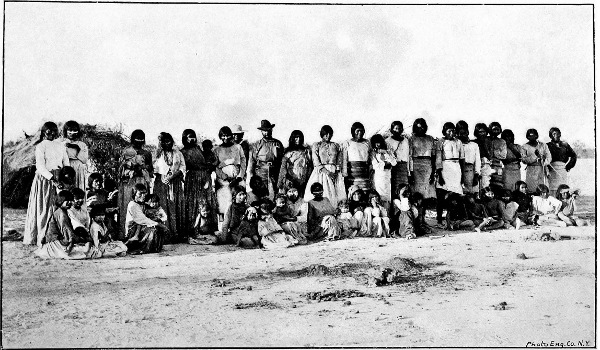
the face in designs by means of mineral pigments. Of the 55 members
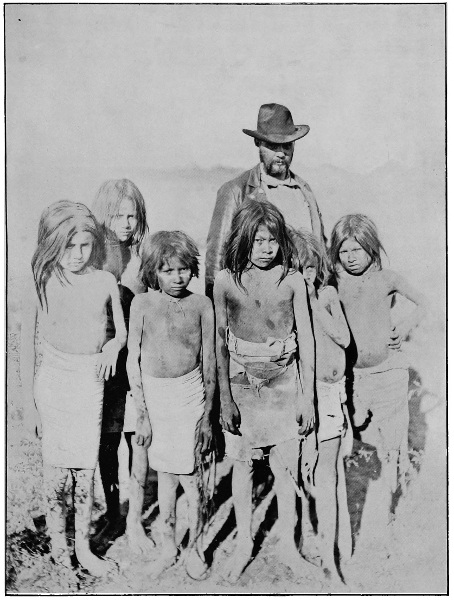
of the tribe shown in the group forming plate XIII, 28 (in the
original photograph; a somewhat less number in the reproduction)
exhibit face-painting more or less clearly, and this proportion may be
regarded as typical; i. e., about half of the tribe are painted.
On noting the individual distribution of face-painting, it is found to
be practically confined to the females, though male infants are sometimes
marked with the devices pertaining to their mothers, as adult
warriors are said to be on special occasions; and so far as observed all
the females, from aged matrons to babes in arms, are painted, though
sometimes the designs are too nearly obliterated by wear to be traceable.
About 35 of the individuals shown in the group (plate XIII) are
females; of these, fully four-fifths showed designs or definite traces of
the paint, while the remaining fifth bore traces too faint to be caught
by the camera; but none of the men or larger boys were painted. In
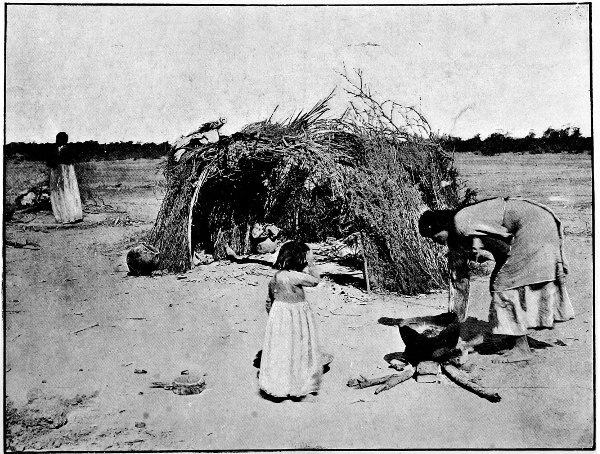
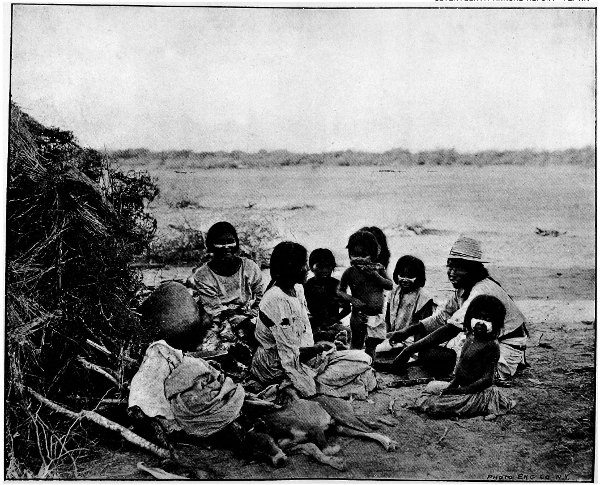
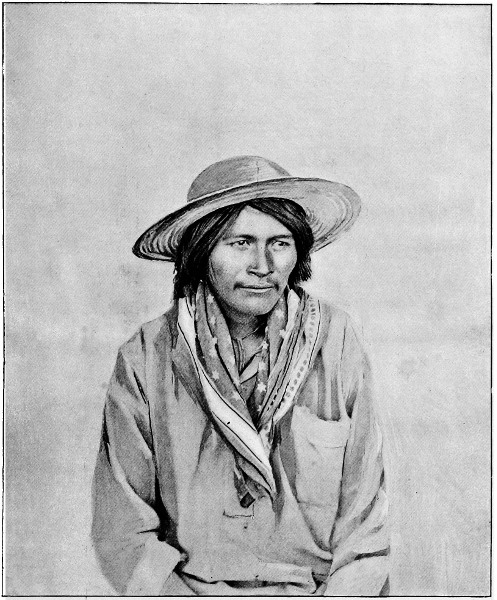
the smaller group shown in plate XIV all of the females display paint,
as does the small boy in the center also, while the man (husband of the
middle-aged matron) reveals no trace of the symbol. The two pictures
typify the prevalence and the distribution by sex of the painting.
BUREAU OF AMERICAN ETHNOLOGY
SEVENTEENTH ANNUAL REPORT PL. XXIV
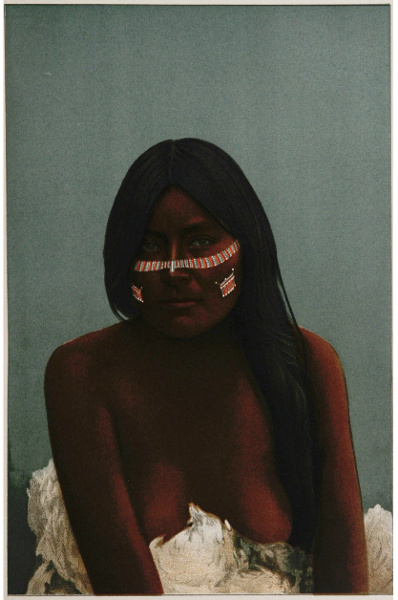
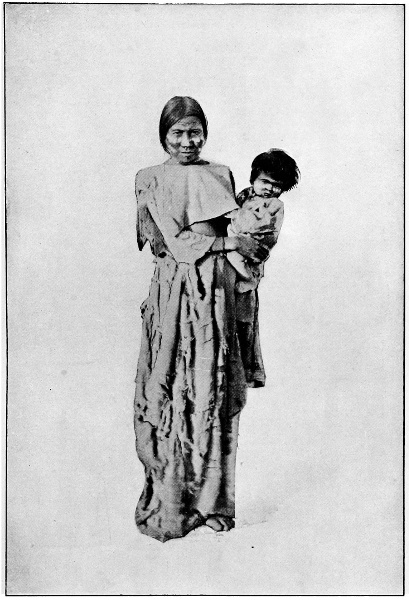
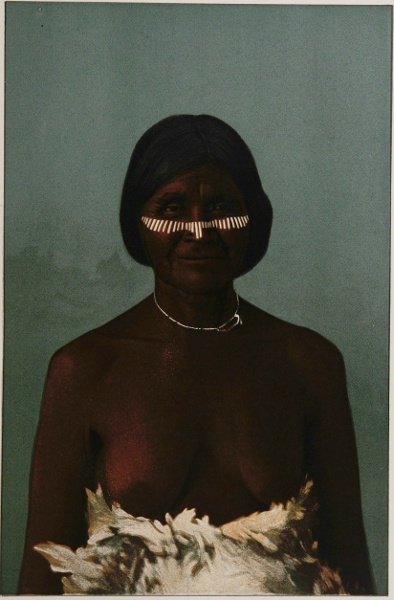
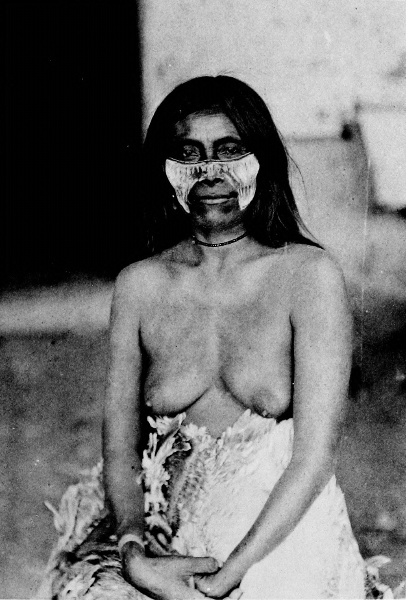
SERI BELLE
The painted designs vary among different individuals, but are fairly
persistent for each. The prevailing design at Costa Rica in 1893 was
that of the aged matron known as Juana Maria (plate XVIII), with
variations in detail such as that exhibited by her unmarried daughter
Candelaria (the Seri belle shown in plate XXIV); next in frequency
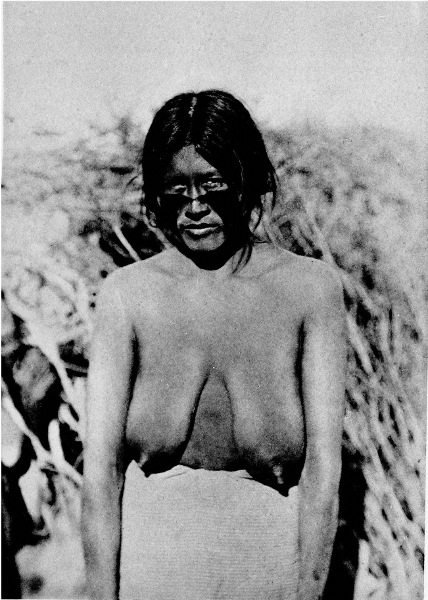
were the designs, in white and red, exhibited by the matrons portrayed
in plates XX and XXII. Other designs observed are indicated in plate
XXVI. The variations in individual designs are apparently due either
to varying care in the application of the paint or to the degree of obliteration
by wear—e. g., the withered Juana Maria sometimes put on her
design askew and was negligent of details, while the blooming Candelaria
greatly elaborated the details of the pattern and carefully perfected
the symmetry of the whole when preparing for her full-dress
sitting before the camera (plate XXIV), so that her design was then
gorgeous by contrast with the nearly obliterated blur of a half-hour
before. The designs are renewed every few days, especially for ceremonious
occasions, and hence are practically permanent.
When grouped in relation to their wearers, the designs are found to
exhibit family connection. Thus, Juana Maria’s design is repeated,
with greater elaboration of detail and with a pair of supplementary
marks, in that of her daughter Candelaria; the winged symbol of the
Seri matron portrayed in plate XX is repeated with minor variations in
that of her daughter, the Seri maiden pictured in plate XXV; while the
symbols of the mother and infant daughter depicted in plate XV are
essentially alike. It is noticeable, too, that in the nearly spontaneous
arrangement of individuals in the group shown in plate XIII there is a
tendency toward subgrouping by symbols; and it was constantly
observed that the family groups gathered about particular jacales
(such as that shown in plate XIV) displayed corresponding designs,
though there were frequent visitors from neighboring jacales bearing
other designs. Briefly, all the observed facts, as well as the supplementary
information gained by inquiry, indicate that the designs are
hereditary in the female line, but are susceptible of slight modification
both in elaborateness of detail and in the addition of minor supplementary
features.
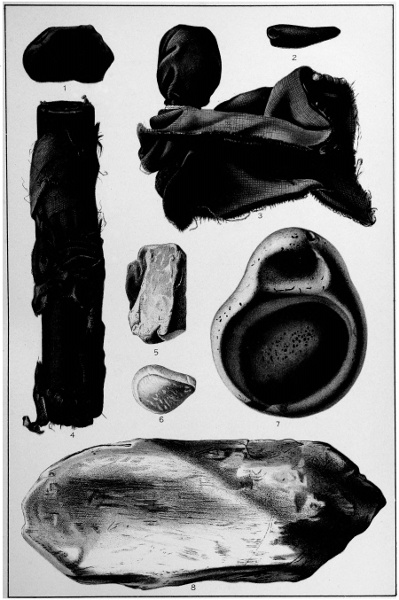
The principal apparatus and materials used in the face-painting are
illustrated in plate XXVII. The chief pigments are ocher, gypsum, and
the rare mineral dumortierite; the ocher yields various shades of red,
ranging from pink to brown; the gypsum affords the white used in most
of the designs; while the dumortierite is the source of the slightly varying
tints of blue. So far as was observed, the pigments are not blended
by mixing, though there is some blending due to overlapping in application.
The ocher is commonly extracted and transported as lumps of
ocherous clay or ocherous gypsum (plate XXVII, figures 1 and 5), though
it is sometimes reduced to powder and transported in bits of skin or
rag, or in cylinders of cane (plate XXVII, figures 3 and 4); and it is
prepared by trituration with a pebble or rubbing with the fingers,
usually in a shell cup. Sometimes the shell used for the purpose is the
valve of a Cardium, which serves indiscriminately as cup, spoon, skin-scraper,
etc.; but preference is apparently given to thick and strong
shells, such as the wave-worn valve of Chama (?), shown in plate
XXVII, figure 7, which are consecrated to the use and eventually buried
with the user, together with a supply of the paint (like that illustrated
in the cane cylinder—figure 4—which was a mortuary sacrifice). The
gypsum is usually carried in natural slabs or other fragments, perhaps
rounded by wear (plate XXVII, figures 6 and 8); it is prepared by wetting
and rubbing two pieces together, the larger being reduced to
metate shape by the operation. The dumortierite was observed only
in the form of a pencil made by pulverizing the substance and mixing
with sufficient clay to give consistency. The several pigments are
applied wet by means of human-hair brushes kept for the purpose, the
process occupying from half an hour to three or four hours for the
more elaborate designs. So far as observed at Costa Rica in 1894, the
paints were mixed in water only; but since painting outfits found on
Tiburon island in 1895 were smeared with grease, it is probable that
either water or fats may serve for menstrua, at the convenience of the
artists. Commonly the process of painting is measurably cooperative.
The matron usually depicts her device on the faces of her daughters
up to the age of 12 or 15 years, when they learn to make the applications
themselves; and frequently two or more women (usually those
with similar devices) work together in preparing and applying the pigments,
each laying the paint on her own face and apparently guiding
her hand partly by the sense of feeling and partly by suggestions
from her coworkers; but Candelaria and some other of the younger
women at Costa Rica frequently worked alone, aided by a mirror
in the form of a shallow bowl of water set in the shadow while the
brilliant desert glare fell full on the face.
The mines yielding the pigments were not located. The geologic conditions
are such that the ochers are undoubtedly abundant; but it is
probable that the gypsum is uncommon and confined to a remote locality
or two, and that the dumortierite is rare and scanty here as elsewhere.
The care with which the paints are preserved, prepared, and
applied, the fact that they are indispensable feminine appurtenances
even on the longest journeys, and their sacred rôle in the mortuary
customs, all combine to indicate that they are among the most highly
prized possessions of the people and by far the most precious of their
minerals.
The sematic functions of the designs are esoteric, yet an inkling of
their meaning was obtained through Mashém, the interpreter at Costa
Rica in 1894; from his expressions it appears that the designs are
sacred insignia of totemic character, serving to denote the clans of
which the tribe is composed. But three clans were identified, and
these only with some uncertainty, viz., the Turtle clan,257 denoted by the
symbols of Juana Maria (plate XVIII) and Candelaria (plate XXIV and
the upper left figure in plate XXVI); the Pelican clan, denoted by the
designs of two typical matrons (plates XX and XXII) and a typical
maiden (plate XXV), and probably also by those of the medio-lateral
figures in plate XXVI; and (still less certainly) the Rattlesnake clan,
denoted by the symbol of the lower left figure in this plate. The
special sematic values of the colors also are esoteric, and were not
ascertained; even in the case of the simple pelican design, the difference
in meaning between the solid red pattern of one group and the
similar pattern of white in another group was successfully concealed.
So, too, the significance of the various subordinate or supplementary
devices—the distinct border-line shown in plate XX, the lower cheek
devices in plate XXIV, the separate chin mark in plate XXV, the fetish-like
symbols on the lower cheeks in the lower left figure of plate XXVI,
etc.—eluded inquiry; while some of the minor features of both form and
color were sufficiently variable in the devices borne by different faces
of the same family, and even in successive paintings of the same face,
to suggest some individual freedom in carrying out the detail of the
generally uniform designs.
BUREAU OF AMERICAN ETHNOLOGY
SEVENTEENTH ANNUAL REPORT PL. XXV
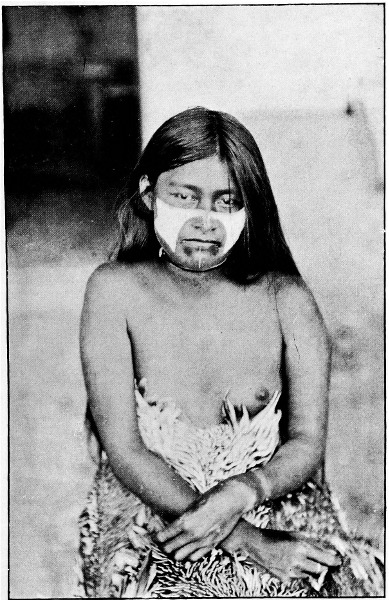
SERI MAIDEN
The telic functions, or ultimate purposes, of the face-painting are
also esoteric, though not beyond the reach of inference from the sematic
functions, coupled with general facts of zoic and primitive human customs.
Even at first sight the painted devices bring to mind the
directive markings of lower animals defined by Professor Todd258 and
interpreted by Ernest Seton-Thompson;259 and in view of the implacably
militant habit of the Seri it would seem evident that the artificial
devices are, at least in their primary aspect, analogous to the natural
markings. On analyzing the directive markings of animals, it is convenient
to divide them into two classes, distinguished by special function,
usual placement, and general relation to animal economy: the first
class serve primarily to guide flight in such manner as to permit ready
reassembling of the flock; they are usually posterior, as in rabbit,
white-tail deer, antelope, and various birds; and they primarily signify
inimical relations to alien organisms, with functional exercise under
stress of fear. The second class of markings serve primarily for
mutual identification of approaching individuals; as comports with
this function, they are usually facial, or at least anterior; and their
functional exercise is normally connected with peaceful association—though
the strongly emphasized facial symbols of the males doubtless
blazon forth the alternative meanings of preference for peace or readiness
for strife, like the calumet tomahawk of the Sioux warrior (as
interpreted by Cushing). So the directive markings of the first class
are substantially beacons of danger and fear, while those of the second
are just as essentially standards of safety and confidence; and they
may properly be designated as beacon-markings and standard-markings,
respectively.260 On seriating the two classes in terms of development,
it is at once found that the beacon-markings are in large measure connected
with excursive movement and are centrifugal in effect, while the
standard-markings are connected mainly with incursive movement and
are centripetal in effect; at the same time the latter express not only
the higher intelligence, but also the greater degree of that conjustment
which forms the basis of collective organization; so that the latter
unquestionably represents the higher developmental stage. Now, the
primary functions of these directive markings of the higher grade—signalization
(or attentionization) and identification—correspond precisely
with paramount needs of the alien-hating and clan-loving Seri;
so that careful analysis would seem fully to justify the casual impression
of functional similitude between the Seri face-painting and the
directive markings of social animals.
While the first survey establishes a certain analogy between the
primitive face-painting and the standard-markings of animals, an important
disparity is noted when the survey is extended to individuals;
for among beasts and birds the standards are usually the more conspicuously
displayed by the males, while the paint devices of the Seri
are confined to the females. A suggestion pointing toward explanation
of this disparity is readily found in the seriation of developmental
stages marked by (1) the fear-born beacon-markings, (2) the confidence-speaking
standard-markings, and (3) the painted symbols; for the artificial
devices coincide with an immeasurably advanced mental development,
with concomitant advance in safety and peace on the one hand
and in artificializing weapons on the other hand. This suggestion
alone fails to explain the disparity fully, yet it raises another, growing
out of the great social advancement connected with the mental development—i. e.,
the effect of the distinctively demotic organization of
the human genus as represented by the Seri people. On considering
this organization, it is found strictly maternal: the tribe is made up of
clans defined by consanguinity reckoned only in the female line; each
clan is headed by an elderwoman, and comprises a hierarchy of daughters,
granddaughters, and (sometimes) great-granddaughters, collectively
incarnating that purity of uncontaminated blood which is the
pride of the tribe; and this female element is supplemented by a masculine
element in the persons of brothers, who may be war-chiefs or
shamans, and may hence dominate the movements of groups, but whose
blood counts as nothing in the establishment and maintenance of the
clan organization. Thus the females alone are the blood-carriers of
the clans; they alone require ready and certain identification in order
that their institutional theory and practice may be maintained; and
hence they alone need to become bearers of the sacred blood-standards.
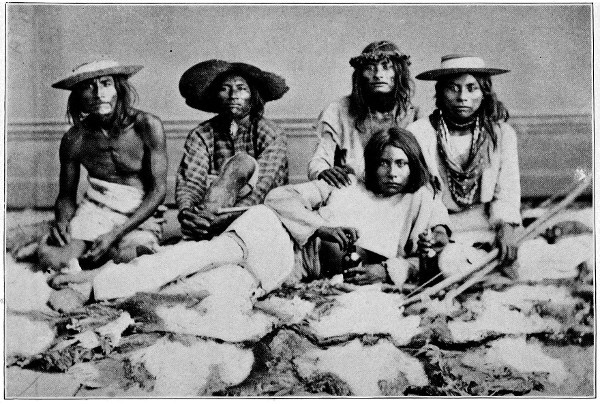
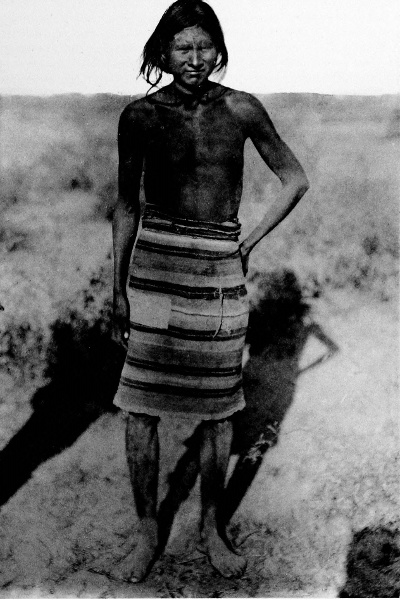
The warriors belong to the tribe, and are distinguished by luxuriantly
flowing hair, by the up-stepping movement from which the people
derive their appellation, by their unique archery attitude, and by their
dark skin-color; the boys count for little until they enter the warrior
class; but on the females devolves the duty of defining and maintaining
the several streams of blood on which the rigidly guarded tribal
integrity depends.261 Undoubtedly the blood-markings play an important
rôle in courtship and marriage, but too little is known of the
esoteric life of the tribe to permit this rôle to be traced.
BUREAU OF AMERICAN ETHNOLOGY
SEVENTEENTH ANNUAL REPORT PL XXVI
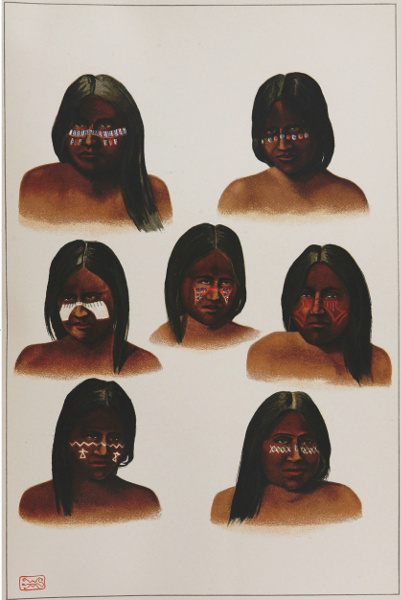
CHARACTERISTIC FACE PAINTING.
In brief, the Seri face-painting would seem to be essentially zoosematic,
or symbolic of zoic tutelaries, and to signify subspecific (or subvarietal)
characteristics maintained by the clan organization and kept
prominent by the militant habit of the tribe; at the same time it is
noteworthy that the purely symbolic motive is accompanied by a
nascent decorative tendency, displayed by the individual refinement of
form and color in the symbol proper to each of the groups.
Aside from the face-painting there is a conspicuous dearth of decoration
or tangible symbolism among the Seri.
The symbolic or decorative modification of the physique would seem
to be limited to two classes of mutilations, of which one was observed
at Costa Rica in 1894 while the other is apparently obsolete. The
observed corporeal modification is the absence of medial superior
incisors of the females, in consequence of forcible removal at a period
not definitely ascertained. The interpreter at Costa Rica was uncommunicative
on the subject; Don Pascual opined that the mutilation
formed part of an elaborate puberty ceremonial, and this opinion would
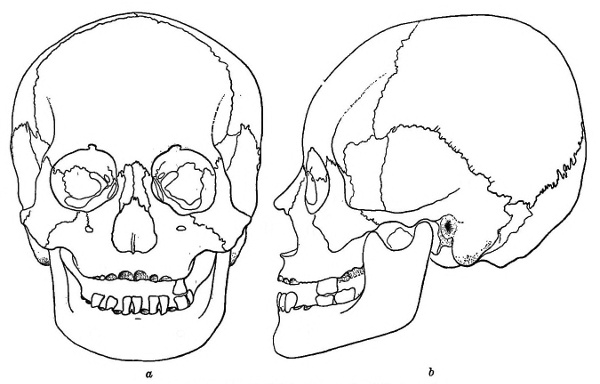
seem to be corroborated by the condition of the cranium of an immature
female examined by Dr Hrdlička; but since the half-dozen adult
maidens at the rancho in 1894 were free from the mutilation while all the
wives bore its gruesome trace, it would seem more probable that the
custom is connected with marriage. Whatever the period of the infliction,
Mashém’s guarded expressions seemed to indicate that it was
a mark of physical inferiority; and this suggestion, interpreted in
the light of the Seri use of teeth as weapons of offense and defense,
would seem to indicate that the mutilation is at once the badge of corporeal
inferiority and a means of maintaining the physical superiority
of the males—of course in that theoretically fiducial but actually forceful
way characteristic of primitive culture.
The second mutilation was the only corporeal modification noted by
early missionaries and explorers—it was the perforation of the nasal
septum for the insertion of a skewer, perhaps of polished stone (though
doubtless more commonly of bone), to which swinging objects were
attached. One of the most useful records is that of the Jesuit, Padre
Joseph Och, who described the nasal attachment as a small, colored
stone suspended by cords from the perforated septum, and guarded with
such jealous veneration that “one must give them at least a horse or a
cow for one” (ante, p. 78); while according to Hardy’s record, the
nasal fetish is “a small, round, white bone, 5 inches in length, tapering
off at both ends, and rigged something like a cross-jack yard.”262
The custom is apparently obsolete, and nothing is known directly of
details or motives.
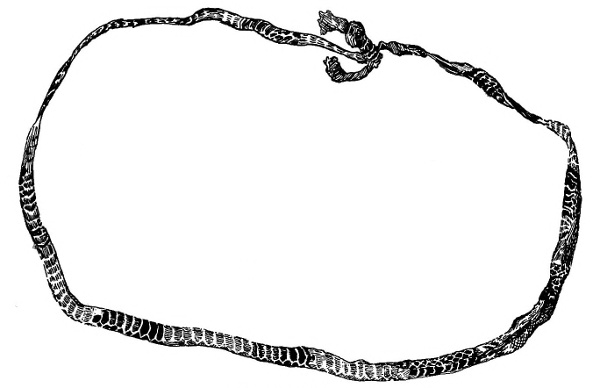
Fig. 7—Snake-skin belt.
Excepting these mutilations the corporeal decoration of the Seri is
apparently limited to the face-painting: among the 60 individuals at
Costa Rica in 1894 there was no trace of tattooing or scarification of
face, limbs, or body; there were no labrets or earrings, and neither
lips nor ears were pierced, nor were nasal septa observed to be perforated
in accordance with the reputed ancient custom; the teeth were
neither filed nor drilled; no indications of amputation or other maiming
(save the removal of the incisors) were observed—indeed, the
instinct for physical markings of symbolic or decorative character,
which seems to be normal to primitive men, was apparently satisfied
by the prevalent and persistent face-painting among the females.
The extra-corporeal decorative devices are of a meagerness and poverty
even transcending the poor apparel, flimsy habitations, and generally
ill-developed artifacts of the lowly tribe.
BUREAU OF AMERICAN ETHNOLOGY
SEVENTEENTH ANNUAL REPORT PL XXVII
SERI FACE PAINTING PARAPHERNALIA.
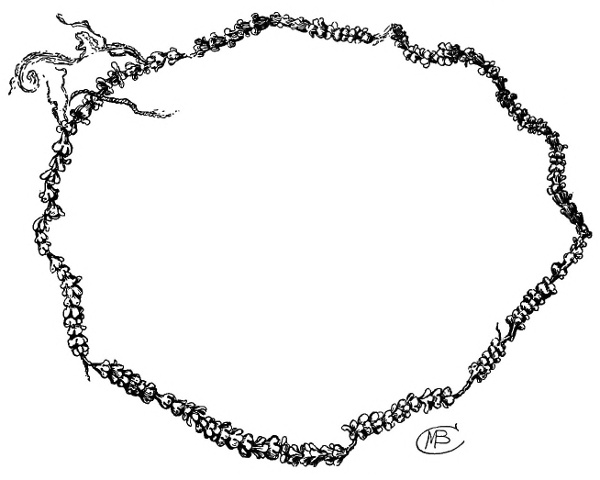
Fig. 8—Dried flower necklace.
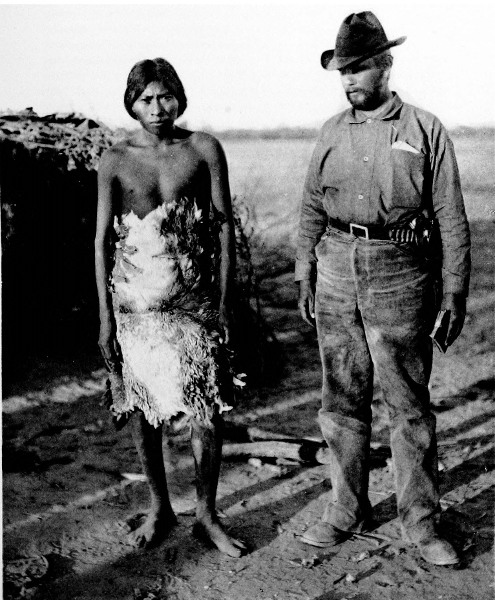
The most prominent personal possession is the pelican-skin robe; it
is usually made of six skins, slightly dressed and in full plumage, sewed
together with sinew in a conventional pattern of such sort as to give
the greatest possible expanse consistent with the irregular outlines of
the individual skins, and at the same time to display a conventional
color pattern on the feathered side, the colors ranging from the dorsal
slate to the ventral white of the fowl (as indicated in plate XXIII);
sometimes there are only four skins and rarely there are eight, but the
conventional arrangement is maintained. Before the beginning of a
fairly regular barter at Rancho de Costa Rica, and hence before the introduction
of manta and other stuffs, the pelican-skin robes were supplemented
by kilts made of mesquite root or other fibers, spun and twisted
in the fingers and woven probably on some primitive device no longer
in use; but so far as is known these native fabrics were devoid of decorative
patterns in color or weave. Less habitually a short wammus or
shirt, with long sleeves, made of a material similar to that of the kilt,
was worn; but it, too, was without ornamentation, so far as can be
ascertained. The remaining article of utilitarian apparel is the belt,
usually consisting of a strip of skin (of deer, rabbit, peccary, etc.),
slightly dressed with the hair on; frequently this is replaced by a cord
or braided band of human hair, while the favorite belt of some of the
young warriors is a snake skin (such as that illustrated in figure 7); but
so far as was seen the belts are not extended into tassels, decorative
appendages, or even flowing ends.
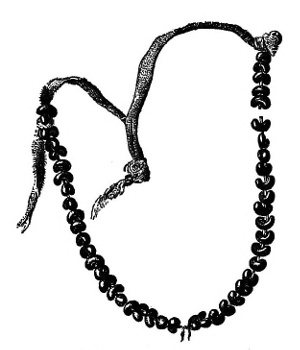
Fig. 9—Seed necklace.
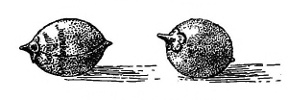
Fig. 10—Nut pendants.
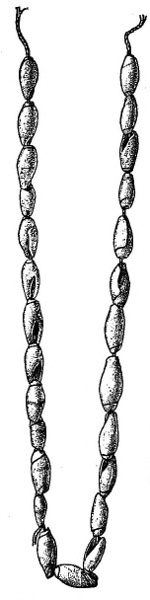
Fig. 11—Shell beads.
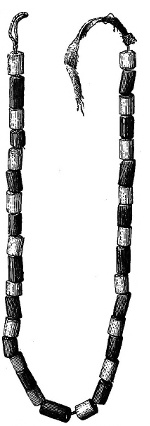
Fig. 12—Wooden beads.
The presumptively decorative costumery observed is limited to necklaces,
usually of strung seeds, shells, and beads of wood or bone (figures
8, 9, 10, 11, 12, and 13), though animal appendages, such as hoofs,
teeth, etc., are sometimes worn. The most highly prized necklace found
at Costa Rica was a human-hair cord with nine crotalus rattles attached
(figure 14), worn by a young warrior of the Rattlesnake (?) clan. Not
the slightest indication of headdresses
was seen (though deer
and lion masks are said by
Hardy to have been worn on
occasions); there were no bracelets,
leg-bands, or rings of any description, and the cheap jewelry
given to many of the women and youths at Costa Rica was either
strung about the neck or concealed; while it is significant that even the
showiest jewelry was less appreciated than bits of manta or lumps of
sugar. When it is remembered that the Seri have been in occasional
contact with Caucasians for over three and a half centuries, the fact
that not a single glass bead was found among them becomes significant;
and the significance of the simple fact is increased by the virtual
absence of that persistent desire and protean use for beads—or bead-sense—so
prominent among most primitive tribes.
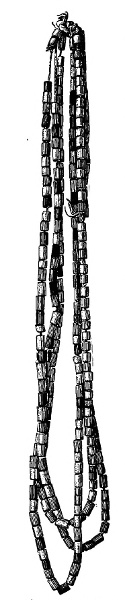
Fig. 13—Necklace of
wooden beads.
Naturally the conditions at Costa Rica were unfavorable to the study
of native ideas concerning apparel. The women and some of the children
were arrayed chiefly in cast-off habiliments of
the rancheras or in nondescript rags, while the men
either aped Mexican fashions, like Mashém, or shamefacedly
sweltered under the unaccustomed burden of
tatterdemalion gear; yet there was a meaningful
absence of that desire for finery so prominent among
primitive peoples—a fact quite as eloquent in itself
as the absence of bracelets and bangles, tassels and
trappings. It is probable that the shamans and
mystery-hedged crones in the depths of Seriland
enhance their influence by the aid of symbolic paraphernalia
(indeed, some inkling of such customs is
found in the meager records of earlier visitors);263 yet
the conspicuous feature of Seri costumery is the
dearth of decorative devices.
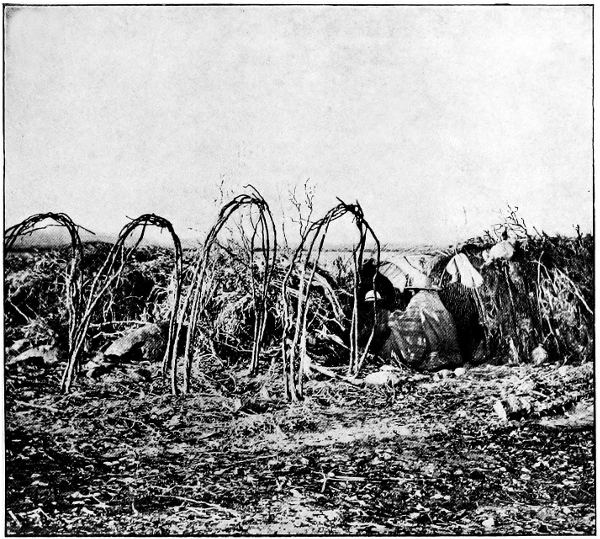
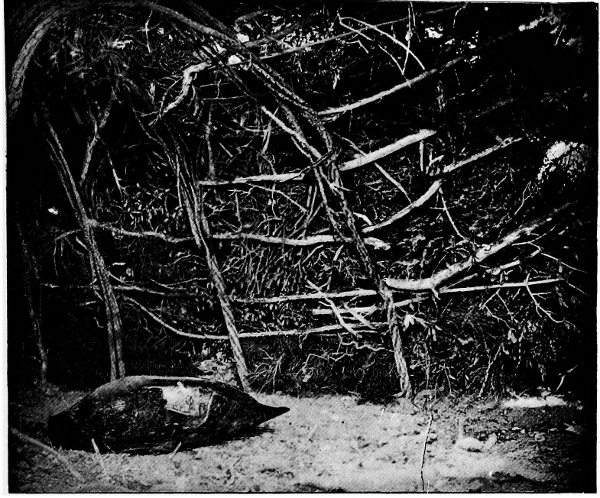
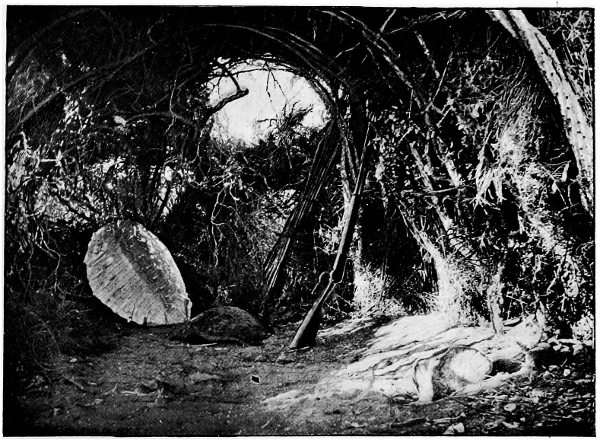
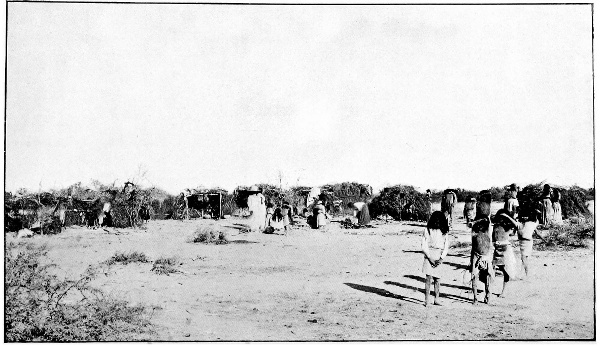
The habitations of the tribe are the simplest of
jacales—mere bowers, affording partial protection
from sun and wind, but not designed to shed rain
or bar cold. Half a dozen of these were examined at
Costa Rica in 1894 and probably a hundred more, in
various stages of habitability, in Seriland proper in
1895, yet not the slightest trace of decoration was
observed—the structures are plainly and barrenly
utilitarian in every feature. The same may be said
of the balsas in which the Seri navigate their stormy
waters; for the peculiarly graceful curves of the craft
evidently stand for nothing more than the mechanical
solution of a complex problem in balanced forces,
wrought out through the experience of generations,
while the simple reed bundles are absolutely devoid
of paint, of superfluous cord, of fetishistic appendages
or markings, of tritons, nereids, or other votive symbols
at bow or stern, and of industrially superfluous
features or attachments in general—indeed, the only
appendages discovered were one or two simple wooden
marlinspikes (shown in figure 26), thrust among the
reeds to be at hand in case of need for repairs.
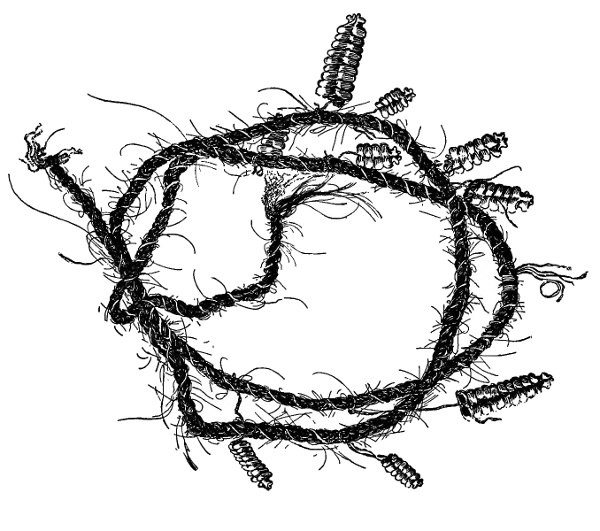
Fig. 14—Rattlesnake necklace.
Among the utensils employed in the primitive
householdry of the Seri the most conspicuous and
at the same time the most essential is the olla, or
water-jar. Its technical features are described elsewhere; but it may
here be noted that the olla is the central artifact about which the very
life of the tribe rotates: since the clans never reside and rarely camp
nearer than 3 to 15 miles from the aguaje, a large part of the water
consumed must be transported great distances in these vessels; since
the region is one of extreme aridity, the lives of small parties often
depend on the integrity of the olla and on the care with which the
fragile vessel is protected from shock or overturning; and hence the
utensil must occupy a large if not a dominant place in everyday
thought—indeed, the fact that it does so is attested by constant
custom and also by its employment as the most conspicuous among
the mortuary sacrifices. Thus, the relation of the Seri olla to its
makers and users is parallel with that of the ever-present earthen pot
to the Pueblo people, or that of the cooking basket to the acorn-eaters
of California, save that its relative importance is enhanced
by the fewness of activital lines and motives in Seri life. Moreover,
this most characteristic utensil is established and hallowed in Seri
thought by immemorial associations: its sherds are sown over the
hundred thousand square miles of ancient “despoblado” from Tiburon to
Caborca, Magdalena, Rio Opodepe, and Cerro Prieto, and are scattered
through the 90 feet of shells forming Punta Antigualla (perhaps the
oldest shell mound of America); and all the sherds from the range
and the shell-strata are so like and so different from any other fictile
ware as to be distinguished at a glance. Hence it would seem manifest
that the Seri olla must constitute a normal nucleus for the Seri esthetic;
yet even here the field is practically barren, as is shown by the study of
a score of usable and mortuary specimens and of thousands of sherds.
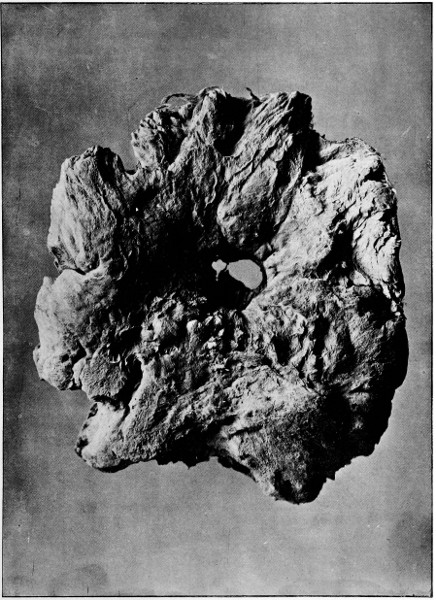
The most ornate specimen seen is that depicted in plate XXXII. Its
form, like that of the balsa, is a mechanical equation of forces and
materials; its body-color is that of the clay, blotched and blackened
irregularly by the smoke of the firing; and its decoration is limited to
17 faint lines or bands radiating downward from the ill-shaped neck.
The radial bands were evidently drawn by a finger dipped in clayey
water after the vessel was otherwise finished for the firing; they are
irregular in placement, width, length, and direction; they generally
run in pairs, two straight lines alternating with two zigzag lines, though
the circuit is completed by two zigzags drawn wide apart and separated
by a single straight line. The meaning of the device (if meaning there
be) was not directly ascertained; but it is suggestive that its maker and
owner was the mother of the youthful warrior from whom the rattlesnake
necklace was obtained (her face-symbol is that shown in the
lower left figure of plate XXVI), and that the vessel was surrendered
more reluctantly than any other article obtained from the tribe.
Another utensil of some importance to the tribe is a basket of the
type illustrated in figure 24. It is manufactured with much skill
and is used for various domestic purposes, being practically water-tight
and unbreakable, and materially lighter than even the unparalleledly
light fictile ware of the Seri. In form and size and weave the half dozen
examples seen correspond with widespread southwestern types; yet it
is noteworthy that while otherwise similar baskets are habitually decorated
by other basket-making tribes, the Seri specimens were absolutely
devoid of decorative devices.
Practically the only remaining artifacts available for decoration are
those connected with archery; and it suffices to say that while the bows
are skilfully made and the arrows constructed with exceeding pains,
not a single specimen seen showed the slightest trace of symbolism or
of nonutilitarian motive.
Summarily, the Seri are characterized by extreme esthetic poverty.
This has been noted by the early missionaries and by the few other travelers
who have approached their haunts, as well as by the vaqueros on
the Encinas and Serna and other ranchos bordering their range, who
know them as “los pobrecitos”. All observers have been struck with
their destitution and squalor; yet when the impressions are particularized
they are seen to denote absence of the poor luxuries, rather than
the bare necessities, of primitive life. The people are pathetically poor
in the industrial sense; their equipment in artifacts—implements,
weapons, utensils, habitations, apparel—is meager almost, if not quite,
beyond parallel in America; yet their esthetic equipment, practically
limited as it is to a single line of symbolic portrayal, is still more
abjectly meager.
Any comparison of the Seri esthetic with that of other Amerind
tribes serves only to emphasize its paucity: the tribes of the plains,
with their eagle-feather headdresses, elaborately arranged scalp-locks,
widely varied face-painting, and ritualistic camp circles; the Pueblo
peoples, with their ornate masks, elaborate altars, figured stuffs, and
painted pottery; the denizens of the eastern woods, with their feather-decked
peace-pipes, divinatory games, fringe-bordered garments, and
prayer-inscribed arrows; the coastwise peoples of the upper Pacific,
with their labrets and tattoo-marks, totem-poles and carved house-fronts,
painted canoes and prodigal potlatches; the neighboring desert
tribes, with their festal footraces, decorated pottery and basketry,
pendent scarfs and garters, and well-wrought caskets for family fetishes;
even the timid acorn-eaters of California, with their sacramental baskets,
artistically befringed kilts, bead-strings of far-traveled nacre, and
patiently wrought fabrics of rare feathers—all of these seem rich in
esthetic motives when contrasted with “los pobrecitos” of arid Seriland.
And the contrast is only intensified when the economic motives of the
various tribes are compared: the industrial motives of the Seri are
fairly numerous and diverse; they are skilful huntsmen, successful
fishermen, capable navigators, and competent warriors (as attested by
the protection of their principality for centuries), so that despite the
absence of agriculture and the avoidance of commerce, their industrial
range is not very far below the aboriginal average; and while they are
deficient in thrift, this shortcoming is balanced by a peculiarly developed
vital economy whereby they are delicately adjusted to their
environment, as has been already shown. On the whole, it would
appear that the Seri are not only lower in esthetic development than
the contemporary tribes thus far studied, but also that they stand at
the bottom of the scale in the ratio of esthetic to industrial motives.
Largely through recent researches among the American aborigines,
it has been shown that decorative and many if not all other esthetic
concepts normally arise in symbolism, gradually expand in conventionism,
and eventually mature in a realism which is itself the source
of ever-extending esthetic motives; and the observations on the lowly
Seri afford opportunity for somewhat extending the generalizations
based on higher tribes.
When peoples of unequal cultural development are compared, it is
commonly found that the higher are the more independent in action
and thought: thus, advanced peoples make conquest of nature for their
own behoof, while primitive peoples are largely creatures of environment;
Caucasian citizens are self-conscious lawmakers, while Amerind
tribesmen are semiconsciously dominated by mysteries fearsomely
interpreted by their shamans; and, in general, enlightened men think
and speak freely, come and go as they like, and discard the badges of
conventionism, while savages are constrained by customs carrying the
power of law, controlled by precedent, and clothed in hierarchic regalia.
So, too, when a particular series of tribes are compared, it is found that
those of higher culture (or wider knowledge) are the more independent,
the more given to essays in social and industrial and other lines of
activity, and hence the more varied in esthetic and economic motives:
thus, the several Iroquoian tribes integrated the knowledge proper to
each, and thus made themselves an intellectual and physical power
able to eliminate or assimilate the isolated tribes on their borders; the
sages of the Siouan stock induced the warriors of their leading tribes
to combine in a circle of seven council fires, which grew into the great
Dakota confederacy and soon gained strength to dominate the entire
northern plains; but while these and other federations were pushing
forward on the way leading to feudalism and thence to national organization,
the self-centered California tribes consecrated their tongues to
their own kindred, thereby stifling culture at its source and virtually
leashing themselves unto the acorn-bearing oaks of their respective
glades. Still more striking are the differences in independence revealed
by a comparison of human and subhuman organisms; for the humans
are immeasurably freer and more spontaneous in thought and action
than even the highest beasts: thus, the Seri blood-bearer applies,
renews, and elaborates her face-mark at will, while the antelope and
the raccoon unconsciously develop their standard-marks through the
tedious operation of vital processes regulated under the cruel law of
survival; men make their beds according to the dictates of judgment,
while the half-artificialized dog lies down in accordance with a hereditary
custom which has been needless for a hundred generations; and
the very essence of human activity is volitional choice (or artificial
selection), while the keynote of merely organic agency is the nonvolitional
chance of natural selection. No less striking are the differences
found on comparing other realms of nature, in which the higher are
invariably characterized by the greater independence; the animal
realm is distinguished from the vegetal realm mainly by the possession
of volitional motility; while the vegetal is distinguished from
the mineral realm chiefly by those better selective powers exemplified
in vital growth. The several comparisons seem to define that course
of volitional development arising in the chemical and mechanical affinities
of the mineral realm, burgeoning in simple vitality, multiplying in
the motility of animal life, greatly expanding in the collective activity
of demotic organization, and culminating in the conquest of nature
through the mind-guided powers of enlightened mankind. Expressed
briefly, this course of development may be characterized as the progressive
passage from automacy to autonomy.
The volitional development thus seriated may be divided, somewhat
arbitrarily yet none the less safely, into its esthetic and economic
factors; and, for convenience, the latter maybe considered to comprise
the industrial, institutional, linguistic, and sophic constituents—i. e.,
the esthetic activities may be juxtaposed against the several other activities
of demotic life. When this division is made, it at once becomes
manifest that the esthetic activities are the freest and most spontaneous
of the series, and hence lead the way to that autonomy which marks
the highest development. This significant relation has been glimpsed
by various artists and poets, scholars and naturalists; it was at least
partly caught by Goethe when he taught that knowledge begins in
wonder; it was loosely seized by Schiller, and later by Spencer, in the
surplus-energy theory of play; it was grasped by Groos in his prophecy
theory of play,264 and still more firmly (although less conspicuously) by
Seton-Thompson in his analysis of animal conduct and motives. The
relation has for some years been recognized as one of the principles
underlying the American ethnologic researches; yet it is not so well
understood as to obviate the need for further consideration. Accordingly
it may be pointed out that while the human activities and the
agencies of lower nature rest alike on a mechanical foundation, the
mechanical element diminishes in relative magnitude in passing from
the lower to the higher realms of nature: in the mineral realm the
agencies may be deemed mechanical in character and individual in
effect; in the vegetal realm vitality is superadded, and the effects are
carried forward through heredity; in the animal realm motility is
added in turn, and instinct arises to shape the individual and hereditary
and motile attributes; the social realm may be considered to be
marked by the accession of conjustment, with its multifarious and
beneficent effects on individuals, generations, movements, and groups;
while the rational realm maybe defined as that arising with the accession
of reason as a guide to action, and with the development of
nature-conquest as its most characteristic effect—though it is to be
noted that the several transitions are progressive rather than saltatory.
Thus each realm is characterized by the attributes of each and all of
those lower in the scale, plus its own distinctive attribute. It may
also be pointed out that each new attribute defining a higher realm is
freer and more spontaneous than those of lower realms; for vitality is
freer than mere affinity, self-movement than mere growth, and cooperation
than mere movement, while reason-led action is freest of all.
Accordingly each realm (as already implied) is characterized by a larger
autonomy than any of those lower in the scale; i. e., by all the factors
of autonomy in the lower realms, plus its own distinctive factor.
It may be pointed out farther that, in the higher realms at least,
the action normal to each realm tends to generate that characteristic
of the next higher realm: the self-movement of the animal realm is,
under favorable conditions, constrained through vital economy to fall
into the conjustment of the social realm; and the organization of the
social realm, involving as it does a hierarchic arrangement of organisms
according to mentality,265 habituates the higher individuals of the
organizations to that control of lower individuals which buds in agriculture,
blossoms in civil rule, and fruits in nature-conquest. Thus
the factors of each realm are prophetic of the distinctive factor of the
next higher—and the prophecy is not merely passive, but is, rather, an
actual step in causal sequence.
It may be pointed out still further that, in the higher realms at least,
spontaneous action necessarily precedes maturely developed function:
in the vegetal realm the tree shoots upward before its form is shaped
and its tissue textured by wind and sun and environing organisms; in
the animal realm youthful play presages the prosaic performances normal
to adult life; in the social realm men behave before framing laws
of behavior; and in the rational realm fortuitous discovery paves the
road for sure-footed invention. Thus natural initiative arises in spontaneous
action, while mechanical action is mainly consequential.
It may be pointed out finally that the field of spontaneous action is
relatively increased with the endless multiplications of action accompanying
the passage from the lower realms to the higher—indeed the
relations may be likened unto those of exogenous growth, which is
largely withdrawn from the irresponsive and stable interior structures
and gathered into the responsive and spontaneously active peripheral
structures; so that spontaneous activity attending natural development
is relatively more important in the higher stages than in the lower.266
Now, on combining the several indications it is found clear (1) that
the more spontaneous developmental factor in all normal growth corresponds
with the esthetic factor in demotic activity; (2) that this is
the initiatory factor and the chief determinant of the rate and course
of development; (3) that it is of relatively enlarged prominence in the
higher stages; and hence (4) that the esthetic activities afford a means
of measuring developmental status or the relative positions in terms of
development of races and tribes.
On applying these principles to the Seri tribe, in the light of their
meager industrial motives and still poorer esthetic motives, it would
appear that they stand well at the bottom of the scale in demotic
development. Their somatic characteristics are suggestively primitive,
as already shown; and the testimony of these characteristics is
fully corroborated by that of their esthetic status as interpreted in the
light of the laws of growth.
The pacific vocations of the Seri are few. They are totally without
agriculture, and even devoid of agricultural sense, though they consume
certain fruits and seeds in season; they are without domestic
animals, though they live in cotoleration with half-wild dogs, and perhaps
with pelicans; and they are without commerce, save that primitive
and inimical interchange commonly classed as pillage and robbery.
Accordingly, their pacific industries are limited to those connected
with (1) sustentation, chiefly by means of fishing and the chase; (2)
navigation and carrying, (3) house-building, (4) appareling, and (5)
manufacturing their simple implements and utensils; and these constructive
industries are balanced and conditioned by the destructive
avocation of (6) nearly continuous warfare.
The primary resource of Seriland is raised to the first place in
realized importance only by its rarity, viz., potable water—a commodity
so abundant in most regions as to divert conscious attention
from its paramount role in physiologic function as well as in industrial
economy. The overwhelming importance of this food-source is worthy
of closer attention than it usually receives. Classed by function,
human foods are (1) nutrients, including animal and vegetal substances
which are largely assimilated and absorbed into the system; (2) assimilants,
including condiments, etc., which promote alimentation and
apparently aid metabolism; (3) paratriptics, or waste preventers,
including alcohol and other stimulants, which in some little-understood
way retard the waste of tissue and consequent dissipation of vital
energy; and (4) diluents, which modify the consistency of solid foods
and thereby facilitate assimilation, besides maintaining the water of
the system. Classed by chemic constitution, the foods may be divided
into (1) proteids, or nitrogenous substances, including the more complex
animal and vegetal compounds; (2) fats, or nonnitrogenous substances
in which the ratio of hydrogen and oxygen is unlike that of
water, and which are second in complexity among animal and vegetal
compounds; (3) carbohydrates, or nonnitrogenous compounds of carbon
with hydrogen and oxygen in the proportions required to form
water, which are among the simpler vegetal and animal compounds;
and (4) minerals, chiefly water, with relatively minute quantities of
various salts. Both classifications are somewhat indefinite, largely
because most articles of food combine two or more of the classes; yet
they are useful in that they indicate the high place of the simple
mineral water among food substances. Quantitatively this constituent
stands far in the lead among foods; the human adult consumes
a daily mean of about 4½ pounds of simple liquids and 2½ pounds of
nominally solid, but actually more than half watery, food; so that the
average man daily ingests nearly 6 pounds of water and but little over 1
pound of actually solid nutrients. Thus the ratio of the consumption
of liquid food to that of solids is (naturally, in view of that readier elimination
of the liquid constituent so characteristic especially of arid
regions) somewhat larger than the ratio of water to solids in the human
system, the ratios being nearly 6:1 and 4:1, respectively.267 This analysis
serves measurably to explain the peculiarly developed water-sense of all
desert peoples, a sense finding expression in the first tenets of faith
among the Pueblos, in the fundamental law of the Papago, and in the
strongest instinct of the Seri; for among folk habituated to thirst
through terrible (albeit occasional) experience, water is the central
nucleus of thought about which all other ideas revolve in appropriate
orbits—it is an ultimate standard of things incomparably more stable
and exalted than the gold of civilized commerce, the constantly
remembered basis of life itself.
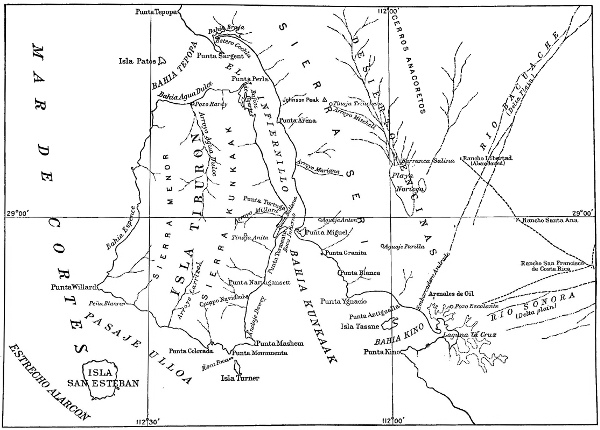
The potable water of Seriland is scanty in the extreme. The aggregate
daily quantity available during ten months of the average year
(excluding the eight wettest weeks of the two moist seasons) can hardly
exceed 0.1 or 0.2 of a second-foot, or 60,000 to 125,000 gallons per day, of
living water, i. e., less than the mean supply for each thousand residents
of a modern city, or about that consumed in a single hotel or apartment
house. Probably two-thirds of this meager supply is confined to a single
rivulet (Arroyo Carrizal) in the interior of Tiburon, far from the
food-yielding coasts, while the remainder is distributed over the 1,500
square miles of Seriland in a few widely separated aguajes, of which
only two or three can be considered permanent; and this normal supply
is supplemented by the brackish seepage in storm-cut runnels, as
at Barranca Salina, or in shallow wells, as at Pozo Escalante and Pozo
Hardy, which is fairly fresh and abundant for a few weeks after each
moist season, but bitterly briny if not entirely gone before the beginning
of the next. The scanty aggregate serves not only for the human
but for the bestial residents of the Seri principality; and its distribution
is such that the mean distance to the nearest aguaje throughout the
entire region is 8 or 10 miles, while the extreme distances are thrice
greater.
The paucity of potable water and the remoteness of its sources naturally
affect the habits of the folk; and the effect is intensified by a curious
custom, not fully understood, though doubtless connected with
militant instincts fixed (like the habits of primitive men generally) by
abounding faith and persistent ritualistic practice—i. e., the avoidance
of living waters in selecting sites for habitations or even temporary
camps. Thus the principal rancherias on Tiburon island, about Rada
Ballena, are some 4 miles from Tinaja Anita, the nearest aguaje; the
extensive rancherias near Punta Narragansett measure 10 miles by
trail from the same aguaje; the half dozen jacales about Campo Navidad
are separated by some 15 miles of stony and hilly pathway from the
alternative watering places of Tinaja Anita and Arroyo Carrizal;268 and
the huts crowning the great shell-heap of Punta Antigualla—one of
the most striking records of immemorial occupancy in America—are
nearly or quite 10 miles by trail from Pozo Escalante, and still further
from Aguaje Parilla, the nearest sources of potable water. These are
but typical instances; and while there are ruined huts (evidently
regarded as temporales) near the dead waters of Barranca Salina and
Pozo Escalante, they tell the tribal policy of locating habitations in
places surprisingly remote from running water. Like other desert
folk, the Seri have learned to economize in water-carrying by swigging
incredible quantities on their occasional visits to the aguajes; it is probable,
too, that their systems are inured, somewhat as are those of
the desert animals that survive deprivation of water for days or months,
to prolonged abstinence from liquid food; yet it seems safe to assume
that at least half of the water required in their vital economy (say 2 or
3 pounds apiece daily, on an average) is consumed after transportation
over distances ordinarily ranging from 4 to 12 miles. Under these
conditions the Seri have naturally produced a highly developed water
industry; they are essentially and primarily water-carriers, and all
their other industries are subordinated to this function.
Concordantly with their customs, the Seri have a highly differentiated
aquarian device in the form of a distinctive type of olla, which is
remarkable for the thinness and fragility of the ware, i. e., for largeness
of capacity in proportion to weight. Representative specimens are
illustrated in plates XXXII and XXXIII (the former painted, as already
described). The dimensions of the two vessels are as follows: painted
olla, height 34 cm. (13⅜ inches), mean diameter 32.5 cm. (12¾ inches);
plain olla, height 32 cm. (12⅝ inches), mean diameter 32 cm. In both
specimens the walls are slightly thickened at the brim, those of the
painted vessel measuring about 4 mm. and those of the plain vessel
about 4.5 to 5 mm. in thickness. Below the brim the walls are thinned to
about 3 mm., as is shown in the fractured neck of the painted specimen.
The capacity of these Seri vessels in proportion to their weight, compared
with that of typical examples of ware produced by other desert
peoples, is shown in the accompanying table.
Comparison of the mean ratios indicates that the Seri ware is almost
exactly twice as economical as that of the Pueblos—i. e., that its capacity
is twice as great in proportion to the weight of the vessel; and that
even the ware of the wide-wandering Papago is more extravagant than
that of the Seri in the ratio of 100 to 54. It is noteworthy, too, that
the typical Seri ware is much more uniform than that of the other
tribes; the various specimens seen in use at Costa Rica, and nearly
entire in various parts of Seriland, were closely similar in form and
nearly alike in dimensions; while the innumerable smaller fragments
scattered over Seriland and the neighboring “despoblado” or buried
amid the shells of Punta Antigualla correspond precisely in thickness,
in curvature, in material, and in finish with the ware observed in use.
|
Capacity |
Weight |
Ratio |
Mean ratio |
| Seri: |
Liters |
Kilograms |
|
|
| Plain |
15.14 |
1.91 |
0.126 |
0.137 |
| Painted |
15.61 |
2.30 |
.147 |
| Papago: |
| No. 1 |
17.03 |
4.08 |
.239 |
.253 |
| No. 2 |
8.51 |
2.38 |
.279 |
| Sia |
15.14 |
3.82 |
.252 |
.271 |
| Zuñi |
12.30 |
3.18 |
.258 |
| Acoma |
15.61 |
4.31 |
.276 |
| Hopi |
13.72 |
4.06 |
.295 |
Neither the manufacture of the ware nor the sources of material have
been observed by Caucasians. Examination of the specimens indicates
that the material is a fine and somewhat micaceous clay, apparently
an adobe derived from granitoid rocks; and such material might be
obtained in various parts of Seriland. The structure of the ware
reveals no trace of coiling or other building process, nor does the texture
clearly attest the beating process employed by the Papago potters;
but there is a well-defined lamellar structure, and the surfaces (especially
inner) are striated circumferentially or spirally in such manner
as to suggest a process of rubbing under considerable pressure. All
the specimens are so asymmetric as to indicate the absence of mechanical
devices approaching the potter’s wheel, while the necks are of such
size as to admit the hand and forearm of an adult female but not of a
warrior. Some suggestion of the manufacturing process is afforded by
miniature fetishistic and mortuary specimens, such as those depicted
in figures 17 and 18, and the larger specimens shown in figure 39, which
were evidently shaped from lumps of suitable clay first hollowed and
then gradually expanded by manipulation with the fingers, with little
if any aid from implements of any sort. On putting the various indications
together it would seem probable that the
ware is made by the women, and that each piece is
shaped from a lump of tempered and well-kneaded
clay of suitable size, first hollowed and rudely shaped
over one hand, and gradually expanded by spiral
rubbing, kneading, and pressure between the hands
of the maker. The burning is incomplete and variable,
suggesting a little outdoor fire in a shallow pit
adapted to a single vessel. The ware is without
glaze or slip or other surficial treatment save that
the lamellar texture is best developed toward the
surfaces; hence it is so porous that the filled vessel is
moist even in the sun.
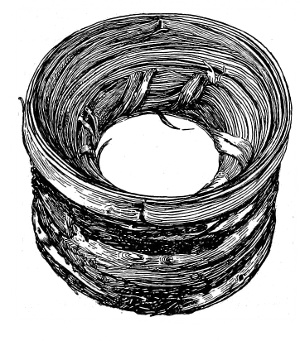
Fig. 15—Seri olla ring.
Ordinarily women are the water-bearers, each carrying
an olla
balanced on
the head with
the aid of a
slightly elastic
annular
cushion, usually
fashioned
of yucca fiber
(plate XXXII
and figure
15), though in
some cases
two ollas are
slung in nets
at the ends of
a yoke (figure
16) after the
Chinese coolie fashion (this device being apparently
accultural).

Fig. 16—Water-bearer’s yoke.
The function of the conventional Seri olla is exclusively
that of a canteen or water-carrying vessel, and
its form is suited to no other use; while its lines, like
its thinness of wall, are adapted to the stresses of
internal and external pressure in such wise as to give
maximum strength with minimum weight. It is by
reason of this remarkably delicate adaptation of
materials to purposes that the plain olla figured in
plate XXXIII, weighing an ounce or two more than 10
pounds in dry air, holds and safely carries three and
one-third times its weight of water. When such ollas
are broken, the larger pieces may be used as cups or
dishes, or even as kettles, in the rare culinary operations of the tribe (as
shown in plate X); but the entire vessels appear to be religiously devoted
to their primary purpose.
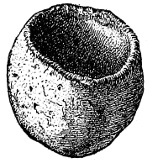
Fig. 17—Symbolic mortuary olla.
While some three-fourths of the observed fictile ware of the Seri and
a still larger proportion of the scattered sherds represent conventional
ollas, there are a few erratic forms. The most conspicuous of these is a
smaller, thicker-walled, and larger-necked type, of which three or four
examples were observed; two of these were in
use (one is represented lying at the left of the
jacal in plate X), and another was found cracked
and abandoned on the desert east of Playa
Noriega. The vessels of this type are used primarily
as kettles and only incidentally as canteens.
In both form and function they suggest
accultural origin; but the ware is much like
that of the conventional type. Another erratic
type takes the form of a deep dish or shallow
bowl, of rather thick walls and clumsy form,
which may be accultural; a single example was
observed in use (it is shown in plate XIV). There are also mortuary
forms, including a miniature olla (figure 39) and bowl (figure 41), and
such still smaller examples as those illustrated in figures 17 and 18.
In addition to the utensils a few fictile figurines were found. Most of
these were crude or distorted animal effigies, and one (broken) was a
rudely shaped and strongly caricatured female figure some 2 inches
high, with exaggerated breasts and pudenda. Analogy with neighboring
tribes suggests that the very small
vessels and the figurines are fetishistic
appurtenances to the manufacture of
the pottery; e. g., that the fetish is
molded at the same time and from the
same material as the olla, and is then
burned with it, theoretically as an invocation
against cracking or other injury,
but practically as a “draw-piece”
for testing the progress of the firing.
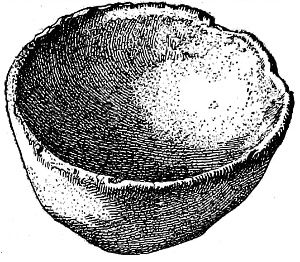
Fig. 18—Symbolic mortuary dish.
By far the most numerous of the
utensils connected with potable water
are drinking-cups and small bowls or
dishes; but these are merely molluscan shells of convenient size, picked
up alongshore, used once or oftener, and either discarded or carried
habitually without other treatment than the natural wear of use (an
example is illustrated in figure 19). Larger bowls or trays are improvised
from entire carapaces of the tortoise (probably Gopherus agassizii),
which are carried considerable distances; and still larger emergency
water-vessels consist of carapaces of the green turtle (Chelonia agassizii),
laid inverted in the jacales; these shells also being used in natural
condition. No wrought shells, molluscan or chelonian, were observed
in use or found either in the jacales or on the hundreds of abandoned
sites; but the vicinage of the rancherias, the abandoned camps
and house sites, and the more frequented paths are bestrewn with
slightly worn shells, evidently used for a time and then lost or discarded.
The relative abundance of the fictile ware and this natural
shell ware in actual use is about 1:3; i. e., each adult female
usually possesses a single olla of the conventional type, and there may
be one or two extra ollas and two or three clay dishes in each band or
clan, while each matron or marriageable maid is usually supplied with
two to four shell-cups and each little girl with one or two; and there
are twice as many carapace trays as clay dishes. The disproportion of
pottery and shell about the abandoned sites is naturally much greater;
for the former is the most highly prized industrial possession of the
women, while the shells are easily gained and lightly lost.
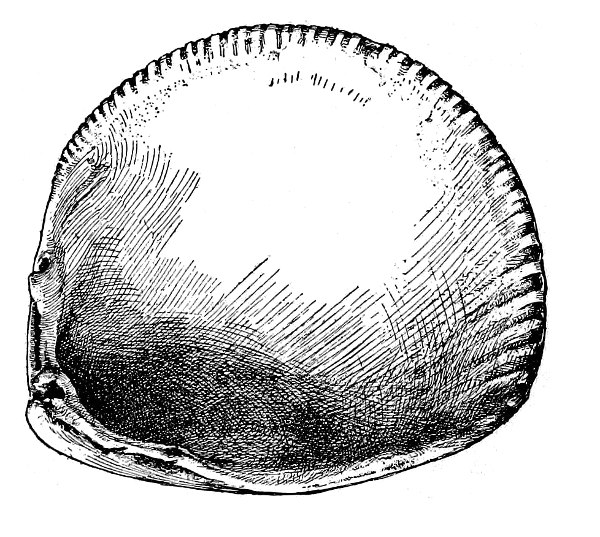
Fig. 19—Shell-cup.
With respect to solid food the Seri may be deemed omnivorous
though their adjustment to habitat is such that they are practically
carnivorous.
The most conspicuous single article in the dietary of the tribe is the
local green turtle. This chelonian is remarkably abundant throughout
Gulf of California; but its optimum habitat and breeding-place would
appear to be El Infiernillo, whose sandy beaches are probably better
adapted to egg laying and hatching than any other part of the coast.
Here it has been followed by the Seri; perhaps half of the aggregate
life of the tribe is spent within easy reach of its feeding and breeding
grounds, and tribesman and turtle have entered into an inimical commonalty
something like that of Siouan Indian and buffalo in olden time,
whereby both may benefit and whereby the more intelligent communal
certainly profits greatly. The flesh of the turtle yields food; some of
its bones yield implements; its carapace yields a house covering, a convenient
substitute for umbrella or dog-tent, a temporary buckler, and an
emergency tray or cistern, as well as a comfortable cradle at the beginning
of life and the conventional coffin at its end; while the only native
foot-gear known is a sandal made from the
integument of a turtle-flipper.
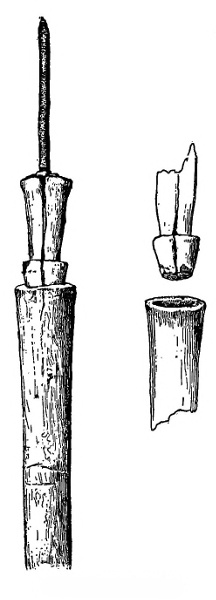
Fig. 20—Turtle-harpoon.
Doubtless the eggs and newly hatched
young of the turtle are eaten, and analogy
with other peoples indicates that the females
are sometimes captured at the laying
grounds or on their way back to water;
but observation is limited to the taking of
the adult animal at sea by means of a
specialized harpoon. A typical specimen
of this apparatus, as constructed since the
introduction of flotsam iron, is illustrated
in figure 20. It comprises a point 3 or 4
inches long, made from a nail or bit of stout
wire, rudely sharpened by hammering the
tip (cold) between cobbles, and dislodging
the loosened scales and splinters by thrusts
and twirlings in the ground; this is set
firmly and cemented with mesquite gum
into a foreshaft of hard wood, usually 4 or
5 inches long, notched to receive a cord
and rounded at the proximal end; the
rounded end of this foreshaft fits into a
socket of the main shaft, which may be
either a cane-stalk (as shown in the figure)
or a section of mesquite root; while a stout
cord is firmly knotted about the foreshaft
and either attached to the distal portion of
the main shaft or carried along it to the
hand of the user. The main shaft is usually
10 or 12 feet long, with the harpoon socket in the larger end, and is manipulated
by a fisherman sitting or standing on his balsa. On catching
sight of a turtle lying in the water, he approaches stealthily, preferably
from the rear yet in such wise as not to cast a frightening shadow,
sets the foreshaft in place, guides the point close to the carapace, and
then by a quick thrust drives the metal through the shell. The frictional
resistance between the chitin and the metal holds the point in
place, and although the foreshaft is jerked out at the first movement of
the transfixed animal the cord prevents escape; and after partial tiring
the turtle is either drowned or driven ashore, or else lifted on the craft.270
Immediately on landing the quarry, the plastron is broken loose by
blows of the hupf271 and torn off by vigorous wrenches of the warriors
and their strong-taloned spouses in the impetuous fury of a fierce
blood-craze like that of carnivorous beasts; the blood and entrails and
all soft parts are at once devoured, and the firmer flesh follows at a
rate depending on the antecedent hunger, both men and women
crushing integument and tendon and bone with the hupf, tearing other
tissues with teeth and nails, mouthing shreds from the shells, and
gorging the whole ravenously if well ahungered, but stopping to
singe and smoke or even half roast the larger pieces if nearer satiety.
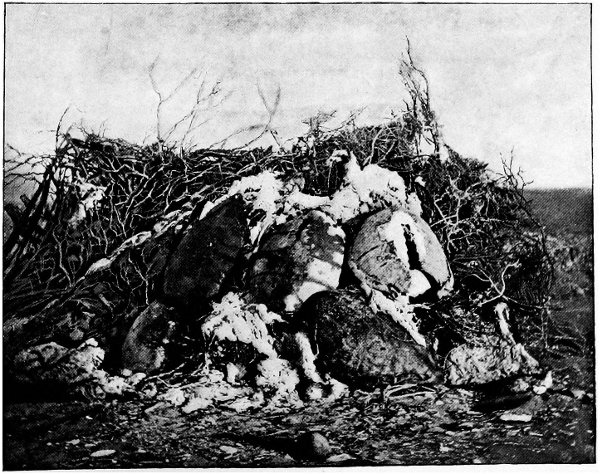
If the quarry is too large for immediate consumption and not too far
from a rancheria the remnants (including head and flippers and shells)
are hoisted to the top of the jacal immediately over the open end—the
conventional Seri larder—to soften in the sun for hours or days; and
on these tough and gamey tidbits the home-stayers, especially the
youths, chew luxuriously whenever other occupations fail. In times of
plenty, such sun-ripened fragments of reeking feasts are rather generally
appropriated first to the children and afterward to the coyote-dogs;
and it is a favorite pastime of the toddlers to gather about an
inverted carapace on hands and knees, crowding their heads into its
noisome depths, displacing the rare scavenger beetles and blowflies of
this arid province, mumbling at the cartilaginous processes, and
sucking and swallowing again and again the tendonous strings from
the muscular attachments, until, overcome by fulness and rank effluvias,
they fall asleep with their heads in the trough—to be stealthily
nudged aside by the cringing curs attached to the rancheria. Commonly
the carapace and the longer bones from the flippers of the larger
specimens are preserved entire for other uses, and are cleaned only by
teeth and talons and tongues, aided by time but not by fire; but the
plastron, unless broken up and consumed immediately, is subjected to
a cooking process in which it serves at once as skillet and cutlet—it is
laid on the fire, flesh side up, and at intervals the shriveling tissues are
clawed off and devoured, while at last the scorched or charred scutes
themselves are carried away to be eaten at leisure.272
Perhaps the most significant fact connected with the Seri turtle-fishing
is the excellent adaptation of means to ends. The graceful and
effective balsa is in large measure an appurtenance of the industry;
the harpoon is hardly heavier and is much simpler than a trout-fishing
tackle, yet serves for the certain capture of a 200-pound turtle; and the
art of fishing for a quarry so shy and elusive that Caucasians may spend
weeks on the shores without seeing a specimen is reduced to a perfection
even transcending that of such artifacts as the light harpoon and
fragile olla. Hardly less significant is the nonuse of that nearly universal
implement, the knife, in every stage of the taking and consumption
of the characteristic tribal prey; for it may fairly be inferred that the
comparative inutility of the knife in dissevering the hard and horny
chelonian derm, and the comparative effectiveness of the shell-breaking
and bone-crushing hupf, have reacted cumulatively on the instincts of
the tribe to retard the adoption of cutting devices. Of much significance,
too, is the limited cooking process; for the habitual consumption of raw
flesh betokens a fireless ancestry at no remote stage, while the crude
cooking of (and in) that portion of the shell not consecrated to other
uses might well form the germ of broiling or boiling on the one hand and
of culinary utensils on the other hand. On the whole, the Seri turtle
industry indicates a delicate adjustment of both vital and activital processes
to a distinctive environment, in which the abundant chelonian
fauna ranks as a prime factor.
Analogy with other primitive peoples would indicate that the flesh of
the turtle is probably tabu to the Turtle clan, that the consumption of
the quarry is preceded by an oblation, and that there are seasonal or
other ceremonial rites connected with turtle-fishing; but no information
has been obtained on any of these points save a few vague and unwilling
suggestions from Mashém tending to establish the analogy.
Flotsam and stolen metal have played a rôle in the industries of
Seriland so long that it is difficult to learn much of the turtle-fishing
during premetal times; but an intimation from Mashém that the old
men thought it much better to take the turtle with the teeth of an
“animal that goes in the water”, and the similarity in terms for “harpoon”
(or arrow) and “teeth” both suggest that the aboriginal point may
have been a sea-lion tooth, and that the foreshaft itself may have been
a larger tooth of seal or cetacean. While the modern harpoon is shaped
with the aid of metal (hoop-iron, etc.), the forms are quite evidently
vestigial of knifeless manufacture, in which a naturally rounded or
abraded or fire-shaped foreshaft was fitted into the natural socket
afforded by a cane-stalk broken at its weakest point—i. e., just below the
joint; and both function and socket arrangement (as well as the linguistic
evidence) strongly suggest the cylindrical tooth as the germ of
the apparatus.
It is probable that water-fowl, considered collectively, stand second
in importance as Seri prey; and the foremost fowl is undoubtedly the
pelican, which serves not only as a fruitful food-supply but as the chief
source of apparel.
The principal haunt and only known breeding ground of the pelican
in the Gulf of California is Isla Tassne, an integral part of Seriland; and
while the great birds are doubtless taken occasionally in Bahia Kunkaak,
El Infiernillo, Bahia Tepoka, and other Seri waters, this island
is the principal pelican hunting ground. According to Mashém’s
account, the chase of the pelican here is a well-organized collective
process: at certain seasons, or at least at times deemed propitious by
the shamans, pelican harvests are planned; and after some days of
preparation a large party assemble at a certain convenient point (presumably
Punta Antigualla) and await a still evening in the dark of the
moon. When all conditions are favorable they set out for the island
at late twilight, in order that it may be reached after dark; on approaching
the shore the balsas are left in charge of the women, while
the warriors and the larger boys, armed only with clubs, rush on the
roosting fowls and slaughter them in great numbers—the favorite
coup de grâce being a blow on the neck. The butchery is followed by a
gluttonous feast, in which the half-famished families gorge the tenderer
parts in the darkness, and noisily carouse in the carnage until overcome
by slumber. Next day the matrons select the carcasses of least injured
plumage and carefully remove the skins, the requisite incisions being
made either with the edge of a shell-cup or with a sharp sliver of cane-stalk
taken from an injured arrow or a broken balsa-cane. The feast
holds for several days, or until the last bones are picked and the whole
party sated, when the clans scatter at will, laden with skins and
lethargic from the fortnight’s food with which each maw is crammed.
Mashém’s recital gave no indication as to whether the Pelican clan
participate in the hunting orgies, though it clearly implies that the
chase and feast are at least measurably ceremonial in character; and
this implication was strengthened by the interest and comparative
vivacity awakened in the Seri bystanders by their spokesman’s frequent
interlocutions with them during the recital. Unfortunately the account
was not clear as to the seasons selected, though the expressions indicated
that the feasts are fixed for times at which the young are fully
fledged. It would seem inconceivable that the Seri, with their insatiate
appetite for eggs and tender young, should consciously respect a
breeding time or establish a closed season to perpetuate any game; yet
it is probable that the pelican is somehow protected in such wise that
it is not only not exterminated or exiled, but actually fostered and cultivated.
It is certain that the mythical Ancient of Pelicans is the
chief creative deity of Seri legend, and its living representative the
chief tutelary of one of the clans; it is certain, too, that this fleshly
fowl, sluggish and defenseless as it is on its sleeping grounds, would
be the easiest source of Seri food if it were hunted indiscriminately;
and it is no less certain that the omnivorous tribesmen would quickly
extinguish the local stock if they were to make its kind, including eggs
and young, their chief diet; yet it survives in literal thousands to
patrol the waters of all Seriland in far-stretching files and vees seldom
out of sight in suitable weather. On the whole, it would seem evident
that an interadjustment has grown up between the tribesmen and their
fish-eating tutelary during the centuries, whereby the fowl is protected,
albeit subconsciously only, during the breeding seasons; and in view
of other characteristics of the tribe it would seem equally evident that
the protection is in some way effected by means of ceremonies and
tabus.
Somewhat analogous, though apparently less ceremonial, expeditions
are made to Isla Patos and other points in search of ducks, and to Isla
San Esteban, and still more distant islands in search of eggs (preferably
near the hatching point) and nestlings; while the abundant waterfowl
of the region are sought in Rada Ballena and other sheltered bays,
as well as in such landlocked lagoons as those of Punta Miguel and
Punta Arena. This hunting involves the use of bows and arrows,
though the archery of the tribe pertains rather to the chase of larger
land game, and apparently attains its highest development in connection
with warfare. No specialized fowling devices have been observed
among the Seri; and their autonomous recitals, the facies of their artifacts,
and the observed habits of the tribe (especially the youth) with
respect to birds, all indicate that ordinary fowling holds a subordinate
place in Seri craft—i. e., that it is a fortuitous and emergency avocation,
rather than an organized art like turtle-fishing and water-carrying.
Concordantly, culinary processes are not normally employed in connection
with waterfowl, and the customary implements used for incising
the skin and severing other tissues are the shell-cup, which is carried
habitually for other purposes, the cane-splint, which appears to be improvised
on occasion, and never carried habitually, and the ubiquitous
hupf.
Probably second in importance among Seri prey, as a food-source
merely, stand the multifarious fishes with which the waters of Seriland
teem, particularly if the class be held to comprise the cetaceans and
seals and selachians ranked as leaders of the fish fauna in Seri lore.
Naturally, whales lie outside the ordinary range of Seri game, yet
they are not without place in the tribal economy. During the visit to
the Seri rancheria near Costa Rica in 1894, it was noted that various
events—births, deaths, journeys, etc.—were referred to “The Time of
the Big Fish”; and it was estimated from apparent ages of children and
the like that this chronologic datum might be correlated roughly with
the year 1887. The era-marking event was memorable to Mashém, to the
elderwomen of the Turtle clan, and to other mature members of the group,
because they had been enabled thereby to dispense with hunting and
fishing for an agreeably long time, and because they had moved their
houses; but the providential occurrence was not interpreted at the time.
On visiting Isla Tiburon in 1895, the interpretation became clear; along
the western shore of Rada Ballena, near the first sand-spit north of the
bight, lay the larger bones of a whale, estimated from the length of the
mandibles and the dimensions of the vertebræ to have been 75 or 80
feet long. It was evident that the animal had gone into the shoal
water at exceptionally high tide and had stranded during the ebb;
while the condition of the bones suggested an exposure to the weather
of perhaps half a dozen years. On the shrubby bank above the beach,
hard by the bleaching skeleton, stood the new rancheria, the most
extensive seen in Seriland, comprising some fifteen or twenty habitable
jacales; and fragments of ribs and other huge bones about and
within the huts273 attested transportation thither after the building,
while the shallowness of the trails and the limited trampling of the fog
shrubbery gave an air of freshness to the site and surroundings. The
traditions and the relics together made it manifest that “The Time of
the Big Fish” had indeed marked an epoch in Seri life; that when the
leviathan landed (whether through accident or partly through efforts
of balsa-men) it was quickly recognized as a vast contribution to the
Seri larder; and that some of the clans, if not the entire tribe, gathered
to gorge first flesh and blubber, next sun-softened cartilage and chitin,
and then epiphyses and the fatter bones. Some of the ribs were splintered
and crushed, evidently by blows of the hupf, in order to give
access to the cancellate interiors; several of the vertebræ were battered
and split, and nearly all of the bones bore marks of hupf blows,
aimed to loosen cartilaginous attachments, start epiphyses, or remove
spongy and greasy processes. Little trace of fire was found; in one
case a mandible was partly scorched, though the burning appeared to
be fortuitous and long subsequent to the removal of the flesh; and a
bit of charred and gnawed epiphysis, much resembling the fragments
of half-cooked turtle plastron scattered over Seriland, was picked up in
one of the huts. The condition of the remains and the various indications
connected with the rancheria corroborated the tradition that the
great creature had afforded unlimited and acceptable food for many
moons; and various expressions of the tradition indicated that the
event, though the most memorable of its class, was not unique in Seri
lore.
A few bones and fragments of skin of the seal were found in and
about the rancherias on Isla Tiburon, and an old basket rebottomed
with sealskin was picked up in a recently abandoned jacal on Rada
Ballena; a few bones provisionally identified with the porpoise (which
haunts Boco Infierno in shoals) were also found amid
the refuse about the old rancheria at the base of the
long sand-spit terminating in Punta Tormenta; but
nothing was learned specifically concerning the chase
and consumption either of these animals or of the abundant
sharks from which the island is named.
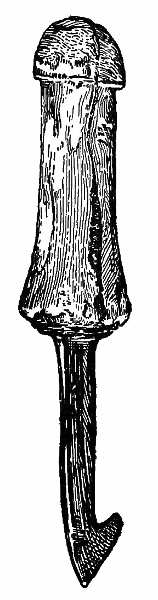
Fig. 21—Fish-spearhead.
Among the exceedingly limited food supplies brought
from the coast by the Seri group at Costa Rica in 1894,
were rank remnants of partly desiccated fish, usually
gnawed down to heads and tails; and Mashém and
others spoke of fish as a habitual food, while Señor
Encinas regarded it as the principal element of the
tribal dietary. The harder bones and heavier scales of
several varieties of fish were also found abundantly
among the middens of both mainland and Tiburon
shores in 1895. None of the remains bore noticeable
traces of fire; and all observations, including those of
Señor Encinas, indicate that the smaller varieties of fish
are habitually eaten raw, either fresh or partially dried,
according to the state of appetite at the time of taking—or
the condition of finding when picked up as beach
flotsam. But a single piscatorial device was observed,
i. e., the barbed point and foreshaft, shown in figure 21—the
iron point being, of course, accultural, and probably
obtained surreptitiously. This harpoon, which measures
6 inches in length over all, is designed for use in connection
with the main shaft of a turtle-catching tackle; and it is
evidently intended for the larger varieties, perhaps porpoises or sharks.
In 1827 Hardy observed a related device:
They have a curious weapon which they employ for catching fish. It is a spear
with a double point, forming an angle of about 5°. The insides of these two points,
which are 6 inches long, are jagged, so that when the body of a fish is forced
between them, it can not get away on account of the teeth.274
Don Andrés Noriega, of Costa Rica, described repeatedly and circumstantially
a method of obtaining fish by aid of pelicans, in which a
young or crippled fowl was roped to a shrub or stone, to be fed by his
fellows; when at intervals a youth stole out to rob the captive’s pouch.
At first blush this device would seem to rise above the normal industrial
plane of the Seri and to lie within the lower stages of zooculture,
like the cormorant fishing of China if not the hawking of medieval
Europe; yet on the whole it may be deemed fairly consistent with that
cruel yet mutually beneficial toleration between tribesmen and pelicans
attested by the preservation of the avian communal, as already noted.
Moreover, Don Andrés observations are in accord with early notes
of the exceedingly primitive aborigines of California, from whom the
Seri have undoubtedly borrowed various cultural suggestions; thus
Venegas quotes Padre Torquemada as saying:
I accidentally found a gull tied with a string and one of his wings broke. Around
this maimed bird lay heaps of excellent pilchards, brought thither by its companions;
and this, I found, was a stratagem practiced by the Indians to procure themselves
a dish of fish; for they lie concealed while the gulls bring these charitable
supplies, and when they think that little more is to be expected they seize upon the
contributions.
The padre says also of these gulls that “they have a vast craw,
which in some hangs down like the leather bottles used in Peru for
carrying water, and in it they put their captures to carry them to their
young ones”—from which it is evident that he refers to the pelican.
Venegas adds, “Such are the mysterious ways of Providence for the
support of his creatures!”275 And in the margin of his accompanying
“Mapa de la California”, he introduces a vigorous picture of a captive
fowl, its free fellow, and the mess of fish, the cut being headed “Alcatrazes”
(pelicans).
Despite these devices, the dearth of fishing-tackle among the Seri is
evidently extreme. Save in the single specimen figured, no piscatorial
apparatus of any sort was found among the squalid but protean possessions
at the Costa Rica rancheria; neither nets nor hooks nor rods
nor lines nor any other device suitable for taking the finny game were
found in the scores of jacales containing other artifacts on Tiburon;
while Señor Encinas was conversant only with the simple method of
taking fish by hand from the pools and shallows left by receding
breakers or ebbing tides. This dearth of devices is significantly harmonious
with other Seri characteristics: it accords with the leading
place assigned the turtle in their industry and their lore; it is in harmony
with that primitive and nonmechanical instinct which leads them
to rely on bodily strength and skill and swiftness rather than on extra-corporeal
artifacts in their crude and incomplete conquest of nature;
and it is a manifest expression of relation with their distinctive physical
environment—for the ever-thundering breakers of their gale-swept
coast are abundant, albeit capricious, bringers of living grist, while
the offshore gales at low tide lay bare hundreds of acres of shoaler
bottoms literally writhing with fishes stranded among beds of mollusks
and slimy with the abounding plankton of a fecund coast. The region
is one of ample, albeit lowly, food supply, where every experience tends
toward inert reliance on providential chance, and where the stimulus
of consistently conscious necessity seldom stirs the inventive faculty.
Closely connected with fish as a Seri food-source are the various
molluscan and crustacean forms collectively called shellfish; and these
contribute a considerable share of the sustenance of the tribe.
Apparently the most important constituent of this class of foods is
the Pacific coast clam, which abounds in the broad mud-flats bordering
Laguna La Cruz and other lagoons of Seriland, and which was still
more abundant during a subrecent geologic epoch, to judge from the
immense accumulation of the shells in Punta Antigualla. The clams
are usually taken at low tide, without specialized apparatus. They are
located by feeling with the feet in shallow water, and caught either
with toes or with fingers, to be tossed into any convenient receptacle.
When the water is entirely withdrawn from the flats, they are located
by means of their holes, and are extricated either with a shell-cup or
with some other improvised implement. Frequently the entire mess is
thrown into a fire until the shells open, when they are withdrawn and
the mollusks devoured practically raw; perhaps more commonly the
shells are opened by blows of the hupf, and eaten without semblance
of cooking; and, except on the surface, no trace of roasting was found
among the vast accumulations of shells in Punta Antigualla.
Perhaps second to the clam in frequency of use is the local oyster,
which abounds about the more sheltered shores of Tiburon. It is gathered
with the hands, aided perhaps by a stone or stick for dislodging
the shells either from the extended offshore beds at extreme low water,
or from the roots of a mangrove-like shrub at a medium stage. The
shells, like those of the clam, are frequently opened by partial roasting;
and shells, sometimes scorched, are extensively scattered over the
interior, indicating that the oyster is a favorite portable food. The
popularity of this bivalve is shared by the Noah’s-ark (Arca), to which
some mystical significance is apparently ascribed; and the abundant
limpets and bivalves and other mollusks are eaten indiscriminately, to
judge from the abundance of their shells in the middens. The ordinary
crab, too, is a favorite article of food, and its claws are numerous
in camp and house refuse; while the lobster-like deep-water crab is
introduced into the menu whenever brought to the surface by storms,
as shown by its massive remains in the middens.
On the whole, shellfish form a conspicuous factor in Seri economy
by reason of the considerable consumption of this class of food; but,
viewed in the broader industrial aspect, the produce is notably primitive,
and significant chiefly as indicating the dearth of mechanical and
culinary devices.
While by far the larger share of Seri sustenance is drawn from the
sea, a not inconsiderable portion is derived from the land; for the warriors
and striplings and even the women are more skilful hunters than
fishers.
The larger objects of the feral chase are deer of two or three species
(the bura, or mule-deer, being most conspicuous and easiest taken),
antelope, and mountain sheep; to which the puma, the jaguar, and
perhaps two or three other carnivores might be added. The conventional
method of taking the bura and other deer is a combination of
stalking and coursing, usually conducted by five of the younger warriors,
though three or four may serve in emergency; any excess over
five being regarded as superfluous, or as a confession of inferiority. The
chase is conducted in a distinctly ceremonial and probably ritualistic
fashion, even when the finding of the game is casual, or incidental to
a journey: at sight of the quarry, the five huntsmen scatter stealthily
in such manner as partially to surround it; when it takes fright one
after the other strives to show himself above the shrubbery or dunes
in order to break its line of flight into a series of zigzags; and whether
successful in this effort or not they keep approximate pace with it until
it tires, then gradually surround it, and finally rush in to either
seize it in their hands or cripple it with clubs—though the latter procedure
is deemed undignified, if not wrong, and hardly less disreputable
than complete failure. When practicable the course is laid
toward the rancheria or camp; and in any event the ideal finish is to
bring the animal alive into the family group, where it maybe dissected
by the women, and where the weaklings may receive due share of the
much-prized blood and entrails. The dissection is merely a ravenous
rending of skin and flesh, primarily with the teeth (perhaps after
oblique bruising or tearing by blows with the hupf over strongly flexed
joints), largely with hands and fingers aided anon by a foot planted on
the carcass, and partly with some improvised device, such as a horn or
tooth of the victim itself, the serrated edge of a shell-cup, or perhaps
a sharp-edged cane-splint from a broken arrow carried for emergency’s
sake. Commonly the entire animal, save skin and harder bones, is
gulped at a sitting in which the zeal of the devotee and the frenzy of
the carnivore blend; but in case the group is small and the quarry
large, the sitting is extended by naps or prolonged slumberings, and
the more energetic squaws may even trouble to kindle a fire and partially
cook the larger joints, thereby inciting palled appetite to new
efforts. Finally the leg bones are split for the marrow and their ends
preserved for awls; the horns are retained by the successful huntsmen
as talisman-trophies; while the skin is stretched in the desert sun,
scratched and gnawed free of superfluous tissue, rubbed into partial
pliability, and kept for bedding or robe or kilt.
The chase of the hare is closely parallel to that of the deer save that
it is conducted by striplings, who thereby serve apprenticeship in hunting
and at the same time enrich the tribal larder with a game beneath
the dignity of the warriors; while still smaller boys similarly chase the
rabbit, which is commonly scorned by the striplings. The conventional
hare-hunting party is three, and it is deemed disreputable to increase
this number greatly. The youths spread at sight of the game and seek
to surround it, taking ingenious and constant advantage of the habit
of the hare to run obliquely or in zigzags to survey more readily the
source of its fright; for some time they startle it but slightly by successive
appearances at a distance, but gradually increase its harassment
until it bounds hither and thither in terror, when they rapidly
close in and seize it, the entire chase commonly lasting but a few minutes.
The quarry is customarily taken alive to camp, where it is quickly
rent to fragments and the entrails and flesh and most of the bones consumed;
the skin usually passes into possession of a matron for use as
infantile clothing or cradle bedding, while the ears are kept by the
youth who first seized the game until his feat is eclipsed by some other
event—unless chance hunger sooner tempts him to transmute his trophy
into pottage.
While the collective, semiceremonial style of chase alone is thoroughly
good form in Seri custom, it is often rendered impracticable by
the scattering of the tribe in separate families or small bands, in which
case the bura and its associates, like the larger carnivores customarily,
are taken by strategy rather than by strength. This form of chase is
largely individual; in it archery plays a leading rôle; and in it, too,
ambuscade, stealthy lying in wait, and covert assault attain high development.
It is closely analogous with the warfare typical of the tribe;
and it is especially noteworthy as one of the most effective stimuli to
intellectual activity, and hence to the development of invention—if the
term may be applied to industrial products so lowly as those of the
Seri.
The chief artifact produced by the strategic chase on land would
seem to be the analogue of the harpoon used at sea, i. e., the arrow.
This weapon is one of the three or four most highly differentiated and
thoroughly perfected of the Seri artifacts, ranking with canteen-olla
and balsa, and perhaps outranking the turtle-harpoon. It is fabricated
with great care and high skill, and with striking uniformity in details
of material and construction. A typical example is 25 inches in length
and consists of three pieces—point, foreshaft, and main shaft (feathered
toward the nock). The foreshaft is 8½ inches long, of hard wood carefully
ground by rubbing with quartzite or pumice into cylindrical form,
about three-eighths of an inch in diameter at the larger end and tapering
slightly toward the point; the larger end is extended by careful
grinding into a tang which is fitted into the main shaft, the joint being
neatly wrapped with sinew. This main shaft is a cane-stalk (Phragmites
communis?) 15 or 16 inches long, carefully selected for size and
well straightened and smoothed; it is feathered with three equidistantly-placed
wing-feathers of hawk or falcon, neatly prepared by removing
a thin strip of the rachis bearing the wider vexillum and attaching it
by sinew wrappings at both ends, the feathers being about 5½ inches
in length. The nock is a simple rounded notch, placed just below a
joint and supported by the sinew ferrule; there is no foot-plug. The
favorite point is a bit of flotsam hoop-iron, ground into elongate
triangular shape with projecting barbs, and a short tang or shank
fitted into a shallow notch in the foreshaft, cemented there with mesquite
gum, and finally fixed firmly with sinew wrappings. A typical
iron-point arrow, with bow and quiver, is depicted in plate XXX. Alternative
points are of rudely chipped stone (two examples are illustrated
in figure 37) somewhat clumsily attached to the foreshaft by
mesquite gum and sinew wrapping; while the arrows used by boys
and hunters of small game are usually pointless, the tip of the foreshaft
being sharpened and hardened by slight charring. In some of
the arrows, especially those designed for use in war, the foreshaft is
notched, or else loosely attached to the main shaft, in order that it may
be detached from the main shaft and remain in the body of enemy
or prey. The foreshaft is commonly painted some bright color (red is
prevalent), while the points and attachments of the “poisoned” specimens
are smeared with some greasy substance.
The aboriginal Seri arrow has undoubtedly been modified during the
centuries since the coming of Cortés and Mendoza with their metal-armed
troopers; yet certain inferences as to the indigenous form of the
weapon are easily drawn from its construction and the homologies of
its parts.
The first feature of the artifact to attract attention is the relative
clumsiness of attachment and frequent absence of points. The chipped-stone
points are so rude as to be quite out of harmony with the otherwise
delicately wrought and graceful arrow, while the attachment is
strikingly rude; and it is still more noteworthy that the very name for
stone arrowpoint was little understood at Costa Rica, and was obtained
only after extended inquiry and repeated conferences among the older
informants. Even the attachment of the effective points made from
hoop-iron is bad constructionally; the sinew wrapping is carried
around the entire blade in such manner as to sheathe the sharply
ground edges and itself be cut on contact with firm tissue; and the
fitting and wrapping are so rude as to be incongruous with the rest
of the apparatus. On the whole the suggestion is strong that the
arrowpoint is accultural—and this suggestion is further strengthened
by the very existence of the practically functionless, and hence manifestly
vestigial, hard-wood foreshaft. Turning to the structural homologies,
the observer is at once struck with the parallelism running
through the three most conspicuous compound artifacts found among
the Seri, i. e., the harpoon, the fire-drill, and the arrow. All of these
alike consist of two essential parts, main shaft and foreshaft; all are
akin in function even in the superficial view of the Caucasian, and are
much more closely related in primitive thought—indeed the fire-drill is
but a featherless and nockless arrow, with the foreshaft charred at its
fire-giving tip; and all are closely linked in language and allied with
other terms in such wise as practically to establish identity among them
in the thinking of their lowly makers (though unfortunately the incomplete
vocabularies extant are insufficient for full study of the linguistic
homologies). Briefly the indications are that the harpoon was the primary
device, and that its foreshaft was a tooth of an aquatic fish-eater
like the seal, or perchance in some cases an os penis; that its lineal successor
was a loose-head lance for use on sea and land, at first with the
unaided hand and later with the atlatl, or throwing-stick (the lance
being now extinct, though recorded by early visitors to Seriland); that
the next artifact-generation in the direct line was represented by the
arrow, foreshafted with hard wood or tooth, made light and graceful
and loose-headed or not, according to needs, and by the substitution of
bow for atlatl; and that a somewhat aberrant line was marked by the
taming of fire, its reproduction by the modified arrow, and the differentiation
of fire-stick from arrow and either atlatl or bow.
In tracing these stages in technologic growth, it is to be remembered
that the Seri are so primitive as to betray some of the very beginnings
of activital concepts; that to them zoic potencies are the paramount
powers of the cosmos; that in their simple thought fire is a bestial
rather than a physical phenomenon; that in their naive philosophy the
production of devouring flame is of a kind with vital birth and a similitude
of sexual reproduction; and that according to their notions the
conquest of quarry, including fire, is made practicable only by aid of
the mystical potencies of beasts and flames gained through invocatory
use of symbols or actual organs.
In the Seri tongue the term “fire-drill” is kaak, an indefinite generic
meaning “kind” or “strong kind”, with an egocentric connotation
(“Our-Strong-Kind”), as in the proper tribal designation Kun-kaak or
Km-kaak; while the term for the nether fire-stick or hearth is either
maam (“woman”, or more properly “mother”), or else (and more commonly)
kaak-maam, which may be rendered “Kind-Mother”—the “Kind”,
as among primitive folk generally, comprising both men and tutelary
beasts, and in this case fire as the most mysterious of the beasts; there
is thus a suggestive analogy between the designation for the fire-producing
apparatus and that for the tribe itself. It should be noted that
the zoic concept of fire is widespread among the more primitive peoples
of various provinces, and sometimes persists in recognizable form in
higher culture (witness the fire-breathing dragons of various mythologies,
the “Red Flower” notion gathered in India by Kipling, etc.); also
that the ascription of sex to the fire-sticks is prevalent among North
American tribes, and at once helps to interpret the development of the
fire-drill, fire-syringe, and other primitive devices, such, for example, as
those so fully described by Hough,276 and serves to explain the otherwise
obscure genesis of the fire-sense, which must have accompanied and
shaped that most significant of all steps in human progress, the conquest
of fire.
The modern coordinate of the Seri arrow is the bow, made preferably
from a straight and slender branch of the palo blanco. A typical
specimen is illustrated in plate XXX; it is 4 feet 9½ inches long, with
the outer face convex and the inner face flat; greatest width 1¾ inches,
narrowed to 1⅛ inches at the hand-hold; thickness at the hand-hold 1
inch, thinning to five-eighths inch at 8 inches from this point; tapering
gradually in both dimensions toward the extremities, which are rudely
notched to receive the cord (of mesquite-root fiber). The specimen
illustrated has been cracked and repaired in two places; in one place
the repair was effected by a rough wrapping of sinew, and in the other
by slipping over the wood a natural sheath of rawhide from the leg of
a deer. The specimen is of added interest in that it combines bow
and nether fire-stick (“Strong-Kind-Mother”), one of the friction holes
being worn out to the notched margin, and the other remaining in
usable condition, as shown in the enlarged marginal drawing.277
Compared with the delicately finished and graceful arrow, the typical
bow is a rude and clumsy device; it displays little skill in the
selection and shaping of material, and evidently involves little labor
in manufacture—indeed, the indications are that more actual labor is
spent in the construction of a single arrow than in the making of a
bow, while the arrow-making is expert work, betokening craft of a high
order, and the bow-making little more than simple handiwork of the
lowest order. The comparison affords some indication of the genesis
of Seri archery, and at the same time corroborates the independent
suggestion that the arrow is of so much greater antiquity than the
bow as to represent a distinct stage in cultural development—though
the precise cultural significance of the bow is not easily ascertained.
Efforts were made to have different Seri warriors at Costa Rica in 1894
assume the normal archery attitude, with but moderate success, the
best pose obtained (illustrated in plate XXVIII) being manifestly unnatural
and a mere reflection of the attitude in the mind of the Caucasian
poser; while the results of inquiries served only to indicate that the
normal archery attitude was purposely avoided for reasons not ascertained.
Fortunately another observer was more successful: in the
course of the United States hydrographic surveys in 1873, Commander
(now Admiral) Dewey received several visits from Seri warriors on
board the Narragansett; and on the occasion of one of these visits, Mr
Hector von Bayer, of the hydrographic party, caught a photograph of
an archer in the act of drawing his bow. The negative was accidentally
shattered, and no prints are known to have been made from it;
but the fragments were carefully joined, and were kindly transferred
to the Bureau by Mr Von Bayer in 1897, and from them plate XXIX
was carefully drawn. The posture (partly concealed by the drapery) is
extraordinary, being quite beyond the reach of the average human, and
impossible of maintenance for any considerable interval even by the
well-wonted Seri. The posture itself partly explains the difficulty of
inducing the warriors at Costa Rica to assume it, since it is essentially a
fleeting one, and indeed but a part of a continuous and stressful action—it
is no less difficult to assume, or to catch in the camera, than the typical
attitude of a baseball pitcher in action. The posture thus fortunately
caught is quite in accord with the accounts of Seri archery from the
esoteric side given by Mashém, and with the exoteric observations of
Señor Encinas, Don Andrés, and others; for all accounts agree in indicating
that the archer commonly rests inert and moveless as the watching
feline up to a critical instant, then springs into movement as swiftly
as the leaping jaguar, and hurls, rather than shoots, one, two, or three
arrows before rushing in to the death or skulking to cover as the issue
may require.
BUREAU OF AMERICAN ETHNOLOGY
SEVENTEENTH ANNUAL REPORT PL. XXVIII
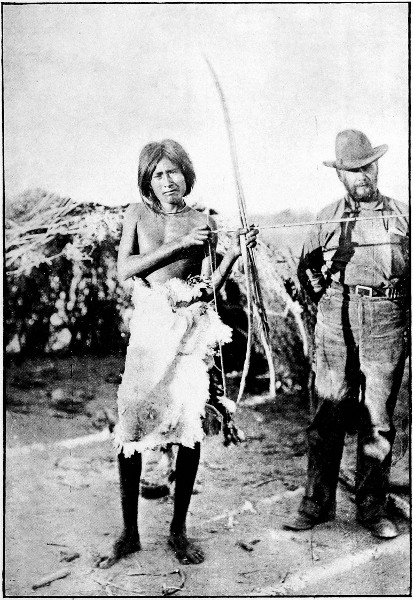
SERI ARCHER AT REST
The Seri archery habit is in every way consistent with the general
habits of the tribe, alike in the chase and in warfare, in which the tribesmen,
actuated by the fierce blood-craze common to carnivores, either
leap on their prey with purpling eyes and gnashing teeth, or beat
quick and stealthy retreat; and it is especially significant in the light
thrown on the bow as a device for swift and vigorous rather than accurate
offense, an apparatus for lengthening the arm still more than does
the harpoon, and at the same time strengthening and intensifying its
stroke. The quick-changing attitudes of half hurling are equally suggestive
of the use of the atlatl, and support Cushing’s hypothesis278
that the bow was derived from the corded throwing-stick. While the
critical posture of Seri archery is unique in degree if not in kind in
the western hemisphere, so far as is known, an approximation to it
(illustrated in fig. 22) has been observed in Central Africa.279 On the
whole the Seri mode of using the bow, like its crude form and rude
finish, indicates that it is a relatively new and ill-developed artifact,
possibly accultural though more probably joined indigenously with the
archaic arrow to beget a highly effective device for food-getting as
well as for warfare; while the genetic stages are still displayed not only
in the homologies between arrow and harpoon, but by the common
functions of both arrow and bow with the fire-sticks.
Concordantly, as indicated by the use of the archery apparatus, the
individual taking of large game is effected either by stealthy stalking
or by patient ambuscade ended by a sudden rush; when, if the chase is
successful, the quarry is rent and consumed as at the finish of the
semiceremonial collective chase. The fleet but wary antelope, the pugnacious
peccary, the wandering puma and jaguar, and the mountain
sheep of the rocky fastnesses, are among the favorite objects of this
style of chase; while the larger land birds and some of the water-fowl
are taken in similar fashion.
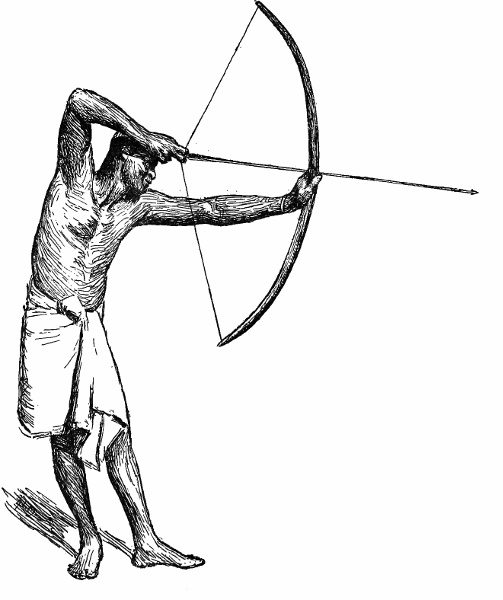
Fig. 22—African archery posture.
The smaller land game comprises a tortoise or two, all the local
snakes and lizards, and a good many insects, besides various birds,
including hawks and owls, as well as the eaters of seeds and insects.
The crow and vulture are also classed as edible, though they are rare
in Seriland, probably because of the effective scavengering of the
province by its human residents. It is a significant fact that the
smaller rodents, especially the long-tail nocturnal squirrel, are
excluded from the Seri menu by a rigidly observed tabu of undiscovered
meaning. A general consequence of this tabu is readily observed
on entering Seriland; there is a notable rarity of the serpents, the
high-colored and swift efts, and the logy lizards and dull phrynosomas
so abundant in neighboring deserts, as well as of song birds and their
nests; and this dearth is coupled with a still more notable abundance
of the rodents, which have increased and multiplied throughout Seriland
so abundantly that their burrows honeycomb hundreds of square
miles of territory. A special consequence of the tabu is found in the
fact that the myriad squirrel tunnels have rendered much of the territory
impassable for horses and nearly so for pedestrians, and have
thereby served to repel invaders and enable the jealous tribesmen to
protect their principality against the hated alien. Seriland and the
Seri are remarkable for illustrations of the interdependence between a
primitive folk and their environment; but none of the relations are
more striking than that exemplified by the timid nocturnal rodent,
which, protected by a faith, has not only risen to the leading place in
the local fauna, but has rewarded its protectors by protecting their territory
for centuries.
BUREAU OF AMERICAN ETHNOLOGY
SEVENTEENTH ANNUAL REPORT PL. XXIX
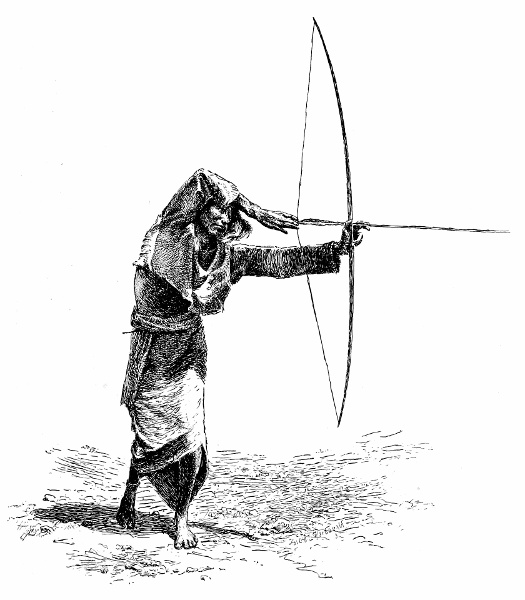
SERI ARCHER AT ATTENTION
In both the collective and the strategic chase, constant advantage is
taken of weakness and incapacity, whether temporary or permanent,
of the prospective quarry; so that diseased and wounded as well as
sluggish and stupid animals are eliminated. The effect of this policy
on the fauna is undoubtedly to extinguish the less capable species and
to stimulate and improve the more capable; i. e., the presence of the
human factor merely intensifies the bitter struggle for existence in
which the subhuman things of this desert province are engaged. At
the same time, the entrance of the human folk into the struggle characteristic
of subhuman species serves to bar them from one of the most
helpful ways to the advancement of their kind—i. e., the way leading
through cotoleration with animals to perfected zooculture. The most
avidly sought weaklings in the Seri chase are the helpless young, and
the heavily gravid dams which are pursued and rent to fragments with
a horrid fury doubtless reflecting the practical certainty of capture
and the exceptionally succulent tidbits afforded by the fetal flesh;
naturally the cruel custom reacts on habitual thought in such wise that
the very sight of pregnancy or travail or newborn helplessness awakens
slumbering blood-thirst and impels to ferocious slaughter. To such
custom and deep-planted mental habit may be ascribed some of the
most shocking barbarities in the history of Seri rapine, tragedies too
terrible for repetition save in bated breath of survivors, yet explaining
the utter horror in which the Seri marauder is held on his own frontier.
At the same time the hunting custom and the mental habit explain the
blindness of the Seri to the rudiments of zooculture, and clarify their
intolerance of all animal associates, save the sly coyote that habitually
hides its travail and suckling in the wilderness, and perhaps the deified
pelican.280
Parallel to the chase of the larger land game is the hunting of horses
and other imported stock; for the animals are regarded in no other
light than that of easy quarry. The horses of the Seri frontier, like
those of wild ranges generally, are strongly gregarious, and the herds
are well regimented under recognized leaders, so that the chase of
their kind is necessarily collective on the part of both hunters and
game; and the favorite method is for a considerable group of either
warriors or women to surround the entire herd, or a band cut out from
it, “mill” them (i. e., set them running in a gradually contracting
circle) and occasionally dash on an animal, promising by reason of
exceptional fatness or gravidness. The warrior’s customary clutch is by
the mane or foretop with one hand and the muzzle with the other, with
his weight thrown largely on the neck, when a quick wrench throws
the animal, and, if all goes well, breaks its neck;281 while the huntress
commonly aims to stun the animal with a blow from her hupf. In
either case the disposition of the carcass is similar to that of other
large quarry, save that thought is given to the danger of ensuing attack
by vaqueros; so that it is customary to consume at once only the blood and
pluck, and if time permits the paunch and intestines with their contents,
and then to rend the remainder into quarters, which warriors or even
women shoulder and rush toward their stronghold. Burros (which,
next to the green turtle, afford the favorite Seri food) and horned cattle
are commonly stalked and slain, or, at least, wounded with arrows, so
that it is commonly the stragglers that are picked off; though sometimes
several animals are either milled or rushed, and thrown by a
strong wrench on the horns or stunned with a blow of war-club or hupf,
as conditions may demand. Straggling swine and wandering dogs are
occasionally ambushed or stalked and transfixed with arrows, torn
hurriedly into fragments, or shouldered and carried off struggling, as
exigency may require; while sheep and goats are practically barred
from the entire Seri frontier because of their utter helplessness in the
face of so hardy huntsmen.
BUREAU OF AMERICAN ETHNOLOGY
SEVENTEENTH ANNUAL REPORT PL. XXX
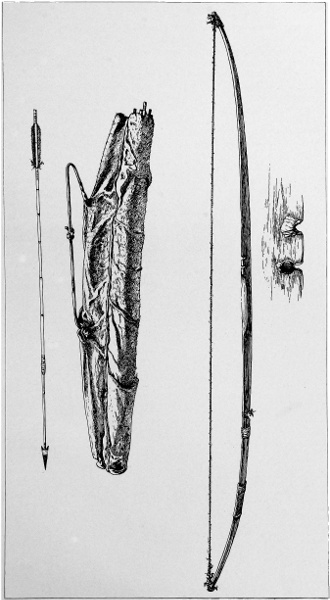
SERI BOW, ARROW, AND QUIVER
The quantity of stock consumed by the Seri varies greatly with the
policy of rancheros and vaqueros. At different times during the last
two and a half centuries it has been estimated that the chief portion
of the subsistence of the tribe was derived from stolen stock, and it
is probable that during the early period of the Encinas régime this
estimate was fair; but under the Draconian rule of a Seri head for each
head of slaughtered stock, the consumption is reduced to a few dozen
head annually, including superannuated, crippled, and diseased animals
unable to keep up with the herds, those bogged in Playa Noriega
and other basins during freshets, the stallions and bulls slain in strife
for leadership of their bands, and the festering or semimummied carcasses
gladly turned over by idle rancheros on the chance visits of
Seri bands to the frontier (such as the specimen in the photograph
reproduced in figure 23).
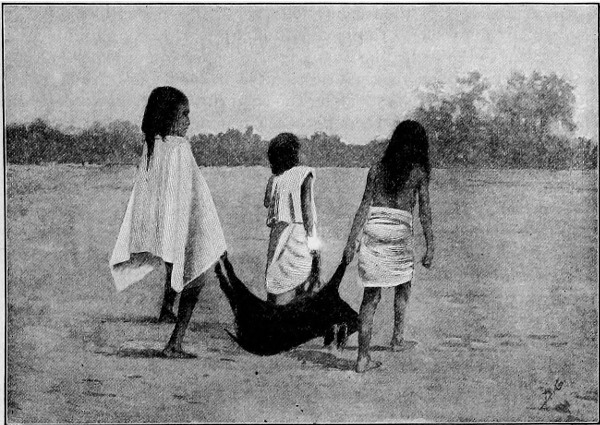
Fig. 23—Desiccated pork.
No special devices have been developed in connection with the chase
for stock, nor has material progress been made in acquiring Caucasian
devices. There are, indeed, indications of a disposition to use
knives in severing the tough integuments and tendons of horses and
kine, although the tendency has not yet resulted (as elsewhere noted,
ante, pp. 152*-154*) in the development of a knife-sense; and although
boys on the frontier play at roping dogs, no effort to use the riata or
any form of rope is made in the actual chase. As naively explained
by Mashém amid approving grunts from his clan-mates, they have no
time for ropes or knives when hungry.
A quantitatively unimportant yet by no means negligible fraction
of the normal diet of Seriland is vegetal; and while the sources of
vegetal food are many and diverse, the chief constituent is a single
product characteristic of American deserts, viz., the tuna, or prickly
pear.
All of the cacti of the region yield tunas in considerable quantity.
The pitahaya is perhaps the most abundant producer, and its name is
often given to the fruit; the huge saguaro affords an enormous annual
yield, and the still more gigantic saguesa is even more prolific, especially
in its immense forests along the eastern base of Sierra Seri; the
cina adds materially to the aggregate product, while the nopal, or
common prickly pear, contributes a quota acquiring importance from
the facility with which it may be harvested. The fruits of all these
cacti are sometimes classed as sweet tunas, in contradistinction from
the sour tunas yielded in great abundance by the cholla and consumed
with avidity by stock, though seldom eaten by men. The edible tunas
average about the size of lemons, and resemble figs save that their skin
is beset with prickles. The portion eaten is a luscious pulp, filled with
minute seeds like those of the fig save that they are too hard for mastication
or digestion, its flavor ranging from the sickly sweet of the
overcultivated fig to a pleasant acidity. While occasional tunas may
be found at any time during the year, the normal harvest occurs about
midsummer, or shortly before the July-August humid season, and lasts
for several weeks. During the height of the season the clans withdraw
from the coast and give undivided attention to the collection and
consumption of the fruits, gorging them in such quantities that, according
to the testimony of the vaqueros, they are fattened beyond recognition.
Commonly the tunas are eaten just as they are gathered, and the
families and larger bands move about from pitahaya to pitahaya and
from valley to valley in a slovenly chase of this natural harvest, until
waning supply and cloying appetite drive them back to the severer chase
of turtle and pelican. The fruit is not cooked, and never preserved save
in the noisome way of nature, and is rarely transported in quantities
or over distances of industrial importance; yet the product may have
some connection with the basketry of the tribe. The devices for collecting
the fruits, especially from the lofty saguaro and saguesa, are
mere improvisations of harpoon shafts, paloblanco branches, or chance
cane-stalks carried primarily for arrow-making or balsa construction.
There is no such well-studied and semiceremonial apparatus for tuna
gathering as, for example, the Papago device made from the ribs of
the dead saguaro in accordance with traditional formula.
Perhaps second in importance among the vegetal constituents of
Seri diet is the mesquite bean, which is gathered in random fashion
whenever a well-loaded tree is found and other conditions favor. The
woody beans and still woodier pods are roughly pulverized by pounding
with the hupf on any convenient stone used as an ahst (metate or
mortar), or, if suitable stones are not at hand, they are carried in
baskets or improvised bags to the nearest shore or other place at which
stones may be found. The half-ground grist is winnowed in the ordinary
way of tossing in a basket; and the grinding and winnowing continue
alternately until a fairly uniform bean meal is obtained. So far
as was actually observed this is eaten raw, either dry in small pinches
or, more commonly, stirred in water to form a thin atole; but expressions
at Costa Rica indicated that the meal is sometimes stirred in
boiling water or pot-liquor, and thus partially cooked, in times of rest
and plenty.
Other vegetal products used as food comprise a variety of seeds collected
from sedges and grasses growing about the mud-flats of Laguna
La Cruz and other portions of the province, as well as the seeds and
nuts of the scant shrubbery of shores and mountains; while a local
seaweed or kelp is eaten in small quantity, apparently as a condiment,
and is sometimes carried on journeys even as far as Costa Rica, where
specimens were obtained in 1894.
It is of interest to note that one of the most distinctive constituents
of the Sonoran flora, and one intimately connected with human life in
the great neighboring province of Papagueria, is of negligible rarity
in Seriland; this is the visnaga (Echinocactus, probably of two or
three species), the thorniest of the cacti and the only one containing
consumable pulp and sap. This peculiar plant is of no small interest
in itself as a striking example of the inverse relation between protective
devices of chemical sort (culminating in acrid, offensive, or
toxic juices) and the mechanical armaments so characteristic of desert
plants;282 it is of still deeper interest economically as the sole source of
water over broad expanses of the desert, and one to which hundreds of
pioneers and travelers have been indebted for their lives; and it is
of interest, too, as a factor of Papago faith, in which the visnaga ranks
among the richer guerdons of the rain gods. Throughout most of Papagueria
this cactus is fairly abundant; usually there are several specimens
to the square mile of suitable soil (it is not found in playas or on
the ruggeder sierras), so that it is always within reach of the sagacious
traveler; but it diminishes in abundance toward the borders of Seriland,
and not more than a dozen examples were found in the portions of
that province traversed by the 1895 expedition. Its rare occurrence,
chiefly in the form of wounded and dwarfed specimens, seems to indicate
that its original range comprised all Seriland; while its dearth
suggests destruction nearly to the verge of extinction by improvident
generations better armed with their hupfs and harpoons and shell-cups
than the subhuman beasts against whom the plant is so well protected.
Aside from the universally used hupf and ahst (which may be
regarded as differentiated implements or tools), the only special device
used in connection with vegetal food is the basket, or, rather, basketry
tray (illustrated in figure 24). This ware is of the widespread coil type
so characteristic of southwestern tribes. The coil is a wisp of stems
and splints of a fibrous yet spongy shrub, apparently torote; and the
woof consists of paloblanco (?) splints deftly intertwined by aid of an
awl. The construction is fairly neat and remarkably uniform; the
coiled wisps vary somewhat in size, both intentionally and inadvertently,
ranging from an average of three-eighths of an inch toward the
bottoms of the larger specimens to half that diameter in the smaller
specimens and toward the margins of the larger. The initial coil
starts in an indefinite knot, rather than a button, at the center; and the
spiral is continuous throughout, the final coil being quite deftly worked
out to a single splint smoothly stitched to the next lower spiral with the
woof splints. The ware is practically water-tight, remarkably strong
and resilient, and quite durable in the dry climate of Seriland. Ordinarily
the basket is abandoned when the bottom decays or breaks, but
an ancient specimen obtained on Isla Tiburon was roughly rebottomed
with a patch of sealskin attached by means of sinew. The baskets
are notably uniform in shape, though the size varies from 8 or 9 inches
to fully 17 inches in diameter.
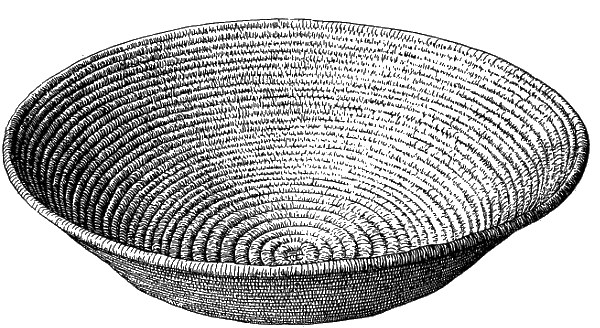
Fig. 24—Seri basket.
The most striking feature of the Seri basketry, as of the pottery, is
extreme lightness in proportion to capacity, a quality due to the spongy
character of the torote coil and to the thinness of the splints used in the
woof. The inside dimensions, weight, and dry-measure capacity (filled
to the level of the brim with rice) of two typical specimens approaching
extremes in size are indicated in the accompanying table. As
noted elsewhere, the ware is absolutely without decorative devices
in weave, paint, or form; it is baldly utilitarian, a model of economy
in material and in the balance between structure and function, approaching
in this respect the thin-walled canteen-olla, the graceful balsa, and
the light but effective harpoon. The structural correspondence of the
ware to a widespread type and its limited use among the tribe suggest
an accultural origin for the Seri basketry; but the delicate adjustment
of means to ends in the manufacture and the strictly local character
of the material quite as strongly suggest an indigenous development.
| Museum No. |
Diameter |
Depth |
Weight |
Capacity |
| 174528 |
38 cm. (15 in.) |
9.5 cm. (3¾ in.) |
482g. (17oz.) |
6.25 l. (6.6 qt.) |
| 174528a |
23 cm. (9 in.) |
5.0cm. (2 in.) |
142 g. (5oz.) |
1 l. (1.06 qt.) |
It is impossible to portray justly the food habits of the Seri without
some reference to a systematic scatophagy, which seems to possess
fiducial as well as economic features. In its simplest aspect this custom
is connected with the tuna harvests; the fruits are eaten in enormous
quantity, and are imperfectly digested, the hard-coated seeds especially
passing through the system unchanged; the feces containing these seeds
are preserved with some care, and after the harvest is passed the hoard
(desiccated, of course, in the dry climate) is ground between hupf and
ahst, and winnowed in baskets precisely as are the mesquite beans; and
the product is then eaten either dry or in the form of atole like the
mesquite meal. In superficial view this food factor is the precise homologue
of the “second harvest” of the California Indians as described
by Clavigero, Baegert,283 and others; but it gains importance, among
the Seri at least, as the sole method of storing or preserving food-supplies,
and hence as the germ of industrial economy out of which a
feeble thrift-sense may be regarded as emerging. And the rise of thrift
in Seriland, like esthetic and industrial beginnings generally, is shaped
by faith and attendant ceremony; for the doubly consumed food is
credited with intensified powers and virtues, and held to be specially
potent in the relief of hunger and in giving endurance for the hard
warpath or prolonged chase; it is—and makes—very strong (“mucho
fuerte”), in the laconic and confident explanation of Mashém. Incongruous
as the custom is to higher culture, it finds natural suggestion
in the everyday habits of the tribe, who are wonted not only to the
eating of animal entrails in raw and uncleaned condition, but especially
to the relief of the sharpest pangs of hunger by means of the soft
structures and their semiassimilated contents—an association of much
influence in primitive thought. Concordantly with the custom and the
faith grown out of it, the excreta in general take a prominent place
in the Seri mind; the use of urine in ablution, etc., is little understood
and may be passed over; but all bony feces—and it may be noted that
the “sign” of the Seri more resembles that of wolves or snake-eating
swine than that of men—following gorges of large quarry are customarily
located and kept in mind for recourse in time of ensuing shortage,
when the mass is ground on the ahst and reconsumed; and even the
ordinary discharge is preserved during the seasons of less reliable
food-supply.
There is an obscure connection between this curious and repulsive
food custom of the Seri and the mortuary customs of the tribe, which
was not detected until the opportunity for personal inquiry had gone
by. About the rancherias on Isla Tiburon, and especially about the
extensive house-group at the base of Punta Tormenta, there are burial
places marked by cairns of cobbles, or by heaps of thorny brambles
where cobbles are not accessible; and most of these cairns and bramble-piles
are supplemented by hoards of desiccated feces carefully stored
in shells, usually of Arca (a typical specimen is illustrated in figure 25).
The hoards range from 50 to 500 shells in quantity, and there were fully
a score of them at Punta Tormenta alone. About the newer rancherias,
as at Rada Ballena, where there are no cemeteries, the hoards are simply
piled about small clumps of shrubbery. The meaning of the association
of the dietetic residua and death in the Seri mind is not wholly clear;
yet the connection between the “strong food” for the warpath and the
mystical food for the manes in the long journey to the hereafter is close
enough to give some inkling of the meaning.284
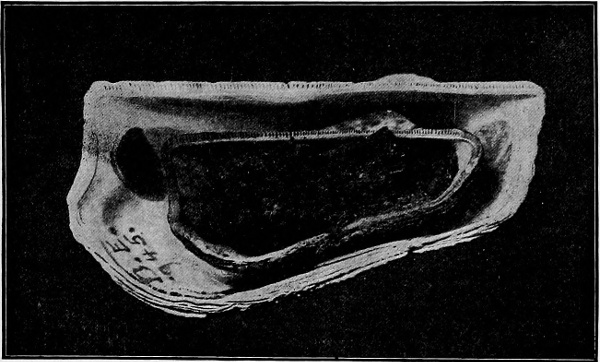
Fig. 25—Scatophagic supplies.
In recapitulating the food supplies of the Seri it is not without interest
to estimate roughly the relative quantities of the several constituents
consumed; and the proportions maybe made the more readily
comprehensible by expression in absolute terms. As a basis for the
quantitative estimate, it may be assumed that the average Seri, living,
as he does, a vigorous outdoor life, consuming, as he does, a diet of less
average nutrition than the selected and cooked foods of higher culture,
and attaining, as he does, an exceptional stature and strength, eats
something more than the average ration; so that his ration of solid
food may be lumped at 2.75 pounds (about 1,250 grams) daily, or 1,000
pounds (about 455 kilograms) yearly. The aggregate diet of the tribe
may be estimated also by assuming the population to comprise 300 full
eaters, besides, say, 50 nurslings negligible in the computation; so that
the annual consumption of the tribe may be reckoned at 300,000 pounds
(136,000 kilograms), or 150 tons, of solid food. Accordingly the several
constituents may be estimated, as shown in the accompanying table, in
percentages of the total, in pounds aggregate and apiece for the eaters,
and (so far as practicable) in units both aggregate and apiece; the
weights of units being roughly averaged at 100 pounds (45 kilograms)
for turtles, 12½ pounds (5.6 kilograms) for large land game, 450 pounds
(about 200 kilograms) for stock, and 2 ounces (56.7 grams) for tunas.
| Constituents |
Per
cent |
Quantity |
Units |
| Aggregate |
Apiece |
Aggregate |
Apiece |
|
|
Pounds |
Pounds |
|
|
| Turtles |
25 |
75,000 |
250 |
750 |
2½ |
| Pelicans |
5 |
15,000 |
50 |
1,200 |
4 |
| Other water-fowl and eggs |
8 |
24,000 |
80 |
|
|
| Fish |
15 |
45,000 |
150 |
|
|
| Shellfish (except turtles) |
10 |
30,000 |
100 |
|
|
| Large land game |
7 |
21,000 |
70 |
200 |
⅔ |
| Other land game |
8 |
24,000 |
80 |
|
|
| Stock |
6 |
18,000 |
60 |
40 |
2/15 |
| Tunas |
9 |
27,000 |
90 |
216,000 |
720 |
| Other vegetals |
5 |
15,000 |
50 |
|
|
| Miscellaneous |
2 |
6,000 |
20 |
|
|
| Total |
100 |
300,000 |
1,000 |
|
|
Of course the constituents vary with temporary conditions; during
“The Time of the Big Fish”, practically all other sources of food were
neglected until the providential supply was exhausted; during the
decades of main subsistence on stolen stock it is probable that the consumption
of other constituents, perhaps excepting the tunas, was proportionately
reduced; and it is not improbable that during the warfare
between Seri and Tepoka, described by Hardy, the consumption of turtles
was materially diminished. Judging from the direct and indirect
data and from general analogies, the least variable constituent is the
cactus fruit, which probably fails but rarely and is so easily harvested as
practically to supplant all other supplies during its season of a month or
more. At the best, too, the quantitative estimates are nothing more
than necessarily arbitrary approximations, based on incomplete inquiries
and observations;285 yet they are better than no estimates at all, and
appear to form a fairly trustworthy basis for consideration of the Seri
food habits.
On reviewing the constituents it would appear that the Seri must be
regarded as essentially a maritime people, in that about two-thirds of
their food is derived from the sea; also that they must be deemed essentially
carnivorous, since fully five-sixths of their diet (84 per cent
plus a share of the miscellaneous—chiefly scatophagous—category) is
animal. The tabulation does not show the relative proportions of the
several constituents cooked and eaten raw, but the best available data
indicate that fully three-fourths of the ordinary dietary, both animal
and vegetal, is ingested in raw condition, and that the greater part of
the remaining fourth is imperfectly cooked.
In recapitulating the devices for food-getting, it is found that nearly
all of the more distinctive artifacts and crafts are either directly or
indirectly connected with that primary activity of living things, food-conquest.
Foremost among the distinctive artifacts of the Seri, in its
relation to daily life and in its technical perfection, is the canteen-olla;
probably second in importance, and also in technical perfection, is the
balsa—whose functions, however, extend beyond simple food-getting;
next comes the crude and simple, yet economically perfected, turtle-harpoon,
with its variants in the form of arrow (with a function in warfare
as well as in food-getting) and fire-drill; while the light basket-tray,
although capable of carrying ten to twenty-five times its own weight,
is perhaps the least perfect technically of the artifacts directly connected
with sustentation. And it should be noted that the prevailing tools—hupf,
ahst, multifunctional shell, and awl of mandible or bone or tooth—have
either an immediate or a secondary connection with food-getting.
At first sight Seriland seems an abnormal habitat for a primitive
people, since its land area is cleft in twain by a stormy strait—a strait
whose terrors to the few Caucasian navigators who have reached its
swirling currents are indicated by their appellations, “El Canal Peligroso
de San Miguel”286 and “El Infiernillo”; for such a stretch of
troubled water is commonly a more serious bar to travel than any moderate
land expanse. This intuitive notion of the effectiveness of a
water barrier, and the correlative feeling of the incongruity of a land
barrier insuperable for centuries, is well illustrated by prevailing opinion
throughout northwestern Mexico; for it is commonly supposed in
Sonora and neighboring states that Seriland is conterminous with Isla
Tiburon, i. e., that the mainland portion of the province (including
Sierra Seri with its flanking footslopes) lies beyond the diabolic channel.
Yet longer scrutiny shows that the superficial impression merely
mirrors Caucasian thought and fails to touch the essential conditions,
especially as they are reflected in the primitive minds of the local tribe;
and careful study of the habits and history of the Seri shows that the
dangerous strait has been a potent factor in preserving tribal existence
and perpetuating tribal integrity. Naturally the factor operates through
navigation; for it is by means of this art that the tribesmen are able to
avoid or to repel the rare invaders of either mainland or insular portions
of their province, the overland pioneers from the east being stopped
by the strait and the maritime explorers from south and west being
unable to maintain themselves long about the stormy shores and never
outfitted for pushing far toward the mainland retreats and strongholds;
while by means of their light and simple craft the Seri were able to
retreat or to advance across the strait as readily as over the adjacent
lands to which they were wonted by the experience of generations. In
their minds, indeed, El Infiernillo is the nucleus of their province. So
the Seri were among the lowliest learners of that lesson of highest statecraft,
that lands are not divided but united by intervening sea; and
their ill-formulated and provincial notions are of much significance in
their bearing on autochthonous habits and habitats.
The water-craft of which the Seri make so good use is a balsa, made
of three bundles of carrizal or cane lashed together alongside, measuring
barely 4 feet abeam, 1½ feet in depth, and some 30 feet in length
over all. A fine specimen (except for a slight injury at one end) is
shown in plan and profile in plate XXXI. It was obtained near Boca
Infierno in 1895, partly towed and partly paddled thence to Embarcadero
Andrade, wagoned laboriously across Desierto Encinas and on
to Hermosillo, conveyed in an iron-sheathed box on two gondolas of
the narrow-gage Ferrocarril de Sonora to the international frontier,
and finally freighted to the United States National Museum, where (in
the Mall just outside the building) the photographs reproduced in the
plate were taken.
The manufacture of the balsa has never been seen by Caucasian eyes,
but the processes are safely inferred from the structure, whose testimony
is corroborated in part by Mashém’s imperfect descriptions. The first
step is the gathering of the carrizal from one of the patches growing about
the three or four permanent fresh waters of Seriland, the canes being carefully
selected for straightness, symmetry, and uniformity in size; these
are then denuded of leaves and tassels, tied in bundles of convenient
size (one seen on Tiburon contained 40 or 50 canes), and carried to the
shore. In actual construction the canes are laid butt to butt, but overlapping
2 or 3 feet, the overlap being shifted this way and that with
successive additions, so that the aggregate length of overlapping in the
bundle reaches 10 or 12 feet—i. e., the full length of the body of the
finished craft. The growing bundle is wrapped from time to time with
lashings of mesquite root or maguey fiber, and kept in cylindrical form
by constant rolling and by means of the lashing; though the cord used
for the purpose is so slender as to do little more than serve the purposes
of manufacture (only stray shreds of the interior
cording could be found in an old and abandoned balsa
on Punta Antigualla). As the bundle approaches
the requisite size, the building process changes; the
butts of the successively added stalks are thrust
obliquely into the interstices extending beyond the
butts of earlier-used canes, and the stems are
slightly bent to bring them into parallelism with
their fellows; and this interweaving process is continued
with increasing care until, when the bundle is
completed, there are no visible butts (all being
pushed into the interior of the bundle), while the
only visible tips are those projecting to form the
tapering extremities. The finished bundle is then
secured by a spiral winding of slender cord. Two
other bundles are next made, the three being entirely
similar, so far as is known; then the three are joined
by a lashing of slender cord like that used for the
separate bundles, which is twined alternately above
and below the central bundle in such manner as to
hold the three in an approximate plane save toward
the extremities, where the lashing is much firmer
and the tapering tips of the bundles are brought into
a triangular position, i. e., the position of smallest
compass. The cordage is of either mesquite root or
maguey fiber, the former being the more common,
so far as observed (doubtless by reason of the dearth
of the latter plant); it is notably uniform in twist
and size, though surprisingly slender for the purpose,
barely three-sixteenths of an inch, or 5 mm., in
diameter, and limited in quantity.287 The only tools
or implements used in the manufacture (and repair),
so far as is known, are light wooden marlinspikes,
two of which are illustrated in figure 26; these are
used in working the cane-butts into the bundles.
In collecting the canes the tassels are broken off and
the leaves stripped by the unaided hands, while
the stalks are broken off usually below the secondary
roots in the downward taper, and the rootlets and
loose ends are removed either with the hands or
by fire.
BUREAU OF AMERICAN ETHNOLOGY
SEVENTEENTH ANNUAL REPORT PL. XXXI
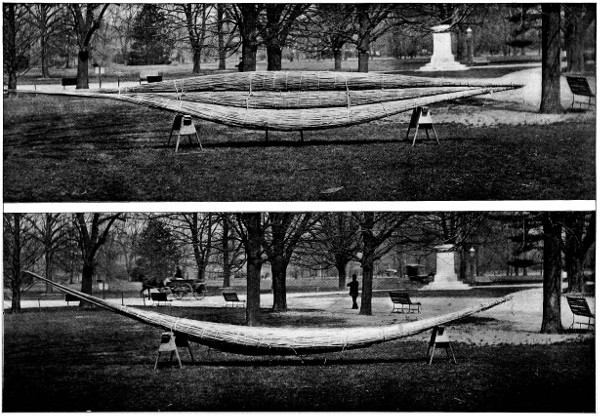
SERI BALSA IN THE NATIONAL MUSEUM

Fig. 26—Seri
marlinspikes.
The finished balsa is notably light and buoyant.
The Boca Infierno specimen was estimated to weigh
about 250 pounds (113 kilograms) when thoroughly
dry, and little more than 300 pounds (126 kilograms)
when completely wet; so that it could easily be picked up by three or
four, or even by two, strong men and carried ashore to be hidden in the
fog-shrubbery skirting the coast. The craft floated high with one man
aboard, rode better with two, carried three without much difficulty even
in a fairly heavy sea, and would safely bear four adults aggregating
600 pounds (272 kilograms) in moderate water. The most striking
features of the craft afloat are its graceful movement and its perfect
adaptation to variable seas and loads. The lines are symmetric and of
great delicacy, as indicated even by the photographs out of its element;
the reed-bundles are yielding, partly by resilience and partly in the way
of set, so that the body of the craft curves to fit the weight and distribution
of the load and to meet the impact of swells and breakers. In
smooth water a lightly laden balsa may appear heavy and logy, but
with a heavier load and stronger sea each tapering end rises strongly
and then recurves slightly in a Hogarthian line graceful as the neck of a
swan, while the whole craft skims the waves or glides sinuously over their
crests in a lightsome way, recalling the easy movement of gull or petrel.
A suggestion of its effect is shown in figure 27, a composite drawn largely
from photographs; another suggestion is shown, in figure 28, reproduced
in facsimile from a drawing by the artist of the U. S. S. Narragansett
in 1873,288 the only known picture of the craft antecedent to the 1895
expedition.
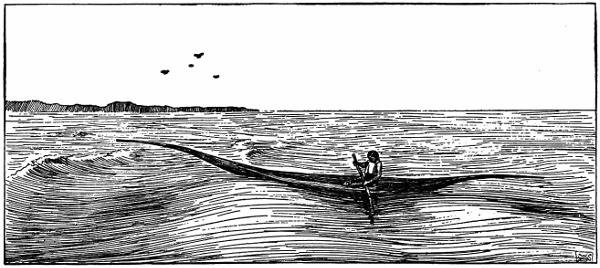
Fig. 27—The balsa afloat.
Almost equally striking features of the balsa are its efficiency and
safety under the severe local conditions. Carrying twice its weight of
(chiefly) living freight, it breasts gales and rides breakers and stems
tiderips that would crush a canoe, swamp a skiff, or capsize a yawl;
while if caught in currents or surf and cast ashore it is seldom wrecked,
but drops lightly on beach or rocks, to be pushed uninjured by the
broken wave-tips beyond the reach of pounding rollers, even if it is
not at once caught up by its passengers and carried to complete safety.
The strength of the craft is amazing, especially in view of the slenderness
of the cords used in construction; in fact, the outer layers of canes
are so ingeniously interlocked by the insertion of their butts into interstices
that each bundle holds itself together with slight aid from the
exterior cording, while even the bundles themselves are held in proper
relative position by the secure terminal tying rather than by the intertwined
cording of the body of the craft. And the entire construction
exemplifies the compartment principle to perfection; a slight injury
may affect but a single joint of one out of several thousand canes, while
even a severe fall on sharp rocks seldom injures more than a few score
canes, and these in a few joints only. The most objectionable feature
of the balsa lies in the fact that it affords little protection from the wet.
The water rises freely through the reed bundles to a height depending
on the load, and not only the spray but the whitecaps and combers
as well dash freely over the unprotected body of the craft; but this
defect is of little consequence to the hardy and nearly nude navigators,
or to their scanty and practically uninjurable freight.
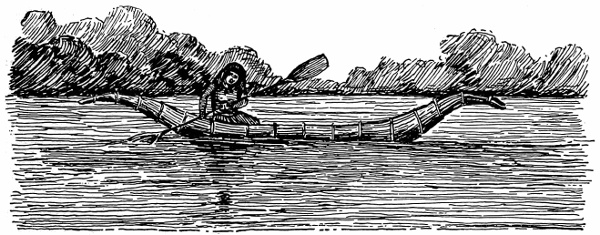
Fig. 28—Seri balsa as seen by Narragansett party.
The gracefulness and efficiency of the balsa itself stand in strong
contrast with the crude methods of propulsion. According to Mashém,
the craft is commonly propelled by either one or two women lying
prone on the reeds and paddling either with bare hands or with large
shells held in the hands; according to Hardy, the harpoon main shaft
is used by turtle fishermen for paddling (and probably for poling, also);
according to the Dewey picture (figure 28), the vessel is driven by a
woman with a double-end paddle like that used in connection with the
conventional canoe; while the expedition of 1895 found on Isla Tiburon
four or five paddles rudely wrought from flotsam boards and barrel-staves,
and partly hafted with rough sticks 3 or 4 feet long, but partly
without handles and evidently designed to be grasped directly, like the
shells of Mashém’s descriptions. No trace of oars, rowlocks, sculls,
rudders, or masts were found, and there is nothing to indicate the
faintest notion of sails and sailing. On the whole there is no trace of
well differentiated propelling devices—i. e., the craft is perfected only
as a static device and not at all as a dynamic mechanism.
Despite their poverty in propelling devices, the Seri navigate their
waters successfully and extensively. Perhaps the commonest function
of the craft is that exercised in connection with the turtle fishery,
though its chief office as a factor of general industrial economy is that
of bridging El Infiernillo at the will of the roving clans. It is by means
of this craft, also, that the semiceremonial pelican feasts on Tiburon
are consummated; it is by the same means that Isla Patos, Isla Turner,
Roca Foca, and other insulated sources of food-supply are habitually
reached; and both Mashém’s accounts and the Jesuits’ records indicate
that occasional voyages are pushed to San Esteban, San Lorenzo,
Angel de la Guarda, and even to the Baja California coast.
Concordantly with the tribal customs, little freight is carried. The
traveling family transport their poor possessions to the shore, bring
out the balsa from its hiding place in the thick and thorny fog-shrubbery,
launch it, lade it with a filled olla and the weapons of a man and
implements of a woman, besides any chance food and clothing, and
embark lightly to enjoy the semirepose of drifting before the breeze—until
the rising gale brings labor still more arduous than that of scouring
the spall-strewn slopes or sandy stretches of their hard motherland.
Commonly the terminus of the trip is fixed largely by the chance of
wind and tide; and when it is reached the party carry the craft inshore,
conceal it shrewdly, and then take up their birdskin bed and walk
forth in search of fresh water and meat. The successful fishing trips
of course end in orgies of gorging, and when the voyage is the climax of
a foray to the mainland frontier for stock-stealing, the quarters and
paunches and heads hastily thrown aboard at the mainland side of the
strait are carried to the rancherias for consumption at leisure; and this
has happened so often that equine hoofs and bovine bones are common
constituents of the middens on Tiburon.
Although measurably similar to Central American and South American
types of water-craft, the Seri balsa is a notably distinct type for
its region. The California natives, as well as those of the mainland of
Mexico south of Rio Yaqui, used rafts made either of palm trunks
or of other logs lashed alongside rather than balsas; while the far-traveling
tribes used either sails or well-differentiated paddles for
propulsion.
Briefly, the Seri balsa is remarkable for perfect adaptation to
those needs of its makers shaped by their distinctive environment.
It seems to approach the ideal of industrial economy—the acme of
practicality—in the adjustment of materials and forces to the ends
of a lowly culture; and, like the olla and harpoon and arrow, it affords
an impressive example of the adjustment of artifacts to environment
through the intervention of budding intelligence. Yet the chief
significance of the craft would seem to reside in its vestigial character
as a survival of that orarian stage in the course of human development
in which men lived alongshore and adjusted themselves to maritime
conditions rather than to terrestrial environments; a stage evidently
but barely passed by the Seri, since they still subsist mainly on sea
food, still retain their suggestive navigation, and still view their stormy
straits and bays as the nucleus and noblest portion of their province.
Among the Seri, as among primitive folk generally, the habitation
reflects local conditions, especially climate and building materials.
Now, Seriland is a subtropical yet arid tract, where rain rarely falls,
frost seldom forms, and snow is known only as a fleeting mantle on
generally distant mountains, so that there is little need for protection
from cold and wet; at the same time the district is too desert to yield
serviceable building material other than rock, which the lowly folk
have not learned to manipulate. Moreover, the tribesmen and their
families are perpetual fugitives (their movements being too erratic and
aimless to put them in the class of nomads); they are too accustomed to
wandering and too unaccustomed to long resting at particular spots to
have a home-sense, save for their motherland as a whole; and, just as
they rely on their own physical hardihood for preservation against the
elements, so they depend on their combined fleetness and prowess for
preservation against enemies. Accordingly, the Seri habitation is not
a permanent abode, still less a domicile for weaklings or a shrine for
household lares and penates, not at all a castle of proprietary sanctity,
and least of all a home; it is rather a time-serving lair than a house in
ordinary meaning.
Despite the poverty of the material and the squalor of the structure,
certain features of the Seri jacal are notably uniform and conventional.
In size and form it recalls the passing “prairie schooner”, or covered
wagon; it is some 10 or 12 feet long, half as wide measured on the
ground, and about 4½ feet high, with one end (the front) open to the
full width and height, and the other nearly or quite closed. The conventional
structural features comprise the upright bows and horizontal
tie-sticks forming the framework. The bows are made of okatilla
stems (Fouquiera splendens) roughly denuded of their thorns; each is
formed by thrusting the butts of two such stems (or more if they are
slender) into the ground at the requisite distance apart, bending the
tops together into an overlap of a yard or two, and securing them
partly by intertwisting, partly by any convenient lashing; and about
five or six such bows suffice for a jacal (the appearance of the bows is
fairly represented by the ruin shown in plate VII). Next come the tie-sticks,
which consist of any convenient material (okatilla stems, cane-stalks,
paloblanco branches, mesquite roots, saguaro ribs, etc.), and
are lashed to the butts by means of withes, splints, or fiber wisps, at a
height of some 4 feet above the ground, or about where the walls merge
into the roof. With the placing of these sticks the conventional part
of the building process may be said to end; for up to this point the process
is a collective one and the materials are essentially uniform, while
thereafter the completion of the work depends largely on individual or
family caprice, and the materials are selected at random. Moreover,
the framework is fairly permanent, usually surviving a number of occupancies
extending over months or years, and outlasting an equal number
of outer coverings; so that all habitable Seriland is dotted sparsely
with jacal skeletons, sometimes retaining fragments of walls or roof,
but oftener entirely denuded.
The conversion of the framework into a habitable jacal is effected by
piling around and over it any convenient shrubbery, by which it is made
a sort of bower; sometimes the conversion is aided by the attachment
of additional tie-sticks both above and below the main horizontal pieces,
as illustrated in the upper figure of plate IX; sometimes, too, the material
of walls and roof is carefully selected and interwoven with such pains as
to form a rude thatch, as in the chief jacal at Rada Ballena (the upper
figure in plate VI); but more commonly the covering is collected at
random and is laid so loosely that it is held in place only by gravity and
wind pressure, and may be dislodged by a change of wind. Ordinarily
the walls are thicker and denser than the roofs, which are supplemented
in time of occupancy by haunches of venison, remnantal quarters of cattle
and horses, half-eaten turtles, hides and pelts, as well as bird-skin robes,
thrown on the bows partly to keep them out of reach of coyotes and
partly to afford shade. Most of the jacales about the old rancheria at
Punta Tormenta (abandoned at “The Time of the Big Fish”), which may
be regarded as the center of the turtle industry, are irregularly clapboarded
with turtle-shells and with sheets of a local sponge, as illustrated
in plate VII. This sponge abounds in the bight of Rada Ballena,
where at high water it spreads over the silty bottom in a slimy sheet,
and at low water with off-shore gales is left by the waters to dry into a
light and fairly tenacious mat, which is gathered in sheets for bedding as
well as for house-making material (a specimen of the sponge—probably
Chalina—is shown on larger scale in plate VIII). On the frontier the
jacales may be modified by the introduction of sawed or riven lumber,
as illustrated by some of the-structures at Costa Rica (shown in plate
XI); but even here there is a strong disposition to adhere to the customary
form, and especially to the conventional framework, as indicated
by the example in plate X.
While the jacales are not consistently oriented, they reveal a primary
preference for facing away from the prevailing wind and toward the
nearest sea, with a secondary preference for southern and eastern exposures—the
former preference being easily explained, since a gale from
the front quickly strips walls and roof and scatters the materials afar.
No definite order is observed in the placement of the several jacales in
the larger rancherias; apparently the first is located at the choice of the
leading elderwoman, and the others are clustered about it at the common
convenience. Usually the several jacales are entirely separate;
but at Punta Tormenta, Punta Narragansett, and still more notably at
Rada Ballena, individual huts were found either extended to double
length or joined obliquely in such wise as to show two fronts (as illustrated
in plate VI). The conventional frameworks appear to be common
tribal property, at least to the extent that an abandoned skeleton may
be preempted by any comer; while the addition of walls and roof appears
to afford a prescriptive proprietary right to the elderwoman and family
by whom the work is done—though the right seems to hold only during
occupancy, or until the temporary covering is dislodged.
BUREAU OF AMERICAN ETHNOLOGY
SEVENTEENTH ANNUAL REPORT PL. XXXII
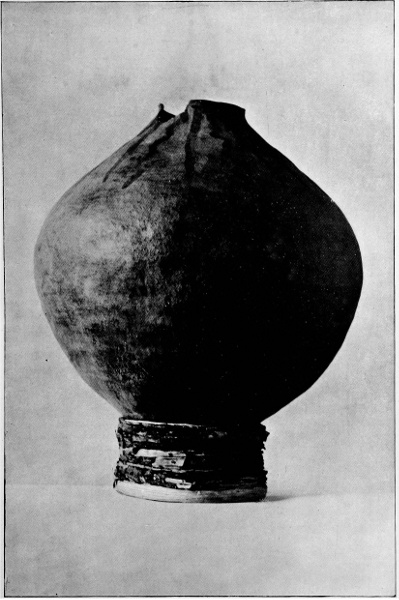
PAINTED OLLA, WITH OLLA RING
The jacales are without semblance of furnishing, beyond an occasional
ahst and a few loose pebbles used as hupfs; though the nooks
behind the bows and tie-sticks sometimes serve as places of concealment
for paint-cups, awls, hair bobbins, and other domestic trifles.
There is no floor but earth, and this remains in natural condition,
except for trampling and wearing into wallows, recalling those of fowls
and swine, which afford a rough measure of the periods of occupancy;
there is no fireplace—indeed, fires are rarely made in the jacales, nor
for that matter frequently anywhere; and there are no fixed places for
bedding, water ollas, or other portable possessions, none of which are
left behind when the householders are abroad.
Little is known of the actual process of jacal building, especially in
Seriland proper; but the observations of Señor Encinas and his
vaqueros on the frontier corroborate Mashém’s statements that the
houses are built by (and belong to) the matrons; that several women
customarily cooperate in the collection of the okatilla and erection of
the framework; that the only tools used in the processes are hupfs
and miscellaneous sticks; and that the placing and fitting of the beams
and tie sticks are accompanied by a chant, usually led by the eldest
matron of the group. The same informants support the ready inference
from the structure that the shrubbery and other material forming
walls and roofs are gathered and placed from time to time by the
women occupying the jacales.
The Seri building chant is suggestive. Neither Señor Encinas nor
Mashém regarded it as religious or even ritualistic, but merely as a
work-song designed (in the naive notion of the latter) to make the task
lighter; and it seems probable that the local interpretation is correct.
If so, the simple chant at once offers rational explanation for its own
existence, and opens the way to explanation of the elaborate building
rituals of more advanced tribes. The work-song is a common device in
many lowly activities, ranging from those of children at play to those
of sailors at the windlass, and undoubtedly serves a useful purpose in
guiding, coordinating, and concentrating effort; to some extent the
vocal accompaniment to the manual or bodily action apparently
expresses that normal interrelation of functions manifested by secondary
sense-effects (as when the sense of smell is intensified by exercise
of the organs of taste), or, in another direction, by the habit of the
youthful penman who shapes his letters by aid of lingual and facial
contortion; yet it is a characteristic of primitive life—one doubtless
due to the interrelations of psycho-physical functions—to not only
employ but to greatly exalt vocal formulas associated with manual
activities, so that words, and eventually the Word, acquires a mystical
or talismanic or sacred significance pervading all lower culture—indeed
the savage shaman is unable to work his marvels without mumbled
incantations ending in some formulated and well-understood utterance,
and his practice persists in the meaningless mummery and culminating
“presto” of modern jugglery. So, viewed in the light of psycho-physical
causes and prevalent customs connected with vocal formulas, it
would seem probable that the conventional features of the Seri jacales
are crystallized in the tribal lore quite as effectually through the associated
work-chants as through direct memory of the forms and structures
themselves. And the simple runes chanted in unison by Seri
matrons engaged in bending and lashing their okatilla house-bows
apparently define a nascent stage in the development of the elaborate
fiducial house-building ceremonies characteristic of various higher
tribes; for the spontaneous vocal accompaniment tends naturally to run
into ritual under that law of the development of myth or fable which
explains so many of the customs and notions of primitive peoples.289
Slightly as they have been affected by three centuries of sporadic
contact with higher culture, the Seri reveal many marks of acculturation;
and the most conspicuous of these are connected with clothing,
especially on the frontier, where women and even warriors habitually
wear a livery of subserviency in the form of cast-off Caucasian rags
(as illustrated in most of the photographs taken at Costa Rica). Even
in the depths of Seriland the native fabrics are largely replaced by
white men’s stuffs, obtained by barter, beggary, and robbery; yet it is
easy to distinguish the harlequin veneer of borrowed trappings from
the few fixed types of covering that seem characteristic.
The most distinctive piece of apparel is a kilt, extending from waist
to knees, worn alike by men and women and the larger children.
Aboriginally it was either a birdskin robe or a rectangle of coarse
textile fabric, secured at the waist by a hair-cord belt; acculturally it
is usually a rectangle of manta (coarse sheeting) or other stuff, preferably
cotton or linen but sometimes woolen, fastened either by tucking
in the corners or by a belt of cord. Good specimens of the accultural
cloth kilt worn by men and larger boys are illustrated in plates XVI
and XIX; the birdskin kilt (put on for the purpose) is illustrated in
plate XVIII, while the aboriginal fabric is fairly represented in plate
XXIX. Although ordinarily worn as a kilt, the same article (temporarily
replaced by an improvised substitute) serves other purposes at the
convenience of the wearer; in the chase for tunas and for moving game
it becomes a bag or pack-sheet; in case of cold rain it is shifted to the
shoulders or the exposed side; during the siesta, it is elevated on a
shrub and a stick to serve as a canopy; at sleeping time generally it
forms (especially when of birdskin) a bed, i. e., a combined mattress
and coverlet; and in attack or defense the pelican skin is at once standard,
buckler, and waving capa to confuse quarry or enemy after the
manner of the toreador’s cloak.
An almost equally distinctive garment is a short shirt or wammus,
with long sleeves, worn by men and women but not by children; ordinarily
it covers the thorax, missing connection with the kilt by a few
inches, and so affording ventilation and space for suckling the teeming
offspring. Unlike the kilt, it is an actual garment, fitted with sleeves
and fastened in front with hair-cord strings. Although the Seri
wammus corresponds fairly with a Yaqui garment, it seems practically
certain that it is of local aboriginal design, and that it was made primitively
of haircloth or native textiles (as illustrated in plate XXIX) and
worn rather ceremoniously; but latterly it is made of manta and is
worn habitually (at least by the women and on the frontier), though
cast aside in preparation for any special task or effort—i. e., it is not
connected with pudency-sense, save to a slight degree in the younger
women. The form, function, and prevalence of the wammus are illustrated
by the group shown in plate XIII, in which nearly all of the
thirty-odd adults wear the garment.
These two articles constitute the ordinary wearing apparel of the
Seri, though they are commonly supplemented (especially when both
are of manta) by a pelican-skin robe, which is habitually carried to
serve as bed or mackintosh, according to the chance of journey and
weather, or as a shield in sudden warfare. No head-covering is used,
save in the ceremonial masquerade, when the heads of animals are worn
as masks,290 or in aping Caucasian customs, especially on expeditions for
barter (as illustrated in plate XII). Loose trousers of Mexican pattern
are sometimes put on at frontier points, but are discarded in Seriland
proper, save by Mashém, who maintains prestige partly by this borrowed
badge of Caucasian superiority. Leggings and moccasins are
eschewed, naturally enough, since they would afford little protection
from the sharp spalls and savage thorns of the district, and would give
lodgment for the barbed spines inevitably gathered in rapid chase or
flight over cactus-dotted stretches; and the only foot-covering seen
(save Mashém’s boots) was a single sandal made from the rough skin
of a turtle-flipper, apparently for ceremonial rather than practical use.
Of all the party at Costa Rica in 1894 subchief Mashém was the only
one who wore Caucasian apparel with any air of comfort and fitness; yet
even he, with hat and shirt, boots and breeches, and loose bandana
about his neck in cowboy style (plate XVII), did not feel fully dressed
without the slender hair-cord necklace of his kin in its wonted place.
On the frontier improvised fig-leaves were sometimes put on the children
of less than a dozen years (as illustrated by the standing infant
shown in plate XIV, who was thus dressed hastily for her picture); and
a common garb of the smaller children at Costa Rica, as they played
about the rancheria or wandered in directions away from the white
man’s rancho, was limited to a cincture of hair cord or snake skin, or
perhaps of agave fiber, under which an improvised kilt might be tucked
on the Caucasian’s approach.
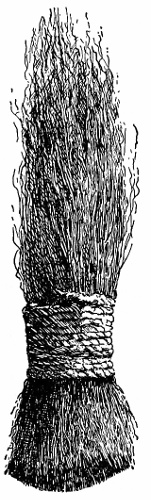
Fig. 29—Seri hairbrush.
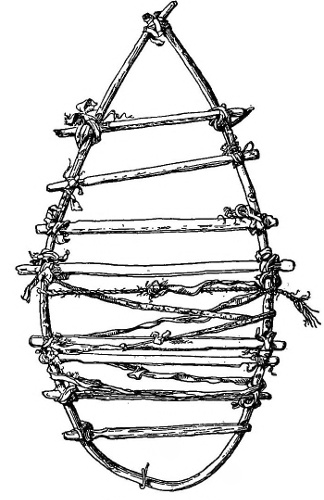
Fig. 30—Seri cradle.
In addition to the individual apparel, each clan, or at least the elderwoman
or her fraternal executive, accumulates some surplus material
as opportunity offers, and this serves as family bedding until occasion
arises for converting it to other uses. Of late the prevailing materials
are pelican skins, lightly dressed and joined into robes by sinew stitching;
deerskins, dried or partially dressed; cormorant skins, treated like
those of the pelican; seal skins, usually fragmentary; peccary skins,
apparently dried without dressing, together with
skins of rabbits, mountain sheep, antelope, etc.,
usually tattered or torn into fragments. Commonly
the hides and pelts are nearly or quite in natural
condition, retaining the hair, fur, or feathers. The
dressing is apparently limited to scratching and
gnawing away superfluous flesh, followed by some
rubbing and greasing; tanning is apparently unknown.
By far the most abundant of the collective
possessions are the pelican-skin robes, which form
the sole article of recognized barter with aliens.
The aggregate stock accumulated at any time is but
meager, never too much to be borne on the heads
and backs of the clan in case of unexpected decamping.
BUREAU OF AMERICAN ETHNOLOGY
SEVENTEENTH ANNUAL REPORT PL. XXXIII
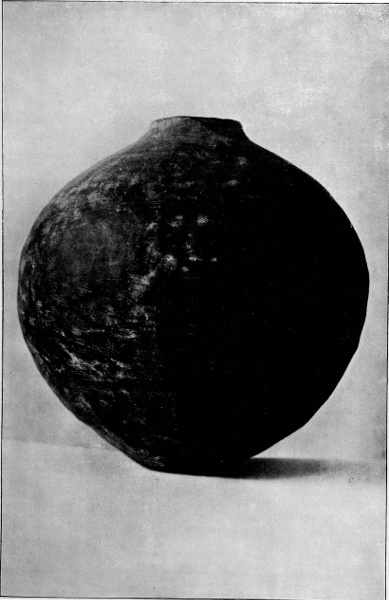
PLAIN OLLA

Fig. 31—Hair spindle.
Aside from the painting paraphernalia, there is
but a single conspicuous toilet article; this is a hairbrush
made of yucca fiber bound into cylindrical
form, as illustrated in figure 29. This article is in
frequent use; both women and men give much attention
to brushing their own long and luxurious locks
and cultivating the hair and scalps of their children,
the process being regarded as not only directly useful
but in some measure sacramental. Ordinarily the
hair is parted in the middle and brushed straight,
the tresses being permitted to wander at will and
never braided or bound or restrained by fillets save
in imitation of Caucasian customs on the frontier;
though in certain ceremonies the pelage is gathered
in a lofty knot on the top-head.291
The Seri cradle is merely a bow of paloblanco or
other switch with rude cross-sticks lashed on, as
shown in figure 30. On this is laid a small pelican-skin
robe, with a quantity of pelican down for a
diaper, and perhaps a few pelican feathers attached
as plumes to wave over the occupant’s face; though
on the frontier these primitive devices are largely
replaced by rags.
Among the important appurtenances of Seri life
are the cords used for belts and necklaces, as well as
for the attachment of ceremonial headdresses, for converting
the kilts into bags, and for numberless minor
purposes. The finest of these are made from human
hair; and for this purpose the combings are carefully
kept, twisted into strands, and wound on thorns
or sticks in slender bobbins, such as that illustrated
in figure 31. When the accumulation suffices the strands are doubled
or quadrupled, as shown in figures 32 and 33, and the cords are either
applied to immediate use or added to the matron’s meager store against
emergency demands. The cordage used for other purposes than appareling
is commonly made from fiber extracted either from the roots of the
mesquite or the stipes of the agave; usually it is well twisted and notably
uniform in size and texture; an inferior example appears in figure 34.
The manes and tails of horses and other stock are also converted into
cordage, of which the chief known application is in toy riatas. It is of
no small significance that the most highly prized cordage material is
human hair, and that its chief uses are connected with the person; that
the next in order of diminishing preciousness is that derived from the
fibrous plants, which is used in balsa-making, bowstrings, harpoon
cords, etc., as well as in the native fabrics; and that the least prized
material is that derived from imported animals, which is largely limited
in its utilization to youthful imitation of Caucasian industries; for the
association of material with function reflects a distinctive feature of
primitive thought, akin to that displayed in somewhat higher culture
as synecdochic magic, the doctrine of signatures, etc.
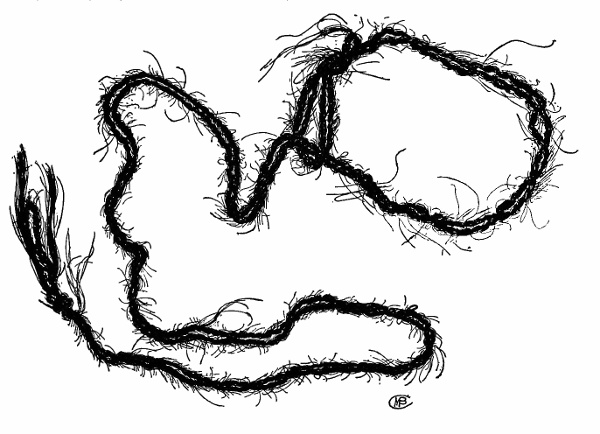
Fig. 32—Human-hair cord.
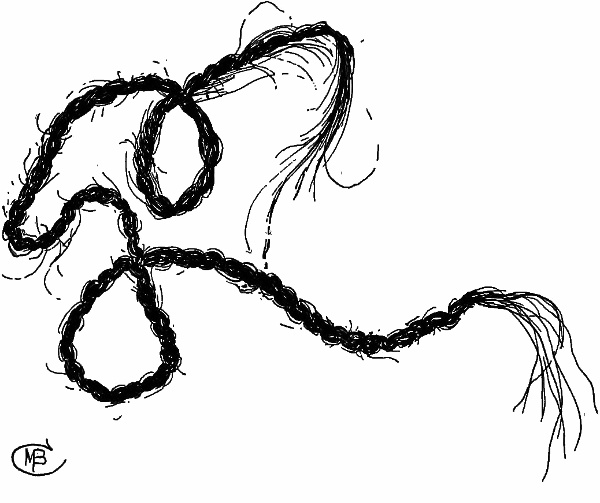
Fig. 33—Horsehair cord.
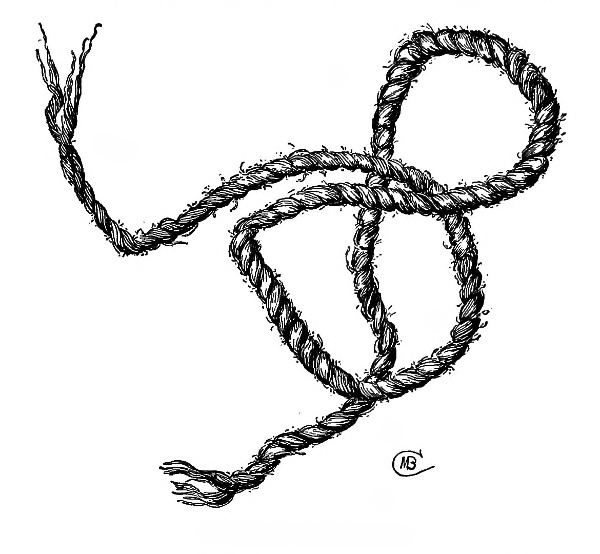
Fig. 34—Mesquite-fiber rope.
Partly because of that decadence of aboriginal devices correlated
with acculturation, partly by reason of imperfect observation, practically
nothing is known of Seri spinning and weaving, and little of Seri
sewing. The religiously-guarded hair-combings are twisted in the
fingers and wound on stick-bobbins without aid of mechanical appliances;
and, so far as has been observed, the final making of hair cords is
merely a continuation of the strictly manual process. The agave stipes
and mesquite roots are alleged by vaqueros to be retted in convenient
lagoons and barrancas (a statement corroborated by the finding of half
a dozen sections of mesquite root soaking in a lagoon near Punta Antigualla
by the 1895 expedition), and then hatcheled with the hupf or the
edge of a shell; when the fibers are gathered in slender wisps or loosely
wound coils, both of which were among the possessions of the Seri
matrons at Costa Rica in 1894. So far as could be ascertained, the
final processes parallel those of hair-cord making, i. e., the fibers are
patiently sorted into strands, sized in the fingers
and twisted by rolling on the thigh, the strands
being subsequently combined in similar fashion.292
Neither the weaving nor the woven fabrics of the
Seri have ever been seen by technologic students
so far as known, though the fabrics are shown in
Von Bayer’s photographs and have been described
by various observers. According to Señor Encinas,
they resemble coarse bagging, and are woven or
netted quite plainly. The ordinary sewing material
is sinew, used in
connection with a
bone awl (a good
example of which
is illustrated in
figure 35), a fish
spine or bone, a cactus thorn, or either the mandible of a water-bird
or a hard-wood skewer shaped after this natural needle (figure 36
a and b). Sometimes hair or vegetal fiber is substituted for the sinew;
and for certain purposes an agave thorn, with the fibers naturally
attached, serves for needle and thread.
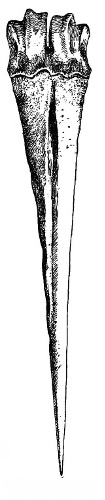
Fig. 35—Bone awl.
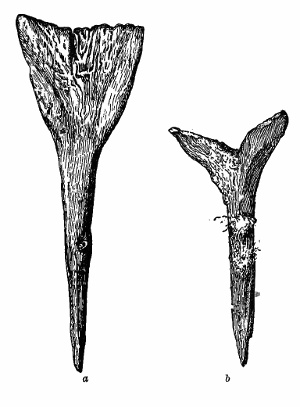
Fig. 36—Wooden awls.
Summarily, the customary apparel of Seri men and women may be
regarded as limited to three articles—(1) a kilt, normally of coarse
textile fabric, which is made a prime necessity by a well-developed
pudency; (2) a short wammus, also normally of coarse textile fabric,
which is apparently regarded as a convenience and luxury rather than a
necessity; and (3) a robe, normally of pelican skin, sometimes substituted
for either or both of the other articles, but ordinarily used as bedding
or as a buckler. The most valued of these articles is the robe, which
in the absence of the others replaces the kilt; yet pudency demands
the habitual use of some form of kilt, while both wammus and robe are
held so far superfluous that they may be laid aside or bartered or
otherwise dispensed with whenever occasion arises.
On considering the special functions and probable genesis of the Seri
appareling, the student is impressed by the absence of the breech-clout,
except perhaps in temporary improvisations—though the absence of this
widespread article of primitive costumery need awaken little surprise
in view of the environment, and especially of the abounding barbs of
Seriland, which render all appareling of doubtful value save for the protection
of tissues softened by habitual covering. The prevailing thorniness
of the habitat renders the free-flowing and easily removable apron
the most serviceable protection for the exposed vitals of the pubic
region; and this device, a common one in thorny habitats generally,
grades naturally into the short skirt or kilt; while it would well accord
with the maritime habit and habitual thought of the Seri to apply the
tough and densely feathered skin of the pelican to the purpose. This
suggestion as to the nascent covering of the tribe consists with the
tribal faith, in which the Ancient of Pelicans ranks as the creative
deity, while its modern representative is esteemed a protective tutelary
possessing talismanic powers against cold, wet, bestial claw and fang,
alien arrows, and all other evils; so that the use of this feathered pelt
as a shield against spiny shrubbery, sharp-leaved sedges, and barb-thorned
cacti is quite in harmony with Seri philosophy. Accordingly
it seems clear that the pelican-skin kilt was autochthonous among the
Seri, and that it was the original form of tribal appareling; and it is of
no small significance that the type persists in actual use as well as in
suggestive vestigial forms, such as pelican-down swaddling for infants,
pelican-feather plumes on cradle nets, etc.
The passage from the pelican-skin kilt to the garment of textile fabric
under the slow processes of primitive thought may not be traced confidently,
though a strong suggestion arises in the Seri hair-cult (a Samsonian
faith not without parallel in far higher culture) under which
mystical powers and talismanic virtues are imputed to the human
pelage. It is in connection with this cult that the Seri locks are so
attentively cultivated and so assiduously preserved and consecrated
to more intimate personal uses in belts, necklaces, and the like; and
although the connecting links have not been found, it is thoroughly
in accord with Seri thought to assume that in earlier times the hair
necklaces were expanded into rudimentary apparel in connection with
pelican-skin shields, and after the conquest of vegetal fibers into more
finished garments probably woven partly of hair and worn in such
wise as to supplement the natural pelage in the protection of back,
shoulders, chest, and arms. If the indication of the tribal cult be valid,
it would appear that the wammus was the second piece of apparel in
order of genesis, though the first to be made of artificial fabric; and
it is noteworthy that the suggestion is supported by the form of the
short and free-flowing garment underlying the flowing tresses of warriors
and matrons, as well as the vestigial use of human-hair cords for
neckbands and fastening strings; while its antiquity in comparison
with the textile kilt is indicated by the fact that it is a finished artifact,
evidently fitted to its functions by generations of adjustment.
The step from the making of the wammus to the substitution of artificial
fabrics for the pelican-skin kilt was an easy and natural one; and
it need only be noted that the transition is still incomplete, since the
feathered pelt is unquestioningly substituted for the fabric whenever
occasion demands, yet that the kilt in some form must be much more
archaic than the wammus, since it is correlated with the pudency sense,293
while the complete garment is not so correlated save in slight and
incipient degree.
Accordingly the three articles of apparel may be seriated genetically
as (1) the pelican-skin robe, used long as a kilt, and only lately relegated
to emergency use and bedding; (2) the well-differentiated wammus
of textile fabric with hair-cord fastenings; and (3) the textile kilt,
with or without a hair-cord belt. And the three artifacts are local and
presumptively—indeed manifestly—autochthonous, and exemplify the
interdependence of artifacts and environment no less strikingly than
the Seri balsa or basket or jacal.
In advanced culture tools are finished products, made and used in
accordance with preconceived designs or established arts for the production
of commodities; in primal life (as well exemplified by Seri
handicraft) tools are mere by-products incidental to the largely instinctive
activities directed toward the maintenance of life. Accordingly,
the tools of advanced culture form the nucleus of industries, while the
designless tools of the prime cluster about the outskirts of industrial
activities; i. e., in developed industries the tool is a primary factor,
while in nascent industries it is but a collateral.
The tools of any primitive tribe may be defined as appliances used
primarily in the production of implements and utensils, and incidentally
in preparing food, making habitations, manufacturing apparel, building
vehicles or vessels, etc.—in short, the appliances used in producing
devices for the maintenance of active life. The definition emphasizes
both the dearth and the undifferentiated character of Seri tools; for the
appliances used in the production of devices are exceedingly few, and
are commonly employed also in food-getting or in other vital industries.
Perhaps the most conspicuous general fact in connection with Seri
tools and their uses is the prevalence of natural objects employed
either (1) in ways suggested by natural functions or (2) in ways determined
by the convenience of users; the former grading into artificial
devices shaped in similitude of natural objects and employed in ways
suggested by natural functions.
Prominent among the natural objects employed in natural ways are
mandibles of birds, used in piercing pelts and fabrics; fish spines and
bones, also used as piercers; thorns of cacti and mimosas, used in
similar ways: teeth and horns of game animals, used in rending their
own tissues, and afterward in miscellaneous industrial processes;
together with cane splints, used for incising. Frequently the employment
of such objects is mere improvisation; yet, so far as could be
ascertained through direct observation at Costa Rica, through Mashém’s
incomplete accounts, and through inquiries from residents on the frontier,
even the improvisations are made in accordance with regular custom
firmly fixed by associations—quite in the way, indeed, of primitive
life generally, and of the physiologic and psychic processes from which
primitive custom is so largely borrowed. With these objects may be
grouped the turtle-shells and pelican-pelts used as shields against alien
and animal enemies or as protectors against the elements; and the Seri
sages would class with them, the deer-head masks and deer-hoof rattles
worn in the dance to at once symbolize and invoke strength and swiftness.
One of the most striking among the artificial devices of symbolic
motive is the piercer, or awl, of wood or bone, shaped in imitation
of the avian mandible; yet still more significant in a vestigial way
(provided the most probable inference as to genesis be valid) is the
hard-wood foreshaft of arrow and harpoon, shaped and used in trenchant
symbolism of the deadly tooth.
There are two conspicuous classes of natural objects employed in
ways determined largely by the convenience of the users, viz., (a) marine
shells and (b) beach pebbles.
The marine shells applied industrially comprise the prevailing local
genera, Cardium, Mactra, Arca, Chama, and others. They are used ordinarily
as drinking-cups, dishes, dippers, receptacles for fats and face-paints,
and as small utensils generally; and they are used nearly as commonly
for scraping skins, severing animal and plant tissues, digging
graves and waterholes, propelling balsas, and especially for scraping
reeds and sticks and okatilla stems in the manufacture of arrows, harpoons,
bows, balsas, and jacal-frames—indeed, the seashell is the Seri
familiar, the ever-present handmate and helper, the homologue of the
Anglo-Saxon Jack with his hundred word-compounds, a half-personified
reflex of habitual action and thought. Ordinarily—always, so far as is
known—the shells are used in the natural state, i. e., either in the condition
of capture and opening for the removal of the animal, or in the
condition of finding on the beach. For certain purposes the fresh and
sharp-edged shell is doubtless preferable, and for others the well-worn
specimen (like the paint-cup illustrated in plate XXVII) is chosen; but
everything indicates that the need for smoothed shells is met by
selecting wave-worn specimens, and nothing indicates that the value
of the appliance is deemed to be enhanced by wear of use—in fact, the
abundance of abandoned shells about the rancherias and camp sites,
and over all Seriland for that matter, indicates that the objects are
discarded as easily as they are found along the prolific shores.
Next to the shells, the most abundant industrial appliances of the
Seri are beach pebbles or cobbles. They are used for crushing shell and
bone, for rending the skins of larger animals, for severing tendons and
splintering bones, as well as for grinding or crushing seeds, uprooting
canes, chopping trees and branches, driving stakes, and for the multifarious
minor purposes connected with the manufacture of arrows and
balsas and jacales; they are also the favorite women’s weapons in warfare
and the chase, and are sometimes used in similar wise by the warriors.
The material for these appliances paves half the shores of Seriland,
and is available in shiploads; and its use not only illustrates Seri
handicraft in several significant aspects, but illumines one of the more
obscure stages in the technologic development of mankind.
The cobble-stone implements of the Seri range from pebbles to bowlders,
and there is a corresponding range in function from light hand-implements
at one end of the series to unwieldy anvils and metates at
the other end. The intermediate sizes are not infrequently utilized,
and are customarily used interchangeably, the smaller of any two used
in conjunction serving as the hand implement and the larger as the
anvil or metate; yet there is a fairly definite clustering of the objects
about two types, a larger and more stationary class, and a smaller and
more portable one.
The Seri designation for the larger stone implement is that applied
to rock generally, viz., ahst (the vowel broad, as in “father”); and it
seems probable that the term is onomatopoetic, or mimetic of the sound
produced in the use of the implement as a metate, and that its application
to rocks generally is secondary. The designation applied to the
smaller implement is hupf or kupf (the initial sound explosive, combining
the phonetic values of h and k; the vowel nearly as in “put”, or like
“oo” in “took”); the term is clearly an onomatope, imitating the sound
of the blow delivered on flesh, on a mass of partially crushed mesquite
beans, etc.—indeed, both the word and the sound of the blow seem to
connote food or eating, while regular pounding with the implement
(either in ordinary use or by special design) is a gathering signal. So
far as ascertained, the term is not extended to other objects save potential
implements in the form of suitable pebbles; but it is significant
that there is no distinction in speech—nor in thought, so far as could
be ascertained—between the natural pebble and the wear-shaped implement.294
The local terms ahst and hupf are explicit and specific, and
without precise equivalents in other known tongues; moreover, the
objects designated are too inchoate in development and hence too protean
in function to be appropriately denoted by the designations of
implements pertaining to more differentiated culture (mortar, metate,
pestle, muller, mano, etc.). Accordingly it seems desirable to retain the
Seri designations.295
BUREAU OF AMERICAN ETHNOLOGY
SEVENTEENTH ANNUAL REPORT PL. XXXIV
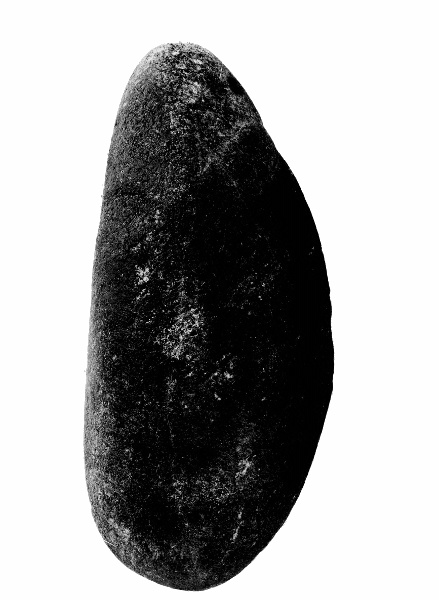
THE HELIOTYPE PRINTING CO., BOSTON
DOMESTIC ANVIL, SIDE
BUREAU OF AMERICAN ETHNOLOGY
SEVENTEENTH ANNUAL REPORT PL. XXXV
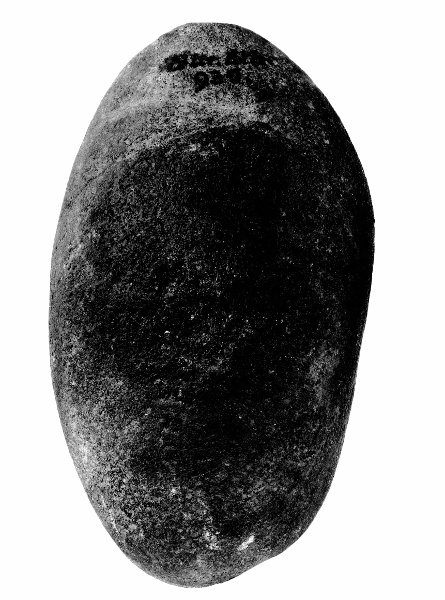
THE HELIOTYPE PRINTING CO., BOSTON
DOMESTIC ANVIL, TOP
BUREAU OF AMERICAN ETHNOLOGY
SEVENTEENTH ANNUAL REPORT PL. XXXVI
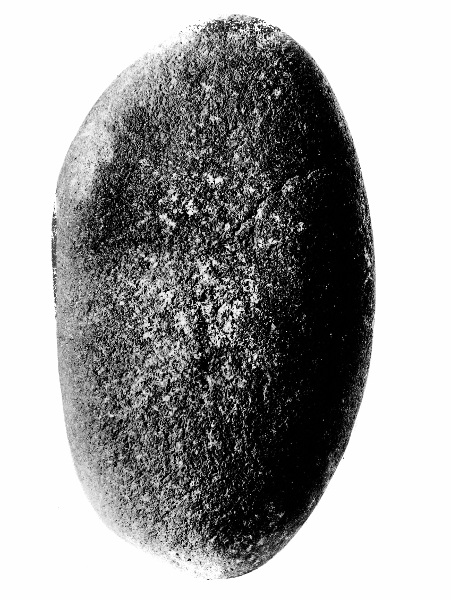
THE HELIOTYPE PRINTING CO., BOSTON
DOMESTIC ANVIL, BOTTOM
A typical specimen of intermediate size, used commonly as an ahst,
but susceptible of employment as a hupf, is illustrated (natural size) in
plates XXXV and XXXVI.296 It is a hard, tough, hornblende-granite or
greenstone, with a few structure-lines brought out by weathering and
wave-wearing. Its weight is 4 pounds 10 ounces (2.10 kilograms); its
form and surface are entirely natural, save for slight battering shown
on the two principal faces and still less conspicuous bruises along one
edge (as imperfectly shown toward the left of plate XXXV). The specimen
was found in a jacal (illustrated in plate VI) on Rada Ballena,
within a few hours after abandonment, in the position in which it was
hastily left by the last users; it was smeared with blood and fat (which
still remain, as is shown in plate XXXV) and bits of flesh, and bore bloody
finger prints of two sizes—those of a man and those of a woman or
large child; beside it lay the hupf depicted in plate XLII. In its last
use the unwieldly cobble served as an ahst, but the markings on the
edge record use also as a hand implement.
A functionally similar implement is illustrated in plate XXXVII (on
reduced scale; maximum length 8¼ inches=21.0 cm.). It is of tough
but slightly vesicular and pulverulent volcanic tuff, pinkish-buff in
color, and weighs 4 pounds 1 ounce (1.84 kilograms). The form and surface
are almost wholly natural, save for slight battering about the
larger end and severer battering, with the dislodgment of a flake, about
the thinner end; yet the faces are smeared with blood and grease and
flecked with turtle debris, and bear a few marks of hupf blows, as is
shown in the reproduction. This specimen was found at a temporary
camp of a small party on Punta Miguel, where it had been used in
breaking up a turtle—the camp having been abandoned so precipitately
that a considerable part of the quarry, with this hupf, the ahst illustrated
in plate LIV, the turtle-harpoon shown in figure 20, the half-made
fire, and the fire-sticks used in kindling it, were left behind. The specimen
is a good example of the cobbles carried into portions of the territory
lacking the material (the camp at which it was found was on the
great sandspit forming the eastern barrier of Boca Infierno, several
miles from the nearest pebbly shore); it is of less specific gravity than
the average rocks of the region, and looks still lighter by reason of its
color and texture. Similar cobbles abound along the eastern coast of
Tiburon, being derived from the immense volcanic masses of Sierra
Kunkaak.
About the more permanent rancherias and on many abandoned sites
lie ahsts usually too heavy for convenient transportation. In the habitable
jacales such stones form regular household appurtenances, without
which the menage is deemed incomplete; though the implement is
commonly kicked about at random, often buried in debris (perhaps to
be completely lost, and brought to light only by geologic changes, as
demonstrated by the shell-heap of Punta Antigualla), and pressed into
service only in case of need. An exceptionally well-worn specimen of
the kind is illustrated in plate XXXVIII (scale one-half linear; maximum
width measured on base, 9¼ inches=23.5 cm.). The material is a hard,
ferruginous, almost jaspery quartzite, somewhat obscurely laminated.
It weighs 10 pounds 11 ounces (4.85 kilograms). It is a natural slab,
evidently from a talus rather than the shore, its native locus being probably
the western slope of Sierra Seri. The edges and apex are formed
by natural fractures; the most-used face (that shown in the plate) is
a natural structure plane; the obverse side is partly a similar plane,
partly irregular; while the base is an irregular fracture, evidently due
to accident after the specimen had been long in use, though the fracture
occurred years or decades ago, as indicated by the weathering
of the surfaces. The entire face of the slab is worn and more or less
polished by use as a metate, the wear culminating toward the center
of the base (evidently the center of the original slab), where the hollowing
reaches some three-sixteenths of an inch (5 mm.); yet even in
the depths of the incipient basin the polished surface is broken by
irregular pitting of a sort indicating occasional use as an anvil. The
edges are quite unworn, but the smoother portion of the obverse is
worn and polished like the face, though to a less degree. The specimen
was found at a recently occupied jacal, midway between Punta
Antigualla and Punta Ygnacio; it lay in the position of use, though
half concealed by a cholla thrown over it, with the hupf shown in plate
LVI; it was soaked with fat and smeared with the debris and intestinal
contents of a turtle, as partly shown in the illustration.
BUREAU OF AMERICAN ETHNOLOGY
SEVENTEENTH ANNUAL REPORT PL. XXXVII
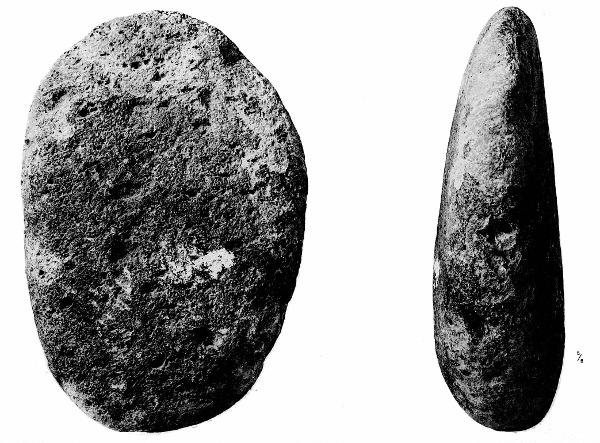
THE HELIOTYPE PRINTING CO., BOSTON
DOMESTIC ANVIL (REDUCED), TOP AND SIDE
BUREAU OF AMERICAN ETHNOLOGY
SEVENTEENTH ANNUAL REPORT PL. XXXVIII
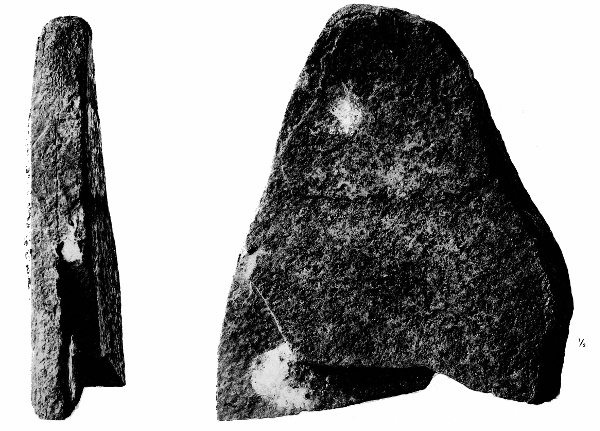
THE HELIOTYPE PRINTING CO., BOSTON
METATE (REDUCED), EDGE AND TOP
The largest ahst seen in Seriland is illustrated in plates XXXIX and
XL, on a scale of one-third linear (its maximum length being 15⅜
inches=39.5 cm.); it is a dark, fine-grained silicious schist or quartzite,
quite obscurely laminated; it weighs 33 pounds 8 ounces (15.20 kilograms).
It is a natural slab, probably washed from a talus and slightly
wave-worn; it might have come originally from either the southwestern
flanks of Sierra Seri or the more southerly half of Sierra Kunkaak—certainly
hundreds of similar slabs strew the eastern shore of Bahia
Kunkaak, while the western shore, especially about Punta Narragansett,
would yield thousands. Its artificial features (aside from miscellaneous
battering) are limited to grinding of the two faces defined by
structure planes. The principal face is abraded into an oblong or
spoon-shape basin, about 8 inches (20 cm.) long, 5 inches (16 cm.) broad,
and fully three-fourths of an inch (2 cm.) deep, the basin penetrating
two or three laminæ of the slab in such wise as to produce the annular
markings faintly shown in plate XXXIX; the obverse is slightly rubbed
and ground and somewhat battered, like the face of the preceding
specimen; and both sides are flecked with a fine but dark flour-like
substance (doubtless derived from grinding mesquite beans, etc.) forced
into the texture of the stone by the grinding process. The entire slab
is greasy and blood-stained, while battered spots about the edges and
angles of the principal face record considerable use as an anvil for
breaking up quarry—indeed, shreds of turtle flesh and bits of intestinal
debris still lodge in some of the interstices. The specimen was
taken from the old rancheria at the base of Punta Tormenta, where it
had apparently been in desultory use for generations.
A sort of connecting link between ahst and hupf is afforded by elongate
beach pebbles, such as that illustrated in plate XLI, which lay
beside the large ahst last described, and which bears a few inconspicuous
marks of use in slight battering at both ends, with a few shreds of
turtle flesh about the blunter extremity (at the right on the plate).
The specimen is shown natural size; it is of pinkish-gray trachyte (?),
and weighs 1 pound 12 ounces (0.79 kilograms). It is noteworthy
chiefly as an illustration of the Seri mode of seizing and using hand-implements
(a mode repeatedly observed at Costa Rica in 1894); the
pebble comfortably fits the Caucasian hand, held hammerwise; it is
intuitively grasped in this way, and when so seized and used with an
outward swing forms an effective implement for bone-crushing, etc., the
natural striking-point being near the free end; but the centripetally
moving Seri invariably seizes the specimen in such manner that the
free end is directed inward, while the thumb laps over the grasped end,
when the strokes are directed downward and inward, the striking-point
being the extreme tip of the free end. A similar specimen is illustrated
in plate XLII. It is of tough and homogeneous hornblende-granite,
somewhat shorter and broader than its homologue, but of exactly the
same weight; it, too, is battered at the ends, but is otherwise quite natural
in form. It was collected at Rada Ballena in conjunction with the
ahst illustrated in plate XXXV; and like that specimen it is soaked with
blood and fat, and bore shreds of flesh when found. Both these elongate
cobbles are of interest as representatives of a somewhat aberrant
type; for the favorite form of hupf is shorter and thicker, as shown by
the prevailing shapes, both in use and lying about the jacales—indeed,
the elongate form is seldom used on the coast and never carried into
the interior.
A typical hupf is illustrated in plate XLIII. The specimen is of fine-grained,
dense, and massive quartzite, its homogeneity being interrupted
only by a thin seam of infiltrated silica and by an obscure structure-plane
brought out by weathering toward the thinner end. Its weight is 1
pound 14 ounces (0.85 kilogram). In general form and surface the
specimen is an absolutely natural pebble, such as may be found in thousands
along the shores of Seriland. Its artificial features are limited
to slight battering about the edges, especially at the thinner end;
partial polishing of the lateral edges by repeated handling (as imperfectly
shown in the edge view); very perceptible polishing of both faces
by use as a grinder; some fire-blackening on both sides; semisaturation
with grease and blood; and the flecks of red face-paint shown in the
reproduction. The specimen was obtained at Costa Rica after some
days’ observation of its use. The chief observed functions of this
implement were as follows: (1) Skinning the leg of a partially consumed
horse; this was done by means of centripetal (i. e., downward
and inward) blows, so directed that the thinner end fell obliquely on
the tissue, bruising and tearing it with considerable rapidity. (2) Severing
tough tendons already sawed nearly through by rubbing over the
edge of an ahst, the hupf in this case being in the hands of a coadjutor
and used in rather random strokes whenever the tissue seemed particularly
refractory. (3) Knocking off the parboiled hoof of a horse to
give access to the coffinbone. (4) Crushing and splintering bones to
facilitate sucking of the marrow. (5) Grinding mesquite beans; the
process being begun by vertical blows with the end of the implement on
a heap of the pods resting on an ahst, continued by blows with the
side, and finished by kneading and rubbing motions similar to those of
grinding on a metate. (6) Pounding shelled corn mixed with slack lime,
in a ludicrously futile attempt to imitate Mexican cookery. (7) Chopping
trees; in this case the implement was grasped in the centripetal
manner and used in pounding and bruising the wood at the point of
greatest bending under the pull of a coadjutor. (8) Cleaving and
breaking wood for fuel. (9) Dethorning okatilla stems, by sweeping
centripetal strokes delivered adzwise from top toward butt of a bunch
of stems lying on the ground. (10) Severing a stout hair cord; in this
use it was grasped between the knees of a matron squatting on the
ground, while the cord was held in both hands and sawed to and fro
over the use-roughened thinner end. (11) Supporting a kettle (shown
in plate X) as one of the fire-stones used in frontier mimicry of the
Papago custom. (12) Triturating face-paint by pounding and kneading;
in one case the specimen served as a hand implement, while in
another case it took the place of the ahst, the ocher lump itself being
struck and rubbed against it. (13) Beating a troop of dogs from a pile
of bedding in a jacal; in this use the implement was held in the customary
manner and used in swift centripetal blows, the matron relying on
her own swiftness and reach and not at all on projection to come within
reach of her moving targets; the blows usually landed well astern,
and were so vicious and vigorous as to have killed the agile brutes
had they chanced to fall squarely—indeed, one blow temporarily paralyzed
a large cur, which escaped only by running on its fore feet and
dragging its hind quarters. In most of these uses the specimen was
employed in conjunction with an improvised ahst in the form of a stone
carried from the rancho. Several of the processes, notably those of
tissue-tearing and dog-beating, were executed with a vigor and swiftness
quite distinct from the sluggish lounging of the ordinary daytide
and, indeed, partaking of the fierce exaltation normal to the Seri
chase. When not in use the implement usually lay just within the
open end of the owner’s jacal, though it was often displaced and sometimes
kicked about the patio for hours. It was one of perhaps a dozen
similar implements brought across the desert from the coast by as many
matrons. All were regarded as personal belongings pertaining to the
custodians about as definitely as articles of apparel, though rather
freely loaned, especially in the owner’s clan. The specimen was purchased
from the possessor, who parted from it rather reluctantly,
though with the tacit approval of her clanswomen, at a rate implying
considerable appreciation of real or supposed value. Three or four
other matrons declined to barter their hupfs, either arbitrarily or on
the plea that they were a long way from the source of supply.
BUREAU OF AMERICAN ETHNOLOGY
SEVENTEENTH ANNUAL REPORT PL. XXXIX
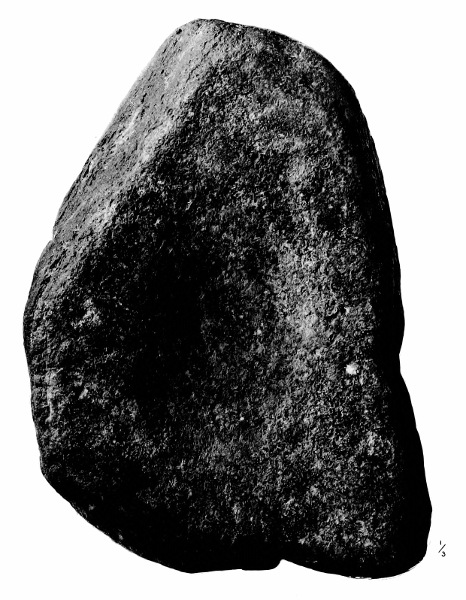
THE HELIOTYPE PRINTING CO., BOSTON
LONG-USED METATE (REDUCED), TOP
BUREAU OF AMERICAN ETHNOLOGY
SEVENTEENTH ANNUAL REPORT PL. XL
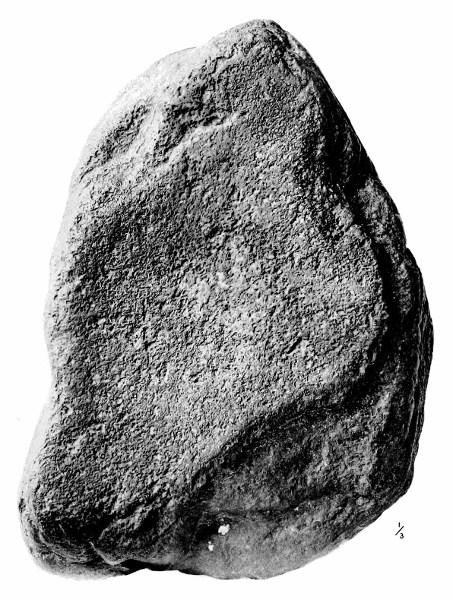
THE HELIOTYPE PRINTING CO., BOSTON
LONG-USED METATE (REDUCED), BOTTOM
A common variety of hupf is illustrated in plate XLIV. It is of
pinkish, slaty tuff of rather low specific gravity, somewhat vesicular
and pulverulent, though moderately hard and tough. It weighs 17
ounces (0.48 kilogram). In form and surface it is essentially a wave-worn
pebble, doubtless derived originally from the volcanic deposits of
Sierra Kunkaak. Its artificial markings are limited to slight battering
about the edges, especially at the thinner end (as shown in the edge
view); slight rubbing, striation, and semipolishing of the smoother
face (shown in the plate); a few grease spots and a stain showing use in
crushing sappy vegetal matter, also on this face; and an inconspicuous
fire-mark on the obverse. It was found in a recently abandoned jacal
near Campo Navidad. It is one of the three tuff specimens among those
collected, one of a dozen or two seen; perhaps 10 per cent of the
implements observed in Seriland are of this material, and it is significant
that this ratio is several times larger than the proportion of tuff
pebbles to the entire paving of the beaches, so that the material seems
to be a preferred one. The preference was indeed discovered at Costa
Rica in 1894, where two or three of the more highly prized hupfs were
of this material, and where vague intimations were obtained that it is
especially favored for meal-making, doubtless by reason of the association
of color and texture—associations that mean much to the primitive
mind, perhaps in suggesting that the grinding is easier when done by
a soft implement. An economic reason for the preference is easily
found in the lower specific gravity, and hence the greater portability of
a hupf of ordinary size, of this material; but there is nothing to indicate
that this economic factor is weighed or even apperceived by the
Seri.
A typical pebble bearing slight marks of use is illustrated in plate
XLV. It is of fine-grained pinkish sandstone, probably tuffaceous, and
is fairly hard and quite tough; it weighs 1 pound 9 ounces (0.71 kilogram).
It is wholly natural in form and surface save for slight battering
or pecking on the face illustrated, and for a few stains of grease
and abundant marks of fire. It was found in a fire still burning (and
abandoned within a half-hour, as indicated by other signs) two or three
miles inland from Punta Granita on the Seri trail toward Aguaje
Parilla, whither it had evidently been carried from the coast.
A fairly common material for both hupfs and ahsts is highly vesicular
basalt grading into pumice stone, the material corresponding fairly with
a favorite metate material among the Mexicans. The rock was not certainly
traced to its source, but seems to come from the northern part
of Sierra Kunkaak. A typical hupf of this material is shown in plate
XLVI; it weighs 1 pound 13 ounces (0.82 kilogram). It is wholly natural
in every respect save for slight grinding and subpolishing, with
some filling of interstices, on both faces. From the slight wear of this
specimen, together with the absence of battering, and from similar
features presented by others of the class, it maybe inferred that implements
of this material are habitually used only for grinding—for which
purpose they are admirably adapted. The specimen emphasizes the
importance of the hupf in Seri thought, for it was one of a small series
of mortuary sacrifices from a tomb at Pozo Escalante (ante, p. 290).
Throughout the surveys of Seriland, constant search was made for
cutting implements of stone; and the nearest approach to success was
exemplified by the specimen illustrated in plate XLVII. It is of bluish-gray
volcanic rock (not specifically identified) of close texture and
decided toughness and hardness; it weighs 10 ounces (0.28 kilogram).
In greater part its form and surface are natural, but a projecting portion
brought out by weathering on one side is split off, presumably by
intention, and the fractured surface thus produced is partly smoothed
by rubbing, probably in use, though possibly by design. The edges are
more or less battered, especially at the ends, and several rude flakes
have been knocked off, evidently at random and presumably in ordinary
use as an ahst. The smoother face is wholly natural. The specimen
was picked up in a jacal at Rada Ballena, but bore no marks of recent
use.
BUREAU OF AMERICAN ETHNOLOGY
SEVENTEENTH ANNUAL REPORT PL. XLI
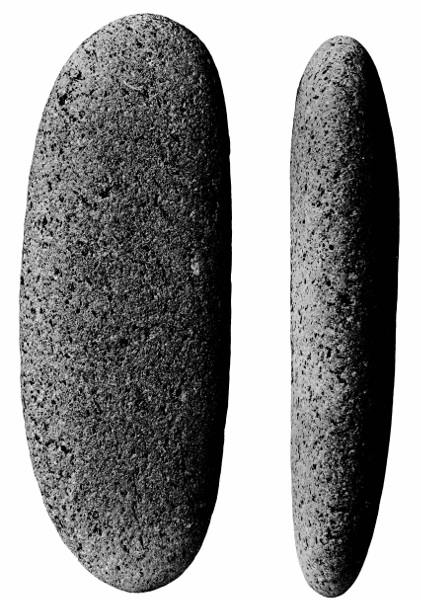
NATURAL PEBBLE BEARING SLIGHT MARKS OF USE
BUREAU OF AMERICAN ETHNOLOGY
SEVENTEENTH ANNUAL REPORT PL. XLII
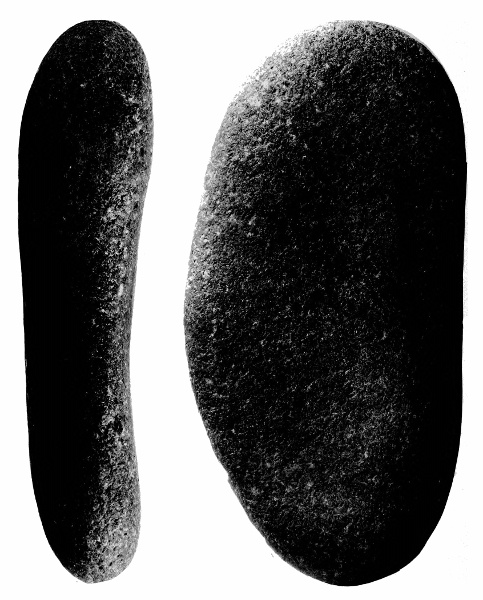
THE HELIOTYPE PRINTING CO., BOSTON
NATURAL PEBBLE USED AS BONE-CRUSHER
A tuff implement of suggestively ax-like form is shown in plate XLVIII;
it is firmer and less pulverulent but more vesicular than most implements
of its class; it weighs but 7 ounces (0.20 kilogram). The specimen
was picked up in a ruinous jacal, which had evidently been occupied
temporarily within a fortnight, on the summit of the great shell-mound
forming Punta Antigualla. The somewhat indefinite texture
and color render it difficult to distinguish between natural and artificial
features; but careful examination indicates that it is wholly natural in
form and in nine-tenths of the surface, and that the ax-like shape
expresses nothing more than accidents of structure and wave-work.
This interpretation is practically established by the slight battering
along the edges and about the smaller end, as illustrated in the edge
view; for this wear of use, which has produced a distinctive surface, is
practically absent from the notches which give the ax-like effect.
Besides the battering, the only artificial marks are ancient fire-stains
on one of the faces. On the whole it is clear that the artificial appearance
catching the eye at first glance is purely fortuitous, and that the
specimen is but a natural pebble very slightly modified by ordinary use.
A suggestive specimen is illustrated in plate XLIX; it is of purplish-gray
granitoid rock, of decided toughness and considerable hardness,
and weighs 12½ ounces (0.35 kilogram). The surface and general form
indicate that it is a natural pebble entirely without marks of artificial
use; but the regular curvature of the principal face (the shape is that
of a segment of a cylinder rounded toward the ends) suggests artificial
shaping, while it was found far in the interior, near Barranca Salina,
whither it must have been carried from the coast. It may possibly be
a fragment of a pestle subsequently wave-worn; but all the probabilities
are that it is wholly natural, and that its suggestive features are
fortuitous.
The constant search for chipped or flaked tools which was extended
over nearly all Seriland seldom met the slightest reward; but the specimen
shown in plate L was deemed of some interest in connection with
the search. It is of hard and tough greenstone, showing obscure and
irregular structure lines, though nearly homogeneous in texture; it
weighs 10 ounces (0.28 kilogram). It is primarily a natural pebble
with form and surface reflecting structure and texture in connection
with wave-action. Its artificial features are limited to the usual slight
battering of the smaller end, still less conspicuous battering or grinding
of the margin about the larger end, slight but suggestive chipping
of the thinner edge, inconspicuous hand-wear and polish on the
principal face, and a few obscure scratches or striæ on the same face,
as illustrated in the plate. The position and character of the flake-fractures,
which are fairly shown in the edge view, indicate that they
were made while the pebble was in use as a bruising or cutting tool,
a use at once suggested to the Caucasian mind by the form of the
pebble; yet it is noteworthy that its thin edge displays less battering
than either end of the object and no more than the opposite and
thicker edge, while it is still more significant that the specimen was
apparently discarded immediately on the modification of form by the
spalling—a modification greatly increasing its efficiency, as all habitual
users of chipped stone tools would realize. The specimen is one
of a large number of examples showing that whenever a hupf is broken
in use it is regarded as ruined, and is immediately thrown away. This
particular specimen is archaic; it was found in the cliff-face of the
great shell-heap at Punta Antigualla, embedded in a tiny stratum of
ashes and charcoal (some of which still adheres, as shown in the black
flecking at the outer end of the striæ), associated with scorched clam-shells,
typical Seri potsherds, etc., some 40 feet beneath the surface.
While the great majority of the hupfs are mere pebbles bearing
slight trace of artificial wear, as illustrated by the foregoing examples,
others bear traces of use so extended as to more or less completely
artificialize the surface. A typical long-used hupf is depicted in plates
LI and LII. It is a tough and hard quartzite, dark gray or brown in
color, massive and homogeneous in texture; it weighs 2 pounds 4
ounces (1.02 kilograms). In general form it is a typical wave-worn
pebble of its material, and might be duplicated in thousands along the
shores of Bahia Kunkaak and El Infiernillo; but fully a third of its surface
has been more or less modified by use. The flatter face (plate LI)
is smeared with blood, grease, and charcoal, which have been ground
into the stone by friction of the hand of the user in such manner as to
form a kind of skin or veneer; portions of the face bear a subpolish,
due probably to the hand-rubbing in use; near the center there is a
rough pit about an eighth of an inch (3 mm.) deep, evidently produced
by pecking or battering with metal, while three or four neighboring
scratches penetrating the veneer appear to record ill-directed strokes
of a rather sharp metal point. In the light of observed customs it may
be inferred that this pitting was produced by use of the implement as
an anvil or ahst in sharpening a harpoon-point and fitting it into its
foreshaft. The thinner edge (shown in plate LI; that toward the right
in the face view on the same plate) displays considerable battering of
the kind characteristic of Seri hupfs in general; it is smoked and fire-stained,
as shown, while the lower rounded corner is worn away by
battering to a depth of probably one-fourth inch (5 mm.). The obverse
face reveals more clearly the battering about both corners and edges,
including the dislodgment of a flake toward the narrower end; but its
most conspicuous feature is a broad subpolished facet (rounding slightly
toward the thinner edge) produced by grinding on a flat-surface ahst.
This face, too, exhibits fire-staining, while the surface beyond the facet—and
to a slight extent the facet itself—is veneered like the other face.
There are a few scratches on this side also, as well as a slight pitting
due to contact with metal. The thicker edge (plate LII) displays considerable
battering, especially a recent pitting near the middle evidently
due to use as an anvil held between the knees for sharpening a
harpoon point by rude hammering. The specimen was one of a score of
implements lying about the interior of the principal jacal in the great
rancheria at the base of Punta Tormenta (illustrated in plate VII).
BUREAU OF AMERICAN ETHNOLOGY
SEVENTEENTH ANNUAL REPORT PL. XLIII
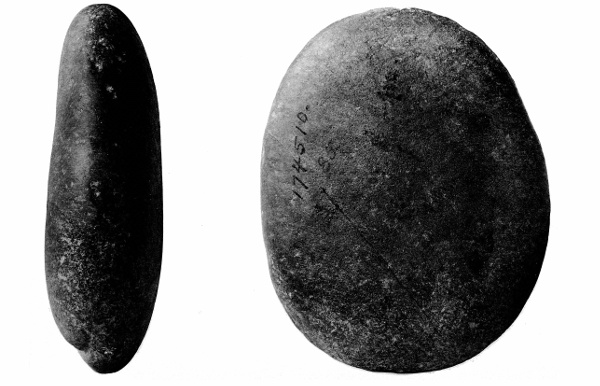
THE HELIOTYPE PRINTING CO., BOSTON
LITTLE-WORN PEBBLE USED FOR ALL DOMESTIC PURPOSES
BUREAU OF AMERICAN ETHNOLOGY
SEVENTEENTH ANNUAL REPORT PL. XLIV
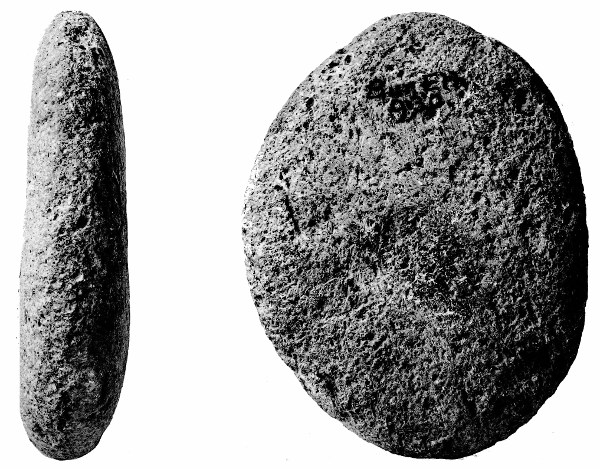
THE HELIOTYPE PRINTING CO., BOSTON
NATURAL PEBBLE USED AS CRUSHER AND GRINDER
A related specimen, though of somewhat aberrant form, is illustrated
in plate LIII. It is of peculiarly tough and quite hard greenstone
and weighs 2 pounds 1 ounce (0.93 kilogram). Somewhat less
than half of the surface is that of a wave-worn pebble; the remainder
is either battered out of all semblance to wave-work, or thumb-worn by
long-continued use. The object well illustrates the choice of the most
prominently projecting portion of the hand-implement as the point
of percussion, and consequently the concentrated wear on such portions
whereby the object is gradually reduced to better-rounded and
more symmetric form. This specimen displays some minor flaking,
apparently connected with the battering and regarded by the user as
subordinate to the general wear. It was found at Punta Tormenta, concealed
in the wall of a jacal, as if preserved for special use.
One of the best-known examples of a use-perfected hupf is illustrated
in plate LIV. It is of coarse-grained but massive and homogeneous
granite, similar to that forming Punta Blanca, Punta Granita, and,
indeed, much of the eastern coast of Bahia Kunkaak. It weighs 1
pound 10 ounces (0.74 kilogram). In general form it is just such a
pebble as is produced from this material by wave-wear, and might be
duplicated along the shores in numbers. The artificial surfaces comprise
(1) both ends, which are battered in the usual manner; (2) both
lateral edges, of which one is slightly battered and worn, while the
other is somewhat battered and also notched, evidently by a chance
blow and the dislodgment of a flake; (3) both faces, which are flattened
by grinding, while one of them (that shown in the plate) is slightly
pitted, evidently by metal-working; so that the natural surface is
restricted to small areas about the corners. The implement was found
at the camp site on Punta Miguel, already noted (page 189), whence a
group of five Seri were frightened by the approach of the 1895 expedition;
it was covered with blood and shreds of turtle flesh, and is still
saturated with grease. Moreover, it is quite confidently identified
(not only by form and material, but especially by the fortuitous notch)
as a hupf seen repeatedly at Costa Rica in 1894; it was the property
of a matron of the Pelican clan (whose portrait appears in plate XXII),
who was observed to use it for various industrial purposes, and who
refused to part with it for any consideration.
A still more beautiful example of Seri stone art is depicted in plate
LV. It is of the same homogeneous and coarse-grained granite as the
last specimen, and closely approaches it in dimensions; it is slightly
longer and broader, but somewhat thinner, and weighs 1 pound 11
ounces (0.77 kilogram); and, except for the absence of the accidental
notch, its artificial features are still more closely similar. The ends
are slightly battered, as illustrated in the end view at the right of the
plate; the edges are similarly worn, but to a less extent; while both
sides have been symmetrically faceted by use in grinding, the facets
being straight in the longitudinal direction but slightly curved in the
transverse direction, in the shape of the Mexican mano. The specimen
displays well-marked color distinctions between the artificially worn
and the natural surfaces, the former being gray and the latter weathered
to yellowish or pinkish-brown; these colors show that something like
two-thirds of the surface is artificial and the intervening third natural;
and the natural portion corresponds in every respect, not only in form
but in condition of surface, with the granite cobbles of Seriland’s stormy
shores. Unfortunately the color distinctions, with the limits of faceting
and other artificial modifications, are obscure in the photomechanical
reproduction; they are indicated more clearly in the outline drawing
oversheet. The specimen is partially saturated with fat, and bears
an ocher stain attesting use in the preparation of face-paint. It was
found carefully wrapped in a parcel with the shell paint-cup illustrated
in plate XXVII, a curlew mandible, two or three hawk feathers, and a
tuft of pelican down (the whole evidently forming the fetish or medicine-bag
of a shamanistic elderwoman), in an out-of-the-way nook in the
wall of an abandoned jacal at Punta Narragansett.
A somewhat asymmetric though otherwise typical hupf is illustrated
in natural colors in plate LVI. It is of andesite, and may have come
originally either from the extensive volcanics of southern Sierra Seri
or central Sierra Kunkaak; it weighs 1 pound 15 ounces (0.88 kilogram).
The general form is that of a wave-worn cobble, and fully one-third
of the surface retains the natural character save for slight
smoothing through hand friction in use. The chief artificial modification
is the faceting of both sides in nearly plain and approximately
parallel faces, the maximum thickness of material removed from each
side, estimated from the curvature of the adjacent natural surface,
being perhaps three-sixteenths of an inch (5 millimeters); in addition,
both ends are battered in the usual fashion, while the thinner and more
projecting edge is battered still more extensively, in a way at once subserving
convenient use and tending to increase the symmetry of form.
One of the facets is quite smooth; the other (that on the right in the
plate) is slightly pitted, as if by use in metal-working. The specimen
is somewhat greasy—the normal condition of the hupf—and bears
conspicuous records of its latest uses; both faces (more especially the
pitted one) are stained with sap from green vegetal substance (probably
immature mesquite pods), while one face is brilliantly marked with
ocher in such manner as to indicate that a lump of face-paint was
partially pulverized by grinding on the slightly rough surface. It was
found, together with the ahst illustrated in plate XXXVIII, in the rear
of a recently occupied jacal midway between Punta Antigualla and
Punta Ygnacio, cached beneath a thorny cholla cactus uprooted and
dragged thither for the purpose. The trail and other signs indicated
that the jacal had been occupied for a few days and up to within
twenty-four hours by a family group of six or seven persons; that it
was vacated suddenly at or about the time of arrival of the party
of five whose trail was followed by the 1895 expedition from Punta
Antigualla to Punta Miguel (where they were interrupted in the midst
of a meal and frightened to Tiburon); and that the larger party fled
toward the rocky fastnesses of southern Sierra Seri.
BUREAU OF AMERICAN ETHNOLOGY
SEVENTEENTH ANNUAL REPORT PL. XLV
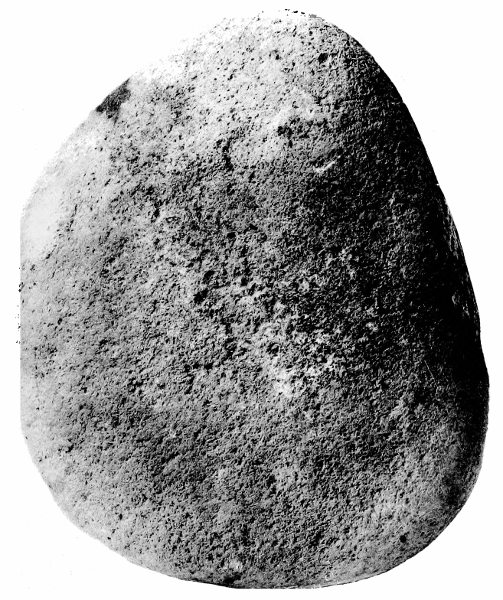
NATURAL PEBBLE SLIGHTLY USED AS HAMMER AND ANVIL
Of the foregoing hupfs several are aberrant, and serve merely to
illustrate the prevailing directions of departure from the optimum
form and size of implements. Six of the specimens may be deemed
typical; they are as follows:
| Plate No. |
Locality |
Material |
Weight |
Condition |
|
|
|
Lb. Ozs. |
|
| XLIII |
Costa Rica |
Quartzite |
1 14 (0.85 kg.) |
Nearly natural. |
| XLIV |
Campo Navidad |
Tuff |
1 1 (.48 kg.) |
Four-fifths natural. |
| XLVI |
Pozo Escalante |
Vesicular lava. |
1 13 (.82 kg.) |
Nearly natural. |
| LIV |
Punta Miguel |
Granite |
1 10 (.74 kg.) |
One-fifth natural. |
| LV |
Punta Narragansett |
do |
1 11 (.77 kg.) |
One-fourth natural. |
| LVI |
South point Sierra Seri. |
Andesite |
1 15 (.88 kg.) |
One-third natural. |
From these specimens a type of Seri hand implement may easily be
formulated: it is a wave-worn pebble or cobble of (1) granite, quartzite,
or other tough and hard rock, (2) tuff, or other light and pulverulent
rock, or (3) vesicular lava; it is of flattened ovoid form, or of biscuit
shape; it weighs a trifle under 2 pounds (about 0.85 kilogram);
originally the form and surface are wholly natural, but through the
chance of use it is modified (a) by a battering of the ends and more
projecting edges, and (b) by grinding and consequent truncation of
the sides; though initially a natural pebble, chosen nearly at random
from the beach, it eventually becomes personal property, acquires
fetishistic import, and is buried with the owner at her death.
The ahsts and the heavier cobbles used alternatively as ahsts and
hupfs are too fortuitous for reduction to type; while the protean pebbles
utilized in emergency, and commonly discarded after a single use,
are too numerous and too various for convenient or useful grouping.
There is a distinctive type of Seri stone artifacts represented by a
single category of objects, viz., chipped arrowpoints. Several of the
literary descriptions of the folk—particularly those based on secondhand
information, and far-traveled rumor—credit the Seri with habitual
use of stone-tipped arrows,297 and it is the current fashion among both
Mexican and Indian residents of Sonora to ascribe to the Seri any
shapely arrowpoint picked up from plain or valley; yet the observations
among the tribesmen and in their haunts disclose but slight basis
for classing the Seri with the aboriginal arrow-makers of America.
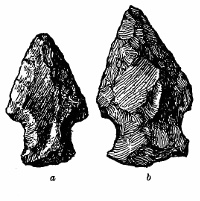
Fig. 37—Seri arrowpoints.
Among the 60 Seri (including 17 or 18 warriors) at Costa Rica in 1894,
three bows and four quivers of arrows were observed, besides a number
of stray arrows, chiefly in the hands of striplings. The arrows seen
numbered some 60 or 70, including perhaps 20 “poisoned” specimens;
nearly half of them were tipped with
hoop-iron, as illustrated in plate XXX,
while about as many more were fitted
only with the customary foreshafts
(usually sharpened and hardened by
charring), and the small remainder had
evidently lost iron tips in use; there was
not a single stone-tipped arrow in the
rancheria. Moreover, when the usually
incisive and confident Mashém was
asked for the Seri term for stone arrowpoint
he was taken aback, and was
unable to answer until after lengthy
conference with other members of the tribe—his manner and that of
his mates clearly indicating ignorance of such a term rather than the
desire to conceal information so frequently manifested in connection
with esoteric matters; and the term finally obtained (ahst-ahk, connoting
stone and arrow) is the same as that used to denote the arrowpoint
of hoop-iron. The most reasonable inference from the various facts is
that whatsoever might have been the customs of their ancestors, the
modern Seri are not accustomed to stone arrow-making.
The 1895 expedition was slightly more successful in the search for
Seri arrows. About midway between the abandoned Rancho Libertad
and Barranca Salina, an ancient Seri site was found to yield hundreds
of typical potsherds, half a dozen shells such as those used for utensils,
the fragments of a hupf evidently shattered by use as a fire-stone, and
the small rudely chipped arrowpoint shown in figure 37a; and among
the numerous relics found on a knoll overlooking Pozo Escalante
(including two jacal frames, two or three graves, an ahst, several shells
and discarded hupfs, a broken fictile figurine, etc.), was the still ruder
arrowpoint represented in figure 37b (both figures are natural size).
The specimens are nearly identical in material—a jet-black slaty rock
with a few lighter flecks interspersed, weathering gray on long exposure
(as is shown by the partly natural surface of the larger point); similar
rock abounds in several easterly spurs of Sierra Seri. The smaller
specimen was evidently finished and used; its features indicate fairly
skilful chipping, though its general form is crude—in addition to the
asymmetric shouldering, the entire point is curved laterally in such manner
as to interfere with accurate archery. The larger specimen is still
more strongly curved laterally, and the chipping is childishly crude;
while the rough surface, clumsy tang, and unfinished air indicate that
it was never used even to the extent of shafting. It is possible that the
specimens may have been imported by aliens, but the probabilities are
strong that they were manufactured by the Seri. No other arrowpoints
and no chips or spalls suggesting stone arrow-making were found in all
Seriland, though the entire party of twelve were on constant lookout for
them for a month. The natural inference from these facts is that the
ancestral Seri, like their descendants, were not habitual stone arrow-makers.
BUREAU OF AMERICAN ETHNOLOGY
SEVENTEENTH ANNUAL REPORT PL. XLVI
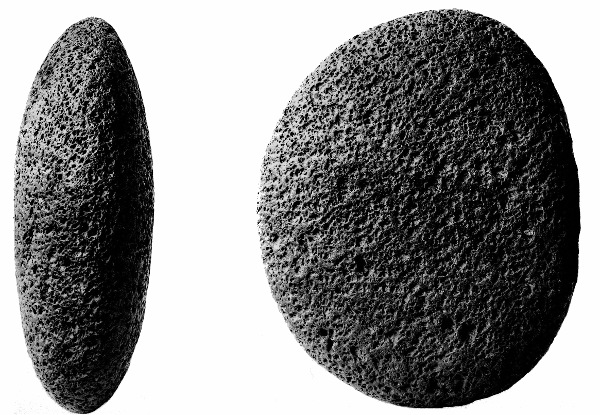
THE HELIOTYPE PRINTING CO., BOSTON
NATURAL PEBBLE SLIGHTLY USED AS GRINDER
BUREAU OF AMERICAN ETHNOLOGY
SEVENTEENTH ANNUAL REPORT PL. XLVII
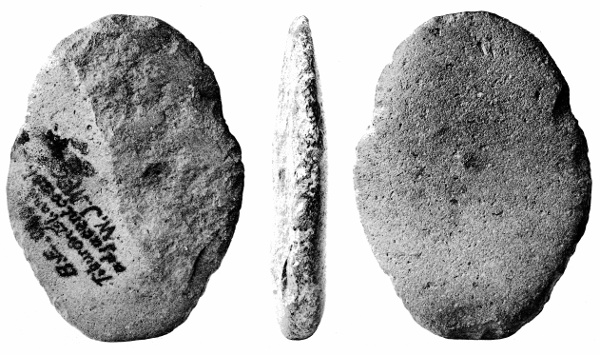
THE HELIOTYPE PRINTING CO., BOSTON
NATURAL PEBBLE SLIGHTLY USED AS DOMESTIC IMPLEMENT
There is a final category of Seri artifacts which would be classed as
distinctive by Caucasians on the basis of material, though they are
combined with the stone artifacts by the tribesmen; it comprises arrowpoints
of hoop-iron or other metal, harpoon-points of nails, spikes, or
wire, awls of like materials, and other metallic adjuncts to ordinary
implements. The use of iron is of course post-Columbian, and its
ordinary sources are wreckage and stealage. The date of introduction is
unknown, and probably goes back to the days of Cortés and Mendoza;
certainly the value of metal was so well understood in 1709 that when
Padre Salvatierra’s bilander was beached in Seriland the tribesmen at
once began to break her up for the nails (ante, page 67); yet the
metal is wrought cold and only with hupf and ahst like the local materials,
and is habitually regarded and designated as a stone. By reason
of the primitive methods of working, the metals are of course available
only when in small pieces or slender shapes. There is a tradition
among the vaqueros of the frontier that a quantity of hoop-iron designed
for use in making casks was carried away from a rancheria in the vicinity
of Bacuachito during a raid in the seventies, and that this stock has
ever since served to supply the Seri with material for their arrowpoints;
but it is probable that the chief supply is derived from the flotsam
swept into the natural drift trap of Bahia Kunkaak by prevailing
winds and tidal currents, and cast up on the long sandspit of Punta
Tormenta after every storm. A surprising quantity and variety of
wreckage was found on this point, and thence down the coast to Punta
Narragansett, by the 1895 expedition: staves and heads of casks broken
up after beaching, a telegraph pole crossbar which had evidently
brought in a cargo of large wire, and a piece of door-frame with heavy
strap-iron hinges attached with screws, were among the troves of the
tribesmen within a few weeks; and it was noted that while even the
hinge screws and the tacks attaching tags to the cask-heads had been
extracted by breaking up the wood, the roughly forged hinges of
2 by ⅜-inch wrought iron had been abandoned after a tentative battering
with cobbles, and lay among the refuse stones about the jacales.
A rough census of the stone implements of Seriland is not without
interest, even though it be no more than an approximation.
Some 20 or 25 habitable and recently inhabited jacales were visited,
with about twice as many more in various stages of ruin, fully two-thirds
of these being on the island; and at least an equal number of
camps or other houseless sites were noted. About these 150 jacales
and sites there were, say, 50 ahsts, ranging from nearly natural bowlders
to the comparatively well-wrought specimen illustrated in plate
XXXIX, and an equal number of cobbles used interchangeably as ahsts
and hupfs; there were also 200 or 300 pebbles bearing traces of use as
hupfs, of which about a third were worn so decidedly as to attest
repeated if not regular use; while no flaked or spalled implements were
observed save the two doubtful examples illustrated in plates XLVII
and L, and only two chipped arrowpoints. It may be assumed that
the sites visited and the artifacts observed comprise from a tenth to a
fifth of those of all Seriland, in addition to, say, 75 finished hupfs
habitually carried by Seri matrons in their wanderings; and it may be
assumed also that 50 or 100 metallic harpoon-points and several hundred
hoop-iron arrowpoints are habitually carried by the warriors and their
spouses.
The most impressive fact brought out by this census is the practical
absence of stone artifacts wrought by flaking or chipping in accordance
with preconceived design; excepting the exceedingly rare arrowpoints
there are none of these. And the assemblage of wrought stones
demonstrates not merely that the Seri are practically without flaked
or chipped implements, but that they eschew and discard stones edged
by fracture whether naturally or through accident of use.
Summarily, the Seri artifacts of inorganic material fall into three
groups, viz.: (I) The large and characteristic one comprising regularly-used
hupfs and ahsts, with their little-used and discarded representatives;
(II) the small and aberrant group represented by chipped arrowpoints,
and (III) the considerable group comprising the cold-wrought
metal points for arrows and harpoons and awls—though it is to be
remembered that the Seri themselves combine the second and third of
these groups.
I. On reviewing the artifacts of the larger group it becomes clear (1)
that they immediately reflect environment, in that they are characteristic
natural objects of the territory; (2) that they come into use as
implements through chance demands met by hasty selection from the
abundant material; (3) that the great majority of the objects so employed
are discarded after a use or two; (4) that when the object
proves especially serviceable, and other conditions favor, it is retained
to meet later needs; (5) that the retained objects are gradually modified
in form and surface by repeated use; (6) that if the modification
diminishes the serviceability of the object in the notion of the user
(e. g., by such fracture as to produce sharp edges), it is discarded; (7)
that if the modification enhances the serviceability of the specimen in
the mind of the user it is the more sedulously preserved; and (8) that
through the instinctive desire for perservation, coupled with the thaumaturgic
cast of primitive thinking, the object acquires at once an
artificialized form and a fetishistic as well as a utilitarian function.
The significant feature of the development is the total absence of
foresight or design, save in so far as the concepts are fiducial rather
than technical or directly industrial.
BUREAU OF AMERICAN ETHNOLOGY
SEVENTEENTH ANNUAL REPORT PL. XLVIII
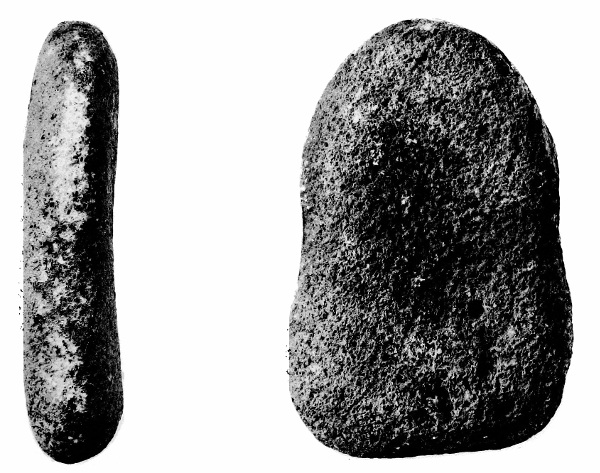
THE HELIOTYPE PRINTING CO., BOSTON
NATURAL PEBBLE SLIGHTLY WORN BY USE
BUREAU OF AMERICAN ETHNOLOGY
SEVENTEENTH ANNUAL REPORT PL. XLIX
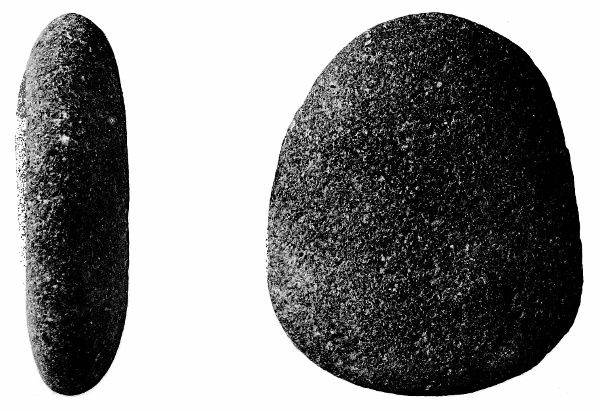
THE HELIOTYPE PRINTING CO., BOSTON
NATURAL PEBBLE CONSIDERABLY WORN IN USE AS GRINDER
II. On reviewing the almost insignificantly small group of chipped
stone artifacts, it seems clear that while the material is local the
design is so incongruous with custom and characteristic thought as to
raise the presumption that stone-chipping is an alien and imperfectly
assimilated craft. The conspicuous and significant feature of the
chipped stone artifact is the shapement in accordance with preconceived
design.
III. On reviewing the arbitrarily separated group of metallic artifacts
it is found clear (1) that the material is foreign; (2) that it is
avidly sought and sedulously saved and utilized; (3) that it is wrought
only by the crude methods used for fashioning the most primitive of
implements and tools; and (4) that it is used chiefly as a substitute for
organic substances employed in symbolic imitation of the natural
organs and functions of animals. The significant features of the use of
iron artifacts are (a) the absence of either alien or specialized designs,
and (b) the mimicry of bestial characters as conceived in primitive
philosophy.
Classed by material and motive jointly, the three groups are diverse
in important respects: The first is local in material, local in motive;
the second is local in material, foreign in design; the third is foreign
in material, local in motive.
On recapitulating the several phases of Seri handicraft, the devices
are found to fall into genetic classes of such sort as to illumine certain
notable stages of primitive technic.
The initial class comprises teeth, beaks and mandibles, claws, hoofs,
and horns, used in imitation or symbolic mimicry of either actual or
imputed function of animals, chiefly those to which the organs pertain,
together with vegetal spines and stalks or splints, used similarly under
the zootheistic imputation of animal powers to plants; also carapaces
and pelts, used as shields combining actual and symbolic protective
functions. While this class of devices is well displayed by the Seri, it
is by no means peculiar to them; clear vestiges of the devices have
been noted among many Amerind tribes. Now the essential basis of the
industrial motive has been recognized by all profounder students in zootheism,
animism, or hylozoism—indeed, the industrial stage is but the
reflex and expression of the zootheistic or hylozoic plane in the development
of philosophy; while both the devices and the cultural stage
which they represent have already been outlined by the late Frank
Hamilton Cushing, on the basis of surviving vestiges and prehistoric
relics, and characterized as “prelithic”.298 Cushing’s designation for
the initial stage of technic has the merit of euphony, and of suggesting
the serial place of the stage in industrial development; but since
it denotes a most important class of artifacts only by exclusion and
negation it would seem desirable to supplement it by a positive term.
The class of devices (considered in both material and functional
aspects) and the cultural stage in general might appropriately be
styled hylozoic, though it would seem preferable to emphasize the
actual objective basis of the class and stage by a specific designation—and
for this purpose the term zoomimetic (from ζω̢̃ον, τὁ and μιμητικὁς),
or its simplified equivalent, zoomimic, would seem acceptable.
A transitional series of devices is represented by awls of wood or
iron fashioned in imitation of mandibles or claws, by wooden foreshafts
shaped in symbolic mimicry of teeth, and by other vicarious replacements
of material in devices of zoomimic motive; but this series may
be regarded as constituting a subclass, or as a connecting link between
classes rather than a major class of devices. Yet the subclass is of
great significance as a mile-mark of progress in nature-conquest, and
as the germ of that industrial revolution consummated as tribesmen
grew into reliance on their own acumen and strength and skill rather
than on the capricious favor of beast-gods.
BUREAU OF AMERICAN ETHNOLOGY
SEVENTEENTH ANNUAL REPORT PL. L
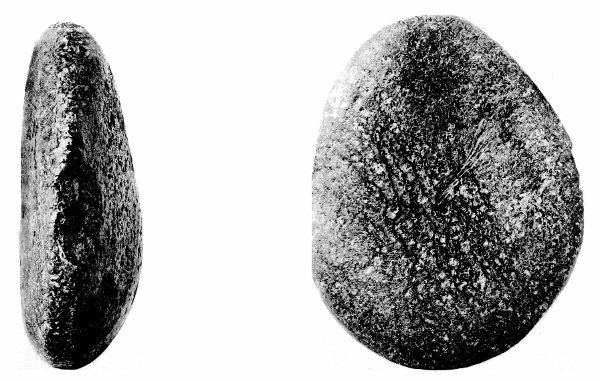
THE HELIOTYPE PRINTING CO., BOSTON
NATURAL PEBBLE CONSIDERABLY WORN AS CUTTER AND GRINDER
The next major class of devices comprises shells and cobbles and
bowlders picked up at random to meet emergency needs, wielded in
ways determined by emergency adjustment of means to ends, and sometimes
retained and reused under the budding instinct of fitness, though
never shaped by design. The devices of this class are best exemplified
by the tool-shells and by the hupfs and ahsts of the Seri matrons, partly
because of the practical absence of higher artifacts from their territory;
yet the class is by no means confined to this notably primitive, folk:
the greater part of the implements used by the California Indians and a
large part of those used by every other known Amerind tribe in aboriginal
condition consist of shore cobbles, river pebbles, talus bowlders, or
other natural stones of form and size convenient for emergency use;
and (despite the fact that such objects are often ignored by observers,
for the prosaic reason that they represent no familiar or trenchant
class), there is no lack of evidence that they are or have been in habitual
use among all primitive peoples. Although zootheistic or sortilegic
motives doubtless play an undetermined rôle in the selection of the
objects, and although wonted zoomimic movements doubtless affect the
initial processes, the essential distinction from zoomimic artifacts
resides in the selection and use of natural objects through a mechanical
chance tending to inspire volitional exercise rather than through a
fiducial rule tending to paralyze volitional effort; while the class is no
less trenchantly separable from those of higher grade by the absence
of preconceived models or technical designs. The class of devices and
the culture-stage which they represent have already been outlined and
defined as protolithic.299
A transitional series of devices allied to the Seri hupf on the one
hand and to the chipped artifact on the other hand is frequently found
among the aborigines of California and other native tribes; it is typified
by a cobble or other natural piece of stone cleft (first by accident of use
and later by design) in such wise as to afford an edged tool. This subclass
of artifacts is religiously eschewed by the Seri; but it is of much interest
as an illustration of the way in which artificialization proceeds, and
of the exceeding slowness of primitive progress.
The third great class of devices defined by technologic development
comprises stones chipped, flaked, battered, ground, or otherwise
wrought in accordance with preconceived designs, together with cold-forged
native metal, horn, bone, wood, and other substances wrought
in accordance with preconceived models and direct motives. Among
the Seri this class of devices is represented only by the rare arrowpoints
of chipped stone, which seem to be accultural and largely fetishistic;
but the class is abundantly represented by the artifacts of most of the
Amerind tribes. The class and the cultural stage have already been
outlined under the term technolithic.300
A transitional series of devices intervenes between stone artifacts
and artifacts of smelted metal; it is represented by malleable native
metals (chiefly copper, silver, meteoric iron, and gold), originally
wrought cold, after the manner of stone, though heating under the
hammer in such wise as to prepare the way for forging, fusing, and
founding. These devices and the processes with which they are correlated
are not represented among the Seri; indeed, the crude use of
iron by the tribe would seem to lie on a lower plane in industrial
development than even the arrowpoint-chipping, in that the artifacts,
though of foreign material, are wrought largely in accordance with
zoomimic motives.
The fourth major class of devices, comprising the multifarious artifacts
of smelted and alloyed metal, was barely represented in aboriginal
America; only a few of the more advanced tribes had attained the
threshold of metallurgy, and even among these the crude metal working
remained hieratic or esthetic, and did not displace the prevalent
stone craft.
Briefly, the several stages in the development of tools and implements
may be seriated as follows:
| Stages |
Typical materials |
Typical products |
Essential ideas |
| 1. Zoomimic |
Bestial organs |
Awls, spears, harpoons, arrows. |
Zootheistic faith. |
| A. Transitional |
Symbolized organs |
Piercing and tearing implements. |
Faith + craft. |
| 2. Protolithic |
Natural stones |
Hammers and grinders— hupfs and ahsts. |
Mechanical chance. |
| B. Transitional |
Cleft stones |
Grinders and cutters |
Chance + craft. |
| 3. Technolithic |
Artificialized stones. |
Chipped, battered, and polished implements. |
Designed shapement by molar action. |
| C. Transitional |
Malleable native metals. |
Copper celts, gold ornaments, etc. |
Designed shapement by molar action + chance heating. |
| 4. Metal |
Smelted ores |
Steel tools, etc. |
Shapement by molar and molecular action. |
BUREAU OF AMERICAN ETHNOLOGY
SEVENTEENTH ANNUAL REPORT PL. LI
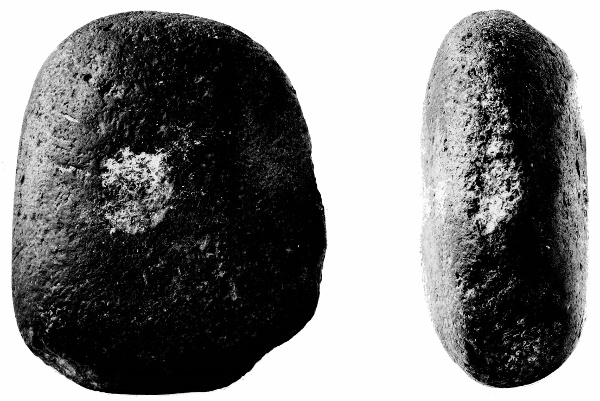
THE HELIOTYPE PRINTING CO., BOSTON
NATURAL PEBBLE CONSIDERABLY USED AS HAMMER, GRINDER, AND ANVIL (TOP AND EDGE)
BUREAU OF AMERICAN ETHNOLOGY
SEVENTEENTH ANNUAL REPORT PL. LII
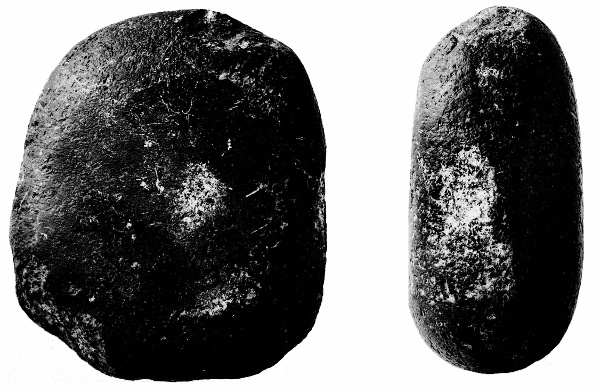
THE HELIOTYPE PRINTING CO., BOSTON
NATURAL PEBBLE CONSIDERABLY USED AS HAMMER, GRINDER, AND ANVIL (BOTTOM AND EDGE)
It is to be realized that the successive stages represent characteristic
phases of normal and continuous growth, and hence that their relations
are intimate and complex. The fundamental factor of the growth is
intellectual advancement, and hence in actual life each stage is at once
the germ and the foundation for the next higher; each stage is characterized
by a type or a cognate series of types, yet each commonly contains
a few forms prophetic of the next stage and many forms vestigial
of the earlier stages; so that the stages are to be likened unto successive
generations of organisms, or (still more appropriately) to the successive
phases of ovum, larva, pupa, and imago in the ontogeny of the insect
rather than to the arbitrary classes of pigeonhole arrangements. The
complex relations conceived to exist among the stages can be indicated
more clearly by diagraphic representation than by typographic arrangement,
and such a representation is introduced as figure 38. The successive
curves in the diagram express the rhythmic character of progress
and the cumulative value of its interrelated factors, as well as the dominance
of successive types until gradually sapped and absorbed (though
not immediately or completely annihilated) by higher types reflecting
a strengthened mentality.
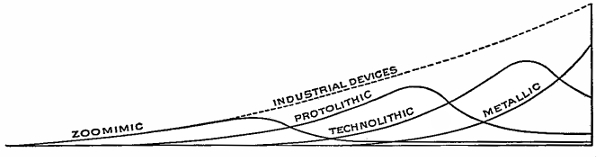
Fig. 38—Diagrammatic outline of industrial development.
The place of the normal pacific industries of the Seri in this genetic
classification of human technic is definite. The Seri craft combines the
features of the zoomimic and protolithic stages more completely than
that of any other known folk, and in such wise as to reveal the relations
between these stages and that next higher in the series with unparalleled
clearness; their craft also displays an aberrant (and hence presumptively
accultural) feature pertaining to the technolithic stage; and
in so far as their craftsmen use the material typical of the age of metal
they degrade it to the transitional substage between dominant zoomimicry
and designless stone-using.
Viewed in the general light of their pacific industries, the Seri are,
accordingly, among the most primitive of known tribes; their technic is
in harmony with their esthetic, and also with their somatic and tribal
characteristics, in attesting a lowly plane of development; while their
industries, like their other demotic features, are essentially autochthonous.
Something is known of Seri warfare through the history of the centuries
since 1540, and especially through the bloody episodes of the
Encinas régime and the occasional outbreaks of the last decade or two.
The available data clearly indicate that the warfare of the tribe complements
their pacific industries in every essential respect.
As befits their primitive character, warfare has played an important
role in the history of the folk, forming, indeed, one of the chief factors
in determining the course of tribal development. There is no means of
estimating the losses suffered and occasioned in warfare with the neighboring
tribes during either prehistoric or historic times; but the indications
are that they were much greater than the losses connected with
Caucasian contact. Neither is it practicable to estimate reliably the
fatalities attending the interminable conflicts with the Spanish invaders
and their descendants, though it is safe to say that the Seri losses in
strife against Spaniards and Mexicans aggregate many hundred, and
that the correlative loss on the part of their enemies reaches several
score, if not some hundred, lives. Few if any other aboriginal tribes of
America have had so sanguinary a history as the Seri, and none other
has at once so long and so bloody a record.
According to the consistent accounts of several survivors of conflict
with the Seri, their chief weapons are arrows, stones, and clubs—though
several survivors manifest greater fear of the throttling hands
and rending teeth of the savage warriors than of all their artificial
weapons combined. A striking feature of the recitals, indeed, is the
rarity of reference to weapons; the ambushes or surrounds or chance
meetings, with their disastrous or happy consequences, are commonly
described with considerable detail; the carbines or rifles, the machetes
and knives, or the deftly thrown riatas employed by the rancheros or
vaqueros are mentioned with full appreciation of their serviceability;
but the ordinary expressions concerning the despised yet dreaded Seri
are precisely those employed in recounting conflicts with carnivorous
beasts. When Andrés Noriega’s kinswoman proudly related how he
alone once overawed and routed an attacking party of 30 Seri warriors,
she duly mentioned the carbine ready for use in his hands and the
six-shooter and machete in his belt; but nothing was said of the Seri
weapons. When a distinguished sportsman citizen of Caborca, the
local authority on the Seri, sought to dissuade the 1895 expedition from
visiting Tiburon, he was repetitively and cumulatively emphatic in his
oracular forecast, “Ils vont vous tuer! Ils vont vous tuer!! Ils vont
vous tuer!!!”—yet he made but passing reference to “poisoned” arrows,
and none to other weapons, in the general implication that invaders of
the tribal territory were torn limb from limb and strewn over the rocks
and deserts of Seriland. When Jesus Omada, of Bacuachito, boasted
his Seri scars, he indeed emphasized the arrow-mark on his breast, but
only as a prelude and foil to the far ghastlier record of his teeth-torn
arm. When Robinson and his companion were butchered on Tiburon
in 1894, the bloody work was effected chiefly by means of a borrowed
Winchester; and neither the account of the survivors nor that of the
actors made mention of native weapons—save the stones with which the
second victim was finished according to the local version. In short,
most of the casual expressions and fuller recitals alike indicate that
while the Seri are famous fighters their weapons—except the much-dreaded
“poisoned” arrows—are incidents rather than essentials to
savage assaults, and that their prowess rests primarily on bodily the
strength and swiftness.
BUREAU OF AMERICAN ETHNOLOGY
SEVENTEENTH ANNUAL REPORT PL. LIII
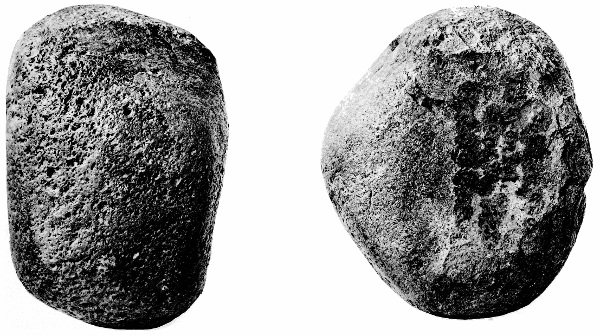
THE HELIOTYPE PRINTING CO., BOSTON
HAMMER AND GRINDER
BUREAU OF AMERICAN ETHNOLOGY
SEVENTEENTH ANNUAL REPORT PL. LIV
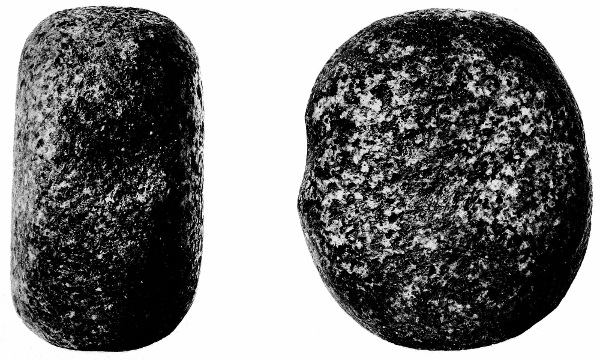
THE HELIOTYPE PRINTING CO., BOSTON
IMPLEMENT SHAPED BY USE
The stones used in battle, as described by the survivors and as intimated
by Mashém, are cobbles as large as a fist, i. e., hupfs of typical
form and size. So far as is known they are never hurled, slung, nor projected
in any other manner, nor are they hafted or attached to cords
after widespread aboriginal customs; they are merely held in the hand,
as in the slaughter of quarry. Hardy made note of a war-club—“They
use likewise a sort of wooden mallet called Macána, for close quarters
in war”;301 but nothing of the kind was found at Costa Rica in 1894, and
no woodwork suggesting such use was found in the depths of Seriland
in 1895.
The most conspicuous and doubtless the most effective war weapon
is the arrow projected from the bow in the unusual if not unique fashion
already noted (ante, p. 201). There is nothing to indicate that the Seri
are especially effective archers; the facts (1) that a large part of the
arrows are pointless, save for the hard-wood foreshafts; (2) that stone
arrowpoints are not habitually used; and (3) that comparatively slight
reference is made to the use of arrows in records and recitals of Seri
battles, tend on the contrary to indicate inferior ability in archery.
And in the course of the explorations by the 1895 expedition it was
noted that the feral fowls and animals of Seriland—pelican, gull, snipe,
curlew, cormorant, coyote, hare, bura, mountain sheep, peccary, etc.—displayed
little fear of human figures at distances exceeding 75 yards,
and seldom stirred until the stranger approached within 50 or 60 yards;
whence it may be assumed that these distances fairly indicate the ordinary
range of Seri arrows. The few accounts of conflicts in which
arrows are mentioned prove, however, that those missiles are discharged
with great rapidity and in considerable numbers during the brief interval
to which the fighting is customarily limited.
The most notorious feature of the Seri warfare, and that of deepest
interest to students, is the reputed use of poisoned arrows. The scattered
literature of the tribe, from the days of Coronado onward, abounds
in references to this custom; the Jesuit authorities give somewhat
varied yet fairly consistent descriptions of the preparation and the
effects of these arrows; Hardy added his testimony as to the character
of the poison; General Stone gave directly corroborative evidence;
haciendero Encinas gives witness to the effects of the envenomed missiles
on his own stock; while Mashém recounted to the 1894 expedition
the various uses of the “poisoned” arrows and highly extolled their
potency, though he was noncommittal—save in casual allusions—as to
the details of the poisoning. A part of the arrows acquired by this
expedition and now preserved in the National Museum were professedly
poisoned; they are easily distinguished by a thin varnish of gummy
and greasy substance over the iron tips and wooden foreshafts, and
especially about the attachments of mesquite gum and sinew. According
to Mashém’s asseverations, such arrows are habitually used in war
save when the supply is exhausted by continued demand; they are
also used occasionally in hunting, especially for deer and lions (i. e.,
the swiftest and fiercest game of the region); and the use of the
poisoned missile does not destroy the meat of the animal, though the
portion immediately about the wound is “thrown away”. Two of
the treated arrows brought back from Costa Rica were submitted to
Dr S. Weir Mitchell some months afterward for examination, and for
identification of any poisonous matter found on them; but no poison
was detected. On the whole, the data concerning the reputed arrow
poisoning are less definite than might be desired; yet they are sufficient
to suggest the nature of the custom with considerable clearness.
In any consideration of Seri customs it is to be realized that the
folk are notably primitive in thought, and hence deeply steeped in that
overweening mysticism which, dominates all lowly folk—that they still
cling to zoomimic motives in their simple handicraft, and are still wholly
within zootheism in their lowly faith. In the light of this realization
the numerous consistent records of the preparation of the poison are
easily interpreted, and are found to be fully in accord with the prevailing
motives of the tribe; and the interpretation serves to explain
the somewhat discrepant accounts of the effects of the poison, effects
ranging from nil to horrible sepsis. According to the more circumstantial
recipes, the first constituent of the poison is a portion of lung,
preferably human—a selection readily explained by pristine philosophy,
in which the breath is life, and the lungs at once the seat and the
symbol of vitality. Naturally the fleshly symbol is from a dead body;
and just as the lung denotes vitality in life, so (in primitive thought) it
denotes an emphasized, as it were an incarnated, antithesis of vitality
in death. Next, as the recipes continue, this death-symbol is exposed
to the most potent agencies of death—to the bites of maddened rattlesnakes,
to the stings of irritated scorpions, to the venomed trailings of
harried centipedes. Then the deadly creatures are themselves killed,
and the fanged heads of the serpents, the stinging tails of the scorpions,
and the fiery feet of the centipedes, together with portions of
redolent ordure from the grave-cairns, and other symbols of death and
decay are crushed and macerated with the mass in a wizard’s brew,
grewsome beyond the emasculated and degraded witch’s broth of
medieval times. Finally, the grisly mess is allowed to simmer in a
stinkpot302 shell under the fierce desert sun until its ripeness and putrid
potency are attested by the rank fetor of death; when it is ready for its
ruthless use. Thus the entire recipe is thaumaturgic in concept, necromantic
in detail; it represents merely the malevolent machinations of
the medicine man seeking success by spells and enchantments; it
stands for no rational system of thought or practice, but pertains
wholly to the plane of shamanism and sorcery. So interpreted the
recipe is readily understood; the several witnesses who have independently
obtained it are justified, and Mashém’s details and unwilling
intimations are made clear—especially if the sacrificed flesh about the
wound in deer or lion be deemed an oblation, such as primitive folk are
given to making.
BUREAU OF AMERICAN ETHNOLOGY
SEVENTEENTH ANNUAL REPORT PL. LV
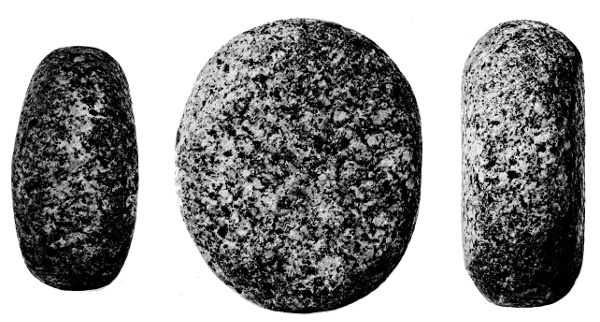
THE HELIOTYPE PRINTING CO., BOSTON
IMPLEMENT PERFECTED BY USE
While thus the motive of the medicine-man in compounding his
loathsome mess is wholly necromantic, serious consequences of its use
must occasionally supervene; and though these may be incidental so far
as the philosophy is concerned, they may tend reflexly toward the
perpetuation of the custom. In the course of the preparation of the
charm-poison, and especially in the final ripening process, morbific
germs and ptomaines must be developed; these may retain their virulence
up to the time of use, particularly when a batch of poison is
prepared for a special occasion and the arrows are used while the application
is still fresh; and in such cases the wound might initiate septicemia
of the sort described in Castañeda’s early narrative and still
more clearly displayed by Señor Encinas’ saddle-horse (ante, p. 112).
Naturally the incidentally zymotic varnish frequently fails of effect,
and can hardly be expected to remain morbific long enough to be
detected in laboratory experiments; yet it is probable, as attested by
Mashém’s guarded expressions, that the occasionally terrible results of
such poisoning are within the ken of the Seri shamans.
It is noteworthy that the various early accounts of the Seri arrow-poisoning
are strikingly consistent, though sufficiently diverse to
attest independence in origin; it is also noteworthy that several of the
accounts are given hesitatingly and half qualifiedly, with alternative
references (obviously hypothetical) to vegetal sources of poison. Thus
the author of “Rudo Ensayo” qualified a characteristic (though brief)
account of the preparation of the poison by adding: “But this is mere
guesswork, and no doubt the main ingredient is some root.”303 So, too,
Hardy described the compounding of the brew in much detail, adding
the significant statement that “when the whole mass is in a high state
of corruption the old women take the arrows and pass their points
through it”; yet he could not resist the alternative hypothesis, and
added: “Others again say that the poison is obtained from the juice of
the yerba de la flécha (arrow-wort).”304 Bartlett “was told that the Ceris
tip their arrows with poison; but how it was effected I [he] could not
learn,” and so he contented himself with quoting Hardy’s account.305
Stone gave the recipe in fairly similar terms, adding that the morbific
mass is hung up “to putrefy in a bag, and in the drippings of this bag
they soak their arrowheads”; and he gave a characteristic account
of the effect of a wound from a poisoned arrow on a human subject
(ante, p. 100). Pajeken independently attested the virulence of the
poison, and described the consequences of a slight wound suffered by
his horse (ante, p. 101), while Pimentel gave independent corroboration,
and Orozco y Berra added the further information that the proverbially
deadly poison is fortified “by superstitious practices” (ante, p. 103).
Bancroft gave currency to the customary recipe, and also to the complementary
hypothesis that the “magot” may be the source of the poison;
while Dewey merely mentioned the reputed use of poisoned arrows.
Like their predecessors, the vaqueros of today are familiar with the
tradition of a necromantic brew; but many of them—like Don Jesus
Omada, of Bacuachito, and Don Ramon Noriega, of Pozo Noriega—display
a much more lively interest in the local yerba mala, or yerba
de flécha, of which they stand in such mortal dread that they can
hardly be induced to approach a clump of it, and which they conceive
must add the final crux to the brew. This plant was described in
“Rudo Ensayo”: “Mago, in the Opata language, is a small tree, very
green, luxuriant, and beautiful to the eye; but it contains a deadly
juice which flows upon making a slight incision in the bark. The
natives rub their arrows with it, and for this reason they call it arrow-grass;
but at present they use very little.”306 Elsewhere the anonymous
author mentions the use of (presumably) this poison by the Jova, and
describes it as “so deadly that it kills not only the wounded person,
but also him who undertakes the cure by sucking the wound, as is
customary with all the Indians”; the description implying that the
infection is irremediable.307 Yet he apparently discriminated this poison
from that of the Seri, for which another plant known as caramatraca
is an infallible remedy. On the whole it seems probable that the yerba
mala (Sebastiano bilocularis?), or yerba de flécha, or mago, or magot,
yielded or formed the standard arrow-poison of the Opata and perhaps
of other Indians, and that the ill-repute of the shrub survived and
spread throughout Mexicanized Sonora in such frequent repetition and
common belief as to affect the ideas of residents and travelers alike;
but it seems equally probable that the magic-inspired brew of the Seri
is entirely distinct.308
BUREAU OF AMERICAN ETHNOLOGY
SEVENTEENTH ANNUAL REPORT PL. LVI
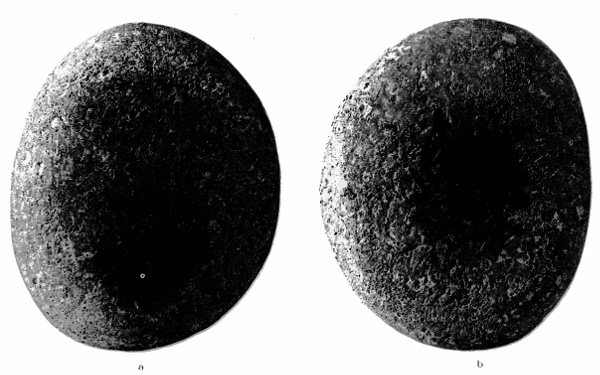
PERFECTED IMPLEMENT FOUND IN USE
As suggested by widespread primitive customs, and as illustrated
specifically by the arrow-charming, the warfare of the Seri is largely
sortilegic, this feature being but an extension and magnification of a
corresponding feature of their hunting customs. The economic object
of the chase is, of course, the flesh of the quarry; but the hunt normally
begins with invocatory or other fiducial ceremonies, culminates in a
feast opened with oblations, and ends in the use of horns or hoofs, teeth
or bones, mane or tail, as talisman-trophies—primarily pledges of
fealty to the favorable potencies, only secondarily symbols of success.
The observances illumine the ever-present esoteric object of the chase,
which is to gain the favor or overcome the power of the beast-god
represented by the animal hunted; in general, this is sought to be
effected through mimetic movements, or symbolic objects, associated
with that animal-kind, and the retained charm-trophy is valued as
a symbol of the placation or outwitting of a particular deity. Similarly,
the Seri warrior strives for the supposed deific symbols of the
enemy—the scalp or headdress or arrow of the alien tribesman, the
fire-breathing and echo-waking (as well as death-dealing) wand of
the Caucasian; and the Papago arrows, Yaqui scalps, and white man’s
firearms are sought avidly, treasured as fetishes, and often carried
conspicuously as badges of borrowed prowess.309 So the Seri are never
without alien insignia in the form of weapons. The day before the
1895 expedition entered their stronghold, a band of warriors and
women were frightened from a freshly slaughtered cow by a party of
vaqueros so suddenly that their arms were left behind—and these
included a heavy Springfield “remodeled” rifle, lacking not only ammunition
but breechblock and firing pin; while Don Andrés Noriega, of
Costa Rica, and L. K. Thompson, of Hermosillo, described a rifle of
modern make captured similarly two years before, which was in good
working order and charged with a counterfeit cartridge ingeniously
fashioned from raw buckskin in imitation of a center-fire brass shell
and loaded with a polished stone bullet.310 The finders opined that the
rifles were carried to bluff the enemy, and even that the counterfeit
cartridge was designed to do deadly execution; but it would better
accord with Seri customs, and with the law of piratical acculturation
which they typify,311 to infer that the weapons were regarded rather as
symbols of mystical potencies than as simple scarecrows. Of related
import were two or three pseudomachetes made from rust-pitted cask
hoops, reported by the majordomo and several vaqueros at Costa Rica;
and of still greater significance was a machete picked up in a just-abandoned
jacal by Don Ygnacio Lozania—veteran of the Andrade
expedition and the Encinas conquest—which was laboriously rasped
and scraped out of paloblanco wood, colored in imitation of iron blade
and mahogany handle by means of face-paints, and even furnished with
“eyes” replacing the handle-rivets, in the form of embedded iron scales.
Some of the Seri are familiar with the normal use of firearms, as was
demonstrated by the Robinson and other episodes, and many of them
modernly make some use of machetes or other knives, as shown by various
rudely whittled wooden artifacts; yet the burden of proof indicates
that the chief use of the Caucasian’s weapons in the heat of actual warfare
is shamanistic and symbolic. This interpretation is, in fact, practically
established by the experience of the frontier; for the vaqueros
and local soldiery have little fear of the ill-understood firearms and
clumsily handled machetes occasionally seen in Seri hands, though
they dread unspeakably the necromantic arrows and flesh-rending
teeth with which the agile foes are credited.
The mystical potency ascribed to Caucasian firearms and cutlery by
the zoomimic tribesmen is of interest as a reflection of motives and
methods pervading the entire range of their activities; at the same
time it suggests the genesis of the aberrant technolithic craft displayed
in arrow-chipping. The information obtained from Mashém and his
mates concerning chipped arrowpoints implied that the process was
hieratic and little understood by the body of the tribe, its place in the
tribal knowledge, indeed, being similar to that of the brewing of the
arrow “poison”, which is the special work of shamans; and this information,
comporting as it does with the rarity of the chipped points and
the crudeness of the work, strongly supports the inference that the
stone arrow-making of the Seri was originally a fetishistic mimicry of
alien devices—a plane, indeed, above which the craft has hardly risen
even in recent decades.
While the Seri are devoid of military tactics in the strict sense of
the term, they have certain customs of warfare which seem to be
scrupulously observed. These customs are closely akin to those followed
in hunting the larger land animals—indeed, the warfare of the
tribe is merely an intensified counterpart of their chase.
The favorite tactical device of the warriors, as indicated by the great
majority of their battles, is the ambuscade, laid and sprung either with
or without the aid of decoys (usually aged women). Sometimes a considerable
body act in concert under a prearranged plan; more commonly
a few warriors only are involved at the outset, though these may be
joined as the crisis approaches by companions lurking behind rocks
and shrubs to be either on hand at the finish or in the way of ready
flight, according to the turn of the battle-tide; and it is probable that
the greater part of the ambuscades prove stillborn by reason of the
oozing courage of leaders and the shirking of their supporters if
the prospective victims present a bold front, or if the final omens are
otherwise adverse. The ambuscade, with its flying contingent, grades
into the device of stalking a stationary or slowly moving enemy, the
stealthy approach terminating either in covert attack at close range or
in sudden rush by a superior force. The theory, or rather the instinctive
plan, of the campaign is to seek advantage in both position and numbers,
to keep under cover until the instant of attack, to have sure and
ample lines of retreat, and in every way to minimize individual risk.
There is a widespread notion toward the Seri frontier that the savages
are given to sorties and surprises by night; but both specific testimony
and the records indicate, when carefully analyzed, that this tactical
device is much less common in practice than in repute, and is not,
indeed, characteristic of the tribe. A few known battles began in
attacks by night; but the war parties, like the hunting and fishing parties
(save in the semiceremonial pelican pilgrimages), display decided
preference for daylight in their forays—indeed, there are various indications
that the folk are much more timid and oppressed with superstitious
fears by night than by day.
In rare cases small parties of aliens have been half openly surrounded
and done to death by considerably larger parties of the savage folk; but
this method, too, is incongruous with the fixed habits of the tribe and
with the deep-planted instinct of avoiding personal exposure.
A considerable number of the long list of homicides charged against
the Seri, and marking the beginning of many of their battles, were
individual rather than collective, the consummation of inimical impulse
sometimes treacherously concealed for favorable opportunity, as in the
pitiful case of Fray Crisóstomo Gil, and othertimes rising explosively
beyond the feeble control of the untrained mind; for the impulse of
enmity toward aliens is an ever-present possession—or obsession—of
the tribe, and a reflection of that race-sense which is their most distinctive
attribute.
Of open warfare and face-to-face fighting there is hardly a germ among
the Seri. When themselves ambushed or surrounded, some of their
stouter warriors have in a few instances faced the foe for a few minutes
at a time, as is shown by the annals of Cerro Prieto; yet this accidental
attitude but betokens the play of chance rather than the plan
of choice. Concordantly, the folk avoid the method of warfare (so common
among other Amerind tribes as to be properly considered characteristic)
involving open duel between chiefs and other warriors; they
seem to be devoid of that sense of fairness in fighting which finds
expression in the duel; and despite the individual advantages growing
out of gigantic stature, immense strength, and superior swiftness, they
habitually seek to combine in numbers against panicked or baffled enemies,
just as their hunters throw themselves mercilessly on surrounded
quarry. Of open boldness or confident prowess no trace appears; and
the body of facts seems to justify the prevailing Sonoran opinion that
the warfare of the Seri is treacherous and cowardly in design, craven
and cruel in execution.
Once begun, the conduct of the fray by the Seri fighters is fairly
uniform; the warriors either discharge clouds of arrows from their
coigns of vantage, or rush to brain their victims with stones, or to
break their necks and limbs and crush in their chests, as in the
slaughtering of quarry; and according to the tale of the occasional survivors—Señor
Pascual Encinas and his son Manuel, Don Ygnacio
Lozania, Don Andrés Noriega, Don Jesus Omada of Bacuachito, and
Don Ramon Noriega of Pozo Noriega, are among the survivors and
informants; also the sturdy Papago fighters, Mariana, Anton, Miguel,
and Anton Castillo (whose sister died of dread while he was on the 1895
expedition)—the rushing warriors are transfigured with frenzy; their
eyes blaze purple and green, their teeth glisten through snarling lips,
their hair half rises in bristling mane, while their huge chests swell
and their lithe limbs quiver in a fury sudden and blind and overpowering
as that of springing puma or charging peccary. Of the successful
assaults the ghastly end is rarely recorded, though whispered large in
the lore of Sonora; in the unsuccessful assaults recounted by survivors
the blood-frenzy burned but briefly and died swiftly as the disappointed
warriors skulked silently behind rocks and shrubs, or fled across the
sands with inconceivable fleetness. These details of battle precisely
parallel the details of butchery of beastly quarry, as recounted by
local observers and corroborated by Mashém’s recitals.
So far as can be ascertained the parallelism between frenzied battling
and furious butchery in the chase affords the chief basis for the firm
Sonoran belief that the similarity extends one step farther, and that
the human victims are rent and consumed, like the beasts. There is a
lamentable lack of data concerning the alleged anthropophagy of the
Seri; on the one hand there is the deep-seated local opinion, generally
growing stronger as the tribal territory is approached, and agreeing so
well with the hunting customs, the thaumaturgic arrow-poisoning, the
zoomimic handicraft, and zootheistic faith, and especially with the
pervading fetish-piracy of the folk, that its validity would seem inherently
probable; on the other hand, there is not only a dearth of specific
positive testimony, but haciendero Encinas (best informed among
Caucasians concerning Seri customs) and several of his yeomen reject
the prevailing belief, while Mashém consistently repudiated the custom,
both in general and in particular, and in ceremonial as well as in
economic aspects, whenever and in whatever way the subject was
approached during his intercourse with the 1894 expedition. On the
whole, the much-mooted question of Seri cannibalism must be left open
pending further inquiry, with some preponderance of evidence against
the existence of the custom.
The war-frenzy of the Seri fighters is significant in its parallelism
with the blood-craze of the chase, and even more so in its analogy with
the warpath customs and ceremonies of most Amerind tribes and many
other primitive peoples. In typical tribes the warpath custom is a
most distinctive one, standing for an abnormal state of mind and an
unaccustomed habit of body, perhaps to the extent of an extreme
exaltation or obsession akin to intoxication, in which the ordinary ideas
of justice and humanity are inhibited; among most tribes the condition
is sought voluntarily and deliberately when occasion is thought to
demand, and is superinduced by fasts and vigils, exciting songs and
ceremonies, and related means; while among certain tribes the aid of
symbolic “medicines”, which may be actual intoxicants, is invoked.
Thus the savage on the warpath is a different being from the same
man in times of peace; viewed from his own standpoint, he is possessed
of an alien and violent demon, usually that of a fantastic and furious
beast-god whose rage he must symbolize and enact; viewed from the
standpoint of higher culture, he is a raving and ruthless maniac whose
craze is none the less complete by reason of its voluntary origin. The
warpath frenzy is one of the fundamental, even if little understood,
facts of primitive life, and the character of the savage tribe can not
properly be weighed without appreciation of it. Now, the Seri blood-craze
seems measurably distinct in two ways: in the first place, it
expresses a more profound and bitter enmity toward aliens than is
found among most savage tribes—i. e., it is instinctive and persistent
in exceptional degree; in the second place, it is more spontaneous and
explosive in its culmination when conditions favor than among tribesmen
who induce the condition by elaborate preparation—i. e., it is
dependent on the swift-changing hazard of warfare in exceptional
measure; so that the Seri frenzy is at once more instinctive and more
fortuitous, or in general terms more inchoate, than the corresponding
condition among most of their contemporaries. Accordingly the war
customs, like several other features of the tribe, seem to afford a connecting
link between the habits normal to carnivorous beasts and the
well-organized war customs of somewhat higher culture-grades; and
thus they contribute toward outlining the course of human development
through some of its darker stages.
Conformably with their poverty in offensive devices, the Seri are
exceedingly poor in devices for defense. It is an impressive fact that
a restricted motherland which has been successfully protected against
invasion for nearly four centuries of history should be destitute of
earthworks, fortifications, barricades, palisades, or other protective
structures; yet no such structures exist on any of the natural lines of
approach, and none are known anywhere in Seriland save in a single
spot—Tinaja Trinchera—where there are a few walls of loose-laid stone,
so unlike anything else in Seriland and so like the structures characteristic
of Papagueria as to strongly indicate (if not to demonstrate) invasion
and temporary occupancy by aliens. The jacales are not fortified in
the slightest degree, unless the turtle-shells with which they are sometimes
shingled be regarded as armor; even the most ancient rancherias
are absolutely devoid of contravallations of earth, stone, or other material;
and both the structures themselves and the expressions of the
folk concerning them indicate that the jacales are not regarded as
fortresses or places of refuge against enemies, but only as comfortable
lodges for use in times of peace. Nor are walls like those of the borderland
Tinaja Trinchera known in the interior of the tribal territory—e. g.,
the similarly conditioned Tinaja Anita, which differs only in the greater
abundance and permanence of the water-supply, is entirely devoid of
artificial structures, not even a pebble or bowlder being artificially
placed save perchance by the casual trampling of the pathways. As
already noted, the Seri seem to be practically devoid of knife-sense;
they are still more completely devoid of fort-sense, although (and evidently
because) they rely so fully on natural things, including tutelaries
and their own fleetness, for safety.
Although devoid of even the germ of fortification-sense, so far as can
be discovered, the Seri are not without a sort of shield-sense, which is
of much significance partly by reason of its inchoate character. The
ordinary shield is a pelican pelt, or a robe or kilt comprising several
skins; it is employed either for confusing the enemy by swift brandishing,
something after the fashion of the capa of the banderillero in the
bull ring, or for actual protection of the body against arrows and other
missiles or weapons. So far as known it is not backed or otherwise
strengthened, the user relying solely on the stout integument and
thick feathers—or rather on the mystical properties imputed to the
pelt as the mystery-tinged investiture of their chief creative tutelary.
On the coast bucklers are improvised from turtle-shells, though, according
to Mashém (confirmed by direct observation), these are not carried
inland for the purpose; but the protective function imputed to the
turtle was well represented in the rancheria at Costa Rica by several
fetishes made from phalanges of turtle-flippers tricked out in rags in
imitation of Caucasian dress (somewhat like the mortuary fetishes
illustrated in figure 40a and b). On the whole, the most conspicuous
feature of the individual shields or protectors is their emblematic character;
they are sortilegic rather than practical, and express imputation
of mystical potencies rather than recognition of actual properties; and
in this as in other respects they correspond closely with the offensive
devices, and aid in defining the ideas and motives of the primitive
warriors.
The actually effective protection of the Seri in warfare is their fleetness,
coupled with their habitual and constitutional timidity, i. e., their
wildness—for they are verily, as their Mexican neighbors say, “gente
muy bronco”. Moreover, they are adepts in concealing their persons
and their movements behind shrubbery and rocks, and in finding cover
on the barest plains; and suggestions are not wanting that the protecting
shrub-clumps and rocks of their wonted ranges are credited
with occult powers and elevated to the lower places of their zoic pantheon,
after the customary way of that overpowering zootheism, or
animism, which the Seri so well exemplify in many of their habits.
Summarily, the warfare of the Seri complements the pacific industries
of the tribe in every essential respect. It is notable for improvidence,
i. e., for reliance on chance; the dearth of devices for offense and
defense parallels the poverty in industrial artifacts; and the disregard
of fortifications is of a kind with the squandering of present food supplies
and the utter neglect of provision for the future. A striking
correspondence between workfare and warfare is found in the fierce
blood-lust displayed alike in chase and battle, a feature manifestly
borrowed from beasts and intensified by besetting beast-faith; and
more striking still is the correspondence in motive, as revealed by the
overlapping functions of the protective kilt, by the borrowing of animal
symbols alike in peace and war, and by the imitation of animal movements
on the warpath as in the chase.
In the last synthesis the warfare of the Seri may be considered as
characterized by two attributes: (1) The motives, so far as developed,
are zoomimic in even greater degree than the prevailing motives of the
pacific industries; and (2) the methods are shaped largely by mechanical
chance, like those normal to protolithic industry.
Industries form the chief bond between man and his environment.
The esthetic activities arise in the individual and extend to his fellows;
the institutional activities express the relations among individual men
and groups; the linguistic activities serve to extend social relations in
space and time, and the sophic activities to integrate and perpetuate
all relations; but it is through the industrial activities that human
intelligence interacts with physical nature and makes conquest of the
material world. Accordingly, industries act as a steady and never-ceasing
stimulus to intelligence; accordingly, too, the industrial activities
afford the simplest and surest measure of intellectual advancement.
Under this view of the place of industrial activities in human phylogeny,
certain phases of Seri technology acquire importance and especial
significance.
1. One of the most conspicuous features of Seri craft is its local
character. The foodstuffs, the materials for appareling and habitations,
and the substances utilized in the several lines of simple handicraft
are essentially local; moreover, the characteristic methods and
devices evidently reflect local environmental conditions. There are,
indeed, a few phenomena suggesting, and a still less number demonstrating,
extraneous origin; the balsa and the kilt are sufficiently
similar to devices of other districts to suggest, though not to prove,
genetic identity (indeed, the sum of indications of local origin is much
weightier than the several suggestions of extraneous derivation); the
iron harpoon-points and arrow-tips are mainly of local flotsam, and are
essentially provincial in modes of employment; the chipped stone
arrow-tips, though local in material, are foreign in motive; but on summarizing
the industrial phenomena, it would appear that by far the
greater share are essentially local, while the few of exceptional (and
extraneous) character can be pretty definitely traced to importation
through the social interactions of recent centuries.
2. An equally conspicuous feature of the industrial craft of the Seri
is the dominance of chance in both processes and devices. The traditional
“fisherman’s luck” is made exceptionally uncertain by the sudden
gales and shifting currents of Seriland shores, while the absolute necessaries
of life on land are still more capricious than those alongshore;
this uncertainty of resources has profoundly affected the somatic features
of the tribesman, as indicated elsewhere (ante, p. 159); and
that the mental attributes of the folk are even more profoundly affected
is attested by the role played by chance in the selection and shapement
of the prevailing tools of stone and shell. The large role of chance
in Seri life is also revealed, though less directly, in the overweening
mysticism of zootheistic faith, with its material reflection in zoomimic
craft.
3. When the local and fortuitous features of the Seri industries are
juxtaposed they are found to express a notably inchoate or primitive
stage of industrial development. In both the local and the fortuitous
or accidental aspects, the activities are so closely adjusted to the immediate
environment as to approach the instinctive agencies and movements
of bestial life, and correspondingly to diverge from the composite
and cosmopolite characters of higher humanity; the dearth of extraneous
devices denotes absence or intolerance of that accultural interchange
accompanying and marking the progress of peoples; and the
dearth of inventions denotes feebleness of creative faculty and absence
of that self-confidence which accompanies and measures progress in
nature-conquest.
4. When the local and fortuitous features of the Seri craft are viewed
in their serial or sequential relations, they are found to reflect and
attest autochthonal development. Excepting the few accultural processes
and devices whose acquisition may confidently be traced to certain
social interactions of the historic period, the Seri technic is too
closely tied to local environment to warrant any supposition of importation
from other districts. The question of the birthplace of the people
may be left open in this case as in every other; but the birthplace
of practically all those activities and activital products which define
the folk as human was manifestly Seriland itself—so that the tribe,
considered as a human folk rather than as a zoic variety, must be
classed as autochthonous.
Summarily, then, the Seri industries are significant as (1) local, (2)
fortuitous, (3) primitive, and (4) autochthonous; and these features
combine to illumine a noteworthy stage in primitive thought.
5. On juxtaposing these significant features of Seri technic, they are
found to reflect the tribal mind with noteworthy fidelity, and hence to
indicate the sources of Seri mentations, and of the local culture in
which these mentations are integrated. The local foodstuffs—especially
that vital standard of values in arid regions, water—are periodic
sources of the strongest aspirations and inspirations of industrial life,
and the methods and devices for food-getting are but the legitimate
offspring of the inevitable relation between effort and environment; the
conspicuous role of chance is but the composite of the hard and capricious
environment on the one hand, and of the lowly thought reflecting
that environment on the other hand; the zoic faith into which the
magma of recurrent chance has semicrystallized finds carnate symbols
either in local beasts or in fantastic monsters suggested by those
beasts; even the mating instinct, second only to thirst among the
impelling action-factors of the folk, is so profoundly and bitterly provincial
as to exclude foreign ideals to a degree unparalleled among
known peoples. The industrial materials are local—but not more local
than the thoughts in which they are reflected; the technical methods
are unmistakably the offspring of the environment—but they are equally
the offspring of minds reflecting that environment and no other; the
few and simple devices stand for integrations of experiences, instinctive
rather than ratiocinative, the germ of invention rather than even its
opening bud—but the experiences bear the marks of that environment
and no other. Accordingly, the mental side of Seri industry, and, indeed,
of all Seri life, appears to be the counterpart of the physical
side. The Seri mind is (1) local, (2) chance-dominated, (3) exceeding
lowly, and especially (4) autochthonal in its content and workings.
There is an aspect of the inference as to the local and autochthonal
character of the Seri mind which is of wide-reaching application. As
indicated by many tribes, though most clearly by the Seri, there is a
definite relation between the somatic characteristics of primitive folk
and their environment; the indications are that the relation is inversely
proportionate to development, the lowliest tribes reflecting environment
most closely, and the higher peoples responding less delicately to
the environmental pressure in the ratio of their increased power of
nature-conquest; and the relation is essentially phylogenetic, in that it
sums and integrates the innumerable interactions between organic kind
and environment during generations or ages. It is to be realized that
the relation is not simple and direct or physiologic merely (e. g., like
that between climate and the pelage of an animal), but that it is linked
through the human activities; for, as is conspicuously the case in Seriland,
the environment prompts exercises of particular kinds, and it is
these exercises that shape the somatic features, such as strength of
lung, length of limb, and the soundness of constitution displayed in
physical endurance; yet the relation is none the less real, in that it
operates through the activities rather than directly. The relation may
be characterized with respect to mechanism as bodily responsion, or
with respect to capacity as responsivity of body. Now, as is well illustrated
by the provincial ideation of the Seri, the relation between environment
and physique is accompanied by a corresponding relation between
environment and thought. This relation, too, varies inversely with
development, the connection being closest among the most primitive
tribes, and growing less and less close with maturing mentality and
proportionately increasing power of nature-contest; and the relation
is still less direct (or physiologic merely) than that between the human
body and its environment, in that not only the bodily activities but the
instinctive and nascently ratiocinative processes are interposed. This
relation between mind and environment may be characterized as mental
responsion in its mechanical aspect, or as responsivity of mind when
regarded as a psychic property.312 Accordingly, the relation between
the tribal mind and its environment, as illumined by the peculiarly
delicate interactions observed among the Seri, seem to indicate the
genesis and earlier developmental stages of mentality in its multifarious
aspects.
The specially significant feature of the relation between environment
on the one hand and body + mind on the other is its diminishing
value with general intellectual advancement. Viewed serially, the
relation may be considered to begin in the animal realm with organisms
adapted to environment through physiologic processes, and to end in
that realm of enlightened humanity in which mind molds environment
through complete nature-conquest. In the serial scale so defined the
various primitive tribes and more advanced peoples may be arranged
in the order of mental power or culture-status; when the same arrangement
will express in inverse order the relative closeness with which
the several tribal minds reflect their environments. It follows that the
lowly minds and craft of the Seri reflect their distinctive environment
with exceeding, perhaps unparalleled, closeness, because of their very
lowliness; it follows, too, that any other equally lowly folk imported
into the region and perfectly wonted to it by generations of experience
would equally reflect the physical features of the region in their craft and
in their thinking; it follows, also, that if the Seri were transported into
any other district of equally distinctive physical features, they would
gradually adapt themselves to the new environment—though with some
added intelligence, and hence with diminished closeness, as is the way
of demotic development—in such manner that their craft and thinking
would reflect its features. In a more general way it follows that those
similarities in culture, or activital coincidences, which have impressed
the ethnologic students of the world (notably Powell and Brinton),
are normal and inevitable in primitive culture and of diminishing
prominence with cultural advancement.
Among the Seri, as among many other aboriginal tribes, the social
relations are largely esoteric; moreover, in this, as in other savage
groups, the social laws are not codified, nor even definitely formulated,
but exist mainly as mere habits of action arising in instinct and sanctioned
by usage; so that the tribesmen could not define the law even if
they would. Accordingly the Seri socialry313 is to be ascertained only
by patient observation of conduct under varying circumstances. Unfortunately,
the opportunities for such observation have been too meager
to warrant extended description, or anything more, indeed, than brief
notice of salient points.
The most noticeable social fact revealed about the Seri rancherias is
the prominence of the females, especially the elderwomen, in the management
of everyday affairs. The matrons erect the jacales without
help from men or boys; they carry the meager belongings of the family
and dispose them about the habitation in conformity with general custom
and immediate convenience; and after the household is prepared,
the men approach and range themselves about, apparently in a definite
order, the matron’s eldest brother coming first, the younger brothers
next, and finally the husband, who squats in, or outside of, the open end
of the bower. According to Mashém’s iterated explanations, which
were corroborated by several elderwomen (notably the clanmother
known to the Mexicans as Juana Maria) and verified by observation
of the family movements, the house and its contents belong exclusively
to the matron, though her brothers are entitled to places within it
whenever they wish; while the husband has neither title nor fixed
place, “because he belongs to another house”—though, as a matter of
fact, he is frequently at or in the hut of his spouse, where he normally
occupies the outermost place in the group and acts as a sort of outer
guard or sentinel. Conformably to their proprietary position, the matrons
have chief, if not sole, voice in extending and removing the
rancheria; and such questions as that of the placement of a new jacal
are discussed animatedly among them and finally decided by the dictum
of the eldest in the group. The importance of the function thus exercised
by the women has long been noted at Costa Rica and other points
on the Seri frontier, for the rancherias are located and the initial jacal
erected commonly by a solitary matron, sometimes by two or three
aged dames; around this nucleus other matrons and their children
gather in the course of a day or two; while it is usually three or four
days, and sometimes a week, before the brothers and husbands skulk
singly or in small bands into the new rancheria.
Quite similar is the regimentation of the family groups as indicated
by the correlative privileges and duties as to placement, as well as the
reciprocal rights of command and the requirements of obedience. Ordinarily
(especially when the men are not about) the elderwoman of the
jacal exercises unlimited privileges as to placement of both persons and
property, locating the ahst, the bedding, the fire (if any), and other possessions
at will, and assigning positions to the members of her family,
the nubile girls receiving especial attention; she is also the arbiter of
disputes, the distributor of food, etc.; but in case of tumult, especially
when children from other jacales are present, she may invoke the authority
of the clanmother, whose powers in the rancheria are analogous to
those of the younger matrons in their own jacales. Even when the
men are present they take little part in the regulation of personal conduct,
but tacitly accept the decision of matron or clanmother; yet in
emergencies any of the women are ready to appeal for aid in the execution
of their will to a brother (preferably the elder brother) of the
family, or, if need be great, to the brothers of the clanmother. So far
as was observed, and so far as could be ascertained through informants,
these appeals are always for executive and never for legislative or
judicative cooperation; but various general facts indicate that in times
of stress—in the heat of the chase, in the warpath-craze, etc.—the men
bestir themselves into the initiative, while the women drop into an
inferior legislative place. As an illustration of the ordination in somewhat
unusual circumstances, it may be noted that when the “Seri
belle” (Candelaria) refused to pose for a photograph she was supported
by the clanmother (Juana Maria) until the latter was placated by presents;
and that when the belle refused to obey the mother’s command—to
the vociferous scandal of the entire group—Juana Maria appealed
to Señor Encinas, as the conqueror of the tribe and hence as the virtual
head of both rancho and rancheria. And when a younger Seri maiden
(plate XXV) similarly refused to pose, and in like manner disobeyed her
mother (again to the general disgust), the latter appealed to Mashém;
when he, after first exacting additional presents for both girl and
mother and a double amount for himself, put hands on the recalcitrant
demoiselle and forced her into the pose required, despite the shrinking
and tremulous terror perceptible even in the picture.
Commonly the regimentation of family, clan, and larger group appears
to be indicated approximately by the placement assumed spontaneously
in the idle lounging of peace and plenty. A typical placement of a
small group is illustrated in plate XIV. Here the family are assembled
outside the jacal, but in the relative positions which would be assumed
within. The matron (a Red Pelican woman) squats in easy reach of
her few and squalid possessions; on her left, i. e., in the group-background
and place of honor, sits the elderwoman of the rancheria (a
Turtle); then comes the daughter of the family, followed by two girl-child
guests of the group, the three occupying positions pertaining to
chiefs or elder brothers or, in their absence, to daughters; opposite the
matron sits a younger brother,314 whose wife is a Turtle woman (daughter
of the dame in the place of honor) and matron of another jacal. A
few feet behind this brother (just outside the limits of the photograph
reproduced, though shown on the duplicate negative) squats the husband,
with his side to the group and face toward the direction of natural
approach; while the place belonging to the sons of the family on the
matron’s right is temporarily occupied by a White Pelican girl, together
with a dog, notable in the local pack for largely imported blood and
correspondingly docile disposition. The place for the babe, were there
one in the family, would be on the heap of odds and ends behind
the matron. As in this group so in most others, the place of the sons
is vacant; for the boys are at once the most restless and the most lawless
members of the tribe—indeed, the striplings seem often to ignore
the maternal injunctions and even to evade the rarely uttered avuncular
orders, so that their movements are practically free, except in so far as
they are themselves regimented or graded by strength and fleetness
and success in hunting.
The raison d’être of the proprietorship and regimentation reflected in
the everyday customs is satisfactorily indicated by that totemic feature
of the social organization revealed in the face-painting described in
earlier paragraphs (pp. 164*-169*); these symbols evidently represent an
exclusively maternal organization into clans consecrated to zoic tutelaries.
The tutelaries, or totems, together with the clan names and all
personal designations connected with the totems, are highly esoteric,
and were not ascertained save in the few cases mentioned above.315
It should be observed that, the identification of kindred by the alien
observer is difficult and somewhat uncertain, since the relationships
recognized in Seri socialry are not equivalent to those customary among
Caucasians. It was found especially difficult to identify the husband
of the jacal, partly because he is commonly incongruously younger (and
hence relatively smaller) than the mistress, and partly because of the
undignified position of outer guard into which he is forced by the tribal
etiquette. Moreover, his connection with the house is veiled by the
absence of authority over both children and domestic affairs, though
he exercises such authority freely (within the customary limits) in the
jacales of his female relatives. There is, indeed, some question as to
the clear recognition of paternity; certainly the females have no term
for “my father”, i. e., the term is the same as that for “my mother”,
em, though the males distinguish the maternal ancestor by a suffixed
syllable (e=“my father”; e-ta or it-tah=“my mother”), which seems
to be a magnificative or an intensificative element. It is noteworthy
that the kinship terminology is strikingly meager; also that while the
records suggest various significant points, the material is hardly rich
enough to warrant complete synthesis of the consanguineal system.
While the burden of the more permanent property pertains to the
women, there is a decided differentiation of labor with a concomitant
vesting of certain property in the warriors—the distinctively masculine
chattels comprising arrows, quivers, bows, turtle-harpoons, etc. There
are indications that the balsas, too, are regarded as masculine property.
The impermanent possessions—water, food, etc.—seem to be the
common property of men, women, and children, except in so far as the
right is regulated by regimentation; for the privileges of eating and
drinking are enjoyed in the order of seniority. In the reckoning of
seniority, the chief (who is commonly such in virtue of his position as
nominal elder brother of a prolific dame) ranks first, and is followed by
other warriors in an order affected in an undetermined way by conjugal
relations as well as by their prowess or sagacity (the equivalents
of age in primitive philosophy) down to an undetermined point—apparently
fixed by puberty; then comes the clanmother, followed by
her daughters in the order of nominal age, which is affected by the
status of spouses and the number of living offspring; finally come
the children, practically in the order of their strength (which also
is deemed an equivalent of age), though the girls—especially those
approaching nubility—receive some advantage through the connivance
of the matrons. To a considerable extent in the matter
of sustentation, and to a dominant degree in the matter of appareling,
the distribution of values is affected by a highly significant
(though by no means peculiar) humanitarian notion of inherent
individual rights—i. e., every member of the family or clan is
entitled to necessary food and raiment, and it is the duty of
every other person to see that the need is supplied. The stress of
this duty is graded partly by proximity (so that, other things equal, it
begins with the nearest person), but chiefly by standing and responsibility
in the group (which again are reckoned as equivalents of age),
whereby it becomes the business of the first at the feast to see that
enough is left to supply all below him; and this duty passes down the
line in such wise as to protect the interests of the helpless infant, and
even of the tribal good-for-naught or hanger-on, who may gather crumbs
and lick bones within limits fixed by the tribal consensus. Beyond these
limits lies outlawry; and this status arises and passes into the tribal
recognition in various ways: Kolusio was outlawed for consociating
with aliens, and Mashém narrowly missed the same fate at several stages
of his career; the would-be grooms who fail in their moral tests are
ostracized and at least semioutlawed, and range about like rogue elephants,
approved targets for any arrow, until they perish through the
multiplied risks of solitude, or until some brilliant opportunity for display
of prowess or generosity brings reinstatement; deformed offspring are
classed as outside the human pale, even when the deformity is defined
rather by occult associations than by physical features; abnormal and
persistent indolence, too serious for scorn and ostracism to cure, may
also outpass the tribal toleration; and, as indicated by Mashém’s guarded
expressions and slight additional data, disease, mental aberration, and
decrepitude are allied with indolence and deemed sufficient reason for
excluding the persistently helpless from the tribal solidarity, and hence
from recognized humanity—and the fate of the outlaw, even if nothing
more severe than abandonment in the desert, is usually sure and swift.
The entire customs of outlawry among the Seri are singularly like those
of gregarious animals, including especially kine and swine in domestication.
Now, studied equity in the distribution of necessaries might
seem to be allied to thrift; but it is noteworthy that this is not so among
the Seri, who take thought for one another but not for the morrow,
who seem to have no conception of storage (save an incipient one in
connection with water and the repulsive notion underlying the “second
harvest”), and who habitually gorge everything in sight until their
stomachs and gullets are packed—and then waste the fragments.
The division of labor which affects proprietary interests is undoubtedly
affected in turn by the militant habit of the tribe and by the frequent
decimation of the warriors. In general, the adult males limit their
work to fighting and fishing, with occasional excursions into the hunting
field; though by far the greater part of their time is spent in listless
lounging or heedless slumber under the incidental guard of roaming
youths and toiling women. The matrons are the real workers in the
tribal hive; they are normally alert and active, passing from one simple
task to another, gathering flotsam food along the beach or preparing
edibles in the shadow of the jacal, with an eye ever on material possessions
and children; they frequently join in hunting excursions of
considerable extent; they are the chief manufacturers of apparel, utensils,
and tools; and the scions of Castilian caballeros are not infrequently
staggered at the sight of half a dozen Seri women “milling” a
band of horses, and at intervals leaping on one to kill it with their
hupfs. The masculine drones are the more petted and courted by reason
of their fewness, for during a century or two, at least, the women
have far outnumbered their consorts—a disproportion doubtless tending
in some respects toward the disintegration of the clan system and,
reciprocally, toward the firmer union of the tribe.
One of the most noteworthy extensions of feminine functions among
the Seri is toward shamanism. So far as could be ascertained from
Mashém and the associated matrons at Costa Rica, it is such beldams
as Juana Maria who concoct the arrow “poison”, compound both necromantic
medicines and curative simples, cast spells on men and things,
and even fabricate the stone arrowpoints and counterfeit cartridges;
though unhappily the data are neither so full nor so decisive as desirable.316
Conformably with their prominence in proprietary affairs, the Seri
matrons seem to exercise formal legislative and judicative functions; for
not only do they hold their own councils for the arrangement of the
domestic business of the rancherias, but they also participate prominently
in the tribal councils (as explained by Mashém), and play important
rôles in carrying out the decisions of such councils—as when they cooperate
with war parties as decoys, or journey across their bounding
desert to spy out the land of the enemy.
On the whole, it would appear that the clan organization of the Seri
conforms closely with that characteristic of savagery elsewhere, especially
among the American aborigines. The social unit is the maternal
clan, organized in theory and faith in homage of a beast-god, though
defined practically by the ocular consanguinity of birth from a common
line of mothers; yet the several units are pretty definitely welded into
a tribal aggregate by common feelings, identical interests, and conjugal
ties. The most distinctive features brought out by the incomplete
investigation are the somewhat exceptional manifestation of property-right
in the females, the singularly strong sense of maternal relation,
and the apparent prominence of females in shamanistic practices as
well as in the tribal councils.
The unformulated tribal laws of the Seri are intimately connected
with leadership, which is, in turn, largely a reflection of personal characteristics;
so that the tribal organization is about as variable as that
of the practically autonomous herds of cattle ranging the Sonoran
plains adjacent to Seriland. Indeed, just as the stock-clans enjoy a
precedence on pasturage and at waterholes, determined by the valor
and strength of the bulls by which they are led, so the Seri clans appear
to be graded by the prowess of their masculine leaders, combined with the
sortilegic success of the leaders’ consorts; while, just as the leadership of
the cattle shifts from band to band as the years go by, according to the
fairly equal hazard of natural selection, so the clan dynasties of the
human group rise, flourish, and decline in an endless succession shaped
by the chances of birth and survival under a capricious environment,
by the fate of battles internecine and external, and by various other
factors. The instability of the Seri organization is demonstrated by
the tribal changes recorded in history, as well as by the vicissitudes
within the memory of Señor Encinas and others. At the beginning of
the records the Upanguayma were already exiled from Seriland proper
and apparently suffering from raids of their collinguals; within a century
the Guayma, also, were expatriated and nearly annihilated; then,
in the early part of the present century, the Tepoka were extruded
and (after a series of wars in active progress in Hardy’s time) forced
far up the coast to one of the poorest habitats ever occupied by any
folk. So, too, throughout the Encinas régime the internal dissensions
continued whenever the clans were not combined against aliens; and
the veteran pioneer has seen much intratribal strife, attended by the
rise and passing of many chiefs, both acknowledged and pretended,
and often exercising chiefly prerogatives two or three at a time. This
instability grows largely out of the fact that the essential unit is the
clan, and that the tribe is nothing more than a lax aggregation; and it
is measurably explained by the crude customs accompanying the choice
of leaders.
As already noted, the clan organization is maternal, and the clanmother
is the central figure of the group; but the executive power
resides in her brothers in the order of seniority—i. e., while the personal
arrangement of the group is maternal, the appellate administration is
fraternal. So far as could be ascertained, the form of government is
clearly discriminable from that commonly styled avuncular; for, in the
first place, the minor administration accompanying the control of property
invests the elderwomen with exceptional legislative and judicative
powers, while, in the second place, there are no old men (by reason of
the militant habit), so that the reverence for age so assiduously cultivated
in primitive life extends to matrons much more than to men.
Classed with respect to major administration, therefore, the clan may
be regarded as an informal adelphiarchy (ἀδελφὁς and ἄρχος) or adelphocracy
(αδελφὁς and κρατὁς). It has none of the elements of the
patriarchy, since male lineage is not recognized, and can not be classed
as a matriarchy, since the clanmother is administratively subordinate to
her brothers; while the avuncular functions are apparently inchoate
and indirect, i. e., exercised only through or in conjunction with the clanmother.
In short, the clan is ordinated or regimented in ostensible
accordance with physical power, though the real faculty is confused
(after the fashion of primitive thinking generally) with mystical faculties,
imputed largely on magical grounds but partly on grounds of age-reverence,
etc. Now, when two or more clans combine, the basis on
which the common chiefship is determined is similar to that determining
the clan leadership; at the outset three factors enter, viz., (1) the
seniority of the clans in the accepted tribal mythology, (2) the prowess
of the respective clan leaders (always weighed in conjunction with the
shamanistic potency of their consorts), and (3) the numerical strength
of the respective clans; but practically, so far as can be judged from
all available information, the choice really reflects physical force, since
in case of doubt the strongest and bravest man becomes the eldest by
virtue of his strength and bravery, while the strongest clan finds fair
ground for claiming seniority in the very fact of its strength. Naturally
disputes arise in the adjustment of the several relations; and in
the actual analysis in council, the dispute is commonly reduced to a
contest between gods and men, i. e., between the claims for mystical
and magical potencies on the one hand and the claims of brawn and
bone on the other hand, so that strength wins, unless omens or prodigies
turn the scale—which happens often enough to keep the subjective
and the objective elements in fairly equal balance. Sometimes
the contests are quickly settled; again they last for months, during
which the tribe struggles under its weight of Cerberus heads; and
repeatedly the disputes have ended in the annihilation of clans, or
even in the tribal fissions attested by the recorded and traditional
history of the Serian family.
The chiefship once determined, the leader bends all energies toward
maintaining the position by which he is dignified and his clan exalted.
He recognizes his responsibility for the welfare of the tribe—not only
for success in battle and food-getting, but for stilling storms at sea,
protecting the aguajes from the drought-demons, and securing all other
benefits, both physical and magical; he must be aggressive yet cautious
on the warpath, fleet and enduring in retreat, indomitable in the chase,
bold but not reckless on the balsa, and above all panoplied and favored
by the shadowy potencies of air and earth and waters; he must be the
local and lowly Admirable Crichton, and his never-neglected watchword
must be noblesse oblige. His practical devices for maintaining prestige
are many and diverse; it is commonly the chief who carries the symbolic
weapon, the counterfeit cartridge, the imitation machete, or other
charm against alien power; it is usually he who wears the white man’s
hat or random garment in lieu of the deer or lion mask of earlier days;
and during recent years his most-prized fetish, and one which practically
insures the support of his fellows, is a written certificate of his
chiefship from Señor Encinas, or, still better, from El Gobernador at
Hermosillo. Yet he is a throneless and even homeless potentate,
sojourning, like the rest of his fellows, in such jacales as his two or
three or four wives may erect, wandering with season and sisterly
whim, chased often by rumors of invasion or by fearsome dreams, and
restrained by convention even from chiding his own children in his
wives’ jacales save through the intercession of female relatives.
In 1894 the head chief was reported to be on Tiburon; the putative
chief of the rancheria at Costa Rica was the taciturn giant known as
El Mudo (plate XIX); while Mashém (or Juan Estorga) was the head
of one of the Pelican clans.
One of the more important factors in demotic development among
primitive peoples (probably second only to interclan marriage in
extending sympathy and unifying law) is adoption; and special efforts
were made to obtain data relating to the subject. Direct inquiries
were futile, the responses indicating that the entire subject is foreign
to the thought of the tribe; but three sporadic and measurably incongruous
examples of quasi adoption are worthy of record.
The most specific case is that of Lieutenant Hardy, who visited Isla
Tiburon in 1826, and was fortunate in gaining the confidence of the
tribe through successful medical treatment of the wife of the chief. On
his second landing he was greeted with many expressions of gratitude,
which were especially exuberant on the part of the daughter of the
family (always a personage in Seri custom), who insisted on painting
his face. He specifies:
Not wishing to deny her the indulgence of this innocent frolic, I quietly suffered
her to proceed. She mixed up part of a cake of blue color, which resembles ultramarine
(and of which I have a specimen), in a small shell; in another, a white color,
obtained by ground talc, and in a third was mixed a color obtained from the red
flint-stone of the class which I before stated was to be found on Seal Island, and
resembled cinnabar. With the assistance of a pointed stick the tender artist formed
perpendicular narrow stripes down my cheeks and nose, at such distances apart as
to admit of an equally narrow white line between them. With equal delicacy and
skill the tops and bottoms of the white lines were finished off with a white spot. If
the cartilage of my nose at the nostrils had been perforated so as to admit a small,
round, white bone, five inches in length, tapering off at both ends and rigged something
like a cross-jack yard, I might have been mistaken for a native of the island.
As soon as the operation was finished, the whole party set up a roar of merry laughter,
and called me “Hermano, Capitan Tiburow,” being the very limited extent
of their knowledge of Spanish.317
While the lieutenant attached no significance to the painting, the
procedure would seem to have been a ceremonial adoption, such as
might, for example, be used in connection with a confederate clan.
The description of the painting is sufficiently explicit to identify the
totem with that of the Turtle clan, represented by the clanmother and
the daughter of the clan at Costa Rica in 1894 (plates XVIII and XXIV);
but it is noteworthy that the salutation with which the ceremony terminated,
and which may be rendered “Captain-Brother of the Sharks”,
would seem to identify the totem with the shark rather than the turtle.318
The second case of adoption (if so it may be styled) was that of
Señor Encinas, after his bloodiest battle, in which nearly all of the
Seri warriors were left on the field. In this case there was no ceremony,
or at least none remembered by the beneficiary; he was merely
informed by a delegation of aged dames that thenceforth he would be
regarded as a stronger and more invulnerable chief (shaman) than any
member of the tribe, and hence as the tribal leader.
The third instance is still less definite, though it seems to be trustworthy.
There is a widespread tradition throughout Sonora that in
the course of a brush between a band of Papago hunters and a marauding
bunch of Seri warriors in the mountains southeast of Cieneguilla
twenty-five or thirty years ago, a Papago maiden was captured and
carried off to Tiburon; and that for some years thereafter—i. e., until
the Papago had taken ample blood-vengeance—the intertribal animosity
was exceptionally bitter. No wholly satisfactory basis for the traditions
could be found among the Papago, though some of the silences
of the old men were suggestive; nor was the tradition fully credited
by Señor Encinas, despite its deep lodgment in the minds of some of
his yeomanry. When Mashém was interrogated on different occasions,
he merely shook his head in stolid silence; but when the device was
adopted of inquiring the number of Papago children brought into the
tribe through this woman, he responded promptly with a snort of
scorn, and followed this with the explanation that she never had children,
and could not because she was an alien slave. The explanation
was corroborated by clanmother Juana Maria and other matrons, with
sundry expressions of contemptuous disapproval of the inquiry and
scorn of the very idea that aliens could fructify within the tribe.
Later, the ice being broken, Mashém intimated that the woman had
recently died of old age and its consequences—doubtless as an outcast.
On the whole, the direct testimony would seem to substantiate the tradition,
and to supplement it with the short and simple annals of a
spouseless and childless life (incredible of other tribes, but consistent
with the customs of the Seri), endured for many years and ending at
last in unpitied death.
Collectively the cases seem to define a germ, rather than a mature
custom, of adoption. In the first case a benefactor (by means regarded
as magical) was formally inducted into the reigning family; in the
second case the conquering hero (through what were again regarded as
magical means) was less formally recognized and venerated, even worshiped,
as an all-powerful shaman; while in the third case a representative
of the doughtiest alien tribe was enslaved, probably with motives
akin to those expressed in the carrying of chargeless guns, the making
of imitation machetes, and other fetishistic devices. Except in the
first instance there is no indication of consistent custom; but since the
entire history of the tribe clearly contradicts regulated adoption of
aliens (and indeed affords no other example), it must be inferred that
any such custom is intratribal rather than intertribal.
The most striking and significant social facts discovered among the
Seri relate to marriage customs.
As noted repeatedly elsewhere, the tribal population is preponderantly
feminine, so that polygyny naturally prevails; the number of
wives reaches three or possibly four, averaging about two, though the
younger warriors commonly have but one, and there are always a number
of spouseless (widowed) dames but no single men of marriageable
age. So far as could be ascertained, no special formalities attend the
taking of supernumerary wives, who are usually widowed sisters of the
first spouse; it seems to be practically a family affair, governed by considerations
of convenience rather than established regulations—an
irregularity combining with other facts to suggest that polygyny is
incidental, and perhaps of comparatively recent origin.
The primary mating of the Seri is attended by observances so elaborate
as to show that marriage is one of the profoundest sacraments of
the tribe, penetrating the innermost recesses of tribal thought, and
interwoven with the essential fibers of tribal existence. Few if any
other peoples devote such anxious care to their mating as do the Seri;319
and among no other known tribe or folk is the moral aspect of conjugal
union so rigorously guarded by collective action and individual devotion.
The initial movement toward formal marriage seems to be somewhat
indefinite (or perhaps, rather, spontaneous); according to Mashém it
may be made either by the prospective groom or else by his father,
though not directly by the maiden or her kinswomen. In any event
the prerequisites for the union are provisionally determined in the
suitor’s family; these relate to the suitability of age, the propriety of
the clan relation, etc.; for no stripling may seriously contemplate matrimony
until he has entered manhood (apparently corresponding with
the warrior class), nor can he mate in his own totem, though all other
clans of the tribe are apparently open to him; while the maiden must
have passed (apparently by a considerable time) her puberty feast. In
any event, too, the proposal is formally conveyed by the elderwoman
of the suitor’s family to the maiden’s clanmother, when it is duly pondered,
first by this dame and her daughter matrons; and later (if the
proposal is entertained) it is deliberated and discussed at length by the
matrons of the two clans involved, who commonly hold repeated councils
for the purpose. At an undetermined stage and to an undetermined
degree the maiden herself is consulted; certainly she holds the power
of veto, ostensible if not actual. Pending the deliberations the maiden
receives special consideration and enjoys various dignities; if circumstances
favor, her kinswomen erect a jacal for her; and even if circumstances
are adverse, she is outfitted with a pelican robe of six or
eight pelts and other matronly requisites. When all parties concerned
are eventually satisfied a probationary marriage is arranged, and the
groom leaves his clan and attaches himself to that of the bride. Two
essential conditions—one of material character and the other moral—are
involved in this probationary union; in the first place, the groom
must become the provider for, and the protector of, the entire family of
the bride, including the dependent children and such cripples and
invalids as may be tolerated by the tribe—i. e., he must display and
exercise skill in turtle-fishing, strength in the chase, subtlety in warfare,
and all other physical qualities of competent manhood. This
relation, with the attendant obligations, holds for a year, i. e., a round
of the seasons. During the same period the groom shares the jacal
and sleeping robe provided for the prospective matron by her kinswomen,
not as privileged spouse, but merely as a protecting companion;
and throughout this probationary term he is compelled to
maintain continence—i. e., he must display the most indubitable proofs
of moral force. During this period the always dignified position occupied
by the daughter of the family culminates; she is the observed of
all observers, the subject of gossip among matrons and warriors alike,
the recipient of frequent tokens from designing sisters with an eye to
shares of her spouse’s spoils, and the receiver of material supplies
measuring the competence of the would-be husband; through his energy
she is enabled to dispense largess with lavish hand, and thus to dignify
her clan and honor her spouse in the most effective way known to
primitive life; and at the same time she enjoys the immeasurable moral
stimulus of realizing that she is the arbiter of the fate of a man who
becomes warrior or outcast at her bidding, and through him of the
future of two clans—i. e., she is raised to a responsibility in both personal
and tribal affairs which, albeit temporary, is hardly lower than
that of the warrior-chief. In tribal theory the moral test measures
the character of the man; in very fact, it at the same time both measures
and makes the character of the woman. Among other privileges
bestowed on the bride during the probationary period are those of
receiving the most intimate attentions from the clanfellows of the
groom; and these are noteworthy as suggestions of a vestigial polyandry
or adelphogamy. At the close of the year the probation ends in a
feast provided by the probationer, who thereupon enters the bride’s
jacal as a perpetual guest of unlimited personal privileges (subject to
tribal custom); while the bride passes from a half-wanton heyday into
the duller routine of matronly existence.
These details were elicited at Costa Rica in 1894 through methodical
inquiries made in connection with the linguistic collection. This collection
was made with the cooperation of Señor Alvemar-Leon as Spanish-English
interpreter, together with Mashém and (commonly) the
clanmother known as Juana Maria. Usually quite a group of Seri
matrons with two or three warriors were gathered about, and to these
Mashém frequently appealed for advice and verification, while they constantly
expressed approval or disapproval of questions and replies, as
gathered through Mashém’s words and mien, in such manner as to
afford a fair index of their habitual thought—e. g., when the Seri vernacular
for “twins” was obtained and the inquiry was extended (by
normal association of ideas) to the term for “triplets”, Mashém collapsed
into moody silence while the rest of the group decamped incontinently
with horror-stricken countenances—thereby suggesting cautious
subsequent inquiry, and the discovery that triplets are deemed evil
monsters and their production a capital crime. It was in one of the
earlier conferences that the first intimations concerning the unusual
marital customs were incidentally brought out; the Caucasian interpreter
and bystanders were diverted by the naive reference to the moral
test, but their expressions were hastily checked lest the native informants
might be startled and rendered secretive; then, during two later
conferences, when Mashém and several matrons were freely participating
in the proceedings, the line of inquiry was so turned as to touch on
various aspects of the marriage custom and bring out all essential features;
so that much confidence is reposed in the accuracy of the details.320
The confidence in the verity of the customs was such as not to be
impaired seriously by the fact that no records of coincident moral tests
were known in the voluminous literature of marriage and its concomitants;
nor was it shaken by the still weightier fact that none of the
experienced ethnologists to whom inquiries were addressed during
ensuing months were acquainted with parallel customs—indeed the only
shadow of corroboration thus obtained came in the form of references
to the widespread requirement of continence in war and ceremonies,
and to an affectation of self-restraint for a moon on the part of Zuñi
grooms noted by Frank Hamilton Cushing. Accordingly the facts
were announced in a preliminary paper,321 and were shown to stand in
such relation to the marital customs of other aboriginal tribes as practically
to demonstrate their validity, and at the same time to locate the
Seri customs on a lower plane of cultural development than any hitherto
definitely recognized.
Happily, subsequent researches have resulted in the discovery of
records corroborative of the primitive customs observed by the Seri,
and also of the assignment of serial place to these customs. The
most specific record is that of John Giles (or Gyles), who spent his
youth as a captive among the northeastern Algonquian Indians (probably
the Maliseet or some closely related Abnaki tribe), from August 2,
1689, to June 28, 1698. Referring to the marital customs of the tribe,
he observed:
If parents have a daughter marriageable, they seek a husband for her who is a
good hunter. If she has been educated to make monoodah (Indian bags), birch
dishes, to lace snowshoes, make Indian shoes, string wampum belts, sew birch
canoes, and boil the kettle, she is esteemed a lady of fine accomplishments. If the
man sought out for her husband have a gun and ammunition, a canoe, a spear, a
hatchet, a monoodah, a crooked knife, looking-glass and paint, a pipe, tobacco, and
knot-bowl to toss a kind of dice in, he is accounted a gentleman of a plentiful
fortune. Whatever the new married man procures the first year belongs to his
wife’s parents. If the young pair have a child within a year and nine months, they
are thought to be very forward and libidinous persons.322
This record is of peculiar interest in that it definitely specifies a
custom corresponding with the material test of the Seri, and unmistakably
implies the existence, at least in vestigial or sentimental form,
of a custom corresponding with the moral test of Seriland; and it is
particularly noteworthy as coming from a remote tribe occupying
a distant part of the continent.
A somewhat less specific corroboration is found in Lawson’s account
of the Carolina tribes. He observes:
When any young Indian has a mind for such a girl to his wife, he, or some one for
him, goes to the young woman’s parents, if living; if not, to her nearest relations,
where they make offers of the match betwixt the couple. The relations reply, they
will consider of it; which serves for a sufficient answer, till there be a second
meeting about the marriage, which is generally brought into debate before all the
relations, that are old people, on both sides, and sometimes the king, with all his
great men, give their opinions therein. If it be agreed on, and the young woman
approve thereof, for these savages never give their children in marriage without
their own consent, the man pays so much for his wife; and the handsomer she is
the greater price she bears. Now, it often happens that the man has not so much
of their money ready as he is to pay for his wife; but if they know him to be a good
hunter, and that he can raise the sum agreed for, in some few moons, or any little
time they agree, she shall go along with him as betrothed, but he is not to have any
knowledge of her till the utmost payment is discharged; all which is punctually
observed. Thus they lie together under one covering for several months, and the
woman remains the same as she was when she first came to him.323
This record also is peculiarly pertinent, partly in that it practically
corroborates the Seri testimony, but chiefly in that it indicates definite
transition toward a higher culture-plane in which the primitive material
test is at least partially replaced by a commutation in goods or their
equivalents.
On reducing the marital customs of the Seri to conventional terms,
the more prominent features are found to be (1) strict clan exogamy
and (2) absolute tribal endogamy, together with (3) theoretical or constructive
monogamy, coupled with (4) vague traces of polyandry, and
(5) an apparently superficial polygyny, as well as (6) total absence of
purchase or capture of either spouse.
On reviewing the customs in the light of their influence on the
everyday life of the tribe, certain features stand out conspicuously:
(1) Perhaps the most striking feature is the collective character of the
function; for while the movement originates in personal inclination on
the part of the suitor and is shaped by personal inclination on the part
of the maiden, all manifestations of inclination are open and public
(at least to the elders of the two clans involved), while the personal
sentiments on both sides are completely subordinated to the public
interests of clans and tribe as weighed and decided by the matronly
lawgivers and adelphiarchal administratives. Thus neither man nor
maid mates for thonself, but both love and move in the tribal interests
and along the lines laid down by the tribal leaders. (2) As a corollary
or a complement (according to the viewpoint) to the collectivity of the
mating, the next most striking feature is the formal or legal aspect of
the union; for the entire affair, from inception to consummation, is
rigorously regulated by precedents and usages handed down from an
immemorial past. Thus the roots of young affection are not destroyed
but rather cultivated, though the burgeoning vine and the outreaching
tendrils are trained to a social structure shaped in ages gone and
kept in the olden form by unbroken tradition. (3) A collateral feature
of the customs is the necessary reaction of the requirements on
individual character of both groom and bride; for the would-be warrior-spouse
is compelled to display high qualities of physical and
moral manhood on pain of ostracism and outlawry, so that his passions
of ambition and affection are at once stimulated to the highest
degree, while the maiden’s pride of blood and possession and her sense
of regnant responsibility are fostered to the utmost. The brief preliminary
courtship and the long probationary mating mark an era of intensification
in two lives at their most impressionable stage; and if there be
aught in the simple yet puissant law of conjugal conation—that law
whose motive underlies the world’s song and story and all the pulsing
progress of mankind as the inspiration of most men’s work and most
women’s hopes—the vital intensity of this era passes down the line of
blood-descent to the betterment of later generations. (4) Another collateral
feature is the necessary reaction on clan and tribe; for not only
does the individual character-making raise the average physique and
morale of the group, but the carefully studied restraint of excessive
individuality serves to strengthen still further the tribal bonds and
to lift still higher the racial bar against aliens. The blackest crime in
the Seri calendar is the toleration of alien blood; and no more effective
device could be found for keeping alive the race-sense on which this
canon depends than that virtually sacramental surveillance of sexual
intimacy which Seri usage requires.324
On scanning the conventional classifications of human marriage in
the light of the Seri customs, it becomes clear that these customs define
a plane not hitherto recognized observationally. For convenience, this
plane and the mode of marriage defining it may, in special allusion to
the correlative race-sense, be styled ethnogamy; and the more systematic
characters of this mode and plane of marriage may be outlined briefly:
1. The most conspicuous character of ethnogamic union, as manifested
in the type tribe, is its absolute confinement to the consanguineal group.
The breach of this limitation is hardly conceivable in the minds of the
group, since aliens are not classed as human, nor even dignified as
animals of the kinds deified in their lowly faith, but contemned as
unclean and loathsome monsters; yet the infraction has a sort of theoretical
place at the head of their calendar as an utterly intolerable
crime. In respect to this character, ethnogamy corresponds fairly with
the endogamy of McLennan, Spencer, and others, i. e., with the tribal
endogamy of Powell.
2. A hardly less conspicuous character of ethnogamic union is the
formality, or legality, accompanying and reflecting the collective nature
of the function. In this respect ethnogamy is the direct antithesis of
that hypothetical promiscuity postulated by Morgan and adopted by
Spencer, Lubbock, Tylor, and others; and the customs of the type tribe
go farther, perhaps, than any other example in verifying the alternative
assumption of Westermarck that the course of conjugal development is
rather from monogamy toward promiscuity than in the reverse direction.
3. A noteworthy character of ethnogamic union is the absence of capture
of either bride or groom. Any semblance of capture would indeed
be wholly incongruous with the rigid confinement of union to members
of the group: it would also be incongruous with the exceeding formality
and necessary amicability of both preliminary and concomitant arrangements.
4. Another noteworthy character is the total absence of purchase on
either part. Although a material condition attends the union, it is
essentially a test of character, and is applied in such wise as to dignify
the feminine element rather than to degrade it like barbaric wife-purchase;
while any semblance of purchase would be incongruous with
the economic condition of a tribe practically destitute of accumulated
property or even of thrift-sense.
5. A significant character of ethnogamic union, as exemplified in the
type tribe, is the ceremonial or constructive monogamy. While there
are obscure (and presumptively vestigial) traces of polyandry or
adelphogamy, and while an informal polygyny is practiced by the chiefs
and older warriors, the formal matings are between one man and one
woman, and appear to be permanent.
Now, on comparing these characters with those revealed in the marital
customs of other tribes and peoples, they are found to betoken a
notably provincial and primitive culture-stage. Perhaps the nearest
American approach to the Seri customs is found among certain California
aborigines, notably the Yurok and Patawat tribes, who recognize
the institution of “half-marriage”;325 but here the material test of Seriland
is replaced by purchase, while no trace of the moral test is found
(even as among the Carolina Indians, according to Lawson); moreover,
while these tribes discourage alien connections, they are not absolutely
eschewed and reprobated as among the Seri. Other notably primitive
customs, like those so fully described by Spencer and Gillen, have been
found among the Australian aborigines;326 but even here a part only of
the marriages are regulated by amicable convention, while others are
effected by (1) charm, (2) capture, and (3) elopement; and these collateral
devices imply intertribal relations of a kind incongruous with the
ethnogamic habit and utterly repugnant to the ethnogamic instinct.
In both cases, accordingly, the marital customs clearly imply (and
actually accompany) a much more highly differentiated socialry and
economy than that of the Seri. The same is true of that vestigial
custom of the Scottish clans known as handfasting, which is, moreover,
a direct antithesis of the Seri custom in that it carries a warrant for,
rather than an abridgment of, conjugal prerogatives; and the same
might be said also of various South American, African, and southeastern
Asian customs.
Certain representative North American customs have already been
seriated in connection with the Seri customs, and their relations are of
sufficient significance to warrant recapitulation. The series begins
with the maternally organized and practically propertyless Seri. Next
stand the Zuñi, with an essentially maternal organization, the vestigial
moral test of the groom noted by Cushing, and a concomitant material
test verging on purchase; so, too, monogamy persists, while the function
remains largely collective, and is regulated by the elders, though
the bride enjoys special prerogatives; and the fierce tribal endogamy
is relaxed, though clan exogamy is enforced. Measurably similar to
those of the Zuñi are the marital customs of the peaceful Tarahumari
tribe of northern Mexico and the once warlike Seneca tribe of northeastern
United States, although among both of these more cosmopolitan
peoples the regulations are less closely similar to the Seri customs than
are those of the Pueblo tribe named. Next in order of marital differentiation
stand the Kwakiutl and Salish tribes of British Columbia,
in which the social organization has practically passed into the
paternal stage; here the laws of monogamy, clan exogamy, and tribal
endogamy are materially relaxed, the moral test is lost among the
Kwakiutl and reduced to a curious vestige among the Salish, while the
material test is commuted into the making of expensive presents. Still
more remote from the initial stage is the marriage of the paternally
organized Omaha, among whom tribal endogamy is prevalent but not
absolute, while polygyny is customary; among whom the moral test
seems wholly obsolete, while the material test is completely replaced by
purchase (or at least by the interchange of expensive presents); and
among whom, concordantly, the feminine privileges are few and the
females are practically degraded to the rank of property of male kindred
or spouses. These several customs fall into a natural order or series
definitely coordinated with the esthetic, the industrial or economic, and
the general institutional or social conditions of the respective tribes;
and it is noteworthy that they mark successive stages in that passage
from the mechanical to the spontaneous which characterizes demotic
activity.327
In brief, ethnogamy, as exemplified by the type tribe, accompanies
that strictly maternal organization which marks the lowest known stage
of social development; it accompanies also a rudimentary esthetic condition
in which decorative symbols are restricted to the expression of
maternal relation; it accompanies, in like manner, an inchoate economic
condition characterized by absence of property and thrift-sense; while
its most essential concomitant is extratribal antipathy too bitter to
permit toleration of alien blood, or even of alien presence save under
the constraint of superior force.
The prevailing opinion among the better informed Caucasian neighbors
of the Seri is that the tribesmen display an inhuman indifference
to their dead; and this opinion is one of the factors—combining with
current notions as to cannibalism and arrow-poisoning and beastlike
toothing in battle—involved in the widespread feeling that the tribesmen
are to be accounted as mongrel and uncanny monsters rather than
human beings.
The opinion that the Seri neglect their dead on occasion would seem
to rest on a considerable body of evidence; Mendoza’s record of the
numberless neglected corpses of warriors polluting the air and poisoning
the streams of Cerro Prieto in 1757 would seem to be unusual only
in its fulness; and Señor Encinas, albeit so conservative as to repudiate
the reputed anthropophagy and to recognize better qualities among
the folk than any contemporary, declares that they are utterly negligent
of their dead, save that when the bodies lie near rancherias heaps of
brambles are thrown over them to bar—and thus to lessen the disturbance
from—prowling coyotes. Quite indubitable, too, is the specific
testimony of vaqueros to the effect that Seri raiders overtaken by the
Draconian penalty of the frontier merely lie where they fall, even when
this is well within reach of the tribesmen, Don Andrés Noriega’s verification
of his boast (ante, p. 113) being an instance in point. On the other
hand stands the conspicuous fact (unknown to the frontiersman) that
well-marked cemeteries adjoin some of the rancherias of interior Seriland.
The sum of the somewhat discrepant evidence accords with a
characteristically unsatisfactory statement by Mashém, to the effect
that the mourning ceremonies are important only in connection with
women—i. e., matrons—because “the woman is just like the family” (“la
muger es como la familia”); and this intimation, in turn, is corroborated
by the single known instance of inhumation in Seriland, as well as by
certain indirect indications connected with the scatophagic customs
(ante, p. 213). On the whole it seems certain that the mortuary ceremonies
attain their highest development in connection with females, the
recognized blood-bearers and legislators of the tribe.
The special dignification of females in respect to funerary rites is
without precise parallel among other American aborigines, so far as
is known, but is not without analogues in the shape of (presumptive)
vestiges of a former magnification of matrons in the mortuary customs
of certain tribes. The vestiges are especially clear among the Iroquoian
Indians, whose aboriginal socialry coincided with that of the
Seri at various points; witness the following passage from the Onondaga
mourning ritual, as collected and translated by Hewitt:
Now, moreover, again, another thing, indeed, our voices come forth to utter; and
is it not that that we say, that far yonder the Hoyaner [chief of highest grade]
who labored for us so well is falling away as falls a tree? So, moreover, it is these
things that he bears away with him—this file of mat-carriers, warriors all, visible
and present here; also this file of those who customarily dance the corn-dances
[the women]—they go prosperously. And alas! How utterly calamitous is that
thing that occurs when the body of this woman falls! For, verily, far yonder in
the length of the file will the file of our grandchildren be removed! These our
grandchildren who run hither and thither in sport, these our grandchildren who
by creeping drag themselves about in the dust, these our grandchildren whose
bodies are slung to cradle-boards, and even those of them whose faces are looking
hitherward as they come under the ground.328
The identifiable cemeteries of Seriland are few and small—much less
populous than might be expected of a tribe numbering several hundreds
for centuries, and able to maintain well-worn trails threading all
parts of their rugged domain. Three graves were noted near the abandoned
rancheria at Pozo Escalante; one was observed near a jacal
skeleton at Barranca Salina; five or six were made out doubtfully on a
low spur adjacent to Punta Antigualla; another was found near the
rancheria midway thence to Punta Ygnacio; still another was doubtfully
identified hard by a ruinous jacal just where the foothills of Sierra
Seri descend to the plain stretching toward Punta Miguel; and this distribution
may be deemed representative. A scant half-dozen perceptible
graves were observed near the considerable rancheria of Punta Narragansett,
which was numerously inhabited during the Dewey surveys
of 1873; one was found adjoining the old jacal near Campo Navidad;
but none were discovered in connection with the extensive rancheria on
Rada Ballena. The largest known cemetery occupies the triangular
point of shrub-dotted plain pushing out toward the site of the old rancheria
at the base of Punta Tormenta; it comprises perhaps a score of
evidently ancient graves, while two newer ones were found on the pebble
bar beyond the jacales. When near the pebbly beaches the graves
are marked by heaps of pebbles and small cobbles, commonly about
the size of those used as hupfs, these cairns being 3 or 4 feet long,
two-thirds as wide, and seldom over 12 or 15 inches in height; and
most of the cairns are accompanied and enlarged by piles (ranging from
a peck to a bushel) of the scatophagic shells already noted. The graves
remote from pebbly beaches are marked by heaps of cholla stems and
branches, rudely thatched with miscellaneous brambles roughly pinned
together by okatilla stems, the shocks being sometimes nearly as high
and broad as the jacales. A few of the scatophagic shells were found
about the bramble-marked graves at Pozo Escalante, and a single one
at Barranca Salina. In general the association of cemeteries and rancherias,
or of graves
and jacales, indicates
that habitations are
usually abandoned for
a time when a death
occurs within or near
them.
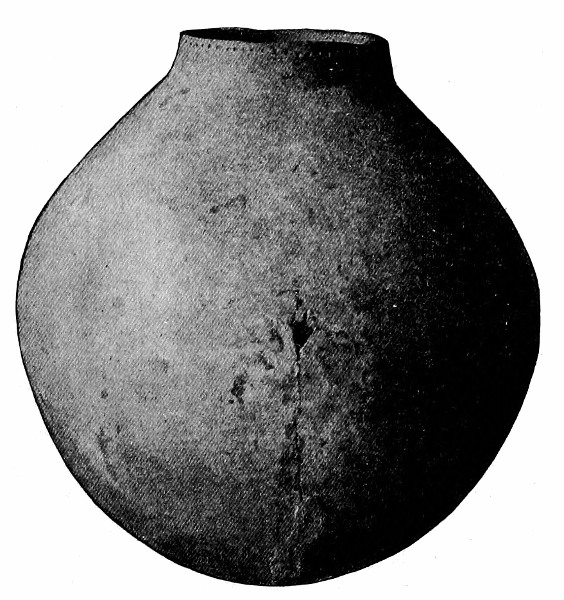
Fig. 39—Mortuary olla.
The most conspicuous
cairn seen in Seriland
was well within Tiburon.
It stands on the
southern side of a little
rock-butte about a mile
and a half east-southeast
of Tinaja Anita,
south of the main arroyo,
and near where
the trail from the tinaja
bifurcates toward Arroyo
Carrizal and Punta
Narragansett, respectively.
It is shadowed
by a notably large and widespreading paloverde, and is in the form of
a cone estimated at 7 feet in height and 18 or 20 feet across the base.
The materials, at least on the surface, are rounded pebbles and cobbles,
possibly from the adjacent arroyos, though more probably from the
beaches, of which the nearest is miles away. It was not determined to
be mortuary.329
On the death of the matron, a grave is scooped out by means of shells
a few yards from her jacal, preference being given to relatively elevated
or commanding points. The excavation is about 30 inches (90 cm.) in
depth; within it is placed first the pelican-skin robe of the deceased,
so arranged as to fold over the body; then the corpse, dressed in the
ordinary costume of life, is compressed into small compass by closely
flexing the knees and bringing them against the thorax, extending the
arms around and along the lower limbs so that hands and feet are
together, and bending the head forward on the chest; when it is deposited
in the receptacle in such manner as to lie on the left side, facing northward.
Near the face is laid a dish of baked clay or a large shell filled
with food, and beside it a small olla of water (an actual example is
shown in figure 39), while the hupf, awls, hairbrush, olla-ring, and
other domestic paraphernalia are placed near the hands. Next the
personal fetishes and votive symbols (in the form of puppets or dolls
such as those shown in figure 40 a and b) of the dead mother are slipped
beneath the face, and her paint-cup, with a plentiful supply of paint, is
added; the poor personal possessions, in the form of shell-beads and
miscellaneous trinketry, are then heaped over the face and shoulders,
and these are covered with the superfluous garments and miscellaneous
property of the deceased. Finally the pelican-pelt bedding is folded
over the body, and two turtle-shells are laid over all as a kind of coffin,
when the grave is carefully filled, and the ground so smoothed as to leave
no mark of the burial. During subsequent hours the stones for the
cairn or the cholla-joints and other brambles for the brush-heap are
piled over the spot,
while the scatophagic
shells are
added at intervals
apparently for
weeks or months
and perhaps for
years after the
burial.
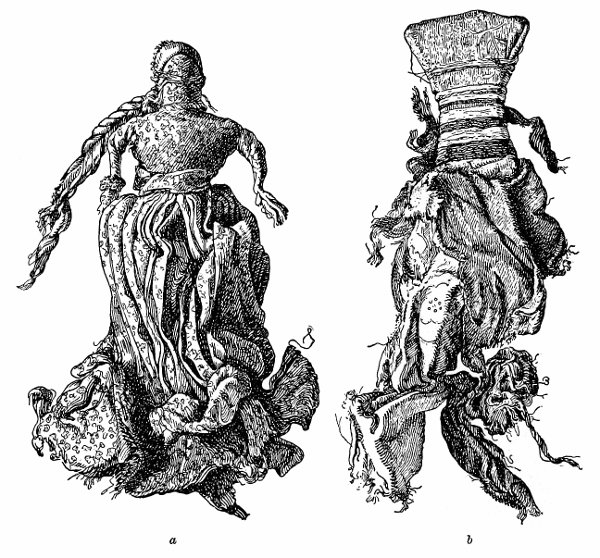
Fig. 40—Woman’s fetishes.
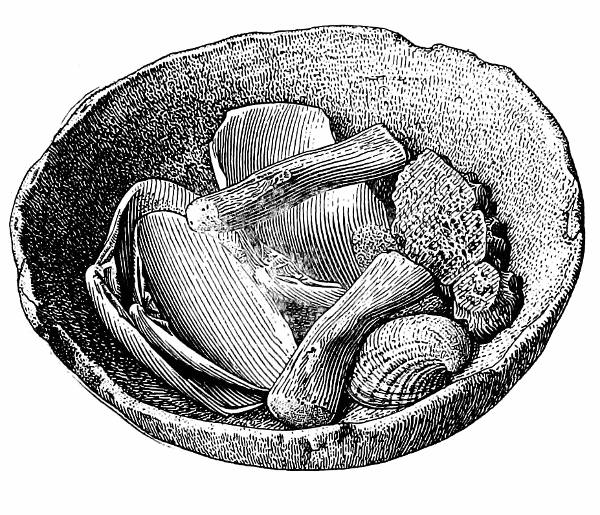
Fig. 41—Food for the long journey.
The mortuary
food is carefully selected
for appropriate
qualities (i. e.,
for “strength” in
the notion of the
mourners). It comprises
portions of
turtle-flippers, and, if practicable, a chunk of charred plastron—the food
substance especially associated with long and hard journeys—with a few
fresh mollusks, and, judging from a single good example as well as from
analogy, one or two scatophagic shells. The remains of a funerary
feast are illustrated in figures 41 and 42, the latter being the scatophagic
receptacle utilized apparently
in the absence of the customary
Noah’s ark. It may be
significant that this shell is
perforated at the apex, evidently
by long wave-wear
before utilization, and that
the accompanying olla bears
marks of having been broken,
then repaired, and afterward
perforated, as illustrated in
the photo-mechanical reproduction
(figure 39); for these
features perhaps express that idea of “killing” mortuary sacrifices,
ostensibly to fit them to the condition of the deceased, though really
(in subconscious practicality) to protect the sepulcher from predation.330
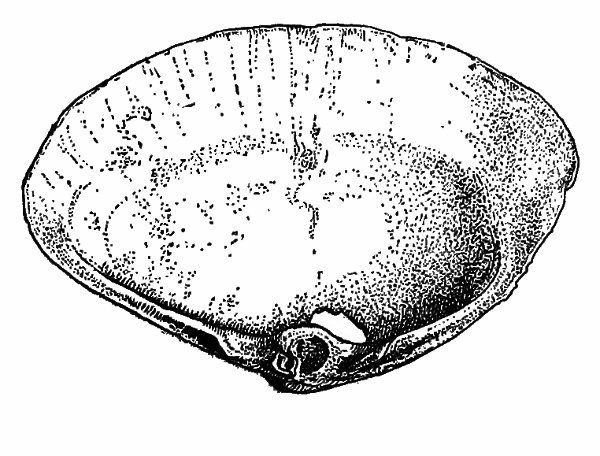
Fig. 42—Mortuary Cup.
Soon after the death (immediately after the burial, so nearly as could
be ascertained) there is an apparently ceremonial mourning, in which
the matrons of the clan, and, at least to some extent, the warriors also,
participate. The mourners wail loudly, throw earth and ashes or ordure
on their heads, and beat and bruise (but apparently avoid scarifying)
their breasts, faces, and arms. This is continued, culminating daily
about the hour of interment, for several days—unless the rancheria is
sooner abandoned, in which case the period of formal mourning is
shortened.
In addition to the formal mourning of matrons there is a custom of
nocturnal wailing after the death of warriors in battle, and, apparently,
also, following the death of matrons or nubile maidens, which attracts
the notice of frontier rancheros and vaqueros. According to their
accounts the first note of lamentation may be sounded at any hour of
the night by any of the group to which the deceased belonged; it is successively
taken up by other members of the party until all voices are
united in a resounding chorus of inarticulate moans, wails, shriller
cries, and wild howls, likened by the auditors to the blood-bellowing of
cattle; if other groups of the tribesmen are within hearing, they, too,
take up the cry, so that the lamentation may extend to the entire tribe
and echo throughout practically all Seriland at the same moment.
The fierce howling and attendant excitement may rise so high in the
group in which the wailing begins that all seem bereft of customary
caution; and sometimes they suddenly seize ollas and weapons, and
decamp incontinently, perhaps scattering widely and racing for miles
before settling again for sleep or watchful guard.
The ideas of the folk concerning death and concerning the relations
between the living and the dead are largely esoteric, and are, moreover,
veiled by the nonequivalence of Seri expressions with the terms of
alien languages.
At least an inchoate belief in a life beyond the grave was intimated
by Mashém and his companions at Costa Rica, and their circumspection
of speech and mien indicated a strong veneration for, or dread of,
the manes; though the specific expressions were connected with deceased
matrons, who alone seemed to be prominent in the minds of the clan-mates.
So far as could be gathered the belief seems to be that the
dead find their way back to the primordial underworld, whence Earth
and Beings were brought up by Pelican and Turtle (or Shark) respectively,
and are liable to return by night with mischievous intent.
The direct expressions of the Seri informants are fully corroborated
by the association of things in interior Seriland. The burial of water
and food, of the personal fetishes and votive objects, and of the highly
prized face-paint belonging to the dead matron, attests anticipation of
a post-mortuary journey; while the temporary abandonment of jacales
and rancherias and the nocturnal fears and flights alike betoken
dread of sepulchral visitants. The most suggestive of the associations,
i. e., between the scatophagic stores and the sepulchers, awaits
full explanation.
In the conventional seriation of social development four stages are
clearly recognizable, viz.: (1) Savagery, in which the social organization
is based on blood kinship reckoned in the female line; (2) barbarism, in
which the basis of organization is actual or assumed consanguinity
reckoned in the male line; (3) civilization, in which the laws are based
on property-right, primarily territorial; and (4) enlightenment, in which
the organization is constitutional and rests on the recognition of equal
human rights to life, liberty, and the pursuit of happiness. Now, in
terms of this seriation of general culture-stages, the place of the Seri
tribe is clear. Reckoning consanguinity wholly in the maternal line,
as they do, they belong in the initial stage of savagery. Accordingly
they pertain to the lower or more primitive of the two great stages
represented by the American aborigines.
A still more refined seriation may be effected through conspection of
the several lines of activital development—the esthetic and industrial,
and especially the sophic or fiducial, as well as the strictly social; for
these lines are most intimately intertwined. Thus, in the Old World, the
transition from maternal to patriarchal organization was accompanied,
and evidently superinduced, by the development of zooculture into
extensive herding; in different districts of the New World, a parallel
transition attended the development of agriculture to a phase involving
the protection of acequias and fields by armed men; while throughout
primitive life, laws are formulated and enforced chiefly through
appeals to the superphysical or mythologic. Now, review of the Seri
esthetic indicates that the decorative concepts and activities are in
large measure inchoate and are practically confined to a single manifestation,
i. e., the delineation of totemic symbols primarily denoting zoic
tutelaries and incidentally connoting the blood-carriers of clans consecrated
to these beast-gods; so that the esthetic motives and devices of
the tribe are essentially zoosematic. In like manner a considerable
part of the technic of the tribe is zoomimic, as already shown, while
even the most highly developed industrial activities occupy the biotic
borderland of mechanical chance rather than the characteristic demotic
realm of intellectual design. So, too, the faith of the folk is exclusively
and overweeningly zootheistic, to the extent that every motion, every
thought, every organized action, every law, every ceremony, is shaped
with reference to mystical potencies vaguely conceived as a pantheon
of maleficent beast-gods; and it is this dark and hopeless faith that
gives character to the tribal esthetic and technic. Concordantly the
faith finds reflection in the very elements of the social organization;
the matron is the blood-carrier and the lawgiver not in and for herself
but as the vicarious and visible exponent of an ever-immanent beast-god—the
clan tutelary; her appeals to her brothers for administrative
aid are precisely parallel to her intuitive passage from zoomimicry into
the field of mechanical chance defined by protolithic implements; and
the appeal, like the execution of the law either by herself or by her
brothers, is controlled and regulated in absolute deference to the zoic
pantheon. Thus, the inchoate tribal laws, expressed in habitual lines
of action and modes of thought, are by no means conscious products of
human wisdom, but are confidently imputed to a superhuman wisdom
on the part of myth-magnified beasts of a mystical olden time; and,
similarly, the power of executing these laws is by no means cognized
as conscious human faculty, but is faithfully imputed to supernal
potencies of mythical monsters. Essentially, therefore, the tribal law
is putatively zoocratic; and the social organization may justly be
classed as a putative zoocracy.
To prevent possible confusion, it may be desirable to note specifically
that the Seri government is not matriarchal in any proper
sense. As pointed out elsewhere, matriarchy is not (at least among
the American aborigines) an antecedent of patriarchy, but a correlative
of that form of government; and it would be especially erroneous and
misleading to designate as matriarchal a tribe like the Seri, whose
chiefs and subchiefs (i. e., appellate clan-administratives) are invariably
masculine. Neither would it be just, despite the dominance of matrons
in legislative and judicative matters, to regard the tribal government
as a gyneocracy, such as have been noted in various parts of North
America—e. g., in Sonora, according to a current tradition as to the
origin of the name of the province, and among the Pomo Indians of
California, according to Cronise as interpreted by Powers;331 for the
actual control is exercised by the warrior brothers, while the ideal control
is vested in that zoic pantheon of which the matrons are putative
mouthpieces. Physically and practically the Seri government is an
adelphiarchy, as already indicated; but in the minds of the tribesmen
themselves it is an inchoate theocracy putatively headed by a pantheon
of animate monsters, whose prelates are personified in the painted clanmothers.
Summarily, then, the Seri are zoosematic in esthetic, zoomimic in
technic, zootheistic in faith, and putatively zoocratic in government,
while even the Seri tongue is so largely mimetic or onomatopoetic in
form as to accord with the industries and institutions; and in view of
the intimate interrelations between the several lines of activity, it
would seem preferable to determine the culture-status from the coincident
testimony of all the lines, but feasible to measure it in terms of
any one or more of these activital lines.
Now, on comparing the characteristics of the Seri with those of other
known tribes of North America, many resemblances and a few differences
are found; and practically all of the more conspicuous differences
extend in the same direction—i. e., they combine to indicate an exceptionally
primitive, or lowly, or zoic, plane for the simple savages of Seriland.
Thus, few tribes are so poor in esthetic as the Seri, and in none
other are the esthetic devices so clearly and so exclusively zoic; few if
any other known tribes so clearly exemplify zoomimic culture; none
other so well represents protolithic culture, and no other known tribe
is so completely devoid of mechanical devices reflecting higher culture;
in general socialry no other known tribe better, or indeed so well, exemplifies
zoocracy, while in such special features as those of ethnogamic
mating, ceremonial scatophagy, and mortuary magnification of the
blood-carriers, the folk mark the most primitive known phase of cultural
advancement; and although language and faith yield less definite
measure, their testimony is coincident with that of the other lines of
activity. Accordingly the Seri must be assigned to the initial place in
the scale of cultural development represented by the American aborigines,
and hence to the lowest recognized phase of savagery.
Two or three corollaries of this placement are noteworthy: (1) In
most of the researches concerning human development conducted by the
anthropologists of the world, attention has been given chiefly or wholly
to the somatic or biotic characters of Homo sapiens; but while various
physical features of the Seri suggest bestial affinities (as has been pointed
out in an earlier chapter), it is especially significant that the nearest and
clearest indications of bestial relationship are found in the psychical
features of the lowly folk—for zoic faith in its multifarious manifestations
is but a reflection of burgeoning yet still bestial mind.
(2) While human independence of environment culminates in socialry,
the interdependence of activital lines so well revealed in lowest savagery
demonstrates that institutions and all government necessarily reflect
environment; and, at the same time, that the progressive emancipation
from environment signalized in the higher culture-grades measures the
conquest of Nature through industrial activity—for both the productive
work and the attendant exercise cumulatively elevate sapient Man
above mindless Nature.
(3) An adjunct of progress in every stage of development, as indicated
with especial clearness in the earliest stages, is the annulment or
curtailment of both physical and formal law, and the substitution of
cumulatively growing volition: the development of the esthetic passes
from the intuitive toward the ratiocinative, that of the industrial from
the instinctive toward the inventive, and that of the social from the
merely reflective to the vigorously constructive; with every pulse of
progress the subservience to blind chance and imaginative figment
diminishes; and with each increment of sound confidence the ability
to surmount physical obstruction and to dispense with primitive formality
is cumulatively augmented.
The bases for definite knowledge of the Seri tongue are the five
vocabularies described on other pages (13, 95, 97, 102, and 107).
The earliest of these vocabularies, comprising eleven terms, was collected
in Hermosillo in 1850 by Señor Lavandera, presumably from the
tribal outlaw Kolusio, and transmitted to Señor Ramirez for discussion.
This pioneer vocabulary is superseded by those of later date.
The second Seri word-collection was made by Commissioner Bartlett
at Hermosillo in 1852; it was obtained from Kolusio, and comprises
some two hundred words.
The third vocabulary was obtained at Hermosillo during or about
1860, doubtless from Kolusio, by Señor Tenochio; it comprises about
one hundred terms; it was discussed and published by Señor Pimentel,
and served as a basis for the first scientific classification of the tribe
and their collinguals.
The fourth Seri vocabulary was that obtained by M Pinart at Hermosillo
in 1879, almost certainly from Kolusio; it comprises over six
hundred words, with a few short phrases.
The latest word-collection is the Bureau (or McGee) vocabulary,
obtained on the Seri frontier in 1894 through Mashém, subchief of the
tribe; it comprises some three hundred vocables with a few short
phrases, accompanied by explanatory notes.
The several collections are entirely independent: Lavandera’s record
was made in Spanish, at the request of Ramirez; Bartlett was not
aware of the earlier record, and wrote in English; Tenochio knew
nothing of Bartlett’s work, was probably not aware of Lavandera’s,
and wrote in Spanish; Pinart, though French in blood and mother-tongue,
was fully conversant with Spanish, in which his record was
made, and apparently knew nothing of the earlier vocabularies; while
the Bureau recorder had not seen any of the earlier records and had
shadowy knowledge of the existence of two of them only at the time of
making his own.
Naturally the several vocabularies overlap to a considerable extent,
and thus afford means of verification. Those of Bartlett, Tenochio,
and Pinart, all obtained from the same informant, are notably consistent,
despite the diversity in language on the part of the recorders; and
their correspondence with the Bureau vocabulary is hardly less close
(except for the comparative absence of terms for alien concepts in the
latter record) than their agreement among each other. Accordingly,
the linguistic collections, although far less full than would be desirable,
are fairly satisfactory so far as vocables are concerned; but unhappily
the few short phrases in the Pinart and Bureau collections are
quite too meager to elucidate the grammatic structure of the language.
The aggregate number of vocables in the several records is some
seven hundred. Of these over 97 per cent are apparently distinctive,
presenting no resemblance whatever to any other known tongue. The
remaining eighteen or twenty terms reveal resemblances to Aryan,
Piman, Cochimi, or other alien languages; but of these the majority
express Caucasian concepts, familiar enough to the outlaw informant,
Kolusio, though generally unfamiliar to Mashém and to other actual
inhabitants of Seriland.
A critical census brings out six vocables presenting phonetic correspondences
with those of one or more Yuman dialects, viz., the terms for
tongue, tooth, eye, head, blood, and wood or tree. Now, examination
of these terms indicates that the first two probably, and the third and
fourth possibly, are associative demonstratives rather of mechanical
than of vocalic character—e. g., the terms for tooth and tongue are
merely directive sounds accompanying the exhibition of the organs,
so that while the terms may not be onomatopoetic in ordinary sense,
they are instinctively mimetic or directive, in such wise as to indicate
that they may well have arisen spontaneously and independently among
different primitive peoples; also that they might easily pass from tribe
to tribe as an adjunct of gesture-speech. The term for blood is still
more decidedly mimetic of the sound of the vital fluid gashing from a
severed artery, or of normal pulsation, so that it, too, must be classed
as a term of spontaneous development. The Seri term for wood or tree
has an apparent analogue, with somewhat different meaning, in the
Cochimi alone; but since the knifeless Seri made practically no use of
wood in their aboriginal condition, and since the early Jesuit records
show that they sometimes transnavigated the gulf and came in contact
with the wood-using Cochimi, it seems fair to assume that material and
word were borrowed together. A similar suggestion arises in connection
with the term for dog; although the Seri have lived from time
immemorial in that initial stage of cotoleration with the coyote in
which the adult animals are permitted to scavenger the rancherias,
they were without domestic dogs until these animals were introduced
into northwestern Mexico by the Spaniards, when they apparently
absorbed the animal and its name at once from their eastern neighbors
of the Piman stock—presumably the Opata, or possibly the Papago,
with both of whom the Seri converts and spies were in frequent contact
during the Jesuits’ régime at Opodepe, Populo, and Pitic.
In weighing the linguistic relations, it is to be remembered that the
Seri are distinctive in practically every somatic and demotic character,
that they are bitterly antipathetic to aliens, and that their race-sense
is perhaps the strongest known. It is also to be remembered that they
are zoosematic in esthetic, largely zoomimic in their primitive industries,
putatively zoocratic in government, and overweeningly zootheistic
in belief; that nearly all observers and recorders of their characteristics
have been impressed by both the distinctiveness and the
primitiveness of their speech; that this speech abounds in associative
demonstratives and instinctive onomatopes to exceptional degree; that
they class themselves as much more nearly akin to their bestial associates
than to any alien tribe or people; and hence that their speech is
necessarily zooglossic in considerable, if not unequaled, measure. It
is to be remembered, too, that the law of activital coincidences finds
fullest exemplification in lowest culture, as has been already shown, and
as the zooglossic character of the Seri speech would imply; so that a considerable
proportion of fortuitous resemblances might be anticipated.
Finally, it is to be remembered that despite the extreme provinciality
connected with their unparalleled race-sense, the folk have been in
known contact with Caucasian and Amerind aliens for nearly four centuries,
and have been steadily, albeit with exceeding slowness, absorbing
alien activities and activital products.
In the light of the history and condition of the Seri, a summary of
their vocabulary is of much interest. It is as follows:
| Known vocables |
700± |
| Distinctive terms |
682± |
|
| Terms shared with other tongues |
18± |
|
| Terms connoting Caucasian concepts |
11± |
|
|
| Onomatopes and associative demonstratives |
5± |
|
|
| Term shared With the Cochimi |
1 |
|
|
| Term borrowed from the Piman |
1 |
|
|
| Total |
18± |
|
|
| Total |
700± |
|
On weighing this tabulation, in which no allowance is made for
coincidences, it becomes evident that the Seri tongue is essentially
discrete. The tabulation, accordingly, justifies and establishes the
classifications of Pimentel and Orozco y Berra, under which the Seri,
with their collinguals, are erected into a distinct linguistic stock.
Pending further research and the completion of the linguistic collections,
it is deemed inexpedient to publish the Seri vocabulary in full,
though the material has been compared, analyzed, and arranged
systematically as was practicable by Mr J. N. B. Hewitt; and his comparative
tables and discussions, which comprise all the terms suggesting
affinity with Yuman and other aboriginal languages, are appended.
His morphologic analyses and comparisons are especially noteworthy
in that they demonstrate that the Seri language is essentially different
in structural relations—or in its genius—from the Yuman tongues of
neighboring territory.
COMPARATIVE LEXICOLOGY
[By J. N. B. Hewitt]
| Serian Material |
| A. |
Seri vocabulary, McGee, W J, entered in Powell’s Introduction to the Study of Indian Languages, second edition, in November, 1894. |
| B. |
Seri vocabulary, Bartlett, J. R., printed blank (180 terms), January 1, 1852. |
| C. |
Seri vocabulary, Pinart, A. L., MS. (16½ pp.), April, 1879. |
| D. |
Seri vocabulary, Tenochio, D. A., copied by Pimentel, Lenguas Indígenas de México, t. II, Mexico, 1875. |
| Yuman Material |
| I. |
Cochimi vocabulary, Gabb, W. M., printed blank (211 terms), April, 1867. |
| II. |
Cochimi vocabulary, Bartlett, J. R., printed blank (200 terms), English and Spanish, subsequent to June, 1852. |
| III. |
Cochimi terms in Clavijero, F. J., Historia de la Antigua ó Baja California, 1852. |
| IV. |
Cochimi vocabulary and texts in Buschmann, J. C. E., Die Spuren der Aztekischen Sprache, Berlin, 1859. |
| 1. |
Avesupai vocabulary, Stevenson, Mrs T. E., MS., Oct., 1885. |
| 2. |
Tonto vocabulary, White, J. B., and Loew, Oscar, MS., 1873-1875. |
| 3. |
Cocopa vocabulary, Heintzelman, S. P., and Peabody, E. T., printed blank (180 terms). |
| 4. |
Maricopa vocabulary, Bartlett, J. R., printed blank (180 terms). |
| 5. |
Maricopa vocabulary, Ten Kate, Dr Herman, MS., May, 1888. |
| 6. |
Mohave vocabulary, Loew, Oscar, printed in Report on United States Geological Surveys west of the One-Hundredth Meridian, Lieut. G. M. Wheeler in charge, vol. VII. |
| 7. |
Mohave vocabulary, Mowry, Sylvester, and Gibbs, Geo., printed blank (180 terms), 1863. |
| 8. |
Hummockhave vocabulary, Heintzelman, S. P., printed blank (180 terms). |
| 9. |
Mohave vocabulary, Corbusier, W. H., entered in Powell’s Introduction, second edition, in 1885. |
| 10. |
Hualapai vocabulary, Loew, Oscar, in Report on United States Geological Surveys west of the One-Hundredth Meridian, Lieut. G. M. Wheeler in charge, vol. VII. |
| 11. |
Hualapai vocabulary, Renshawe, J. H., and Gilbert, G. K., entered in Powell’s Introduction, first edition, 2 copies, in 1878. |
| 12. |
Kutchan vocabulary, Whipple, in Schoolcraft, Historical and Statistical Information Respecting the History, Condition, and Prospects of the Indians of the United States, pt. II, 118-121. |
| 13. |
Kutchan vocabulary, Gabb, W. M., printed blank (211 terms), 1867. |
| 14. |
Diegueño vocabulary, Loew, Oscar, in Report on United States Geological Surveys west of the One-Hundredth Meridian, Lieut. G. M. Wheeler in charge, vol. VII. |
| 15. |
Diegueño vocabulary, Bartlett, J. R., printed blank (180 terms). |
| 16. |
Diegueño vocabulary, Mowry, Sylvester, printed blank (180 terms), 1856. |
| 17. |
H’taäm vocabulary, Gabb, W. M., printed blank (211 terms), 1867.
|
| 18. |
Yavapai vocabulary, Corbusier, W. H., entered in Powell’s Introduction, first edition, in 1873-1875. |
| 19. |
Yavapai vocabulary, Gatschet, A. S., MS., 1883. |
| 20. |
M’mat vocabulary, Helmsing, J. S., printed blank (211 terms), 1876. |
| 21. |
Santa Catalina vocabulary, Henshaw, H. W., entered in Powell’s Introduction, second edition, in 1884. |
| 22. |
Tulkepaya vocabulary, Ten Kate, Herman, in Gatschet, Der Yuma-Sprachstamm, Zeitschrift für Ethnologie, Band XVIII, 1886. |
| 23. |
Kiliwee vocabulary, Gabb, W. M., printed blank (211 terms), 1867. |
| 24. |
Diegueño vocabulary, Bartlett, J. R. (Los Angeles), printed blank (180 terms). |
| 24a. |
Diegueño vocabulary, Henshaw, H. W., entered in Powell’s Introduction, second edition, in 1884. |
| 25. |
Santa Isabella vocabulary, |
|
Henshaw, H. W., entered in Powell’s Introduction, second edition, in 1893. |
| 26. |
Hawi Rancheria vocabulary, |
| 27. |
Mesa Grande vocabulary, |
The members of a group of languages called Yuman are spoken in a region comprising
a part of the peninsula of Lower California, the southern extreme of California,
and the western portion of Arizona. In this group of languages ethnologists
have hitherto included that spoken by the Seri Indians and their congeners. But
the inclusion of this language rests apparently upon evidence drawn from data
insufficient in extent and largely imperfect and doubtful in character. In the following
pages this evidence is examined, and the conclusion is reached that it does
not warrant the inclusion of the Seri tongue in the Yuman group. The same is true
with regard to the Waïkuri (Guaicuri) language, which has been erroneously, it
would seem, included in the Yuman stock; for, judging from present available data,
it should remain independent until further research shall decide whether it constitutes
a stock in itself or belongs to some other stock.
Moreover, it appears that the principle has been disregarded which requires that,
in making lexic comparisons to determine the fact and degree of relationship between
one language and another, those vocables having admittedly a common linguistic
tradition be carefully and systematically studied before they are juxtaposed to those
other terms whose kinship with them is still matter for ascertainment. So comparative
lists have been prepared in accordance with this principle.
Now, one of the most important things revealed by the study of language is that
the course of anthropic linguistic development has been from the use of polysematic
demonstratives, or what are called pronominative elements by Professor McGee,
toward the evolution and differentiation of parts of speech. These vocables, which
occur in all languages, are of prime importance in linguistic research because they
are chiefly vestigial in character. Presumptively embodying the indefinite thought-clusters
of the anthropoid stage in glottic evolution, they project into the speech of
the present (the anthropic stage) an outline or epitome of that earlier pronominative
plane of thought and speech development. These pronominative elements represent
a complex of ideas, comprising person, place, direction, number, time, mode,
gender, sex, and case (or relation). In the Iroquoian tongue the pronominative
prefix ra-, “he”, signifies “one person of the anthropic gender, male sex, singular
number, nominative case, there, now”. Professor McGee in The “Beginnings of
Mathematics,” speaking of the paramount egoistic basis of the thought of primitive
men, well says: “They act and think in terms of a dominant personality, always
reducible to the Ego, and an Ego drawn so large as to stand for person, place,
time, mode of action, and perhaps for raison d’être—it is Self, Here, Now, Thus,
and Because.”
Now, there are in nature actions, bodies, properties, and qualities requiring definite
expression to give clearness and concision to speech, and this need gradually led to
the development and use of conceptual expressions resulting in gradual restriction
of the multiplication of, and diminution in the number of, pronominative elements.
Speech became specific rather than monophrastic and indefinite, and sought to
express individual concepts by terms of definite meaning rather than by phrases
involving a plurality of concepts and indefiniteness. The monophrasm or pronominative
element expressive of several individual ideas is resolved not by a division
of the body of the element, but rather by the addition of elements denotive (though
primarily connotive) of action, which had been previously wholly or in part symbolized
by the pronominative element, or in part inferred from the situation.
Thus it may be seen that these pronominative elements, miscalled pronouns, are
not substitutes for nouns, but that the converse statement is the truer one. These
elements have been classed together as forming a part of speech in the same category
with the noun and the verb; but it has been seen that the pronominative
is not at all a part of speech, involving semantically within itself the distinct concepts
of several so-called parts of speech. To make this plain, take from the highly
differentiated English tongue the following sentences: “I will give you to her.
What can it be? The elk is one of the most timid animals that walk.” In the first,
I, you, and her respectively show the relation of the three persons indicated, not
only to the act of giving but also to the act of speaking, a function that does not
belong to nouns; without change of form they express what is called person, number,
case, and sex. And it would be extremely difficult, if not absolutely impossible,
to supply the nouns for which what in the second and that in the third are substitutes;
for in the last, not even a noun and a conjunction will answer. Such in part
are the concepts for which the pronominative elements stand and which give them
such great vitality.
Along with these pronominative elements go the numerals, which were primarily
the products of a process of cancellation of common factors from original expressions
connoting the required number; and so when once the abbreviated expressions became
usual there was no disposition to displace them, and increasing use making them more
definite, rendered them more and more permanent. This in brief is the chief cause of
the obstinate persistency of numerals in all known languages. An examination of
the accompanying lists of number-names will greatly aid in understanding what is
meant. The late Professor Whitney, when discussing these elements in the Aryan
or Indo-European family, uses the following instructive language:
“When, however, we seek for words which are clearly and palpably identical in
all or nearly all the branches of the family, we have to resort to certain special
classes, as the numerals and the pronouns. The reason of this it is not difficult to
point out. For a large portion of the objects, acts, and states, of the names for
which our languages are composed, it is comparatively easy to find new designations.
They offer numerous salient points for the names-giving faculty to seize
upon; the characteristic qualities, the analogies with other things, which suggest
and call forth synonymous or nearly synonymous titles, are many. * * * But
for the numerals and the pronouns our languages have never shown any disposition
to create a synonymy. It was, as we may truly say, no easy task for the linguistic
faculty to arrive at a suitable sign for the ideas they convey; and when the sign
was once found, it maintained itself thenceforth in use everywhere, without danger
of replacement by any other of later coinage. Hence, all the Indo-European
nations, however widely they may be separated and however discordant in manners
and civilization, count with the same words and use the same personal pronouns in
individual address—the same, with the exception, of course, of the changes which
phonetic corruption has wrought upon their forms.”332
And it is on account of the great vitality and persistency of these two groups of
vocables that the pronominative elements and the numerals have been given first
place in the comparison between the Seri and the Yuman tongues to determine
relationship or want of relationship between the two languages.
In the pronominal lists the eight pronominatives I, we, thou, ye, he, they, that,
and this are compared. The comparison reveals no satisfactory evidence of relationship
between the two tongues represented therein. In the list headed “Thou”,
there is, it is true, a vague resemblance between some of the examples cited; but
this is the extent of the agreement among the pronominative elements.
Along with these pronominal lists comparative tables of fifty conceptual terms
have also been made. The vocables have been subjected to a discriminating analysis
which fails to show any trustworthy evidence of genetic relationship between
the Seri and the Yuman languages. These tables will be found at the end of the
numeral lists.
| SERIAN |
|
I |
We |
Thou |
Ye |
| B. |
ive |
óve |
me |
move |
| C. |
eve, ivve |
ove |
me |
movve |
| D. |
ibe, i, in |
|
|
|
| YUMAN |
| I. |
ya |
e-é |
ba |
me-é |
| II. |
bu |
kélballa |
mu |
mugutí |
| 2. |
nyaa |
mági |
maa |
yamakámvi |
| 4. |
n’yep |
b’dowwaánge |
man |
n’yátches |
| 5. |
enyip |
mateshehámk |
mainye |
hanyís |
| 7. |
inyeeippa |
|
mahinye |
|
| 8. |
ainyapi |
ainyepi |
howanye |
inak |
| 9. |
inyétc |
inyétcabĭtc |
mantc |
mantcawitc |
| 6. |
iniepa |
huatcva |
manya |
|
| 10. |
anyáa |
|
maa |
|
| 12. |
n’yat |
|
mantz |
|
| 13. |
nyet |
nyetchelechaml |
manya |
koonyemitch |
| 14. |
inyau |
ikhin |
nyau |
vuyau-khumau |
| 24. |
n’ya |
n’yawaâp |
ma |
n’yawaâp |
| 16. |
enyahpah |
n’yeahpah |
mahpah |
|
| 17. |
nyat |
nawot |
mat |
manyawapa |
| 19. |
nyät, nía |
|
mät |
mad |
| 20. |
n’ñép |
|
mañ |
mandchequedíc |
| 22. |
nyá |
nyaä´ |
|
mätche |
| 23. |
nyapa |
panyapa |
m’apa |
pamaba |
| 15. |
n’yàpa |
n’yawa |
m’apa |
m’awa |
| SERIAN |
|
He |
They |
That |
This |
| B. |
imk’ |
move (for imkove) |
imke |
ipké |
| C. |
imki |
imkove |
imki |
|
| D. |
itam |
|
itam |
|
|
| YUMAN |
| I. |
|
|
kwumba |
k’hu |
| II. |
ugutá |
ugultí |
ugutá |
yamú |
| 2. |
ma |
bémi, maniûsi |
owá |
bémi, n’wagi |
| 4. |
v’dán |
awatches |
abányim |
b’dan |
| 5. |
sewaínye |
hanyís |
wedaín |
sewaín |
| 6. |
huványa |
|
hoványe |
vitanya |
| 7. |
mánya |
paichsama |
kuucha, “What do you say?” |
n’yaveoh |
| 8. |
howanméeme |
nayew |
howai |
howanmiimi |
| 9. |
huvatce |
iuyéteawĭntc |
nyanya |
viçanya |
| 10. |
nyuée |
|
|
viyáa |
| 12. |
habuitzk |
|
|
|
| 13. |
abilkoowan |
sakewauk |
nyasl |
badam |
| 14. |
itcham |
kitchámuyú |
pú |
piyáa |
| 15. |
pu |
pu-wîiptch |
pu-witch |
p’yà |
| 16. |
|
|
memuchu |
nepte |
| 17. |
nyip |
nyeep |
kooacha |
mop |
| 19. |
net |
íet, iät |
|
iät, íet |
| 20. |
abáñ |
s’tubáñ |
s’tubáñ |
cezáñ, vedáñ |
| 22. |
yetháha |
nihátchewa |
|
|
| 23. |
ẖápa |
pachawit |
nyepat |
miẖi |
| 24. |
maîs |
mawápa |
púaisis |
piyaís |
The following comparative table of Serial numerals represents all the accessible
number-names in existing records of Serian linguistic material. M Pinart records
two lists of number-names from “one” to “ten”, and says of the first list, “Quando
se cuenta seguido”, for counting consecutively.
It will be of interest to note the fact that the forms of the digit “eight”, in the
vocabularies of Professor McGee and Mr Bartlett, with the latter’s “eighteen”, differ
wholly from the elements representing “eight” in their terms for “eighty”. The
term employed by them is recorded by M Pinart in his second list and also by Sr
Pimentel. Another peculiarity to be noted in the vocabulary of Mr Bartlett is the
fact that for the numbers “thirteen” and “eighteen” he writes the same form.
The latter is evidently miswritten, as the two are composed of identical elements.
The explanation of this seems to be that in the former there is a subaudition of the
element “ten”, and in the latter of the element “fifteen”.
It is equally instructive to mark the fact that the terms denoting “two, three,
four, five” retain or preserve their fuller forms in their multiples, as in “twenty,
thirty, forty, and fifty”.
The lists follow:
|
McGee |
Pinart |
Bartlett |
Pimentel (citing
Tenochio) |
| 1. |
tó‘χun |
tokχom tashsho |
tohom |
taso, |
tujon |
| 2. |
ghá‘kom |
kaχ´kum |
kookχ´ |
kahom |
kokjl, kujom |
| 3. |
pháum |
p’χ´ao |
kapχ´a |
phraom |
kupjtku |
| 4. |
sâ´hkūm |
shoχ´kum |
kshuχ´kŭă |
scochhom |
{kosojkl
{kosojhl |
| 5. |
kwáetūm |
kuaotom |
kooχtom |
huavat’hom |
kouton |
| 6. |
náhpsūk |
napshoχ´ |
imapkasho |
napk’schoch |
snapkashroj |
| 7. |
káhkwūū |
kaχkχue |
tomkaχkue |
kachqhue |
tomkujkcui |
| 8. |
páhkwūū |
p’χakχue |
kshoχolka |
phraque |
osrojoskum |
| 9. |
ksókhŭnt |
soχanthe |
ksovikanlχ´ |
sohántl |
ksobbejoaul |
| 10. |
khóhnŭtl |
χonalχ´ |
kanlχ´ |
honachtl |
taul |
| 11. |
|
|
|
tantasóque |
|
| 12. |
|
|
|
tanchltoque |
|
| 13. |
|
|
|
tanchtaphraqhue |
|
| 14. |
|
|
|
[tanchltascochhom]333 |
|
| 15. |
|
|
|
tanchlhuavat’hom |
|
| 16. |
|
|
|
tanchlischnapk’schoch |
|
| 17. |
|
|
|
tanchltumkachqhue |
|
| 18. |
|
|
|
tanchlphraqhue |
|
| 19. |
|
|
|
tanchlsóvihantlqhue |
|
| 20. |
ŭntçkō´k |
|
kanlχ´kookχ´ |
eanslkoch |
taul jaukl |
| 30. |
ŭntçkō´pka |
|
|
eans’lkapka |
|
| 40. |
ŭntçksō´k |
|
|
eans’lscoch |
|
| 50. |
ŭntçkóitum |
|
|
eanslkovat’hom |
|
| 60. |
ŭntçěsnŭpkŭ´schōp |
|
|
eansly’schnapk’schoch |
|
| 70. |
ŭntçtŭngŭ`kwŭ´k |
|
|
eansltumkachqhue |
|
| 80. |
ŭ´ntçkuschohotkŭm |
|
|
eanslhschoholchkom |
|
| 90. |
ŭntçksegŭnt |
|
|
eanslsovikakt’l |
|
| 100. |
ŭntçgŭntl |
|
|
hiantlkantl |
taul taul |
| 200. |
ŭnz-ŭ´ntç-kō´k |
|
|
|
|
| 300. |
ŭnz-ŭntç-kŏ´pka |
|
|
|
|
| 400. |
ŭnz-ŭntç-kŭkschō´k |
|
|
|
|
| 500. |
ŭnz-ŭntç-kóitum |
|
|
|
|
| 600. |
ŭnz-ŭntç-ŭsnŭpkŭ´schos |
|
|
|
|
| 700. |
ŭnz-ŭntç-diŭnkwŭŭk |
|
|
|
|
| 1000. |
ŭnz-untç kŭ´nz |
|
|
|
|
| Kiliwee (23) |
Cochimi (I) |
Cochimi (III) |
Cochimi (IVa) |
Laymon (IVb) |
| 1. |
mesig |
1. |
chaqui |
1. |
tepeeg |
1. |
tejueg (in 5 tejuep) dujvenidi, dujuenidi |
1. |
tejoe |
| 2. |
ẖooak |
2. |
kooak |
2. |
goguó |
2. |
goguò |
2. |
gowac, kawam, kamoe=”the other” |
| 3. |
ẖamiak |
3. |
kabiak |
3. |
combió |
3. |
kombio, kambiec, combiec, cambiec |
3. |
kamioec |
| 4. |
mnok = “(fingers) down” |
4. |
ic̲h̲kyum- kooak |
4. |
magacubuguá |
4. |
magacubuguà |
4. |
nauwi |
| 5. |
sol chepam |
5. |
nyaki-vampai |
5. |
naganná tejueg ignimel= “una mano entera”334 |
5. |
naganna- tejuep=“one hand” |
5. |
hwipey |
| 6. |
m’sig-eleepai |
6. |
ic̲h̲kyum-kabiak |
|
|
|
|
6. |
kamioec kawam= “two three” |
| 7. |
ẖooak-eleepai |
7. |
chaquera-vampai
|
|
|
|
|
|
|
| 8. |
ẖamiak-eleepai |
8. |
nyaki-vam-ivapai |
|
|
|
|
|
|
| 9. |
m’sigk-tkmat |
9. |
quac̲h̲era-vampai |
|
|
|
|
|
|
| 10. |
chepam-mesig |
10. |
nyavani-chaqui; no contamos mas adelante.” |
|
|
10. |
naganna-iñimbal-demuejeg=all the fingers” |
|
|
| 11. |
mesigk-malha. |
|
|
|
|
|
|
|
|
| 12. |
ẖooak-malha |
|
|
|
|
|
|
|
|
|
|
|
|
|
|
15. |
naganna-iñimbal-demuejeg agannapa=“all fingers, foot” |
|
|
| 20. |
chepamẖooak |
|
|
|
|
20. |
naganna-agannapa-inimbal-demuejeg= “fingers, toes, all” |
|
|
| 30. |
chepamẖoomiak |
|
|
|
|
|
|
|
|
| 40. |
chepam-misnok |
|
|
|
|
|
|
|
|
| 50. |
mesig quinquedit-sol-chepam |
|
|
|
|
|
|
|
|
| 60. |
chepamme-sig quinqueditme-sigelepaip |
|
|
|
|
|
|
|
|
| 70. |
chepam mesig quinqueditẖooak-elepaip, etc. |
|
|
|
|
|
|
|
|
|
Mohave (6) |
Hualapai (10) |
Tonto or Gohun (2) |
Diegueño (14) |
| 1. |
aséentik |
sitik |
sisi, shiti |
khink |
| 2. |
havik |
hovak |
uake |
óak |
| 3. |
hamok |
hamok |
moke |
hamok |
| 4. |
tchungbabk |
hobá |
hôba |
tchibabk |
| 5. |
harabk |
hatábuk |
satabé |
selkhakai |
| 6. |
siyinta |
tasbek |
geshbé |
niugushbai |
| 7. |
viiga |
hoágeshbek |
hoageshbe |
niokhoak |
| 8. |
muugá |
hamúgeshbek |
mogeshbe |
niokhamuk |
| 9. |
paaya |
halathúig |
halseye |
nitchibab |
| 10. |
aráabá |
vuáruk |
uave |
selghiamát |
| 11. |
aséentik nitauk |
sitigiálaga |
uave-shiti |
niekhin |
| 12. |
havik nitauk |
hovaktiálik |
uave-uake |
niekhvabgushbaib |
| 20. |
ará-bavik-takavuts-havík |
vavahovak |
uake-uave |
selghhoák |
|
| 30. |
arábavik-takavuts-hamók |
vavahamok |
moke-uave |
|
| 40. |
|
|
hōba-uave |
|
| 50. |
|
|
satabe-uave |
|
Comparative Lists of Serian and Yuman Numerals
| Serian |
| A. |
tó`χun, stem to`χ- |
| B. |
tohom, stem toh-, or toχ- |
| C. |
tokχom, stem tokχ-, tashsho, stem tash- |
| D. |
taso, stem tas-, tujon, stem tuχ-, “first” |
| Yuman |
| I. |
chaqui, chaχ´-, or χaχ´- |
| II. |
dopí |
| 24. |
h’in |
| 25. |
h`in, ě`hĭnk` |
| 14. |
khink |
| 23. |
mesig, -sig (?) |
| 7. |
sayto |
| 9. |
seto |
| 12. |
aiséntic, sin |
| 27. |
sin |
| 6. |
aséentik |
| 15. |
shen |
| 5. |
shendíb |
| 20. |
shéntic |
| 4. |
ashentik |
| 17. |
shin |
| 16. |
asshin, shin |
| 3. |
shitti |
| 13. |
sin |
| 26. |
ěssin |
| 8. |
issintaich |
| 2. |
sisi |
| 19. |
sísi |
| 1. |
sita |
| 22. |
sité |
| 18. |
síti |
| 10. |
sitik |
| 21. |
ĕsítika |
| 11. |
sitta |
| III. |
tejueg, tepeeg |
| IV. |
tejoe, tejueg, tejuep, dujuenidi, dujvenidi |
In examining the Serian column, it is apparent that the several forms for the
numeral “one” are homogeneous, their varying outlines being due to the language of
the collector, and especially to the alphabet employed by him. An apparently aberrant
form is the tashsho (C) and taso for tashsho (D). The stem of the digit is presumptively
to`χ- or tokχ-; and tash- is related to tokχ- in the same manner as
duchess is to duke in the English tongue.
The Yuman column is more extensive than the Serian, representing as it does several
well-marked dialects. It will be seen that the Diegueño terms for the digit
“one” collected by Mr Bartlett (15) and Lieutenant Mowry (16) are evidently from a
common stem, while that recorded by Dr Loew (14) is as clearly from a different one.
But the Diegueño term (24) obtained by Bartlett near Los Angeles is apparently a
modified form of the one obtained by Dr Loew. The two forms (25) obtained by Mr
Henshaw at Mesa Grande confirm this view. While these forms apparently differ
wholly from the remainder of the Yuman list, yet it seems safe to connect them with
the Cochimi digit (I) collected by Dr Gabb. On the other hand, the Cochimi of
Bartlett (II) introduces another term which appears to be kin to the Laymon (III, IV).
The remainder of this list presents modified forms of a single vocable, which appears
to have been a demonstrative. Compare these with Mohave asě´ntěnte, “an other”,
and sěnta, “the other one”; also with the Yavapai sĭ´temi, “an other”, and with
děspě-bĭka, “other, the other one”.
| Serian |
| A. |
ghá`kum, gha`k- |
| B. |
kahom, kah- or kaχ- |
| C. |
kaχ´kum, kaχk., kookχ´, kookχ´ |
| D. |
kokjl, kokχ-, kujom, kuχ- |
| Yuman |
| II. |
goguo |
| III. |
goguó |
| IV. |
gowac (Laymon); kawam; kamoe,=“the other” |
| 22. |
guwáke |
| 7. |
habeeka |
| 4. |
habíck |
| 15. |
habíck |
| 20. |
jubíc (j as in Spanish) |
| 6. |
havik |
| 12a. |
havick |
| 9. |
havíka |
| 21. |
hawáka |
| 12b. |
hawick |
| 13. |
hawik |
| 18. |
hěwáki |
| 5. |
χawík |
| 23. |
ẖooak |
| 10. |
hovak |
| 3. |
howōck |
| 17. |
howok |
| 16. |
ẖowuk |
| 8. |
howwaich |
| 19. |
huáka |
| 1. |
huwaka |
| 24. |
h’wach |
| 11a. |
hwaga |
| 25. |
kawŭ´k |
| 26. |
kawŭ´k |
| 14. |
óak |
| 2. |
uake |
| 11b. |
wága |
| I. |
kooak |
The Serian examples of the digit “two” are of such phonetic character as to warrant
the inference that they are derivatives from a single phrasm of demonstrative origin,
the differences in their orthography being due chiefly to the language and training
of the collectors and to the difference in the alphabets employed. There is evidently
phonetic and sematic relationship between the stem of this digit and the
-kak in such demonstrative elements as ish-kak, “here (where I am), now, then”;
ikχ´-kaka, “near”; imk-ahaka for imk-kaka, “there where he, she, is, they are”; akki-kak,
“whither? to-where? whence?“; toχ´-kaka, “far, distant, far off”; and also
with iki in akki-iki, “where?”. In these examples the affix akki- has an interrogative
force. The meaning of -kak is that of contiguity or proximity to the Here, the Self.
Now, the fuller Yuman list presents several forms seemingly closely accordant,
phonetically at least, with the Serian terms, but these being merely divergent representatives
of the distinctively Yuman term which does not accord with the Serian
form, are of no avail to prove relationship. The available material pertaining to
this group supplies but scant data for ascertaining the derivation of the Yuman
digit. But, in addition to the connection of the Laymon gowac, with kawam, “the
other”, it may be that it is permissible to compare here owá (2), “that” in Tonto,
the Mohave huvá-nya (6), “he, that”, the Hummockhave howa-nméeme (8), “he”, and
howai (8), “that”, the Mohave huva-tce (9), “he”, the Kutchan habu-itzk (12), “he”,
the Kiliwi hapa (23), “he”, and other terms, which suggest its origin. From the
foregoing explanations, there appears to be no lexic relationship between the Serian
and the Yuman digits denoting “two”.
| Serian |
| A. |
pháum, phá- |
| B. |
phraom, phra- or phχa- |
| C. |
p´χ´ao, p´χa-, kapχ´a, kapχ- |
| D. |
kupjtku, kupχ- |
| Yuman |
| IV. |
cambiec, combiec |
| II. |
combió |
| III. |
combió |
| I. |
kabiak |
| IV. |
{kambiec, kamioec, kombiec} (Laymon) |
| 23. |
ẖamiak |
| 4. |
hamóck |
| 24. |
hamock |
| 15. |
hamôk |
| 6. |
hamok |
| 25. |
hamō´k |
| 26. |
hamō´k |
| 10. |
hamok |
| 7. |
hamoka |
| 9. |
hamóka |
| 3. |
hamoke |
| 12. |
hamóok |
| 21. |
hamúka |
| 22. |
hamúke |
| 18. |
hěmúki |
| 14. |
hamok |
| 17. |
ẖomook |
| 8. |
homuck |
| 16. |
hummoke |
| 1. |
humuga |
| 20. |
jamóc (j as in Spanish) |
| 5. |
χamú´k |
| 11. |
(ha)moga |
| 2. |
moke |
| 19. |
móki |
| 13. |
mook |
The Serian forms of the name for the digit “three” are evidently derivatives from
a single term. This vocable appears to be emahk, “one-half” (McGee), found also
in the name for the middle finger as given by both Professor McGee and M Pinart,
the former writing ŭnulte-mŭ´ka`p, and the latter inol´l´emakkap, “middle finger”.
In the Iroquoian languages also, “three” is etymologically “the middle one”, i. e.,
the middle finger, a signification arising from the primitive method of using the
fingers as counters in numeration. The middle finger is the third one counting from
either side of the hand. The form kapχ´a (C) of M Pinart apparently retains almost
unchanged its primitive phonetic outline.
The Yuman list of the dialectic forms of the digit “three” is full and is evidently
composed of derivatives from a single source. This parent stem seems to
be the attributive hami, “tall, long”, of the Mohave vocabulary. The form hamiak
signifies “it is long, tall”, and is an appropriate name for the middle finger of the
hand. The Kiliwee ẖamiak, “three”, still preserves unchanged the phonetic integrity
of its component elements. These etymologies fail to develop any lexic relationship
between the Serian and the Yuman terms.
| Serian |
| A. |
sâ´hkŭm, sâ´hk- |
| B. |
scochhom, scochh- |
| C. |
shoχ´kum, shoχ´-, ksuχ´kŭă, ksuχk- |
| D. |
kosojkl, kosoχk-, kosojhl, kosoχh- |
| Yuman |
| 8. |
chaimpap´k |
| 12. |
chapóp |
| 24. |
chepap |
| 7. |
choompapa |
| 13. |
ch´pap |
| 17. |
ch´pop |
| 4. |
chumpáp |
| 15. |
chumpáp |
| 16. |
chupop |
| 20. |
chuumpáp |
| 3. |
s´pap |
| 5. |
styumpáp |
| 26. |
tcăpáp |
| 14. |
tchibabk |
| 6. |
tchungbabk |
| 9. |
tcimpápa |
| 2. |
hôba |
| 10. |
hobá |
| 11. |
hoopbá |
| 1. |
hópa |
| 18. |
hopá |
| 19. |
hópa |
| 21. |
hopá |
| 22. |
hupá |
| I. |
ic̲h̲kyum-kooak, (= iχ´kium-kuak) |
| II. |
maga-cubuguá |
| III. |
maga-cubuguá |
| 23. |
mnox (?), “(fingers) closed, lying together” |
| IV. |
nauwi (Laymon) |
The Serian examples of the digit “four” are evidently mere variants of a common
original, the derivation and signification of which the meager linguistic material at
hand seems not to supply. In no manner do these forms accord with those of the
Yuman list below, thus barring any inference of relationship.
The Yuman list presents apparently only three different terms for the digit
“four”. Without the means of obtaining even a partially accurate view of the historical
development of such a form as the Mohave chaimpap´k (8), it is nevertheless
instructive to compare it with the Cochimi ic̲h̲kyum-kooak (I), the literal meaning
of which is “two repeated”. This apparently gives a clew to both the derivation
and signification of the Mohave term. The initial chiam- is seemingly a modified form
of the prefix ic̲h̲kyum-, signifying “repeated, again, iterated”. If this identification
be correct, as it certainly seems to be, then the final -pap´k is the duplicated
form of the numeral “two”, the variants of the stem of which are as follows: hub-,
hob-, hav-, and hab-. This chaim- changes to cha-, che-, choom-, chu-, chuum-, styum-,
tcim-, tchi-, ch’-, s’-, and tchung-, while pap’k appears as pop, pap, and papa. The next
stem is that of the Tonto hôba (2), which is apparently cognate with the verb hobam,
“to set, lie down”, like the sun and moon, referring to the fact that when the fingers
are “all lying down” the count is “four”. The following six terms are apparently
cognate with this Tonto form. The Cochimi (I) has already been mentioned. Its final
kooak is the numeral “two”, and the prefix, as explained above, signifies “repeated,
again, iterated”. The next two forms (II) and (III) are apparently composed of the
iterative, or rather additive, prefix maga-, “added, over”, and a form of the Cochimi
numeral “two”, goguò. The Kiliwi mnok signifies “lying together, closed”, as the
fingers, thus approximating in sense the Tonto hôba, above.
| Serian |
| A. |
kwáetūm, kwáe-tūm |
| B. |
huavat’hom, kova-t`hom |
| C. |
kuaotom, kuao-tom, kooχtom, kooχ-tom |
| D. |
kouton, kou-ton |
| Yuman |
| 8. |
hairrap’k |
| 6. |
harabk |
| 22. |
herápe |
| 18. |
hěrä´pi |
| 10. |
hatábuk |
| 11. |
hûtápa |
| 2. |
satabé |
| IV. |
hwipey (Laymon) |
| II. |
muguacogüi |
| III. |
naganná tejueg ignimel=“one whole hand” |
| IV. |
naganna tejuep=“one hand” |
| I. |
nyakivampai |
| 9. |
çarhápa |
| 7. |
tharrapa |
| 4. |
saráp |
| 5. |
saráp |
| 13. |
sarap |
| 15. |
saráp |
| 17. |
sarap |
| 24. |
sarap |
| 20. |
saaráp |
| 16. |
sarrap |
| 14. |
selkhakai |
| 12. |
seráp |
| 21. |
seräpa |
| 19. |
sarápi |
| 23. |
sol-chepam |
| 3. |
s’rap |
The several forms of the Serian numeral “five” appear to be derivatives from a
common original. There seems to be no doubt that it is a compound expression,
meaning “one full, complete (hand)”. The final -tūm, -t’hom, -tom, and -ton are evidently
forms of tó`χun, tohom, tokχom, meaning “one”, while the initial kwáe-, huava-,
(kova- in “fifty”), kooχ-, and kou- are apparently derived from the term kov’, occurring
in ishshaχ´ kov’, “full, complete moon”.
In the Yuman list, however, there are several different stems employed to designate
the digit “five”. The forms sarap, seráp, harabk, and hairrap’k are clearly
variants of a single original. Its literal signification, however, is not so evident,
but from the data at hand the inference is warranted that it signifies “entire,
whole, complete”. In the Mohave of Dr Corbusier hi-sal koçar̃ápa signifies “the
whole hand”, and “fingers”, koçar̃ápa being also written kothar̃ápa. Now, hi-sal
means “his hand”, and koçar̃ápa or kothar̃ápa would soon lose its initial ko-, from the
wear to which it is subjected. In hatábuk, hûtápa, and satabé a new stem is to be
recognized; it signifies “to grasp”, or rather “grasps”, and is found in aauwa
sataba, “fire-tongs”, in which, aauwa means “fire” and sataba “to hold, take hold”.
The reference here is to the clasped hand as signifying the digit “five”, because in
counting the fingers are bent down upon the palm of the hand, the result being a
closed or clasped hand. Now, in selkh-akai and sol-chepam, a form of the usual säl,
“hand”, occurs, and -akai and -chepam have presumptively a signification semantically
equivalent to koçar̃apa and sataba in the preceding Yuman examples, but the meagerness
of the material at hand prevents the setting forth of the data necessary to prove
this conjecture; yet it may be stated that if the term “hand” is a constituent element
of the name for the digit “five”, it is because of the fact that the fingers and
the thumb thereof are in number “five”, so that “the entire hand, the whole hand,
the complete hand”, may become the name for the digit “five”. Hence, when the
word hand is an element of the name thereof, as it is in the present instance, it is
presumptively certain that some word like “entire, complete, whole, clasped, bent
down”, must form the other element of the compound. The Cochimi (II) muguacogüi
is seemingly a combination of mugua for the cognate humuga, “three”, and cogüi for
goguó, “two”. And the Cochimi (I) nyakivampai is a compound of gi-nyak, “hand”
[mi-nyak, foot], and some element denoting the completion of the count of the digits
of one hand, -i-vampai or vampai. The Cochimi (III) and (IV) are self-explanatory,
naganna, signifying “hand”, while Laymon (IV) is not explainable from the accessible
data. These analyses fail to show genetic relationship between the two lists, in
so far as the digit “five” is concerned.
| Serian |
| A. |
nahpsūk |
| B. |
napk’schoch |
| C. |
napshoχ´, imapkasho |
| D. |
snapkashroj |
| Yuman |
| 2. |
geshbe |
| 3. |
hamhoke |
| 13. |
hoomahook |
| 17. |
hoomahook |
| 15. |
humhôck |
| 16. |
humhoke |
| 12. |
humhóok |
| 24. |
humhock |
| 4. |
humhóque |
| 20. |
joumjóc (j as in Spanish) |
| 5. |
χemχúk |
| I. |
ic̲h̲kyum-kabiak |
| IV. |
kamioec kawam=2×3 |
| 8. |
maike-sin-kenaich |
| 23. |
m´sig-eleepai |
| 14. |
niu-gushbai |
| 25. |
kumhōk |
| 26. |
kŭmhok |
| 7. |
seeinta |
| 9. |
siínta |
| 6. |
siyinta |
| 18. |
dě-spé |
| 10. |
ta-sbe-k |
| 19. |
tě-shbé |
| 21. |
te-shpě´-k |
| 22. |
te-zpé |
| 11. |
tû-spě´ |
| 1. |
tü-rspe |
The given forms of the Serian digit “six” are evidently mere variants of a common
original, which seems quite naturally to have been composed of the stem -apka of the
numeral “three”, and of both a prefix and a suffix. The prefixes, for there are two,
are, to judge from the one in imapkasho, demonstrative in character. It may be
compared with im- in imk´, “he”; imke, “that”; imkove, “they”; imki, “that”, in which
it appears to be a directive prefix. And the initial n- and sn- may be cognate in
origin. But the final -sūk, -’schoch, -shoχ´, -sho, and -shroj, according to the audition
or otosis of the collector, must mean “repeated, doubled, again”, etc., or an equivalent.
Hence, the Seri number “six” would be literally “three repeated”.
In the Yuman column at least eight different elements are involved in the formation
of the digit “six” in the several dialects of the group. The digits “two” and
“three” compose the larger portion of the forms, resulting in such outlines as
hamhoke, hoomahook, humhoke, humhóque, χemχúk, kumhok. Hamok (10), “three”, is a
characteristic form of this digit, and ẖooak (23), habick (4), and kuáka (19), óak (14),
uake (2), are characteristic outlines of the digit “two”. Compare these two lists.
The final -k; of the numeral “three” is elided in composition, as it is merely a predicative
element, as has been indicated in discussing the Yuman digit “three”; hence,
ham- or hum-, symbolizing “three”, with the suffixion of such forms as ẖooak, huáka,
or uake, “two”, readily becomes humnhoke or hamhoke, literally “two threes”. In
such forms as geshbe (2), despé (18), and niugushbai (14) there occurs a common element
-shbe, -spé, or -shbai, which evidently signifies “added, over, plus”, just as
-eleepai does in m´sig-eleepai (23), “six”, literally “one added, one more than”. The
ge- or -g- in (2) is evidently the final g of the Kiliwi form of the numeral one, mesig,
m´sig, which may have at one time been the digit “one” in the Tonto (2); so that
geshbe or g-eshbe stands for an earlier měsig-eshbe, “six”, literally “one added (to
five)”. The term de-spé is evidently a contracted form of siínta-spe, “one added”, as
the other similar forms show. Compare ta-sbe-k (10) and siínta, (9) and siyinta (6), in
the last two of which the suffix is wanting or at least overlooked by the collector.
In ic̲h̲kyum-kabiak (I) the digit kabiak, “three”, occurs, so that ic̲h̲kyum, must mean
“repeated, again, iterated”, just as it was shown in the remarks on the digit four.
Now, the form maike-sin-kenaich is, perhaps, an ordinal and not a cardinal. The
initial maike- signifies “more, over, added, plus”, the final -kenaich is the doubtful
part, and the middle portion -sin- is a contracted form of sinta, siínta, “one”, as
may be seen in the list of the Yuman forms of the digit “one”. One other form
remains to be considered. The Diegueño (14) of Dr Loew has niu-gu-shbai (the
syllabication is the writer’s, showing the elements of the combination). An examination
of the digits “seven”, “eight”, and “nine” reveals the fact that the initial
niu- has the value of “added, over, plus, in addition to”, five. But it has been seen
that the ending -shbaí has a like signification. The only reasonable explanation of
this anomaly is that like the Tonto (2) g-eshbe, it owes its origin to the term represented
by the Kiliwi měsig; and, moreover, it seems to be a dialectic loan-word. If
the term geshbe (2) was adopted as meaning six, supplanting, it may be, an earlier
form like hamhoke, the force of analogy, to assimilate this to the other forms, namely,
of “seven”, “eight”, and “nine”, would affix the regular dialectic prefix niu- (or
nio-). These explanations and analyses of the diverse forms of the numeral “six”
reveal no relationship between the Serian and the Yuman groups.
| Serian |
| A. |
kahkwūū |
| B. |
kachqhue |
| C. |
kaχkχue, tomkaχkue |
| D. |
tomkujkeui |
| Yuman |
| 22. |
hawake-zpé |
| 18. |
hěwakě-spé |
| 10. |
hoáge-shbe-k |
| 2. |
hoage-shbe |
| 19. |
huáké-shpë |
| 11. |
hwag-spě, hwagû-spě |
| 1. |
waka-spe |
| 23. |
ẖooak-eleepai |
| 8. |
maik-kewikenaich |
| 14. |
nio-khoak |
| 20. |
paajkék |
| 13. |
pahkae |
| 17. |
pahkai |
| 5. |
paχkyèk |
| 21. |
pakai |
| 24. |
pakai |
| 3. |
pakha |
| 16. |
parkai |
| 4. |
patchkieque |
| 12. |
pathcayé |
| I. |
chaquera-vampai |
| 7. |
bee-eeka |
| 9. |
víka |
| 6. |
viiga |
It is evident that the forms of the Serian digit “seven” are variants from a common
source, and it is equally apparent that the numeral “two” is the basis for the
term. The several examples of this numeral are ghá`kum, kahom, kaχ´kum, kookχ´, in
which the final -um, or -om appears to be a suffix; in the term for “twenty” Professor
MeGee writes ŭntçkō´k; in which the final kō´k is the term denoting “two”, and in
which the final -um or -om is wanting, which probably indicates that it is a flexion.
Now, it is seen that this numeral “seven” terminates in the syllable -wūū,
-ue, and -ui, in direct contrast with, the termination of the digit “two”. The material
at hand is too limited to determine whether this final syllable should be -wūū,
-ue, -ui, or -kwūū, -kue, -kui. It apparently signifies “added, over, plus”, or some
equivalent term. To attain economy of utterance the term denoting “five” was
omitted from the original statement, “two added to five”, as the expression of the
number seven, and so “two added” became the name of the number “seven”. An
initial tom, tum, tŭn, or diŭn occurs in the names for 7, 17, 70, and 700. An evident
derivative from the name for “hand”, it denotes “five”. It is a cognate of ŭnt in
ksókhŭnt “nine”, literally “four-five”, and also with tanchl in Mr Bartlett’s numbers
12-19; the correct form for “seven”, it would seem, should have been tan`l
kaχkue, etc., “five-two-added-on”; its initial t is identical with thet in t-aul (t-anl?),
“ten”. The difference in the endings of this prefix—the difference between an m
and an n—may easily be explained. In the several vocabularies it is seen that one
collector fancied he heard an m sound, while another, equally careful, heard an n
sound. The fact appears to be that it is an obscure nasal sound, which may readily
be taken either for an m sound or an n sound by the heteroglot. In Bartlett’s list of
numerals tan-tasó-que signifies “eleven”, wherein tasó- is the numeral “one”, as
given by both M Pinart and Sr Tenochio, tan- the prefix under discussion, and -que the
suffix mentioned above, which was regarded as signifying “added, more, plus”.
The first eight terms of the Yuman list are clearly modified forms of a single original
combination, which is apparently still retained nearly unchanged in the Yavapai
(18) of Corbusier, hěwakě-spé. The signification and function of the final -spé
have been discussed in the remarks on the probable derivations and meanings of the
Yuman names for “six”. The given conceptual element is evidently the term hěwakě-,
“two”. And -spé, as has been ascertained, signifying “added, more, plus”, etc.,
the expression literally means “two added”, i. e., to five, which is here understood,
but unnecessary, since “two added” has acquired the meaning “seven”, originally
expressed by the entire proposition. The Kiliwee (23) term ẖooak-eleepai, “seven”,
has literally the same meaning as the terms last under discussion. It will be seen
that the conceptual element is the term ẖooak;, “two”, which is only another form
of hěwakě, treated above. Now, it is mathematically certain that if “two” be an
element of the concept “seven”, it must be added to some preceding number that
will produce the result sought, and this number is of course five. So it is presumptively
certain that the element -eleepai must mean “added, laid onto, superadded,
subjoined”. The Hummockhave (8) maik-kewik-enaich is composed of the conceptual
element kewik, “two”, the prefix maik- meaning “more, over”, and the suffix -enaich
(or -kenaich), which seems to be an ordinal or distributive flexion. So that “two
over, added”, is here likewise the expression for the numeral “seven”. The next
form, the Diegueño (14) of Dr Loew is another example of the use of the numeral
“two” with different flexions, to express the number “seven”. An examination
of this Diegueño list of numerals shows that in such a form as nio-khoak, “seven”,
the initial nio- is a prefix signifying “added, in addition to”, etc., while the khoak is
a form of the numeral “two”. The next ten forms, while apparently derivative
from a common source, are difficult of explanation from the material at hand. The
same may be said of the last four, three of which are evidently cognate and are very
probably shortened forms of the original represented by the first group in the list.
Take, for example, a form like (22) hawake-zpé, and drop the final -zpé, as is done in
some of the terms in the “eight” list, and also the initial ha-, and the result is a
form wake, which in the dialects (6) and (9) would become viiga, víka, which is the form
of the digit “two” in these dialects. The form (7) bee-eeka is also merely the digit
“two” of this dialect without any index to show that it is not “two” rather than
“seven”. The same thing is to be noticed in the Serian lists, in which the form for
thirteen is in all respects the same as that for the numeral “eighteen”, both apparently
meaning merely “three added”.
| Serian |
| A. |
páhkwūū |
| B. |
phraque |
| C. |
kshoχolka, p’χakχue |
| D. |
osrojoskum (osχ´oχoskum?) |
| Yuman |
| 23. |
ẖamiak-eleepai |
| 10. |
hamúge-shbe-k |
| 22. |
hamuke-zpé |
| 18. |
hěmukě-spé |
| 18. |
hěmukě-spé |
| 11. |
hmaga-spe |
| 1. |
humuga-spe |
| 2. |
moge-shbe |
| 19. |
múkě-shpë |
| 9. |
móka |
| 7. |
moo-ooka |
| 6. |
muugá |
| 16. |
chip-hoke |
| 12. |
chip-hóok |
| 21. |
hipp-óka |
| 3. |
sep-hoke |
| 13. |
seepa-hook |
| 4. |
sepp-óque |
| 5. |
sep-χúk |
| 15. |
sepp-ôck |
| 17. |
shepa-hook |
| 20. |
siip-jóc (j=χ) |
| 25. |
tcěp-hōk |
| 26. |
tcěp-hōk |
| 8. |
maike-homok-enaich |
| 14. |
nio-khamuk |
| 24. |
pakai-hin-awach |
| I. |
nyakivamivapai |
The Serian numeral “eight” is expressed by two different terms. The first is
based on the numeral three, and the second on the digit four. The former is the
remaining factor of an original expression which signified by uttered elements
“three added to five (=the full hand)”, but the need for economy of expression led
to the suppression of the uttered element denoting “five”, as soon as the shorter
“three added” acquired the usual signification of “eight”. The basis of the digit
is kō´pka or kapχ´a, “three”, with the suffix -kwūū (-kχue, -que), presumably denoting
“added, plus”. This represents the usual method of forming this digit. The second
term, kshoχolka, is that which is presumably based on the numeral “four”. This
is the form given by M Pinart. But Sr Pimentel, citing Sr Tenochio, writes
this osrojoskum, which at first sight appears to be quite different from the other;
yet the r of the latter evidently stands for a modified χ and the j for a χ, and
making these substitutions the term becomes osχ´oχoskum, which is approximately
the form in which Professor McGee and Mr Bartlett wrote this digit in the numeral
“eighty”. Now, it is self-evident that if the element “four” constitute a factor in
the combination denoting “eight”, it must be added to itself by addition or multiplication,
and the result will be the same in either event. The final -olka appears
also as -otkŭm, -olchkom, and -oskum, in these Serian vocabularies, either in the
numeral “four” or its multiples. The origin and signification of this ending are
not clear; but taking into consideration the great variations in the spelling of its
recorded forms, especially in so far as the consonant sound preceding the k-sound is
concerned, it may not be presumptive to adopt the s-sound (though sχ´ may be
more correct) as that which represents approximately at least the true sound, for it
varies from l, t, lch, to s. And it has been seen that the final -um is a flexion denotive
of serial or consecutive counting and so not a part of the stem. Then it is seen that
-s-k- (the last two hyphens representing uncertain vowels) is the termination requiring
explanation. Now, it is probable that this termination is identical in meaning
and origin with the -sūk, -shoχ, -sho, -schoch, and -shroj (= -shχ´oχ) terminating the
forms of the digit “six”. If this identification be correct (and there is no present
reason to doubt it), it signifies “repeated, again, duplicated”, as was suspected
and stated in the discussion of the forms of the numeral “six”. So granting this
derivation to be correct, kshoχolka, then, signifies “four repeated”, which of course
denotes “eight”.
In the Yuman list, the first eleven forms are evidently composed of the numeral
“three” and a suffix signifying “added, plus, more than”, but the last three of the
group want this suffix, a fact due perhaps to the fault of the collector rather than
to linguistic development. The terminations -eleepai and -shbe-k and its variants
have already been explained when treating of the numeral “seven”. And the twelve
forms beginning with chip-hoke (16) are variants from a common original composed
of the numerals “two” and “four”. It will be readily seen that chip- in such a form
as chip-hoke is a contraction of a form such as tchibabk (14), “four”, chepap (24),
“four”, as may be seen in the Yuman list of terms for the digit “four”. Now, the
next portion of the term is -hoke, which is but a slightly disguised numeral “two”,
as may be seen by reference to the schedules of the numeral “two”. Compare ẖooak
(23), huáka (19), uake (2), and hěwáki (18), all signifying “two”. Now, the next term,
maike-homok-enaich (8), is a combination of maike, “above, over, more than”, homok,
“three”, and the ending -enaich (or -kenaich), which may be either an ordinal or a
distributive flexion. The form nio-khamuk (14) is a combination of the prefix nio-,
signifying “added, above, or more than”, and the conceptual term khamuk, “three”,
the expression signifying “three over, or added to”. The next two examples are
evidently irregular, if not spurious. The form pakaikhin-awach is composed of pakai,
“seven”, khin-, “one”, and the suffix -awach, “added to”. Now, the last, the
Cochimi nyaki-vamivapai, appears to be erroneous. It contains the term nyaki for
ginyaki, “hand”, but the remainder of the expression is composed of elements that
are not comparable to anything in the meager material at present accessible. The
Serian and the Yuman terms herein show no relationship.
| Serian |
| A. |
ksókhŭnt, ksókh-ŭnt |
| B. |
sohántl, soh-ántl |
| C. |
soχanthe, soχ-anthe, ksovikanlχ´ |
| D. |
ksobbejoaul (j=χ) |
| Yuman |
| 9a. |
hailyuthu |
| 1. |
halathuya |
| 11. |
halathúya |
| 10. |
halathúig |
| 22. |
halesúwi |
| 19. |
halěsúyi |
| 2. |
halseye |
| 18. |
húlěthúyi |
| 3. |
hamhinmoke |
| 13. |
hoomhoomook |
| 17. |
hoomhoomook |
| 15. |
humhummôck |
| 4. |
humhummóque |
| 12. |
humhamóok |
| 21. |
hŭmhummúka |
| 20. |
jumjamúç (umχamúk?) |
| 5. |
χemχemúk |
| 8. |
muke |
| 16. |
n’yimhummoke |
| 26. |
nĭmhŭmmōk |
| 23. |
m’sigk-tkmat |
| 14. |
nitchibab, (ni(o)tchibab) |
| 6. |
paaya |
| 7. |
paeeya |
| 9b. |
páia |
| I. |
quac̲h̲era-vampai |
The first three Serian terms for “nine” are evidently forms of a common original,
signifying “four added to five”. It is evident that ksō´kh- in (A) ksō´kh-ŭnt is the
same element as -ksō´k in ūnçtksō´k, “forty”, and -kschō´k in ŭnz-untçkŭkschō´k,
“400”. The element -ŭnt here is a name for “five”. Its literal meaning is “hand”,
which may be gathered from the following citations: ŭnol´k=“hand”; mĭ´noŭl´t=“arm”;
ŭnulte-mŭ´ka`p=“middle finger”, in which ŭnulte means “finger (or hand)”.
These are from the vocabulary of Professor McGee. Then M Pinart records innolχ´,
“arm”, intlash “hand”, inol’tis, “finger, index finger”, inol’tip “ring finger”. And
Mr Bartlett writes inoyl, “arm”, inossiskersk, “hand”, inosshack, “fingers”. This
-ŭnt will be further treated when the numeral “ten” is under discussion.
While it is evident that the first eight forms of the Yuman list are but variants
from a common original, it is not, however, so clear what the original signification
of the combination was. But as there can not be any question of relationship
between these and the Serian terms, this fact will not affect the result of this
study. The next terms of the Yuman list are variants of an entirely different
combination of elements. The forms (15) humhum-môck and (12) humhamóok may be
taken as characteristic of these terms. Now, it is plain that there is here duplication
of the stem hum- or ham-, “three”, making the literal sense of the combination
to be “three threes”, which of course gave the required meaning. The Cochimi
(23) m’sigk-tkmat contains the element m’sig, “one”, and the final tkmat, which appears
to mean “lacking, wanting, or less”. And in the Diegueño (14) nitchibab for niotchibab
a still different method of expressing “nine” is found. In discussing the numeral
“seven” and “eight” the signification of the initial nio- was ascertained to be
“added to, over, plus”, and tchibab is of course the numeral “four”. The original
expression, then, was “four added to five”, producing the required number, “nine”.
The next three forms, though evidently cognate, are, like the first group, not analyzable
from the data to be obtained from the meager material at present accessible.
The last form is doubtful. These analyses show no relationship between the Serian
and the Yuman terms.
| Serian |
| A. |
khóhnŭtl, khóh-nŭt´ |
| B. |
honachtl, ho-nachtl |
| C. |
χonalχ´, χo-nalχ´, kanlχ, ka-nlχ´ |
| D. |
taul (tanl?) |
| Yuman |
| 6. |
aráabá |
| 9. |
arháp |
| 7. |
arrapa |
| 8. |
raphawaich |
| 18. |
buwáwi |
| 1. |
huwava |
| 19. |
uábi |
| 2. |
uave |
| 11. |
uwawa, (h)wáwa |
| 10. |
varuk, vuáruk |
| 22. |
wáwe |
| 3. |
sahhoke |
| 12. |
sahóohk |
| 21. |
sahóka |
| 13. |
sauhook |
| 15. |
shahôck |
| 20. |
shahahjóc (j=χ) |
| 4. |
shahóque |
| 5. |
shaχúk |
| 16. |
sharhoke |
| 17. |
shauhook |
| 14. |
selgh-iamát |
| 23. |
chepam-mesig |
| III. |
naganna ignimbal demuejueg=“todas las manos” |
| I. |
nyavani-chaqni |
The Serian forms of the numeral “ten” are apparently cognate, being composed,
it would seem, of the same elements. Thus they are mere variants of a common
original expression, signifying, literally, “two fives”, or what originally was the
same thing, “two hands”.
The element khóh- in (A) khólnŭut’ represents ghá‘k:(kha‘k) or kō´k, as it is also written,
signifying “two”, and -nŭt’ is the slightly disguised name for “hand” and
“finger”, being also transcribed as -nachtl, -nalχ´, -nlχ, and lastly -aul. Compare
these carefully with the words denoting “arm, hand, finger”, in this language, and
it will be seen that the spelling of khóh- varies in the several vocabularies from khóh-,
ho-, χo-, to ka-, respectively. The derivation of the t, or rather tä, in taul of Sr
Tenochio, is not evident, but seems to be cognate with the prefix tom-, tum-, tŭn-, or
diŭn-, already noticed, making taul thus signify “five added”, i. e., to five, and so
producing “ten units”. Such seems to be the evident resolution of the Serian names
for the numeral “ten”. But taul may have been miswritten for ta-an`l.
The first four terms of the Yuman list are plainly based on the numeral “five”,
expressed by sarap. The form raphawaich (8) is evidently a shortened form of saraphowwaich,
literally “two fives”, or, what was the same thing at the beginning, “two
hands”. The first term, sarap, signifies “five, finger”, denotively, but its literal or
connotive signification is “entire, whole, full, complete, collectively”, a meaning
which was suggested in the discussion of the numeral “five”. And howwaich is the
form of the digit “two” in this dialect.
The next nine forms are so contracted, irregular, and, perhaps, miswritten that an
analysis of them is a matter of doubt and difficulty, but the following ten terms are
cognate and signify “two fives (hands)”, or, denotively, “ten”. In the comparative
list of names for the “arm, hand, finger”, etc., shah, shawas, shawarra, and eesarlya
are a few of the many variants of säl, “arm, hand, finger”, etc. So, in such a form
as sahhoke (3) the sah is the name for “hand” and hoke is the numeral “two”, the
combination signifying “two fives, hands”, or “ten”. The other nine terms are but
variants of the original of this compound. In selgh-iamát (14), selgh for isalgh is the
element denoting “hand”, or “five”, while iamat means “added to, upon, over”,
there being the subaudition of the element denoting “five”. Hence the original
combination meant “five added to five”, or “ten”. This is a strict application of
the quinary system.
The Kiliwee term, chepam-mesig (23) signifies literally “one chepam”. If reference
be made to the “five” list, it will be seen that there sol-chepam signifies “five”,
or, to be exact, is the translation of the term “five”. Now, the element sol- of this
compound is a variant of esal, “hand”, while chepam, judging from analogy, must
signify “the whole, entire, the complete”, collectively “all”. Moreover, the Kiliwee
terms for “fingers (dedos)” and “toes (dedos del pié)”are salchepa and emechepah,
respectively, wherein the element chepah is added to esal, “hand”, and to eme, “leg”.
Hence it may be inferred that chepam-mesig signifies “one complete count of all the
fingers”, and so “ten”. The next is Cochimi, in which naganna means “hand”,
and the last term (I) appears to be miswritten. It will be seen from these partial
analyses of the names for the digit “ten” that there is no linguistic relationship
between the Serian and the Yuman terms.
| Serian |
| A. |
|
| B. |
tan-tasó-que |
| C. |
|
| D. |
|
| Yuman |
| 6. |
aséentik-nitauk |
| 8. |
sienti |
| 1. |
sita-giala |
| 10. |
siti-giálaga |
| 18. |
siti-kwaä´hli |
| 11. |
sitta-gálla |
| 3. |
sahhoke-shitti |
| 4. |
shahóque-maga-shentick |
| 20. |
shahajóc umaig ashénd |
| 2. |
uave-shiti |
| 19. |
uáveshíti |
| 5. |
maik-shendík |
| 13. |
mae-sint |
| 21. |
emmiá-shiti-ki |
| 23. |
mesigk-malha |
| 14. |
nie-khin |
The only Seri example of the numeral “eleven” is that which was recorded by
Mr Bartlett, who writes it tan-ta-só-que, instead of tan-tasó-que, which exhibits the
component elements of this compound. This expression signifies “one added to, or,
over, upon”. Its conceptual base is the numeral tasó, “one”. The initial tan- has
already been discussed while treating of the numeral “seven”. It was there made
a cognate of the initial tom- or tum- of the several examples of that digit, and likewise
of tanchl in Mr Bartlett’s numbers 12-19. It would seem that the correct form for
“eleven” should be tanchl-tasóque, i. e., “ten-one-added-on”. Where “hand” is the
name for “five” and is an element in the name for “ten” there arises confusion,
unless there is marked difference between the two expressions.
In the Yuman list the first fourteen examples of the numeral “eleven” have some
form of the digit aséentik (sita, siti, sint, shiti), “one”, as the dominant element in the
expression, while the elements denoting “added to, more than, plus”, are severally
as follows: in the first -nitauk, in four others a variant of -giala, in five others the
prefix maga- (umaiga, emmiá, mae); while in some such a flexion is entirely wanting,
probably, at least in a majority of the forms, because of misapprehension on the part
of the several collectors rather than the abrasion of use. But in mesigk-malha (23)
mesigk denotes “one”, and malha “plus, added to”. In the form nie-khin (14), khin
signifies “one”, and the prefix nie-, “plus, added”. It will be noticed that the
flexion maga (umaiga, mae, emmiá) is a prefix to the element “one”, and so when
shahoque, “ten”, is expressed as in (4) it stands between the two notional terms.
But in (8) neither “ten” nor an element denotive of addition is expressed.
| Serian |
| A. |
|
| B. |
tanchltoque, tan-chlt-oque |
| C. |
|
| D. |
| Yuman |
| 6. |
havik-nitauk |
| 11. |
hawā-gálla |
| 18. |
hěwakě-kwä´hli |
| 10. |
hovak-tiálik |
| 23. |
ẖooak-malha |
| 1. |
huwaga-giala |
| 21. |
emmiá-hawáka |
| 13. |
mae-hewik |
| 5. |
maik-χawík |
| 19. |
uá-hoáki |
| 2. |
uave-uake |
| 14. |
nie-khvabgushbaib |
| 20. |
shahahjóc umai-javíc (j=χ) |
| 4. |
shahóque maga habick |
| 8. |
vaike. |
The only known example of the Seri numeral “twelve” is that which was recorded
by Mr Bartlett. He has apparently misapprehended its true pronunciation, for he
wrote tanchl-to-que instead of tanchltakahque or tanchltakochque. In his orthography
kahom signifies “two”, but the final -om is employed only in serial counting, so that
kah- is the stem, which is only a variant of koch in eansl-koch, “twenty”; and tanchl
signifies “ten”.
In the first six examples of the Yuman list the element “ten” is not expressed,
but only some form of the numeral “two”, with a suffix denoting “added to,
over, more than”; in the next three the flexion of addition is prefixed to the element
“two”; and in the next two, (19) and (2) respectively, the element “two” is immediately
preceded by the very abbreviated and perhaps misapprehended forms of the
numeral “ten”; in the next a very questionable form is recorded, for it appears to
be an attempt to form a compound signifying “two times six”, but without accomplishing
the purpose; yet it may be miswritten for nio-khoak-ěshbe, in which khoak
is the element “two”, with a doubled sign of addition, namely, the prefix nio-,
already explained, and the suffix -ěshbe, also explained above. In the next two the
element denoting “ten” is expressed, with umai-javíc and maga habick as the second
part, both meaning “two added”. The last (8) vaike is a highly modified and probably
misapprehended form of an earlier havik-ěsbe, “two added”, with a subaudition
of the numeral “ten”.
| Serian |
| A. |
ŭntç-kō´k |
| B. |
eansl-koch |
| C. |
kanlχ´ kookχ´ |
| D. |
taul jaukl |
| Yuman |
| 6. |
arábavik-takavuts-havík |
| 9. |
arháp-havik takadútca havík |
| 23. |
chepam-ẖooak |
| 22. |
guwákě wáwi |
| 18. |
hěwakě buwáwi |
| 19. |
huáka huávi |
| 1. |
huwāka huwāva |
| III. |
naganna agannapa inimbal demuejueg=“las manos y los piés” |
| 3. |
sahhoke was poppe |
| 8. |
sahoaich sahocki hawaich |
| 13. |
sauhook ahoowik |
| 14. |
selgh-hoág |
| 4. |
shahóque ahabick |
| 20. |
shahahjóc ahah javíc (j=χ) |
| 5. |
shaχúha χawík |
| 2. |
uake-uave |
| 10. |
vava-hovak |
| 11. |
wába-hoa´g |
| 21. |
womása howŭk |
The four examples of the Serian numeral “twenty” are merely combinations of the
terms kō´k, koch, kookχ´ and jaukl (for χaukl), all cognate forms, meaning “two”,
and the forms ŭntç, eansl, kanlχ´, and taul, all cognate and signifying “ten”.
The Yuman expressions denoting “twenty” are all, with two exceptions, combinations
the dialectic elements denotive of “ten” and the forms of the numeral
“two”, which have been treated elsewhere in their proper places. The two exceptions
are (III) the Cochimi, which signifies “all the fingers and toes”, and (21) the
Santa Catalina, which here presents what appears to be a new term for “ten”, for
the final word howŭk is the numeral “two”. These analyses do not show relationship
between the Serian and the Yuman terms.
| Serian |
| A. |
ŭntç-kōpka |
| B. |
eans’l-kapka |
| C. |
|
| D. |
|
| Yuman |
| 6. |
arabavik-takavuts-hamók |
| 9. |
arhap-havik-takadútca hamok |
| 23. |
chepam ẖoomiak |
| 18. |
hěmukě buwáwi |
| 1. |
humuku huwava |
| 11. |
hwáwa hamōk |
| 8. |
sahoke-hamuck |
| 13. |
sauhook-ahoomook |
| 20. |
shahahjóc ahah jamúc (j=χ) |
| 4. |
shahóque ahamóck |
| 5. |
shahúha χamúk |
| 14. |
selgh-hamuk |
| 19. |
muku-ávi |
| 2. |
moke-uave |
| 10. |
vava-hamok |
| 21. |
womás hamŭ´k |
| Serian |
| A. |
ŭntç-ksō´k |
| B. |
eans’l-scoch |
| C. |
| D. |
| Yuman |
| 9. |
arhap-havik takadútca tcimpap |
| 23. |
chepam misnok |
| 2. |
hoba-uave. |
| 18. |
hopachě buwáwi |
| 19. |
hopadsh-uávi |
| 1. |
hopätia wáva |
| 11. |
hwáwa hoopá |
| 13. |
sauhook wauchoopap gishbab |
| 20. |
shahahjóc ahah tseumpáp |
| 5. |
shaχúka sumpáp |
| 10. |
vava-hōpa |
| 21. |
womas ahopá |
| Serian |
| A. |
ŭntç-kóitum |
| B. |
eansl-kovat´hom |
| C. |
|
| D. |
|
| Yuman |
| 9. |
arhap-havik takadútca çarhabk |
| 14. |
aselghakai |
| 18. |
hěräpě buwáwi |
| 11. |
hwáwa ftápa (Gilbert) |
| 23. |
mesig quinquedit sol-chepam |
| 13. |
sauhook wa sarap |
| 19. |
sěráp uávi |
| 20. |
shahahjóc ahah saaráp |
| 1. |
thěrapa wuwáva |
| 10. |
vava hatábuk |
| 21. |
womas aseräpa |
| 2. |
satabe-uave. |
| SERIAN |
| Man |
Woman |
People, Indians |
| A. |
kŭ´tŭmm |
A. |
kmámm |
A. |
kun-kák |
| B. |
éketam |
B. |
ékemam |
B. |
komkak |
| C. |
ktam |
C. |
kmam |
C. |
komkak |
| D. |
{tam (ktam)
{tamuk; ktamuk (pl.) |
D. |
{kmam, kamujik
{kamykij (pl.) |
D. |
|
| YUMAN |
| III. |
tama |
19. |
ěpá věχí |
II. |
demansú=“Indian” |
| IV. |
{tamá, tämmá, tammá”
{=“homo”
{uami=“man, male” |
3. |
nisúke |
24. |
epái |
| II. |
delmá |
16. |
nechuck |
26. |
ipai=“Indian” |
| I. |
wanyu-ami=“young man” |
17. |
gechak |
15. |
ipaye |
| 3. |
apah |
5. |
{senyeák
{senyeáks |
11. |
upáh, ûp-ă´ |
| 19a. |
ěpá |
12. |
seenyack |
I. |
{maha=“people”
{mahati=“Indian” |
| 4. |
epá-che (pl.) |
8. |
siniake |
23. |
meẖale |
| 13. |
epa |
20. |
siñaacca |
17. |
m’tee-pai |
| 12. |
{epáh
{epátch (pl.) |
4. |
sin’yaáke-che (pl.) |
12. |
ml-épáie |
|
|
7. |
thinyeahka |
7. |
peepa |
|
|
9. |
{çinyiäk
{çinyiáktc (pl.) |
13. |
peepa-chamal |
|
|
|
|
8. |
pipachi-taik=“many men” |
| 17. |
epa |
24. |
sinquahín |
9. |
pipate (pl. of man) |
| 8. |
ipa |
24a. |
ěssin |
20. |
piipatse-pallenám |
| 2. |
{ipa
{ipa gŭli=“Indian” |
15. |
sîin. syn |
16. |
tepitetchetleowah |
| 5. |
{ipás (s doubtful)
{ipátsh (pl.) |
27. |
sin |
5. |
{matsh-tshámak
{matsh-tshámk |
| 19b. |
pá, pá´h |
26. |
siñ |
24a. |
ipai=“Indian” |
| 10 |
pa |
14. |
sing |
|
|
| 18. |
{pa pa-hěmí=“large man” |
6. |
hanya-aga |
|
|
| 21. |
pa hŭrmí=“large man” |
13. |
suyaka |
| 22. |
pa-hami=“large man” |
10. |
pogii |
|
|
| 7. |
peepa, pé-paa |
11. |
{pŭkí (Gilbert)
{pûkehi |
|
|
| 9. |
{pipa pipate (pl.) |
18. |
pukí |
|
|
| 11. |
ŭpā´ (Gilbert) |
22. |
peke |
|
|
| 15. |
ecoúch |
1. |
kweí iníniga=“squaw, wife” |
|
|
| 16. |
ecotche |
2. |
make, ouidima=“Indian woman” |
|
|
| 14. |
igutch |
21. |
měbĭsí |
|
|
| 24a. |
ikute |
23. |
kokoa |
|
|
| 26. |
ikuĭtch ikwits |
I. |
wanki |
|
|
| 27. |
ikwĭtc |
IV. |
wakoe (Laymon) wuctu, wuetu (Laymon) huägin=“mulier” |
|
|
| 20. |
curacca |
II. |
huisin |
|
|
| 23. |
kimai |
|
|
|
|
| 24. |
equitchquahín |
|
|
|
|
Those philologists who have classed the Seri tongue as a dialect of the Yuman
stock have laid great stress on the alluring phonetic accordance, supposedly indicative
of genetic relationship, between the Laymon (and probably Cochimi) tamá or
tammá, “man (homo)”, and the Serian kŭ´tŭmm, ktam or eketam, possibly of the same
signification—i. e., “man (homo)”, rather than “man (vir)”; but the accompanying
comparative list of vocables purporting to denote “man (homo)” discloses the
significant fact that tamá (tammá) belongs only to the Laymon, and (probably) the
Cochimi dialects. In Mr Bartlett’s Cochimi record, he wrote delmá, “man,
hombre”, and guami (Spanish g), “husband”—that is, “male person”. From certain
Laymon texts with interlinear translations in Buschmann’s “Die Spuren der
aztekischen Sprache”, etc., the following forms of the vocables in question have been
extracted: tammá, “man (homo, Mensch)”; tamma-butel, “this man”; uami-butel,
“this man, this male person”; wami-jua, “man (vir, Mann), male person”; wakoe-butel,
“this woman”; gui-wuctu-jua, “his woman”; whanu, “small, young, a
child”; whanu-wami-jua, “a small, or young, male person”, perhaps “a boy”. Now,
wanju or wanyu, “young”, wáhki, “woman” (-aki in wanju-aki, “girl”—i. e.,
“young woman”); ouami, “(my) husband”, correctly, “(my) male person”; ouĭqua,
“(my) wife”, evidently a form of wáhki, “woman”, are all Cochimi vocables. Dr
Gabb, in his Cochimi vocabulary, did not record the presumptively correct term
denoting “man”; for the word which he has written, wanyuami, and which he has
translated “man”, really signifies, “young male person”, rather than “man
(homo)”. This is unfortunate, because in Mr Bartlett’s Cochimi, delmá is rendered
“man (homo)”, and the Cochimi of Padre Clavigero has tamá, “man”, and the Laymon,
tamá, tammá, or tämmá, “man”, and there is seemingly no absolutely satisfactory
method of ascertaining whether the l of Mr Bartlett’s delmá, “man”, is genetic
or not. But as the Laymon and the Cochimi are apparently cognate dialects, it is
probable that the form delmá of Bartlett’s Cochimi and the tamá or tämmá of the
Laymon and the Cochimi of Padre Clavigero are cognate vocables. The part of the
terms which the two dialects have in common is the final and usually accented -má;
in other words, -má is the common conceptual element in the vocables delmá and
tamá. This of course rests on the presumption that tamá and delmá are compound
terms, having probably genetic relationship. The following facts may aid in discovering
the lexica constituting the elements of the two words in question, and
these, it is seen, are -má, del-, and ta-. In Dr W. M. Gabb’s record of Cochimi words,
collected by him in the vicinity of San Borja and Santa Gertrudis about the “center
of the peninsula” of Lower California, the term “Indian” is represented by maha-ti,
and “people” by maha. On the same schedule with the Cochimi Dr Gabb recorded
a vocabulary of the Kiliwee, dwelling 150 miles “further north” at and near San
Quentin. In this dialect, which is Yuman, the word “Indian” is rendered by kimai,
and “people” by meẖa-le (preferably meχale335). The apparently genetic accordance
between the Kiliwee word for “people” and the Cochimi terms denoting
“Indian” and “people” is brought into stronger light by a comparison of the terms
for “warrior”; in the Cochimi, mac̲h̲-karai (maχ´-karai), in the Kiliwee, maẖk-pkátai
(maχk-pkátai). The unquestioned kinship between these two dialects warrants the
inference that these two compound expressions, denotive of the same thing and
possessing at least one common element, maχ- or maχ´-, must accord approximately
at least, in the signification of their heteromorphic constituents.
In the Kiliwee pah-kute signifies “a chief”, from e-pa, “Indian”, hence “man”
(primitively) and kute for (k)e-tai, “large, great”, hence “old”, found in such
expressions as sal-kootai, “thumb”, literally “large finger”, and pah-tai, “old”, but
literally “old man”. So the name for a chief may be rendered freely “the elder
person; the old man (the wise man)”. The Cochimi term mac̲h̲-ka-é, as written by
Dr Gabb, denotes “far”, while mac̲h̲-i-kang-i-n̲g̲a means “near”. These vocables
may preferably be written thus, maχ´-kaé and maχ´-kañ-iña. The ending -iña is a
privative flexion or suffix in Cochimi, forming derivatives with meanings directly
adverse to those of the primals; so the literal signification of maχ´-kañ-iña is “not
far”, hence “near”; but in maχ´-kaé the final -kaé is the adjective “large, great”,
having here an intensive function signifying approximately “more”, while maχ´- is
evidently a form of the proximate pronominative found in the terms “thou” and
“ye” in this group of languages. In the Laymon kahal ka, “water large (is)”, for a
“sea or stream of water”, ka signifies “large, great”; and the Cochimi kättenyi,
“few, not much”, is literally kätte- for (k)etai, “large, great, much, many”, and -iñi
the privative denoting “not”. And the Laymon metañ, “many, much”, is evidently
from m- for ma (a proximate pronominative), eta for the Cochimi etai, “large, great,
much, many”, and the final -ñ. Compare Bartlett’s modo, “all, todos”, and modoliñi,
“many, much”. Such are some of the forms of the adjective signifying “great,
large, much, many”. There is also in the Cochimi an intensive pa, ibal, ibá, which
signifies “very”. This explains the presence of the p- sound in the term maχk-pkátai,
the Kiliwee for “warrior”.
It has thus been shown that a probable connection exists between the Cochimi
terms maha, “people”, and maha-ti, “Indian”, on the one hand, and the maχ-, inferentially
signifying “man” in the Cochimi and Kiliwee names for “warrior”, maχ´-karai
and maχk-pkátai, and the meχa- in the Kiliwee meχa-le, “people”, on the other.
The significance of the initial ta- in tämmá (tamá, tammá, tamal, tammalá) seems to
be that of a definitive pronominative; it is found in the Cochimi of Dr Gabb and in
the Laymon. Dr Gabb recorded in his vocabulary ta-ip, “good”, but ta-ip-ena,
“bad”, the final -ena being the characteristic Cochimi privative suffix; elsewhere
written -iñi. So it would seem that the stem is -ip, meaning “good, desirable”. In
Kiliwee aχok (Dr Gabb’s aẖok) signifies “flesh, meat”, while aχok-m-gai denotes
“deer”, literally “good, desirable meat”, in which m-gai signifies “good, desirable”;
it is probably connected with the term ka, “great”, and its variants noted
above, and so may also denote “abundance”. Under the word “love” Dr Gabb
has m’gai-yip, the free translation of which should read “greatly desirable; abundantly
good, well”. Thus -ip, or -yip, signifies “desirable, good, pleasing to the
sense”; in Laymon likewise the initial -ta is sometimes wanting, as in wayp-mang,
“good (is)”, as distinguished from tahipo-mang, “good (is)”. The final -mang (=mañ)
is a term apparently denoting “to exist, to live”, and is possibly cognate with the
má (Kiliwee me) in the words discussed above.
This, it would appear, is the origin of the má in tamá, “man”. The individual
character of the initial ta is suggested in what has already been said in reference to
its absence from such vocables as wayp-mang and m’gai-yip, in which the wayp and
the yip are identical with the ip in ta-ip, “good”. This term ta appears as the relative
“that” under the form te. It also appears as a prefix in the Cochimi and Laymon
numeral “one” and in the adjective te-junoey, “a few”; also in the adjective
de-muejueg, “all”; and again in the peculiar numeral “one”, namely du-juenidi.
Such appears to be the analysis of the Cochimi and Laymon tamá, “man”. The
form of it recorded by Mr Bartlett, del-má, “man”, compared with his de-ma-nsú,
“Indian”, is seemingly a valid confirmation of the foregoing derivation, because
this l in de-l-má is probably identical with the final l or lá in tama-l and tamma-lá,
“man”, cited above. In the Cochimi for “water”, ca-l, its true character is partly
seen; cal oso signifies “river”, but in caa-pa-l (Gabb’s kaχ-pa-ra), “sea”, it becomes
a suffix, the element pa signifying “much, great”, and Dr Gabb’s form shows that
in the dialect he recorded its form is ra; again in cal ka, “lake”, literally “large
water”, it is a suffix. It appears again in Mr Bartlett’s del-mag, “light”, as compared
with Dr Gabb’s ma-ahra (=maah-ra), “fire”; it appears evident that the
mag of del-mag and the maah of maah-ra are cognate, so that de-l is here found as a
prefix, as it is in Mr Bartlett’s de-l-má, “man”. Thus it is that delmá and dema-nsú,
“Indian”, of Mr Bartlett and tamá and tammalá of Hervas, Duflot de Mofras, and
Miguel del Barco are cognate.
It accordingly appears that the assumed linguistic relationship between the forms
discussed above and the Serian kŭ’tŭmm (ktam, tam), “man”, is very improbable,
because there are no evidences nor data indicative that the Serian forms have had a
common linguistic tradition with the Cochimi and Kiliwee forms discussed above.
It seems proper, therefore, to reject such assumed relationship between the Yuman
and the Serian vocables in this comparison.
The comparative list of names purporting to signify “woman” in both the Serian
and the Yuman tongues reveals not a single phonetic or lexic accordance that may
even suggest linguistic kinship between the two groups of vocables.
The comparative list of terms purporting to signify “people” and “Indian” in
the Serian and Yuman groups of languages exhibits, in a manner similar to those
already examined, the same decisive lack of phonetic accordance between the vocables
compared.
| SERIAN |
| Head |
Hair |
Nose |
| A. |
ahleht |
(ahleht) |
ŭŭf |
| B. |
ih’lit |
ina=“feather” (?) |
îfe |
| C. |
ill’it |
ill’it kopt’no |
hif |
| D. |
|
obeka=“down” |
|
| Yuman |
| 2. |
ho (and “face”) |
1. |
kawáwa |
3. |
aho |
| 17. |
ẖo |
11. |
cowäwä |
16. |
ho, chinattuksah |
| 11. |
hoo |
18. |
kuwâ´wa |
15. |
h’ho |
| 19. |
{u
{hu |
21. |
kâwâ´wá |
13. |
ẖo |
| 1. |
huú |
2. |
{kovaŭva
{govava (Loew) |
17. |
ẖo |
| 10. |
huu |
19. |
kwáwa |
21. |
hó |
| 4. |
chukschâssese |
22. |
kwawe |
20. |
ijó (j=χ) |
| 8. |
ichucksa |
10. |
koau |
4. |
hoó-che (pl. ?) |
| 7. |
chookk’sa |
7. |
mókora (Gibbs) |
7. |
mee-hoo=“thy nose” |
| 13. |
chookoosá |
9. |
mokór̃a |
12. |
{ee-hóo
{eho-tche (pl.) |
| 6. |
tchuksa |
6. |
mogora |
2. |
hu |
| 9. |
tcúksa |
8. |
amacora |
18. |
hu |
| 20. |
edzukshá |
7. |
mem-mukkorra (Mowry) |
19. |
hú |
| 12a. |
ecou-tsucherówo |
12b. |
ocono |
22. |
hu |
| 14. |
iltá |
4. |
eéche |
6. |
ihu |
| 3. |
{itchama
{mocorre
(Peabody;=“hair”?) |
12a. |
eětche (pl. ?) |
8. |
ihu |
| 12b. |
oom-whelthe |
20. |
ee |
9. |
{hihú
{hihúv-tca (pl.) |
| 24. |
huch’lta |
5. |
eès |
14. |
khu |
| 15. |
hulchtekamo |
23. |
neesmok |
5. |
iχu-úsh (pl.) |
| 16. |
tenahcumoh |
3. |
{amawach
{mowh’l |
23. |
epe |
| 18. |
kûmpaiya kûwâ´wa |
15. |
hulchsta |
24. |
hon’yapá |
| 21. |
kapai |
24. |
huch’lmo |
11. |
yaya (Gilbert)
yaiivă (Renshawe) |
| 5. |
kwisásh |
17. |
ẖ’lemo |
10. |
yaiya |
| 23. |
ne-ee |
14. |
khaltá |
1. |
yáyō |
| I. |
epok |
16. |
hetltar (r silent) |
I. |
vic̲h̲pyuk |
| II. |
gupir |
13. |
m’aeae |
II. |
huichil |
| III. |
agoppi |
I. |
epok |
25. |
ah`u (=aχu) |
| 25. |
hŭsta-kwarŭr, =“scalp” |
II. |
lagubú |
26. |
a`hō; h`ō (= aχō) |
| 26. |
măwhl |
25. |
hŭsta |
27. |
eh`ū (=eχū) |
| 27. |
h`l-ta (=χlta) |
26. |
hl-ta |
26. |
h`o (χo)=“beak, bill” |
| 24a. |
ă-hú |
27. |
h`l-ta (=χlta) |
24a. |
ă-hú=“beak, bill” |
|
|
|
|
24a. |
h`alta (=χalta) |
This comparison of the Seri and Yuman terms for “head”, to ascertain linguistic
relationship, seems barren of any but a negative result. It is true that there is an
apparent resemblance between the Seri and the Diegueño terms, and a still more
doubtful one between the Seri and the Kutchan. It is significant that the twenty-odd
other Yuman dialects employ for “head” an entirely different term. The kinship
of the Seri term to either the Kutchan or the Diegueño is therefore nothing
more than a possibility, and it seems safe to reject it. The phonetic discordances,
and the fact that there has been no evidence adduced to show that the Diegueño
term was ever prevalent in the other Yuman dialects, warrant this rejection.
The following analysis may be of service here. A careful comparison of the Diegueño
terms for “head”, and “hair” indicates that the form (14) ilta, “head”, is
very probably a shortened khalta, “hair”. In the Diegueño, Santa Isabella, and
Mesa Grande vocabularies Mr Henshaw recorded several names for “hair” and
“head” which may serve to aid in the explanation of the words in the following
comparative list. In his Diegueño record lěmĭs and lĭmi, variants evidently of a
common original, stand for “hair, feathers, skin, and fish scales”, as in the entries
haltau lěmĭs, “rabbit skin”, kasau lěmĭs, “fish scales”, kŭkwaip lěmĭs, “deerskin”,
lěmĭs, “feathers” and “hair” of animals; and also yiu-lěmĭs, “eyebrow”, literally,
“eye hair”, and ā-lĭmi, “beard”, literally, “mouth hair”, in which yiu for iuu means
“eye” and ā for yau, “mouth”. In his Mesa Grande vocabulary, Mr Henshaw
recorded h`lta for both “head” and “hair”; in his Hawi Rancheria vocabulary he
wrote mă-whl for “head”, and h`lta for “hair”; and lastly, in his Santa Isabella
record hŭsta means “hair”, hŭsta-kwarŭr is written for “head” (literally, “hair
skin”, meaning “the scalp”); and ŭstú-kŭmō is rendered “skull”. Thus, h`lta, lěmĭs,
and hŭsta are terms denoting “hair, fur, skin, feathers, and fish scales”. Yet it is
possible that hŭsta is a softened and ill-pronounced cognate of h`lta. In Corbusier’s
Yavapai vocabulary “eyebrow” is written yuh-kělěme, and in Dr White’s Tonto
word list yŭ-gŭlma, both signifying literally “eye hair”. It is apparently safe,
therefore, to regard the element -kělěme or -gŭlma of these two dialects as cognate
with the lěmĭs (lĭmi) noticed above. In his Mohave record Mr Corbusier renders
his entry himíç, “eyebrow”, literally, “eye hair”; and in the H`taäm or San
Tomaseño by Dr Gabb “beard” is written āh-lamĭse, literally, “mouth hair”.
“Hair” is written helt’h-yee-mōh, seemingly “head hair”, for “forehead” is rendered
by het’l-ŏmȳ, in which helt’h- or het’l seems to be the term denotive of “head”;
but in Lieutenant Mowry’s Diegueño this term, which is there written hetltar (for
hetltā) signifies “hair”. In Ten Kate’s Maricopa, “beard” is written ya-womis, literally
“mouth hair”, -womis being clearly a variant of himiç, which is but a variant
of lĭ-mĭth and of -kělěme noticed above. In the Santa Isabella, Mr Henshaw wrote
“feathers” lĭ-mĭth.
| Head |
Hair |
| 14. |
iltá |
khaltá |
| 5. |
hu-lchte-kamo |
hu-lchsta |
| 16. |
tenah-cumoh |
hetltar (= hetltā) |
| 24. |
hu-ch’lta |
hu-ch’lmo |
| 24a. |
ăhú (also “beak, bill”) |
h`al-ta (= χal-ta) |
| 17. |
ẖo (= χo) |
ẖ’lemo (= χlemo) |
| 27. |
h`l-ta (= χl-ta) |
h`l-ta (= χl-ta) |
| 26. |
mă-whl ẖ`o (= χo) (also “beak, bill”) |
hl-ta |
| 25. |
hŭsta? |
hŭsta |
It seems clear, furthermore, that iltá (14) is merely a curtailed example of khaltá
(14), for it is clear that this iltá is a cognate with the h`lta (27), the initial h`-sound
of which, Mr Henshaw says, represents a rough guttural utterance (represented
herein by the character χ). In (27) of the comparative list h`lta, expresses both
“head” and “hair”, thus completing the circuit and making iltá cognate with
khaltá, since it is plain that h`alta (χalta) of 24a, hlta of 26, and h`l-ta of 27, the
initial sound in each being, as shown above, a rough guttural are related to khaltá.
The term hu-ch’lmo (24) is a compound of hu-, “head”, and -ch’lmo, an evident cognate
with the element -gŭlma or -kělěme ( =kělěmĭs) noticed above, denoting “hair”;
hence, the combination signifies “hair of the head”. In like manner the H`taäm or
San Tomaseño form (17) ẖ’lemo may be explained. In this dialect ẖo (=χo) signifies
“head”, and an original ẖolemo (=χo-lěmĭs), signifying “hair of the head”, became
contracted to the form in question, namely, ẖ’lemo. In the Santa Isabella record of
Mr Henshaw hŭsta signifies “hair”, but hŭsta-kwarŭr is given for “head”, while
ŭs-tŭk-ŭm-ō is translated “skull”; the last expression should have been written
(h)ŭstŭ-kŭmō. Under the caption “robe of rabbit skins”, h`kwĭr is found, but under
“skin” in “Parts of the Body” of his schedule, `nyakwăt (26) and n’kwěr (25) are
found, both meaning “my skin”; Corbusier’s Mohave record has himát-makwil rendered
“skin of man”, but meaning “skin of the body”, himát signifying “body”,
and makwil, “skin”. The Mesa Grande term for skin is given as lĭmĭs, a vocable
which has already been discussed. So it must be that the foregoing hŭsta-kwarŭr
signifies “skin of the hair” or “skin of the head”, if hŭsta is also a synonym for
“head”. The final -ŭr in the compound in question is due to the misapprehension
of the rolled or trilled r-sound with which the term for skin terminates. The element
-kŭmō of the vocable (h)ŭstŭ-kŭmō, rendered “skull”, is also a factor in the Diegueño
terms for “head” in numbers (15) and (16) of the comparative list; so that it is
highly probable that these terms signify “skull” rather than “head”. And, lastly,
it is equally probable that the expression (18) kumpaiya kûwâwâ signifies “hair of
the whole head (skull)” rather than “head” only; for the initial kum- is presumptively
the cognate of the forms -cumōh and -kŭmō, denoting in the compounds already
noted “skull”, while -paiya signifies “all”, and kûwâwâ “hair”. There appears
to be a relationship between the terms for “head” and “hair” in (12b) oomwhelthe,
“head”, (3) amawhach and mowh´l, “hair”, and (26) mă-whl, “head”. The explanation
of the term hu-lchsta, (15), denoting “hair”, is probably to be found in its resolution
into hu (χu), “head”, and lchsta for a form of hŭsta, “hair”, discussed above; the
term signifies, therefore, “hair of the head”. In like manner huch´lta (24), rendered
“head” there, seems rather to mean “hair of the head”, by its reduction to hu,
“head”, and ch´lta, for a form of khalta (= χalta), “hair”.
The Serian variants of the term denoting “head”, are respectively (A) ahleht. (B)
ih´lit, and (C) ill´it. These forms certainly have no kinship with the Yuman terms
discussed above; they have a totally alien aspect. The Serian terms for “hair” are
respectively (A) ahleht, (B) ina (“feather” rather than “hair”), (C) ill´it kopt´no, and
(D) obeke, and while the last has an aspect foreign to the other terms classed as
Serian, none of the vocables appear to offer ground upon which to predicate relationship
between the Yuman and the Serian. For a further explanation of obeke turn to
the discussion of “tooth”.
The comparative list of Serian and Yuman names for the “nose” reveals no evidence
of linguistic relationship between the two groups; but an inspection of the Yuman
lists for “head”, “hair”, and “nose”, exhibits a close connection between a number
of the names for “head”, “nose”, and “beak, bill”.
| SERIAN |
| Eye |
Face |
To see |
| A. |
mĭtto |
aiyen |
|
| B. |
íto |
îyén |
ikehom |
| C. |
hittovχs (pl. ?) |
hien (in hienkipkue)= “cheeks” |
okta; χ´ookta |
| D. |
iktoj (for iktoχ´)(pl. ?) |
llen |
|
| YUMAN |
| 4. |
edóche (pl.) |
edóche |
eyûuk |
| 7. |
{hidho
{meet´dho=“thy eye” |
{hidho
{meethoownya=“they face” |
{hissâmk (far), héyūk (near)
{ekwuo |
| 6. |
ído |
|
hisamk, i-údo336 |
| 8. |
idosaca |
ilo |
halquack |
| 9. |
hiço, hiçotca (pl.) |
hiço |
samk=“I see it”
isampotc=“I do not see” |
| 12a. |
edotche-ée (pl.) |
odótche, eeyu |
o-ook |
| 13. |
medok=“thy eye” |
meya |
eyu |
| 20. |
edhó |
edo-cuámcoba |
iyúc |
| 21. |
yú |
yú |
|
| 2. |
yû |
ho (and “head”) |
ó-o
|
| 22. |
yu |
yu |
|
| 19. |
|
|
uú |
| 11. |
yu, úh (Gilbert) |
ethool, tialbûgû |
|
| 18. |
yuh |
yu |
ahámi |
| 11. |
yuh` (Renshawe) |
ethoól |
|
| 1. |
yú-u |
páya |
|
| 10. |
yu-u |
yuu |
akhámuk |
| I. |
yupicha (pl.?) |
yupi |
gir |
| 11. |
ye-baká |
yabi |
amigi |
| 3. |
agu, ihu |
iuabó |
ouwerk |
| 23. |
ayu |
neẖuẖa |
sau |
| 14. |
hiyéu, i-ído |
|
iyib |
| 17. |
yeoo |
yeoo |
oom |
| 15. |
yiou |
alt´hwá |
ewiouch |
| 16. |
eeyou |
eeoh |
ohum |
| 12b. |
eeyu-suneyao |
|
|
| 24. |
|
yeou |
kewú |
| III. |
|
|
gadey |
| 5. |
woyoès |
idosh, yaχelemísh |
ashäämk |
| 25. |
hiiyu |
hiiyu |
|
| 26. |
iyiu |
iyiu |
|
| 27. |
iyiu |
iyiu |
|
Eight of the terms for “eye” in the yuman word lists are ído, hidho, or their variants,
in five Yuman dialects, Maricopa, Mohave, Hummockhave, Kutchan, and M´mat
(virtually in but three, for Hummockhave is but a subdialect of Mohave, and M´mat
of Kutchan), and the remaining twenty-one examples are from an entirely different
stem or base which is apparently connected with a verb “to see,” one of the forms
of which is eyûuk (4), héyuk (7), and iyó-ok (6); the form ído and its several variants
is seemingly connected with iúdo (6), “let us see”, apparently an imperative form,
in a manner similar to the connection between yú (2), “eye”, and its variants, and the
verb form eyûuk just cited.
It will be seen from the table that okta and χ´ookta (or χ´ukta) are the Serian forms
of the verb “to see”. The form iktoj or iktoχ´, “eyes”, recorded by Sr Tenochio, is
the nominal form of that verb, the final j or χ´ being, as it would appear, the plural
ending. The -vχs final of M Pinart’s record as distinguished from Professor McGee’s
mĭtto and Mr Bartlett’s íto and approximated in Sr Tenochio’s iktoχ´, is evidently plural
in function. While the Serian material bearing on this question is, indeed, very
meager, it nevertheless seems proper to regard the apparent accordance between the
Serian term for “eye (eyes)” and the Yuman vocable, ído and its variants, of limited
prevalency, signifying “eye,” as fortuitous rather than genetic.
The comparative list of the Serian and the Yuman names for the “face” shows no
relationship between the two groups of languages.
| SERIAN |
| Tongue |
Tooth, teeth |
Foot |
| A. |
âps´s |
A. |
atá`st |
A. |
tâhŏtkl |
| B. |
íp´l |
B. |
itast |
B. |
itóva |
| C. |
hipχl |
C. |
hitast |
C. |
ittovaχ |
| D. |
|
D. |
|
D. |
itoba |
| YUMAN |
| II. |
abilg |
4. |
edoóche |
3. |
amea (Peabody) |
| 12. |
{epulch
{epailche |
12. |
aredóche |
13. |
mee |
| 4. |
epalch |
6. |
idó |
17. |
mee |
| 10. |
ipal |
8. |
ido |
11. |
mi (Gilbert) |
| 11. |
ipā´l (Gilbert) |
5. |
hidoö´s |
19. |
mi |
| 21. |
ipä´l |
9. |
hidhó (hi¢ó) |
21. |
mĭ´ |
| 20. |
ipáll |
7. |
meet’dho |
10. |
mie |
| 8. |
ipala |
13. |
medok |
18. |
mĭh |
| 2. |
pala |
20. |
edháw |
11. |
mĭnh (Renshawe) |
| 6. |
ipaylya |
11. |
yâ (Gilbert) |
1. |
míi |
| I. |
hapara |
19. |
yâ |
24. |
emil |
| 18. |
hipä´l |
21. |
yâ´ |
15. |
emil-yepiyen |
| 5. |
hipálsh |
11. |
yō (Renshawe) |
4. |
emésh |
| 9. |
hipälý |
2. |
yo |
8. |
eme-culepe |
| 13. |
mepal |
18. |
yoh |
23. |
emepah |
| 7. |
{meepahlya,
hípala |
1. |
yóo |
12. |
emetch-slip aslap-yah |
| IV. |
mabela |
10. |
yoo |
20. |
eme-guzlapa-zl´áp |
| 15. |
anapalch |
17. |
yeow |
16. |
emmee |
| 24. |
anapalch |
16. |
eow (ow long) |
6. |
ime |
| 14. |
anepáilkh |
23. |
eau |
3. |
imi-coushu |
| 16. |
anpatl |
14. |
iyao |
14. |
i-mil |
| 17. |
ẖenapail |
3. |
iyahui |
9. |
himé |
| 23. |
neẖapal |
15. |
iyáou |
5. |
himís |
| 3. |
inyapatch |
24. |
iyaou |
7. |
meemee |
| 1. |
yupáu |
11. |
foea |
2. |
{nanyo
{nanû (White) |
| 11. |
yupäl (Renshawe) |
I. |
hastaá |
I. |
ma-nyakkoyan (cf. ma-nyak, “leg”) |
|
|
|
|
IV. |
agannapa (cf. “leg”, “hand”) |
After a careful examination of the collated lists of names purporting to signify
“tongue” in the Serian and Yuman languages it will be seen that the relationship
conjectured to exist between the two groups is fortuitous or coincidental rather
than real. The guttural rough breathing χ preceding the l sound in M Pinart’s
record, and indicated by an apostrophe in Mr Bartlett’s spelling and by an s in Professor
McGee’s orthography, is clearly wanting in all the Yuman terms cited. Were
there linguistic relationship between the two groups of terms here compared it would
seem that this sound should find a place in one or another of the long list of Yuman
terms, notably divergent among themselves. It is possible, if not probable, that the
final l, la, or ra of the Yuman terms is not a part of the stem; but this would not
affect the want of accordance noted above.
An analytic investigation of the comparative list of vocables purporting to signify
“tooth” in the Serian and the Yuman languages discloses no evidence of genetic
relationship between them. Those who classify the Serian speech as a dialect of the
Yuman cite the Yuman ido, hidhó (the eh-doh of Lieutenant Bergland), signifying
“tooth”, as one of the vocables indicating a genetic relationship between the two
groups of languages. The comparison is made between the ido, hidhó, and eh-doh cited
above and the close variants of the Serian ata`st. An inspection of the comparative
list of names for “tooth” shows that this particular Yuman form is confined to the
Mohave, Maricopa, and Kutchan dialects (for the M’mat, which also employs this
term, is nearly identical with the Kutchan), and that the remainder of the Yuman
list of dialects has, with a single exception, an entirely different word; this exception
being the Cochimi, which independently has another. The Yuman group, then, has
three radically different words purporting to signify “tooth”.
The Serian vocable for “tooth” is a compound term, being composed of elements
denoting “mouth” and “stone”. In the Seri word-collection of Professor McGee
attě´nn signifies “mouth”; atta-moχ, “lower lip”, possibly “down about the mouth”;
attahk, “saliva” (“water of the mouth”); attahkt, “the chin”; takōps, “upper lip”;
attěms, “beard”; ata`st, “tooth”; and a`st, “rock, stone”. Mr Bartlett, in his vocabulary,
recorded îten, “mouth”; ita-mocken, “beard”; and hast, “stone”. M Pinart,
in his Seri word list, wrote hiten, “mouth”; hita-mokken, “beard”; and hast, “stone”.
Lastly, Sr Tenochio wrote iten, “mouth”, and ahste, “stone”, in ahsteka “large,
high stone, rock”. Sr Tenochio also recorded obeke, “hair, down (pelo)”. One of
the peculiarities of the sounds represented by the letters m and b is that in many
instances they grade one into the other. There is here, seemingly, a case in point.
The moχ of Professor McGee, the mocken of Mr Bartlett, the mokken of M. Pinart,
and the obeke of Sr Tenochio appear to be cognates. Substituting m for the b in
obeke, omeke results, which is approximately the moχ, mocken, mokken cited above.
Hence, hita-mokken and its congeners, it seems, signify “down of the mouth”. In
attahk, “saliva”, the element combining with attě (for it is plain that the final -n
is dropped in compounding) is `ahk or `akh, “water”, so that this compound signifies,
literally, “water of the mouth”. These analyses show that attě´nn, iten, and
hiten, dropping the final n-sound, unite with other elements in the form attě, ite, and
hite, respectively. Now, these, in combination with a`st or ast, “stone”, become,
respectively, atta`st, itast, and hitast, the forms of the word for “tooth” recorded by
Professor McGee, Mr Bartlett, and M Pinart, in the order given. The Seri name for
“tooth” signifies, then, literally “stone of the mouth” or “stones of the mouth”.
This analysis demonstrates the lack of relationship between the Serian and Yuman
names for tooth.
The comparative schedules of names for “foot” in the Serian and the Yuman languages
show no accordances of a phonetic character tending to show any genetic
relationship between the two groups compared.
| SERIAN |
| Arm |
Hand |
Finger(s) |
Thumb |
Fingernail(s) |
| A. |
mĭ`noŭllt` |
A. |
{ŭnollk,
{ŭnlŭhss`
{unlă’hss` |
A. |
ŭnut- |
A. |
ŭnultekōk |
A. |
ŭnosk |
| B. |
inoyl |
B. |
inosiskersk |
B. |
inosshack |
B. |
|
B. |
inósk’l |
| C. |
innolχ´ |
C. |
intl̃ash |
C. |
inol’tis |
C. |
inol’vekoχ |
C. |
inoskl̃χ´ |
| D. |
inls |
D. |
|
D. |
|
D. |
|
D. |
|
| YUMAN |
| 2b. |
sote (White) |
10. |
sal |
3. |
ainchaho
(Heintzelman) |
1. |
sal-kövatéa |
6. |
salgolyoho |
| 1. |
t’hótii |
11. |
sal |
6. |
salgoharaba |
10. |
sal-guvetee |
23. |
salẖow |
| 10. |
thutii |
21. |
sál |
21. |
salsělawhó= “fingernail” |
11. |
{săl-qovutéh
{sal-guviteye |
21. |
sál saleehó |
| 11. |
thutiya (Gilbert) |
18. |
säl |
23. |
salchepa |
18. |
säl-kuběté |
7. |
saltilyoho (Gibbs) |
| 18. |
thudí |
22. |
sále |
11. |
{săltiqĭ
{saltida |
21. |
sal-kŭbité |
9. |
hisalyekělyěhó |
| 13. |
mevee |
1. |
sálle |
10. |
saltídya |
9. |
hisalye-kûbûtá |
8. |
isalculyiho |
| 4. |
mibiísch |
23. |
esal |
15. |
selchkasow |
19. |
shál-gubdé |
16. |
asshatlkay-show (o as in bough) |
| 7. |
{meebeenya
{(Mowry)
{hibí (Gibbs) |
24. |
esalch |
23. |
sal-kootai |
|
| 12. |
eesálche |
|
|
|
|
2. |
shal-kóta |
|
|
|
|
7. |
eesarlya (Mowry) |
|
|
|
|
|
|
| 9. |
hivipúk |
15. |
selchpayén |
12. |
esalche serap |
13. |
shal-kserap |
12. |
eesalche calla hotche |
| 2a. |
vuyeboka |
7. |
hisála (Gibbs) |
24. |
esalchqualy-
umas |
5. |
hisháltye-
watásh |
13. |
meshalkleho |
| 21. |
sál |
9. |
hisalkothar̃ápa |
8. |
isalcusirape |
20. |
ishallchevetá |
7. |
meesarlquilyoho (Mowry) |
| 11. |
(sál)hănōvă =“right hand” (Renshawe) |
14. |
isalgh |
9. |
hisalkothar̃-
ápa |
I. |
ginyakyuqui |
15. |
selchkawaoh |
| 26. |
satl` |
8. |
isalsicon |
17. |
shaẖ |
25. |
hasuth-kapatai |
14. |
selkeshau |
| 15. |
selch |
17. |
shaẖ (ẖ=χ) |
3. |
shawas (Peabody) |
26. |
sakl-pĭtai |
18. |
sělěhó |
| 24. |
esalch |
19. |
shál |
4. |
eshaki-
sharábish |
|
|
19. |
shělahó |
| 12. |
{eeseth´l,
{èsee´l |
2. |
shala |
19. |
shál |
|
|
20. |
shallglojó |
| 23. |
esílmok |
5. |
shalkeseráps |
5. |
shalkeseráps shèndish |
|
|
1. |
siluw`or |
| 6. |
isálya |
4. |
eshalish |
13. |
shalkeserap |
|
|
2. |
shalahuó |
| 8. |
isale |
20. |
eshallchag-
hpeyén |
2. |
shalagaite =“thumb” |
|
|
25. |
silyawhó |
| 14. |
isalgh |
13. |
meshal |
20. |
eshallque-
sharáp |
|
|
17. |
shaẖnepool |
| 17. |
shaẖ (ẖ=χ) |
16. |
asshatl |
16. |
asshalscarap |
|
|
10. |
setehóa |
| 19. |
shál |
25. |
h`asătlkwia-
yěl |
25. |
hasuthkwaiimut |
|
|
11. |
sĭtăhwóû |
| 20. |
eshall |
6. |
hathbink |
7. |
{meesarlqui-
thahrapa (Mowry)
{sequaharapa (Gibbs)
|
|
|
5. |
keshliwoχósh |
| 5. |
ishalísh |
I. |
ginyak |
I. |
ginyakyuqui |
|
|
3. |
elcawho´p (Peabody) |
| 16. |
asshatl |
II. |
naganná |
II. |
ignimbal |
|
|
4. |
eshekiohoósh |
| 25. |
h`asath` |
III. |
naganná |
III. |
ignimbal |
|
|
24. |
esalchqualyu-
how |
| I. |
ginyakpak |
IV. |
naganná |
IV. |
ìñimbal |
|
|
I. |
ginyakka |
| II. |
guenebí |
|
|
14. |
enepul |
|
|
II. |
geneka |
| 3. |
{shawarra (Peabody)
{arowhur |
|
|
|
|
|
|
|
|
Prominent among the data set forth to establish an alleged genetic linguistic relationship
between the Serian and the Yuman tongues has been the word “hand” as
represented in the languages in question.
A discriminating examination, however, of the accompanying comparative schedules,
comprising the words “arm, hand, finger, thumb, and fingernail,” fails to
reveal any evidence that any genetic relationship exists between the languages here
subjected to comparison.
It has been suggested that the relationship is established through the Yuman sal
(shala, isalgh=isalχ), “hand”, etc., and the Serian name for “wing” as recorded by
M. Pinart, namely, isselka; but Mr. Bartlett wrote this word iseka without the l, so
this sound may or may not be genetic. But it has not been shown that isselka or
iseka ever signified “hand, arm, finger, thumb, fingernail”, to a Seri, or that it is a
component element in any one of these five terms in the Serian tongue; and so it is
apparently futile, in the absence of historical evidence, to attempt to employ this
term iseka or isselka, “wing”, as an assumed cognate of the Yuman sal, to establish
linguistic relationship between the languages.
| McGee |
Pinart |
Bartlett |
| Thumb |
ŭnŭltékok |
inol´vekoχ |
|
| Forefinger |
ŭnŭ´lstess |
inol´tis |
|
| Middle finger |
ŭnŭltemŭ´ka`p |
inol´l´emakkap |
|
| Ring finger |
ŭnŭlteépa |
inol´tip |
|
| Little finger |
ŭnŭlschálk |
inol´shak |
|
| Arm |
{mĭ´noŭllt
{mĭnoŭlld |
innolχ´ |
i-noyl |
| Wrist |
ŭnuhpkĭht |
inoliavap´χ´a |
|
|
| Hand |
{ŭnollk
{ŭnlŭ´hss`, ŭunlă´hss` |
intl̃ash |
i-nos-is-kersk |
| Fingers |
|
inol´tis |
{i-nos-shack
{i-nos-shack-itova=
“toes” |
| Right hand |
|
inol´l´apa |
|
| Left Hand |
|
istl̃ik |
|
| Finger nails |
ŭnosk` |
inoskl̃χ´ |
i-nósk´l |
It would seem, that the term given by M Pinart for “fingers” is not accurate,
since he has previously recorded it for “forefinger”, in which he is confirmed by
Professor McGee. It seems probable that the literal signification of the term for
“little finger” is “son (or offspring) of the hand.” Professor McGee writes i-sahk
for “son” as said by the father, and M Pinart writes isaak for the same idea.
| SERIAN |
| Wing(s) |
Feather(s) |
Bird |
| A. |
|
A. |
|
A. |
|
| B. |
iséka |
B. |
hrekina, = “bird feather” |
B. |
schaîk; (schek-)337 |
| C. |
isselka |
C. |
inna |
C. |
shek; (shiik-) |
| D. |
|
D. |
|
D. |
|
| YUMAN |
| 2. |
sha |
4. |
shabílsh |
2. |
tishá |
| 13. |
eeshalk´sab̲i̲llus |
5. |
shawílsh |
17a. |
tăchā (San Tomas) |
| 7. |
ibīlya (Gibbs)
eebeelya (Mowry) |
7. |
seebeelya (Mowry)
siviya (Gibbs) |
19. |
itisha; tyesha |
| 9. |
hivílyě |
6. |
sivílya |
22. |
tesya |
| 11. |
wă´lă |
9. |
sivílya |
21. |
tcĭsá |
| 18. |
wálle |
8. |
sewailye |
I. |
ic̲h̲a |
| 23. |
oowaloo |
17. |
shawalh |
14. |
asha |
| 4. |
melahótch |
12. |
sahwith´l |
15. |
asa |
| 20. |
-millajo, (etsiyerre-)338 |
13. |
sab̲il; (sawillch339) |
18. |
isá=“eagle” |
| 21. |
wĭrawídă |
10. |
seguala |
11. |
{issā,=“raven”
{ŭsă=“eagle” (Gilbert) |
| 24. |
wirrawir |
19. |
wála |
13a. |
shuh |
| 17. |
wurawir; (whīrrawhiuh340) |
23. |
tewalooeme |
6. |
atsiyéra |
| 16. |
erwirry |
15. |
hewirwírr |
16. |
erwirry7.{cheeyura
{achiéra (Gibbs) |
| 15. |
-awirr (hewichitt-) |
24. |
wirrawir |
9. |
achiyěra = “small birds” |
| 8. |
eyerk |
21. |
apa-quirrh = “tail feather” |
17b. |
cheeyara |
| I. |
ic̲h̲quan |
18. |
{wálle
{mûséma=“quills” |
20. |
etsiyerre |
| II. |
goumó |
20. |
-ěěmist (etsiyerre-) |
5. |
teseyérekopaí |
| 26. |
wŭrrawŭrra |
2. |
mata |
23. |
kewalo |
|
|
I. |
ic̲h̲quan |
4. |
e-yê´rk |
|
|
II. |
nhamba |
8. |
noosquivira |
|
|
16. |
sohmay sharwattěl341 |
10. |
kipay |
|
|
26. |
limith |
II. |
kabto |
|
|
|
|
13b. |
ahermá |
|
|
|
|
16. |
sohquiah (i in like) |
|
|
|
|
24. |
sepa |
The comparative list of names for “wing” in the Serian and the Yuman languages
exhibits no satisfactory evidence of a genetic relationship between the collated
vocables; in like manner there is no phonetic accordance whatever between the terms
denoting “feather” in the two groups of words. It seems evident, however, that
several of the Yuman words for “wing” and “feather” are phonetically mimetic
onomatopes; compare whirrawhiuh (17) from Mr Parker’s San Tomas Mission Vocabulary,
which is evidently an imitative word for the sound made by the wings of a
bird (for example, of the California quail) in rapid motion.
In the collated schedule of names for “bird” there is lacking any phonetic accordances
indicative of linguistic relationship between the languages compared.
| SERIAN |
| Bone |
Leg |
| A. |
míttag (like German “mittag”) |
A. |
attân attâqklem=“thigh” |
| B. |
hrehiták |
B. |
itahom |
| C. |
ittak |
C. |
{hitaχom=“thigh”
{hippeχl=“leg” |
|
| D. |
|
D. |
|
| YUMAN |
| 15. |
âk |
2. |
uata (Loew)
impadi (White) |
| 24. |
ak |
1. |
mópada |
| 24a. |
ák |
11. |
mupata (Renshawe) |
| 25. |
āk |
19. |
mpáda |
| 26a. |
ak |
6. |
methílya |
| I. |
hak |
7. |
{methilya (Gibbs)=“thigh”
{meemay meethilya (?)=“upper
{ leg” |
| 23. |
ẖak |
10. |
methil |
| 27. |
hăk |
20. |
emé |
| 17. |
ok |
23. |
eme |
| 26b. |
n’yak |
21. |
emmí |
| 18. |
chiyä´ka |
|
| 21. |
tciáka |
|
|
| 4. |
escháques |
|
|
| 7. |
n’eahsárk (Mowry) |
17. |
mee |
| 5. |
shaaks |
13. |
memae |
| 13. |
yoosak |
12. |
meesith’l |
| 8. |
inyesake |
15. |
emílye |
| 20. |
ndchashácq’ |
4. |
emistilísh |
| 10. |
tiága |
3. |
imyliwhy |
| 19. |
tiága |
16. |
ewhitl |
| 6. |
uániga |
14. |
iuilgh |
| 3. |
namsail |
24. |
enyi-wílch |
| 2. |
kuévata |
18. |
thimuwála |
| 7. |
esal-hiwa (Gibbs) |
5. |
eskarowísh |
| II. |
acheso (Spanish?) |
8. |
enesaquiwere |
| 16. |
micashsho |
9. |
himetca-áma=“upper legs” |
|
|
11. |
siminoho (Gilbert) |
|
|
I. |
ma-nyak |
|
|
II. |
gelelepi |
|
|
IV. |
agannapaho (cf. “foot”) |
An examination of the several names for “bone” in the two groups of terms from
the Seri and the Yuman tongues in the comparative list above reveals no trustworthy
evidence of linguistic relationship between the two groups.
The same want of agreement between the two groups of terms purporting to
denote “leg” in the Serian and the Yuman languages is manifest in the foregoing
comparative list.
| SERIAN |
| Blood |
Red |
| A. |
á-it |
A. |
ka-ailqt |
| B. |
âv’t |
B. |
ke-vilch |
| C. |
av̌at |
C. |
kēveχ´l |
| D. |
|
D. |
kebls |
| YUMAN |
| 9. |
ahwátam |
22. |
guate |
| 16. |
ahwhat |
9. |
awhát |
| 21. |
awhát |
16. |
h’what |
| 12. |
awhút (Comoyei) |
21. |
awhátěk |
| 25. |
ă-whŭt |
12. |
achawhut |
| 26. |
a-whăt |
25. |
whŭt |
| 14. |
akhoat |
26. |
whŭt |
| 6. |
neghoata |
14. |
khoat |
| 10. |
tigval |
6. |
aghóathum |
| 23. |
t-quat |
10. |
kokhoát |
| 15. |
h’wat |
23. |
oo-qual |
| 13. |
ẖwat (ẖ=χ) |
15. |
h’wát |
| 17. |
ẖwat |
13. |
ẖwat |
| 18. |
hwat |
17. |
ẖwat |
| 19. |
hwát |
18. |
chěhwáta |
| 11. |
hwă´tigă |
19. |
ahuáti |
| 2a. |
hŭata |
27. |
ěwhŭt |
| 3. |
inuwhal |
2a. |
awáti |
| 8. |
nichwarte |
8. |
awhát |
| 7. |
n’yawhart (Mowry) |
7. |
itchahhoata (Mowry) |
| 20. |
niejuít (j=χ´) |
20. |
cuicávojuít |
| 7. |
yahwata (Gibbs) |
7. |
echahuáta (Gibbs) |
| 2b. |
kŭalayŭ |
2b. |
kalyo |
| 4. |
ehivetch |
4. |
hivet |
| 5. |
hiχwítsh |
5. |
χwíttcem; gwíttem |
| I. |
huat |
I. |
mac̲h̲c̲h̲uang (=maχχuang) |
| IV. |
jueta |
II. |
mocao |
| II. |
jued |
IV. |
mokó |
At first glance there seems to be some degree of relationship between the groups
of terms signifying “blood” and “red” in the Serian and the Yuman tongues. But a
discriminating examination of the words of the two collated lists seems to lead to the
contrary conclusion.
It may be well to note that the difference between the Serian vocables denoting
“blood” and those signifying “red” is that the latter have a prefixed kă- or kě-
sound, in this resembling most other attributive terms in the language. This kă
or kě is probably a pronominative element. The Seri forms of the name for “blood,”
however, have no initial guttural prefix, and, owing to the lack of historical evidence,
it is not possible to declare that the Seri word, as compared with the Yuman
terms, has lost an initial guttural aspirate, which is apparently genetic in the
Yuman words, as it is present in 27 of the 28 variants of the Diegueño (14) khoat
and Mohave (9) ahwat cited in the list. This is emphasized by the fact that the
guttural aspirate remains unchanged whether the term denotes “blood” or, metaphorically,
“red”. The Yuman word apparently has no distinctively adjective or
attributive form. This is evidently in direct contrast with the Seri word, in which
the attributive form is initially and terminally different from the form of the word
employed as the name for “blood”. These considerations strongly militate against
the assumed linguistic relationship between the Serian terms denoting, concretely,
“blood”, and, metaphorically, “red”, on the one hand, and the Yuman vocables of
like signification on the other.
| SERIAN |
| Yellow (brown) |
Green |
Black |
Blue |
| A. |
{móssolqt
{komassolt (brown) |
kóilqlh |
kópolt |
kóilqlh |
| B. |
k´másol |
kovilch |
kopolcht |
válch-kopolch |
| C. |
kmassol̃χ´ |
kovül̃χ´; χpanams |
kopoχ´l (dark) |
kovül̃χ´ |
| D. |
kmozol |
kobslh |
jikopohl (darkness) (j=χ) |
| YUMAN |
| I. |
simarai |
manac̲h̲ui |
ic̲h̲c̲h̲ara |
c̲h̲angmangc̲h̲uiai |
| II. |
yembil |
mosoo |
akal |
| 2. |
kŭase |
ilvi |
nya |
aveshŭve |
| 4. |
aques |
hashamelavî´k |
mîlk |
habashû´ck |
| 5. |
kwíssem |
verrevèrs |
nyílk |
χaweshúk |
| 6. |
agoathum |
havesug |
vanilgh |
havasug |
| 7. |
{okwarthi
(Mowry)
{akwátha
Gibbs) |
havasook
amatk |
whenyaeelkh
hwainyēlk |
havasook
havasóke |
| 8. |
akwahum |
timahóchi |
naailk |
avisuk |
| 9. |
akwátha |
habasó |
hwanyilý |
habasó |
| 10. |
agoathega |
|
nyágh |
ashuuga |
| 12. |
aquesque |
atsowoo surche |
quimele; |
hawoo surche
|
| 13. |
quas |
h̲b̲soo |
nyil |
h̲b̲soo |
| 14. |
akhoas |
kaposhu |
nilgh |
kaposhu |
| 15. |
quas |
h’pashu |
qu’n’ylch |
h’pashu |
| 17. |
quos |
ẖpshoo |
ny̲il |
h’pashoo |
| 16. |
quass |
quass |
netl |
hupshu |
| 18. |
akwátha |
haběsúwi |
nyä´chi; nyä |
haběsúwi |
| 19. |
kuáthi |
kuáthi |
iniä´ |
havěshúvi |
| 20. |
accuésque |
jabashúc |
ñiellgue |
m’mai; m’mai cojoshuñiá |
| 21. |
aquássŭk |
aquás |
hapíli |
habĭshú |
| 22. |
akwátha |
gawesúwe |
nyátie |
gavesúwe |
| 23. |
koosai |
emelsoo |
nyeg |
emelsoo |
| 24. |
|
ahapeshu |
qu’nilch |
ahapeshú |
These comparative schedules of color-names denoting “yellow or brown”, “green”,
“black, darkness”, and “blue”, collated from the Serian and the Yuman languages,
exhibit no phonetic accordances which would be indicative of linguistic kinship
between the two groups of languages compared.
It may be of some interest to remark here that the only dialect among the large
number compared above that employs the term “sky” for blue is the M’mat (20);
in this dialect m’mái signifies “sky”, while m’mái or m´mai-cojoshuñiá (literally, “sky
color”) denotes “blue”.
| SERIAN |
| White |
Old |
Young |
| A. |
kó`pol |
kma`kōk (man)
kŭnkai´e (woman) |
sepía` (man) |
| B. |
kôpcht |
ikomákolch |
siip |
| C. |
kohoχp |
|
|
| D. |
|
{kmakoj (man)
{konkabre (woman) |
sip; psip=“boy” |
| YUMAN |
| I. |
tipyc̲h̲e
(tipyχ´e) |
oosing |
wanju |
| II. |
calá |
acusó |
|
| IV. |
gala |
|
{whanu=“child, young one”
{wakna, misprint for wáhna (Laymon) |
| 2. |
n’shava |
velhé (Laymon) |
ba (Laymon) |
| 4. |
hemaál |
kuraácks |
homarsh |
| 5. |
χemálye |
{kureáks (man)
{akoís (woman) |
meχaís |
| 6. |
nimesam |
kvoraaga |
ipa |
| 7. |
{n’ymahsava (Mowry)
{n’yamasába (Gibbs) |
{kwirirark (Mowry)
{kwarraák (Gibbs) |
{mess-ser-haik (Mowry)
{messerháik (Gibbs) |
| 8. |
yimeusava |
quaráki |
issintaie=“one” |
| 9. |
nyamasába |
{kwadaä´k (man)
{kwakuyá (woman)
{atatayútca=“ancestors” |
maháia (man) |
| 10. |
nimesav |
patáiga |
heméiga |
| 11. |
|
{pagataíya (Gilbert)=
{ “young man”
{kamûdûmû (Gilbert)=
{ “young woman” |
{hamě´ (Gilbert)=
{ “young man, boy”
{mŭmsĭ (Gilbert)=
{ “young woman, girl”
|
| 12. |
hamarlk |
|
|
| 13. |
hmal |
koorchak |
amahai |
| 14. |
nomosháb |
umáu |
itmam |
| 15. |
yem’súp |
quirruck |
ikutkuspírr |
| 16. |
nemschap |
qurruk |
quomiek |
| 17. |
eemschap |
koorak |
quel |
| 18. |
nyuměsábi |
{bělhéi (man)
{kûmûhwĭ´dûmûr (woman) |
|
| 19. |
niměsáva |
|
|
| 20. |
jamallgue |
curaácca (man) |
iepac |
| 21. |
ĭmĭcápa |
{pělhé (man)
{pakí (woman) |
pahŭrmŭ´rrě
hatcě´n (woman) |
| 22. |
nyemesáwe |
|
|
| 23. |
umesap |
pahtai |
pakookeechap |
| 24. |
ném’shap |
querak |
quenacui (woman) |
| 24a. |
nĭr-mishăh |
korák |
{hequál (man)
{hatcĭ´n (woman) |
The group of Serian names for the color “white” have no phonetic accordances
with the collated Yuman terms of like meaning.
Of the compared groups of Serian and Yuman names for “old” and “young” it
may be well to remark that in both some of the terms recorded mean simply “man”,
“woman”, without regard to age, or “large, great man” (Seri A, B, D, and Yuman
6, 9, 10, 21, 23, 24. In number 21 paki signifies simply “woman”, regardless of age.
Yuman number 8 signifies “one”, not “young”). This cursory comment shows
how untrustworthy much of this material is. It is evident that there is here no
proof of genetic linguistic relationship between the Seri and the Yuman languages.
| SERIAN |
| Great, large |
Small |
Good |
Bad, ill |
| A. |
|
|
-gehkpa |
|
| B. |
kakkolch |
kipk’ha |
kîpi |
homîip; miph’la |
| C. |
kakkoχ´ |
{kip’χχa; kissilχ´ |
χeppe |
χ’omipla (kmipl̃a, “bitter”) |
| D. |
kakoj |
|
|
|
| YUMAN |
| I. |
c̲h̲ai,(=χ´ai) |
ac̲h̲tawan =aχá´tawan), “young” |
taip |
taipena |
| II. |
cáokoo |
cánil |
ahámi |
aminllí (=amiñyi) |
| IV. |
ká (Laymon) |
|
{ami
{tahipo}(Laymon)
{tahipe |
{ambiñyi
{may (Laymon) |
| 2. |
{vete (Laymon);
{ bite |
gatye |
{khane
{ahónni |
kalyeve |
| 4. |
otía |
n’yokek |
hoátk’ |
nyoymik |
| 5. |
wetáym |
nokík |
χotk |
nyomík |
| 6. |
vataim |
itáuk |
akhotk |
alaik |
| 7. |
{veltakík (Mowry)
{meltaim (Gibbs)
{hōmmék=“tall” |
{anchoik
{hitáuk |
{ahhoteka
{ahōt’k |
{munnaik
{elhōtmuk; elláik
|
| 8. |
h’watai |
echitawa |
epache-hoti= “good men” |
pipach-ilhotim= “bad men” |
| 9. |
veltáia; ohumik =“tall” |
hitchaúwa |
ahót |
alai |
| 10. |
vatega |
ketiga |
akhánega |
hianomaga |
| 12. |
oteique |
onoc oque |
ahotekah; ahotk |
haloolk |
| 13. |
btek |
qunnuk |
ẖanna |
enoimi |
| 14. |
igu |
iltik |
khan |
ikútsikhlitch |
| 15. |
aquacktàiye |
el mâam |
h’hun |
w’hlitch |
| 17. |
quotai |
leepist |
mooẖoi |
oorap |
| 16. |
attih |
el marm |
k’hun |
witlitch |
| 18. |
taya; ta; hěmí |
kě´chi |
háni, hánikûm |
kalěpi |
| 19. |
táyake; věté |
kitie |
háne |
χ´ělé´pě |
| 20. |
bettáic |
n’noc |
ajótk |
l’láic |
| 22. |
weté |
kétye |
hané |
helépe |
| 23. |
etai |
mootit |
mgai |
hoogloi |
| 24. |
ecúy |
halyemuck |
quahan |
qual-hitch |
In the comparison of the adjectives “great, large” there is a single apparent accordance
between the two groups, and that is between the Cochimi cáokoo and the several
Serian terms. The Laymon form indicates that the stem is ka or cá; but an analysis
of the Serian words shows that kolch, koχ´ or koj (for koχ´) is their base, the initial
ka being merely a pronominative, as may be seen from an inspection of the compared
lists of attributives or adjective elements in the Seri groups, including the color-names.
Now, Mr Bartlett writes in the same list with cáokoo, calka, “a lake” =
“water, large”, accenting the cá, “great, large”; and his “small” is cá-ñil=“great
not”.
Comparing Dr Gabb’s χai, “great, large”, and ka or cá, on the one hand, with the
Kiliwee kootai and kute in sal-kootai and pah-kute, “thumb” or “large finger”, and
“chief” or “large, great man”, and with the Kiliwee etai, “great, large” on the
other, it becomes evident that cá is a curtailed form of kootai (kute), as etai is. The
cáokoo of Mr Bartlett evidently signifies something more than “large, great”; it
may possibly mean “large house”—i. e., cáuaka, or “large earth, ground”—i. e.,
cáakug, or it may be a cognate of Gabb’s eχkaikang, “high mountain”. But nevertheless
its derivation has been demonstrated so as to show that it has nothing in
common with Serian terms.
There is likewise no phonetic relationship between the Serian and the Yuman
words denoting “small”, and this is also true of those signifying “good”, “bad”,
and “ill”. These four comparative lists then show no genetic relationship.
| SERIAN |
| Water |
Die, dead |
Wood, tree |
| A. |
ak`, hak` |
-amŭkŭk |
ahká-uhkă=“firewood” |
| B. |
ache (=aχ´`) |
kochhe |
{akáhoke=“wood”
{eaomtkite |
| C. |
aχ´ (aχ´) |
{ikoχχe=“die”
{χuaχχ´e=“dead” |
{akaχχ´ŭkŭă=“wood”
{ehe=“a stick, palo” |
| D. |
ahj (ahχ´) |
|
ehe=“arbol” |
| YUMAN |
| I. |
{kaχ´- (in kac̲h̲para, “sea”)
{tasi; desi= “to drink” |
epè |
{wac̲h̲e=“tree”
{aput=“wood” |
| II. |
cal |
ybitá |
allegcó=“wood” |
| IV. |
kahal; kalal (?) ibi; yibi (Laymon) |
|
| 1. |
ahá, aháa |
epíga |
|
| 2. |
aha |
nevaye; bi=“dead” |
i-i=“tree, wood” |
| 3. |
niluwhet; hahaw’l |
|
{ihu=“tree”
{inalch=“shrub”
{iya=“wood” |
| 4. |
háche |
epúik (ipáik=“alive”) |
{emabatách=“tree”
{eeêche=“wood” |
| 5. |
χá |
epúïk |
{teísh=“tree”
{iísh=“wood” |
| 6. |
akha |
ipuik |
aí=“tree” |
| 7. |
{ahá
{ákhha (Gibbs) |
{hippooik=“dead”
{hippóik (Gibbs) |
{ahah=“cottonwood”
{ahee; a-í=“wood” (Gibbs) |
| 8. |
ahá |
|
ichichiwoche=“tree”
a-í=“wood” |
| 9. |
aha |
hipúik |
ahaá=“tree”; aí=“wood” |
| 10. |
aháa |
apíge |
iíe=“tree” |
| 11. |
ha |
haigopiga (Gilbert) |
|
| 12. |
ahá |
|
éeesh=“tree”
e-ee; e-eetch=“wood” |
| 13. |
ẖa (=χa) |
puik |
eekwsen; ee=“wood” |
| 14. |
akha |
meley |
akhakunau; il=“wood” |
| 15. |
h’ha |
mispà |
ilye; sin’yauquatài=“tree” |
| 16. |
ahah |
mispah |
e-ee; e-ee=“wood” |
| 17. |
ha (=χa) |
m’s’pa |
oochoẖ; ee=“wood, pine” |
| 18. |
ahá, ha |
pih |
iíh |
| 19. |
áha, há |
bihi; bi; pi |
ivi; i-i=“wood” |
| 20. |
já (χ´a) |
opúic |
eí=“wood” and “tree” |
| 21. |
ahá |
ipapí |
ii, akiŭl; iiruba=“wood” |
| 22. |
aha |
hepi |
|
| 23. |
aẖa (=aχa) |
paspi |
ẖaipak |
| 24. |
ah’há |
mesapá |
ily=“tree” |
All the Serian words denoting “water” are monosyllabic and terminate with the
k-sound or aspirated guttural χ, followed by the breath instant (to which the final
e of Mr Bartlett’s orthography is equivalent). On the other hand, the vocables of
the Yuman group of dialects invariably end in a vowel or a double vowel, and, in
24 out of 31 given forms, they are dissyllabic, several being trisyllabic. The Laymon
form of the term is evidently the least affected by use, and jointly with the
words numbered 5, 6, 7 (Gibbs), 13, 14, 17, and 23, shows the genetic character of the
terminal vowel in the given words. These considerations render it probable that
the apparently radical resemblance of the collated words is fortuitous and not at all
genetic.
In the Serian list of names for “wood” two different words are given, and a third
occurs meaning “tree”, perhaps “shrub”. This third word, ehe, is very probably
an exotic in the list, and is seemingly of Yuman origin, through its substitution by
a Yuman-speaking interpreter for the proper Seri word. The correct term is probably
contained in the other word given, ahkáuhkă, “firewood” (McGee); a-ká-hoke,
“wood” (Bartlett); akaχχ´ŭkŭŭ, “wood”, Spanish “leña” (Pinart). The base of
the word is evidently ahka, a-ka, or aka, signifying “wood”, while uhka, hoke, or
χχ´ŭkŭě, is the attributive, meaning “dead” (compare ikoχχe, “to die”, χuaχχ´e,
“dead”, kochhe, “dead”). Hence, the compound signifies “dead wood” or “dead
timber”, and the correct Seri word for “wood” is very probably ahka, or aka. In
giving the names of the time periods M Pinart records an expression that confirms
the foregoing analysis. The word in question koneheχkŭě ishshaχ´, which signifies
the month in which “se seca el pasto”—i. e., the month “the grass dries, becomes
sere”. Now, the element, heχkŭě is evidently identical with χχ´ŭkŭă above, and
this rendering should be “the month the grass dies”. Thus it would seem that the
term ehe, not being a native Seri word, does not serve to establish relationship with
the Yuman.
The compared list of the Serian and the Yuman vocables purporting to denote
“die, dead”, show no tokens of relationship.
| SERIAN |
| Sky (the heavens) |
Rain (cloud) |
| A. |
{a-mě´m-ma
{a-měm-ma kwŭ-ĭ´k-pok
{a-měm-ma kŭm-ŭn-kewt-na= “horizon” |
{khópka=“rain”; okáltta=“cloud”
{kŭthla=“fog” |
| B. |
a-mî-me |
ip´kakaokuk=“heavy rain” (?) |
| C. |
amimme=“sky, heaven” |
{hipka=“rain, shower”
{χoopka=“it is raining”
{okala kχuauom=“it is cloudy” |
| D. |
ammime |
{ipka=“rain”
{okaxla=“cloud” |
| YUMAN |
| 21. |
akwarra |
bóka |
| 8. |
iqui |
kowawakochain |
| 2. |
o´kve okenedia |
kivo; kiva, kiwa |
| 3. |
ama |
haishunat |
| 24. |
amâi |
equi |
| 13. |
amai |
k´wus |
| 9. |
amáia |
kubaúk; kubaugě=“it is raining” |
| 12. |
ammai |
muhheé; ikwi=“cloud” |
| 10. |
amayaá |
kivvoga |
| 6. |
amaya |
kovauk |
| 1. |
hámasia=“heavens” |
ékwi mädshiga |
| 23. |
emmai |
quicha |
| I. |
embai |
|
| 15. |
mâi |
paou |
| 16. |
mai (i in like) |
pow |
| 17. |
mai |
qui |
| 4. |
mâiche |
oaûk |
| 5. |
maish |
|
| 14. |
may |
ikvny |
| 11. |
maya (Renshawe) |
kw´voga |
| 20. |
mmái |
obáuc |
| 22. |
meya |
|
| 11. |
miyá (Gilbert) |
|
| 7. |
{ummmayya
{ummáia |
{coolowwa; hobauk (Yuma)
{kobauk |
| 18. |
ûmiyä´ |
ikwiwó=“rain”; ikwí=“clouds” |
| 19. |
|
ěkwi=“clouds”; tíwo=“rain”; ekwariga=“the sky is cloudy” |
While the seeming resemblance between the Yuman terms for “sky, heaven”,
and the Serian vocables of the same meaning is more apparent than real, yet the
kinship of the Seri with the Yuman group of languages has been conjectured upon
data of which this merely fortuitous similarity was made a factor.
The derivation of the characteristic Yuman term amai, the variants of which constitute,
with the exception of three vocables, the entire list here compared, is evidently
from the stem of the Mohave amail, “above, on top”, amaile, “higher”, the
Yavapai miävi, “up”, and also the Yuma (Bennett’s MS.), amiki, “over”. In the
number-names, such as those for “eleven” and “twelve”, this vocable becomes
maik and maga in Maricopa, in Bartlett’s Coco-Maricopa, and in Cochimi, and maike
in Hummockhave, amike in Yuma (Bennett’s MS.), umaiga and umai in M’mat, amaik
in Mohave (Gibbs), mae in Kutchan, amaik in Kutchan (Englehardt), emmia in Santa
Catalina; in all the number-names in which these variants occur they have a single
meaning, namely, “above, over, on top, added to, plus”. Thus it is evident that
the Yuman variants of amai, “sky, the heavens”, are cognate with the auxiliaries
or flexions of number-names cited above. Hence, originally the Yuman concept of
the “sky” was “the place above, the higher place, or the place on top”.
The derivation of the Seri vocable amime or aměmma, “sky, the heavens”, while
bearing only a fortuitous resemblance to the Yuman terms noted above, is not traceable
from the meager material at present accessible. Strictly speaking, the extent
of the phonetic similarity between the Yuman and the Seri vocable is the possession
of an m-sound in the first syllable, which is evidently the dominant one in the
Yuman terms. On the other hand, the Serian vocable has two syllables dominated
by the m-sound, and the foregoing explanation of the derivation of the Yuman vocable,
if correct, as it seems to be, does not supply any means for explaining this
duality of syllables dominated by an m-sound in the Serian term. For unlike the
Yuman dialects of the present the Seri tongue does not duplicate the stem of a word
or any part thereof for any purpose whatsoever (though in the past the Seri may or may
not have had the duplicative process, for a language can not only do what it is accustomed
to do, but may at all times acquire new habits). So it would seem that without
historical evidence to support it this comparison is invalid as an indication of
linguistic kinship between the vocables compared, and its evidence regarding the
conjectured relationship of the two groups of languages is negative.
| SERIAN |
| Sun |
Moon |
Fire |
Earth |
| A. |
sěáhk |
esschahk |
a`má`kă |
ŭmmt; e`k=“dust” |
| B. |
schra |
isah |
amakinoch |
am’t |
| C. |
shaa |
ishshaχ´ |
amak |
{ashamt=“clay, adobe”
{hamt=“the earth” |
| D. |
rahj; tahj |
|
amak |
ampte |
| YUMAN |
| I. |
epan̲g̲ |
konga |
maahra |
ēmat |
| II. |
ybo |
kaglimbák |
usi |
akug |
| III. |
ibo |
|
|
|
| IV. |
ibo; ibunga (Laymon) |
gamma; ganehmajen |
usi |
amet; ammet |
| 1. |
inyáa |
häláa |
oóo |
|
| 2. |
nyá |
h´lá; hallá (White) |
hoo; weya (White) |
mata |
| 3. |
inugh |
hailiyugh |
eya; ahi |
muat |
| 4. |
enn´yache |
halyáche |
n´yakiém |
máche |
| 5. |
nyas |
χilás; χalásh |
ahaus |
mát |
| 6. |
anyá |
halyá |
aáua |
amata
|
| 7. |
{unya
{u̲nyá (Gibbs) |
{huala
{hálla (Gibbs) |
{ahowwa
{aáuwa (Gibbs) |
{amata
{am-má-ta (Gibbs) |
| 8. |
anya |
halya |
chiwaswe |
á-i |
| 9. |
anyá |
hálya |
aáuwa |
amat; tciáma |
| 10. |
inyaá |
halá a |
tuga |
mat |
| 11. |
nya (Gilbert) |
hla (Gilbert) |
otoga (Gilbert) |
|
| 12. |
m’yatche |
huth’lya; hullyar |
aáwo |
ōmut amáth (Bennett) |
| 13. |
ẖuya; hnya? |
ẖalla |
ow |
a-má-ta |
| 14. |
inyá |
khilshiá |
áua |
mat |
| 15. |
n’ya |
hulchyá |
aáou |
mut |
| 16. |
enyah |
hutl’yah |
quu |
mut |
| 17. |
nya |
h’kla |
matuanap |
mot |
| 18. |
nyä |
halá |
oóh |
mat; amát; máte |
| 19. |
nyávi; nyá |
’láwe; ’lá |
óo |
amat; mata |
| 20. |
nyá |
jellá |
aáu |
h’mát |
| 21. |
n’ya |
hŭllá |
âá; itshi= “coals” |
mät |
| 22. |
enya |
halá |
ohó |
|
| 23. |
eñai |
ẖala |
aau |
omot |
| 24. |
enn’yachipáp |
helchhyá |
aáou |
umát |
The comparative schedules of the Serian names for “sun” and “moon” exhibit no
phonetic evidence of genetic relationship with the collated lists of Yuman vocables
of like import.
Between the Serian names for “fire” and the Yuman terms of like import there is
no phonetic accordance indicative of glottologic kinship.
It has been supposed, and not without a measure of possibility, that a radical
relationship exists between the Serian and the Yuman words denoting “earth”. The
supposition rests on the approximate phonetic accordance of two consonants occurring
in these terms, quite regardless of the vowel sounds that render them intelligible.
The four Seri authorities are in close accord in not hearing and recording a
vowel sound between the m and the following t. This final t is apparently explosive,
indicated by Mr Bartlett with a prefixed apostrophe and by Sr Tenochio with an e,
whose final position would make it faint. The initial h of the record of M Pinart is
very probably due to the Yuman-speaking interpreter. Now, in the 26 forms of the
Yuman word here collated the vowel intervening between the m and t of the Yuman
vocable is strong and characteristic, and in 11 instances it is accented. While the
Seri forms are monosyllables, 17 of the 28 Yuman examples are dissyllabic and 3
are trisyllables. The Cocopa muat indicates the persistency of the medial vowel.
These differences, admittedly but poorly indicated by the faulty alphabets employed
by the several word collectors, are important and significant; were the several terms
here compared faithfully recorded as spoken, by means of a discriminative phonetic
alphabet, it seems probable that these literal accordances, in view of the marked
differences noted above, would disappear. So in the absence of historical evidence
of the genetic relationship of the Serian and the Yuman words denoting “earth”, it
seems best to regard this literal accordance as fortuitous rather than real or genetic.
| SERIAN |
| Dog |
Coyote |
Wolf |
| A. |
|
|
|
| B. |
achks |
|
hashokévlch.=“red hasho” |
| C. |
aχ´sh |
vootth |
χ´ekkos |
| D. |
|
boot |
|
| PIMAN |
| Dog |
Coyote |
Wolf |
| a. |
cox (Pima, White) |
|
serr |
| b. |
yocsi (Nevome) |
vana |
suhi |
| c. |
koks (Pima) |
pan |
|
| d. |
kocks (Opata) |
guo |
|
| YUMAN |
| I. |
ethatta |
etadwachetibawaha |
(etadwachetibawaha) |
| II. |
masa |
|
|
| 1. |
uhát |
kathâ´t |
|
| 2. |
tsata |
kethuda |
mbá |
| 3. |
cowwaick |
|
|
| 4. |
hatch |
|
hatakúltis |
| 5. |
χát |
χatelwís; χatelwísh |
χattekúltis |
| 6. |
akhatchora |
|
kuksara |
| 7. |
{hotchóuk |
hooktharu
{hatchóka (Gibbs) |
hūkthara (Gibbs) |
| 8. |
hachochoke |
hookhare |
|
| 9. |
hattcâka (pl. hattcâktca) |
hukçára |
|
| 10. |
akhat |
|
gesat |
| 11. |
hot; aha (Renshawe) |
kthat; cathă´t (Renshawe) |
|
| 12. |
hoowée |
|
|
| 13. |
aẖatchookachook |
aẖateleeway |
|
| 14. |
khat |
|
|
| 15. |
h’hút |
|
hutch’kôlk |
| 16. |
hotchukchuk |
|
hutchpah |
| 17. |
aẖot |
aẖotoopai |
|
| 18. |
kuthá’rt |
kuthá’rt hána |
|
| 19. |
katháta |
|
nimmîta (nimiwi) |
| 20. |
jatsocsóc |
jatelué |
| 21. |
a`hat; ahŭt |
|
|
| 22. |
kehér |
|
|
| 23. |
itat |
milti |
latkil |
| 24. |
h’hut
huwi. (Kutchan, Bartlett) |
|
h’takulch |
The comparative list of names for “dog” shows that the Seri term was very
probably adopted from the Piman group of tongues, and there is therefore no apparent
relation between the Serian and the Yuman terms.
The Serian name for “coyote” shows no kinship with the Yuman names for this
animal.
The Serian names for “wolf”, χ´ekkos and hasho-kévlch (=“red hasho”), show no
apparent linguistic relationship to the Yuman names for this animal. It is possible
that the Serian terms have some affinity to the Piman terms for “dog” and “wolf”.
Notwithstanding the unqualified conclusion of Herr J. C. E. Buschmann as to the
separateness of the Waïcuri (Guaicuri), the late Dr Daniel G. Brinton, in positive
terms, though from adverse evidence deduced from precarious data, included this
and the Seri tongue in the Yuman stock of languages. Speaking of a comparative
list of words specially selected from the Cochimi, Waïcuri, Seri, and Yuma, he
says: “The above vocabularies illustrate the extension of the Yuman stock to the
southward. The Cochimi and Waïcuri are remote dialects, but of positive affinities.”342
Yet of seven terms selected by him from the Waïcuri to prove these
“positive affinities” not one has any phonetic accordance with the term with which
it is compared. This, it would seem, should have sufficed to eliminate the Waīcuri
from the Yuman stock. Pending further research, this language should stand
independently.
Of the conjectured glottologic kinship of the Seri to the Yuman stock Dr Brinton
says:343 “The relationship of the dialect to the Yuman stock is evident.” Yet out of
twenty-one terms which he chose to exhibit the grounds of his faith only six (those
for “tongue”, “eye”, “head”, “water”, “man”, and “teeth”) show any definite
phonetic resemblance. This number, however, can certainly be reduced by careful
scrutiny. Thus, he cites the Laymon and Cochimi tamá as a cognate of the Seri
eketam. The Laymon and Cochimi term, it must be remembered, does not occur in
this form in a single other tongue admittedly Yuman. Now, before this vague
resemblance can establish relationship it must first be shown that the terms compared
have a common linguistic tradition and that a form of tamá is or has been an element
common to the other dialects of the Yuman group. But an analysis of the Cochimi
term shows no trustworthy ground for considering these terms related. So this
certainly reduces the number of conjectured accordances to five.
Comparison is made by Dr Brinton between the Serian ata´st (îtast, hitast), “tooth”
and “teeth” (collectively), and the vocable ehdoh (Lieutenant Bergland’s), “tooth”,
variants of which are common to only three of the twenty-odd Yuman dialects. He
made this comparison evidently under the impression that the first part of the Seri
term ata´st (itast, hitast) signifies “tooth”. But such is not the fact. The first part
of this Seri vocable signifies “mouth” (as may be seen in the discussion of the comparative
list of names for “tooth”) and the latter part “stone”. The term îtast,
“tooth”, is, therefore, literally “stone of the mouth”. This is certainly not the
signification of the Yuman terms, and so the comparison is invalid, and the number
of apparent accordances is reduced to four. By some oversight it seems Dr Brinton
omitted from this comparison the Cochimi hastaá, “tooth”; but this collocation has
been made by others. Now, this term hastaá belongs exclusively to the Cochimi
dialect, and before becoming a means of comparison would have to be shown to be a
vocable common to the body of Yuman terms having a common linguistic tradition,
which has not been done. Moreover, the phonetic obstacles barring a way to a
fruitful comparison of this term with the Serian are quite insuperable—the assumed
loss of the first half of the Seri term, the acquirement by the Cochimi of the initial
h sound and of the final accented syllables -aá, or the converse process. This, it
seems safe to say, renders this comparison likewise invalid.
The Seri term intlash, “hand”, has certainly no phonetic accordance with the
peculiar Yuman israhl, which is from the Yuma or Kutchan record of Lieutenant Eric
Bergland, nor, indeed, has it any accordance with any other Yuman term for hand.
The presence of the r sound in it supplies the peculiar feature of the term; but it
may be used only to lengthen the following vowel (though this is only an assumption).
This form is peculiar because there is none like it in about thirty Yuma
vocabularies, representing about twenty dialects, in the archives of the Bureau of
American Ethnology. A careful inspection of the comparative list of the Seri and
the Yuman names for “arm”, “hand”, “finger”, “thumb”, and “fingernail” will
demonstrate the utter futility of the comparison under consideration, for there is no
accordance between the Seri and the Yuman terms.
Elsewhere herein, in discussing the terms for “head” and “hair”, “eye”, “tongue”,
and “water”, it is shown that there is no apparent linguistic relationship between
the Serian terms on the one hand and the Yuman on the other, and those explanations
dissipate entirely the suspected accordances of Dr Brinton.