When Shelley wrote The Sensitive Plant he
was drawing very near the end of his poetry.
It was one of the poems belonging to the
days at Pisa, whither the Shelleys had gone
late in the January of 1820. In the next
winter—a winter of many painful associations for him, and many
discouragements and reminders of evil fortune—he wrote this
mysterious song of beauty and death. The idea of it appears to
have come to him from the flowers which Mrs. Shelley had
collected round her in her own room at the house they occupied
on the south side of the Arno. Their fragrance, as it exhaled
on the wintry Italian sunshine, and the sense of their fading
loveliness, added to certain graver influences of which we read,—the
death of a dearly-loved child, the illness of a dear friend,—contributed,
no doubt, to provide that “atmosphere of memorial
dejection and very sorrowful delight,” of which an old Italian
poet speaks, as being propitious for the working of the imagination.
But a miracle is not less miraculous because we know the
conditions under which it was worked, and something inexplicable
remains about The Sensitive Plant after we have gathered
together everything we can of its circumstances and the
moods of its poet in the memorable Pisan days when it was
written.
All through this period, so far as we can gather, Shelley was
extremely discouraged about his poetry and the reception it had
attained hitherto. From Medwin and others we learn of the
special resentment he felt at the continual hostilities of the
powerful quarterly engines of critical opinion. In a letter to
Ollier, he said, during 1820: “I doubt whether I shall write
more. I could be content either with the hell or the paradise of
poetry, but the torments of its purgatory vex me without exciting
my powers sufficiently to put an end to the vexation.” However,
when a poet of Shelley’s plenary inspiration decides not to write,
he is likely to be impelled most strongly by his dæmon to new
flights. The “Ode to a Skylark,” the “Witch of Atlas,” the
“Ode to Liberty,” among other poems, belong to this period;
and with them we have the invincible declaration of the poet’s
rights and inalienable liberties, to be found in his prose “Defence
of Poetry.” One or two stanzas there are in the “Witch of
Atlas,” and one or two passages in the “Defence,” which strike
us as being more intimately connected with the occult imaginative
origins of The Sensitive Plant than anything found elsewhere
in his writings. Take the strange, melodious verses in
which the radiant creature of the mountains is presented,—the
lovely lady garmented in the light of her own beauty, to whom the
camelopard and the brindled lioness, the herdsmen and the mountain
maidens came:
“For she was beautiful: her beauty made
The bright world dim, and everything beside
Seemed like the fleeting image of a shade:
No thought of living spirit could abide
(Which to her looks had ever been betrayed)
On any object in the world so wide,
On any hope within the circling skies,
But in her form, and in her inmost eyes.
* * * * *
“The deep recesses of her odorous dwelling
Were stored with magic treasures—sounds of air,
Which had the power all spirits of compelling,
Folded in cells of crystal silence there.”
* * * * *
A few stanzas later, and we come to the idea of the strange
seed, which was wrapt in mould, and watered all the summer with
sweet dew. At length:
“The plant grew strong and green—the sunny flower
Fell, and the long and gourd-like fruit began
To turn the light and dew by inward power
To its own substance.”
This brings us as near, I imagine, to the idea of The Sensitive
Plant as we are likely to find ourselves in any other most
Shelleyan region of his poetry. The lines recur persistently to
the mind in reading the later poem; and almost as suggestively
is it haunted by one passage at least in the “Defence,” which
speaks with a sort of aerial eloquence of a Poetry whose art it is to
arrest “the vanishing apparitions which haunt the interlunations
of life, and veiling them, or in language or in form, sends them
forth among mankind bearing sweet news of kindred joy to those
with whom their sisters abide.”
When one considers the rarity and the half-impalpable conditions
of this chosen realm of his poetry, and turns to The Sensitive
Plant as one of its most essential expressions, one is at
first rendered half-incredulous of the power of a kindred art to
interpret effectively such a poem. But, in fact, there is a much
more concrete imagery—whether of flowers or weeds, directly
presented or definitely symbolised; or of the Lady who haunts
among them—than one at all remembers until one takes to
conning its stanzas closely with an eye to such effects.
The Sensitive Plant lends itself more readily to the art of
the symbolist, in particular, than any other of Shelley’s poems. It
would be quite possible for a critic with a turn for metaphysics,
and a certain German patience of analytic ingenuity, to read into
its exquisite fable of mortality a whole world of significance,
which the poet himself had never suspected. But the symbolic
artist, if he be too, as needs be, a symbolic poet, is saved by his
art. The spirit of the poem is likely to obsess him, and compel
from him only such an interpretation as is, allowing for the casual
differences of kindred arts and sympathetic temperaments, truly
and finely accordant with its own essential qualities and terms
of expression. The true poets have that power of continuing
to enlarge the original issues and influences of their song long
after its immediate effect has died away. Shelley commands
with a more than usual lyric enchantment a sphere that, like
the magic house of Merlin, can go on enlarging itself; until one
figures him, not as the sad spirit of the garden in this poem, but
as the radiant spirit of his “Hymn of Apollo”:
“All harmony of instrument or verse,
All prophecy, all medicine are mine,
All light of art or nature—to my song
Victory and praise in their own right belong.”
Ernest Rhys.
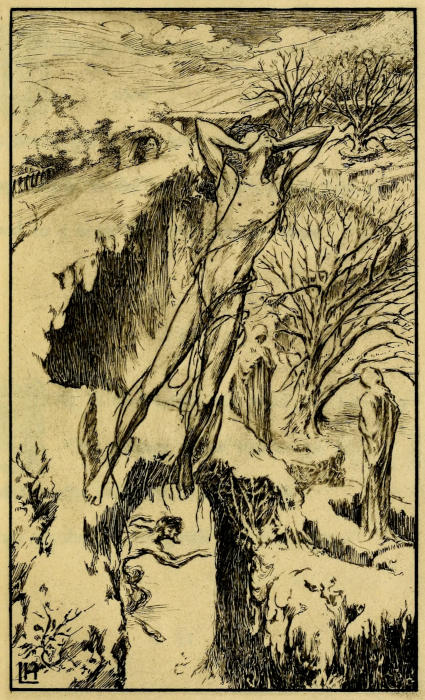
A NOTE UPON THE ILLUSTRATIONS
In one sense a beautiful poem can never be
illustrated: being beautiful it is already perfect,
and, to intelligent minds, illustrates
itself. Everything that it says it says in the
best possible way; within the limits of the
medium chosen, it is absolute.
If, therefore, illustration is to be an attempt to say over again
what the poet has already said perfectly, it is certain to prove itself
superfluous, and to be nothing better than a labour of tautology.
But there is a quality in all fine work which gives invitation into
the charmed circle of its influence to whatever is freshly and
sympathetically touched with the ideas it conveys. Great work
tells so differently on different minds; not by contrary but by
kindred ways it speaks freshly perhaps to each individual.
Thus, to express accurately in another medium an appreciation,
an individual sense of delight or emotion in work of finished and
constructive beauty is the only way of illustration which seems to
me profitable. The appreciation may be faulty; but in so far as
it states a personal view of its subject, it has legitimate standing
ground.
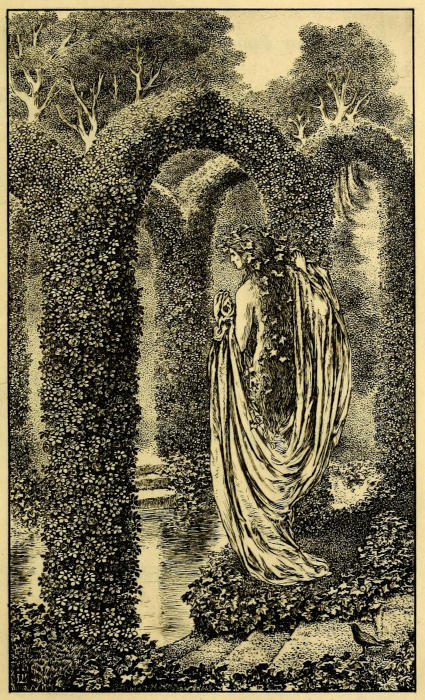
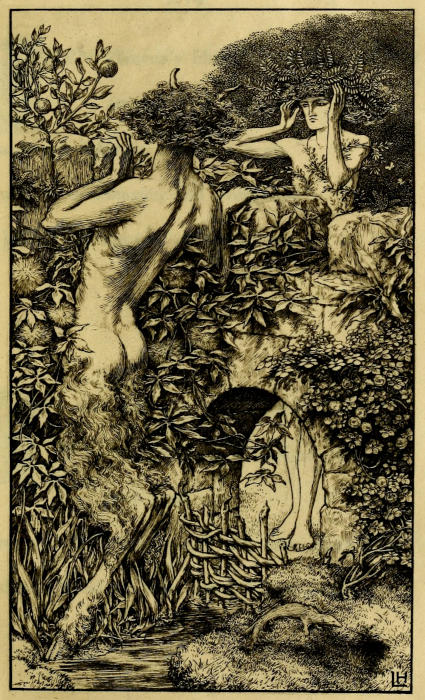
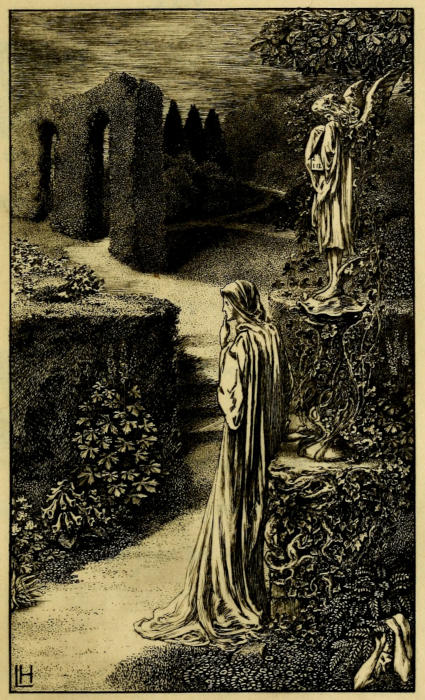
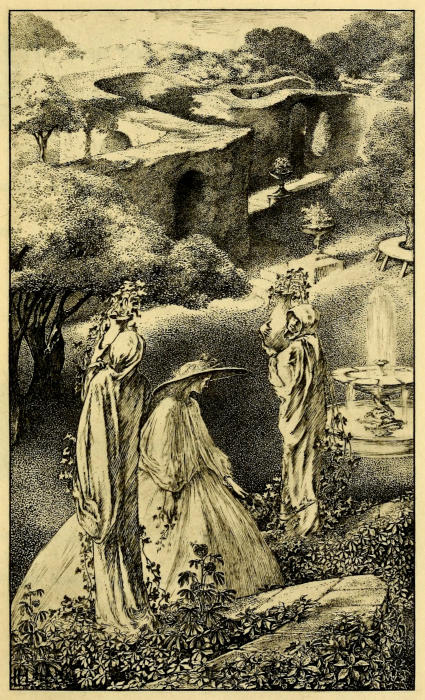
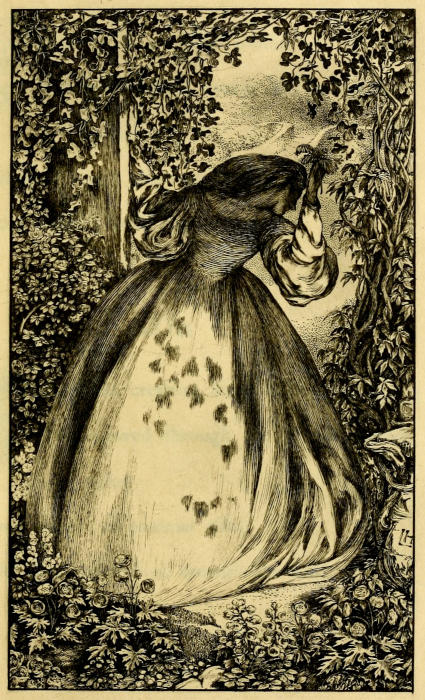
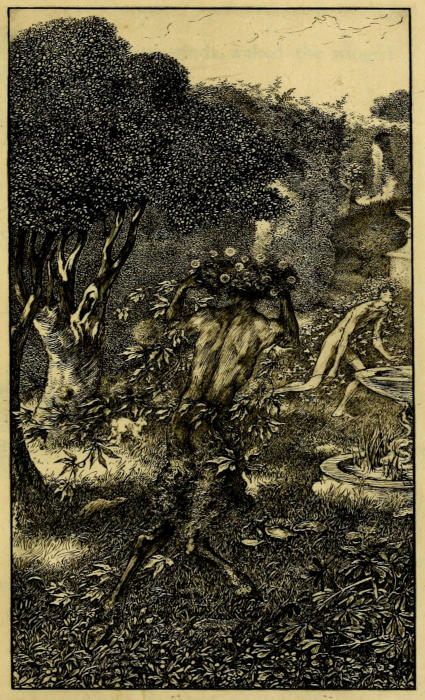
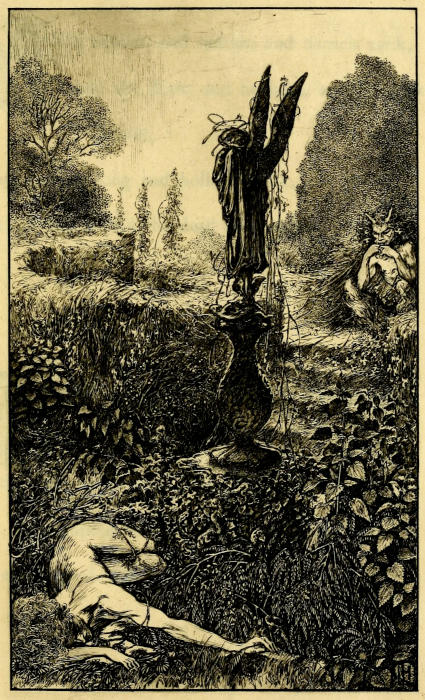
I have endeavoured to make evident in my drawings the particular
way in which this poem has appealed to me. The garden,
fine and elaborate, full of artifice, opposing with an infinity of
delicate labour the random overgrowth of the wilderness which
seeks jealously to encroach on it, has perhaps this to hint concerning
all forms of beauty of man’s devising,—that, in spite of the
pains entailed in their cultivation, the fragile and conditional state
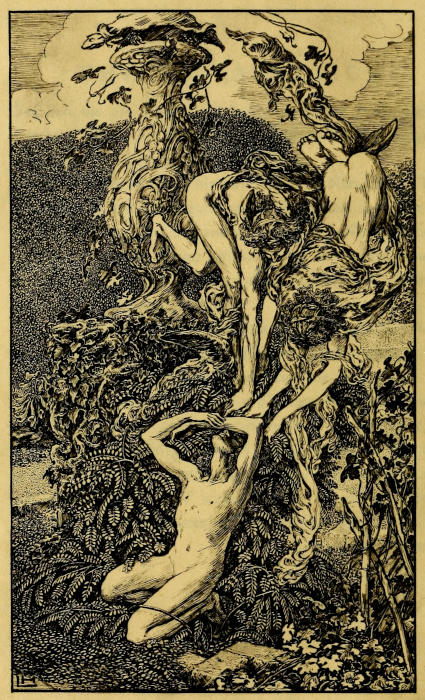
of their constitution remains: over all such things at last comes
the tread of Pan, effacing, and replacing with his own image and
superscription, the parenthetic grace—so spiritual almost in some
of its suggestions—of the garden deity.
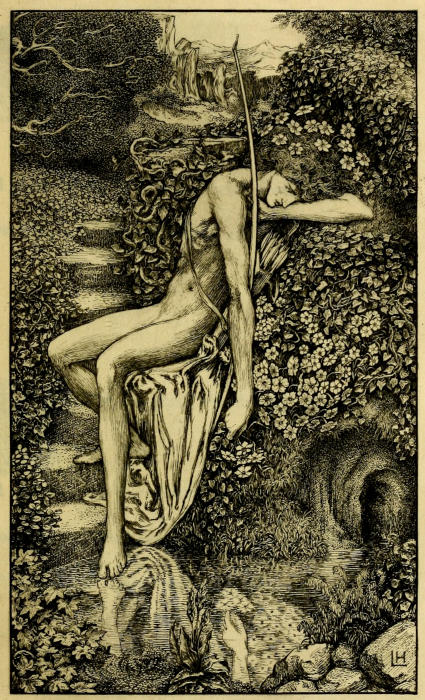
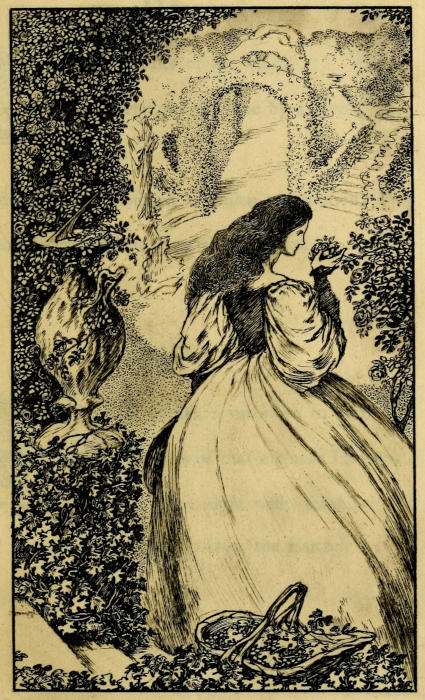
The lady of the garden, the charming sentimentalist, whom I
can only excuse for not killing the slugs and snails by believing
that she wore a crinoline and was altogether ignorant of natural
laws, harmonises exquisitely for a while with her high-clipped
hedges and garden statuary. It is an ensemble to gaze into as into a
picture: but the shadows of ruin and decay cross it; it is too
graceful to last. Pan is stronger than any form of beauty that
springs out of modes and fashions.
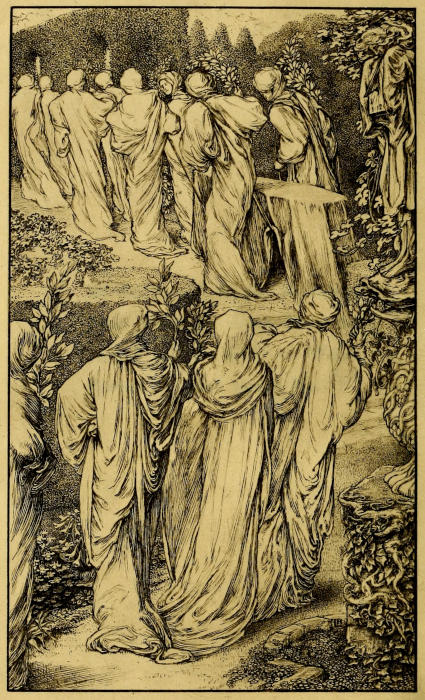
So, when she dies, she is but the forerunner of the death of the
whole garden: when she evaporates the petite mort runs through
all its bowers and alleys: its apparitions rise and follow her funeral
with a sense that their own time of dissolution approaches; and
the mode passes through a period of squalor and morbid abandonment
back into the hands of the ultimate master of things earthly.
It is an unpopular thing, may be, to assert that man’s sense of
beauty is so conditional to himself and the uses he makes of it.
Yet here we are shown how, with war to the death, unsightly
overthrow follows his abandonment of his stolen pleasure-ground,
and wipes out his trespassing footprints.
Man’s sense of beauty is his own: it is not Nature’s. The aim
of all art is to restrict Nature, and teach her that her place is not
in the high places of men; and we only admire Nature because in
the present strength of our civilisation we are strong enough to
pet her. Hannibal was a better judge of the true unsightliness of
Alpine scenery than we ourselves.
I should have preferred to add nothing to what I have drawn:
but an explanation of my unkind view of the rival claims of Pan
and the Garden-god has been wrung from me.
For the present the genius of civilisation, numerating duration
into hours and years and centuries for man’s convenience, overrides
the slow-crawling tortoise of Time: but it will not always
be so; and earth will come at last to be altogether rid of us and
that superfluous “sense of beauty” which has so long yoked her
back, and hedged her wastes and furrowed her fields.
Laurence Housman.
THE SENSITIVE PLANT
FIRST PART — I — II — III — IV — V — VI — VII — VIII — IX — X — XI — XII — XIII — XIV — XV — XVI — XVII — XVIII — XIX — XX — XXI — XXII — XXIII — XXIV — XXV — XXVI — XXVII — XXVIII
A sensitive plant in a garden grew,
And the young winds fed it with silver dew,
And it opened its fan-like leaves to the light,
And closed them beneath the kisses of night.
And the Spring arose on the garden fair,
Like the Spirit of Love felt everywhere;
And each flower and herb on Earth’s dark breast
Rose from the dreams of its wintry rest.
But none ever trembled and panted with bliss
In the garden, the field, and the wilderness,
Like a doe in the noontide with love’s sweet want,
As the companionless Sensitive Plant.
The snowdrop, and then the violet,
Arose from the ground with warm rain wet,
And their breath was mixed with fresh odour, sent
From the turf, like the voice and the instrument.
Then the pied windflowers and the tulip tall,
And narcissi, the fairest among them all,
Who gaze on their eyes in the stream’s recess,
Till they die of their own dear loveliness;
And the Naiad-like lily of the vale,
Whom youth makes so fair and passion so pale,
That the light of its tremulous bells is seen
Through their pavilions of tender green;
And the hyacinth purple, and white, and blue,
Which flung from its bells a sweet peal anew
Of music so delicate, soft, and intense,
It was felt like an odour within the sense;
And the rose like a nymph to the bath addrest,
Which unveiled the depth of her glowing breast,
Till, fold after fold, to the fainting air
The soul of her beauty and love lay bare:
And the wand-like lily, which lifted up
As a Mænad, its moonlight-coloured cup,
Till the fiery star, which is its eye
Gazed through clear dew on the tender sky;
And the jessamine faint, and the sweet tuberose,
The sweetest flower for scent that blows;
And all rare blossoms from every clime
Grew in that garden in perfect prime.
And on the stream whose inconstant bosom
Was prankt under boughs of embowering blossom,
With golden and green light, slanting through
Their heaven of many a tangled hue,
Broad water-lilies lay tremulously,
And starry river-buds glimmered by,
And around them the soft stream did glide and dance
With a motion of sweet sound and radiance.
And the sinuous paths of lawn and moss,
Which led through the garden along and across,
Some open at once to the sun and the breeze,
Some lost among bowers of blossoming trees,
Were all paved with daisies and delicate bells
As fair as the fabulous asphodels,
And flowrets which drooping as day drooped too,
Fell into pavilions, white, purple, and blue,
To roof the glow-worm from the evening dew.
And from this undefiled Paradise
The flowers (as an infant’s awakening eyes
Smile on its mother, whose singing sweet
Can first lull, and at last must awaken it),
When Heaven’s blithe winds had unfolded them,
As mine-lamps enkindle a hidden gem,
Shone smiling to Heaven, and every one
Shared joy in the light of the gentle sun;
For each one was interpenetrated
With the light and the odour its neighbour shed,
Like young lovers whom youth and love make dear
Wrapped and filled by their mutual atmosphere.
But the Sensitive Plant which could give small fruit
Of the love which it felt from the leaf to the root,
Received more than all, it loved more than ever,
Where none wanted but it, could belong to the giver,
For the Sensitive Plant has no bright flower;
Radiance and odour are not its dower;
It loves, even like Love, its deep heart is full,
It desires what it has not, the beautiful!
The light winds which from unsustaining wings
Shed the music of many murmurings;
The beams which dart from many a star
Of the flowers whose hues they bear afar;
The plumèd insects swift and free,
Like golden boats on a sunny sea,
Laden with light and odour, which pass
Over the gleam of the living grass;
The unseen clouds of the dew, which lie
Like fire in the flowers till the sun rides high,
Then wander like spirits among the spheres,
Each cloud faint with the fragrance it bears;
The quivering vapours of dim noontide,
Which like a sea o’er the warm earth glide,
In which every sound, and odour, and beam,
Move, as reeds in a single stream;
Each and all like ministering angels were
For the Sensitive Plant sweet joy to bear,
Whilst the lagging hours of the day went by
Like windless clouds o’er a tender sky.
And when evening descended from Heaven above,
And the Earth was all rest, and the air was all love,
And delight, though less bright, was far more deep,
And the day’s veil fell from the world of sleep,
And the beasts, and the birds, and the insects were drowned
In an ocean of dreams without a sound;
Whose waves never mark, though they ever impress
The light sand which paves it, consciousness;
Only overhead the sweet nightingale
Ever sang more sweet as the day might fail,
And snatches of its Elysian chant
Were mixed with the dreams of the Sensitive Plant.