Copyright 1896, 1910 and 1920
by
MINNIE MOORE-WILLSON
First
Edition,
Jan., 1896
Second
”
Jan., 1910
Third
”
Dec., 1911
Fourth
”
Sept., 1912
Fifth
”
Aug., 1914
Sixth
”
Oct., 1916
Seventh
”
Feb., 1920
Printed in the United States of America
MEMORIAL TRIBUTE
MRS. ELIZABETH STAUFFER-MOORE
IN GRATEFUL RECOGNITION OF HER PHILANTHROPIC
INTEREST IN A BRAVE AND HEROIC REMNANT OF THE
ABORIGINAL AMERICANS, THE SEMINOLES OF FLORIDA,
THIS BOOK IS AFFECTIONATELY DEDICATED.
HER TIMELY AID IN THE CRISIS OF THEIR EXISTENCE
HELPED TO RESCUE THEM FROM OBLIVION AND TO
PROVIDE FOR THEM THE RIGHTS OF A FREE PEOPLE.
Minnie Moore-Willson.
FOREWORD
When most of the Seminoles were moved from
Florida to Indian Territory, a few score of them
were unwilling to go. Of these who remained,
the descendants, ten years ago, numbered about six hundred.
An effort was made at that time to buy for
this band the land on which they lived and a few
hundred dollars was given for that purpose.
In the study of this fragment in their singular surroundings
as portrayed in the pages of this book, one
gets, as it were, a glimpse of their camp-fire life, a
view of their sun-bleached wigwams and an insight
into the character of these proud but homeless people.
Not much apparently can be done for this home-keeping
remnant of the Florida aborigines, but it is
help and a protection to them that their continuing
presence in Florida and the conditions of their life
there should be known to the rest of the Americans
and especially to those who go to Florida or are
concerned with the development of that State.
To diffuse this helpful knowledge and give these
Indians such protection as may come from it, is the
aim of the present book.
Edward S. Martin.
New York, Nov. 9, 1909.
PREFACE
That there is yet a tribe, or tribes of Indians in
Florida is a fact unknown to a large part of the
people of this country; there are even students of
history who have scarcely known it. These people,
driven, about seventy or more years ago, into the
dreary Everglades of that Southern Peninsular, have
kept themselves secluded from the ever encroaching
white population of the State. Only occasionally
would a very small number visit a town or a city to
engage in traffic. They have had no faith in the white
man, or the white man’s government. They have
aimed to be peaceful, but have, with inveterate purpose,
abstained from intercourse with any of the
agencies of our government. My friends, Mr. and
Mrs. J. M. Willson, Jr., of Kissimmee, Florida,
have found their way to a large degree of confidence
in the hearts of this people. They have learned
something of their history, and have studied their
manner of life, their character and habits.
Mr. Willson has been allowed, and invited to go
with some of their men on familiar hunting expeditions.
He has seen them in the swamps, in their
homes, and in their general life environments. He
has been admitted to their confidence and friendship.
He has consequently become deeply interested in
them. Mrs. Willson also has become acquainted
with some of their chief personages. Both have
learned to sympathize with these Indians in their
hardships and in their treatment at the hands of the
white race.
Mrs. Willson began to write about them and her
writing has grown into a book; and she has been encouraged
to give this book to the world, in the hope
that the attention of good people may be drawn toward
them, and that at least a true interest may be
awakened in their moral and material well-being.
They are truly an interesting people, living, although
secluded, almost at our doors.
Mrs. Willson has written earnestly, enthusiastically,
and lovingly regarding them, and it is to be
hoped that a new interest may soon be taken in them
both by the churches and the government, and that
they may soon enter upon new realizations, and be
encouraged to place a confidence in the white race to
which, until quite recently, they have been utter
strangers.
Mr. Willson has prepared the vocabulary. The
words and phrases here given have been gathered by
him in the course of ten or fifteen years of friendly
intercourse with members of the tribe. They have
assisted him in getting the true Indian or Seminole
word and in finding its signification. Old Chief Tallahassee
has been especially and kindly helpful; so has
Chief Tom Tiger. This vocabulary of this peculiar
Indian tribe, though not complete, ought to prove
helpful to those who are interested in the languages
of the people who roamed the forests of this great
land before it became the home and the domain of
those who now live and rule in it.
This book, in its first part, gives some account of
the earlier years of the Seminole history. In the
second part the reader is introduced to the later and
present state of things and facts regarding them.
In the third part is found the vocabulary—a number
of Seminole words, phrases and names, with their
interpretation into our own tongue.
This little book is given to the world in the hope
that it will be found both interesting and valuable to
many readers.
The history of the American Indian is a very
Iliad of tragedy. From the day Columbus made the
first footprints of the European in the damp sands of
Cat Island, the story of the original owners of fair
America has been full of melancholy, and fills with
its dark pages every day of a quartet of centuries.
Columbus describes the innocent happiness of these
people. “They were no wild savages, but very gentle
and courteous,” he says, “without knowing what
evil is, without stealing, without killing.” They
gave to him a new world for Castile and Leon, while
in exchange he gave to them “some glass beads and
little red caps.” The tragedy of the new world began
when we find this same admiral writing to the
Spanish majesties that he would be able to furnish
them with gold, cotton, spices, and slaves—“slaves!
as many as their Highnesses shall command to be
shipped”; and thus, this land, a paradise of almost
primeval loveliness, was transformed into a land of
cruel bondage, desolation and death.
History scarcely records an instance when hospitality
was not extended by the red man to our first explorers.
Swift canoes shot out from the shaded
shores, filled with men clad in gorgeous mantles, and,
in broken accents, their greeting was “Welcome!”
“Come, see the people from Heaven,” they cried,
but were soon destined to believe they were from a
very different region.
From old Spanish accounts we conclude that the
Indian population of De Soto’s time was very large,
and that the natives were in a higher state of civilization
than at any later period; that their speech,
though brief, was chaste, unaffected, and evinced a
generous sentiment. Cortez found the Aztecs and
their dependencies challenging comparison with the
proudest nations of the world, and in their barbarous
magnificence rivaling the splendors of the Orient.
Advanced in the arts, dwelling in cities, and living
under a well-organized government, they were happy
in their position and circumstances.
Who were the barbarians of the early history of
America, our Mayflower ancestors, or the Red
Men of the forest?
With a careful study of the early records, the question
answers itself.
Four hundred years ago Indian warfare began.
Shall it continue until we exterminate the race?
When it is, alas, too late, the American people will
awaken to the fact that the preservation of the Indian
race will be a theme that will stir the very heart
of the Nation.
Shall Justice blush as the future historian pens the
account of the vanished Indian and our treatment
of his race? Will Patriotism hang her head in
shame and confusion as the pen portrays the history
of the red heroes, who gave up their lives for their
home and liberty?
Since that sunny day in May, 1539, when De Soto,
amid the salutes of artillery, the music of trumpets,
the cheers of thousands of Castilians, sailed into
Tampa Bay, Florida has been the scene of stirring
events—with the Aborigines forming a tragical
background.
Marching across the flower-bedecked country with
his gallant men of Spain, with his cavalry, with
fleet greyhounds and furious bloodhounds to turn
loose upon the savages, also handcuffs, chains and
collars to secure them, with priests, workmen and
provisions, this proud adventurer reached the present
site of Tallahassee. Here, in this vicinity, they
came upon a fruitful land, thickly populated.
Ever pressing onward for the gold that was supposed
to abound in this new land, one village after
another was passed, when provisions and welcome
were furnished by the Laziques.
On, on, the proud and haughty Spaniards
marched, until they reached the province of Cofaqui.
Here the splendor of the reception would amaze us,
even to-day. The chieftain and the people gave up
their village for the Spanish quarters, moving to
another town for the occasion. The following day
the chief returned, offering De Soto 8,000 armed Indians,
with maize, dried fruits and meat for the
journey, 4,000 to act as defenders, 4,000 as
burden bearers, to escort the Spaniards through a
wilderness of several days’ journey. Such were the
proud and generous people the Caucasians found in
America.
The haughty Castilian continued his march till he
reached the banks of the Mississippi, where he halted
and sent his carrier to the chief on the opposite shore,
with the usual message, that he was the “Offspring
of the Sunne, and required submission and a visit
from the chief.” But the chieftain sent back a reply,
both magnanimous and proud, that if he were
“the Childe of the Sunne, if he would drie up the
River, he would believe him; that he was wont to visit
none; therefore, if he desired to see him he would
come thither, that if he came in peace he would receive
him in special good will, and if in Warre in
like manner he would attend him in the Towne where
he was and for him or any other he would not
shrinke one foot backe.”
Old history says this haughty repulse aggravated
the illness of De Soto, “because he was not able to
passe presently to the River and seeke him, to see if
he could abate that Pride of his.”
Notwithstanding the hospitable treatment shown
by the natives to the newcomers, the Castilians destroyed
them by the thousands: One explorer after
another wrote of these friendly people in the new
land. “They are very liberal,” says the narrator,
“for they give what they have.” Sir Ralph Lane
describes the welcome by the natives, who came with
“Tobacco, Corne and furs and kindly gestures to be
friends with the strange white men,” etc., etc., but
adds, “the Indians stole a Silver Cup, wherefore we
burnt their Towne and spoylt their Corne,” etc., etc.
The time will soon be over for the study of the
Aborigines of America. We have in 250 years
wasted them from uncounted numbers to a scattering
population of only about 275,000, while in the same
length of time a cargo of dusky slaves from the
African shores have become a people of millions,
slaves no longer, but protected citizens. In the redskin,
whom we have dispossessed of his native rights,
we recognize no equality; yet the descendant of the
barbarous black, whose tribe on the Golden Coast
still trembles before a fetish, may now sit at the desk
of Clay or Calhoun. Truly the tangled threads of
modern morals are hard to unravel.
The first explorers made captives of the Indians,
and carried them in irons to Spain, where they were
sold as slaves to the Spanish grandees. Two hundred
years later the people of Carolina sought to
enslave those among them. The red men rebelled
at the subjection, and in order to escape bondage,
began to make their way to the “Indian country,”
the present site of Georgia. African bondsmen soon
followed the example of the Indian captives, and in
time continued their journey to Florida.
In the attempts to recapture runaway slaves, is
based the primeval cause of the Seminole wars.
ORIGIN OF TROUBLES.
The history of the Seminoles of Florida begins
with their separation from the Creeks of Georgia as
early as 1750, the name Seminole, in Indian dialect
meaning wild wanderers or runaways. Sea-coffee,
their leader, conducted them to the territory
of Florida, then under Spanish colonial policy.
Here, they sought the protection of Spanish laws,
refused in all after times to be represented in Creek
councils, elected their own chiefs, and became, in all
respects, a separate tribe.
To-day the Seminoles of Florida are only a frail
remnant of that powerful tribe of Osceola’s day.
Their history presents a character, a power, and a
romance that impels respect and an acknowledgment
of their superiority. Of the private life of the Seminole
less is known, perhaps, than of any other band
in the United States. His life has been one long
struggle for a resting-place; he has fought for home,
happy hunting grounds and the burial place of his
fathers. At present we can only see a race whose
destiny says extinction.
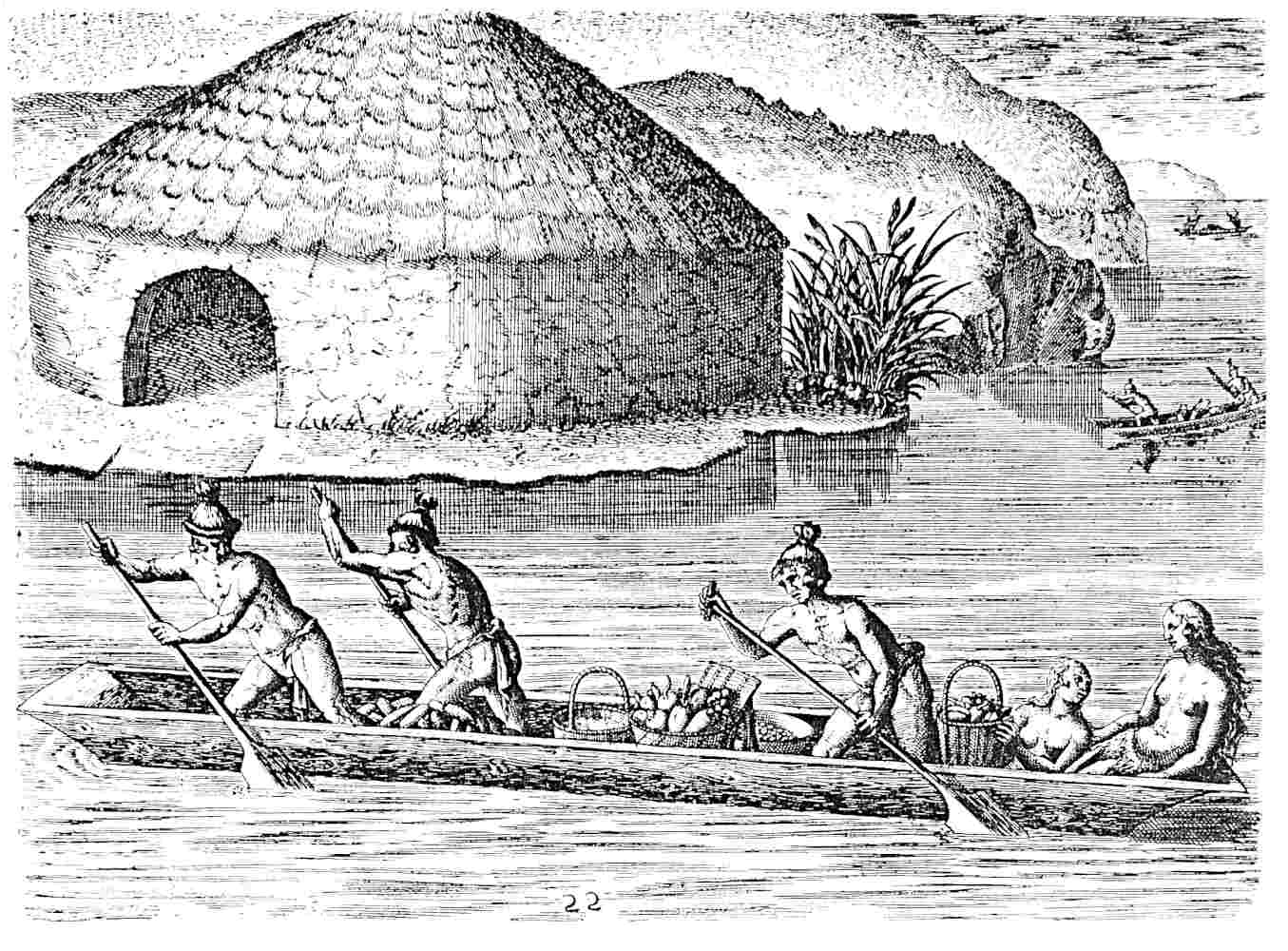
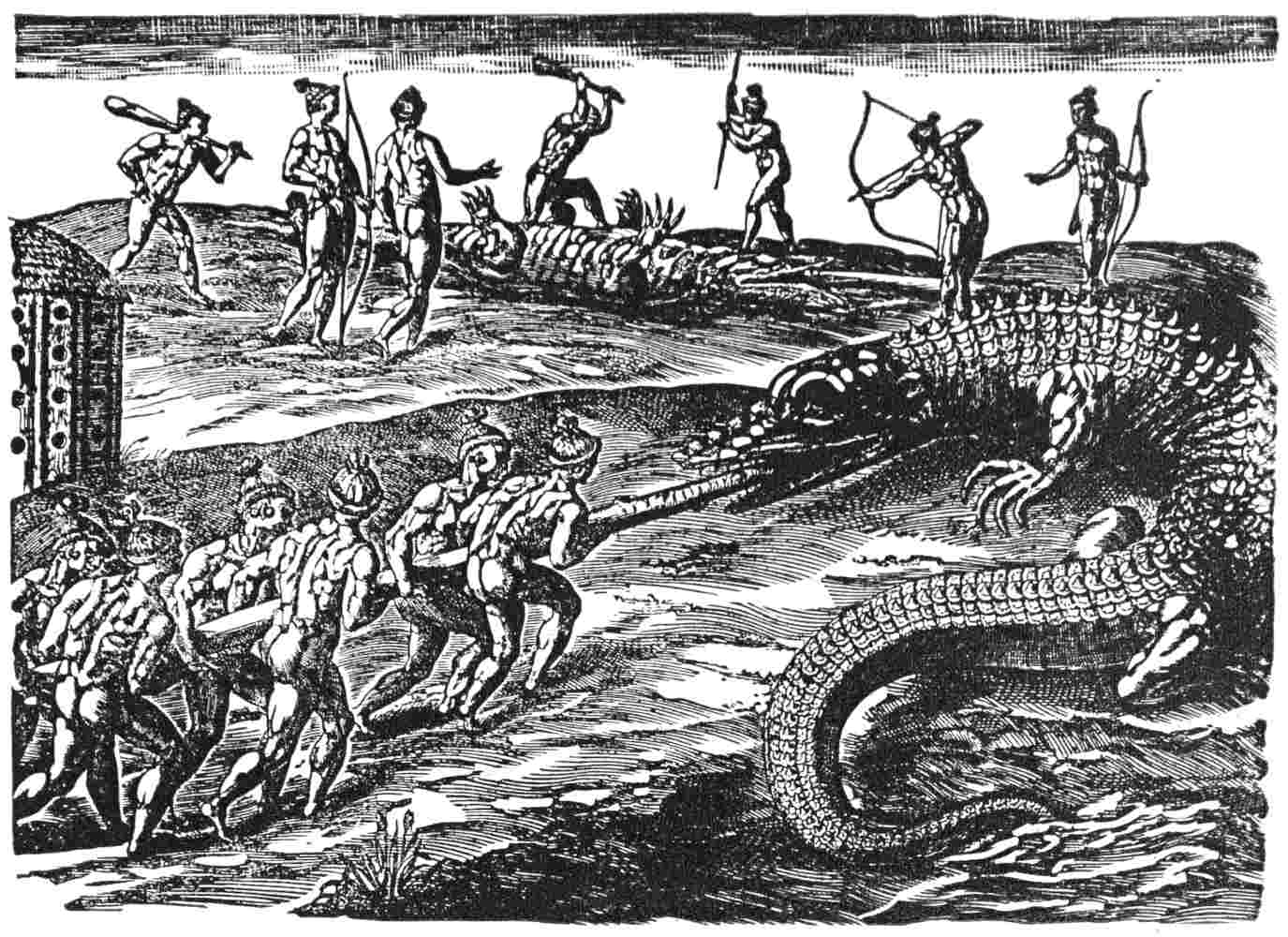
From a drawing by the French artist, Le Moyne, 1563.
FLORIDA INDIANS CARRYING THEIR CROPS TO THE STOREHOUSES
The wilds of Florida became a home for these
Indians as well as for the fugitive negro slaves of the
Southern States. The Indian and the negro refugee,
settling in the same sections, became friendly, and in
time some of their people intermarried. The same
American spirit that refused to submit to “Taxation
without Representation,” was strong in the breast of
the Seminole, and Florida, belonging to Spain, afforded
him a retreat for his independent pursuits.
Subject only to the Spanish crown, the exiles found a
home safe from the inexorable slave catchers. The
Seminoles were now enjoying liberty, and a social
solitude, and refused to make a treaty with the colonial
government, or with the Creeks from whom
they had separated. One demand after another was
made upon the Spanish government at St. Augustine
for the return of the fugitives, which was always
rejected. African slaves continued to flee from
their masters to find refuge with the exiles and the
Indians. They were eagerly received, and kindly
treated, and soon admitted to a footing of equality.
The growing demand for slaves in the southern colonies
now made the outlook serious, and from the
attempts to compel the return of the negroes grew
the first hostilities.
One of the first communications ever sent to Congress
after it met was by the Georgia colony, stating
that “a large number of continental troops would be
required to prevent the slaves from deserting their
masters.” But, in that momentous year of 1776,
Congress had more important duties on hand, and it
was not until 1790 that a treaty was entered into between
the Creeks and the United States. In this
treaty, the Creeks, now at enmity with the Seminoles,
agreed to restore the slaves of the Georgia planters
who had taken refuge among them. The Seminoles
refused to recognize the treaty; they were no
longer a part of the Creeks, they resided in Florida
and considered themselves subject only to the crown
of Spain. One can readily believe that the Spanish
authorities encouraged their independence. Legally
the exiles had become a free people.
The Creeks now found themselves utterly unable
to comply with their treaty. The planters of Georgia
began to press the Government for the return of
their fugitive slaves. Secretary Knox, foreseeing the
difficulty of recovering runaway slaves, wrote to
the President advising that the Georgia people be
paid by the Government for the loss of their bondmen.
The message was tabled, and until 1810 the
Seminoles and negroes lived in comparative peace.
The people of Georgia, now seeing the only apparent
way to obtain possession of their slaves would be
by the annexation of Florida, began to petition for
this, but the United States, feeling less interest in
slave catching than did the State of Georgia, manipulated
affairs so slowly that Georgia determined to
redress her own grievances, entered Florida and began
hostilities. The United States was too much
occupied with the war with Great Britain to take
cognizance of Indian troubles in a Spanish province,
hence the Georgia intruders met with defeat. For a
short time after these hostilities ceased the Seminoles
and their allies enjoyed prosperity, cultivated their
fields, told their traditions and sang their rude lays
around their peaceful camp fires. Seventy-five years
had passed since their ancestors had found a home in
Florida, and it was hard for them to understand the
claims of the southern planters.
The year 1816 found the Seminoles at peace with
the white race. In a district inhabited by many of
the Indians on the Apalachicola river was Blount’s
Fort.
The fort, although Spanish property, was reported
as an “asylum for runaway negroes.” General
Jackson, now in military command, ordered the
“blowing up of the fort, and the return of the negroes
to their rightful owners.” The exiles knowing
little of scientific warfare believed themselves safe
in this retreat; and when in 1816 an expedition under
Colonel Duncan L. Clinch was planned, the hapless
Indians and negroes unknowingly rushed into the
very jaws of death. A shot from a gunboat exploded
the magazines and destroyed the garrison.
History records that of 334 souls in the fort, 270
were instantly killed! The groans of the wounded
and dying, the savage war whoops of the Indians inspired
the most fiendish revenge in the hearts of those
who escaped, and marks the beginning of the First
Seminole War.
Savage vengeance was now on fire, and “Blount’s
Fort” became the magnetic war cry of the Seminole
chiefs as they urged their warriors to retaliation.
This barbarous sacrifice of innocent women and children
conducted by a Christian nation against a helpless
race, and for no other cause than that their
ancestors, one hundred years before, had been born in
slavery, marks a period of cruelty, one of the most
wanton in the history of our nation.
The inhuman way in which the massacre was conducted
was never published at large, nor does the
War Department have any record of the taking of
Blount’s Fort, as is shown by the following:
An examination of the records of this Department has
been made, but no information bearing upon the subject of
the taking of Blount’s Fort, Florida, in the year 1816, has
been found of record.
By authority of the Secretary of War, F. C. Ainsworth,
Colonel, U. S. Army, Chief of Office.
Washington, July 25, 1895.
History does not dwell on the cruel treatment the
Indians received from the United States authorities
during the Seminole Wars, yet pages of our National
Library are devoted to the barbarity of the Seminoles.
There are two sides to every question, and
it is only what the Indian does to the white man that
is published, and not what the white man does to the
Indian.
The facts show that instead of seeking to injure
the people of the United States, the Seminoles were,
and have been, only anxious to be free from all contact
with our government. In no official correspondence
is there any reference made to acts of hostility
by the Indians, prior to the massacre at Blount’s
Fort.
But Floridians, who had urged the war with the
hope of seizing and enslaving the maroons of the
interior, now saw their own plantations laid waste,
villages abandoned to the enemy, and families suffering
for bread. The war had been commenced for
an ignoble purpose, to re-enslave fellow-men, and
taught that every violation of justice is followed
by appropriate penalties.
Few of the people of the United States knew the
true cause of the war, nor the real inwardness of the
purposes of those in command, as history and official
documents show that affairs were in the hands of the
Executive rather than in those of Congress. The
first war was in itself an act of hostility to the King
of Spain; yet nothing was gained by our government
except possession of part of the fugitives. Military
forces could not pursue the Indians into the fastnesses
of the Everglades, and after two years of bloodshed
and expenditure of thousands of dollars, peace was in
a manner restored, and the army was withdrawn
without any treaty being signed.
EFFORTS AT INDIAN REMOVAL.
The Indians had set the American government
at defiance. The slaves of Southern States continued
to run away, taking refuge with the exiles and
Seminoles; the slave-holders of Georgia became more
clamorous than ever. The Spanish crown could not
protect herself from the invasion of the Americans
when in pursuit of runaway negroes. She had seen
her own subjects massacred, her forts destroyed or
captured, and her rights as a nation insulted by an
American army. In 1819, by a combination of force
and negotiation, Florida was purchased from Spain
for $5,000,000.
Thus the Seminoles were brought under the dominion
they so much dreaded. Slave-holders once
more petitioned to the United States for aid in the
capture of their escaped property. The United
States, foiled in their treaty with the Creeks, now
recognized the Seminoles as a distinct tribe, and invited
their chiefs to meet our commissioners and
negotiate a treaty. The Seminoles agreed in this
treaty to take certain reservations assigned to them,
the United States covenanting to take the Florida
Indians under her care and to afford them protection
against all persons whatsoever, and to restrain and
prevent all white persons from hunting, settling or
otherwise intruding upon said lands.
By this treaty all their cultivated lands were given
up to the whites, and the Seminoles retired to the interior.
Once more this long persecuted people found
refuge, but it was only for a short time. The value
of slaves in States North caused slave catchers with
chains and bloodhounds to enter Florida. They
seized the slaves of the Indians, stole their horses and
cattle and depredated their property. With such a
violation of the treaty, renewed hostilities were inevitable.
The Indians petitioned for redress, but received
none. Affairs grew worse until 1828, when the idea
of emigration for the Indians was submitted to the
chiefs. After much persuasion, a few of the tribal
leaders were induced to visit the Western country.
They found the climate cold, and a land where
“snow covers the ground, and frosts chill the bodies
of men,” and on general principles, Arkansas a delusion
and a snare. The chiefs had been told they
might go and see for themselves, but they were not
obliged to move unless they liked the land. In their
speech to the Commissioner they said: “We are
not willing to go. If our tongues say ‘yes,’ our
hearts cry ‘no.’ You would send us among bad Indians,
with whom we could never be at rest. Even
our horses were stolen by the Pawnees, and we were
obliged to carry our packs on our backs. We are
not hungry for other lands; we are happy here.
If we are torn from these forests our heartstrings
will snap.” Notwithstanding the opposition to a
treaty, by a system of coercion a part of the chiefs
were induced to sign, and fifteen undoubted Seminole
cross-marks were affixed to the paper. This
was not enough, according to Indian laws, to compel
emigration. The stipulations read, “Prepare to
emigrate West, and join the Creeks.” There was
no agreement that their negroes should accompany
them, and they refused to move. To expect a tribe
which had lived at enmity with the Creeks since their
separation in 1750 to emigrate and live with them
was but to put weapons into their hands, and did not
coincide with the ideas of the Seminoles.
The United States prepared to execute; not a
redskin was ready, and troops were sent. The Indians
began immediately to gather their crops, remove
the squaws and pickaninnies to places of safety,
secure war equipments—in short, prepare for battle.
It was a question of wonderment many times
among the officers how the Indians procured their
ammunition in such quantities, and how they kept
from actual starvation. Hidden as they were in their
strong fortresses—the fastnesses of the swamps—many
believed that they would be starved out, and
would either stand a fair field fight or sue for peace.
An old Florida settler who carried his rifle through
seven years of Indian warfare explains the mystery.
He says: “The Indians had been gathering powder
and lead for years, ever since the time Chief
Neamathla made his treaty with General Jackson.
Besides, Cuban fishing smacks were always bringing
it in, and trading with the redskins for hides and furs.
As for provisions, they had their ‘Koontie’ flour,
the acorn of the live oak, which is fair eating when
roasted, and the cabbage of the palmetto tree. For
meat, the woods were full of it. Deer and bear
were abundant, to say nothing of small game, such
as wild turkey, turtle and squirrel.” The Seminoles
at this time, 1834, owned, perhaps, two hundred
slaves, their people had intermarried with the maroons,
and in fighting for these allies they were fighting
for blood and kin. To remove the Indians and
not the negroes was a difficult thing to do. The
Seminoles, now pressed by the United States troops,
committed depredations upon the whites; bloody
tragedies occurred, and the horrors of the second
Seminole War were chronicled throughout the land.
THE MASSACRE OF GENERAL THOMPSON AND OF DADE’S FORCES .
It was now that the young and daring warrior,
Osceola, came into prominence. He had recently
married the daughter of an Indian chief, but whose
mother was the descendant of a fugitive slave. By
slave-holding laws, the child follows the condition of
the mother, and Osceola’s wife was called an African
slave. The young warrior, in company with his
wife, visited the trading post of Fort King for the
purpose of buying supplies. While there the young
wife was seized and carried off in chains. Osceola
became wild with grief and rage, and no knight of
cavalier days ever showed more valor than did this
Spartan Indian in the attempts to recapture his wife.
For this he was arrested by order of General Thompson
and put in irons. With the cunning of the Indian,
Osceola affected penitence and was released;
but revenge was uppermost in his soul. The war
might succeed or fail for all he cared; to avenge
the capture of his wife was his every thought. For
weeks he secreted himself, watching an opportunity
to murder General Thompson and his friends.
No influence could dissuade him from his bloody
purpose. Discovering General Thompson and Lieutenant
Smith taking a walk one day, Osceola, yelling
the war cry sprang like a mountain cat from his
hiding-place and murdered both men.
His work of vengeance was now complete, and
almost as wild as a Scandinavian Saga was the fight
he now gave our generals for nearly two years.
While Osceola lay in wait for General Thompson,
plans were being completed which resulted in the
Dade Massacre.
The enmity of the Indian is proverbial, and when
we reflect that for fifty years the persecutions by the
whites had been “talked” in their camps, that the
massacre of Blount’s Fort was still unavenged, that
within memory fathers and mothers had been torn,
moaning and groaning from their midst, to be sold
into bondage, with their savage natures all on fire
for retaliation, no vengeance was too terrible.
Hostilities around Fort King, now the present site
of Ocala, becoming severe, General Clinch ordered
the troops under Major Dade, then stationed at
Fort Brooke (Tampa), to march to his assistance.
Neither officers nor soldiers were acquainted with the
route, and a negro guide was detailed to lead
them. This unique character was Louis Pacheo, a
negro slave belonging to an old Spanish family, then
living near Fort Brooke. The slave was well acquainted
with the Indians, spoke the Seminole tongue
fluently. He was reported by his master, as faithful,
intelligent and trustworthy, and was perfectly familiar
with the route to Fort King.
AN INDIAN RETREAT DURING THE SEMINOLE WAR
The affair of Dade’s Massacre is without a parallel
in the history of Indian warfare. Of the 110 souls,
who, with flying flags and sounding bugles merrily
responded to General Clinch’s order, but two lived
to describe in after years the tragic scenes. One was
Private Clark, of the 2nd Artillery, who, wounded
and sick crawled on his hands and knees a distance
of sixty miles to Fort Brooke. The other was Louis
Pacheo, the only person of the command who escaped
without a wound.
The assault was made shortly after the troops
crossed the Withlacoochee river, in a broad expanse
of open pine woods, with here and there clumps of
palmettoes and tall wire-grass. The Indians are
supposed to have out-numbered the command, two to
one, and at a given signal, as the troops marched
gayly along, a volley of shot was poured into their
number. The “gallant Dade” was the first to fall,
pierced by a ball from Micanopy’s musket, who was
the King of the Seminole nation. A breastwork was
attempted by the soldiers, but only served as a retreat
for a short time; the hot missiles from the
Indians soon laid the last man motionless, and the
slaughter was at an end.
On February 20, 1836, almost two months after
the massacre, the dead bodies of the officers and soldiers
were found just as they had fallen on that fatal
day. History is corroborated by old settlers, who
say “that the dead were in no way pillaged; articles
the most esteemed by savages were untouched, their
watches were found in their pockets, and money, in
silver and gold, was left to decay with its owner—a
lesson to all the world—a testimony that the Indians
were not fighting for plunder! The arms and
ammunition were all that had been taken, except the
uniform coat of Major Dade.” Their motive was
higher and purer; they were fighting for their rights,
their homes, their very existence.
What became of the negro guide? History records
that Louis, knowing the time and place at
which the attack was to be made, separated himself
from the troops. As soon as the fire commenced, he
joined the Indians and negroes, and lent his efforts in
carrying forth the work of death. An account
printed over forty years ago describes the character
of the negro Louis. It reads as follows:
“The life of the slave Louis is perhaps the most romantic
of any man now living. Born and reared a slave, he found
time to cultivate his intellect—was fond of reading; and
while gentlemen in the House of Representatives were engaged
in discussing the value of his bones and sinews, he
could probably speak and write more languages with ease
and facility than any member of that body. In revenge
for the oppression to which he was subjected, he conceived
the purpose of sacrificing a regiment of white men, who
were engaged in the support of slavery. This object effected,
he asserted his own natural right to freedom, joined his
brethren, and made bloody war upon the enemies of liberty.
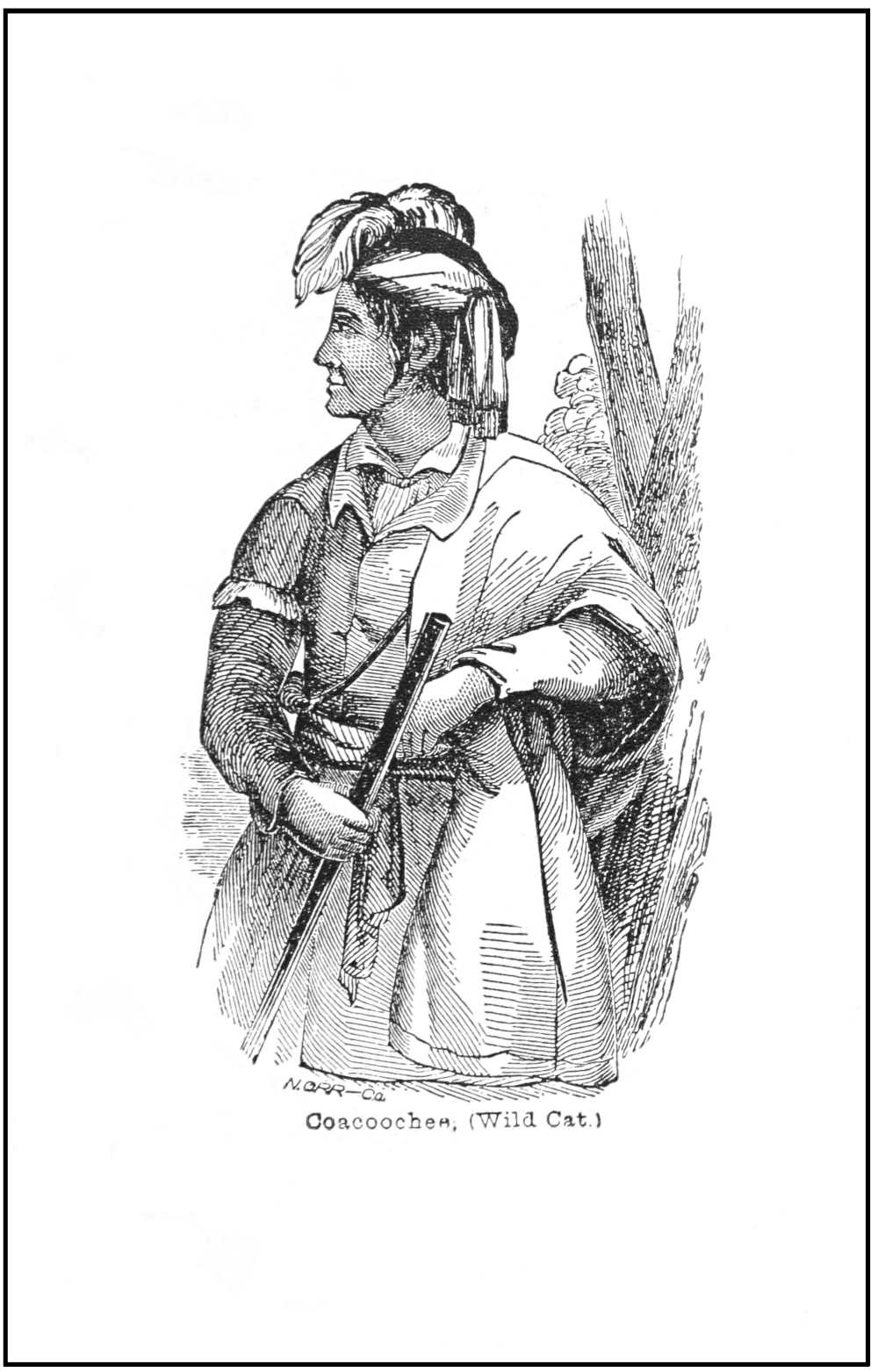
For two years he was the steady companion of Coacoochee,
or, as he was afterwards called, ‘Wild Cat,’ who subsequently
became the most warlike chief in Florida. They
traversed the forests of that territory together, wading
through swamps and everglades, groping their way through
hommocks, and gliding over prairies. For two years they
stood shoulder to shoulder in every battle; shared their victories
and defeats together; and, when General Jessup had
pledged the faith of the nation that all Indians who would
surrender should be protected in the enjoyment of their
slaves, Wild Cat appeared at headquarters, followed by
Louis, whom he claimed as his property, under slaveholding
law, as he said he had captured him at the time of Dade’s
defeat.”
Following Louis Pacheo’s career, we find him
sharing the fortunes of Wild Cat in the Indian Territory.
Subsequently, Wild Cat, with a few followers,
Louis among the number, emigrated to Mexico.
Fifty-seven years passed from the date of the Dade
massacre, when Louis Pacheo, venerable and decrepit,
once more appeared on Florida soil. The old
negro, longing for the scenes of his youth, returned to
end his days in the hospitable home of his “old
missus.” In his confession, he claims to be innocent
of the charge of betraying the troops, and asserts
that he was forced into remaining with the Indians.
The vagaries of a childish mind may account for his
diversion from well-established history. The old
slave lived for three years after his return to Florida,
and died in January, 1895, at age of 95 years.
A DISHONORED TREATY.
The tragic news of the Dade Massacre convinced
the United States that war had commenced in real
earnest. From this time on, skirmish after skirmish
ensued, bloody murders were committed by the redskins,
thousands of dollars were being expended by
our government, and the white population of Florida
was in a suffering condition. The Indians were not
suffering for food. The chameleon-like character of
the war prevented any certainty of success. General
Jessup, considerably chagrined, wrote to Washington
for permission to resign both the glory and baton of
his command.
There could scarcely arise a more painful theme,
or one presenting a stranger variety of aspects, as it
whirled scathing and bloodily along, than did the
Indian War. Yet it is a remarkable fact that no
Seminole warrior had ever surrendered, even to superior
numbers. Our military forces had learned what
a hydra-headed monster the war really was, and attempts
were again made to induce emigration. The
horrors of the Dade Massacre and of Fort King had
reached the world. General Jessup sought negotiations,
but found the same difficulties to encounter as
before, viz.: that the chiefs would not enter into an
agreement that did not guarantee equal rights to
their allies as to the Indians. Official documents
show that General Jessup agreed that “the Seminoles
and their allies who come in and emigrate West,
shall be secure in their lives and property; that their
negroes, their bona fide property, shall accompany
them West, and that their cattle and ponies shall be
paid for by the United States.” The Indians, under
these terms, now prepared to emigrate. History
records that even Osceola avowed his intention to
accompany them. Every preparation was made to
emigrate, and a tract of land near Tampa was selected
on which to gather their people. Hundreds
of Indians and negroes encamped there. Vessels
were anchored to transport them to their new homes.
Peace was apparent everywhere, and the war declared
at an end. At this point a new difficulty arose.
Slave-holders became indignant at the stipulations of
the treaty, and once more commenced to seize negroes.
The Seminoles, thinking themselves betrayed,
with clear conceptions of justice, fled to their former
fastnesses in the interior, and once more determined
to defend their liberty.
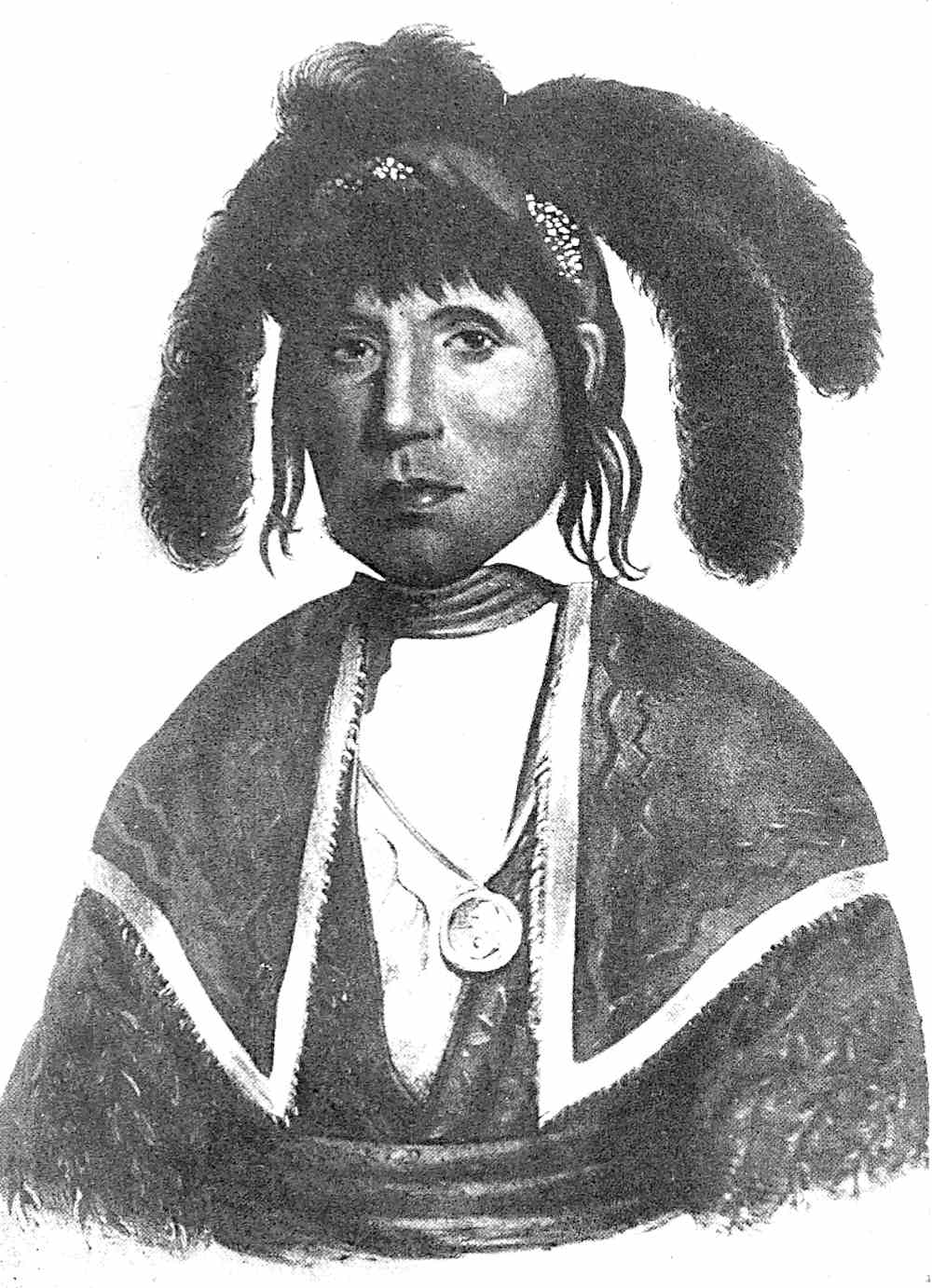
Courtesy of the Bureau of American Ethnology.
MICANOPY—HE WAS THE KING OF THE NATION
In the violation of the treaty, to use General Jessup’s
words, all was lost!
All the vengeance of the Indian was again aroused,
and the wild Seminole war-cry, “Yohoehee! yohoehee,”
again broke through the woods.
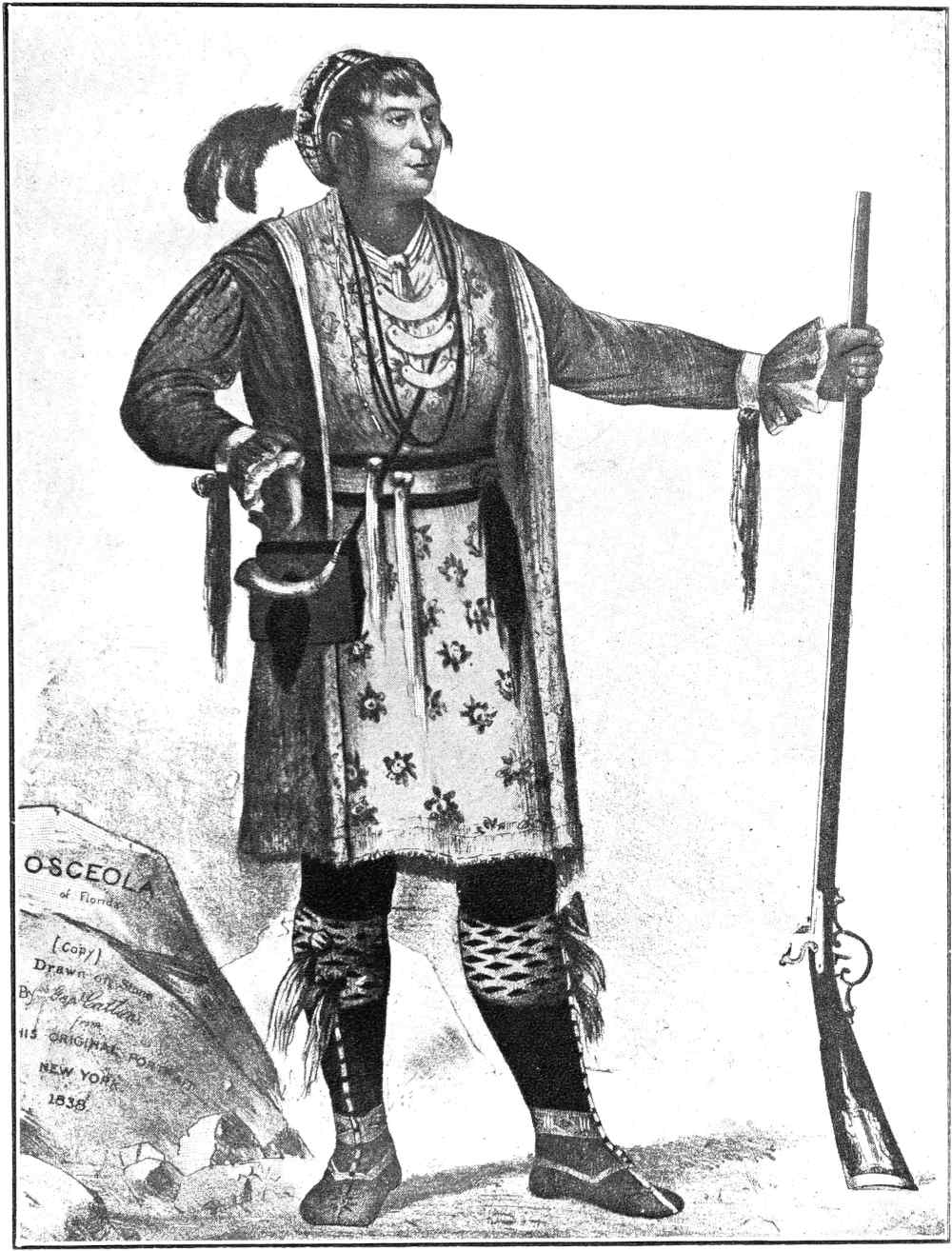
AS-SE-HE-HO-LAR, THE RISING SUN, OR OSCEOLA.
The fame of Osceola now reached the farthermost
corner of the land. His name, signifying Rising
Sun,[1] seemed prophetic, and he became at once the
warrior of the Ocklawaha, the hero of the Seminoles.
The youngest of the chiefs, he possessed a
magnetism that Cyrus might have envied, and in a
manner truly majestic led his warriors where he chose.
In the personal reminiscences of an old Florida
settler, in describing Osceola, he says, “I consider
him one of the greatest men this country ever
produced. He was a great man, and a curious one,
too; but few people know him well enough to appreciate
his worth. I was raised within ten miles of
his home, and it was he who gave me my first lessons
in woodcraft. He was a brave and generous foe,
and always protected women and children. An act
of kindness was never forgotten by him.” Osceola
had received a favor from one of the officers who led
the battle of the Withlacoochee. Observing him in
the front ranks, he instantly gave orders that this
man should be spared, but every other officer should
be cut down. Osceola’s father was an English
trader named Powell, and his mother the daughter
of a chief known as Sallie Marie, a woman very
small in stature, and with high cheekbones. Osceola
lacked this peculiarity, and was one of the finest-looking
men I ever saw. His carriage was erect and
lofty, his motion quick, and he had an air of hauteur
in his countenance which arose from his elevated
pride of soul. His winning smile and wonderful
eyes drew from an army officer these glowing words
of admiration, “But the eye, that herald of the
Soul, was in itself constituted to command. Under
excitement it flashed firm and stern resolve; when in
smiling it warmed the very heart of the beholder
with its beams of kindness. I tell you, he was a
great man; education would have made him the equal
of Napoleon. He hated slavery as only such a nature
as his could hate. He was Indian to the heart,
and proud of his ancestry. He had too much white
blood in him to yield to the cowardly offers of the
government, and had he not been captured, the Seminole
War would have been a more lasting one than
it was. I could talk all day about Osceola,” remarked
the old Captain, as he drew a sigh. “Did
the Indians take scalps, Captain?” “Take scalps?
Well, yes, if Osceola wasn’t around. He was too
much of a white man to allow it himself.”
The admixture of Caucasian blood stimulated the
ambition of Osceola’s Indian nature; his education,
together with the teachings of nature, made him
able to cope with the most learned. Living until he
was almost twelve years of age in the Creek confederacy
of Georgia, his youthful mind received deep
and lasting impressions from Tecumseh’s teachings.
To these teachings, as well as the blood he inherited
from his Spartan ancestors was due, no doubt, his
supremacy in the Seminole War. In the manner in
which he led the Seminoles may be seen the influence
of the great Shawnee.[2] Osceola’s power was in his
strong personal magnetism; he swayed his warriors
with a look; a shout of command produced an
electric effect upon all. He was a hero among his
people, he was feared and dreaded by our officers.
In this day, as we study his life and character, we
must recognize in the young Seminole fighter the
greatest of chiefs, the boldest of warriors. In an
old Greek fable, a man seeks to prove the superiority
of his race by reading to a lion accounts of various
battles between men and beasts, to which the lion
replied, “Ah, had we written that book other tales
would have been told.” In the case of the Indian
chieftain no such records exist, yet even from the
testimony of his enemies we must know Osceola.
Interviewing old settlers who well remember
events of those stirring times, one finds the heroic
part of Osceola’s character to have been not overdrawn
in history. The Seminole chief, Charles
Omatla, was an ally of the whites, and was attacked
and murdered by Osceola’s warriors. On his body
was found gold, which Osceola forbade his men to
touch, but with his own hands he threw the gold
himself as far as he could hurl it, saying, “it is the
price of the red man’s blood.”
Osceola’s pride was majestic; he was imperious,
full of honor, but with the quickness of the Indian
he noted the path to popular favor. His power was
recognized by the officers. “Talk after talk,” with
the Indians was the order of the times. It was at
one of these meetings that Osceola in the presence
of the commissioners attracted attention by saying,
“This is the only treaty I will ever make with the
whites,” at the same time drawing his knife and
striking it into the table before him. The cause of
this outburst was that the stipulations of the treaty
guaranteed no protection to the allies. He was arrested
for his insolence, but was released on a compromise.
His vengeance became more terrible than
ever, and in defiance “Yohoehee” echoed through
the woods and “war to the knife” was resumed.
ONE OF THE LAST SEMINOLE BATTLE GROUNDS
It was now that the daring chief made the bold and
well-conducted assault against the fort at Micanopy.
A short time after, this savage hero performed a
piece of strategy before unheard of in the annals of
war. Surrounded by two armies of equal strength
with his own, he carried away his warriors without
leaving a trace of his retreat. That host of Indian
braves melted out of sight as if by magic, and our
disappointed generals could not but agree that a disciplined
army was not adapted to the work of surprising
Indians. They were learning to recognize
the character of the men our nation had to deal with.
The Indian method is to decoy by a broad plain
trail, then at a certain distance the foremost of the
band makes a high, long step, leaves the trail and,
alighting on the tip of his toe, carefully smoothes
out the brushed blades behind him. The rest of the
band go on a few yards farther and make their exit
the same way, and so on till the end is reached.
Many times our troops made long night marches to
find—what? Nothing but a few smouldering
camp fires.
The war raged on in defiance of the power of a
mighty nation, a nation that had said to old King
George, “attend to your own affairs” and he
obeyed.
What shall we say of the capture of the great
Indian chief? Is not the seizure of Osceola America’s
blackest chapter? Was Osceola treacherous?
The United States failed to observe even one important
article of the three treaties made with the
Seminoles. Was Osceola a savage? It is not denied
that he protected women and children when he could.
It is not denied that the soldiers of the United States
shot down women and children, destroyed all dwellings,
crops and fruit trees they could reach.
OSCEOLA’S CAPTURE.
After months of warfare, a conference among the
Indians with a view to a treaty of peace was held.
An Indian chief was sent to the American quarters.
Picture, if you will, an American camp, in the
wooded wilds of Florida, and peer beyond the confines
of the magnolia and the palms and you see
a single Seminole chieftain, heralding his white flag.
He approaches our General, the representative of
proud and free America, and presents him with a
white plume plucked from the egret, with a message
from Osceola, with these words, “the path shall
be white and safe from the great white chieftain’s
camp to the lodge of Osceola.”
General Hernandez immediately despatched Coacoochee
with a pipe of peace, kindly messages and
presents.
What was the result? Osceola, in company with
Wild Cat and other chiefs, accepted the truce and,
under the sacred emblem of the white flag, met General
Hernandez on October 21, 1837 at St. Augustine.
With that grave dignity characteristic of the red
man, dressed in costume becoming their station,
with as courtly a bearing as ever graced Kings,
heralding their white flags they approached the place
of meeting.
History verifies the Seminole account of this blot
on our nation that, as the officers approached, they
asked of Osceola: “Are you prepared to deliver up
the negroes taken from the citizens? Why have you
not surrendered them as promised by your chief
Cohadjo?”
According to history, this promise had been made
by a sub-chief and without the consent of the tribe.
A signal, preconcerted, was at this moment given
and armed soldiers rushed in and made prisoners of
the chiefs.
An account of this violated honor, recently given by
the venerable John S. Masters, of St. Augustine,
Florida, is opportune at this point. The old soldier
in speaking of the affair said, “I was one of the
party sent out to meet Osceola when he was coming
to St. Augustine under a flag of truce.” “Did you
honor that truce?” was asked. “Did we? No sir;
no sooner was he safe within our lines than the
order to seize him, kill if necessary, was given, and
one of the soldiers knocked him down with the butt
of his musket. He was then bound and we brought
him to Fort Marion and he was put in the dungeon.
We were all outraged by the cowardly way he was
betrayed into being captured.”
At this violation of the sanctity of the white flag
our officers wrote: “The end justifies the means;
they have made fools of us too often.”
The foul means used to capture the young Seminole
leader was not blessed by victory, as a continuance
of the bloody war for five years proved that the
God of justice was not wholly on the white man’s
side. The stain on our national honor will last as
long as we have a history. Osceola with the other
chiefs was confined for a short time in St. Augustine,
but the daring savage was too valuable a prize
to trust on Florida territory, and he was taken to
Fort Moultrie where he died January 30, 1838, at
the age of thirty-four years.
It is related that Osceola on being questioned as
to why he did not make his escape, as did some of
the other chiefs from Fort Marion, replied, “I
have done nothing to be ashamed of; it is for those
to feel shame who entrapped me.” Chas. H. Coe,
in his Red Patriots says, “If the painter of the world-famed
picture, Christ before Pilate, should seek in
American history a subject worthy of his brush, we
should commend to him, Osceola, before General
Jessup. Osceola, the despised Seminole, a captive
and in chains; Jessup, in all the pomp and
circumstances of an American Major-General; Osceola,
who had “done nothing to be ashamed of,”
calmly confronting his captor, who cowers under the
steady gaze of a brave and honorable man!”
But such is the Irony of Fate. Osceola, the free
son of the forest, fettered by the chains of Injustice,
was destined to eat out his heart in a musty dungeon.
Thoroughly and thrillingly dramatic was the death
scene of the noble Osceola as given by Dr. Weedon
his attending surgeon. Confinement no doubt hastened
his death, and his proud spirit sank under the
doom of prison life. He seemed to feel the approach
of death, and about half an hour before the
summons came he signified by signs—he could not
speak—that he wished to see the chiefs and officers
of the post. Making known that he wished his
full dress, which he wore in time of war, it was
brought him, and rising from his bed he dressed
himself in the insignia of a chief. Exhausted by
these efforts the swelling heart of the tempest-tossed
frame subsided into stillest melancholy. With the
death sweat already upon his brow, Osceola lay
down a few minutes to recover his strength. Then,
rising as before, with gloom dispelled, and a face
agleam with smiles, the young warrior reached forth
his hand and in dead silence bade each and all the officers
and chiefs a last farewell. By his couch knelt
his two wives and his little children. With the
same oppressive silence he tenderly shook hands with
these loved ones. Then signifying his wish to be
lowered on his bed, with slow hand he drew from his
war belt his scalping knife which he firmly grasped
in his right hand, laying it across the other on his
breast. In another moment he smiled away his last
breath, without a struggle or a groan. In that
death chamber there was not one tearless eye.
Friends and foes alike wept over the dying chief.
Osceola died as he lived—a hero among men.
OSCEOLA—PATRIOT AND WARRIOR,
DIED, JAN. 30,—1838.
Such is the inscription, that marks the grave of the
hero of the Seminoles.
Even at this writing, it is a melancholy satisfaction
to know that the great Indian leader was buried with
the honor and respect due so worthy a foe.
A detachment of the United States troops followed
by the medical men and many private citizens, together
with all the chiefs, and warriors, women and
children of the garrison in a body, escorted the remains
to the grave, which was located near the entrance
to Fort Moultrie, Charleston Harbor. A
military salute was fired over the grave and as the
sound reverberated over the dark waters of the bay,
Justice and Patriotism, must have pointed with fingers
of scorn to our great Nation, yet with tender
pity, said “Osceola—the Rising Sun, may the
Great Spirit avenge you, keep you, love you and
cherish you,—the Defender of your country.”
THE HIDDEN WAR CAMP.
Wild Cat and Cohadjo were allowed to remain
in old Fort Marion the prison at St. Augustine,
Florida. Wild Cat feigned sickness and was permitted,
under guard, to go to the woods to obtain
some roots; with these he reduced his size until
he was able to crawl through an aperture that admitted
light into the cell. Letting himself down by
ropes made of the bedding, a distance of fifty feet,
he made his escape, joined his tribe and once more
rallied his forces against our army. Latter day
critics have questioned the correctness of this bit of
written history. Last winter, during the height of
the season, the Ponce de Leon guests enjoyed a
unique entertainment. A wealthy tourist made a
wager of one hundred dollars that “Wild Cat never
could have made his escape through the little window
in the old castle.” Sergeant Brown accepted
the wager and himself performed the feat, to the
great delight of the excited spectators.
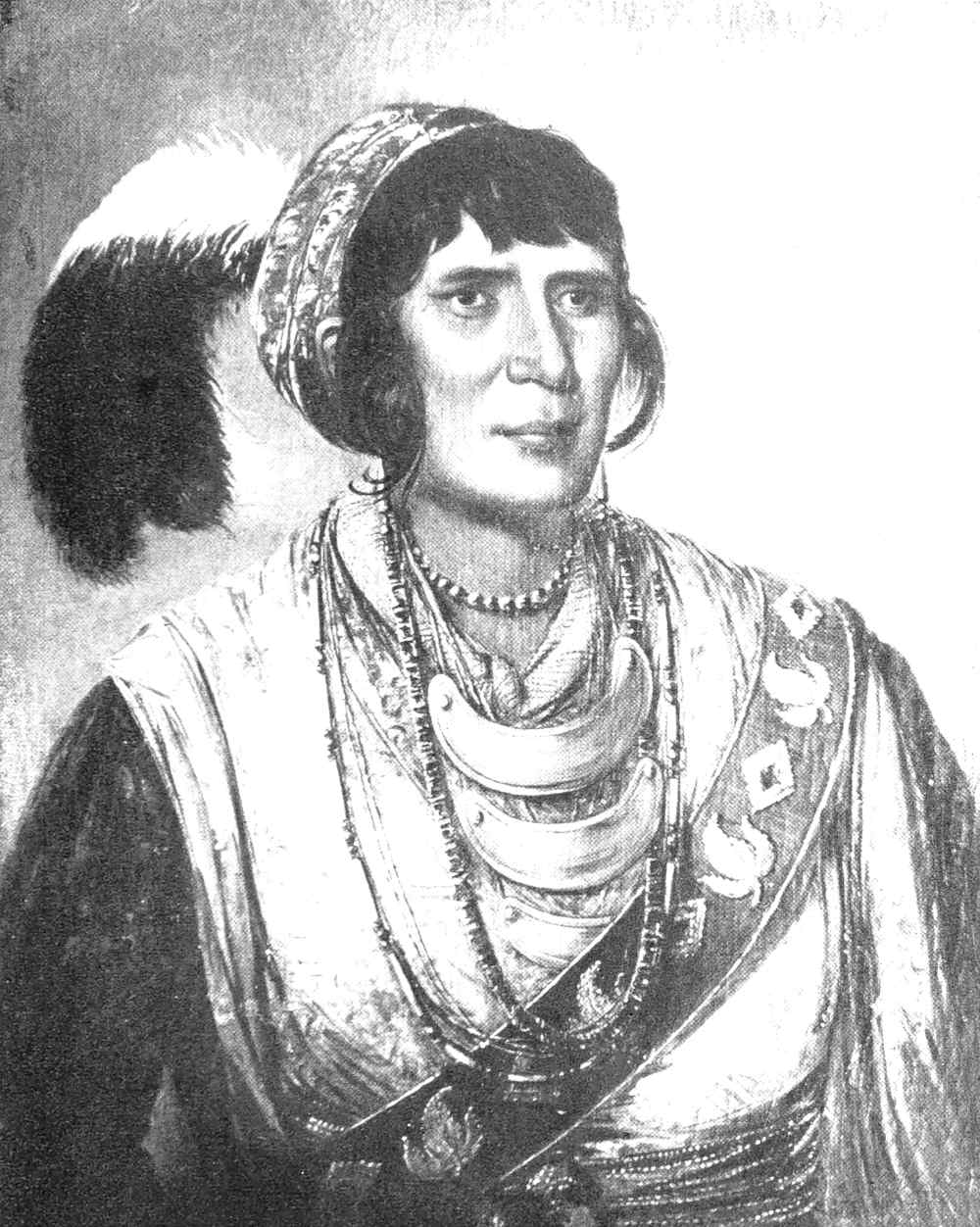
Courtesy of the Bureau of American Ethnology.
OSCEOLA
A copy from Catlin’s painting.
Our soldiers fighting in an unexplored wilderness,
along the dark borders of swamp and morass, crawling
many times on hands and knees through the
tangled matted underbrush, fighting these children of
the forest who knew every inch of their ground could
hope for little less than defeat. Even General
Jessup in writing to the President said: “We are attempting
to remove the Indians when they are not in
the way of the white settlers, and when the greater
portion of the country is an unexplored wilderness,
of the interior of which we are as ignorant as of the
interior of China.”
By way of illustrating the enormity of the task the
government had in subduing the Seminoles, it is only
necessary to describe one of the many Indian strongholds
in the swamps of Florida. About ten miles
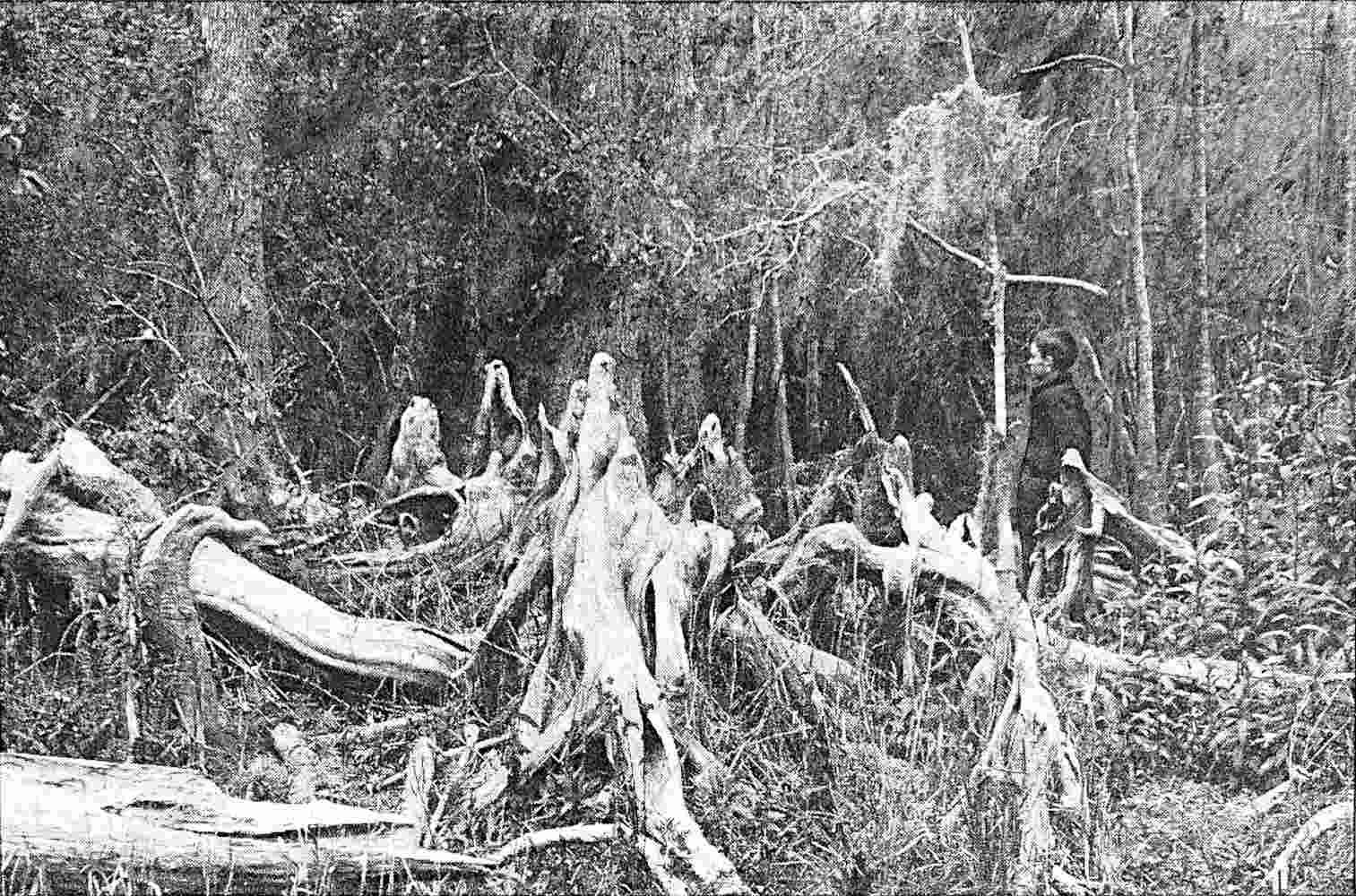
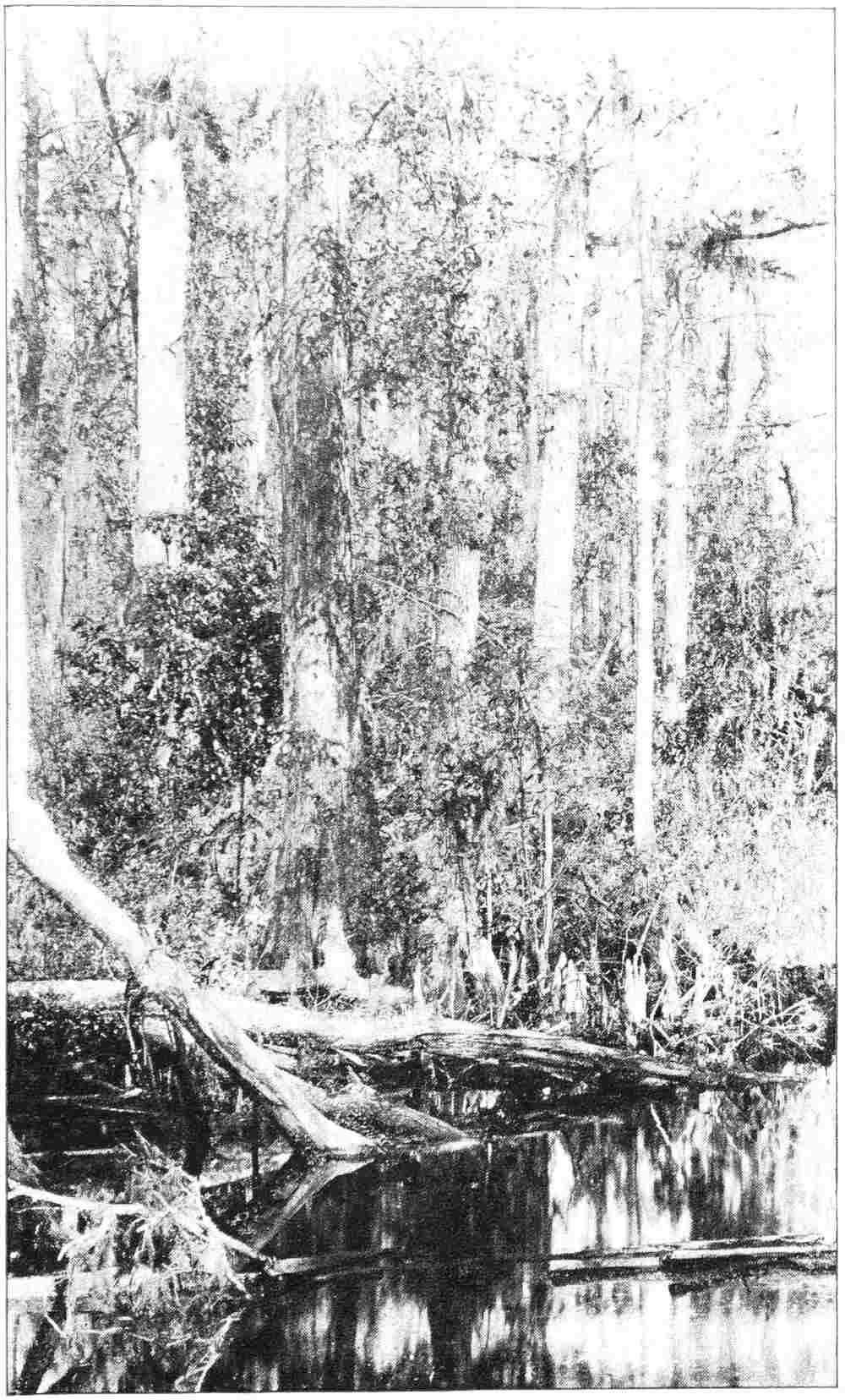
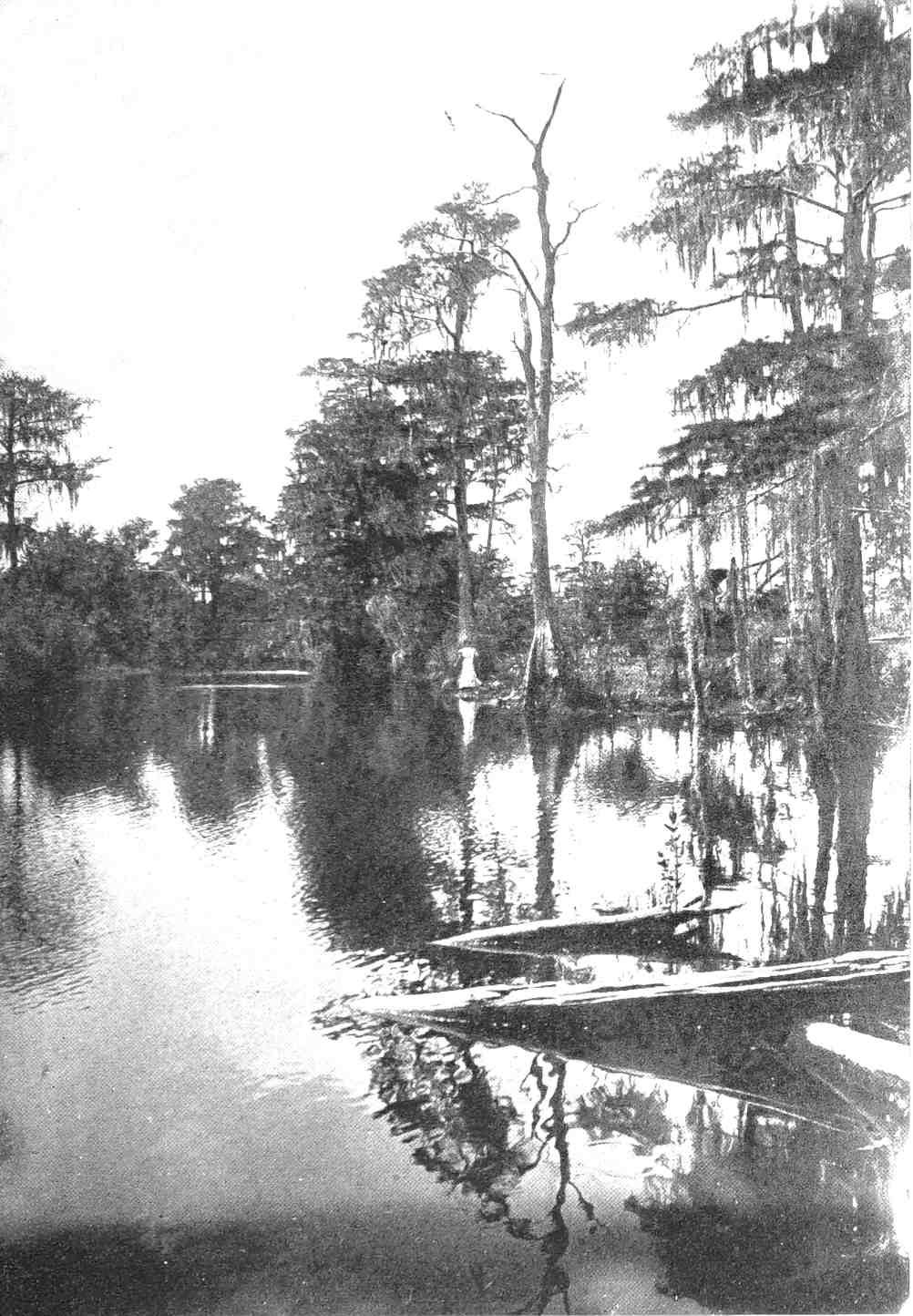
from Kissimmee, west by south, is a cypress swamp
made by the junction of the Davenport, Reedy and
Bonnett creeks. It is an aquatic jungle, full of fallen
trees, brush, vines and tangled undergrowth, all darkened
by the dense shadows of the tall cypress trees.
The surface is covered with water, which, from appearance
may be any depth, from six inches to six
feet; this infested with alligators and moccasins
would have been an unsurmountable barrier to the
white troops.
A few years ago when the Seminoles yet frequented
this section for trading purposes old settlers
have seen them coming from the swamp carrying bags
of oranges. Interrogations received no answers and
white settlers year after year searched for the traditional
orange grove, but without success.
So difficult to penetrate and so dangerous to explore
is the swamp that it was not until fifty years
after the Indians had left their island home that a
venturesome hunter, during a very dry season, accidentally
discovered the old Seminole camp. The Indian
mound, the broken pottery and the long hunted
for sweet orange grove were proofs of the old camp.
The majestic orange trees laden with golden fruit
were an incentive to further research. With a surveyor
working his way, as guided by the point of the
compass, this wonderland was explored, and proved
to be a complete chain of small hommocks or islands
running through from one side of the swamp to the
other; the topography of the marsh being such that
a skirmish could take place on one side of the jungle
and an hour later, by means of the secret route
through the swamp, the Indians could be ready for an
attack on the other side, while for the troops to reach
the same point, by following the only road known to
them, it would have required nearly a day’s marching.
The Indian trail is lost in the almost impenetrable
jungle; but the tomahawk blazes are perfectly
discernible. The Seminoles held the key to these
mysterious islands and in the heart of the great
swamps they lived free from any danger of surprise.
This retreat must have been a grand rendezvous for
them, as its geographical position was almost central
between the principal forts. Lying between Fort
Brooke (Tampa) and Fort King (Ocala), within
a distance of thirty miles from the scene of the Dade
massacre, about forty miles from Fort Mellon, the
present site of Sanford, the camp could have been
reached in a few hours by Indian runners after spying
the movements of the troops at any of the forts.
The old government road, over which the soldiers
passed in going from Fort Brooke to Fort Mellon,
passes so close to the old Indian camping ground
that all travel could have been watched by the keen-eyed
warriors.
WILD CAT AND GENERAL WORTH.
At this period of our national history we are unable
to picture or appreciate the condition of those
slave days, when all blacks of Southern States were
regarded as the property of the whites. The fear,
the torture, the grief suffered by the negroes and half
breeds, who had been a people with the Seminoles almost
one hundred years, is beyond our conception.
When Indian husbands were separated from wives
selected from the exiles, when children were torn
from their homes and carried to slavery, the vengeance
of these persecuted people was constantly
alive. Persons of disreputable character—gamblers,
horse thieves—were employed as slave catchers
and showed no mercy to the helpless victim.
After the violation of the treaty at Tampa, and
the capture of Osceola and Wild Cat, under the
sacred truce of the white flag, Wild Cat became a
most daring enemy to the troops, and kept his warriors
inspired to the most savage hostilities.
General Scott was now placed in command of the
army, yet the same harassing marches continued, and
it was not until seven generals had been defeated at
the game of Indian warfare by the wily chieftains
that any sign of success was apparent.
Our government, discouraged at being unable to
conquer the Indians or protect the white settlers,
again negotiated for peace, but using a more powerful
weapon than in former years, that of moral
suasion. Executive documents show that, all
through the war, artifice and bad faith were practiced
upon the Indians. The government was astonished
that a few Indians and their negro allies could defy
United States troops. All efforts had failed, even
to the horrible policy of employing bloodhounds.
To-day we shudder at the barbarity of such an act,
but official documents show how much the subject was
discussed by Congress and war authorities. A
schooner was dispatched to Cuba and returned with
thirty-five bloodhounds—costing the Government
one hundred and fifty dollars apiece. They were
speedily put upon the scent of Indian scouting parties,
but proved utterly inefficient. The public believed
the hounds were to trail Indians, but reports show
their use was to capture negro slaves. The Seminoles
were a species of game to which Cuban hounds
were unaccustomed and they refused to form acquaintance
with the new and strange objects. The
Indians had a secret peculiarly their own of throwing
the dogs off the scent, and the experiment, to close
the war thus, proved a failure and served no other
purpose than to reflect dishonor on our nation.
Wild Cat, after his escape from prison, was a terrible
and unrelenting foe. Occupying with light
canoes the miry, shallow creeks, and matted brakes
upon their border, he was unapproachable. A flag
was sent him by General Worth, but, remembering
well another flag which had meant betrayal, capture
and chains, the daring hero fired upon it and refused
to meet the general. In the summer of 1841, General
Worth’s command captured the little daughter
of Wild Cat and held her for ransom. The little
girl,—his only child—was the idol of the old warrior’s
heart. On learning of her capture, Wild Cat
relented, and, once more guarded by the white flag,
was conveyed to General Worth’s camp. History
gives an interesting account of the old chief’s approach.
His little daughter, on seeing him, ran to
meet him, presenting him with musket balls and
powder, which she had in some way obtained from
the soldiers. So much overcome was the fearless
savage on meeting his child that the dignified bearing
so carefully practiced by all Indians gave way
to the most tender emotions.
The moral suasion, the humanity of General
Worth made a friend of Wild Cat, and he yielded to
the stipulations.
The speech of the old chieftain, because it breathes
the same sentiment of the Seminoles of to-day, we
give below. Addressing General Worth, he said:
“The whites dealt unjustly with me. I came
to them when they deceived me. I loved the land
I was upon. My body is made of its sands. The
Great Spirit gave me legs to walk over it, eyes to see
it, hands to aid myself, a head with which I think.
The sun which shines warm and bright brings forth
our crops, and the moon brings back spirits of our
warriors, our fathers, our wives, and our children.
The white man comes, he grows pale and sickly; why
can we not live in peace? They steal our horses and
cattle, cheat us and take our lands. They may shoot
us, chain our hands and feet, but the red man’s heart
will be free. I have come to you in peace, and have
taken you by the hand. I will sleep in your camp,
though your soldiers stand around me thick as pine
trees. I am done. When we know each other better,
I will say more.”
Through the gentleness and humanity of the “gallant
Worth,” Wild Cat at this meeting agreed to
emigrate with his people. He was permitted to leave
the camp for this purpose. By some contradictory
order, while on his way to his warriors, he was captured
by one of our commands, put in chains and
transported to New Orleans.
When General Worth learned of this violation of
his pledge he felt the honor of our country had
again been betrayed, and acting on his own discretion
sent a trusty officer to New Orleans for the return
of Wild Cat. General Worth by this act not
only showed the nobility of his own character, but
proved that the savage heart can be touched with
kindness and is always keenly alive to honor and
faithful pledges. Moreover the justice of the act
had much to do with the successful turning of the
war.
When the ship which brought the chief reached
Tampa General Worth was there to meet it and
publicly apologized to the brave old warrior for the
mistake that had been made. Our gallant commander
had proven his humane heart, although at
expense of both time and money. Through the
policy of General Worth, the whole character of the
war was changed. On the 31st of July, 1841, Wild
Cat’s entire band was encamped at Tampa, ready to
be transported to their new homes.
The original idea of re-enslaving the fugitives was
abandoned. General Worth and Wild Cat now became
the most ardent friends, the general consulting
with the famous chieftain until every arrangement
for the removal was perfected. Seeing a chief
of such prominence yield to emigration, band after
band gave up the fight and joined their friends at
Tampa. From the time of Wild Cat’s removal in
the fall of 1841, until August, 1843, small bands of
Indians continued to emigrate. General Worth now
advised the withdrawal of the troops. A few small
bands throughout the State refused to move, signed
terms of peace, however, by which they were to confine
themselves “to the southern portion of the
Peninsula and abstain from all acts of aggression
upon their white neighbors.” As vessel after vessel
anchored in Tampa Bay to carry these wronged and
persecuted people to their distant homes, the cruelty
of the undertaking was apparent to the most callous
heart. With lingering looks the Seminoles saw the
loved scenes of their childhood fade away. The
wails and anguish of those heart-broken people, as the
ships left the shores, touched the hearts of the most
hardened sailor. They were leaving the graves of
their fathers, their happy hunting grounds, beautiful
flowery Florida. But it is the destiny of the Indian.
Among that band there was not one voluntary exile.
Poets and artists picture the gloom, the breaking
hearts of the French leaving Acadia; at a later day
the same sad scenes were witnessed on the Florida
coast, but it was not until years after that a philanthropist
gave to the world an intimation of the melancholy
picture of these poor struggling, long hunted
Seminoles leaving the shores of their native lands.
INDIAN WARFARE.
There is something intensely sad in the history
of the Indians who were left in Florida at the close
of the “seven years’ war.” Keeping faith with their
promise to abstain from all aggression on their white
neighbors, retiring to the uninhabited marshes of
the Southern Peninsula, they lived happy and contented
for thirteen years. Then came reports of
outbreaks and the United States again opened military
tactics with the resolve to drive this brave
and liberty loving remnant from their last foothold
on Florida soil.
According to the most authentic reports, the
trouble was brought on by some white engineers encamped
near the border of the Big Cypress. It was
in the year 1855 and the United States was making
a general survey of Florida. Old Billy Bowlegs,
recognized as the head of his tribe, and living at
peace with all the world, had a fine garden in this
swamp and in it were some magnificent banana
plants, which were the delight of the old Indian’s
heart.
As the old warrior visited his garden early one
morning, he discovered some ruthless hand had
ruined his garden. They were deliberately cut and
torn to pieces. Going to the engineers’ camp, he accused
the men of the outrage, when they insolently
admitted it, refusing to make amends, and saying that
they wanted to “see old Billy cut up.” And they
did!
The government paid for it to the extent of several
thousand dollars, a number of lives and adding
another dark page in the history of our Nation.
No white man would have submitted to the outrage,
neither did the famous Chief. Summoning his
braves early the next morning, the war cry “Yo-ho-ee-hee,”
was heard and Lieutenant Hartsuff and
his men were fired upon, some of them being
wounded.
Like a flash of electricity the news encircled Florida,
and Billy Bowlegs became the target of many old
muskets.
Then came the clamor of white settlers for the removal
of the “savages” and white guerrillas dressed
and painted as Indians went about the country robbing
and murdering mail and express riders, driving
off stock, burning houses and committing other
lawless deeds. Old inhabitants tell of these depredations.
But there was a reason for such cowardly
acts. The Government at Washington was perplexed
and, not grasping the fact that the raids were perpetrated
by white men, disguised as Indians, believing
that military forces could do nothing towards breaking
up the warfare, designed the plan of offering the
sum of $100 to $500 for living Indians delivered at
Fort Brooke (Tampa) or at Fort Myers.
After Governmental hunting for three years, the white
guerrillas still busy with their malicious depredations,
Old Billy Bowlegs, with his band of one hundred and
fifty persons, was induced to emigrate, but they
went with sore unwillingness, silent or weeping towards the
land of the setting sun, driven before the power of
the white man, a group of broken-hearted exiles.
INTERLUDE ‘DAT SEMINOLE TREATY DINNER.’
The author begs the indulgence of the reader in
giving the following dialect story of that historic
Treaty Dinner, when our gallant American General
Worth made peace terms with the Indians in 1842.
The treaty was signed at Fort King, now the present
site of Ocala, Florida, and as one listens to the
story of that eventful day, a story complete in its
setting as told by our old Bandanna Mammy, the
heart throbs and the pulse grows quicker—so vivid
is the recital.
As the tale is related a most picturesque scene
comes before the mind, the garrison with its stack
of arms, dusky warriors mingling with American
soldiery, glittering sunshine and singing birds, tables
spread under the great live oaks, joy on every
countenance—the end of the Seven Years’ War.
Because this old ante-bellum slave is a bright link,
forging as it were, those olden days of warfare with
the present, a few words of her individuality must
interest.
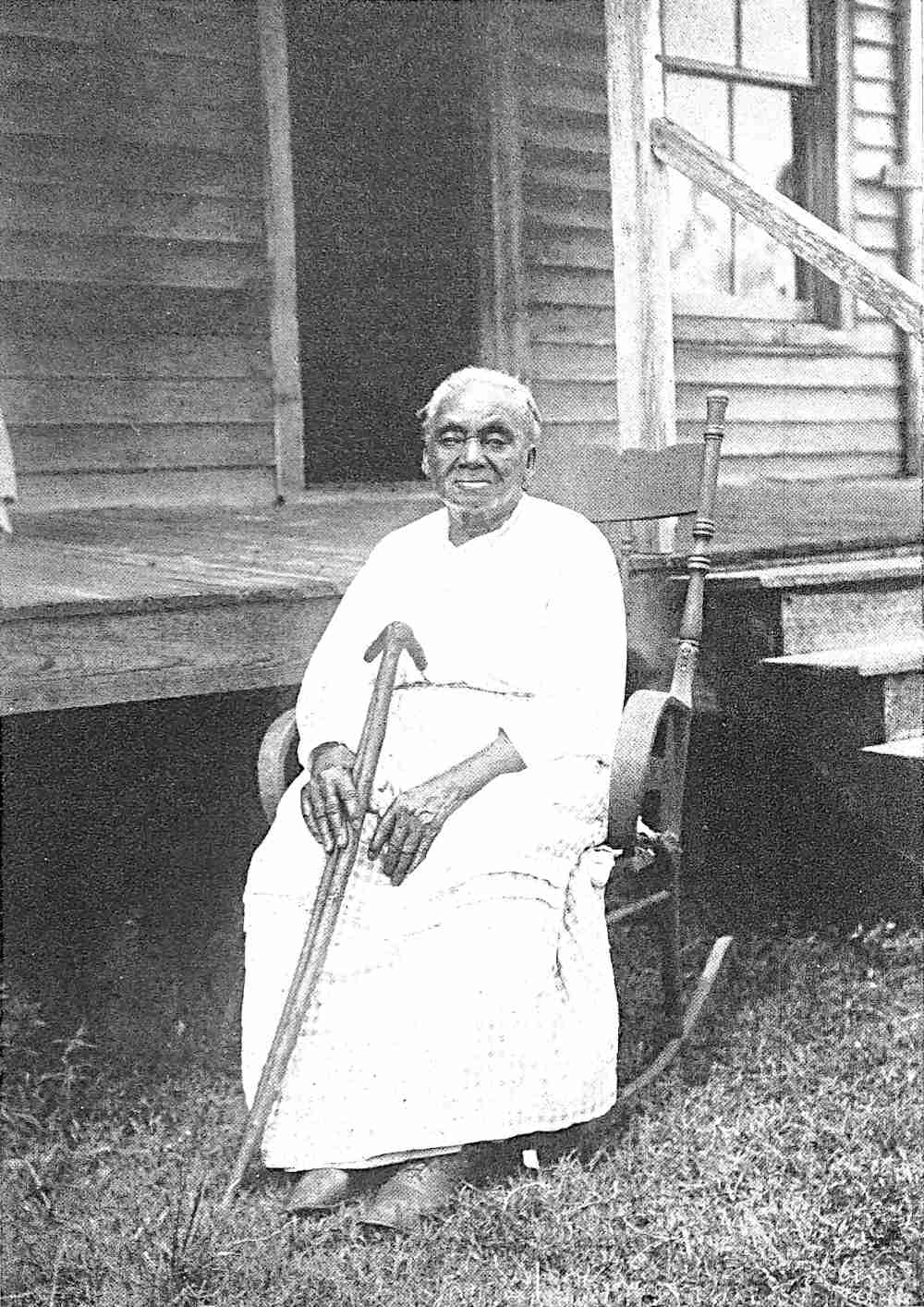
Martha Jane, for so she was christened full ninety-five
years ago when, a little shining black pickaninny,
her birth was announced to the mistress of the old
Carter plantation, is the true type of the old time
loyal, quaintly courteous Bandanna Mammy of ante-bellum
days. Leaving Richmond about 1839, she
was brought to Florida with a shipload of slaves.
Since that time her life has been a rugged and an
eventful one—a servant for the wealthy, nursing
the sick, sold again and again, hired out, and, since
freedom, working for her daily bread.
This white haired relic of Old Virginia is worthy
a place in the pages of history. She is old, decrepit
and poor, the muscles of her once powerful arms
are shrunken and her hands gnarled with the labor
of years, but she has a memory as keen as when almost
80 years ago she watched the “stars fall”
from the upper windows of the Old Swan Hotel in
Richmond. She has kept pace with many points in
history, particularly of the wars of the country.
As the old dame—a study in ebony—rocks back
and forth in the creaking split-bottom chair, memory
runs back to the imperial days of Virginia when the
cavalier was supreme, and she the pampered nurse
girl of the little mistress. She says, “Oh, dem was
dream days. I hab nebber seed any days like ’em
since. De mounfulest day I ebber seed was when
dey took me from my mistress, for the sky was a
drippin’ tears and de wind was a groanin’.”
“No, honey, dey ain’t stories ’bout dem Seminole
war days, dey is de Lord’s blessed truf, what ole
Marthy see wif dese same ole eyes.
“Oh, dem wuz high times! I reckelmember dat
Krismas day jest like hit wuz yisterday; the sun wuz
a shinin’ an’ de birds a singin’ (you see, de mokin’
birds didn’t sing while dat cruel war wuz a goin’ on)
an’ ebbery body wuz a laughin’ an’ a talkin’ an’ de
white ladies wuz a coquettin’ wif de sojers an’ dem
Indians wuz as thick as hops an a laughin’ an’ a jabberin’
too.
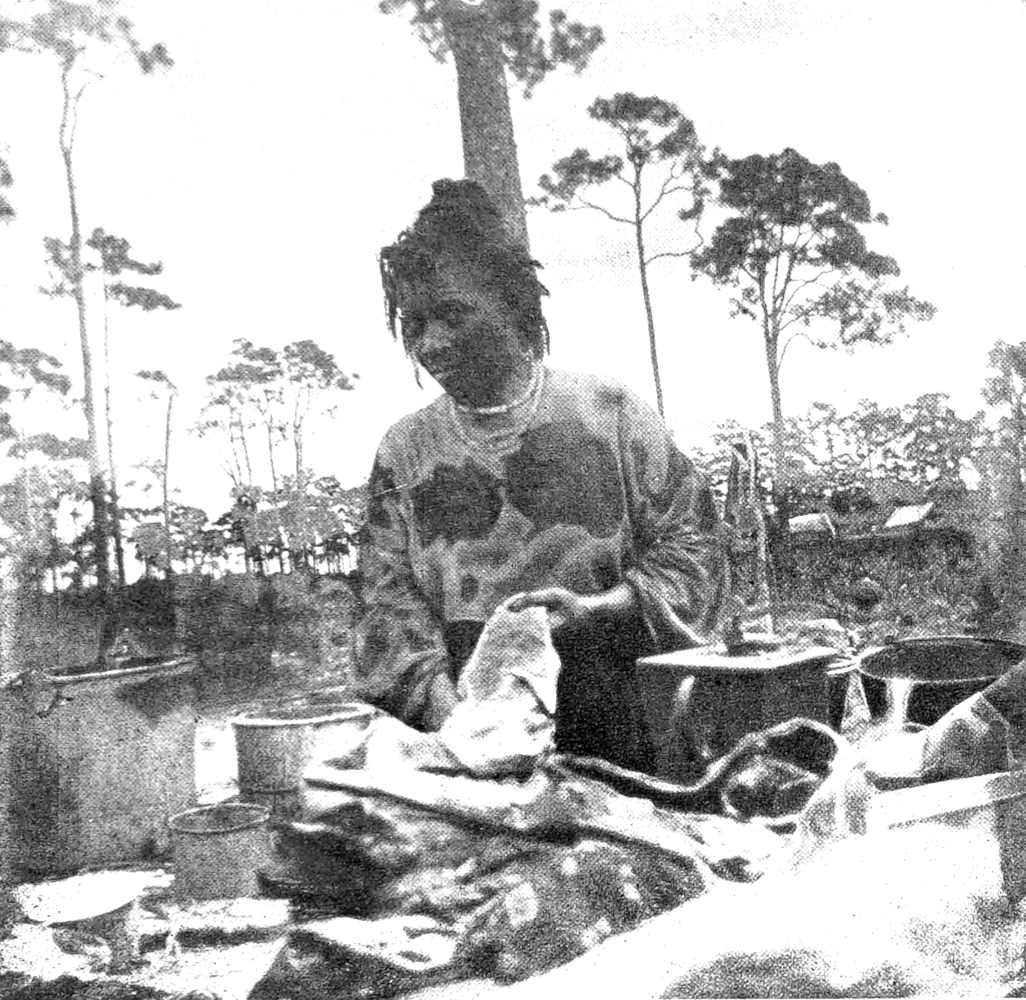
MARTHA JANE, “BANDANNA MAMMY” who cooked the Treaty dinner for General Worth in 1842. Now living in
Kissimmee.
“When Colonel Worth see dem long tables settin’
under the big live oaks an’ see dem beeves an’ muttons
an’ turkeys an’ deer we cooked, he jest natchelly
laughed an’ say, ‘Clar ter goodness, what kin’ o’
Krismas doin’s is dis’; an’ how dem sojers an’ Indians
did eat.
“How come I ter cook de treaty dinner?
“Well, I wuz livin’ out on ole Marse Watterson’
plantation, ’bout four miles from Fort King,
dats to Ocala, now, you know, an’ Jim, dat wuz
Colonel Worth’s servant, he ride out on dat big white
horse o’ de Colonel’s an’ say ‘Colonel Worth want
Marthy Jane ter cook de treaty dinner;’ so me an’
Diana Pyles an’ Lucinda Pyles cook dat dinner.
“Oh, Lordy, what scufflin’ roun’ an’ jumpin’ like
chickens wif der heads off as we do dat day.
“All de sojers’ guns an’ de Indians’ guns, too,
wuz stacked in dat garrison, an’ when de night come,
dey make big camp fires an’ de white folks dance an’
de Indians wuz a dancin’ too, wif dem ole coutre
(terrapin) shells a strapped ’roun’ der legs.
“Tell you ’bout Colonel Worth? He wuz de
gem’men ob all dat crowd; he wuz de nobles’ lookin’
man an’ so kind an’ easy; de United States nebber
would hab conquered dem Seminoles if dey had not
induced Colonel Worth ter come down an’ argufy
wif dem. Him an’ old Captain Holmes wuz de mos’
like our folks ob any ob dem big generals.
“Arter dey had all eat, an’ eat dem fine wituals
we cook, den dey hab de speech makin’; oh, dat wuz
high ’stronomy talk!
“I reckelmember jest like hit wuz to-day, me an’
Diana Pyles wuz a standin’ right inside de garrison
an’ dat noble-lookin’ Colonel Worth wuz talkin’ kind
an’ persuadin’ like ter dem savages an’ axin’ dem all
ter come up an’ sign de treaty.
“You see dat treaty wuz foh dem ter quit fightin’
an’ go ter Arkansas.
“All dem chiefs walk up but two. Oh, Lordy
mercy I kin jest see dat Sam Jones yit standin’ close
’side Colonel Worth. He wuz sut’n’ty a big Indian
an’ could talk English good as we alls white folks.
“He jest look at de Colonel pizen like an’ I smell
de trouble den, an’ he up an’ say, ‘My mother died
heah, my father died heah, an’ be demned I die heah;
yo-ho-ee, hee-ee!’
“How dat Indian could gib dat war whoop; an’
he walk right ober yonder ter dat big stack ob guns
an’ take his rifle an’ ebbery Indian ob his band follow’
’m an’ dey walk out ob dat garrison as easy as
a cat arter a mouse.
“Colonel Worth did look so peaked, but twan’t
no use, foh he couldn’t stop dese chiefs; he hab gib
dem the promise dat if dey would all come in he
would treat ’em all right.
“Dem wuz cruel days,” and old Martha Jane
quivered with indignation as she brought her fat hand
down upon her knee. “But hit wasn’t de Indians’
fault. No man what hab a gun is gwine ter let
somebody steal the cattle an’ horses, an’ dat jest what
de white people do ter de Seminoles.
“Lord a mercy, I hab seed Paynes’ Prairie covered
wif de cattle an’ horses dat ’longed ter de Indians,
an’ de white rapscallions would carry ’em off
a hundred at a time. Umph! I heah ’em brag how
dey carry off de Indians’ horses. Ole Thorpe Roberts
he wuz a ole fief. He would say, ‘We make
many a good haul ob dem savages’ cattle, ten ob us
come in at onct an’ drive off a thousan’ head.’
“Yes, Mistis, dat ole Seminole war make a heap
o’ white folks rich in Florida.
“Oh, Lord hab mercy on all dem souls. Dey
wuz hard times, times o’ misery, chile, but de Indians
wuzn’t ter blame. God make ’em an’ dey hab ter
hab a place ter stay, jest same as we alls white folks.
“De white people bring all dat ’struction on der
own heads foh dey commence dat war. I see hit wif
my own eyes; I see ’em kill de Indians’ slaves. You
see de Seminoles hab slaves jest de same as white
folks, an’ some ob der niggers wuz as fine-lookin’
black men as you ebber ’spect ter see in Ole Virginia.
“When de Indians would come ’roun’ ter esquire
’bout der cattle de white rapscallions (an’ a heap o’
dem wuz dem low down nigger traders too) dem
white men would up an’ shoot de Indians.
“Lordy chile, when I gits ter ruminatin’ ’bout dem
days I sees de longes’ line o’ haunts whats obtained in
dis world o’ sin an’ sorrow.”
I laid down my tablet and looked up; the old woman’s
lip was quivering from suppressed emotion.
Passing over the tragic she began again.
“No, chile, ’xcusin’ ob de truf, de United States
nebber whipped de Seminoles; she whipped dem Britishers
when George Washington wuz de captain, an’
de Mexicans, den she tuck a little ’xcursion ’cross ter
Cuba an’ whipped dem Spaniards; but she nebber
whipped the Seminoles. Umph; where wuz de Indians
when de sojers wuz all shinin’ in dem new uniforms
an’ der ammunition all packed up? Dem savages
wuz all gone, hidin’ in dem hammocks an’
swamps what wuz so thick wif trees an’ bushes dat a
black snake could skacely wiggle through.
“De sojers would go marchin’ ’long an’ way up in
de tops ob some ob dem big trees some ob dem sly ole
Indian scouts would be sittin’ wifout any clothes on,
a watchin’ an’ a laughin’ at de sojers.”
“You want ter heah ’bout dat battle o’ Micanopy?
“De Seminoles didn’t hab no battles like dem Britishers
in George Washington times; no chile, but dey
hab scrummages an’ kill de white people jest like dey
wuz black birds,” and the old negress, seemingly
oblivious to the fact that cruel time has bowed her
frame and dimmed the once bright eye, lives over
again the story of those days so long ago, when she
was the pampered slave of the old aristocracy.
“How come I ter see dat big fight, I b’longed ter
Marster Mundane; de Mundane fambly wuz powerful
rich and owned the big hotel where the officers
wuz stayin’.
“Der warn’t no Indians ’roun’ der jest den, an’
ebbery thing wuz peaceful an’ quiet, an’ I heah de
sojers a jokin’ an’ sayin’ day wuz jest a spendin’ de
winter in de Sunny South an’ de Governmen’ wuz
payin’ de grub bills.
“I reckelmember jest like I am tellin’ you ter day,
I wuz standin’ on dat big piazza ’side o’ Missus;
you know I wuz riz up ter be ’roun’ white folks, foh
I wuz allus so peart dat my ole Missus in Virginia
would call me in ter de parlor ter show me off ter de
white ladies.
“Well, honey, dis mornin’ de sojers wuz a cleanin’
der guns an’ laughin’ an’ dey ax Mistis, ‘How many
deer you want foh dinner?’ Den anudder likely
young sojer would say, ‘How many turkeys you want,
Mistress Mundane?’ an’ den dey went off a whistlin’
an’ a singin’; but oh, my God, what lamentations der
wuz dat same night.
“Twan’t long will I heah, bang—bang—bang,
an’ I says ter myself, Marthy Jane, too many deer,
too many wild turkey, sound ter me like Indian
shootin’; ’spect dem rapscallions sneak up on de sojers,
an’ dis black chile gwine ter see foh herself. I
jest slipped out o’ de house an’ kachunk! kachunk!
I went down that big lane as fas’ as a horse can trot
till I come ter de prairie an’ den I clumb in ter a big
oak tree, den de nex’ thing I do I wrap dat gray moss
’roun’ me so dem debbils couldn’t see me.
“How dem Indians did shoot! If dat sight didn’t
beat de lan’! Zipp—zipp—bang—bang, an’
ebbery time dey shoot dey yell like debbils, yo-ho-e-hee-eee
bang, den fall on de groun’ an’ load dat musket,
stan’ up an’ shoot again; de sojers a droppin’
ebbery time a Indian shoot.
“De sojers wuz so skeered dey couldn’t load der
guns when de Indians would gib dat Satan screech.
“An’ den de poor sojers jest dropped guns an’ run
in ter de lake an’ de woods an’ dem savages would go
an’ take de guns an’ de ammunition offen de dead
bodies an’ den go runnin’ like a deer.
“Lord a mercy, hit seems ter me I heah de wind
blowin’ ghosts an’ de sperits ob de brave gem’men
what wuz killed on dat field ebbery time I talks ’bout
dat day.
“Yes, Mistis, dat scrummage wuz called de battle
ob Payne’s Prairie. When de Colonel found out de
Indians killed so many ob de sojers, he tore roun’ like
a wild bear an’ clar ’foh de Almighty dat he wuz
gwine ter sen’ off an’ fetch de whole United States
troops ter come down an’ kill ebbery Indian in Florida.
“But what good wuz all dat big talk; dey hab two
regimen’s stayin’ der den, and ’foh dey could git outen
de garrison de sly ole Indians wuz all gone an’ didn’t
leave a track behin’ dem, nuther.
“Dem wuz days ob ’struction, ter be shure! but
dey mought ha’ knowed dat war wuz a comin’, kase
Daddy Charles see dem divisions in Virginia an’ tell
de white people great ’struction ob war wuz a comin’,
he tell dem dat hit gwine ter wrestle wif a foreign
country, an’ den ’sides de divisions, de wild pigeons
come an’ dey wuz so thick you couldn’t see de trees
and de slaves kill ’em wif der hoe handles in de corn
field.
“Yes, dat big Seminole war did come,” said
Martha Jane triumphantly, “jest like dat ole saint
o’ black man tole de people.
“I ain’t nebber seed no lonesomer place like dat
Payne’s Prairie from dat day ter dis arter dey hab
dat skirmishin’.
“I see de folks lyin’ on de grass an’ de tall grass
blowin’ backards and forrerds, but dem sojers nebber
move. Den de men come an’ carry ’em ter de hospital.
I shrouded so many dat night dat I got hardened
jest like a dog wifout a soul.
“Colonel Whisler, he wuz a Yankee man, he sayd,
‘Marthy Jane, you orter hab been a man, you is so
nervy.’ Dat why I can’t eat hominy ter dis day, I
make so many poultices endurin’ ob de war ter draw
out de bullets; dey didn’t hab dem pizen balls o’
Satan like dey do in dese regenerate days since surrender.
“Arter dem scanlous time, Colonel Worth an’
Colonel Whisler ’cided dat dey mus’ go ter Fort
Myers to see how dem scrummagers wuz goin’ on
down dat way.
“De headquarter men ’low dey mighty nigh perish’d
foh sumptin’ good ter eat an’ tell ole Mistis
dey ’bliged ter hab me go ’long ter do de cookin’.
Colonel Whisler wuz one ob dese kind o’ captains
what want his coffee hot an’ all de victuals on de
jump.
“Dem wuz high camp-meetin’ times all de way.
In dem days de game wuz powerful plentiful, an’
dem victuals I cooked wuz a plum sight; deer, wild
turkey an’ ducks wuz a flyin’ wherebber der wuz a
pond o’ water. Um-um-m, didn’t I cook ’em de fine
victuals.
“Colonel Worth ’cided dey couldn’t kill de Indians
so he say he would jest campaign along an’ destroy
all der crops an’ burn der houses; he ’lowed dat wuz
better dan shootin’ dem; an’ oh Lordy, didn’t we eat
de corn an’ watermelons dem Indians raise.
“We march an’ we stop, an’ we march an’ we
stop, till hit wuz de Lord’s blessin’ dat we hab so
many horses an’ wagons.
“Oh, dem long wagon trains, wif sojers betwixt,
sojers in front an’ sojers behind.
“You see, de officers hab der wives along an’ some
mighty fine white ladies what wuz a visitin’ at de
garrison. Dem wuz shure camp-meetin’ days.
“Ole Billy Daniels an’ old man Strafford, dey wuz
along too; dey wuz ole men den. I ’spect dey both
dead afoh now.”
“I wuzn’t anyways skeery, but we sut’n’ty wuz a
long way from ole Mistress, mighty nigh two hundred
miles.
“Arter all dat camp-meetin’ frolickin’ Colonel
Worth ’cided he would come back ter Fort King an’
leave de sojers ter keep on destroyin’ at Fort Myers.
“Billy Daniels wuz obliged to ’scort us back, kase
he is de man what drawed de map of Florida an’ put
all de lakes an’ islan’s in foh Colonel Worth. He
couldn’t read, nuther write, but he could ’cite de
Seminole language like he hab book learnin’; he wuz
de interpreter foh Colonel Worth too.
“Hit sut’n’ty wuz scrumagen’ times arter me an’
Diana Pyles cooked dat treaty dinner foh Colonel
Worth.
“Mos’ generally de troops went a troopin’ north,
but dey lef’ some ob de sassiest white men I ebber
see top o’ earth ter guard de State; low down white
rapscallions.
“You see, hit wuz dis away, terrectly dey fin’ out
de Indians wuz all gone south dey make up dat dey
bes’ skeer our people so de United States would keep
payin’ dem government money.
“No, Mistis, hit wuzn’t de Indians dat did de
skirmishin,’ hit wuz de white rapscallions what wuz
hankerin’ foh dem government rations.
“Our people wuz rich den wif de big sugar plantations
an’ cotton fields an’ a heap o’ slaves an’ cattle
an’ horses; our folks didn’t want no war, but hit wuz
de poor white people dat rousted ’roun’ at night an’
kill de cattle an’ put moccasins on der ole foots, what
look as rough as alligators’ hides, den dey go an’
make tracks all roun’ like a hundred Indians been a
spyin’. Hit sholy did skeer our people, but twan’t
de Seminoles, kase de Indian is a debbil, but he ain’t
gwine ter stay ’roun’ Fort King when he done promise
Colonel Worth he gwine go ’way.
“Dem white men keep up dat debbilment till de
United States find out ’bout hit, an’ she say if dey
any moh o’ dat meanness foun’ out dat dey will
hang ebbery rapscallion what prowlin’ ’roun’ we alls
white folks houses.”
PART II The Florida Seminoles of To-day
PART SECOND — The Present Condition and Attitude of the Seminoles
To-day the Seminoles of Florida are a beggared
and spectral type of a once powerful race. And in
their swamp homes we find these brown-skinned people,
living in the primeval customs of their fathers,
little changed from the Indians De Soto found in the
“Land of Flowers,” or Columbus upon the little
island upon which he landed the weary and anxious
cargo of the frail Pinta, and of whom he wrote to his
Queen, “Because they showed much kindliness for
us, and because I know they would be more easily
made Christians through love than fear, I gave to
them some glass beads for their necks, some red caps
with which they were so delighted and entirely ours,
it was a marvel to see.”
Thus we have dispossessed the original owners of
as goodly a land as the sun ever shone upon, a land
that cost us nothing but the beads of the early adventurers
and the bullets of their successors, a race,
savages ’tis true, but heroes many of them, and proud
and courtly as their conquerors.
The American people expend thousands of dollars
annually in scientific research for antiquities and
many more thousands are spent by the antiquarian
for the preservation of the relics and ancient records.
The North American Indian is fast vanishing from
the continent. Are not the Seminoles of Florida,
the descendants of the old monarchs, this race around
which shadowy romance hovers, as worthy of preservation
as the inanimate treasures of ancient Egypt?
Are there no Rameses in American history? In the
old turbaned tribe of Florida, we have a remnant of
the most picturesque, deserving and moral of all the
Aborigines of America, and they belong to a type
that is everywhere else extinct. Are they not worth
preserving and protecting to a point worthy the
proud and historic name of Seminole?
Secure in the mysterious marshes, these Indians
present an eloquent picture of a helpless wandering
tribe.
At the close of the war, a few bands of the Indians
refused to submit to banishment and, concealing
themselves in the fastnesses of the Everglades, made
their removal an impossibility. This part of the
tribe, according to their traditions, belonged originally
to the Aztec race and for this reason they
claim a preëminence over all the tribes of Aborigines
of America.
Though defeated in war, they never submitted to
the Government of the United States, and hence regard
themselves as more valiant in defense, more determined
in purpose than that part of the tribe which
succumbed to emigration to the Indian Territory;
in fact, the old chieftains say of the Indians who emigrated,
“Arkansas Indians, cowards and traitors.”
So to-day the Seminoles of Florida occupy a unique
position with respect to the United States Government,
as, being unconquered and unsubdued, having
no legal existence nor allegiance to our Nation; in
short, so far as the United States is concerned officially,
there are no Indians in Florida.
The tribe to-day numbers about 600 souls, living
at peace with all mankind, independent, but suspicious
of Washington officials, only asking to be let
alone, a homeless people in a free land, ever pushing
on before the insatiable cupidity of the white man.
An inexorable decree has forced the Florida Indian
into the most desolate lands of Florida. Where
they once trod as masters they now fear to place foot.
We cannot be unmoved by the thought that here are
the tattered and poverty stricken handfuls of a tribe
of warriors that held at bay a strong government for
half a century, a tribe that counted their cattle,
their lands and their slaves in magnificent proportions.
At the present time, to avoid complications
with the South Florida cattle herders none of the race
are permitted to own cattle. There is a certain
pathos in the Indian’s story of his relation to the
white race, which arrests our attention and compels
sympathy. But, it is destiny! What of the future?
Touch any point in the red man’s history, where you
will, or how you will, and the helpless savage always
gets the worst of it.
There is no use in muck-raking about it. We are
leisurely taking our time at finishing the extermination
of the original American. Whether or not the
future historian chronicles this as a century of dishonor,
the fact remains that, since he could not withstand
the white faces, the Indian will go—pass out
of existence.
We judge the Indian too harshly. It is hard to
give up old traditions, especially if the adherence to
them means a life of ease. We are all in the pursuit
of that which will make us happy.
The story is the old one of merciless extinction of
the lower race before the higher. It is a story of
the “survival of the fittest.” The Florida Indian
can go no further. An old anecdote is brought to
light which illustrates the Indian’s own view of the
case. The famous Seneca chief, Red Jacket, once
met a government agent, and after pleasant greetings
they both sat down on a log, when Red Jacket asked
the agent to “move along.” The agent did so and
the chief followed. This was done several times,
the agent humoring the whim of the old chief, until
he had reached the end of the log, when the same request,
“move along” was repeated. “Why,
man,” angrily replied the agent, “I can’t move along
further without getting off the log into the mud.”
“Ugh! Just so white man want Indian to move
along—move along; can’t go no further, yet he say
move along.” And so with the Seminole to-day.
The clearings they have made in the forests and the
only homes they have ever known have been bought
from the State by speculators and they are compelled
to “move along.” The history of the western Indian
as he sells or surrenders the heart of his great
reservation proves that the white man will have his
way. The broken treaties of the past the Seminole
has not forgotten. The old chiefs are as proud as
the most imperious king. They regard these lands
as their own, and cannot understand the Government’s
claim. They say “What right has the big
white chief at Washington to give to us what is already
ours—the lands of our fathers?” The white
man who receives any confidence from the Florida
Indian must indeed possess great magnetism, for the
Seminole is suspicious of every overture and will mislead
his questioner on all occasions. And while the
white man is studying “poor Lo,” “poor Lo” is
similarly engaged in studying him, and continually
revolving in his suspicious mind, “what can pale face
want from the Indian anyway?”
The chiefs have taught the young braves all about
the outrages perpetrated upon their tribe by unscrupulous
agents during the wars; and while the Indians
themselves in many cases practiced cruelty, it was
always in retaliation for some grievous wrong of
anterior date. History records case after case of
robberies and enormities committed on the Seminoles
previous to the war and during its progress. Micanopy
requested a lawyer to draw a form of writing
for him which soon after proved to be a conveyance
of a valuable tract of land! Afterwards the war-whoop
and the deadly hand of Micanopy was heard
and felt among the swamps and prairies. Micanopy
was one of the most powerful, as well as one of the
wealthiest Seminole chieftains. His estate, a mile
square, he ceded to the United States. Of the disposition
of his slaves—he had eighty—nothing
is said.
In connection with the portrait of Micanopy as
used in this volume, this bit of almost forgotten history
is worth mention. When the famous Indian
portrait painter, Catlin, was commissioned by the
War Department to paint the most prominent chiefs
then in captivity at Fort Moultrie, Micanopy, as
chief of the Nation, was first approached, but positively
refused to be painted. After much persuasion,
he at last consented, saying, “If you make a
fair likeness of my legs,” which he had very tastefully
dressed in a handsome pair of red leggins,
“you may paint Micanopy for the Great Father,”
“upon which, I at once began,” says Catlin, “as he
sat cross legged, by painting them upon the lower
part of the canvas, leaving room for the body and
head above.”
When the chief saw every line and curve brought
out on the canvas he smiled his approval, and the
work proceeded, to the delight of both artist and
subject.
In the mutual relations between the whites and the
Indians it requires no skilled advocate to show on
which side must lie the wrongs unrepaired and unavenged.
Without doubt the Indian has always been
the victim. One thing is certain, the Indian chiefs,
when fairly dealt with, have always evinced an earnest
desire to make just terms. Ever since the Caucasian
landed on the shores of America, a white man
with a gun has been watching the Indian. Four centuries
have gone and with them a record of broken
treaties and violated pledges. The records of the
Indian Bureau support the statement that, before the
first half of the present century had passed, we had
broken seven solemn treaties with the Creeks, eleven
with the Cherokees; the Chickasaws and Choctaws
suffered too, saying nothing of smaller tribes. History
reveals how well the Delawares fought for us in
the Revolutionary War. They were brave “allies,”
fighting out of loyalty to the “Alliance,” and inspired
by the promised reward, viz.: “The territorial
right to a State as large as Pennsylvania and a right
to representation in our Congress.” But where are
the Delawares to-day? One remove after another
was made until we find only a remnant existing—some
with the Cherokees, and a few with the Wichita
agency.
A great deal has been written about the Florida
Indian which is not in accordance with facts. There
are many obstacles in the way of an intimate acquaintance
with their customs and home life. Living
as they do in the almost inaccessible morasses, their
contact with civilization has been regulated by their
own volition. Visitors, traders and government
agents have been denied their confidence, and it is
only on their visits to settlements for the purpose of
trading that they meet the white man. At such times
the Seminole is on the alert, ever suspicious, and to
the numerous interrogations applied to him by the
inquisitive stranger, his answer is an indifferent
“Me don’t know.” When questions become of a
personal character, touching upon subjects sacred to a
Seminole, he quietly walks away, leaving his questioner
wondering.
The Seminoles live to themselves, shun all intimacy
with the Caucasian, and their personal appearance is
therefore almost unknown to Americans. The
greater part of the tribe seldom, if ever, leave their
marshy homes. To reach their camps uninhabitable
wilds must be traversed and sometimes miles of mud
and water waded, then perhaps only to find the
camp deserted. For, while the Seminole has regular
settlements, at various times during the year the
entire camp will assemble at some point where game
is abundant and a “big hunt” will occupy a few
weeks. Again syrup boiling will be the festival all
will join in; at another time a large quantity of
koonti (wild cassava) will be made into flour. At
these gatherings the tribe or families occupy temporary
dwellings called lodges.
The innate dislike of the Seminole toward
strangers is his hardest prejudice to overcome; yet he
is hospitable when he convinces himself that the visitor
is no Government agent, nor come for any mercenary
motive. The person who is fortunate enough
to reach their hunting grounds, secure their confidence,
observe their weird home life, and their
childish untutored ways, meets with an attractive
spectacle of romance and may study these aborigines
in their primeval customs. For to-day, with the
exception of the chiefs and a few of the adventuresome warriors, they know nothing of the innovations
of the last half century. So strong are they in their
resolution to hold no intercourse with our nation, that
neither bribery nor cajolery will have any effect upon
them. A few years ago an effort was made by the
authorities of the Sub-Tropical Exposition at Jacksonville,
Florida, to secure a few of the Seminole
braves for exhibition. After many proffered bribes,
the young warriors with the adventurous spirit of
youth consented to go to the “big city.” A council
was held and the chiefs said “halwuk (it is bad);
if you go you never come back.” The council of the
chiefs is always respected and the young braves remained
with their fathers.
By the courtesy of the American Bureau of Ethnology.
A SEMINOLE DWELLING
The life of the Seminole has been without any aid
or instruction from the white man. He has adopted
a few of the implements, weapons and utensils of
civilization; but in no other way has he imitated his
pale-faced brother. In the natural course of evolution
he has made some progress; he has not degenerated.
Government reports show an annual appropriation
of almost $7,000,000 for the Indian service; yet the
Florida Indian has not received any part of it and
without it he has shown a prosperous condition.
The Smithsonian report, in comparing this interesting
people with the native white settlers, says “that
success in agriculture and domestic industries is not
to be attributed wholly to the favorable character of
the climate and soil; for, surrounded by the same
conditions, many white men are lazy and improvident,
while the Seminoles are industrious and frugal.”
President Cleveland in his message for 1895 pertinently
says, “In these days, when white agriculturists
and stock raisers of experience and intelligence
find their lot a hard one, we ought not to expect Indians
to support themselves on lands usually allotted
to them.”
Years later, while the late lamented ex-President
was fishing in New River at the edge of the Everglades,
he said, “This country was made for the
Seminoles and they should be permitted to live here
undisturbed forever.”
Yet in Florida, we find the red race not only self-sustaining,
but refusing any aid from our Government.
Twenty years ago the Government appropriated
$6,000, “to enable the Seminoles of Florida
to obtain homesteads upon the public lands, and to
establish themselves thereon.” A few of the Indians
consented to accept; but the agent, on investigation,
found that the lands which the Indians desired had
passed into State or Improvement Companies. Today
the Seminole is embittered; and, having been
driven from one reservation to another, he refuses to
exchange “Indian’s good lands for white man’s bad
lands,” and in the bitterness of his conquered spirit,
takes his dusky tribe to the dark shadows of the cypress
swamps, where no pale-faced Government officer
dare disturb him. Again Congress tacked an
item to the appropriation act, giving $7,000 “for the
support of the Seminoles of Florida, for the erection
and furnishing of a school for teachers and the furnishing
of seeds and implements for agricultural purposes.”
In the winter of 1889, an agent inspired
with confidence in himself, and with the hope of
manipulating a $12,000 appropriation, came to
Florida by appointment from Washington to renew
the effort “to find suitable lands upon which to settle
the Indians, and to furnish the seat of an educational
establishment.” Securing an interpreter the agent
visited the Indian camp. A council of chiefs listened
quietly to his overtures, but with the same
proud spirit of Osceola’s day, they refused firmly to
accept any aid from a Government which they regard
as having stolen from them the lands of their fathers.
As the agent dwelt on the presents the red men of
Florida should receive from the big white chief,
Tiger Tail, a worthy descendant of the invulnerable
Tustenuggee, replied, “You came from Great Chief?
You say that Great Chief give Indian plow, wagon,
hoe?” Then pointing in the direction of a small
settlement of shiftless whites, he added, “He poor
man, give ’em him. Indian no want ’em.” Delivering
his speech with the spirit of an old Norse King,
the chief strode majestically away, leaving the agent
no nearer the fulfillment of his trust.
An Indian Agency was established, however, in
Florida in 1892, located east of Fort Myers, and
about thirty-five miles from the nearest Seminole
camp. It was supported by a yearly appropriation
of $6,000, the appropriation act reading, “For the
support, civilization and instruction of the Seminole
Indians in Florida $6,000, one-half of which sum
may be expended at the discretion of the Secretary
of Interior in procuring permanent homes for said
Indians.”
The Government built a saw mill, and attempted
a school, but the Indians, according to the statement
of Col. C. C. Duncan, U. S. Indian Inspector at
that time, refused to send their children to the school
or to work at the saw mill. Many white traders who
purchase hides, plumes and furs from the Indians,
tell them that the establishment of an agency is for
the purpose of rounding them up and sending them
west. These Indians have been cheated and baffled
so often by knaves, who go among them for that purpose,
that they imagine all whites to be of the same
character, and cannot tell whether a “talk” comes
from their great white father at Washington, or
whether some imposter be imposing upon them for
his own gains; hence, the Seminole never removed his
cloak of suspicion. Little progress was made and
the work of the agency as a government institution
was abandoned.
Once or twice it has been tried to locate the Seminoles,
but when the chiefs examined the land, they
found it “ho-lo-wa-gus” (no good) and they refused
the offer.
NATIONAL INDIAN ASSOCIATION Its Work and its Results
When the National Indian Association first organized,
like many innovations in humanitarian work,
it met with rebuffs and criticisms, and not until after
five years of petitioning to Congress, newspaper
recognition and the circulation of leaflets, did the
splendid body receive legal recognition and protection
for the United States Indians. With this much
accomplished, the work became easier and plans to
evangelize the Indians of the United States were instituted.
It became the duty of the Association to gather
money for the work, establish stations, one by one,
finance the expense of building mission cottages and
chapels, and then when established, give the station,
with all its property, to whichever of the denominational
boards should ask for it.
The work has been one of the noblest of pioneer
mission labor, for its activities are directed to America’s
original owners, whose God-given inheritance
should never be questioned by any patriot, whether
he be Christian or moralist.
In 1891, this organization entered Florida and the
Seminole Indians received recognition and the first
ray of Christian light pierced the dark camps of the
Everglade Indians.
While the missionary in charge found the work
difficult and results were not flattering, still, the seeds
were sown that have brought later and better results,
and in 1893 the Mission was transferred to the
Episcopal Church of the South Florida Diocese.
During the period of the National Organization’s
stay in Florida, Congressional agitation of the subject
of Seminole lands was aired by deeply interested
friends and pauseless workers, and resulted in the
voting of 800,000 acres of land by the Florida Legislature
as a home for the Seminoles, a gift needing action
on the part of Congress to make it a sure and
permanent home for this long-neglected people. But
this action alas! was never taken.[3]
In giving the Florida Station over to the Episcopal
Church, the National Indian Association made no
mistake, for through the untiring efforts of the Rt.
Rev. William Crane Gray of the South Florida diocese,
the mission has each year been getting better
results. The Station has been named Im-mo-ka-lee
(home), and is situated about thirty-five miles from
Fort Myers. Forty miles farther is a hospital, called
Glade Cross; here an immense white cross has been
erected at the entrance to the glades.
The present arrangement, under the charge of the
estimable Rev. Dr. Godden, seems to be solving
the mission question better than any former plan.
The mission owns a store where the Indians may
buy or sell; the missionary in charge may meet and
converse personally with the Indians; he wins their
friendship and is able by degrees to instill religious
thoughts into them. The Rev. Dr. Godden is working
along industrial lines, and says, “We must fit
these Seminoles by education and Christianity to meet
the coming conditions, and teach them to become self-supporting
by industrial pursuits and now is the time
to do it.”
The work proposed is to erect suitable houses for
the residence of the missionary and his family with
sufficient room to entertain visiting Indians when in
over night and a barrack or rest room for laborers
employed in clearing land and working crops.
Writing in 1909 of the work and Mission, Dr.
Gray says:
To Bishops, Clergy and Laity of
The American Church, Greeting:
I desire to commend most heartily my well-beloved in the
Lord, Rev. Irenæus Trout, Missionary to the Seminole
Indians in Southern Florida. I believe that God has in a
marvelous way designated him as the very man to go forward
with the work in which he has already been signally
blessed, viz: that of leading the Seminoles into the Kingdom
of our Lord Jesus Christ. We are now at the very crisis
of opportunity.
Hear him and help him. Here is a cry, not from Europe,
Asia or Africa, but from the Everglades, in your own
Florida: “Come and help us!” A thousand prayers accompany
him from this Missionary District.
God gives you the privilege of helping this poor Seminole
remnant into the kingdom.
Faithfully,
For Christ and the Church,
(Seal)Wm. Crane Gray, Bishop of Southern Fla.
The Cathedral Church
Of St. Luke,
Orlando, Fla., Jan. 15, 1909.
THE FRIENDS OF THE FLORIDA SEMINOLES.
A few years ago great interest was manifested in
these Florida wards, when a Society called “The
Friends of the Florida Seminoles” was organized at
Kissimmee, Fla., with the Rev. William Crane Gray,
Bishop of the South Florida Episcopal Church, President;
Rev. D. A. Dodge, Vice-president; Mr. James
M. Willson, Jr., Secretary, and State Senator C. A.
Carson, Treasurer. Other officers (trustees) were
the late George W. Wilson, Editor-in-chief of the
Florida Times-Union; Hon. J. R. Parrott, President
of the Florida East Coast Railroad Co., and Capt.
F. M. Hendry, Fort Myers, Fla.
This body, assisted by the active interest and
sympathy of Gov. W. D. Bloxam, Mr. P. A. Van
Agnew, and Mr. Kirk Munroe, made it possible for
the Society to accomplish its State-wide results, numbering
among its members philanthropic people from
Maine to California.
The object of this society was to enlist the sympathy
of the American people for these homeless
people and to strenuously oppose the removal of the
Seminoles from the State against their consent. No
really true American, whether he be an Indian sympathizer
or not, can feel any but sympathy for the
Florida Seminole if he understand the true status of
his condition, and when the Society of the Friends
of the Florida Seminoles was established, a great
wave of sympathy was felt all over the country and
requests for membership came in from all ranks,
the highest circles of finance, from social leaders,
educational centers and government officials. It was
recognized an honor to belong to the organization.
The membership list is still open and the Society
earnestly appeals to the people of America to take a
friendly interest in the future fate of this forlorn remnant,
who are one of Florida’s most native possessions,
and to aid in securing for them permanent
homes in the unsettled portions of the State before it
is too late.
The interest and work of the Society was greatly
aided through the editorial columns of Harper’s
Weekly, when Edward S. Martin made an appeal in
behalf of that band of Seminoles known as the Cow
Creeks. The object was to purchase a tract of land
on which was located about seventy-five Indians.
They had lived here for thirty years, cultivating part
of the land and using the rest as a range for their
hogs, but as they had no legal title to the land, they
were at the mercy of squatters who coveted them.
About four hundred dollars were raised, but when
the attempt was made to locate these Indians, cowboys
and land-grabbers had alarmed them, by telling
them that the Government was getting ready to
round them up and take them West, and like frightened
deer they left their homes and retired again to
the swamp fastnesses.
The Society purchased some fields upon which the
Indians were camping with Harper’s fund—the remainder
of the funds being held in trust for its original
purpose. The Society secured great public sentiment
in their favor, and hoped to obtain lands
through legislation. Centuries of wrong from hands
too powerful to be resisted have taught these red
Americans the patience of despair.
Amid the blessings of Christianity, the Seminole
is an outcast from sympathy and an alien to hope, yet
he has never ceased to be manly. While we protect
the deer and the alligator, the quail and the fish, shall
we leave our brother in bronze a prey to the lawless
and a helpless victim of every loafer?
The only way to protect these wards of Florida is
to buy a reservation, and hold it in trust for them—forever.
Even at this writing, that trackless waste of saw-grass
and water with its scattering islands and lagoons,
constitutes the great political question among
Florida people—the drainage of the Everglades.
A SEMINOLE CAMP-FIRE The Indian mode of making a fire.
We cannot but admire the proud and independent
spirit of the Seminole as he refuses, in firm but Indian-like
measures, the proffered liberality of a Government
which he believes has wronged him. And,
from his high pinnacle of pride, he certainly bears the
distinction of being the only American who has been
found unwilling to share the spoils of the nation.
So he says, “We have listened to the great father at
Washington. The Great Spirit wishes no change in
his red children. If you teach our children the
knowledge of the white people, they will cease to be
Indians. To know how to read and write is very
good for white men, but very bad for red men.
Long time ago, some of our fathers wrote upon a little
piece of paper without the nation knowing anything
about it. When the agent called the Indians
together he told them the little paper was a treaty
which their brethren had made with the great father
at Washington, and lo! they found that their brethren
by knowing how to write, had sold their lands and the
graves of their fathers to the white race. Tell our
great father at Washington that we want no schools,
neither books, for reading and writing makes very
bad Indians. We are satisfied. Let us alone.”
After this speech delivered in the native tongue, the
council breaks up, and the proud Seminole betakes
himself to the Everglades. The Seminole is disposed
to make a child’s bargain with the big white
chief: “You let me alone, and I will let you alone.”
Photographs of the Carlisle Indian boys have been
used to illustrate the improvement which follows education;
but the Seminole youth turns away with disdain,
as he notes the closely shaven head and the
American dress, and says, “Indian no want books,
make ’em white man, white man mean heap lie too
much.” With a gesture faithful to the Indian, he
refers to the “long time ago, Seminoles had lands,
cattle, slaves; white man steal ’em.” This statement
of the Indians is corroborated by the old white settlers
of to-day, who fought the Indians. They tell
that General Jessup’s army, on coming to the great
cattle country of South Florida, began a systematic
slaughter of all the cattle found. A body of soldiers,
too large to fear an attack, would round up a herd
of the Indian’s cattle and sitting on their horses, shoot
them all down. Up to this time the Indians were
regular stock dealers, their customers being the Cubans
and Minorcans. General Jessup’s report of his
march into the “Indian country,” says, “On the 28th
(January, 1837), the army moved forward and occupied
a strong position on ‘Ta-hop-ka-li-ga’ Lake,
where several hundred head of cattle were obtained.”
The tribe to-day are taught by the chiefs to regard
the whites, in general, as lacking in honor and courage,
weak and insignificant, or in Seminole dialect, “white
man—ho-lo-wa-gus” (no good). This is easily
understood when we consider the strong attachment
an Indian bears to his native hunting grounds; and
when the memory runs back to the time when our
Government banished their friends and relatives to
the unknown wilds of the West, and they went silent
and weeping toward the setting sun. Their bitterness
is consistent with their ideas of injustices practiced
upon them.
History, romance and poetry have held up the
characteristics of the red man to our gaze from
childhood. And while treachery may be a distinguishing
feature of the Indian nature, yet the lowest
one of them has some conception of honor when
fairly approached. History shows that all through
the Seminole war, misrepresentations and dishonorable
schemes were practiced against them by the
whites. Almost universal sympathy goes out to this
remnant of people who fought so bravely and so
persistently for the land of their birth, for their
homes, for the burial place of their kindred. As
their traditions tell them of the oppression their people
suffered as they wandered in the wilderness thrice
forty years, who can tell the secret of their hearts?
To do this, it would be necessary to become, for the
time, an Indian, to put ourselves in his place—and
what white man has ever done this? Ask the waters
of Tohopeliga, or the winds that waft across Okeechobee.
To the elements are whispered the heart
throbs of these red fawns of the forest. The present
Florida Indians are descendants of that invincible
tribe who were never conquered by the force of arms.
Refusing in 1842 to accompany their people to the
mysterious West, they ceased to exist save for themselves.
Finding refuge in the almost inaccessible
Everglades, they were for a time almost lost to the
historian. They have no legal existence, and hence
no rights that a white man is bound, by law, to respect.
There are no Indian troubles in Florida at
present, but every few months a cry comes from hungry
land-grabbers, or from trappers and hunters, that
the Seminoles are killing off the deer and plume birds.
The changing conditions in the lower peninsular
country will eventually lead up to difficulties; and
“Where shall we locate the Indians?” becomes a
serious problem.
The Florida Times-Union editorially says:
All the murderous, cut-throat, unkempt and squalid Indians
in the United States whom the Government fears are
provided with reservations and such luxuries as they never
before had in their lives, but the Seminoles of Florida, the
finest specimens of Indian manhood in this country, clean in
body, pure in morals, and as brave as the lion that roams the
desert, with whom so many treaties have been wantonly
broken, are being driven farther and farther into the Everglades
and their hunting grounds confiscated to the land
grabbers. Is this justice?
Should the whites drive off the Seminoles, and thus
approve their greed for land by taking the possessions
the Indians now occupy, what good would it do
them? Internal improvement companies, by their
franchises, would sooner or later take the blood-stained
acres from them. Let settlers in Florida, or
in any part of the country, turn over their accounts
and see how many acres have been credited to them,
either from the State or from the general Government,
without the equivalent of homesteading or for
cash. The “Western” style of disposing of the
Indian’s inheritance must not be followed in fair
Florida. It seems hard that these natives who ask
no aid of our nation, should be forced to the wall
by the march of civilization. To the Western Indians,
under the protection of the Government, and
supplied in a large measure by the taxes which civilization
pays, pages are devoted by philanthropists for
the betterment of their condition. The rights of the
Seminoles of Florida should be defended. The day
is not far distant when they must be made to go to
the reservation in Arkansas or to lands set apart for
them in Florida. To remove them from their tropical
homes to the chilling blasts of the Indian Territory
would be an act of cruelty and wholly unnecessary.
Those of us who have enjoyed life in this land
of the palm, this land of the balmy air and life-giving
sunshine, reveling in the eternal bloom of the flowers
and the ceaseless song of the birds, can well picture
the struggle it would cost the patient Seminole to be
forced to a cold western land. No, fair Florida, the
ancestors of these proud people were forced to the
country of the setting sun silent and dejected. But,
with the spirit of Osceola, if they must perish, it will
be here—here upon the land of their birth, upon the
graves of their kindred. The lands they now occupy
are of little value to the white race and might be
made a safe reserve for them—forever. Cowboys
who hunt upon the Okeechobee plains, say the Indians
are peaceably disposed and friendly, and have
never yet disturbed or threatened. They are certainly
not foot-sore for the warpath and are fearful of
doing anything to arouse the whites. “Indian no
fight,” is the answer to the questioner. They have
sense enough to know that if war should come again
it would mean extermination for them; and their love
for the “Flower Land” is so deep that the thought
of exile would cost a struggle they dare not attempt.
Yet, feeble remnant that they are, with the same
heroic blood coursing their veins that inspired their
ancestors and made them almost invulnerable, the
present Seminole would choose to die rather than
submit to removal. And in their swampy fastnesses,
they could maintain a contest that would cost us
thousands of dollars and many precious lives.
OUR DUTY TO THESE WARDS OF THE NATION.
Under the present status the Seminoles are prosperous,
happy and contented. But the vanguard of
civilization is marching on, and thinking, friendly
minds must solve the question of the protection for
this remnant of a tribe we have dispossessed of their
natural rights. Dwellers of every land, from Scandinavia
to the Congo have a Christian welcome to
our shores. The slums of Europe pour in upon us
to fill our almshouses and to be supported by our
taxes. We have during the past quarter century contributed
more than $50,000,000 to the education of
the freedmen, yet except in individual cases, the
improvement is scarcely noticeable.
Men and women are sacrificing their lives for the
heathen of other lands. Is not the Seminole, this
remnant of a long-persecuted people, as worthy of
consideration as the oppressed Cuban or the half-naked
Filipino?
Christianity is donating millions of money to this
end, while our own “wards,” too many of them, are
yet living in the dark superstitions of their fathers.
Photograph by E. W. Histed.
CHIEFTAIN TALLAHASSEE, WITH HIS WHITE FRIEND, THE
LATE L. A. WILLSON
“The very history of the tribe is carved in poor Tallahassee’s face. He
is the incarnation of ‘The Man without a Country.’”
It is possible it will take time and patience before
any shining results are apparent. Not until confidence
is restored will the embittered Seminole yield
to the overtures of our Government. In an educational
sense the older Indians will not be benefited,
except through the influence of their children. The
logic of events demands absorption of this people
into our National life, not as Indians, but as American
citizens; and the sooner they can be induced to
accept lands from the Government, and education
for the youth, the sooner will the civilization of
the Seminole cease to be a theory. The permanent
duty of the hour is to prepare the rising generation
for the new order of events that must come.
Because these bands of the Seminoles are prouder,
more invincible than the old Saxons, because they
are savages, yet heroes many of them, all the good
of life should not be withheld from them. It has
taken years of labor to obtain the shining of even
the few rays of light that relieve the gloom of the
heathen countries of the Orient. It would be unreasonable
to expect the offspring of savages to attain
in a short time to anything like the thrift of a
Nation like ours. Yet, with a few years of humane
treatment, unviolated pledges, with Christian and
patriotic examples set before them, this little band of
Florida Indians would become worthy representatives
of this fair land.
Were any future danger to threaten the United
States, the Seminoles would be found to be brave
allies. The pledge to General Worth by this
remnant of hostiles, who, in 1842, refused to emigrate
with the rest of their tribe, temporarily agreeing
“to confine themselves to certain limits and
abstain from all aggressions upon their white neighbors,”
seems to be held sacred by their descendants.
The question was put to Billy Bowlegs, one of the
most intelligent of the present Indians, as to what
his people would do were the whites to encroach,
and take the clearings of his tribe are now occupying,
“Would Indian fight?” The young brave replied
with downcast face, “Indian no fight, Indian
no kill, Indian go.” Pursuing the subject further,
“but, Billy, by and by, may be one year, five years,
may be, white man go, take all your land, take
Okeechobee, then where will Indians go?” With
the same bowed head, the answer came low and soft,
“Me don’t know—Indian go.” Then to test his
idea of an ally, the question was asked, “What would
Seminole Indians do, Billy, if the Spaniards from
across the big salt water would come to fight the
white people of Florida?” Quickly and with spirit
came the answer, “Indians help white man to fight.”
Unless action be taken, there will come a time, when,
leaving no trace behind them, the Seminole shall
pass out of the world. He shall go, like the
mist.
We cannot undo the past, but the future is in
the hands of the people. In Canada there are over
100,000 Indians. They are called the Indian subjects
of His Majesty; all held amenable to the law
and protected by it. Statistics show that on one side
of the line the nation has spent millions of money
in Indian wars, while on the other, with the same
greedy Anglo-Saxon race, not one dollar has been
spent, and there has never been a massacre.
The caustic remark that the only good Indian is
a dead Indian might apply to the savage Apache;
but when one has studied the home life of the
Seminoles, observed their domestic felicity, from
which many white men might take example, noted
their peaceful, contented character, he can only see
in them an attractive race, and worthy the proud
lineage they claim. Surely if ever the strong were
bound to aid the weak, we are bound to help them,
to treat them as human beings, possessed of human
rights, and deserving the protection of American
law. This without doubt, they will be willing to accept,
when our nation by kind, courteous and honorable
means secures their lost confidence; and when
our National Christianity shall take measures to make
our land for them a home where they may dwell in
peace and safety.
CHIEF TALLAHASSEE.
Almost four hundred years have passed since that
fair April day when Ponce de Leon anchored on the
verdant shores of Florida. Since the Spanish cavalier
planted the silken flag of Spain upon her soil,
Florida has been surrounded by a halo of romance
and tragedy. Between the time of her discovery
and to-day, what marvelous scenes have been witnessed
upon her fair plains and along the borders
of her wild, dark rivers.
The ancient race who greeted the old Castilian
has vanished and, save in the little band of Seminoles
secreted in the mysterious and weird wilderness of
the Everglades, no trace of the red man is visible.
A description of a type of this fragment of a people
will enable the reader to form a better conception
of the tribe as a whole; and no name is more worthy
to place in these pages than that of Tallahassee.
The old chieftain in appearance is noble and intellectual,
and there is that in his look and bearing which
at once pronounces him something more than the
mere leader of a savage tribe. While his silvered
head marks the cycle of many years, in his attire
of scarlet and white, embraced by the traditional
brightly beaded sash, he exhibits a dignified and
patriarchial bearing. His countenance, while indeed
mellowed with the cares of four-score years and ten,
is kindly, and shows a conquered spirit. The lineaments
of noble features are traceable in the broad
forehead, the firm, thin lips, and eyes that might
pierce the rays of the sun. Tallahassee shows no resentment
to the whites, yet he believes that they have
treated the Indian badly.
It may seem strange to talk of gentlemanliness in
an untutored savage, but the demeanor of this Seminole
chief must dignify any family in the land. But
that face! Heaven forbid that any native of free
America should wear so sad, almost heartbroken an
expression as that which seams poor Tallahassee’s
face. No child could look upon it without being impressed
by its mournful pathos. The very history of
the tribe is carved there.
When Osceola, with his compatriots, went on the
warpath, Tallahassee was a small boy, and remembers
well when his father and a few companions
were surrounded and killed by the soldiers near Tallahassee,
the capital of the State. Chipco, the chief
of the tribe, was Tallahassee’s uncle; he escaped
from the soldiers, and made his way to the Everglades
where he lived to be nearly one hundred years
old. Rosa, the sister of Tallahassee, became his
squaw. They were childless, and at Chipco’s death,
Tallahassee inherited the title, but as a reward for
bravery displayed in saving his life on two occasions,
Chipco had made him chief years before he died.
There is no trace of a revengeful spirit in either
word or manner when Tallahassee speaks of his
father’s tragic death, but with the stoicism of a
philosopher, he seems to have accepted it as one of
the cruel fortunes of war, and has nobly “buried
the tomahawk.” Tallahassee is no stern warrior
with blood-stained hands, but wears worthily the
dignities of his ancestral station, and in many ways
might be imitated with profit by his more cultured
pale-faced brother. He is a true type of the “noble
red man,” and in any other walk of life would have
risen to eminence. Of all the Seminoles, Tallahassee
is the most friendly to the whites. With the inborn
courtesy that is native to all true greatness, this untutored
Indian will welcome you to his wigwam
and with royal grace dispense the hospitalities at his
command. Few enter his presence, and none leave
it without this mental tribute to his high character.
The old chief is treated with care and consideration,
and a homage is paid to him by the younger members
of the tribe. Among the Seminoles, when a member
of the tribe becomes too old for usefulness or self-help,
it becomes the duty of the young men to contribute
their share to his support. They are taught
to do this more as an honor than as a burden.
As the years pass, more pathetic grows the life of
the hereditary chieftain.
A few years ago, after numerous invitations, Tallahassee
was persuaded to leave his swamp home to
make a visit to the home of the writer. The old
patriarch was accompanied by Billy Bowlegs, who
showed the tenderest care for him. With one horse
between them they traveled from the Everglades to
Bassinger, the terminus of the steamboat line to Kissimmee.
Then they boarded the steamer Roseada, arriving
at Kissimmee after two days’ river travel.
They attracted much attention and were the recipients
of many small presents from sympathetic friends.
They were both in full costume, the old chief wearing
the regalia of his rank, sashes of bead work and
red beaded leggins. On reaching the home of their
host, they immediately began unpacking the bundle
they carried, which indicated they had been preparing
for many moons back for this eventful visit. Numerous
garments, new and fanciful, were carefully
withdrawn. The next morning being the Sabbath,
they dressed with greatest care for the Sunday School
and church services, which they enjoyed to the fullest.
Knowing the famous chieftain would attend service,
the church was crowded and at the close of the
services parents with their children crowded around
the old chieftain eager to shake hands with him;
and with a pleasant beam of gratitude in his eyes,
he received these greetings of the white friends.
It is a pleasing fact that Tallahassee, a savage and
the representative of an almost destitute people, received
a homage and as kindly a greeting as was
ever accorded to any visitor to the little city of Kissimmee.
However adverse a man may be to the
Florida Indian in general, if he looks into the history
of the Seminoles of Florida, he not only becomes
friendly, but eager to see justice meted out to them.
As Tallahassee bade “good-bye,” he said, “Me
no more come to Kissimmee City—old too much.”
He had come as an ambassador of his tribe to tell
his white friends the history of his race, and as
memory went back to the olden days of bloodshed
and accounts of home after home wrested from his
people, he trembled with suppressed emotion. Anguish,
interblended with the mournful pathos of his
face, made a picture too sad to look upon. It was
a period of agonizing struggle for this gallant, but
conquered Seminole.
Sad and prophetic were his farewell words, for
a short time after he reached his swamp home, he
was taken with violent pains in his head, and as Billy
Bowlegs reported it, “Pain three days—pain go,—Tallahassee
blind ojus” (heap). The old chieftain,
though totally blind and physically helpless, rules
his band with the same stoic will of days long ago,
when he carried them to the wilderness and wrenched
them from the white man’s bullets and Uncle Sam’s
bloodhounds.[4]
INCREASING.
It is generally believed that the Seminoles are dying
off, and can last but a few years longer. On the
contrary, they have large families of strong, healthy
children, and the past ten years has shown a marked
increase in their number. The strict law allowing
no persons of like gens to marry is a reason why the
tribe does not multiply still more rapidly. There
are instances where eligible young men find great
difficulty in getting wives because of the strictness
governing the gens or consanguinity law. One chief
has two daughters who find the same trouble in
getting married because the men of their choice are
too closely connected to them. Thus, a member of
the Deer clan may not marry into the same clan, no
difference how far removed the relationship may
be. Relationship on the father’s side is not guarded
against so strenuously, as the gens is all counted
through the mother. Very often the law of marriage
causes strange alliances—young men twenty
years of age having old women for wives. From the
best obtainable resources, there were in the year
1859, only one hundred and twelve Indians left in
Florida. In 1880, by actual count, as reported by
the Smithsonian Institute, the Seminoles of Florida
numbered two hundred and eight. According to data gotten from the Indians themselves the tribe
to-day numbers nearly six hundred. Of this number
a great proportion are young children, or in the
language of the chief as he made a numerical calculation
of the members of the different families—“heap
pikcanannies, pikcaninnies ojus” (plenty).
The Seminoles are divided into four bands, who live
in groups apart; each independent of the other, but
in friendly relation. They are the Miami Indians,
the Big Cypress band, the Talla-hassees and the
Okeechobees. Since the death of Woxo-mic-co
(Great Chief) five years ago, no one has been elected
to fill his place, and it is doubtful if his office will
ever be filled.
No event in the history of the Seminole tribe since
the closing of the war has been more tragic than the
slaughter of eight of the band, by the hand of Jim
Jumper, a half-breed belonging to the tribe. The
killing occurred in February, 1891. According to
the Indians, the negro had bought some bad whiskey
from a white trader, and it made him “crazy too
much in his head”—doubtless delirium tremens.
With his Winchester in his hand he started out.
The first victim was his faithful squaw who happened
to be close by. Rushing forward and through
the camp and meeting the venerable Woxo-mic-co,
head chief over all the tribe, who was on a visit
to the Cow Creek band from his council lodge at
Miami, the crazy half-breed sent a ball through the
old chief’s head, killing him instantly. Old Tom
Tiger, one of the landmarks of the Indian wars,
hearing the firing, came to the rescue, but was shot
down before he had time to interpose. Young
Tiger, stepping out of the wigwam in time to see
his father fall to the ground, with a blood-curdling
war-whoop sprang upon the maniac and a hand-to-hand
fight ensued; but he was at the wrong end of
the rifle, and before he could wrest it from his
antagonist, another report was followed by the
death-cry of the brave, young Indian. The wildest
panic ensued, the women and children huddling in
their wigwams or fleeing to the woods. The murderer
now rushed into the wigwam of his sister, and
with his knife murdered her and her two little children,
who were clinging to her dress in terror.
Brandishing his knife, he started into the woods,
where he was killed by a bullet from Billy Martin’s
rifle. The wailing and the anguish in that camp
can better be imagined than described. After the
burial ceremony over the murdered victims, the body
of the murderer was dragged far into the swamp,
to be fed upon by the vultures. Thus passed away
in less than half an hour eight innocent lives, victims
to the demoralizing influence of the white man’s
whiskey. The Indian village was broken up, the
entire band moving away to escape the visitations of
the spirits of the murdered ones.
Photograph by E. W. Histed.
A SEMINOLE GROUP OF THE TALLAHASSEE BAND, KNOWN AS THE COW CREEKS
A people without a country.
On the death of Woxo-mic-co, four candidates for
the position of Big Chief appeared, but five years
have passed and yet no chief has been elected. In
the old chieftain’s death the last vestige of Seminole
war spirit is obliterated. Nowhere in their history
is their determination to live at peace with their
white neighbors more conclusively proven than in the
abolition of the office of Great Chief, “Big Chief”
and war councils, in their minds, being inseparable.
The authority of the sub-chiefs, who are leaders
of the different bands, is purely personal; they cannot
decree punishment—a jury or council alone can
do this. The government is not harsh, and there
is as much freedom as could be possible in these
forest homes.
APPEARANCE AND DRESS.
In personal appearance, many a Seminole brave
might be taken as a type of physical excellence. He
is bright copper in color, is over six feet in height,
his carriage is self-reliant, deliberate and strong.
His step has all the lightness and elasticity that nature
and practice can combine to produce, as lithe
and soft as the tread of a tiger. The Yale, the
Harvard or the Oxford student with years of training
in the athletic school, would be but a novice in
the art of grace, suppleness and mode of walking,
as compared with this son of the forest. His
features are regular, his eyes jet black and vigilant,
always on the alert; his nose is straight but slightly
broadened, his mouth firm as a stoic’s. The hair
is cut close to the head, except the traditional scalplock
of his fathers, which is plaited and generally
concealed under the large turban that adorns his
head.
The dress of the Seminole chief consists of a
tunic embraced by a bright sash, close fitting leggins
of deer-skin, which are embellished with delicately
cut thongs of the same material, that hang in graceful
lines from the waist to the ankle, where they meet
the moccasin. The moccasin is also made of deer-skin,
and covers a foot shapely and smaller than that
of the average white man. A picturesque feature
of the dress is the turban. Oriental in its effect, it
has become the emblem of the race. It is worn
almost constantly; and is made impromptu from shawls or colossal handkerchiefs
wrapped round and round the head and then secured in shape by a
band, often made of beaten silver which encircles the whole with
brilliant effect. With young braves the more important the occasion,
the more enormous the turban. Another characteristic of the dress is
the number of handkerchiefs worn, knotted loosely about the neck.
Regardless of the temperature, the Indian adorns himself with six,
eight or perhaps a dozen of bright bandannas, exhibiting great pride
in the number he possesses. A belt made of buckskin completes the
costume. From this are suspended a hunting knife,
a revolver, a pouch in which is carried the ammunition
and small articles necessary for the chase.
The physique of the women will compare favorably
with that of the men. They are healthy and
robust, and among the younger members some
comely well-featured women are found. The dress
of the squaw is very simple, consisting of a straight,
full skirt, made long enough to hide the feet. The
upper part of the dress is a long sleeve, loose-fitting
waist, which fails to meet the waist band of the skirt
by about two inches; this oddly fashioned garment
is cut large enough in the neck to be put on or taken
off over the head. A large collar, fashioned after
the collarettes worn by the fashionables of the season
of 1896, completes the toilet. A Seminole woman
wears no head-dress of any description. Even when
visiting the white settlements they go with their heads
uncovered. Neither do they wear moccasins, at home
or abroad, in winter or in summer. They are
always bare-footed.
Vanity and coquetry are inborn in the female
character. The Seminole maiden whose life has
been spent among the swamps “far from the
madding crowd” and fashion’s emporium, still
practices the arts of her pale faced sister. She affects
the bang and the psyche knot with as much
ease as the New York belle, and with such metropolitan
airs soon captivates her forest lover. The
same passionate desire for gold and jewels, ever uppermost
in the heart of the civilized white woman, be
she peasant or queen, shows itself in the Seminole
squaw. Silver breast-plates, made from quarters
and half dollars, beaten into various designs, add to
their personal adornment on festal occasions. What
the turban is to the brave, such is the necklace
of beads to the woman. It is her chief glory and
is worn constantly. Her ambition seems to be to
gather as many strings of these highly colored beads
about the neck as she can carry, often burdening herself
with several pounds. Even the wee tots are
adorned with small strings of the much prized necklace.
Many years ago, when the Indians were encamped
on the Kissimmee River, Chief Tallahassee with two
or three of the squaws visited Kissimmee. Being
taken into a room to see a newly-born babe, he directed
a squaw to take from her neck a string of
beads and put it around the neck of the “little white
pappoose.” This was done as an act of greatest
honor, to show the Indian’s appreciation of hospitalities
received at this house.
INDEPENDENCE AND HONOR.
To-day as we meet the Seminole “at home,” we
find the wigwam made of palmetto leaves and the
skins of wild animals; the floor of this structure is
made of split logs and elevated about two feet above
the ground. A few of the Indians have in late
years built board houses, but the roof is made of
palmetto thatch. Here, surrounded by the gloom
and weirdness of the Everglades, miles from white
man’s habitation, the baying of the alligator, the
hooting of the great horn owl, and the croaking of
the heron are the only sounds to be heard. Truly
the picture is one of melancholy and profound dreariness.
But here we find the aborigines contented
because they are out of the white man’s power.
Here they hold their councils, here around the
camp fires the traditions of the old turbaned tribe
are taught to the youths; here, too, they follow the
same customs of the race of one hundred and fifty
years ago. Here is instilled into the youth the story
of the perfidies practiced upon their fathers by the
white man; and as the children listen to the glories
of Osceola, and the tragic ending of their hero, the
spirit of conservatism is engendered, and with swelling
hearts they go on, on, resolute in their determination
to avoid disaster, by keeping aloof from the
white man. Although far from the influence of
civilization, knowledge has come to these people
naturally which we have painfully acquired by books.
Driven to these Florida jungles after a seven years’
bloody war, here the Seminole, thrown absolutely
upon his own resources, has continued to dwell. He
has accepted no aid, his people have increased, and
in a manner have prospered. No alms-houses are
supported for their benefit. This independent Indian
does not increase the expense of the jail nor the
penitentiary; he is no starving Indian who must be
fed at the expense of the Government. In these
red sons of the forest we meet the original “real
Indian,” unchanged by contact with the white man.
The visitor to the “Wild West,” who complains that
“the Indians do not look like the Indians of fifty
years ago,” would have little ground for his complaint
were he to visit the Seminoles in their marshy
fastnesses. Florida can boast of one of the few
tribes of “real Indians” in the United States. The
present Seminole must be credited with a high sense
of honor; and he can keep a pledge as well as did
Massasoit. A few years ago, during a terrific coast storm
some Indian braves asked shelter of a Florida
settler. The Indians were received and entertained
until the weather settled. On leaving, the chief
sweeping his hand toward the broad Savannah, said,
“Captain, hunt deer?” The answer was “Sometimes.”
“Indian no hunt Captain’s deer,” was the
rejoinder. Very little in itself, but it meant much,
for since that time there has not been an Indian
hunter within miles of the place.
CHIEF TALLAHASSEEMARTHA TIGERSHE YO HEETOMMY HILLMILAKEE
Famed in song and story is the pledge of the old
turbaned tribe of the Seminoles. Not more worthy
are they of commemoration than their descendants
of to-day. A few months ago, Billy Bowlegs and
Tommy Doctor paid an unexpected visit to Kissimmee.
They walked from their camp at Okeechobee
Marsh, a distance of one hundred and twenty-five
miles to tell their white friend that “Indians no lie.”
This was all. They apparently had no other business
in town, and after a few hours’ visit left as quietly as
they had come. Their mission was completed, their
white brother believed them, their honor was clear;
they could now dance at the Green Corn Dance with
merry hearts.
A few months prior to this, these Indians had
promised their white friend to act as guide on a bear
hunt in the Everglades. All arrangements had been
made for the hunt, except to fix the time and place
of meeting. This was to be done through a white
settler. Later, plans for the hunt were perfected,
and word was sent to the Indian village. According
to their promise the Indians came to the settler’s
home on the day specified, but found that the white
man had left his house early in the morning with
no message as to how or where the Indians should
follow. The Indians, not knowing which way to
go to find the party, could do nothing but return to
their camp—a distance of forty or fifty miles.
Subsequent developments proved that the white man
wished to act as guide, and thereby earn for himself
the remuneration he expected the Indians would receive.
THE SEMINOLE’S UNWRITTEN VERDICT OF THE WHITE RACE.
“Es-ta-had-kee, ho-lo-wa-gus, lox-ee-o-jus”
(White man no good, lie too much.)
In some mysterious way, the Seminole’s conception
of the Decalogue neither to lie, nor steal, nor cheat,
is the foundation stone upon which he builds his
character, principle and honor, for it is taught to
the race, from the cradle to the grave, to the
swinging papoose on its mother’s shoulders, all
through life, till the Great Spirit calls to the Happy
Hunting Grounds. Let the reader stop and consider
that here is a community of hundreds, living
in open palmetto camps. No locks, no doors, no
courts, and no officers to keep the law; a people, who
for generations have lived, pure in morals, with no
thieving, no trespassing, and no profanity (for the
Seminole has no oath in his language). With his
conception of the Deity, he reverences the name of
the Great Spirit, and “Thou shalt not take the name
of the Lord thy God in vain,” he venerates, as did
the Hebrews in the days of Moses. What would
be the result if an equal number of the negro race
were left under the same conditions for two generations?
Nay, what would be the history of six hundred
whites forced to live for even twenty-five years
like the Seminoles?
With the Seminole’s power to condense into a
single phrase, he crystalizes his verdict of the white
man into the above forcible expression. In pathetic,
but terse language, it tells of generations of
wrong treatment at the hands of the white brother;
sharp practices and broken treaties, and misrepresentations
are all included in the general summing up.
From his oral lexicon, he has chosen these few
words, which reveal the throbbing inner soul of
these red children of the forests.
No pages, no volumes, no libraries are required to
chronicle his experience.
Be it remembered that all history of the relation
of the two races has been written by the white historian,
but were the Indian to write the story, the
other side of the picture would be shown. The complaints
of the white man are carried, as it were, on
the wings of the wind, while that of the poor Indian
is drowned in the tempest.
With a stoicism born of generations of training,
the Seminole shows no ill-will, no resentment, and the
harshest criticism he ever makes against his white
conquerors and victorious brothers is this phrase,
“Es-ta-had kee, ho-lo-wag-us, etc.” And whether in
vindication of some offense, or given as a simple
opinion, his pent-up feelings find expression in this
one forcible epithet, and seems to be the missile he
hurls at the white man.
The average American with his standard of
morals calloused by dealings in the business and
social world, smiles at the Seminole’s verdict of his
character and with indifferent shrug, jocularly repeats
it as being only—the opinion of an Indian.
But, measured by the Indian’s conception of honor,
how small we must appear to the Seminole patriot,
for, from his unwritten code of ethics, to one who
knows the well grounded Indian character, his
estimate of white manhood means more than is apparent
underneath his calm exterior.
ENDURANCE AND FEASTS.
When one sees the great moral strength of the
Seminoles, notes the wonderful physical endurance
of which they are capable, observes the fearless,
haughty courage they display, he cannot but be surprised
that the Florida wars were not more disastrous
than they were, or that any of the Seminoles
ever yielded to removal. To test their endurance
the old chiefs have been known to take a live coal
from the camp fire, place it on the wrist and without
an emotion let it burn until the heat was exhausted.
Tustenuggee would remove the cool ember and
quietly reach down and put a fresh one in its place.
This old chief, so famous in history, never yielded
to removal, and lived till a few years ago with his
tribe in the Everglades. The goal of the Seminole
is to learn to endure and to achieve. To this end
is every Seminole boy educated, and different modes
of developing the powers of endurance are employed.
Carrying a deer for a long distance without fatigue,
walking or running for many miles, jumping,
wrestling, poling a canoe, etc., are some of the practical
modes. The Spartan spirit is supreme in the
minds of the tribe, and the youth are taught that
no merit is greater than that of bearing pain without
complaint. At the annual feast of the Green
Corn Dance the young Indians of a certain age are
initiated into the rights of warriors, and are subjected
to trying ordeals. They must pass through the “In-sha-pit,”
which means the cutting of the legs till the
blood flows, and other cruel arts, after which the Indian
boy is pronounced a warrior, ready for the battle
of life, whatever the Great Spirit decrees. It is the
strict adherence to the teachings of their ancestors
that makes the present generation the brave and
proud people that they are.
Strange as it may seem, the Seminoles celebrate
a Christmas—“All same white man’s Kismas,” is
their reply when questioned concerning the celebration.
This is the great feast day of the “Shot-cay-taw,”
(Green Corn Dance) and occurs each year
about the first of July, and is the time for assembling
the whole band.
The ceremony is largely under the control of the
Medicine Men, who are important personages among
all bands, and act as advisers, as priests and as doctors.
In the authority of the Medicine Man one
recognizes a similarity to the priests of the Ancient
East as well as the doctrines laid down by the Aztecs.
The festivals observed by the Florida Indians show
teachings centuries old—blending the peculiarities
of different races—the carnival of the Romans,
with the Jewish feasts of Moses’s day, and the mystic
link of the Aztec jubilee.
The Feast of the Shot-cay-taw has many similarities
to the historical records of the National Festival
of the Aztecs. The feast is for sorrowing, rejoicing
and purifying. This is the beginning of the
New Year when, following the traditions of ancient
people, old fires are allowed to go out, not a spark
is allowed to remain. New fire is produced artificially;
this is the Sacred Fire and must be made
with the flint rock of their ancestors. The new fire
is presented from one tribe to another, and is received
as a token of friendship. Then they assemble
around the fires singing and dancing. Gratitude
is expressed to the Great Spirit, if the year has
been abundant. If death has overtaken the tribe
mournful strains expressive of pity and supplication
are invoked. This custom was borrowed from
the ancient tribes who worshipped the sun. The
Medicine Men arrange the date for the Green Corn
Dance, which is governed by a certain phase of the
moon, and runners are sent from band to band to
announce the time.
The ceremony preceding the dance permits all
men who have evaded the laws to be reinstated by
indulging in certain trying ordeals. The transgressors
appear a short time before the dance. They
are placed in a closed skin tent where a large hot
stone lies on the fire. The famous “Black Drink”
of Osceola’s time is administered, water is poured
on the stone, and the culprits are shut up in this suffocating
heat. If they pass the ordeal, they are
forgiven and allowed to join in the feasting and
dancing when it occurs. This same “Black Drink”
which is a nauseating medicine from herbs, is taken
by all the tribe on the first day of the dance. This
cleanses the system and enables them to “eat, drink,
and be merry” to the fullest extent.
At this great re-union, old friendships are revived,
courtships take a prominent part, and plans are
formulated for hunting expeditions, syrup boilings
and “Koonti” gatherings. Members of one settlement
will agree to meet certain members of another
family at a certain point on a fixed day of the moon.
BILLY BOWLEGS AND TOMMY DOCTOR
“They walked one hundred and twenty-five miles to tell their white
friend, ‘Indian no lie.’”
There will be no broken pledges—no disappointments.
The Seminole promises nothing to his people
that he will not fulfill.
One of the most picturesque games enjoyed by the
Indians during this festival is the dancing around
the festal pole. On the night of the full moon,
they dance from sunset until sunrise. It is very interesting
to see the harmony in running around the
circle. As the women throw the ball at the pole
in the center, the men catch it in their bags that
are made around bent sticks, which have bows each
about four inches in diameter, with a cross at the
lower side.
When the dancing is over, the circle about the
pole is perfectly symmetrical, and about ten inches
deep, made by the running and dancing.
An exciting feature of the dance is the racing for
a wife. A level course is laid off and the race begins.
The dusky lover selects the maiden for whom
he would strive, because he must catch her before he
may court her. The Indian girl is his equal, and
often his superior in fleetness, and need not be
caught unless she so wishes. But, like her civilized
sister, she generally encourages the pursuit until
she is tired, and then gracefully yields on the homeward
stretch. However, should she win the race
the young lover need have no further aspirations in
that direction. He may be saved the embarrassment
of future humiliation.
THE HUNTING DANCE.
But the Hunting Dance! What memories of centuries
past are kept alive by this brown-skinned race,
as they observe the ancient feast of an aboriginal
people.
With an invitation from the old chieftain, Tallahassee,
who is patriarch of the tribe, to attend the
Hunting Dance or Harvest Feast, the temptation was
too great to resist. This festival occurs only in
cycles—once every four years—and the character
of its observance is known to but few, if any, white
people. The Indian camps are so inaccessible that
it takes nerve and muscle to reach them; but knowing
that the entire band of Indians would be on hand
in gala spirits and gorgeous attire, and knowing, too,
that it was an opportunity that might come but once
in a lifetime, the question of “to go or not to go,”
was soon settled, and preparations for the irksome
journey were under way.
By train ride of one hundred and sixty miles we
reached a little Florida hamlet, where a teamster
with a creaking wagon and a pair of lean, cadaverous-looking
horses were secured. Then followed a
drive of thirty miles through ponds, swamps,
prairie flats, slush and water; with sand-flies whirring
and buzzing in our ears as they seemed to offer their
orchestral escort through the dismal funeral Allapata
flats. The journey was nearing its end. The
sun, shining with a July fierceness, glinted the wigwams
of the Seminoles. Tired and hungry we approached
the village. Here the signs of the festival
were everywhere apparent. With the inborn
courtesy, that is ever present with these untutored
Seminoles in the presence of a friend, they met us
with royal grace. A wigwam was placed at our disposal,
our baggage was unloaded, and in a quiet and
unobtrusive manner a fine saddle of venison was presented.
The Indians were bubbling over with excitement,
for it was a time of rejoicing—a carnival, when
men, women and children all joined in the merriment.
As our visit always means presents for the Indians,
expectant faces from the little toddling children, as
well as from the older members of the camp, reminded
us that it was time to distribute tobacco,
pipes, red handkerchiefs, trinkets for the women,
candy and nuts for the little ones.
Happiness pervaded the Everglade village. The
older Indians, with the exception of the old chief,
played like children, keeping the joyous revelry up
from hour to hour.
The afternoon of our arrival was devoted to a
ball game. An aboriginal ball game! Certainly
played by a code of rules more than one hundred
and fifty years old, where no curved balls nor Yale
coaching had entered, but where swelled and echoed
the glad free trump of joy as the game went on with
scientific strokes and measured tread, with now and
then a “rush” as the ball missed its target and
bounded out of its circle. Both men and women
participated in the game, the women being as adept
as the men. The game is unique, and might be
practised with much pleasure by our American boys.
Within a circle whose circumference is about thirty
feet is erected a pole, which serves as a goal. The
players take sides, or in country school parlance,
“choose up.” The object of the game is to strike
the pole with the ball, which is knocked with a
racket or stick, which is made of hickory, with a
netted pocket made of deer thongs.
The ball is tossed up and caught in the netted
pocket, and then hurled at the pole. The opposing
side endeavor to prevent the ball from touching the
post. Sometimes the ball strikes the ground away
beyond the line of play, and then a scamper for it
is a moment of great excitement. Men, women and
children make a rush for the ball, the victor having
the next play. A scorekeeper stands by the pole,
keeping a record of the play.
As the twilight falls the players end the game
and the feast begins. The edibles are distributed
into three parts, the men taking their portion and going
to a selected spot, the women likewise to a point
designated for them, and the children to a third location.
This peculiar arrangement is not indulged
in at any other time, but has some ancient significance
and is followed at this festival.
When the feast is over, which consisted of the
fruits of the chase and the best products of the little
palmetto-fenced gardens, the band assembled for the
grand hunting dance. Campfires burned all around
the dancing square, and as the dusky forms emerged
from the shadows of the great live oaks, clad as
they were in most fantastic attire, the scene was most
picturesque.
Women, men and children gathered at the council
lodge. Yards and yards of brightly-colored ribbons
floated from the head, neck and shoulders of the
women, with beads of various hues and many pounds
in quantity around their necks, while beaten silver
ornaments fastened on their waists added to the decoration.
The men, likewise, were in brilliant coats
and enormous turbans, with leggins gracefully
adorned with the fringe of the doe skin, with moccasins
fresh and new. Nor had the children been
neglected, for, with swirling ribbons and bright red
dresses that reached to their slim ankles, they came
bubbling with joy and laughter, ready to take their
places in the dance circle.
Now the dancers are ready. In the centre of the
square the fire, the Sacred Fire, flashes and flickers.
At each corner of the square stands a pole. The
leader, who on this occasion is Chief Bill Stewart,
waits at the door of the lodge. He starts a weird
melody, and the band locks hands, marking time as
they make up the chant. The chief leads off the
entire band in the procession, making as picturesque
a figure as was ever witnessed in a New York cotillion.
With the reader’s permission to digress—pertinent
at this point is the ironical comment of an
editorial writer in one of the great dailies, when he
says, “Fancy Lo in a stove pipe hat.” We have
seen him and he makes a good-looking native American.
As he approached, the splendid form of Billy
Doctor was recognized in stove pipe hat, full evening
broadcloth suit, with white cravat, low cut waistcoat,
and satin lined “spike tail” coat. The entire outfit
was possibly the gift of some Palm Beach tourist.
To Billy’s credit, he only wore the costume for fantastic
effect.
If the reader will follow the lines of the accompanying
diagram, tracing from left, he will see that
the long line of dancers, as they pass around the
poles, appears to be coming and going, sometimes
three and four abreast, but all in such symmetrical
motion that the dance is very beautiful, coupled with
the grace and modesty of innocence, with an accompaniment
of singing strangely sweet.
The various dances of these people show how close
they live to nature. As they move to the rhythmical
cadence of the owl song, we hear “Waugh-ho-ooo-whoo
whoo,” of the great horned owl; then the
penewa, or wild turkey dance, with its notes of the
gobbling bird; and so on with many others.
A feature of the dance, and one that might be
commended, is that those who dance must work or
hunt. Each morning of the festival every member
of the camp, down to the wee child, must hunt,
leaving the camp by daybreak and hunting till twelve
o’clock noon. The men hunt large game; the boys
go for rabbits, birds and squirrels; while the women
hunt the hogs and dig potatoes, and the very small
children “hunt” water, and bring in sticks of wood.
To their white friends, they said, “Dance to-night?”
This was intended for an invitation, and was an honor
rarely accorded; but with the stern, unwritten law
before them, they explained, “White friends must
hunt, hunt, hunt. All same Indian. No hunt, no
dance.”
Another picturesque game is the dancing around
the festal pole. In this dance, the women enter from
one side, and the men from another. Around the
ankles of the women are strapped clusters of shells of
the highland terrapin, partly filled with pebbles; these
shells are concealed by the long dress skirt, and as
they dance, singing the long-cadenced song of their
fathers, they make melodious music. A remarkable
feature in the perfection of the dance is that as the
women move off not a sound is heard, that bunch
of shells is as silent as the tomb; and yet it would
be practically impossible for one to move the shells
by hand without causing them to rattle.
There is so much that is elevating and purifying in
the conduct of these people that it would be hard to
describe the scenes, the love and good humor that
flash between the moments of the times spent in the
council at the feasts and the dances.
SLAVERY.
That slavery existed among the present Seminoles
has been a disputed question. That it did is known
to a few; but any interference would have been received
as an act of impertinence by the Indians, as
well as by the slaves themselves; as was evidenced
a few years ago when a tourist meeting Tustenuggee’s
slave (who was watching his master’s canoe
while his master sold some skins) attempted to enlighten
the negro on his true condition. As the chief
came back to the canoe, the philanthropist stranger
began to explain his mission. The chief, with the
ferocity which at once stamped him as a true Tustenuggee,
ordered the negro to “go,” which command
was instantly obeyed. Then, turning to the
stranger, he said, “White man’s slave free. Injun
este lusta (negro) belong to Injun—now you go.”
The philanthropist also quickly obeyed.
Tallahassee’s squaw died about thirty-six years ago,
leaving a family of six boys, the youngest one being
but a small pickaninny. These boys were cared for
by the two negro slaves who spoke only the Seminole
language and were perfectly content to do the
drudgery for the family. The number of slaves
among the remnant left in Florida was small, but
they were allied to the Indians and, while treated
kindly, they were expected to obey. In the last few
years they have all died off with the exception of one
old slave, Hannah, in the Tallahassee band.
HANNAH, THE LAST LIVING SLAVE OF THE SEMINOLE INDIANS.
A character holding a position unparalleled in
Uncle Sam’s domain, is Hannah, the negro slave, belonging
to Tallahassee’s family. She is a full-blooded
negress, with thick lips, broad flat nose and
kinky hair, which is tied in little plaits with the
proverbial string of the Southern negro.
Hannah is the last vestige of Seminole slavery—the
one great subject of warfare seventy-five years
ago between the Seminoles and the Southern planters,
and upon which, truly speaking, was based the
“Seven Years’ War.” Hannah does the work of
the family, and, though she is kindly treated, yet a
certain contempt is felt for her, for Hannah is an
este lusta (a negro) and to the haughty Seminole
a negro is the lowest of human creatures.
The occasion when Hannah’s picture was kodaked
is fresh in memory. All preparations were being
made for the feast, but Billy Ham, Tallahassee’s
son, had not been able to get a deer, and so had purchased
beef from a market thirty miles away. With
pots and kettles in evidence, Hannah was preparing
the beef, when the little box-like instrument was
gently rested on a rail near by. Hannah’s eye detected
the object and she turned away, and began
busying herself around the boiling kettle on the
ground. The camera was adjusted, finger on button
ready to snap, and a masked indifference affected,
and an animated conversation begun with one of the
Indians near by. When Hannah returned to her
work about the table, snap! went the button, and
Hannah’s ebony face and twisted, string-tied locks
was photographed on the plate, and proud was the
owner to possess so good a likeness of Uncle Sam’s
one and only unfreed slave.
UNWRITTEN LAWS.
The government among the Seminoles is peculiar,
it is remarkable, it is magnificent. There is no lying,
no stealing, no murder and yet apparently there
is no restraining law. The Seminole has many noble
traits; he is proverbially truthful. Pertinent was
the reply to the hunter when he asked if it was safe
to leave his gun in the wigwam. “Yes,” replied the
chief, “there is not a white man within fifty miles of
the place.”
Reverence, too, is one of his distinguishing features.
His language contains no oath, nor any word
to express disrespect to the Supreme Being. A missionary
will receive most respectful attention, for
their reverence to God will not permit them to laugh
at His messenger.
HANNAH, THE ONLY REMAINING SLAVE OF THE SEMINOLES
In Tallahassee’s camp making sofka for dinner.
If the annals of this heroic band were chronicled,
they would say, “They are prouder than the proudest
Inca, braver than the boldest Saxon knight, fearless
and unrelenting as foes, devoted and unflinching
in friendship, and the purity of their morals without
a parallel in the history of any other race or tribe on
the globe.”
Anxiously and carefully have we studied their
form of Government, knowing that they leave their
money, their trinkets and their garments in the open
wigwam. With carefully-framed questions we
asked of Billy Bowlegs, while on his recent visit to
our home, “Billy, your money, you leave it in your
wigwam, you go back, money hi-e-pus (gone), Indians
steal it, then what you do?” He answered,
“Me don’t know.” “Yes, but, Billy, white man
come in my house, my money steal ’em—by-and-by,
in jail me put him. Indian, all the same, bad Indian
steal. What does Indian do?” Again the answer
came, “Me don’t know.” Making the points
plainer, illustrating by the theft of his gun, his provisions,
showing him that a bad Indian from one of
the other settlements might come in his absence and
steal his Winchester, with perfect understanding of
our meaning, the reply came as before, “Me don’t
know, Indian no take ’em—Indian no steal.” In
such a socialistic State, where there is no crime, there
can be no punishment. Were a crime to be committed,
a council of chiefs would meet and decree a
punishment, and it would have enough severity to
serve as a lesson for all future miscreants.
The only “fall from grace” we have ever known
among any of the bands, extending over a period of
twenty years’ acquaintance, was in the case of Buster
Flint. Old Buster was a large, powerful Indian,
but as the braves express it, he was “ho-lo-wa-gus”
(no good), “lazy too much,” and laid around the
settlement as a regular loafer, too indolent to work
or hunt; and in consequence was ragged and unkempt.
On one occasion, while our tent was pitched
near the palmetto wigwams and the hunters had
been absent for the day, on the return a small red
napkin was found to be missing. Upon calling
Captain Tom Tiger’s attention to the fact, he replied,
“Me know,” and very soon the napkin was
quietly returned to its place. Old Buster could not
resist the bright red cloth and the others knew his
weakness. What punishment was meted out to the
old Indian was not learned, but certainly enough to
terrify him during the remainder of our visit.
The Seminoles mean to be honest in their dealings
with the whites. Occasionally the white man may
be deceived when the Indian intends no wrong. As
the National Editorial Excursion once made a tour
of Florida, the train made a stop at a little trading
post on the east coast. Quite a joke was innocently
played upon the party by Captain Tom
Tiger. A few Indians had come into the village
to trade at the stores. Captain Tom had brought
with him a load of sour oranges which grow wild
in the region of his camp. The oranges are beautiful
to the eye, but oh, how bitter! The merry
editors saw the golden fruit and immediately offered
to purchase. The chief was glad to sell, and
only asked one cent apiece for the fruit; but the editors
would not take advantage of the Indian’s ignorance
of the price of oranges, so they paid him
twenty-five cents per dozen for them. At this the
load of oranges was soon disposed of and the chief,
with perfect honesty of intention in the transaction,
was the proud possessor of about twenty-five dollars.
Those of the party who first tasted the fruit said
nothing until all the oranges had been bought; then
they were told to taste their oranges, and a laugh,
long and loud, went up from one end of the car to
the other, and as the train rolled away the good-natured
but victimized passengers treated Captain
Tom Tiger, chief of the Seminoles, to a shower of
sour oranges. The Indian was dumbfounded.
The wild orange is an article of barter in Florida,
but not until the idea dawned upon Tom that the
excursionists had mistaken his fruit for the sweet
orange did he awaken from his bewilderment, and
with earnest nods of the head and impressive gestures
he soliloquized, “White man no like Indian’s
orange—sour too much. Me tell white man, one
orange, one cent. White man tell me one orange,
two cents. Indian no cheat white man.”
The Seminoles look upon the dim past as a lost
paradise in which there was happiness and innocence.
“Before the white man came we were men,”
says the Indian. Their faith in their forefathers is
reverential. They believe they always did what was
right. They were kind and true to their friends, but
terrible to their enemies.
The Florida Indians are an industrious people.
While the fruits of the chase are their main support,
they cultivate the fields, raising vegetables, corn
and sugar cane. The men make canoes, which they
sell to hunters and trappers. Moccasins, baskets
and koonti starch, plumes, smoked skins and venison
are among their exports. Complaints are sometimes
heard that the Indians are killing off the deer and
the alligator, which is very true; but alike are the
white men and the negro engaged in the same occupation.
Before the white race taught the Indian
the monetary value of the game of the country, he
slew them only for food and clothing. Long centuries
had he lived on this continent, but the herds of
buffalo were not lessened; nor the vast quantities of
game driven to the fastnesses of the forest. Till
the white trader came to hunt the game as a source
of revenue or for ruthless sport, the Indian knew no
such motive.
Like his forefathers, the Seminole is no prohibitionist,
but enjoys the fire water, as much as did
the savage tribe that greeted the good ship, The
Half Moon, in the land-locked waters of Manhattan,
three hundred years ago, and drank the first
American toast to the intrepid Henry Hudson.
Since that first great tipple in New York which
ended in such a scene of intoxication, causing the
Mohicans to name the island “the place of the big
drunk,” the Indian practices more precaution; and
one of their number always remains sober and
watches his boozy brother like a hawk. This is the
practice of the Seminoles. Before going on a spree,
a selection is made of one of the band whose duty it
is to stand guard over all weapons and see that no
injury is done to any member of the tribe. The
“sprees” in which they indulge are too infrequent
to warrant them being classed as intemperate. It is
opportune at this point to say that only under the
degrading influence of whiskey, which the white
civilization brings to him, does the Seminole ever
show any demoralized condition, and the proper
official should see to the enforcement of the
laws against selling liquor to these childlike people.
Only a few of the tribe talk broken English.
The chiefs disapprove of it on general principles—for
fear they will talk too much. To keep aloof
from the white man, and the white man’s ways, is
the training of the Seminole youth. Occasionally a
few of the tribe leave their marshy homes. These
talk sufficiently to do their trading when visiting
towns to dispose of their plumes, deer skins, basket
work, etc. These products always find ready sale,
and when the great day of shopping begins, a
“corner” in red calico and fancy colored beads is
the result. The squaws have control of their own
money, when on a purchasing expedition, a fact
which makes them very American.
The squaws are about as sociable as the half-wild
deer that are petted by the guests of the St. Augustine
hotels. As seen in their camps, clustered together,
half-alarmed, half-curious, the side glances
from their dark-brown eyes seem to utter a protest
against the Government’s eternal “move on.” A
more severely pure-minded people are not to be
found on the globe. The women are above reproach.
Were a white man to insult a Seminole
woman by word or look it would be well for that
man never to appear in the presence of the tribe
again. The Seminole girl who would unwisely bestow
her affections would be killed outright by the
squaws. In the history of the Everglade Indians
only one such case is known and at the birth of the
half-breed child the mother was taken to the woods
and there hung to a tree by the indignant squaws.
The infant was also destroyed. In questioning, as
to which of the squaws did the killing, the answer
was “All, every squaw.” On the principle of American
lynch law each hand helped pull the rope.
GENS AND MARRIAGE.
The Seminoles, like other Indian tribes, are classified
by gens. This lineage in the Florida tribe is
traced through the mother. The child belongs to
the clan which the mother represents. The mother
exercises absolute ownership, and should a squaw and
her husband separate for any cause, the children belong
unconditionally to the wife.
Photograph by E. W. Histed.
A PICTURESQUE GROUP
Seminoles of the Cow Creek band.
Modesty, as the great ornament of women, is
taught to the girls, and as she is about to enter into
life there is a moral sublimity in the counsel that
teaches her to hold an implicit reverence for her husband,
but at the same time she becomes a teacher and
custodian of her children. One young Indian of our
acquaintance is divorced from his squaw. They
have one pickaninny now, three years old. Asking
the father to give the boy up, and holding out alluring
inducements, he replied, “Munks-chay (no),
squaw’s pickaninny.” The gens represented in the
Seminole tribe to-day are the Otter, the Tiger, the
Deer, the Wind, the Bird, the Snake, the Bear, and
the Wolf. Other gens are now extinct in Florida.
Thus, in asking about the Alligator tribe, the chief
replied, “All gone—long time ago—to Indian
Territory.” A young brave dare not marry a girl
from his own gens, he must select her from another
clan. When asking a chief what he would do were
he to want a girl from his own gens for a wife, and
the girl should want to marry him, he replied, “Me
no marry her.” The young Indian is shy and bashful
in his courtships, and having resolved to marry,
conceals his first overtures with all the Indian cunning.
His intention is secretly conveyed to the girl’s
parents, and should there be no objection the young
woman is at liberty to accept or reject. No Seminole
girl is forced into a marriage. The lover, with
permission to woo, shows some token of affection; a
deer is killed, and laid at the door of the wigwam.
If the present is received the lover is happy. If it
remains untouched, he may do as his white brother
does, go hang himself, or, as is usual, go seek a more
willing fair one. The prospective bride, to show
her appreciation of her lover, makes a shirt and presents
it to him. No pomp or ceremony is connected
with the marriage. The day is set by the parents,
the groom goes to the bride’s house, at the setting of
the sun. He is now her husband, and at her home,
he lives for a period. When the young couple build
their own wigwam, they may build it at the camp of
the wife’s mother, but not among the husband’s
relatives.
BEAUTY AND MUSIC.
The Indian has a high sense of beauty in woman,
and has been demonstrated on several occasions during
their visits to the different towns. A Seminole
chief was taken to the parlor of a hotel, where a new
piano was the exciting theme, to see what effect the
music would have upon his savage mind. But the
fair-haired performer absorbed his attention, and
with a shrug which showed his appreciation for
beauty more than for music, he said, “Ugh! white
man’s squaw heap purty!”
Music is not a genius with the Seminoles. True,
they have some songs which are monotone and
rhythmical. They are the hunter’s songs, the camp songs and the lullabies. The war songs which sent
such terror to the hearts of the white settlers in Seminole
war days they seem to have forgotten. Some
of the Indians have natural musical ears, and they
are recognized by their people as musical leaders.
They have no standard pitch, but start their songs
where the natural quality of the voice renders it easiest
to sing. The pitch of the song depends upon
the individual.
An incident, full of pathos, yet illustrating one of
life’s parodies, is recalled. It was occasioned by
hearing the music of some old familiar tunes played
in a gruesome Everglade home. As the picture recurs,
one sees a savage tribe—a weird camp scene,
with its storm-beaten wigwams in the background—and
dusky warriors and squaws moving hither and
thither in the dim shadows of the camp fire. In the
center of the group sat the musician, who was the
happy possessor of a “box of music,” an organette,
which he had recently purchased. The melodies of
“Home, Sweet Home,” “Hail Columbia,” and
“Nearer My God To Thee,” floated out upon the
stillness of the night, telling the story of the white
man’s inheritance—happy homes, a free Government
and an ennobling religion. To the Seminole
the tuneful strains contained no more sentiment than
the murmur of the brook: for they are a people
without a home, without a country, and without a
God in the sense of these songs.
RELATIONSHIP TO THE AZTECS AND EASTERN TRIBES “Yah-vey, Yah-vey ”
To-day, the antiquarian may lay aside his musty
parchments of antiquity and in the heart of the Big
Everglades study the history of an ancient people
through living authors.
“Jah-vey—Jah-vey—Yehovah—Yehovah!”
Monotone, yet rhythmical, the brown-faced singers
chanted the hymn. Over and over again were the
words repeated by the Seminole choir, till the word
“Jah-vey” mystical with the centuries past, dwelt
with the listener. None but a Hebrew scholar
would have caught the word with an understanding
of its meaning. The occasion was a Fourth of July
celebration when the Rt. Rev. Wm. Crane Gray
was visiting the Seminole Mission at Im-mo-ka-lee,
situated near the western border of the Florida Everglades.
The Indians, full of confidence and kindly feeling,
had consented to sign and here appeared the wonderful,
yes, startling, observation made by Bishop Gray.
“Jah-vey” is the Hebrew word meaning Jehovah,
a word held in such awe by the children of Israel,
and as claimed by scholars, too sacred to pass the lips
of man, that even its correct pronunciation is unknown.
To-day in the weird fastnesses of the Everglades,
a band of wild Indians chant the name of the Great
Jehovah in the Hebrew tongue, a name that is
meaningless in its original form to thousands of
educated Americans.
When questioned by Bishop Gray as to the meaning
of the sacred word, the Indian answered, “God,
white man’s God.” The question now appeals to
the scientist, to the antiquarian, and to the theologian.
From whence came the Seminole’s knowledge
of the word?
From its use in the depth of the Everglades, one
may work back to the prehistoric ruined temples of
Mexico and Yucatan, so similar to those of Egypt;
and thus may find in Seminole speech a language link
to connect the new world with the old.
Is this single word as verified by Bishop Gray the
keynote to the history and origin of the North
American Indian?
With a close study of the Seminoles of Florida,
one finds a subject mystical with the history of centuries
past. We meet in this old-turbaned tribe a
history vague, ’tis true, but as interesting as the data
gleaned from the hieroglyphics of Mexico, or Egypt,
and why not?
While the archæologist delves among the ruins of
ancient Egypt, and as he disturbs the inanimate
forms of the old Pharoahs, let him pause and like
Diogenes of old, shine his lantern in scientific research
for the American Rameses. Tracing the
proud and invincible Florida Seminole through all
his wanderings, from the plains of Mexico, we meet
him to-day in the confines of the mysterious and
weird Everglades.
Reaching Florida in 1750, under the name Seminole
or Wanderers, his history verges into a singularly
distressing drama and forms a tragical chapter
in American history.
Tracing their lineage, as we may, to the Aztecs of
Mexico, the student must find in their usages and
customs links that connect their present history with
that of the ancient tribes.
In this remnant, proud as the old Montezumas,
may the scientist and antiquarian find a history
teeming with interest, while the novelist may revel in
story, both real and legendary—the most romantic
of Indian life that has ever been written.
If we accept the Le Plongeon theory of prehistoric
Mexico, as well as Professors Holmes and
Seville’s research of Mexican antiquities, we must
note the relationship between the early Central
American civilization and the Ancient Egyptians;
and that the builders of the pyramids and temples of
Mexico and Yucatan were closely allied with the
architects of the Cheops.
After the conquest of Mexico by Cortez in 1519-20,
the Muskogee Indians left Mexico and gradually
traversed the country till in 1620 we find them in
Alabama, where they added other bands to their
ranks. The British name them Creeks, from the
many small streams that traversed the country.
Thus the great Muskogee tribe of the Mexican
Empire vanquished by Cortez became one hundred
years later the Creek Confederacy, from which
branched the Seminoles.
It will take no great stretch of fancy to suppose
that before the mysterious chain of migration the
Aztecs and the early Egyptians were allied. As we
study, to-day, the frail remnants of the vanishing
Aborigines in the heart of the Everglades, may we
not find a coincidence of usages that at least give
abundant food for speculation, and the resemblance
of the present Seminole to the ancient Egyptian
suggests strong points of similitude to that of the old
Israelites, and a common origin for the North American
Indian and the older tribes, whose magnificent
wrecks strew the borders of the Nile?
Prescott in his history of Mexico refers to some
traditions of the Aztecs, as bearing a singular resemblance
to those found in the Scriptures. More
or less does one start with surprise and awe as he
notes in the Indians of Florida a strict observance of
those customs as well as religious beliefs as laid down
in the book Leviticus.
The similarity existing between the ancient Egyptian
principles and that of the Aztecs is conceded by
scholars, and when the Florida Indian follows so
closely these old religious rites, with the theory that
the Florida Seminoles are traceable to the mighty
Aztecs, may we not feel a pride in these red children
of the forest homes and while it is yet possible preserve
this almost forgotten remnant?
To-day the student may study, in the swamp fastnesses,
the history of an ancient race, through the
present-day Seminole.
Around the hereditary chief Tallahassee is the
authority for the government of the Cow Creek
band. He is the honored chieftain, whose duty it
has been to teach to the younger generations the
traditions of his ancestors. “My grandfather, old,
old man, tell me, me tell my boys.” The stories
never diverge—the same to-day that were told one
hundred and fifty years ago, and different slightly
from the teachings of the vanquished Muskogeeans
of the Mexican Empire.
In their weird camps, by a glimmering light from
the camp fire, is instilled into the youth the laws of
the old turbaned tribe, laws startling in the rites
they contain. A brief reference to a few of these
observances must convince that there is at least a keynote
for a chapter that must prove both interesting
and valuable to science.
In the head dress of the Florida Indians, oriental
in its effect, one quickly recognizes a perfect imitation
of that as worn in 1800 B. C., as shown in the
statue from Tel Loh (showing early Akkadian
type).
Passing through the realms of history, covering a
period of 3,000 years, in 1563 we find Le Moyne’s
delineations of the turban, now worn by the Seminole
chieftains. Likewise might the dress of old
Tallahassee in his chieftain regalia be mistaken for
the costume of the patriarchs in the days of the
Pharaohs, when the long tunic embraced by the
brightly embroidered sash, with its heavily-tasseled
belt, made a picturesque attire.
Photograph by E. W. Histed.
AN ENCHANTING STUDY OF THE YOUNGER GENERATION OF SEMINOLES
Not the least startling, after thirty-four centuries,
do we find the Seminole observing the rigid laws of
health as laid down to the Children of Israel after
the Exodus. With reference to the preservation of
health, we find in the Scriptures, that those affected
by disease were separated from the tribe and as
health returned, we read, Leviticus 15: 13, “Then
shall he number himself seven days for his cleansing
and wash his clothes and bathe his flesh in running
water and be clean.” Verse 7, “And whosoever
toucheth the flesh of him shall wash his clothes and
be unclean until the evening.” Note the following:
On a recent visit to the Seminole camps, and after
receiving a warm welcome from the squaws and
pickaninnies of former acquaintances, a solitary
figure was observed sitting in a small detached wigwam.
Approaching for the purpose of shaking
hands, from all sides came gesticulations and dissenting
tones from the squaws, and feeling that the
woman was a prisoner or taking some kind of punishment,
we passed on. During a visit of three days
at the camps, the squaw was kept aloof from the
band, receiving all necessary attention with the kindliest
spirit, but fulfilling the law of Moses, as recorded
in Leviticus, “And she shall be apart seven
days and whosoever toucheth her shall be unclean.”
The Aztecs made crimes against society capital;
among their registered laws, adultery was punishable,
as with the Jews, by death. The same laws
hold good among the Seminoles to-day.
Marriage laws are held sacred, but divorces are
permitted where some incompatibility of temper is
found. This is done after the manner of the old
Jews—“out of mercy to the woman.” Either
party may marry again, but the marriage must meet
with the approval of the leaders of the band.
Taking up the question of land tenure, one sees
the similarity between the Everglade Indians and
that of the ancient tribes.
Their tribal organization being a socialistic and
communistic order, it is not their policy to encourage
individual land holdings.
Socialism finds its greatest example among the
Seminoles and they realize freedom in a greater degree
than can possibly be found in any community
governed by man-made laws. They do not violate
any teachings of the tribe and are honorable and upright
in their dealings with one another and equally
so with the white people with whom they come in
contact. Their law allows of individual occupancy
of land and the individual rights are respected, but
the Indian is not allowed to acquire title.
The Seminole, like his Aztec ancestors, shows an
honorable contrast to the other tribes of North
America, in the treatment of the women. No
severe agricultural labor is imposed upon them
and the consideration shown them by the men
would do credit to a high civilization. Those
who know some of the habits of the Florida Indians
(Seminoles) are cognizant of the fact that they will
not eat the green corn until the second day of the
annual feast.
On a visit to the camps, old chief Tallahassee
was invited to join his white friends at dinner, and
as he was offered a roasting ear, he said, “Me not
eat green corn, Shot-kay-taw (Green Corn Dance)
eat plenty.” Pointing to a small patch of corn from
which the ears had been stripped, he said, “Squaws
eat corn plenty, men no eat,” and as we read Leviticus,
23: 14, the thought comes: Is the law, though
divested of part of its meaning, being fulfilled to-day
by a band of wild Indians?
“And ye shall eat neither bread, nor parched
corn, nor green ears, until the self-same day ye
brought an offering to the Lord.”
Another link is a feast day which seems to correspond
in its rites to the Day of Atonement on old
Jewish days. It is of peculiarly solemn character
and takes place in cycles. The sacredness attached
to the assembling of the band prevents little insight
from the outside world.
With only an oral tradition, with their unwritten
but priceless history of an ancient race, with the
white man daily encroaching on their last domain,
the time for studying this primitive people in their
purity will soon be over, and of their customs and
usages, where is the Œdipus at this day who shall
solve the riddle of their origin?
SEMINOLES AT HOME The Everglades
The characteristic of the Seminole is to make his
camp in some secluded spot where the white man
would least expect to find his habitation.
The peculiar physical formation of Florida makes
this very possible. The Everglade region, which is
the immediate environment of the Seminoles, is a
watery prairie, with here and there high points of
ground, and because land-grabbers, corporations and
state officials are already clamoring for these watery
wastes, and selling thousands of acres from paper
plats, with the land still under water, a more detailed
description of the Everglade region would be better
appreciated. This vast region contains about 4,000
square miles of marsh lands and tropical forests, interlaced
with thick clustering vines and is the greatest
area of unexplored country in the United States.
The accounts of the interior of the mysterious
swamp is to be found only in dim tradition or Indian
legends.
However fast the door of the swamp may be
locked, it opens quickly enough to whomsoever carries
the key. The Seminole is the true key-bearer
and with moccasined foot he enters when and where
he will.
A writer, in a Miami paper, gives the following
interesting account of his approach to the Indian
camps:
“Traveling through this aquatic jungle in a light
canoe, the motive power of which is plenty of muscle,
a broad-blade paddle and a push pole about
eighteen feet long, we enter a trackless waste of saw
grass and water, with scattering islands and lagoons,
channels running in all directions. These channels
often terminate in what is called a pocket and then
trouble begins, as these pockets are so shallow that
a canoe or skiff has to be pulled by rope or pushed
by hand through the mud and grass, until deep water
is found. All signs fail in the Everglades, as often
to go north you will take the other three points of
the compass.”
“There is nothing quite so aggravating,” continues
the writer, “as to get sewed up in one of
these pockets, in the open saw grass with deep water
in plain view and fine shady trees to welcome you,
but tired and disgusted you stand as high as possible
in the canoe and see only one chance in a hundred to
find the right channel to go through.”
“There is no use for a compass, and it is a waste
of time to think about it. There is a sure thing of
going overboard in the mud or going back and starting
over again.”
“When the water is high the trouble is not so
great, but when it is low, the traveler can lay aside
his Bible, quote a chapter from Dante’s Inferno, and
plough through the mud until his energy is exhausted
and wonder if Dante ever heard tell of the Everglades.”
The channels running through these Glades are
alive with fish, while the saw grass ponds provide
homes for thousands of alligators. The myrtle and
cypress clumps are the winter homes of the heron and
migratory birds.
From this vast morass, with an elevated position,
and a rare atmosphere, the view that would meet the
eye would differ from any other on the globe. Ballou
says: “A thousand square miles of saw grass
would be seen spreading out in the shape of an
artist’s palette. Towards the end would be seen a
series of little inland lakes, fed by minute rivers.
Interblending with the lakes, thousands of islands
would be visible, far beyond the saw-grass sea.
The flutter of bird life would be like the milky way,
and the swarm of insects like a distant sand storm on
the Sahara.”
Bordering the sedgy lagoons, are dense cypress
forests, with here and there cabbage palms, Indian
rubber and mangroves, while tangled vegetation
weaves itself in chaotic style over underbrush and
tree. These are the primeval woods of the United
States. To be lost in these great marshes means
more than death. They are the paradise of the
serpent and the alligator. It is said in old slavery
days, slaves who ran away to the swamps, were entered
on the books as dead.
Except the few points touched upon by adventurous
botanists and hunters, this entire region has
remained terra incognita until within the past two or
three years, when the subject of drainage has caused
deeper and more scientific investigation. These
explorers have brought interesting accounts of the
great swamp.
The subject of drainage of this vast aquatic jungle
is causing many disputes and many opinions, but
under the Legislature of 1907, with the imperturbable
Governor Broward in power, the work of drainage
was begun.
Those engaged in the reclamation of this rich soil
look upon the enterprise as being one of the most
colossal of American ingenuity and one that will
made the Okeechobee region the Egypt of America.
While it is not the object of the writer to enter into
the question of reclamation—still, the thought
comes, “Is it worth while to make this region fit for
habitation?”
The Florida Everglades Land Company who are
carrying on the work of drainage on scientific rules,
in the employment of government experts and following
natural laws, show in their practicable demonstrations,
the great benefit the redemption of submerged
Florida will be, not only to the South, but to
the whole country.
Prof. H. W. Wiley, Chief of the Bureau of Chemistry,
U. S. Department of Agriculture, says of this
great State question of drainage: “There is possibly
no other body of land in the world, which presents
such remarkable possibilities of development,
and with a depth of soil averaging perhaps eight
feet, it reaches beyond the limits of prophecy.”
Then, when enterprise and capital enter the last
home of the Seminole, converting the tropical swamp
into golden Everglades, may we not pause to ask,
“Is there not room enough for this remnant of a
helpless people in the country to which they have
been driven.”
Here in the heart of the Okeechobee country, we
find the only remnant of our native American Indian,
in his original simplicity, meeting in the hunting-grounds
of his ancestors the mighty power of Capital,
Industry and the Twentieth Century methods of
progress. Shall we wrest from him every vestige of
this last foothold in Florida, his last resting-place in
his direst necessity?
The ultimate end of the Seminole should be, to be
civilized and Christianized and assimilated into the
present status of the American citizen. While to-day
reclamation looks a calamity to the interests of
the Florida Seminole, it is possible under the direction
of an overruling Providence to be made an
almoner of benefit. There is at this time plenty of
land for both interests. It becomes the duty of the
United States Government through its Indian Department
and the friends of the dependent Seminole,
to see to it that land sufficient for their use be left in
the Okeechobee country, with Uncle Sam’s signboard
reading, “Penalty to Tresspassers.”
SEMINOLES ON THE MIAMI RIVER
Let us, as a great American jury, pause in our mad
scramble for dollars, and consider our brother in red.
As we plead for these relics of the warriors of old,
we ask, “Why molest them? They are brave, self-supporting
and piteously plead to be let alone.”
Over seventy-five years ago an officer of the
Fourth Artillery wrote in a Charleston paper, “Can
any Christian in the Republic pray for the continuance
of blessings, when he is about to wrest from the
unhappy Seminole all that the Great Spirit ever conferred
upon him?”
On the larger islands of this tropical swamp are found the fertile
hommocks, the home of the Seminole Indians. Approaching such a home
one sees marks of labor; a clearing is made, the wigwams
built, sugar cane, sweet potatoes
and squash are growing. Chickens and pigs run about and an air of
contentment pervades all.
A visit to these Indians is still fresh to memory.
After an arduous journey, the village is reached. It
was the occasion of the Green Corn Dance and preparations
were going on. The hunters were out for
game, the corn was ripening and an air of festivity
was all around.
Dogs barked as the white guests approached, but
a commanding Seminole reprimand soon drove them
away; pickaninnies came around with timid advances,
squaws greeted with handshaking. A wigwam
was built for us by the hospitable hands, and
the visitors were assigned to this part of the camp.
What a world of interest, both romantic and
tragic, hangs around the wigwams of a Seminole
family!
To Tallahassee was assigned the greatest part of
the entertaining, and he it was who directed the
movements that would add to the pleasure of the
guests.
Without giving thought to it, the team was
hitched to a pole that stood in the open. It proved
to be the festal pole for the dance, and the spot was
sacred for that occasion, but the innate courtesy of
the old chief prevented his showing any offense,
and in the morning he waved his hand in the direction
of the horses and asked, “Horses, you want ’em
there?” Learning what the pole was for, we were
the ones to beg pardon and feel chagrin. Then
came the attention to the guests, in showing around
the little fields, telling the names and kinship of the
various members as they came into camp. This devolved
on Tallahassee, and the honor was two-fold.
As the shadows fell and the camp fire flickered,
the old chief regaled the company with history dating
back one hundred and fifty years. The old
patriarch and warrior rambled on in low monotone,
living over in dreamy reminiscence his hunting days,
and with the record of seventy bear, to say nothing
of panther, deer, ’coon, possum and turkey. How
the enthusiasm of the twentieth century hunter was
put on fire.
As the old chief drew closer his tunic, we asked,
“Tallahassee, last winter, cold much; Kissimmee
City, ice come; what you do?” A young brave
spoke up, “Tallahassee old, get cold heap, blankets
put on him and big log fire make.” Then came the
jokes as told by one member on another and how
these children of the forest would laugh as the tales
were recounted. They are children only in mind, but
full of discernment and strong in character.
A present of a picture containing Tallahassee’s
picture had been sent to the old chief a year before,
and this must now be brought out to show the visitors.
Spelling and copybooks were the occasion of
much comment and much praise from the white
friends. The older Indians say, “Me no write—old
too much. Little Tiger make letters by-and-by;
write good—keep store.”
The utensils that hang around the wigwam would
do credit to many a white family; they have buckets
and pans of agate ware, and well made wagons purchased
in Jacksonville.
The hum of the sewing machine was heard in
the wigwams, being used equally well by both men
and women.
While the patient Seminole is at the mercy of the
white man, and each day becoming more helpless,
he is still proud as the old race.
A purse of ten dollars had been made up for one
family where the husband had died, but with the
suspicion that the money was from the Government,
the older members held a talk with the result:
“Money no take ’em. Squaw no want ’em.” With
mouth-watering glances the little ones on the same
occasion refused candy and cakes; they had been
forbidden to accept what the old Indians believed
was from Washington—the home of the Big
White Chief. (This was at the time the Indians
had been alarmed by cowboys telling them the Government
wanted them for Arkansas.)
To-day in the forest home of the Seminoles, where
yet gleams the council fires, and within a mile of the
palmetto thatched camp of the Osceolas, the big
dredges groan an accompaniment, as it were, to the
echo of the throbbing hearts, the death song, the
Recessional, of the Seminole.
Dynamite blasts shake the very pans and kettles
hanging around the wigwams and, while this monster
of a machine destroys the only home of the tribe,
is the time not ripe for decisive action in the protection
of these wards of Florida?
A visit to the Seminoles’ camp reveals many interesting
little things which touch the heart and evoke
the sympathy of the observer. The affection displayed
by the stern-faced father, when coddling his
pappoose, convinces the most skeptical that in the
fastnesses of the forest “The heart of man answers
to heart as face to face in water,” whatever the
skin it is under. Old Tom Tiger, without question
one of the most ferocious-looking of the Seminoles,
would take the baby-boy from its tired mother’s arms
and softly croon a lullaby, swaying the pappoose
backwards and forwards in his great strong arms
till the little fellow would fall asleep.
Another instance of parental affection, as given by
the Rev. Clay McCauley in his report on the Seminoles
of Florida to the Bureau of Ethnology, is full
of touching interest. While the incident occurred
many years ago, and the little boy is now grown to
manhood, still it cannot fail to reach the heart of the
reader. We give it in the writer’s own words:
“Tallahassee’s wife had recently died, leaving him with
the care of six boys; but the strong Indian had apparently
become mother and father to his children. Especially did
he throw a tender care about the little one of his household.
I have seen the little fellow clambering, just like many a
little pale face, over his father’s knees persistently demanding
attention, but in no way disturbing the father’s amiability
or serenity. One night, as I sat by the camp fire of Tallahassee’s
lodge, I heard muffled moans from the little palmetto
shelter on my right, under which the three smaller
boys were bundled up in cotton cloth in deer skins for the
night’s sleep. Upon the moans followed immediately the
frightened cry of the little boy, waking out of bad dreams,
and crying for the mother who could not answer; ‘Its-Ki,
Its-Ki,’ (mother, mother) begged the little fellow, struggling
from under his covering. At once the big Indian
grasped his child, hugged him to his breast, pressed the
little head to his cheek, consoling him all the while with
caressing words, whose meaning I felt, though I could not
translate them into English, until the boy, wide awake,
laughed with his father and was ready to be again rolled up
beside his sleeping brothers.”
Where the Seminole is hospitable is around the
camp fire and the “Sof-ka” kettle. “Hum-bux-chay”
(come eat) is his salutation. The kettle is
placed in some convenient part of the camp and at the
meal hour the members of the household sit around
it. A large Sof-ka spoon rests in the pot, and is
handed from one to another, each taking a single
mouthful. A fastidious taste might shrink from
using the large spoon, but to affect such taste would
be to offend mine host. Sof-ka is the Seminole
standard dish, and is simply a stew made by cooking
the meat in a large iron pot, and thickening with
meal, grits or vegetable. Sof-ka corresponds in its
importance with the Seminole to “frijoles” among
Mexicans. The Indians observe a regularity in
meal hours, yet at most any hour the Sof-ka kettle
is ready for those who may come in from the chase
enhungered. So plentiful is game that it is a common
sight to see a saddle of venison or a wild turkey
and perhaps a duck roasting before the fire, and, as
appetite prompts, any member of the camp may
help himself to the savory roast.
The Seminole pickaninnies are healthy, good-natured
little toddlers, and show no more savage
spirit than do their little pale-faced brothers. They
play with bows and arrows, make dolls and playhouses,
revel in mud pies, roast the small birds they
kill before a “spit fire,” and play they are roasting
wild turkey. They rarely cry, as they are taught
from infancy to show no such weakness; they must
obey the slightest command of their elders. The
little four-year-old is taught to assist in the duties of
the camp. He can carry water, gather wood, watch
the little pappoose, and learns thus early that he is an
important feature in the tribe.
The boys are allowed to handle no weapons until
old enough to use them successfully. When an Indian
boy is taught to use a Winchester and returns
from the chase with his first deer, favors are shown
him by the elders, tokens are presented and he becomes
for the time the young Nimrod of the tribe.
Seminole children are on the whole very much
like other children, some bright, some good, some
perverse, all exceedingly human. With the discipline
already instilled into their natures, and education,
first for the heart, and then for the mind, added,
success would be assured. A Seminole luxury which
serves as a target as well as food, is the fruit of the
climbing pumpkin vine, which is often seen among
the branches of the trees. When wanted a well-directed
rifle ball cuts the stem and the pumpkin
drops to the ground. This was the sport enjoyed
by the troops during the Seminole war.
The absence of all earthenware is noticeable in a
Seminole camp. The Seminoles say, “Long time
ago,” their race made earthen pots, but white man’s
kettle “heap good,” and they have long since ceased
to work in clay. All through Florida pieces of pottery
are found in the sand mounds. In the pine
forests where the land is good for cultivation, broken
pottery is frequently dug up out of the ground.
These forests have grown over this land evidently
since it was cultivated by former races. The pottery
found in parts of Florida, is said by those having
made a study of the subject to resemble the Aztec
pottery to some extent.
One of the peculiarities of the Seminole man is
the number of shirts and handkerchiefs he wears at
one time. An instance is related where a white man
in company with Billy Ham went out deer hunting.
Emerging suddenly from the thick forest, some deer
were observed feeding on the Savannah in front of
them. The Indian was dressed in the bright colors
of his race, and stealthily slipping back into the
shadows of the tree, he began to remove shirt after
shirt and untie handkerchiefs from around his neck.
As each article was removed, the Indian became less
conspicuous. After divesting himself of six or eight
shirts and eight or ten handkerchiefs, the Indian and
his costume now blended with the surrounding objects.
His dusky form was in perfect symphony
with the dead leaves and grasses, through which he
silently crept toward his prey. The Indian prefers
to make sure of his game by creeping upon it. He
can advance to within a few feet of a deer. The
deer, while feeding, is always on the alert for an
enemy. If it sees nothing moving it will not be
alarmed. This is where the strategy of the Indian
comes in. He stops just before the animal raises
its head. The lifting of the head is always preceded
by a movement of the tail, hence the cunning Seminole
watches the tail and knows when to be still.
ALLIGATOR HUNTING.
At this point, a detailed account of an alligator
hunt with the Seminoles may prove interesting to
the huntsman who may scan these pages.
Some tourists hire the Indians who frequent civilization
to guide them in hunts, but it is poor Lo’s
idea to show the white man his hunting; and he will
take him around and around, always keeping out of
sight of game, with a cunning that would do credit
to a Connecticut Yankee.
Possessing that talisman, friendship and confidence
of the Seminole chiefs, our hunter arranged for his
first alligator hunt. To simplify the account of the
tenderfoot’s experience, we give it as related to the
writer.
“Taking the little steamer Roseada at Kissimmee
City, a two days’ ride landed us at Basinger, where
I was met by an ox-cart, driven and owned by the
Seminoles. A ride of forty miles, slow but sure,
took us to the Indian village. Here I was met by
dogs, pickaninnies, squaws and braves. With time
limited and eager for the hunt for big game, I rested
but a few hours and then announced myself ready to
hi-e-pus (go).
“In a cypress canoe, poled by Chief Tom Tiger
Tail, we turned our boat toward the interior of the
Everglades, and for three days traveled over as
wild and weird a land as Stanley ever explored in
Darkest Africa.
“Poling through water lilies, tall grass and
overhanging branches, frequently getting stuck in
the shallow water and marsh, all gave more zest to
the square mile than a hundred hunts in the North
could.
“Reaching the objective point of our trip, the chief
tied up the canoe, and after a hearty repast, we were
ready for the alligator hunt. No game laws obstructed
our progress, no sign boards read, ‘No
Trespassing,’ and soon we were equipped for the
night’s hunt.
“With a bullseye lantern attached to my cap, I took
my seat in the bow, while Tiger Tail, standing in the
stern, propelled the canoe with long, dextrous strokes.
Reaching a deep bayou, where the Seminoles kill
hundreds of alligators each year, I was directed to
throw the light quietly over the water, and the presence
of the saurian would be revealed by the reflection.
Silently, slowly, our canoe cleaved the dark
waters. Truly, the scene was worthy the pencil of
a Doré. A moonless sky, a wild expanse of bleak
water, a canoe propelled by a savage, splendid and
careless in his unconscious grace, and as silent as the
oarsman of the River Styx. Soon the dismal solitude
was broken by our entrance into the alligator
haunt. With stealthy glide through the still, dark
water, we were soon aware of being near a very large
’gator—the two balls of fire shining in the darkness
told the tale. Without a ripple the Indian glided
his canoe within ten feet of the monster, and a shot
between the eyes from a .38 Winchester blew the
top of his head into small pieces. Before the
reptile could flounder out of reach, the carcass was
grabbed and pulled into the canoe by Tom Tiger,
and the spinal cord was severed with an axe to prevent
any future trouble.
TIGER TAIL, A REPRESENTATIVE SEMINOLE
In picturesque harmony with the land of the cocoanut.
“At the first approach of our light the alligators
gazed at it in the most fatuous manner, allowing
the boat to approach within a very close position;
but after one of their number had been slain they
commenced a vibrating roaring, playing see-saw with
their heads and tails and slowly rolling forth their
feelings in deep, thundering tones. To me, there
seemed to be 500 alligators in that body of black
water that night, and each and every one seemed to
turn his burning eyes on my little searchlight—and
they shone like stars. I could easily tell a
big fellow by noticing if his glaring balls were
close together or far apart. After killing four or
five I called out ‘Enough!’ The picture was
growing too gruesome. The quivering mass of
reptiles in our canoe made me think longingly of
home. ‘Ungah’ (all right) from the Indian reassured
me, and the canoe was turned toward camp.
During the evening the Indian chief had killed an
eleven foot ’gator, and so lifeless did it seem when
dragged into the canoe that it was not considered
necessary to cut the neck and back. The extraordinary
vitality of an alligator keeps it from dying
for some time, the nerves often living for several
hours after the head has been severed. Our canoe
was loaded to the water’s edge, with the large saurian
in the bottom. Presently a low breathing greeted
my ears; soon it grew louder, and a faint motion
could be felt in the boat. Still I remained passive,
the Indian poling through the deep, tortuous stream.
I had instinctively drawn my feet up, when the great
mouth, which was toward me, opened and began
snapping angrily. His body began to writhe and
twist and wriggle, which set all the other alligators
in motion. The situation was growing critical and
dangerous, when Captain Tom, perceiving the
trouble, came to the rescue with his axe and none
too soon, for the huge saurian began lashing his
tail from side to side, and had the Indian been less
skillful in handling the canoe we certainly would
have been turned overboard. With the hideous
cargo silenced, the Indian always cool and nerveless,
looked up and with a humorous twinkle in his eye
said, ‘White man ’fraid ojus’ (heap).”
BEAR HUNTING WITH THE SEMINOLES.
Under the head of American Sport, the following
story of a “Bear Hunt with the Seminole Indians,”
appeared in the columns of the Asian Sporting Newspaper
of Calcutta, India.
The story had been accepted from the pen of the
writer by Forest and Stream Publishing Company
of New York, and because our British hunters of
lion and elephant fame had appreciated an American
hunt sufficient to scissor it (neither giving credit
to the author nor to the American journal), the story
is here appended:
“Hunting the black bear in Florida is a sport to
which few are introduced. This bear is not fierce
nor dangerous, but still he is big game, and a
bear hunt is always full of incident and excitement.
About ten miles from Kissimmee, is a cypress swamp—it
is an aquatic jungle full of fallen trees, brush,
vines and tangled undergrowth, all darkened by the
dense shadows of the tall cypress trees, and full of
moccasins and alligators. Running through the
swamp is a chain of islands. Here is a field for
sportsmen, and here live unmolested a whole colony
of the bruin family. Hunters hear their growls,
and numerous fresh tracks show where the night
marauders have entered the hommock, where they
feast on wild honey, huckleberries, the cabbage of
the palmetto and the wild orange. They seldom
come out to expose themselves during the day, hence
they are rarely captured, and in consequence are on
the increase. Settlers frequently report depredations
on their hogs; but bruin is safe in his swamp
home, for without dogs trained to hunting bear,
even if he were surprised, he would quickly make his
escape into the jungle.
“Of all game of the forest bear meat is the favorite
dish of the Florida Indians; squaws, pickaninnies
and dogs revel in it. With this knowledge, it was
an easy matter to secure a party of Seminole chiefs
and their trained dogs for a bear hunt. The auspicious
day arrived. This picturesque hunting party
came striding into Kissimmee as unconscious and
statuesque as bronze figures of Mercury. The
party was led by Chief Tom Tiger, following after
in Indian file was old Chief Tallahassee, Doctor
Tommy and Little Tiger, while trailing along by
their sides were the formidable looking dogs.
Dressed in their holiday attire, with new leggins and
moccasins, bright calico shirts, a half-dozen red
handkerchiefs around their necks, crowned with the
immense red turban, the emblem of their race, with
knives and cartridges in their belts and Winchesters
at their sides, the Indians attracted as much attention
as a Presidential party.
“If ever men deserved the name of Nimrods, it
is these sons of the Everglades. Even Little Tiger,
a boy of twelve, with his fine rifle, could put to
shame many a skilled marksman. But on to the
chase. The souls of the red men seemed to leap
into them at the thought of the sport after bear,
while the hounds barked gleefully, so with hasty
preparations our hunting party started for the Reedy
Creek jungle. At this point we will turn the story
over to the tenderfoot, that the reader may better
follow the chase.
From Le Moyne’s Narrative of the French Expedition in 1563.
INDIAN MODE OF HUNTING ALLIGATORS IN FLORIDA, AS CONTRASTED
WITH THE PRESENT DAY HUNTING
“As we reached the hommock, which has been
for years a veritable elysium for the bears, the dogs
seemed to become possessed of a very spirit of unrest;
soon they struck a trail. ‘Lo-co-see ojus’
(bear plenty), exclaimed Captain Tom Tiger, as he
observed the numerous cabbage palms with their
buds freshly torn out, as well as the conduct of his
dogs, and with a word of command to the hounds,
he started. The rest of us followed, till we struck
a marsh heavily timbered with cypress, which grew
so close that sun’s rays could not reach the earth.
It made a dark, damp and dangerous ground to
enter. The dogs were now running with broad
scent, heads well up and throats wide open. If
ever there was a sound sweet to the hunter’s ears,
it was the baying of five hounds close on bruins
trail. With nerves on a tension we rushed along,
with gun carried at ready. On swept the riot.
The Indians yelled as only Indians can, and the tenderfoot
brought up the rear. A hunt in a Florida
jungle, pulling through soft mud, climbing over logs,
pushing through vines, sprawling on hands and
knees through the tangled, matted undergrowth, expecting
or fearing each step we would strike a moccasin,
are the penalties paid for the romantic, adventurous
hunt with a Seminole Indian. At last the
supreme moment arrived; the leading dog had
reached the bear, and soon the five dogs and the
bear were having a vigorous rough and tumble
fight. We were in good hearing distance, but
traveling was very difficult, and our progress was
slow. The Indians’ cry, ‘Yo-ho-ee-hee, Yo-ho-ee-hee!’
to the hounds, made them fight furiously, so
much so that bruin broke from cover and started on
the chase just before we reached shooting distance.
Further into the woods the chase led. Soon the
sound of the pursuing dogs ceased, much to our surprise.
We appealed to the nearest Indian for an
explanation. ‘Lo-co-see (bear) climb tree,’ was
the brief reply, and later, when we reached the dogs,
they were running wildly around on the bank of a
dark creek. We were again at a loss to comprehend
the situation, until we were shown by the Indians
a leaning tree, the top of which reached to the
further side of the creek, over which bruin had
safely passed. ‘Lo-co-see-hiepus’ (bear gone).
“Three hours’ tramping through the swamp and
hot sun had taken all the enthusiasm out of us, and
we were ready to play quits, but the stalwart red
men had defiance in their faces as they said, ‘Big
lo-co-see; fight heap; Indian kill lo-co-see to-day.’
Away to the left the brown legs of little Tiger Tom
could be seen twinkling through the foliage; he had
found some fresh tracks of a cub, and in his eagerness
to capture a baby bear he proved a similar nature
to his little pale-faced brother. But the stern
hunters had no time for a cub, and soon started for
old bruin, who by this time had crossed the marsh
and gotten into a tree on the opposite bank, and by
this trickery put the creek behind him. This did
not daunt a Seminole Indian. Wading the shallow
part of the creek, with water to the armpits, again
cooled our ardor, but safety depended on not losing
sight of the Indians, as we were miles in the
swamp, and with no hope of finding our way out
without the guidance of our red pilots. At last the
bear was driven to a small island and surrounded,
the island covered with tall grass and weeds hiding
both dogs and bear. The dogs grew furious, and
several times forced the bear to stand and fight, and
such a battle as it was; the dogs didn’t hesitate to
take hold of old bruin, and as a result were badly
lacerated from the blows of her powerful paw. We
closed in and our game was in a trap. The Indians
were in their future heaven; but the tenderfoot was
getting very shy of being hugged. Bruin, now finding
herself cornered, made a break for the open, and
as she emerged from the tall grass, with the dogs at
her heels, she met the stalwart figure of Tom Tiger.
Rising on her hind legs, with open arms, she made
one dash for him, when stepping back, in a cool and
deliberate manner, he pulled the trigger of his ‘scatter’
gun and emptied both barrels into the bear’s
side. This ended the chase, and a happier set of
Indians the world never saw. Immediately they
drew their knives and commenced skinning the bear.
As the skin adheres very tenaciously it should be taken
off at once, as it then comes off much easier; besides,
it is difficult to scrape away all the fatty tissue after
it cools, and wherever any remains it rots the pelt.
“The Indians’ method of educating their dogs
for hunting bear is well worth knowing. They take
the gall of the bear and thoroughly saturate the nostrils
of the young dog. This is excruciating pain to
the dogs, and they howl and whine for hours; but it
makes ‘bear dogs’ out of them, perfect on the trail,
and this is the point with the Indian.
“The huge carcass of bruin was divided and each
Indian carried a load to camp. A fire was soon
built, and a huge chunk of bear meat was thrown
on the coals. All night long they cooked and ate,
the tenderfoot getting into his hammock beneath the
bough of the oaks. We rested and dreamed—the
flicker from the camp-fire, the Indians moving to and
fro, the silence occasionally broken by their low, soft
voices, and ever and anon in this wakeful slumber
came the half-dreaming thought, ‘Betty and me
killed the bear!’”
CHIEF TOM TIGER (MIC-CO TUSTENUGGEE).
It is a number of years now, that Tom Tiger,
chieftain, reached Kissimmee after a ride of 160
miles. Tall, straight and muscular, he proved himself
a worthy descendant of the royal Tustenuggee.
Dressed in the regalia of a chief, and mounted on a
raw boned horse, he might have been mistaken for
a sheik of the Arabian desert. He had come on a
friendly visit incidentally, but to tell his white friend
his trouble over a horse which had been procured
under a fraudulent pretense, by a white trader.
The story is a long one, but suffice to say proceedings
were instituted and with the result that Captain
Tom Tiger, Seminole chieftain, was the first Florida
Indian that ever stood up in a white man’s court,
making, as the spectators remarked, the most imposing
picture they had ever witnessed.
The tall, magnificent looking savage, with uplifted
hand, took the oath on the holy Book, with a
perfect understanding of its meaning.
CAPT TOM TIGER
(Micco Tustenug-gee.)
The case was prosecuted by the Society, “Friends
of the Florida Seminoles,” and achieved notoriety for
being the first case in Florida in which a Seminole
sought the protection of the court. It was told that
the State’s Attorney made the most thrilling speech
of his life as he pleaded for the barbarian of the
swamp. The Indian never swerved under the
strongest cross-examination, but told the story
simply and direct. The status of the case was this:
The white man was to return the horse at the end
of two moons, binding the promise by writing. The
argument was written on a cartridge box; a terrific
rain storm came; the box was soaked in water, and
the writing made illegible. Because Tom could not
read, he could not make oath as to what was written
on the box, the white man testifying he had bought
the horse. On this simple technicality the case was
lost and the white man escaped the penitentiary.
Like many of his race, Tom had a love for Wy-o-mee
(whiskey), and was not averse to taking it.
In speaking of a saloonkeeper he would say, “Captain,
good man, five Indians go in saloon, five
drinks give ’im. No money take,” but when Tom
was asked to drink no whiskey in Kissimmee, he
promised, “un-gah” (all right). A day or two
after, the white friend stepped out of his office, and
looking back saw the tall form of Tom just passing
into the saloon—headed by three cowboys. Tom
returned to the office, and his friend chided him for
going to the saloon. “Whiskey, me no take ’em,
lemonade, me take, cowboys wy-o-mee take.” The
white friend’s trust had not been betrayed.
In this Indian’s visit of a week, many chapters
were revealed of the character and home life of this
tribe. Savages, it is true, but honor, justice and religion
shine forth in their tribal life.
During his absence, the squaws and pickaninnies
watched the potato and corn patch, and cared for
the hogs, surely worthy tribute to a domestic life.
In relating a tragedy of the forest, Capt. Tom
seemed much affected. The chief, attracted by the
cries of young birds, found that a rookery of the
beautiful white heron had been completely destroyed
by plume hunters, and the grounds strewn with the
mutilated bodies of the parent birds. From the tall
trees overhead the starving nestlings were spending
their waning strength in calling for food. The pitiful
scene touched the heart of the strong red man, and
he paused in his journey to find food for the helpless
birdlings. In relating the circumstance, the Indian
said, “Little birds, cry, cry, all day. No water, no
fish,” till the Indian boys caught minnows and daily
climbed the lofty trees and fed and watered the
young egrets, a tribute to the savage mind over the
cruelty of the civilized and Christianized white man.
A few years ago, Florida was an ornithological
Eden, the winter home of countless thousands of the
migratory birds of the North American Continent;
but alas, the blood thirsty greed of the Caucasian for
gold is shown in the brutal extermination of the
plumed egret, and “the passing of the snowy heron”
is the price of human callousness. The Indian chief
probably did not see in the fate of the innocent plume
bird, a prophecy of the destiny of the Seminole.
THE INDIAN’S HUNTING GROUND
“Within a mile of the wigwams, the big dredges clank and groan, an accompaniment
as it were, to the dirge of the recessional Seminoles.”
The same forces are at work to-day to take from
the helpless Seminole his home and happy hunting
ground.
Tom Tiger made his last visit to Kissimmee during
the Spanish-American war, and a touching and
pleasing feature of the visit was the meeting between
General Fitzhugh Lee and this Chieftain of the Seminoles.
The train bearing General Lee and staff stopped
at Kissimmee, where crowds of citizens went to welcome
the hero of the Southland. General Lee,
dressed in his rank as U. S. general, Chief Tom
Tiger in the regalia of a Seminole chieftain.
The scene is indelibly impressed upon all who witnessed
the meeting. The Indian chief with the
Stars and Stripes in his hand, was introduced and
shook hands with the great American soldier. In
hearty tones General Lee responded, “I am glad
to see you, Chief.”
Tom was told he must “yell” when the train
came in. He understood and answered, “Me holler
(ojus),” and he did, a genuine Seminole war cry,
“Yo-he-ee-hee—Yo-ho-ee-hee!”
Driven and hunted, homeless and helpless, this Indian
was a strong ally of the United States. “No
fight white man,” meaning the people of the United
States, “shoot Spaniards, ojus” (heap), was Tom’s
reply when the attitude of the two countries was explained
to him.
One by one the older Indians are passing away,
and when word was received that Captain Tom Tiger
had been killed by a stroke of lightning, the news
was received with genuine sorrow. In his death, a
fair, generous and faithful friend was gone. Captain
Tom was building himself a dugout canoe on
the edge of the cypress swamp, his family being with
him at the time. Seeing an approaching storm, he
sent them back to their wigwam. When he did not
return, the Indians went to seek him and found his
dead body. Other Indians turned the unfinished
canoe into a mausoleum, and there rested his remains
until an avaricious curio seeker sought it out and
robbed it of the body of the chief. Considering the
tender respect the Florida Indians have for their
dead, and also the superstition that any desecrations
of the bones bring dire calamities to the tribe, it is
not surprising that this act of vandalism aroused the
Seminoles to the highest pitch, and they were stirred
as they have not been since the days of the Indian
wars. The whites realized that unless they were
pacified they were liable to give trouble.
Two of the leaders of the band visited the authorities
at Fort Pierce, Florida, and the newspapers
of that date give the following account, “Big
Yankee steal bones of Tiger Tom, Indians Big
Chief and best friend. Indians all fight. Kill white
man ojus, bones no bring back by big white chiefs
next moon.”
The matter was immediately taken up, and information
filed by the State Attorney in the Circuit
Court against the party, charging him with disturbing
the grave of another and having in his possession a
dead body. All over the United States the account
was taken up by the press and looked upon as a matter
of serious importance, as the Smithsonian Institution
was credited with being behind the rapacious
curio hunter.
The matter was brought to Mr. J. M. Willson,
Jr., recognized as the Seminoles’ best friend among
the whites.
The letter following explains the situation and is
herein given:
SECRETARY RATHBUN’S STATEMENT.
“Mr. J. M. Willson, Jr., Secretary Society of Friends of
Seminole Indians, Kissimmee; Fla.
“Dear Sir:—Replying to your letter of the 24th inst., I
beg to say that about six weeks ago a Mr. ——, about whom
nothing is known here, wrote to the National Museum and
offered to present certain Indian relics which he had obtained
in Florida, including a skeleton of an Okeechobee
(not Seminole) chief. Assuming that these objects were
properly acquired by him, he was notified that they would
be accepted. No further word or the objects arriving, it
has, therefore, been supposed that he disposed of the relics
elsewhere. The heading of his letter paper indicates that
he is the secretary and general manager of an amusement
resort, called Island Park, at —— Pa., and it is not impossible
that the relics were taken there.
“Although I find that the name of the chief was mentioned
in Mr. ——’s letter, the fact that he spoke of him as
belonging to the extinct Okeechobee tribe entirely misled
the Museum authorities who did not associate him with
the Seminole Captain Tom Tiger, about whom so much
has lately been printed in the papers until the receipt of your
letter to-day.
“I cannot express too strongly my abhorrence of the act
of Mr. ——, whose desecration of this grave I consider outrageous
and sacrilegious. The man had no connection with
this museum or any branch of the Smithsonian Institute,
as he seems to have claimed several weeks before he sent
in his letter.
“You can readily understand, therefore, that the museum
will be only too glad to coöperate with your society in
securing the return of the remains and of any objects that
may have been taken with them from the grave. If they
should be received at the museum they will be promptly
forwarded to Florida.
“I have forwarded your letter to Mr. ——, at the address
given in his letter, viz: Box 531, ——, Pa., and I have also
written him.
“Trusting that this unfortunate matter may soon be satisfactorily
adjusted, I am, dear, sir, very respectfully yours,
“Rathbun,
“Assistant Secretary in charge of National Museum.”
The bones of the noted Indian were quietly restored,
and all trouble averted, but of the throbbing
hearts of these interesting countrymen of Osceola
what shall we say?
NANCY OSCEOLA.
A short time ago, the press chronicled the news
that the old Seminole squaw, Nancy, living at the
Big Cypress camp, was dead. The account stated
that Nancy was the widow of the famous chieftain
(Osceola), and that she was survived by seven children.
The associated press took up the story and
many accepted it as true.
It is the desire of the writer to say that Osceola’s
wives (for he had two) went into captivity and were
with him when he died, a captive of the United States
Government, and it is safe to suppose they, with his
children, were taken with the other Seminole captives
to the West.
Old Nancy was the squaw of a half-brother of
Osceola—hence a sister-in-law. A few years ago
she consented to have her picture taken amidst a
group of her great-great grandchildren. Chief Tallahassee
quickly recognized the picture and said,
“Old too much—eyes no see, blind ojus.” When
questioned as to her identity, with the suggestion
that she might be Osceola’s widow, Tallahassee
showed marked disdain, “No, no, Osceola, big
chief. Squaw no got one in Florida. Old Nancy
Osceola’s brother’s squaw.”
BILLY BOWLEGS (CHO-FEE-HAT-CHO).
Several months ago, Cho-fee-hat-cho (Billy Bowlegs),
a warrior of more than usual intelligence, made
his long-promised visit to Kissimmee.
Here, away from his natural surroundings, one
could study his Indian characteristics from an unprejudicial
standpoint.
As a specimen of manhood, he is far above the
average. Although six feet, two inches tall, he is
so symmetrically proportioned that one loses sight of
his height. His features are good, his hands and
feet remarkably small, his voice soft and low—a
characteristic of every Seminole.
His dress was the holiday attire of the tribe, his
tunic or shirt he had made himself, was highly decorated
with bands of narrow red,—leggins and moccasins
elaborately thonged, and around his neck
about a dozen gaily colored handkerchiefs, not worn
for warmth, but because it is a Seminole fashion.
His large turban was embraced by a silver band,
made from four silver dollars beaten with the implements
which can be found at an Indian village. He
wore a gold watch and chain and regulated his timepiece
by the railroad clock. Billy is a fantastic
dresser, but he is a loyal Seminole and a progressive
one, too. He keeps posted on the markets in his
own particular line of business. His pockets bulge
with letters received from New York and Jacksonville
buyers of skins and otter pelts. He expects no
favors, pays for what he receives and keeps a promise,
although a year may elapse before he is able to
do so. He is often a purchasing agent for members
of the band, and in his small way has a mercantile
mind, buying four shawls for $1.75 that would retail
at fifty cents each, he will sell out, with the satisfactory
remark, “25 cents me make ’em.”
Billy ventures beyond the confines of his Everglade
home, much oftener than any other of the
tribe. To the stranger he is all indifference, answering:
“Yes,” “No,” “Me don’t know,” as it suits
him.
A SECTION OF A SAW GRASS SWAMP WITH THE STAKES SET FOR A NEW
DRAINAGE WAY
“The onward march of the white brother into the last hunting ground of the Seminoles.”
Billy has visited St. Augustine, and has seen the
Ponce De Leon Hotel, but explained that “no get
inside.” The season was not “on,” otherwise the
Seminole brave would have been one of the celebrities
that enter its great portals. New York and
Washington do honor to dukes and counts, and this
Aboriginal American Knight is no less a Prince of the
Everglades.
He has made several visits to Kissimmee, hence
is well known to the white people. At the ringing
of the church bells on Sunday morning it was explained
to the Indian that they were to call the people
to the church, so that the preacher might tell them of
the white man’s God. With the inquiry, “You
go?” to his host, and receiving an answer in the affirmative,
Billy said, “Me go too.”
He was escorted to the chapel and through the
long sermon was a model of propriety and conformed
perfectly with the customs of the church.
He expressed himself later as liking the music, but
remarked that the “preacher talked too fast.”
From time to time colored pictures from Sunday
School charts have been given or mailed to the Indians
and Billy reports, “Indians got ’em,” keeping
them with their treasures in boxes or trunks.
Blue backed spelling books had been sent to these
Indians, for the spelling book is the Seminole’s ideal
in literature, and Billy reported that the books were
in good order—and Indian boys, spell “littly bit.”
Who shall say there is no hope for the civilization
of this picturesque tribe?
Not a hair’s breadth will this Indian diverge from
the truth. Even to the simple question as to when
he would visit his white friends again, he replied,
“Six moons; me don’t know, maybe ten moons; six
moons, me say—no come, white man say, ‘Billy
Bowlegs lock-a-dox ojus!’ (lie too much).”
Billy is grateful for favors shown him and on
his return from a visit always sends some remembrance.
A letter usually accompanies the present,
and the following is a unique specimen of his literary
ability:
“Indian Town, Fla., J. M. Willson,
Jr., Kissimmee.
I write you Letter. I send you Big Alligator
Feet skin. Big Alligator 12 ft.
long 4½ inches. This time Indian no sick.
All Good Well Ojus. You write to me
Letter. Your Friend
Mr. Billy Bowlegs.”
In his signature, Billy always uses the prefix,
“Mr.”
At another time on Billy’s return to his Okeechobee
home, a letter was received which read:
“My Good Friend:
“Littly white birds me send. Indians
all well.”
The egrets, snowy white and beautiful as a poem,
came in a crate made of green palm stems, with a
door fastened by buck skin hinges and buck skin
catch, the whole a marvel of neatness and ingenuity.
The birds were at once given the freedom of the
lawn, where they have been a constant surprise, in
showing how full of confidence, how charming the
wild heron can be made under habits of domestication.
They love companionship and at meal time
they station themselves like two sentinels, at the dining
room piazza. Here they stand, with their long
necks craning into the door-way, alert and tense,
waiting for their beef to be thrown to them.
These white plumed egrets, with their dark,
piercing eyes, their spotless white figures adorned in
their bridal veil of long silken plumes, make a picture
that an artist may envy.
It is a pleasing and encouraging fact that on all
occasions when the Seminoles visit white settlements
they are warmly welcomed by the whites and treated
with the utmost respect and many times entertained
as one would celebrities.
The Florida Times-Union always breaks a lance
in favor of the Seminole. During a carnival season
in Jacksonville, Billy Bowlegs visited the city, and of
his visit an editorial read:
“Jacksonville has among her guests this week one of the
most representative Indians in America to-day—the highest
type of what is known as the savage tribe.... Billy
was a conspicuous figure in last night’s parade; he rode in
one of the most striking and effective floats of the parade,
that of the Florida East Coast R. R. Company....
This float bore the distinction of conveying the noble figure
of this Seminole chief and thus the only one with a member
of the real and single strictly American race. Billy Bowlegs
is no savage, but a magnificent specimen of physical
manhood, with a dignity, a reserve, a keen intelligence and
an honest heart—a representative of that forlorn remnant
who regard honor with commendable sacredness.”
Billy visited the Times-Union office, and took the
keenest interest in the mechanical equipments for
making a newspaper.
A fac-simile of Billy’s writing appeared in the
paper at this time and, a year later, it made an
amusing picture to witness Billy’s expression when
he was shown the fac-simile; the clipping having
been taken from the paper at the time. Very
quickly memory came to him and he said, “Me know;
my name write big paper, Jacksonville.”
Such names as Tom Tiger, Doctor Tommy, Wild
Cat and Billy Bowlegs, are white man’s names for
the Indians. Each Indian has his Indian name,
which is significant of some family or personal characteristic,
and which contains the root word of the
gens to which the Indian belongs. During the Indian’s
visit he expressed a wish to have the Seminole
names of a number of his people written down so
that he might make a copy and carry home with him.
Certainly this young brave could not be called stupid
or sluggish. Knowing that the information was
sought for the purpose of putting it into a book, so
that “the people could read about the good Indians
of Florida,” he showed the greatest interest in the
questions, making his answers direct and truthful.
With the patience of a sphinx this Indian
answered questions till dark. When asked if he
were tired, he answered, “Tired ojus,” although his
native politeness had not permitted him to show any
special restlessness at the tedious afternoon’s questioning.
An air of deepest solemnity would rest upon
his face until he was assured his meaning was
thoroughly understood. During his visit he expressed
an eagerness to learn, and followed a copy
with remarkable exactness. With the desire to
read and write, however, ended all ambition to be
like the white man.
Every effort was made to please so rare a visitor,
favors were shown him, in fact he was treated as a
most honored guest, yet this son of the forest received
it all with a silent dignity that would have
graced a monarch. When he was ready to leave he
quietly arose, remarking, “Me hi-e-pus” (go), and
noiselessly passed out of the house.
It is a disputed question whether a wild Indian of
pure blood has ever been permanently civilized.
One of the missionaries of the Osage band once said
that “it took fifteen years to get a blanket off
Joseph Pawnee-o-passhee, Chief of the Osage tribe,
and it took Joseph just fifteen minutes to get it on
him again.”
RELIGION.
A pretty tradition among the Seminoles is that a
beautiful race of Indians, whose women they call the
daughters of the sun, reside among the swamps and
lakes of the O-kee-fee-ne-kee wilderness and live in
uninterrupted felicity upon islands of eternal verdure,
feasting upon the luxuries of the islands, but inaccessible
to the approach of human footsteps.
Unlike the child of Africa, who lives in a world
of ghosts and goblins, the Seminole is not superstitious.
He has his traditions, his mythologies, and
on these are based his history. He obeys the Great
Spirit, but it is not from any spirit of fear; it is the
teaching of his fathers, and becomes the duty of the
Indian. The religion of the Seminole has been without
question the most difficult of all their history to
reach.
The Florida Indians believe in a Supreme Being;
in the immortality of the soul; in the future existence
and the resurrection of the dead. Reverence, too,
is one of his distinguishing features. His language
contains no oath, nor any word to express disrespect
to the Great Spirit. A missionary will receive most
respectful attention for their reverence to God will
not permit them to laugh at His messenger. The
Seminole qualifies the Supreme Being as the “Giver
and Taker away of Life.” The Aztec designated,
as the “God by Whom We Live.”
Their conception of the creation of man is very
unique. “Long time ago, E-shock-e-tom-isee
(God) took seeds and scattered them all around
in a rich valley bordering a river. By and by, God
saw fingers coming out of the ground and great
people—heap too many came up from out of the
sand. Some went to the river and washed, washed,
washed too much; it made them weak and pale; this
was the es-ta-chat-tee (white race). Others went
to the river and washed not too much, they returned
full of courage, strong, heap; this was the es-ta-had-kee
(red race). The remainder no wash, lazy too
much, es-ta-lus-tee (black man).”
In an extract taken from an old history printed
in London in 1776, descriptive of the native inhabitants
of Florida, these people are described as idolaters,
worshipping the sun and moon—the worship
consisting of saluting the rising sun, chanting his
praise and offering sacrifices to the planet four times
a year. They believe that the sun was the parent
of life.
Whatever may have been the ancient rites of this
race, the present people seem to have outlived all
remembrance of them as well as of their early ancestors
themselves. A glimmering of the Christian religion,
no doubt instilled into the race more than two
hundred years ago by the Franciscan priests, still
seems to linger among the descendants of to-day and
constitutes their religion largely. These rites they
observe as faithfully as they did a century ago; and
yet in all that time they have received no further
teaching, and have no personal knowledge of the civilizing
effects of the gospel of Christ. In the same
length of time where would have been the religion
of the Caucasian race, without the divine word, and
without the influence of men who have devoted their
lives to the cause of Christianity? The Seminoles
believe in God (E-shock-e-tom-issee); that God had
a son (E-shock-e-tom-issee-e-po-chee) who came on
earth and lived with the Indians “long time ago to
make them good Indians.”
HI-E-TEE, CAPTAIN TOM TIGER, HO-TI-YEE, AND “LITTLE TIGER”
One is tempted upon an intimate knowledge of this
race to wonder whether the Son of Man appeared to the Indian
also; could not the Light of the World in
some mysterious way have touched the soul of this
innocent people? The more one studies the Seminole,
the more one wonders. Christ, according to their
traditions, was killed by the “wicked Spaniards”
when they first came to this continent. Since that
time it has been the duty of the medicine men to teach
the Indians “to think with God,” and to impart the
Great Spirit’s wishes to his red children. Each tribe
has two or more medicine men who act as priests as
well as doctors. These men are highly honored by
the tribe, because they believe them to be directed by
the Supreme Being. Just before the festival of the
Green Corn Dance the medicine men leave the tribe,
and going to a secret spot, there build a lodge. Here
they fast for twenty-four hours, after which they take
a potion, made of herbs, which causes a deep sleep
to come over them. It is now that God appears to
them in a dream and tells them how to make the Indians
“think good,” and how they shall prepare the
herbs for medicine. Returning in time to prepare
for the great feast they occupy a most prominent position
in the dance circle. The Seminole tradition of
Christ’s coming to live with the Indians, is that the
Son of God stopped at the most southern point of
Florida, at which place he was met by three Indians
who carried him around the Southern Peninsula on
their shoulders, while he sowed the seeds of the
“koonti” root, which was God’s gift to the red men.
(This koonti is a wild cassava and found only in
the extreme southern portion of Florida.) According
to the legend, the Indians were in a starving condition.
The ground was parched, no corn grew and
the game had all left. During the long time in
which the Indians waited for the koonti to grow,
God rained down bread “heap, plenty,” which the
Indians gathered and ate. In describing this bread,
which came down in the rain each morning, the Indian
illustrated in this wise: “Littly bread, white
man’s biscuit all the same, good, every Indian eat
plenty.” The Mosaic account of the manna from
heaven is evident in this legend.
The Seminole believes in a future state, In-li-Ke-ta
(heaven or home). To this place do the
good Indians go after death. Here they may “hunt,
hunt, hunt, plenty deer, plenty turkey, plenty bear
find, and cool water ojus (plenty) all the time. Bad
Indians after big sleep hunt, hunt, hunt, hunt deer,
turkey, bear—no find ’em, hot water drink all the
time.”
The Indians’ religion, for we may justly call it
so, is sacred to him, and it is difficult to get him
to reveal his inmost thoughts. His idea of the Bible
is vague, because he understands it as the work of
man. “White man got book, him good one day,
he steal, cheat next day; book no good. Injun no
make book, he no see hunting ground, him no go
and come back. Big sleep, no come back, him no lie
about it. Me think good Injun find hunting ground
all right; me think me find it. White man, big sleep
comes, me think no find In-li-Ke-ta (heaven) easy.”
After death the body of a Seminole is immediately
prepared for burial, the corpse being clad in new
clothes. When a chief dies one cheek is painted red,
the other one is painted black. The rest of the tribe
do not have the face painted for burial. It will be
recalled that Osceola, with the death struggle already
upon him, rose in his bed, and “with his own hand
painted one-half of his face, his neck and his throat,
his wrists, the back of his hands and the handle of his
knife red, with vermillion,” the marks of a war
chief.
At sunrise, on the day following a death, the body
is carried by two Indian men to the place of interment.
The corpse is placed on a base made of logs
with the face to the rising sun. If the deceased be
a warrior, his rifle and accoutrements are placed by
his side, “that he may be fully armed on his arrival
at the happy hunting grounds.” A bottle of Sof-ka
is buried with him that he may eat on his long journey.
Around the body is built a pen of logs sloping
till they close at the top and thickly covered with
palmetto leaves. The protection is to prevent the
wild beasts from despoiling. With faces now turned
reverently to the rising sun, they commend into the
keeping of the Great Spirit the bivouac of the dead.
The bearers of the dead then make a fire at each end
of the grave, and the mourners return to camp, the
women loudly wailing and tearing their hair. At the
death of a husband the widow must live with disheveled
hair for one year. Her long black tresses
are worn over her face and shoulders, and she presents
a forsaken, pitiable appearance.
At the end of twelve moons her period of mourning is over, and she
may again arrange her hair, don her beads, which have been removed
during her period of mourning, and may marry again. The husband, on
the death of his squaw, may not hunt for four days, and for a period
of four moons must appear in mourning,
which consists in the removal of his neck handkerchiefs,
and the laying aside of his turban. When a
death occurs in one band or settlement, the news is
not communicated to the other bands until such time
as it is convenient for a messenger to be sent.
BROUGHT BACK.
About fifteen years ago, one young Indian brave,
Ko-nip-hat-cho by name, stepped beyond the Seminole
law and asked permission to live with a white man at
Fort Myers, Florida. He was eagerly received by
the gentleman, and was taught much of the English
language and civilized mode of living. But for a
Seminole to so far forget the teachings of his fathers,
as to wish to affiliate with the white race, caused the
greatest dissatisfaction in the Indian camps. “Talk
after talk” was “made” by the chiefs as they met
in council concerning the actions of this bold young
Indian. He was repeatedly warned to return to the
tribe. They even threatened to kill him if he refused
to do so. At length, however, artifice succeeded,
where all else had failed. The daughter of
Charles Osceola was promised to him for a wife if
he would but return to his people and once more don
the costume of his race. No Indian girl in all the
nation could boast of the beauty of Nan-ces-o-wee;
damask and dark, with features as refined as the
Caucasian, a form superb in its symmetry, a step as
graceful as the doe’s, a spirit as fearless as the
falcon, such is the woman who moved Ko-nip-hat-cho
from his foreign alliance. Ko-nip-hat-cho has
four children, is contented and happy in his forest
home, and with his knowledge is an important personage
among his tribe. His wife is the belle of the
Seminole nation. All the Indian braves say, “Ko-nip-hat-cho’s
squaw heap purty,” and in their native
tongue declare, “Nan-ces-o-wee most beautiful of
all the Seminole squaws.”
DR. JIMMIE TUSTANOGEE WITH HIS TWO WIVES AND THE CHILDREN
MOUNDS.
The great number of mounds found in Florida
afford attractive study to the lover of scientific research.
These mounds are of many shapes, heights
and areas. They are found in all parts of the State,
but are more abundant on or near the coast and
along the water courses. Every few months some
explorer, armed with shovels, picks and other instruments
used in excavating mounds, comes before the
public and announces new discoveries, based on new
theories. The best possible explanation of the source
of these mounds is founded on the theory that they
are of Indian origin. One scientist has aimed a
happy stroke at writers of our antiquities when he
says, “Whoever has time and patience and will use
his spade and his eyes together, and restrain his
imagination from running riot among mounds, fortifications,
etc., etc., will find very little more than the
indications of rude savages, the ancestors of the
present race.” No better theories can be advanced
than those of Major Powell, who says, “Remove the
Indian element from the problem and we are left
without a hypothesis.” One of the latest mound
excavations in Florida was made by Dr. Moore. A
thousand skeletons were unearthed as well as many
articles of pottery, and other things considered of
great value by the explorer. The height and character
of the Florida mounds indicate the different
uses for which they were built. These mounds vary
from three feet to thirty feet in height, and their
areas range from a few square feet to four hundred
feet square. The shell mounds which are numerous
throughout the peninsula seem to have grown without
any idea of purpose by the builders, and are
merely accumulations of shells and soil. Year after
year it was the custom of the tribes to congregate at
certain localities for their festivals, and, living on
shell fish, the shells in course of time formed vast
mounds or elevations. There are a number of
small mounds on the outskirts of Kissimmee City.
Excavations have been made, and pieces of skeletons,
beads, pottery and gold trinkets were exhumed.
Other mounds in Florida indicate that they were
built for tombs, while others, being composed of
strata of sand and other soils, from their height
might have been built for outlooks or signal towers.
Chroniclers of De Soto’s day describe the manner in
which the natives brought the earth to these spots
and formed these elevations. The Indians say in
Seminole war days these mounds were used to build
their signal fires upon. By smoke telegraphy, they
communicated war news from one band to another.
By this means, with their fleet Indian runners, who
acted also as spies, the entire tribe was kept informed
of the innermost workings of the white army. In asking
a chief about the burial mounds, he answered,
“Long time ago heap many people here,” and that
their “ancestors buried their dead in mounds so that
other bands coming along might not disturb their
bones.” Many times the body would be carried a
great distance in order to bury in a sepulchre where
rested the bones of their ancestors. “Now,” said
the chief, “Seminoles no fight, not too many people;”
and he buries his dead near his camp.
PICTURE WRITING.
The Seminoles have no picture writing, nor do
their minds in any way run to art. They prefer the
rough athletics of forest life, which educates them
for the chase and makes them the vigorous and
hardy people that they are. They would sooner
“hook” an alligator than paint the finest picture the
brush is capable of producing, and yet there is nothing
in the white man’s home they enjoy more than
studying the pictures of a book. In this way they
may be taught much. Through the teaching by pictures
they have learned the story of Pocahontas, and
of William Penn, “the red man’s brother.” On an
occasion the picture of a heathen Zuni god was shown
to an Indian and its meaning explained. The effect
produced would have done credit to a Christian believer.
MEDICINE.
The Seminoles have a superstitious faith in the
efficacy of certain roots and herbs known to their
tribe, the knowledge of which has been handed down
from their remote ancestors. The curative property
of these plants they never question. A few of the
band to-day have carefully concealed about them
small pieces of a root, which they call “hil-lis-waw.”
This root was gotten by some of their tribe sixty
years ago when their people were encamped at
Tampa, and has been carefully treasured ever since,
having been handed down from father to son. Their
faith in the healing powers of this root is marvelous,
their idea being that the smallest possible piece being
made into a tea would restore life from death almost.
Those fortunate enough to own a small piece the size
of a pea are considered to have a great treasure. On
testing this root it was found to be a simple plant,
the great medicinal qualities of which exist largely in
the minds of the Indians. They are ignorant as to
what the root is and believe it to be very valuable,
saying, “So much (what one could hold in the
palm of his hand) cost $25.” “Long time ago,”
says the Seminole, “chief sick heap too much; by-and-by,
big sleep come. Medicine man bring hil-lis-waw,
fix ’um quick. Chief get well.”
BILLY BUSTERTALLAHASSEE TOMMY HILLCHARLIE PEACOCK
A late incident occurred, showing the childlike
faith of this people. The little son of Ko-nip-pat-cho
was taken very ill and when Seminole medicinal
efforts failed, the father learned from other Indians
that their white friend at Kissimmee City could procure
for them the “hil-lis-waw.” A runner was
dispatched from the Everglades to the nearest boat
landing (a distance of 160 miles from Kissimmee)
where a note could be sent in person. This note was
given to the Captain—the Indian waiting for the
return of the steamer. The Indians reported afterwards,
“Boy sick ojus, arms cold—feet cold—big
sleep come soon—Indian bring medicine from white
friend, boy no die.”
Did not the Great Spirit, Who watches over His
children, reward the childlike faith of these Indians?
Pais-haw is the name applied to a plant which the
Indians regard as an antidote to the rattlesnake bite.
Old settlers tell that they have known of Indians allowing
themselves to be bitten by a rattler on a wager
of a silver dollar. The Indians after being bitten
would go to the woods, a short distance away, and
procure their antidote. Returning they would apparently
be no worse for the bite. Requesting an
Indian to procure some of the roots, he replied, “No
find ’em here—by-and-by me go to Okeechobee
swamps, find ’em plenty.”
A few weeks later there came through the mail a
small box full of roots, neatly done up and addressed
by the Indian’s own hand, a perfect copy of name and
address as he had learned to write it during his visit.
On sending the roots to the Smithsonian Institute
for analysis, the secretary reports that they belong to
a species of plant known as Cyperus, and adds, “This
is one of the large number of reputed cures for snakebites,
which have become so regarded from the fact
that a person who has been bitten has been known to
recover after taking the drug.” The use of water
enters largely into the materia medica of the Seminoles,
bathing in cold water being one of their principal
treatments for fevers. During the war with
the whites a soldiers’ camp was found deserted; the
Indians immediately appropriated the clothing, blankets
and other things. Very soon the loathsome disease
of small-pox broke out among them. Ignorant
as to the nature of the malady, they immediately applied
their bathing remedy. The result was a frightful
mortality, few of that band were left to tell the
story. In this instance, the Government army gained
a victory over their foe without the firing of a gun.
FLORIDA’S ABIDING WORDS OF BEAUTY THE HERITAGE OF THE ABORIGINAL PATHFINDERS.
All through Florida the musical softness, peculiar
to the Seminole dialect, is sustained in the names of
the lakes and rivers. Each having a history descriptive
of its character, or some incident connected therewith.
The old names of the chiefs were very euphonious,
such as Osceola, Micanopy, Tusteenuggee, Coacoochee
and Tallahassee. These are being displaced by
names adopted by the whites, such as Billy Ham,
Tommy John and Billy Buster. Accident, too, seems
to have credited the aborigines with words not really
their own if it be true that “Yankee” is only an
attempt made by the Indian to speak the word English,
and that pappoose is the effort of the natives to
say “baby.” The symphonious cadence of such
words as Alabama, Tuscaloosa, Caloosahatchee and
Minnehaha has often been noticed.
Tohope Ke-liga is the name of one of the most
beautiful lakes in Florida, its Indian significance
meaning “fort site.” All around the lake are the
old hunting grounds of the Indians and memorable
points in Seminole war fame. To-day the Okeechobee
drainage canal connects it with the lakes south,
plantations surrounding its shores; the thriving city
of Kissimmee is situated on its north side and all trace
of the Seminole has vanished. The only memorials
he has left are his words firmly embedded in the history
of his conquerors. Kissimmee river is said to
have taken its name from a romantic episode. A
young Spanish grandee in a moment of impulse
snatched a kiss from a Seminole girl, and the frightened
maiden’s childlike plaint to her mother established
the name of the river on whose banks the kiss
was stolen—Kiss-him-mee.
The romance attached to our beautiful Kissimmee
river gives it especial interest and we give it only as
a traditional meaning. The present Indians cannot
give the English rendition, saying, “Indian long,
long time ago named the river,” which is corroborated
by the Bureau of Ethnology, Smithsonian Institution,
as follows:
In reply to your letter I regret to say that it is impossible
to give you the meaning of “Kissimmee.” Several of our
ethnologists think the word dates back to the Ais Caloosa,
or some other tribe antedating the Seminoles, in which case
the meaning will never be known.
Very respectfully yours,
W. H. Holmes,
Chief.
So many of the euphonious words abounding in
Florida belong to the ancient tribes and were picked
up by the Seminoles.
An interesting bit of information was gotten after
much care and questioning from Chief Tallahassee
as to the meaning of his name—Tallahassee being
only a nickname, or white man’s name for him—his
Indian name being Fo-so-wa-los-te-nock-ee, meaning
chief of the Bird gens or tribe.
The origin of the name of Florida’s State capital
dates back to the days that are but traditions to the
Seminole.
As the Seminole interprets, “Long, long time
ago,” many Indians and houses were on the site where
the city of Tallahassee now stands.
One day, as the tradition goes, all the Indians left.
Some time after, some Indians came along, Seminoles
presumably, and seeing many houses—but Indians
“hiepus” (gone), exclaimed, “Tallahassee”—“all
gone or deserted.”
THE WILD HERON IN DOMESTICATION
“Littly white birds me send.”
“Mr. Billy Bowlegs.”
We-la-ka is the Indian name for the St. John river
and describes it so graphically that the old Spaniards
retrograded when they named the “river of lakes”
for their patron saint. Ock-la-wa-ha, “crooked
water,” appropriately describes the most crooked
stream in America. Okeechobee, with her vast expanse
of water and over-hanging mists, in Seminole
significance means “the place of big water.” With-la-coo-chee,
so memorable in Seminole war days as
the place of Osceola’s strategic movements, is a long
but very narrow stream, meaning, in the Seminole
tongue, “Little Big river.” Alachua, “the big jug
without a bottom,” We-Kiva, “mystery,” and so on
all over the Peninsula do we find names preserved
which mark the wanderings of the picturesque Aborigines.
The unwritten, but highly poetical, language of the
Florida Indians, should be incorporated into schoolcraft
form and preserved with the archives of history
for future generations. One who has heard the
war shouts, their mythological tales, the words accompanying
their dancing tunes, or listened in the
darkness of the night, with breathless wonder to the
heart-moving dirges sung by wailing women as they
move around the corpse of some dead member,
the whole scene lit up by the flickering flames of the
lurid camp fire, cannot doubt but that the Florida
Indian has a literature, and the white race is to blame
for its imperfect knowledge of the unwritten but
priceless productions of a savage race.
The linguistic perfection of the Seminole language,
with its fluent, oratorical powers, shows itself in every
speech or talk ever made to the white man.
With linguistic research, the scientist readily finds
that man does not invent language any more than a
bird does its twittering or a tree its leaves. It requires
a whole nation to produce a language.
Of the world’s famous orators we have our Demosthenes
of the Greek, Cicero of the Roman, England’s
great Gladstone, America with her Calhoun,
Clay and Webster; but as yet has the world ever
found greater eloquence than in the “talks” of the
famous Indian chiefs?
Red Jacket, on the religion of the white man and
the red race, is a marvel of eloquence. Then what
shall we say of Tecumseh, the great Shawnee, as
he delivered his famous talk to General Harrison, or
Black Hawk, the captive, in his plea before General
Street?
In dealing with the Seminole language we meet
with long words and mammoth expressions. The
Seminole greeting, “Ha-tee-eten-chee-hick-cha-hit-is-chay,”
sounds formidable, yet it only means “Glad
to see you.” These, with well-understood Indian
phrases, such as “burying the tomahawk,” “going
on the warpath,” we employ familiarly without a
thought of the tribe we have dispossessed. The time
for studying the aborigines of America will soon be
over. Only remnants of the tribes remain among us.
Old myths and customs are being displaced by new
ones, and we can truly see that the red man’s inheritance
is nearing the horizon of its destiny.
THE SEMINOLE’S RECESSIONAL.
When the last Seminole goes, he will in every sense
be the last. He will leave no history; neither monument.
His narrow path through the Savannah lasts
no longer than the doe’s road to the ford of the
stream. His race have had their joys, their triumphs
and their defeats, and then been swept into oblivion.
Like the white plumed egret of the vast forests of
the Everglades, he will pass, like the mist. As memories
come up, we hear the faint rustle of the leaves
and see the dusky forms of those ancient people as
they glided through the leaf-carpeted aisles of the
forests. We see the happy wigwam homes, gleaming
in the red flames of the camp fire and hear the soft
lullabies of the crooning mothers; the dusky hero
of the chase returns game-laden from the hunt, and,
in the picture, framed, as it were, by the boundaries
of nature, we see long lines of moving life, the graceful
forms of thousands of flying creatures, while the
song of the forest minstrel hallows the wooded silence.
It is the land of the Seminole.
Thou, Florida, with thy laughing waters and sunny
skies, art the Seminole’s elysium. Thy spreading
palms form the only canopy he desires. To part
from thy loved scenes would be like separating from
his kindred. No, under the shadows of the live oak
and the magnolia has he lived, under their shadows
let him die.
As the patient Seminole, with swelling heart
“moves a little farther, and yet a little farther,” he
goes not willingly, but with a sad heart and a slow
step. Micanopy, when told by the officers that he
might choose between emigration and death, answered,
“Kill me here then, kill me quickly.”
The same spirit is manifested by the Seminole to-day
when he says, “We have never done anything to disgrace
the land of our birth, nor the honor of an Indian.
For fifty years the pledge to our great father
has been kept inviolate. Our tongues are not forked
and our feet tread not in the white man’s path. We
threw away the rifle and grasped hands with the
white skin. We know the white man’s power, and
though we love peace, we fear not death. We will
not leave the land of our birth. The Great Spirit
loves his red children, and says to them, “Your
bones must rest with the dust of your fathers.”
Brothers, when the pale face came to the shores of
our land, our fathers made him a fire from their
flint rock to warm by, and gave him hominy to stay
his hunger. Brothers, the Seminole wishes no harm
to the white race, but his heart heaves and surges as
it says, “Let us alone; let us alone. Though you
slay us, you shall not move us.”
“A kingdom as full of people as hives are of
bees,” wrote the first discoverer to King Ferdinand.
Where are they now?
THE WHITE PLUMED EGRET IN A FLORIDA YARD
“In their bridal veil of long silken plumes.”
There is something intensely sad in the picture of
these sons of the monarchs of that race, who, for
centuries held sway on the slopes of the Atlantic.
As the Stars and Stripes proudly herald liberty and
independence to the comers of all nations, how can
we be unmindful of that “charity which begins at
home?” The panorama of Indian history passes
before us, and we see nothing more tragic than the
pictures of the wrongs endured by the native Americans.
Let us then deal kindly with the tribes we
have dispossessed, whose removal to the swamps has
made room for our own enlargement. In the person
of these descendants of a now disinherited race,
who with shy, frightened faces still hide in the wilderness,
we may yet atone in part for the tragedies of
the past by making Florida a free, safe and Christian
home for this patient and long-persecuted remnant of
a once-powerful Indian nation.
May the almoner of justice, under the guidance of
an overruling God, protect and keep and cherish these
red children of the forest homes.
SUPPLEMENT
The Least Known Wilderness of America
THE LEAST KNOWN WILDERNESS OF AMERICA — TOGETHER WITH THE STORY OF THE RED INHABITANTS
Would you see the Land of the Seminole? Then
visit the Everglades of Florida and in the heart of
this mystic region—a very uncharted wilderness—you
will find a thrilling beauty, and yet a lurking
terror; the dark, cypress, laden trees are massed together,
now swaying, now quivering, as the Gulf
winds circle around them, and they seem like human
things, crowding together like shuddering people,
frightened by ghosts.
This is the “Big Cypress”—the last foothold of
the vanishing red man of America.
This tropic jungle of islets, lagoons and cutting
saw-grass prairies is an unexplored treasure house
for the man of research—a virgin field for the adventurer,
in short a tropic mimosa, with its secrets
closely held against the disturbing exploiter—yet
awaiting, with sphinx-like calmness, the intrepid
traveller, who would dare to explore this Least
Known Wilderness of America.
Then why should the American go to the land
of the Vikings or to “Darkest Africa” for themes?
Florida has the Everglades—grey, misty, water covered.
Scientists have crossed these “weird drowned
prairies” as a ship crosses the ocean, yet no well
defined lines have been made, and no flagstaffs mark
the trail of the adventurous explorer.
The Everglades, properly christened with the red
man’s name—Pay-hay-o-kee, or “Grass Water
Country,” comprise a territory of more than 5,000
square miles, and, while considered a swamp, the
region is more of a shallow sea or lake, thickly
studded with thousands of islands, which are covered
with thickets of shrubbery and vines. Aquatic
flowers, brilliant butterflies and the flutter of bird
life add color and animation to the scene.
Here and there in the mysterious depths of the
great Florida jungle live the descendants of the
bravest, purest blood American Indian—those patriots
who refused, nearly a century ago, to desert
their country, and, escaping capture by bloodhounds
and bullets, hid themselves in the wilds of this tangled
Everglade wilderness, and were for years lost
to the historian.
All aboriginal history holds much interest, but
none is more replete with the tragedies and romance
that go to make up life wherever it is lived
than the shadowy history of the self-exiled Seminoles
about whom so little is known and who have
lived this jungle life as lords of a conquered race—proud
heroic, with blood as pure as the race who
governed the territory long before Columbus sailed
from Palos. Monarchs of America’s primeval continent,
mystery envelops the Seminoles’ past and the
historian can only catch glimpse of the fleeting figures
of the ancestors of this peculiar people, who
wrote no history, except by deeds.
THE LAND OF THE SEMINOLE — EVERGLADE SCENARIO — FEDERAL GOVERNMENT INVESTIGATES LAND DEALS
The Caucasian has battered at the gates of this
great American Jungle for nearly four centuries,
but some impregnable force, directed by a Higher
Power than commercialized graft or the greed of
selfish men, has kept the gates secure. It is the Land
of the Seminole!
The Seminole knows every foot of this interminable
morass. The stars are his compass; the fantastic
tracery of canals, cut by his ancestors through
this chaotic tangle of grass water country, are his
highways. The appearance of the remote recesses
of the Everglades is unlike that of any other region
on the globe and is certainly the most bewildering
and remarkable on this continent.
Were we to unroll the reel of a photo-drama of
the Everglades, we would go back thousands of
years, when the great billows of the ocean rolled
over the space now occupied by this territory; we
would see the millions of busy builders of that age,
the tiny coral polyps, working on the reefs and
shoals; we would look again and see the tempestuous
storms and hear the thunder of the circling
winds and behold the “breaking up of the great fountain
of the deep,” forcing the sand from its depths,
until a giant dam was built and the great ocean was
excluded. Then it was that the shimmering waters
of Lake Okeechobee, “the place of the Big Water”
in Seminole dialect, became an inland sea.
We may turn the slide and see the animals of prehistoric
days basking in the sunshine or bathing in
the limpid waters. The fame of Florida as a health
resort was not unknown to the animals of those
ancient days, for the remains of these monsters are
exhibited today in national museums, with labels
reading that “they belonged to animals, probably
mammoths, that lived 10,000 to 50,000 years ago.”
Film makers delight in taxing the flights of the
mind and Florida’s drama was silenced for thousands
of years. The reel makes another turn and
we see a Twentieth Century renaissance of adventure,
optimism and commercialism. Engineering
expeditions entered this region to make surveys for
drainage and land selling corporations—the land
was sold from the enticing blue paper plat—but according
to America’s best engineering corps a large
area of this tropic jungle still remained terra
incognita—unsurveyed—each surveying corps wisely
barricading against criticism of failure by publishing
to the speculative world, that upon “800 square
miles of this unexplored country no white man had
ever placed foot.”
COACOOCHEE
From an old print
Like a bolt of lightning from a clear sky came the
demand—from the United States Government, in
1913, to Florida’s high officials—“Investigate—investigate!”
Twenty thousand purchasers of lands in the Everglades,
backed by the power of American democracy,
had demanded their lands or the return of their
good American dollars. The Federal Government,
through Congress, exposed the crooked deals (the
lands still being under water and unsurveyed) made
by the vampire speculator, with the result that another
survey was ordered and the Florida State government
put sixty men into the Everglades at an
expense of $40,000. The citizens paid for the survey
and “800 square miles” still remain—unsurveyed!
Less is known and, it can be said without
fear of contradiction, less is “told” to the reading
world of inquiries in this 20th century than was
given to history four hundred years ago.
For best accounts touching the interior of the
Everglades we must have recourse to historical documents.
From French delineations upon old maps
as well as from Spanish and English authorities, we
learn that more than three hundred years ago Florida’s
Everglade country was cut up by large rivers,
extensive ponds, lagoons and lakes which connected
with each other.
That the drainage of the Everglades was contemplated
by the authorities of the Spanish government,
is an established historical fact and as late as 1840,
during the Seminole War, a canal was found large
enough to float a large craft. This piece of engineering
work is credited to the Spaniards, but owing
to the treacherous straits of Florida’s coast, interior
navigation was abandoned and the Spaniards and
the Frenchman left the country to the intrepid and
enterprising Indian, whose knowledge of the water
world of the Glades was then, as is now, superior
to his white engineering brother; for the Indian
knows every foot of this interminable morass and
travels through these uncharted waters in his “dugout”
canoe, with no compass but the stars overhead,
as he is guided by the whispering winds brought him
from the Great Spirit.
CROSSING THE EVERGLADES BY AEROPLANE
A recent experience told by an aviator belonging
to one of Uncle Sam’s flying squadrons and authorized
by the War Department at Washington,
graphically pictures a modern view of the Everglades,
and illustrates, too, that the same hospitality
extended by the Red Man to the bewildered Spaniards,
as they landed on these wild and unexplored
shores four centuries ago, may be found in the heart
of the jungle and marsh wilderness of the Seminole
camps today.
The airmen were attempting to “cross the
Everglades” in order to make a shorter flight
between the aviation fields of Florida. Encountering
a storm, they were compelled to make a “forced
landing” and headed for the nearest open space in
the Big Cypress country, which proved to be soft
muck, where the ship turned over on its back,
wrecked and submerged in the black water.
The aviators wandered, hungry and exhausted,
for two days, finally finding a camp inhabited by
Seminole Indians. There they received a welcome,
and food and shelter were given.
The Seminoles, lurking in their swamp-hedged
wigwams, fear the intrusion of the white man, but
like their ancient forbears they stand ever ready,
with Samaritan-like kindness, to help the white
brother in an hour of necessity. The airmen were
later piloted by the red men through their hidden
channels to a dredge-boat where aid was secured
and they soon reached the Marine fields at Miami.
With the help of the Indians, who made frequent
trips to the base camps for equipments, the “fire ship
of the clouds” was “launched”; the propeller took
the air, droning a new tune to the silent Seminoles,
who say “fire ships littly too much, to cross the West
Wind of the Great Spirit.”
This aquatic jungle, whose secrets are known only
to the Indian, has not changed since the day Columbus
found a new world for Castile and Leon, as a
brief extract from the airmen’s report verifies:
“The territory in which we made our landing is
known as the Everglades (Big Cypress). Its sameness
is appalling; just one small cypress hammock
after another; water and mud everywhere; innumerable
mosquitoes, alligators, water moccasins and
black snakes. Here and there a hammock would be
found with a rock base and on some of these bases
Seminole Indians eke out an existence. The mosquitoes
attacked us in hordes. We drank no water,
for fear it might be infected with malaria germs or
some other swamp fever, nor had any food been
found.... We were compelled to spend the night
again in the swamp, this time on ground covered
with an inch or more of water, a maze of water and
prairie ways, with treacherous under-currents and
impregnable barriers.”
The solemn silence of this mysterious swamp is
only broken by the splash of the Indian canoe, but
here the Seminole lingers, giving a background of
tragedy and romance to aboriginal America.
EVERGLADE GEYSER
Let the captain of an air ship rest his craft in
mid-air and through his glasses gaze down upon
this aquatic jungle. Near the centre of the Glades,
according to public documents filed in Washington,
is an immense spring rising from the earth, covering
an extent of several acres and throwing up
large quantities of water with great force, supplying
the Everglades with torrential quantities of water.
THE LATEST PHOTOGRAPH OF BILLY BOWLEGS, Taken in 1911
With the sun’s rays glinting on this “Everglade
Geyser,” with the evaporation caused by the intense
heat of this tropical land, as it meets the cooling
waters of some underground cavern, a grey mist is
formed and hangs over the area. As the white, wandering
clouds from the fathomless cavern meet the
starry skies, the Seminole sees in this phenomenon
of nature the “Breath of the Great Spirit.”
When the torrential rains, a characteristic of the
Everglade country, come, flooding the entire area,
the Queen of the Water Kingdom picks up the rippling
waters as they course over the rock-bound bottom
and like an elfish sprite hurls them into the
lakes and rivers, where they dash relentlessly on
until they reach the subterranean outlets.
Until the white engineer finds ways and means
to control subterranean flood gates, to control water
forces whose source lies hundreds of miles away,
or to toss away lightly the very God of Nature’s
balance wheel, Everglade drainage in the heart of
the Big Cypress must continue to be a stupendous
operation.
The subject of the reclamation of this “The Least
Known Wilderness of America” has been a “political
football” for more than a score of years and
has become a theme of nation-wide discussion. Until
Florida populates her millions of tillable and
untenanted acres, certainly she need not allure with
tempting word pictures the problematical and uncertain
Everglades.
Thousands of purchasers of lands in these tropical
swamps—lands unsurveyed and submerged—still
wait for the answer to the riddle of the Okee-cho-bee
Sphinx, who alone holds fast the key to this “Egypt
of America.”
Florida’s Everglade disaster, which was commercialized
with land grabbers’ outfit in entering the
Seminoles’ heritage, violated every humane and
brotherly law of a commonwealth. The chaotic
days that followed the Federal investigation, retarded
the progress of the State fully a decade of
years, and Florida, the land of singing birds, limpid
waters and “golden apples,” learned the bitterness
of the prophet’s rebuke when he said: “Thou
shouldst not have entered the Gate of my People in
the day of their calamity nor have laid hands on their
substance in the days of their distress.”
SEMINOLE HISTORY REVIEWED
With the purchase of Florida from Spain in 1821
we read the death sentence of Seminole independence—a
very Iliad of tragedy in American history.
Prior to this, the Seminoles, as subjects of the Spanish
crown, were permitted to become a nation to
themselves, living and practicing the inalienable
rights of independence, honor and kindliness.
BILLY BOWLEGS AND HIS SISTER, STEM-O-LA-KEE
For three-quarters of a century these dusky patriots
prospered, owning cattle, slaves and plantations.
Listen, and you may hear the tinkling bells
of their little ponies as they traveled, caravan style,
carrying their wares from village to village. Here,
for a time, in the secluded fastnesses of the wilderness,
these red aborigines lived happily because away
from the white man’s power, but alas, we see a mocking
travesty in our cherished ideals. Soon the alien
speculator and “carpet-bagger,” with bullets and
blood-hounds, entered the State, confiscating their
well cultivated fields and destroying their wigwam
homes. The staccato cry of “Move on—move on!”
rang in the ears of this distracted, primitive people
and, like sheep before the rout of grey timber wolves,
the Seminoles were driven on into the more desolate
regions of the great morass. Shattered hamlets and
dull ashen camp fires blackened the once peaceful Indian
country. Years of war and broken treaties followed,
until the American Nation became the conquerors
and thousands of Seminoles were forced
to give up homes—life itself, and be exiled to a cold
and unknown Western land.
The flame-lit reel makes a turn and we see, by the
imperishable magic of the camera, a silent drama
of Florida history. We see a little band of about
one hundred Indians left in the Glade country in
1841. Expedition after expedition failed to corral
these patriots, whose greatest crime (?) was love of
country, kindred and reverence for the graves of
their fathers. Like animals sorely stricken, creeping
to their lair, these red mothers and little children
followed the slow tread of the stoical braves
and sought refuge in the secret recesses of their
Glade country.
Among the archives of Government statistics, one
record is enough to stir the sympathy and stimulate
pity for the vanquished red dwellers of the Everglade
country. The reel makes a turn and we read:
Record 5. “With 200 men we ascended Shark River
into the Everglades. Here we met Captain Burke of Artillery,
with 67 men. * * * Joining forces, we proceeded to
Te-at-ka-hatch-ees, and discovered two Indians in a canoe.
The Indians escaped, but we secured their packs, cooking
utensils, provisions and their canoes. We followed them
three days until the trail was lost. After destroying the
growth of their fields, consisting of 50 to 60 acres of pumpkins,
beans and peas, etc., we continued to sea.
Respectfully submitted, John T. McLaughlin,
Lieutenant Commanding Expedition.”
From the beginning of time, down through the
long centuries, the conscience of man has awakened,
in cycles, as it were, for the betterment and uplift
of humanity.
A decade of years ago, a new spirit of quickening
prevailed in America and a growing interest
in Chief Osceola’s long neglected people became
a nation-wide theme. Pressure from Maine to
California was brought upon Florida’s state officials,
and a rhythmic sympathy was felt for the
destiny of the Seminole. The subject was presented
to the Chief Executive and, under the beneficent ruling
of the martyred McKinley, an expedition from
the United States Government was sent into the
trackless Everglades to select and survey lands for
homes for the long persecuted native inhabitants.
Belated justice seemed assured and in the year 1899
the Florida Legislature passed a bill granting the
Seminoles a reservation of 835,000 acres.
This act was approved by the Governor, but between
the time when President McKinley’s special
government commission carefully selected these lands
in 1898—an interval of less than a year—this particular
tract disappeared (?) from the list of public
domain and went into private ownership.
The bill, so inspiring in humanity, contained a
clause in these days of Everglade jests called a
“joker.” Like the eagle, as he sweeps down the
lamb feeding at its mother’s side, so the spoils-taker,
with “land grabbers’” outfit, swept down upon
the inheritance of the red children of Florida, not
only violating the sanctity of Florida’s citizenship but
even gathering the crumbs that fell from Florida’s
bounteous table, and the livid bar sinister of treachery
again stained the escutcheon of Florida.
Years passed, when pressure was once more
brought upon Florida’s inhumanity toward her native
people, and the legislative body of 1913 passed
a bill, unanimously providing 235,000 acres in the
Everglades for the Seminoles. Alas! for the pathos
of the story. On the very last day of the session,
Governor Park Trammell, untouched by the needs
of these long persecuted people, and in full sympathy
and co-operation with the politicians’ strong
anti-Indian feelings, vetoed the bill, not only denying
the citizenry of Florida the inalienable right to uphold
the dignity, honor and patriotism of Florida,
but denying these oppressed natives as much as a
spadeful of earth to cover their corpses. What
mathematician can ever estimate the result of the
power used by the Governor at this critical time?
By this stroke of the pen, these aboriginal Americans
again became the victims of a cowardly treason.
A great State like Florida, whose honor is far
greater than her land possessions,
need not vilify the history and lives of her native people; there has
been much more than money involved in the handlings of the Everglade
Country, and a handful of speculators, who said: “There is no land
left for the Seminole—let him ‘make bricks without straw,’”
found, as later records show, that a Florida democracy, quickened by
the spirit of human kindness, checkmated the Everglade spoils-taker,
whose fetish has been the dollar mark, and later through the
Legislature gave to the native owners land upon which they may find
peace and a refuge.
Again in 1915 an Indian bill was introduced, but
certain active land speculators, known to be strongly
opposed to the Seminoles having any land in Florida,
arrived at Florida’s capital on schedule time, and the
bill, as per Seminole dialect, went into a “big sleep,”
and the story of the Seminole came before the world
as rivaling that of the “Man Without a Country.”
And, throughout the country, the printed pages of
journalism carried headlines which read: “Within
the Bounds of America, ‘We Have a Little Belgium
of Our Own.’”
At this point in Florida’s history, the white American
heard, as it were, the Seminole’s wounded cry:
“Why have the lands of our fathers been taken from
us?” And as the dirge-like wail of the oppressed
Seminole echoed and re-echoed through the solemn
stillness of the mysterious Everglades, it was transmuted
into a very symphony of sorrow. The mournful
echoes of the cry of this stricken race, like ether
waves, permeated every corner of America, until
Democracy answered thus: “If this America of ours,
by the furling and unfurling of her Star Spangled
Banner, can say to the war-mad nations of Europe
‘Touch not my people,’ surely she will look into her
galaxy of States and see to it that the banner of her
own flowery Florida shall no longer be besmirched
with a blot caused by the political profiteers of the
State; and Humanity, dignifying brotherly kindness,
challenged the white man’s hidden records and with
uplifted hand pointed the way to a just solution of
the Seminole’s rights.”
THE 1917 LAND BILL.
The Climax of Twenty Years’ Struggle, When
the Seminoles are Granted Homes in the Historic
Stronghold of Their Ancestors.
Almost simultaneously with America’s entrance
into the great European conflict, as the “Defender of
Liberty, for the liberation of the oppressed nations,”
the Florida Legislature convened. The hour had
struck for the humanity of the whole world. We
still feel the sobbing clutch in our throats, and we
hear, as if but yesterday, the tread of our khaki-clad
youths as they marched to the colors of liberty;
we see the furling and unfurling of the Star Spangled
Banner; the hearts of the American people wakened
to the love of humanity; all these stood out like beacon
lights in the springtime of 1917.
In Florida, like a star shining through a clouded
sky, was the passage of the “Seminole Land Bill”
without a dissenting vote, giving to the Florida
Indians approximately 100,000 acres of land.
This was a fitting climax to the years of work by
the Seminoles’ active white friends in Florida. The
air had become vibrant all over the country for the
betterment of Florida’s homeless aborigines.
The Indian Rights Association, national in its
scope, had sent a special committee to the Seminole
camps and learned the circumstances of Florida’s
wards, reporting to the Government the true conditions.
The camera pictures and search-light truths
of this organization barred censorship.
Later, and just prior to the convening of the Legislature,
a Congressional committee was sent by Congress
to ascertain at first hand the real condition, as
well as the legal status of the Seminoles, and the report
of this committee gave official proof that “The
Seminoles’ rights to lands in Florida were made a
part of the transfer by the Spanish Government to
the United States in 1821,” and that if justice were
carried out as specified by the United States Government
treaty rights of 1843 all of the lands of
Southeastern Florida (approximately 5,000,000
acres), belonged to the Seminoles.
OSCEOLA—THE NAPOLEON OF THE SEMINOLES
From the famous Catlin portrait, by courtesy of the American Bureau of Ethnology.
“I painted him precisely in the costume in which he stood for
his picture, even to a string and a trinket” (Catlin).
Of the 100,000 acres granted by the Florida Legislature
to the Indians, only about five per cent. is
supposed to be tillable, but it is at this time the
best available land, and the records of Florida for
the calendar year of 1917 will go down into the
long ages as being the most humane act ever done
by a Tallahassee legislature, and the Flower State
may look back upon a “Century’s Dishonor” with
sorrow, yet with triumph, because she has rectified a
long standing injustice and has given to the vanquished
people of the Everglades a refuge, in this
late hour of their direst necessity.
The reservation thus granted is the long worked
for and century old home of the Seminoles—the
stronghold occupied by their forefathers, situated on
the Southwestern coast of Florida, near the “10,000
Islands,” including within its boundaries the beautiful,
palm-fringed Shark and Harney rivers. Here
many of the Indians are living today, cultivating
the same hammocks from which their ancestors fled
when hunted by the American expedition in 1841.
Government records show that while Colonel Harney
“with his marine boats and artillery and his entire
force of 250 men were thrown out through this
section to hunt the wily Seminoles” they came upon
numerous villages, with their crude home belongings,
and hundreds of acres of lima beans, pumpkins,
bananas and other food products, but in every instance
the camps had been recently abandoned by the
Indians.
From the Gulf to the Atlantic, naught remained of
Colonel Harney’s “trail” but the ashes of the wigwams,
the devastated crops and the skeleton of an
Indian scout here and there, lying beside his canoe
where he had been attacked by the soldiers in a
secreted channel in the tall saw-grass. After a fruitless
search, the boats were recalled and the expedition
given up. The Seminoles in their hidden recesses
had made good use of their ancient signal
codes.
Today, the Seminole stands upon the last sandy
strip of his once vast domain, an honorable hyphenated
Indian-American. With the horrors of the
great European war as told to him, his instincts of
liberty and freedom asserted themselves and he
proved himself no “slacker” as he stood ready as a
volunteer to defend his native America in the great
war struggle.
The War Department at Washington, after seriously
considering their application for scout duty
and sharpshooting service, decided against the proffered
aid.
BILLY BOWLEGS PHOTOGRAPHED WHILE VISITING THE AUTHOR
An amusing incident, at this time, illustrates the
Indian’s intense patriotism and when questioned by a
white friend, as to fighting Germany, the Chieftain
asked:
“You go? Yes, me go, shoot Germans like Hell.
One hundred Indian men go. Indian shoot good.
Indian want two Maxims,”—the Seminole’s idea of
doing double service for peace and liberty. As Belgium
and bleeding France stand by the colors today
at every hearthstone in the land, crucified that liberty
and democracy might be saved for the whole
world, so the Seminole, through a century long invasion
of his wigwam and his campfire by the Paleface,
has come through the crucible, still true to the
colors of the plumed knight of his race—the martyred
Osceola—American patriots that we know
would spend their last drop of blood freely and gladly
in defense of their native land and sacred soil
they have loved so long.
With the granting of the reservation in the Big
Cypress by the State of Florida, the patient, long
neglected native red people of the Everglades have
had a new chapter written in their tragic life story
book. Already the United States Government has
come to the assistance of these Seminoles and under
the supervision of the Special Florida Indian Commissioner,
who, too, is an educated Seminole from
the West, their lands are being fenced, the Seminole
being encouraged to perform the labor, with the
prospect of stocking this section with good cattle.
The Seminole is a natural stock raiser and will be
allowed to buy cattle and pay for them at so much
per year, using his own mark and brand. Together
with the co-operative help of the Federal Government,
the Southern Baptist Home Mission Board
is planning to immediately enter the field with industrial
and missionary workers—the teachers to be
educated Oklahoma kinsmen of the Seminoles, who
will in time make this people citizens worthy of the
blood of their patriotic ancestry.
Can you, the friend of the down-trodden and the
oppressed, not see the Seminole silhouetted against
the burnished horizon, waiting for Opportunity to
open her Pandora box and give him a chance with
the people of America in a better civilization and
Christianity?
Can you not hear the heart of the big forests throb
a tribute of praise and the glittering waters ripple
a melody of love for this touch of humanity—“For
inasmuch as ye have done it unto one of the least of
my brethren, ye have done it unto me.”
A VISIT TO A SEMINOLE CAMP.
Would you visit a Seminole village in the heart of
America’s Least Known Wilderness? Then let us
draw the curtain and, turning the slide, look upon a
vision of aboriginal life with its flame encircled
background.
The view of this aquatic jungle has not changed
since Spanish and English invasion four centuries
ago. Of the 300,000 Americans found when Columbus
landed on these wild and unexplored shores,
the Florida Seminoles are the only remnant left who
live the old, primitive life and practice the ceremonies
of their royal, barbaric ancestors.
We see the palmetto thatched wigwams glistening
in the red lights from the camp fire; tall trees are
silhouetted against the sky, and we see the little children
playing backward and forward, their little,
brown legs twinkling through the shadows cast by
the lurid flames. We hear the century-old lullabies,
softly crooned by the mothers as they watch with
careful eyes the toddling pappooses. Let us look
again on this scene from aboriginal life and see the
stoical braves, as they rearrange the “red wheel”
camp fire and continuously add to the ever ready
Sofka kettle some new ingredient, possibly fresh
from the chase. The hunting dogs scent the savory
odor, while the alert and watchful squaws glide in
and out amid the shadows of the royal palms, which
stand like sentinel warriors, crowned with feathery
head-dresses that rustle in the breeze.
We look again, and the slide shows the cypress
canoe “car lines”; these are the secret channels cut
through the watery saw-grass prairies by the ancestors
of the present Seminole.
Silently a canoe cleaves the dark waters, with
the chief of the clan in the stern. Tying up among
the lily pads, the canoe is hidden from view and the
red pilot with his game approaches the camp.
Beware, adventurer, for this wilderness region
gives out no secrets and only the Seminole knows
the hidden channels and haunts.
The shadows grow dimmer and dimmer and we
look up to see the stars lift the lids of their twinkling
eyes to smile down upon the sleeping pappooses; the
braves and the squaws, with the faith of little children,
keep afresh the mystic religion of their ancestors,
while they worship before the Great Spirit, who
has given this Pay-hay-o-kee country to his red children.
The smoke-wreathed film blots this aboriginal
picture from our view, but as we listen, we hear
the monotonous chant of the Indians echoing through
the solemn stillness of the night.
In this wooded silence the wild animals find a
refuge; the gentle doe, with her fawn, slips through
the shadows; the red fox cautiously watches for her
prey; the black bear, with her chubby cub, scents the
custard apple and the palmetto bud; the raccoon
skulks through the tangled underbrush and the cunning
otter darts through the fish-laden stream in
quest of his midnight meal; the snowy egret, the
heron, the eagle and the bittern, with countless
migratory birds from the North American continent,
find in this wild solitude a winter refuge. Gorgeously
colored butterflies infest the flowers of the Everglade
prairies and in their flights, ascending and
descending over their island homes, form clouds
shimmering with color and animation.
Today this Big Cypress is an empire of pristine
wonder, prehistoric in its dramatic and weird jungle
setting. Epitomized into the terse verbiage of Perley
Poore-Sheehan, one of America’s rising young
authors and a sympathetic friend of the Florida
Seminoles, “To cut the Big Cypress up into lots and
acres would be like turning the Yosemite into an
onion garden; it would be like turning the Yellowstone
Park into a factory town.”
As we close our eyes to this picture of primeval
life in the “Land of the Seminole,” with the thought
of war and famine and killing, which has so recently
touched the heartstrings of every American, these
questions confront one: “Who are the barbarians of
the twentieth century, the Caucasian or the red man
of the primeval forests?” You ask, “How long did
it take to educate and civilize the Anglo-Saxon race?”
According to authentic history, the work of civilizing
Europe and bringing the mass of the barbarians
under the subjection of the law was the work of fully
one thousand years.
Is Europe civilized today?
VISITORS FROM THE EVERGLADES.
This is a day of “ether wave thoughts.” The “inalienable
rights of life, liberty and the pursuit of
happiness” are the searchlights piercing the dark
corners of every cranny in the universe. Like sun
motes, human sympathy has entered the Indian’s
domain and is vibrating in harmony for the American
red man—acting as a torch of liberty, showing
the pale-face his belated duty to the original American.
If the American Indian were not worthy a place
in the world’s history, would his memory be perpetuated
by his white conquerors? As an idealistic
type this twentieth century is rushing to pay him a
tribute. Is there a white American who would dare
to place before a Congressional body a bill for the
erection of a colossal statue of the African to stand
beside the Goddess of Liberty in New York harbor?
The American Indian, in bronze, is to have this
honor, and to ex-President Taft was assigned the
honor of lifting the first spadeful of soil at the dedication
services, where Indian and white man stood
as equals in this official function.
In the Nation’s Hall of Fame in the Capitol at
Washington, the inventor of the Cherokee alphabet,
Sequoyah, an Indian, is honored with a place.
An Indian head is on the five-dollar bill, as well
as on the five-cent piece. To the practical mind, let
us not forget that Teehee, the American Indian, must
sign our currency before it is passed by the Treasury
Department.
In military tactics the name of no greater genius
adorns the pages of history than that of Florida’s
patriot—Osceola, the Seminole.
With all due respect to the immortal Washington,
who remembers that he was safely guided by a nameless
red man through the pathless wilderness to
Fortress Duquesne?
Without the Delaware Indians, General Washington’s
advance upon the British on that eventful
Christmas eve of 1777 would never have been recorded
in history.
And, in the late European war, do you know
that thousands of Indians volunteered—not as
drafted men, not for their homes, nor their States,
but for their native land of America?
Cadet Long Lance, the American Indian of our
own Southland, as First Lieutenant of the Princess
Pat Regiment, brought enduring fame to the Cherokees,
standing his ground at the terrific assault of
Vimy Ridge—bringing back the standardbearer,
the only officer of his rank left in the company.
The instinctive eloquence of Coacoochee, the
Seminole chieftain, in his speech to our American
General Worth, made him the peer of a Clay or a
Calhoun, while the great Seneca chieftain, Logan,
delivered the most eloquent oration ever compiled in
American history.
In poetry, in romance, in legends and folk-lore
literature of America, we must look to the American
Indian.
It was by the blue waters of Ontario that the
great Onondaga chieftain’s Hiawatha, formulated
plans for the first Peace League. Today, “Peace,
peace,” is not only the wounded cry of the world,
but its solution is being echoed and re-echoed
throughout every nation of the globe.
After looking through pages of history for a
model, the youth of America, the Boy Scouts and
the Camp Fire Girls, have taken the Indian for their
hero.
Can anyone doubt the superiority of the Indian
character?
To Pocahontas, the glorification of saving Virginia
from utter destruction is well known, and to
this Lady Rebecca of the English courts many Americans
proudly trace direct descent, to this girl
princess.
To Florida belongs the first romance of American
history. In this life story of U-lee-lah, the Princess
of Hirrihigua, Florida’s Pocahontas, is a setting
for as dramatic a recital as ever adorned the pages
of literature.
In Florida, particularly, do the descendants of
the old, turbanned Seminoles appeal to the people.
So uniform is a kindly feeling to these Indians that
the man who would show any opposition to a charity
or friendliness to them would soon find himself
in the minority, and discredit would reflect, not on
the Indian, but on the man himself.
It is always a gala time when these brown-skinned
people visit Kissimmee. When a prepaid telegram,
as a forerunner of his arrival, was received from the
Chieftain, a bystander remarked: “I would rather
see Billie Bowlegs than the President of the United
States.” When crowds gathered at the station and
children lined the streets to get a glimpse of these
picturesque aborigines, it looked as if the tourist’s
wish voiced the thought of the community and illustrated
the point that sentiment does not change with
the passing of a century, for it was in 1820 that
Count D., a young French nobleman, after coming
all the way from France to meet Chief Red Jacket,
the last of the Senecas, declared that he considered
Chief Red Jacket a greater wonder than the falls
of Niagara. This remark was made while standing
in view of the great cataract.
A visit from these silent dwellers of the Everglades
always revives interest in the race, for
through living authors one may study the life story
of these people—a story dating back in its traditions
for more than three hundred years; brought to the
doors of a sympathetic civilization, the citadel of
the hardest heart is touched, for it is a narrative
full of pathos.
Here, in the rich Kissimmee Valley, are the camping
grounds and council seats of his ancestors. With
wordless patience he looks out upon the landscape
and the glittering waters of To-hope-kee-li-ga and
for the time lives in spirit with the heroic deeds of
his ancestors; he sees in the long ago canoes laden
with men and women and little children, brown-skinned
and picturesque, garbed in brilliant colors,
leaving the ancestral shores of their old hunting
grounds, as they escaped, terror-stricken, through the
lakes and rivers to the mystic land of O-kee-cho-bee.
Today, naught remains of the Seminoles in this
region save the melodious names of rivers, lakes and
towns—an enduring heritage of beauty, which is one
of Florida’s most cherished and priceless possessions.
To study the history of a secretive people, whose
story is so closely woven into our own American
history, is a research work full of difficulties, but
full of happy surprises.
Away from the jungle home, in the white man’s
town, the Seminole is silent and stoical, answering
to the questions put to him by the curious “Me don’t
know.”
The Seminole discerns character quickly, and
while seemingly indifferent, if he is with you but a
few minutes, his keen powers of observation will
pierce you through and through, and he has, with a
keenness born of centuries of “watchful waiting,”
made an understudy of your honesty or your inner
self.
It is around the wigwam camp fire and the Sofka
kettle that the Indian relaxes; there he is a big-souled
host, extending the same hospitality that welcomed
the European four hundred years ago. Laughter
and jokes abound; news of the outside world is recounted;
the squaws bring the prize pumpkin to be
admired, and the rippling laughter of the children, as
they gather firewood for the white friend, is beautiful
in its soft cadenced melody.
In the friendly white man’s home, when the shyness
of many moons of separation has worn off,
the Indians give many unique accounts of life in
the wigwam dwellings; they tell of the canals being
cut through their Everglade country and the “big
smoke” from the engines, and the great influx of
white settlers that have come into this swamp country.
Facetiously adding: “White man, money want to
make ’em too fast, rain come, water too much, money
lose ’em ojus (much). Go back, say Everglades
ho-lo wagus (no good). No come again.”
The Seminoles acknowledge that their hunting
grounds are gone and that the pale-face has slaughtered
the game, admitting, after much pressure, that
the Indians sometimes go hungry. Hungry in a land
like Florida!
A visit from these people of the darksome Glade
forests is always fraught with kindly attention.
Nothing but a heartfelt kindness is shown them, and
a tribute paid to them, not because of any other
interest in the Indian, but because they are the representatives
of a proud and noble race and the American
people are hero worshippers.
It is a question if any celebrity could have been
treated with greater courtesy. Crowds sought to extend
a greeting; parents brought their young children
to shake the hands of these ambassadors of a
race that is vanishing so fast. It was not an interest
of idle curiosity, but a genuine, tender solicitude.
This need not surprise, for an inborn and instinctive
admiration must be felt for a people through whose
veins flow the purest blood of any of the American
Indians today, and who live and practice the same
ceremonies of their ancient ancestors.
Not a drop of the white man’s blood courses
through the veins of an Everglade Seminole!
Many small gifts were bestowed upon these silent
visitors; men of capital from far-away States, tourists
and old friends, took the time to go to the stores
to purchase such presents as they thought would
please the Indians.
Kodaks and camera men kept busy. The guests
of the hotel, retired business men, as well as the
women and children, vied with each other in having
a souvenir picture, showing themselves in friendly
relation with these red people of the forest.
With the exhilaration of boys, the men took turns
with each other as they posed with the instruction,
“Now you snap while I stand beside Billy.” The
Seminole chieftain was the only calm one; he was as
passive and immobile as a bronze statue.
The cornet band divided honors with the newly
elected mayor and volunteered a serenade.
Whether it was the courtesy of an automobile ride,
or being addressed by guests, both Billy and his sister
received the attentions with such a quiet grace
and refinement as if to the manner born, causing an
admiring tourist to give Stem-o-la-kee, the title “A
Princess of the Everglades” and calling Billy the
“Red Knight of Okee-cho-bee,” titles as much in order
today as those bestowed three centuries ago on
the Lady Rebecca, the far-famed Pocahontas.
STEM-O-LA-KEE.
Seldom, if ever, has a Seminole squaw stepped
beyond the boundaries of her trackless Everglade
home to visit the home of the white man; to study a
Seminole woman at close range and yet far from her
forest refuge, is a privilege seldom experienced. An
incident is recalled when a young squaw, in company
with her brother, was making her first visit
to civilization.
The couple had traveled three hundred miles by
ox cart, canoe and railroad. Reaching their destination,
they were escorted to a waiting automobile,
when they were whirled away to the home of the
pale-face and enjoyed this first ride in the “fire
wagon,” with the same dignity and calmness that
they would do in their cypress dugout canoes along
the water courses of their saw-grass homes.
Stem-o-la-kee, with the natural feminine instinct,
soon showed her domestic sense, her native frontier
nature for the time being relegated to memories.
The easy couch and cushioned rocker appealed to
her sense of luxury. The delight of pouring tea
from the silver pot was an unending pleasure. She
admired the furnishings and belongings of the white
home, but when asked if she would like to live in
such an abode her answer came, quick and decisive:
“Munks-chay (no), white man’s home like littly bit,
one week me think my home, Okee-cho-bee.” Significant
was her summary of civilization—humble
though her wigwam, she loved it with all the ardor
of her savage heart. This young woman, three hundred
miles from her forest home, showed inborn
grace and dignity in her demeanor. Particularly was
she interested in the pictures on the wall, but, on recognizing
the portrait of Osceola, all her frontier
nature was aroused and, with vindictive spirit and
trembling with suppressed emotion, she exclaimed:
“Indian’s big Chief, long time ago! White man
kill ’im!”
She knew the perfidy of Osceola’s capture under
the white flag of truce as well as any American
student.
This untutored and innocent child of the forest
became a most interesting personal study. Friendly
and courteous, there yet shone out from her wonderful
eyes an unapproachableness that made a gulf
between the white woman and the red woman.
Stem-o-la-kee wore many strands of glittering
beads, which to the Seminole woman mean everything—usefulness,
caste and the wealth of her husband
or father. She never appears without this
insignia of her position, and in the particular instance
of this Glade visitor, when the doctor whom
she had come to consult ordered the removal of the
necklace on account of its great weight, medical authority
and savage superstition clashed. Stem-o-la-kee
reluctantly obeyed the doctor’s order, in part, by
removing a few strands. She had not brought all
her beads, nor her beaten silver ornaments, with her,
which are used for full dress and ceremonial occasions,
and seemed to feel an embarrassment over
this, explaining: “Plenty beads means good squaw.
My home Okee-cho-bee, me got a plenty; sick too
much,” meaning she had come on an errand for
health and not for a social visit. To these suntanned
women of the Everglades, the beads play an
important part all through life.
When the little pappoose is a year old, she is given
her first string, with its “first year bead.” This bead
is always larger and of different color.
A string of beads is allowed for each year until
she marries. At her marriage, her mother gives her
many new strands, and, if she is a chief’s daughter,
she receives many gifts of beads at her wedding.
The beads play such an important part in the career
of a Seminole woman that they are always given as a
reward for any prowess and a mother is allowed two
strings for each child born. In full dress many of
the squaws wear from twenty to thirty pounds of
glass beads, varying in size and color—the colors
blending in perfect harmony.
When the squaw reaches middle life, she begins to
take off her beads, one string at a time, as so many
moons go by, until but one string is left.
She is now an old woman, too old to work, and the
single strand she wears is made up of the “life
beads” and buried with her.
During Stem-o-la-kee’s stay, though tired and
weak from illness, and with a constant knocking at
the door by wee tots, as well as older visitors, who
came to “shake hands with the Indian woman,” the
young squaw showed nothing but grace and good
feeling to the visitors. On all such occasions she
would, in a twinkling, don her new and gayly colored
dress, add the discarded ropes of beads, give a twist
to her raven hair, and would appear at the parlor
door, shy, but with eyes shining and with a pleasing
smile, stand ready to give the usual gracious hand
grasp and then as quickly and noiselessly glide away,
like a timid deer, to the improvised couch which
had been made for her.
As Stem-o-la-kee, in her broken English, told of
the forest home, a picture of her wigwam dwelling
became very vivid; such a picture inspires courage
and touches chords of sympathy in one’s make-up.
In a solitude, which only nature reveals, this
brown-skinned people live amid the shadows of the
great live oaks, seeing God in the clouds and hearing
him in the winds. One sees the happy, turban-crowned
braves move about and dusky squaws glide
in and out, watching with careful eyes the toddling
pappooses, as they play on the grassy sward; the
laughing of the huntsman is heard and the songs of
the Seminole Minnehaha make the night beautiful.
During the visit of these Seminoles, a protracted
meeting was in session with a noted divine in charge.
With no disrespect intended to the ministerial work,
it was amusing to hear the question many times
asked: “Are the Seminoles going to church to-night?”
Sufficient to induce a crowd.
Another visit of a Seminole family is still fresh
in memory. The visit had been planned for many,
many moons. With the exception of one Indian, who
acted as escort and friendly interpreter, none of these
Seminoles had ever been in the white man’s home,
yet they accepted the change from the weird
morasses with the simplest dignity. The party of six
were all in neat, yet brilliant attire—all save little
eight-year-old Mop-o-hatch-ee, whose travel-stained
dress worried the mistress of the home, for they were
all expected to attend the church Christmas tree that
evening.
Asking Cho-fee-hatch-ee if the little one had another
dress, he replied: “She no got ’em; she wash
her dress.” Feeling this an impossible task we replied,
“No, she is too little,” but being assured that
this little red-skinned tot was equal to the emergency,
she was permitted to proceed with the order
from Cho-fee-hatch-ee. A cunning picture she made,
as her long, black hair fell around her shoulders
and she, with nature’s washboard (her tiny hands),
rubbed the quaintly made dress until it was clean
and ready to be dried. To expedite the work, a
negro was called in to take the dress to be ironed;
a glance at Mop-o-hatch-ee revealed a forest child
convulsed with sobs. Not understanding a word of
English, she thought her only dress was being taken
from her.
Only once during the visit of these Everglade people
was there any apparent curiosity evinced, and
this was within an hour after their arrival, when the
hostess had been called to the telephone.
Looking back, she saw the two children peering
into the room through the French window, wondering,
no doubt, what foolish thing the mistress of
the house could be doing. At another time, old
Martha Tiger, the aged grandmother, came close to
the ’phone with a quizzical look, when it was vaguely
explained we were “talking to the store man down
town.” In American history, old Martha and her
contemporaries antedate the telephone, for with
smoke signals and “listening posts” their warriors’
quickness in getting news of the enemy puzzled many
an American officer.
Pictures from the Geographical Magazine and
letters from the old “blue back” spelling book interested
all these Everglade people, except old Martha
Tiger who said “She old too much.”
Who shall say there is no hope for these forest
people?
As this visit drew to a close and that feeling of
homiletic friendliness was apparent when some
humor might be indulged in, it was suggested that
Show-lod-ka, the good-looking ten-year-old boy,
should remain and learn to drive the automobile, and
that Mop-o-hatch-ee stay with him. These two
motherless children are the direct descendants of
the old Chieftain Tallahassee, whose grim and determined
patriotism eighty years ago wrenched his
tribe from the white man’s bullets and Uncle Sam’s
bloodhounds. These children were devoted to each
other.
A few minutes later, little Mop-o-hatch-ee sat on a
chair, her feet swinging, and rubbing her eyes to
stay the tears. “She ’fraid you keep her,” the older
Indian explained, and the boy with the same fear
had slipped off to his sleeping quarters.
Love for their Everglade home is instilled into
every Seminole. They love the country bequeathed
by their ancestors—the gift of the Great Spirit to his
red children of Florida, with a love that is, at times,
frenzied in its demonstration.
To see to it, that these native people have protection,
education and Christianity, must be the duty
of this America of ours, this America which stands
ready to protect the weak and the oppressed of all
nations.
When the citizenship of this liberty loving country
awakens to the needs of the stranded red race
of 600 souls in the heart of the Big Cypress, then,
and not till then will these original owners be led
out of the darkness of a conquered people into the
light of progress and civilization.
It is not surprising that thousands of our Florida
tourists make efforts to see the descendants of America’s
primeval people. Many times attempts are
made by the adventurous tourist to visit a Seminole
village in the secluded cypress region of the Glade
Wilderness; but alas! after dragging themselves over
the marshy, cutting saw-grass prairies, they find
what? A deserted camp, possibly the coals still
burning in the camp fire, but the Indians, hie-pus (all
gone) hiding in some secret haunt.
Still, it is a common sight, particularly at Miami
to see a Seminole family as they pole the rude craft,
a dugout cypress canoe, along the river.
Dressed in a way, bizarre and ludicrous, to our
white man’s way of thinking, still strikingly dignified.
The brave poles the boat while the squaws watch
the family belongings. At the other end of the boat,
a group of round faced and exceedingly quiet little
Seminoles brightly garbed in red and blue calico, sit,
much more interested in the shadows in the water,
than in the people on shore.
It is but natural that Americans, who know the
Seminole, should feel an innate respect for them,
especially if we reflect that the strain of the old Aztec
runs through their veins and produces the same
heroic fortitude that made Guatemotziu, the last of
the Aztec Emperors, under the torture of fire by
Cortez, reply with ironical stoicism to his persecutors,
“Am I on a bed of roses?”
Today the Seminole suffers and endures without
complaint and retains his old-time pride. As is
known, the Seminole in polite but in positive terms,
refuses presents of any magnitude from white
friends. “Littly presents me take, big presents,
money cost ’im too much, Indian no take.”
When it was learned that a chieftain had not only
lost his camp and all his belongings by fire, amounting
to about three hundred dollars, and that he had
had the expense of a trip to see a physician, that
would appall the average wage earner, some members
of the Society of the “Friends of the Florida
Seminoles” suggested that a purse be made up for
his benefit. Then came the delicate point of making
such a suggestion. Cho-fee-halch-o, with the old-time
pride of his ancestors, in answer to the question
whether he would take money for his expenses,
replied: “Me no think so; my money me make.
My own money me spend. Me no take it.”
Where is the Anglo-Saxon who could refuse good
American dollars when free for the acceptance?
With a race so proud, too honorable to beg, yet
clinging with a desperate effort to their beloved
Florida, what must we, as Americans, do but protect
them?
HOME AND RELIGION.
It is a long way from the savagery of the jungle to
the doors of civilization, where, when the confidence
and faith of the Seminole has been won, he becomes
as trusting and confiding as a little child. The endeavor
to show the Seminole what Christianity stands
for has been one of the most complex problems encountered.
“Not to lie, not to steal, not to cheat and to
think with God,” is practiced with precision.
The Seminole, with most reverend attitude, listens
to the returning of thanks, at the white man’s table
and with the question put, “Billy, do Seminoles talk
to God and ask Him to give them food and homes?”
“Munks-chay” (No), replied the Indian, “no ask
Him.”
Then, as if a light dawned, as to the nature of
our study, he told of a hunting experience of a few
weeks before, when he had acted as guide for a
northern tourist. For three days the red huntsman
had sought all the bayous for deer, but “deer hie-pus
(all gone). Man feel sorry ojus (plenty).
Night come, we wake two o’clock, moon shine bright,
me hear water laugh. Me see big e-cho (deer) swim
across the river. My gun me take. Kill big deer.
Me tell Great Spirit ‘Me thank you.’ White man
glad ojus; he go back to New York, take big buck
antlers—he say he kill big deer in Everglades.”
The Seminole, like his ancient ancestors, thanks
the Great Spirit for blessings received, but does not
beseech favors.
Can you not imagine the startled emotion experienced
when, after trying to tell a stalwart, honest
Seminole something of civilization and Christianity,
he with all deference of a Chieftain answered: “Me
no think me want to be civilized. Me think me get
civilized, me lie, steal, cheat. Some day big sleep
come. Me want to go to Happy Hunting Grounds.
Me want to see Great Spirit; me want to see my
grandfather. Me no think white man go to
Heaven.”
How would you answer such philosophy?
The Seminole believes that when Eschock-ee-tom-e-see
(the Supreme Being) calls him hence, that his
spirit will make its last journey to the Happy Hunting
Grounds of his fathers, winging its way over
the seven colored rainbow of the heavens—the
“Highway of the Great Spirit.”
SEMINOLE INCIDENTS.
An incident, linking past Seminole history with the
present, is full of interest, because so old, and yet
so new.
Just eighty years ago, at the time the great Chieftain
Osceola was betrayed near St. Augustine, with
him was another Chieftain, by name of John Jumper.
History has not failed to record the life and death
of Osceola, but of John Jumper little has been written
outside of Government records.
Jumper was taken prisoner to the Indian territory.
Many years after he was converted by a missionary
and being a musical leader among his tribe, naturally
grasped the white man’s melodies.
Later he composed a religious hymn. During the
last visit of the Everglade Seminoles to Kissimmee,
as is the custom, they attended the church service.
At the close of the sermon, the minister gave a little
talk to the Indians and sang a song in the Seminole
tongue, which was very beautiful and so rhythmical
that when once lodged in the brain, the tune refused
to be dislodged. The minister, Dr. A. J. Holt, explained
to the congregation that he had learned the
hymn more than forty years ago from Colonel John
Jumper in the Indian territory. This Chieftain had
enlisted in the Civil War, where he was promoted
to the rank of Colonel under the Confederate
colors.
Returning from the church services, we were
eager to know from the Indians if they had understood
the Seminole song. One Indian, very musical,
said: “Yes, me sing it good,” which he did to perfection,
not omitting a single note or word. How
did the young Seminole learn the words and tune so
quickly? He explained, “me learn it in Everglades.”
Certainly a remarkable incident. The solution was
easy. An educated Oklahoma Indian Missionary,
visiting the Everglades the year previous, had taught
the song to these Seminoles.
Another incident, showing mechanical genius as
well as love of music is here appended.
A few years ago when the Coast towns of Florida
were still primitive, a store keeper had purchased in
New York an old-fashioned organette, that played
five tunes. The Seminoles at that time frequently
came on purchasing expeditions to these trading villages.
Cho-fee-hatch-o, progressive and musical, listened
to the “box of music” as it played in the little
store, and was entranced with the melodies.
Soon after, the organette refused to “go” and
the trader told his friends, that unless he could “stick
it on the Indians, he would be out thirty-five dollars.”
A few days later, the Chief with another Indian,
came back to the store bringing produce to sell. The
white trader wanted the Indian’s goods and suggested
to the Chief that he exchange for the music
box, telling the innocent Seminole that “music box no
more play, wake up by and by and play good, him
tired now.” The Seminole with his mechanical
knowledge, looked the organette over, and making
the trade, proudly left with the “tired out” music box
under his arm.
The next day, the two Indians returned, bringing
with them the music box to show to the storekeeper.
“That box, him no more tired,” and winding up the
machine, which the ingenious Seminole had put into
working order, played the whole five tunes, to the astonishment
and chagrin of the trader. “Him play
good at Green Corn Dance, down Okee-cho-bee.”
Several years after the organette was still doing
service in the Seminole camps, where, with its aboriginal
settings it seemed to fill a niche that harmonized
with the forests, with the timid stars that hung
overhead, with the wigwams and the shadowy flicker
of the camp fire.
The ancestral music of the Seminole is full of a
wild, weird melody, where men and women and little
children join voices. As the Indians sing, you
may hear the melancholy waters whisper a pensive
good-night and the drowsy birds flutter in their
boughs. You hear the camp songs and the lullabies
like voices trained in the woodland with a
strain of heartbreak, where life and love steal forth
in fanciful ecstasy and the vanished souls seem to call
back in tenuous fragments of mystery, only to die
away into a symphony of sorrow, as the melodies
echo across the dark wilderness.
MESSAGES FROM THE EVERGLADES.
Requests come so often for more details regarding
these silent children of the forests, and interesting
as well as unique are the letters and messages that
come from the Everglades.
With the ox team and fleet footed Indian messengers,
together with Uncle Sam’s quick mail service,
communications reach the white man’s town, as per
the will of the Seminole. With the Indians’ promise
to keep us informed of their needs, births, marriages
and ambitions (for the Seminole never breaks his
word), a recent letter from the wigwam reads: “Me
want to tell you we have not forgotten you.” Then
comes the interesting part, “My sister She-y-o-hee
got little pappoose, six days old; it is a girl.” Added
to this is another birth record: “Shon-o-la-kee got
one too, ten days old; it is a boy.” Certainly in the
Everglades among the first families of America, the
birth register is kept intact. The letter continues:
“Me send you pumpkins seed.” (These are the Indian
pumpkin, a tree climbing variety known to the
American soldiers eighty years ago.)
In this day of food conservation and scientific
economy, it may be well to make a comparison. The
seeds were distributed among friends and neighbors,
some delicious pumpkins were raised and enjoyed,
but alas! for a future crop! Not a seed was saved
and to the wigwam seed bag must we go if more
pumpkins are planted.
It can hardly be disputed, that the Seminoles, in
their migrations from Mexico brought the seeds with
them.
To Dr. Howard A. Kelly, widely known surgeon,
traveller, lecturer and philanthropist, are we indebted
for the intensely interesting bit of Aztec history,
blending so well with Seminole traditions.
In Dr. Kelly’s travels in Mexico, among the
carved relics of Aztec origin observed in museums
was the pumpkin of Aztec days—centuries old.
When a Seminole pumpkin was sent to the doctor,
he wrote back: “The very thing I tried to buy in
Mexico, carved in wood. I shall treasure this and
preserve it in alcohol to be handed down as a link
connecting the land of Montezuma with the present
day Everglade history.”
For three hundred years the Seminoles have never
failed to have their crop of this edible vegetable and
to save seed for the next planting.
Could not the Seminole teach us all conservation?
SEMINOLES FIRST SUFFRAGISTS.
During these latter years, when “equal rights”
has crowded into State and national politics, it may
be interesting to the suffrage movement in America
to know that the Seminole squaws are entitled to first
claim as American suffragists.
Not that they are cognizant of it, but they have
gained this authority through their entire fitness for
it. The women work equally with the men, bearing
burdens, tanning skins and having absolute control
over the children, who are instilled with the dignity
of obedience from the moment their little eyes open
to the world. They are capable, careful, loving mothers,
good counsellors in the camp life. The Council
in passing upon a vital subject, must consult the
women of the camp before giving a final decision. If
a squaw wishes to divorce her husband, and she can
prove she has a just cause to do so, she cannot only
divorce him, but she can name his punishment.
The money she makes is hers to do as she likes
with. She is supreme in the home and in the management
of the camp.
As is known, Sofka is the tribal dish of the Seminoles;
it is a stew containing the nutriment of many
foods.
The Sofka spoon or ladle, made of wood, thus
becomes the much valued household article and the
squaws show their authority again here, for a spoon
cannot be taken from the camp without the consent
of the women of the family. This ladle is frequently
carved, the different households having differently
shaped spoons.
The Tusteenuggees are made with full large bowls—the
Osceolas have a long slim bowl, each bowl
having its own particular style of Seminole “Coat
of Arms.”
OSCEOLA, THE GARIBALDI OF THE SEMINOLES
Do we feel surprised that thousands of our
Florida tourists make efforts to see the descendants
of Osceola, the Garibaldi of the Seminoles?
That Osceola should be named Florida’s most distinguished
historical character is not to be disputed.
This statement, in its boldness, regarding an untutored
Indian of the wilderness, at first startles, but
in looking over the pages of history, the question
naturally follows: “Is there another character in
Florida, or even in American history, who is known
from ocean to ocean and whose generalship in warfare,
has the admiration of the civilized world, whose
heroism is the ideal of every school boy; the story
of Osceola, recounting his valor and patriotism, may
be found in the classic histories of the libraries of
the world.”
History has never given to the world a more regal
soldier, with his magnetic personality, royal in its
wild, uncivilized way.
With such reverence is Osceola regarded by the
remnants of the Seminole tribe today, that the name
given to him when he was accepted as a chieftain by
the nation, is guarded so jealously that they refuse
to reveal it to any white man who might disclose it—treating
it much as the Israelites did the name of
Jehovah—too sacred to pass the lips of an alien
race.
Osceola’s pride was always uppermost in his negotiations
and when the Seminoles were denied the
right to buy ammunition, Osceola was made the object
of the insult.
To this he replied with all the defiance of his
proud blood: “Am I a negro? A slave who will
not be allowed to handle a rifle? My skin is dark,
not black. I am a Red Stick of the Muscokees.
The white man shall know I am a pure blood.”
At this point, it is with much pleasure, the author
desires to correct the erroneous and too often quoted
statement as given in the pages of literature, viz.:
that “Osceola was a half-breed, the son of an English
trader.”
After much research among records, and from the
learned leaders of the Western Seminoles, as well
as from the old Seminoles of the Everglades, it is
learned that Osceola disdained the idea of mixed
blood, declaring that “not a drop of foreign blood
flowed through his veins.”
His mother was a Creek of the pure blood, a
daughter of a chief, whose second marriage to an
Englishman (Powell, by name), occurred when Osceola
was a small boy.
Osceola was magnanimous in character and honorable
in war and no other crime can be charged to
this chivalrous Seminole than a positive opposition to
the removal of his people from their sunny, native
land to the blizzard-stricken territory of the West.
Picture, if you will, a Florida war scene that in
dramatic climax is matchless in the world’s history.
In the Government’s headquarters, Seminole
Chieftains and American army officers wait; each are
in the insignia of their respective ranks. The American
flag adds dignity to the scene. Through the
open windows come the fragrant perfume of the
orange and the magnolia blossoms and the song of
the mocking-birds adds a flute-like melody to the
tropical setting.
The very air is tense with the mental questions.
Will Osceola come—will Osceola sign?
Promptly at the hour appointed, the savage chieftain,
royal in his warrior regalia, self-possessed and
with noiseless step, enters the room. With a swift
glance at the stacked arms of his warriors, he approached
the council table and with defiance in his
face and high uplifted head, exclaimed: “Rather
than act the coward, by signing away the Seminole’s
inheritance and taking my people into a strange land,
I will fight till the last drop of blood moistens the
dust of the Seminole’s hunting grounds,” and drawing
his long sheath knife drove the blade through
the treaty pinning it to the table. “The land is
ours. This is the way I will sign all such treaties.”
SHALL OSCEOLA’S BONES BE REMOVED? — A MEMORIAL TO OSCEOLA.
As a keynote to the wave of sympathy which is
being felt from the Atlantic to the Pacific in the
interest of the fast vanishing Seminoles, is the growing
sentiment to do honor to the memory of their
famous war chieftain, Osceola, the hero of the
“Seven Years’ War.”
The body of Osceola is now buried under the guns
of Fort Moultrie, Charleston, South Carolina. The
response to the proposition to have the remains removed
to their native soil is full of gratification and
shows the generous sentiment in favor of the Seminole
Indians. To do honor to Florida’s world-known
patriot and in part, atone for the cruel capture under
the truce of white flag, cannot wipe out the national
stain, but will show that this new democratized
America is ready to atone even at this late day.
Osceola was a soldier worthy of any race and
came under the white flag to “talk” to the American
general. During the “peace talk,” the ring of bayonets
closed around him and seeing that he was entrapped
he folded his arms scornfully and said nothing
by way of protest from that moment to the day
of his death. When Osceola was questioned as to
why he did not make his escape, as did some of the
other chiefs from the dungeon at Fort Marion, St.
Augustine, he replied: “I have done nothing to be
ashamed of; it is for those to feel ashamed who entrapped
me.”
Enough pressure should be brought upon the National
Congress to have the Government take favorable
action on the removal of Osceola’s remains, and
to do it at once.
Osceola County, among all the counties of Florida,
has honored this liberty-loving American by choosing
his historic name, and the last resting place of the
Seminole patriot should be at the capital of the
county which bears his name.
With simple inscription, “Osceola, Patriot and
Warrior, died January 30, 1838,” the body lies at
the entrance of Fort Moultrie.
Shall the Seminole hero not be given six feet of
soil in his native land for a grave and sleep the
sleep of the brave in the great country he loved so
well?
Commenting upon the subject of Osceola and the
removal of his remains to Florida soil, the Tampa
Tribune editorially says:
“While the zealous patriots of the present generation
of Floridians would desire such a removal, with
a fitting ceremony and a memorial shaft erected to
the memory of this American Chieftain, it is a question
if South Carolinians, and especially Charlestonians
would give up the body—all that is left of the
hero they gave protection to, during the last hours
of his life when the rapacity of the United States
soldiers jeopardized his existence.”
“Moreover, the gates of Charleston have preserved
the warrior’s grave for eighty years and with
the love of patriotism born in every Charlestonian
heart, it is believed that an interment of Osceola’s
bones in Florida as a final resting place would be
met with opposition from South Carolina.”
Representative Frank Clark, of Florida, has already
introduced a bill in the Lower House, asking
for an appropriation of $25,000 for a memorial
monument to be erected in honor of Osceola.
Because of the extravagance of war, the bill has
remained in its initial stage, but with the National
Government reverting to pre-war ideas and the citizenship
of the Nation again building to the memory
of her heroes, it is believed that the Florida Congressman
will have the support of his colleagues in
his efforts to place a memorial to the memory of the
departed Osceola.
The romantic interest around the Seminole Chieftain
has been so enhanced by sympathy, that when
the Blackfeet Indians from the Northwest came East
on a pilgrimage, stopping at the Nation’s capital on
the way, five thousand people went down to Charleston
from Washington to be with them when they
paid tribute to the resting place of the martyred
Osceola.
A BRONZE STATUE IN THE EVERGLADES.
The Battle of Okee-cho-bee! A battle that decided
the issues of two wars and proved the fitness of an
American soldier for a long and glorious march from
the Everglades of Florida through struggles in Mexico
to the White House in Washington. Of this battle
in Florida, between Indians and Americans, many
have never heard, few can identify the locality and
no national monument marks the spot.
Turning a historic searchlight upon this scene of
eighty years ago, one sees the American soldier,
Zachary Taylor, meeting the noble warrior of the
Seminoles, Coa-coo-chee (Wild-Cat) in his last
struggle for his country and his people.
In the wilds of the Okee-cho-bee country, a shattered
remnant of the Seminoles, fought against the
American army, with a victory for the white troops,
defeat, of course, for the Seminoles.
The battle was planned by Coa-coo-chee,[5] who
had recently escaped from the musty dungeon at
St. Augustine where he and Osceola had been confined
after their capture under the truce of the white
flag, while negotiating with the American officers.
Coa-coo-chee, as if challenging the American army
with retaliation and revenge for the indignity of such
a violation of recognized warfare, now combined his
forces for one great battle.
Carrying their little bundles, the pitiful salvage
from the wreck of their once happy homes, the Indians
had fled to the dark haunts of Florida’s weird
morasses. With his people already encamped in this
vicinity, Coa-coo-chee naturally selected the battle
ground for its advantage of position, within easy
reach of his warriors and by strategy and decoys
succeeded in leading the American army to the chosen
site. Contrary to the usual tactics of fighting in
small bands and at widely scattered points, the Seminoles
staked their all in this supreme battle, apparently
not awed by the overwhelming odds of four
to one.
This battle brought the generalship of Colonel
Taylor prominently before the world and confirmed
the Nation’s faith in him, which sent him, no doubt,
to the Mexican battle field.
Here he was given the task of opening the way
to the Halls of the Montezumas, and from this stepping
stone he soon received the Presidency of the
United States as a testimonial of national appreciation.
But of Colonel Taylor’s gallant opponent, Coa-coo-chee,
what shall we say? Finally surrendering, he
was put in chains and transported with a ship-load
of his people, a group of broken-hearted exiles, to
the waiting ships at Tampa; as the transports left
Tampa Bay for the far western country, the anguish
of this oppressed, terror-stricken people touched the
hearts of the most hardened sailor—reduced from a
powerful nation to a decimated band of starving
humanity, they went silent or weeping toward the
land of the setting sun, driven like dumb beasts before
the power of the white man.
With lingering looks, these red patriots saw the
loved scenes of their homes fade away, their happy
hunting grounds, the graves of their fathers—their
beloved Florida.
It was the closing of a sad chapter in American
history. With the battle of Okee-cho-bee, few are
familiar today. Is it not a fitting location for a national
park, and a monument to the memory of this
noble chieftain whom we have so sadly treated?
Upon this sacred soil a battle was fought that
would not shame the Greeks of Leonidas, nor the
Romans of ancient days. Today the white man
treads heedlessly upon the land, with no other
thought than that of commercialism attuned to the
jingle of dollars.
In this beautiful valley of the “Place of the Big
Water” the present Seminoles, like Chief Joseph of
the West, say: “We love this land more than all
the rest of the world. An Indian who would not
love his father’s grave is worse than the wild beasts
of the forest.”
No finer or more chivalrous treatment of an
enemy can be shown in history than that of Coa-coo-chee
to Colonel Taylor even though the sting of
his treacherous capture with his friend Osceola was
fresh in his mind. No braver defense was made at
Thermopylae than was made in the hammock on
Lake Okee-cho-bee. The site of the Battle of Okee-cho-bee
is now before the eyes of the world as a terminus
of a Florida Railroad; it is eminently fitting
that the American people make a plea for a memorial
where Indian and American may be honored and
will be the means, too, of bringing graphically before
the people a history so little
known, and may we not hope, a tender pity for the vanquished Red
Knights who fought so bravely for home and honor.
In the legends of the Seminoles, the spirit of Coa-coo-chee
returns once a year to visit the sacred retreats
of his race.
Would not the spirit of this brave patriot rejoice
to note that his fame was known to his conquerors
and a memorial erected that would link the names
of the Indians and the Americans in this last battle
for country and people?
THE POCAHONTAS OF FLORIDA. U-LE-LAH, THE PRINCESS OF HIRRIHIGUA. — U-LE-LAH, THE POCAHONTAS OF FLORIDA. — FERDINAND DE SOTO. — PRINCESS OF HIRRIHIGUA.
Around the very name of Florida clings a wealth
of legend of romantic interest, and patriotic suggestions
that will yield in beauty and value to no other
State in the Union.
To close the pages of this book, without giving a
sketch of the first heroine of American romance,
would seem like depriving the sympathetic reader of
the glittering pearl that lies within easy reach beneath
the sparkle of the waves.
Almost coincident with “America’s Answer” to
the war cry of Europe, the Atlantic cables in peace-loving
contrast, were repeating to America the account
of the dedication services at old Gravesend,
England, to the memory of Pocahontas, the heroine
of Virginia’s early history. Our late Ambassador
Page, in unveiling the memorial windows, dwelt
largely on her influence as a bond of peace between
the United States and Great Britain. So to-day, a
spirit of thankfulness should come over us as individuals
and as a nation for the influence of our
Virginia princess.
America grasped hands with our English friends
on this occasion, when our American officers and sailors
from the battleships Missouri and Illinois took a
prominent part in the ceremonies.
At the close of this touching ceremony Ambassador
Page, with our American officers and cadets, was
extended a cordial reception from the thousands of
persons who had assembled inside and outside the
old parish church, whose register bears the name of
the Indian princess.
To Florida belongs a romance not less fascinating
and wonderful than that of Virginia’s Pocahontas.
But alas, in the “manana” of the first Spanish
invaders, much interesting history was lost to the
world. Enough has been preserved, however, to excite
the imagination and cause this age of research to
go deep into embalmed records of centuries ago and
revive the quaint philosophy of the old, entrancing
Florida.
With the extinction of the powerful Hirrihigua
tribe passed the life story, tantalizing in its meagerness,
of the Indian princess, U-le-lah. The full history
of our lovely Florida princess, who was in very
truth the first heroine of American romance, slumbers
in the unwritten archives of forgotten history,
yet one dramatic incident in her life has been preserved
to us to give us the right to call her “the
Pocahontas of Florida,” and in the heroism of this
young Indian girl is a setting for as dramatic a story
as has been given to history.
The old chroniclers tell us that the word Hirrihigua,
which ethnologically considered, must be a mixture
of both Spanish and Indian, was the name of
the country first invaded by the Spaniard on Tampa
Bay; the seat of government of a mighty tribe of
aborigines, who, according to Bourne’s Narratives
of De Soto, occupied a vast domain extending from
the Gulf of Mexico to the Atlantic Ocean, and makes
the history and romance of the Princess U-le-lah
most fascinating and worthy of special commemoration.
When the cavalier of Spain in the person of the
intrepid Ferdinand De Soto, landed in 1539 on
Tampa Bay with all the pomp and pageantry of the
Spanish court, he found himself at a loss for interpreters
and guides to this wild and strange land.
Learning of a young Spaniard, Juan Ortez by
name, who was the only survivor of the great De
Narvaez expedition, and who had been captive of the
Indians for ten years, De Soto quickly sought to find
him in order to use him as a guide for his conquest.
The history of this young Spaniard, who is reported
to have been handsome, together with the saving
of his life at a crucial moment by the daughter of
the proud old Chieftain of Hirrihigua, parallels that
of the Virginia annals, of Pocahontas and John
Smith, and antedates this epoch-making history of
Virginia almost one hundred years. In memory of
Pocahontas, the Lady Rebecca of the English courts,
toasts of all England have been given; entertainments
have been planned in her honor, and medals
have been struck off to commemorate her visit to the
imperial court of James the First.
The proudest blood of Virginia runs through her
descendants and every history of white America gives
the tragic story of her heroism and her instrumentality
in saving Virginia to the Caucasians.
Of U-le-lah, our Florida princess, whose heroic
stand and womanly courage stand out as the peer
of any character in history, we know but little and
honor has been withheld, not only as an Indian
princess whose father was the emperor of an unbounded
area, but as a historical character of
gracious personality. She was truly the heroine of
the first American romance, where honor, dignity
and a woman’s heart shone forth, and as Floridians,
we should endeavor to memorialize her name and her
deeds in the history of America. A brief sketch of
this young Indian girl is appended.
Juan Ortez, a Spanish youth deserted by his comrades,
was captured on the shores of Tampa Bay by
the Indians, and taken to their chief U-ci-ta. This
chief was the reigning monarch of this southern
province of Hirrihigua, and thoroughly embittered
against the butchery his people had suffered at the
hands of De Soto, was ready to wreak vengeance on
the pale face, the only survivor of the De Narvaez
expedition.
Florida, from the day the first Spanish invaders,
with blood-hounds, chains, battle-axes and sabres, set
foot upon her flower-bordered soil, has been a battle
ground. Her sands have run red with blood of the
innocent native, who always held out a hand of welcome
and gave sustenance from his well filled storehouses,
while the newcomers ever practiced the same
atrocities and butcheries that have been perpetrated
upon the Indians of America, although with greater
cruelties and no restraining power.
It is not surprising that the proud chief of Hirrihigua
wished to be relieved entirely of every vestige of
white blood, for, added to the rapacities from which
he and his tribe had suffered, the Narvaez expedition
had even subjected the chief’s mother to the most
atrocious cruelties, and thus his desire for vengeance
upon this representative of the white intruders was
natural. With revenge uppermost in his mind, the
chief ordered Juan Ortez to be bound hand and foot
and placed upon a rack made of poles—and to be
slowly burned to death.
As history records the account of this tragic scene,
the beautiful daughter of U-ci-ta, who was about the
same age as the handsome Spaniard, when she saw
the dreadful fate about to be inflicted upon the
young white stranger, rushed to the burning fagots,
and braving the anger of her all-powerful father,
threw herself at his feet and implored him to spare
the life of the captive youth, urging and pleading
with all the compassion of a woman’s heart, that this
white stranger had done no injury and that it was
nobler for a brave and lofty chief like U-ci-ta to keep
the youth a captive than to sacrifice so mere a lad to
his revenge.
Looking back four centuries, a vision rises. We
stand in the midst of an aboriginal people. A tragic
scene is before us. We see Indians wreaking vengeance
for the wrong inflicted upon them, and a stern
visaged chieftain, whose word is law, in command.
A boyish form is bound upon a rack of fagots, with
the flames already gently licking the poles and creeping
to his helpless body. All at once a trembling,
girlish form rushes to the rescue, and with the pleading
of a compassionate woman, forgetting her own
natural resentment for the past wrongs done for her
kindred, touches her stern and stoical father and
secures the release of the captive youth.
This was the youth Ortez, who, released from his
fiery bed, was cared for by his gentle protector, his
burned flesh bound and dressed, and under her gentle
administrations restored to health, and as an act
of honor he was given the position of guard over the
sepulchres of the dead. It was the custom to place
the dead upon scaffolds, and, as these sepulchres in
those wilderness days were beset by wolves and wildcats,
a guard watched over them day and night.
Ortez guarded these mausoleums through the
lonely hours of the night and grew in great favor
with the haughty chieftain; but one night, so the
narrative goes, a wolf carried away the body of a
child of a chief. Ortez threw an arrow and wounded
it, but did not know that the child had been taken.
The next morning the loss of the child’s body was
made known, and Ortez ordered to be put to death.
Some friendly Indians, following on the trail of the
wolf, discovered the child, and the wolf lying dead
just beyond it. The chief, with a justice ever belonging
to the American Indian, being satisfied of
the faithfulness of Ortez, took him again into
favor.
For three years this young Spaniard, now only
twenty-one years old, continued to live with the Hirrihigua
tribe, but at the end of that time a fierce war
broke out between old Chief U-ci-ta and a neighboring
tribe. According to the savage custom of those
days, in order to insure a victory, it was decreed that
a sacrifice must be made, and the Spanish youth was
selected as the victim.
Again U-le-lah, the counselor and friend of her
father, and still the faithful friend of the white
stranger, came at night and warned him that he had
been selected to be sacrificed the next morning. This
act was wholly one of womanly courage and compassion,
and not for any sentimental consideration
for the handsome young Spaniard, for this Indian
princess was betrothed to the Chief Mucoso of another
tribe.
At the midnight hour she came and guided him
on his way a half a league to her lover, sending as
guards and envoys two friendly and trustworthy
Indians.
Juan Ortez, with his guides, traveled all night,
and morning found him on the boundary of Mucoso’s
territory, where he was met by the lover of his fair
protector and received with the assurance, so early
historians chronicle, “that if any white men ever
came to his country, he would allow him to go back
with them.”
The old chief of Hirrihigua, much chagrined at
his daughter’s conduct in usurping his kingly authority,
demanded of Mucoso the return of Ortez. Mucoso
refused and his refusal caused such a breach between
the two monarchs of these big provinces that it
was several years before Mucoso claimed the fair
Indian princess as his bride. With true Indian honor
he sacrificed his love for a principle, and continued
to protect the Spanish captive.
It is an interesting fact in history to know that
Ortez remained with Mucoso for eight years, until
the landing of De Soto, to whom Mucoso, keeping
his pledge to Ortez, sent him under a guard of several
Indians.
Ortez, now become one of De Soto’s band, was
however destined to live but a short time, for De
Soto, with no other object than conquest and search
for gold, such as he had learned under the way of
the relentless Pizarro in the land of Incas, traversed
the country murdering and plundering the innocent
natives until they reached the Mississippi, where, it is
recorded, Ortez died only a short time before death
claimed the proud and relentless De Soto.
Of the noble-hearted Indian princess, little more
is known, but as a heroine, she is truly the peer of the
long-famed Pocahontas, and her history must touch
every romance-loving heart.
All Florida should feel a pride in the name of this
Indian girl, for to her alone is credited the heroism
of saving the life of the only Caucasian at that time
on the southern shores of Florida. For her compassion
and womanly tenderness, for her heroic stand
for justice, this Florida princess is deserving, even
after four centuries, of recognition and upon the
brow of U-le-lah, the Princess of Hirrihigua, should
be lovingly placed laurels of gold, and her name commemorated
in American annals.
Particularly should Florida rise to the occasion
by publishing to the nation the glorification of her
own aboriginal princess, and proclaiming to the
world memorial tributes commending her bravery
and her virtue.
Vocabulary
INTRODUCTION TO VOCABULARY [6]
In presenting the following words, phrases and
sentences to the public, we beg to add a few explanations.
The words have been obtained from the
Indians themselves. To collect words from an Indian
requires patience at any time, and in dealing with
the Seminoles particularly so. The Florida Indian is
suspicious of the white man, and until a confidence
was established and a friendship formed, it was impossible
to obtain any accuracy from him. To secure the
words in this work methods were devised, in order to
have the Seminole fully understand the collector,
as well as to enable the collector to grasp with a
certainty the Indian’s meaning. As will be seen by
a close study of the vocabulary, the noun does more
than simply denote the thing to which it belongs;
it also assigns to it some quality or characteristic.
As for instance the word elephant. The Indian
had never seen an elephant, but on being shown
one in a circus parade, after a careful thinking, he
named it, “e-po-lo-wa-kee”—“heap long nose.”
Great latitude is thus permitted in an Indian vocabulary.
On account of non-intercourse with a civilized
race the Seminole language is very pure. Economy
in speech is followed, the highest aim of the Indian
being to express in a single word both action and object.
Every cluster-word is a description or a definition.
The study of an unwritten language finds its
phonology difficult. In this collection, the words are
spelled phonetically; the accent and division into syllables
are indicated to assist the student to make the
correct pronunciation. Not only were these words
given in good faith by the Indians with the present
use in view, but each succeeding year, as we visited
the Glades for a hunt, the various members of the
tribe showed decided interest in our note book, assisting
in revising the words by going over and over
again the Seminole meaning and accent. The Seminole
has a keen sense of humor. As we gathered
words and phrases many amusing incidents occurred,
always at our expense and to the greatest merriment
of the Indians.
To Tallahassee we are indebted for much of this
vocabulary, as well as for many interesting incidents
and fragments of the history; yet it was not until the
fourth year of acquaintance that the old chief, beside
the dying embers of our camp fire at the midnight
hour, opened his heart and told the story of his people,
their myths, religion, legends—their heartaches.
The night was chilly, the old chief lost in his own
earnestness drew his tunic closer about him, yet the
writer could not say “it is late—you are cold.” It
was a golden opportunity; a word, the rustle of a
branch and the current would have changed. Until
daybreak, in his broken English Tallahassee told his
story. Never before, nor ever since has such an
occasion presented itself.
RHYTHMICAL NAMES OF SOME FLORIDA
LAKES, RIVERS AND TOWNS
Imprints of the Vanishing Race are indelibly stamped upon the Geography of Florida
To-hope-ke-li-ga
Noc-a-tee
Ko-mo-ka
As-ta-tu-la
Wa-hoo
A-lach-u-a
Chat-ta-hoo-chee
We-ki-va
Chip-po-la
Ca-loo-sa-hat-chee
Man-a-tee
Ock-lo-wa-ha
Mi-am-ee
Ock-lock-o-nee
Ok-a-lo-a-coo-chee
Choc-ta-what-chee
Ta-lu-ga
Hatch-in-a-ha
Ap-pa-lach-i-cola
Is-to-po-ga
Pen-sa-co-la
Pan-a-soff-kee
Al-li-ga-tor
Chu-lu-o-ta
O-lus-tee
Im-mo-ka-lee
Wac-cas-sas-see
Mus-co-gee
Ap-pa-lach-ee
Wa-cis-sa
O-kee-cho-bee
O-kee-fe-no-kee
We-wa-hatch-ka
Su-wan-nee
Oc-ta-hatch-ee
Nar-coos-see
Pic-o-la-ta
Kan-yuk-sa
Is-ta-chat-ta
Stein-hatch-ee
In-dian-o-la
Chu-muck-la
Tus-ca-wil-la
Wee-took-ka
Al-la-pa-ha
Wa-ku-la
Wa-bas-so
La-coo-chee
Is-to-po-ga-yo-ree
O-ka-hump-kin
Pin-co-la
Wa-kee-na
Tho-not-os-sas-sa
My-ak-ka
Hic-po-chee
O-ka-lo-a-coo-chee
Cho-ko-los-kee
O-ca-la
Mic-co-su-kee
Ho-mo-sas-sa
Pa-lat-ka
Os-ce-o-la
With-la-coo-chee
Tal-la-hass-ee
O-co-ee
Tus-ca-loo-sa
A-pop-ka
Mic-an-o-pee
Kiss-imm-eé
THE END
EDITOR’S NOTE.
In this enlarged and illustrated edition of “The
Seminoles of Florida,” the demand for which seems
to come insistently from every hand, the author
wishes to acknowledge the courtesy and great kindness
of Mr. C. B. Reynolds and Mr. E. W. Histed
for their assistance in its illustrations.
FOOTNOTES:
[1] Catlin and others give “the black drink” as the signification
of Osceola, or Asseola, from the man’s capacity for that
drink. Asseola was doubtless the original and true name. But
“Asse” or “hasse,” in the present Seminole tongue, means “the
sun.” This, with the affix “ola,” or “he-ho-lar,” would mean
“the rising sun” rather than “the black drink.”
[2] As a glimpse into Indian character, it is worth recalling that
Tecumseh, the Shawnee Chief, rose to the distinction of a Brigadier
General in the British Army under King George III, in the
War of 1812.
[3] Since the above writing, the Department of the Interior has
investigated the status of the swamp land and the Government
has guaranteed against purchase 23,000 acres of land to be held
in trust for the Indians. Only a small part of it is arable, but
when all else is wrested from these Indians, they may retire in
safety to this land.
[4] Since the above writing, word has been received from the
Indian camp as follows: “Hungry Land, Fla., Tallahassee,
big sleep, one Moon.”
[5] For history of Coa-coo-chee (Wild-Cat) see page 33.
[7] In this vocabulary the words are arranged according to
their subject or character, no attention being paid to alphabetical
succession.
Transcriber’s Notes
The table of contents and chapter/section headings have been left
as they appeared in the original source without correction. Any
inconsistencies are as the author and publisher intended.
Inconsistencies in spelling and hyphenation such as “Billy
Bowlegs”/“Billie Bowlegs” and “hommock”/“hammock” have been maintained.
Minor punctuation errors have been silently corrected and, except
for those changes noted below, all misspellings in the text, and
inconsistent or archaic usage, have been retained.
Foreword: “the decendants, ten years ago” changed to “the descendants, ten years ago”.
List of Illustrations: “Hi-a-tee, Captain Tom Tiger” changed to “Hi-e-tee, Captain Tom Tiger”.
Page 8: “the war with Great Britian” changed to “the war with Great Britain”.
Page 9: “the Indians on the Appalachicola” changed to “the Indians on the Apalachicola”.
Page 15: “OF DADES’ FORCES” changed to “OF DADE’S FORCES”.
Page 16: “The affair of Dades’ Massacre” changed to “The affair of Dade’s Massacre”.
Page 21: (Illustration) “MICANOPEE—HE WAS THE KING” changed to “MICANOPY—HE WAS THE KING”.
Page 26: “a single Seminole chieftan” changed to “a single Seminole chieftain”.
Page 31: “on hands and kness” changed to “on hands and knees”.
Page 35: “an interesting acount” changed to “an interesting account”.
Page 40: “After Govermental hunting” changed to “After Governmental hunting”.
Page 40: “went with sore unwillingless” changed to “went with sore unwillingness”.
Page 46: “pampared slave of the old aristocracy” changed to “pampered slave of the old aristocracy”.
Page 57: “some grevious wrong” changed to “some grievous wrong”.
Page 60: “the adventursome warriors” changed to “the adventuresome warriors”.
Page 70: “the blessings of Chrisitanity” changed to “the blessings of Christianity”.
Page 70: “the Seminole as he rufuses” changed to “the Seminole as he refuses”.
Page 76: “improvement is scarcely noticable” changed to “improvement is scarcely noticeable”.
Page 79: “peace and safty” changed to “peace and safety”.
Page 85: “According to date” changed to “According to data”.
Page 88: “from shawls or collossal handkerchiefs” changed to “from shawls or colossal handkerchiefs”.