Transcriber’s Note:
The Table of Contents was created by the transcriber and placed in the public domain.
CONTENTS
In the Harem.
Secrets of the Harem.
The Sultan’s Seraglio.
Dervishes.
The Life of Popular Songs.
Opportunity.
What He Did.
Whole book · 13 sections
The Table of Contents was created by the transcriber and placed in the public domain.
CONTENTS
In the Harem.
Secrets of the Harem.
The Sultan’s Seraglio.
Dervishes.
The Life of Popular Songs.
Opportunity.
What He Did.
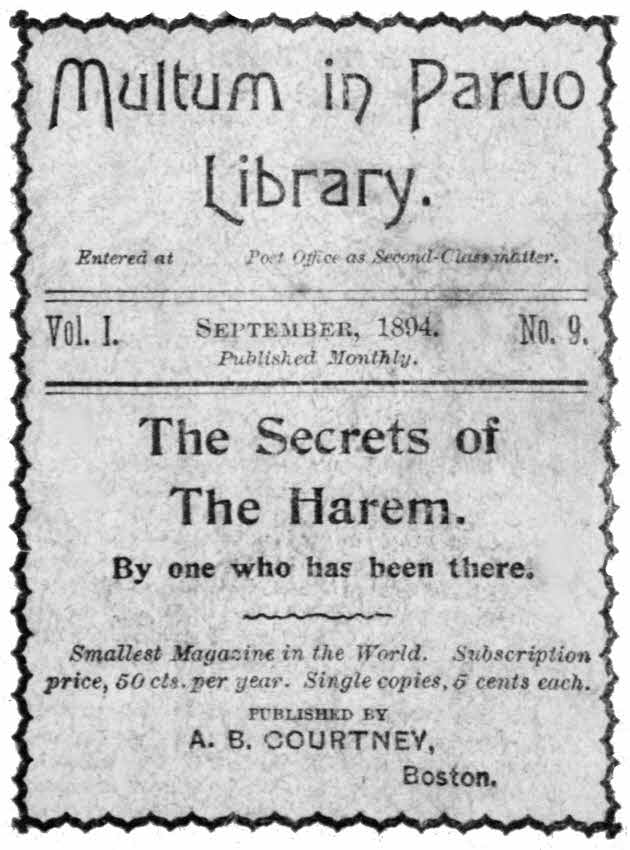
Multum in Parvo
Library.
Entered at Post Office as Second-Class matter.
Vol. I. September, 1894. No. 9.
Published Monthly.
By one who has been there.
Smallest Magazine in the World. Subscription price, 50 cts. per year. Single copies, 5 cents each.
PUBLISHED BY
A. B. COURTNEY, Boston.
Many people have an idea that Turkish women absolutely do nothing that is either useful or ornamental aside from the decoration of their own persons, but that is not altogether true, as my residence of over a year in their country taught me, for they are really dextrous with the needle and do work which is as fine as that done by the sisters in the convents, or that of the wives of the feudal noblemen of olden times.
The favorite pastime of the Turkish women is the bath, which brings together the wives and slaves of all the well-to-do Turks, and it is like a picnic of school children.
These wives, most of them very young—some, indeed, not over twelve or fourteen years old—take their lunch along, and they eat and steam, plunge and splash, and play pranks upon each other in the wildest glee the whole day long. No fear of an angry husband haunts their minds, for they are not expected to do anything, and their husbands very rarely enter the harems before six o’clock. By this time they are all back, rosy and sweet from their bath.
At the baths there is often an old woman who has the faculty of relating stories, and she is eagerly listened to by the grown-up children; the stories are generally of the Arabian nights order, full of genii, beautiful ladies, and charming youths and jealous husbands. Many a lesson is given as how to outwit the most jealous of men through these stories—a lesson they are neither slow to learn nor practise.
The way they are watched and confined always made me think of the woman who cautioned her innocent children not to put blue beans in their noses while she was out. The magic lantern entertainments amuse these ignorant caged birds. Dancing girls, singing and playing the lute, playing with the babies and occasionally quarrelling with each other take up some of their time; a weekly tour of the bazaars and once in a while a visit to the harem of some other Turk, still leave much time on their hands that the rare calls of their husbands, the eating of sweetmeats or smoking of cigarettes cannot fill, and so they give their poor little minds to fancy work. They very seldom learn how to read, or perhaps books would help them through, and they never make their own clothes, though they do sometimes decorate them very elaborately after others have made them.
They have frames made on which their embroidery is worked, and on velvet, satin or that beautiful and durable Broussa gauze they embroider with exquisite fineness and taste. The most of their embroidery is done in durable and admirably-arranged colors, in subdued tones, which seem to me remarkable in women who are so fond of brilliant primary colors and ill-assorted contrasts. They have no patterns, but work out graceful and beautiful fantasies, and all done with the most extreme care and fineness, requiring patience and extra good eyesight.
We might suppose that these women would take pleasure in making and embroidering their babies’ clothes as do other women, but as babies are simply swathed in endless rollers, like a mummy, until they are six months old, ornament is unnecessary. At the end of six months boy babies are put into pantaloons and girls into loose trousers, both being usually made of large flowered chintz.
About the only thing I ever noticed the Turkish women do for their little children was to make toys for them, and they make the most grotesque-looking dogs, lions, cows, rabbits, elephants, camels and doll babies out of rags for their amusement. They never nurse their babies for fear of spoiling the shape of the bust. They are very poor mothers, as they are too ignorant themselves to understand their responsibilities or to teach their children. They alternately slap them or caress and indulge them just as their own humor happens to be good or bad.
The little girls are taught to sew and embroider, how to walk gracefully, and recline in the most negligent manner upon the divans, how to play by ear a little on the lute, and to sing their interminable love songs. Their songs are like Barbara Allen, Lovely Young Caroline of Edinboro Town, the Brown Girl, or Gipsy Dave—all long, and telling a whole romance to a plaintive chant.
I never learned to speak Turkish, but I got so that I could seize upon the meaning of these songs. The singer always puts all the life and sentiment she can into her music, and often sheds tears as she sings, as do her listeners. I have even seen one or two of them faint away at the most pathetic part. This is a very common trait among Turkish women, and I have not yet been able to decide whether it is the result of a weak will or extreme sensibility, but they faint on every possible occasion.
The Turkish women love music passionately, and nearly all of them can play some instrument with taste and feeling, though almost always by ear. Their native music is always sad and plaintive, and often full of such a piercing sorrow that it is no wonder it brings tears. They love flowers, too, and you rarely see one without a flower in her hand when it is possible to get them, and they are fond of birds, and raise a great many themselves. Many of the Turkish women show considerable talent in drawing and painting, though the poor things never have any chance to learn. They simply “pick it up.”
As I found the Turkish women—and I happened to have obtained, by a fortunate circumstance, a chance to know them in their homes accorded to very few foreign women, and to absolutely no foreign man—they are gentle, submissive, loving, and with many natural gifts in addition to their beauty. If they were educated they would be the equal of any women in Europe.
It does not seem to me that they are unhappy in their peculiar marriage relations. They reminded me of a lot of irresponsible young girls in a boarding-school, and the only jealousy such as might be felt of the “teacher’s pet.” Instead of the poisoned and vindictive murder I supposed always ready to be inflicted upon each other, the worst they ever do is to pull each other’s hair occasionally or box each other’s ears.
Girls reach their majority at nine and are frequently married a year later, though not usually until fifteen. By that time all the education they get is acquired. Instead of being taught all the abstruse sciences she is taught all the caressing words and gestures possible to imagine—how to walk, sit, look and speak so as to appear the most seductive in the eyes of the husband who gets her.
No Turkish wife of the better class is ever expected to do any domestic labor whatever, nor to make any of the household linen, nor any garments for herself or members of the household, nor to sew any buttons on, nor, above all, to make her husband’s shirts; therefore it can be seen at once that almost every source of domestic disagreement is done away with, and the Turkish husband never expects his wife to get on her knees to hunt for his collar button, nor scold her if the dinner is badly cooked; so that in many respects life in a harem is not so very bad after all, and one-tenth of a good husband is better than the whole of a bad one.
The harem is that part of a polygamist’s house which is set apart for the use of his wives and their attendants; it also denotes this collective body of women. In all Mohammedan countries it is customary for wealthy men to keep a harem; for, though four is the number of wives to which the faithful are restricted by the Koran, there is no limit to the number of concubines a man may have, except his ability to maintain them. The mention of a harem naturally suggests to most people the female portion of the royal households of Turkey and Persia and Egypt. In the sultan’s harem each wife—he alone can have seven—has a separate suite of apartments, and a separate troop of female slaves to wait upon her and do her bidding.
All the female slaves or odalisques throughout the harem are, however, at the disposal of their royal master. She who first gives birth to an heir, whether wife or slave, is instantly promoted to the rank of chief wife. The title sultana is borne, not by the sultan’s wives, but by his mother, sisters and daughters. The real ruler of the harem is the sultan’s mother, but under her is the lady superintendent of the harem, usually an old and trusted favorite of the sultan. The duties of guarding the harem or seraglio, as it is sometimes called, are intrusted to a small army of eunuchs, the chief officer of whom generally enjoys considerable political influence. The inmates of the harem lead a very secluded life.
Seraglio is the palace of the sultan at Constantinople. It stands in a beautiful situation on a head of land projecting into the sea, known as the Golden Horn, and is enclosed by walls seven and one-half miles in circuit. Within the walls are a variety of mosques, gardens and large edifices, capable of containing 20,000 people, though the whole number of the inhabitants scarcely ever reaches the half of this.
The principal entrance is a kind of pavilion, which is constantly guarded by capidjis, or officers of the seraglio, and consists of a group of houses and gardens, one of each being possessed by each of the sultan’s wives, and of the habitations of the concubines and slaves.
The harem is ruled by the Kiaja-Khatun, or inspector of the women, who is under the sultan’s authority alone, and is supplied with what they require by the Kislar-aga or chief of the black eunuchs, who form the principal or inner guard of the harem. The second and outer guard is given to the white eunuchs under their chief the Kapu-agassy, or Kapu-oghlan.
Other classes of household officers are the mutes, who, till recently, were the executors of the sultan’s orders, especially those in which the utmost secrecy was required; the bostanjis, or gardeners; the batajis, or clearers of wood; and the itsh-oghlans, or attendants of the sultan. The sultan’s mother always resides within the seraglio, but his sisters do not. Access may easily be had to the seraglio, with the exception of the harem, which is scrupulously guarded from even the eyes of strangers. The English have improperly confounded the two terms “seraglio” and “harem.”
A Dervish, in Mohammedan countries, is a class of people resembling in many respects the monks of Christendom. The dervishes are divided into many different brotherhoods and orders. They live mostly in well endowed convents, called Tekkije or Changah, and are under a chief with the title of a Sheik. Some of the monks are married, and allowed to live out of the monastery, but must sleep there some nights weekly. Their devotional exercises consist in meetings for worship, prayers, religious dances, and mortifications. As the convent does not provide them with clothing, they are obliged to work more or less.
It is difficult to say when these religious orders took their rise. From the earliest times, pious persons in the East have held it to be meritorious to renounce earthly joys, to free themselves from the trammels of domestic and social life, and to devote their thoughts in poverty and retirement to the contemplation of God. In this sense, poverty is recommended by Mohammed in the Koran. Tradition refers to the origin of these orders to the earliest times of Islam, making the califs Abubekr and Ali found such brotherhoods; but it is more probable that they arose later.
Many Mohammedan princes and Turkish sultans have held dervishes in high respect, and bestowed rich endowments on their establishments; and they are still in high veneration with the people. The Kadris are commonly known in the West as “the howling dervishes,” from the excited chant of their religious services; the “dancing dervishes” are the Mevelevis.
HOW TO TRAIN DOGS.
This is the best volume of the kind ever published. Contains simple tricks and training, to teach him his name, to leap, to walk erect, to dance, to jump rope, to sit and lie down at command, to beg, to give his paw, to sneeze, to speak for it, to fetch and carry, to bring you his tail in his mouth, to stand on a ball and roll it up and down a plank, to walk on stilts, to go up and down a ladder, to stand on his head, to “sing,” etc. We will send this book, “How to Train Dogs,” postpaid, on receipt of only 23 cents in stamps. Address,
KEYSTONE BOOK CO., Philadelphia, Pa.
FAMOUS
Dramatic Recitations.
This book contains a large and valuable collection of the best dramatic recitations, carefully selected from the writings of the best authors, as recited by the leading elecutionists of America. Some of the finest gems in the English language are included in this collection. Among its contents are: “The Switchman’s Christmas Story,” “Gone With a Handsomer Man,” “The Death of the Old Squire,” “Poorhouse Nan,” “Fallen by the Way,” “Davy’s Promise,” “The Seamstress’s Story,” “The Midnight Tryst,” “Christmas Day in the Workhouse,” “The Women of Mumbles Head,” “The Last Hymn,” “Ostler Joe,” “The Tramp’s Story,” “The Moonshiner’s Daughter,” “The Martyr,” “The Crazy Kate,” “The Lifeboat,” “Asleep at the Switch,” “A Scar on the Face,” “The Blacksmith’s Story,” “Farmer Green,” “In the Mining Town,” “The Old Wife’s Kiss,” “The Boy Hero,” “The Pauper’s Christmas Eve,” “The Old Parson’s Story,” “Cripple Ben,” and many others. The contents of this book have been selected with great care, the aim being to include only the best, and the result is the finest collection of select recitations ever published. It is a book of 64 large double-column pages, bound in attractive paper covers, and will be sent by mail post-paid upon receipt of only Ten Cents.
KEYSTONE BOOK CO., Philadelphia, Pa.
OUR GREATEST OFFER
BEST QUALITY
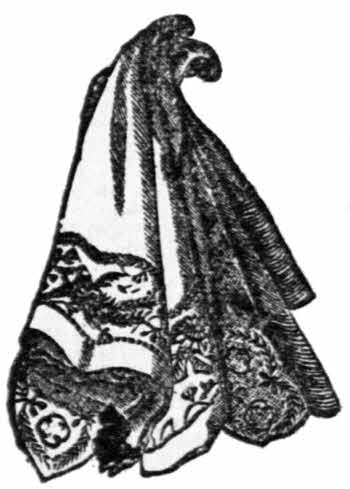
READ THIS! We mean just what we say. Direct from Japan we have imported a great quantity of elegant handkerchiefs. They are even handsomer than this picture, being made of a rare fibrous material by a secret process known only to these famous foreign artisans; the goods being known as shifu-silk crepe. Each handkerchief is about 15 inches square and has a charming border of various designs. These are used in many of the wealthiest homes for parlor decorations: they form a magnificent display. Ladies are delighted with them. We are the largest importers, and to introduce our goods we make the following great offer:—For 10 cts. we will send you three of these handkerchiefs, also an elegant Japanese Crepe Table Mat, decorated in beautiful designs by a fine Japanese artist. (We have seen mats like this advertised by another firm for 25 cts.) Remember, the above four articles will be mailed, postpaid, carefully packed, at once, on receipt of 10 cents in stamps or postal note. Three lots for 25 cents. Read the following, which is but one of the many letters received:—
“I have received the Japanese goods you advertise, and am astonished at the wonderful bargain. Enclosed find 50 cts. for six lots.” VIOLA H. RAY, Somerville, Mass.
We make the above great offer to introduce our goods as we want agents everywhere. Address all orders to
W. S. EVERETT & CO., Lynn, Mass.
THE LADIES’ MODEL
Fancy Work Manual

This is an entirely new book, just published, and embodies all the latest ideas in needlework, crochet, knitting and embroidery. It contains designs and directions for making nearly fifty different patterns of knitted laces, many charming crochet patterns, also instruction for making many useful articles of wearing apparel and numerous articles for home decoration, among which are tidies, chair-scarfs, doylies, purses, table mats, shopping bags, lamp shades, shawls, Afghans, toilet sets, counterpanes, sofa-cushions, chair-covers, pin-cushions, dressing slippers, babies’ socks, etc., etc. Full and complete instructions accompany each design, together with an explanation of the terms used in knitting and crochetting, etc. It also contains full and complete instructions in the art of embroidery, with numerous beautiful designs. The whole is illustrated by 95 handsome engravings, and the whole subject of ladies’ fancy work is made so clear in this book that with it as a guide one may become an adept in the art. It is a book of 64 large double-column pages, neatly bound in attractive paper covers, and will be sent by mail post-paid upon receipt of only Ten Cents.
KEYSTONE BOOK CO., Philadelphia, Pa.
In the end, a popular song is killed by its own success; it is sung, played, and whistled to death. The hand-organs hasten the catastrophe. It is doubtful whether any popular song of to-day will have other than an ephemeral existence, there are so many more people than there used to be to wear it out. Some of the songs of forty years ago—notably, “Swanee River,” “Old Folks at Home,” and the “Mocking Bird”—are still frequently heard, which cannot be said of the popular songs of more recent years.
The war for the Union gave birth to quite a number of good songs, and “Marching through Georgia” will live as long as a soldier exists. Soon after the war we had “Silver Threads Among the Gold” and “Put Me in My Little Bed,” which were in everybody’s mouth, and put a great deal of money into the pocket of their author. But they are seldom heard nowadays; and the same may be said of “Captain Jinks of the Hoss Marines,” who fed his horse on corn and beans, and “Walkin’ Down Broadway.”
It is now some years ago since our ears were regaled with “Rock-a-Bye, Baby,” “Climbin’ Up the Golden Stairs,” and “See-Saw.” These were succeeded by “Maggie Murphy’s Home,” “McGinty,” “Annie Rooney,” the famous “Ta-ra-ra,” and “Monte Carlo,” which have already been turned down for “My Sweetheart’s the Man in the Moon,” “Daisy,” and the latest rage—“After the Ball.” It is said, by the way, that the author of the last-mentioned song is deriving a fortune from it. He has already cleared more than a popular novelist realizes from a four hundred page book.
The idea of refusing water to fever patients is, we are glad to say, nearly a thing of the past. The following incident, related by a sailor, serves as an illustration of the water treatment. “Some years ago, when we were in Jamaica, several of us were sick with the fever, and among the rest the second mate. The doctor had been giving him brandy to keep him up, but I thought it was a queer kind of ‘keeping up.’ Why, you see, it stands to reason that if you heap fuel on a fire, it will burn the faster, and putting brandy to a fever is just the same kind of thing.
“Well, the doctor gave him up, and I was sent to watch with him. No medicine was left, for it was no use—nothing would help him; and I had my directions what to do with the body when he was dead. Toward midnight he asked for some water. I got him the coolest I could find, and all he wanted; and if you’ll believe me, in less than three hours he drank three gallons.
“The sweat rolled from him like rain. Then I thought sure he was gone; but he was sleeping, and as sweetly as a child. In the morning when the doctor came, he asked what time the mate died.
“‘Won’t you go in and look at him?’ I said.
“He went in and took the mate’s hand.
“‘Why,’ said he, ‘the man is not dead. He’s alive and doing well. What have you been giving him?’
“‘Water, simply water, and all he wanted of it,’ said I.
“I don’t know as the doctor learned anything from that, but I did.”