Cry Havoc! and let slip the dogs of War.
Julius Cæsar.
Sancho Panza passed away too early. To-day, he would extend his
benediction on the man who invented sleep, to the person who
introduced sleeping-cars. The name of that philanthropist, by whose
luxurious aid we may enjoy unbroken sleep at the rate of twenty-five
miles an hour, should not be concealed from a grateful posterity.
A Sunday at Niagara Falls.
Thus I soliloquized one May evening, when, in pursuit of that "seat
of war," as yet visible only to the prophetic eye, or in newspaper
columns, I turned my face westward. It were more exact to say,
"turned my heels." Inexorable conductors compel the drowsy passenger
to ride feet foremost, on the hypothesis that he would rather break a
leg than knock his brains out.
I was detained for a day at Suspension Bridge; but life has more
afflictive dispensations, even for the impatient traveler, than a
Sunday at Niagara Falls. Vanity of vanities indeed must existence
be to him who could not find a real Sabbath at the great cataract,
laying his tired head upon the calm breast of Nature, and feeling the
pulsations of her deep, loving heart!
Eight years had intervened since my last visit. There
was no second pang of the disappointment we feel in seeing for the
first time any object of world-wide fame. In Nature, as in Art, the
really great, however falling below the ideal at first glance, grows
upon the beholder forever afterward.
Though the visiting season had not begun, the harpies were waiting
for their victims. Step out of your hotel, or turn a corner, and one
instantly pounced upon you. But, though numerous, they were quiet,
and decorous manners, even in leeches, are above all praise.
Everybody at the Falls is eager to shield you from the extortion of
everybody else. The driver, whom you pay two dollars per hour; the
vender, who sells you Indian bead-work at a profit of one hundred per
cent.; the guide, who fleeces you for leading to places you would
rather find without him—each warns you against the other, with
touching zeal for your welfare. And the precocious boy, who offers a
bit of slate from under the Cataract for two shillings, cautions you
to beware of them all.
View from the Suspension Bridge.
As you cross the suspension bridge, the driver points out the spot,
more than two hundred feet above the water, where Blondin, of
tight-rope renown, crossed upon a single strand, with a man upon his
shoulders, cooked his aerial omelet, hung by the heels, and played
other fantastic tricks before high heaven.
Palace of the Frost King.
From the bridge you view three sections of the Cataract. First, is
the lower end of the American Fall, whose deep green is intermingled
with jets and streaks of white. Its smooth surface conveys the
impression of the segment of a slowly revolving wheel rather than of
tumbling water. Beyond the dense foliage appears another section,
parted in the middle by the stone tower on Goat Island. Its water is
of snowy whiteness, and looks
like an immense frozen fountain. Still farther is the great
Horse-shoe Fall, its deep green surface veiled at the base in clouds
of pure white mist.
Here, at the distance of two miles, the Falls soothe you with their
quiet, surpassing beauty. But when you reach them on the Canada side,
and go down, down, beneath Table Rock, under the sheet of water, you
feel their sublimity. As you look out upon the sea of snowy foam
below, or through the rainbow hues of the vast sweeping curtain
above, the earth trembles with the unceasing thunder of the cataract.
In winter the effect is grandest. Then, from the bank in front of the
Clifton House, you look down on upright rocks, crowned with pinnacles
of ice, till they rise half way to the summit, or catch glimpses
of the boundless column of water as it strikes the torrent below,
faintly seen through the misty, alabaster spray rising forever from
its troubled bed. Hundreds of white-winged sea-gulls graze the rapids
above, and circle down to plunge in the waters below.
Attired in stiff, cold, water-proof clothing, which, culminating in a
round oil-cloth cap, makes you look like an Esquimaux and feel like a
mummy, you follow the guide far down dark, icy stairs and paths.
Look up ninety feet, and see the great torrent pour over the brink.
Look down seventy feet from your icy little shelf, and behold
it plunge into the dense mist of the boiling gulf. Through its
half-transparent sheet, filtered rays of the bright sunshine struggle
toward your eyes. You are in the palace of the Frost King. Ice—ice
everywhere, from your slippery foothold to the huge icicles, fifty
feet long and three feet thick, which overhang you like the sword of
Damocles.
Admiration without comparison is vague and unsatisfactory.
Less glorious, because less vast, than the matchless panorama seen
from the summit of Pike's Peak, this picture is nearly as impressive,
because spread right beside you, and at your very feet. Less minutely
beautiful than the exquisite chambers of the Mammoth Cave, its great
range and sweep make it more grand and imposing.
Along the Great Western Railway of Canada, the country closely
resembles northern Ohio; but the people have uncompromising English
faces. A well-dressed farmer and his wife rode upon our train all day
in a second-class car, without seeming in the least ashamed of it—a
moral courage not often exhibited in the United States.
At Detroit, an invalid, pale, wasted, unable to speak above a
whisper, was lying on a bed hastily spread upon the floor of the
railway station. Her husband, with their two little boys bending over
her in tears, told us that they had been driven from New Orleans, and
he was now taking his dying wife to their old home in Maine. There
were few dry eyes among the lookers-on. A liberal sum of money was
raised on the spot for the destitute family, whose broken pride,
after some persuasion, accepted it.
Chicago Rising from the Earth.
The next morning we reached Chicago. In that breezy city upon the
lake shore, property was literally rising. Many of the largest brick
and stone blocks were being elevated five or six feet, by a very nice
system of screws under their walls, while people were constantly
pouring in and out of them, and the transaction of business was
not impeded. The stupendous enterprise was undertaken that the
streets might be properly graded and drained. This summoning a great
metropolis to rise from its vasty deep of mud, is one of the modern
miracles
of mechanics, which make even geological revelations appear trivial
and common-place.
Mysteries of Western Currency.
The world has many mysteries, but none more inscrutable than Western
Currency. The notes of most Illinois and Wisconsin banks, based on
southern State bonds, having depreciated steadily for several weeks,
gold and New York exchange now commanded a premium of twenty per
cent. The Michigan Central Railway Company was a good illustration
of the effect of this upon Chicago interests. That corporation
was paying six thousand dollars per week in premiums upon eastern
exchange. Yet the hotels and mercantile houses were receiving the
currency at par. One Illinois bank-note depreciated just seventy per
cent., during the twelve hours it spent in my possession!
In Chicago I encountered an old friend just from Memphis. His
association with leading Secessionists for some time protected him;
but the popular frenzy was now so wild that they counselled him, as
he valued his life, to stay not upon the order of his going, but go
at once.
The Memphians were repudiating northern debts, and, with unexampled
ferocity, driving out all men suspected of Abolitionism or Unionism.
More than five thousand citizens had been forced or frightened away,
and in many cases beggared. A secret Committee of Safety, made up of
prominent citizens, was ruling with despotic sway.
Scores of suspected persons were brought before it daily, and, if
they could not exculpate themselves, sentenced to banishment, with
head half shaved, to whipping, or to death. Though, by the laws of
all slave States, negroes were precluded from testifying against
white men, this inquisition received their evidence. My friend
dared not avow that he was coming North, but purchased a ticket for
St. Louis, which was then deemed a Rebel stronghold.
A Horrible Spectacle in Arkansas.
As the steamer passed Osceola, Arkansas, he saw the body of a man
hanging by the heels, in full view of the river. A citizen told him
that it had been there for eight days; that the wretched victim,
upon mere suspicion of tampering with slaves, was suspended, head
downward, and suffered intensely before death came to his relief.
All on board the crowded steamboat pretended to be Secessionists. But
when, at last, nearing Cairo, they saw the Stars and Stripes, first
one, then another, began to huzza. The enthusiasm was contagious; and
in a moment nearly all, many with heaving breasts and streaming eyes,
gave vent to their long-suppressed feeling in one tumultuous cheer
for the Flag of the Free. Of the one hundred and fifty passengers,
nearly every man was a fleeing Unionist.
The all-pervading railroad and telegraph in the North began to show
their utility in war. Cairo, the extreme southern point of Illinois,
now garrisoned by Union troops, was threatened by the enemy. The
superintendent of the Illinois Central Railway (including branches,
seven hundred and four miles in length) assured me that, at ten
hours' notice, he could start, from the various points along his
line, four miles of cars, capable of transporting twenty-four
thousand soldiers.
Patriotism of the Northwest.
The Rebels now began to perceive their mistake in counting upon
the friendship of the great Northwest. Indeed, of all their wild
dreams, this was wildest. They expected the very States which claimed
Mr. Lincoln as from their own section, and voted for him by heavy
majorities, to help break up the Union because he was elected! Though
learning their delusion, they never
comprehended its cause. After the war had continued nearly a year,
The New Orleans Delta said:
"The people of the Northwest are our natural allies, and
ought to be fighting on our side. It is the profoundest
mystery of these times how the few Yankee peddlers and
school-marms there have been able to convert them into our
bitter enemies."
On the mere instinct of nationality—the bare question of an
undivided republic—the West would perhaps fight longer, and
sacrifice more, than any other section. Its people, if not more
earnest, are much more demonstrative than their eastern brethren.
Their long migration from the Atlantic States to the Mississippi, the
Missouri, or the Platte, has quickened and enlarged their patriotism.
It has made our territorial greatness to them no abstraction, but a
reality.
No one else looks forward with such faith and fervor to that great
future when man shall "fill up magnificently the magnificent designs
of Nature;" when their Mississippi Valley shall be the heart of
mightiest empire; when, from all these mingling nationalities, shall
spring the ripe fruitage of free schools and free ballots, in a
higher average Man than the World has yet seen.
Our train from Chicago to St. Louis was crowded with Union troops.
Along the route booming guns saluted them; handkerchiefs fluttered
from windows; flags streamed from farm-houses and in village streets;
old men and boys at the plow huzzaed themselves hoarse.
Thus, at the rising of the curtain, the northwestern States, worthy
offspring of the Ordinance of Eighty-seven, were sending out—
"A multitude, like which the populous North Poured never
from her frozen loins."
Four blood-stained years have not dimmed their faith
or abated their ardor. "Wherever Death spread his banquet,
they furnished many guests." What histories have they not made
for themselves! Ohio, Iowa, Kansas, Wisconsin—indeed, if
we call their roll, which State has not covered herself with
honor—which has not achieved her Lexington—her
Saratoga—her Bennington—though the battle-field lie
beyond her soil?9
Missouri Rebels bent on Revolution.
In St. Louis I found at last a "seat of war." Recent days had been
full of startling events. The Missouri Legislature, at Jefferson
City, desired to pass a Secession ordinance, but had no pretext for
doing so. The election of a State Convention, to consider this very
subject, had just demonstrated, by overwhelming Union majorities, the
loyalty of the masses. Claiborne Fox Jackson, the Governor, was a
Secessionist, and was determined to plunge Missouri into revolution.
This flagrant, open warfare against the popular majority, well
illustrated how grossly the Rebels deceived themselves in supposing
that their conduct was impelled by regard for State Rights, rather
than by the inherent antagonism between free and slave labor.
Camp Jackson, commanded by Gen. D. M. Frost, was established at
Lindell Grove, two miles west of St. Louis, "for the organization
and instruction of the State Militia." It embraced some Union men,
both officers and privates. Frost and his friends claimed that it was
loyal; but the State flag, only, was flying from the camp, and its
streets were named "Davis Avenue," "Beauregard Avenue," etc.
Nathaniel Lyon and Camp Jackson.
An envoy extraordinary, sent by Governor Jackson, had just returned
from Louisiana with shot, shell, and mortars—all stolen from the
United States Arsenal at Baton Rouge. The camp was really designed as
the nucleus of a Secession force, to seize the Government property
in St. Louis and drive out the Federal authorities. But the Union
men were too prompt for the Rebels. Long before the capture of Fort
Sumter, nightly drills were instituted among the loyal Germans of
St. Louis; and within two weeks after the President's first call for
troops, Missouri had ten thousand Union soldiers, armed, equipped,
and in camp.
The first act of the Union authorities was to remove by night all
the munitions from the United States Arsenal near St. Louis, to
Alton, Illinois. When the Rebels learned it, they were intensely
exasperated. The Union troops were commanded by a quiet, slender,
stooping, red-haired, pale-faced officer, who walked about in brown
linen coat, wearing no military insignia. He was by rank a captain;
his name was Nathaniel Lyon.
On the tenth of May, Capt. Lyon, with three or four hundred regulars,
and enough volunteers to swell his forces to five thousand, planted
cannon upon the hills commanding Camp Jackson, and sent to Gen. Frost
a note, reciting conclusive evidence of its treasonable intent, and
concluding as follows:
"I do hereby demand of you an immediate surrender of your
command, with no other conditions than that all persons surrendering
shall be humanely and kindly treated. Believing myself prepared to
enforce this demand, one-half hour's time will be allowed for your
compliance."
This contrasted so sharply with the shuffling timidity of our civil
and military authorities, usual at this period,
that Frost was surprised and "shocked." His reply, of course,
characterized the demand as "illegal" and "unconstitutional." In
those days there were no such sticklers for the Constitution as the
men taking up arms against it! Frost wrote that he surrendered only
upon compulsion—his forces being too weak for resistance. The
encampment was found to contain twenty cannon, more than twelve
hundred muskets, many mortars, siege-howitzers, and shells, charged
ready for use—which convinced even the most skeptical that it
was something more than a school for instruction.
The garrison, eight hundred strong, were marched out under guard.
There were many thousands of spectators. Hills, fields, and
house-tops were black with people. In spite of orders to disperse,
crowds followed, jeering the Union troops, throwing stones,
brickbats, and other missiles, and finally discharging pistols.
Several soldiers were hurt, and one captain shot down at the head
of his company, when the troops fired on the crowd, killing twenty
and wounding eleven. As in all such cases, several innocent persons
suffered.
Intense excitement followed. A large public meeting convened
that evening in front of the Planter's House—heard bitter
speeches from Governor Jackson, Sterling Price, and others. The
crowd afterward went to mob The Democrat office, but
it contained too many resolute Unionists, armed with rifles and
hand-grenades, and they wisely desisted.
Sterling Price Joins the Rebels.
Sterling Price was president of the State Convention—elected
as an Unconditional Unionist. But, in this whirlwind, he went over to
the enemy. An old feud existed between him and a leading St. Louis
loyalist. Price had a small, detached command in the Mexican war.
Afterward, he was Governor of Missouri, and candidate
for the United States Senate. An absurd sketch, magnifying a trivial
skirmish into a great battle, with Price looming up heroically in the
foreground, was drawn and engraved by an unfortunate artist, then
in the Penitentiary. It pleased Price's vanity; he circulated it
largely, and pardoned out the suffering votary of art.
Severe Loss to the Unionists.
When the Legislature was about voting for United States Senator,
Frank Blair, Jr., then a young member from St. Louis, obtained
permission to say a few words about the candidates. He was a great
vessel of wrath, and administered a terrible excoriation, pronouncing
Price "worthy the genius of a convict artist, and fit subject for a
Penitentiary print!" Price was defeated, and the rupture never healed.
At the outbreak of the Rebellion, Price was far more loyal than men
afterward prominent Union leaders in Missouri. In those chaotic
days, very slight influences decided the choice of many. By tender
treatment, Price could doubtless have been retained; but neither
party regarded him as possessing much ability.
His defection proved a calamity to the Loyalists. He was worth twenty
thousand soldiers to the Rebels, and developed rare military talent.
Like Robert E. Lee, he was an old man, of pure personal character,
sincerity, kindness of heart, and unequaled popularity among the
self-sacrificing ragamuffins whom he commanded. He held them
together, and induced them to fight with a bravery and persistency
which, Rebels though they were, was creditable to the American name.
With a good cause, they would have challenged the world's acclamation.
At this time the President was treating the border slave States
with marvelous tenderness and timidity.
The Rev. M. D. Conway declared, wittily, that Mr. Lincoln's daily and
nightly invocation ran:
"O Lord, I desire to have Thee on my side, but I must
have Kentucky!"
Captain Lyon was confident that if he asked permission to seize Camp
Jackson, it would be refused. So he captured the camp, and then
telegraphed to Washington—not what he proposed to do, but what he
had done. At first his act was disapproved. But the loyal country
applauded to the echo, and Lyon's name was everywhere honored. Hence
the censure was withheld, and he was made a Brigadier-General!
St. Louis in a Convulsion.
Governor Jackson burned the bridges on the Pacific Railroad; the
Missouri Legislature passed an indirect ordinance of Secession,
and adjourned in a panic, caused by reports that Lyon was coming;
a Union regiment was attacked in St. Louis, and again fired into
the mob, with deadly results. The city was convulsed with terror.
Every available vehicle, including heavy ox wagons, was brought
into requisition; every outgoing railway train was crowded with
passengers; every avenue was thronged with fugitives; every steamer
at the levee was laden with families, who, with no definite idea of
where they were going, had hastily packed a few articles of clothing,
to flee from the general and bloody conflict supposed to be impending
between the Americans and the Dutch, as Secessionists artfully termed
the two parties. Thus there became a "Seat of War."
Heart-rending as were the stories of most southern refugees, some
were altogether ludicrous. In St. Louis, I encountered an old
acquaintance who related to me his recent experiences in Nashville.
Grandiloquent enough they sounded; for his private conversation
always ran into stump speeches.
A Nashville Experience.
"One day," said he, "I was waited on by a party of leading Nashville
citizens, who remarked: 'Captain May, we know very well that you
are with us in sentiment; but, as you come from the North, others,
less intimate with you, desire some special assurance.' I replied:
'Gentlemen, by education, by instinct, and by association, I am a
Southern man. But, gentlemen, when you fire upon that small bit of
bunting known as the American flag, you can count me, by Heaven, as
your persistent and uncompromising foe!' The committee intimated to
me that the next train for the North started in one hour! You may
stake your existence, sir, that the subscriber came away on that
train. Confound a country, anyhow, where a man must wear a Secession
cockade upon each coat-tail to keep himself from being kicked as an
Abolitionist!"
Inexorable war knows no ties of friendship, of family, or of love.
Its bitterest features were seen on the border, where brother was
arrayed against brother, and husband against wife. At a little
Missouri village, the Rebels raised their flag, but it was promptly
torn down by the loyal wife of one of the leaders. I met a lady who
had two brothers in the Union army, and two among Price's Rebels, who
were likely soon to meet on the battle-field.
In St. Louis, a Rebel damsel, just about to be married, separated
from her Union lover, declaring that no man who favored the
Abolitionists and the "Dutch hirelings" could be her husband. He
retorted that he had no use for a wife who sympathized with treason;
and so the match was broken off.
Bitterness of Old Neighbors.
I knew a Union soldier who found at Camp Jackson, among the
prisoners, his own brother, wounded by two Minié rifle balls. He
said: "I am sorry my brother
was shot; but he should not have joined the traitors!" Of course,
the bitterness between relatives and old neighbors, now foes, was
infinitely greater than between northerners and southerners. The
same was true everywhere. How intensely the Virginia and Tennessee
Rebels hated their fellow-citizens who adhered to the Union cause!
Ohio and Massachusetts Loyalists denounced northern "Copperheads"
with a malignity which they never felt toward South Carolinians and
Mississippians.
St. Louis, May 20, 1861.
When South Carolina seceded, the slave property of Missouri was worth
forty-five millions of dollars; hence she is under bonds to just that
amount to keep the peace. With thirteen hundred miles of frontier,
she is "a slave peninsula in an ocean of free soil." Free Kansas,
which has many old scores to clear up, guards her on the west. Free
Iowa, embittered by hundreds of Union refugees, watches her on the
north. Free Illinois, the young giantess of the prairie, takes care
of her on the east. This loyal metropolis, with ten Union regiments
already under arms, is for her a sort of front-door police. Missouri,
in the significant phrase of the frontier, is
corraled.10
Here, at least, as The Richmond Whig, just before
going over to the Rebels, so aptly said: "Secession is Abolitionism
in its worst and most dangerous form."
Rebels glare upon Union men like chained wild beasts. Citizens,
walking by night, remember the late assassinations, and, like
Americans in Mexican towns, cast suspicious glances behind.
Secessionists utter fierce
threats; but since their recent severe admonition that Unionists,
too, can use fire-arms, and that it is not discreet to attack United
States soldiers, they do not execute them.
Captain Lyon, who commands, is an exceedingly prompt and efficient
officer, attends strictly to his business, exhibits no hunger for
newspaper fame, and seems to act with an eye single to the honor of
the Government he has served so long and so faithfully.
Good Soldiers for Scaling Walls.
Among our regiments is the Missouri First, Colonel Frank P. Blair.
Three companies are made up of German Turners—the most accomplished
of gymnasts. They are sinewy, muscular fellows, with deep chests and
well-knit frames. Every man is an athlete. To-day a party, by way
of exercise, suddenly formed a human pyramid, and commenced running
up, like squirrels, over each other's shoulders, to the high veranda
upon the second story of their building. In climbing a wall, they
would not require scaling-ladders. There are also two companies from
the Far West—old trappers and hunters, who have smelt gunpowder in
Indian warfare.
Colonel Blair's dry, epigrammatic humor bewilders some of his
visitors. I was sitting in his head-quarters when a St. Louis
Secessionist entered. Like nearly all of them, he now pretends to be
a Union man, but is very tender on the subject of State Rights, and
wonderfully solicitous about the Constitution. He remarked:
"I am a Union man, but I believe in State Rights. I believe a State
may dissolve its connection with the Government if it wants to."
"O yes," replied Blair, pulling away at his ugly mustache, "yes, you
can go out if you want to. Certainly you can secede. But, my friend,
you can't take with you one foot of American soil!"
Missouri and the Slaveholders.
A citizen of Lexington introduced himself, saying:
"I am a loyal man, ready to fight for the Union; but I am
pro-slavery—I own niggers."
"Well, sir," replied Blair, with the faintest suggestion of a smile
on his plain, grim face, "you have a right to. We don't like negroes
very much ourselves. If you do, that's a matter of taste. It is one
of your privileges. But if you gentlemen who own negroes attempt to
take the State of Missouri out of the Union, in about six months you
will be the most ---- niggerless set of individuals that you ever
heard of!"
Only we want a little personal strength,
And pause until these Rebels, now afoot,
Come underneath the yoke of Government.
King Henry IV.
Cairo, as the key to the lower Mississippi valley, is the most
important strategic point in the West. Immediately after the outbreak
of hostilities, it was occupied by our troops.
As a place of residence it was never inviting. To-day its offenses
smell to heaven as rankly as when Dickens evoked it, from horrible
obscurity, as the "Eden" of Martin Chuzzlewit. The low, marshy,
boot-shaped site is protected from the overflow of the Mississippi
and Ohio by levees. Its jet-black soil generates every species of
insect and reptile known to science or imagination. Its atmosphere is
never sweet or pure.
General McClellan at Cairo.
On the 13th of June, Major-General George B. McClellan, commander of
all the forces west of the Alleghanies, reached Cairo on a visit of
inspection. His late victories in Western Virginia had established
his reputation for the time, as an officer of great capacity
and promise, notwithstanding the high heroics of his ambitious
proclamations. This was before Bull Run, and before the New York
journals, by absurdly pronouncing him "the Young Napoleon," raised
public expectation to an embarrassing and unreasonable hight.
In those days, every eye was looking for the Coming Man, every ear
listening for his approaching footsteps,
which were to make the earth tremble. Men judged, by old standards,
that the Hour must have its Hero. They had not learned that, in a
country like ours, whatever is accomplished must be the work of
the loyal millions, not of any one, or two, or twenty generals and
statesmen.
A Little Speech-Making.
McClellan was enthusiastically received, and, to the strains of
the "Star Spangled Banner," escorted to head-quarters. There, General
Prentiss, who had so decided a penchant for
speech-making, that cynics declared he always kept a particular
stump in front of his office for a rostrum, welcomed him with some
rhetorical remarks:
* * * * "My command are all anxious to taste those dangers
which war ushers in—not that they court danger, but that
they love their country. We have toiled in the mud, we have
drilled in the burning sun. Many of us are ragged—all of
us are poor. But we look anxiously for the order to move,
trusting that we may be allowed to lead the division."
The soldiers applauded enthusiastically—for in those days the
anxiety to be in the earliest battles was intense. The impression
was almost universal throughout the North that the war was to be
very brief. Officers and men in the army feared they would have no
opportunity to participate in any fighting!
McClellan responded to Prentiss and his officers in the same strain:
* * * "We shall meet again upon the tented field; and
Illinois, which sent forth a Hardin and a Bissell, will, I doubt not,
give a good account of herself to her sister States. Her fame is
world-wide: in your hands, gentlemen, I am sure it will not suffer.
The advance is due to you."
Then there was more applause, and afterward a review of the brigade.
Penalty of Writing for the Tribune.
General McClellan is stoutly built, short, with light hair, blue
eyes, full, fresh, almost boyish face, and lip tufted with a brown
mustache. His urbane manner truly indicates the peculiar amiability
of character and yielding disposition which have hurt him more than
all other causes. An officer once assured me that McClellan had said
to him: "My friends have injured me a thousand times more than my
enemies." It was certainly true.
Now, seeing his features the first time, I scanned them anxiously for
lineaments of greatness. I saw a pleasant, mild, moony face, with
one cheek distended by tobacco; but nothing which appeared strong or
striking. Tinctured largely with the general belief in his military
genius, I imputed the failure only to my own incapacity for reading
"Nature's infinite book of secrecy."
One evening, at Cairo, a man, whose worn face, shaggy beard, matted
locks, and tattered clothing marked him as one of the constantly
arriving refugees, sought me and asked:
"Can you tell me the name of The Tribune
correspondent who passed through Memphis last February?"
He was informed that that pleasure had been mine.
A Loyal Girl's Assistance.
"Then," said he, "I have been lying in jail at Memphis about fifty
days chiefly on your account! The three or four letters which you
wrote from there were peculiarly bitter. Of course, I was not aware
of your presence, and I sent one to The Tribune, which
was also very emphatic. The Secessionists suspected me not only of
the one which I did write, but also of yours. They pounced on me and
put me in jail. After the disbanding of the Committee of Safety I
was brought before the City Recorder, who assured me from the bench
of his profound regrets that he could find no law for hanging
me! I would have been there until this time, but for the assistance
of a young lady, through whom I succeeded in bribing an officer of
the jail, and making my escape. I was hidden in Memphis for several
days, then left the city in disguise, and have worked my way, chiefly
on foot, aided by negroes and Union families, through the woods of
Tennessee and the swamps of Missouri up to God's country."
The refugee seemed to be not only in good health, but also in
excellent spirits, and I replied:
"I am very sorry for your misfortunes; but if the Rebels must have
one of us, I am very glad that it was not I."
Nearly four years later, this gentleman turned the tables on me very
handsomely. After my twenty months imprisonment in Rebel hands, among
a crowd of visitors he walked into my room at Cincinnati one morning,
and greeted me warmly.
"You do not remember me, do you?" he asked.
"I recognize your face, but cannot recall your name."
"Well, my name is Collins. Once, when I escaped from the South, you
congratulated me at Cairo. Now, I congratulate you, and I can do it
with all my heart, in exactly the same words. I am very sorry for
your misfortunes; but if the Rebels must have one of us, I am very
glad that it was not I!"
After our troops captured Memphis, I encountered the young lady
who aided Mr. Collins in escaping. She was enthusiastically loyal,
but her feeling had been repressed for nearly two years, when the
arrival of our forces loosened her tongue. She began to utter her
long-stifled Union views, and it is my deliberate opinion that she
has not stopped yet. She is now the wife of an officer in the United
States service.
The Fascinations of Cairo.
Cairo, May 29.
A drizzly, muddy, melancholy day. Never otherwise than forlorn,
Cairo is pre-eminently lugubrious during a mild rain. In dry
weather, even when glowing like a furnace, you may find amusement
in the contemplation of the high-water mark upon trees and houses,
the stilted-plank sidewalks, the half-submerged swamps, and other
diluvian features of this nondescript, saucer-like, terraqueous town.
You may speculate upon the exact amount of fever and ague generated
to the acre, or inquire whether the whisky saloons, which spring up
like mushrooms, are indigenous or exotic.
In downright wet weather you may calculate how soon the streets
will be navigable, and the effect upon the amphibious natives. It
is difficult to realize that anybody was ever born here, or looks
upon Cairo as home. Washington Irving records that the old Dutch
housewives of New York scrubbed their floors until many "grew to have
webbed fingers, like unto a duck." I suspect the Cairo babies must
have fins.
Long-suffering, much-abused Cairo! What wounds hast thou not
received from the Parthian arrows of tourists! "The season here,"
wrote poor John Phenix, bitterest of all, "is usually opened with
great éclat by small-pox, continued
spiritedly by cholera, and closed up brilliantly with yellow fever.
Sweet spot!"
Theorists long predicted that the great metropolis of the Mississippi
valley—the granary of the world—must ultimately rise here. Many
proved their faith by pecuniary investments, which are likely to be
permanent.
Possessed by a similar delusion, Illinois, for years, strove to
legislate Alton into a vast commercial mart. But, in spite of their
unequaled geographical positions, Cairo and Alton still languish
in obscurity, while St.
Louis and Cincinnati, twin queens of this imperial valley, succeed to
their grand heritage.
Nature settles these matters by laws which, though hidden, are
inexorable. Even that mysterious, semi-civilized race, which swarmed
in this valley centuries before the American Indian, established
their great centers of population where ours are to-day.
The Death of Douglas.
June 4.
Intelligence of the death of Senator Douglas, received last evening,
excites profound and universal regret. Though totally unfamiliar
with books, Mr. Douglas thoroughly knew the masses of the Northwest,
down to their minutest sympathies and prejudices. Beyond any of his
cotemporaries, he was a man of the people, and the people loved him.
Never before could he have died so opportunely for his posthumous
fame. Nothing in his life became him like the leaving of it. His
last speech, in Chicago, was a fervid, stirring appeal for the
Union and the Government, and for crushing out treason with an iron
hand. His emphatic loyalty exerted great influence in Illinois. His
life-long opponents forget the asperities of the past, in the halo of
patriotism around his setting sun, and unite, with those who always
idolized him, in common tribute to his memory.
We have very direct intelligence from Tennessee. The western
districts are all Secession. Middle Tennessee is about equally
divided. East Tennessee, a mountain region, containing few slaves,
is inhabited by a hardy, primitive, industrious race. They are
thoroughly, enthusiastically loyal.11
A Clear-Headed Negro.
The felicitous decision of Major-General Butler, that slaves of the
enemy are "contraband of war," disturbs the Rebels not a little,
even in the West. A friend just from Louisiana, relates an amusing
conversation between a planter and an old, trusted slave.
"Sam," said his master, "I must furnish some niggers to go down and
work on the fortifications at the Balize. Which of the boys had I
better send?"
"Well, massa," replied the old servant, shaking his head oracularly,
"I doesn't know about dat. War's comin' on, and dey might be killed.
Ought to get Irishmen to do dat work, anyhow. I reckon you'd better
not send any ob de boys—tell you what, massa, nigger property's
mighty onsartin dese times!"
Scores of fugitives from the South arrive here daily, with the old
stories of insult, indignity, and outrage. Several have come in with
their heads shaved. To you, my reader, who have never seen a case of
the kind, it may seem a trivial matter for a person merely to have
one side of his head laid bare, but it is a peculiarly repulsive
spectacle. The first time you look upon it, or on those worse cases,
where free-born men of Saxon blood bear fresh marks of the lash, you
will involuntarily clinch your teeth, and thank God that the system
which bears such infernal fruits is rushing upon its own destruction.
June 8.
The heated term is upon us. We are amid upper, nether, and
surrounding fires. At eight, this morning, the mercury indicated
eighty degrees in the shade. How high it has gone since, I dare not
conjecture; but a friend insists that the sun will roast eggs to-day
upon any doorstep in town. I am a little incredulous as to that,
though a pair of smarting, half-blistered hands—the result of a
ten minutes' walk in its devouring breath—protest against absolute
unbelief. Officers who served in the War with Mexico declare they
never found the heat so oppressive in that climate as it is here. The
raw troops on duty, who are sweltering in woolen shirts and cloth
caps, bear it wonderfully well.
A number of Chicago ladies are already here, acting as nurses in the
hospital. The dull eyes of the invalids brighten at their approach,
and voices grow husky in attempting to express their gratitude.
According to Carlyle, "in a revolution we are all savages still;
civilization has only sharpened our claws;" but this tender care for
the soldier is the one redeeming feature of modern war.
A Review of the Troops.
June 12.
A review of all the troops. The double ranks of well-knit men, with
shining muskets and bayonets, stretch off in perspective for more
than a mile. After preliminary evolutions, at the word of command,
the lines suddenly break and wheel into column by companies, and
marching commences. You see two long parallel columns of men moving
in opposite directions, with an open space between. Their legs, in
motion, look for all the world like the shuttles in some great Lowell
factory.
The artillerists fire each of their six-pounders three times a
minute. They discharge one, dismount it, lay it upon the ground,
remove the wheels from the carriage, drop flat upon their faces, then
spring up, remount the gun, ready for reloading or removing, all in
forty-five seconds.
Standing three hundred yards from the cannon, the column of smoke,
white at first, but rapidly changing to blue, shoots out twenty-five
or thirty feet from the muzzle before you hear the report.
The flying flags, playing bands, galloping officers, long lines
of our boys in blue, and sharp metallic reports, impress you with
something of the pomp and circumstance of glorious war.
But Captain Jenny, a young engineer officer, quietly remarks, that
he once witnessed a review of seventy thousand French troops in the
Champ de Mars, and in 1859 saw the army of seventy-five thousand men
enter Paris, returning from the Italian wars. Colonel Wagner, an old
Hungarian officer, who has participated in twenty-three engagements,
assures you that he has looked upon a parade of one hundred and forty
thousand men, whereupon our little force of five thousand appears
insignificant. Nevertheless, it exceeds Jackson's recruits at New
Orleans, and is larger than the effective force of Scott during the
Mexican war.
A "Runnin' Nigger!"
Our first contraband arrived here in a skiff last night, bearing
unmistakable evidences of long travel. He says he came from
Mississippi, and the cotton-seed in his woolly head corroborates the
statement. I first saw him beside the guard-house, surrounded by a
party of soldiers. He answered my salutation with "Good evenin',
Mass'r," removing his old wool hat from his grizzly head. He smiled
all over his face, and bowed all through his body, as he depressed
his head, slightly lifting his left foot, with the gesture which only
the unmistakable darkey can give.
"Well, uncle, have you joined the army?"
"Yes, mass'r" (with another African salaam).
"Are you going to fight?"
"No, mass'r, I'se not a fightin' nigger, I'se a runnin' nigger!"
"Are you not afraid of starving, up here among the Abolitionists?"
Capturing a Rebel Flag.
"Reckon not, mass'r—not much."
And Sambo gave a concluding bow, indescribable drollery shining
through his sooty face, bisected by two rows of glittering ivory.
June 13.
A reconnoitering party went down the Mississippi yesterday upon a
Government steamer, under command of Colonel Richard J. Oglesby,
colloquially known among the Illinois sovereigns of the prairie as
"Dick Oglesby."
Twenty miles below Cairo, we slowly passed the town of Columbus, Ky.,
on the highest bluffs of the Mississippi. The village is a straggling
collection of brick blocks, frame houses, and whisky saloons. It
contains no Rebel forces, though seven thousand are at Union City,
Tenn., twenty-five miles distant.
On a tall staff, a few yards from the river, a great Secession flag,
with its eight stars and three stripes, was triumphantly flying.
Turning back, after steaming two miles below, the boat was stopped
at the landing; the captain went on shore, cut down the flag, and
brought it on board, amid cheers from our troops. The Columbians
looked on in grim silence—all save four Union ladies, who,
"Faithful among the faithless only they,"
waved handkerchiefs joyfully from a neighboring bluff.
Each star of the flag bore the name in pencil of the young lady
who sewed it on. The Maggies, and Julias, and Sues, and Kates, and
Sallies, who thus left their autographs upon their handiwork, did not
anticipate that it would so soon be scrutinized by Yankee soldiers.
And, doubtless, "Julia K----," the damsel whose star I pilfered,
scarcely aspired to the honor of furnishing a relic for The
Tribune cabinet.
And thus the whirligig of Time brings in his revenges.
Twelfth Night, or What You Will.
Bloody instructions, which being taught, return
To plague the inventors.
Macbeth.
The Retributions of Time.
On the 15th of June I returned from Cairo to St. Louis. Lyon had gone
up the Missouri River with an expedition, which was all fitted out
and started in a few hours. Lyon was very much in earnest, and he
knew the supreme value of time in the outset of a war.
How just are the retributions of history! Virginia originated State
Rights run-mad, which culminated in Secession. Behold her ground
between the upper and nether mill-stones! Missouri lighted the fires
of civil war in Kansas; now they blazed with tenfold fury upon her
own soil. She sent forth hordes to mob printing-presses, overawe the
ballot-box, substitute the bowie-knife and revolver for the civil
law. Now, her own area gleamed with bayonets; the Rebel newspaper was
suppressed by the file of soldiers, civil process supplanted by the
unpitying military arm.
Governor Claiborne F. Jackson, in 1855, led a raid into Kansas, which
overthrew the civil authorities, and drove citizens from the polls.
Now, the poisoned chalice was commended to his own lips. A hunted
fugitive from his home and his chair of office, he was deserted by
friends, ruined in fortune, and the halter waited for his neck.
Thomas C. Reynolds, late Lieutenant-Governor, by advocating the
right of Secession, did much to poison the public mind of the South.
He, too, found
his reward in disgrace and outlawry; unable to come
within the borders of the State which so lately delighted to do him
honor!
A Railroad Reminiscence.
I followed Lyon's Expedition by the Pacific railway. The president
of the road told me a droll story, which illustrates the folly
that governed the location of the railway system of Missouri. The
Southwest Branch is about a hundred miles long, through a very thinly
settled region. For the first week after the cars commenced running
over it, they carried only about six passengers, and no freight
except a live bear and a jar of honey. The honey was carried free,
and the freight on Bruin was fifty cents. Shut up in the single
freight car, during the trip, he ate all the honey! The company
were compelled to pay two dollars for the loss of that saccharine
esculent. Thus their first week's profits on freight amounted to
precisely one dollar and fifty cents on the wrong side of the ledger.
The Rebels had now evacuated Jefferson City, and our own troops,
commanded by Colonel Bœrnstein, a German editor, author, and
theatrical manager, of St. Louis, were in peaceable possession. The
soldiers were cooking upon the grass in the rear of the Capitol,
standing in the shade of its portico and rotunda, lying on beds of
hay in its passages, and upon carpets in the legislative halls. They
reposed in all its rooms, from the subterranean vaults to the little
circular chamber in the dome.
Untainted with "B. Republicanism."
Governor and Legislature were fled. With Colonel Bœrnstein, I went
through the executive mansion, which had been deserted in hot haste.
Sofas were overturned, carpets torn up and littered with letters
and public documents. Tables, chairs, damask curtains, cigar-boxes,
champagne-bottles, ink-stands, books, private letters, and family
knick-knacks, were scattered everywhere
in chaotic confusion. Some of the Governor's correspondence was
amusing. The first letter I noticed was a model of brevity. Here it
is—its virgin paper unsullied by the faintest touch of "B.
Republicanism."
Jefferson City, fed. 21nd 1861.
"to his Honour Gov. C. F.
Jackson.—Please Accept My Compliments. With a little
good Old Bourbon Whisky Cocktail. Made up Expressly in St Louis.
fear it not. it is good. And besides it is not even tainted with B.
Republicanism. Respectfully yours,
"P. Naughton."
There was a ludicrous disparity between the evidences of sudden
flight on all sides and the pompous language of the Governor's latest
State paper, which lay upon the piano in the drawing-room:
"Now, therefore, I, C. F. Jackson, Governor of the State
of Missouri, do issue this my proclamation, calling the
militia of the State, to the number of FIFTY THOUSAND, into
the service of the State. * * * Rise, then,
and drive out ignominiously the invaders!"
Beds were unmade, dishes unwashed, silver forks and spoons, belonging
to the State, scattered here and there. The only things that
appeared undisturbed were the Star Spangled Banner and the national
escutcheon, both frescoed upon the plaster of the gubernatorial
bedroom.
As we walked through the deserted rooms, a hollow echo answered to
the tramp of the colonel and his lieutenant, and to the dull clank of
their scabbards against the furniture.
General Lyon opened the war in the West by the battle of Booneville.
It lasted only a few minutes, and the undisciplined and half-armed
Rebel troops, after a faint show of resistance, retreated toward the
South. Lyon's command lost only eleven men.
A Belligerent Chaplain.
During the engagement, the Rev. William A. Pile, Chaplain of the
First Missouri Infantry, with a detail of four men, was looking
after the wounded, when, coming suddenly upon a party of twenty-four
Rebels, he ordered them to surrender. Strangely enough, they laid
down their arms, and were all brought, prisoners, to General
Lyon's head-quarters by their five captors, headed by the reverend
representative of the Church militant and the Church triumphant.
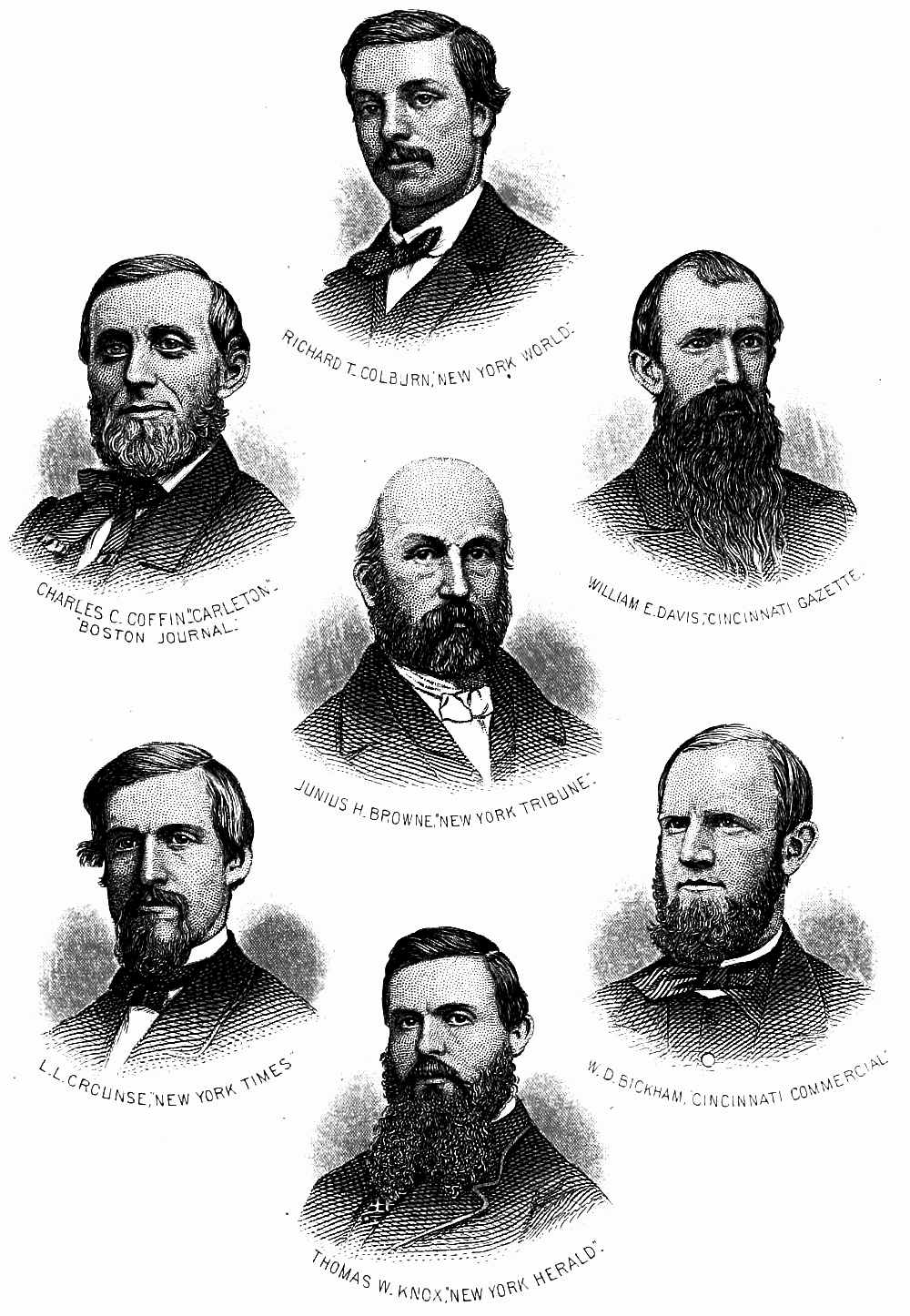
Messrs. Thomas W. Knox and Lucien J. Barnes, army correspondents,
zealous to see the first battle, narrowly escaped with their
lives. Appearing upon a hill, surveying the conflict through their
field-glasses, they were mistaken by General Lyon for scouts of the
enemy. He ordered his sharpshooters to pick them off, when one of his
aids recognized them.
Booneville, Mo., June 21.
The First Iowa Infantry has arrived here. On the way, several slaves,
who came to its camp for refuge, were sent back to their masters.
Humors of the Iowa Solders.
The regiment contains many educated men, and that large percentage
of physicians, lawyers, and editors, found in every far-western
community. On the way here, they indulged in a number of freaks which
startled the natives. At Macon, Mo., they took possession of The
Register, a hot Secession sheet, and, having no less than forty
printers in their ranks, promptly issued a spicy loyal journal,
called Our Whole Union. The valedictory, which the Iowa boys
addressed to Mr. Johnson, the fugitive editor, in his own paper, is
worth perusing.
"VALEDICTORY.
"Johnson, wherever you are—whether lurking in recesses of
the dim woods, or fleeing a fugitive on open plain, under
the broad canopy
of Heaven—good-by! We never saw your countenance—never
expect to—never want to—but, for all that, we won't be
proud; so, Johnson, good-by, and take care of yourself!
"We're going to leave you, Johnson, without so much as
looking into your honest eyes, or clasping your manly
hand—even without giving utterance, to your face, of 'God
bless you!' We're right sorry, we are, that you didn't stay
to attend to your domestic and other affairs, and not skulk
away and lose yourself, never to return. Oh, Johnson! why
did you—how could you do this?
"Johnson, we leave you to-night. We're going where bullets
are thick and mosquitos thicker. We may never return. If
we do not, old boy, remember us. We sat at your table; we
stole from your 'Dictionary of Latin Quotations;' we wrote
Union articles with your pen, your ink, on your paper. We
printed them on your press. Our boys set 'em up with your
types, used your galleys, your 'shooting-sticks,' your
'chases,' your 'quads,' your 'spaces,' your 'rules,' your
every thing. We even drank some poor whisky out of your
bottle.
"And now, Johnson, after doing all this for you, you won't
forget us, will you? Keep us in mind. Remember us in your
evening prayers, and your morning prayers, too, when you
say them, if you do say them. If you put up a petition
at mid-day, don't forget us then; or if you awake in the
solemn stillness of the night, to implore a benison upon
the absent, remember us then!
"Once more, Johnson—our heart pains us to say it—that
sorrowful word!—but once more and forever, Johnson,
Good-By! If you come our way, Call! Johnson,
adieu!"
One of the privates in the regular army has just been punished with
fifty lashes on the bare back, for taking from a private house a
lady's furs and a silk dress.
This morning I passed a group of the Iowa privates, resting beside
the road, along which they were bringing buckets of water to their
camp. They were debating the question whether a heavy national debt
tends to weaken or to strengthen a Government! These are the men whom
the southern Press calls "ignorant mercenaries."
St. Louis, July 12.
The Missouri State Journal, which made no disguise of
its sympathy with the Rebels, is at last suppressed by the military
authorities. It was done to-day, by order of General Lyon, who is
pursuing the Rebels near Springfield, in the southwest corner of the
State. Secessionists denounce it as a military despotism, but the
loyal citizens are gratified.
Camp Tales of the Marvelous.
Are you fond of the marvelous? If so, here is a camp story about
Colonel Sigel's late engagement at Carthage:
A private in one of his companies (so runs the tale), while loading
and firing, was lying flat upon his face to avoid the balls of the
Rebels, when a shot from one of their six-pounders plunged into the
ground right beside him, plowed through under him, about six inches
below the surface, came out on the other side, and pursued its
winding way. It did not hurt a hair of his head, but, in something
less than a twinkling of an eye, whirled him over upon his back!
If you shake your head, save your incredulity for this: A captain
assures me that in the same battle he saw one of Sigel's artillerists
struck by a shot which cut off both legs; but that he promptly raised
himself half up, rammed the charge home in his gun, withdrew the
ramrod, and then fell back, dead! This is, at least, melo-dramatic,
and only paralleled by the ballad-hero
——"Of doleful dumps,
Who, when his legs were both cut off,
Still fought upon his stumps."
Who can be * * * * *
Loyal and neutral in a moment? No man.
Macbeth.
Why, this it is when men are ruled by women.
Richard III.
It was a relief to escape the excitement and bitterness of Missouri,
and spend a few quiet days in the free States. Despite Rebel
predictions, grass did not grow in the streets of Chicago. In
sooth, it wore neither an Arcadian nor a funereal aspect. Palatial
buildings were everywhere rising; sixty railway trains arrived and
departed daily; hotels were crowded with guests; and the voice of the
artisan was heard in the land. Michigan Avenue, the finest drive in
America, skirting the lake shore for a mile and a half, was crowded
every evening with swift vehicles, and its sidewalks thronged with
leisurely pedestrians. It afforded scope to one of the two leading
characteristics of Chicago residents, which are, holding the ribbons
and leaving out the latch-string.
Corn not Cotton is King.
I did not hear a single cry of "Bread or Blood!" As the city had
over two million bushels of corn in store, and had received eighteen
million bushels of grain during the previous six months, starvation
was hardly imminent. War or peace, currency or no currency,
breadstuffs will find a market. Corn, not cotton, is king; the great
Northwest, instead of Dixie Land, wields the sceptre of imperial
power.
The elasticity of the new States is wonderful. Wisconsin and Illinois
had lost about ten millions of dollars
through the depreciation of their currency within a few months. It
caused embarrassment and stringency, but no wreck or ruin.
Reminiscences of the financial chaos were entertaining. New York
exchange once reached thirty per cent. The Illinois Central Railroad
Company paid twenty-two thousand five hundred dollars premium on a
single draft. For a few weeks before the crash, everybody was afraid
of the currency, and yet everybody received it. People were seized
with a sudden desire to pay up. The course of nature was reversed;
debtors absolutely pursued their creditors, and creditors dodged
them as swindlers dodge the sheriff. Parsimonious husbands supplied
their wives bounteously with means to do family shopping for months
ahead. There was a "run" upon those feminine paradises, the dry-goods
stores, while the merchants were by no means anxious to sell.
Suddenly prices went up, as if by magic. Then came a grand crisis.
Currency dropped fifty per cent., and one morning the city woke up
to find itself poorer by just half than it was the night before. The
banks, with their usual feline sagacity, alighted upon their feet,
while depositors had to stand the loss.
Curious Reminiscences of Chicago.
Persons who settled in Chicago when it was only a military post, many
hundred miles in the Indian country, relate stories of the days when
they sometimes spent three months on schooners coming from Buffalo.
Later settlers, too, offer curious reminiscences. In 1855, a merchant
purchased a tract of unimproved land near the lake, outside the city
limits, for twelve hundred dollars, one-fourth in cash. Before his
next payment, a railroad traversed one sandy worthless corner of it,
and the company paid him damages to the amount of eleven hundred
dollars. Before the end of the third year, when
his last installment of three hundred dollars became due, he sold
the land to a company of speculators for twenty-one thousand five
hundred dollars. It is now assessed at something over one hundred
thousand.
Visit to the Grave of Douglas.
On a July day, so cold that fires were comforting within doors, and
overcoats and buffalo robes requisite without, I visited the grave of
Senator Douglas, unmarked as yet by monumental stone. He rests near
his old home, and a few yards from the lake, which was sobbing and
moaning in stormy passion as the great, white-fringed waves chased
each other upon the sandy shore.
With the arrival of each railway train from the east, long files of
immigrants from Norway and northern Germany come pouring up Dearborn
street, gazing curiously and hopefully at their new Land of Promise.
One of the many railroad lines had brought twenty-five hundred within
two weeks. There were gray-haired men and young children. All were
attired neatly, especially the women, with snow-white kerchiefs about
their heads.
They were bound, mainly, for Wisconsin and Minnesota. Men and women
are the best wealth of a new country. Though nearly all poor, these
brought, with the fair hair and blue eyes of their fatherland,
honesty, frugality, and industry, as their contribution to that great
crucible which, after all its strange elements are fused, shall pour
forth the pure and shining metal of American Character.
Social Habits of the Germans.
Missouri, at the commencement of the war, had two hundred thousand
Germans in a population of little more than one million. Almost to a
man, they were loyal, and among the first who sprang to arms.
In the South, they were always regarded with suspicion.
The Rebels succeeded in dragooning but very few of them into their
ranks. Honor to the loyal Germans!
According to some unknown philosopher, "an Englishman or a Yankee
is capital; an Irishman is labor; but a German is capital and labor
both." Cincinnati, at the outbreak of the Rebellion, contained about
seventy thousand German citizens, who for many years had contributed
largely to her growth and prosperity.
A visit to their distinctive locality, called "Over the Rhine," with
its German daily papers, German signs, and German conversation, is a
peep at Faderland.
Cincinnati is nearer than Hamburg, the Miami canal more readily
crossed than the Atlantic, and that "sweet German accent," with which
General Scott was once enraptured, is no less musical in the Queen
City than in the land of Schiller and Göethe. Why, then, should one
go to Germany, unless, indeed, like Bayard Taylor, he goes for a
wife? The multitudinous maidens—light-eyed and blonde-haired—in
these German streets, would seem to remove even that excuse.
When Young America becomes jovial, he takes four or five boon
companions to a drinking saloon, pours down half a glass of raw
brandy, and lights a cigar. Continuing this programme through
the day, he ends, perhaps, by being carried home on a shutter or
conducted to the watch-house.
But the German, at the close of the summer day, strolls with his
wife and two or three of his twelve children (the orthodox number in
well-regulated Teutonic families) to one of the great airy halls or
gardens abounding in his portion of the city. Calling for Rhein wine,
Catawba, or "zwei glass lager bier und zwei pretzel," they sit an
hour or two, chatting with friends, and
then return to their homes like rational beings after rational
enjoyment. The halls contain hundreds of people, who gesticulate more
and talk louder during their mildest social intercourse than the same
number of Americans would in an affray causing the murder of half the
company; but the presence of women and children guarantees decorous
language and deportment.
The laws of migration are curious. One is, that people ordinarily go
due west. The Massachusetts man goes to northern Ohio, Wisconsin,
or Minnesota; the Ohioan to Kansas; the Tennesseean to southern
Missouri; the Mississippian to Texas. Great excitements, like those
of Kansas and California, draw men off their parallel of latitude;
but this is the general law. Another is, that the Irish remain near
the sea-coast, while the Germans seek the interior. They constitute
four-fifths of the foreign population of every western city.
The Early Days of Cincinnati.
In 1788, a few months before the first settlement of Cincinnati,
seven hundred and forty acres of land were bought for five hundred
dollars. The tract is now the heart of the city, and appraised at
many millions. As it passed from hand to hand, colossal fortunes were
realized from it; but its original purchaser, then one of the largest
western land-owners, at his death did not leave property enough to
secure against want his surviving son. Until 1862, that son resided
in Cincinnati, a pensioner upon the bounty of relatives. As, in the
autumn of life, he walked the streets of that busy city, it must have
been a strange reflection that among all its broad acres of which his
father was sole proprietor, he did not own land enough for his last
resting-place. "Give him a little earth for charity!"
Many high artificial mounds, circular and elliptical, stood here when
the city was founded. In after years,
as they were leveled, one by one, they revealed relics of that
ancient and comparatively civilized race, which occupied this region
before the Indian, and was probably identical with the Aztecs of
Mexico.
Upon the site of one of these mounds is Pike's Opera House, a
gorgeous edifice, erected at an expense of half a million of dollars,
by a Cincinnati distiller, who, fifteen years before, could not
obtain credit for his first dray-load of whisky-barrels. It is one
of the finest theaters in the world; but the site has more interest
than the building. What volumes of unwritten history has that spot
witnessed, which supports a temple of art and fashion for the men
and women of to-day, was once a post from which Indian sentinels
overlooked the "dark and bloody ground" beyond the river, and,
in earlier ages, an altar where priests of a semi-barbaric race
performed mystic rites to propitiate heathen gods!
A City Founded by a Woman.
Cincinnati was built by a woman. Its founder was neither carpenter
nor speculator, but in the legitimate feminine pursuit of winning
hearts. Seventy years ago, Columbia, North Bend, and Cincinnati—all
splendid cities on paper—were rivals, each aspiring to be the
metropolis of the West. Columbia was largest, North Bend most
favorably located, and Cincinnati least promising of all.
But an army officer, sent out to establish a military post for
protecting frontier settlers against Indians, was searching for a
site. Fascinated by the charms of a dark-eyed beauty—wife of one
of the North Bend settlers—that location impressed him favorably,
and he made it head-quarters. The husband, disliking the officer's
pointed attentions, came to Cincinnati and settled—thus, he
supposed, removing his wife from temptation.
The Aspirations of the Cincinnatian.
But as Mark Antony threw the world away for Cleopatra's lips, this
humbler son of Mars counted the military advantages of North Bend
as nothing compared with his charmer's eyes. He promptly followed
to Cincinnati, and erected Fort Washington within the present city
limits. Proximity to a military post settled the question, as it has
all similar ones in the history of the West. Now Cincinnati is the
largest inland city upon the continent; Columbia is an insignificant
village, and North Bend an excellent farm.
In architecture, Cincinnati is superior to its western rivals, and
rapidly gaining upon the most beautiful seaboard cities. Some of
its squares are unexcelled in America. A few public buildings are
imposing; but its best structures have been erected by private
enterprise. The Cincinnatian is expansive. Narrow quarters torture
him. He can live in a cottage, but he must do business in a palace.
An inferior brick building is the specter of his life, and a
freestone block his undying ambition.
From the Queen City I went to Louisville. Though communication with
the South had been cut off by every other route, the railroad was
open thence to Nashville.
Treason and Loyalty in Louisville.
Kentucky was disputed ground. Treason and Loyalty jostled each
other in strange proximity. At the breakfast table, one looked up
from his New York paper, forty-eight hours old, to see his nearest
neighbor perusing The Charleston Mercury. He found
The Louisville Courier urging the people to take up
arms against the Government. The Journal, published
just across the street, advised Union men to arm themselves, and
announced that any of them wanting first-class revolvers could
learn something to their advantage by calling upon its editor. In
the telegraph-office, the loyal agent of the Associated
Press, who made up dispatches for the North, chatted with the
Secessionist, who spiced his news for the southern palate. On
the street, one heard Union men advocate the hanging of Governor
Magoffin, and declare that he and his fellow-traitors should find the
collision they threatened a bloody business. At the same moment, some
inebriated "Cavalier" reeled by, shouting uproariously "Huzza for
Jeff. Davis!"
Here, a group of pale, long-haired young men was pointed out as
enlisted Rebel soldiers, just leaving for the South. There, a
troop of the sinewy, long-limbed mountaineers of Kentucky and East
Tennessee, marched sturdily toward the river, to join the loyal
forces upon the Indiana shore. Two or three State Guards (Secession),
with muskets on their shoulders, were closely followed by a trio of
Home Guards (Union), also armed. It was wonderful that, with all
these crowding combustibles, no explosion had yet occurred in the
Kentucky powder-magazine.
While Secessionists were numerous, Louisville, at heart loyal,
everywhere displayed the national flag. Yet, although the people tore
to pieces a Secession banner, which floated from a private dwelling,
they were very tolerant toward the Rebels, who openly recruited for
the Southern service. Imagine a man huzzaing for President Lincoln
and advertising a Federal recruiting-office in any city controlled by
the Confederates!
Prentice of the Louisville Journal.
"The real governor of Kentucky," said a southern paper, "is
not Beriah Magoffin, but George D. Prentice." In spite of his
"neutrality," which for a time threatened to stretch out to the
crack of doom, Mr. Prentice was a thorn in the side of the enemy.
His strong influence,
through The Louisville Journal, was felt throughout the
State.
Visiting his editorial rooms, I found him over an appalling pile of
public and private documents, dictating an article for his paper.
Many years ago, an attack of paralysis nearly disabled his right
hand, and compelled him ever after to employ an amanuensis.
His small, round face was fringed with dark hair, a little silvered
by age; but his eyes gleamed with their early fire, and his
conversation scintillated with that ready wit which made him the most
famous paragraphist in the world. His manner was exceedingly quiet
and modest. For about three-fourths of the year, he was one of the
hardest workers in the country; often sitting at his table twelve
hours a day, and writing two or three columns for a morning issue.
At this time, the Kentucky Unionists, advocating only "neutrality,"
dared not urge open and uncompromising support of the Government.
When President Lincoln first called for troops, The Journal
denounced his appeal in terms almost worthy of The Charleston
Mercury, expressing its "mingled amazement and indignation." Of
course the Kentuckians were subjected to very bitter criticism. Mr.
Prentice said to me:
"You misapprehend us in the North. We are just as much for the Union
as you are. Those of us who pray, pray for it; those of us who fight,
are going to fight for it. But we know our own people. They require
very tender handling. Just trust us and let us alone, and you shall
see us come out all right by-and-by."
The State election, held a few weeks after, exposed the groundless
alarm of the leading politicians. It resulted in returning to
Congress, from every district but
one, zealous Union men. Afterward the State furnished troops whenever
they were called for, and, in spite of her timid leaders, finally
yielded gracefully to the inexorable decree of the war, touching her
pet institution of Slavery.
First Union Troops of Kentucky.
I paid a visit to the encampment of the Kentucky Union troops, on
the Indiana side of the Ohio, opposite Louisville. "Camp Joe Holt"
was on a high, grassy plateau. Unfailing springs supplied it with
pure water, and trees of beech, oak, elm, ash, maple, and sycamore,
overhung it with grateful shade. The prospective soldiers were lying
about on the ground, or reading and writing in their tents.
General Rousseau, who was sitting upon the grass, chatting with a
visitor, looked the Kentuckian. Large head, with straight, dark hair
and mustache; eye and mouth full of determination; broad chest, huge,
erect, manly frame.
His men were sinewy fellows, with serious, earnest faces. Most of
them were from the mountain districts. Many had been hunters from
boyhood, and could bring a squirrel from the tallest tree with their
old rifles. Byron's description of their ancestral backwoodsmen
seemed to fit them exactly:
"And tall and strong and swift of foot were they,
Beyond the dwarfing city's pale abortions,
Because their thoughts had never been the prey
Of care or gain; the green woods were their portions.
Simple they were, not savage; and their rifles,
Though very true, were yet not used for trifles."
The history of this brigade was characteristic of the times. Rousseau
scouted "neutrality" from the outset. On the 21st of May, he said
from his place in the Kentucky Senate:
"If we have a Government, let it be maintained and obeyed.
If a factious minority undertakes to override the will of the
majority and rob us of our constitutional rights, let it be put
down—peaceably if we can, but forcibly if we must. * *
* Let me tell you, sir, Kentucky will not 'go out!' She will
not stampede. Secessionists must invent something new, before they
can either frighten or drag her out of the Union. We shall be but
too happy to keep peace, but we cannot leave the Union of our
fathers. When Kentucky goes down, it will be in blood! Let that be
understood."
Struggle in the Kentucky Legislature.
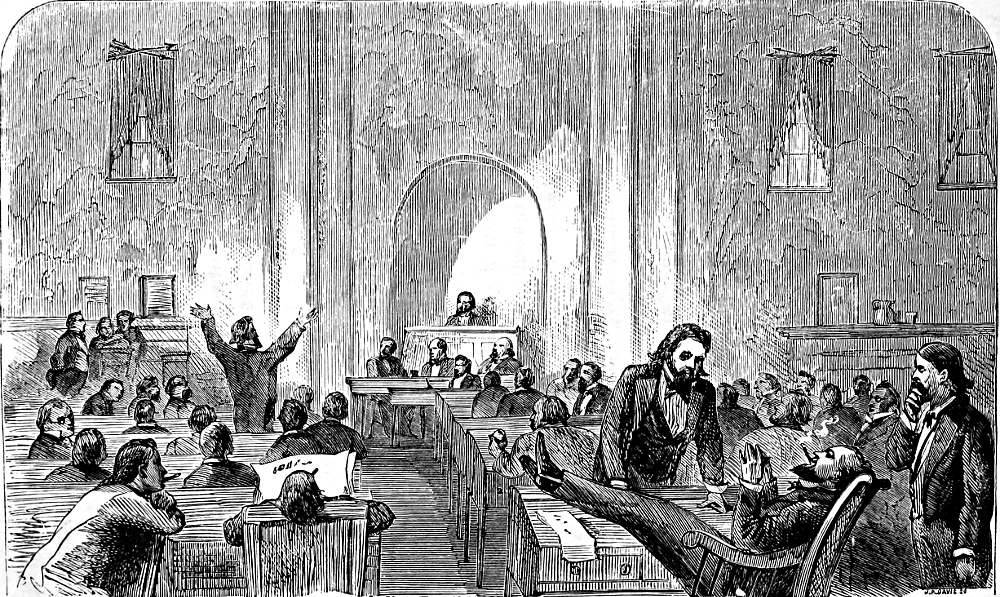
In that Legislature, the struggle between the Secessionists and the
Loyalists was fierce, protracted, and uncertain. Each day had its
accidents, incidents, telegraphic and newspaper excitements, upon
which the action of the body seemed to depend.
In firm and determined men, the two parties were about equally
divided; but there were a good many "floats," who held the balance of
power. These men were very tenderly nursed by the Loyalists.
The Secessionists frequently proposed to go into secret session,
but the Union men steadfastly refused. Rousseau declared in the
Senate that if they closed the doors he would break them open. As he
stands about six feet two, and is very muscular, the threat had some
significance.
Buckner, Tighlman, and Hanson12—all afterward generals in the Rebel
army—led the Secessionists. They
professed to be loyal, and were very shrewd and plausible. They
induced hundreds of young men to join the State-Guard, which they
were organizing to force Kentucky out of the Union, though its
ostensible object was to assure "neutrality."
What Rebel Leaders Pretended.
"State Rights" was their watchword. "For Kentucky neutrality," first;
and, should the conflict be forced upon them, "For the South against
the North." They worked artfully upon the southern partiality for the
doctrine that allegiance is due first to the State, and only secondly
to the National Government.
Governor Magoffin and Lieutenant-Governor Porter were bitter Rebels.
The Legislature made a heavy appropriation for arming the State,
but practically displaced the Governor, by appointing five loyal
commissioners to control the fund and its expenditure.
In Louisville, the Unionists secretly organized the "Loyal League,"
which became very large; but the Secessionists, also, were noisy and
numerous, firm and defiant.
On the 5th of June, Rousseau started for Washington, to obtain
authority to raise troops in Kentucky. At Cincinnati, he met Colonel
Thomas J. Key, then Judge-Advocate of Ohio, on duty with General
McClellan. Key was alarmed, and asked if it were not better to keep
Kentucky in the Union by voting, than by fighting. Rousseau replied:
"As fast as we take one vote, and settle the matter, another, in some
form, is proposed. While we are voting, the traitors are enlisting
soldiers, preparing to throttle Kentucky and precipitate her into
Revolution as they have the other southern States. It is our duty to
see that we are not left powerless at the mercy of those who will
butcher us whenever they can."
Rousseau's Visit to Washington.
Key declared that he would ruin every thing by his rashness.
By invitation, Rousseau called on the commander of the Western
Department. During the conversation, McClellan remarked that Buckner
had spent the previous night with him. Rousseau replied that Buckner
was a hypocrite and traitor. McClellan rejoined that he thought him
an honorable gentleman. They had served in Mexico together, and were
old personal friends.
He added: "But I did draw him over the coals for saying he would not
only drive the Rebels out of Kentucky, but also the Federal troops."
"Well, sir," said Rousseau, "it would once have been considered
pretty nearly treason for a citizen to fight the United States army
and levy war against the National Government!"
When Rousseau reached Washington, he found that Colonel Key, who
had frankly announced his determination to oppose his project, was
already there. He had an interview with the President, General
Cameron, and Mr. Seward. The weather was very hot, and Cameron sat
with his coat off during the conversation.
As usual, before proceeding to business, Mr. Lincoln had his "little
story" to enjoy. He shook hands cordially with his visitor, and
asked, in great glee:
"Rousseau, where did you get that joke about Senator Johnson?"
"The joke, Mr. President, was too good to keep. Johnson told it
himself."
It was this: Dr. John M. Johnson, senator from Paducah, wrote to Mr.
Lincoln a rhetorical document, in the usual style of the Rebels. In
behalf of the sovereign State, he entered his solemn and emphatic
protest against the planting of cannon at Cairo, declaring that
the guns
actually pointed in the direction of the sacred soil of Kentucky!
His Interview with President Lincoln.
In an exquisitely pithy autograph letter, Mr. Lincoln replied, if he
had known earlier that Cairo, Illinois, was in Dr. Johnson's Kentucky
Senatorial District, he certainly should not have established either
the guns or the troops there! Singularly enough—for a keen sense of
humor was very rare among our "erring brethren"—Johnson appreciated
the joke.
While Rousseau was urging the necessity of enlisting troops, he
remarked:
"I have half pretended to submit to Kentucky neutrality, but, in
discussing the matter before the people, while apparently standing
upon the line, I have almost always poked."
This word was not in the Cabinet vocabulary. General Cameron looked
inquiringly at Mr. Lincoln, who was supposed to be familiar with the
dialect of his native State.
"General," asked the President, "you don't know what 'poke' means?
Why, when you play marbles, you are required to shoot from a mark on
the ground; and when you reach over with your hand, beyond the line,
that is poking!"
Cameron favored enlistments in Kentucky, without delay. Mr. Lincoln
replied:
"General, don't be too hasty; you know we have seen another man
to-day, and we should act with caution." Rousseau explained:
"The masses in Kentucky are loyal. I can get as many soldiers as are
wanted; but if the Rebels raise troops, while we do not, our young
men will go into their army, taking the sympathies of kindred and
friends, and may finally cause the State to secede. It is of vital
importance
that we give loyal direction to the sentiment of our people."
At the next interview, the President showed him this indorsement on
the back of one of his papers:
"When Judge Pirtle, James Guthrie, George D. Prentice,
Harney, the Speeds, and the Ballards shall think it proper to raise
troops for the United States service in Kentucky, Lovell H. Rousseau
is authorized to do so."
"How will that do, Rousseau?"
"Those are good men, Mr. President, loyal men; but perhaps some of
the rest of us, who were born and reared in Kentucky, are just as
good Union men as they are, and know just as much about the State. If
you want troops, I can raise them, and I will raise them. If you do
not want them, or do not want to give me the authority, why that ends
the matter."
Finally, through the assistance of Mr. Chase, who steadfastly favored
the project, and of Secretary Cameron, the authority was given.
Timidity of Kentucky Unionists.
A few Kentucky Loyalists were firm and outspoken. But General Leslie
Coombs was a good specimen of the whole. When asked for a letter to
Mr. Lincoln, he wrote: "Rousseau is loyal and brave, but a little too
much for coercion for these parts."
After Rousseau returned, with permission to raise twenty
companies, The Louisville Courier, whose veneer of
loyalty was very thin, denounced the effort bitterly. Even The
Louisville Journal derided it until half a regiment was in
camp.
Loyalty of Judge Lusk.
A meeting of leading Loyalists of the State was held in Louisville,
at the office of James Speed, since Attorney General of the United
States. Garrett Davis, Bramlette, Boyle, and most of the Louisville
men,
were against the project. They feared it would give the State
to the Secessionists at the approaching election. Speed and the
Ballards were for it. So was Samuel Lusk, an old judge from Garrard
County, who sat quietly as long as he could during the discussion,
then jumped up, and bringing his hand heavily down on the table,
exclaimed:
"Can't have two regiments for the old flag! By ---! sir, he shall have
thirty!"
A resolution was finally adopted that, when the time came, they all
wished Rousseau to raise and command the troops, but that, for the
present, it would be impolitic and improper to commence enlisting in
Kentucky.
Greatly against his own will, and declaring that he never was so
humiliated in his life, Rousseau established his camp on the Indiana
shore. After the election, some Secession sympathizers, learning
that he proposed to bring his men over to Louisville, protested very
earnestly, begging him to desist, and thus avoid bloodshed, which
they declared certain.
"Gentlemen," said he, "my men, like yourselves, are Kentuckians. I
am a Kentuckian. Our homes are on Kentucky soil. We have organized
in defense of our common country; and bloodshed is just the business
we are drilling for. If anybody in the city of Louisville thinks it
judicious to begin it when we arrive, I tell you, before God, you
shall all have enough of it before you get through!"
The next day he marched his brigade unmolested through the city.
Afterward, upon many battle-fields, its honorable fame and Rousseau's
two stars were fairly won and worthily worn.
The hum of either army stilly sounds,
That the fixed sentinels almost receive
The secret whispers of each other's watch.
King Henry V.
Campaigning in the Kanawha Valley.
I spent the last days of July, in Western Virginia, with the command
of General J. D. Cox, which was pursuing Henry A. Wise in hot haste
up the valley of the Kanawha. There had been a few little skirmishes,
which, in those early days, we were wont to call battles.
Like all mountain regions, the Kanawha valley was extremely loyal.
Flags were flying, and the people manifested intense delight at the
approach of our army. We were very close upon the flying enemy;
indeed, more than once our cavalry boys ate hot breakfasts which the
Rebels had cooked for themselves.
At a farm-house, two miles west of Charleston, a dozen natives were
sitting upon the door-step as our column passed. The farmer shook
hands with us very cordially. "I am glad to see the Federal army,"
said he; "I have been hunted like a dog, and compelled to hide in the
mountains, because I loved the Union." His wife exclaimed, "Thank
God, you have come at last, and the day of our deliverance is here. I
always said that the Lord was on our side, and that he would bring us
through safely."
A Bloodthirsty Female Secessionist.
Two of the women were ardent Rebels. They did not blame the
native-born Yankees, but wished that every southerner in our ranks
might be killed. Just then one of our soldiers, whose home was in
that county, passed by the door-step, on his way to the well
for a canteen of water. One of the women said to me, with eyes that
meant it:
"I hope he will be killed! If I had a pistol I would shoot him.
Why! you have a revolver right here in your belt, haven't you? If I
seen it before, I would have used it upon him!"
Suggesting that I might have interfered with such an attempt, I asked:
"Do you think you could hit him?"
"O, yes! I have been practicing lately for just such a purpose."
Her companion assured me that she prayed every night and morning for
Jefferson Davis. If his armies were driven out of Virginia, she would
go and live in one of the Gulf States. She had a brother and a lover
in General Wise's army, and gave us their names, with a very earnest
request to see them kindly treated, should they be taken prisoners.
When we parted, she shook my hand, with: "Well, I hope no harm will
befall you, if you are an Abolitionist!"
An old citizen, who had been imprisoned for Union sentiments, was
overcome with joy at the sight of our troops. He mounted a great rock
by the roadside, and extemporized a speech, in which thanks to the
Union army and the Lord curiously intermingled.
Women, with tears in their eyes, told us how anxiously they had
waited for the flag; how their houses had been robbed, their husbands
hunted, imprisoned, and impressed. Negroes joined extravagantly in
the huzzaing, swinging flags as a woodman swings his ax, bending
themselves almost double with shouts of laughter, and exclamations of
"Hurrah for Mass'r Lincoln!"
Thirteen miles above Charleston, at the head of navigation,
we left behind what we grandiloquently called "the fleet." It
consisted of exactly four little stern-wheel steamboats.
The people of these mountain regions use the old currency of New
England, and talk of "fourpence ha'pennies" and "ninepences."
Our road continued along the river-bank, where the ranges of
overhanging hills began to break into regular, densely timbered,
pyramidal spurs. The weather was very sultry. How the sun smote us
in that close, narrow valley! The accoutrement's of each soldier
weighed about thirty pounds, and made a day's march of twenty miles
an arduous task.
A Woman in Disguise.
A private who had served in the First Kentucky Infantry13 for three months, proved to be of the wrong
sex. She performed camp duties with great fortitude, and never fell
out of the ranks during the severest marches. She was small in
stature, and kept her coat buttoned to her chin. She first excited
suspicion by her feminine method of putting on her stockings; and
when handed over to the surgeon proved to be a woman, about twenty
years old. She was discharged from the regiment, but sent to Columbus
upon suspicion, excited by some of her remarks, that she was a spy
of the Rebels.
Extravagant Joy of the Negroes.
At Cannelton, a hundred slaves were employed in the coal-oil
works—two long, begrimed, dilapidated buildings, with a few wretched
houses hard by. Nobody was visible, except the negroes. When I asked
one of them—"Where are all the white people?" he replied, with a
broad grin—
"Done gone, mass'r."
A black woman, whom we encountered on the road, was asked:
"Have you run away from your master?"
"Golly, no!" was the prompt answer, "mass'r run away from me!"
The slaves, who always heard the term "runaway" applied only to their
own race, were not aware that it could have any other significance.
After the war opened, its larger meaning suddenly dawned upon them.
The idea of the master running away and the negroes staying, was
always to them ludicrous beyond description. The extravagant lines of
"Kingdom Coming," exactly depicted their feelings:
Say, darkies, hab you seen de mass'r,
Wid de muffstach on his face,
Go 'long de road some time dis mornin',
Like he's gwine to leave de place?
He seen de smoke way up de ribber
Where de Linkum gunboats lay;
He took his hat and left berry sudden,
And I 'spose he runned away.
De mass'r run, ha! ha!
De darkey stay, ho! ho!
It must be now de kingdom comin',
An' de year ob Jubilo.
"Dey tole us," said a group of blacks, "dat if your army cotched us,
you would cut off our right feet. But, Lor! we knowed you wouldn't
hurt us!"
At a house where we dined, the planter assuming to be loyal, one of
our officers grew confidential with him, when a negro woman managed
to beckon me into a back room, and seizing my arm, very earnestly
said: "I tell you, mass'r's only just putting on. He hates you all,
and wants to see you killed. Soon as you
have passed, he will send right to Wise's army, and tell him what you
mean to do; if any of you'uns remain here behind the troops, you will
be in danger. He's in a heap of trouble," she added, "but, Lord, dese
times just suits me!"
At another house, while the Rebel host had stepped out for a moment,
an intelligent young colored woman, with an infant in her arms,
stationed two negro girls at the door to watch for his return, and
interrogated me about the progress and purposes of the War. "Is it
true," she inquired, very sadly, "that your army has been hunting and
returning runaway slaves?"
Thanks to General Cox, who, like the sentinel in Rolla, "knew
his duty better," I could reply in the negative. But when, with
earnestness gleaming in her eyes, she asked, if, through these
convulsions, any hope glimmered for her race, what could I tell her
but to be patient, and trust in God?
How the Soldiers Foraged.
Army rations are not inviting to epicurean tastes; but in the field
all sorts of vegetables and poultry were added to our bill of
fare. Chickens, young pigs, fence-rails, apples, and potatoes, are
legitimate army spoils the world over.
"Where did you get that turkey?" asked a captain of one of his
men. "Bought it, sir," was the prompt answer. "For how much?"
"Seventy-five cents." "Paid for it, did you?" "Well, no, sir; told
the man I would pay when we came back!"
"Mass'r," said a little ebony servant to a captain with whom I was
messing, "I sees a mighty fine goose. Wish we had him for supper."
"Ginger," replied the officer, "have I not often told you that it is
very wicked to steal?"
The little negro laughed all over his face, and fell out
of the ranks. By a "coincidence," worthy of Sam Weller, we supped on
stewed goose that very evening.
Seen by night from the adjacent hills, our picturesque encampments
gave to the wild landscape a new beauty. In the deep valleys gleamed
hundreds of snowy tents, lighted by waning camp-fires, round which
grotesque figures flitted. The faint murmur of voices, and the
ghostly sweetness of distant music, filled the summer air.
The Falls of the Kanawha.
At the Falls of the Kanawha the river is half a mile wide. A natural
dam of rocks, a hundred yards in breadth, and, on its lower side,
thirty feet above the water, extends obliquely across the stream—a
smooth surface of gray rock, spotted with brown moss.
Near the south bank is the main fall, in the form of a half circle,
three or four hundred yards long, with a broken descent of thirty
feet. Above the brink, the water is dark, green, and glassy, but at
the verge it looks half transparent, as it tumbles and foams down the
rocks, lashed into a passion of snowy whiteness. Plunging into the
seething caldron, it throws up great jets and sheets of foam. Above,
the calm, shining water extends for a mile, until hidden by a sudden
bend in the channel. The view is bounded by a tall spur, wrapped
in the sober green of the forest, with an adventurous corn-field
climbing far up its steep side. At the narrow base of the spur, a
straw-colored lawn surrounds a white farm-house, with low, sloping
roof and antique chimneys. It is half hidden among the maples, and
sentineled by a tall Lombardy poplar.
Two miles above the fall, the stream breaks into its two chief
confluents—the New River and the Gauley. Hawk's Nest, near their
junction, is a peculiarly romantic spot. In its vicinity our command
halted. It was
far from its base, and Wise ran too fast for capture. We had five
thousand troops, who were ill-disciplined and discontented. General
Cox was then fresh from the Ohio Senate. After more field experience,
he became an excellent officer.
A Tragedy of Slavery.
When I returned through the valley, I found Charleston greatly
excited. A docile and intelligent mulatto slave, of thirty years,
had never been struck in his life. But, on the way to a hayfield,
his new overseer began to crack his whip over the shoulders of the
gang, to hurry them forward. The mulatto shook his head a little
defiantly, when the whip was laid heavily across his back. Turning
instantly upon the driver, he smote him with his hayfork, knocking
him from his horse, and laying the skull bare. The overseer, a large,
athletic man, drew his revolver; but, before he could use it, the
agile mulatto wrenched it away, and fired two shots at his head,
which instantly killed him. Taking the weapon, the slave fled to the
mountains, whence he escaped to the Ohio line.
St. Louis, August 19, 1861.
In the days of stage-coaches, the trip from Cincinnati to St. Louis
was a very melancholy experience; in the days of steamboats, a very
tedious one. Now, you leave Cincinnati on a summer evening; and the
placid valley of the Ohio—the almost countless cornfields of the
Great Miami (one of them containing fifteen hundred acres), where
the exhaustless soil has produced that staple abundantly for fifty
years—the grave and old home of General Harrison, at North Bend—the
dense forests of Indiana—the Wabash Valley, that elysium of chills
and fever, where pumpkins are "fruit," and hoop-poles "timber"—the
dead-level prairies of Illinois, with their
oceans of corn, tufts of wood, and painfully white villages—the
muddy Mississippi, "All-the-Waters," as one Indian tribe used to call
it—are unrolled in panorama, till, at early morning, St. Louis,
hot and parched with the journey, holds out her dusty hands to greet
you.
The Future of St. Louis.
No inland city ever held such a position as this. Here is the heart
of the unequaled valley, which extends from the Rocky Mountains to
the Alleghanies, and from the great lakes to the Gulf. Here is the
mighty river, which drains a region six times greater than the empire
of France, and bears on its bosom the waters of fifty-seven navigable
streams. Even the rude savage called it the "Father of Waters," and
early Spanish explorers reverentially named it the "River of the Holy
Ghost."
St. Louis, "with its thriving young heart, and its old French limbs,"
is to be the New York of the interior. The child is living who will
see it the second city on the American continent.
Three Rebel newspapers have recently been suppressed. The editor of
one applied to the provost-marshal for permission to resume, but
declined to give a pledge that no disloyal sentiment should appear in
its columns. He was very tender of the Constitution, and solicitous
about "the rights of the citizen." The marshal replied:
"I cannot discuss these matters with you. I am a soldier, and obey
orders."
"But," remonstrated the editor, "you might be ordered to hang me."
"Very possibly," replied the major, dryly.
"And you would obey orders, then?"
"Most assuredly I would, sir."
The Secession journalist left, in profound disgust.
——He died,
To throw away the dearest thing he owed,
As 'twere a careless trifle.
Macbeth.
The devil can cite Scripture for his purpose.
Merchant of Venice.
The Battle of Wilson Creek.
On the 10th of August, at Wilson Creek, two hundred and forty miles
southwest of St. Louis, occurred the hardest-fought battle of the
year. General Lyon had pursued the Rebels to that corner of the
State. He had called again and again for re-enforcements, but at
Washington nothing could be seen except Virginia. Lyon's force
was five thousand two hundred men. The enemy, under Ben McCulloch
and Sterling Price, numbered over eleven thousand, according to
McCulloch's official report. Lyon would not retreat. He thought that
would injure the Cause more than to fight and be defeated.
To one of his staff-officers, the night before the engagement, he
said: "I believe in presentiments, and, ever since this attack was
planned, I have felt that it would result disastrously. But I cannot
leave the country without a battle."
On his way to the field, he was silent and abstracted; but when the
guns opened, he gave his orders with great promptness and clearness.
He had probably resolved that he would not leave the field alive
unless he left it as a victor. By a singular coincidence, the two
armies marched out before daybreak on that morning each to attack
the other. They met, and for many hours the tide of battle ebbed and
flowed.
Lyon's little army fought with conspicuous gallantry.
It contained the very best material. The following is a
list—from memory, and therefore quite incomplete—of some
officers, who, winning here their first renown, afterward achieved
wide and honorable reputation:
|
At Wilson Creek. |
Afterward. |
| Frederick Steele | Captain | Major-General. |
| F. J. Herron | Captain | Major-General. |
| P. J. Osterhaus | Major | Major-General. |
| S. D. Sturgis | Major | Major-General. |
| R. B. Mitchell | Colonel | Major-General. |
| Franz Sigel | Colonel | Major-General. |
| D. S. Stanley | Captain | Major-General. |
| J. M. Schofield | Major | Major-General. |
| Gordon Granger | Captain | Major-General. |
| J. B. Plummer | Captain | Brigadier-General. |
| James Totten | Captain | Brigadier-General. |
| E. A. Carr | Captain | Brigadier-General. |
| Geo. W. Deitzler | Colonel | Brigadier-General. |
| T. W. Sweeney | Captain | Brigadier-General. |
| Geo. L. Andrews | Lieutenant-Colonel | Brigadier-General. |
| I. F. Shepard | Major | Brigadier-General. |
Daring Exploit of a Kansas Officer.
During the battle, Captain Powell Clayton's company of the First
Kansas Volunteers, becoming separated from the rest of our forces,
was approached by a regiment uniformed precisely like the First Iowa.
Clayton had just aligned his men with this new regiment, when he
detected small strips of red cloth on the shoulders of the privates,
which marked them as Rebels. With perfect coolness, he gave the order:
"Right oblique, march! You are crowding too much upon this regiment."
By this maneuver his company soon placed a good fifty yards between
itself and the Rebel regiment, when the Adjutant of the latter rode
up in front, suspicious that all was not right. Turning to Clayton,
he asked:
"What troops are these?"
"First Kansas," was the prompt reply. "What regiment is that?"
"Fifth Missouri, Col. Clarkson."
"Southern or Union?"
"Southern," said the Rebel, wheeling his horse; but Clayton seized
him by the collar, and threatened to shoot him if he commanded his
men to attack. The Adjutant, heedless of his own danger, ordered his
regiment to open fire upon the Kansas company. He was shot dead on
the spot by Clayton, who told his men to run for their lives. They
escaped with the loss of only four.
The Death of Lyon.
Toward evening Lyon's horse was killed under him. Immediately
afterward, his officers begged that he would retire to a less exposed
spot. Scarcely raising his eyes from the enemy, he said:
"It is well enough that I stand here. I am satisfied."
While the line was forming, he turned to Major Sturgis, who stood
near him, and remarked:
"I fear that the day is lost. I think I will lead this charge."
Early in the day he had received a flesh-wound in the leg, from which
the blood flowed profusely. Sturgis now noticed fresh blood on the
General's hat, and asked where it came from.
"It is nothing, Major, nothing but a wound in the head," replied
Lyon, mounting a fresh horse.
Without taking the hat that was held out to him by Major Sturgis, he
shouted to the soldiers:
"Forward, men! I will lead you."
Two minutes later he lay dead on the field, pierced by a rifle-ball
through the breast, just above the heart.
Our officers held a hurried consultation, and decided not only to
retreat, but to abandon southwest Missouri. Strangely enough, the
coincidence of the morning was
here repeated. Almost simultaneously, the Rebels decided to fall
back. They were in full retreat when they were arrested by the
news of the departure of the Federal troops, and returned to take
possession of the field which the last Union soldier had abandoned
eight hours before.
They claimed a great victory, and with justice, as they finally held
the ground. Their journals were very jubilant. Said The New Orleans
Picayune:
"Lyon is killed, Sigel in flight; southwestern Missouri is clear
of the National scum of invaders. The next word will be, 'On to St.
Louis.' That taken, the whole power of Lincolnism is broken in the
West, and instead of shouting 'Ho for Richmond!' and 'Ho for New
Orleans!' there will be hurrying to and fro among the frightened
magnates at Washington, and anxious inquiries of what they shall do
to save themselves from the vengeance to come. Heaven smiles on the
armies of the Confederate States."
Lyon's Courage and Patriotism.
Lyon went into the battle in civilian's dress, excepting only a
military coat. He had on a soft hat of ashen hue, with long fur and
very broad brim, turned up on three sides. He had worn it for a
month; it would have individualized the wearer among fifty thousand
men. His peculiar dress and personal appearance were well known
through the enemy's camp. He received a new and elegant uniform just
before the battle, but it was never worn until his remains were
clothed in it, after the brave spirit had fled, and while our forces
were retreating from Springfield by night.
Notwithstanding his personal bravery and military education, he
always opposed dueling on principle. No provocation made him
recognize the "code." Once he was struck in the face, but he had
courage enough to refuse to challenge his adversary. For a time
this subjected him to misapprehension and contempt among military
men, but, long before his death, his fellow-officers understood and
respected him.
He seemed to care little for personal fame—to think only of the
Cause. Knowing exactly what was before him, he went to death on that
summer evening "as a man goes to his bridal." Losing a life, he
gained an immortality. His memory is green in the nation's heart, his
name high on her roll of honor.
Arrival of General Fremont.
On the 25th of July, Major-General John C. Fremont reached St.
Louis, in command of the Western Department. His advent was hailed
with great enthusiasm. The newspapers, West, predicted for him
achievements extravagant and impossible as those which the New York
journals had foretold for McClellan. In those sanguine days, the
whole country made "Young Napoleons" to order.
With characteristic energy, Fremont plunged into the business of his
new department, where chaos reigned, and he had no spell to evoke
order, save the boundless patriotism and earnestness of the people.
His head-quarters were established on Chouteau Avenue. He was overrun
with visitors—every captain, or corporal, or civilian, seeking to
prosecute his business with the General in person. He was therefore
compelled to shut himself up, and, by the sweeping refusal to admit
petitioners to him, a few were excluded whose business was important.
Some dissatisfaction and some jesting resulted. I remember three
Kansas officers, charged with affairs of moment, who used daily to be
merry, describing how they had made a reconnoissance toward Fremont's
head-quarters, fought a lively engagement, and driven in the pickets,
only to find the main garrison so well guarded that they were quite
unable to force it.
Union Families Driven Out.
St. Louis, August 26, 1861.
A long caravan of old-fashioned Virginia wagons, containing rude
chairs, bedsteads, and kitchen utensils, passed through town
yesterday. They brought from the Southwest families who,
"Forced from their homes, a melancholy train, are seeking in free
Illinois that protection which Government is unable to afford them in
Missouri. At least fifty thousand inoffensive persons have thus fled
since the Rebellion."
August 29.
We were lately surprised and gratified to learn that a gentleman
from Minnesota had offered an unasked loan of forty-six thousand
dollars to the Government authorities—gratified at such spontaneous
patriotism, and surprised that any man who lived in Minnesota
should have forty-six thousand dollars. The latter mystery has been
explained by the discovery that he never took his funds to that
vortex of real estate speculation, but left them in this city, where
he formerly resided. Moreover, his money was in Missouri currency,
which, though at par here in business transactions, is at a discount
of eight per cent. on gold and New York exchange. The loan is to be
returned to him in gold. So, after all, there is probably as much
human nature to the square acre in Minnesota as anywhere else.
September 6.
"Egypt to the rescue!" is the motto upon the banner of a new Illinois
regiment. Southern Illinois, known as Egypt, is turning out men for
the Mississippi campaign with surprising liberality; whereupon a
fiery Secessionist triumphantly calls attention to this prophetic
text, from Hosea: "Egypt shall gather them up; Memphis shall bury
them!"
The aptness of the citation is admirable; but he is reminded, in
return, that the pet phrase of the Rebels, "Let us alone," was the
prayer of a man possessed of a devil, to the Saviour of the world!
An Involuntary Sojourn With Rebels.
I have just met a gentleman, residing in southwestern Missouri, whose
experience is novel. He visited the camp of the Rebels to reclaim a
pair of valuable horses, which they had taken from his residence.
They not only retained the stolen animals, but also took from him
those with which he went in pursuit, and left him the alternative
of walking home, twenty-three miles, through a dangerous region, or
remaining in their camp. Fond of adventure, he chose the latter,
and for three weeks messed with a Missouri company. The facetious
scoundrels told him that they could not afford to keep him unless he
earned his living; and employed him as a teamster. He had philosophy
enough to make the best of it, and flattered himself that he became a
very creditable mule-driver.
Early on the morning of August 10th, he was breakfasting with the
officers from a dry-goods box, which served for a table, when bang!
went a cannon, not more than two or three hundred yards from them,
and crash! came a ball, cutting off the branches just above their
heads. "Here is the devil to pay; the Dutch are upon us!" exclaimed
the captain, springing up and ordering his company to form.
My friend was a looker-on from the Southern side during the whole
battle. He gives a graphic account of the joy of the Rebels at
finding the body of General Lyon, lying under a tree (the first
information they had of his death), and their surprise and
consternation at the bravery with which the little Union army fought
to the bitter end.
Twenty leading Secessionists are in durance vile here. There is
a poetic justice in the fact that their prison was formerly a
slave-pen, and that they are enabled to study State Rights from old
negro quarters.
September 7.
A Startling Confederate Atrocity.
The Rebels have just perpetrated a new and startling atrocity. They
cut down the high railroad bridge over the Little Platte River
near St. Joseph. The next train from Hannibal reached the spot at
midnight, and its locomotive and five cars were precipitated, thirty
feet, into the bed of the river. More than fifty passengers were
dangerously wounded, and twenty instantly killed. They were mainly
women and children; there was not a single soldier among them.
September 15.
General Fremont is issuing written guarantees for their freedom
to the slaves of Rebels. They are in the form of real-estate
conveyances, releasing the recipient from all obligations to his
master; declaring him forever free from servitude, and with full
right and authority to control his own labor. They are headed "Deed
of Manumission," authenticated by the great seal of the Western
Department, and the signature of its commander. Think of giving a man
a warranty-deed for his own body and soul!
In compliance with imperative orders from the Government, several
regiments, though sadly needed here, are being sent eastward. To the
colonel commanding one of them, the order was conveyed by Fremont in
these characteristic terms:
"Repair at once to Washington. Transportation is provided for you.
My friend, I am sorry to part with you, but there are laurels growing
on the banks of the Potomac."
Why should a man, whose blood is warm within,
Sit like his grandsire cut in alabaster?
Merchant of Venice.
Organization of the "Bohemian Brigade."
In October, General Fremont's forming army rendezvoused at the
capital of Missouri. From afar, Jefferson City is picturesque; but
distance lends enchantment. Close inspection shows it uninviting and
rough. The Capitol, upon a frowning hill, is a little suggestive of
the sober old State House which overlooks Boston Common. Brick and
frame houses enough for a population of three thousand straggle over
an area of a mile square, as if they had been tossed up like a peck
of apples, and left to come down and locate themselves. Many are half
hidden by the locust, ailantus, and arbor-vitæ trees, and the white
blossoms of the catalpas.
The war correspondents "smelled the battle from afar off." More than
twenty collected two or three weeks before the army started. Some of
them were very grave and decorous at home, but here they were like
boys let out of school.
They styled themselves the Bohemian Brigade, and exhibited that
touch of the vagabond which Irving charitably attributes to all
poetic temperaments. They were quartered in a wretched little tavern
eminently First Class in its prices. It was very southern in style.
A broad balcony in front, over a cool brick pavement; no two rooms
upon the same level; no way of getting up stairs except by going out
of doors; long, low wings, shooting off in all directions; a gallery
in the rear, deeper than the house itself; heavy furniture,
from the last generation, with a single modern link in the shape of
a piano in the ladies' parlor; leisurely negro waiters, including
little boys and girls, standing behind guests at dinner, and waving
long wands over the table to disconcert the omnipresent flies; and
corn bread, hot biscuits, ham, and excellent coffee. The host and
hostess were slaveholders, who said "thar" and "whar," but held that
Secessionists were traitors, and that traitors ought to be hung.
An Amused African.
The landlord, who was aged, rheumatic, and half blind, labored
under the delusion that he kept the house; but an intelligent
and middle-aged slave, yclept John, was the real brain of the
establishment.
"John," asked one of the correspondents, "does your master really
think he is alive?"
"'Live, sir? I reckon so."
"Why, he has been dead these twenty years. He hobbles around,
pretending he exists, just to save funeral expenses."
John's extravagant enjoyment of this sorry jest beggared description.
He threw himself on the floor, rolled over and over, and roared with
laughter for fifteen minutes. He did not recover his usual gravity
for weeks. Again and again, while waiting upon guests, he would
see his master coming, and suddenly explode with merriment, to the
infinite amazement of the habitués of the house, who suspected that
the negro was losing his wits.
Diversions of the Correspondents.
The Bohemians took their ease in their inn, and held high carnival,
to the astonishment of all its attachés, from the aged proprietor
down to the half-fledged negro cherubs. Each seemed to regard as his
personal property the half-dozen rooms which all occupied. The one
who dressed earliest in the morning would appropriate the
first hat, coat, and boots he found, remarking that the owner was
probably dead.
One huge, good-natured brother they called "the Elephant." He was
greatly addicted to sleeping in the daytime; and when other resources
failed, some reckless quill-driver would say:
"Now, let's all go and sleep with the Elephant."
Eight or ten would pile themselves upon his bed, beside him and upon
him, until his good-nature became exhausted, when the giant would
toss them out of the room like so many pebbles, and lock his door.
There was little work to be done; so they discussed politics,
art, society, and metaphysics; and would soon kindle into singing,
reciting, "sky-larking," wrestling, flinging saddles, valises, and
pillows. In some recent theatrical spectacle, two had heard a "chorus
of fiends," which tickled their fancy. As the small hours approached,
it was their unceasing delight to roar imitations of it, declaring,
with each repetition, that it was now to be given positively for
the last time, and by the very special request of the audience. How
they sent that demoniac "Ha! ha! ha!" shrieking through the midnight
air! The following account of their diversions was given by "J. G."
in The Cincinnati Gazette. The scenes he witnessed
suggested, very naturally, the nomenclature of the prize-ring:
Happening to drop in the other night, I found the representatives
of The Missouri Republican, The Cincinnati
Commercial, The New York World, and The
Tribune, engaged in a hot discussion upon matrimony,
which finally ran into metaphysics. The Republican
having plumply disputed an abstruse proposition of The
Tribune, the latter seized an immense bolster, and
brought it down with emphasis upon the glossy pate of his
antagonist. This instantly broke up the debate, and a general
mêlée commenced. The
Republican grabbed a damp towel and
aimed a stunning blow at his assailant, which missed him and
brought up against the nasal protuberance of Frank Leslie.
The exasperated Frank dealt back a pillow, followed by
a well-packed knapsack. Then The Missouri Democrat
sent a coverlet, which lit upon and enveloped the knowledge-box of
The Herald. The latter disengaged himself after several
frantic efforts, and hurled a ponderous pair of saddle-bags, which
passed so close to The Gazette's head, that in dodging
it he bumped his phrenology against the bed-post, and raised a
respectable organ where none existed before. Simultaneously The
Commercial threw a haversack, which hit Harper
in the bread-basket, and doubled him into a folio—knocking
him against The World, who, toppling from his center
of gravity, was poising a plethoric bed-tick with dire intent, when
the upturned legs of a chair caught and tore it open, scattering the
feathers through the surging atmosphere. In falling, he capsized
the table, spilling the ink, wrecking several literary barks,
extinguishing the "brief candle" that had faintly revealed the
sanguinary fray, thus abruptly terminating hostilities, but leaving
the panting heroes still defiant and undismayed. A light was at
last struck; the combatants adjusted their toilets, and, having lit
the calumets of peace, gently resigned themselves to the soothing
influence of the weed.
A Polite Army Chaplain.
They did not learn, for several days, that a meek chaplain, with his
wife and three children, inhabited an adjacent apartment. He was at
once sent for, and a fitting apology tendered. He replied that he had
actually enjoyed the novel entertainment. He must have been the most
polite man in the whole world. He is worthy a niche in biography,
beside the lady who was showered with gravy, by Sidney Smith, and
who, while it was still dripping from her chin, blandly replied to
his apologies, that not a single drop had touched her!
When in-door diversions failed, the correspondents amused themselves
by racing their horses, which were all fresh and excitable. That
region, abounding in hills, ravines, and woods, is peculiarly
seductive to reckless equestrians desiring dislocated limbs or broken
necks.
One evening, the "Elephant" was thrown heavily
from his horse, and severely lamed. The next night, nothing daunted,
he repeated the race, and was hurled upon the ground with a force
which destroyed his consciousness for three or four hours. A comrade,
in attempting to stop the riderless horse, was dragged under the
heels of his own animal. His mild, protesting look, as he lay flat
upon his back, holding in both hands the uplifted, threatening foot
of his fiery Pegasus, was quite beyond description. One correspondent
dislocated his shoulder, and went home from the field before he heard
a gun.
Sights in Jefferson City.
Jefferson City, Mo., October 6, 1861.
These deep ravines and this fathomless mud offer to obstinate mules
unlimited facilities for shying, and infinite possibilities of
miring. Last night, six animals and an army wagon went over a small
precipice, and, after a series of somersaults, driver, wagon, and
mules, reached the bottom, in a very chaotic condition.
Jefferson is strong on the wet weather question. When Lyon got here
in June, he was welcomed by one man with an umbrella. When Fremont
arrived, a few nights ago, he was taken in charge by the same
gentleman, who was floundering about through the mud with a lantern,
seeking, not an honest man, but quarters for the commanding general.
Most of the troops have gone forward, but some remain. Newly mounted
officers, who sit upon their steeds much as an elephant might walk a
tight rope, dash madly through the streets, fondly dreaming that they
witch the world with noble horsemanship. Subalterns show a weakness
for brass buttons, epaulettes, and gold braid, which leaves feminine
vanity quite in the shade.
In the camps, the long roll is sometimes sounded at midnight, to
accustom officers and men to spring to arms.
Upon the first of these sudden calls from Morpheus to Mars, the negro
servant of a staff-officer was so badly frightened that he brought
up his master's horse with the crupper about the neck instead of the
tail. The mistake was discovered just in season to save the rider
from the proverbial destiny of a beggar on horseback.
"Fights mit Sigel."
Here is a German private very shaky in the legs; he swears by Fremont
and "fights mit Sigel." Too much "lager" is the trouble with him;
and, in serene though harmless inebriety, he is arrested by a file
of soldiers. A capital print in circulation represents a native and
a German volunteer, with uplifted mugs of the nectar of Gambrinus,
striking hands to the motto, "One flag, one country, zwei lager!"
Here is a detachment of Home Guards, whose "uniform is multiform."
To a proposition, that the British militia should never be ordered
out of the country, Pitt once moved the satirical proviso, "Except
in case of invasion." So it is alleged that the Missouri Home Guards
are very useful—except in case of a battle; and I hear one merciless
critic style them the "Home Cowards." This is unjust; but they
illustrate the principle, that to attain good drill and discipline,
soldiers should be beyond the reach of home.
Camp Lillie, upon a beautiful grassy slope, is the head-quarters
of the commander. In his tent, directing, by telegraph, operations
throughout this great department, or upon horseback, personally
inspecting the regiments, you meet the peculiarly graceful, slender,
compact, magnetic man whose assignment here awoke so much enthusiasm
in the West. General Fremont is quiet, well-poised, and unassuming.
His friends are very earnest, his enemies very bitter. Those who know
him only by his early exploits, are surprised to find in the hero of
the
frontier the graces of the saloon. He impresses one as a man very
modest, very genuine, and very much in earnest.
A Physiological Phenomenon.
His hair is tinged with silver. His beard is sprinkled with snow,
though two months ago it was of unmingled brown.
"Nor turned it white
In a single night,
As men's have done from sudden fears;"
but it did blanch under the absorbing labors and anxieties of two
months—a physiological fact which Doctor Holmes will be good enough
to explain to us at his earliest convenience.
Mrs. Fremont is in camp, but will return to Saint Louis when the
army moves. She inherits many traits of her father's character.
She possesses that "excellent thing in woman," a voice, like Annie
Laurie's, low and sweet—more rich, more musical, and better
modulated, than that of any tragédienne upon the stage. To a
broad, comprehensive intellect she adds those quick intuitions which
leap to results, anticipating explanations, and those proclivities
for episode, incident, and bits of personal analyzing, which make a
woman's talk so charming.
How much rarer this grace of familiar speech than any other
accomplishment whatever! In a lifetime one meets not more than four
or five great conversationalists. Jessie Benton Fremont is among the
felicitous few, if not queen of them all.
October 8.
The army is forty thousand strong. Generals Sigel, Hunter, Pope,
Asboth, and McKinstry command respectively its five divisions.
Sigel, Hunter, Pope, Asboth, McKinstry.
Sigel is slender, pale, wears spectacles, and looks more like a
student than a soldier. He was professor in a university when the war
broke out.
Hunter, at sixty, and agile as a boy, is erect and grim, with bald
head and Hungarian mustache.
Pope is heavy, full-faced, brown-haired, and looks like a man of
brains.
Asboth is tall, daring-eyed, elastic, a mad rider, and profoundly
polite, bowing so low that his long gray hair almost sweeps the
ground.
McKinstry is six feet two, sinewy-framed, deep-chested, firm-faced,
wavy-haired, and black-mustached. He looks like the hero of a
melodrama, and the Bohemians term him "the heavy tragedian."
Warsaw, Mo., October 22.
An officer of New York mercantile antecedents, recently appointed
to a high position, reached Syracuse a few days since, under orders
to report to Fremont. He would come no farther than the end of the
railroad, but turned abruptly back to St. Louis. Being asked his
reason, he made this reply, peculiarly ingenuous and racy for a
brigadier-general and staff-officer:
"Why, I found that I should have to go on horseback!"
With two fellow-journalists, I left Syracuse four days ago. Asboth's
and Sigel's divisions had preceded us. The post-commandant would not
permit us to come through the distracted, guerrilla-infested country
without an escort, but gave us a sergeant and four men of the regular
army.
On the way we spent the supper hour near Cole Camp. Our Falstaffian
landlord informed us that two brothers, Jim and Sam Cole, encamped
here in early
days, to hunt bears, and that the creek was named in remembrance of
them. Being asked with great gravity the extremely Bohemian question,
"Which of them?" he relapsed into a profound study, from which he
did not afterward recover.
We made the trip—forty-seven miles—in ten hours. This is a strong
Secession village. Half its male inhabitants are in the Rebel army.
Our officers quarter in the most comfortable residences. At first
the people were greatly incensed at the "Abolition soldiery,"
but they now submit gracefully. One of the most malignant Rebel
families involuntarily entertains a dozen German officers, who drink
lager-beer industriously, smoke meerschaums unceasingly, and at night
sing unintermittently.
We are quartered at the house of a lady who has a son in Price's
army, and a daughter in whom education and breeding maintain constant
warfare with her antipathies toward the Union forces. Being told
the other evening that one of our party was a Black Republican, she
regarded him with a wondering stare, declaring that she never saw an
Abolitionist before in her life, and apparently amazed that he wore
the human face divine!
Sigel's Transportation Train.
Sigel, as usual, is thirty miles ahead. He has more go in him
than any other of our generals. Several division commanders are
still waiting for transportation, but Sigel collected horse-wagons,
ox-wagons, mule-wagons, family-carriages, and stage-coaches, and
pressed animals until he organized a most unique transportation train
three or four miles long. He crossed his division over the swift
Osage River—three hundred yards wide—in twenty-four hours, upon a
single ferry-boat. The Rebels justly name him "The Flying Dutchman."
A Countryman's Estimate of Troops.
The Missourians along our line of march have very extravagant ideas
about the Federal army. We stopped at
the house of a native, where ten thousand troops had passed. He
placed their number at forty thousand!
"I reckon you have, in all, about seventy thousand men, and three
hundred cannon, haven't you?" he asked.
"We have a hundred and fifty thousand men, and six hundred pieces of
artillery," replied a wag in the party.
"Well," said the countryman, thoughtfully, "I reckon you'll clean out
old Price this time!"
Once more into the breach, dear friends, once more,
Or close the wall up with our English dead!
King Henry V.
A "Kid-Gloved" Corps.
General Fremont's Body Guard was composed of picked young men of
unusual intelligence. They were all handsomely uniformed, efficiently
armed, and mounted upon bay horses. They cultivated the mustache,
with the rest of the face smooth—at least, not a more whimsical
decree than the rigid regulation of the British army, which compelled
every man to shave and wear a stock under the burning sun of the
Crimea. Many denounced the Guard as a "kid-gloved," ornamental corps,
designed only to swell Fremont's retinue.
Major Zagonyi, commandant of the Guard, with one hundred and fifty of
his men, started with orders to reconnoiter the country in front of
us. When near Springfield, they found the town held by a Rebel force
of cavalry and infantry, ill organized, but tolerably armed, and
numbering two thousand.
Zagonyi drew his men up in line, explained the situation, and asked
whether they would attack or turn back for re-enforcements. They
replied unanimously that they would attack.
They did attack. Men and horses were very weary. They had ridden
fifty miles in seventeen hours; they had never been under fire
before; but history hardly parallels their daring.
Charge of the Body Guard.
The Rebels formed in line of battle at the edge of a wood. To
approach them, the Guard were compelled
to ride down a narrow lane, exposed to a terrible fire from three
different directions. They went through this shower of bullets,
dismounted, tore down the high zig-zag fence, led their horses over
in the teeth of the enemy, remounted, formed, and, spreading out,
fan-like, charged impetuously, shouting "Fremont and the Union."
The engagement was very brief and very bloody. Though only in the
proportion of one to thirteen, the Guard behaved as if weary of their
lives. Men utterly reckless are masters of the situation. At first,
the Confederates fought well; but they were soon panic-stricken, and
many dropped their guns, and ran to and fro like persons distracted.
The Guard charged through and through the broken ranks of the Rebels,
chased them in all directions—into the woods, beyond the woods,
down the roads, through the town—and planted the old flag upon the
Springfield court-house, where it had not waved since the death of
Lyon.
Armed with revolvers and revolving carbines, members of the Guard had
twelve shots apiece. After delivering their first fire, there was no
time to reload, and (the only instance of the kind early in the war)
nearly all their work was done with the saber. When they mustered
again, almost every blade in the command was stained with blood.
Of their one hundred and fifty horses, one hundred and twenty were
wounded. A sergeant had three horses shot under him. A private
received a bullet in a blacking-box, which he carried in his pocket.
They lost fifty men, sixteen of whom were killed on the spot.
"I wonder if they will call us fancy soldiers and kid-gloved boys any
longer?" said one, who lay wounded in the hospital when we arrived.
Turning the Tables.
On a cot beside him, I found an old schoolmate. His eye brightened as
he grasped my hand.
"Is your wound serious?" I asked.
"Painful, but not fatal. O, it was a glorious fight!"
It was a glorious fight. Wilson Creek is doubly historic ground.
There first a thousand of our men poured out their blood like water,
and the brave Lyon laid down his life "for our dear country's sake."
Two months later, the same stream witnessed the charge of the Body
Guard, which, in those dark days, when the Cause looked gloomy,
thrilled every loyal heart in the nation. It will shine down the
historic page, and be immortal in song and story.
Major Frank J. White, of our army, was with the Rebels as a prisoner
of war during the charge. Just before they were routed, fourteen men,
under a South Carolina captain, started with him for General Price's
camp. At a house where they spent the night, the farmer boldly
avowed himself a Union man. He supposed White to be one of the Rebel
officers; but, finding a moment's opportunity, the major whispered to
him:
"I am a Union prisoner. Send word to Springfield at once, and my men
will come and rescue me."
The Rebels, leaving one man on picket outside, went to bed in the
same room with their prisoner. Then the farmer sent his little boy of
twelve years, on horseback, fourteen miles to Springfield. At three
o'clock in the morning, twenty-six Home Guards surrounded the house,
and captured the entire party. Major White at once took command, and
posted his guards over the crestfallen Confederates.
While they sat around the fire in the evening, waiting for supper,
the Rebel captain had remarked:
"Major, we have a little leisure, and I believe I will
amuse myself by looking over your papers." Whereupon he spent an hour
in examining the letters which he found in White's possession. In
the morning, when the party, again sitting by the fire, waited for
breakfast, the major said, quietly:
"Captain, we have a little leisure, and I think I will amuse
myself by looking over your papers." So the Rebel documents were
scrutinized in turn. White returned in triumph to Springfield,
bringing his late captors as prisoners. A friendship sprang up
between him and the South Carolina captain, who remained on parole in
our camp for several days, and they messed and slept together.
Welcome from Union Residents.
When our troops entered Springfield, the people greeted them with
uncontrollable joy; for they were intensely loyal, and had been under
Rebel rule more than eleven weeks. Scores and scores of National
flags now suddenly emerged from mysterious hiding-places; wandering
exiles came pouring back, and we were welcomed by hundreds of glad
faces, waving handkerchiefs, swinging hats, and vociferous huzzas.
Fremont had now modified his Proclamation; but the logic of events
was stronger than President Lincoln. The negroes would throng our
camp, and Fremont never permitted a single one to be returned. One
slave appropriated a horse, and, guiding him only by a rope about the
nose, without saddle or bridle, blanket or spur, rode from Price's
camp to Fremont's head-quarters, more than eighty miles, in eighteen
hours.
A brigade of regular troops, under General Sturgis, having marched
from Kansas City, joined us in Springfield. They were under very
rigid discipline, and all their supplies, whether procured from
Rebels or Unionists, were paid for in gold. Sturgis was then very
"conservative," and some of our people denounced him as disloyal.
But, like hundreds of others, inexorable war educated him very
rapidly. His sympathies were soon heartily on our side. He afterward,
in the Army of the Potomac, won and wore bright laurels.
Freaks of the Kansas Brigade.
The Kansas volunteer brigade, under General "Jim" Lane, also
joined us at Springfield. Their course contrasted sharply with that
of Sturgis's men. They had a good many old scores to settle up, and
they swept along the Missouri border like a hurricane. Sublimely
indifferent to the President's orders, and all other orders which
did not please them, they received over two thousand slaves, sending
them off by installments into Kansas. When the master was loyal,
they would gravely appraise the negro; give him a receipt for his
slave, named ----, valued at ---- hundred dollars, "lost by the march
of the Kansas Brigade," and advise him to carry the claim before
Congress!
By some unexplained law, dandies, fools, and supercilious braggarts
often gravitate into staff positions; but Fremont's staff was an
exceedingly agreeable one. Many of its members had traveled over
the globe, and, from their wide experiences, whiled away many hours
before the evening camp-fires.
On the 31st of October, the correspondents, under cavalry escort,
visited the Wilson Creek battle-ground, ten miles south of
Springfield.
The field is broken by rocky ridges and deep ravines, and covered
with oak shrubs. Picking his way among the brushwood, my horse's
hoof struck with a dull, hollow sound against a human skull. Just
beyond, still clad in uniform, lay a skeleton, on whose ghastliness
the storms and sunshine of three months had fallen. The head was
partially severed; and though the upturned
face was fleshless, I could not resist the impression that it wore a
look of mortal agony. It was in a little thicket, several yards from
the scene of any fighting. The poor fellow was carried there, dying
or dead, during the progress of the battle, and afterward overlooked.
Among our lost his name was probably followed by the sad word
"Missing."
"Not among the suffering wounded;
Not among the peaceful dead;
Not among the prisoners. Missing—
That was all the message said.
"Yet his mother reads it over,
Until, through her painful tears,
Fades the dear name she has called him
For these two-and-twenty years."
Many graves had been opened by wolves. Bones of horses, haversacks,
shoes, blouses, gun-barrels, shot, and fragments of shell, were
scattered over the field. The trees were scarred with bullets, and
hundreds were felled by the artillery. A six-inch shot would cut down
one of these brittle oaks a foot in diameter.
Capture of a Female Spy.
A few miles south of Springfield one of our scouts encountered a
young woman on horseback. Suspecting her errand, he informed her
confidentially that he was a spy from Price's army, who had been
several days in Fremont's camp. Falling into this palpable trap,
the girl told him frankly that she was sent by Price to visit
our forces, and obtain information. She was taken immediately to
Fremont's head-quarters. Her terror was very great on finding herself
betrayed. She told all she knew about the Rebels, and was finally
allowed to depart in peace. The employment of female spies was very
common upon both sides.
Fremont's Farewell to his Army.
On the 2d of November our whole army was at Springfield. Fremont
had progressed farther south than any other Union commander, from
the Atlantic to the Rio Grande. Detachments of Rebels were within
ten miles of our camps. Emphatic, but entirely false reports from
the colonel at the head of Fremont's scouts,14
had given the impression that Price's entire command was very near
us; and a great battle was hourly expected.
Fremont was in the midst of an important campaign. His army was most
patriotic, enthusiastic, and promising. His personal popularity among
his troops was without parallel.
At this moment the official ax fell. He received an order to
turn over his command to Hunter. It was a trying ordeal, but he
did a soldier's duty, obeying silently and instantly. The first
intelligence which the army received was conveyed by this touching
farewell:
Soldiers of the Mississippi Army:
Agreeably to orders this day received, I take leave of you. Although
our army has been of sudden growth, we have grown up together, and
I have become familiar with the brave and generous spirit which you
bring to the defense of your country, and which makes me anticipate
for you a brilliant career.
Continue as you have begun, and give to my successor the same
cordial and enthusiastic support with which you have encouraged me.
Emulate the splendid example already before you, and let me remain,
as I am, proud of the noble army which I have thus far labored to
bring together.
Disaffection among the Soldiers.
Soldiers! I regret to leave you. Sincerely I thank you for the
regard and confidence you have invariably shown me. I deeply regret
that I shall not have the honor to lead you to the victory which you
are just about to win, but I shall claim to share with you in the joy
of every triumph, and trust always to be fraternally remembered by my
companions in arms.
Fremont's name had been the rallying-point of the volunteers.
Officers and entire regiments had come from distant parts of the
country to serve under him. All felt the impropriety and cruelty
of his removal at this time. Many officers at once wrote their
resignations. Whole battalions were reported laying down their arms.
The Germans were specially indignant, and among the Body Guard there
was much bitterness.
The slightest encouragement or tolerance from the General would
have produced wide-spread mutiny; but he expostulated with the
malcontents, reminding them that their first duty was to the country;
and, after Hunter's arrival, left the camp before daylight, lest
his appearance among the soldiers, as he rode away, should excite
improper demonstrations.
A few days moderated the feeling of the troops; for, like all our
volunteers, they were wedded not to any man, but to the Cause.
In St. Louis, Fremont was received more like a conquering hero
than a retiring general. An immense assembly greeted him. In their
enthusiasm, the people even carpeted his door-step with flowers.
For weeks before his removal the air had been filled with clamors,
charging him with incompetency, extravagance, and giving Government
contracts to corrupt men. The first attacks upon him immediately
followed his Emancipation Proclamation, issued August 31, 1861.
Spurious Missouri Unionists.
There were many half-hearted Unionists in Missouri.
For example, shortly after the capture of Sumter, General Robert
Wilson, of Andrew County, in a public meeting, served upon the
committee on resolutions reporting the following:
"Resolved, That we condemn as inhuman and diabolical the war
being waged by the Government against the South."
Eight months after, this same Wilson claimed to be a Union leader,
and, as such, was sent to represent Missouri in the Senate of the
United States! Of course all men of this class waged unrelenting war
upon Fremont. Afterward there was a rupture among the really loyal
men; a fierce quarrel, in which the able but unscrupulous Blairs
headed the opposition, and some zealous and patriotic Unionists
co-operated with them. The President, always conscientious, was
persuaded to remove the General; but afterward tacitly admitted its
injustice by giving him another command.
Mr. Lincoln also countermanded the Emancipation Proclamation, which
was a little ahead of the times. Still it gratified the plain
people, even then. Tired of the tender and delicate terms in which
our authorities were wont to speak of "domestic institutions" and
"systems of labor," they were delighted to read the announcement in
honest Saxon:
"The property of active Rebels is confiscated for the
public use; and their slaves, if any they have, are hereby
declared Free Men."
It was a new and pure leaf in the history of the war.
Of course Fremont made mistakes, though the abuses in his department
were infinitely less than those which disgraced Washington, and which
in some degree are inseparable from large, unusual disbursements of
public money.
Conduct of Cameron and Thomas.
But he was very earnest. He was quite ignorant of How Not to Do it.
He took grave responsibilities. When red tape hampered him, he cut
it. Unable to obtain arms at Washington—which, in those days, knew
only Virginia—he ransacked the markets of the world for them. When
a paymaster refused to liquidate one of his bills, on the ground of
irregularity, he arrested him, and threatened to have him shot if he
persisted. Able to leave but few troops in St. Louis, he fortified
the city in thirty days, employing five thousand laborers.
Secretary Cameron and Adjutant-General Thomas visited Missouri,
after Fremont started upon his Springfield campaign. General Thomas
did not hesitate, in railway cars and hotels, to condemn him
violently—a gross breach of official propriety, and clearly tending
to excite insubordination among the soldiers. Cameron dictated a
letter, ordering Fremont to discontinue the St. Louis fortifications
as unnecessary, informing him that his official debts would not
be discharged till investigated, his contracts recognized, or the
officers paid whom he had appointed under the written authority of
the President.
In due time they were recognized and paid. The St. Louis
fortifications proved needful, and were afterward finished. Yet
Cameron permitted the contents of this letter to be telegraphed
all over the country four days before Fremont received it. It
seemed designed to impugn his integrity, destroy his credit,
promote disaffection in his camps, and prevent his contractors from
fulfilling their engagements. Thomas officially reported that Fremont
would not be able to move his army for lack of transportation. Before
the report could reach Washington, the army had advanced more than a
hundred miles!
Disregard of the Army Regulations.
Time, which at last makes all things even, vindicated Fremont's
leading measures in Missouri. His subsequent withdrawal from the
field, in Virginia, was doubtless unwise. It was hard to be placed
under a junior and hostile general; but private wrongs must wait in
war, and resignation proves quite as inadequate a remedy for the
grievances of an officer, as Secession for the fancied wrongs of the
Slaveholders.
Brigadier-General Justus McKinstry, ex-Quartermaster of the
Western Department, was arrested, and closely confined in the
St. Louis arsenal for many months. His repeated demands for the
charges and specifications against him were disregarded. He was at
last court-martialed and dismissed the service, on the charge of
malfeasance in office. Brigadier-General Charles P. Stone was for a
long time kept under arrest in the same manner. These proceedings
flagrantly violated both the Army Regulation, entitling officers to
know the charges and witnesses against them, within ten days after
arrest, and the spirit of the Constitution itself, which guarantees
to every man a speedy public trial in the presence of his accusers.
Equally reprehensible was the arrest and long confinement of many
civilians without formal charges or trial. States where actual
war existed, and even the debatable ground which bordered them,
might be proper fields for this exercise of the Military Power.
But the friends of the Union, holding Congress, and nearly every
State Legislature by overwhelming majorities, could make whatever
laws they pleased; therefore, these measures were unnecessary and
unjustifiable in the North, hundreds of miles from the seat of war.
Utterly at variance with personal rights and republican institutions,
they were alarming and dangerous precedents, which any unscrupulous
future
administration may plausibly cite in defense of the grossest
outrages. President Lincoln was always very chary of this exercise
of arbitrary power; but some of his constitutional advisers were
constantly urging it. Secretary Stanton, in particular, advocated and
committed acts of flagrant despotism. He was a good patent-office
lawyer, but had not the faintest conception of those primary
principles of Civil Liberty which underlie English and American
institutions. Even the Magna Charta, in sonorous Latin, declared:
"No person shall be apprehended or imprisoned, except by the
legal judgment of his peers, or the law of the land. To none will
we sell, to none will we deny, to none will we delay right or
justice."
Military Power and the Press.
Kindred questions arose touching the Military Power and the Liberty
of the Press. Each northern city had its daily journal, which, under
thin disguise of loyalty, labored zealously for the Rebels. Soldiers
could not patiently read treasonable sheets. On several occasions
military commanders suppressed them, but the President promptly
removed the disability. The sober second thought of the people
was, that if editors and publishers in the loyal North could not
be convicted and punished in the civil courts, they should not be
molested.
General Hunter, succeeding Fremont, evacuated southwestern Missouri.
Before leaving Springfield, besieged with applications for runaway
slaves, he issued orders to deliver them up; but soldiers and
officers in his camps hid them so safely that they could not be found
by their masters.
Rudeness of General Halleck.
Hunter's little brief authority lasted just fifteen days, when he
was succeeded by General Halleck—a stout, heavy-faced, rather
stupid-looking officer, who wore
civilian's dress, and resembled a well-to-do tradesman. On the 20th
of November appeared his shameful General Order Number Three:
"It has been represented that important information respecting
the numbers and condition of our forces is conveyed to the enemy by
means of fugitive slaves who are admitted within our lines. In order
to remedy this evil, it is directed that no such persons be hereafter
permitted to enter the lines of any camp, or of any forces on the
march, and that any now within our lines be immediately excluded
therefrom."
Its inhumanity outraged the moral sense, and its falsehood the common
sense, of the country. The negroes were uniformly friends to our
soldiers. After diligent inquiry from every leading officer of my
acquaintance, I could not learn a single instance of treachery. To
the cruelty of turning the slave away, Halleck added the dishonesty
of slandering him.
When Charles James Fox was canvassing for Parlia-liament, one of his
auditors said to him:
"Sir, I admire your talents, but d--n your politics!"
Fox retorted: "Sir, I admire your frankness, but d--n your manners!"
Many who had official business with Halleck uttered similar
maledictions. To his visitors he was brusque to surliness. Dr. Holmes
says, with great truth, that all men are bores when we do not want
them. Like all public characters, Halleck was beset by those grievous
dispensations of Providence. But a general in command of half a
continent ought, at least, to have the manners of a gentleman; and he
was sometimes so insulting that his legitimate visitors would have
been justified in kicking him down stairs. None of our high officials
equaled him in rudeness, except Mr. Stanton, Secretary of War.
In January, as a Government steamer approached the
landing at Commerce, Missouri, two women on shore shouted to the
pilot:
"Don't land! Jeff. Thompson and his soldiers are here waiting for
you."
The redoubtable guerrilla, with fifty men, instantly sprang from
behind a wood-pile and fired a volley. Twenty-six bullets entered
the cabin of the retreating boat; but, thanks to the loyal women, no
person was killed or captured.
A Droll Flag of Truce.
One day, a seedy individual in soiled gray walked into Halleck's
private room at the Planter's House, in St. Louis, and, with the
military salute, thus addressed him:
"Sir, I am an officer of General Price's army, and have brought you a
letter under flag of truce."
"Where's your flag of truce?" growled Halleck.
"Here," was the prompt reply, and the Rebel pulled a dirty white rag
from his pocket!
He had entered our lines, and come one hundred and fifty miles,
without detection, passing pickets, sentinels, guards, and
provost-marshals. Halleck, who plumed himself on his organizing
capacity and rigid police regulations, was not a little chagrined. He
sent back the unique messenger with a letter, assuring Price that he
would shoot as a spy any one repeating the attempt.
Thou hast most traitorously corrupted the youth of the realm
by erecting a grammar-school.
King HenryVI.
O, 'twas a din to fright a monster's ear,
To wake an earthquake!
Tempest.
Rebel Guerrillas Outwitted.
In January, Colonel Lawson, of the Missouri Union forces, was
captured by a dozen Rebels, who, after some threats of hanging,
decided to release him upon parole. Not one of them could read or
write a line. Lawson, requested by them to make out his own parole,
drew up and signed an agreement, pledging himself never to take up
arms against the United States of America, or give aid and comfort to
its enemies! Upon this novel promise he was set at liberty.
On the 3d of February a journalistic friend telegraphed me from Cairo:
"You can't come too soon: take the first train."
Immediately obeying the summons, I found that Commodore Foote had
gone up the Tennessee River with the new gunboats. The accompanying
land forces were under the command of an Illinois general named
Grant, of whom the country knew only the following:
Making a reconnoissance to Belmont, Missouri, opposite Columbus,
Kentucky, he had ventured too far, when the enemy opened on him.
Yielding to the fighting temptation, he made a lively resistance,
until compelled to retreat, leaving behind his dead and wounded.
Jefferson Davis officially proclaimed it a great Confederate
success,
and Rebel newspapers grew merry over Grant's bad generalship,
expressing the wish that he might long lead the Yankee armies!
——"We, ignorant of ourselves,
Beg often for our own harms; so find we profit
By losing of our prayers."
Expedition to Fort Henry.
As the gunboats had never been tested, intense interest was felt
in their success. Approaching Fort Henry, three went forward to
reconnoiter. At the distance of two miles and a half, a twenty-four
pounder rifled ball penetrated the state-room of Captain Porter,
commanding the Essex, passing under his table, and cutting off the
feet of a pair of stockings which hung against the ceiling as neatly
as shears would have cut them.
"Pretty good shot!" said Porter. "Now we will show them ours." And he
dropped a nine-inch Dahlgren shell right into the fort.
The next day, a large number of torpedoes, each containing
seventy-five pounds of powder, were fished up from the bottom of the
river. The imprudent tongue of an angry Rebel woman revealed their
whereabouts. Prophesying that the whole fleet would be blown to
atoms, she was compelled to divulge what she knew, or be confined in
the guard-house. In mortal terror she gave the desired information.
The torpedoes were found wet and harmless. Commodore Foote predicted
"I can take that fort in about an hour and a half."
The night was excessively rainy and severe upon our boys in blue in
their forest bivouacs; but in the well-furnished cabin of General
Grant's steamer, we found "going to war" an agreeable novelty.
Its Capture by Commodore Foote.
At mid-day on the 6th, Foote fired his first shot, at the distance
of seventeen hundred yards. Then he slowly
approached the fort with his entire fleet, until within four hundred
yards. The Rebel fire was very severe; but he determined to vindicate
the iron-clads or to sink them in the Tennessee. The wood-work of
his flag-ship was riddled by thirty-one shots, but her iron plating
turned off the balls like hail. All the boats were more or less
damaged; but they fully established their usefulness, and their
officers and men behaved with the greatest gallantry. One poor fellow
on the Essex, terribly scalded by the bursting of a steam drum,
learning that the fort was captured, sprung from his bunk, ran up the
hatchway, and cheered until he fell senseless upon the deck. He died
the same night.
With several fellow-correspondents, I witnessed the fight from the
top of a high tree, up on the river-bank, between the fortification
and the gun-boats. There was little to be seen but smoke. Foote's
prediction proved correct. After he had fired about six hundred
shots, just one hour and fifteen minutes from the beginning, the
colors of Fort Henry were struck, and the gunboats trembled with the
cheers and huzzas of our men.
The Rebel infantry, numbering four thousand, escaped. Grant's
forces, detained by the mud, came up too late to surround them.
Brigadier-General Lloyd Tilghman, commanding, and the immediate
garrison, were captured.
In the barracks we found camp-fires blazing, dinners boiling, and
half-made biscuits still in the pans. Pistols, muskets, bowie-knives,
books, tables partially set for dinner, half-written letters,
playing-cards, blankets, and carpet-sacks were scattered about.
Our soldiers ransacked trunks, arrayed themselves in Rebel coats,
hats, and shirts, armed themselves with Rebel revolvers, stuffed
their pockets with Rebel books
and miniatures, and some were soon staggering under heavy loads of
Rebel whisky.
From the quarters of one officer, I abstracted a small Confederate
flag; the daguerreotype of a female face so regular and classic that,
without close inspection, it was difficult to believe it taken from
life; a long tress of brown hair, and a package of elegantly written
letters, full of a sister's affection. A year afterward I was able to
return these family mementoes to their owner in Jackson, Mississippi.
A Delighted Negress.
Our shots had made great havoc. Carpet-sacks, trunks, and tables were
torn in pieces, walls and roofs were pierced with holes large enough
for a man to creep through, and cavities plowed in the ground which
would conceal a flour-barrel. A female Marius among the ruins, in the
form of an old negress, stood rubbing her hands with glee.
"You seem to have had hot work here, aunty."
"Lord, yes, mass'r, we did just dat! De big balls, dey come whizzing
and tearing 'bout, and I thought de las' judgment was cum, sure."
"Where are all your soldiers?"
"Lord A'mighty knows. Dey jus' runned away like turkeys—nebber fired
a gun."
"How many were there?"
"Dere was one Arkansas regiment over dere where you see de tents,
a Mississippi regiment dere, another dere, two Tennessee regiments
here, and lots more over de river."
"Why didn't you run with them?"
"I was sick, you see" (she could only speak in a whisper); "besides,
I wasn't afraid—only ob de shots. I just thought if dey didn't kill
me I was all right."
"Where is General Tilghman?"
"You folks has got him—him and de whole garrison inside de fort."
"You don't seem to feel very badly about it."
"Not berry, mass'r!"—with a fresh rub of the hands and a grin all
over her sable face.
Scenes in the Captured Fortress.
In the fort, the magazine was torn open, the guns completely
shattered, and the ground stained with blood, brains, and fragments
of flesh. Under gray blankets were six corpses, one with the head
torn off and the trunk completely blackened with powder; others with
legs severed and breasts opened in ghastly wounds. The survivors,
stretched upon cots, rent the air with groans.
The captured Rebel officers, in a profusion of gold lace, were
taken to Grant's head-quarters. Tilghman was good-looking,
broad-shouldered, with the pompous manner of the South. Commodore
Foote asked him:
"How could you fight against the old flag?"
"It was hard," he replied, "but I had to go with my people."
Presently a Chicago reporter inquired of him:
"How do you spell your name, General?"
"Sir," replied Tilghman, with indescribable pomposity, "if General
Grant wishes to use my name in his official dispatches, I have no
objection; but, sir, I do not wish to appear at all in this matter in
any newspaper report."
"I merely asked it," persisted the journalist, "for the list of
prisoners captured."
Tilghman, whose name should have been Turveydrop, replied, with a
lofty air and a majestic wave of the hand:
"You will oblige me, sir, by not giving my name in any newspaper
connection whatever!"
One of the Rebel officers was reminded of the predominance of Union
sentiments among the people about Fort Henry.
"True, sir," was his reply. "It is always so in these hilly
countries. You see, these d-----d Hoosiers don't know any better.
For the genuine southern feeling, sir, you must go among the
gentlemen—the rich people. You won't find any Tories there."
Commodore Foote in the Pulpit.
The gunboats returned to Cairo for repairs. On the next Sunday
morning, the pastor of the Cairo Presbyterian Church failing to
arrive, Commodore Foote was induced to conduct the services. From the
text:
"Let not your hearts be troubled; ye believe in God;
believe also in me,"
he preached an excellent practical discourse, urging that human
happiness depends upon integrity, pure living, and conscientious
performance of duty.
The land forces remained near Fort Henry. A few days after the
battle, I stepped into General Grant's head-quarters to bid him
good-by, as I was about starting for New York.
"You had better wait a day or two," he said.
"Why?"
"Because I am going over to capture Fort Donelson to-morrow."
"How strong is it?"
"We have not been able to ascertain exactly, but I think we can take
it. At all events, we can try."
The hopelessly muddy roads and the falling snow were terrible to our
troops, who had no tents; but Grant marched to the fort. On Wednesday
he skirmished and placed his men in position; on Thursday, Friday,
and Saturday, he fought from daylight until dark. On Saturday
night, the sanguine General Pillow telegraphed to Nashville:
"The day is ours. I have repulsed the enemy at all points,
but I want re-enforcements."
The Capture of Fort Donelson.
Before dawn on Sunday, the negro servant of a Confederate staff
officer escaped into our lines, and was taken to General Grant. He
insisted that the Rebel commanders were consulting about surrender,
and that Floyd's men were already deserting the fort. A few hours
later came a letter from Buckner, suggesting the appointment of
commissioners to adjust terms of capitulation. Grant wrote in
answer:
"I have no terms but unconditional surrender. I propose to
move immediately upon your works."
Buckner's response, exquisitely characteristic of the Rebels,
regretfully accepted what he described as Grant's "ungenerous and
unchivalrous terms!" So the North was electrified by a success which
recalled the great battles of Napoleon.
Grant first invested the garrison with thirteen thousand men. The
enemy's force was twenty-two thousand. For two days, Grant's little
command laid siege to this much larger army, which was protected by
ample fortifications. At the end of the second day, Grant received
re-enforcements, swelling his forces to twenty-six thousand.
From three to four thousand Rebels, of Floyd's command, escaped from
the fort; others escaped on the way to Cairo, and several thousand
were killed or wounded; but Grant delivered, at Cairo, upward of
fifteen thousand eight hundred prisoners.
I was in Chicago when these captives, on their way
to Camp Douglas, passed through the streets in sad procession. Motley
was the only wear. A few privates had a stripe on the pantaloons and
wore gray military caps; but most, in slouched hats and garments
of gray or butternut, made no attempt at uniform. Some had the
long hair and cadaverous faces of the extreme South; but under
the broad-brimmed hats of the majority, appeared the full, coarse
features of the working classes of Missouri, Tennessee, and Arkansas.
The Chicago citizens, who crowded the streets, were guilty of no
taunts or rude words toward the prisoners.
Columbus, Kentucky, twenty miles below Cairo, on the highest bluffs
of the Mississippi, was called the Gibraltar of the West, and
expected to be the scene of a great battle.
On the 4th of March, a naval and land expedition was ready to attack
it. Before leaving Cairo, hundreds of workmen crowded the gunboats,
repairing damages received on the Tennessee River—
"With busy hammers closing rivets up, And giving dreadful
notes of preparation."
Commodore Foote, lame from his Donelson wound, hobbled on board upon
crutches. A great National flag was taken along.
"Don't forget that," said the commodore. "Fight or no fight, we must
raise it over Columbus!"
Army and Navy Officers Contrasted.
The leading commanders of the flotilla were from the regular
navy—quiet and unassuming, with no nonsense about them. They were
far freer from envy and jealousy than army officers. Before the war,
the latter had been stationed for years at frontier posts, hundreds
of miles beyond civilization, with no resources except
drinking and gambling, nothing to excite National feeling or prick
the bubble of their State pride. Naval officers, going all over
the world, had acquired the liberality which only travel imparts,
and learned that, abroad, their country was not known as Virginia
or Mississippi, but the United States of America. With them, it
was the Nation first, and the State afterward. Hence, while nearly
all southerners holding commissions in the regular army joined the
Rebellion, the navy almost unanimously remained loyal.
The low, flat, black iron-clads crept down the river like enormous
turtles. Each had attending it a little pocket edition of a
steamboat, in the shape of a tug, capable of carrying fifty or sixty
men, and moving up the strong current twelve miles an hour. They were
constantly puffing about among the unwieldy vessels like a breathless
little errand-boy.
The "Gibraltar of the West."
Nearing Columbus, we found that the Rebels had evacuated it twelve
hours before. The town was already held by an enterprising scouting
party of the Second Illinois Cavalry, who had unearthed and raised an
old National flag. Our colors waved from the Rebel Gibraltar, and the
last Confederate soldier had abandoned Kentucky.
The enemy left in hot haste. Half-burned barracks, chairs, beds,
tables, cooking-stoves, letters, charred gun-carriages, bent
musket-barrels, bayonets, and provisions were promiscuously lying
about.
The main fortifications, on a plateau one hundred and fifty feet
high, mounted eighty-three guns, commanding the river for nearly
three miles. Here, and in the auxiliary works, we captured one
hundred and fifty pieces of artillery.
Scenes in Columbus, Kentucky.
Fastened to the bluff, we found one end of a great
chain cable, composed of seven-eighths inch iron, which the brilliant
Gideon J. Pillow had stretched across the river, to prevent the
passage of our gunboats! It was worthy of the man who, in Mexico,
dug his ditch on the wrong side of the parapet. The momentum of an
iron-clad would have snapped it like a pipe-stem, had not the current
of the river broken it long before.
We found, also, enormous piles of torpedoes, which the Rebels had
declared would annihilate the Yankee fleet. They became a standing
jest among our officers, who termed them original members of the
Peace Society, and averred that the rates of marine insurance
immediately declined whenever the companies learned that torpedoes
had been planted in the waters where the boats were to run!
In the abandoned post-office I collected a bushel of Rebel
newspapers, dating back for several weeks. At first the Memphis
journals extravagantly commended the South Carolina planters for
burning their cotton, after the capture of Port Royal, and urged
universal imitation of their example. They said:—
"Let the whole South be made a Moscow; let our enemies find
nothing but blackened ruins to reward their invasion!"
Extracts from Rebel Newspapers.
But when the capture of Donelson rendered the early fall of Memphis
probable, the same journals suddenly changed their tone. They
argued that Moscow was not a parallel case; that it would be highly
injudicious to fire their city, as the Yankees, if they did take it,
would hold it only for a short time; that those who urged applying
the torch should be punished as demagogues and public enemies!
But they abounded in frantic appeals like the following from The
Avalanche:
"For the sake of honor and manhood, we trust no young
unmarried
man will suffer himself to be drafted. He would become a by-word,
a scoff, a burning shame to his sex and his State. If young men in
pantaloons will sit behind desks, counters, and molasses-barrels, let
the girls present them with the garment proper to their peaceable
spirits. He that would go to the field, but cannot, should be
aided to do so; he that can go, but will not, should be made to do
so."
The Avalanche was a great advocate of what is termed the
"aggressive policy," declaring that:
"The victorious armies of the South should be precipitated
upon the North. IIerHer chief cities should
be seized or reduced to ashes; her armies scattered, her States
subjugated, and her people compelled to defray the expenses of a
war which they have wickedly commenced and obstinately continued.
* * * Fearless and invincible, a race of warriors rivaling
any that ever followed the standard of an Alexander, a Cæsar,
or a Napoleon, the southerners have the power and the will to carry
this war into the enemy's country. Let, then, the lightnings of a
nation's wrath scathe our foul oppressors! Let the thunder-bolts of
war be hurled back upon our dastardly invaders, from the Atlantic to
the Pacific, until the recognition of southern independence shall be
extorted from the reluctant North, and terms of peace be dictated by
a victorious southern army at New York or Chicago."
General Jeff. Thompson, a literary Missouri bushwhacker, was
termed the "Swamp Fox" and the "Marion of the Southern Revolution."
I found one of his effusions, entitled "Home Again," in that
once decorous journal, The New Orleans Picayune.
Its transition from the pathetic to the profane is a curious
anticlimax.
"My dear wife waits my coming,
My children lisp my name,
And kind friends bid me welcome
To my own home again.
My father's grave lies on the hill,
My boys sleep in the vale;
I love each rock and murmuring rill,
Each mountain, hill, and dale.
I'll suffer hardships, toil, and pain,
For the good time sure to come;
I'll battle long that I may gain
My freedom and my home.
I will return, though foes may stand
Disputing every rod;
My own dear home, my native land,
I'll win you yet, by ---!"
Inmates of the Union Hospitals.
Our hospitals at Mound City, Illinois, contained fourteen hundred
inmates. A walk along the double rows of cots in the long wards
revealed the sadder phase of war. Here was a typhoid-fever patient,
motionless and unconscious, the light forever gone out from his
glazed eyes; here a lad, pale and attenuated, who, with a shattered
leg, had lain upon this weary couch for four months. There was a
Tennessean, who, abandoning his family, came stealthily hundreds
of miles to enlist under the Stars and Stripes, with perfect faith
in their triumph, and had lost a leg at Donelson; an Illinoisan,
from the same battle, with a ghastly aperture in the face, still
blackened with powder from his enemy's rifle; a young officer in neat
dressing-gown, furnished by the United States Sanitary Commission,
sitting up reading a newspaper, but with the sleeve of his left arm
limp and empty; marines terribly scalded by the bursting boiler
of the Essex at Fort Henry, some of whose whole bodies were one
continuous scar. Sick, wounded, and convalescent were alike cheerful;
and twenty-five Sisters of Mercy, worthy of their name, moved
noiselessly among them, ministering to their wants.
Now would I give a thousand furlongs of sea for an acre of
barren ground. The wills above be done! but I would fain die a dry
death.
Tempest.
If it should thunder as it did before, I know not where to
lay my head.
Ibid.
Starting down the Mississippi.
On the 14th of March, the flotilla again started down the
Mississippi, steaming slowly by Columbus, where Venus followed
close upon Mars, in the form of two women disbursing pies and some
other commodities to sailors and soldiers. The next day we anchored
above Island Number Ten, where Beauregard had built formidable
fortifications.
A fast little Rebel gunboat, called the Grampus, ran screeching away
from the range of our guns. Below her we could read with glasses the
names painted upon the many steamers lying in front of the enemy's
works, and see the guns upon a great floating battery.
Our gunboats fired one or two experimental shots, and the
mortar-rafts, with tremendous explosions, began to throw their
ten-inch shells, weighing two hundred and fifty pounds each. Great
results were expected from these enormous mortars, but they proved
inaccurate. Our shots fell among the batteries and steamboats of the
enemy, throwing up clouds of dirt and sheets of water. The Rebel guns
replied with great puffs of smoke; but their missiles, bounding along
the river, fell three-quarters of a mile short.
Light skirmishing in closer range continued for several days. My own
quarters were on the Benton, Commodore Foote's flagship. She was the
largest of the iron-clads,
one hundred and eighty-three feet by seventy, and contained quite a
little community of two hundred and forty men.
Standing upon the hurricane roof, directly over our bow-guns, we
caught the first glimpse of each shot, a few feet from the muzzle,
and watched it rushing through the air like a round, black meteor,
till it exploded two or three miles away. After we saw the warning
puff of smoke, the time seemed very long before each Rebel shot
struck the water near us; but no more than ten or fifteen seconds
ever elapsed.
When ready to attack the batteries, Commodore Foote said to me:
"You had better take your place with the other correspondents, upon a
transport in the rear, out of range. Should any accident befall you
here, censure would be cast upon me for permitting you to stay."
Haunted by a resistless curiosity to learn exactly how one feels
under fire, I persuaded him to let me remain.
Bombardment of Island Number Ten.
Two other iron-clads, the St. Louis and the Cincinnati, were lashed
upon either side of the Benton. Hammocks were taken down and piled
in front of the boilers to protect them; the hose was attached to
reservoirs of hot water, designed for boarders in close conflict;
surgeons scrutinized the edges of their instruments, while our triple
floating battery moved slowly down, with the other iron-clads a short
distance in the rear. We opened fire, and the balls of the enemy soon
replied, now and then striking our boats.
A deafening noise from the St. Louis shook every plank beneath our
feet. A moment after, a dozen men rushed upon her deck, their faces
so blackened by powder that they would have been taken for negroes.
Two were carrying the lifeless form of a third; several
others were wounded. Through the din of the cannonade, one of her
crew shouted to us from a port-hole that an old forty-two pounder had
exploded, killing and mutilating several men.
"Here comes another Shot."
We obtained the best view from the hurricane deck of the Benton,
where there could be no special danger from splinters. While we stood
there, one of the party was constantly on the look-out, and, seeing a
puff of smoke curl up from the Rebel battery, he would shout:
"Here comes another!"
Then we all dropped upon our faces behind the iron-plated
pilot-house, which rose from the deck like a great umbrella. The
screaming shot would sometimes strike our bows, but usually pass
over, falling into the water behind us.
While the Rebels fired from one battery, there was just sufficient
excitement to make it interesting; but when they opened with two
others, stationed at different points in the bend of the river,
their range completely covered the pilot-house. Dropping behind that
shelter to avoid the missiles in front, we were exposed to a hail of
shot from the side. Thereupon the commodore peremptorily ordered us
below, and we went down upon the gun-deck.
A correspondent of The Chicago Times, who chanced
to be on board, took a position in the stern of the boat, under the
impression that it was entirely safe. A moment after he came rushing
in with blanched face and dripping clothing. A shot had struck within
three feet of him, glancing into the river, and drenching every thing
in the vicinity.
That long gun-deck was alive with action. The executive officer,
Lieutenant Bishop, a gallant young fellow,
fresh from the naval school, superintended every thing. Swarthy
gunners manned the pieces; little powder-boys rushed to and fro with
ammunition, and hurrying men crowded the long compartment.
There came a tremendous crashing of glass, iron, and wood! An
eight-inch solid shot, penetrating the half-inch iron plating and
the five-inch timber, near the bows, as if they were paper, buried
itself in the deck, and rebounded, striking the roof. In that manner
it danced along the entire length of the boat, through the cabin, the
ward-room, the machinery, the pantry—where it smashed a great deal
of crockery—until, at the extreme stern, it fell and remained upon
the commodore's writing-desk, crushing in the lid.
A moment before the noisy, agile visitor arrived, the whole deck
seemed crowded with busy men. A moment after, I looked again. A score
of undismayed fellows were comfortably blowing splinters from their
mouths and beards, and brushing them from their hair and faces; but,
by a fortunate accident, not a single one of them was hurt.
How One feels underFeels Under Fire.
As the shot screamed along very near me, my curiosity diminished. I
had a dim perception that nothing in this gunboat life could become
me like the leaving of it. A mulatto cabin-boy, whose face turned
almost white when the missile tore through the boat, shared my
sensations.
"I wish that I was out of it," he said, confidentially; "but I put my
own neck into this yoke, and I have got to wear it."
Toward evening, some of the enemy's batteries were silent, and we
idlers once more sought the hurricane deck, dodging behind the
pilot-house whenever the smoke puffed from the hostile guns. Once,
some one
cried, "There she comes!" and we dropped as usual. Looking up, I
noticed a second engineer standing beside me.
"Lie down, Blakely!" I said, sharply.
He replied laughingly, with his hands in his pockets:
"O no, there is no need of it; one is just as safe here."
While he spoke, the Rebel shot passed within fifteen inches of his
bloodless face, shaved a sheet-iron ventilator, tore through the
chimney, severed a large wrought-iron rod, struck the deck, plowed
through a half-inch iron plate, neatly cutting it in two, passed
under the next plate, and then came out again, with its force spent,
and rolled languidly against a sky-light. When he felt the rush of
air, Blakely bent back almost double, and thereafter he was among the
first to seek the shelter of the pilot-house.
Fifty Shots to the Minute.
From the mortars and the guns on both sides, there were sometimes
fifty shots to the minute. The jarrings and explosions induced
head-ache for hours afterward. The results of the day's bombardment
were not very sanguinary. Our iron-clads were struck scores of times,
but few men were injured. This desultory fighting was kept up for two
or three weeks.
Meanwhile, General Pope, moving across the country from Cairo with
great enterprise and activity, had defeated the Rebels and captured
their forts at New Madrid, on the Missouri shore of the Mississippi,
eight miles below Island Number Ten. He thus held the river in the
rear of the enemy, preventing steamboats from ascending to them; but
he had not even a skiff or a raft in which he could cross to the
Tennessee bank, and reach the rear of the fortifications. How to
supply him with boats was the great problem.
Pope was anxious that the commodore should send
one of the iron-clads to him, past the Rebel fortifications. Foote
hesitated, as running batteries was then an untried experiment.
Pope had an active, hard-working Illinois engineer regiment, which
began cutting a canal, to open communication between the flotilla and
New Madrid; and we waited for results.
Daily Life on a Gunboat.
I found life on the Benton full of novelty. More than half of
her crew were old salts, and the discipline was the same as on a
man-of-war. Half-hour bells marked the passage of time. Every morning
the deck was holystoned to its utmost possibilities of whiteness.
Through each day we heard the shrill whistle of the boatswain, amid
hoarse calls of "All hands to quarters," "Stand by the hammocks!" etc.
Even the negro servants caught the naval expressions. One of them,
playing on the guitar and singing, broke down from too high a pitch.
"Too much elevation there," said he. "I must depress a little."
"Yes," replied another. "Start again on the gun-deck."
Exchanging shots with the enemy grew monotonous. Reading, writing, or
playing chess in the ward-room, we carelessly noted the reports from
the Rebel batteries, and some officer from the deck walked in, saying:
"There's another!"
"Where did it strike?" asked some one, quite
care lesslycarelessly.
"Near us," or "Just over us in the woods," would be the reply; and
the idlers returned to their employments.
My own state-room was within six feet of a thirty-two pounder, which
fired every fifteen minutes during
the day. The explosions in no wise disturbed my afternoon naps.
On Sunday mornings, after the weekly muster, the men in clean blue
shirts and tidy clothing, and the officers, in full uniform, with
all their bravery of blue and gold, assembled on the gun-deck for
religious service. Hat in hand, they stood in a half circle around
the commodore, who, behind a high stool, upon which the National flag
was spread, read the comprehensive prayer for "All who are afflicted
in mind, body, or estate," or acknowledged that "We have done the
things which we ought not to have done, and left undone the things
which we ought to have done."
Among the groups of worshipers were seen the gaping mouths of the
black guns, and the pyramidal piles of grape and canister ready for
use. During prayer, the boat was often shaken by the discharge of
a mortar, which made the neighboring woods resound with its long,
rolling echoes. The commodore extemporized a brief, simple address on
Christian life and duty; then the men were "piped down" and dispersed.
The Carondelet Runs the Batteries.
On a dark April night, during a terrific thunder-shower, the
iron-clad Carondelet started to run the gantlet. The undertaking was
deemed hazardous in the extreme. The commodore gave to her commander
written instructions how to destroy her, should she become disabled;
and solemnly commended him to the mercy and protection of Almighty
God.
The Carondelet crept noiselessly down through the darkness. When the
Rebels discovered her, they opened with shot, shell, and bullets.
All her ports were closed, and she did not fire a gun. It was too
dark to guide her by the insufficient glimpses of the shore obtained
from the little peep-holes of her pilot-house. Mr. D. R. Hoell, an
old river pilot, volunteered to remain unprotected on the open upper
deck, among the rattling shots and the singing bullets, to give
information to his partners within. His daring was promptly rewarded
by an appointment as lieutenant in the navy.
Upon the flag-ship above intense anxiety prevailed. After an hour,
which seemed a day, from far down the river boomed two heavy reports;
then there was silence, then two shots again. All gave a sigh of
relief. This was the signal that the Carondelet had lived through the
terrible ordeal!
Wonderful Feat of Pope's Engineers.
The Rebels had made themselves very merry over Pope's canal. But,
at daylight on the second morning after this feat of the iron-clad,
they saw four little stern-wheel steamboats lying in front of Pope's
camps. The canal was a success! In two weeks the indefatigable
engineers had brought these steamers from Foote's flotilla, sixteen
miles, through corn-fields, woods, and swamps, cutting channels from
one bayou to another, and felling heavy timber all the way. They were
compelled to saw off hundreds of huge trees, three feet below the
water's edge. It was one of the most creditable feats of the war.
"Let all the world take notice," said a Confederate newspaper,
"that the southern troops are gentlemen, and must be subjected to no
drudgery."
The loyal troops, like these Illinois engineers, were men of skilled
industry, proud to know themselves "kings of two hands."
The Confederates felt that Birnam wood had come to Dunsinane.
Declaring that it was useless to fight men who would deliberately
float gunboats by the very muzzles of their heavy guns, and could run
steamers sixteen
miles over dry land, they began to evacuate Island Number Ten. But
Pope had already ferried the greater part of his army across the
river, and he replied to my inquiries:
"I will have every mother's son of them!"
The Rebels Effectively Caged.
He kept his promise. The Rebels were caged. They fled in haste across
the country to Tiptonville, where they supposed their steamboats
awaited them. Instead, they found two of our iron-clads lying in
front of the town, and learned that Pope held the river even ten
miles below. The trap was complete. On their front was Tiptonville,
with the cavernous eyes of the Carondelet and the Pittsburgh
ominously scrutinizing them. At their left was an impassable line of
lake and slough; at their right a dry region, bounded by the river,
and held by our troops; in their rear, Pope's army was hotly pursuing
them. Some leaped into the lake or plunged into the swamps, trying to
escape. Three times the Rebel forces drew up in line of battle; but
they were too much demoralized to fight, and, after a weary night,
they surrendered unconditionally.
At sunrise, long files of stained, bedraggled soldiers, in butternut
and jeans, began to move sadly into a great corn-field, and stack
their arms. The prisoners numbered twenty-eight hundred. We captured
upward of a hundred heavy guns, twenty-five field-pieces, half a
dozen steamboats, and immense supplies of provisions and ammunition.
The victory was won with trifling loss of life, and reflected the
highest credit both upon the land and water forces. The army and the
navy, fitting together like the two blades of the scissors, had cut
the gordian knot.
Pope telegraphed to Halleck that, if steamboats could be furnished
him, in four days he would plant the
Stars and Stripes in Memphis. Halleck, as usual, engrossed in
strategy, declined to supply the transportation.
The Northern Flood Rolling on.
But the great northern flood rolled on toward the Gulf, and in its
resistless torrent was no refluent wave.
Of sallies and retires; of trenches, tents,
Of palisadoes, frontiers, parapets;
Of basilisks, of cannon, culverin;
And all the currents of a heady fight.
King Henry IV.
The Battle of Shiloh.
Simultaneously with the capture of Island Number Ten occurred the
battle of Shiloh. The first reports were very wild, stating our
loss at seventeen thousand, and asserting that the Union commander
had been disastrously surprised, and hundreds of men bayoneted in
their tents. It was even added that Grant was intoxicated during the
action. This last fiction showed the tenacity of a bad name. Years
before, Grant was intemperate; but he had abandoned the habit soon
after the beginning of the war.
General Albert Sydney Johnson was killed, and Beauregard ultimately
driven back, leaving his dead and wounded in our hands; but Jefferson
Davis, with the usual Rebel policy, announced in a special message to
the Confederate Congress:
"It has pleased Almighty God again to crown the Confederate
arms with a glorious and decided victory over our invaders."
I went up the Tennessee River by a boat crowded with
representatives—chiefly women—of the Sanitary Commissions of
Cincinnati, St. Louis, and Chicago.
The Reverend Robert Colyer.
One evening, religious services were held in the
cabin. A clergyman exhorted his hearers, when they should arrive at
the bloody field, to minister to the spiritual as well as physical
wants of the sufferers. With special infelicity, he added:
"Many of them have doubtless been wicked men; but you can, at least,
remind them of divine mercy, and tell them the story of the thief on
the cross."
The next speaker, a quiet gentleman, wearing the blouse of a private
soldier, after some remarks about practical religion, added:
"I can not agree with the last brother. I believe we shall best serve
the souls of our wounded soldiers by ministering, for the present,
simply to their bodies. For my own part, I feel that he who has
fallen fighting for our country—for your Cause and mine—is more of
a man than I am. He may have been wicked; but I think room will be
found for him among the many mansions above. I should be ashamed to
tell him the story of the thief on the cross."
Hearty, spontaneous clapping of hands through the crowded cabin
followed this sentiment—a rather unusual demonstration for a
prayer-meeting. The speaker was the Rev. Robert Colyer, of Chicago.
With officers who had participated in the battle, I visited every
part of the field. The ground was broken by sharp hills, deep
ravines, and dense timber, which the eye could not penetrate.
The reports of a surprise were substantially untrue. No man was
bayoneted in his tent, or anywhere else, according to the best
evidence I could obtain.
But the statements, said to come from Grant and Sherman, that they
could not have been better prepared, had they known that Beauregard
designed to attack, were also untrue. Our troops were not encamped
advantageously
for battle. Raw and unarmed regiments were on the extreme front,
which was not picketed or scouted as it should have been in the face
of an enemy.
Beauregard attacked on Sunday morning at daylight. The Rebels greatly
outnumbered the Unionists, and impetuously forced them back. Grant's
army was entirely western. It contained representatives of nearly
every county in Ohio, Indiana, Illinois, and Wisconsin.
Partially unprepared, and steadily driven back, often ill commanded
and their organizations broken, the men fought with wonderful
tenacity. It was almost a hand-to-hand conflict. Confederates and
Loyalists, from behind trees, within thirty feet of each other, kept
up a hot fire, shouting respectively, "Bull Run!" and "Donelson!"
Prentiss' shattered division, in that dense forest, was flanked
before its commander knew that the supporting forces—McClernand on
his right and Hurlbut on his left—had been driven back. Messengers
sent to him by those commanders were killed. During a lull in the
firing, Prentiss was lighting his cigar from the pipe of a soldier
when he learned that the enemy was on both sides of him, half a mile
in his rear. With the remnant of his command he was captured.
A Union Orator Captured.
Remaining in Rebel hands for six months, he was enabled to indulge
in oratory to his heart's content. Southern papers announced, with
intense indignation, that Prentiss—occupying, with his officers, an
entire train—called out by the bystanders, was permitted to make
radical Union speeches at many southern railway stations. Removed
from prison to prison, the Illinois General continued to harangue the
people, and his men to sing the "Star-Spangled Banner," until at last
the Rebels were glad to exchange them.
Grant and Sherman in Battle.
Throughout the battle, Grant rode to and fro on the front, smoking
his inevitable cigar, with his usual stolidity and good fortune.
Horses and men were killed all around him, but he did not receive
a scratch. On that wooded field, it was impossible for any one to
keep advised of the progress of the struggle. Grant gave few orders,
merely bidding his generals do the best they could.
Sherman had many hair-breadth 'scapes. His
briddlebridle-rein was cut off by a bullet
within two inches of his fingers. As he was leaning forward in the
saddle, a ball whistled through the top and back of his hat. His
metallic shoulder-strap warded off another bullet, and a third passed
through the palm of his hand. Three horses were shot under him.
He was the hero of the day. All awarded to him the highest praise
for skill and gallantry. He was promoted to a major-generalship,
dating from the battle. His official report was a clear, vivid, and
fascinating description of the conflict.
Five bullets penetrated the clothing of an officer on McClernand's
staff, but did not break the skin. A ball knocked out two front teeth
of a private in the Seventeenth Illinois Infantry, but did him no
further injury. A rifle-shot passed through the head of a soldier in
the First Missouri Artillery, coming out just above the ear, but did
not prove fatal. Dr. Cornyn, of St. Louis, told me that he extracted
a ball from the brain of one soldier, who, three days afterward, was
on duty, with the bullet in his pocket.
More than a year afterward, at the battle of Fredericksburg, Captain
Richard Cross, of the Fifth New Hampshire Infantry, noticed one of
his men whose skull had been cut open by the fragment of a shell,
with a section of it standing upright, leaving the brain exposed.
Cross shut the piece of skull down like the lid of a teapot,
tied a handkerchief around it, and sent to the rear the wounded
soldier, who ultimately recovered. The one truth, taught by field
experience to army surgeons, was that few, if any, wounds are
invariably fatal.
A Gallant Feat by Sweeney.
At Shiloh, Brigadier-General Thomas W. Sweeney, who had lost one arm
in the Mexican War, received a Minié bullet in his remaining arm, and
another shot in his foot, while his horse fell riddled with seven
balls. Almost fainting from loss of blood, he was lifted upon another
horse, and remained on the field through the entire day. His coolness
and his marvelous escapes were talked of before many camp-fires
throughout the army.
Once, during the battle, he was unable to determine whether a battery
whose men were dressed in blue, was Rebel or Union. Sweeney, leaving
his command, rode at a gentle gallop directly toward the battery
until within pistol-shot, saw that it was manned by Confederates,
turned in a half circle, and rode back again at the same easy pace.
Not a single shot was fired at him, so much was the respect of the
Confederates excited by this daring act. I afterward met one of them,
who described with great vividness the impression which Sweeney's
gallantry made upon them.
The steady determination of Grant's troops during that long April
Sunday, was perhaps unequaled during the war. At night companies
were commanded by sergeants, regiments by lieutenants, and brigades
by majors. In several regiments, one-half the men were killed and
wounded; and in some entire divisions the killed and wounded exceeded
thirty-three per cent, of the numbers who went into battle.
I have seen no other field which gave indication of such deadly
conflict as the Shiloh ridges and ravines,
everywhere covered with a very thick growth of timber—
"Shot-sown and bladed thick with steel."
In one tree I counted sixty bullet-holes; another bore marks of
more than ninety balls within ten feet of the ground. Sometimes, for
several yards in the dense shubberyshrubbery,
it was difficult to find a twig as large as one's finger, which had
not been cut off by balls.
A friend of mine counted one hundred and twenty-six dead Rebels,
lying where they fell, upon an area less than fifty yards wide and
a quarter of a mile long. One of our details buried in a single
trench one hundred and forty-seven of the enemy, including three
lieutenant-colonels and four majors.
But our forces, overpowered by numbers, fell farther and further
back, while the Rebels took possession of many Union camps. At
night, our line, originally three miles in length, was shortened to
three-quarters of a mile.
Buell's Opportune Arrival.
For weeks the inscrutable Buell had been leisurely marching through
Kentucky and Tennessee, to join Grant. He arrived at the supreme
moment. At four o'clock on that Sunday afternoon, General Nelson, of
Kentucky, who commanded Buell's advance, crossed the Tennessee, and
rode up to Grant and his staff when the battle was raging.
"Here we are, General," said Nelson, with the military salute,
and pointing to long files of his well-clad, athletic, admirably
disciplined fellows, already pouring on the steamboats, to be ferried
across the river. "Here we are! We are not very military in our
division. We don't know many fine points or nice evolutions; but if
you want stupidity and hard fighting, I reckon we are the men for
you."
That night both armies lay upon their guns, and the opposing pickets
were often within a hundred yards of each other. The groans and cries
of the dying rendered it impossible to sleep. Grant said:
"We must not give the enemy the moral advantage of attacking
to-morrow morning. We must fire the first gun."
Just at day-break, the Rebels were surprised at all points of the
line by assaults from the foe whom they had supposed vanquished.
Grant's shattered troops behaved admirably, and Buell's splendid
army won new laurels. The Confederates were forced back at all
points. Their retreat was a stampede, leaving behind great quantities
of ammunition, commissary stores, guns, caissons, small arms,
supply-wagons and ambulances. They were not vigorously followed; but
as no effective pursuit was made by either side during the entire war
(until Sheridan, in one of its closing scenes, captured Lee), perhaps
northern and southern troops were too equally matched for either to
be thoroughly routed.
Beauregard Finally Routed.
Beauregard withdrew to Corinth, as usual, announcing a glorious
victory. He addressed a letter to Grant, asking permission, under
flag of truce, to send a party to the battle-field to bury the
Confederate dead. He prefaced the request as follows:
"Sir, at the close of the conflict of yesterday, my forces
being exhausted by the extraordinary length of the time
during which they were engaged with yours on that and the
preceding day, and it being apparent that you had received
and were still receiving re-enforcements, I felt it my
duty to withdraw my troops from the immediate scene of the
conflict."
Grant was strongly tempted to assure Beauregard that no apologies for
his retreat were necessary! But
he merely replied in a courteous note, declining the request, and
stating that the dead were already interred.
The Losses on Both Sides.
The losses on both sides were officially reported as follows:
| Killed. | Wounded. | Missing. | Total. |
|---|
| Union | 1,614 | 7,721 | 3,963 | 13,298 |
| Rebel | 1,728 | 8,012 | 959 | 10,699 |
The excess of Rebel wounded was owing to the superiority of the
muskets used by the Federal soldiers; and the excess of Union
missing, to the capture of Prentiss' division.
How use doth breed a habit in a man.
Two Gentlemen of Verona.
——But let me tell the world,
If he outlive the envy of this day,
England did never owe so sweet a hope
So much misconstrued.
Henry IV.
It was long after the battle of Shiloh before all the dead were
buried. Many were interred in trenches, scores together. A friend,
who was engaged in this revolting labor, told me that, after three or
four days, he found himself counting off the bodies as indifferently
as he would have measured cord-wood.
General Halleck soon arrived, assuming command of the combined forces
of Grant, Buell, and Pope. It was a grand army.
Grant Under a Cloud.
Grant nominally remained at the head of his corps, but was deprived
of power. He was under a cloud. Most injurious reports concerning his
conduct at Shiloh pervaded the country. All the leading journals were
represented in Halleck's army. At the daily accidental gatherings
of eight or ten correspondents, Grant was the subject of angry
discussion. The journalistic profession tends to make men oracular
and severely critical.
Several of these writers could demonstrate conclusively that Grant
was without capacity, but a favorite of Fortune; that his great
Donelson victory was achieved in spite of military blunders which
ought to have defeated him.
He Serenely Smokes and Waits.
The subject of all this contention bore himself with
undisturbed serenity. Sherman, while constantly declaring that he
cared nothing for the newspapers, was foolishly sensitive to every
word of criticism. But Grant, whom they really wounded, appeared
no more disturbed by these paper bullets of the brain than by the
leaden missiles of the enemy. He silently smoked and waited. The
only protest I ever knew him to utter was to the correspondent of a
journal which had denounced him with great severity:
"Your paper is very unjust to me; but time will make it all right. I
want to be judged only by my acts."
When the army began to creep forward, I messed at Grant's
head-quarters, with his chief of staff; and around the evening
camp-fires I saw much of the general. He rarely uttered a word upon
the political bearings of the war; indeed, he said little upon any
subject. With his eternal cigar, and his head thrown slightly to one
side, for hours he would sit silently before the fire, or walk back
and forth, with eyes upon the ground, or look on at our whist-table,
now and then making a suggestion about the play.
Most of his pictures greatly idealize his full, rather heavy face.
The journalists called him stupid. One of my confrères used to say:
"How profoundly surprised Mrs. Grant must have been, when she woke up
and learned that her husband was a great man!"
He impressed me as possessing great purity, integrity, and
amiability, with excellent judgment and boundless pluck. But I should
never have suspected him of military genius. Indeed, nearly every man
of whom, at the beginning of the war, I prophesied a great career,
proved inefficient, and vice versâ.
Jealousies of Military Men.
Military men seem to cherish more jealousies than members of any
other profession, except physicians and artistes. At almost every
general head-quarters, one heard denunciations of rival commanders.
Grant was above this "mischievous foul sin of chiding." I never
heard him speak unkindly of a brother officer. Still, the soldier's
taint had slightly poisoned him. He regarded Rosecrans with peculiar
antipathy, and finally accepted the command of our combined armies
only on condition that he should be at once removed.
Hooker once boasted that he had the best army on the planet. One
would have declared that Grant commanded the worst. There was little
of that order, perfect drill, or pride, pomp, and circumstance, seen
among Buell's troops and in the Army of the Potomac. But Grant's
rough, rugged soldiers would fight wonderfully, and were not easily
demoralized. If their line became broken, every man, from behind a
tree, rock, or stump, blazed away at the enemy on his own account.
They did not throw up their hats at sight of their general, but were
wont to remark, with a grim smile:
"There goes the old man. He doesn't say much; but he's a pretty hard
nut for Johnny Reb. to crack."
Unlike Halleck, Grant did not pretend to familiarity with the details
of military text-books. He could not move an army with that beautiful
symmetry which McClellan displayed; but his pontoons were always up,
and his ammunition trains were never missing.
Though not occupied with details, he must have given them close
attention; for, while other commanding generals had forty or fifty
staff-officers, brilliant with braid and buttons, Grant allowed
himself but six or seven.
The Union and Rebel Wounded.
Within ten days after the battle of Shiloh, nineteen large steamers,
crowded with wounded, passed down the
river. In the long rows of cots which filled their cabins and crowded
their guards, Rebel and Union soldiers were lying side by side, and
receiving the same attendance.
Scores of volunteer physicians aided the regular army surgeons.
Hundreds of volunteer nurses, many of them wives, sisters, and
mothers, came from every walk of life to join in the work of mercy.
Hands hardened with toil, and hands that leisure and luxury left
white and soft, were bathing fevered brows, supporting wearied heads,
washing repulsive wounds, combing matted and bloody locks.
Patient forms kept nightly vigils beside the couches; gentle tones
dropped priceless words of sympathy; and, when all was over, tender
hands closed the fixed eyes, and smoothed the hair upon the white
foreheads. Thousands of poor fellows carried to their homes, both
North and South, grateful memories of those heroic women; thousands
of hearts, wrung with the tidings that loved ones were gone, found
comfort in the knowledge that their last hours were soothed by those
self-denying and blessed ministrations.
One man, who had received several bullets, lay undiscovered for eight
days in a little thicket, with no nourishment except rain-water.
After discovery he lived nearly two weeks. At some points the ground
was so closely covered with mutilated bodies that it was difficult to
step between them. One soldier, rigid in death, was found lying upon
the back, holding in his fixed hand, and regarding with stony eyes,
the daguerreotype of a woman and child. It was terribly suggestive
of the desolate homes and bleeding hearts which almost force one to
Cicero's conclusion, that any peace is better than the justest war.
They are the abstract and brief chronicles of the time.
Hamlet.
An Interview with General Sherman.
General Sherman was very violent toward the Press. Some newspapers
had treated him unjustly early in the war. While he commanded in
Kentucky, his eccentricities were very remarkable, and a journalist
started the report that Sherman was crazy, which obtained wide
credence. There was, at least, method in his madness; for his
supposed insanity which declared that the Government required two
hundred thousand troops in the West, though hooted at the time,
proved wisdom and prophecy.
Nevertheless, he was very erratic. When I first saw him in Missouri,
during Fremont's administration, his eye had a half-wild expression,
probably the result of excessive smoking. From morning till night he
was never without his cigar. To the nervous-sanguine temperament,
indicated by his blonde hair, light eyes, and fair complexion,
tobacco is peculiarly injurious.
While many insisted that no correspondent could meet Sherman without
being insulted, I sought him at his tent in the field; he was absent
with a scouting party, but soon returned, with one hand bandaged from
his Shiloh wound. A staff-officer introduced me:
"General, this is Mr. ----."
"How do you do, Mr. ----?" inquired Sherman, with great suavity,
offering me his uninjured hand.
"Correspondent of The New York Tribune," added the
lieutenant.
His Complaints about the Press.
The general's manner changed from Indian summer to a Texas norther,
and he asked, in freezing tones:
"Have you not come to the wrong place, sir?"
"I think not. I want to learn some facts about the late battle from
your own lips. You complain that journalists misrepresent you. How
can they avoid it, when you refuse to give them proper information?
Some officers are drunkards and charlatans; but you would think it
unjust if we condemned all on that account. Is it not equally absurd
to anathematize every man of my profession for the sins of a few
unworthy members?"
"Perhaps it is. Sit down. Will you have a cigar? The trouble is, that
you of the Press have no responsibilities. Some worthless fellow,
wielding a quill, may send falsehoods about me to thousands of people
who can never hear them refuted. What can I do? His readers do not
know that he is without character. It would be useless to prosecute
him. If he would even fight there would be some satisfaction in that;
but a slanderer is likely to be a coward as well."
"True; but when some private citizen slanders you on the street or
in a drinking-saloon, you do not find it necessary to pull the nose
of every civilian whom you meet. Reputable journalists have just as
much pride in their profession as you have in yours. This tendency
to treat them superciliously and harshly, which encourages flippant
young staff-officers to insult them, tends to drive them home in
disgust, and leave their places to be supplied by a less worthy
class; so you only aggravate the evil you complain of."
Sherman's Personal Appearance.
After further conversation on this subject, Sherman gave me a very
entertaining account of the battle. Since I first saw him, his eye
had grown much calmer, and his nervous system healthier. He is tall,
of bony frame, spare
in flesh, with thin, wrinkled face, sandy beard and hair, and bright,
restless eyes. His face indicates great vitality and activity; his
manner is restless; his discourse rapid and earnest. He looks rather
like an anxious man of business than an ideal soldier, suggesting the
exchange, and not the camp.
He has great capacity for labor—sometimes working for twenty
consecutive hours. He sleeps little, nor do the most powerful opiates
relieve his terrible cerebral excitement. Indifferent to dress and to
fare, he can live on hard bread and water, and fancies any one else
can do so. Often irritable, and sometimes rude, he is a man of great
originality and daring, and a most valuable lieutenant for a general
of coolness and judgment, like Grant or Thomas. With one of them to
plan or modify, he is emphatically the man to execute. His purity
and patriotism are beyond all question. He did not enter the army to
speculate in cotton, or to secure a seat in the United States Senate,
but to serve the country.
Military weaknesses are often amusing. A prominent officer on
Halleck's staff, who had served with Scott in Mexico, had something
to do with fortifying Island Number Ten, after its capture. An
obscure country newspaper gave another officer the credit. Seeking
the agent of the Associated Press at Halleck's head-quarters, the
aggrieved engineer remarked:
"By the way, Mr. Weir, I have been carrying a paper in my pocket for
several days, but have forgotten to hand it to you. Here it is."
And he produced a letter page of denial, upon which the ink was
not yet dry, stating that the island had been fortified under the
immediate direction of General ----, the well-known officer of the
regular army, who served upon the staff of Lieutenant-General Scott
during the
Mexican war, and was at present ----, ----, and ---- upon the staff
of General Halleck.
"I rely upon your sense of justice," said this ornament of the staff,
"to give this proper publicity."
Humors of the Telegraph.
Mr. Weir, with a keen sense of the ridiculous, sent the long dispatch
word for word to the Associated Press, adding: "You may rest assured
that this is perfectly reliable, because every word of it was written
by the old fool himself!" All the newspaper readers in the country
had the formal dispatch, and all the telegraph corps had their
merriment over this confidential addendum.
Halleck's command contained eighty thousand effective men, who were
nearly all veterans. His line was ten miles in length, with Grant on
the right, Buell in the center, and Pope on the left.
The grand army was like a huge serpent, with its head pinned on
our left, and its tail sweeping slowly around toward Corinth. Its
majestic march was so slow that the Rebels had ample warning. It
was large enough to eat up Beauregard at one mouthful; but Halleck
crept forward at the rate of about three-quarters of a mile per day.
Thousands and thousands of his men died from fevers and diarrhœa.
There was great dissatisfaction at his slow progress. Pope was
particularly impatient. One day he had a very sharp skirmish with the
enemy. Our position was strong. General Palmer, who commanded on the
front, reported that he could hold it against the world, the flesh,
and the devil; but Halleck telegraphed to Pope three times within
an hour not to be drawn into a general engagement. After the last
dispatch, Pope retired, leaving the enemy in possession of the field.
How he did storm about it!
The little army which Pope had brought from the
capture of Island Number Ten was perfectly drilled and disciplined,
and he handled it with rare ability. Much of his subsequent
unpopularity arose from his imprudent and violent language. He
sometimes indulged in the most unseemly profanity and billingsgate
within hearing of a hundred people.
Weaknesses of Sundry Generals.
But his personal weaknesses were pardonable compared with those of
some other prominent officers. During Fremont's Missouri campaign,
I knew one general who afterward enjoyed a well-earned national
reputation for skill and gallantry. His head-quarters were the scenes
of nightly orgies, where whisky punches and draw-poker reigned from
dark until dawn. In the morning his tent was a strange museum of
bottles, glasses, sugar-bowls, playing-cards, gold, silver, and
bank-notes. I knew another western officer, who, during the heat of a
Missouri battle, according to the newspaper reports, inspirited his
men by shouting:
"Go in, boys! Remember Lyon! Remember the old flag!"
He did use those words, but no enemy was within half a mile, and
he was lying drunk on the ground, flat upon his back. Afterward,
repenting in sackcloth and ashes, he did the State some service, and
his delinquency was never made public.
At Antietam, a general, well known both in Europe and America, was
reported disabled by a spent shell, which struck him in the breast.
The next morning, he gave me a minute history of it, assuring me that
he still breathed with difficulty and suffered greatly from internal
soreness. The fact was that he was disabled by a bottle of whisky,
having been too hospitable to that seductive friend!
"John Pope, Major-General Commanding."
After the evacuation of Corinth, Pope's reputation suffered greatly
from a false dispatch, asserting
that he had captured ten thousand prisoners. Halleck alone was
responsible for the report. Pope was in the rear. One of his
subordinates on the front telegraphed him substantially as
follows:
"The woods are full of demoralized and flying Rebels.
Some of my officers estimate their number as high as ten
thousand. Many of them have already come into my lines."
Pope forwarded this message, which said nothing about taking
prisoners, to Halleck, without erasing or adding a line; and Halleck,
smarting under his mortifying failure at Corinth, telegraphed that
Pope reported the capture of ten thousand Rebels. Pope's reputation
for veracity was fatally wounded, and the newspapers burlesqued him
mercilessly.
One of my comrades lay sick and wounded at the residence of General
Clinton B. Fisk, of St. Louis. On a Sunday afternoon the general was
reading to him from the Bible an account of the first contraband.
This historic precedent was the servant of an Amalekite, who came
into David's camp and proposed, if assured of freedom, to show the
King of Israel a route which would enable him to surprise his foes.
The promise was given, and the king fell upon the enemy, whom he
utterly destroyed. While our host was reading the list of the spoils,
the prisoners, slaves, women, flocks and herds captured by David, the
sick journalist lifted his attenuated finger, and in his weak, piping
voice, said:
"Stop, General; just look down to the bottom of that list, and see if
it is not signed John Pope, Major-General commanding!"
Halleck's Faux Pas at Corinth.
At last, Halleck's army reached Corinth, but the bird
had flown. No event of the war reflected so much credit upon the
Rebels and so much discredit upon the Unionists as Beauregard's
evacuation. He did not disturb himself until Halleck's Parrott guns
had thrown shots within fourteen feet of his own head-quarters. Then,
keeping up a vigorous show of resistance on his front, he deserted
the town, leaving behind not a single gun, or ambulance, or even a
sick or wounded man in the hospital.
Halleck lost thenceforth the name of "Old Brains," which some
imaginative person had given him, and which tickled for a time the
ears of his soldiers. The only good thing he ever did, in public, was
to make two brief speeches. When he first reached St. Louis, upon
being called out by the people, he said:
"With your help, I will drive the enemy out of Missouri."
Called upon again, on leaving St. Louis for Washington, to assume the
duties of general-in-chief, he made an equally brief response:
"Gentlemen: I promised to drive the enemy out of Missouri; I have
done it!"
Halleck's Army, before Corinth, }
April 23, 1862. }
Heavy re-enforcements are arriving. The woods, in luxuriant foliage,
are spiced with
"——a dream of forest sweets,
Of odorous blooms and sweet contents,"
and the deserted orchards are fragrant with
apple and cherry blossoms.
Out on the Front.
May 11.
Still we creep slowly along. Pope's head-quarters are
now within the borders of Mississippi. Out on his front you find
several hundred acres of cotton-field and sward, ridged with
graves from a recent hot skirmish. Carcasses of a hundred horses,
killed during the battle, are slowly burning under piles of rails,
covered with a layer of earth, that their decay may not taint the
atmosphere.
Beyond, our infantry pickets present muskets and order you to halt.
If you are accompanied by a field-officer, or bear a pass "by order
of Major-General Halleck," you can cross this Rubicon. A third of
a mile farther are our vedettes, some mounted, others lying in the
shade beside their grazing horses, but keeping a sharp look-out in
front. In a little rift of the woods, half a mile away, you see
through your field-glass a solitary horseman clad in butternut. Two
or three more, and sometimes forty or fifty, come out of the woods
and join him, but they keep very near their cover, and soon go back.
Those are the enemy's pickets. You hear the drum beat in the Rebel
lines, and the shrill whistle of the locomotives at Corinth, which is
three miles distant.
May 19.
Along our entire front, almost daily, the long roll is sounded,
and the ground jarred by the dull rumble of cannonade. The little
attention paid to these skirmishes, where we lose from fifty to one
hundred men, illustrates the magnitude of the war.
We feel the earth vibrate, and look inquiringly into the office of
the telegraph which accompanies every corps.
"It is on Buell's center, or on Grant's right," the operator replies.
If it does not become rapid and prolonged, no further
questions are asked. At night, awakened by the sharp rattle of
musketry, we raise our heads, listen for the alarm-drum, and, not
hearing it, roll over in our blankets, to court again the drowsy
god.
Ride out with me to the front, five miles from Halleck's
head-quarters. The country is undulating and woody, with a few
cotton-fields and planters' houses. The beautiful groves open into
delicious vistas of green grass or rolling wheat; luxuriant flowers
perfume the vernal air, and the rich foliage already seems to
display—
——"The tintings and the
fingerings of June,
As she blossoms into beauty and sings her
Summer tune!"
Here is a deserted camp of a division which has moved forward.
Three or four adjacent farmers are gathering up the barrels, boxes,
provisions, and other débris, left
behind by the troops.
Drilling, Digging, and Skirmishing.
Here is a division on drill, advancing in line of battle, the
skirmishers thrown out in front, deploying, gathering in groups, or
falling on their faces at the word of command.
Beyond those white tents our soldiers, in gray shirts and blue pants,
are busily plying the spade. They throw up a long rampart notched
with embrasures for cannon. We have already built fifty miles of
breastworks.
A little in the rear are the heavy siege-guns, where they can be
brought up quickly; a little in front, the field artillery, with
the horses harnessed and tied to trees, ready for use at a moment's
notice. Near the workmen, their comrades, who do the more legitimate
duty of the soldier, are standing on their arms, to repel any
sortie from the enemy. Their guns, with the
burnished barrels
and bayonets glistening in the sun, are stacked in long rows, while
the men stand in little groups, or sit under the trees, playing
cards, reading letters or newspapers. More than twenty thousand
copies of the daily papers of the western cities and New York are
sold in the army at ten cents each. The number of letters which go
out from the camps in each day's mail is nearly as large.
When this parapet is completed, we shall go forward a few hundred
yards, and throw up another; and thus we advance slowly toward
Corinth.
Ride still farther, and you find the infantry pickets. The vedettes
are drawn in, if there is any skirmishing going on. From the extreme
front, you catch an occasional glimpse of the Rebels—"Butternuts,"
as they are termed in camp, from their cinnamon-hued homespun, dyed
with butternut extract. They are dodging among the trees, and, if you
are wise, you will get behind a tree yourself, and beware how you
show your head.
Experiences among the Sharp-shooters.
Already one of their sharp-shooters notices you. Puff, comes a cloud
of smoke from his rifle; in the same breath you hear the explosion,
and the sharp, ringing "ping" of the bullet through the air! Capital
shots are many of these long, lank, loose-jointed Mississippians
and Texans, whose rifles are sometimes effective at ten and twelve
hundred yards. Yesterday, one of them concealed himself in the dense
foliage of a tree-branch, and picked off several of our soldiers. At
last, one of our own sharp-shooters took him in hand, and, at the
sixth discharge, brought him down to the ground. This sharp-shooting
is a needless aggravation of the horrors of war; but if the enemy
indulges in it, you have no recourse but to do likewise.
Horses Stolen Every Day.
Stealing is the inevitable accompaniment of camp life—"convey, the
wise" call it. I have a steed, cadaverous and bony, but with good
locomotive powers. There was profound policy in my selection. For
five consecutive nights that horse was stolen, but no thief ever kept
him after seeing him by day-light. In the morning, he would always
come browsing back. My friend and tent-mate "Carlton," of The Boston
Journal, had a more vaulting ambition. He procured a showy horse,
which proved the most expensive luxury in all his varied experience.
The special aptitude of the animal was to be stolen. Regularly, seven
mornings in the week, our African factotum would thrust his woolly
head into the tent, and awaken us with this salutation:
"Breakfast is ready. Mr. Coffin, your horse is gone again."
By hard search and liberal rewards, he would be reclaimed during
the day from some cavalry soldier, who averred that he had found
him running loose. After being impaled and nearly killed upon a
rake-handle, the poor brute, hardly able to walk ten paces, was
stolen again, and never re-appeared. My friend now remembered his
showy steed, and the last five-dollar note which he sent in fruitless
pursuit, among blessings which brightened as they took their flight.
Cairo, Ill., May 21.
Halleck Expels the War Correspondents.
General Halleck has expelled all the correspondents from the army,
on the plea that he must exclude "unauthorized hangers-on," to keep
spies out of his camps. His refusal to accept any guaranties of
their loyalty and prudence, even from the President himself, proves
that this plea was a shallow subterfuge. The real trouble is, that
Halleck is not willing to have his conduct exhibited
to the country through any other medium than official reports. "As
false as a bulletin," has passed into a proverb.
The journalists received invitations to remain, from friends holding
commissions in the army, from major-generals down to lieutenants;
but, believing their presence just as legitimate and needful as that
of any soldier or officer, they determined not to skulk about camps
like felons, but all left in a body. Their individual grievances are
nothing to the public; but this is a grave issue between the Military
Power and the rights of the Press and the People.
——Whose tongue
Outvenoms all the worms of Nile.
Cymbeline.
Bloodthirstiness of Rebel Women.
No history of the war is likely to do full justice to the bitterness
of the Rebel women. Female influence tempted thousands of young
men to enter the Confederate service against their own wishes
and sympathies. Women sometimes evinced incredible rancor and
bloodthirstiness. The most startling illustration of the brutalizing
effect of Slavery appeared in the absence of that sweetness, charity,
and tenderness toward the suffering, which is the crowning grace of
womanhood.
A southern Unionist, the owner of many slaves, said to me:
"I suppose I have not struck any of my negroes for ten years. When
they need correcting, my wife always does it."
If he had a horse or a mule requiring occasional whipping, would
he put the scourge in the hands of his little daughter, and teach
her to wield it, from her tender years? How infinitely more must it
brutalize and corrupt her when the victim is a man—the most sacred
thing that God has made—his earthly image and his human temple!
The Battle of Memphis.
Before we captured Memphis, the sick and wounded Union prisoners
were in a condition of great want and suffering. Women of education,
wealth, and high social position visited the hospitals to minister
to Rebel patients.
Frequently entering the Federal wards from curiosity, they used
toward the groaning patients expressions like this:
"I would like to give you one dose! You would never fight against the
South again!"
In what happy contrast to this shone the self-denying ministrations
of northern women, to friend and enemy alike!
In Memphis, on the evening of June 5th, General Jeff. Thompson,
commanding the Rebel cavalry, and Commodore Edward Montgomery,
commanding the Rebel flotilla, stated at the Gayoso House that there
would be a battle the next morning, in which the Yankee fleet would
be destroyed in just about two hours.
Just after daylight, the Rebel flotilla attacked ours, two miles
above the city. We had five iron-clads and several rams, which
were then experimental. They were light, agile little stern-wheel
boats, whose machinery was not at all protected against shots. The
battle occurred in full view of the city. Though it began soon
after daylight, it was witnessed by ten thousand people upon the
high bluff—an anxious, excited crowd. The Rebels dared not be too
demonstrative, and the Unionists dared not whisper a word of their
long-cherished and earnest hopes.
Gallant Exploits of the Rams.
While the two fleets were steaming toward each other, Colonel Ellet,
determined to succeed or to die, daringly pushed forward with his
little rams, the Monarch and Queen of the West. With these boats,
almost as fragile as pasteboard, he steamed directly into the Rebel
flotilla. One of his rams struck the great gunboat Sterling Price
with a terrific blow, crushing timbers and tearing away the entire
larboard wheel-house. The Price drifted helplessly down the stream
and stranded. Another of
Ellet's rams ran at full speed into the General Lovell, cutting her
in twain. The Rebel boat filled and sunk.
From the shore, it was a most impressive sight. There was the Lovell,
with holiday decorations, crowded with men and firing her guns, when
the little ram struck her, crushing in her side, and she went down
like a plummet. In three minutes, even the tops of her tall chimneys
disappeared under water. Scores of swimming and drowning Rebels in
the river were rescued by boats from the Union fleet.
One of the rams now ran alongside and grappled the Beauregard, and,
through hose, drenched her decks with scalding water, while her
cannoneers dared not show their heads to Ellet's sharpshooters, who
were within a few feet of them. Another Rebel boat came up to strike
the ram, but the agile little craft let go her hold and backed out.
The blow intended for her struck the Beauregard, which instantly went
down, "hoist with his own petar."
The Sumter and the Little Rebel, both disabled, were stranded on the
Arkansas shore. The Jeff. Thompson was set on fire and abandoned by
her crew. In a few minutes there was an enormous dazzling flash of
light, a measureless volume of black smoke, and a startling roar,
which seemed to shake the earth to its very center. For several
seconds the air was filled with falling timbers. Exploding her
magazine, the Rebel gunboat expired with a great pyrotechnic display.
The General Bragg received a fifty-pound shot, which tore off a
long plank under her water-mark, and she was captured in a sinking
condition. The Van Dorn, the only Rebel boat which survived the
conflict, turned and fled down the river.
The battle lasted just one hour and three minutes. It was the most
startling, dramatic, and memorable display
of the whole war. On our side, no one was injured except Colonel
Ellet, who had performed such unexampled feats with his little rams.
A splinter, which struck him in the leg, inflicted a fatal wound.
As our fleet landed, a number of news-boys sprang on shore, and, a
moment after, were running through the street, shouting:
"Here's your New-York Tribune and
Herald—only ten cents in silver!"
The correspondents, before the city was formally surrendered, had
strolled through the leading streets. At the Gayoso House they
registered their names immediately under those of the fugacious Rebel
general, and ordered dinner.
The Memphis Rebels, who had predicted a siege rivaling Saragossa and
Londonderry, were in a condition of stupor for two weeks after our
arrival. They rubbed their eyes wonderingly, to see Union officers
and Abolition journalists at large without any suggestions of hanging
or tarring and feathering. Remembering my last visit, it was with
peculiar satisfaction that I appended in enormous letters to my
signature upon the hotel register, the name of the journal I served.
A Sailor on a Lark.
On the day of the capture, an intoxicated seaman from one of the
gun-boats, who had been shut up for several months, went on shore
"skylarking." Offering his arms to the first two negro women he met,
he promenaded the whole length of Main street. The Memphis Rebels
were suffering for an outrage, and here was one just to their mind.
"If that is the way, sir," remarked one of them, "that your people
propose to treat southern gentlemen and ladies—if they intend to
thrust upon us such a disgusting spectacle of negro equality, it will
be perilous
for them. Do they expect to conciliate our people in this manner?"
I mildly suggested that the era of conciliation ceased when the era
of fighting began. The sailor was arrested and put in the guard-house.
Appearance of the Captured city.
Our officers mingled freely with the people. No citizens insulted our
soldiers in the streets; no woman repeated the disgraceful scenes of
New Orleans by spitting in the faces of the "invaders." The Unionists
received us as brothers from whom they had long been separated. One
lady brought out from its black hiding-place, in her chimney, a
National flag, which had been concealed there from the beginning of
the war. A Loyalist told me that, coming out of church on Sunday,
he was thrilled with the news that the Yankees had captured Fort
Donelson; but, with a grave face, he replied to his informant:
"That is sad business for us, is it not?"
Reaching home, with his wife and sister, they gave vent to their
exuberant joy. He could not huzza, and so he relieved himself by
leaping two or three times over a center-table!
There were many genuine Rebels whose eyes glared at us with the
hatred of caged tigers. Externally decorous, they would remark,
ominously, that they hoped our soldiers would not irritate the
people, lest it should deluge the streets with blood. They proposed
fabulous wagers that Sterling Price's troops could whip the whole
Union army; circulated daily reports that the Confederates had
recaptured New Orleans and Nashville, and talked mysteriously about
the fatality of the yellow fever, and the prospect that it would soon
break out.
Gladness shone from the eyes of all the negroes. Their dusky faces
were radiant with welcome, and many women, turbaned in bright
bandanas, thronged the office of
the provost-marshal, applying for passage to the North. We found
Memphis as torpid as Syria, where Yusef Browne declared that he saw
only one man exhibit any sign of activity, and he was engaged in
tumbling from the roof of a house! But stores were soon opened, and
traders came crowding in from the North. Most of them were Jews.
Everywhere we saw the deep eyes and pronounced features of that
strange, enterprising people. I observed one of them, with the
Philistines upon him, marching to the military prison. The pickets
had caught him with ten thousand dollars' worth of boots and shoes,
which he was taking into Dixie. He bore the miscarriage with great
philosophy, bewailing neither his ducats nor his daughter, his boots
nor his liberty—smiling complacently, and finding consolation in
the vilest of cigars. But in his dark, sad eye was a gleam of latent
vengeance, which he doubtless wreaked upon the first unfortunate
customer who fell into his clutches after his release.
Glancing at the guests who crowded the dining-hall of the Gayoso, one
might have believed that the lost tribes of Israel were gathering
there for the Millennium.
Grant Orders Away the Jews.
Many of them engaged in contraband traffic, supplying the Rebels
with food, and even with ammunition. Some months after, these very
gross abuses induced Grant to issue a sweeping ukase expelling
all Jews from his department—an order which the President wisely
countermanded.
The Rebel authorities had destroyed all the cotton, sugar, and
molasses they could find; but these articles now began to emerge
from novel hiding-places. One gentleman had fifty bales of cotton in
his closed parlor. Hundreds of bales were concealed in the woods, in
lofts, and in cellars. Much sugar was buried. One man, entombing
fifteen hogsheads, neglected to throw up a mound to turn off the
water; when he dug for his sugar, its linked sweetness was too long
drawn out! The hogsheads were empty.
On the 17th of June, a little party of Union officers came galloping
into the city from the country. They were evidently no gala-day
soldiers. Their sun-browned faces, dusty clothing, and jaded horses
bespoke hard campaigns and long marches.
One horseman, in a blue cap and plain blouse, bore no mark of rank,
but was noticeable for the peculiar brilliancy of his dark, flashing
eye. This modest soldier was Major-General Lew. Wallace; and his
division arrived a few hours after. He established his quarters
at the Gayoso, in the same apartments which had been occupied
successively by four Rebel commanders, Pillow, Polk, Van Dorn, and
Price.
A Rebel Paper Supervised.
The Memphis Argus, a bitter Secession sheet, had
been allowed to continue publication, though its tone was very
objectionable. General Wallace at once addressed to the proprietors
the following note:
"As the closing of your office might be injurious to
you pecuniarily, I send Messrs. Richardson, of The
New York Tribune, and Knox, of The New York
Herald,—two gentlemen of ample experience—to take
charge of the editorial department of your paper. The business and
management will be left to you."
The publishers, glad to continue upon any terms, acquiesced, and
thereafter every morning, before The Argus went to press, the
proof-sheets were sent to us for revision.
The first dress-parade of Wallace's original regiment, the Eleventh
Indiana Infantry, was attended by hundreds of Memphians, curious to
see northern troops
drawn up in line. They wore no bright trappings or holiday attire.
Their well-kept arms shone in the fading sunlight, a line of polished
steel; but their soiled uniforms had left their brightness behind
in many hard-fought battles. They went through the drill with rare
precision. The Rebel bystanders clapped their hands heartily,
with a certain unconscious pride that these soldiers were their
fellow-Americans. The spectacle dimmed their faith in their favorite
five-to-one theory.
"Well, John," asked one of them beside me, "how many regiments like
that do you think one of ours could whip?"
"I think that whipping one would be a pretty hard day's work!" was
the reply.
"A Dam Black-Harted Ablichiness."
Months before our arrival, a Union employé of the Memphis and Ohio
Railroad sold a watch to a Secession comrade. Vainly attempting to
collect the pay, he finally wrote a pressing letter. The debtor sent
back the dun with this reply:
"Sir: My privet Apinion is Public
express is that you ar A Dam Black harted ablichiness and if I ever
hear of you open you mouth a gane you will get you head shave and
cent Back to you free nigar Land Whar you be along these are fackes
and you now I can prove them and I will Doet."
The Loyalist pocketed the affront, "ablichiness" and all, and
nursed his wrath to keep it warm. Meeting his debtor on the street,
after the arrival of our forces, he administered to him a merciless
flagellation. Before our Provost-Marshal it was decided to be a
case of "justifiable assault," and the prisoner was discharged from
custody.
Challenge from a Southern Woman.
In the deserted office of The Appeal we found the following
manuscript:—
"A CHALLENGE
"where as the wicked policy of the president—Making war
upon the South for refusing to submit to wrong too palpable for
Southerners to do. And where as it has become necessary for the
young Men of our country, My Brother, in the number To enlist to
do the dirty work of Driving the Mercenarys from our sunny south.
whoseWhose soil is too holy for such wretches
to tramp And whose atmosphere is to pure for them to breathe
"For such an indignity afford to Civilization I Merely Challenge
any abolition or Black Republican lady of character if there
can be such a one found among the negro equality tribe. To Meet
Me at Masons and dixon line. With a pair of Colt's repeaters or
any other weapon they May Choose, That I May receive
satis factionsatisfaction for the insult."
"Victoria E. Goodwin."
"Spring Dale, Miss.,
April 27, 1861."
Confederate currency was a curiosity of literature and finance.
Dray-tickets and checks, marked "Good for twenty-five cents," and a
great variety of shinplasters, were current. One, issued by a baker,
represented "twenty-five cents in drayage or confectionary," at the
option of the holder. Another guaranteed to the bearer "the sum of
five cents from the Mississippi and Tennessee Railroad Company, in
freight or passage!"
A Droll Species of Currency.
One of my acquaintances had purchased in Chicago, at ten cents a
dozen, lithographic fac-similes of the regular
Confederate notes, promising to pay to the bearer ten dollars, six
months after a treaty of peace between the United States and the
Confederate States. A Memphis merchant, knowing that they were
counterfeit, manufactured only to sell as curiosities, considered
their execution so much better than the originals, that he gladly
gave Tennessee bank-notes in exchange for them. My friend subsisted
at his hotel for several days upon the proceeds of these fac-similes, and thought it cheap boarding. While
Curtis's army was in northern Arkansas, our officers found at a
village druggist's several large sheets of his
printed promises to pay, neither cut nor signed. At the next village
one of them purchased a canteen of whisky, and offered the grocer a
National treasury note in payment. The trader refused it; it was,
doubtless, good, but might cause him trouble after the army had
left. He would receive either gold or Confederate money. The officer
exhibited one of these blanks, and asked if he would take that. "O
yes," he replied; "it is as good money as I want!" And he actually
sold two hundred and fifty canteens of whisky for those unsigned
shinplasters, cut off from the sheets in his presence!
Late in June, General Grant, accompanied only by his personal staff,
often rode from Corinth to Memphis, ninety miles, through a region
infested by guerrillas.
The guests at the Gayoso House regarded with much curiosity the
quiet, slightly-stooping, rural-looking man in cotton coat and
broad-brimmed hat, talking little and smoking much, who was already
beginning to achieve world-wide reputation.
A party of native Arkansans, including a young lady, arrived in
Memphis, coming up the Mississippi in an open skiff. When leaving
home they expected to encounter some of our gun-boats in a few hours,
and provided themselves only with one day's food, and an ample supply
of champagne. Accustomed to luxury, and all unused to labor, in the
unpitying sun they rowed for five days against the strong current
of the Mississippi, burnt, sick, and famishing. For five nights
they slept upon the ground on the swampy shore, half devoured by
musquitoes. At last they found an ark of safety in the iron-clad St.
Louis.
During a fight at St. Charles, on the White River, the steam-drum of
the gun-boat Mound City was exploded by a Rebel shot. The terrified
gunners and seamen,
many of them horribly scalded, jumped into the water. The
Confederates, from behind trees on the bank, deliberately shot the
scalded and drowning wretches!
A Clever Rebel Trick.
Halleck continued in command at Corinth. From some cause, his
official telegrams to General Curtis, in Arkansas, and Commodore
Davis, on the Mississippi, were not transmitted in cipher; and
the line was unguarded, though leading through an intensely Rebel
region. In July, the Memphis operators, from the difficult working
of their instruments, surmised that some outsider must be sharing
their telegraphic secrets. One day the transmission of a message was
suddenly interrupted by the ejaculation:
"Pshaw! Hurra for Jeff Davis!"
Individuality reveals itself as clearly in telegraphing as in the
footstep or handwriting. Mr. Hall, the Memphis operator, instantly
recognized the performer—by what the musicians would call his
"time"—as a former telegraphic associate in the North; and sent him
this message:
"Saville, if you don't want to be hung, you had better leave. Our
cavalry is closing in on all sides of you."
After a little pause, the surprised Rebel replied:
"How in the world did you know me? I have been here four days, and
learned about all your military secrets; but it is becoming a rather
tight place, and I think I will leave. Good-by, boys."
He made good his escape. In the woods he had cut the wire, inserted
one of his own, and by a pocket instrument perused our official
dispatches, stating the exact number and location of United States
troops in Memphis. Re-enforcements were immediately ordered in, to
guard against a Rebel dash.
A Bit of Sherman's Waggery.
Later in July, Sherman assumed command. One day,
a bereaved man-owner visited him, to learn how he could reclaim his
runaway slaves.
"I know of only one way, sir," replied the general, "and that is,
through the United States marshal."
The unsuspecting planter went up and down the city inquiring for that
civil officer.
"Have you any business with him?" asked a Federal captain.
"Yes, sir. I want my negroes. General Sherman says he is the proper
person to return them."
"Undoubtedly he is. The law prescribes it."
"Is he in town?"
"I rather suspect not."
"When do you think he left?"
"About the time Sumter was fired on, I fancy."
At last it dawned upon the planter's brain that the Fugitive Slave
Law was void after the people drove out United States officers. He
went sadly back to Sherman, and asked if there was no other method of
recovering his chattels.
"None within my knowledge, sir."
"What can I do about it?"
"The law provided a remedy for you slaveholders in cases like this;
but you were dissatisfied and smashed the machine. If you don't like
your work, you had better set it to running again."
On the 7th and 8th of March, 1862, occurred the battle of
Pea Ridge, in Arkansas. Our troops were commanded by General
Curtis. Vandeveer's brigade made a forced march of forty-one
miles between 2 o'clock a. m., and 10
p. m., in order to participate in the
engagement. The fight was very severe, but the tenacity of the
western soldiers finally routed the Rebels.
There chanced to be only one New York correspondent
with Curtis's command. During the battle he was wounded by a fragment
of shell. He sent forward his report, with calm complacency,
presuming that it was exclusive.
Fictitious Battle Reports.
But two other New York journalists in St. Louis, hearing of the
battle, at once repaired to Rolla, the nearest railway point, though
one hundred and ninety-five miles distant from Pea Ridge. Perusing
the very meager official dispatches, knowing what troops were
engaged, and learning from an old countryman the topography of the
field, they wrote elaborate accounts of the two days' conflict.
Indebted to their imagination for their facts, they gave minute
details and a great variety of incidents. Their reports were
plausible and graphic. The London Times reproduced one
of them, pronouncing it the ablest and best battle account which
had been written during the American war. For months, the editors
who originally published these reports, did not know that they were
fictitious. They were written only as a Bohemian freak, and remained
the only accounts manufactured by any reputable journalist during the
war.
After the battle, Curtis's army, fifteen thousand strong, pursued
its winding way through the interior of Arkansas. It maintained no
communications, carrying its base of supplies along with it. When out
of provisions, it would seize and run all the neighboring corn-mills,
until it obtained a supply of meal for one or two weeks, and then
move forward.
Curtis's Great March through Arkansas.
Day after day, the Memphis Rebels told us, with ill-concealed glee,
that Curtis's army, after terrific slaughter, had all been captured,
or was just about to surrender. For weeks we had no reliable
intelligence from it. But suddenly it appeared at Helena, on the
Mississippi,
seventy-five miles below Memphis, having marched more than six
hundred miles through the enemy's country. Despite the unhealthy
climate, the soldiers arrived in excellent sanitary condition, weary
and ragged, but well, and with an immense train of followers. It was
a common jest, that every private came in with one horse, one mule,
and two negroes.
The army correspondents, disgusted with the hardships and unwholesome
fare of Missouri, Arkansas, Tennessee, and Mississippi, often
predicted, with what they thought extravagant humor:—
"When Cincinnati or Chicago becomes the seat of war, all this will
be changed. We will take our ease at our inn, and view battles
æsthetically."
But in September, this jest became the literal truth. Bragg, leaving
Buell far behind in Tennessee, invaded Kentucky, and seriously
threatened Cincinnati.
Martial law was declared, and all Cincinnati began arming, drilling,
or digging. In one day, twenty-five thousand citizens enrolled their
names, and were organized into companies. Four thousand worked upon
the Covington fortifications. Newspaper proprietors were in the
trenches. Congressmen, actors, and artists, carried muskets or did
staff duty.
A few sneaks were dragged from their hiding-places in back kitchens,
garrets, and cellars. One fellow was found in his wife's clothing,
scrubbing away at the wash-tub. He was suddenly stripped of his
crinoline by the German guard, who, with shouts of laughter, bore him
away to a working-party.
New regiments of volunteers came pouring in from Indiana,
Michigan, and the other Northwestern States. The farmers, young
and old, arrived by thousands, with their shot-guns and their
old squirrel-rifles. The market houses,
public buildings, and streets, were crowded with them. They came even
from New York and Pennsylvania, until General Wallace was compelled
to telegraph in all directions that no more were needed.
One of these country boys had no weapon except an old Revolutionary
sword. Quite a crowd gathered one morning upon Sycamore street, where
he took out his rusty blade, scrutinized its blunt edge, knelt down,
and carefully whetted it for half an hour upon a door-stone; then,
finding it satisfactorily sharp, replaced it in the scabbard, and
turned away with a satisfied look. His gravity and solemnity made it
very ludicrous.
Buell, before starting northward in pursuit of Bragg, was about to
evacuate Nashville. Andrew Johnson, Military Governor of Tennessee,
implored, expostulated, and stormed, but without effect. He solemnly
declared that, if all the rest of the army left, he would remain with
his four Middle Tennessee regiments, defend the city to the last,
and perish in its ashes, before it should be given up to the enemy.
Buell finally left a garrison, which, though weak in numbers, proved
sufficient to hold Nashville.
"The Siege of Cincinnati."
The siege of Cincinnati proved of short duration. Buell's veterans,
and the enthusiastic new volunteers soon sent the Rebels flying
homeward. Then, as through the whole war, their appearance north of
Tennessee and Virginia was the sure index of disaster to their arms.
Southern military genius did not prove adapted to the establishment
of a navy, or to fighting on Northern soil.
Gloomiest Days of the War.
Maryland invaded, Frankfort abandoned, Nashville evacuated, Tennessee
and Kentucky given up almost without a fight, the Rebels threatening
the great commercial metropolis of Ohio—these were the disastrous,
humiliating tidings of the hour. These were, perhaps,
the gloomiest days that had been seen during the war. We were paying
the bitter penalty of many years of National wrong.
"God works no otherwise; no mighty birth
But comes with throes of mortal agony;
No man-child among nations of the earth
But findeth its baptism in a stormy sea."
He that outlives this day and comes safe home,
Will stand a tip-toe when this day is named.
King Henry V.
Much work for tears in many an English mother,
Whose sons lie scattered on the bleeding ground.
King John.
Ordered to Washington.
During the siege of Cincinnati, the Managing Editor telegraphed me
thus:
"Repair to Washington without any delay."
An hour afterward I was upon an eastern train.
At the Capital, I found orders to join the Army of the Potomac. It
was during Lee's first invasion. In Pennsylvania, the governor and
leading officials nearly doubled the Confederate army, estimating it
at two hundred thousand men.
Reaching Frederick, Maryland, I found more Union flags,
proportionately, in that little city, than I had ever seen elsewhere.
The people were intensely loyal. Four miles beyond, in a mountain
region, I saw winding, fertile valleys of clear streams, rich
in broad corn-fields; and white vine-covered farm-houses, half
hidden in old apple-orchards; while great hay and grain stacks
surrounded—
"The gray barns, looking from their hazy hills
O'er the dim waters widening in the vales."
The roads were full of our advancing forces, with bronzed faces
and muscles compacted by their long campaigning. They had just won
the victory of South Mountain, where Hooker found exercise for his
peculiar genius in fighting above the clouds, and driving the enemy
by an impetuous charge from a dizzy and apparently inaccessible hight.
On the War-Path.
The heroic Army of the Potomac, which had suffered more, fought
harder, and been defeated oftener than any other National force, was
now marching cheerily under the unusual inspiration of victory. But
what fearful loads the soldiers carried! Gun, canteen, knapsack,
haversack, pack of blankets and clothing, often must have reached
fifty pounds to the man. These modern Atlases had little chance in a
race with the Rebels.
There were crowds of sorry-looking prisoners marching to the rear;
long trains of ambulances filled with our wounded soldiers, some of
them walking back with their arms in slings, or bloody bandages about
their necks or foreheads; Rebel hospitals, where unfortunate fellows
were groaning upon the straw, with arms or legs missing; eleven of
our lost, resting placidly side by side, while their comrades were
digging their graves hard by; the unburied dead of the enemy, lying
in pairs or groups, behind rocks or in fence corners; and then a
Rebel surgeon, in bluish-gray uniform, coming in with a flag of
truce, to look after his wounded.
All the morning I heard the pounding of distant guns, and at
4 p. m., near the little village of
Keedysville, I reached our front. On the extreme left I found an old
friend whom I had not met for many years—Colonel Edward E.
Cross, of the Fifth New Hampshire Infantry. Formerly a Cincinnati
journalist, afterward a miner in Arizona, and then a colonel at the
head of a Mexican regiment, his life had been
full of interest and romance.
A Novel Kind of Duel.
While living in Arizona he incurred the displeasure of the
pro-Slavery politicians, who ruled the territory. Mowry, their
self-styled Delegate to Congress, challenged him—probably upon the
hypothesis that, as a Northerner, he would not recognize the code;
but Cross was an ugly subject for that experiment. He promptly
accepted, and named Burnside rifles at ten paces! Mowry was probably
ready to say with Falstaff—
"An' I thought he had been valiant and so cunning in fence,
I'd have seen him damned ere I had challenged him."
Both were dead shots. Their seconds placed them across the strong
prairie wind, to interfere with their aim. At the first fire, a ball
grazed Mowry's ear. At the second, a lock of Cross's hair was cut
off.
"Rather close work, is it not?" he calmly asked of a bystander.
At the third fire, Mowry's rifle missed. His friends insisted that
he was entitled to his fire. Those of the other party declared that
this was monstrous, and that he should be killed if he attempted it.
But Cross settled the difficulty by deciding that Mowry was right,
and stood serenely, with folded arms, to receive the shot. The
would-be Delegate was wise enough to fire into the air. Thus ended
the bloodless duel, and the journalist was never challenged again.
A year or two later, I chanced to be in El Paso, Mexico, shortly
after Cross had visited that ancient city. An old cathedral, still
standing, was built before the landing of the Pilgrims on Plymouth
Rock. Ascending to the steeple, Cross pocketed and brought away
the clapper of the old Spanish bell, which was hung there when the
edifice was erected.
The devout natives were greatly exasperated at this profanation,
and would have killed the relic-hunting Yankee had they caught him.
I heard from them a great deal of swearing in bad Spanish on the
subject.
Now, when I greeted him, his men were deployed in a corn-field,
skirmishing with the enemy's pickets. He was in a barn, where the
balls constantly whistled, and occasionally struck the building. He
had just come in from the front, where Confederate bullets had torn
two rents in the shoulder of his blouse, without breaking the skin.
A straggling soldier passed us, strolling down the road toward the
Rebel pickets.
"My young friend," said Cross, "if you don't want a hole through
you, you had better come back."
Just as he spoke, ping! came a bullet, perforating the hat of the
private, who made excellent time toward the rear. A moment after,
a shell exploded on a bank near us, throwing the dirt into our
faces.
How Correspondents Avoided Expulsion.
We spent the night at the house of a Union resident, of
Keedysville. General Marcy, McClellan's father-in-law and chief
of staff, who supped there, inquired, with some curiosity, how
we had gained admission to the lines, as journalists were then
nominally excluded from the army. We assured him that it was only by
"strategy," the details whereof could not be divulged to outsiders.
One of the Tribune correspondents had not left the army since
the Peninsular campaign, and, remaining constantly within the
lines, his position had never been questioned. Another, who had a
nominal appointment upon the staff of a major-general, wore a saber
and passed for an officer. I had an old pass, without date, from
General Burnside, authorizing the bearer to go to and fro from his
head-quarters at all times, which enabled me to go by all guards with
ease.
Marcy engaged lodgings at the house for McClellan; but an hour
after, a message was received that the general thought it better to
sleep upon the ground, near the bivouac-fires, as an example for the
troops.
Shameful Surrender of Harper's Ferry.
Last night came intelligence of the surrender, to Stonewall
Jackson, of Harper's Ferry, including the impregnable position of
Maryland Hights and our army.
Colonel Miles, who commanded, atoned for his weakness with his
life, being killed by a stray shot just after he had capitulated.
Colonel Thomas H. Ford, ex-Lieutenant-Governor of Ohio, who was
stationed on the Hights, professed to have a written order from
Miles, his superior officer, to exercise his own discretion about
evacuating; but he could not exhibit the paper, and stated that he
had lost it. He gave up that key to the position without a struggle.
It was like leaving the rim of a teacup, to go down to the bottom
for a defensive point. He was afterward tried before a court-martial,
but saved from punishment, and permitted to resign, through the
clemency of President Lincoln. In any other country he would have
been shot.
On September 16th, General McClellan established his head-quarters
in a great shaded brick farm-house.
Under one of the old trees sat General Sumner, at sixty-four
erect, agile, and soldierly, with snow-white hair. A few yards
distant, in an open field, a party of officers were suddenly
startled by two shells which dropped very near them. The group broke
up and scattered with great alacrity.
"Why," remarked Sumner, with a peculiar smile, "the shells seem to
excite a good deal of commotion among those young gentlemen!"
It appeared to amuse and surprise the old war-horse that anybody
should be startled by bullets or shots.
Lying upon the ground near by, with his head resting upon his arm,
was another officer wearing the two stars of a major-general.
"Who is that?" I asked of a journalistic friend.
"Fighting Joe Hooker," was the answer.
With his side-whiskers, rather heavy countenance, and transparent
cheeks, which revealed the blood like those of a blushing girl, he
hardly looked all my fancy had painted him.
A Cavalry Stampede.
Toward evening, at the head of his corps, preceded by the pioneers
tearing away fences for the column, Hooker led a forward movement
across Antietam Creek. His milk-white horse, a rare target to Rebel
sharpshooters, could be seen distinctly from afar against the deep
green landscape. I could not believe that he was riding into battle
upon such a steed, for it seemed suicidal.
In an hour we halted, and the cavalry went forward to reconnoiter.
A few minutes after, Mr. George W. Smalley, of The
Tribune, said to me:
"There will be a cavalry stampede in about five minutes. Let us
ride out to the front and see it."
Galloping up the road, and waiting two or three minutes, we heard
three six-pound shots in rapid succession, and a little fifer who had
climbed a tree, shouted:
"There they come, like the devil, with the Rebels after them!"
From a vast cloud of dust, emerged soon our troopers in hot haste and
disorder. They had suddenly awakened a Rebel battery, which opened
upon them.
"We will stir them up," said Hooker, as the cavalry commander made
his report.
"Why, General," replied the major, "they have some batteries up
there!"
"Well, sir," answered Hooker,
"have'nthaven't we got as many batteries as
they have? Move on!"
"Fighting Joe Hooker" in Battle.
McClellan, who had accompanied the expedition thus far, rode back
to the rear. Hooker pressed forward, accompanied by General Meade,
then commanding a division—a dark-haired, scholarly-looking
gentleman in spectacles. The grassy fields, the shining streams, and
the vernal forests, stretched out in silent beauty. With their bright
muskets, clean uniforms, and floating flags, Hooker's men moved on
with assured faces.
"'Twere worth ten years of peaceful life,
One glance at their array."
With a very heavy force of skirmishers, we pushed on, finding no
enemy. Our line was three-quarters of a mile in length. Hooker was on
the extreme right, close upon the skirmishers.
As we approached a strip of woods, a hundred yards wide, far on our
extreme left, we heard a single musket. Then there was another, then
another, and in an instant our whole line blazed like a train of
powder, in one long sheet of flame.
Right on our front, through the narrow belt of woods, so near that it
seemed that we might toss a pebble to them, rose a countless horde of
Rebels, almost instantly obscured by the fire from their muskets and
the smoke of the batteries.
My confrère and myself were within
a few yards of Hooker. It was a very hot place. We could not
distinguish the "ping" of the individual bullets, but their combined
and mingled hum was like the din of a great Lowell factory. Solid
shot and shell came shrieking through the air, but over our heads, as
we were on the extreme front.
Hooker—common-place before—the moment he heard the guns, loomed
up into gigantic stature. His eye gleamed with the grand anger of
battle. He seemed to know exactly what to do, to feel that he was
master of the situation, and to impress every one else with the fact.
Turning to one of his staff, and pointing to a spot near us, he
said:
"Go, and tell Captain ---- to bring his battery and plant it there
at once!"
The lieutenant rode away. After giving one or two further orders with
great clearness, rapidity, and precision, Hooker's eye turned again
to that mass of Rebel infantry in the woods, and he said to another
officer, with great emphasis:
"Go, and tell Captain ---- to bring his battery here instantly!"
Sending more messages to the various divisions and batteries, only
a single member of the staff remained. Once more scanning the woods
with his eager eye, Hooker directed the aid:
"Go, and tell Captain ---- to bring that battery here without one
second's delay. Why, my God, how he can pour it into their infantry!"
By this time, several of the body-guard had fallen from their
saddles. Our horses plunged wildly. A shell plowed the ground under
my rearing steed, and another exploded near Mr. Smalley, throwing
great clouds of dust over both of us. Hooker leaped his white
horse over a low fence into an adjacent orchard, whither we gladly
followed. Though we did not move more than thirty yards, it took us
comparatively out of range.
The Rebels Waver and Break.
The desired battery, stimulated by three successive messages, came up
with smoking horses, at a full run, was unlimbered in the twinkling
of an eye, and began to pour shots into the enemy, who were also
suffering severely from our infantry discharges. It was not many
seconds before they began to waver. Through the rifting smoke, we
could see their line sway to and fro; then it broke like a thaw in
a great river. Hooker rose up in his saddle, and, in a voice of
suppressed thunder, exclaimed:
"There they go, G-d d--n them! Forward!"
Our whole line moved on. It was now nearly dark. Having shared the
experience of "Fighting Joe Hooker" quite long enough, I turned
toward the rear. Fresh troops were pressing forward, and stragglers
were ranged in long lines behind rocks and trees.
Riding slowly along a grassy slope, as I supposed quite out of
range, my meditations were disturbed by a cannon-ball, whose rush
of air fanned my face, and made my horse shrink and rear almost
upright. The next moment came another behind me, and by the great
blaze of a fire of rails, which the soldiers had built, I saw it
ricochet down the slope, like a foot-ball, and
pass right through a column of our troops in blue, who were marching
steadily forward. The gap which it made was immediately closed up.
Men with litters were groping through the darkness, bearing the
wounded back to the ambulances.
A Night Among the Pickets.
At nine o'clock, I wandered to a farm-house, occupied by some of our
pickets. We dared not light candles, as it was within range of the
enemy. The family had left. I tied my horse to an apple-tree, and lay
down upon the parlor floor, with my saddle for a pillow. At intervals
during the night, we heard the popping of musketry, and at the first
glimpse of dawn the picket-officer shook me by the arm.
"My friend," said he, "you had better go away as soon as you can;
this place is getting rather hot for civilians."
The Battle of Antietam.
I rode around through the field, for shot and shell were already
screaming up the narrow lane.
Thus commenced the long, hotly-contested battle of Antietam. Our line
was three miles in length, with Hooker on the right, Burnside on the
left, and a great gap in the middle, occupied only by artillery;
while Fitz-John Porter, with his fine corps, was held in reserve.
From dawn until nearly dark, the two great armies wrestled like
athletes, straining every muscle, losing here, gaining there, and at
many points fighting the same ground over and over again. It was a
fierce, sturdy, indecisive conflict.
Five thousand spectators viewed the struggle from a hill
comparatively out of range. Not more than three persons were struck
there during the day. McClellan and his staff occupied another ridge
half a mile in the rear.
"By Heaven! it was a goodly sight to see,
For one who had no friend or brother there."
No one who looked upon that wonderful panorama can describe or forget
it. Every hill and valley, every corn-field, grove, and cluster of
trees, was fiercely fought for.
The artillery was unceasing; we could often count more than sixty
guns to the minute. It was like thunder; and the musketry sounded
like the patter of rain-drops in an April shower. On the great field
were riderless horses and scattering men, clouds of dirt from solid
shot and exploding shells, long dark lines of infantry swaying to and
fro, with columns of smoke rising from their muskets, red flashes and
white puffs from the batteries—with the sun shining brightly on all
this scene of tumult, and beyond it, upon the dark, rich woods, and
the clear blue mountains south of the Potomac.
Fearful Slaughter in the Corn-field.
We saw clearly our entire line, except the extreme left, where
Burnside was hidden by intervening ridges; and at times the infantry
and cavalry of the Rebels. We could see them press our men, and
hear their shrill yells of triumph. Then our columns in blue would
move forward, driving them back, with loud, deep-mouthed, sturdy
cheers. Once, a great mass of Rebels, in brown and gray, came pouring
impetuously through a corn-field, forcing back the Union troops.
For a moment both were hidden under a hill; and then up, over the
slope came our soldiers, flying in confusion, with the enemy in hot
pursuit. But soon after, up rose and opened upon them two long lines
of men in blue, with shining muskets, who, hidden behind a ridge, had
been lying in wait. The range was short, and the fire was deadly.
The Rebels instantly poured back, and were again lost for a moment
behind the hill, our troops hotly following. In a few seconds, they
reappeared, rushing tumultuously back into the corn-field. While
they were so thick that they looked like swarming bees, one of our
batteries, at short range, suddenly commenced dropping shots among
them. We could see with distinctness the explosions of the shells,
and sometimes even thought we detected fragments of human bodies
flying through the air. In that field, the next day, I counted
sixty-four of the enemy's dead, lying almost in one mass.
Hooker, wounded before noon, was carried from the field. Had he not
been disabled, he would probably have made it a decisive conflict.
Realizing that it was one of the world's great days, he said:
"I would gladly have compromised with the enemy by receiving a mortal
wound at night, could I have remained at the head of my troops until
the sun went down."
On the left, Burnside, who had a strong, high stone bridge to carry,
was sorely pressed. McClellan denied his earnest requests for
re-enforcements, though the best corps of the army was then held in
reserve.
The Fifteenth Massachusetts Infantry took into the battle five
hundred and fifty men, and brought out only one hundred and
fifty-six. The Nineteenth Massachusetts, out of four hundred and
six men, lost all but one hundred and forty-seven, including every
commissioned officer above a first lieutenant. The Fifth New
Hampshire, three hundred strong, lost one hundred and ten privates
and fourteen officers. Colonel Cross, who seldom went into battle
without receiving wounds, was struck in the head by a piece of shell
early in the day, but with face crimsoned and eyes dimmed with blood,
he led his men until night closed the indecisive conflict.
Best Battle-Report of the War.
At night, the four Tribune correspondents, who had
witnessed the battle, met at a little farm-house. They prepared hasty
reports, by a flickering tallow candle, in a narrow room crowded with
wounded and dying.
Mr. Smalley had been with Hooker from the firing of the first gun.
Twice his horse had been shot under him, and twice his clothing
was cut by bullets. Without food, without sleep, greatly exhausted
physically and mentally, he started for New York, writing his report
on a railway train during the night, by a very dim light.
Reaching New York at seven in the morning, he found the printers
awaiting him; and, an hour later, his account of the conflict,
filling five Tribune columns, was being cried in the
streets by the news-boys. Notwithstanding the adverse circumstances
of its preparation, it was vivid and truthful, and was considered the
best battle-report of the war.
——Our doubts are traitors.
And make us lose the good we oft might win,
By fearing to attempt.
Measure for Measure.
In a lull of the musketry, during the battle of Antietam, McClellan
rode forward toward the front. On the way, he met a Massachusetts
general, who was his old friend and class-mate.
"Gordon," he asked, "how are your men?"
"They have behaved admirably," replied Gordon; "but they are now
somewhat scattered."
"Collect them at once. We must fight to-night and fight to-morrow.
This is our golden opportunity. If we cannot whip the Rebels here, we
may just as well all die on the field."
The Day After the Battle.
That was the spirit of the whole army. It was universally expected
that McClellan would renew the attack at daylight the next morning;
but, though he had many thousand fresh men, and defeat could only
be repulse to him, while to the enemy, with the river in his rear,
it would be ruin, his constitutional timidity prevented. It was the
costliest of mistakes.
Thursday proved a day of rest—such rest as can be found
with three miles of dead men to bury, and thousands of wounded to
bring from the field. It was a day of standing on the line where the
battle closed—of intermittent sharp-shooting and discharges of
artillery,
but no general skirmishing, or attempt to advance on either side.
Riding out to the front of General Couch's line, I found the Rebels
and our own soldiers mingling freely on the disputed ground, bearing
away the wounded. I was scanning a Rebel battery with my field-glass,
at the distance of a quarter of a mile, when one of our pickets
exclaimed:
"Put up your glass, sir! The Johnnies will shoot in a minute, if they
see you using it."
In front of Hancock's lines, a flag of truce was raised.
Hancock—erect and soldierly, with smooth face, light eyes, and
brown hair, the finest-looking general in our service—accompanied
by Meagher, rode forward into a corn-field, and met the young
fire-eating brigadier of the Rebels, Roger A. Pryor. Pryor insisted
that he had seen a white flag on our front, and asked if we desired
permission to remove our dead and wounded. Hancock indignantly denied
that we had asked for a truce, as we claimed the ground, stating
that, through the whole day, we had been removing and ministering
to both Union and Rebel wounded. He suggested a cessation of
sharp-shooting until this work could be completed. Pryor declined
this, and in ten minutes the firing reopened.
"A great victory," said Wellington, "is the most awful thing in
the world, except a great defeat." Antietam, though not an entire
victory, had all its terrific features. Our casualties footed up
to twelve thousand three hundred and fifty-two, of whom about two
thousand were killed on the field.
Down Among the Dead Men.
Between the fences of a road immediately beyond the corn-field, in
a space one hundred yards long, I counted more than two hundred
Rebel dead, lying where they fell. Elsewhere, over many acres, they
were strewn singly, in groups, and occasionally in masses, piled
up almost like cord-wood. They were lying—some with the human form
undistinguishable, others with no outward indication of wounds—in
all the strange positions of violent death. All had blackened faces.
There were forms with every rigid muscle strained in fierce agony,
and those with hands folded peacefully upon the bosom; some still
clutching their guns, others with arm upraised, and one with a single
open finger pointing to heaven. Several remained hanging over a fence
which they were climbing when the fatal shot struck them.
It was several days before all the wounded were removed from the
field. Many were shockingly mutilated; but the most revolting
spectacle I saw was that of a soldier, with three fingers cut off by
a bullet, leaving ragged, bloody shreds of flesh.
Lee Permitted to Escape.
On Thursday night the sun went down with the opposing forces face
to face, and their pickets within stone's throw of each other. On
Friday morning the Rebel army was in Virginia, the National army in
Maryland. Between dark and daylight, Lee evacuated the position, and
carried his whole army across the river. He had no empty breastworks
with which to endow us; but he left a field plowed with shot,
watered with blood, and sown thick with dead. We found the débris of his late camps, two disabled pieces
of artillery, a few hundred of his stragglers, two thousand of his
wounded, and as many more of his unburied dead; but not a single
field-piece or caisson, ambulance or wagon, not a tent, a box of
stores, or a pound of ammunition. He carried with him the supplies
gathered in Maryland and the rich spoils of Harper's Ferry.
It was a very bitter disappointment to the army and the country.
The John Brown Engine-House.
Bolivar Hights, Md., September 25, 1862.
Adieu to western Maryland, with the stanch loyalty of its suffering
people! Adieu to Sharpsburg, which, cut to pieces by our own shot
and shell as no other village in America ever was, gave us the warm
welcome that comes from the heart! Adieu to the drenched field of
Antietam, with its glorious Wednesday, writing for our army a record
than which nothing brighter shines through history; with its fatal
Thursday, permitting the clean, leisurely escape of the foe down
into the valley, across the difficult ford, and up the Virginia
Hights! Our army might have been driven back; it could never have
been captured or cut to pieces. Failure was only repulse; success was
crowning, decisive, final victory. The enemy saw this, and walked
undisturbed out of the snare.
Three days ago, our army moved down the left bank of the Potomac,
climbing the narrow, tortuous road that winds around the foot of
the mountains; under Maryland Hights; across the long, crooked ford
above the blackened timbers of the railroad bridge; then up among
the long, bare, deserted walls of the ruined Government Armory, past
the engine-house which Old John Brown made historic; up through the
dingy, antique, oriental looking town of Harper's Ferry, sadly worn,
almost washed away by the ebb and flow of war; up through the village
of Bolivar to these Hights, where we pitched our tents.
Behind and below us rushed the gleaming river, till its dark, shining
surface was broken by rocks. Across it came a line of our stragglers,
wading to the knees with staggering steps. Beyond it, the broad
forest-clad Maryland Hights rose gloomy and somber. Down behind me,
to the river, winding across it like a slender S, then
extending for half a mile on the other side, far up along the
Maryland hill, stretched a division-train of snowy wagons, standing
out in strong relief from the dark background of water and
mountain.
Two weeks ago shots exchanged between the army of Slavery and the
army of Freedom shrieked and screamed over the engine-house, where,
for two days, Old John Brown held the State of Virginia at bay. A
week ago its walls were again shaken by the thunders of cannonade,
when the armies met in fruitless battle. Last night, within
rifle-shot of it, the President's Proclamation of Emancipation was
heard gladly among thirty thousand soldiers.
President Lincoln Reviews the Army.
October 2.
President Lincoln arrived here yesterday, and reviewed the troops,
accompanied by McClellan, Sumner, Hancock, Meagher, and other
generals. He appeared in black, wearing a silk hat; and his tall,
slender form, and plain clothing, contrasted strangely with the broad
shoulders and the blue and gold of the major-general commanding.
He is unusually thin and silent, and looks weary and careworn. He
regarded the old engine-house with great interest. It reminded
him, he said, of the Illinois custom of naming locomotives after
fleet animals, such as the "Reindeer," the "Antelope," the "Flying
Dutchman," etc. At the time of the John Brown raid, a new locomotive
was named the "Scared Virginians."
The troops everywhere cheered him with warm enthusiasm.
October 13.
The cavalry raid of the Rebel General Stuart, around our entire
army, into Maryland and Pennsylvania, and back again, crossing the
Potomac without serious loss, is
the one theme of conversation. It was audacious and brilliant. On his
return, Stuart passed within five miles of McClellan's head-quarters,
which were separated from the rest of the troops by half a mile, and
guarded only by a New York regiment. Some of the staff officers are
very indignant when they are told that Stuart knew the interest of
the Rebels too well to capture our commander.
Charlestown, Virginia, October 16.
A reconnoissance to the front, commanded by General Hancock. The
column moved briskly over the broad turnpike, through ample fields
rich with shocks of corn, past stately farm-houses, with deep
shade-trees and orchards, by gray barns, surrounded by hay and grain
stacks—beyond our lines, over the debatable ground, past the Rebel
picket-stations, in sight of Charlestown, and yet no enemy appeared.
Dodging Rebel Cannon-Balls.
We began to think Confederates a myth. But suddenly a gun belched
forth in front of us; another, and yet another, and rifled shot came
singing by, cutting through the tree-branches with sharp, incisive
music.
Two of our batteries instantly unlimbered, and replied. Our column
filled the road. Nearly all the Rebel missiles struck in an
apple-orchard within twenty yards of the turnpike; but our men would
persist in climbing the trees and gathering the fruit, in spite of
the shrieking shells.
I have not yet learned to avoid bowing my head instinctively as
a shot screams by; but some old stagers sit perfectly erect, and
laughingly remind me of Napoleon's remark to a young officer: "My
friend, if that shell were really your fate, it would hit you and
kill you if you were a hundred feet underground."
We could plainly see the Rebel cavalry. Far in advance
of all others, was a rider on a milk-white horse, which made him
a conspicuous mark. The sharpshooters tried in vain to pick him
off, while he sat viewing the artillery drill as complacently as if
enjoying a pantomime. Some of our officers declare that they have
seen that identical steed and rider on the Rebel front in every fight
from Yorktown to Antietam.
After an artillery fire of an hour, in which we lost eight or ten
men, the Rebels evacuated Charlestown, and we entered.
"His Soul is Marching On."
The troops take a very keen interest in every thing connected with
the historic old man, who, two years ago, yielded up his life in a
field which is near our camp. They visit it by hundreds, and pour
into the court-house, now open and deserted, where he was tried, and
made that wonderful speech which will never die. They scan closely
the jail, where he wrote and spoke so many electric words. As our
column passed it, one countenance only was visible within—that of
a negro, looking through a grated window. How his dusky face lit up
behind its prison-bars at the sight of our column, and the words—
"His soul is marching on!"
sung by a Pennsylvania regiment!
An Eminently "Intelligent Contraband."
Our pickets descried a solitary horseman, with a basket on his arm,
jogging soberly toward them. He proved a dark mulatto of about
thirty-five, and halted at their order.
"Where are you from?"
"Southern army, Cap'n."
"Where are you going?"
"Goin' to you'se all."
"What do you want?"
"Protection, boss. You won't send me back, will you?"
"No, come in. Whose servant are you?"
"Cap'n Rhett's, of South Caroliny. You'se heard of Mr. Barnwell
Rhett, Editor of The Charleston Mercury; Cap'n is his
brother, and commands a battery."
"How did you get away?"
"Cap'n gave me fifteen dollars this morning. He said: 'John, go out
and forage for butter and eggs.' So you see, boss" (with a broad
grin), "I'se out foraging. I pulled my hat over my eyes, and jogged
along on the cap'n's horse, with this basket on my arm, right by our
pickets. They never challenged me once. If they had I should have
shown them this."
And he produced from his pocket an order in pencil from Captain Rhett
to pass his servant John, on horseback, in search of butter and eggs.
"Why did you expect protection?"
"Heard so in Maryland, before the Proclamation."
"What do you know about the Proclamation?"
"Read it, sir, in a Richmond paper."
"What is it?"
"That every slave is to be emancipated after the first day of next
January. Isn't that it, boss?"
"Something like it. How did you learn to read?"
"A New York lady stopping at the hotel taught me."
"Did you ever hear of Old John Brown?"
"Hear of him! Lord bless you, yes; I've his life now in my trunk in
Charleston. I've read it to heaps of colored folks. They think John
Brown was almost a god. Just say you are a friend of his, and any
slave will kiss your feet, if you will let him. They think, if he
was only alive now, he would be king. How he did frighten the white
folks! It was Sunday morning. I was waiter
at the Mills House, in Charleston. A lady from Massachusetts
breakfasted at my table. 'John,' she says, 'I want to see a negro
church. Where is the best one?' 'Not any open to-day, Missus,' I told
her. 'Why not?' 'Because a Mr. John Brown has raised an insurrection
in Virginny, and they don't let the negroes go into the street
to-day.' 'Well,' she says, 'they had better look out, or they will
get their white churches shut up, too, one of these days.'"
"The Lord Bless You, General!"
This truly intelligent contraband, being taken to McClellan, replied
very modestly and intelligently to questions about the numbers and
organization of the Rebel army. At the close of the interview, he
asked anxiously:
"General, you won't send me back, will you?"
"Yes," replied McClellan, with a smile, "I believe I will."
"I hope you won't, General" (with great earnestness). "I come to
you'se all for protection, and I hope you won't."
"Well, then, John, you are at liberty to stay with the army, if you
like, or to go where you please. No one can ever make you a slave
again."
"May the Lord bless you, General! I thought you wouldn't drive me
out. You'se the best friend I ever had. I shall never forget you till
I die."
Bolivar Hights, October 25.
"The view from the mountains at Harper's Ferry," said Thomas
Jefferson, "is worth a journey across the Atlantic."
Curiosities of the Signal-Corps.
Let us approach it at the lower price of climbing Maryland Hights.
The air is soft and wooing to-day. It is the time—
——"just ere the frost
Prepares to pave old Winter's way,
When Autumn, in a reverie lost,
The mellow daylight dreams away;
When Summer comes in musing mind
To gaze once more on hill and dell,
To mark how many sheaves they bind,
And see if all are ripened well."
Half way up the mountain, you rest your panting horse at a battery,
among bottle-shaped Dahlgrens, sure at thirty-five hundred yards,
and capable at their utmost elevation of a range of three miles
and a half; black, solemn Parrotts, with iron-banded breech, and
shining howitzers of brass. Far up, accessible only to footmen, is
a long breast-work, where two of our companies repulsed a Rebel
regiment. How high the tide of war must run, when its waves wash this
mountain-top! Here, on the extreme summit, is an open tent of the
Signal-Corps. It is labeled:
"Don't touch the instruments. Ask no questions."
Inside, two operators are gazing at the distant hights, through fixed
telescopes, calling out, "45," "169," "81," etc., which the clerk
records. Each number represents a letter, syllable, or abbreviated
word.
Looking through the long glass toward one of the seven
signal-stations, from four to twenty miles away, communicating with
this, you see a flag, with some large black figure upon a white
foreground. It rises; so many waves to the right; so many to the
left. Then a different flag takes its place, and rises and falls in
turn.
By these combinations, from one to three words per minute are
telegraphed. The operator slowly reads the distant signal to you:
"Two— hundred— Rebel—
cavalry— riding— out— of— Charlestown— this— way—
field-piece— on—road," and it occupies five minutes. Five miles is
an easy distance to communicate, but messages can be sent twenty
miles. The Signal-Corps keep on the front; their services are of
great value. Several of the members have been wounded and some killed.
Beautiful View from Maryland Hights.
You are on the highest point of the Blue Ridge, four thousand feet
above the sea, one thousand above the Potomac.
Along the path by which you came, climbs a pony; on the pony's back
a negro; on the negro's head a bucket of water; then a mule, bearing
a coffee-sack, containing at each end a keg of water. Thus all
provisions are brought up. Here, in the early morning, you could only
look out upon a cold, shoreless sea of white fog. Now, you look down
upon all the country within a radius of twenty miles, as you would
gaze into your garden from your own house-top.
You see the Potomac winding far away in a thread of silver, broken
by shrubs, rocks, and islands. At your feet lies Pleasant Valley, a
great furrow—two miles across, from edge to edge—plowed through
the mountains. It is full of camps, white villages of tents, and
black groups of guns. You see cozy dwellings, with great, well-filled
barns, red brick mills, straw-colored fields dotted with shocks
of corn and reaching far up into the dark, hill-side woods, green
sward-fields, mottled with orchards, and a little shining stream. A
dim haze rests upon the mountain-guarded picture, and the soft wind
seems to sing with Whittier:
"Yet calm and patient Nature keeps
Her ancient promise well,
Though o'er her bloom and greenness sweeps
The battle's breath of hell.
"And still she walks in golden hours
Through harvest-happy farms,
And still she wears her fruits and flowers,
Like jewels on her arms.
"Still in the cannon's pause we hear
Her sweet thanksgiving psalm;
Too near to God for doubt or fear,
She shares the eternal calm.
"She sees with clearer eye than ours
The good of suffering born,—
The hearts that blossom like her flowers,
And ripen like her corn."
See the regiments on dress parade; long lines of dark blue, with
bayonets that flash brightly in the waning sunlight. When dismissed,
each breaks into companies, which move toward their quarters like
monster antediluvian reptiles, with myriads of blue legs.
Burnside at his Tent.
On that distant hill-side, just at the forest's edge, in the midst
of a group of tents, are Burnside's head-quarters. Through your
field-glass, you see standing in front of them the military man
whose ambition has a limit. He has twice refused to accept the chief
command of the army. There stands Burnside, the favorite of the
troops, in blue shirt, knit jacket, and riding-boots, with frank,
manly face, and full, laughing eyes.
Under your feet are Bolivar Hights, crowned with the tents of Couch's
Corps—dingy by reason of long service, like a Spring snow-drift
through which the dirt begins to sift. You see the quaint old
village of Harper's Ferry, and glimpses of the Potomac—gold in the
sunset—with trees and rocks mirrored in its mellow face.
The sun goes down, and the glory of the western hills fades as you
slowly descend; but the picture you have seen is one which memory
paints in fast colors.
A woman moved is like a fountain troubled,
Muddy, ill-seeming, thick, bereft of beauty.
Taming of the Shrew.
On the March Southward.
When the army left Harper's Ferry, on a forced march, it moved, with
incredible celerity, thirty miles in nine days!
The Virginians east of the Blue Ridge were nearly all hot
Secessionists. The troops, who had behaved well among the Union
people of Maryland, saw the contrast, and spoiled the Egyptians
accordingly. I think if Pharaoh had seen his homestead passed over by
a hungry, hostile force, he would have let the people go.
In the presence of the army, many professed a sort of loyal
neutrality, or neutral loyalty; but I did not hear a single white
Virginian of either sex claim to be an unconditional Unionist.
At Woodgrove, one evening, finding that we should not go into camp
before midnight, I sought supper and lodging at a private house of
the better class. My middle-aged host and his two young, unmarried
sisters, were glad to entertain some one from the army, to protect
their dwelling against stragglers.
Rebel Girl with a Sharp Tongue.
The elder girl, of about eighteen, was almost a monomaniac upon the
war. She declared she had no aspiration for heaven, if any Yankees
were to be there. She would be proud to kiss the dirtiest, raggedest
soldier in
the Rebel army. I refrained from discussing politics with
her, and we talked of other subjects.
During the evening, Generals Gorman and Burns reached the house
to seek shelter for the night. The officers, discovering the
sensitiveness of the poor girl, expressed the most ultra sentiments.
Well educated, and with a tongue like a rapier, she was at times
greatly excited, and the blood crimsoned her face; but she out-talked
them all.
"By-the-way," asked Burns, mischievously, "do you ever read The
Tribune?"
She replied, with intense indignation:
"Read it! I would not touch it with a pair of tongs! It is the most
infamous Abolition, negro-equality sheet in the whole world!"
"So a great many people say," continued Burns. "However, here is one
of its correspondents."
"In this room?"
"Yes, madam."
"He must be even worse than you, who come down here to murder us!
Where is he?"
"Sitting in the corner there, reading letters."
"I thought you were deceiving me. That is no Tribune
correspondent. I do not believe you." (To me:) "This Yankee officer
says that you write for The New York Tribune. You don't,
do you?"
"Yes, madam."
"Why, you seem to be a gentleman. It is not true! It's a jest between
you just to make me angry.'"
At last convinced, she withheld altogether from me the expected
vituperation, but assailed Burns in a style which made him very glad
to abandon the unequal contest. She relentlessly persisted that he
should always wear his star, for nobody would suspect him of being a
general if he appeared without his uniform—that he was the
worst type of the most obnoxious Yankee, etc.
At Upperville, the next day, I inquired of a woman who was
scrutinizing us from her door:
"Have you seen any Rebel pickets this morning?"
She replied, indignantly:
"No! Why do you call them Rebels?"
"As you please, madam; what do you call them?"
"I call them Southern heroes, sir!"
The Negroes "Watching and Waiting."
The negroes poured into our lines whenever permitted.
"Well, Uncle," I asked of a white-haired patriarch, who was tottering
along the road, "are you a Rebel, like everybody else?"
"No, sir! What should I be a Rebel for? I have been wanting to come
to you all a heap of times; but I just watched and waited."
Watching and waiting! Four millions of negroes were watching and
waiting from the beginning of the war until President Lincoln's
Proclamation.
On the march, Major O'Neil, of General Meagher's staff, started
with a message to Burnside, who was a few miles on our left.
Unsuspectingly, he rode right into a squad of cavalry dressed in
United States uniform. He found that they were Stuart's Rebels in
disguise, and that he was a captive. O'Neil had only just been
exchanged from Libby Prison, and his prospect was disheartening. The
delighted Rebels sent him to their head-quarters in Bloomfield, under
guard of a lieutenant and two men. But, on reaching the village, they
found the head-quarters closed.
"I wonder where our forces are gone," said the Rebel officer. "Oh,
here they are! Men, guard the prisoner while I ride to them."
And he galloped down the street to a company of
approaching cavalry. Just as he reached them, they leveled their
carbines, and cried:
"Surrender!"
He had made precisely the same mistake as Major O'Neil, and ridden
into our cavalry instead of his own. So, after spending three hours
in the hands of the Rebels, O'Neil found himself once more in our
lines, accompanied by three Rebel prisoners.
The slaveholders complained greatly of the depredations of our army.
A very wealthy planter, who had lost nothing of much value, drew for
me a frightful picture of impending starvation.
"I could bear it myself," exclaimed this Virginian Pecksniff, "but it
is very hard for these little negroes, who are almost as dear to me
as my own children."
He had one of the young Africans upon his knee, and it was quite as
white as "his own children," who were running about the room. The
only perceptible difference was that its hair was curly, while theirs
was straight.
Removal of General McClellan.
At Warrenton, on the 7th of November, McClellan was relieved from the
command of the Army of the Potomac. He issued the following farewell:
"An order from the President devolves upon Major-General Burnside
the command of this army. In parting from you, I cannot express the
love and gratitude I bear you. As an army, you have grown under my
care; in you I have never found doubt or coldness. The battles you
have fought under my command will brightly live in our nation's
history; the glory you have achieved, our mutual perils and fatigues,
the graves of our comrades fallen in battle and by disease, the
broken forms of those whom wounds and sickness have disabled, make
the strongest associations which can exist among men. United still
by an indissoluble tie, we shall ever be comrades in supporting the
Constitution of our country and the nationality of its people."
McClellan's political and personal friends were aggrieved
and indignant at his removal in the midst of a campaign. Three
of his staff officers even made a foolish attempt to assault a
Tribune correspondent, on account of the supposed
hostility of that journal toward their commander. General McClellan,
upon hearing of it, sent a disclaimer and apology, and the officers
were soon heartily ashamed.
The withdrawal was worked up to its utmost dramatic effect.
Immediately after reading the farewell order to all the troops, there
was a final review, in which the outgoing and incoming generals,
with their long staffs, rode along the lines. Salutes were fired and
colors dipped. At some points, the men cheered warmly, but the new
regiments were "heroically reticent." McClellan's chief strength was
with the rank and file.
Pickets Talking Across the River.
Burnside pushed the army rapidly forward to the Rappahannock. The
Rebels held Fredericksburg, on the south bank. The men conversed
freely across the stream. One day I heard a dialogue like this:
"Halloo, butternut!"
"Halloo, bluebelly!"
"What was the matter with your battery, Tuesday night?"
"You made it too hot. Your shots drove away the cannoneers, and they
haven't stopped running yet. We infantry men had to come out and
withdraw the guns."
"You infantrymen will run, too, one of these fine mornings."
"When are you coming over?"
"When we get ready to come."
"What do you want?"
"Want Fredericksburg."
"Don't you wish you may get it?"
Here an officer came up and ordered our men away.
The army halted for some weeks in front of Fredericksburg.
How Army Correspondents Lived.
By this time, War Correspondence was employing hundreds of pens.
The Tribune had from five to eight men in the Army
of the Potomac, and twelve west of the Alleghanies. My own local
habitation was the head-quarters of Major-General O. O. Howard, who
afterward won wide reputation in Tennessee and Georgia, and who is an
officer of great skill, bravery, and personal purity.
My dispatches were usually prepared, and those of my associates sent
to me, at night. Before dawn, a special messenger called at my tent
for them, and bore them on horseback, or by railway and steamer,
to Washington, whence they were forwarded to New York by mail or
telegraph.
Correspondents usually lived at the head-quarters of some general
officer, bearing their due proportion of mess expenditures; but they
were compelled to rely upon the bounty of quartermasters for forage
for their horses, and transportation for their baggage.
Having no legal and recognized positions in the army, they were
sometimes liable to supercilious treatment from young members
of staff. They were sure of politeness and consideration from
generals; yet, particularly in the regular army, there was a
certain impression that they deserved Halleck's characterization of
"unauthorized hangers-on." To encourage the best class of journalists
to accompany the army, there should be a law distinctly authorizing
representatives of the Press, who are engaged in no other pursuit, to
accompany troops in the field, and purchase forage and provisions at
the same rates as officers. They should, of course, be held to a just
responsibility
not to publish information which could benefit the enemy.
Nightly, around our great division camp-fire, negroes of all ages
pored over their spelling-books with commendable thirst for learning.
I'd rather be Free.
One boy, of fourteen, was considered peculiarly stupid, and had
seen hard work, rough living, and no pay, during his twelve months'
sojourn with the army. I asked him: "Did you work as hard for your
old master as you do here?"
"No, sir."
"Did he treat you kindly?"
"Yes, sir."
"Were you as well clothed as now?"
"Better, sir."
"And had more comforts?"
"Yes, sir; always had a roof over me, and was never exposed to rain
and cold."
"Would you not have done better to stay at home?"
"If I had thought so, I should not have come away, sir."
"Would you come again, knowing what hardships were before you?"
"Yes, sir. I'd rather be free!"
He was not stupid enough to be devoid of human instinct!
The Battle of Fredericksburg.
In December occurred the battle of Fredericksburg. The enemy's
position was very strong—almost impregnable. Our men were
compelled to lay their pontoons across the river in a pitiless rain
of bullets from the Rebel sharpshooters. But they did it without
flinching. Our troops, rank, file, and officers, marched into the
jaws of death with stubborn determination.
We attacked in three columns; but the original design
was that the main assault should be on our left, which was commanded
by General Franklin. A road which Franklin wished to reach would
enable him to come up in the rear of Fredericksburg, and compel the
enemy to evacuate his strong works, or be captured. Franklin was very
late in starting. He penetrated once to this road, but did not know
it, and again fell back. Thus the key to the position was lost.
In the center, our troops were flung upon very strong works, and
repulsed with terrible slaughter. It proved a massacre rather than a
battle. Our killed and wounded exceeded ten thousand.
I was not present at the battle, but returned to the army two or
three days after. Burnside deported himself with rare fitness
and magnanimity. As he spoke to me about the brave men who had
fruitlessly fallen, there were tears in his eyes, and his voice broke
with emotion. When I asked him if Franklin's slowness was responsible
for the slaughter, he replied:
"No. I understand perfectly well that when the general commanding an
army meets with disaster, he alone is responsible, and I will not
attempt to shift that responsibility upon any one else. No one will
ever know how near we came to a great victory. It almost seems to me
now that I could have led my old Ninth Corps into those works."
Indeed, Burnside had desired to do this, but was dissuaded by his
lieutenants. The Ninth Corps would have followed him anywhere; but
that would have been certain death.
Burnside was, at least, great in his earnestness, his moral
courage, and perfect integrity. The battle was better than
squandering precious lives in fevers and dysentery during months of
inaction. Better a soldier's death on
the enemy's guns than a nameless grave in the swamps of the
Chickahominy or the trenches before Corinth.
Ordered to move, Burnside obeyed without quibbling or hesitating,
and flung his army upon the Rebels. The result was defeat; but that
policy proved our salvation at last; by that sign we conquered.
Every private soldier knew that the battle of Fredericksburg was a
costly and bloody mistake, and yet I think on the day or the week
following it, the soldiers would have gone into battle just as
cheerfully and sturdily as before. The more I saw of the Army of
the Potomac, the more I wondered at its invincible spirit, which no
disasters seemed able to destroy.
Curious Blunder of the Telegraph.
In January, among the lookers-on in Virginia, was the Hon. Henry
J. Raymond, of The Times. He had a brother in the
service, and one day he received this telegram:—
"Your brother's corpse is at Belle Plain."
Hastening to the army as fast as steam could carry him, to perform
the last sad offices of affection, he found his relative not only
living, but in vigorous health. Through the eccentricities of the
telegraph, the word corps had been changed into corpse.
On the 22d of January, Burnside attempted another advance,
designing to cross the Rappahannock in three columns. The weather for
a long time had been fine, but, a few hours after the army started,
the heavens opened, and converted the Virginia roads into almost
fathomless mire. Advance seemed out of the question, and in two days
the troops came back to camp. The Rebels understood the cause, and
prepared an enormous sign, which they erected on their side of the
river, in full
view of our pickets, bearing the inscription,
"Stuck in the mud!"
The Batteries at Fredericksburg.
Army of Potomac, near Falmouth, Va.,
Monday, Nov. 24.
Still on the north bank of the Rappahannock! Upon the high bluffs,
along a line of three miles, twenty-four of our guns point
threateningly toward the enemy. In the ravines behind them a hundred
more wait, ready to be wheeled up and placed in position.
Upon the hills south of the river, distant from them a thousand to
five thousand yards, Rebel guns confront them. Some peer blackly
through hastily-built earthworks; some are just visible over the
crests of sharp ridges; some almost hidden by great piles of brush.
Already we count eighteen; the cannonading will unmask many more.
"Ah, what a sound will rise, how wild and dreary,
When the Death-angel touches these swift keys!
What loud lament and dismal miserere
Will mingle with their awful symphonies!"
In front of our right batteries, but far below and hidden from them,
the antique, narrow, half-ruined village of Falmouth hugs the river.
In front of the Rebel batteries, in full view of both sides, the
broad, well-to-do town of Fredericksburg, with its great factories,
tall spires, and brick buildings, is a tempting target for our guns.
The river which flows between (though Fredericksburg is half a mile
below Falmouth), is now so narrow, that a lad can throw a stone
across.
Behind our batteries and their protecting hills rests the
infantry of the Grand Division. General Couch's corps occupies a
crescent-shaped valley—a symmetric natural amphitheater. It is
all aglow nightly with a
thousand camp-fires; and, from the proscenium-hill of General
Howard's head-quarters, forms a picture mocking all earthly canvas.
Behind the Rebel batteries, in the dense forest, their infantry
occupies a line five miles long. By night we just detect the glimmer
of their fires; by day we see the tall, slender columns of smoke
curling up from their camps.
A Disappointed Virginian.
All the citizens ask to have guards placed over their houses; but
very few obtain them. "I will give no man a guard," replied General
Howard to one of these applicants, "until he is willing to lose as
much as I have lost, in defending the Government." The Virginian cast
one long, lingering look at the General's loose, empty coat-sleeve
(he lost his right arm while leading his brigade at Fair Oaks), and
went away, the picture of despair.
Army of Potomac, Sunday, Dec. 21.
The general tone of the army is good; far better than could be
expected. There is regret for our failure, sympathy for our wounded,
mourning for our honored dead; but I find little discouragement and
no demoralization.
This is largely owing to the splendid conduct of all our troops. The
men are hopeful because there are few of the usual jealousies and
heart-burnings. No one is able to say, "If this division had not
broken," or "if that regiment had done its duty, we might have won."
The concurrence of testimony is universal, that our men in every
division did better than they ever did before, and made good their
claim to being the best troops in the world. We have had victories
without merit, but this was a defeat without dishonor.
In many respects—in all respects but the failure of
its vital
object—the battle of Fredericksburg was the finest thing of the
war. Laying the bridge, pushing the army across, after the defeat
withdrawing it successfully—all were splendidly done, and redound
alike to the skill of the general and the heroism of the troops.
Honor to the Brave and Bold.
And those men and officers of the Seventh Michigan, the Nineteenth
and Twentieth Massachusetts, and the Eighty-ninth New York, who
eagerly crossed the river in open boats, in the teeth of that
pitiless rain of bullets, and dislodged the sharpshooters who were
holding our whole army at bay—what shall we say of them? Let the
name of every man of them be secured now, and preserved in a roll of
honor; let Congress see to it that, by medal or ribbon to each, the
Republic gives token of gratitude to all who do such royal deeds in
its defense. To the living, at least, we can be just. The fallen,
who were left by hundreds in line of battle, "dead on the field of
honor," we cannot reward; but He who permits no sparrow to fall to
the ground unheeded, will see to it that no drop of their precious
blood has been shed in vain.
He hath borne his faculties so meek, hath been
So clear in his great office, that his virtues
Will plead like angels, trumpet-tongued, against
The deep damnation of his taking off.
Macbeth.
Reminiscences of Abraham Lincoln.
The assassination of President Lincoln, while these chapters are
in press, attaches a sad interest to everything connected with his
memory.
During the great canvass for the United States Senate, between
Mr. Lincoln and Mr. Douglass, the right of Congress to
exclude Slavery from the Territories was the chief point in dispute.
Kansas was the only region to which it had any practical application;
and we, who were residing there, read the debates with peculiar
interest.
No such war of intellects, on the rostrum, was ever witnessed
in America. Entirely without general culture, more ignorant of
books than any other public man of his day, Douglass was
christened "the Little Giant" by the unerring popular instinct. He
who, without the learning of the schools, and without preparation,
could cope with Webster, Seward, and Sumner, surely deserved that
appellation. He despised study. Rising after one of Mr. Sumner's
most scholarly and elaborate speeches, he said: "Mr. President, this
is very elegant and able, but we all know perfectly well that the
Massachusetts Senator has been rehearsing it every night for a month,
before a looking-glass, with a negro holding a candle!"
His Great Canvass with Douglass.
Douglass was, beyond all cotemporaries, a man of the
people. Lincoln, too, was distinctively of the masses; but he
represented their sober, second thought, their higher aspirations,
their better possibilities. Douglass embodied their
average impulses, both good and bad. Upon the stump, his fluency, his
hard common sense, and his wonderful voice, which could thunder like
the cataract, or whisper with the breeze, enabled him to sway them at
his will.
Hitherto invincible at home, he now found a foeman worthy of his
steel. All over the country people began to ask about this "Honest
Abe Lincoln," whose inexhaustible anecdotes were so droll, yet
so exactly to the point; whose logic was so irresistible; whose
modesty, fairness, and personal integrity, won golden opinions from
his political enemies; who, without "trimming," enjoyed the support
of the many-headed Opposition in Illinois, from the Abolition Owen
Lovejoys of the northern counties, down to the "conservative" old
Whigs of the Egyptian districts, who still believed in the divinity
of Slavery.
Those who did not witness it will never comprehend the universal
and intense horror at every thing looking toward "negro equality"
which then prevailed in southern Illinois. Republican politicians
succumbed to it. In their journals and platforms they sometimes
said distinctly: "We care nothing for the negro. We advocate his
exclusion from our State. We oppose Slavery in the Territories
only because it is a curse to the white man." Mr. Lincoln never
descended to this level. In his plain, moderate, conciliatory way,
he would urge upon his simple auditors that this matter had a Right
and a Wrong—that the great Declaration of their fathers meant
something. And—always his strong point—he would put this
so clearly to the common
apprehension, and so touch the people's moral sense, that
his opponents found their old cries of "Abolitionist" and
"Negro-worshiper" hollow and powerless.
His defeat, by a very slight majority, proved victory in disguise.
The debates gave him a National reputation. Republican executive
committees in other States issued verbatim reports of the speeches of
both Douglass and Lincoln, bound up together in the order
of their delivery. They printed them just as they stood, without one
word of comment, as the most convincing plea for their cause. Rarely,
if ever, has any man received so high a compliment as was thus paid
to Mr. Lincoln.
His Visit to Kansas.
In Kansas his stories began to stick like chestnut-burrs in the
popular ear—to pass from mouth to mouth, and from cabin to cabin.
The young lawyers, physicians, and other politicians who swarm
in the new country, began to quote from his arguments in their
public speeches, and to regard him as the special champion of their
political faith.
Late in the Autumn of 1859 he visited the Territory for the first and
last time. With Marcus J. Parrott, Delegate in Congress, A. Carter
Wilder, afterward Representative, and Henry Villard, a Journalist,
I went to Troy, in Doniphan County, to hear him. In the imaginative
language of the frontier, Troy was a "town"—possibly a city. But,
save a shabby frame court-house, a tavern, and a few shanties, its
urban glories were visible only to the eye of faith. It was intensely
cold. The sweeping prairie wind rocked the crazy buildings, and cut
the faces of travelers like a knife. Mr. Wilder froze his hand during
our ride, and Mr. Lincoln's party arrived wrapped in buffalo-robes.
His Manner of Public Speaking.
Not more than forty people assembled in that little, bare-walled
court-house. There was none of the magnetism
of a multitude to inspire the long, angular, ungainly orator,
who rose up behind a rough table. With little gesticulation, and
that little ungraceful, he began, not to declaim, but to talk. In
a conversational tone, he argued the question of Slavery in the
Territories, in the language of an average Ohio or New York farmer. I
thought, "If the Illinoisans consider this a great man, their ideas
must be very peculiar."
But in ten or fifteen minutes I was unconsciously and irresistibly
drawn by the clearness and closeness of his argument. Link after
link it was forged and welded like a blacksmith's chain. He made
few assertions, but merely asked questions: "Is not this true? If
you admit that fact, is not this induction correct?" Give him his
premises, and his conclusions were inevitable as death.
His fairness and candor were very noticeable. He ridiculed
nothing, burlesqued nothing, misrepresented nothing. So far from
distorting the views held by Mr. Douglass and his
adherents, he stated them with more strength probably than any one of
their advocates could have done. Then, very modestly and courteously,
he inquired into their soundness. He was too kind for bitterness, and
too great for vituperation.
His anecdotes, of course, were felicitous and illustrative. He
delineated the tortuous windings of the Democracy upon the Slavery
question, from Thomas Jefferson down to Franklin Pierce. Whenever
he heard a man avow his determination to adhere unswervingly to the
principles of the Democratic party, it reminded him, he said, of
a "little incident" in Illinois. A lad, plowing upon the prairie,
asked his father in what direction he should strike a new furrow. The
parent replied, "Steer for that yoke of oxen standing at the further
end
of the field." The father went away, and the lad obeyed. But just as
he started, the oxen started also. He kept steering for them; and
they continued to walk. He followed them entirely around the field,
and came back to the starting-point, having furrowed a circle instead
of a line!
High Praise from an Opponent.
The address lasted for an hour and three-quarters. Neither
rhetorical, graceful, nor eloquent, it was still very fascinating.
The people of the frontier believe profoundly in fair play, and in
hearing both sides. So they now called for an aged ex-Kentuckian, who
was the heaviest slaveholder in the Territory. Responding, he thus
prefaced his remarks:—
"I have heard, during my life, all the ablest public speakers—all
the eminent statesmen of the past and the present generation. And
while I dissent utterly from the doctrines of this address, and shall
endeavor to refute some of them, candor compels me to say that it is
the most able and the most logical speech I ever listened to."
I have alluded in earlier pages, to remarks touching the reports
that Mr. Lincoln would be assassinated, which I heard in the South,
on the day of his first inauguration. Afterward, in my presence,
several persons of the wealthy, slaveholding class, alluded to the
subject, some having laid wagers upon the event. I heard but one man
condemn the proposed assassination, and he was a Unionist. Again and
again, leading journals, which were called reputable, asked: "Is
there no Brutus to rid the world of this tyrant?" Rewards were openly
proposed for the President's head. If Mr. Lincoln had then been
murdered in Baltimore, every thorough Secession journal in the South
would have expressed its approval, directly or indirectly. Of course,
I do not believe that the masses, or all Secessionists,
would have desired such a stain upon the American name; but even
then, as afterward, when they murdered our captured soldiers,
and starved, froze, and shot our prisoners, the men who led and
controlled the Rebels appeared deaf to humanity and to decency.
Charity would fain call them insane; but there was too much method in
their madness.
A Deed without a Name.
Their last, great crime of all was, perhaps, needed for an eternal
monument of the influence of Slavery. It was fitting that they who
murdered Lovejoy, who crimsoned the robes of young Kansas, who aimed
their gigantic Treason at the heart of the Republic, before the
curtain went down, should crown their infamy by this deed without a
name. It was fitting that they should seek the lives of President
Lincoln, General Grant, and Secretary Seward, the three officers most
conspicuous of all for their mildness and clemency. It was fitting
they should assassinate a Chief Magistrate, so conscientious, that
his heavy responsibility weighed him down like a millstone; so pure,
that partisan rancor found no stain upon the hem of his garment; so
gentle, that e'en his failings leaned to virtue's side; so merciful,
that he stood like an averting angel between them and the Nation's
vengeance.
The Rebel newspapers represented him—a man who used neither spirits
nor tobacco—as in a state of constant intoxication. They ransacked
the language for epithets. Their chief hatred was called out by his
origin. He illustrated the Democratic Idea, which was inconceivably
repugnant to them. That a man who sprang from the people, worked with
his hands, actually split rails in boyhood, should rise to the head
of a Government which included Southern gentlemen, was bitter beyond
description!
Sherman's Quarrel with the Press.
On the 28th of December, 1862, Sherman fought the battle of Chickasaw
Bayou, one of our first fruitless attempts to capture Vicksburg.
Grant designed to co-operate by an attack from the rear, but his long
supply-line extended to Columbus, Kentucky, though he might have
established a nearer base at Memphis. Van Dorn cut his communications
at Holly Springs, Mississippi, and Grant was compelled to fall back.
Sherman's attack proved a serious disaster. Our forces were flung
upon an almost impregnable bluff, where we lost about two thousand
five hundred men, and were then compelled to retreat.
In the old quarrel between Sherman and the Press, as usual, there was
blame upon both sides. Some of the correspondents had treated him
unjustly; and he had not learned the quiet patience and faith in the
future which Grant exhibited under similar circumstances. At times he
manifested much irritation and morbid sensitiveness.
An Army Correspondent Court-martialed.
A well-known correspondent, Mr. Thomas W. Knox, was present at the
battle, and placed his report of it, duly sealed, and addressed to a
private citizen, in the military mail at Sherman's head-quarters. One
"Colonel" A. H. Markland, of Kentucky, United States Postal Agent, on
mere surmise about its contents, took the letter from the mail and
permitted it to be opened. He insisted afterward that he did this by
Sherman's express command. Sherman denied giving any such order, but
said he was satisfied with Markland's course.
Markland should have been arrested for robbing the Government
mails, which he was sworn to protect. There was no reasonable pretext
for asserting that the letter would give information to the enemy;
therefore it did not imperil the public interest. If General Sherman
deemed it unjust to himself individually, he had his remedy, like
any other citizen or soldier, in the courts of the country and the
justice of the people.
The purloined dispatch was left for four or five days lying about
Sherman's head-quarters, open to the inspection of officers. Finally,
upon Knox's written request, it was returned to him, though a map
which it contained was kept—as he rather pungently suggested,
probably for the information of the military authorities!
Knox's letter had treated the generalship of the battle very
tenderly. But after this proceeding he immediately forwarded a
second account, which expressed his views on the subject in very
plain English. Its return in print caused great excitement at
head-quarters. Knox was arrested, and tried before a military
tribunal on these charges:—
- Giving information to the enemy.
- Being a spy.
- Violating the fifty-seventh Article of War, which forbids
the writing of letters for publication from any United States army
without submitting them to the commanding general for approval.
The court-martial sat for fifteen days. It acquitted Knox upon the
first and second charges. Of course, he was found guilty of the
third. After some hesitation between sentencing him to receive a
written censure, or to leave Grant's department, the latter was
decided upon, and he was banished from the army lines.
When information of this proceeding reached Washington, the
members of the press at once united in a memorial to the President,
asking him to set aside the sentence, inasmuch as the violated
Article of War was altogether obsolete, and the practice of sending
newspaper letters, without any official scrutiny, had been
universal, with the full sanction of the Government, from the outset
of the Rebellion. It was further represented that Mr. Knox was
thoroughly loyal, and the most scrupulously careful of all the army
correspondents to write nothing which, by any possibility, could give
information to the enemy. Colonel John W. Forney headed the memorial,
and all the journalists in Washington signed it.
A Visit to President Lincoln.
One evening, with Mr. James M. Winchell, of The New York
Times, and Mr. H. P. Bennett, Congressional Delegate from
Colorado, I called upon the President to present the paper.
After General Sigel and Representative John B. Steele had left, he
chanced to be quite at liberty. Upon my introduction, he remarked:—
"Oh, yes, I remember you perfectly well: you were out on the
prairies with me on that winter day when we almost froze to death;
you were then correspondent of The Boston Journal. That
German from Leavenworth was also with us—what was his name?"
Two "Little Stories."
"Hatterscheit?" I suggested. "Yes, Hatterscheit! By-the-way"
(motioning us to seats, and settling down into his chair, with
one leg thrown over the arm), "that reminds me of a little story,
which Hatterscheit told me during the trip. He bought a pony of an
Indian, who could not speak much English, but who, when the bargain
was completed, said: 'Oats—no! Hay—no! Corn—no!
Cottonwood—yes! very much!' Hatterscheit thought this was mere
drunken maundering; but a few nights after, he tied his horse in
a stable built of cottonwood logs, fed him with hay and corn, and
went quietly to bed. The next morning he found the grain and fodder
untouched, but the barn was quite empty, with a great hole on one
side, which the pony had gnawed his
way through! Then he comprehended the old Indian's fragmentary
English."
This suggested another reminiscence of the same Western trip.
Somewhere in Nebraska the party came to a little creek, the Indian
name of which signified weeping water. Mr. Lincoln remarked,
with a good deal of aptness, that, as laughing water, according
to Longfellow, was "Minne-haha," the name of this rivulet should
evidently be "Minne-boohoo."
These inevitable preliminaries ended, we presented the memorial
asking the President to interpose in behalf of Mr. Knox. He promptly
answered he would do so if Grant coincided. We reminded him that this
was improbable, as Sherman and Grant were close personal friends.
After a moment's hesitancy he replied, with courtesy, but with
emphasis:—
"I should be glad to serve you or Mr. Knox, or any other loyal
journalist. But, just at present, our generals in the field are more
important to the country than any of the rest of us, or all the rest
of us. It is my fixed determination to do nothing whatever which can
possibly embarrass any one of them. Therefore, I will do cheerfully
what I have said, but it is all I can do."
There was too much irresistible good sense in this to permit any
further discussion. The President took up his pen and wrote,
reflecting a moment from time to time, the following:—
Executive Mansion, Washington,
March 20, 1863.
Whom it may concern:
Whereas, It appears to my satisfaction that Thomas
W. Knox, a correspondent of The New York Herald,
has been, by the sentence of a court-martial, excluded from the
military department under command of Major-General Grant, and also
that General Thayer, president of the court-martial which rendered
the sentence, and Major-General McClernand, in command of a corps
of the department, and many other respectable persons, are of the
opinion that Mr. Knox's offense was technical, rather than wilfully
wrong, and that the sentence should be revoked; Now, therefore, said
sentence is hereby so far revoked as to allow Mr. Knox to return
to General Grant's head-quarters, and to remain if General Grant
shall give his express assent, and to again leave the department, if
General Grant shall refuse such assent.
A. Lincoln.
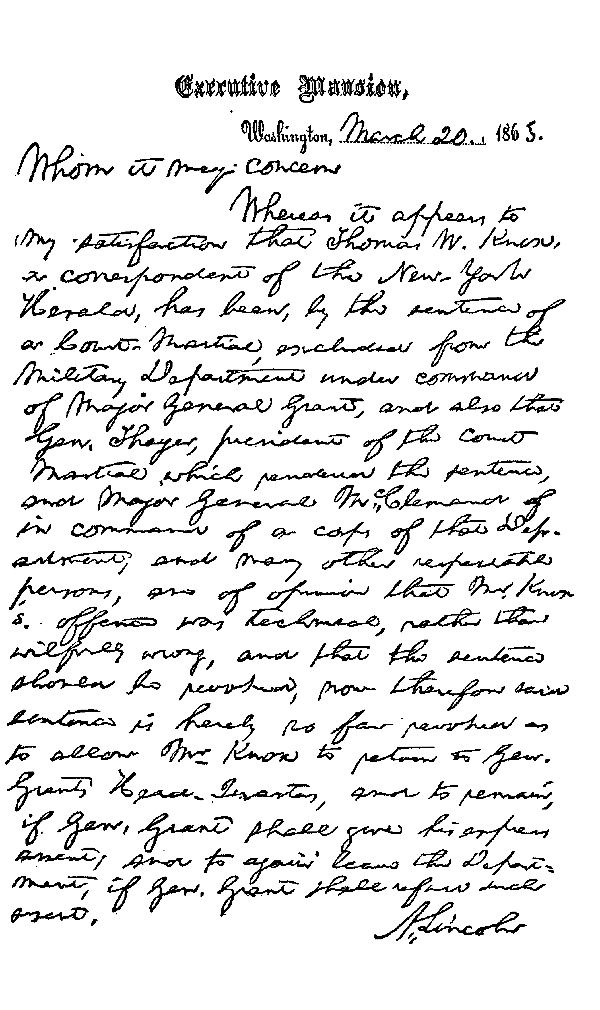
Reading it over carefully, he handed it to me, and gave a little sigh
of relief. General conversation ensued. Despondent and weighed down
with his load of care, he sought relief in frank speaking. He said,
with great earnestness: "God knows that I want to do what is wise and
right, but sometimes it is very difficult to determine."
Mr. Lincoln's Familiar Conversation.
He conversed freely of military affairs, but suddenly remarked: "I am
talking again! Of course, you will remember that I speak to you only
as friends; that none of this must be put in print."
Touching an attack upon Charleston which had long been contemplated,
he said that Du Pont had promised, some weeks before, if certain
supplies were furnished, to make the assault upon a given day. The
supplies were promptly forwarded; the day came and went without any
intelligence. Some time after, he sent an officer to Washington,
asking for three more iron-clads and a large quantity of deck-plating
as indispensable to the preparations.
"I told the officer to say to Commodore Du Pont," observed Mr.
Lincoln, "that I fear he does not appreciate at all the value of
time."
Opinions about McClellan and Vicksburg.
The Army of the Potomac was next spoken of. The great Fredericksburg
disaster was recent, and the public heart was heavy. In regard to
General McClellan, the President spoke with discriminating justice:—
"I do not, as some do, regard McClellan either as a
traitor or an officer without capacity. He sometimes has bad
counselors, but he is loyal, and he has some fine military qualities.
I adhered to him after nearly all my Constitutional advisers lost
faith in him. But do you want to know when I gave him up? It was
after the battle of Antietam. The Blue Ridge was then between our
army and Lee's. We enjoyed the great advantage over them which they
usually had over us: we had the short line, and they the long one,
to the Rebel Capital. I directed McClellan peremptorily to move on
Richmond. It was eleven days before he crossed his first man over
the Potomac; it was eleven days after that before he crossed the
last man. Thus he was twenty-two days in passing the river at a
much easier and more practicable ford than that where Lee crossed
his entire army between dark one night and daylight the next
morning. That was the last grain of sand which broke the camel's
back. I relieved McClellan at once. As for Hooker, I have told
him forty times that I fear he may err just as much one way as
McClellan does the other—may be as over-daring as McClellan is
over-cautious."
We inquired about the progress of the Vicksburg campaign. Our armies
were on a long expedition up the Yazoo River, designing, by digging
canals and threading bayous, to get in the rear of the city and cut
off its supplies. Mr. Lincoln said:—
"Of course, men who are in command and on the spot, know a great deal
more than I do. But immediately in front of Vicksburg, where the
river is a mile wide, the Rebels plant batteries, which absolutely
stop our entire fleets. Therefore it does seem to me that upon narrow
streams like the Yazoo, Yallabusha, and Tallahatchie, not wide enough
for a long boat to turn around in, if any of our steamers which go
there ever come
back, there must be some mistake about it. If the
enemy permits them to survive, it must be either through lack of
enterprise or lack of sense."
A few months later, Mr. Lincoln was able to announce to the nation:
"The Father of Waters again flows unvexed to the sea."
Our interview left no grotesque recollections of the President's
lounging, his huge hands and feet, great mouth, or angular features.
We remembered rather the ineffable tenderness which shone through his
gentle eyes, his childlike ingenuousness, his utter integrity, and
his absorbing love of country.
Our Best Contribution To History.
Ignorant of etiquette and conventionalities, without the graces of
form or of manner, his great reluctance to give pain, his beautiful
regard for the feelings of others, made him
"Worthy to bear without reproach The grand old name of
Gentleman."
Strong without symmetry, humorous without levity, religious without
cant—tender, merciful, forgiving, a profound believer in Divine
love, an earnest worker for human brotherhood—Abraham Lincoln was
perhaps the best contribution which America has made to History.
His origin among humble laborers, his native judgment, better than
the wisdom of the schools, his perfect integrity, his very ruggedness
and angularities, made him fit representative of the young Nation
which loved and honored him.
A Noble Life and Happy Death.
No more shall sound above our tumultuous rejoicing his wise caution,
"Let us be very sober." No more shall breathe through the passions
of the hour his tender pleading that judgment may be tempered with
mercy. His work is done. Nothing could have assured and enlarged
his posthumous fame like this tragic ending. He
goes to a place in History where his peers will be very few. The
poor wretch who struck the blow has gone to be judged by infinite
Justice, and also by infinite Mercy. So have many others indirectly
responsible for the murder, and directly responsible for the war.
Let us remember them in no Pharisaic spirit, thanking God that we
are not as other men—but as warnings of what a race with many
generous and manly traits may become by being guilty of injustice and
oppression.
Some of the President's last expressions were words of mercy for his
enemies. A few hours before his death, in a long interview with his
trusted and honored friend Schuyler Colfax, he stated that he wished
to give the Rebel leaders an opportunity to leave the country and
escape the vengeance which seemed to await them here.
America is never likely to feel again the profound, universal grief
which followed the death of Abraham Lincoln. Even the streets of her
great Metropolis "forgot to roar." Hung were the heavens in black.
For miles, every house was draped in mourning. The least feeling was
manifested by that sham aristocracy, which had the least sympathy
with the Union cause and with the Democratic Idea. The deepest was
displayed by the "plain people" and the poor.
What death is happier than thus to be wept by the lowly and
oppressed, as a friend and protector! What life is nobler than thus
to be filled, in his own golden words, "with charity for all, with
malice toward none!"
————————— It is held
That valor is the chiefest virtue and
Most dignifies the haver. If it be,
The man I speak of cannot in the world
Be singly counterpoised.
Coriolanus.
Reminiscences of General Sumner.
During the month of March, Major-General Edwin V. Sumner was in
Washington, apparently in vigorous health. He had just been appointed
to the command of the Department of the Missouri. One Saturday
evening, having received his final orders, he was about leaving for
his home in Syracuse, New York, where he designed spending a few days
before starting for St. Louis.
I went into his room to bid him adieu. Allusion was made to the
allegations of speculation against General Curtis, his predecessor
in the West. "I trust," said he, "they are untrue. No general has a
right to make one dollar out of his official position, beyond the
salary which his Government pays him." He talked somewhat in detail
of the future, remarking, "For the present, I shall remain in St.
Louis; but whenever there is a prospect of meeting the enemy, I shall
take the field, and lead my troops in person. Some men can fight
battles over a telegraph-wire, but you know I have no talent in that
direction."
With his friendly grasp of the hand, and his kindly smile, he
started for home. It proved to him Home indeed. A week later the
country was startled by intelligence of his sudden death. He, who
for forty-eight
years had braved the hardships of campaigning and
the perils of battle, until he seemed to have a charmed life, was
abruptly cut down by disease under his own roof, surrounded by those
he loved.
"The breast that trampling Death could spare,
His noiseless shafts assail."
For almost half a century, Sumner had belonged to the Army of the
United States; but he steadfastly refused to be put on the retired
list. Entering the service from civil life, he was free from
professional traditions and narrowness. Senator Wade once asked him,
"How long were you at the Military Academy?" He replied, "I was never
there in my life."
The bluff Ohioan sprang up and shook him fervidly by the hand,
exclaiming, "Thank God for one general of the regular Army, who was
never at West Point!"
His Conduct in Kansas.
During the early Kansas troubles, Sumner, then a colonel, was
stationed in the Territory with his regiment of dragoons.
Unscrupulous as were the Administrations of Pierce and Buchanan
in their efforts to force Slavery upon Kansas, embittered as were
the people against the troops,—generally mere tools of Missouri
ruffians—their feelings toward Sumner were kindly and grateful. They
knew he was a just man, who would not willingly harass or oppress
them, and who sympathized with them in their fiery trial.
From the outbreak of the Slaveholders' Rebellion his name was one of
the brightest in that noble but unfortunate army which illustrated
Northern discipline and valor on so many bloody fields, but had never
yet gathered the fruits of victory. He was always in the deadliest of
the fighting. He had the true soldierly temperament. He snuffed the
battle afar off. He felt
"the rapture of the strife," and went into it with boyish enthusiasm.
A Thrilling Scene in Battle.
In exposing himself, he was Imprudence personified. It was the
chronic wonder of his friends that he ever came out of battle alive.
At last they began to believe, with him, that he was invincible. He
would receive bullets in his hat, coat, boots, saddle, horse, and
sometimes have his person scratched, but without serious injury.
His soldiers related, with great relish, that in the Mexican War
a ball which struck him square in the forehead fell flattened to
the ground without breaking the skin, as the bullet glances from
the forehead of the buffalo. This anecdote won for him the soubriquet of "Old Buffalo."
At Fair Oaks, his troops were trembling under a pitiless storm of
bullets, when he galloped up and down the advance line, more exposed
than any private in the ranks.
"What regiment is this?" he asked.
"The Fifteenth Massachusetts," replied a hundred voices.
"I, too, am from Massachusetts; three cheers for our old Bay State!"
And swinging his hat, the general led off, and every soldier joined
in three thundering cheers. The enemy looked on in wonder at the
strange episode, but was driven back by the fierce charge which
followed.
How Sumner Fought.
This was no unusual scene. Whenever the guns began to pound, his mild
eye would flash with fire. He would remove his artificial teeth,
which became troublesome during the excitement of battle, and place
them carefully in his pocket; raise his spectacles from his eyes and
rest them upon the forehead, that he might see clearly objects at a
distance; give his orders to subordinates,
and then gallop headlong into the thick of the fight.
Hundreds of soldiers were familiar with the erect form, the snowy,
streaming hair, and the frank face of that wonderful old man who,
on the perilous edge of battle, while they were falling like grass
before the mower, would dash through the fire and smoke, shouting:—
"Steady, men, steady! Don't be excited. When you have been soldiers
as long as I, you will learn that this is nothing. Stand firm and do
your duty!"
Never seeking a dramatic effect, he sometimes displayed quiet heroism
worthy of history's brightest pages. Once, quite unconsciously
reproducing a historic scene, he repeated, almost word for word, the
address of the great Frederick to his officers, before the battle of
Leuthen. It was on the bloody field of Fair Oaks, at the end of the
second day. He commanded the forces which had crossed the swollen
stream. But before the other troops came up, the bridges were swept
away. The army was then cut in twain; and Sumner, with his three
shattered corps, was left to the mercy of the enemy's entire force.
On that Sunday night, after making his dispositions to receive an
attack, he sent for General Sedgwick, his special friend and a most
trusty soldier:—
"Sedgwick, you perceive the situation. The enemy will doubtless open
upon us at daylight. Re-enforcements are impossible; he can overwhelm
and destroy us. But the country cannot afford to have us defeated.
There is just one thing for us to do; we must stand here and die like
men! Impress it upon your officers that we must do this to the last
man—to the last man! We may not meet again; good-by, Sedgwick."
The two grim soldiers shook hands, and parted.
Morning came, but the enemy, failing to discover our perilous
condition, did not renew the attack; new bridges were built, and
the sacrifice was averted. But Sumner was the man to carry out his
resolution to the letter.
Ordered Back by McClellan.
Afterward, he retained possession of a house on our old line of
battle; and his head-quarter tents were brought forward and pitched.
They were within range of a Rebel battery, which awoke the general
and his staff every morning, by dropping shot and shell all about
them for two or three hours. Sumner implored permission to capture or
drive away the hostile battery, but was refused, on the ground that
it might bring on a general engagement. He chafed and stormed: "It is
the most disgraceful thing of my life," he said, "that this should
be permitted." But McClellan was inexorable. Sumner was directed
to remove his head-quarters to a safer position. He persisted in
remaining for fourteen days, and at last only withdrew upon a second
peremptory order.
The experience of that fortnight exhibited the ever-recurring miracle
of war—that so much iron and lead may fly about men's ears without
harming them. During the whole bombardment only two persons were
injured. A surgeon was slightly wounded in the head by a piece of
shell which flew into his tent; and a private, while lying behind
a log for protection, was instantly killed by a shot which tore a
splinter from the wood, fracturing his skull; but not another man
received even a scratch.
After Antietam, McClellan's ever-swift apologists asserted that his
corps commanders all protested against renewing the attack upon the
second morning. I asked General Sumner if it were true. He replied,
with emphasis:—
"No, sir! My advice was not asked, and I did not volunteer it. But I
was certainly in favor of renewing the attack. Much, as my troops had
suffered, they were good for another day's fighting, especially when
the enemy had that river in his rear, and a defeat would have ruined
him forever."
Love for His Old Comrades.
At Fredericksburg, by the express order of Burnside, Sumner did not
cross the river during the fighting. The precaution saved his life.
Had he ridden out on that fiery front, he had never returned to tell
what he saw. But he chafed sadly under the restriction. As the sun
went down on that day of glorious but fruitless endeavor, he paced to
and fro in front of the Lacy House, with one arm thrown around the
neck of his son, his face haggard with sorrow and anxiety, and his
eyes straining eagerly for the arrival of each successive messenger.
He was a man of high but patriotic ambition. Once, hearing General
Howard remark that he did not aspire to the command of a corps, he
exclaimed, "General you surprise me. I would command the world, if
I could!"
He was called arbitrary, but had great love for his soldiers,
especially for old companions in arms. A New York colonel told me a
laughable story of applying to him for a ten days' furlough, when
the rule against them was imperative. Sumner peremptorily refused
it. But the officer sat down beside him, and began to talk about
the Peninsular campaign—the battles in which he had done his duty,
immediately under Sumner's eye; and it was not many minutes before
the general granted his petition. "If he had only waited," said the
narrator, "until I recalled to his memory some scenes at Antietam, I
am sure he would have given me twenty days instead of ten!"
His intercourse with women and children was characterized
by peculiar chivalry and gentleness. He revived the old ideal of
the soldier—terrible in battle, but with an open and generous
heart.
To his youngest son—a captain upon his staff—he was
bound by unusual affection. "Sammy" was his constant companion; in
private he leaned upon him, caressed him, and consulted him about the
most trivial matters. It was a touching bond which united the gray,
war-worn veteran to the child of his old age.
We have had greater captains than Sumner; but no better soldiers, no
braver patriots. The words which trembled upon his dying lips—"May
God bless my country, the United States of America"—were the
key-note to his life. Green be the turf above him!
Traveling Through the Northwest.
Louisville,
Kentucky, April 5, 1863.
For the last week I have been traveling through the States of the
Northwest. The tone of the people on the war was never better. Now
that the question has become simply one of endurance, their Northern
blood tells. "This is hard pounding, gentlemen," said Wellington
at Waterloo; "but we will see who can pound the longer." So, in
spite of the Copperheads—"merely the dust and chaff on God's
thrashing-floor"—the overwhelming sentiment of the people is to
fight it out to the last man and the last dollar.
You have been wont to say: "The West can be depended on for the
war. She will never give up her great outlet, the Mississippi."
True; but the inference that her loyalty is based upon a material
consideration, is untrue and unjust. The West has poured out its best
blood, not on any petty question of navigation, or of trade, but upon
the weightier issues of Freedom and Nationality.
The New-Yorker or Pennsylvanian may believe in
the greatness of the country; the Kansan or Minnesotian, who has
gone one or two thousand miles to establish his prairie home, walks
by sight and not by faith. To him, the Great Republic of the future
is no rhetorical flourish or flight of fancy, but a living verity.
His instinct of nationality is the very strongest; his belief the
profoundest. May he never need Emerson's pungent criticism: "The
American eagle is good; protect it, cherish it; but beware of the
American peacock!"
Have you heard Prentice's last, upon the bursting of the Rebel bubble
that Cotton is King? He says: "They went in for cotton, and they got
worsted!"
A Visit to Rosecrans's Army.
Murfreesboro,
Tennessee, April 10.
A visit to Rosecrans's army. I rode yesterday over the historical
battle-ground of Stone River, among rifle-pits and breastworks, great
oaks, with scarred trunks, and tops and branches torn off, and smooth
fields thickly planted with graves.
It is interesting to hear from the soldiers reminiscences of the
battle. Rosecrans may not be strong in planning a campaign, but the
thundering guns rouse him to the exhibition of a higher military
genius than any other general in our service has yet displayed. The
"grand anger of battle" makes him see at a glance the needs of the
occasion, and stimulates those quick intuitions which enable great
captains, at the supreme moment, to wrest victory from the very grasp
of defeat. Peculiarly applicable to him is Addison's description of
Marlborough:—
"In peaceful thought the field of death surveyed;
To fainting squadrons sent the timely aid;
Inspired repulsed battalions to engage,
And taught the doubtful battle where to rage."
Rosecrans in a Great Battle.
During the recent great conflict which began with disaster that would
have caused ordinary generals to retreat, he seemed omnipresent. A
devout Catholic, he performed, before entering the battle, the solemn
rites of his Church. A profound believer in destiny, he appeared like
a man who sought for death. A few feet from him, a solid shot took
off the head of Garasche, his loved and trusted chief of staff.
"Brave men must die," he said, and plunged into the battle again.
He had a word for all. Of an Ohio regiment, lying upon the ground, he
asked:—
"Boys, do you see that strip of woods?"
"Yes, sir."
"Well, in about five minutes, the Rebels will pour out of it, and
come right toward you. Lie still until you can easily see the buttons
on their coats; then drive them back. Do you understand?"
"Yes, sir."
"Well, it's just as easy as rolling off a log, isn't it?"
They laughingly assented, and "Old Rosy," as the soldiers call him,
rode along the line, to encourage some other corps.
This is an army of veterans. Every regiment has been in battle,
and some have marched three thousand miles during their checkered
campaigning. Their garments are old and soiled; but their guns are
bright and glistening, and on review their evolutions are clockwork.
They are splendidly disciplined, of unequaled enthusiasm, full of
faith in their general and in themselves.
Rosecrans is an erect, solid man of one hundred and seventy-five
pounds weight, whose forty-three years sit lightly on his face and
frame. He has a clear, mild-blue eye, which lights and flashes under
excitement; an intensified
Roman nose, high cheek-bones, florid complexion, mouth and chin
hidden under dark-brown beard, hair faintly tinged with silver, and
growing thin on the edges of the high, full, but not broad, forehead.
In conversation, a winning, mirthful smile illumines his face. As
Hamlet would take the ghost's word for a thousand pounds, so you
would trust that countenance in a stranger as indicating fidelity,
reserved power, an overflowing humor, and imperious will.
A Scene in Memphis.
Memphis, Tennessee,
April 20.
Riding near the Elmwood Cemetery, yesterday, I witnessed a curious
feature of Southern life. It was a negro funeral—the cortégecortège,
a third of a mile in length, just entering that city of the dead.
The carriages were filled with negro families, and, almost without
exception, they were driven by white men. If such a picture were
exhibited in Boston, would those who clamor in our ears about negro
equality ever permit us to hear the last of it?