On the river bank a boy sat watching the slender
birch canoes bobbing about in the swift current. The
fresh wind reddened his cheeks and the roaring of the
rapids filled his ears. Eagerly his eyes followed the
movements of the canoes daringly poised in the stream
just below the tossing, foaming, white water. It was
the first day of the spring fishing, and more exciting
sport than this Indian white-fishing Hugh Beaupré had
never seen. Three canoes were engaged in the fascinating
game, two Indians in each. One knelt in the stern
with his paddle. The other stood erect in the bow, a
slender pole fully ten feet long in his hands, balancing
with extraordinary skill as the frail craft pitched about
in the racing current.
[8]
The standing Indian in the nearest canoe was a fine
figure of a young man, in close-fitting buckskin leggings,
his slender, muscular, bronze body stripped to the waist.
Above his black head, bent a little as he gazed intently
down into the clear water, gulls wheeled and screamed in
anger at the invasion of their fishing ground. Suddenly
the fisherman pointed, with a swift movement of his left
hand, to the spot where his keen eyes had caught the
gleam of a fin. Instantly his companion responded to
the signal. With a quick dig and twist of the paddle
blade, he shot the canoe forward at an angle. Down
went the scoop net on the end of the long pole and up in
one movement. A dexterous flirt of the net, and the
fish, its wet, silvery sides gleaming in the sun, landed in
the bottom of the boat.
The lad on the bank had been holding his breath.
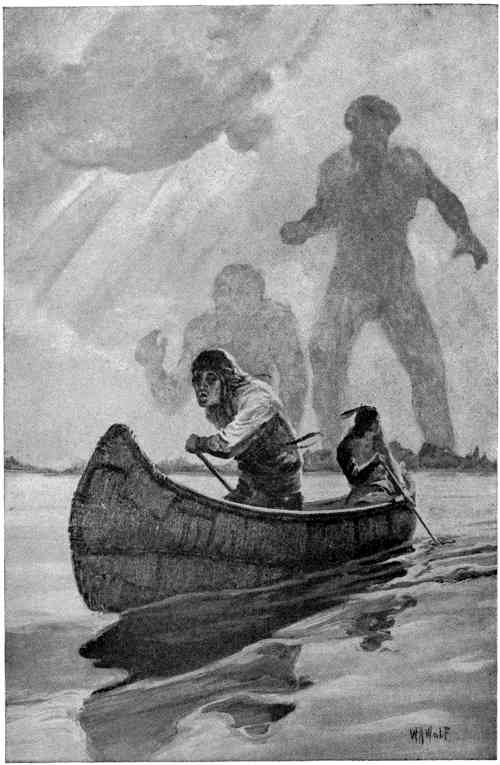
Now his tense watchfulness relaxed, and he glanced farther
up-stream at the white water boiling over and
around the black rocks. A gleam of bright red among
the bushes along the shore caught his eye. The tip of a
scarlet cap, then a head, appeared above the budding
alders, as a man came, with swift, swinging strides,
along the shore path.
“Holá, Hugh Beaupré,” he cried, when he was close
enough to be heard above the tumult of the rapids.
“M’sieu Cadotte, he want you.”
The lad scrambled to his feet. “Monsieur Cadotte
sent you for me?” he asked in surprise. “What does
he want with me, Baptiste?”
“A messenger from the New Fort has come, but a few
moments ago,” Baptiste replied, this time in French.
Hugh, half French himself, understood that language
well, though he spoke it less fluently than English.
“From the Kaministikwia? He has brought news of
my father?”
“That M’sieu did not tell me, but yes, I think it may
be so, since M’sieu sends for you.”
[9]
Hugh had scarcely waited for an answer. Before
Baptiste had finished his speech, the boy was running
along the river path. The French Canadian strode
after, the tassel of his cap bobbing, the ends of his
scarlet sash streaming in the brisk breeze.
Hastening past the small cabins that faced the St.
Mary’s River, Hugh turned towards a larger building,
like the others of rough, unbarked logs. Here he knew
he should find Monsieur Cadotte, fur trader and agent
for the Northwest Fur Company. Finding the door
open, the lad entered without ceremony.
Monsieur Cadotte was alone, going through for a
second time the reports and letters the half-breed messenger
had brought from the Company’s headquarters
on the River Kaministikwia at the farther end of Lake
Superior. The trader looked up as the boy entered.
“A letter for you, Hugh.” He lifted a packet from
the rude table.
“From my father?” came the eager question.
“That I do not know, but no doubt it will give you
news of him.”
[10]
A strange looking letter Cadotte handed the lad, a
thin packet of birch bark tied about with rough cedar
cord. On the outer wrapping the name “Hugh Beaupré”
was written in a brownish fluid. Hugh cut the
cord and removed the wrapper. His first glance at the
thin squares of white, papery bark showed him that the
writing was not his father’s. The letter was in French,
in the same muddy brown ink as the address. The
handwriting was good, better than the elder Beaupré’s,
and the spelling not so bad as Hugh’s own when he attempted
to write French. He had little difficulty in
making out the meaning.
“My brother,” the letter began, “our father, before
he died, bade me write to you at the Sault de Ste.
Marie. In March he left the Lake of Red Cedars with
one comrade and two dog sleds laden with furs. At
the Fond du Lac he put sail to a bateau, and with the
furs he started for the Grand Portage. But wind and
rain came and the white fog. He knew not where he
was and the waves bore him on the rocks. He escaped
drowning and came at last to the Grand Portage and
Wauswaugoning. But he was sore hurt in the head
and the side, and before the setting of the sun his spirit
had left his body. While he could yet speak he told
me of you, my half-brother, and bade me write to you.
He bade me tell you of the furs and of a packet of value
hid in a safe place near the wreck of the bateau. He
told me that the furs are for you and me. He said you
and I must get them and take them to the New Northwest
Company at the Kaministikwia. The packet you
must bear to a man in Montreal. Our father bade us
keep silence and go quickly. He had enemies, as well
I know. So, my brother, I bid you come as swiftly as
you can to the Kaministikwia, where I will await you.
Thy half-brother,Blaise Beaupré or Attekonse, Little Caribou.”
Hugh read the strange letter to the end, then turned
back to the first bark sheet to read again. He had
reached the last page a second time when Cadotte’s voice
aroused him from his absorption.
“It is bad news?” the trader asked.
“Yes,” Hugh answered, raising his eyes from the
letter. “My father is dead.”
[11]
“Bad news in truth.” Cadotte’s voice was vibrant
with sympathy. “It was not, I hope, la petite vérole?”
His despatches had informed him that the dreaded
smallpox had broken out among the Indian villages west
of Superior.
“No, he was wrecked.” Hugh hesitated, then continued,
“On his spring trip down his boat went on the
rocks, and he was so sorely hurt that he lived but a
short time.”
“A sad accident truly. Believe me, I feel for you, my
boy. If there is anything I can do——” Cadotte
broke off, then added, “You will wish to return to your
relatives. We must arrange to send you to Michilimackinac
on the schooner. From there you can readily
find a way of return to Montreal.”
Hugh was at a loss for a reply. He had not the
slightest intention of returning to Montreal so soon.
He must obey his half-brother’s summons and go to
recover the furs and the packet that made up the lads’
joint inheritance. Kind though Cadotte had been,
Hugh dared not tell him all. “He bade us keep silence,”
Little Caribou had written, and one word in the
letter disclosed to Hugh a good reason for silence.
[12]
Jean Beaupré had been a free trader and trapper,
doing business with the Indians on his own account, not
in the direct service of any company. Hugh knew,
however, that his father had been in the habit of buying
his supplies from and selling his pelts to the Old Northwest
Company. Very likely he had been under some contract
to do so. Yet in these last instructions to his sons,
he bade them take the furs to the New Northwest Company,
a secession from and rival to the old organization.
He must have had some disagreement, an actual quarrel
perhaps, with the Old Company. The rivalry between
the fur companies was hot and bitter. Hugh was very
sure that if Monsieur Cadotte learned of the hidden
pelts, he would inform his superiors. Then, in all
probability, the Old Northwest Company’s men would
reach the cache first. Certainly, if he even suspected
that the pelts were destined for the New Company,
Cadotte would do nothing to further and everything to
hinder Hugh’s project. The boy was in a difficult position.
He had to make up his mind quickly. Cadotte
was eying him sharply and curiously.
“I cannot return to Montreal just yet, Monsieur
Cadotte,” Hugh said at last. “This letter is from my
half-brother.” He paused in embarrassment.
Cadotte nodded and waited for the boy to go on.
The trader knew that Jean Beaupré had an Indian
wife, and supposed that Hugh had known it also.
Part Indian himself, Cadotte could never have understood
the lad’s amazement and consternation at learning
now, for the first time, of his half-brother.
“My father,” Hugh went on, “bade Blaise, my
half-brother, tell me to—come to the Kaministikwia
and meet Blaise there. He wished me to—to make my
brother’s acquaintance and—and receive from him—something
my father left me,” he concluded lamely.
Cadotte was regarding Hugh keenly. The boy’s
embarrassed manner was enough to make him suspect
that Hugh was not telling the truth. Cadotte shrugged
his shoulders. “It may be difficult to send you in that
direction. If you were an experienced canoeman, but
you are not and——”
[13]
“But I must go,” Hugh broke in. “My father bade
me, and you wouldn’t have me disobey his last command.
Can’t I go in the Otter? I still have some of
the money my aunt gave me. If I am not sailor enough
to work my way, I can pay for my passage.”
“Eh bien, we will see what can be done,” Cadotte
replied more kindly. Perhaps the lad’s earnestness and
distress had convinced him that Hugh had some more
urgent reason than a mere boyish desire for adventure,
for making the trip. “I will see if matters can be
arranged.”
[14]
II THE SLOOP “OTTER”
His mind awhirl with conflicting thoughts and feelings,
Hugh Beaupré left Cadotte. The preceding
autumn Hugh had come from Montreal to the Sault
de Ste. Marie. Very reluctantly his aunt had let him
go to be with his father in the western wilderness for a
year or two of that rough, adventurous life. Hugh’s
Scotch mother had died when he was less than a year
old, nearly sixteen years before the opening of this
story. His French father, a restless man of venturesome
spirit, had left the child with the mother’s sister,
and had taken to the woods, the then untamed wilderness
of the upper Great Lakes and the country beyond.
In fifteen years he had been to Montreal to see his son
but three times. During each brief stay, his stories of
the west had been eagerly listened to by the growing
boy. On his father’s last visit to civilization, Hugh
had begged to be allowed to go back to Lake Superior
with him. The elder Beaupré, thinking the lad too
young, had put him off. He had consented, however,
to his son’s joining him at the Sault de Ste. Marie a
year from the following autumn, when Hugh would be
sixteen.
[15]
Delayed by bad weather, the boy had arrived at the
meeting place late, only to find that his father had not
been seen at the Sault since his brief stop on his return
from Montreal the year before. The disappointed lad
tried to wait patiently, but the elder Beaupré did not
come or send any message. At last, word arrived that
he had left the Grand Portage, at the other end of Lake
Superior, some weeks before, not to come to the Sault
but to go in the opposite direction to his winter trading
ground west of the lake. There was no chance for
Hugh to follow, even had he known just where his father
intended to winter. By another trader going west and
by a Northwest Company messenger, the boy sent letters,
hoping that in some manner they might reach
Jean Beaupré. All winter Hugh had remained at the
Sault waiting for some reply, but none of any sort had
come until the arrival of the strange packet he was now
carrying in his hand. This message from his younger
brother seemed to prove that his father must have
received at least one of Hugh’s letters. Otherwise he
would not have known that his elder son was at the
Sault. But there was no explanation of Jean Beaupré’s
failure to meet the boy there.
Hugh was grieved to learn of his parent’s death, but
he could not feel the deep sorrow that would have overwhelmed
him at the loss of an intimately known and
well loved father. Jean Beaupré was almost a stranger
to his older son. Hugh remembered seeing him but the
three times and receiving but one letter from him. Indeed
he was little more than a casual acquaintance
whose tales of adventure had kindled a boy’s imagination.
It was scarcely possible that Hugh’s grief could
be deep, and, for the time being, it was overshadowed
by other feelings. He had been suddenly plunged, it
seemed, into a strange and unexpected adventure, which
filled his mind to the exclusion of all else.
[16]
He must find some way to reach the Kaministikwia
River, there to join his newly discovered Indian brother
in a search for the wrecked bateau and its cargo of
pelts. Of that half-brother Hugh had never heard before.
He could not but feel a sense of resentment that
there should be such a person. The boy had been
brought up to believe that his father had loved his bonny
Scotch wife devotedly, and that it was his inconsolable
grief at her death that had driven him to the wilderness.
It seemed, however, that he must have consoled
himself rather quickly with an Indian squaw. Surely
the lad who had written the letter must be well grown,
not many years younger than Hugh himself.
As he walked slowly along the river bank, Hugh
turned the bark packet over and over in his hand, and
wondered about the half-breed boy who was to be his
comrade in adventure. Attekonse had not spent his
whole life in the woods, that was evident. Somewhere
he had received an education, had learned to write
French readily and in a good hand. Perhaps his father
had taught him, thought Hugh, but quickly dismissed
that suggestion. He doubted if the restless Jean
Beaupré would have had the patience, even if he had
had the knowledge and ability to teach his young son
to write French so well.
[17]
Uncertain what he ought to do next, the puzzled boy
wandered along, glancing now and then at the canoes
engaged in the white-fishing below the rapids. That
daring sport had lost its interest for him. At the
outskirts of an Indian village, where he was obliged to
beat off with a stick a pack of snarling, wolf-like dogs,
he turned and went back the way he had come, still
pondering over the birch bark letter.
Presently he caught sight once more of Baptiste’s
scarlet cap. No message from Cadotte had brought
the simple fellow this time, merely his own curiosity.
Hugh was quite willing to answer Baptiste’s questions
so far as he could without betraying too much. Seated
in a sheltered, sunny spot on an outcrop of rock at the
river’s edge, he told of his father’s death. Then, suddenly,
he resolved to ask the good-natured Canadian’s
help.
“Baptiste, I am in a difficulty. My half-brother
who wrote this,”—Hugh touched the bark packet—“bids
me join him at the Kaministikwia. It was my
father’s last command that I should go there and meet
this Blaise or Little Caribou, as he calls himself. We
are to divide the things father left for us.”
“There is an inheritance then?” questioned Baptiste,
interested at once.
“Nothing that amounts to much, I fancy,” the lad
replied with an assumption of carelessness; “some personal
belongings, a few pelts perhaps. For some reason
he wished Blaise and me to meet and divide them.
It is a long journey for such a matter.”
“Ah, but a dying father’s command!” cried Baptiste.
“You must not disobey that. To disregard
the wishes of the dead is a grievous sin, and would
surely bring you misfortune.”
[18]
“True, but what can I do, Baptiste? Monsieur
Cadotte doesn’t feel greatly inclined to help me. He
wishes me to return to Montreal. How then am I to
find an opportunity to go to the Kaministikwia?”
Baptiste took a long, thoughtful pull at his pipe,
then removed it from his mouth. “There is the sloop
Otter,” he suggested.
“Would Captain Bennett take me, do you think?”
“I myself go as one of the crew. To-morrow early
I go to Point aux Pins. Come with me and we shall
see.”
“Gladly,” exclaimed Hugh. “When does she sail?”
“Soon, I think. There were repairs to the hull,
where she ran on the rocks, but they are finished. Then
there is new rigging and the painting. It will not be
long until she is ready.”
That night Hugh debated in his own mind whether
he should tell Cadotte of his proposed visit with Baptiste
to Point aux Pins. He decided against mentioning
it at present. He did not know what news might
have come in Cadotte’s despatches, whether the trader
was aware of the elder Beaupré’s change of allegiance.
At any rate, thought the lad, it would be better to
have his passage in the Otter arranged for, if he could
persuade her captain, before saying anything more to
anyone.
[19]
Early the next morning Baptiste and Hugh embarked
above the rapids in Baptiste’s small birch canoe.
The distance to Point aux Pins was short, but paddling,
even in the more sluggish channels, against the current
of the St. Mary’s River in spring flood was strenuous
work, as Hugh, wielding the bow blade, soon discovered.
Signs of spring were everywhere. The snow was gone,
and flocks of small, migrating birds were flitting and
twittering among the trees and now and then bursting
into snatches of song. The leaves of birches, willows
and alders were beginning to unfold, the shores showing
a faint mist of pale green, though here and there in
the quiet backwaters among rocks and on the north sides
of islands, ice still remained.
At Point aux Pins, or Pine Point, was the Northwest
Company’s shipyard. In a safe and well sheltered
harbor, formed by the long point that ran out into the
river, the sailing vessels belonging to the company were
built and repaired. The sloop Otter, which had spent
the winter there, was now anchored a little way out
from shore. The repairs had been completed and a
fresh coat of white paint was being applied to her hull.
Tents and rude cabins on the sandy ground among
scrubby jack pines and willows housed the workers, and
near by, waiting for the fish cleanings and other refuse
to be thrown out, a flock of gulls, gray-winged, with
gleaming white heads and necks, rode the water like a
fleet of little boats. As the canoe approached, the
birds, with a splashing and beating of wings, rose,
whirled about in the air, and alighted again farther out,
each, as it struck the water, poising for a moment with
black-tipped wings raised and half spread.
On a stretch of sand beyond the shipyard, Baptiste
and Hugh landed, stepping out, one on each side, the
moment the canoe touched, lifting it from the water and
carrying it ashore. Then they sought the master of
the sloop.
[20]
Captain Bennett was personally superintending the
work on his ship. To him Baptiste, who had been previously
engaged as one of the small crew, made known
Hugh’s wish to sail to the Kaministikwia. The shipmaster
turned sharply on the lad, demanding to know
his purpose in crossing the lake. Hugh explained as
well as he could, without betraying more than he had
already told Cadotte and Baptiste.
“Do you know anything of working a ship?” Captain
Bennett asked.
“I have sailed a skiff on the St. Lawrence,” was the
boy’s reply. “I can learn and I can obey orders.”
“Um,” grunted the Captain. “At least you are a
white man. I can use one more man, and I don’t want
an Indian. I can put you to work now. If you prove
good for anything, I will engage you for the trip over.
Here, Duncan,” to a strapping, red-haired Scot, “give
these fellows something to do.”
So it came about that Hugh Beaupré, instead of
going back at once to the Sault, remained at the Point
aux Pins shipyard. He returned in the Otter, when,
three days later, she sailed down the St. Mary’s to the
dock above the rapids where she was to receive her
lading. In the meantime, by an Indian boy, Hugh had
sent a message to Cadotte informing him that he, Hugh
Beaupré, had been accepted as one of the crew of the
Otter for her trip to the Kaministikwia. Cadotte had
returned no reply, so Hugh judged that the trader did
not intend to put any obstacles in the way of his adventure.
[21]
The goods the sloop was to transport had been received
the preceding autumn by ship from Michilimackinac
too late to be forwarded across Superior. They
were to be sent on now by the Otter. A second Northwest
Company ship, the Invincible, which had wintered
in Thunder Bay, was expected at the Sault in a few
weeks. When the great canoe fleet from Montreal
should arrive in June, part of the goods brought would
be transferred to the Invincible, while the remainder
would be taken on in the canoes. Hugh was heartily
glad that he was not obliged to wait for the fleet. In
all probability there would be no vacant places, and if
there were any, he doubted if, with his limited experience
as a canoeman, he would be accepted. He felt
himself lucky to obtain a passage on the Otter.
The sloop was of only seventy-five tons burden, but
the time of loading was a busy one. The cargo was
varied: provisions, consisting largely of corn, salt pork
and kegs of tried out grease, with some wheat flour,
butter, sugar, tea and other luxuries for the clerks at
the Kaministikwia; powder and shot; and articles for
the Indian trade, blankets, guns, traps, hatchets, knives,
kettles, cloth of various kinds, vermilion and other
paints, beads, tobacco and liquor, for the fur traders
had not yet abandoned the disastrous custom of selling
strong drink to the Indians.
During the loading Hugh had an opportunity to say
good-bye to Cadotte. The latter’s kindness and interest
in the boy’s welfare made him ashamed of his
doubts of the trader’s intentions.
[22]
III DRIVEN BEFORE THE GALE
On a clear, sunny morning of the first week in May,
the Northwest Company’s sloop Otter, with a favoring
wind, made her way up-stream towards the gateway
of Lake Superior. At the Indian village on the
curve of the shore opposite Point aux Pins, men, women,
children and sharp-nosed dogs turned out to see the
white-sailed ship go by. Through the wide entrance to
the St. Mary’s River, where the waters of Lake Superior
find their outlet, the sloop sailed under the most
favorable conditions. Between Point Iroquois on the
south and high Gros Cap, the Great Cape, on the north,
its summit indigo against the bright blue of the sky,
she passed into the broad expanse of the great lake.
The little fur-trading vessels of the first years of the
nineteenth century did not follow the course taken by
the big passenger steamers and long freighters of today,
northwest through the middle of the lake. Instead,
the Captain of the Otter took her almost directly
north.
[23]
The southerly breeze, light at first, freshened within
a few hours, and the sloop sailed before it like a gull
on the wing. Past Goulais Point and Coppermine
Point and Cape Gargantua, clear to Michipicoton Bay,
the first stop, the wind continued favorable, the weather
fine. It was remarkably fine for early May, and Hugh
Beaupré had hopes of a swift and pleasant voyage.
So far his work as a member of the crew of six was not
heavy. Quick-witted and eager to do his best, he
learned his duties rapidly, striving to obey on the instant
the sharply spoken commands of master and
mate.
At the mouth of the Michipicoton River was a Northwest
Company trading post, and there the Otter ran
in to discharge part of her cargo of supplies and goods.
She remained at Michipicoton over night, and, after the
unloading, Hugh was permitted to go ashore. The
station, a far more important one, in actual trade in
furs, than the post at the Sault, he found an interesting
place. Already some of the Indians were arriving from
the interior, coming overland with their bales of pelts
on dog sleds. When the Michipicoton River and the
smaller streams should be free of ice, more trappers
would follow in their birch canoes.
As if on purpose to speed the ship, the wind had
shifted to the southeast by the following morning. The
weather was not so pleasant, however, for the sky was
overcast. In the air was a bitter chill that penetrated
the thickest clothes. Captain Bennett, instead of appearing
pleased with the direction of the breeze, shook
his head doubtfully as he gazed at the gloomy sky and
the choppy, gray water. A sailing vessel must take
advantage of the wind, so, in spite of the Captain’s
apprehensive glances, the Otter went on her way.
[24]
All day the wind held favorable, shifting to a more
easterly quarter and gradually rising to a brisk blow.
The sky remained cloudy, the distance thick, the water
green-gray.
As darkness settled down, rain began to fall, fine,
cold and driven from the east before a wind strong
enough to be called a gale. In the wet and chill, the
darkness and rough sea, Hugh’s work was far harder
and more unpleasant. But he made no complaint, even
to himself, striving to make up by eager willingness for
his ignorance of a sailor’s foul weather duties. There
was no good harbor near at hand, and, the gale being
still from the right quarter, Captain Bennett drove on
before it. After midnight the rain turned to sleet and
snow. The wind began to veer and shift from east to
northeast, to north and back again.
Before morning all sense of location had been lost.
Under close-reefed sails, the sturdily built little Otter
battled wind, waves, sleet and snow. She pitched and
tossed and wallowed. All hands remained on deck.
Hugh, sick and dizzy with the motion, chilled and
shivering in the bitter cold, wished from the bottom of
his heart he had never set foot upon the sloop. Struggling
to keep his footing on the heaving, ice-coated
deck, and to hold fast to slippery, frozen ropes, he was
of little enough use, though he did his best.
The dawn brought no relief. In the driving snow,
neither shore nor sky was to be seen, only a short stretch
of heaving, lead-gray water. Foam-capped waves
broke over the deck. Floating ice cakes careened
against the sides of the ship. On the way to Michipicoton
no ice had been encountered, but now the tossing
masses added to the peril.
[25]
Midday might as well have been midnight. The
falling snow, fine, icy, stinging, shut off all view more
completely than blackest darkness. The weary crew
were fighting ceaselessly to keep the Otter afloat. The
Captain himself clung with the steersman to the wheel.
Then, quite without warning, out of the northeast came
a sudden violent squall. A shriek of rending canvas,
and the close-reefed sail, crackling with ice, was torn
away. Down crashed the shattered mast. As if bound
for the bottom of the lake, the sloop wallowed deep in
the waves.
Hugh sprang forward with the others. On the slanting,
ice-sheathed deck, he slipped and went down. He
was following the mast overboard, when Baptiste seized
him by the leg. The dangerous task of cutting loose
the wreckage was accomplished. The plucky Otter
righted herself and drove on through the storm.
With the setting of the sun, invisible through the
snow and mist, the wind lessened. But that night, if
less violent than the preceding one, was no less miserable.
Armored in ice and frozen snow, the sloop rode
heavy and low, battered by floating cakes, great waves
washing her decks. She had left the Sault on a spring
day. Now she seemed to be back in midwinter. Yet,
skillfully handled by her master, she managed to live
through the night.
[26]
Before morning, the wind had fallen to a mere breeze.
The waves no longer swept the deck freely, but the
lake was still so rough that the ice-weighted ship made
heavy going. Her battle with the storm had sprung
her seams. Two men were kept constantly at the
pumps. No canvas was left but the jib, now attached
to the stump of the mast. With this makeshift sail,
and carried along by the waves, she somehow kept
afloat.
From the lookout there came a hoarse bellow of
warning. Through the muffling veil of falling snow,
his ears had caught the sound of surf. The steersman
swung the wheel over. The ship sheered off just as the
foaming crests of breaking waves and the dark mass of
bare rocks appeared close at hand.
Along the abrupt shore the Otter beat her way, her
captain striving to keep in sight of land, yet far enough
out to avoid sunken or detached rocks. Anxiously his
tired, bloodshot eyes sought for signs of a harbor. It
had been so long since he had seen sun or stars that he
had little notion of his position or of what that near-by
land might be. Shadowy as the shore appeared in the
falling snow, its forbidding character was plain enough,
cliffs, forest crowned, rising abruptly from the water,
and broken now and then by shallow bays lined with
tumbled boulders. Those shallow depressions promised
no shelter from wind and waves, even for so small a ship
as the Otter.
No less anxiously than Captain Bennett did Hugh
Beaupré watch that inhospitable shore. So worn was
he from lack of sleep, exhausting and long continued
labor and seasickness, so chilled and numbed and weak
and miserable, that he could hardly stand. But the
sight of solid land, forbidding though it was, had revived
his hope.
[27]
A shout from the starboard side of the sloop told
him that land had appeared in that direction also. In
a few minutes the Otter, running before the wind, was
passing between forest-covered shores. As the shores
drew closer together, the water became calmer. On
either hand and ahead was land. The snow had almost
ceased to fall now. The thick woods of snow-laden
evergreens and bare-limbed trees were plainly visible.
Staunch little craft though the Otter was, her
strained seams were leaking freely, and her Captain had
decided to beach her in the first favorable spot. A bit
of low point, a shallow curve in the shore with a stretch
of beach, served his purpose. There he ran his ship
aground, and made a landing with the small boat.
His ship safe for the time being, Captain Bennett’s
next care was for his crew. That they had come
through the storm without the loss of a man was a
matter for thankfulness. Everyone, however, from the
Captain himself to Hugh, was worn out, soaked, chilled
to the bone and more or less battered and bruised. One
man had suffered a broken arm when the mast went over
side, and the setting of the bone had been hasty and
rough. The mate had strained his back painfully.
All but the mate and the man with the broken arm,
the Captain set to gathering wood and to clearing a
space for a camp on the sandy point. The point was
almost level and sparsely wooded with birch, mountain
ash and bushes. Every tree and shrub, its summer
foliage still in the bud, was wet, snow covered or ice
coated. Birch bark and the dry, crumbly center of a
dead tree trunk made good tinder, however. Baptiste,
skilled in the art of starting a blaze under the most adverse
conditions, soon had a roaring fire. By that time
the snow had entirely ceased, and the clouds were
breaking.
[28]
Around the big fire the men gathered to dry their
clothes and warm their bodies, while a thick porridge of
hulled corn and salt pork boiled in an iron kettle over
a smaller blaze. The hot meal put new life into the
tired men. The broken arm was reset, the minor injuries
cared for, and a pole and bark shelter, with one
side open to the fire, was set up. Before the lean-to
was completed the sun was shining. In spite of the
sharp north wind, the snow and ice were beginning to
melt. A flock of black-capped chickadees were flitting
about the bare-branched birches, sounding their brave,
deep-throated calls, and a black and white woodpecker
was hammering busily at a dead limb.
No attempt was made to repair the ship that day.
Only the most necessary work was done, and the worn-out
crew permitted to rest. A lonely place seemed this
unknown bay or river mouth, without white man’s cabin,
Indian’s bark lodge or even a wisp of smoke from any
other fire. But the sheltered harbor was a welcome
haven to the sorely battered ship and the exhausted
sailors. Wolves howled not far from the camp that
night, and next morning their tracks were found in the
snow on the beach close to where the sloop lay. It
would have required far fiercer enemies than the slinking,
cowardly, brush wolves to disturb the rest of the
tired crew of the Otter. Hugh did not even hear the
beasts.
[29]
IV THE ISLE ROYALE
Shortly after dawn work on the Otter was begun.
The water was pumped out, most of the cargo piled on
the beach, and the sloop hauled farther up by means of
a rudely constructed windlass. Then the strained
seams were calked and a few new boards put in. A
tall, straight spruce was felled and trimmed to replace
the broken mast, and a small mainsail devised from
extra canvas. The repairs took two long days of
steady labor. During that time the weather was bright,
and, except in the deeply shaded places, the snow and
ice disappeared rapidly.
From the very slight current in the water, Captain
Bennett concluded that the place where he had taken
refuge was a real bay, not a river mouth. He had not
yet discovered whether he was on the mainland or an
island. The repairs to his ship were of the first importance,
and he postponed determining his whereabouts
until the Otter was made seaworthy once more. Not
a trace of human beings had been found. The boldness
of the wolves and lynxes, that came close to the camp
every night, indicated that no one, red or white, was in
the habit of visiting this lonely spot.
[30]
On the third day the sloop was launched, anchored a
little way from shore and rigged. While the reloading
was going on, under the eyes of the mate, the Captain,
with Baptiste and Hugh at the oars, set out in
the small boat for the harbor mouth.
The shore along which they rowed was, at first,
wooded to the water line. As they went farther out
and the bay widened, the land they were skirting rose
more steeply, edged with sheer rocks, cliffs and great
boulders. From time to time Captain Bennett glanced
up at the abrupt rocks and forested ridges on his right,
or across to the lower land on the other side of the
bay. Directly ahead, some miles across the open lake,
he could see a distant, detached bit of land, an island
undoubtedly. Most of the time, however, his eyes were
on the water. He was endeavoring to locate the treacherous
reefs and shallows he must avoid when he took his
ship out of her safe harbor.
An exclamation from Baptiste, who had turned his
head to look to the west and north, recalled the Captain
from his study of the unfamiliar waters. Beyond the
tip of the opposite or northwestern shore of the bay,
far across the blue lake to the north, two dim, misty
shapes had come into view.
Baptiste and Hugh pulled on with vigorous strokes.
Presently the Captain spoke again. “Islands or
headlands. Go farther out.”
The two bent to their oars. As they passed beyond
the end of the low northwestern shore, more high land
came into view across the water.
[31]
“What is it, Baptiste? Where are we?” asked
Hugh, forgetting in his eagerness that it was not his
place to speak.
“It is Thunder Cape,” the Captain replied, overlooking
the breach of discipline, “the eastern boundary
of Thunder Bay, where the Kaministikwia empties and
the New Fort is situated.”
“Truly it must be the Cap au Tonnerre, the Giant
that Sleeps,” Baptiste agreed, resting on his oars to
study the long shape, like a gigantic figure stretched
out at rest upon the water. “The others to the north
are the Cape at the Nipigon and the Island of St.
Ignace.”
“We are not as far off our course as I feared,” remarked
the Captain with satisfaction.
Hugh ventured another question. “What then, sir,
is this land where we are?”
Captain Bennett scanned the horizon as far as he
could see. “Thunder Cape lies a little to the north of
west,” he said thoughtfully. “We are on an island of
course, a large one. There is only one island it can be,
the Isle Royale. I have seen one end or the other of
Royale many times from a distance, when crossing to
the Kaministikwia or to the Grand Portage, but I never
set foot on the island before.” Again he glanced up at
the steep rocks and thick woods on his right, then his
eyes sought the heaving blue of the open lake. “This
northwest breeze would be almost dead against us, and
it is increasing. We’ll not set sail till morning. By
that time I think we shall have a change of wind.”
[32]
Their purpose accomplished, the oarsmen turned the
boat and started back towards camp. Hugh, handling
the bow oars, watched the shore close at hand. They
were skirting a rock cliff, sheer from the lake, its brown-gray
surface stained almost black at the water line,
blotched farther up with lichens, black, orange and
green-gray, and worn and seamed and rent with vertical
cracks from top to bottom. The cracks ran in diagonally,
opening up the bay. As Hugh came into clear
view of one of the widest of the fissures, he noticed
something projecting from it.
“See, Baptiste,” he cried, pointing to the thing,
“someone has been here before us.”
The French Canadian rested on his oars and spoke
to Captain Bennett. “There is the end of a boat in
that hole, M’sieu, no birch canoe either. How came it
here in this wilderness?”
“Row nearer,” ordered the shipmaster, “and we’ll
have a look at it.”
The two pulled close to the mouth of the fissure. At
the Captain’s order, Baptiste stepped over side to a
boulder that rose just above the water. From the
boulder he sprang like a squirrel. His moccasined feet
gripped the rim of the old boat, and he balanced for an
instant before jumping down. Hugh, in his heavier
boots, followed more clumsily. Captain Bennett remained
in the rowboat.
The wrecked craft in which the two found themselves
was tightly wedged in the crack. The bow was smashed
and splintered and held fast by the ice that had not yet
melted in the dark, cold cleft. Indeed the boat was
half full of ice. It was a crude looking craft, and its
sides, which had never known paint, were weathered and
water stained to almost the same color as the blackened
base of the rocks. The wreck was quite empty, not an
oar or a fragment of mast or canvas remaining.
[33]
The old boat had one marked peculiarity which could
be seen even in the dim light of the crack. The thwart
that bore the hole where the mast had stood was painted
bright red, the paint being evidently a mixture of vermilion
and grease. It was but little faded by water and
weather, and on the red background had been drawn,
in some black pigment, figures such as the Indians used
in their picture writing. Hugh had seen birch canoes
fancifully decorated about prow and stern, and he asked
Baptiste if such paintings were customary on the heavier
wooden boats as well.
“On the outside sometimes they have figures in color,
yes,” was the reply, “but never have I seen one painted
in this way.”
“I wonder what became of the men who were in her
when she was driven on these rocks.”
Baptiste shook his head. “It may be that no one
was in her. What would he do so far from the mainland?
No, I do not think anyone was wrecked here.
This bateau was carried away in a storm from some
beach or anchorage on the north or west shore. There
is nothing in her, though she was right side up when
she was driven in here by the waves. And here, in this
lonely place, there has been no one to plunder her.”
“Do no Indians live on this big island?” queried
Hugh.
[34]
“I have never heard of anyone living here. It is
far to come from the mainland, and I have been told that
the Indians have a fear of the place. They think it is
inhabited by spirits, especially one bay they call the
Bay of Manitos. It is said that in the old days the
Ojibwa came here sometimes for copper. They picked
up bits of the metal on the beaches and in the hills.
Nowadays they have a tale that spirits guard the
copper stones.”
“If there is copper on the island perhaps this boat
belonged to some white prospector,” suggested Hugh.
Baptiste shrugged his shoulders. “Perhaps, but
then the Indian manitos must have destroyed him.”
“Well, at any rate the old manitos haven’t troubled
us,” Hugh commented.
Again Baptiste shrugged. “We have not disturbed
their copper, and—we are not away from the place
yet.”
The inspection of the wreck did not take many minutes.
When Baptiste made his report, the Captain
agreed with him that the boat had probably drifted
away from some camp or trading post on the mainland,
and had been driven into the cleft in a storm. As
nothing of interest had been found in the wreck, he
ordered Baptiste and Hugh to make speed back to
camp.
By night the reloading was finished and everything
made ready for an early start. After sunset, the mate,
adventuring up the bay, shot a yearling moose. The
crew of the Otter feasted and, to celebrate the completion
of the work on the sloop, danced to Baptiste’s
fiddle. From the ridges beyond and above the camp,
the brush wolves yelped in response to the music.
[35]
Baptiste’s half superstitious, half humorous forebodings
of what the island spirits might do to the crew of
the Otter came to nothing, but Captain Bennett’s
prophecy of a change of wind proved correct. The
next day dawned fair with a light south breeze that
made it possible for the sloop to sail out of harbor.
She passed safely through the narrower part of the
bay. Then, to avoid running close to the towering
rocks which had first appeared to her Captain through
the falling snow, he steered across towards the less
formidable appearing northwest shore. That shore
proved to be a low, narrow, wooded, rock ridge running
out into the lake. When he reached the tip of the
point, he found it necessary to go on some distance to
the northeast to round a long reef. The dangerous
reef passed, he set his course northwest towards the dim
and distant Sleeping Giant, the eastern headland of
Thunder Bay.
To the relief of Hugh Beaupré, the last part of the
voyage was made in good time and without disaster.
The boy looked with interest and some awe at the towering,
forest-clad form of Thunder Cape, a mountain top
rising from the water. On the other hand, as the
Otter entered the great bay, were the scarcely less impressive
heights of the Isle du Paté, called to-day, in
translation of the French name, Pie Island. Hugh
asked Baptiste how the island got its name and learned
that it was due to some fancied resemblance of the
round, steep-sided western peak to a French paté or
pastry.
[36]
By the time the sloop was well into Thunder Bay, the
wind, as if to speed her on her way, had shifted to
southeast. Clouds were gathering and rain threatened
as she crossed to the western shore, to the mouth of the
Kaministikwia. The river, flowing from the west, discharges
through three channels, forming a low, triangular
delta. The north channel is the principal mouth,
and there the sloop entered, making her way about a
mile up-stream to the New Fort of the Northwest Company.
From the organization of the Northwest Fur Company
down to a short time before the opening of this
story, the trading post at the Grand Portage, south of
the Pigeon River, and about forty miles by water to
the southwest of the Kaministikwia, had been the chief
station and headquarters of the company. The ground
where the Grand Portage post stood became a part of
the United States when the treaty of peace after the
Revolution established the Pigeon River as the boundary
line between the United States and the British possessions.
Though the Northwest Company was a Canadian
organization, it retained its headquarters south of
the Pigeon River through the last decade of the eighteenth
century. In the early years of the nineteenth,
however, when the United States government proposed
to levy a tax on all English furs passing through United
States territory, the company headquarters was removed
to Canadian soil. Near the mouth of the Kaministikwia
River on Thunder Bay was built the New
Fort, later to be known as Fort William after William
McGillivray, head of the company.
[37]
V THE HALF-BREED BROTHER
The Northwest Fur Company’s chief post was bustling
with activity. The New Fort itself, a stockaded
enclosure, had been completed the year before, but work
on the log buildings within the walls was still going on.
Quarters for the agents, clerks and various employees,
storehouses, and other buildings were under construction
or receiving finishing touches. When the sloop
Otter came in sight, however, work ceased suddenly.
Log cabin builders threw down their axes, saws and
hammers, masons dropped their trowels, brick makers
left the kilns that were turning out bricks for chimneys
and ovens, the clerks broke off their bartering with Indians
and half-breed trappers, and all ran down to the
riverside. There they mingled with the wild looking
men, squaws and children who swarmed from the camps
of the voyageurs and Indians. When the Otter drew
up against the north bank of the channel, the whole
population, permanent and temporary, was on hand to
greet the first ship of the season.
[38]
From the deck of the sloop, Hugh Beaupré looked
on with eager eyes. It was not so much of the picturesqueness
and novelty of the scene, however, as of his
own private affairs that he was thinking. Anxiously
he scanned the crowd of white men, half-breeds and
Indians, wondering which one of the black-haired, deerskin-clad,
half-grown lads, who slipped so nimbly between
their elders into the front ranks, was his half-brother.
Many of the crowd, old and young, white and
red, came aboard, but none sought out Hugh. He concluded
that Blaise was either not there or was waiting
for him to go ashore.
Hugh soon had an opportunity to leave the ship. He
had feared that he might be more closely questioned by
Captain Bennett or by some of the crew about what he
intended to do at the Kaministikwia, and was relieved
to reach shore without having to dodge the curiosity of
his companions. Only Baptiste asked him where he
expected to meet his brother. Hugh replied truthfully
that he did not know.
Unobtrusively, calling as little attention to himself
as possible, the boy made his way through the crowd,
but not towards the New Fort. No doubt the Fort,
with all its busy activity in its wilderness surroundings,
was worth seeing, but he did not choose to visit the
place for fear someone might ask his business there.
He was keenly aware that his business was likely to be,
not with the Old Northwest Company, but with its
rival, the New Northwest Company, sometimes called in
derision the X Y Company. In a quandary where to
look for his unknown brother, he wandered about aimlessly
for a time, avoiding rather than seeking companionship.
[39]
The ground about the New Fort was low and swampy,
with thick woods of evergreens, birch and poplar wherever
the land had not been cleared for building or burned
over through carelessness. Away from the river bank
and the Fort, the place was not cheerful or encouraging
to a lonely boy on that chill spring day. The sky was
gray and lowering, the wind cold, the distance shrouded
in fog, the air heavy with the earthy smell of damp,
spongy soil and sodden, last year’s leaves. Hugh had
looked forward with eager anticipation to his arrival
at the Kaministikwia, but now all things seemed to combine
to make him low spirited and lonely.
That the X Y Company had a trading post somewhere
near the New Fort Hugh knew, but he had no
idea which way to go, and he did not wish to inquire. At
last he turned by chance into a narrow path that led
through the woods up-river. He was walking slowly,
so wrapped in his own not very pleasant thoughts as
to be scarcely conscious of his surroundings, when a
voice sounded close at his shoulder. It was a low, soft
voice, pronouncing his own name, “Hugh Beaupré,”
with an intonation that was not English.
Startled, Hugh whirled about, his hand on the
sheathed knife that was his only weapon. Facing him
in the narrow trail stood a slender lad of less than his
own height, clad in a voyageur’s blanket coat over the
deerskin tunic and leggings of the woods and with a
scarlet handkerchief bound about his head instead of a
cap. His dark features were unmistakably Indian in
form, but from under the straight, black brows shone
hazel eyes that struck Hugh with a sense of familiarity.
They were the eyes of his father, Jean Beaupré, the
bright, unforgettable eyes that had been the most
notable feature of the elder Beaupré’s face.
[40]
“Hugh Beaupré?” the dark lad repeated with a
questioning inflection. “My brother?”
“You are my half-brother Blaise?” Hugh asked,
somewhat stiffly, in return.
“Oui,” the other replied, and added apologetically
in excellent French, “My English is bad, but you perhaps
know French.”
“Let it be French then, though I doubt if I speak it
as well as you.”
A swift smile crossed the hitherto grave face. “I
was at school with the Jesuit fathers in Quebec four
winters,” Blaise answered.
Hugh was surprised. This new brother looked like
an Indian, but he was no mere wild savage. The schooling
in Quebec accounted for the well written letter. Before
Hugh could find words in which to voice his
thoughts, Blaise spoke again.
“I was on the shore when the Otter arrived. I
thought when I saw you, you must be my brother,
though you have little the look of our father, neither
the hair nor the eyes.”
“I have been told that I resemble my mother’s
people.” Hugh’s manner was still cool and stiff.
Without comment upon the reply, Blaise went on in
his low, musical voice with its slightly singsong drawl.
“I wished not to speak to you there among the others.
I waited until I saw you take this trail. Then, after
a little while, I followed.”
“Do you mean you have been following me around
ever since I came ashore?” Hugh exclaimed in English.
[41]
“Not following.” The swift smile so like, yet unlike,
that of Jean Beaupré, crossed the boy’s face again.
“Not following, but,”—he dropped into French-“I
watched. It was not difficult, since you thought not
that anyone watched. We will go on now a little farther.
Then we will talk together, my brother.”
Passing Hugh, Blaise took the lead, going along the
forest trail with a lithe swiftness that spurred the older
lad to his fastest walking pace. After perhaps half a
mile, they came to the top of a low knoll where an opening
had been made by the fall of a big spruce. Blaise
seated himself on the prostrate trunk, and Hugh
dropped down beside him, more eager than he cared to
betray to hear his Indian brother’s story.
A strange tale the younger lad had to tell. Jean
Beaupré had spent the previous winter trading and
trapping in the country south of the Lake of the Woods,
now included in the state of Minnesota. Blaise and his
mother had remained at Wauswaugoning Bay, north of
the Grand Portage. Just at dusk of a night late in
March, Beaupré staggered into their camp, his face
ghastly, his clothes blood stained, mind and body in the
last stages of exhaustion. At the lodge entrance he
fell fainting. It was some time before his squaw and
his son succeeded in bringing him back to consciousness.
In spite of his weakness he was determined to tell his
story. Mustering all his failing strength, he commenced.
[42]
Before the snow had begun to melt under the spring
sun, he had started, he told them, with one Indian companion
and two dog sleds loaded with pelts, for Lake
Superior. Travelling along the frozen streams and
lakes, he reached the trading post at the Fond du Lac
on the St. Louis River. While he was there, a spell of
unusually warm early spring weather cleared the river
mouth. The winter had been mild, with little ice in
that part of the lake. At Fond du Lac Beaupré obtained
a bateau, as the Canadians called their wooden
boats, and rigged it with mast and sail. He and his
companion put their furs aboard, and started up the
northwest shore of Lake Superior.
Thus far he succeeded in telling his story clearly
enough, then, worn out with the effort, he lapsed into
unconsciousness. Twice he rallied and tried to go on,
but his speech was vague and disconnected. As well as
he could, Blaise pieced together the fragments of the
story. Somewhere between the Fond du Lac and the
Grand Portage the bateau had been wrecked in a
storm. When he reached this part of his tale, Jean
Beaupré became much agitated. He gasped out again
and again that he had hidden the furs and the
“packet” in a safe cache, and that Blaise and his other
son Hugh must go get them. He called the furs his
sons’ inheritance, for he was clearly aware that he could
not live. The pelts were a very good season’s catch,
and the boys must take them to the New Northwest
Company’s post at the Kaministikwia. But it was the
packet about which he seemed most anxious. Hugh
must carry the packet to Montreal to Monsieur Dubois.
Blaise asked where his brother was to be found,
and received instructions to go or send to the Sault.
Before the lad learned definitely where to look for the
furs and the packet, Jean Beaupré lapsed once more
into unconsciousness. He rallied only long enough for
the ministrations of a priest, who happened to be at
the Grand Portage on a missionary journey.
[43]
Though Hugh had scarcely known his father, he was
much moved at the story of his death. He felt a curious
mixture of sympathy for and jealousy of his Indian
half-brother, when he saw, in spite of the latter’s
controlled and quiet manner, how strongly he felt his
loss. Hugh respected the depth of the boy’s sorrow,
yet he could not but feel as if he, the elder son, had been
unrightfully defrauded. The half-breed lad had known
their common father so much better than he, the wholly
white son. For some minutes after Blaise ceased speaking,
Hugh sat silent, oppressed by conflicting thoughts
and feelings. Then his mind turned to the present,
practical aspect of the situation.
“It will not be an easy search,” he remarked.
“Have you no clue to the spot where the furs are
hidden?”
“None, except that it is a short way only from the
place where the wrecked boat lies.”
“Where the boat lay when father left it,” commented
Hugh thoughtfully. “It may have drifted far from
there by now.”
“That is possible. I could not learn from him where
the wreck happened, though I asked several times. The
boat was driven on the rocks. That is all I know.”
“And his companion? Was he drowned?”
Blaise shook his head. “I know not. Our father
said nothing of Black Thunder, but I think he must be
dead, or our father would not have come alone.”
[44]
“How shall we set about the search?”
“We will go down along the shore,” Blaise replied,
taking the lead as if by right, although he was the
younger by two or three years. “We will look first
for the wrecked bateau. When we have found that,
we will make search for the cache of furs.”
Hugh’s thoughts turned to another part of his half-brother’s
tale. “Tell me, Blaise,” he said suddenly,
“what was it caused my father’s death, starvation, exhaustion,
hardship? Or was he hurt when the boat was
wrecked? You spoke of his blood-stained clothes.”
“It was not starvation and not cold,” the half-breed
boy replied gravely. “He was hurt, sore hurt.” The
lad cast a swift glance about him, at the still and silent
woods shadowy with approaching night. Then he
leaned towards Hugh and spoke so low the latter could
scarcely catch the words. “Our father was sore hurt,
but not in the wreck. How he ever lived to reach us I
know not. The wound was in his side.”
“But how came he by a wound?” Hugh whispered,
unconsciously imitating the other’s cautious manner.
Blaise shook his black head solemnly. “I know not
how, but not in the storm or the wreck. The wound was
a knife wound.”
“What?” cried Hugh, forgetting caution in his surprise.
“Had he enemies who attacked him? Did someone
murder him?”
Again Blaise shook his head. “It might have been
in fair fight. Our father was ever quick with word and
deed. The bull moose himself is not braver. Yet I
think the blow was not a fair one. I think it was struck
from behind. The knife entered here.” Blaise placed
his hand on a spot a little to the left of the back-bone.
[45]
“A blow from behind it must have been. Could it
have been his companion who struck him?”
“Black Thunder? No, for then Black Thunder
would have carried away the furs. Our father would
not have told us to go get them.”
“True,” Hugh replied, but after a moment of
thought he added, “Yet the fellow may have attacked
him, and father, though mortally wounded, may have
slain him.”
A quick, fierce gleam shone in the younger boy’s
bright eyes. “If he who struck was not killed by our
father’s hand,” he said in a low, tense voice, “you and
I are left to avenge our father.” It was plain that
Christian schooling in Quebec had not rooted out from
Little Caribou’s nature the savage’s craving for revenge.
To tell the truth, at the thought of that cowardly blow,
Hugh’s own feelings were nearly as fierce as those of
his half-Indian brother.
[46]
VI DOWN THE NORTHWEST SHORE
Hugh slept on board the Otter that night and helped
with the unloading next day. His duties over, he was
free to go where he would. To Baptiste’s queries, he
replied that he had seen his half-brother and had arranged
to accompany him to the Grand Portage.
Later he would come again to the Kaministikwia or return
to the Sault by the southerly route. Having satisfied
the simple fellow’s curiosity, Hugh went with him
to visit the New Fort.
Baptiste had a great admiration for the Fort.
Proudly he called Hugh’s attention to the strong wooden
walls, flanked with bastions. He obtained permission
to take his friend through the principal building and
display to him the big dining hall. There, later in the
year, at the time of the annual meeting, partners, agents
and clerks would banquet together and discuss matters
of the highest import to the fur trade. He also showed
Hugh the living quarters of the permanent employees
of the post, the powder house, the jail, the kilns and
forges. When the Fort should be completed, with all
its storehouses and workshops, it would be almost a
village within walls. Outside the stockade was a shipyard
and a tract of land cleared for a garden. Hugh,
who had lived in the city of Montreal, was less impressed
with the log structures, many of them still unfinished,
than was the voyageur who had spent most of
his days in the wilds. Nevertheless the lad wondered
at the size and ambitiousness of this undertaking and
accomplishment in the wilderness. Far removed from
the civilization of eastern Canada, the trading post was
forced to be a little city in itself, dependent upon the
real cities for nothing it could possibly make or obtain
from the surrounding country.
[47]
To tell the truth, however, Hugh found more of real
interest and novelty without the walls than within.
There, Baptiste took him through the camps of Indians,
voyageurs and woodsmen or coureurs de bois,
where bark lodges and tents and upturned canoes
served as dwellings. In one of the wigwams Blaise was
living, awaiting the time when he and his elder brother
should start on their adventurous journey.
Already Blaise had provided himself with a good
birch canoe, ribbed with cedar, and a few supplies,
hulled corn, strips of smoked venison as hard and dry
as wood, a lump of bear fat and a birch basket of maple
sugar. He also had a blanket, a gun and ammunition,
an iron kettle and a small axe. Hugh had been able
to bring nothing with him but a blanket, his hunting
knife and an extra shirt, but, as he had worked his
passage, he still possessed a small sum of money. Now
that he was no longer a member of the crew of the
Otter, he had no place to sleep and wondered what he
should do. Blaise solved the problem by taking him
about a mile up-river to the post of the New Northwest
or X Y Company, a much smaller and less pretentious
place than the New Fort, and introducing him to the
clerk in charge. Blaise had already explained that he
and Hugh were going to get the elder Beaupré’s furs
and would bring them back to the New Company’s post.
So the clerk treated Hugh in a most friendly manner,
invited him to share his own house, and even offered to
give him credit for the gun, canoe paddle and other
things he needed. Hugh, not knowing whether the
search for the furs would be successful, preferred to pay
cash.
[48]
From the X Y clerk the lad learned that his father,
always proud and fiery of temper, had, the summer before,
taken offence at one of the Old Company’s clerks.
The outcome of the quarrel had been that Beaupré had
entered into a secret agreement with the New Company,
promising to bring his pelts to them. The clerk
warned both boys not to let any of the Old Company’s
men get wind of their undertaking. The rivalry between
the two organizations was fierce and ruthless.
Both went on the principle that “all is fair in love or
war,” and the relations between them were very nearly
those of war. If the Old Company learned of the hidden
furs, they would either send men to seek the cache
or would try to force the boys to bring the pelts to the
New Fort. The X Y clerk even hinted that Jean
Beaupré had probably been the victim of some of the
Old Company’s men who had discovered that he was
carrying his furs to the rival post. Hugh, during his
winter at the Sault, had heard many tales of the wild
deeds of the fur traders and had listened to the most
bitter talk against the X Y or New Northwest company.
Accordingly he was inclined to believe there
might be some foundation for the agent’s suspicions.
Blaise, however, took no heed of the man’s hints. When
Hugh mentioned his belief that his father had been
murdered because of his change of allegiance, the
younger boy shrugged his shoulders, a habit caught
from his French parent.
[49]
“That may be,” he replied, “but it is not in that
direction I shall look for the murderer.” And that was
the only comment he would make.
To avoid curiosity and to keep their departure secret
if possible, the boys decided not to go down the north
branch of the Kaministikwia past the New Fort, but upstream
to the dividing point, then descend the lower or
southern channel. Early the third morning after
Hugh’s arrival, they set out from the New Northwest
post. Up the river against the current they paddled
between wooded shores veiled by the white, frosty mist.
Without meeting another craft or seeing a lodge or
tent or even the smoke of a fire, they passed the spot
where the middle channel branched off, went on to the
southern one, down that, aided by the current now, and
out upon the fog-shrouded waters of the great bay.
Hugh could not have found his way among islands and
around points and reefs, but his half-brother had come
this route less than two weeks before. With the retentive
memory and excellent sense of direction of the Indian,
he steered unhesitatingly around and among the
dim shapes. When the sun, breaking through the fog,
showed him the shore line clearly, he gave a little grunt
of satisfaction. He had kept his course and was just
where he had believed himself to be.
[50]
This feat of finding his way in the fog gave the elder
brother some respect for the younger. Before the day
was over, that respect had considerably increased. As
the older boy was also the heavier, he had taken his
place in the stern, kneeling on his folded blanket.
Wielding a paddle was not a new exercise to Hugh. He
thought that Blaise set too easy a pace, and, anxious to
prove that he was no green hand, he quickened his own
stroke. Blaise took the hint and timed his paddling to
his brother’s. Hugh was sturdy, well knit and proud
of his muscular strength. For a couple of hours he
kept up the pace he had set. Then his stroke grew
slower and he put less force into it. After a time Blaise
suggested a few minutes’ rest. With the stern blade
idle and the bow one dipped only now and then to keep
the course, they floated for ten or fifteen minutes.
Refreshed by this brief respite and ashamed of tiring
so soon, Hugh resumed work with a more vigorous
stroke, but it was Blaise who set the pace now. In a
clear, boyish voice, which gave evidence in only an
occasional note of beginning to break and roughen, he
started an old French song, learned from his father, and
kept time with his paddle.
“Je n’ai pas trouvé personne
Que le rossignol chantant la belle rose,
La belle rose du rosier blanc!”
Roughly translated:
“Never yet have I found anyone
But the nightingale, to sing of the lovely rose,
The lovely rose of the white rose tree!”
[51]
At first Hugh, though his voice broke and quavered,
attempted to join in, but singing took breath and
strength. He soon fell silent, content to dip and raise
his blade in time to the younger lad’s tune. An easy
enough pace it seemed, but the half-breed boy kept it
up hour after hour, with only brief periods of rest.
Hugh began to feel the strain sorely. His arms and
back ached, his breath came wearily, and the lower part
of his body was cramped and numb from his kneeling
position. He had eaten breakfast at dawn and, as the
sun climbed the sky and started down again, he began
to wonder when and where his Indian brother intended
to stop for the noon meal. Did Blaise purpose to
travel all day without food, Hugh wondered. He
opened his lips to ask, then, through pride, closed them
again. Blaise, just fourteen, was nearly three years
younger than Hugh. What Blaise could endure, the
elder lad felt he must endure also. He did not intend
to admit hunger or weariness, so long as his companion
appeared untouched by either. With empty stomach
and aching muscles, the white boy plied his paddle
steadily and doggedly in time to the voyageur songs
and the droning, monotonous Indian chants, the constantly
repeated syllables of which had no meaning for
him.
[52]
It was the weather that came to Hugh’s rescue at
last. After the lifting of the chill, frosty, morning
fog, the day was bright. The waters of Thunder Bay
were smooth at first, then rippled by a light north
breeze. As the day wore on, the breeze came up to a
brisk blow. Partly protected by the islands and points
of the irregular shore, the two lads kept on their way.
The wind increased. It roughened every stretch of
open water to waves that broke foaming on the beaches
or dashed in spray against the gray-brown rocks.
Paddling became more and more difficult. Blaise ceased
his songs. As they rounded a low point edged with
gravel and sand, and saw before them a stretch of
green-blue water swept by the full force of the wind
into white-tipped waves, the half-breed boy told Hugh
to steer for the beach. A few moments later he gave
his elder brother a quick order to cease paddling.
Realizing that Blaise wished to take the canoe in
alone, Hugh, breathing a sigh of relief, laid down his
paddle. The muscles of his back and shoulders were
strained, it seemed to him, almost to the breaking point,
and he felt that, in spite of his pride, he must soon
have asked for rest. Without disturbing the balance
of the wobbly craft, he tried to rub his cramped leg
muscles. He feared that in trying to rise and step
out, he might overturn the boat, to the mirth and disgust
of his Indian brother.
With a few strong and skillful strokes, Blaise shot
the canoe into the shallow water off the point. When
the bow struck the sand, with a sharp command to
Hugh, he rose and stepped out. As quickly as he
could, Hugh got to his feet, and managed to step over
the opposite side without stumbling or upsetting the
canoe. Raising the light bark craft, the two carried it
up the shelving shore, to the bushes that edged the
woods, well beyond the reach of the waves.
[53]
The canoe carefully deposited in a safe spot, Hugh
turned to Blaise. “Shall we be delayed long, do you
think?” he asked.
Blaise gave his French shrug. “It may be that the
wind will go down with the sun.”
“Then, if we are to stay here so long, a little food
wouldn’t come amiss.”
The younger boy nodded and began to unlash the
packages which, to distribute the weight evenly, were
securely tied to two poles lying along the bottom of the
canoe. Hugh sought dry wood, kindled it with sparks
from his flint and steel, and soon had a small fire on
the pebbles. From a tripod of sticks the iron kettle
was swung over the blaze, and when the water boiled,
Blaise put in corn, a little of the dried venison, which
he had pounded to a powder on a flat stone, and a portion
of fat. He had made no mention of hunger, but
when the stew was ready, Hugh noticed that he ate
heartily. Meanwhile the elder boy, tired and sore
muscled, watched for some sign of weariness in his companion.
If Blaise was weary he had too much Indian
pride to admit the fact to his new-found white brother.
The open lake was now rich blue, flecked with foamy
whitecaps, the air so clear that the deep color of the
water formed a sharp cut line against the paler tint of
the sky at the horizon. The May wind was bitterly
cold, so the lads rigged a shelter with the poles of the
canoe and a blanket. The ground was so hard the
poles could not be driven in. Three or four inches
down, it was either frozen or composed of solid rock.
The boys were obliged to brace each pole with stones
and boulders. The blanket, stretched between the supports,
kept off the worst of the wind, and between the
screen and the fire, the two rested in comfort. Hugh
soon fell asleep, and when he woke he was pleased to
find that Blaise had dropped off also. Perhaps the
latter was wearier than he had chosen to admit.
[54]
The wind did not go down with the sun, and the adventurers
made camp for the night. Both blankets
would be needed for bedding, so the screen was taken
down and the canoe propped up on one side. Then
a supply of wood was gathered and balsam branches
cut for a bed. After a supper of corn porridge and
maple sugar, the two turned in. Blaise went to sleep
as soon as he was rolled in his blanket, but Hugh was
wakeful. He lay there on his fragrant balsam bed in
the shelter of the canoe, watching the flickering light
of the camp fire and the stars coming out in the dark
sky. Listening to the rushing of the wind in the trees
and the waves breaking on the pebbles and thundering
on a bit of rock shore near at hand, surrounded on
every side by the strange wilderness of woods and
waters, the boy could not sleep for a time. He kept
thinking of his roving, half-wild father, and of the
strange legacy he had left his sons. Twice Hugh rose
to replenish the fire, when it began to die down, before
he grew drowsy and drifted away into the land of
dreams.
[55]
VII AT WAUSWAUGONING
Hugh woke chilled and stiff, to find Blaise rekindling
the fire. The morning was clear and the sun
coming up across the water. Winds and waves had
subsided enough to permit going on with the journey.
Cutting wood limbered Hugh’s sore muscles somewhat,
and a hot breakfast cheered him, but the first
few minutes of paddling were difficult and painful.
With set teeth he persisted, and gradually the worst of
the lameness wore off.
Skirting the shore of Lake Superior in a bark canoe
requires no small amount of patience. Delays from unfavorable
weather must be frequent and unavoidable.
On the whole, Hugh and Blaise were lucky during the
first part of their trip, and they reached the Pigeon
River in good time. Rounding the long point to the
south of the river mouth, they paddled to the north end
of Wauswaugoning Bay.
[56]
Hugh was gaining experience and his paddling muscles
were hardening. He would soon be able, he felt,
to hold his own easily at any pace his half-brother set.
So far Blaise had proved a good travelling companion,
somewhat silent and grave to be sure, but dependable,
patient and for the most part even tempered. His lack
of talkativeness Hugh laid to his Indian blood, his
gravity to his sorrow at the loss of the father he
had known so much better than Hugh had known
him. Blaise, the older boy decided, was, in spite of his
Quebec training and many civilized ways, more Indian
than French. Only now and then, in certain gestures
and quick little ways, in an unexpected gleam of humor
or sudden flash of anger, did the lad show his kinship
with Jean Beaupré.
Satisfactory comrade though the half-breed boy
seemed, Hugh was in no haste to admit Blaise to his
friendship. Since first receiving his letter, Hugh had
felt doubtful of this Indian brother, inclined to resent his
very existence. Their relations from their first meeting
had been entirely peaceful but somewhat cool and stiff.
As yet, Hugh was obliged to admit to himself, he had no
cause for complaint of his half-brother’s behavior, but
he felt that the real test of their companionship was to
come.
The search for the cache of pelts had not yet begun,
but was to begin soon. It was into his wife’s lodge at
Wauswaugoning Bay that Jean Beaupré had stumbled
dying. Somewhere between Grand Portage Bay, which
lies just to the west and south of Wauswaugoning, and
the Fond du Lac at the mouth of the St. Louis River,
the bateau must have been wrecked and the furs
hidden.
[57]
The two boys landed on a bit of beach at the north
end of the bay, hid the canoe among the alders, and
set out on foot. Blaise fully expected to find his mother
awaiting him, but the cleared spot among the trees was
deserted. Of the camp nothing remained but the standing
poles of a lodge, from which the bark covering had
been stripped, and refuse and cast-off articles strewn
upon the stony ground in the untidy manner in which
the Indians and most of the white voyageurs left their
camping places. With a little grunt, which might have
meant either disappointment or disgust, Blaise looked
about him. He noticed two willow wands lying crossed
on the ground and pegged down with a crotched stick.
“She has gone that way,” said the boy, indicating
the longest section of willow, pointing towards the
northeast.
“If she travelled by canoe, it is strange we did not
meet her,” Hugh remarked.
Blaise shrugged. “Who knows how long ago she
went? The ashes are wet with rain. I cannot tell
whether the fire burned two days ago or has been out
many days. There is another message here.” He
squatted down to study the shorter stick. At one end
the bark had been peeled off and a cross mark cut into
the wood. The marked end pointed towards a thick
clump of spruces.
[58]
The boy rose and walked towards the group of trees,
Hugh following curiously. Blaise pushed his way between
the spruces, and, before Hugh could join him,
came out again carrying a mooseskin bag. In the open
space by the ashes of the fire, he untied the thong and
dumped the contents. There was a smaller skin bag,
partly full, a birch bark package and a bundle of clothing.
Tossing aside the bundle, Blaise opened the small
bag, thrust in his hand, then, with the one word
“manomin,” passed the bag to Hugh. It was about
half full of wild rice grains, very hard and dry. The
bark package Blaise did not open. He merely sniffed
at it and laid it down. Hugh, picking it up and smelling
of it, recognized the unmistakable odor of smoked
fish. The bundle, which the younger boy untied next,
contained two deerskin shirts or tunics, two pairs of
leggings of the same material and half a dozen pairs of
moccasins. All were new and well made, the moccasins
decorated with dyed porcupine quills, the breasts of the
tunics with colored bead embroidery.
The lad’s face lighted with a look of pleasure, and
he glanced at Hugh proudly. “They are my mother’s
work,” he said, “made of the best skins, well made.
Now we have strong new clothes for our journey.”
“We?” replied Hugh questioningly.
“Truly. There are two suits and six pairs of moccasins.
Look.” He held up one of the shirts. “This
she made larger than the other. She knows you are the
elder and must be the larger.” He handed the shirt to
Hugh, following it with a pair of the leggings. Looking
over the moccasins, he selected the larger ones and
gave them also to his white brother. “They are better
to wear in a canoe than boots,” he said.
For a moment Hugh was silent with embarrassment.
He was touched by the generosity of the Indian woman,
who had put as much time and care on these clothes for
her unknown stepson as upon those for her own boy.
He flushed, however, at the thought of accepting anything
from the squaw who had taken his mother’s place
in his father’s life. Yet to decline the gift would be to
offer a deadly insult not only to the Indian woman but
to her son as well.
[59]
“I am obliged to your mother,” Hugh stammered.
“It was—kind of her.”
Blaise made no other reply than a nod. He appeared
pleased with the appearance and quality of the
clothes, but took it as a matter of course that his
mother should make them for Hugh as well as for himself.
“I wish she had left more food,” he said after a moment,
“but at this time of the year food is scarce.
That manomin is all that remained of the harvest of the
autumn. We have eaten much of our food. We must
fish when we can.”
“Can’t we buy corn and pork from the traders at
the Grand Portage?” Hugh inquired.
Blaise shook his head doubtfully. “We will try,”
he said.
He put the food back in the mooseskin bag and hung
it on a tree. Then he turned to Hugh and said softly
and questioningly, “You wish to see where we laid
him?”
Hugh nodded, a lump rising in his throat, and followed
his brother. Beyond the clump of spruces, in a
tiny clearing, was Jean Beaupré’s grave. Hugh was
surprised and horrified to see that it was, in appearance,
an Indian grave. Poles had been stuck in the ground
on either side, bent over and covered with birch bark.
The boy’s face flushed with indignation.
“Why,” he demanded, “did you do that?” He
pointed to the miniature lodge.
Blaise looked puzzled. “It is the Ojibwa custom.”
[60]
“Father was not an Ojibwa. He was a white man
and should have been buried like a white man and a
Christian,” Hugh burst out.
Blaise drew himself up with a dignity strange in so
young a lad. “He was buried like a Christian,” he replied
quietly. “Look.” He pointed to the rude cross
set up in front of the opening to the shelter, instead of
the pole, with offerings and trophies hung upon it, usually
placed beside Ojibwa graves. “The good father
absolved him and read the burial service over him,” the
lad went on, “and I placed the cross there. Then the
friends of my mother covered the spot according to the
Ojibwa custom. Our father was an Ojibwa by adoption
and it was right they should do that. Now no
Ojibwa will ever disturb that spot.”
Hugh’s anger had been cooling. After all, his father
had thrown in his lot with the Indians and they had
meant to honor him. At least he had received Christian
burial, and it was something to know that his grave
would not be disturbed. In silence Hugh turned away.
He could not quite bring himself to apologize for his
hasty words.
[61]
The relations between the half-brothers were more
than ordinarily cool the rest of that day. Blaise,
travelling overland by a trail he knew, went to the Grand
Portage Bay in quest of supplies. Even before the formation
of the Northwest Company, the bay had been a
favorite stopping place, first for the French, and then
for the English traders who followed the Pigeon River
route to the country west of the lake. An old Indian
trail led from the bay to a spot on the river above the
falls and rapids that make its lower course unnavigable.
Gitchi Onegam Kaministigoya the Indians had called
the trail and the bay, “the great carrying place of the
river that is hard to navigate.” Early in the history
of the fur trade, the white traders began to use that
trail, portaging their goods some nine miles from the
bay to the river and bringing the bales of furs back
over the same route.
Since the Old Northwest Company had removed its
headquarters to Thunder Bay and had practically
abandoned the Pigeon River route for the Kaministikwia,
Grand Portage was not so busy a place, but the
Old Company still maintained a post at the partly deserted
fort on the north shore of the bay. On the west
side the chief post and headquarters of the New Company
also remained open for business. Blaise visited
both posts, only to find that, as the winter’s supplies
were almost exhausted and no one knew when fresh
stores would arrive, nothing could be spared.
Anxious to avoid questions, Hugh had not accompanied
Blaise. He occupied himself with fishing from
the canoe, and caught one lake trout of about three
pounds weight. Making a grill of willow twigs resting
on stones over the coals, he had the trout ready to
broil when Blaise returned. The common way of cooking
fish among both the Indians and white men of the
woods was to boil them, but Hugh, recently from the
civilized world, preferred his broiled, baked or fried.
Blaise, after one mouthful, deigned to approve his
elder brother’s cooking. “It is good,” he said. “I
have not eaten fish so cooked since I ate it on Fridays
in school at Quebec.”
[62]
Neither lad had anything more to say during the
meal or for some time afterwards. Finally Blaise put
his hand in the leather pouch he wore at his belt, drew
out something and handed it to Hugh. The latter unwrapped
the bit of soft doeskin and found his father’s
gold seal ring. He glanced quickly up at Blaise.
“It is yours,” the younger brother said. “I gave
it not to you before, because I liked not to part with it.”
Moved by a generous impulse, Hugh stretched out his
hand to return the ring, but Blaise would not take it.
“No,” he said firmly. “You are the elder son. It
is yours.”
The adventurers intended to continue their trip next
day, but fate was against them. Before dawn rain was
beating on the canoe that sheltered them, and the
thundering of the waves on the rocks in the more exposed
part of the bay sounded in Hugh’s ears as he
woke. That storm was the beginning of a period of
bad weather, rain, fog, and wind that cleared the air,
but rose to a gale, lashing the waters of the bay to
white-capped waves that did not diminish until hours
after the wind had blown itself out. Eight days the
two camped in a hastily built wigwam on Wauswaugoning
Bay, fishing when they could, and snaring one
lean hare and a few squirrels. They hunted for larger
game and found some deer tracks, but did not catch
sight of the animals. As for birds, they saw none but
gulls, a loon or two and an owl, and did not care to try
anything so tough and strong for food. So they were
obliged to consume a good part of their corn.
[63]
VIII THE BLOOD-STAINED TUNIC
But a few days of May remained when Hugh and
Blaise left Wauswaugoning. Their progress was
necessarily slow, not only on account of delays due to
wind and weather, but because they were obliged to
skirt the shore closely, entering each bay and cove,
rounding every point, and keeping keen watch for any
sign of the wrecked boat. They had no clue to the
spot where it lay. It might have been thrown up on
the open shore, or driven into some rock-infested bay
or stream mouth. At each stream they made a close
examination, ascending a short distance, by canoe where
that was possible, or up over the rocky banks on foot.
They had searched the mouths of more than a dozen
streams and creeks when they came to one, where Blaise,
in entering, cautioned Hugh to steer far to one side.
Almost across the river mouth extended a long bar of
sand and gravel, covered by an inch or two of water, for
the river was still high from the spring flood. Bars or
rock reefs were, Hugh was learning, common characteristics
of the streams emptying into Superior. To enter
them without accident required care and caution.
[64]
The bar was passed, but further progress up-stream
proved impossible. The current was strong, and just
ahead were foaming rapids where the water descended
among rocks and over boulders. Steering into a bit
of quiet backwater behind the bar, the boys found a
landing place and carried the canoe ashore. Then they
scrambled up the bank a short distance, searching the
stream mouth for signs of the wreck. Caught in a
blossoming serviceberry bush growing on a rock at the
very edge of the river, Blaise found an old moccasin.
He examined the ragged, dirty, skin shoe in silence for
a moment. Then, hazel eyes gleaming, he held the thing
out to Hugh.
“It is my mother’s work,” he said in tense tones.
Hugh snatched the worn moccasin. “Do you mean
this was my father’s?”
Blaise nodded. “It is my mother’s work,” he repeated.
“I would know it anywhere, the pattern of
quills, the shaping, even the skin. It is from the elk
hide our father brought from the region of the great
river.” He made a gesture towards the southwest, and
Hugh knew he referred to the Mississippi. “See, it is
just like ours,” Blaise concluded, holding up one
foot.
Hugh glanced from the almost new moccasin to the
ragged one, and drew a long breath. “Then it may be
about here somewhere father was wrecked.”
“We must make search,” was the brief reply.
Thoroughly they searched, first the banks of the
stream, then the lake beach, parallel ridges of flat flakes
of rock pushed up by the waves. They even examined
the ground beyond the beach, a rough slope composed
of the same sort of dark rock flakes, partly decomposed
into crumbly soil. The two pushed through the bushes
and small trees that sparsely clothed the stony ground,
but nowhere did they find any sign of wrecked boat or
hidden cache. Yet they did find something, something
that hinted of violence and crime.
[65]
Well up from the shore and not far from the stream
bank, Hugh came upon an open space, where a ring of
blackened stones and ashes showed that a cooking fire
had burned. He took one look, turned and plunged
into the bushes to find Blaise. But he stopped suddenly.
His foot had come in contact with something
that was not a rock, a stump or a stick. Stooping, he
pulled from under a scraggly wild raspberry, where it
had been dropped or thrust, a bundle. Unrolling it,
he found it to be a ragged deerskin tunic, damp, dirty
and bearing dark stains. The boy stood transfixed
staring at the thing in his hands. After a moment he
raised his head and shouted for Blaise.
Blaise answered from near by, but to Hugh it seemed
a long time before the younger boy came through the
bushes. In silence the elder handed the other the
stained shirt. Blaise took it, examined it quickly and
uttered an Indian grunt.
“Blood?” asked Hugh pointing to the stains.
Blaise grunted assent.
“Father’s blood?” Hugh’s voice broke.
Blaise looked up quickly. “No, no. Black Thunder’s.”
“How do you know?”
“By this.” The lad pointed to a crude figure, partly
painted, partly embroidered in black wool, on the breast
of the tunic. “This is Black Thunder’s mark, the
thunder bird. Without doubt this shirt was his.”
[66]
“But how did it come here? There’s no sign of the
wrecked boat.”
Blaise shook his head in puzzlement. “I do not
understand,” he said slowly.
The half-breed lad was keen witted in many ways,
but the white boy’s mind worked more quickly on such
a problem. “It may be,” Hugh speculated, “that they
were wrecked farther along the shore. Coming on by
land, they camped here and some accident happened to
Black Thunder, or perhaps he had been bleeding from
a hurt received in the wreck, and he changed his shirt
and threw away the bloody one.”
“Where was it?” asked Blaise.
“Under this raspberry bush, rolled up.”
“And why think you they camped here?”
“I’ll show you.”
Hugh led the way to the little clearing. Carefully
and absorbedly Blaise examined the spot.
“Someone has camped here,” he concluded, “but only
a short time, not more than one night. He made no
lodge, for there are no poles. He cut no boughs for
beds, and he left scarce any litter. It may be he cooked
but one meal and went on. If he lay here for the night,
the marks of his body no longer remain. If anyone
was slain here,” he added after a moment, “the rains
washed out the stains. It was a long time ago that he
was here, I think.”
“If Black Thunder was killed here,” Hugh questioned,
“what was done with his body?”
Blaise shrugged. “There is the lake, and a body
weighted with stones stays down.”
[67]
“Then why was his blood-stained shirt not sunk with
him?”
“That I know not,” and the puzzled look returned to
the lad’s face.
“Might it not be that father was wearing Black
Thunder’s shirt and that the stains are from his
wound?”
“He wore his own when he came to the lodge, and
the stains are in the wrong place. They are on the
breast. No, he never wore this shirt. The blood must
be Black Thunder’s.”
The sun was going down when the two boys finally
gave up the search for the wrecked boat or some further
trace of Jean Beaupré and his companion. Neither
lad had any wish to camp in the vicinity. Blaise especially
showed strong aversion to the spot.
“There are evil stories of this river,” he explained
to his brother. “If our father camped here, it was
because he was very weary indeed. He was a brave
man though, far braver than most men, white or red.”
“Why should he have hesitated to camp here?” Hugh
inquired curiously. “It’s true we have seen pleasanter
spots along this shore, yet this is not such a bad one.”
“There are evil stories of the place,” Blaise repeated
in a low voice. “The lake from which this river flows
is the abode of a devil.” The boy made the sign of the
cross on his breast and went on in his musical singsong.
“On the shores of that lake have been found the devil’s
tracks, great footprints, like those of a man, but many
times larger and very far apart. So the lake is called
the ‘Lake of Devil Tracks’ and the river bears the
same name. It is said that when that devil wishes to
come down to the shore of the great lake to fish for
trout, it is this way he comes, striding along the bed of
the river, even at spring flood.”
[68]
Hugh Beaupré, half Scotch, half French, and living
in a time when the superstitious beliefs of an earlier day
persisted far more actively than they do now, was not
without his share of such superstitions. But this story
of a devil living on a lake and walking along a river,
struck him as absurd and he said so with perfect frankness.
“Surely you don’t believe such a tale, Blaise, and
neither did my father.”
“I know not if the tale is true,” the younger boy
answered somewhat sullenly. “Men say they have seen
the footprints and everyone knows there are devils,
both red and white. Why should not one live on that
lake then? How know we it was not that devil who
killed Black Thunder and left the bloody tunic under
the raspberry bush as a warning to others not to camp
on his hunting ground? I am no coward, as I will
speedily show you if you want proof, but I will not
camp here. If you stay, you stay alone.”
“I don’t want to stay,” Hugh replied quickly.
“Devil or not, I don’t like the place. We’ll go on till
we find a better camping ground.”
[69]
In the light of the afterglow, which was tinting sky
and water with pale gold, soft rose and lavender, and
tender blue, they launched their canoe again and paddled
on. The peace and beauty around him made the sinister
thing he had found under the raspberry bush, and
the evil deed that thing suggested, seem unreal to Hugh,
almost as unreal as the devil who lived at the lake and
walked down the river to his fishing. Nevertheless he
turned his eyes from the soft colors of sky and water
to scan the shore the canoe was skirting. Not a trace
of the wrecked bateau appeared, though both boys
watched closely.
Several miles beyond the Devil Track River, they
made camp on a sloping rock shore wooded with spruce
and balsam, where nothing worse than a plague of
greedy mosquitoes disturbed their rest. Hugh thought
of suggesting that the horde of voracious insects might
have been sent by the evil spirit of Devil Track Lake
to torment the trespassers. Fearing however that a
humorous treatment of his story might offend the halfbreed
lad’s sensitive pride, he kept the fancy to himself.
Going on with their journey the next morning, the
two came to the spot known to the French fur traders
and to the English who followed them as the Grand
Marais, the great marsh or meadow. There a long
sand and gravel point connects with a low, marshy shore,
a higher, rocky stretch, once a reef or island, running
at right angles to the gravel spit. The T-shaped projection
forms a good harbor for small boats. Closely
scanning every foot of beach and rock shore, Hugh and
Blaise paddled around the T. On the inner side of the
spit, they caught sight of what appeared to be part of
a boat half buried in the sand and gravel. They landed
to investigate. The thing was indeed the shattered remnants
of a wreck, old and weathered and deep in sand
and pebbles. It was not Jean Beaupré’s boat, but a
birch canoe.
[70]
Leaving the T, the lads skirted the low, curving
shore. When they rounded the little point beyond,
they discovered that the waves, which had been increasing
for some hours, had reached a height dangerous to
a small boat. The time was past noon, and Blaise
thought that the sea would not be likely to go down
before sunset. So he gave the word to turn back and
seek a camping ground. In the angle of the T just
where the sand spit joined the rocky reef, they found
shelter.
Realizing that they must conserve their scanty food
supply, the two, instead of eating at once, went fishing
in the sheltered water. Hugh, in the stern of the canoe,
held the hand line, while Blaise paddled. Luck was with
them and when they went ashore an hour later they had
four fine trout, the smallest about three and the largest
at least eight pounds. In one thing at least, cooking
fish, Hugh excelled his younger brother. He set about
broiling part of his catch as soon as he had cleaned
them. Without touching their other supplies, the lads
made a hearty meal of trout.
The wind did not fall till after sunset. Knowing it
would be some hours before the lake would be calm
enough for canoe travel, the boys prepared to stay
where they were till morning. The night was unusually
mild for the time of year, so they stretched themselves
under their canoe and let the fire burn itself out.
[71]
IX THE GIANT IROQUOIS
At dawn Hugh woke and found his half-brother stirring.
“I go to see how the lake appears,” Blaise explained.
“I’ll go with you,” was Hugh’s reply, and Blaise
nodded assent.
They crawled out from under the canoe, and, leaving
the beach, climbed up the rocky cross bar of the T-shaped
point. The younger boy in the lead, they
crossed the rough, rock summit, pushing their way
among stunted evergreens and bushes now leafed out
into summer foliage. Suddenly Blaise paused, turned
his head and laid his finger on his lips. Hugh strained
his ears to listen, but could catch no sound but the
whining cry of a sea-gull and the rippling of the water
on the outer rocks. Blaise had surely heard something,
for he dropped on hands and knees and crept forward.
Hugh followed in the same manner, trying to move as
noiselessly as the Indian lad. With all his caution, he
could not avoid a slight rustling of undergrowth and
bushes. Blaise turned his head again to repeat his
gesture of silence.
[72]
After a few yards of this cautious progress, Blaise
came to a stop. Crawling up beside his brother, Hugh
found himself on the edge of a steep rock declivity.
Lying flat, screened by an alder and a small balsam fir,
he looked out across the water. He saw what Blaise
had heard. Only a few hundred feet away were two
canoes, three men in each. Even at that short distance
Hugh could barely detect the sound of the dipping
paddles and the water rippling about the prows.
His respect for his half-brother’s powers of hearing increased.
The sun had not yet risen, but the morning was clear
of fog or haze. As the first canoe passed, the figures
of the men stood out clear against lake and sky.
Hugh’s attention was attracted to the man in the stern.
Indeed that man was too notable and unusual a figure
to escape attention. A gigantic fellow, he towered,
even in his kneeling position, a good foot above his
companions. A long eagle feather upright from the
band about his head made him appear still taller, while
his huge shoulders and big-muscled arms were conspicuous
as he wielded his paddle on the left side of the
canoe.
Hugh heard Blaise at his side draw a quick breath.
“Ohrante!” he whispered in his elder brother’s ear.
“Do not stir!”
Obeying that whispered command, Hugh lay motionless,
bearing with Spartan fortitude the stinging of the
multitude of mosquitoes that surrounded him. When
both canoes had rounded a point farther up the shore
and vanished from sight, Blaise rose to his feet. Hugh
followed his example, and they made their way back
across the rocks in silence. By the time camp was
reached, the elder brother was almost bursting with
curiosity. Who was the huge Indian, and why had
Blaise been so startled, even frightened, at the sight of
him?
[73]
“Who is Ohrante?” Hugh asked, as he helped to
lift the canoe from the poles that propped it.
“He is more to be feared than the devil of the lake
himself,” was the grim reply. Then briefly Blaise told
how the big Indian, the summer before, had treacherously
robbed and slain a white trader and had severely
wounded his Ojibwa companion, scalped him and left him
to die. The wounded man had not died, though he
would always be a cripple. He had told the tale of
the attack, and a party of Ojibwas, led by Hugh’s
father, had pursued Ohrante and captured him. They
were taking him back to stand trial by Indian law or
to be turned over to white justice,—there was some
disagreement between Jean Beaupré and his companions
as to which course should be followed,—when the giant
made his escape through the help of two of the party
who secretly sympathized with him and had fled with
him. From that day until this morning, when he had
recognized the big Indian in the passing canoe, Blaise
had heard nothing of Ohrante.
“But two men went with him when he fled,” the boy
concluded. “Now he has five. He is bold to return
so soon. I am glad he goes up the shore, not down.
I should not wish to follow him or have him follow us.
He hated our father and nothing would please him
more than to get us in his hands. I hope my mother
is with others, a strong party. I think Ohrante will
not risk an encounter with the Ojibwas again so soon,
unless it be with two or three only.”
[74]
“Isn’t he an Ojibwa himself?” Hugh asked.
“No, he is a Mohawk, one of the Iroquois wolves the
Englishmen have brought into the Ojibwa country to
hunt and trap for the Old Company. It is said his
mother was an Ojibwa captive, but Ohrante is an evil
Iroquois all through.”
“Monsieur Cadotte says the bringing in of Iroquois
hunters is unwise policy,” Hugh remarked.
“The company never did a worse thing,” Blaise replied
passionately. “The Iroquois hunters trap and
shoot at all seasons of the year. They are greedy for
pelts good and bad, and care not how quickly they
strip the country of beasts of all kinds. If the company
brings in many more of these thieving Iroquois,
the Ojibwa, to whom the land belongs, will soon be left
without furs or food.”
“That is short-sighted policy for the company itself,
it seems to me,” commented Hugh.
“So our father said. He too hated the Iroquois
intruders. He told the men of the company they did
ill to bring strange hunters into lands where they had
no right. Let the Iroquois keep to their own hunting
grounds. Here they do nothing but harm, and
Ohrante is the worst of them all.”
Hugh had scarcely heard the last part of the lad’s
speech. His mind was occupied with a thought which
had just come to him. “Do you think,” he asked suddenly,
“that it was Ohrante who killed father?”
[75]
“I had not thought it till I saw him passing by,”
Blaise replied gravely. “I believed it might be another
enemy. Now I know not what to think. I cannot believe
the traders have brought Ohrante back to hunt
and trap for them. And my heart is troubled for my
mother. Once when she was a girl she was a captive
among the Sioux. To be captured by Ohrante would
be even worse, and now there is no Jean Beaupré to
take her away.”
“Do you mean that father rescued her from the
Sioux?” Hugh asked in surprise.
“He found her among the Sioux far south of here
on the great river. She was sad because she had been
taken from her own people. So he bought her from the
chief who wished to make her his squaw. Then our
father brought her to the Grand Portage. There the
priest married them. She was very young then, young
and beautiful. She is not old even now, and she is
still beautiful,” Blaise added proudly.
Hugh had listened to this story with amazement.
Had he misjudged his own father? Was it to be wondered
at that the warm-hearted young Frenchman
should have taken the only possible way to save the sad
Ojibwa girl from captivity among the cruel Sioux?
The elder son felt ashamed of his bitter thoughts.
Blaise loved his mother and was anxious about her.
Hugh tried to comfort his younger brother as well as
he could.
“The willow wand showed that your mother had gone
up the shore,” he hastened to say. “Ohrante is not
coming from that way, but from the opposite direction,
and there are no women in his canoes. Surely your
mother is among friends by this time, and Ohrante, the
outlaw, will never dare attack them.”
[76]
“That is true,” Blaise replied. “She cannot have
fallen into his hands, and he, with so few followers, will
not dare make open war.” He was silent for a moment.
Then he said earnestly, “There is but one thing
for us to do. We must first find the wreck and the
cache, as our father bade us. Then we must track down
his murderer.”
Hugh nodded in perfect agreement. “Let us get our
breakfast and be away then.”
Blaise was untying the package of maple sugar.
He took out a piece and handed it to Hugh. “We
make no fire here,” he said abruptly. “The Iroquois
is not yet far away. He might see the smoke. We will
go now. When the wind rises again we can eat.”
Hugh was hungry, but he had no wish to attract the
attention of the huge Mohawk and his band. So he
made no objection, but nibbled his lump of sugar as he
helped to load the canoe and launch it. Before the sun
peeped over the far-away line where lake and sky met,
the two lads were well on their way again.
[77]
X THE LOOMING SAILBOAT
Though favored by the weather most of the time for
several days in succession, the brothers went ahead but
slowly. The discovery of the worn moccasin and the
stained tunic had raised their hopes of finding the
wrecked bateau soon. At any moment they might come
upon it. Accordingly they were even more vigilant than
before, anxiously scanning every foot of open shore,
bay, cove, stream mouth and island.
One evening before sunset, they reached a beautiful
bay with small islands and wooded shores, where they
caught sight of a group of bark lodges. Blaise proposed
that they land and bargain for provisions.
There proved to be about a dozen Indians in the encampment,
men, squaws and children. Luckily two
deer and a yearling moose had been killed the day before,
and Blaise, after some discussion in Ojibwa, succeeded
in obtaining a piece of fresh venison and another
of moose meat. The Indians refused Hugh’s offer of
payment in money, preferring to exchange the meat for
ammunition for their old, flint-lock muskets. They were
from the deep woods of the interior, unused to frequenting
trading posts, and with no idea of money, but they
understood the value of powder and shot.
[78]
To one of the men Blaise spoke of having seen the
outlaw Ohrante. The Ojibwa replied that he had heard
Ohrante had come from his hiding place seeking vengeance
on those who had captured him. He had never
seen the giant Iroquois, the man said, but he had heard
that it was through his great powers as a medicine man
that he had escaped from his captors. Without divulging
that he was the son of the man who had led the expedition
against Ohrante, Blaise asked the Indian if he
knew when and where the outlaw had first been seen
since his exile.
“I was told he was here at this Bay of the Beaver
late in the Moon of the Snow Crust,” the Ojibwa replied,
and the boy’s hazel eyes gleamed.
Not until they had made camp did Blaise tell Hugh
of the information he had received.
“In the Moon of the Snow Crust!” the latter cried.
“That is February or March, isn’t it? And it was late
in March that father died!”
The younger boy nodded. “Ohrante killed him, that
I believe. Some day, some day——” Blaise left the
sentence unfinished, but his elder brother had no doubt
of the meaning. Hugh’s heart, like the younger lad’s,
was hot against his father’s murderer, but he remembered
the powerful figure of the Iroquois standing out
dark against the dawn. How and when would the day
come?
After thoroughly exploring the Bay of the Beaver
that night, the boys were off shortly after dawn the next
morning. Just as the sun was coming up, reddening the
white mist that lay upon the gently rippling water, they
paddled out of the bay. As they rounded the southern
point, Blaise uttered a startled exclamation.
[79]
Hugh, in the stern, looked up from his paddle. “A
ship!” he cried.
Coming directly towards them, the light breeze scarce
filling her sail, was a ship. So high she loomed through
the morning mist Hugh thought she must be at least as
large as the Otter, though she seemed to have but one
square sail. What was a ship doing here, so far south
of the Kaministikwia and even of the Grand Portage?
Did she belong to some of the Yankee traders who were
now invading the Superior region? Hugh knew he had
been in United States waters ever since passing the
mouth of the Pigeon River.
And then, as the canoe and the ship approached one
another, a curious thing happened. The ship shrank.
She was no longer as large as the Otter. She was much
smaller. She was not a ship at all, only a wooden boat
with a sail. There was something about the light and
the atmospheric conditions, the rising sun shining
through the morning mist, that had deceived the eye
and caused the approaching craft to appear far taller
than it really was.
The sailboat was coming slowly in the light wind.
As the boys paddled past, they saw it was a small, flat-sided,
wooden boat pointed at both ends. It was well
loaded and carried three men. Hugh shouted a greeting
and an inquiry. A tall fellow in blanket coat and
scarlet cap, who was steering, replied in a big, roaring
voice and bad French, that they were from the Fond
du Lac bound for the Kaministikwia.
[80]
Blaise had been even more amazed than Hugh at the
deceptive appearance of the sailboat. When they
landed later to inspect a stream mouth, the half-breed
said seriously that some spirit of the lake must have
been playing tricks with them. He wondered if one of
the men aboard that bateau was using magic.
“I doubt that,” Hugh answered promptly. “I
think the queer light, the sunrise through the mist, deceived
our eyes and made the boat look taller. Once
on the way from Michilimackinac to the Sault, we saw
something like that. A small, bare rock ahead of us
stretched up like a high island. The Captain said he
had seen the same thing before in that very same spot.
He called it ‘looming,’ but he did not think there was
anything magical about it.”
Blaise made no reply, but Hugh doubted if the lad
had been convinced.
Several times during the rest of the trip down shore,
the boys met canoes loaded with trappers and traders
or with families of Indians journeying to the Grand
Portage or to the New Fort. The two avoided conversation
with the strangers, as they did not care to
answer questions about themselves or their destination.
[81]
The journey was becoming wearisome indeed. The
minuteness of the search and the delays from bad
weather prolonged the time. Moreover the store of
food was scant. The lads fished and hunted whenever
possible without too greatly delaying progress, but their
luck was poor. Seldom were they able to satisfy their
hearty appetites. They lay down hungry under the
stars and took up their paddles at chilly dawn with no
breakfast but a bit of maple sugar. Hugh grew lean
and brown and hard muscled. Except for the redder
hue of his tan, the light color of his hair and his gray
eyes, he might almost have been whole brother to Blaise.
The older boy had become expert with the paddle and
could hold his own for any length of time and at any
pace the half-breed set. As a camper he was nearly the
Indian lad’s equal and he prided himself on being a
better cook. It would take several years of experience
and wilderness living, however, before he could hope to
compete with his younger brother in woodcraft, weather
wisdom or the handling of a canoe in rough water.
As mile after mile of carefully searched shore line
passed, without sign of the wrecked bateau or trace of
Jean Beaupré’s having come that way, the boys grew
more and more puzzled and anxious. Nevertheless they
persisted in their quest until they came at last to the
Fond du Lac.
Fond du Lac means literally the “bottom of the
lake,” but the name was used by the early French explorers
to designate the end or head of Lake Superior,
where the River St. Louis discharges and where the city
of Duluth now stands. To-day the name is no longer
applied to the head of the lake itself, but is restricted
to the railway junction and town of Fond du Lac several
miles up the river. There was no town of Fond
du Lac or of Duluth in the days of this story. Wild,
untamed, uninhabited, rose the steep rock hills and terraces
where part of the city now stands.
[82]
As they skirted the shore, the boys could see ahead
of them a narrow line stretching across the water to the
southeast. That line was the long, low point now known
as Minnesota Point, a sand-bar that almost closes the
river mouth and served then, as it does now, to form a
sheltered harbor. Drawing nearer, they discovered that
the long, sand point was by no means bare, much of it
being covered more or less thickly with bushes, evergreens,
aspens and willows. The two lads were weary,
discouraged and very hungry. Since their scanty
breakfast of wild rice boiled with a little fat, they had
eaten nothing but a lump of sugar each, the last remnant
of their provisions. Nevertheless they paddled
patiently along the bar to the place where the river cut
diagonally through it to reach the lake. Entering the
narrow channel, they passed through to absolutely still
water.
The sun was setting. Unless they went several miles
farther to a trading post or caught some fish, they
must go to sleep hungry. They decided to try the
fishing. Luck with the lines had been poor throughout
most of the trip, but that night fortune favored the
lads a little. In the shallower water within the bar,
they caught, in less than half an hour, two small, pink-fleshed
lake trout, which Hugh estimated at somewhat
less than three pounds each.
On the inner side of the point, the brothers ran their
canoe upon the sand beach. Then they kindled a fire
and cooked their long delayed supper. When the meal
was over, nothing remained of the fish but heads, fins,
skin and bones.
[83]
Usually both fell asleep as soon as they were rolled in
their blankets. That night, on the low sand-bar, the
mosquitoes came in clouds to the attack, but it was not
the annoying insects that kept the boys awake. They
wanted to talk over their situation.
“It seems,” Hugh said despondently, “that we have
failed. That wrecked boat must have been battered to
pieces and washed out into the lake. Our only chance
of discovering the cache was to find the boat, and that
chance seems to be gone.”
“There is still one other chance, my brother,” Blaise
replied quietly. “Have you forgotten what we found
at the River of Devil Tracks? We must go back there
and make search again.”
“You are right,” was Hugh’s quick rejoinder. “We
didn’t find any sign of the boat, yet it may once have
been there or near by.”
Blaise nodded. “The bateau was perhaps driven on
the bar at the river mouth and afterwards washed out
into the lake. We must make speed back there. But,
Hugh, if it was Ohrante who killed our father, he may
also have found the furs.”
“And carried them away.” Hugh slapped savagely
at a mosquito. “I have thought of that. I believe in
my heart that Ohrante killed father. Yet the murderer
may not have taken the furs. Father told you he was
wrecked in a storm, and, unable to carry the furs with
him, he hid them. That much you say he made clear.
When and where he was attacked we do not know, but I
believe it must have been after he cached the furs.
When he told of the wreck and the hiding of the pelts,
he said nothing of his wound?”
[84]
“Nothing then or afterwards of the wound or how he
got it. He bade me seek you out and find the furs and
the packet. When I asked him how he came by the
hurt, he was beyond replying.”
Both boys were silent a moment listening to the howling
of a lonely wolf far off in the high hills to the
north.
Then Hugh said emphatically, “We must go back
and search every inch of ground about that river. We
will not give up while a chance remains of finding the
cache,” he added with stubborn determination.
[85]
XI THE FIRE-LIT ORGY
Before starting back the way they had come, the
brothers had to have provisions. Early the next morning
they went up the St. Louis River. Beyond the bar
the river widened to two miles or more. In midstream
the current was strong, but Hugh steered into the more
sluggish water just outside the lily pads, reeds and
grass of the low shore. About three miles above the
mouth, a village of bark lodges was passed, where sharp-nosed
dogs ran out to yelp and growl at the canoe.
A short distance beyond the Indian village stood the
log fort and trading post of the Old Northwest Company’s
Fond du Lac station, one of several posts that
were still maintained in United States territory. The
two boys landed and attempted to buy provisions.
Blaise was not known to the clerk in charge, and Hugh,
when asked, gave his middle name of MacNair. Jean
Beaupré had passed this post on his way down the river,
and the lads did not know what conversation or controversy
he might have had with the Old Company’s
men. So they thought it wise to say nothing of their
relationship to the elder Beaupré. Brought up to be
truthful and straightforward, Hugh found it difficult
to evade the clerk’s questions. The older boy left most
of the talking to the younger, who had his share of the
Indian’s wiliness and secretiveness. Blaise saw nothing
wrong in deceiving enemies and strangers in any way
he found convenient. To Hugh, brother and comrade,
Blaise would have scorned to lie, but he did not scruple
to let the Northwest Company’s man think that he and
Hugh were on their way from the south shore to the
Kaministikwia in the hope of taking service with the
Old Company.
[86]
The post could spare but little in the way of provisions.
Less than a half bushel of hulled corn, a few
pounds of wild rice, left from the supply brought the
preceding autumn from the south shore, and a very
small piece of salt pork were all the clerk could be persuaded
to part with. As they were leaving he gave the
boys a friendly warning.
“Watch out,” he said, “for an Iroquois villain and
his band. They are reported to be lingering along the
north shore and they are a bad lot. He used to be a
hunter for the company, but he murdered a white man
and is an outcast now, a fugitive from justice. The
rascal is called Ohrante. If you catch sight of a huge
giant of an Indian, lie low and get out of his way as
soon and as fast as you can.”
On the way back to the river mouth, the lads stopped
at the Indian village. After much bargaining in
Ojibwa, Blaise secured a strip of dried venison, as hard
as a board, and a bark basket of sugar. To these
people the lad spoke of the warning the clerk had given
him, but they could tell him no more of the movements
of Ohrante than he already knew.
[87]
The brothers were glad to get away from the Indian
encampment and out on the river again. The village
was unkempt, and disgustingly dirty and ill smelling.
It was evident that most of the men and some of the
squaws were just recovering from a debauch on the
liquor they had obtained from the traders.
“They are ruining the Ojibwa people, those traders,”
Blaise said angrily, after the two had paddled a short
distance down-stream. “Once an Ojibwa gets the habit
of strong drink, he will give all he has for it. The rival
companies contend for the furs, and each promises more
and stronger liquor than the other. So the evil grows
worse and worse. In the end, as our father said, it will
ruin the Ojibwa altogether.”
Hugh did not reply for a moment, then he said hesitatingly,
“Did father buy pelts with drink?”
“Not the way most of the others do,” Blaise replied
promptly. “Liquor he had to give sometimes, as all
traders must, now the custom is started, but our father
gave only a little at a time and not strong. Whenever
he could he bought his furs with other things. Always
he was a friend to the Ojibwa. He became one of us
when he married into the nation, and he was a good
son, not like some white men who take Ojibwa wives.
Many friends he had, and some enemies, but few dared
stand against him. He was a strong man and a true
one.”
Blaise spoke proudly. Once again Hugh, though
glad to hear so much good of his adventurous father,
felt a pang of jealousy that the half-breed boy should
have known and loved him so well.
[88]
Departure was delayed by rain and a brisk wind
from the lake, that swayed and bent the trees on the
exposed bar, drove the waves high on the outer shore
and blew the sand into food and cooking fire. Not
until late afternoon of the next day did Hugh and
Blaise succeed in getting away. They paddled till midnight
and, determined to make the greatest possible
speed up the shore, took but four hours’ rest. All the
following day they travelled steadily, then camped at a
stream mouth and were away again at dawn. Bad
weather delayed them that day, however, and caused
a late start next morning. Eager to get ahead, they
did not land to prepare food until mid-afternoon.
After the meal and a rest of not more than a half hour,
they resumed their paddles.
Even the going down of the sun did not persuade
them to cease their labor. There would be no moon
till towards morning, but the brothers paddled on
through the darkening twilight. The wind was light,
merely rippling the water, and they wanted to get as
far on their way as possible.
Blaise, in the bow, was still steadily plying his blade,
when, through the blackness of the gathering night, he
caught sight of a spark of light. He uttered an exclamation
and pointed to the light with his paddle.
“A camp,” he said, speaking softly as if he feared being
overheard even at that distance. “It is best to
avoid it.”
[89]
As they went on, the light grew stronger and brighter.
A fire was blazing in an open spot on an island or point.
Tiny black figures became visible against the flames.
The sounds of shouts and yells were borne across the
water. Something out of the ordinary was going on.
That was no mere cooking fire, but a huge pile, the
flames lighting up the land and water. Around the
blaze, the black figures were capering and yelling. Was
it some orgy of devils? Had the place where the fire
burned been near the Devil Track River, even Hugh
might have thought this a feast of fiends. But it was
some miles away from the Devil Track. Moreover, his
ears assured him that the yells, sounding louder and
louder, were from the throats of men, not of spirits.
Blaise had been considering his whereabouts. With
the Indian’s keen sense of location and accurate memory
of ground he has been over, he had concluded that the
place where the fire burned was the rocky end of an
island he remembered passing on the way down. The
island lay close in, only a narrow waterway separating
it from the heavily wooded main shore where trees grew
down to the water’s edge.
Paddles dipped and raised noiselessly, the canoe
slipped through the water. Blaise set the pace, and
Hugh kept the craft close in the shadow of the wooded
mainland. As they drew nearer the island, Blaise
raised his blade and held it motionless. Hugh immediately
did the same. The canoe, under good headway,
slipped by, without a sound that could be distinguished
from the rippling of the water on the rocks of the
island. Hidden in the blackness beyond the circle of
wavering firelight, the two gazed on a fear-inspiring
scene.
[90]
Close to the leaping flames, lighted clearly by the
glare, rose the white stem of a tall birch. Tied to the
tree was a man, his naked body red bronze in the firelight
and streaked with darker color. Five or six other
figures were leaping and yelling like fiends about the
captive, darting in on him now and again to strike a
blow with club, knife or fire brand. The meaning of
the horrid scene was plain enough. An unlucky Indian
captive was being tortured to death.
It was not the tortured man, however, or the human
fiends dancing about him that held Hugh’s fascinated
gaze. Motionless, arms folded, another figure stood a
little back from the fire, a towering form, gigantic in
the flickering light.
Paddles raised, rigid as statues, scarcely daring to
breathe, the two lads remained motionless until the
slackening and swerving of their craft made it necessary
for Blaise to dip his blade cautiously. They were beyond
the fire now and still in the deep shadow of the
overhanging trees. But the waterway between shore
and island was narrow. Until they had put a greater
distance between themselves and the hideous, fire-lit picture,
they could feel no assurance of security. Keeping
close to shore, they used the utmost caution. At
last a bend in the mainland, with a corresponding curve
in the island, hid the fire from sight. Looking back,
they could still see the light of the flames through the
trees and on the water, but the blazing pile itself was
hidden from view.
[91]
Even then the two boys relaxed their caution but
little. Near exhaustion though they were, they paddled
on and on, with aching muscles and heads nodding with
sleep. Not until they were several miles away from the
island orgy of Ohrante and his band, did the brothers
dare to land and rest. Too weary to cook a meal, each
ate a lump of maple sugar, sucked a bit of the hard,
unchewable, dried venison, rolled himself in his blanket
and slept.
[92]
XII THE HUNGRY PORCUPINE
Hugh was alone in a canoe struggling to make headway
against the waves. Bearing down upon him, with
the roaring of the storm wind, was an enormous black
craft with a gigantic form towering in the bow and
menacing him with a huge knife. The boy was trying
to turn his canoe, but in spite of all his efforts, it kept
heading straight for the terrifying figure.
From somewhere far away a voice shouted, “Hugh,
Hugh.” The shouts grew louder. Hugh woke suddenly
to find his half-brother shaking him by the
shoulder. Storm voices filled the air, wind roared
through the trees, surf thundered on the rocks. A big
wave, curling up the beach, wet his moccasins as he
struggled to his feet.
Wide awake in an instant, Hugh seized his blanket
and fled up over the smooth, rounded pebbles out of
reach of the waves. In a moment he realized that
Blaise was not with him. He looked back—and then
he remembered. The supplies, the canoe, where were
they? He and his brother had unloaded the canoe as
usual the night before, had propped it up on the
paddles, and had crawled under it. But, overcome with
weariness, they had left the packets of food and ammunition
lying where they had been tossed, on the lower
beach. Now, in the dull light of dawn, Hugh could
see the waves rolling in and breaking far above where
the packages had been dropped. The canoe had disappeared.
It took him but a moment to grasp all this.
He ran back down the beach to join Blaise, who was
plunging in to his knees in the attempt to rescue what
he could.
[93]
“The canoe?” Hugh shouted.
“Safe,” Blaise replied briefly, and made a dash after
a retreating wave, seizing a skin bag of corn just as it
was floating away.
At the same instant Hugh caught sight of a packet
of powder, and darted after it, a bitter cold wave breaking
over him just as he bent to snatch the packet.
The two worked with frantic haste, heedless of the
waves that soaked them above the knees and sometimes
broke clear over their heads as they stooped to seize
bag or package. They saved what they could, but the
dried meat, one sack of corn, Hugh’s bundle of extra
clothing, the roll of birch bark and the pine gum for
repairing the canoe, had all gone out into the lake. The
maple sugar was partly dissolved. Some of the powder,
though the wrapping was supposed to be water-proof,
was soaked, and Hugh’s gun, which he had carelessly
left with the other things, was so wet it would have to
be dried and oiled before it could be used. Blaise had
carried his gun to bed with him, and it was safe and
dry.
[94]
Even the half-breed boy, who usually woke at the
slightest sound, had been so tired and had slept so
heavily that the rising of the wind and the pounding of
the waves had not disturbed him. It was not until a
strong gust lifted the canoe from over his head, and a
falling paddle struck him sharply, that he woke. He
had sprung up, seized the overturned canoe and carried
it to the shelter of a large rock. Then he had returned,
flung his gun and the paddles farther up the
beach, and had aroused the still sleeping Hugh.
When everything they had rescued had been carried
beyond the reach of the waves and placed in the lee of
a rock out of the wind, the two boys skirted the beach
in the hope that the meat, corn or clothes might have
been cast up in some other spot. The beach, at the
head of a small and shallow cove, was not long. When
Hugh had gone as far over pebbles and boulders as he
could, he scrambled up the rock point that bounded the
cove on the north and followed it to the end, without
seeing anything of the lost articles. As he reached the
bare rock tip, the sun was just coming up among red
and angry clouds across the water, flushing with crimson
and orange the wildly heaving waves. The wind
was a little east of north. No rain had fallen where the
boys were camped, but Hugh felt sure from the clouds
that a storm must have passed not many miles away.
The little cove being open and unprotected to the northeast,
the full force of the wind entered it and piled the
waves upon the beach.
When Hugh returned to the camping place, he found
that Blaise, who had gone in the other direction, had
had no better luck. The strong under pull of the retreating
waves had carried the lost articles out to deep
water.
[95]
Going on with the journey in such a blow was
out of the question. The boys made themselves as comfortable
as possible behind a heap of boulders out of
the wind.
“I wish we knew in which direction Ohrante is bound,”
Hugh said, as he scraped the last morsel of his scanty
portion of corn porridge from his bark dish, with the
crude wooden spoon he had carved for himself.
“He went up the shore as we came down,” Blaise replied.
“He is probably going down now. Somewhere
he has met his enemies and has taken one prisoner at
least.”
“I wish we might have travelled farther before camping,”
Hugh returned.
Blaise shrugged in his French fashion. “He cannot
go on in this weather, and we cannot either. Passing
him last night was a great risk. I knew that all their
eyes would be blinded by the fire glare, so they could
not see into the shadows, else I should not have dared.
All went well, yet we must still be cautious and make
but small fires and little smoke.”
“No column of smoke can ascend high enough in this
gale to be seen,” Hugh argued.
“But the smell will travel far, and the wind blows
from us to them. Caution is never wasted, my brother.”
Forced to discontinue the journey for most of the
day, the lads spent the time seeking food. They were
far enough from Ohrante’s camp to have little fear that
any of his party would hear their shots, yet they chose
to hunt to the north rather than to the south. With
some of the dry powder and the shot that had been
saved, Blaise started out first, while Hugh spread the
wet powder to dry on a flat rock exposed to the sun
but sheltered from the wind. Then he cleaned and
dried his gun and greased it with pork fat before leaving
camp.
[96]
Hugh wandered the woods in search of game for
several hours. He did not go far back from shore.
Traversing the thick woods, where there was much
undergrowth, was difficult and he did not greatly trust
his own woodcraft. He had no wish to humiliate himself
in his half-brother’s eyes by losing his way. Moreover,
as long as he kept where the wind reached him, he
was not much annoyed by the mosquitoes, at their worst
in June. Whenever he reached a spot where the wind
did not penetrate, the irritating insects came about him
in clouds, settling on his hands, face, wrists and neck
and even getting inside his rather low necked, deerskin
shirt.
Whether he did not go far enough into the woods or
for some other reason, his luck was not good. He shot
a squirrel and a long-eared, northern hare or snowshoe
rabbit and missed another, but did not catch a glimpse
of deer, moose, or bear. Neither squirrel nor rabbit
meat was at its best in June, but it was at least better
than no meat at all. Carrying his meager bag, he returned
late in the afternoon. He found Blaise squatting
over a small cooking fire. The iron kettle gave
out a most appetizing odor. The younger boy had
secured three plump ruffed grouse. In the Lake Superior
wilderness of that day no laws prohibited the
shooting of game birds out of season. The stew which
appealed so strongly to Hugh’s nostrils was made up
of grouse and squirrel meat, with a very little salt pork
to give it savor.
[97]
The wind had fallen and since noon the waves had
been going down. By sunset, though the lake was by
no means smooth, travel had become possible for skilled
canoeists. Had Hugh and Blaise not been in such a
hurry to put distance between themselves and Ohrante,
they would have waited until morning. They were so
anxious to go on that they launched the canoe while
the afterglow was still reflected in pink and lavender
on the eastern sky. A few miles would bring them to
the Devil Track River, but, not choosing to camp in
that evil spot, Blaise insisted on landing about a mile
below the stream mouth.
Leaving their camp early next morning, the two
started overland to the Devil Track. All day long
they sought for some trace of the hidden cache. Not
until after sunset did they cease their efforts. Weary
and disheartened they returned to their camping place,
Hugh in the lead. They had left the canoe turned
bottom up over their supplies and well concealed by a
thicket of red-stemmed osier dogwoods. The elder
brother’s sharp exclamation when he reached the spot
made the younger one hasten to his side.
“Look!” cried Hugh, pointing to the birch craft.
Blaise did not need to be told to look. The ragged,
gaping hole in the bark was too conspicuous. “A porcupine,”
he exclaimed.
“It was the devil in the form of a porcupine, I think,”
Hugh muttered. “What possessed the beast?”
[98]
“He smelled the pork and gnawed his way through
to it. The porcupine loves all things salt. We will
see.”
Blaise was right. When the canoe was lifted, the
boys discovered that the small chunk of salt pork was
gone, taken out through the hole the beast had gnawed.
Nothing else was missing.
“Either he didn’t like the other things or the pork
was all he could carry away at one trip,” said Hugh.
“If we had stayed away a little longer, he might have
made off with the corn and the sugar as well.”
“The loss of the pork is bad,” Blaise commented
gravely. “The hole in the canoe is bad also, and we
must delay to mend it.”
The loss of the pork was indeed serious. The rabbit
and the squirrel Hugh had shot the day before had been
eaten, and nothing else remained but a few handfuls of
corn and a little sugar. So once more, after setting
some snares, the lads went to sleep supperless. They
slept with the corn and sugar between them for protection.
Blaise might have suspected that the fiend of the
river had put a spell on his snares, for in the morning
he found them all empty. The dry, stony ground
showed no tracks. If any long-legged hare had come
that way, he had been wary enough to avoid the
nooses.
[99]
After the scantiest of breakfasts the boys set about
repairing the canoe. Luckily the ball of wattap, the
fine, tough roots of the spruce prepared for use as
thread, had not been lost when the waves covered the
beach at their former camp. From a near-by birch
Blaise cut a strong, smooth piece of bark without knotholes.
With his knife he trimmed the ragged edges of
the hole. Having softened and straightened his wattap
by soaking it, he sewed the patch on neatly, using
a large steel needle he had bought at the trading post
at the Kaministikwia.
In the meantime Hugh sought a pine grove up the
river, where he obtained some chunks of resin. The
resin he softened with heat to a sticky gum and applied
it to the seams and stitches. Blaise went over them
again with a live coal held in a split stick, and spread
the softened resin skillfully with thumb and knife blade.
Then the canoe was left bottom side up for the gum to
dry and harden.
In spite of the fact that the boys, on their way down
the shore, had searched the land to the east of the
Devil Track with considerable thoroughness, they were
determined to go over it again. By means of a fallen
tree and the boulders that rose above the foaming
rapids, they crossed the river where it narrowed between
rock walls. Late in the afternoon, Blaise, scrambling
up a steep and stony slope well back from the stream,
heard two shots in quick succession and then a third at
a longer interval, the signal agreed upon to indicate
that one or the other had come across something significant.
The sounds came from the direction of the lake,
and Blaise hastened down to the shore.
[100]
XIII THE PAINTED THWART
Blaise found Hugh stooping over a heap of shattered,
water-stained boards, crude planks, axe hewn
from the tree.
“Can this be the boat, do you think?” Hugh asked.
Blaise shook his head doubtfully. “It was not here
on the beach when we came this way before.”
“Yet it may be part of the wreck washed from some
outer rock and cast here by that last hard blow,” reasoned
the older boy.
“That is possible. If we could find more of it, the
part that bears the sign——”
“What sign? You told me of no sign. I have often
wondered how, if we found a wrecked boat, we should
know whether it was the right one.”
“Surely I told you of the sign. The board that
bears the hole for the mast is painted with vermilion,
and on it in black is our father’s sign, the figure that
means his Ojibwa name, ‘man with the bright eyes, the
eyes that make sparks.’ Twice the sign is there, once
on each side of the mast.”
Hugh was staring at his younger brother. Black
figures on a vermilion ground! Where had he seen such
a thing, seen it recently, since he left the Sault? Then
he remembered. “Show me, Blaise,” he cried, “what
that figure looks like, that means father’s Indian name.”
[101]
Blaise picked up a smooth gray flake and with a bit
of softer, dark red stone scratched the figure.
“That is it,” Hugh exclaimed. “I have
seen that wrecked boat, a bateau with the
thwart painted red and that very same figure
drawn in black.”
“You have seen it?” The younger brother
looked at the elder wonderingly. “In your dreams?”
“No, I was wide awake, but it was a long way from
here and before ever I saw you, Blaise.” Rapidly Hugh
related how he and Baptiste had examined the old
bateau in the cleft of the rocks of the Isle Royale.
Blaise listened in silence, only his eyes betraying his
interest. “Truly we know not where to search,” he
said when Hugh had finished. “The bateau drifted
far. How can we find where it went upon the rocks?”
“I don’t believe it drifted far. If it was so badly
damaged father had to abandon it, could it have floated
far? Surely it would have gone to the bottom. When
that boat was carried across to Isle Royale, I believe
father and Black Thunder were still in it with all their
furs. The storm drove them out into the lake, they lost
their bearings, just as we in the Otter did. They were
borne away and dashed by the waves into that crack in
the rocks. Near there somewhere we shall find the
cache, if we find it at all.”
Hugh spoke confidently, very sure of his own reasoning,
but the younger lad was not so easily convinced.
“How,” Blaise questioned, “did he come away from
that island Minong if he was wrecked there? He could
not come by land and the bateau is still there.”
[102]
“He made himself a dugout or birch canoe to cross
in when the weather cleared.”
“But then why came he not to Wauswaugoning by
canoe?”
“Because,” persisted Hugh, “when he reached the
mainland he fell in with some enemy here at the Devil
Track River. We know his wound was not received in
the wreck. You yourself say it was a knife wound.
Black Thunder wasn’t killed in the wreck either. They
escaped unharmed but the bateau was beyond repair.
So they built a canoe and crossed to this shore. Here
they were set upon and Black Thunder was killed and
father sorely wounded.”
Again the sceptical Blaise shook his head. “Why
were they away down here so far below the Grand Portage?
And why, if they had a canoe, brought they not
the furs and the packet with them?”
Hugh was aware of the weak links in his theory, yet
he clung to it. “Maybe they did bring them,” he said,
“but couldn’t carry them overland, so they hid them.”
“No, no. Our father told me that the furs were not
far from the wreck. He said that three or four times.
I cannot be mistaken.”
“Perhaps their canoe wasn’t big enough to hold all
of the pelts,” Hugh speculated. “What they did bring
may have fallen into Ohrante’s hands. So father spoke
only of the rest, hidden in a secret place near the wreck.
To me that seems reasonable enough. But,” he admitted
honestly, “I don’t quite understand how they
came to be so far down the shore here, and, if the packet
is valuable, why didn’t father bring that with him if he
brought anything? And why didn’t he tell you that the
storm drove him on Isle Royale?”
[103]
“You forget,” Blaise said slowly, “that our father’s
body was very weak and his spirit just about to leave
it. I asked him where to find the bateau. He told me
of the way it was marked, but he could say no more.
I think he could not hear my questions.”
Both lads were silent for several minutes, then Hugh
said decisively, “Well, Blaise, there are just two things
we can do, unless we give up the quest entirely. We
can go back down the shore, searching the land for some
sign of the cache, or we can cross to Isle Royale, find
the cleft in the rocks where the bateau lies, and seek
there for the furs and the packet. I am for the latter
plan. To search the whole shore from here to the
Fond du Lac for a hidden cache to which we have no
clue seems to me a hopeless task.”
“But to cross that long stretch of open water in a
small canoe,” Blaise returned doubtfully.
“We must choose good weather of course, and paddle
our swiftest to reach the island before a change comes.
Perhaps we can rig some kind of sail and make better
time than with our paddles.”
It was plain that Hugh had made up his mind to return
to Isle Royale. Hitherto he had been content to
let Blaise take the lead, but now he was asserting his
elder brother’s right to leadership. Better than his
white brother, Blaise understood the hazards of such
an undertaking, but the half-breed lad was proud. He
was not going to admit himself less courageous than his
elder brother. If Hugh dared take the risk, he, Little
Caribou, as his mother’s people called him, dared take it
also.
[104]
The brothers must provision themselves for the trip.
Even if they reached the island safely and in good time,
they could not guess how long their search might take,
or how many days or weeks they might be delayed before
they could return. Fresh supplies might have
reached the Grand Portage by now and corn at least
could be bought. From the Indians always to be found
near the posts, other food supplies and new moccasins
might be obtained.
Considering food supplies reminded the lads of their
hunger. They decided to devote the remaining hours
of daylight to fishing for their supper. They would
start for the Grand Portage in the morning. Blaise
paddled slowly along a submerged reef some distance
out from shore, while Hugh fished.
In a very few minutes he felt a pull at his line. Hand
over hand he hauled it in, Blaise helping by managing
the canoe so that the line did not slacken even for an
instant. Nearer and nearer Hugh drew his prize, until
he could see the gleaming silver of the big fish flashing
through the clear water. Then came the critical moment.
He had no landing net, and reaching over the
side with net or gaff would have been a risk at best.
Without shifting his weight enough to destroy the balance,
while Blaise endeavored to hold the canoe steady
with his paddle, Hugh must land his fish squarely in the
bottom. With a sudden swing, the long, silvery, dark-flecked
body, tail wildly flapping, was raised from the
water and flung into the canoe. Almost before it
touched the bottom, Hugh had seized his knife and
dealt a swift blow. A few ineffectual flaps and the
big fish lay still.
[105]
“Fifteen pounds at least,” Hugh exulted. “I have
seen larger trout, but most of them were taken in nets.”
“They grow very big sometimes, two, three times as
big, but it is not good to catch such a big one with a
line. Unless you have great luck, it overturns your
canoe.”
The sight of the big trout sharpened the boys’
hunger pangs and took away all zest from further fishing.
They paddled full speed for shore and supper.
Favored by good weather they made a quick trip to
the Grand Portage. In the bay a small ship lay at
anchor, and they knew supplies must have arrived.
“That is not the Otter,” Hugh remarked as they
paddled by.
“No, it is not one of the Old Company’s ships. I
think it belongs to the New Company.”
“I’m glad it isn’t the Otter,” Hugh replied. “I
shouldn’t know how to answer Baptiste’s questions.”
The ship proved, as Blaise had guessed, to belong to
the New Company. She sailed the day after the boys
arrived, but had left ample supplies. They had no
difficulty in buying the needed stores, though Hugh’s
money was exhausted by the purchases. He left explanations
to Blaise, confident that his younger brother
could not be persuaded to divulge the destination or
purpose of their trip.
[106]
Again bad weather held the lads at the Grand Portage
and Wauswaugoning. The last day of their stay,
when they were returning from the New Company’s post,
they came upon the camp of the trappers whose bateau
had loomed like a ship through the morning mist when
the boys were leaving the Bay of the Beaver. Hugh
recognized at once the tall fellow in the scarlet cap who
had replied to his shout of greeting. The trappers had
disposed of their furs at the Old Company’s post and
were about to leave. They were going to portage their
supplies to Fort Charlotte above the falls of the Pigeon
River and go up the river in a canoe. Hugh inquired
what they intended to do with their small bateau which
was drawn up on the shore.
“You want it?” the leader questioned in his big
voice.
“Will you sell it?” the boy asked eagerly.
The man nodded. “What you give?”
Hugh flushed with chagrin, remembering that all his
money was gone. Blaise came to the rescue by offering
to trade some ammunition for the boat. The man shook
his head. Blaise added to his offer a small quantity of
food supplies, but still the fellow refused. “Too little,”
he grumbled, then added something in his curious mixture
of Scotch-English and Ojibwa. He was a Scotch
half-breed and Hugh found his dialect difficult to understand.
Blaise shrugged, walked over to the boat and examined
it. He turned towards the man and spoke in
rapid Ojibwa. The fellow answered in the same tongue,
pointing to the lad’s gun.
“What does he say?” asked Hugh.
[107]
“I told him his bateau needs mending,” Blaise answered
in French, “but he will not trade for anything
but my gun, which is better than his. I will not give
him the gun. Our father gave it to me.”
Hugh understood his half-brother’s feeling, but he
was eager to secure the boat. “He may have my gun,”
he whispered. He knew that the tall fellow understood
some French. “Tell him if he will include the sail—he
had one, you know—I’ll give him my gun and some
ammunition. Mine doesn’t shoot as accurately as
yours, but it looks newer.”
Blaise made the offer in Ojibwa, Hugh repeated it in
English, and after an unsuccessful attempt to get more,
the man agreed. He put into the boat the mast and
canvas, which he had been using as a shelter, and Hugh
handed over the gun and ammunition.
The rest of the day was spent in making a few necessary
repairs to the bateau, and the following morning,
before a light southwest breeze, the lads set sail. Blaise
knew nothing of this sort of water travel, but Hugh
had handled a sailboat before, though never one quite
so clumsy as this crude, heavy bateau. The boat was
pointed at both ends, flat bottomed and built of thick,
hand-hewn boards. It carried a small, square sail on
a stubby mast. With axe and knife Hugh had made
a crude rudder and had lashed it to the stern in the
place of the paddle the trappers had been content to
steer with. Blaise quickly learned to handle the rudder,
leaving Hugh free to manage the sail. It was a satisfaction
to the older boy to find something in which he
excelled his younger brother and could take the lead.
It restored his self-respect as the elder. Blaise, on the
other hand, obeyed orders instantly and proved himself
as reliable a subordinate as he had been leader. The
breeze holding steady, the bateau made fairly good
speed. They might possibly have made better time in
a canoe, but the new mode of travel was a pleasant
change from the constant labor of plying the blades.
[108]
Had the lads but known it, their wisest course would
have been to cross directly from the Grand Portage to
the southwestern end of Isle Royale and then skirt the
island to its northeast tip. But they had no map to
tell them this. Indeed in those days the position of
Isle Royale was but imperfectly understood. It had
been visited by scarcely any white men and was avoided
by the Indians. During the boys’ detention at the
Grand Portage, rain and fog had rendered the island,
some eighteen or twenty miles away, invisible. The day
they set sail the sky was blue overhead, but there was
still haze enough on the water to obscure the distance.
It was not strange that they believed Isle Royale farther
off than it really was. From its northeastern end the
Otter had sailed to the Kaministikwia, and Hugh took
for granted that the shortest way to reach the island
must be from some point on Thunder Bay. He was
aware of the deep curve made by the shore to form the
great bay, and realized that to follow clear around that
curve would be a loss of time. Instead of turning north
to follow the shore, he held on to the northeast, along
the inner side of a long line of narrow, rocky islands
and reefs, rising from the water like the summits of
a mountain chain and forming a breakwater for the
protection of the bay.
[109]
It was from one of those islands, now called McKellar
Island, south about two miles from the towering heights
of the Isle du Paté and at least fifteen miles by water
from the southern mouth of the Kaministikwia, that
the adventurers finally set out for Isle Royale. Before
they dared attempt the perilous sail across the long
stretch of the open lake, they remained in camp a day
to let the southwest wind, which had risen to half a
gale, blow itself out. Wind they needed for their venture,
but not too much wind.
[110]
XIV SAILING TOWARDS THE SUNRISE
“Truly the spirit of the winds favors us.” Blaise
forgot for the moment his Christian training and spoke
in the manner of his Indian forefathers. He had waked
at dawn and, finding the lake merely rippled by a steady
west breeze, had aroused Hugh.
So anxious were the two to take advantage of the
perfect weather that they did not wait for breakfast,
but hastily flung their blankets and cooking utensils
into the boat. With the two strong paddles included
in the purchase, they ran the bateau out of the little
cove where it had lain sheltered. Then, hoisting the
sail, they steered towards the dawn.
Hugh Beaupré never forgot that sail into the sunrise.
Ahead of him the sky, all rose and gold and faint green
blending into soft blue, met the water without the faintest,
thinnest line of land between. Before and around
the boat, the lake shimmered with the reflected tints that
glorified even the patched and dirty sail. Was he
bound for the other side of the world, for some glorious,
unearthly realm beyond that gleaming water? A sense
of mingled dread and exultation swept over the boy, his
face flushed, his gray eyes sparkled, his pulse quickened.
He knew the feeling of the explorer setting out
for new lands, realms of he knows not what perils and
delights.
[111]
The moment of thrill passed, and Hugh turned to
glance at Blaise. The younger boy, his hand on the
tiller rope, sat like a statue, his dark face tense, his
shining hazel eyes betraying a kindred feeling to that
which had held Hugh in its thrall. Never before in all
their days of journeying together had the white lad and
the half-breed felt such perfect comradeship. Speech
was unnecessary between them.
As the sun rose higher and the day advanced, Blaise
was not so sure that fortune was favoring the venture.
The wind sank until the water was broken by the merest
ripple only. There was scarcely enough pressure
against the sail to keep the boat moving.
“At this rate we shall be a week in reaching the
island,” said Hugh, anxiously eying the canvas. “We
can go faster with the paddles. Lash the rudder and
we’ll try the blades.”
For the first time since they had changed from canoe
to sailboat Blaise voiced an objection. “To paddle
this heavy bateau is hard work,” he said. “We cannot
keep at it all day and all night, as we could in a
bark canoe. As long as the wind blows at all and
we move onward, even slowly, we had best save our
strength. Soon we shall need it. Before the sun is
overhead, there will be no wind at all, and then we must
paddle.”
[112]
Hugh nodded agreement, but, less patient than his
half-brother, he found it trying to sit idle waiting for
the gentle breeze to die. Blaise had prophesied truly.
Before noon the sail was hanging loose and idle, the
water, blue under a cloudless sky, was without a wrinkle.
It is not often really hot on the open waters of Lake
Superior, but that day the sun glared down upon the
little boat, and the distance shimmered with heat haze.
The bateau had no oars or oarlocks, only two stout
paddles, and paddling the heavy, clumsy boat was slow,
hot work.
Pausing for a moment’s rest after an hour’s steady
plying of his blade, Hugh uttered an exclamation.
“Look, Blaise,” he cried. “We haven’t so far to go.
There is the Isle Royale ahead, and not far away
either.”
He pointed with his blade to the hazy blue masses
across the still water. High the land towered, with
points and bays and detached islands. Encouraged by
the sight, the two bent to their paddles.
In a few minutes Hugh cried out again. “How
strange the island looks, Blaise! I don’t remember any
flat-topped place like that. See, it looks as if it had
been sliced off with a knife.”
The distant shore had taken on a strange appearance.
High towering land it seemed to be, but curiously level
and flattened at the top, like no land Hugh had seen
around Lake Superior.
“There is something wrong,” the boy went on, puzzled.
“We must be off our course. That is not Isle
Royale, at least not the part I saw. Where are we,
Blaise? Are we going in the wrong direction? Can
that be part of the mainland?”
“It is not the mainland over that way,” Blaise made
prompt reply. “It must be some part of Minong.”
He used the Indian name for the island.
[113]
“But I saw nothing the——” Hugh began, then
broke off to cry out, “Look, look, the island is changing
before our eyes! It towers up there to the right,
and over there, where it was high a moment ago, it
shrinks and fades away!”
“It is some enchanted land,” the younger boy murmured,
gazing in wonder at the dim blue shapes that
loomed in one place, shrank in another, changed size
and form before his awestruck eyes. “It is a land of
spirits.” He ceased his paddling to cross himself.
For a moment Hugh too was inclined to believe that
he and his brother were the victims of witchcraft. But,
though not free from superstition, he had less of it
than the half-breed. Moreover he remembered the looming
of the very boat he was now in, when he had first
seen it in the mists of dawn, and also the rock that had
looked like an island, when he was on his way from
Michilimackinac. The captain of the ship had told him
of some of the queer visions called mirages he had seen
when sailing the lakes. Turning towards Blaise, Hugh
attempted to explain the strange sight ahead.
“It is the mirage. I have heard of it. The Captain
of the Athabasca told me that the mirage is caused
by the light shining through mist or layers of cloud or
air that reflect in some way we do not understand, making
images of land appear where there is no land or
changing the appearance of the real land. Sometimes,
he said, images of islands are seen upside down in the
sky, above the real water-line. It is all very strange
and no one quite understands why it comes or how, but
there is no enchantment about it, Blaise.”
[114]
The younger boy nodded, his eyes still on the changing,
hazy shapes ahead. Without reply, he resumed his
paddling. How much he understood of his elder
brother’s explanation, Hugh could not tell. At any
rate Blaise was too proud to show further fear of something
Hugh did not seem to be afraid of.
In silence the two plied their paddles under the hot
sun, but the heavy wooden boat did not respond like
a bark canoe to their efforts. Progress was very slow.
White clouds were gathering in the south, moving
slowly up and across the sky, though the water remained
quiet. The clouds veiled the sun. The distant
land shrank to a mere blue line, its natural shape and
size, and seemed to come no nearer for all their efforts.
Both boys were growing anxious. After the heat and
stillness of the day, the clouds, slow moving though they
were, threatened storm. The two dug their blades into
the water, straining muscles of arms and shoulders to
put all their strength into the stroke.
A crinkle, a ripple was spreading over the green-blue
water. A breeze was coming up from the southwest.
Hugh laid down his blade to raise the sail. In the
west the rays of the setting sun were breaking through
the clouds and dyeing them crimson, flame and orange.
He was glad to see the sun again, for it brought him
assurance that he was keeping the course, not swinging
too far to north or south.
[115]
The breeze, very light at first, strengthened after
sunset and became more westerly, the most favorable
direction. The clumsy boat and square sail could not
be made to beat against the wind, but Hugh’s course
was a little north of east. He could sail directly with
the wind and yet be assured of not going far out of his
way. The farthest tip of land ahead, now freed from the
false distortions of mirage, he took to be the end of the
long, high shore, where, in the fissure, he and Baptiste
had found the old bateau. That land was still very far
away, other islands or points of the main island lying
nearer.
As darkness gathered, the breeze swept away the
clouds, and stars and moon shone out. Sailing over
the gently heaving water, where the moonlight made a
shimmering path, was a pleasant change from paddling
the heavy boat in the heat of the day. The boys’
evening meal consisted of a few handfuls of hulled corn
and some maple sugar, with the clear, cold lake water
for drink. Both Blaise at the tiller and Hugh handling
the sheet found it difficult to keep awake. The day
had been a long one, but they must remain alert to
hold their course and avoid disaster.
They were approaching land now. In the moonlight,
to avoid islands and projecting rocks was not
difficult. Sunken reefs were harder to discern. Only
the breaking of waves upon the rocks that rose near to
the surface betrayed the danger. So the steersman
shunned points and the ends of islands from which
hidden reefs might run out. Hugh would have been
glad to camp on the first land reached, but he knew he
ought to take advantage of the favorable wind and get
as near as possible to the spot where the wreck lay.
Shaking off his drowsiness, he gave his whole attention
to navigation.
[116]
Several islands and a number of points, that might
belong either to the great island or to smaller bordering
ones, were passed before reaching a low shore, well
wooded, which Hugh felt sure he recognized. He remembered
that the Otter had been obliged to go far out
around the tip to avoid a long reef. He warned Blaise
to steer well out, but the latter did not go quite far
enough and the boat grazed a rock. No damage was
done, however. The bateau was now headed for a strip
of much higher land, showing dark between sky and
water. Hugh thought that must be the towering, tree-crowned,
rock shore he recalled. To land there tonight
was out of the question. The moon had gone
down, and to run, in the darkness, up the bay to the
spot where the Otter had taken shelter might also prove
difficult. Hugh decided they had better tie up somewhere
on the point they had just rounded. He lowered
the sail and both boys took up their paddles.
For some distance they skirted the steep, slanting rock
shore where the trees grew down as far as they could
cling.
One mountain ash had lost its footing and fallen into
the lake. To the fallen tree Hugh tied the boat, in
still water and under the shadow of the shore. Then
he and Blaise rolled themselves in their blankets and
lay down in the bottom. Heedless of the dew-wet planking
they were asleep immediately. The water rippled
gently against the rough sides of the boat, an owl in
a spruce sent forth its eerie hoots, from across the water
a loon answered with a wild, mocking cry, but the tired
lads slept on undisturbed.
[117]
XV THE RIFT IN THE ROCK
The brothers were in the habit of waking early, but
it had been nearly dawn when they lay down, and, in the
shadow of the trees, they slept until the sun was well
started on his day’s journey. When they did wake,
Hugh’s first glance was towards the land across the
water.
There was no mistaking that high towering shore,
steep rocks at the base, richly forest clad above. It was
the same shore he had seen weeks before, the first time
dimly through fog and snow, again clear cut and distinct,
when he and Baptiste had rowed Captain Bennett
out of the bay, and yet a third time from the deck of
the Otter as she sailed away towards Thunder Cape.
“We have come aright, Blaise,” said Hugh with satisfaction.
“That is the place we seek, and it can’t be
more than a mile away. Do you see that spot where
the trees come to the water, that tiny break in the
rocks? It is a little cove with a bit of beach, and in
that stretch of rocks to the left is the crack where the
old boat lies. I’m sure of the spot, because from the
Otter, when we were leaving, I noticed the bare rock
pillars of that highest ridge away up there, like the wall
of a fort among the trees. It doesn’t show quite so
plainly now the birches are in leaf, but I’m sure it is the
same. There are two little coves almost directly below
that pillared rock wall, and the cliff is a little farther to
the left. Oh, but I am hungry,” he added. “We must
have a good breakfast before we start across.”
[118]
Over the short stretch of water that separated the
low point from the high shore, the bateau sailed before
the brisk wind. The stretch of gray, pillared rock,
like the wall of a fortress, high up among the greenery,
served as a guide. As the boat drew nearer, the twin
coves, shallow depressions in the shore line separated
by a projecting mass of rock, came clear to view.
“Steer for the cliff just beyond the left hand cove,”
Hugh ordered. “We’ll run in close and then turn.”
Blaise obediently steered straight for the mass of
rock with the vertical fissures, as if his purpose were
to dash the boat against the cliff. As they drew close,
Hugh gave a shout.
The crack had come into view, a black rift running
at an angle into the cliff. As the boat swung about to
avoid going on the rocks, the younger boy’s quick eye
caught a glimpse, in that dark fissure, of the end of a
bateau. To give him that glimpse, Hugh had taken a
chance of wrecking their own boat. Now he was obliged
to act quickly, lowering the sail and seizing a paddle.
In the trough of the waves, they skirted, close in,
the steep, rugged rocks. Almost hidden by a short
point was the bit of beach at the end of the first of the
twin coves. With a dexterous twist of the paddles, the
boys turned their boat and ran up on the beach. Landing
with so much force would have ground the bottom
out of a birch canoe, but the heavy planks of the bateau
would stand far worse battering.
[119]
The appearance of the cove had changed greatly
since that day when Hugh and Baptiste had rowed past.
Then the bushes, birches and mountain ash trees that
ringed the pebbles had been bare limbed. Now, with
June more than two-thirds gone, they were all in full
leaf. Big clusters of buds among the graceful foliage
of the mountain ashes were almost ready to open into
handsome flowers. The high-bush cranberries bore white
blossoms here and there, and the ninebark bushes were
covered with masses of pinkish buds. Though Hugh’s
mind was on the wreck, his eyes took note of the almost
incredible difference a few weeks had made. His nose
sniffed with appreciation the spicy smell of the fresh,
growing tips of the balsams, mingled with the heliotrope-like
odor of the tiny twin-flowers blooming in the
woods. He did not let enjoyment of these things delay
him, however.
“Now,” he cried, when he and Blaise had pulled up
the boat, “we must get into that crack. We can’t
reach it from the water in this wind. Perhaps we can
climb down from the top.”
Up a steep rock slope, dotted with fresh green moss,
shiny leaved bearberry, spreading masses of juniper and
a few evergreen trees growing in the depressions, he
hastened with Blaise close behind. Along the top of
the cliff they made their way until they reached the
rift. Though the sides of the crack were almost vertical,
trees and bushes grew wherever they could anchor a
root. Through branches and foliage, the boys could
get no view of the old boat at the bottom.
“We must climb down,” said Hugh.
[120]
“It will be difficult,” Blaise replied doubtfully. “To
do it we must cling to the roots and branches. Those
trees have little soil to grow in. Our weight may pull
them over.”
“We must get down some way,” Hugh insisted.
“We shall have to take our chances.”
“The wind and waves will calm. We have but to
wait and enter from the water.”
Hugh had not the Indian patience. “The wind is
not going down, it is coming up,” he protested. “It
may blow for a week. I didn’t come here to wait for
calm weather. I’m going down some way.”
He wriggled between the lower branches of a spruce
growing on the very verge of the crack and let himself
down a vertical wall, feeling with his toes for a support.
Carefully he rested his weight on the slanting
stem of a stunted cedar growing in a niche. It held
him. Clinging with fingers and moccasined feet to every
projection of rock and each branch, stem or root that
promised to hold him, he worked his way down. He
heeded his younger brother’s warning in so far as to
test every support before trusting himself to it. But
in spite of his care, a bit of projecting rock crumbled
under his feet. His weight was thrown upon a root he
had laid hold of. The root seemed to be firmly
anchored, but it pulled loose, and Hugh went sliding
down right into the old boat. The ice, which had
filled the wreck when he first saw it, had melted. The
bateau was more than half full of water, into which he
plumped, splashing it all over him. He was not hurt,
however, only wet and shaken up a bit.
[121]
Blaise had already begun to follow his elder brother
into the cleft, when he heard Hugh crash down. Halfway
over the edge, the younger boy paused for a moment.
Then Hugh’s shout came up to him. “All
right, but be careful,” the elder brother cautioned.
Light and very agile, the younger lad had better luck,
landing nimbly on his feet on the cross plank of the
old boat. It was the vermilion painted thwart that had
held the mast. Eagerly both lads bent over it to make
out, in the dim light, the black figures on the red
ground.
“It is our father’s sign,” Blaise said quietly, “our
father’s sign, just as I have seen it many times. This
was his bateau, but whether it was wrecked here or elsewhere
we cannot tell.”
“I believe it was wrecked here,” Hugh asserted.
“See how the end is splintered. This boat was driven
upon these very rocks where it now lies, the prow
smashed and rents ripped in the bottom and one side.
But it is empty. We must seek some sign to guide us
to the furs. We need more light.”
“I will make a torch. Wait but a moment.”
Blaise straightened up, hooked his fingers over the
edge of a narrow, rock shelf, swung himself up, and ascended
the rest of the way as nimbly as a squirrel. In
a few minutes he came scrambling down again, holding
in one hand a roughly made torch, resinous twigs bound
together with a bit of bearberry vine. With sparks
from his flint and steel, he lighted the balsam torch.
It did not give a very bright light, but it enabled the
boys to examine the old bateau closely. The only mark
they could find that might have been intended as a guide
was a groove across the fore thwart. At one end of
the groove short lines had been cut diagonally to form
an arrow point.
[122]
“The cache, if it is on the island, must be sought
that way,” said Blaise.
“The arrow surely points up the crack. We’ll follow
it.”
The smashed bow of the boat was firmly lodged among
the fragments of rock upon which it had been driven.
Over those fragments, up a steep slope, the boys picked
their way for a few yards, until the walls drew together,
the fissure narrowing to a mere slit. By throwing the
light of the torch into the slit and reaching in arm’s
length, Hugh satisfied himself that there were no furs
there. Nevertheless the arrow pointed in that direction.
He looked about him. The left hand wall was
almost perpendicular, solid rock apparently, with only
an occasional vertical crack or shallow niche where some
hardy bit of greenery clung. But from the right wall
several blocks had fallen out. On one of those blocks
Hugh was standing. He held the torch up at arm’s
length.
“There’s a hole up there. Such a place would make
a good cache.”
“Let me up on your shoulders,” Blaise proposed,
“and I will look in.”
Sitting on Hugh’s shoulders, Blaise threw the light
of the torch into the hole. Then he reached in his arm.
“There are no furs here,” he said.
[123]
Hugh had been almost certain he had found the
cache. He was keenly disappointed. “Are you
sure?” he cried.
“Yes. It is a small place, just a hole in the rock.
Let me down.”
“There are no furs there,” Blaise repeated, when
he had jumped down from Hugh’s shoulders. “But
something I found.” He held out a short piece of
rawhide cord.
Hugh stared at the cord, then at his half-brother.
“You were not the first to visit that hole then. What
is the meaning of this?” He took the bit of rawhide
in his fingers.
“I think it means that the furs have been there, but
have been taken away,” was the younger lad’s slow
reply. “It is a piece from the thong that bound a bale
of furs. That is what I think.”
“Someone has found the cache and taken away the
pelts.”
“I fear it,” agreed Blaise. Though he spoke quietly,
his disappointment was as strong as Hugh’s.
“That someone is probably one of the Old Company’s
men. Then the furs are lost to us indeed. Yet
we do not know. How did anyone learn of the cache?
It may have been Black Thunder of course, but then
what was the meaning of the blood-stained shirt? No,
we don’t know, Blaise. Our furs may be gone for good,
but we can’t be sure. Father may have put them in
there out of reach of the storm and later moved them
to some other place, or they may never have been in
that hole at all. Some animal may have carried that
bit of rawhide there.”
[124]
Blaise shook his head. “What animal could go up
there?”
“A squirrel perhaps, or a bird, a gull. Anyway we
can’t give up the search yet, just because we have found
a bit of rawhide in a hole in the rocks. That would be
folly. Perhaps the arrow points up the rift to some
spot above. We can’t climb up here. We must go
back.”
The two returned to the wreck and climbed up the
way they had come down. Hugh again in the lead,
they followed along the top of the rift to its head.
There they sought earnestly for some sign that might
lead them to the cache, but found none. When at sunset
they gave up the search for that day, their fear
that the furs had been stolen from the hole in the rock
had grown near to a certainty. Well-nigh discouraged,
they went back to the beach in the shallow cove
where they had left their boat.
“Why is it, Blaise,” Hugh asked, as they sat by the
fire waiting for the kettle to boil, “that no Indians
dwell on this big island? It is a beautiful place and
there must be game and furs for the hunting.”
[125]
Blaise gave his characteristic French shrug. “I
know not if there is much game, and Minong is far from
the mainland. I have heard that there is great store
of copper in the rocks. The Ojibwas say that the
island was made by the giant Kepoochikan. Once upon
a time the fish quarrelled with Kepoochikan and tried
to drown him by making a great flood. But he built a big
floating island and made it rich with copper and there
he took his family and all the kinds of birds and beasts
there are. When the water, which had spread over the
whole earth, stopped rising, he told a gull to dive down
to the bottom and bring up some mud. The gull could
not dive so far, but drowned before he reached the
bottom. Then Kepoochikan sent a beaver. The beaver
came up almost drowned, but with a ball of mud clutched
tight in his hands. Kepoochikan took the mud and
made a new earth, but he kept the island Minong for
his home. After many years there was another giant,
the great Nanibozho, who was chief of all the Indians
on the new land Kepoochikan had made. Nanibozho is
a good manito and Kepoochikan a bad one. They went
to war, and Nanibozho threw a great boulder from the
mainland across at Kepoochikan and conquered him.
The boulder is here on Minong yet they say. Since
then Nanibozho has guarded the copper of Minong,
though some say his real dwelling place is on Thunder
Cape. Off the shore and in the channels of Minong he
has set sharp rocks to destroy the canoes that approach
the island, and he has many spirits to help him
guard the treasure.”
“That is only a tale, of course,” said Hugh somewhat
disdainfully. “We of the ship Otter camped here
several days and we saw or heard no spirits. We found
nothing to fear.”
“You sought no copper,” was the retort. “It is
said that sometimes Kepoochikan and Nanibozho fight
together on the rocks and hurl great boulders about.
Strange tales there are too of the thick forest, of the
little lakes and bays. There is one place called the
Bay of Manitos, where, so I have heard, dwell giant
Windigos and great serpents and huge birds and spirits
that mock the lonely traveller with shouts and threats
and laughter.”
[126]
“Surely you do not believe such tales, Blaise,” Hugh
protested, “or fear such spirits.”
“I know that neither Kepoochikan nor Nanibozho
made the world,” the younger boy replied seriously.
“My father and the priests taught me that the good
God made the world. But whether the tales of giants
and spirits are true, I know not. That I do not fear
them I have proved by coming here with you.”
To that remark Hugh had no answer. To believe
or be inclined to believe such tales and yet to come to
the enchanted island, to come with only one companion,
surely proved his half-brother’s courage. Indeed the
older boy had no thought of questioning the younger’s
bravery. He had come to know Blaise too well.
[127]
XVI THE CACHE
The night being clear, the boys did not trouble to
prepare a shelter. They merely cut some balsam
branches and spread them smoothly on the beach.
Strange to say, the more superstitious half-breed lad
fell asleep immediately, while the white boy, who had
scorned the notion of giants and manitos, found sleep
long in coming. That night seemed to him the loneliest
he had ever spent. Camp, on the trip down and up the
main shore, had, to be sure, usually been made far from
the camps of other men. But there were men, both red
and white, on that shore. When the lake was not too
rough, there was always the chance that the sound of
human voices and the dip of paddles might be heard at
any time during the night, as a canoe passed in the
starlight.
Here, however, the whole length and breadth of the
great island,—which the two lads believed even larger
than it really is, some fifty miles in length and twelve
or fourteen broad at its widest part,—there lived, so
far as they knew, not one human being. Never before
had Hugh felt so utterly lonely, such a small, insignificant
human creature in an unknown and unfeeling
wilderness of woods, waters and rocks. The island was
far more beautiful and hospitable now than it had appeared
when he visited it before, but then, almost uncannily
lonely and remote though the place had seemed,
he had had the companionship of Baptiste and Captain
Bennett and the rest of the ship’s crew.
[128]
Yet what was there to fear? It was not likely that
Isle Royale contained any especially fierce beasts.
There were wolves and lynxes, but they were skulking,
cowardly creatures, and, in the summer at least, must
find plentiful prey of rabbits and other small animals.
Moose too there were and perhaps bears, but both were
harmless unless attacked and cornered. It was not the
thought of any animal enemy that caused Hugh’s uneasiness,
as he lay listening to the night sounds. His
feeling was rather of apprehension, of dread of some
unknown evil that threatened his comrade and himself.
He tried to shake off the unreasonable dread, but everything
about him seemed to serve to intensify the feeling,
the low, continuous murmur of the waves on the rocks,
the swishing rustle of the wind in the trees, the long-drawn,
eerie cries of two loons answering one another
somewhere up the bay, the lonely “hoot-ti-toot” of an
owl. Once from the wooded ridges above him, there
came with startling clearness the shrill screech of a
lynx. But all these sounds were natural ones, heard
many times during his adventurous journey. Why, tonight,
did they seem to hold some new and fearful menace?
Disgusted with himself, he resolved to conquer the
unreasonable dread. Will power alone could not
triumph over his unrest, but physical weariness won at
last and he fell asleep. A brief shower, from the edge
of a passing storm-cloud, aroused him once, but the rain
did not last long enough to wet his blanket, and he was
off to sleep again in a few minutes.
[129]
Hugh woke with a start. Dawn had come, but the
little cove was shrouded in white mist. Beside him on
the balsam bed, Blaise was sitting upright, his body
rigid, his bronze face tense. He was listening intently.
Hugh freed his arms from his blanket and raised himself
on his elbow. Blaise turned his head.
“You heard it?” he whispered.
“Something waked me. What was it?”
“A gun shot.”
“Impossible!”
“I heard it clearly. I had just waked.”
“Near by?”
“Not very far away. Up there somewhere.”
Blaise pointed to the now invisible woods above the
sheer cliff that formed the central shore of the cove between
the beaches. “It is hard to be quite sure of the
direction in this fog, and there was only one shot.”
For some minutes the two lads sat still, listening,
but the sound was not repeated. It seemed incredible
that any human being should be so near on the big island
where neither white men nor Indians were ever known to
come intentionally. Hugh was inclined to think Blaise
mistaken. The younger boy had certainly heard some
sharp sound, but Hugh could scarcely believe it was the
report of a gun.
[130]
However, the mere suspicion that any other man
might be near by was enough to make the boys proceed
with the greatest caution. Veiled by the fog,—which
had been caused by the warm shower falling on the lake
during the night,—they could be seen only by someone
very near at hand, but there were other ways in which
they might be betrayed. The sound of their voices or
movements, the smell of the smoke from their cooking
fire might reveal their presence. The secret nature of
their quest made them anxious that their visit to the
island should not become known. So they lighted no
fire, breakfasting on the cold remains of last night’s
corn porridge sprinkled with maple sugar. They talked
little and in whispers, and took care to make the least
possible noise.
Having decided to give at least one more day to the
search for the furs, the lads climbed the steep slope and
made their way to the head of the fissure. Up there
the fog was much less thick than down in the cove. The
crack in the rock had narrowed to a mere slit almost
choked with tree roots upon which fallen leaves and
litter had lodged. Near the edge, in a depression where
there was a little soil, stood a clump of birch sprouts
growing up about the stump of an old broken tree. In
their search for some blaze or mark that might guide
them, the two thought they had examined every tree in
the vicinity.
That morning, as he was about to pass the clump of
birches, Hugh happened to notice what a rapid growth
the sprouts had made that season. The sight of the
new growth suggested something to him. He began to
pull apart and bend back the little trees to get a better
view of the old stump. There, concealed by the young
growth, was the mark he sought. A piece of the ragged,
gray, lichen-scarred bark had been sliced away, and on
the bare, crumbly wood had been cut a transverse groove
with an arrow point.
[131]
Hugh promptly summoned Blaise. The cut in the
old stump seemed to prove that the furs might not,
after all, have been stolen from the hole in the rocks.
The arrow pointed directly along the overgrown crack,
which the lads traced for fifty or sixty feet farther,
when it came abruptly to an end. They had come to
a hollow or gully. The crack showed distinctly in the
steep rock wall, but the bottom of the hollow and the
opposite gradual slope were deep with soil and thick with
growth. The rift, which widened at the outer end into
a cleft, ran, it was apparent, clear through the rock
ridge that formed the shore cliff. The searchers had
now reached the lower ground behind that ridge.
Which way should they turn next?
That question was answered promptly. The abrupt
face of the rock wall was well overgrown with green
moss and green-gray lichens. In one place the short,
thick growth had been scratched away to expose a strip
of the gray stone about an inch wide and six or seven
inches long. The clean-cut appearance of the scratch
seemed to prove that it had been made with a knife or
some other sharp instrument. So slowly do moss and
lichens spread on a rock surface that such a mark
would remain clear and distinct for one season at least,
probably for several years. There was no arrow
point here, but the scratch was to the left of the crack.
The boys turned unhesitatingly in that direction.
[132]
The growth in this low place was dense. They had
to push their way among old, ragged birches and close
standing balsams draped with gray beards of lichen
which were sapping the trees’ life-blood. Everywhere,
on the steep rock wall, on each tree trunk, they sought
for another sign. For several hundred yards they
found nothing, until they came to a cross gully running
back towards the lake. In the very entrance stood a
small, broken birch. The slender stem was not completely
severed, the top of the tree resting on the ground.
“There is our sign,” said Blaise as soon as he caught
sight of the birch.
“It is only a broken tree,” Hugh protested. “I
see nothing to show that it is a sign.”
“But I see something,” Blaise answered promptly.
“First, there is the position, right here where we need
guidance. The tree has been broken so that it points
down that ravine. The break is not old, not weathered
enough to have happened before last winter. Yet it
happened before the leaves came out. They were still
in the bud. It was in late winter or early spring that
tree was broken.”
“Just about the time father must have been on the
island,” Hugh commented.
Blaise went on with his explanation. “What broke
the tree? The wind? Sound birches are not easily
broken by wind. They sway, they bend, sometimes
they are tipped over at the roots. But the stem itself
is not broken unless it is rotten or the storm violent.
Here are no signs of strong wind. There are no other
broken trees near this one.”
“That is true,” murmured Hugh looking about him.
[133]
“Now we will look at the break,” Blaise continued
confidently. “See, the trunk is sound, but it has been
cut with an axe, cut deep and bent down. And here,
look here!” His usually calm voice was thrilling with
excitement. He was pointing to some small cuts in the
white bark just below the break.
“J. B., father’s initials!” cried Hugh.
Blaise laid his finger on his lips to remind his companion
that caution must still be observed. They had
heard no further sound and had seen no sign of a
human being, but the half-breed lad had not forgotten
the sharp report that had so startled him in the dawn.
It was best to move silently and speak with lowered
voice.
Blaise led the way down the narrow cross gully, so
narrow that where a tree grew,—and trees seemed to
grow everywhere on this wild island where they could
push down a root,—there was scarcely room to get by.
After a few hundred yards of such going, the ravine
began to widen. The walls became higher and so sheer
that nothing could cling to them but moss, lichens and
sturdy crevice plants. Under foot there was no longer
any soil, only pebbles and broken rock fragments.
Ahead, beyond the deep shadow of the cleft, lay sunlit
water. This was evidently another of the fissures that
ran down through the outer rock ridge to the water,
fissures that were characteristic of that stretch of
shore.
“We are coming back to the lake through another
crack much like the one where the old boat lies,” said
Hugh. “We must be off the trail somewhere. There
is no place here to hide furs.”
[134]
Blaise, who was still ahead, did not answer. He was
closely scanning the rock wall on either side. A moment
later, he paused and gave a little grunt of interest
or satisfaction.
“What is it?” Hugh asked.
Blaise took another step forward, and pointed to the
right hand wall. A narrow fissure extended from top
to bottom. So narrow was the crack that Hugh rather
doubted whether he could squeeze into it.
“I will go first, I am smaller,” Blaise suggested.
“If I cannot go through, we shall know that no man
has been in there.”
Slender and lithe, Blaise found that he could wriggle
his way through without much difficulty. The heavier,
broader-shouldered Hugh found the task less easy. He
had to go sidewise and for a moment he thought he
should stick fast, but he managed to squeeze past the
narrowest spot, to find himself in an almost round hollow.
This hole or pit in the outer ridge was perhaps twenty
feet in diameter with abrupt rock walls and a floor of
boulders and pebbles, among which grew a few hardy
shrubs. It was open to the sky and ringed at the top
with shrubby growth. Hugh glanced about him with
a keen sense of disappointment. Surely the furs were
not in this place.
Blaise, on the other side of a scraggly ninebark bush,
seemed to be examining a pile of boulders and rock
fragments. The older boy rounded the bush, and disappointment
gave way to excitement. By what agency
had those stones been heaped in that particular spot?
They had not fallen from the wall beyond. The pit
had no opening through which waves could wash. Had
that heap been put together by the hand of man? Was
it indeed a cache?
[135]
Without a word spoken, the two lads set about demolishing
the stone pile. One after another they lifted
each stone and threw it aside. As he rolled away one
of the larger boulders, Hugh could not restrain a little
cry. A bit of withered cedar had come to light. With
eager energy he flung away the remaining stones.
There lay revealed a heap of something covered with
cedar branches, the flat sprays, withered but still aromatic,
woven together closely to form a tight and waterproof
covering. Over and around them, the stones had
been heaped to conceal every sprig.
With flying fingers, the boys pulled the sprays apart.
There were the bales of furs each in a skin wrapper.
The brothers had found the hidden cache and their
inheritance. Both lads were surprised at the number of
the bales. If the pelts were of good quality, no mean
sum would be realized by their sale. They would well
repay in gold for all the long search. Yet, to do the
boys justice, neither was thinking just then of the worth
of the pelts. Their feeling was rather of satisfaction
that they were really carrying out their father’s last
command. The long and difficult search was over, and
they had not failed in it.
They lifted the packages from a platform of poles
resting on stones. The whole cache had been cleverly
constructed. No animal could tear apart the bales,
and, even in the severest storm, no water could reach
them. Over them the branches had formed a roof
strong enough to keep the top stones from pressing too
heavily upon the furs.
[136]
“But where is the packet?” cried Hugh. “It must
be inside one of the bales, but which one I wonder.”
“I think it is this one,” Blaise replied.
The package he was examining seemed to be just like
the others, except that into the rawhide thong that
bound it had been twisted a bit of scarlet wool ravelled
from a cap or sash. Blaise would have untied the
thong, but the impatient Hugh cut it, and stripped off
the wrapping. The bale contained otter skins of fine
quality. Between two of the pelts was a small, flat
packet. It was tied with a bit of cedar cord and sealed
with a blotch of pitch into which had been pressed the
seal of the ring Hugh now wore.
“Shall we open this here and now, Blaise?” Hugh
asked.
“That is for you to say, my brother. You are the
elder.”
“Then I think we had best open it at once.”
Hugh broke the seal and was about to untie the cord,
when from somewhere above the rim of the pit, there
rang out a loud, long-drawn call, “Oh-eye-ee, oh-eye-ee-e.”
It was not the cry of an animal. It was a human
voice.
[137]
XVII THE SEALED PACKET
Hastily Hugh thrust the unopened packet into the
breast of his deerskin tunic, and looked up apprehensively
at the border of green about the rim of the pit.
The man who had shouted could not be far away.
There might be others even nearer. If anyone should
push through that protecting fringe of growth, he
would be looking directly down on the two lads. The
bales would be in plain view.
Hugh thought quickly. “We must conceal the furs
again, Blaise,” he whispered, “until we can find some
way to get them to the boat.”
Blaise nodded. “We will take them away at night.”
Rapidly and with many an apprehensive glance upward,
the two replaced the bales on the platform of
poles, covered the heap with the cedar boughs and built
up the stones around and over the whole. They were
in too great haste to do as careful a piece of work as
Jean Beaupré had done. Their rock pile would scarcely
have stood close scrutiny without betraying something
suspicious. From above, however, its appearance was
innocent enough, and no chance comer would be likely
to descend into the hole.
[138]
Squeezing through the narrow slit, the brothers examined
the cleft that ran down in a steep incline of rock
fragments to the water. The simplest plan would be to
bring the boat in there. With strangers likely to appear
at any moment, it would be best to wait until
nightfall. The two decided to return to the cove where
they had camped, and wait for darkness.
Back through the fissure and over the low ground behind
the shore ridge, they made their way cautiously,
silently. They went slowly, taking pains to efface any
noticeable tracks or signs of their passage, and watching
and listening alertly for any sight or sound of human
beings. A rustling in the bushes caused both to
stand motionless until they caught sight of the cause, a
little, bright-eyed squirrel or a gray-brown snowshoe
rabbit with long ears and big hind feet. Both boys
would have liked that fresh meat for the dinner pot,
but they had no wish to attract attention by a shot.
When they reached the top of the cliff, they found
that the fog had entirely disappeared, driven away by
a light breeze. As they went down the steep, open slope
to the little beach, they knew themselves to be exposed
to the view of anyone who might happen to be looking
out from the woods bordering the cove. Anxiously they
scanned woods, rocks and lake, but saw no sign of any
human being. Not a living creature but a fish duck
peacefully riding the water was to be seen. The boat
and supplies were undisturbed.
[139]
The boys stayed quietly in the cove during the remaining
hours of daylight. The beach was partially
hidden from the water by the end of the shore ridge, and
screened on the land side by the dense growth of trees
and bushes bordering the pebbles. Beyond the beach
was a vertical rock cliff sheer to the water from its
forested summit. Then came another short stretch of
pebbles bounded by a low rock wall and protected by
the jutting mass of rock, only scantily wooded, that
formed the dividing line between the twin coves. To
anyone standing over there or among the trees at the
edge of the high central cliff, the boys and their boat
would have been in plain sight. The shot Blaise had
heard in the early dawn had come from somewhere above
that cliff, but it was not likely that the man who had
fired that shot was still there. Doubtless he had been
hunting. At any rate the lads had no better place to
wait for darkness to come. They were at least far
enough from the pit so their discovery by wandering
Indians or white hunters need not lead to the finding of
the furs. As the day wore on, the brothers cast many
an anxious glance around the shores of the cove. They
were startled whenever a squirrel chattered, a woodpecker
tapped loudly on a branch, or two tree trunks
rubbed against one another, swayed by a stronger gust
of wind.
As their food was ill adapted to being eaten raw, they
permitted themselves a small cooking fire, taking care to
use only thoroughly dry wood and to keep a clear flame
with as little smoke as possible. After the kettle had
been swung over the fire, Hugh drew from his breast
the packet and examined the outside carefully. The
wrapping was of oiled fish-skin tied securely.
“Shall we open it, Blaise?” he asked again.
[140]
The younger boy cast a quick glance about him, at
the rock slope they had descended, the dense bushes beyond
the pebbles, the forest rim along the summit of
the high central cliff, the rough, wave-eaten rock mass
across the cove. Then his eyes returned to his companion’s
face and he nodded silently.
Curious though he was, Hugh was deliberate in opening
the mysterious packet. He untied the cord and
removed the outer cover carefully not to tear it.
Within the oiled skin wrapper was still another of the
finest, whitest, softest doeskin, tied with the same sort
of bark cord. The cord had been passed through holes
in a square of paper-thin birch bark. On the bark label
was written in the same faint, muddy brown ink Blaise
had used:
“To be delivered to M. René Dubois,
At Montreal.
Of great importance.”
Hugh turned over the packet. It was sealed, like the
outer wrapper, with drops of pitch upon which Jean
Beaupré’s seal had been pressed. For several minutes
the boy sat considering what he ought to do. Then he
looked up at his half-brother’s equally grave face.
“I don’t like to open this,” Hugh said. “It is addressed
to M. René Dubois of Montreal and it is sealed.
I think father intended me to take it to Monsieur Dubois
with the seals unbroken. Doubtless he will open it
in my presence and tell me what it contains.”
Blaise nodded understandingly. He had lived long
enough in civilization to realize the seriousness of breaking
the seals of a packet addressed to someone else.
“That Monsieur Dubois, do you know him?” he inquired.
[141]
“No, I didn’t know my father had any friends in
Montreal. He never lived there, you know. His old
home was in Quebec, where I was born. I don’t remember
that I ever heard of Monsieur René Dubois,
but my relatives in Montreal may know him. Probably
I can find him. If I can’t, then I think it would be
right to open this packet, but not until I have tried.
Shall I take charge of this, Blaise?”
“You are the elder and our father said you must
take the packet to Montreal.”
To the impatient Hugh the wait until the sun descended
beyond the woods of the low point across the
water seemed long indeed. He found it hard to realize
that only two nights before he and Blaise had reached
the point and had tied up there. They had surely been
lucky to find the cache of furs so soon.
Not until the shadows of the shore lay deep upon the
water did the lads push off the bateau. They paddled
silently out of the little cove and close under the abrupt,
riven rocks, taking care not to let a blade splash as it
dipped and was withdrawn. The water was rippled by
the lightest of breezes, and the moon was bright. The
deep cleft where Jean Beaupré’s wrecked boat lay was
in black darkness, though. Hugh could not even make
out the stern. His mind was busy with thoughts of
the father he had known so slightly, with speculations
about his coming to the island, about the way he had
left it. Through what treachery had he received his
death blow?
[142]
Another rift in the rock was passed before the boys
reached a wider, shallower cleft they felt sure was the
one leading to the cache. Cautiously they turned into
the dark mouth of the fissure and grounded the boat on
the pebbles, water-worn and rounded here where the
waves reached them. Overhead the moonlight filtered
down among the thick sprays of the stunted cedars that
grew along the rim and even down into the crack. But
the darkness at the bottom was so deep the brothers
could proceed only by feeling their way with both hands
and feet. In this manner they went up over pebbles
and angular rock fragments to the narrow slit in the
wall, and squeezed through in pitch blackness to the
circular hollow.
There was moonlight in the pit, but the cache, close
under the rock wall, was in the shadow. So difficult did
the boys find it to remove the stones in the darkness,
that they decided to risk lighting a torch. During the
afternoon Blaise had made a couple of torches of spruce
and balsam. He lighted one now and stuck it in a
cranny of the rock just above the heap of stones. By
the feeble, flickering and smoky light, the cache was
uncovered. Pushing and hauling the bales through the
narrow crack was difficult and troublesome. The larger
ones would not go through, and had to be unwrapped
and reduced to smaller parcels. Even by the dim light
of the torch, the boys could see that the furs were of
excellent quality. Before loading, the bateau had to
be pushed out a little way, Blaise standing in the water
to hold it while Hugh piled in the bales. Then both
climbed in and paddled quietly out of the crack.
[143]
There was not breeze enough for sailing. Hugh and
Blaise were anxious to get away from the spot where
they had found the furs and had heard the shout, but
paddling the heavily laden bateau was slow work.
Without a breeze to fill the sail, they were loth to start
across the open lake, so they kept on along shore to the
northeast. When they had put a mile or more between
themselves and the place where they had found the
furs, they would camp and wait for sunrise and a
breeze.
Slowly and laboriously they paddled on, close to the
high shore. The calm, moonlit water stretched away
on their left. The dark, forest-crowned rocks, huge,
worn and seamed pillars, towered forbiddingly on the
other side. At last the wider view of the water ahead
and the barrenness of the tumbled rocks to the right
indicated that they were reaching the end of the shore
along which they had been travelling.
“We’ll land now,” said Hugh, “as soon as we can
find a place.”
The abrupt, truncated pillars of rock were not so
high here, but were bordered at the water’s edge with
broken blocks and great boulders, affording little chance
of a landing place. By paddling close in, however,
slowly and cautiously to avoid disaster, the boys discovered
a niche between two blocks of rock, with water
deep enough to permit running the boat in. There they
climbed out on the rock and secured the bateau by a
couple of turns of the rope around a smaller block.
In rough weather such a landing would have been impossible,
but on this still night there was no danger of
the bateau bumping upon the rocks. Farther along
Blaise found a spot where the solid rock shelved down
gradually. Rolling themselves in their blankets, the
brothers stretched out on the hard bed.
[144]
The plaintive crying of gulls waked Hugh just as the
sun was coming up from the water, a great red ball in
the morning mist. “I don’t like this place,” he said as
he sat up. “We can be seen plainly from the lake.”
“Yes,” Blaise agreed, “but we can see far across the
lake. If a boat comes, we shall see it while it is yet a
long way off. I think we need not fear anything from
that direction. No, the only way an enemy can draw
near unseen is from the land, from the woods farther
back there.”
“The water is absolutely still,” Hugh went on.
“There isn’t a capful of wind to fill our sail, and we
can’t paddle this loaded boat clear across to the mainland.
We must find a better place than this, though,
to wait for a breeze. I am going to look around a
bit.”
[145]
The lads soon found that they were near the end of
a point, a worn, wave-eaten, rock point, bare except for
a few scraggly bushes, clumps of dwarfed white cedar
and such mosses and lichens as could cling to the surface.
Farther back were woods, mostly evergreen.
The two felt that they must find a spot where they
could wait for a wind without being visible from the
woods. Yet they wanted to remain where they could
watch the weather and get away at the first opportunity.
At the very tip of the point, the slate-gray
rocks were abrupt, slightly overhanging indeed, but in
one spot there lay exposed at the base a few feet of
low, shelving, wave-smoothed shore, which must be
under water in rough weather. On this calm day the
lower rock shore was dry. There, in the shelter of the
overhanging masses, the boys would be entirely concealed
from the land side. A little farther along on
the end of the point, rose an abrupt, rounded tower of
rock. Between the rock tower and the place they had
selected for themselves was a narrow inlet where the
bateau would be fairly well hidden. They shoved the
boat out from between the boulders, where it had lain
safe while they slept, and paddled around to the little
inlet. On the wave-smoothed, low rock shore, they
kindled a tiny fire of dry sticks gathered at the edge of
the woods, and hung the kettle from a pole slanted over
the flames from a cranny in the steep rock at the rear.
[146]
The wind did not come up as the sun rose higher, as
the lads had hoped it would. The delay was trying,
especially to the impetuous Hugh. They had found the
cache, secured the furs and the packet, and had got
safely away with them, only to be stuck here on the end
of this point for hours of idle waiting. Yet even Hugh
did not want to start across the lake under the present
conditions. Paddling the bateau had been laborious
enough when it was empty, but now, laden almost to the
water-line, the boat was far worse to handle. Propelling
it was not merely hard work, but progress would be
so slow that the journey across to the mainland would
be a long one, with always the chance that the wind,
when it did come, might blow from the wrong quarter.
The bateau would not sail against the wind. To attempt
to paddle it against wind and waves would
invite disaster. Sailing the clumsy craft, heavy laden
as it was, across the open water with a fair wind would
be quite perilous enough. There was nothing to do but
wait, and this seemed as good a place in which to wait
as any they were likely to find.
[147]
XVIII THE FLEEING CANOE
As the morning advanced, the sun grew hot, beating
down on the water and radiating heat from the rocks.
Scarcely a ripple wrinkled the blue surface of the lake,
and the distance was hazy and shimmering. An island
with steep, straight sides, four or five miles northeast of
the point, was plainly visible, but Thunder Cape to the
west was so dim it could barely be discerned. The day
was much like the one on which the lads had come across
from the mainland.
Hugh grew more and more restless. Several times he
climbed the only climbable place on the overhanging rock
and peeped between the branches of a dwarfed cedar
bush. He could see across to the edge of the woods,
but he discovered nothing to either interest or alarm
him. By the time the sun had passed the zenith, he
could stand inaction no longer. He was not merely
restless. He had become vaguely uneasy. The boat
was hidden from his view by the rocks between. In
such a lonely place he would have had no fear for the
furs, had it not been for the shot and the call he and
Blaise had heard.
“Someone might slip out of the woods and down to
the boat without our catching a glimpse of him,” Hugh
remarked at last. “I’m going over there to see if
everything is all right.”
[148]
To reach the boat, he was obliged to climb to his
peeping place and pull himself up the rest of the way,
or else go around and across the top of the steep rocks.
He chose the latter route. The boat and furs he found
unharmed. The only trespasser was a gull that had
alighted on one of the bales and was trying with its
strong, sharp beak to pick a hole in the wrapping. He
frightened the bird away, then stopped to drink from
his cupped palm.
A low cry from Blaise startled him. He glanced up
just in time to see his brother, who had followed him
to the top of the rocks, drop flat. Curiosity getting
the better of caution, Hugh sprang up the slope. One
glance towards the west, and he followed the younger
lad’s example and dropped on his face.
“A canoe! They must have seen us.”
Cautiously Hugh raised his head for another look.
The canoe was some distance away. When he had first
glimpsed it, it had been headed towards the point.
Now, to his surprise, it was going in the opposite direction,
going swiftly, paddles flashing in the sun.
“They have turned about, Blaise. Is it possible
they didn’t see us?”
“Truly they saw us. My back was that way. I
turned my head and there they were. My whole body
was in clear view. Then you came, and they must
have seen you also. They are running away from us.”
“It would seem so indeed, but what do they fear?
There are four men in that canoe, and we are but
two.”
[149]
“They know not how many we are. They may have
enemies on Minong, though I never heard that any
man lived here.”
“Something has certainly frightened them away.
They are making good speed to the west, towards the
mainland.”
The boys remained stretched out upon the rock, only
their heads raised as they watched the departing canoe.
“They turn to the southwest now,” Blaise commented
after a time. “They go not to the mainland, but are
bound for some other part of Minong.”
“They were bound for this point when we first saw
them,” was Hugh’s reply. “We don’t know what made
them change their minds, but we have cause to be grateful
to it whatever——What was that?”
He sprang to his feet and turned quickly.
“Lie down,” commanded Blaise. “They will see
you.”
Hugh, unheeding, plunged down to the bateau. It
was undisturbed. Not a living creature was in sight.
Yet something rattling down and falling with a splash
into the water had startled him. He looked about for
an explanation. A fresh scar at the top of the slope
showed where a piece of rock had chipped off. Undoubtedly
that was what he had heard. His own foot,
as he lay outstretched, had dislodged the loose, crumbling
flake.
[150]
Reminded of caution, Hugh crawled back up the
slope instead of going upright. The canoe was still in
sight going southwest. Both boys remained lying flat
until it had disappeared beyond the low point. Then
they returned to the low shore beneath the overhanging
rock. For the present at least there seemed to be nothing
to be feared from that canoe, but would it return,
and where was the man who had fired the shot and later
sent that call ringing through the woods? Did he belong
with the canoe party? Had he gone away with
them, or was he, with companions perhaps, somewhere
on the wooded ridges? The boys did not know whether
to remain where they were or go somewhere else.
The weather finally brought them to a decision. All
day they had hoped for a breeze, but when it came it
brought with it threatening gray and white clouds.
Rough, dark green patches on the water, that had been
so calm all day, denoted the passing of squalls.
Thunder began to rumble threateningly, and the gray,
streaked sky to the north and west indicated that rain
was falling there. The island to the northeast shrank
to about half its former height and changed its shape.
It grew dimmer and grayer, as the horizon line crept
gradually nearer.
“Fog,” remarked Blaise briefly.
“It is coming in,” Hugh agreed, “and this is not a
good place to be caught in a thick fog. Shall we go
back into the woods?”
“I think we had best take the bateau and go along
the other side of this point. We cannot start for the
mainland to-night, and we shall need a sheltered place
for our camp.”
The fog did not seem to be coming in very rapidly,
but by the time the bateau had been shoved off, the
island across the water had disappeared. The breeze
came in gusts only and was not available for sailing.
So the lads were obliged to take up their paddles
again.
[151]
Beyond the tower-like rock there was a short stretch
of shelving shore, followed by abrupt, dark rocks of
roughly pillared formation. Then came a gradual
slope, rough, seamed and uneven of surface. It looked
indeed as if composed of pillars, the tops of which had
been sliced off with a downward sweep of the giant
Kepoochikan’s knife. The shore ahead was of a yellowish
gray color, as if bleached by the sun, slanting to
the water, with trees growing as far down as they could
find anchorage and sustenance. These sloping rocks
were in marked contrast to those of the opposite side
of the point, along which the boys had come the night
before, where the cliffs and ridges rose so abruptly from
the lake.
After a few minutes of paddling, the brothers found
themselves passing along a channel thickly wooded to
the water-line. The land on the right was a part of
the same long point, but on the left were islands with
short stretches of water between, across which still other
islands beyond could be seen. The fog, though not so
dense in this protected channel as on the open lake, was
thickening, and the boys kept a lookout for a camping
place.
[152]
When an opening on the left revealed what appeared
to be a sheltered bay, they turned in. Between two
points lay two tiny islets, one so small it could hold
but five or six little trees. Paddling between the nearer
point and islet, the boys found themselves in another
much narrower channel, open to the northeast, but
apparently closed in the other direction. Going on between
the thickly forested shores,—a dense mass of
spruce, balsam, white cedar, birch and mountain ash,—they
saw that what they had taken for the end of the bay
was in reality an almost round islet so thickly wooded
that the shaggy-barked trunks of its big white cedars
leaned far out over the water. The explorers rounded the
islet to find that the shores beyond did not quite come
together, leaving a very narrow opening. Paddling
slowly and taking care to avoid the rocks that rose
nearly to the surface and left a channel barely wide
enough for the bateau to pass through, they entered a
little landlocked bay, as secluded and peaceful as an
inland pond.
“We couldn’t find a better place,” said Hugh, looking
around the wooded shores with satisfaction, “to
wait for the weather to clear. We are well hidden from
any canoe that might chance to come along that outer
channel.”
The little pond was shallow. The boat had to be
paddled cautiously to avoid grounding. Below the
thick fringe of trees and alders, the prow was run up
on the pebbles.
“We might as well leave the furs in the boat,” Hugh
remarked.
“No.” Blaise shook his head emphatically. “We
cannot be sure no one will come in here. The furs we
can hide. We ourselves can take to the woods, but this
heavy bateau we cannot hide.”
“I’m not afraid anyone will find us here.”
[153]
“We thought there was no one on Minong at all.
Yet we have heard a shot and a call and have seen a
canoe.”
“You’re right. We can’t be too cautious.”
While Hugh unloaded the bales, Blaise went in search
of a hiding place. Returning in a few minutes, he was
surprised to find the boat, the prow of which had just
touched the beach, now high and dry on the pebbles for
half its length. Hugh had not pulled the boat up.
The water had receded.
“There is a big old birch tree there in the woods and
it is hollow,” Blaise reported. “It has been struck by
lightning and is broken. We can hide the furs there.”
“Won’t squirrels or wood-mice get at them?”
“We will put bark beneath and over them, and we
shall not leave them there long.”
“I hope not surely.”
Blaise lifted a bale and started into the woods.
Hugh, with another bale, was about to follow, when
Blaise halted him.
“Walk not too close to me. Go farther over there.
If we go the same way, we shall make a beaten trail
that no one could overlook. We must keep apart and
go and come different ways.”
Hugh grasped the wisdom of this plan at once. He
kept considerably to the left of Blaise until he neared
the old birch, and on his return followed still another
route. He was surprised to find that the water had come
up again. The pebbles that had been exposed so short
a time before were now under water once more. The
bow of the bateau was afloat and he had to pull it farther
up.
[154]
“There is a sort of tide in here,” he remarked as
Blaise came out of the woods. “It isn’t a real tide,
for it comes and goes too frequently. Do you know
what causes it?”
“No, though I have seen the water come and go that
way in some of the bays of the mainland.”
“It isn’t a true tide, of course,” Hugh repeated, “but
a sort of current.”
Going lightly in their soft moccasins, the two made
the trips necessary to transport the furs. They left
scarcely any traces of their passage that might not
have been made by some wild animal. Hugh climbed
the big, hollow tree which still stood firm enough to bear
his weight. Down into the great hole in the trunk he
lowered a sheet of birch bark that Blaise had stripped
from a fallen tree some distance away. Then Hugh
dropped down the bales, and put another piece of bark
on top. The furs were well hidden. From the ground
no one could see anything unusual about the old tree.
Returning to the shore, the two pushed off the boat
and paddled to another spot several hundred yards
away. There Hugh felled a small poplar and cut the
slender trunk into rollers which he used to pull the heavy
bateau well up on shore where it would be almost hidden
by the alders.
[155]
Night was approaching and the wooded shores of the
little lake were still veiled in fog. The water was calm
and the damp air spicy with the scent of balsam and
sweet with the odor of the dainty pink twin-flowers.
On the whole of the big island the boys could scarcely
have found a more peaceful spot. The woods were so
thick there seemed to be no open spaces convenient for
camping, so the brothers kindled their supper fire on
the pebbles above the water-line, and lay down to sleep
in the boat.
[156]
XIX THE BAY OF MANITOS
The night passed quietly, unbroken by any sound of
beast, bird or man, until the crying of the gulls woke
the sleepers in the fog-gray dawn. Chilled and stiff,
they threw off their damp blankets and climbed out of
the bateau. By dint of much patience and a quantity
of finely shredded birch bark, a slow fire of damp wood
was kindled, the flame growing brighter as the wood
dried out.
After he had swallowed his last spoonful of corn,
Hugh remarked, “If we are held here to-day, we must
try for food of some kind. We haven’t hunted or fished
since we left the mainland, and our supplies are going
fast.”
Blaise nodded. “We need fire no shots to fish.”
Fishing in the little pond did not appear promising.
When the boys attempted to paddle through the
passageway, they ran aground, and were forced to wait
for the water to rise and float the boat. The same
fluctuation they had noticed the day before was still
going on. Luck did not prove good in the narrow
channel, and they went on into the wider one between
the long point and the row of islands. The fog was
almost gone, though the sky was still gray. Would the
weather permit a start for the mainland?
[157]
Turning to the northeast, they went the way they
had come the preceding afternoon. As they approached
the end of the last island, they realized that this was no
time to attempt a crossing. Wind there was now, too
much wind. It came from the northwest, and the lake,
a deep green under the gray sky, was heaving with big
waves, their tips touched with foam. The bateau
would not sail against that wind. To try to paddle the
heavily-laden boat across those waves would be the
worst sort of folly.
Turning again, they went slowly back through the
protected channel, Hugh wielding the blade while Blaise
fished. Luck was still against them. Either there were
no fish in the channel or they were not hungry. On
beyond the entrance to the hiding place, the two
paddled. Passing the abrupt end of an island, they
came to a wider expanse of water. They were still
sheltered by the high, wooded ridges to their right,
where dark evergreens and bright-leaved birches rose in
tiers. In the other direction, they could see, between
scattered islands, the open lake to the horizon line.
Misty blue hills in the distance ahead, beyond islands
and forested shores, indicated another bay, longer and
wider than the one the Otter had entered.
Blaise, who was paddling now, raised his blade and
looked questioningly at Hugh. The latter answered
the unspoken query. “I am for going on. We have
seen no signs of human beings since that canoe, and we
need fish.”
[158]
Blaise nodded and dipped his paddle again. As they
drew near a reef running out from the end of a small
island, Hugh felt his line tighten. Fishing from the
bateau was much less precarious than from a canoe.
Without endangering the balance of the boat, Hugh
hauled in his line quickly, swung in his fish, a lake trout
of eight or ten pounds, and rapped it smartly on the
head with his paddle handle. He then gave the line to
Blaise and took another turn at the paddle. In less
than ten minutes, Blaise had a pink-fleshed trout somewhat
smaller than Hugh’s.
Then luck deserted them again. Not another fish
responded to the lure of the hook, though they paddled
back and forth beside the reef several times. They went
on along the little island and up the bay for another
mile or more without a nibble. It was a wonderful
place, that lonely bay, fascinating in its wild beauty.
Down steep, densely wooded ridges, the deep green
spires of the spruces and balsams, interspersed with
paler, round-topped birches, descended in close ranks.
Between the ridges, the clear, transparent water was
edged with gray-green cedars, white-flowered mountain
ashes, alders and other bushes, and dotted with wooded
islands. Far beyond the head of the bay blue hills
rose against the sky. The fishing, however, was disappointing,
and paddling the bateau was tiresome work,
so the lads turned back.
As they passed close to an island, the younger boy’s
quick eye caught a movement in a dogwood near the
water. A long-legged hare went leaping across an
opening.
[159]
“If we cannot get fish enough, we will eat rabbit,”
said the boy, turning the boat into a shallow curve in
the shore of the little island. “I will set some snares.
If we are delayed another day, we will come in the
morning to take our catch.”
Tying the boat to an overhanging cedar tree, the
brothers went ashore. On the summit of the island, in
the narrowest places along a sort of runway evidently
frequented by hares, Blaise set several snares of cedar
bark cord. While the younger brother was placing his
last snare, Hugh returned to the boat. He startled
a gull perched upon the prow, and the bird rose with a
harsh cry of protest at being disturbed. Immediately
the cry was repeated twice, a little more faintly each
time. Hugh looked about for the birds that had answered.
No other gulls were in sight. Then he realized
that what he had heard was a double echo, unusually
loud and clear. Forgetting caution he let out
a loud, “Oh—O.” It came back promptly, “Oh—o,
o—o.”
“Be quiet!” The words were hissed in a low voice,
as Blaise leaped out from among the trees. “Canoes
are coming. We must hide.”
He darted back into the woods, Hugh following.
Swiftly they made their way to the summit of the
island. The growth was thin along the irregular rock
lane. Blaise dropped down and crawled, Hugh after
him. Lying flat in a patch of creeping bearberry, the
younger lad raised his head a little. Hugh wriggled to
his side, and, peeping through a serviceberry bush,
looked out across the water.
[160]
The warning had been justified. Two canoes, several
men in each, were coming up the bay. The nearest
canoe was not too far away for Hugh to make out in
the center a man who towered, tall and broad, above
the others. The boy remembered the gigantic Indian
outlined against the sky, as his canoe passed in the
early dawn. He saw him again, standing motionless,
with folded arms, in the red light of the fire.
Blaise, close beside him, whispered in his ear,
“Ohrante himself. What shall we do?”
If the canoes came down the side of the island where
the bateau was, discovery was inevitable. For a moment,
Hugh’s mind refused to work. A gull circled
out over the water, screaming shrilly. Like a ray of
light a plan flashed into the boy’s head.
“Stay here,” he whispered. “Keep still. Remember
the ‘Bay of Spirits.’”
Swiftly Hugh wriggled back and darted down through
the woods to the spot where the bateau lay. He
crouched behind an alder bush, drew a long breath, and
sent a loud, shrill cry across the water. Immediately
it was repeated once, twice, ringing back across the
channel from the islands and steep shore beyond. Before
the final echo had died away, he sent his voice forth
again, this time in a hoarse bellow. Then, in rapid
succession, he hooted like an owl, barked like a dog,
howled like a wolf, whistled piercingly with two fingers
in his mouth, imitated the mocking laughter of the
loon, growled and roared and hissed and screamed in
every manner he could devise and with all the power
of his strong young lungs. The roughened and
cracked tones of his voice, not yet through turning
from boy’s to man’s, made his yells and howls and
groans the more weird and demoniac. And each sound
was repeated once and again, producing a veritable
pandemonium of unearthly noises which seemed to come
from every side.
[161]
Pausing to take breath, Hugh was himself startled
by another voice, not an echo of his own, which rang
out from somewhere above him, loud and shrill. It
spoke words he did not understand, and no echo came
back. A second time the voice cried out, still in the
same strange language, but now Hugh recognized the
names Ohrante and Minong and then, to his amazement,
that of his own father Jean Beaupré. For an
instant the lad almost believed that this was indeed a
“Bay of Spirits.” Who but a spirit could be calling
the name of Jean Beaupré in this remote place? Who
but Blaise, Beaupré’s other son? It was Blaise of
course, crying out in Ojibwa from up there at the top
of the island. He had uttered some threat against
Ohrante.
Suddenly recalling his own part in the game, Hugh
sent out another hollow, threatening owl call, “Hoot-ti-toot,
toot, hoot-toot!” The ghostly voices repeated it,
once, twice. Then he wailed and roared and tried to
scream like a lynx. He was in the midst of the maniacal
loon laugh, when Blaise slipped through the trees
to his side.
“They run away, my brother.” The quick, flashing
smile that marked him as Jean Beaupré’s son crossed
the boy’s face. “They have turned their canoes and
paddle full speed. The manitos you called up have
frightened them away. For a moment, before I understood
what you were about, those spirit cries frightened
me also.”
[162]
“And you frightened me,” Hugh confessed frankly,
“when you shouted from up there.”
A grim expression replaced the lad’s smile. “The
farther canoe had turned, but the first still came on,
with Ohrante urging his braves. Then I too played
spirit! But let us go back and see if they still run
away.”
Hugh sent out another hoarse-voiced roar or two and
Blaise added a war whoop and a very good imitation
of the angry cat scream of a lynx. Then both slipped
hurriedly through the trees to the top of the island and
sought the spot where they had first watched the approaching
canoes. The canoes were still visible, but
farther away and moving rapidly down the bay.
“They think this a bay of demons,” Hugh chuckled.
“The echoes served us well. But what was it you said
to them, Blaise?”
“I said, ‘Beware! Come no farther or you die,
every man!’ They heard and held their paddles motionless.
Then I said, ‘Beware of the manitos of
Minong, O Ohrante, murderer of our white son, Jean
Beaupré.’”
“Blaise, I believe it was Ohrante who killed father.”
“I know not. The thought came into my head that
if he was the man he might be frightened if he heard
that the manitos knew of the deed. And he was
frightened.”
“Did he order the canoe turned?”
[163]
“I heard no order. He sat quite still. He made no
move to stay his men when they turned the canoe about.
Ohrante is a bold man, yet he was frightened. That I
know.”
“Was it one of those canoes we saw yesterday, do
you think?”
“It may be, but Ohrante was not in it. He is so
big, far away though they were, we should have seen
him.”
“We couldn’t have helped seeing him. I wonder if
they came around the end of the long point. How
could they in such a sea?”
“It may be that the waves have gone down out there.
See how still the water is in here now.”
“Then we can start for the mainland. We must go
back. The canoes are out of sight.”
“No, no, that would be folly. If they go straight
out of this bay all will be well, but we know not where
they go or how far or where they may lie in wait. No,
no, Hugh, we have frightened them away from this spot,
but we dare not leave it ourselves until darkness comes.”
[164]
XX HUGH CLIMBS THE RIDGE
The small island was scarcely a half mile in circumference,
and it did not take Hugh and Blaise long to
explore it. Its only inhabitants appeared to be
squirrels, hares and a few birds. Breakfast had been
light, and by mid-afternoon the boys were very hungry.
The lighting of a fire involved some risk, but they could
not eat raw fish. On a bit of open rock at the extreme
upper or southwest end of the island, they made
a tiny blaze, taking care to keep the flame clear and
almost smokeless, and broiled the fish over the coals.
The meal put both in better spirits and helped them to
await with more patience the coming of night.
The evening proved disappointing. The sun set behind
black clouds that came up from the west. The
water was calm, the air still and oppressive, and above
the ridges lightning flashed. The prospect of making
a start across the open lake was not good. Yet in one
way the threatening weather served the lads well. The
night was intensely dark. The lightning was too far
away to illuminate land or water, and this black darkness
furnished good cover. When they pushed off from
the little island, they could see scarcely a boat’s length
ahead.
[165]
Close to the shores of the islands and the long point,
they paddled, avoiding wide spaces, which were, even on
this dark night, considerably lighter than the land-shadowed
water. As he sat in the stern trying to dip
and raise his paddle as noiselessly as his half-brother in
the bow, Hugh felt that the very bay had somehow
changed its character. That morning the place had
seemed peaceful and beautiful, but to-night it had turned
sinister and threatening. The low hanging, starless
sky, the dark, wooded islands, the towering ridge, its
topmost line of tree spires a black, jagged line against
the pale flashes of lightning, the still, lifeless water, the
intense silence broken only by the far-away rumble of
thunder and the occasional high-pitched, squeaking cry
of some night bird, all seemed instinct with menace. The
boy felt that at any moment a swift canoe, with the
gigantic figure of Ohrante towering in the bow, might
dart out of some black shadow. Frankly Hugh was
frightened, and he knew it. But the knowledge only
made him set his teeth hard, gaze keenly and intently
into the darkness about him and ply his paddle with the
utmost care. What his half-brother’s feelings were he
could not guess. He only knew that Blaise was paddling
steadily and silently.
[166]
In the thick darkness, the older boy was not quite
sure of the way back to the hidden pond, but Blaise
showed no doubt or hesitation. He found the channel
between the point and the chain of islands, and warned
Hugh just when to turn through the gap into the inner
channel. When it came to feeling the way past the
round islet and through the narrow passage, Hugh
ceased paddling and trusted entirely to Blaise. The
latter strained his eyes in the effort to see into the
darkness, but so black was it on every hand that even
he had to depend more on feeling with his paddle blade
than on his sense of sight. It was partly luck that he
succeeded in taking the boat through without worse
accident than grating a rock. He did not attempt to
cross the little pond, but ran the bateau up on the
pebbles just beyond the entrance.
Hugh drew a long sigh of relief. They were back
safe in the hidden pond near the cache of furs. The
sense of menace that had oppressed him was suddenly
lifted, and he felt an overpowering physical and mental
weariness. Blaise must have had some similar feeling,
for he had not a word to say as they climbed out of
the bateau and pulled it farther up. In silence he lay
down beside Hugh in the bottom of the boat. In spite
of the rumbling of the thunder, and the flashing of
the lightning, the two boys fell asleep immediately.
The storm passed around and no rain fell, but the
sleepers were awakened towards dawn by a sharp change
in the weather. The air had turned cold, wind rustled
the trees, broken clouds were scudding across the sky
uncovering clear patches. The morning dawned bright.
The little pond was still, but it was impossible to tell
what the weather might be outside. The only way to
find out was to go see. Their adventure of the day before
had made the boys more than ever anxious to get
away from Isle Royale at the first possible moment.
Yet the thought that Ohrante might be lurking somewhere
near made them cautious. They hesitated to
leave their hiding place until they were sure they could
strike out across the lake. To load the furs and start
out, only to be obliged to turn back, seemed a double
risk.
[167]
“If the lake is rough it is likely that Ohrante and
his band have not gone far,” Blaise remarked. “They
may be in this very bay.”
“That does not follow,” Hugh replied quickly and
with better reasoning. “There was a long interval between
the time when we saw them and the coming of the
storm-clouds. Because the lake was rough in the
morning is no sign it was rough all day. They must
have come in here from somewhere, and we know that the
wind changed. The water in the bay was as still as
glass last night. Ohrante was surely well frightened
and I have little doubt they made good speed away from
the Bay of Spirits.” Hugh was silent for a few moments.
Then he asked abruptly, “What would happen
if we should encounter Ohrante? He can’t know what
brought us here, and we have done him no harm. Why
should he harm us when he has nothing against us?”
“He has this against us, that we are the sons of
Jean Beaupré.”
“He doesn’t know we are.”
“He knows me. He has seen me more than once and
knows me for the son of my father. Ohrante forgets
not those he has seen.”
“I didn’t know he knew you. He can’t know me.
Probably he doesn’t even know that father had another
son. I’ll go alone in the bateau, Blaise, down the
channel, and see how the lake looks.”
“No, no,” Blaise objected. “You must not take
such a risk. If you go out there, I will go too.”
[168]
“That would spoil the whole plan. If Ohrante
catches sight of you, it will be all up with both of us.
He doesn’t know me. If he glimpses me, he may even
be afraid to show himself. He may think me one of a
party of white men, and he is a fugitive from justice.”
Blaise shook his head doubtfully.
“Well, at any rate,” Hugh protested, “I shall have
a better chance if you aren’t with me. I don’t believe
I shall see anything of Ohrante or his men, but I run
less risk alone. I will be cautious. I’ll not expose myself
more than I can help. Instead of going out along the
point by water, I’ll paddle across the channel and then
take to the woods. I can climb to the top of the ridge,
under cover all the way, and look out across the lake.
It can’t be very far up there. I shall be back in an
hour. You must stay here and guard the furs.”
The expression of the younger lad’s face betrayed
that he did not like this new plan much better than the
first one, but he voiced no further objection.
Hugh pushed off the bateau, waved his hand to the
sober-faced Blaise, and paddled through the narrow
waterway and out of sight. After his brother had
gone, Blaise picked his way along the shore of the pond
and into the woods to the cache. He found no signs
of disturbance around the old birch, and, climbing up,
he looked down into the hollow. The rotten wood and
dead leaves he and Hugh had strewn over the bark
cover seemed undisturbed. Satisfied that the furs were
safe, Blaise climbed down again. He was reminded
though that Hugh still had the packet. He wished he
had asked his elder brother to leave it behind.
[169]
The half-breed boy waited with the patience inherited
from his Indian mother. But when the sun
reached its highest point he began to wonder. Surely it
could not take Hugh so long to cross to the point,
climb to the top and return. From experience of untracked
woods and rough ridges, Blaise knew the trip
was probably a harder one than Hugh had imagined,
but the latter was not inexperienced in rough going.
Unless he had encountered extraordinary difficulties,
had been obliged to go far around, or had become lost,
he should have been back long before. The possibility
that Hugh had become lost, Blaise dismissed from his
mind at once. With the ridge ahead and the water
behind him, only the very stupidest of men could have
lost himself in daylight. That he had come to some
crack or chasm he could not cross or some cliff he could
not scale, and had been compelled to go far out of his
way, was possible. Blaise had come to know Hugh’s
stubborn nature. If he had started to go to the top
of the ridge, there he would go, if it was in the power
of possibility.
There seemed to be nothing Blaise could do but wait.
Even if he had thought it wise to follow his elder brother,
he had no boat. Sunset came and still no Hugh. The
lad felt he could delay action no longer.
[170]
The pond was in the interior of a small island.
Blaise made up his mind to cross to the shore bordering
on the channel that separated the island from the long
point. Through the woods he took as direct a route as
he could. The growth was thick, but there was still
plenty of light. In a very few minutes he saw the gleam
of water among the trees ahead. He slipped through
cautiously, not to expose himself until he had taken observations.
His body concealed by a thick alder bush,
he looked across the strip of water, studying the opposite
shore line.
The shore was in shadow now and the trees grew to
the water. Letting his eyes travel along foot by foot,
he caught sight of the thing he sought, a bit of weather-stained
wood, not the trunk or branch of a dead tree,
projecting a little way from the shadow of a cedar.
That was the end of the bateau. Hugh had crossed the
channel, had left his boat and gone into the woods.
[171]
Slipping between the bushes, Blaise glanced along his
own side of the channel, then made his way quickly to
the spot where a birch tree had toppled from its insecure
hold into the water. With his sharp hatchet, the
boy quickly severed the roots that were mooring the
fallen tree to the shore. Then, with some difficulty, he
succeeded in shoving the birch farther out into the
channel and climbing on the trunk. His weight, as he
sat astride the tree trunk between the branches, pulled
it down a little, but the upper part of his body was well
above water. The channel was deep, with some current,
which caught the tree and floated it away from
shore. Like most woods Indians and white voyageurs,
Blaise was not skilled in swimming, but the water was
calm and, as long as he clung to his strange craft, he
was in no danger of drowning. Leaning forward, he
cut off a branch to use as a paddle and with it was able
to make slow headway across. He could not guide himself
very well, and the current bore him down. He succeeded
with his branch paddle in keeping the tree from
turning around, however. It went ashore, the boughs
catching in a bush that grew on the water’s edge, some
distance below the spot where the bateau was drawn up
in the shelter of the leaning cedar.
[172]
XXI THE GRINNING INDIAN
When Hugh passed out of the narrow channel into
the wider one, he ran his eyes searchingly along the
opposite shore, alert for any signs of human beings.
Then he looked to the right and left, up and down the
channel and the shores of the small islands. He saw
nothing to cause him apprehension. Putting more
strength into his paddle strokes, he crossed as quickly
as he could, and ran the bateau in beside a leaning cedar
tree with branches that swept the water. The bow
touched the shore, and Hugh climbed out and made the
boat fast. He felt sure it would be concealed from down
channel by the thick foliage of the cedar. From up
channel the bateau was not so well hidden, but this place
seemed to be the only spot that offered any concealment
whatever, so he was forced to be content. He would
not be gone long anyway, and he was well satisfied that
Ohrante and his band would not return soon to the Bay
of Manitos.
[173]
This was by no means the first time Hugh had been
through untracked woods and over rough ground, yet
he found the trip to the ridge top longer and more
difficult than he had expected. The growth, principally
of evergreens, was dense and often troublesome to push
through. The bedrock, a few feet from shore, was
covered deeply with soft leaf mould and decayed wood
and litter, forming a treacherous footing. Sometimes
he found it firm beneath his feet, again he would sink
half-way to his knees. Wherever a tree had fallen,
lightening the dense shade, tangles of ground yew had
sprung up. The rise on this side of the point was
gradual compared with the abrupt cliffs of the northwest
side, but the slope proved to be, not an unbroken
grade, but an irregular succession of low ridges with
shallow gullies between. By the general upward trend,
occasional glimpses of the water behind him, and the
angle at which the sunlight came through the trees,
Hugh kept his main direction, going in as straight a
line as he could. Under ordinary circumstances he
would have used his hatchet to blaze his way, so that
he might be sure of returning by the same route, but he
hesitated to leave so plain a trail. It was not likely
that Ohrante would come across the track, but Hugh
was taking no chances. If the giant Iroquois should
come down the channel and find the bateau, a blazed
trail into the woods would make pursuit altogether too
easy. Though he was in too great a hurry to take any
particular care to avoid leaving footprints, Hugh did
not mark his trail intentionally and even refrained from
cutting his way through the thick places. The whole
distance from the shore to the summit of the highest
ridge probably did not exceed a mile, and did not actually
take as long as it seemed in the climbing.
[174]
He hoped that he might come out in a bare spot
where he could see across the water, but he was disappointed.
The ridge was almost flat topped and trees
cut off his view in every direction. Going on across the
summit, however, he pushed his way among the growth,
to find himself standing on the very rim of an almost
vertical descent. He looked directly down upon the
tops of the sturdy trees and shrubs that clung to the
rock by thrusting their roots far into holes and crannies.
Beyond stretched the lake, rich blue under a
clear sky. A little to his left, a projecting block of
rock a few feet below offered a chance for a better view.
He let himself down on the rock and took an observation.
The lake was not too rough to venture out
upon, when the need of crossing was so great. He
noted with satisfaction that the breeze was only moderate.
The direction, a little east of north, was not unfavorable
for reaching the mainland, though steering a
straight course for the Kaministikwia would be impossible.
Hugh turned to climb back the way he had come
down. He gave a gasp, almost lost his footing, and
seized a sturdy juniper root to keep himself from falling.
Directly above him, on the verge of the ridge,
stood a strange man, from his features, dark skin and
long black hair evidently an Indian,—but not Ohrante.
It flashed through Hugh’s mind that on level ground he
might be a match for this fellow. They were not on
level ground though. The Indian had the advantage
of position. Moreover Hugh’s only arms were the
hatchet and knife in his belt. The Indian carried a
musket ready in his hand. That he realized to the full
his advantage was proved by the malicious grin on his
bronze face. There was no friendliness in that grin,
only malevolence and vindictiveness.
[175]
Hugh knew himself to be in a bad position. Probably
the Indian was one of Ohrante’s followers, and
they were a wild crew, outlaws and renegades, their
hand against every man and every man’s hand against
them. The picture of the prisoner being tortured in
the firelight crossed the boy’s mind in a vivid flash, and
a shudder crept up his back. Then the grin on the
Indian’s face sent a wave of anger over Hugh that
steadied him. He must be cool at all costs and not show
fear.
Moving a step, to a more secure footing, he looked
the fellow straight in the eyes. “Bo jou,” Hugh said,
using the corruption of the French “Bon jour” common
among traders and Indians.
“Bo jou, white man,” the other replied in French.
Both were silent for a moment. Hugh did not know
what to say next and the Indian seemed content to say
nothing. Suddenly Hugh made up his mind, resolving
on a bold course.
“What is this place?” he asked. “Is it island or
mainland?”
“Ne compr’ney,” was the only answer.
Hugh took the phrase to be an attempt to say that
the other did not understand. He repeated his questions
in French, then tried English, but the Indian
merely stared at him, the sardonic grin still distorting
his lips, and replied in the same manner. Either he
really did not understand, the two French phrases being
all the white man’s speech he knew, or he did not
wish to talk. Yet Hugh made another attempt at conversation.
[176]
“I was driven here in the storm last night,” he volunteered,
“and my canoe wrecked and my companion
drowned. We were on our way down shore from the
New Fort with our winter supplies, but they are all lost.
What is this place? I never saw it before and I do
not like it. This morning I heard strange sounds, unlike
any I ever heard made by man or animal. The
devil was at large I think,” and he crossed himself in
the French manner.
During the speech Hugh had kept his eyes closely
fixed on the Indian’s face. He thought when he mentioned
the strange sounds that he detected a quiver of
interest, but it was gone in an instant. The fellow
merely repeated his singsong “Ne compr’ney.” There
was no use saying more. Determined not to show that
he expected or feared any violence, Hugh started to
climb up the projecting rock. Somewhat to the boy’s
surprise, the Indian made no move to stop him. However,
he kept his gun ready for instant use.
After gaining the top Hugh was in a quandary how
to proceed. He did not believe the man’s intentions
were friendly. Would it be wise to strike first? At the
thought, his hand, almost unconsciously, sought his
knife. Before he could grasp the handle, the Indian
made a swift movement, and the end of the musket
barrel rested against Hugh’s chest. The flint-lock
musket was primed and cocked, ready to fire. Resistance
was useless. Hugh stood motionless, looked the
fellow in the eye and feigned anger.
[177]
“What do you mean?” he cried, trying to make his
meaning plain by his voice and manner even though his
captor could not understand the words. “What do
you mean by threatening me, a white man, with your
musket?”
The gun was moved back a trifle, but the bronze
face continued to grin maliciously. To show that he
was not afraid, Hugh took a step forward, and opened
his mouth to speak again, but the words were not uttered.
As his weight shifted to his forward foot, he
was seized from behind, and thrown sidewise, his head
crashing against the trunk of a tree.
[178]
XXII BLAISE FOLLOWS HUGH’S TRAIL
Blaise had no difficulty finding the place where Hugh
had gone into the woods. The white boy thought he
had been careful about leaving a trail, but to the half-breed
lad the indications were plain enough. Most of
the tracks were such as might have been made by any
large animal, but Blaise knew Hugh had landed at this
spot intending to go directly to the ridge top. The
younger boy was confident that trampled undergrowth,
prints in the leaf mould, freshly broken branches, were
all signs of his brother’s passage.
At first he followed the trail easily, but the long
northern twilight was waning. As the darkness gathered
in the woods, tracking grew increasingly difficult.
Blaise had no wish to attract attention by lighting a
torch. As he penetrated the thick growth, he was not
only unable to find Hugh’s trail, but was obliged sometimes
to feel his own way and was in grave doubt
whether he was going aright. Coming out into a more
open spot, where several trees had fallen, he examined,
as well as he could in the dim light, the moss-covered
trunks for some sign that Hugh had climbed over them.
A fresh break where the decayed wood had crumbled
away under foot, a patch of bruised moss, the delicate
fruiting stalks broken and crushed, were enough to convince
him that he was still on the right track.
[179]
Alternately losing the trail and finding it again, he
came to the summit of the ridge. Crossing the top, he
found himself on the rim of the cliff, but not in the
same spot where his brother had come out. He had
missed Hugh’s trail on the last upward slope, and was
now a hundred feet or more to the left of the projecting
block of rock. For a few minutes Blaise stood looking
about him. He glanced out over the water, noting
that the sky was partly cloud covered. He could make
out the low point, and he realized that the rock shore
with the fissures must lie almost directly below him.
The twin coves, where he and Hugh had camped, could
not be far to the left. Blaise was not concerned just
now with either place, he was merely obeying the Indian
instinct to note his whereabouts and to take his
bearings.
The lad was at a loss how to proceed. That Hugh
had reached the rim of the ridge somewhere along here
seemed more than probable. Where had he gone then?
Blaise could scarcely believe that his elder brother had
attempted to climb down that abrupt descent. If he
had gone down there and through the woods and over
the rocks to the water, he could have got no better view
of the open lake,—and Hugh had been in haste. No,
he had certainly not gone down there of his own accord.
If he had started back the way he had come, what had
happened to him? Blaise shook his head in perplexity.
Of only one thing was he sure. Some disaster had overtaken
Hugh. Had he made a misstep and plunged
down the cliff, or had Ohrante something to do with
his disappearance?
[180]
The first thing to do, Blaise decided, was to search
along the ridge top for some further sign of Hugh or
of what had befallen him. He turned to the right and
made his way along as close to the edge as he could,
stooping down every few paces to seek for some clue.
The night was lighter now, for the moon had come out
from behind the clouds. When he reached the spot
just above the projecting rocks, Blaise stopped still.
There was no need to search for signs here, they were
quite plain. The moon shone down on the little open
space where Hugh and the strange Indian had confronted
one another. It was clear to the half-breed
boy that there had been a struggle. The gray caribou
moss was crushed and trampled and torn up by the
roots. A branch of a little jackpine on the edge of
the opening showed a fresh break and hanging from
that branch was a torn scrap of deerskin. But that
was not all. Lying on the moss, in plain sight in the
moonlight, was a small, dark object, a bit of steel such
as was commonly used with a piece of flint for fire making.
Blaise picked up the steel. It was the one Hugh
carried, beyond doubt.
[181]
What did those marks of struggle mean? They were
too far back to indicate that Hugh had lost his footing
and slipped over the edge, seizing the tree to keep
himself from falling. No, that was quite impossible,
for the jackpine grew at least ten feet from the rim of
the cliff. Had Hugh fought with some animal?
Blaise knew of no animal likely, at that season of the
year, to make an unprovoked attack upon a man. He
felt sure that Hugh had too much sense to strike first
with knife or hatchet at a bear or moose. Moreover if
an animal had slain him it would scarcely have carried
him away. Every indication pointed to an encounter,
not with a beast, but with a man. Hugh must have
come across Ohrante or some of his followers. Had
they killed him or taken him prisoner? If they had
killed him they would not have troubled to take away
his body. They would have taken his scalp and gone
on their way,—unless of course they had thrown him
over the cliff. Blaise looked down the abrupt descent,
now bathed in moonlight. Should he seek down there
for Hugh or in some other direction? He decided to
look around a little more before attempting to climb
down.
Almost immediately he found further traces. Beyond
the jackpine more crushed moss and broken
bushes and trampled undergrowth showed plainly that
someone, more than one man probably, had gone that
way not many hours before, had gone boldly and confidently,
careless of leaving a trail. Blaise dropped on
his knees to make a closer examination. The moonlight
helped him, and he soon came to the conclusion,
from the shape of a footprint impressed clearly in a
bit of loose earth, that one man at least had gone in
that direction, whether he had come that way or not.
The print was too large for Hugh’s foot, but, a little
farther on, Blaise found another smaller track that he
thought might be Hugh’s. It pointed the same way as
the larger print.
[182]
The beginning of the trail was now plain, but could
he follow it in the darkness of the woods? He must try
anyway. He would go as far as he could, taking care
not to lose the tracks.
Blaise did not succeed in following far. No longer
was he aided by any knowledge of the general direction
those he was pursuing would be likely to take. Under
the trees the moonlight was of little assistance. He
soon lost the tracks and was compelled to go back to the
starting point. He tried again and lost the trail a
second time. A white boy, in his anxiety and impatience,
would probably have persisted in the hopeless attempt,
and would have lost the trail and himself. But
Blaise was part Indian. Anxious though he was over
Hugh’s fate, he knew when to wait as well as when to
go forward. By daylight he could doubtless find the
trail easily, and could cover in a few minutes ground
that in darkness might take him hours, if he could find
his way over it at all. He seated himself on a cushion
of dry caribou moss near the rim of the ridge to wait,
sleeplessly and watchfully.
Dawn came at last. When the light was strong
enough to make it possible to find his way through the
woods, Blaise again took up the trail. The tracks he
had started to follow and had lost in the first bit of
dense growth, led him, not through, but around the
thick place, into a sort of open rock lane bordered with
trees and running along the ridge top. To his great
surprise, when he reached the end of the open stretch, he
came upon a clearly defined trail. It was not merely
a track made by one or two men coming and going once.
It gave evidence of having been travelled a number of
times. The soft moccasins of the Indian do not wear
a path as quickly as the boots of the white man, but this
trail was well enough trodden to be followed easily.
No blazes marked the trees and no clearing had been
done other than the breaking or hacking off of an occasional
troublesome branch. The men who made that
trail had gone around the obstacles, instead of cutting
through or removing them, but any white man who
knew anything of woods’ running could have followed it.
[183]
The half-breed boy hastened along without hesitation,
scarcely thinking of the trail itself, but with eyes and
ears open for signs of other human beings. That
travelled way must lead, he felt sure, to some more or
less permanent camp. Had Hugh fallen into Ohrante’s
hands or into those of some tribe of permanent inhabitants
of Minong? Blaise hoped heartily that it might
be the latter. Even if they were inclined to be hostile,
he feared such an unknown people less than he did the
too well known Iroquois.
Going noiselessly, with every sense alert, the boy
caught sight of something moving among the trees
ahead. Instantly he dropped to the ground and
slipped like a snake among trees and bushes and through
undergrowth to the left of the trail. Behind a dense
clump of balsams that had sprung up about a parent
tree, he lay motionless. When he thought he had
waited long enough, he crept cautiously back towards
the trail. Moving bushes a little distance away in the
direction from which he had come, a glimpse of a black
head told the boy he had just missed an encounter.
[184]
A short distance farther on, the trail turned to the
right and plunged down an abrupt descent. Then the
way wound up and down over low ridges, the outer
slopes of which were steep to abruptness, and through
boggy ravines with thick growth and treacherous moss
and mud. Following a general downward trend, the
trail led at last to almost level ground. Now Blaise
went forward with the utmost caution, for he felt that
the end must be near at hand. On this lower ground,
near the water, the village or camp must be situated.
Presently the lad stopped, stood still and sniffed the
air. He smelled smoke.
[185]
XXIII A CAPTIVE
Hugh’s fall stunned him for a moment, and that moment
was his undoing. When he came to himself, he
was propped against the tree, his knife and hatchet
gone. Two Indians were binding his wrists with a rawhide
rope. Dizzy, his head spinning, he fought to free
himself, but to no avail. The knots were tied, and he
struggled to his feet to confront the malicious grin of
the young Indian whom he had first encountered, and
the ugly, lowering face of another, older savage of
short, squat figure. It must have been this fellow’s
long, strong arms that had seized and thrown the boy.
Recovering himself a little, Hugh looked desperately
about for a way of escape. His captors understood
that glance. The squat man seized his arm in a grip
that almost made the boy cry out, while the young
fellow, who had picked up his long gun, raised it threateningly.
In spite of his aching head, the sickness at his
stomach and a general feeling of misery and despair,
physical and mental, the boy made an heroic effort to
stand erect and, with calm and impassive face, look his
enemies in the eye. He knew that to show weakness or
fear would only make matters worse. He must assume
an indifference and unconcern he was far from feeling,
at the same time keeping alert for any chance of gaining
an advantage.
[186]
He was not left long in doubt of his captors’ immediate
intentions. With a guttural grunt, the man who
held his arm turned him about and led him around the
jackpine, the other following, musket ready. They
went through the woods, and came out into an open
rock lane bordered with trees and bushes. There they
turned to the right. It was of no use to struggle.
Hugh had no chance to get away. Even if he had been
able to break loose from the iron grip of the squat man,
or, by thrusting out a foot, trip him and twist himself
from the Indian’s grasp, he could not hope to escape
the fellow with the gun. The latter would most certainly
have shot him or clubbed him into unconsciousness.
Hugh went in silence, until they entered a trail leading
from the open lane. Then he attempted a question.
“Where do you take me, to whom?” he asked.
Receiving no answer but the young fellow’s singsong
“Ne compr’ney” and a sullen grunt from the older
savage, the boy made another attempt. Loudly and
vigorously, to make his anger clear by his voice and
manner, he uttered an indignant protest. What did
they mean by such treatment of a white man of peaceable
and friendly intentions, who had never done wrong
to them or to any other Ojibwa? He voiced his indignation
in both English and French, apparently without
effect, except to cause the squat Indian to tighten
his grip and the grinning one to prod the captive in
the back with his musket.
[187]
Curiously enough, that prod, instead of frightening
the lad, made him blaze with anger. The blood surged
to his face. With difficulty he restrained himself from
turning to give battle. But one cool spot in his brain
told him that such an act would be suicide. He must
keep his wrath under control and use guile instead of
force, if he was ever to see Blaise again and escape with
their joint inheritance. So he controlled himself and
went quietly where his captors led him. Questions and
protests were worse than useless.
It was not a path they were following, merely a trail
trodden down more or less by use. As Indians and
woodsmen always go single file, the way was narrow.
The squat Indian went ahead, the end of the rawhide
that bound Hugh’s wrists wrapped about his hand.
He went rapidly, and Hugh, his arms extended in front
of him, had to step quickly to keep from being dragged.
Behind him the other man gave him an occasional reminder
by touching him between the shoulders with the
gun barrel. Every time he felt that touch, wrath
surged up in Hugh. The boy would have been less
than human if he had not been afraid of the fate in
store for him, but he was proving himself the true son
of his father. Every threat or insult produced in him
a hot anger that, for the moment, completely blotted
out fear. Yet he strove to hold himself in check, to
keep calm and silent and to appear unconscious of the
fellow behind him.
[188]
Had Hugh not been active and light-footed, he could
not have kept pace with his guards on the rough and
winding trail. The squat Indian showed not the slightest
consideration for his captive. Hugh knew that if
he lagged, tripped or fell, he would be dragged along
regardless of his comfort. In addition he would probably
be kicked or prodded by the man behind. So he
exerted himself to keep up the swift pace with truly
Indian agility.
The trail turned to the right and led to the edge of
an abrupt decline. The older Indian let go his hold of
the boy, to climb down, but the other man kept the
muzzle of his gun between Hugh’s shoulders. The lad
wondered if the two expected him to go down that almost
vertical descent with bound arms. He was still wondering
when the Indian in front reached the bottom.
The man in the rear, without warning, suddenly seized
the boy about the waist, swung him off his feet, and
literally dropped him over the edge.
Hugh went sliding down, trying to save himself from
too rapid a descent by gripping the rock with his
moccasined feet. In a flash he saw that he would land
right in the arms of the man at the bottom. If he
could only strike the Indian in the stomach with enough
force to knock him down, and then dodge aside swiftly
before the other fellow could pick up his gun again—— Far
more quickly than it can be told the plan was born
in the boy’s mind. The squat Indian’s long arms were
stretched out and up. His powerful hands gripped
Hugh. The lad tried to throw himself forward, but
the sturdy figure stood firm. The Indian swung Hugh
around, and in an instant had him flat on his back in
a tangle of prickly juniper. The captive’s one attempt
to escape had failed.
[189]
Bruised and battered by his slide down the rocks,
Hugh was jerked to his feet. The younger savage was
beside him now, ready to take up his position in the rear.
The two wasted no time. The older man gripped the
rawhide again and the march was resumed. Speed was
not slackened even in the steep places, and Hugh was
put to it to keep up and not lose his footing. The
general course was downward, until they reached almost
level ground, thickly wooded with evergreens, where the
trail led over many fallen tree trunks, decayed and
moss covered. Then they went up a few feet of rise,
like a low and ruinous rock wall. To his left among the
trees, Hugh could see the gleam of water.
The squat Indian sprang down from the natural wall,
and Hugh leaped with him, to avoid being dragged
down. He found himself almost on a level with the
water, among scattering broad-leaved trees and bushes.
A few steps farther and, rounding a clump of mountain
ash, he came in sight of a small birch bark lodge, of the
conical wigwam form sometimes used by the Ojibwas for
temporary dwellings to be occupied a few days or a
week or two. The more permanent lodges were commonly
of a different shape with rounded roofs. In a
moment another, slightly larger wigwam came in view.
A thin curl of smoke rose from the remains of a fire,
and a canoe lay on the sand beach. No human beings
were to be seen.
[190]
The two Indians marched their captive to the
cleared spot where the fire smouldered. Then, before
the boy realized his intention, the squat man turned
quickly, put his arm about Hugh’s waist, tripping him
cleverly at the same time, threw him backwards to the
ground and sat upon him. Without a word spoken,
the grinning savage dropped his musket, seized a strip
of rawhide and set to work to tie the prisoner’s ankles
together. Hugh attempted to kick, but the squat man
prodded him unmercifully in the stomach. The boy
realized that he could not help matters by struggling.
The younger Indian completed his work, rose to his feet
and grinned down at him derisively. The older man
tested the cord on Hugh’s wrists, pulled it a little
tighter and got to his feet, to the great relief of the
sore and suffering captive. The squat Indian was
heavily built, and Hugh felt that a few moments more
of that weight on his middle would crush him flat. He
strove to control his features, however, and not to let
his misery, indignation and despair show in his face.
Evidently the pair considered their work completed,
or perhaps they had tired of tormenting the prisoner.
At any rate they left him to himself. For a time Hugh
lay perfectly still, too miserable for effort of body or
mind. His head still pained him from the fall against
the tree, he had several sore bruises on his body, his
arms and shoulders ached from being held so long in
one position, the thongs cut into his wrists and ankles,
and he was sick at the stomach from the treatment he
had just received. As he lay on his back, his captors
were no longer within his range of vision, but he did
not flatter himself that he was unwatched. That the
two were not far away he knew from the sound of their
voices that came to him at intervals from somewhere
down by the water. There was no need for them to
watch him closely, he thought bitterly. Bound as he
was and unable to even raise himself to his feet, he had
not the slightest chance of escape.
[191]
After a while he began to feel better, and his hopes
rose a little. Turning his head from side to side, he
looked about for some way to help himself. He could
no longer hear the voices of the Indians nor could he
catch any glimpse of them. Everything about him was
quiet, except for the ripple of the water on the sand
and gravel of the beach, and the occasional cries of a
small flock of gulls.
There was something familiar about this spot, this
stretch of sandy ground, with its sparse growth of trees
and bushes, and its curving beach. Beyond and above,
the tree-covered ridges towered. Hugh managed to roll
over on his side, and looked across a narrow blue channel
to another thickly wooded shore, where the trees ran
down to the water. He knew the place now. On that
stretch of sand and pebbles, Captain Bennett had
beached the Otter. Hugh himself had helped to clear
the very spot where the wigwams now stood. The place
looked somewhat different, to be sure, with all the ice
and snow gone and the trees and bushes in full summer
green.
[192]
Hugh’s thoughts turned from the memory of that
other camp to the present situation. He pulled at the
thongs that bound him and tried to loosen them by
wriggling his hands and feet, but it was of no use. The
cords, instead of loosening, only cut into his wrists and
ankles more painfully. He was just about to attempt
to sit up, when the gruff voice of the older of his captors
sounded close by, just beyond his head. Hugh composed
himself to lie still. The Indian came near and
looked down frowningly on the lad, then seated himself
at a little distance and went to work on a piece of deerskin
he was fashioning into moccasins. Hugh was
familiar enough with Indian ways to grasp the significance
of the fact that the man was making his own
moccasins. That was women’s work, if there were
women about. It was evident that in this camp there
were no squaws, or the braves would not be doing
squaws’ work.
Growing tired of watching his guard at his task,
Hugh closed his eyes. The sun was warm and in this
sheltered place there was little breeze. He felt very
tired and all things around him conspired to make him
drowsy. In a few minutes the captive had fallen fast
asleep.
[193]
XXIV IN THE HANDS OF THE GIANT
The sound of voices waked Hugh. He opened his
eyes to find, looking down on him, the young Indian
and a repulsive fellow with a strip of dirty red cloth
bound about his black hair. The latter had evidently
just come from visiting his snares, for he was carrying
two rabbits. When he saw that Hugh was awake, he
turned away, the young fellow, after favoring the boy
with another of his malicious grins, following him.
From the position of the sun Hugh knew that he had
not slept long, but his head felt better and the sick
feeling had passed.
Long and tedious hours of waiting followed. At
least one of the Indians was in sight and hearing every
moment. Hugh was hungry, but he was offered no
food, thirsty, but he disdained to ask for a drink. He
strove to lie quiet and to keep his feelings of discomfort,
anxiety and apprehension from his face. The
ground was hard, the sun beat down upon his head and
face, and he could not move to a more comfortable
spot. Only with difficulty could he roll over on his side.
His mental suffering, however, was far worse than his
physical discomfort and pain.
[194]
Why was he treated in this way? Into whose hands
had he fallen? What were they going to do to him
and for what or whom were they waiting? The one
possible explanation of his treatment was that he had
fallen into the hands of Ohrante’s little band of outlaws.
Why should even they want to take him prisoner?
Was Ohrante looking for the hidden cache? A cold
chill ran up Hugh’s spine, as he remembered the packet
in the breast of his shirt. If he had only had sense
enough to leave that packet with Blaise! It must
surely come to light should his captors strip him to torment
or torture him. Torture! He recalled the
fiendish scene in the firelight. Was that what it meant
to fall into the hands of the giant Iroquois? The boy
dared not think of that. He tried to assure himself
that the outlaw had nothing against him. At any rate
he must not give way to fear. If he could keep cool
and alert, he might yet find some way out of the perils
that threatened him. He must find a way.
With such thoughts running through his head, the
time dragged painfully. Late in the afternoon, the
younger Indian renewed the fire and hung over it an
iron pot of water. Into the pot he put several handfuls
of wild rice and rabbit meat cut into small pieces. The
odor was tempting to Hugh’s nostrils, but he strove to
keep his hunger from showing in his face.
Sunset came. The stew was ready, but the pot was
not unslung. The three Indians sat about the fire, the
younger one whiling away the time by playing on a
crude native flute with three holes. The sounds produced
were mournful and monotonous and did not inspire
cheerfulness. The other two savages sat idle, eying
the seething mixture in the kettle, but none made a
move to dip into it. They were certainly waiting for
the return of the rest of the band. Unusually well
disciplined savages, Hugh thought them, to postpone
their own supper until their chief arrived.
[195]
The squat man turned his head, gave a little grunt,
rose and walked away towards the beach. The young
fellow ceased his flute playing and followed, the other
remaining to watch the stew. Hugh heard a canoe
grate lightly on the gravel, a few words exchanged.
He rolled over on his side, and saw, striding towards
him—Ohrante. There could be no mistaking that huge
form, looking more gigantic than ever as it towered
over the prostrate lad.
For an instant Hugh forgot all else in wonder at the
Indian’s size. Ohrante was not less than seven feet in
height, with proportionate breadth of shoulder and
depth of chest. Then, as he gazed into the face looking
down on him, a veritable panic of fear shook the
lad. It was not an ugly face. In its outlines and
proportions, its strongly cut, regular features, it was
unusually handsome for an Indian. But there was an
inhuman hardness about it, a fiercely piercing quality in
the eyes, cruel lines about nostrils and lips, a general
expression of bitter and vindictive malevolence that appalled
the boy. A shudder passed through him, yet,
fascinated, he could not take his eyes from the dark,
piercing ones.
[196]
Ohrante spoke, and Hugh gave a start of surprise.
It was not the words that amazed him. All the Indian
said was, “Who are you, white man? How come you
here?” A simple question in curiously accented
English. It was the voice that surprised Hugh.
Weak, high pitched, almost squeaking, such a voice as
the boy had never heard in an Indian before, it was
ludicrously incongruous with the size and appearance of
the evil giant. Instantly the spell in which Ohrante
had held him was broken. So great was the revulsion
of feeling that Hugh actually wanted to laugh. Luckily
he realized that to take any notice of the giant’s
weak point would surely arouse his bitterest hatred.
Self-possession regained, Hugh controlled his features
and answered steadily. He had had plenty of time that
long afternoon to plan the story he was to tell.
“I am Hugh McNair. I came here by accident.
High winds drove me out of my course and against the
great rocks yonder.” He jerked his head in the direction
of the mouth of the bay. “My canoe was
wrecked, all my winter supplies lost, my comrade
drowned.” He paused, rather surprised at the readiness
with which he told his false tale. Ordinarily
Hugh was truthful, inclined to regard a lie as a coward’s
refuge, but he had no intention of divulging his true
name and purpose to his father’s bitterest enemy.
Ohrante seemed to consider the reply. Then he
spoke again. “Minong far from mainland,” he said in
his bad English. He was suspicious of the tale, but
the boy was prepared for doubt.
“We were going from the New Fort at the Kaministikwia,”
Hugh went on to explain. “We had sold our
furs and had all our supplies for the winter. Also we
were very sleepy. We had drunk deep and we did not
take care where we went. Then came the wind.”
[197]
Hugh was watching Ohrante’s face closely, but he
could not tell whether the Iroquois believed the story or
not, or indeed how much of it he understood. He made
no reply except a queer little sound in his throat. Because
of his high-pitched voice, that sound could not be
called a grunt, and Hugh was at a loss to know whether
it meant assent, disbelief or contempt. Before he could
add anything more to his story, the giant turned abruptly
away, walked over to the fire and seated himself
on a log.
Immediately one of his followers removed the pot, and,
with a long-handled, crudely carved wooden spoon,
ladled out a generous portion of the stew into a birch
bark dish. The chief received the dish in silence and
commenced to eat, picking out the bits of meat on the
point of his knife, and taking up the rice on the flat of
the blade. After he had finished the more solid part of
the food, he drank the soup and passed the dish back to
be refilled.
The other Indians, eight in number, stood or sat
about in silence. Not until the chief had finished his
second portion and had signified, by turning the empty
dish upside down on the ground, that he had had enough,
did they venture to approach the kettle, each with his
own bark or wooden bowl. Ohrante said something to
the squat man who had been one of Hugh’s captors,
pointing to the boy as he spoke. At once the man,
carrying his own dish of stew, went over to the captive,
seated himself cross-legged beside him, took up a piece
of meat on the point of his knife and held it to Hugh’s
lips. In this way he fed the lad about half the contents
of the dish, reserving the rest for himself for fear
the kettle might be empty. Neither the wooden dish nor
the knife blade was very clean, but Hugh was too hungry
to be particular. He could have eaten more, but he was
thankful to get anything. Whatever the fate in store
for him, he was apparently not to be starved to death.
He risked asking for a drink, making signs to explain
his meaning, and the Indian brought him some water
from the lake in a bark cup.
[198]
Ohrante did not speak to Hugh again that night, or
show any further interest in him. He was left lying
bound and was not even given a blanket. Early in the
evening, Ohrante retired alone to the smaller of the two
wigwams, and a little later the others, all except the
young fellow with the malicious grin, crowded into the
larger dwelling. The young Indian, rolled in a dirty
blanket, lay down on the opposite side of the fire from
the prisoner.
Hugh’s arms and legs had grown so numb that he no
longer felt the galling of the cords, but he was very
sore and uncomfortable from lying on the hard ground.
He had no wish to sleep, he was too eager to find some
means of escape. If he could bring his bonds in contact
with a coal from the fire, he might burn them
enough so that he could pull them apart. He hitched
nearer the flickering blaze and turned on his side towards
it. The light was full on the face of the Indian
beyond. Hugh could see that the man’s eyes were open
and fixed upon him. His lips were grinning in the evil
fashion the boy knew all too well.
[199]
Hugh settled himself as comfortably as he could and
closed his eyes. After what seemed a long time, the
deep breathing of the guard seemed to prove that he
slept. The captive opened his eyes and, cautiously and
with painful effort, rolled nearer to the fire. There
was a low grunt from the Indian. He rose, came over
to Hugh, seized him by the shoulder and roughly
dragged him back from the fire. Then he passed a
skin rope about the boy’s body under the arms and tied
it to a strong young birch. The rope was long and
did not prevent Hugh from lying down and turning
from side to side, but it effectually anchored him too
far from the fire to put his plan into operation. His
guard had probably divined his intention. So ended
the captive’s attempt to escape. There was nothing
left for him but to sleep, if he could, and gather strength
and courage for whatever the morrow might bring. It
was long before he slept, however, and the discomfort
of his position waked him frequently. At last the chill
of early dawn refused to let him sleep longer.
He had not long to wait before the camp was stirring.
The man with the scarlet head band set about preparing
a breakfast of boiled fish. Hugh’s guard of the night
took his gun and went away somewhere. Breakfast was
eaten at sunrise, and this time Hugh’s hands were unbound
that he might feed himself, but he was left tied
to the tree. It was some time before the numbness
wore off so that he could use his hands freely. His first
attempts to manage his food amused the Indians, and
the boy felt the blood rise to his cheeks at their grins
and unintelligible gibes.
[200]
Breakfast was over when the young fellow with the
grin returned. He talked with Ohrante, and afterwards
the chief came over to Hugh and began to ask
questions. Again the boy was almost moved to mirth
at the contrast between the giant’s appearance and his
voice. As Ohrante went on with his questioning, however,
Hugh almost forgot the ludicrous voice. His replies
kept his wits busy. The Iroquois wanted to know
whether Hugh trapped for himself or traded with others
for furs, whether he sold to the Old Company or to the
New, where he intended to winter and other particulars.
Hugh had believed that he had his story well planned,
but several of the questions were unforeseen, and he was
obliged to think quickly and invent as he replied. Telling
a false tale was not such a simple matter this morning,
and he was not at all sure that he made his convincing.
After Ohrante turned away, Hugh was left
wondering if his answers had allayed the giant’s suspicions
or aroused them.
[201]
XXV THE CHIEF OF MINONG
Hugh had expected to learn his fate that morning
and had braced himself for the ordeal, but Ohrante paid
no further attention to him. With six of his band the
Iroquois left the camp. From where he sat propped
against the birch trunk, Hugh could see the two canoes
start up the bay. His wrists had been bound again
and he was tied to the tree. The squat man and the
ugly fellow with the scarlet head band, who had remained
to guard the captive, evidently considered him
so secure that he did not need close watching. Shortly
after the canoe had disappeared, both men went off
somewhere out of sight and hearing.
Now was his chance, thought Hugh, if he could only
find some way to loose his bonds. He pulled and
wriggled and twisted, but to no avail. His captors had
done their work too well. His struggles only drew the
knots tighter. He sank back inert and disheartened.
“Take heart.”
The whisper was so low Hugh doubted his ears. He
turned his head. Prone on the ground in the shadow
of a willow lay a slim figure, the black head raised ever
so little.
“Blaise!”
The head shook in warning. Wriggling like a snake,
Blaise drew close.
[202]
“Untie me,” Hugh breathed.
“No, not till night. The guards are too near.
When all sleep, I will come again.”
“That may be too late,” Hugh protested.
“They will do nothing to-day. Ohrante wishes to
take you to the mainland, and to-day the lake is rough.
Keep a strong heart, my brother.”
Blaise wriggled back to the shelter of the willows, and
was gone without a sound. He was out of the way none
too soon. The guttural voice of the squat man came
to Hugh’s ears. In a few moments both guards were
back, carrying a birch basket of fish.
That day was even longer to Hugh than the preceding
one. The sun climbed and descended so slowly
it seemed almost to stand still. Though his guards left
him alone several times, he neither saw nor heard anything
more of Blaise. That did not worry Hugh. He
knew that somewhere, not far away, his younger brother
was hiding, awaiting the coming of darkness. The
knowledge put new heart and spirit into the prisoner.
If only the Indians did not capture Blaise, there was
a good chance of getting away safely. Hugh felt sure
that he did not need to fear violence from his captors
just yet. Blaise had said that Ohrante meant to carry
the prisoner to the mainland. The lad must have had
some good reason for thinking that. Probably he had
overheard the Indians’ conversation. In this manner
the captive, propped against the birch, in the thin shade
of its foliage, speculated on the movements and plans
of his captors and his rescuer. To speculate and plan
was all he could do.
[203]
About the middle of the afternoon one of the canoes
returned with Ohrante and two of his followers. The
men who had remained behind prepared a meal of the
fish they had brought in that morning, boiled in the big
kettle. Hugh was given a portion and his hands were
again untied that he might eat. His pleasure in the
fresh lake trout was rather spoiled by its having been
sweetened with maple sugar. He had grown well used
to eating his meat and fish without salt, but he had not
learned to enjoy the Indian custom of using sugar instead.
After the meal, Ohrante again approached the boy.
For a few moments the big man stood looking down at
him fixedly and in silence, and Hugh strove to meet the
piercing gaze boldly. Presently the giant began to
speak. His English was bad and interspersed with
Indian words, at the meaning of which Hugh could only
guess. His speech, as well as the boy could make it
out, was something like this:
“White man, whether the tale you tell is true or
false I know not. When I look at you I think of a
white man I knew and hated and took revenge upon.
Yet you are not like him. Your hair, your eyes are
pale. It matters not. I hate all white men. White
men are my enemies. When a white man falls into my
hands I treat him as a great chief should treat his
enemies.” He paused to let the words sink in, his dark
face hard as stone.
The impressiveness and dignity of the chief’s deliberate
address were rather spoiled in effect by his ridiculously
weak and broken voice, like the changing tones
of a boy, but Hugh could not fail to perceive the threat
conveyed.
[204]
“You are mistaken, great chief,” he replied quietly,
using as a bit of flattery the title Ohrante had given
himself. “The white men are not the enemies of the
Indians. They wish the Indians no evil, only good.
The white men know no reason why the peace between
themselves and the Ojibwas should not last forever.”
“Ojibwa!” Ohrante made a gesture of contempt.
“The Ojibwa may be a slave of the white men if he
wishes. I, Ohrante,”—he drew himself up a little
straighter, keeping his fierce eyes on the boy’s face to
observe what effect the name had—“I, Ohrante, am no
Ojibwa. I was born a Mohawk of the great six nations.
Now I and my braves have taken another name,
a name not for the white man’s ears or lips, the name
of the ancient race of warriors and giants who once
lived on Minong, the blood of whose chiefs flows in my
body. We will draw others to us, build up a strong
nation, and drive the white men from all the lands
about the great waters.” He made a sweeping gesture
with one long, big-muscled arm.
[205]
Hugh could scarcely believe his ears. The giant Indian
must be insane to be the victim of such an illusion
of greatness. Hugh knew nothing of any ancient race
upon Minong, although Baptiste had told him that the
Indians, in days gone by, were supposed to have come
to the island from time to time for copper. For all he
knew, Ohrante might be a direct descendant of those
old miners, but his speech was none the less absurd.
Its vanity and pomposity were in such violent contrast
to the weak, nasal voice in which it was uttered
that the boy forgot his own peril in his desire to laugh.
He controlled himself and for a few moments made no
answer. Ohrante also remained silent. As the two
gazed into one another’s eyes, a daring idea entered the
lad’s head. Ohrante’s talk of the ancient race of
warriors and giants recalled the tales told by Baptiste
and Blaise and the trick he and his brother had already
played upon the big Mohawk.
“You speak,” Hugh said, “of the ancient race who
once lived on this island. I have heard that the inhabitants
of Minong were not human at all, but were,
and indeed still are, spirits and fiends and frightful
creatures unlike man or beast. Once I laughed at those
tales, but now that I am on Minong, I laugh no more.
I myself have seen and heard strange things on this
island. If I were not a good Christian, I should be
sore afraid of this enchanted land. Have you seen or
heard aught of those strange beings, great chief?”
Hugh’s eyes were fastened on Ohrante. When he
mentioned the spirits and fiends he noticed a slight
change in the huge man’s face. As the boy went on,
Ohrante’s composure was so far shaken that he drew
a quick breath and one of his big hands clenched with
a convulsive movement. Hugh was pleased with his
strategy. He had found the giant’s weak spot. Brave
he might be in contact with his fellow men, but of unearthly
beings he was superstitiously afraid. Hugh
feigned not to notice, and in a moment Ohrante had
covered his agitation with a show of indifference.
[206]
“No, white man,” he lied proudly, “I have heard
nothing and I fear nothing.” Then he changed the subject.
“When the waves go down in the lake out there,
we leave Minong. We go to the place of vengeance,
where Ohrante puts all his prisoners to death. On the
Island of Torture both white men and Ojibwas may
find the signs and learn how the Chief of Minong takes
vengeance on his enemies. Prepare for the torture,
white man, for not even your white God can save you.”
And turning, the big chief strode away.
“Yet I think He will save me,” Hugh said to himself,
“through my brother Blaise.”
It was after sundown when the other canoe returned,
with the four remaining members of the band. They
brought with them a quantity of moose meat, the best
parts of a young animal. Immediately the kettle was
swung over the fire. The odor of the cooking meat
was tempting to Hugh’s nostrils, but he was not offered
any. His captors evidently considered that he had had
sufficient food for that day. The whole band feasted
on moose, and the camp did not become quiet until much
later than on the previous night.
Hugh was left tied to the tree, his wrists and ankles
bound. No one took enough pity on him to throw a
blanket over him. This time it was the squat man who
lay down by the fire. He must have been very sure
the prisoner could not get away. Moreover the enormous
amount of meat he had eaten made the man especially
drowsy. His loud breathing soon proved that
he was sleeping soundly.
[207]
Under the birch tree, beyond the light of the flickering
fire, Hugh lay, tense and anxious. He heard the
snores of his guard, and other sounds of heavy slumbering
from the larger wigwam. Why did not Blaise
come? Except the breathing of the sleeping Indians
and the low ripple of the water on the beach, not a
sound broke the silence of the night. Every sense on
the alert, Hugh waited through the long minutes. It
seemed to him hours must have passed since the guard
lay down by the fire.
What was that rustle in the willows? It was the
slightest of sounds, but his ear caught it. Was it only
a rabbit? He felt a touch on the rope that bound him
to the tree, then a sharp jerk. The rope sagged down.
Fingers grasped his shoulder and sent a shiver of excitement
through his body. A hand slipped swiftly
down his left arm, something cold touched his wrists,
slipped between them. There was another little jerk,
and his arms were free. His numb hands dropped to the
ground, began to tingle. He did not dare to try to
raise himself to a sitting position for fear of making
a noise. Then his ankles fell apart, and he knew that
bond had been cut also. Yet, motionless, he waited for
orders.
The hand touched his shoulder again. Lips brushed
his ear, as a voice whispered in the softest of hisses,
“Roll over and follow.”
Hugh obeyed unquestioningly. As he rolled over, he
realized that the cord was still attached to his left
wrist. There came a gentle pull, and he understood.
Blaise had hold of the cord. This was his method of
guiding his brother. Hugh attempted to crawl forward,
but his legs and feet were so numb he found
progress difficult. They dragged like logs. He could
not move them lightly and noiselessly, yet he must go
noiselessly to escape.
[208]
The cord on his wrist slackened. Blaise had sensed
the difficulty. His shoulder brushed Hugh as he
crawled back to the latter’s side. In a moment he was
silently but vigorously rubbing and kneading Hugh’s
calves, ankles and feet. Hot prickles of feeling began
to course through the numb legs. After a few moments
of stinging pain, the blood was running normally again,
and the numbness was gone. Still the wigwams remained
silent and the squat Indian by the fire snored
on. An Indian in his wild state is commonly supposed
to sleep lightly and wake at the slightest sound, and so
he does if he is where there may be danger, and has not
eaten or drunk too much. The Indian is human, however.
A full and hearty meal, accompanied by a sense
of security, can cause him to sleep as soundly as any
well fed white man.
[209]
XXVI ESCAPE
Taking the lead again, Blaise crawled cautiously and
silently away from the vicinity of the fire and the
wigwams. Hugh, his legs and feet once more under control,
followed close behind, Blaise still guiding him by
the cord attached to his wrist. The half-breed boy
seemed able to glide like a snake without a sound, but
Hugh was less experienced in stealth. In spite of all
his care, the bushes he brushed rustled now and then.
The noises were very slight, but each rustle or creak
brought the lad’s heart into his mouth. Yet the Indian
by the fire lay still, and no sound came from the
wigwams.
At last the fugitives were far enough from the camp,
and well screened by trees and bushes, so they dared
go upright. Blaise had kept his sense of direction in
the darkness and knew where he wanted to go. Turning
to the right, he led Hugh across level ground and
through open growth of birches and poplars. Then
he turned again. A little farther on he paused among
some alders, handed Hugh the cord, uttered a low
whisper of caution, and slipped between the bushes.
[210]
Hugh carefully pushed his way through, and stopped
still. Before him lay the lake, the ripples lit by the
stars and moon. Glancing along the narrow strip of
sand that separated him from the water, he could make
out a dark shape lying above the reach of the waves.
It was an overturned canoe. Blaise had circled about
in the woods and had come back to the shore. A little
way beyond the canoe, back from the beach and hidden
from where Hugh stood by trees and bushes, was the
Indian camp. This was a dangerous manœuvre of his
younger brother’s and at first Hugh could see no reason
for it. Why had not Blaise led straight back through
the woods and up the ridge? The bateau, to which they
must trust to get clear away, was on the other side of
those ridges. Was the bateau still there or had the
Indians found it?
Blaise was moving swiftly along the beach, and, after
hesitating a moment, Hugh followed. He was relieved
to find that the alder bushes still screened them from
the camp. They could launch the canoe without being
visible from the wigwams or from the spot where the fire
burned. The canoe was not one of those he had seen
Ohrante’s band using, but a small craft, barely large
enough to hold two men. Silently the boys turned it
over, carried it down the beach and placed it in the
lake. Blaise, standing in the water to his knees, held
the boat while Hugh stepped into the stern. The
younger boy took his place in the bow, the paddles
dipped.
[211]
Hugh had expected to steer around the inner beach
and on up the long bay. He was astonished when
Blaise signalled him to go the other way. This was
indeed a risk. The older boy would have protested,
had he dared speak loud enough to make his brother
hear. But they were too near the camp to chance conversation,
whatever foolhardy venture Blaise might be
planning. Moreover Hugh knew that the half-breed
lad was far from foolhardy and must have good reason
for what he was doing. The elder brother obeyed the
signal and said nothing.
Crouched as far down in the canoe as they could
kneel and still wield their paddles, the two dipped the
blades noiselessly. A few strokes and they were out
of the shelter of the fringe of bushes. They were passing
the camp, where the ground was open from lodges to
beach. Fearfully Hugh glanced in that direction. He
could make out the dark bulk of one of the wigwams
and near it the dull glow of the dying fire. His guard
lay beside that fire. If the man should wake and raise
his head, he could scarcely fail to see the passing canoe,
a dark, moving shape on the moonlit water. A vigorous
but careful stroke, and both lads held their paddles
motionless while the canoe slipped by of its own momentum.
It made no sound audible above the rippling
of the water on the pebbles. The squat Indian slept on.
A clump of mountain ash, leafy almost to the ground,
came between the canoe and the fire. The paddles
dipped again. In a few moments the slight projection,
scarce long enough to be called a point, had been
rounded. The wigwams and the fire were hidden by
trees and bushes.
[212]
Hugh drew a long breath and put more speed into
his strokes. The brothers were moving down the bay,
and he realized now the reason for their manœuvre.
Had they struck through the woods to the ridge, they
would inevitably, in spite of the greatest care and caution,
have left a trail. The canoe left no tracks.
When they passed out from the narrowest part of the
channel, they were obliged to put strength and vigor
into their paddling, for they were going almost directly
against the fresh wind. They kept as close to the
right hand shore as they dared, and so had some protection.
Vigorous and careful handling were necessary,
however, to make headway in the roughening water.
As they went by one of the shallow curves that could
scarcely be called coves, Blaise uttered a little exclamation
and pointed with his paddle to a black object moving
on the water. As Hugh looked, the thing turned a
little, and he could make out, in silhouette, great branching
antlers. A moose was swimming from one shore of
the little indentation to the other.
“There is meat to last us a long time,” he muttered
regretfully, “if only we dared risk a shot.”
Blaise laughed softly. “We could not shoot if we
wished. Neither has a gun.”
“True. When you set out to find me, Blaise, why
didn’t you bring yours?”
The lad in the bow shrugged slightly. “I could not
use it without a noise, and I wished not to be burdened
with it. Let us not talk now. Voices carry far in the
night.”
Hugh heeded the warning. As the bay widened, the
force of wind and waves increased. The lads were
paddling northeast, almost in the teeth of the wind.
Hugh began to doubt whether they would be able to
round the long point, or even keep on along it much
farther. Blaise had no intention of rounding the point,
however. He had another plan. As they passed the
twin coves, where they had camped while they sought
for the cache of furs, he turned his head ever so
slightly and spoke.
[213]
“Steer into the crack where we carried out the furs.”
Hugh replied with a word of assent and steered close
under the riven rock wall. The water was slightly
sheltered, and the waves were running past the fissures,
not into them. The canoe slipped by the stern of the
wrecked bateau, projecting from the crack into which
it had been driven. The narrow rift was passed. At
the wider black gap, Hugh made the turn. In response
to his brother’s quick “Take care,” he held his
paddle steady.
The canoe glided into the gap, slowed down. Before
the bottom could grate on the pebbles, Blaise had
warned Hugh to step over the side. The latter found
himself in the water above his knees.
“We must take the canoe well up the crack and
hide it,” he said.
“And risk its discovery, which would put Ohrante
on our trail? No, lay your paddle in the bottom.
Turn around, but do not let go.”
Hugh did not at first grasp the half-breed lad’s intention,
but he obeyed. When Hugh had turned, Blaise
spoke again.
“Push out with all your strength. Now.”
Together they gave the light craft a strong shove
and let go. It slid over the water, out from the mouth
of the rift. The wind caught it and it was borne away
in the moonlight.
[214]
“The wind will take it up the bay,” the younger boy
explained. “It may stay right side up, it may not. It
may be shattered on the rocks or washed on some beach.
Wherever Ohrante finds it, it will be a long way from
here.”
“It will not help him to pick up our trail certainly,”
Hugh exclaimed. “That was a clever thought, Blaise.”
Blaise turned to lead the way up the crack. It was
black dark in the fissure. Patches of moonlit sky could
be seen overhead, between the branches and spreading
sprays of the cedars, but no light penetrated to the
bottom. Guiding themselves by their outstretched
hands, and feeling for each step, as they had done on
that other night when they had entered this cleft, the
two made their way up. As he thought of that other
night, Hugh put his hand to his breast to feel if the
precious packet was still there, attached to a piece of
fish line around his neck. It was luck that the Indians
had merely taken his weapons and had not searched
him.
Feeling along the left wall of the gap, Blaise found
the slit that led into the pit where the furs had been
concealed, but he did not squeeze through. He led on
up the wider rift. Where the walls were less sheer and
trees grew on the gully bottom, pushing through in the
darkness became increasingly difficult. When the
brothers had come that way in daylight, they had found
it troublesome enough. Now exposed roots and undergrowth
snared Hugh’s toes, rocks and tree trunks
bruised his shoulders, prickly evergreen branches
scratched his face and caught his clothes. These were
small troubles, however, not to be heeded by a fugitive
flying from such a cruel fate as Ohrante had in mind
for him. The boy’s only desire was to put as great a
distance as possible between himself and the giant Mohawk.
Indeed he had to hold himself in restraint to
keep from panic flight.
[215]
After a few hundred feet of stumbling, groping
progress, the two came to the broken birch, ghostly in
the moonlight which shone down into the open space
where the guide tree stood. They paused for a moment.
On either hand and ahead the growth was thick.
“Which way now?” Hugh whispered the words as if
he still feared an enemy lurking near.
“Straight ahead to the top of the high ridge. It
will be difficult. I know not if we can do it in the darkness.”
“We must do it,” said Hugh emphatically.
Blaise nodded. “We will try,” he agreed.
The ground was low here, protected from the lake by
the rock ridge with its rifts and cracks. A few steps
beyond the little birch, the lads found themselves in a
veritable tangle of growth, through which but little light
penetrated from the sky. They struggled forward
among close standing, moss-draped, half dead evergreens
and old rotten birches, their feet sinking deep
into the soft leaf mould and decayed wood that formed
the soil. Where fallen trees had made an opening that
let in a little light, thickets of bushes and tangles of
ground yew had grown up, more difficult to penetrate
than the black woods. Compelled to make their way,
for the most part, by feeling instead of sight, they
could go but slowly. Hugh soon lost all sense of direction,
and he wondered whether Blaise knew where he was
going.
[216]
Rising ground and a thinning of the woods reassured
the white boy. They must be going up the ridges, not
back towards the Indian camp. He marvelled that
Blaise had managed to find the way. Blaise was far
from infallible though, and there soon came a time when
he did not think it wise to go farther. They had
climbed a steeper slope, treading firmer soil and outcroppings
of rock, but still in thick woods, and had
reached a small rock opening overgrown with moss and
low plants. The sweet perfume of the carpet of twin
flowers he could not see came to Hugh’s nostrils. Blaise
stopped and peered about him. Clouds must have covered
the moon, for the open space was very dark.
“We had best wait here,” he said after a few moments.
“If the moon shines again, or after dawn
comes, I will climb a tree and see where we are.”
“Don’t you know where you are?” Hugh asked.
“I am not certain. How can I be certain in the
darkness, when I have never come this way before? I
think our way lies over there.” He pointed across the
opening. “We are on the top of a low ridge, but if
we go down where the trees stand thick, we may lose our
way and much time also. We are well hidden here.
When Ohrante wakes, he will not know which way to
seek. It will be long before he finds our trail.”
“I hate to stop as long as we can go on.”
“I too, my brother, but I think we shall gain time,
not lose it if we wait for light.”
[217]
XXVII WHAT BLAISE OVERHEARD
Far from the Indian camp and well hidden, the brothers
could risk conversation. Instinctively they kept
their voices low. Hugh was curious to learn how Blaise
had crossed from the pond in the small island to the
long point, and Blaise equally eager to hear how Hugh
had fallen into Ohrante’s hands. Seated on moss patches
in the rock opening, they satisfied each other’s curiosity
on those points. Then Blaise went on to tell how he had
tracked his elder brother. When he had smelled smoke
he had known he must be near a camp.
“I heard the rippling of water,” the boy said in his
soft singsong. “Then I caught the sound of men’s
voices. I left the trail and crept towards the water.
I peeped through the alders and saw the lake and the
beach. Canoes lay on the pebbles, but no man was in
sight. I wished to find out if you were in the camp. So
I went back into the woods and crawled towards the
voices. I crept from tree to tree and bush to bush, and
found myself behind a wigwam. I lay flat and tried to
peep around it, but a clump of willows was in the way,
and I could see nothing. I crawled like a snake for the
willows. I looked through them and saw you, my brother,
bound to the birch. My heart gave a leap when I saw
you unharmed and knew there was yet time to steal you
away. I saw Ohrante too. He sat by the fire and ate.
He turned his head, and I feared his sharp eyes might
find me through the willows, so I crept away. I went
back into the woods and hid not far from the trail. The
Iroquois I had seen on the trail returned. Crawling
nearer the camp again, I heard him talk to Ohrante, but
I could not understand, for he spoke the Iroquois language.
I saw no way to get you away before nightfall,
and I feared they might carry you off somewhere in a
canoe where I could not follow.
[218]
“Back to the beach I went and hid myself in the
alders near the big canoes. I saw Ohrante and six
others go away. By their moccasins I knew that two
were Iroquois, the others Ojibwas and Crees. A small
canoe was left on the beach. When Ohrante had been
gone a while, I heard voices, and two more men came
along the shore from the camp. One carried a net of
cedar cord. He had an ugly face and a red band
around his head. The other, a short, strong man, I
knew at once. He is Monga, an Ojibwa, one of the two
who helped Ohrante to escape. The two sat down on
the sand just below where I was hidden, and I crawled
nearer to listen to what they said as they mended their
net. They spoke Ojibwa. Red Band has not been with
Ohrante long. He asked what the chief would do with
the white captive. Monga,—his name means the loon,—answered
that Ohrante would take the white man to the
mainland, to the Isle of Torture, but they could not
start to-day because the wind was too strong and the
lake too rough. Red Band was not pleased. He said
he wished the chief would let the white men alone until
his people were stronger. Monga said that Ohrante
hated all white men. When the trader Beaupré escaped
his vengeance——”
[219]
“What?” interrupted Hugh. “He said ‘the trader
Beaupré’?”
“Yes. When the trader Beaupré escaped Ohrante’s
vengeance, the chief swore to kill every white man who
fell into his hands.”
“But what did he mean by father’s escaping
Ohrante’s vengeance?”
“It was as we thought,” Blaise replied, his voice low
and tense. “It was Ohrante who brought our father
to his death. Red Band said it was true that Beaupré
escaped, but in his escape he received his death
wound.”
“That explains what we found at the Devil Track
River.”
“Yes. From what they said it seems that our father
and Black Thunder both fell into Ohrante’s hands. In
some way they escaped, but they were overtaken at the
River of Devil Tracks. They fought and our father
got away again, but sorely wounded. That is the way
I put together the things I heard the two men say.”
“How comes it then that the bateau and furs are
here on Isle Royale? Did Ohrante bring them here?”
[220]
“I think Ohrante knows nothing of the furs. When
we first saw him here I thought he had come to Minong
to seek the furs, but no, this is not the first time he has
been here. His braves call him ‘Chief of Minong.’ I
think he fled here, he and Monga and the other man
who helped him, when he escaped from our father and
the Ojibwas. I know not when the rest of the band
joined him, but I believe Ohrante and those two were
living somewhere on this island when white men and red
sought them and could not find them. This I know,
here on Minong Ohrante captured our father and Black
Thunder. Monga said it was strange that two white
men had been found here, where no man was believed to
come. Both Jean Beaupré and the new white captive
pretended to be only traders, he said, and told tales of
how they were driven here by storm and wrecked on the
rocks. The chief believed Beaupré’s story, but now that
this other white man came with the same tale, Ohrante
began to doubt. He thought perhaps they came to spy
on him.”
“I feared Ohrante did not believe me,” Hugh confessed,
“but it made little difference what story I told.
He says he hates all white men and intends to destroy
them and drive them out of this country. He thinks
he is destined to be some sort of king over this part of
the world. Did those two say more of father?”
“No, their net was finished and they went out in the
little canoe. At once I sought you, my brother, but I
dared not cut your bonds. The two were only a little
way out in the bay. Later I listened to them talk
again. I could not get the meaning of all they said, but
I think Ohrante intends to hold a council on that island
where he tortures his prisoners. I am sure that others
are to meet him there to join his band.”
[221]
“And he was reserving me to be put to death by torture
as a sort of entertainment for his new adherents, I
suppose,” Hugh muttered grimly. “That is not the
part in the performance I should choose to play. Perhaps
I can find some other part more to my liking.”
A daring suggestion had come into his mind as Blaise
told of the council on the “Island of Torture.” “Did
you learn when the meeting was to be?” Hugh asked
abruptly.
“It is to be soon, I think. They wait only for safe
weather to make the crossing.”
Hugh was silent in frowning thought. When he
spoke, it was not of the council. “It is plain to see
what happened,” he said musingly. “The storm bore
father and his comrade here to this island. Their boat
was driven into that crack in the rocks and wrecked.
Ohrante came upon them, took them captive and carried
them to the mainland. Father must have had some
warning, though, for he hid the pelts and the packet.
I wonder, Blaise, if, when he was first wrecked, he put
the furs up on that rock shelf to keep them dry and
safe. Then, afterwards, when he learned Ohrante was
near, he moved the bales to a more secret spot farther
from the wreck.”
Blaise nodded. “It may be,” was all he said.
“We were right all the time,” Hugh added, “in
believing that Ohrante had something to do with father’s
death.”
“I felt in my heart that Ohrante was the guilty one,”
the younger lad replied simply.
“Yet of course it may not have been Ohrante himself
who gave father his death blow,” Hugh mused.
[222]
Blaise waved away his brother’s reasoning with a
gesture. “It matters not whether Ohrante himself or
one of his men struck the blow. It is not the knife that
we punish when a murder is committed, but the man who
wields the knife. Ohrante is that man. It was he who
captured our father, who would have put him to the
torture, who caused his death.”
“And Ohrante shall pay for it,” Hugh broke in
passionately. “He shall pay soon if we can but reach
the mainland in time. The sky is lighter, Blaise,” he
added, looking up above the surrounding tree tops.
“We must be moving.”
[223]
XXVIII CONFUSING THE TRAIL
Looking around for a tall tree, Blaise found a tapering
spruce, growing in a pocket of deeper soil and
towering above its fellows. The stubs of the lower
branches, that, deprived of light by adjacent trees, had
died and fallen off, formed a ladder, up which he climbed,
Hugh not far behind. Reaching the live limbs, they
pushed their way among the thick masses of dark green
needles. The smaller lad went on until the slender spire
bent threateningly under his weight.
The moon had come out from behind the clouds, and
the paling sky foretold the dawn. From his perch
above the surrounding trees, Blaise could see the water,
and, across it, the narrow black line of the low point.
On the other side, directly below him, he could make
out from the growth that the ground dipped down.
Beyond the slight dip, the rising ranks of trees betrayed
the steepness of the ascent. A little to his right
and far up, his keen eyes detected a bare stretch of
rock between the masses of foliage above and below.
He took a long look in every direction, then started to
climb down.
Hugh, learning from the movement of the branches
above him that Blaise was descending, also moved farther
down. There, resting on a stout limb, he waited
for his brother.
[224]
“What did you make out?” he asked eagerly. “I
could see that we are part way up the ridges. Have
we kept a straight course?”
“Yes, we have come straighter than I feared, but we
are scarce more than half-way up, and we must go
farther to the left. You remember that bare cliff?”
“The wall, like a fortification, that we saw from
across the bay?”
“The same. We cannot climb that place. We
must go to the left to avoid it. Come, we must make
haste.”
Darkness still lay deep in the woods, as the two
plunged down the short slope into a narrow and shallow
gully. Through the thicker growth at the bottom, they
threaded their way to the left a hundred yards or more,
then began to ascend again. The rapidly rising ground,
interrupted by shallow depressions only, served as a
guide. Where the slope was regular and not too steep
and there was soil enough to anchor them, trees grew
thick, but abrupt bare places, masses of tumbled rocks
and almost vertical walls made up much of the way.
The northwestern side of the long point was far more
abrupt than the southeastern, but the increasing light
made it possible for the boys to choose their path.
They were no longer compelled to proceed by sense of
feeling only. Sound of wind, active of limb, and goaded
on by the signs of breaking day, they climbed swiftly
and without pause.
[225]
Crossing a narrow shelf of broken rock débris, that
had crumbled into soil deep enough to bear trees, they
came to the last rise. By going farther to the left, they
had thought to avoid the bare, pillared, rock ramparts,
and had indeed escaped the steepest and highest
stretch. Nevertheless the cliff before them was almost
vertical, and clothed with only an occasional sturdy,
dwarfed mass of cedar or trailing juniper, a little seedling
tree, stunted bush or tiny plant, growing in crevice
or hollow, and the ever present, tight clinging moss and
lichens. Had the ancient rock not been ribbed and
blocked and weathered, it would have been unclimbable.
The splitting off of blocks and scaling away of flakes,
which had crumbled into débris at the foot of the cliff,
had left shelves and crannies affording some foothold
and finger-hold to the active climber.
It was a bad place to go up but not an impossible
one. The fugitives paused only long enough to select
what appeared to be a possible route up a sort of flue,
caused by the falling out of one of the pillars. Blaise
went first, and Hugh would have followed close behind,
had not the half-breed boy bade him, somewhat sharply,
wait below. If Blaise lost his hold and slipped back,
it would not advantage him any to take his elder brother
down with him. The lad was nearing the top when he
let his weight rest too heavily on an insecure ledge.
The rock flaked off, and he was left hanging, one hand
thrust into a crack, the other clinging to a cedar stem.
Down below, Hugh held his breath in suspense. For
the interval of an instant, while the agile climber drew
up his left foot and thrust his toes into a cranny, the
cedar held. Then its roots pulled loose. But Blaise
managed to keep his balance, and quickly hooked his
strong fingers around the rim of the hole where the
cedar clump had been growing. In a few moments he
was over the top, and it was Hugh’s turn to make the
ascent.
[226]
The scaling away of the piece of rock that had
formed the narrow ledge made it necessary for Hugh
to take a slightly different route up the flue. He was
heavier than Blaise and for him the climb was even
more perilous. Profiting by his younger brother’s experience,
Hugh trusted to crannies and cracks into
which he could thrust his fingers and toes, rather than
to the more treacherous projections. Climbing cautiously,
he reached the summit without accident.
The growth on the ridge top prevented the boys from
seeing to the east, but the sky was now so light they
knew sunrise could not be far away. Hurrying across
the summit, they came out upon the southeastern slope.
From there they could see the rose pink flush of day.
The southeastern side of the high ridge was far less
abrupt than the northwestern. Except for occasional
open rock stretches, it was, however, thickly forested.
In spite of the rough going, the fugitives made good
speed on the down grade. Nimbly the light-footed
Blaise threaded his way among trees and undergrowth,
and sprang down the open slopes. Hugh, to whose feet
the very thought of the cruel Iroquois seemed to give
wings, kept close behind. In a shorter time than they
would have believed possible, they were at the edge of
the water.
[227]
Blaise glanced towards the woods across the channel.
“That is not the island where the little lake is,” he said.
“We are too far down. The bateau is over that way.”
Without waiting for Hugh to reply, the lad turned to
the right and began to make his way along shore.
A moment later, Hugh, following closely, said anxiously,
“We are leaving a plain trail here. The
ground is damp and there is much undergrowth.”
“We cannot help that. If we must leave a trail, we
will use it to lead our enemies astray, Step as lightly
as you can, and in a little while I will show you a trick.”
Hugh had been possessed with the fear that some of
Ohrante’s men might have discovered the boat and taken
it away. He was greatly relieved to find it tied to the
overhanging tree where he had left it.
“Take the bateau,” the younger boy ordered, “and
paddle down to the place where we came out of the
woods. I will join you there.”
“What are you going to do?”
“Lead our enemies astray. If they find my tracks
near their camp and follow them, they may also find
the trail down to this place. They must not think that
we crossed the water from here. I shall make tracks,
plain tracks, from here down towards the mouth of the
bay, beyond the place where you and I came out of the
woods a little while ago.”
“But in our old trail from here to the ridge top the
footprints point up, not down.”
“Yes, and we have not time to go back and make
new. I hope they will think we travelled both ways on
that trail. I will go back a little way and make a few
prints leading down.”
[228]
While Hugh was untying and pushing off the bateau,
Blaise, going carefully and lightly, followed for a little
way the route he had taken when he went in search of
his white brother. Then, turning, he came back, leaving
here and there clear impressions to show direction.
Twenty or thirty feet from the shore, he branched off
to the left, making tracks leading to the alongshore
trail, but avoiding the spot where the bateau lay. He
then went on towards the mouth of the bay, carefully
obliterating all toe marks that pointed up the channel,
and making sure to leave some pointing down.
In the meantime Hugh had pushed off the bateau.
He noticed that the boat had left no clear traces, except
where the rope had rubbed the bark from the limb
around which it had been tied. That scar might easily
have been made by the claws of some animal climbing
out over the water. To make such an origin seem more
likely, he scratched the scar lengthwise several times
with his thumb nail. As he paddled along close to
shore, he came upon the tree Blaise had crossed on, and
pushed it out into mid channel.
About a hundred feet below the place where they had
come out of the woods, Hugh joined Blaise. Here they
took pains to leave distinct signs that a boat had been
pulled up on shore. They wished their pursuers to see
that they had taken to the water at this spot. Their
intention was to lead Ohrante, should he find their trail,
away from the island where the furs were hidden.
“Wouldn’t it be possible, Blaise,” Hugh questioned,
“to load the furs and start across the lake at once?
If the wind is right, I am willing to risk Ohrante’s seeing
us and giving chase. With a good breeze we can
outdistance his canoes.”
[229]
Blaise shook his head. “We could not run away
from him in this wind. Last night it was nearly northeast,
but now it is northwest. Surely you noticed that
when we were on the ridge top. We cannot make speed
with this heavy bateau against the wind. Yet it is not
too strong for canoes to go against it, if the men at the
paddles have skill. No, we must wait till the wind
changes or till darkness comes again. Now we will
carry our false trail farther.”
Blaise steered the boat straight across the channel
to the outer end of the opposite island. Between steep,
high, bare masses of detached rock and the small island
itself, a reef extended, the inner end rising out of the
water to form a beach of boulders and pebbles. The
boys ran the bateau on the pebbles and jumped out.
They could see off across the open water to the east,
where the sun was already above the horizon.
“Here,” said Blaise, “we will leave the ashes of a
fire, as if we had stopped to cook a meal. Make haste
and get wood.”
Hugh did not need to be warned to make haste. A
small fire was soon kindled on the pebbles where it could
not spread, then partly stamped out and left smouldering.
As the boys embarked again, Hugh glanced back
to satisfy himself that the wind was not carrying any
sparks towards the woods. Heretofore he had always
drenched his cooking fire before leaving camp, but to
have poured water on this one would have defeated his
younger brother’s purpose. Blaise wanted the recent
kindling of the fire to be in plain evidence.
[230]
“Where we have gone from here our enemies cannot
tell,” he explained. “They will find no tracks or signs
on this little island except around the fire. Then they
will be sure we have gone by boat, but which way they
will not know.”
“Which way shall we go?” Hugh questioned.
“Back to our camp in the little inland lake, but
not down the channel next the point. We will steer
around these big rocks and up the other side of this
island.”
The two paddled the bateau around the rocks and
up along the southeastern side of the small island.
High in the center and heavily wooded, it hid them completely.
Their route led them into the open end of the
narrow strait that cut into the other island where the
furs were hidden. They passed the gap with its two
tiny islets, where heretofore they had gone in and out,
and were soon back in the little pond.
“I don’t know whether we are wise to stay here,”
Hugh said thoughtfully, as they drew the boat up on
the narrow beach. “We have tried to confuse our
trail, yet if Ohrante tracks us across the high ridge and
down to the water, he will surely search all these islands.
This is almost too perfect a hiding place. If those Indians
are familiar with this ‘Bay of Spirits’ they will
think of this place at once. Then we shall be caught
like rats in a trap.”
“You are right to call this the ‘Bay of Spirits,’”
Blaise replied. “By that name Monga and Red Band
spoke of it. But I think they have never been here but
that one time. From what they said I think they have
always made their camps on the part of Minong that
lies the other side of the high ridge. And now
both Monga and Red Band have great fear of this
bay.”
[231]
Hugh chuckled. “So has the mighty chief Ohrante.
I saw his fear in his face when I spoke of hearing strange
noises. I am wondering, though, if he should track us
here, if he will not suspect a trick.”
“Something more than the voices has frightened
them,” Blaise went on. “The second time I listened to
those two, Monga told Red Band of huge giants at the
end of the point.”
“Giants? Did he mean those pillars of rock?”
“No, the giants were alive and moved.”
“Some old superstition, Blaise.”
“Monga said he saw the giants, Hugh, he and others
of the band.”
“We spent nearly a day on that point and we saw
no giants. If Monga saw anything there it must have
been you and me. I don’t understand how those fellows
in that canoe could have missed seeing us. Blaise,”—a
sudden light of understanding dawned in Hugh’s
face,—“Blaise, do you remember how hot and still it
was, and how the haze shimmered on the water? And
do you recall the day we crossed to the Isle Royale, the
very same sort of day? We saw the mirage, high mountains
towering up where later we found there were no
real mountains. Do you remember too when we left
the Bay of the Beaver, how we saw coming towards us
through the morning mist, what we thought was a ship,
so tall it looked, but when it drew nearer it shrank to
a mere sailboat?”
[232]
“I remember those things.” Blaise was staring at
Hugh’s excited face.
“Don’t you understand then? Don’t you see how it
was that Monga and those others in that canoe saw
giants on the end of the point? On that hot, still day,
as they came across the water and looked through the
shimmer of the heat haze, they saw us there on the open
rocks. We ourselves saw that island far out greater
than it really was and distorted. Do you remember
how it shrank afterwards? To those men in that canoe
we too were distorted and loomed up huge and tall like
giants. That was what frightened them. That explains
their hasty flight. We were the giants on the
end of the point!”
Blaise was still staring, but his look of puzzlement
had given way to one almost of awe. “It may be as
you say,” he replied slowly. “Monga thought it was
Kepoochikan and Nanibozho. I cannot understand it
at all, that enchantment you call mirage that makes men
see mountains that are not there and turns bateaus into
ships and men into giants.”
[233]
“I don’t understand it either,” Hugh admitted, “and
neither did the captain of the Athabasca. He said it
was just one of the secrets of nature that we don’t
understand yet. Surely the mirage is nothing to fear.
It has stood us in good stead by frightening away
Ohrante’s men and causing them to stand in terror of
this bay. No wonder we scared them away with the
echoes. They must have been frightened when they
came in here. If only their fear is strong enough to
keep them away now, we are safe. But we dare not
trust too much to that. We must hide ourselves as
well as we can. The entrance to this little lake is narrow
and I think I see a way to block it so it will look
as if no boat could have gone through. First, though,
let us eat something if there is anything left.”
“There is a little corn, if no animal has stolen it,”
Blaise replied. “I too am sore hungry, for I have eaten
nothing but a few green bearberries since I set out in
search of you.”
[234]
XXIX THE CEDAR BARRIER
The corn, in its bark wrapping, was found untouched,
hanging from the birch where Blaise had left
it. Not daring to kindle a fire for fear the smoke might
betray them, Hugh put the dry, hulled kernels in the
kettle with cold water to soften them. Then he spoke
again of his plan to block the entrance to the pond.
“That cedar that leans far down over the water,”
he explained, “looks as if it was almost ready to fall
of its own weight. If we could pull or push it down,
it would go clear across that narrow channel.”
“But then we could not take our bateau through.”
“Oh, we can easily chop out a section when we are
ready to go.”
“If anyone is near he will hear the sound of the axe.”
“It is better to risk that, Blaise, than to leave the
entrance open. We will go look at the tree and see
what we can do.”
[235]
The leaning, top-heavy cedar had tipped so far that
several of its roots had pulled loose from their anchorage,
bringing with them a section of the shallow soil
and exposing the rock below. On one side the roots
still held, supplying enough nourishment to the limbs to
keep part of them alive. Some of the thick sprays of
foliage were brown and dead, but many were still green
and flourishing. The tree certainly looked as if the
slightest additional strain would tip it the rest of the
way. Before testing it, the boys noted where it would
fall. It stood a few feet above the water and slanted
out at an angle across the passageway.
“It will not catch in any tree when it goes down,”
Hugh observed. “Fresh breaks in other trees or
bushes would betray how recently it had fallen. Of
course the fact that it is partly green will prove it
hasn’t been down very long.”
“An uprooted tree lying in the water will stay green
for many days,” Blaise replied.
“I think we had better try to push it over,” Hugh
decided. “To make a way out to-night we shall not
need to chop through the trunk. This end will be high
enough from the water so, by cutting off a few of the
lower limbs, we can take the boat underneath.”
“If the water is deep enough at this side,” added
Blaise.
First attempts to bring down the slanting tree failed,
however. It was not so insecure as it appeared. The
tough roots that still held were stronger anchors than
the boys had suspected. Pushing and pulling with all
their might had little effect.
“We must cut away some of the roots that are holding,”
Hugh said at last. “Lend me your hatchet,
Blaise. Ohrante has mine.”
The roots were tough, but the little axe was sharp
and Hugh’s blows vigorous. He cut every root he could
reach, and the tree trembled, swayed and tipped, pulling
up more rootlets and chunks of soil.
[236]
“It will come now. It needs just a little more weight.
Here, Blaise.”
Hugh returned the hatchet, jumped upon the leaning
trunk and made his way along it. The tree swayed
with the added weight. As he went farther up and out,
the strain on the few roots was too great. With a
rending sound they tore up the shallow soil, and the
cedar crashed down across the channel.
Hugh had expected the tree to go suddenly, and he
kept a firm hold, but he was jarred and drenched in
the splash. The trunk, where he was clinging, did not
go under water, and he scrambled quickly back to shore.
All the roots were in the air now, and the tree slanted
down from the butt, instead of up. The crown rested
in the shallow water and against the opposite shore.
The entrance to the little pond was both well closed and
effectually concealed.
Hugh uttered a little exclamation of satisfaction.
“It must look from out there,” he said, nodding towards
the water beyond, “like a perfectly natural accident.
This old cedar is the best of screens. I don’t believe
anyone coming around that little island and seeing this
fallen tree would guess there was a lake or bay in here.
Of course if he came so close he could peep through the
branches, he might be able to see water beyond, but he
would never guess that a boat could go in. If anyone
came up here, though, he would see the freshly upturned
earth and the cut ends of the tree roots. But the
bushes hide this spot from the water and there is nothing
to bring anyone ashore here. We shall be better
hidden than we could have hoped.”
[237]
“Yes, it was a good thought, my brother. We will
go back now and bring the bateau around to this side
of the little lake. Then if anyone looks through the
branches and sees the water beyond, he cannot see the
bateau or us. If he tries to cut a way through, we
shall hear him and be warned. The sun climbs high.
We must make haste.”
Without pausing to reply, Hugh led off at once, back
to the beach and around to the spot where the boat lay.
Quickly and carefully, the brothers erased all signs of
their camp that might be seen from across the pond.
Hugh gathered up the remains of the fire and was
about to throw them into the water, when Blaise stopped
him. The charred sticks might float across, and betray
that someone had camped there. So Hugh
carried the blackened bits back into the woods, and then
washed every trace of ashes from the pebbles and sand.
The mast and sail, which had been left on shore, were
laid in the boat, and the lads paddled around to a spot
less than a hundred feet from the end of the blockaded
passageway. With the poplar rollers they had used
before, they drew the bateau up on shore, where it could
not be seen by anyone peeping through the barrier.
The sun would soon be directly overhead. Ohrante
had had several hours to find Hugh’s trail. The boy
did not believe that the Iroquois would let him escape
without some effort to trace and recapture him. Even
now the Chief of Minong or some of his followers might
be near at hand. It would be wise to lie low and keep
very quiet, restricting conversation to necessary whispers.
After chewing, as well as he could, some of the
partly softened corn, Hugh stretched himself out on
the narrow beach to let the sun dry his clothes.
[238]
Waiting quietly for Ohrante to come and find him
proved nerve wracking. After what seemed a long
period of inaction, he raised himself on his elbow and
hitched nearer his younger brother. The latter was
sitting close to the bateau, his eyes closed, apparently
asleep.
“Blaise, I’m going up through the woods to find
some spot where I can see out. Then if anyone comes
near our barrier I shall know it.”
The half-breed boy had opened his eyes at the first
word. “We must take great care,” he replied in the
softest of whispers. “The cracking of a twig, the
moving of a bush may betray us. Yet I am ready to
take the risk if you are.”
“We’ll both go then, and we’ll not take more risk
than we can help.”
Blaise nodded and rose. Slipping into the woods just
beyond where the boat lay, he threaded his way among
trees and bushes. Hugh followed quite as cautiously.
It was but a short distance, and after a few steps Blaise
dropped to his hands and knees. Hugh followed his
example, and remained motionless while the other crept
ahead and disappeared behind a clump of balsams.
[239]
The older boy waited several minutes, then ventured
forward. Beyond the balsams he paused, but could
catch no glimpse of Blaise among the dense growth.
The sunlight between the trees ahead showed him that
he must be close to the margin of the woods. Lying
almost flat, he wriggled along until he could see a patch
of water. For a moment he lay still, looking and listening.
Then he crept forward again and took his station
behind a thick mass of cedar needles. In its youth this
cedar had been bent almost double by some weight, a
fallen tree probably, and had grown in that misshapen
form, branching and leafing out in dense sprays clear
to the ground. Peeping around the green screen, Hugh
found he was but a few feet from the edge of the water.
The sheltered bay was without a ripple, the sun hot, the
woods still, the silence unbroken by even the twitter of
a bird or the hum of an insect.
The boy was about to raise himself for a better view,
when, from the water, a sound came to his ears. The
very slightest of sounds it was, but he lowered his head
instantly. He wriggled a little farther back behind the
cedar masses and lay motionless. The sound came
again, the slightest suggestion of rippling water. But
the bay was smooth and still. What he heard was the
dipping of a paddle blade, the ripple of water against
the side of a boat.
For a few moments Hugh dared not try to look.
Then curiosity got the better of fear. Raising his head
ever so little, he found a peep-hole between the cedar
sprays and put his eye to it. He could see a bit of
the round, wooded islet, a section of the shore opposite
and, on the water between, a birch canoe. It held three
men. The bow-man was the tall young Iroquois who
had first taken Hugh prisoner. The man in the middle
wore a red band about his long black hair. As the
canoe came nearer, Hugh could see that the steersman
was the squat Ojibwa from whose custody he had escaped.
Ohrante had not killed the guard then, but no
doubt some heavy punishment hung over Monga’s head
if he did not find Hugh and bring him back. He was
desperate enough to dare return to the dreaded Bay of
Manitos.
[240]
The canoe came slowly, the man in the bow watching
the water. It was shallow between the round islet and
the blocked entrance to the little pond. Would the
fallen cedar deceive the Indians or not? Hugh held his
breath.
The bow-man straightened a little, glanced towards
the cedar, then looked back at the water again. Red
Band’s eyes were on his paddle. Monga’s head turned
from side to side, as he scanned the shore and the woods
for any sign that the fugitive had been there. His
glance swept the barrier. He twisted his paddle. The
canoe swerved nearer to the blocked passage.
The man in the bow uttered a sharp hiss of warning.
For an instant Hugh feared that the fellow had caught
sight of him through the leafy screen. But the warning
was of shallows ahead. The steersman dipped his
paddle and swerved the canoe again, this time away
from the fallen cedar. He did not cast another glance
in that direction, as the canoe came on past the barrier.
The “tide,” as Hugh had called it, was out. The water
was at its lowest point of fluctuation. No one could
suspect a navigable channel where the uprooted tree lay.
[241]
It was plain that the Indians intended to round the
little islet. To do so they must pass close to the shore
where Hugh was. He lowered his head cautiously and
lay prone and motionless. He could hear the gentle
ripple of the water as the canoe slipped through it.
Then a harsh voice spoke. So close it seemed that the
lad almost jumped, and a shudder of fear passed
through him. In an instant he realized that the voice
was Monga’s and that it came from the water, not from
the land. The tall fellow answered briefly, and Monga
grunted an abrupt rejoinder. What they said Hugh
could not guess, for they spoke in Ojibwa.
The slight sounds of dipping paddles and rippling
water grew fainter and fainter, then ceased. Hugh
drew a long breath, raised his head a little and looked
through the peep-hole. The canoe was no longer in
sight. It could not be far away, though, so he lay
still. He was just wondering whether it would be safe
now to try for another and wider view of the bay and
strait, and had raised his head to reconnoiter, when he
caught sight of a crouching figure slipping swiftly between
the trees towards him. For an instant his heart
seemed to stop beating, then he saw that it was Blaise
approaching.
The younger brother dropped down beside the elder.
“They are gone,” he whispered. “Let us go back.”
[242]
XXX THE FLIGHT FROM MINONG
The canoe had gone by, but the boys did not abate
their caution and watchfulness one whit, as they made
their way back to the shore of the pond.
“That danger seems to be over,” Hugh remarked,
his voice still lowered to a whisper, as he came out of
the woods near the boat. “Blaise, could you understand
what those two said? Were you near enough to
hear?”
“I was but a little way beyond you, my brother. I
heard every word. There is bad blood between Monga
and the young Iroquois. It was the Iroquois who
wished to come up this way. They found the ashes of
our fire at the end of that island out there. Monga
thinks we went on across the mouth of this long bay.
He wished to seek us in that direction, but when the
Iroquois found the passage between these islands, he
forced Monga to come up here first. He is sure now
that we are not in here. So they go the way Monga
wishes.”
“Then we are safe from those three for some hours at
least, but I wish we knew where Ohrante and the others
are.”
[243]
“Ohrante must hold Monga, and perhaps the Iroquois,
to blame for your escape. If they take you not
back, it will go hard with them. It may be that Ohrante
has sent them to seek you and himself waits at
the camp, or he may search in the other direction. Perhaps
he will not come into this Bay of Manitos at all.”
“Very likely he is glad of an excuse to stay out,”
returned Hugh with a grin. “Ohrante may be brave
as a lion with other men, but I think he is not quite so
bold with spirits.”
“No man is,” Blaise replied simply. “I am not
sure that Ohrante is very brave. He is cruel and
treacherous, but brave in the way our father was?
No, I think he is not brave like that.” The lad gave
one of his characteristic French shrugs.
Hugh made no answer. He discounted his brother’s
opinion of Ohrante somewhat. Blaise was half Ojibwa,
of the Algonquin stock, and the ancient hatred between
Algonquin and Iroquois had not died out and probably
never would die. The boy was naturally unwilling to
admit any good qualities in the self-styled “Chief of
Minong,” half Mohawk by blood and wholly so by
training. But Ohrante, thought Hugh, must have some
unusual qualities, since, in spite of the ancient hate,
he had attracted to his band Ojibwas as well as Iroquois.
“Yet, we know not,” Blaise went on after a moment,
“how near the others may be, or how soon Monga
may return this way. We dare not venture out until
darkness comes.”
[244]
Sunset came at last and twilight. The last morsels
of the maple sugar and the soaked corn made up the
evening meal. Blaise slipped through the woods once
more, and reported the outer bay and strait empty of
all life except a pair of fish ducks. Then he and Hugh
pushed off the bateau and crossed the pond. No more
peaceful spot could be imagined. The still water reflected
the motionless trees and the soft colors of the
sky. From the woods came the clear, plaintive notes
of a thrush.
Landing, the lads went directly to the old birch, and
were relieved to find no signs that anyone had been near
it. Blaise climbed the tree and let himself down into
the hole. Hugh then followed him up, received the
bales the younger boy handed him and lowered them to
the ground. Squirrels or wood-mice had nibbled the
outer wrappings, but had not penetrated to the pelts.
When all the packages were out of the tree, the two
carried them to the shore and stowed them in the boat.
Once more they paddled across the lake and took the
sail aboard. They did not set up the mast, as they
wished to push the boat under the fallen cedar. Beaching
the bateau close to the end of the barrier, they set to
work to cut a way through.
They had only the one little axe, and Hugh wielded
that, climbing out on the tree to reach the limbs he
wished to cut. Blaise, standing in the shallow water,
trimmed off smaller branches with his stout knife.
Working with skill and speed, they soon had the lower
limbs cleared away from the under side of the trunk.
There appeared to be room enough to push the bateau
through, but the water at that spot was very shallow.
The boat grounded on the rock bottom. The lads unloaded
most of the furs, and succeeded in dragging the
lightened bateau over the shallows. Then they had to
carry the bales through the woods, and reload. All this
work they were forced to do as quietly as possible.
The blows of the axe could not be muffled, but the two
made no noise they could avoid. They did not dare
light a torch, but the sky was clear and the northern
twilight long. Darkness had settled down, however, by
the time they were ready to leave their island of refuge.
[245]
In that sheltered place, they were unable to tell
whether there was breeze enough to aid or hinder them,
but they had made up their minds to leave the Bay of
Spirits. If possible they would start for the mainland,
by sail if they could, by paddle if they must. If
the wind was so strong against them that they could not
cross, they would go on in the other direction, and find
some temporary hiding place farther from the camp of
the Chief of Minong.
Straight out through the quiet water of the narrower
channel, shadowed by the black, wooded masses of the
islands to right and left, they paddled. Darkness and
still water made the shallows treacherous, but they had
noted the channel on their way in that morning, and
made their way out again without accident.
Suddenly Blaise in the bow gave a quick, low hiss.
Hugh knew that the alarmed warning meant, not mere
shallow water ahead, but some graver danger. He
obeyed the signal and steered into the deep shadow of
the island close by. The boat scraped the rocks and
came to a stop. Looking out from the protecting
gloom, across the moonlit lake, Hugh caught sight of
the cause of his brother’s alarm. A canoe, paddled
swiftly, was crossing the open water beyond the islands,
going north. Would it turn up the bay? Hugh sat
motionless, his paddle handle gripped tightly. Then he
drew a breath of relief. The canoe had not turned.
It went straight on and disappeared from sight.
[246]
Hugh moved forward to speak to Blaise. “The
fellows who were after us,” he whispered, “going back
to camp. They have given up the chase.”
“I could make out but two men,” Blaise replied.
“You couldn’t be certain there weren’t three,” Hugh
argued, “unless you can see much better at night than
I can.”
Blaise shook his head doubtfully. “The canoe was
headed for the long point. They must be some of
Ohrante’s men.”
“None of them was big enough to be Ohrante himself.
We could see them well enough to make sure of
that.”
The brothers waited in the shadow for several minutes,
then ventured on. As they came out from the shelter
of the islands, a light southeast breeze, that barely
rippled the water, struck them.
“A favorable enough wind, if we want to go direct to
the Kaministikwia,” remarked Hugh, “but do we?”
“It is at the Kaministikwia where we must sell the
furs.”
“But how about our revenge on Ohrante? Are we
to let him meet those reinforcements at his Torture
Island, and then go on capturing innocent people and
putting them to death for his own pleasure? Ohrante
is a menace to both white men and Ojibwas, Blaise.”
[247]
“Yes, I know that,” the younger lad replied slowly,
“but what can you and I alone do against him and his
band and the new braves who come to join him? I am
as eager as you to see Ohrante destroyed. I long to
avenge my father by doing the deed with my own hands,
but we must plan cautiously. If we are over rash, we
shall fail.”
“What would you do then, Blaise?”
“I would go quickly to the Kaministikwia, leave the
furs there, and find other men to go with us to the Isle
of Torture.”
“That will take a long time,” Hugh objected. “We
may be too late.”
“Then we will cross to Minong again. We know
where his camp is. Oh, we can find men eager to seek
out Ohrante and his wolf pack wherever they may be,
and destroy them like the wolves they are. The X Y
agent will help us to raise a party. Ohrante was
brought into this country by the Old Company. He is
a skillful hunter and took to them many pelts.”
“True. The New Company will be glad to help
capture the fellow no doubt,” Hugh agreed.
“But you and I, as our father’s sons, will claim the
right to deal with him.” There was a hard, fierce note
in the lad’s voice. Jean Beaupré had not been a mild
man, yet it was not so much the hot-tempered French
father that spoke now in the son, as the fierce, implacable
savage. Bitterly as Hugh hated the giant Mohawk,
he sensed something different and alien in his half-brother’s
passion. Through the weeks of constant association
with Blaise, Hugh had ceased ordinarily to
think of him as Indian, but now, for the moment, he
was not Blaise Beaupré, but Attekonse, Ojibwa. Yet
it was the white boy who was the most impatient at the
thought of delay in dealing with Ohrante.
[248]
The wind, however, had apparently settled the question.
The breeze would carry the boat northwest to
Thunder Bay, but would be more hindrance than help in
going southwest to Grand Portage. In the lee of an
island, the brothers raised their mast and ran up their
sail. As they paddled out from shelter, the breeze
caught the canvas and they were off across the lake.
Clouds had covered the moon, and it was too dark to
sight Thunder Cape. The boys could do nothing but
run before the wind and trust to it to carry them somewhere
near their destination. At any rate they were
leaving Minong and putting the miles between themselves
and the cruel, self-appointed chief of the island.
That wonderful and beautiful island, which the white
men had appropriately called Royale, deserved a better
king, and the first step in the right direction was to
depose the present usurper, thought Hugh with grim
humor.
[249]
XXXI WITH WIND AND WAVES
In the light breeze the bateau sailed but slowly, and
the boys, in their impatience, strove to increase speed
by helping with the paddles. As they went farther
out, however, the wind increased, and before long they
laid aside the blades, satisfied that they were making
fairly good progress.
Overhead the stars shone dimly. To the south and
east, the sky was banked with masses of cloud. Hugh,
glancing that way, felt uneasy. A rain-storm coming
down upon the heavily loaded, open bateau would be
unpleasant if not disastrous. From the behavior of the
sail, he knew that the wind was less steady. During
the past two months he had learned something of the
moods of Lake Superior, and he understood that he
must be ready for a sudden shift. He had been
handling both sheet and tiller, but now he turned the
steering over to his brother.
The change of wind came suddenly and with force.
For a few moments Hugh had his hands full. Blaise
obeyed orders on the instant, sail and boat were swung
about, and were soon running freely before the wind
again.
[250]
“We may not reach the Kaministikwia so soon as
we hoped,” Hugh commented, when the momentary
danger was past. “The wind seems to be taking us
where it chooses. As near as I can tell we must be
running almost directly west now instead of northwest.”
Blaise looked up at the only patch of clear sky visible.
“Yes, I think we go west. If the wind holds steady
we shall reach the shore somewhere between the Kaministikwia
and the Grand Portage. If it shifts
again——” He broke off with a shrug.
“If it shifts again,” Hugh took up the words, “we
shall reach somewhere sometime, unless we go to the
bottom. Even that would be a better fate than falling
into Ohrante’s hands.”
The breeze was increasing in force, the waves running
ever higher. Hugh and Blaise were kept busy and
alert. Before the wind, the bateau was sailing swiftly
enough so that there was little danger of following
seas actually swamping it, but, heavily laden, it rode
low, with little buoyancy. Every time it pitched down
into the trough of the waves it shipped water. Those
were the dangerous moments. With the utmost care in
handling sail and rudder, the brothers could do little
to insure against disaster. To keep straight before the
wind, not to lose control of sail or rudder, and to take
the chances with coolness and composure was about all
there was to do. As they drove on in the darkness, now
riding high on the summit of a wave, now pitching
down between walls of water, they lost all count of
time.
[251]
The waves seemed to be flattening out a little.
Surely they were less high and long, yet they were even
more troublesome, for they had grown choppy and uneven.
When Blaise steered straight with them, Hugh
found the sail swinging around. When he sailed directly
before the wind, the boat pitched at an angle
with the waves.
“The wind has shifted again,” he said anxiously.
“It comes from the northeast now,” Blaise returned.
Both were too busy and anxious to talk. Hugh confined
his speech to sharply given orders and Blaise to
answering grunts. The spray of breaking waves soaked
them both, time and again. The boat was shipping a
good deal of water, but bailing was impossible. The
elder brother had his hands full with the sail, the
younger was compelled to give all his attention to steering.
Gradually conditions improved. The wind steadied
and the waves obeyed it. Once more the bateau could
ride them straight, while running directly before the
breeze. The clouds were broken now, moving swiftly
across the sky, covering and uncovering the moon and
stars. Whenever the boys dared to take their eyes
from sail and water, they glanced upward. When
enough sky had been blown clean to show them the position
of the moon and principal stars, both lads were
surprised to learn that dawn was not nearer. It
seemed to them that they had been pitching about in
the waves for a very long time, yet the day was still
hours away.
[252]
The wind continued strong, the waves were higher
than ever, but the brothers had gained more confidence
in the sailing qualities of the boat and in their own
ability to handle it. Less water was being shipped, and
by bailing when they had a chance, they managed to
keep it from rising too high. Now that the sky was
clearing and there was more light on the lake, they
could see farther across it. As the boat rose to the
top of a wave, Blaise said suddenly, “L’isle du Paté.”
Hugh looked quickly and, before the bateau pitched
down between the waves, he caught a glimpse of a compact,
abrupt, black mass towering from the water not
many miles to his right. There seemed to be no chance
of reaching the mouth of the Kaministikwia though.
To turn and run in past the south side of Pie Island
was out of the question. The square sail would be
worse than useless, and the laden bateau would inevitably
be swamped in the trough of the waves.
The stars were waning in the paling sky. The short
summer night was drawing to a close and dawn was
approaching. South and west of Pie Island and nearer
at hand, lower lines of shore appeared, the chain of
islands from one of which the adventurers had set out
for the Isle Royale. Those islands, across several miles
of heaving water, were still too far away to be reached.
Wind and waves were carrying the bateau by. The
sun, coming up in an almost clear sky, found the boat
still running southwest on a course almost parallel
with the unattainable chain of islands.
[253]
As the hours passed, the boys were encouraged to
discover that they were drawing gradually nearer and
nearer to the islands on the right. What was still
better, they were bearing straight towards land ahead,
continuous, high land they knew must be the main
shore. It seemed that they must reach the mainland
not many miles to the southwest of the place where the
chain of islands diverged from it. Hugh had long since
ceased to be particular where he landed, if it was only
in some spot where food might be obtained. Rations
the day before had been very scanty, and he was exceedingly
hungry.
The wind was strong but steady, the waves long and
high. The bateau, as it plunged down into the trough,
continued to ship a little water, but the boys kept it
down by bailing when a hand and arm could be spared.
They were borne nearer and nearer to the land. As
they ran past a group of small islets not more than a
half mile distant, with a larger and higher island showing
beyond them, Hugh glanced that way and considered
trying to turn.
Blaise guessed his brother’s thought. “The mainland
is not far now,” he said, “and we go straight towards
it. Let us go on until we can land without
danger to the furs. There will be more chance to find
food on the mainland also.”
Both of the younger boy’s arguments had weight
with Hugh. He gave up the idea of attempting to
turn, and they went on with wind and waves. At the
end of another hour they were bearing down upon an
irregular, rocky point.
“Is that island or mainland, do you think?” Hugh
inquired.
“Mainland,” was the unhesitating reply. “I remember
the place. Have I not passed it three times in
the last two moons?”
[254]
Hugh made no answer. He himself must have passed
that spot twice within two months, but there were so
many rocky points along the shore. Hugh was observing
enough in the white man’s way, but he did not
see how Blaise could remember all those places and tell
them apart.
The bateau ran close to the point. When a bay came
into view, Hugh expected Blaise to steer in, but the
latter made no move to do so.
“It is steep and rocky there,” he explained, with a
nod towards the abrupt-shored cove. “Beyond yet a
little way is a better place, shallow and well protected.”
Past another point and along a steep rock shore they
sailed. Here they were in much calmer water, for the
points broke the force of wind and waves. As they approached
a group of small islands, Blaise remarked,
“It is best to take down the sail. We can paddle
in.”
Accordingly Hugh lowered the sail and took up his
paddle, while Blaise steered the bateau in among the
islets. In a few moments the haven lay revealed, an
almost round bay, its entrance nearly closed by islets.
The islands and the points on either side were rocky,
but the shores of the bay were low and densely wooded
with tamarack, cedar and black spruce. The water
was almost calm, and the boys made a landing on a bit
of beach on the inner side and under the high land of
the right hand point.
[255]
Hugh had not realized that he was particularly tired.
The strain of the dangerous voyage had kept him alert,
but he had had no sleep for two nights. Now, suddenly,
an overpowering weariness and weakness came over him.
His legs almost collapsed under him. He dropped down
on the beach, too utterly exhausted to move. He was
on solid land again, but he could scarcely realize it.
His head was dizzy, and the moment his eyes closed he
seemed to be heaving up and down again.
[256]
XXXII THE FIRE AT THE END OF THE TRAIL
When Hugh woke, the dizziness and sense of swaying
up and down were gone. He sat up, feeling
strangely weak and hollow, and looked about him. The
bateau was drawn up on the beach, but Blaise was nowhere
in sight. From the shadows Hugh could tell that
the sun was on its downward journey. He had slept
several hours. He was just gathering up his courage
to get up, when he heard a stone rattling down the
rock hill behind him. Turning his head, he saw Blaise
descending. The boy was carrying several fish strung
on a withe. Hugh eyed those fish with hungry eyes.
He could almost eat them raw, he thought. He got to
his feet and looked around for fuel. Not until he had
a fire kindled, and,—too impatient to let it burn down
to coals or to wait for water to heat,—was holding a
piece of fish on a crotched stick before the blaze, did
he ask his younger brother where he had been.
“I slept for a while,” Blaise admitted, “but not for
long. My hunger was too great. I took my gun and
my line and climbed to the top of the point. I went
along the steep cliff, but I found no game and no tracks.
Then I came to that rocky bay. The shores are steep
there and the water clear. I climbed out upon a rock
and caught these fish. They are not big, but they are
better than no food.”
The elder brother’s pride in his own strength and
endurance was humbled. He had slept, exhausted, for
hours, while the half-breed boy, nearly three years
younger than himself, had walked two or three miles
in search of food.
When no eatable morsel of the fish remained, the
brothers’ thoughts turned to their next move.
“We are far nearer the Grand Portage than the
Kaministikwia,” Hugh said thoughtfully. “We had
better follow my first plan and go down the shore instead
of up. We can surely find others at the Portage
willing to go with us against Ohrante.”
“It is all we can do,” Blaise assented, “unless we
wait here for the wind to change. It is almost from the
north now. We must go against it if we go up the
Bay of Thunder. The other way, the shore will shelter
us. But we cannot start yet. We must wait a little
for the waves to go down.”
“And in the meantime we will seek more food,” Hugh
added. “Why not try fishing among those little
islands?”
The channels among the islets proved good fishing
ground. By sunset the lads had plenty of trout to insure
against any danger of starvation for another day
at least. The waves had gone down enough to permit
travel in the shelter of the shore. Sailing was out of
the question, and paddling the laden bateau would be
slow work, but Hugh was too impatient to delay longer,
and Blaise more than willing to go on.
[258]
After half an hour of slow progress, the younger
brother made a suggestion. “We are not far from the
Rivière aux Tourtres now.” He used the French name
for the Pigeon River, a name which seems to mean
“river of turtles.” The word tourtres doubtless referred
to turtle doves or pigeons. “To paddle this
bateau,” Blaise went on, “is very slow, and to reach
Wauswaugoning by water we must go far out into the
waves around that long point below the river mouth.
But along the south bank of the river is an Ojibwa
trail. At a bend the trail leaves the river and goes on
across the point to Wauswaugoning. We shall save
time if we go that way, by land.”
“What about the boat and the furs?”
“We will leave them behind. There is a little cove
near the river mouth where the bateau will be safe.
The furs we can hide among the rocks. We shall not
be gone many days if all goes well. No white man I
think and few Ojibwas go that way. An Ojibwa will
not disturb a cache,” Blaise added confidently.
“Yet I don’t like the idea of leaving the furs,” Hugh
protested.
“They will be safer there than at the Grand Portage,
where the men of the Old Company might find them.”
“Why not turn them over to the X Y clerk at the
Portage?” Hugh questioned.
“No, no. If our father had wanted them taken
there he would have said so. Again and again he said
to take them to the New Company at the Kaministikwia.
He had a debt there, a small one, and he did not like
the man in charge at the Grand Portage. There was
some trouble between them, I know not what.”
[259]
Blaise was usually willing to yield to his elder
brother’s judgment, but this time he proved obstinate.
Jean Beaupré’s commands must be carried out to the
letter. His younger son would not consent to the
slightest modification.
Darkness had come when the two reached the mouth
of the Pigeon River, but the moon was bright and
Blaise had no difficulty steering into the little cove.
Alders growing down to the water concealed the boat
when it was pulled up among them. Blaise assured
Hugh that, even in daylight, it could not be seen from
the narrow entrance to the cove. The mast was taken
down and the sail spread over the bottom of a hollow
in the rocks. On the canvas the bales of furs were
piled, and a blanket was thrown over the heap. The
boys cut several poles, laid them across the hole, the
ends resting on the rock rim, and covered them with
sheets of birch bark, stripped from an old, half-dead
tree. The crude roof, weighted down with stones,
would serve to keep out small animals as well as to shed
rain. All this work was done rapidly by the light of
the moon.
[260]
The cache completed, Blaise led Hugh to the opening
of the trail at the river mouth. The trail, the boy
said, had been used by the Ojibwas for many years. A
narrow, rough, but distinct path had been trodden by
the many moccasined feet that had travelled over it.
The moonlight filtered through the trees, and Blaise,
who had been that way before, followed the track readily.
With them the brothers carried the remaining
blanket, the gun, ammunition, kettle and the rest of
their fish. As Blaise had said, the trail ran along the
south bank until a bend was reached, then, leaving the
river, went on in the same westerly direction across the
point of land between the mouth of the Pigeon River and
Wauswaugoning Bay. The whole distance was not
more than three miles, and the boys made good time.
Hugh thought they must be nearing the end of the
path, when Blaise stopped suddenly with a low exclamation.
The elder brother looked over the younger’s
shoulder. Among the trees ahead glowed the yellow
light of a small fire.
“Wait here a moment,” Blaise whispered. And he
slipped forward among the trees.
In a few minutes he was back again. “There are
three men,” he said, “sleeping by a fire, a white man
and two Ojibwas. One of the Ojibwas I know and he
knew our father. We need not fear, but because of
the white man, we will say nothing of the furs.”
The two went forward almost noiselessly, but, in
spite of their quiet approach, when they came out of
the woods by the fire, one of the Indians woke and sat
up.
“Bo-jou,” remarked Blaise.
The second Indian was awake now. “Bo-jou, bo-jou,”
both replied, gazing at the newcomers.
The white man rolled over, but before he could speak,
Hugh sprang towards him with a cry of pleasure.
“Baptiste, it is good to see you! How come you
here?”
[261]
“Eh lá, Hugh Beaupré, and I might ask that of
you yourself,” returned the astonished Frenchman.
“I inquired for you at the Grand Portage, but the men
at the fort knew nothing of you. When I said you
were with your brother Attekonse, one man remembered
seeing him with a white man. That was all I could
learn. I was sore afraid some evil had befallen you.
You are long in returning to the Sault.”
“Yes,” Hugh replied with some hesitation. “I have
stayed longer than I intended. Is the Otter at the
Grand Portage, Baptiste?”
“No, she has returned to the New Fort. I came on
her to the Grand Portage. We brought supplies for
the post and for the northmen going inland to winter.
There was a man at the Portage, a Canadian like myself,
who wanted sorely to go to the Kaministikwia.
He has wife and child there, and the mate of the sloop
brought him word that the child was very sick. So as
I have neither wife nor child and am in no haste, I let
him have my place. Now I am returning by canoe, with
Manihik and Keneu here.”
At the mention of their names, the two Indians
nodded gravely towards Hugh and repeated their
“Bo-jou, bo-jou.”
“We camp here until the wind goes down,” Baptiste
concluded.
During the Frenchman’s explanation, Hugh had been
doing some rapid thinking and had come to a decision.
He knew Baptiste for a simple, honest, true-hearted
fellow. In one of his Indian companions Blaise had
already expressed confidence.
“Baptiste,” Hugh asked abruptly, “have you ever
heard of Ohrante, the Iroquois hunter?”
[262]
There was a fierce grunt from one of the Indians.
The black eyes of both were fixed on Hugh.
“Truly I have,” Baptiste replied promptly. “As
great a villain as ever went unhanged.”
“Would you like to help get him hanged?”
Keneu sprang to his feet. It was evident he had
understood something of what Hugh had said. “I go,”
he cried fiercely in bad French. “Where is the Iroquois
wolf?”
“There is an island down the shore,” Hugh went
on, “the Island of Torture, Ohrante calls it, where he
and his band take their prisoners and torture them to
death. Sometime soon he is to hold a sort of council
there.”
“How know you that?” Baptiste interrupted.
“I shall have to tell you the whole story.” Hugh
turned to his half-brother. “Blaise, shall we tell them
all? Baptiste I can trust, I know.”
“As you think best, my brother.”
Sitting on a log by the fire at the edge of the woods,
while the moonlight flooded the bay beyond, Hugh related
his strange tale to the amazed and excited Canadian
and the intent, fierce-eyed Keneu, the “War
Eagle.” The other Indian also watched and listened,
but it was evident from his face that he understood
little or nothing of what was said. Hugh made few
concealments. Frankly he told the story of the search
for the hidden furs, the encounters with Ohrante and
his band, the capture and escape, and what Blaise had
learned from overhearing the conversations between
Monga and the Indian with the red head band. Hugh
did not mention, however, the packet he carried under
his shirt, nor did he say definitely where he and Blaise
had left the bateau and the furs. Those details were
not essential to the story, and might as well be omitted.
[263]
“We know now it was through Ohrante father was
killed,” the boy concluded, “and we, Blaise and I, intend
that the Iroquois shall pay the penalty for his
crime. He has other evil deeds to pay for as well, and
that isn’t all. As long as he is at liberty, he is a menace
to white man and peaceable Indian alike. He calls himself
Chief of Minong, and he has an ambition to be a
sort of savage king. He is swollen with vanity and
belief in his own greatness, and he seems to be a natural
leader of men, with a sort of uncanny influence over
those he draws about him. One moment you think him
ridiculous, but the next you are not sure he is not a
great man. If he succeeds in gathering a really strong
band he can do serious harm.”
Keneu gave a grunt of assent, and Baptiste nodded
emphatically. “He must be taken,” the latter said.
“Taken or destroyed, like the wolf he is,” Hugh replied
grimly. “We have a plan, Blaise and I.”
For nearly an hour longer, the five sat by the fire
discussing, in English, French and Ojibwa, Hugh’s plan.
Then, a decision reached, each rolled himself in his
blanket for a few hours’ sleep.
[264]
XXXIII THE CAPTURE OF MONGA
Baptiste’s canoe was large enough to accommodate
Hugh and Blaise, and the party were up and away
early. The lake was no longer rough, so they made
good time through Wauswaugoning Bay and around
the point to the Grand Portage. Though Baptiste had
been employed, in one capacity or another, by the Old
Northwest Company, he was under no contract. An
independent spirited fellow, who came and went much
as he pleased, he did not feel under any obligation to
the Old Company and was not an ardent partisan of
that organization, so he made no objection when Hugh
proposed that they try the X Y post for help in their
undertaking. The men of either company would be
glad no doubt to lay hands on the rascally Iroquois but
the X Y men’s grievance was the stronger, since Ohrante
had been in the employ of the Old Company when he
committed his first crime. The white man he had slain
was an independent trapper, affiliated with neither company,
but Jean Beaupré had been under contract, for
the one season at least, to the New Company. To learn
that he too had come to his death through the Giant
Mohawk would add fuel to the flame of the X Y men’s
anger.
[265]
Shunning the Old Company’s dock, the party crossed
the bay to the X Y landing. At the post Hugh and
Blaise told as much of their story as was essential to
prove that they had really encountered Ohrante, had
learned his plans and knew where to lay hands on him.
The time for the annual meeting of the New Northwest
Company, still held at the Grand Portage post, was
approaching. None of the partners or leading men had
yet arrived, but most of the northmen, as the men who
wintered inland west of the lake, were called, had come
with their furs, and a considerable number of Indians
were gathered at the post. The agent in charge could
not leave, but in a very few minutes the boys had recruited
a dozen men, half-breeds and Indians, with one
white man, a Scotchman, to lead them.
It would not do to approach the Island of Torture
in too great force. Hugh and Blaise, with Baptiste
and the two Indians, were to go first, find out whether
Ohrante’s recruits had assembled and watch for the
coming of the chief himself. The men from the Grand
Portage, in two canoes, would start later. Hugh had
a very simple plan, which promised to be effective, to
prevent Ohrante from leaving his council island before
the Grand Portage party arrived.
The plan of campaign arranged, the scouts got under
way at once. As they rounded the high point to the
south and west of the Grand Portage Bay, they noticed,
coming from the open lake, a large canoe with
only two men. It was headed straight for the land,
but suddenly swung about and turned down shore.
Blaise, who was second from the bow, raised his paddle
for a moment, while he gazed intently at the other
canoe.
[266]
Turning his head, he called back to Hugh and Baptiste,
“Red Band! We must catch them. It is Red
Band and I think Monga.”
“Vite! Make speed!” ordered Baptiste. “We
will separate those two from the rest of Ohrante’s rascals.”
He scarcely needed to give the command. Keneu, in
the bow, had already quickened his powerful stroke.
The others followed his lead and the five blades dipped
and rose with vigorous, rapid rhythm. The Indians
ahead did their best, bending to their paddles with
desperate energy, but their canoe was fully as large as
Baptiste’s and they were two paddles to five. The
pursuers gained steadily. They must certainly overtake
the fugitives.
Suddenly the fleeing canoe swerved towards the land.
Keneu saw in an instant what the two men were trying
to do. They intended to beach their boat and take to
the woods, trusting to lose their pursuers in the thick
growth. The Indian bow-man gave a sharp order.
Baptiste’s canoe swung in towards shore. It must cut
off the fugitives, get between them and the land. The
shore was steep and rocky, and there was no good place
to beach a boat. Yet so great was the panic of Monga
and Red Band that they kept straight on. Despairing
of escape by water, they were ready to smash their
canoe on the rocks and take a chance of reaching land.
[267]
They did not even get near to the shore. In their
panic haste, they failed to notice a warning ripple and
eddy ahead. Their canoe struck full on the jagged
edge of a rock just below the surface. The pursuers
were close enough to hear the ripping sound, as the
sharp rock tore a great gash in the thin bark. The
water rushed in. Red Band sprang from the bow, but
Monga remained where he was in the stern, the canoe
settling under him.
The pursuers bent to their paddles and shot towards
the wrecked boat. They reached the spot just as
Monga was going down, but they did not intend to let
him escape them by drowning. Keneu reached out a
sinewy arm and seized the sinking man by the neck of
his deerskin shirt, while the others threw their bodies
the other way and backed water to hold the canoe steady
and keep it off the sharp rock.
The sensation of going down in that cold water must
have instilled in Monga a dread greater than his fear
of capture, for he made no struggle to free himself.
As if the fellow had been a fish too large to be landed,
his captors passed him back from hand to hand until he
came into the keeping of the other Indian in the stern.
The captive could not be pulled aboard, so Manihik
ordered him to hold to the rim. Kneeling face towards
the stern, he held Monga by the shoulders, and towed
him behind the canoe till Keneu found a landing place.
Red Band had disappeared. Blaise, who had
watched, felt sure Monga’s companion had not reached
shore. He had gone down and had not come up.
Either he was unable to swim or had struck his head on
a rock. Whatever had happened, there was no sign
of him.
[268]
When shallow water was reached, Manihik took good
care that his dripping prisoner should not escape.
Monga was towed ashore and his wrists and ankles
bound with rawhide rope. He said not a word, his
broad face sullen and set.
Not until Blaise had asked him several questions in
Ojibwa, did the captive deign to speak. Even then he
answered with reluctance, a word or two at a time in
sullen grunts. Then a question suddenly loosed his
tongue, and he poured out a torrent of guttural speech.
The other two Indians and Baptiste, who understood
a little Ojibwa, listened intently, but Hugh could make
out no word, except the names Ohrante and Minong.
When Monga paused, Blaise, his hazel eyes shining,
turned to his brother. “We have not so many enemies
to oppose us as we thought. Ohrante has only five of
his old men left. The young Iroquois who captured
you is dead.”
“He speaks the truth, I am certain,” Blaise replied
confidently. “When Ohrante found you had escaped,
he was in a great rage. He held the young Iroquois,
Monga and Red Band to blame, and threatened all three
with death, unless they found you and brought you
back. Because the small canoe was gone, they believed
you had escaped by water. We hoped the empty canoe
might drift up the bay, but they found it not. The
Iroquois thought you might have gone into the Bay of
Manitos. Monga had no wish to go there. He was
afraid of the giant manitos, he says, but he was desperate
and at last agreed. They found our fire on the
stones at the end of that island. Monga believed you
had crossed the mouth of the bay and had gone on the
other side of Minong, but the Iroquois wished to go up
the narrow channel. They went up the channel, as we
know, to what they believed to be the end. The shallow
water and the fallen cedar deceived them. So they
turned back and went on across the mouth of the Bay
of Manitos.”
[269]
“What were Ohrante and the others doing all that
time?”
“They searched the western side of Minong. Monga
says Ohrante would not go into the Bay of Manitos
himself.”
“Then he evidently didn’t suspect our trick.”
“No, but I think perhaps the young Iroquois suspected,
and that was why he wished to search the bay.”
Blaise went on with his tale. “Monga and Red Band
were in despair when they could not find you. They
proposed that the three of them should run away to the
mainland, but the Iroquois was too proud to be a
coward. He wished to go on with the search or go back
to take the punishment. So Monga pretended he could
see the end of a canoe among the trees on an island.
They landed, and Monga and Red Band murdered the
Iroquois and left him there. Then they started for the
mainland.”
“They were the ones we saw when we were going out
of the bay.”
“Yes, they went around the long point, past that
bay, and along the northwest side of Minong, but the
wind came up and they could not cross. This morning
they have crossed over.”
[270]
“We should have nothing further to fear from Monga
then, even if we had not captured him.”
Blaise shrugged contemptuously. “Monga is a
coward and a fool. He says he was angry because the
traders sold him a bad musket. It exploded when he
tried to fire it and blew off his little finger. So he
joined the Mohawk wolf who boasted that he would
drive the white men away. Monga thought Ohrante
was a great chief and a powerful medicine man, but
when he proposed to go to Minong, Monga was afraid.
Then Ohrante told him that Minong was a wonderful
place where they would grow rich and mighty and have
everything they wished. He said he was such a great
medicine man that the spirits of the island would do his
bidding.”
“And they didn’t,” put in Hugh with a grin.
The swift, flashing smile like his father’s crossed the
younger boy’s face. “Monga was disappointed to find
Minong little different from the mainland. When he
heard the spirits threatening Ohrante and saw the chief
frightened, he began to lose faith in him. You escaped,
and Ohrante’s medicine was not strong enough to find
you and bring you back. He would not even go to the
Bay of Manitos to seek you. So Monga knew the Chief
of Minong was just a man like other men. He has run
away and wants no more of Ohrante.”
“Just the same I think we had better keep an eye
on him,” Hugh decided. “We’ll take him with us.”
Blaise nodded. “There is still much Monga has not
told us,” he replied.
[271]
It was finally settled that Baptiste and the two Indians
should take the prisoner with them, while Hugh
and Blaise went on ahead in the captured canoe. It
was their plan to approach the Island of Torture under
cover of darkness. Conditions being good, the two boys
paddled steadily. Late in the afternoon they paused
for a meal. They had not many more miles to go, and
would wait until nightfall. Before they had finished
their supper, Baptiste’s canoe came in sight. Monga
had expressed willingness to wield a paddle, but Baptiste
did not trust him. The “Loon” rode as a compulsory
passenger, wrists and ankles still bound. At
Hugh’s signal, Baptiste ran in to shore to wait with the
others for darkness.
[272]
XXXIV MONGA’S STORY
During the enforced wait for nightfall, Blaise put
more questions to the Indian prisoner. Monga, anxious
to ingratiate himself with his captors, talked freely.
Ohrante, the captive said, after his first crime, capture
and escape, had fled with Monga and the other
Ojibwa who had helped him to get away. At the lake
shore they had come across two Iroquois hunters, the
tall fellow with the malicious grin and another. When
Ohrante proposed to take refuge on Minong, the
Ojibwas held back. The Mohawk, however, told them a
long story about how his mother, a captive among the
Iroquois, had been a direct descendant of the ancient
tribe or clan who had once lived on Minong and had
mined copper there. Her ancestors had been chieftains
of that powerful people, Ohrante asserted, and he himself
was hereditary Chief of Minong. From his
mother’s people and also from his father, who was a
Mohawk medicine man, the giant claimed to have inherited
marvellous magic powers. He had further increased
those powers by going through various mysterious
experiences and ordeals. The manitos of Minong,
he said, awaited his coming. He had had a dream,
several moons before, in which the spirits, in the forms
of birds and beasts, had appeared to him and begged
him to come and rule over them. They would do his
bidding and aid him to destroy his enemies and to become
chief of all the tribes about the Upper Lakes. He
would unite those tribes into a powerful nation and drive
the white men from the country.
[273]
Persuaded by Ohrante’s arguments, the four Indians
accompanied him to Minong. Their first camp was
made on the southwestern end of the island. There
Ohrante and the two Ojibwas, secure from pursuit, remained
while the others crossed again to the mainland
and brought back more recruits, an Ojibwa, a Cree and
another Iroquois hunter. The band of eight roamed
about the western side of the island by land and water.
Most of the winter they spent in a long, narrow bay,
where, according to Monga, they found many pieces of
copper. In the spring, in search of the wonders their
chief had promised them, they reached the northeastern
end of the island. Then came a hard storm of wind,
rain and snow, accompanied by fog. Three days after
the storm, when the waves had gone down, the band
entered, for the first time, the bay west of the long
point. There they found and captured Jean Beaupré
and Black Thunder. It was evident from Monga’s tale
that he knew nothing of the hidden furs. Ohrante had
accepted the story Jean Beaupré had told of having
lost everything in the storm, when his bateau, driven
out of its course, had been dashed into a rift in the
rocks of the long point. Undoubtedly Beaupré must
have had some warning of the approach of the Indians,
for he had had time, as the boys knew, to secrete
the furs. The fact that Black Thunder had suffered
an injury to one leg, when the boat was wrecked, might
account for the failure of the two to dodge the giant
and his band.
[274]
When Monga finished this part of his story, Blaise
turned from him to translate to Hugh.
“Ask him,” the elder brother suggested, “if father
knew he was on the Isle Royale.”
Blaise put the question and translated the reply.
“Monga says our father knew not where he was. The
weather was thick and cloudy, there was no sun and it
was not possible to see far. Our father thought he
was somewhere on the mainland. Ohrante did not tell
him where he was. The chief wished no man to know
the hiding place. The prisoners were kept bound.
They were given something cooked from leaves that
made them sleep sound. Then they were put in the
canoes and taken to the other end of the island. By
night they were brought across to the Isle of Torture.”
“That explains father’s not telling you where he
was wrecked. He had no idea he had been driven to
Minong. But why did Ohrante bring his captives
away over here? What was his motive? Can you
find out?”
Again Blaise asked a question, listening gravely to
the answer. “Monga says that he and Ohrante and
the other Ojibwa camped on that little island they now
call the Isle of Torture, when they first escaped from
our father, and Ohrante dreamed that night that he
had many white captives and put them to the torture
one after another. Monga thinks it was because of
that dream that the chief brought his captives over to
that island.”
[275]
“How did father escape?” Hugh questioned
eagerly.
Again Blaise turned to Monga, and soon had the
rest of the story. At the Torture Island, Ohrante had
met with several recruits, who brought with them a
supply of liquor stolen from some trading post. The
torture of the two captives, Ohrante’s part of the entertainment,
was postponed until night. During the
day the party feasted and drank. They consumed all
of the liquor, which was full strength, not diluted with
water as it usually was before being sold to the Indians.
By night the whole band were lying about the
island in a heavy stupor. Even the lookout, who had
been stationed in a tree to give warning of the approach
of danger, had come down to get his share.
When the band came to their senses next morning,
they found the prisoners gone. The thongs with which
they had been tied lay on the ground, one piece of rawhide
having been worn through by being pulled across
a sharp-edged bit of rock. A canoe was gone and another
had a great hole in it, but a third boat, on the
other side of the island, the prisoners had not found.
Monga’s Ojibwa comrade, the one who had helped
Ohrante to escape justice, had been set to guard the
captives. In a rage, Ohrante threatened the fellow
with torture in their stead. The guard begged to be
allowed to track the escaped prisoners, and the chief
consented. A high wind had blown all night and the
lake was rough, too rough for the fugitives to have
travelled far by water. The channel between shore
and island was protected from the wind, however, and
some of the band crossed and found the canoe the escaped
prisoners had used. Black Thunder’s lame leg
prevented rapid travelling, and at the Devil Track
River, the negligent guard and one of the Iroquois
overtook the fugitives. Stealing quietly upon them,
the Ojibwa attacked Jean Beaupré, the Iroquois, Black
Thunder. Black Thunder struggled desperately, and
the Iroquois was obliged to fight for his life. He slew
Black Thunder, only to find his Ojibwa companion lying
dead a little farther on. Jean Beaupré was gone.
[276]
The Iroquois tried to follow Beaupré, but, being
himself wounded, fell fainting from loss of blood.
Monga and another of the band, sent after the two by
Ohrante, found the Iroquois unable to travel without
help. It was Monga who had kindled the cooking fire,
the remains of which Hugh had found. Blaise spoke
of finding the blood-stained tunic and Monga said that
the Iroquois had stripped it from Black Thunder, but
Monga and the other Indian would not let him carry
the shirt away for fear of the vengeance of the thunder
bird pictured upon it. The three returned to the
Island of Torture without attempting to follow Beaupré
farther. When the lake calmed, two of the band
took the winter catch of furs to the Grand Portage
and exchanged them for supplies. Then the whole
party returned to Minong, living for some time at the
southern end. In a later raid they captured the unfortunate
Indian, Ohrante’s personal enemy, whom the
boys had seen being tortured. One of the chief’s men
was killed in the encounter, another deserted and several
were left on the mainland to obtain recruits.
[277]
The rest went back to Minong and travelled to the
northern end again. In the bay west of the long, high
point, they found the spot the crew of the Otter had
cleared, and built their wigwams there. The discovery
that someone else had visited the place made Ohrante
a bit uneasy, and he kept a lookout stationed on the
high ridge. When the Beaupré brothers reached the
point, all of the band except two happened to be away
on a hunting trip. The two guards, neglectful of
lookout duty, had failed to see the lads approach. It
must have been one of them who had fired the shot
that aroused the boys at dawn. Ohrante and one
canoe of the hunting party returned that very day.
The call that had so startled Hugh, when he was about
to open the packet, was a signal from one of the camp
guards to the returning chief. Luckily for the
brothers they were well hidden in the pit, and Ohrante
and his men were back at their camp long before the
two lads reached theirs. The other canoe of hunters
did not return until the following day. Luck had been
poor, and Monga proposed to his companions that they
round the long, high point and look for game on the
other side. They were headed towards the rocky tip,
when, suddenly, before their astonished eyes, a giant
form appeared on the open rocks. The giant turned,
looked straight at the canoe, then seemed to sink into
the ground. Just as he vanished, however, a second
giant, even taller than the first, loomed up. Monga
and his comrades turned and fled.
Monga looked back once,
just in time to see one of the giants spring up out of the rocks,
he said. The frightened Indians
took refuge beyond the low point on the other side of
the bay, and stayed there until the fog came in, before
daring to venture to camp. They told Ohrante of seeing
Nanibozho and Kepoochikan on the end of the long
point, but he, to strengthen his followers’ belief in his
magical powers, insisted next day on rounding the
point. In the Bay of Manitos, the Chief of Minong
had the scare of his life.
[278]
Darkness had come by the time Blaise had learned all
this from the prisoner and had translated it to Hugh
and Baptiste. It was time to make a start. Monga
was left behind, and to prevent his crying out or attracting
attention in any way, he was gagged and tied
to a tree. Then the others embarked in Baptiste’s
canoe. The weather favored them. The night was
dark, not a ray of moonlight penetrating the thick
clouds. Only a light breeze rippled the water and the
air was unusually warm.
Noiselessly, through the deepest shadows, the canoe
approached the Island of Torture. From the upper
end, the black mass appeared to be quite deserted. No
gleam of fire shone through the trees. As the canoe
slipped along close to the mainland, however, the
flickering light of a small fire appeared ahead. That
fire was not on the island, but on the mainland opposite.
Swerving in to shore, the canoe was brought to a stop,
its prow just touching a bit of beach. Without speaking
a word, and making scarcely a sound, the five
stepped out, deposited the boat upon the pebbles and
gathered around it in a knot.
[279]
Keneu, his mouth close to the half-breed boy’s ear,
whispered a word or two. Blaise nodded, and in an
instant the Indian was gone into the darkness. Blaise
turned to Hugh and explained in the softest of whispers:
“Keneu goes to learn who they are.”
Silent, almost motionless, the rest of the party remained
standing on the bit of beach in the thick darkness
of the sheltering bushes. Hugh’s eyes were fastened
on the black, silent island across the narrow channel.
Had Ohrante changed his plans? He felt his
younger brother’s hand on his arm, and turned about.
He could just distinguish a low, hissing sound, which
he realized was the Indian making his report to Blaise.
The sound ceased and the boy’s lips were at Hugh’s
ear. “There are four men camping there. One is
an Iroquois. They wait for Ohrante to come. Then
they go to the island.”
“He hasn’t come yet, then?” Hugh whispered back.
“No, these are new men except the Iroquois. They
come to join Ohrante. They have liquor, but the
Iroquois will not let them drink until the chief comes.”
“Then the only thing we can do is wait.”
“That is all. We can watch the island from here.
When Ohrante comes we shall know it.”
[280]
XXXV THE FALL OF THE GIANT
As the wait might be long, the party decided to
snatch a few minutes’ sleep, one of them remaining on
the lookout for the arrival of the Chief of Minong. It
was some time after midnight, when Keneu, who was
doing guard duty, discerned something moving on the
lake, coming down shore. He laid his hand on the half-breed
boy’s forehead, and Blaise woke at once.
“A canoe,” the Indian whispered.
Blaise raised his head to look. “The men from the
Grand Portage. What idiots! Why not keep closer
in?”
The Indian’s hand pressed the lad’s shoulder warningly.
“Wait,” he breathed. “Let them go by.”
Secure in the black shelter of the alders that overhung
the bit of beach, Blaise watched the approaching
canoe. It came on rapidly, confidently. As it drew
close in the darkness of the channel between mainland
and island, the boy’s eyes could make out no details.
But his ears caught something that made him heartily
glad he had not signalled that canoe as had been his
first thought. What he heard was an order spoken in
Ojibwa, in the unmistakable, high-pitched, nasal voice
of Ohrante. In obedience to the command, the canoe
swung away from the mainland towards the Island of
Torture, and disappeared in the blackness of its margin.
[281]
Blaise drew a long breath and whispered in Keneu’s
ear, “Go watch the camp and see what they do.”
Keneu made no reply, but Blaise knew he was gone,
though he heard no sound as the Indian slipped
through the bushes. In the same quiet way that Keneu
had waked him, by laying his hand on the forehead of
each, Blaise aroused his companions. In a few minutes
all were sitting up, wide awake, staring at the
dark water and the impenetrable blackness of the
island. There were no stars or moon. The air was
unusually warm and sultry. A pale flash lit up the
dark sky for an instant. Some moments later a low
rumbling came to their ears. A storm now might spoil
all their plans, thought Hugh anxiously.
A gleam of light shone through the trees at the farther
end of the island. A fire had been kindled as a
signal that the Chief of Minong had arrived. Again
the sky was lit by a white flash. Again the thunder
rolled and rumbled. From down the channel came a
sound of splashing water. No canoe, paddled by Indians,
ever made such a splashing as that. “Have
they all jumped in? Are they swimming across?”
thought Hugh.
Rolling over, he crawled down the beach. His head
almost in the water, he gazed down the channel. Another
flash of lightning swept the sky. Hugh crouched
low, but in the instant of the illumination, he saw, crossing
from mainland to island, a canoe with several men,
and in its wake something black rising above the water.
Hugh could not believe that the swimming thing was
really what, in the instant’s flash of light, it appeared
to be.
[282]
He turned to slip up the beach again, and found
Blaise at his side. In silence the two went back to
their place beside the canoe. A few minutes later,
Blaise felt a hand on his shoulder, and Keneu’s voice
spoke in his ear, in a low, hissing whisper.
“They have left their camp. They have crossed to
the island, where a fire now burns.”
“How many canoes?”
“Only one.”
“Are other men coming?”
“I think not. I think they are the only ones.”
Hugh was growing impatient. It had been his intention
to wait to put his plan into operation until the
party on the island had feasted and drunk and were
sleeping. The coming storm, however, threatened to
thwart his strategy. Bad weather might drive Ohrante
and his band to the mainland in search of better shelter.
Even if they remained on the island, a violent
storm would delay action. In daylight he could not
carry out his scheme, and dawn was not far off. There
was grave risk in acting now, but to delay might mean
to lose all chance of success. Again the lightning
flashed more brightly, the thunder rolled louder and at
a shorter interval. He must act now if at all. He
put his mouth to his younger brother’s ear.
“We must get those canoes. A storm may spoil
our chance. We dare not wait.”
[283]
“Yes,” agreed Blaise. He understood the situation
quite as well as Hugh. There was no need for more
than the one word.
“You and I and Keneu will go,” Hugh went on.
“When we get across, Keneu must remain with our
canoe. The others must stay here to stop the men
from the Grand Portage when they come.”
“Yes,” Blaise replied again, and rose to his feet.
“Come,” he said briefly to the Indian.
In a few whispered words, Hugh explained to Baptiste
that he and Manihik must remain where they
were. The Frenchman was inclined to grumble. He
did not like the idea of the boys’ going into action
without his support. Hugh was firm, however, and as
the whole plan was his, he was by right the leader, so
Baptiste was forced to submit. By the time Hugh had
finished his explanation, Blaise and Keneu had the
canoe in the water.
Just as Hugh, as leader, took his place in the bow,
a flash of lightning lit up the sky. The moment the
flash was over, the canoe was off, Blaise in the center
and Keneu in the stern. The paddling was left to the
Indian, Hugh dipping his blade only now and then on
one side or the other, as a signal to the steersman.
The natural clearing, where the fire now blazed
bright, was at the other end of the little island. If the
Indians were all gathered around the fire, they could
not see the canoe crossing from the mainland. Someone
might be down at the shore, but the attacking party
had to take a chance of that. Luckily the short passage
was accomplished before the next flash.
[284]
On the inner side of the little island, the trees and
bushes grew down to the water. In absolute silence,
the canoe slipped along, close in. Another bright flash
of lightning, quickly followed by a peal of thunder,
caused Keneu to hold his blade motionless. The boat
was well screened by the trees, however, and there was
no sign that it had been observed.
That flash of lightning had revealed something to
Hugh. Just ahead was a little curve in the margin of
the island, and beyond it, a short, blunt projection, a
bit of beach with alders growing well down upon it.
On the beach were two canoes. To reach the spot,
however, it would be necessary to pass an open gap,
a sort of lane leading up from the shore to the place
where the fire burned. Through the gap the firelight
shone out upon the water. It would never do to try
to pass in the canoe.
Hugh dipped his paddle and gave it a twist. The
Indian understood. He too saw the firelight on the
water. The canoe swerved towards shore and slowed
down. Before it could touch and make a noise, Hugh
was overside, stepping quickly but carefully, to avoid
the slightest splash. Blaise followed. Keneu remained
in the boat. He allowed his end to swing in far
enough so he could grasp an overhanging branch and
hold the craft steady.
[285]
Now came the most difficult part of the undertaking,
to creep in the darkness through the dense growth,
which came clear to the water line, around to the beach
where the canoe lay. Hugh, as leader, intended to go
first, but he did not get the chance. Before he realized
what the younger boy was about, Blaise had
slipped past him and taken the lead. It was well he
did so for Blaise, slender and agile, was an adept at
wriggling his way snake-like, and he seemed to have a
sixth sense in the darkness that Hugh did not possess.
So Hugh was constrained to let his younger brother
pick the route. He had all he could do to follow without
rustling or crackling the thick growth. Progress
was necessarily very slow, only a few feet or even inches
at a time. Whenever there came a lightning flash,
both lay flat. The flashes were less revealing in the
dense growth, and luckily the trees stood thick between
the two lads and the fire.
Blaise had reached the edge of the gap through
which the yellow-red firelight shone. He could see the
fire itself, a big, roaring pile, and the figures moving
around it. The sound of voices speaking Ojibwa and
Iroquois came to his ears. Reaching back with one
foot, he gave Hugh a little warning kick, then looked
for some way to cross the open space.
[286]
The Island of Torture, like most of the islands off
the northwest shore of the lake, consisted of a low,
flat-topped, rock ridge descending gradually to the
water on one side and more abruptly on the other. The
lane was a natural opening down a steep slope from
the ridge top to the water. Just at the base of the
open rock lane, at the very edge of the water, grew a
row of low shrubs, so low that they did not shut off the
light of the fire, but cast only a narrow line of shadow.
The one way to cross that gap without being seen was
to crawl along in the shadow of those bushes. The
water might be shallow there or it might be deep. Lying
flat, Blaise put one hand into the shadowed water.
His fingers touched bottom. He felt around a little,
then crawled forward. The water proved to be only
a few inches deep. Prostrate, he wriggled along the
rock bottom in the narrow band of shadow. When
Blaise had reached the shelter of the woods beyond,
Hugh followed, taking extreme care to slip along like
an eel, without a splash.
The brothers were now but a short distance from the
canoes. The thick growing alders fringing the pebbles
shut off the firelight. The chief peril was that someone
might be guarding the boats. Eyes and ears
strained for the slightest sign of danger, the two
crawled forward on hands and knees. They reached
the first canoe without alarm and went on to the second.
Still hidden from the Indians around the fire, the boys
lifted the canoe and turned it bottom side up. Blaise
drew his knife from the sheath and carefully, without a
sound of ripping, cut a great hole in the bark, removing
a section between the ribs. Then the two carried
the boat out a few feet and deposited it upon the water.
It began to fill immediately, the water entering the big
hole with only a slight gurgling noise. Even that
sound alarmed the lads. They beat a hasty retreat
and lay close under the alders. The Indians around
the fire, however, were too engrossed in their own affairs
to heed the sound, if indeed it carried that far.
[287]
A man with a full, deep voice was speaking at length,
his tones reaching the boys where they lay hidden.
Every now and then his listeners broke in with little
grunts and ejaculations of approval or assent. A
crash of thunder, following close upon a bright flash,
drowned his voice. When the rumbling ceased, he was
no longer speaking. Something else was happening
now. Little cries and grunts, accompanied by the
beating together of wood and metal and the click of
rattles in rude rhythm, came to the boys’ ears.
“They are dancing,” thought Hugh. “What fools
to make such an exhibition here where a boat may pass
at any moment! Ohrante is certainly insane or very
sure he is invincible. It is time we finished our work.”
He missed Blaise from his side, and crept down to
the remaining canoe, supposing his younger brother had
gone that way. Blaise was not there. Hugh waited
several minutes, listening to the grunts and cries, which,
low voiced at first, were growing louder and faster as
the dancers warmed to their work. Suddenly one of
them uttered a yell, which was followed by quite a different
sound, an animal’s bellow of rage or pain. Hugh
was both alarmed and curious. What was going on
up there, and what had become of Blaise?
The elder brother crept back across the pebbles,
pushed his way cautiously among the alders, and
crawled up a short, steep slope topped by more bushes
and trees, through which the firelight flickered. The
noises of the dance, broken by louder cries and angry
bellows, continued. Crouching low in the shadow, Hugh
peeped through at the strangest scene he had ever
looked upon.
[288]
In the open space a big fire blazed, casting its reddish-yellow
glare over the picture. Between the fire
and the boy, the dancing figures of the Indians passed
back and forth, crouching, stamping, gesticulating, to
the rhythm of their hoarse cries and the clicking of
their weapons and rattles. All were naked to the waist
and some entirely so. Their faces and bodies were
streaked and daubed with black and white, yellow and
red. Near by, in dignified immobility, stood the self-styled
Chief of Minong, his tall feather upright in his
head band, his face and breast fantastically painted in
black and vermilion. His bronze body was stripped
to the waist, displaying to advantage the breadth of
his shoulders and the great muscles of his long arms.
A little shudder passed down Hugh’s spine as his eyes
rested upon that huge, towering form and the set, cruel
face. Yet it was neither the war dance nor Ohrante
that held his surprised gaze longest.
A little to one side of the fire, the tall birch rose
straight and high above its fellows. To its white stem
was tied, not a human victim this time, but the dark
form of an animal, a moose. As the beast tossed its
head about in frenzy, Hugh could see that its antlers,
still covered with the fuzzy velvet, had no broad palms
and bore but two points on either side. It was a
crotch horn or two year old. Every few moments one
or another of the dancers would utter a yell or war
whoop, dart towards the captive animal, strike it a
swift blow with knife, spear or firebrand, then leap
nimbly out of the way of its tossing antlers and flying
forefeet. A favorite sport seemed to be to strike the
beast upon the sensitive end of the nose with a burning
pole. The moose was wild with rage and pain, plunging
madly about, swaying the birch almost to breaking.
The bonds were strong and the tree failed to snap, yet
the boy wondered how long it would be before something
gave and freed the frenzied beast. He thought
the young moose did not realize his own strength, but
when he should find it out, Hugh did not want to be in
the way.
[289]
The watcher was just about to retreat to the beach,
when the dancing suddenly stopped. Drops of rain
were beginning to fall, but the shower was not the reason
for the cessation of the dancing. Ohrante had
raised his arm in an impressive gesture. The dancers
lowered their weapons and rattles and drew back to
the other side of the fire. Majestically Ohrante
stalked forward and confronted the plunging moose.
Lightning flashed, thunder pealed, there came a sharp
dash of rain, the fire hissing and spitting like a live
thing as the drops struck it. But Ohrante did not intend
to be deprived of his cruel sport by a mere thunder
shower. He held in his right hand a long pole with a
knife lashed to the end. Standing just out of reach
of the enraged beast’s antlers and forefeet, he lunged
directly at its throat.
There came a dazzling flash, a flare of light, a stunning
crash that seemed to shatter Hugh’s ear-drums.
Even as the flash blinded his eyes, they received a momentary
impression of a great black object hurtling
at and over the giant Indian, as he toppled backward
into the fire. The next instant a huge bulk crashed
through the bushes almost on top of the boy. A tremendous
splash followed.
[290]
XXXVI HOW BLAISE MISSED HIS REVENGE
The rain came down in torrents. Thunder pealed
and crashed, and Hugh, a roaring in his head, his
whole body shaking convulsively, lay on his face among
the bushes. A hand seized his shoulder and instantly
he came to himself. He started up and reached for
the knife he had borrowed from Baptiste, then knew
it was his half-brother who was speaking.
“Quick,” Blaise whispered. “Follow me close.”
The rain was lessening, the thunder peals were not
so deafening. From the beach below came the sound
of voices. With bitterness, Hugh realized that he and
Blaise had delayed too long. The Indians had reached
the one canoe and had discovered that the other was
missing.
“They are going to get away. We must do something
to stop Ohrante at least.”
“Ohrante is stopped, I think,” Blaise replied quietly.
“I go to see.” And he wriggled through the dripping
bushes.
[291]
Hugh followed close on his younger brother’s heels.
Out from the shelter of the trees into the open space
the two crawled. Where the fire had blazed there was
now only smoke. A flash of lightning illuminated the
spot. It seemed utterly deserted except for one motionless
form. Without hesitation the brothers crept
across the open, no longer single file, but side by side.
The thing they had caught sight of when the lightning
flashed, lay outstretched and partly hidden by the
cloud of smoke from the quenched fire. As they drew
near, there was another bright flash. There lay the
giant figure of Ohrante the Mohawk, his head among
the blackened embers, his broad chest battered to a
shapeless mass by the sharp fore hooves of the frenzied
moose. Hugh was glad that the flash of light lasted but
an instant. The merciful darkness blotted out the horrible
sight. He turned away sickened.
The report of a musket, another and another, shouts
and yells and splashings, came from the channel between
island and mainland.
“The men from the Grand Portage,” cried Hugh.
“They have come just in time. Not all of Ohrante’s
rascals will escape.”
He ran down the open lane, Blaise after him. The
flashes and reports, the shouts and cries, proved that
a battle was on. The black shapes of canoes filled with
men were distinguishable on the water. A pale flash
of the now distant lightning revealed to the lads one
craft close in shore. It contained but one man.
“Keneu,” Hugh called.
The Indian had seen the boys. He swerved the
canoe towards the line of low bushes at the foot of the
gap, and Hugh and Blaise ran out into the water to
step aboard. The yells and musket shots had ceased.
The fight seemed to be over. But another canoe was
coming in towards the island beach. Did that boat
hold friends or enemies?
[292]
“Holá, Hugh Beaupré,” a familiar voice called.
“Where are you?”
“Here, Baptiste, all right, both of us,” Hugh
shouted in reply.
“Thank the good God,” Baptiste ejaculated fervently.
The canoe came on and made a landing on the beach.
Hugh, Blaise and Keneu beached their craft near by.
“Did you catch those fellows?” Hugh asked eagerly.
“We sunk their canoe and some are drowned.
Others may have reached shore. The rest of our men
have gone over there to search. But where is Ohrante?
We have seen nothing of him. Is he still on this isle?”
“Yes, he is here,” Hugh replied, a little shudder
convulsing his body. “But Ohrante is no longer to
be feared.”
“He is dead? Who killed him? One of you?”
Baptiste glanced quickly from one lad to the other.
“No, the victim he was torturing killed him.”
“Another victim? What became of him? Did he
escape?”
“He escaped. By now he is probably in safety.”
“Good! Then we have——”
A shout from the top of the island interrupted Baptiste.
The other men from the canoe, who had scattered
to search for any of Ohrante’s band who might
be in hiding, had discovered the body. The boys and
Baptiste went up to join them, and Hugh described
what he had seen and how the Chief of Minong had come
to his death.
[293]
“A frightful fate truly, but he brought it upon himself
by torturing the beast,” the Frenchman exclaimed.
“But how was it they had a captive moose? Surely
they did not bring it across from the Isle Royale?”
“No.” It was Blaise who spoke. “Keneu says the
men from the mainland brought the moose. Keneu saw
the beast tied to a tree at their camp. It was a two
year old and seemed tame. He thought it had been
raised in captivity. They brought it to kill for a
feast. Hugh and I saw it swim across behind their
canoe.”
“Ohrante had no human captive to torture.” Hugh
shuddered again, realizing that he himself had been the
intended victim. “He had no man to practice his
cruelty upon, so he used the animal. What a fiend the
fellow was!”
Not one of Ohrante’s band was found on the island.
The sudden fall of their chief had so appalled them
that they had fled, every man of them, to the beach and
had crowded into the one remaining canoe. The explanation
of Ohrante’s fate was clear. The lightning
had struck the top of the tall birch. The young moose,
already wild with pain and fright, was driven to utter
frenzy by the crash and shock. It had burst its bonds
and plunged straight at its nearest tormentor, knocking
him into the fire, stamping upon his body with its
sharp hooves, and then dashing for the lake and freedom.
A terrible revenge the crotch horn had taken.
[294]
Hugh’s plan had been to sink one canoe and steal
the other, leaving the Chief of Minong and his followers
marooned on the little island. He had hoped that the
loss of the boats would not be discovered before morning.
Then the besieging party could demand the surrender
of Ohrante, promising his followers, if necessary,
that they should go free if they would deliver up their
chief. Even if they refused, there seemed no chance
for Ohrante to get away. Before he could build canoes,
the attacking party could easily raise a force sufficient
to rush the island. If members of the band should attempt
to swim the channel or cross it on a raft, they
would be at the mercy of the besiegers. Sooner or later
the giant and his men would be compelled to yield.
In accordance with this plan, the boys had set out
to make away with Ohrante’s canoes. When ample
time to carry out the manœuvre had passed, and they
did not return, Baptiste had grown anxious. The
sounds of the war dance and the bellows of the captive
moose, carrying across the water, had increased his
alarm. The men from the Grand Portage arriving just
before the storm broke, Baptiste signalled them and
they held themselves in readiness to go to the rescue
of the lads. The watchers saw the lightning strike
the island. They heard the tumult as the frightened
Indians, believing some supernatural power had intervened
to destroy their chief, fled to the beach. At once
Baptiste’s men, regardless of the storm, started for
the island. A flash of lightning showed them a canoe
crossing to the mainland. Attack followed and the
canoe was sunk or overturned. One boat of the attacking
party put into shore to cut off the flight of any
of the band who might succeed in reaching land. The
other turned to the island.
[295]
When the whole force came together at dawn, they
had taken two prisoners and had found the dead bodies
of two other Indians besides Ohrante. The Mohawk
had brought but three men with him and four others
had joined him at the island. Three were therefore
unaccounted for. They might have been drowned or
they might have escaped. The important thing was
that Ohrante was dead and his band broken up.
The headlong flight of the great chief’s followers
was explained by one of the prisoners. The Indians
had believed the giant Iroquois invincible. He had the
reputation, as Monga had said, of being a medicine
man or magician of great powers. He claimed to have
had, in early youth, a dream in which it was revealed
to him that no human hand would ever strike him down.
The dream explained the boldness and rashness of his
behavior. It also threw light on his fear of powers
not human. Suddenly he was felled, not by human
hand indeed, but by the dreadful thunder bird and the
hooves of a beast which surely must be a spirit in disguise.
The invincible was vanquished and his followers
were panic stricken. The three men Ohrante had
brought from Minong led the flight. They had seen
and heard the threatening manifestations of Nanibozho,
Kepoochikan and their attendant manitos on that
island. Two of the band, the captive said, had been
left on Minong to guard the camp. Of them neither
Hugh nor Blaise ever heard again. Whether the Indians
remained on the island or whether after a time
they returned to the mainland and learned of Ohrante’s
death, the lads never knew.
[296]
With the fate of the giant Mohawk all the attacking
party were well satisfied except Blaise. He was
so glum and silent that Hugh could not understand
what had come over the lad. After their return to the
Grand Portage, Blaise opened his heart.
“I wished to kill our father’s enemy with my own
hands,” he confessed to Hugh. “It was the duty of
you or me to avenge him, and I wished for the honor.
You saw not in the darkness that I took my musket
with me. When we crept in the water below that open
place, I carried the musket on my back not to wet
it. And then when I knelt among the trees and he
stood there with his arms folded, I had him in good
range. But, my brother, I could not shoot. It was
not that I feared for myself or you. No, I felt no
fear. I could not shoot him unarmed and with no
chance to fight for his life. I am a fool, a coward, a
disgrace to the Ojibwa nation.”
“No, no, you are nothing of the kind,” Hugh cried
indignantly. “There is no braver lad anywhere. You
are no coward, you are a white man, Blaise, and an
honorable one. That is why you couldn’t shoot
Ohrante in the back from ambush. I know there are
white men who do such things and feel no shame. But
would father have done it, do you think? Would he?”
A little anxiously, Hugh waited for the answer. He
had known his father so little, and Jean Beaupré had
lived long among savages. The reply came at last,
slowly and thoughtfully.
“No,” said the younger son, “no, our father would
never have shot a man in the back.”
[297]
XXXVII THE PACKET IS OPENED — MYSTERY AND ADVENTURE BOOKS FOR BOYS — CHAMPION SPORTS STORIES — SORAK JUNGLE SERIES — TOP NOTCH DETECTIVE STORIES — NORTHWEST STORIES — THE BOMBA BOOKS — THE BASEBALL JOE SERIES — ADVENTURE STORIES FOR BOYS
With eager curiosity Hugh Beaupré sat watching
Monsieur Dubois unwrap the mysterious packet. The
adventurous journey was over. The ex-members of
Ohrante’s band, including Monga, had been turned
over to the fur companies to be dealt with. The pelts
had been safely delivered to the New Northwest Company
at the Kaministikwia, Jean Beaupré’s small debt
cancelled, and the rest of the price paid divided between
the two boys. The furs had proved of fine quality,
and Hugh was well satisfied with his share. He
had been given a draft on the company’s bankers in
Montreal, who had paid him in gold. Blaise had
chosen to take his half in winter supplies, and, with
Hugh and Baptiste to back him, had won the respect
of the company’s clerk as a shrewd bargainer. At the
Kaministikwia, the younger boy had found his mother
with a party of her people, and Hugh, less reluctant
than at the beginning of his journey, had made her acquaintance.
Regretfully parting with Blaise, the elder
brother had joined the great canoe fleet returning with
the furs. He was able to qualify as a canoeman, and
he had remained with the fleet during the whole trip to
Montreal. Of that interesting but strenuous journey
there is no space to tell here.
[298]
One of the lad’s first acts after reaching the city had
been to seek out Monsieur Dubois. Dubois proved to
be a prominent man among the French people of Montreal,
and Hugh had found him without difficulty.
After explaining how he had come by the packet, the
lad had placed it in the Frenchman’s hands. He had
learned from this thin, grave, white-haired man that
he, René Dubois, had lived in the Indian country for
many years. During the first months of Jean Beaupré’s
life in the wild Superior region, Dubois, though
considerably older, had been the friend and companion
of Hugh’s father. When an inheritance had come to
him, the elder man had been called back to Montreal,
where he had since lived. Beaupré, on his infrequent
returns to civilization, had made brief calls on his old
comrade, but they had no common business interests
and had never corresponded. Monsieur Dubois was,
therefore, at a loss to understand why Hugh’s father
had been so anxious that this packet should reach him.
[299]
He undid the outer wrapping, glanced at his own
name on the bark label, cut the cord, broke the seals
and removed the doeskin. Several thin white sheets of
birch bark covered with fine writing in the faint, muddy,
home-made ink, and a small, flat object wrapped in
another thin cover of doeskin, were all the packet contained.
When his fingers closed on the object within
the skin cover, the man’s face paled, then flushed. His
hands trembled as he removed the wrapping. For several
moments he sat staring at the little disk of yellow
metal, turning it over and over in his fingers. Why
it should affect Monsieur Dubois so strongly Hugh
could not imagine. It was obvious that the white-haired
man was trying to control some strong emotion.
Without a word to the boy, he laid the disk down, and
Hugh could see that it was a gold coin. Taking the
bark sheets from the table where he had laid them,
Dubois scanned them rapidly, then turned again to the
beginning and read them slowly and intently. When
he raised his eyes, Hugh was surprised to see that they
were glistening with tears. His voice trembled as he
spoke.
“You cannot know, Hugh Beaupré, what a great
service you have done me. It is impossible that I can
ever repay you. You do not understand, you cannot,
until I explain. But first I would ask you a question
or two, if you will pardon me.”
“Of course,” replied Hugh wonderingly. “I shall
be glad to answer anything that I can, Monsieur Dubois.”
“Well then, about that half-brother of yours, what
sort of a lad is he?”
“As fine a lad as you will find anywhere, Monsieur,”
Hugh answered promptly. “When I first received his
letter, I was prejudiced against him, I admit.” He
flushed and hesitated.
Dubois nodded understandingly. “But now?” he
questioned.
“Now I love him as if he were my whole brother,”
Hugh said warmly. “We went through much together,
he saved me from a horrible fate, and I learned
to know him well. A finer, truer-hearted fellow than
Blaise never existed.”
[300]
Again Dubois nodded, apparently well satisfied.
“And his mother?”
“I was surprised at his mother,” Hugh replied with
equal frankness. “She is Indian, of course, but without
doubt a superior sort of Indian. For one thing
she was clean and neatly dressed. She is very good-looking
too, her voice is sweet, her manner quiet, and
she certainly treated me kindly. She loves Blaise
dearly, and,—I think—she really loved my father.”
Once more Monsieur Dubois nodded, a light of
pleasure in his dark eyes. “I asked,” he said abruptly,
“because, you see, she is my daughter.”
“Your daughter? But she is an Indian!”
“Only half Indian, but no wonder you are surprised.
I will explain.”
Monsieur Dubois then told the wondering boy how,
about thirty-eight years before, when he was still a
young man, he had taken to the woods. It was in the
period between the conquest of Canada by the English
and the outbreak of the American Revolution, long before
the formation of the Northwest Fur Company,
when the fur traders in the Upper Lakes region were
practically all French Canadians and free lances, each
doing business for himself. In due time, René Dubois,
like most of the others, had married an Indian girl. A
daughter was born to them, a pretty baby who had
found a very warm spot in the heart of her adventurous
father. Before she was two years old, however, he
lost her. He had left his wife and child at an Indian
village near the south shore of Lake Superior, while
he went on one of his trading trips. On his return he
found the place deserted, the signs plain that it had
been raided by some unfriendly band. There was no
law in the Indian country, and in that period, shortly
after the so-called French and Indian War, when the
Algonquin Indians had sided with the French and the
Iroquoian with the English, conditions were more than
usually unstable. For years Dubois tried to trace his
wife and daughter or learn their fate, but never succeeded.
[301]
“And now,” he concluded, his voice again trembling
with feeling, “you bring me proof that my daughter
still lives, that she was the wife of my friend, and that
in his son and hers I have a grandson and an heir.”
Monsieur Dubois took up the gold coin and handed it
to Hugh. One face had been filed smooth and on it,
cut with some crude tool, were the outlines of a coat-of-arms.
“I did that myself,” Dubois explained.
“It is the arms of my family. When the child was
born, I made that and hung it about her neck on a
sinew cord.”
“And Blaise’s mother still had it?” exclaimed Hugh.
“No, she had lost it, but your father recovered it.
Read the letter yourself.” He handed Hugh the bark
sheets.
[302]
It was an amazing letter. Jean Beaupré merely
mentioned how he had found the Indian girl a captive
among the Sioux, had bought her, taken her away and
married her. No doubt he had told all this to Dubois
before. Beaupré had not had the slightest suspicion that
his wife was other than she believed herself to be, a full-blooded
Ojibwa. She had been brought up by an
Ojibwa couple, but in a Sioux raid her supposed father
and mother had been killed and she had been captured.
Nearly two years before the writing of the letter, Beaupré
had happened to receive a gold coin for some service
rendered an official of the Northwest Company. His
wife had examined the coin with interest, and had said
that she herself had once had one nearly like it, the
same on one side, she said, but different on the other.
She had always worn it on a cord around her neck,
but when she was captured, a Sioux squaw had taken it
from her. At first Beaupré thought that the thing she
had possessed had been one of the little medals sometimes
given by a priest to a baptized child, but she had
insisted that one side of her medal had been like the
coin. Then he remembered that his old comrade Dubois
had told of the coin, bearing his coat-of-arms,
worn by his baby daughter. Jean Beaupré said nothing
of his suspicions to his wife, but he resolved to find
out, if he could, whether she was really the daughter
of René Dubois. On this quest, he twice visited the
Sioux country west of the Mississippi. The autumn
before the opening of this story, he learned of the
whereabouts of the very band that had held his wife a
captive. After sending, by an Indian messenger, a
letter to Hugh at the Sault, asking the boy to wait
there until his father joined him in the spring, Beaupré
left at once for the interior. He was fortunate
enough to find the Sioux band and the chief from
whom he had bought the captive more than fifteen years
before. The chief, judiciously bribed and threatened,
had sought for the medal and had found it in the possession
of a young girl who said her mother had given
it to her. When Beaupré questioned the old squaw,
she admitted that she had taken the coin from the neck
of an Ojibwa captive years before. How the Ojibwa
couple who had brought the girl up had come by her,
Beaupré was unable to find out, but he had no doubt
that she was really the daughter of René Dubois. He
resolved to send the proof of his wife’s parentage to
Montreal by his elder son, if Hugh had really come to
the Sault and had waited there. If Hugh was not
there, the elder Beaupré would go to the city himself.
It was plain that he had not received either of the
letters Hugh had sent after him, nor had Hugh ever
got the one his father had written him. Fearing that
if any accident should happen to him, the coin and the
story might never reach his old comrade, Beaupré had
written down the tale and prepared the packet. Even
in his dying condition he remembered it and told Blaise
to go get it. Evidently, when he discovered he was in
danger of falling into Ohrante’s hands, he had feared to
keep the packet with him, so had hidden it with the
furs. If he escaped the giant, he could return for
both furs and packet, but if the coin came into Ohrante’s
possession it would be lost forever. The letter,
however, said nothing of all that. It had undoubtedly
been written before Beaupré set out on his home journey.
[303]
With deep emotion Hugh deciphered the fine, faint
writing on the bark sheets. He was glad from the
bottom of his heart that he and Blaise had been able to
recover the packet and deliver it to the man to whom
it meant so much. If Hugh had had any dreams of
some strange fortune coming to himself through the
packet, he forgot them when Monsieur Dubois began
to speak again.
[304]
“I shall go to the Kaministikwia at once, if I can
find means of reaching there this autumn. At least I
shall go as far as I can and finish the journey in the
spring. Wherever my daughter and my grandson are,
I will seek them out. I have no other heirs and Blaise,
my grandson, shall take the place of a son. I will
bring them back to Montreal, or, if that does not seem
best, I will remain in the upper country with them.
Whether my grandson chooses to live his life in civilization
or in the wilderness, I can provide him with the
means to make that life both successful and useful.”
The elder brother’s heart was glowing with happiness.
He knew that his own mother’s people would help him
to a start in life, and now his younger brother, his half-breed,—no,
quarter-breed—brother Blaise would have a
chance too. Hugh had no doubt that Blaise Beaupré
would make the most of his opportunities.
It only remains to say that when René Dubois saw
the mother of Blaise, her resemblance to himself and to
her own mother thoroughly convinced him that there
had been no mistake. He more than fulfilled to both
his daughter and his grandson the promises Hugh had
heard him make.
A thrilling tale of the coming of settlers from France and Switzerland
to the wilderness of the Prairie country of the Red River district,
and the adventures of three boys who find themselves entangled in the fate
of the little colony.
THE SECRET CACHE, by E. C. Brill
The father of two boys, a fur hunter, has been seriously injured
by an Indian. Before he dies he succeeds in telling the
younger son about a secret cache of valuable furs. The directions
are incomplete but the boys start off to find the Cache, and with
the help of men from a nearby settlement capture the Indian and
bring him to justice.
THE ISLAND OF YELLOW SANDS, by E. C. Brill
An exciting story of Adventure in Colonial Days in the primitive
country around Lake Superior, when the forest and waters
were the hunting ground of Indians, hunters and trappers.
LOST CITY OF THE AZTECS, by J. A. Lath
Four chums find a secret code stuck inside the binding of an old
book written many years ago by a famous geologist. The boys
finally solve the code and learn of the existence of the remnant
of a civilized Aztec tribe inside an extinct crater in the southern
part of Arizona. How they find these Aztecs, and their many
stirring adventures makes a story of tremendous present-day scientific
interest that every boy will enjoy.
[306]
By NOEL SAINSBURY, JR.
Every boy enjoys sport stories. Here
we present three crackerjack stories of
baseball, football, and basketball, written
in the vernacular of the boy of to-day,
full of action, suspense and thrills,
in language every boy will understand,
and which we know will be enthusiastically
endorsed by all boys.
Large 12mo. Cloth. Illustrated. Jacket
in color. Price 50 cents per volume.
Postage 10 cents additional.
1. CRACKER STANTONOr The Making of a Batsman
Ralph Stanton, big, rawboned and serious, is a product of the
backwoods and a crack rifle shot. Quick thinking and pluck bring
him a scholarship to Clarkville School where he is branded “grind”
and “dub” by classmates. How his batting brings them first place
in the League and how he secures his appointment to West Point
make CRACKER STANTON an up-to-the-minute baseball story
no lover of the game will want to put down until the last word
is read.
2. GRIDIRON GRITOr The Making of a Fullback
A corking story of football packed full of exciting action and
good, clean competitive rivalry. Shorty Fiske is six-foot-four and
the product of too much money and indulgence at home. How
Clarkville School and football develop Shorty’s real character and
how he eventually stars on the gridiron brings this thrilling tale of
school life and football to a grandstand finish.
3. THE FIGHTING FIVEOr the Kidnapping of Clarkville’s Basketball Team
Clarkville School’s basketball team is kidnapped during the
game for the State Scholastic Championship. The team’s subsequent
adventures under the leadership of Captain Charlie Minor
as he brings them back to the State College Gymnasium where
the two last quarters of the Championship game are played next
evening, climaxes twenty-four pulsating hours of adventure and
basketball in the FIGHTING FIVE...
[307]
By HARVEY D. RICHARDS
The name Sorak means War Cry in
the Malay country. He grows up among
the most primitive of the Malay aborigines,
and learns to combat all the terrors
of the jungle with safety. The constant
battle with nature’s forces develop
Sorak’s abilities to such an extent that
he is acknowledged the chief warrior in
all his section of the jungle.
12mo. Cloth. Illustrated. Jacket in
color. Price 50 cents per volume.
Postage 10 cents additional.
1. SORAK OF THE MALAY JUNGLEor How Two Young Americans Face Death and Win a Friend
Two boys, Dick and Jack Preston are shipwrecked off the Malay Peninsula
and are rescued by Sorak. Their adventures in trying to get back
to civilization make an absorbing story.
2. SORAK AND THE CLOUDED TIGERor How the Terrible Ruler of the North Is Hunted and Destroyed
A huge clouded tiger, almost human, leads a pack of red dholes into
Sorak’s country, and it takes all of Sorak’s ingenuity, and the aid of his
friends to exterminate the pack.
3. SORAK AND THE SULTAN’S ANKUSor How a Perilous Journey Leads to a Kingdom of Giants
Sorak and his friends are trapped by a herd of elephants, and finally
run away with by the leader to an unknown valley where a remnant of Cro-Magnan
race still exists. Their exciting adventures will hold the reader
enthralled until the last word.
4. SORAK AND THE TREE-MENor the Rescue of the Prisoner Queen
Captured by a band of Malay slavers, Sorak and his friends are wrecked
on an island off the coast of Burma in the Mergui Archipelago. Their
escape from the island with the Prisoner Queen after a successful revolution
brings the fourth book of this series to an exciting and unusual conclusion.
[308]
By WILLIAM HALL
Each story complete in itself
A new group of detective stories carefully written, with corking plots; modern,
exciting, full of adventure, good police and detective work.
Large 12mo. Cloth. Illustrated. Jacket
in color. Price 50 cents per volume.
Postage 10 cents additional.
1. SLOW VENGEANCEor the Mystery of Pete Shine
A young newspaper man, whose brother is on the police force, becomes
strangely involved in the mysterious killing of an Italian bootblack. Suspicion
points to a well-known politician but he proves that it was impossible
for him to have done the deed. Then the reporter, who for a time
turns detective, gets a clue revolving about a startling, ancient method of
combat. He follows this up, watches a masked duelist and, with the help
of a girl, catches the murderer who justifies his deed on the plea of Slow
Vengeance. You will be interested in reading how the reporter got out
of a tight corner.
2. GREEN FIREor Mystery of the Indian Diamond
A golf caddy who has a leaning toward amateur detective work,
together with his younger cousin, are accidentally mixed up in the strange
loss, or theft, of a valuable diamond, known as Green Fire. It was once the
eye of an East Indian idol. To clear his young cousin of suspicion, the
older boy undertakes to solve the mystery which deepens when one man
disappears and another is found murdered on the golf course. But, by a
series of clever moves on the part of the young sleuth, the crime is solved
and the diamond found in a most unusual hiding place. A rapidly moving,
exciting tale. You will like it.
3. HIDDEN DANGERor The Secret of the Bank Vault
A young detective, who, in his private capacity, has solved several mysteries,
decides to open an office in another city. He meets a young bank
clerk and they become partners just when the clerk’s bank is mysteriously
bombed and the cashier is reported missing. It is not until next day that
it is discovered that the bank vault has been entered in some secret manner
and a large sum stolen. The regular detectives declared “spirits” must
have robbed the bank but the two young detectives prove that a clever gang
did it and also kidnapped the aged cashier. Not a dull page from first to
last. A clever story.
[309]
By LeROY W. SNELL
A new group of stories laid in the Canadian Northwest by Mr. Snell, a
master writer of the glories and the thrilling adventures of the Canadian
Northwest Mounted Police. Each book is an individual story, well written,
beautifully bound, and contains a story that all boys will enjoy.
Large 12mo. Cloth. Illustrated. Jacket
in color. Price 50 cents per volume.
Postage 10 cents additional.
1. THE LEAD DISK
Tom Baley, leaving college goes north into Canada, hoping to join the
Northwest Mounted Police. His application is turned down by his own
uncle, an officer on the force, but after many thrilling adventures and
encounters with the Disk Gang he is able to win the coveted uniform.
2. SHADOW PATROL
Luke Myers is sent into the Caribou Mountains to solve the mystery
of The Shadow, about whom many conflicting stories are told. There are
struggles with the outlaws, and finally a great running battle down the
fog-obscured mountain trails ... at the end of which the outlaws are
captured and the mystery of The Shadow is solved.
3. THE WOLF CRY
Donald Pierce is sent to solve the mystery of his father’s disappearance,
into the unmapped barrens where King Stively weaves his web of wickedness,
and rules a territory the size of a small empire with a ruthlessness
and cunning that baffles the best of the Mounted Police. Behind all is the
dread Wolf Cry which causes brave men to shudder....
4. THE SPELL OF THE NORTH
Sergeant David Stanlaw, stationed at Spirit River, is puzzled by a local
killing, the disappearance of the body, the finding of a code message, and
by the mystery of the “Listening Forest,” which casts a shadow of dread
over the little town of Wiggin’s Creek. With the help of Jerry Bartlett
they capture the leaders of the gang and solve the mystery of the “Listening
Forest.”
5. THE CHALLENGE OF THE YUKON
Robert Wade whose patrol runs from Skagway on Chattam Strait north
into the Yukon country follows in the wake of a stampede to a new
gold strike. With the aid of his friend, Jim MacPhail, Wade frustrates
the outlaws, who try to trap the whole town behind the “Pass of the
Closing Door,” and then races them to and across the breaking ice floes
of the Yukon. A strong adventure story all boys will enjoy.
[310]
By ROY ROCKWOOD
12mo. Cloth. Illustrated. With Colored jacket.
Price 50 cents per volume. Postage 10 cents additional.
Bomba lived far back in the jungles of the Amazon with a half-demented naturalist
who told the lad nothing of his past. The jungle boy was a lover of birds, and
hunted animals with a bow and arrow and his trusty machete. He had only a primitive
education, and his daring adventures will be followed with breathless interest
by thousands.
1. BOMBA THE JUNGLE BOY
2. BOMBA THE JUNGLE BOY AT THE MOVING MOUNTAIN
3. BOMBA THE JUNGLE BOY AT THE GIANT CATARACT
4. BOMBA THE JUNGLE BOY ON JAGUAR ISLAND
5. BOMBA THE JUNGLE BOY IN THE ABANDONED CITY
6. BOMBA THE JUNGLE BOY ON TERROR TRAIL
7. BOMBA THE JUNGLE BOY IN THE SWAMP OF DEATH
8. BOMBA THE JUNGLE BOY AMONG THE SLAVES
9. BOMBA THE JUNGLE BOY ON THE UNDERGROUND RIVER
10. BOMBA THE JUNGLE BOY AND THE LOST EXPLORERS
11. BOMBA THE JUNGLE BOY IN A STRANGE LAND
12. BOMBA THE JUNGLE BOY AMONG THE PYGMIES
13. BOMBA THE JUNGLE BOY AND THE CANNIBALS
14. BOMBA THE JUNGLE BOY AND THE PAINTED HUNTERS
15. BOMBA THE JUNGLE BOY AND THE RIVER DEMONS
16. BOMBA THE JUNGLE BOY AND THE HOSTILE CHIEFTAIN
Every boy who knows the lure of exploring
and who loves to rig up huts and caves and
tree-houses to fortify himself against imaginary
enemies will enjoy these books, for they
give a vivid chronicle of the doings and
inventions of a group of boys who are shipwrecked
and have to make themselves snug
and safe in tropical islands where the dangers
are too real for play.
1. CRUSOE ISLAND
Dick, Alf and Fred find themselves stranded on an unknown
island with the old seaman Josh, their ship destroyed by fire, their
friends lost.
2. THE ISLAND TREASURE
With much ingenuity these boys fit themselves into the wild
life of the island they are cast upon after a storm.
3. THE MYSTERY OF THE DERELICT
Their ship and companions perished in tempest at sea, the boys
are adrift in a small open boat when they spy a ship. Such a
strange vessel!—no hand guiding it, no soul on board,—a derelict
4. THE LIGHTSHIP PIRATES
Modern Pirates, with the ferocity of beasts, attack a lightship
crew;—recounting the adventures that befall the survivors of that
crew—and—“RETRIBUTION.”
5. THE SECRET OF THE GOLDEN IDOL
Telling of a mutiny, and how two youngsters were unwillingly
involved in one of the weirdest of treasure hunts,—and—“THE
GOLDEN FETISH.”
6. SERGEANT DICK
The Canadian Northwest police has the reputation of always
getting their man, and Sergeant Dick upholds the tradition in a
story of great adventure.
7. THE CARCAJOU (kärcájöu)
A sequel to Sergeant Dick, with the Carcajou proving his worth
in a series of adventures that will hold the interest of any boy.
These books may be purchased wherever books are sold Send for Our Free Illustrated Catalogue
CUPPLES & LEON COMPANY, Publishers New York
Transcriber’s Notes
Copyright notice provided as in the original printed text—this e-text is public domain in the country of publication.
Silently corrected palpable typos; left non-standard spellings and dialect unchanged.