The Cabinet resolves to shut up our ships of war in port —
Remonstrance of Captains Bainbridge and Stuart — Rodgers
ordered to sea — Feeling of the crews — Chase of the
Belvidere — Narrow escape of the Constitution from an
English fleet — Cruise of the Essex — Action between the
Constitution and Guerriere — Effect of the Victory in
England and the United States — United States takes the
Macedonian — Lieutenant Hamilton carries the captured
colors to Washington — Presented to Mrs. Madison in a
ball-room — The Argus — Action between the Wasp and Frolic
— Constitution captures the Java — Hornet takes the
Peacock — Effect of these Victories abroad.
Having gone through the first campaigns on the Canadian frontier, I
leave for awhile the army of Harrison, swallowed up in the forests of
Ohio and surrounded by the gloom of a northern winter, toiling its way
towards Malden, and turn with a feeling of relief to the conduct of
our little navy during the summer that had passed.
As I stated before, our naval force amounted to but nine frigates and
a few sloops of war, while Great Britain had a hundred ships of the
line in commission, and more than a thousand vessels in all, bearing
the royal flag. Added to this stupendous difference in the
number of ships, was the moral power attached to the universally
acknowledged superiority of the British navy. England was recognized
mistress of the seas. The fleets of Spain, France and Holland had one
after another submitted to her sway, and fresh with still greater
laurels won under Nelson, her navy was looked upon as irresistible. A
naval contest on our part, therefore, was not dreamed of, and hence
arose the determination on the part of the Administration at
Washington, to convert our frigates into mere floating batteries for
the protection of harbors. But it must be remembered, weak as our navy
appeared, it was stronger at the declaration of war than the whole
British force on our coast. We had ships enough to blockade Halifax
and Bermuda, and bear undisputed sway until reinforcements could be
sent across the Atlantic. Our privateers in the revolution—the
conduct of our ships in the Bay of Tripoli had given evidence of what
could be done, and the determination of the Cabinet, therefore, to lay
up the ships of war before their metal had been tested—to leave the
waters around our coast vexed with British cruisers, when at least for
six weeks we could have kept them clear of the enemy, and in all
probability captured their entire squadron on the American station, is
another painful evidence of the utter incapacity of the administration
to carry on the war. If, in anticipation of hostilities, our
whole fleet had been collected and put in such order that it could
have sailed at an hour's notice, results would have been accomplished
far greater than those which followed.
Against our nine frigates, the President, United States, and
Constellation, of the first class, the Congress, Constitution, and the
Chesapeake of the second, the Essex, Adams, Boston and New York,[24]
together with several smaller vessels, there were on the Halifax
station but five frigates and some smaller vessels. The Africa,
sixty-four, was the only two decker on our coast, in active service.
The Halifax station could have been reinforced by the other two
stations, the Jamaica and Leeward Island, but not within a month,
which would have given us an opportunity of cutting them up in detail.
England, at this time, was so occupied with the momentous affairs in
Europe, that she kept her fleets on the eastern board of the Atlantic,
and ignorant of our naval strength, supposed the ships on the Halifax
station more than a match for the whole American navy. Had the British
fleet on this coast been captured, and an alliance offensive and
defensive formed with France, we should have struck the maritime power
of England a blow from which she never would have recovered.
But the outcries of the Federalists filled the administration with as
much dread of French alliance, as it entertained of the naval power of
England.
Not only was the American Government innocent of all such plans for
the navy, but it did not even provide for the merchantmen which might
be approaching the American coast, and liable to be captured by the
most contemptible cruiser that sailed unmolested along our shores. No
nation ever before had the opportunity of doing so much with small
means, as circumstances placed in the hands of the American Government
at the commencement of the war, and threw it away so foolishly, so
unpardonably.
The insane project to lay up the American ships in harbor, was
defeated by two naval officers, to whom the nation owes perpetual
gratitude. Captains Bainbridge and Stewart were at Washington when the
subject was under discussion, and being shown the written orders to
Commodore Rodgers, to keep his fleet in the harbor of New York, as a
part of its defence, they sought an interview with the Secretary of
the Navy, and boldly remonstrated against this death-blow to the navy.
"If laid up in war, who would support it in peace?" Although told that
the thing was settled, so far as regarded the fleet in New York Bay,
they appealed with still greater urgency, and in the true
spirit of their profession, declared that the American commanders were
capable of taking care of their own ships; nay, in noble enthusiasm
asserted, that eight times out of ten, an American frigate would
capture an antagonist of equal metal.
The secretary was moved by their appeal, backed as it was with solid
argument, and took them to see the President. They made to him the
same statements which had so deeply impressed the Secretary of the
Navy. Moreover, they promised victories, a dream which had never
visited the brain of a member of the cabinet. "Eight times out of
ten," said they, "with equal force we can hardly fail—our men are
better men, and better disciplined; our midshipmen are not mere boys,
only fit to carry orders, but young men capable of reflection and
action. Our guns are sighted, which is an improvement of our own the
English know nothing of. While we can fire cannon with as sure an aim
as musketry, or almost rifles, striking twice out of every three
shots, they must fire at random, without sight of their object or
regard to the undulations of the sea, shooting over our heads, seldom
hulling us or even hitting our decks. We may be captured, and probably
shall be, even after taking prizes from them, because their numbers
are so much greater than ours. But the American flag will never be
dishonored, seldom if ever struck to equal force."[25] The
President, as well as the Secretary of the Navy, was swept away by the
arguments and gallant spirit of those officers, and suddenly
remembered the daring and success of the few ships of war and the
privateersmen during the Revolution.
Seeing their advantage, these officers pressed it with redoubled
energy, until the President called a meeting of the cabinet to consult
on the matter. But Mr. Gallatin, to whose sagacity and foresight all
paid the most profound deference, treated the project as absurd. He
had studied European affairs too much, and the rising genius of this
country too little. Like many other wise statesmen, he could not
introduce into the elements from which he drew his conclusions, the
gallant spirit, lofty enthusiasm and indomitable courage, which then
pervaded our little navy. He saw only the tremendous maritime
preponderance against us, and hence, with all his patriotism and
wisdom, acted as a perpetual clog to the government till he was sent
abroad, and his counsels could no longer influence the cabinet.
But his advice that all maritime efforts should be confined to
privateers, prevailed, and Bainbridge and Stewart were told that the
decision which had been made respecting the national ships, could not
be changed. Undaunted by their repulse, they spent nearly
the whole night after this resolve had been made known to them, in
drawing up a remonstrance to the President. Having witnessed the
effect of their personal appeal to him, they determined to address him
once more by letter.
The language of that address was not softened by well rounded periods,
but plain and direct, placed the subject in its true aspect before Mr.
Madison, and put on him as Chief Magistrate of the Union, the
responsibility of keeping the navy from its legitimate field of
action. When this joint communication was laid before the Secretary of
the Navy, he objected to it as too strong and stern to present to the
President, and advised them to modify its language. They refused to do
so, and Mr. Madison instead of being offended at their plainness of
speech, took upon himself the responsibility of acting independent of
his cabinet, and assured them the vessels should be ordered to sea. No
one can tell the joy of these brave men, when they found the navy they
loved so well, was not to be dishonored, and elate with pride,
determined that the flag they had so long carried over the sea, should
never be struck but with honor.
The naval officers knew that the country reposed no confidence in its
marine force, and Captains Bainbridge and Stewart, anticipating the
doom they had struggled so noble to avert, had determined to
go to sea in a privateer which the latter had purchased.[26] With a
band of hardy seamen about them, and each serving in rotation as
captain and first officer, they resolved to claim the right of the
American flag to the high seas.[27]
At this time there were in the port of New York, the President,
forty-four; Essex, thirty-two; and Hornet, eighteen; to which, on the
21st of June, were added the United States, forty-four; Congress,
thirty-eight; and Argus, sixteen, all ready to sail in an hour's
notice, with the exception of the Essex, which was repairing her
rigging and restowing her hold. As soon as the President had
determined to send the vessels to sea, this squadron was put under the
command of Commodore Rogers, and he ordered to get under way at once,
and intercept a large fleet of Jamaica men which were reported to have
sailed, and by this time should be off the American coast. An hour
after Commodore Rogers received his orders, he was leading his
squadron down the Bay, and soon his canvas disappeared in the
distance.
From the joy that pervaded this little squadron, as the sails were
given to the wind, one would have supposed it was going to
witness a grand regatta, instead of to unequal and deadly strife with
an enemy. In the gallant hearts that trod those decks, existed none of
the timidity and distrust that weighed down the government. There was
not merely the determination of brave men entering on a desperate
conflict, but the buoyancy of confidence, the joy of those who were to
wipe out with their heavy broadsides the imputations cast on them by
their own countrymen, and hush forever, with their shouts of victory,
the boasting and mockery of their foe. The sailors partook of the
excitement, for it was a common enemy against which they were
going—the oppressor of seamen as well as the invader of national
rights. Says a midshipman on board the Hornet, in his Diary: "This
morning the declaration of war by the United States against Great
Britain was read. *** At ten o'clock, A. M., Commodore Rodgers hove
out the signal to weigh; never was anchor to the cathead sooner, nor
topsail sheeted home[28] to the masthead with more dispatch, than upon
the present occasion; the smallest boy on board seems anxious to meet
what is now looked upon as the common tyrant of the ocean, for they
had heard the woeful tales of the older tars. ** When the ship was
under way, Captain Lawrence had the crew called to their
quarters, and told them that if there were any amongst them who were
disaffected, or one that had not rather sink than surrender to the
enemy, with gun for gun, that he should be immediately and uninjured,
landed and sent back in the pilot boat. The reply fore and aft
was—not one." Not one hesitating voice, but instead, three hearty
cheers, that made the vessel ring. With such a spirit did the first
squadron put to sea, and make its first claim, at the cannon's mouth,
to equal rights.
June 23.
Two days after, Rodgers discovered, at six o'clock in the morning, an
English frigate to the north-east, and instantly crowded sail in
pursuit. The chase led down the wind, and the President being a fast
sailer when going free, soon gained on the stranger, leaving the
squadron far astern. At four o'clock she got within gunshot, but the
wind falling, gave the enemy the advantage, and Rodgers seeing that he
no longer gained on the chase, attempted to cripple it. The first gun
was pointed by the commodore himself, the shot of which struck the
English frigate in the stern, and passed on into the gun-room. This
was the first hostile gun fired on the sea after war was declared. The
second was pointed by Lieutenant Gamble, which also struck the enemy.
The third shot, directed by Rodgers himself, killed two men and
wounded five others. At the fourth shot, fired by Lieutenant Gamble,
the gun bursted, killing and wounding sixteen men. The
Commodore was flung into the air by the explosion, and fell back on
deck with such violence that his leg was broken. The enemy took heart
at this unexpected accident, and opened his fire. The President,
however, soon began to heave her shot again with such precision, that
the British frigate was compelled to cut away her anchors, throw
overboard her boats, and spring fourteen tons of water in order to
lighten her. She was by these means enabled to gain on her pursuers.
Commodore Rodgers finding the distance between them increasing, fired
three broadsides, which falling short, he abandoned the chase. The
loss of the President, in killed and wounded, was twenty-two, only six
of whom were damaged by the shot of the enemy. The Belvidera, for such
she was afterwards ascertained to be, reported seven killed and
wounded. After repairing damages Rodgers again cruised for the Jamaica
men, and at length supposing he had got in their wake, kept on until
near the mouth of the English Channel, when seeing nothing of them, he
returned by way of Maderia and the Western Islands to Boston. It was a
barren cruise, only seven merchantmen being taken during the whole
seventy days the squadron was absent.
In the mean time the report of the Belvidera, which had put into
Halifax, caused the enemy to collect a fleet, which early in July was
off New York, where it captured a great many American
merchantmen. Among the prizes was the schooner Nautilus, the first
vessel of war taken on either side. July 12. While the
squadron was thus cruising off the coast, in the hope of meeting the
American fleet under Rodgers, the Constitution, a forty-four, sailed
from Annapolis on her way to New York. Her crew was newly shipped, a
hundred men having joined her on the night before she sailed. The
orders which Captain Hull, the commander, received from the Secretary
of the Navy, exhibit the timidity and weakness of the Government. In
the first place, after giving directions respecting the destination of
the ship, he said: "I am informed that the Belvidera is in our waters,
but you are not to understand me as impelling you to battle previously
to your having confidence in your crew, unless attacked, or with a
reasonable prospect of success, of which you are to be at your
discretion the judge." In a later order he says: "If on your way
thither (i. e. from Annapolis to New York) you should fall in with
the enemy's vessel, you will be guided in your proceeding by your own
judgment, bearing in mind, however, that you are not voluntarily to
encounter a force superior to your own." One can imagine the smile of
contempt that curled the lip of the stern commander of the
Constitution, when he received this pitiful order, so well adapted in
its tone and language to make timorous officers, and hence
ensure defeat. The Secretary had witnessed the confidence and daring
spirit of Bainbridge and Stewart, and he was afraid such men would
fight, when prudence would dictate flight. But he might have known
that when officers like them were once fairly out to sea, on the decks
of their own ships, beneath their own flag streaming aloft, they would
pay no more attention to orders like the above, than to the sighing of
the wind through their cordage.
On the 17th the Constitution was out of sight of land, though still
within soundings and going under easy canvas, when at two o'clock she
discovered four sail in the north. At four she discovered another a
little to the eastward of the first. Towards evening, the wind blowing
light from the southward, the Constitution beat to quarters and
cleared for action. At ten o'clock she showed the private signal,
which remained unanswered; and concluding she had fallen in with a
squadron of the enemy, made all sail. Just before daybreak the
Guerriere, one of the fleet, sent up a rocket and fired two guns. As
the light broadened over the deep, Capt. Hull, who was anxiously on
the look-out, discerned seven ships closing steadily upon him. This
was the squadron of Commodore Broke, consisting of the Africa 64,
Guerriere 38, Shannon 38, Belvidera 36, Eolus 32, together with the
captured Nautilus and a schooner. As the sun rose over the
ocean and lifted the mist that lay on the water, Capt. Hull had a full
view of his position. Two frigates were beating down from the north
upon him, while the Africa, two frigates, a brig and schooner were
following in his wake, and all with English colors flying. To increase
the painful uncertainty that now hung over the fate of his vessel, the
breeze which had been light all night entirely died away, and the
sails flapped idly against the masts. Hull, however, resolved that his
ship should not be lost, if human energy and skill could save her, and
immediately sent all his boats forward to tow. But he soon found that
the enemy, by putting the boats of two ships on one, were slowly
closing on him. He then took all the rope he could spare and run a
kedge out nearly a half a mile ahead and dropped it. The crew seized
the rope, and springing to it with a will, soon made the ship walk
through the water. As she came up with the kedge she overran it, and
while still moving on under the headway she had obtained, another
kedge was carried ahead, and the noble vessel glided away, as if by
magic, from her pursuers. It was not long, however, before the enemy
discovered the trick the Yankee was playing, and began also to kedge.
A little air was felt at half-past seven, but at eight it fell calm
again, when the vessels resorted to boats, long sweeps and the kedge.
The Shannon, which was astern, having, at last, got most of
the boats of the squadron on her, slowly gained on the Constitution,
while the Guerriere was walking down on her larboard quarter. The
prospect for the American was now gloomy enough—there was scarcely a
ray of hope. The unruffled sea seemed to heave in mockery of the
anguish of those whose every thought was a prayer for wind, and
slowly, like the unpitying approach of death, the hostile fleet kept
closing on that helpless ship. One more hour like the last, would
bring her under the guns of two frigates. Still, there was not a
craven heart within those ribs of oak. Each man, as he looked sternly
on his comrade, read in his face the determination to fight while a
gun was left. Hull, chafing at his desperate position, resolved to
close fiercely with the first vessel that approached; and judging from
his after conduct, he would have made wild work with his antagonist.
The men in the boats strove nobly, but it was a contest of mere
physical strength, in which there was not the least hope of success.
But adverse fate seemed at last to relent, and a light breeze sprung
up from the southward. Hull no sooner saw it approaching on the water
than he ordered the sails to be trimmed, and the moment the vessel
felt its gentle pressure, she was brought up into the wind—the boats
fell alongside and were hoisted to their davits or swung, just clear
of the water—the men working coolly at their posts,
although the shot of the Guerriere were dashing the sea into spray
around them.
But in an hour it again fell nearly calm, and the boats were once more
put on. The crew strove to make up by effort what they lacked in
force, but the Shannon steadily gained. With the exception of a little
rest obtained when slight breezes struck the vessel, the men were kept
incessantly at work all the day. At two o'clock, the Belvidera opened
with her bow guns, to which the Constitution responded with her stern
chasers. In half-an-hour, however, Captain Hull ordered the firing to
cease, and the men were again ordered to the boats, and rowing and
kedging were kept up till eleven at night. They were fast becoming
exhausted under the tremendous strain that had been put upon them
since early in the morning, when to their great relief a breeze sprung
up, and every sail that would draw was set. It lasted, however, only
for an hour. At midnight, it was calm again; but the crews of both
vessels had been overtasked, and no boats were sent out. In the
morning, Captain Hull discovered that some of the vessels had gained
on him, and four frigates were within long gun shot. It was now
apparent that the least unfavorable change would settle the fate of
the Constitution. The officers had snatched a little sleep at their
posts, and were ready to defend their flag to the last. It was a
lovely summer morning, and as the orb of day slowly rolled
into view, it lighted up a scene of thrilling interest and
transcendant beauty. The ocean lay slumbering in majestic repose,
reflecting from its unruffled bosom the cloudless sky. A light breeze
was fanning the sea, and every stitch of canvas that would draw was
set. All the vessels had now got on the same tack, the gallant
American leading the van. "The five frigates were clouds of canvas
from their trucks to the water," as slowly and proudly they swept
along the deep. The Constitution looked back on her eager pursuers,
each eye on her decks watching the relative speed of the vessels, and
each heart praying for wind. But, at noon, it again fell calm, when
the Belvidera was found to be two miles and a half astern, the next
frigate three miles distant, and the others still farther to leeward.
This was a great gain on the position of the day before, and with a
steady breeze, there would be no doubt of the issue. About half-past
twelve, a light wind sprung up, and although it kept unsteady during
the afternoon, it was evident the Constitution was walking away from
her pursuers. Every sail was tended, and every rope watched with
scrupulous care, that showed the American frigate to be a thorough man
of war. The day which had been so beautiful threatened a stormy close,
for a heavy squall was rising out of the southern sea. Captain Hull
narrowly watched its approach, with every man at the clew
lines. Just before it struck the ship, the order was given, and the
vessel was stripped of her canvas as by a single blow. The British
vessels began to take in sail without waiting for the near approach of
the squall. As soon as the strength of the gale had been felt, the
Constitution was again put under a press of canvas, and bowing
gracefully, as if in gratitude to the rising sea, she flung the foam
joyfully from her bows, and was soon rushing through the water at the
rate of eleven knots an hour. When the rain cloud had passed, and an
observation of the enemy's ships could be obtained, they were far
astern, and with the last rays of the setting sun, the Constitution
bade farewell to her pursuers. It was gallantly and gloriously done.
Cool and steady action on the part of the commander, met by
corresponding conduct on the part of the officers and crew, thorough
seamanship exhibited in every manœuvre she attempted, saved the
noble vessel from capture. What a contrast does this conduct of the
nephew, thus surrounded by a superior force and beset with apparently
insurmountable difficulties, present to that of the uncle at Detroit.
In the one, desperate circumstances produced great effort, in the
other none at all. One with no thought of surrendering, while a spar
was left standing, the other meekly laying down his arms without
firing a shot. Shortly after, the Constitution arrived in
Boston.
Previous to the sailing of this vessel from Annapolis, the Essex,
under Capt. Porter, having been got ready for sea at New York, started
on a cruise to the southward. Making several prizes of merchantmen,
she again stood to the southward, when she fell in with a fleet of
British transports, convoyed by a frigate and bomb vessel. She
endeavored to get along side of the former, but one of the transports
which Capt. Porter had spoken, threatening to make signal to the other
vessels, he was obliged to take possession of her. To accomplish this,
as the prize had a hundred and fifty soldiers aboard, consumed so much
time that the rest of the fleet escaped.
The Essex having disguised herself as a merchant man continued her
cruise, and in a few days discovered a strange sail, which, deceived
by her appearance, boldly attacked her. The latter having got the
enemy in close range, knocked out her ports, which had been closed,
and poured in her broadsides. This sudden metamorphosis and tremendous
firing completely stunned the stranger, and he immediately hauled down
his colors. The prize proved to be the ship Alert, mounting twenty-two
eighteen-pound carronades. This was the first British war
vessel taken by an American cruiser.
Captain Porter having converted the Alert into a cartel, sent her with
the prisoners into St. John's. The English Admiral, at Newfoundland,
remonstrated against this course, as it deprived the British of the
chances of recapture before entering an American port. He however
could not well refuse to carry out the arrangements which the Captain
of the Alert had entered into.
The Essex, after an unsuccessful cruise and some narrow escapes,
finally reached the Delaware, where she replenished her stores.
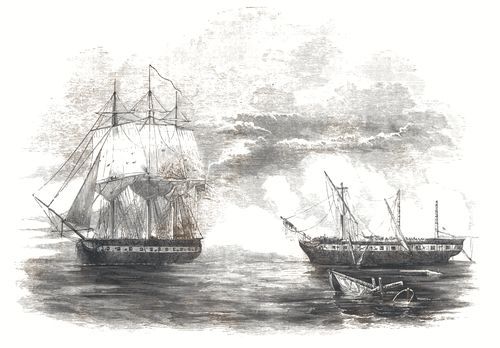
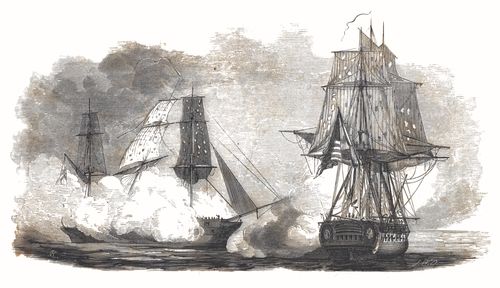
THE CONSTITUTION AND GUERRIERE.
On the 28th of July an order was sent from the Secretary of the Navy,
to Capt. Hull, at Boston, to deliver up the Constitution to Commodore
Bainbridge, and take charge of the frigate Constellation.
Aug. 2. But fortunately for him and the navy, just before this order
reached him he had again set sail, and was out on the deep, where the
anxieties of the department could not disturb him. Cruising eastward
along the coast, he captured ten small prizes near the mouth of the
St. Lawrence and burned them. In the middle of the month he recaptured
an American merchantman and sent her in, and then stood to the
southward. On the 19th he made a strange sail, one of the vessels that
a few weeks before had pressed him so hard in the chase.
When the Constitution had run down to within three miles of him, the
Englishman laid his maintop sail aback, and hung out three flags, to
show his willingness to engage. Capt. Dacres, the commander, surprised
at the daring manner in which the stranger came down, turned to the
captain of an American merchantman whom he had captured a few days
before, and asked him what vessel he took that to be. The latter
replied, as he handed back the glass to Dacres, that he thought from
her sails she was an American. It cannot be possible, said Dacres, or
he would not stand on so boldly. It was soon evident, whoever the
stranger might be, he was bent on mischief. Hull prepared his vessel
for action deliberately, and after putting her under close fighting
canvas and sending down her royal yards, ordered the drums to beat to
quarters. It was now five o'clock, and as the Constitution bore
steadily down towards her antagonist, the crew gave three cheers. The
English vessel was well known, for she had at one of her mast-heads a
flag proudly flying, with the "Guerriere" written in large characters
upon it. When the Constitution arrived within long gun shot, the
Guerriere opened her fire, now waring to bring her broadside to bear,
and again to prevent being raked by the American, which slowly but
steadily approached. The Englishman kept up a steady fire, for nearly
an hour, to which the Constitution replied with only an
occasional gun. The crew at length became excited under this inaction.
The officer below had twice come on deck to report that men had been
killed standing idly at their guns, and begged permission to fire; but
Hull still continued to receive the enemy's broadsides in silence. The
Guerriere failing to cripple the Constitution, filled and moved off
with the wind free, showing that she was willing to receive her and
finish the conflict in a yard-arm to yard-arm combat. The Constitution
then drew slowly ahead, and the moment her bows began to lap the
quarters of the Guerriere, her forward guns opened, and in a few
minutes after, the welcome orders were received to pour in broadside
after broadside as rapidly as possible. When she was fairly abeam, the
broadsides were fired with a rapidity and power that astounded the
enemy. As the old ship forged slowly ahead with her greater way, she
seemed moving in flame. The mizen mast of the enemy soon fell with a
crash, while her hull was riddled with shot, and her decks slippery
with gore. The carnage was so awful that the blood from the wounded
and mangled victims, as they were hurried into the cockpit, poured
over the ladder as if it had been dashed from a bucket. As Hull passed
his antagonist he wheeled short round her bows to prevent a raking
fire. But in doing this he came dead into the wind—his sails were
taken aback—the vessel stopped—then getting sternway,
the Guerriere came up, her bows striking the former abeam. While in
this position, the forward guns of the enemy exploded almost against
the sides of the Constitution, setting the cabin on fire. This would
have proved a serious event but for the presence of mind of the fourth
lieutenant, Beekman Verplanck Hoffman, who extinguished it. As soon as
the vessels got foul both crews prepared to board. The first
lieutenant, Morris,[29] in the midst of a terrific fire of musketry,
attempted to lash the ships together, which were thumping and grinding
against each other with the heavy sea, but fell, shot through the
body. M. Alwyn, the master, and Lieut. Bush of the marines, mounting
the taffrail to leap on the enemy's decks were both shot down, the
latter killed instantly with a bullet through the head. Finding it
impossible to board under such a tremendous fire, the sails of the
Constitution were filled, when the vessels slowly and reluctantly
parted. As the Constitution rolled away on the heavy swell, the
foremast of the Guerriere fell back against the mainmast, carrying
that down in its descent, leaving the frigate a helpless wreck,
"wallowing in the trough of the sea." Hull seeing that his enemy was
now completely in his power, ran off a little way to secure his own
masts and repair his rigging which was badly cut up. In a
short time he returned, and taking up a position where he could rake
the wreck of the Guerriere at every discharge, prepared to finish her.
Capt. Dacres had fought his ship well, and when every spar in her was
down, gallantly nailed the jack to the stump of the mizen-mast. But
further resistance was impossible, and to have gone down with his flag
flying, as one of the English journals declared he ought to have done,
would have been a foolish and criminal act. A few more broadsides
would have carried the brave crew to the bottom, and to allow his
vessel to roll idly in the trough of the sea, a mere target for the
guns of the American, would neither have added to his fame nor
lessened the moral effect of the defeat. He therefore reluctantly
struck her flag, and Lieutenant Read was sent on board to take
possession.
As he stepped over the vessel's side, a disgusting scene presented
itself. When the vessel struck, Captain Dacres told the crew they
might go and get some refreshments, which was another mode of giving
them liberty to drink. In a short time, all the petty officers and
their wives, together with the sailors, were wallowing together in
filth. The vessel being dismasted lay in the trough of the sea, and as
she rolled backwards and forwards the water came in the ports on one
side, and poured out of those on the other, mingling in a
loathsome mass the motley multitude.
This vessel, as well as all the English ships, presented another
striking contrast to the American. Impressment was so abhorred, that
British officers were afraid of being shot down by their topmen during
an engagement; and hence dared not wear their uniforms, while ours
went into action with their epaulettes on, knowing that it added to
their security, for every sailor would fight for his commander as he
would for a comrade.
Captain Hull kept hovering around his prize during the night; and at
two o'clock, "sail ho," was sent aft by the watch, when the
Constitution immediately beat to quarters. The weary sailors tumbled
up cheerfully at the summons, the vessel was cleared for action, and
there is no doubt that if another Guerriere had closed with the
Constitution, she would have been roughly handled, crippled as the
latter was from her recent conflict.
After deliberating for an hour, the stranger stood off. In the
morning, the Guerriere was reported to have four feet water in the
hold, and was so cut up that it would be difficult to keep her afloat.
The prisoners were, therefore, all removed, and the vessel set on
fire. The flames leaped up the broken masts, ran along the bulwarks,
and wrapped the noble wreck in a sheet of fire. As the guns became
heated, they went off one after another, firing their last
salute to the dying ship. At length, the fire reached the magazine,
when she blew up with a tremendous explosion. A huge column of smoke
arose and stood for a long time, as if petrified in the calm
atmosphere, and then slowly crumbled to pieces, revealing only a few
shattered planks to tell where that proud vessel had sunk. The first
English frigate that ever struck its flag to an American ship of war,
had gone down to the bottom of the ocean, a gloomy omen of England's
future. The sea never rolled over a vessel whose fate so startled the
world. It disappeared for ever, but it left its outline on the deep,
never to be effaced till England and America are no more.
The loss of the Constitution was seven killed and seven wounded, while
that of Guerriere was fifteen killed and sixty-four wounded, a
disparity that shows with how much more precision the American had
fired. It is impossible, at this period, to give an adequate idea of
the excitement this victory produced. In the first place, it was
fought three days after the surrender of General Hull, the uncle of
the gallant captain. The mortifying, stunning news of the disaster of
the North-western army met on the sea-board, the thundering shout that
went up from a people delirious with delight over this naval victory.
From one direction the name of Hull came loaded with execrations—from
the other overwhelmed with blessings. But not only was the
joy greater, arriving as the news did on the top of a disaster, but it
took the nation by surprise. An American frigate had fearlessly stood
up in single combat on the deep with her proud foe, and giving gun for
gun, torn the crown from the "mistress of the sea." The fact that the
Constitution had four guns more and a larger crew, could not prevent
it from being practically an even-handed fight. The disparity of the
crews was of no consequence, for it was an affair of broadsides, while
the vast difference in the execution done, proved that had the
relative weight of metal and the muster roll been reversed, the issue
would have been the same.
Captain Hull on his return to Boston, surrendered the frigate to
Bainbridge, who soon after hoisted his broad pennant on board, but did
not put to sea till the 26th of October.
Oct. 12.
In the mean time, Commodore Rodgers having refitted again, started on
a cruise, having the United States, forty-four, commanded by Commodore
Decatur, and the Argus, sixteen, Captain Sinclair, in company.
Commodore Rodgers having captured on the 17th, the British packet
Swallow, with two hundred thousand dollars on board, continued his
cruise to the eastward. Just before, in a heavy gale, the United
States and Argus had parted company with him. The former directed her
course so as to fall in the track of East Indiamen, but on
Sunday morning, the 25th, she saw a large sail to the southward, which
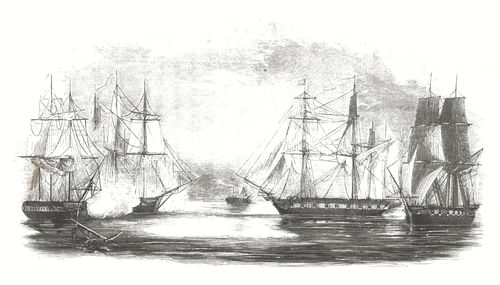
proved to be the English frigate Macedonian. After some
manœuvering, the two vessels approached within a mile of each
other, when the firing commenced. After the United States delivered
her second broadside, she ceased manœuvering and took the same tack
with her enemy, both steering free. The Macedonian, however, was to
windward, and hence could make it a yard-arm-to-yard-arm combat
whenever she chose. But she preferred a longer range, and the two
vessels swept on, delivering their rapid broadsides within musket
shot. The distance at which they kept, together with the heavy sea
that was rolling, rendered the aim imperfect and protracted the
conflict, so that it continued for an hour after the guns of both
vessels began to bear, before any material effect was visible. The
broadsides of the United States were delivered so rapidly that she was
constantly enveloped in flame and smoke, and the crew of the
Macedonian several times thought her on fire and cheered. Decatur,
with his fine face lit up with that chivalric valor that was wont to
illumine it in battle, moved amid his men with words of encouragement
and praise. As the mizen-mast of the enemy went by the board, hearing
a sailor say to his comrade, "Jack, we've made a brig of her;" he
replied, "Take good aim, Jack, and she will soon be a
sloop." Turning to a captain of the gun, he said, "Aim at the yellow
streak, her spars and rigging are going fast enough, she must have a
little more hulling." Soon after her fore and main top mast went over.
At length, the mizen mast was cut in two by a shot, about ten feet
from the deck, while with every roll of the ship the weakened foremast
threatened to swell the wreck. The Englishman, perceiving that his
vessel would soon become unmanageable, made an effort to close, for
the purpose of boarding. But Decatur saw his advantage too plainly, to
risk it in a desperate encounter, and putting on sail shot ahead. The
enemy mistaking this movement for a rapid flight gave three cheers,
and all the flags having come down with the spars, set a union Jack in
the main rigging in token of triumph. But when the United States was
seen to tack and approach, as if about to close, it was hauled down.
On this same Sabbath, while the cheers of the United States' crew rang
over the deep, Napoleon was traversing in gloom the fatal, bloody
field of Malo-Jaraslowitz, and with two kings and three marshals by
his side, was deliberating on that retreat which was to change the
face of the world.
The superiority of American gunnery, in this combat, was placed beyond
dispute. It was a simple cannonade on a very rough sea. Yet the United
States had but five killed and seven wounded, while out of
three hundred men, the Macedonian had one hundred and four killed or
wounded. So, also, the former lost her top-gallant masts, and had been
hulled but a few times. It is true her rigging suffered severely, but
the English frigate had almost every spar in her more or less
shattered, while her hull was pierced with a hundred shot. In this, as
in the former engagement between the Constitution and Guerriere, the
United States carried four more guns than her antagonist. She was a
heavier ship, but therefore a better mark, and yet the enemy's shot
rarely hulled her. The decks of the latter presented a revolting
spectacle. "Fragments of the dead were distributed in every
direction—the decks covered with blood—one continued agonizing yell
of the unhappy wounded,"[30] filled the ship.
Decatur having arrived with his prize in New London, dispatched Lieut.
Hamilton, son of the Secretary of the Navy, to Washington, with an
account of the victory, and the captured colors. Dec. 8.
Hurrying on, greeted with the acclamations of the multitude as he
passed, he arrived at the capital in the evening. On that very night a
ball had been given to the officers of the navy, at which Hull and
Stewart and the Secretary of the Navy were present. Young Hamilton
walked into the gay assemblage and delivered his message to
his overjoyed father, who immediately announced it to the company.
Shout after shout shook the hall—all crowded around the young
lieutenant, eager to hear the incidents of the action. As he narrated
how they fought and how they conquered, tears of joy and gratitude
streamed from the eyes of his mother, who stood fondly gazing on him.
Captured colors of the enemy decorated the room, and a delegation was
sent to bring those of the Macedonia and add them to the number.
Captains Stewart and Hull bore them in, and presented them, amid the
loud acclamations of the throng, to the wife of the President—the
band struck up an inspiring air, and intense excitement and exultation
filled every bosom.
The Argus met with but little success. The seamanship of her officers
was, however, tested during the cruise. She was chased three days and
nights by an English squadron, and yet not only managed to escape, but
having come upon an English merchantman during the chase, actually
captured it in sight of the fleet, though by the time she had manned
it the enemy had opened on her with his guns. Having made five prizes
in all, she returned to port.
In the meanwhile the Wasp, Captain Jones, which was returning from
Europe with dispatches, the time war was declared, had refitted and
started on a cruise. Sailing northward to the latitude of
Boston, she made a single capture and returned to the Delaware. On the
13th of October, the very day of Van Rensalaer's defeat at Queenstown,
she again put to sea, and after being four days out, on the night of
the 17th, made five strange sail. Not knowing their strength or
character, Captain Jones deemed it prudent to keep off till daylight,
when he would have a better opportunity for observing them. In the
morning he discovered there were six ships under the convoy of a brig
of war. Two of them were armed, but the brig deeming herself alone a
match for the American, sent them all forward, and waited for the
latter to approach. The sea was rough from the effects of a storm that
had swept those latitudes the day before, in which Captain Jones had
lost his jib boom and two of his crew. There was no manœuvering
attempted in this tumultuous sea, and the Wasp surged on in dead
silence, the only sound heard on her decks being the roar of the waves
as they burst along her sides. She closed on her antagonist with a
deadliness of purpose seldom witnessed in naval combats. She never
delivered her broadside till within a hundred and eighty feet, and
then with fearful effect. At first this heroism seemed doomed to a
poor reward. The fire of the Frolic was incessant. Seldom had an
Englishman been known to deliver such rapid broadsides. In five
minutes the main topmast of the Wasp fell amid the
rigging—in two minutes more the gaft and mizen top-gallant mast
followed. Thus, in eight minutes from the time the vessels closed, the
Wasp was so disabled that her destruction seemed almost certain. But
while cut up herself so terribly aloft, she had struck with every
broadside the heart of her antagonist. As she rolled on the heavy seas
her guns were frequently under water, and the sailors staggered around
their pieces like drunken men. Delivering her broadsides as she sunk,
she hulled her antagonist at every discharge; while the latter, firing
as she rose, made sad work with the rigging of the former. Jones
seeing his spars and rigging so dreadfully cut up, was afraid that his
vessel would become unmanageable, and therefore determined to run foul
of his adversary and board. But when the vessels closed, the bows of
the Frolic struck abaft the midships of the Wasp, which so swung the
head of the latter around that she was enabled to throw a raking fire
into the former. The order, therefore, to board was countermanded, and
a fresh broadside directed to sweep her decks. In loading some of the
guns, the rammers struck against the bows of the Frolic. The shot went
crashing the whole length of the ship, and the crew, excited by this
hand-to-hand fight, could no longer be restrained from boarding. Mr.
Biddle, the first lieutenant, leaped into the rigging, followed by
Lieut. Rodgers and other men, and soon gained the decks of
the Frolic—but, in looking round for the enemy, they saw but three or
four officers standing aft, and bleeding. None but the dead and
wounded cumbered the decks. Not one was left to haul down the colors.
The officers threw down their swords in token of submission, and
Lieutenant Biddle, springing into the rigging, lowered the English
flag with his own hand. The carnage was horrible for so small a
vessel—nearly a hundred of the officers and crew being killed or
wounded. The decks were literally covered with the mangled forms of
men and officers. The corpses presented a ghastly appearance as they
rolled from side to side with the tossing vessel, while shivered spars
and masts covered the wreck, and still hanging by the ropes, swung
with every lurch against its shattered hull. There can scarcely be a
more mournful sight than a noble ship dismantled in mid ocean, her
decks crimsoned with blood, while on every side, amid broken and rent
timbers, her gallant crew dismembered and torn, are stretched in
death.
The Frolic was a brig carrying in all twenty-two guns, while the Wasp,
though a ship, carried but eighteen, thus making a difference in favor
of the former of four guns.
The Wasp had, therefore, captured a superior force in single combat.
But in this, as in the two former engagements I have
detailed, the same extraordinary disparity in the respective losses of
the two vessels was exhibited. While near a hundred were killed or
wounded in the Frolic, there were only five killed and as many wounded
in the American ship. It is not a matter of surprise that the belief
became prevalent in England that our vessels were filled with Kentucky
riflemen. These men had become famous for their accuracy of aim; and
it was supposed we had introduced them into our navy. In no other way
could they account for the awful carnage that followed every single
combat of ship with ship. In all her naval history, such destructive
work had never been witnessed in so short a space of time. The moment
an American vessel opened her broadsides, death began to traverse the
decks of her antagonist with such a rapid footstep, that men were
appalled.
This was doubtless owing in a great measure to our guns being sighted,
an improvement introduced by American officers, rendering the aim
infinitely more accurate.
The Wasp in this engagement had been fought nobly, but her victory
proved worse than a barren one to her gallant commander and crew.
Scarcely had the English Jack been lowered to the Stars and Stripes,
before the latter were struck to the English flag. The Poictiers an
English seventy-four, soon hoved in sight and bore down on
the two vessels lying to and clearing away the wreck. The Wasp
endeavored to make use of her heels, but on turning out her sails,
they were found completely riddled. Flight was out of the question,
and both vessels surrendered. They were taken into Bermuda, where the
Americans were parolled and allowed to return home.
On the 26th of October, Commodore Bainbridge left Boston, accompanied
by the Hornet, with the intention of joining Captain Porter, in the
Essex, and passing into the Pacific Ocean, where the British fisheries
and commerce could be easily struck. Captain Lawrence, cruising
southward, at length arrived at St. Salvador, where he found a British
sloop of war, the Bonne Citoyenne. The latter being in a neutral port,
was safe. She was superior to the Hornet, but Lawrence, determined to
provoke her out to single combat, sent a challenge to her
commander—Commodore Bainbridge, in the meanwhile, promising to keep
out of the way. The challenge was declined, and if the fact that she
had a large amount of specie on board, had been given as the reason of
her refusal, the conduct of Captain Green, the commander would have
been unobjectionable. But to intimate, as he did, that the frigate
would interfere, after Bainbridge had pledged his word, and the
American Consul offered guarantees, evinced a contemptible
spirit, almost as degrading as cowardice.
Captain Lawrence determined, however, not to let the vessel go to sea
without him, and he therefore blockaded the port.
The Constitution left the Hornet blockading the Bonne Citoyenne, and
steered south, keeping along the coast, and on the 29th discovered two
sail between her and the land, which was about thirty miles distant
and in full view. One of the vessels being small, kept standing in
towards the shore, while the larger one, a British frigate, the Java,
of thirty-eight guns, directed her course towards the American.
Bainbridge, wishing to get farther from the land, tacked and steered
to the south-east for two hours, the Englishman following after. About
half-past one, finding himself clear of the land, Bainbridge tacked
and stood towards the stranger. At 2 o'clock the two vessels were only
half a mile apart, the Englishman to windward, and showing no colors.
The order to fire a shot to make the latter set his ensign being
misunderstood, a whole broadside was delivered, and the battle
commenced. A tremendous cannonade followed. The wind was light and the
sea smooth, so that full scope was given for manœuvering and accurate
aim. Bainbridge, who at the commencement of the war, had urged the
President to send the national ships to sea, and was now in his
first fight, felt not only the promise he had given the
Secretary of the Navy weighing on him, but his responsibility as
commander of the Constitution, fresh with laurels from the capture of
the Guerriere.
He managed his ship with consummate skill, and not only foiled every
attempt of the enemy to get a raking position, but soon obtained one
himself, and delivered a broadside that swept the decks of the Java.
The vessels had at length approached within pistol shot, and the
effect of the rapid broadsides of the Constitution delivered so
closely and on that smooth sea, could be heard in the rending timbers
of the enemy's ship. Bainbridge, in the mean time, received a musket
ball in his thigh. He however still walked the quarter deck, watching
every movement of his antagonist, and the effect of every broadside.
In a few minutes later, a cannon shot plunged into the wheel,
shattering it in fragments, and sending a copper bolt into his leg.
Crippled and bleeding—refusing even to sit down—he continued to limp
over the quarter deck, watching the progress of the combat, and
directing the movements, apparently unconscious of pain. The
destruction of the wheel he felt to be a more serious affair than his
wounded leg, for he was no longer able to give verbal orders to the
helmsman. The tiller was of course worked below the second deck by
ropes and tackles, where the helmsman unable to see the sails and
steer accordingly, depended entirely on orders transmitted
to him. This would have been of minor consequence in a steady yard to
yard-arm fight, but in the constant manœuvering of the two vessels,
either to get or prevent a raking fire, it was a serious
inconvenience. Still, the Constitution managed to secure this
advantage in almost every evolution. The tremendous fire she kept up,
so staggered the Englishman, that he resolved to run his vessel aboard
at all hazards. He came stern on, and his bowsprit passed through the
mizen rigging of the Constitution. The next moment, however, it was
cut in two by a cannon shot, when the two vessels parted. At length
the Constitution, after wearing twice to get the right position, threw
herself fairly alongside her antagonist, and they moved on together,
yard-arm and yard-arm, pouring in incessant broadsides. In a few
minutes the mizen mast of the Java went over, and as her foremast had
gone long before, nothing but the main mast was left standing. Her
fire had now ceased, and Bainbridge, under the impression she had
struck, set his sails and passed off to windward to repair damages,
make his masts secure, and be ready for any new combat that might be
forced on him, in a sea filled with the enemy's cruisers. After an
hour spent in overhauling his ship he returned, and finding the
enemy's ensign still flying, he passed directly across her bows, and
was about to deliver a raking fire, when she struck. The
combat lasted for more than two hours, and from the number of
evolutions on both sides, was brought to a termination several miles
from where it commenced. The Java was completely dismantled. Her mizen
mast had been cut away close to the deck—the mainmast fell soon after
the firing ceased, while nothing but a stump of the foremast, some
twenty or thirty feet long, was left standing. Her bowsprit, too, was
gone; in fact, every spar had been shot out of her. The Constitution,
on the contrary, at the close of the long severe conflict, had every
spar standing. An eighteen pound shot had made an ugly hole through
her mizen mast, and another had cut a deep gash in the foremast, and a
quantity of ropes swinging loose in the wind, showed that she had been
in the midst of cannon balls, but she came out of the conflict as she
went in, every spar erect and her royal yards across. The outward
appearance of the ships did not present a more striking contrast than
their decks. Those of the Java were rent and torn, and strewed with
the dead. A hundred and sixty-one had been killed or wounded, while
nine killed and twenty-five wounded covered the entire loss of the
Constitution.
Among the prisoners taken was Lieutenant-General Hislop, with his
staff, on his way to Bombay, as Governor. They were all treated with
that kindness and generosity which ever characterizes a truly
brave man—conduct which the English, in the very very few
opportunities offered them, did not generally reciprocate.
The severe wounds of Commodore Bainbridge could not force him to leave
the deck, even after the action was over. In his anxiety for his ship
and the prize, and care of the wounded and prisoners, he forgot his
sufferings, keeping his feet till eleven o'clock at night. These eight
hours of constant exertion increased the inflammation to an alarming
degree, and well nigh cost him his life.
It was a proud day for him; he had redeemed his pledge to the
government, and added another wreath to the laurels that already
crowned the American navy.
The Constitution lay by the Java for two or three days, in order that
the wounded might be removed with care and safety. When this was
accomplished, the latter vessel being so completely riddled that it
would be impossible to get her into an American port, was blown up.
Our gunners fired with too accurate an aim; they so destroyed the
vessels of the enemy, that they could not be secured as prizes.
The Constitution was carried into St. Salvador, where her arrival did
not improve the prospect before the Bonne Citoyenne, should she
venture to break a lance with the Hornet. She was apparently preparing
to go to sea that night, with the intention of avoiding her
antagonist if convenient, and fighting her if necessary. The capture
of the Java, however, produced a change in her plans, and she took
eighteen days longer to reflect on the subject.
Commodore Bainbridge dismissed the private passengers found on board
the Java, without regarding them as prisoners of war, while all the
others were released on their parol. Governor Hislop presented him
with an elegant sword, as a token of his esteem and an acknowledgment
of the kindness with which he had been treated. Captain Lambert,
commander of the Java, was mortally wounded, and just before his
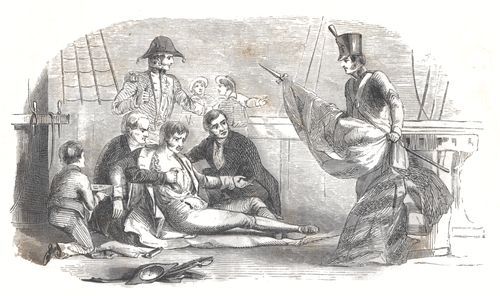
removal to the shore, Bainbridge, leaning on the shoulders of two
officers, hobbled into his room to restore to him his sword. It was a
touching spectacle, the wounded victor presenting to his dying
antagonist, the sword he never would wield again, accompanying it with
expressions of esteem and kindly hopes. Captain Lambert received it
with emotion, and returned his thanks. Two days after, it was laid
across his breast. It was not dishonored in its owner's hand, for his
ship had been gallantly fought to the last, and surrendered only when
not a sail could be set.
Bainbridge, at this time, was not quite forty years of age. Six feet
in height, of commanding person, and an eye that burned like fire in
battle, he moved over his quarter deck the impersonation of a hero.
His noble conduct to the prisoners, won him the praise even
of his enemies. An English Admiral, when told of it, shook his head,
remarking, that it had an ominous look when a young commander, in a
navy unaccustomed to victory, could treat his foes so like an old
Spanish cavalier.[31]
The Constitution, in this engagement, carried fifty-four guns, and the
Java forty-nine. On this difference of five guns, the English
attempted to erect a prop to support their naval pride. The effort to
prove a superiority in weight of metal and number of men, in every
victorious American vessel, and the changes rung on the difference of
a single gun, exhibited a sensitiveness that enhanced instead of
lessened the defeats. If a battle is never to be considered equal,
until both ships have the same tonnage to a pound, the same number of
cannon, and the muster roll be equal to a man, it is to be feared
there never will be one fought. Not only did the English allege that
the Constitution was greatly superior in weight of metal,
but declared that her success was owing, in a large measure, to her
musketry; and yet the Java had not a spar standing at the close of the
battle. Muskets do not dismantle vessels, and leave them mere hulks at
the mercy of their foe.[32] The English court of enquiry appointed to
investigate the subject, asked the boatswain, "if they had suffered
much on the forecastle from musketry." "Yes," he very frankly replied,
"and, likewise, from round and grape." The latter was, no doubt,
true, and very probably the former.
Bainbridge returned to Boston, and resigned the command of the
Constitution, which stood greatly in need of repairs.
Lawrence continued, as before stated, to blockade the Bonne Citoyenne,
until the latter part of January, when a British
seventy-four heaving in sight, he was compelled to run in beside his
adversary. The tables were now turned upon him, and he had the
prospect of seeing the man-of-war playing the part of keeper at the
mouth of the port, while his own prisoner making use of this
protection could pass out, and continue his voyage. This was a
predicament he did not relish, and taking advantage of the night,
quietly slipped out to sea, and continued his cruise. He made a few
prizes, and among them a brig of ten guns, with $12,500 in specie on
board. Arriving, at length, at the mouth of the Demarara river, he
discovered an English brig of war, and gave chase to her. The latter
running in shore, led him into such shoal water, that he deemed it
prudent to haul off. He, however, did not abandon the hope of forcing
the ship into an engagement, and while beating down on a different
tack to get within reach of her, he discovered another brig apparently
seeking to close. He immediately put the head of his vessel toward
that of the stranger. Both were close on the wind, and as they
continued to approach, it was evident from their course they must pass
each other with their yard-arms almost touching. It was now nearly
half-past five, and the lurid rays of the sun, just sinking behind the
hills of the main land, flooded the two vessels as they silently
closed. The moment they began to draw abeam, so that the guns bore,
the firing began. When fairly abreast, the vessels were not
more than fifty feet apart. The words of command and the shrieks of
the wounded could be distinctly heard in either vessel, as broadside
crashed against broadside. It was a stern meeting and parting. As soon
as the guns ceased to bear, the Englishman wore, in order to get a
raking fire on the Hornet. The latter, however, was too quick for him;
he was first about, and coming down on his quarter in "a perfect blaze
of fire," poured in his broadsides with such close range and
destructive effect, that in ten minutes more the enemy not only
struck, but hoisted a signal of distress. Mr. Shubrick being sent on
board to take possession, reported that the vessel was the sloop of
war, Peacock, and that she had six feet water in the hold. Every
effort was made to save the prize, and to get out the wounded. Both
vessels were anchored; the pumps were rigged on board the Peacock, and
bailing was resorted to. The vessel, however, continued to sink, and
at last went down, carrying nine of her own crew and three of the
Hornet with her. Two American officers, and many more seamen came near
losing their lives, in their gallant effort to save the prisoners.
The foremast of the ill-fated vessel protruded from the sea, where she
went down, remaining for some time to mark the place of the battle and
the victory.
The superiority of American gunnery and American seamanship
was again established beyond dispute. The Hornet was slightly superior
in weight of metal,[33] but she not only out-maneuvered her
antagonist, but surpassed her incomparably in the effective use of her
guns. The former had but one man killed and two wounded, while of the
latter there were thirty-eight killed and wounded, and among them the
commander. The Hornet had but a single shot in her hull, while the
Peacock was so riddled that she sunk in a few minutes after the
action.
The thrill of exultation that passed over the land at the announcement
of the first naval victory, was alloyed by the reflection that it was
but an isolated instance, and hence could hardly justify a belief in
our naval superiority. But as frigate after frigate and ship after
ship struck, all doubt vanished, and the nation was intoxicated with
delight. The successive disasters that befel our land forces along
the Canada line, could not check the outburst of enthusiasm on every
side. As the news of one victory succeeding another was borne along
the great channels of communication, long shouts of triumph rolled
after it, and the navy from being unknown and uncared for, rose at
once to be the bulwark and pride of the nation. All faces
were turned to the ocean to catch the first echo of those resistless
broadsides, that proudly asserted and made good the claim to "free
trade and sailor's rights." Where we had been insulted and wronged the
most, there we were chastising the offender with blows that astounded
the world. If the American Government had been amazed at the failure
of its deep laid schemes against Canada, it was no less so at the
unexpected triumphs at sea. Saved from the deepest condemnation by the
navy, which it had neglected—forced to fall back on its very blunders
for encouragement, it could say with Hamlet—
"Let us know,
Our indiscretion sometimes serves us well
When our deep plots do pall."
But our astonishment at these successive and brilliant victories could
scarcely exceed that of the old world. The British navy had been so
long accustomed to victory, that a single-handed contest of an English
frigate with that of any other nation, had ceased to be a matter of
solicitude to her. The maritime nations of Europe had, one after
another, yielded to her sway, till her flag in every sea on the globe
extorted the respect and fear which the declaration, "I am a Roman
citizen" did, in the proudest days of the Empire. Her invincibility on
the ocean was a foregone conclusion. The victories of
Napoleon stopped with the shore—even his "star" paled on the deep.
His extraordinary efforts and energies could not tear from the British
navy the proud title it had worn so long. His fleets, one after
another, had gone down before the might of British broadsides, and the
sublime sea fights of Aboukir and Trafalgar, were only corroborations
of what had long been established. If this was the common feeling of
the Continent it is no wonder that "the English were stunned as by the
shock of an earthquake."[34] The first victory surprised them, but did
not disturb their confidence. They began to discuss the causes of the
unlooked for event with becoming dignity, but before the argument was
concluded, another and another defeat came like successive thunder
claps, till discussion gave way to alarm. The thoughtful men of
England were too wise to pretend that disasters occurring in such
numbers and wonderful regularity, could be the result of accident, and
feared they beheld the little black cloud which the prophet saw rising
over the sea, portending an approaching storm. If, in so short a time,
a maritime force of only a few frigates and sloops of war could strike
such deadly blows and destroy the prestige of English invincibility,
what could not be done when that navy should approximate her own in
strength. Some of the leading journals indulged in foolish
boasting and detraction of American valor, and held up to derision
those who saw portents of evil in the recent defeats. But the Times
spoke the sentiments of those whose opinions were of any weight. Said
the latter: "We witnessed the gloom which the event (the capture of
the Guerriere) cast over high and honorable minds. We participated in
the vexation and regret, and it is the first time we ever heard that
the striking of the flag on the high seas to any thing like an equal
force, should be regarded by Englishmen with complacency or
satisfaction." *** "It is not merely that an English frigate has been
taken, after what we are free to confess, may be called a brave
resistance, but that it has been taken by a new enemy, an enemy
unaccustomed to such triumphs, and likely to be rendered insolent and
confident by them." Another declared: "Our maritime superiority is in
fact a part of the nation's right. It has been the right of the
conqueror, since men associated together in civilization, to give laws
to the conquered, and is Great Britain to be driven from the proud
eminence which the blood and treasures of her sons have attained for
her among nations, by a piece of striped bunting flying at the
masthead of a few fir-built frigates, manned by a handful of
bastards and outlaws?"
Such were the different sentiments entertained and expressed
in England at the outset, but as the war progressed, anxiety and alarm
took the place of boasting.
The war vessels at length grew timorous, and lost all their desire to
meet an American ship of equal rank. It was declared that our frigates
were built like seventy-fours, and therefore English frigates were
justified in declining a battle when offered. The awful havoc made by
our fire affected the seamen also, and whenever they saw the stars and
stripes flaunting from the masthead of an approaching vessel, they
felt that no ordinary battle was before them. English crews had never
been so cut up since the existence of her navy. In the terrific battle
of the Nile, Nelson lost less than three out of one hundred, and in
his attack on Copenhagen, less than four out of every hundred. In
Admiral Duncan's famous action off Camperdown, the proportion was
about the same as that of the Nile. In 1793, the French navy was in
its glory, and the victories obtained over its single ships by English
vessels were considered unparalleled. Yet in fourteen single
engagements, considered the most remarkable, and in which the ships,
with one exception, ranged from thirty-six guns to fifty-two, the
average of killed and wounded was only seventeen per ship, while in
four encounters with American vessels, the Constitution, United States
and Wasp, the average was a hundred and eleven to each vessel.
Jan. 2.
This success of the navy at length roused Congress to do something in
its aid, and an act was passed on the 2d of January, authorizing the
President to build four seventy-fours, and six ships of forty-four
guns, thus increasing the force of the navy tenfold. On the 3d of
March, by another act, it authorized the building of such vessels on
the lakes as was deemed necessary to their protection. Sums were also
voted to the officers and crews as prize money.