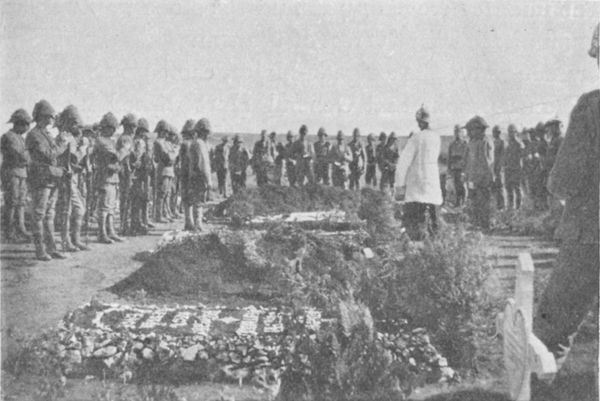
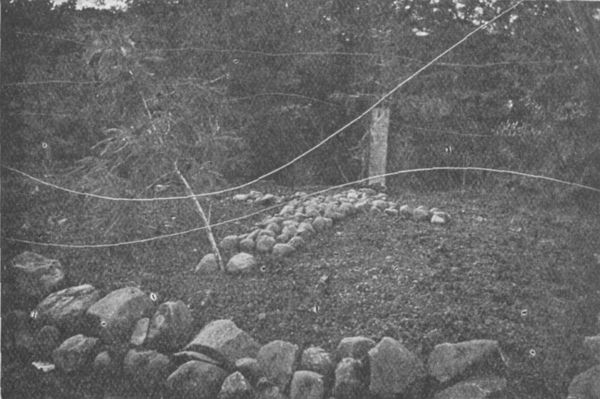
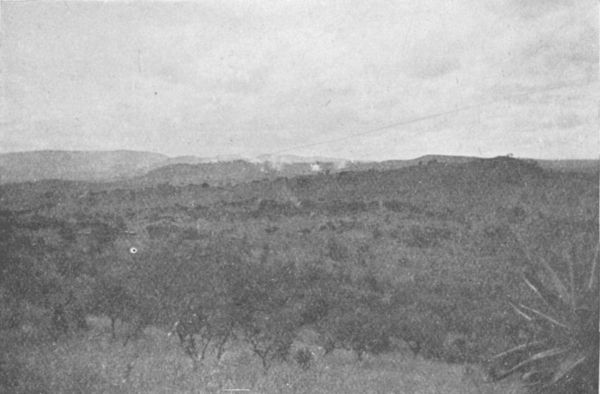
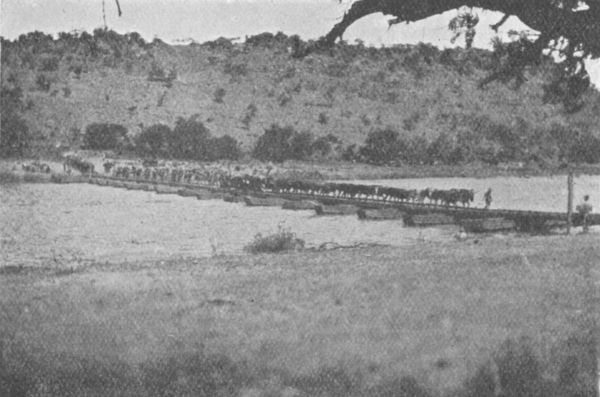
CHAPTER I.
VRYBURG TO HEIDELBERG.
'None of us put off our clothes.'
Neh. iv. 23.
Now commenced a different phase of warfare. If, in the constant
fighting of the Natal campaign, the regiment had been called upon to
prove its fighting capabilities—a call to which their noble response
earned them encomiums wherever they went—they were now to be called
upon to prove another essential of the true soldier—their mobility.
And well they proved it. Day after day, week after week, the tired,
footsore, but stout-hearted column-of-route made its slow and
wearisome way over the apparently limitless expanse of the swelling
veld. And how monotonous that veld can be none can appreciate save
those who have experienced its deadly sameness. Ahead, behind, all
round, nothing but veld, veld, veld. No trees, no hills, no rivers, no
lakes, no houses, no inhabitants! Here and there, perhaps, a miserable
shanty of the sealed-pattern South African type: rough stone walls and
corrugated-iron roof, a room on each side of the door, a narrow
verandah—occasionally occupied by a quiet, peaceful-looking old
patriarch, with a grey beard, and an air savouring rather of the
pulpit than the sheltered side of a boulder—a scraggy tree or two,
and a lick of water in a 'pan'—or pond as we should call it—hard by;
a woman, some children, and a couple of goats; a few mealie cobs
yellowing on the roof, and a scared, indignant, and attenuated fowl.
Alas! how those quiet-looking, quiet-spoken old gentlemen, open Bible
on knee, deceived us. Oh, no! they had never wished for war.
Fight? yes; they had fought, and surrendered, and taken the oath, and
hoped never to fight again. Peace? yes; they wanted peace, and urged
us to hasten on and conclude it. The same story everywhere: in the
villages as in the solitary hamlets. A vast, empty, forsaken
wilderness, with nothing more bellicose than a lean and hungry
boar-hound or two. And yet for two long years to come this very
country, over which the battalion trekked so peacefully, fifes and
drums playing, officers out on the flanks shooting, mess-president
cantering miles away in quest of eggs and their producers, was to be
the scene of many a hard-fought fight and many weary nights of
outposts. Indeed, it never really succumbed to the very end; the happy
hunting-ground of the gallant De la Rey, it was a thorn in the side of
our leaders up to the day the Delegates came in.
One day's march varied little from another. Up at dawn, and off after
the scantiest of scrappy breakfasts. Good marching while the dew was
on the grass, and the sun a welcome ally after the clear, crisp,
frosty nights; soon, however, to get hot enough, until the welcome
mid-day halt and meal, after which tighten up belts once more and on,
and on, one horizon following another with wearisome regularity, and
never a sign of the long-looked-for water, till at last, as the sun
set behind our backs, its last rays would glint on the miserable 'pan'
by whose side we were to halt for the night. And then what bitter
feelings of depression and disgust when sometimes the fiat would go
forth 'Water for cooking purposes only,' and one had to turn into
one's blankets grimy, dusty, clammy, and miserable.
On May 31st, the regiment, having arrived at the railway, was told
they would halt there next day. But on the morning of June 1st, the
order was given for the column[8] to march at 2 p.m. to Marigobo Pan,
a distance of eight miles only, but quite ten by the route
taken. The evenings soon close in at this time of year in South
Africa, and it was almost dark when the column arrived. As it was a
fine mild night, every one hoped to be allowed to bivouac, but tents
were pitched after all, and naturally enough pitched anyhow.
In this matter of pitching tents, the battalion particularly prided
itself. On arrival at the selected site of the camp the Sergeant-Major
blew a whistle, when all those whose duty it was to assist ran towards
him, the men to mark the tent-poles, bayonets in hand, and two others
with the mekometer, to ensure a true right-angle. Every one knew his
particular job, so no time was wasted, while the symmetrical lines
obtained by the use of the instrument were a joy to the General's
eye.[9]
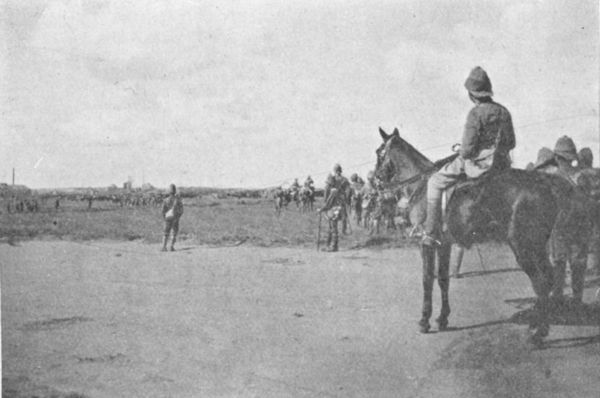
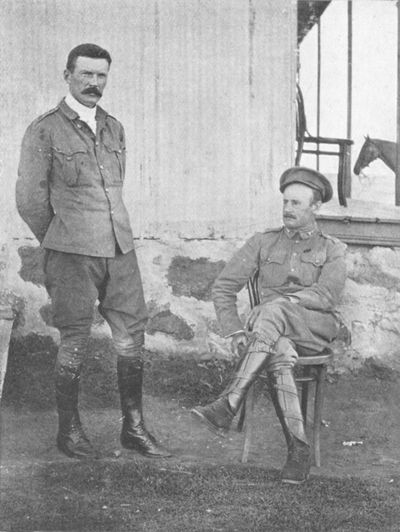
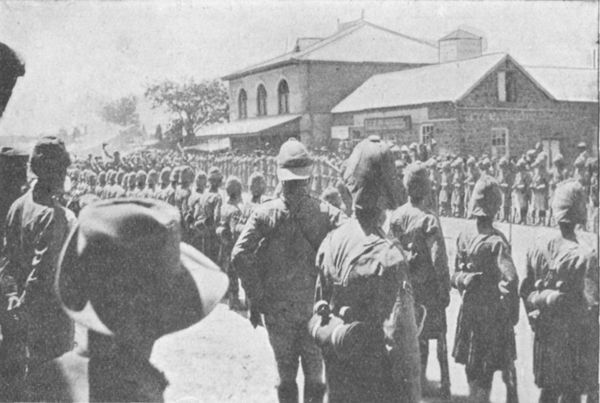
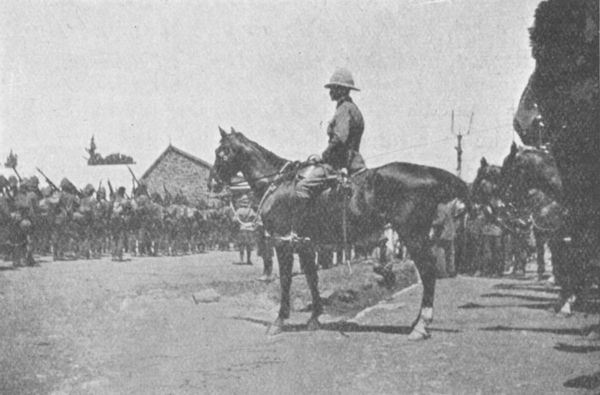
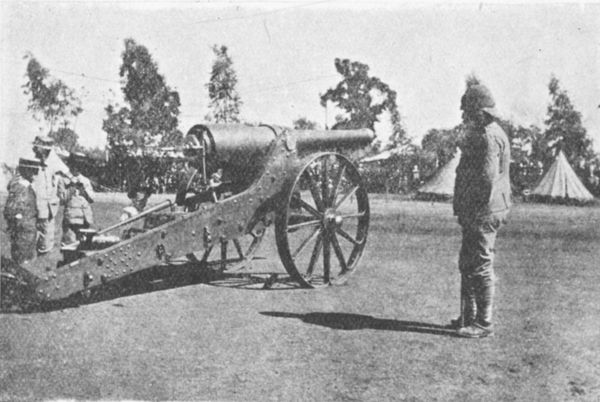
First Entry into Krugersdorp.
Captain and Adjutant
Fetherstonhaugh in foreground.
In the same way, whenever a halt was ordered, it was the regiment's
custom to lay out their kits, mess-tins, belts, &c., in lines outside
their tents. Each Colour-Sergeant had a ball of string,
which was stretched between a couple of pegs; the kits were laid along
it, the string was rolled up and pitched into a tent, and neatness and
regularity prevailed without any extra trouble to any one. This
neatness in camp, in addition to its other soldierly qualities,
endeared the battalion in the eyes of General Hart, a soldier of the
old school, to whom order and regularity particularly appealed.
On the 2nd the column made another short march to Greysdorp, where
there were two or three good wells, but where the water in the pan was
of a most peculiar green colour.
The Mafeking relief column was met on the way, and very hard and
serviceable they looked, while several officers met old friends,
amongst others Prince Alexander of Teck, whom we had known at
Maritzburg before the war.
A longish march of nineteen or twenty miles on the 3rd, with a halt
midway, brought us in the evening to a place called Barber's Pan,
somewhat superior to the generality of these places. There was a
certain amount of water in the pan, but brackish and unpleasant to
drink. Round it were scattered some half-dozen houses, but the most
remarkable thing in connection with it was the sunset. As the light
faded, a mist rose from the veld, which after a few minutes began to
change colour, until at last it settled down to a most beautiful shade
of light green. None of us had seen anything similar before, nor did
we ever see anything like it again.
A march of about fourteen or fifteen miles on the 4th brought us to a
most uncomfortable camp. On the way, Captain Fetherstonhaugh (acting
Adjutant since Captain Lowndes was hit at Talana) rode off some
distance to a flank to try and get some supplies. He returned with a
great story of his reception by crowds of women and one or two men;
the latter stated they had been reluctantly compelled to fight against
us at Modder River, on pain of being shot, but that their
sympathies were entirely with us, &c. They even gave him a pound of
butter. And we believed this story at the time.
But, for that matter, who would not have been taken in? Every one
coming up the line brought better and better news. Lord Roberts was
close to the capital, and, thought we in our simplicity, that of
course must end the war. No one guessed there was extra time—two
solid years extra time—to be played. So we enjoyed the butter, and
said they were sensible people after all, and hoped we'd be in time
for the siege of Pretoria.
The next day's march was a pleasanter one than usual, the halts being
better arranged, with the result that the troops and transport got
into camp quite as early as they would have done under the ordinary
circumstances, but very much fresher and fitter. The fact is, staff
officers do not understand marching. They go tittuping gaily past long
straggling columns, passing the time of day cheerily to friends, and
momentarily halting to deliver some ironical knock to acquaintances on
the subject of their transport, or their sections of fours, or
something of the sort. But the regimental officer, who foots it
alongside his company, he understands marching right enough. He will
tell you when the going is good, and when it only looks good; he will
tell you the effects of five-minute halts, and how much benefit the
closing-up rear of the column derives from them; he will tell you when
a steady, swinging pace is being set that the men could keep up for
ever; and he will also tell you when some long-legged officer in front
is going four miles an hour, till some one suggests it is too fast,
and he sinks into a slow and tiring two and a half. Colonel Hicks
commanded the column on the 5th, and let us march our own way, with
the beneficial results already recorded.
And that cheery rumour about Pretoria. French reported to be
there, and Mr. Kruger gone off with a couple of millions. What did we
care about the latter? We should not have got any of it.
Another short march of a little over ten miles brought us to a camp
where there was actually a stream. Here the men got the chance of a
much-needed bathe, and how they enjoyed it! Every one, in fact, was in
excellent spirits, for the news about Pretoria turned out to be true,
and though some of us were disappointed at not being up in time to
share in the triumphant entry into the capital, the majority were all
for England, home, and beauty.
On the 7th we arrived at Lichtenburg, a small town or village that was
to see some heavy fighting later on in the war. On the present
occasion all seemed most peaceful. The houses were of the stereotyped
South African pattern, with the invariable half-stoep, half-verandah
running half-way along their fronts. Clear streams of water ran coolly
and pleasingly by the sides of the streets, shaded by the ubiquitous
weeping-willow. There was nothing to be bought, and no one to be seen,
however, and those of us who went into the town next morning were very
soon satisfied, returning to camp minus the various articles we had
set forth to buy. It was interesting, however, to see the Boers
handing in their rifles and taking the oath of allegiance.
Captain MacBean, who was now on General Hunter's staff, turned up
here, and dined with the regiment, and very glad we were to see him.
He gave us all sorts of news, too, which we were very deficient of, as
the system of daily bulletins had not then started.
After having halted for the 8th and 9th, we resumed our desert march
on the 10th, but only made some ten miles. It was most bitterly cold
all the way.
The next day proved far pleasanter, and another short, easy march of
about ten miles saw us in camp by 1.30 p.m.
On the 12th we made a march of sixteen miles. We were then
within about thirty-three miles of the railway from Johannesburg to
Potchefstroom, and, when a wire came ordering us to do it in two days,
we thought a lot of the task, whereas a few months later we were doing
that distance in one day, and, curiously enough, almost in the same
neighbourhood.
In consequence of this we marched right through Ventersdorp, to our
regret, as it looked quite a nice place, and there was a regular
trout-stream flowing past it, in which a bathe would have been most
welcome. We did eighteen miles before halting.
As indicative of the curious state of the war even in these early
days, General Hunter's experience at Vryburg was a good example. He
had ridden on with only thirty cavalrymen to Ventersdorp, when
suddenly some two hundred and fifty of the enemy appeared on the
scene. Fortunately for the General, their only object was to give up
their arms and take the oath.
Starting at 7.30 a.m. next day, we made short work of the march to the
railway, which we struck at Frederickstadt, a place that many of us
were destined to become very well acquainted with before we had done.
It is rather prettier than most Boer villages, being situated on the
pleasant little Mooi River, whose clear, rapid current reminded us of
our home streams. There are a few trees in the vicinity, whilst on the
further bank and beyond the railway rise the serrated, well-wooded,
and extremely picturesque Gatsrand Hills.
There was only one man to be seen, peacefully hoeing his potato-patch.
But if the men were scarce and polite, the same could not be said for
the fair sex, who, despite the fact that their knowledge of English
was only to be compared with our ignorance of Dutch, did not fail to
let us know their opinions of things generally. Indeed, the
mess-president, who had gone on ahead on a pony in search of
farmyard products, had a battle-royal with an elderly Dutch lady who
asked six shillings a dozen for her eggs.
We heard more detailed accounts here of the relief of Mafeking, and of
the gallant part Major Godley of ours had taken in its defence, while
Major Pilson and Captain Kinsman (also Royal Dublin Fusiliers) had
assisted in the relief. As Carington Smith had arrived in Kimberley
with the cavalry, we were able to claim representation in all three of
the great sieges and reliefs of the war.
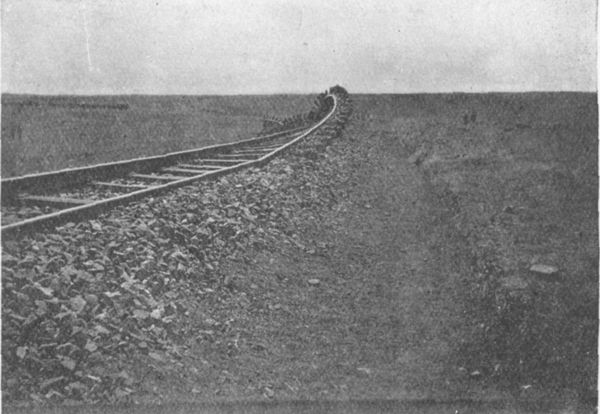
'Speed Dead Slow.'
But a disappointment was in store for us all the same. The column did
not move next day (the 15th), but although engine after engine came
puffing up from Potchefstroom they all failed to bring the carriages
which our aching legs made us so anxiously look for. We heard of the
strike of forty engine-drivers at Potchefstroom, but as they had all
been cast into durance vile, and the engines still continued to
arrive, that could not have been the reason. However, any doubts we
entertained were soon set at rest by an order to continue our march to
Johannesburg next day.
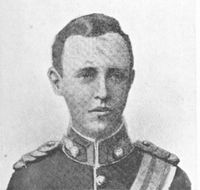
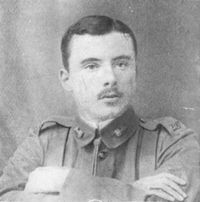
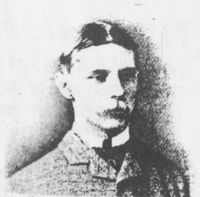
Lieut. Ely.
Died at sea of Enteric.
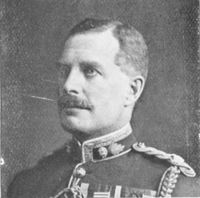
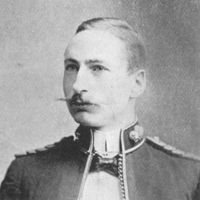
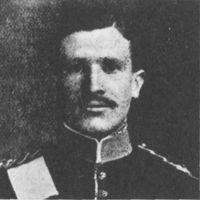
Capt. H. Carington Smith.
Wounded at Sanna's Post
and Heidelberg.
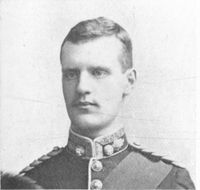
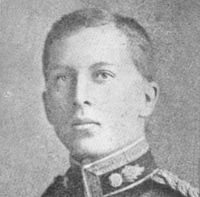
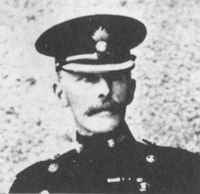
Capt. Watson.
(Attached to Scottish Horse).
Killed at Moedwil.
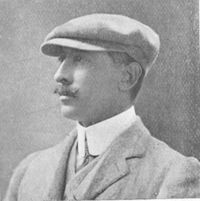
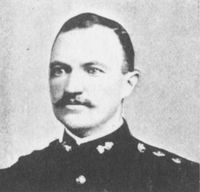
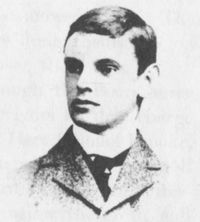
Capt. H. J. Kinsman.
Wounded in Transvaal.
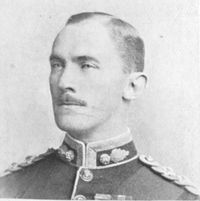
Capt. J. A. Macbean.
Killed at Nooitgedacht.
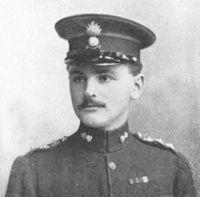
Lieut. Adrian Taylor.
Severely wounded when serving
with
M.I. near Parys.
Miscellaneous Casualties.
Starting on the 16th, an uneventful march of twelve miles
brought us to Wolverdiend, a place which had not then attained the
importance it afterwards assumed.
It was another fifteen on to Blauw Bank Station next day. This march
was remarkable in that it was the first occasion since this trek
started that the column moved with any military precautions worth
mentioning.
Leaving Bank, as it got to be called later on, we struck off from the
railway, left shoulders up, in a bee-line for Johannesburg, the city
of our dreams, which it was hard to believe was not paved with gold,
if one listened to the reports of those who had been there before the
war. After a short march of ten miles we halted at a farm called
Gemsbokfontein, and looked with longing eyes at the distant ridge,
peeping over which could plainly be seen the huge mine-chimneys, like
sentinels along the hills, duly noting our arrival.
A fierce grass-fire broke out here, which necessitated the active
co-operation of all hands, and all blankets, to oppose it, one
too-adventurous officer getting rather scorched for his pains.
As we sat at lunch we could see General Mahon's mounted column
ascending the long rise to Randfontein, on our left front, and heard
they had gone to Krugersdorp.
'Krugersdorp! Where's that?' 'Let's look at your map,' and so on.
Well, we undoubtedly knew where it was a few weeks later. Moreover,
there must be Boers there, for had not a party on an engine come out
that very day, and after destroying a small bridge, and firing a
couple of shots, snorted their way back to the Dorp.
The Royal Dublin Fusiliers supplied the advanced guard on the 19th,
and duly started for Johannesburg, but a message very shortly came
ordering a left incline, and nominating Krugersdorp as our objective.
It was disappointing, but General Mahon had reported the
Krugersdorpers 'truculent,' and we had to make a demonstration. This
we most certainly did, halting above the railway, just outside the
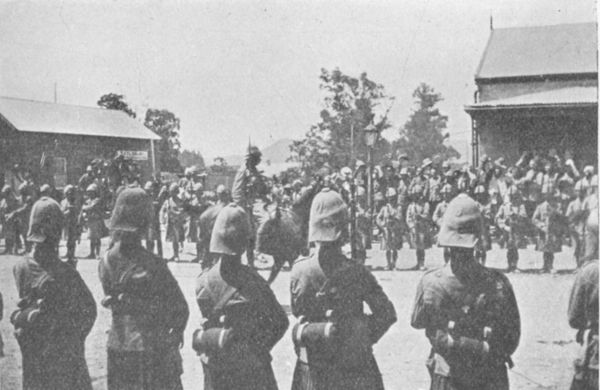
town, and then—producing drums and fifes—forming up and
marching through to 'St. Patrick's Day' and the 'British Grenadiers.'
But, unlike the peaceful and amiable agriculturist, these townsfolk
had no smiles of reciprocation to our advances, and we marched through
long lines of scowling male faces, with here and there one or two of
the fair sex, but also, alas! sombre to a degree.
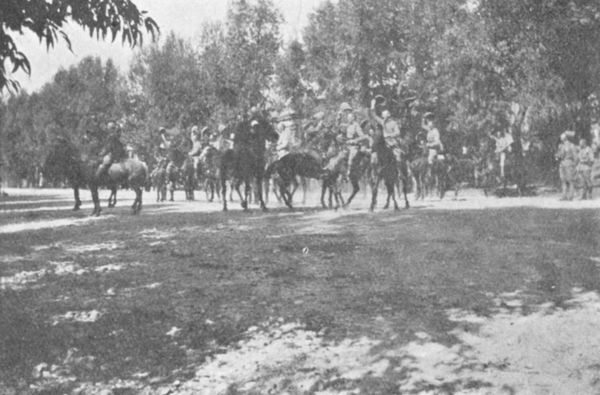
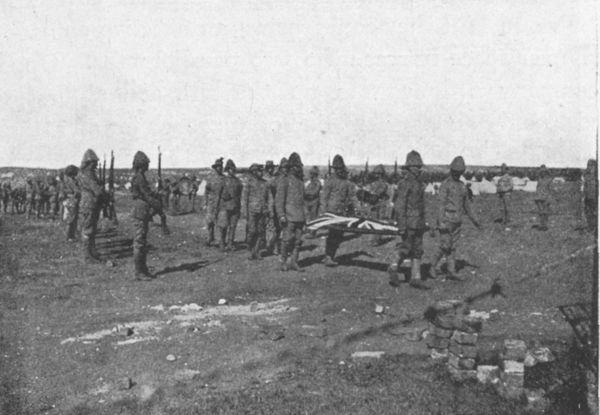
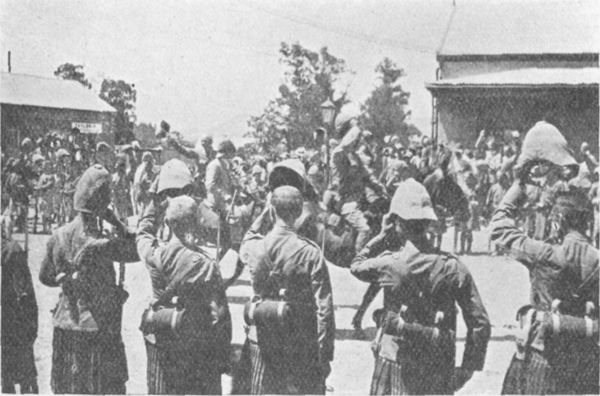
Hoisting The Union Jack at Krugersdorp.
After emerging on the far side of the town we passed the famous
Paardekraal Monument on our right, and finally camped about half a
mile further on. It appears it was a very close thing whether they
opposed us or not, and the peaceful solution that eventually took
place was largely due to the tactful intervention and determination of
an Englishman, Mr. W. Bruce Honman, who had considerable influence
amongst the Dutch.
The troops halted at Krugersdorp next day, and the town was formally
taken over in the Queen's name, an impressive parade for that purpose
being held in the market square. Each regiment furnished a Guard of
Honour of 100 men. The Royal Dublin Fusilier Guard was under
the command of Major English, with Captain Higginson and Lieutenant
Haskard. It was extremely interesting for those of us who were not on
duty to watch the faces of the large numbers of Boers, male and
female, who watched this ceremony and the hoisting of the Union Jack.
On the whole they took it extremely well, and for the most part
behaved like brave men, who, having fought and lost, were content to
make the best of the situation.
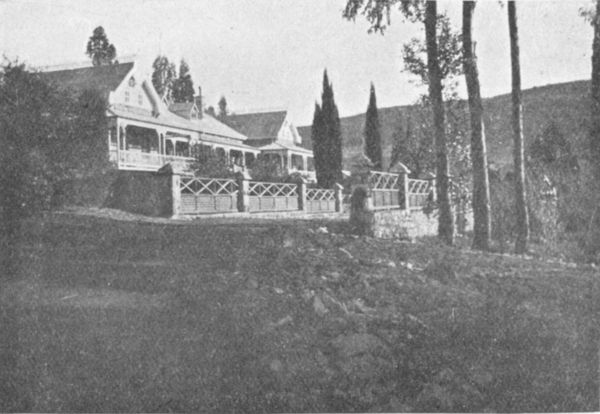
Johan Meyer's House, five Miles outside Johannesburg.
The trek commenced again on the 22nd, and this time we felt convinced
our destination must be Johannesburg, as we were marching along the
Witwaters Rand straight for it. A halt was made after some ten miles,
at Florida, rather a pleasant sort of Saturday-to-Monday resort of
Johannesburgers, with a nice lake and pleasant woods.
At last we seemed about to receive our reward, only to have our hopes
dashed rudely to the ground. True, we marched to Johannesburg, and
even through it, but only through the most miserable of its slums,
seeing nothing of its fine buildings, nothing of the wealth and
magnificence we had confidently expected. But, indeed, even
the finest part of it was only a sorry spectacle in those days, and
for many a weary month afterwards. Skirting the racecourse, we marched
on to a spot some six miles from the town, near the house of Johan
Meyer, a brother of Lucas Meyer. Colonel Hicks and Captain
Fetherstonhaugh called on this gentleman, and got a lot of interesting
information from him. His house was one of the finest we saw in the
whole Transvaal, and from its site—at the head of a fine
valley—commanded a magnificent view of the country almost as far as
Heidelberg.
But, as some set-off to our disappointment and long, tiring march of
fifteen miles, Captain Sir Frederick Frankland, who had gone on to
Joh'burg, as it is universally called, to buy what stores he could,
turned up just before dinner, not only with a large amount of
provisions, but also with a case of excellent champagne, which he
presented to the mess, God bless him! We were very proud of our noble
Baronet that night, and he had to reply to the toast of his health
over and over again.
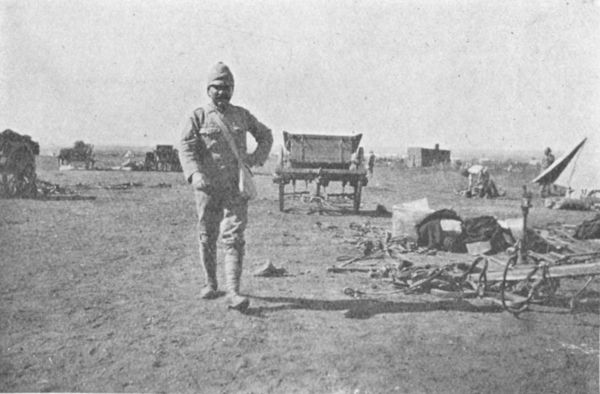
Sergeant Davis, evidently with All we wanted.
Sergeant Davis, champion forager of the Army, also put in an
appearance here, having met with no end of adventures and
misadventures since the Colonel had sent him back to the
Kimberley-Mafeking Railway. As usual, he had a fine lot of stores,
and, also as usual, just what we wanted: baccy, chocolate, biscuits,
sjamboks, stamps, etc., etc.
An uneventful march of fifteen miles, with a halt at Reitfontein, was
only noticeable for a particularly cold night and the final splitting
up of the Irish Brigade, the Connaughts and Borders being ordered to
Pretoria.
On the 25th our long march came to an end with a twelve-mile step into
Heidelberg. The band of the Derbyshire Regiment played us in, while
our old friend, General Bruce Hamilton, rode out to meet us. We halted
on a slope about three-quarters of a mile outside the town, which in
its essential features is remarkably like Krugersdorp, the streets
being lined with tall blue-gum trees, and the plan of course
rectangular, with the usual market square in the centre.
There had been a fight here, and we found Captain Carington Smith
again amongst the wounded; this time, as already mentioned, with a
bullet through his other knee, but as cheery as ever, and smiling away
at seeing us all again. Lieutenant Adrian Taylor, of the regiment, was
also here, and very glad we were to see him once more. Like Captain
Carington Smith he was detached from the regiment throughout the
campaign, serving with the M.I., and was about a month later very
severely wounded near Parys when De Wet crossed the Vaal with Lord
Kitchener at his heels. Still another Dublin Fusilier met us at
Heidelberg—Major Rutherford, Adjutant of the Ceylon Volunteers, who
had come over in command of a detachment of that corps.
In addition to all these, General Cooper (our late C.O.) and his
A.D.C., Lieutenant Renny, R.D.F., were also coming up from the south,
while the 1st Battalion, who had helped to win Alleman's Nek, were not
far off.
On arrival at Heidelberg we had marched just 300 miles in
twenty-seven days, and although we had not pressed in any way, we had
come along fairly well seeing that we were not bound on any specific
object, such as the relief of a town, or the participation in a siege
or battle. We averaged just over eleven miles a day, including halts
at Lichtenburg (two days), Frederickstadt and Krugersdorp (two days),
or just a shade under fourteen miles for each marching day.[Back to Contents]
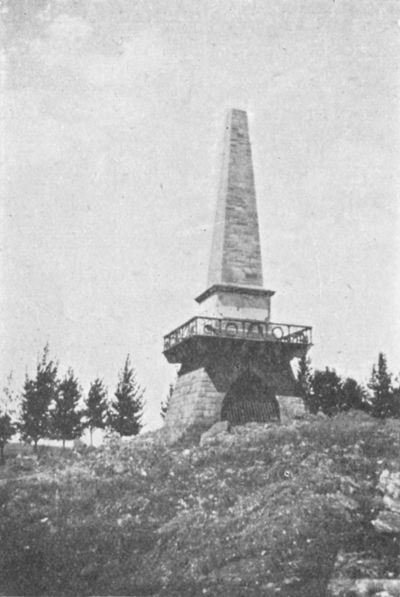
Paardekraal Monument, Krugersdorp.
CHAPTER II.
HEIDELBERG.
'Wherever a man's post is, whether he has chosen it of his own
will, or whether he has been placed at it by his commander, there
it is his duty to remain and face the danger, without thinking of
death, or of any other thing except dishonour.'—Socrates.
'Such officers do the King best service in the end.'—Hamlet.
A considerable force had now assembled at Heidelberg, but it was not
to remain there long. General Hunter took over command from General
Ian Hamilton, who had had a bad fall from his horse, and shortly moved
off to the Free State, where he and his men soon covered themselves
with distinction by the rounding-up of Prinsloo's commandoes near
Golden Gate, on the Basuto border.
The 2nd Royal Dublin Fusiliers, a half-battalion Somersetshire Light
Infantry, and the 28th Field Battery Royal Artillery, with some
details, were left to garrison Heidelberg.
The battalion was soon split up into a number of small detachments,
and posted at various places along the railway line, which had
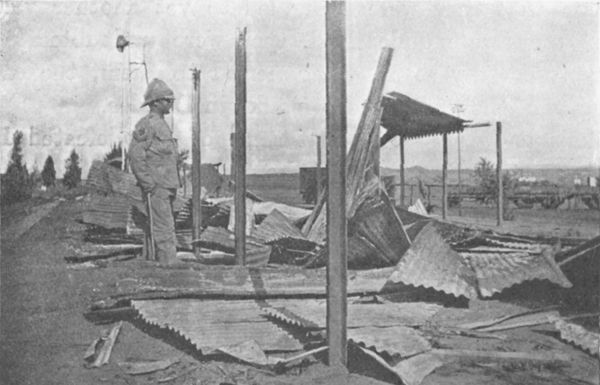
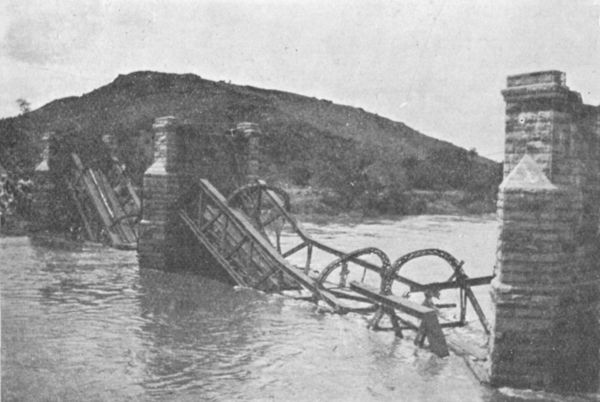
suffered considerably at the hands of the Boers. Scarcely a bridge
remained intact, while the presence of wandering bodies of the enemy
in the neighbourhood necessitated the utmost caution and continual
vigilance on the part of the companies, half-companies, and even
sections, into which some of the companies were at length subdivided.
Headquarters and those companies not on detachment in the meantime had
plenty of work cut out for them too. In order to defend the place two
hills to the west of the town were occupied, one by the Royal Dublin
Fusiliers, known as Dublin Hill, and the other by the Somersetshire
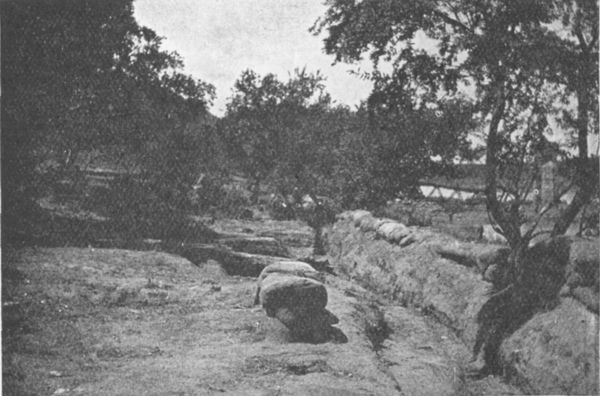
Light Infantry. Our hill was put into a most thorough state
of defence by many hours of hard labour and efficient work under the
direction of Colonel Hicks. Sangars were built on every spur and knoll
which afforded a good field of fire; traverses and shelters were
numerous; in case of a night attack whitened stones along well-made
tracks showed the nearest way to the various posts; while not only
every company, but every section, had its well-defined trench or wall
to rally on and hold.
To some of us, indeed, all these precautions at the time seemed
somewhat excessive, and it is true that no attack was ever made; but
just as example is better than precept and practice better than
theory, so prevention is better than cure, and there is little doubt
that the fortification of that hill, in full view of many a Boer
field-glass in the town, whence our movements were of course fully
reported as frequently as possible to the enemy in the field, had a
deterrent effect on any designs our very active foes might otherwise
have contemplated.
On the morning of the 26th the left half-battalion, under Major Bird,
was suddenly ordered off to Nigel Road Station, about three miles out
on the railway to Johannesburg. The Boers having blown up a bridge
between this station and Heidelberg, all stores, &c., arriving from
Johannesburg had to be dumped down on the veld here, and it was
necessary to have a force on the spot to load them into waggons, as
well as to guard them and the trains. These soon began to arrive in
large numbers, and as each came up the sides of the railway waggons
were opened, and their heterogeneous contents chucked out anyhow into
a huge mass. In the mean time R.E. construction trains also arrived,
and the quiet little siding was soon a scene of wild bustle and
excitement. The R.E. went to work on the broken bridge, and made a
most excellent job of it in a surprisingly short time, though a casual
inspection of the temporary structure they built for
trains to pass over gave the lay mind the impression that an extra
strong puff of wind would blow the whole thing over. However, it
answered its purpose very thoroughly, and reflected much credit on its
constructors.
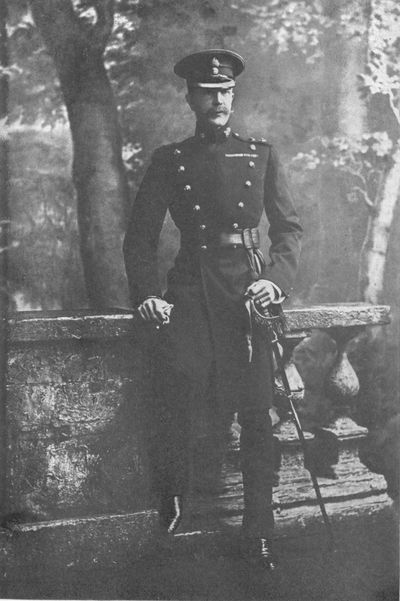
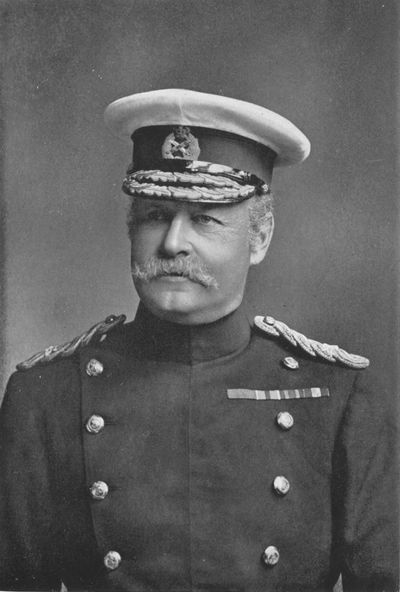
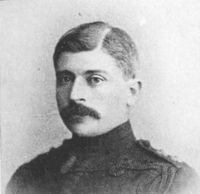
COLONEL H. TEMPEST HICKS, C.B.
Commanding 2nd Royal Dublin Fusiliers
March 1900 to March 1904.
In the meantime Major Bird soon produced law and order out of chaos.
The coolies were made to put mealie-bags in one place and
biscuit-boxes in another, while the soldiers built both up into a very
serviceable sort of fort for the time being, an example of soldierly
adaptability which was not lost on any one who saw it or took part in
its erection.
We spent two or three very cheery days at Nigel Siding, the
stationmaster's house (two rooms) forming an ideal officers' mess, but
on the 28th 'E' and 'F' companies, under Captains Shewan and G. S.
Higginson, were recalled to headquarters, 'H' company, under Captain
Romer, was sent nine miles nearer Johannesburg to guard Reit Vlei
Bridge, while 'G' company remained at Nigel Road to watch over such
stores as had not yet been removed. This company was shortly further
subdivided by the left half-company, under Lieutenant E. St. G. Smith,
being sent to guard a culvert half-way to Reit Vlei Bridge.
In the meantime Colonel Hicks never for a moment relaxed the soldierly
precautions which it was his custom to observe, whether the Boers were
reported in the neighbourhood or not; and several times rumours of
intended attacks did arrive, though they invariably proved false.
The town of Heidelberg itself was very Dutch and seething with
malcontents and treachery. One could easily forgive them for not being
exactly content, but what one could not forgive was their slimness,
their plausible exterior, and their inner mass of falsehood. No class
were more bitter than the clergymen, and one of these gentry was
strongly suspected of being in constant communication with the Boers
in the field, though his oath of neutrality was taken and he was
availing himself of our hospitality. On one occasion Captain G. S.
Higginson spent the night in an empty house in the town in
an attempt to mark this fox to ground, but unfortunately his vigil was
unproductive of result.
Lieutenant Haskard was now acting as Railway Staff Officer, and having
a very busy time of it, as in addition to hundreds of other duties he
had to send rations up and down the line to the various detachments.
On the 9th, Sergeant-Major Burke rejoined the regiment, having been a
prisoner since he was wounded at Talana, and left at Dundee. During
this time his duties had been ably performed by Colour-Sergeant C.
Guilfoyle, now Sergeant-Major, 2nd Battalion Royal Dublin Fusiliers.
Lieutenants Marsh and Weldon also joined here, as Lieutenant Supple
had done a few days before. The two former had followed the regiment
up the line to Mafeking, and thence across the Western Transvaal in a
cape-cart, following very nearly in our tracks. They had an
adventuresome journey, and were delighted to reach us at last. Captain
Clarke, R.M.L.I., who was attached to the regiment, escorted an
important Boer commander, named Van Rensburg, to Johannesburg, on his
way to St. Helena.
It is necessary to explain briefly here the situation of the three
companies, 'A,' 'E,' and 'F,' under Major English, Captain Shewan, and
Captain G. S. Higginson, which had been sent out to guard various
points on the line from Heidelberg to Standerton.
'A' and 'E' companies had originally gone out, and were posted at
Botha's Kraal. Later on it became necessary to hold Zuikerbosch as
well. Major English, with Lieutenant Newton as his subaltern, was sent
to garrison it. Taking 'E' company with him and leaving Captain
Higginson at Botha's Kraal, Major English, with some 110 Royal
Engineers, occupied the post, and at once set about to put it into a
thorough state of defence. He fully recognised the inherent weaknesses
of his situation, and saw that unless well entrenched he was
practically at the mercy of an enemy armed with artillery, as he had
none to reply with, while the nearest reinforcements were miles away,
and liable themselves to be attacked in force at any moment. He
therefore spared no ingenuity in strengthening the position. Having
Royal Engineers and a considerable number of Kaffirs at his disposal,
he very soon effected his purpose and dug himself comfortably in.
In the meantime signs were not wanting of approaching Boer activity. A
large commando, under Hans Botha, was known to be hovering about the
neighbourhood, and as it was also known that Botha was occasionally in
the habit of spending a night under his own roof—not three miles
away—Captain G. S. Higginson made two efforts to catch him napping.
But on neither occasion was the chieftain at home, and the unfortunate
Higginson, who had selected the darkest and wildest nights as most
suitable for his purpose, was foiled each time, and had to withdraw
somewhat crestfallen, under a fire of raillery from the ladies of the
establishment. He collected some valuable information, nevertheless,
and sent in reports of Boers in the vicinity, which, however, were not
sufficient to induce General Hart to take any extra precautions.
Such was the situation of affairs when, on the misty morning of July
21st, we at Heidelberg heard the hoarse barking of the accursed
pompom, varied by the duller and more menacing note of heavier guns.
Anxiously we asked each other what it could be, and reluctantly we
came to the conclusion that our comrades were being submitted to
shell-fire with no possible chance of reprisal. As the sun rose, the
mist did the same, and very soon cheerful messages came twinkling over
'the misty mountain-tops,' announcing that a considerable force of
Boers were attacking them, but that they had little fear of not being
able to keep them off.
General Hart hastily assembled a small column[10] and marched
to Major English's assistance, leaving Colonel Hicks in command of the
camp, and as it was quite possible the main attack might be intended
for Heidelberg, we took all necessary precautions for the safety of
the town.
Before General Hart's force arrived, the Boers had commenced to
withdraw, having discovered that on this occasion they had attacked a
veritable hornet's nest.
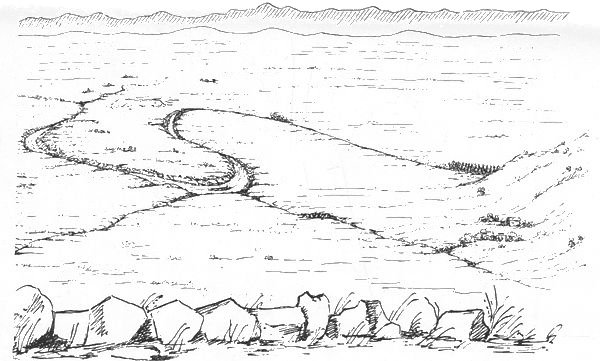
The hill on which Major English had dug his entrenchments is situated
in the angle made by the Zuikerbosch River where it turns sharply to
the south, and was on the left bank of the stream. On the other side
of the river was the hill occupied by the Royal Engineers. Between
these two was the new deviation bridge then under construction. The
Kaffirs lived in the hollow between the hills, as did also the
Yeomanry, of whom there were about ten, under a very young officer.
Major English had given this officer orders that, on any attack taking
place, he should at once lead his horses down to the river, where
there was a kind of hollow place which would have afforded them
excellent cover. This order, however, probably from the suddenness of
the attack, was not complied with in time, and the horses were in
consequence stampeded almost immediately. The natives also were not
long in effecting a rapid southerly movement, for which, of course,
they cannot be blamed, and the Boers shelled them lustily as they
streamed away.
The Royal Dublin Fusiliers' camp was on the southern slope of the
hill, the summit being occupied at night by alternate companies, who
stood to arms shortly before dawn. Captain Shewan was on the hill, and
on the point of letting the men fall out, when the attack commenced.
The trenches were at once manned without the slightest noise or
confusion, and the Boers' rifle-fire vigorously replied to.
The two Boer guns were in position on the hills to the
north, some 3400 yards off, while the pompom came into action near the
Fortuna coal-mine. Owing to the excellent disposition and construction
of the defences, the enemy's fire made little or no impression, until
after a time they began to move round to the flanks of the position.
Their rifle-fire then began to have some effect, but at the same time
the fire of the defence had a better target, and after a short time
the burghers commenced to withdraw from the rear face of the work. In
the meantime they had swung round to the west of the Engineers' hill,
and under cover of a grass fire, which was lighted by them and spread
right up to the trenches, endeavoured to attack this part of the
position, in which, however, they also failed. The enemy continued his
endeavours until mid-day, when he commenced to withdraw, his movement
being somewhat expedited by the arrival of the reinforcements under
the General.
Considering the numbers of the attacking force, and the resolute
manner in which they had persevered, the casualties were
extraordinarily small, two officers and three men wounded, one of the
former being Major English himself; he was struck by a shell splinter
in the eye, but most fortunately did not lose the sight of it.
This gallant defence called forth a most eulogistic order from the
Commander-in-Chief. The success had come at a time when it was badly
needed. The guarding of the railways necessitated the splitting-up of
forces, and in more than one recent instance a commander of less
foresight than Major English had failed to realise the responsibility
of his position, with the result that more additions were made to the
already-far-too-long list of 'regrettable incidents.'
The following telegrams passed between General Hart and Major
English:—
Helio message received at Zuikerbosch Fort on July 22nd, 1900, from
General Hart: 'Received following wire from Lord Roberts.
Begins—"Please convey my congratulations to Major English,
and all concerned on the gallant manner in which they defended their
post on the Zuikerbosch."'
Major English made the following reply:—'All in the Zuikerbosch
command thank our General for forwarding Lord Roberts' telegram, which
they consider a great honour.'
The following is an extract from Army Orders in South Africa, dated
Pretoria, July 26th, 1900:—
'Engagement.—The Field-Marshal Commanding-in-Chief desires that the
following account from Major-General A. Fitzroy Hart, C.B., Commanding
5th Brigade, of the successful defence of a post by a small force of
infantry against a determined attack of the enemy with guns, be
published as an example of what can be accomplished by a small body of
resolute men, well commanded and skilfully and judiciously
entrenched:—
'From General Hart, Zuikerbosch, to Lord Roberts, Pretoria, July 21st:
"Enemy made a determined attempt to destroy my advanced post at
Railhead, Zuikerbosch, to-day. Major English, Royal Dublin Fusiliers,
commands the post, with two companies of Dublins, ten Yeomanry, and
110 Royal Engineer reparation party, defending the new railway bridge
which replaces destroyed one. Boers began attack at daybreak with two
or three guns and a pompom, shelling the position hard. They then
advanced, and completely surrounded him with mauser fire, keeping it
up from 6.20 a.m. to 11.45 a.m., and it was hotly returned. English
signalled early to me at Heidelberg, thirteen miles off, that he was
surrounded, and holding his own confidently. I started from Heidelberg
with two guns, a pompom, 130 Somersets, and 140 Marshall's Horse and
Yeomanry, and, on approaching English's position, found he had already
beaten off the enemy, and saw them assembled on the heights N.E. of
his position, and beginning to ride off N.E. My guns opened fire, and
Boers broke into a gallop. The complete repulse of the Boer attack is
entirely due to the skill with which Major English had
fortified his position, his vigilant arrangements, and the good
fighting of the garrison. Casualties: wounded—Lieutenant Greig,
severely; Privates Mallon, Stanton, and O'Brien, slightly. The bridge
and train not injured. Line only injured to the extent of three rails
taken up. Numbers of enemy's casualties not known. Boers sent out an
ambulance for wounded, and were seen burying dead."'
The following extracts from a letter from Sapper F. Adcock, published
in a home newspaper, are also of interest. After a brief description
of the situation, he continues:—'It was at this time that the
heliographers of the Dublin's showed their pluck, for, fixing up their
stand amidst shot and shell, they got their message through to
Heidelberg.... We could watch every move of the Dublins, as the ditch
ran in the line of their kopje.... Another bit of pluck well worth
seeing happened just as there was a lull in the firing. Two of the
Dublins ran from their entrenchments to their tents, quite a quarter
of a mile, and carried all their bread in a blanket between them to
the entrenchments. The Boers fired three shells at them when they were
going back, but two fell short, and the other was right between them.'
The sapper was right, and it is pleasant to read letters like the
above when emanating from an entirely independent source. Major
English reported most favourably of the signalling, which was
necessarily conducted practically in the open, the enemy's projectiles
falling all round the operator and Major English, who stood close
beside him. For this service Private Farrelly, who sent the message,
was awarded the distinguished conduct medal. The two brave men who
went out for the bread were Privates Hayes ('A' company) and Townsell
('E' company).
The remainder of our stay at Heidelberg was uneventful except for what
might very easily have been a most unpleasant accident. We
were all seated at lunch one day when there was a sudden and loud
report close at hand. Investigation proved that it came from Captain
Pomeroy's revolver (an officer belonging to a West Indian Regiment who
was attached to us). He had carelessly left it in his tent loaded,
while his servant had still more carelessly fired it off. The only
sufferer was an unfortunate animal, Major Bird's charger, which was
shot in the hoof.
On our departure on the 27th, Major-General Cooper's Brigade took over
the defence of the town.[Back to Contents]
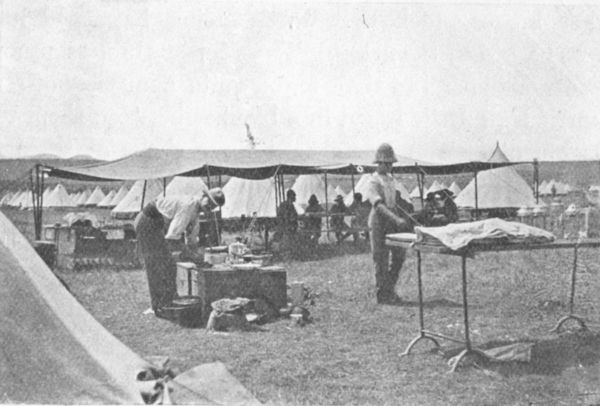
The Officers' Mess.
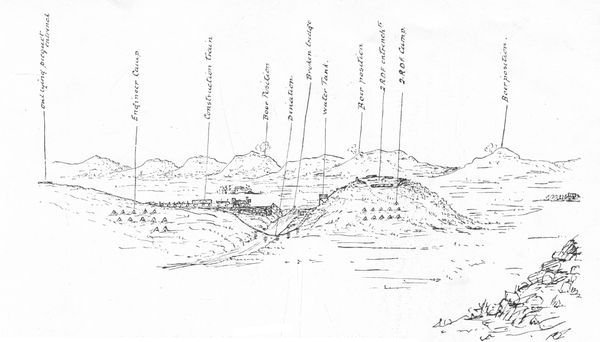
Position at Zuikerbosch. 12 m. below Heidleburg
attacked on 21st July by 1000 Boers with 4 guns.
Defended by 180. 2
R.D.F, 110 Engineers, 10 Yeomen, no guns.
Under Major English 2 R.D.F.
From a sketch by Col. H. Tempest Hicks, C.B.
CHAPTER III.
AFTER DE WET.
'It is vain for you to rise up early.'—Ps. cxxvii. 2.
Having been for a month at Heidelberg, we had begun to quite make it
our own, and felt as if we should finish the war where we were. And
although there were still any amount of commandoes in the field, we
could scarcely be blamed for thinking that the back of the business
was broken, and that a few weeks, or at the outside months, must see
us returning to England. Well, we reckoned without our host, or rather
the hosts of Messrs. Botha, De Wet, De la Rey, & Co., and if we made a
mistake we made it in good company.
The Colonel had never ceased fortifying and improving Dublin Hill, and
there is no doubt that at the end of July his efforts had resulted in
a very sound and efficient post.
Everything pointed to peace and quiet when, late on the afternoon of
July 27th, the ominous 'order' call broke the stillness of the crisp
wintry evening.
'Come for orders! Come for orders! Hurry up, hurry up; come for
orders!'
Who, that soldiered through those long weary months, but must remember
that infernal call? For it was characteristic of the war, and owing,
doubtless, to the immense tract of country over which it was waged,
that not only the rank and file, but even the officers, with one or
two exceptions, knew little or nothing of what was going on.
Consequently one never knew what the next minute would bring forth,
and waited accordingly with ears at tension for the strains of the
bugle, whose notes might portend nothing or everything.
On this occasion they were the prelude to one of the most
stirring periods in the history of the war—the first great De Wet
hunt. It is beside the purport of this volume to discuss the
advantages of British infantry pursuing mounted Boers. It has often
been maintained that the result of such an apparently hopeless
hare-and-tortoise sort of procedure would have been successful on this
occasion but for the fact of the unblocking of Olifant's Nek. On the
other hand, there are not wanting many who are equally prepared to
argue that, although this bolt-hole being open may have facilitated
the guerilla's escape, that astute leader would easily have found some
other nook or cranny quite sufficient for his purpose had it been
shut; while, if the worst had come to the worst, from his point of
view, he could, at the sacrifice of his waggons and guns, have
dissolved his commando in the night, only to unite again at some more
suitable and less column-infected time and place.
At the time we knew nothing of all this; all we knew was that some big
move was in progress, for, as we neared the railway next day, train
after train steamed through, reminiscent of the vicinity of Epsom on a
Derby Day, but that was all. Where we were going, when we were going,
why we were going, were all questions quite beyond our ken—not to be
answered, indeed, until some days later, when an officer on General
Hunter's Staff told us what it was all about.
Our march to the railway on the 28th was a long and trying one,
variously computed at from twenty-one to twenty-three miles. Whatever
its exact length may have been is immaterial; it was the method in
which it was conducted that was so desperately trying. After the usual
sketchy apology for a breakfast, the column moved off with the
Somersets as advance-guard, and 'F' and 'G' company of the Dublins as
rearguard. From a variety of causes the progress was uncommonly slow,
and, no halt being made of greater length than a few minutes, the men
of the rearguard had a trying time, for any one who has
marched behind a column of waggons, &c., miles in length, knows that
one practically gets no halt at all from these five-minute snatches,
owing to the necessity of continually closing up. It was quite dark
when the rearguard hove in sight of the passing trains, and then, to
make matters thoroughly uncomfortable, some half-dozen waggons stuck
firmly in a snipe-bog, scarcely a mile from their destination.
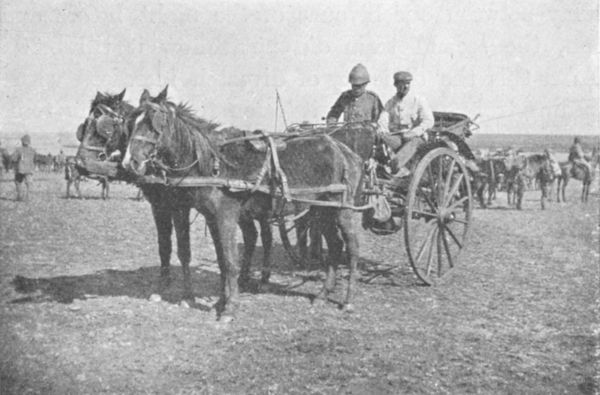
Corporal Tierney and Chef Burst.
It looked uncommonly as if the unfortunate rearguard would have to
bivouac in that miserable marsh. As everybody was pouring with
perspiration from their endeavours with the waggons, and as it was
beginning to freeze, while there was no chance of getting at
great-coats, blankets, or food unless the waggons came out, out they
jolly well had to come—and came. It was ten o'clock before the men
got anything to eat, and 11.30 p.m. before our arrangements for the
night were completed. Our invaluable French 'chef' had kept some hot
soup for the rearguard, and seldom was soup more appreciated than by
those famished and frozen warriors.
We now heard that we were going south, and going south by
train, and that at all events was something to look forward to. At
least it was a change—something to look forward to with anticipation;
and certainly it is something to look back upon with a certain amount
of amusement, but at the time that railway journey was certainly the
reverse of comfortable.
We could not get off as early as we expected to on the 29th. The first
train started all right, but owing to the amount of work to be done in
getting kit over a small drift that lay between our bivouac of the
night before and the station, the second train did not follow it till
3.30 p.m.
After this the difficulty of dispatch increased with each succeeding
train, until when it came to entraining reluctant horses and still
more reluctant mules practically in the dark, for there was no other
light but the dim glimmer of two candle-lamps, the task became
herculean, and required an infinity of patience and tact. The General
and his staff having gone by the first excursion, the task of bringing
along the remainder of the column devolved on Colonel Hicks, with
Captain Fetherstonhaugh as his staff officer. They did not complete
the entraining until the early hours of the 30th, and then only to
find the line blown up in front of them. The fact that no disaster
occurred here was owing to Colonel Hicks' determination not to try to
get through that night, as he clearly foresaw what actually took
place, and that there was nothing to prevent the enemy blowing up the
line.
It is necessary now to turn our attention to the second train, which
conveyed most of the regiment, under command of Major Bird. Some forty
men with their arms and accoutrements were told off to each open
truck, necessitating the tightest packing, which, however, had a
beneficial effect in so far as it took off the worst part of the
constant succession of jerks and jolts which the journey consisted of.
But everybody was full of fun, and the men as merry as crickets at the
change from the long days of uninteresting 'foot-slogging'
and the prospect of a brush with the elusive De Wet.
The officers—about twenty in number—travelled in the guard's van, on
the floor of which they made themselves as comfortable as possible
under the circumstances.
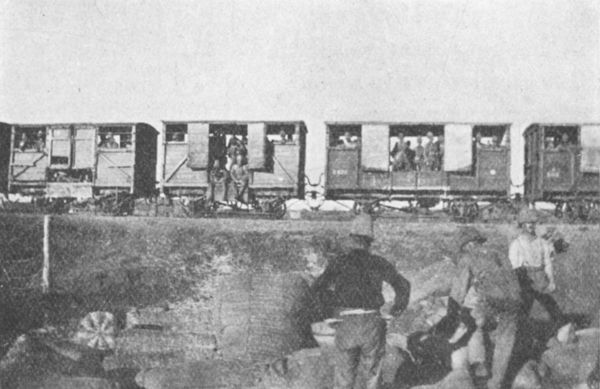
Fourth Class on the Z.A.S.M.
After passing Vereeniging and duly admiring the excellent work of the
sappers, the mess-president proposed that they should sample the
hampers he had provided for them. This was carried unanimously, but at
that moment the train began to slow up, and, anxious to see every new
place, we determined to wait until the train started again, and then
enjoy our dinner in peace and comfort.
The sudden explosion of a shell from 'Long Tom' in our midst could not
have had a more demoralising effect than the news which greeted us
when we came to a standstill. It arrived in the shape of a telegram
from the General, ordering the officers to ride in the trucks with the
men, and to keep a sharp look-out for attacks from both sides. So
there was no chance of any dinners after all, and all our visions of
chicken and tongue, whisky and sparklets, and a hot cup of tea or
chocolate resolved themselves into a lump of chocolate out
of one's haversack and a pull at one's water-bottle. The
mess-president proved himself a man of resource on this trying
occasion. With hunger gnawing at his vitals he saw a beautiful dinner
laid out in a waiting-room for some staff officers. Unable to satisfy
his comrades he saw no reason why he himself should go unsatisfied,
and in the three or four minutes occupied by the engine in watering he
hastily bolted a fine plate of roast beef and potatoes, not omitting a
bottle of beer standing hard by, and jumped into the train at the last
moment, thanking his astonished host and friend, Major Hickie of the
7th Fusiliers, as the train moved off into the darkness.
Anything more cheerless than the remainder of that night journey it
would be hard to conceive. In the first place, when there are forty
men in an open truck, it is very difficult to find room for two more.
In the second place, it was bitterly cold, and a pitch-dark night. In
the third place, the even-money chance of a slab or two of gun-cotton
on the line ahead was not a pleasing one to contemplate. In the fourth
place, the men were ordered to 'charge magazines,' and to spend
several hours jolting along with the cold barrel of a loaded rifle
poking one in the ribs, or insinuatingly tucking itself into the nape
of one's neck, could by no stretch of imagination or fire-eating
ambition be called comforting. However, there was one fine piece of
news at any rate to act as a compensation, the surrender of Commandant
Prinsloo and three or four thousand men to General Hunter.
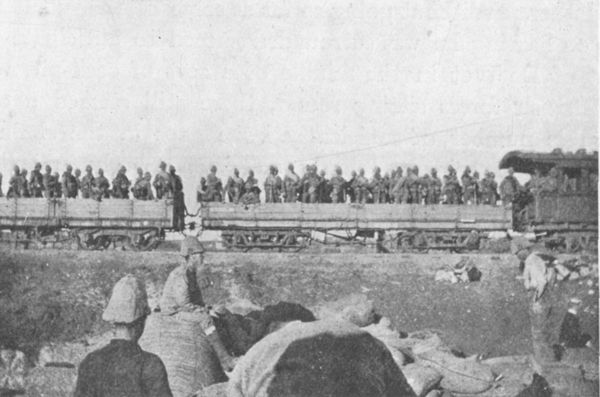
Fifth Class on the Z.A.S.M.
Once or twice ghostly forms on horseback loomed suddenly out of the
blackness of the veld, momentarily lit up by the glare from the
engine. On each occasion they shouted some warning, but what it was
nobody could make out. Our engine-driver fully expected to be blown
up, and had taken the bit between his teeth, cracking on at a pace
that stirred up the living contents of the trucks behind
him, until if any one of them had had a spare morsel of fat on him, he
must inevitably have been churned into butter. Carrying on at this
rate, we soon arrived at our destination, a small station called
Kopjes. And when very shortly after our arrival two or three dull
explosions in the direction whence we had come signified that the line
had been blown up right enough, our gratitude to the engine-driver was
considerably increased. Nor did his solicitude for our welfare end
even then, for having effected his object, he said we could have as
much boiling water out of the engine as we liked, and in less than
sixty seconds we were drinking steaming hot chocolate, and returning
grateful thanks to our host. If any one class more than another
deserved special recognition during this war, it was the railway
staff—the drivers, stokers, and guards. It is no exaggeration to say
that during the whole war no train was ever run at night but that
these men did not run the risk of being blown sky-high, in addition to
all the other incidental dangers of their hazardous calling.
The break in the line necessitated our waiting some two or
three days at the station, until the remainder of the column got
through. When it was at last assembled, we marched off due west,
towards the sound of heavy firing in the distance. A march of fourteen
miles brought us within sight and almost within range of a long, low
line of kopjes, and here, we were informed on our arrival, was the
famous guerilla chief, surrounded—so we were informed—at last, and
only awaiting the arrival of our column to be finished off altogether.
Without going so far as some of the subalterns, who on hearing he was
surrounded seemed to anticipate the sight of De Wet in the middle of a
sort of cock-pit, with the British forces sitting round, there still
seemed a considerable number of sufficiently large gaps in the chain
of columns and brigades slowly and ponderously extending round either
flank of the Boer position. The firing we had heard had been from the
Boer guns, they having shelled the Derbyshire Regiment out of their
camp, which had been pitched imprudently close to the harmless-looking
kopjes. Needless to say, there was not a move of any sort to be seen,
and how on earth three or four thousand men managed to conceal
themselves so absolutely must ever remain a marvel. True, their camp
was beyond the crest-line, but it is certain they had outposts and
sentries on the look-out, and these must of necessity have been posted
where they could see us; but certain it was we could not see them,
carefully as telescopes and Zeiss glasses swept every inch of the
hills.
Unfortunately we had to leave eighty-nine men behind at the railway,
as they had no boots, a serious matter with every probability of a
stiff fight on our hands: for General Hart's orders were to prevent De
Wet going south; to attack, if necessary, to make him go north, but
not to allow him to go in any other direction. This being so, our
object was effected, as will appear later on.
Another and equally sudden interruption to a meal took place
on August 1st. Marshall's Horse, a Colonial corps of whom we saw a
good deal, had gone out on a reconnaissance in the morning, and had
some scrapping with the enemy's patrols, &c. But now word suddenly
came that they were surrounded, and in a tight corner. Hastily
dropping knives and forks, we fell in almost at the double, and,
though somewhat struck by the incongruity and apparent anomaly in the
fact of our cavalry being surrounded by the Boers when we had been
distinctly informed that it was we who were surrounding them, set off
as hard as we could lay legs to the ground. After marching between
four and five miles, well within the hour, we met the doctor of our
mounted corps, who said he had been taken prisoner and released, and
that there was no necessity for going any further, as our friends had
beaten off our enemies and were on their way back. So back we trudged
too, meeting on the way what most of us thought was a squadron of
cavalry, but which turned out to be Brigadier-General Little's cavalry
brigade. The sight of the attenuation of this force afforded us food
for reflection, and made some of us begin to understand a little how
it was that, in spite of our magnificent paper forces, we still found
such difficulty in rounding-up our foes.
The next three or four days were uneventful. Lord Kitchener arrived
and took over the chief command of all the forces, which now really
seemed to be closing in on De Wet. The noose was being drawn tighter
and tighter daily, and the Boers' position became more and more
precarious. What would have happened but for Lord Kitchener's arrival
it is hard to say, as General Hart, ever impatient of passivity, a
very Ney for pertinacity of attack, personal bravery, and confidence
in his troops, was undoubtedly on the eve of launching an attack. But
in the light of the succeeding events, it is clear now that such an
attack would have been premature and ill-timed. In the event of its
non-success—and we had a very small force to carry it out with—the
general operations would have been completely ruined, for we
being the Southern force, there would have been nothing to prevent De
Wet going south. In the event of success it would merely have meant
that the Boers would have slipped away north two or three days sooner
than they did, when, seeing that our arrangements to intercept them
were not even then complete, an earlier start would have enabled them
to carry out their retreat with even greater ease.
Major King, of General Hunter's staff, now arrived in camp with a Boer
prisoner, one of Prinsloo's staff. The latter was being sent through
with a message to De Wet, informing him of the full magnitude of the
Boer surrender at Golden Gate, and advocating his own relinquishment
of further operations. They went through to the Boers' position, and
were courteously received, but General De Wet declared it was
impossible for him to think of giving up now, as he had President
Steyn with him. Nobody believed in the excuse, and its purport is
somewhat difficult to understand, but it ended the conference, and
Major King and his prisoner returned to camp.
Major English, whose eye had proved troublesome and kept him behind,
now rejoined the battalion, to everybody's gratification, for the
publication of Lord Roberts's army order, which took place at this
time, had made us all very proud of him and his men.
On the 5th an order was given to send out a small force, consisting of
two companies of the regiment, a pompom, and a troop of Marshall's
Horse, to a point five miles N.N.E. of the camp, in order to fill up a
somewhat big gap between General Hart and the 3rd Cavalry Brigade. 'B'
and 'G' companies, under an officer of the regiment, with Captain
Nelson, R.M.L.I., and Lieutenants Smith and Molony as subalterns, and
Lieutenant Nek of Marshall's Horse, were selected, and started as soon
as the men's dinners were finished. General Hart rode out later on,
and, catching this force up, selected a site, and gave
orders to the officer commanding it to dig himself in, promising that
the pompom, which had not turned up, should be sent on.
In the meantime the remainder of General Hart's force also started
digging, a very different state of affairs to his premeditated attack
a couple of days earlier.
The detachment sent out patrols on the morning of the 6th to see if
they could draw the enemy's fire, with strict injunctions to content
themselves with doing so and then withdraw. This they soon succeeded
in doing. On their return they passed a farmhouse, and received
information that an important Boer General was in the habit of
sleeping there sometimes. Visions of a capture of De Wet inflamed the
minds of some of the younger officers, and on the night of the 6th-7th
Captain Nelson and Lieutenant Smith, with a few picked men, made a
raid on the house. However, they found nobody but womenfolk, and
returned empty-handed.
Next day commenced our memorable pursuit. De Wet and his merry men had
slipped away over the ford bearing his own name as neatly as a
cherry-stone from between finger and thumb, and, with their heads
turned north, were to give us, and many another converging column like
us, the hunt of our lives. The regiment started at 11.30 and only
halted at dusk, some three miles from a range of hills on which rumour
said the Boers were going to stand and fight it out to the bitter end,
even if the whole British Army came against them. 'B' and 'G'
companies did not get in until 9 p.m., as, in addition to having an
extra five miles to march, they had some trouble with their waggons.
We marched all day on the 8th in an easterly direction along the left
or southern bank of the Vaal River—a long, tiring, uneventful trek.
Expecting momentarily to see our prey delivered over to us, our
spirits sank lower and lower as the day dragged on with no sign of any
Boers. There was the usual aggravating little drift to be negotiated
at 6 p.m. only half a mile short of our camping-ground for
the night, but eventually we got all the waggons over, and men and
officers obtained something to eat. This proved one of the coldest
nights of the winter, and there was ice instead of water in most of
the water-bottles next morning when reveille went at 3.30 a.m.
Starting at 5 a.m. we again went steadily on till 6 p.m., making well
over thirteen hours without food. We skirted round the south of Parys,
a name which appealed strongly to a good many of us, and suddenly
heard the welcome sound of heavy firing not very far ahead. The column
halted, and word soon came that this time our pains were really to be
rewarded; the Boers were only six miles ahead, and Lord Methuen was
engaged with their rearguard. All signs of hunger and fatigue at once
disappeared, the regiment started trekking off once more,
instinctively 'stepping out' as they went. The guns still thundered
invitingly just ahead, and as we topped each fresh horizon or rounded
the slope of the next kopje we all expected to see our prey close in
front. But it was not to be. As the afternoon wore on the sound of the
guns died away, until at last we came to a halt at dusk in a sort of
amphitheatre among the low hills. Too tired to want much food, the men
sank down with the delightful nightcap that reveille might again be
expected at 3.30 a.m.
The 10th proved more or less a repetition of the preceding days.
Starting at 5 a.m., we did not halt till well after dark, the waggons,
kits, food, &c., not getting up to us till 10 p.m. Seeing that there
was no chance of any other food, some bullocks were commandeered, and
the men cooked them in little chunks in their mess-tins over the grass
fires. Tired out as they were it was too cold to get any sleep without
blankets, and long lines of melancholy soldiers could be seen standing
along the edges of the grass fires, against which their figures were
outlined in bold silhouette, and from whose scanty flames they
endeavoured to get what little warmth they could. Everybody was wet
through to the knee, a good many to the waist, while some
were soused all over, for in the course of our march we had turned due
north, and crossed the Vaal at Lindeque Drift. The river is very broad
here, and split up into numerous small streams, in the wading of which
many humorous incidents took place, owing to the slippery nature of
the rolling stones in the bottom of the river. A rolling stone may not
gather much moss, but it is undoubtedly capable of gathering a
considerable quantity of slimy weeds, and when concealed by two or
three feet of running water it offers about as precarious a footing as
it is possible to imagine.
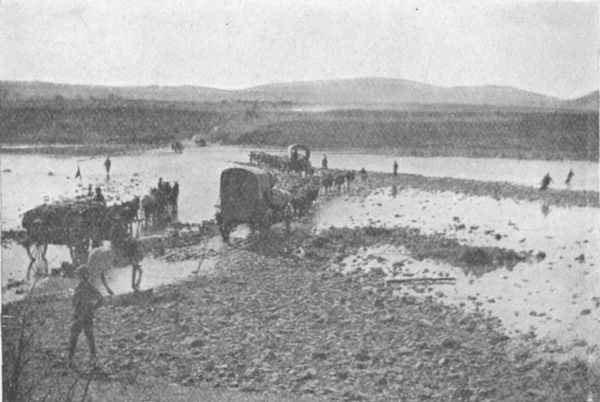
The Vaal River, Lindeque Drift.
Winding our way through the low hills on the Transvaal side of the
river, we at length emerged on to an enormous plain. The far horizon
was bounded by the Gatsrand hills, with which, as with another
detached clump of rounded kopjes on our left, known as the Losberg, we
were destined ere long to become closely acquainted. As we finally
turned in about 11 p.m. we heard reveille was not to sound till 4.30
a.m., but when some subaltern attempted a feeble joke about a 'Europe
morning,' his effort met with nothing but silent contempt.
There is little doubt that any one who shared in that next
day's march will never forget it. As we proceeded across the
illimitable plain a strong head-wind began to blow, increasing in
strength as the day wore on. De Wet had fired all the grass ahead of
us, with the result that the air was laden with millions and millions
of particles of minute ashes and sharp cinders. These soon filled
eyes, ears, nostrils, throats, and lungs, until breathing became
well-nigh impossible, and the agony caused by their penetration into
our eyes almost intolerable. But woe to him who endeavoured to
alleviate his distress by wiping his eyes with grimy hands. Such
action merely had the effect of 'rubbing it in,' and so accentuating
the misery and discomfort. The men very soon began to fall out in
ever-increasing numbers. On one occasion Captain Nelson, R.M.L.I., was
seen straggling off right away from the column. Lieutenant Bradford
went after him and found that he was temporarily quite blind. At last,
after hours of torment, we reached a pass in the Gatsrand, on the far
side of which we halted, as night fell. A big grass fire almost
immediately broke out, and as the grass was long and thick, and a
strong wind still blew to fan it, things looked very ugly. The flames
swept right through the camp, but luckily the tents were not up. But
what would happen when they reached the guns and ammunition? What,
indeed, might have happened, but for the gallantry of the gunners and
naval detachment, it is hard to say. As it was the ammunition-waggons
caught fire and were sufficiently charred to demonstrate the closeness
of the danger. But, as ever, 'the handy-man' was to the fore, and with
promptitude and courage, that could not have been excelled, managed to
extinguish the flames.
And now for a wash—what, no water! No water, which, hungry and
exhausted as they were, every one wanted even more than food. But,
alas! it was too true, and after contenting ourselves with some liquid
mud, flavoured with charcoal, called coffee, and some few
mouthfuls of tough old trek-ox, liberally peppered with burnt grass,
we only waited to hear that reveille was to be at 1.30 a.m. before
sinking down to snatch what rest was possible. This delightful spot
rejoiced in the refreshing name of Orange Grove.
The 12th of August. Shade of St. Grouse! At 3 a.m. we were on the move
in bright moonlight and sharp frost, with a wind blowing which cut
like a knife. After doing some sixteen or seventeen miles we arrived
about 10 a.m. at Wolverdiend station—a large force of cavalry and
infantry assembled there, moving out as we moved in. Camp was pitched,
and a good meal cooked—our first respectable one for three days—and
then—then came the order to start off again in the afternoon. Wearily
we resumed that march, but even as we started the prospect was
brightened by the sound of heavy guns ahead, on our right front. We
finally bivouacked for the night on the most stony kopje in all South
Africa. It was impossible to find a spot anywhere that did not consist
of sharp, jagged rocks, rendering sleep, to any troops less tired than
we were, an utter impossibility. A rumour credited Lord Methuen with
again having brought De Wet to bay, and we were almost positively
assured that next day would end our laborious march.
No less than ten mules were lost during the day, from utter
exhaustion. Many a heart, weary in itself, ached yet more deeply for
the sufferings entailed on the dumb animals.
Reveille at 2, off at 3, was our time-table for the next day. After
proceeding some five or six miles, the force came to the pretty little
Mooi River. The Colonel found an excellent place for us to cross it,
compared to the spot where the Somersets were obliged to plunge in. A
halt was called on the far side, and a scratch meal taken. While thus
employed, some of our troops who had been De Wet's prisoners, amongst
them a couple of our own men, came in. They had been with De
Wet's rearguard, and told us that when Lord Methuen had shelled it the
day before, they had managed to escape; also that the fire of Lord
Methuen's guns had knocked over a Boer gun and exploded one of their
ammunition waggons. They added that De Wet was in command of a very
considerable force, and some distance ahead.
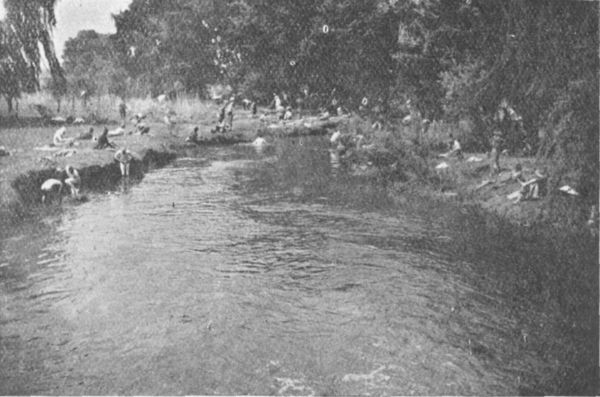
The R.D.F. bathing in Mooi River, Potchefstroom.
We presently resumed the pursuit, finally camping in some very
desolate country, where the water was scarce and bad. Signs of
over-fatigue and want of sleep were now becoming very apparent, a
large number of men falling out and riding on the waggons. Poor
fellows! they stuck it out as long as ever they could, but their socks
gave out from the constant wettings, and they pitched them away,
marching on in their boots until the pain of the raw chafes became too
much to bear. There was never a grumble or complaint: a man simply
asked to see his Captain, and respectfully said his feet had given
way, and he must regretfully fall out. The officers knew it was true,
and felt for their comrades whose emaciated kits precluded the
possibility of a change. To such a state was the column now
reduced that the General, who had ordered reveille for 2 a.m. the
following morning, actually put it back till 6 o'clock.
The regiment acted as rearguard on the 14th, and did not start till 9
a.m., halting for a short time at mid-day near a blown-up Boer
ammunition waggon. Every conceivable sort and kind of small-arm
ammunition lay scattered around on the veld, and those who were keen
on curios of this description made quite a collection of full and
empty cases.
The battalion lost eleven more mules, the poor brutes simply falling
to the ground from utter exhaustion, being perforce left where they
lay. We arrived in camp at 5.30 p.m., and then for the first time, in
at all events some of our lives, heard two reveilles in one day, the
hated call blaring in our ears at 10.30 p.m. Starting at 12, we pushed
on, belts tightened, teeth clenched, and simply determined not to
give in. We were told that the cavalry brigades had De Wet at last at
the foot of the Magaliesberg, only sixteen miles ahead. So on we went
into the sheer and bitter night, more like ghostly shadows than
anything else, as the spectral column wound its way through sleeping
villages and over mile after mile of dark and silent veld. At last our
eyes were gladdened by the sight of twinkling watch-fires on the
slopes of some hills just ahead, and as the first signs of dawn began
to become manifest, we sank wearily down to enjoy a few minutes'
repose. But it was broad daylight when we woke, and alas! for all the
hopes of the past eight days, the hills ahead were only occupied by
our cavalry. Theirs had been the watch-fires of the dark hours of the
night. The game was up, and we were told the first great De Wet hunt
was over. Some one had failed to stop the earth; the fox had foiled
his pursuers, and the various Generals reluctantly whipped off their
hounds.
It was a bitter disappointment. We had been so buoyed up by the
promises held out to us. Every one had so thoroughly entered
into the job, and plodded stolidly along; and all for nothing. Work
which, if successful, would have lived in history, but which, being
unsuccessful, was fated to be forgotten and ignored; and unsuccessful
through no fault of any of the troops engaged in it. There was no
General or Staff to blame: no regiment or department which could be
hauled over the coals. No; some one had blundered, that was all. The
point has never been exactly cleared up, and probably never will be,
and there the matter ended.
'Lay not your blame on me: if you have lost him,
Why, I have lost him too.'—Othello.
So we turned over and fell asleep again, and woke up at 9 a.m. and had
some breakfast, and were about to fall asleep again when the word came
to fall in and march on to some other bivouac. The one we were in was
good enough for us, but of course there was nothing for it but to
obey, and we marched to a small village called Rietfontein. Here we
heard that Colonel Hore's column was surrounded, and in a bad way,
some eighty miles off, and that we were to form part of a small force,
and make a forced march to his relief.
Accordingly the column marched at 8 a.m. next morning. After going
about two miles, an order arrived saying we were to go back; and back
we went—a somewhat profitless proceeding, but doubtless unavoidable.
The remainder of the day was spent resting, but it was known that
reveille was to sound at midnight, and that we were to make a big
effort next day.
Starting at 1 a.m., and steadily tramping on till 9.30 a.m., we put
twenty miles behind us. A halt was then made for a meal in rather a
pretty spot, which actually boasted of some trees sufficiently large
to afford shade, and under the foot of some well-wooded kloofs on our
right. Resuming our march, we did some two or three miles more
when word came that Colonel Hore was all right, having made
a most gallant resistance and suffered many casualties, and that we
were to go back the way we had come and march to Pretoria.
By the time we got back to our bivouac it was still early in the day,
and we had already marched twenty-five miles. Five more mules had
fallen dead, making a total of thirty-eight since we started on the
7th.
On the 18th we resumed our return journey, if return journey it could
be called, since wherever we were going it was a hundred to one
against its being the place we had come from. After a short trek we
out-spanned for breakfasts, and an order was then given that we were
to stay where we were and bivouac there for the night.
We moved to Vlakfontein next day, a distance of about sixteen miles,
and the march quite uneventful. Rumour, however, pointed to
Krugersdorp as our destination, and this must have been the exception
that proves the rule, for on this occasion rumour proved right.
Another long and equally uninteresting march of eighteen or nineteen
miles, only relieved by the arrival in hot haste of an indignant
Marquis. It appeared he had been at a farm some two miles off on our
left front, and had been offered some tea, which he had refused, and
on leaving the house had been shot at by about a dozen Boers. What it
was all about, or what he had been doing alone at this farm, and why
the Boers should not shoot at him when he withdrew, none of us could
quite make out. However, there were some Boers there, so the Colonel
fired a few long-range volleys in the direction indicated, but
declined to make a deviation with a view to reprisals.
Another eighteen miles on the 31st brought us to within about eight of
Krugersdorp. About time too, for the men's boots were giving way
badly, and scarcely one in ten had any socks.
The eight miles proved to be very long ones, however—longer
than even Irish miles—and although we had made an early start, it was
noon before we at last reached Krugersdorp for the second time. On
this occasion we halted on a hillside just outside the north of the
town, and beside a sort of small suburb on the further side of the
creek.
Since leaving Heidelberg we had marched 289 miles. But of this
distance 123 had been covered in the week during which we pursued De
Wet, and 228 in the fortnight commencing August 7th. The longest
distance covered in any one day had been the 25 miles on the day we
turned. This marching was not done on roads it must be remembered, but
across country, over hills, and through rivers, with frequent troubles
with the unfortunate transport to overcome, and with very little food,
and that of an inferior quality.
So ended our attempt on foot to catch De Wet on a thoroughbred. It was
hopeless from the first, and yet went within measurable distance of
succeeding, though even if we had rounded up some of his force at
Olifant's Nek, it is very doubtful if De Wet himself would have been
caught.[Back to Contents]
CHAPTER IV.
SEPTEMBER IN THE GATSRAND.
'Why gaddest thou about so much?'
Jer. ii. 36.
From August 23rd to 28th we obtained a very welcome week's rest, which
would have been more enjoyable had the weather not broken badly,
resulting in a succession of cold, high winds and heavy thunderstorms.
These latter were of the most abominable description and a severe
trial to those of us whose nervous systems were so constituted as to
be affected by them. Some declared that they liked them; others
frankly admitted that they detested them. They seemed to have a way of
coming along about 4 p.m., and as soon as they got into position,
immediately above our heads, opened fire. Needless to say, in the
course of the long campaign there were a good many very narrow shaves,
and one of our men was actually killed by lightning. The storms were
almost invariably accompanied by torrential rain, which, though adding
greatly to our discomfort, mitigated the danger, the local cognoscenti
assuring us that even they looked upon a dry thunderstorm as no joke.
The regiment was a good deal split up at this time owing to the men we
had dropped behind us on our late trek; they had fallen out from a
variety of causes, but ninety per cent. of them on account of sore
feet or lack of boots. There were no less than 160 at Wolverdiend, 50
at Rhenoster, 40 at Wolverhoek, and so on. The Colonel made many
attempts to gather up his chickens once more, but when we started on
our next trek we were still deficient of a good many. Major Bird left
us at this time to go to Natal, where he was to arrange about our
property, and organize orderly-room papers, etc. Major
English was unfortunately down with a severe attack of dysentery, and
had it not been for Major Rutherford's arrival on the morning of the
29th the battalion would have been Majorless. Our padre, Father
Mathews, presented us with a very fine pair of koodoo horns which he
picked up at a store while we were here. He had originally been
attached to the Royal Irish Fusiliers, but had come to us after
Nicholson's Nek. He remained with us till the end of the war, and
proved himself a brave soldier and a welcome member of the mess.
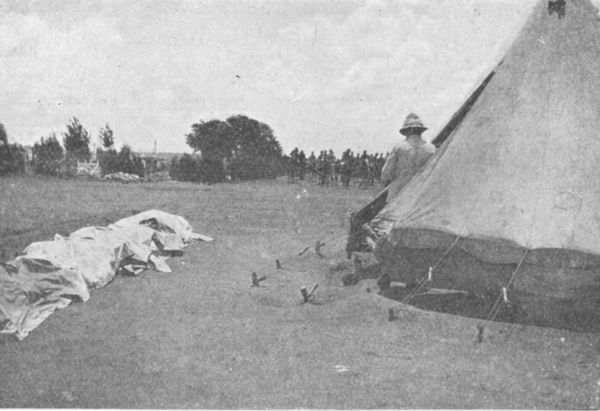
Father Mathews.
Orders were eventually issued for a start at 6 a.m. on the morning of
the 29th, but a night of heavy rain and succession of thunderstorms
put an early start out of the question, and we did not get off till 3
p.m. The force was known as the Pochefstroom Column,[11] and our
mission, as far as we knew, was to lay waste the country between
Krugersdorp and that place, to fight the enemy whenever we
met him, to bring in women and children, to destroy anything in the
way of forage, &c., which might be useful to our enemies, if we could
not bring it along for our own use; to collect waggons, cape-carts,
animals, harness, &c.; and generally to carry fire and sword
throughout the land.
Moving off in a southerly direction through the town, we came to what
should have been a harmless little drift, about two or three miles
out. The recent rains had, however, transformed it into a formidable
obstacle, and waggon after waggon stuck hopelessly in its miry
embrace. The General, therefore, determined to halt on a rising slope
on the far side, and as many waggons as possible were man-handled over
the bog. Tents were pitched, but scarcely were they up when a furious
storm burst overhead. In a minute everything and everybody was soused
through and through, the scene being vividly lit up by the almost
continuous flashes of vivid lightning, while the crashing, bellowing
boom of the thunder in our ears made voices inaudible and orders
perfectly useless. What sort of teas the regimental cooks prepared we
did not know, but the invaluable and ubiquitous Corporal Tierney
managed to bring each of us a cup of hot tea and a rasher or a steak
in our tents. The storm lasted till dawn, when the heavy clouds, as if
despoiled of their victims by the rising sun, reluctantly drew off
northwards. A glorious morning was the consequence, but, of course,
there was no chance of trekking for some hours to come.
At 2 p.m. a start was again made, but as the tents and everything else
were soaked through, and weighed fifty per cent. more than they would
under ordinary circumstances, there was little hope that our transport
animals would be able to drag them through any bad drifts. We only
managed to do some seven miles before darkness came on, when we camped
for the night at the Madeline Gold-mine. It was jumpy work here, as
the whole place was honeycombed with prospecting-holes and
ditches, varying in depth from three feet to about three hundred. How
on earth no one fell in must ever remain a mystery, as, to add to the
delightful freshness of the situation, a large herd of bullocks took
command, and meandered through the camp, one of which moved the mess
president on some considerable distance, fortunately for him with a
horn on each side of him, instead of one through him, as was doubtless
intended.
We marched from the Madeline at 7 a.m. on August 31st, and after
trekking some miles arrived at a large coal-mine, which seemed to be
in very good order. This country had been the scene of a goodish bit
of fighting. Not far off the ill-fated Jameson raid had come to its
inglorious conclusion; a little further on the Gordons had suffered
severely during the advance on Johannesburg; and here the Pochefstroom
column was to be 'blooded.'
We did not know that anything interesting was on the tapis until we
saw the white cotton-wool puffs of our shrapnel bursting against a
range of kopjes in our front. Then the Colonel told us that there were
supposed to be a good many Boers on ahead, and that the General had
gone off with a portion of the column to attack them, while we were to
advance and seize and hold a nek, with a view to cutting off the
retreating Boers, or threatening their left flank, or reinforcing our
right, or some obscure purpose. It was the same in so many of our days
of scrapping and trekking. Talk about the fog of war: we who were
actually in the battle knew nothing about it. Doubtless the Commanding
Officer was in the know, but the Company Officer, the commander of
what is now recognised as the real fighting unit, he knew nothing. It
was a funny fight. We trekked along, unconcernedly watching the pretty
effect of our friends the gunners' practice; able with glasses to see
the stones and dust driven ahead when the shells burst low; but unable
to see any Boers. On reaching our destined spot we lay down
and had a smoke, and thought of all sorts of things other than
fighting, until at last news came from the General, and we heard we
had fifteen casualties. So it had been quite a battle after all, as
fights were going in those days, when any scrap that resulted in a
casualty was known as a hardly-contested engagement.
On the 1st we moved to a rather pretty camp, close under the far side
of the hills, called Jakfontein. The General and the troops he had
with him on the 31st arrived at about 5.15 p.m., and camped alongside.
The General told the Colonel they had had quite a victory yesterday,
driving the Boers from their position, and occupying it at nightfall.
They also thought they had done a good deal of damage to them with our
guns, as they withdrew.
The column did not march on the 2nd, but two companies ('E' and 'F')
under Captain Shewan proceeded to Bank Station as escort to the
wounded, while two more ('A' and 'B'), under Major Rutherford, were
sent off to commence the burning and looting, which, as far as we
could understand, was the raison d'être of the column. However that
might be, there was a tremendous fuss on their return, and all sorts
of accusations made re looting. There is no disguising the fact that
we were altogether too squeamish, and that the orders on these and
subsequent occasions were capable of more than one interpretation.
Here were we in an enemy's country, badly off for a cart, let us say,
for the officers' mess; the very thing is found in an unoccupied farm;
to bring it along and use it was to loot: to burn it was to obey
orders. At this length of time it is easy to write dispassionately,
and there can be no harm in saying that it was vexing to be found
fault with when under the impression that one was doing one's best for
the general good, and not in any way profiting oneself. A few days
later an officer searching a farm for concealed weapons, &c., came
across a heavy ebony stick—just the thing he wanted. The
old Boer lady made a great fuss about his taking it, saying it was all
she had to beat the Kaffirs with. That finally determined him, more
especially as he was not exactly standing on ceremony at the time,
seeing the next company was being sniped at, and his turn liable to
come at any moment.
Captain G. S. Higginson was appointed Remount officer, and from this
moment we began to lose sight of him, to everybody's great regret.
After spending another day in bringing in forage and supplies, the
column started at 9 p.m. on the 3rd on a night march. For the first
four or five miles all went well, and the advance-guard, under the
careful leading of Captain Romer, maintained the right direction.
Then, however, the road made a sharp turn, and although Captain
Romer's party followed the turn right enough, part of his
advance-guard, under a subaltern, went wandering off into the black
night. It took some time to retrieve them, and as the column
immediately afterwards came to a deep drift, it was considerably
delayed. 'G' company was sent up a high hill on the left to guard that
flank until the whole of the transport and rearguard was past, and the
cold on the top was a thing to remember. The main column got into
bivouac shortly after 1 a.m., but this unfortunate company was out
till 5, which, seeing the march was resumed at 6, was rather hard
luck. However, there was plenty of that going for everybody in those
days, and after the usual short 'grouse,' the sleepless night was
forgotten.
After moving into the hills about eight miles further, and passing
through some beautiful farms, with every peachtree a mass of glorious
bloom, the column halted. The Imperial Yeomanry, who had been scouting
far ahead, now found themselves perilously involved with a small body
of the enemy. General Hart, with a portion of the column, including
the artillery and naval gun, moved out to extricate them, and very
soon we heard heavy fighting going on. He succeeded in his
object, however, at the expense of four of the Yeomanry wounded and
one man killed. In the meantime, Colonel Hicks had thrown out outposts
on the hills, 'G' company coming in for another sleepless night,
probably through some mistake in the roster. Captain Nelson, R.M.L.I.
(attached), had a somewhat peculiar experience. Having been detained
for some purpose when his company was going out, he gave Lieutenant
Marsh, his subaltern, orders where to go, and later on followed
himself. But then he couldn't find them. Nor could the other companies
on other hills see anything of them, though signals were flashed in
the direction they had taken. It was not until next morning that they
were discovered, quite close to the place they had been ordered to go
to. It was characteristic of the nature of the country in which we
were operating, and the excellent manner in which they hid themselves,
that Captain Nelson should have missed them, for at one time he must
have passed quite close to the piquet.
Next morning Boers were reported in the vicinity. It is impossible to
say they were in our front, as our front coincided with the report of
the first visible Boer, and we simply went for anything we saw. Rumour
put this force at 700 strong, but most people considered that an
exaggerated estimate. We moved off in three columns: the South Wales
Borderers took the right, moving along the difficult, serrated tops of
the hills; the cavalry and yeomanry took the lower, more undulating,
easier hills to the left, while the rest of us with the guns moved
along in the centre; the General, conspicuous by a large red flag
which a trooper carried behind him, moving wherever any opposition
presented itself. It must be the unanimous opinion of all troops who
knew our General, that a braver man never fought in action, but at the
same time the man who carried that red flag deserved some honourable
distinction. Perhaps he got it; probably he did not.
After moving some two or three miles, our further way was
blocked by mauser-fire from a very ominous, black-looking kopje which
stretched down into the valley from the high ground on our left. The
guns came into action against this hill at a range of about two
thousand yards, and it seemed as if a golden-crested wren could not
have escaped if it had been unlucky enough to be there. The shrapnel
kept up an almost incessant hail, covering the wooded sides of the
kopje with jets of round white balls of smoke, while every now and
then the deeper note of the 4·7 was followed by a huge cloud of dust
and yellowish vapour thrown up, and off, by the explosion of the
lyddite in the huge projectile. How many Boers held that hill will
probably never be known; only four were found. But a strange spectacle
ensued. Emerging from the cover on the far side, rode,
ventre-à-terre, a solitary horseman. Immediately two companies
extended in our front opened fire on him. How he escaped was a marvel,
for in front, behind, on every side of him could be seen 'the bullets
kicking dust-spots on the green.' But escape he did, and many a 'Good
luck to you' went after him, for he was a bold man to have stayed as
long as he had, and fully deserved to escape. Our bombardment had
effected one useful purpose. Amongst the killed was a Commandant
called Theron, a brave, enterprising young fellow of about twenty-five
years of age, whose exploits had already stamped him as a born leader
of men. Our own casualties amounted to four yeomen wounded.
We camped a little further on, and buried our enemy, and one of our
own men who had died from his wounds, side by side, with all due
honour, ceremony, and respect.
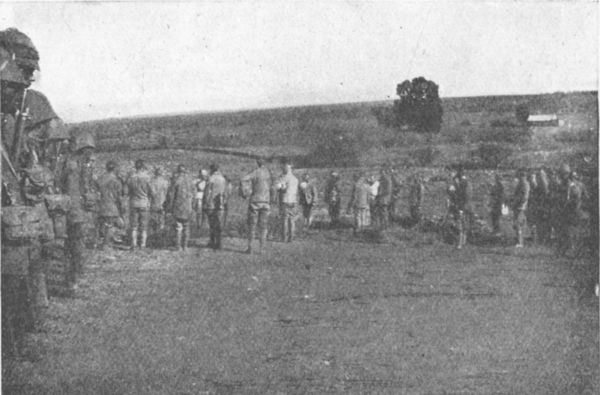
Funeral of Commandant Theron and a British Soldier.
September 6th, 1900.
September 6th was an unpleasant day. In the first place we made a very
early start, which, after the two previous nights' work, was rather
hard on the troops. Several had been without sleep for two nights, and
engaged with the enemy all day. As far as fighting went this
long-range scrapping was not of course worthy of the name, but as far
as discomfort and fatigue were concerned, the operations were entitled
to the most dignified and resonant title in the vocabulary. The 6th
was an example. In the first place there was no fighting; in the
second place, there was very little marching; in the third place,
there was no rest; in the fourth place, there was no food. In the
absence of definite orders the commanding officers delayed for a long
time ere venturing to outspan and cook: when they did do so orders
immediately arrived, scattering companies right, left, and centre, on
the burning and capturing expeditions. Finally, when orders were
published, they were for another night march, the object and
destination of which were concealed even from officers commanding
regiments. However, there was nothing for it but to make the best of
an unpleasant state of affairs, to snatch a few mouthfuls of food
whenever possible and a few minutes' sleep at any opportunity and once
more the long column wound its way through the night. It
arrived on the morning of the 7th at Wolverdiend station, where there
was now a considerable garrison, among them 140 of our own men, who
had been there since the De Wet trek. The day was passed in shifting
camp and fatigue work in the station, where there was much to do in
the way of loading and unloading trains.
Captain Romer got three days' leave here to meet his father, the
famous judge, who had come out as President of the Royal Commission.
At 9 p.m. the column started on another night march, the battalion
supplying the rearguard. It was weary work waiting on those occasions.
Tents were struck, and coats, blankets, &c., packed on the waggons an
hour before the advance-guard was due to march off, after which there
was nothing to do but lie down on the ground in the bitter cold, and
wait till all the transport had got away. Nor did the advance-guard
have very much the best of it, as they of course arrived hours before
the waggons, and had their shivering turn in the early morning, at the
other end of the march.
By 10 a.m. the column arrived at Klerkskraal, a small and very widely
scattered village on the banks of the beautiful Mooi River, a stream
of the clearest and most delicious water. Companies were sent to clear
out the neighbouring farms as usual, and a good deal of information
was gathered about a considerable quantity of the enemy, who had been
trekking through for some time past in small groups.
A dozen fine Indian tents, the gift of Rai Bahadur Boota Singh, of
Rawal Pindi, were handed over to us here for the use of the officers.
Very welcome they proved, as our old ones were nearly worn out.
Sunday, September 9th, 1900, was a day that will live long in the
annals of the battalion. It was given out that in view of the hard
work done by the troops, the day would be treated as a day of rest,
almost immediately following which order came another, detailing two
companies of each corps to go out on the unpleasant foraging
duties. The roster declared that 'G' and 'H' companies were next in
succession, and these two companies started immediately, officers and
men snatching a hasty and very scratch breakfast before starting. They
were out all day, from 8 a.m. to 6 p.m., during which time they were
gathering in supplies of straw, fodder, &c., together with all carts,
waggons, and harness in a serviceable condition, burning such as they
could not carry away with them. At about 5 p.m. a heliograph message
recalled them to camp, in reaching which they had to cross a small
stream with a snipe-marsh on either side: the waggons of course stuck,
but the men set to with a will, impelled doubtless by a keen desire to
get back to their dinners in camp, and dragged them out one by one
with ropes. A dismal surprise was in store for them. For even as they
came in sight of the camp, it was struck, and in place of the dinners
they had so fondly anticipated, some tea alone awaited them. The
officers were even worse off, for as the mess president had been
employed with the two companies out foraging, no one else had thought
of keeping even a cup of tea for them, and, exhausted as they were by
ten hours' work without food, under a burning sun, they received the
pleasing intelligence that the column was starting at once to march to
Pochefstroom, a distance variously estimated at from thirty-five to
thirty-eight miles.
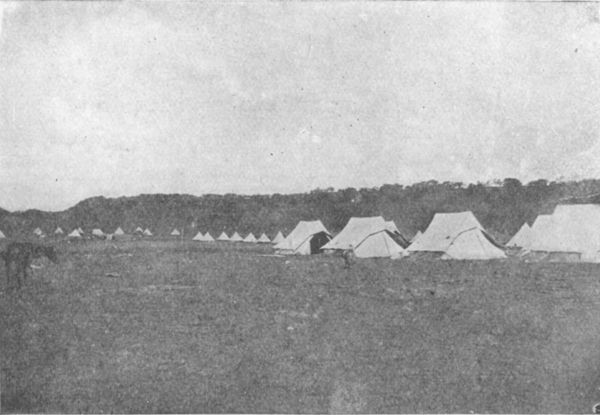
Buffelsdoorn Camp, Gatsrand Hills.
The force marched in three parts. First, mounted men, guns, and 'A'
and 'E' companies Royal Dublin Fusiliers in waggons. Then the main
body of infantry, and lastly the transport with 'G' and 'H' companies
Royal Dublin Fusiliers as rearguard. There was a moon for most of the
way, but it only served to make the surroundings more weird. Parallel
to our right ran a low range of hills, whilst on the left was the Mooi
River, with a farm looming up out of the night every mile or so along
the way. There was one halt of half an hour towards midnight, but the
remainder of the halts were merely of the usual five
minutes' duration. And hard it was to resume the weary way at the end
of even those brief spells of rest. Every one was so fit that the
actual marching was nothing like so trying as the difficulty of
keeping awake through the long, dreary hours, and one would time after
time drop asleep as one walked mechanically along, only to wake in the
very act of falling. Frederickstadt was reached in the small hours of
the morning, and the stream crossed to its left bank. There was then a
halt of about an hour to close up the transport, and very welcome it
was, for we were still an ordinary day's march from our destination.
Turning to our right, we brought the Gatsrands on our left, and the
word went forth that the Boers were in them, a report which seemed to
be confirmed a moment later as a blaze of light suddenly appeared
above their summits. 'There they are!' 'That's their signal lamp!'
were the comments that greeted the glory of the morning star, whether
Jupiter or Venus, on that as on many a previous and subsequent
occasion. On straggled the column, many of the men completely worn
out, having been reluctantly compelled to avail themselves
of the permission to ride on the waggons; the remainder, with grim
determination to march till they dropped, trudging patiently and
silently on. At last came the welcome flush of dawn; no 'envious
streaks' these, but the first message from the longed-for day which
ended that abominable night. When Pochefstroom finally came in sight
it was still a good five miles off, and those last five miles were as
bad as any part of the march. For though in some mysterious way the
coming of day had dispelled to a great extent the deadly sleepiness
from which most of us suffered, our aching limbs now began to make
themselves manifest, and those far-off trees never seemed to get any
nearer. However, by ten o'clock the last man was in, but very nearly
done. It had been a remarkable march—very remarkable seeing the
conditions under which some of the troops performed it.[12] For to do
from thirty-five to thirty-eight miles, most of it by night, on an
empty stomach, after a hard ten hours' work under a hot sun, in
sixteen hours, is a performance of which any troops may be justly
proud.
Nor was it altogether without result, for our mounted and
waggon-carried troops had arrived much earlier, and, fairly taking the
place by surprise, had surrounded it, killed seven, and captured some
seventy or eighty prisoners, and put a good many more to ignominious
and hasty flight.
We also obtained some draught beer. Beer! None of us had tasted it for
months. How it went down! Yet our memory of it is sad, for the
unfortunate manager of the brewery was afterwards shot by the Boers
for selling it to us. The column remained at Pochefstroom till the
12th, our stay being darkened by the melancholy death of the
signalling officer, Lieutenant Maddox, of the Somersetshire
Light Infantry, who was shot through the heart while going round his
stations.
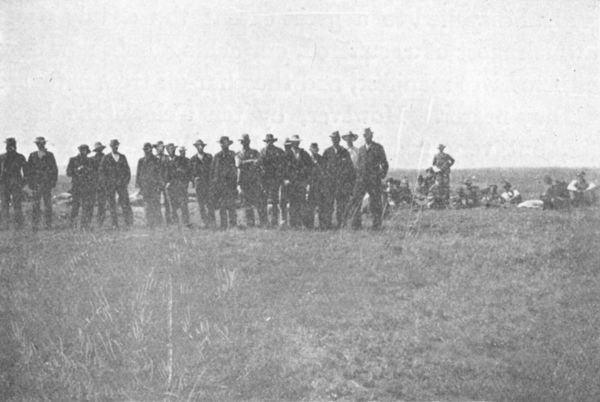
A Group of Boer Prisoners taken at the Surprise of
Pochefstroom.
On the 12th Colonel Hicks took command of a small force[13] which
moved out to occupy some kopjes overlooking two drifts over the Mooi
River. Starting at about 3 p.m., we did not reach our destination
(some five miles south of Frederickstadt) till dark. Somewhat to our
surprise, the hills were unoccupied, as Boers were known to be in the
vicinity, while there had been a certain amount of distant sniping
throughout the march. Putting piquets at the drifts, the infantry and
guns occupied one hill, and the mounted troops another hard by. We had
just turned in for the night when a sharp rifle-fire broke out all
along the front, to which our sentries were not slow to respond. We
immediately occupied the posts to which we had been assigned, but the
firing soon died away. No one was hit by the enemy, but an unfortunate
trooper in Marshall's Horse was shot by a comrade, and later on
succumbed to the wound.
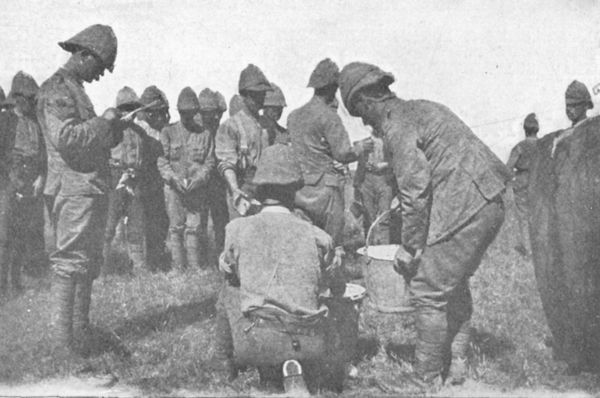
Colour-Sergeant Cossy issuing Beer.
At daybreak on the 13th, we located a Boer laager some five
miles out on the plain. One of our officers had a deer-stalking
telescope, with which it was possible to follow the movements of the
Boers as they woke up, a most interesting spectacle. They were of
course far out of range of our fifteen-pounders, but just as we were
regretting our inability to get at them, General Hart's force from
Pochefstroom could be seen trekking slowly in their direction from our
left front. We, from our elevated position, could see what the Boers
could not, and to watch our comrades creeping slowly nearer, while the
Boers were loitering about and stretching themselves, was a sight the
opportunity to view which was seldom afforded in the course of the
war. But long before the General got close enough to do any harm, the
alarm went. Any one who has ever seen a pebble cast into an ants' nest
can realise the proceedings of the next two minutes. Darting about in
every direction, the Boers caught their horses and inspanned their
transport with a celerity which fairly took our breath away, and in
what seemed an incredibly short space of time they were
trekking away across our right front, their movements still more
hastened by a few rounds from the naval guns. Moreover, they came
within very long range of our fifteen-pounders, so we were enabled to
return them a 'quid' for their 'quo' of the previous night, with
probably about the same result to their skins, though one riderless
horse could be seen careering about.
A helio message from the General instructed us to march off and join
him at Frederickstadt, where we arrived that afternoon, spending the
morning in the usual domiciliary visits, getting a really handsome
waggon for the mess, and carefully searching a farmhouse belonging to
the Bezuidenhouts.
On the 14th there was a considerable amount of firing in the
neighbourhood, but nobody seemed to take much interest in it. As,
however, it resulted in the loss of twelve mules and some waggons, and
one gunner wounded, it is hoped that we did some damage in return.
On the 15th Colonel Hicks again took out a small force of all
arms,[14] for the purpose of getting in more stores, of burning
Bezuidenhout's farm (it being now clear he had murdered two
telegraphists), and to hold the kopjes we were on the 13th, while the
Somersetshire Light Infantry marched to join us from Pochefstroom. The
country was now thoroughly infested with Boers, who made some slight
effort to oppose Colonel Hicks. He very soon brushed them aside,
however, and, marching his force along two parallel ranges of low
hills, arrived at the place where we had bivouacked on the night of
the 12th-13th. Dinners were cooked on arrival before the companies
went out marauding. Whilst they were being prepared a cartridge went
off in one of the fires, and severely wounded one of the cooks, the
bullet penetrating his chest. This poor fellow was later on sent into
hospital at Krugersdorp, and, as the wound never improved,
was eventually invalided home. But the line was blown up just in front
of his train, and he was brought back to hospital. He soon began to
recover, and one day went wandering about without his hat, got
sunstroke, and died, one piece of bad luck on the top of another, and
a melancholy example of how 'when sorrows come, they come not single
spies, but in battalions.'
A convoy under Captain H. W. Higginson, arrived at Frederickstadt at
this time, after having been considerably pestered by some Boers who
had shelled him with a nine-pounder Krupp, and severely wounded one of
our men. Luckily, the General had sent out a small force with two guns
to meet this convoy, or it might have had a very much worse time.
Next day Bezuidenhout's farm was duly burnt, and at 3 p.m. the force
started to march back to Frederickstadt, the Somersetshire Light
Infantry (wing) under Major Williams, with eighty prisoners, a large
number of refugees and waggons, starting an hour earlier, having of
course further to go. The march was not interfered with, and the force
reached its old quarters once more before dark.
The dreary monotony of these days and nights of trekking and foraging
suffered a variation on the 17th. In the morning 'A' company, under
Major Rutherford, took over the eighty odd prisoners from
Pochefstroom, and marched off with them to Wolverdiend. In the
afternoon a shell suddenly burst in the middle of the camp. The cheek
of these foes of ours. The first arrival was shortly followed by
several more in quick succession, some of which landed in camp, and
some of which went over our heads. We turned out, lowered the tents,
and then lay down in extended order, trying to locate the position of
the hostile gun. At last some one saw the flash, after which our naval
gun and fifteen-pounders picked up the range with admirable celerity,
immediately silencing the opposition. At a range of 3600 yards, the
second shot from the naval gun had burst within four feet of
the marks of the Krupp nine-pounder which had been shelling us.
At the time the enemy opened fire a regimental court-martial for the
trial of twenty-one prisoners had just assembled, under the presidency
of Captain Shewan. On the arrival of the shells, the court, escort,
witnesses and prisoners dissolved themselves with one accord, and were
not afterwards reassembled.
'In such a time as this it is not meet
That every nice offence should bear his comment.'
Julius Cæsar.
The sun was in the enemy's eyes, and the village of Frederickstadt
almost immediately behind our camp, which may account in some measure
for the indifference of their fire, as we must have offered a
magnificent target to them. As it was, our only losses were four
horses, not a man being hit. But we were fairly caught napping.
The General ordered the regiment to take possession of the hill, which
was done without any further fighting, two companies being left on
outpost duty on its summit.
On the 18th some of the usual desultory sniping commenced on the other
side of the camp, but a demonstration by the inlying piquet ('G'
company, 2nd Royal Dublin Fusiliers) was sufficient to put a stop to
it.
Major Bird arrived back from Maritzburg. Next day the trek commenced
once more. A small force[15] was left behind under command of Major
Bird to hold the hills from which we had been shelled, and to take
care of most of the transport. The remainder of the column marched at
11 p.m. on Ventersdorp, where some Boers were reported. After marching
all night and covering some twelve miles, the enemy opened fire in
front and on both flanks. Our guns came into action, and a sort of
running fight was maintained. Eventually the enemy took up a
more definite position, when General Hart ordered Colonel Hicks, with
two companies of the regiment, two guns and a pompom, to advance to a
small ridge on one flank, while he with the remainder of the force
marched round the enemy's rear. This resulted in the evacuation of
their position, when Colonel Hicks's small party got an opportunity to
deliver an effective fire on them.
Next day sniping at the bivouac began at dawn, but the troops were
allowed a meal before resuming their march. Colonel Hicks was again
detailed to take a kopje from which a considerable but ineffectual
fire was coming. Moving steadily on, with his 200 men in
widely-extended order, he brought a maxim into action, which had the
effect of clearing the hill, but the long-range fighting went on
without a break till the evening.
Having more or less broken up the Boers in this direction, orders were
issued for the return march to Frederickstadt. An early start was
made, and at 10 a.m. a halt and outspan ordered. At mid-day the
officers commanding units were sent for, when the General informed
them that a large force of Boers, under Steyn and De Wet, with women
and children, 3000 strong, was reported in the neighbourhood of
Klerksdorp. Rumour further said that they were so bewildered by our
apparently aimless midnight movements that they neither knew where to
go nor what to do. The General added that it was his intention to
march again in the afternoon in their direction, to have another
outspan at dusk, and then to march all night and surprise them next
morning. The commanding officers looked at one another in blank
amazement, for they knew better than the General could the effect
these constant nights without sleep and days of fighting without food
were having on their men, but there was nothing for it, and the
General called upon his troops for one more supreme effort. At the
same time he heliographed to Major Bird to march from Frederickstadt
and join him en route, which was done.
Major Bird's force had not been left altogether unmolested
during this time. The company of Somersetshire Light Infantry were
holding a small knoll in prolongation of his left, and some 2000 yards
off. Against them the Boers brought up their Krupp gun which they had
used against us two or three days before. The range was considerable,
but they managed to reach their target; yet, though they fired
twenty-three shells into the camp of this company, the only damage
they did was to knock the top off a box of eggs without breaking a
single egg. They also managed to pitch a shell or two amongst the
transport. Our fifteen-pounders endeavoured to reply, but, in spite of
digging deep holes for the trails, were unable to reach the ridge from
which the Boers were firing.
Major Bird's force having joined hands with the main column shortly
after dark, the long march was resumed at 10 p.m. It was a pitch-dark
night, and the difficulty of keeping in touch, and the still greater
difficulty of keeping the transport in touch, wore out tempers as well
as sinews. On one occasion the regiment as nearly as possible got
left. We were following the first-line transport of the corps
immediately in front of us, and keeping close up to it, but the
Colonel got anxious, and, after several times asking the adjutant if
he was certain we were in touch, told him to ride on and see. He came
back in a few minutes to say that there was nothing to be seen ahead.
The carts in front had lost touch, and they were all we had to guide
us. The adjutant at once cantered on, and had the good fortune to
shortly pick up the tail of the column, when everything was soon all
right again. The march continued the whole night, dawn being heralded
by the corncrake-like note of the pompom, which led us to hope we had
effected our object. But once again it was not to be, for the Boer
laager had moved off, and from the top of a small hill could be seen
trekking away about 7000 yards distant. Men and horses had been at it
since 6 a.m. the day before, and any further pursuit was out
of the question. Indeed, an extra two or three miles that had to be
done to reach a better camping-ground almost proved the last straw.
The right half-battalion had marched thirty-three miles in the
twenty-four hours, and only slept on one night out of the last three,
while the left half-battalion had done twenty-six miles in eighteen
hours.
Our enemy had slipped away once more at the critical moment, but our
spirits were raised all the same by the arrival of a dispatch, which
we understood called us back to Krugersdorp and hinted that the war
was over.
After a day's rest at this rather pleasant camp, the force moved into
Pochefstroom (eighteen miles), and marched past the General in the
Market Square on the 25th, remaining there until the 27th. It had been
on the move for nearly a month with very little rest, during which
time men and horses had undoubtedly got very wiry and fit. But beyond
collecting a certain amount of stores, cattle, and forage, it is
doubtful whether all the forced marches and strenuous exertions had
been of much benefit, or whether they served to bring hostilities much
nearer to a conclusion. Although the enemy, in more or less force, had
been viewed practically every day, it had always been impossible to
bring him to close quarters, and the policy of wearing out
infantrymen's hearts, tempers, constitutions, and boots in abortive
pursuits of mounted enemies was, and in the light of all that we now
know still is, open to question, for a reference to the Times
history of the war shows that all our wanderings and meanderings are
summed up in very few sentences, the most pregnant of which is to the
effect that word had gone out to the Boer Commandoes not to interfere
with us.
On the 27th the column started on its march back to Krugersdorp, and
did the distance (sixty-two miles) in four easy stages. It marched by
the road south of the Gatsrand Hills, with the Losberg on its right,
and with the exception of one day (29th) without molestation from the
enemy. On that occasion they made a somewhat determined
attack on the rearguard, attempting to cut off some waggons, and the
last few miles of the march took the shape of a running fight. The
General had ridden on ahead with the cavalry to our next camp, so
Colonel Hicks sent back a couple of guns to the rearguard, who shook
off the terrier-like attentions of the enemy without very much
trouble; but they had delayed the march a good deal, and it was not
till late in the evening that every one got in, and heard that the war
really was over at last. An officer in the regiment who was
considerably exhausted sank on to his valise, too tired to care for
anything. His servant said to him, 'We'll be in Krugersdorp to-morrow,
sorr, and I'll be able to get yiz some claning matherials,' to which
his weary master replied, 'I don't care a damn whether I'm clean or
whether I'm dirty.' In answer his man made the following cryptic
remark: ''Tis no use talking like that, sorr. Lord Roberts says the
war is over, and we'll begin soldiering now.'
The following summary of the work done was published for
information:—
'Summary of Work of Pochefstroom Column.
'The Pochefstroom column started from Krugersdorp on the 29th August,
and returned on 30th September. The task of the column is to assist in
stamping out the resistance of the remaining scattered forces of the
enemy by hunting them, and depriving them of their supplies of food
and transport, with a view to bringing the war to an end. In the first
cruise of 33 days the column has marched 310 miles—the length of
England from Portsmouth to Scotland—and was in action with the enemy
on 29 days, putting them to flight on each occasion. The column's
casualties were only 3 killed, 24 wounded, and 3 missing. The Boers
lost considerably according to accounts of Kaffirs present; we found
some of their dead, including General Theron. In prisoners
of war and important arrests, the column took 96 of the enemy. Loyal
inhabitants, numbering 316 men, women, and children, were rescued from
Pochefstroom, and safely conveyed to Wolverdiend. General Liebenburg
ordered General Douthwaite to attack this convoy, but Douthwaite
thought it dangerous, and was arrested by Liebenburg for suggesting
that he, Liebenburg, "had better do it himself." The convoy was not
attacked. The column took from the enemy the following cattle: 2720
sheep and 3281 goats; 1066 sacks of mealies, 104 sacks of meal, 2
waggon-loads of mealie cobs, 12 sacks of wheat, 847 loaves of bread,
162 sacks of potatoes, 68 sacks of oats, 33 sacks of bran, 36,000
bundles of oat-hay, 299 bales of chaff, 400 bundles of manna-hay, 90
horses, 28 ponies, 11 mules, 36 waggons, 31 carts, and destroyed 45
waggons and carts that could not be taken away.
'(Signed)
A. Hart (Captain),
'C.S.O. Pochefstroom Column.
'Krugersdorp, 2nd October, 1900.'[Back to Contents]
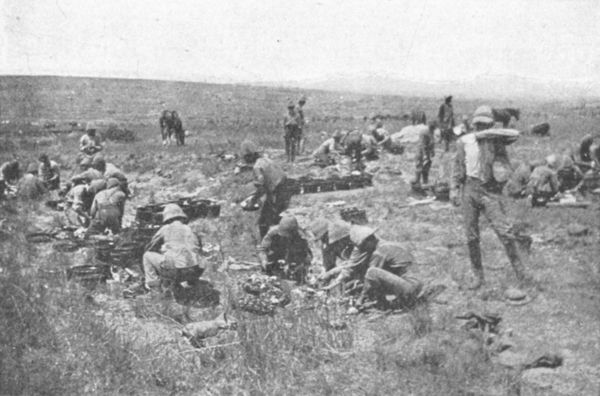
'Come to the Cook-House Door, Boys!'
'We looked for peace, but no good came.'—Jer. viii. 15.
CHAPTER V.
FREDERICKSTADT—KLIP RIVER—THE LOSBERG.
'Have I not heard great ordnance in the field,
And Heaven's artillery thunder in the skies?'
Taming of the Shrew.
Our camp, on this our third visit to Krugersdorp, was on the
south-west side of the town. The 6th Brigade (General Barton's) was
also in Krugersdorp, and had been for some time, so it was with
somewhat mixed feelings that we heard we were to set out on the trek
once more almost immediately. However, in the end the other brigade
went out, with what result will presently appear. Krugersdorp was now
surrounded by a large circle of forts and fortified houses. The
perimeter of these defences was very large, not far short of twelve
miles, but the positions themselves were well selected from a tactical
point of view. As they were continually being strengthened, improved,
and added to, in a few months' time it would have been very difficult
for the Boers to have taken the place, provided a sufficient garrison
remained in it. But this strength, or sometimes weakness, was a
constantly varying one—about the middle of December sinking as low as
300—which of course was risking a good deal. Moreover, it was not
until some time later, when the Officer Commanding Town Guards devised
an inner series of defences, that the town could be said to be in any
way safe from a midnight raid; and it was this, more than even the
capture of the place, which seemed so likely to occur, when the banks
and stores could have been cleared out in a few minutes, and the
raiding party gone before any force could have been assembled to
interfere with it. The town was, of course, full of spies
and friendly enemies, ever on the look-out for any chance of getting a
bit of their own back—and who could blame them?—but on the whole
remained very quiet and well-behaved throughout the occupation.
The regiment's headquarters were destined to remain here for the rest
of the campaign, with the exception of the three treks which form the
subject of this chapter, and Krugersdorp will ever be identified with
our name in South Africa in consequence. As we got to know its
inhabitants better, and as they got to appreciate our men better, a
kindlier feeling was generated on both sides, with which improved
state of affairs the cricket and football we played with them had not
a little to do.
General Barton moved off on October 5th, with much the same commission
that General Hart had carried, and immediately came into contact with
the enemy, the noise of the fight sounding loud in our ears, while
from Captain Nelson's piquet the bursting shells and even some of the
Boers could be plainly seen. The day before a flag of truce had come
in with a letter, saying that one of our men was lying wounded in a
farmhouse a little way outside the outposts; a waggon was sent out and
brought him in, when he proved to be one of our mounted infantry, who
had been wounded in Colonel Rochfort's dashing attack on a Boer laager
near Pretoria.[16] The Boers had looked after him as well as they
could, and dressed his wounds according to their homely lights, and
altogether played the game so far as he was concerned.
Next day still brought the sound of General Barton's artillery, and
the right half-battalion under Major Bird went out as escort to two
waggon-loads of ammunition for him. The General sent
half-way to meet him, and our men got back all right about 6 p.m.
With the advent of summer the thunderstorms increased in frequency and
severity, and it was no joke to have to suddenly jump up and hang on
to the pole of one's tent to prevent it being blown away, with the
uncomfortable knowledge that lightning has a partiality for running
down tent-poles. We had one really bad experience in this way, to be
narrated later, but nothing to touch the blizzard that struck the camp
of the 5th Battalion Royal Dublin Fusiliers near Mafeking, when sheets
of corrugated iron flew about like packs of gigantic cards, and
Colonel Gernon and Captain Baker, the Quartermaster, together with
many others, sustained very serious injuries. Still, our share was bad
enough, and quite spoiled the summer for a good many of us. The
mornings would break clear, cloudless, and invigorating; but about 3
p.m. on about three days of the week, a bunch of cotton-wool clouds
would appear from the south. As these rose higher and higher, they
swelled into enormous piles of grand, rolling cloud-masses, like
stupendous snow-clad mountains, whose bases grew black and ever
blacker, until they would suddenly be riven by blinding flashes of
flickering ribbons of lightning, and the air torn and rent by
reverberating booms of awe-inspiring thunder.
Second Lieutenant Tredennick joined at this time. Second Lieutenant R.
F. B. Knox should have arrived with him, but had to remain behind in
Johannesburg, as he was seedy. The train they were in had been
attacked by Boers near Heidelberg.
Rumour now began to be busy with General Barton's force, and on the
22nd an order came for General Hart to join him. We had just packed
up, when an order came countermanding the move.
Next day, however, another order came to the same effect,
but detailing Colonel Hicks to command the column. Though small in
point of numbers,[17] it would have been hard to have picked a better
one in point of quality. A finer body of horsemen, or one more adapted
to the work in hand, than Strathcona's Horse it would be impossible to
conceive. Without making any invidious comparisons, it is only just to
say that these Canadian troops appeared to us to have no superiors,
while the truly magnificent way in which they literally brushed away
the opposition, on the morning we joined hands with General Barton,
was a sight to be remembered.
The regiment was entrained, but did not get off till about 5 p.m., our
departure being marked by a peal of thunder which made even those who
declared themselves fond of such phenomena nearly jump through the
roof of the guard's van. We only got as far as Bank Station, as the
line was reported infested with the enemy, and it was important that
we should not be blown up. Indeed, we had scarcely arrived there, when
a loud explosion—fortunately behind us—proved the activity of our
watchful foes. After making teas we bivouacked in the train.
The regiment reached Wolverdiend next day, in the course of which the
remainder of the force assembled, preparations being made for an early
start next morning.
Fearing that information would get through, the Colonel gave orders
that the column would start at 6 a.m., but at the same time issued
confidential orders to officers commanding units that he really
intended to start at 3.30 a.m. Unfortunately, however, it rained so
hard all night that it was impossible to start until 5 a.m. Colonel
Hicks sent Strathcona's Horse out to the front and left flank, while
Brabant's Horse took the right flank and front. The Essex Regiment
supplied the advance-guard, while one company of the Dublin
Fusiliers acted as rearguard and escort to the waggons. In this order
the force approached a low line of bush-covered hills, which separated
them from General Barton. These hills were occupied by two or three
hundred Boers, who had been detailed to check our advance. On arrival
within rifle-range of the hills, Strathcona's Horse made a dash right
at them, the effect of which was so imposing that the enemy
immediately resigned all idea of resistance, and bolted as hard as
they could go. With this range of kopjes in our possession, the rest
was plain sailing, and we marched on to the hill on which the larger
part of General Barton's force was posted. The column had barely
arrived when a fierce rifle-fire broke out in front. It was impossible
to see what was going on, as the hillside was covered with thick
mimosa bush, but that a fierce fight was raging in our close proximity
was very evident from the prolonged and heavy fire, in which the
pompoms soon began to take part, while the naval gun and smaller
field-pieces joined in. Colonel Hicks, accompanied by an officer of
the Dublin Fusiliers, then climbed some little way up the hill in the
direction of the 4·7, and there a sight met their eyes which was
seldom seen in this war. The plain at their feet, stretching from the
railway west to the village of Frederickstadt, was covered with flying
Boers—Boers flying on their feet, a most unusual occurrence with
them. As they fled across the open veld in full view, they were
pursued by every variety of missile. In one spot, seven Boers were
running side by side. The officer with Colonel Hicks had just drawn
his attention to them, when a shell from the naval gun burst in the
air behind them, and a second later tore up the ground all round. Five
fell at once; the other two staggered on a few paces and then fell
also, all seven being afterwards found stone-dead. It was all over in
a very short time, and then the stretcher-bearers began to come in
with their patient, gruesome burdens, and the prisoners
arrived under escort, to be handed over to the Royal Dublin Fusiliers
for safe custody.
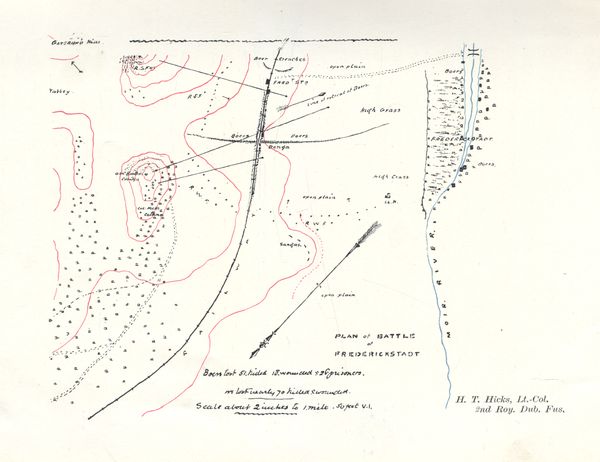
Plan of Battle of Frederickstadt.
Then we heard the story of the fight. General Barton's position, which
he had occupied for some days, extended along a line of low hills, the
two main features of which were divided by a valley running back at
right angles to the railway into the Gatsrand, the general line of the
position being parallel with the railway. The station was held and
used as a hospital, while the hill on which General Barton's camp was
situated extended down to the railway, and was the nearest point to
the river. For some days the Boers, under De Wet, had been gathering
round this position, and the force had been subjected to a constant
shell-fire and the intermittent attentions of a particularly
aggressive and unlocatable pompom. Under the railway, about midway
between General Barton's two main positions, ran a small, dry donga.
Into this underfeature De Wet had ordered about 200 men on the night
of the 24th-25th. The first indication of their presence was a
somewhat foolish attempt made by them to capture some mules. Unaware
of their numbers—and truly the situation was such that any one could
be pardoned for not grasping it at once—a company or part of a
company was sent forward to dislodge them and clear up matters. The
Boers allowed them to approach quite close, and then annihilated them.
It was now very evident that the donga was held in force, and, as the
General was aware by this time of the arrival of Colonel Hicks'
column, he launched a vigorous attack. This was the heavy firing we
heard on our arrival. After offering a slight resistance, some of the
enemy surrendered, the remainder flying on foot as already stated to
their horses, which they had left amongst the trees near the river. It
is not often the Boer leaves his horse thus, and it offered strong
presumptive evidence of their confidence in their ability to rush the
position, in accordance with De Wet's intention.
The battalion bivouacked on the hill, and threw out outposts.
To them was also assigned next morning the intensely
unpleasant duty of shooting three prisoners who had been tried and
found guilty of showing the white flag and afterwards resuming their
fire. 'G' company, being the nearest piquet to the place selected for
the execution, was detailed to carry it out. The casualties on our
side had been about forty-one killed and wounded, while twenty-four
Boers were killed, sixteen wounded, and twenty-six taken prisoner.
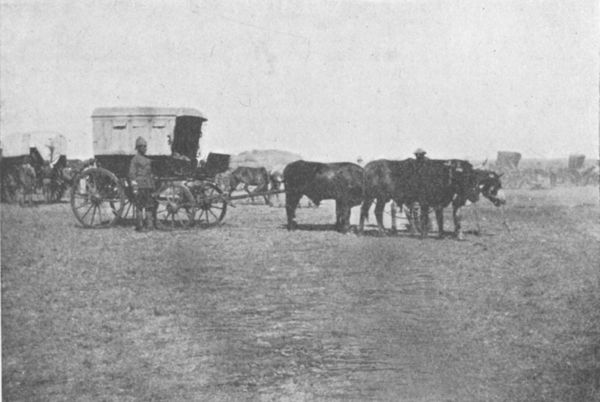
Sergeant French and the Officers' Mess, Nachtmaal.
After remaining at Frederickstadt on the 26th, orders came for our
return to Krugersdorp on the 27th. We had an uneventful march to
Wolverdiend, and there entrained, reaching our destination late in the
evening. The officers, as usual, rode in the guard's van, and, as
these trains used to bump and jolt in the most unpleasant manner, we
made ourselves as comfortable as we could in a sort of 'zariba'
composed of our valises and a number of large packages sewn up in
sackcloth. Our feelings when we later on discovered that these
packages were corpses may be left to the imagination.
We returned to our last camp, and set to work to make it
more comfortable, running up wood and corrugated-iron shelters for
stores, officers' mess, &c. We were also kept perpetually busy in
building more forts and improving those already in existence. Captain
Romer gave his name to a work which he erected and on which he
expended much time, pains, and ingenuity. Posts and piquets also had
to be held on all the principal roads into the town. Captain Nelson,
R.M.L.I., in command of one of these, one afternoon shouted to two men
who were driving through his posts to stop. Unfortunately for them,
they paid no attention and drove on, so he seized a rifle and fired,
killing one of the occupants stone-dead, an exemplary lesson to the
inhabitants to make them understand that outposts were not posted for
amusement.
General Clements' column was now stationed at Krugersdorp, and we saw
something of Captain MacBean, Royal Dublin Fusiliers, his
Brigade-Major. Alas! poor MacBean; he was killed a few days later,
standing close beside his General, at the battle of Nooitgedacht. A
universal favourite, and one of the most popular officers in the
regiment, he was also probably the ablest. Passing brilliantly into
and through the Staff College, he went on to the Egyptian Army, taking
part in all the principal actions up to and including the battle of
Omdurman, receiving a D.S.O. in recognition of his services. In the
present campaign he had commenced the war as a Brigade-Major, later on
serving on General Hunter's staff, and now transferred to General
Clements', who had the highest opinion of his capabilities. Amongst
many other accomplishments he was one of the best bridge-players in
the service. There is little doubt that if he had been spared he would
have risen to the highest rank. He was gazetted to a Brevet-Majority
after his death.
On November 15th Lord Roberts inspected the regiment, and
congratulated them on the work they had done, afterwards speaking to
Major English and telling him how highly he had thought of the
Zuikerbosch affair. It is these little acts of kindness and
remembrance that make all the difference, and their effect is much
more far-reaching than those who confer them often imagine. One only
does one's duty, of course, but yet one is only human, and it is very
pleasant to feel that that duty has been appreciated.
Captain Lowndes, the adjutant, who had been home after his severe
wound at Talana, now rejoined the regiment, and took over the
adjutancy from Captain Fetherstonhaugh. That officer had filled the
post with marked zeal and ability for over twelve months, and was the
only officer who was present with the Headquarters of the battalion
from the start of the war without being wounded.
On November 16th the regiment formed part of a column,[18] ordered to
march off and scour the veld, though our destination was, as usual,
shrouded in mystery. The night of the 15th-16th however, precluded any
possibility of carrying out the intended early start, as the rain
descended in torrents, deluging kits and country. At about 2 p.m.,
however, a start was effected, and all went well till a small drift
was reached, when the 'cow-gun,' which had taken the place of our old
and tried friend, the Naval gun, stuck hopelessly. Colonel Hicks fell
out 120 men and put them on to the drag-ropes. Their first pull was
too much for the rope, which broke, with the inevitable result that
the whole 120 were deposited on the veld, on the broad of their backs.
Another and a stouter rope was produced, which proved itself equal to
the strain, and with a long pull, a strong pull, and a pull all
together, the heavy weapon was dragged on to terra firma, and the
march resumed, a halt being made for the night about eight or nine
miles out, and almost on the historic site of Doornkop.
The trek was resumed next morning under more favourable auspices, but
these soon proved a delusion and a snare. The column was making for a
pass in the Gatsrand, not far from the waterworks, known to
be in the enemy's occupation, when at about 11 o'clock a violent
thunderstorm broke directly overhead. Marching along, soaked to the
skin, with a lightning-conductor in the shape of a rifle over one's
shoulder, was not conducive to steady nerves, but so dense was the
rain that it had, at all events, one beneficial effect, for the Boers
holding the pass left their positions and took shelter in some
farmhouses, with the result that they were very nearly captured by our
cavalry, who, indeed, succeeded in taking possession of the pass
without opposition, the enemy, taken completely by surprise, having
only just time to jump on their horses and gallop off. Getting the
'cow-gun' over the pass, however, was no easy matter, but it was
eventually accomplished, and after a march of about sixteen miles, the
force halted for the night in rather a pretty camp, on a farm known as
Hartebeestfontein.
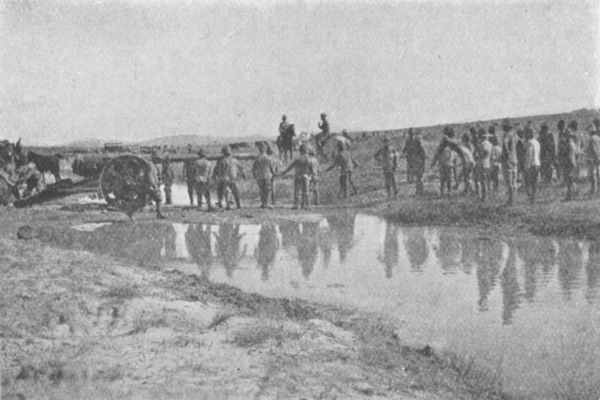
4·7 Crossing a Drift, assisted by the Dublin
Fusiliers.
The column marched to Klip River, about seventeen miles, next day,
arriving there about 5 p.m. The rearguard was sniped at the whole way
by our friends of the day before, but without effecting much
damage. A cavalry brigade under Brigadier-General Gordon was here on
our arrival, and an exchange of troops took place, we receiving some
Greys and Carabineers in exchange for half a battalion of South Wales
Borderers.
A halt was now made for a day, most of us taking the opportunity to
get a bathe in the river.
Leaving Klip River on the morning of the 20th, we marched back in the
direction whence we had come two days before, and were soon engaged
with the enemy's snipers, of whom we captured one; but they had the
best of the argument, as they killed two of our column. One of these
poor fellows had very bad luck: he had received a letter at Klip River
only the day before, telling him he had come into a sum of money,
sufficient to enable him to retire and spend the remainder of his days
in peace and quiet.
Nor was the day to prove uneventful for the rest of us. About 1 p.m.
it began to cloud over, and presently to rain; this soon turned into
hail, of the variety which one is accustomed to at home. This was at
first refreshing, and one would pick up the cool hailstones—they were
about as big as peas—and eat them, and the rattle they made on the
helmets was quite musical. When they grew to the size of gooseberries,
and began to sting, they provided less amusement, shoulders being
shrugged up and necks arched to obtain as much protection as possible.
The unfortunate dogs, of which a variety invariably turned up with
every column, howled with pain, and the cattle and horses grew very
restive. But soon the stones, driven by a gale of wind, increased to
the size of cherries and strawberries, with occasional jagged lumps of
ice an inch in diameter. As there seemed no particular reason why they
should not run through the whole gamut of the orchard, and rival
plums, peaches, and melons, and as there was no earthly chance of
obtaining a vestige of shelter of any kind, men began to wonder what
was going to happen next, with an occasional
sharper-than-usual belt between the shoulders or on the boot to
quicken their fancy. It was only with the greatest difficulty that the
horses were controlled, but the stones providentially grew no larger,
though the storm continued. The entire country-side was a rolling mass
of ice nearly over the tops of boots. Runnels and rivulets became
roaring torrents, roads became rivers. When the storm eventually
subsided the transport of course could not go another yard, and camp
was pitched where we were. The carpet of hailstones in the tents
slowly melted into mud, and we made ourselves as comfortable as
possible under the circumstances. Several kids and lambs we had with
us were killed by the stones. Not one of us had ever been out in such
a storm before, but, as those who had not been on 'the Natal side'
confidently predicted, those who had been declared that this was mere
child's play to the hailstones they had seen there.
What became of the Boers we never knew: up to the commencement of the
storm we had been merrily sniping away at each other at extreme
ranges, but during and after it they entirely disappeared, so entirely
that even next day we never got a sign of them, and concluded they had
all been drowned.
There was, however, nothing to complain of on this score the day
after, as sniping was carried on all the time. Though this form of
fighting resulted in few casualties, it was destructive to peace and
comfort and enjoyment of the scenery. It was interesting to notice
what officers recognised when we arrived at places we had visited on
previous treks, and instructive to note that it was almost always
those who were addicted to sport and field-pursuits who were the first
to pick up their bearings and the lie of the land. The force
eventually encamped at the foot of the hill on which 'G' company had
spent such a cold and miserable night when waiting for the transport
to pass, two months before.
On the 23rd, the march took us up again through Orange Grove
and on past Leeuwport Nek, moving along the south side of the main
ridge of the Gatsrand, with three companies making the best of their
way along their jagged peaks. Two of Roberts' Horse were hit on this
march, one being killed.
The column reached Buffelsdoorn Pass on the 24th, after a spirited
rearguard action, the brunt of which fell on the South Wales
Borderers, who had several men and one officer hit. We remained in
this pass for some days, sending out small expeditions among the
adjacent hills, and erecting fortifications to cover the defile. It
was in its way an important place, being within a few miles of
Wolverdiend Station, and providing an excellent door through the
rocky, serrated peaks of the Gatsrand into the broad plain which lay
between them and the Vaal. Our camp was situated just on the north
side of the pass, in a picturesque place, with easy access to the
railway, and from a tactical point of view an excellent position.
Next day a convoy with nearly ten thousand cattle, sheep, &c., was
dispatched to Wolverdiend, without seeing any signs of the enemy.
The night of the 25th-26th could scarcely have been worse; heavy rain,
howling wind, and vivid and frequent lightning with its sonorous
accompaniment, put sleep out of the question; indeed, at one period it
became necessary to get up and hold on to the tents to prevent them
being blown away. With the advent of dawn the forces of nature gave us
a rest, our friends the enemy immediately filling their place. They
opened fire from some kopjes to the east of the camp, and endeavoured
to round up some of our cattle. The South Wales Borderers undertook to
dislodge them, and speedily did so, the 'Cow-gun' joining in at long
range as soon as the Boers evacuated their positions. Having disposed
of man for the time being, Nature again rolled up in dense masses of
magnificent clouds to the attack. The storm which followed
was also one to be remembered; the lightning could be seen striking
the ground in the close vicinity of the camp, and though no one was
hit, we heard that two men of the regiment at Kaalfontein were not so
fortunate, one poor fellow being killed and the other severely
wounded. 'C' company, 2nd Royal Dublin Fusiliers, was on piquet
through both these night and day storms, and had, as may be imagined,
an unenviable experience.
On the 27th, General Hart rode down to Wolverdiend to see Sir John
French. While he was away, word arrived that a party of Roberts' Horse
who were out scouting had been held up. Colonel Wilson—the senior
officer in camp—detailed 100 Carabineers to go to their assistance,
but they found the opposition still too great, so two companies of the
regiment were sent out to reinforce them, while the guns opened fire
from the summits of the hills. In the middle of the operations a
thunderstorm joined in to swell the general din, under cover of which
the Boers crept in round three sides of the force. There was never any
question of their succeeding in cutting it off, but the boldness of
their tactics was characteristic of the phase the war had now begun to
assume. There was a good deal of rifle-fire on both sides, and the
28th Battery R.F.A., under its new commander, who had replaced our
esteemed friend, Major Stokes, D.S.O., promoted to R.H.A., fired
nearly one hundred rounds. What casualties the enemy suffered was not
ascertained, but on our side there was only one, a man in Roberts'
Horse being badly hit. Those of us who were not engaged sat among the
rocks on the tops of the hills, whence a fine panoramic view of the
skirmish was obtainable by the aid of telescopes and binoculars.
The 28th and 29th passed uneventfully, Captain Romer occupying the
time in again demonstrating his architectural capabilities in the
erection of a fort near the pass.
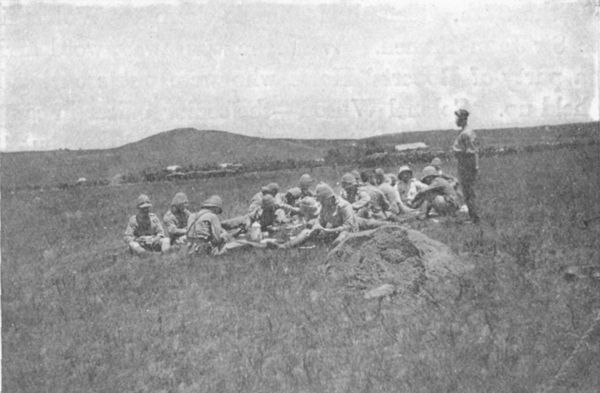
Boy Fitzpatrick waiting at Lunch.
On the 30th a reconnaissance in force was made along the
Gatsrand in a westerly direction, the left half-battalion of the Royal
Dublin Fusiliers acting as the infantry of the force. Moving along the
summits of the hills in four lines of widely extended companies, they
marched to within sight of Frederickstadt before they returned.
Imagine exaggerated Pyramids of Cheops; imagine each block of stone
carved by stress of weather into a thousand needle-points and
ankle-twisting crevices; plant a dense growth of mimosa and other
thorny scrub in every cranny and interstice. Take a dozen such
pyramids, and do your morning constitutional over them, after the
scrappiest of breakfasts at 5 a.m., and you will find twelve or
fourteen miles quite as much as you care about. But the march was not
devoid of interest, though we met with no Boers. Small buck, hares,
and partridges were there in sufficient number to afford a good day's
sport under other circumstances, while a profusion of various kinds of
flowers afforded satisfaction to the eye, in strong contrast to the
bare and barkless trunks of trees riven by the frequent
storms that devastate these hills. In one place a most gruesome sight
was met with. Under a small tree beside a tiny stream stood a
three-legged cooking-pot, and round it lay three skeletons, with a
scattering of shrapnel bullets to silently tell the story of the
tragedy. Beside one body lay a Rifleman's haversack, an eloquent if
speechless travesty on the fortunes of war, for undoubtedly they were
the remains of Boers, over whose head a chance shrapnel must have
burst months before.
A similar reconnaissance, but in the opposite direction, was made next
day, resulting in one man being wounded. Convoys were also passing to
and fro, and on the 2nd, Captain Fetherstonhaugh took over the duties
of provost-marshal, temporarily, from Captain Thompson, of the
Somersetshire Light Infantry, who had hurt his knee. Rumours of an
early move also began to circulate, with the Losberg, the grim and
solitary hill rising out of the plain to the south of the Gatsrand, as
our probable destination. For some time past the Boers had used it as
a sort of headquarters and rallying-place for their frequent raiding
parties. Columns were now converging on it from all points of the
compass, but as they could be plainly seen from its summit, the high
hopes entertained in some quarters of rounding up a large number of
the enemy were not shared by everybody.
Yet the start at 9 p.m. on the 3rd was sufficiently impressive. The
officers were assembled, and had their several duties clearly pointed
out to them, one peak of the hill being assigned to the South Wales
Borderers and the other to the Dublin Fusiliers. To 'A' company of the
latter regiment, under Major English, was given the honour of leading
the attack, which was to be made at dawn next morning. Silently and
with all due precautions the column slowly wound its way down the
pass, like some gigantic boa-constrictor, and out on to the plain
below. Whenever a farm was reached it was entered, and steps
taken to prevent lights being shown or signals flashed: three Boers,
booted and spurred, being taken in one. It was a perfect night for
marching, all Nature hushed in deep repose save the loud-mouthed
bull-frog; the moon set an hour before dawn, reminding one of
Whyte-Melville's line:
'The darkest hour of all the night is that which brings the day.'
But dark as it was our objective could be seen ominously looming up—a
lamp-black mass against the velvet softness of starlit sky. The
movement had been admirably timed, and as day broke the two regiments
advanced to the attack, the South Wales Borderers on the right, the
Dublins on the left, while the artillery opened fire against the
hillside between the two summits. But that was all. Not a shot was
fired in return. Not a Boer was even seen. Nothing. Except, indeed,
large quantities of most delicious and most acceptable oranges, after
eating which the tired troops lay in the rain, which commenced to pour
down, and slept peacefully till the transport came up.
Before we started next morning, a huge herd of blesbok suddenly
appeared on the scene, wildly galloping about in every direction,
being continually brought up by the barbed wire fences of the farms. A
good many were shot, but it was cruel to kill them, or try to, with
hard bullets, and many and many a beast must have got away badly
wounded, whilst the indiscriminate manner in which the sportsmen fired
in all directions was a source of danger, not only to themselves and
the buck, but to the camp as well. One fine old fellow, with a good
head, charged right through the camp, altogether eluding one regiment,
in spite of every variety of missile, from cooking-pots to helmets, to
finally fall a victim in another regiment's lines to a tent-pole.
After which interlude the force marched to Modderfontein.
Next day a helio from Bank directed the column to make its
way to that station, a party of the South Wales Borderers being left
behind to watch the pass at Modderfontein, where they were to have a
rough experience later on. The remainder of the force moved to Bank on
the 7th, and marched again the same night for Krugersdorp, making a
total distance of thirty-three miles in the twenty-four hours, a good
wind-up to the three weeks' trek. An enormous number of cattle and
sheep were brought in, but it was the end of the Pochefstroom column,
which was now finally broken up into a number of small posts.
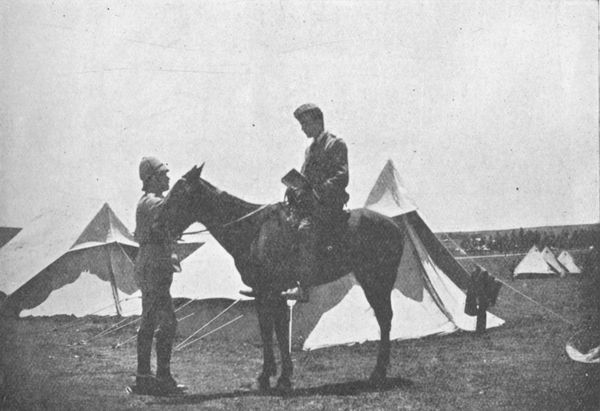
'The Latest Shave.'
Captain G. S. Higginson (mounted) and Major Bird.
The regiment camped once more on the same site it had last occupied.[Back to Contents]
CHAPTER VI.
BURIED TREASURE—THE EASTERN TRANSVAAL—THE KRUGERSDORP DEFENCES.
'They are wet with the showers of the mountains, and embrace the
rock for want of a shelter.'—Job, xxiv. 8.
By this time we had begun to regard Krugersdorp as our base, and to
look upon our returns to it as more or less getting home. But on this
occasion there was to be no rest of any length. From the plum-bloom
blue of the far Magaliesberg, General Clements' heliograph was
twinkling and blinking for the remainder of his force and more mounted
men. In addition to this Colonel Hicks took out a column. These and
other deductions left Krugersdorp with a garrison of 300 men to man a
perimeter of some ten or twelve miles, or, roughly speaking, just over
fifty yards for each rifle. 'C' company, under Captain Pomeroy, W.I.R.
(attached), and Lieutenant Molony, occupied Fort Craig; 'D' company,
under Captain Clarke, R.M.L.I. (attached), and Lieutenant Marsh, held
Fort Kilmarnock; and 'G' company, under its Captain and Lieutenant
Smith, took over Fort Harlech. Major Rutherford took over this fort
next day, as the captain of 'G' company had been appointed commander
of the town guards and piquets and interior defences. Colonel Hicks
had been ordered to Johannesburg to see General French, who informed
him that he was to take command of a mixed force[19] and march to the
Losberg, there to dig up a large sum of gold, reputed to amount to
nearly 100,000l.; after which he was to proceed south to the Vaal,
and hold the drifts between Vereeniging and Rensburg.
Starting at midnight on the 10th-11th, the column marched
till 6 a.m., covering fifteen or sixteen miles. The men then had
breakfasts; and, after resting till mid-day, when they had dinners,
started again for Orange Grove, the pass in the Gatsrand with which we
were by this time so familiar. It was occupied by Boers, estimated at
about one hundred in number, who offered considerable resistance, but
who were finally shelled out of it, without loss on our side, though
charged by a squadron of Carabineers with great dash. Having done
about twenty-six miles, the camp was pitched at 6 p.m., outposts
being, of course, thrown out on the adjacent hills.
Reveille sounded at 4.30 a.m., and by 5.30 the small column was on the
way again. Their destination was plain enough this time, and very grim
and formidable it looked in the broad light of day, considering the
very small force which was about to attack it. Moreover, on this
occasion it held something besides oranges. Advancing from the north
in the direction of the spot from which we had advanced to the attack
a few days before, Colonel Hicks made a demonstration as though about
to attack the eastern peak, then, suddenly opening a heavy shell fire
on the nek between the two, he launched his real attack against the
other summit. Although the hill was held by a considerable number of
the enemy, estimated at 500, these tactics proved eminently
successful, for when they discovered the direction of the main attack
shrapnel was bursting all over the nek along which they would have had
to gallop to meet it, and they gave up the idea and evacuated the
position, which fell into Colonel Hicks' hand with a loss of one man,
who had the misfortune to be hit in no less than five places. A guide
had been sent with the column who knew where the gold was, and a party
was told off to dig it up and bring it in. The guide may or may not
have known where the gold was, but he certainly did not know where
it was then, and the search proved entirely abortive. He
was a murderer under sentence of death, and was to save his life by
showing the gold and ten buried guns.
The force started at 5 a.m. next morning for Lindeque Drift. There was
a certain amount of sniping all the way, principally at the cavalry,
who were riding wide on either flank, collecting cattle and burning
straw and hay, in addition to guarding the flanks. Lindeque was
reached at 5.30 p.m., a camp of our people being in view on the far
bank of the river, with whom communication was opened by signal. The
drift was very deep, but an orderly managed to get across with a
letter. Orders also arrived from General French giving Colonel Hicks
thirty miles of river to watch, which seemed a good deal, considering
the paucity of the numbers at his disposal.
At 6.30 a.m. a helio message was received calling the column at once
back to Krugersdorp, and a start was made for the return journey at 8
a.m. The Boers endeavoured all day to cut off the rearguard, but met
with no success, the gunners shelling them whenever they got close
enough to be unpleasant.
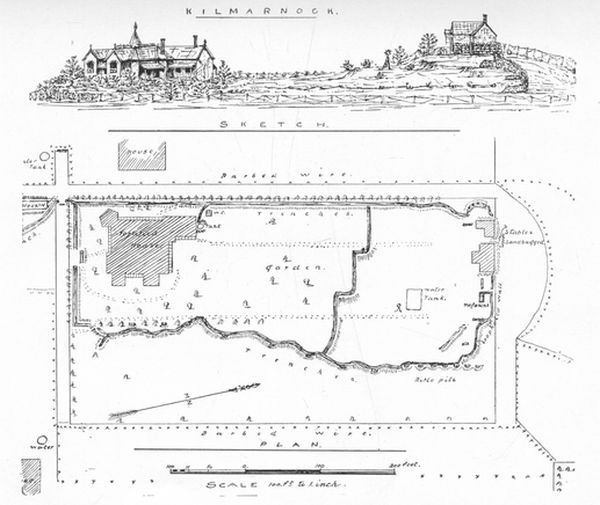
Kilmarnock.
From a sketch by Col. H. Tempest Hicks, C.B.
The 15th proved to be almost a repetition of the day before, the enemy
hanging persistently on the flanks and rear of the little column, but
showing no signs of any desire to make their closer acquaintance.
Indeed, that morning Colonel Hicks had prepared a small surprise for
them which fully realised his anticipations. Whenever columns were
moving about it was the invariable custom of the enemy to at once
occupy the vacated camping-ground in search of any odds-and-ends that
might have been left about, but more especially ammunition, which used
to drop out of our men's pouches in surprising quantities, in spite of
the most stringent orders on the subject. On this occasion the Colonel
left a small party in ambush when he moved off, with the result that
when half-a-dozen Boers began rummaging about in the camp they were
suddenly invited to hold their hands up, a request which
they had of necessity to comply with, one of them being a Field-Cornet
and a man of some local importance. A halt was made in sight of
Randfontein, on the slopes of which a column, under Colonel the Hon.
Ulick Roche, could be seen proceeding in the direction of Krugersdorp.
Next day was Dingaan's Day, and rumour stated that the Boers under De
la Rey, flushed with their victory over Clements, were going to attack
Krugersdorp.
The column marched the remaining fifteen miles by 2.30 p.m. next day
without seeing any sign of the enemy. During the six days they had
been away they had marched 102 miles, skirmished with the enemy nearly
every day, taken a strong position by a fine example of tactics,
captured a good many prisoners, and brought in a large quantity of
cattle, sheep, &c.: a very fine six days' work.
Since May 30th the headquarters of the battalion had marched well over
1200 miles. On three occasions it had exceeded thirty miles in
twenty-four hours—the record, of course, being the thirty-eight miles
in sixteen hours from Klerkskraal to Pochefstroom in September. But
the most wonderful part of its work was the strange immunity it
experienced from any of the determined attacks which were so
constantly being made on other columns. Whether it was good or bad
luck, good or bad scouting, whatever it was, the fact remained that
with the exception of the almost daily scrapping and sniping, which
constant use had made to appear as part of the day's work, no action
of any importance came our way in spite of the countless marches and
counter-marches we made to bring one on. With the solitary exception
of the afternoon at Frederickstadt, when the Boers dropped a few
shells into our camp, and the two following days, when General
Liebenburg paid a similar attention to the detachment left behind on
the hill, we had not been under shell-fire.
In the meantime, the disaster to General Clements at
Nooitgedacht had drawn all eyes to the state of Krugersdorp, which
with its small garrison seemed to offer a tempting bait to De la Rey,
and column after column arrived to assist in repelling the assault
which was threatened for Dingaan's Day. Before the reinforcements
arrived the General had taken every sort of precaution; amongst
others, arresting most of the principal inhabitants of the town, and
holding them as hostages. The festival, however, passed without
incident, and the tide of men and horses, guns and waggons, which had
reached a record height in the history of the town, soon began to ebb
once more, and then everything settled down to the quiet, peaceful
state of affairs which almost always characterised Krugersdorp. The
band played in the market square, and concerts were arranged in the
town hall, while the General set a fine example to his troops for
their guidance in his treatment of those of our late enemies who had
observed their oaths of neutrality, as a large number of them most
religiously did. Ever foremost in aggressive tactics in the field
until the enemy was overcome, the General adopted a policy of
conciliation at other times which undoubtedly had far-reaching effects
as regarded the conduct of the inhabitants of Krugersdorp.
On December 19th, 400 men of the regiment, under Major Bird, started
off to join the force under General French which was going to sweep
the Eastern Transvaal, very much on the same lines that the various
columns had been sweeping the Western Transvaal. Their special duty
was to act as a baggage-guard to the various mounted corps, a duty
which they shared with a battalion of Guards. Their lives for the next
two or three months were very much the same as they had been for the
previous two or three months, though they covered an even greater
number of miles, and, owing to the rains and thunderstorms of the
South African summer, experienced an even harder time. It is the
custom to speak in terms of high praise of the climate of South
Africa, but if the British Army had been consulted on the
subject after some of these treks, it is doubtful if their vocabulary
would have been large enough to enable them to thoroughly ventilate
their opinions. The fact is that the spring, summer, and autumn are
ruined by the desperate storms which are of such common occurrence at
those times of year. There are, it is true, four winter months of
glorious weather: fine, frosty, starlit nights, and clear days of
brilliant sunshine when the heat is never unpleasant. But of these
four months, two are completely ruined by the high winds which sweep
the broad veld, and which, in the vicinity of the mines, fill the air
with minute particles of gritty dust from the waste-heaps, penetrating
eyes and nostrils, throats and lungs.
The first portion of the trek was, however, spent in the country that
General Hart had been operating in. The following account of some of
their hardships and privations is given by Lieutenant and
Quartermaster Burke:—
With General Knox's Brigade in the sweeping movement by General
French on the eastern side of the Transvaal. Detail of a few orders as
showing the hardships the troops suffered through bad weather and
scarcity of food.
Brigade Orders. 'Witcomb, 8.2.01. Owing to the late arrival of the
convoy, the force will go on 2/3 biscuits.'
This all the time we were marching daily and fighting.
16.2.01. Our force reached Piet Retief.
Brigade Orders. '20.2.01. The following will be the scale of rations
until further orders:—2 ozs. rice, 4 ozs. jam, ½ lb. mealie meal,
1-½ lb. meat. No coffee, tea, biscuits, vegetables, or salt.'
Orders received from General French:—'Convoy under General
Burn-Murdoch is terribly delayed by swollen rivers and bad roads. The
Pongola is fifty yards and the Intombi 300 yards wide. You must use
your utmost resources to economise food, and so meet this unfortunate
state of affairs, which will assuredly last till the weather
improves. No forage for horses and mules. Send parties for food to
search out as far as ten miles. Kaffirs to receive 1l. in gold for a
bag of mealies, or a heifer for five bags.'
21, 22, 23.2.01. 1 oz. jam, ½ lb. mealie meal, 1-½ lb. meat,
nothing else.
24, 25. Same.
26. No jam, ½ lb. mealie meal, 1-½ lb. meat, nothing else. I paid
a shopkeeper at Piet Retief 2s. 6d. for a quarter-handful of salt.
Brigade Orders. 27.2.01. By General French: 'O.C. units will take
steps to let the troops know how highly their spirits and bearing
under the privations they are suffering from bad weather and short
rations are appreciated by the Lieutenant-General Commanding.'
27.2.01. Burnt mealie cobs issued for coffee.
Telegram from Lord Kitchener to General French, Piet Retief,
28.2.01:—'Explain to the troops under your command my admiration of
the excellent work they have performed, and the difficulties they have
overcome.'
8.3.01. Full rations, first issue since 14.2.01.
To show that the troops, besides suffering from frightful bad weather
(constant rain for a month), had to work hard, the following results
are shown.
General Orders. The following results of our operations since 27.1.01,
is published for officers and men:—
Boers, killed, wounded, and captured, 393; surrendered, 353. Total
accounted for, 746.
Cannon taken, excluding a maxim, 4.
Rifles, 606. Ammunition, 161,630.
Horses and mules, 6504. Trek oxen, 362.
Other cattle, 20,986. Sheep, 158,130.
Waggons and carts, 1604.
Mealies and oat hay, over 4,000,000 lbs.
H. Burke, Lt.
Colonel Hicks now set every one to work improving the various
posts round Krugersdorp, setting a fine example to all by the interest
he took in the work, and showing his thoroughness by the attention he
devoted to even the most trivial details. He also took infinite pains
to make Christmas as pleasant as he could for every one. The regiment
was, of course, very much split up in the various forts and fortified
houses, but headquarters still remained till the end of the year in
our old camping-ground.
On the very last day of the year an escort of forty men returning to
Krugersdorp had a near shave of being cut off; they lost four men
captured, and would assuredly have lost more but for the prompt action
of Major English, who went out from Kilmarnock with twenty men to help
them in.
So ended 1900. It had been a hard year for every one, but one and all
had done their best, and no sign of failing spirits was visible
anywhere. It was difficult to see anything like an end to the
campaign, however, for the process of attrition, which now seemed the
sole solution, was necessarily a slow one, and considerably interfered
with by the various 'regrettable incidents' that occurred from time to
time in the huge theatre of the war. These not only assisted our
indomitable foes with extra supplies of clothing, arms, ammunition,
&c., but also had the effect of keeping up their morale.
On January 4th, 1901, the 400 men under Major Bird passed through on
their way to Elandsfontein, but nobody knew about the move in time to
go up to the station and see them.
Large bodies of the enemy were now known to be in the neighbourhood,
and a spy came in saying that it was an open secret among the Boers
that Krugersdorp was De la Rey's objective as soon as a favourable
opportunity should present itself. In spite of this it was difficult
to make the danger of going beyond the outposts appreciated, and this
resulted in the death of one of our men, Private Hyland,
servant to one of the clergymen. It was supposed that the poor fellow
had gone out in a cape-cart with the object of getting some flowers
for the church; his body was found on the 8th simply riddled with
bullets, as was also that of the Cape-boy who had driven him.
On the 10th, Major Pilson, Royal Dublin Fusiliers, one of the first
officers selected to proceed to South Africa on special service before
the war, arrived—not, unfortunately, to join the regiment, but the
South African Constabulary.
On the 11th the enemy blew up the railway just beyond Roodeport, the
first station out of Krugersdorp on the way to Pochefstroom.
Lieutenant Marsh and twenty men of the regiment were sent out as
escort to guard the Engineers who repaired it.
The storms continued to be very severe. Kilmarnock House was struck by
lightning, and the sentry on guard at the Court House in the town sent
spinning, fortunately only receiving a severe shaking.
On the 23rd the sad news of the death of Her Majesty Queen Victoria
was made known to the troops, by whom it was received in deep and
impressive silence.
A salute was fired by the Artillery on the 24th with plugged shell, to
celebrate the Accession of King Edward VII.
At the end of the month General Hart left us. The regiment had been
continuously under his command since the formation of the Irish
Brigade; officers and men alike had learned to entertain a deep
respect and admiration for their General, than whom no braver man ever
went into action. He on his part loved the regiment, and fully
appreciated the esprit de corps which permeated it, from the Colonel
to the last-joined recruit. His farewell letter to Colonel Hicks,
another on the subject of our camping arrangements, and his farewell
order to his brigade, may all be found in the Appendix, and afford
proof of his regard for his troops and the spirit which he
breathed into them.
Colonel Groves took over command of Krugersdorp and its defences, and
gave Colonel Hicks a free hand: he also rode round the inner defences
with the commander of the town-guards and piquets, and arranged for
their being made stronger also.
In spite of the presence of a good many of our columns, the enemy was
very active all over the Magaliesberg and the Gatsrand at this time.
It will be remembered that on the return from the Klip River trek, a
party of the South Wales Borderers had been left to watch the
Modderfontein Pass.
This small force was now surrounded and being fiercely attacked, and
offering as determined a resistance. A force was hastily organized to
proceed to their relief, under command of Colonel the Hon. U. Roche,
of the South Wales Borderers. With half or more of the battalion away
under Major Bird, we could only supply 180 men, under command of
Captain Shewan, for this column.
They marched that night, and the following morning found all the hills
for ten miles held by the enemy, Colonel Roche wiring in that the
Boers were in too great force for his column to proceed. Indeed, the
column had to fight hard enough to maintain its position and to save
itself from being surrounded. General Conyngham, hastily gathering
together another 500 men and a battery, marched off to reinforce
Colonel Roche, but before they could get to the unfortunate post at
Modderfontein, it had fallen to superior numbers. The Boers, who were
under the command of General Smuts, sent in a flag of truce, giving
notice of the capture of the post, stating that there were many
British wounded, and suggesting that an ambulance and doctors should
be sent out to them. This incident was very hard lines on a most
gallant regiment, and in no way reflects adversely on them for one
instant. They defended their position splendidly as long as
defence was possible, and suffered greatly from want of water as well
as from the enemy's fire. Colonel Roche reported that Captain Shewan
and his men had done very well, and had held a hill on the left of his
position, until he recalled them.
Colonel Hicks never for a moment remitted his exertions in the
fortifying of the various posts and houses in the section of the
command for which he was responsible, with the result that he very
soon had them in a most efficient state. Ammunition, food, and water,
in sufficient quantities to withstand a regular siege, were stored in
each post, while the wire entanglements would have effectually
precluded any attempt on the part of the enemy to rush them. Indeed,
no precautions were omitted, and one began to enjoy one's sleep
considerably more than had been the case for some months past.
On the 7th, the headquarters of the regiment at last moved into
Kilmarnock, a house which had belonged to a Mr. Burger, a brother of
Mr. Schalk Burger, the acting President. Here they remained until the
regiment left for Aden in January 1902.[Back to Contents]
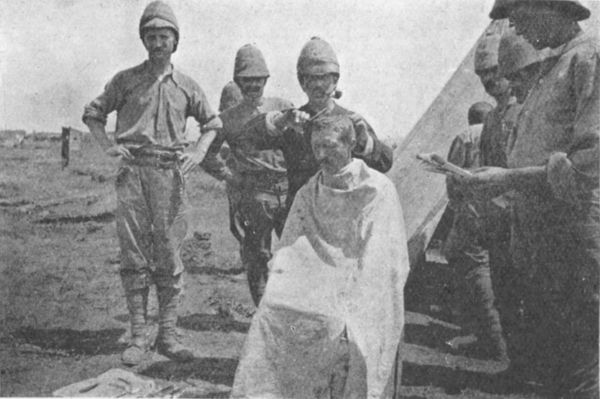
The Hairdresser's Shop.
CHAPTER VII.
THE LAST TWELVE MONTHS.
'In the morning thou shalt say, Would God it were even! and at
even thou shalt say, Would God it were morning!'—Deut. xxviii.
67.
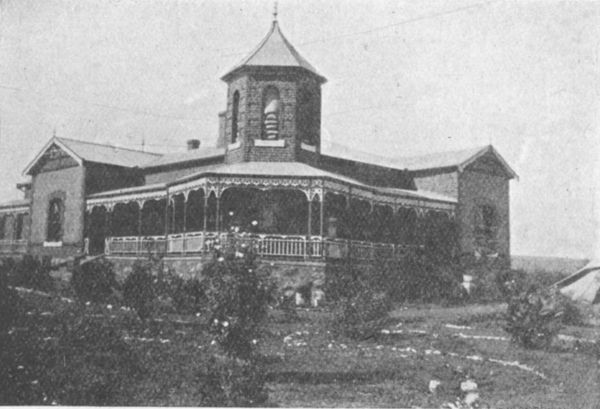
Kilmarnock, Krugersdorp.
With the occupation of Kilmarnock by the headquarters of the regiment
arrived the third and last phase of the war. It had begun with four
months' hard fighting, continued with twelve months' hard marching,
and was to end with twelve months of weary escorts to convoys,
occupation of blockhouses, and garrison work generally. It was,
perhaps, in its way, the most trying period of the three, for in
addition to unceasing vigilance there was added the dead monotony of
week after week in the same place, surrounded by the same faces, and
feeding on the same indifferent food. One was buoyed up by the reports
published from time to time of the hauls of prisoners made
by the various columns, but there was always some pessimist handy to
discount one's hopes, and even though the result proved their dismal
croakings more or less correct, they might have had the grace, even if
they had not the common sense, to keep their miserable opinions to
themselves. Thank goodness there were not many of these gentlemen in
the regiment. Throughout the war I only heard one man grumble sulkily,
and only heard of one man who paid too great a regard to the use of
cover. The high tone with which the war had been entered upon was
maintained to the very end, and if the regimental officer came out of
it with credit, the N.C.O. and private soldier did every bit as well.
Hardship, fatigue, stress of weather—everything was accepted as part
of the general day's work, and as such cheerfully met and thoroughly
done.
Lieutenants B. Maclear and J. P. B. Robinson joined about this time,
the former a brother of Percy Maclear, Adjutant of the 1st Battalion.
In spite of all the work, however, time was yet found for a certain
amount of play, the exercise of which was very beneficial. Cricket
matches were played against the town, the S.A.C., and amongst
ourselves, and later on football matches against the town and other
regiments. We proved more successful at the latter game than the
former: not to be wondered at, seeing that two of our
officers—Lieutenants Maclear and Newton—were later on to become
International three-quarter backs, the former playing for Ireland and
the latter for England.
Lieutenant Knox joined on March 23rd, having been detained nine months
through illness on the way up.
In March, Major-General Mildmay Willson, a Guardsman, took over from
Colonel Groves the command, which now became 'the District West of
Johannesburg.'
On April 17th, Major English proceeded to Bank in command of a small
mixed force (one hundred Royal Dublin Fusiliers) to try and
catch a Boer force who had been for some time hovering round that
station. He returned on the 19th, having seen no Boers.
On the 21st, Captain Watson, formerly in the regiment, came to see us.
He was then Adjutant of the Scottish Horse, and was shortly afterwards
killed at Moedwil. He had distinguished himself on many occasions, and
had received special promotion into the Lancashire Fusiliers.
On the 30th, Major Bird and his half-battalion at last got back. They
had done a lot of marching and good work in the Eastern Transvaal with
General French's columns, but had not had much fighting. They all
seemed glad to be back; it is always satisfactory to have the regiment
together, as we have a feeling of dependence on one another that one
cannot have when working with other troops, however good they may be.
On May 3rd Captain Kinsman, Royal Dublin Fusiliers, came to see the
battalion. He was then in the S.A.C. He had been badly wounded some
time ago, having been with the force under General Plumer since the
beginning of the war, and present at the relief of Mafeking, and had
seen a deal of fighting.
On May 7th Lieutenant Seymour joined the regiment, in which his father
had also served.
On May 25th a force[20] went out to escort the S.A.C. to a fort they
were to build. The column was under command of Colonel Hicks, and
almost immediately met with opposition, the Scottish Horse, on the
left, coming in for a good deal of sniping. Sending out his mounted
men well ahead, and occupying a ridge in front with the Worcesters,
the Colonel then rode on with Colonel Edwardes, S.A.C., to select a
spot for the erection of the work. The only casualties were two men
wounded and five horses killed, and the force then bivouacked on the
positions they held. Next day building was commenced on a
small fort and three blockhouses, the building parties being sniped
for some time until a detachment of the regiment under Captain
Fetherstonhaugh and Lieutenant Maclear went out and drove the Boers
away. By the 27th the fort and posts were nearly completed, the enemy
still hovering round the neighbourhood, and next day the column
returned to Krugersdorp, meeting and dispersing a few Boers on the way
back.
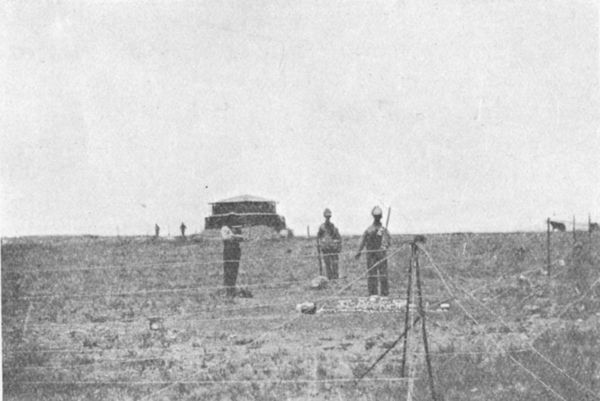
A Blockhouse.
On June 3rd Colonel Hicks took over command of the Krugersdorp
sub-district, as Colonel Groves was down with measles, as was also
Lieutenant Bradford—an extraordinary disease for a man of the
Colonel's time of life.
On the 15th of June Colonel Groves handed over the Krugersdorp
sub-district to Brigadier-General Barker, R.E. Before leaving he said
some very nice things about the regiment, and we on our part were
sorry to lose him, as he had always had a good opinion of the
battalion, and had assisted the Colonel in his endeavours to put
Krugersdorp in a thorough state of defence.
On the 27th Lieutenant Frankland, 2nd Royal Dublin Fusiliers,
came to see us. It will be remembered that he was taken prisoner at
the very beginning of the war in the armoured-train disaster. Since
the capture of Pretoria he had been occupied on the line of
communications. He told us that Lieutenant Le Mesurier had probably
never got over the exposure to which he was subjected during his
escape from Pretoria and on his long march to Delagoa Bay, as he no
sooner got over one attack of fever than he was down with another. He
also gave us an account of the escape, which was a most gallant
affair, and in the light of what has since happened to the only other
officers who escaped—Captain Haldane and Mr. Winston Churchill—it
seems hard luck that Le Mesurier should have received nothing. He
added that Lieutenant Grimshaw had been attached to the Mounted
Infantry since the relief, and that Captain Lonsdale had got into the
Staff College.
On July 1st two convoys went out, one under Major English and the
other under Captain Fetherstonhaugh, not returning until the 6th. The
remainder of the month brought forth nothing novel, however, and was
spent in strengthening posts and escorting convoys.
August also passed uneventfully, but on September 16th Colonel Hicks
was given command of a mixed force some 1000 strong, 170 of whom
belonged to the regiment, with orders to move along through the same
old Gatsrand country, visit posts, burn farms, collect cattle, &c.,
&c. He marched accordingly, but met with little opposition until well
inside the hilly country, where some sniping took place. After a
fortnight's trek he arrived in Pochefstroom, where he found General
Willson, who informed him that he was to succeed General Barker in
command of the Krugersdorp sub-district. He returned to that place on
the 30th, only to find a wire ordering him to go back for the present
to his column and to move to a place on the Vaal south of Pochefstroom
and turn out a Boer force which was occasioning considerable
trouble. Colonel Hicks by a rapid march anticipated the Boers at a
pass leading into this valley, their commander, George Hall,
afterwards declaring that this step saved us a hundred men, as he had
determined to hold the pass till the last.
On October 5th he encountered a force of Boers who were prepared to
dispute the ownership of some cattle with him, but he had little
difficulty in convincing them that under the circumstances might was
undoubtedly right. On the 6th the seven-pounder gun lost by the S.A.C.
was recovered, and George Hall, a prominent Boer leader, captured. The
Colonel induced him to send a letter out to his commando advising them
to give in, which resulted in twenty-two of them surrendering at
Pochefstroom a few days later. In addition to this the column captured
about fifteen prisoners and brought or sent in very large quantities
of stock, mealies, cattle, &c. The Colonel got back to Krugersdorp on
the 12th, having returned by train to take over his command.
Lieutenants Frankland and Weldon of ours were present at the fight at
Bakenlaagte, when Colonel Benson was killed, and had a hot time of it.
Our mounted infantry lost two killed and six wounded. The following
description is supplied by Lieutenant Weldon:—
The Royal Dublin Fusiliers Mounted Infantry at Bakenlaagte.
On the afternoon preceding the move from Zwakfontein, where Colonel
Benson's column was camped, I was ordered to escort Lieutenant Biggs,
R.E., to a drift some miles away on the road to Bakenlaagte: this we
accomplished, bringing back one prisoner, whom we took near the drift.
At daybreak on the following morning our outposts were attacked before
the column had moved out of camp, and the rearguard action commenced.
Our mounted infantry formed the right and left flank guards
to the light transport, the right under Lieutenant Grimshaw, and the
left under Lieutenants Frankland and Weldon. The enemy did not pay
much attention to us at first, but after going a little way I galloped
with my section to take possession of a small kopje which commanded
the route. The Boers made a simultaneous dash for it, resulting in a
spirited race, in which we proved victors, having been expedited on
the way by two 'belts' from our own pompom. On gaining the hill we at
once poured a heavy fire into our opponents, who withdrew. In the
meantime considerable difficulty was experienced in getting the
transport over the drift, which gave the Boers time to get round us.
Eventually, however, most of it was got across and the march resumed.
On nearing camp our mounted infantry closed in a bit, when we were
suddenly fired on from a farmhouse flying the Red Cross flag, and
sustained five or six casualties. We were detailed to a section of the
defence of Bakenlaagte, which was practically surrounded. We lay down
on the slopes with our heads downhill, and kept the enemy well away,
taking the opportunity to improvise some sort of head-cover whenever
their fire slackened. Although we fully expected an attack in the
night, or at dawn, none was made, there being no sign of the enemy
next day.
Kenneth Weldon.
On December 6th Captain Romer took over the appointment of C.S.O.,
Krugersdorp Sub-District, from our old friend, Captain Hart, who was
appointed to General Knox's staff. We were very sorry to lose him, as
from first to last he had done his best to oblige all, and during his
term of office made friends with everybody.
On the 9th Lieutenant Britton and fifty men of the regiment proceeded
to Middelvlei to relieve a party of the Border regiment.
On the 17th Lieutenant Robinson had to perform the
unpleasant duty of carrying out the sentence of death on a Boer
prisoner, who had been tried and condemned for shooting three of our
men after having surrendered.
General Cooper arrived on the 19th, to say good-bye to the regiment,
as he was on his way home. He brought the very welcome intelligence
that we were shortly to be relieved, but of course this was only made
known to the Colonel at the time.
Lieutenant Renny, who had been A.D.C. to General Cooper, rejoined on
the 27th, and brought further rumours to the effect that the regiment
was shortly to leave the country, and as orders had come to get in all
our employed men, and men from forts, blockhouses, and stations all
over the country, it began to look as if there was some truth in the
rumours.
On the very last day of 1901 a severe thunderstorm passed right over
headquarters, two of our men being struck by lightning.
1902.
On the first day of the New Year the order for the battalion to leave
South Africa arrived at the brigade office, its destination being
Gibraltar, the best of the Mediterranean stations; but next day a wire
arrived cancelling the move.
On the 5th, however, Lord Kitchener passed through Krugersdorp, when
the Colonel saw him and ascertained that the regiment was to go to
Aden.
At 8.30 p.m. on the 11th, part of the 1st Battalion Royal Dublin
Fusiliers, under Majors Shadforth and Gordon, Captains Swift and
Maclear, and Lieutenant Le Mesurier, with some other officers, arrived
to take over the defences from the 2nd Battalion.
On the 14th, 300 of the 1st Battalion, under Major Gordon, proceeded
down the Pochefstroom line to take over the posts at present held by
us.
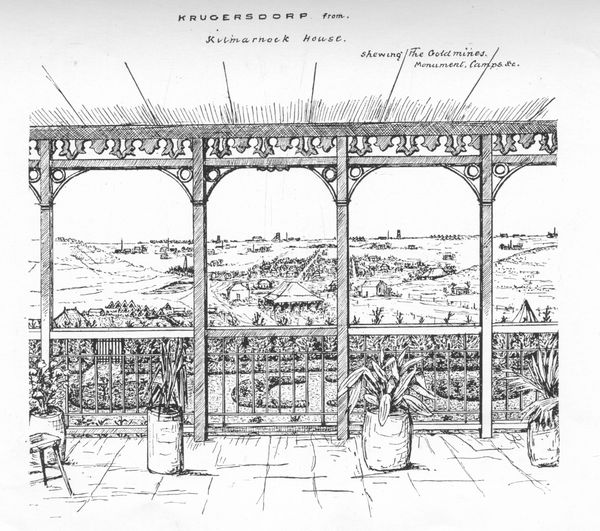
KRUGERSDORP from Kilmarnock House.
Shewing the Gold
mines Monument, Camps &c.
From a sketch by Col. H. Tempest Hicks,
C.B.
On the 20th, Captains Kinsman and Rowlands (now serving in
the S.A.C.) arrived to say good-bye, and on the 23rd, Colonel Mills
and Major Bromilow, 1st Battalion, arrived.
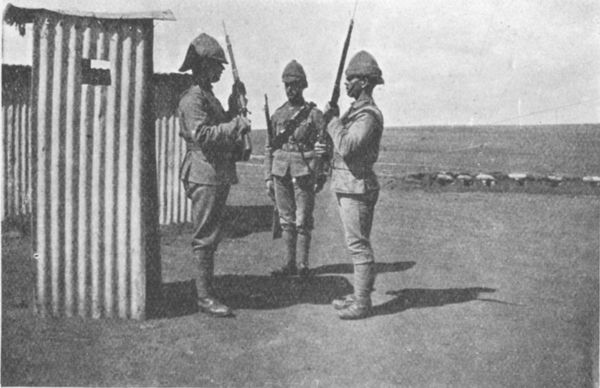
The 'Blue Caps' relieving the 'Old Toughs.'
On January 26th the regiment fell in for the last time at Kilmarnock,
and marched through Krugersdorp to the station. They had made many
friends during their stay, and the entire town, Boers as well as
Britons, turned out and enthusiastically cheered the corps as it
marched out of the town it had first marched into on June 19th, 1900.
The night was spent at the railway station, and a start made at 4 a.m.
on the 27th. A good view of Talana, from a distance of about five
miles, was obtained on the morning of the 28th, and it may easily be
imagined with what mixed feelings our thoughts flew back to that grey
morning of October 20th, 1899, and our well-loved comrades who had
given their lives to gain that gallant victory. Ladysmith was reached
about 1 p.m., and Maritzburg in the small hours of the 29th, which was
unfortunate, as the regiment had so many friends there. In
spite of the hour, however, a large number of the inhabitants were on
the platform with various small presents of cigarettes, &c., for the
men. Durban was reached a few hours later, when an illuminated address
was presented to the regiment, as well as refreshments to officers and
men, after which the battalion embarked on board the S.S. Sicilian
for conveyance to Aden.[Back to Contents]