One of the fairest paintings of Nature was at
that point among the mountains of the
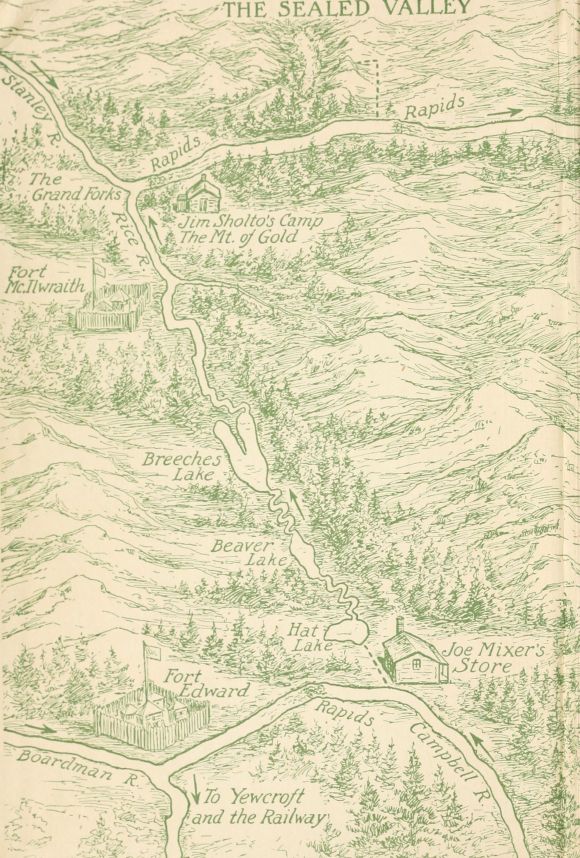
Canadian province of Cariboo where the Campbell
River takes the Boardman to its bosom and swings south
on its pilgrimage to the Pacific. Like all of Nature's
more dramatic compositions, by reason of its very
effectiveness, it was predestined to be smudged by a town,
and the collection of shacks and tents known as Fort
Edward was already begun. It was conceded that Fort
Edward was bound to be a great city when the new
transcontinental passed through. To be sure, railhead
was still beyond the mountains, a matter of two or three
years' construction, but the noise of the town's
greatness-to-be had been industriously drummed up by
real-estate operators outside, and many optimists had
struggled up the three hundred miles of the Campbell Valley
from the existing railway to be on hand in plenty of
time.
On a day in June of the year when the "rush" began,
the settlement looked sodden and raw after much rain.
The two prevailing styles of dwellings were wet "A"
tents with projecting, rusty stovepipes and new pine
shacks of a crass yellow, having roofs of tar paper studded
with tin-headed tacks as big as half dollars. A single
two-story building loomed up in the middle like a
packing-case among soap-boxes. This was the Fort Edward
Hotel, better known as Maroney's. The other habitations
reached out on either hand in an irregular double row.
The space within the double row was going to be "the
main artery of traffic" some day, but where the
optimists (and the real-estate operators) fondly foresaw
automobiles and trolley cars rolling up and down, at
present there was nothing but a parade of jagged
stumps among which muddy paths threaded their
devious ways. Below the hotel a tiny stern-wheeler of
quaint, lubberly design lay with her nose tucked in the
mud of the river bank. At eleven in the morning there
were few humans in sight, because the black flies were
in murderous fettle, and anyway, the principal industry
of the place was—waiting for the railway.
One had only to raise one's eyes to receive a quite
different impression of the scene. Where man's work
looked sodden, Nature's was deliciously refreshed. The
world wore that honest look it shows after rain before
the sun comes out, that calm openness under the pure
light that casts no shadows. The pine-clad mountains
loomed near and clean and dark. The cloud wrack
pressed down close upon their heads, giving the valley
the confined and intimate look of a room. There were
already rents in the ceiling, revealing a tender blue
back-cloth. The air was as sweet in the nostrils as
spring water in a parched throat.
Farthest from the hotel on the Campbell River side
was a shack more of the dimensions of a chicken house
than a residence for humans. Beside the door was
nailed a little sign obviously painted by an unprofessional
hand, reading, "Ralph Cowdray, M.D." Within,
in the first of the two closets the shack comprised, sat
the doctor and his friend Dan Reach, the telegraph
operator, the first with his heels cocked on the packing-case
that served him for a desk, the other with his lower
extremities supported by the window-sill. From each
ascended a column of smoke. The only other furniture
of the room was a little stand of pine shelves in the
corner bearing the doctor's slender library and
pharmaceutical stock, books and bottles as new as the doctor's
office and the doctor himself.
The two men mustered forty-nine years between them,
with the odd year on the telegrapher's side. The doctor
was a youth of middle height with a strong, well-knit
frame, and a comely head broadest over the ears, with a
luxuriant thatch of dark brown. His face was strongly
moulded, almost too heavy in its lines for his years, but
oddly redeemed by a pair of dreamy brown eyes. There
was an interesting contradiction here: nose, mouth,
chin, suggested a commendable hardihood, an honest
obstinacy, while the eyes seemed to see through and
beyond what they were turned on. Like all resolute
young men, Ralph regarded the softer side of his
character as a weakness and hid it close. Like other young
men again, he paid his way through the world with the
small change of a facetious manner, which reduces
them all to a common, comfortable level.
Ralph and Dan killed time with endless, jocular
quarrelling. Their dependence on each other's society
in this dull little settlement had brought about an
unusual degree of intimacy in a few weeks. In other
words, they were almost honest with each other. At
present Ralph's facetious manner only half concealed
a very real grievance against life.
"Romance is extinct, like the dodo," he announced.
Dan was a tall, lean young man, inclining to the
saturnine type. "That requires examination," he said
judicially. "First, define Romance."
"Romance," said Ralph, throwing back his head and
puffing a tall column of smoke toward the ceiling—the
dreaminess of his eyes had full sway at that
moment—"Romance is every man's unrealized desire."
"You contradict yourself," said Dan with provoking
exactness. "How can a thing be dead which was never
realized?"
The question was awkward, so Ralph serenely ignored
it. "Ever since I went into long trousers I've been
looking for it," he went on lightly. "Nothing doing!"
"Maybe that's the trouble," suggested Dan; "maybe
Romance begins at home."
"Did you ever find it?" challenged Ralph.
"Never looked," returned Dan calmly.
"Oh, you've no imagination!"
Dan chuckled. "According to that, Romance is only
imaginary, then. Got you again, Doc!"
Naturally these discussions never arrived anywhere.
When one was stumped for an answer he hit out on a
new line. The thing was to keep the ball in play by any
device until the next meal created a diversion.
"I thought college would be romantic," Ralph went
on. "I had fun of course, bully fun, but just the
ordinary college fun. There were girls, plenty of 'em,
dear little things! transparent as window-glass. Gad! a
man longs to meet a woman who can fascinate him,
and stir him to the bottom, and keep him guessing!"
"Well, let me see what we've got in Fort Edward," said
Dan. "To begin with, there's Biddy Maroney——"
"Cut it out!" cried Ralph. "Fatal to thoughts of
Romance! After college there was the medical school
and the hospitals," he went on. "They knocked the
spots out of Romance. Say, a city doctor loses faith
in his fellowmen. I decided I'd hang out my shingle in
the woods, and I came up here because it was the
beyondest place I could hear of."
"Thinking you'd surely find Romance somewhere
back of beyond," suggested Dan.
"Sure! The noble red man, you understand; the
glittering-eyed prospector lusting for gold; the sturdy
pioneer hewing a home for his brood in the
wilderness—and all that! Well, here I am, and what is it?—a
village of poor suckers done up brown, like myself, by the
real-estate sharks outside!"
"Striking metaphor!" murmured Dan.
"Everybody sitting on their tails expecting to be rich
any day by the grace of God!" Ralph went on. "And
Indians! swillers of beer-dregs! Town scavengers!
Moreover, it's the healthiest place on earth, I believe.
I never get a case but a scalp wound or two after a big
night at Maroney's. As for Romance, she's as far
away as ever! And I'm getting on!"
"True," said Dan, with a serious wag of the head,
"you've no time to lose!"
As a matter of fact, Ralph's youthfulness was a sore
subject with him, as it is with all young doctors.
He let the dig pass unnoticed. "I've almost given
up hope," he said.
There was a knock at the door.
"Here she is now," said Dan dryly.
"Come in," said Ralph indifferently.
It was a woman, but only an Indian woman dressed
in a ridiculous travesty of white women's clothes.
The two young men lowered their feet, and exchanged
a humorous glance. After an idle look, Ralph's
regard returned to his pipe. To tell the truth, he had
found the Indians around Fort Edward as patients
neither profitable nor grateful, and he could not be
expected to welcome a new one with any enthusiasm.
Dan was the more impressed; he studied the girl with a
kind of wonder, and from her looked curiously at his
friend.
"I want to see the doctor," she said, in a soft and
agreeable voice.
"What can I do for you?" asked Ralph, off-hand.
She did not answer immediately, and he looked at her
again. Her eyes were bent on Dan, unmistakably
conveying a polite hint. Dan saw it and rose.
"See you at Maroney's at dinner," he said, passing
out with a backward glance at his friend; teasing, a
little wondering still, and frankly envious.
"Well?" said Ralph, looking his caller over with a
professional eye. She seemed healthy. For an Indian
she was very good-looking, but this fact reached him
only by degrees. Her clothes were deplorable: a flat red
hat with a pert frill balanced crazily on her glossy hair;
a curiously tortured blue satin waist; a full woollen
skirt hanging on her like an ill-made bag, and cheap,
new, misshapen shoes. The effect was as if some wag
had draped a classic statue in a low comedy make-up.
Naturally Ralph received his first impression from the
make-up.
In answer to his measuring glance she said: "I not
sick. I come to get you for my mot'er."
Ralph reached for his hat.
"Wait a minute," she said. "We must talk before."
"Sit down," said Ralph.
She shook her head. "I stand," she said coolly.
There was a pause while she studied him with grave,
troubled eyes. "You ver' yo'ng to be a doctor," she
remarked at length.
Ralph frowned in an elderly way, and bit his lip.
"Are you a good doctor?" she asked.
He laughed in his annoyance. "What am I to say
to that?"
His laughter disconcerted her. "I mean a college
doctor," she said sulkily.
"McGill, Bellevue," said Ralph.
"I don't know those," she said. "Have you any
writings?"
Ralph stared at her. "What a question from an
Indian!" he thought. He began to be aware that he
was dealing with a distinct individuality, and for the
first he perceived the classic beauties obscured by the
grotesque outer semblance. The anatomist in him
judged and approved the admirable flowing lines of her
body, and the lover of beauty thrilled. One of her
greatest beauties was in the graceful poise of her head
on her neck. Indian women commonly have no necks
to speak of. His gaze rose to her eyes and lost itself
for a moment. All the Indians he had seen hitherto
had hard, flat, shallow eyes; hers had depth and purpose
and feeling. "Extraordinarily beautiful eyes!" he
thought, with the start of a discoverer.
His good humor restored, he showed her his diplomas,
following the script with a forefinger, and reading
aloud.
"I can read," she said calmly.
Ralph felt rebuked.
"But that is fonny printing," she confessed.
Her next question surprised him afresh. "Can you
cut?"
"Cut?" echoed Ralph, gaping a little. "You mean
surgery? Yes."
"My mot'er, she break her arm," the girl explained.
"I set it myself. I know that. After that I have to go
away. She take off the—what do you call the
sticks—?" She illustrated.
"Splints," put in Ralph.
"Yes, she take off the splints too soon, and try to
work, and when I come home her arm is all crooked.
All the time it grows more crookeder. She is so scare'
she is sick. Can you fix it?" she asked anxiously.
"Surely!" said Ralph. "The arm must be broken
again and reset."
"Broken again?" the girl said, with an alarmed look.
"That hurt her bad. She not let you do that, I think.
Can you put her to sleep?"
"Anæsthetic? Certainly!" said Ralph. "Where did
you learn about anæsthetics?" he asked curiously.
"I have work in Prince George and Winnipeg three
years," she said. "I know about a hospital."
"I'll come and take a look at your mother," Ralph
said. In his manner there was still something of a
doctor's condescension to an humble patient. "Where
do you live?"
She paused before replying, and looked at him with a
certain apprehensiveness. "North," she said slowly.
"Seven days' journey from Gisborne portage."
He was effectually startled out of his superior attitude.
"Seven days!" he cried. "How on earth do you expect
me to do that!"
"I take you in my canoe," she said. "You back
here three weeks or one month."
When he recovered from his first surprise the comic
aspect of it struck him: to travel a month to see one sick
Indian! "Well, I'm——" he began, but the look in
her eyes arrested the participle. "A month!" he cried.
She was sensitive to ridicule; a proud, sullen look
came over her face. "I pay you," she said quickly.
"I pay what you want."
Ralph laughed indulgently. "I'm afraid you don't
realize what it's worth," he said. "A month of a
doctor's time! It would be cheap at three hundred
dollars."
"I don't want you cheap," she said, with the air of a
princess. "I pay more."
Ralph looked at the absurd hat she wore, and struggled
with his laughter. She was beautiful, she was
amazing, but she was comic. "What am I up against?"
he thought. Aloud, he said in a friendly way: "It's a
lot of money. Tell me something about yourself and
your people. What is your name? Where will you
get so much money?"
But his laughter had angered her; her face expressed
only a sullen blank. She did not answer.
"What is your name?" Ralph repeated. "You must
answer my questions, you know."
"I tell you what I like," she said scornfully.
Ralph was irritated. "Do you expect me to start
on a wild-goose chase into the wilderness without
knowing what I'm letting myself in for?" he said sharply.
"I pay you before you go," she said, with her princess
air.
It did not help to soothe him. "Hang the pay!" he
cried. "I'm not for sale. I don't go in for a thing
unless I'm satisfied it's straight!"
She was not in the least intimidated by his raised
voice. "You only got to do doctor's work," she said
coldly.
Ralph stared at her, confused and nonplussed by the
variety of emotions she excited in him. Her beauty
aroused him, her indifference piqued him, and her
inscrutability provoked his curiosity to the highest
degree. Obstinacy in another always had the effect of
awakening the same quality in Ralph. He said coldly:
"It sounds queer to me. I'm not interested."
Clearly she still clung to the idea that it was a question
of payment with him. His glances of scornful amusement
at her clothes had not escaped her woman's perceptions.
"You think I poor," she said. "You think I got
nothing. I got plenty."
"I don't care what you've got," said Ralph. "Deal
with me openly, and I'll meet you halfway."
Her hand went to the bosom of her dress and closed
around something that was hidden there. "If I show
you something, you promise not to tell?" she said, with
sudden earnestness. "You shake hands and promise
not to tell?"
More mystery! Curiosity waxed great in Ralph's
breast and struggled with his irritation. "Hang these
people!" he thought. "You never can tell what they're
up to!" To her he said unwillingly: "If it's straight
I promise not to tell."
"It is straight," she said proudly.
They shook hands on it. She drew a little bag of
moosehide from her dress, and untied the thong that
bound its mouth. Attentively watching Ralph's face
to observe the effect on him, she suddenly turned the
bag upside down over his desk, and a little flood of
coarse yellow sand poured out upon it with a soft
swish. There could be no mistaking the cleanness
and the shine of it.
Ralph sprang up. "Gold!" he cried, amazed.
"It is yours," she said, with a little smile. "I give
you more if you make my mot'er's arm straight."
"Where did you get it?" Ralph asked sharply.
"I dig it myself," she said. "Do you think I steal it?"
Ralph continued to stare at the yellow stuff as if it
had hypnotized him.
"Better put it away," suggested the girl. "Somebody
come, maybe. To see gold make white men
crazy."
He swept it up handful by handful, and poured it
back into the little bag. There was a magic in the feel
of the bright, sharp grains and in the extraordinary
weight of it that caused a red flag to be run up in his
cheeks, and his eyes to shine. He judged from the
weight of the little bag that he had in his hand already
double the fee he had asked.
By and by she said: "You come now?"
Ralph frowned. "What do you want to make such
a mystery of the trip for?"
"I could lie to you if I want," she said, "and you
not know."
Ralph's eyes were compelled to acknowledge the
truth of this.
She paused with a little frown as if she had matter
to convey that was difficult to put into speech. "I not
tell you all my things," she went on slowly, "because I
not know you ver' moch. By and by I tell you what
I can."
He looked at her in silent astonishment. What
extraordinary delicacy to find in a common Indian girl!
As he gazed at her he abandoned that conception of her
for good and all. Whatever she might be it was not
common. The sullenness evoked by his laughter had
passed, and her eyes now met his squarely. Pride and
wistfulness contended in their dark depths. Whatever
the colour of her skin they were the eyes of a woman
with a soul. What he read in them caused his heart to
quicken its beats. He made note of other beauties in
passing: the lovely tempting curve of her cheek, and
how the colour came and went in it; her lips fresh and
crimson as rose-leaves.
"You have white blood," he said suddenly.
She shrugged.
"At least you can tell me your name," he said.
"Annie Crossfox," she said unhesitatingly. "White
people say Annie; my people, Nahnya."
A slight constraint fell upon them. They were silent.
Ralph's attitude toward the proposed journey was
rapidly changing. To give him credit, it was her eyes more
than the gold that worked the change. How could
he have failed to be instantly struck by her beauty,
he thought.
"You will come?" she murmured at length.
"When do you want to start?" he said.
"The steamboat go up to Gisborne after dinner
to-morrow," she said. "We walk across Gisborne portage
six miles to Hat Lake. There my boat is cached."
"What can I tell these people here?" said Ralph.
"I can't just disappear."
"Tell them you take the chance of the boat going up,
to see a little of the country. Everybody do that
sometimes."
To "see the country" beyond was Ralph's dearest
desire; to float down its rivers, to climb its mountains,
to camp under its stars. And to travel seven days in a
canoe with her! The Spirit of Youth rose in its might
and dealt old Prudence a finishing blow.
"All right!" cried Ralph. "I'll come!"
"Thank you," she said quietly.
Somewhat to his disappointment she showed no elation;
indeed, no sooner had she won him to go than she
looked at him with a new question in her eyes, with a
painful and hesitating air.
"What's the matter?" said Ralph.
"You promise me you never tell where you been?" she
said deprecatingly. "You promise me when you come
back you never tell anybody what you see at my place?"
All Ralph's doubts came thronging back. "No!" he
said frowning. "I can't do that! I've got to be free
to use my own judgment!"
There was a pause while their individualities
contended in silence. Ralph pushed the moosehide bag
impatiently toward her. On this occasion he was the
stronger. She lowered her eyes.
"You still think there is something crooked?" she
murmured.
"How do I know?" said Ralph harshly. "I don't
know anything about you!"
She abruptly turned her back on him. Her hands
lifted and dropped in an odd, unconscious gesture. "I
don' know w'at to do!" she whispered, more to herself
than to him. The husky sound was charged with pain.
"I come so far to get a doctor for my mot'er! But I
cannot tell you!"
Ralph darted around the desk, and forced her to look
at him. The dark eyes were soft and large with unshed
tears. Beauty in distress is mighty to achieve.
Moreover, Youth and Adventure and Romance were all on
her side. Ralph melted like snow before a fire.
"Here! it's all right!" he said gruffly. "I'll come. If
it's straight I promise not to tell!"
They shook hands on it, and Nahnya wiped her eyes
apologetically.
They fell to discussing their arrangements.
"Get on the steamboat after dinner to-morrow," she
said. "When you see me make out you don' know me
at all. At Gisborne I will tell you what to do. Bring
only blankets. I have a mosquito tent for you. I
have plenty grub and everything."
Ralph passed the little moosehide bag to her.
She quickly put her hands behind her. "You must
take it," she said. "I not want you work for nothing."
"I have taken it, see?" said Ralph, with a smile.
"Now I pay it back to you for taking me on a trip.
I've only been waiting for the chance to make a trip."
Once more their eyes met and contended, and again
Ralph prevailed. She took the bag of gold-dust and
put it back within her dress.
When she went, and Ralph was left alone in his tiny
office, he sat down and endeavoured to put his thoughts
in order. Straightway the soberer half of him asserted
its rights, and half persuaded him that what had
happened during the last hour was no more than a dream.
It was too fantastic, too preposterous, for a matter-of-fact
person to credit for a moment. That such a thing
should happen to him, Ralph Cowdray, the patientless
medico! But he looked down at his desk, and there in
the cracks of the boards were lodged several shining
yellow grains. The matter-of-fact Ralph retired
defeated, and the dreamy Ralph had full sway.
"Gad! what eyes!" he thought. "She can't be more
than twenty-one or so, and she looks as if she had
sounded all the depths of life!"
The sight of his watch finally reminded Ralph of
dinner. Dinner brought Dan to mind, and the thought
of Dan recalled the subject of their jocular argument
which Nahnya had interrupted. Ralph fell back in his
chair amazed and dreamy.
"Romance!" he thought. "It did come in the door
with her!"
Next day Ralph's preparations for the journey
consisted in throwing a change of clothes and
a few necessaries into a canvas dunnage bag,
rolling the bag inside the blankets from his bed, hoisting
the bundle on his shoulder, and locking the door of his
shack behind him. No one had been unduly surprised
by his announcement that he was going up on the
steamboat to have a look at the country. In the
unconventional North a man's time is his own, and taking a trip
is the best way to while it, and one day is as good as
another to start on.
Even Dan Keach, knowing how bored Ralph had
been, was unsuspicious of the sudden resolution. Dan
was envious. "I wish to heaven I was going!" he said.
Ralph, knowing that Dan was firmly tied to his telegraph
key, felt safe in echoing his wish. Ralph's breast
was warmed by a delicious secret excitement. "If they
knew!" he thought.
The captain of the steamboat, Wes' Trickett, a
rakish, lubberly, fresh-water sailor, like his boat,
likewise dined at Maroney's, and after dessert the company
adjourned to the river bank, and sat about on piles of
lumber to witness the departure. There was no haste
about that. Agreeable gossip and humorous anecdote
mingled with tobacco smoke. When conversation
flagged, Wes' would say regretfully: "Wal, time to
pull out, boys!" Whereupon some one would suggest
a last touch at Maroney's bar, and the company would
rise as a man with the same expression of deprecatory
anticipation. Wes', since he supplied the excuse for
the gathering, did not feel that it was incumbent on
him to pay for anything.
The Tewksbury L. Swett lay at their feet, with steam
up. Like the land buildings at Fort Edward, her
architecture was of a casual and strictly utilitarian style.
To paraphrase the description of a more famous vessel,
she looked like a shoe-box on a shingle, with the
addition atop the shoe-box of a lean-to pilot-house with
nothing to lean to, and an attenuated smokestack.
The stack was made of many lengths of kitchen
stovepipe braced all round with a network of wires, which
did not, however, quite smooth out the kinks in the
joints. The whole thing had a decided inclination to
the nor'east, but Wes' opined that it would do all right
till it fell down.
Ralph had not seen his mysterious visitor since she
had left his office. Loitering among the others on the
bank, he was reassured by a glimpse of her sitting in a
dark corner within the deckhouse, her back turned to
the shore. To Ralph's secret relief, Dan did not
remark her there. Dan had an awkward faculty of
putting two and two together, and a caustic sense of
humour.
Many of the old stories of the country were recounted
for the benefit of the newcomers. "Ever hear tell of
Tom Sadler?" said Captain Wes'. "Tom was the first
white man who ever come up the Campbell Valley.
Campbell hisself, when he discovered it, he only went
downstream. It was mor'n fifty year ago, before the
first Cariboo gold strike. In them days the city of
Kimowin was no bigger than Fort Edward here. Tom
Sadler was one of these here now rovin' fellers that can't
rest easy among their own kind. He roved off up the
Campbell Valley and was gone a whole year. The next
summer he come back down the river, and capsized in
the rapids just above Kimowin. They saw him from
the settlement and pulled him out of the water more
dead than alive. A living skellington he was at that.
His canoe and his stuff was nachelly seen no more.
"Well, he hung on for a couple of days, and then he up
and chivvied out. But that ain't the end of the story.
The story is about what he told when he was out of his
head. Nobody believed what he said, but they tell it
to this day for a good story. He went on all about a
purty little valley he found in the mountains. All
around it was high cliffs that you couldn't get up or
down like the sides of a bowl-like. Bowl of the
Mountains was what Tom called it. He said the only way
you could get in or out was through a long cave under
the mountains. A bear that he was after showed him
the way in, or he never wouldn't have found it, being
the mouth was all hid behind bushes and all.
"Well, sirs, they say he said that little valley was
as beautiful as Paradise; but that wa'n't all. In the
middle of it were a little lake, different-coloured water
from any on earth, green as a bottle-like, good water,
too. Little streams come down from the mountains
all around, and flowed through meadows of flowers
into that lake, and Tom said the banks of all those little
streams was yellow with gold, yellow with gold, sirs!
Tom said he stayed there six months and washed two
hundred pound of it. Them beside his bed laughed,
him having nothing to show. If he'd been content
with a hundred pounds, now, 'twould have sounded
more reasonable. Well, they on'y laughed at Tom and
buried him. And it's got to be a saying-like 'round
Kimowin when a feller gets a bee in his bonnet, 'Oh
he's found Bowl of the Mountains!' they say. But
I ain't so sure there ain't something in it. I seen
Tom's grave in the cemetery at Kimowin: 'Thomas
Sadler, who bit July 9th, 1861.' I seen it myself
carved on the stone. That ain't no hearsay."
Finally about three o'clock, nobody else being
disposed to "buy," although Wes' provided several
good openings, the captain and the passengers made
their final farewells and went aboard. The little
Tewksbury backed out of the mud, and turned her
nose upstream, with a heave and a snort at every
stroke of the piston, and a great kick-up astern. The
little group on the shore adjourned again to Maroney's
for something to pick them up against the flat feeling
that oppresses those who are left behind.
On board the Tewksbury the white men gathered
on the forward deck around the capstan, and
continued their talk. There was Wes' Trickett, and
Matthews, his engineer; Joe Mixer and Pete Staley,
who were taking up an outfit to Gisborne portage to
start a store, and Ralph. Meanwhile, the half-breed
crew ran the boat. The warmth of the sun, the
peace of the river, and the late potations at Maroney's
joined to produce a lulling effect on the group.
Conversation became fitful. Joe Mixer fell asleep with
his back against the capstan.
The Tewksbury was not exactly a river greyhound;
six miles an hour was her rate, and since the current
ran four, her net progress upstream was about two.
On the bends of the river, where the deep water ran
swiftly under the bank on the wide side of the arc, it
was nip and tuck between the little Tewksbury and
the river. No one on board expressed any impatience.
"You got to go either forward or back," said Wes'
philosophically, "and if you ain't goin' back you're
bound to arrive some time."
"Let her puff," said Pete Staley comfortably.
"'Tain't comin' out of our lungs."
Ralph was happy. The weight of weeks of boredom
was lifted from his breast. After all, life was
a sporting affair. He never tired of watching the
moving brown flood spotted with foam, endlessly
and serenely opposing their progress, ever yielding
under the vessel's forefoot, without giving back.
From the water he lifted his eyes to the clean,
pine-clad hills, insolently planting themselves in the path
of the river, and forcing it to go around. The
afternoon sun was lavishly gilding the southerly slopes.
Overhead the sky was an inverted bowl of palest
turquoise. Ralph naturally kept these poetic
comparisons to himself. Wes' Trickett, Matthews, Mixer,
and Staley were a hard-headed, scornful,
tobacco-chewing quartet.
The deckhouse was a rough shanty with a wide
sliding door at each side, and one in front. From
where he sat near the capstan Ralph could see Nahnya
within, sitting on a box by one of the side doors with
her hands in her lap, and her eyes bent on the river.
Her quiet and self-contained air stimulated his
curiosity. He wondered what she was thinking about.
The fact that she had forbidden him to approach her
on the boat kept his desire to do so ever fresh. He
cast around in his mind for some way to get around her
prohibition. She had removed the ridiculous hat to
her lap, and her bare head bound round with a thick,
black braid of hair was wholly beautiful and graceful
against the light.
"Where did she get that proud look from?" thought
Ralph. "All she needs is a diadem and an ermine
cloak."
Ralph was not the only man on board who had
remarked the handsome passenger. By and by Joe
Mixer woke up, and blinked at her sidewise from
between his thick lids.
"Good-looking gal, Joe," said Pete Staley.
Joe grunted by way of affirmation.
Joe Mixer was a well-known character up and down
the Campbell. Outside he had been a butcher, they
said, and had come North owing to an unpleasantness
following upon his attempt to carve a piece of human
meat. He was a factor in the little community of the
river by reason of his bulk and the noise he made,
but privately he was not regarded with much affection.
In a rough, new society much is condoned through
the fear of being thought self-righteous. The first
commandment of the frontier is: Thou shalt not
appear any better than thy neighbour. Hence Joe
was accepted for one of the crowd, while stories were
circulated behind his back of lingering butchering
tendencies, of a dog he had tortured, of a native
woman who had sought safety from him through a
priest.
"Who is she?" asked Staley.
"Darned if I know," said Wes'. "She ain't any
of the Cheval Noir crowd, that's sure, or from
Campbell Lake neither. Says she's goin' to your dump at
Gisborne."
"She come down the river on a little raft early
yesterday morning," said Matthews, the engineer. "Five
o'clock it was, I guess. I come out on deck to take a
look at the sky, and I seen her landing below Thomson's
store there. Thinking nobody saw her, she pushed
the raft off in the current."
"They're a sly lot," said Staley. "A white man
never can tell what they're up to."
They continued to discuss Nahnya with a freedom
that caused Ralph to grind his teeth. To avoid
arousing their suspicions he was obliged to keep a smooth
face, and to enter into the discussion. Up to this
time Ralph had thought of these four as "good enough
heads" and had drunk with them at Maroney's like
everybody else. Now they suddenly seemed like
foul-mouthed satyrs that a man ought to knock down
one by one for decency's sake. They were not as
bad as all that, of course; the change was in Ralph,
not in them.
Finally Joe said with what seemed to Ralph an
egregious display of male vanity: "I can handle
them. I'll find out who she is."
He went inside the deckhouse with a propitiatory
leer on his fat red face that caused Ralph's gorge to
rise. Ralph sat on pins and needles watching out of
the corners of his eyes, and straining his ears in vain
to hear what was said.
The conversation was like all such conversations.
"Hello, dearie!" said Joe.
The girl turned a bland, blank face toward him.
"Hello," she said.
Joe pulled up another box and sat down. "Thought
you might be lonely all by yourself," he said agreeably.
"I like be by myself me," she said, affecting a naïve
simplicity of speech and manner.
Joe glanced at her sharply. Her eyes were modestly
cast down. He decided that she meant no offence,
and went on:
"What's your name, girly?"
"Mary Black, please."
"Where do you live when you're home?"
"McIlwraith Lake. My fat'er him Scarface Jack
Black. Him very good hunter."
Her air of humble timidity encouraged Joe enormously.
This was plain sailing. "What do you want
to live in the woods for?" he said condescendingly.
"That's no place for a good-lookin' gal like
you—among a pack of savages."
She shrugged deprecatingly.
"You ought to be down here on the river where
there's something doing. White men know how to
enjoy life."
"Yes," she said demurely.
"If you stayed down at the Fort you'd knock the
spots off the other gals there. There ain't one of
them can touch you!"
"I got no place," she said.
"That's easy," said Joe. "I'll build you a shack."
"I think about it," she said.
"Dominion Day there's going to be a whale of a
time at the Fort," Joe went on. "Racing and fireworks
and dancing and free eats for everybody. Like
that?"
"Yes, sir."
"Well, you come down to my place ahead of time,
and we'll float down to the Fort on a raft."
"Thank you," she said.
Joe, overjoyed at the progress he was making, drew
his box closer, and laid a ham of a hand on one of her
slender brown ones. Ralph, observing the move from
outside, ground his teeth afresh.
"You're all right!" said Joe unctuously. "You and
me'll be good friends. I'm a liberal feller, I am. A
good-lookin' gal can get what she likes out of me."
The girl drew away. "They see you outside," she
said warningly.
Joe laughed thickly. "You're shy, eh? That's all
right, sis. I like 'em a little bashful at first. Me and
you'll have a talk later on when there ain't nobody
around."
When Joe returned to the others it was with the air
of a conqueror. Ralph's right fist instinctively
doubled at the sight of his fat complacency, but for the
present he had to content himself with picking out
the spots where he would like to plant it.
"She's all right," said Joe patronizingly. "Nice
little gal."
"What's her name? Where does she live?" asked
Staley.
Joe repeated what she had told him. Ralph breathed
more freely.
"She's lying," said Staley coolly. "I traded at
McIlwraith Lake six years off and on. I ought to
know. She never come of Sikannis stock; they're
an undersized people and narrow-eyed."
"Well, she's half-white, maybe," said Joe.
"She never showed her face on McIlwraith Lake
when I was there," said Staley. "I knew them all.
There's no hunter in the tribe called Scarface Jack
Black. She was stringing you."
"I don't care," said Joe. "It don't hurt her looks
any."
During the afternoon each one of the other three
men made an occasion to sidle up to the girl; Matthews
the sardonic Scotchman, Staley with his pale, sharp,
storekeeper's face, and the lubberly old Wes' with his
wandering pale eye, and his tobacco-stained chin.
The girl's manner was the same to each; demure,
receptive, simple-minded. Ralph could make nothing
of her. All this was hard on his temper. He was
divided between anger at the ill-concealed grossness of
the men, and anger at Nahnya for not resenting it.
He no longer took any pleasure in the beauty of the
river.
At dusk they tied up to a tree on the shore and ran
out a plank. The boys built a rousing fire under the
pines, and as the darkness increased it made a fantastic
chiaroscuro in crimson and black; the fire leaping under
the boughs, the silhouettes of the half-breeds moving
about it preparing supper, and on the river side the
quaint little steamboat sticking her nose into the red
glow.
When supper was ready the five white men sat down
beside the fire, but the girl, notwithstanding the hearty
and jocular invitations of four of them, carried her
portion back on the boat.
"Let her go," said Joe. "She's dainty about eating
in company."
His air of proprietorship was almost more than Ralph
could brook. Joe, sitting cross-legged, with his
stomach on his knees, was not a beautiful sight. He had
divested himself of all unnecessary clothing. He ate
and drank with a noisy gusto that was all his own, and
his cheeks and the bald spot on his crown became purple
with the effort. A mat of dank black hair hung over his
forehead, and the long ends of his moustache dripped
tea.
Nahnya sat down on the deck to her supper in view
of the men, for it was not yet perfectly dark. Ralph,
watching her covertly, was filled with a heavy anxiety
at the thought of her position alone on the boat during
the night. If she felt apprehensive herself she showed
nothing, and it did not affect her appetite.
Joe, observing Ralph's glances toward the steamboat,
laughed in his uproarious way. "The kid's askeered
of a petticoat!" he cried. "Go ahead, boy; it won't
bite you!"
Ralph could cheerfully have brained Joe where he
sat. He was obliged, however, to turn it off with the
best smile he could muster. At the same time Joe's
jibe gave him an idea. He took care to finish before the
others, and went on the boat, muttering something
about getting tobacco.
"Be up and down with her, kid," cried Joe. "Half
measures won't get you nowhere!"
"Fine night," said Ralph to Nahnya, loud enough for
those on shore to hear.
"Yes," she said, with exactly the same manner she
had adopted toward them all.
It dashed him a little. He went on inside to get
tobacco out of his dunnage bag. When he came out
again, she pointedly looked away across the river.
Ralph came close to her, and lowered his voice;
anxiety made him rough. "How are you going to
manage to-night?" he asked.
"What do you want to know for?" she said coolly,
without looking at him.
The blood rushed to Ralph's face; his temper
had already been put to a strain one way and
another. "I was only thinking of your safety," he
said hotly.
"You don't have to," she said. "I can take care
of myself."
"Do you know Joe Mixer lets on that he has won
you?" Ralph went on harshly. "That swine! What
are you going to do about it?"
"I don't care what he says," she said indifferently.
"I know what to do."
Ralph did not really suspect her, but it suited his
sore and angry mood to make out that he did. "I
trusted you!" he said bitterly.
This pierced her inscrutability. Her eyes flashed a
hurt and angry look at him. "What you want?" she
said swiftly and softly. "If I slap Joe Mixer's ugly
face he make Wes' Trickett stop the boat and put me
on shore. I don't want any trouble. I fool them all
the same."
"Oh!" said Ralph, disconcerted and relieved.
"Go ashore," she said. "I tell you not to talk to
me on the steamboat."
"They all make up to you," Ralph explained in justification.
"It looks funny if I'm the only one that stays
away. They've started to jolly me about it. You let
them come around all they want. Why can't you be
the same to me?"
"Go!" she said. "You can't act the same like them
to me. They see the difference. If I friendly with
you right away there will be trouble. Go stay with
them."
This was unanswerable. "But I'm anxious about
you," Ralph persisted in more humble tones. "What
are you going to do?"
She shrugged coolly. "Do not worry," she said. "I
can take care of myself. These are not the first foolish
white men I have to manage."
Ralph turned over the gangplank more puzzled than
ever by her, but on the whole easier in his mind. Her
confidence in herself was infectious.
As he resumed his place by the fire, Joe said with his
fat laugh: "Nothing doing, eh, Kid?"
"A man can't always cop the first prize," Ralph returned.
"I was ahead of you on this," Joe said with another
guffaw.
Ralph still smiled. "We'll see," he thought.
The night was drawing on clear and still. The black
flies had ceased their malignant activity at sunset, and
it was too cold for mosquitoes. Joe suggested that they
sleep ashore, and it was voted a good idea. The pine
needles offered a softer bed than the planks of the
steamboat's deck. Nevertheless Ralph divined an ulterior
motive behind the suggestion, and Joe's transparent
efforts to break up the talk around the fire heightened his
suspicions.
"They ain't no rush," said Wes' Trickett comfortably.
"They's all day to-morrow to make the rapids."
"'Ain't no rush' is your motter, Wes'," remarked
Pete Staley.
"I do' want no better motter," returned the captain.
"That's why I come North, I guess. Outside men
fret theirselves to death tryin' to do each other. What
do they get for it?—a gold-plated casket, maybe, and
a marble mouse-olium with a angel pointing to the
skies. Pretty cold comfort, if you ast me. I'd a sight
ruther take my ease sleepin' warm under a blanket, and
wake up to good bacon and cawfee. There was Tinker
Beasley now, he was always in a sweat. I mind how
Tinker——"
"Oh, for God's sake, Wes', I heard that story twenty
times!" cried Joe Mixer. "It's near twelve o'clock.
Get your blankets off the boat, men."
Joe finally prevailed. As soon as the men had taken
their blankets ashore, Nahnya disappeared inside the
deckhouse, closing the front door after her, and likewise
closing the door on the side that faced the shore. There
were no locks on these doors for her protection.
One by one each white man knocked the ashes out of
his pipe, and crawling between his blankets, feet to the
fire, added a trumpet to the chorus of snores. The
breed boys were already quiet beside their dying fire.
Ralph lay down with the others, privately resolving not
to give way to sleep. He filled his pipe afresh, and
propping his head on his elbow, stared at the blushing
embers, and assorted the impressions of the day in his
mind. Looking over his shoulder he could see through
the chinks of the boards that Nahnya had made a light
within her rude cabin.
In spite of him, the still night began to have its way,
and peace descended on his spirit. The slow, ruby
progress of the fire, the spicy scent of the pines, and the
pleasant murmur of the current against the forefoot of
the moored steamboat all combined to undermine
wakefulness. The very concert of snores irresistibly
suggested sleep to his subconsciousness. This was the
camp-scene Ralph had desirously pictured to himself.
It was good. His late agitation began to seem a little
foolish to him.
"One would think I was falling in love with the girl,"
he thought. "That's absurd!"
He repeated "absurd!" to himself several times over
for safety's sake. His head gradually slipped off the
supporting palm, and pillowed itself on the thick of his
arm.
Before he was altogether lost to consciousness, Joe
Mixer, two figures removed from him, came to a stop
in the middle of a snore, stirred in his blankets, and
sat up abruptly, snuffling and shaking his head to rid
himself of the incubus of sleep. His little eyes passed
with a cautious glance from one to another of the
recumbent forms.
Ralph was instantly on the alert again. "Hello!"
he said. "What's the matter?"
Joe started and scowled. Joe had but an imperfect
command over his features; his frustrated design was
clearly evident. Muttering an unmistakable oath, he
lay down again.
Ralph's desire to sleep was effectually disposed of.
He lay still with his eyes closed. Very soon Joe, who
apparently could go to sleep and wake up at will,
recommenced snoring with inimitable naturalness. Ralph
looked over his shoulder. The light was still burning
within the deckhouse. A spring of compassion started
in his breast.
"Poor girl!" he thought. "She's afraid to turn in!"
He was keenly distressed by the mental picture of
Nahnya sitting alone, fighting sleep, and awaiting the
approach of danger. He got up without having a very
clear idea of what he meant to do—except that she
must be reassured. He crossed the plank to the boat's
deck. He knew he could not open either of the two closed
doors without causing a screech sufficient to awaken the
entire party, but he found that the door on the river side
was still open, for he could see the rays of light streaming
out on the dusty surface of the water. There was a
narrow deck all the way around outside the house. He
made for the open doorway, but stopped before showing
himself. Ralph had conceived a respect for the resources
of this inexplicable girl. One could never be sure in
advance of what she might do.
"Hello!" he said softly. "It's the doctor."
There was no answer.
With a fast-beating heart he looked in. She was
sleeping on the deck in the middle of an open space
between the piles of freight forward and the boiler aft.
To a beam over her head she had fastened the engineer's
lantern, and Ralph, instantly comprehending, had to
approve both her courage and her good sense. The
light was her safeguard.
She had spread a piece of canvas on the deck, and lay
wrapped in a gray blanket, her head pillowed on her
outflung arm. Her face, slightly turned up, was revealed
under the light, calm and partly smiling in sleep. The
hard, watchful look that had so often nonplussed him
during the day had disappeared. Once again he was
compelled to rearrange all his impressions of her.
"She's only a kid!" he thought tenderly. He had not
presumed to take the protective attitude toward her
before.
Her long, curved lashes swept her dusky cheeks; her
lips were a little parted as if in expectation; the hand
that was flung out toward him lay palm upward, the
fingers bent, as if mutely asking for a comrade hand.
Abandoned to sleep as she lay, there was something
at once appealing and holy in her aspect: something that
made his whole being yearn over her, and that caused
him to draw back outside the door.
He could not bear to look at her. A feeling he could
not have named made him return to the forward deck.
He turned up his face to the night sky, and let his heart
quiet down. The essence of the poetry of womanhood
had been shown to him, and the starry night thrilled
with the wonder of it. In a flash there was revealed
to him a new understanding of all the love-poems he
had ever read, and perhaps secretly despised.
"She sleeps like a lily on the water," he murmured
to himself without the least shame.
By and by, prose reasserting itself, he began to reflect
upon what he should do next. "If I go back to the fire
I'll surely fall asleep," he thought. "But if I lie down
here nobody can disturb her without waking me first."
Procuring his blankets from beside the fire, he made
his bed on the deck in such a position that any one
seeking the open door must step over his body. There
he waited for sleep, dwelling with rapt tenderness on
the sight he had seen, graving it lovingly on his
subconsciousness for a shrine that he might revisit as long
as consciousness endured. He drifted away to the
accompaniment of the distant drumming of a partridge
in the woods.
Suddenly he found himself wide awake without being
able to tell what had aroused him. The campfire was
now black out, and nothing but a blacker shadow was
visible toward the shore. He waited a little
breathlessly for confirmation of the alarm he had received.
Finally the plank to the shore creaked under a heavy
weight, and Ralph became aware of a looming figure.
He sat up.
The figure stopped at the edge of the deck. "Who's
there?" came in Joe Mixer's thick voice, quick with alarm.
"Cowdray," said Ralph coolly.
"What the hell are you doing here?"
Ralph sprang up, kicking his legs free of the entangling
blanket. "What the hell are you after?" he retorted.
"I don't have to account to you," snarled Joe.
There was a silence. They stood with clenched
fists, straining their eyes to take each other's measure
in the dark.
Evidently Joe thought better of his truculence, for
when he spoke again it was in conciliatory tones. "Gad!
You give me a start to see you rise up like that! I
thought I had 'em! You shouldn't scare a man to
death before you knock him down, Doc!"
Joe's greasy obsequiousness was more offensive to
Ralph than his anger. He remained silent.
"When the fire went out I woke up cold," Joe went
on plausibly. "I come aboard to get me a sweater out
of my bag."
Ralph was not deceived. The thought of Joe's evil,
swimming little eyes profaning the picture of the sleeping
girl inside, by so much as looking at her, filled him
with a cold, unreasonable rage, and he was ready to go
to any lengths to prevent it. At the same time he
reflected that it would serve her better to avoid a fight, if
he could, and he put his wits to work.
"Take one of my blankets," he said. "I have more
than I need!"
Joe demurred. They argued the matter with sarcastic
politeness on both sides. Each was aware that
the other saw through his game.
Ralph soon tired of it. "Very well, if you want
to go in there, you go by the front door, see?" he said
shortly.
Joe knew as well as Ralph that the screech of the door
would awaken her before he got in. "What's the matter
with you?" snarled Joe.
"What's the use of beating around the bush?"
retorted Ralph. "I tell you straight I won't allow that
girl to be bothered."
"You won't let her be bothered!" sneered Joe. "Holy
mackerel, listen to what's talking! Did she put you
out here as a guard?"
"She did not," said Ralph.
"I know darn well she didn't," said Joe. "And she
wouldn't thank you for it neither. She's got a date
with me to-night."
"You lie!" said Ralph. Rage made him cold.
Joe advanced until their bodies almost touched,
Ralph held himself in readiness. He meant to make
Joe strike first. But the blow was not delivered.
"Damn you!" Joe whispered thickly. "I'll make
you swallow that some day. I never forget a thing.
I make men pay."
"Why postpone it?" said Ralph clearly.
Joe's voice weakened. "Well, I don't want to make
a racket," he grumbled.
"Sure, you don't want to make a racket!" cried Ralph
with quick scorn. "A racket would spoil your game!
You like darkness and quiet, don't you?" Suddenly
the comic aspect of the situation presented itself to
him, and he laughed. "There's nothing doing to-night,
Joe," he said. "I'm on the job. You might as well
go back and have your sleep out."
It was an incontrovertible truth. Joe turned
abruptly, and went back over the gangplank, swearing
under his breath.
The next day passed as if the scene of the night
had not taken place. The question of the
girl passenger did not become acute again, because
all the men were too busy to pay her any attention.
When they arose to their breakfast Joe Mixer's
bearing toward Ralph was as near as he could make it
unaltered from the day before. In this a less open
nature would have perceived something more dangerous
than candid enmity, but it was characteristic of
the easy-going Ralph to meet him halfway.
From sun-up to dark they were engaged almost
continuously in pulling the little Tewksbury up the
Gisborne rapids, crew and passengers pitching in together.
After his weeks of inaction at Fort Edward, Ralph
welcomed hard work, and felt like a man again. The
entire operation was novel and interesting to him. A
hawser was sent ashore in a boat, one end remaining
on the vessel; the other end was tied to a stout tree
upstream, and with eight men at a time bending their
backs to the capstan, the little vessel hauled herself
up hand over hand on the rope. Meanwhile her
paddle-wheel was not idle astern. When the rope was
all in, another was sent ashore and the trick repeated.
More than once the rope broke and they lost all they
had gained. It was nine o'clock before they got in
smooth water again, and night was falling when they
finally tied up to the bank at Gisborne portage, below
the new store of Mixer & Staley.
Ralph himself had made no attempt to approach
Nahnya during the day. It was enough for him to
watch her covertly, and to picture to himself the
delights of the coming journey when he would have her
to himself. The fever in Ralph's veins, all unknown to
him, was making a dangerously rapid headway. Already
the mere thought of this journey was enough to
set his heart beating fast.
As they were making a landing in the dusk, every
one else being occupied at the moment, Ralph suddenly
found her at his elbow saying swiftly:
"You sleep with the men in the bunk-house to-night;
I make out I sleep here."
"I won't leave you alone," Ralph began heatedly.
"Last night——"
She calmly interrupted him. "I not stay here truly,"
she said. "Soon as everybody go I walk to my camp at
Hat Lake. It is six miles. You come over there early.
Soon as it get light. The tote road show you the way."
Some one turned in their direction, and she was gone.
Ralph was, as a matter of course, invited to sup with
Mixer and Staley, and to spend the night in their
bunkhouse. After having turned in with Joe and the others,
he was awakened in the middle of night by hearing the
fat man come in and fling himself with muttered curses
into a bunk across the room. Ralph swallowed a
chuckle and took a fresh hold on sleep.
He awoke automatically when daylight whitened
the window-panes, which is to say at three o'clock in
June at that latitude. The others were sleeping like
vocal logs. Just over the threshold of the stuffy
sleeping-place morning was waiting for him, a miracle of
refreshment. He inhaled its chill sweetness as if his
lungs were for the first time washed with fresh air,
and looked about him with the curiosity of the traveller
who arrived in the dark. Where he stood men's axes
had made a hideous scar on the prospect, and he turned
his back on the shacks and the stumps to gaze at the
unalterable river. In the half-light the brown flood
and the hills opposite had a secret look, a finger on the
lips that hushed him from making any noise. It seemed
like the earliest morning of earth. The water tempted
him to a brief plunge.
Dressing, and taking his bag and blankets, he started
to climb with a light heart. Was he not going to her?
"This is where the fun really begins," he told himself.
The tote road rose in plain view behind the shack.
Halfway up the incline Ralph was startled to come
upon an Indian youth squatting beside the trail as still
as an image—so still that Ralph was upon him before
he realized the figure was not part of the landscape.
It was a surprising object to find in a world that you
thought was all your own.
The boy was gayly attired in an embroidered velvet
waistcoat, a clean gingham shirt, a red sash, buckskin
trousers, and fancy moccasins. On his head was an
expensive felt hat with flaring, stiff brim. He was a
handsome, well-set-up youth of about nineteen, with
a face as blank of expression as a cat's. A good-sized
pack lay on the ground beside him.
"Hello, there!" cried Ralph in his surprise.
The Indian rose, and without altering a muscle of his
brown mask, extended a hand. "How!" he said.
"You're up early," said Ralph. "What are you
doing here?"
The boy pulled his ear and shook his head to convey
to Ralph that his speech was wasted. In unmistakable
signs he then let it be known that he was waiting for
Ralph, and that Ralph was to follow him.
"Waiting for me?" said Ralph. "Who the deuce
are you?"
The boy said something in his own tongue of which
Ralph distinguished the word Nahnya. It filled Ralph
with a certain disquiet.
Without waiting for more, the Indian shouldered his
pack and set off up the trail at a brisk pace. Ralph
followed as best he could. The incident had dashed
his delight in the morning. There was no room for a
third identity in his dreams of the journey that was
to be. Ralph made but heavy going. The bulk of his
bundles discommoded him more than the weight. He
had the roll of blankets under one arm and the dunnage
bag under the other. The Indian never looked behind
to see how he fared. Reaching the top of the hill he
immediately fell into the rolling rack to which white
men's hips accommodate themselves only after practice.
The boy's complete indifference to his struggles did
not improve Ralph's temper. After a mile of it,
panting, perspiring, and with breaking arms, he flung his
bundles on the ground and commanded the Indian to
stop. The boy came back with a slightly contemptuous
air, and putting off his own pack, waited indifferently,
looking everywhere but at Ralph.
Ralph swore at him out of his heartfelt exasperation,
and the boy brightened a little. Evidently this was
something he knew. Ralph with forcible gestures made
him understand that he was to show him how to pack
the stuff in the proper way on his back.
It was the longest six miles Ralph ever travelled, nor
had he any eye for the beauties by the way. To be
obliged to exert himself so strenuously before breakfast
caused him to feel as if the walls of his stomach had
collapsed, and put him in a grinding temper.
At the end of two hours the suspicion of a welcome
tang on the air caused Ralph to throw up his head and
sniff. "Bacon, by Gad!" he cried aloud.
They turned the spur of a knoll and saw lying before
them an exquisite little stretch of water, gleaming like
an opal under the pale sky. Along its margin reached a
narrow meadow of rich green, where a little fire burned,
sending a column of thin smoke straight aloft, and
beside the fire was Nahnya. She turned a quick face at
the sound of their footsteps.
At sight of her Ralph forgot his hungry ill-temper.
The girl was transformed. The deplorable hat, the
awkward trade clothes, the ill-fitting shoes were
discarded. She was wearing a blue flannel shirt open
at the throat, and with the sleeves turned up revealing
a pair of poetic forearms; a buckskin skirt, and
moccasins of white doeskin, silk embroidered. Thus garbed
she was as suitable to her background of woods and
water as one of the wild swans up the lake. Ralph,
gazing at her, felt triumphantly justified. "I knew
she looked like this!" he thought.
Her beauty was still self-contained. She shook
hands as a matter of ceremony, without giving Ralph
her eyes.
"What's the matter now?" he wondered with a sinking heart.
The three of them breakfasted in the grass. The
food was good, but Ralph's spirits were flat. He had
supposed that, relieved of the presence of Joe Mixer
and the others, she would unbend with him. Apparently
she had no such intention. Then there was the
boy. The horrid suspicion became fixed in Ralph's
mind that the boy was going with them. Alas! for
his dreams! The girl and the boy talked together in
their own liquid tongue, and from the latter's sidelong,
beady glances Ralph had no difficulty in guessing that
he was the subject of it. The fact did not help to put
him at his ease.
The boy's undeniable good looks offended Ralph.
Wholly savage he was, but clear-skinned, lithe as a cat,
and beautifully made. Ralph could not but wonder,
biting his lips a little, what they were to each other.
Whatever the relation, she was clearly the leading
spirit; she ordered and the boy obeyed, albeit sometimes
sullenly. Under her imperious ways with the boy Ralph
thought he perceived a certain affectionate air that
lighted a pretty little fire in him. His pride was up
in arms then, that an Indian lad was able to make
him jealous.
After breakfast she sent the boy to cut spruce
branches, and Ralph had a moment alone with her. He
lost no time in coming to the point.
"What's the matter?" he demanded to know.
"Nothing," she said.
"Have I done anything to make you sore?" he persisted.
"No," she said.
"Then why do you treat me like an enemy?"
The girl shrugged impatiently, and scowled, and
looked away across the water, exquisitely uncomfortable.
"I don't know you," she muttered. "You are
strange to me."
Ralph took a little hope from this. At least she was
not wholly indifferent. "Who's that boy?" he asked,
trying to say it casually.
"That is Charley," she said, with a warm gleam in
her eyes that stabbed Ralph.
"Is he going with us?" he cried. He could not
pretend to be indifferent.
"Sure!" she said, opening her eyes wide.
Ralph turned on his heel. He could not trust himself
to pursue his inquiries. All his delightful imaginings
of the trip to come collapsed like card-houses. Her
husband or her lover, of course! What a fool he had
been!
Their dugout floated at the edge of the grass, an
unconscionably long and slender craft, hollowed out of
the trunk of a cottonwood tree. It required a nice
calculation to bestow all their belongings in it to
advantage. During this operation Ralph observed that
there were three little tents, and took heart of grace
once more. On such trifles his spirits seesawed up and
down all day. True, he could have ended the state
of suspense at any time by a plain question, but he
dared not for fear of hearing the worst.
When the baggage was packed, Nahnya commanded
Ralph to sit upon the spruce boughs which had been
laid for him in the bottom near the stern. In getting
in the cranky craft he narrowly escaped pitching out on
the other side, to Nahnya's and Charley's undisguised
amusement. Charley took the bow paddle, Nahnya
the stern, and they pushed off from the shore.
Ralph had the feeling that he was cutting loose with
one stroke from everything he had known in life up
to that moment. "We're off!" he thought grimly.
"I'm elected for something, I don't know what!
Where will I be this time to-morrow? this time next
month?"
The lake was like mother-of-pearl under the misty,
early sunshine; all around the shore it was backed by
an unbroken border of fantastic, serrated jack-pines.
Out in the middle floated the half-dozen little islands
which had provided its name Hat Lake. Each had
a brim of yellow beach, a band of willows, and a pine
plume or two sticking up in the middle, and the group
instantly suggested a display of spring millinery.
They had not gone above a quarter of a mile, when
hearing the surprising sound of a shout behind them, the
three of them turned as one to behold a horseman riding
down to the water's edge at the late point of departure.
He flung himself off his horse; from his bulk it was
not difficult to recognize Joe Mixer. He shouted to
them to return. Nahnya and Charley waved their
paddles once like semaphores, and coolly kept on.
Ralph, continuing to look, sensed the fat man dancing
in the grass with rage, and brandishing his fists. In his
mind's ear he could hear his surprising oaths. Joe
Mixer was eloquent and fertile in profanity.
"We not start too soon," Nahnya said calmly.
"He'll be laying for me when I come back," said
Ralph carelessly.
"You not come back this way," was Nahnya's
surprising answer.
They did not traverse the main body of the lake, but
turned into a bay in the right-hand shore. It had no
visible outlet, but they kept steadily on, threading their
way through lily pads and reeds, while the shores came
closer and closer. The water narrowed until it was no
more than a slack inlet, twisting interminably through
the ooze. At last a scarcely perceptible current began
to bear them on, and Ralph saw that they had entered
a river.
"This water go far," Nahnya said. "Far as the sea
of ice; two months' journey, I guess."
It was the first time in an hour that she had addressed
him, and Ralph's heart looked up. He twisted
his head to look at her, and the dugout lurched alarmingly.
"Sit quiet!" she ordered sharply.
Rebuked, he kept his eyes front thereafter. "What's
the river's name?" he asked meekly enough.
"Got no name here," she said.
"Call it the Doll River, for its size."
"In five days you see it half a mile wide," she said.
As the current increased its flow the stream became
narrower still, and the willow branches brushed their
faces on one side and the other. With its dense, low
willows, its endless sharp turns, and its brawling little
rapids it was comically like the Campbell in miniature,
only the dugout and themselves were out of scale.
Ralph felt like Gulliver in Lilliput. He could not but
admire the skill with which Nahnya snaked their long
craft around the bends without jamming it.
The crookedness of the stream was incredible. There
was a little eminence shaped like a teapot visible above
the willows, now on one side, now on the other, before
and behind. All day it was in sight without seeming
to recede any.
They made their first spell to eat in a tiny flowery
meadow beside the stream. Lunch was largely a
repetition of breakfast. Ralph was making an effort to
carry things lightly. Upon reëmbarking afterwards,
he asked for a paddle.
"It's great to view the scenery sitting down like a
first-class passenger," he said, "but I feel like a loafer."
Nahnya shook her head. "You fall overboard," she
said coolly. "Wait till you grow in the boat."
Ralph acknowledged the reasonableness of this.
In getting in the dugout, without consulting Nahnya,
he faced around the other way so that at least he could
have the satisfaction of looking at her while they
moved along. Nahnya made no comment. He got
no glances in return from her, for her eyes were fixed
undeviatingly on her course.
When the current, slyly increasing its flow, swept
them around a bend and bore them headlong into a
rapid, Nahnya was transfigured. Poised at the helm,
straight as a young pine tree, with her flashing,
resolute, confident eyes fixed ahead—eyes with the
fighting look, magnificent and intimidating—cheeks
flushed, lips parted, round arms wielding the paddle
with deft, strong strokes, she was a glorious sight for a
man's eyes.
Ralph, drinking it in, thrilled with that kind of terror
of women's beauty that the bravest man may confess
without shame. "What man could ever presume to
master a woman like that?" was the thought.
When they fell into smooth water again, and the
tension relaxed, the heroines of his boyhood
presented themselves one by one for comparison; Diana,
Boadicea, Joan of Arc. He rejected them all. "Nahnya
is only like herself!" he thought. Aloud he cried
enthusiastically: "Nahnya, you're wonderful!"
Suddenly recalled to herself, she started, blushed,
looked a little foolish, and scowled at the trees on
shore. "Cut it out!" she muttered.
It struck him as an exactly fitting thing for her to
say.
And then the thought that this superb woman-creature
was likely the property of the insensible savage
boy in the bow stabbed him afresh, and poisoned all
his joy. "It can't be!" he had told himself a hundred
times during the morning. "She could not stoop to
that!"
All morning the question had been flung back and
forth in his mind like a shuttle. He watched them
unceasingly, building high castles of hope upon their
apparent indifference to each other, only to have them
cast flat when she spoke to the boy in their own tongue,
words that he could not understand. He continually
cast around in his mind for some way to find out what
he wanted without putting the question direct, but
without success. Ralph was painfully direct. After
beholding Nahnya in her glory in the rapids, he could
bear the suspense no longer. Choosing a moment
when the going was easy and her attention was free
to stray from the river, he hazarded all on a single
throw.
"Nahnya, is Charley in your family?" he asked
bluntly.
"He is my brother," she readily answered.
Relief unspeakable flooded Ralph's breast. "Why
didn't you tell me?" he cried naïvely.
"Why should I?" said Nahnya coolly.
The rebuke was lost on him. Suddenly he found
the sun smiling with an extraordinary graciousness
on the river, and all the pine trees seemed to be full of
little singing birds—as a matter of fact there are no
warblers so far north. This was a glorious adventure
that he was launched upon; Romance was alive and
Life was good! He derided himself now for the timid
folly that had prevented him putting the question
before. Meanwhile the poor fellow was struggling not
to let all this show in his face.
"What you think about Charley?" Nahnya asked idly.
"I thought maybe he was your husband," Ralph
said, with a great air of carelessness.
She translated to the boy, and they both laughed.
Ralph joined with them. "I got no husband," Nahnya
said, with a scornful lift to her chin. "I not want
any. I like better to work for myself!"
She might be as independent of men as she chose,
so she was not owned by any man. "That's what
every girl says," he remarked with a new audacity.
"Until she catches a man, and makes him work for
her!"
Nahnya declined to be drawn into the game. She
affected to be busy with her course ahead.
"Charley does not look like you," Ralph said presently.
"Charley what you call my half brother," she said.
"His father not the same as my father."
"Your father was a white man?" hazarded Ralph.
She calmly ignored the question. Ralph felt a little
flattened out.
The rapids followed each other with short intervals
between. The river having taken in several little
tributaries during the day was less diminutive now,
but no less charming. It was a jolly little stream
that loved to surprise them with new tricks around
every bend. It was not without its element of danger,
too, at least to their baggage. Rounding a bend,
Nahnya suddenly shouted a command to her brother,
and leaped overboard. The water reached to her knees.
Bracing herself against the tearing current, she held
on grimly.
The startled Ralph looking around saw that Charley
was likewise overboard. The reason was plain. A
pine tree undermined by the current had toppled over
to the opposite bank, and lay trailing its branches in
the current, and completely blocking all passage.
Ralph, though Nahnya forbade it, joined them in the
icy water, and between the three of them they edged
the boat ashore. Charley quickly chopped a way
through.
They camped for the night on top of a bluff, about
fifteen feet above the river. There was a little
clearing and the remains of old campfires. The view
upstream in the lingering twilight was enchanting. As
time went on Ralph noticed that all the regular
camping-places along the river had been chosen with a
discriminating eye for beauty of outlook.
That evening Ralph's spirits blew a whole gale. He
could be friendly enough with Charley now. By degrees
he apprehended that the strange aloofness of both
brother and sister was for the most part merely the
aloofness of children; they required to be won. Since
Ralph had a good deal of the child left in him, his
instinct taught him how to set about it. To do his share
of the work with a right good will; to put off the least
suspicion of "side"; and to make fun—especially to
make fun—such was his simple method. Ralph
played the fool with all his might.
Charley soon succumbed. Charley was Boy in the
concrete—simple, undiscerning, and hard-headed;
limited in outlook, therefore prone to scorn. Nahnya
was more complicated. Ralph's overtures at first only
made her more skittish and distant. Ralph redoubled
his efforts. "I'll make her laugh, or break a leg," he
vowed.
And obliged to laugh she was, finally, at the sight of
Ralph flipping cakes in the pan to the accompaniment
of a double shuffle.
"You foolish!" she said scornfully; but her eyes
were kind.
After supper, the mosquitoes being in abeyance,
they lay for awhile in a row beside the fire, before
turning in under their respective mosquito bars. By this
time all constraint was melted. Ralph was accepted
as one of them. It appeared that Charley knew more
English than he had been prepared to confess to a
stranger, so that he was not altogether shut out from
their talk.
Ralph lay in the middle, his shoulder warm against
Nahnya's while the happy blood flew through his veins.
Meanwhile the old question asked itself, without any
answer being forthcoming: was she feeling the same
ecstasy as he, or was she unconscious of the delicious
contact? Surely she must be aware of the current
that leaped from her body into his. His hand groped
slyly on the ground between them for hers, but without
reward.
Nevertheless Nahnya really unbent, and proved for
once that she could talk and laugh as easily as any
girl. Ralph often looked back on that hour. The
boy and girl gave him his first lesson in Cree;
tepiskow—to-night; mooniyas—white man;
pahkwishegan—bread; and so on, laughing endlessly at his efforts to
pronounce the words. In return Ralph offered to
extend Charley's knowledge of the English tongue, and
set forth as his first exercise the ancient limerick:
A tutor who tooted the flute
Tried to teach two young tooters to toot.
Said the two to the tutor
Is it easier to toot or
To tutor two tooters to toot?
The woods rang with their laughter. Never had
brother and sister heard such mirth-provoking sounds
on the human tongue. Charley was obliged to roll on
the ground and howl to relieve his breast of its weight
of fun. Nahnya's low, liquid laughter was like
celestial music in Ralph's ears. The desire was well-nigh
insupportable in his breast to start Charley rolling
down the bank with a thrust of the foot, and turning
over to seize her in his arms and stop her laughing
mouth with kisses.
They issued from under their mosquito bars to
behold a scene as delicately bright as sunrise
in fairyland. The sun shone through the green-hung
corridor of the stream full in their faces, and the
silkily eddying water caught at its level rays as if
strings of diamonds were stretched across from bank
to bank and gently agitated. To the dark trunks of the
pine forest on either hand the fairies had pinned
fantastic banners of fairy gold leaf. Nahnya and Ralph
looked at it, and looking at each other, shared their
pleasure without the necessity of speaking. To Ralph
the sight of Nahnya was like the very Spirit of Morning
making him over anew.
As they sat after breakfast charmed by the beauty of
it, a full-grown moose rounded the bend upstream and
came splashing unconcernedly toward their camp, his
noble, ugly head and his racer limbs outlined against
the golden mist. He carried his heavy head with a
lowering pride, and stepped like a monarch. His
antlers, that amazing extravagance of nature, were just
now half-grown, and gloved in bloomy velvet.
Ralph, who like most men had always thought of
himself as a hunter, felt a thrill at the sight of the kingly
creature there in his fitting place, antipathetic to the
thought of slaughter. And when Charley, quick as a
woods creature himself, turned and snaked himself
soundlessly toward his gun, a little sound of
compunction escaped the white man.
Slight as it was, the moose heard, stopped, flung up
his head, and like a released arrow leapt up the bank,
and disappeared through the woods. Ralph was glad of
his escape. Charley scowled sidewise at the white man,
and swore under his breath in good English.
When they reëmbarked in the dugout, Ralph did not
ask again for a paddle, but seated himself as before,
facing Nahnya, where he could feast his eyes on her.
It was a day among days; the river flowed like a song
of summer, like a day-long symphony of life at the
flood; andante where they were borne smoothly under
the brown-carpeted banks and athwart the golden open
spaces; adagio crossing the still black pools hemmed
around with sombre pines; and scherzo in the jolly
rapids. All nature joined in the concert, swelling and
trembling with the life flood until the human hearts in
the orchestra vibrated like violins almost to the pitch
of pain. More especially one heart of the trio. It was
too strong a dose for Ralph. He was filled with a
delicate intoxication that made his eyes as bright and
irresponsible as a faun's. He was not aware himself of
the subtle changes working within him. Borne away
on the crest of the flood, he lost the sense of his own
identity. Nature had her way with him, undermining
all his defences before he took the alarm. Civilization,
being out of sight, passed out of mind. All his ideas
of right and wrong were sloughed off like an old skin,
revealing him no more than a young creature of the
woods face to face with the woman he desired. Both
young men sang and shouted on the way, and talked
loud, foolish talk.
Nahnya gave no sign of being aware of Ralph's
ardent glances, but when they started again, after the
first spell on shore, she coolly commanded him to turn
around, and handed him a paddle. Thereafter Ralph
worked his passage.
There were times when the forest drew back, and
the river flowed through shining meadows elevated a
little above the travellers' heads. In one such place
Charley suddenly turned, and holding up a warning
hand, pointed to a spot ashore. Nahnya immediately
brought the canoe around in a graceful sweep, and they
clung to a bush at the water's edge under the place the
boy had pointed out.
Ralph was at a loss to understand the move. At
first he could hear nothing; their senses were better
trained than his. Finally the sound of a long sigh
came to him, and a soft rolling in the grass above. A
heavier sigh followed, a long-drawn complaining breath
ending in a bass groan, and then the sound of a heavy
body struggling to its feet, all very like a man of over
fourteen stone reluctantly taking up the day's burdens.
Nahnya touched Ralph's shoulder and pointed to
his camera. He trained it on the spot.
Suddenly through the grass, no more than ten feet
from Ralph, stuck a hairy head as big as a butter-tub.
It was an immense brown bear. His breath was almost
in their faces; they could have whacked him with
their paddles. For an appreciable instant he gazed at
them, his ears pricked, his chops fallen, his little,
short-sighted eyes agog with comic dismay. Ralph snapped
the shutter of his camera, and the three youngsters
broke simultaneously into a roar of laughter. With
a terrified snort the bear disappeared. For a long
time they could hear him galloping desperately away
through the grass.
"Why didn't Charley want to shoot him?" asked Ralph.
"Skin no good in the summer," said Nahnya. "Bear
meat much tough."
The little river was not yet done with its surprises.
By and by without any warning it carried them around
a point of the elevated meadow, and they found
themselves out on the bosom of a lake, whose unexpected
serene loveliness caught at the breast. Woods and
hills receded into the background, and the whole sky
was revealed to them, with the expanse of water
reflecting it. The sky was of the colour of the first
forget-me-nots of spring, with the exquisite limpid clarity
that is the North's especial beauty. Afterward a
breeze came from across the lake darkening the pale
surface of the water to corn-flower colour, bluer than
blue.
After some talk in Cree between Nahnya and Charley
they landed on the point of a promontory halfway down
the lake. There was searching of tracks along the shore
and more discussion mystifying to Ralph; it was not
yet time to spell for another meal. Charley snatched
up his gun and set off into the woods. Instantly
Ralph's heart leaped into his throat, and the blood
began to pound against his temples. He was left alone
with her!
"Where has he gone?" he asked, affecting a careless
air.
"Moose tracks," she said, pointing. "Moose come
down here to drink. We want fresh meat."
"Will he be long?" asked Ralph.
She shrugged as at a foolish question. "How can
I tell what the moose will do?"
Nahnya with provoking coolness procured a piece
of moosehide from her stores in the dugout, and taking
a pair of Charley's old moccasins, sat down on a
boulder to resole them. Ralph, struggling to hide the
fire that was consuming him, watched her with side-long,
burning eyes. The lake with its strip of stony
beach was at their feet; the forest climbed a stony
hill behind them.
Nahnya's attitude, bending over her work, was like
all her attitudes—instinct with an unconscious wild
grace. She was all woman. Ralph felt like a desert
traveller compelled to sit down outside the oasis. He
was parched and fainting for her. She was in his blood:
since yesterday he had lost himself.
The quality of deep wistfulness in her face tugged at
his breast. It was there even when she laughed, and
most there when she sat as now, occupied and still.
Her calm busyness raised a wall between them. How
to rouse her! how to make her feel what he felt! Like
every passionate lover, he could not but believe that
she must be susceptible to his torments.
"She's only acting, with her cool and indifferent
airs," he thought, persuaded of the truth of it by his
own feverish desires. "Girls think they have to make
out they don't care. She's waiting for me to make a
move. Maybe she sent Charley away to give me a
chance."
But his tongue was still tied, and his arms paralyzed
by the spectre of the deft needle.
"Nahnya," he said shakily at last, "can't you talk
to me?"
She smiled without looking up. "I not much for
talking," she said. "What about?"
"You," he said.
She shrugged. "Me?" she said. "That's nothing!"
"You said when you knew me better you'd tell me
about yourself."
The needle paused. She looked disconcerted, and
frowned. "I can't talk," she said slowly, "just to be
talking. Talking is foolish. It makes trouble. You
never can tell what will be said before you are through
talking."
Ralph in his right mind would have laughed and
commended her sound sense. Now he waved it aside.
"You said you'd tell me about yourself," he repeated.
She pointed toward the dugout. "Your paddle is
rough," she said. "Take a knife and make the end
smooth to fit the hand. Working is good sense."
"I won't be put off like this!" cried Ralph hotly.
Temper was never an effective weapon to use with
Nahnya.
She looked at him, scornful and disinterested as a
child. "Put off? What's the matter with you?"
Passion could not withstand that look, open and cold
as a deep spring. Ralph scowled and muttered, and
dug up the stones with his toe.
After a while he returned to the charge with a more
ingratiating manner. "I want to know something
about you so that we can be friends," he said.
"What do you mean by friends?" she asked with
another direct look.
Once more he had the feeling of the ground being
cut from under him. "Oh, friends!" he said vaguely.
"Friends like to be together, and tell each other
everything, and help each other out."
"Can a white man be friends with a girl—like me?"
she asked quietly. "I never saw that."
The unexpected implied truth flicked Ralph on the
raw. He had no recourse but to lose his temper.
"What have other men and girls got to do with you and
me?" he cried hotly. "Am I the same to you as Joe
Mixer and that lot?"
"Joe Mixer is always the same," she said. "He is
easy to understand."
Ralph chose to see coquetry in this. "Is that the
sort of man you like?" he cried.
"No," she said. "But I know what to expect from
him."
Her admirable good sense and directness were lost
on him. Passion found its voice. "Nahnya, do you
want to drive me mad? You know what I'm feeling!
I couldn't sleep a wink last night for listening to you
breathing so softly inside your tent. I want you!
I'm mad with wanting you!"
She sprang up, and warily put the rock between them.
The quiet eyes fired up with surprising suddenness.
"Stop it!" she cried. "You talk foolish! You gone
crazy, I think!"
"You drove me crazy!" he cried. "You're so
beautiful! What did you expect? Nahnya, it's
summer time! You're no snow-woman with those
carnations in your cheeks—those lips! Come to me,
Nahnya. Don't fight me any more!"
Anger made lightnings in her eyes. "Stop it!" she
cried, stamping her foot. Her voice rang like steel.
"What do you know about me, what I am? What
do you care? It is fine summer time and you want a
woman!"
"It's not true!" he cried, moving toward her around
the rock. "I want only you!"
She evaded him. "It is true!" she cried ringingly.
"You not know me! I am not a coat to be worn by
different men until I am old! I am no man's woman to
work for him and crouch before him like his dog! I
am myself—me! Nahnya Crossfox!"
He did not take in the sense of her words, but only
saw that she was twice as beautiful when angry. "I
don't care what you are," he muttered. "I want
you!"
"Don't you touch me!" she cried warningly.
He had already sprung toward her. She gave back
one step, and swung her flexed arm swift as a
cat's-paw. There was a resounding smack and Ralph's
cheek whitened and crimsoned.
He stopped in his tracks. In his eyes blank surprise
was succeeded by red fury. For an instant they stood
thus at gaze, with heaving breasts and stormy eyes.
"Keep away!" she said through her teeth.
"You devil!" he muttered. "I meant fair by you.
I'll have you now anyway!"
She turned and sped up the hill. Ralph clutched
at her, but her flying skirts only teased his finger-tips.
He leaped after her, passion and an outrageous anger
lending springs to his heels. A strange elation, too,
formed part of the boiling mess in his brain. She chose
to run; very well then, let her take the penalty of
capture.
Darting and twisting among the birch trees, chin
up and elbows pressed close to her sides, Nahnya ran
as if upon a hundred feet. Ralph with the expenditure
of three times the effort was no match for her. He
could not twist his bulk among the trees so featly, nor
leap so nimbly up from stone to stone. To be beaten
by a girl was unthinkable. Grinding his teeth, putting
his head down, he strained every nerve to overtake her.
But she distanced him still. At the top of the hill he lost
sight of her, nor could he any longer hear her flying
moccasined feet among the leaves and sticks.
What with the race uphill, and the unconscionable
commotion inside him, the burden was almost too
much for a mortal heart. Ralph dropped on a stone,
and pressed his head between his hands. There was a
pretty mess inside it; to be scorned by a savage maiden,
to have his face slapped—hideous insult—and to
have her get away scot free! Something inside him
seemed to writhe and turn over with rage.
He got up presently, and took his way downhill
again with a black brow. "She's got to go back to the
boat," he reflected grimly. "I'll get her there!"
As he issued out from among the trees he saw her.
She was awaiting him by the waterside, cool and wary.
At the sight of her his heart leaped up with an
irresponsible, mad desire. No faun of earth's youth was
more cruel, ardent, untamed, and joyous than this
young doctor of the universities who had forgotten his
past.
"By God! she's beautiful! And she's going to be
mine!" his eyes cried.
"Keep away!" she said warningly.
He laughed, and ran toward her.
He could never have described exactly what happened.
He saw her stoop swiftly, and sensed the stick
that she caught up, without being able to stop himself.
He heard the crack on his head that he did not feel,
and night spread her black pinions with a swoop over
the summer noon.
Ralph came to his senses to find himself lying in the
bottom of the dugout, propped against folded blankets.
A little in front of him he could see Charley's
indifferent back, and Charley's arms rhythmically
driving the paddle. Craning his neck to see if Nahnya
was behind him, a most convincing, grinding pain from
the crown of his head down through his spinal column
arrested the movement. He closed his eyes, and lay
quiet while it spent itself.
He became conscious of a sickening weight on his
breast. Little by little recollection returned,
explaining it. Life seemed like an ugly task to take up. To
be flouted and scorned and knocked down by the
woman he desired—a red woman into the bargain! He
reflected bitterly that she must have told Charley what
had happened. Ralph had a mental picture of the
red-skin's shrug, and of being thrown contemptuously into
the dugout. A deep, slow rage burned in his breast
like a charcoal fire, poisoning his whole being with its
fumes.
"If he shows anything in his face when he turns
around, I'll smash him!" thought Ralph. "It would
do me good to smash his sulky brown face. They shan't
laugh at me, damn them!"
To add to the confusion inside him a little voice
would make itself heard saying: "Served you right,
old man! She's a good girl. She did just the right
thing. You acted like a beast!"
This was what really maddened Ralph more than
the recollection of his injuries. While he lay there so
quietly with his eyes closed, inside him, so to speak,
he was trying to shout down that damnable, persistent
small voice.
"Ignorant, dull savages! Scum of the earth! How
dare they set themselves up against a white man? I'll
show them! I've been too friendly with them. Their
heads are swelled. I'll put them in their places!"
By and by Nahnya asked: "You feel better now?"
He made believe to be still unconscious.
Leaning forward, she laid two cool fingers on the
pulse of his temple. At her touch a keen discomfort
filled him; pleasure or disgust?—he could not have
told.
By this time they had crossed the lake, and the
swiftly passing banks of the river were pressing close
on them again. They turned innumerable bends, shot
little rapids, and loitered across still pools as before.
But the lyrical beauty of the summer's afternoon had
departed. Ralph hated it. By and by he lost the
river banks, and raising his head he saw that they had
come out upon another lake. After what seemed to
him like an age consumed in crossing it, they entered
the river once more, and finally landed.
Not until they went ashore did Ralph have a glimpse
of Nahnya's face. He avoided looking at her as long
as he could. In equal degrees he longed and dreaded to
find out what she was thinking. When finally his angry,
sullen eyes crept sidewise to her face—if she had looked
sorry! but no, it was the same old, hard, indifferent
mask that fronted him. His unreasonable anger welled
up afresh.
"All right, my girl!" he thought. "I'll pay you out
yet!"
It was one of the customary camping-places on the
river. On each side the fireplace a post had been driven
in the earth and a bar laid across, from which depended
wooden hooks of various lengths to hang the pails from.
Some altruistic traveller had even made a rustic table
and a bench for those who were to follow him.
According to their customary routine, they first
slung the three little mosquito tents in a row, and then,
making a fire, set about preparing supper. There was
little speech exchanged between them. It was widely
different from the jolly scene of the night before. The
matter-of-fact Charley accepted the silence as he had
accepted the fun, without question. Ralph could not
tell from his expressionless face how much he knew of
what had happened. The struggle inside Ralph was
keeping his raw susceptibilities agitated as by the
application of sandpaper. He was spoiling for a
quarrel.
Charley, climbing the bank with a load from the boat,
spoke a word over his shoulder to Ralph, who was
beside the dugout: "Pakwishegan."
Ralph violently exploded. "If flour is wanted, carry
it up yourself!" he cried with an oath. "Who do you
think you are, giving orders to a white man!"
The boy looked at him astonished. Putting down
his load, he came back for the bag of flour. Ralph
went up empty-handed. At the top of the bank he
met Nahnya, drawn by the sound of his angry voice.
"What's the matter?" she asked.
"Matter!" cried Ralph. "I suppose you and your
brother think you can put it all over me now, don't
you? Well you've got another guess!"
It was no sooner out than he wondered what had
made him say it. Her astonished eyes reproached him.
After a moment's blank regard she seemed to
understand, and her face changed.
"You foolish," she said swiftly. "I not tell Charley
anything. He only a boy, not much sense yet. I tell
him you fall down and hit your head on a stone."
It took him aback. He looked at her dumbly and
miserably, but his evil genius applied the lash once more.
"I don't care what you tell him!" he cried loudly. He
strode to his tent, and lifting the netting, rolled himself
in his blankets, and made believe to go to sleep.
The voice was more insistent than ever. "You
fool!" it said. "She's generous! She's trying to spare
you. You gave yourself away nicely. You're in the
wrong. You're acting like a spoiled child, and every
minute that passes without your owning up makes it
worse!"
Whereat the other party was obliged to shout louder
than ever: "I don't care! Ignorant, senseless redskins!
What a fool I was to put myself in their hands!
I'll make them smart for this!"
He had no supper. By and by he did fall asleep.
In the middle of the night he awoke sore and hungry.
Further sleep was out of the question. Getting up, he
replenished the dying fire. When the flames leaped up,
making the little place bright, to save himself he could
not help glancing in the direction of Nahnya's little
shelter. It was empty.
A swift anxiety seized him. Under the next shelter
Charley was sleeping peacefully. Where could she
have gone alone at that time of night? Everything
about her was so mysterious! Could any danger have
overtaken her without awaking him? Perhaps some
of her people were camped in the neighbourhood—a
man, maybe! At this thought a surprising pain
transfixed Ralph's breast.
He thought of the boat, and went stumblingly
down the bank to see if it was there. At the bottom
of the incline he almost fell over Nahnya. She was
lying in the grass with her face hidden in her
arms.
Ralph was utterly confused by the discovery. For a
moment he stood staring down at her like a clown.
"What does it mean?" he thought dully. Her stillness
began to frighten him.
"Nahnya!" he whispered sharply.
"Go back to your tent," she muttered.
The words came quick and breathless from her.
Ralph put a hand on her shoulder and felt it shake.
At that something tight and painful in his own breast
snapped in two, and the warm feelings he had done his
best to keep out had their way. He dropped to his
knees beside her.
"Nahnya, what is it?" he whispered in a voice
clumsy and faltering with feeling. "It's not because
of me, is it? I'm not worth it. I acted like a brute and
a fool. I'm sorry! I've been sorry ever since, but I
couldn't get it out!"
She made no effort to control her weeping now. The
sound was like little knives hacking at his breast. He
longed to take her up in his arms, but a truer instinct
warned him not to touch her now.
"Nahnya, don't, don't!" he implored. "You have
nothing to feel badly for. I forgot myself. I am
ashamed. You make me feel like the lowest worm
that crawls."
Gradually her weeping stilled itself. She sat up at
last and pressed the back of her hand to her eyes. "I
am a fool," she said, "crying like a baby."
There was a deprecating, small, friendly note in her
voice that Ralph had never heard before. He had
much ado to keep his hands off her. "Why should
you feel badly?" he persisted. "You have done
nothing but what was right."
"Oh, I think everything goes wrong," she said wistfully.
"I think there is a curse upon me that turns men
into devils when they look at me. Always wherever
I go men act bad to me. What is the matter with me,
I think, that makes them bad? I do not know."
"It's not your fault if you are beautiful," he
muttered, "and if men have devils in them."
"I do not know," she repeated.
The storm of weeping had left her with a gentleness
she had never shown before. She was as friendly as
a lonely child. Ralph was terrified of breaking the
spell. His tongue stumbled along in incoherent
self-reproaches.
"When I come to you at Fort Edward," Nahnya
went on, "I think much; are you the same as the other
men. I watch you close. I think you have different
feelings, and I am glad. I want so much for you to
be different. And yesterday we have so much fun.
You look at me straight and laugh cleanly. I am sure
it is all right. But to-day"—her voice drooped—"to-day
you are like all the others!"
"Nahnya, forgive me! I'm ashamed!" he muttered.
"To-night I am thinking what will I do," she
continued. "We can't go on together in the same canoe
if the devil is roused in you. I feel so bad. I have
come so far to get you to cure my mot'er. I think it
is no use! Then I cry like a fool!"
"Nahnya, I swear I'll never give you cause again,"
said Ralph. "Try to believe me! I swear I'll never
lay a hand on you except in respect!"
She let him take her hand. He pressed it to his lips.
At the act she caught her breath oddly, and snatched
the hand away. Poor Ralph thought he had offended
her again. There was a silence between them. At
length she said very low:
"Ralph, do you think I am a bad woman?"
Ralph almost grovelled at her feet. It was very sweet
to her. She listened to his desperate protestations
with a hand at her breast, and made no attempt to stay
him. When she spoke again her voice was as soft and
as charged with feeling as a nightingale's. All she
said was:
"It is getting light in the east. We must go to our
beds."
On the first day of the journey Ralph, according
to the immemorial instinct of travellers, started
a diary, and illustrated it with rough day to
day maps. He wrote it up by the campfire during the
long twilights, or while they basked in the sun at the
noon spell. Charley never noticed it, but whenever
the little black book was produced Nahnya looked
curious and oddly annoyed. But she could not very
well order Ralph to give it up.
On the afternoon of the day following Ralph's
outbreak and their midnight reconciliation her curiosity
finally found vent in speech. Passing down the largest
of the lakes a strong head wind had blown up, and after
struggling against it for a couple of hours, and
thoroughly wetting themselves and their baggage without
making much progress, Nahnya had ordered a landing.
They now lay in rustling grass on a point of land blown
upon by the strong fresh wind, and deliciously warmed
by the sun. Charley had fallen asleep. When Ralph
brought out the diary Nahnya said:
"What do you write in your little book?"
"Just what we see every day," said Ralph.
Nahnya frowned a little. "You promise me you
never tell what you see," she said.
"I never will," said Ralph quickly. "No one but
myself shall ever read this."
"Maybe some one find it," said Nahnya. "What
good is your promise then?"
"It is written in shorthand," he said, exhibiting it.
"No one can read it but me."
She was mollified. "It is like the Cree writing that
the missionaries teach," she said. "Read it to me,"
she added with a kind of shy boldness.
Ralph was nothing loath. It was his matter-of-fact
self that guided the pencil. "Estimate it seventy-five
miles from Hat Lake to Beaver Lake," he began.
"Probably less than half that in a straight line, because
the river is as crooked as a corkscrew. Called the
second lake Beaver Lake because of the hills to the west;
a medium size hill for the head, a big hill for the body,
and a long, low hill for the tail."
"That is a good name," interrupted Nahnya.
"Couldn't see the whole of Beaver Lake at once,
but you head straight down the lake from point to
point; then about twenty miles more of river to Breeches
Lake. It's shaped like a pair of breeches. As you
start down it a long, thin point faces you almost
dividing it in two. Nothing doing in the left leg; the
right leg goes through. The water of all the lakes is
amber coloured, but black as onyx when you look
straight down. It's great to see the shores without a
tree chopped down, or a house anywhere to spoil the
natural effect.
"The river is full of mother wild ducks and their
newly hatched families. Comical little puff-balls.
Hell to pay when we come along. Old Mis' Duck she
plays every trick she knows to lead us away from the
family, and the babies they just keep on diving till
they are too tired to wiggle their tails any more."
Nahnya laughed.
"Can't tell which way you're going in the river, but
all the lakes stretch north and south, so I figure we're
travelling due north. Charley bent a piece of tin like
a trolling spoon and caught a thumping salmon trout.
They call it sapi. Best fish I ever tasted. I call the
fourth lake Sword Lake; it's long and narrow and
straight, with a bend at the top like a handle. There
are hills both sides all the way—bluest I ever saw.
We are camped on the point at the beginning of the
bend and I can't see what's around it."
"This McIlwraith Lake," said Nahnya.
Ralph made the entry.
"Is that all?" she asked.
"That's all," he said.
"Nothing about me?" she said, archly smiling and
wistful, affecting a great surprise.
Ralph, avoiding her eye, shook his head. It was
the truth. He could not bare his heart concerning
Nahnya, even to the discreet little book.
"Why do you write it?" Nahnya asked.
"Oh, when you take a bully trip you like to have a
record of it—to read when you are old, I suppose."
"When you are old I think you will laugh at this,"
Nahnya said, looking away.
"Think so?" said Ralph.
Half-measures were impossible to Nahnya. When
she was on her guard a wall was no stonier; when she
gave her confidence she gave it all. To-day her eyes
were as open and affectionate as a child's; there was
gratitude in their wistful depths, a hint of humility.
This in the same girl who had beaten Ralph about the
head only the day before!
Ralph, without altogether understanding the change
in her, was touched and thrilled by her look. Alas! for
his good resolutions. It had been easy the night
before under stress of emotion to swear he would never
touch her, never alarm her by his passion. He dimly
understood that it was her reliance on his promise that
made her so free with him to-day, and yet—his arms
ached for her a hundred times more than before, and
when in the business about camp they accidentally
touched each other, the same old unregenerate madness
made his brain reel.
Tossed between two thoughts, he was happy and he
was miserable. "She does care! She couldn't look at
me like that if she didn't! No! She only looks like
that because she feels safe from my love-making!"
This was the undercurrent; on the surface all was
serene. The combination of strong, cool wind and hot
sunshine was delicious. Nahnya was soling the same
pair of moccasins, while Ralph, more tractable
to-day, shaped and smoothed the handle of his paddle
with a knife. Nahnya developed a faculty for asking
questions.
"How long you live in Fort Edward, Ralph?"
The initial "R" was difficult for her tongue to
encompass. She delicately aspirated his name thus,
"Hoo-ralph." He thought the sound of it enchanting.
"Six weeks."
"You like it there?"
"Dull as ditch-water."
"They tell me plenty fun at Fort Edward."
"Not my kind of fun."
"Plenty girls."
"Girls? Lord! Frights!"
"I suppose you like outside fun better, waltz-dancing
and high-toned girls and all."
"Society, you mean? I never was much for that."
"Where did you live before you came to Fort Edward?"
"New York, last, working in a hospital."
"I know hospitals. They have good times. The
doctors go out with the nurses."
"Not this doctor. Nurses are too—too iodoformy."
"What's that, Ralph?"
"Oh, too professional."
"Some nurses are sweet."
"I never had any luck that way."
"What you do when you go out in New York?"
"Oh, hang round with the fellows, and go to shows.
I never had any money."
Nahnya, very intent on her sewing: "Did you know
any of the actresses?"
"Lord! No! Not my style at all!"
"Didn't you know any girls in New York?"
"Nary a one!"
"That is too bad! But at your other college you
have fun?"
"McGill, yes, plenty doing there."
"Nice girls?"
"Rather! Plenty of 'em. Dear little things!"
A pause here while Nahnya bit the thread with her
sharp teeth, and took up the other moccasin. "What
is plenty?" she said with a little air of scorn. "There
is always one."
"Not for me," Ralph said. "I rushed the bunch."
"Where was your home, Ralph; where you were
born?"
"At Millersville in Ontario. One of those sleepy
little burgs with a brick Odd Fellows' Hall with blue
shades, a Royal Hotel on the corner, and cracked
cement sidewalks. They're all alike."
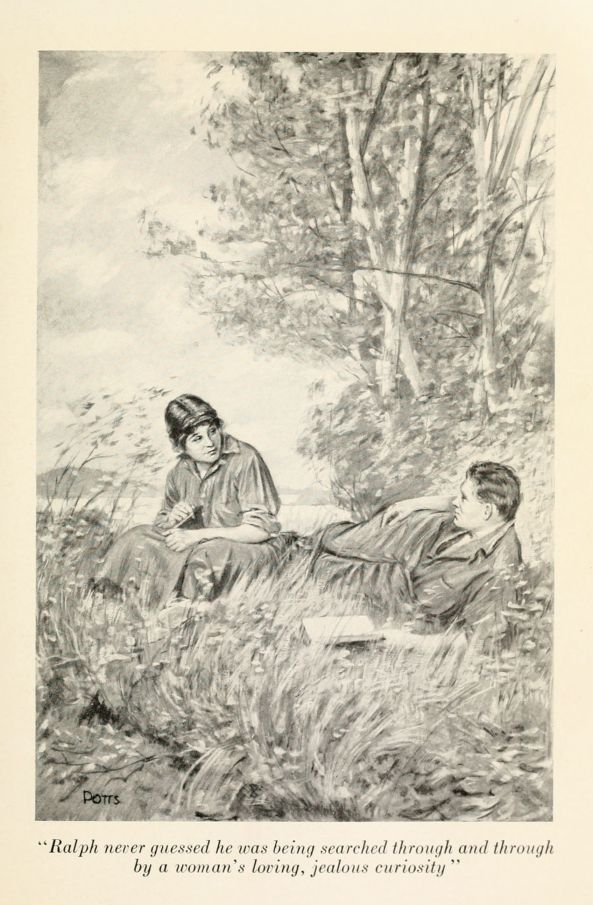
"Ralph never guessed he was being searched through and through by a woman's loving, jealous curiosity"
Nahnya had a score of questions to ask about his
home and his family. Ralph, as his eyes softened
with recollection, grew more outrageously facetious.
Nahnya, glancing at him through her lashes,
understood. Finally, threading a needle with an
elaborately careless air, she remarked:
"I guess you liked the Millersville girls best."
"Print dresses and rosy cheeks," said Ralph dreamily.
"Short on fine clothes and long on health and
good nature! Choir practice and school picnics and
country dances! That was good! There was a girl
there——"
"Ah!"
"Patty Lake her name was. We called her Pattycake.
She was sweet. Always wore pink, and had two
fat, brown braids hanging down her back."
"Well?" a little breathlessly.
"Married the butcher's boy, that's all."
There were many breaks and pauses in this conversation.
So off-hand was Nahnya's manner, and such
her preoccupation with the needle, that Ralph never
guessed he was being searched through and through by
a woman's loving, jealous curiosity.
The little black book continued:
"When we left our grassy point and paddled around
the big curve in McIlwraith Lake, suddenly we hove
in sight of half a dozen whitewashed huts on the shore.
And a flag-pole with a flag against the blue! Gave
me a regular thrill. The Hudson's Bay Company
uses the Union Jack with the letters H.B.C. in white.
The fellows up here say it stands for 'Here Before
Christ.' As we paddled by, a white man came out
of the store and hailed us. Nahnya wouldn't stop.
'Ask too much questions,' she said. This was Fort
McIlwraith that I have heard of.
"Immediately afterward we got in the river again.
It is deeper and swifter after every lake. Here it is
called the Pony River, Nahnya says. There were
some ugly snags. Nahnya is a wonder with the
paddle. We camped in the middle of a wide, burned-over
stretch. It was like a farm-field. You kept looking
around for fences and cattle, and a house somewhere.
"Next morning the river slowed up and lost itself
among a lot of low islands covered with gigantic
cottonwood trees. You could see there was a change
coming. As we paddled around the end of an island,
me all unawares, we were snatched up—snatched is
the word—by a violent green current that raced us
down half a mile, and wet us in a rapid before I got my
bearings.
"Nahnya says this is the Rice River. It is half a
dozen times as big as the Pony. It is a thick, yellowish-green
colour like jade, and a funny hissing sound comes
up from the surface. Nahnya says it is made by the
stones chasing along the stony bottom. It is a gaunt,
ragged, bad-tempered looking stream, always gnawing
under its banks and bringing the trees down on the
run, and then piling the debris in untidy heaps on
naked pebble bars in the middle. The cut-banks are
astonishing—some of them a hundred feet high, the
trees looking like toys along the top edge, waiting their
turn to fall over. Out of these smooth slopes, naked as
railway embankments, harder strata of earth stick up
like castles, with millions of swallows building in them.
"We camped in another burned-out place. This is
the loneliest spot on earth almost, and even here man
has left his dirty work. The man, red or white, who
is responsible for a fire ought to be drawn and quartered.
It's ghastly. Nahnya has put the fear of God into
Charley. Last thing before we move on she makes
him haul water until every spark is quenched.
Mosquitoes bad to-night.
"Couldn't sleep. This violent, ugly river, and the
ghastly burned-over country, and other things gave me
the willies. A brute of a bird flew in circles over the
tent half the night, uttering a single croaking note like
a cracked funeral bell. Lord! we're a long way off
from folks! Fancy Charley and Nahnya taking these
trips by themselves. She sleeps like a baby, without
ever moving or missing a breath.
"Next day. The old river doesn't look so bad with
the sun shining on it. Saw three bears as we went
flying down. How does anybody get up this current I
wonder. You can't always be going down-stream.
Nothing but cut-banks, bars, drift-piles, and vicious
little rapids on the bends. Eagles sailing like
aeroplanes overhead, and screaming as if they had steel
springs in their throats.
"Third day on the Rice River. We have come
nearly two hundred miles on this stream, I guess, and
not a soul, red or white, not a hut, nor the remains of a
hut all the way. The current seems to be slackening,
and we lose ourselves in a mess of islands; so I suppose
there is something saving for us ahead. This is the
sixth day from Gisborne, so we ought to arrive there
to-morrow, wherever and whatever 'there' is."
The entries in the little black book ended with these
words.
Ralph's diary confined itself discreetly to the visual
aspects of the journey, avoiding the psychological.
All was not smooth sailing here of course. Ralph
was keeping a tight hold on himself that entailed no
little nervous strain, and he was apt to break out
unreasonably. Nahnya, while generally friendly, had
an exasperating way of relapsing at any time into the
mysterious inscrutability which maddened him. Only
Charley was always the same.
On the afternoon of the third day on the Rice River,
after one of the colloquies in Cree with her brother that
always irritated Ralph, Nahnya suddenly brought the
dugout around in the current, and grounded it on a
shelving, stony beach. Charley got out and pulled it up.
"What's this for?" said Ralph, surprised. "It isn't
but an hour since we ate."
Nahnya affected not to hear him.
Ralph instantly flew into a passion. "Oh, very
well!" he cried. "If you want to be mysterious!"
He strode off and sat down by himself on a drift-log,
dignified and sore. He filled his pipe with care, and
lighted it. It tasted bad, and he put it back in his
pocket.
Nahnya brought cold victuals ashore, and she and
Charley sat down together. Ralph, watching out of
the corner of his eye, had at least the satisfaction of
seeing that she could not eat. She sat with her hands
in her lap, unusual for her. He could not see her face.
Charley, who could always eat, stuffed himself with
moose-meat and cold bannock.
When Charley had eaten as much as he could hold,
he carried the remains back to the dugout and put
them away. He returned to Nahnya with a coil of
light, strong cord in his hands, a tracking-line.
Holding it out toward her, he said something in Cree.
To Ralph's astonishment Nahnya sprang up in a
rage, snatched the line out of Charley's hands, and
soundly boxed his ears. A pretty family quarrel
resulted. Charley, thunderstruck at first, answered back
in tones of resentful injury. More than once Ralph
heard his own name, and wondered mightily what he
had to do with it.
Charley flung off, and sat down by himself, and there
were the three of them up and down the beach, perfectly
sore and unhappy; Ralph in addition mystified by it all.
Ralph was the first to give in. "Oh, I say, this is
too ridiculous!" he cried. "Nahnya, come here!"
She went to him with a face like a mask of bronze.
"What's the matter, Nahnya?" he demanded to
know. "We're all acting like children!"
She shrugged slightly, and looked away.
Seeing that he would get nothing out of her this way,
he changed his tone. "For my part I'm sorry I lost
my temper," he said warmly. "Honest, I am."
This told. She frowned and looked uncomfortable;
sure sign, as he knew by now, that her feelings were
touched.
"We were always going to be friends," he said,
following up his advantage. "Is this being friends?
What's the matter, Nahnya?"
To his surprise he saw her eyes begin to fill. She
made to turn from him, but he caught her wrists and
forced her to face him. "Nahnya, I am your friend,"
he said.
She angrily shook the tears from her eyes. "I one
fool!" she muttered. "Like a white woman, I cry
when I need sense!"
"What's the matter?" repeated Ralph.
"Let me go!" she said.
He released her.
"I think you going to hate me by and by," she said.
"Why should I hate you?" he demanded.
She gave him an extraordinary look, at once determined
and deprecating, and said a little breathlessly:
"Ralph, I got to tie your eyes, now."
"Blindfold me?" cried Ralph, amazed. "What for?"
"You must not see where we go now."
"But I gave you my word!" cried Ralph. "I promised
I'd say nothing of where I had been or of what I
had seen."
"I know," she said, "you will keep your promise.
But you must not come back yourself."
Ralph stared at her as if she were a witch. Thus
to hit upon his secret intention, scarcely confessed to
himself!
After a while she said: "Will you promise never to
come back?"
"No!" cried Ralph, very red in the face. "I am a
free agent!"
"Then I got to tie your eyes," she said.
"I won't submit to it!" cried Ralph hotly.
She shrugged and turned away. She gave an order
to the sulky Charley, and between them they unloaded
the dugout. Though it was scarcely four in the afternoon,
the three little tents were set up in a row on top
of the bank, and every preparation made for spending
the night.
The mosquitoes soon drove them in, each under his
own shelter, where they lay for the rest of the
afternoon, sleeping, sulking, or sorrowing as the case was.
They issued out for a hasty, silent supper and turned
in again. There was a gorgeous, troubled sunset above
the pines across the river, and afterward the evening
star came out like a lighthouse in a canary sea with dark
blue islands. The hard, swift face of the river mellowed
in the fading light, and gleamed with the soft lustre of
old, blue stained glass. None of those in the little tents
gave any heed.
In the middle of the night Ralph was rudely awakened
by the descent of two heavy knees between his
shoulders. While he still struggled with the mists of
sleep, his wrists were secured behind him. He put up
the best fight he could, but his ankles were soon tied,
too. Then it was easy to bandage his eyes.
Harder to bear than the indignity of bondage was
the pain of betrayal that stabbed him.
"Is this your friendship?" he cried.
There was no answer out of the dark.
Ralph's struggle only exhausted him, and bruised
his wrists and ankles. He gave it up, and
lay outwardly quiet, seething with resentment,
within. Deprived of his sight, his hearing became
preternaturally acute, and he had no difficulty in
following the various steps of their preparations for
departure. Before the bandage was clapped on his eyes,
he had had a glimpse of daylight. He guessed from
the poignant freshness of the air in his nostrils that
the dawn had just broken.
After the tent had been taken down over his head
and carried away, Nahnya and Charley came back
to him together. Charley lifted him under the arms,
and Nahnya took his feet. Charley's manner of carrying
him suggested an insulting indifference that caused
Ralph to grind his teeth. They climbed cautiously
down the steep bank, finishing with a sudden slide to
the bottom, and almost dropping Ralph between them.
Charley laughed, and Ralph swore savagely.
They laid him in the dugout, and he heard Charley's
steps retreating. Nahnya was arranging the blankets
under him.
"Ralph, I sorry," she said in a low voice, sharp with
emotion. "I not know anything else to do."
It did not help matters any. He was too full of
resentment to give a thought to her side of the case.
"This is what I get for trying to do the square thing
by you!" he cried. "For holding myself in night and
day to keep from distressing you! You worked on my
sympathies. You made me think you were on the
square. You talked about friendship, and then you
attacked me while I was asleep! Oh! I have been
nicely taken in!"
He heard no more from her.
They slid the boat off the stones; Nahnya climbed
over Ralph to take her place in the stern; and they set
off in the current. For hours after that Ralph had
nothing to go on but the quiet dip of the paddles, the
answering leap of the boat to the thrust of their strong
arms, and the drip of the water as the blades were
withdrawn. Both brother and sister had a great
capacity for silence.
Ralph's frame of mind was anything but an enviable
one. It is not pleasant to a man to be confronted by
a mystery in the woman he loves. As long as they had
been in accord it had troubled him very little; he had
looked in her clear eyes, thinking, "whatever may be
in store, she's on the square." But when she turned
against him all this was changed. Every look, word,
act that he had not understood at the time recurred
to him charged with a sinister significance. Wounded
pride hatefully suggested to him that she was using his
love for her to further her own ends.
Nevertheless he could not but admit that for such a
hardy villainess some of her acts were strange. He
had plenty of time to think things out. He remembered
how she had boxed Charley's ears when the boy
had first suggested tying him up; he remembered how
her eyes had filled, and how sadly she whispered, "I
think you going to hate me by and by." This
suggested that she might be the victim of circumstances
no less than himself. "Why can't she trust me a
little?" he thought. "She knows I'd do anything for
her!"
Behind all this was the mystery of what lay ahead,
hanging like a heavy black curtain athwart his gaze.
When a man has his eyes to see, and his arms to fight
with, a mystery is pleasantly provocative and stimulating.
When he lies blindfolded, bound, and helpless,
the darkest apprehensions seize upon him. Thus the
weary round continued in Ralph's mind.
The long silence was broken by Nahnya. She uttered
in Cree what sounded like a quiet warning. Immediately
afterward the dugout lurched violently as under
a side blow, spun around, and went on as smoothly as
before. For a long time Ralph lay vainly threshing
his brain for an explanation of this odd shock.
A new sound slowly stole on his ears, a dull, heavy
growl from down the river. He did not need to be told
what this was; rapids—but no such rapids as they
had shot in the Pony River, or hitherto in the Rice.
Those compared with this sound were as the laughter
of children to the voice of a giant. The growl became
a roar which grew louder with every moment. Ralph's
heart began to beat painfully. It is probable that it
never occurred to Nahnya, certainly not to Charley,
what a refined species of torture they were inflicting on
their prisoner. There is no terror like terror of the
unseen. "If anything happens I'll drown like a cat
in a bag!" thought Ralph. He would not stoop to
make any complaint aloud.
Charley and Nahnya stopped paddling, and talked
low-voiced; Nahnya gave unmistakable orders. The
slight, sharp note of excitement in their voices shook
Ralph's breast. From the sounds ahead he pictured a
very cataclysm of the waters awaiting them, wilder
indeed than any earthly rapids. Little beads of
perspiration broke out on his forehead. Oh! for his
sight! the use of his arms! But he would not ask it. They
started paddling again. The roaring seemed to be on
every side of them now. Ralph clenched his teeth
and his hands. "Now we're going to take the plunge!"
he thought. "Now! Now!" And still it held off,
until he could have screamed with the suspense.
And then the dugout seemed to drop from under
him, and immediately afterward precipitated itself with
a crash against a wall of water. A wave leaped aboard,
drenching Ralph to the waist. He thought it was all
over, and suddenly ceased to trouble. Charley yelled
with pure excitement; the dugout gave a series of mad
leaps and plunges, flinging Ralph from side to side like
a sack of meal, and suddenly they floated in smooth
water again. An uncanny stillness descended on them.
A long breath escaped between Ralph's teeth.
There followed what seemed like the greater part of
a day to Ralph, with scarcely anything to register the
passing of the heavy time. It was perhaps four hours.
The sunshine grew warm in his face, and he smelled
the pines on shore. High overhead he heard the
eagles screaming. Charley complained—of hunger,
Ralph guessed, and Nahnya laconically silenced him.
At intervals a new sound gave Ralph food for thought.
This was the loud, brawling voice of a stream, now on
one side, now on the other.
"The whole character of the country must have
changed," he thought. "We must be passing between
steep hills or mountains for the streams to come
tumbling down like that."
The long wait for something to happen was ended
by the voice of another great rapid ahead. Ralph's
heart began to beat. "Must I go through with that
again?" he thought.
But while he was steeling himself for the ordeal, the
nose of the dugout grounded, and Charley, springing
out, pulled her up on shore.
Ralph was lifted out and laid on a flat rock. There
was a long wait. A very real hunger began to assail
him. One of the brawling streams came down nearby.
From the sounds that reached his ears, Ralph pictured
the dugout being dragged across the rock on rollers,
and hidden under bushes. Evidently their journey
by water was at an end. Nahnya and Charley sat
down near him, seemingly to make something. Finally
Ralph was lifted up and laid down again, and then,
much to his surprise, hoisted on a litter and borne
away.
A long journey over rough ground followed, and all
uphill, Ralph judged. They never passed out of
hearing of the voice of the small stream. They stopped
often to rest. Even so, it was wonderful to Ralph
how easily they went. He was no light-weight. Once
or twice Charley grumbled at taking up the load, and
Nahnya angrily silenced him. There was no faltering
in her. In spite of his resentment against her Ralph
felt a kind of compunction at being carried by a woman.
Anyway, his resentment had cooled somewhat; cooled
enough to allow him to glance at the oddity of his situation.
"Lord! here's a queer go!" he thought. "What next?"
He was not under any apprehensions of danger to
himself.
They went on for an hour or more, and the question
of food became of more vital moment to Ralph than of
what was before him. The air had the lack of motion
and the cool smell of vegetable decay that suggested a
deep forest. Finally he was put down for a longer
period, and he heard the welcome sound of Charley's
axe, and shortly afterward the crackle of the growing
fire. In a little while the delicious emanation from
baking bannock reached his nostrils, and at last he
heard the hissing of the bacon in the pan, which
signified the completion of the preparations. A certain
anxiety attacked him.
"How the deuce are they going to manage about
feeding me?" he thought. "By Gad! if they think
they're going to make me go without my dinner——!"
However, Charley presently untied his ankles
and his wrists. Ralph tore the bandage from his
eyes, stretched himself luxuriously, and looked about
him.
They were in the magnificent gloom of a primeval
forest. Gigantic trunks of fir and spruce rose on
every hand with lofty branches that darkened the
heavens. The little patches of sky that showed
between seemed immeasurably far off. The fallen
monarchs of ages past lay here and there in confusion,
rotting by infinitesimally slow degrees. The ground
was stony, but stones and fallen trunks alike were
largely covered with moss, incredibly soft and thick
and green. The moss masked treacherous holes, as
Ralph discovered when he attempted to move about.
There was no undergrowth except a few spindling
berry-bushes, and a low plant with huge leaves called the
"devil's club," both pale from lack of sunlight.
The forest grew on a steepish slope. Ralph affirmed
to himself that the way home lay straight downhill.
He could still hear the voice of the little stream off to
one side. He discovered a faintly marked trail that
climbed straight from below, and continued on uphill.
This explained how Nahnya and Charley had been
able to avoid the fallen trunks and the holes. A trail
once made never becomes totally effaced. The
wildest, most deserted forest wilderness shows such
forgotten paths.
So far Ralph's deductions carried him. Later he
made a fresh discovery. Facing downhill and looking
straight away through the tree trunks, he distinguished
the outline of a noble, snow-capped peak a mile or
two away. From the direction of the shadows upon it
he saw that the sun was slightly to the left of it. As
it was now half-past ten or eleven, that peak must
therefore be directly south of where he stood. Walking
up and down, he searched through the trees and gathered
from the suggestions of the outlines of other
mountains that the peak was part of a chain running
right and left.
Little by little he pieced it all together in his mind.
"We shot a big rapid, and paddled for three or four
hours, or until we came within hearing of the next big
rapid. The big river must flow parallel with that range
yonder—that is to say, east and west. I knew it was
flowing between mountains. We landed on a big flat
rock at the mouth of a stream and struck straight
up-hill, which is due north. Blindfolded or not," he said
to himself triumphantly, "I guess I won't have much
trouble finding my way back if I want to."
Nahnya with a sullen, troubled face, watched Ralph
making his observations but offered no comment.
Breakfast or dinner, whichever it was, was eaten in
silence. Nahnya and Ralph each wore a mask, and
each avoided the other's eyes. Charley was solely
concerned with his long-delayed food. Ralph, secretly
elated by his own perspicacity, later made no objections
to being bound and blindfolded again. It seemed to
him rather a ridiculous precaution, because if he ever
got as far as this, he would naturally continue by the
trail. However, if they wished to give themselves the
trouble of carrying him, so be it.
The journey of the morning was repeated, but for a
longer period. Ralph marvelled at his bearers' endurance.
For at least two hours they toiled with frequent
pauses, always uphill. Finally upon laying him down
they left him, and he guessed they had come to the next
halting-place. A long time passed without his hearing
them talk, or hearing any preparations to camp. The
possibility of their abandoning him there in the woods
occurred to him, causing a disagreeable prickling up
and down his spine.
At last he heard Charley's footsteps, and the bandage
was removed from his eyes. Still the virgin forest.
No sign of Nahnya. More mystifications!
"Where's Nahnya?" demanded Ralph.
"Him come back tepiskow," Charley answered stolidly.
The boy held up a piece of paper with writing upon it
for Ralph to read, but held it upside down. Since it
did no good to yell at Charley, and Ralph's hands were
tied, it was a little while before they came to an
understanding. When the paper was finally righted Ralph
saw that it was a letter from Nahnya, and once more
he was astonished by her. It was written in a hand as
fine and precise as a nun's. This strange girl could
write as well as steer a canoe!
"To the doctor," it began. (She had made an attempt
to spell Ralph, and had given it up.) "If you
promise not to go away from here till I get back, Charley
will untie the ropes and make you free. If you promise,
make a holy cross on this paper for him to see. Annie
Crossfox."
Ralph had not by any means forgiven Nahnya her
high-handed proceedings, but an extraordinary
curiosity modified his anger. He was determined to
discover what lay behind all these mysteries. He decided
to submit to the promise, and signed to Charley to put
the pencil between his teeth. Charley holding up the
paper, he made the sign as decreed. Pocketing the
paper as a warrant for the proceedings, Charley
liberated him.
Ralph walked to and fro to stretch his legs, and to see
what he could see. Here there was nothing but endless
vistas of the forest whichever way he looked. Because
of the higher altitude to which they had climbed, the
trees were not of such a staggering magnitude, and there
was more undergrowth. He saw gigantic raspberry
bushes with pale flowers as big as mallows. The silence
was unearthly; not a bird cheeped, not a leaf fluttered.
Ralph was finally reduced to studying the impassive
Charley. There was not much reward here. Charley
sat with his back against a tree, smoking a pipe, and
staring into vacancy. Charley had the faculty of
being able to suspend animation when he chose. Ralph
wondered why he did not fall asleep. By and by it
came to him that the Indian boy was actually uneasy,
not the uneasiness of alarm, but of impatience. His
head would turn slightly in a given direction, and a
desirous look appear in his hard, bright eyes. His
head was cocked to listen.
"Nahnya has kept him out of something that he is
keen for," Ralph deduced.
Charley prepared a meal, and they ate. Afterward,
since there was nothing better to do, Ralph rolled
himself in the blanket he had lain on, and slept. When
he awoke the indefatigible Charley was cooking another
meal. They had eaten it and were smoking; darkness
was already creeping through the forest aisles, though
far overhead the sky was bright, when without warning
the Indian boy sprang up with a whoop, and seizing his
hat and gun darted away. Ralph, gazing after him,
wondered if he had gone mad. Presently from the
same direction he saw Nahnya coming through the
trees, followed by an old woman in a black cotton dress.
At sight of the girl the recollection of the indignities
she had put upon him flamed up in Ralph's breast, and
his eyes hardened. He forgot about Charley.
Nahnya, after a quick glance in his face, lowered
her eyes. "This my mot'er," she said in a low
voice.
The old woman made a bob to the doctor. She
was frankly terrified by the sight of him. She did not
in any way suggest the mother of Nahnya, being
without grace. She looked merely the middle-aged
mother of many children. She had jetty hair neatly
parted and braided, eyes as stoical as Charley's, and a
skin like wrinkled, waxed brown paper. She had the
strong, patient look of the aging worker. Ralph,
looking from one to the other, could not find the least
point of resemblance between mother and daughter.
The fact caused him a certain grim satisfaction. His
professional eye fixed on the old woman's pitiful,
crooked arm.
So it was true after all that Nahnya had fetched him
to cure her mother. He felt relieved, but only the more
mystified. For why, if everything was plain and
aboveboard, had she taken such desperate precautions
to insure secrecy? Nahnya was no fool. He angrily
gave it up, and turned his back on the old woman,
who, as soon as his eye fell upon it, began to soothe
the injured arm with deprecating glances toward
him. Ralph had already observed with a hard smile
that they had brought up his little satchel of
instruments and medicaments on the litter. He had made
up his mind that nothing should induce him to open it.
The two women had brought packs containing everything
needful for a comfortable camp, and they set
about making ready for the night. Nahnya said no
more to Ralph, nor did she look at him again, but her
actions were eloquent. Watching her with sidelong
glances, a great uneasiness grew in him. She cut a
heap of spruce boughs to make him a soft bed. She
roasted a ptarmigan she had brought with her, and
when it was done, took it to tempt his appetite before
he turned in. She offered it to him silently, with an
extraordinary upward look, soft, penitent, and imploring.
The look raised a storm in Ralph's breast. It
confused and touched and angered him together. His
heart leaped to answer it, and his indignant pride held
him back. "Why can't she be open with me?" he
thought. "Does she think she can truss me up like a
piece of baggage, and then bring me to my knees again
with a soft look?" He accepted the offering as his
right, without relenting, and Nahnya went sadly back
to her own bed beside her mother.
With a great air of unconcern, Ralph crawled between
his blankets and resolutely closed his eyes. But
the struggle within him went blithely forward. He
would, and he would not. She had used him intolerably,
and he hated her. She was sorry, and he loved her.
The mystery she chose to wrap herself in exasperated
him; her quiet resistance to his will maddened the male
in him. There were times when he felt as if the only
thing that would give him any peace would be to crush
her utterly. Then he would remember the look in her
eyes which promised a secret heaven for him to whom
she chose to open it. Daylight was coming again before
Ralph fell asleep.
When he awoke the struggle was over. Such a
struggle in him could have but one outcome. His
pride caved in. After all, he told himself, he was a
doctor, and he could not turn his back on a grievous
injury. He did not mean to forgive Nahnya—at
least not in a hurry—but he knew he could not forgive
himself if he went away leaving a doctor's work
undone. Perhaps he was not quite frank with himself
in this; perhaps it was only Pride trying to save
something from the ruins; perhaps he never would have left
Nahnya could he have helped it. Every imaginative
heart that loves, loves the sentimental satisfaction of
heaping coals of fire upon the head of the beloved one.
She would feel sorry she had used him so, but he would
be relentless. When she had suffered a great
deal—perhaps——
So after breakfast, still scowling like a pirate, he
opened his doctor's kit, and issued gruff orders to
Nahnya. The sun came out in her face; she said not a
word, but flew to do his bidding. Admirable was
her capability and her deftness. In no time at all the
frightened old woman was made comfortable on a deep
bed of spruce boughs, with splints, bandages, and hot
water waiting.
When it was all over, and the old woman began to
come safely out of the ether, weeping copiously, but
vastly relieved in mind, Ralph repacked his satchel
viciously. When his purely professional absorption
was no longer called for, he ran up the flag of
resentment again. Nahnya had said nothing. Once when
the danger point was past she had leaned across the
patient and squeezed his hand, but he had quickly
pulled it away. Her eyes followed him expressing a
passion of humble gratitude. It infuriated him; why,
he could scarcely have told; perhaps because it was
so clear that it was only gratitude, and not the other
kind of passion that he was hungry to see there. At
any rate he could not support the look. Snapping the
valise shut, and tossing it to one side, he strode away
leaving the patient to Nahnya.
"It's done," he thought bitterly. "And she's done
with me. A lot she cares what I'm suffering. She
sacrificed me without a qualm to the old woman. Now
she's cured, I can go back, and be hanged to me, I
suppose. Well, I don't mean to be fobbed off so easily.
I've done my part, and I'm a free agent. I won't leave
here till I've unwound every thread of the silly mystery
she entangles herself in!"
By and by the old woman fell into a natural sleep,
and Ralph was free to leave her. He lit his pipe, and
wandered off up the faintly marked trail.
In the perpetual twilight of their camp one got the
feeling that this forest rolled on forever, but Ralph
had not gone above three hundred yards before he
unexpectedly came to one of its boundaries. To the
left of the trail it ended at the base of a mighty
precipice of naked gray rock. Standing at the edge of the
trees and looking right and left the height of rock
extended as far as he could see. Looking up, it was too
beetling for him to see its summit.
Continuing upon the trail a little way farther, he
came to the edge of a gulch, where he could obtain a
wider prospect. Looking up now, he had dizzying,
foreshortened glimpses of peaks and domes of rock,
with a distant view over all of the supreme summit,
shaped like a gigantic thumb of rock sticking up out of
fields of snow, gilded and dazzling in the sunshine, and
incredibly far-flung. It was a stirring experience thus
to be brought without warning into the immediate
presence of such a God. Ralph gazed, forgetting his
private despite against Fortune.
At his feet the gulch came down from the left along
the base of the unscalable heights. A trickle of water
ran musically in the bottom of it, and was borne off to
the right to join the larger stream, beside which they
had ascended from the river. The trail crossed the
gulch, and disappeared within the forest on the other
side. The forest skirted the edge of the gulch, and
swept on up concealing all on that side.
Ralph's only view was therefore up the gulch. The
floor of it was heaped with broken masses of rock and
fallen trees. As he looked, thinking of nothing but the
wild beauty of the scene, suddenly his jaw dropped,
and he dashed a hand across his eyes to make sure they
were not tricking him. For out of a little tangle of
living and dead trees at the base of the cliff, about a
furlong from him, issued the figure of a man. It was
Charley. One would have said that he had issued
out of the cliff itself.
Ralph instinctively fell back among the trees.
He had not been seen. Charley was unconcernedly
picking his way down over the stones.
Drawing back from the trail, Ralph concealed himself
until he heard Charley pass on his way to camp. He
then clambered down into the gulch, and made his
way as fast as he could over the obstructions to the
spot where the boy had so surprisingly come into view.
Ralph suspected that an alarm would be raised for him
as soon as Charley got back to camp.
The place he was making for was in a slight angle of
the gulch, and the driftwood was piled in a wild tangle
there. Climbing over the fallen trees as he had seen
Charley climb down, Ralph came to a little niche of
earth that provided a precarious living to three stunted
pines and a few berry-bushes, the whole making a
natural screen against the cliff. Pushing through it,
he found himself looking into a hole in the rock at his
feet.
Starting back, he gaped at it a little stupidly. He
did not know what he had expected to find—not a
hole in the rock! For a moment he doubted the
evidence of his senses; it seemed too preposterous. Weird
ideas took half shape in his brain and floated away
while he stared in the hole. Was it possible they were
of another race—creatures existing in the bowels of
the earth without sunlight or the stir of air? Why,
after travelling hundreds of miles from the world of men,
was there need of burying one's self any deeper?
Was it the possession of some ghastly secret that made
Nahnya's face always wistful? What did it conceal,
that hole, a hideous crime, disgrace unimagined—or
a treasure?
The opening was about two feet across. Buttressed
by the fallen trees below, and screened by the living
ones, it was shrewdly hidden. Ralph wondered by
what chance it had first been discovered. He lighted
a match and dropped it in. It burned until it struck
the bottom. It was about fifteen feet deep. There
was the trunk of a young pine standing upright within
it, reaching to within a foot of the top. Obviously
this was used to climb in and out by.
It was like an invitation to enter, but Ralph
hesitated. Notwithstanding the reassuring light of day
and the solid earth of rocks and trees, the feeling of
something uncanny, something more than natural,
would not down. When he laughed this away, there
remained very human fears. "Who knows what may
be down there," he thought, "and what kind of a
reception I will receive?" Finally there were compunctions
of delicacy. "It's hardly square to break in on
their secrets behind their backs," he thought.
Recollection of his own injuries wiped this out. "They
weren't so careful of my feelings," he told himself.
In the end, perhaps because he was afraid, Ralph
was obliged to descend. As he would have put it, he
could not take a dare from himself. Swinging his
legs over the edge, he felt for the top branch of the
pine tree.
At the bottom of the hole he struck another match.
There were several pine-knot torches lying at his feet;
picking up the longest, he lighted it.
He was in a narrow cleft in the rock, extending
obliquely and downward into the mountain. It was
necessary to recline partly on his back and inch himself
along, holding the sputtering torch at arm's length
before him. It was an awkward posture in which to
meet danger. But if Charley could come through he
could, he thought.
After only a few yards of this he issued suddenly
into a much larger chamber, where he was able to stand
firmly on his feet. It was a kind of spacious corridor
running off to the right and left, and floored with
pebbles and sand. Manifestly a stream had once flowed
over it, but at present the floor was dry.
The thrilling impressions of a cave brought Ralph's
boyhood winging back to him. Thinking of grizzly
bears and mountain lions none too comfortably—he
was unarmed—he sniffed the air delicately. There was
no suggestion of animal effluvium. Anyway, Charley
had just passed through. The torch made an extraordinary
dancing light on the walls of rock, reminding
him of a certain flaring gas-light in the cellar at home.
The cave was not like a tunnel with arching roof, as
he had always imagined caves, but was still a fissure in
the rock, both sides leaning obliquely in the same
direction. Overhead the split gradually narrowed; the
light of his torch did not penetrate to the top of it.
Ralph was faced by the choice of turning right or left
in the corridor. He lowered the torch to look for
footsteps. In the patches of sand they were plainly
discernible, many of them, almost a beaten path leading
off to the right. Besides Charley's, Ralph readily
distinguished the prints of Nahnya's small, straight feet,
and another foot, evidently her mother's. The sight
of all these footsteps had the effect of allaying Ralph's
fears, and of strongly stimulating his excitement. Up
to this moment he had kept in view the possibility that
this cave might be a private affair of Charley's. Now
he could no longer doubt that Nahnya's secret, whatever
it was, lay at the end of this path. He followed
it, feeling himself on the brink of an amazing discovery.
Nothing could have turned him back now. "With
all her pains to keep me in the dark I have been a little
too clever for her!" he thought vaingloriously.
Sometimes the corridor was ten feet wide; sometimes
it narrowed down to four. The air had that extraordinary
dead quality only to be found in deep caves, but
it was quite pure, because the torch burned clearly.
The stillness pressed on his ear-drums. The quietest
room, the quietest night out of doors, was vibrant and
musical by comparison. His own breathing sounded
hoarse and laboured in his ears.
Holding the torch high over his head, wrought up
to the highest possible pitch, he made his way swiftly
over the smooth floor. Rounding a corner of the
rock, the flickering light fell on a human figure standing
motionless before him. He stopped short with a horrid
shock of fright. The torch dropped from his nerveless
hand and was extinguished. He slowly screwed
down the clamps of self-control, and schooling his voice,
hailed the creature. The sound shattered the dark
stillness with an incredible, unnatural ring. The sound of
his own voice in that place terrified him. The silence
that followed upon it was terrible. There was no
answer.
Very slowly he forced himself to pick up the torch,
to light a match, and to ignite it again. He held it
aloft. The figure was still there, motionless. Ralph
went forward very gingerly, and saw that it was not
human after all, but merely a kind of scarecrow, a
stick planted in the sand with a cross-piece on which
was hung a coat and hat. Evidently some of Charley's
work, placed there for what purpose Ralph could not
conceive. He sat down, and wiping his face, allowed
his shaking nerves to quiet down.
Proceeding, he heard a murmur which later resolved
itself into the sound of running water. Ralph
wondered uneasily if there were times when a torrent
raced between these rocky walls; he pictured himself
swept helplessly upon it, and his skin prickled. In
such a place he would not have been surprised by
anything. The scarecrow reassured him partly. Plainly
it had been set up to stand more than an hour or two.
Keeping on he satisfied himself that the water was
not coming toward him. The sound increased only in
the ratio of his progress toward it.
Soon it was close ahead, not a loud sound, but the
musical voice of a rapid, smooth stream. Holding
the torch high, its light was reflected in pale gleams up
the corridor. The water was coming straight toward
him, only to be suddenly and mysteriously diverted.
A few steps farther and he had the explanation. A
yawning hole in the floor of the cave received the stream
entire without a sound. It simply slipped over the lip
of rock, and ceased to be. The absence of any sound
of a fall below was uncanny. Ralph tossed a little
stone in the hole—and heard nothing. Not until he
lay at full length and stuck his head over the edge of
the chasm could he hear, above the soft hiss of the
descending water, the distant muffled crash of its fall.
The height suggested by the sound staggered the senses.
Ralph received a new and awful conception of the
goodly old phrase: the bowels of the earth.
At one side two logs made a rough bridge over the
gap. Ralph continued his way beside the stream, crossing
from side to side, and upon occasions when it filled
the whole floor, forced to wade. Here there was a faint
stir to the air, a hint of freshness, and he instinctively
began to look for daylight ahead.
Finally he saw it, far off, a crooked exclamation point
of white. He hastened toward it, feeling an unbounded
relief. He had been prepared to face—he did not
know what—some shape of mystery or terror in the
darkness. And here was honest daylight. An insupportable
curiosity filled him, forcing him to run and to
leap as if but a minute or two of daylight remained.
Arrived in the opening, he flung the remains of his
torch in the water. The blessed bright sky was over
his head once more. Until he saw it he did not realize
how heavily he had been oppressed by underground
terrors. At first nothing else was visible to him but the
sky and terraces of rock on either side, between which
the little stream came tumbling down into the hole.
Ralph went up over the rocks like an ape. At the top
there was lush green grass starred with flowers. Trees
below still obstructed his view. He ran on up the
slope of grass until the whole prospect opened to
his eye. There he flung himself down to gaze his fill.
He was not disappointed. It surpassed his brightest
imaginings. The first glimpse amply repaid him for
the trip underground. It was lovelier than any sight
he had every beheld, lovelier than any scene he had
visited in his dreams. It was itself and it was new.
The artist in him experienced the rich, rare satisfaction
of beholding a perfect thing. He had to enlarge his
conception of beauty to take it in.
It was a valley hemmed all round by craggy mountains,
running up to towering, sharp peaks. The mountains
held his eye for a while; it was almost his first
unobstructed view of earth's mountains in their majesty.
They rose, fantastic, overpowering shapes of gray
rock with mantles of snow upon their shoulders and
bared heads, each as distinct in individuality as an old
king. The grandeur of the company set off in poignant
contrast the tender loveliness they guarded below. It
was well guarded; there was no break in the armed
ranks to let in discord from the world.
Below the scene was drunk with strong colour. The
middle of the valley was filled for half its length with
an exquisite sheet of water, curving away as gracefully
as a girl's waist. Its water was of an unreasonable
richness of hue that held Ralph's eyes like a charm;
neither sapphire nor emerald, but partaking of both.
That part of the valley nearest him was like a park—like
a dream park. The trees, aspens, and white-stemmed
birches were set out in clumps in the riotous
grass. Farther up the valley rolled a thick forest.
Everywhere there were flowers. The bluebells growing
under his hands were as big as thimbles and blue as lazulite.
Everything growing, birch trees, flowers, and grass,
flaunted itself with a particular vigour and richness,
as if the valley were Nature's own nursery, where she
perfected her specimens.
The scene was not all Nature's. Off to the left, about
half a mile from where Ralph lay, he saw three tepees
topping a little rise of grass beside the lake. A column
of thin smoke rose above them. Three canoes lay on
the shore below. It did not make a discordant note
in the scene; the tepees rose from the grass as naturally
as trees. Ralph gazed at them with strong curiosity.
He saw, or imagined he saw, figures moving in front of
them.
The whole scene touched a chord in Ralph's memory;
where had he heard of such a hidden valley? such a
blue-green lake? So this was Nahnya's secret! He was
compelled to readjust his ideas of her again. His dark
thoughts at the mouth of the cave seemed foolish to
him now. This, her place, was characteristic of the
best in her. But why was she so passionately bent
on keeping him out of her paradise? This thought
raised all his torturing doubts again. He determined
to find out what the tepees concealed.
Descending the slope, and crossing the stream,
he made his way around through the flowery grass.
Never had he seen such wildflowers—bluebells, wild-roses,
painter's brush, besides the thickly blossoming
berry-bushes, and many a flower he could not name.
The trees growing singly or in small groups reached the
perfection of their kind. It was too beautiful to seem
quite real; Ralph, passing among the snowy trunks in
his sober habit, felt a little out of place, like a mortal
who had strayed into a fairy-tale.
He crossed another little stream bringing its quota
from the mountains to the lake. Where it emptied into
the lake at his right it spread out into a miniature delta.
Ralph, attracted by the sight of some implements lying
in the grass beside the water, went to investigate. He
found a shovel, a large shallow bowl, and a smaller
bowl all roughly fashioned out of cottonwood.
As he looked into the last-named article, Ralph
caught his breath in astonishment. It was half full
of gold. No mistaking those clean yellow grains!
Ralph had not fallen a victim to the gold-mania of
the North; he held the bright metal as lightly as any
man, nevertheless his breath quickened and his eyes
grew big at the sight of so much in so little. He dug
his hands into it and let the stuff run through his fingers.
There was enough here to buy the Tewksbury outright,
or to buy a string of the best ponies in the country, or
to carry a man around the whole world spending royally.
Ralph wondered if ever before gold had been left
like this, unguarded under the sky. He moved the
bowl a little, and saw that the grass was white beneath.
Evidently it had lain there many days. Gold must
indeed be plentiful in this valley, or lightly regarded.
Dimly in his mind rose the vision of a happier world,
where gold was despised like this.
Leaving it where it lay, he went on. Descending
into a wooded hollow, the tepees were hidden from him
for a while. Climbing a little rise finally, he found
himself unexpectedly almost on top of the camp.
Nearest him a ripe and comely Indian girl was stirring
a pot over the fire. Beside her on a blanket in
the sun sprawled a flourishing, naked infant. At sight
of Ralph a piteous gasp hissed between the mother's
teeth. Her eyes protruded with terror; she caught
the baby tragically to her breast, and cowered over it.
It uttered a piercing cry. Beyond the woman an old
man squatted on the ground mending a bow. He
looked up, and his face, too, froze into a mask of terror.
Two half-grown boys came running from the beach,
and stood transfixed. The frightened faces of two girls
stuck out of a tepee opening.
Ralph was much embarrassed by the suddenness of
the effect he created. Never having looked upon himself
as an object of terror, their attitudes could not but
seem far-fetched and ridiculous to him. He stood as
much at a loss as they.
Finally the old man, after a visible struggle with
himself, arose and approached Ralph. His features
were stiff with anxiety, and his old eyes fixed in a kind
of glare. It was evident from his manner that he
considered himself bound to show an example to the boys.
Not without dignity he held out a trembling hand to
Ralph.
"How?" he said.
"You speak English?" said Ralph eagerly.
"Little bit," the old man said, shaping the words
with difficulty. "I no see white man, two, three winter.
I forget, me." Having said it, he waited with a
courteous air for Ralph to speak again. Only deep in his
eyes could be seen the working of his harrowing
anxiety.
"I am friendly," Ralph said quickly. "I won't
hurt anybody."
The old man shrugged deprecatingly. "Not afraid
of hurt," he said. He paused, searching for English
words to convey what he wished. "We alone here
long time," he said. "Forget strangers. Stranger
comes—Wah! It is lak sun fall down from the sky!"
Ralph began to understand the effect of his sudden
appearance.
"For what you come here?" the old man asked.
Ralph was nonplussed. "Why—why just to see
the place," he said.
The old man bowed. His manners were beautiful;
the kind of manners, Ralph dimly apprehended, that
come only from real goodness of heart. He had never
been a big man, and now he was bent and shaky, yet
he had dignity. The manifold fine wrinkles of kindliness
were about his eyes. He was clad in an old capote
made out of a blanket. Around his forehead he wore a
black band to keep the straggling gray locks out of
his face.
"How you come here?" he asked.
"Through the cave under the mountains," Ralph
answered.
"You are the white doctor?" the old man suddenly
exclaimed, with a look of extraordinary anxiety.
"I am," said Ralph.
The old man's head dropped on his breast, and a
little sound of distress escaped him. He murmured
in his own tongue.
"What's the matter?" cried Ralph irritably. "Why
shouldn't I come here if I want to take a walk? Do
you think I'll bring a plague with me?"
The old man raised an inscrutably sad face. He
shrugged. "I not talk," he said. "Got no good words,
me. Nahnya will talk. Nahnya is the chief here.
She come soon, I think."
"What does it all mean, anyway?" cried Ralph.
"Will you eat?" inquired the old man with his
courteous, reticent air. "I sorry I forget before. We
have moose-meat."
Ralph was conscious of receiving a rebuke.
"I'm not hungry," he muttered, turning away.
His imperious curiosity soon brought him back. The
old man stood as he had left him. "Has this place
got a name?" asked Ralph.
"Call Mountain Bowl," was the answer.
A light broke on Ralph. He stared at the Indian
with widening eyes. Wes' Trickett's story came
rushing back to him. The cave under the mountain, the
blue-green lake, the gold beside the little stream!
Bowl of the Mountains, of course! So it was true,
after all, and he had found it! He looked over the lake
with shining eyes.
"Nahnya come," the old man said quietly.
Ralph whirled about in time to see her come flying
up the slope, panting, dishevelled, wildly agitated, a
flaming colour in her cheeks. At the sight of Ralph
she stopped dead, and her hands fell to her sides. She
paled. She did not speak, but only bent an unfathomable
look on him. Indignation, reproach, and pain
were all a part of it, and a kind of hopeless, sad
fatalism. It accused him more eloquently than a torrent
of invective. He became exquisitely uncomfortable.
"Well, here I am!" he said, trying to carry it off with
a touch of bravado.
Still she did not speak. With her mournful, accusing
eyes fixed on him, she flung up her arms, palms to the
skies, and let them fall. "So be it!" the action said.
Turning abruptly, she walked to the edge of the bank
and sat down in the grass.
Ralph, without knowing exactly how it had been
brought about, was sensible that he had
produced a calamity. Penitence and shame overwhelmed
him. He felt like one who has inadvertently
killed something beautiful and defenceless. With too
much feeling he was dumb. He could only stand off
and watch her wretchedly, and reproach himself.
The spectacle of Nahnya's still despair became
more than he could bear at last, and he went to
her where she sat on the bank. "Nahnya, what is
the matter?" he begged to know. "What have I
done?"
"Nothing," she said dully. "You not mean bad."
"Then why are you sitting like this? Why did you
look at me so when you came?"
"I feel bad," she said simply. "You are here. I
not know what will happen now."
"What can happen?" he asked, mystified. "Why
shouldn't I come here? Why can't you trust me a
little?"
"Trust!" she said with an inexplicable look. "What
is trust? You mean good, I think. You are a white
man. You can't change that. How can you stop
what will happen, anyway?"
"You talk in riddles!" cried the exasperated Ralph.
"If you'd been plain and open with me from the first,
wouldn't it have saved all this trouble? Why can't
you tell me what it is?"
Nahnya twisted her hands painfully together. The
quiet voice began to break. "I can't talk," she
murmured. "I feel much bad. I have got no right words
to tell you."
"Do you want me to go back?" he asked.
She shook her head. "You have found the place,"
she said. "What does it matter when you go? Stay
here. By and by I try to tell you what is in my
heart."
"But your mother," said Ralph. "I must go back
and see to her."
"Charley and I carry her through the mountain,"
Nahnya answered. "They are waiting back there. I
will send the boys to help Charley carry her
here." She raised her voice: "Jean Bateese!"
The old man hastened to them. Nahnya gave him
an order in Cree. Continuing in English, she said:
"The doctor will stay with us to-night. He is our
friend. Make everything for his comfort."
Her unaffected magnanimity, after he had so grievously
injured her, touched Ralph to the quick, and covered
him afresh with shame. "Nahnya, I'm so sorry!"
he burst out impulsively.
She got up without answering, and walked down to
the lake shore. Lifting one of the birch-bark canoes
into the water, she got in, and without looking back
headed her craft up the lake, paddling with her own
grace and assurance.
"Where is she going?" asked Ralph jealously.
The old man spread out his palms deprecatingly.
"I do not ask," he said. "She moch lak to go alone.
She is not the same as us." Whenever Jean Bateese
referred to Nahnya it was with the unquestioning air
that an ancient Egyptian might have said:
"Cleopatra wills it."
He led Ralph back to the fire. The three tepees
stood in a row parallel with the lake shore. Between
them were summer shelters of leaves, so that the women
could do their household tasks out of doors. Their
winter gear, sledges, furs, and snowshoes, was slung
up on poles out of harm's way. There were racks for
smoking meat and fish, and frames for tanning hides,
all carefully disposed to be out of the way. The view
from the little esplanade of grass in front was superb.
The two boys were standing near, rigid with
astonishment and curiosity. They were a comely pair,
sixteen or seventeen years old, with bold, handsome
faces that became sullen with shyness at Ralph's
approach. Each was naked to the waist and lean as a
panther, with a coppery skin that shone in the sun, and
muscles that crawled subtly beneath as if endowed with
separate life. They wore buckskin trousers, and
moccasins embroidered with dyed porcupine quills; their
inky hair grew to their shoulders, and each wore a thong
about his forehead to confine it.
Here the resemblance ended. He who stood a foot
in advance was the taller. He had thin features and
an aquiline glance. In the band around his head,
unconsciously true to his type, he had stuck an eagle's
feather.
"This Ahmek, Marya's son, the brother of Nahnya,"
said St. Jean Bateese.
The other boy, while an inch or two shorter, was
broader in the shoulders. His face was flat with high
cheekbones and narrow eyes.
"This Myengeen, my son." The old man spoke a
word in Cree, and each boy put forth a bashful hand to
Ralph.
Ralph could not remember their uncouth names. The
taller boy he thought of afterward as Cæsar; the other
as Ching.
St. Jean transmitted Nahnya's order to them, and
the two departed in the direction of the cave.
Ralph, notwithstanding his distress on Nahnya's
account, could not but be keenly interested in the life
of the strange little community that she ruled. Since
she withheld the explanation of her unhappiness, he
listened eagerly to St. Jean's gossip, and questioned
him, hoping to discover a clue there. Though St. Jean
had shared in Nahnya's dismay at the white man's
coming, he had pride and pleasure in exhibiting their
work. Moreover, Nahnya had commanded him to do
the honours. Courtesy was this old savage
gentleman's ruling force.
"Him good boys," St. Jean said, looking after them
proudly. The old man's English gradually came back
to him at his need. "I teach him all my fat'er teach
me, long tam ago. I teach him to be pain and 'onger
and cold, and say not'ing. I teach him mak' canoe.
I teach him shoot with the bow."
"Have you no guns?" asked Ralph.
"Our fat'ers got no guns long ago," answered the
old man. "Nahnya say bang-bang drive every beast
out of our valley. Him not any scare of arrows. We
kill sheep and goat on the mountains with arrows. We
kill caribou with arrows. My boys good hunters."
"Are there caribou in this little valley?" Ralph asked
with surprise.
"N'moya," said St. Jean, shaking his head. "Over
the pass up there"—he pointed to the north—"there
is another valley. When the first snow come we travel
there to kill for winter. Nahnya say we kill only bulls,
and him never get scarce."
The simple old man worshipped at two shrines.
"Our fat'ers do that" was continually on his lips; or,
"Nahnya say so."
If Ralph had been a long-desired guest instead of
what he was, an intruder, St. Jean could scarcely have
done more. He made Ralph sit on a blanket and
brought him a new pair of moccasins. He commanded
the young woman to bring food. This was Charley's
woman, he explained; her name, Ahahweh. The baby
was the first native of the valley; the first of the strong
race they meant to establish.
"Don't the boys ever want to get out of the valley?"
Ralph asked curiously.
St. Jean shook his head. "N'moya. Him not
white men. Him not want what him not see. Him
happy enough for good hunting and plenty meat.
Pretty soon him take a woman and build lodge."
"Wives?" said Ralph. "Where will you get them?"
"They are here," said St. Jean. "Marya's son
will take my girl. My son take Marya's girl. Marya
teach the girls all woman's work, lak our people long
tam ago. They are good workers."
Ralph remembered the two scared young faces he
had seen looking from the tepee. "Suppose the boys
are not pleased with the girls you have chosen for
them?" he asked.
St. Jean looked at him surprised as by a foolish
question. "There are no more girls," he said.
"How long have you been here?" Ralph asked.
"Two summers."
"How about you? Wouldn't you like to see the
world again?"
Jean Bateese shook his head. "I am old," he said.
"I have seen everything. I have travelled as far as
the Landing. I have seen too much white man." Here,
feeling that he had been impolite, he hastened to
add deprecatingly: "White man good for white man.
White man moch bad for red man. Nahnya say so.
She is not lak other women. She is more wise than
a man."
Ralph had the feeling that he was listening to
wisdom from its source.
Jean Bateese waved his hand over the lovely scene
before them, and his old eyes grew soft. "This our
good hunting-ground," he said. "My boys good
hunters. Him get good wife. Him have many good,
fat babies. Him live same lak red man live long tam
ago. Him forget white man. It is best."
As Ralph listened, the white man's world of artifice
and oppression, the world of teeming, disease-ridden
cities, the world of place-seeking and money-grubbing
seemed like a nightmare to him. He felt as if he were
being shown a glimpse of the essential truths of our
being. As St. Jean had said in his own way, Nature
was best.
Charley's wife, the blooming young Ahahweh, served
him his dinner in an agony of bashfulness. The meal
consisted of a stew of goat's flesh and rice. Ralph found
it good.
"Rice?" he said questioningly.
"Wild rice," said Jean Bateese. "Him grow around
the lake more than we can eat. We eat nothing from
the white man's store only tea. The tea is near gone.
I will miss it," he said with a sigh. "But our fat'ers
not drink tea," he added stoutly.
Before Ralph was through eating, the two boys came
into camp bearing his patient on the litter. Examining
her, he found that she did not appear to have taken
any hurt from her journey. Charley, St. Jean Bateese
explained, had gone back through the cave to fetch
the rest of their belongings from the camp in the
woods.
An hour passed, and there was still no sign of
Nahnya's return. Ralph became more and more
uneasy. St. Jean assured him that it was Nahnya's
custom frequently to paddle away by herself, and that
they never sought to question her, nor to follow.
Meanwhile the old man relaxed none of his efforts to
entertain Ralph. He put his pupils through their paces.
There was a foot-race in the grass, which Ching won to
everybody's surprise, and the chagrined Cæsar was
forced to yield up a brass clock-wheel that he wore
around his neck. A race between the two canoes
across the lake and back followed. This time Cæsar
redeemed himself. The lithe young creatures were wholly
beautiful in action. Afterward they were sent into the
woods with their bows and arrows. By and by Cæsar
returned with a brace of rabbits, and Ching brought
in a fat porcupine. Ching was held to have won.
"Rabbit him no good meat," St. Jean said. "Man
eat rabbit till him can't swallow no more and stay
poor."
St. Jean was like a fountain of humble philosophy.
Like all philosophers, he frankly rejoiced in a good
listener. Ralph for his part was strongly drawn to the
gentle, garrulous old man. St. Jean was a real individual.
He had lived a real life, and stored a real wisdom
from it. This natural life, as Ralph saw it lived before
him, and as St. Jean interpreted it to him, satisfied a
deep desire in him. This was what he had always been
looking for. Nevertheless as he listened his heaviness
increased. He could not deny the sad conviction that
it was not for him. He was like an old man envying
youth. He was an interloper here. He began to
understand why Nahnya had been so distressed by his
coming. He waited for her return anxiously, but without
much hope.
She returned in time for the evening meal. He
experienced an immense relief to see her safe. Her
face was now composed and inscrutable. She made
no overtures toward Ralph. Ralph's meal was served
in state apart; baked porcupine and rice cakes. He
would have much preferred to join the others, but
this was their politeness. None would start eating
until he had begun.
Afterward they all gathered in a circle about the
campfire. Even old Marya was carried out of the
tepee to take a place. Nahnya sat between her mother
and Jean Bateese and kept her eyes in cover. Ralph
sat on the other side of St. Jean Bateese. From across
the fire the several pairs of beady black eyes stared at
the white man with a savage, unwinking fixity.
St. Jean Bateese told a story. The words were lost
on Ralph, but the quaint and speaking gestures were
illuminative. Afterward, in his politeness, St. Jean
insisted on repeating the whole tale in English.
"It is said once ver' long tam ago," he began, "when
it was winter, when it was snow for the first tam, when
the snow still lie on the ground, three men go out
hunting early in the morning. Come to a place on the side
of a hill where there is moch thick, low scrub. And a
bear is gone in there. Them see his tracks, wah! One
man go in after him and start bear running. Man call
out: 'Him gone to the place where cold comes
from!'—what you say north.
"Other man him already gone round to place where
cold comes from. Him call: 'Bear gone back fast
where comes the noon shadow!'—what you say south.
Other man him already gone by side where noon shadow
comes from. Him call: 'Bear going quick to the
place where the sun fall down!' him call.
"So this way and that way long tam they keep the
bear running from one to other. Bam-by the story
says one man that come behind, him look down and see
the world far, far down, wah! wah! and it was green!
It is the truth, that bear him bring them right up into
the sky, all tam in that place of thick scrub they think
they chase him. And now it was spring!
"The man that come behind him, call to other man
next before him: 'Oh, Joining-of-Rivers, we must
turn back. Truly into the sky he lead us!' he say to
Joining-of-Rivers. Him say not'ing back again.
"Joining-of-Rivers him run between the front man
and the back man, and him have his little dog call
'Hold-Tight' run along behind him.
"Bam-by in the time of leaves falling they catch him
bear. They kill him. After they kill him they cut
many boughs of poplar and much sumach. They
throw the bear on the boughs, and skin him and cut up
meat. Always when the summer goes the poplars and
the sumach redden in the leaf. Why is that? Because
they put the bear on top the boughs, and all the leaves
are stained with blood. That is why the poplar and the
sumach turn red after summer.
"After those three men skin that bear and cut up
meat, they throw what is left all around. To place
where light first comes in the morning they throw the
head. In the winter when the light is near coming there
are stars there. They say it is the bear's head. His
backbone they throw to the east also. In the winter
ver' often you see stars there close together. It is that
backbone!"
St. Jean paused, and cast a look around the circle
to gather all eyes for the climax of his tale. Though
they could not understand these words, they knew what
was coming and hung upon the event attentively.
Suddenly the old man pointed dramatically to the east.
"See!" he cried. "They are coming now, the stars
of that hunt! There are four stars in front. They
say that is the bear! And the three that come behind
is the three men that chase him. Now look hard with
your young eyes. Between the middle star and the
behind star you see a tiny little star hanging there?"
All the boys and girls looked hard at Ralph. "I
see it," he said, perceiving that it was expected of him.
"That is little Hold-Tight the pet of Joining-of-Rivers!"
said St. Jean Bateese triumphantly. "That
is the end of the story."
Exclamations of high satisfaction were heard around
the fire. Clearly these tales never palled. To work
and to hunt all day, and to tell poetic tales around
the fire! what a complete life! Ralph thought. He
glanced at Nahnya, seeking to let her know that he was
not alien to her life. Her expression dismayed him.
Never had he seen such sadness in a woman's face.
Cæsar spoke up from his side of the fire. "Him say
him tell story now," said St. Jean Bateese. As the
boy went on with fire in his eye, and shrewd gesticulation
imitated from his master, St. Jean translated
sotto-voce, for Ralph.
"Little spider happened to be travelling along alone
in a certain place, they say. He go alone through the
forest eating. Him come to a river, and stand on the
edge. Him want to go across ver' bad, but there is
no way. They say Spider say: 'Here I stand all tam
thinking, Oh! how I want sit on the other side!' Then
something big come swimming up against the current.
But only his long horns are showing. Spider say again:
'Here I sit all tam thinking, Oh! how I want sit on the
other side!'
"Then the beast with long horns, him stop there and
say to him: 'Ho! friend! I will take you across this
water, but you mus' do something for me.'
"Spider say: 'Come, my young brother, I all tam do
what you tell me.'
"So he say to him: 'I all tam swim in the water with
my head not out. So you mus' sit and watch for me.
Then spider say 'Yes! So Big-horn say, when one
small cloud comes tell me. Then I will double up and
go back to deep water.'
"Then Spider say: 'Wah! my young brother, what
will I do when you double up and go back to deep
water?"
"Big-horn say: 'When you tell me and I double
up and swim away, you will fall beside the shore.
When you say to me your grandfather is coming, that
means the thunders roar.'
"So Spider was going along in the water sitting on
the horn. When he was going along in the water near
the other shore black clouds came. So Spider say:
'Wah! my young brother, your grandfather is coming!'
"Wah! Wah! Towasasuak! All around the water is
jump and roar and go white! And where Spider goes
he not remember at all. Long tam he not remember
nothing. By and by when him get his sense back, he
is lying half on the land and half in the water. Him
look and all the water is muddy, and him not see this
thing with long horns any more, and he hear thunders
roaring.
"After that they say Spider travel like anybody else.
Ahmek remembers only this far."
The group around the fire broke up without Ralph's
having had a chance to get into communication with
Nahnya. She baffled every attempt he made. When
he saw her leading her mother into the tepee, his heart
went down like a stone, thinking he would not see her
again until morning.
"Nahnya!" he cried. "Aren't you going to speak to
me? You promised!"
She turned with her inscrutable face. "I am coming
back," she said. "Wait for me." She paused for an
instant, and added: "St. Jean, you stay up, too. We
three will talk."
Ralph angrily bit his lip. So it appeared she was still
bent on keeping him at arm's length. He wanted no
third at their talk.
St. Jean Bateese, Nahnya, and Ralph sat
by the fire. The flames threw strong, changeable
lights up into the three unlike faces; the
first ashy brown, the second ruddy brown, and the
third ruddy white. The fire held each pair of eyes
steadily; it was too disconcerting to look at each other.
Nahnya, in the middle, sat on her heels, with her head
a little lowered, and her hands clasped loosely in her
lap. Ralph was reminded with a little pain at his
heart of a picture of Mary Magdalen that he had seen.
Throughout the telling of her long story she scarcely
ever changed her position.
There was a long silence before anybody spoke. When
it became oppressive, St. Jean started to tell the story
of the making of the world, but Nahnya silenced him.
"St. Jean," she said, "I have been thinking much
what to do. Now I know. Often the doctor was
angry against me because I did not tell him all about
us. Now I will tell him. I think he is a good man. I
think he is not so greedy for gold as other white men.
I think when I tell him all he will go away and forget
what he has seen."
It sounded like a death warrant to Ralph. "Nahnya——!"
he began.
"Wait till I have told you," she said.
She was silent for a space, looking down at her
hands, and searching it would seem for the right words
to begin. She told her story in a low-pitched, toneless
voice that, concealing all, suggested all. When in
certain parts of the story her voice threatened to shake,
she paused until she could control it. Nahnya had
no fine English phrases; therein lay the power of her
tale; its bare crudeness went deeper than pathos.
"When I was a little girl," she began, "I go to the
mission school at Caribou Lake. The nuns' school. I
am there four winters. They teach me to speak English
and French; to read and write and number; to sew
and cook and keep house like white people. I am the
smartest girl in the school, they say. I like to learn
in books; the other children hate books. When
visitors come the nuns send me to say my lessons in the
parlour. I not like the other girls. They stupid and
foolish, I think. They not like me either. I different
from them.
"At Caribou Lake are plenty white people. I like
them. I like how white people live with nice things and
nice ways. I like to sit in a chair to my meals, and have
a white cloth on the table, and china dishes. All the
time I think of the white people and their own country
outside. I am crazy to go there and see all that is to be
seen.
"There was a boy at that school two years more older
than me. He is half-white like me. He does not like
books, but I look at him and I know he feels the same
like me inside. I would like to be friends with him.
But the nuns do not let the boys and the girls speak
together. But I look at him and he look at me, and at
night when all are asleep I go out of the dormitory as
soft as a lynx and he is wait for me in the vegetable
garden. We talk together. He is like my brother. He
tell me he is going to run away from that school and
go outside. I feel bad. I want to go, too.
"When I come back in the house, a nun wake up
and catch me. They make awful trouble. They say
I bad girl. They lock me up and give me only bread
and water. I am mad because they call me bad and
look sour at me. Because I think before that they did
love me. I know I am not bad, but I will not say
anything. They say I am hardened. I am not hard; I
am soft. All the time when I am alone I cry. But I
will not let them see me cry.
"Long time I am locked up. It is near spring when
I am let out. The boy is gone from the school. I
am changed. I hate that school now. I want to run
away. I act very good now, so I get a chance to run
away. The nuns say I am reformed, and they smile
again. They not know what is inside me. By and by
they begin to let me go out by myself; because I am
one of the biggest girls they send me to the store for
tea and sugar.
"There is a white man in the French outfit store and
he is kind to me. He give me things for myself out of
the store, and I think he is a good man. I tell him I
want to go outside so bad, and he say he will take me
when he goes in the summer. I am so glad I near
crazy. I not think any bad, because he is an old man
with gray hair, and he say he will take me to see his
daughters that he got outside. Me, I am not yet
sixteen years old.
"So when the ice go out of the lake and they say the
first York boat will leave Grier's Point soon as it is light
next morning, he tell me, and in the night I get out of
my bed. There is a nun sleeping beside the door, but
I crawl under all the beds like a weasel, and I get out.
All the way I run to Grier's Point. It is five miles.
Soon it is day, and they push off the boat. I am so
excite', I am weh-ti-go, crazy. But I am still.
"Soon I find I make a mistake. That white man is
no good. He begin to act bad to me, and I am scare.
There are many people going on the York boat, and
with so many I am safe. I stay close by the English
schoolmaster's wife, and mind her baby, and he cannot
get me. He is mad. We are on the York boat five
days. When we get to the Landing, when he is
drinking in the hotel, I run away and hide in the woods.
"I walk to Prince George by myself. It is a hundred
miles, they say. I beg a little food from the
stopping-houses. I sleep in the deep woods, because I am afraid
of men. When I come to the town I am wood with all
I see. So much noise and moving; so many people
I don't know what to do. I feel bad because there is
not any place for me. And all the men look at me the
same as that old white man on the York boat. Always
I am hiding from them. I think there is something the
matter with me. Maybe I am bad like the nuns say,
and I not know it.
"I walk and walk in the streets. I am much hungry.
By and by I get a job in a laundry. There are other
red girls working there, and I think I am safe. They
will tell me what to do. But they act bad to me
because the boss talk and laugh to me, and only curse
them. The boss is like the other men, and soon I have
to go without my pay.
"I get another job soon because I am strong. I
get many jobs. I cannot count them. Always some
white man he will not let me be, and I have to go. It
is near three years that I am working in Prince George.
There is no use telling it, because it is always the same.
By and by I am really hard inside like the nuns say.
I do not care any more. I say to myself what is the
use of a life like this. It makes a girl no friends. I am
only a hunted beast. And I say I will not run any more,
but take what comes. It cannot be worse. But
always I have to run when the time comes. It is
something inside me that makes me run.
"At last there was a man who was worse than any of
the others. He followed me from place to place, and
spoke bad against me, so that always I lost my job.
He thought if he could starve me out I would go to him.
I would sooner have jumped in the river. By and by
I couldn't get any jobs in Prince George, and I go away.
"I am much sick of white men and white man's
country. I think there is a curse on me that turns them
into devils when they look at me. Often I see they do
not act so bad to their own women as to me. So I
think I go back to my mot'er's people. Maybe there
is a place for me there. Maybe I am most red myself.
"So I make a long, long journey. I come to my
mot'er's people at last. It is not good. There is
nobody glad to see me. They are poor and sick and bad.
They not like me because I am scold them because
they are so dirty and lazy and foolish. They live
beside a company post on the big river. When I was a
little girl it was far off, and we never see a white man
but the trader, but now the steamboat run on the river,
and many white men are coming. There are surveyors
measuring the land, and farmers ploughing it and
growing wheat.
"It is moch bad for the red people. The young
white men come around the tepees and flirt with the
girls, and give whiskey to the boys. Our girls and
our boys want to go with white men, and dress fine and
not work at all. The boys learn to steal, and the girls
are bad. The people live in houses with stoves to be
warm, and they get the lung sickness. They try to be
like white men, and they are nothing.
"My mot'er's husband is a bad man. He beat my
mot'er and take a new wife. He hate me moch because
he cannot look in my face. He speak bad of me
to all the people. He is a chief man among those
people, and all believe him and hate me.
"So they do not want me there. I feel bad. I think
I doubly cursed because I cannot stay in any place
nowhere. Only St. Jean Bateese, he is my friend. He
remember the good time when the red men were free
hunters. He feel bad like me to see the people dirty and
lazy and sick. He feel much bad to see his children
growing up and only badness waiting for them. When
all are sleeping in the tepees we talk much together.
"By and by we make a plan. We say we take his
children and my mot'er and my mot'er's children, and
we travel far from the white men, and we teach the
children how to live like our fathers lived without the
white man and the white man's goods. My mot'er's
husband, he not care if we go. He got a young wife
now.
"All winter we are making ready, and when the ice
go out in the spring we start up the river in three
canoes. We travel many days on the big river. The
weather is fine, and the children are happy to be
travelling.
"One day Charley and I are hunting a bear on shore.
He is wounded, and we follow him a long, long way up a
mountain. He goes into a cave. We are much afraid
to go after him, but we have followed far and there is
no fresh meat, so we go in. We follow him under the
mountain, and that is how we find this place. I am
much glad when I see it. It is what we want. No
white man will ever find us here, I say. Here is
everything we need to live. We will live here and die here,
and forget the white man. And me, I think then, I
have found happiness."
Nahnya came to a conclusion, and there was a
silence by the fire.
"So that is why you wanted to keep me out?" said
Ralph, very low.
"You are a white man," murmured Nahnya. "St. Jean
and I have sworn to keep the children from the
white men."
Ralph was moved to the bottom of his soul.
"Nahnya," he said in a low, shaken voice, "in all my
life before I never made an oath. Hear me now. I
swear to you by all I hold dear, by my honour, by my
hope of heaven, that I will never do anything to bring
unhappiness into this valley!"
"You mean good," she said. "I do not doubt you.
But who can tell what will follow? I have a feeling of
evil to come. Once I heard a wise man say: 'The white
men are like a prairie fire and the red men are the grass.
Who shall stop the fire from consuming the grass?'"
At a certain point in the telling of this tale Ralph's
intuition had warned him that something was left out;
this feeling pursued him to the end. "Nahnya," he said
presently, "you told me you had been in Winnipeg."
Her eyes darted a startled, pained glance at him, and
her head fell a little lower.
"Never mind if it's too painful," Ralph said quickly.
"Yes," she said, in the same dead, quiet voice, "I
will tell you that, too. That part I have never told.
Not to St. Jean Bateese."
After a while she went on: "When I couldn't get a
job in Prince George any more it is not true that I
come back to my mot'er's people right away. First
I go see my father. When things get so bad I think
maybe my father help me. My mother have tell me
his name. I ask one and another and by and by I find
out he live in Winnipeg. I have save a little money,
and I go to Winnipeg on the railway. It is a big city.
"I have not been there at all before I learn my
father is now a rich, great man, and the King has put a
Sir before his name. Then I am scare to see him.
I do nothing to see him. I get a job. I get many
jobs. I can take care of myself better in such a big
city.
"One day in the street I hear a man say my father's
name. 'That is he,' he said, and I look and I see my
father. He is riding in a fine motor-car with his white
wife and his white children. My heart beat fast to
see him. He is a handsome, proud man, not very old
yet. He was just a boy when he was in our country;
my mot'er tell me so. A boy with yellow hair who
laugh all the time and play jokes, she say. Still he
likes to laugh I see by the lines in his face.
"After I see him in his fine motor-car I am more
scare. What does he want with a poor girl like me, I
think, and I do nothing to see him. But all the time
I read the newspapers to find out what he does. Then
I see there is going to be a big, what you call, political
meeting, and my father is going to speak. So I go to
the skating-rink on that night, and all the people look
at me because there is no other red girl go to that
political meeting. But I not care. I am crazy to hear my
father's voice. When he stand up to speak my heart
knock in my breast like the stick-kettle when the
people dance.
"He speaks. It is beautiful. I do not understand
it all, but I am happy because my father is a good, kind
man who wishes good to all the poor people. Always
he is working for the people, he says. His voice was
as sweet and strong as an organ in church. When I
hear him speak I know for sure he is my father, because
I feel the same inside as him, but I cannot speak
it.
"After that I think much I go to see him. I am
afraid and I am not afraid. I think why should I be
afraid, he is kind, he feels for poor people. I think
maybe I go as a poor girl, and not tell him I am his
daughter. At last I go.
"When I see his house I am scare again. It is as big
as a hill. It has a hundred windows. Long time I
walk outside the yard. 'You are a fool,' I say to me.
'You have done nothing against him; he will not be
angry.' At last I go to the door. A man comes.
He say my father is out and close the door to me. As
I am going down the steps my father comes in his
motor-car. He asks me what I want. I say I want to
see him. He laugh and take me inside with him, into
a room. It is like a dream. My legs are shaking.
"It is a beautiful room with high windows. All
around the walls there are books with different coloured
covers. There is a big desk, and he sit behind it, and
lean back and pull off his gloves. He smile. He has
beautiful white teeth, like my mot'er tell me, and he
ask me again what I want. I am so scare I say the first
thing I think. I ask him for a job.
"He is very kind. He say: 'Certainly we will find
you work. What can you do?'
"I say I am a good laundress, or a cook, or a nurse.
We talk some more. He is still kind. He ask me how
long I been in Winnipeg, and where I work and all.
Always I am too scare to say in that fine room: 'I am
your daughter.'
"At last he say: 'Well, come back to-morrow, and
I'll see what I can do.' Then I start to go, and he say:
'Wait a minute.' He get up and come around the
desk, his eyes go bad——"
She paused. Ralph's heart beat thickly with a
horrible premonition.
"I run out of the house," Nahnya faltered. "I never
tell him. I never see him again!"
Ralph lay under a blanket roof staring at the
fire. Sleep was banished to the other side of
the world from his eyelids. His body was still,
and his brain with inconceivable rapidity and completeness
was flashing pictures before his inner eye. So
vivid, so involuntary was this process, that he felt as
if it were taking place independently of him. There
he lay, the quiet self that he knew, with a mad, foreign
sprite turning the wheels inside his skull, and he
helpless to think or to act in his own person.
The pictures were all of Nahnya: Nahnya as he had
first regarded her, a common Indian girl, blind fool
that he was, Nahnya sleeping with a smile, on the deck
under the lantern; Nahnya glorious at the helm in the
rapids; Nahnya, flashing-eyed, defending herself from
him—the beast that he had been! Nahnya weeping
in the grass at midnight; Nahnya reproachful and
despairing when she found the white man in her sanctuary;
and finally Nahnya as she had unconsciously revealed
herself in all the phases of her own story: modest,
true, and brave as Ruth, and intolerably persecuted.
"Oh, heaven! what a shame!" he cried, with a heart
wrung with rage and compassion. "And I can do
nothing to square it! O God! how noble she is! And
how beautiful!"
Beauty seemed of lesser moment to him now. His
soul prostrated itself before the shining gold of the
character she had revealed. Simple and strong and
self-forgetful as a saint of the middle ages, he saw her.
"If this is to be an Indian," he thought wildly, "I will
be one! God knows, she makes me ashamed of my own race!"
He was tormented by the necessity of unburdening
his breast to Nahnya. At the conclusion of her story
with too much emotion he had been dumb. Before
he was able to speak she had escaped him. Now the
thought that she might doubt what he felt was dreadful
to him. Nahnya, he knew, was too prone to blame
herself. Her sad cry more than once repeated: "I
think I have a curse upon me!" broke his heart. He
was mad to reassure her. It was intolerable to be
obliged to wait until morning.
By and by his little fire died down, and across the
lake, above the superb peak in the centre of the eastern
wall, he became aware of a delicate radiance in the sky.
His heart rose, thinking it was dawn.
But this was a tenderer and more unearthly light
than day. The great peak was silhouetted against it,
the outline faintly luminous. Ralph was struck by its
likeness to a titanic thumb; the thumb of the Earth
Maker, as the red men say. It was the same peak that
he had seen from the other side. Presently there
appeared above it the blade of a silver scimitar. The
wasted moon slowly mounted the ramp of heaven, like
a lady wan with a sorrow bravely borne—like Nahnya.
Her light descended into the valley with ineffable
tenderness. The trees on the nearer shore were painted
with a brush of silver-dust, and the light of dreams
was spread on the grass. The lake was no longer a
lake of water, but of a fairy vapour that slowly crept
across to the opposite shore as the shadow of the
mountain retreated. The whole valley was like a bowl
slowly filling with moonlight poured from the tilted
silver chalice held aloft.
Only to those whose hearts have become prescient
through suffering does the moon fully reveal herself.
Ralph with a catch of the breath beheld her for the first.
The soft potency of her beauty drew him out from under
his blanket to stand upright in the purifying rays. His
pain was at the same time soothed and deepened, like
a tearing rapid received into still water below. The
ugly, nagging thoughts that throng upon the agitation
of wakefulness were exorcized, and the great matter
stood out clear.
"I love her!" Ralph silently vowed to the moon.
"Please God I'll make myself worthy of it! I'll make
up to her if I can something of what she has suffered!"
He sat down at the edge of the bank where Nahnya
had sat that day. A great wave of emotion made a
clean sweep through him, drowning selfishness, and
lifting his better self high on its crest. Everything in
him was changed, he felt. All his life up to this moment
had been a sordid affair; it should be different hereafter.
For the first time Ralph was caught up to the heights
of emotion, and the poor youth thought he could remain
there.
On the deepest note of his heart he breathed: "Thank
God for something noble to love!"
Across the lake the mountain under the moon was
still black down to the water's edge, but about its
summit certain planes of snow had caught the moonlight,
making an effect of weird, pale loveliness up there.
Behind him the mountains to the west were fully
revealed. Withdrawn and misty in the moonlight they
suggested not hard facts of rock and ice and snow, but
lovely, suspended fantasies of the imagination.
The strip of beach with the canoes lying upon it was
at Ralph's feet. Very slowly through the haze of his
dreams he became aware that there were only two
canoes below instead of the three that belonged there.
When the fact fully penetrated his understanding, his
heart bounded in his breast. Was it possible that
Nahnya——! He knew that, like himself, she had no
love for a sleepless bed. If he could only find her
somewhere in the moonlight, and pour out the weight of
emotion that overcharged his breast! Leaping down
the bank, he lifted one of the remaining canoes into
the water, and embarked.
He found her. Half a mile up the lake, out in the
middle, she was resting on her paddle, woman and
canoe making a graceful shadow-picture in the path of
moonlight. Hearing him coming, she made no effort
to escape, nor when their canoes gently collided,
expressed any surprise at his coming. He could not see
into her face, but from her still air he guessed that the
moonlight had softened her, too. Seeing her so still
and lovely, his heart swelled in his breast, throttling
speech again. Clinging to the gunwale of her canoe,
he could only look at her. They faced each other in
the attitude of prayer.
Nahnya spoke first. "It is beautiful to-night," she
said softly. The pain had gone out of her voice.
"Sunlight or moonlight," Ralph said simply, "this
is the most beautiful place I have ever seen."
There was a light breeze from the direction of camp.
It swung the two canoes gradually around, and
propelled them slowly up the lake. The moon now shone
in Nahnya's face. Like the brush of a master-painter
it blotted out unessential detail in order to reveal in
dim, suggestive lights and shadows the very spirit of
beauty dwelling there. Ralph thought he had already
encompassed her beauty and he was amazed. He
leaned toward her, gazing like a despairing sinner at a
vision of heaven. There was a long silence.
It terrified Nahnya. Obliged to say something,
anything to break it, in her agitation she said the wrong
thing. "It is late. We must go back."
"Late!" cried Ralph, suddenly finding speech. "What
does it matter! What does anything matter! I must
speak to you. There will never be another night,
another time like this!"
Again the sweet and terrible silence that discharged
lightnings from heart to heart. Nahnya, half-swooning,
still resisted the current desperately.
"I must go," she murmured, and picked up her
paddle.
Ralph clung to her canoe. She could not escape him.
"That was a wonderful story you told me," he
murmured at last.
This provided her a loophole of escape from the
tender influences that betrayed her. "Wonderful!" she
said in a stronger voice, and bitterly. "It is an ugly
story!"
"Ugly for the beasts of white men you were thrown
among!" he cried with rising indignation that half
suffocated him. "I always hated the life of cities.
Now I am ashamed of my race into the bargain.
Nahnya, if I could make it up to you in some way!"
"It is nothing to me now," she said quickly.
"Nahnya, I've got to tell you how it made me feel,"
he went on in a low, moved voice. "I couldn't sleep
without telling you. It made me mad with rage that
things like that could happen to a woman like you. You
ought to be the happiest woman in the world! And—and
there's something else. I wish I could say
it right. You don't know how fine you are, Nahnya.
It is you who are wonderful. I never knew anybody
like you. When I think of myself, what I have been,
I feel as if I should go down on my knees to you. I
suppose every man is born with a dream in his heart of
a woman like you, brave and good and true like you,
but few men meet her!"
This was infinitely worse to her than the silence.
"Don't talk! Don't talk!" she murmured in a voice
sharp with apprehension. "It hurts me!"
Ralph's bursting heart having found an outlet was
not to be stopped. "I love you!" he said.
A queer little cry escaped her. She instinctively
drove her paddle into the water, but Ralph clung to
her canoe. She dropped the paddle, and covered her
face with her hands.
Ralph, misinterpreting the cry, was wounded to the
quick. "It's not the same," he cried. "I am different
from those others. I love you truly. With the best
there is in me. This is for life, Nahnya."
"Me, a red girl," she murmured. "You are crazy!"
"I don't care about that," he said quickly. "You're
the woman I have dreamed of all my life!"
Her hands came down from her face, and gripped
the sides of the canoe. Ralph quickly covered one of
them with his own. She snatched her hand away.
"Stop! Stop!" she murmured. "This is madness!
You and I! What good could come of it!"
"Come of it?" said Ralph. "I'm asking you to
marry me."
"Marry!" she whispered, with a piteous catch in her
breath. Her hands were twisted together in a way
that he knew. "Let me go!" she said imploringly.
"Please, please let me go!"
"No!" he said grimly. "There's no use running
away from it! You and I have got to have it out here
and now!" His voice deepened into tenderness again.
"I love you," he said. "I ask you to marry me. Why
does that distress you so?"
"Wait!" she whispered shakily. "We must quiet
down. We must think. There is much to be said.
I must say it. Let me be quiet!"
"All right," he said, on his deepest note. "I'll wait.
When it's the real thing a man can be patient!" He
suddenly leaned toward her again. "Ah! if you knew
how I loved you! With every bit of good there is in
me! I want to do the best thing for you. I want to
take care of you! I can't tell you how I feel. It will
take years to show it!"
"Oh, don't!" she whispered painfully and low.
"This hurt me more than—those things I told you.
Nothing can come of it! I have a curse on me!"
"That's nonsense!" cried Ralph quickly. "I'll take
care of the curse!"
"There is no place in all the world where we could
go," she breathed.
"We will stay here!" said Ralph. "Don't you
understand I am willing to give up everything I have
known. It's no sacrifice, because I never set any store
by it anyway. There's a good work to be done here,
I'll help you."
"You are white," she murmured. "You cannot
help here!"
"Nahnya!" he cried reproachfully.
"Wait!" she said. "Let me say it all! It must
be said!" Her voice was gaining in strength and
assurance. "I much wish I could say it just right!
They are happy here now. I have sworn to St. Jean to
keep them from the whites!"
"St. Jean Bateese likes me," put in Ralph.
"Why not?" she said. "We think you are a good
man. But you are white. You have the white man's
strong eye. Oh! if I could say it right! If you come
here, you do not want it, but you are soon the master.
You have many thoughts they cannot understand,
white men's thoughts, and your eye is more strong than
theirs. They try to be like you and they lose
themselves. They cannot be the same as you, and so they
are nothing!"
"But you," said Ralph, "you and I understand each
other, and you get along here."
"Because I have the same blood in me," she answered.
"I know them without speaking. You do not know
them."
"I will make myself one of them!" cried Ralph.
"I have seen white men do that," Nahnya said
relentlessly. "When they come live in a tepee, Indian
way, the red people scorn them. The white men hang
their heads and look sideways like beaten dogs. They
never forget they white once. That is worse."
Ralph, in his eagerness to persuade her, scarcely
listened to what she said. "If you don't want me here,
let us go and live outside the valley," he said. "You
have started them right; you could come and see them
sometimes. I would not come."
She shook her head. "It is madness!" she
murmured. "Always I am thinking that. If you marry
me, other white men laugh and call you fool. If all
white men think little of you, you never be big man
among them. By and by, soon now, white women will
be come in this country. White women hate me, and
hate you for taking me. We always alone. You
sicken of me then. Oh! I have seen it! If I have
children they are cursed like me." She paused.
Passion shook the quiet voice. "I would kill my children
before that come to them!" Her voice rose, impatient
at last with too much pain. "I can't say it right!
What's the use! Somehow it is wrong. White must
mate with white, and red with red. Me, I am nothing.
I will go alone!"
Her last words stabbed at his breast like a knife. He
leaned toward her. "I won't have it!" he cried
passionately. "You make me mad when you talk that
way! You're crazy on the subject! Oh, I don't blame
you! The finest woman God ever made to be wasted!
It's not possible! I love you with all my heart and
soul! I think you love me back again—you hesitate.
What do all these things matter? If you love me
you've got to marry me!"
"I hesitate? Why not?" she said quickly. She
had command of herself now. "I am a poor red girl.
A white man, a doctor, ask me to marry him. It is a
great thing for me. I hesitate. But I know now. I
will not do it."
"Give me a straight answer!" cried Ralph. "Do
you love me?"
There was silence for the space of time between the
opening and the closing of a door. Ralph hung upon
her answer with all his faculties suspended. He heard
her draw a steadying breath.
"No!" she said.
The soft clearness with which she produced it was
horribly convincing. So strong a spell had her honesty
cast upon him, that he never questioned her denial.
He fell back into his own canoe, and the two drifted a
little apart. He remained motionless on his knees, his
hands grasping the gunwales mechanically. His world
was tumbling around his ears. The moonlight was
flat and garish. As yet he felt no pain; only an
immeasurable disgust of living.
Nahnya became alarmed by his silence. "What are
you thinking?" she asked sharply.
With an immense effort Ralph pulled himself together.
"It's all right," his lips said. The voice that
issued from them was strange in his ears. "I have been
a fool, that's all. You are not to blame in any way."
He picked up his paddle like an automaton. "Let
us go back," he said, in the same quiet, stiff voice.
Later he said: "I will go away just as soon as I
can leave your mother."
"I can dress her arm," Nahnya said, "or Ahahweh
can. I have teach her."
"All right," Ralph said. "I'll start back to-morrow."
Ralph wished to leave the valley by himself.
After what had happened, to be with Nahnya
night and day without ever meeting her eyes,
or exchanging a word beyond what the business of camp
made necessary, seemed like the very refinement of
torture. But there was no help for it. It was too hard
to go back upstream, Nahnya said; they must go out a
different way, and she must show him.
She took Charley, which made it easier. They set
off next morning. In his instinct to conceal pain,
Ralph was as much an Indian as any of them. No one
could have guessed from his composed face what had
happened. Such natures consume themselves inwardly.
He was scarcely conscious of what was taking place
outside him.
Charley was nothing loath at the prospect of another
journey. Little by little the Indian boy had come to
be at his ease with Ralph. His stolidity, it appeared,
was largely an affectation for the purpose of impressing
white strangers. He now talked freely to Ralph in a
queer jargon of English and Cree of what interested
him, hunting and animals and making trips. St. Jean
Bateese, too, who accompanied them to the mouth of
the cave, stuck close to Ralph's side, and betrayed an
unaffected regret at his going away.
"I can win them all but her," thought Ralph bitterly.
Before the cave swallowed him, Ralph looked for the
last time at the lake with its sheen like a peacock's
breast; at the kingly mountains drenched with sunshine,
and at the mad, green meadows with their white-stemmed
birches. "I leave myself here," he thought.
He grimly clenched the stem of his pipe between his
teeth.
During the long traverse under the mountain, Ralph
spoke but once. Passing the scarecrow, he asked why
it had been set up there. Charley explained that it
was to keep the animals out. The man-smell which
clung to his clothes was sufficient.
On the site of their last camp in the great forest they
spelled for a meal. Afterward Nahnya brought the
handkerchief to Ralph with a deprecating air.
"That's ridiculous now," cried Ralph, turning red.
"I won't be carried down like a cripple!"
Nahnya, not looking at him, asked quietly: "You
promise never to come this way again?"
"No!" said Ralph instantly. He could not have
told why the word sprang from his lips. Perhaps it
was that hope cannot be killed dead in a lover's heart
while it beats.
The bandage was put on. Upon Ralph's promise
not to disturb it, they refrained from binding his arms.
And so after all he was carried down, chafing all the
way. An instinct of caution kept him from telling
them he knew he could find his way back anyway if
he chose.
Carrying him downhill was comparatively easy.
When they halted at last and the bandage was
removed, Ralph found they were still immured in the
forest, but from a murmur of the rapids that reached
his ears, he knew they had come almost to the river.
"We will travel all night," Nahnya said, "so you not
have your eyes blinded. Better sleep now."
He did sleep. He had had none the night before.
They awoke him to eat. Once more the bandage
was put on, and he was carried, but only for a little way.
They came out beside the river, and he was laid on the
flat rock. He heard them launch the boat, and stow
their baggage. Then he was laid on the blankets and
they pushed off.
Ralph had supposed they would go back at least
part of the way they had come. His surprise was
therefore great when he heard the roar of the rapids
growing closer, and realized they were going on down.
His hand instinctively shot to the bandage over his
eyes. Remembering in time that he had given his
word, he clenched it instead, and ground his teeth.
Nahnya, understanding something of what was passing
through his mind, said: "This is an easy rapid. I
know all the rocks in it."
There was the same breathless pause while the whole
firmament was filled with the roaring of the waters;
the startling plunge and mad leaping below; the same
sudden subsidence into an unnatural calm. It was
like dreaming of falling over a precipice. From the
quickness with which the roar dulled to a murmur
behind them Ralph realized they were carried down at
an astonishing speed. He wondered grimly if ever
before a blind man had been taken down great rapids
in a crazy dugout.
Some time later Nahnya leaned over and took the
bandage from around his head. It was dark, or nearly
so. At first he saw only towering mountain masses
on either hand, and overhead the stars beginning to
come out. Sitting up, he was amazed at the
metamorphosis of the river. It was the ragged, violent Rice
River when he had seen it last. Here was a volume
and majesty that stream had never suggested. In
mere size it was trebled, and its banks were flung up
to the stars. The overwhelming shadow mountains
seemed to be drawing back courteously to allow the
mighty stream to pass. To see such a place for the
first at night, added to its majesty. Ralph was dimly
conscious that he was beholding one of the great sights
of earth.
His subconscious mind never ceased to register
every detail by the way that might help him to learn
where he was, and to find his way back if need be.
Looking over his shoulder he could see a faint glow in
the sky up-river. So it was true, as he had supposed,
they were travelling east. What river this was, or what
mountains, he did not know; though he guessed that in
North America there was but one such mountain chain.
He tried to calculate the speed at which they were
travelling by current and paddle. The river made
no sound except here and there where it snarled over
an obstruction alongshore, but he knew from the way
the points on shore marched past that their speed was
considerable. Finally passing close beside an exposed
bar he had something to measure by, and he was
astonished. Ten miles an hour he would have said, did
it not seem incredible.
By and by Charley with a word to Nahnya put his
paddle aboard, and stretched himself in the bottom of
the dugout. Soon his deepened breathing gave notice
that he slept. Nahnya, too, took in her paddle, and
sat still, letting the current carry them. The eddies
waltzed them slowly around and back, and the stars
circled over their heads.
This was the hardest part of Ralph's ordeal. To be
alone with her under the stars, and not to be able to
touch her, nor to speak of what was cracking his heart,
seemed more than a man ought to be called upon to
bear. His streak of stubborn manliness would not
allow him to reopen the discussion of the night before.
"I have my answer," he said to himself. "It is enough!
I will not whine!"
And so he sat in silence thinking his painful thoughts,
and she in silence thinking hers—but whether they
were painful he could not guess. The question
tormented him, and finally sprang from his lips:
"What are you thinking of, Nahnya?"
"Nothing," she said quickly, with a suggestion of
sullenness in her voice.
It hurt him shrewdly. "Can't we be friends?" he
burst out. "Can't I speak to you?"
She made no answer, and he sat fuming and nourishing
his grievance. After a long time, when he had
given up hope of hearing her speak, she said softly:
"I sorry, Ralph. You take me by surprise. I not
know what to say. I want to be friends. I cannot
tell my thoughts."
At the unexpected touch of gentleness, remorse and
renewed tenderness melted him like wax. "Oh, Nahnya,"
he said brokenly, "I'm sorry! Why can't you tell
me?"
"I not know how to give them words," she said
simply. "Maybe they are not thoughts, but feelings."
"What are the feelings?" he asked.
"Please!" she said imploringly. "I cannot talk.
I have say everything before."
"There's something I want to tell you," Ralph said
haltingly, grateful for the darkness that covered him.
"Words don't come any too easy to me, either. I want
you to know that I'm not sore like a spoiled child that
can't have what he wants. I don't seem to matter
to myself as much as I did. It goes deeper. I want
to tell you I'll never change, Nahnya, not in fifty years,
if I live so long. No matter what may happen in
between, if I could ever help you—— Oh! I talk like
a fool! but I've got to say it! If I could ever help you,
I'd come from across the world. Expecting nothing,
you know, but just to help you! Oh, damn! If I could
feel that you would let me help you it—it wouldn't hurt
so much!"
"I would let you help me if you could," she murmured.
"Your hand on that!" he said.
She gave him her hand over his shoulder. Gripping
it, he pressed it hard to his cheek, and a single cry was
wrung from him:
"Oh, Nahnya, my dear love!"
Gritting his teeth, he forced the rest back. "I will
not whine!" he muttered to himself.
Nahnya sat behind him like a ghost woman, giving
no sign.
Dawn broke over the river ahead of them, and the
sun rose and shone straight through the noble pass.
Charley awoke, and the three of them took paddles.
They left the principal mountain chain behind them, and
thereafter the river pursued a circuitous course through
wide flats and around the bases of lesser heights.
They breakfasted on an exposed stony bar, obtaining
fuel from a fantastic jam of drift-logs left at high
water.
As the sun approached the meridian, Nahnya produced
the bandage again. Her face expressed the old,
wistful, inscrutable blank. Never was there such a
woman for ignoring all that had passed.
"We going to land soon," she said. "I take it off
then."
Ralph submitted.
They landed within sound of another rapid, a hollow,
throaty roar. After a wait to unload the canoe and
pack their slender baggage on their backs, Ralph was
led up the bank, and as his moccasined feet told him,
put upon a well-beaten trail.
"Put your hand on Charley's shoulder and follow,"
Nahnya said. "It is a good trail. You will not fall."
After a few minutes Nahnya took off the bandage,
and Ralph found that they were swallowed in the bush
once more. But this was only a forest of thickly springing
aspen saplings, with straight white stems, and twinkling,
trembling bright leaves. The trail wound ahead
of them and behind like an endless brown ribbon.
Centuries of moccasined travel, not to speak of the hoofs
and paws that used it surreptitiously, had packed the
earth too hard for anything to grow.
Always looking out for any evidences of his whereabouts,
Ralph thought: "This must be a main route
of travel."
Once climbing a hill, he had a glimpse of the river
behind them. Thence uphill and down the trail led
them over a rough and characterless country. The
aspen trees were springing from the ashes of the original
forest. There were raw open spaces filled with the
charred remains of the monarchs, mantled with the
purple-red bloom of the fire-weed. Through the
openings Ralph saw lesser mountain heights, green to the
summit. He called it an unbeautiful land. As far
as he could judge the general trend of the trail was
northeastward, but the trail twisted continually, and
he often lost the sun.
They had covered, he guessed, between twelve and
fifteen miles, when Nahnya called a halt. They were
in a little stretch of grass fringing a still streamlet.
"We stop here till midnight," she said. "All will
sleep."
Ralph awoke about sunset to find that he and
Charley were alone in camp. His heart winced,
remembering the other times she had stolen away from
camp and he had followed her. This time he did not
go. Soon he saw her coming back in the trail with an
axe upon her shoulder. He thought that her footsteps
dragged, and that her face betrayed an unutterable,
sad weariness. Rising quickly, he found he was
mistaken. It was the old, walled face that she showed
him.
"We start in five hours," she said quietly. "Sleep
some more." She lay down at a little distance.
It was very dark when they arose and made up their
packs. Continuing on the trail they were obliged to
keep close together. Presently they commenced to
zigzag down a long hill where the trail was much broken
and washed by rain. Ralph, putting his feet into holes,
and catching his toes on exposed roots, made but rough
going of it. They reached the bottom at last, and the
trail became good again, but Nahnya, who was leading,
presently struck off from it, and they crossed a wide
meadow, their moccasins swishing through the grass.
The sky was heavily overclouded. Ralph could
barely make out Nahnya close ahead; everything else
was swallowed up in the thick darkness. Nevertheless
Nahnya seemed to know exactly where they
were. At a certain point in the grass, without any
distinguishing features that Ralph could see, she
stopped, saying:
"We wait here till it is light. You can sleep if you
want."
Dawn brought another dramatic surprise: They
were resting almost at the edge of a steep declivity of
earth, and two hundred feet below moved another great,
smooth, swift stream, its eddying surface gleaming in
the gathering light like creased satin, or as if the water
were flowing shallowly over a mirror. It stretched
away far to the left, confined deep between its dim,
bare heights, like a luminous ribbon. Downstream
were several fairy-like islands half-revealed through
the mist with their unreal foliage.
It was a kind of gigantic trough that confined the
river. From the edge of the bank the land stretched
back in gentle undulations. Behind them and off to
the left as far as they could see rolled an unbroken sea
of grass showing a strange, dark green in the half-light.
To the right about half a mile away the wooded hills
began, rising tier behind tier. The river first appeared
foaming from behind a spur of these hills. Behind him
in the grass Ralph was astonished to discover two
ancient log shacks with boarded windows and padlocked
doors. They reminded him with a faint shock of the
existence of fellow white men.
Nahnya was busy wrapping a pack within blankets.
After cording the bundle and tying it, she gave it to
Charley, and with a laconic command, led the way down
the precipitous slope. They scrambled and slid down
to the water's edge, accompanied by miniature
avalanches of gravel. At the bottom, drawn up on the
stones, there was a little raft made of four lengths of
dead timber lashed together with a strong light cord.
A little paddle was stuck between the logs. The cord
was the same that had been used to bind him; a length
of it was now around the pack that Charley carried.
Ralph recognized Nahnya's handiwork. This was
what she had been doing with the axe during the
previous afternoon while he and Charley slept.
Nahnya and Charley pushed the raft into the water
until only its forefoot remained resting on the stones.
Charley held it from floating away while Nahnya,
kneeling on the logs, tied the pack firmly to a
cross-piece. Having done this she came ashore, and an
awkward silence descended on the trio. Ralph waited
apathetically for her next order, but none was issued.
The resourceful Nahnya for once was at a loss. Her
back was turned to Ralph; Charley continued to kneel,
holding the raft.
Ralph's mind, dulled with pain and from insufficient
sleep, did not grasp the significance of these preparations.
From the first he had been used to leaving all
details of the journey to Nahnya, and he took little
notice of what they carried. It was he who broke the
silence.
"This little thing is never big enough to carry the
three of us," he said listlessly.
"Sure!" said Charley with a grin.
Nahnya said nothing. She kept her head averted
from Ralph. She twisted her hands until the knuckles
were white. Ralph remembered this later.
He stepped on board the raft to test its buoyancy.
As he did so, Charley with a heave of his back launched
it out on the current. Then Ralph understood. He
spun around, a dreadful pain transfixing his breast.
"Nahnya!" he cried, in a voice wild with reproach.
Her back was stubbornly turned to him, her head
sunk between her shoulders, her hands pressed over her
ears. Charley still knelt on the stones, his dark face
working oddly.
"Good-bye, Hooralph!" he cried.
In the confusion of surprise, dismay, anger, and
pain that, shattered him, Ralph's eyes conveyed only
one idea to his brain—Nahnya's hands pressed to her
ears. His essential stubbornness responded. "She'll
hear no more cries!" he cried to himself, clenching
his teeth.
To shut out the agonizing sight of her receding on
the shore, he flung himself down full length to bury
his head in his arms. He took no thought of the instability
of his craft. Rolling off the centre, the logs sank
under him, tipping him into the icy water.
Quickly as it happened, he heard Nahnya's cry
before he went under. It was no ordinary sound of
terror, but a cry of agony exactly attuned to the pain
in his own breast. Even as the water closed over his
head he heard and understood, and everything was
changed.
He immediately rose to the surface again. The
raft, relieved of its burden, had righted, and still floated
beside him. Man and raft were being carried down
together in the current. Grasping the logs, he turned
his head. An unforgettable picture was etched on his
brain; Nahnya, waist-deep in the water, straining
toward him, and Charley desperately dragging her back.
There could be no mistaking that act, nor the cry
preceding it. Everything was changed.
Life blossomed again. He did not feel the paralyzing
chill of the water. Pain winged out of his breast,
giving place to a joy so keen it was still like pain. But he
could gladly have died of this pain. He knew for sure
that she loved him.
Ralph wriggled his body back upon the unstable
raft, and snatched up the paddle. The clumsy
float responded but sluggishly to his desperate
strokes. The current was running five miles an hour,
and its tendency is to draw all floating objects into the
centre of the stream. Even as he worked, he was
carried around a point out of sight of Nahnya and
Charley. The water flew from his blade in a cascade, and
still he appeared to be gaining nothing on the shore.
The resisting logs and the unresisting water combined
to defeat him. It was like fighting feathers. He
could have wept with rage at the insensate indifference
of matter to his desire.
He was carried down a third of a mile before he could
land. Drawing up the raft, he ran back over the stones
like a man distracted. Rounding the point, he saw
that Nahnya and Charley had disappeared. Without
giving himself a pause for breath he commenced
to claw his way up the towering height of gravel,
which continually gave way under him, dropping
him back. He felt as if all Nature was in league
against him.
When he finally rose over the top, in all the wide
expanse of grass there was no sign of the two he sought.
He flung himself down then, abandoned to despair.
It was as if he had been given a glimpse of heaven, only
to be thrust deeper than ever into the pit. Perspiration
was streaming from him, and his heart was staggering.
A heart has its limitations; he had forgotten
that, making that fearful climb.
When the pain subsided, and his brain was able to
work again, he thought it all out. It was useless for
him to pursue the two if they did not wish to be caught.
He had not the woodcraft to find their tracks in the
grass. True, he was pretty sure they had gone back
into the hills over the way they had come, but before
he could find the beaten trail they would have several
miles start. Long before he could overtake them they
would recover their boat. He had no food, nor
firearms by which to obtain any. Despondency seized
upon him. He lay inert and indifferent.
By and by hope began to stir, as it has to do in a
healthy young breast. After all, matters were not
as bad as before. She loved him. That being so, what
a poor thing he was to give up. He sat up again.
What was to prevent him from getting a proper outfit
at the nearest trading-post, and returning? How
thankful he was that an instinct had kept him from promising
not to return. The summer was young; June had not
completed her course. If Nahnya loved him, she would
not stop loving him in a week or a month.
He stood up, ashamed of his weakness. He made his
way back to the raft.
By this time the sun was giving a grateful warmth.
Taking off his outer clothes, he spread them to dry on
the stones. His pack had likewise been partly wetted,
and he opened that to dry. He was curious to see what
Nahnya had included in it. It was unlike her to set
him adrift on an unknown river without preparing him
for what was in store below. As he had half expected,
the first thing he saw upon opening the bundle was a
note in Nahnya's nunlike hand. It was without salutation.
"There are no rapids in this river," it ran, "before
you get to Fort Cheever. Always keep in the middle
of the river. You will come to Fort Cheever before
the sun goes down. You will see the houses a long way.
Then you must keep close to the shore so you are not
carried past. The steamboat come to Fort Cheever.
Good-bye. Annie Crossfox."
Ralph read and reread this prosaic communication,
searching wistfully between the lines for some intimation
to reassure him of her love. There was nothing
of the kind. "Under the circumstances what else could
she write?" he asked himself, with fine reasonableness.
But his heart sunk unreasonably. He carefully stowed
the letter away.
Within the bundle was a small store of rice-cakes and
cold roasted moose-meat, also a little copper pot with
tea and sugar. The sight of the last items encouraged
Ralph. Tea was worth more than gold to them; sugar
they denied themselves altogether. Besides the food he
saw his medicine case, and everything else that
belonged to him; his eye passed over it carelessly. A
fat little moosehide bag sharply arrested his attention.
Lifting it, he had no need to look inside. It was gold,
a respectable weight to lift, two thousand dollars, he
guessed.
An angry pain contracted his breast. "She pays
me, and turns me off," he thought bitterly. "Does
she think I did it for this?"
His first impulse was to drop it in the river. A
better thought restrained him. He tried to put himself
in Nahnya's place. "She's conscientious," he thought.
"Even though she might guess it would hurt my
feelings, she would feel obliged to pay me. But she
shouldn't have given me so much."
As he continued his reflections, with a hand upon
the little, swollen bag, his eyes began to shine. "I
know how to get square with her," he was thinking
"I will buy her a magnificent present with it. She's a
woman after all. She can't be indifferent to beautiful
things!"
Throughout the day Ralph had all the time there
was to reflect upon what had happened. Hour after
hour he sat on the little raft nursing his knees, his eyes,
generally observant enough, turned within. He never
could have told of that part of the journey, except
to describe in general terms the unchanging flow of the
jade-coloured river, with its endless procession of steep,
grassy hills on either hand. The burden of his thoughts
was: "You fool! To let her send you away! You
should have seized her and held her and forced her to
confess!"
When Ralph climbed the bank at Fort Cheever,
about eight o'clock that evening, he came face to face
with a white man. Years seemed to have rolled between
him and his own race. In time it was eleven days.
This man was a fine specimen; up-standing, broad, and
lean, with a bearded, grim, whimsical countenance.
"Make you welcome!" he cried, extending an enormous
hand. "Saw you coming from upstream."
There was something instantly likable in his strength
and directness. Ralph returned his greeting with a good
will.
"Sit down," the man said, pointing to a bench at
the foot of the flag-staff. "Soon as I saw you coming,
I told the old woman to put on a bit of supper. She'll
send one of the little lads down with it when 'tis ready." He
looked at Ralph with a strong and friendly interest.
"You're young!" he said. "Thought I knew everybody
up and down the river. You must have come
from across the mountains."
Ralph nodded. This was safe.
"Risky travelling alone," the man said, with a shake
of the head. "It isn't done much." He offered Ralph
his tobacco pouch.
Sitting side by side they filled their pipes. After
the obvious commonplaces had been exchanged, a
somewhat constrained silence fell between them. Ralph
had instantly perceived that this man had the instincts
of a gentleman, and would not stoop to catechize him.
For that very reason Ralph felt obliged to give an
account of himself. Here he was in a pretty quandary.
He did not even know the name of the river that flowed
before them.
"I'm David Cranston, the trader here," volunteered
his host.
Ralph gave his name, adding: "I'm a doctor, if
it's any use to you, or any of your people here."
"Sure!" said Cranston heartily. "You shall sound
us all! It will be a treat to them. You must stop here
a while. I don't get many white men to talk to."
Ralph beat his brains for an expedient whereby he
might find out what he had to know, without making
himself out a madman or an imbecile. Finally he said:
"I suppose I can get an outfit from you?"
"Going back?" said Cranston in surprise. "Sure,
you can get an outfit. I'm out of nearly everything
at this moment, but I'm looking for the steamboat
every day. She will bring me my year's stock."
Here was a clue. "How far down the river does the
steamboat run?" asked Ralph carelessly.
"Fort Ochre," said Cranston. "She was built there."
Ralph was no wiser than before.
"How do you figure on going back?" asked Cranston.
"That's what I've got to find out," said Ralph.
"Well, I can give you horses to carry all you want
to the other side of the portage, with a couple of
natives to drive them back. The trail is good. Have
you got a boat at the portage?"
Ralph felt himself floundering. He did not know
where the portage was. "No," he said.
Cranston turned astonished eyes on him. "Then
how in Sam Hill do you expect to go back up the river?"
he demanded to know.
Ralph felt himself turning red. "Thought I could
make a boat," he said at a venture.
Cranston shook his head strongly. "There isn't a
grown cottonwood tree to make a dugout within twenty
miles of the portage. It was all burned over eighteen
years ago."
Ralph tried another line. "Have you got a map?"
he asked.
Cranston shook his head. "Only in my head," he
said. "I've been in this country thirty years. Do you
mean to say you rafted it down the upper river?"
Cranston asked presently. "How did you make the
Grumbler rapids?"
Ralph turned red again. He did not know how to
answer. At the same time he began to understand that
the two rivers he had travelled upon were one and the
same, and that the well-beaten trail must be the
portage Cranston had referred to.
Cranston, observing his confusion, said quickly:
"There, it's none of my business. I don't want to pry
into your affairs. An old-timer like me can't help but
feel concerned seeing a youngster trying to make his
way, without knowing what he is up against."
Ralph was naturally of a candid disposition, and his
inability to respond to the other man's generous
advances made him very uncomfortable. "Look here,"
he said impulsively, "you naturally wonder where I've
come from, and what I'm doing up here. I can't tell
you. It's not on my own account, you understand.
There are others in it. Will you take me as you find me?"
"Fairly spoke!" cried Cranston in his great voice.
He insisted on shaking hands again. "I never want a
man's story, so he speaks from his chest and looks me
in the eye!"
"That's decent of you," murmured Ralph, much relieved.
"Belike you and your pals have struck something
rich up there," Cranston went on. "I know the stuff's
there somewhere, but it doesn't keep me awake nights.
I've seen too many disappointments. I'd liever raise
horses."
Two dark-skinned little boys, whom their father
addressed as Gavin and Hob, brought Ralph's supper
from the house, and having bashfully delivered it, stood
off regarding the stranger with a mighty curiosity.
Cranston sat by smoking and watching Ralph satisfy
his appetite. He radiated a hospitable pleasure.
"If you're wanting to go back from here," said
Cranston, "I'll tell you straight, it can't be done. Of
course it was a regular company route in the old days,
but they thought nothing of taking a crew of thirty
Iroquois to track them upstream. A man couldn't
do it alone. Why, the current runs seven mile an hour."
"I've got to go back," said Ralph, with a sinking
heart. "What can I do?"
"Make the big swing around, and go in from the
other side," said Cranston. "It's a long trip, but
shortest in the end. Take the steamboat from here down to
the Crossing; then by freighter's wagon ninety miles
to Caribou Lake; then by boat down the lake and down
the little river and the big river to the Landing; then
another hundred miles overland to town."
"What town?" asked Ralph desperately.
"Prince George, of course," said Cranston.
At last Ralph began to have a glimmering of his
whereabouts. "Then this is the Spirit River!" he
cried, off his guard.
Cranston glanced at him with a twinkle under his
bushy brows. "What did you think it was?" he asked
dryly, "the Rhine?"
Ralph blushed. "I didn't know there was any river
that flowed right through the Rockies," he muttered.
"You don't want a guide," said Cranston, with grim
good nature. "You want a nurse. Take my advice:
as soon as you get to town buy a geography primer!"
Ralph, in his relief upon obtaining a bit of definite
information, could afford to take Cranston's jibes in
good part.
"From Prince George you take the branch railway
down to Blackfoot," Cranston continued, "then by the
main line westward over the mountains to Yewcroft,
and north up the Campbell Valley to Fort Edward.
From Fort Edward——"
"I'm at home there," Ralph interrupted.
"I'm glad of that," said Cranston ironically. "Else
I might think you were a visitor from the skies!"
Cranston sent the little boys back to the house with
the dishes. It was growing dark, and he built a fire on
the edge of the bank "for sociability," he said.
"Sorry I cannot ask you into my house," Cranston
said, with a kind of honest diffidence. "There are
nine of us, and we are overcrowded."
Ralph suspected from his manner that he had other
reasons. He hastened to reassure him.
The two men sat until late smoking and talking by
the fire. The progress of intimacy beside a campfire
cannot be gauged by civilized usages. Cranston was
a lonely man, and for his part, Ralph, after the
overwhelming emotional experiences of the past few days,
needed a sane friend to lean upon. Ralph could not
talk of his affairs, but it was good to him to have
Cranston beside him.
The trader's talk was all of the country. "There's
only one thing bad about it," he said. "That's the
mixed marriages."
Ralph pricked up his ears.
"If you're coming back," Cranston went on, "if
you're going to settle here, be on your guard against
the pretty native girls. Take the word of an
old-timer: it is always fatal!"
A hot colour crept into Ralph's cheeks, but the
flickering firelight did not betray him. He was on fire to
refute Cranston, to crush him with arguments, but he
fought it down, fearful of betraying his secret.
Cranston went on all unconscious: "You can't
blame either party. The young fellow is lonely of
course, and he thinks he is cut off from the women of
his own race. As for the girl, she thinks she is made
if she gets a white husband. He forgets the long
procession of the generations ending in him, and she doesn't
know anything about it. You cannot reconcile the two
strains. Generally the man gives in. He forgets his
past and sinks to her level; becomes 'smoked,' as we
say.
"Once in a way the man turns out to be of harder
fibre and then it is worse. For she cannot rise to him,
she is made conscious of her own deficiencies, and all
the hateful, stubborn qualities of the red race come to
the fore. When you look to a woman for more than
she can give, and she knows it, it turns her into a devil.
Suppose this couple has children, and the man tries to
teach them of their white heritage. The children
become strangers to their mother, and who can blame her
for going mad with rage? What is this father going to
do with his children who are neither red nor white when
they begin to grow up? what with the girls? what with
the boys? That question is unanswerable."
Ralph remembered the two engaging little dark-skinned
boys with the Scotch names, and his heart
warmed toward their father. "Poor devil!" he thought.
"He's been unlucky!" The story came no nearer to
Ralph himself, for to him Nahnya was an exception,
and of different clay from every other woman in the
world.
While the two men were talking a woman suddenly
appeared within the firelight. They had not heard her
come. She was a half-breed, still handsome in a savage
way, though verging upon middle age. Her features
were distorted with rage, and she opened a torrent of
withering invective in her own tongue upon Cranston,
with malignant side shafts in Ralph's direction.
Cranston coolly knocked the ashes out of his pipe
and arose. "Go back to the house, my girl!" he said,
with a curious compound of firmness and patience.
The woman clutched at her hair in hysterical fury.
Her voice rose to a scream.
"Go to the house!" repeated Cranston, with a
commanding gesture.
Their eyes struggled for the mastery. Hers fell, and
her voice died away. She turned, and the darkness
swallowed her again.
Cranston looked deprecatingly at Ralph. "I didn't
want you to learn my story here," he said. "You'd
hear it soon enough down the river. I suspect my case
is notorious. Very like the good Lord intended me for
an object lesson," he went on, with characteristic grim
irony. "Take warning from me! Good night to you,
my lad!"
As an object lesson it was a failure, for Ralph fell
asleep gloating upon how different Nahnya was.
Fourteen days later found Ralph in the
metropolis of the Pacific. During the interim
he had made the fifteen hundred miles swing
around the country as laid out by David Cranston,
except that instead of leaving the transcontinental
train at Yewcroft and heading north for Fort Edward,
he had come through to the coast. Here he meant to
indulge himself in buying the gift for Nahnya. He
had likewise supplies to lay in for the journey back to
her. All the days and nights of the way out he had
little to do but plan the details of the return trip. By
this time all the meagre details of the published maps
of that country were transferred to his brain.
Ralph's first act in town was to visit the government
assay office. His dust amounted to close on two thousand
dollars. Thereafter in his peregrinations through
the streets a pair of sharp eyes followed his every
movement. When Ralph made purchases in a store the
eyes affected to be examining goods at a nearby counter;
when he ate a meal in a restaurant the eyes watched
him over the top of a menu card from the table behind;
when he returned to the railway station and bought
a ticket for Yewcroft and a berth on next day's train,
the eyes next in line bought the same kind of ticket
and booked a berth in the same car.
Not until they had satisfied themselves that Ralph was
safe in his hotel room for the night did the eyes relax
their watch on him. Then they looked for a taxi-cab.
These eyes were what is known as mouse colour,
which is not the colour of any breed of mouse, but a
kind of yellowish gray. They were fixed in the head
of a little nervous man with a sickly complexion of
a lighter yellowish gray; mouse-coloured hair that
stuck out in different directions, and a moustache to
match, with drooping ends, ragged from being gnawed.
He had himself carried in the taxicab to an imposing
residence in the west end of town. The name that
he sent in was John Stack. After a certain wait the
owner of the residence received him in his library.
This was a Captain of Industry, rosy with fat living
and nonchalant with money.
"Well, Stack, what do you want at this time o'
night?" he said with good-natured insolence.
Stack's obsequiousness supplied the complement to
his insolence. His smile was painfully ingratiating.
"I flushed a good lead to-day," he said, with a queer
imitation of the other's off-hand air.
"Heard that before," said the financier, attending to
his nails.
"But I never started anything like this."
"What is it?"
"I've been watching the assay office," Stack said
eagerly. "It was my own idea. We all know there's
plenty of gold waiting to be found up North. Well,
I haven't got the money to spend staking prospectors,
and in bribing and wheedling the miners. So I watch
the assay office. Everything that comes out is bound
to go there."
"Well, what then?" asked the financier.
"No one knows the game better than me," Stack
continued, with a little red spot in either sickly cheek.
"I'm acquainted with all the known mines and diggings.
I know all the old-timers in the field, and all
the agents here in town. To-day a new man came
in with a sweet little bag of dust. A youngster of
twenty-five with the tan of high altitudes still on his
skin. He was green; didn't know where to go with
his dust. It was in a mooseskin bag, Indian
made—nearly two thousand. He hasn't a friend here. I
haven't let him out of my sight!"
"Suppose he has something good up there, how do
you expect to get in on it? What do you want me to
do?"
"Stake me to five hundred so I can follow him back
to his claim," said Stack breathlessly.
To his relief the other man did not flout him. "How
do you know he's going back?" he asked.
"He bought a folding canvas boat," said Stack eagerly;
"a rifle, a revolver, and a shelter tent. He took
ticket and berth to Yewcroft on to-morrow's train."
"H'm! What did he do with the two thousand?"
"Spent the whole of it on a necklace, an emerald
pendant, the finest stone in town."
"A woman in the case, eh? Ain't you afraid to
risk your skin among these rough guys?"
"He's a nice, decent young fellow," said Stack.
"I'll make up to him. We'll be good friends before we
get to Fort Edward."
"What did you come to me for?" demanded the
man of money with a steely look.
The little man cringed and fawned. "You and
me has turned more than one trick together," he said
in a scared and silky voice. "I've been useful to
you in the past. Now I got a chance to help myself.
I thought maybe——"
"What do you offer me?"
"Half. I take all the risk."
It never occurred to the guileless Ralph that any
one in town had any interest in his affairs. It is
doubtful if during the whole of the two days he spent
there he ever looked behind him. Not until he took
his place in the stage at Yewcroft and sized up his
fellow-passengers did he observe the small, mouse-coloured
man with the insinuating smile. Ralph was not
particularly impressed in his favour, but he had to have
some one to talk to on the four days' trip to Lecky's
Creek. Of the other passengers—a promoter and
his flamboyant lady, another splendidly attired lady
travelling alone, a boastful tenderfoot, and an
alcoholic miner—none was at all to his taste.
At the first stopping-house the two gravitated
together. Stack made it easy to make friends. Ralph,
overjoyed to be clear of the city and to have his face
at last turned north where his heart was, was suffering
for the lack of some one to unburden himself to. When
the stage went on Stack secured the place next to him.
"Fine country," he said.
It opened the floodgates. "Fine!" cried Ralph.
"It's God's own country! And the farther you get
from the cities, the finer it becomes! The air is purer
and the people are honester! Up in the woods a man
faces facts. How any young fellow with blood in his
veins can be content to mess around in cities beats
me!"
Stack encouraged him to talk himself out. Ralph's
enthusiasm was merely general. Stack, reflecting that
he had plenty of time, made no attempt to draw him.
During the first day he avoided all reference to what
he desired to know.
On the second day Ralph began to squirm and
fidget on his seat. "Lord! what a tedious trip!" he
complained. "You sit here till you lose the use of
your limbs! Give me a canoe!"
"You've made this trip before?" said Stack carelessly.
"I came in for the first at the beginning of May,"
Ralph said.
Stack thought: "Two thousand dollars in two
months! What a strike!" Aloud he said: "I suppose
you're going to Fort Edward, like the rest of us."
"That's my headquarters," said Ralph.
Stack talked wisely about the real-estate business in
Fort Edward, in which he designed to interest himself.
"Better leave it alone," said Ralph indifferently.
"It's rotten!"
Stack insisted on the advantages of the city that was
to be.
Ralph listened with growing impatience. "What
do you want to make another city for?" he demanded.
"Aren't there enough cities fouling the streams?"
Stack shrugged deprecatingly, and murmured
something about "progress."
"Progress be damned!" said Ralph rudely. "We're
progressing in the wrong direction!"
"I should like to see a bit of the real thing myself,"
said Stack, "but I don't suppose an inexperienced man
like me could get about. If I could get a good guide!"
Ralph did not rise to the cast. "Plenty of guides,"
he said carelessly.
"What is the best way to go beyond Fort Edward?"
asked Stack.
"There are three main routes," said Ralph; "up
the Boardman to the Stukely Valley; straight north
over the hills to the Campbell Lake country; or east
up the Campbell River."
"What's the lake country like?" asked Stack.
"Only know it by hearsay," said Ralph. "Principally
fur."
"One hears in town about the diggings in the Stukely
Valley. I suppose it's pretty well worked out by
now."
"I don't know," said Ralph carelessly.
"How does a man get up the Campbell River?"
asked Stack.
In spite of himself a thrilled tone crept into Ralph's
voice. "There's a little steamboat runs up to
Gisborne portage now and then," he said, "and beyond
that if any one is willing to pay."
Slight as the change was in Ralph's voice, it did not
escape Stack's attentive ear. "Gisborne portage?" he
said carelessly. "What is it a portage to?"
"Over to Hat Lake," said Ralph, with shining eyes.
"Aha!" thought Stack. "I'm getting warm!" He
immediately changed the subject, and avoided it during
the rest of the day.
On the next day he led the subject by imperceptible
degrees around to the subject of maps of the country.
Ralph, who had procured every map he could lay his
hands on, had plenty to say on this.
"I have a map of North Cariboo that Father Ambrose
the missionary made," said Stack. "Do you know it?"
"I have a copy," Ralph said.
"I was looking at it last night," Stack went on. "I
found Gisborne portage and Hat Lake. That little
lake seems to be one of the sources of the great Spirit
River. I wonder if it's possible to follow all those
little lakes and rivers down to the main stream?"
"You'll have to ask somebody more experienced
than I," said Ralph.
He was an indifferent dissembler. The note of
evasion was not lost on the little man. He passed to
something else.
Later they were talking about rapids. "A fellow
in town told me that the worst rapids in the North
were in the Rice River," said Stack. "He said it was
white water all the way from the mouth of the Pony
to the forks of the Spirit."
Ralph was caught off his guard. "A lot he knew
about it!" he said. "It's smooth going all the way."
He had no sooner said it than he regretted the slip.
Looking sideways at the little man he was reassured
by the innocence of his expression. Stack started to
talk about other things.
Thus during the four days of the stage trip, and the
day and a half on the steamboat, Stack collected his
tiny scraps of information and stored them away
without arousing Ralph's suspicions. Thrown upon
each other as they were during the whole time, Stack
managed to create and to maintain a certain fiction
of intimacy between them. But as they drew close
to Fort Edward he was disappointed with the net
results. Of real intimacy there was none.
It was clear to any one who watched him that Ralph
had a secret. When he was off his guard he could not
keep his eyes from turning north, nor keep the shine
of his hidden fire from showing in them. Stack
naturally thought it was gold that induced the shine.
In his own way the little man was clever, but hardly
clever enough to distinguish between the dazzle of gold
and the dazzle of love in a young man's eyes. He
laid himself out to win Ralph's confidence, seeking to
tempt him with more or less apocryphal confidences
of his own. Ralph was never moved to open his
heart in return. A resentful look began to show in
the mouse-coloured eyes, when Ralph's head was turned
away.
Ralph was a little surprised to find Fort Edward
unchanged. The raw packing-case still rose from
among the little soap-boxes; the mud was still undried;
the stumps undrawn; and the little Tewksbury lay
with her nose tucked in the bank. True, he had been
gone only a month, but such changes had taken place
in him that it seemed unreasonable to find everything
going on as before.
The "boys" were all waiting on the bank of course.
Ralph a little dreaded the ordeal that awaited him.
It is difficult to guard a secret in the wide and empty
North, where men have little to talk about. When
he was seen from the shore shouts of surprise and
welcome were raised. The mere fact that he was
returning from the south when he had gone north betrayed
the length of the journey he had taken. Stack, hearing
the welcome, brightened somewhat. It would not be
difficult to learn something about one who was so well
known, he thought.
Ralph was carried off to Maroney's, little Stack
clinging to him like a burr. There, all lined up before
the pine shelf, the questions began.
"Well, Doc, give an account of yourself!"
"Gentlemen!" began Ralph with an air of portentous
gravity. "An astonishing adventure happened
to me! I woke up in Joe Mixer's shack that morning
with a dark brown taste in my mouth along of
Maroney's whiskey, and I went for a walk up the river to
cool my head. As I was standing there admiring the
view, I heard a buzzing like a sixty-horse-power
bumblebee over my head, and I'm damned if one of those
aeroplanes that you've all heard about didn't come
down and light in the grass beside me like a crane.
Surprised! You could have laid me out with a rabbit's
foot! The fellow aboard it, he was nervous, too.
Seems he had only a quart of gasoline left, and him
far from home. He asked me where he could get some
more. I told him there wasn't a drop in the country.
Maroney buys it all up, said I, to put in his whiskey."
Ralph paused to let the laughter spend itself. "The
fellow was in a great taking then," he went on. "Didn't
know what to do. Suddenly I remembered about Tar
Island up the river. I said: 'There's a place ten
miles from here where they say that petroleum oozes
right out on the ground. Couldn't we gather it up
and refine some gasoline?' 'You're on, fellow,' said
he; 'climb aboard!' Say, we made Tar Island in
five minutes, but I was deaf the rest of the day with
the wind in my ears. It was a slow job, you understand,
because we hadn't anything but a tin pail and
a whiskey bottle and a strip of birch bark to make a
still out of. We were there three weeks, and then
we had him tanked up, and he flew south and dropped
me off at Kimowin. That's all."
This tale, which was in the style of humour most
admired at Maroney's, made a decided hit. Maroney
himself conceded that the next round was on him.
In every gathering of men it is tacitly understood that a
man has a right to keep his affairs to himself—provided
he can also keep his temper. When they saw
that Ralph did not mean to tell where he had been
they let him alone. Little Stack bit his lip in his
disappointment. Stack had not been in the bar five
minutes before the batteries of wit were turned on
him. The wiry tangle of his mouse-coloured hair
procured him the names of "Haystack" and "Jackstraw."
Later Dan Keach carried Ralph away to his office.
This was more difficult for Ralph, because Dan as his
friend had a claim on his confidence. Ralph had a
story ready to tell him, but first he had to find out how
far it would coincide with the Fort gossip. Joe Mixer
knew where he had gone; Joe had probably told the
steamboat men, and they would bring the news back
with them. Still, to his surprise and relief, no one in
the bar had offered to chaff him about any half-breed
girl.
"What do they say about me?" he asked Dan.
"Nothing," said Dan. "You simply disappeared
from Gisborne portage. They say Joe Mixer knows
where you went, but he won't tell."
Ralph's conscience reproached him for the story he
was about to tell, but there was no help for it. "There's
no secret about it," he said carelessly. "I met some
Indians going up the Campbell, and they took me
along with them. I staked out a point on the river,
a beautiful place, and just off the proposed line of the
railway. I went on up the river to Cheval Noir Pass,
and out over the new line. While I was outside I filed
my claim, and now I have to go back and clear a part
of the land and build a shack to fulfil the conditions."
"Is that the story you want to have circulated?"
Dan asked, with the suspicion of a whimsical twinkle.
"Just as you like," said Ralph stiffly.
They returned to Maroney's for supper. Entering
the dining-room they saw that there were only two
vacant places remaining at the general table. As
Ralph put his hand on his chair to draw it out, the fat
back on his left was turned, and he found himself
looking into the leering, swollen face of Joe Mixer. He
waited, stiffening.
Joe sprang up. "Hello, Doc!" he cried jovially.
"Welcome home! Just dropped down on a raft myself.
They tell me you been having grand adventures.
Sit down and tell us!"
Ralph was obliged to shake the detestable hand or
precipitate a conflict on the spot.
The meal proceeded without further incident. It
was not an observant crowd, and only one pair of
sharp eyes across the table marked Ralph's stiffness
and perceived the painful glitter in Joe's little eyes
when he thought himself unobserved.
Stack patiently bided his time. Later in the evening
Ralph and Dan went away together to Ralph's shack.
Stack manoeuvred until he succeeded in getting Joe
a little way from the others.
"I got a bottle of outside whiskey up in my room,"
Stack whispered. "Come on up and have a touch."
"Outside whiskey" was worth five dollars a bottle
at Fort Edward. "Sure!" said Joe brightening, wiping
his mouth on the back of his hand in anticipation.
"Keep it quiet," he said. "There ain't enough in
one bottle for the crowd."
They sat with the bottle between them. Stack
played the role of the humble seeker after information
about the country until he thought Joe had had enough
to render him incautious.
Finally he said carelessly: "Seems to be something
more in this trip of the doctor's than he wants to let
on."
It had an electrical effect on Joe. His breath hissed
through his teeth. His face purpled. "You're right,
there's something more!" he cried with an oath.
"There's a woman behind it!"
"So!" said Stack, remembering the emerald pendant.
"He took her from me by a low trick," Joe went on.
"By playing the snivelling preacher, blast him! They
went away together a month ago. By gad! I'll pay
him out if it takes the rest of my life!"
"He's got a boat in his baggage," said Stack softly.
"Maybe he's on his way back to her now."
"Sure he's going back to her!" said Joe, adding with
drunken mysteriousness: "I'm just waiting for him
to start!"
Stack bethought himself how he could learn more.
"He makes me sick!" he said suddenly, genuine hatred
making his pale eyes snap. "He thinks himself such a
wonder! Treats me like dirt, he does. I wish I could
bring him down a peg!"
Joe leaned over the table and extended his hand.
"Put it there, pardner," he said thickly. "It does
my heart good to hear you say it. Gad! I hate him
till it's like an indigestion in my stomach that won't
give me no rest. To think of a smooth-face kid like
him getting the best of Joe Mixer drives me wild. I
won't never rest easy till I do for him!"
One more drink and they were sworn allies.
"What are you going to do?" asked Stack.
"I got a couple of fellows hanging round my place,"
said Joe, "fellows as'll stop at nothing—a white man
and a breed. I'm going to take them and follow him
back to the girl. I don't know where he's left her.
Then,"—Joe rubbed his greasy hands together—"the
three of us'll manage to give young medico a
shivaree, I guess!"
Stack, pursing up his lips, thought quickly. The
situation was becoming complicated. It was clear
Joe knew nothing about any gold. Perhaps he, Stack,
could keep that knowledge to himself, and still play
off Joe against Ralph. The size of Joe's party did
not please Stack; still it offered him the only chance he
was likely to get of following Ralph into the country.
That was all important.
"Take me along with you," said Stack breathlessly.
"Eh?" said Joe, partly sobered. He looked the
little man up and down and laughed brutally. "What
good would you be?"
"I ain't much on fighting," said Stack, "but I can
advise you good. I got a head on me. I got legal
training."
"To hell with legal training!" said Joe. He looked
at Stack cunningly. "You'll have to pay your way,"
he said. "I don't carry no passengers gratis."
"How much?" asked Stack anxiously.
Joe fixed him with eyes like pin-heads "Oh, well,
make it a round sum for the trip," he said. "Make it
two hundred and fifty."
Stack swallowed hard. "All right," he said.
Joe looked disconcerted. "Maybe it'll be more,"
he growled.
"A bargain's a bargain!" began Stack excitedly.
"Oh, all right! Done!" said Joe. They shook hands
on it.
"Do we have to take so many men?" suggested
Stack cautiously.
"We got to have the half-breed to steer," said Joe.
"The other fellow'll cook. I don't travel without my
cook!"
"A large party makes so much talk," murmured
Stack.
"I want a lot of talk!" said Joe. "Just so's the
fellow ain't warned beforehand. I want there should
be talk. I want everybody to know that no man can
put one over on Joe Mixer and get away with it!"
Next afternoon the Tewksbury left for Gisborne
portage again, with Ralph, Joe Mixer, and
Stack for passengers. Stack had said to
Ralph: "I'll just make the trip up and back on her.
It's a chance for a tenderfoot like me to see the
country." This seemed natural enough. Perfect amity
prevailed during the trip. Stack affected a great
admiration for Ralph; Joe Mixer was friendly. Ralph
himself held to the role of reticent good nature that
he had assumed. Privately he was a good deal bothered,
in the light of the story he had told at the Fort, as
to how he was going to make a getaway at the portage.
They arrived at the same time as on the previous
trip, and Ralph as before was invited to spend the night
in the bunkhouse.
"Thanks," he said easily; "I think I'll put up a tent.
I've got the craze for sleeping out of doors."
"I'll sleep out with you," said Stack.
"The mosquitoes will eat you up," said Ralph coolly.
"I've got only a one man shelter."
He pitched his tent on the edge of the river bank,
across a little muskeg from Mixer and Staley's
buildings. He ostentatiously went to bed at an early hour.
As soon as everything was quiet he crept out, and
hoisting the bundle which contained his boat to his
back, started to climb the portage trail.
At two o'clock he returned. Making all the rest
of his baggage into a pack, he got away again before
the dawn began to break. At five he was on the shore
of the lake with all his belongings. At six he had his
boat set up and packed, and was setting off. All
these movements were reported to Joe Mixer later.
Ralph, thrusting his paddle into the water which
would eventually bear him back to Nahnya, felt like
an exile coming into his own country again. The
world and its business, which obtruded irritatingly on
his dreams, was all behind him, and when he stepped
into his boat he left his matter-of-fact self on the shore.
This was Nahnya's land. With the keenest satisfaction
he gazed around him, letting the scene photograph
itself on his brain. Ralph never forgot anything that he
had once looked at squarely. Seeing the quaint islands,
he smiled. "Nature's shop-window," he thought,
"setting out her spring line."
Entering the little river the reeds and the lily pads
presented familiar faces, and every bend recalled the
previous journey, evoking the presence of Nahnya so
strongly that he had an actual physical consciousness
of her sitting behind him, seeing all that he saw. He
played with the idea, forbearing to turn his head that
he might not dispel the comforting illusion.
He had intended stopping at each place where they
had spelled on the first journey, but this he found was
impracticable, no matter how hard he worked. His
tubby craft could never make the headway of the
slender dugout, and his paddle lacked the skill of
Nahnya's. In the rapids he was soon in trouble,
but here the elastic sides of his coracle proved an
advantage. She bounced off the rounded boulders
without taking any harm. When she ran high and dry it
was no great matter to step out into the shallow stream
and guide her back to the channel.
Though he paddled until near dark he had to go
ashore several miles short of their first camping-place.
It was on a grassy point in the middle of a quiet reach
of the river that he chose to spend his first night alone
in the silence. Solitude, Silence, and Darkness, older
than all created things, are terrific to us newest
creatures with nervous systems. Very few of us know
them really. In an inhabited land at any hour of
any season there is no such thing as silence. Ralph
sat beside his fire thrilling in the presence of the ancient
sisters. He was weighed down, overwhelmed, intimidated.
He felt as if he and his little fire existed
like an island in an infinite void.
All this was changed by the cheery sun. He
continued his journey downstream joyfully. These two
days that he spent entirely cut off from his kind ever
afterward lingered in Ralph's mind with a flavour
distinct from all the other days of his life. Away
from all the distracting business of life, nor tugged
opposing ways by human associations, it was as if he
had come face to face with his own self for the first
time. It seemed as if the fetters of the flesh were a
little loosened, enabling him to feel more keenly, and
to think with a greater lucidity.
This increased sensibility was for evil as well as good.
While the river seemed even lovelier, if possible, than
upon the previous journey, side by side with the pleasure
he had in it, a premonition of evil entered Ralph's
breast. "Something is going to happen," a voice
whispered to him. He sought to laugh it away, but it
stuck. He could not but remember the stories that are
told in the North of how men living alone in the woods
become gifted with a prescience of what is to come.
With a vague feeling that escape from the danger
lay ahead, he paddled until ten o'clock that night.
Darkness was then falling, and his weary arms could
scarcely lift the paddle. He camped on the river in
the spot where they had dined on the second day of the
other journey. He fell asleep with the premonition
like a cold hand on his breast.
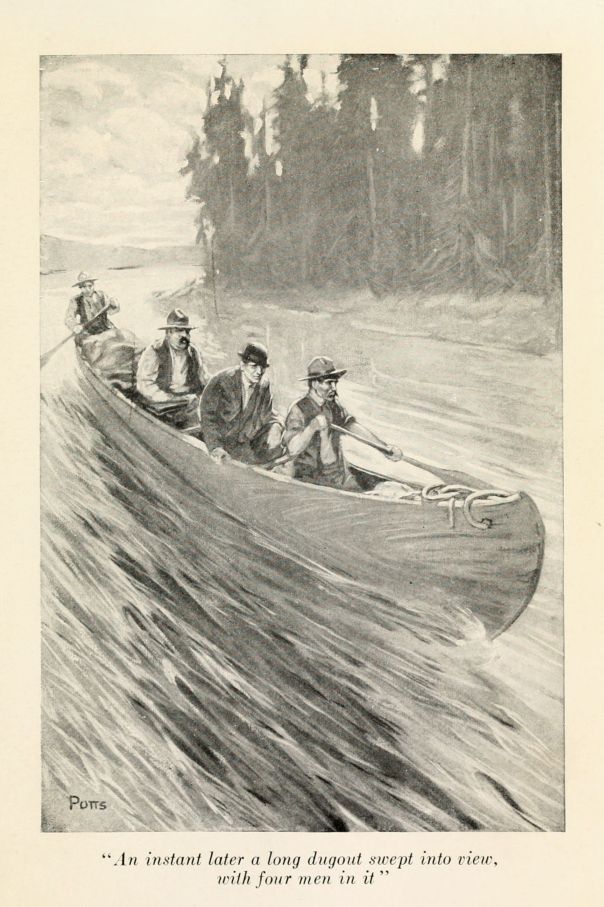
"An instant later a long dugout swept into view, with four men in it"
In the morning it awakened him all of a piece. He
abruptly sat up to listen. There was no sound. "What
is the matter with me?" he thought wonderingly.
"Something is upon you," that still voice seemed to
whisper. He looked to his gun. His heart failed
him a little, he was so terribly alone. Inside him he
offered up an unspoken prayer that whatever was
coming might come quickly, before fear of the unknown
should unman him.
Hastily cooking his breakfast, he never ceased to
listen; therefore he was scarcely surprised when he
finally heard the most startling sound in the
wilderness—human voices. An instant later a long dugout
swept into view upstream with four men in it. Courage
warmed Ralph's breast again; to be sure it was
bad enough, but it was real.
At sight of Ralph the men in the dugout set up a
shout. Arriving abreast of his camp they swung
around and beached their craft below. In the bow
was a white man strange to Ralph, Joe Mixer and Stack
sat amidships, while the stern paddle was wielded by a
handsome, muscular young half-breed. They all got
out. Ralph awaited them on the top of the bank.
Burly Joe approached with an anticipatory, cynical
grin; little Stack kept partly behind him.
"Hello, pardner!" cried Joe.
Ralph, seeing that he actually expected to keep up
the fiction of friendliness, smiled grimly. "What do
you want?" he asked.
Ralph's warning of danger had served him well.
Joe, seeing him cool and prepared, was completely
disconcerted. "What do I want?" he repeated, falling
back with a scowl. "That's a hell of a nice
good-morning to hand out to a man!"
"What were you looking for?" asked Ralph, "an
address of welcome?"
Joe turned purple, and shook his fist. "I'll show
you!" he cried.
Little Stack stepped from behind Joe. Physical
terror gave his face a greenish cast, but his chagrin at
seeing his careful plans about to be destroyed was
stronger still. It emboldened him to put himself in
front of Joe. "Wait!" he implored. "You mustn't
quarrel! Let me explain!"
Joe turned aside with a muttered oath.
A fawning note crept into Stack's voice. "We've
taken the Doctor by surprise," he said. "He thinks
we're spying on him. You can't hardly blame him."
"You're a good guesser, Stack," said Ralph grimly.
"It's nothing of the kind!" cried Stack virtuously.
"You must remember I told you long ago I wanted to
take a trip through the wilds if I could get a chance.
Mr. Mixer was willing to go, so I engaged him and
these men to guide me."
"Why explain?" said Ralph. "It's nothing to me.
The river is free to all."
"I didn't expect this from you," said Stack, with an
aggrieved air. "I thought we were friends. What
have you got against me?"
"Nothing," said Ralph; "but you're in bad company."
Joe could no longer hold himself in. His face was
purple. "Who the hell do you think you are?" he
cried thickly. "You stinking dude! You smooth-face
poisoner! You rah-rah college boy. It makes my
stomach turn to hear you lisping! What are you doing
in a man's country? Go home to your pink teas and
your toe-dancing!"
Ralph could not help but smile at the style of Joe's
invective. The smile maddened Joe. The foulest
dregs of English speech were fished up to express his
feelings. The other white man laughed obsequiously.
He was in Joe's pay. The half-breed pitched pebbles
into the stream, handsome and unconcerned. Ralph
took it all steely eyed and smiling still.
"You stand there like a little Gorramighty!" cried
Joe, with a string of oaths. "What can you do against
the four of us? We've got you where we want you
now, and you know it! You'll be singing another
tune before we're done with you!"
"Now you're talking!" cried Ralph, bright-eyed.
"The truth is coming out at last!"
Stack all but wrung his hands at the turn things were
taking. "Gentlemen! Gentlemen!" he implored.
"Ahh! shut your head," snarled Joe. "You hate
him as much as me!"
Stack turned paler still, and darted a furtive look at
Ralph, and cringed and tried to smile indulgently.
"Don't listen to him," he said to Ralph. "You've
made him mad. He don't mean what he says. It
wasn't half an hour ago he said to me, 'Won't it be
sport to surprise the Doctor?' There's no need for
you to quarrel like this. We don't want to intrude
upon your privacy. Come to our camp to supper
to-night, and talk things over quiet, and shake hands
on it."
Ralph preferred Joe's honest obscenity to this. He
made no answer.
"Ah! come on!" said Joe. "I'm sick of your palaver!"
He pulled the smaller man back to the dugout.
Stack got in, nodding and smiling over his shoulder in a
comic and pitiable attempt to propitiate the grim
Ralph. They pushed off. As the dugout disappeared
around the first bend below, Stack actually had the
effrontery to wave his hand to Ralph.
Ralph sat down to do some hard thinking. His
charming dreams were rudely shattered, and like every
man suddenly roused to action, he felt a little ashamed
at having been caught dreaming. He remembered
precautions he might have taken had he been wide
awake. When his anger cooled—in spite of the smile
he had been no less angry than Joe Mixer—he was a
little appalled by his situation. Four against one is
heavy odds. If he had had even so much as a dog to
keep watch while he slept! How could he venture to
sleep and leave himself open to a night attack? He
resolutely put that unnerving thought out of his head.
"I shall travel exactly as if they had not come!" he
decided.
The more he thought, the greater loomed his
difficulties. In a manner of speaking he was trapped in
the river just the same as if they had him on a road
between high and unscalable walls. He could not go
back against the current, and he could not leave the
river. With his clumsy boat and one paddle, against
their dugout and four, there was not the slightest
possibility of his escaping them downstream. They were
free to follow him at their leisure, and play with him
like cat and mouse.
Ralph was amazed, as any open-hearted man might
be, at the suddenness of the discovery that he had
active and malignant enemies. Joe Mixer's hatred
he instinctively understood, and returned. Those two
had been formed to hate each other. He likewise
understood now that the evil fire Nahnya had lighted
in Joe's breast was no mere ephemeral flame. It was
clear that Joe hoped to reach Nahnya through him.
"I'll lead him a chase," Ralph thought grimly. This
brought up the thought that Joe might be the means of
keeping him from returning to Nahnya. Ralph ground
his teeth at that, and understood the desire to murder
that is born in men's breasts.
In Stack Ralph realized he had a more dangerous
enemy than Joe. In vain he threshed his brain to
discover a reason for Stack's being in Joe's galley. He
had never laid eyes on the little man until they took
their places in the stage together. It was true he had
never thought much of the little Jackstraw, but there
had never been anything but friendly exchanges between
them. There was a mystery here that tantalized him.
The upshot of his cogitations was, Ralph decided to
accept Stack's invitation to visit their camp that
night—not to eat with them, Ralph's gorge rose at the idea,
but to go after supper. "It'll surprise 'em," he thought
grimly. "Nothing like bearding them in their own
den. I'm bound to find out something. One man's
strength isn't enough against four. I've got to use all
the wits I have, too. I've got to meet them on their
own ground, lie for lie. Beastly crooks! I'll go further
than lying if necessary to keep them out!"
All day they remained ahead of him in the river,
About nine o'clock, while it was still fully light, he
came upon their camp in the accustomed camping-place
where Nahnya had stopped on the second night
of the previous journey; the spot where Nahnya and
Ralph had effected their midnight reconciliation.
There was the little grassy shelf in the bank where she
had lain! The coarse voices of the men above profaned
the scene horribly.
Ralph's face as he climbed the bank was serene.
His greeting was as bland and off-hand as a schoolboy's.
The four men were sitting on the ground playing
"jackpot." As Ralph had pleasurably anticipated, their
jaws dropped upon his appearance. Only Stack answered
his greeting. Cards in hand, the little man
jumped up obsequiously, but Joe Mixer barked at him,
and he sat down abruptly. Joe scowled at his cards
like a hangman. The game proceeded as if Ralph
were not there.
Ralph's cheeks began to burn at the implied insult,
but he clapped his anger under hatches. He saw
clearly enough that Joe was waiting for him to make
an opening for a quarrel. Drawing closer, he coolly
overlooked the game. They had a folded blanket
between them to play the cards upon. In lieu of chips
they used matches. The half-breed was winning. He
was a fine specimen of physical manhood a year or two
younger than Ralph, with a bold, conceited face. He
scarcely took pains to hide his contempt for the three
white men of his party, and Ralph observed that even
Joe was inclined to truckle to him like a bully to one
whose strength he has not measured. Stack was
obsequious all around. In the third white man Ralph
recognized Crusoe Campbell, a disreputable character
well known up and down the river of that name. He
had the reputation of being not quite right in his head,
which he traded upon to his advantage. His wits were
good enough to play a crafty game of poker.
So much for Ralph's observations. "A rum outfit!"
he thought grimly.
When the cards were collected for a fresh deal Ralph
asked coolly: "What are the stakes?"
"Nickel a match," answered Crusoe Campbell.
"Give me the worth of that," he said, throwing a
five-dollar bill on the blanket. "You," he said,
indicating the half-breed, "what's your name?"
"Philippe Boisvert," the breed announced swaggeringly.
Crusoe Campbell and Philippe made room between
them and Ralph sat down. All looked covertly at Joe
to see how he would take it. Joe, still scowling, kept
his eyes down and said nothing. The game went on.
Ralph's bluff was as yet uncalled.
Outwardly as cool as the ideal poker-player, Ralph
was on the qui vive for an explosion. Under stress of
excitement, his spirits soared like a bird taking wing.
The corners of his lips twitched provokingly, and the
shine of a hidden fire glowed in his dark eyes. He bet
recklessly, winning and losing with equal good humour.
His good humour communicated itself to three of the
other players. All men love a good gambler. The
ill-assorted game became almost jolly. Only Joe grew
more and more morose. His face turned an ugly brownish
red, and a vein stood out ominously on his forehead.
When the explosion took place it was not directed at
Ralph. Stack, carried away by the appearance of
general good feeling, during a pause while the cards
were being shuffled had the misfortune to say,
addressing Joe and Ralph: "You two ought to shake hands
and let bygones be bygones."
Joe Mixer broke out on him so violently as to be
almost comic. "You sneaking little two-faced
informer!" he shouted with a whole string of oaths.
"Keep your lip out of my affairs, will you? I'll learn
you to talk to your betters! You make me sick with
your lying palaver! Get the hell out of this game
anyway! You ain't man enough to play poker!"
Stack hastily retreated from the circle. The breed
laughed. Crusoe Campbell quietly confiscated Stack's
matches.
"Give me another box of cigarettes out of your bag,"
the breed said curtly.
"A half-breed issuing orders to a white man and being
obeyed!" thought Ralph.
"Bring up a pail of water from the river," commanded
Crusoe.
The little man had already become the camp drudge,
it appeared.
Stack sat down at a little distance from the game with
a childish assumption of injured dignity. During the
deals Joe alternately chaffed and reviled him coarsely.
Ralph could not find it in his heart to feel very sorry
for the little man. "He is a sneak," he thought. He
kept his ears open for any word that might throw light
on this obscure and curious situation.
After a while Stack said humbly: "Doctor Cowdray,
if you please I'd like to have a word with you
before you go."
"I'm damned if you do!" cried Joe. "You'd like to
play him off against me, wouldn't you; and me against
him, and get your private pickings off the both of us!
Me and Cowdray we ain't got no use for each other.
We don't make no pretences. But you! You snide! you
want to square yourself with him, don't you? After
telling me you trailed him all the way from the coast!"
"I have nothing to say to you!" cried Stack, with a
display of childish fury that caused all three of his
mates to shout with laughter.
A light broke on Ralph. Trailed all the way from the
coast! To learn this was worth having come for! But
why anybody should want to trail him was more of a
mystery than ever. He determined to find out.
Meanwhile the game went on with four players.
The fortune of the cards changed, and Joe Mixer began
to win, principally from Ralph. His good humour was
restored. This was as good a way to get square as any.
As Ralph's pile of matches melted away, Joe triumphed
insolently. He doubled and trebled the ante whenever
it came to him. Finally he said:
"A dollar to draw and two to play. Does that scare
you off, Doc?"
"Not at all," said Ralph coolly. "This is mild beside
the play in New York clubs."
"Well, it ain't hard to win all you've got," snarled Joe.
"Three cards," said Ralph to the dealer. "This is
my last hand."
He had been dealt a pair of aces. He drew another
ace with a pair of sixes, and a comfortable little
satisfaction warmed his breast. His face was like the
Sphinx's. Joe Mixer drew two cards. Ralph, watching
him narrowly, saw a tiny spark of satisfaction light
his eye when he looked at them, and guessed that he
held three and had drawn a pair. Revenge was as
sweet to Ralph as anybody.
Joe bet in a small way, and Ralph raised him
modestly. The others had dropped out. Joe raised
again, and Ralph followed suit. Joe, seeing that he
was not to be shaken off, began to plunge. Ralph's
matches were exhausted long ago, and he threw the
money on the blanket, raising Joe a dollar each time.
Joe began to breathe hard and his face became as pale
as a butcher's face may, except his ears, which
remained a furious crimson. He raised Ralph five, and
finally ten dollars at a time, hoping to bluff him out.
Ralph covered his bets with a smile, and each time
raised him one. A respectable little hill of greenbacks
grew on the blanket. Crusoe and the breed eyed it
hungrily. Finally, when it came to Joe's turn, he
stopped. Little beads of perspiration had sprung out
on his forehead.
"What's the matter?" asked Ralph innocently.
"Are you scared off?"
"No!" cried Joe with an oath. "Ain't got no more
money," he added sheepishly. "Don't carry it on
the trail. Will you take my I.O.U.?"
Ralph shook his head. "A cash game, you said.
I'll take back my last raise and call you instead."
Joe with a great air of bravado laid down three kings
and two queens.
Ralph made believe to be dumbfoundered. Joe
grinned and reached for the money with a trembling
hand; whereupon Ralph counted out his three aces and
his pair of little ones.
"It's a shame to take all you've got," he said softly.
Joe ardently desired to continue the poker game on
borrowed capital, but Ralph pointed out that
he had announced in advance his intention of
retiring from the game. "I've got to sleep," he said.
"Camp here if you like," growled Joe.
Ralph shook his head. "I'll drop down the river
a little piece," he said. "I want to get an early
start."
"You'll have to get up early to keep ahead of us in
that contraption," said Crusoe with a laugh. "It's
no more than a dunnage bag stretched on a couple of
half hoops!"
"You can't go down the Stanley rapids in her," said
the breed. "She all bus' up."
"Don't expect to go down the Stanley rapids," said
Ralph with a great air of carelessness. "I'm going
up the Stanley."
He observed that Stack and Joe were listening attentively.
"You can't track her," the breed said scornfully.
"My partner is waiting for me at the Forks," lied
Ralph. "He's got a dugout."
"Where the hell did you pick up a pardner?" Joe
burst out, forgetting himself.
Ralph opened his eyes wide in affected surprise.
"Well, say, give me time," he drawled, "and I'll tell
you all my private business!"
The laugh was fairly on Joe. He flung away with a
muttered curse.
Ralph, embarking, paddled no farther than around
the first bend. Here he made his camp on the same
side of the river as the others. He thought it likely
Stack would try to communicate with him during the
night. Ralph was highly satisfied with the results of
the evening's entertainment. Besides winning about
fifty dollars, he had shown them he was not afraid, and
he had put them, he hoped, on a false scent as to his
destination.
He made a little fire, and retired under his shelter,
but not to sleep. He had plenty to occupy his mind.
After an hour or so he heard a rustle in the underbrush,
and presently a scared voice whispering:
"Doctor Cowdray! Doctor Cowdray!"
Ralph sprang up.
"Don't shoot! Don't shoot!" cried the voice in
terror. "It's only me, Stack."
Ralph laughed.
The little man drew near, cringing. "Won't you
put out the fire?" he whined. "In case any of them
should come."
Ralph scattered the embers.
Stack needed no encouragement to make him speak.
It came tumbling out; truth and lies, complaints and
excuses all mixed. "My God! Doctor! What a terrible
position I'm in!" he wailed. "I don't know which
way to turn. I gave Mixer two hundred and fifty
dollars to guide me through the country, and look at
the way they treat me! You saw it! I have to wash
the dishes, and wait on the half-breed! Me! with a
college education! I'm in momentary terror of my
life. I hired Mixer, thinking no wrong, and now I find
him pursuing some murderous vengeance against you!
If you could hear how he talks about you! Look what
a position that puts me in—travelling with a gang of
murderers! What must you think of me?"
Ralph listened to all this, smoking impassively.
"What are you making this trip for?" he asked.
"Just to see the country," whined Stack. "Didn't
I tell you that? I wish to heaven I was well out
of it!"
"That's a lie," said Ralph coolly.
"Oh, Doctor Cowdray, I wouldn't lie to you! I
wouldn't do such a thing!" he protested volubly.
"Did you hire Joe Mixer to bring you after me?"
Ralph demanded imperatively.
"Yes," faltered Stack. "But for a purely legitimate
purpose. I swear it!"
"Have you, as Joe said, been trailing me all the way
from the coast?"
"Yes," he confessed. "But meaning no harm at
all—purely legitimate, Doctor, purely legitimate!" His
voice trailed away.
"Well I'm damned!" said Ralph. There was a
silence while he smoked. "What was your purpose?"
he finally demanded to know.
"It's such an improbable story I didn't dare tell you,"
said Stack. "And I haven't any proof of it."
"You tell me and I'll decide as to the proof," said
Ralph.
Stack took a breath and began with renewed
glibness: "I'm a newspaper reporter—Pacific Herald.
The city editor was told you had made a big new strike
up here, and he sent me to follow you in, and get the
first story of it for the Herald. I had to do what I was
told," he whined, "or lose my job. You can't blame
me——!"
"Who told him about me?" asked Ralph astonished.
"Don't ask me," said Stack. "I've heard they have
the assay office watched. I don't know."
It was obvious to Ralph from the man's silky,
fawning voice that he was lying still. His gorge rose.
Evidently the truth had to be terrified out of such a
creature. They were sitting beside the last faint
embers of the fire. Ralph shot out his hand and gripped
Stack by the collar. A faint, gasping cry escaped the
little man, and he went limp in Ralph's grasp.
"I have my revolver in the other hand," Ralph said in
a rasping voice. "The truth now, or I'll crack your skull
with it! It was you who watched the assay office."
"Yes," murmured Stack in accents of honest terror.
"You followed me up here on your own responsibility,
hoping to get in on my strike?"
"Yes."
Ralph dropped him. "Now we know where we
stand!" he said.
Stack, like all born liars, had an infinite capacity for
swallowing his lies. Ralph had no sooner dropped him
than he unblushingly appropriated the credit for his
confession.
"I had to come and square myself with you," he
whined. "I couldn't rest until I had come and told
you the truth!"
"Well, I'm damned!" said Ralph again. "Go on!"
"You're the only friend I've got!"
"Friend!" said Ralph with a snort of scornful
amusement. "This is good! Give it to me straight," he
went on curiously. "What did you come here for
to-night?"
Stack's voice rose to a piteous wail. "Any night I
may be murdered in my blankets!"
"Sure," said Ralph coolly. "But what can I do for
you?"
"Take me with you in your boat," Stack blurted out.
"Well, upon my word!" cried Ralph.
"Don't refuse! Don't refuse!" said Stack breathlessly.
"They wouldn't dare touch me if I was with
you. They're afraid of you. That was magnificent
of you to come to their camp and sit in the game as if
nothing had happened. It had its effect, I can tell
you! Oh! take me with you!" he went on, stuttering
in his eagerness. "I can help you escape from them.
Two heads are better than one. I have a good head
for planning when I'm not in mortal fear of my life!"
"Fine!" said Ralph. "And you get right in on my
strike!"
"I wouldn't ask much," said Stack. "I'd be
content with whatever you wanted to let me have. Why
can't we work together? You need a representative
outside. You've got to file a lot of dummy claims to
cover the whole field. You've got to form a company.
I can attend to all that for you. It's just my line!"
"Thought you said newspaper reporter?" remarked
Ralph.
"That was just making out," said Stack hastily.
"I know the mining business from A to Z. I've got
legal training. You need me!"
"Thanks," said Ralph coolly. "I prefer to pick my
own company."
"If anything happens to me it'll be on your head,"
whimpered Stack. "Aren't you going to take me with
you?"
"No!" said Ralph in a tone there was no mistaking.
"What shall I do? What shall I do?" moaned Stack.
"If you won't let me travel with you, tell me where
you're going, and if I can escape from them, I'll try to
reach you. In common humanity you can't refuse
that!"
Ralph smiled into the darkness. "Is it possible he
still thinks I am fool enough to give away my secret!"
he thought. "If he does, all right!" Aloud, he said
carelessly: "I've no objection to telling you that.
But I won't guarantee you a welcome."
"Anyway, you're not a murderer!" whined Stack.
"It's about twenty-five miles up the Stanley River
from the Grand Forks——"
"Then you were telling the truth?" said Stack with
naïve surprise.
"Why not?" said Ralph coolly. "I'm not afraid of
them." He bethought himself of adding a few
convincing touches to his lie. "You enter a tributary
that comes in on the right-hand side of the Stanley,
and ascend it as far as you can go into the foothills.
There you will find our camp."
"How will I know the mouth of the right tributary?"
asked Stack.
"By two pine trees that lean across, one at each side,
until their tops almost meet," said Ralph readily.
"My partner and I call it the A River."
"Take me with you!" Stack began all over again.
"You need me!"
"Cut it out!" said Ralph impatiently.
"You ought to take me with you," Stack persisted.
An indescribable, sly, cringing threat crept into his
whine. "Now that I know where you're going, if they
torture me I might let it out in spite of myself!"
Disgust overmastered Ralph. He sprang up. "You
little cur!" he cried. "Get out of here before I hurt
you!"
Stack waited to hear no more.
During the next three days the two boats seesawed
on the lakes and rivers, Ralph now ahead, and now
Joe Mixer's party. Ralph kept much longer working
hours, but the others made it up in speed. Whenever
they passed each other it became the occasion for an
exchange of half-serious abuse, which was only prevented
from developing into a fight by Ralph's unshakable,
steely smile. Ralph insisted on making out that
it was all a joke. Joe was itching for a fight, but the
smile cut the ground from under him. Meanwhile
Ralph gave as good as he got. Stack never took part
in these contests of wit. He sat in the dugout haggard
and abstracted, gripping the gunwales under his skinny
knuckles. When he thought Ralph's gaze rested on
him, he did his best to look meek and imploring, but
succeeded very ill in disguising his hatred. Joe Mixer
carried a deal of liquor in his baggage as evinced by
their frequent thickness of speech.
At the end of the third day they had travelled far
down the Rice River. By paddling until near dark
Ralph succeeded in pitching his camp three miles in
advance of the other party. It was his intention to
sleep for four hours only, and then go on. According
to his calculations he was within a few hours' journey
of the Grand Forks, and it was essential to his plan
that he get there first. He meant to watch from some
place of concealment on the shore, to make sure that
they turned up the Stanley River instead of continuing
downstream. In case they were not deceived by his
false lead, and did not leave the main stream, he had
one more desperate card to play. The moon was now
nearly full again, and he could be sure of a certain light
until dawn.
Ralph pitched his little shelter in an opening among
the willows that thickly lined this part of the bank.
His boat was drawn high up on the stones below, and
tied to the willow trunks. He ate a hasty supper and
turned in. As he lay waiting for sleep, once again he
was warned by a vague disquiet in his breast of an
impending danger. He remembered this afterward.
At the time he was dog-tired, and the still voice was
not insistent enough to cleave the gathering mists of
sleep. He soon became unconscious.
He was awakened immediately, or so it seemed to
him, by a sudden outburst of drunken shouting. At
the same moment his shelter collapsed on top of him.
When he succeeded in freeing himself of the entangling
blankets, netting, and canvas, in the dim light he saw
four figures reeling about where his fire had been,
kicking his belongings into the bush, and wreaking what
senseless damage they could. A terrible rage nerved
him in every fibre.
"You damned cowards!" he cried.
Hearing his voice, they made for him simultaneously,
but Ralph retreated silently under the willows, and
bided his time, peering through the branches. They
searched for him, stumbling over the roots and shouting
inanely.
During the next two or three minutes the scene was
as confused and incredible as a nightmare. Ralph
made out a swollen body swaying on the edge of the
bank, outlined against the moonlight. Rushing him,
he hauled off and struck him on the jaw with a savage
satisfaction in the crack of it. He made to follow up
the blow, but Joe was not there. He lay in a heap at
the bottom of the bank. Hearing a sound behind him,
in the act of whirling around, a bludgeon aimed at
Ralph's head descended on his shoulder. Seizing him
who had wielded it around the body, Ralph lifted him
clear of the ground and flung him after Joe. This one
was Crusoe Campbell. A third figure scuttled down
to the water's edge without waiting to be assisted.
Ralph stood in the ashes of his fire, breathing hard, and
glaring around like a lion for another adversary.
The half-breed stepped from out the shadows of the
willows. "Look out, white man!" he cried boastfully.
"I got it in for you! I'll fix you good!"
"Come on!" cried Ralph gladly. At the same time
the curious thought shot through his brain: what could
the half-breed have against him? It was not Joe
Mixer's quarrel; there could be no mistaking the note
of personal enmity.
The moon shone down serenely indifferent. A little
prize-ring was illuminated within the encircling willows.
In it the two men advanced toward each other, fists
up. They crashed together. This was an adversary
worthy of Ralph; he fought like a white man, and
he fought fair. Shrewd blows were exchanged on
either side. Each quickly learned to respect the other,
and thereafter fought more warily. Failing to reach
Ralph's head, the breed punished him about the body.
Every one of Ralph's blows was aimed in the centre of
the pale ellipse that denoted the other man's face.
Ralph had an advantage in that the breed's head was
somewhat fuddled. His blows began to go wild.
Ralph beat him to his knees, and stood back to let him
rise. As they rushed each other again, Ralph's ankles
were grasped from behind, and he was flung violently
to the ground, striking his head.
As from an immense distance he heard the half-breed
say: "Dam' little sneak! Wat for you do that? I
want lick 'im myself!"
Then the voices receded. Ralph heard them from
the beach; heard a hoarse guffaw, and afterward the
splashing of paddles. He understood that they had
gone.
By this time he had got to his feet. He stood, reeling
from the effects of his fall, and half suffocated with a
cold and deadly rage. He made his way down to the
water's edge. His boat was turned upside down on the
stones, and the moonlight revealed several clean slashes
in her canvas bottom.
"Oh! the scum!" muttered Ralph in his rage. "Unnatural
beasts without decency or manliness! Malignant,
cowardly, sneaking rats!"
In cutting his boat they had not done as serious
damage as they doubtless aimed to do, for Ralph carried
spare pieces of canvas in his baggage, and a can of
waterproof gum against emergencies. He instantly set
about repairing the boat, working away in the partial
darkness with the pertinacity inspired by a cold rage.
He had no doubt now of what he meant to do.
"They'll be sleeping sound after the booze," he
thought grimly. "They think they've fixed me for a
while. They won't be looking for a visit to-night."
When he had his patches affixed, he built a small fire
on the stones, and held the boat over it to dry the gum.
In less than two hours she was fit to float again. He
carried his fire up on the bank then, and making a blaze,
hastily collected his scattered belongings. This
refreshed his rage. In his impatience he flung everything
into his boat higgledy-piggledy, and pushed off. He
did not paddle, for fear of being carried past, but
allowed the current to take him, while he searched both
shores with straining eyes. No shadow was allowed to
pass unexplained.
He had not gone much above a mile when he saw
what he so ardently desired: their dugout drawn up on
the stones. A great satisfaction diffused itself throughout
his breast. Softly paddling ashore, he beached his
own boat alongside, and bent his head to listen. A
faint snoring from the bank overhead reassured him.
He smiled scornfully. In their drunken carelessness
they had actually left most of their baggage in the
dugout. Ralph had no desire to starve them to death,
or to deprive them of the means of ultimate escape.
With suitable precautions of silence he unloaded
everything on the stones. Then untying the rope by which
the dugout was fastened to a tree, he heaved her adrift
on the current. He didn't care much whether they
heard that or not. But no alarm was raised.
Embarking in his own boat, Ralph towed the larger
craft into midstream. Picturing the scene that awaited
their awakening next morning, he chuckled grimly,
and found his breast eased of its weight of rage. He
felt not the slightest regret for what he had done;
indeed he was blaming himself for the foolish
compunctions that had prevented him from doing it earlier.
His enemies were in no pressing danger; they possessed
a store of food, also guns and ammunition. They
would eventually build a raft. In the meantime he
would get a start that would put him out of their reach
for good. He was free of them. A great serenity
descended on his spirit.
Before he cast off the dugout it occurred to him that
it was better fitted to descend the rapids ahead than
his own clumsy coracle. He debated the matter. An
odd quirk of conscience finally prevented him from
making the change. "If I use the thing," he thought,
"it's the same as stealing it." On this fine distinction
depended the whole subsequent course of his story. He
cast the dugout adrift. There was no wind to blow it
ashore and it was good for a long journey.
During the rest of the night Ralph paddled and
floated with the current without seeking any further
rest. Dawn found him among the islands that marked
the approach of the end of the Rice River. This was
where he had first been blindfolded on the previous
journey, and he awaited the subsequent sights of the
river with a stimulated curiosity.
At sun-up, rounding a bend, he beheld the wide
expanse of the meeting of the waters, the Grand Forks
of the Spirit River. There could be no mistaking the
place. The two rivers occupied the same valley; one
came down from the north, one from the south;
meeting head on they swung away to the eastward. The
green current and the brownish struggled ceaselessly
for possession of the channel. At present the Stanley
was in flood, backing up the waters of the Rice River
for several miles. The division between sweeping brown
water and motionless green water was as sharply
defined as between water and land. Poking the nose of
his boat into the current, she swung around and
almost rolled awash under the impact. Ralph instantly
remembered the sensation which had so puzzled him
while he lay blindfolded.
Soon after he began to move down on the majestic
flood of the augmented river, the murmur of the great
rapids crept on his ears, and his heart began to beat.
This would be the first real test of his paddle. The
murmur increased to a rumble, then to a roar. Finally
he could make out the white-caps leaping below, like
the naked arms of a multitude ceaselessly tossed to the
sky in wild excitement. He appreciated the vast
difference between a pretty stream brawling among the
stones, and a mighty watercourse plunging over a
barrier of rock.
He landed a little way above the rapids and fortified
himself with an excellent breakfast. Afterward he
made his way alongshore to the beginning of the
turmoil to try to spy out the best place to enter it. A
close view of its mightiness made him feel very small.
The immeasurable flood of water swept smoothly over
the hidden ledge with an oily streaked surface, moving
faster and faster until it suddenly boiled up madly at
the bottom. From shore to shore, nearly half a mile,
the wild, white welter prevailed. Ralph received a
stunning impression of the tearing, resistless might of
the down-rushing water. Its roar was deafening. At
the thought of tempting it with his flimsy coracle, his
heart shrunk away to nothing in his breast. But it
had to be done.
At first as far as he could tell one place was as bad
as another to descend. Gradually he made out that
by great good fortune he had chosen the right side of
the river. Toward the other bank the white surface
was everywhere pointed with ugly black rocks. He
saw that the greatest volume of water rushed down
close to the shore on which he stood. If he could keep
his boat in the middle of it there was no danger of rocks.
There remained the danger of those strange, great
billows which curled and rolled and roared without ever
advancing an inch in their paths.
He returned to his boat, fighting his terror of the
place. Refusing to think of it, he worked desperately
to make all snug. He got in and clung to a branch that
trailed in the water, while the increasing current sucked
at his little craft. He had fallen out of the habit of
articulate prayer; maybe he prayed in his own way.
He let go of the branch, and began to drift toward the
place. He moistened his lips, and drew a long breath, and
drove his paddle into the water. No turning back then.
Then he took the plunge, and was filled with an
amazing exhilaration.
The struggle was brief. His boat plunged her nose
right under the first curling white billow and half a
ton of water fell aboard. She staggered drunkenly,
and in spite of his desperate paddling swung broadside
in the current. The next billow raked him from stem
to stern, rolled his boat completely under and washed
him clear of it. The opposed currents of the water
clutched at him and racked him like whirling machinery.
He came to the surface gasping, only to be flung violently
against a rock, striking on his shoulder. Stunned
by the buffeting and the roar, he was carried on down
like a rotten log, now underneath, now on top, the
plaything of every wild eddy.
Struggling instinctively, in the end he found himself
somehow in still water. He crawled out on the beach
and lay inert, struggling for breath and for consciousness.
Very slowly the realization of his plight was
forced on him. He felt no great concern. It was like
something that might have happened to somebody else.
There lay a poor devil cast ashore in the wilderness
hundreds of miles from any fellow-creature. Everything
he possessed, boat, food, matches, axe, blankets,
gun and ammunition were at the bottom of the river.
Out of the wreck he had saved only Nahnya's necklace,
which was sewed to his shirt, and his pocketbook with
money, neither article being of the slightest service
to keep life in his body.
He sat up, roused by an imperious pain. Looking
sideways and down at himself he was mildly impressed
by the extraordinary conformation of his right
shoulder—like somebody else's shoulder. It was dislocated.
He could not lift his right arm. It was a mercy, if but
a small one, that his faculties began to work so slowly.
His first articulate thought was:
"Well, thank God! I got a skinful of breakfast
before I lost it!"
A traveller might have descended through
the Spirit River pass half a dozen times without
suspecting the vicinity of any fellow-creatures
in the hundred miles of mountains. Nevertheless
there was a white man's camp at the foot of Mount
Milburn. Milburn is the hoary-headed monarch that
stands guard on the right-hand side of the gateway to
the Rockies. It rises sheer from the river to a height
of more than six thousand feet. In the country it is
otherwise called the Mountain of Gold because it has
long been known that one of the buttresses of its base
is entirely composed of a metal-bearing quartz.
The few people of the country knew of course that
Jim Sholto had established himself here with his three
children for the purpose of smelting the ore in a small
way, but Jim had built his shacks a quarter of a mile
back from the river to avoid the inconvenient observation
of the chance traveller. Jim and his two sons
excavated the ore and burned it in half a dozen little
furnaces of porcelain and brick, the materials for
which they had brought in with immense difficulty.
The venture was not highly regarded in the country.
The expense of bringing in supplies was too great.
They worked like beavers, it was said, for a net return
no greater than day labourer's wages. Such unremitting
industry accused the easy-going ways of the North.
On a brilliant afternoon in July Kitty Sholto was
redding up the kitchen in the larger of the two shacks.
There was a cloud on her charming face. She slapped
the enamel-ware plates on the shelf with a malicious
satisfaction in the clatter, and cast the dish-towels over
the line, as if they had individually offended her.
Kitty was twenty years old. In her face were combined
elements of gentleness and piquancy, a rare association
and provoking to the other sex. The piquancy
was due to her long eyes, green-gray in colour, and
placed a thought obliquely in her head. Green in
eyes is thought of in connection with feline qualities.
There was nothing of that sort about Kitty. All the
rest was gentleness. She had a small, straight nose,
and an adorable mouth that turned up at the corners.
Her hair, darkest brown in colour, was of the crinkly
sort that reaches out tendrils. She had a soft voice,
with an odd, hushed thrill in it that was all her own, and
a soft and ready laugh. She was not at all the kind of
girl to be given to ill-humours.
Sweeping the crumbs over the door-sill, she stood
broom in hand leaning against the jamb. In one swift
cast around she took in the whole scene, the exquisite,
limpid sky, the polished malachite of the deciduous
foliage, the rich bottle-green of the pines, the brook
whipping itself white on the stones. She took it all in,
and the line between her dark eyebrows deepened as if
the loveliness of nature were an added affront.
Down the trail from the excavations the four ponies
came plodding, each laden with a double wooden bucket
of ore. Bill, the younger of Kitty's two brothers,
walked behind, whistling vociferously, and tickling the
rearmost beast with a switch. Bill was a tall, strong
youth of twenty-two, a black Scotchman with a gleaming
smile. Dumping the contents of the buckets on the
little mountain of ore before the other shack, with a
flick of his switch he sent the ponies trotting back one
by one for another load.
Bill, pausing to fill his pipe, grinned amiably at his
sister. Kitty's brothers adored her, and teased her
remorselessly. "Hello, sis!" he said. "What's biting you?"
"Nothing!" she said quickly.
"You look as if the cat was dead and the milk
turned," he said in the humorous style that brothers
affect.
"There is no cat and I haven't tasted milk in a year
and a half," said Kitty sharply.
"Take example from me!" sang Bill. "Dog-tooth
Bill, the sunshine of Milburn Gulch!"
"That's all very well!" said Kitty bitterly. "Who
wouldn't be gay in your shoes. You're going away
to-morrow. You're going to mix with people; to see
something besides trees; to have some fun! What have
I got to look forward to?"
"Cheer up, sis," said Bill with jocular solicitude.
"What can we do about it? The little iron chest has
to be carried out. It's getting too heavy to be left
lying around loose. And there's next year's grub to be
brought in."
"Certainly, I know you're obliged to go," said Kitty.
"If you could go in my place you'd be welcome,"
said Dick. "But it's too hard a trip both out and in
again. You and Dick couldn't do it alone."
"I know it," said Kitty stiffly. "You don't have to
explain."
"And we can't take you with us, because the old man
can't keep the plant going, and cook his own grub, too."
"I wouldn't think of leaving him alone," said Kitty
indignantly.
Bill began to grin again. "Cheer up, the worst is yet
to come!" he cried. "We'll be back in six weeks with
a scow full of good things! What'll I bring her from
town for a present? A silk dress?"
"A lot of good a silk dress would do me!" Kitty said
scornfully. "Who do I ever see from one month to
another?"
"Ah, there we have her trouble!" cried Bill. He
began to sing and to caper absurdly:
"Kitty is mad and I am glad,
For I know how to please her;
A bottle of wine to make her shine
And a nice young man to squeeze her!"
"You're horrid!" cried Kitty, frowning and blushing.
"Give me the specifications," Bill went on, with an
air of serious gravity. "Blond, brunette, or albino?
Heavy, welter, or light weight? Kind of disposition
you prefer, and amount of purse to be put up before
you enter the ring? I'll bring the candidate back with
me if I have to sandbag him!"
Kitty retired into the house, slamming the door.
Bill, with a whoop, started up the trail after his horses.
When the cabin was put to rights there was nothing
more that Kitty was obliged to do until it was time to
start the supper. On such occasions she was accustomed
to help her father in the "works," as they called
the other shack, but the furnaces had been cold for a
week now, while all hands joined to get out enough ore
to keep them fed while the boys were away. There
was plenty of work that Kitty might have done, but
she was in a mood to dream and to nourish her
grievances. She might have gone up to the excavation to
help, but she dreaded male raillery. She finally turned
in the other direction and followed the path down to the
river.
It ended in a little glade that had been a camping-place
since time out of mind. In the middle of the
place was a fire-hole, centuries old, maybe. Upright
posts were driven on either side, with a bar across and
wooden hooks of assorted sizes waiting for the bails of
the next traveller's pots. In front of Kitty as she stood
beside the fireplace the river stretched its smooth
jade-green flood across to the base of the mountain opposite,
and at her left hand the limpid waters of the creek
mingled with the thicker current.
Below the camping-place stretched a bank of fine
yellow sand precipitated by the eddies in times of high
water. Partly drawn up on the sand was a dugout.
The Sholtos kept their two boats cached in the creek,
but this one had been got out in preparation for the
journey next day. It was the happy-go-lucky Bill
who had left it where it was without tying it, forgetful
of the sudden rises of the river in hot weather.
Kitty got in the dugout, and sat down in the stern,
where she might trail her hands in the water, while she
thought things out and dreamed her dreams. All
unwittingly Bill had discovered to her the very source of
her discontent, and she was disturbed and ashamed.
It was true that she wanted a young man! Here she
was twenty years old; it was jocularly granted by her
brothers that she was not exactly a fright; yet she had
never had a young man. What was worse there was
no young man, at least of her own colour, within
hundreds of miles, and she was doomed to her present
imprisonment for at least another year. Twenty-two
loomed ahead like old age itself. "What chance will
I have then!" she thought dejectedly. Behind this
was the hot-cheeked, nagging thought: what business
had a nice girl to be desiring a young man, anyway!
But after a while the lovely afternoon began to have
its way with her, and the disquieting thoughts melted
by imperceptible degrees into deceitful, charming
daydreams. She was lying in the bottom of the boat with
her arm on the gunwale, and her head on her arm.
Her eyes were bent upstream as far as she could see.
He will come down the river, she dreamed. "Perhaps
he is just around the bend at this moment. I should
not be surprised. But what if he should come when I
am not here, and be carried past! That is not possible!
If he is the right one, some power will lead him
directly to me! What is he like? Tall and slender,
with round, strong arms, and a wonderful light in his
eyes. He will not be surprised to see me either. He
will say: 'I have found you!' And I will say quite
simply: 'I have been waiting for you,' and everything
will be understood."
Following the usual course of day-dreams, Kitty
little by little lost the direction of this beautiful story,
and picture began to succeed picture without any help
from her. She found herself climbing the higher slopes
of Mount Milburn hand in hand with the youth whose
face was hidden from her; up into the intoxicating air
of the summits. Then presto! without so much of an
effort as the wink of an eyelid they were transported
to the busy streets of town, and looked into the
bewildering shop-windows without any surprise at all. Then
they walked between endless rows of silk dresses hung
on hooks, and all the dresses were hers, but she couldn't
decide which one she liked the best, and was much
distressed. And he said: "Don't worry; I have a paper
boat to sail down Milburn Creek in." And she
answered: "We'll never get up again," without
caring in the least. And then they danced to delicious
music that issued from a row of trees like the pipes of
an organ.
With a long sigh Kitty stretched herself luxuriously
in the bottom of the dugout, and ceased to dream. If
any young man had come along then and had seen
her thus, her head on her folded arm, her lashes on
her cheeks, and a dream-smile tilting the corners of
her mouth, it is safe to say he would never have been
the same again afterward.
She awakened as quietly as she had fallen asleep, and
lay for a while gazing up between the sides of the dugout
at the delicate clear sky, which had not changed while
she slept. Gradually she became aware of missing
something; it was the turbulent voice of Milburn Creek,
never stilled in her ears at home. At the same time
the dugout rocked gently with her, filling her with an
unexplained fear. She quickly sat up.
The heart in her breast turned cold. She was adrift
in midstream. Mount Milburn had disappeared and
the even more familiar limestone face of Stanhope,
opposite their camp. Strange mountain shapes
surrounded her, and unfamiliar shores. Her eyes darted
up and down the dugout; there was no paddle; nothing!
The swirling green eddies smiled at her horribly, like
things biding their time. Blank, hideous terror
descended on her, scattering her faculties.
There was worse in store. Sweeping around a bend,
she saw far down the river the white horses leaping in
the sunshine. She knew the place, the Grumbler
rapids; up and down river they bore a sinister reputation.
She stared at the place, fascinated with horror.
The river was so smiling, sunny, and beautiful, she
could not believe that there was the end of all; the very
white-caps below seemed to be leaping in play. And
she herself, twenty years old, and full of the zest of
living—it was not possible! But the ever-increasing
voice of the place warned her, there waited Death, sure
and dreadful. And nothing might stop her deliberate
progress between the green shores. She must sit with
her hands in her lap and watch it coming step by step.
Kitty's very softness and gentleness shielded her.
She could not take in so much horror. Her eyes
widened; she struggled for her breath—and collapsed in
the bottom of the dugout.
When consciousness and sight returned, she found a
strange, dark face bending over her. She was lying
on firm ground beside the river. The roar of the rapids
filled the air. Seeing Kitty's eyes open, and the light
of reason return, the face broke into a beautiful and
kind smile. Kitty, without understanding clearly, was
immensely reassured. It was a girl not much older
than herself.
"You all right now," the girl said.
"What happened?" asked Kitty faintly.
"You near get in the rapids."
The recollection of her terror rushed back over her
almost drowning Kitty's senses again.
"You all right," the girl repeated in a cheery,
matter-of-fact tone that was just what Kitty needed. "I was
working on the shore," she went on, "and I see a canoe
come floating down. I think it is foolish to let a good
boat get broke on the rocks, so I get my boat and paddle
for it, but there isn't much time. I come to it, and I
look in. Wah! there is you!"
"Oh, it was horrible! horrible!" murmured Kitty,
shaken by strong shudders.
"Forget it," said the girl. "You all right now."
"How did you get me ashore?" Kitty asked.
"It was not much," the girl said with a shrug. "I
was too near the rapids to save both boats, so I jump
in yours and let mine go down. It was pretty hard
paddling," she went on, smiling; "we were on the wrong
side for the deep water. Long time we jus' stand still
out there, and not go up or down. Then we come in
slow, slow. There is a tree fallen down beside the
water, and I catch hold just in time."
"You have saved my life!" murmured Kitty.
"Cut it out!" said the dark girl gruffly. "It was
worth it for the boat alone."
"But you lost your boat," said Kitty.
The other shook her head. "It is stuck on the rocks
down there," she said. "I will get it after."
Strength and self-command came back to Kitty,
and she sat up. The two girls measured each other
with glances of shy, strong curiosity. Each was a
surprising discovery to the other.
"You are Kitty Sholto," said the dark girl.
"How did you know that?" exclaimed Kitty, opening
her eyes.
"There is no other white girl in the country."
"I don't know you," said Kitty.
The other shrugged and smiled a little. "There are
plenty red girls," she said. "I am Annie Crossfox."
"Where do you live?"
Nahnya pointed vaguely downstream. "My people
are the Sapi Indians," she said.
"But that is way down by the canyon," said Kitty.
"Do you travel so far by yourself?"
"I like travel by myself," Nahnya said deprecatingly.
"I hunt and I fish. People think I am crazy. They
say it is like a man!"
Each thought the other a wonderful creature.
Nahnya marvelled at the colour of Kitty's eyes, green-gray
like the Spirit River itself, and her cheeks like
snow—snow with the light of the setting sun upon it.
Her delicacy and gentleness seemed like the qualities
of a superior creature. Kitty for her part was no less
admiring of Nahnya's strength and courage. The
gentle Kitty like most girls had often wished that she
had been born in one of her brother's places. To be
able to go where one pleased like a man! this stirred
her imagination. Each of these lonely girls was
hungry for a woman friend; therein lay the explanation of
their kind and wistful looks upon each other.
Kitty was soon quite herself again. Only at intervals
did the recollection of her terror cause her to catch
her breath, and send the colour flying from her cheeks.
A lesser fear succeeded.
"How will I get home?" she said. "Dad and the
boys! They will be frantic, poor things!"
"Have they another boat?" asked Nahnya.
Kitty nodded.
"Then they will come look for you soon," said
Nahnya calmly. "It is all right."
Kitty was much reassured.
By degrees the two girls felt their way toward
intimate speech. "I am so surprise I find a white girl in
this country," Nahnya said in her quaint, soft Mission
English. "When I look in your boat I am thinking
nothing at all. And there you are! I am so surprise
almost we both go in the rapids!"
Kitty explained how she had been carried off.
"Yes, all day the water rise," said Nahnya.
"If you hadn't been there!" said Kitty, and all her
terrors returned.
"We must eat," said Nahnya energetically. "I have
tea and bread and meat across the river. We must
track for half a mile before I can cross. You have
only a short line on your boat. I will track, and you
push out with a pole."
Nahnya went ahead with the end of the line, while
Kitty, according to instructions, walked abreast of the
dugout, and kept it off shore, and steered it around
obstructions with her pole. Kitty had never worked
harder. Nahnya thought she was sparing her, but
Kitty had to struggle desperately over the stones and
the tree trunks and around the edge of cut-banks in
order to keep up. The dugout acted like a thing
inspired by personal malice against them. Kitty
insisted that it went out of its way to find stones to stick
on, and if she fell so much as a yard behind, it instantly
drove its nose into the bank. Whenever it was
necessary Nahnya waded unconcernedly into the icy water,
and Kitty, not to be outdone, followed suit, shivering.
When they finally arrived opposite the spot whence
Nahnya had first set out to Kitty's aid, Kitty distinguished
a wide, flat rock and a little stream that emptied
beside it. Nahnya told off the white girl to make a fire
while she went for the supplies. Kitty enviously
watched her assured handling of the canoe. Heading
upstream enough to equalize the pull of the current,
Nahnya crossed the river as straight as a ruled line,
and in twenty minutes was back with everything they
needed.
Hanging their stockings and moccasins to dry, they
extended their pink and white and pink and brown toes
side by side to the fire, and ate their supper.
Meanwhile they were progressing in friendship by long leaps.
With a girl and, moreover, a girl so gentle as Kitty,
Nahnya did not feel obliged to wall up her breast, and
the natural warmth of her nature had way. Lengthy
girl confidences were exchanged.
"I never talk to a white girl like this," Nahnya said
shyly. "Though I have live among white people, and
watch the girls, and think about them much."
"What did you think about white girls?" Kitty asked
with her charming smile.
"Always I am thinking how are they different from
me," said Nahnya.
"Different?" echoed Kitty. "You are not really
different from me."
"I am half white," said Nahnya. "Inside I feel the
same as white people. But white people treat me
different from them."
"I don't understand," said Kitty.
"When I go to the Mission school," said Nahnya,
"the sisters teach us: 'Think no evil, and evil will
pass you by.'"
"That is true," said Kitty.
Nahnya sadly shook her head. "It is true for you,"
she said; "not for me. When I went among the white
people I thought no evil, but evil wrap me so close
as a blanket over my head."
"I—I do not understand," faltered Kitty.
"Why should you?" said Nahnya. "Nobody is bad
to you. Only to me. So always I am wondering what is
different in me. I do not understand it, but I know it."
"Do you—do you mean men?" asked the startled Kitty.
Nahnya was silent.
"But all men are not bad," said Kitty, thinking of
her honest, jolly brothers.
"Not all men," admitted Nahnya. "Once I know a
white man—at first he was crazy. But he change.
He look at me cleanly, and speak honest. But always I
am thinking this different thing is in me, and I send him
away. And always I think what is this different thing
in me?"
Kitty, looking at her with troubled eyes, made no
reply.
"Now I have scare you!" said Nahnya remorsefully.
"You think I mus' be bad, because others think I am
so!"
"No," said Kitty, "it is my own ignorance that I am
scared of. I don't know anything. I don't know what
to say."
"Say not'ing!" cried Nahnya, bending a quick look of
contrite affection on her. "Me, I talk too much!
Always I want talk to some one who is like me, and I am
near crazy with talk that I cannot speak. My people,
they are good people, but they do not know me. My
mot'er not know me. I am strange to her. She is
scare of me. Always I think if I could be friends with a
white woman, we could talk. And to-day the river
bring you to me, so I think it is like magic. And my
tongue, she shoot the rapids of talk! I am sorry I scare
you!"
"You don't scare me a bit!" protested Kitty. "I
like to have you talk to me. I'm talking to you, too.
Tell me about the white man," she said shyly, "the
one you liked."
Nahnya was startled. For an instant the old walled
look darkened her face. "I not say I like any white
man," she said quickly. "I not want any man."
Kitty hung her head a little. "That's what we say,"
she murmured with a burst of shy candour; "but how
true is it?"
The dark fled out of Nahnya's face. She turned a
pair of wondrously soft eyes on Kitty. "You are
lonely up here!" she said. "I know what lonely is!"
Kitty's eyes grew large and bright with tears. She
nodded. "I wanted a friend, too," she said very low.
"Some one to talk to like you. The boys are good to
me, but they treat me like a baby. I wanted a woman
friend. I haven't talked to a woman in a year and a
half."
Nahnya sprang to her knees, and unconsciously
clasping her hands to her breast, leaned toward Kitty.
"I will be your friend—always!" she said with
trembling eagerness. "If you want me," she added with
wistful humility.
Kitty's answer was to fling her arms around
Nahnya's neck.
Nahnya recoiled in a kind of terror. "You—you
kissed me!" she faltered. "Me!"
"I'll do it again!" cried Kitty. "And again! And
again! I think you are just sweet!"
With an odd little cry the dark girl hid her face on
Kitty's shoulder and clung to her, and broke into a
silent shaken weeping. Broken whispers of confession
reached the white woman's ear.
"I never have a friend.... Always inside of me
I am alone.... I think I am marked out to be
alone.... My heart hurt me like any woman's
heart ... but always I mus' make out I don't
care about anything..."
An hour later they heard a hail from far up the river.
Kitty leaped up in great excitement. Nahnya answered
the hail. She had the riverman's trick of sending the
voice to a distance. By and by they came flying
around the bend, father and sons paddling like men
possessed, and momentarily raising hoarse, anxious
cries. Nahnya tore off a branch of leaves, and putting
it into Kitty's hands, urged her down to the beach to
wave it. At the sight of her safe on dry land, the three
men sent up tremendous shouts of joy and relief.
Nahnya retired up on the bank.
They landed, and Kitty was instantly locked in her
father's arms. Dick collapsed in the boat, while Bill's
legs caved under him on the beach. Both boys wept,
unashamed.
"We heard the rapids," Bill blubbered. "We thought
we were just too late!"
They quickly recovered. Kitty had presently to
submit to their bear-hugs, and again to her father's
embraces. All four talked at once, and foolishly
laughed. Kitty was abashed by their transports.
Never had she seen her men so stirred. Afterward
questions began to fly.
"How did you drift off without knowing it?"
"Why didn't you scramble ashore and let the boat go?"
"How did you get ashore here without a paddle or
anything?"
"Who is with you?"
"Why, she's gone!" cried Bill suddenly.
It was true. They looked around in vain. During
the excitement of the men's landing, the dark girl had
stolen unobserved to the other dugout. It lay a little
downstream, and partly screened by some bushes. Putting
off, and keeping close to the shore, she was soon
lost to their sight.
Kitty's face fell like a child's. "Without a word of
good-bye!" she said.
"She's taken our best boat," said Jim Sholto, frowning.
"She lost her own in the rapids saving me," said Kitty,
with quick indignation.
Jim hastened to mollify her. "That's all right," he
said. "But to steal away like this!"
"It's just like them," said Dick, "always mysterious."
"You're not very grateful," said Kitty, at the point
of tears. "I tell you she saved my life."
"You haven't told us anything yet," said her father.
"Who is she?"
"Annie Crossfox."
"I had a look at her," said Bill. "She's mighty
good-looking! Don't see why she couldn't wait to receive
our thanks."
Kitty, looking at him sharply, saw the untoward,
eager light in his dark eyes, and became suddenly
thoughtful. A reason for Nahnya's abrupt departure
occurred to her.
"She will bring the boat back to our camp," she said
quietly. "Just as soon as she can get her own boat.
She promised me!"
"But Dick and I will be gone then," grumbled Bill.
"If we've got such a good-looking neighbour I
want——"
Kitty interrupted him. "She saved my life," she
repeated with a direct look. "She is my friend."
"What of it?" said Bill, beginning a great parade of
innocence. He caught his little sister's eye and saw
something new there—knowledge. He had the grace
to drop his own gaze and blush a little. Bill was an
honest youth.
Kitty was ironing clothes in the kitchen of the
living shack. She and her father had been
alone in camp for four days. It had rained in
the interim and the greens of Milburn gulch were freshly
polished and gilded. Inside the shack the cherry-coloured
embers glowed on the grate, and a blue gingham
dress was falling into crisp and immaculate folds
as it was turned on the ironing board. The door stood
open, and a single big fly buzzed in and out over the
sill, as if he couldn't make up his mind whether he
preferred sunshine or shadow.
While Kitty propelled the iron she thought a girl's
thoughts, which alight on a subject as delicately as
butterflies, and as lightly sheer away. Since she had
beheld the eager light in Bill's eyes at the sight of the
dark girl, a fluttering disquiet winged in Kitty's mind.
She was thinking of men and women now.
"Annie knows much more"——thus it ran in her
head. "I wish she would tell me. I ought to know. But
why do I want to know what is ugly? But it's neither
ugly nor beautiful; it's mixed. Men are not angels.
That's only silly dreaming that leaves you flat. I
wouldn't want a man to be too good, really. Just a
spice of danger and uncertainty."
Kitty blushed, and looked around her guiltily as if
this dreadful thought might have been overheard. She
applied herself to her ironing with prim lips.
"I am a fool!" she thought. "Annie is wise. I
wish she would come."
Kitty's thoughts were broken in upon by the sound
of a footstep outside the shack. Something heavy and
unfamiliar in the fall of it caused her to call out sharply:
"Is that you, dad?"
There was no answer. She started around the
ironing-board to investigate. At the same moment the
doorway was darkened by the figure of a stranger, a
piteous, ghastly, unkempt travesty of manhood. For
a moment he wavered there, then pitched headlong to
Kitty's feet. One arm reached toward her as in
supplication; the other was grotesquely doubled under
him.
Kitty screamed, and stood rooted to the spot. The
man lay without moving. He had uttered no sound.
Jim Sholto came running from the works with a blanched
face. He all but fell over the body, and stood like
his daughter, turned into stone with astonishment,
His admirable composure quickly asserted itself. He
dropped to his knees.
"Help me to turn him over, lass," he said quietly.
The face that was revealed with its sunken, bearded
cheeks and painfully drawn lips seemed aged to Kitty.
The eyes were closed. Jim lowered his head to listen
at the man's breast.
"He lives," he said succinctly. "Dislocated
shoulder—starvation. Give me your sharpest knife to cut away
this sleeve. Get a pillow for his head. Put water
on the stove."
Kitty flew to obey the various orders.
"I'll put his shoulder in before he comes to," Jim
went on grimly. "It is more merciful. It's a nasty
job—after a week or more untended. Can you stand
it?"
Kitty nodded.
"Then hold him as I bid you."
Jim Sholto at fifty was still more powerful than
either of his sons. He needed all his strength for the
cruel job in hand. The swollen, feverish flesh was
dreadful to see. Kitty closed her eyes and gritted
her teeth and held on. Deep, soft groans broke from
the unconscious man as Jim worked over him. Finally,
with a dull click as of colliding billiard balls, it was
done. Jim stood up and wiped his face. Now that
the most urgent service had been rendered, curiosity
began to have way.
"Did you see him come?" he asked.
Kitty shook her head.
"H'm!" said Jim. "With all this vast empty land
to choose from, he stumbles on us. Look, his
moccasins are worn clean through."
"What happened to him?" said Kitty.
"Who knows?" said Jim. "Maybe just the folly of
an ignorant man travelling alone. Maybe there's
something on him to give us a clue."
Jim knelt again. His searching fingers came in contact
with a little cloth packet sewed to the inside of the
man's shirt. Cutting the stitches with the point of his
knife, he unwrapped it, and revealed inside a final
wrapping of soft cotton, a delicate platinum chain with
a great gleaming emerald hanging from it. Father
and daughter looked at each other in strong amazement.
"There's some strange tale behind this," said Jim.
"Put it in a safe place."
The stranger's eyelids flickered, and a slight sound
issued from his lips.
"We must lay him on your bed," said Jim. "This
is your job from now. Is there any condensed milk
left?"
"I have saved a can," said Kitty.
"Dilute it and warm it, and feed him bread soaked in
it when he is able to swallow. Keep hot cloths around
his shoulder. Like he will have fever. Give him
gelseminum and aconite. You know the doses."
"I know," said Kitty.
A new era began for her from that moment. In the
presence of this urgent reality her vague discontents
were dissipated like morning mists. Kitty had a
passion for mothering, which had never been satisfied,
for they all treated her like a child, and none of them
had ever been sick. At first the stricken man—that
strange visitant from nowhere—was no more than an
object for her to wreak her passionate pity upon.
Only by degrees did he come to have an individuality
for her. It commenced at the moment when she made
the surprising discovery that he was young. She
learned that from the fresh, vibrant quality of his voice.
He was delirious.
All that night, and the next day, and the night that
followed he tossed and murmured in his fever. But it
could be seen that he was growing better. Kitty was
sleepless and happy. At first his speech was formless
and incoherent. Later he fixed Kitty with his big
bright eyes, and spoke with an unnatural distinctness
and appearance of sanity. She listened as one listens
to a romance, interested and thrilled, but unsuspicious
of any real foundation to the tale. It was too much
like a phantasy of the imagination, all his talk of a
beautiful valley hidden within the mountains, that you
entered through a cave; and of a brave and lovely
woman who ruled the place, that he called Nahnya.
The name suggested nothing to Kitty.
"He is a poet," she thought with a touch of awe.
In her simplicity she wrote it all down during the
hours of the night, that she might be able to tell
him later.
On the second morning, Kitty dozing on a chair beside
the bed was startled into complete wakefulness by
hearing him say in a weak, natural voice:
"You are real! I thought I had dreamed you!"
"You're better!" cried Kitty overjoyed.
"Is it still up North?" he said wonderingly. "I
never expected to see a white girl!"
"There's none but me," said Kitty.
"How did I come here?" he asked.
"I don't know," said Kitty. "You just tumbled in
the door."
He told her of his accident.
"The Stanley rapids!" said Kitty. "That is only
ten miles up the river. You must have been many
days making it!"
"Walking in circles I suppose," he said. "I started
all right, keeping to the shore. But the pain was so
bad, I suppose I got lightheaded. I remember stumbling
through the woods with all kinds of things going
through my head——!"
"You mustn't talk any more," said Kitty commandingly.
"All right," he said smiling. "Don't go away!"
Nourishment and good care worked wonders with the
patient. He insisted on getting up next day. Catching
sight of his face in a mirror, he cried out in horror,
and demanded a razor. Kitty left him alone to make
himself presentable, while she helped her father in the
works.
Returning at length, she found him sitting in the
kitchen metamorphosed. His thick dark hair was
brushed and gleaming; he smiled at her with a face as
smooth and bland as a boy's. Wonderful are the
changes wrought in men's faces by a razor! Kitty,
remembering how he had looked when her father turned
him over, could scarcely believe her eyes.
There was likewise a changed quality in his smile.
Kitty read in it that he found her good to look at. She
was much taken aback by the discovery. In a twinkling,
it seemed to her, their positions had been reversed.
He was no longer her sick child, but a man—a possible
master. Her heart began to beat fast. To hide her
confusion, she turned and rummaged on the kitchen
shelves. Even with her back turned she felt as if his
careless, smiling eyes were laying bare her very soul.
She could not tell whether it was painful or sweet to
have it exposed to him.
Of course she was not as open as she fancied herself
to be. Ralph guessed nothing. Presently she turned
with a composed face, and without comment brought
him the little packet they had discovered on his
body.
He saw the emerald lying on her outstretched hand
without offering to take it. An expression of pain
crossed his face, and he averted his head.
"Please keep it for me," he said. "I don't want to be
obliged to think of things yet."
A little jealous stab of the unknown pricked
Kitty's breast. She put the bauble away in her
room.
Coming back she said, with a brisk attempt to
reassert a nurse's authority: "You may go out and sit
in the sun for an hour."
It only made him smile now—covering her with
confusion again. "Yes, ma'am," he said with mock
humility. "If you'll come, too."
"I have my work to do," said Kitty rebukingly.
He was incorrigible. "Please, I can't walk all that
way without help," he said plaintively.
She laughed, and helped him outside; lingered beside
the bench—and finally sat down on the other end of it.
Poor, inexperienced Kitty had no armour for her soft
breast. They chattered and laughed, and the hours
flew on wings. Ralph told her no more of his story
than his name and profession. She, seeing that it
distressed him to rake up the past, was happy to avoid
it. For the same reason she forbore saying
anything as yet about the wonderful story he had told
in his delirium. She, likewise in private, made her
father agree not to ask their visitor any questions
until he was stronger.
Ralph's frame of mind was natural to one recovering
from a sudden, serious illness. He instinctively felt
the necessity of maintaining a quiet mind while the
strength stole deliciously back through his veins.
Away back he apprehended a burden waiting to be
shouldered when he was strong enough, but at present
he would have none of it. He was no more than a bit
of reanimated clay gratefully absorbing the sunshine.
At no time was vanity a great factor in his make-up,
and in his present purgated state it was non-existent.
It honestly never occurred to him that their jolly talk
and laughter, and the exchange of happy glances might
be working irremediable damage in the breast of the
dreamy girl beside him.
Ralph, now sufficiently recovered, was banished to
the men's bunks, outside, and Kitty repossessed
herself of her own room. That night in the secure and
comfortable darkness her defences fell away from her.
She pressed her lips to the pillow that had supported
his dear head throughout his illness, and moistened it
with her tears. "Little did I guess when he came
tumbling through the doorway," she thought—and
left the thought unfinished on a swelling breast. "It
is like an answer to a prayer I didn't dare make," she
whispered to herself. When doubts and jealousies of
the mystery that enshrouded him obtruded on her,
she thrust them away. "It must be all right!" she
insisted. "His feet were led to our door!"
The next day passed in the same fashion. Ralph
insisted on helping Kitty with the housework, much
to her amused scorn. Ralph took an inexhaustible
delight in her naïve simplicity. She loved to have him
chaff her. He seemed to her the cleverest, kindest,
most lovable of superior creatures. Further than that
the mystery of his manliness thrilled her. In his eyes
there lurked a strange, sly promise of rapture. She
called it "wickedness" in her innocence and was sweetly
troubled. "What shall I do if he tries to kiss me?" she
thought in a delicious panic. As the day passed and
he made no move to do so a faint chagrin made itself
felt, which she refused to recognize.
As if moved by a common impulse they kept their
conversational shallop floating in the safe shallows.
Reminiscences of childhood afforded them much humorous
matter. Ralph did most of the talking.
"Once when I was a kid," he said, "they dug up the
street in front of our house for a drain, and ran into
an Indian burial ground. My chum and I played
ninepins on the sidewalk with the skulls, and the
constable arrested us. What a fuss there was!"
"I should say so!" said Kitty, simulating a virtuous
indignation. "Little savages!"
"Why?" said Ralph teasingly. "Old bones are all
right. Don't you like their nice earthy smell?"
"Horrible!" said Kitty.
"Did you ever see Hamlet?" asked Ralph. He
apostrophized, a teacup in his extended hand. "Alas,
poor Yorick! I knew him well, Horatio. He was a
fellow of infinite jest!"
Ralph acted out the speech for her with improvisations.
Kitty was obliged to sit down suddenly, and to
hold her sides. Kitty was one of those shy, admiring,
easily shocked, and easily moved-to-laughter girls,
that inspire a man to the highest flights of audacious
wit.
"Speaking of bones," Ralph went on; "when I was a
student at McGill, my room-mate and I saved up
enough to buy a whole skeleton all properly articulated.
It was a peach! We kept it in the closet hanging from
a clothes-hook."
"Mercy!" said Kitty.
"The landlady had a daughter who had a beau, and
the two of them used to make us fellows tired with their
goings-on. They'd stand for half an hour at the foot
of the stairs saying good-night. Yes, it sounded like a
cow drawing her foot out of a boggy place!"
"Aren't you awful!" said Kitty, blushing.
"We decided that something must be done," Ralph
went on. "I got some phosphorus paint, and we
painted the skeleton all over and fastened a long line
to the hook in his skull that was used to hang him up by.
And that night when the pair of them came out in
the hall downstairs, and turned down the light, we
crept out on the upper landing, and leaned over the
rail, and let Mr. Bones go walking slowly step by step
down the stairs. He was a lovely blue colour; every
bone stood out!"
"You might have killed them with fright," said Kitty.
"No such luck!" said Ralph. "They didn't hear
him coming until he was halfway down. Then I
rattled him a little. Jehosaphat! You never heard
such a screech in your life! Both of them! They
made for the front door, and rattled it like mad, and
couldn't get it open! I laughed so hard the string
slipped out of my hand. And Mr. Bones went down
the rest of the stairs sitting up just like a
person—rattle, clatter, smash! Oh, my! Oh, my!"
"I don't think it was funny at all!" said Kitty. But
she laughed, and her eyes confessed her admiration of
his dreadful boldness.
"Next day we moved," said Ralph.
On the following day, the fifth of Ralph's stay
in Milburn gulch, he was strong enough to walk
about more freely. Jim Sholto took him up the
trail to show him the excavations. Jim was secretly
hoping that in Ralph he would find a workman to take
the place of one of the absent boys. Being past the
period of heart troubles himself, the danger of
introducing a strange and not uncomely young man into
his family Eden had not suggested itself to him.
While they were away, Kitty worked about the
cabin in a spasmodic way widely differing from her
usual deft serenity. She would come to a stand staring
before her mistily, a little smile wreathing the corners
of her lips; rousing herself with a start, she would fly
about for a while as if her life depended on getting done,
only to fall into another dream. Absently picking
things up, she dropped them in fresh places, and
presently started hunting for them again. Snatches of
impromptu song welled up from her breast, higher and
higher, until her voice trembled and broke. She
continually ran to the mirror, by turns anxious, critical,
scornful, blushing, reassured by what she saw there.
Every three minutes she went to the door and looked
up the trail to see if he was coming back.
On one of these journeys she heard her name softly
called behind her. Whirling about she beheld
approaching by the trail from the river a graceful figure
clad in buckskin skirt and blue flannel, her beautiful
dark face composed and smiling, her black hair braided
and wound about her upheld head. In short, it was
her friend and preserver, holding out her hands, and
smiling at Kitty wistfully and deprecatingly, just as
she had seen her last.
Kitty shrieked with pleasure, and flinging her arms
about her friend, dragged her into the cabin, and forced
her into a chair.
"Annie! Annie! Annie!" she cried, dropping on
her knees beside her. "How sweet of you to come! I
wanted to see you so badly! You must stay a week!"
Nahnya shook her head, smiling. "I just brought
the dugout back," she said in her soft full voice, that
made a pleasant harmony with Kitty's excited
accents. "And I brought fresh meat, mountain goat."
"Did you get your own boat all right?" Kitty
demanded to know.
"It was only a little broke," said Nahnya. "I fix
it easy."
"How could you bring two boats up against the
current?" asked Kitty.
"I only bring yours," Nahnya answered. "Mine
is down the river on this side where I can get it."
"How will you get it?"
"I will walk along the shore," said Nahnya. "It is
not hard walking."
"Now I've got you, I'm not going to let you go in a
hurry!" cried Kitty, clinging to her.
"But you're all busy here," objected Nahnya. "The
men——"
"My brothers have gone outside," said Kitty.
"There is only my father and—and a stranger."
"A stranger?" said Nahnya.
Kitty was not going to blurt out her secret. Her
friend's mind must be prepared by delicate stages for its
reception. "We have a white man stopping with us,"
she said very off-hand.
Nahnya was not blind to the self-conscious air and
the blush. Her arm tightened affectionately about
Kitty.
"Why did you run away from us like you did?"
asked Kitty hastily, to create a diversion.
Nahnya shrugged. "I was afraid they thank me,
and make a fuss," she said uneasily. "I feel like a fool
then."
"You silly dear!" cried Kitty embracing her afresh.
There was a new demonstrativeness in Kitty, a
breathless ardour that in itself was enough to tell the
other woman something had happened since their parting.
"So you have a visitor," she said teasingly. "I
think he is young, yes?"
Kitty tucked in an end of Nahnya's braid that was
escaping. "Fairly young," she said.
"You are not so much lonely now I think," murmured
Nahnya.
Kitty jumped up. "You must be hungry!" she
cried. "I'm forgetting my duties!"
"Not an hour ago I ate," said Nahnya. "I am not
hungry."
Kitty developed a great flow of small talk, about the
weather, about her brothers, about everything except
what was in both their minds. Nahnya let her run
on. Under her friend's quiet, kind smile Kitty broke
down at last, and running to her, dropped beside
her again, and hid her hot face on the dark girl's
shoulder.
"Oh, Annie!" she breathed on a trembling, rising
inflection.
"Tell me," whispered Nahnya.
"Oh, Annie! It's so strange! I can't! I didn't
want to tell you anything. I wanted you to see him,
and—and to guess! I have lost myself completely!
I am turned inside out! It came so suddenly. I never
guessed anything like this! Oh, Annie! He's so
strong, so kind, so mysterious, so clever, so dangerous!
I am terrified of him. I am wretched when he is out
of my sight for a minute!"
Nahnya's face became grave. "Has he said anything?"
she whispered.
"Not yet."
"Oh, Kitty dear!" murmured Nahnya. "Be careful!
Men——!"
"He's true!" said Kitty hotly. "That I can see in
his eyes!"
"You know who he is?" asked Nahnya anxiously.
"Where he come from? All about him?"
"No," faltered Kitty. "He's honest!" she cried.
"My instinct tells me so. He's good to me. He's
careful of me. He doesn't make love to me! Oh,
Annie," she went on tremulously, "I've been living in
a dream the last few days! All the time he teases me,
and I love it because I know he is kind! All the time
we laugh, and the hours go by like minutes!"
Once the opening was found, Kitty was not to be
stopped from pouring out the whole of her simple heart
to her friend. Nahnya held her close, and listened, and
her dark head drooped.
Kitty, raising her face at last, was arrested by
Nahnya's brooding look upon her. Kitty had never seen
eyes so kind and so sad. Their look was as deep as the
sea.
"Annie," she said sharply, "what's the matter?
Aren't you glad?"
Nahnya pressed the girl convulsively. "I am glad,"
she murmured, bestirring herself. "I love you. I am
glad if you are happy!"
"You were not looking glad," said Kitty.
"It is foolishness," said Nahnya. "Only—I think
of me. I am young. I want be happy, too!"
"You will be!" cried Kitty.
Nahnya smiled—with those eyes! "It will never,
never come to me!" she murmured.
"Why not?" Kitty demanded to know.
Nahnya laughed away the brooding look. "Foolish!"
she cried, "I am jus' jealous! Tell me more!
How did he come here?"
Kitty, like every lover, was a little selfish in her
happiness. She allowed herself to be reassured by
Nahnya's laughter. "He was travelling down the
river all alone," she went on eagerly; "and he lost his
boat and everything he had in the Stanley rapids,
and dislocated his shoulder besides. The pain of
it drove him out of his wits. For days he wandered
in the bush. Providence directed his footsteps
to us, dad says. He pitched headfirst through the
doorway there, while I was working. Never in my
life was I so frightened!"
Nahnya had succeeded in putting her own sadness
out of mind. "You have not tell me what he look like,"
she said, warm with sympathy.
"He'll be here directly," said Kitty, blushing. "You
shall see for yourself."
Springing up, Kitty ran to the door to look up the
trail. He was not yet in sight. As she turned back
into the room, Nahnya asked:
"What is his name?"
"Ralph Cowdray," said Kitty shyly.
There was silence in the cabin. The brook outside
seemed suddenly to increase its brawling. Kitty, in
her shyness, turned away her head when she spoke the
name, therefore she did not see how Nahnya took it.
Kitty waited for Nahnya to speak. The silence
became like a weight on them both.
"Don't you think it's a pretty name?" murmured
Kitty.
There was no answer. Kitty looked at her friend in
surprise. Nahnya had not moved. She still sat quiet
in the chair, her hands loose in her lap. But her head
had fallen forward on her breast. The oblique glimpse
that Kitty caught of her cheeks caused her to run to her
friend, and fling an arm around her, and force her head
up with the other hand, that she might see into her face.
Nahnya kept her eyes obstinately veiled, but she could
not disguise the shocking grayness that had crept into
her curved cheeks.
"Annie! What's the matter!" she cried in distress.
"You're sick! Why didn't you tell me? Come lie on
my bed! Oh, how selfish I have been!"
Nahnya got up, steadying herself on the back of the
chair. Her eyes were blank and piteous. "I am not
sick," she said, measuring her words syllable by
syllable. "I am all right. I will go now."
"You'll do nothing of the kind!" cried Kitty
indignantly. "In such a state! Come, lie down, and
let me take care of you!"
Nahnya stolidly resisted Kitty's effort to urge her
toward the bedroom. Her measured voice began to
shake in spite of her will. "You must let me go," she
said.
"What nonsense!" cried Kitty, clinging to her.
Nahnya's voice came sharp and urgent. "You must
let me go or it will be bad for all of us!"
Kitty fell back a step. "Bad for all of us!" she
echoed in innocent perplexity. "What do you
mean?"
Nahnya passed the limit of endurance. Her hands
went suddenly to her head. A low, wild cry broke
from her. "I am a cursed woman!" she cried.
"Always I know it! Where I go I bring sorrow and evil.
There is no place for me! There is nothing! All I ask
for was a friend."
Kitty thought she was out of her senses. "There,
it's all right!" she said, soothing her. "You have me!
You will always have me! I'm so glad you came here.
I will take care of you, and make you well again!"
Nahnya made believe to submit to her caresses. "I
am cold," she murmured, with a sly glance. "Get me a
coat, a shawl."
Kitty flew into the bedroom. No sooner had she
passed the doorway, than Nahnya softly glided toward
the outer door. She was too late. Before she reached
it, it was filled with the bulk of a man. She fell back
into the darkest corner with a gasp. Kitty returned
out of the bedroom.
"Ralph!" cried Kitty gladly.
Ralph coming out of the sunlight did not immediately
recognize Nahnya in her corner. He distinguished two
figures.
"Hello! Who's here?" he said.
Kitty ran to Nahnya, and wrapped a shawl about her
shoulders. "It's Annie Crossfox," she said, full of
concern. "She's sick, and I—
"Annie Crossfox!" cried Ralph in a great voice.
He sprang toward her. Kitty fell back in astonishment.
Nahnya shrank from him, and covered her
face with her hands. Seizing her wrists, he pulled her
hands down. She betrayed her white blood in her
changing colour. Her face crimsoned—and turned
deathly pale. Her hands in Ralph's hands trembled
like aspen leaves. There was a silence in the cabin.
Ralph stood devouring her with his eyes. It seemed
to him as if that which was walled-up within him had
suddenly burst. He was flooded with the sense of
the identity he had lost in his illness. It was as if
himself came back to him. And all of it was his
love for Nahnya. It filled him. It was like
something new, and infinitely sweeter and stronger than
before.
He murmured her name over and again. "Thank
God! I've found you!" he said. "I'll never let you
go now!"
Even while he was looking at her, Nahnya contrived
to conquer the surprise which had betrayed her
weakness. Her face turned hard, and her hands ceased to
tremble. Snatching her hands out of his, she darted
to the door. Ralph was nearer. He reached it first,
closed it, and put his back against it.
"No, you don't!" he cried triumphantly. "You
won't escape me again! You love me, and I'll never
let you go!"
Nahnya darted an unfathomable look at Kitty.
"How dare you?" she said to Ralph in a suffocating
voice. "Before her! After what happen between you!"
Ralph recollected Kitty for the first, and looked at her
in honest surprise. "Between us?" he said. "There's
nothing between us!"
There was another silence. Ralph looked from one
to another of the girls in frowning perplexity. At
last an explanation occurred to him.
"Are you jealous?" he cried to Nahnya.
She started angrily.
"Kitty took me in," said Ralph eagerly. "She
nursed me like an angel. I'll be grateful to her all my
life. We're friends. There's nothing else—I swear
to you! Oh, this is horrible! Kitty, tell her there was
nothing between us!"
"I do not care!" said Nahnya quickly.
"Tell her!" insisted Ralph.
Kitty stood with a stiff back, and head held high.
Her soft, pretty face was distorted and ashen with
pain, the tender lips everted from her clenched teeth,
the green-gray eyes narrowed and glittering. How
could she help but feel betrayed on either hand?
She laughed. "So that is your white man?" she said
to Nahnya; quite coolly she thought. It had a sharp
and hateful ring. "And that is your Nahnya?" she
said, turning to Ralph. "I congratulate you
both!" Her voice failed her.
To see the gentle Kitty fighting to save her pride was
infinitely more piteous than if she had broken down.
Nahnya turned away her head; at the sound of Kitty's
voice she shuddered. Ralph gazed at Kitty in incredulous
amazement. He possessed no key to her behaviour.
Kitty got her breath, and went on to Nahnya clearly:
"Of course there was nothing between us! I only did
what one would do for anybody."
Once more the silence fell on them. They stood
each on his point of the triangle, each struggling with
emotions that foundered speech. Once Nahnya looked
imploringly at Kitty; out of the wreck she longed
to save her friend. Kitty's eyes merely glittered, and
Nahnya's face turned into stone. Ralph began to
suspect the true state of affairs, and dismay widened
his eyes.
It was Kitty who broke the silence. "I have something
for you," she said to Nahnya, moving toward her
own room.
She was gone but a second. Nahnya and Ralph
did not look at each other. Returning, Kitty extended
her hand to Nahnya with the necklace lying upon the
palm.
"He brought it to you," said Kitty.
She made to drop it into Nahnya's hand, but the
dark girl quickly put her hands behind her. The
royal bauble dropped to the floor. It glittered there,
disregarded by all three.
"Oh, Kitty!" murmured Ralph, confused, remorseful
and still amazed; "I never dreamed of this—I never
thought——"
"Never thought of what?" asked Kitty quickly.
"That you—that I! You're so good and gentle!
Oh, it's horrible!"
A spasm passed over Kitty's face. Everything that
was said made matters worse. "You're talking nonsense,"
she said quickly. "There's nothing the matter
with me!"
"What are we to do?" muttered Ralph helplessly.
Nahnya's voice came harsh and hard. "Do you
think every woman is in love with you?" she cried.
"You are nothing to me! I tell you that before. I
tell you that now! Keep away from me! I not want
to see you again!"
Ralph's eyes flamed up; he instantly forgot Kitty.
"We'll see about that!" he cried. "You're mine! I'll
never give you up!"
He moved toward Nahnya. Turning, she darted
into Kitty's room, slamming the door behind her. By
the time Ralph got it open she was out through the
window, carrying the mosquito netting with her. It
seemed a miracle that the tiny sash could have passed
her body. It was out of the question for Ralph. He
dashed back to the front door, and flinging it open,
ran around the house to intercept her.
Left alone in the cabin, Kitty walked with a curious
quietness to the table under the front window. She
dipped a cup into the pail of water that stood there,
and conveyed it to her lips, spilling much of the water
on the floor and on herself without noticing it. She
returned with the air of a sleep-walker, still carrying
the cup, and picked up the emerald, and put it away in
a corner of the shelves. With the same uncanny
self-possession she seated herself in a chair nearby. She
sighed, and fell a little forward and sideways against
the wall. Her hand fell limply to her side, and the
cup slipping from it was broken on the floor. Thus
her father found her when he came in.
When Ralph got around the house Nahnya was
nowhere to be seen. He was not enough of a
woodsman to find her tracks in the dead leaves
and the pine needles. The river was her natural means
of escape; cutting back to the trail, he ran to the point.
There was no sign of her. Drawn up on the beach and
tied to a branch he saw the dugout she had brought.
There were no tracks in the sand to show she had
returned, nor any impression of another boat having been
pushed off.
Ralph rushed up and down the shore looking for
her, or for her tracks. "She must go by the river," he
told himself; "the forest is impenetrable." With every
minute his heart sank; he knew he was no match
for Nahnya in the wilderness. Making a longer
sally downstream, he finally found her tracks where
she had leaped over the bank, and had set off
down the beach. He followed after with renewed
hope. After running a quarter of a mile he suddenly
pulled himself up. "I'll never catch her this way,"
he thought. "She must have a boat down here to
cross. She'll only leave me stranded on the shore.
She's got to go home. I must follow her there by
water."
He made his way back to the point, and thence to the
work-shack, where he borrowed an axe and an auger,
without meeting any one. Returning to the mouth of
the creek he searched until he found a great, dry trunk,
that had been thrown high by a freshet. He set to work
to chop it into four lengths to make a raft. His right arm
was still far from fit to swing an axe, but an indomitable
resolution kept him at work. Progress was slow; the
minutes escaped him maddeningly. "Never mind,"
he told himself, "I'll go straight to the Bowl of the
Mountains. She does not know that I can find my
way there."
By and by Jim Sholto pushed his way through the
bushes, and, descending the bank, sat down on a boulder.
Ralph, with a glance, went on with his work. Jim made
a great business of searching for a suitable twig at his
feet. He started to peel it, pursing up his lips in a
noiseless whistle. Downright Jim had no talent for
dissimulation; perturbation, dismay, and anger were
plainly visible, struggling with his elaborate unconcern.
He was keeping a tight hold on himself.
"So you're going to leave us?" he said, very off-hand.
"I must," muttered Ralph.
"I should 'a' thought you'd had your lesson against
travelling alone. You ain't in no shape to swing an axe
or drive a paddle!"
"Can't help it," said Ralph.
"What'll you do for food, gun, blankets, to keep life
in you?"
"I suppose you will sell me what I need. I have
money."
"Money's of no use to me here," said Jim grimly.
"Then I won't trouble you," said Ralph quickly.
Jim showed a certain compunction. "It ain't a question
of money when you're short of necessities yourself,"
he explained.
"Then the sooner you are quit of me the better," said
Ralph.
"You could stay here a while and work out your
keep," said Jim craftily.
Ralph merely shook his head. They were silent, Jim
meanwhile transparently debating with himself how to
open the subject again.
"Look here!" he said testily. "I can't talk to you
while you're swinging the axe. Are you in such a rush
you can't stop for five minutes?"
Ralph put down his axe with none too good a grace,
and sat down on another stone beside the creek's bed.
His face showed a sullenness that promised badly for
the results of their talk. Ralph had conceived a great
liking for the bluff and simple Jim, but the situation
was hopeless, and since he could not mend it, he saw
nothing but to brazen it out. To protest his regrets
he felt would be insincere, if not positively insulting to
the Scotchman.
Jim was humbling himself for Kitty's sake. He
knew that the situation was too much for him, but he
was obliged to try to mend it because there was no one
else to help her.
"I took a fancy to you when you come," he said
clumsily. "I can't see you go to make a fool of
yourself, and keep my mouth shut."
Ralph's nostrils dilated ominously. "I might as
well be working," he said shortly. "This does no
good."
"Wait!" said Jim, with what was in him rare patience.
"You're inexperienced. Any man that knows
this country knows the fatal results of any connection
between red and white."
Ralph rose abruptly. "That's enough!" he said,
tightlipped. "You have no call to interfere in my
private affairs!"
Jim suddenly exploded. "No call!" he shouted.
"You talk like a fool! You're insane! I have a right
to lock you up until you come to your senses."
"Better not try it on," said Ralph.
"Insanity's the kindest name to put to it!" stormed
Jim. "There are uglier words!—coming here like
you did, and making up to my little daughter, and
beguiling her with your city-bred tongue, and then to
run off after——"
"It's a lie!" cried Ralph. "I was coming after the
other girl when I had my accident. And I never made
love to Kitty, neither by word, nor look, nor touch!
Ask her!"
"Ah, you'd hide behind her now," sneered Jim.
"She has her pride!"
Roused to a blind fury by the unjust taunt, Ralph
reached for his axe—but he could not fight Kitty's
father. His arms dropped to his sides. "Oh, for
God's sake, let me go, and forget me!" he cried brokenly.
"Ye came to her sick and starving!" cried Jim
accusingly; "she took ye in and fed ye, and nursed ye
back to life again! What does she get for it? I found
her—— Oh! it drives me mad to think on! I could
kill ye—but that would only break her heart! Ye
miserable Jack-a-dandy! What she can see in ye
beats me!"
"What can I do?" cried Ralph despairingly. "It's
not my fault! Tell me what to do, and I'll do it!"
"Stay here," said Jim. "Give up this insane chase,
and make good here."
Ralph shrugged helplessly. "It's impossible," he
said sullenly. "I'd be no good to Kitty if my heart
was down the river."
"Your heart!" echoed Jim disgustedly. He raised
his clenched fists. "Grant me patience!"
He was interrupted by the sound of Kitty's voice
calling him. In the hollow where Ralph was building
his raft they were invisible both from the trail, and
from the camping-place on the point. Jim answered
the hail sulkily. Presently Kitty, white-faced and
wide-eyed, came pushing through the bushes.
"What are you doing here?" she demanded of her
father.
Thus to be addressed by one of his children brought
the skies tumbling about the old-fashioned father's
head. He gaped at her stupidly. "That's a nice way
to speak to me!" he cried, puffing out his cheeks.
It had no effect on her now. The gentle Kitty was
transformed. "I believe you were trying to persuade
him to stay here!" she cried, with flashing eyes.
"Well—well," stammered Jim, thoroughly
confounded. "I was doing it for your sake!"
A little cry of helpless anger escaped her. "How
can you shame me so?" she murmured.
"Shame you?" said poor Jim. "If you want a thing
you've got to fight for it, ain't you?"
"I don't want him!" she cried. "Let him go! The
sooner he goes the better I'll be pleased! Understand,
both of you, he is repulsive to me! I never want to
see him again as long as I live!"
It was the third time that day that Ralph had been
denounced. He was only human. His self-love was
wounded. "What's the matter with you all?" he
cried. "I'm neither a leper nor a crook! Why should
I be blamed for what nobody could help?"
"Come back to the house," said Kitty imperiously to
her father.
Jim followed her as if he had been whipped. "God
save the wumman!" he muttered. "Blest if I know
what she wants!"
Ralph returned to his work with a savage zest, and
wholly unmindful of the pain in his shoulder. It was
an impossible situation; there was nothing he could do,
therefore no use thinking about it. The only thing was
to get away as soon as he could. He bored holes in the
ends of his four logs, and cutting two cross-pieces bored
them and fastened the whole frame together with stout
wooden pegs. By the time it was done the afternoon
was far advanced. He floated his craft out into the
river, and, pulling it up on the sand, took the auger
and the axe back to the work-shack.
Jim Sholto, busy with the furnaces, turned a grim,
hard face at his entrance.
"Will you sell me food and a gun and a blanket?"
asked Ralph stiffly.
"It's waiting for you in the kitchen," was the harsh
answer. "No dog shall starve through me."
Ralph swallowed the affront. The two men went
to the kitchen. The stuff was lying on the table: gun,
ammunition belt, double blanket, and packet of food.
Kitty was not visible.
"Pay me what you like," said Jim carelessly.
"It's worth fifty dollars," Ralph said, counting out
the money.
"Here's something else that belongs to you," said
Jim, holding out the necklace with a sneer.
Ralph pocketed it without comment. Gathering the
slender outfit in his arms, he left the shack. There were
no good-byes.
Everything was now clear for his departure, and as
he set foot on the trail to the river he breathed more
freely. He bitterly regretted what had happened, but
since he could not mend it there was relief in putting
it behind him. Down the river was Nahnya.
Halfway to the camping-place he stopped and stood
fast to listen with a horrible sinking of the heart. He
thought he heard men's voices ahead of him. He
thought he recognized the voices. He heard them
again, and could no longer doubt. The worst had
happened. He paused, frantically debating what to do.
His way was cut off in front; they were already in
possession of the raft that had caused him such pains to
make. Behind him was the grim and angry father.
No help there! While Ralph hung in agonized indecision
Joe Mixer hove in sight in the trail ahead, and,
seeing him, set up a loud shout.
Ralph cast the blanket and the bag of food from him,
and hanging on to the rifle and ammunition, darted
into the woods. Joe Mixer, shouting the news over his
shoulder, came plunging after him. The other three
men caught up Joe's cries, and crashed into the
underbrush. The surprised forest rang like the halls of
bedlam with shouts and crashes on every hand.
Ralph pressed his elbows against his ribs, and ran,
breathing deep for endurance. He headed east into
the thickest of the woods, meaning to strike back to the
river if he could distance them a little. He judged from
the sounds that they had spread out fanwise behind him.
None of them caught sight of him again. He ran with
despair in his heart, for there was no escape ahead.
Suppose he did outdistance them, there was no place
to run to, and nothing to do. He could not build
another raft with his bare hands.
The sounds behind him finally fell away a little,
and Ralph turned sharply to the left. Breaking out of
the woods, he scrambled down the bank almost in the
same spot where he had found Nahnya's tracks earlier.
At the bottom he came face to face with Philippe
Boisvert crouching in wait behind a boulder. Ralph almost
collided with him. Before he could lift his arms, he was
locked in the half-breed's sinewy embrace. He
struggled with the strength of despair without being able to
break it. Meanwhile Philippe shouted vociferously.
Joe Mixer leaped down the bank and fell on Ralph from
behind. Crusoe Campbell and Stack appeared, each
ready to lend a hand. It was useless for Ralph to
struggle further.
"Tie his hands!" shouted Joe.
It was done with the thongs from the half-breed's
moccasins. Ralph was half-led, half-dragged along the
beach, back to the camping-place. Whenever he
stumbled Joe with foul oaths struck him in the face with
his fist. Joe was not susceptible to any sentiments
of generosity toward a helpless enemy. Crusoe Campbell
guffawed, and Stack snickered. Ralph set his teeth,
and held his tongue. A cold hate distilled itself drop
by drop in his heart.
Jim Sholto attracted by the noise of the chase was at
the camping-place when they got there. Seeing Ralph's
plight, he grimly smiled. Ralph was stood, back against
a tree, and a stout line wound about his body, and
knotted behind the trunk.
Meanwhile Joe Mixer blustered up to shake hands
with Jim. "You know me," he cried; "Mixer of Gisborne
portage. These three gentlemen are friends of
mine. From your smile I take it you've had a sample
of this young crook's quality."
Jim was not at all charmed by Joe's effusiveness, but
he was more enraged against Ralph. "I know nothing
to his good," he said grimly.
"Let me tell you what he did to us," said Joe.
"Landed below our camp in the night when we was all
asleep, and set our boat adrift. We might have starved
in the woods for him!"
Ralph disdained to answer this impudent charge.
"Where was this?" asked Jim.
"Thirty mile above the Grand Forks."
"You've been a long time coming down."
"We had a little business up the Stanley," said Joe.
Ralph had at least the satisfaction of learning that he
had made them sweat for ten days.
"How did he come here?" asked Joe.
"Sick and starving," said Jim bitterly. "Said he lost
his boat in the Stanley rapids."
"If he did, it's God's justice!" said Joe piously.
Ralph smiled peculiarly.
"What funny business has he been up to around your
camp?" asked Joe.
"That's my affair," said Jim grimly. "I will deal
with him as I see fit."
Joe looked at him with an ugly glitter, and decided
to swallow the rebuke. "Sure!" he said easily. "He's
got a pardner," he went on, "a good-looking Indian
wench who calls herself Annie Crossfox. Has she been
around here?"
Ralph roused himself sharply. "Sholto, think how
you answer!" he cried. "You and I have our differences,
but you're an honest man! You've got nothing
to do with this vermin! Look in their faces; it's written
plain enough there. They can't look in a man's eyes,
the mean and cowardly——"
Joe Mixer turned purple, and springing toward
Ralph, struck him violently across the mouth with the
back of his hand. "Shut your head!" he cried with an
oath.
Ralph wiped the blood from his lips on his shoulder.
"Mean and cowardly blackguards without decency or
manliness!" he cried defiantly.
Joe made to strike him again, but big Jim held his
arm. "The man is bound," he said laconically.
"Then let him keep a clean tongue in his head,"
muttered Joe, turning away.
"For God's sake, think it over before you join in
with them," Ralph begged of Jim.
"I see no reason why I should not answer a civil
question," said Jim judicially. Jim thought he was
being fair and disinterested, while he was being swayed
by his feelings no less than an angry woman. "If the
girl is straight she has nothing to fear from anybody.
She was here this morning."
"Aha!" cried Joe delightedly.
Ralph groaned. "You'll be sorry for this!" he muttered.
"Where does she hang out?" Joe asked eagerly.
"I don't know," said Jim. "She went down the
river."
"We'll get her!" cried Joe.
"What do you want with her?" asked Jim curiously,
"and him there?"
Joe looked disconcerted. His thick wits had no
answer ready.
Stack spoke up. "Robbery," he said smoothly.
"They broke into Mr. Mixer's store. There are no
police in the country, so we have to bring them to justice
ourselves."
"It's a lie!" cried Ralph scornfully. "That little
lick-spittle confessed to me that he had trailed me all
the way from the coast, because he thought I'd made a
strike here in the country!"
Stack's eyes bolted; his little body writhed, and a
curious, painful smile distorted his ashen face.
Jim shrugged and turned away. "It's nothing to
me," he said. "Fight it out among yourselves."
As soon as Jim was safely out of hearing, Joe turned
to Ralph with an evil smile. "Now I've got you where
I want you!" he said triumphantly. He drew a
significant line across his throat. "I can string you up
to the tree over your head if I want, and go scot free
for it! Setting a traveller's boat adrift is worse than
murder up here! And I got three witnesses to swear
to it. No jury in this country would convict. They'd
thank me for strangling a coyote!"
Ralph proudly held his tongue.
His air of unconcern infuriated the ex-butcher.
"Damn you! I'll lower your proud stomach!" he
cried. "I'll give the night to it! I've been saving up
for this! Before morning you'll be crawling and
whining for mercy!"
A blow accompanied this. Ralph instinctively jerked
away his head, and it fell on his sore shoulder. As a
result of his exertions with the axe it was now puffed
up, throbbing, and exquisitely painful. When Joe
Mixer's fist descended on it, Ralph caught his breath
with the pain.
Joe chuckled. "So that's the sore place, eh?"
He struck him again. Ralph took it with set teeth.
"Are you going to tell me where the girl is hidden, and
the gold?" asked Joe.
Ralph kept silent.
"Answer me!" shouted Joe.
"That's a fool's question," said Ralph.
Joe dug his knuckles into Ralph's shoulder, and
leaning the weight of his body on his arm, kneaded the
throbbing place. Ralph had never conceived of pain
like this. It turned him sick; cold perspiration sprang
out all over him. He felt consciousness beginning to
slip. He bit his lip to keep from betraying any sound.
The other men began to remonstrate. "You'll do
for him," said Stack, "and we won't learn anything."
Joe left off with a shrug. "I have all night," he said,
They set about getting their supper.
It was only in Ralph's presence that Kitty's pride
sufficed to bear her up. When she and Jim returned
to the shacks she collapsed again, and Jim had no
difficulty in reasserting his parental authority. When
the sudden hue and cry was raised after Ralph, Jim
ordered her to remain behind locked doors while he
went to investigate. She dared not disobey him. She
awaited his return in a state bordering on distraction;
her quick imagination running ahead to picture horrors
overtaking the man she loved. On his coming in she
read in his face that the worst had not happened—but
less than the worst was bad enough.
Little by little she wormed out of him all that he had
learned. Jim affected to make light of the matter,
insisting that Ralph was getting no more than his due.
Kitty's truer instinct warned her that the young man
was in the hands of deadly and unscrupulous enemies,
who would stop at nothing, so they thought themselves
safe. Supper in the shack was a ghastly pretence for
her. Her hands shook so that she could scarcely lift
the dishes. Her distracted eyes saw nothing they
were turned on, all her faculties being concentrated on
listening for sounds from the point. Jim, exasperated
beyond bearing by the sight of her distress, lost his
temper and stormed at her, with inconsistency worse
than that he accused her of.
Fortunately for her it was Jim's habit to turn in
almost immediately after eating. Not even the
extraordinary sequence of events this day could keep him up
an hour longer than his time. He refused to return to
the point, from a secret fear perhaps of learning
something that would shake the philosophic stand he had
taken. He retired to his bunk in the kitchen, and Kitty
locked herself in her own room.
Here she was at least free to listen without being
sworn at. She flung herself across her bed with her
head on the window-sill. The night was absolutely
still except for the tireless voice of the brook. Its
senseless chatter and brawl drove her wild. She could
hear nothing above it. To be obliged to wait and listen,
practically a prisoner, with only her imagination free to
create the worst—real madness lay that way. If they
were going to carry him off bound and helpless, she
knew she must follow or die. She rose and listened at
the door. Jim was snoring like an exhaust pipe. "He
can sleep!" she thought, amazed. Catching up a shawl,
she slipped out of the window the way Nahnya had
gone.
Her flying moccasined feet fell noiselessly on the
earth. She ran around the house, and down the trail
toward the river. It was not yet dark. Fearful of
being seen, she struck off the trail and ran doubled up
under the willow branches like a partridge in cover.
Every few seconds she stopped short, holding her breath
in the effort to hear. The turmoil of the brook still
drowned all other sounds. A suggestion of men's
voices and coarse laughter only tantalized her ears.
Yesterday if anybody had told Kitty she would be
spying on a camp of rough men and listening to their
talk she would have covered her head in shame. She
never thought of shame now.
She came closer and closer by little runs until no more
than twenty yards separated her from their camp. She
could see the light of their fire reflected on the high
branches overhead. Here she crouched down behind a
thick screen of leaves, prepared to spend the night if
need be. For a while she could hear nothing. She
began to fear that they must have gone after all,
taking him. Suddenly a disembodied voice fell upon her
ears.
"He's come to," it said. "Try him again."
Kitty's heart stood still at the picture this called
up. There was a pause; then another voice said
brutally:
"Will you tell?"
She had no clue to the scene of her previous knowledge,
but her intuition told her what was taking place.
Another pause, and a soft, torn groan reached Kitty's
ears. She sprang up, electrified. Gone were all
maidenly modesties and shrinkings. Fiery-eyed and
self-forgetful as a mother-animal whose young are threatened,
she crashed through the branches, and stood among
the men, crying:
"Let him alone, you cowards!"
Joe Mixer, Stack, and Crusoe Campbell fell back,
dumfoundered. The half-breed, who slept by the fire,
woke up, and partly raised himself, blinking at her
stupidly. Kitty saw only Ralph. He hung limply on
the rope that bound him to the tree. His face was
ghastly, his breath came in gasps; and the sweat of
pain had left wet channels in front of his ears and down
his neck. Kitty flew to him with a moan of commiseration,
and fumbled helplessly with the knots of the
rope.
The men recovered from their surprise. Knowing
that Jim had a daughter, it was not hard for them to
explain Kitty's presence. As men must needs do
everywhere in the presence of a genuinely angry
woman, they looked silly and sheepish.
"Stand away from there, young lady!" growled Joe.
"You unspeakable coward!" cried Kitty, in her
hushed and thrilling voice.
Joe flushed darkly. "Go back to your father," he
said. "This is no place for you!"
Kitty paid no further attention to him.
"If he finds you here and cuts up rough, mind I
warned you," blustered Joe. "These men will bear
me out."
Neither the thought of her father's anger, nor
anything else, could deter Kitty now. She worked
desperately at the knots.
"Go back, Kitty," whispered Ralph between his pale
lips. "You can't do any good!"
"Oh, my dear!" murmured Kitty on the passionately
solicitous note of a mother to her hurt child.
"Campbell, take her away from there!" ordered Joe.
The long-haired nondescript grinning witlessly pinned
Kitty's elbows to her sides from behind, and drew her
away from the tree. She was helpless. Her eyes
flashed.
"I'm not afraid of you—any of you!" she cried.
"You get this matter wrong, Miss," said Joe, with an
offensive servility. "This fellow did us an injury. He
is our rightful prisoner. But I don't want to be hard
on him. I offered him his release on fair terms. If he
don't take 'em, 'tain't my fault, is it?"
"Tell this man to take his hands off me, and I'll
speak to you," said Kitty indignantly.
At a nod from Joe, Crusoe released her.
"What terms?" Kitty demanded to know.
"You tell him he's foolish," said Joe fawningly.
"Maybe he'll listen to you. You tell him to tell me
what I want to know, and I'll trouble him no further."
"What do you want to know?"
"Only where the girl Annie Crossfox lives."
The suddenness and completeness of the surprise
almost undid Kitty. She swayed a little as under a
physical blow. Her cheeks blanched. "Annie Crossfox?"
she murmured.
"I have business with her," Joe went on. "I can
find her anyway, but I'm in a hurry. Let him tell me,
and I'll set him loose."
Kitty was torn into shreds by her conflicting emotions.
It nearly killed her to see Ralph suffering so—and
it turned her into ice to think that it was for Nahnya's
sake he was bearing it. She was terrified, too, knowing
that the secret was in her own keeping. Strange and
dreadful consequences must depend upon it for Ralph
to be willing to stake his life. Kitty saw plainly enough
that they would kill him before he told.
Little Stack was watching Kitty with ferret-like
sharpness. Suddenly he cried out: "She knows herself!"
Kitty felt as if a net had suddenly been cast over her
head, entangling her inextricably.
Stack sprang up, and looking from Ralph to Kitty
with a timorous, malignant smile, whispered in Joe's
ear. Joe nodded in high satisfaction.
"So you know where he got his gold, and where the
girl is hidden?" said Joe, leering at Kitty.
"No! No!" she protested desperately. "I know
nothing!"
Her terror-stricken face betrayed her. Joe merely
laughed. "Very good," he said, "you can make him
tell us then, or tell us yourself."
Kitty's first impulse was to fly. She saw, however,
that they meant to work on her through Ralph, and
then nothing could have dragged her from the spot.
Ralph's right arm had been freed, and it hung down
outside the ropes that bound him. Joe grasped the
helpless wrist. Kitty saw a quiver pass through Ralph;
saw him try to stiffen his fainting body; saw the muscles
stand out on his jaw as he clenched his teeth.
"Don't! Don't!" she cried wildly. "That's his
hurt arm!" Crusoe Campbell's great hand pressed her
back from rushing to Ralph's aid.
"I just give him a little osteopathy," said Joe grinning.
Kitty had dressed that shoulder every day; a vivid
picture of the angry, throbbing flesh was before her.
She had hardly dared touch it with her delicate
fingers, and now she saw the butcher about to wreak his
strength on it. An agonizing pain struck through her
own frame. She nearly swooned.
Joe, watching Kitty with a sidelong smile, gave the
arm a little twist. Kitty saw Ralph's eyes roll up with
the pain. He made no sound.
"For a starter," said Joe. "Better tell before he gets
worse!"
He lifted the arm again.
"Stop! Stop!" screamed Kitty. "I'll tell!" She
sank to the ground and covered her face.
Ralph, half stupefied with pain and nausea, looked
at Kitty with a dull wonder. He did not suspect that
she knew the secret.
"Will you promise to let him go if I tell you?"
murmured Kitty.
"I promise to let him go if you tell the truth," said
Joe.
On the ground, with her hands clenched in her lap
and her head bowed, Kitty began her tale breathlessly,
as if she dared not pause to think of what she was doing.
"About half a mile this side of the Grumbler rapids
there is a stream comes in on the north side. You will
know it by a large, flat rock beside the river. That is
where you land. You will find a trail up the mountain
beside the stream. You follow it until you come out
of the forest at the foot of a big peak that sticks up like
a thumb."
The men hung breathlessly on her words. The painstaking
details carried conviction. Little Stack wrote
it down in a notebook. With her first words a new
horror was born in Ralph's face. He forgot his weakness.
"Near the place where you come out of the forest,"
Kitty went on, "the trail crosses a ravine. You leave
the trail at that place, and follow the bed of the ravine
up to the left—just a little way. There is a little
bend in the ravine, and a drift-pile at the bend, and
above the drift-pile three stunted trees are growing
on a little ledge, and some bushes——"
"Kitty! for God's sake!" murmured Ralph.
She would not look at him. She went on faster than
before. "Behind the bushes there is a hole in the
rock, you let yourself down into the hole, and you come
out into a cave. Turn to the left in the cave, and walk
a long way—half an hour's walk. You carry a torch
to show you the way. You cross the hole where the
water goes down. Half a mile farther you come out
on the other side of the mountain. It is a beautiful
valley. There is no other way to get in. That is the
place!"
Kitty came to a stop and looked around her a little
wildly. Joe Mixer, Philippe, and Crusoe, were all
staring at her as if thunderstruck. From her their
eyes turned on each other furtively. The same thought
was in the mind of each, and each wondered if the
others knew. Joe saw that it could not be kept a
secret.
"By Gad! It's Bowl of the Mountains!" he cried.
"And it's ours!"
"Maybe she's lying," said Stack.
"Who told you this?" Joe demanded to know.
Kitty nodded toward Ralph. She had not dared to
look at him yet. "Now let him go!" she murmured.
Joe Mixer's little eyes glittered strangely; he was
touched with a kind of awe. More than once he
repeated "Bowl of the Mountains!" under his breath,
as if he could not fully grasp the idea. Stack's
ferret-like glance darted from the face of one man to another,
trying to read the secret they shared; he was tortured
by his exclusion. A strange sound of laughter broke
from Ralph's lips, and all the men looked at him. At
the call of his desperate need, he had partly overcome
his weakness. He was playing his last card.
"You're easily taken in," he said scornfully. "It's
likely I'd tell her!"
Kitty timidly raised her eyes to Ralph's. The scorn
that blazed on her shrivelled up her very soul. She
wondered how she could go on living after it.
"How do I know you ain't lying?" Joe asked her.
"How did he come to tell you about the other woman?"
"I'll say no more," murmured Kitty.
Joe made a move toward Ralph's arm, and she
sprang to her knees with a cry. "I'll tell you! It is
true! I swear it! He was out of his head when he
came—for two days. He told me in his fever. Over
and over, he told me. I wrote it down. I thought it
was just fancies until Annie came to-day, and then I
knew it was true. Now let him go!"
Hope died within Ralph's breast. His head fell
forward. "Nahnya foresaw this," he thought. "She
is always right. I have ruined everything. What is
there left for me?"
Joe looked at Stack. It was clear that he had come to
lean on the little man's evil perspicacity.
"It's true all right," said Stack. "He'd have kept
his mouth shut if it was a lie."
"Now let him go," said Kitty again.
"Hold your horses," said Joe; "I didn't say——"
"You promised!" cried Kitty wildly.
"I'll keep to my promise," said Joe—"in my own
time. I'd be a fool to let him loose now to make trouble
for us. We're going to push off at dawn. I'll leave
him tied to the tree, and as soon as we're gone you can
come and cut him loose!"
"He'll pot us from the shore!" Stack piped up excitedly.
"He'll not raise a gun with that arm inside a month,"
said Joe, grinning. "Run back to your bed," he said
to Kitty.
"I'll wait here until you go," she said.
"No, you don't!" said Joe. "And have your father
down on us like a mad moose directly! You run along,
or I'll go up to the shack myself, and fetch him back to
bring you."
The threat was effective. Kitty turned abruptly,
and ran back over the trail.
She ran until she was sure her footfalls had passed
out of earshot. Then she stopped, and listened to
make sure she was not followed. Satisfied of this, she
crept into the underbrush, and began to make her way
back, feeling her way with infinite patience over treacherous
twigs and dry leaves, doubling and circling to find
a way through the thickly springing stems, drawing
her skirts close around her, and insinuating her body
softly through the clustering leaves. Kitty had never
hunted nor practised woodcraft; it was pure instinct
that enabled her to make her way through the
undergrowth as noiselessly as a lynx. These soft natures
have a boldness of their own. She proceeded until
through the interstices of the leaves, she could watch
every move of the four men around their fire, and watch
Ralph that they did him no further injury.
The half-breed had already laid himself down to sleep
again. After the manner of his race, he held himself
aloof, affecting a stolid unconcern with white men's
matters. The three white men talked together low-voiced.
It was as if the very magnitude of their good
fortune had sobered them. Joe Mixer clapped his thigh
and cried softly:
"Bowl of the Mountains! We're made for life!
Millionaires, big-bugs, second to none! This means
living like a lord, the real thing; steam yachts, private
cars, horses, automobiles, jewelled women! And eating
and drinking of the best as much as a man can hold—if
it's handled right!" He licked his lips greedily, and
shot a contemptuous and furtive glance at his two
companions, the one weak-minded, the other a physical
weakling. The look boded them no good.
Even in the prospect of such riches men must sleep,
and one by one they wrapped themselves in their
blankets, and lay down. In time they lay all four in a
row, feet to the fire, looking in their wrappings like
four corpses ready for burial in the sea.
Kitty drew even closer, the better to see how it was
with Ralph. He hung for support on the ropes that
bound him, his head fallen forward on his breast. A
fresh terror attacked her at the sight of his limpness;
she crept toward him until she could see his eyes wink
in the firelight, and knew that he was at least conscious.
Her heart was wrung by the sight. In reality Ralph
had passed the extremity of pain, both physical and
mental, and was sunk in a kind of lethargy. The effect
of what had happened was to fill him with the same
hopeless fatalism that Nahnya had. What would
happen was bound to happen. The powers were against
them and it was useless to struggle.
The brook made no noise where it emptied into the
river; its distant brawling was reduced to a murmur
here. In the stillness of the forest the breathing of the
four sleepers became audible to Kitty. It gave her an
idea that caused her heart to set up a beating like a
frightened bird's. She listened and found she could
distinguish the sounds made by all four, the stertorous
snoring of the full-blooded butcher, the quick, gasping
breaths of the ferret-man, the wooden snores of the
witling, even the deep, slow breathing of the half-breed
youth, who did not snore. It was unquestionable that
they were all sleeping deeply. Kitty's tongue clave
to her palate, and she nearly died with fright at what
she was about to do, but she never hesitated. With
infinite caution she made her way around through the
bush to Ralph's tree, approaching it from behind. The
beating of her heart was the most sound she made, and
she could not control that.
Arrived at the tree at last, she crouched behind it,
not daring to speak to him. Rising to her feet at last,
she softly touched his elbow. Ralph started violently,
but betrayed no sound. Kitty attacked the knots
with shaking fingers. Ordinarily she could never have
loosened them, but there was no question of failing
now; it had to be done. In the end it was done. Ralph
steadied himself against the tree, while she lowered the
loosened coil to his feet.
Ralph sank to his knees. Instantly, aided by one
hand, he started to drag himself toward the edge of
the bank. The other hand trailed helplessly. Kitty
tried to steer him in the other direction, but he
shouldered her aside. She was obliged to follow him. Once
Joe Mixer's snore broke off short; he muttered in his
sleep and changed position. Kitty's heart turned over
in her breast. Somehow they got down the bank to the
sand below. Ralph made straight for his raft, which
lay as he had left it, the paddle sticking between the
logs.
Kitty put her lips to his ear. "What are you going
to do?" she whispered, apprehending the worst.
"Warn Nahnya," he returned. "In two hours it will
be light."
"You can't!" she began, with rising excitement.
"You're not fit to——"
Ralph clapped his good hand over her mouth.
"How he hates me!" thought Kitty. Realizing the
hopelessness of trying to dissuade him, she helped push
the raft off the sand. Ralph climbed on board, and
Kitty followed.
"Go back!" he whispered sharply.
For answer she took the paddle out of his hand and
shoved the raft into deeper water. "You can't travel
alone," she whispered. "You can't use the paddle.
You'd only be carried down the rapids."
He made no further objection. Kitty propelled the
raft into the main current, and laid the paddle down.
Thereafter they travelled without speaking. The
raft was ceaselessly and slowly swung around and back
in the eddies. The shadowy mountain masses crouched
and looked dumbly up at the stars like gross, earthy
creatures under the spell of fairy wands. There was no
air stirring, and the river was like oil stirred with a
spoon. Occasionally the eddies burst beside them with
a soft gush, immediately to reform again.
Though there was but an arm's length between them,
the two on the raft were separated by a wall more
impenetrable than stones and mortar. On one side
of it sat the youth with his hooded despair; on the other
side the girl nursed her unrequited love, and her
torturing jealousy. Her quick mind ran ahead to picture
the meeting with the other woman that she must
witness. She knew that Nahnya loved Ralph,
however she might repulse him. It was she, Kitty, who
was the scorned outsider. Yet of the two the youth
was the worse off, for under cover of the darkness she
might weep and ease her heart.
The Indians of the valley were engaged at their
morning tasks in front of the tepees, the
women making and mending clothes, and St. Jean
Bateese showing the boys how to wind the grip of a
bow, when without warning the haggard white man and
white woman rose over the edge of the green slope.
The Indians dropped their work, and broke into loud
exclamations, which brought Nahnya quickly out of
one of the tepees. She silenced them peremptorily.
Nahnya herself betrayed nothing. She approached
Ralph and Kitty with a hard and accusing face, and
waited for their explanation.
Despair made Ralph as callous-seeming and as
laconic as Nahnya herself. "The white men know
about this place," he said abruptly. "Joe Mixer and
his party. They are on their way here. I came to warn
you."
Nahnya's mask was unbroken. "How many?" she
asked.
"Three white men and a native."
"Who told them?" she asked accusingly.
Ralph looked away.
"It was I told them," cried Kitty quickly and
tremulously. She felt as if she were being ground to
pieces between this stony pair. "They tortured him
to get it out of him! Look at him! He can scarcely
stand. You would have told them yourself."
"He tell you?" asked Nahnya remorselessly.
Kitty's voice began to escape from her control.
"He was out of his head!" she said. "It was when he
first came. I told you that. He told me in his fever.
He didn't know what he was saying!"
Ralph turned on Kitty. "I didn't bring you here to
defend me!" he said harshly.
This was the last straw. Kitty turned from them
and wept bitterly. Neither Nahnya nor Ralph
regarded her.
Nahnya said dully: "What matter who tell? It
come anyway. Always I know that."
There was a silence broken only by Kitty, struggling
to master her sobs. Nahnya studied the ground
with a line between her brows, and Ralph looked at
Nahnya.
"What are you going to do?" he asked finally.
Nahnya flung up her head. "Fight!" she said.
Ralph's dull eyes brightened. "We pulled the
bridge over to this side of the hole after we crossed it,"
he said eagerly.
She nodded brief approval. "It take them time to
bring logs to make another. I will think all to do.
You take some rest."
Nahnya issued her orders, and Ahahweh took Kitty
in charge. St. Jean Bateese led Ralph to his tepee,
and Marya came and dressed his shoulder, and made a
sling for his arm. They left him to sleep, but Ralph
lay watching through the tepee opening, and when he
saw Nahnya start off in the direction of the cave with a
rifle under her arm, he followed.
Nahnya ordered him to return. "They not come
long time yet, maybe not till to-morrow. Anyway, you
can't fire a gun. Get your sleep!"
"There's no use talking about it," Ralph said stubbornly.
Nahnya shrugged and went on. Kitty was likewise
on the watch. She followed a little way after Ralph.
Nahnya frowned, but said nothing.
Nahnya took up her post on the rocks above the
entrance to the cave. She told Ralph coldly that she
had decided to make her stand here. He approved it;
her enemies must issue one by one into the daylight
below. She had armed St. Jean Bateese and Charley
with rifles, she said, and the two boys had their bows
and arrows. They were all coming directly with
blankets, food, and ammunition sufficient for a siege if
required.
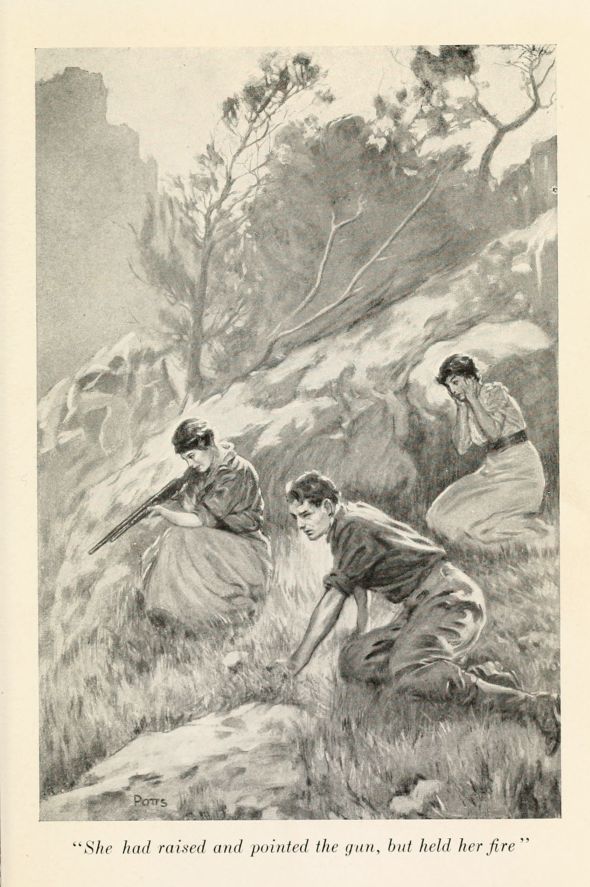
"She had raised and pointed the gun, but held her fire"
They prepared for a long wait. Ralph sat down in the
grass a little removed from Nahnya, and bowed his
head on his knees. By and by he fell over like an
inanimate object and slept as he lay. Farther away
sat Kitty, like an humble dependent. She nursed her
knees and stared over the valley with tear-stained,
lack-lustre eyes.
Ralph was awakened by a sharp exclamation from
Nahnya. She had raised and pointed the gun, but
held her fire. Kitty knelt in the grass with her hands
pressed over her ears, terrified in prospect by the
expected shot. Ralph ran to the edge of the rocks and
looked over. Philippe Boisvert had just issued out of
the cave. He held his empty hands over his head, and
came climbing up the rocks in that attitude.
Arrived within a dozen yards, the half-breed began to
speak eagerly in Cree. His eyes burned on Nahnya
strangely. At the sound of his voice surprise broke
through the mask of her face.
"Philippe!" she murmured.
A flame of jealousy made Ralph's cold breast alive
again. He had thought he was past all feeling. "What
is he saying?" he demanded to know.
Nahnya's eyes were troubled. "I know him," she
murmured. "From a long time ago. He is the boy I
talk with at the Mission school."
The half-breed continued his impassioned plea, and
Nahnya was clearly not unmoved by it. Philippe was
a handsome young creature and the fire of his feelings
was seemingly an honest fire. Ralph ground his teeth.
Kitty, creeping closer, and searching Ralph's face,
betrayed a reflection of his jealousy in her own.
Nahnya soon recovered from her surprise. "Speak
English," she commanded Philippe coldly.
Ralph's heart was lightened. The half-breed bent
an offensive scowl on him, and his lips curved into a
sneer. Ralph's returning look was identical. Philippe
told his tale with a swagger.
"Joe Mixer hire me at the portage to mak' a trip.
I don' know what for. I don' care. I go for fun,
'cause he got plenty w'iskey. Bam-by he say he after
Nahnya Crossfox. I lak' to kill him then, but I say
not'ing for 'cause I want to know where Nahnya Crossfox
is. Seven year I look for her. She is promise
to me!"
"Promised!" cried Ralph, turning to Nahnya with
stormy brows.
"It was a child's promise," she said coolly. "He
soon forget it, and I soon forget it."
Philippe launched into Cree again, protesting
energetically. Nahnya interrupted him in the same
language. Her eyes flashed; under the lash of her tongue
the young man quailed.
"Now speak English," she said imperiously.
"I help Joe to chase the Doctor," Philippe went on
sulkily, "because the Doctor know where Nahnya is.
Las' night I find out where she is and I am through
with Joe, but I bring him down the river with me to
sell him good. I hate all white men. When we come
to the other side the mountain, I say to Joe, you
wait here, and I go spy out the way. I come back
soon. Joe say all right. He think I am his friend.
He is a fat fool. He want to kill us all to get the
gold himself. He think I not see it in his eye. He
is a fool!"
"You say you fool him," said Nahnya. "Maybe
you fool me, too!"
Philippe protested passionately in his native tongue.
More than once Ralph heard the word moon-i-yas,
which he knew was Cree for white man.
"How did you get across the hole?" asked Nahnya.
"I leaped it," said Philippe with a swagger.
"Are the others behind you?"
"Could the fat man leap it?" said Philippe, "or the
little scared one? or crazy Crusoe?"
"No, but maybe you put the bridge back for them,"
said Nahnya.
"Tie my hands!" cried Philippe passionately, "and
if they come, kill me!"
"Come here," said Nahnya coolly. "Hold up your
hands."
The half-breed obeyed, his eyes fixed ardently on
Nahnya.
"See if he have a gun," Nahnya said to Ralph.
Philippe scowled furiously at the indignity, but kept
his hands up. Ralph quickly satisfied himself that the
other was unarmed.
"Good!" said Nahnya, with an inscrutable face.
She offered Philippe her hand. "We will be friends.
Let us sit down and talk what to do."
"Nahnya!" cried Ralph jealously.
She bent the same towering look on him that had
crushed the half-breed. "Must I ask you when I make
a friend?" she said.
Ralph, forced to remember that he had brought all
this trouble upon her, hung his head. They sat down
to their council of war. There could be no question of
who was the leader. The dark girl had the bearing of a
queen who had risen above her human griefs and passions.
"Where are they waiting?" she asked.
"They camp at the edge of the big woods beside the
gulch," said Philippe. "Jim Sholto is with them."
"So!" said Nahnya.
Kitty, hearing her father's name, came closer.
"Jim is crazy when he find his daughter go," Philippe
continued. "He come after us in the dugout, and
catch the raft. Jim say to me for say to him," pointing
at Ralph, "if he bring Jim's daughter back safe before
to-night, Jim not touch him. Jim let him go in his
boat if he want. Joe Mixer say them two can go all
right. He don' care."
Ralph expressed no great concern at this offer. "We
can send her out to her father," he said. Nahnya said
nothing.
"Jim send a letter," continued Philippe. He produced
a twisted bit of cotton on which some words were
scrawled, and handed it to Kitty. Reading it, she
burst into tears again.
"Let them two go," said Philippe, scowling at Ralph.
"I take them back."
"Suppose I let them go," said Nahnya inscrutably.
"What we do after?"
Philippe's eyes flashed, and his white teeth were
bared. He hissed a single sentence in Cree.
"You say you kill Joe Mixer and his men?" said
Nahnya coolly.
Philippe, with a startled side-look at Ralph,
remonstrated with her anxiously.
"I tell you speak English," said Nahnya calmly.
"He is my friend as much as you."
Ralph's sore and humbled heart took what comfort
it might from this.
"Well, it's easy," said Philippe, with a shrug of
bravado. "One is fat, and one is scare', and one is
crazy. There was no man in our boat but me!"
"Suppose you kill them," said Nahnya, "what we do
after?"
He answered in Cree.
"You will stay here with me after?" she repeated.
Ralph's face flushed. "Nahnya——" he began hotly.
She ignored him. "There is no place here for you,"
she said to Philippe, cold and accusatory as a high
priestess. "You are half white; you are bad like a
white man and a red man together! I hear them talk
of you around the country. You make yourself crazy
with whiskey, and fight for nothing at all. Because
you are strong you do what you like! You make
trouble always where you go! You say you hate white
men, but you can't stay away from them, because they
have whiskey! You are not white, you are not red,
you are nothing! There is no place for you here!"
All this was balm to Ralph's jealousy. He looked
on the ground to keep from showing any triumph over
the discomfited young bravo.
After debating with herself, Nahnya said to Philippe,
pointing down the slope: "You go down there." To
Ralph: "You wait here. I go by myself, and think
what to do."
While Ralph and the half-breed glowered at each
other from twenty paces distance, and the heavy-eyed
dispirited Kitty crouched at Ralph's elbow
disregarded by all, Nahnya went away and sat on the
edge of the rocks, doubling her back, and digging her
knuckles into her cheeks, while she struggled with her
problem.
St. Jean Bateese, Charley Crossfox, Ahmek, and
Myengeen approached over the meadow laden with
the weapons, food, and blankets that Nahnya had
ordered them to bring. Arriving at the foot of the
slope, where the stream entered its rocky gulch, they
cast down their packs, and with a glance at the sun,
instinctively set about building a fire and preparing a
meal. They looked with curious side-glances at the
new stranger who had found his way into their
domain.
After a long time Nahnya arose. Ralph read in her
face that her mind was made up. He hastened to meet
her, and Philippe likewise came bounding up the slope.
However, Nahnya was not yet ready to divulge her
plans. All she said was:
"Let us eat."
Her look was unfathomable. They were obliged to
contain their impatience as best they could.
All sat in the grass at the foot of the hill. It was a
strangely assorted company: Kitty, Ralph, Nahnya,
and Philippe sat on one side of the fire, with the four
Indians facing them from the other. Nahnya's face
was smooth and composed, Philippe looked sullen,
Ralph reckless and despairing, while Kitty's lips
trembled, and her eyes continually filled. The Indian
lads stared at the strangers with beady black eyes
expressing a mixture of animal curiosity and human
unconcern. No one of the company had any disposition
to talk except St. Jean Bateese, who, with his
native politeness, felt that it was incumbent upon him
to tide the meal over pleasantly.
He meandered on in his soft and deprecating voice,
illustrating his simple remarks with quaint gesticulation.
It disturbed him not at all when no one listened.
"There is a yellow ring around the sun to-day.
To-morrow will be much rain at night. It is good.
The berries will ripen good. This is a year of plenty
for the people. When come the leaves fall the bear-folk
will be fat and tender of the berries, with much thick,
warm coats, I think. The bear he is lak a man, him
lak to mak' fun when him feel good. One tam I see a
bear play beside a stream. He is alone. He think
nobody see him. He feel ver' good. He run and dance
and fall down, and laugh, and turn over his head because
he feel so good. I laugh me, till my ribs are sore!"
When Nahnya arose from the grass they all followed
suit. Without any preamble she said quietly: "Now
I will tell you what I have thought."
All hung on her words except the two younger boys,
who knew no English.
She darted an inexplicable look on Ralph, and said,
with odd abruptness: "Ralph and Kitty will go out to
Jim Sholto."
Ralph flushed painfully. "I will not go!" he cried.
"Send her! I know I've no right to dictate to you; I
brought all this on you! But that gives me a right to
stay here and help you out of it as much as I can!
Afterward I'll not trouble you. You needn't fear that.
I'll go!"
Nahnya lowered her head. "I sorry," she murmured.
"You mus' go!"
Ralph argued desperately against his own convictions.
He had had such proof of Nahnya's foresightedness
that he could not but believe she was right now
as she had been before. "I know I can't hold a gun,"
he cried, "but I can advise you! There are other
things. If there is any risk to be taken it is my right!
My life is worth nothing to me!"
Nahnya turned from him sharply. She issued a
quick order in Cree, and Ralph was seized by the three
Indian youths and Philippe. He was helpless in their
hands. At the sight of his pain-distorted face Kitty
screamed. Nahnya spoke peremptorily, and thereafter
they handled him more gently. Nahnya herself
kept her back turned to him. They wound a rope
loosely about Ralph's body, pinning both his arms.
Ralph drained the dregs of his bitter cup. He did not
speak again.
"You take them out to Jim Sholto," Nahnya said in
English to Philippe. "You tell Jim Sholto not to let
him loose till he tak' him away from here, so he not
make trouble."
After a pause she went on. "After, you go to Joe
Mixer. You tell him it is too late to come in to-night.
Tell him come to-morrow. Tell him Annie Crossfox
will not fight."
Philippe started to protest.
"It is my plan," said Nahnya coolly. "I tell you all
when it is time. You mus' stay in Joe Mixer's camp
to-night. Soon as light comes you mus' get up. You
mus' leave their camp without wake them up. You
mus' go up the gulch past the hole in the rock and
around the bend. I wait for you there.
"Start now!" she went on. "Take a blanket and
plenty ammunition and dry moose meat. Cache it by
the hole in the rock when you go out. Bring it in the
morning. You are going on a long trip."
Philippe muttered sullenly in Cree.
"I tell you in the morning," said Nahnya coolly.
"You don' have to go unless you want."
Philippe shrugged. He turned to make ready. "I
have a blanket at Joe Mixer's camp," he said.
"Take mine," said Nahnya. "Leave your blanket
lie there when you get up, so they not know right away
that you gone away."
The preparations were quickly made. Nahnya sent
one of the boys back to the stream for a handful of
gold dust, that Philippe might have something to show
for his journey. All this while Ralph stood still and
silent, looking straight before him. There was
something proud in his abasement. His face was
composed except for the eyes which glowed with a kind of
exaltation of pain. He was thinking with a sombre
satisfaction of the bottomless black hole that sucked
in the stream entire. "A step off the bridge ends it!"
he said to himself, and was impatient to get there.
As they turned to start down beside the stream,
Nahnya, alarmed by Ralph's silence, stole a look into
his face. To her foreseeing eyes his intention was
written there as clearly as if he had proclaimed it.
She became deathly pale.
"Wait!" she said faintly. "I—I will go with you
through the cave. Wait for me inside." To Ralph,
she said, without looking at him: "I want speak with
you."
A spasm of reawakened hope, doubt, pain convulsed
his face. It was the pain that a man peacefully dead
of asphyxiation feels when the reviving oxygen is forced
into his lungs, dragging him back over the border.
Nevertheless, Nahnya saw that he had given up his
grim intention.
Philippe, Ralph, and Kitty disappeared inside the
cave. Nahnya drew St. Jean Bateese a little way up
the slope apart from the boys, and made him sit beside
her at the edge of the rocks. "St. Jean," she said
quietly, "I go away now. I not come back."
The old man turned horrified eyes on her. He began
to protest breathlessly. As he looked in her quiet,
resolute face the uselessness of it was borne on him, and
his quavering voice died away.
"It is the best to do," Nahnya went on. "I think
it all out. I am half white. I not belong here. In
this place we want begin a new red race, strong and
free. I am half white. Look what trouble and danger
I bring on you. I will go away. All shall go on as we
plan."
"The white men will break in to-morrow!" wailed
St. Jean.
"The white men will never come in—this way,"
said Nahnya from between firm lips. "I will fix that."
The tears coursed down St. Jean's withered cheeks;
he stroked Nahnya's hand imploringly. "I am old!"
he whimpered.
"You are wise!" said Nahnya. "Add your wisdom
to Charley's strength, and make him a man. He will
be the head man when you are gone. Make him know
all the tales of our people, and all that they knew how
to do, so nothing is forgotten. Nobody mus' know but
you that I not come back. Let them look for me while
the summer passes. By and by you can say you have a
feeling I am dead. The young ones will forget!"
The old man moaned, and letting his head fall on his
breast, wound his gnarled fingers in his sparse locks.
"The boys will see you," Nahnya said sharply. "It
is from you they learn how to bear pain!"
After a brief struggle with himself he lifted his head.
The tears had ceased to flow, and the seamed face was
composed into the ancient stoic mask of the race; the
old hands still trembled piteously, and groped for
Nahnya's hand.
"So much we talk together," she went on, "you know
all that is in my mind. When the spring come again,
and the sap run in the trees, it is time for the children
to marry. You shall marry them with a cross. My
mot'er mus' teach Ahahweh all there is to do when the
time come for the girls to bear children.
"No man will ever come in or go out this way,"
Nahnya continued. "If ever there is a famine, or you
have great need to go out, there is another way. Go
across the divide into the valley to the north, and at
the top of that valley is a little stream going out
between the mountains. After many days' hard travel it
will bring you to the Stanley River. You mus' not tell
Charley of this way until he is wise, or until you feel
yourself about to die. The knowledge of this way mus'
be kept. Many years from now more wives will be
needed for the young men. The children of brothers
and sisters must not marry. Their children will not be
strong."
"All shall be done as you say," murmured St. Jean
Bateese.
Nahnya dropped her hand over his. Giving it a
quick pressure, she sprang up, and climbed the hill
until she was high enough to overlook the trees. Here
she turned. There was no mask on her face now. Her
eyes brooded with an infinite wistful yearning over the
lovely panorama—the lake shimmering like a peacock's
breast; the verdant, white-stemmed shores; the
kingly mountains basking smokily under the westering
sun. To the left were the tiny tepees with their delicate
smoke spirals, and a suggestion of women's figures
moving in front. Nahnya turned with agitated hands,
and, scrambling down over the rocks, disappeared
within the cave.
The old man sat where she had left him, staring on
the ground, a trembling hand outspread on either knee.
Nahnya saw the yellow eye of Philippe's torch gleaming
far within the cavern, and she did not pause to light
one for herself. She came upon the three waiting
beside the hole that swallowed the stream. Philippe
sat on a jutting rock, smoking quietly; Kitty was
huddled on the sandy floor, and Ralph was moving
restlessly up and down.
Hearing her coming, he sprang toward her, bound as
he was, softly crying her name with a passionate relief
and gladness in his voice. This was what Kitty had to
listen to. Even in the uncertain light of the torch
Nahnya saw the yearning and the pain in his eyes.
Kitty had to see it, too. Nahnya could not support
the look.
"Let us get on!" she said quickly.
Philippe had already replaced the frail bridge over
the hole. He crossed first, followed by Kitty; then
Ralph, with Nahnya watching him close. At the
other side Nahnya, stooping, affected to busy herself
with the lacing of her moccasin. Philippe and Kitty
passed ahead a little; Ralph stuck close to Nahnya.
As the light went on he could not see what she was
doing, but he heard the scrape of the logs as she pulled
the little bridge toward her, and heard the structure
knock against the rocky walls as it went down.
"Nahnya!" he cried, amazed. "Aren't you going back?"
"No," she murmured.
Kitty's voice came back sharp and peremptory:
"Ralph!"
"I tell you soon," Nahnya said swiftly. She
hastened to catch up with the others.
Arriving at length at the cleft whence a little gray
daylight filtered into the cave, Philippe quenched the
torch in the loose sand of the floor. They started
through the narrow place in the same order—Philippe,
then Kitty. As Ralph was about to follow Nahnya
laid a hand on his arm.
"I stay here," she murmured.
He flung about. "Nahnya! Is this—the end?"
he faltered.
"Listen!" she whispered swiftly. "When Jim Sholto
get his daughter back, he not want stay in Joe Mixer's
camp no more. He make a new camp, I think. Maybe
he go down by the river. But it is too late to start
on the river to-night. He mus' camp. When they
are asleep, you lie down a little way from them. Lie
in the trail where I can find you easy——"
"Nahnya!"
"I will come, to-night," she whispered. "Now, go;
go quickly!"
Ralph followed Philippe and Kitty through the
narrow cleft in the rock, and the three of them
stood huddled together at the bottom of the
hole. The opening was like an eye looking down on
them. Philippe sent Kitty aloft by means of the pine
trunk. Looking at Ralph, he scratched his head in
perplexity. How to get him out with his arms bound
was the question.
"Untie me," said Ralph mildly. "I'll let you tie
me again."
This sudden tractibility aroused Philippe's suspicions.
He debated the matter scowlingly. However,
Ralph, deprived of the use of his right arm, was not a
formidable antagonist, and the half-breed decided to
chance it. As Ralph climbed, he followed close at his
heels, and quickly secured him again at the top.
They made their way down the bed of the ravine.
No more than Philippe could Kitty understand the
new light in Ralph's eyes. She glanced at him covertly,
wondering with a fresh pang of jealousy what had taken
place behind her back. Ralph was walking on air.
He had suffered so much that he snatched at the
prospect of happiness, however fleeting. Both the
immediate danger and the hopeless future were put out
of his mind; it was enough for him that Nahnya had
promised to come to him; she was one to keep her word!
Jim Sholto saw them coming, and ran down the bank
to embrace his daughter. Kitty's answering welcome
was not overwarm; she was too bitterly concerned
with another matter. Jim, hurt by her coldness and
ascribing it to its cause, turned angrily on Ralph.
"You young blackguard!" he cried. "You'll stoop
to use a helpless girl to further your evil ends, will
you?"
Poor Kitty, all day the helpless plaything of
circumstances, asserted herself at last. She forced
herself between the two men. "If you abuse him any
more I shall hate you!" she cried to her father, with an
outbreak of passion that surprised herself. "It was
not his fault at all! I set him loose of my own free will,
out of common humanity, which you lacked! He
sent me back, but I would not let him go alone in such
a state! I keep telling you it's Annie Crossfox he's in
love with. He has made no pretences to me!"
"Where's your pride, lass?" cried Jim.
"It's you who won't let me have any pride!" she
flashed back at him. "Never speak of this again!"
He took her arm. "Come away!" he said grimly.
At the top of the bank they met Joe Mixer. "You've
got him!" he cried gleefully to Philippe. To Ralph:
"You ——! How do you feel about it now?"
Kitty, apprehending blows to follow, wrenched her
arm out of her father's grasp, and turned on Joe. The
flames still burned high in her cheeks. "Let him
alone!" she cried. "He's not your prisoner!" To
her father she said passionately: "He was sent out in
your care! If you don't take him and keep him from
this cowardly bully, you won't take me!"
All men dread a roused woman. "Softly with your
epithets, girl!" said Jim scowling. To Philippe he said
sullenly: "Give him over to me."
Philippe yielded his prisoner, nothing loath. Joe
Mixer, keen to learn what the half-breed had discovered,
did not care what became of Ralph. Stack and Crusoe
had joined the group, and the three of them volleyed
questions at Philippe. Jim Sholto lingered to listen;
he was a gold-hunter, too. Ralph, forgotten for the
moment by all the men, sat down beside the trail and
hugged his dream, deaf and blind to what was going on
around him. Kitty watched him sorely.
"It was just like she told," Philippe said; "a long
walk through the cave, and a pretty valley on the other
side. There is no other way to get in. It is Bowl of
the Mountains, all right."
"Did you see any gold?" demanded Joe.
"Plenty," said Philippe. "The bottom of all the
little streams are yellow with it. I pick up a little.
See!"
Digging his hand into his pocket, he brought it forth
full of yellow grains, which he emptied carelessly into
Joe's twitching palm. The heads of the four white
men came together, and the four pairs of eyes showed
the same insane glitter.
"This is the stuff!" cried Joe, pouring the grains with
a voluptuous pleasure from palm to palm. "Sweeter
than booze! sweeter than women! It'll buy you
plenty of both! Gad! I'll keep a great chest of it
always by me, and come dig in it every day for the
pleasure of the feel and the heft of it!"
"Can we get it out through the cave?" asked Jim.
"Sure!" said Philippe. "It's easy going."
"How about the girl?" demanded Joe.
"She is there with her family."
"How many?"
"An old man, a young man, two boys, and four
women."
"H'm! They could make it awkward for us," said
Joe frowning.
"They not care for gold," said Philippe, with an
innocent, stolid air. "Wash a little, and let it lie.
When I tell Nahnya you all here, him feel bad. Him
say no use. Him say not fight you."
"Come on, then!" cried Joe excitedly. "Let's lose
no time!"
"Come on!" echoed Stack and Crusoe Campbell.
The desire was no less strong in Jim Sholto's face. He
looked at Kitty uneasily.
Philippe hung back. "I paddle half the night!" he
said, with an admirable assumption of the disgruntled
servant. "I walk all day. Am I a steam-engine? I
got eat and sleep now."
"Sleep?" cried Joe. "Man, there's a fortune
waiting for every one of us in there!"
"I got sleep, me," Philippe repeated stubbornly.
"The gold is there to-morrow just the same, I guess."
"Damn these redskins!" cried Joe. "They're all
alike!"
"Go yourself," said Philippe. "The way is free.
Don' blame me if you fall in the hole, or get lost."
A heated argument resulted. Philippe was inexorable.
He knew well enough that the white men would
not venture into the bowels of the earth without him.
Philippe finally picked up his blanket, and carrying it
apart lay down and affected to go to sleep. The others
were obliged to resign themselves to wait.
Meanwhile Jim Sholto was in a quandary. He could
not bear to have Kitty camping with that rough crew,
and he was jealous of leaving her a moment alone with
Ralph, yet he could not tear himself away from the
vicinity with such riches waiting to be gathered. He
could not but compare the ease of washing gold in a
stream with the strenuous labour of smelting ore in
little home-made furnaces.
He compromised with himself by establishing his
camp a few hundred yards away from Joe's. It was
the spot where the operation had been performed on
old Marya's arm. Ralph was secretly gladdened by the
choice of the spot. It was not far for Nahnya to come.
During the rest of the afternoon Ralph and Kitty slept.
Jim occupied himself in building a shelter of branches
to house Kitty throughout the night.
There was not much conversation around this campfire.
It irked Ralph to be obliged to accept Jim's grim
hospitality, but there was no help for it. Immediately
after supper Kitty disappeared within her shelter, and
Jim soon lay down in his blanket athwart the entrance.
He made no objection to Ralph's dragging his bed to a
little distance. If Ralph had escaped altogether, Jim
would have been only too well pleased.
When Jim's snores began to displace the heavy stillness
of the forest, Ralph rose and dragged his blankets
still farther away. Jim had tied him in such a manner
that his left arm was free from the elbow. He arranged
his bed after a fashion directly in the trail, and lay
down to wait. It was about nine o'clock. It would
not be dark until after ten. He knew that Nahnya
could not venture out of the cave until then, and
that he must give her time to make a detour of the
other camp.
He lay in a kind of fever watching for evidences of
darkness with avid eyes. One cannot measure the
subtle stages of the passing of day any better than its
coming. It goes and it comes and all is said. Thus to
Ralph counting the crawling minutes it seemed as if
the bright sky clung obstinately to its brightness, and
as if the dim spacious aisles of the forest refused to
grow dimmer. Losing patience at last, he closed his
eyes and tossed restlessly. When he opened them
again, behold! it was nearly dark.
His heart began to beat, and his mouth went dry.
In every whisper of the leaves he thought he heard the
brush of her skirt. The tiny, furry footfalls that began
to stir among the pine needles suggested her creeping
moccasins, now on this side, now on that. A dozen
times he started to a sitting position, sure he heard her,
only to fall back disappointed. The thought that
something might finally prevent her from coming
turned him sick with apprehension.
She came as softly as a breath through the forest, and
dropped on her knees beside him, without his having
heard her coming. His eyes were well-used to the
darkness, and he could make her out faintly; her
graceful head outlined against a patch of sky overhead;
her two hands pressed hard to her breast in a way that
he knew. He heard, or fancied he heard, her heart's
quick beating. A great peace succeeded the torture of
suspense.
"You've come!" he breathed.
"I am mad! I am foolish!" she faltered.
He apprehended that the slightest thing would send
her flying back again. By turning a little he managed
to reach her hand and to pull it down to his lips. Her
fingers crept eagerly inside his, as she had never allowed
them to do before. She had confessed nothing with
her voice yet, but her whole being breathed a passionate
warmth over him that made him dizzy with happiness.
"Nahnya, darling, untie my hands," he whispered.
"No!" she said tremulously.
He pleaded with her urgently.
Her trembling hand stroked his cheek with a touch
like flower petals. "Ah, do not make me fight you
now," she begged. "I so tire of fighting you, Ralph.
You know if I let you free, you not let me go back. I
must go back! Do not make me sorry I come!"
"This is harder to bear than Joe Mixer's tortures!"
he bitterly complained.
She tried to disengage the hand he clung to. "If
you say that, I must go now," she whispered sadly.
It terrified him. "No! No! Anything you want!"
he said swiftly.
"Let me stay quiet by you a little," she whispered.
"Let me love you quiet a little."
"Tell me you love me, and I'm satisfied," he said.
She sank down beside him and kissed him softly on
the lips. "I love you! I love you! I love you!" she
murmured, with such passion as he had never dreamed
of hearing on the lips of a woman. "I love you the
first time I see you! Always it near kill me to make
out I do not love you! I love you till I die!"
They were silent for a space, clinging to each other,
cheek to cheek in the darkness, their breasts tossing on
stormy sighs.
He said brokenly at last: "Nahnya, this is the
strongest thing in the world. Nothing else matters.
You must not leave me!"
She partly raised herself, and put a gentle hand over
his mouth. "In your heart you know I mus' go," she
whispered. "In your heart you know ver' well there
mus' not be anything between you and me! Do not
spoil our little time together by speaking of it!"
His head rolled impatiently on the ground. "I cannot
live without you," he muttered. "I will not live
without you!"
She kissed him. "Yes, you will," she said softly.
"You will promise me now to live the best life you can.
Because I am going to live, and always I want think of
you living brave and happy and curing the sick!"
"Happy!" he said bitterly.
"It will come," she said, with quiet certainty.
"Put your hand in my pocket," he said. "There is
something there for you."
She found the necklace and kissed it. "I will always
wear it," she said.
She lay down beside him again, on the edge of his
blanket, but not touching him, except that she caught
his free hand and pressed it hard to her cheek. "Often
I am think the same," she whispered. "I think what
is the use of living a life like mine! But always
something stop me from ending it. Something make me to
go on living, sad as life is. Death is for those who are
shamed, I think. I am not shamed. You are not
shamed."
"You're braver than I," he murmured.
"You're plenty brave," she whispered, kissing his
hand. "To-day I see you think you are shamed
because you think you bring trouble on me. You think
you will jus' step off the little bridge——"
"How did you know that?" he cried, astonished.
"I see it in your eyes," she said simply. "I love
you. Often I know what you are thinking. That is
why I say I come to-night. I want tell you I love you!
I want tell you I think you are strong and brave. I
glad you love me! I glad you love me hard enough
to come back when I tell you no. I not sorry for
anything. It is not your fault that the other men come
after you, or that you told the secret when you were
sick. That was going to happen. Such things are
not understood by us. You mus' not be shamed. I
not have you shamed, because you are my brave, good
man!"
"You're an angel of comfort," he murmured. "I
was ashamed!"
"Promise me now that you will make the best life
you can," she whispered.
"I promise," he said.
Her quiet voice broke. "Oh, my darling love!" she
cried. "Always, always I will be thinking of you!
Wherever you are my spirit will go to you to love you
and make you happy. You are my husband and my
baby, too! Oh! I cannot speak more! How can I let
you go! How can I let you go!"
She clung to him, her warm tears running down his
face. He could not speak. He soothed her silently.
She fought down the sobs. By and by she said
quaintly:
"That is over."
When she got her breath back she partly raised
herself, and said: "Another promise, Ralph."
"What?"
"Kitty."
He moved restlessly.
"Be good to her," she pleaded. "She is jus' sweet!"
"Impossible!" he said. "She's too much mixed up in
this. I never want to see her again!"
"By and by maybe you change," said Nahnya
softly. "If it was not for me you would marry Kitty.
She is the one for you."
"Never!" cried Ralph.
The soft hand was clapped over his mouth again.
"Do not swear it!" she said. "Who can tell how you
feel by and by? Take what comes. You will like
her, I think. Not like this——" Her voice shook
again. "I not want it just like this. But it will be
good. And if you feel kind to her you will remember
that I wished it, and it will not be false to me.
Promise me, if you feel good and kind to Kitty you will
marry her!"
"It will never be!" he cried.
"Then what harm to promise me?" she said quickly.
"It make me a little happy."
"Very well, if I change I will marry her," he said
sullenly. "But I will never change!"
"Kitty will be good to you," murmured Nahnya,
"and watch you, and take care of you almost as good
as me. Kitty—will have babies! I think of that—it
is a pain and a gladness, too!"
"Nahnya," he said, "you hurt me!"
She clung to him again. "No!" she breathed in a
voice as tender and thrilling as starlight; "my love will
not hurt you; it will make you strong! It will be a
more wonderful love because we cannot be together.
It will be more real than what you see! It will shelter
you like a house over your head, and comfort you like a
fire in winter! Whenever you close your eyes I will
be there, waiting for you! Good-bye, my brave man,
my darling love!"
She was gone before he realized she was going.
Joe Mixer and his men sat up late counting
the golden harvest they expected to reap;
consequently next morning the sun was high in the sky
before the fat man woke. The instant consciousness
returned to him the thought of "Gold!" sprang up
in his mind as if written in letters of the metal. He
sat up knuckling the sleep from his eyes. Instead of
the breakfast that usually awaited him, he saw Crusoe
and Stack still slumbering beside him. He awakened
them with no gentle urgency.
"What's the matter with you!" he bawled with his
own picturesque expletives. "It's past six o'clock, and
we were going to start at five!"
Crusoe, the cook, looked around him in a dazed way.
"The breed said he'd wake me," he said; "I left it to
him."
They saw Philippe's tumbled blanket on the ground
beyond Stack. "He's gone off, damn him!" cried
Joe. "Hunting a puny rabbit most like! They're all
alike! Look sharp with the breakfast!"
While Crusoe cooked, Joe and Stack collected and
packed the camp impedimenta. In his eagerness to get
away, the fat man was as active as a stripling. When
breakfast was ready, and the half-breed had not yet
returned, his anger was boundless. The camp atmosphere
was lurid. As yet he did not suspect any treachery,
for as a result of his experience with the race he had
withheld Philippe's pay, and even a breed does not run
off with money owing him. Besides, he had left his
good blanket behind him.
After breakfast they scattered to look for him,
awaking the forest with their hails. Crusoe found tracks
made that morning in the ravine. Joe and Stack joined
him, and they followed the tracks toward the mouth of
the cave.
"Maybe he got up early to get in ahead of us," said
Stack, paling at his own suggestion.
"By Gad! if he has——" cried Joe.
But the tracks led them beyond the drift-pile.
"It's game he's after," said Joe, reassured.
Crusoe, who was a pace in advance, had stopped, and
was examining the creek bed attentively. "There's
another track here," he said suddenly; "a small
foot—a woman's foot! That's his game!"
The three men looked at each other with growing
suspicions. "Get along after them!" cried Joe harshly.
But none of them moved. They had become aware
simultaneously of a curious rumbling sound high above
them. It approached with terrific swiftness, ending
with a mighty crash above, that caused each man
instinctively to make himself small, and guard his head
with his arms. A great boulder leaped across the
ravine, high over their heads, and smashed into the
forest on the other side.
Of one accord the three turned and fled down the
ravine, little Stack in advance, leaping from stone to
stone like an antelope. A shower of pebbles peppered
their heads and shoulders harmlessly. Outside the
danger zone they halted.
"By Gad! that was a close shave!" said Joe, wiping
his face. "They say those stones just naturally work
themselves loose on the mountain, and no man can tell
when they'll fall!"
"Maybe somebody started it," suggested Stack. His
teeth were chattering.
Panic seized them again. They did not stop running
until they had climbed the bank of the ravine, and stood
in their own camp. From this point nearly the whole
of the mountain side was visible. They searched it
excitedly.
"It's true!" cried Stack at last. "I see him! I see
two of them up there!"
"My binoculars!" shouted Joe.
His hands shook, and it took him a long time to focus
the glasses. Stack stood at his elbow instructing him
shrilly where to look. Crusoe stood with hanging jaw,
looking up like a clown.
Immediately above the entrance to the cave there
was a precipitous cliff some seventy-five or a hundred
feet high. On top of that was a flat ledge or terrace
reaching back. The floor of this terrace was hidden
from them, but behind it rose a long, steep bare slide
of rubble fully two thousand feet in the air, ending in a
ridge or hog-back of broken rock-masses, which extended
up at right angles to the base of the final peak
of naked rock, the thumb. It was upon the ridge,
working among the rock-masses with pine poles for
levers, that Stack's sharp eyes had spotted the two tiny
figures.
Joe finally got them within the field of his glasses. A
frightful rage took possession of him. His face turned
purple. He frothed at the mouth and stamped on the
ground like a madman. Stack slyly took the binoculars
out of his hand or he would have dashed them to the
ground. From his broken exclamations and curses the
others gathered that he had recognized Philippe and
Nahnya. Stack satisfied himself as to the identity of
the figures.
Another great stone started to roll down the gigantic
slide. They saw it coming before they heard the noise
of its passage. They gazed fascinated. As it gathered
its terrific way it started to leap higher and higher in the
air like a mad elf. It struck the rock ledge with a
deafening crash, and like its predecessor bounded high
over the ravine and shattered the trees on the other
side. The force suggested by the soaring of these tons of
matter lightly through the air struck awe into the
souls of the beholders. The silence following the final
crash of the projectile was broken by a long, dull rumble
of the smaller stones displaced in its course. A long
cloud of yellow dust arose behind it.
Other rocks, small and large, followed. Stack,
through the binoculars, watched the two on the height
working desperately with their levers. Joe Mixer had
exhausted himself in his transports. He now looked
up dumb and suffering with rage, his thick lips snarling
and his nails pressed into his palms. Suddenly a light
broke on his face, and he cried out:
"There's no danger! The cliff makes a screen.
Look, how all the rocks jump clear of the gulch. Come
on back!"
Stack had seen this before, but had kept it to himself.
Both Stack and Crusoe turned white with terror at the
thought of venturing up the ravine beneath that bombardment.
"You white-livered cowards!" cried Joe; "you skulkers!
you shivering curs! I'll go alone! And I'll keep
what I find!"
No one denied Joe Mixer brute courage. Paying no
more attention to the descent of the rocks, he methodically
separated a portion of their food for himself, and
rolling it within his blanket, strapped the pack on his
back. Fastening a belt of ammunition around his
waist, he picked up his rifle, and went doggedly down
the bank and up the bed of the ravine. All the gold
in the world would not have tempted the others to
follow.
While he was in the ravine the two on the mountain
succeeded in wresting loose a bigger mass of rock than
any before. It came down with a frightful impetus.
The noise of its coming leaped out of nothingness and
stunned the ears. When it struck the ledge of rock
they felt the shock below. Joe crouched under a
boulder. The mass made a gaping wound in the forest
where it earthed itself.
The succeeding rumble from above did not subside,
but slowly deepened and increased in volume. Stack,
looking up, saw an incredible, an insupportable sight,
as in some hideous nightmare. The whole face of the
mountain was in motion. He screamed, and cast himself
on his face, covering his head with his thin arms.
Crusoe followed his example. Joe, hearing the ominous
sounds above his head, wavered. The shrill sound of
terror decided him. He started to run back down the
ravine, but too late. A cataract of broken rocks came
pouring over the lip of the cliff.
When Jim Sholto found Ralph that morning he saw
at a glance that he had a desperately sick man to deal
with. The exertion and the terrible excitement
following too soon upon his fever had brought about a
relapse. Jim carried him into camp, and Kitty did what
little she could for his comfort. Humanity forbade
Jim's leaving her alone with the patient, though he
chafed to be away with the other men after the gold.
To this he owed his life.
They were attending to Ralph when they heard the
fall of the first stone. It was a sound they were not
unfamiliar with in their own camp, and caused them no
perturbation. When several others followed in close
succession, Jim looked up.
"That's funny!" he said. "I never knew so many to
fall together."
A minute later they heard Stack's scream. Jim
jumped up.
"Somebody's caught!" he said grimly.
"Don't go!" cried Kitty sharply.
She had no need to speak. Jim was rooted to the
spot. "A whole landslide!" he murmured.
During the next few seconds chaos succeeded. There
was a rushing sound as of millions of great wings beating
the air, and a shock under which the earth rocked
nauseatingly. The uproar was such that human ear
could not encompass it. It was like mountainous
seas breaking over their heads. Kitty and her father
clutched the earth. It shook under their bodies like a
jelly. Ralph knew nothing of what was happening. A
tremendous silence succeeded, broken only by the
detached tapping of falling rocks here and there. Then a
brief, terrible wind swept screaming through the forest
and was gone. A strange, thick, yellow fog stole among
the tree trunks; it left an acrid taste in the nostrils.
As soon as the uproar subsided Jim was for going to
see what had happened. Kitty clung to him hysterically.
Not until half an hour had passed would she
let him leave her, and then only upon his repeated
assurances that no further disturbance was likely to occur
for the present. Anything that had not been shaken
loose by that terrible shock would stick, he said. Kitty
herself refused to leave Ralph.
Jim had not gone two hundred yards before he began
to meet with evidences of the cataclysm in the scattered
rocks and broken trees. A little farther on he came
to the edge of the flood of rocks that had poured down
from the mountain, obliterating the forest up to this
point. He circled the base of the gigantic heap until
he came to a point where he could overlook the entire
height. This was on the edge of the ravine behind
Joe Mixer's camp.
Jim stood, struck to the soul with amazement. The
genii had waved their wands and the face of the earth
was changed. There was no stream below him; above
where he stood there was no longer any gulch or any
cliff rising above it. The mountain had stepped
forward and stamped them out. A great new spur of raw
rubble reeking with yellow dust now reached across in
front of him, blotting out the forest like grass as far
as he could see on that side. The entrance to the Bowl
of the Mountains was somewhere under the middle of
the mountain; no man could tell now where it had been,
so complete was the change. Joe Mixer's camp had
not been in the direct line of the slide, but tons and
tons of rock had overflowed at the sides like a liquid,
and the place where the fire had been was drowned
fathoms deep.
Jim remembered the scream they had heard. "Nothing
to do here!" he thought grimly. He returned to
Kitty.
Nahnya and Philippe reached a little plateau of rock
after a long climb, and sat down to breathe themselves.
Their faces were calm. For the moment they were
concerned only with their journey. On every side
great snowy peaks looked down on them over each
other's shoulders. The white fields dipped almost to
the level where they sat. Behind them, and far below,
the forest ended in the throat of a valley; before them
lay a shallower valley of a bleak aspect. It supported
only a little scrub and a variegated carpet of moss, and
the gorges on either hand were choked with ice.
"This is a divide," Nahnya said. She spoke in
Cree. "St. Jean Bateese tell me this trail. The water
out of that valley go to the Burning River, he say. It
is five days' journey from here."
"I have heard of that river," said Philippe. "It goes
to the place of the rising sun, and joins with the Great
River of the Ice."
The sun had disappeared some time since behind the
peaks on their left hand. Philippe cast a look at the
threatening sky. "It will rain to-night," he said.
"Let us go down. There is nothing here to make a
shelter. There is no wood for a fire."
"Wait a little," Nahnya said. "We must talk—what
we do after."
Her simple-sounding words had an electric effect.
Both faces changed subtly; hers became wary; his
sullen. They avoided each other's eyes.
"We will do what comes," said Philippe, feigning
unconcern. "We will walk to the Burning River, and
make a raft and float to the Great River of the Ice.
Then we can go where we want."
"You know what I mean," said Nahnya quietly.
"Why waste talk?"
Philippe's eyes suddenly blazed up. "You are mine
now!" he said.
"Not yet," said Nahnya coolly. "I say you can
come with me if you want. I make no promise."
"You are mine!" repeated Philippe louder. "There
is nothing to say!"
"There is much to say!" said Nahnya, with a direct
look. "If you lay hands on me without I give you
leave, I will kill you!"
There was a short, fierce struggle between the two
pairs of eyes. The man's eyes gave way.
"I not want quarrel with you," said Nahnya presently,
in a softened voice. "You helped me very much.
I have a kindness for you."
His eyes stole back to her face furtively and
humbly.
"I will marry you if you want," Nahnya went on.
"Because I have learned a girl cannot be alone. And
I have no people now. I will make you a good wife if
you want me. I will always work hard. I will try
to make you a rich, big man. But first the truth must
be told."
"What truth?" muttered Philippe.
"I do not love you," she said.
"This is white people's talk," said Philippe. "What
is love? You marry me. You keep my lodge."
"I love the white man," Nahnya said firmly.
He sprang up with a threatening gesture. In his
simplicity he thought she was baiting him. His face
was dark with wounded self-love.
Nahnya's eyes held his unflinchingly. "If you strike
me I not stop loving him," she said.
The youth was no match for her. His eyes could not
support the strong light behind hers. He turned away
muttering.
"Do you want to marry me?" Nahnya asked after a
while.
He turned on her with the violent upbraiding of a
man's jealousy, which is much the same, Cree or
English. Nahnya saw that he had misunderstood what
she meant by "love." Interrupting him, she made the
point clear.
"No man has had me!" she proudly concluded.
He scowled, regarding her doubtfully. The boastful
male in him was loath to confess it, but he was like
wax in her hands.
"Red and white cannot mate together," Nahnya
said, with her strange, fatalistic calmness. "He is gone
away. I will never see him again."
"Swear it!" demanded Philippe.
She raised her hand. "I swear it!" she said, without
a tremor.
He was much comforted. He scowled still, not knowing
what to say.
"Do you want to marry me?" she asked again.
It was a kind of stricken look that he turned on her.
"I want to marry you," he murmured.
"There is my hand," said Nahnya. "Deal straight
with me, and I will do all that I say."
He fondled her hand clumsily.
Nahnya's eyes became kindly. "You were a good
boy at the school," she said. "It was good talk that we
talked together. Why do you want to be called a bad
man now, and not work, and drink, and make trouble
everywhere?"
"I will tell you why I change," said Philippe boastfully.
"I go among the white men, thinking to find my
brothers. My father was a white man, and married
to my mother in church. But they think little of me
because my skin is dark. They treat me like a slave,
and give me hard work and little pay like a slave. So I
hate them. I am bad! I make all the trouble I can!"
"White men only laugh at a bad man," said Nahnya,
"and put him in jail. You are going to make yourself
a wise, big man now."
Philippe's self-love made its last stand. "I am a man,"
he said scowling. "It is not for a woman to tell me
what to do."
Nahnya made no answer. She was playing with
some bits of broken stone.
"I will be the master in my own lodge!" Philippe
said louder. "You will work and keep quiet!"
"If you want me to live with you, you must live
straight," said Nahnya, with an ominous softness.
"You think it is fun to be a bad man. It is not fun
to be a bad man's wife!"
"I will do what I want!" said Philippe boastfully.
"Look!" said Nahnya, pointing to the stones she had
been arranging. "Here I have made the sign of the
cross. Kneel, and put your right hand on it, and swear
to live straight!"
Philippe laughed. Nahnya rose to her feet with the
same dangerously quiet air. She did not look at him.
Anxiety began to undermine his scornful smile.
"What are you going to do?" he asked sullenly.
"Swear!" she said. "Or I will jump off this rock into
the valley!"
He sprang up. She was quicker than he. He saw
her headed straight and determined for the edge. He
stopped dead.
"Nahnya!" he cried hoarsely.
She stopped on the very edge, looking down into the
gulf with a kind of wistful desirousness. One would
almost have said that she was sorry he had cried
out.
"I will swear it!" he cried quickly. He dropped to
his knees beside the cross of stones.
She came back from the edge with a sigh. "I will
do all that I said," she murmured, as if to herself.
The way down into the shallow valley on the other
side was easy. As they proceeded Nahnya laid out
their plans for the future with a kind of ecstasy in her
sad eyes.
"All day I am thinking what we will do. We will
gather those like ourselves who are not red and not
white, and make a new people of them. First we will
go to Caribou Lake and talk with the people. They
have steamboats now on Caribou Lake and the little
river and the big river; the York boats are rotting on
the beach and the half-breeds have no work to do.
They are poor and sick and full of hate for the white
men. I know a fine country where the Tamarack
River rises in the hills. There are no white men near,
and the Kakisa Indians who hunted there are all dead
or gone away with other tribes. It is the best fur
country there is left. We will tell the people about this
country, and make a village there. There is good
hunting for all. The company will make a post there,
and you shall be the trader!"
At evening of a day early in August a raft
landed on the beach below Fort Cheever. It
bore a middle-aged man, a girl, and a young
man. The last named ceaselessly tossed and muttered
in a fever; he was strapped to the raft to keep him from
rolling off.
The older man carried him up the bank. The girl
followed, tottering a little with fatigue. There were
dark circles under her eyes and her lips were white.
At the top they met David Cranston the trader, in whose
grim face surprise struggled with a welcoming courtesy.
Seeing into the sick man's face he started.
"Is it Ralph Cowdray?" he asked.
The other man nodded.
"The poor lad!" exclaimed Cranston. "He stopped
here six weeks ago. He is much changed."
"I am taking him to a doctor," the other said. "I am
Jim Sholto from Milburn Gulch. This is my daughter."
Cranston bade her welcome with clumsy, old-fashioned
deference. At Fort Cheever a white girl was
like a creature from another world. Looking at her,
his grim face softened with commiseration.
To Jim he said: "There's no doctor nearer than the
Crossing. I expect the steamboat on her last trip
within a week. Will you wait here for her?"
Jim shook his head. "Too uncertain," he said.
"He might die on our hands. We will raft it down."
"Ye do well," said Cranston. "It is two hundred
miles, but you can do it easy in three days by travelling
nights, too. The river is smooth all the way. There's
a kind of hotel at the Crossing where you can make him
comfortable, and the police doctor is there."
"We will go on as soon as we eat," said Jim.
"I will send the little boys to cut spruce boughs
to make you comfortable beds on the raft," said
Cranston.
"Have you any remedies?" asked Jim. "We came
without medicines."
"I will ask my wife," said Cranston. "She knows
the simples of the country."
"Much obliged to ye," said Jim.
"The poor lad!" said David, looking into the flushed
face and the sightless eyes. "I took a great liking to
him. He had an honest way with him." Glancing
sideways at Kitty, he said: "I wondered what brought
him into the country. How did this happen?"
Jim looked at his daughter and bit his lip. The
quiet tears were rolling down Kitty's face. "He
capsized in the Stanley rapids and hit his shoulder on a
rock," he said grimly. "He came to our shack much
the same as you see him now."
"Was that the first you saw of him?" asked David,
in surprise.
"It was the first."
"He was in the country before. There is some
strange tale behind this," said David, wagging his
head.
"I believe you," said Jim grimly.
Two months later in time, and in distance five hundred
miles from Fort Cheever, the little steamboat Northern
Belle was making her way blithely down on the current
of the Miwasa River on her last trip of the season. On
the upper deck Ralph, a shadow of the blooming youth
that had first set forth from Fort Edward, lay sleeping
in an invalid chair that the "boys" at the Crossing
had made him for the journey. Beside him sat Kitty,
almost as pale and wasted as her patient, but with a
soft triumph in her eyes; he was safely on the mend.
He stirred and murmured her name.
"Yes?" she answered, in her quick hushed voice.
"Nothing. I just wanted to make sure you were
there."
"Lazy!" she said. "Why didn't you open your eyes
and look?"
"My eyelids weigh pounds!" he said. "I can sleep
twenty-three and a half hours a day!"
He lay musing for a while. "Kitty?" he said again.
"Well?" One could see "Dear!" on her lips, but it
was not uttered.
"I was thinking—I'm glad I didn't hop the twig
after all!"
She did not answer.
"It's just beginning to come back—the will to live,
I mean."
Made curious by her continued silence, he raised his
lids at last, and saw that her eyes were big with tears.
"What's the matter?" he asked quickly.
"Nothing!" she said. "I can't help thinking—all
the time you lay there, you wished to die. In your
delirium you prayed to die."
"That's funny!" he said, with an air of calm interest.
"I remember that. It was as if some force stronger
than I kept me from passing peacefully out. How it
hurt!"
"Don't think about it," she said.
"It's over," he said. "The sun feels good. I feel
like a new-born babe, with everything to learn and
everything to experience all over again!"
"You've talked enough."
"Where are we?" he asked, defying her with a lazy
smile.
"We will get to Miwasa landing before supper. We
will stay there until you are a little stronger. Then
we'll drive the hundred miles to town in a democrat.
Father made the arrangements on his way out."
"How good you've both been to me!" murmured Ralph.
Kitty let this pass with a private smile. "I got a
letter from father at Silver landing this morning," she
said. "It was posted as they were leaving Fort
Edward. They are all back at Milburn Gulch by now."
"What will they do without you?"
"They have taken a man cook in with them."
"Are you going in later?" he asked.
She shook her head. "Dad says after all it's no
country for a woman."
"What will you do?"
"I shall go to live with my aunt in Winnipeg, and
study something, so that I can earn my own living. A
teacher, perhaps."
"That's a lonely life!" said Ralph.
She looked away. "Better than being idle," she said.
"I must begin to think what I am going to do," said
Ralph.
"Plenty of time."
"I shall go home for a while, of course. The mater
will luxuriate in a convalescent son! Then I must
build up a practice in some growing city. A doctor
goes to seed in the wilds; there is not enough to do. I
begin to feel a need of work!"
"Work!" said Kitty, looking at his transparent hands
with a smile of affectionate scorn.
"Doctoring's a great job!" said Ralph. "Where
would you advise me to establish myself?"
"How should I know?" murmured Kitty, head averted.
"What kind of a place is Winnipeg?"
A slow crimson tide crept up from her neck to her
forehead. Fortunately Ralph's eyes were closed. "A
busy, ugly town," she said. "But it's growing very
fast. They say it has a great future."
"As soon as I am on my feet I'll come up and look it
over," he said.
He soon fell asleep again. Kitty leaned her arms
on the rail, and gazed dreamily at the brown flood with
its squadrons of foam vessels sailing demurely under
the steamboat's counter; and at the shore with its
endless procession of pine trees wrapped in the delicate
veils of October. She chid herself for the little spring
of happiness that welled in her breast, and sought to
choke it with common sense, but it continually found
new ways out.
Downstream she saw a canoe lying on a point, and
behind it a thread of smoke ascending among the trees.
They had seen no sign of humanity since they had left
Silver Landing sixty miles upstream, and she waited
curiously to see what manner of people these were.
Presently she distinguished two figures, a man lying
on the ground and a woman bending over the fire. The
steamboat was travelling fast with the current and
she had no sooner made them out than she was upon
them. It was a point of rock, and they passed close
enough to toss a biscuit ashore.
The woman straightened, and Kitty instantly recognized
the firm round figure and the graceful, proudly
poised head. As the steamboat swept by they looked
directly into each other's faces. A wild agitation
shook Kitty; it was as if the terrible past had been
fished up and suddenly placed before her. The other
woman's hands went to her breast in the old quick way.
She glanced quickly from Kitty to the sleeping form in
the chair and back again. Then she smiled—a
wonderful smile irradiating her sad face from within.
Kitty experienced a quick revulsion. The tears sprang
to her eyes. She stood up, and leaning over the rail,
kissed her hand to the rapidly lessening figure on shore,
A bend in the river intervened.
THE END
THE COUNTRY LIFE PRESS, GARDEN CITY, NEW YORK