We were upon that gray-white aëro which, like a ghost, swept at the
Zero-level along the edge of the Australian Highlands. We had been
upon it, and in the encampment of the Gians, some two weeks. The aëro
had only been observed in Australia—the seeds of the new disease were
first scattered there and nowhere else. But the aëro had made a far
longer voyage—a strange, weird exploration through these vast new
Lowlands!
It was Rhana’s desire to survey this world she was about to conquer.
She avoided the Highlands where an attack upon the aëro might be made.
She had wanted, if I were still alive, to capture me in advance of the
active warfare she contemplated. She believed I would be with Nereid.
The Gian encampment was located within some hundred miles of where the
Middge emerged. The Gians were south, across a gradual rise toward the
Caroline Mountain chain. Rhana had been alert to receive any possible
thoughts from Nereid. It was Rhana whom Nereid had reached—Rhana,
quick to simulate Polly—Rhana, laughing ironically and saying she
would not come alone.
She was triumphant to have me; and pleased to have Nereid, whom later
she would use as envoy to the Middge when our surface nations were
conquered. And myself—she told me characteristically when first
we were drawn aboard the aëro. Its twenty feet of width held small
cubbies, like cabins. I was taken from Nereid and thrust into one of
them alone. Rhana came presently to see me. She sat beside me.
“So we are together again? That is very good, Jeff Grant.”
Cool, ironical smile. I could not forget that last time I had seen her,
in the roaring gate-house when she had struck Entt down.
I drew away from her. We were rushing through the black mist. The dark
panorama of the Lowlands was spread outside the cubby bull’s-eye.
“What do you want of me?” I demanded.
She told me tersely. This world of mine was strange to her. There was
much that I could tell her about it. I could be of great help to her,
if I would.
She toyed with her dark-lensed eyeglasses. “If you wish to help me,
Jeff—”
So strange, her caressing use of my single name! I think she was barely
aware of that caress in her tone. She leaned toward me as I shrank away.
“So? You are afraid? I thought the big man was different.” It was
not irony this time. Her dark eyes glowed. She touched my arm, and I
held tense. “You interest me, Jeff—” Then she sat back, away from
me. “I would not frighten you.” She added quietly, but there was a
sudden sweep of emotion back of it—unreasoning creature of moods and
passions: “Can’t you guess, Jeff? I want your regard—I want you to
admire me, respect me. I want your love. I frighten you? Oh, that I
would not do—”
Her smoldering eyes held me. Her voice was gentle. Life has different
standards. To her, man was a quarry to be pursued. She must not
frighten me!
She added: “You could have guessed that I loved you. It comes, this
thing that is love, so suddenly. You do not speak—”
I managed, “I did not guess—” This gray, imperious feline
creature—suddenly amorous now, I could not doubt. But the change from
love to hate could be swift. I repeated cautiously, “I did not guess.”
“But now, Jeff, you know, and I am going to conquer this big world up
here. I am a masterful woman, Jeff—most powerful. I want you to think
of that—you who are so big, so strong and beautiful of body—a man
so worthy to rule this world with me. You could help me, Jeff—the
inspiration I would have with you beside me—”
She paused. I began: “Why—”
“Do not answer now. You are frightened. I would not confuse you. I
want, some time, not now, your love.”
“Why—” There was nothing I dared say. Her mood, exactly as I feared,
turned suddenly.
“This girl of the Middge I found you with!” She rasped it out. “You
love her?”
“No,” I said, alarmed for Nereid.
Rhana’s gaze searched me. “You are lying! Oh, but why should I think
that little white creature could interest you? She amounts to nothing.”
“She loves my friend,” I said, “not me. Nor I her.” I decided to chance
it; I might perhaps bargain. “You want me to help you, Rhana, to tell
you what I can about this world of mine? If I do it will you treat me
kindly?”
She smiled gently. “Why should I harm you? I want your admiration for
what I do—for the woman, the leader that I am. A woman of destiny, as
you call it, Jeff.”
“And this little white girl—this Middge we named Nereid—you will
guard her safely? Because I ask you to, for the sake of my friend?”
“Yes.”
She stood up suddenly, as though my insistence annoyed her. “We will
talk again. You have nothing to fear.”
She left the cubby. At the door a Gian came and stood to guard me.
I was allowed a fair liberty, here in the gray-white aëro. I moved
where I pleased with increasing freedom, though always with a watchful
man of the Gians beside me. Often I was with Nereid; there were times
when we could snatch brief moments of talk, but always with watchful
eyes upon us.
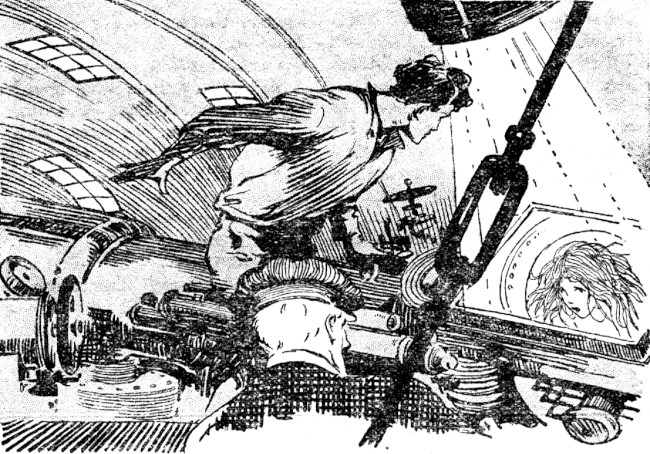
The aëro, with its length of two hundred feet or more, was decked
over with a long, low narrow cabin, which was divided into many small
compartments, with a narrow passage down the center. A few of the rooms
occupied the entire width of the vehicle; one such was in the bow-peak,
with the operating mechanisms; behind that, another which was Rhana’s
cabin.
There was a narrow outer deck the length of the ship on both sides.
Amidships was a room of weapons and apparatus for war. But this I was
never allowed to approach. I think that the mechanism for spreading the
disease germs was here. I never saw it.
The vehicle, with its glowing side pontoons and its faintly luminous
spar projecting from the bow, quite evidently operated similarly to the
ones we had flown in the abyss. There were aboard perhaps fifty Gians.
The men did what heavy, unskilled labor was needed and prepared the
meals. There were women at the controls.
Besides Rhana, I remembered having seen but one of these Gians
before—that man, Bhool! He came sniveling up to me; and as though
I did not know the full extent of his treachery, like a proud child
he told me. He had murdered Fen; had been there in the house when we
arrived; heard our plans to go to the gate-house; had hurried to tell
Rhana. She had made her hasty trip to thwart us.
He ended: “Bhool is very clever? You know it?”
I cuffed him; and met Rhana’s approving, tolerant smile.
How far we flew on this trip over the Lowlands I could not say. Or
at what speed? I would have guessed it to be fully eight hundred, or
even a thousand, miles an hour. The daylight came; we settled into the
depths and waited for the light to pass. I was closely guarded in a
cabin made dark so my guard could see. And when night came we started
again.
In all the swirl of mist and vague moonlight, it was a flight unreal,
unearthly. I kept my general sense of direction, from the sun, and at
night from the glimpses of the moon. I wondered how these women could
pretend to navigate, especially an unknown region. But I saw they had
curious instruments, and were making charts of what was passing beneath
us.
I asked Rhana.
“We do not know where we are going,” she said. “But to come back the
same way is very easy.”
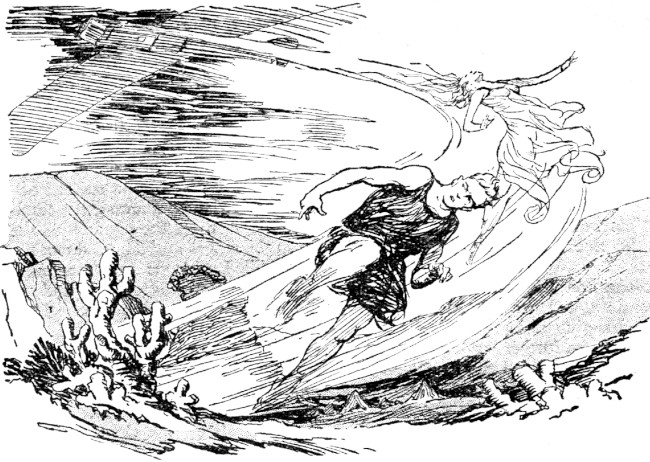
In general we flew, at first, to the north, I imagine at about three
thousand feet below the Zero-level. Occasional rises lifted above us.
The water was always far below—for a time there was an unbroken sea
down there—one of the great mid-Pacific deeps. Or again, a tumbled
land of black crags; ravines, gullies, with river torrents of water
surging everywhere. We reached the fallen Polar Sea with its jammed
masses of ice; the heights of the Aleutians loomed ahead of us and we
turned back.
There was a night when I fancied we were flying in a gigantic circle
over the Central Pacific Basin. A broad, level stretch of water, far
down—receding but still many hundreds of fathoms deep. I saw what
might have been the sharp, jagged rise up to the Hawaiian Peaks.
Verdured mountain-tops were up there, unreal, fairylike in the
moonlight, towering above the Zero-level, above the dank, evil mists of
the Lowlands; a purple sky up there, with the mountain peaks standing
into it; the stars, and the white clouds of a world serene. We avoided
the heights. I had even fancied I saw the lights of a plane up there.
We stopped at the Gian encampment—I think about the time it was first
discovered by the searching earth planes. None had seen us in our low,
night flights; and in the daylight stops Rhana had always chosen places
well obscured, far in the depths.
We made a second flight—the one to the Highlands of Australia—where
first the earth saw us. Nereid and I were not aware of Rhana’s purpose
then; not until afterward, in the Gian encampment, did we learn it.
I had, that second flight, a clear view of the topography of the
Lowlands in this section. We came from the south, that night of October
15. What had before been called the Coral Sea we saw as a great,
irregularly circular valley, a giant caldron surrounded everywhere by
the Highlands. It was empty of any expanse of water save a few mountain
torrents tumbling down its slopes or an occasional shallow lagoon,
trapped in the rocks, drying by evaporation.
It was my studied policy now to win Rhana’s confidence. I told her
always what I could of the geography of the regions through which
we flew. The caldron of the Coral Sea barred us dangerously by its
Highlands. I turned us northeast. At a depression of perhaps a thousand
feet beneath the Zero-level we passed to the right of the Solomon rise
and came again over the lower levels of an open abyss.
We stayed high. I think now that what might be termed the “ocean level”
was down fifteen or twenty thousand feet below Zero. Certainly I saw no
evidence of the sea here. The Japan Trench might still be full. I did
not doubt but that the great Nero Deep off Guam was still and probably
always would be a great salt lake ten thousand feet or more in depth.
Sweeping north, we saw under us the Caroline rise coming up. We
passed through a broad valley of the Caroline Mountains. The verdured
island-tops occasionally showed. I did not know it then, but since the
discovery of the Gian encampment by the world, the Carolines were
deserted by most of their inhabitants—all who could get away had
already fled.
Beyond the mountains here, the Lowland floor again sank. A broken,
desolate plain lay down there, blurred with rising mist. We crossed
it; and soon it began rising again to the ridge we now call the Moon
Mountains. None rose nearly to the Zero-level. A volcanic region,
starkly grim with its inky black shadows, and weird patches of
moonlight that sometimes filtered down.
It lay strewn like wreckage; here, undoubtedly, some great cataclysm of
nature had in by-gone ages convulsed it, leaving the strewn crags and
bowlders; pits like black holes, roundly punched by some giant finger;
precipitous cliffs; ravines, narrow and deep.
But the whole, from this southern approach, was steadily rising. On the
top of the ridge, still many thousands of feet below Zero, the Gians
were encamped. Porous, honeycombed volcanic mountains these were, like
a great oblong sponge, perched here. They contained caves, grottos,
passages and tunnels of every size and character—a vast catacomb.
It lay, I think, some thirty miles in east and west extent along the
top of the ridge; and ten miles north and south. Beyond it, northward,
the mountains and the catacombs ended in a descending northward slope a
hundred miles over a broken floor to where the Middge at a still lower
level, were intrenched.
The grottos, as I first saw them, presented a darkly sinister, wholly
unearthly scene. They held fifty thousand of the gray Gians. Already
it had the appearance of a fantastic underground city. Hundreds of the
dark caverns were occupied by men, women and children in crude interior
shelters. But work was going on. Small stone houses were being built.
Lights were erected. The openings to the upper air—this was all near
the surface—were shaded against the periods of daylight. A scene of
sputtering lights, grotesque shadows—unearthly.
A subterranean stream of fresh water had been found. The Gians seemed
well supplied with food. There was a cavern of war equipment. The army
was organized—an army of men, drilled and led by the women. There was
a broad passage that rose to the outer air in which I saw three other
aëros such as the one Rhana was using.
I slept in a newly-built, small stone house, always closely guarded.
Nereid was with two of the Gian women. The encampment slept during the
daylight periods. There were guards then, with heavily shaded glasses,
at all the many upward passages. In the night, the activity went on.
Neither Nereid nor I were able to learn many details. No one would talk
to us, except occasionally Rhana. And our pseudo-liberty was always
closely watched.
I wondered what could be the plans of these Gian women against
our great nations. I could imagine, once our existence here was
discovered, that the earth armies could drive us out of these grottos
and exterminate us. Yet there was about these women an aspect of
confidence. Was it ignorance of what our civilized millions could do in
warfare? What weapons did these Gians have to make them so confident?
I said once to Rhana: “If you want me to help you—why not tell me your
own plans? These nations you are going to conquer are very powerful.”
She told me abruptly. I sat, speechless, stricken, and stared at her.
Ah, the warfare of our civilized millions! I could see now how readily
it might go down into defeat against this enemy inhuman! Spreading
broadcast a fatal, incurable, uncontrollable disease!
She did not seem to notice my horror. She told me many things of the
past; how long the Gians had planned this; how, when a year ago the
gates had been opened a trifle, she had thought to come with her army
up through the water. That menace at Maui, which we had seen from the
Dolphin. But she had found it impractical—and had planned this present
method.
It was the longest talk I ever had with Rhana. It was, I think, about
the night of October 17. Nereid interrupted us. She came, forcing her
guards to let her join us, vehemently protesting as they tried to hold
her.
Rhana frowned. “You make a disturbance?” She said it in English; and
Nereid answered the same way.
“I do not! They tried to hold me. I—I have communicated with some one
I know—she—”
“That girl you call Polly?”
“Yes.”
I was on my feet. “Nereid! Think what you say!”
But her swift glance reassured me. She was careful.
She said: “Yes, I have reached her. She has been trying to reach me.”
There had never been, I knew, an hour when Nereid had not been flinging
her thoughts toward Polly. And now, at last, Polly’s thoughts—a
message—had come clearly back. The world was alarmed. The authorities
wanted—before they attacked this enemy—to talk about it. Polly was
trying to arrange a meeting. The United States proposed to send an
unarmed plane with a white banner of truce to a designated place over
the Lowlands.
I could visualize it. I had met our kindly, earnest President. I
knew well his ideals, his aspirations to instill in humanity that
unselfishness, that altruism it never has had, and never will. I knew
also his closest friend, the gray-haired British minister. And the
Anglo-Saxon director of foreign relations.
I could imagine these three—highest types of our great
civilization—in conference now over this sudden menace. I could
imagine them saying: “These people are human like ourselves.
Misguided, that is all. Why should they attack us in this fiendish
fashion? Why force us to make war upon them?”
Unanswerable arguments of idealism! The earth with all these new
Lowlands, had room for all. Why should one or another set of humans
strive to kill, or to be killed? Unanswerable.
Rhana listened quietly. “So? They are frightened? They fear me already?
That is good. Can you still talk with them, Nereid?”
“Yes. I think so. I will try—if you will meet them.”
“Of course, child. Tell them what they wish shall be done.”
Calm, impressive, gray face. That hawklike profile, impassive,
unruffled. “Tell them, Nereid, I will do what they wish. I am glad I
have you now.” She just barely smiled. “You and Jeff will go with me to
this meeting—you are a good interpreter with your flying thoughts.”
She made no effort to keep me from Nereid. “Tell me when you have
arranged it.” She strode away.
“Nereid, is that true what you have told her?”
“Yes.”
“But not Polly—Polly isn’t coming? Tell her and Dr. Plantet not to
come. No use. Why, Nereid, she might hold them here—keep Polly away
from here.”
“The foreign director will come. Oh, Jeff, do you think it will be of
any use? I want it to be. I pray—I have prayed so much—to my God—to
Arturo’s whom he told me about—which is the same God.”
She sat beside me. Poor little Nereid! The struggles through which we
had passed; the murder of her father—her people lost with their doomed
realm; the long fight to get upward into the daylight—it all had
changed her. She was pale and wan; always trembling, eager, earnest,
pathetically anxious to be of help.
We were, for this moment, quite alone. She put her hand on my arm.
“Jeff—I was thinking of Arturo. I have tried to reach him, but I
cannot. I wanted you to know. Did you know I love Arturo?”
“Why, yes, Nereid.”
“I think he loves me. We have never spoken of it. I just wanted to say
that if—if you ever get back to Arturo, safe out of all this—”
She stammered, her voice broke, but she went on with a rush: “If you
are safe sometime with him and I—I am not, I want you just to tell him
that Nereid loved him. Will you do that? I want it very much—want him
to know what might have been for us—it seems so very beautiful, what
might be.”
Dear little Nereid! I said quietly: “You are coming safely through it,
Nereid. Don’t think things like that.”
She sighed. “Sometimes I wonder. You will tell him?”
“Yes. I will. But it’s nonsense!”
I met her eyes. They had always seemed eyes with the green mystery and
romance of the sea in them. I had thought of that often; there was no
sea in the abyss of the Mound. I had spoken of it—her love for the
water—the way she swam. There was a river, by the City of the Mound,
and all the joy of her girlhood was found in its murmuring water.
And now the sea was gone from our world up here. But still, she could
have a river. I met her eyes. The sea was gone from them now as it
was from our world. Its dancing light; the sparkle that Arturo had
described as she swam for him those first nights in the pool of the
island cave. Her eyes were worn and dark now with trouble, sorrow,
apprehension.
“I’ll tell him, Nereid. But it’s nonsense, because you’ll tell him
yourself.”
I pictured, while she clung to me, our beautiful world of stars and
moonlight for her and Arturo. “You shall live by a river, little
Nereid—sparkling silver water with the moonlight on it. You and
Arturo.”
And the wistful thought was in my mind: “And you, Jeff Grant, with
Polly!”
I have read of those ancient times when a party of explorers often was
stranded and lost in the unknown polar wastes. Two or three of its
members, sometimes, would leave the others, and try, desperately to
reach civilization. So it was with Tad and Arturo, there in the Middge
camp after Nereid and I had so mysteriously disappeared in the night.
They waited for a time, hoping for our return. But we did not come.
Food and water were giving out. The Middge soon would be in desperate
plight.
With Nereid out there as interpreter, Arturo and Tad had difficulty
talking with the Middge leaders. And soon they began feeling like
outsiders, aliens. The Middge were busy with their activities, but
Arturo and Tad were made to feel that they were not wanted in that
grotto where the war equipment was being assembled.
“They seem resentful of us,” said Arturo. “I don’t understand it.”
Resentful, almost suspicious.
But Tad thought it perhaps natural enough. Their desperate position in
this inhospitable world of the Lowlands.
“And don’t forget,” said Tad, “the first thing that happened here. Down
comes a bomb and kills a dozen or so of them. Our people did that to
them, Arturo. How would you feel?”
With the recurring daily periods of blinding daylight the Middge seemed
disinclined to venture from the caves. But Tad and Arturo were aware
that they had sent an exploring party back underground.
There came a day, while the camp was sleeping, that Arturo and Tad
decided to leave it. If they could reach civilization, they would send
help back. They made packs of a few belongings; a supply of food and
water. They slipped quietly away; out to the mouth of their cave;
clambered down the slope into the desolate barren wastes.
“Tad, look! Look up there!”
They had been wandering for several days and nights—covered with ooze
and slime now, torn and bleeding with stumbling, falling on the rocks.
How far they had gone they had no idea; traveling, they calculated,
generally eastward. There were a few island mountain-tops, they
thought, between here and the great Marshall Rise. It was soon not a
journey, but a desperate wandering, with mountain streams to avoid;
cliffs to descend, to climb again when the valley laboriously had been
crossed; mud, sometimes like quicksand, upon which they crawled. Dank,
hot days, often with blinding sunlight; dank, cold nights with the
black noisome fog settling around them.
Arturo was burning with fever now. They were both gaunt, haggard.
“Tad, look! Look up there!”
It seemed about sunset, though of that they could never be sure.
The sun was gone down behind some distant upstanding rim. There was
sunlight on the white clouds of the heights, but in the abyss the deep
purple shadows of night had long since gathered. There was sunlight
still on the distant domes; a waterfall, halfway down, gleamed like a
white veil; but the crags and tumbled land beneath it were grim and
dark.
Tad and Arturo stood gazing up into the fading daylight. A white-winged
plane was slowly circling, up near the Zero-level and five miles or so
north of them. It came nearer, like a great white bird, soaring. The
sunlight up there edged it with yellow and red. A long white banner
streamed from it, waving with its forward motion. Silent, soaring white
bird, it circled, and went slowly back northward.
The mists of the Lowlands were not yet gathered. The scene was clear
to Tad and Arturo as they stood down on the dark floor. Breathless,
awe-struck; a silent drama was beginning up there.
The plane with the white banner was alone. But far above it, off in the
northern distance, a speck showed close under the white clouds, several
thousand feet above the Zero-level. A speck; another earth plane,
taking no part—like Arturo and Tad, just watching.
For a time the white banner of truce circled alone. And then, as the
night gathered and deepened, another shape appeared, wingless, long and
narrow, and gray-white.
The sunlight soon was gone up there, the yellow glow merged to the
silver of the moon—a full moon, still below the eastern horizon of
the Lowlands. But it caught and painted with its silver the fluttering
white banner; the narrow, wingless aëro glowed in it, unreal as a ghost.
The two white shapes neared each other. The wingless aëro stopped dead,
poised. The white banner, fluttering its peace offering, its message of
humanity, approached slowly.
Tad and Arturo stood gazing, breathless. Then suddenly stricken. Why,
what was this! What—What—They stared, unbelieving, clutching each
other.
Drama, tragedy, so silent up there in the moonlight over the darkly
spreading wastes of the abyss!
They stared. And presently when it was over, they started forward,
running.