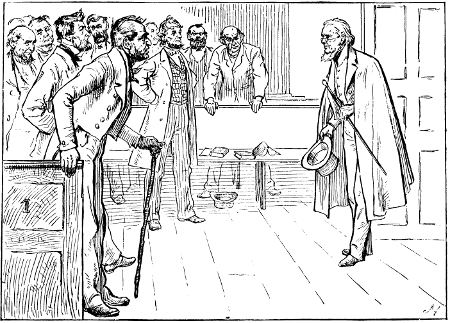
When the Scripture Club assembled on the following Sunday, it was in a
manner somewhat more quiet and less cordial than usual. Mr. Jodderel
volunteered the opening prayer, and then Deacon Bates began to read the
fifth beatitude, when Mr. Radley said:
"Mr. Leader, a majority of the class would like to hear a further
discussion of the last subject. As the original mover of the resolution
restricting the class to one Sunday to a verse, which motion I made with
the almost unanimous support of the class, it is fitting that I should
take the initiative in securing a further hearing upon any subject of
which the majority have not heard enough. I therefore move that the
rule referred to be rescinded for one Sunday, and that we continue the
discussion of the fourth beatitude."
"Second the motion," said Squire Woodhouse.
"Mr. Leader," exclaimed Mr. Jodderel, "I object. The time of this class
should be spent upon the consideration of subjects according to their
relative importance. If the nature and whereabouts of the Kingdom of
Heaven is worth only a single hour of discussion, this minor question of
righteousness certainly isn't entitled to any more. I must oppose the
resolution."
"It was apparently very unwise to adopt such a rule," remarked Mr.
Prymm, "if only to be rescinded or suspended whenever the curiosity of
any of the members may desire it. We are adults instead of children, and
cannot afford, for the sake of consistency, the abrogation of this rule,
especially when every one present has unlimited informal and social
opportunities for discussion, as, indeed, they have already been doing
all week long."
Mr. Prymm looked appealingly toward President Lottson, but that
gentleman seemed in the depths of a gloomy reverie, and unwilling to be
disturbed. For Mr. Lottson's convert had relapsed; he had, before the
evening on which the examining committee met, dropped a note to Mr.
Lottson, saying that the longer he meditated upon the matter the more he
felt that the proposed action would be hypocritical; that if the church
would not detect the hypocrisy, the rest of the world would, and he
preferred to retain the respect of his friends. This note of Broker
Whilcher's had not only inflicted disappointment upon President Lottson,
but it had brought him some tormenting anxieties. If Whilcher, who was a
shrewd observer of men, really meant what he said, was it not possible
and probable that he, President Lottson, who believed all that he had
asked the broker to believe, and very little more, might also be looked
upon as a hypocrite? He knew that his reputation in his own church was
not all that he could have wished it to be; but, looked at in sober
earnest, his church, to his eyes, consisted of such of its members as
were city business men, like himself; there was still another element in
the church, however, and it was numerically the largest, which judged a
man by his professions, and Mr. Lottson trusted that among these he
still retained his respect. But then came a more annoying thought.
Business was business, and business men would take no man's word any the
more implicitly because he was a church member. Could it be possible
that among these he passed not only for a business man of ordinary
morality, but as a hypocrite too? Was he not really honest in his
beliefs? He certainly was; he could lay his hand on his heart and swear
honestly that every religious belief he possessed he had acquired by the
exercise of his best logical faculties. Why, then, should he be
considered hypocritical? Could it be possible that the world saw
something more in the Bible than church members like himself did?
Certainly not. How could the world do anything of the sort? It had never
studied the Bible as he had done, and as fathers of the faith, with whom
he had never for a moment dared to compare himself, had done. And then
to have a prolonged consideration of the late lesson go on in his
hearing while he felt as he did! It was unendurable. He would have
departed silently and without explanation, and betaken himself to Dr.
Humbletop's class, had he not previously informed Builder Stott that he
would remain and look after orthodox interests in the club.
But as he reached this point of his reflections, Mr. Prymm's remarks
ended, and his eye caught Mr. Prymm's, and the exasperating character of
the doctrine of non-paying works seemed more unendurable to him than
ever, so he controlled himself, rose to his feet, and said:
"Mr. Leader, in the interest of Christianity, as defined by the Master,
I also object to the further consideration of this subject, if it is
urged with the spirit that has been manifested. Christ said, 'My yoke is
easy and my burden is light,' but some of the members of this class
remind me of the Pharisees of whom Christ said that 'they bound upon
men's shoulders burdens grievous to be borne.' If religion was made for
anything, it was made for belief and use in this present world; I
object, therefore, to its being made to appear so unlovely and severe
that those who most need it are frightened from it. Those of us who
believe would never have done so had we supposed that men would be
allowed to set aside Christ's merciful words, and establish the
commandments—the notions—of men in their place. I believe as
thoroughly in righteousness as any man, but I don't care to sit here and
listen to its meaning being changed by men who care more for their own
opinions than they do for the commandments of God. And so I shall vote
against the resolution, and ask all others to do so, if they believe in
the righteousness of God instead of that of man."
"I don't see why it's a Scriptural subject at all," said Mr. Hopper,
relinquishing for a moment his hold upon the review containing the
article on "The True Location of the Holy Sepulchre." "It was announced
by Jesus, I know; but it was before he made that atonement which set
aside mere human righteousness as a requisite to salvation. I move we
drop the subject."
"The gentleman's motion is not in order, unless in the form of an
amendment," said Deacon Bates.
"Mr. Hopper's suggestion that this beatitude was given before the
atonement was made," said young Mr. Waggett, "is so original and so full
of practical interest that I should like to hear a further discussion of
the subject, if only to see whether this point cannot be
substantiated—or, rather, whether it can be successfully opposed."
President Lottson leaned over the back of young Mr. Waggett's chair,
and whispered:
"Don't make an ass of yourself. I can see where this thing is bound to
lead us, if you can't; vote the other way when the question is put."
A moment or two of silence ensued, and then Deacon Bates put the
question to vote. A strong response of "Ay!" was soon followed by an
equally noisy "No!" and some one called for a rising vote. Up rose Judge
Cottaway, Squire Woodhouse, Broker Whilcher, Mr. Radley, Principal
Alleman, Mr. Buffle, Lawyer Scott, Dr. Fahrenglotz, and Captain Maile,
nine in all, while for the negative there were but seven votes, Mr.
Bungfloat and young Banty keeping their seats during both votes, the
former with a helpless expression of countenance, and the latter with a
contemptuous smile.
"The ayes have it," said the leader, and Builder Stott, who, until that
moment, had listened at the key-hole, hurried off to Dr. Humbletop's
class-room and stated that the club was determined on carrying free
speech into the ground and the club with it.
"Mark my words," said the builder, "the Scripture Club is as good as
dead."
The discussion was opened by Judge Cottaway, according to the special
request of the founder of the club, and the old jurist spoke as follows:
"Estimated according to the rules of evidence, the requirement for
righteousness never ends in the Holy Scriptures, and never can end while
the Church hold the revealed will of God as an authoritative rule of
guidance. The law was the topic of lawgivers, prophets, the Psalmist,
the wise Solomon, and all of them regarded it as the only substitute for
the personal presence and command of God. Christ never failed to hold it
up for reverence and obedience, excepting when minor points of it were
of less vital importance than that of those for whose direction it was
given."
"That's it, exactly," interrupted Mr. Jodderel. "The law was made for
man, not man for the law, and when man can't live according to the law,
the law must give way, as it did by express command when Christ
condemned the Jews for rebuking the disciples when they plucked corn on
the Sabbath day."
"I imagine that it was more for the sake of rebuking hypocrisy than to
defend the improvidence of his disciples that Christ spoke as he did on
the occasion referred to," said the judge. "But he declared the binding
force of the law more than once, and he not only urged it upon the
people, but increased its scope and severity by explaining that
obedience should not be only to the letter, but to the spirit of the
heavenly commands. Mercy, love, and compassion are not at all
inconsistent with the closest application of the law, though men have
strangely come to imagine that they are. In this same matchless sermon
we are studying you will find his definition of some methods of
violating the seventh commandment. The spiritual rule from which Christ
deduced these conclusions may be applied to all the other commandments
with results equally startling. 'Thou shalt not steal,' is the simple
letter of the eighth commandment, but according to the new method
prescribed by Christ for the translation of the law according to Moses,
to deprive a man of his peace, of his patience, of his faith in mankind,
even if done in ways permissible in business circles, is as truly theft
as is the depriving a man of his money by actual robbery. And as I am a
member of the bar, as I have been a law-maker, and an adjudicator of
legal questions, I feel that I am severe upon no one more than my own
old self, when I say that to recover the amount of a debt by legal means
which compel the debtor to part with property of value several times
greater than that of the property upon which the debt is based, is theft
of the most heinous description, for even under the most merciful
construction of the most careless law, the only theft at all pardonable
is that of small amounts in cases of dire necessity; whereas my
experience in legal collections is that not once in a hundred times are
they made excepting of men in the direst distress, and of utter
inability to pay."
"But Christ mercifully forbore to give such interpretations to all the
commandments," said Mr. Jodderel, "and I have always thought his
refraining from doing so was one of the sure proofs of his divinity. Of
course he saw the people around him—his own disciples, even—doing
hundreds of things that were wrong; but he knew their natures were too
feeble to live up to the holy ideas which were natural enough to Him,
so he said little, except to exhort them to sin no more."
"Very true," said the judge, "but since then the Christian world has had
the benefit of nearly twenty centuries of growth under the instructions
of Christ. Men have grown less animal, more intellectual; less brutal,
more spiritual. The passions and appetites that once seemed
uncontrollable have come more and more under restraint under the
influence of generations of right living. Men nowadays endure physical
discipline from which the ascetics of Christ's time, or even of the
middle ages, would have shrunk with fear. The world is lamentably full
of wickedness and weakness, but it has now what it did not have when
Moses gave his law—it has in every community one or more men who show
by right living what a perfect control man may exert over his lower
faculties, or, rather, over the lower developments of faculties which in
the clearer light of to-day develop into noble virtues. But the stronger
sins die hardest, so to-day we find, in communities where murder is
unheard of, Sabbath-breaking unknown, profanity unspoken, and the
greater crimes mentioned in the Decalogue seldom or never brought to
light—in such localities we find the greed of gain made the excuse of
unfair dealings between man and man; it stirs up strife more vicious
than that which took place when the civilized world was one grand camp,
and when to kill a man for his possessions was a deed praiseworthy
rather than otherwise, especially when the victim might, with any
excuse, be called an enemy."
"One might suppose, from the judge's remarks, that the world had but one
sin—and only one virtue," said Mr. Jodderel.
"According to Scripture," exclaimed the judge, "there is but one
virtue, for it includes all others. Its name is Love—will the gentleman
remember that the assertion is Christ's, and not mine? There is more
than one sin, truly; but not one of the dreadful number could exist were
the one virtue practiced as it should be. And this brings me back to the
leading idea of the lesson, from which I have unintentionally been
diverted toward specialties. And yet, I know not how better to explain
the nature of righteousness according to the law, than to continue in
use the illustration that I have been using—the treatment, by each
other, of men in their business affairs. For there are but few relations
of men that cannot be classified under business heads. By implication,
sins against self and nature belong in the same category, for the man
who impairs in any way his own physical and mental capital, injures to a
greater or less extent the whole community in which he resides. To save
man and to bless him is the whole aim of the law, for it is only by man
in his proper condition that God can be fully glorified. Thus regarded,
the way of righteousness can never seem hard, tiresome, or narrow—it is
rather the only highway which is always delightful. The promise given,
therefore, in this beatitude is the most precious in the whole Bible,
for there is no good it does not include, nor any evil which it does not
help us to shun."
"That's the first satisfactory description I ever heard of the law,"
remarked Mr. Radley. "I wonder why other men—preachers, even—never
talk about it in the same way."
"They'd lose all their wealthy pew-holders if they did," answered
Captain Maile.
"Not all," said Mr. Buffle, "at least, not if I'm as well off in this
world's goods as I think I am. And I don't propose to forget what I have
heard."
"It is very evident, however," said President Lottson, "that Christ knew
that this idea of the law—which I admit to be as sound as it is
beautiful—could never be fulfilled by man, or he would never have
considered it necessary to make an atonement for sin, and urge people to
accept it, instead of trying to be saved by righteousness alone. The
gentleman lays great stress upon the failings of business men. They
exist about as he has painted them, but had he spent his own life in
business instead of among the abstractions of a learned profession, he
would see the other side of the case, which is that business is selfish,
that it cannot be otherwise, and that man's only hope lies in Christ's
promises."
"Only hope of what?" asked Squire Woodhouse.
"Of salvation, of course," replied the president.
"Then, what about the world?" asked Mr. Radley. "Is nothing to be done
here for God—and man? Did we come into the world for no purpose but
to get out of it in the best shape we can? Has God no purposes to
fulfill here, or did he only make this wonderful combination of beauty
and utility, that we call the world, to be a mere stage for blundering
and wrong-doing?"
"No," answered young Mr. Waggett; "it is to fit us all for entrance to
the glorious company of angels, prophets, and martyrs."
"We had better all die in infancy then," said Mr. Radley, "before we've
been unfitted for such society, and been compelled to begin all over
again. What a contemptible blunderer God must be, if the common
religious idea of the use of the world is correct!"
"Gentlemen," said Mr. Alleman, "it seems to me that this class has by
this time plainly indicated its religious measure. We have met together
many times; we have expressed our own views, and listened to many
others; we have individually indicated considerable ability and
ingenuity; but I am unable to discover that even a respectable minority
have changed their beliefs. Of the sincerity of belief of those who have
spoken there can be no doubt; but something more than ability and
sincerity is necessary to retain usefulness for a body of men, who are
determined to approach intellectually no nearer to each other. As we
cannot agree intellectually, why can we not do so morally, and establish
for the class a higher motive than can be furnished by religious
curiosity or tenacity of special theological opinions? Free speech has
been the distinctive feature of the class, but all that freedom of
expression can gain for us has already been gained. Why cannot we,
therefore, form a new and solemn compact that we will, each one
according to his own special religious belief and light, strictly order
our lives according to the moral ideas which we all admit are found in
the Bible and are above criticism?"
"What!" exclaimed Mr. Jodderel, "and turn a religious organization into
a society for the encouragement of mere morality? None for me!"
"I should consider such a course as religiously suicidal, if not
blasphemous," declared Mr. Prymm.
"The man who does it can bid good-bye to his property," said Mr. Hopper,
"and I, for one, am determined to give a good account of my
stewardship."
"He can bid good-bye to his chance of salvation, too," said young Mr.
Waggett, "if he's not going to think more of it than he does of mere
morality."
"Good-bye to his fun, too," suggested young Mr. Banty.
"If we cannot leave all to follow Him," remarked Deacon Bates, who had
once felt himself called to mission work, but successfully resisted the
call, "it would certainly be unseemly to do so for the sake of mere
worldly righteousness."
"'Twould revolutionize society," said Lawyer Scott, "and no man should
attempt such a thing without the most careful preparation."
"Doesn't Herbert Spencer say something about morality being at the top
of everything?" asked Mr. Buffle of Broker Whilcher.
"Ye—es," said the broker; "but he considers that it's wrong to
sacrifice one's business, as I'd have to do to live according to the
plan suggested."
"If Christ had intended that morality should have been so much," said
President Lottson, "he would have talked more about it, and less about
other things. He knew what the world needed, what it could stand, and
what it couldn't."
"As if he wasn't all the while insisting upon morality," exclaimed Mr.
Alleman. "Captain Maile, you're certainly with us! You've always talked
as if you were."
The captain made a wry face.
"I've talked against hypocrisy—that's what I've done," said he. "I've
got no special religious belief myself, but I hate to see holes in those
of other people."
"I," said Dr. Fahrenglotz, "would yield adherence to such a system, were
it not that men disagree as to what morality is, and I do not wish to
subject myself to any arbitrary rule or agreement. The soul of man
should be free."
Judge Cottaway arose and gave his hand to Mr. Alleman, and several
members affected to consider this action as a sign that the meeting had
adjourned. The party dispersed more rapidly than it had ever done
before, and left the judge, the principal, the Squire, Mr. Buffle, and
Mr. Radley talking to each other.