Next morning I got up early, for I wasn’t
quite easy in my mind about riding Joe’s old
horse, and so I thought I would just go round
and look at him, and ask the fogger something
about his ways. It was a splendid morning,
not a cloud to be seen. I found the fogger
strapping away at the horses. Everybody had
been up and about since daylight, to get their
day’s work done, so that they might get away
early to the pastime. All the cows had been
milked and turned out again, and Joe was away
in the fields, looking after his men.
I stood beating about the bush for some time,
for I didn’t want to let the man see what I was
thinking of if I could help it. However, when
he brought out the old brown horse to clean
him down, I went up and patted him, and
asked whether he was a good saddle horse.
“Ees, there warn’t much fault to find wi’
un,” said the fogger, stopping his hissing and
rubbing for a moment, “leastways for them as
didn’t mind a high goer.”
I didn’t quite know what he meant by a high
goer, so I asked him if the brown was up to
my weight.
“Lor’ bless ’ee, ees. He’d make no account
o’ vivteen stun. Be you to ride un up the hill,
Sir, make so bold?” said he.
“Yes, at least I think so,” said I.
“Hev ’ee got arra loose tooth, Sir?” said he,
grinning.
“No,” said I, “why?”
“’Cause he’ll be as likely as not to shake un
out for ’ee, Sir, if you lets un hev his head up
on the downs.”
I didn’t like this account of the brown horse,
for as I hadn’t ridden much, he might take his
head perhaps whether I let him have it or not.
So I made up my mind not to ride. I thought
I would go behind in the four-wheel, for I didn’t
like to leave Miss Lucy all alone with the Parson
for so long; but then I found out that one of
the carter-boys was to go behind to look after
the horses, and I didn’t choose to be put up side
by side with him, to look ridiculous. There
was a big wagon going up, too, full of the farm
servants, but that didn’t seem to suit me any
better, so I settled with myself that I would
just start and walk up.
Joe, luckily for me, thought he had settled
every thing, and so at breakfast said nothing
more about the old horse; though I was afraid
he would every minute, and then I should have
had to pretend I was going to ride, or they
might have found out that I didn’t quite like the
notion. I was very glad when I saw him fairly
off after breakfast, cantering away on the chestnut;
and, very soon afterwards, I took a good
stout stick of Joe’s in my hand, put my note-book
in my pocket, and started off quietly by
myself.
At first as I walked along I didn’t enjoy myself
much for thinking of the four-wheel, and I
was almost getting jealous of the Parson again.
But I soon got over it, when I remembered how
kind he had been the night before. And I felt,
too, that if he really was making up to her
there was very little chance for me, so I had
better make up my mind anyhow to see and
enjoy every thing I could. I don’t think I was
very much in love at the time; if it had been
a week later I should have found it much
harder perhaps.
I kept along the shady side of the road, for it
was getting hot already, and crossed the canal,
and kept making up towards the hills. I wasn’t
sure of the way, but I knew that if once I got
up the hill I should find the Ridgeway, and
could follow it all the way up to the Castle.
After a bit I fell in with groups of people, all
going the same way; and so, following on with
them, after about an hour’s walk, I came to the
foot of the hills; and found a pretty little inn,
standing back from the road, nestled into a
plantation, where everybody else seemed to be
stopping; and so I stopped too, and sat down
on the bench before the door to have a glass of
beer before facing the pull up to the top.
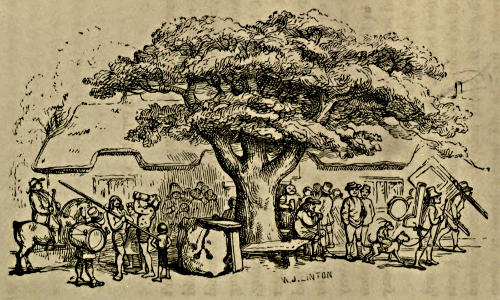
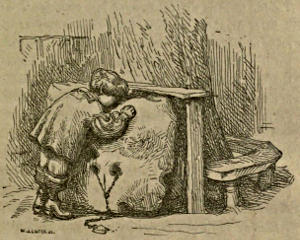
In front of the door was an oak tree, and
under the tree a big stone with some curious
holes in it, into which pieces of wood were
fitted, secured by a padlock and chain. I was
wondering what it could be, when the landlord
came out with some of his guests, and pulling
out a key unlocked the padlock, and took the
pieces of wood out of the holes. Then there
was some talk between the young men and
their sweethearts, and first one and then another
stooped down and blew into the hole at
the top, and the stone made a dull moaning
sound, unlike any thing I had ever heard. The
landlord told me that when it was well blown
on a still day, it could be heard for four or five
miles, and I should think it could; for I left
them blowing away when I started again, and
heard the sound every now and then until I was
close up to the Castle, though the wind blew
from the south, and down the hill.
I should think a dozen parties, in all sorts of
odd go-carts and other vehicles, or on foot, must
have passed the Blowing-Stone in the ten minutes
which I spent on the bench. So I got
quite eager to be up at the Castle, and paid for
my beer and started again. It is a very long
stiff pull up Blowing-Stone Hill, and the road is
not a very good one; so I soon began to pass
the gigs and carts, most of which had to stop
every hundred yards or so, to let the horses and
donkeys get their wind. Half-way up, in the
worst part of the hill, I found an old huckstering
woman and a boy in great trouble. They
had a little cart laden with poles and boards for
a stall, and two great sacks of nuts and sweet-stuff;
and only one donkey in the shafts, who
had got one wheel of the cart into a deep chalk
rut, and stood there like a post. The woman
and boy were quite beat with dragging at his
head, and trying to lift the wheel out of the rut,
and as I came up she was “fairly giving out.”
“Lawk-a-massy! how ever be I to scawt[29]
up? Do’ee lend a help, there’s a good soul,”
said she to me.
Well, I couldn’t go by and leave her there,
though I didn’t half like having to stop; so I
helped to lift the wheel out, and then we pushed
the cart up a few yards, and the old donkey
tried to sidle it into another rut, and we had
another fight with him. My blood got up at
his obstinacy; I don’t believe there ever was
another such a donkey in the world; so the
more he backed and sidled, the more I and the
old woman and the boy fought. And then the
people that passed us began to laugh and joke
at us, and I got very angry at them, and the old
woman, and everybody; but I set my teeth, and
made up my mind to get him up to the top if I
stayed there all day.
I should think we must have been nearly
half an hour at work, and had got on about
three hundred yards or so, when a fine dog-cart
on high wheels came up. I heard the gentlemen
in it talking and laughing as they came
near us; but I didn’t look up, and kept working
away at the donkey, for I was afraid they
would only joke at us.
“Oh deary me, deary me, Master Gaarge,
be that you?” I heard the old woman call
out; “now do’ee stop some o’ the chaps, and
tell ’em to help. I be nigh caddled to death wi’
this drattled old jackass—oh dear, oh dear!”
“Why, Betty! what in the world are you
after?” said a merry voice, which I thought I
had heard before; and, looking up, I saw the
young gentleman who had promised me the
song.
“Oh, you see, Master Gaarge, I thought as
I might turn a honest penny if I could only
win up to the pastime wi’ some nuts and
brandy-balls. So I loaned neighbour Tharne’s
cart as he fetches coals from the canal wi’,
and his ass—and if ’twas Balaam’s ass hisself
he couldn’t be no wus—and here I be; and
if it hadn’t a been for this kind gentleman”—
“Well, stop your talk, Betty, and take hold
of his head,” said he, jumping out of his dog-cart
and giving the reins to the one who was
beside him. “Ah, good morning,” nodding to
me, as he came to the back of the cart, “now
then, with a will! shove away!”
So we shoved the cart hard against the donkey’s
legs. “Don’t pull, Betty, let him have
his head; just keep hold of the reins. Look
out, boy; stop him making for the ditch;”
and away went Master Neddy scrambling up
hill, for he found that the cart was coming
over his back if he didn’t move on. Master
George was as strong as a ballast heaver, and
the donkey seemed to find it out quick enough,
for we were up the hill in no time.
“Bless your kind heart, Master Gaarge!”
almost sobbed the old woman; “I be all
straight now. Do’ee hev summat to suck now,
or some nuts, and this kind gentleman too;
you allus wur fond o’ suck;” and she began
untying the neck of one of her sacks.
“Oh, Betty, you wicked old lone woman!”
said he, “haven’t you made me ill often enough
with your nastinesses fifteen years ago?”
“Dwont’ee, now, call ’em names, Master
Gaarge.”
“Good-bye, Betty, and make haste up to the
Castle before all the small boys are poisoned.
I can give you a lift, Sir,” said he to me, “if
you’ll jump up behind.”
I thanked him, and got up behind, by the
side of one of the other young gentlemen, who
I thought didn’t seem much to like having me
there; and I felt very pleased, as we bowled
along the Ridgeway, passing all the people who
had been laughing at me and the donkey, that
they should see that I was in such good company,
and should be up at the Castle before
any of them.
The whole Ridgeway was alive with holiday
folk, some walking with their coats and bonnets
off, some in great wagons, some in all sorts
of strange vehicles, such as I had never seen
before (many of which Master George declared
had been impressed by Alfred’s commissariat
and hospital staff, in his wars against the Danes,
when they were strong young traps); but from
one and all there rose up a hum of broad Berkshire,
and merry laughter, as we shot by them.
Sometimes a yeoman in his gig, or on his stout
hackney, would try to keep up with us, or to
stop us from passing him, but Master George
was a reckless driver, and somehow or another,
galloping or trotting, on the right side or the
wrong, he would pass; so in about ten minutes
we had got over the two miles of downs, and
were close up to the Castle.
Here the first thing I saw was Joe, with two
other farmers, carrying a lot of little white and
pink flags, and measuring ground.
“Please put me down, Sir,” said I, “there’s
my friend.”
“Ah, yes,” said Master George, pulling up,
“I see—you’re staying with Farmer Hurst.
Well, I’m much obliged to you for helping
poor old Betty—she’s a good struggling old
widow body in our village; I’ve known her
ever since I could walk and suck. Good morning,
Mr. Hurst; likely to be a good muster
to-day.”
“Mornin’, Sir,” said Joe, touching his hat,
“I think so—there’s a smart lot of folk in the
Castle already.”
“Well, I hope we may meet again,” said
Master George to me, “I won’t forget the song
for you,”—and away he drove towards the
Castle.
“Why, Dick man, where’s the old horse?”
said Joe, looking as if I had come from the
moon.
“Oh, I walked,” said I, “I prefer it, when I
have time.”
“Come own it, Dick,” said he, “thou wast
ashamed of the old horse’s long rough coat—I
didn’t think thou hadst been such a dandy.”
“Upon my honour it was nothing of the
sort,” said I, glad enough that he wasn’t on
the right scent.
“And how did you get along with one of
our young squires?” said he.
“Oh, he offered me a lift,” said I; and then
I told him my story.
“Well, you always seem to fall on your legs,”
said he; “who are they with him?”
“Oxford scholars, I think,” said I, “from
their talk; but I didn’t get on much with them,
they’re not so free spoken as he is. But what
are you about here, Joe?”
“Oh, helping the umpires to measure out
the course for the cart-horse race; look, there
are the flags right along for half a mile, and
the finish is to be up there by the side of the
Castle, for all the folk to see. But come along,
for I must be after the umpires; I see they
want me.”
“I think,” said I, “I should like to go and
see what’s going on in the Castle.”
“Very good,” said he, “then I’ll look after
you when we’ve done this job;” and away he
went.
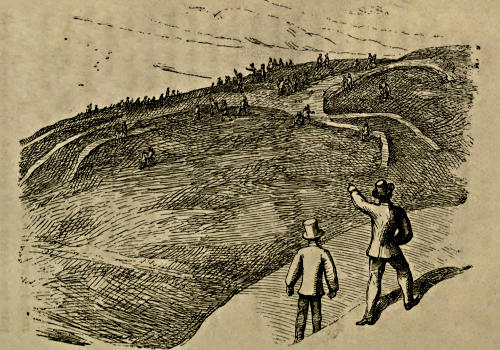
I wouldn’t take time to go round by either
of the entrances, but made straight across to
the nearest point of the great earthworks, and
scrambled over the outer bank, and down into
the deep ditch, and up the inner bank, and
stood there on the top, looking down on all the
fun of the fair; for fair it was already, though
it was very little past eleven o’clock in the
morning.
There was the double line of booths and
stalls which I had seen putting up the day
before, making a long and broad street, and
all decked out with nuts and apples, and ginger-bread,
and all sorts of sucks and food, and
children’s toys, and cheap ribbons, knives,
braces, straps, and all manner of gaudy-looking
articles. Opposite, on the north side, all
the shows had got their great pictures up of
the wonders which were to be seen inside, and
the performers were strutting about on the
stages outside, and before one of them an acrobat
was swinging backwards and forwards on
the slack rope, and turning head over heels at
the end of each swing. And every show had
its own music, if it were only a drum and pan
pipes, and all the musicians were playing, as
loud as they could play, different tunes. Then,
on the east side, were the great booths of the
publicans, all decked out now with flowers and
cheap flags, with their skittle-grounds behind;
and lots of gypsies, and other tramps, with their
“three sticks a penny,” and other games. The
west side was only occupied, as I said before,
by the great white tent of the County Police,
where the Committee were sitting, and Lord
Craven’s tents some way in front; but these
looked pretty and gay now, for they had hoisted
some good flags; and there in the middle stood
the great ugly stage, and the greasy pole. The
whole space was filled with all sorts of people,
from ladies looking as if they had just come
from Kensington Gardens, down to the ragged
little gypsy children, with brown faces and brick-coloured
hair, all moving about, and looking
very much as if they were enjoying themselves.
So after looking a minute, I got down into
the crowd, and set to work to see every thing
I could.
I hadn’t been pushing about amongst the rest
above five minutes, when two men stopped
close by me, one (who was the Wantage crier,
I found out afterwards) with his hand full of
papers, and the other carrying a gong, which
he began to beat loud enough to deafen one.
When the crowd had come round him, the
crier began, and I should think he might have
been heard at Elm Close:—
“Oh yes! oh yes! by order of the Committee,
all persons who mean to play for prizes, must
enter their names on the umpires’ lists. Oh
yes! oh yes! the umpires’ lists are open in the
tent, and names may be entered from now till
half-past twelve. Oh yes! a list of the umpires
for the different games and sports may be
seen on the board outside the tent-door. God
save the Queen!”
As soon as he had done, he and the man
with the gong went off to another part of the
Castle, but I could see some of the men and
boys, who had been standing round, sidling off
towards the great tent to enter for some of the
games, as I guessed. So I followed across the
Castle to the space in front of the tent.
I could see, through the entrance, two or
three of the Committee sitting at a table, with
paper and pens and ink before them; and every
now and then, from the little groups which were
standing about, some man would make a plunge
in, and go up to the table; and, after a word or
two with them, would enter his name on one or
more of the lists, and then come out, sometimes
grinning, but generally looking as if he were
half ashamed of himself. I remarked more and
more through the day what a shy, shamefaced
fellow the real countryman was, while the gypsies
and racing boys and tramps, who entered
for the races, but not for the backsword or
wrestling prizes, were all as bold as brass,
and stood chattering away to the Committee-men,
till they were almost ordered out of the
tent.
I sat down on the turf outside the tent to
watch; for I felt very much interested in the
games, and liked to see the sort of men who
came to enter. There were not many very stout
or tall men amongst them; I should say they
averaged about eleven stone in weight, and five
feet eight inches in height; but they looked a
very tough race; and I could quite believe,
while looking at them, what Joe told me one
day—“Though there’s plenty of quicker men,
and here and there stronger ones, scarce any
man that ever comes down our way—either at
navigator’s work or loafing about, like the gypsies
and tramps—can ever come up to our chaps
in last, whether at fighting or working.”
There was one man amongst them who struck
me particularly, I suppose because he wore a
Crimean medal with four clasps, and went quite
lame on a crutch. I found out his history. Old
Mattingly, the blacksmith of Uffington, had
three sons when the Russian war broke out.
They all went for soldiers. The first was shot
through the hand, as that gray, deadly dawn
broke over Inkermann, on the 5th of November,
1854. Had he gone to the rear he would probably
have lived. He fought till the last Russian
vanished along the distant road, and over the
bridge heaped with slain, like a gallant Berkshire
lad—and then went to hospital and died
of his wounds within a week. The second
lies before Sebastopol in the advanced trenches
of the right attack. The third, the young artilleryman,
went through the whole war, and after
escaping bayonet and shot and shell, was kicked
by the horse of a wounded officer, and probably
lamed for life. According to the rules of the
service, my informant seemed to think, he was
not entitled to a pension for life, “but they had
given him one for eighteen months after his discharge,
so that he had almost a year of it to
run; and perhaps he might learn blacksmith-work
in that time, if he could stand at all, for
that was mostly arm-work.”
I didn’t know what the regulations as to
pensions were, or how long young Mattingly
would take to learn blacksmith-work, but I did
feel rather ashamed that England couldn’t afford
to do a little more for such as he; and should
be glad for my part to pay something towards
it, if the Chancellor of the Exchequer,
or somebody, would find out a way to set this
right. Or perhaps if this should ever meet the
eye of the Commander-in-Chief, or of any of the
gentlemen who were made K.C.B’s in the war-time,
or of any other person who has interest in
the army, they may see whether any thing more
can be done for young Mattingly.
Many of the younger ones I could see hadn’t
made up their minds whether or no they should
enter, and were larking and pushing one another
about; and I saw several good trials of
strength, and got an idea of what the wrestling
was like before the lists were closed.
“Bi’st in for young geamsters prize at wrastlin’,
shepherd?” asked a young carter with
his hat full of ribbons, of a tight-made, neatly-dressed
fellow, who had already won a second
prize, I heard, at his village revel.
The shepherd nodded.
“Mose, mun,” went on the carter, “thee
shouldst go in. Thee bi’st big enough.”
Moses was an overgrown, raw-boned fellow,
of about eighteen, in a short smock-frock and
a pair of very dilapidated militia-trousers. He
had been turning the matter over in his own
mind for some time, and now, after looking the
shepherd over for a minute, pulled his great
hands out of his pockets, hunched up his shoulders,
and grunted out—
“’Zay! Try a file[30] wi’ thee, shepherd.”
The bystanders all cheered. Moses, the militiaman,
was rather a joke to them. The shepherd
looked scornful, but was ready to try a file;
but he stipulated that Mose must borrow some
shoes instead of his great, iron-clouted high-lows,
(no man is allowed to wrestle, I found,
with any iron on his shoes.)
This seemed likely to stop the fun. Moses
pulled off his high-lows, and appeared in sinkers,[31]
at which everybody roared; but no shoes were
to be had. Then he offered to wrestle without
shoes; but at last a pair were found, and Moses
advanced with his great hands stretched out
towards the shepherd, who, not deigning to take
one hand out of his pocket, caught Mose’s elbow
with the other. After one or two awkward attempts,
and narrowly escaping some well-meant
trips, Mose bored in; and before the shepherd
could seize the militiaman’s collar with his
second hand, over he went, and Mose was proclaimed
winner of a file, amid shouts of laughter.
Then they buckled to again, the shepherd
doing his best; but somehow Mose managed to
keep his legs; and when they went down, both
fell on their sides, and it was only a dog-fall.
In another minute I saw the militiaman in the
tent before the table.
“Plaze, Sur, put down Moses Tilling—young
geamster—wrastlin’.”
After watching the tent till the lists were just
closing, I started off to see if I could find Miss
Lucy, who ought to have been up by this time,
and to get something to eat before the sports
began. The luncheon I managed easily enough,
for I went over to the great booth in which I
had dined the day before, and sat down at the
long table, where Peter welcomed me, and soon
gave me as much as I could eat and drink.
But when I had finished, and went out to look
for my friends, I found it a very difficult business,
and no wonder, for there were more than
20,000 people up on the Hill.
First I went to the outside of the Castle,
where all the carriages were drawn up in long
rows, to see if I could find the four-wheel
amongst them. As I was poking about, I came
close to a fine open carriage, and hearing a
shout of merry laughter, looked up. There
were a party at lunch; two ladies and some
quite young girls inside, some boys on the box,
and several gentlemen standing round, holding
bottles and sandwiches; and they were all eating
and drinking, and laughing at an old gypsy
woman, who was telling the fortune of one of
the ladies.
“Love’ll never break your heart, my pretty
lady,” said the old woman; “let the Norwood
gypsy see your hand, my pretty lady.”
The lady held out her right hand, and the
little girls glanced at the lady, and one another,
brimming with fun.
“It’s the other hand the gypsy ought to see.
Ah, well, then, never mind,” she went on, as the
lady looked quietly in her face, without moving
a muscle, “the old Norwood gypsy can read it
all in your eyes. There’s a dark gentleman,
and a light gentleman, who’ll both be coming
before long; there’ll be sore hearts over it, but
the richest will win before a year’s out—”
Here the girls clapped their hands, and burst
into shouts, and the lady showed her other hand
with a wedding-ring on, and went on quietly
with her lunch.
“Ah! I never said she wasn’t married!” said
the gipsy to the girls, who only laughed the
more. I had got quite close up to the carriage,
and at this moment caught the eye of the lady,
who was laughing too; then I felt awkward all
at once, and as if I was where I had no right to
be. But she didn’t look the least annoyed, and
I was passing on, when I saw that Mr. Warton
was amongst the gentlemen on the other side of
the carriage. “Ah,” thought I, “I wonder if
he’ll know me now he’s with his fine friends?”
But the next minute I was ashamed of myself
for doubting, for I heard him wish them good-bye,
and before I was ten yards from the carriage,
he put his arm in mine.
“Well, you never rode after all,” he began.
“No, Sir,” said I. “But where are they? I
haven’t seen Joe this two hours.”
“Oh, not far off,” said he; “feeding, like the
rest of us.”
And further down the line we found Joe, and
Miss Lucy, and several friends of theirs, lunching
on the turf by the four-wheel. So we sat
down with them, but I didn’t half like the way
in which Miss Lucy was running on with two
young farmers, one on each side of her. She
told me afterwards that she had known them
ever since they were children together, but somehow
that didn’t seem to me to mend the matter
much. And then again, when Joe got up, and
said it was time to move, for the sports would
be just beginning, nothing would serve her but
to walk off to Wayland Smith’s cave. I wonder
whether she did it a little bit to provoke
me; for she knew that I had been to see it the
day before, and that I wanted particularly to see
all the sports. But I don’t think it could have
been that after all, for when I said I should stay
with Joe, she was just as pleasant as ever, and
didn’t seem to mind a bit whether I or any one
else went with her or not.
I am afraid I shall make a very poor hand at
telling about the sports, because I couldn’t be in
five or six places at once; and so I was kept
running about, from the stage in the middle of
the Castle out on to the downs to see the cart-horse
race, and then back again into the Castle
for the jingling match, and then out on the
other side to the manger for the cheese races,
and so on backwards and forwards; seeing the
beginning of one sport, and the end of another,
and the middle of a third. I wish the Committee
would let the sports begin earlier, and
then one might be able to see them all. However
I must do the best I can, and just put down
what I saw myself.
The first move for the sports was made a
little before one, just as I got back into the
Castle, after seeing Miss Lucy start for Wayland
Smith’s cave. The Committee came out
of their tent in a body, each man carrying the
lists of the entries for the sports over which he
was to preside. But instead of going different
ways, each to his own business, they walked
across in a body to the stage, and stopped just
underneath it, in the middle of a great crowd
of men and boys; and then they shouted for
silence, and the chairman spoke:—
“We wish to say a few words, my men, to
those who are going to play with the sticks or
wrestle to-day. There has been a good deal of
talk about these sports, as you all know; and
many persons think they shouldn’t be allowed at
all now-a-days—that the time for them has
gone by. They say, that men always lose their
tempers and get brutal at these sports. We
have settled, however, to give the old-fashioned
games a fair trial; and it will rest with yourselves
whether we shall ever be able to offer
prizes for them again. For, depend upon it, if
there is any savage work to-day, if you lose
your tempers, and strike or kick one another
unfairly, you will never see any more wrestling
or backsword on White Horse Hill. But we
are sure we can trust you, and that there won’t
be any thing to find fault with. Only remember
again, you are on your trial, and the stage will
be cleared at once, and no prizes given, if any
thing objectionable happens. And now, you
can put to as soon as you like.”
The Committee then marched off, leaving a
very large crowd round the stage, all eager for
the play to begin.
The two umpires got up on to the stage, and
walked round, calling out, “Two old gamesters
at backsword, and two old gamesters at wrastlin’,
wanted to put to.” But I suppose the
chairman’s speech had rather taken the men by
surprise, for no one came forward, though there
was a crowd twenty deep round the stage.
“Who are the old gamesters?” I asked of
the man next me.
“Them as has won or shared a first prize at
any revel,” answered he, without looking round.
After a minute the chairman’s brother, who
didn’t seem to have much scruple about these
sports, jumped up on the stage, and blew an
old French hunting-horn, till the young ones
began to laugh; and then told the men not to
be afraid to come up, for if they didn’t begin at
once there wouldn’t be light to play out the
ties.
At last there was a stir amongst the knot of
Somersetshire men, who stood together at one
corner of the stage; and one of them, stepping
up, pitched on to it his stumpy black hat, and
then climbed up after it himself, spoke a word
to the umpires, and began handling the sticks,
to choose one which balanced to his mind,
while the umpires proclaimed, “An old gamester
wanted, to play with John Bunn of Wedmore.”
“There he stands, you see,” said Master
George, who was close by me, though I hadn’t
seen him before, “the only remaining representative
of the old challenger at tourneys ready
to meet all comers. He ought to have a herald
to spout out his challenge in verse. Why
not?”
“I don’t know what he could say more than
the umpire has, Sir,” said I.
“He might blow his own trumpet at any
rate,” said he; “somehow thus;” and he repeated,
after a false start or two,—
THE ZONG OF THE ZUMMERZETSHIRE OWLD GEAMSTER.
I.
“Cham
[32] a Zummerzetshire mun
Coom her to hev a bit o’vun.
Oo’lt
[33] try a bout? I be’ant aveard
Ov any man or mother’s zun.
II.
“Cham a geamster owld and tough,
Well knowed droo all the country zide,
And many a lusty Barkshire man
To break my yead hev often tried.
III.
“Who’s vor a bout o vriendly plaay,
As never should to anger move?
Zich spwoorts wur only meaned vor thaay
As likes their mazzards broke for love.”
John Bunn looked by no means a safe man
to play with. He stood about five feet eleven,
with spare long muscular limbs, a sallow complexion,
and thick shock head of black hair,—a
good defence in itself against any common
blow of a stick. But now that the ice was
broken, his challenge was soon answered; and
George Gregory, of Stratton, one of the best
mowers in the Vale, appeared to uphold the
honour of Berks and Wilts. He stood half a
head shorter than his opponent, but was, probably,
the stronger man of the two, and had a
sturdy and confident look, which promised well,
and was fair-haired, and, like David, ruddy to
look upon.
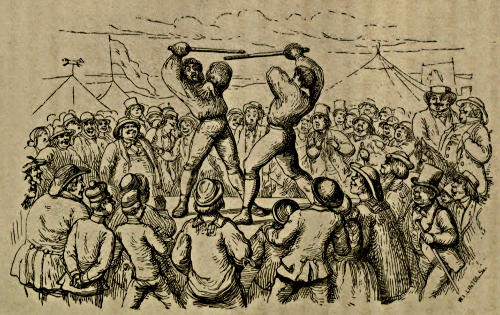
While they were taking off coats and waistcoats,
and choosing sticks, two wrestlers got up
on the stage, and showed the shoes in which
they were going to wrestle to the umpires, for
approval; and stood at the ropes, ready to begin
as soon as the first bout at backsword was over.
The crowd drew a long breath, while Bunn and
Gregory came forward, shook hands; and then
throwing up their guards, met in the middle of
the stage.
At the first rattle of the sticks, the crowd began
cheering again, and pressed in closer to the
stage; and I with them, for it was very exciting,
that I felt at once. The coolness and resolution
in the faces of the two men, as they
struck and parried with those heavy sticks, trying
all the points of each other’s play in a dozen
rapid exchanges; the skill and power which
every turn of the wrist showed; and the absolute
indifference with which they treated any
chance blow which fell on arm or shoulder,
made it really a grand sight; and with all my
prejudices I couldn’t help greatly admiring the
players. “Bout,” cried Bunn, after a minute or
so, and down came their guards, and they
walked to the side of the stage to collect coppers
from the crowd below in the baskets of
their sticks, while the two first wrestlers put to
in the middle.
I suppose there are more unsettled points in
wrestling, or it is harder to see whether the men
are playing fair, for the crowd was much more
excited now than at the backsword play, a hundred
voices shouting to the umpires every moment
to stop this or that practice. Besides,
the kicking, which is allowed at elbow and collar
wrestling, makes it look brutal very often;
and so I didn’t like it so much as the backsword
play, though the men were fine, good-tempered
fellows, and, when most excited, only seemed to
want what they called “fair doos.”
I stopped by the stage until Gregory had lost
his head. How it happened I couldn’t see, but
suddenly the umpires cried out “Blood!” The
men stopped; Gregory put up his hand to his
hair, found that the blood was really coming,
and then dropped his stick and got down, quite
as much surprised as I was. And two more old
gamesters were called up, the first head being
to Somersetshire.
But now I heard that the cart-horse race was
just coming off, and so following the crowd,
made my way across to the east of the Castle.
I scrambled up to the highest part of the
bank, and so got a capital view of the scene
below. The course was marked out all the
way down to the starting-post by rows of little
pink and white flags, and the Committee-men
were riding slowly up and down, trying to get the
people to keep back behind the flags. The line
was, on the whole, pretty well kept; but as the
crowd got thicker every minute, every now and
then a woman with two or three children would
wander out to escape the pressure from behind;
or a young couple keeping company would run
across, hoping to better their position; or a lot
of uproarious boys would start out for a lark, to
try the tempers, and very possibly the whips, of
the Committee.
Joe presently rode by the place where I was
standing, and called out to me to come down
and see the mounting. So I slipped out of the
crowd, and ran down the back of the line to the
starting-place. There I found the Squire and
the umpires, passing the men and horses. Five
or six were all ready; the great horses in their
thill harness, which jingled and rattled with
every movement; and the carters perched up in
the middle of the wood and leather and brass,
in their white smock-frocks, with the brims of
their break-of-days turned up in front, and a
bunch of ribbons fluttering from the side, and
armed with the regular long cart-whip. Just as
I came up, Mr. Avery Whitfield’s bay horse,
“King of the Isle,” was passed, and took his
place with the others. He was one of the three
favourites, I heard people say.
“Call the next horse.”
“Mr. Davenport’s gray mare, Dairymaid,”
shouts the umpire. Here she comes with old
Joe Humphries, the jockey and horse breaker,
on her back. He is in full jockey costume—cap,
jacket, and tops, with a racing whip and
spurs. The umpires look doubtfully at him,
and consult the Squire. At first they seem
inclined not to let Joe ride at all, but as the
owners of the other horses don’t object, they
only insist on his taking off his spurs and changing
his whip for a common long carter’s whip.
Then Dairymaid is passed, and then one other
horse; eight in all. Two of the Committee
gallop down in front to clear the course for the
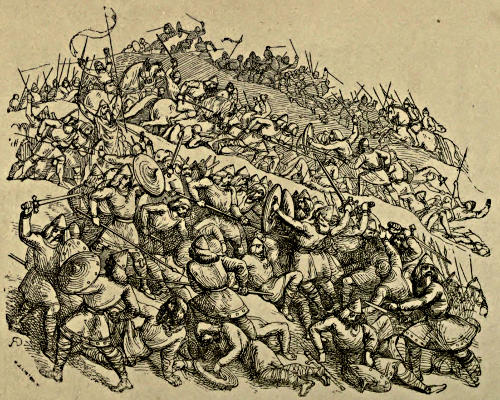
last time; the word “Off” is given; and away
go the great steeds in furious plunging gallop,
making the whole hill shake beneath them, and
looking (as I heard one of the Oxford scholars
remark) like a charge of German knights in
some old etching. Close after them came the
umpires, the Committee-men, and all the mounted
farmers, cheering and shouting pieces of advice
to the riders; and the crowd, as they pass,
shout and wave their hats, and then rush after
the horses. How everybody isn’t killed, and
how those men can sit those great beasts in the
middle of that rattling mass of harness, were
my puzzles, as I scrambled along after the rest.
Meantime, in the race, Dairymaid shoots at
once some yards ahead, and improves her lead
at every stride; for she is a famous mare, and
old Joe Humphries understands the tricks of the
course, and can push her and lift her in ways
unknown to the honest carters and foggers, who
come lumbering behind him—Joe even has time
for a contemptuous glance over his shoulder at
his pursuers. But the race is not always to the
swift, at least not to those who are swiftest at
starting. Half-way up the course, Dairymaid
ceases to gain; then she shows signs of distress,
and scarcely answers to Joe’s persuasions.
“King of the Isle” is creeping up to her—the
carter shakes his bridle, and begins to ply his
long cart-whip—they are crossing the Ridgeway,
where stand the carter’s fellow-servants,
Mr. Whitfield’s fogger, shepherd, ploughboys,
&c. who set up a shout as he passes, which
sends the bay right up abreast of the mare. No
wonder they are excited, for the master has
promised that the three guineas, the price of
the new thill harness, shall be divided between
them, if the bay wins.
In another fifty yards he is drawing ahead.
All old Joe’s efforts are in vain; his jockeyship
has only done him harm, whereas the carter’s
knowledge of what his steed’s real powers are,
has been the making of him, and he rides in,
brandishing his long cart-whip, an easy winner.
Dairymaid is second, but only just before the
ruck; and old Joe creeps away, let us hope, a
humbler and a wiser man.
Of course I couldn’t see all this myself, because
I was behind, but Joe told me all about
the race directly afterwards. When I got up
there was a great crowd round “King of the
Isle,” from whose back the carter was explaining
something about the race. But I couldn’t
stay to listen, for I heard that the races for the
“prime coated Berkshire fives” (as they called
the cheeses), were just coming off; so I hurried
away to the brow of the hill, just above the
Horse, where it is steepest; for I wanted of all
things to see how men could run down this
place, which I couldn’t get up without using
both hands.
There stood Mr. William Whitfield, of Uffington,
the umpire who had to start the race, in his
broad-brimmed beaver, his brown coat and waistcoat
with brass buttons, and drab breeches and
gaiters. I thought him a model yeoman to
look at, but I didn’t envy him his task. Two
wild-looking gypsy women, with their elf-locks
streaming from under their red handkerchiefs,
and their black eyes flashing, were rushing
about amongst the runners, trying to catch
some of their relations who were going to run;
and screaming out that their men should never
break their limbs down that break-neck place.
The gypsies dodged about, and kept out of
their reach, and the farmer remonstrated, but
the wild women still persevered. Then, losing
all patience, he would turn and poise the wheel,
ready to push it over the brow, when a shout
from the bystanders warns him to pause, and,
a little way down the hill, just in the line of
the race, appear two or three giggling lasses,
hauled along by their sweethearts, and bent on
getting a very good view. Luckily at this
moment the Chairman appeared, and rode his
white horse down to the front of the line of
men, where there seemed to me to be footing
for nothing but a goat. Then the course was
cleared for a moment, he moved out of the
line, making a signal to the farmer, who pushed
the wheel at once over the brow, and cried,
“Off.” The wheel gained the road in three
bounds, cleared it in a fourth monster bound
which measured forty yards, and hurried down
far away to the bottom of the manger, where
the other two umpires were waiting to decide
who is the winner of the race.
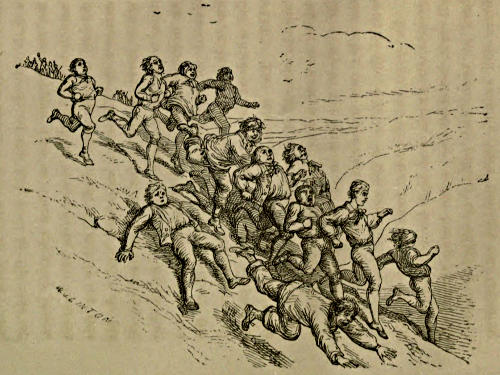
Away go the fourteen men in hot pursuit,
gypsies, shepherds, and light-heeled fellows of
all sorts, helter-skelter; some losing their foothold
at once, and rolling or slipping down;
some still keeping their footing, but tottering
at every step; one or two, with their bodies
well thrown back, striking their heels firmly
into the turf, and keeping a good balance.
They are all in the road together, but here
several fall on their faces, and others give in;
the rest cross it in a moment, and are away
down the manger. Here the sheep-walks, which
run temptingly along the sides of the manger,
but if they would look forward will take the
runners very little nearer the bottom where the
wheel lies, mislead many; and amongst the
rest, the fleetest of the gypsies, who makes off
at full speed along one of them. Two or three
men go still boldly down the steep descent,
falling and picking themselves up again; and
Jonathan Legg, of Childrey, is the first of these.
He has now gained the flat ground at the bottom,
where after a short stagger he brings himself
up, and makes straight for the umpires and
the wheel. The gypsy now sees his error; and
turning short down the hill, comes into the flat,
running some twenty yards behind Jonathan.
In another hundred yards he would pass him,
for he gains at every stride; but it is too late;
and we, at the top of the hill, cheer loudly
when we see Jonathan, the man who had gone
straight all the way, touch the wheel a clear ten
yards before his more active rival.
I should have liked to have seen the boys’
races down the manger, but was afraid of missing
some other sport, so I left farmer Whitfield
at his troublesome post, shouting out the names
of the boys and trying to get them into line,
and went back into the Castle, where I found
a crowd round the greased pole; and when I
got up to it, saw a heavy-looking fellow, standing
some five feet up the pole, with one foot
in a noose of cord depending from a large
gimlet, and the other leg hooked round the
pole. He held in his right hand another large
gimlet, which he was preparing to screw into
the pole to support a second noose, and gazed
stolidly down at a Committee-man, who was
objecting “that this wasn’t fair climbing—that
if gimlets and nooses were to be allowed, he
could get up himself.” I thought he was right;
but public feeling seemed to side with the
climber; so the Committee-man gave in, declaring
that there would be no more legs of
mutton to climb for, if any thing but arms and
legs were to be used.
“Rather a slow bit of sport this,” I said to
an old gray-headed man, who was leaning on
his stick at my side, and staring up at the
performer.
“Ees, Zur,” answered he, “I dwon’t knaow
but what it be.”
“Do you call it fair climbing, now?”
“Auh, bless’ee, not I. I minds seein’ the
young chaps when I wur a buoy, climin’ maypowls
a deal higher nor that, dree at a time.
But now-a-days ’um be lazy, and afraid o’
spwiling their breeches wi’ the grase.”
“Are there any maypoles about here now?”
“Never a one as I knows on, Zur, for twenty
mile round. The last as I remembers wur the
Longcott one, and Parson Watts of Uffington
had he sawed up nigh forty year ago, for fear
lest there should ha’ been some murder done
about ’un.”
“Murder about a maypole! Why, how was
that?”
“Auh! you see, Zur, this here Longcott maypowl
wur the last in all these parts, and a wur
the envy of a zight o’ villages round about.
Zo, one cluttery[34] night in November, thirty of
our Ashbury chaps thay started down to Longcott,
and dug ’un up, and brought ’un cler away
on handspikes, all the waay to the Crown’d Inn
at Ashbury, and ’tis quite vour mil’d.”
“On handspikes! Why, how big was he,
then?”
“Augh! a fyeightish sized ’un. How big?
whoy a sight bigger, bless’ee, nor that ’un, and
all the bottom half on ’un solid oak. When
thay cum to put ’un up afore the bar winder
of the Crown’d, a reached right up auver the
tops o’ the housen. But zoon arter a wur put
up, the Uffington chaps cum up, and tuk and
carried ’un down ther’. Ther’ was a smartish
row or two about ’un at Uffington arter that,
but they watched ’un night and day; and when
the Lambourn chaps cum arter ’un one night,
they chucked scaldin’ water right auver’m. Zo
then Parson Watts, he tuk and sawed ’un up,
and guv ’un to the owld women at Christmas
for virewood.”
I walked away from the pole, turning over
in my mind whether Parson Watts was right
or wrong in his summary method of restoring
peace to his parish, and, somehow or other,
found myself again close under the stage.
Now, and throughout the day, I found no
flagging there; whenever I passed there was
the crowd of men standing round, and the old
and young gamesters hard at work. So I
began to believe what Joe had said, that the
countrymen thought more about these games
than any thing else, and wouldn’t care to go
to the pastime if they were stopped.
I found that the Ashbury men were carrying
it all their own way in the wrestling, and that
their champion, old Richens (the rat-catcher, an
old gamester in his fiftieth year), would probably
not even have to wrestle at all; for his
own men were throwing all the gamesters of
the other parishes, and of course would give
up to him when it came to the last ties. The
men all wrestle in sides, at least the old gamesters
do; so that a man generally plays for his
parish, and not for his own head, which is a
better thing, I think.
As to the backsword play, the stage was
strewed with splinters of sticks and pieces of
broken baskets, and many a young gamester
has had his first broken head in public. But,
for the chief prize, matters are going hard with
Berks and Wilts. The Somersetshire old gamesters
have won two heads to one; and, as they
have six men in, and Berks and Wilts only
four, the odds are all in favour of the cider
county, and against the beer drinkers.
In good time up gets an old gamester, who
looks like the man to do credit to the royal
county. It is Harry Seeley, of Shrivenham,
the only Berkshire man in; for there has been
some difference between Berks and Wilts, and
Harry’s two mates haven’t entered at all. So
he, being one of the true bull-dog breed, is in
for his own head, against all odds, and is up
to play the next Somersetshire man.
Harry is a fine specimen of an Englishman.
Five feet eight high, with a bullet head, and
light blue eye; high-couraged, cool, and with
an absolutely imperturbable temper. He plays
in a blue shirt, thin from age and wear, through
which you may see the play of his splendid
arms and chest. His opponent is a much
younger man, about the same size; but a great
contrast to Harry, for he has a savage and sly
look about him.
They shake hands, throw themselves into position,
and the bout begins. Harry is clearly
the finer player, and his adversary feels this at
once; and the shouts of anticipated victory,
in the Berkshire tongue, rouse his temper.
Now comes a turn of the savage play, which
ought never to be seen on a stage. The Somerset
man bends far back, and strikes upper
cuts at the face and arms, and then savagely
at the body. He is trying to maim and cow,
and not to win by fair brave play. The crowd
soon begin to get savage too; upper-cutting is
not thought fair in Berks and Wilts; a storm
begins to brew, hard words are bandied, and a
cry of “Foul,” and “Pull him down,” is heard
more than once, and the Committee man, who
watches from below, is on the point of stopping
the bout.
But nothing puts out old Harry Seeley; no
upper cut can reach his face, for his head is
thrown well back, and his guard is like a rock;
and though the old blue shirt is cut through and
through, he makes no more of the welts of the
heavy stick than if it were a cat’s tail. Between
the bouts his face is cheery and confident,
and he tells his friends to “hold their
noise, and let him alone to tackle the chap,”
as he hands round his basket for the abounding
coppers.
Now I could see well enough why the parsons
don’t like these games. It gave me a
turn, to watch the faces round the stage getting
savage, and I could see what it might soon
get to if there was much of this wild work.
And there were Master George, and the two
Oxford scholars, at the opposite corner of the
stage, shouting till they were hoarse for old
Seeley, and as savage and wicked-looking as
any of the men round them; setting such a
bad example, too, as I thought,—whereas it
didn’t matter for a fellow like me, who was
nobody,—so I shouted, and threw my coppers
to old Seeley, and felt as wild as any of them,
I do believe. Three bouts, four bouts pass;
Harry’s stick gets in oftener and oftener. Has
the fellow no blood in him? There it comes
at last! In the fifth bout, Harry’s stick goes
flashing in again, a fair down blow from the
wrist, which puts the matter beyond all question,
as the Somersetshire man staggers back
across the stage, the blood streaming from
under his hair. Loud are the shouts which
greet the fine-tempered old gamester, as he
pulls on his velveteen coat, and gets down
from the stage.
“Why, Harry, thou’dst broke his yead second
bout, mun, surely!” shout his admirers.
“No,” says Harry, dogmatically, “you see,
mates, there’s no ’cumulation of blood belongs
to thay cider-drinking chaps, as there does to
we as drinks beer. Besides, thay drinks vinegar
allus for a week afore playin’, which dries
up most o’ the blood as they has got; so it
takes a ’mazin’ sight of cloutin’ to break their
yeads as should be.”
After this bout all the other play seemed to
be tasteless; so, promising myself to come back
and see the ties played off, (unless Miss Lucy
turned up in the mean time, in which case I
shouldn’t have dared to go near the stage, and in
fact I felt rather nervous already, lest she should
have seen or heard of me there,) I marched
off, and joined the crowd which was collecting
round the jingling ring. That crowd was one
of the pleasantest sights of the whole day. The
jingling match seemed a very popular sport,
especially with the women. There they were,
of all ranks—for I’m certain I saw some young
ladies in riding habits, and others in beautiful
muslins, whom I, and Jem Fisher, and little
Neddy have often seen riding with very great
people in the Park, when we have managed to
get down to Rotten Row on summer evenings—seated
on the grass or standing round the
ring, in all sorts of dresses, from fine silks down
to cottons at 2d. a yard, and all looking pleasant
and good-tempered, and as if they were
quite used to being mixed up like this every day—which
I’m sure I wish they were, for my part,
especially if the men were allowed to join in the
crowd too, as we were round the jingling ring.
For there were gentlemen, both parsons and
others, and farmers, and ploughboys, and all
manner of other men and boys.
I don’t know what sort of fun a jingling
match is in general, but I thought this one
much the slowest game I saw. The ring must
have been forty yards across, or thereabouts,
and there were only eight blindfolded men running
after the bellman. To make it good fun,
there should have been twenty-five or thirty at
least. Then the bellman, who has his hands
tied behind him, ought to have the bell tied
round his neck, or somewhere where he can’t
get at it to stop the ringing; but our bellman
had the bell tied to his waistband behind, so
that he could catch hold of it with his hands,
and stop it when he was in danger. Then half
the men could see, I’m sure, by the way they
carried their heads up in the air, especially one
gypsy, who, I think, won the prize at last. The
men who couldn’t see were worth watching, for
they kept catching and tumbling over one another.
One time they made a rush to the rope,
just where some of the young ladies were sitting,
and, as nearly as could be, tumbled over
among them. I thought there would have been
a great scrambling and screaming; not a bit of
it—they never flinched an inch, or made the
least cry, and I was very proud to think they
were my countrywomen. After the bellman had
been caught about a minute, there was a great
laugh at one of the blinded men, who made a
rush, and caught a Committee-man, who was
standing in the ring, in his arms. But on the
whole, I thought the game a poor one, and was
glad when it was over.
I hurried away directly after the jingling
match, and went across the Castle, and out on
to the down where the cart-horse race had been
run to see the foot-races, which were run over
the last half of the same course, on which ten
good stiff sets of hurdles, at short distances
apart, had been set up. I found a debate going
on between the umpires and some of the men
as to whether they were all to start together.
The regular agricultural labourers were remonstrating
as to some of the candidates.
“It bean’t narra mossel o’ use for we chaps
to start along wi’ thay light-heeled gentry,” said
one,—“Whoy, look ’ee here, zur’s one, and
yander’s another, wi’ a kind o’ dancin’ pumps
on, and that ’un at tother end wi’ a cricketin’
waistcut.”
“And there’s two o’ them little jockey chaps
amongst ’em, sumweres, Zur,” said another,
looking about for these young gentlemen, who
dodged behind some of the bigger candidates.
“How can we help that?” said the umpire.
“Auh, Zur, thay be all too nimble by half for
we to be of any account to ’em,” persisted the
first speaker. “If twur for the sticks now, or
wrastling—”
“Well, but what shall we do then?” interrupted
the umpire.
“Let I pick out ten or a dozen on ’em to run
by theirselves.” The umpires proposed this to
the rest, and, no one objecting, told Giles, the
protester, to pick out the ten he was most afraid
of. This Giles proceeded to do with a broad
grin on his face, and generally seemed to make
a good selection. But presently he arrived at,
and after a short inspection passed over, a
young fellow in his blue shirt-sleeves and a
cloth cap, who to the umpire’s eye seemed a
dangerous man.
“Why, Giles,” said he, “you’re never going
to pass him over?”
“Auh, ees, Zur,” said Giles, “let he ’bide
along wi’ we chaps. Dwont’ee zee, he’s a
tipped and naayled ’un?”
When Giles had finished his selection, the
first lot were started, and made a grand race;
which was won by a Hampshire man from
Kingsclere, the second man, not two feet behind,
being a young Wiltshire farmer, who,
having never been beaten in his own neighbourhood,
had come to lose his laurels honourably at
the Scouring.
The running in the second race was, of
course, not so good, but much more amusing.
The “tipped and naayled ’uns” were a rushing
lot, but very bad at rising. Hurdle after hurdle
went down before them with a crash, and the
most wonderful summersaults were executed.
The second hurdle finished poor Giles, who
charged it manfully, and found himself the next
moment on his broad back, gazing placidly up
into the evening sky. The cloth cap, notwithstanding
his shoes, went easily ahead, and won
in a canter. I heard one of the umpires rallying
Giles afterwards at his want of eyes.
“Ees, Zur,” said Giles, hunching up his great
shoulders, “I wur tuk in, zure enough. He wur
a town chap, arter all, as wouldn’t ha’ knowed
a piece o’ clumpers afore he cum across to
White Hos Hill.”
I left the umpires now to start the other
races, and got back once again into the Castle.
I was now beginning to get very tired in my
legs, though not in my spirits, so I went and
sat down outside the crowd, which was thicker
than ever round the stage, for the ties were
being played out. I could hear the umpires
call every now and then for some gamester who
was not forthcoming to play out his tie—“John
Giles, if you beant on the stage in five minutes,
to put to with James Higgins, you shall lose
your head”—through all the cheers and shouts,
which rose louder and louder now that every
blow or trip might decide the prizes. And while
I was sitting, the donkey races were run outside,
and I heard were very good fun; especially
the last one, in which no man rode his own
donkey, and the last donkey had the prize. I
hope my friend, the old suck-woman, entered
neighbour Thorne’s beast, for if she did, I’ll be
bound he carried off the prize for her. They
were the only sports that I didn’t manage to see
something of.
It was now just five o’clock, the hour for the
pig-race, which seemed to be a most popular
sport, for most of the lookers-on at the stage
went off to see it, leaving only a select crowd
of old and young gamesters, most of whom had
been playing themselves, and whom nothing
could drag five yards from the posts until the
ties were all played out. I was just considering
whether I should move or stay where I was,
when Master George came striding by and
caught sight of me.
“Hullo,” said he, “how is it you’re not on
the move? You must see the pig-race; come
along.” So I got up and shambled along with
him.
The pig was to be started on the slope below
the west entrance, where the old gentleman had
stood and lectured me the day before about
Earl Sidroc. There was the spring cart, covered
with a net, with a fine young Berkshire
pig in it, just at the place where the Bersirkir
(as he called them) made their last stand.
When we came up, the runners, thirty in number,
with their coats and waistcoats off, were
just being drawn up in line inside the Castle,
from which place they were to be started, and
run down through the west entrance out on to
the open down, at the word “off.” It was
thought that this rush down between the double
banks, covered thickly with the crowd, would be
the finest sight of the race. But the rush never
came. Piggy was to have five minutes law,
and the Committee-man who went down to
turn him out put his snout towards Ashdown
Park, and gave him a push in hopes that he
would take straight away over the downs, and
so get a good start. Of course, he turned right
round and came trotting and grunting up
towards the Castle, to see what all the bustle
could be about. Then the crowd began to
shout at him, and to press further and further
down the outer earthworks, though all the Committee
were there to keep the course clear for
the regular runners; and at last, before half of
the five minutes were over, the whole line broke
up with a great shout, and the down was covered
in a moment with countless men and boys
in full chase of Piggy. Then the lawful candidates
could stand it no longer, and away they
went too, cleaving their way through the press,
the Committee riding after them as fast as was
safe in such a crowd, to see fair play if possible
at the finish.
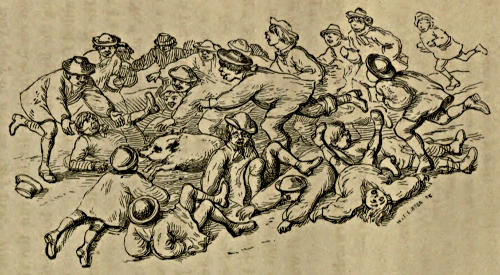
In a minute or two, Piggy was mobbed, surrounded,
seized first by one of the crowd, and
then by a lawful runner. These tumbled over
in their struggle without loosing their hold and
more of their friends over them, and from the
middle of the mass poor Piggy sent up the
most vigorous and dismal squeals, till the Committee-men
rode in, laying about with their
whips; and Farmer Whitfield, springing off,
seized Piggy, and in another minute was cantering
away with him towards Wayland Smith’s
cave. Here he was turned out again for a fair
race, and was won by Charles Ebury, of Fernham;
who, fearing the results of his racing performances,
sold him at once for 10s. to the
Woolston carrier. But I am happy to say that
he wasn’t really hurt, for I went to see him
some days afterwards, and found him as hearty
as pig could be.
Master George and I agreed, as we walked
back to the Castle, that it is a shame to have a
pig-race.
“No,” said he, “let men run any risk they
like of broken heads or limbs for themselves;
they may play or not as they like. But Piggy
has no choice, and to let him run the risk of
having the legs pulled out of his body before he
is wanted for pork, isn’t fair.”
“He didn’t seem to think it was, certainly,
Sir,” I said.
“No,” said he, laughing; “did you ever hear
such a song as he made? No animal can talk
like a pig. He can scold or remonstrate just as
well as a Christian. Any one who knows the
language can tell you just what he is saying.
Well,” he went on, “I see you don’t believe
me; now I will go and hear what he has to say
about this proceeding, and give you it word for
word.”
This was what he gave me afterwards, with
the other songs he had promised me:—
THE LAY OF THE HUNTED PIG.
“Vathers, mothers, mothers’ zons!
You as loves yer little wuns!
Happy pegs among the stubble,
Listen to a tale of trouble;
Listen, pegs in yeard and stye,
How the Barkshire chaps zard I.
“I wur barn at Kingstone-Lisle,
Wher I vrolicked var a while,
As vine a peg as e’er wur zeen
(One of a litter o’ thirteen)
Till zome chaps wi’ cussed spite
Aimed ov I to make a zite,
And to have a ‘bit o’ vun,’
Took I up to Uffington.
“Up, vorights
[35] the Castle mound
They did zet I on the ground;
Then a thousand chaps, or nigh,
Runned and hollered arter I—
Ther, then, I till I wur blowed,
Runned and hollered all I knowed,
When, zo zure as pegs is pegs,
Eight chaps ketched I by the legs,
Two to each—’tis truth I tell ’ee—
Dree more clasped I round the belly!
Under all they fellers lyin’—
Pegs!—I thought as I wur dyin’.
“But the Squire (I thenks I zee un),
Varmer Whitfield ridin’ wi’ un,
Fot I out o’ all thuck caddle,
Stretched athurt the varmer’s zaddle—
Bless ’em, pegs in yeard and stye,
Them two vrends as stuck to I.
“Barkshire men, vrom Hill and Vale,
All as ever hears this tale,
If to spwoort you be inclined,
Plaze to bear this here in mind—
Pegs beant made no race to win,
Be zhart o’ wind, and tight o’ skin,
Dwont’ee hunt ’em, but instead
At backswyrd break each other’s yead
Cheezes down the manger rowl—
Or try and clim the greasy powl.
“Pegs! in stubble yeard and stye,
May you be never zard like I,
Nor druv wi greasy ears and tail,
By men and bwoys drough White Horse Vale.”