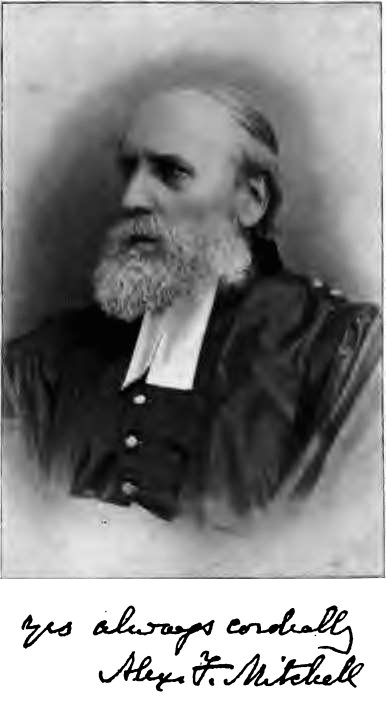
We owe it to the Rev. Christopher Anderson, the author of the 'Annals of
the English Bible,' that attention has been once more turned to the
deeply interesting story of Alexander Alane, or Alesius. Principal
Lorimer, in his 'Scottish Reformation,' has thrown further light on him.
And Dr Merle D'Aubigné, who appears to have minutely examined most of
his tracts and commentaries, has wrought into his graphic but
imaginative narrative much of the information which they have been the
chief means of handing down to us. It was after his expatriation that he
received from Melanchthon the name of Alesius, or the wanderer.
This highly distinguished but long forgotten alumnus of St Andrews
University was born in Edinburgh on the 23rd of April 1500, of honest
parents, and received the first rudiments of his education in his
native city. It was probably while he was still there that he had
vouchsafed on his behalf those wonderful interpositions of Providence,
which remained through life engraven on his heart, and which he thus
relates in his preface to his Commentary on the Second Epistle of Paul
to Timothy, published at Leipzig in 1551. "Certe ab infantia [Diabolus]
me saepe incautum opprimere voluit, et perdere non tam insidiis et
crudelitate hostium, quam praecipitio in ignem et aquam. Verum ille, qui
servavit me inter omnia pericula et infantem de gradibus patris mei
cadentem in acervum lapidum advectorum ad extruendum supremum tabulatum
in aedibus, et reptantem manibus in cacumine altissimi montis, ex cujus
declivi vel praerupto, divinitus in alterum latus in quo facilis erat
descensus, subito perveni."[283] With even more than his usual licence,
Dr D'Aubigné thus recounts this adventure: He "was fond of going with
other boys of his own age to the heights which environ Edinburgh. The
great rock on the summit of which the castle stands, the beautiful
Calton Hill, and the picturesque hill called Arthur's Seat, in turn
His miraculous Escape.
attracted them. One day, it was in 1512, Alexander and his friends,
having betaken themselves to the last-named hill, amused themselves by
rolling over and over down a slope which terminated in a precipice.
Suddenly the lad found himself on the brink; terror deprived him of his
senses; some hand grasped him and placed him in safety, but he never
knew by whom or by what means he had been rescued. The priests gave the
credit of this escape to the paper with which they had provided him, but
Alexander himself attributed it to God and his father's prayers."[284]
Alesius, or Alane as he was still called, being of good abilities, was
early sent to the university, and seems to have been one of the first
set of students who entered St Leonard's College (the college founded by
Prior John Hepburn, with the consent of Archbishop Alexander Stuart)
after its opening in 1512. His studies appear to have been prosecuted
there in the usual way, and in 1515 he became a determinant, or took the
degree of B.A.;[285] and, probably after acting for a few years as a
regent in the college, he was drafted as a novice into the priory, and
ultimately became one of its canons. When John Major came to St Andrews
in 1523 as principal of the Pædagogium, he, like Hamilton and some
others who ultimately shared the same opinions, studied theology under
him, and made great progress, especially in the study of the schoolmen
and the fathers of the Christian church. He was, like most of the young
scholastics of his time, fond of disputation; and if he listened to
those lectures on the gospels which Major gave to the press some years
after, he probably imbibed from his teacher that combative attitude
towards the new
Discussions with Patrick Hamilton.
opinions which at this period of his life he showed. D'Aubigné says:
"His keenest desire was to break a lance with Luther.... As he could not
measure himself personally with the man whom he named arch-heretic,
Alesius had refuted his doctrine in a public discussion held at the
university. The theologians of St Andrews had covered him with
applause.[286] ... Alesius, alive to these praises and a sincere
catholic, thought that it would be an easy task for him to convince
young Hamilton of his errors.... Armed cap-a-pie, crammed with
scholastic learning, and with all the formulæ 'quo modo sit, quo modo
nonsit,'" he had various discussions with him. "Hamilton had before him
nothing but the Gospel, and he replied to all the reasonings of his
antagonist with the clear, living, and profound word of the
Scriptures.... Alesius, struck and embarrassed, was silenced, and felt
as if 'the morning star were rising in his heart. It was not merely his
understanding that was convinced, the breath of a new life penetrated
his soul."[287] He continued from time to time to visit the reformer
while he lived, and to cherish his memory after he had been so cruelly
put to death.
When the opinions and martyrdom of Hamilton were the subject of
conversation among the canons, several of the younger of whom were
attached to him, Alesius refused to condemn him. He was not yet by any
means, as Dr Lorimer would have it, a Lutheran; he was not yet prepared
to separate himself from the old church; but he saw and mourned over her
corruptions, and longed, and in a quiet way laboured, for the removal of
them, and also yearned for the revival of a more earnest Christian
spirit, and more correct moral conduct among those over whom his
influence extended. From that day no one could induce him to express
approval of the proceedings which had been taken against Hamilton, or to
pronounce an unfavourable judgment on the articles for which he had been
condemned to death.
Patrick Hepburn.
This silence brought him under the suspicion of his more bigoted
associates, and gave special offence to his superior, Prior Patrick
Hepburn (the nephew of Prior John, who had founded St Leonard's
College), a violent, coarse, immoral young noble, emulous of the
debaucheries and vices, as well as of the cultured hauteur, of the
young French ecclesiastics of rank among whom his youth had been passed.
Knox has given a
graphic if rather coarse account of the revelries of this young man and
his gay associates, more in keeping with what we should have expected
from the sons of Tarquin in heathen Rome than from the élite of the
young ecclesiastics of a primatial Christian city, and under the eye of
an aged archbishop.[288] The representation of Alesius is only the more
credible because it is the more restrained, and the one representation
corroborates the other, and proves to what a low ebb morality had sunk
among the ministers of the old church in Scotland before it was swept
away. Not only did this bold bad man set at nought the laws of God and
the canons of his church, and make a boast of doing so among his boon
companions, but even when the archbishop sought to separate him from his
unlawful connection, the prior collected his armed retainers, and would
have fought with him had not the Earl of Rothes and the Abbot of
Arbroath, the primate's hopeful nephew, come between the two bands and
patched up a sort of truce between their leaders.
The Christian lives and healthful influence of the younger canons could
not but be felt to be a standing rebuke by their superior, and doubtless
were one main cause why he bore them so deep a grudge and gave way to
such savage outbursts of temper in his intercourse with them. He is
said to have denounced them, and especially Alesius, to the aged
primate, and probably with the view of entrapping him into some
unguarded expression of approval of the new opinions, he got him
appointed to preach the sermon at the opening of a synod of bishops and
priests which was held at St Andrews probably in the Lent of the year
1529. Alesius, while carefully avoiding everything which might give
needless offence to his hearers, thought, to use his own words, that in
such presence, and speaking in the Latin language, he would not
discharge his duty unless he earnestly exhorted those set in authority
over the churches to the practice of piety, the observance of good
morals, the study of Christian doctrine, and the pious teaching and
governing of their churches. He confesses that he earnestly inveighed
against immoral priests, but he adds that as he had said nothing in a
disloyal spirit, or more harshly than the facts warranted, and had
attacked no one by name, the sermon gave no offence to good men. But his
irate and domineering prior imagined that the sermon was specially aimed
at him, and was intended to hold him up to the ridicule of the assembled
prelates and clergy. Having already defied the archbishop, Hepburn could
not brook such a liberty on the part of one of his own subordinates. An
opportunity soon occurred to him of paying back with interest the insult
which he imagined had been done to him.
Assaulted and Imprisoned.
It so happened that the whole college of canons resolved, for many and
grave reasons, to lodge a complaint with the king respecting the
harshness and cruelty of their superior. When this came to Hepburn's
ears, he rushed with a band of armed attendants into the sacred
chapter-house where the canons were assembled, and when admonished by
Alesius, who probably presided in the meeting, not in the heat of
passion to be guilty of any foolish prank, he ordered the speaker to be
seized by his armed attendants, and drawing his sword would have run it
through him had not two of the canons forcibly dragged him back and
turned aside his weapon. The affrighted and timid canon cast himself at
his superior's feet and entreated him to spare his life, but in return
only received a kick in the breast which nearly proved fatal to him.
When he had partially recovered from this, and was being hurried off to
prison, another dastardly attack was made on him, but that was parried
by the prior's own retainers, who saw that he was beside himself with
rage and fury. After this all the other canons were seized and
imprisoned, but on the remonstrance of certain noble friends they were
ordered to be released by the king, who was then in St Andrews and was
informed of what had taken place.
The king's order was speedily carried out in regard to all save Alesius;
but he, notwithstanding all remonstrances of friends, was not only
detained in custody, but was even thrust into a more filthy dungeon,
called by the sufferer, in one of his treatises, teterrimo specu subtus
terram inter bufones et serpentes,[289] and in another a
latrinâ,[290] or sink, to which I know nothing at all corresponding in
St Andrews save the underground chamber near the college hall,[291] and
the roughly-hewn cavern still subsisting in the rock to the north of the
house at the end of Castle Street, going down by the southern entrance
by thirty or more somewhat irregular steps through the rock, and
terminating in a small chamber of rounded or oval form, having an
opening in its roof originally little more than a foot in diameter, but
now considerably enlarged, and to which on the other side a covered
passage from the castle leads down. They might well abandon hope who
entered there, and possibly one at least of its uses was for literally
immuring those who were never again to have
further intercourse with their fellow-men. In this or some other equally
horrible place the poor canon was confined for eighteen or twenty days;
and when, after repeated remonstrances on the part of the king and the
magistrates of the city, the prior was obliged to produce his victim, he
enjoined him strictly on no account to utter one word about the shameful
maltreatment to which he had been subjected. Alesius, however, had
suffered too horribly in this place to let slip the opportunity so
unexpectedly presented to him of telling the worst to the friendly
magistrates, and entreating them to save him from all further risk of a
repetition of this barbarous cruelty. But the magistrates, though
friendly, were easily persuaded that all was now to go right. As soon,
however, as they were got out of the way under this persuasion, the
prior upbraided the poor canon for having divulged the whole disgusting
truth which he had enjoined him to conceal, and ordered him to be again
placed in confinement, in which he was left to languish for nearly a
year.His Prison changed. But this confinement was in a less objectionable place, and
apparently within the precincts of the priory; and when the prior was
absent the canons occasionally had the prisoner brought out from his
ward, and even permitted him, as in former times, to take a leading part
in the services at the altar. On one occasion the prior, coming back
unexpectedly, and seeing what occurred in his absence, ordered Alesius
at once into confinement, threatening on the morrow to have him off to
the old filthy place where his life had been so nearly sacrificed
before, and where he was to be entrusted to the care of a more
remorseless jailer.
He escapes by Night.
As soon as their superior left them for the night the canons, satisfied
that all hope of preserving the life of their comrade in St Andrews was
at an end, and that if he did not seek safety by instant flight horrible
torments and certain death awaited him, gathered round him and urged him
to escape. On his expressing a wish to consult with other friends before
taking a step so serious, they pressed him only the more urgently to
flee and leave the country at once, as he would certainly be pursued,
and, if overtaken, brought back for condign punishment. The sequel I
give in his own unvarnished statement, which is to me more touching from
its very simplicity than the highly embellished rechauffées of
D'Aubigné: "Etsi maximo dolore afficiebar cum cogitarem mihi è patria,
qua nihil dulcius est bene institutis naturis, discedendum esse, tamen,
et necessitati, et tot bonorum virorum consiliis parendum duxi."[292]
And
then follows a parting scene only less affecting than that of St Paul
from the disciples on the seashore at Tyre, and proving that even yet
all good was not extinguished from the hearts of those under the rule of
this vicious prior, and encouraging the hope, which was afterwards fully
realised, that the best of them would ultimately find a more congenial
home in a new and purified church. Only the apostle, though in a heathen
land, could kneel down in open day on the seashore to pray with his
friends, and they without challenge could accompany him to the ship
which waited to receive him; while these men, though living in a
professedly Christian land, had secretly to bring out their friend from
the place of confinement and comfort him, and then send him away alone
into the thick darkness to pursue his weary journey under cover of night
to that broad firth which bounds Fifeshire on the north, if haply he
might find on its shores some boat to ferry him across, or on its bosom
some friendly craft to convey him without loss of time beyond the reach
of his implacable persecutor. "Clam igitur educunt me domo, instruunt et
viatico. Ita cum lachrymantes inter nos vale dixissemus, et illi
suavissima commemoratione illustrium virorum et sanctorum qui similiter
è patria tyrannidi cesserunt, maesticiam meam non nihil levassent,
media jam nocte in densissimis tenebris solus iter ingredior."[293]
Sadly he plodded on his way through the darkness, oppressed with
forebodings, for he knew of no hospitable retreat in other lands; he had
neither friend nor acquaintance among foreigners; he could speak no
language but his native tongue and Latin; and he had some reason to fear
that he might be classed with those vagabonds who had been driven out
from various Continental states because of their fanatical opinions, and
were justly suspected even by Protestants in Germany. But in the
multitude of distracting thoughts within him he encouraged himself in
the Lord his God and in Christ his Saviour. Ere morning had well dawned
his journey was completed, and he got safely on shipboard, where,
according to his own account, quidam homo germanus[294]—that is,
according to some, a certain man a German; according to others, a
certain man a kinsman—received him very affectionately, and afterwards
nursed him with great kindness during the sea-sickness from which he
suffered throughout the stormy voyage.
His Dundee Friends.
On the day following his escape, when the vessel which sheltered him had
already sailed, there came horsemen to the shore, sent by the prior from
St Andrews, to make search for the fugitive. When they returned without
success to their master, he is reported to have summoned before him a
certain citizen of Dundee, whom he suspected to have aided in providing
a ship for the canon. This merchant citizen[295] took with him another
true-hearted favourer of the Reformation, James Scrymgeour, provost of
the town; and on the former denying that he had given the assistance
which he was accused of doing to Alesius, and which probably he could
deny with a good conscience, his sons in St Andrews and Dundee having
been too prudent to involve him in their little plot, the provost spoke
out boldly to the haughty prior, and said: Why make a work about this?
I, myself, if I had known that Alexander was preparing to go away, would
with the greatest pleasure have furnished him both with a ship and with
provisions for his voyage, that he might be put in safety beyond the
reach of your cruelty. Assuredly, had he been my brother I would long
ago have rescued him from those perils and miseries in which you have
involved him.
Thus Alexander Alesius was driven from his much-loved native land,
destined never to return to it more, or again to see the friends and
relations to whom he was so warmly attached. "Could any one then have
whispered in the ear of the disconsolate exile that he was on the road
to far more extensive usefulness" and freedom; that he would gain many
friends in foreign lands, and would not only be spared to labour there
for more than thirty years, but would also be honoured to be the first
to plead by his writings for the free circulation of the Scriptures in
his native Scotland, and one of the first to help on Cranmer in England,
and Hermann von Wied, the reforming Archbishop of Cologne, in Germany;
that he would be privileged to attend, as one of the Protestant
representatives, many of the most important colloquies of the leaders of
the old and the new church on the Continent, to be the intimate friend
of Luther and Melanchthon, to labour as a professor of theology in two
German universities, and to live and die in the greatest honour and
respect among those with whom he laboured,—"how incredible would it all
have seemed to him!" Yet it was thus God meant it, and thus He brought
it to pass; and if there was one among the Scottish exiles of those
times who was less embittered towards his persecutors than another, or
more ready to yield to them in things indifferent or of minor
importance, if only he could gain their hearts for Christ and His cause
in matters of highest moment, it was he.
Driven by the Tempest to Malmö.
The ship in which Alesius sailed was bound for France, probably for
Dieppe or Rouen, with which towns the trade of Scotland was carried on,
and where many Scottish merchants resided or had factors; but she had
not gone far on her way from port when a violent westerly gale carried
her across the German Ocean, drove her into the Sound, and made it
necessary to get her into the harbour at Malmö in Scania, in order to
refit her. There, as well as at the French ports named, there was a
community of Scottish merchants, probably by this time enjoying the
ministrations of John Gaw or Gall, another St Andrews alumnus, early
won over to the cause of the Reformation. The community of Malmö, a year
or two before, had given its adhesion to the same cause, and its leading
ministers, as well as the Scottish chaplain, were, therefore, prepared
to welcome and treat with all kindness their exiled co-religionist, as
he himself, twenty-five years after, feelingly narrates.[296] After
being refitted at Malmö, the vessel proceeded on her voyage to France,
where Alesius left, and plodding his way along the northern coast,
visited Belgium, where he would meet with friendly Scots at Bruges, and
probably also at Antwerp. He then passed up the Rhine to Cologne,
where, as already suggested, he was favourably received by the
Archbishop, Hermann von Wied, who afterwards became a friend of the
Reformation, though at this time, like Alesius himself, not yet decided
altogether to break with the old church. It is no doubt to this visit he
refers in the following passage of the treatise from which I have
repeatedly quoted: "When lately at Cologne I conversed familiarly with
a
Hermann von Wied's Apologue.
certain man of the highest learning and authority, and perceived how
deeply he was grieved by the disturbed state of the church in Germany. I
began to exhort him to interpose his judgment in certain matters of
dispute, because I hoped that milder views might gain the ascendancy if
princes and people only had such monitors excelling in learning and
authority. When I had argued long in support of my opinion, heaving a
sigh, but making no formal reply to my arguments, he bade me listen to
an apologue: When the lion, worn out with old age, could no longer
obtain his prey by hunting, he fell on the device of inviting the beasts
to visit him in his den. There came to him a bear, a wolf, and a fox.
The bear entered first, and being affably received by the lion, and
conducted round the den, he was asked how he was pleased with the
amenity of the place. Being no courtier, the bear answered bluntly that
he could never stay in such a filthy hole, among heaps of decaying
carcasses. The lion, enraged, chid the bear for finding fault with the
amenity of the royal den, and tearing him up, cast away his carcass
among the others. The wolf, who had been standing by, seeing in what
danger he was, thought by artifice to soothe the haughty mind of the
lion. He accordingly approached, was led round the den, and was asked
whether the smell of the heap of carcasses was unpleasant to him. The
wolf replied, in a carefully considered speech, that he had never seen
anything more pleasant. This artifice, however, was of no avail to the
wolf. The lion meted out the same treatment to him as to the bear,
tearing him up for his impudent flattery. The fox, who had witnessed all
this, and how both the simplicity of the bear and the flattery of the
wolf had given equal offence to the lion, was in great perplexity what
to answer when it came to his turn. He went forward, however, and being
interrogated as the others had been whether the smell of the den was
disagreeable, he replied modestly that he could not express any opinion
on the point, as he was labouring under a cold in the head." Alesius
waited to hear from his host the moral or application of the apologue,
but this was not given by him. He preferred to leave it to his own good
sense, merely counselling him to be cautious of engaging in such
discussions for the present. Ultimately, however, both came to see that
there is a time to speak as well as a time to keep silence; and it is
interesting to note that to the last both observed similar moderation in
their statements of doctrine, both evinced the same desire, by
conciliation to gain opponents, rather than to provoke them,
notwithstanding all the hard usage they both met with from their secular
and ecclesiastical superiors.
Befriended by Melanchthon.
Soon after this Alesius appears to have passed on from Cologne to
Wittenberg, and there for a time to have resumed the study of theology,
as well as of Greek and Hebrew, under Melanchthon and the other gifted
teachers in that university. Luther he does not seem to have met for a
time, or to have been acquainted with his writings when he published his
first[297] treatises. Melanchthon cherished a special affection for
Alesius and the Scottish exiles who soon after followed him to
Wittenberg, believing that they were the descendants of those Scoti who
had sent the early Christian missionaries to Germany, and that it became
him to repay to them the great kindness the heathen Germans had received
from their forefathers in the distant past.[298]
It was while he was thus occupied that Alesius heard of the cruel edict
of the Scottish bishops, and it hardly admits of doubt that he submitted
to Melanchthon, and got corrected by him, his little treatise against
their decree, forbidding the New Testament Scriptures to be used by the
laity in the vernacular. It is a very pithy and forcible bit of
pleading for the right of the Christian laity to possess and study the
Scriptures in their own tongue. This remarkable treatise struck the true
key-note in the contest it ushered in, and helped it on to victory—a
victory which was substantially to be gained ere Knox had taken his
place among the combatants on the side of the Reformation at all.[299]
To this epistle Cochlaeus replied without loss of time,[300] and ere the
year was out Alesius rejoined in that Responsio ad Cochlei
calumnias,[301] in which he has given so touching an account of his own
maltreatment, so interesting a statement of his own opinions in matters
of faith and church polity, and so trenchant a reply to the sophistries
and slanders of his opponent.[302]
Cochlaeus.
This able and, for the age, singularly temperate reply made a deep
impression in England as well as in Scotland, and doubtless prepared the
way for that offer of employment there which two years subsequently was
made him by Cranmer, whom, in his moderation and earnest desire to avoid
a total rupture between the old church and the new life, he then so much
resembled. But whatever its merits, the disputatious Cochlaeus—"der
gewaffnete mann," as Luther sneeringly terms him—was determined that
his opponent should not have the last word in the dispute, and
accordingly in August 1534 he published at Leipsic his Apologia pro
Scotiae Regno adversus personatum Alexandrum Alesium Scotum.[303] In
this treatise he repeats the assertion in his previous one that
Melanchthon, not Alesius, was the author of these epistles. He charges
Alesius with putting lies into the mouth of a foreigner to the discredit
of his native country, and tells him that if he had the power he would
gladly send him away to Scotland with his hands tied behind his back to
be ignominiously punished as a traitor and a public slanderer. His
opponent's minute and temperate narrative of facts appears to have made
no impression on him. He is content magisterially to pronounce it absurd
and incredible, and inconsistent with itself as well as with
probability. He appears in his ire to forget that the king of Scots and
his subjects were better able to judge of its truthfulness than he, a
foreigner, could be; and that after saying all he could for the bishops
and superior clergy in his former reply, he had been obliged to conclude
with the damaging admission that possibly there were "bishops and
prelates who, neither in sanctity of life nor in acquaintance with
sacred learning, responded to or satisfied their dignity and office."
The epistles of Cochlaeus, if abusive and less cogent in reasoning, as
well as less relieved by any sparkle of wit or racy anecdote than those
of Alesius, are certainly written in a more easy and flowing Latin
style, and, in that respect at least, the Scottish prelates had no
reason to be ashamed of the champion who had volunteered his services in
their cause. Nor were they wanting in those more substantial expressions
of their satisfaction which Cochlaeus, like most of the
controversialists of his time, evidently coveted. The Archbishops of St
Andrews and Glasgow testified their gratitude for his services by
sending him liberal presents. The king wrote him a letter, a
contemporary transcript of which is still extant, and also, as is stated
by Cochlaeus
Effect of his Treatises.
himself in a letter to a Polish archbishop, sent him some more material
tokens of his regard.[304] And even the messenger who had brought over
the copies of his first epistle received, as it now appears, a present
of fifty pounds Scots.[305] Alesius, though in quite another way, did
not lack his reward, and it came in the way which he valued most—the
treatises he had written, to a certain extent at least, got into
circulation both in Scotland and in England. They cheered the hearts of
the faithful under all the terrible trials to which they were subjected
in the later years of James's reign, when he seems to have abandoned his
former kindliness, and surrendered himself in a great measure to the
priests and to vicious indulgences. They carried conviction to the minds
of many, and gradually ripened opinion to demand the right to do
publicly what many had learned to do secretly—to study the Word of God,
and especially the New Testament, in their native tongue. This right was
authorised by an Act of the Scottish Parliament passed in 1543,[306]
when Cardinal Betoun was in disgrace, and the Archbishop of Glasgow was
left alone to protest against it. This Act was the first real victory of
the reformed party in Scotland, and it was mainly due to the able and
temperate pleading of Alesius that this great boon, or indeed I may say
this indefeasible right of Christian laymen, was granted. The same
subject had been reverted to by him in his more elaborate treatise, De
authoritate Verbi Dei, which was published in 1542 in Latin, and some
time after was translated into English.[307]
Erasmus intervenes.
One other episode in this controversy remains still to be adverted to.
This is the intervention of the great humanist, Erasmus,—an incident in
his history on which his biographers with one consent have observed a
judicious silence. Nevertheless, the fact is as undoubted as melancholy
that he—who had done so much to promote the freer circulation and
profounder study of the Greek original of the New Testament, and had
even ventured, under the patronage of Pope Leo X., to bring out a Latin
version of the New Testament more true to the original than the Vulgate
version, that those who knew only Latin might understand more fully the
meaning of the original—in his old age, when irritated by the course of
events, and by his controversies with Luther, consented to recommend
this scurrilous pamphleteer to his friends in Scotland. His own letter
is not now extant, or, if extant, is not at present accessible; but the
answer sent to him by the Scottish king has been preserved, like his
letter to Cochlaeus, among the MSS. in the British Museum. It is
sufficient to prove the fact that Erasmus did intervene, and commend to
his Scottish friends a writer who represents Luther's translation of the
New Testament, which more than any other book has made Germany what it
is, as the "pabulum mortis, fomes peccati, velamen malitiae, praetextus
falsae libertatis, inobedientiae praesidium, disciplinae corruptio,
morum depravatio, concordiae dissipatio ... vitiorum scaturigo ...
rebellionis incendium ... charitatis peremptio ... veritatis
perduellio."
In 1535 Alesius, having received encouragement from the agents of the
English king then negotiating an alliance with the Protestant princes of
Germany, came over to England with a letter of recommendation from
Melanchthon.[308] He was favourably received by Archbishop Cranmer, by
Crumwell the Vicar-General, and by the king himself, who appointed him
king's scholar, and instructed Crumwell, as Chancellor of the University
of Cambridge, to give him a place as a reader in divinity there.At Cambridge and London. He
accordingly went into residence in Queen's College, the same college
which shortly before had been the home of Erasmus while lecturing in the
university on Greek, and towards the end of the year he began a course
of lectures on the Hebrew Psalter. He is supposed to have been the first
who delivered lectures in Cambridge on the Hebrew Scriptures, but he was
not suffered to do it long in peace. It could not be concealed that he
was a favourer of the new opinions and a friend of Melanchthon, and that
he had, in fact, been recommended by him to the king and the chancellor
of the university. By the time he had entered on the exposition of Psalm
viii. he was challenged by one of the champions of the old learning to a
public disputation, and courageously
accepted the challenge; but when the day appointed for the discussion
arrived, his opponent did not venture to meet him in open fight. He
preferred to plot against him in secret, and to foment tumult among the
scholars, till Alesius, finding that his life was in danger, and that he
could not count on the protection of the university authorities, deemed
it his duty to leave Cambridge and return to London.[309]
For the next three years he remained there, supporting himself chiefly
by the practice of medicine, which he studied under a London physician
of note. He occasionally, however, gave assistance to his reforming
friends in the varying fortunes of these unquiet times. He did so
notably in a convocation or a meeting of the superior clergy in 1536 or
1537,[310] being put forward by Cranmer and Crumwell as the chief
spokesman on the reforming side, the opinions of which he defended with
considerable force and ability, so far as the notes of the debates
preserved by Foxe in his 'Acts and Monuments' enable us to judge.[311]
His appearance on this occasion brought him into sharp collision with
Stokesley, Bishop of London. On the other hand, it secured for him the
warm friendship of Cranmer and Latimer, towards both of whom he
continued to the last to cherish a deep affection, and of whose
martyrdom he spoke with so much grief when he published his Commentary
on the First Book of Psalms. While in England, as Thomasius tells us, he
married an English lady, by name Catherine de Mayn; and when Henry VIII.
once more veered round to his
Returns to the Continent.
former moorings, and passed the bloody statute of the six articles,
insisting inter alia on the doctrine of Transubstantiation and the
celibacy of the clergy, Alesius, like several other married priests, had
to consult his safety and that of his family by a hurried retreat to the
Continent.[312]
Among those who had to leave England about the same time were John
M'Alpine[313] and John Fyffe—or, as they were henceforth to be surnamed
by Melanchthon, Joannes Macchabaeus and Joannes Fidelis—both, like
Alesius himself, Scotsmen, the former having been prior of the Dominican
monastery at Perth, and the latter an alumnus and teacher in St
Leonard's College. They had, along with several other known favourers of
the Reformation, been obliged to leave Scotland at an earlier period,
and after finding a temporary shelter in England, apparently at
Salisbury, under the protection of Bishop Shaxton, who was then a
favourer of the reformed opinions, were, like Alesius himself, to find
their ultimate home and special work on the Continent—the one in the
University of Copenhagen, the other in the University of Frankfort on
the Oder. They seem to have gone first to Wittenberg, and while the
others for a time resumed their studies there, Alesius almost
immediately on his return was selected by Melanchthon to accompany him
to the colloquy at Worms, and then to that at Regensburg, which were
attended not only by the Lutheran and the Catholic theologians, but also
by Bucer, Calvin, and other reforming divines of Strassburg. So it came
about that Alesius, who had suffered exile in the cause of the
Reformation in Scotland, and still had striven to promote it, was
probably the first of our countrymen to be brought into contact with
Calvin, who was ultimately to exercise so marked an influence on the
form and mode of that Reformation, and who too was then an exile both
from his native land and from the scene of his earlier labours. To the
last Alesius seems to have been the one of his pupils to whom the gentle
and timid Melanchthon most closely clung, and it was by his
recommendation that in the very year of his return to the Continent he
was promoted to be Professor of Divinity in the University of Frankfort
on the Oder. And it is something of which a Scotchman and a St Andrean
may be proud, that the university of that little principality of
Brandenburg, which has since expanded into the great kingdom of Prussia,
was indebted for two of its first Protestant professors of divinity to
Scotland and to St Andrews.
Leaves Frankfort for Leipsic.
His stay at Frankfort, however, was but short, a controversy having
arisen between him and one of his colleagues about the propriety of
attaching civil punishments to adultery and other offences against the
seventh commandment. In 1542, or early in 1543, he resigned his
professorship, and transferred his family to Leipsic. Melanchthon, who,
though concurring in his opinions, blamed his hasty resignation, yet
exerted himself to procure an appointment for him in the great Saxon
university; so also did Ludovicus Fachsius, at once the Burgomaster and
the head of the Faculty of Law, of whose kindness he makes special
mention in the dedication to his sons of his edition of Melanchthon's
Catechism, which he had used when superintending their religious
instruction.[314]
The remaining twenty-one years of his life were spent busily and
usefully in this famous university, though he suffered somewhat
severely during the Schmalkaldic war and the seige of Leipsic. It was
there that most of his theological treatises were elaborated and
published. He was twice at least chosen Rector of the university—viz.,
in 1555 and in 1561.[315] In 1542, as already stated, he published in
Latin the arguments he had used in his disputation with Stokesley,
Bishop of London, on the authority of the Word of God, and against the
doctrine of the seven sacraments, both confirming his former arguments
as to the rights of the Christian laity, and maintaining the supremacy
of Scripture over tradition. He had previously published his inaugural
dissertation in the University of Frankfort, 'De restituendis scholis,'
in which he advocated at length the great need for university training
for the ministers of the protestant churches, and gave a detailed
account of his own opinions, which he affirmed were then in full accord
with those of the Lutheran churches. In 1543, probably before he was
fully settled at Leipsic, it is said that on
hearing the news of the favourable change which had taken place in
Scotland on the death of James V. and the accession of Arran to the
regency, he, like many other Scottish exiles, had serious thoughts of
returning home, and availing himself to the uttermost of this unexpected
opportunity which seemed to be opening for carrying forward the work of
the Reformation in the land which was still dear to him. But before he
had fully made up his mind to follow this course, he fortunately heard
that the fickle regent had already begun to change his policy, and that
though the privilege of freely reading the Scriptures in the vernacular,
for which he had so earnestly contended, was legally secured, the
triumph of the Reformation was by no means so near at hand as at first
he had been led to suppose.The Perth Martyrs. Shortly after this, roused by the tidings of
fresh persecutions which had reached him from Scotland, and especially
by the account of the cruel executions of the humble martyrs of Perth by
the cardinal and his party on St Paul's day, 1543-44, Alesius on 23rd
April wrote to Melanchthon in the following terms:—
"Three days ago there were here several countrymen of mine, who declare
that the cardinal rules all things at his pleasure in Scotland, and
governs the governor himself. In the town of St Johnston he hung up
four respectable citizens, for no other cause than because they had
requested a monk, in the middle of his sermon, not to depart in his
doctrine from the sacred text, and not to mix up notions of his own with
the words of Christ. Along with these a most respectable matron,
carrying a sucking child in her arms, was haled before the tribunal and
condemned to death by drowning. They report that the constancy of the
woman was such that, when her husband was led to the scaffold and
mounted the ladder, she followed and mounted along with him, and
entreated to be allowed to hang from the same beam. She encouraged him
to be of good cheer, for in a few hours, said she, I shall be with
Christ along with you. They declare also that the governor was inclined
to liberate them, but that the cardinal suborned the nobles to threaten
that they would leave him if the condemned were not put to death. When
the cardinal arrived with his army at Dundee, from which the monks had
been expelled, all the citizens took to flight; and when he saw the town
quite deserted he laughed, and remarked that he had expected to find it
full of Lutherans."[316]
He pleads for National Union.
Before the expiry of that year Alesius addressed to the chief nobles,
prelates, barons, and to the whole people of Scotland, his Cohortatio ad
concordiam pietatis ac doctrinæ Christianæ defensionem. This piece, Dr
Lorimer tells us, "is instinct throughout with the spirit of true
Christian patriotism, as well as with genuine evangelical earnestness
and fervour. Lamenting the distractions of the kingdom by opposing
political factions—the French faction and the English—he [like the
author of the Complaynt of Scotland a few years later] implores his
countrymen to lay aside these divisions, and demonstrates by many
examples from classical history the dangers of national disunion, and
the duty of patriotic concord in defence of the safety and honour of
their common country. His expostulations against the oppression and
cruelty of the bishops, and his allusions to the martyrs who had
suffered in the cause of truth, are full of interest; and his
digression, in particular, upon the character and martyrdom of Patrick
Hamilton, is a noble burst of eloquence and pathos. When he exhorts to
national union he means union in the truth—union in the one great work
of purifying religion and reforming the corruptions of the church of
God. What urgent need there was of such a work he demonstrates at much
length, and with great freedom and faithfulness. Unless the church of
Christ be reformed it must perish from the earth, and those are its
worst enemies, not its real friends, who oppose such indispensable
reform."[317] "Everywhere," he says, "we see the church driven forward
to such reform. Ask even those who are most solicitous for its welfare,
and they will tell you that the church can no longer be safe or free
from troubles unless it be strengthened by the removal of abuses. If
this, then, is a measure of absolute necessity unless we would see the
whole church go to ruin; if all men confess that this should be done, if
facts themselves call with a loud voice that some care should be taken
to relieve the labouring [bark of the] church, to purify her depraved
doctrine, and to reform her whole administration,—why, I demand, are
those maligned and vilified who discover and point out the church's
faults and failings? The proper remedies could not possibly have been
applied till the disease was known; and yet the men who point it out,
warn of its virulence and danger, and wish to alleviate or entirely
remove it, are hated and
He repels the Cry of Innovation.
persecuted as much as if they had been themselves the cause of all."
With equal vigour he repels the cry of innovation raised against the
reformers and their teaching. Their work was rather an honest attempt at
restoration. What they sought, he said, "was just such a change as would
take place in the manners of an age if the gravity, modesty, and
frugality of ancient times were to take the place of levity, lewdness,
luxury, and other vices. Such a change might be termed the introduction
of what was novel, but in fact it was only the reintroduction of what
was old and primitive. Let us," he exclaims, "have innovation everywhere
if only we can get the true for the false, seriousness for levity, and
solid realities for empty dreams." "It is no new doctrine we bring, but
the most ancient, nay rather the eternal truth, for it proclaims that
Jesus Christ, the Son of God, came into the world to save sinners, and
that we are saved by faith in Him. Of Him even Moses wrote, and to Him
give all the prophets witness, that whosoever believeth in Him shall
receive remission of sins. This is the old doctrine which runs through
all the ages. Those which are really new are the doctrines which have
obscured or contaminated it, brought in by those entrusted with the care
of the vineyard of the Lord, and who, like the keepers of the vineyard
in the Gospel parable, have maltreated and slain many of the Lord's
messengers."
This was the last service, so far as we know, which Alesius was able to
render to the cause of the Reformation in his native land, and it did
not fail in due time to produce abundant and lasting fruit. As Major
before him, so Knox after him, strenuously contended for union of
Scotsmen among themselves; and after that, but only after that, for a
league with England rather than with France. They laboured, and others
entered into their labours, and, proceeding on the same lines on which
they had worked, at last brought the conflict to a triumphant issue.
Tidings of their success filled Alesius with joy in the land of his
exile. Even these, however, failed in his old age to tempt him back to
the home of his youth, or the scene of those early struggles which were
so deeply engraven on his memory and heart. And, so far as we know, he
received no call to return from those who were then at the head of
affairs in Scotland, though unquestionably he was more deeply read in
theology than any one of them, and though, as unquestionably, the
faculty of divinity was for several years but poorly supplied in the
universities of Scotland, and preachers of ability, culture, and
learning were very rare in the land.
Appreciation of his Services.
His life, especially after the close of the Schmalkaldic war, seems to
have passed tranquilly and happily at the great Lutheran University of
Leipsic. He was loved and honoured by his colleagues and by his prince,
and, as I have already hinted, he was the bosom friend and unremitting
correspondent of Melanchthon. As his services had been called into
requisition by the Preceptor Germaniæ at the colloquies of Worms and
Regensburg, so were they sought and got at the colloquy of Saxon
theologians for the preparation of the Leipsic Interim in 1548, at that
of Naumburg in 1554, at that of Nuremberg in 1555, and that of Dresden
in 1561. "In all these"—the Leipsic professor, who on the occasion of
the first centenary of his second rectorship pronounced an oration on
him, affirms that—"he so conducted himself that no one could charge him
with want of perseverance in building up the truth, or of judiciousness
in examining the errors of others, or of faithfulness and dexterity in
the counsels he gave." M'Kenzie, who has inserted a sketch of his career
in his 'Lives of Eminent Scotsmen,' assures us that in the conference of
Naumburg he acquitted himself to the admiration of the whole assembly,
for which he is highly commended by Camerarius in his 'Life of
Melanchthon'; and further, that in the year 1555 the disciples of Andrew
Osiander having raised great dissensions in the city of Nuremberg
respecting the doctrine of justification, Melanchthon made choice of
Alesius as the fittest person to appease them by his wisdom and
learning, and that his management answered Melanchthon's expectations,
though Alesius himself had previously taken a side in the controversy.
In the Majoristic controversy, Alesius, like Melanchthon, so far sided
with Major as to maintain against the extreme Lutherans the necessity of
good works, not to justification, but to final salvation; and in 1560 he
seems to have discussed this question in one of his so-called
disputationes.
With respect to his private life, we are told by Thomasius that he had
by his English wife one son, whose name was Caspar, and who died while
still a youth, and had a monument erected by his father to his memory,
bearing the simple inscription, "Caspari. Filiolo. Alexander. Alesius.
Doctor. Lugens. Posuit." He had at least two daughters. One named
Christina, Thomasius tells us, was married to a German bearing the
classical name Marcus Scipio: she outlived her husband, and died in
1604, in the fifty-ninth year of her age. The name of the other daughter
does not seem to have been known to Thomasius, but as he states that she
was given in marriage in 1557, we can have no doubt that she is the same
Anna whose wedding is referred to in a letter of Alesius to
Melanchthon, recently unearthed, and inviting him and other friends in
Wittenberg to the wedding.[318]
His Death.
Alesius himself died on the 17th March 1565, and was buried at Leipsic;
but no stone was raised, or, if raised, now remains, to tell where his
ashes repose. In all probability it was in his son's grave, in the
church of St Paul, in the city of Leipsic, that his ashes were laid to
rest. The only monuments to his memory reared at the time and still
existing are those furnished by our own John Johnston—second master of
St Mary's College, and colleague of Andrew Melville—in his Latin poems
on the Scottish martyrs and confessors, and entitled Περι Στεφανων and
by Beza in his 'Icones.' Johnston, joining together Macchabaeus and
Alesius, says:—
"Sors eadem exilii nobis, vitaeque laborumque,
Ex quo nos Christi conciliavit amor.
Una salus amborum, unum et commune periclum;
Pertulimus pariter praestite cuncta Deo.
Dania te coluit. Me Lipsia culta docentem.
Audiit, et sacros hausit ab ore sonus."[319]
Beza says, "He was a man dear to all the learned, who would have been a
distinguished ornament of Scotland if that country had recovered the
light of the Gospel at an earlier period; and who, when rejected by
both Scotland and England, was most eagerly embraced by the evangelical
church of Saxony, and continued to be warmly cherished and esteemed by
her to the day of his death." The man who was held in such high esteem
by the reforming Archbishops of Cologne and Canterbury; who was the
bosom friend of Melanchthon; who was highly thought of by Luther, and
warmly eulogised by Beza and Johnston, was certainly not one whose
memory his countrymen should willingly let die. He was unquestionably
the most cultured, probably also the most liberal and conciliatory, of
the Scottish theologians of the sixteenth century. He was the first to
plead publicly before the authorities of the nation for the right of
every household and every individual to have access to the Word of God
in the vernacular tongue, and to impress on parents the sacred duty of
sedulously inculcating its teaching on their children, and therefore, as
Christopher Anderson has said, "the man who struck the first note in
giving a tone to that character," for which his native country has since
been known, and often since commended, as Bible-loving Scotland. Had hisDeserves a Memorial.
countrymen not so long lost sight of him, perhaps some stone of
remembrance might have been found to his memory in Germany; but surely,
though he was so long an exile, the chief memorial of his birth
and death ought to be in Edinburgh or St Andrews. "There, in reference
to the cause he advocated, no inappropriate emblem" would be "a father
and his child reading the same sacred volume; and, for a motto, in
remembrance of his position at the moment, perhaps his own memorable
quotation of the Athenian, 'Strike, but hear me.'"[320]