- Facing Page
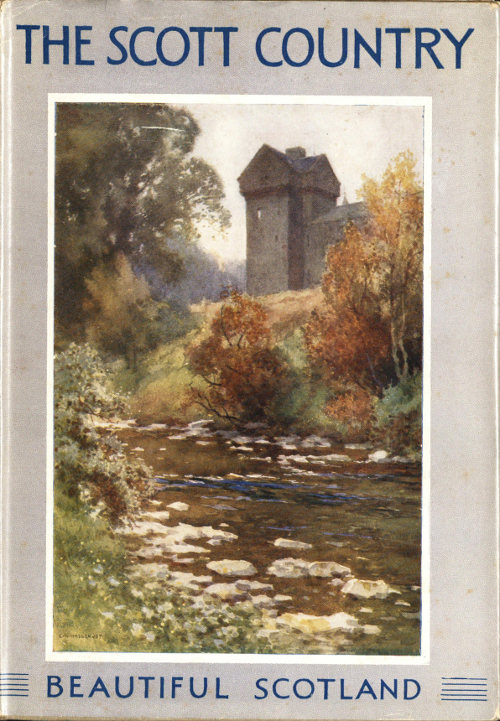
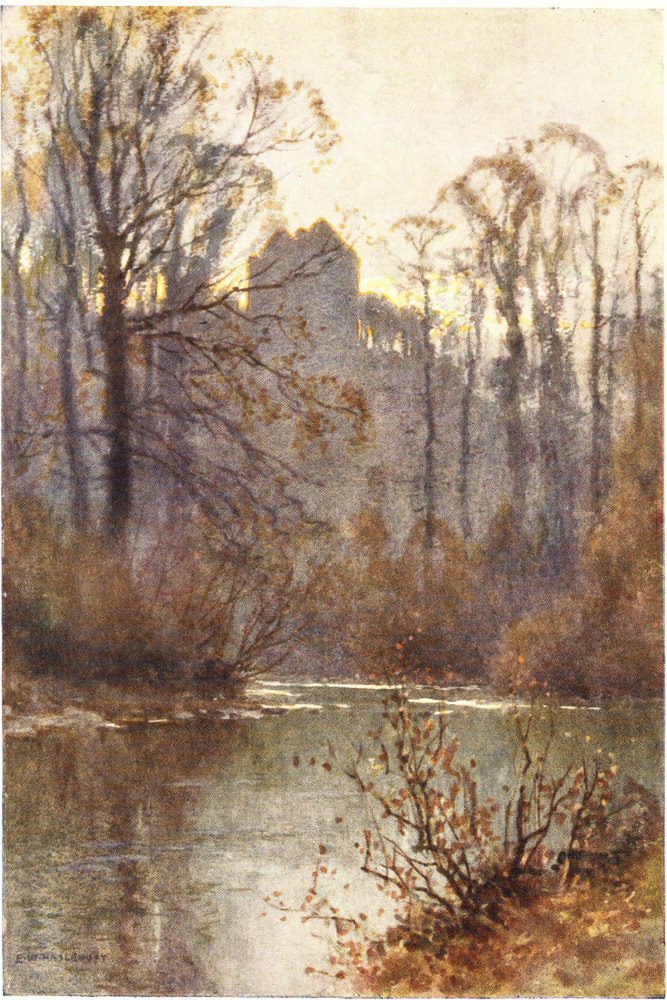
- Newark Tower Frontispiece
- Kelso Bridge 5
- Smailholm Tower 12
- Roxburgh Castle 16
- Branxholm Tower 21
- Dryburgh Abbey 28
- Bemersyde House 33
- Melrose Abbey 37
- Abbotsford 44
- Traquair House 48
- Ashestiel House 55
- Neidpath Castle 62
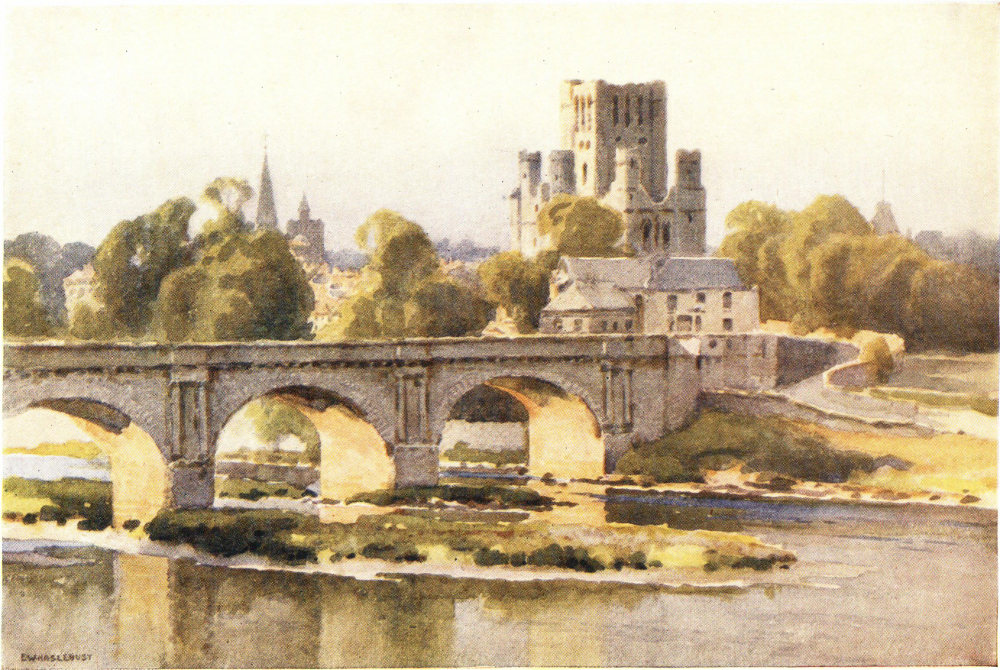
KELSO: THE RIVER TWEED AND ABBEY RUINS
5
Where—and what—is the “Scott Country”? Edinburgh—his
birthplace, the centre of his literary and
legal activities, the scene of The Heart of Midlothian
and of the Chronicles of the Canongate, his “own
romantic town”—might surely claim to enclose, if not
the kernel, an essential part of the interest that surrounds
the fame and the name of Sir Walter. Around
it, between the Pentlands and Lammermoors and the
sea, is territory immortally associated with the life and
the works of the “Master of Romance”—Lasswade and
Roslin, Borthwick and Crichton, “Goblin Ha’” and
Prestonpans,
“Auchendinny’s hazel glade
And haunted Woodhouselee”,
Linlithgow Palace on the western and “Wolfs Crag”
on the eastern boundary of Lothian. Fife, on the
6
strength of its possessions of Dunfermline, Falkland,
St. Andrews, and other storied sites, might put forward
a title to be ranked as a province of the Scott Country.
So might Perthshire, by virtue of the “Fair City” and
its “Fair Maid”, and joint ownership, with Stirling and
Dumbarton, of entrancing scenes on Loch Katrine,
Loch Ard, and Loch Lomond. Forfarshire also, wherein
is placed the best remembered of the passages in
The Antiquary, and even the distant Orkneys and
Shetlands, have felt the touch of the Wizard’s wand.
Nor, in the briefest survey of the lands of Scott
Romance, can one overlook the crumbling castles and
the rugged shores once ruled by the “Lord of the Isles”;
or the banks of the Clyde and Douglas Water; or
the opposing shores of the Solway; or Redesdale and
Teesdale, Gilsland and Triermain. The Peak District,
Sherwood Forest, and the Marches of Wales; Kenilworth,
and Woodstock, and even London streets themselves
might tender a case for inclusion; while, looking
farther afield, one is reminded that the genius of Walter
Scott has cast its spell over the Ardennes and Touraine,
Switzerland, Constantinople, and the Palestine of the
Crusades.
These are, for the most part, merely excursions of a
spirit whose abiding home or favourite haunt was the
Valley of the Tweed and its encircling hills. Edinburgh
itself, where there are so many rival memories, does not
7
recall the author of Waverley so instantly and intimately
to our thoughts and affections as Abbotsford; and the
triple Eildon, rather than Arthur’s Seat, is the “high
place” of the Scott cult. If he brought a new glory to
the Border Country, it was the Border Country that
“made him”, as a man still more than as a writer; and
he is the most typical, as he is the most honoured, of
its many famous sons.
The greatest as well as
“The last of all the Bards was he
Who sung of Border chivalry”.
The pull of the blood has in this instance proved
more potent than that of birth and early environment;
although Walter Scott was from his childhood, at
Sandyknowe and Kelso, familiar with Border scenes,
as well as steeped in Border lore. At a later stage in
his growth, lame as he was, with Shortreed and other
congenial companions he tramped the glens and
climbed the hills and hill-passes of Tweedside, gathering
and storing as he went its history and romance for
the delight of future generations,
“Giving each rock its storied tale,
Pouring a lay for every dale,
Knitting, as with a moral band,
His native legends with his land,
To lend each scene the interest high
Which Genius beams from Beauty’s eye.”
8
But while he knew by heart the whole Borderland,
and had explored its chief river from where
“Tweed, Annan, and Clyde
A’ rise in ae hill-side”,
to where it enters the sea, under the time- and war-battered
walls of the ancient town of Berwick, there
were parts of the Tweed and its tributaries that he
knew better than others. There is, in the eyes of Scott
devotees, an Inner Circle, a “Holy of Holies”, of the
Scott Country, and, fortunately for the pilgrim to
these shrines, its centre lies where the main lines of
road and rail, like those of river-drainage, converge
around the meeting-place of Ettrick, Gala, and Leader
with Tweed—under the shadow of the Eildon Hills and
beside those two “miraculous” products of the hand
and brain of man—Melrose Abbey and Abbotsford
House. The creative art, in prose and verse, of the
Great Magician was not often exercised on the
chief stream higher up than Neidpath and Manor, or,
at farthest, “Merlin’s Grave”, beside Drummelzier and
under Tinnis. Nor did his genius much frequent the
lower courses of Tweed, below Kelso Bridge and Wark
Castle, and the inflow of the “sullen Till”, although here
also are many scenes of beauty and pages of story that
might well have set his imagination afire. It seems
more at home, also, in the valleys of the Teviot, the
Ettrick, and the Yarrow than on the Leader, the Gala,
9
and other northern affluents of the Tweed. Accident
and propinquity may have helped to determine his choice
of scene and theme; but old associations and affinities
may have done still more. The nearer the Border line
of the Cheviots, the thicker are footprints of the clan
and national frays of old—of battles and skirmishes
in which Scott’s own ancestry took more than their
share; and the deeper and richer the soil of tradition in
which he delighted to delve. To the Teviot, the
Borthwick, and the Ettrick—to Branxholm and Harden,
Rankleburn and Newark—he was drawn by the call of
the blood of his father’s race; an equal tie bound him
to the Jed, the old home of his mother’s kin, the “hot
and hardy Rutherfords”; while Yarrow, the heart of his
Forest Sheriffdom, is also the core of its ballad poetry.
It has to be remembered, also, that the period of Scott’s
greatest literary output was also the period of failing
physical powers, and that journeys through his beloved
Borderland had to be more and more circumscribed to
beaten paths of easy access.
It was by Kelso Bridge, beside where the wand of
the Wizard Michael Scott “bridled the Tweed with a
curb of stone”, that, in the fresh morning of youth, the
spell of the great Border river first fell on Walter Scott.
His kinsfolk lived in the neighbourhood; and several of
them are buried in the Abbey Aisle. His great-grandfather
and namesake, the Jacobite “Beardie” who had
10
fought at Killiecrankie, had occupied a house in the
Coalmarket; his kindly Aunt Janet resided in what is
now called Waverley Lodge; his uncle, Captain Robert
Scott, a lover and collecter of books, had his home at
Rosebank, which he bequeathed to Sir Walter, who—“his
poverty not his will consenting”—sold this house
of many memories, along with “thirty acres of the most
fertile land in Scotland”.
Only a few miles away, beside the stark and far-seen
old keep of Smailholm, was the farm of Sandyknowe,
leased from Scott of Harden by his grandfather Robert
Scott, to which, between the ages of three and eleven,
the little boy from Edinburgh came annually for
holidays. Everyone remembers the lines that record
the impression made on his youthful mind by his
“barren scene and wild”—by the tall, grey, weather-beaten
tower looking down from its rock upon the lone
lochan, and out and away over many scenes of Border
romance to “the distant Cheviots blue”; and of the
legends of foray and strife that were told in the boy’s
wondering ears by the “aged hind”, and that took shape
afterwards in “The Eve of St. John” and other tales
of the Master.
What more natural than that young Walter, “become
rather delicate from overgrowth” and threatened with
permanent lameness, should be sent, while twelve or
thirteen years of age, to his Kelso relatives for change,
11
outdoor freedom, and recruitment? He went to the
Grammar School as pupil, and even for a time as usher,
under the Rector, Lancelot Whale, from whom are
drawn some of the traits of “Dominie Sampson”. He
delighted his master by his recitation of the “Speech of
Galgacus”, and beguiled his school companions from
their lessons by his tales of old romance. He read, in
the arbour of his aunt’s old-fashioned garden, or under
the ancient elm that still survives, Bishop Percy’s
Reliques, the identical copy of which is in Kelso
Library. Among his fellow-pupils were the Ballantynes,
James and John, a fateful conjunction, for out of a hint
dropped in a talk with the elder of these old schoolmates
grew the Scottish Border Minstrelsy—the
first two volumes of which were the earliest issued from
the Kelso “Ballantyne Press”, in 1802—and much else
of note in Scott’s career and fortunes. A biographer
may well say that it was “here he began to gather up
his intellectual gains and make his friendly conquests”.
Kelso gave bent and direction to his genius.
Like Smailholm, Kelso was “meet nurse for a
poetic child”, for here join two “superb rivers”—Tweed
and Teviot—each bringing down, from a
hundred sources, its treasure of ancient story. As we
have said, the beauty and romance of Tweedside
do not begin in this neighbourhood. They are the
endowment of the main stream from its tap-root to
12
the sea. Berwick-upon-Tweed, for centuries a cause
of contention between the Kingdoms, was at one time
regarded as separate and apart from each—“England,
Scotland, and the town of Berwick-upon-Tweed”.
Since the fifteenth century, however, it has territorially
belonged to England, although situated on the north
bank of the river. Its Edwardian and Elizabethan
walls—the former recently placed, along with the
venerable Bell Tower, the symbol of Berwick Liberties,
under the protection of the Board of Works as a
national relic and for preservation against the attacks
of vandalism—enfold a sheaf of history. Few places
have been the scenes of more furious sieges and merciless
captures. Its bridge of fifteen arches, built before
the Civil Wars and upheld for centuries from State
funds, connects the town with Tweedmouth and Spittal
to the south, although it is of small account, as a bond
of union and means of traffic, compared with its upstream
neighbour, the Royal Border Bridge, which
carries the railway lines between England and Scotland.
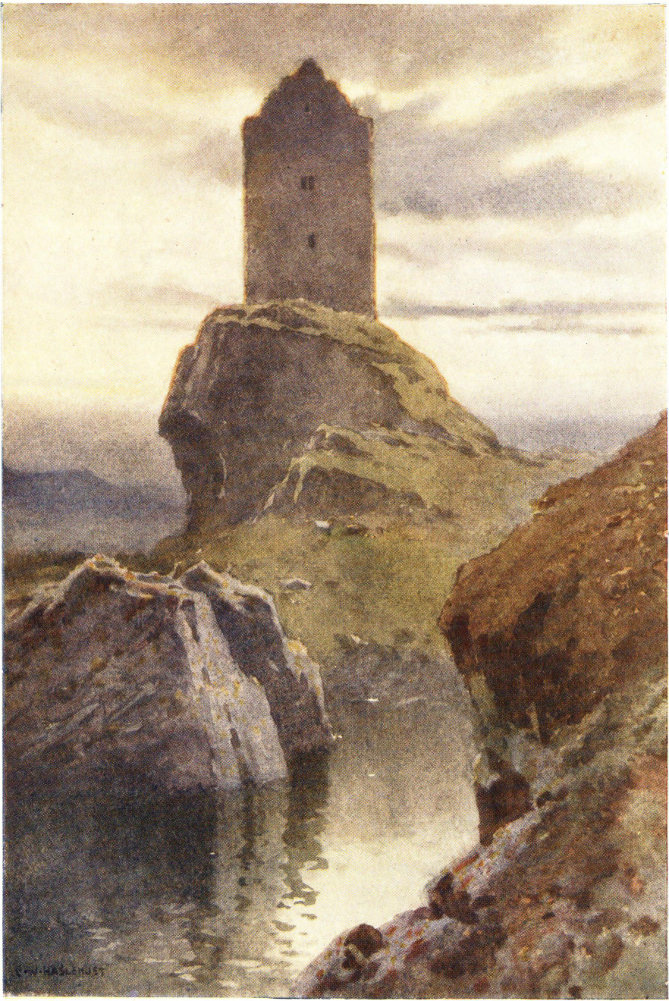
SMAILHOLM TOWER
13
A mile or two higher up, but still into tide-water,
flows in the Whitadder, which with its tributary, the
Blackadder, comes out of the recesses of the Lammermoors
to drain the fertile Merse, passing on its way
many scenes that must have tempted Sir Walter to
make its valley the stage of one of his romances. His
fancy may have played with the idea. But beyond an
occasional allusion, or the dispatch of one or two of his
characters through it, in hot haste for some other arena
of action, he never specifically annexed this heritage of
the Humes and earlier Lords of Dunbar and Merse to
the “Scott Country”, though some have attempted to
identify Cranshaws Castle or Wedderlie with Ravenswood.
Wedderburn recalls the “Seven Spears”. Polwarth
and Marchmont, Ninewells and Nisbet, Kimmerghame
and Langton, Edrington and Hutton, Chirnside
and Bunkle, Duns and Greenlaw, are names
steeped in the spirit of Border poetry as well as noted
in local and national annals. The valleys in which lie
Abbey St. Bathans, on the Whitadder, Priestlaw, on
the Faseny, and Longformacus, on the Dye, seem to
beckon for an interpreter of their almost forgotten
stories; while that of the mysterious “Edinhall”, on
Cockburn Law, the largest and most southerly of Scottish
“brochs”, is wholly lost. At Ellemford, James IV
was brought to a halt, in the futile “Raid of Ellem”;
and his descendant Charles I came to a turning-point
in his fortunes when he was faced by the Covenanting
Host, encamped on Duns Law. From Haliburton, hard
by the “Blackadder Rings”, Scott derived one line of
his descent. Yet this region of the Merse serves at most
only as a background in his Border Romance.
Higher up the main stream, beyond Paxton, and
Horncliffe, and Horndean, one comes to Ladykirk,
14
whose fine old sixteenth-century church is said to
have been founded and dedicated to the Virgin in
gratitude for an escape from drowning in the Tweed.
Behind it is Swinton, the home of an ancient and
knightly family from which Sir Walter was descended,
on his mother’s side. Over against it are the
“castled steep” and “flanking walls” of Norham, the
guardian of England and of the heritage of the Prince-Bishops
of Durham, to the siege of which “Mons Meg”
has travelled in her day—the scene, too, of quarrels and of
conferences, at one of which Edward I decided between
the rival claims of the “Competitors” for the Crown of
Scotland.
At Tillmouth and Twizell Castle, where the Till
brings down waters—Glen and Bowmount, Breamish
and College—drawn from both skirts of Cheviot, one is
close to ground yet more closely bound to the tragedy
of the Kingdoms and to the genius of Scott, for near here
is Ford Castle, where the Scottish King is supposed to
have dallied too long with Lady Heron; the bridge
across which he allowed the English van to cross and
attack him on flank; and the hill-slope of Flodden,
down which, in 1513,
“From his mountain home
King James did rushing come”—
to meet disaster half-way, and to fall in the midst of the
flower of his nobles and of his kingdom.
15
At Coldstream, Longshanks crossed the Tweed on
the fatal enterprise of invading and subduing Scotland;
Leslie, on his way to join Cromwell at Marston Moor,
and Monk on the march to proclaim Charles II in
London. Wark Castle, in which, according to tradition,
the Order of the Garter was instituted—with
Carham beside it, where, at a much more distant date,
a generation before Macbeth, Malcolm II, King of
Scots, won a victory that brought the boundary of his
realm in permanence to the Tweed—stands within easy
reach of Kelso. So also, on the opposite or Scottish
bank, does Birgham, the soil on which William the
Lion and the Scots prelates disowned the supremacy of
the English Church, and where was signed the Treaty
for that projected marriage of the heirs of the two
Kingdoms—Prince Edward and the Maid of Norway—which,
but for evil chance, might have united them
without the intervention of three centuries of desolating
war.
But it is at Kelso Bridge, below the meeting of Tweed
and Teviot, that we come fully within the circle of the
Magician’s charm—where every stream and wood and
glen seems to take light and colour from the imagination
of Walter Scott. The scene has been admired and
praised by a host of poets and travellers before and
since his time. Burns looked down upon it from different
points of view and owned himself “enchanted”.
16
It has been extolled by, among others, James Thomson,
of the Seasons, who was born at Ednam Manse on the
Eden Water, only two or three miles away, and by
Thomas Pringle, Scott’s fellow-pupil at Kelso and the
first editor of Blackwood, who sang, from the South
African veld, of “Bonnie Teviotdale and Teviot’s
mountains blue”. The parent river makes a wide
sweep, and, with its bold wooded banks, seems to
embrace and protect the houses of the little market
town, in the midst of which rise the ruined western
towers and a fragment of the nave of the renowned
Tyronesian Abbey. The place, standing so perilously
near the English border, was guarded on the south
and on the north by two great strongholds. Of
Roxburgh or Marchmont Castle, on the narrow ridge
between Tweed and Teviot, only a few walls, rising
a few yards above the sod, remain. Its history would
fill a volume. But one remembers chiefly that James II
of Scots—he of the “Fiery Face”—was killed by the
explosion of a cannon, while directing attack upon it
from the farther bank of the Tweed, leaving the country,
as was so often its fortune under the Stewart Dynasty,
to the hazards of a long minority. On the town of
Roxburgh—which once, as one of the “Four Burghs”,
was a leader in the path of municipal and commercial
progress—a more sweeping fate has descended; not
a stone has been left above another on a site upon
which for long was held “St. James’s Lammas Fair”.
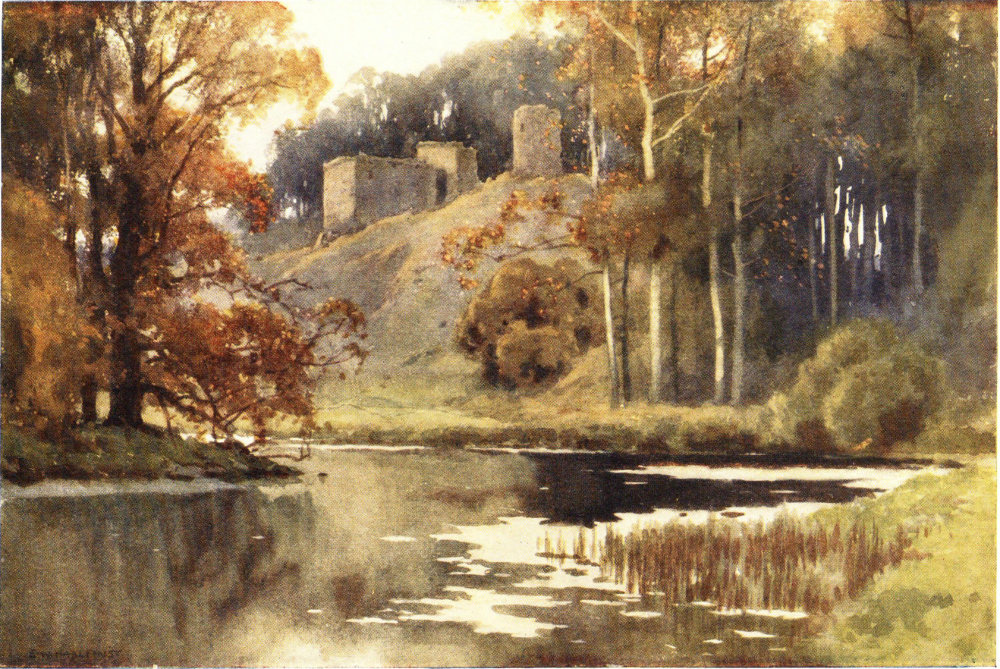
ROXBURGH CASTLE
17
Hume Castle, Kelso’s other bulwark—or, if it
happened to be in the hands of an enemy, its thorn
in the flesh—stands on high ground to the north,
where its square-set form, now reduced to a shell, can
be seen from all parts of the ground that lies between
the Lammermoor and Cheviot. But the town had
strength within itself in its great Norman Abbey Church,
built for purposes of war as well as of prayer. It was
founded by that zealous abbey- and cathedral-rearer,
David I, the son of Canmore and of Saint Margaret;
and its head, as a mitred abbot who acknowledged
only the jurisdiction of the Holy See, held a position
that gave him a precedence, much envied and much
resented, over the superiors of the neighbouring religious
houses of Jedburgh, Dryburgh, and Melrose.
It was endowed with rich benefices and wide territories,
but its wealth and glory all vanished in the storms of
the Reformation, or, more ruthless still, of the English
invasions and the Civil Wars.
A large part of the Abbey heritage has passed to
the Kers, of the ducal house of Roxburghe, whose
stately seat, Floors Castle, planned by Vanbrugh and
completed by Playfair, commands from its terraces
one of the widest and loveliest views upon Tweed.
Of the Kers of Cessford, who had feuds with the rival
branch of the Kerrs of Ferniehirst, as well as with the
18
Scotts and other neighbours, it has been said that
they had a genius for fighting on the winning side:
“When the power of the Douglases on the Border
began to crumble, they became Crown vassals, and
their fortunes mounted rapidly. They won new lands,
and held, and still hold, the old. They kept a hawk’s
eye on the wild tracts of moor and pasture and peat
bog, where even in the old days of foray there was,
as Dandie Dinmont said, ‘mair stabling for horses
than change-houses for men’, and where now all is
utterly abandoned to the curlew and the sheep. But
they moved their household gods, and extended their
bounds, from the Bowmont to the Kale, from the Kale
to the Teviot, and finally from the Teviot to the
Tweed.” Their ruined castle of Cessford stands in
a lonely place, on a slope overhanging a little side-glen
of the Kale Water, some eight miles from
Floors. The roof is gone, and all about is bare and
deserted. A few sapling ashes grow in the crannies
of the stone, but time has riven the thick walls which
Surrey, in 1523, found so hard to breach, and has
thrown down the grand old Crow Tree that stood so
long beside Habbie Ker’s stronghold. Long before
this the family had flitted to a warmer nest, and had
feathered it with the spoils of Old Roxburgh Castle
and of Kelso Abbey.
Scarcely less than Melrose and Abbotsford are
19
Kelso and Floors the centre of a sanctuary of Border
romance; and over the scene the forms of Hume
Castle and Smailholm Tower seem to keep sentry-watch
and to “shift places mysteriously, like the
triple heads of the weird Eildons, as if they were
pacing guard upon the hilltops”. In the setting of
the picture revealed from these vantage-grounds are—along
with places already noted—the hanging woods
of Stichell and Newtondon; Nenthorn, Hendersyde,
Mellerstain, Makerstoun; beyond Teviot, the rich
woodlands of Springwood, Woodendean, and Sunlaws;
the darker pine trees around the hunting seat of Bowmont
Forest; the folds in which lie the “Gypsy
capital” of Kirk Yetholm, the ancient Kirk of Linton,
Eckford of the Douglases and Crailing of the Cranstons;
the hills of Hounam and Morebattle; and,
behind all, the soft blue line, rising high in Great
Cheviot and sinking away towards the west, of the
chain that divides the kingdoms, with peeps here and
there of Haddon Rig, and Ruberslaw, and Dunion, and
Minto Crags, and Penielheugh, crowned by its Waterloo
monument, with other scarce less famous Border
heights.
While, above the junction, the ascending valley of
the Tweed holds its way westwards, so that the water-sheds
of its northern tributaries are in common with
those of streams flowing to the Forth and the Clyde,
20
Teviotdale keeps throughout a line that is parallel with
the Marches of the Kingdoms, from which its main
channel is nowhere more than a dozen miles away as
the crow flies. It follows that there is more of hazard,
and with this more of romance, crowded into its annals
than perhaps into those of any other area of like
extent. It is sprinkled over with battlefields and with
peel towers, most of them now in ruin; every dale
has been the scene of a fray, and every burn has a
song or ballad tacked to its name. These Middle and
West Marches were a centre of power and action, first
of the House of Douglas, and then of the “Bauld
Buccleuch”. The “Good Sir James of Douglas” kept
the peace of this troubled frontier for the Bruce; his
son, the “Knight of Liddesdale”, expelled the English
from Teviotdale, and was killed while hunting in
Ettrick Forest; his grandson, the first of the Douglas
Earls, also chased out the invaders and brought back
spoils from the English side; his great-grandson, the
second Earl, captured Percy’s pennon at Newcastle,
and was slain at Otterburn, while riding home by the
road of Redesdale and the Carter Bar with his prey;
while it is of a later descendant, “Earl Tineman”,
captured at Shrewsbury by a later Hotspur, that the
canny saying is quoted in The Fortunes of Nigel:
“Poortith (poverty) takes away pith, and the man
sits full still who has a rent in his breeks”.
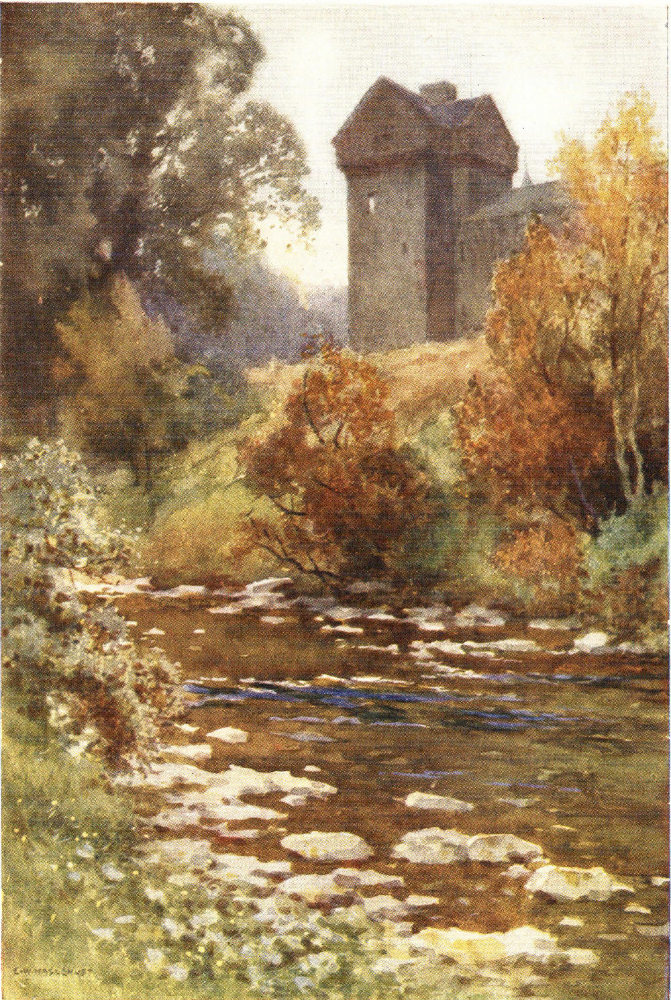
BRANXHOLM TOWER
21
A Scott of Buccleuch accompanied James V when he
hanged Johnnie Armstrong of Gilnockie and all his
company at Carlenrig near Teviothead; and the “rank
reiver’s” reproach, given in one version of the ballad,
was not without edge:
“Now haud your tongue, Sir Walter Scott,
Nor speak o’ reif and felonie;
If ilka man had his ain coo,
A richt poor clan your name would be.”
It was from Branxholm, on the Teviot above
Hawick, that another Scott of the name—generation
after generation were Walters—rode forth to rescue
“Kinmont Willie” from prison in Carlisle. The
Minstrel’s tale, in the Lay, opens at and returns again
and again to Branxholm Ha’; it was at the Tower Inn,
at Hawick, where the Duchess Anne of Buccleuch and
Monmouth held her receptions, and that the greatest of
all the Sir Walters parted from his guests the Wordsworths.
It is a land dedicated to the achievements of
Douglases and Scotts, but that resounds also with the
deeds of Elliots and Armstrongs, and of minor and broken
clans, Turnbulls and Rutherfords, Cranstouns and
Olivers. It has its rich endowment of beauty as well as
of history. Around the keep of Branxholm, which from
the deep bank overhanging the stream has often defied
its enemies, have gathered buildings of more recent date
22
and a screen of ancient trees. Below it is the Tower of
Goldilands, where a marauding Scott was hanged at his
own gate, and here comes in from the left the Borthwick
Water. As Leyden has it:
“Where Bortha hoarse, that loads the meads with sand,
Rolls her red tide to Teviot’s western strand,
Through slaty hills, whose sides are shagged with thorn,
And springs in scattered tufts the dark-green corn,
Towers wood-girt Harden, far above the vale”—
Harden, the cradle of the branch of the Scotts from
which the author of the Lay was descended; the
“mountain home”, hidden in its narrow glen, to which
the “Flower of Yarrow” was brought by “Auld Wat”—“a
wide domain, and rich, had purple heath been
grain”.
At the town of Hawick, Teviot meets Slitrig,
coming from the wild bounds of Liddisdale. All roads
in Teviotdale seem to lead to Hawick, the capital of
its trade as well as a centre of its history. Proud as
its citizens are of the leading position of the burgh
in the tweed and hosiery manufacture of the South of
Scotland, and of the undiminished importance of its
great lamb and sheep fairs, they are prouder still of
the prowess of its sons in the dark days that followed
Flodden, and in other scenes of Border strife. Scott
was familiar with its story, as with the streets and
with the steep hills that surround this stirring little
metropolis of industrial and pastoral life; and allusion
23
has already been made to the literary and legendary
memories attached to the site of the Tower in which
the Douglases of Drumlanrig entertained their guests
and protected their rights. From the parish church
of St. Mary, since often rebuilt, the heroic Ramsay of
Dalhousie was carried away by the Knight of Liddisdale,
to be immured and to suffer a lingering death
in the Douglas hold of Hermitage—
“Did ever knight so foul a deed?”
An older memorial of the past of Hawick is the
Motehill, on which justice was dispensed, and an
outlook kept for enemies, in times beyond the range
even of tradition. The great “Hawick Tradition” of
the capture of the standard of the English marauders
at Hornshole is kept green by the annual ceremony
of the “Common Riding”, when Hawick is to be seen
in its gayest and most jubilant mood. The words and
tune of its slogan of “Teribus ye Teriodin” are supposed
to have descended to it from heathen times, and
to have originally been an invocation to the gods of
the early Saxons and Norsemen—Thor and Odin. The
defiant spirit of these warriors of old seems still to ring
in the chaunt sung by the Cornet and his men as they
ride round the marches in the beginning of June:
“Teribus ye Teriodin,
Sons of heroes slain at Flodden,
Imitating Border Bowmen,
Aye defend your rights and Common.”
24
A few miles up the Slitrig is Stobs Castle, an ancient
seat of the Elliots, which became a military centre
during the Great European War; and there are many
other places of note and fame on the once hazardous
way, now followed by the railway, that leads across the
hills to the head-streams of the Liddel and thence to
those of the North Tyne, or to the “Debatable Land”,
the Solway, and Carlisle. Another crowd of warlike
memories and of pastoral and woodland charms awaits
those who, from Hawick, or from the old Douglas seat
of Cavers, lower down Teviotdale, explore the Hobkirk
valley, or pass over the skirts of Ruberslaw into Rule
Water—to Bonchester and to Hobkirk, where Thomson
planned his Seasons, and to Southdean, where
the poet spent his early years, and to the Carter Bar
and the Border.
A few miles below Hawick, past Hornshole and past
Denholm, the birthplace of John Leyden—the poet,
the Oriental scholar, the friend of Scott, whose “brief
and bright career” closed too soon in the Malay East—below
“dark Ruberslaw” and the Dunion, which
interposes its round-backed form between the “mining
Rule” and the “crystal Jed”, and more directly under
the Minto Crags and the Chesters moors, lies one of the
loveliest bits on Teviot. Haughs and dells, green hills
and wide sweeps of river spread around the fragments
of Fatlips Castle, whose owner, a Turnbull, dwelt
25
“Mid cliffs from whence his eagle eye
Full many a league his prey could spy”;
and around Minto House, the home, since the Union, of
the Elliots, a race great in law and in war, in song and
in statecraft, with whom, through their descent from
“Gibbie with the Gowden Garters”, a daughter of
Harden, Sir Walter could “count kin”. Jed Water
and Ale Water come in from south and north, farther
down, and here, too, every foot is famous. The “Minstrel”
sings of scenes, on the track of William of Deloraine,
“good at need”, among them
“Ancient Riddel’s fair domain,
Where Aill, from mountains freed,
Down from the lakes did raving come;
Each wave was crested with tawny foam,
Like the mane of a chestnut steed”.
The inflow of this turbulent stream is below the fine old
tree-surrounded Ancrum House. It is overshadowed
by Penielheugh and by the ridge of Lilliard’s Edge,
across which the main road from Carlisle, that has
followed the course of the Teviot almost from its source,
toils painfully over to the valley of the Tweed. On a day
in 1545, Ancrum Moor
“Ran red with English blood,
Where the Douglas true and the bold Buccleuch
’Gainst keen Lord Evers stood”—
a victory to which, according to traditions, “fair Maid
Lilliard” contributed manfully, until, like a hero of
“Chevy Chase”, she “fought upon her stumps”.
26
Jed Water is still more charged with the history and
legends of the past. Much of it, including Jedburgh
Abbey, is the patrimony of the branch of the Kerrs
represented by the Marquis of Lothian, whose modern
seat, Mount Teviot, lies opposite Jedfoot, while the
ancient home of the family, Ferniehirst, begins to run to
decay. It would take many pages to do justice—even
“Jeddart justice”—to Jedburgh, whose townsfolk, armed
with their “Jeddart staves” and to their slogan of
“Jeddart’s Here!” were in the front of the Border Wars.
Its Abbey, founded by David the Saint, who placed
here Augustinian canons from Beauvais early in the
twelfth century, is still, in spite of having been seven
times burned, the stateliest and the best preserved of the
mediæval religious houses of the Scott Country. The
site of the Royal Castle, where in the “Golden Age” of
the Borders Alexander III held court after his second
marriage, has disappeared under public buildings; but
the house in the Backgate is pointed out where Mary
Queen of Scots lay sick to death after her perilous
ride to Hermitage, as well as the lodging in the
Castlegate occupied by Prince Charlie on his march
into England.
His road lay over a shoulder of Carter Fell into Redesdale,
where runs what is still the only way across the hills
for wheeled traffic in the sixty miles between Wooler,
on the Till, and Riccarton, on the Liddel, although the
27
Romans built over the Cheviots paved roads, one of
which descended into the head of Kale Water, and,
from the site of the old Border Trysts at Pennymuir,
ran straight as a ruled line to the camp of Newstead,
under Eildon. From end to end these hills are
deserted, except by the shepherd and the sportsman.
Along the “wild and willowed shore” of Teviot and of
Jed, the “glaring balefires blaze no more”. The race of
the mosstroopers—of “John o’ the Side” and “Christie’s
Will”, the “Laird’s Jock” and “Hobbie Noble”—is
long extinct. But there are still to be found fine products
of the soil, of the type of the stalwart tenant of
Charlieshope. The Border spirit may have run into
manufactures, and pastoral and arable farming, and Kirk
and State contentions, but anyone who fancies it is
dead should attend a “Common Riding”, or an otter or
fox-hunt, or a game of curling or of hand- or foot-ball in
these parts; or a meeting or parting of Hawick “Teeries”
or of “Jedburgh callants”. He will doubt no more.
Dryburgh Abbey is less than ten miles distant from
Jedburgh, in a straight line. But there are marked
features distinguishing it from its Teviotdale neighbour
as well as from the Abbeys standing below and
above it on Tweedside—Kelso and Melrose. It was
planted in its corner of Berwickshire by baronial and
not by kingly beneficence, its founder being the great
Hugh de Morville, in David’s time Constable of Scotland
28
and Lord of Lauderdale, whose tomb is near the
site of the high altar. It was smaller in size and less
richly endowed than the other three, but is not less
generously invested with historic and legendary interest.
Its fate and condition are not dissimilar, for
like the others it was many times burned and ravaged
in the Border wars, and was afterwards abandoned for
centuries to neglect and decay. These Tweedside
monastic houses have now fallen upon happier times;
for, apart from the reverence they have gathered from
the past, and not least from their association with Sir
Walter Scott, they have lately become national possessions,
through the generosity of the Duke of Roxburghe
at Kelso, of the Duke of Buccleuch at Melrose, and of
Lord Glenconner at Dryburgh. The Præmonstratensian
Abbey on the bend of the Tweed under
Bemerside Hill differs from its rivals in respect that it
has preserved more of the monastic buildings and less
of the church. Of Dryburgh Abbey Church—apart from
the north transept, of which more has to be said—little
is left beyond the gables of the south transept and of the
west front, the latter pierced by a five-light window,
surmounting some ruined walls, and the foundations of
piers. But the chapter house—St. Modan’s chapel—is
extant, and its vaulted roof covers interesting architectural
and archæological details, while of the cloisters,
sacristy, fratery, and other domestic buildings of the
“White Friars” of Dryburgh there are considerable
remains, clad in ivy and overhung by immemorial yews
and other trees. Enough survives to indicate a structure
of much grace and beauty, showing a great range of
styles from Romanesque to Later Pointed, and built
of a local reddish sandstone which, as at Melrose, has
weathered into a rich and harmonious variety of colour.
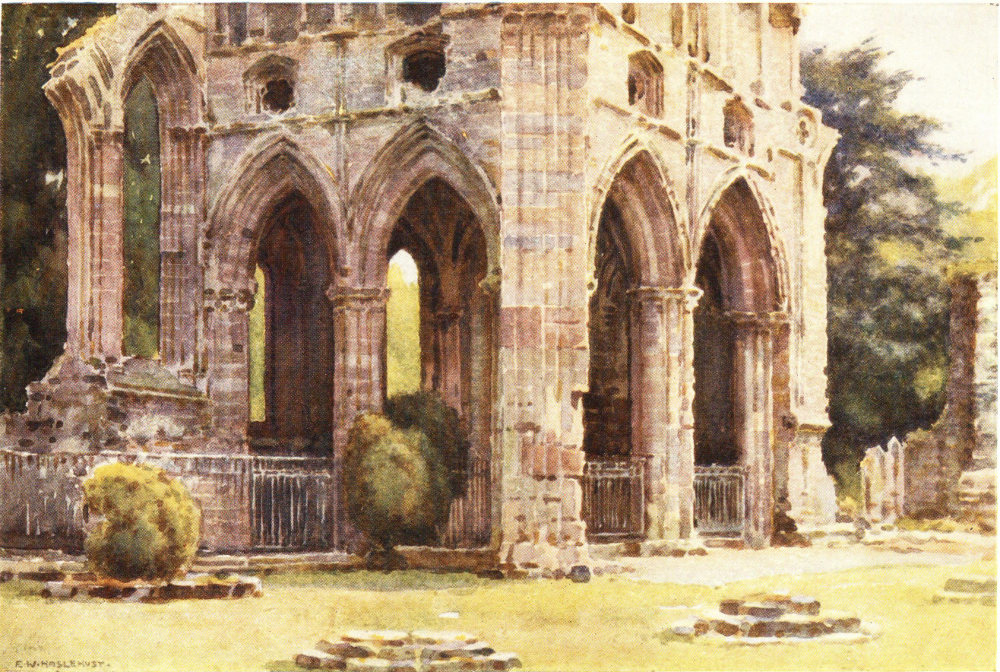
DRYBURGH ABBEY: THE TOMB OF SIR WALTER SCOTT
29
It is, however, in its situation and in its happy
blending with its immediate surroundings that Dryburgh
is chiefly distinguished from its compeers. It is
secluded from the world, on the margin of the wide
stream; hidden among woods and overlooked by hills.
To reach it you have to circumvent rivers and climb up
and down steep braes. The easiest way of approach
is by crossing Lessudden Bridge, from the south bank
of the Tweed above the tower of Littledean. This was
the road followed by the “bold Baron” of Smailholm,
whose tower and Beacon Hill, and the standing
stones on the moor of Brotherstone, look down from
the eastern and northern skyline on the scene
“Over Tweed’s fair flood, and Mertoun’s wood,
And all down Teviotdale”.
By Mertoun’s wood, the screen of Dryburgh from gales
blowing from the sea, and now the property of Lord
Polwarth, a Scott of the Harden blood, the way winds
to the Abbey precincts, overshadowed by the great
trees that surround Dryburgh House. Naturally the
30
feet first seek the tomb of Sir Walter in St. Mary’s
Aisle. The story of how the best beloved of the sons
of the Border came to be laid under this fragment of
the north transept and choir—a well-preserved piece of
elegant First Pointed work—is itself a romance. His
grandmother on the father’s side, Barbara Haliburton,
was the daughter of a Merse laird, who was owner of
part of the lands of Dryburgh, including the Abbey
ruins. She became his inheritor; but before then
Robert Haliburton had lost his lands through unwise
speculation. David Erskine, eleventh Earl of Buchan—brother
of Lord Chancellor Erskine and of Harry
Erskine, the brilliant wit and pleader—who has left the
impress of his eccentric mind on the colossal statue of
Wallace which stands, “frowning towards England”,
above his suspension bridge for foot passengers crossing
the Tweed from St. Boswells, became possessor of the
ground; and, through Lady Scott, obtained a promise
from the author of Waverley that he should be buried
in this kindred earth. Lady Scott died in 1826, and
Buchan in 1829, while Sir Walter himself was not laid
here until 26th September, 1832. In his fragment of
“Autobiography”, Scott records how he had come to
his own again in this twice-hallowed spot; and, with a
touch of prophecy as well as pathos, he wrote: “And
thus we have nothing left of Dryburgh, although my
father’s maternal inheritance, but the right of stretching
31
our bones where mine may perhaps be laid ere any eye
but my own glances over these pages.” Nowhere—not
even in Melrose—could the Wizard rest more tranquilly
than in this scene where nature and art, the present
and the past, and life and death seem to be brought
into perfect accord.
The funeral cortège, coming from Abbotsford, crossed
the Tweed and Leader at Leaderfoot, and climbing,
past Gladswood, by a road with which Scott was
familiar, halted where he had often halted, and where
multitudes have halted since, at a bold and sharp elbow
of the path, raised three hundred feet above the river,
whence an unrivalled view can be had into the heart
of the Scott Country. Immediately below, across the
stream, on a peninsula of land washed on three sides
by the Tweed, is Old Melrose, a spot which had
gathered sanctity many centuries before the mediæval
abbeys rose in the valley. Here a mission station of
the Christian faith was planted from distant Iona; and
hence, probably, travelled Aidan to convert heathen
Northumbria and to found Lindisfarne and Hexham;
here dwelt, as first abbot, his companion Eata, and
also Boisel, who gave his name to St. Boswell’s opposite,
and to whom came for instruction Cuthbert, a
shepherd lad who had been reared at Wrangham, near
Brotherstone, and had tended his flock and seen visions
in the Lammermoors. From “Mailros”, the bald promontory—its
32
very name attests the tongue in which
the Celtic founders spoke—St. Cuthbert’s body in its
stone coffin floated downstream on its many wanderings
by water and land; and, as related by Bede, the
hermit Drithelm was wont in winter to break the ice
on the river, and, standing up to the neck in the water,
recite his prayers. Although it was abandoned before
the “Sair Saint” brought to the neighbourhood and to
Scotland the first monks of the Cistercian Order, some
of the prestige of Old Melrose must have clung to the
name and been transferred to the Religious House on
the new site, the ruddy walls of which can be descried,
sheltering at the foot of the Eildons, across the fields
on which, long before the coming of the Columban
missionaries, the Romans planted the expeditionary
camp and permanent station of Trimontium, that have
only lately yielded their secrets to the spade.
This Bemerside Hill is a “Mount of Vision” from
which all the chief shrines and high places of the Scott
Country can be surveyed, at least with the mind’s eye.
Abbotsford itself, if not in actual view, can be mapped
into the scene by direction and position. Out of sight,
directly under the brow of the hill, is the ancient
square fortalice, with later buildings attached, and
grounds stretching down towards the Tweed, where
Haigs have been resident for seven centuries. They
were benefactors of Melrose when Alexander III was
king, and when Thomas the Rhymer was their neighbour
and wellwisher, and uttered the prophecy that
has so mightily helped its own fulfilment:
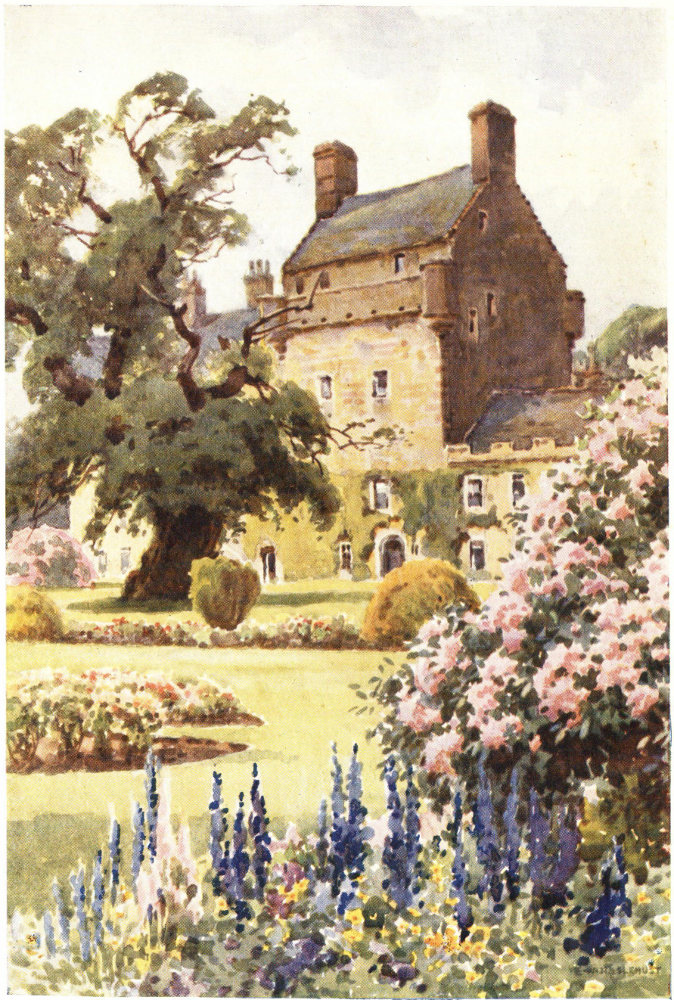
BEMERSYDE HOUSE
33
“Betyde, betyde, whate’er betyde,
Haig shall be Haig of Bemersyde.”
Sir Walter Scott was a later friend of the family, and
was often a guest in the beautiful rose-garden below
the mansion. A grateful nation bestowed the house
and manor on the late Field-Marshal Earl Haig,
who now lies at rest close by Sir Walter at Dryburgh.
The whole scene and surroundings seem to
be touched by the spirit of prophecy and of poetry.
On the hills opposite stood the “Eildon Tree” and
the “Eildon Stone”; and beyond these, on Abbotsford
property, the reputed “Rhymer’s Glen”, where
“True Thomas” encountered the Queen of Faëry,
although the tryst may well have been at Huntlywood,
behind Brotherstone, on the Eden Water,
and near Corsbie Tower, the ruined “Castle of
Avenel”. As has been said, Drithelm and Cuthbert
were visionaries, so were Boisel, the second Abbot
of the old, and Waldave, the first Abbot of the
new foundation; and centuries before the time of the
Seer of Ercildoune they dreamed dreams and saw
things not of this world and far into the future.
According to popular belief, of like gifts was “Auld
Michael”, whose words “cleft Eildon Hills in three”.
34
The last and the greatest of these “Wizard Scotts”
is he who sleeps with his fathers in St. Mary’s Aisle.
When descent is made into the valley of the Leader,
one is still in the land of enchantment. The ivy-covered
“Rhymer’s Tower” is a few miles up the glen,
and on the way, under the Black Hill of Earlston, are
Drygrange and the “Broom o’ the Cowdenknowes”.
Near by, at Mellerstain, lived and sang Grizel Baillie,
who was Grizel Hume; and in the Kirk of Legerwood
is the monument of that other Grizel, who, in the dress
of a highwayman, saved her father’s life by holding up
the King’s officer carrying the writ for his execution.
Higher up Leader are Carolside, and, in a side glen,
Auld Thirlstane, the seat of “Auld Maitland”, and
Spottiswoode, the home of Alicia Spottiswoode—Lady
John Scott—writer and composer of “Bonnie Annie
Laurie” and other thrilling Scots lyrics. The new Thirlstane—it
is hundreds of years old—is in the centre of
Lauderdale, beside the venerable Royal Burgh of Lauder,
the last of the municipalities in the land to retain its old
burghal rights and customs. Many are the hill-forts
and camps that look down on the now peaceful scenes
through which the road—a favourite tourist coach
route—passes on its way from the crossing of the
Lammermoors to the Tweed; and among them are
Channelkirk where Cuthbert heard the summons of
the Heavenly Host, and Edgarshope, by which the
35
message of fire that told of the crossing of the border
by the English bands, was wont to be passed on to
Soutra Edge, near by the Hospice of the Red Friars,
to which, and not to Faeryland, Thomas retired from
the world, when he followed the mysterious Hart and
Hind up Leaderside.
Not less richly furnished with the relics of eld and
with the charms of modern cultivation is the parallel
vale of the Gala, the nursery of the “Braw Lads”.
The “Shirra” often traversed it on his way by Midleton
Moor to his home and sphere of jurisdiction on
Ettrick and Tweed, upon which the stream, road, and
railway debouch a little below the mill lades and
chimney stalks of the town of Galashiels, and almost
opposite to Abbotsford. On the links and bends of
the Gala, and its side glens of the Heriot, the Armit,
and the Luggate, are many places of historic note—Crookston,
of the Borthwicks, for example; Stow—the
“Stowe of Wedale”, of Arthurian and mediæval
fame; Bowland, like Eildon Hall, on the farther side
of the Eildons, a possession of the House of Buccleuch;
the ruined “broch” on the Bow Hill, facing, across the
valley, a similar structure which, with the termination
of that ancient and mysterious line of earthworks, the
“Catrail”, occupies the crown of Torwoodlee, of the
Pringles; finally, Buckholm Hill and Tower, looking
over the roofs of the busy seat of tweed manufactures
36
to Gala Hill and Gala House of the Scotts. “Gala
Water, Buckholm, Torwoodlee”, were among the last
audible words murmured by the dying “Border
Minstrel”.
Between “Leader howms” and Gala Water runs
the little stream of the Allan or Alwyne through the
“Fairy Dean”. Lovers of Scott will not pass it by,
because, apart from the loveliness of its succession of
wood-embowered haughs, it leads to a spot where three
ruined peel towers—Hillslap, Colmslie, and Langshaw—stand
not many bowshots apart, memorials of the time
when the smaller lairds had to bind themselves
together by a “bond of manrent”, for protection
against their more powerful neighbours; and the first of
these has been identified, with some sanction from
Scott himself, as the “Glendearg” of the Glendinnings
in The Monastery and The Abbot. Near the bridge
which crosses the Tweed at the “Pavilion of Alwyn”,
and the “groves of noble Somerville”, was the scene of
the misadventure of Philip, the Sacristan, at the hands
of the spirits, and of Mysie Happer, the daughter of the
miller of the Halidome. The dairy farm of the “monks of
St. Mary’s” was on Allan Water; up it led the “girth-gait”
which they often followed on the way to Soutra
Hospice. True Thomas’s rhymed sayings cling to this
countryside like—in Father Philip’s phrase—“burrs to
a beggar’s rags”. The region between Leaderfoot and
Galashiels was part of the original patrimony of the
Cistercian Abbey; all the way, but especially where
Gattonside, set on its hillside and surrounded by its
famous orchards, “beiks in the sun”, one sees, in
glimpses or in full view,
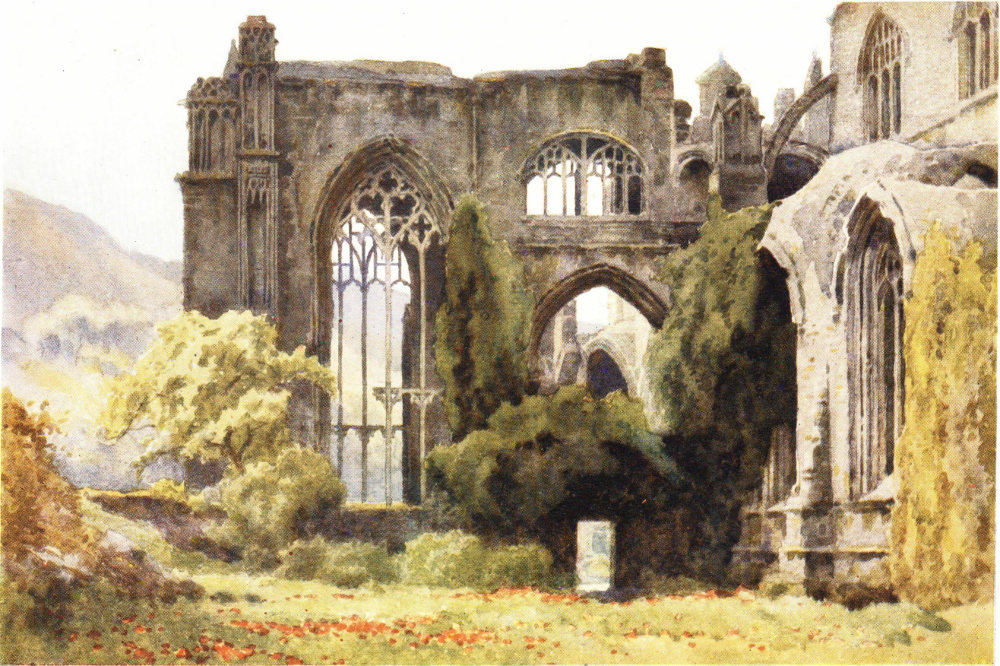
MELROSE ABBEY: CHOIR AND NORTH TRANSEPT
37
“Where fair Tweed flows round holy Melrose
And Eildon slopes to the plain”.
In drawing near to Melrose, especially if one crosses
at Leaderfoot, and approaches by the village of Newstead
and over the site of the Roman camp, one feels there is
something to be said for Dorothy Wordsworth’s disappointment
on coming first into near view of the
Abbey. It stands back from the river—perhaps because
the river has left it—and apart from the hills. It is in
the fields outside of the village, the streets of which
come to its gate and stop there; and it is surrounded by
walls, which interrupt and deform proportions seriously
injured by the loss of its central tower. Melrose—“the
light of the land, the abode of saints, the grave of
monarchs”—is a glorious fragment, more beautiful,
perhaps, in detail than in general effect, in ornament
than in design; and memorable even more for its
legendary and literary associations than for its actual
history. The monastery dates from the same abbey-building
reign as its rivals on Tweedside; but architecturally
the church belongs to another horizon. Of
the original Norman fabric that stood on the site
38
scarcely a trace remains. It was swept away during
the descent upon it of Edward II in 1322, and what
remained must have perished under the equally destructive
assault of Richard II in 1385. Between these
two dates, a building arose, represented by the eastern
end of the nave with its flying buttresses and by
adjoining parts of the choir and transepts, that may be
regarded as a monument of the piety and the gratitude
of Robert the Bruce, whose heart, brought back from
the Paynim lands to which the “good Sir James” of
Douglas had carried it, is buried in the Abbey. The
work of rebuilding was continued for nearly a couple of
centuries longer; and it is evident that the highest art
and craftsmanship the age could produce were employed
in construction and in ornament, which, owing
to the fineness of grain of the red sandstone employed,
remains in wonderful preservation. It is doubtful
whether it was completed before the tempests of the
Tudor invasions and of the Reformation fell upon it,
and the monks were put to flight. It has not been
definitely ascertained how far the long nave extended
to the westward, or what was the plan of the monastic
buildings, of which and of the cloister only a few
fragments are left on the northern side of the church.
The presbytery, with its much extolled “east oriel”
window, was probably among the later additions, and is
one of the finest examples of Perpendicular Gothic
39
extant. Scott would have us view it when the moon is
shining “through slender shafts of shapely stone, by
foliaged tracery combined”, and to imagine that
“Some fairy’s hand
’Twixt poplars straight the ozier wand,
In many a freakish knot, had twined”.
But even more wonderful and beautiful to many eyes is
the great Decorated window of the south transept that
lightens the aisle in which, as is fabled, the Wizard
Michael sleeps with his magic books beside him.
Familiar are the lines in which Sir Walter, a constant
pilgrim to this shrine, chants its praises—of its cloister
garth:
“Nor herb, nor floweret, glistened there,
But was carved in the cloister-arches fair”;
of the vaulted roof, where
“The key-stone that locked each ribbéd aisle
Was a fleur-de-lys or a quatrefeuille”;
and of the pillars, with their clustered shafts, that
“With base and with capital flourished around
Seem’d bundles of lances which garlands had bound”.
It must have been a labour of love to frame this
marvellously carved casket, in which are laid the ashes of
kings and prelates. Here rest the chiefs of the once
mighty House of Douglas, and, not far away, of the
English Warden who desecrated their tombs and was
overtaken and slain at Ancrum Moor; among minor
clans “Ye race of ye House of Zair”—Kerrs and
Pringles; and, later in date but of the same stubborn
40
and trusty Border stuff, Tom Purdie, the reclaimed
poacher and faithful watchdog and factotum of the
Laird of Abbotsford. The prayer of John Morvo,
inscribed on the wall of the south transept,
“I pray to God and Marie baith
And sweet St. John keep this haly Kirk frae skaith”,
has not been fulfilled. To other bludgeonings of fate
was added its conversion into the parish church in the
seventeenth century. Walter Scott helped to rescue it
from vandalism and neglect; and he continues to be the
guardian spirit of the “dark Abbaye”.
Not less than in the days of the monks is the
adjacent town of Melrose—“Kennaquair” the residence
of the antiquarian Captain Cuthbert Clutterbuck—an
appanage of the Abbey, out of which indeed
it has partly been built. One looks in vain for the
“Druid Oak”, which existed only in Scott’s fancy.
But Melrose has its market cross and market place,
and does a modest business with the country round.
Its chief source of prosperity, however, is in its
situation and its associations; it may be called the
capital of the “Scott Country”. Abbotsford is little
more than a couple of miles away. The road to it
passes Darnick Tower, a red keep festooned with
greenery, the stronghold of one of the lay vassals of the
Abbey; and skirts, in the grounds of the Hydropathic
Establishment, the “skirmish field” on which was
41
fought in 1526 the fray between the Scotts and the
Kerrs of the Douglas faction that gave rise to a long
feud between the clans. Scott, it may be noted,
speaks of the scene, when
“Cessford’s heart-blood dear
Reeked on dark Elliot’s Border spear”,
as if it had taken place beside the ruined Kerr stronghold
of Holydean, on the southern side of the hills
beyond Huntly-burn and the “Rhymer’s Glen”, and
thus near to the pretty village of Bowden, which sits
under the lowest of the three Eildons, and looks down
into the valley of the Ale and towards Cavers Carre and
Lilliesleaf.
The fields and woods sloping down from Bowden
Moor and Cauldshields Loch, on the left of the way
from Melrose to Abbotsford, are part of the possessions
which Sir Walter gathered together between 1811,
when he had to give up Ashestiel, and 1824; and
they still belong to his descendants. The nucleus
of the property was the little farm of Cartley, or Clarty,
Hole, on the Tweed a little above the inflow of the
Gala. It lay almost opposite to the site of the plum
trees that, according to a story of Border foray much
cherished in Galashiels, gave to that town the burghal
arms and the slogan tune of “Soor Plooms”, the
favourite bagpipe air of Scott’s Kelso uncle. On the
strength of a tradition that there was here a crossing-place
42
of the monks, Abbotsford got its new and ever
memorable name. A modest cottage, which forms part
of the west wing, gradually grew with the growth of the
owner’s fame and fortunes, until, at the end of fourteen
years, by addition and reconstruction, mainly all of Sir
Walter’s own devising, it had become the stately
baronial mansion, adorned with turrets, corbels, and
crowsteps, that challenges the eye by its form and size
as well as by its history. Into it the author of the
Waverley Novels may be said to have built his fancies,
his aspirations, and his ambitions; and here he counted
on spending the evening of his days in well-earned rest,
surrounded by his children and his friends, and by the
love and admiration of his fellow countrymen. Hardly
had this “poem in stone and lime” been brought to
completion when an untimely frost blasted his hopes,
and with unimpaired courage, but with gradually failing
strength, he turned to a task, greater than any that ever
fell to his namesake the “michty Michael”, and worked
unremittingly, with hand and brain, for another seven
years’ term until he came back for the last time to Abbotsford,
a spent and broken man, to die. Sadder far his
return than his departure a year before in quest of
health, when
“A trouble, not of clouds or weeping rain,
Nor of the setting sun’s pathetic light
Engendered, hung o’er Eildon’s triple height”.
43
It brought the last touch of tragedy and of heroism
to the closing scene of that noble life—to the passing
of the marvellous power, the warm and generous
heart, the gallant spirit that was Walter Scott. He
enjoyed, however, many happy days in Abbotsford; it
is associated more with his triumphs than with his
misfortunes. Here he trod his fields, delighted “to
call this wooded patch of earth his own”, entertained
literary celebrities like Washington Irving, Maria
Edgeworth, and the Wordsworths, held almost feudal
receptions of his retainers and neighbours, talked and
walked with his familiars—Lockhart, Skene, Cranstoun,
the “beloved Erskine”—and with his “ain folk”, and
planned and wrote his novels. Tweed sings a blither
as well as a fuller strain since he dwelt by it.
Into the house, he built material more substantial
than his hopes. Scott had the antiquarian temper and
taste; and like Burns’s Grose, and his own Oldbuck, he
gathered about him “a routh o’ auld nicknackets”,
many of them the free-will offering of admirers. In this
way the door of the old Edinburgh Tolbooth—the
“Heart of Midlothian”—came into his possession,
along with the ponderous lock and key over which
“Daddie Ratton” had held charge. Sculptured and inscribed
stones from the High Street and Canongate
houses have also found their way here; while within the
house has been collected a museum of Border antiquities,
44
along with portraits, and personal souvenirs and relics,
gathered from all corners of the land. The house has
been left “very much as in Sir Walter’s time”; and a
constant stream of pilgrims visits it. In the library are
relics of Napoleon, of Prince Charlie and Flora Macdonald,
of Nelson and Wellington; in the drawing-room,
among other famous pictures, is Raeburn’s portrait of
Scott; in the armoury, memorials of Rob Roy, Montrose,
Claverhouse, and Archbishop Sharpe, and the keys of
Loch Leven Castle, while on the walls are blazoned the
escutcheons of “ye Clannis and men of name quha
keepit ye Scottish Marches in the days of auld”. But
more impressive than any of these things are the chair
in which Scott sat to write or dictate and the pen that
in his hand was as a magician’s rod.
The way from Abbotsford to Selkirk, by the valleys of
the Tweed and Ettrick, past Fawdonside and Lindean,
was a familiar one to the “Shirra”. He had legal and
other county business that carried him often during a
third of a century to the head town of his Forest Sheriffdom;
and inclination went hand in hand with duty, for
the road led to Ettrick and Yarrow, to “Sweet Bowhill”
and to
“The shattered front of Newark’s towers
Renowned in Border story”.
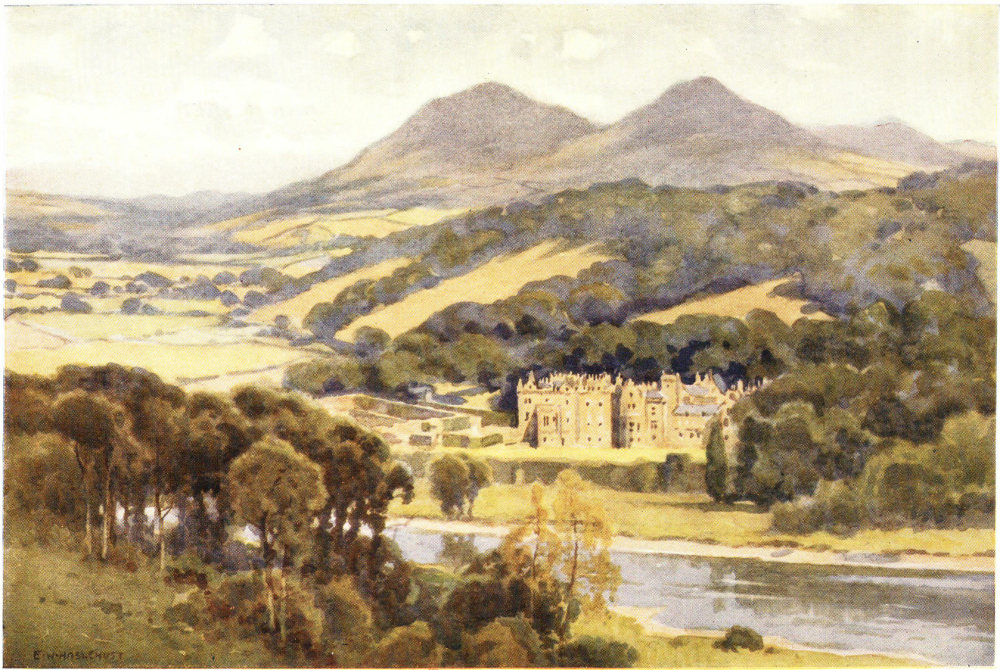
ABBOTSFORD
45
Selkirk—the old “church of the shielings”, which, in
the days when David I and his successors hunted in the
forest of Ettrick, served the royal sportsmen for their
orisons—narrowly missed being the seat of an Abbey.
A colony of Tyronesian monks were settled in it more
than eight centuries ago, but were removed, “for convenience”,
to Kelso. The “Souters of Selkirk” have since
given themselves to war, to shoemaking, and latterly to
tweed manufacture. But the town has not neglected
poetry, and bards of later date have been born and have
sung in it, since Burns and Scott drew the “birse”
across their lips. It is set well above the vale of the
Ettrick, at the gate of the Haining policies; and its
public buildings are gathered around the triangular
market-place, in which stands a statue of Sir Walter in
his sheriff’s robes. In the Free Library is hung the
Flodden Standard brought home by the survivors of
that day of disaster, when “the Flowers o’ the Forest
were a’ wede awa’”.
In 1645 Montrose was resting, with his cavalry, in
Selkirk, his infantry encamped at Philiphaugh, on the
other side of Ettrick, when David Lesley crept up on
him from Melrose, in the mist of a September morning.
In two or three hours the fruits of nine brilliant
victories were lost, and the great captain was a fugitive
speeding across Minchmoor to Traquair, where, the door
being shut on him, he passed on to Clydesdale and the
Highlands. There have been many romantic crossings of
Minchmoor, and meetings and partings at “Wallace’s
46
Trench”—part of the old Catrail or Picts’ Dyke—and at
the Cheese Well. Walter Scott accompanied his friend
Mungo Park—whose statue stands near his own in the
streets of Selkirk—when Park was starting on his
African journey. They separated on the ridge above
Williamhope, where, as has already been told, Sir
William Douglas, the “Flower of Chivalry”, was slain
by his cousin the Earl of Douglas, in revenge, it is said,
for the most unchivalrous deed of the starving to death,
in Hermitage Castle, of Sir Alexander de Ramsay.
Across this high moor between Yarrow and Tweed came
James V, with five belted earls, to the meeting with the
“Outlaw Murray”, lord of Hangingshaws, and Newark,
and Philiphaugh and other lands on Yarrow. The king’s
message ran—
“Bid him meet me at Permanscore,[1]
And bring four in his companie;
Five earls sall come wi’ mysel,
Good reason I suld honoured be”.
Permanscore is a hollow of the hill, “where wind and
water shears”, and here, three hundred years after the
“Outlaw’s” time, the “Shirra” assembled and conducted
“a perambulation of the marches” in a case of disputed
boundaries.
Carterhaugh—the meadow on which faithful Janet
met “Young Tamlane”, and, by holding him through
all his grisly transformations, rescued him from Fairy-land—lies
47
in the fork between Ettrick and Yarrow.
Behind it is Bowhill, at the time when the Lay was
written the favourite seat of the Buccleuch family; and
the “Duchess’s Walk”, along the right bank of the
Yarrow, is named from the lady who suggested to
Scott the “Goblin Page” as an episode of the Lay.
It leads to where
“Newark’s stately tower
Looks out from Yarrow’s birchen bower”,
and to the “embattled portal arch”
“Whose ponderous grate and massy bar
Had oft rolled back the tide of war”.
Within the deserted walls, the widowed Duchess of
Buccleuch and Monmouth is pictured as listening to
the tale of the Last Minstrel. Local tradition has it
that in the courtyard the Irish prisoners who surrendered
at Philiphaugh were massacred; another story asserts
that they were slaughtered on “Slainmenslee”. Newark
was a royal hunting-seat in the fifteenth century;
and its possession carried with it the Hereditary Sheriffdom
of the Forest, which with many things else in this
country came to the House of Buccleuch.
Over against Newark is Foulshiels, the birthplace
of Mungo Park. Broadmeadows and Lewinhope and
Tinnis are higher up the stream, which here runs between
steep wooded hills, cloven by narrow side glens
and with spaces of rich haughland on its margin.
48
Yarrow burrows under banks of birch and hazel, or
overshadowed by fine forest trees. The vale is “strewn
with the sites of the tragedies of far-off years, forgotten
by history, but remembered in song and tradition”;
it is “the very sanctuary of romantic ballad-love. Its
clear current sings a mournful song of the ‘good heart’s
bluid’ that once stained its wave; of the drowned youth
caught in the ‘cleaving o’ the craig’. The winds that
sweep the hillsides and bend ‘the birks a’ bowing’
whisper still of the wail of the ‘winsome marrow’, and
have an undernote of sadness on the brightest day
of summer; while with the fall of the red and yellow
leaf the very spirit of ‘pastoral melancholy’ broods
and sleeps in the enchanted valley. Always, by Yarrow,
the comely youth goes forth only to fall by the sword,
fighting against odds in the Dowie Dens, or to be
caught and drowned in the treacherous pools of this
fateful river; always the woman is left to weep over
her lost and lealful lord.” No strict identification of
ballad sites and origins is possible; but the story
of the “Dowie Dens” has become associated with
Tinnis bank and with Deucharswire, beside Yarrow
Kirk; and is said to be founded on the slaughter in
1616 of Walter Scott of Oakwood by the kin of John
Scott of Tushielaw, with whose daughter, Grizel,
Oakwood had contracted an irregular marriage.
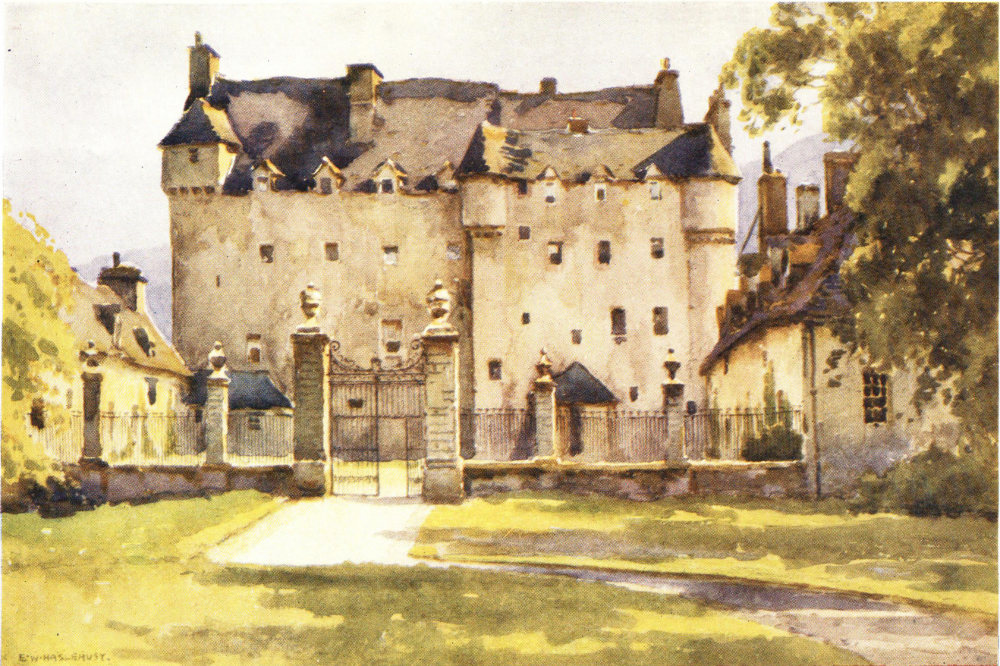
TRAQUAIR
49
A group of authentic memories gather around
Yarrow Kirk and Manse, and the bridge which carries a
crossroad over the hills to Ettrick. A succession of
cultured pastors have dwelt here, including Dr. Rutherford
the grandfather of Scott, two generations of
Russells, and the late Dr. Borland. By an unfortunate
fire, in the spring of 1922, the restored church was
destroyed, together with the memorials placed in it of
Sir Walter, of Willie Laidlaw, his friend and amanuensis,
of Wordsworth, and of the Ettrick Shepherd,
all of them residents or visitors on Yarrow and worshippers
in this secluded fane. In a field close by
is a stone carved in rude Latin minuscules to the
“Sons of Liberalis, of the Dumnogeni”, a relic of
post-Roman times. Above Yarrow Kirk, the valley
widens until it becomes spacious enough to hold the
clear mirror of St. Mary’s Loch; the hills become
bare and green and smooth, and over the ridge on the
right comes the road from the Tweed by Paddyslack
and Mountbenger to the Gordon Arms. It was from
this road that Wordsworth, in good company, caught
his first, and his last, glimpse of Yarrow—
“When first descending from the moorlands
I saw the stream of Yarrow glide
Along a bare and open valley,
The Ettrick Shepherd was my guide.
When last along its banks I wandered,
Through groves that had begun to shed
Their golden leaves upon the pathway,
My steps the Border Minstrel led.”
50
Hogg farmed, unsuccessfully, Mountbenger, before he
removed across Yarrow to Altrieve, where he spent the
last year of his life and where he died. In his youth he
had herded sheep on Blackhouse heights, where looking
down on the ruined peel on the Douglas burn are the
stones that mark the place where the “seven bauld
brethren” fell, in their pursuit of “Lord William and
Lady Margaret”. The escaping lovers lighted down at
this “wan water”.
“‘Hold up, hold up, Lord William,’ she said,
‘For I fear that ye are slain.’
‘’Tis naething but the shadow of my scarlet cloak
That shines in the water so plain.’”
But it was his “heart’s bluid”, and the pair were buried
together in St. Mary’s Church, whose deserted graveyard
is set on a shelf of Hendersyde Hill, overlooking the
loch, and fronting the dome of Bowerhope Hill.
On the banks of a burn which flows into Yarrow a
little below where it issues from the loch is Dryhope
Tower. “Auld Watt” of Harden came to it to bear
away Mary Scott, the “Flower of Yarrow”, and part of
the provision for their housekeeping was the spoils of the
“first harvest-moon”. Half-way along the shore of St.
Mary’s, at Cappercleuch, pours in the Meggat Water, a
stream that drains some of the highest ground in the
Southern Uplands. It was a favourite royal hunting-forest
in 1529, when James V came this way intent on
the extirpation of the Border thieves; and fate threw in
51
his path Cockburn of Henderland, whose tower was
near Meggatfoot. The hollow and waterfall of the
“Dowglen” are shown where his lady sought shelter,
while “they broke her bower and slew her knight”;
the spot, with names inscribed, can be seen in a little
clump of wood beside the ruined peel to which she
bore him on her back and dug his grave:—
“And thinkna ye my heart was sair
When I laid the mools on his yellow hair;
And thinkna ye my heart was wae
When I turned aside awa to gae”.
Unfortunately for tradition, the fact is on record
that Cockburn of Henderland, like his neighbour Scott
of Tushielaw, was tried and executed at Edinburgh.
James Hogg would have made small ado about brushing
such obstructions out of the way of romance. His
statue stands at the head of St. Mary’s Loch—the
presiding genius of the scene. The road up Yarrow,
passing through the woods of Rodono, holds out beyond
it, by the Loch of the Lowes and Chapelhope to Birkhill,
and then, under the “Grey Mare’s Tail” and White
Coombe, down Moffatdale. But the seated figure of
the burly Shepherd, wrapped in his plaid, faces “Tibbie
Shiels”, the rendezvous of generations of thirsty
fishers and poets, on the narrow space between the
lochs, and looks towards the hills up which the crossroad
climbs steeply, making for Ettrick. It was at this
famous hostelry that Hogg gave his classical order,
52
after a hard night’s drinking with Christopher North
and other congenial company, “Tibbie, bring in the
Loch!” “He taught the wandering winds to sing”,
reads the inscription on his monument; and the strong
song of the winds that blow down Ettrick accompanies
the traveller as he climbs over by the Packman’s
Grave, descends to Tushielaw and, turning upstream
at Crosslee, follows the valley to the Shepherd’s
birthplace and grave, beside Ettrick Kirk.
This out-of-the-world nook in the hills—for the road up
Ettrickdale comes to an end a few miles higher, under
Ettrick Pen—may be reckoned the heart of pastoral
Scotland. The thoughts and the talk of the inhabitants
are absorbed in sheep—except what may be reserved
for sport, and “auld farrant tales”, and church affairs.
Around the Shepherd rest many of his own kin and
kind: farmers and herds, lairds and tenants, reivers,
smugglers, and gypsies—and in this strange mixed
company, “Boston of Ettrick”, of the “Fourfold State”,
the great preacher and Covenanting divine.
The Castle of Thirlstane, on Ettrick, stands a little
below the kirk, with a fragment of Gamescleuch Tower
facing it on the opposite bank. Thirlstane belonged to
the “Ready, aye Ready” Scotts, until it went by
marriage to its present possessors the Napiers. Tushielaw
was another hold of the clan, and here dwelt Adam
Scott—“King of the Thieves”, and “King of the
53
Borders”—the father of Mary, the “Forest Flower” of
the “Queen’s Wake”—until his rival from Holyrood
came and “justified” him, says legend, on the Doom
Tree at his own door.
Across the water from Tushielaw “Rankleburn’s
lonely side” leads far into the hills. Rankleburn is the
traditional first home of the Scotts in the basin of the
Tweed, although Kirkurd in the Lyne valley might put
in an earlier claim. They are even said to have drawn
their name and their chief title from this deserted glen,
high up which lies Buccleuch, now marked only by
the foundations of a chapel wall. Scott of Satchells,
who wrote the family story in halting rhyme, in 1686,
tells how a wandering Scott from Galloway, in the
remote days of Kenneth II, seized a hunted buck by
the horns, swung it on his shoulders and brought it to
the king:—
“And for the buck thou stoutly brought
To us up that steep heugh,
Thy designation ever shall
Be John Scott of Buck’s cleuch”.
Neither at Gilmanscleuch, nor on the Deloraine
burn, nor at the Dodhead have the men of the type of
Jamie Telfer, who, “steady of heart and stout of
hand, once drove their prey from Cumberland”, left any
trace of themselves in standing walls. A reminiscence
of old forest times survives in such names as Hindhope
and Hartwoodmyres; the shell of an ancient peel
54
guards, at Kirkhope, the “Swire Road” across
the “Witchie Knowe” from Yarrow to Ettrick
Bridgend; and Oakwood has something more substantial
to show in the shape of the red keep which
local legend insists was built by the redoubtable Sir
Michael Scott himself, although its foundations must
have been laid centuries after his date. Enough
for us that it was in the keeping of “Auld Watt”
of Harden.
“Wide lay his lands round Oakwood Tower
And wide round haunted Castle Ower.”
At Oakwood we are back again beside Selkirk, and
at Selkirk we are near where, each skirting the grounds
of Sunderland Hall, Tweed and Ettrick meet, and
where we can resume our course up the larger stream.
With the delightful section of the Tweed between The
Rink and Elibank, Walter Scott had many close ties.
The right bank, and part of the left, were within his
jurisdiction as Sheriff, in which office he succeeded his
friend, Andrew Plummer of Sunderland Hall, in 1799.
But even earlier he made familiar acquaintance with the
district, on angling and walking excursions, and had
visited the Russells and “Laird Nippy”, at Ashestiel.
The Rutherfords of Fairnilee—the old house in which
was born Alison Rutherford, the author of the popular
version of “The Flowers of the Forest”, stands roofless
and deserted, but a new mansion has risen in its neighbourhood—were
of his kin. He was a welcome guest
also with the Pringles of Yair, whose home, bound about
by the woods and hills, is across the river, with the “sister
heights of Yair”, otherwise known as the “Three
Brethren”, as background. It may be remembered
that it was with a son of “the long-descended lord of
Yair”, Alexander Pringle of Clovenfords, that in later
days he went over the field of Waterloo. Clovenfords
was the nearest point of his Sheriffdom to town, and it
was convenient for him to take up occasional residence
there. Leyden had been schoolmaster in the village,
which stands high above the rocky den of the Caddon,
on the Peebles and Galashiels road, a mile from the
“bonny bit” of Caddonfoot. While raising grapes and
other fruit it piously preserves the memory of the
author of Marmion in the form of an effigy set up
before the door of the inn, where, besides Scott,
William and Dorothy Wordsworth and other famous
travellers have sojourned.
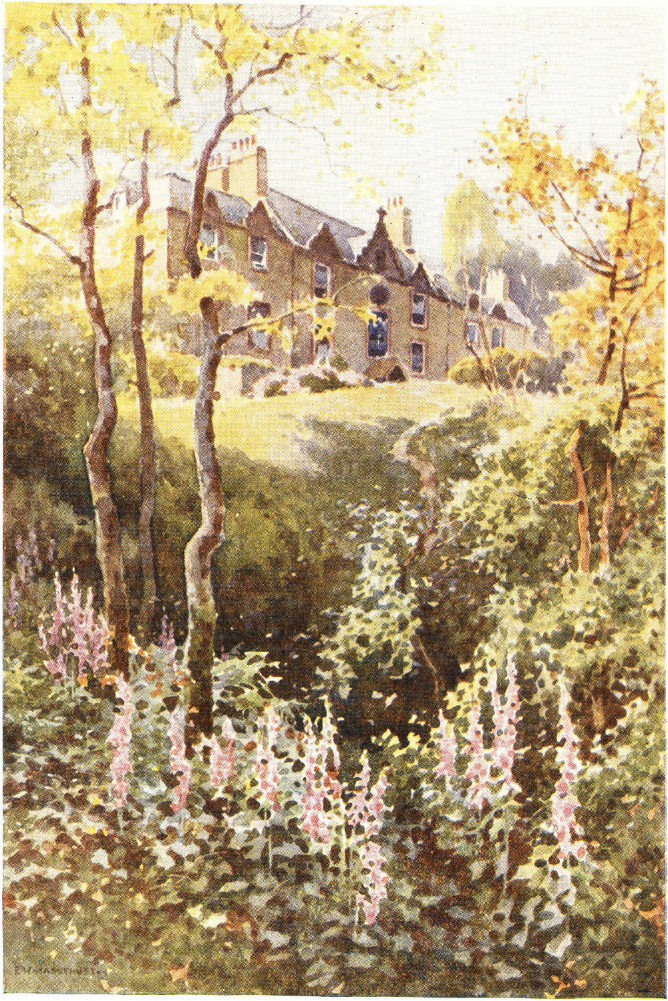
ASHESTIEL: SCOTT’S FIRST HOUSE IN THE BORDER COUNTRY
55
In 1804, Scott found it convenient to take a lease of
Ashestiel; and that leafy cover became his home for
the next seven years. It is within a couple of miles of
Clovenfords and Caddonfoot. Under Caddonlee, where
William the Lion waited with his bands from the
Highlands and the Lothians, until he was joined by the
Forest men on his ill-fated invasion of England, Tweed
is crossed by a single wide arch to where “Glenkinnen’s
56
rill” and glen open a short cut, oft traversed with the
“Yair boys”, to Yarrow. Near the Peel burn is a knoll
shaded by oak and birch—the “Shirra’s Knowe”—where
part of Marmion is said to have been written.
The house, much changed since Scott’s day, turns its
front and two extended wings away from the Tweed;
but its most attractive aspect is perhaps that towards
the river. The little stream, that with its hoarse roaring
in spate used to keep the great author, then just
blossoming into fame, from his sleep, still tumbles
through the garden. His armchair, which came back
from Abbotsford after his death, and the window through
which his favourite dogs sprang in or out at his call,
are still shown. In these Ashestiel years he saw the
last volume of the Minstrelsy through the press, published
the Lay, completed Marmion and The Lady
of the Lake, edited Dryden, and began but laid aside
Waverley. His legal work was not absorbing, and he
had time, aside from literature, for following the hounds,
“burning the water”, making raids into the Forest, and
holding convivial meetings with his friends. They
were perhaps the happiest, if not the most brilliant,
years of his life.
At Elibank, a couple of miles above Ashestiel, we
leave Selkirkshire and enter Peeblesshire. The bare
grey walls of the old castle of Gideon Murray, of the
Black Barony branch of the name, a lord of Session and
57
trusted Councillor of James VI, stands well above the
tree-line, against the background of the hills, and
commands a wide view of Upper and Lower Tweeddale.
History, in this region, arranges itself in strata, with
the oldest at the top—by the river margin are road and
rail, farms with their fertile haughs, and the houses and
tweed-mills of Walkerburn and Innerleithen; fragments
of peels and bastiles of the fighting times when
Thornielee and Holylee were onsteads of the monks
or of the king’s forest vassals, are perched on the
ridges, or hide in the folds or “hopes” of the hills,
on whose summits are found the forts and cairns of a
still earlier day. The outposts of the Moorfoots come
to the left bank of the river, and behind them are the
broad shoulders of Windlestraelaw; while over against
them are steep outliers of Minchmoor—Elibank, Bold
and Plora Laws. “Juden” Murray’s tower is of feudal
date and aspect. Scott tells the story of how Young
Harden, son of Auld Watt and the “Flower of Yarrow”,
and presumably a personable young man, was captured
by the owner of the tower and was about to be hanged,
when the more politic lady pointed out that she had three
ill-favoured daughters to dispose of, and the prisoner was
happily married to the youngest and plainest, “Mucklemou’d
Meg”. An injudicial proceeding; but not more so
than the transaction by which Murray’s neighbour, Lord
Traquair, had the President of the Court of Session
58
carried off from Leith Links, by a Border freebooter,
Christie’s Will, and kept in a dungeon of Hermitage
Castle, until a case was decided in Traquair’s favour.
Doubt has been thrown on both stories, and in particular
it has been objected that Gideon Murray, whose
descendants, the Lords Elibank of to-day, are established
at Darn Hall on Eddleston Water, had only one
daughter, that her name was Agnes, and that, although
she married Young Harden, the alliance was with full
consent of all parties concerned.
Lee Pen and Kirnie Law stand sentinels at the
entrance of Leithen Water, up which the houses of
Innerleithen straggle for a mile or more, along a road
which runs across into Lothian, by the Piper’s Grave,
the Heriot Water, and Carcant. It is a way by which
Walter Scott, walking or driving, has often reached
Tweedside, and he would note in passing Leithen
Hopes, where his friend Hogg was once a herd laddie,
and on the lower slope of the Pen, south of Lee Tower
and above the village, the beginnings of the new “Spa”.
The topographical resemblances of “St. Ronan’s” to
Innerleithen are not very close; and Sir Bingo Binks,
Lady Penelope Penfeather, Dr. Quackleben, and other
types in Scott’s solitary attempt at a satiric portrayal of
the social manners and humours of his own day, are not
of local growth. One looks in vain, also, for a “Cleikum
Inn” nearer than Peebles. Yet the spirit of Meg Dods
59
pervades the place, the inhabitants of which eagerly
accepted the identification and “recognized some of the
characters as genuine portraits”. They have even
adopted the device, on the inn-sign, of “St. Ronan and
the Devil” as the burgh arms.
Geologists—who, “knappin the chucky stanes to
pieces wi’ hammers”, reminded Meg of “sae many
stane masons run daft”—still frequent the locality, along
with anglers and tourists; for at Thornilee, as well as
across Tweed at Grieston and the Glen, are celebrated
beds of fossiliferous rocks. The bridge is not far above
the pool—the “Droon-pouch”—from which the body
of the young son of King Malcolm the Maiden was
drawn by the Innerleithen people, in gratitude for which
its church was made a “Sanctuary” with privileges
equal to those of Stow and of Tyninghame. On the
farther side is the entrance to the valley of the Quair,
and the woods surrounding the venerable form of
Traquair House. Its claim to be “the oldest inhabited
house in Scotland” applies specifically to its western
wing, which is said to date back fully nine centuries.
However this may be, the antique character of Traquair
is written on its outward features as well as inscribed
in its record. It passed through the hands of a succession
of royal favourites, of whom the last was James
III’s musician and “familiar shield-bearer”, Rogers,
who was among those hung over Lauder Bridge by
60
the jealous nobles, before it came into the possession
of a branch of the Stewart Earls of Buchan. The
Traquair Stewarts have been of mixed reputation; but
the tradition of loyalty to the cause of their Royal kin
now clings to the house and is symbolized in the great
Bear Gateway—the prototype of that of the “Barons
of Bradwardine” in Waverley—which is not to be
opened until a Stewart King comes again this way.
Like the house itself, all its surroundings breathe of
the poetry and romance of the past. For was it not
behind Plora Craig that “Bonnie Kilmeny gaed up the
glen”? Are there not some scrogs of birch left by the
waterside of the much besung “Bush aboon Traquair”?
Were not the dwelling of Willie Laidlaw, and the scene
of “Lucy’s Flitting” in the upper valley, in which
stands the lordly mansion of Lord Glenconner—“The
Glen” par excellence? And above all, is it not by the
road along the Quair that one “turns aside to Yarrow”?
In the nine miles between Innerleithen and Peebles
the full current of Tweed winds through a country brimfull
of beauty and story. Whether the road followed upstream
be that on the right or that on the left bank, one
passes the ruins of ancient strongholds and modern
country-seats, set among trees and lawns—on the south
side, after Traquair, Cardrona, Kailzie, Haystoun, and
Kingsmeadows, and on the north Glenormiston, the two
Horsburghs, and Kerfield—and, behind these, high hills
61
of grass and heather, Lee Pen, Dunslair and the
Makeness Kips, over against the Glenrath Heights
and the Dun Rig, from which on a clear day can be seen,
it is said, the Calton Hill in Edinburgh and the Isle of
May. The little country-town of Peebles is in a level
space where Eddleston Water, side by side with rail
and highway, meets Tweed; and from time immemorial
it has been a resort of royalty, a place for pastime and
relaxation—“Peebles for pleesure!”—and, in a modest
way, for trade. It had a reputation for sanctity, also, in
witness whereof there are the remains of the two
mediæval churches—those of St. Andrew and of the
Haly Rude. The house of the Archdean of Glasgow
is represented by the Lodging, in the High Street, of the
Dukes of Queensberry, now become a public library,
whose name, the Chambers Institute, recalls the fact
that the founders of the publishing house of Chambers
were born in a humble cottage in one of the cross streets.
Peebles has outgrown the limits marked by the fragment
of the town wall, and has spread northwards to
the foot of the hills, where on Venlaw—part of its
lost patrimony—it has public walks and a “Hydro”;
while it has crossed, by the handsome stone bridge,
to the southern bank of Tweed; whence a branch
railway follows the course of the river to Broughton,
on the way to Clydesdale.
A mile out of the town, to the west, is Neidpath
62
Castle, the most commandingly and romantically
situated, and, in spite of the yawning gaps made in its
walls by Cromwell’s cannon, the best-preserved—Traquair
excepted—of the strongholds of the olden time on
Tweed. The river is here constricted by the bare
cairn-strewn ridge of Caidmuir—once Peebles Common—on
the south, and by the Edston heights on the Neidpath
side, and has cut a deep ravine through which
has drained the great lake that once filled upper
Tweeddale. The water swirls around rock and boulder
below the castle base; and the screen of trees, whose
destruction by that “degenerate Douglas”, Old Q.,
provoked Wordsworth’s indignant sonnet, has been
partially restored. Access to the lofty thick walled
double tower, still partly occupied, is by a gateway and
courtyard; and over this outer portal are the arms of the
early owners—the strawberries of the Frasers of Oliver
Castle, from whom are descended the Frasers of the
North; and the goat’s head of the Hays of Yester, who
here entertained James VI, defied the Commonwealth,
and were created Lords of Tweeddale. Afterwards the
castle and lands came into the possession of the
Douglases of Queensberry, and they now belong to the
Earl of Wemyss and March. From the window, now
built up, over the arch, as has been sung by Scott and by
Campbell, the dying “Maid of Neidpath” looked forth
to watch the return of her undiscerning lover. Still
discoverable is the casement in the Justice Room of
the tower, out of which wrong-doers were hung after
summary trial.
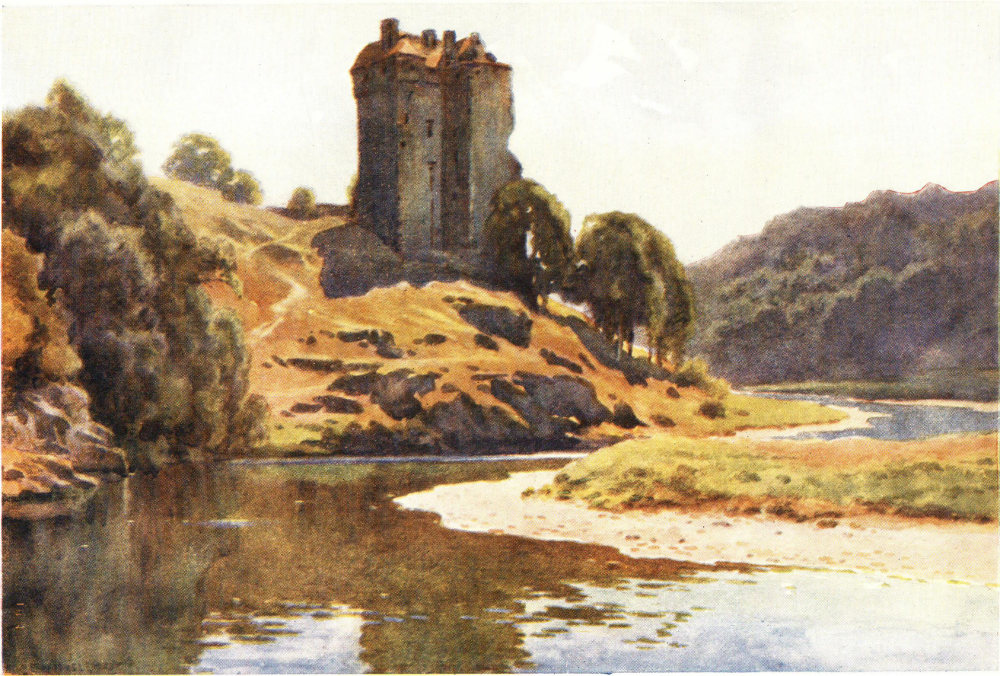
NEIDPATH CASTLE
63
As Pennecuik sang two centuries ago:
“The noble Neidpath Peebles overlooks
With its fair bridge and Tweed’s meandering crooks”.
But it overlooks much else; and a short distance above
it there open up, to right and left, the subsidiary vales
of the Lyne and the Manor. The former comes from
the “Cauldstaneslap”, in the heart of the Pentlands, and
passing on its way, at the meeting with the Tarth,
Drochil Castle—built as a retreat by the Regent Morton,
who was shortened by a head with a guillotine of his
own contriving before he had time to complete his
work—enters Tweed below the remains of the great
Roman Camp of Lyne. The Manor Water draws its
springs from the neighbourhood of Yarrow. Once it
was defended by eight strong peels, only one of which,
Barns—where Mr. John Buchan has laid the scene of his
“John Burnet of Barns”—stands erect. Posso Craigs,
where the Stewart Kings bred their falcons, and the
sites of St. Gordian’s Kirk and Cross and of “Macbeth’s
Castle” can be pointed out. But Manor’s chief memorials
are the grave and the cottage of David Ritchie,
the prototype of the “Black Dwarf”, the “recluse of
Meiklestane Moor”. Scott, as a young visitor to
Manor with Adam Ferguson, received an impression
64
which never left him when the deformed and eccentric
being, who built his own hut with its doorway three feet
high, took him into its arcana, and locking the door and
seizing his hand, asked him earnestly: “Hae ye the
pooer?”—the power of divination!
The “Thieves’ Road”, by which the Border reivers
made their way into Lothian, strikes athwart the hills
enclosing the valleys of Manor and Lyne, descending
to the Tweed from the slopes of the Scrape to the
woods of Dawick. Veitches were succeeded in this
sheltered place by Naesmiths, whose fortunes were built
up by an indefatigable seventeenth century lawyer known
as “the Deil o’ Dawick”. It boasts possession of the
oldest larches in Scotland, brought hither on the suggestion
of Linnæus, though the honour is disputed by
Kailzie lower down Tweed. Across the river is another
fine wooded domain—Stobo—whose ancient church preserves
a Norman doorway, a saddle-back tower, and a
“jougs”; while, from the hills behind, this level strath
seems to be menaced by the fragments of Tinnis Castle,
set, like a robber tower on the Rhine, on the summit of
an almost inaccessible rocky spur. It is believed to have
been the original hold of the Tweedies of Drummelzier,
a race whose fabled descent was from a Tweed water-nymph,
and whose conduct towards their neighbours, the
Veitches of Dawick and the Geddeses of Rachan, sadly
belied the motto on their tomb at Drummelzier Church—“Thole
65
and Think”. Hard by that edifice at the meeting
of the Powsail and the Tweed, and not far from the
ruined castle of the Hays of Drummelzier, is another
grave of which tradition has much to say—that of
“Merlin the Wild”, who prophesied on the spot the
Union of the Kingdoms.
Beyond Drummelzier and Broughton, an estate and
parish which in the eighteenth century belonged to two
historical personages of dubious repute—“Secretary
Murray” of the ’45 and M‘Queen of Braxfield, Stevenson’s
“Lord Justice Clerk”—the Tweed is found to
have dwindled almost to the dimensions of a moorland
burn, enclosed among smooth brown “hills of sheep”.
Smaller streams pour down in headlong course on
either hand; and there are not wanting places of
historic and literary note by the river banks and in the
tributary valleys. Every burn and haugh has its story
of old feuds, in which Frasers and Tweedies, Hunters
and Murrays, Scotts and Hays, and other clans of
Upper Clydesdale have had a part; and “forts” and
“rings” and “chesters” are plentifully sprinkled on
the hill-tops. They are especially rife on the heights
looking down on the Holms water, which comes from
the grassy and heathery folds of Culter Fell and Cardon,
and, after joining the Broughton burn, falls into the
Tweed below Rachan. For in this neighbourhood, by
the “Pass of Corscrine”, ran for a time the frontiers of
66
the Kingdom, as fixed between Edward I and Edward
Baliol. Like many other old families of the district,
the Geddeses of Rachan, “chiefs of the name”, passed
out of the Upper Tweed in poverty and litigation. The
like fate, or worse, befell the Murrays of Stanhope,
whose representative, after the laird who lost his head
in the ’45, was the “Judas” of the Rebellion, for whom
Scott’s father showed his contempt, by flinging out of
the window the cup from which his caller had partaken
of tea in George Square. The fact that they claimed
to have received their lands, “for a Bow and a Broad
Arrow, when the King comes to hunt in Yarrow”, from
Malcolm Canmore did not prevent the Hunters from
parting with the estate of Polmood, after one of the
longest lawsuits in the annals of even the Scots law.
Stanhope and Polmood have streams tumbling down
to Tweed from the heights of Dollar Law and Broad
Law, 2800 feet above sea-level; and on the opposite, or
right bank, above the fragment of Wrae Castle, which
once belonged to the Tweedies, is the site of “Lincumdoddie”,
where dwelt “Willie Wastle’s wife”,
whose face, according to Burns’s song, “wad fyle the
Logan Water”, which runs by it. Beyond the Kinkledoors
burn is the “Crook Inn”, beloved by the many
anglers who have sought sport and recreation in this
solitude among the hills, where, besides Tweed itself,
there are many wild side streams—Hearthstane, Menzion,
67
Fruid, and Fingland; Glencraigie, Glenbreck, and
Glencor—frequented by brown and yellow trout. But,
chief of all, there is the Talla, which, from its springs in
lonely Gameshope, rushes down the rocks at Talla
Linnfoot, and rests in the two-mile-long reservoir of the
Edinburgh Water Company, before joining the Tweed
at Tweedsmuir Church, nearly opposite the scant
remains of Oliver Castle, where the Frasers first
planted themselves on Tweedside.
The Frasers had fled the scene long before the
Hunters and the Hays, the Geddeses and the Tweedies,
and other families have succeeded and followed them in
their flight. Few, and set far apart, are houses and
“bields” of any kind, on the lonely road that keeps
high up the hillside above the valley floor, until, at
“Tweed’s Well”, passing over into Annandale, it parts
company with the “Scott Country”.