| PAGE | Counties, viz. |
| | |
| INTRODUCTION | 1 | Antrim. |
| Antiquities | 8 | Armagh. |
| Druidical Monuments | 9 | Carlow. |
| Cromlechs | ib. | Cavan. |
| Cairns | 10 | Clare. |
| Ogham Inscriptions | ib. | Cork. |
| Ancient Temples | ib. | Donnegal. |
| Caves | 11 | Down. |
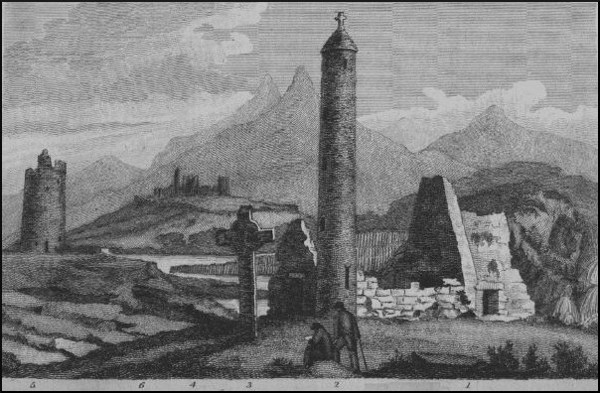
| Round Towers | ib. | Dublin. |
| Raths | 14 | Eastmeath. |
| Religious Antiquities | 16 | Fermanagh. |
Churches, Cells,
Hermitages,
and Crosses |
ib. | Galway. |
| Kerry. |
| Castles | 18 | Kildare. |
| Mineralogy | 19 | Kilkenny. |
| Moss Earth | 20 | King's County. |
| Basaltes | 21 | Leitrim. |
| Granite | ib. | Limerick. |
| Temperature | 22 | Londonderry. |
| Travelling | 23 | Longford. |
Topographical Division
into Provinces,
Baronies, Parishes,
and Acres |
25 | Louth. |
| Mayo. |
| Meath; see Eastmeath. |
Ecclesiastical Division;
Dioceses,
Parishes,
and Churches |
27 | Monaghan. |
| Queen's County. |
| Roscommon. |
| Legal Division | 28 | Sligo. |
Comparative Height of
Mountains |
30 | Tipperary. |
| Tyrone. |
List of Round Towers, with
their Measurements |
31 | Waterford. |
| Westmeath. |
| Glossary | 34 | Wexford. |
Value of English and Irish
Currency |
35 | Wicklow. |
| ———— |
Description of
Frontispiece
and Direction
for Plates |
36 | Iters by various Persons. |
| Routes of Mail Coaches. |
| Index. |
THIS HUMBLE ATTEMPT TO FACILITATE AND FAMILIARIZE
A JUST KNOWLEDGE OF THE VALUE AND BEAUTIES OF
THE KINGDOM OF IRELAND
HAVING BEEN MOST RESPECTFULLY PRESENTED,
IS NOW ON ITS PUBLICATION
WITH PERMISSION
INSCRIBED AND DEDICATED,
WITH
EVERY POSSIBLE SENSE OF THE OBLIGATION AND CONDESCENSION,
TO HIS IMPERIAL HIGHNESS
THE GRAND DUKE MICHAEL OF RUSSIA:
WHOSE VISIT TO THIS INTERESTING ISLAND
AND IMPORTANT ARM OF THE BRITISH EMPIRE
HAS CONFERRED AN HONOUR
WHICH CAN NEVER BE ERASED FROM THE RECOLLECTION OF
THE IRISH NATION.
August 31, 1818.
INTRODUCTION.
This interesting country becoming every day more and
more the subject of inquiry and personal investigation, an
Hibernian Tourist's Guide consequently forms a necessary
adjunct to our original plan. In prosecuting this
design, our object is, by method and selection, to enable
even the casual six-weeks visitant to explore readily the
most important and curious specimens of nature and art,
and that without subjecting him to those travelling inconveniences
which it has been too much the fashion to complain
of. Whilst travelling, at all times and in all countries,
the tourist must learn to suffer petty vexations, privations,
and delays; but a very amusing ramble may be executed
in Ireland, without more of these than the usual share.
The MEANS OF CONVEYANCE are now varied, extensive,
rapid, and generally convenient; not only from the capital
in all directions, but also by means of provincial coaches
diverging from all the principal points; whilst good roads
and improving inns give facility and comfort to those who
travel with their own horses and carriages. In some places
also, the INLAND NAVIGATION affords a change of scenery
and of general amusement to the independent traveller.
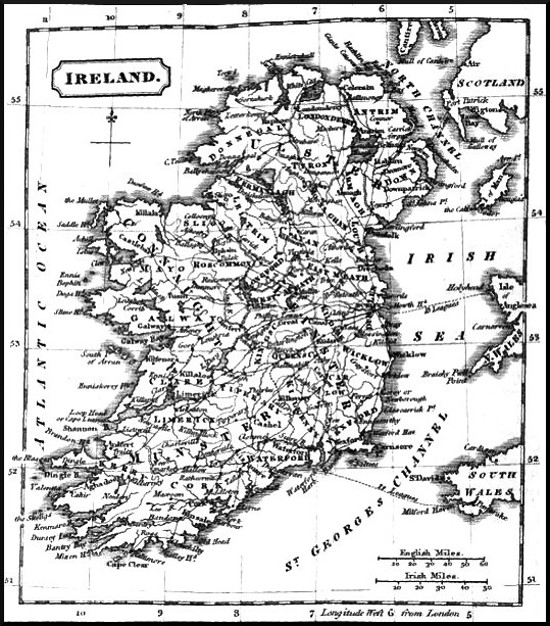
Ireland, being only about 300 miles in length, and
200 in breadth, containing 30,370 sq. m.[1], does not require
a long period to traverse its most important routes. Its Climate
is good, with a mean temperature from 48 to 52; its
face mostly level, but with extensive ranges of mountainous
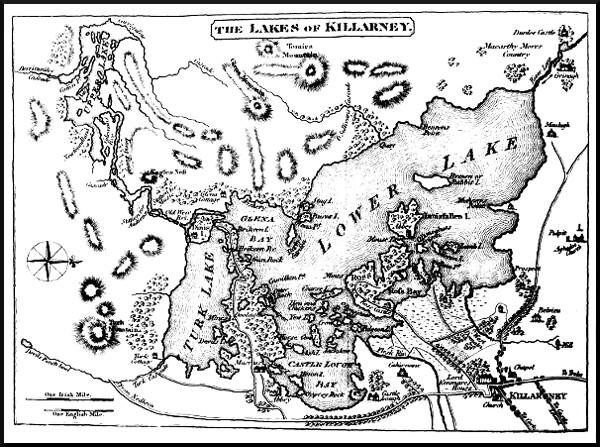
tracts and rocky soil. It contains romantic Lakes, both
fresh and salt, viz. Neagh, Erne, Killarney, Swilly, Foyle,
Corrib, &c. &c.; also many majestic Rivers, Shannon,
Liffy, Boyne, Blackwater, Suir, Barrow, Lagan, &c. Its
Mountainous Tracts are principally in Donnegal and Tyrone
in the north, with part of Antrim; also the Mourne
Mountains in Down; the mountains of Wicklow; in
Kerry, and the s.w.; together with the extensive ranges
to the west of the Shannon. The Bogs are extensive, occupying
many of the mountains, indeed often undulating in hill
and dale, particularly in Donnegal; whilst both they and the
dry heaths are covered with wild myrtles, sedgy grass,
rushes, saggons, or iris, orchis, wild rockets, &c. Of its
Forests few remain, being now sunk under the turf-bogs
or peat mosses; yet of minor Botany there is a great field
for examination in the Ericæ, numerous alpine plants, and
wild flowers on the heaths, bogs, and rocky fastnesses. Its
Mineralogy is very varied, from the gold mines of Wicklow,
down to the silver mines of the same county, those of copper
at Cronbane, with marble, coal, slate; whilst its Mineral
Springs, vitriolic, alkaline, saline, sulphureous, &c. offer
frequent opportunities of analysis to the man of science.
The importance of any plan which will tempt Englishmen
of fortune, especially the members of the legislative
body, to visit Ireland, cannot be more clearly expressed than
in Mr. Wakefield's introduction to his work on that country,
where he observes, that a knowledge of the natural
situation, of the political institutions, and of the local advantages
even of a foreign nation, form an object of considerable
magnitude, and must to an inquiring and enlightened
mind be a source of no small gratification; but to become
acquainted with these relations, as they respect the
great divisions of the empire of which we are ourselves
subjects, is of much greater importance.
It is impossible to tread the green sod of Erin, without
a considerable portion of antiquarian enthusiasm,—at least
not to traverse her wilds, without a portion of that spirit,
even though we may be tempted to deny that extreme
antiquity of record drawn from the earliest periods, and
claimed by the Old Irish in the indulgence of their national
vanity. But the true enthusiast requires not always absolute
historical proof to justify his feelings; and it is well
that he does not; for then many of his aërial pictures must
fade from existence; and the sober truth certainly is, as the
elaborate Leland has expressed himself, that it cannot
be denied that no literary monuments, to confirm tradition,
have yet been discovered in Ireland earlier than the introduction
of Christianity into that country; and that the evidence
of any transactions previous to that period, rests entirely
on the credit of Christian writers, and their collections
from old poets, or their transcripts of records deemed to
have been made in times of paganism. It seems indeed,
as he adds, unreasonable to expect that any other domestic
evidence of Irish antiquity should subsist at this day; but
from these the antiquary forms a regular history of a long
succession of kings and of romantic events from the earlier
ages of the world. Still do these details impart considerable
interest to the scenes where they are supposed to have
been acted; and from the poetical annals that furnish the
catalogue of monarchs, we have a lively picture of manners,
most certainly of great antiquity, however low we reduce
the scale of chronology, and highly worthy of attention,
even though we smile at the tales connected with them,
with a most profuse intermixture of giants, necromancers,
obscure allegories, and extravagant fables. In those annals,
we have an animated picture of a brave people, driven
from their native land in search of new settlements, establishing
themselves by their valour in a fair and fertile
island; the chieftains parcelling out lands to their attendants,
and the whole collection of adventurers, from the moment
of their peaceful establishment, devising means to
give stability to their acquisitions. As a bond of unity to
the whole, they elect a monarch; but preserve their own
individual sovereignty in their domains, forming a complete
feudal system, and filling the land with little courts where
politeness and chivalry, attended by poetry and romance,
went hand in hand. Such is the sketch which arises from
Leland's masterly delineation; who adds, that in this state
of things a robust frame of body, a vehemence of passion,
an elevated imagination, were the characteristics of the
people; whilst noble instances of valour, generous effusions
of benevolence, ardent resentments, desperate and vindictive
outrages, abound in their annals. From hence too it
is that scarcely a romantic dell or simple green knoll exists
without its traditionary tale; sometimes stained with blood,
but as often enlivened by love—for to verse and music they
were particularly addicted. Hence arose that peculiar turn
of character by which those who are possessed of any superior
degree of knowledge, they who operate on their
fancies and passions by the liveliest strains of poetry, have
long been held in extraordinary veneration; and hence,
even at the present day, the ministers of their religion are
accounted more than human. The effects of those early
events may indeed still be traced by the modern tourist;
and even the historian of cotemporary transactions is obliged
to coincide with the elegant Littleton when he observes,
that the songs of the bard had usually more power
to incite and inflame, than the music of the harp to soften
or mitigate the ferocity of the chief; so that even this recreation,
which seems to indicate something gentle and approaching
to politeness in the temper of the Irish, contributed
to keep up that turbulent spirit, averse to order and
peace, which no prince or legislator that their country ever
produced, had sufficient skill to control. But still, from
the remnants of these ancient customs will the modern
tourist derive considerable advantages, and from none more
than their proverbial hospitality, if he himself has sense
enough to keep it within bounds of propriety. Of this hospitality
much arises from the natural temper of the people;
much from the natural curiosity connected with the arrival
of a stranger in a district where intercourse is unfrequent;
and some portion perhaps derivable from ancient custom;
for, as Leland observes, hospitality was not only a principal
virtue amongst these rude people, but was even enjoined
by law; and as neither lords nor tenants were bound to
each other, as the whole tribe might migrate to some more
favourable district, the ancient Brehon laws expressly stipulate
that no rath shall break up suddenly, lest the traveller
should be disappointed of his expected reception.
But neither the duties to be received by the lord, nor the
entertainment he was to expect from his inferiors, were
determined by his arbitrary will and pleasure. They
were proportioned to the benefits received from him—nay,
even the lowest of the people claimed reception and refreshment
by an almost perfect right; and so ineffectual is
the flux of many centuries to efface the ancient manners of
a people, that at this day the wandering beggar enters the
house of a farmer or gentleman with as much ease and
freedom as an inmate. From this strict adherence to old
customs, it arose that even on the introduction of Christianity,
many of the Pagan and Druidical ceremonies of religion,
interwoven with secular ordinances, were preserved
throughout the island. Indeed, as the author already quoted
very justly affirms, the first Christian missionaries seem to
have industriously avoided all unnecessary violence to the
ancient manners of their converts; favouring and protecting
their poets; avoiding all persecution towards the remains
of the Druidical order; and even whilst thundering
the divine vengeance against the worshippers of the sun,
moon, stars, and wind, yet exercising indulgence towards
many remains of Pagan superstition. In consequence of
this, the inquisitive tourist will find many vestiges of those
superstitions even in the most enlightened parts of the
kingdom, where their origin is unknown or forgotten; and
they are complied with in conformity to general custom, or
prompted by the association of early ideas and prejudices.
Of these the most conspicuous are the fires still lighted up
at particular times, remnants of the worship of Baal or
Apollo; the collecting oaken sprigs in May, a Druidical
rite; and many others, which cannot fail to interest the observer.
As the inquisitive traveller will doubtless make statistical
observations in his progress through the country, the following
quotation from Mr. Wakefield's multifarious and
very intelligent work may form the basis of a series of reasoning
highly deserving the attention of the politician.
Speaking of the county of Louth, vol. 2. p. 616, he says—"This
county has two large towns, one of which, Drogheda,
is of considerable extent, but its inhabitants are remarkably
poor. To those who have compared this place
with Belfast, where the population is nearly the same, the
difference must be very striking; and nothing can more
clearly evince the superior condition of the Protestants
over that of the Catholics, there being as many Protestants
in Belfast as there are Catholics in Drogheda. The humbler
classes of the Protestants are ashamed to be seen dirty,
or with bad clothes; but, being so much outnumbered,
they in consequence find very little society amongst persons
of their own faith, and have a stronger propensity to
emigrate."—This pictorial contrast of two towns is, in fact,
but a picture of the whole island. Let the tourist then
examine the Protestant and Catholic districts with
impartiality—let him closely examine from what it is that the
Catholics require to be emancipated! We do not anticipate—we
are of no party; but the inquiry is of consequence
and deserves attention, especially at a moment when the
question of Emancipation is likely again to become a subject
of parliamentary and public discussion.
To do justice to that subject requires facts, and not mere
abstract reasoning. It cannot be the wish of any liberal
Protestant to retain the Roman Catholics under undue subjection;
but liberality has its bounds; and though a misplaced
philanthropy may render us careless respecting our
own individual rights, yet it must be remembered that it
cannot justify us in yielding up the rights and the security
of others. As far as Catholic Emancipation, as it is called,
is consistent with Protestant Security, so far it is not only
right but just and prudent to concede; but before Protestant
Ascendancy is given up, let us be certain, from an accurate
investigation of facts, that Protestant Security will remain
inviolate. Let us examine the history of past times;
and also examine mankind at the present day, with a strict
reference to it. This cannot be done in a closet or editorial
apartment in the metropolis; he who would investigate
surely, and therefore safely, must visit the spot where, and
the people by whom, these claims are made.
Again, we say, that it is not our wish to anticipate; but
facts may be recorded. If the tourist ascertains that the
Roman Catholic districts of Ireland are in greater penury
than those where Protestantism predominates, he will not
attribute that in the first instance to Protestant ascendancy,
until he has examined the facts before his eyes. He will
see that industry is the great agent in the one case; the
want of it, the great and immediate agent in the other.
Here then is a point for him from whence to start in his
moral investigations; and he will at once observe, that in
the Protestant districts six days in each week are dedicated
to labour, and the sabbath dedicated to the offices of religion;
whilst in other districts half the week is passed in
the idleness or dissipation of holidays, and the sabbath
neglected. It is true that in the breasts of the Irish Catholics
he will find a strong sense of religion, agreeable to
their modes of faith and ceremony; but he will also find
that those modes of faith and ceremony are subversive of
the spirit of industry, whose stream to be generally useful
must not be dammed up at particular points, and suffered
to run waste at others. But let not the writer of these
sheets be misunderstood. Though fully impressed with
the truth and justice of the foregoing observations, it is far
from his wish to throw any obstacles in the way of the Catholic
Faith. That Faith is free and unshackled, as far as
regards God and man; if political restrictions still exist,
they exist upon an impression that to do them away must
be injurious to Protestantism. To adduce the reasons for
that impression would be beyond our limits, and beyond
our plan; but until that impression is proved to be groundless,
unlimited concession must be withheld. The true
and liberal philanthropist will also inquire whether, under
the peculiar circumstances of their religion, the great body
of the Irish Catholics would absolutely be benefited by an
accordance with the claims set up. Until that be ascertained,
he will pause; and though he may deprecate any
thing like coercion, he will still be careful to avoid any
thing like encouragement, until he is convinced that its results
will at least be harmless.
To form an accurate judgement on these points demands
an Irish tour. The conviction on his own mind which the
editor has here hazarded, without any wish to prejudge the
case in the minds of others, is not formed on slight grounds.
An early acquaintance with that island, and subsequent
rambles over most parts of it, joined to actual observation
in many parts of Europe, and indeed in the four quarters
of the globe, have convinced him that wherever Protestantism
exists, with some very few exceptions, there are to
be found cleanliness, comfort, and industry:—the reverse
of the picture, though he would be supported in it by the
unanimous assent of many continental travellers, he will
not attempt to draw. Let him who doubts, and who
chooses to make the Irish tour, examine these hints, and
compare them with actual observation. It is true wisdom
to learn from experience and observation—it is true candour
to acknowledge error when facts judiciously examined
and liberally contrasted lead to truth; and the editor's wish
will be fully answered, if these expressed opinions, whether
right or wrong, shall prompt the minds of his readers to
that judicious and liberal examination. In either case the
result must be beneficial to the empire; and the notice
here taken of the very interesting subject, it is hoped, will
neither be considered illiberal or misplaced. But it is now
time to enter into details of the more prominent objects of
curiosity to the tourist; and it must be acknowledged,
with respect to our sister island, that, in taking a general
view of its
we have not the same facility of correct chronological specification,
as in our general introduction to this work; for
the antiquarian disputes, still unsettled, claim different
dates for many of the most interesting objects. We may
however premise, that the order in which the island has
been peopled and colonized is generally agreed upon to
commence with the Celtes, Scythi, and Firbolgs; then
the Phœnicians and Milesians in the south; the Romans,
perhaps in a small degree; the Scots in the north;
the Danes and Ostmen; the English invaders in the
time of Henry II., followed by the Scottish and English
colonists of James I., and during the civil wars.
It has even been supposed that the diversities of natural
character, at the present day, in some measure illustrate
the generally received chronological and topographical arrangement.
Ledwich in his introduction to Grose's Antiquities,
considers the Celtes as the primeval possessors of
the country;—all under the system of Druidism, living a
sylvan life, and worshipping the Deity in oaken groves,
wherefore few memorials of them are left. In the north
are to be traced, from the earliest ages, the Scoti; in the
south, the Firbolgs, then the Milesians, and also the
Phœnicians about two centuries before Christ; there
also, according to Ptolemy, were the Menapii and Brigantes;
and the Rhobogdii, Darni, &c. in the north, of
a later date than the first Scoti, or Indo-Scythi, agreeable
to Vallancey's theory. From these and other local circumstances
connected with Ireland, there are few antiquities
of very ancient date, with the exception of rude memorials,
because nothing but wood was used in building until the
11th or 12th century; for until then, stone was only employed
in funeral monuments, or Cairns, in Cromlechs, and
sometimes in the Barrows, Raths, and Danish forts; also
in the Round Towers, if their antiquity is so great as some
writers suppose. Of the antiquities of modern date, the
greatest number consist of Castles, Churches, and Monasteries,
principally to be found within the limits of the ancient
English Pale. This is evident from what Sir John
Davis asserts—"Yet, which is strange to be related, they
did never build any houses of brick or stone, some few poor
religious houses excepted, before the reign of Henry II."
Of the earlier English antiquities, those consist of Cathedrals,
Churches, and Castles; some few Saxon, (at
Kilcullen, Co. Kildare, and Disert, Co. Clare,) some Norman,
but principally of later date.
DRUIDICAL MONUMENTS
are very numerous, particularly in some parts of the north.
Dr. Drummond, in the scientific notes to his interesting
poem on the Giant's Causeway, says that "numerous monuments
of the Druidical superstition are still to be seen
in the County of Antrim." The appearance of those agrees
with the description in Mallet's Northern Antiquities; and
also with the quotation from Wormius, copied by Ledwich,—"The
structure of our altars is various; but generally
a tumulus is formed, on whose summit three great
stones are erected, and on them a fourth broader and more
flat is laid, so that it exactly appears like a rude huge table
resting on three feet." We may add, in respect to
these
CROMLECHS,
That both in Ireland and in Scandinavia, their erection is
vulgarly ascribed to giants; an unerring mark, says Ledwich,
of their Gothic origin. Sir R. C. Hoare says that
the construction of stone temples and cromlechs has generally
been attributed to the Druids, but without any certainty
of proof. He also hazards the conjecture, and with
great plausibility, that a temple like Stonehenge once existed
on the Curragh of Kildare (See Tour in Ireland,
p. 274.) Coeval with Cromlechs—perhaps—but absolutely
so in the opinion of Ledwich, are the
CAIRNS,
Rude heaps of stones, composed partly also of earth, forming
immense conical heaps, and evidently sepulchral.
These are very numerous, and are generally erected on the
summits of hills; but, though some of them may be Druidical,
the greater part are of later date.
Sir R. C. Hoare considers the Irish Cairn or Carnedd
to be of the same origin as the Barrow or Tumulus in various
parts of England.
Under the period now treated of we may also enumerate
the sculptured stones bearing
OGHAM INSCRIPTIONS,
which Vallancey describes as ancient Irish, or Indo-Scythian
remains. These are found in many parts of the
island; one of the most curious of which is at Tory-hill,
Co. Kilkenny, inscribed to the God Belus or Baal. They
are very numerous in Co. Kerry. These and the ancient
Irish Letters have given rise to more controversy than any
other subject connected with Hibernian antiquities. In
Miss Plumptre's Tour, p. 327 et seq., the curious reader
will find much information, with good references to further
analysis. Of the remains of the Phœnician era, we may
perhaps specify the
ANCIENT TEMPLES,
one of which, the Ship Temple near Dundalk, is attributed
by Vallancey to that people, or else to the sea
rovers, Victi, or Picts, who paid divine honours to the form
of a ship; but Governor Pownal supposed it to be the work
of the Nani, a northern or Scandinavian nation.
That the Phœnicians or Carthaginians must have visited
Ireland, is supported by Miss Plumptre upon the ground
that amongst the relics of antiquity in possession of the
Dublin Society are several heads of axes which were dug
up in the south, corresponding exactly with some that have
been found in the plain of Cannæ and in Egypt, and which
are considered as Carthaginian. This, she adds, seems
strongly to corroborate the idea that the Carthaginians, the
most adventurous navigators of ancient days, actually
traded to Ireland.
Cotemporary with these are many of the
CAVES,
evidently artificial, which served as habitations to the rude
colonists. Many of these remain, in the north, on the
sides of hills almost inaccessible, and are vulgarly called
"Picts Caves" at the present day. Neat in chronological
order to those are the
ROUND TOWERS,
Conical erections, tall and slender, so frequently found adjoining
to, or nearly in contact with, the ancient churches.
Those antiquaries who give them a very recent date, suppose
them to be the work of native builders, whilst
the Castles and Churches are by English or French architects:
but Vallancey claims for them a very ancient date,
asserting that they were erected by the Phœnicians to contain
the sacred fire, and copied from the pyramidal stones
so frequent with that people and with the Druids. Ledwich,
however, merely considers them as common appendages
to the wooden churches; some at a distance of 8
feet, others 124; and one, at St. Kevins, actually joined to
it. This latter writer assumes that they are Ostmanic, or
Danish productions, "and from uninterrupted tradition,
probably to have been belfries from the beginning." Of
these about sixty-six remain. Except as to rotundity, every
architect seems to have followed his own fancy both in
height and in internal arrangement: the one at Antrim is
80 feet high, tapers about 18 feet from the top in form of a
sugar-loaf, where it is about 36 feet in girth, and 52 near
the base; some have their door 24 feet from the ground,
but in general not more than 10 or 12. The Tower at
Drumiskin is supposed to have been the highest in the
island, upwards of 130 feet, and nearly equalled by those at
Kildare and Kilkenny. That at Kilmacduagh in Galway is
110 feet, with the door 24 feet from the ground.
Much controversy has existed respecting the origin of
these round edifices. The first writer who mentions them
is Giraldus Cambrensis, who certainly calls them "Ecclesiastical
Towers;" and some writers go so far as to assert,
from the grammatical construction of the sentence in which
he describes them, that he saw the builders in the very act
of raising them, in 1185. This at least is certain, that they
were so early in existence; but Lynch, who wrote in 1662,
asserts that they were erected by the Danes, as early as
838; in which he is followed by Peter Walsh, also by Molyneux
in 1727, who ascribes them to the Ostmen or Danes,
but supposes them to be of later date than the Raths and
other earthen works, and erected solely as Bell Towers for
calling the people of large districts to join in religious ordinances.
But there are some circumstances which militate
against that opinion, whilst others seem to confirm it.
At the Giant's Ring in the County of Down, we have an
instance of a Round Tower on a spot manifestly of Druidical
superstition, without any Church in its vicinity; as if the
churches were built near to the Towers, instead of these
being built near to the churches, the early preachers of
Christianity choosing to erect their new religious edifices
on spots already consecrated in the eyes of the people. It
must be acknowledged, however, that when the Round
Tower at Downpatrick was pulled down in 1790, whilst
repairing the cathedral, its foundation being cleared away,
another foundation was discovered under it, and running
directly across the site of the tower, which appeared to be
a continuation of the church wall, and which, at some period
prior to the building of that tower, seemed to have extended
considerably beyond it. Further, that these towers,
sometimes at least, had a connexion with Christianity, is
evident from the fact of some of them being built upon
vaults belonging to the churches; and on more than one,
in the north of Ireland, may be traced the figure of the
cross. One instance of this may be seen on the keystone
of the door of the tower at Donoghmore. On the other
hand, in regard to the tower at Drumbo, it is evident that
at some former time, very strong fires have been burned
within that building, and the inside surface, towards the
bottom, has the appearance of vitrification. Indeed it is a
fact recorded in the Down Survey, p. 290, that the ground
floors of many towers have been opened, where the ashes
of burnt wood have been found, supposed by some antiquaries
to be the remains of the perpetual fire once kept burning
there in honour of the Sun. It is also recorded by
Pennant, in his View of Hindostan, that the Pagodas, in
the Circars, resembled the Round Towers, with tops
pointed or truncated, and ornamented with a round ball to
represent the Sun as an emblem of the deity of that temple.
The idea of their being Christian penitentiaries seems
at first sight to be whimsical; yet it is said that there are
manuscripts in existence which prove it with respect to
some of them. One of these manuscripts records the building
of a tower at Kinath, in Cork County, in the year
1015; whilst the tower at Ardmore in Waterford has evidently
been used as a belfry.
An idea is started in the Kilkenny Survey, p. 632, that
they are connected with pilgrimages; a pilgrimage being
called Turrish in Irish, as if in allusion to their Latin appellation
of Turris.
Of other facts connected with them, it may be recorded
that at Tulloher in Kilkenny, where the tower is only
8 feet from the church, yet that edifice is of limestone,
whilst the tower itself is of siliceous breccia.
That some of them are comparatively of recent erection
is evident from the fact that at Roscrea in Tipperary, the
tower has a pointed or Gothic arch, 38 feet from the
ground. Now the 12th century is generally allowed to be
the era of the introduction of the Gothic architecture into
this country; and from this a curious question arises. It
is moreover a curious fact, not hitherto noticed by any
writer upon this subject, that the isolated tower, probably
of Moorish origin, which stands on the neutral ground at
Gibraltar, bears a very striking resemblance, in all points,
to the Irish round towers in general. This tower has been
seen and examined by the editor, who was much struck by
the similarity at the time, and has since endeavoured to
procure all possible information upon the subject. It is
well known that Gibraltar was not inhabited by the Phœnicians,
Carthaginians, nor Romans, nor even by the Visigoths,
but was first taken possession of by the Saracens in
711; fourteen years after which the Moorish castle was
built, followed by other edifices, with the pointed Saracenic
arch, until the rock returned to the dominion of Spain in
1462. It may be added here, that the Irish towers have a
strong resemblance to the Oriental minarets, especially in
their supposed use as places for calling the people to worship.
Where there are so many and so discordant opinions
it is difficult to decide; but the tourist may avail himself of
these hints in his further researches.
Of the precise antiquity of the
RATHS,
or Danish Mounts, few doubts exist. These are circular
mounts of earth, from 40 to 150 feet in diameter at the
base, and conically diminishing towards the top. Common
tradition gives them to the Danes; and no doubt a great
proportion of them are not older than the occupation of the
northern and eastern coasts by the Ostmen. But some
must be of the earliest Scandinavian date; particularly the
Giant's Ring near Belfast, and the Rough Fort near Templepatrick,
which have Druidical remains incorporated with
them, and in their very centre. Besides, though the term
Danish is universally applied to these works, yet some of
them are also undoubtedly Norwegian, particularly one
near Fore in Westmeath, called the "Fort of Turgesius,"
positively described by Giraldus as the work of a Norwegian
chieftain, and raised for a castle, using the word
"Castella," and not Castrum.
Before quitting the subject of the Raths, it may be useful
to notice Ledwich's observations on that subject. Quoting
Giraldus, The Irish, says he, had no castles, their woods
served them for camps, and their marshes for ditches. It
was Turgesius and his Ostmen who formed that infinite
number of earthen forts and castles made of lime and
stone. It is then to those northern invaders that Giraldus
ascribes the high round earthen forts with deep ditches
and often triple entrenchments. This is certainly in opposition
to Mr. Harris, who argues for their Celtic origin,
reasoning principally on the name of rath being of Celtic
derivation. It has also been supposed that they may have
been introduced by the Belgic colonists, as the name has
some appearance of Teutonic origin. These raths are generally
upon elevated spots, and of various dimensions,
from 10 or 15 yards diameter, to an extent of 18 or 20 acres.
Some of them have subterraneous chambers, with sally-ports;
some are round, others square; the former supposed
by Spencer to be Danish, the latter Saxon. They
are sometimes called Motes, a Gothic word signifying the
place of meeting; and indeed it has been supposed that
many of them were intended rather for civil legislation, or
judicial purposes, than as works of military defence. These
Raths, together with the Duns, or inclosures upon insulated
rocks, and the Daingeans, or inclosures formed by
deep ditches with ramparts and pallisadoes, are supposed
by Ledwich to have been the only forts amongst the Irish
antecedent to the invasion by the Norman barons in the
reign of Henry II. In many parts of the island, the Irish
chiefs had an inveterate dislike to fixed fortifications—one
cogent reason why scarcely any castles exist except of
English erection; a fact well illustrated by an anecdote of
the famous De Courcy, who constructed two castles in Mac
Mahon's country, a step which awed the latter into complaisance;
and he having sworn fidelity, De Courcy bestowed
on him the two castles with their appendant lands.
But within a month Mac Mahon demolished both; and, on
being asked his reason for doing so, replied that "he did
not promise to hold stones but land; and that it was contrary
to his nature to live within cold walls whilst the
woods were so nigh."
It has often occurred to the writer of these sheets, from
actual observation of some hundreds of these mounds, that
the term "Rath," as generally applied, is often erroneous.
Wolff in his Dictionary positively states the word "Raad"
in the Danish language to signify a council; of course, by
a common figure of rhetoric, putting the thing for the
place, or the place for the thing, this term is properly applied
to the larger eminences, some of which are as extensive
as old Sarum, and therefore well adapted for assemblies
of the people. But Lloyd, in his Dictionary of the
Irish-English Language, considers the word even more figuratively,
saying that it means a village, a prince's seat, also
an artificial mount, or barrow. Now the fact is, that many
of the smaller mounts, where placed singly, may be, and
some of them by opening have been proved to be, Tumuli,
or sepulchral monuments; but others, placed in lines of
communication for miles together, for they are never found
in groups as upon Salisbury plain, were evidently for exploratory
purposes or chains of military posts, a most remarkable
instance of which may be seen on the road from
Belfast towards Templepatrick, where there is a line of
them within sight of each other for several miles, leading
through the valley of communication from Belfast Lough
towards Lough Neagh, between the Cave Hill and Carnmoney
mountain, and connected with the very curious
mount at the Rough Fort, which looks down upon a bog
called King's Moss at the foot of the Carrantoll mountains,
in the centre of which is a most extensive Rath, about 10
yards high, and at least 60 in diameter, with a raised bank
round its summit faced with rough stones towards the area.
Part of one side having been broken into, it seemed as if
the whole had been raised upon rough stone-work, the materials
for which must have been brought from a considerable
distance. These, both large and small, are sometimes
called moats; and some, of the largest size, are designated
by the appellation of Dun or Doon.
We now come to monuments of more recent date, of
which the
RELIGIOUS ANTIQUITIES
deserve the first consideration; and of these some
Churches may perhaps be as old as the 11th or 12th century,
and not earlier; for although many were built immediately
after the conversion by St. Patrick, about five centuries
after Christ, yet all these were simply of wood or
wattled, and therefore long extinct. Along with these we
may class the
Cells and Hermitages, rude and composed of upright
stones with an impost, where saints led an eremitic life,
perhaps sometimes adapting the older Druidical cromlechs
to their more modern purposes, just in the same manner as
several of the
Crosses are supposed by Ledwich to have been carved
upon the ancient upright pyramidal stones of pagan idolaters.
These Crosses have neither that light and taper
form nor elegant Gothic workmanship which distinguish
our ancient specimens in England; but though simple in
design they are yet rich in sculpture. Sir R. C. Hoare
thinks them coeval with the Round Towers, about the 9th
or 10th century.
This part of the subject must not be dismissed without
some notice of the stone-roofed Chapels of the ancient
Irish, which Ledwich considers as exhibiting, along with
other remains, some ideas of the Egyptian and Grecian
styles of architecture; in which opinion he is more than
sanctioned both by O'Halloran and Archdall, who claim an
early knowledge of architecture for the aboriginal Irish.
Mr. Ledwich, however considers these as the first specimens
of stone and mortar ever seen in the island; as raised
by the Ostmen, and intended solely for the preservation of
reliques. Several of these present themselves to the tourist
as objects of curiosity. One may be seen near the cathedral
of Killaloe, supposed to have been the depository
of the reliques of St. Flannan. The tourist in Ireland cannot
fail to be struck with the number of monastic remains,
of which the churches or chapels are mostly standing,
though unroofed and in ruins. These he will always find
surrounded by crowded cemeteries; and Sir R. C. Hoare
observes that he was informed the great frequency of the
fact proceeds from the consolidation of parishes at a period
when the Catholic predominated over the Protestant religion.
He adds, in direct opposition to modern assertions,
that the latter now begins to gain ground, as application
has been made for the restoration of many of those dilapidated
churches, and some have already been rebuilt. Of
these ancient specimens, some few are of Saxon architecture,
particularly Kilsheel church in Tipperary, having a
Saxon doorway, once rich in sculpture, but now defaced.
In general the Church ruins consist of little more than the
shell of a small edifice with two gable ends and scarcely any
windows, always enveloped in ivy: in some places they
appear at distances of every 4 or 5 miles. But Sir R. C.
Hoare remarks, that although monastic architecture may be
inferior to that of the sister kingdoms, yet Ireland, in her
stone-roofed Chapels, Round Towers, and rich Crosses,
may justly boast of singularities unknown and unpossessed
by either of them.
The Church Monuments are by no means so numerous or
so ancient as to afford the antiquary, the genealogist, or
the heraldic tourist, that amusement and instruction so
frequent in the ecclesiastical edifices of England. Few antique
monuments remain, and the authenticity of the so
much boasted one of Strongbow, in Christ-church in the
metropolis, is very doubtful. Sir R. C. Hoare has stated,
p. 13, 14, in a note, the evidence for and against it. There
we have the authority of an inscription of the restored monument,
by Sir H. Sydney in 1570; to which Sir Richard
adds a positive assertion of his being buried there, from Giraldus,
but setting against it the "Hic jacet" of a tomb in
Gloucester cathedral, recorded by Leland. Sir Richard,
himself, doubts the fact of Strongbow having been buried in
Dublin, as we do also, but not precisely for the same reason.
Sir Richard's doubt springs from the circumstance
of the knight on the Christ-church monument bearing a
shield argent, on a chief azure three cross crosslets fitchée;
whilst the family coat of the De Clares, Earls of Pembroke,
were Or, 3 chevrons gules. But the fact is, that
at the time in question there was a great license in the
assumption of coat armour, then just beginning to be hereditary;
and indeed there are frequent instances at that
period of individuals adopting new coats for particular purposes.
The present case is an instance of it; for the coat
with the crosses was actually assumed by Gilbert, father
of Strongbow, on his return from the Holy Land.
The remaining objects of antiquarian research are the
CASTLES,
which are of various dates. Some of these may be as old
as the 11th or 12th century, perhaps older, as it is said
that the Scandinavian chiefs introduced stone into their
fortified places, and there are several Norwegian round
Castles still extant. Ledwich divides them into several
eras; first, old Danish forts surrounded with earthen
works, to which was afterwards added a keep of stone and
lime, and sometimes a circular wall; then piles of building
encompassed by a rampart, afterwards called a Bawn,
and imitated by later colonists; then houses with battlements
and turrets, flankers, &c. Of all these there is a
great variety, as well as number; and the author quoted
is of opinion, that all the castles constructed by British
settlers were by British architects.
The most remarkable of these will be found described in
the following sheets.
If the MINERALOGIST does not find so great a variety of
substances to repay his research as he may do in most parts
of the sister-island of Great Britain, yet the geologist will
discover many leading features upon a large scale that deserve
his attention. Hitherto the little notice that has been
taken on these two subjects, of the soil of Ireland, both superficial
and fossil, has been in regard to agricultural purposes;
but from casual discoveries hitherto made, there
seems reason to hope that an accurate mineralogical research
will be both interesting to science and beneficial in
political and domestic economics. So far as general examination
has yet gone, and in order to offer some leading
hints to the scientific inquirer, it may be observed, that
sandy soils, such as are frequent in England, are seldom
seen except in maritime situations; but there are many inland
beds of a red substance, too soft to be called stone,
yet too compact to be called sand, though perfectly reducible
to that state by the action of the sun or artificial heat.
This however generally, if not always, lies below a thin
stratum of soil more congenial to vegetation. Of argillaceous
earths, clay is not uncommon, but seldom at the
surface, and never so tenacious as in the eastern parts of
England. Pipe-clay is also met with; and an indifferent
kind of fuller's-earth. Calcareous matter is very frequent,
as limestone; but chalk is unknown. Silex is found in
limestone quarries; but the flints are generally in nodules.
Loam is frequent, and now much attended to as a manure
or top dressing. Marble and granite, also specimens of
porphyry, exist in many districts; and the marble quarries
in Kilkenny and Carlow in particular, will not fail to arrest
the attention of the geologist, in consequence of the great
deposition of sea-shells and marine exuviæ contained in
them. Freestone is also often met with; presenting,
when cut in particular directions, the semblance of fir-deal
in the position of its strata. There is a geological observation
made by the Rev. Mr. Townsend in his Survey of
Cork, which deserves the investigation of the geological
tourist, and may serve to lead him to valuable facts in the
course of his research. That intelligent writer remarks,
that in many of the southern districts, the limits of limestone
tracts are generally marked by the course of a river;
and this he illustrates by the fact that the Blackwater river,
in its course from Fermoy to Mill-street, runs at the south
side of the limestone; whilst, for the far greater part of
the way between Castlemore and Cork, a distance of about
eleven miles, the course of the limestone is distinctly
marked, first by the river Bride, and after its junction with
the Lee, by the latter river. During this space, he states
that the limestone invariably adheres to one side of the
channel, which it follows in all its windings, without ever
crossing it. At Kinmare the same circumstances may be
observed; and also in the county of Waterford, where, however,
the Blackwater runs to the north of its limestone
tract. The bogs are also worthy both of mineralogical
and geological notice; not only on account of the immense
number of fossil oak and yew-trees which they contain;
but also from the fact that many of them which extend for
miles in length, consist, even to a depth of many feet, of
a congeries of branches and twigs of trees, which seem to
have required even a succession of forests for ages to have
supplied them. Of these, perhaps, there can be little doubt
that a great portion are actually antediluvian.
Before entering on this part of the investigation, the
scientific tourist will do well to read Mr. Aiton's pamphlet
on Moss Earth, where he will meet with many interesting
hints for research. Even the antiquary will not pass these
immense tracts unnoticed, since much light has been
thrown upon the earlier periods of Irish history by the discovery
of curious antiques at considerable depths, by the
peat cutters. Some iron heads of arms, wooden bowls,
three sacks full of nuts, and a coat of ancient texture and
construction, were in 1737 dug from under a moss fifteen
feet deep; all of which were in a high state of perfection.
Indeed Mr. Aiton observes, that the singular antiseptic
qualities of moss extend to every thing buried under its
surface. Wood, when exposed to the atmosphere, or
buried under any other earth, will be totally decomposed
or annihilated in a few years; but if it is enveloped in moss
before putrefaction has made much progress upon it, it will
remain but little impaired for many centuries. The underside
of moss timber is generally found entire; and Mr.
Aiton is of opinion, that the progress which corruption has
made on the upper side of many specimens, must have
taken place before the moss, in its progress of growth,
rose above the trees. Facts of this kind may very properly
lead to observations of the means of preventing the
dry rot in timber; and the chemical tourist may devote an
hour most usefully to the analysis of those substances
which are found in the immediate vicinity of those fossil
trees in the highest state of preservation.
Basaltes is another substance which deserves the notice
of the tourist; for, though not peculiar to Ireland, it
is perhaps more interesting here than in any other country,
nature presenting it under the most awful forms; sometimes
piled up in immense structures of stupendous height
and extent, where its columns are arranged in various directions,
as if deposited in regular series by the hand of
men. It is principally however in the N.E. district that it
is so found, extending from Carrickfergus-bay to Lough-Foyle,
on the sea coast, and inland even to the southern
shores of Lough-Neagh.
Granite forms the great bed of Ireland, and is seen
bursting out in all the great ranges of mountains; not
only in the central parts of the kingdom, but also in the
basaltic district.
Ochres, both red and yellow, are found in considerable
quantities in many places. Fuller's-earth has already been
mentioned: there are also several other saponaceous
earths, particularly near the Old-Head of Kinsale in the
county of Cork.
Slates are found in most parts of Ireland; and flag-stones
are worked in great quantities in many districts.
The tourist whose time does not admit of much mineralogical
research, may yet be amply gratified on that subject
whilst in Dublin, by examining the collection at the
Society's house.
Before starting on an Irish tour, the traveller will naturally
be anxious to know what kind of weather he may
expect. To this we shall answer shortly in the words of
Mr. Aldworth of Cork, in a communication to Mr. Wakefield,
wherein he observes that, as an old agriculturist, he
is inclined to think that less rain falls in the interior of
Ireland than in any of the other British Isles, and yet perhaps
there are more wet days there than in the latter; a
circumstance which certainly interferes with travelling in
an open carriage. As the showers however, though frequent,
are not, generally speaking, of very long duration,
this inconvenience may be easily guarded against. To this
we may add, that the winds which most usually prevail in
Ireland blow from the west: they are mild in their temperature,
and moist in their nature; but far from being
insalubrious. It has also been well observed by the Rev.
Horace Townshend, after a long residence, that along the
sea coast the winter is disarmed of its severity by the softness
of the southern wind, which mitigates the rigour of
the frost, and seldom suffers the heaviest snow to remain
many hours undissolved, except on the north sides of the
high hills. This observation, however, applies principally
to the southern coast; where also the sea breeze tempers
the summer's warmth by its refreshing breath; so that the
greatest degree of heat, as well as cold, is found in the
northern districts of the island. The whole island is remarkably
bare of trees, and exhibits a naked appearance;
which is more striking to a traveller whose eye has been
familiarized to the woody counties of England. Yet the
varied aspect arising from the frequency of sea views, combined
with the rude but grand scenery of the mountains,
and the different tints they assume according to their
distance, produces a number of beautiful and diversified
prospects.
The Entomologist will also be certain of finding numerous
sources of amusement. Mr. Hall, in his Tour,
vol. 2. p. 268, asserts that with a tolerable glass, one sees
animals grazing, like cattle in a meadow, on the leaves of
every vegetable, and these also much larger than in Great
Britain.
Some tourists have been deterred from penetrating into
the wildest parts of the island, by prejudices founded on
misrepresentation and ignorance; but little cause for alarm
exists if the tourist chooses to conduct himself with a little
civility to the poor ignorant peasantry whom he shall
meet, even in the loneliest places. On this subject, Mr.
Wakefield records the fact, that when in the county of
Mayo, he was advised not to cross a particular district in
his way to Roscommon; he, however, experienced no inconvenience,
except from the hardness of the roads and his
ignorance of the Irish language, there universally spoken.
With respect to the conveniences of travelling, we must
not lead the tourist astray by inducing him to believe that,
except upon the great frequented roads, he will meet with
any thing like the accommodations so general in England.
But if he can patiently bear with minor difficulties, he may
pursue his route over great part of the island by mail and
stage-coaches, and in general by post-chaises, if not provided
with his own horses or carriages. The Inns, indeed,
will often disappoint him, both in accommodation and cleanliness;
yet he may always be certain of clean sheets, and
his culinary comforts are clean, if he can content himself
with plain dishes. Travelling however is so unfrequent,
that in many places, when a visitor does arrive at an inn,
he appears to be considered as an inexhaustible gold mine,
not only by the landlord, but also by the numerous host of
retainers, many of whom he never sees until going away.
Before we take leave of the tourist, it may be proper to
offer him a few hints from Sir R. C. Hoare's Work, which
will be extremely useful to him.
If he chooses to go to the expense of his own carriage
and horses, he will certainly ensure to himself much independence;
especially if he takes care to select a judicious
route. For a party also, this would perhaps be as cheap
a mode as can well be adopted. But if he is a single traveller,
or with one companion, and not averse to pedestrianism,
then he may find a general facility by taking the
direct and cross coaches from station to station, hiring
horses for long excursions, and walking those of a shorter
range. Before leaving Dublin, Belfast, or Waterford, the
three points from whence an English tourist is likely to
start, let him make a fair calculation of time and distance,
allow a certain sum per mile and a certain sum per day,
and then supply his purse with the paper and coined currency
most likely to answer in the district he intends to
visit. This he will not find difficult at the places mentioned,
or indeed at any of the larger towns; but let him
be on his guard against bad money and forged notes; and
also, if he has any Irish currency left at the end of his tour,
let him change it for English when setting off to return.
It now only remains to add, that every writer, both ancient
and modern, on the subject of Ireland, has been consulted;
aided by the communications of friends and a general
personal knowledge of the Topography of Ireland on
the part of the Editor.
The tourist will observe that the distances are given in
Irish miles, of which, eleven are equal to fourteen English.
The distances of the county towns from the capital are
taken on the authority of the latest surveys; whilst the
distances in the vicinage of the several stations are from
common computation or from the best maps, and may be
depended on for every useful purpose to the inquisitive
traveller, bearing in mind that bogs and mountains often
render roads circuitous, in which cases local inquiry, and
also for the best roads, will often be beneficial, and sometimes
necessary. Reference to many of the authorities will
be found in the work itself; but it may be added that the
county surveys have been carefully examined and compared
with earlier descriptions, independent of the general
notices from Hoare, Hall, Plumptre, Curwen, Drummond,
Weld, and all the recent topographical works, together
with several recent anonymous tours, whose proved accuracy,
in many points, renders them worthy of notice in all.