Right of Translation Reserved
Into all Languages including the Scandinavian
“Go, little book, God send thee good passage,
And especially let this be thy prayer
Unto them all that thee will read or bear,
When thou art wrong, after their help to call,
Thee to correct in any part or all.”
PREFACE.
There are no conditions of travel in which a few general hints
as to how to adjust one’s self to surroundings can prove so
useful as on a sea voyage, and it is with the object of preparing the
traveler for his trip by telling him how to go, how much it will cost,
how to amuse himself, and what to do on arrival at the coveted
shore, that this book has been written. The writer believes that
by giving just that sort of information which he himself and others
of his acquaintance have wanted to know on various trans-Atlantic
voyages, he cannot fail to meet pretty closely the needs of the
average voyager. The writer also hopes that the information
contained in this volume will be augmented in subsequent editions
by the voluntary experience of its readers,—an addition which
cannot fail to greatly increase the value of the book.
It may interest the reader to know that many hundreds of
pamphlets, issued by various transportation companies throughout
the world, were thrown into the alembic which produced this slender
volume—a fact which will give the reader some idea of the difficulties
which are entailed in editing a work of this character. Within
the last two or three years steamship and railway companies
have done much to annihilate space; it is now possible to make
a complete circuit of the earth in 38 days, or less than one-half the
proverbial 80 days of Jules Verne. The trip has been made from
London to San Francisco in something less than ten days. It is
possible to leave New York Wednesday morning and reach London
Monday night in time to connect with trains which land passengers
in Paris very early on Tuesday morning. All of this represents substantial
progress in transportation. All of these matters are referred
to in the appropriate sections of this book. It is too early as
yet to prophesy what may be done in aerial transportation of passengers,
but from the various schemes which have been proposed
and almost carried out, it is possible that the next five years may
see important developments along this line.
The Editor disclaims any responsibility for changes in times
or rates. These are published in good faith for what they are worth,
and the traveler is requested to write freely to the Editor regarding
any statements which his experience may have shown to be inaccurate.
The Editor’s gratitude is due to Mr. E. Justice, of the North
German Lloyd Steamship Company, for much painstaking care and
a careful reading of the proof, and to Mr. L. Weickum, of the Hamburg-American
Steamship Company, for much help of the same
character, and to both gentlemen for the use of superb collections
of steamship pictures numbering thousands. Special photographs
have been freely used without reference to whether the names of
lines were mentioned or not, the sole effort being to show what a
“Safer Sea” we navigate in. The present volume would appear dry
without this aid. Mr. David Lindsay, of the International Mercantile
Marine Company, has also furnished photographs, valuable
tables, traveler’s vocabulary, etc. Beyond this, the steamship
companies have been apathetic, showing a lack of appreciation of
publicity which is most extraordinary to the trained newspaper man.
One company never even replied to repeated and courteous letters
requesting information. Nevertheless, all have been treated impartially.
The American Express Company, The International
Sleeping Car Company, Thomas Cook & Son, have also co-operated
and the Editor can commend their absolutely reliable services. No
advertisements of any description are permitted in this edition in
order to avoid even any suspicion of influence for editorial mention.
Names are only mentioned in the text in the interest of the traveler.
The references to specific lines or boats have been rendered as colorless
as truth would permit.
To Mr. A. R. Bond of the Editorial Staff of the Scientific
American, the writer is indebted for the valuable article on “Time,”
also for the preparation of the article on the “Ocean, Navigation,
Etc.” Much valuable information along these lines has been abstracted
from the Encyclopedia Americana, for which our thanks
are due. For revision of sections of the work thanks are also tendered
to three or four score officials who have donated their work
under the signature of the impersonal company.
The writer is also indebted to Miss Julia E. Elliott for valuable
assistance in collating and editing; to Mr. N. L. Stebbins, for views
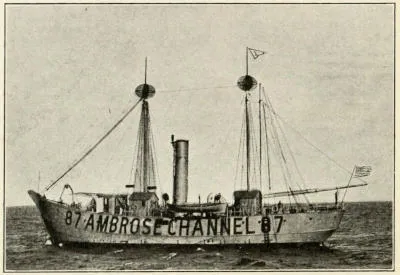
of lightships, lighthouses, etc. References to books are credited in
the text, particularly to the valuable book by Howden. For words
and music of national anthems the writer is indebted to Charles H.
Ditson & Co. and the Macmillan Co.; for statistical matter, to the
New York World and the Brooklyn Eagle Almanac.
In closing, the hope is expressed that this little book will make
some of the hours of the trip more interesting, and that the information
concerning Europe will prove of value, particularly as regards
economical travel. The section relating to London is by a trained
correspondent of the Scientific American, who is fully competent
to treat of his subject, as the writer can testify by a recent visit to
that city. The notes on Paris and Berlin are the results of recent
visits to these capitals, supplemented in the case of Paris, by the
notes of our Paris correspondent.
A. A. H.
New York, N.Y., April 15, 1910
CONTENTS.
PLANNING THE TRIP. — SEASON AND CLIMATE. — THERMOMETER SCALES. — COMPARATIVE SCALES OF THERMOMETER. — FEES AT PRIVATE HOUSES IN ENGLAND. — MEAN TEMPERATURE DURING EACH MONTH ( Fahrenheit ). — DRINKING WATER AND MEDICINES. — TIME. — INFORMATION AS TO TIME. — MEMORANDA FOR THE YEAR 1910. — CALENDAR FOR THE YEAR 1910. — MEMORANDA FOR THE YEAR 1911. — CALENDAR FOR THE YEAR 1911. — JEWISH CALENDAR (A.D. 1910, A.M. 5670-5671). — MOHAMMEDAN CALENDAR (A.D. 1910, A.H. 1328). — GREEK & RUSSIAN CALENDAR. — JULIAN CALENDAR. — PRELIMINARY READING. — GUIDE BOOKS. — COURIERS. — INTERPRETERS. — TRAVELERS’ VOCABULARY. — PASSPORTS. — COST OF EUROPEAN TRIP. — INDEPENDENT TOURS. — A SPECIMEN TOUR FIRST AND SECOND CLASS WITH EXTRA TIME EXTENSION. — LANGUAGE. — A “GRAND TOUR”. — PERSONALLY CONDUCTED TOURS. — EDUCATIONAL TOURS. — BARGAINING. — STEAMSHIP OFFICES. — STEAMSHIP COMPANIES IN BOSTON. — STEAMSHIP LINES, OFFICES AND PIERS, PORT OF NEW YORK. — CONSULATES IN NEW YORK. — PIER PERMITS. — VISITING STEAMSHIPS. — HOW TO GET TO HOBOKEN. — ENGAGING STEAMSHIP PASSAGE. — TABLE SHOWING THE NUMBER OF CABIN AND STEERAGE PASSENGERS LANDED AT PORT OF NEW YORK DURING THE YEAR 1909 BY THE FOLLOWING STEAMSHIP LINES. — TERMINAL PORTS AND PORTS OF CALL OF PRINCIPAL TRANSATLANTIC STEAMERS. — THE SECOND CABIN. — 3RD CLASS ACCOMMODATIONS. — STEERAGE. — SAMPLE BILL OF FARE FOR ONE DAY. — LOWEST OCEAN RATES To and from New York, English and Continental Ports. — HOW TO CARRY FUNDS. — LETTERS OF CREDIT. — CIRCULAR NOTES. — CURRENCY OF EUROPEAN COUNTRIES. — FUNDS ON BOARD. — STEAMSHIP COMPANY CHECKS. — EXPRESS CHEQUES. — SENDING LETTERS ABROAD. — CLOTHING. — LADIES’ LIST OF THINGS NOT TO BE FORGOTTEN. — TOILET ARTICLES. — GENTLEMEN’S LIST OF THINGS NOT TO BE FORGOTTEN. — EVENING WEAR. — FOR STEAMER. — TOILET REQUISITES. — STEAMER TRUNKS. — STEAMER RUGS. — CAMERAS AND FIELD GLASSES. — DARK ROOM. — CABLE RATES FROM N.Y. — REGISTERED CABLE ADDRESS. — TRAVELERS’ CIPHER CODE. — TELEGRAPH AND CABLE INFORMATION. — THE PREPARATION OF DOMESTIC TELEGRAPH MESSAGES. — PREPARATION OF CABLE MESSAGES. — SENDING CABLEGRAMS ON LANDING. — MONEY BY TELEGRAPH. — TELEGRAPH RATES—NORTH AMERICA. BETWEEN NEW YORK CITY AND PLACES IN UNITED STATES AND CANADA. — MISCELLANEOUS SERVICE. — WIRELESS TELEGRAPHY. — WIRELESS INFORMATION. — PARTIAL LIST OF MARCONI TELEGRAPH OFFICES ON SHIPBOARD. — UNITED WIRELESS. — THE DAY BEFORE SAILING. — UNITED WIRELESS COMPANY’S ATLANTIC AND GULF COAST STATIONS. — SHIPS EQUIPPED WITH UNITED WIRELESS SYSTEM—ATLANTIC, GULF. — BAGGAGE. — EXCESS BAGGAGE. — ARTICLES NOT ACCEPTED AS BAGGAGE. — BICYCLES. — TRANSPORTATION OF ANIMALS. — DOGS. — PLANTS. — BAGGAGE INSURANCE. — STORAGE AND FORWARDING OF BAGGAGE. — CHECKING OF BAGGAGE IN BOND. — STORAGE CHARGES. — EXPRESS RATES. — OCEAN EXPRESS TARIFF FOR SMALL SHIPMENTS. — HAND BAGGAGE, ETC. — MISDESCRIPTION OF FURS. — SHIPMENT OF HOUSEHOLD GOODS TO AND FROM EUROPE.
Some parts of Europe are available
for tourist purposes at all times of the
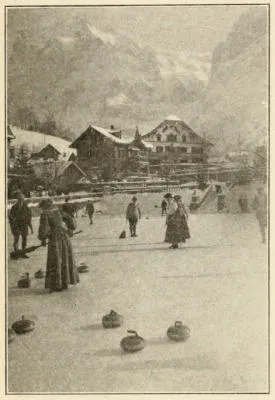
year. Switzerland has its winter
sports in winter, while in summer it is
the great playground of Europe. The
summer is preferred by many travelers,
as then England, Ireland and
Scotland are at their best, and France,
Belgium, Holland and Germany are
also most attractive. It is a mistake
to think that Italy cannot be visited
in summer, as many thousands go
there each year during the hottest
season. If reasonable care is used to
avoid the heat of the day between
twelve and two, there is little danger
to health. The time during these
hours can be spent in the galleries
whose temperature is many degrees
cooler than the outside air. Rome can
be visited with impunity at any season
of the year, but at night walks
near the Tiber or Colosseum should
be avoided. A few grains of quinine
will usually drive away any feeling of
fever. The water in Rome is excellent.
There are many resorts along
the Italian shore such as the Viareggio,
which are at their best in the
early spring—April, May or June.
The Italian lakes are particularly delightful
in July and August. Venice
is not always as pleasant as it might
be in the summer, as the motion of
the tide in the canals is not always
sufficient to render them entirely odorless.
Holland can be visited at any
time of the year, as can also Belgium,
France and Germany. Spain is apt to
be very hot in summer and should be
avoided if possible. Russia is delightful
in summer, but owing to the great
expense of reaching it the number of
tourists is limited. All visitors to
Russia must have a passport which
must be viséed by the nearest Russian
Consul before leaving the United
States. This is absolutely essential.
Travelers who are going to make a
trip around the world usually leave
New York in September if they travel
by way of San Francisco. Norway
and Sweden and Denmark should be
visited in summer only. Austria is
best visited in the spring and fall.
The Mediterranean ports, particularly
the Riviera, are crowded with winter
residents. Monte Carlo is perhaps the
most beautiful point on the Riviera.
Algeria and Morocco and Tunis all
have their share of winter visitors,
while the Holy Land and Egypt are
visited by many thousands. The great
steamship lines run each winter
specially conducted tours to Egypt
and the Holy Land, reducing the cost
of transportation very materially.
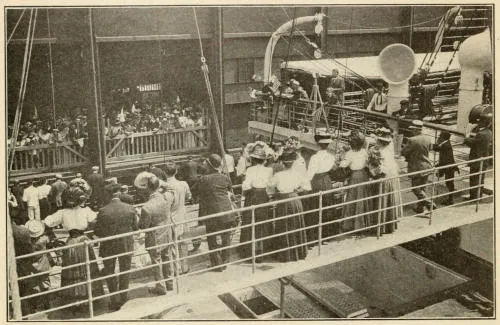
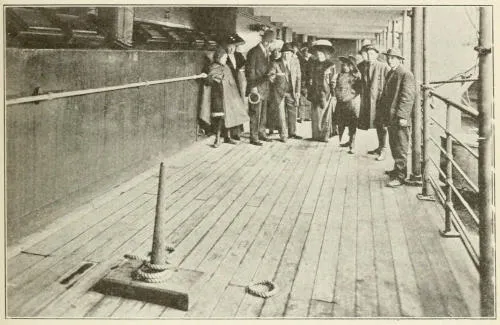
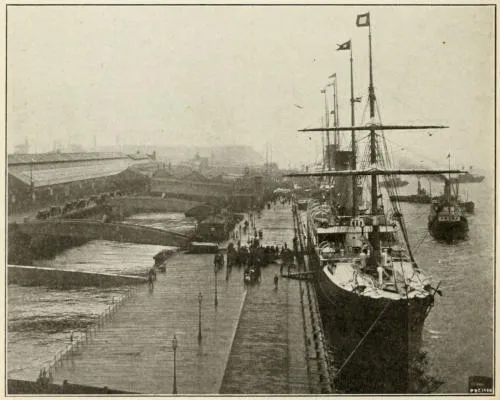
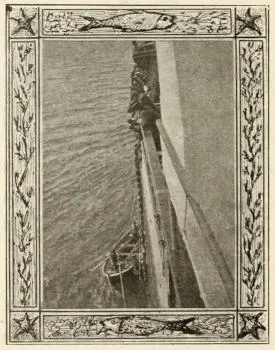
THE END OF PIER FROM THE DECK
Formerly many persons took poor
accommodations on sailing ships in
order to benefit their health. People
who are ill or who are not very strong
still stick to the sea as a rest and air
cure. They select the more comfortable
liners, however, as the care and
attention which they receive seldom
fails to benefit their health. After
fighting the sea and its terrors for
thousands of years, man has at last
succeeded in conquering the sea, this
wildest and most unruly of Nature’s
children. Against the modern iron or
steel ship, which is equipped with
every measure of protection that
science and engineering can devise,
the sea is almost powerless. Smaller
vessels and sailing craft still feel its
fury occasionally, it is true, but the
enormous ships of the present day
forge their way through the mighty
ocean at high speeds.
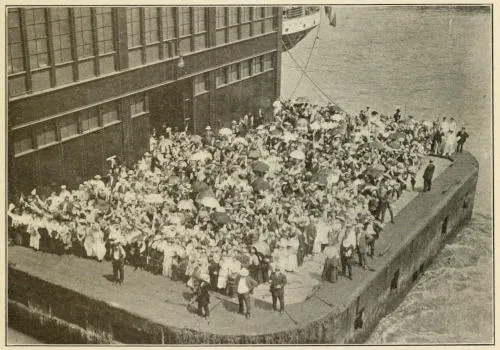
AU REVOIR—WARPING OUT
THE NEW
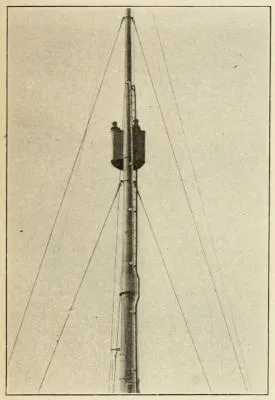
The lookouts in their eyrie sweep the horizon
for signs of danger.
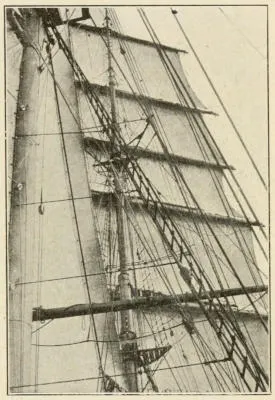
THE OLD
The old-time sailor spent much time
aloft setting sails
Men of science have studied and
analyzed the curative powers of the
sea and have awakened an understanding
and appreciation of these qualities
in ever widening circles of humanity.
Increasing interest is taken by the
medical world and the general public
as to sea trips as a curative remedy,
which is due to a large extent to the
improvements introduced in navigation
of late years. The accounts of
the dangers of ocean trips in former
times, the primitive and unhealthy accommodations,
and insufficient catering
on board of ships of earlier periods
are very disquieting to intending
travelers. This has now, however,
all been done away with, so that the
modern steamers of to-day have so
many safety devices, and the perfection
of the instruments for the navigation
of the ship, and the reliability
of the charts, the number of lighthouses,
have been brought to so perfect
a standard that a voyage on a
modern steamer entails less danger
than a journey by train. The old foul-smelling
staterooms of thirty years
ago have given place to clean, spacious,
splendidly ventilated rooms
where there is not a suspicion of an
odor of any description, even in inside
rooms on the lower decks. Superior
methods of keeping food have
resulted in catering which is equal to
that of the very finest hotels. The sea
air is most invigorating, especially for
those suffering from insomnia and
nervous troubles. The abundance of
sunshine, especially on the Southern
seas, in the Mediterranean and Adriatic,
exerts a beneficial influence on
the metabolic assimilation and the formation
of the blood. Taking it all in
all, sea trips are very strongly recommended
as important hygienic factors,
and the development of all that contributes
to their facilitation should be
greatly appreciated, especially by the
medical profession. It should be remembered
that the air of the high
seas is the purest of all, and that there
is an entire absence of dust and germs.
It has been proved that at a distance
of seven and a half miles from land
there was only one germ for 40 litres
of sea air, and at a distance of thirty
miles, only one germ for 1522 litres of
sea air, and beyond that limit the air
was practically germless. It also
follows from these investigations that
a complete absence of dust and germs
by no means prevails on the coast, as
is generally assumed. The invigorating
effect of the ocean climate is based
upon a good many qualities which vary
not only according to the locality of
the particular sea and the season of
the year, but also have a different effect
upon people according to their
particular constitution. There is
above all the great quantity of moisture
in the sea air which facilitates
breathing, and secondly the density of
the atmosphere which acts upon the
body like a permanent bath. It is a
well-known fact that very dry air irritates
the respiratory organs and
causes inflammation of the same, and
that on the other hand, extremely
moist air gives rise to heavy breathing,
whereas if a normal quantity of
vapor is contained in the air, breathing
becomes easy. The sea air contains
a considerable percentage of salt,
also some iodine and bromine, and a
large percentage of ozone.
A sea trip is especially recommended
for diseases of the respiratory
organs, i.e., chronic catarrhs of the
mucous membranes of the mouth, the
nose, the pharynx, the larynx, the
bronchia and the lungs. In the fresh
sea air the diseased organs can recuperate
and recover better than anywhere
on land. Those suffering from
tuberculosis, however, are warned by
most physicians against trying a sea
trip. The best authorities recommend
prolonged sea trips only in cases where
there is only a danger of tuberculosis
or where the disease has come to a
standstill and the patient is otherwise
strong enough to make a sea trip. We
have already referred to the benefit
which a sea voyage gives in nervous
affections. The calming influence
which is exerted on the patient by the
view, the feeling of absolute retirement
and forced absence from business
worries, is practically a cure for
a whole multitude of nervous complaints.
Those who suffer with diseases of
the heart were formerly warned by
their physicians against making sea
voyages, but according to recent experience,
the sea trip cure is recommended
for a number of diseases of
the heart, particularly for those who
suffer from a so-called heart neurosis,
also from weakness of the cardiac
muscle and valvular defects. Sea
trips are also recommended for patients
recovering from typhoid fever,
scarlet fever, measles, puerperal fever,
pleurisy, inflammation of the lungs,
malaria, and in fact for all persons
who are weak and anæmic. Any reputable
physician is qualified to give
advice on the subject of sea cures, and
any special treatments which should
be taken. There is so much excitement
and so much going on on the ten
or a dozen largest crack steamers that
those who are ill should select a
smaller boat during the rush season.
A boat taking two or three days
longer will only increase the pleasure
and the benefit of the trip.
Go abroad with shoes in perfect
condition. Repairs are apt to be
astonishing, and soles made of paper
instead of leather are not unknown.
Take a new pair of rubbers. They are
sometimes difficult to obtain abroad
and are expensive. Remember that rain
must always be expected in England.
You are safe in carrying an umbrella
everywhere. English umbrellas are
expensive and heavy. Do not buy
them as presents to take home. Rain
coats are good and cheap in England.
Be sure that you buy of a good house.
The ordinary “mackintosh” as worn
in England does not stand our climate.
Select dark colors always.
Much annoyance is caused by the
great difference of thermometer scales
in use in the different civilized countries.
The scale of Reaumur prevails
in Germany. As is well known, he divides
the space between the freezing
and boiling points into 80 deg. France
uses that of Celsius, who graduated
his scale on the decimal system. The
most peculiar scale of all, however, is
that of Fahrenheit, a renowned German
physicist, who in 1714 or 1715,
composed his scale, having ascertained
that water can be cooled under the
freezing point, without congealing. He
therefore did not take the congealing
point of water, but composed a mixture
of equal parts of snow and sal
ammoniac, about -14 deg. R. The
conversion of any one of these scales to
another is very simple, and easily
made. To change a temperature as
given by Fahrenheit’s scale into the
same as given by the centigrade scale
subtract 32 deg. from Fahrenheit’s degrees,
and multiply the remainder by
⁵⁄₉. The product will be the temperature
in centigrade degrees.
To change from Fahrenheit’s to
Reaumur’s scale, subtract 32 deg. from
Fahrenheit’s degrees, and multiply the
remainder by ⁴⁄₉. The product will
be the temperature in Reaumur’s degrees.
C.
R.
F.
-30
-24.0
-22.0
-29
-23.2
-20.2
-28
-22.4
-18.4
-27
-21.6
-16.6
-26
-20.8
-14.8
-25
-20.0
-13.0
-24
-19.2
-11.2
-23
-18.4
-9.4
-22
-17.6
-7.6
-21
-16.8
-5.8
-20
-16.0
-4.0
-19
-15.2
-2.2
-18
-14.4
-0.4
-17
-13.6
1.4
-16
-12.8
3.2
-15
-12.0
5.0
-14
-11.2
6.8
-13
-10.4
8.6
-12
-9.6
10.4
-11
-8.8
12.2
-10
-8.0
14.0
-9
-7.2
15.8
-8
-6.4
17.6
-7
-5.6
19.4
-6
-4.8
21.2
-5
-4.0
23.0
-4
-3.2
24.8
-3
-2.4
26.6
-2
-1.6
28.4
-1
-0.8
30.2
0
0.0
32.0
1
0.8
33.8
2
1.6
35.6
3
2.4
37.4
4
3.2
39.2
5
4.0
41.0
6
4.8
42.8
7
5.6
44.6
8
6.4
46.4
9
7.2
48.2
10
8.0
50.0
11
8.8
51.8
12
9.6
53.6
13
10.4
55.4
14
11.2
57.2
15
12.0
59.0
16
12.8
60.8
17
13.6
62.6
18
14.4
64.4
19
15.2
66.2
20
16.0
68.0
21
16.8
69.8
22
17.6
71.6
23
18.4
73.4
24
19.2
75.2
25
20.0
77.0
26
20.8
78.8
27
21.6
80.6
28
22.4
82.4
29
23.2
84.2
30
24.0
86.0
31
24.8
87.8
32
25.6
89.6
33
26.4
91.4
34
27.2
93.2
35
28.0
95.0
36
28.8
96.8
37
29.6
98.6
38
30.4
100.4
39
31.2
102.2
40
32.0
104.0
41
32.8
105.8
42
33.6
107.6
43
34.4
109.4
44
35.2
111.2
45
36.0
113.0
46
36.8
114.8
47
37.6
116.6
48
38.4
118.4
49
39.2
120.2
50
40.0
122.0
51
40.8
123.8
52
41.6
125.6
53
42.4
127.4
54
43.2
129.2
55
44.0
131.5
56
44.8
132.8
57
45.6
134.6
58
46.4
136.4
59
47.2
138.2
60
48.0
140.0
61
48.8
141.8
62
49.6
143.6
63
50.4
145.4
64
51.2
147.2
65
52.0
149.0
66
52.8
150.8
67
53.6
152.6
68
54.4
154.4
69
55.2
156.2
70
56.0
158.0
71
56.8
159.8
72
57.6
161.6
73
58.4
163.4
74
59.2
165.2
75
60.0
167.0
76
60.8
168.8
77
61.6
170.6
78
62.4
172.4
79
63.2
174.2
80
64.0
176.0
81
64.8
177.8
82
65.6
179.6
83
66.4
181.4
84
67.2
183.2
85
68.0
185.0
86
68.8
186.8
87
69.6
188.6
88
70.4
190.4
89
71.2
192.2
90
72.0
194.0
91
72.8
195.8
92
73.6
197.6
93
74.4
199.4
94
75.2
201.2
95
76.0
203.0
96
76.8
204.8
97
77.6
206.6
98
78.4
208.4
99
79.2
210.2
100
80.0
212.0
To change the temperature as given
by the centigrade scale into the same
as given by Fahrenheit, multiply the
centigrade degrees by 9.5 and add 32
deg. to the product. The sum will be
the temperature by Fahrenheit’s scale.
To change from Reaumur’s to Fahrenheit’s
scale, multiply the degrees on
Reaumur’s scale by 9.4 and add 32
deg. to the product. The sum will be
the temperature by Fahrenheit’s scale.
For those who wish to save themselves
the trouble we have calculated
the preceding comparative table.
England is the land of tips. You
cannot escape them if you try a
“week-end.” Saturday to Monday at
a private house of no great pretension
will cost the casual visitor about $1.50
whether men servants or maid servants
are employed. Two shillings
and six pence is correct for the housemaid
and butler. Where no butler is
employed, the parlor maid gets the
same amount, while the housemaid receives
about two shillings, and the boy,
if he has done anything for you, gets
about the same. English servants
pack and unpack all luggage so that
the fees are not begrudged. Allow
about $5.00 a week, not forgetting the
coachman. Increase this about fifty
per cent. if there are two in the party.
Some hostesses put notices in the bedrooms
asking guests not to fee, but
try it on just the same, you will usually
be successful. In very large mansions
the fees are much greater and
no adequate scale can be given. The
expense will be well up in the pounds.
Name of Place
Jan.
Feb.
Mar.
April
May
June
July
Aug.
Sept.
Oct.
Nov.
Dec.
Rain
Inches
Algiers
53.2
58.1
60.8
63.9
68.5
74.2
76.9
76.8
73.7
71.1
61.2
62.0
Athens
46.4
47.8
52.6
59.1
67.9
75.9
80.6
80.0
73.9
65.8
57.3
50.1
Auckland
67.4
67.6
66.2
61.7
57.0
51.3
52.2
52.1
54.8
57.3
60.5
65.2
Bergen
34.2
33.6
35.4
42.1
48.9
55.0
57.9
57.6
52.7
45.1
38.5
34.7
78.74
Bombay
75.3
75.7
79.6
82.1
85.7
83.6
81.0
85.0
80.5
82.0
80.1
77.2
67
Brussels
36.0
38.8
42.4
49.2
55.8
62.6
65.0
64.4
59.0
51.6
42.8
37.8
Cairo (Egypt)
54.1
56.7
62.4
69.8
76.9
82.1
83.9
82.9
78.3
73.4
65.3
58.2
1.2
Calcutta
66.2
71.2
80.2
85.7
86.0
84.8
83.3
82.7
82.9
80.5
73.0
66.3
65.54
Chicago, Ill.
23.50
27.4
34.6
46.0
55.9
66.4
72.1
70.8
64.1
52.7
38.6
29.9
Christiania
24.1
24.10
29.5
39.90
50.90
59.90
62.6
60.60
52.7
41.9
32.20
25.50
23.31
Christchurch, N.Z.
62.1
61.1
58.10
53.9
48.1
43.2
42.6
44.0
48.8
53.1
56.7
61.1
Colombo
79.8
80.6
82.2
82.5
83.2
81.6
81.5
81.6
81.5
80.6
80.3
80.0
Constantinople
41.2
37.4
47.4
58.0
62.4
71.8
76.2
72.4
67.0
64.6
51.4
43.2
Dunedin
57.5
57.5
55.4
52.0
47.2
43.7
42.7
43.0
47.4
50.6
52.7
56.8
Florence
47.8
45.8
49.2
53.8
68.0
72.0
74.0
72.6
61.4
59.6
51.6
47.6
Geneva
30.2
34.8
40.0
48.2
55.7
62.2
65.8
64.2
58.4
49.8
40.2
17.6
Jerusalem
45.2
50.8
53.3
60.3
67.3
71.7
74.7
75.7
71.8
71.0
57.2
46.8
Khartoum
71.6
70.7
76.8
84.6
93.6
92.7
88.3
87.3
88.9
87.4
83.3
73.0
6.66
Lisbon (Mt. Estoril)
54.19
51.29
54.64
60.7
66.40
66.80
70.08
68.37
68.93
63.2
59.43
58.05
London
37.0
39.0
42.0
47.02
54.0
59.0
63.0
61.0
57.0
51.07
44.0
39.0
20
Luxor
64.0
65.0
76.0
Madras
74.9
76.6
80.2
84.2
87.0
86.7
84.8
83.2
83.2
80.8
77.6
75.5
49
Madrid
40.8
49.7
49.2
54.3
58.1
70.9
74.9
76.6
67.4
56.8
48.9
41.9
Malaga
54.1
55.9
59.5
63.0
65.3
73.6
77.4
75.0
73.9
68.0
60.0
55.9
Malta
53.5
53.7
55.9
59.80
64.10
71.60
77.30
78.4
74.6
68.9
61.5
56.3
25
Melbourne
64.1
63.2
59.20
60.4
55.3
49.7
48.2
49.8
49.8
56.8
59.6
64.3
27
Milan
32.9
37.8
45.5
54.0
62.5
69.9
74.2
71.6
65.1
54.7
43.4
35.5
Naples
44.6
46.4
48.4
54.4
66.2
71.4
74.0
74.0
68.0
64.6
53.6
45.4
Nelson, N.Z.
64.5
64.0
60.4
51.0
51.1
47.6
46.3
47.6
51.2
54.7
58.2
62.1
New Orleans, La.
53.5
58.3
62.4
68.6
74.8
80.6
82.6
81.8
77.9
70.3
60.8
54.8
New York
30.0
31.0
38.0
49.0
60.0
69.0
74.0
73.0
66.0
55.0
44.0
34.0
Nice
46.1
48.0
51.0
57.0
58.0
68.0
71.0
69.0
69.0
61.0
52.0
48.0
Paris
36.0
39.6
44.2
50.2
57.2
62.6
65.8
65.2
60.0
52.0
43.6
38.2
Rangoon
76.7
79.4
83.9
87.4
84.6
81.5
80.6
80.4
80.8
81.7
80.0
77.3
Rome
43.3
46.0
50.3
55.0
68.0
73.0
77.0
80.0
73.4
66.4
56.1
52.0
San Francisco
50.2
52.2
53.7
54.9
56.8
58.8
58.6
59.2
60.8
60.0
56.4
51.5
22.76
Sydney
71.0
69.7
67.2
64.4
59.6
51.7
52.9
54.7
57.6
63.7
70.1
72.2
51
Venice
38.6
37.8
45.2
53.6
68.8
73.8
75.8
77.8
64.6
59.6
47.2
38.2
Vienna
29.3
33.1
39.4
49.8
58.5
65.5
68.2
67.1
60.1
50.7
38.8
31.6
Wellington, N.Z.
62.8
62.4
60.5
56.9
52.8
49.5
47.6
48.5
51.5
54.3
57.0
60.6
50.75
Table from Cook’s Time Tables.
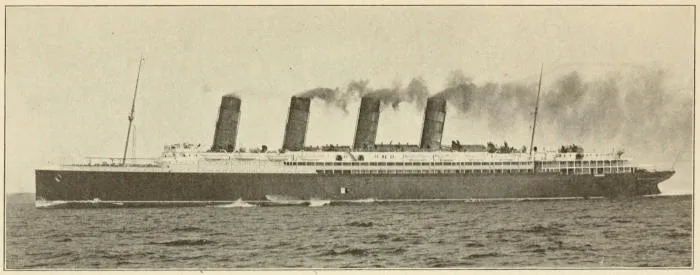
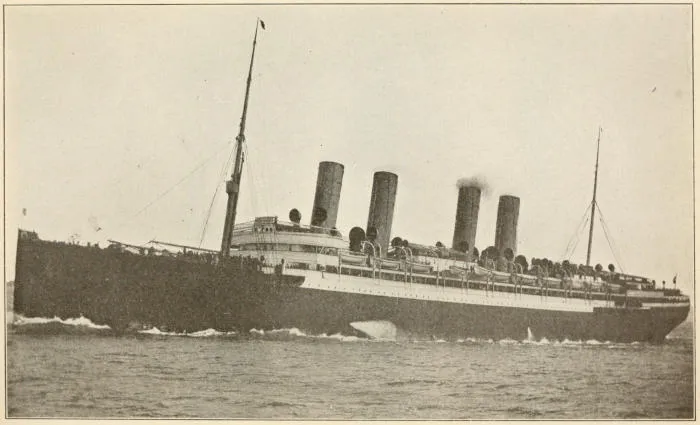
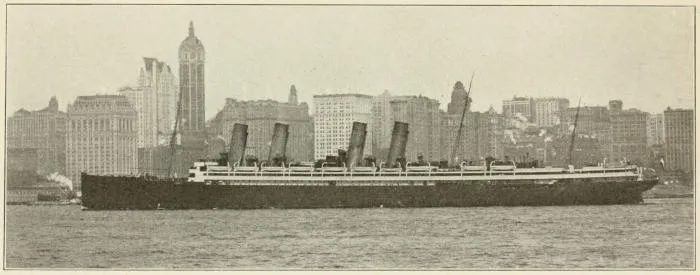
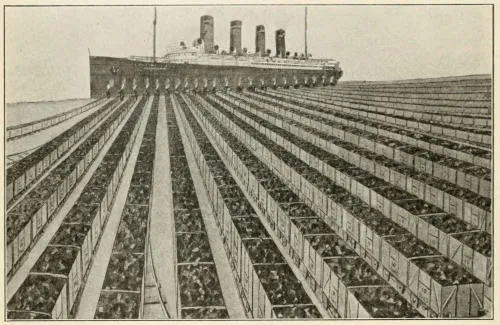
THE “LUSITANIA”—A MIGHTY RECORD BREAKER OF THE CUNARD LINE
The subject of drinking water is an
important one. The water on the
steamer is all right, but for the first
few days after landing the visitor
should be cautious about drinking ordinary
tap water at hotels, and particularly
in stations. Mineral water
can be obtained everywhere and is
very cheap. Ordinary carbonated
water may be purchased or natural
waters, such as Apollinaris or Perrier
water. In Germany, Rosbach
water can usually be had as well as
Rhens water. In France, St. Galmier
and Vichy (still) can be obtained.
Tea, coffee and chocolate also prevent
the necessity of drinking ordinary
water. In England, beers, ales and
stout are cheap and good, while in
Germany, beer, Rhine wine and Moselle
wine can be obtained everywhere.
In France (outside of Paris), wine is
good and cheap, while in Italy the
wine is plentiful and very cheap. Ice
water is practically unknown except
at the hotels where the trade of Americans
is catered to. Here the waiters
are apt to bring on ice water before
service begins. In many places, as in
Italy, there is a small charge made
for a little plate of ice. The water
of Venice is particularly vile and
should be entirely eschewed, as can be
vouched for by the writer’s experience.
A bottle of “Sun” cholera mixture,
bismuth and pepsin tablets and a non-leaking
hot water bag should be taken
along. The following is the formula
for “Sun” cholera mixture, so that if
necessary it can be put up by Continental
chemists:
℞
Tincture of capsicum
1 part.
Tincture of opium
1 part.
Tincture rhubarb
1 part.
Spirits peppermint
1 part.
Spirits camphor
1 part.
Mix and filter, dose 15 to 30 drops.
A bottle of Jamaica ginger
(Brown’s is good) will also obviate
many of the little ills incident to
travel. Bicarbonate of soda tablets
should also be carried to take care of
slight attacks of indigestion as well as
the bismuth and pepsin tablets mentioned
above.
The following medicines, etc., should
be carried:
One small hot water bag.
One ounce arnica.
Three ounces extract of witch hazel.
Two ounces aromatic spirits of ammonia.
One menthol cone.
One styptic pencil.
One package court plaster.
One narrow bandage.
One small package absorbent cotton.
One can containing “new skin.”
One bottle “Sun” cholera mixture.
One bottle soda-mint tablets.
One bottle bismuth and pepsin tablets.
One bottle “listerine,” “borine” or equivalent preparation.
If inclined to catarrh, take Dobell
solution tablets and a Bermingham
douche. These will take up only a
small space in the satchel and will
cost only about $1.75 to $2.00. They
will pack nicely in a small cracker
tin. A little old linen, a few yards
of stout thread wound around a stiff
piece of paper should also be carried.
Slight injuries to the hands often occur
when getting in or out of railway
carriages. Some travelers recommend
a small bottle of spirits of camphor;
vaseline and cream may be carried
with advantage.
All calculations of time are based
on the sun—not the real sun that we
see, but a fictitious sun that keeps
better time than the real sun. The
time that is indicated by a sun dial is
the actual Sun Time; but this is not
good enough for the civilized world
because the day from noon to noon as
marked by the real sun is longer at
certain times of the year than at
others. However, astronomers have
constructed a fictitious sun that gives
us days of uniform length, and the
time it marks off is called Mean Solar
Time. But this does not fully solve
the problem of time. We have still
to contend with the fact that the sun
reaches the meridian successively later
as it progresses westward, so that
noon in Chicago, for instance, will be
much later than noon in New York.
In fact, noon on the west side of New
York would come a few seconds later
than noon on the east side. If each
town in the country used local mean
solar time, the utmost confusion would
prevail, particularly on railroads connecting
the towns. To avoid this confusion
it has been found necessary to
establish certain zones in which uniform
time is observed. It takes
the sun twenty-four hours to circle
the earth (to be sure it is the earth
that moves, but for convenience we
will consider that the earth is stationary
and that the sun is moving around
it). The earth is divided into 360
degrees of longitude. Therefore it
takes the sun one hour to traverse 15
degrees of longitude. The United
States and the majority of the
European countries have decided to
establish time zones approximately 15
degrees wide, so that the time of one
zone will differ from the next adjacent
zones by an even hour. The degrees
of longitude are measured from
Greenwich, and at 15 degrees east of
Greenwich the Standard Time used by
the surrounding country will be just
one hour ahead of Greenwich Time.
Regions in the neighborhood 30 degrees
east of Greenwich will use time
two hours faster than the standard
time of Greenwich. The same is true
in the westward direction, except that
here the clocks will be set slower than
Greenwich Time in even hours at intervals
of 15 degrees.
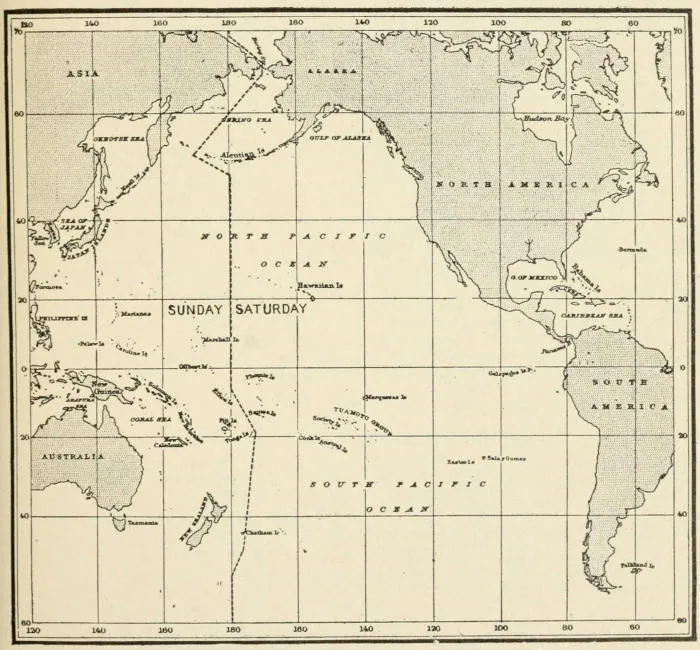
MAP SHOWING INTERNATIONAL DATE LINE
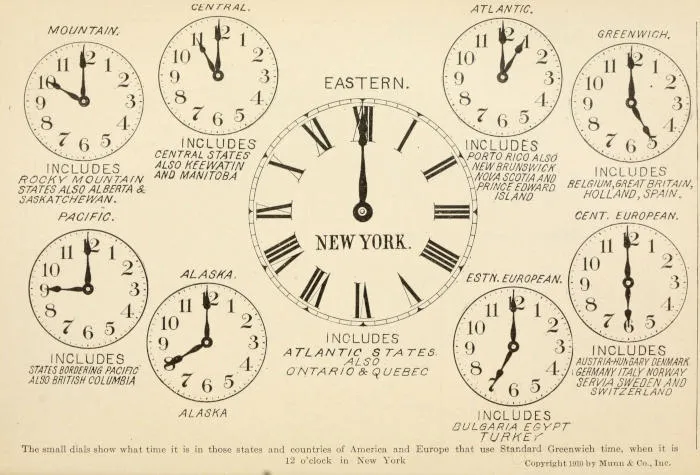
Eastern Time is taken from the 75th
meridian, which being five times 15 degrees
west of Greenwich, makes the
time in this zone five hours slower than
Greenwich Time. Central Time is taken
from the 90th meridian and is one
hour slower than Eastern Time and
six hours slower than Greenwich
Time. Mountain Time is taken from
the 105th meridian, and Pacific Time
from the 120th meridian. The zones
are somewhat distorted, mainly to suit
the convenience of railroads. In
Europe each country is small enough
to be included in a single zone.
Greenwich Time is used in Belgium,
Great Britain, Holland (railways and
telegraph), and Spain. Central European
Time, which is one hour faster
than Greenwich Time, is used by Austria-Hungary,
Denmark, Germany,
Italy, Norway, Servia, Sweden and
Switzerland. Eastern European Time,
two hours faster than Greenwich, is
used by Bulgaria and Egypt, and, by
Europeans, in Turkey, the native time
in the last-named country being based
on sunset, which being the end of the
Turkish day, marks the hour of 12.
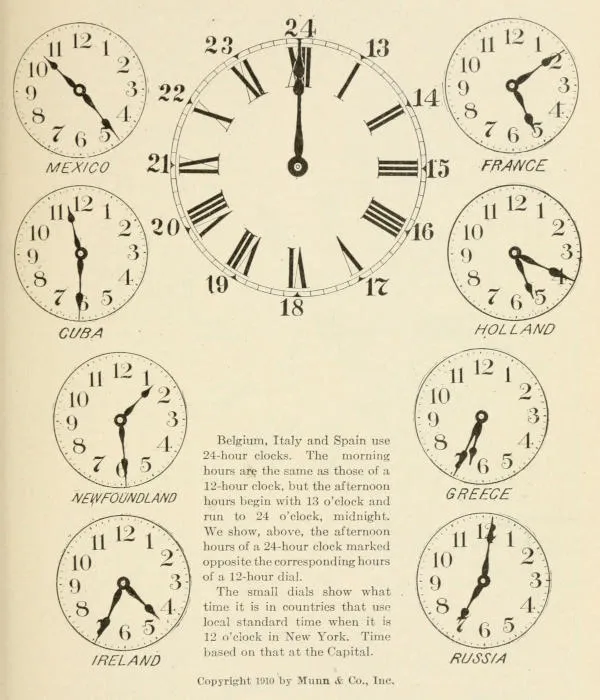
In Belgium, Italy and Spain the
clock dial is divided into twenty-four
hours, beginning with 0 at midnight
and thus doing away with A.M.
and P.M.
A number of European countries
have not accepted Standard Time
based on the meridian of Greenwich,
but base their time on a meridian of
their own. France, for instance, uses
the local mean time of Paris, which is
9 minutes and 21 seconds faster than
Greenwich Time. This is the time
that appears outside of railroad stations,
but the clocks inside by which
the trains are operated are five minutes
slower. Holland clocks are 19
minutes and 32 seconds faster than
Greenwich, the time being taken from
the Observatory at Amsterdam. Ireland
uses local Mean Solar Time of
Dublin, and is 25 minutes and 21 seconds
slower than Greenwich. Portugal
takes the local Mean Solar Time
of Lisbon, which is 36 minutes and 45
seconds slower than Greenwich. As
in France, railroad time is 5 minutes
slower, while The Royal Observatory
of St. Petersburg sets the standard for
Russia, which is 2 hours 1 minute 19
seconds faster than Greenwich Time.
Were it possible for a person to
travel westward around the world as
fast as the sun, time would to him appear
to be at a standstill. If he
started, say, at noon Monday, it
would always be noon Monday to him,
and apparently there would be no
change in his calendar. Yet somewhere
along his course around the
world Monday must have ended and
Tuesday must have begun. Were the
traveler proceeding eastward he would
in 12 hours meet and pass the sun on
the opposite side of the earth and
would apparently have reached the
hour of noon Tuesday. At the end
of 12 hours more he would meet the
sun a second time and would have to
tear off another leaf from his calendar
and call the time noon, Wednesday.
In other words, his journey
around the globe would have taken
him two days longer than the man
who traveled with the sun and made
the trip in no time. It is a fact
that a trip around the earth in a
westward direction can actually be
made in two days less than a trip in
the eastward direction, although the
same rate of speed is preserved; but
the days of the eastbound traveler
would be shorter than those of the
westbound traveler. In both cases
the travelers would arrive with their
calendars one day wrong; but a line
has been established running north and
south at which travelers are obliged
to add a day if they cross it going
westward or subtract a day if they
cross it traveling eastward. In other
words, the day is supposed to start
and end along this line, which is called
the International Date Line. It follows
the 180th meridian except for a
few digressions, as indicated in the
accompanying map, to suit the convenience
of inhabitants of islands
lying nearby.
It is said that tipping had its origin in
Bible times with the biblical tithes. At any
rate ten per cent. is a safe basis for tipping.
The usual charge for transporting a cat on
transatlantic steamers is $5.00, and birds
$4.00 for each cage.
Golden Number
XI.
Epact
19
Solar Cycle
15
Roman Indiction
8
Dominical Letter
B
Julian Period (year of)
6623
Septuagesima Sunday
Jan.
23
Ash Wednesday
Feb.
9
Lincoln’s Birthday
Feb.
12
Washington’s Birthday
Feb.
22
Spring Commences
Mar.
21
Good Friday
”
25
Easter Day
”
27
Ascension (Holy) Thursday
May
5
Pentecost—Whit Sun’y.
”
15
Trinity Sunday
”
22
Corpus Christi
”
26
Decoration Day
”
30
Summer Commences
June
21
Sundays after Trinity
June
26
Independence Day
July
4
Labor Day
Sept.
5
Autumn Commences
Sept.
23
Election Day
Nov.
8
Thanksgiving Day
”
24
First Sunday in Adv’t.
”
27
Winter Commences
Dec.
22
Christmas Day (S’ud’y)
”
25
January
Su.
—
2
9
16
23
30
M.
—
3
10
17
24
31
Tu.
—
4
11
18
25
—
W.
—
5
12
19
26
—
Th.
—
6
13
20
27
—
F.
—
7
14
21
28
—
S.
1
8
15
22
29
—
February
Su.
—
6
13
20
27
M.
—
7
14
21
28
Tu.
1
8
15
22
—
W.
2
9
16
23
—
Th.
3
10
17
24
—
F.
4
11
18
25
—
S.
5
12
19
26
—
March
Su.
—
6
13
20
27
M.
—
7
14
21
28
Tu.
1
8
15
22
29
W.
2
9
16
23
30
Th.
3
10
17
24
31
F.
4
11
18
25
—
S.
5
12
19
26
—
April
Su.
—
3
10
17
24
M.
—
4
11
18
25
Tu.
—
5
12
19
26
W.
—
6
13
20
27
Th.
—
7
14
21
28
F.
1
8
15
22
29
S.
2
9
16
23
30
May
Su.
1
8
15
22
29
M.
2
9
16
23
30
Tu.
3
10
17
24
31
W.
4
11
18
25
—
Th.
5
12
19
26
—
F.
6
13
20
27
—
S.
7
14
21
28
—
June
Su.
—
5
12
19
26
M.
—
6
13
20
27
Tu.
—
7
14
21
28
W.
1
8
15
22
29
Th.
2
9
16
23
30
F.
3
10
17
24
—
S.
4
11
18
25
—
July
Su.
—
3
10
17
24
31
M.
—
4
11
18
25
—
Tu.
—
5
12
19
26
—
W.
—
6
13
20
27
—
Th.
—
7
14
21
28
—
F.
1
8
15
22
29
—
S.
2
9
16
23
30
—
August
Su.
—
7
14
21
28
M.
1
8
15
22
29
Tu.
2
9
16
23
30
W.
3
10
17
24
31
Th.
4
11
18
25
—
F.
5
12
19
26
—
S.
6
13
20
27
—
September
Su.
—
4
11
18
25
M.
—
5
12
19
26
Tu.
—
6
13
20
27
W.
—
7
14
21
28
Th.
1
8
15
22
29
F.
2
9
16
23
30
S.
3
10
17
24
—
October
Su.
— 2
9
16
23
30
M.
— 3
10
17
24
31
Tu.
— 4
11
18
25
—
W.
— 5
12
19
26
—
Th.
— 6
13
20
27
—
F.
— 7
14
21
28
—
S.
1
8 15
22
29
—
November
Su.
—
6
13
20
27
M.
—
7
14
21
28
Tu.
1
8
15
22
29
W.
2
9
16
23
30
Th.
3
10
17
24
—
F.
4
11
18
25
—
S.
5
12
19
26
—
December
Su.
—
4
11
18
25
M.
—
5
12
19
26
Tu.
—
6
13
20
27
W.
—
7
14
21
28
Th.
1
8
15
22
29
F.
2
9
16
23
30
S.
3
10
17
24
31
Golden Number,
XII
Epact,
30
Solar Cycle,
16
Roman Indiction,
9
Dominical Letter,
A
Julian Period
(Year of 6624)
Septuagesima Sunday,
February
12
Ash Wednesday,
March
1
Lincoln’s Birthday,
February
12
Washington’s Birthday,
February
22
Spring Commences,
March
21
Good Friday,
April
14
Easter Day,
April
16
Ascension (Holy) Thursday,
May
25
Pentecost—Whit Sunday,
June
4
Trinity Sunday,
June
11
Corpus Christi,
June
16
Decoration Day,
May
30
Summer commences,
June
22
Sundays after Trinity,
June
24
Independence Day,
July
4
Labor Day,
September
4
Autumn commences,
September
23
Election Day,
November
2
Thanksgiving Day,
November
23
First Sunday in Advent,
December
3
Winter commences,
December
22
Christmas Day,
December
25
January.
Su.
1
8
15
22
29
M.
2
9
16
23
30
Tu.
3
10
17
24
31
W.
4
11
18
25
—
Th.
5
12
19
26
—
F.
6
13
20
27
—
S.
7
14
21
28
—
February.
Su.
—
5
12
19
26
M.
—
6
13
20
27
Tu.
—
7
14
21
28
W.
1
8
15
22
—
Th.
2
9
16
23
—
F.
3
10
17
24
—
S.
4
11
18
25
—
March.
Su.
—
5
12
19
26
M.
—
6
13
20
27
Tu.
—
7
14
21
28
W.
1
8
15
22
29
Th.
2
9
16
23
30
F.
3
10
17
24
31
S.
4
11
18
25
—
April.
Su.
—
2
9
16
23
30
M.
—
3
10
17
24
—
Tu.
—
4
11
18
25
—
W.
—
5
12
19
26
—
Th.
—
6
13
20
27
—
F.
—
7
14
21
28
—
S.
1
8
15
22
29
—
May.
Su.
—
7
14
21
28
M.
1
8
15
22
29
Tu.
2
9
16
23
30
W.
3
10
17
24
31
Th.
4
11
18
25
—
F.
5
12
19
26
—
S.
6
13
20
27
—
June.
Su.
—
4
11
18
25
M.
—
5
12
19
26
Tu.
—
6
13
20
27
W.
—
7
14
21
28
Th.
1
8
15
22
29
F.
2
9
16
23
30
S.
3
10
17
24
—
July.
Su.
—
2
9
16
23
30
M.
—
3
10
17
24
31
Tu.
—
4
11
18
25
—
W.
—
5
12
19
26
—
Th.
—
6
13
20
27
—
F.
—
7
14
21
28
—
S.
1
8
15
22
29
—
August.
Su.
—
6
13
20
27
M.
—
7
14
21
28
Tu.
1
8
15
22
29
W.
2
9
16
23
30
Th.
3
10
17
24
31
F.
4
11
18
25
—
S.
5
12
19
26
—
September.
Su.
—
3
10
17
24
M.
—
4
11
18
25
Tu.
—
5
12
19
26
W.
—
6
13
20
27
Th.
—
7
14
21
28
F.
1
8
15
22
29
S.
2
9
16
23
30
October.
Su.
1
8
15
22
29
M.
2
9
16
23
30
Tu.
3
10
17
24
31
W.
4
11
18
25
—
Th.
5
12
19
26
—
F.
6
13
20
27
—
S.
7
14
21
28
—
November.
Su.
—
5
12
19
26
M.
—
6
13
20
27
Tu.
—
7
14
21
28
W.
1
8
15
22
29
Th.
2
9
16
23
30
F.
3
10
17
24
—
S.
4
11
18
25
—
December.
Su.
—
3
10
17
24
31
M.
—
4
11
18
25
—
Tu.
—
5
12
19
26
—
W.
—
6
13
20
27
—
Th.
—
7
14
21
28
—
F.
1
8
15
22
29
—
S.
2
9
16
23
30
—
The Year 5670 commenced September 16, 1909
5670.
Jan.
11
New Moon
Sebat
1
Feb.
10
New Moon
Adar
1
Mar.
12
New Moon
Veadar
1
”
24
Fast of Easter
”
13
”
25
Purim
”
14
”
26
Shusan
”
15
April
10
New Moon
Nisan
1
”
24
Festival of Passover
”
15
”
25
” 2d day
”
16
”
30
” 7th day
”
21
May
1
” ends
”
22
”
10
New Moon
Yiar
1
June
8
New moon
Sivan
1
”
13
Festival of Weeks
”
6
”
14
” 2d day
”
7
July
8
New Moon
Tamuz
1
July
24
Fast of Tamuz
Tamuz
17
Aug.
6
New Moon
Ab
1
”
14
Fast of Ab
”
9
Sept.
5
New Moon
Elul
1
5671.
Oct.
4
First day of New Year
Tishri
1
”
5
Second ”
”
2
”
6
Fast of Gedaliah
”
3
”
13
Day of Atonement
”
10
”
18
Feast of Tabernacles
”
15
”
19
” 2d day
”
16
”
24
Hosana Rabah
”
21
”
25
Feast of the 8th day
”
22
”
26
Rejoicing of the Law
”
23
Nov.
3
New Moon
Hesvan
1
Dec.
2
New Moon
Kislev
1
”
26
Dedication of the Temple
”
25
Note.—All
Jewish Sabbaths and Festivals commence the previous Evening at
Sunset.
In the Roman (Julian) Calendar the months
correspond exactly with our own, excepting
that down to the time of the great Emperor
Augustus, the fifth and sixth months of the
year—which, with the Romans, began with
March—were called Quintilis and Sextilis;
afterwards they were named in honor of the
emperors Julius and Augustus.
In reckoning the days of each month three
fixed points were taken, and any particular
day was said to be so many days before the
next coming fixed day. These three points
were (1) the Kalends, by which name the first
of each month was known; (2) the Nones,
which fell on the seventh day of the month
in March, May, July and October, and on the
fifth day in each of the other months; and
the Ides, which always fell eight days after
the Nones.
For example, the 1st of January was the
Kalends of January (Kalendis Januariis),
the 31st of December was the day before the
Kalends of January (pridie Kalendas Januarias);
but Dec. 30 was the third day before
the Kalends of January (ante diem tertium
Kalendas Januarias), in this case both Jan.
1st and Dec. 31st being included in the reckoning.
And so on back to Dec. 14th, which was
the nineteenth day before the January Kalends
(ante diem undevicesimum Kal. Jan.), Dec.
13th being Idibus Decembribus, the Ides of
December. In Leap-year, both Feb. 24th
and Feb. 25th were known as the sixth day
before the March Kalends, being distinguished
respectively as prior and posterior.—Whitaker’s
Almanack.
A list of appropriate books will be
found in the Bibliography at the end
of the book. The writer has in preparation
detailed information as to various
places having literary association
with special reference to visiting
them. While this matter cannot be
gotten ready in time for this edition,
still the titles may suggest some
timely reading: “Dickens’ England,”
“Dickens’ London,” “Thackeray’s
England,” “Gilbert White and Selborne,”
“Along the Streams with
Izaak Walton,” “Carlyle’s England,”
“Land of Scott,” “Shakespeare’s
England,” “In the Footsteps of Our
Forefathers,” “Milton’s England,”
“Lorna Doone and Exmoor,” “With
the Poets in the Lake Country,” “The
Burns Country,” “The Hardy Country,”
“The Ingoldsby Country,” “The
Canterbury Pilgrims,” “Knutsford”
(Cranford), “Broadway” England.
For the Continent there is in preparation
“Memorable Paris Houses,”
“The Paris of Dumas,” “In the Footsteps
of Goethe,” “Wagnerian Pilgrimage,”
“The Passion Play,” “Dante
and His Time.” Any reader of this
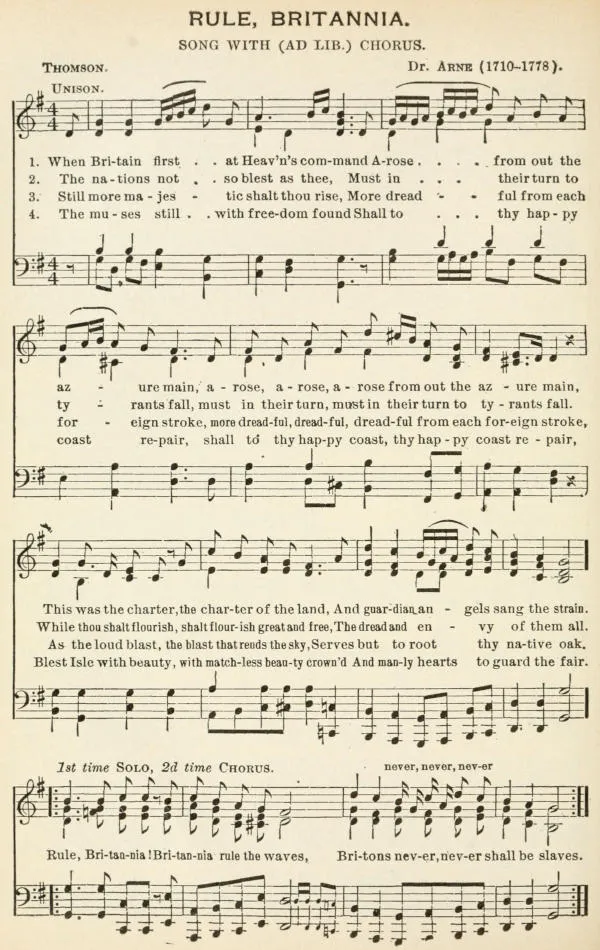
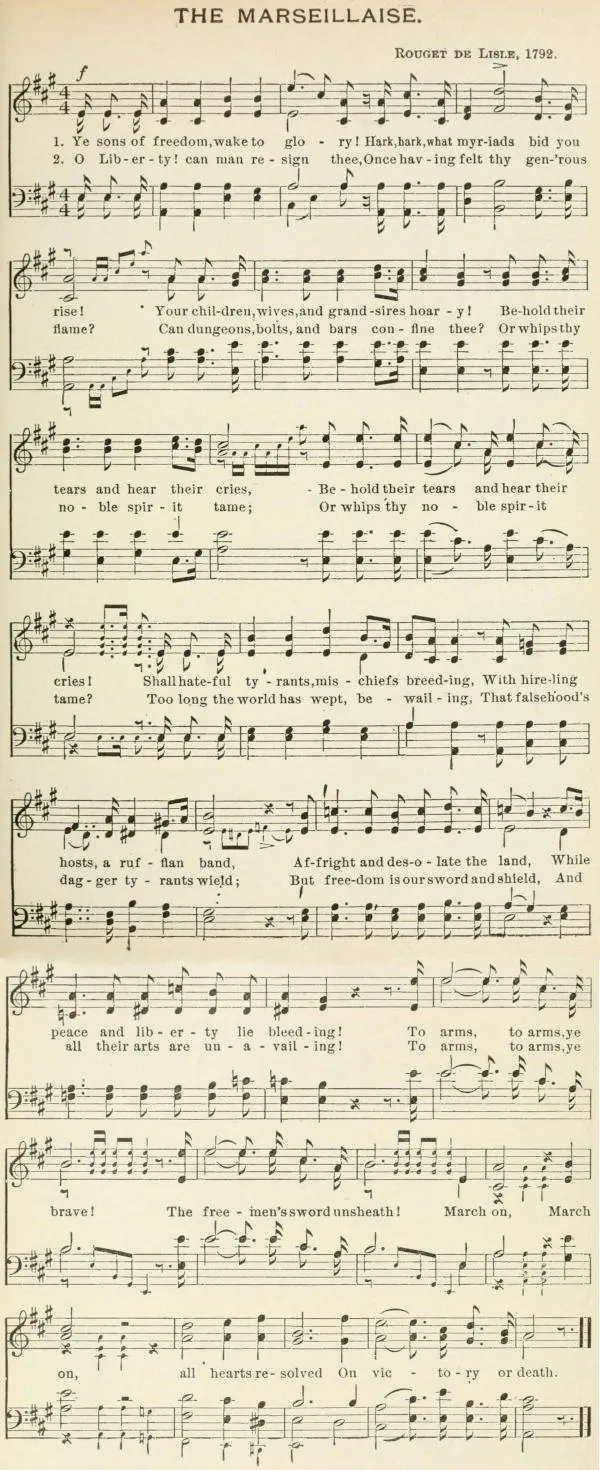
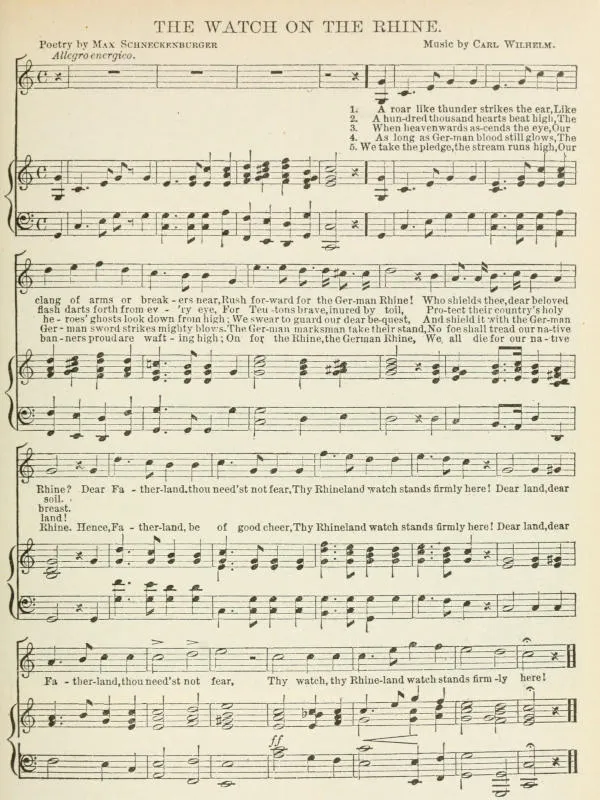
book who has made any of these journeys
and who would like to contribute
his or her quota to the sum total of
travelers’ lore, are requested to write
to A. A. Hopkins, Box 773, New York
City, N.Y. All information will be
promptly acknowledged and available
matter will be used at the first opportunity.
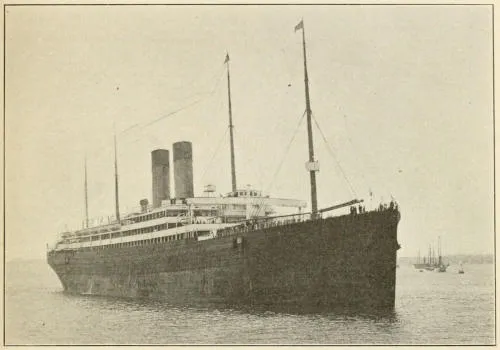
THE “ADRIATIC”
Is a stately giant of the sea with immense passenger accommodations
A list of guide books and books for
preliminary study will be found at the
back of the present volume (see the
index). While the list normally belongs
in this section of the book, it
is not found possible to get the list in
the proper form in time to include it
here, as a number of books were announced
as coming out while the
major part of this book was on the
press. Those who have no time to
consult this list before starting on the
trip will do well to provide one or two
Baedeker’s Guides for use on the voyage,
in order to enable a traveler to
prepare for the first stages of the trip,
such as Baedeker’s Guide to Great
Britain, price $3.00; London, $1.80;
Paris, $1.80, or Berlin, 90 cents. To
those who do not wish to purchase
Baedeker’s Guides, we commend the
information given elsewhere in this
book. The matter is in sufficient detail
to enable the traveler to locate
comfortably in London, Paris or Berlin,
as well as to make the journey
with the proper knowledge of the
traveling conditions, etc.
Do not calculate on buying guides
just before you start. The most useful
are very often “out of print” or
“out of stock,” particularly the indispensable
“Baedeker’s.” We made up
a list of the more popular ones (ten
in number) and submitted them to the
American agents. The list was as
follows: Northern France, Southern
France, Northern Germany, Southern
Germany, Rhine, Great Britain, London,
Paris, Switzerland, Belgium and
Holland. Out of this number,
Southern Germany, Great Britain,
Belgium and Holland were out of
stock as well as the “Conversation
Dictionary” (a very useful little book),
which sells for 90 cents. A full list
of guides with critical notes will be
found in the Bibliography at the
back of the book.
Ladies who desire additional information
as to preparation for the journey,
and special information which
will benefit them in traveling abroad,
should purchase a copy of Mary Cadwalder
Jones’ “European Travel for
Women,” which is published in this
country at an expense of $1.00.
The courier of thirty years ago is
practically unknown. He was a linguist
who traveled with rich individuals
or parties, and conducted them to
the best hotels and saw to it that they
paid the highest prices for everything,
both in hotels and shops. The courier
was an unmitigated nuisance and has
been largely done away with by the
more general use of the English language,
and by a more general knowledge
of French by the average American
and English traveler. The courier’s
wages were as nothing compared
with the commissions which he exacted
from everybody with whom he
came in contact. Occasionally, to
give a suspicion of honesty, a portion
of this commission would be disgorged
to his employer. In certain places in
the Far East, couriers, or their equivalents,
are now necessary, but they
should never be engaged except on the
recommendations of one of the great
tourist agencies of world-wide reputation.
It may be stated that the tourist
agencies have been a very large factor
in the disappearance of the courier.
Interpreters in the employ of large
tourist agencies will be found at the
principal stations and most boat landings
in Europe. Those who have purchased
their tickets from these tourist
agencies may call upon them freely
and will find that they tend to decrease
the discomforts of travel.
When their services are engaged, a
moderate fee is suggested. The simple
showing of the case in which the railroad
tickets are kept is sufficient proof
that the traveler is a client of the
tourist agency. Interpreters in the
uniform of the largest agency meet
principal trains and steamers at following
places and assist holders of
their tickets free of charge: Alexandria,
Algiers, Amsterdam, Antwerp,
Bâle, Bergen, Beyrout, Bombay,
Bremen, Brindisi, Brussels (summer
only), Calcutta, Cannes, Christiania,
Cologne, Colombo, Constantinople,
Florence, Dresden, Geneva, Genoa,
Gibraltar, Hong Kong, Jaffa, Haifa,
Hamburg, Lausanne, London (Charing
Cross and Victoria), Lucerne,
Madrid, Malta, Marseilles, Mentone,
Milan, Naples, New York, Nice, Paris,
Patras, Piræus, Rome, San Remo,
Trieste, Trondhjem, Turin, Venice,
Vienna, Vintimille, Yokohama, Zürich.
An interpreter meets passengers at
Tilbury. The interpreters are not on
duty on Sundays except by special arrangement.
From Facts for Travelers issued by the International Mercantile Marine
Co. Republished by permission.
ENGLISH
FRENCH
GERMAN
ITALIAN
The Post Office
Bureau de Poste
Postamt
Officio Postale
Are there any letters for me?
Y a-t-il des lettres pour moi?
Sind Briefe für mich da?
Ci sono lettere per me?
Letters addressed to the post office (General Delivery), to be left till called for
Une lettre adressée Poste Restante
Ein postlagernder Brief
Una lettera ferma in posta (Posta Restante)
Post
Poste
Post
Posta
Postage Stamps
Timbres-poste
Briefmarken
I francobolli
Postal Card
Carte-postale
Briefkarte
Carta Postale
Registered Letter
Une lettre recommandée
Eingeschriebener Brief
Una lettera recommandata
Traveling
Le Voyage
Die Reise
Viaggio
The Railway Station
La Gare
Der Bahnhof
Stazione
Baggage, Luggage
Le Bagage
Des Gepäck
Il bagaglio
Baggage Receipt
Le reçu des bagages
Der Gepäck-Schein
La ricevuta del bagaglio
Is this the train for ——?
Est-ce là le train pour ——?
Ist dies der Zug nach ——?
E quello il treno per ——?
How long shall we stop here?
Combien de temps arrêtons-nous ici?
Wie lange Aufenthalt hier?
Quanto tempo ci fermeremo qui?
Railway
Le chemin de fer
Die Eisenbahn
La Strada ferrata
Ticket
Le billet
Das Billet
Il Biglietto
Return Ticket
Le billet d’aller et retour
Das Retourbillet
Biglietto d’andata e ritorno
The Berth
Le lit; La couchette
Das Bett
Il letto
The stateroom
La Cabine
Die Kajüte
La Cabina
Steward
Le garçon (or) valet
Schiffsaufwärter
Il locandiere
Stewardess
La femme de chamber
Schiffsaufwärterin
La cameriera
We wish to get out
Nous désirons descendre
Wir wollen aussteigen
Vogliamo descendere
What time does the train start for ——?
A quelle heure part le train pour ——?
Um wie viel Uhr fährt der Zug nach ——?
A che ora parte il treno per ——?
Where do we stop for meals?
Où arrêtons-nous pour manger?
Wo essen wir?
Dove si fa la fermata per pranzare?
Is it time to leave?
Est-il temps de partir?
Ist es Zeit zu gehen?
E ora di partire?
When shall we start?
Quand partons-nous?
Wann gehen wir?
Quando partiremo?
Reading Room
Salon de Lecture
Lese Zimmer
Il Cabinetto di Lettura
A pen
Une plume
Eine Feder
Una penna
Blotting paper
Papier buvard
Das Löschpapier
La Carta Sugante
Envelope
Une enveloppe
Ein Couvert
La Sapracarta; Coperta
Give me
Donnez-moi
Geben Sie mir
Datemi
Letter paper
Papier à lettre
Schreibpapier
Carta da lettere
Newspaper
Le journal
Die Zeitung
Il giornale
Newspaper wrapper
Bande de journal
Kreuzband
Invoglio di giornale
Railway guide
Guide de chemin-de-fer
Eisenbahn Anzeiger
Guida della strada ferrata
Sheet of paper
Feuille de papier
Bogen Papier
Foglio di carta
(Postage) stamp
Timbre-poste
Briefmarke
Il francobollo
Sealing-wax
Cire à cacheter
Siegellack
Cera lacca
Dining Room
Salle à Manger
Speise Saal
Sala da Pranzo
Restaurant
Restaurant
Restauration
Trattoria
Meals
La Nourriture
Die Beköstigung
Il Cibo
Apple
La pomme
Der Apfel
Il pomo
Beef
Du bœuf
Das Rindfleisch
Il manzo
Beefsteak
Le biftek
Das Beefsteak
La cotelletta di manzo
Beer
De la bière
Das Bier
La Birra
Bottle
Une bouteille
Eine Flasche
Una bottiglia
Brandy
Eau de vie, cognac
Cognac, Branntwein
Dell’acquavite, cognac
Bread
Du pain
Das Brod
Il pane
Breakfast
Déjeuner
Das Frühstück
La colazione
Butter
Du beurre
Die Butter
Del burro—butirro
Cheese
Du fromage
Der Käse
Il formaggio
Chicken
Un poulet
Das Huhn
Un pallastro, pollo
Chop
Une côtelette
Das Cotellette
Una costolina
Claret
Du Bordeaux
Der Bordeauxwein
Del vino di Bordeaux
Cup of Coffee
Une tasse de café
Eine Tasse Caffee
Tazza di caffè
Did you understand?
Avez-vous compris?
Haben Sie verstanden?
M’avete capito?
Dinner
Le diner
Das Mittagessen
Il pranzo
Egg
Un œuf
Das Ei
Della Uova
Fish
Du poisson
Der Fisch
Del pesce
Fork
La fourchette
Die Gabel
La forchetta
Game (venison)
Du gibier
Das Wildpret
Della cacciagione
Give me something to eat
Donnez-moi quelque chose à manger
Geben Sie mir etwas zu essen
Datemi qualche cosa da mangiare
Glass of water
Un verre d’eau
Ein Glas Wasser
Un bicchiere d’acqua
Grapes
Des raisins
Trauben
Dell’uva
Ice
De la glace
Eis
Il ghiaccio, Il gelato
I am hungry
J’ai faim
Ich bin hungrig
Ho fame
I am thirsty
J’ai soif
Ich bin durstig
Ho sete
Is dinner ready?
Le diner est-il prêt?
Ist das Mittagessen bereit?
E pronto il pranzo?
Knife
Le couteau
Das Messer
Il coltello
Lamb
De l’agneau
Das Lammfleisch
Dell’ agnello
Lemon
Un citron
Eine Citrone
Un limone
Liver
Du foie
Die Leber
Il fegato
Meat
De la viande
Das Fleisch
Della carne
Milk
Du ait
Milch
Il latte
Mineral water
De l’eau minérale
Mineral Wasser
Dell’ acqua minerale
Mutton
Du mouton
Hammelfleisch
Del castrato
Napkin
Une serviette
Eine Serviette
Tovaglinolo
Omelet
Une omelette
Eine Omelette
Una frittata
Orange
Une orange
Eine Apfelsine
Un arancio
Oysters
Des huitres
Die Auster
Ostriche
Peach
Une pêche
Der Pfirsich
La pesca
Pear
Une poire
Die Birne
La pera
Poultry
De la volaille
Das Geflügel
Del pollame
Salad
De la salade
Der Salat
Dell’ insalata
Salt
Du sel
Das Salz
Il sale
Sausage
La saucisse
Die Wurst
La salsiccia
Show me your bill of fare
Montrez-moi la carte
Zeigen Sie mir die Speisekarte
Mostratemi la lista
Spoon
La cuillière
Der Löffel
Il cucchiaio
Sugar
Le sucre
Der Zucker
Lo zucchero
Supper
Le souper
Das Abendbrot
La cena
Veal
Du veau
Klabfleisch
Vitello
Vegetables
Des légumes
Das Gemüse
Dei legumi
Vinegar
Du vinaigre
Der Essig
L’aceto
Waiter
Le garçon
Der Kellner
Il cameriere
Wine list
La carte des vins
Die Weinkarte
La lista dei vini
In a City
Dans une Ville
In einer Stadt
In Una Citta
Address
L’adresse
Die Adresse
L’indirizzo
Art Gallery
Gallerie des beaux arts
Kunstausstellung, Bilder-Gallerie
La Galleria dell’ arti
Bank
La banque
Die Bank
La banca
Barber
Le coiffeur
Der Barbier
Il barbiere
Bid him come
Dites lui de venir
Schicken Sie ihn hierher
Ditegli che venga, chiamatelo
Bootmaker
Le cordonnier
Schuhmacher
Il calzolaio
Come here
Venez ici
Kommen Sie her
Venite qui
Consulate
Le consulat
Das Consulat
Il consolato
Dressmaker
La couturière
Die Schneiderin
La sarta
Engage furnished apartments
Louer un appartement meublé
Meublirte Wohnung zu miethen
Appigionari degli appartamenti ammobigliati
Follow me
Suivez-moi
Folge mich
Seguitemi
Gloves
Le gantier
Der Handschuhmacher
Il guantajo
Have you a room to let?
Avez-vous une chambre à louer?
Haben Sie ein Zimmer zu vermiethen?
Avete una camera da affittare?
Hotel
L’Hôtel
Das Gasthaus, Hotel
L’albergo
I wish to see the proprietor
Je désire parler au propriétaire; au patron
Ich wünsche den Wirt zu sprechen
Vorrei parlare al maestro di casa
Jeweler
Le bijoutier
Der Juwelier
L’orefice
Make haste
Dépêchez-vous
Beeilen Sie sich
Spicciatevi
Milliner
La modiste
Die Putzmacherin
La modista
Money changer
Le banquier
Der Geldwechsler
Il cambia-valute
Museum
Le musée
Das Museum
Il museo
Not so quick
Pas si vite
Nicht so schnell
Non tanto presto
Palace
Le palais
Das Schloss
Il palazzo
Physician
Le médecin
Der Arzt
Il medico
Please tell me the way to ——?
Veuillez m’indiquer le chemin à ——?
Bitte mir den Weg nach —— zu zeigen.
Mostratemi favorisca la via per ——?
Policeman
Agent de police
Der Polizist
Ufficiale della polizia
Police Station
Bureau de police
Das Polizeiamt
L’Ufficio di polizia
Restaurant
Le restaurant
Die Restauration
La trattoria
Stationer
Le papetier
Der Schreibmaterialenhändler
Il cartaio
Tailor
Le tailleur
Der Schneider
Il sartore
Tobacconist
Marchand de tabac
Tabakhandlung
Il tabaccaio
Turn to the left
Tournez à gauche
Wenden Sie sich links
Tornate a sinistra
Turn to the right
Tournez à droite
Wenden Sie sich rechts
Tornate a destra
Wine dealer
Marchand de vin
Weinhändler
Mercante di vino
What is the charge of admission?
Quel est le prix d’entrée?
Was ist der Eintrittspreis?
Quanto costa per entrare
Traveling
Le Voyage
Die Reise
Viaggio
Which is the best Hotel at ——?
Quel est le meilleur hôtel à ——?
Welches ist das beste Hotel in ——?
Qual è il miglior albergo in ——?
Where is the toilet?
Où sont les lieux d’aisance?
Wo ist der Abtritt?
Dov’ è le ritirata?
Custom House
La Douane
Das Zollamt
La Dogana
Custom House Officer
Le Douanier
Der Zollbeamte
Il doganiere
Clothes
Les Vêtements
Kleidungstücke
Gli abiti—panni
Duty
Le Droit
Der Zoll
Il dazio
Dutiable articles
Articles sujets aux droits
Zollbare Sachen
Saggetto a dazio
For personal use
Pour l’usage personnel
Zum eigenen Gebrauch
Per proprio uso
Key
La clef
Der Schlüssel
La chiave
Prohibited
Prohibé (or) défendu
Verboten
Proibito
Search
Visiter, examiner
Visitieren, untersuchen
Visitare
Trunk
La malle
Der Koffer
Il baule
Worn articles
Des objets usés
Gebrauchte Artikel
Ogetti usati
A Carriage, Cab
Voiture, Fiacre
Wagen, Fiakre, Droschke
La Carozza
Drive (take me) to —— street number —
Conduisez-moi à la Rue —— numéro —
Fahren Sie mich nach Numero — —— Strasse
Conducetemi alla Strada —— numero —
Engage by the hour
Prendre à l’heure
Stundenweise miethen
Prendere per ora
Send for a cab
Envoyez chercher un fiacre
Lassen Sie eine Droschke holen
Mandate cercare un fiacre
Stop
Arrêtez
Halt
Fermatere
What is your fare?
Qu’ai-je à payer?
Was habe ich zu bezahlen?
Quanto?
Cabman
Cocher
Droschkenkutscher
Cocchiere
Cabstand
Station de Voitures
Droschkenstation
Stazione di carozze
The Hotel—The Inn
L’Hôtel—L’Auberge
Der Gasthof
La Locanda—L’Albergo
A bath
Un bain
Ein Bad
Un bagno
A light
Une lumière
Ein Licht
Il lume
Basin
Une cuvette
Eine Waschschüssel
Il bacile
Bill
Le compte, l’addition
Die Rechnung
Il conto
Bed
Le lit
Das Bett
Il letto
Blanket
Couverture de laine
Wollene Decke
Coperta di lana
Bedroom
La chambre à coucher
Das Schlafzimmer
La Stanza di letto, camera
Bottle of drinking water
Une carafe d’eau
Flasche Trinkwasser
Bottiglia d’acqua da bere
Candle
La chandelle
Die Kerze
La candela
Cellar
La cave
Der Keller
Cantina
Chair
La chaise
Der Stuhl
La sedia
Clean towel
Une serviette blanche
Ein reines Handtuch
L’asciugamano pulito
Coal
Le charbon
Die Kohlen
Il carbone
Door
La porte
Die Thüre
La porta
Dry sheets
Des draps secs
Trockene Bettücher
I lenzuoli secchi
Footbath
Un bain de pieds
Ein Fussbad
Il bagno da piedi
Give me
Donnez-moi
Geben Sie mir
Datemi
Glass
Un verre
Ein Glas
Un bicchiere
Hot water
De l’eau chaude
Heisses Wasser
Dell’acqua calda
Hotel bill
Le compte, l’addition
Die Rechnung
Il conto
I wish to see the proprietor
Je désire parler au propriétaire (patron)
Ich wünsche den Wirth zusprechen
Vorrei parlare al proprietario
Key
La clef
Der Schlüssel
La chiave
Landlord
Le maître d’hôtel, le patron
Der Wirth
Il padrone
Matches
Des allumettes
Streichhölzer
I zolfanelli
Parlor
Le salon
Das Wohnzimmer
La sala
Pitcher
Une cruche
Der Krug
La brocca
Plate
Une assiette
Der Teller
Il piatto
Room
La chambre
Das Zimmer
L’appartamento
Sheets
Les draps
Die Bettücher
Il lenzuoli
Soap
Le Savon
Die Seife
Il sapone
Stairs
Les escaliers
Die Treppe
La scala
Story
Un étage
Der Stock, die Étage
Il piano
The sheets are damp
Les draps sont humides
Die Bettücher sind feucht
I lenzuoli sono umidi
To light the fire
Allumer le feu
Einheizen
Accendere il fuoco
To shave
Se raser, se faire la barbe
Rasieren
Fatemi la barba
Towel
Un essuie-main
Das Handtuch
L’asciugamano
Waiter
Le garçon
Der Kellner
Il cameriere
Washerwoman
La blanchisseuse
Die Wäscherin
La lavandaia
Wake me at ——
Réveillez-moi à ——
Wecken Sie mich um ——
Svegliatemi alle ——
When do we dine?
A quelle heure dinons-nous?
Wann essen wir?
A che ora si pranza?
Where are our rooms?
Où sont nos chambres?
Wo sind unsere Zimmer?
Dove sono le nostre camere?
Where is the watercloset?
Où sont les lieux d’aisance, les petits coins?
Wo ist das Closet?
Dov’è la ritirata?
Window
La fenêtre
Das Fenster
La finestra
Toilet
Toilette
Toilette
Toeletta
Boots (shoes)
Les chaussures; bottes; souliers
Stiefel
Gli Stivali
Brooch
La broche
Vorstecknadel
La Spillone
Buttonhook
Le crochet
Stiefelknöpfer
La Tira-bottini
Buttons
Les boutons
Die Knöpfe
I bottini
Chain
La chaine
Die Kette
La catena
Clothesbrush
La brosse à habit
Die Kleiderbürste
La Scopetta d’abiti
Coat
La redingote
Der Rock
L’abito
Collar
Le col
Der Kragen
Il colletto
Comb
Le peigne
Der Kamm
Il pettine
Corsets
Le corset
Das Corset
Busto
Cuffs
Les manchettes
Manschetten
Il manichin
Dayshirt, chemise
La chemise
Das Hemd
La camicia
Drawers
Les caleçons
Die Unterhosen
La muntande
Dress
La robe
Das Kleid
La roba
Earrings
Les boucles d’oreilles
Die Ohrringe
Gli orecchini
Hair brush
La brosse à cheveux
Die Haarbürste
La spazzola da capelli
Handkerchief
Le mouchoir
Das Taschentuch
Il fazzoletto
Jacket
La jasquette
Die Jacke
Il giacchetto
Nail brush
La brosse à ongles
Die Nagelbürste
Spazzola da unghie
Needles
Les aiguilles
Die Nadeln
Gli aghi
Nightshirt
La chemise de nuit
Das Nachthemd
La camicia da notte
Perfume
Le parfum
Das Perfum
L’odore
Petticoat
La jupe
Der Unterrock
La sottane
Pins
Les épingles
Die Stecknadeln
La spilla
Powder
La poudre
Das Puder
La cipria
Razor
Le rasoir
Das Rasiermesser
Il rasoio
Ribbon
Le ruban
Das Band
Il nastro
Scarf
La cravate
Das Halstuch
La cravatta
Scissors
Les ciseaux
Die Scheere
Le forbici
Skirt
La jupe
Der Rock
Gonnellino
Sponge
L’éponge
Der Schwamm
La spugna
Stockings
Les bas
Die Strümpfe
Le calze
Tooth brush
La brosse à dents
Die Zahnbürste
La spazzolino da denti
Tooth powder
La poudre dentifrice
Das Zahnpulver
Il dentifricio
Trousers
Les pantalons
Die Hose
Pantaloni
Undershirt
La camisole
Die Unterjacke
La camiciuola
Vest
Le gilet
Die Weste
Gilè, La veste
Watch
La montre
Die Uhr
L’oriuolo
Watch Key
La clef de montre
Der Uhrschlüssel
La chiave d’oriuolo
Waist
Le corsage
Die Taille
Il carpetto
One
Un
Eins
Uno
Two
Deux
Zwei
Due
Three
Trois
Drei
Tre
Four
Quatre
Vier
Quattro
Five
Cinq
Fünf
Cinque
Six
Six
Sechs
Sei
Seven
Sept
Sieben
Sette
Eight
Huit
Acht
Otto
Nine
Neuf
Neun
Nove
Ten
Dix
Zehn
Dieci
Eleven
Onze
Elf
Undici
Twelve
Douze
Zwölf
Dodici
Thirteen
Treize
Dreizehn
Tredici
Fourteen
Quatorze
Vierzehn
Quattordici
Fifteen
Quinze
Fünfzehn
Quindici
Sixteen
Seize
Sechzehn
Sedici
Seventeen
Dix-sept
Siebzehn
Diecissette
Eighteen
Dix-huit
Achtzehn
Dieciotto
Nineteen
Dix-neuf
Neunzehn
Diecinove
Twenty
Vingt
Zwanzig
Venti
Sunday
Dimanche
Sonntag
Domenica
Monday
Lundi
Montag
Lunedì
Tuesday
Mardi
Dienstag
Martedì
Wednesday
Mercredi
Mittwoch
Mercoledì
Thursday
Jeudi
Donnerstag
Giovedì
Friday
Vendredi
Freitag
Venerdì
Saturday
Samedi
Samstag, Sonnabend
Sabato
A holiday
Un jour de fête
Ein Feiertag, ein Festtag
Un giorno di festa
Yesterday
Hier
Gestern
Ieri
To-morrow
Demain
Morgen
Domani
To-day
Aujourd’hui
Heute
Oggi
THE SWIFT “DEUTSCHLAND” OF THE HAMBURG-AMERICAN LINE
A fine example of the reciprocating engine type of ocean greyhound
Passports are required only in Russia
and Turkey. Passports are also
required for entrance into the Balkan
states. Visés for these countries may
be obtained from their diplomatic and
consular representatives in foreign
countries. There are no such representatives
in the United States. Passports
may be required in other countries
of persons making a prolonged
stay, but they are often valuable in
the securing of registered mail, admissions
to certain galleries, etc., which
are normally closed to the public. In
the case of Russia and Turkey, the
passport should have the visé of the
consular authorities. Passports are
issued by the Secretary of State. An
American abroad may make his application
before an American diplomatic
or consular officer, who will forward it
to the department. The fee for a passport
is $1.00. This amount in currency
or postal order should accompany each
application made by a citizen of the
United States. The orders should be
made payable to the Disbursing Clerk
of the Department of State. Drafts
or checks are not accepted. A person
who is entitled to receive a passport,
if in the United States at the time,
must make a written application in
affidavit form to the Secretary of
State. Application must be made by
the person to whom the passport is to
be issued, and signed by him, as one
person cannot apply for a passport for
another. The affidavit must be attested
by an officer authorized to administer
oaths, and an official seal
must be affixed, or his official character
must be authenticated by a certificate
of the proper legal officer. The
applicant must take the oath of allegiance
to the Government of the
United States. The oath is on the application
blank. The application must
be accompanied by a description of
the applicant. Full data for these
questions are provided on the blank.
There are a number of different forms.
There is one for a native citizen, there
is one for the naturalized citizen, and
one for a person claiming citizenship
through the naturalization of husband
or parent. In asking for a blank it
should be specified which form is desired.
A woman’s application must
state whether she is married or not,
and a married woman must state
whether her husband is a native or
a naturalized citizen. A passport expires
two years from the date of issue.
A passport may be extended for two
years by a diplomatic or consular officer
of the United States, if presented
when it is about to expire. Applications
for passports from naturalized
citizens must be accompanied by a
certificate of naturalization.
WORDING OF PASSPORT.
When the applicant is accompanied
by his wife, minor children and a servant,
to be entitled to receive the
passport it is sufficient to state the
fact, giving the respective ages of the
children and the allegiance of the servant,
then one passport will suffice for
all. For any other person in the
party a separate passport will be required.
The woman’s passport may
include her minor children and servant
under the above-named conditions. It
should be noted, however, that the
term “servant” does not include a governess,
tutor, pupil, companion or person
holding like relations to the applicant
for passport. Professional or
other titles will not be inserted in the
passports. This information is obtained
from the circular entitled,
“Rules Governing the Granting and
Issuing of Passports in the United
States,” which will be sent with the
blank on application. It takes only a
few days to obtain a passport. The
intervention of those who make a
business of securing passports is entirely
unnecessary. The blank is very
simple and only requires the filling out
of the important details, such as the
description of the applicant, the taking
of the oath of allegiance before a
notary public or other officer who is
entitled to take similar oaths, and the
application must be signed by a credible
witness. Some concerns make a
business of obtaining passports at a
fee of from $2.00 to $5.00, but with
the instructions given in this book and
the rules given in the circular sent,
their services are entirely unnecessary.
Information revised by officials of the
Department of State on Feb. 15, 1910.
THE BUREAU OF INFORMATION ON THE SHIP
Takes care of letters, telegrams, etc., and is a veritable hotel clerk’s office
A RITZ-CARLTON RESTAURANT ON A HAMBURG-AMERICAN LINER
Here travelers pay only for what they consume
The cost of a European trip depends
entirely on the time consumed,
the route, and the type of accommodations
required by the traveler. In
planning a European trip the expense
can be arrived at very closely by
adding together the cost of ocean passage,
both eastward and westward,
not forgetting to allow for fees on the
ocean, usually amounting to about
$7.00 each way, and for other expenses
which may be incurred at sea.
Add to this the cost of the railroad
and steamship fares abroad. These
can be readily obtained from any reliable
tourist agency, which will furnish
the tickets without any increase
in cost for a lump sum. This saves
buying tickets, changing money, etc.
After the cost of the ocean and land
transportation is obtained, allow about
$3.00 a day for hotel expenses, transfer
of baggage, etc. If the visitor
goes to the very best hotels, this
amount can of course be increased to
almost any figure, but it is possible,
even in London and Paris, to live
comfortably for $3.00 a day, although
it would perhaps be wiser to allow
$4.00 a day in London and Paris, also
possibly Berlin and Vienna. If the
very smartest hotels are to be patronized,
about $5.00 a day should be
allowed in these cities. Hotel coupons
issued by a big tourist agency often
save much trouble; they come in various
forms. Thus, one series provides
for a bedroom, lights and attendance,
plain breakfast and dinner
at the table-d’hote at a uniform rate
of eight shillings, ten francs, or $2.00
a day. The second series, called “B,”
provides for bedroom, lights and attendance,
meat breakfast and dinner at
the table-d’hote. The third series,
called “C,” provides for full board,
bedroom, lights and attendance, plain
breakfast, luncheon at the table-d’hote,
where customary, if not liberal luncheon
and dinner at the table-d’hote, at
a rate of ten shillings six pence, or
thirteen francs a day, which with the
fees would bring the expense up to
about $3.00 a day, which may be reckoned
as a fair average for the hotels
in Europe. Of course, during the
height of the season, or in great travel
centers, as in Munich in the year of
the Passion Play, rates are apt to be
higher. On the other hand, the accommodations
can often be obtained
at a much lower rate, especially where
a stay of several days is to be made.
Rates en pension can usually be secured.
It should not be supposed that
it is necessary in all cases to spend
as much as $3.00 a day for actual
living expenses. Many persons make
considerable stays in Europe and
never pay over $2.00 a day at the
outside, even in the four cities named,
but the average visitor, especially if
he is not particularly familiar with
foreign languages, and if his time is
limited to six or eight weeks, hardly
feels like shopping around for a very
moderate priced hotel, or cares to do
the necessary bargaining to secure
slightly decreased rates. The rates in
hotels in England are very high for
the accommodations which are furnished.
The same concern of tourist
agents also issues a series of coupons
for hotels of the second class. These are
issued at seven shillings six pence, or
nine francs twenty-five centimes, a day.
This is equivalent in American money
to $1.85. While the writer has had
no personal experience with any but
the high class of hotel coupons, an examination
of the lists of hotels where
they are available seems to indicate
that while they are not perhaps of the
first class, they are well spoken of by
Baedeker, and the editor would be
greatly pleased to know the experience
of any one who has used these hotels.
We have shown how to compute the
transportation and living expenses,
and the amount stated should be sufficient
to include the transferring of
baggage and the necessary fees at hotels.
The amount given, however, does
not include wines or other beverages,
cigars, ices, etc.
THE NORTH GERMAN LLOYD EXPRESS STEAMER “KRONPRINZESSIN CECILIE”
Abaft the tall buildings of lower New York
The expense of sight-seeing varies
greatly in different places; thus in
Switzerland where guides are often
needed for excursions, the expense is
greatly increased. Sometimes the expense
of sight-seeing may not be over
50 cents, other days it may be $2.00.
A great deal depends on the number
of cabs which are used and the number
in the party. The fees for showing
a party of three or four over a
castle or through a gallery are very
often little greater than the fee for
one person. It is possible with reasonable
care to make a European trip
for $400.00, and for $500.00 the trip
could be made with great comfort.
The cost of living in Europe has increased,
as in this country. It was
possible twenty years ago to make a
trip, including England, Belgium, Holland,
Berlin, Dresden, Nüremberg,
Munich, the Passion Play, Switzerland,
Italy, as far as Naples, and the
Riviera, as far as Nice, for between
$600.00 and $700.00. It is doubtful
if the same trip to-day could be made
for less than $900.00 to $1,000.00.
Those who are obliged to limit their
expenditure can do so by joining a
specially conducted party, although it
is probable that the traveler will be
much better satisfied to travel by himself,
or with a small party of friends.
A large tourist agency has, however,
gotten up a system entitled, “Inclusive
Independent” system of traveling
without trouble. This will commend
itself to American travelers who do
not wish to be seen in the company
of a large party with blatant conductors,
and who nevertheless desire
to be relieved of the worries and details
connected with independent traveling
tours, and which go far to mar
the full enjoyment of the tour abroad.
By “Inclusive Independent” travel is
meant that not only is the traveling
expenditure necessary to a tour, included
in the quoted fare, but that the
details for the entire journey are so
thoroughly worked out and arranged
beforehand that no more trouble is experienced
by the traveler than is incurred
by giving orders to his servants
at home. As an example, let us suppose
that a man is taking his wife and
family for a trip abroad, an outline
of the itinerary is submitted to a tourist
agency who will arrange every detail
of the journey so that at each
halting place the travelers will be met
by the omnibus from the hotel where
rooms have been engaged and where
they will be welcomed as expected
guests. If the wish has been expressed
to include a drive to some place of interest,
or for a guide for sight-seeing,
he will simply call for the carriage or
the guide, as the case may be. On the
expiration of the stay the travelers
will be conveyed to the train or
steamer, as the case may be; they will
be met at the next halting place as
before, and so on to the end of the
tour. It may be said to resemble a
succession of visits to the houses of
friends. This method can be applied
to tours where one wishes to travel
reasonably as well as to where the
acme of luxurious travel is desired.
Second class tickets may be secured if
desired, and still the traveler will have
traveled without trouble. As an instance
of the case, let us take a three
weeks tour from London by the following
route: Harwich, Antwerp,
Brussels, Luxemburg, Strasburg,
Baden-Baden, Heidelberg, Frankfurt,
Wiesbaden, the Rhine, Cologne, Amsterdam
and The Hague. For second
class accommodations with rooms on
the second floor, and for sight-seeing,
the expense is 23 guineas, or $173.30.
Or at an inclusive price of $5.58 a
day, which, considering the cost in
this country, seems like an extremely
low figure. The combinations which
can be made are almost endless and
the trips can be prolonged at will. No
person need be deterred from a European
trip if a reasonable amount of
money is forthcoming. It is only necessary
to write to one of the great
tourist agencies and give an outline of
what is required and in a general way
the amount of money available. The
matter will be taken up by expert estimaters
and their reply will be forthcoming
in a few days. With the information
and advice given in this
book, and with the cost of the various
tours as outlined, there should
be little difficulty in working out approximately
the cost of a trip.
TEA IN THE PALM GARDEN
Owing to the fact that many of the
railroad companies in Europe revise
their rates of fares for the season in
March, it has not been possible to
place specific information relative to
tours at this point in the book. It is
thought that the reader would not find
it onerous to consult the index if the
information ultimately conveyed would
be rendered more accurate by including
this information as to the railways,
tours, etc., at the back of the
book.
European travel expense fluctuates
with the purse. It is easy to map
out the approximate cost of a simple
tour with the information given. For
more extended tours consult a tourist
agency. For example take tour No.
34 in back of book. This is an excellent
one.
Atlantic Transport Line, New York-London, minimum
$82.50
Tour No. 34, second class
74.55
Cherbourg to New York, German ship
87.50
Steamer Fees
12.00
Baggage Transfer
1.50
Hotels, 60 days at $3.00
180.00
Sight-seeing
50.00
Extra Drives
10.00
Extra Tips
10.00
Photographs
5.00
Postcards
1.00
Laundry
6.00
Sundries
15.00
$535.05
By using the second class on the
steamer a saving of $55.00 can be
effected.
By living more economically at
hotels and by reducing other expenses,
about $75.00 more could be saved;
we, therefore, have:
$535.05
less
130.00
$405.05
On the other hand, if better steamer
accommodations are required, as the
“Kronprinzessin Cecilie” one way and
the “Geo. Washington” the other, the
expense would be increased by $75.00
or $620.05 in all, and if $30.80 be
added for first class travel, on railroads,
we have $650.85. It should be
remembered that this is for minimum
accommodations. $100.00 more would
not give very luxurious accommodations
on the crack ships, but it would
on the slower ships. The trip could
easily be extended in time, making it
cost about $900.00 for first class all
through, fine accommodations and
money to spend, so we have an identical
trip which varies $500.00 for increased
accommodations and an extra
month.
The English language is sufficient
for travel in nearly all of the countries
of Europe where travelers are
accustomed to go in any quantity.
English is spoken by interpreters at
the railroad stations, often at post
offices, and invariably at all hotels of
the first or even second class; also by
waiters in restaurants. The fluency
of the English spoken by the employees
of the Swiss railroads is something
phenomenal. A knowledge of
French is, of course, highly desirable.
The Travelers’ Vocabulary, beginning
on page 17, will prove of value. Baedeker’s
Conversation Manual is more
extensive and sells at a moderate
price.
The following are some of the cargo items on
a large express steamer of 18,500 tons:
Corn and wheat, 170,000 bushels; lubricating
oil, 3,362 barrels; lard, 6,225 barrels and tubs;
dried prunes, 11,625 boxes; cottonseed oil,
700 barrels; phonographs, 174 cases; typewriters,
73 cases; sewing-machine woodwork,
867 cases; agricultural implements, 3,219
packages. In all, 62 kinds of American
products were loaded into this one vessel.
After deducting the cabin space for 1,450
passengers of all classes and bunker space
for 2,000 tons of coal, there remains 785,000
cubic feet for cargo. If loaded exclusively
with one kind of freight, it could carry any
one of the following quantities: 590,000
bushels of wheat, or 628,000 of corn; 31,000
bales of cotton, or 15,000 tons of copper;
65,000 barrels of oil, or 825,000 boxes of
dried fruit.
Those who wish to see the difference between
the modern liner of to-day with its great
luxury, and the vessel of sixty years ago,
should read, while on board, Charles Dickens’
account of his early voyages to America
which are given in “American Notes” and
“Martin Chuzzlewit.”
One steamship company keeps eggs fresh
by covering them with fresh butter as soon as
received, placing them on straw and turning
them every day.
A SUGGESTION OF A MODERN HOTEL
IN THE STATEROOMS
The following is a delightful tour
and the merits of the sights can be
vouched for by the writer as he has
made it. Start from London, making
stops at Rochester and Canterbury;
at Dover take steamer to Ostend. This
is rather a long Channel trip, and is
apt to be rather hard on the bad
sailor. Of course, the trip can be
made by way of Calais and rail at
greater expense. On arriving at Ostend
take the train for Bruges which
is a comfortable place to pass the
night. A few hours will exhaust the
sights, and the journey to Ghent can
then be begun; half or three-quarters
of a day is sufficient for sight-seeing
in this city. Then take the train for
Brussels; two days can be profitably
spent in this delightful city which is
a Paris in miniature. The battlefield of
Waterloo should be visited, which will
require about half a day; the train
should then be taken to Antwerp,
where a day may be spent. From
Antwerp the train may be taken for
Rotterdam, where one day will be
sufficient to see the pictures in the
galleries. It should be remembered
that the distances in Holland are very
short and a great deal of sight-seeing
can be crowded into a single day;
it is possible to see all the principal
sights in Holland in three or four days.
From Rotterdam the train should be
taken to Delft, and from there to The
Hague, and an excursion made to
Scheveningen which is a famous Dutch
watering place which is celebrated all
over Europe. From The Hague the
journey should be made to Leyden,
which is visited by all Americans who
have any respect for the history of
their country. All readers of Motley’s
“Rise of the Dutch Republic” will also
be particularly interested in this important
town. From Leyden, take the
train to Haarlem, and finally arrive at
Amsterdam, where at least two days
should be spent. There are many side
trips which can be made from Amsterdam
at comparatively small expense,
such as Alkmaar and Hoorn,
also the Island of Maarken and Monnikendam
and Broek. The islands of
the Zuyder Zee are particularly interesting.
From Amsterdam the train
should be taken, preferably at night,
for Cologne; the train will pass
through Utrecht and a few other comparatively
unimportant places. After
visiting the various sights in Cologne,
an early train should be taken from
Bonn to save time, and the steamer
taken as far as Königswinter, from
which point a railroad runs up the
mountain and the view from the
Drachenfels is very fine. It is, of
course, interesting to all Wagnerian
enthusiasts as on the mountain is the
site of the cave where Siegfried killed
“Fafner,” the dragon. Another steamer
should then be taken up the Rhine as
far as Coblentz. If the trip has been
accurately timed, it is possible to
catch an express steamer for Mayence.
From Mayence take the train to
Worms and Heidelberg: from Heidelberg
take the train to Frankfort, and
then to Eisenach, Erfurt, and Wiemar,
which is one of the most interesting
cities in Germany. Then travel
to Leipsic and Berlin. A trip should
be taken to Potsdam and an excursion
should be made to the Spreewald. A
stay of at least three or four days
should be made in Berlin; the train
should then be taken to Dresden,
where a stay of at least two days
should be made. The night train should
be taken from Dresden to Nüremberg,
where at least two days should be
spent. From Nüremberg, the trip
should be made to Munich which is a
long ride, but the journey can be
broken at Ratisbon, which is highly interesting,
an old town in almost its
pristine state. An excursion can be
made from Ratisbon to the Walhalla
which is not visited by very many
travelers. At least three or four days
should be spent in Munich, and by all
means the Passion Play should be
seen. It is necessary to make arrangements
before leaving home, or before
leaving London at any rate, if the
Passion Play is to be visited, as the
accommodations are largely in the
hands of tourist agencies, steamship
companies, etc. Tickets for the entire
trip should be bought en bloc as far as
this point. From Munich take the
railroad to Lindau on Lake Constance,
and take the boat to Constance. Then
take the train to Schaffhausen and
go from Schaffhausen to Zürich. The
special tickets for Switzerland which
are referred to elsewhere, offer great
possibilities for the tourist. The following
places should, however, be visited,
even by those who are pressed
for time: Luzerne, Berne, Interlaken,
Lake of Geneva, Geneva, and Chamounix.
One of the great passes may
be traversed by diligence, or the new
Simplon Railway may be used. The
Italian lakes, Maggiore and Como,
should be visited. Milan is the first
large Italian city which will be
reached. The circular tour tickets in
Italy allow of a large number of itineraries,
but the following is especially
recommended: Milan, Verona, Vicenza,
Padua, Venice, Ferrara, Bologna, taking
a side trip to Ravenna, then
Florence (side trip to Siena), Arezzo,
Perugia and Rome (take side trips to
Tivoli, the Alban Mountains, and the
mouth of the Tiber). At least ten
to twenty days should be spent in
Rome and good arrangements can be
made en pension for a stay of this
length. From Rome a trip may be
made to Naples and side trips should
be made to Pozzuoli, Mount Vesuvius,
Capri, Sorrento, Amalfi, and Salerno.
From Naples the visitor retraces his
steps to Rome and takes a night train
for Pisa. Genoa is the next point of
interest; from Genoa the return trip
may be made by way of Turin and the
Mont Cenis tunnel, or the trip may
be made along the Riviera to Mentone,
Monaco (Monte Carlo) and Nice;
from Nice there is a splendid train
service to Paris. From Paris the return
may be made to London by way
of Calais and Dover. The expense of
a railroad ticket second class, first
class on the steamers and first class in
Italy, will be about $150.00-$160.00,
depending on the length of the side
trips, etc. Any tourist agency will be
glad to quote prices for similar tours,
and one of the largest have quoted us
the figure named, which is, however,
subject to change as are all rates. This
will make a fine trip for the summer
and fall, assuming that passage is
taken about the first of June. To make
this trip comfortably, including a stay
of two weeks in England, at least four
months would be required from New
York back to New York. Assuming
that the passage money for the round
trip is $200.00, the total cost of this
trip would be somewhere between
$750.00 and $900.00, depending on
hotels, the number of carriage rides
taken, etc. With $750.00 economy
would have to be practiced, but for
$900.00 the trip could be taken on a
very liberal scale. Twenty years ago
it was possible to make a trip of this
kind as low as $660.00, but the cost
of ocean transportation has somewhat
increased. It is of course, possible
to make large additions to a trip of
this kind; with time and money such
side trips as Vienna or Sicily and tours
among the French châteaus, can be
made.
Where personally-conducted tours
are cited some correspondence should
take place with the tourist agency.
The following questions should be
asked and answered before booking:
“What class of steamer accommodations?
Inside—outside room, number
in stateroom?” “Does the rate include
all meals?” “Does the rate include a
trunk, and if so of what weight?”
“Does the rate include the transport
of hand-baggage from the railway carriage
to hotel room?” “Are landing
and embarking fees included?” “Are
fees to hotel servants included?” Some
programs fully advise as to these
points as well as just what an excursion
includes. Plenty of spending
money should be allowed, say 7 to 10
per cent. of the amount involved. Fees
to stewards on steamers are not usually
included, but they are in some cases,
and the organizers of the trip will not
be slow to announce this fact when it
is included in the sum total. Many
tours giving specific times, steamers,
etc., are included solely to enable the
prospective traveler to get a rough
idea of what may be expected for
about so much money. Remember
that all rates are constantly changing
and the fares quoted are subject to
alteration without notice. This point
cannot be too strongly borne in mind.
Some of the tours given include no
prices, as the itineraries will be
changed more or less by the traveler.
With this information in mind the
reader will have little difficulty in
spending his money to the best advantage.
The question of tours is the
most perplexing and delicate with
which the writer has had to deal in
this book.
There are a number of tourist
agencies of the highest class which
carry out their engagements to the
letter. Many travelers, however, claim
that they prefer to go by themselves
or in selected parties of friends. The
expense seems to be about the same
except in the case of Egyptian, Holy
Land tours, and “Around the World”
tours, when both the expense and
trouble are very much decreased by the
personally conducted tours.
The large steamship companies often
have tours which make immense savings
with great comfort. These are
usually called “Cruises.” It is always
better to have a comfortable berth in a
steamer with electric light and electric
fans and attentive stewards, than to
be in a vermin-infested hotel of a type
which does not appeal to American
visitors.
THE BAND
Is an institution liked by many travelers on the German Steamers
Some tourist agencies charter entire
steamers for extended voyages, particularly
for trips to the Mediterranean
and the Orient. Thus we find
that a German Lloyd steamship was
chartered for a trip extending from
February 5 to April 19, 1910, a tour of
73 days, costing only $400.00 and upward.
Smaller excursions are run
each year from New York and sometimes
from Boston. It should be considered
that a boat of this size, 13,200
tons, is the most comfortable ship for
a long cruise. This price includes
shore excursions, guides, drives, hotel
accommodations, fees and all necessary
expenses. It gives ample time, 24
days, to Palestine and Egypt. The
trip is arranged so that the travelers
can spend 16 days in Egypt and a
week in Palestine, or a fortnight in
the Holy Land and 9 days in Egypt.
Many single rooms are provided for
in these excursions at an expense of
$500 and upwards.
THE NORTH GERMAN LLOYD STEAMER “KAISER WILHELM II.”
Entering the River Weser at Bremenhafen
The cost of the cruise provides
also for the return by a number of
first class express steamers if a stop-over
is desired in Europe. Excursions
of this kind offer unique advantages.
In the first place, there is no uncertainty
as to hotels, meals or railroads.
The party is under the charge
of very competent directors and conductors.
It is possible with excursions
of this kind, for small parties of
friends to keep together as much as
they like, so that there is no feeling
of the ordinary “personally conducted”
tour. Lectures and entertainments are
given at sea during the cruise, and
sometimes there are a number of
events; thus on March 30 we find the
following schedule:
10 A.M.—Travelers’ Club. Topic—Egypt.
2.30 P.M.—Progressive Bridge
Whist.
8.30 P.M.—Lecture. “Rome, Ancient
and Modern.” Farewell Concert by
the Musical Club.
This is certainly enough for one day
at sea.
The question of personally conducted
tours is an interesting one, and the
traveler must decide for himself. They
are recommended, however, to women
traveling alone. In any event this
book will be useful on the sea even if
“personally conducted.” We have before
us as we write, the programme
of tours of the largest company in the
business. We find tours which grade
from $1,165.00 for 89 days down to 52
days’ tour as low as $310.00. The
Hamburg-American Line, the North
German Lloyd, the White Star and
other lines run cruises annually. Get
a programme, which is freely sent with
full particulars on application.
There are a number of people who
combine instruction in art and literature
with traveling in their tours. The
following is an example of a tour for
ladies offered by an artist, Mrs. Fanny
Rowell, 15 Gramercy Park, New York
City. The expense of the entire tour
is $700. The party started on April
16, 1910, and New York is supposed to
be reached on July 9. This will give
some idea of what may be expected
in a first-class tour of this kind, with
advantages of the best guides, carriages,
etc.
Leave New York Saturday, April 16th,
on S.S. Barbarossa (11 a.m.), North German
Lloyd Mediterranean liner, pass the Azores,
entering Spain by Gibraltar, cross to Tangier;
return to Algeciras, Spain, Ronda,
Bobodilla, Grenada—The Alhambra, Sevilla,
Cordova, Alcazar, Madrid, Toledo, Saragossa,
Barcelona. Leaving Spain by the Southern
Frontier to Marseilles, France, Riviera, Nice,
Monte Carlo, Monaco, Genoa, Italy. May
12th, by North German Lloyd steamer to
Naples, remain until 18th; Capri—Sorrento,
Amalfi, Pompeii; Rome, 19th—one week.
May 26th, Siena; 28th, Pisa to Florence,
June 2d, Padua to Venice. 7th, Through Tyrolean
Alps. Coaching—Bellino, Pieve di
Cadore, Corteno, Toblach. 14th, Innsbruck,
capital of Tyrol. 16th, Munich,
capital of Bavaria, Passion play, Oberammergau,
19th. 20th, Vienna, 25th, Prague
to Dresden. Berlin, 27th, 28th, 29th.
Hamburg, 30th, reaching New York by
new large S.S. Cincinnati, Hamburg-American
line, July 9th.
Except in England, bargaining is
almost universal, except in the very
large shops, like the Bon Marché, in
Paris. In Italy there are few fixed
prices.
A chair has been designed to prevent seasickness.
This chair has been actually
tested on a voyage and a number of passengers
who were badly upset by the pitching of the
ship declared that while they were in the
chair they felt no bad effects whatever, but
when they no longer used it, the seasickness
in some cases at once returned, although not
in others. The chair is operated by a motor
which serves to give the seat and back motion;
the long movements of the vessel are thus
broken up and are constantly interrupted by
brief movements in the opposite direction,
thus counteracting the causes which produce
seasickness.
Remember that the purser only carries a
limited supply of foreign currency and that
he can only exchange money for passengers
to a limited amount. Do not calculate to do
any more than pay your ship’s account with
steamship checks if you use them.
The list (pages 38-39) has been prepared
with great labor. It contains
the names and addresses of all of the
Steamship Companies having offices in
New York City. The list gives the addresses
of the offices, the location of
the piers, whether in New York proper,
in Hoboken, or in Brooklyn, also
the telephone numbers of the piers.
While every effort is made to make
this list as full as possible, it should
be mentioned that changes are likely
to occur at any time. The telephone
numbers have been very kindly revised
by the Directory Department of the
New York Telephone Company. Of
course, if the telephone numbers have
been changed, “Central” will be glad
to give the new numbers—ask for
“Information.” If you use this book
after it is more than a year or eighteen
months old, dating the time from April
15, 1910, the regular telephone book
should be consulted before calling, as
neither the writer nor the telephone
company can take any responsibility
for call numbers after about a year,
as changes are very numerous, additional
exchanges being installed from
time to time and old numbers being
assigned to new subscribers after
about a year.
Main
7044
Allan Steamship Co., 110 State
Main
2245
Am. Hawaiian S.S. Co., 9 Doane
Main
4930
American Line, 84 State
Fort Hill
1472
Anchor Line, Bromfield, cor. Wash.
Main
4930
Atlantic Transport Line, 84 State
Main
4353
Cunard Steamship Co., 126 State
E. Bost.
110
Wharf, East Boston
Main
4930
Dominion Line, See White Star Line, 84 State
Main
1860
French Line Steamers, 306 Wash.
Main
7144
Hamburg-American Line, 90 State
Main
4930
Holland-America Line, 84 State
Main
4930
Leyland Line, 84 State
E. Bost.
135
Leyland Steamship Line, E.B.
Main
854
North German Lloyd S.S. Line, 83 State
Main
4930
Red Star Line, 84 State
Main
3956
Royal Mail Steam Packet Co., 200 Washington
Fort Hill
2390
St. John, Boston & Cuba S.S. Co., 221 Board Trade bldg.
Main
6920
United Fruit Co., Long Wharf
Main
3956
City Passenger Office, 200 Washington
Main
6456
900 Board of Trade bldg. General Office.
Main
3956
Ward Line, 200 Washington
Fort Hill
1500
Warren Line Boston to Liverpool, 110 State
Main
4930
White Star Line, 84 State
Chasn
27
Dock, Pier 43, 44, Charlestown
Main
4930
Wilson & Furness Leyland Line, Ltd., 84 State
Chasn
112
Charlestown
Main
2493
Wilson Line Steamers, 203 Chamber Commerce
The following is a list of the New
York offices of various railroads
abroad, with addresses and telephone
numbers:
Telephone.
Name and Address.
Barclay
7100
Midland Railway, 245 Broadway.
Frankln
2681
Great Western Railway, 355 Broadway.
Frankln
2241
Great Central Railway, 355 Broadway.
Frankln
4470
Netherland State Railroads, 355 Broadway.
Frankln
4330
Great Eastern Railway, 362 Broadway.
Mad. Sq.
6368
Swiss Federal Railways, 241 Fifth Ave.
Mad. Sq.
4630
Italian State Railways, 281 Fifth Ave.
Mad. Sq.
4630
International Sleeping Car Co., 281 Fifth Ave.
Mad. Sq.
4630
North Chinese Railway Co., 281 Fifth Ave.
Mad. Sq.
4630
Austrian State Railways, 281 Fifth Ave.
Mad. Sq.
4630
Trans-Siberian Railway, 281 Fifth Ave.
Mad. Sq.
4630
London and Southwestern Railway, 281 Fifth Ave.
Mad. Sq.
3452
London and North Western Railway, 287 Fifth Ave.
The following addresses will be
found valuable for those who wish to
plan tours, to look after banking matters,
etc.:
Telephone.
Name and Address.
Rector
3900
American Express Co., 65 Broadway.
Broad
2617
Davies, Turner & Co., forwarders, 24 Whitehall St.
Broad
1551
Pitt & Scott, forwarders, 60 Pearl St.
Rector
4254
Allison, Alexander D. D., 45 Broadway.
Bryant
4417
Clark, Frank C., Times building.
Bryant
4417
Clark’s Tours, Times building.
Barclay
7100
Cook. Thomas & Son, 245 Broadway.
Mad. Sq.
3070
Cook. Uptown Office, 1200 Broadway.
Mur.-hil
3553
Cook. 5th Ave. Branch, 563 5th Ave.
Plaza
1407
Cook. Mad. Ave. Branch, 649 Madison Ave.
Name of Steamship Line
New York Office
Telephone No.
Steamers Leave From
Dock Telephone
American Asiatic Steamship Co.
10-12 Broadway.
4830 Broad.
Brooklyn Pier 3 Bush Docks.
1200 Bay Ridge.
American African Line.
Produce Exchange.
1601 Broad.
Brooklyn Pier 2 Bush Docks.
1620 Bay Ridge.
American and Australian S.S. Co.
Produce Exchange.
1601 Broad.
Brooklyn Pier 37 Atlantic Docks.
84 Hamilton.
Am. Hawaiian S.S. Co.
8 Bridge Street.
2504 Broad.
Brooklyn Foot 41st Street.
916 Bay Ridge.
Am. Indian S.S. Line.
Produce Exchange.
Brooklyn Pier 2 Bush Docks.
1620 Bay Ridge.
American Line.
9 Broadway.
2100 Rector.
N.Y.C. Pier Foot W. 22d St. N.R.
6760 Chelsea.
American Manchurian Line.
Produce Exchange.
1601 Broad.
Brooklyn Pier 2 Bush Docks.
1620 Bay Ridge.
Anchor Line.
17-19 Broadway.
3610 Rector.
N.Y.C. Foot W. 24th St.
2201 Chelsea.
Anchor Line.
17-19 Broadway.
3610 Rector.
Brooklyn Pier 29 Foot Harrison St.
1457 Hamilton.
Atlantic Transport Line.
9 Broadway.
2100 Rector.
N.Y.C. Pier 58 N.R. Ft. W. 17th St.
6760 Chelsea.
Atlas Service Hamburg American Line.
45 Broadway.
1900 Rector.
N.Y.C. Pier 65 New No.
961 Chelsea.
Austro-American Line.
17 Battery Place.
2760 Rector.
Brooklyn Pier 5 Bush Docks.
1401 Bay Ridge.
Barber & Co.
11 Broadway.
1720 Rector.
Brooklyn Pier 36 Atlantic Basin.
59 Hamilton.
Bermuda-Atlantic S.S. Co.
1180 Broadway.
4748 Mad. Sq.
N.Y.C. Pier 32 N.R.
Bermuda & West India S.S. Line.
29 Broadway.
1760 Rector.
N.Y.C. Pier 47 Foot W. 10th St.
3205 Spring.
Booth S.S. Co.
17 Battery Place.
1600 Beekman.
Brooklyn Pier 4 Martin’s Stores.
5765 Main.
Brazil Line.
45 Broadway.
1900 Rector.
Brooklyn Pier 3 Bush Docks.
1200 Bay Ridge.
Bristol City Line.
25 Whitehall Street.
118 Broad.
N.Y.C. Foot W. Pier 69 N.R.
321 Chelsea.
Clyde West India Line.
12 Broadway.
2005 Broad.
Brooklyn Pier 35 Atlantic Basin.
1100 Hamilton.
Compania Transatlantica (not the French line).
Pier 8 E.R.
2453 Broad.
N.Y.C. Pier 8 East River.
2453 Broad.
Cunard Line.
24 State Street.
3300 Broad.
N.Y.C. Piers 53, 54, 56—14th St., N.R.
6780 Chelsea.
Fabre Line.
33 Broadway.
2878 Rector.
Brooklyn Pier 33 Atlantic Docks.
2043 Hamilton.
French Line (Compagnie Générale Transatlantique).
19 State Street.
4900 Broad.
N.Y.C. Pier 57 Foot 16th St. N.R.
6000 Chelsea.
Hamburg American Line.
45 Broadway.
1900 Rector.
Hoboken near Ferry and Tunnel.
770 Hoboken.
Hamburg South America Line.
45 Broadway.
1900 Rector.
Brooklyn Pier 3 Bush Docks.
1200 Bay Ridge.
Hansa Line.
8-10 Bridge Street.
Brooklyn Pier 3 Bush Terminal.
1200 Bay Ridge.
Holland America Line.
39 Broadway.
860 Rector.
Hoboken Foot 5th St.
131 Hoboken.
Houston Line.
Produce Exchange.
5840 Broad.
Brooklyn Pier 38 Atlantic Dock.
510 Hamilton.
Italian Royal Mail S.S.Co. (Nav. Generale Ital.)
21-24 State Street.
3600 Broad.
N.Y.C. Pier 74 W. 34th St.
728 Murray Hill.
Lamport & Holt Line.
Produce Exchange.
3290 Broad.
Brooklyn Pier 8.
2567 Main.
La Veloce Fast Italian Line.
21-24 State Street.
3600 Broad.
N.Y.C. Pier 74 W. 34th St.
728 Murray Hill.
Munson Line.
82 Beaver Street.
1840 Broad.
N.Y.C. Pier 9 East River.
1840 Broad.
National Steam Navigation Line.
77 Broad Street.
3373 Broad.
Brooklyn Pier 30.
2136 Hamilton.
N.Y. & Cuba Mail S.S. Co.
Pier 14 E. River.
4600 John.
N.Y.C. Piers 13, 14 East River.
4600 John.
N.Y. & Pacific S.S. Co.
1-3 Hanover Square.
2609 Broad.
Greenpoint Foot Huron St.
1491 Greenpoint.
N.Y. & Porto Rico S.S. Co.
12 Broadway.
1665 Broad.
Brooklyn Pier 35 Atlantic Basin.
1100 Hamilton.
North German Lloyd.
5 Broadway.
2200 Rector.
Hoboken Piers near Ferry & Tunnel.
289 Hoboken.
Norton Line.
Produce Exchange.
1601 Broad.
Brooklyn Pier 2 Bush Docks.
1620 Bay Ridge.
Panama R.R. S.S. Co. Line.
24 State Street.
5710 Broad.
Hoboken Foot 12th St.
882 Hoboken.
Prince Line.
8-10 Bridge Street.
254 Broad.
Brooklyn Pier 4 Bush Docks.
1100 Bay Ridge.
Quebec Steamship Co. Ltd.
29 Broadway.
1760 Rector.
N.Y.C. Pier 47 N.R.
3205 Spring.
Red Cross Line.
17 State Street.
1781 Broad.
Brooklyn Pier “B” Foot Richard St.
325 Hamilton.
Red “D” Line.
82 Wall Street.
2532 John.
Brooklyn Pier 11 near Wall St. Ferry.
1982 Main.
Red Star Line.
9 Broadway.
2100 Rector.
N.Y.C. Pier Foot W. 19th St.
6760 Chelsea.
Royal Dutch West India Mail.
17 State Street.
765 Broad.
Brooklyn Pier 3, Foot 47th St.
1200 Bay Ridge.
Royal Mail Steam Packet Co.
22 State Street.
2360 Broad.
N.Y.C. Pier 50, N.R.
1110 Chelsea.
Scandinavian-American Line.
1 Broadway.
2627 Rector.
Hoboken Foot 17th St.
724 Hoboken.
Trinidad Line.
29 Broadway.
2455 Rector.
Brooklyn Pier 24.
3134 Main.
United Fruit Co.
17 Battery Place.
1022 Rector.
N.Y.C. Pier 8 E.R.
6145 Broad.
Ward Line (Atlantic Gulf & W.I. S.S. Lines)
111 Broadway.
3150 Rector.
N.Y.C. Pier 14 E.R.
4600 John.
West India Steamship Co.
Produce Exchange.
6090 Broad.
White Star Line.
9 Broadway.
2100 Rector.
N.Y.C. Piers 60, 61 N.R.
6760 Chelsea.
Wilson Line.
22 State Street.
2360 Broad.
N.Y.C. Pier 50 N.R.
1110 Chelsea.
Table Copyright 1910 by Munn & Co., Inc.
Broad
4715
De Potter Tours, 32 Broadway.
Frankln
1940
Frank Isaac, 347 Broadway.
Broad
4715
Gastineau, Edmond, 32 Broadway.
C’tland
5113
Gibson Tourist Co., 99 Nassau.
Gramrcy
359
Gillespie-Kinports, 1 Madison Ave.
Styvsnt
1082
Harris, Louie J., 142 E. 14th.
Bryant
788
Hodgman’s European Auto Tours, 25 W. 42d.
Lenox
498
International Traveling & Money Exchange Co., 1496 2d Ave.
B’kman
4863
Keewaydin Camps Co., 150 Nassau.
Broad
4715
Manley, R. M., 32 Broadway.
Mad. Sq.
5432
Marsters, G. E., 31 W. 30th.
Mur.-hil
123
McCann’s Tours, Broadway & 34th.
Gramrcy
372
McClure’s Tourists Agency, 44 E. 23d.
Mur.-hil
1464
McGrane’s Catholic Tours, 505 Fifth Ave.
Frankln
4470
Netherland State Rys., 355 Broadway.
Broad
6002
Northern Tourists Bureau, 18 Broadway.
Bryant
1933
N.Y. Tourists Agcy., Times building.
Mad. Sq.
6270
Raymond & Whitcomb Co., 225 5th Ave.
Columb.
4797
Royal Tourist Car Co., Broadway & 62d.
Columb.
4797
Royal Shop, 80 West End Ave.
C’tland
4057
Smith, Anning J., 149 Broadway.
Mad. Sq.
3628
Tabet’s Tourists Agcy., 389 5th Ave.
Rector
3730
Weinacht, Richard, 59 Broadway.
For other addresses see the classified
business directory, or the classified
telephone book. This is usually produced
only on request at pay stations,
and is called the “Red Book.” No
apology is at all necessary for publishing
lists of this kind as the information
conveyed is intended to help the
prospective traveler.
Telephone—Broad 1178, Chinese Consulate, 18 Broadway.
Telephone—Broad 5949, Colombian Consulate, 24 State St.
Telephone—Broad 5552, Consul General of Costa Rica, 66 Beaver St.
Telephone—Broad 1217, Consul General of Denmark, 130 Pearl St.
Telephone—Broad 321, Consul of Guatemala, 2 Stone St.
Telephone—Broad 334, Consulate General of Bolivia, 2 Stone St.
Telephone—Rector 3714, Consulate General of Ecuador, 11 Broadway.
Telephone—Broad 1498, Consulate General of Norway, 17 State St.
Telephone—Broad 1549, Consulate General of Panama, 18 Broadway.
Telephone—Broad 2115, Consulate General of Peru, 25 Broad St.
Telephone—Broad 4999, Consulate General of Spain, 18 Broadway.
Telephone—John 459, Consulate General of Venezuela, 1 Liberty St.
Telephone—Broad 3559, Consulate of Nicaragua, 66 Beaver St.
Telephone—Worth 2319, Consulate of Paraguay, 309 Broadway.
Telephone—Broad 5902, Honduras Consul, 66 Beaver St.
Telephone—John 1108, Japanese Consul, 60 Wall St.
Telephone—Murray Hill 4695, Persian Consulate General, 501 5th Ave.
Telephone—Spring 6185, Russian Consulate General, 22 No. Washington Square.
Telephone—Broad 6099, Swedish Chamber of Commerce, Produce Exchange Annex.
Telephone—Broad 6619, Turkish Consul General, 59 Pearl St.
Telephone numbers subject to
change, but “Central” will give
changes.
AMBROSE CHANNEL LIGHTSHIP
FACSIMILE OF PIER PERMIT
It is a mistake to suppose that your
friends can come on to the pier to
meet you on arrival in New York, although
it is true that they can meet
you at the exit of the pier. In order
to go on a pier and be present while
the baggage is being examined requires
a permit from the Collector of the
Port, countersigned by the Surveyor
of the Port. Such permits can be secured
by sending a letter to the Collector
of the Port stating the name
of the steamer which it is desired to
meet, and the probable day of arrival;
stamps should accompany this application.
Applications may be made in
person in Room 241, Custom House,
Bowling Green. According to rule
only two permits are given to meet
each passenger, but there is usually
great latitude in the enforcement of
the rule, and it is not likely that an
application will be refused. Take no
bags or parcels to the pier and stand
clear when the inspectors are working
on your friend’s baggage. While it
is quite a good deal of trouble to get
one of these permits, the advantage of
meeting dear friends fully an hour before
they will see them otherwise always
makes the effort worth the while.
Permits to meet the incoming vessel at
Quarantine are given only in extreme
cases, and they should not be asked
for except in such extraordinary
emergency as fatal illness, etc.
It is usually possible to visit a
steamer the day before sailing, and it
is always possible to go on board an
hour or so before sailing to say good-by
to friends. It is the practice of
some companies to issue a permit to
visit a ship any time when she is in
port.
When a vessel sails early in the
morning, friends of passengers should
go on board and say good-by during
the evening. Where the vessel sails
at a reasonable hour, say nine or ten
o’clock in the morning, or in the afternoon,
visitors are welcome. They
should, however, leave promptly when
the bugle or whistle sounds and when
the stewards make their call in the
passage: “All ashore that are going
ashore.” Visitors who are carried
away from the pier are likely to find
their return by the way of a tug
or the pilot boat disagreeable. In
extreme cases passengers who have
been delayed are sometimes put on
board the steamer in midstream from
tugs. Do not trust to this, however.
Be in New York or other port of departure
the day before. You will save
much anxiety by doing this, and you
will also be sure of your baggage. Do
not trust to Sound or coastwise
steamers to make connections for you.
The stranger who is within our
gates is often bothered to know how to
get to Hoboken, where three large
steamship lines dock: namely, the
Hamburg-American, the North German
Lloyd, and the Holland-America
lines. If you go by carriage or automobile
you can go by Barclay Street
Ferry, Christopher Street Ferry, or
Twenty-third Street Ferry, the latter
being the nearest to the Grand Central
Station and the new Pennsylvania
Terminal at Thirty-third Street and
Seventh Avenue. The Fourth Avenue
cars transfer to the Twenty-third
Street cars, so that the trip can be
made from the Grand Central Station
in thirty minutes. From the new
Pennsylvania Terminal, take the Sixth
Avenue car and transfer at Twenty-third
Street to cars going west. According
to the rule, only four automobiles
can be carried on one ferry-boat,
so that ample time should be allowed.
There are other routes which
can be taken by those who are very
familiar with the city, but their use is
not advised for strangers. The tunnel
routes to Hoboken are especially recommended.
The running time from
Twenty-third Street and Sixth Avenue
is only seventeen minutes, or fifteen
minutes from the Hudson Terminal
Building, Fulton and Church
Streets, New York City. The fare in
the tunnel is five cents, the cars are
clean and well lighted, and the service
is very frequent. Those who leave the
Pennsylvania Station in Jersey City,
can get to Hoboken in a few minutes
by taking the proper train. The illuminated
signs make it almost impossible
to take a train going in the
wrong direction. Passengers arriving
by the Erie Road can also be
taken to Hoboken by the tunnel. The
most convenient way for passengers
arriving at the Grand Central Station
to reach Hoboken piers is to take a
subway express train to Fulton Street,
and then walk one block west to the
Cortlandt Street station of the Hudson
and Manhattan Tunnel Co., there
taking a tunnel train to the Lackawanna
Station at Hoboken. The entire
running time may be usually figured
at thirty-five minutes, but steamer
passengers should take no chances,
and at least an hour should be allowed.
Those who live in Brooklyn can take
the subway under the East River to
Fulton Street, and then walk over one
block west to the terminal of the Hudson
and Manhattan Tunnel Co. and
take the train to Hoboken. When you
come out of the ferry house at the
tunnel station in Hoboken you should
proceed north; any person around the
ferry house will be glad to show the
direction. The walking in the street
along the front of the piers is apt to
be very bad in winter and in stormy
weather. The first piers are those of
the Hamburg-American Line, then
come those of the North German
Lloyd Line, and finally the Holland-America
Line.
The cost of a first-class passage to
Europe varies with the line and the
season of the year. Vessels of the first
class command a very high minimum
rate even “out of season.” At the
time of writing it is hardly possible
to obtain a first-class passage for less
than $87.50, on good ships, and good
accommodations will cost $110.00 to
$125.00 on other than Mediterranean
steamers. The choicer cabins bring
extremely high prices, and it is nothing
unusual to find accommodations
which are a thousand dollars or more
for cabins for one or two persons.
There are many factors connected
with the price of staterooms; the
time of passage must be considered,
for every increased knot of speed
means a vastly increased coal consumption,
which is almost inconceivable
to the layman; the saving of a
day in passage may mean double coal
consumption. The costliness of ships
must also be considered. It naturally
costs more to travel in a vessel which
has involved the expenditure of
$7,000,000 than in a comparatively
small and cheap ocean liner costing
five or six hundred thousand. A
slower boat with large freight-carrying
capacity is often more comfortable
than the express steamer which races
through the water at a high rate of
speed with constant vibration. The
number of passengers is also much
more limited and there is more room
for promenading and for the steamer
chairs. Those who wish to rest at
sea should bear this in mind. The
traveler who desires comfortable
lounges, palm-gardens, Dutch cafés,
gymnasiums, and Turkish baths, electric
baths, etc., should be willing to
pay some $25.00 or more extra for
each passage. The proper plan to
pursue is to write to the New York
office of the five or six principal
trans-Atlantic lines. The intending
traveler will receive courteous letters
accompanied by diagrams and with
price lists of all staterooms; this will
enable one to select accommodations
within his means. The minimum fares
which are charged when accommodations
are available are given beyond, so
apply early if you are seeking low
fares.
THE “KAISERIN AUGUSTE VICTORIA” OF THE HAMBURG-AMERICAN LINE
Berths are usually not considered
engaged unless secured by a payment
of 25 per cent. of the passage money,
and never less than $25.00 per berth
for first cabin accommodations. The
balance of the passage money, both
outward and return, should be paid
and the receipt surrendered at least
three weeks prior to the date scheduled
for the sailing from the port of
New York. Otherwise the company
reserves the right to dispose of such
reserved accommodations to others
and the sum paid is forfeited if the
engaged berth or berths have not been
resold. In case of sickness or death
the company usually refunds all except
agent’s commission. In case of
necessity the lines have the right to
substitute some other steamer or
steamers, and even change the date of
sailing without notice, and passengers
have no claim or demand upon the
companies except for a refund of the
amount paid on account of the accommodation
reserved. When applying
for berths, either by mail or wire,
the name of the steamer, date of sailing,
the number and sex of passengers,
and the desired class of accommodations
should be stated. Passengers
who do not sail on a steamer for
which they have engaged accommodations,
or purchased a ticket, will forfeit
fifty per cent. of the passage
money, unless notice is given not later
than three weeks previous to sailing,
or the accommodations have been resold.
When passengers are kept from
sailing by misadventure, the company
usually allows them to sail on other
steamers of same line. A steamship
company is a business corporation, and
their good nature, which is large,
should not be imposed upon.
Prepaid tickets are good for a year
and are not transferable, and may
be extended by paying the difference
between the rate in effect at the date
of issue and date of sailing. Each
company has special rules for the cancellation
of such tickets.
Return tickets may be extended by
paying the difference between the rate
in effect at the date of issue and date
of sailing. There are special regulations
relative to cancellation which
may be learned by addressing the company
issuing the ticket.
FACSIMILE OF FIRST CABIN TICKET
Interchangeable Return Tickets.—The
return portion of first and second
cabin round trip tickets is available
for return passage by any of the following
lines, provided the tickets have
been issued by one of the other lines
or at the option of the holder will be
accepted for passage by any of the following
lines: American Line, Atlantic
Transport Line, Austro-American
Line, Cunard Line, Dominion Line,
French Line, Hamburg-American
Line, Holland-America Line, Leyland
Line, North German Lloyd, Red Star
Line, White Star Line.
Provided—
(a) There be room vacant on the
steamer by which the passenger
desires to sail.
(b) All the conditions in the ticket
and regulations of the carrying
line shall be accepted and
binding on the passenger,
whether they are contained in
the original return ticket
which the passenger holds or
not.
(c) That the passenger pays the difference,
if any, between the
value of the accommodation
called for and the value of the
accommodation he selects in
the steamer by which he
travels.
(d) In the event of the original return
ticket calling for transportation
on a specific steamer
or date, the transfer cannot be
made unless application for
transfer is presented more
than 28 days before such specific
date, unless the passenger,
at the time of making
application for transfer, presents
the authority of the Line
for which the original return
ticket was issued, for the
transfer being made.
(e) In the event of the passenger selecting
accommodations of a
lower tariff rate than that
shown on the original return
ticket, the difference between
the value of the accommodation
called for and the value
of the selected accommodation
will be refunded by the carrying
Line, less 10 per cent.
First and second cabin return tickets
issued by any of the above mentioned
lines will also be accepted for
passage by any other of them, subject
to the usual conditions.
REDUCED FACSIMILE PREPAID TICKET
Return tickets and prepaid tickets
issued at a certain rate will only be
available for transportation covered
by such rate.
Holders of such tickets desiring to
sail on a steamer or in accommodations
for which a higher rate is in
force will be required to pay the additional
fare, or in case lower priced
accommodations are engaged, the difference
will be refunded, subject to the
company’s rules.
Return accommodations may be secured
through the company’s general
passenger offices, either by cable or
by letter; if by cable, at passenger’s
expense. If a passenger is prevented
from sailing on a steamer for which
return accommodations have been reserved,
a transfer to an earlier or later
steamer can be made by applying to
the company’s general passenger office,
provided application for this
transfer be made not later than three
weeks previous to departure of the
steamer on which berths had originally
been reserved.
On some lines servants accompanying
first cabin passengers, if they have
access to the first cabin accommodations,
must pay a special rate, which
will be made known on application to
the company. On other lines servants
pay second class rates, but have access
to the first cabin accommodations.
If interested, write the company for
their rates and rules.
Such is in brief about all the general
information which can be given
on the subject of the securing of berths
or staterooms. The practice of the
various companies is so widely at variance
that nothing more of a general
nature can be given. Each company
employs a corps of correspondents
who are entirely familiar with
the transportation business and whose
pleasure it is to reply fully regarding
such special information as the cost of
transporting bicycles, automobiles,
dogs and other animals, excess baggage,
and transportation of infants;
special regulations as to children, etc.
THE OPEN AIR CAFÉ IS A FEATURE ON THE NEWER BOATS
It is very difficult in compiling a
book of this nature to avoid a suspicion
of partiality. The editor does
not recommend any particular line or
any particular steamer. It is matter
for individual judgment and usually
the passage money paid is a satisfactory
criterion of the accommodations
which may be expected. The
annexed table shows the number of
cabin and steerage passengers landed
at the port of New York for the year
1909 by all the principal steamship
lines. The relative number of cabin
passengers carried has, of course, a
certain bearing on the standing of the
line. Thus, a line bringing over six,
eight, or ten thousand passengers, is
much to be preferred to a line that
only carries three, four, or five hundred
first cabin passengers a year. In
nearly all cases the smaller number of
passengers indicates lower rates. As
the names of the agents are given, and
they all have offices in New York
City (the addresses being given elsewhere),
they can be readily addressed
for rates, information as to baggage,
sailings, etc. All of these agents have
telephones and may be communicated
with by those living in New York or
the immediate vicinity by this means.
It is hoped that this table, which is
official, may prove of considerable
value to the intending traveler.
The succeeding table of general rates
is subject to change without any notice
whatever, and the editor and publishers
disclaim any responsibility for
the information which is herein conveyed.
In a general way, however, it
is valuable as showing average minimum
rates. It is of course not possible
to obtain accommodations at
these rates unless very early application
is made, or steamers are carrying
very few passengers. The steamer
companies should in all cases be
written to before it is assumed that
accommodations at the minimum rate
can be supplied. The big tourist
agencies also sell tickets by all lines.
While the prospective traveler is
assumed in the majority of cases to
embark at New York, still the information
given applies to other ports
as well. The maps of harbors include
Portland, Boston, Philadelphia, San
Francisco and Seattle. The list of
steamers plying from other ports is
covered as far as possible, but changes
are very apt to occur which cannot be
guarded against in a work of this
kind. See chapter on “Statistical Information.”
A new service between New Orleans and
Hamburg will shortly be inaugurated by the
Hamburg-American Line. This will divert
a portion of the immigration business into
the Southern States. Although the sea journey
is considerably longer, the passenger
rates will be the same.
The piers and breakwater are being completed
at Fishguard. This will enable ships
to come alongside and embark passengers
and mail on Saturday night instead of having
to wait five or six hours at Queenstown.
THE SECOND CABIN WRITING ROOM
Is prettily furnished; on the walls are found French prints and mirrors
Name of Steamship Line
Where From
Agents
Cabin
Steerage
Trips
1st
2nd
North German Lloyd
Bremen
Oelrichs & Co.
15,564
22,890
91,692
105
Hamburg American Line
Hamburg
Emil L. Boas
11,653
20,563
91,157
79
Red Star Line
Antwerp
Red Star Line
3,125
11,439
48,991
51
French Line
Hâvre
Paul Faguet
4,482
14,379
46,819
100
Cunard Steamship Co., Limited
Liverpool
Charles P. Sumner
14,351
16,118
42,731
67
Cunard Steamship Co., Limited
Fiume
Charles P. Sumner
980
3,209
38,761
24
Navigazione Generale Italiana
Mediterranean
Hartfield, Solari & Co.
656
947
36,494
29
Austro Americana S.S. Co., Limited
Trieste
Phelps Bros. & Co.
691
3,186
34,268
38
North German Lloyd
Mediterranean
Oelrichs & Co.
2,736
5,923
30,429
31
Holland America Line
Rotterdam
A. Gips
4,458
12,554
30,409
45
Fabre Line
Mediterranean
J. Ter. Kuile, General Pgr. Agt.
532
37
20,157
38
White Star Line
Southampton
White Star Line
6,732
8,244
20,110
50
American Line
Southampton
American Line
3,411
7,330
18,990
50
Lloyd Sabaudo
Mediterranean
Cesare Conti
1,489
119
18,514
19
White Star Line
Liverpool
White Star Line
6,842
10,824
17,977
45
La Veloce
Mediterranean
Hartfield, Solari & Co.
1,213
145
17,648
17
Lloyd Italiano
Mediterranean
C. B. Richard & Co.
480
17,566
20
Scandinavian American Line
Copenhagen
A. E. Johnson & Co. G’l Pgr. Agt.
1,146
3,237
16,771
29
Hamburg American Line
Mediterranean
Emil L. Boas
1,072
2,688
16,451
20
White Star Line
Mediterranean
White Star Line
982
2,240
15,920
12
Anchor Line
Glasgow
Henderson Bros.
2,081
12,433
14,992
46
Sicula Americana
Mediterranean
Hirzel, Feltman & Co.
276
14,568
15
Russian American Line
Libau
A. E. Johnson & Co. G’l Pgr. Agt.
25
749
14,219
21
Italia Società di Navigazione a Vapore
Mediterranean
Hartfield, Solari & Co.
890
14,149
18
Anchor Line
Mediterranean
Henderson Bros.
163
11,531
19
Hellenic Trans. Steam Nav. Co., Ltd.
Mediterranean
Frank W. Jackson
423
112
6,518
9
National Steam Nav. Co. Ltd. of Greece
Mediterranean
M. Litsas
137
258
5,950
6
North West Transport Line
Rotterdam
Vesely & Co., Gen’l Pgr. Agt.
12
151
4,662
16
Compania Transatlantica
Mediterranean
Emilio Tomasi
613
512
3,155
12
North West Transport Line
Rotterdam
C. B. Richard & Co., G’l Pgr. Agt.
25
1,527
6
Lamport & Holt Line
Brazil
Rusk & Daniels
988
321
1,308
34
Brazil Line
Brazil
Emil L. Boas
156
330
11
Atlantic Transport Line
London
Atlantic Transport Line
3,627
8
120
43
Miscellaneous
38,187
6,455
6,496
919
130,017
167,252
771,380
2,044
WM. C. MOORE, Landing Agent.
Ellis Island, January 1st, 1910.
“D”—Passengers landed at Docks or Piers
“T”—Passengers landed by Tender
Line.
Eastern Terminal Port.
Ports of Call.
Eastbound.
Westbound.
STEAMERS SAILING FROM NEW YORK.
American
Southampton
(D)
Plymouth
(T)
Cherbourg
(T)
Cherbourg
(T)
Anchor
Glasgow
(D)
Moville (Londonderry)
(T)
Moville (Londonderry)
(T)
Atlantic Transport
London (Tilbury Dock)
(D)
Cunard
Liverpool
(D)
Queenstown
(T)
Queenstown
(T)
”
Fiume
(D)
Gibraltar
(T)
Palermo
(D)
Naples
(T)
Naples
(T)
Trieste
(D)
Gibraltar
(T)
Genoa
(T)
Fabre S.S. Co.
Marseilles
(D) or (T)
Naples
(D)
Naples
(D)
French Line (Compagnie Générale Transatlantique)
Hâvre
(D)
Hamburg-Amer
Hamburg (Cuxhaven)
(D) or (T)
Plymouth
(T)
Cherbourg
(T)
Cherbourg
(T)
Dover
(D)
Hamburg (Cuxhaven)
(D) or (T)
Dover
(D)
Boulogne
(T)
Dover
(D)
”
Genoa
(D)
Gibraltar
(T)
Palermo
(T)
Naples
(T)
Naples
(T)
Holland-Amer
Rotterdam
(D)
Boulogne-sur-Mer
(T)
Boulogne-sur-Mer
(T)
Italian Royal Mail S.S. Co. (Navigazione Generale Italiana)
Genoa
(D)
Naples
(T)
Naples
(T)
North-German Lloyd S.S. Co.
Bremen
(D)
Plymouth
(T)
Southampton
(D)
Cherbourg
(T)
Cherbourg
(T)
”
Genoa
(D)
Gibraltar
(T)
Naples
(T)
Naples
(T)
Gibraltar
(T)
Red Star
Antwerp
(D)
Dover
(T)
Dover
(T)
Scandinavian-American
Copenhagen
(D)
Christiania
(D)
Christiansand
(T)
White Star
Liverpool
(D)
Queenstown
(T)
Queenstown
(T)
”
Southampton
(D)
Plymouth
(T)
Cherbourg
(T)
Cherbourg
(T)
”
Genoa
(D)
Gibraltar
(T)
Naples
(T)
Naples
(T)
STEAMERS SAILING FROM BOSTON.
Allan Line
Glasgow
Moville (Londonderry)
(T)
Moville (Londonderry)
(T)
Cunard
Liverpool
(D)
Queenstown
(T)
Queenstown
(T)
Leyland
Liverpool
(D)
White Star
Liverpool
(D)
Queenstown
(T)
Queenstown
(T)
”
Genoa
(D)
Gibraltar
(T)
Naples
(T)
Naples
(T)
Azores
(T)
STEAMERS SAILING FROM MONTREAL.
Allan Line
Liverpool
(D)
London
(D)
Canadian Pacific R’way Atlantic S.S. Lines
} Liverpool
(D)
} London
(D)
Dominion Line
Liverpool
(D)
Donaldson Line
Glasgow
(D)
STEAMERS SAILING FROM PORTLAND, ME.
Dominion Line
Liverpool
(D)
STEAMERS SAILING FROM PHILADELPHIA.
American Line
Liverpool
(D)
Red Star Line
Antwerp
(D)
Allan Line
Liverpool
(D)
STEAMERS SAILING FROM NEW ORLEANS.
Leyland Line
Liverpool
(D)
London
(D)
The question of the second cabin is
an interesting and important one. In
1909 there were 130,017 first cabin
passengers landed at the Port of New
York, while there were 167,252 second
cabin passengers landed in the same
period. This would tend to indicate
that the second cabin was deservedly
popular among a large class. It should be
remembered, however, that the second
cabin is more largely used by persons
who are emigrating to the United
States and who cannot afford to pay
for the accommodations in the first
cabin. There are, however, a considerable
number of tourists whose means
will not permit of their traveling in
the first cabin, and who find the second
cabin an excellent substitute.
About the only feeling which can be
expressed about the second cabin is
that the passenger does not have the
run of the ship as do the first cabin
passengers, although the quarters
which are assigned to them are far
from being restricted on modern ships.
The staterooms in the second cabin are
irreproachably clean and are equipped
with everything needed for comfort;
there are electric lights, electric bells,
ample facilities for washing, and the
stewards are attentive, although the
service cannot be expected to be of as
high grade as in the first cabin where
the fees to the stewards are larger.
It is safe to say that the average accommodations
on all of the modern
liners are fully as good as the first
cabin accommodations of 20 years ago,
where the rate paid was from $80.00
to $100.00. This opinion has been
formed only after an examination of
the second class accommodations on a
number of ships and after consultation
with a number of shipping men.
The food given to the second cabin
passengers is excellent and is far
better than can be had in many hotels
in the United States. The second
cabin catering does not contemplate
the supplying of hothouse grapes at
$1.25 a pound, artichokes, or similar
delicacies, which the average traveler
does not get at home very often, but
still there is an abundance of meats,
poultry, fish, and other food. The
following bill of fare is taken from
the menu card of the second cabin of a
large liner, and this table is satisfying
enough for any one except those who
are in the habit of living on a more
expensive scale.
BREAKFAST.
Grape Fruit French Plums
Apples Cerealine
Oatmeal Porridge—Fresh Milk
Fried Sole Codfish Cakes
Sirloin Steak—Fried Onions
Grilled Bacon
Calf’s Liver—Fines Herbes
Fried Eggs
Boiled Eggs to order
Lyonnaise Potatoes
Mustard and Cress
Hominy Cakes—Golden Syrup
White and Graham Rolls
Soda Scones Vienna Bread
Jam Marmalade
Tea CoffeeCocoa
DINNER.
Thick Ox Tail
Pickerel—Cornichons
Fricassee of Rabbit—Yorkshire
Chicken Cutlets—Régence
Haunch of Mutton—Soubise
Corned Brisket of Beef and Vegetables
Boston Squash Rice
Boiled Potatoes
COLD:—Galantine of Veal
Farina Pudding
Apple Tart Shrewsbury Cakes
Pineapple Peanuts
French Plums Cheese
Crackers TeaCoffee
TEA.
HOT
Grilled Yarmouth Bloaters
Welsh Rarebits—to order
Ragout of Venison
Broiled Cambridge Sausage
Mashed Potatoes
COLD
Corned Leg of Pork
Ribs of Beef
Lettuce Pickles
Rhubarb and Custard
Sultana Cake
Marmalade Preserves
Tea Coffee
Ladies traveling alone will find the
second cabin a very pleasant place.
Music rooms, lounges, etc., are provided
for the second cabin passengers.
The saving is very material as will
be seen by a perusal of the tariff lists
of the various companies. On some
of the smaller steamers there is only
one class of cabin passengers. This
is usually referred to as “cabin class.”
This is to all intents and purposes
first cabin accommodations at second
cabin rates. A passage of this kind is
preferable to the second cabin, as
there is more liberty, passengers having
the run of the ship. The second
cabin has its own music room, library,
smoking room and usually its own
barber. Baths are always provided as
in the first cabin.
The third class is a new form of
accommodation and is provided only on
certain vessels of certain lines. The
rate is somewhat higher than the
steerage and is a good deal less than
the second cabin. Most of the remarks
concerning the steerage apply to
third class as well. The third class
is not recommended for the use of
American tourists.
On most lines and on most ships the
steerage is the third class, although on
some lines, or rather on some
steamers of some lines, there is a class
intermediate between the second cabin
and the steerage, called the third class,
which may be looked upon as a kind
of “improved” steerage. Accommodations
in the steerage are almost as good
at the present day as second class accommodations
of twenty years ago. All
of the stories of overcrowding, unsanitary
surroundings, etc., are not
true as regards the principal lines,
and the Government inspection both
here and abroad is most rigid. The
steerage is not recommended for the
use of tourists, and those who cannot
afford accommodations in the second
class should postpone their visit until
such time as they can afford to
travel comfortably. The steerage is,
of course, a boon to hundreds of thousands
of immigrants. In the year
1909, 771,380 persons were landed
from the steerage at the Port of New
York by thirty-four lines. The food
is excellent as will be seen by the
annexed bill of fare:
Breakfast, 8 a.m.
Oatmeal Porridge, Milk and Syrup,
Boiled Eggs, Vegetable Stew,
Swedish Bread and Butter, Hot
Rolls, Jam or Marmalade, Tea,
Coffee or Milk.
Dinner, 1 p.m.
Soups, Beef Steak, Kosher Beef, Roast
Mutton, Beans, Potatoes, and
Vegetables, Bread, Pickles, Plum
Pudding and Sweet Sauce.
Tea, 6 p.m.
Boiled Eggs, Corned Beef, Bread and
Butter, Currant Buns, Tea, Jam
or Marmalade.
(Subject to change without notice.)
Lines.
First Class To or From Europe.
2d Class To or From England.
2d Class To or From Continent.
American Line
SSs. New York, St. Paul, St. Louis and Phila.
$92.50
$50.00
$57.50
Philadelphia-Liverpool Steamers
45.00
Atlantic Transport Line
SSs. Minneapolis, Minnehaha, Minnetonka and Minnewaska
82.50
Anchor Line
SSs. Columbia and Caledonia
72.50
47.50
SS. California
67.50
47.50
SS. Furnessia
45.00
Cunard Line
SSs. Lusitania and Mauretania
125.00
62.50
SSs. Campania and Lucania
102.50
52.50
SSs. Carmania and Caronia
97.50
55.00
Boston-Liverpool Service
All steamers
82.50
47.50
Mediterranean Service
SS. Carpathia
80.00
65.00
SS. Pannonia
72.50
65.00
French Line
SS. La Provence
107.50
62.50
SSs. La Savoie and La Lorraine
97.50
60.00
SS. La Touraine
87.50
57.50
SSs. La Bretagne and La Gascogne
77.50
52.50
SS. Chicago
57.50
SS. Floride
50.00
Fabre Line
SS. Madonna
80.00
All other steamers
75.00
Hamburg-American Line
SS. Deutschland
120.00
62.50
67.50
SSs. Amerika and Kaiserin Aug. Vic
112.50
57.50
62.50
SSs. Cleveland and Cincinnati
95.00
52.50
55.00
SSs. Moltke and Blücher
92.50
52.50
57.50
SSs. President Lincoln, President Grant and Hamburg
87.50
52.50
57.50
SS. Pennsylvania and other steamers
52.50
55.00
Mediterranean Service
SS. Moltke
92.50
65.00
SS. Hamburg
87.50
65.00
SS. Batavia
65.00
Holland-America Line
SS. Rotterdam
105.00
60.00
SS. New Amsterdam
92.50
55.00
SS. Noordam and other ships
82.50
52.50
Italian Royal Mail Lines
SSs. Verona, Ancona Taormina
70.00
SSs. Duca Degli Abruzzi, Europa, Duca de Genova, Oceania and America
80.00
65.00
SSs. Brasile, Italia, Argentina
70.00
65.00
SSs. Liguria and Lazio
65.00
Philadelphia-Mediterranean Service
All steamers
70.00
North German Lloyd
SSs. Kronprinzessin Cecilie and Kaiser Wilhelm II
122.50
62.50
67.50
SSs. Kronprinz Wilhelm and Kaiser Wilhelm der Grosse
120.00
62.50
67.50
SS. George Washington
112.50
60.00
65.00
SS. Prinz Friedrich Wilhelm
97.50
55.00
60.00
SS. Grosser Kurfürst
92.50
52.50
57.50
SS. Barbarossa and other ships
87.50
52.50
57.50
Mediterranean Service—SS. Berlin
97.50
65.00
All other steamers
87.50
65.00
Red Star Line
SS. Lapland
95.00
57.50
57.50
SSs. Kroonland, Zeeland and Vaderland
82.50
52.50
52.50
Philadelphia-Antwerp Service
All steamers
55.00
Scandinavian American Line
All steamers
75.00
60.00
White Star Line
SS. Adriatic
112.50
55.00
60.00
SS. Oceanic
107.50
55.00
60.00
SSs. Majestic and Teutonic
92.50
50.00
57.50
SSs. Baltic, Cedric and Celtic
97.50
52.50
SS. Arabic
82.50
47.50
Boston-Liverpool Service
SS. Cymric
72.50
Mediterranean Service
SSs. Romanic and Canopic
82.50
65.00
SS. Cretic
80.00
Boston-Mediterranean Service
All steamers
82.50
65.00
The above are the lowest or minimum rates from port to port. Through rates to London or
Paris should be made by adding to the above rates the following railroad rates of class and from
desired port:
From Liverpool to London: 1st Class, $7.00; 2d Class, $5.05; 3d Class, $4.00. In connection
with Second Class ocean tickets a 3d Class rail ticket is furnished for $2.50.
From Plymouth to London: 1st Class, $7.50; 3d Class, $3.75.
From Dover to London: 1st Class, $4.75; 2d Class, $3.15.
From Southampton to London: 1st Class, $2.75; 2d Class, $1.75; 3d Class, $1.40.
From Cherbourg to Paris: 1st Class, $8.75; 2d Class, $6.25; 3d Class, $3.60.
From Hâvre to Paris: 1st Class, $5.60; 2d Class, $4.00; 3d Class, $2.50.
From Boulogne-sur-Mer to Paris: 1st Class, $5.50; 2d Class, $3.70.
Rates for higher-priced cabins will be quoted on request by any Steamship Company or
Tourist Agent.
STEERAGE DINING ROOM
is far from an unattractive place
“Put money in thy purse”—Iago.
Funds may be carried: 1—In cash.
2—Letters of credit. 3—Express checks.
4—Steamship company checks. 5—Circular
notes. The amount of cash which
is carried should be for use on the
steamer and on landing; rarely will
more than $50.00 be required.
FACSIMILE OF A LETTER OF CREDIT
Making money available anywhere in the world
For sums of $500.00 and over, letters
of credit are recommended. They can
be obtained from any banker against
the deposit of a proper sum plus a fee
of usually 1 per cent., except where
the amounts are very large. The letter
of credit includes a letter of identification
which must be signed by the
owner, who will also sign blanks which
are sent to the principal correspondents
of the bankers abroad. The letter
of credit can be presented at various
banks and brokers all over the world
at any reasonable hour and the owner
is required to sign a draft for the
amount. The signature is then compared
with the signature on the letter
of credit and the amount is paid over
plus exchange—if any. If the balance
of trade is in the right direction an
exchange of fifty or sixty cents for
each ten pounds drawn is not unusual,
except in Great Britain and Ireland
where drafts are paid pound for pound.
Letters of credit should be very carefully
guarded the same as money, as
in the case of loss all the correspondents
would have to be notified, the expense
of which is very great. A proper
carrying case is provided by most
bankers issuing letters of credit.
Letters of credit can be issued to two
or more persons if desired. Applications
for letters of credit should be
accompanied by letters of introduction
from a bank or some well-known firm
and such letters should bear the signature
of the bearer as a means of
identification. One of the largest
firms of bankers whose letter of credit
we reproduce, has the following terms
of issue:
“(a) Against Cash Payment at our
posted rate of Exchange for Demand
Bills on London and a commission of
1 per cent.—Any unused balance will
be refunded at our posted rate of Exchange
for Demand Bills on London.
(b) Against Satisfactory Guarantee
of Repayment as drafts appear.—Commission,
1 per cent. only on
amount used.
(c) Against Deposit of Cash.—Interest
allowed on daily balances subject
to arrangement. Commission, 1
per cent., payable on amounts used.
(d) Against Deposit of Approved
Collateral.—Commission, 1 per cent.,
and drafts charged in account in the
same way as in method “c.” Interest
or dividends on these securities collected
for one-quarter of 1 per cent.
and credited in account.
Under Credits issued against guarantee,
cash deposited or satisfactory
collateral, the drafts will be converted
into dollars, in London, at the buying
rate of exchange on New York.
The Dollar Credits will be found
convenient for travelers in all parts
of North America, as well as in Cuba
and Porto Rico.”
Remember that Letters of Credit are
issued for a specified time which is
agreed upon at the time of securing
same. No funds can be drawn after
the time limit has expired without
special arrangements or a new letter
is issued. For particulars consult the
bankers.
Circular notes or travelers’ checks
in $10.00, $20.00, $50.00 and $100.00
denominations are another form of
express and steamship company
checks issued by reputable tourist
agencies. The checks are practically
the same, but a letter of identification
often accompanies it the same as a
letter of credit. All of these methods
of carrying funds are considered safe,
but great care should be taken not to
lose any of them. There is little difficulty
in exchanging money at banks
or exchange offices at any seaport
where there is trans-Atlantic trade.
Owing to a peculiar law it is not
possible to give fac-similes of foreign
coins, although a coin dealer may
publish such illustrations in his catalogue.
In other words, in the very
books where the information would
tend to prevent the cheating of
visitors, no reproductions can be given
owing to some absurd idea that this
would benefit counterfeiters, whereas
as a matter of fact the coin catalogues
would be much more useful to counterfeiters.
They would not be liable to go
to either one, as the fac-similes would
not be good enough for this purpose.
The following charts give the principal
gold and silver coins of Great
Britain, France, Germany, Holland,
Norway, Sweden and Denmark, and
owing to the peculiar law cited above
it is not possible to do more than give
the actual size of the coins, the metal,
the denomination in coin currency, and
the equivalent in American money.
The importance of these charts will be
recognized by old travelers who have
often made mistakes on landing, especially
with English and French money:
the half-sovereign and the sovereign
being very much alike except as to
size. The 5-franc, the 10-franc and the
20-franc pieces are also very often
confused. It is not thought necessary
to give reproductions as to size of the
copper coinage. The English penny,
half-penny and farthing being comparatively
well known, there is little
chance for the visitor to be cheated
with these coins. The same thing applies
to the French 2-sou and 1-sou
pieces. The German copper coins of
the value of 2-pfennig and 1-pfennig
are seldom used by the traveler. The
Dutch coins of the value of 2½ cents
(Dutch) equal to 1 cent; and the even
smaller coinage of 1 cent and ½ cent
are not much used, and are only valuable
to give to children to keep them
out of the way when you do not care
to have them in photographs. The
bronze coins of Norway, Sweden and
Denmark are not used to any extent
by tourists. The ducat, a coin equal
in value to $2.24, is not generally obtainable,
and it would therefore seem
that it is out of circulation to some
extent. The 20-kroner piece is not in
circulation at the present time. The
silver coinage of Greece should be rejected,
as these coins do not pass current
in France. A careful comparison
of coins the first few days after landing
will save the traveler much expense
and trouble.
COUNTRY. MONEY TABLE.
Standard Monetary Unit, and Approximate Value in U.S. Gold.
Bank Notes and Approximate Equivalent in U.S. Money.
Gold Coins and Approximate Equivalent in U.S. Money.
Silver Coins and Approximate Equivalent in U.S. Money.
Copper and Nickel Coins and Approximate Equivalent in U.S. Money.
SWITZERLAND.—The monetary system of SWITZERLAND is the same as that of
France, its coins bearing also the same names.
Note. FRANCE.—Belgian, Swiss, Austrian, Russian, Spanish,
Italian and Servian gold pieces and Belgian, Swiss and Greek silver coins
are current in France. Five Lire Italian pieces are also current, but not
Italian silver of lower values.
Copper coins of foreign countries do not circulate in France.
Caution.—Do not take any bad money.
The following coins which are uncurrent in France, and worth only their
metal value, are frequently offered tourists in change by cabmen and
others. Tourists will do well to examine silver change received and
reject such coins, viz.: French silver coins below the value of 5 Fcs.
minted prior to 1863, and Spanish, South American and Papal silver coins
regardless of denomination.
ENGLISH MONEY
FRENCH MONEY
Copyright 1910 by Munn & Co., Inc.
FRENCH MONEY CONTINUED
GERMAN MONEY
DUTCH (HOLLAND) MONEY
Copyright 1910 by Munn & Co., Inc.
DUTCH (Holland) MONEY CONTINUED
PRINCIPAL COINS OF NORWAY SWEDEN & DENMARK
Copyright 1910 by Munn & Co., Inc.
Where additional passage money is
paid for extra accommodations, chair
hire, freight, etc., the payments should
be made in cash as the purser is not
authorized to receive checks. A purser
has a limited amount of money to cash
circular notes, etc., of his own line.
It is not safe, however, to depend on
this. At least $25.00 should be carried
in American money and foreign money,
preferably English gold: the largest
sums will be carried in the form of
five-pound notes. American money is
also accepted. Do not try to use
American money in England outside
the principal seaports, as even banks
view it with suspicion, or rather the
dense ignorance of the clerks leads
them to refuse our paper money, although
it will be accepted “for collection”
in London, which service is of
no avail to travelers who need money
for immediate use.
Nearly all steamship companies issue
checks which are available the
same as express checks and letters of
credit. These have the advantage of
being cashed at the offices of the steamship
companies at hours when banks
are not open, and they may be cashed
in moderate amounts on the steamer
for obtaining funds for use during the
voyage. Hotels will usually cash them
if the amounts are not too large. Additional
amounts can be secured by
cable, the money being deposited in
New York and the checks issued by
the steamship office abroad. In case
of loss new checks are issued upon
satisfactory proof of ownership and
the execution of a bond of indemnity
with proper security. Checks not used
are redeemed at full price. The
charge is usually ½ of one per cent.,
but this may vary.
Gibraltar serves as a port of call for the
Imperial Mail steamers of the East Asian
service of the Norddeutscher Lloyd; also
for the steamers of the Italy-New York
service; both on the outward and homeward
passages.
STEAMSHIP CHECK
The American Express Company issue
express cheques which are available
to bankers all over the world.
These express cheques are in convenient
amounts of $10.00, $20.00, $50.00,
etc. They can be purchased at any of
the offices of the express company
either here or abroad. Letters may be
forwarded to their correspondents
abroad. All travelers should write the
company at 65 Broadway, New York,
for information relative to travelers’
checks, also their “Notes of Interest”
and “Cable Code” for travelers, which
is a duplicate of the one printed in
this book. This will enable you to
leave a copy at home. This literature
is furnished gratis and is recommended.
Be sure and give all of your friends
instructions to forward their mail care
of a banker or tourist company, or the
American Express Co. from whom you
purchased tickets, etc. Great care is
taken with mail and it is forwarded
according to instructions. Select an
office of these companies in some large
city and have all the mail sent there,
and give this office specific information
as to your movements. The following
advice is given by the American
Express Co. relative to the forwarding
of letters and telegrams, also the registered
cable addresses. Duplicate
lists will be found in their “Notes of
Interest” which will be mailed by the
company on request. Cablegrams
sent through them should be arranged
for in advance. Travelers are naturally
expected to patronize companies or
bankers who perform services for
them by giving them a share of their
business either in the transmittal of
funds or the purchase of steamship
and railway tickets.
Letters in regard to mail or telegrams
should be on sheets separate from communications
on other subjects. Married
ladies, to prevent delay in the forwarding
of their letters and telegrams,
should state both their own and their
husbands’ given or Christian names
when requesting the offices to transmit
such matter.
Enquiries regarding reforwarded mail
matter and telegrams will be promptly
attended to at the Company’s offices in
Europe. Patrons should bear in mind,
however, that the Company is not accountable
for such matter after mailing.
The post office departments throughout
Europe do not assume responsibility
for the prompt transmission of mail
matter: and will not answer enquiries
concerning the delivery of newspapers.
Patrons requesting Company’s offices
in Europe to open and reforward by
wire their cablegrams and telegrams,
will be expected to deposit against
charges. In the absence of such deposit,
cablegrams and telegrams will be reforwarded
by mail, unopened.
In going out of harbor, letters may be
given to the pilot for mailing, when he
leaves the vessel after taking her out.
Letters and telegrams for delivery to
passengers on board ocean steamships
should be addressed as follows:
“Mr. ..............................
Passenger S.S. ..........
New York City, N.Y.,”
“Boston,” “Liverpool,” or whatever the
port may be and the envelope should
also show name and address of sender.
EXPRESS COMPANY’S CHEQUE
THE LOUNGE
Is a smoking room for mixed company where much enjoyment is obtained
The following are the offices through
which business can be transacted with
registered cable address:
ANTWERP, 7 Quai Van Dyck,
“AMEXCO”
BOSTON, 43 Franklin St.,
“FINAMEX”
BREMEN, 139 Am Wall,
“AMEXCO”
BROOKLYN, 611 Fulton St.,
“AMEXCO”
BUFFALO, Main and Erie Sts.,
“AMEXCO”
CHICAGO, 72 Monroe St.,
“FINAMEX”
CINCINNATI, 16 East Fourth St.,
“AMEXCO”
CLEVELAND, 331 Superior Ave., N.W.,
“AMEXCO”
DETROIT, 19 and 21 Campus Martius,
“AMEXCO”
GENOA, 17 Piazza Nunziata,
“AMEXCO”
GLASGOW, 30 Gordon St.,
“CICATRIX”
HAMBURG, {9 Alsterdamm,
“AMEXCO”
{2 Ferdinand Str.,
HÂVRE, 43 Quai d’Orléans,
“AMEXCO”
LIVERPOOL, 10 James St.,
“CICATRIX”
LONDON, 5 and 6 Haymarket,
“CICATRIX”
LONDON, E.C., 84 Queen St.,
“NONCLAIM”
MONTREAL, 202 St. James St.,
“AMEXCO”
NAPLES, 23-30 Via Vittoria,
“AMEXCO”
NEW ORLEANS, 317 St. Charles St.,
“AMEXCO”
NEW YORK, 65 Broadway,
“FINAMEX”
OMAHA, 1312 Farnam St.,
“AMEXCO”
PARIS, 11 Rue Scribe,
“AMEXCO”
ROME, Piazza Venezia,
“AMEXCO”
ROTTERDAM, 17 Gedempte Glashaven,
“AMEXCO”
ST. LOUIS, 417 North Fourth St.,
“AMEXCO”
ST. PAUL, 332 Jackson St.,
“AMEXCO”
SOUTHAMPTON, 4 Oriental Place,
“CICATRIX”
Or care of following Correspondents:
AMSTERDAM, Amsterdamsche Bank, 597 Heerengracht,
“AMSTERDA”
BELFAST, Belfast Banking Company,
“BELBANK”
BERLIN, Dresdner Bank, 38 Behren Strasse,
“DRESDBANK”
CARLSBAD, Oesterreichische Credit-Anstalt,
“CREDIT”
CHRISTIANIA, Christiania Bank of Kreditkasse, 7 Stortorvet,
“KREDITKASS”
CORK, Munster and Leinster Bank, 66 South Mall,
“MUNLIN”
DRESDEN, Dresdner Bank, 3 König Johann Strasse,
“DRESDBANK”
EDINBURGH, Royal Bank of Scotland, St. Andrew Square,
“BANK”
FLORENCE, French, Lemon & Co. 4 Via Tornabuoni
“CONCORD”
GENEVA, Banque Fédérale, S.A.,
“FEDRALBANK”
HONG KONG, International Banking Corporation, 20
Des Voeux Road.
“STATEBANK”
HONOLULU, Banking House of Bishop & Co.
“SNOMAD”
LOS ANGELES, CAL., Farmers and Merchants National Bank.
SAN FRANCISCO, Union Trust Co., Cor. Montgomery, Post
and Market Sts.
“EXECUTOR”
SEATTLE, The Scandinavian American Bank, Alaska Building,
Second Ave. and Cherry St.
“SCANDIA”
STOCKHOLM, Skandinaviska Kredit Aktiebolaget, 7
Storkyrkobrinken.
“KREDITBOLAGET”
VENICE, Giuseppe Guetta, Ascensione N. 1255-56.
“AMERICAN”
VIENNA, Anglo-Austrian Bank, 1 Strauchgasse.
“ANGLOBANK”
ZÜRICH, Banque Fédérale, S.A.,
“FEDRALBANK”
Messrs. Thomas Cook & Son, 245
Broadway, New York, offer similar
facilities for their patrons. They
will send information on request.
The bankers issuing letters of credit
or selling travelers’ checks to the
amount of £50 or more offer facilities
for forwarding mail through their
London or Paris offices. The steamship
companies are also very liberal
in this respect. The general advice
given, however, is of general application.
Warm clothing and rugs should be
taken for the ocean trip, as well as for
the railway journeys in most European
countries; even in winter the
trains are seldom well heated, the
primitive hot water can being very
much in vogue. Occasionally trains
will be found where some of the cars
are heated by steam from the engine.
At least one rug should be provided
for each person. Gentlemen should
have at least two suits, as a change
of clothing is sometimes necessary owing
to the fact that decks are damp.
It is also desirable to carry a dress
suit for use on the steamer, as gentlemen
dress for dinner on most of the
crack liners. Evening dress is not,
however, obligatory. Thick rubber-soled
shoes will prove a great comfort
on the voyage. Golf or soft felt hats
should be worn by gentlemen at sea,
and ladies wear tam-o’-shanters or
similar head-gear with thick veils.
Yachting caps are not worn at sea.
Heavy underclothing should be provided
for the voyage, and may be left
in trunks in the storage warehouse.
Any article of clothing which may have
been forgotten can be easily purchased
abroad. English tailors are noted for
the excellence of their material and
workmanship, but the cut is not
always adapted to our American ideas.
There will be little trouble, however,
if a good tailor is selected. The dressmakers
and milliners of Paris are, of
course, famous throughout the world,
and are referred to later on in this
book. Ladies will find it very desirable
to take along an extremely portable
workbox equipped with needles,
thread, pins, hooks and eyes, buttons,
etc., as these articles are not readily
obtainable at sea, although one vessel
has inaugurated a “department store”
where all little necessaries can be purchased.
Stewardesses usually carry
needles, thread, pins, etc.
The Light and Whistling Buoy at the Entrance
to Ambrose Channel
Bath slippers should be provided, as
occasionally the distance to the bathrooms
is quite considerable. A bathrobe
should also be provided.
Men will find that a heavy overcoat
is needed even in summer, as the winds
are apt to be very piercing. A lighter
coat intended for use on arrival is also
useful at sea.
Ladies should have two cloth suits,
flannel waists, one or more silk waists,
and several shirt waists with necessary
changes of underclothing, etc., and if
space permits, a gown for dinner and
evening wear. An extra pair of shoes
and a pair of rubbers should also be
provided.
Those who are desirous of taking
fur wraps should obtain a
Custom House certificate before sailing,
as otherwise duty will be levied on
the return.
Gowns.
Underclothing.
Bathrobe.
Bath Slippers.
Shirt Waists.
Ulsters.
Cap (not a yachting cap).
Extra Shoes, and Rubbers.
Umbrella.
Rug.
Steamer Chair Pillow.
Brush.
Hairpins.
Tooth Brush.
Tooth Powder.
Cold Cream.
Cologne.
Powder.
Pins.
Safety Pins.
Collar Buttons and Cuff Studs.
Needles and Thread.
Tape.
Buttons.
Hooks and Eyes.
Manicure Articles.
Fancy Work.
Fountain Pen.
Writing Material.
Address Book.
Hot Water Bag.
Dress Suit.
Dinner Coat.
White Waistcoats.
Dress Shirt.
Dress Ties.
Dress Collars.
Cuffs.
Cuff Studs.
Shirt Studs.
Patent Leather Shoes.
Opera Hat.
Silk Hat.
Cane.
Umbrella.
White Gloves.
Suspenders.
All papers, letters of credit, travelers’ checks, visiting cards, keys, passport, medicines, etc.
Collars.
Cuffs.
Handkerchiefs.
Studs.
Cuff Buttons.
Duplicate Prescriptions.
Duplicate Eyeglasses.
Duplicate Oculist’s Prescriptions.
Ties.
Bow Ties.
Shirts.
Outing Shirts.
Flannel Shirts.
Suit.
Suit Underwear.
Pajamas.
Duck Pants (Southern Trips).
Hose.
Shoes.
Rubber-soled Shoes.
Bath Slippers.
Bath Robe.
Steamer Rug.
Suspenders.
Belt.
Gloves.
Cap.
Shoestrings.
Umbrella.
Cane (?).
Brush Broom.
Fountain Pen.
Paper Cutter.
Films.
Hair Brush.
Comb.
Corkscrew.
Tooth Brush.
Tooth Powder.
Mouth Wash.
Nail Brush.
Listerine or Borine.
Pocket Knife.
Shaving Soap.
Shaving Brush.
Safety Razor.
Razor.
Razor Strop.
Sponge.
Bay Rum.
Violet Water.
Lilac Water.
Talcum Powder.
Nail Clipper.
Nail File.
Medicines.
Hot Water Bag.
Trunks and packages required in the
stateroom should not exceed 14 inches
in height, 2 feet in width and three
feet in length. In some staterooms
larger trunks may be accommodated,
but the intending traveler should consult
the steamship company relative
to the matter. A strong steamer trunk
should be purchased, as they are often
taken off the steamer in lots of three
or four, thus racking them severely.
The trunks should be kept locked while
in the stateroom. Matting suitcases
are recommended on account of their
light weight. Heavy leather suitcases
should not be carried, as their own
weight is much against them to begin
with. Lightweight leather satchels
which have a square opening when
opened up, are recommended. “Hold-alls”
and shawl straps are very handy
for carrying rugs, shoes, and wraps.
On some steamers steamer rugs can
be hired from the purser at a charge
of $1.00 for the voyage. It is not
safe, however, to depend on getting a
rug in this way unless the company
acknowledges the receipt of the order
in advance and states that the rug can
be furnished. Rugs are very cheap
abroad and make acceptable presents.
Silk rugs have little warmth.
THE OCEAN ELEVATOR
First suggested by the Editor to
MINIMIZE DISCOMFORT AT SEA
Travelers will find a hand camera extremely
useful in retaining and fixing
strange sights and views on the trip
abroad. Cameras are particularly useful
at sea, and many of the groups
which are taken are warmly treasured
after the return. Films are easily
carried, not likely to be broken, and
can be had anywhere in Europe, while
with plates it is sometimes difficult to
obtain the right sizes. Usually cameras
must be checked in museums,
galleries, etc. It should be remembered
that in Europe, and particularly on
the Continent, it is forbidden to take
pictures or make sketches of fortresses,
arsenals, dock-yards, etc., and the
visitor should be extremely cautious
in this matter as the trouble is apt
to be serious. The United States
Consul should be communicated with
at once in case of any trouble.
A pair of marine glasses add greatly
to the enjoyment of an ocean trip.
It should be borne in mind that optical
goods can be purchased much cheaper
abroad than in the United States.
Prism glasses are specially recommended.
On many trans-Atlantic steamers a
photographer is carried to take groups
at sea and also to develop the films
and plates of passengers. The work
is done at moderate rates and is a
great convenience, and passengers can
arrange with the photographer to obtain
the use of the dark room at all
reasonable times. Give moderate fee,
say 50 cents for voyage.
THE PILOT BOAT “NEW YORK” OFF AMBROSE CHANNEL
The following is a very brief list of
cable rates which has been compiled
to interest readers of this book. The
rate is for the quickest and cheapest
route via ocean cables and foreign
land lines. All rates are subject to
change without notice, and we do not
take any responsibility in regard to
the figures given:
Austria, per word, 32 cents.
Belgium, per word, 25 cents.
Denmark, per word, 35 cents.
Egypt, via France, per word, 50 to 58 cents.
England, per word, 25 cents.
France, per word, 25 cents.
Germany, per word, 25 cents.
Gibraltar, per word, 43 cents.
Greece and Isles, per word, 36 cents.
Heligoland, per word, 25 cents.
Holland, per word, 25 cents.
Hungary, per word, 32 cents.
Ireland, per word, 25 cents.
Italy, per word, 31 cents.
Luxemburg, per word, 30 cents.
Malta, per word, 35 cents.
Morocco, per word, 40 to 55 cents.
Norway, per word, 35 cents.
Portugal, per word, 39 cents.
Russia, in Europe, per word, 43 cents.
Russia, in Asia, per word, 50 cents.
Scotland, per word, 25 cents.
Sicily, per word, 31 cents.
Spain, per word, 38 to 40 cents.
Sweden, per word, 38 cents.
Switzerland, per word, 30 cents.
Tunis, per word, 32 cents.
Turkey, in Asia, per word, 45 cents.
Turkey, in Europe, per word, 37 cents.
Wales, per word, 25 cents.
Messages to Turkey must not be in
secret language, and messages relating
to crimes of anarchists will not be
translated or delivered in Portugal.
Cable rates to places in the Pacific
will hardly interest readers of this
book, as if they have occasion to send
messages they would undoubtedly send
them from San Francisco. Any telegraph
company will be glad to give
full quotations in detail.
It is impossible to register every
word desired by those who expect to
transact business by cable, for the cable
companies would soon have so
much duplication of registered cable
addresses that the message would be
undelivered. Any cable company will
on request give a registered cable address,
and a message sent under this
regularly issued code address used by
any company will be properly delivered.
You can get duplicate copies of this code
by writing to the American Express Co., 65
Broadway, New York. They will be sent on
request without charge. It is necessary in
using a cable code to have a copy in the hands
of both sender and receiver. It is believed
that this solves a difficulty which is often encountered
in an economical manner. The
cable code is not the worse from the fact that
a copy can be obtained free for the stay-at-homes.
This code is intended for American Express
Company’s patrons, for convenience and
economy in communicating by Cable with
their friends, also with the Company’s offices
and correspondents named on pages 62 and 64.
Patrons should register their private cable
addresses at the Company’s offices and correspondents
referred to above. Otherwise
messages for them, sent to care of this Company,
must be addressed with their full names.
Following is the proper form of a Cablegram,
in cipher, “Elagabel” being the private cable
address and meaning “Franklin Young.”
“Elagabel Care Cicatrix, London—
“Fallowist Felsina”
When translated, the above message reads:
“Franklin Young, Care American Express Co.
“5 and 6 Haymarket, London
“All well. Have forwarded letters as requested.”
Additional cipher words at the end of the
Code are intended for the entry of special
phrases which travelers may find desirable
to agree upon for private use with their friends.
Care must be taken of course to see that the
same phrase is entered opposite each particular
code word.
To avoid mistakes, each letter of a cablegram
should be plainly written; and in sending
or receiving cipher messages, the code words
should be carefully checked and re-checked.
Fabaraz
ABSENT until
ACCIDENT. See “Health.”
ACCOMMODATIONS. See “Hotels, Sailings,” etc.
Fabarils
ACCORDING to
Fabatorum
ACT according to
Fabbrico
Act according to your instructions (from)
Fabbro
Act as you think best
Fabella
May I act
Fabordao
May I act accordingly
Fabraterno
You may act accordingly
Fabrefacto
Suspend further action until I return. (See also
“Instructions.”)
Fabricaba
ADDRESS is
Fabricador
Address mail to me at ... Poste Restante
Fabricaron
Your mail was sent to ... Poste Restante
Fabrikherr
Address of party named is
Fabrique
Address unknown
Fabulas
Address will be ... after
Fabulisant
Have mailed you my address
Fabulonem
My address will be ... after
Fabuntur
My address for all letters and telegrams is
Faccenda
Send me address
Facchino
What is address of
Faccia
What will be your address after
(See also “Letters—Mail.”)
ADVISE. (See also “Purchase, Payment.”)
Facellina
Important ANSWER should be here by ——
Facendo
Important you should give some answer
Facesse
Important I should have answer at once
Facetabat
ARRANGE as you think best
Facetando
Arrange it for me
Facetas
Arrange for my arrival
Facetely
All arrangements are made
Faceting
Can arrange
Faceto
Cannot arrange
Facettes
Can arrange as desired
Fachada
Cannot arrange as desired
Fachearon
Cannot arrange as you wish, but can arrange as follows
Fachendon
Can you arrange?
Fachons
Cancel arrangements
Fachtafel
ARRIVED: well
Fachzahn
Arrived; found all well
Facibene
Arrived; have mailed letter-s
Facilely
Arrived safely; delayed en route
Facilimo
Arrived; all well but ... who is ill
Faciliter
Expect to arrive at ... on
Facimola
Expect to arrive at ... on ... address mail care
Facingly
Expect to leave ... on or about ... and to arrive at ... on
Facinora
Has ... arrived?
Facinus
has arrived
Facistol
has arrived and is well
Facitore
has arrived and is not well; nothing serious
Facitura
has arrived and is very ill
Fackel
has not arrived
Fackeltanz
will arrive
Facolta
Shall arrive at ... meet me (us)
Facondita
When will ... arrive? (See also “Leave” and “Return.”)
Facopan
Apply to ... for AUTOMOBILE and ship same to me at ...
Facopit
At what rate per day can you automobile?
Facopod
Automobile has broken down.
Facorad
Automobile has broken down. Am proceeding by train to ...
Facoret
Automobile has broken down. Am returning by train
Facorim
Can you join me for an automobile tour (date ...) about ... days?
Facoron
Cost of crating will be ...
Facorug
Cost of packing, using old crate, will be ...
Facosal
Cover insurance, all risks
Facoset
Enquire from ... when automobile will be ready
Facosum
Have you shipped my automobile? If so, how and when?
Facotas
Please take delivery of my automobile from ... and store
until I instruct you further
Facotem
When will automobile be ready for shipment?
Facoti
BAGGAGE sent to care of American Express Co’s
office at ...
Factionary
Baggage sent to
Factionist
Baggage sent care of
Factiosum
Baggage found and sent to
Factiotal
Baggage lost
Factivel
Cannot find baggage
Factorship
Deliver baggage to
Factricem
Have found baggage
Facturando
Have sent baggage as requested
Facture
Hold baggage until further advised
Facturous
Have lost keys
Facutando
Inquire at American Express Co’s office for baggage
Fadedly
Keys to baggage lost; force lock
Fadeless
Send baggage by American Express Co.
Fadenblume
Send baggage care of
Fadengrade
Send baggage to
Fadenkrebs
Send baggage to care of American Express Co.’s office
at ...
Faeculet
Please forward my baggage through American Express
Co. as follows—
Faedeln
Send keys to baggage
Faggots
BRING him
Fagotage
Bring ... with you
Fagotto
Shall I bring ——?
Fagulha
Do not bring him (her or them)
Fagutale
Do not bring ——
Fahlore
BUSINESS bad
Fahnden
Business good; everything all right
Fahne
Business improving
Fahnengeld
How is business?
Fahrgast
Important business
Fahrgut
Important business prevents my leaving now
CABLE—See “Telegraph” and “Money, Funds.”
Fahrmittel
CARE of American Express Co.
Fahrnis
Care of
Fahrspur
COME and bring
Fahrvoll
Come and bring ... and friends
Fahrzins
Come as soon as possible
Fajan
Come as soon as you conveniently can
Fakkels
Come by steamer ... sailing ... (from)
Falacer
Come back as soon as possible
Falacha
Come immediately
Falangetta
Do not come to-day
Falangista
Do not come to-day; will explain by letter
Falangosi
Join me (us) at ... on ...
Falbalas
Accept hearty CONGRATULATIONS
Falcacar
Offer congratulations
CREDIT—See “Money,” also “Time.”
Falcada
DELAY is dangerous
Falcafort
Delay will be explained by letter
Falcastro
Do not delay
Falcator
Please explain delay
Falcicula
DEPARTURE postponed
Falciferum
Departure postponed until
Falcinelo
Departure postponed; will wire date I (we) leave
Falco
Departure postponed; will write
(See also “Leave” and “Sailing.”)
Falcoletta
DESIRE=S to know where you can be met en route between now and
Falcolotto
Am very anxious to hear (about)
Falconava
Am (are) DETAINED
Falconine
Am (are) detained; cannot say when I (we) can leave
Falcorde
Am (are) detained here by ...
Faldella
DIED
Faldellin
Died last night
Faldetta
Died this morning
Faldistory
died ...; notify ... and ask him (her or them) for instructions
Faldworth
Arrange with American Express Company to send body home
(See also “Health.”)
Falerina
DO nothing further until you hear from me
Falhado
Do nothing further until you hear from
Falisca
Do the best you can
Falke
Can do no good by remaining
Falkenhof
Can do no good by remaining; shall I (we) return?
Falkenrabe
Can be of service by remaining
Falkonet
Can I (we) do anything
(See also “Act.”)
DRAFT—See “Money, Funds,” etc.
DRESSES—See “Purchase, Payment,” etc.
Fallacious
Am ENGAGED
Fallacy
Will be engaged all
Fallador
Will be engaged until
Fallanza
ENJOYING ourselves and all well
Fallava
EVERYTHING appears to be correct
Fallebas
Everything in great disorder
Fallecido
Everything satisfactorily arranged
Fallender
Do not expect me until ——
EXTEND—See “Time.”
FAILED—See “Money, Funds,” etc.
Fallevole
Do not FORGET
Fallgarn
Have you forgotten
Fallgeld
Have not forgotten
FORWARDING—See Index
FUNDS—See Index
Fallholz
Use HASTE
Fallido
Do not use too much haste
Fallivel
Advise me as to HEALTH of
Falloppa
All in good health
Fallowist
All well
Fallsack
—— is better
Fallsacht
—— is much better
Falltho
—— is (are) well
Falltuch
—— has recovered
Fallunt
—— has met with serious accident
Fallwild
—— has met with accident; not serious
Fallzins
Health is good
Falobar
Health is bad
Falotico
How is (are)
Falripas
—— is ill
Falsammo
—— is very ill
Falsardo
—— is dangerously ill; come at once
Falsarono
—— is ill and will remain here for the present
Falsatoris
—— is about the same
Falsavate
—— is worse
Falsedad
—— is very low
Falsening
—— is very low; be prepared for the worst
Falsero
—— is very low; be prepared for the worst; inform
Falsism
HOLD matter in abeyance until I return
(See also “Arrived.”)
HOTELS—See Index.
Falsorum
IMPORTANT that you
Falstaff
If anything important occurs, let me know
Faltado
If anything important occurs, let ... know
Faltar
If anything important occurs, will let you know
(See also “Telegraphs.”)
Faltaron
INFORM friends
Faltenrock
Inform friends; boy; both well
Faltenzahn
Inform friends; girl; both well
Falucho
Inform him (her or them)
Falzbank
Inform by wire
Falzbein
Information received
Falzbock
INQUIRE at American Express Co.’s office
Falzhobel
Inquire at
Famacido
Inquire about
Famecula
Inquire at hotel
Famgams
Inquire at post-office
Famigeret
Inquire at station
Familism
Inquire at wharf
Famine
INSTRUCTIONS acted upon
Famous
Instructions not acted upon
Famulating
Instructions received and understood
Famultatis
Instructions received but not understood
Fanabat
Instructions received; impossible to comply
Fanabunt
Accept terms (offer)
Fanam
Await instructions
Fanaremus
Awaiting instructions
Fanatical
Cancel instructions
Fanatiser
Do not accept terms (offer)
Fanatizo
Give instructions
Fanciful
Repeat instructions
Fanciless
Why were my instructions not acted upon?
Fancy
KEEP this strictly private
Fandango
Keep for me until I return
Faneca
Keep me advised of your movements
Faneront
Will keep you advised of my movements
KNOW—See Index
Fanfaluca
Cannot LEAVE
Fanfarone
Cannot leave to-day
Fangball
Cannot leave to-morrow
Fanggeld
Cannot leave for several days
Fanghund
Cannot leave before
Fangless
—— expects to leave
Fangosa
Has ... left?
Fangot
Left to-day
Fangs
Left yesterday
Fangstock
Has left
Fangtuch
Left on ... train
Fangzahn
Left ...; send it (them) at once
Fanhonho
Left ...; send it (them) to
Fanino
Left ...; take care of it
Fantasme
When can you leave?
Fantassin
When do you leave?
Fantem
Will leave
Fantesche
Will leave to-day
Fantibus
Will leave to-morrow
Fantil
Will leave by next train
Fantome
Will leave by first train; meet me (us)
Farabi
Will probably leave
Farabutto
Shall remain here until ... and then go to
(See also “Departure,”
“Time,” “Sailings.”)
LETTERS—See Index.
Farage
LOST my code; send me duplicate
Farala
Lost my passport
Faramalla
Lost my ... at the
Farandole
Lost my ... in the cab; inquire at lost property office
Farbebad
Lost my ... at the ...; make inquiries
Farbenbild
Lost my ...; what shall I do?
Farbenofen
Lost my ... in cars; inquire at lost property office
(See also “Money” and “Hotels.”)
Farbenrand
LOVE and best wishes
MAIL—See Index.
Farbensatt
MARRIED on the
Farbenton
—— was married on the
Farbentrug
MEET me at
Farbenwelt
Meet me at Exposition grounds
Farbholz
Cannot meet you as desired
Farbmalz
Cannot meet you at time mentioned, but can do so ——
Farbstoff
Meet train
Farcant
Will meet train
Farcements
Cannot meet train
Farcilite
Meet steamer
Farcinabit
Will meet steamer
Farcinant
Cannot meet steamer
Farcissant
Can meet ... as desired
Farctum
Will meet ... as desired
Fardagem
Can meet ... at
Fardamento
Can meet ... at ... to-day
Fardeler
Can meet ... at ... to-morrow
Fardulfe
Will meet ... at ——
Faredo
Will meet ... at ... to-day
Farelhao
Will meet ... at ... to-morrow
(See also “Hotels” and “Time.”)
Faretrado
MISSED steamer
Farfanes
Missed steamer; will come by next
Farforth
Missed steamer; will not come
Farfullar
Missed train
Farfullo
Missed train; will come by
Fargard
Missed train; will remain at ... tonight
Faribole
Missed train; will remain here tonight
Farina
Missed train; do not expect me
MONEY—See Index.
NUMBERS—See Index.
OBTAIN—See “Purchase,” “Payment” etc.
Farinella
No OPINION either way
Faringea
No opinion, but rather in favor
Faringitis
No opinion, but rather against
(See also “Money”)
Fariolum
PARTICULARS necessary before deciding
Fariscar
Full particulars
Farmable
Further particulars
Farmento
Send full particulars
Farmery
Send full particulars by mail
Farmost
Send full particulars by telegraph
PAYMENT—See Index.
POSTPONED—See “Leave.”
Farmyard
PREFER that you should
PURCHASE—See Index.
RELIABLE—See Index.
Farnesim
Shall REMAIN here until
Farolazo
Shall I remain until
Farolear
Do not remain
(See also “Leave.”)
Farolon
REPORT at ——
Farpar
Report as soon as possible
Farragem
Report here
(See also “Reliable.”)
Farraginis
REPLY by mail
Farrapao
Reply by telegraph
Farrochs
Replies as follows
Farroma
Why do you not reply to my telegram (of)
Farrusca
RETURN at once
Farsange
Return at once; ... is ill
Farseris
Return at leisure
Farserunt
Return as soon as possible; important matter requires your attention
Farsettone
All well; there is no necessity to hurry back
Farsilis
Can return at any time
Farsola
Can return ——
Fartado
Can return to-day
Fartavel
Can return to-morrow
Farthing
Cannot return before ——
Farturam
Cannot return before to-morrow
Fasanella
Cannot return unless
Fascelis
Cannot return unless you send funds
Fascicle
May not return for few days
Fasciculo
May not return for few days; if you want me telegraph
Fascinador
If nothing requires my attention, will not return until ——
Fascinate
Nothing here requiring your return
Fascolma
Prepare to return in case we telegraph you
SAILINGS, STEAMSHIPS, etc.—See Index.
Faselochs
Have SEEN
Faserkalk
Have seen ... and he (she or they) will do as requested
Fasern
Have seen ... and he (she or they) decline to do as requested
Fasertorf
Have you seen ——
Fashioned
Have not seen ——
Fashionist
SEND by American Express Co.
Fasmate
Send by mail
Fassacate
Send by telegraph
Fassband
Send by train
(See also “Purchase, Payments, and Forwarding.”)
SHIPPED—SHIPPING—See Index.
SICK—See “Health.”
STORAGE—See Index.
Fasterman
Accept my sincere SYMPATHY
Fastidious
See ... and offer my sincere sympathy
(See also “Wish.”)
Fastidosas
TELEGRAPH me care of American Express Co., at
Fatandolo
Telegraph me care of ——
Fatandum
Answering your telegram in reference to ——
Fatassimo
Please reply by cable (telegraph) at my expense
Fatatura
Telegraph amount
Fatebor
Telegraph amount needed
Fatefully
Telegraph when you leave
Fateri
Telegraph when you will
Fatherland
Telegraph as follows
Fatherly
Await my further telegram
Fathom
Before telegram was sent had ——
Fathoming
Cancel my message about ——
Fathomless
Cannot understand your telegram
Faricando
Cannot understand your telegram; repeat in plain language
Faticavate
Cannot understand the ... word in your telegram; please repeat
Faticino
—— word in my telegram is ——
Faticosa
Do not telegraph me until you have seen ——
Fatifer
Have not received your telegram of ——
Fatigabat
If any telegrams for undersigned, please repeat at my (our)
expense to the following address ——
(NOTE.—The above phrase is available with offices
of AMERICAN EXPRESS CO. only by patrons who have previously arranged
with the Company’s Agents to forward their telegrams.)
Fatigador
Keep me informed by telegraph
Fatigarent
Received your telegram of ——
Fatigatam
Received your telegram of ... and will act accordingly
Fatigosas
Received your telegram of ... and cannot act as requested
Fatilegi
Referring to your telegram of
Fatimite
Referring to my telegram of
Fatiscas
Repeat this message to ——
Fatiscet
Refer to my telegram of ——
Fativel
The remainder of this telegram is in Lieber’s Code.
American Express Co., New York, Boston, Chicago and
European offices hold copy. Apply to them for translation.
Fatoris
Your telegram is received and understood
Fatras
You can reach me by telegraph at ——
(See also “Letters,” “Money,” “Purchase.”)
TERMS—See “Instructions.”
TIME—See Index.
Fatsoen
Do you UNDERSTAND?
Fattore
I (we) understand (that)
Fattrice
I (we) do not understand
Fatucli
UNITED STATES CONSUL (at)
WELL—See “Health.”
Favagello
WHAT is (are) the
Favea
WISH you a Merry Christmas
Favelle
Wish you a Happy New Year
Favellero
Wish you many happy returns of the day
Faventat
Best wishes on the occasion of your
Faventem
Do you wish me to
(See also “Sympathy.”)
HOTEL ACCOMMODATIONS, ETC.
Faventis
Can you get accommodations?
Faverella
Can get accommodations
Faverolle
Can you reserve one single room for me? Am due to arrive ——
Favillis
Can you reserve one double room for me? Am due to arrive ——
Favinha
Can you reserve the rooms mentioned below for the number of
persons stated, dating from the following time ——
Favisoris
Cannot accept the accommodations offered
Favolo
Cannot get accommodations
Favorado
Cannot secure accommodations (at)
Favoravel
Engagements will not permit of reserving ... room-s for you as
requested
Favorisant
Have secured accommodations (at)
Favorite
Please reserve one single room for me. Am due to arrive ——
Favorosa
Please reserve one double room for me. Am due to arrive ——
Favubat
Please reserve one single room and bath. Am due to arrive ——
Favubol
Please reserve one double room and bath. Am due to arrive ——
Favule
Please reserve the rooms mentioned below for the number of
persons stated, dating from the following time ——
Faxim
Please secure hotel accommodations for ... persons
Fazanten
Shall be able to reserve room-s for you as requested
Fazzolet
What other accommodations are open
Fealty
Will accept the accommodations offered
Fearless
Will get accommodations
Feastfull
Please search room-s I occupied for the following articles and
if found forward by American Express Co. to the following
address ——
Feathers
Please send a porter with badge or cap bearing the name of ...
hotel to meet me (or us) on arrival of the following train or steamer
Feazing
If the following named person is at ... hotel please request
him (or her) to advise me by telegram at the following address ——
LETTERS—MAIL.
Felpa
Apply at American Express Co.’s office for letter-s
Felpilla
Apply at ... office for letter-s
Felsblock
All letters up to date have been sent
Felsenbahn
Anything the matter? No letters or telegrams received
Felsenbett
Await my (our) letter-s (of)
Felsengrab
Before letter was received had
Felsenhart
Did you receive my letter-s of ——?
Felsenlage
Do not forward any letter until you hear from me again
Felsenlast
Do not forward any letter after
Felsenzahn
Forward letters and telegrams care of American Express Co., at
Felsgebirg
Forward mail and telegrams
Felsgnat
Forward mail and telegrams to
Felshorn
Forward mail and telegrams care of
Felsina
Have forwarded letter-s as requested
Felskamm
Have not forwarded letter-s as requested
Felskluft
Have not forwarded letter-s as requested, but will do so at once
Felskopf
Have letter-s for you
Felsrinne
Have letter-s for you; where shall it (they) be sent?
Felsspalte
Have letter-s from
Felsstock
Have letter-s for you from ...; shall it (they) be forwarded?
Felsthal
Have received no letter from you since
Felstone
Have obtained letter-s from post-office and have forwarded
it (them)
Felswand
Have written you fully concerning
Felters
Have you any letter-s for me?
Feltmaker
Have you any letter-s for me? If so forward to
Feltrar
Have you received any letter from ——
Feltrarlo
Have not received your letter (of)
Feltrinos
Have you any registered letter-s for me?
Feltro
Have you any registered letter-s for me? If so, forward to
Feltrollo
Have you forwarded letter-s as requested?
Felugem
Hold letter-s
Femeaco
Last letter received from you is dated
Femelaars
Letter posted to-day should be directed to
Femellarum
Letter received without enclosure; please investigate
Femelle
No letter-s at post-office; have inquired
Femellis
Please advise me fully at the following address——
Femelot
Received your letter of ——
Femeniles
Received your letter of ...; and will act as requested
Femeninas
Received your letter of...; cannot do as requested
Femenino
Where will letter reach you?
Fementida
Where will letter reach you? have important communication
Feminabit
Where will letter reach you if mailed to-day?
Feminacy
Why do you not reply to my letter of ——?
Feminalis
Wrote you
Feminantem
Wrote you to
Feminarent
Wrote you care of
Feminela
Wrote you last on the ——
Feminidade
Wrote you by last mail
(See also “Address” and “Telegraph.”)
MONEY, FUNDS, CREDIT, ETC.
Feminil
American Express Co.’s Foreign Draft-s
Femininely
American Express Co.’s Travelers Cheques
Feminism
American Express Co.’s Travelers Letter of Credit
Feminize
American Express Co.’s Commercial Letter of Credit
Femme
Am in need of funds; please remit American Express
Co.’s Travelers Cheques (for $...)
Femminella
Am in need of funds; please send at once American
Express Co.’s Foreign Draft (for $...)
Femminetta
Am in need of funds; please remit at once by cable
through American Express Co. at —— ($...)
Femminino
Arrange to have bank either mail draft or telegraph to
Treasurer American Express Co., 65 Broadway, New York, with
instructions to cable the amount following care American
Express Co. at
Femminona
Arrange to have American Express Co.CABLE
instructions to deliver to me Travelers Cheques for the
following amount in dollars at the following city or address
($...) (city or address ...)
Femminuzza
Arrange to have American Express Co.MAIL
instructions to deliver to me Travelers Cheques for the
following amount in dollars at the following city or address
($...) (city or address ...)
Femoral
Arrange with American Express Co. for issue of
Travelers Letter of Credit
Femorales
Cable funds through American Express Co. at ——
Femore
Cable funds through American Express Co., 65 Broadway, New York
(if no agent of that Company at your place)
Femur
Cable $... through American Express Co. at ——
Fenbury
Cable $... through American Express Co., 65 Broadway, New York
(if no agent of that Company at your place)
Fenchel
Carry your funds in American Express Co.’s Travelers
Cheques
Fendendo
Deposit the amount of ($...) to my credit with American
Express Co.
Fendendoli
Deposit the amount of ($...) to my credit with ——
Fenderemo
Have Cabled funds as requested
Fenderent
Have cabled $... through American Express Co.
Fendesse
Have mailed you American Express Co.’s Foreign Draft
Fendevate
Have mailed you American Express Co.’s Travelers Cheques
for $... (addressed to ...)
Fendicis
Have received on your account $... (from ...); instruct me
as to disposal
Fendille
Have arranged for additional supply of American Express
Co.’s Travelers Cheques to be delivered by
Fendinha
Please open credit in my name with American Express Co.
at ... Wire me when it is opened, giving amount
Fenditore
Have lost my Travelers Cheques numbered ... to ...;
amount-s ...; stop payment until further advised
Fenecida
Have lost my Circular Letter of Credit numbered ...;
stop payment until further advised
Fenerandi
Please remit
Fenerandum
Purchase for my account ... shares of ... stock
Fenerata
Purchase for my account ... bonds of
Fenerates
Sell for my account ... shares of ... stock
Fenestravi
Sell for my account ... bonds of
Fengeld
SEND money
Fenicaro
Send money by American Express Co.
Fenigmo
Send me all money now to my credit with you
Fenisector
Settlement has been effected
Fenmen
Make best settlement possible
Fennel
Telegraph funds through American Express Co.
Fennish
The price has fallen to (...); do your instructions
still hold good? Wire
Fenowed
The price has advanced to (...); do your instructions still
hold good? Wire
Fenster
Is (are) reliable
Fensterlen
Am informed that ... has failed
Ferbebunt
Am informed that ... has failed. Is this true?
Ferbescis
Avoid the person or firm you inquire about
Fercullo
Do not think well of ——
Ferdwit
Consider him (them) good
Ferebant
Consider him (them) good for a reasonable sum
Ferentis
Consider him (them) good for any amount
Feretory
What do you know?
Feretra
Do not know him (them)
Ferge
Prefer not to express any opinion
Ferhad
Party (parties) named is (are) favorably regarded
Fericula
Party (parties) named is (are) favorably regarded but means are
unknown to us
Ferinely
Party (parties) named is (are) not favorably regarded
Ferinita
Is there any truth in report about ...
Feristo
Unfavorable rumors about
Feritade
The rumor is without foundation
(See also “Time.”)
AMOUNTS—NUMBERS.
Feritarent
⅛
Feritcart
¼
Feritela
⅜
Ferithen
½
Feritman
⅝
Feritont
¾
Feritplace
⅞
Feritrice
1
Ferlet
2
Fermanza
3
Fermata
4
Fermentado
5
Fermerous
6
Fermillet
7
Fermons
8
Fernblick
9
Fernglas
10
Fernshaw
11
Fernsicht
12
Feronia
13
Ferrante
14
Ferrigno
15
Ferrugo
16
Fertig
17
Ferulago
18
Feruling
19
Ferulstab
20
Ferverent
21
Fervidity
22
Ferville
23
Fescelle
24
Fescina
25
Fesels
26
Fesseln
27
Fessitude
28
Festally
29
Festasti
30
Festbacher
31
Festchor
32
Festevole
33
Festgeber
34
Festgesell
35
Festichino
36
Festin
37
Festinetis
38
Festival
39
Festive
40
Festivum
41
Festland
42
Festmahl
43
Festmorgen
44
Festmuth
45
Festosetto
46
Festpokal
47
Festrock
48
Festsaal
49
Feststadt
50
Festthaler
51
Festtracht
52
Festucine
53
Festung
54
Festzug
55
Fetabo
56
Fetabunt
57
Fetamus
58
Fetarent
59
Fetaveris
60
Fetched
61
Fetching
62
Fetiches
63
Fetidorum
64
Fetificet
65
Fetlock
66
Fetlocked
67
Fetor
68
Fetosum
69
Fettbol
70
Fettering
71
Fetterlock
72
Fettgar
73
Fettgrund
74
Fettkohle
75
Fettlore
76
Fettolina
77
Fettsacht
78
Fetura
79
Feturati
80
Feturatum
81
Fetwah
82
Feverwort
83
Fewness
84
Fibel
85
Fibelknate
86
Fiblabo
87
Fiblabunt
88
Fiblamus
89
Fiblandum
90
Fiblant
91
Fiblarent
92
Fibras
93
Fibratorum
94
Fibratum
95
Fibreless
96
Fibrenus
97
Fibril
98
Fibrille
99
Fibrillose
100
Fibrinous
200
Fibrolithe
300
Fibrome
400
Fibula
500
Fibulabat
600
Fibulatam
700
Fibulis
800
Ficatum
900
Ficcarlo
1000
Ficcollo
Dollars
Fichant
Hundred Dollars
Ficheron
Thousand Dollars
Fickle
Pounds Sterling
Fictive
Hundred Pounds Sterling
Fida gal
Thousand Pounds Sterling
Fidamen
Francs
Fidarle
Hundred Francs
Fiddlest
Thousand Francs
Fidecula
Marks
Fideela
Hundred Marks
Fidelidad
Thousand Marks
Fidelity
Lire
Fidentem
Hundred Lire
Fidget
Thousand Lire
Fidgetal
Kroner
Fidgetant
Hundred Kroner
Fidgetate
Thousand Kroner
Fidgetbat
Guilders
Fidgetboz
Hundred Guilders
Fidgetbun
Thousand Guilders
Fidgetcan
Kronen
Fidgetdab
Hundred Kronen
Fidgetdel
Thousand Kronen
Fidgetdim
Rubles
Fidgetdon
Hundred Rubles
Fidgetdus
Thousand Rubles
PURCHASE, PAYMENT AND FORWARDING OF GOODS, ETC.
Finctores
Have executed your commission-s through American Express Co.
Findable
Please advise ... that goods
Findbar
Bootmaker will have goods ready
Findebant
Bootmaker will not have goods ready (till)
Findelkind
Please pay all charges and debit me (us)
Findest
Please collect goods as specified
Finedraw
Charge for collecting will be
Finestill
Please advise cost of forwarding goods herein specified (to)
Finestuff
Will endeavor to ascertain cause of delay
Finger
Please advise ... that goods ordered by me (us) must be delivered by
Fingermal
Please advise ... at ... that unless goods are delivered by ... will not accept them
Fingertuch
Goods detained at Customs
Finical
Dresses received; will forward immediately
Finify
Do not pay dressmaker’s bill unless goods are delivered by
Finir
Have forwarded dresses
Finitely
If you can get our dresses from dressmaker and forward to us here before we sail, pay for them; otherwise do not receive them
Finitivo
Please advise our dressmaker ... that our dresses must be finished by ... otherwise too late
Finitura
Please advise our dressmaker at following address that goods must be delivered by ... or cannot accept
Finkengeld
Forward goods by American Express Co.
Finkenzug
Forward by American Express Co.
Finlike
Forward goods to care of
Finnen
Forward goods so as to reach here by
Finnikin
Cost of forwarding will be
Finora
Do not forward my goods
Fintamente
Have forwarded goods by
Fircus
Have forwarded your goods to
Fireballs
Have you forwarded?
Firebill
Have only received ...; is this all you forwarded?
Fireboard
Please ascertain and advise me by telegraph date of shipment, name of forwarder and route sent, and to whom and place consigned, of the following described article-s in custody of (or to be shipped by) ... on or about
Firebox
The shipment referred to in your telegram was (or will be) forwarded from here
Firebrick
Milliner says will have goods ready by
Fireclay
Milliner says cannot complete order till
Firedamp
Cannot obtain goods
Firefly
Cannot obtain goods till ...; what shall we do?
Firehook
Have obtained goods, please advise address to send them to
Firepan
Please obtain from ... and forward to me here by American Express Co.
Fireplug
Please obtain from ... and forward to me here
Fireship
Will not be ready till
Fireside
Please advise if goods have reached you
Firestick
The goods advised as sent have not reached here; have you forwarded ——?
Fireswab
Have my goods been placed on board (the) ——?
Fireward
Your goods have been duly placed on board
Firewood
Goods shipped as directed
Firework
Have you anything in storage for me?
Firkin
Have in store for you the following package-s
Firmamen
Have nothing in storage for you
Firmandum
Tailor says clothes will be finished on
Firmary
Tailor says clothes will not be finished till
Firmatrix
Have found trace of your goods
Firmezas
Have not found trace of your goods
RAILWAY TICKETS, ETC.
Firmgan
Reserve first-class seat-s per ... train ... (date) to ...; will call and obtain tickets
Firmgor
Reserve second-class seat-s per ... train ... (date) to ...; will call and obtain tickets
Firmgum
Reserve third-class seat-s per ... train ... (date) to ...; will call and obtain tickets
Firmhar
Reserve sleeper berth-s per ... train ... (date) to ...; will call and obtain tickets
Firmhet
Secure tickets through American Express Company, via ...
Firmhid
Send full particulars per first mail of fares, time, etc., to ...
Firmiana
Book your passage through American Express Co.
SAILINGS, STEAMSHIPS, RAILWAYS, ETC.
Firmicus
Consult American Express Co. and secure accommodations through them
Firmidao
Expect to be in ... on or about
Firmitude
Expect to be in your city on or about ——
Firmpathe
Expect to be in the place referred to on or about ——
Firnstoss
Expect to leave (...) on or about ...; and to arrive at ... on ——
Firnwasser
Have engaged passage on steamer ..., sailing ——
Firsthood
Have engaged passage on steamer ..., sailing ... Arrange to travel on same steamer if possible
Fiscalin
If possible, wire name of steamer and port at which you disembark
Fiscella
Left on ... steamer
Fischangel
No accommodations to be had on ... (sailing)
Fischbank
Passenger on board steamer ——
Fischdarm
Please have one of your staff meet me (us) on Landing Stage on arrival of steamer ——
Fischgabel
Please send one of your staff to meet Mr. ..., passenger per steamer ——
Fischholz
Please send one of your staff to meet Mrs. ..., passenger per steamer ——
Fischkelle
Please send one of your staff to meet Miss ..., passenger per steamer ——
Fischlager
Please send one of your staff to meet Mr. and Mrs. ..., passengers per steamer ——
Fischmarkt
Please send one of your staff to meet Mr. ... and family, passengers per steamer ——
Fischrogen
Please secure stateroom on ... (sailing)
Fischtag
Have secured stateroom on ... (sailing)
Fischtrog
Reserve accommodations for me (us) on steamer ..., sailing ... and forward particulars to the following address ——
Fischwirth
Reserve accommodations as follows on steamer ... sailing ——
Fiscinis
Shall sail by ——
Fisdur
Shall sail by ..., leaving
Fisgado
Wish you a pleasant voyage
Fisgar
When do you sail?
Fisgona
Will leave by steamer
Fishbasket
Will leave by steamer ...; expect to arrive (See also “Leave” and “Missed.”)
STEAMSHIP LINES.
Fishbeam
Steamer of ——
Fishblock
Allan
Fishdam
American
Fisherboat
Anchor S.S.
Fisherman
Atlantic Transport Co.
Fishfag
Atlas
Fishfins
Austro-Americana
Fishflek
Canadian Pac. Ry. Co.’s Atlantic S.S. Lines
Fishfowl
Clyde
Fishful
Compagnie Générale Transatlantique (French Line)
Fishgigs
Cunard S.S.
Fishglue
Dominion
Fishknife
Fabre
Fishlamb
Great Northern S.S. Co.
Fishlike
Hamburg-American
Fishmarket
Holland-America S.S. Co.
Fishmaw
(Same as Fishdam)
Fishmaze
Lamport & Holt
Fishmazot
La Veloce
Fishmeal
Leyland
Fishment
Lloyd Italiano
Fishmill
Lloyd Sabaudo
Fishmonger
Messageries Maritimes
Fishnail
Munson S.S.
Fishnote
Navigazione Generale Italiana
Fishplate
N.Y. et Cuba Mail S.S. Co.
Fishpond
N.Y. & Porto Rico S.S. Co.
Fishpool
Nippon Yusen Kaisha
Fishpot
North German Lloyd S.S.
Fishwife
Occidental & Oriental
Fishwoman
Oceanic (Am. & Australian Line)
Fisicando
Orient
Fisketh
Pacific Coast
Fismoll
Pacific Mail
Fisocele
Panama R.R. Line of Steamers
Fisode
P.&O. S.S. Co.
Fisofolo
Prince
Fisonco
Quebec S.S. Co.
Fispel
Red Cross
Fissarla
Red “D”
Fissata
Red Star
Fissavate
Royal Dutch West India
Fisseranno
Royal Mail Steam Packet Co.
Fisseremo
Scandinavian-American
Fissesti
Union Castle, to South Africa
Fisseza
United Fruit Co.
Fissipede
White Star
Fissofora
Wilson
TIME, CALENDAR, ETC.
Fissollo
Any time
Fissure
Arrived on time
Fistellam
As long as possible
Fistelton
As soon as possible
Fistolosa
At what time
Fistucet
Can arrive in time
Fitful
Cannot arrive in time
Fitinha
Can you extend?
Fitness
Can you extend time?
Fitogeno
Can you extend time to ——?
Fitolaga
Cannot extend time without great inconvenience
Fittingly
Here in time
Fivelar
Must be here in time for ——
Fixable
Must be there in time for ——
Fixant
Should time and circumstances permit ——
Fixedly
The best time
Fixidade
Time of arrival is
Fixing
Time of leaving is
Fixiste
Time the steamer sails
Flabant
Time the train leaves
Flabile
Time is your own, therefore do not worry
Flabrum
We will extend
Flaccidity
We will extend time to
Flaccida
Will be in time
Flacher
Will not be in time
Flachland
You are taking too much time
Flachsader
You are not taking enough time
Day of Mo. JANUARY
Flachwurf
1
Flacon
2
Fladen
3
Flagelador
4
Flagellant
5
Flagitabit
6
Flagitator
7
Flagorner
8
Flagrance
9
Flagrantly
10
Flagration
11
Flagrifer
12
Flagro
13
Flagstaff
14
Flamand
15
Flamboyant
16
Flameless
17
Flamette
18
Flaminale
19
Flamingo
20
Flammical
21
Flammable
22
Flammard
23
Flammation
24
Flammeo
25
Flammidum
26
Flammofen
27
Flamy
28
Flanconada
29
Flanged
30
Flankard
31
Flant
Day of Mo. FEBRUARY
Flapjack
1
Flapping
2
Flarent
3
Flashily
4
Flashlight
5
Flassade
6
Flatlong
7
Flatly
8
Flatter
9
Flattering
10
Flaturale
11
Flatwise
12
Flavedo
13
Flavimus
14
Flavona
15
Flawless
16
Flaxseed
17
Flebotomo
18
Fleche
19
Flechten
20
Fleck
21
Flectamus
22
Flecterent
23
Flector
24
Fledern
25
Fleecing
26
Flegel
27
Flegelhaft
28
Flehend
29
Fleming
Day of Mo. MARCH
Flemish
1
Flemmone
2
Flensed
3
Flensing
4
Flenzen
5
Fleshly
6
Fleshpot
7
Flessore
8
Fletando
9
Fletchers
10
Fletomo
11
Fletser
12
Flevonem
13
Flibot
14
Flicker
15
Flickwort
16
Fligebant
17
Fligentem
18
Fligerent
19
Flimsily
20
Flintglas
21
Flippant
22
Flirtation
23
Fispern
24
Flittene
25
Flitters
26
Floated
27
Flocado
28
Floccida
29
Flocculent
30
Flocked
31
Flockiger
Day of Mo. APRIL
Flodden
1
Flogite
2
Flogosis
3
Flohbiss
4
Flohstich
5
Flomide
6
Flooded
7
Flooding
8
Floors
9
Florally
10
Florant
11
Florbinde
12
Florebunt
13
Florendo
14
Florescit
15
Floresta
16
Floretten
17
Floribus
18
Florigeras
19
Florinha
20
Florkappe
21
Floroon
22
Flortuch
23
Florula
24
Floscupo
25
Floskel
26
Flossholz
27
Flosswerk
28
Flotantes
29
Flotation
30
Flotsam
Day of Mo. MAY
Flott
1
Flottage
2
Flottons
3
Flowerage
4
Flowerful
5
Flowerless
6
Flowing
7
Fluently
8
Fluffy
9
Flughafer
10
Flugritt
11
Flugs
12
Fluhband
13
Flussab
14
Flussbad
15
Flusshafen
16
Flusskarte
17
Flussname
18
Flussring
19
Flussthal
20
Flustra
21
Flutabat
22
Flutant
23
Flutenist
24
Fluthen
25
Fluthig
26
Flutiste
27
Flyblow
28
Flyfish
29
Focador
30
Focena
31
Focile
Day of Mo. JUNE
Focinhada
1
Fodandam
2
Fodandis
3
Foddered
4
Foderata
5
Fodicant
6
Fodicet
7
Foeman
8
Fofos
9
Fogalla
10
Fogaril
11
Fogbank
12
Foggily
13
Fogones
14
Fohlenhof
15
Foldnet
16
Folganca
17
Folgekarte
18
Folgerede
19
Folgern
20
Folgestern
21
Folglich
21
Folgorato
23
Folgoro
24
Folhagem
25
Folhento
26
Foliculo
27
Folioter
28
Folklore
29
Folkright
30
Follasti
Day of Mo. JULY
Follentem
1
Folietage
2
Folleto
3
Follicant
4
Folliful
5
Follow
6
Folter
7
Folterbett
8
Folterten
9
Fomentaban
10
Fomentato
11
Fomitem
12
Foncage
13
Fondava
14
Fondello
15
Fondime
16
Fondness
17
Fondsen
18
Fonebol
19
Fongible
20
Fonico
21
Fonkelde
22
Fonolite
23
Fontalis
24
Fontange
25
Fonticola
26
Fonticule
27
Fontinal
28
Fonto
29
Foodful
30
Foolscap
31
Football
Day of Mo. AUGUST
Footboy
1
Footcloth
2
Footfalls
3
Footpaths
4
Footway
5
Foppen
6
Foraged
7
Foramello
8
Forandi
9
Forasmuch
10
Foratum
11
Forborne
12
Forbotto
13
Forbye
14
Forcant
15
Forceful
16
Forcipated
17
Forclore
18
Forclusion
19
Forcuto
20
Fordern
21
Forebrace
22
Forefront
23
Foreground
24
Forehorse
25
Foreknow
26
Forellen
27
Foremasts
28
Foremost
29
Forename
30
Forensic
31
Foresay
Day of Mo. SEPTEMBER
Foreslack
1
Forespoken
2
Forestick
3
Forewish
4
Forfang
5
Forfending
6
Forfora
7
Forge
8
Forillo
9
Forkless
10
Forlane
11
Forlipon
12
Forlornly
13
Formabit
14
Formage
15
Formante
16
Formaster
17
Formband
18
Formella
19
Formend
20
Formful
21
Formica
22
Formidator
23
Formidine
24
Formiste
25
Formola
26
Formosam
27
Formsand
28
Formy
29
Fornacino
30
Fornada
Day of Mo. OCTOBER
Fornello
1
Fornice
2
Forosella
3
Forrabas
4
Forragem
5
Forrays
6
Forschen
7
Forsenno
8
Forstamt
9
Forstherr
10
Forstung
11
Forsworn
12
Fortan
13
Fortfall
14
Fortgang
15
Fortgelebt
16
Forthin
17
Forthright
18
Forthward
19
Fortify
20
Fortilage
21
Fortlet
22
Fortnight
23
Fortsatz
24
Fortsoben
25
Fortune
25
Fortwogen
27
Foruli
28
Forwaked
29
Forwardly
30
Forweep
31
Forzava
Day of Mo. NOVEMBER
Fosca
1
Fosfato
2
Fosforana
3
Fosforo
4
Fosgeno
5
Fossage
6
Fossar
7
Fossick
8
Fossimo
9
Fossipede
10
Fossulate
11
Fostership
12
Fotmal
13
Fotofobo
14
Fotografa
15
Fotorum
16
Fotsa
17
Fovela
18
Fovilla
19
Foxlike
20
Foxtrot
21
Fracasar
22
Fracentem
23
Frachten
24
Fracida
25
Frack
26
Fractore
27
Fragatao
28
Frage
29
Fragelle
30
Fragewort
Day of Mo. DECEMBER
Fraglich
1
Fragola
2
Fragor
3
Fragrant
4
Fragranza
5
Fragsucht
6
Fragten
7
Frailness
8
Fralda
9
Framable
10
Framengo
11
Franando
12
Franavano
13
Francarlo
14
Francisca
15
Francolin
16
Francotes
17
Frangalho
18
Frangible
19
Frangiona
20
Frangollar
21
Frankatur
22
Franken
23
Franklino
24
Frankly
25
Fransch
26
Frapler
27
Frapling
28
Frappola
29
Frascola
30
Frasera
31
Frastorna
Frattanto
1905
Frattura
1906
Frattuso
1907
Fraturat
1908
Fraturol
1909
Fratutop
1910
Frad
Fredame
Freddata
Fredegar
Fredonne
Freehold
Freeness
Freewill
Fregammo
Fregate
Fregatten
Fregerat
Fremder
Fremdwort
Fremere
Fremeva
Fremito
Frenandi
Frenarli
There is also an excellent telegraph
and cable code, issued by Brentano’s,
New York City. The expense is $1.00.
There are 328 pages filled with code
words, enough to fulfil all the ordinary
and extraordinary conditions with
which travelers might be confronted.
For those who wish to purchase a
more extensive code, we can recommend
this one.
The North German Lloyd also
issues a passenger’s cable code, which
is also recommended. Before starting
on a trip, the traveler should see that
the friend left at home has a copy of
the book.
A message to be transmitted by telegraph
should be written upon the blank provided by
the Telegraph Company for that purpose; or
it should be attached to such blank by the
sender, or by the one presenting the message
as the sender’s agent, so as to leave the printed
heading in full view above the written message.
Write the whole message, date, address,
body and signature as clearly as possible.
Avoid changes, corrections and unusual
abbreviations. Figures, counted and charged
for at the rate of one word for each, may be
used, but words to represent them are less
liable to cause error.
Addresses are not charged for, therefore
they should be full and clear and written so as
to be easily understood. If the person addressed
is known to be at a considerable distance
from the office, or in some locality where
the services of a special messenger may be
required to reach him, this fact should be
made known to the Telegraph Company.
By such notice a quicker transmission and
delivery of the message may be often effected.
If the sender’s address is not known to the
Telegraph Company, it should be written on
the back or at the bottom of the blank. This
will enable the Telegraph Company to reach
him either for a reply, should one be received
or for any possible question which might arise
in reference to the transmission or delivery
of his message.
Rules for counting messages, which will
completely cover all the usual and unusual
words, abbreviations and combinations used
in telegraph messages, cannot be given here.
A charge is made for the first ten words or
less, and a reduced rate for each word over
ten. The address and signature are not
charged for.
Messages to be sent at night and delivered
the following morning are, except in a few
cases, accepted at reduced rates.
The rules which apply to the counting,
transmission and treatment of messages to
and from all of the foreign countries named
in following pages are those which apply to
International cable messages throughout the
World.
The sender is responsible for an incorrect or
insufficient address. Corrections and alterations
can only be made by another message
which must be paid for.
No message can be accepted (except at
“Sender’s Risk”) when addressed to the care
of a registered address unless the words “care”
or “care of,” or their equivalent, be placed
between the addressee’s name, or designation,
and the registered address; thus, a message
for Meyer, Berlin, to be delivered to the registered
address “Dervish, Berlin,” should be
addressed “Meyer, care (or ‘care of’) Dervish,
Berlin.”
All words, except those of the date, are
counted and charged for.
In the address the name of “place to” and
the name of the territorial division of the
country in which the “place to” is situated
are each counted as one word without regard
to number of letters they contain.
In messages in plain language the maximum
length of a word is fixed at fifteen letters.
In messages partly or wholly in code the
maximum length of a word is fixed at ten
letters.
Combinations or alterations of words contrary
to ordinary usage are not admitted.
Groups of letters (in private messages) not
forming words, and not used as trademarks,
are not allowed. The authorities of Europe
and beyond reserve to themselves the right of
refusing the delivery of telegrams containing
combinations contrary to the use of the language
in which they are written, unless the insufficient
charges are first paid by the addressees.
Letters forming commercial signs or trademarks
are charged same as figures.
Groups of figures are charged for at the rate
of one word for each five or fraction thereof.
Decimal points, commas and bars of division,
used in the formation of numbers, are
each counted as a figure.
Letters and figures must be counted separately.
Example, A 5 C counts as three words.
Signs of punctuation, hyphens and apostrophes
are neither counted nor sent.
No claim for refund of tolls on messages
exchanged directly between receivers and
senders, to obtain corrections, will be entertained.
Applications for an official repetition
of any word or words in doubt should be made
to the office of delivery.
Registration of addresses at places on the
Continent of Europe or beyond can be made
only by the parties to whom messages are to
be delivered.
Immediately on landing the traveler
can avail himself of the opportunity to
send cablegrams. A registered cable
address should be left at home in order
to save expense, for every word
is charged for. Usually, abroad, the
amount of the fee paid must be indicated
by postage stamps attached to
the telegram. Sometimes a receipt for
the charges is furnished for a small
fee of, say, four cents of our money.
Cable blanks will be found on all the
steamers and at all the landings.
Great care should be taken to count
the words and see that there is no
overcharge in sending these cablegrams.
Be sure to count your
change: this is particularly necessary
at these cable and telegraph offices
where the volume of business is so
great.
All telegraph companies accept orders,
both domestic and foreign, for
immediate transfer of money by telegraph
and cable. It is sometimes
imperative to obtain large or small
sums at the shortest possible moment,
certainly within twenty-four
hours. Formerly this branch of the
business was in the hands of bankers,
but now the cable companies and telegraph
companies are able to pay
money in places all over the world.
The organization of telegraph and cable
companies is a most complicated
one, and there are many factors which
control the rates. In general it may
be stated that money can be sent anywhere
in the United States at a premium
of one per cent., minimum
charge twenty-five cents, plus the
telegraph tolls for a ten-word message.
For money sent abroad the
premium is one per cent. with the
minimum charge of fifty cents, plus
of course the cable tolls, which will
vary with the length of address, etc.
Fullest possible information can be
obtained at any telegraph office where
a special tariff book of some 250 pages
may be consulted. For some countries,
such as those in Central and
South America, the expense is much
greater than we have noted.
The British Postmaster-General has
entered into an agreement with the
Western Union Telegraph Company
for an exchange through that company
so they will telegraph money-orders
between the United Kingdom
on the one hand and Canada and the
United States on the other after January
1, 1910. The largest amount for
which a single money-order may be
issued in the United Kingdom will be
£40 sterling, but for orders issued in
the United States and Canada for
payment in the United Kingdom the
largest amount will be £41 1s. 4d.,
which is the equivalent of $200.
Cable Notes.—Plain messages, that
is to say, messages which are neither
in code nor cipher, may be written in
any language that can be expressed in
Roman letters. In such messages, each
word of 15 letters or less is counted
as a word. Words of over 15 letters
are counted at the rate of 15 letters
or fractions of 15 letters to a word.
Code messages may contain words belonging
to one or more of the following
languages: English, French, German,
Italian, Dutch, Portuguese,
Spanish and Latin. The use of words
from other languages is not allowed.
Code messages may also contain the
following words, that is to say, groups
of letters so combined as to be pronounceable
in at least one of the eight
languages which have been admitted.
In code messages, each code word,
whether real or artificial, of 10 letters
or less, is counted as a word, and no
code word of more than 10 letters
can be accepted. If any words in
plain language of more than 10 letters
each are used in code messages, they
should be counted at the rate of 10
letters or fraction of 10 letters to a
word. In cipher messages, which may
be composed of groups of figures or
groups of letters, the groups are
counted at the rate of 5 figures or letters,
or fractions thereof, to a word.
It should be remembered that in
cabling, every isolated character, figure
or letter counts as a word. Hyphens
and apostrophes are also
counted. Signs of punctuation are
not counted or sent unless they are
formally demanded by the sender, in
which case they will be charged for as
one word. The letters “ch” coming
together in the spelling of a word are
counted as one letter. In artificial
words, however, the combination is
counted as two letters. The following
examples will serve to fix the interpretation
of the rules for senders:
In the Text Words.
In the Address Words.
Allright
2
Responsibility (14 letters)
1
Unconstitutional (16 letters)
2
A-t-il
3
Aujourdhui
1
Aujourd’hui
2
Newyork
1
New York
2
1
Frankfort Main
2
1
Frankfurtmain
1
1
Starokonstantinow (Town in Russia)
2
1
Emmingen Wurtemberg
2
1
Van de Brande
3
Vandebrande
1
Dubois
1
Du Bois
2
Hyde Park
2
Hydepark (contrary to usage of the language)
2
Saintjames Street
2
Saint James Street
3
44½ (5 figures and signs)
1
444,55 (6 figures and signs)
2
$100
2
Onehundred dollars
2
10 fr. 50
3
11h 30
3
44
1
44/2
1
2%
1
Two hundred and thirty four
5
Twohundredandthirtyfour (23 letters)
2
State of Maryland (name of ship)
3
Stateofmaryland (name of ship)
1
Emvchf
2
Ch 23 (trade mark)
1
ap/m ”
1
3/m ”
1
C.H.F. 45
2
The business is urgent, start
at once (7 words and 2 underlines)
9
Send reply (if any) by mail (6 words and parentheses)
7
Explain “reversal” (2 words and inverted commas)
3
Day rate 40-3, means 40 cents for ten words and 3 cents for each additional word;
Night rate 30-2, means 30 cents for ten words and 2 cents for each additional word, etc.
Address and signature are free. Western Union and Postal Rates are uniform.
Places.
Rate.
Day.
Night.
Alabama
60-4
50-3
Alaska:
Eagle City
3.80-35
3.80-35
Juneau
2.60-23
2.60-23
Nome
4.80-45
4.80-45
St. Michael
4.30-40
4.30-40
Sitka
2.40-21
2.40-21
Skagway
2.90-26
2.90-26
Valdez
3.40-31
3.40-31
Arizona
1.00-7
1.00-7
Arkansas
60-4
50-3
British Columbia: Grand Forks, Nelson, New
Westminster, Rossland, Vancouver, Victoria
As this page is being made up, the “Mauretania”
has added to her laurels by breaking
the record over the long Atlantic course of
2,889 knots by 26 minutes, landing her passengers
in New York just before midnight on
March 17, 1910. This is the first time that
this has been accomplished on the winter
route. The time from Daunt’s Rock to the
Ambrose Channel Lightship was 4 days 15
hours and 29 minutes, at an average speed of
25.91 knots. One day the liner averaged
26.79 knots. The best previous record over
the long course was 4 days 15 hours and 55
minutes.
Persons who wish to be notified of
the arrival of steamers can make arrangements
with the two telegraph
companies to notify them of the arrival.
The companies maintain signal
stations at Fire Island, The Highlands,
and Sandy Hook; also at
Quarantine, for the purpose of reporting
and sighting the arrival of
steamers from foreign ports. To those
who live in New York, or in nearby
towns and cities, the notice will be
received in ample time to reach the
dock by the time the steamer warps
in. The service for New York, New
Jersey and Hoboken is $1.00. Parties
in other places who are interested
in incoming steamers can be notified
by paying this fee of $1.00, plus the
usual telegraph tolls for the ordinary
ten-word message. Of course, for
places not adjacent to New York, the
notice conveys the intelligence of the
near approach of home-coming
steamers, but hardly in time to enable
the steamer to be met.
On March 5, 1910, the night letter
service was inaugurated. The underlying
thought in establishing this service
was to give the public the benefit
of the unemployed wires at night to
quicken correspondence at low rates to
take the place of letters by mail. The
rates charged are the standard day
rates for ten-word messages. For the
transmission of fifty words or less plus
one-fifth the initial for each additional
ten words or less. To be entitled to
this rate the message must be written
in plain English language and destined
for points where the telegraph companies
have offices. Code messages
will be charged for at standard day or
night rates as the case may be and
night letters will not be accepted for
other line points. Night letters will be
accepted and collected on call in any
hour of the day or night for delivery
at destination on the morning of the
next ensuing business day by mail or
messenger. They will be transmitted
at the company’s convenience during
the night. The special form, known as
“Form 2289,” should be used for writing
the night letter. Night letters at
the option of the telegraph company
may be mailed to the destination of
the addressee and the company shall
be deemed to have discharged its obligations
in such cases with respect to
delivery by mailing such night letters
at the destination, postage prepaid.
By the time this book is in the
hands of the reader it is probable that
the combined telegraph and telephone
service will be in effect. The plan is to
allow those telephone subscribers whose
local telegraph office is closed for the
night to call up central and send a
telegraph message, which central will
transmit to the next telegraph office,
so that a telegram may be accepted
from a telephone subscriber at any
time during the twenty-four hours. It
is possible that this may be modified
in some manner when complete instructions
are prepared, but this is
about what the combined telegraph-telephone
service will be.
TYPES OF CABLE AND WIRELESS BLANKS
Wireless telegraphy is, in theory,
closely allied to heliography, or signaling
with flashes of light. The light
used, however, is produced electrically
and is invisible to the naked eye, owing
to the fact that it is made up of very
long waves, called Hertzian waves,
which vibrate too slowly to affect the
retina. The eye can only discern
waves which make from 4,000 billions
to 7,000 billions vibrations per minute.
However, the Hertzian ray resembles
light in that it can be reflected by a
metallic plate and can be refracted by
a prism of pitch, can be brought to
a focus with a pitch lens, and may
be polarized. Owing to the great
length of the Hertzian waves, almost
all substances are transparent to them.
The Hertzian waves were discovered
by Professor Heinrich Hertz, a young
German philosopher, during his experiments
with the spark discharge of
Leyden jars and of the Ruhmkorff coil
in 1886 and 1887.
He found that when a spark leaped
the gap between the terminals, electric
oscillations took place in these terminals
which set up magnetic waves in
the surrounding space, capable in turn
of setting up similar oscillations in
any adjacent conductor lying at an
angle to them. The waves were detected
by using a “resonator,” which
was merely a circle or a rectangle of
copper wire formed with a gap in one
side. When the induction coil was in
operation and the resonator coil was
held near the coil, a tiny stream of
sparks would leap across the resonator
gap. To better understand this phenomenon
take as a crude example two
vertical rods in a pool of water and
on each a float free to slide vertically
on the rod. Now, if one of these floats
be moved up and down upon its rod, it
produces waves in the water just as
the electric oscillation produces waves
in the ether. These spread out in all
directions and on reaching the other
float cause it to oscillate up and down,
just as the magnetic waves produce
electric oscillations in the resonator.
Sending Telegrams and Cables at Fishguard
Without going into a detailed history
of the development of wireless
telegraphy from Hertz’s experiments,
it may be stated that the essential
difference between the apparatus used
by Hertz in his experiments and the
several systems now commonly in use
lies in the receiver. The transmitter
is practically the same. A vertical
wire called the antenna is connected
to one terminal of the coil, and the
other terminal is connected with the
earth, the purpose being to increase
the electrical capacity of the terminal
rods and produce larger waves. Instead
of producing the oscillations by
means of an induction coil, they are
now ordinarily produced by a dynamo
and a step-up transformer except for
telegraphing over short distances. But
even with these changes we would not
be able to telegraph over any appreciable
distance if dependent upon the
Hertz resonator for receiving a message,
for, owing to the fact that the
waves spread out in all directions from
the transmitting antenna, the receiving
antenna is acted upon by a very
small proportion of the power expended
by the transmitter, and this
proportion decreases very rapidly as
the distance between the transmitter
and the receiver increases. In order
then to detect the rays at long distances,
a very sensitive instrument
called the “coherer” has been invented.
The coherer in its usual form consists
of a glass tube with two metal pistons
fitted therein between which a quantity
of nickel filings is placed. The
latter forms an imperfect electrical
contact between the pistons, and takes
the place of the spark gap in the receiving
antenna. When the oscillations
are set up in the antenna by the
Hertzian waves, due to their high pressure
or voltage, they break through
the imperfect contact of the coherer,
causing the filings therein to cohere or
string together and thus produce a
much better electric path through the
coherer. The action is microscopic
and cannot be detected with the naked
eye. However, the coherer, aside from
being a part of the antenna circuit, is
also made a part of a local battery circuit,
which contains a telegraph receiver,
and whenever the electric oscillations
open a good path through the
filings for the local circuit, the telegraph
instrument will be energized by
the local battery only. In order to
break this path after the oscillations
have ceased, or, in other words, to
cause the filings to decohere, they are
constantly jarred apart by means of
the “tapper,” which is in reality an
electric bell with the gong removed and
the clapper striking the coherer tube
instead. Carbon granules may be substituted
for metallic filings, and in this
case no tapper is necessary, the coherer
being self-restoring.
In transmitting messages a telegraph
key in the primary circuit of the
induction coil is operated according to
the usual Morse code, and this causes
sparks to leap the spark gap at corresponding
intervals. These signals will
then be transmitted by the Hertzian
waves to the receiving station, where
they will be recorded by the telegraph
receiver. The coherer is not by any
means the only wave detector in use.
Every wireless telegraph company has
one or more different types of detectors.
The Marconi Company also announce
the opening of a station at The
Breakers, Palm Beach, Florida, for
handling messages to ships fitted with
the Marconi system trading south of
New York. Rate $2.00—12 plus land-line
tolls.
WIRELESS STATIONS IN THE UNITED STATES
In addition to the station at The
Breakers, arrangements have been
made with the United Fruit Co. for
the use of the following stations:
For Ten Words or Less.
New Orleans, La.
$2.00—12
Burrwood, La.
2.00—12
Cape San Antonio, Cuba
2.00—12
Swan Island
2.00—12
Port Limon
2.00—12
Bocas del Toro
2.00—12
Bluefields, Nicaragua
2.00—12
Rama, Nicaragua
2.00—12
Messages for transmission via all of
the above-mentioned stations are
counted and charged for in accordance
with the methods used by the land-line
companies for domestic messages.
Wireless messages to be sent to
steamers, either outgoing or incoming,
should be addressed as follows:
Charles Smith, S.S. Campania, via
Seagate, New York, or Charles Smith,
S.S. Campania, via South Wellfleet,
Mass. All wireless messages must be
prepaid. Should the wireless station
via which the message is first routed
fail to reach the steamer addressed,
the fact will be reported to the originating
office, so that, if the sender
orders, the message may be sent to
another station. When this is done,
tolls must be computed via the new
route, and any necessary additional
tolls collected. In case the Wireless
Co. fails to reach a steamer and the
sender does not order it forwarded, the
“other” line or “wireless” toll may be
refunded.
The following is a list of all of the
stations equipped with the Marconi
telegraph in the United Kingdom:
Caister, Crookhaven, Seaforth, Liverpool,
Lizard, Niton, North Foreland,
Rosslare, Withernsea, Broomfield,
Fraserburgh, Haven, Poldhu, Clifden,
Fastnet, Inishtrahull, Flannan Islands,
Malin Head, Butt of Lewis, Cross
Sand Light Vessel, Bolt Head, Sunk
Light Vessel, Tongue Light Vessel,
Gull Light Vessel, East Goodwin Light
Vessel, and South Goodwin Light Vessel.
The most important stations are
Poldhu and Clifden. The former transmits
news to ships carrying special
long-distance Marconi apparatus, and
the latter is used for transatlantic
communication with the station at
Glace Bay, N.S. The ordinary
land stations for a vessel proceeding
to Plymouth would be to pick
up the following: Crookhaven, The
Lizard, Bolt Head, and Niton. Vessels
proceeding to Liverpool would
first pick up Crookhaven, then Rosslare
and Seaforth or Liverpool.
The following are the stations in
Belgium: Nieuport and Antwerp.
The stations in Italy are as follows:
Capo Mele, Palmaria, Capo Sperone,
Forte Spuria, Cozzo Spadaro, Monte
Mario, Becco di Vela, Asinara, Ponza,
Santa Maria di Lenca, Viesti, Monte
Cappuccini di Ancona, Venice Arsenal,
Torre Piloti di Malamocco, Bari, Cagliari,
Palermo, Naples, San Giuliano
di Trapani, Messina, Villa San Giovanni
and Reggio.
There are also stations at Antivari,
Montenegro; and Port Said and Port
Tewfik, in Egypt.
The stations in the United States
are as follows: Cape Cod, Seagate,
Sagaponack, Siasconset, South
Wellfleet (Cape Cod), the station
at Cape Cod transmits news
to ships carrying special long-distance
apparatus; Hotel Plaza (New
York City), and The Breakers. The
Canadian stations are as follows:
Camperdown (Halifax, N.S.), Cape
Sable (Nova Scotia), Sable Island,
St. John (New Brunswick), Cape
Race (Newfoundland), Cape Ray
(Newfoundland), Point Rich (Newfoundland),
Fame Point (Quebec),
Whittle Rocks (Quebec), Grosse Isle
(Quebec), Glace Bay (N.S. Trans-Atlantic
Station), Father Pount
(Quebec), Clarke City (Quebec),
Heath Point (Anti Costi), Cape
Bear (Prince Edward Island), Point
Amour (Labrador), Chateau Bay
(Labrador), Belle Isle, Battle Harbor
(Labrador), Venison Island
(Labrador), American Tickle (Labrador),
Domino (Labrador), Indian
Harbor (Labrador), North Sydney,
Montreal, Three Rivers. There are
also stations at Punta del Este, Uruguay;
and Bernal and San Martin, in
Argentine.
WIRELESS STATIONS IN EUROPE
Travelers by the principal passenger vessels
listed have at their disposal when at sea, a
Public Telegraph Service in the Marconi
Wireless Telegraph System, working in conjunction
with the ordinary Inland Telegraphs
and the International Cables throughout the
World.
Telegrams are accepted on board ship for
transmission to all parts of the world through
such Marconi Telegraph Stations as the vessel
may pass. Through rates can be obtained
from the Pursers and Operators on the ships.
Telegrams are also accepted for passing
ships fitted with Marconi Telegraphs, either
for delivery on board or for re-transmission
through shore stations.
Prepaid telegrams for transmission to ships
at sea are accepted at the offices of the Postal
and Western Union Telegraph Companies,
and at the Marconi Company’s Head Office,
27 William Street, New York, where full information
can be obtained.
The Company’s Shore Stations in North
America are situated at Sea Gate, L.I., Sagaponack,
L.I., Siasconset, Mass., and communicate
with the vessels listed below at
times when they are four, eight and fourteen
hours respectively from New York.
The Canadian Marconi Company’s Station
at Camperdown, N.S., is also available and
may be used when vessels are 36 hours from
New York.
A charge is made for the first ten words or
less and at a reduced rate for each word over
ten. The address and signature are not
charged for.
For 10 words or less.
Via
Sea Gate
$2.00
”
Sagaponack
2.25
”
Siasconset
3.00
”
Camperdown
4.00
The above rates are the Wireless rates;
senders will pay in addition thereto, the
regular tolls to or from the points named.
The vessels marked with an asterisk (*) may
be reached at any time within 60 hours from
New York by routing telegrams via this Company’s
High-Power Station at South Wellfleet,
Mass. The charge for such messages is $5.00
for 10 words or less, plus the regular tolls to
South Wellfleet. A new station at Palm Beach
has just been opened, rate $2.00.
Adriatic
Alice
America (Italian)
*Amerika
Ancona
Arabic
Argentina
Baltic
Barbarossa
*Batavia
Berlin
*Blücher
*Bulgaria
Caledonia
California
*Campania
Canopic
*Carmania
Caronia
Carpathia
Cedric
Celtic
*Chicago
*Cincinnati
*Cleveland
Columbia
Cordova
Corsican
Cretic
Cymric
*Deutschland
Dominion
Duca D’Abruzzi
Duca de Genova
Emp’s of Britain
Emp’s of China
Emp’s of India
Emp’s of Ireland
Emp’s of Japan
*Etruria
Europa
Finland
Florida
Florizel
Friedrich der Grosse
Furnessia
*George Washington
Germania
*Graf Waldersee
Grosser Kurfürst
Grampian
*Hamburg
Hesperian
Indiana
Ivernia
*K’rin Aug. Vic.
*K’r Wilhelm II
*K’r Wm. der Grosse
König Albert
Königen Luise
*Kronpz. Wilhelm
*Kronpz. Cecilie
Kroonland
Lapland
*La Bretagne
*La Gascogne
*La Lorraine
*La Provence
*La Savoie
*La Touraine
Laura
Lazio
Liguria
Lombardia
*Lucania
*Lusitania
Madonna
Main
Majestic
M. Washington
*Mauretania
Mendoza
Minneapolis
Minnehaha
Minnetonka
Minnewaska
*Moltke
Neckar
*New Amsterdam
New York
*Noordam
Nord America
Oceania (Ital.)
Oceanic
Pannonia
*Patricia
*Pennsylvania
Philadelphia
*Potsdam
*President Grant
*President Lincoln
*Pretoria
Princ. di Piemonte
Prinz Fried. W’m
Prinzess Alice
Prinzess Irene
Re d’Italia
Regina d’Italia
Rhein
Roma
Romanic
Rosalind
*Rotterdam
*Ryndam
Sannio
San Giorgio
San Giovanni
Sardegna
Saxonia
Sicilia
*Statendam
St. Louis
St. Paul
Taormina
Teutonic
Tomaso di Savoia
Tunisian
Ultonia
Umbria
Vaderland
Venezia
Verona
*Victorian
*Virginian
Zeeland
The company is prepared to announce the
arrival of the above vessels 48 to 4 hours before
docking at a uniform charge of $1.50 per
vessel.
Requests for these reports must be made
at the Company’s Head Office, 27 William St.,
New York.
Note.—Telegrams routed via South Wellfleet,
must be filed with the Western Union
Telegraph Company, or at the Marconi Company’s
offices.
WIRELESS MEDITERRANEAN STATIONS
MARCONI CHART
Posted in companionway to show possibilities of communication for one month.
The United Wireless Telegraph
Service maintains a large number of
stations, and a considerable number of
Atlantic, Gulf and Great Lake steamers,
as well as Pacific Coast boats, are
equipped with their system. The rate
is $2 for ten words or less, and ten
cents for each additional word. Messages
sent to or from inland or coast
points, where the company has no
wireless station, bear an additional
charge for transmitting the message
by the Western Union or Postal Telegraph
stations, the amount of the additional
charge being according to the
tariff rate of the company controlling
the land lines. No charge is made
for addresses or signatures.
It is always wise to visit the
steamer the day before sailing when
this is possible. This enables the necessary
inquiries, such as the location
of seats at the table, and steamer
chairs, etc., to be settled decidedly.
If the seats cannot be assigned at that
time, at least a reservation can be
made.
[1] Wireless rates on steamers North Star, Hamilton, Jamestown,
Jefferson, Monroe, Princess Anne, Manhattan, Yale and Harvard are $1.00
for ten words or less and 7c. for each additional word.
There is an ordinance in the village of
Oberammergau forbidding the use of power
cars in the village territory. The Passion
Play committee, however, have succeeded in
rescinding this ordinance during May, June,
July, August and September of 1910.
Furthermore, the Passion Play committee
has built a fireproof garage with accommodations
for 200 cars and their attendants. A
leading firm has contracted to keep the roads
free from dust by the use of oil. It is expected
that a dirigible balloon will also
make daily trips between Munich and Oberammergau.
The distance is 43 miles.
THE WIRELESS OPERATOR
Is a Power in Time of Need, Flashing his “C.Q.D.” or “S.O.S.” into space
Each steamship company has rules
relating to baggage which should be
carefully observed. The amount carried
free is usually eighteen cubic feet,
but this amount varies. Eighteen cubic
feet mean about 200 pounds. The
remarks relating to baggage may be
regarded as a kind of composite picture
of the subject and the information
given should not be considered as
final. Always address the companies
for detailed information. They will
cheerfully supplement this with
written directions if necessary.
When you pay for your steamer
ticket always ask for baggage tags
which are freely provided by the
steamship company. Be sure that the
right labels are attached to every
piece of baggage. Use the stateroom
tag for the steamer trunk and other
articles of baggage which are to be
placed in the staterooms. If you are
likely to want access to a trunk during
the voyage, a “Wanted” label should
be put on. Baggage which is not
likely to be called for during the
voyage is put in the hold, using the
“Hold” or “Not Wanted” label.
Special labels for each port are
furnished, and care should be exercised
in using the proper tags in order to
avoid delay or loss.
Labels on trunks and cases should
not be placed on the sides, or on the
top, but on both ends. The name of
the passenger should also be marked
legibly and durably on every piece of
baggage apart from the label, in case
the tags are lost or damaged.
Baggage may be sent to the pier
a few days in advance of the sailing
day. Passengers arriving in New York
by train may have their trunks checked
to the pier by the baggage express
agent, who passes through the train
shortly before its arrival. All baggage
must be claimed at the pier prior to
boarding the steamer on the day of
sailing.
Passengers are advised to keep all
small pieces of baggage, such as hand
bags, satchels, etc., in their possession,
and take them on board personally
on embarkation.
The expenses connected with the
transfer of baggage from the pier to
the steamer or from the baggage depôt
to the lighter or tender, thence on
board the ocean steamer and from it
to the delivery room, are borne by the
company.
All matters with reference to baggage
must be arranged with the baggagemaster
on the pier; other employees
of the company are not permitted
to accept commissions to attend
to any matters which do not pertain
to their duties and positions.
On some lines the checking system
used by American railways has been
introduced to facilitate the transportation
of baggage between New York
and ports of call of the steamers, as
well as inland points in Europe, London,
Paris, Hamburg, to which passengers
are forwarded by special
trains.
To effect this through checking, a
perforated check is used, one part of
which is fastened to the baggage, and
the other given to the passenger.
Each cabin passenger, including
each child who pays half fare, is entitled
to the free carriage of hand
baggage and of a stateroom trunk
about 36 inches in length, 22
inches in breadth and 14 inches in
depth, or of a similar piece of baggage
about that size, to the place of destination.
This applies to German lines
only. For each piece of additional
baggage, not exceeding 18 cubic feet
in measurement and 200 lbs. in weight,
the following charges are made:
1. Between New York and Hamburg,
Cherbourg, Bremen, Boulogne S.
Mer, Southampton, Plymouth, Gibraltar,
Genoa or Naples: eastbound, $1.00,
or westbound, M. 4, Frs. 5, 4 Sh., or
Lire 5.
2. Between New York and Paris via
Boulogne S. Mer: eastbound, $2, or
westbound, M. 8, or Frs. 10.
3. Between New York and Paris
via Cherbourg: eastbound, $3, or westbound,
M. 12, or Frs. 15.
4. Between New York and London
via Plymouth or Southampton: eastbound,
$2, or westbound, M. 8, or 8
Sh.
5. Between German and French or
English Channel Ports, also between
French and English Channel Ports,
also between the Italian Ports of
Genoa and Naples: $0.50, or M. 2, or
Frs. 2.50, or 2 Sh., or Lire 2.50.
If the measurement or weight limit
above stated is exceeded, the charge
will be increased proportionately two,
three or more times the above rate.
The liability of the company for
damage or loss, as well as for delay
in delivery, and any responsibility
which may legitimately attach to the
shipowner for the baggage, is limited
to $100.00 for each first cabin trunk;
$50.00 for each second cabin trunk;
$40.00 for each third cabin or steerage
passenger’s baggage.
If the value of the baggage exceeds
these amounts, and greater compensation
is desired in case of loss or damage,
the value and contents of each
package must be declared to the baggagemaster
before boarding the
steamer, and a charge of 1 per cent.
on the excess value must be paid.
The company does not assure responsibility
for loose baggage, property
or personal effects of any kind
which remain in possession or care of
the passengers during the voyage.
Claims regarding damage or loss of
baggage must be made to the company’s
representatives immediately
after arrival of the steamer at the port
of destination.
Only regular baggage is accepted at
the rates stipulated. For merchandise
and packages of a commercial shape,
if accepted by the company for transportation
as baggage, double the highest
rate of the company’s tariff is
charged with a minimum charge of M.
20, Frs. 25, westbound, or $5.00 eastbound,
per piece.
Merchandise, money, valuable documents
or articles of value will not be
accepted as baggage, and the company
will accept no responsibility for such
articles when shipped as baggage.
For the transportation of bicycles
on board the steamer, a charge of
$2.50 eastbound, or M. 10, Frs. 12.50,
10. Sh., or Lire 12.50 westbound, per
bicycle is made. Bicycles must be
crated or boxed. Motor cycles must
also be crated and their tanks must be
empty. The charge made for carrying
same is $5.00.
Dogs, cats, monkeys, birds and other
animals must be properly caged and
are kept below deck, in care of one
of the ship’s employees.
Dogs are not admitted into Great
Britain without a license from the
Board of Agriculture, and will not be
received on board any steamer without
such permission. The companies will
give detailed information to interested
parties. The expense of transporting
dogs is usually from $10.00 to $25.00.
They are taken care of by the butcher,
who should receive a fee for the same.
Dogs are not allowed at large on the
decks, although on some boats they
can be exercised with a leash. Travelers
should ascertain this point, however,
from the purser or proper official
on board.
The German Government does not
permit the landing of living plants in
the German Empire. Passengers carrying
such plants render themselves
liable to fines and penalties.
Steamship companies’ liability is
limited to the amount specified on the
steamship contract ticket; marine insurance
can, however, be effected at
very moderate rates, and the conditions
are so favorable that it is surprising
that more passengers do not avail
themselves of this opportunity. Insurance
can be effected at any steamship
company’s office. Insurance
against burglary can also be secured,
and many insurance companies issue
clothing policies which cover all kinds
of contingencies.
The following information relating to
baggage insurance is about the same as the
regulations of all other companies, and may
be considered as typical:
The Company’s liability for baggage is
strictly limited, but arrangements have been
made whereby passengers can have same insured
against loss by sea or land, including
risk of fire, breakage, theft or pilferage, from
the time the baggage is received by the lines
or their Agents at port of departure, and until
delivery at destination. Other risks can also
be insured against, and the following table
of premiums payable is given for the information
of passengers wishing to avail of this
arrangement, viz.:
Rate per $100.
1. $0.20 New York or Boston, to any
of the principal Cities or Towns in the United
Kingdom.
2. $0.20 New York to Cherbourg or Paris.
3. $0.32½ New York or Boston, to any
of the principal Continental Cities, via United
Kingdom.
4. $0.12½ Paris or Berlin to United Kingdom
only.
5. $0.33¼ New York or Boston, to Cairo,
Alexandria, Genoa or Naples.
6. $0.37½ New York or Boston, to Cairo,
Alexandria, Genoa, Palermo or Naples via
United Kingdom.
7. $0.16⅔ Paris or Berlin to Genoa,
Naples, Alexandria or Cairo.
Or Vice Versa in Every Case.
8. $0.16⅔ between any of the ports of
call in the Mediterranean.
In addition to the above, Stamp Duty at
the rate of 6 cents per $500 or any part thereof
must be charged in every case.
Crockery, China, Glass and Pictures free of
breakage unless caused by the vessel being
stranded, sunk, burnt, on fire or in collision.
The Company strongly recommends passengers
to insure their packages whenever
practicable, as in the event of loss or damage
to baggage, the companies cannot under any
circumstances accept any liability beyond the
amount specified on their steamer contract
ticket.
Another form of insurance, known
as the “Tourist Floater,” covers the
loss or theft of baggage or personal
effects in transit by rail or water, or
loss by fire while in any ordinary
repository, i.e. dwelling, hotel, storehouse,
railway station, etc.
It is a desirable form of insurance
owing to the limited liability of transportation
companies as expressed on
their tickets and sustained in the
courts.
RATES PER $100.
For 1 Month (or part thereof)
U.S. and Can. $0.40 Foreign $0.50
For 2 Months (or part thereof)
U.S. and Can. $0.60 Foreign $0.75
For 3 Months (or part thereof)
U.S. and Can. $0.80 Foreign $1.00
For 6 Months (or part thereof)
U.S. and Can. $1.40 Foreign $1.75
For 12 Months (or part thereof)
U.S. and Can. $2.00 Foreign $2.50
It is possible to leave the steamer
trunk at one port and have it forwarded
to another, in anticipation of
the return voyage. Transportation
charges and storage must, of course,
be paid. The purser or baggagemaster
on the vessel will give full information
as to the proper method to pursue. In
case the traveler is to sail from another
port, the keys of the trunks must be
left with the proper officials. Always
write to the office of the steamship
company at the port of departure when
baggage is forwarded, in order that
the baggage may be gotten out of storage,
and so that it may be placed on
the vessel without loss of time.
It is wise to ask the steamship
company to acknowledge the receipt of
such instructions, as nothing is worse
than to have a trunk miscarry at the
wrong time.
TYPES OF BAGGAGE LABELS
The Big “B” shows how Baggage is Marked for Custom Sorting
The principal railroads have inaugurated
a system of handling baggage
in bond to and from points in
Canada and Vancouver; also to San
Francisco for immediate shipment
from there to the East. Baggage intended
for immediate exportation to
these points, arriving at the Port of
New York, is forwarded in bond and
no examination is therefore necessary
on the part of the United States Customs
officials. Ordinarily, under this
plan, baggage will go forward on the
same train with the owner; no charge
is made for the service except for
wagon transfer of such baggage from
the company’s piers to the railroad
station. The uniformed agents of the
railroads meet all incoming steamers
and will make all arrangements for the
checking and bonding of baggage upon
request.
A similar system is in operation in
Europe for the transfer of baggage between
cities having Custom-house
facilities.
Baggage may be forwarded by fast
or slow freight. Slow freight is not
recommended as it takes too much
time.
Passengers traveling to either Cherbourg
or Hamburg, and whose ultimate
destination is London, can arrange
with the baggagemaster on board
steamer to have their surplus baggage
landed at Plymouth for the purpose
of being forwarded by the local Plymouth
agents, for storage. Such baggage
will be examined by the Customs
authorities at Plymouth, and duty, if
any, charged on articles subject thereto,
viz., wines, spirits, perfumery, tobacco,
cigars, cigarettes, etc.
In forwarding baggage all incidental
expenses, including customs duty, porterage,
dock dues, cording, are payable
by the passengers.
Storage rates average about twenty-five
cents per month for each piece
not exceeding 100 pounds. This rate
does not always cover insurance which
should be arranged for specially. Local
transfer charges vary in different
places, but average about twenty-five
cents for each piece.
The following is a tariff of all rates
for express packages. It should be remembered
that rates of this kind are
subject to change without notice, and
they are published solely in the interests
of the traveler. These rates may
be considered to be maximum. Thus
we find another company offering shippings
to Italy as low as 40 cents a
single pound to Genoa, 60 cents to
Rome, and 65 cents to other railway
stations. Also a rate of 30 cents a
pound to Paris and 25 cents a pound
for shipments to London, via Southampton.
The rates on say a hundred
pounds do not vary in quite the same
ratio. It is believed that with this
tariff of rates the intending traveler
can make his arrangements as to shipping
packages of guide books, etc.,
rather more intelligently than without
it. Rates to South Africa, North
Africa, Asia, India, Japan, Australia,
the West Indies, Porto Rico, Central
America and South America are not
included, as these rates vary so radically
that it is impossible to get any
accurate idea of what the shipment
would actually cost without the publication
of a more extensive table
than space will permit.
EXPRESS RATES FROM NEW YORK OR BOSTON TO THE FOLLOWING PLACES:
lb. 1
lbs 2
lbs 4
lbs 6
lbs 8
lbs 10
lbs 20
lbs 30
lbs 40
lbs 50
lbs 60
lbs 70
lbs 80
lbs 90
lbs 100
Each Additional 20 pounds.
Value Rate per $100.
Insurance Rate per $100.
Liverpool, Hâvre, Hamburg, Bremen, Antwerp, Rotterdam, and London via Southampton
If possible only hand baggage should
be taken by the traveler on the Continent,
as in many countries nothing
will be carried free in the baggage
vans, as is the case with Italy,
Switzerland and Germany. Austria
and Denmark allow 55 pounds free;
France and Spain 66 pounds; Belgium
and Holland 55 pounds on through
routes only, while in England 150
pounds on each first class ticket, and
100 pounds on third class tickets, is
allowed. The baggage is charged by
weight where nothing is allowed and
no definite rates can be given. A receipt
is given for all money paid for
the transportation of baggage and this
corresponds to our check.
It should be borne in mind that a
passenger cannot claim more space for
his hand-baggage than is comprised in
the space under his seat, or in the
netting overhead; it should, therefore,
be condensed as much as possible. As
a rule the seat space does not exceed
22 inches in width. On the mountain
railways there are frequently no racks
for hand-baggage. If possible, the
tourist should only take a small valise
or suitcase that he can carry in the
hand. It should be of simple construction,
so that it can be opened in an
instant for Customs examination. All
baggage should be marked with the
owner’s name and place of destination
in full, and fastened with case locks.
Padlocks and straps are objectionable,
being liable to damage or removal.
Canvas coverings are also undesirable,
their removal often leading to the loss
of the package. Jewelry and other
valuables should not be placed in registered
luggage.
The Rhine is very shallow; the depth at
Cologne is only 10 feet.
Consul-General John L. Griffiths reports
that the London Chamber of
Commerce, through its fur and skin
trades section, has issued a note of
warning to furriers, drapers and
others throughout the United Kingdom
in regard to common “misdescriptions”
of furs.
The following is a list of the most
common misdescriptions included in
the list:
“Real Russian sable”—American sable
“Sable”—fitch, dyed.
“Bear”—goats, dyed.
“Fox”—hare, dyed.
“Lamb or broadtail”—kids.
“Mink, sable, or skunk”—marmot, dyed.
“Sable”—mink, dyed.
“Mink or sable”—musquash, dyed.
“Seal,” “Electric seal,” “Red River seal,” and “Hudson seal”—musquash,
pulled and dyed; or nutria, pulled and dyed; or rabbit, sheared and dyed.
“Beaver and otter”—nutria, pulled, natural.
“Beaver”—opossum, sheared and dyed.
“Seal”—otter, pulled and dyed.
“Sable or French sable”—rabbit, dyed.
“Ermine”—rabbit, white.
“Chinchilla”—rabbit, white, dyed.
“Skunk”—wallaby, dyed.
“Fox”—white hare.
In addition, white hairs are inserted
in foxes and sables to make
“silver foxes.” The secretary of the
section invites purchasers who have
doubt about the genuineness of furs
to refer to the Vigilance Committee,
which is ready to give expert opinion
free of charge.
An ideal way to ship furniture,
household effects, works of art, etc.,
is by means of lift furniture vans,
which are loaded, locked and sealed in
the presence of the owner of the goods.
They are then taken to the steamship
dock, where they are lifted bodily from
the wagon truck into the hold of the
steamer, and are not opened until they
reach their destination abroad. These
vans are constructed entirely of steel,
and are moved with equal facility by
road, rail or sea. The charges are inclusive
from door to door, with or
without insurance.
PART II. THE VOYAGE. — PASSENGERS’ QUARTERS. — VALUABLES. — SEATS AT TABLE. — STEAMER CHAIRS. — PACKAGES DELIVERED ON STEAMER. — CHANGE OF TIME. — TIME AND WATCH ON BOARD SHIP. — MEAL HOURS AT SEA. — CULINARY DEPARTMENT. — SMOKING ROOM. — THE BARBER. — BATHS. — LETTERS FOR RETURN BY PILOT. — TOILET ACCOMMODATIONS. — HAIR DRESSING AND MANICURING. — BEDDING. — DEPARTMENT STORE. — FRESH FLOWERS. — READING MATTER. — WRITING MATERIALS. — FANCY WORK FOR LADIES. — CLOTHES PRESSING. — LAUNDRY WORK. — WIRELESS TELEGRAPH. — DAILY NEWSPAPER. — STOCK REPORTS. — GYMNASIUM. — DIVINE SERVICE. — TYPEWRITER. — DECK GAMES AND AMUSEMENTS. — THE POOL OF THE SHIP’S RUN. — “DECK QUOITS.” — “BULL BOARD.” — RULES FOR PLAYING SHUFFLE-BOARD. — MUSIC. — CONCERTS. — AMERICA. — THE STAR-SPANGLED BANNER. — GOD SAVE THE KING. — RULE, BRITANNIA. — THE MARSEILLAISE. — THE WATCH ON THE RHINE. — DIE WACHT AM RHEIN. — SEASICKNESS. — GETTING THE “SEA LEGS”. — DEATH OF PASSENGERS. — NURSE. — FEES. — OCEAN STOP-OVER. — FOREIGN CUSTOMS. — THE SEA POST OFFICE. — CIGARS. — SHORT DAY TOURS FROM LONDON.
It is a good rule to always be at
the dock a full hour before the advertised
time of sailing. This will enable
you to look after your baggage and
see that the smaller articles of baggage
are placed in the stateroom. The
stewards will usually, on request, lock
the stateroom to prevent the possible
theft of hand-baggage, rugs, umbrellas,
etc. The company assumes no responsibility
for loose baggage unless
placed in the hands of the baggagemaster.
Visitors from other cities
should aim to reach New York the
day before sailing, and the same remarks
apply to those who sail from
Philadelphia, Boston, etc. It is very
essential that ample time be allowed
to transfer baggage from railroad stations
to the pier. After a reasonable
time has been allowed for the express
company to make the transfer, the pier
should be called up and the baggagemaster
should be inquired for, then
make your inquiries as to whether the
baggage has been received, specify the
number of pieces, and the style, as
“steamer trunk,” “Saratoga trunk,”
etc. In case of non-receipt, call up
the express company and have the
matter traced at once. If visitors are
stopping at a hotel or private house
where all the baggage is collected, a
cab should be taken to the pier. Allow
ample time not only for the run, but
for waiting at the pier, as there will
be many carriages on the day of sailing.
When the vehicle comes near to
the gang-plank the passengers should
alight and the baggagemaster should
be asked to put the steamer trunk and
hand-baggage in the stateroom. Stewards
are on hand to make the transfer.
Trunks which are not wanted at all
during the voyage should have a “hold”
label or label which says, “not
wanted.” Trunks which may be
needed during the voyage should have
a “wanted” label attached: they will
then be put in a place where access
can be had at any time during the
voyage upon proper notice to the
purser, or other official in charge. The
baggage having been disposed of, the
visitor should buy such reading matter
as will be needed from the newsstand
and then the stateroom should be
sought. If the stewards lock up the
baggage there will be less anxiety
than if the stateroom is left open.
The passenger should then repair to
the deck to meet his friends. In the
height of the season and on a large
steamer, it is sometimes wise to ask
your friends to meet you in some fore-ordained
place, such as the music-room,
the lounge, the main saloon, the
main deck, or near the purser’s office.
Lists of passengers in printed form
can be obtained at the purser’s office,
chief steward’s office, or in the saloon
before leaving. It should be remembered
that many persons engage
passage a few hours prior to sailing,
so that the steamer lists are only accurate
in a general way. There are
usually enough steamer lists so that
visitors can take one away with them.
The seating at table is referred to
elsewhere, also steamer chairs.
Ocean steamers sail promptly unless
they are held back by some unforeseen
circumstance, such as fog.
After bidding good-bye to friends it
is interesting to stay on deck until
the vessel warps out and she turns her
bow seaward in midstream. The trip
down the bay is, of course, always interesting
even to New Yorkers. Ellis
Island, the Statue of Liberty, Staten
Island, and Coney Island, are all soon
left behind. In the meantime the
sailors have been getting out the sea
ladder for the pilot’s descent; at last
the steamer is abaft the pilot boat with
its yellow funnel looking not unlike a
private yacht. A rowboat is put off
from the steam pilot boat and the
sailors throw the rowers the rope and
the boat is trailed alongside and
brought underneath the sea ladder.
There is a sharp clank-clank in the
engine-room of the signals and the
machinery stops, while the pilot with
his little bag of mail shakes hands
with the captain and disappears over
the rail. He reaches the rowboat, the
rope is cast off, and as soon as it is
a safe distance from the ship, clank-clank
goes the engine signal from the
bridge, and the machinery is not usually
stopped again until a foreign
port is reached. The dropping of the
pilot is the last bit of excitement which
the passenger is apt to have unless
another vessel is sighted during the
trip, or a possible whale, or in extreme
cases, an iceberg; gulls and porpoises
can be seen almost daily during
the trip. The sight of a whale is not
so unusual at sea as a passenger may
think; he may see two for each five
voyages. This is based on the experience
of the writer. The next point
of land which will be seen will usually
be the coast of Ireland or the Scilly
Islands, and the passenger is now free
to enjoy the good cheer and the amusements
which the ship affords. With
the wireless the traveler does not feel
so entirely cut off from the world as
in former years when the only news
of any description which could be received
was when another vessel was
met somewhere in the great ocean lane.
SPACIOUS COMPANIONWAY OF THE “LUSITANIA”—SHOWING ELEVATORS
The ventilation in modern ships is
practically perfect, and inside rooms
are liked by many travelers who prefer
those rooms which are apt to be
very much warmer in winter, and also
by those who do not like to be reminded
of the sea and the motion of
the vessel. The inside rooms are usually
by far the cheapest, and those
wishing to make the trip as economically
as possible can secure accommodations
in such rooms to advantage.
It must not be supposed that because
a room has a porthole, this porthole
can be kept open at all times;
they are usually closed by the stewards
at night except in very fair weather,
as a change in the course of the vessel
might result in the shipping of
water to a considerable extent which
might damage the personal property
of the occupant of the room and might
even endanger the safety of the ship
provided there were a number of portholes
open at one time. Rooms on the
promenade decks usually have windows
opening out on the deck which
may be kept open at all times except
when heavy seas are being shipped
and spray is apt to enter the rooms.
The vessels are heated either by steam
or electricity. Electric heating is very
insidious, the heat appears to be given
out very slowly, but as soon as the
heater has reached its maxim, the heat
is intense, and care must be exercised
that nothing in the way of clothing
should be placed on or near the heater.
The writer knows of one sea captain
who went to sleep with his feet on the
innocent radiator in his chart room.
The subordinate officers walked the
bridge for two weeks. Electric curling
irons, bed-warmers, and electric
warmers for milk for children are provided
on some lines. Electric light
will be found on all trans-Atlantic
steamers, and the rooms are adequately
lighted. Electric bells serve
to call the stewards and stewardesses,
and on many steamers telephones are
also installed, which enables the passenger
to make known his wants at
once. Fresh water is provided for
washing, also soap, a new cake being
provided for each passenger, each
trip. There are plenty of towels, and
warm water for washing and shaving
is provided on request, and usually
stewards bring around hot water half
an hour before dinner time. On many
lines a bugle call is sounded half an
hour before each meal, giving a chance
to make any necessary changes in
clothing. Where it is necessary to
have two seatings at the table, the
room steward will wake up the passengers
who eat at the first table in
ample time. On retiring, the door
should be fastened slightly open with
the aid of the hooks which are provided.
One of the first things which
a sailor learns when he goes to sea
is not to be locked up in a room while
afloat, and passengers may well note
this. In case of a collision, or other
emergency, it might prove very dangerous
if the passenger’s door could
not be opened immediately. All surplus
money, valuables, etc., should be
left with a purser, who will receipt
for same. The passageways are constantly
patrolled at night, but cases
of theft, while not common, do occur.
On the whole, considering the number
of passengers carried, the personal
property of voyagers is safer than in
hotels on land.
AT HOME IN A LUXURIOUS STATEROOM
With French prints on the walls and all the Service that a
First-Class Hotel Affords
First class passengers are not allowed
to enter second or third class
compartments, and vice versa, as complications
might arise under the quarantine
regulations. Visits to the
steerage can only be made by special
permission. The modern steerage is
an entirely different place from that
which fiction has penned, and on a
modern liner it need not offend anyone.
On some of the newer German
ships, the inside staterooms have an
opening on a narrow passageway about
a foot and a half wide, which is closed
at the passageway by an iron gate.
This narrow opening affords abundance
of light and air and is an ideal way
for constructing a steamer.
On reaching a vessel, if you have a
berth and a stateroom with another
person, seek them out at the earliest
possible opportunity and exchange
cards. Occupants of the same room
should practice much mutual forbearance
in the disposal of their personal
effects; it should be remembered
at best that the accommodations are
very much cramped.
A ladder is provided to enable the
occupant of the upper berth to reach
it safely. Many, however, find the
ladder unnecessary and ask for its removal.
Life preservers will be found in
every stateroom. Illustrations showing
the method of putting on the life
preservers will be found in the staterooms
or in the passageways. It is
only necessary to put on the life preserver
in cases of very grave peril.
When the ship is rolling very badly,
steamer trunks, satchels, etc., should
be lashed to the berth supports or the
sofa supports, to prevent them injuring
the passenger. The steward will
attend to this matter.
Passengers should avoid loud speaking
in the corridors and staterooms
during the night-time, as this is apt
to keep other passengers awake. It
is to the mutual interest of all concerned
that the ship should be kept as
quiet as possible at night, and the
stewards are specially charged to see
that this quiet is maintained. On
some lines promenading on the upper
decks is not permitted after a certain
hour.
A GYMNASIUM
Is Found on the Latest Liners Equipped with Swedish Gymnastic
machines of the Latest Type. It is open to Men and Women Alike.
Avoid asking the officers questions
about the navigation of the ship; remember
that they have had to answer
these questions many thousands of
times, and eventually this becomes
wearisome even to the most good-natured
officers. The information
contained in this book ought to be
sufficient for the average traveler.
THE PURSER’S SAFE DEPOSIT VAULT
Passengers should under no circumstances
attempt to visit the navigating
bridge while the vessel is under way,
as this is absolutely against the rules
and interferes with the work of the
officers, who are responsible for the
safety of the ship.
Steamship companies are not responsible
for money, jewels, or other
valuables of passengers. They should
not be kept in the staterooms, but
should be given to the purser for
safe-keeping in the safe which is provided;
he will receipt for same. On
some vessels safe deposit vaults are
provided, thus giving the passengers
the same protection that they would
have at the bank or safe deposit company
at home. It should be remembered,
however, that the company accepts
no responsibility for loss or damage,
however arising. The passengers
can protect themselves by insurance,
which see under “Baggage.”
Application should be made to the
chief steward on boarding the steamer
for seats at table. The chief steward
assigns all seats at table. Where a
number of persons are sailing on the
same vessel and wish to be placed together,
this fact, together with the
names, should be sent to the company
a day or so in advance of sailing, and
the necessary arrangements will be
made.
Room stewards will arrange with
bath stewards for reservation of a
bathroom for a certain hour. During
the busy traveling season it is wise
to write ahead for such accommodations.
The annexed diagram indicates the
seating arrangements on a typical
liner. It shows that some of the tables
have accommodations for two,
while some of the tables accommodate
ten people. Of course the arrangement
varies on every steamer, but it
gives an idea of what may be expected
on an average liner.
A deck or steamer chair is absolutely
essential to comfort. Applications
for steamer chairs should be
made to the deck steward, who will
issue a receipt for the amount, which
is $1.00 for a trans-Atlantic voyage.
Travelers will find it entirely
unnecessary to take along their own
steamer chairs, which will only prove
a source of annoyance and expense.
The very wealthiest travelers no longer
carry their own steamer chairs. In
the height of the season it is wise to
write for a steamer chair two or three
days in advance of sailing, as this will
insure proper attention. The chair
should be placed on the windward side
of the vessel. Chairs are paid for when
assigned. A deck steward will ask persons
to vacate the chairs after they
have been rented on request of the passenger
renting the same. At least one
heavy woolen steamer rug should be
provided for each passenger. These
rugs are very apt to become wet with
the spray and should be taken to the
stateroom at night. They should not,
however, be placed on electric radiators,
as this is apt to char them.
In making the eastward trip, the
steamer chair should be placed on the
south side of the deck in as shady a
spot as possible. It is not considered
etiquette of the sea to move the position
of a steamer chair when once selected.
Be sure your name is placed
on the chair in some conspicuous position,
either by a tag or otherwise.
A pillow for the steamer chair is a
luxury which can be readily provided.
It should be supplied with ribbons or
tapes so that it can be fastened to the
back of the chair. Pillows should be
small enough to be used as a headrest.
Other pillows for the bottom of
the steamer chair can be provided.
They can be readily left in the steamer
trunk to await the return travel.
ATTENTIVE STEWARDS
Bring Soup and Tea to those who Desire it and Meals to the Ailing
Baskets of fruit, boxes of books, as
supplied by Brentano’s, should reach
the steamer in ample time before sailing—if
possible the day before.
Flowers should reach the steamer an
hour before sailing. Florists are used
to this kind of trade and make all the
arrangements with almost unerring
success. Passengers can have flowers
kept in cold storage until ship arrives.
Liquors should not be sent as
presents, as it is forbidden for passengers
to supply their own liquors.
The stateroom number should be put
on all package labels.
At sea the ship’s time changes daily,
and the clocks which are usually found
in the companionways are corrected.
Travelers’ watches should be set accordingly
as the hours of meals, etc.,
are dependent entirely upon these
clocks.
Watch. For purposes of discipline, and
to divide the work fairly, the crew is mustered
in two divisions; the Starboard (right
side, looking forward) and the Port (left).
The day commences at noon, and is thus
divided:—
Afternoon
Watch
noon to 4 p.m.
First Dog
”
4 p.m. to 6 p.m.
Second Dog
”
6 p.m. to 8 p.m.
First
”
8 p.m. to midnight.
Middle
”
12 p.m. to 4 a.m.
Morning
”
4 a.m. to 8 a.m.
Forenoon
”
8 a.m. to noon.
This makes seven Watches, which enables
the crew to keep them alternatively, as the
Watch which is on duty in the forenoon one
day has the afternoon next day, and the men
who have only four hours’ rest one night have
eight hours, the next. This is the reason for
having Dog Watches, which are made by dividing
the hours between 4 p.m. and 8 p.m.
into two Watches.
Time—Time is kept by means of “Bells,”
although there is but one bell on the ship, and
to strike the clapper properly against the
bell requires some skill.
First, two strokes of the clapper at the interval
of a second, then an interval of two
seconds; then two more strokes with a second’s
interval apart, then a rest of two seconds,
thus:—
Bell, one second; B., two secs.; B. s.;
B. ss.; B. s.; B. ss.; B.
1 Bell is struck at 12.30, and again at 4.30
6.30, 8.30 p.m.; 12.30, 4.30, and 8.30 a.m.
2 Bells at 1 (struck with an interval of a
second between each—B. s. B.), the same
again at 5, 7, and 9 p.m.; 1, 5, and 9 a.m.
3 Bells at 1.30 (B. s, B. ss, B.) 5.30, 7.30,
and 9.30 p.m.; 1.30, 5.30, and 9.30 a.m.
4 Bells at 2 (B. s, B. ss, B. s, B.) 6 and 10
p.m.; 2, 6, and 10 a.m.
5 Bells at 2.30 (B. s, B. ss, B. s, B. ss, B.)
and 10.30 p.m.; 2.30, 6.30, and 10.30 a.m.
6 Bells at 3 (B. s, B. ss, B. s, B. ss, B. s, B.)
and 11 p.m.; 3, 7, and 11 a.m.
7 Bells at 3.30 (B. s, B. ss, B. s, B. ss, B. s,
B. ss, B) and 11.30 p.m.; 3.30, 7.30, and
11.30 a.m.
8 Bells (B. s, B. ss, B. s, B. ss, B. s, B. ss,
B. s, B.) every 4 hours, at noon, at 4 p.m.
8 p.m., midnight, 4 a.m., and 8 a.m.
The hours for meals at sea vary
with the line and vessel. Breakfast is
usually served at from eight to nine
o’clock; luncheon, from one to two
o’clock, and dinner at seven P.M.
Where there is a second seating these
hours are apt to vary. Times for
meals are usually posted in the staterooms
or the stewards will be glad to
inform the passengers. Bouillon and
crackers are served on deck and in the
companionways, and tea is served at
four o’clock. On some lines it is possible
to get a supper at nine o’clock
in the evening, and on other lines
there is a buffet supper in the smoking
room in the evening, which is apt to
be elaborate. Passengers hungry at
any time can always obtain something
on application to the steward; no one
need ever go hungry at sea. The sea
air is so invigorating that the steamship
companies expect to furnish very
full meals, except for those who are
physically incapacitated on account of
seasickness.
Notice that Clock will be set Forward
or Backward
The Cunard Steamship Company have
decided to eliminate Queenstown altogether
as a port of call for their eastbound mail ships.
The slower liners “Caronia” and “Carmania”
will call at Queenstown on both their east and
westbound trips in the summer. By the
saving of time in dropping Queenstown, it
is expected that passengers from the “Mauretania”
and “Lusitania” will reach London on
Monday in time to connect with the nine
o’clock mail train via Dover-Calais, which
will land them in Paris at 5.50 a.m. Tuesday
morning. This will land passengers in Paris
from eighteen to twenty-four hours earlier
than by the present Cherbourg service.
Special carriages for passengers to the Continent
via the Great Western Railway will be
slipped at Reading, thus cutting out London on
the trip to Dover.
The Galley’s Best Advertisement
In former years the supply of salted
meat, hardtack, etc., for the equipment
of the steamer formed the most
essential part of the catering, which
was occasionally improved by carrying
cattle on the hoof, and the victualing
and culinary arrangements closely
connected therewith, belonging to the
most important department of the
modern passenger vessel, have been
considerably improved and changed
during the last twenty years, owing to
great advancement in the art of cold
storage. These improvements and
changes have attained a degree of perfection
which is not excelled in the
first-class hotels in even the largest
cities. The improvement made even in
the catering for the steerage passengers
during the last two decades plays
an important part in the kitchen arrangements.
The competition of the
steamship lines, as well as governmental
regulations, have both been effective.
The arrangements which have had
to be made by the kitchen and bakery,
owing to this great advancement, have
given rise to the adoption of arrangements
which are totally different from
those formerly used. The modern
bakeries, situated between-decks, bake
delicious bread and rolls of all kinds,
while the bakeries of the pastry cooks
and confectioners are famous. A
steward of one of the large trans-Atlantic
liners told the writer that the
allowance for food for each first class
passenger was $2.50 a day, without
counting fuel, cooking, or any charge
for service. On one of the large coastwise
lines, the boast of the manager
of the line was that the food for the
first class passengers cost only 67
cents a day per passenger. From this
it will be seen that there is every desire
to be liberal as regards the table
of the first class. The table of the
second class is equally good, considering
the passage money paid, and is
far better in every way than will be
found in the ordinary country hotel.
The food is better cooked and better
served, and there are apt to be fully as
many fresh vegetables.
Poultry from the Cold Storage Room is
Always in Good Condition
The necessity of catering for 1,000
or 1,200 first and second class passengers
on the modern express steamers
presents conditions which are paralleled
only by the most luxurious hotel.
About twenty kinds of warm dishes,
besides hot beverages, must, as a rule,
be prepared for breakfast on the modern
passenger steamer. The luncheon
comprises, in addition to the introductory
course and salads, which latter
are prepared daily and in a large number
of different ways, three or four
different soups, and eleven or twelve
warm dishes, besides four or five different
vegetables and an ample supply
of cold dishes. The dinners on some
of the ships consist of ten or twelve
courses.
The culinary apparatus used on the
modern steamers comprise steam boiling
apparatus for boiling vegetables,
as potatoes, kitchen ranges of the
most modern construction and ample
facilities for grilling. The mechanical
equipment is very considerable, consisting
of coffee mills, spice grating
machines, cream whipping machines,
mayonnaise mixers, meat mincing machines,
knife cleaning and sharpening
machines, and buffing heads for polishing
silver, as well as the dish washers.
All of these are actuated by electricity.
So perfect is the ventilation that there
is absolutely no odor of any description
in the first class saloon.
Adjoining the kitchen are the pantries,
where the warm beverages are
prepared. Here will also be found the
ingeniously constructed mechanical apparatus
for boiling eggs, which raise
the eggs out of the hot water in exactly
the number of minutes required.
Here are also the great plate warmers
and refrigerators necessary to supply
the vast number of hungry passengers.
The issue room and storeroom are
closely connected with the kitchen and
pantry. The issue room provides for
the daily supply and resembles a large
grocery store. Below are the storerooms
in which the supplies are
issued, also the wine vault and the
cold storage rooms for meat and poultry.
All passenger steamers are now
equipped with refrigerating machines,
by which not only the saloon passengers,
but also the steerage passengers,
can be supplied with fresh meat daily,
as well as fish, fresh vegetables, butter
and beverages which must be kept
cold. The cost of provisions two
years ago for one line was four
million dollars for one year.
A vast number of employees are
necessary for preparing and serving
the meals for the first class passengers
alone. The entire management
for the saloon is under the control of
the chief steward and his assistants.
The work schedule of stewards is so
arranged that you never have the same
room and table steward.
The training of the kitchen personnel
is most important, and one line
has, for a period of fifteen years, been
sending its head cooks to the European
capitals and to New York for purposes
of special study in the first-class
hotels, in order to suit the taste of
every passenger.
THE GALLEY
With their Steam Cookers the Galleys are kept Scrupulously Clean
Within a year or two it has been
possible to carry living fresh fish, and
also to dress the same at any time
during the passage. One is amazed
when the fresh fish tanks on the awning
deck are seen for the first time.
Here carp, pike, trout, etc., may be
found contentedly swimming around
in the tank. When they are needed
the cooks take them out of the water
with nets and they are taken down to
the galley. On one line engaged in
trans-Atlantic traffic there is a kitchen
garden with strawberries, etc., in pots,
which permits of hothouse delicacies
being served en route.
The price paid for ocean passage
may at times seem high, but it should
be remembered that everything must
be carried on the steamer, even to a
glass of water. This necessitates, of
course, great expense, for the weight
of everything must be considered as
freight.
On some lines the meals are à la
carte, on other lines the dinner at
least is served like a table d’hôte
dinner. For the convenience of passengers
who do not wish to make their
own selections, suggestions are often
made in the form of small menu cards
which will be served on request. On
some lines, special menu cards are
printed for little dinners given by
parties, and we give an example of
such a dinner.
Tomatoes San Francisco
Consommé Théodora
Boiled Sole, Sauce Moscovite
Filet of Beef St. Florentine
Philadelphia Capon Lettuce Salad
Tutti Frutti Ice Cream Anis Pastry
THE PANTRY
Everything Possible is Hung Up to Avoid Breakage
The following is a bill of fare on
one of the English lines, the meal being
dinner. It will be seen that almost
all tastes can be gratified.
Blue Points
Lax on Toast Radishes
Green Turtle
Potage Bloum
Halibut, Shrimp Sauce
Noisettes of Veal, Milanaise
Broiled Squabs on Toast
Sirloin of Beef, Potato Croquettes
Haunch of Mutton, Currant Jelly
Duckling, Apple Sauce
Brussels Sprouts Carrots & Turnips
Boiled Rice
Boiled & Soufflé Potatoes
Partridge, Crumbs, Bread Sauce
Cold Cumberland Ham
Salad
Pudding au Citron
Apricots, Conde
Madeleines
French Ice Cream
Cod Roe
Here is a dinner menu from one of
the German lines:
Thickened Oatmeal Cream Soup
Consommé Andalouse
Boiled Haddock, English Egg Sauce
Roast Pork
Green Kale Potatoes Parisienne
Leg of Mutton
Stewed Prunelles Romain Salad
Fruit Pie
Here are two more menus for dinner
and one for supper, also on a German
liner:
I.
Hors d’œuvres à la Suédoise
Chervil Soup with Dumplings
Fried Sole, Sauce Tartare
Roast Hare à l’Allemande
French Pullet
Compot Salad
Ice Cream Panaché
II.
Consommé, Vermicelli
Blue Tench, Butter, Horseradish
Tournedos, Mushrooms
Glazed Sweetbreads à la Trianon
Pheasant
Compot Salad
Nesselrode Pudding, Sauce Chaudeau
III. (Supper).
Potage Diplomate
Filet of Perch Pike au vin blanc
Larded Fricandeau of Veal à la Milanaise
Tutti Frutti Ice Cream
Vanilla Pastry
THE GALLEY
Is where Delicious Food is Prepared by Experienced Chefs for
the Cabin Passengers
These are in turn selected from the
carte du jour, which is here given in
extenso:
Hors d’œuvres:
Hors d’œuvre à la Suédoise
Potages:
Chervil Soup with Dumplings
Consommé, Vermicelli
Potage Diplomate
Poisson:
Fried Sole, Sauce Tartare
Blue Tench, Butter, Horseradish
Filet of Perch Pike au vin blanc
Entrees:
Roast Hare à l’Allemande
Tournedos, Mushrooms
Glazed Sweetbreads à la Trianon
Larded Fricandeau of Veal à la Milanaise
Ragout of Chicken à l’Indienne
Corned Tongue in Burgundy
Grill (To Order 15-30 min.):
Mixed Grill, consisting of:
Filet mignon, Lamb Chops
Kidneys, Sausages, Tomato
Tenderloin Steak, Entrecôte, Sirloin Steak
Lamb Chops, Mutton Chops
Plats du jour:
Leg of Lamb, Pommes Paysanne
Rôtis:
French Pullet
Pheasant
Légumes:
Cauliflower
Early June Peas à l’Anglaise
Asparagus
French Fried Potatoes, Parsley Potatoes
Mashed Potatoes
Compote:
Preserved Cherries
Prunes
Salade:
Lettuce Salad—Tomato Salad
Salad Romain
Entremets:
Ice Cream Panaché
Nesselrode Pudding, Sauce Chaudeau
Tutti Frutti Ice Cream
Chocolate Ice Cream
Vanilla Pastry
Cheese: Camembert,Prairie,Swiss
Fruit Coffee
A breakfast menu is as follows:
This might be served on any line,
English or German.
BREAKFAST.
Apples OrangesGrapefruit
Oatmeal HominyMilkrice
Salted Codfish in Cream
Grilled Sole Maître d’Hôtel
Kippered Herring
From the Grill: Beefsteak, French Mutton Chops
Fried Sausage, Mustard Sauce
Rostock Steak
Vienna Veal Steak
Filet Mignon Rossini
Fried Yorkshire Ham
Fried Wiltshire Bacon
Sauté and Baked Potatoes
French Fried Potatoes
Potatoes Macaire
Griddle-Cakes:
Cerealine & Buckwheat
New-laid Eggs
Scrambled Eggs Orientale
Omelette Parisienne
Eggs De Lesseps
Banana Pancake
German Pancake
Fruit jelly MarmaladeGinger
Cocoa ChocolateCoffeeTea
Coffee freed from Caffeine
Fresh Milk & Cream
COLD: RoastbeefTurkey
Assorted Sausage
Gorgonzola & Edam Cheese
THE GALLEY
On an Ocean Liner is Firmly Anchored so that it is Secure in all weathers
A MECHANICAL KITCHEN
Which Makes the Cook’s Work Light, by Grinding, Cutting and Pressing
We also reproduce a carte du jour of
the Ritz’s Carlton restaurant on board
a large express steamer. The idea of
having a restaurant on an ocean liner
is rather novel. Steamers which have
this innovation have the restaurant in
addition to the private dining room.
Every first class passenger has access
to the restaurant. The prices charged
are similar to those of the grill room
in the famous Carlton Restaurant,
London. An allowance of $25.00 is
made to every first class passenger on
ships where the Ritz’s Carlton restaurant
service is in commission, provided
that no meals be taken in the main
saloon. In some cases where the
passengers eat little, if at all, this arrangement
is rather economical, especially
on a very fast steamer which
only occupies a small number of days
in making a passage. Passengers who
appear regularly at the ship’s tables
will usually find at the end of the
voyage the restaurant has been much
more expensive than if they had taken
their meals on the regular plan. It is
possible to change from the regular
service to the restaurant service on the
first day, provided notice is given to
the purser immediately after sailing.
The special regulations, etc., relating
to this matter vary on different lines,
and the purser should be consulted.
Passengers who have engaged their
passage without meals, and who on account
of seasickness desire to have
their meals served in their rooms or
on deck, will receive their order either
from the kitchen of the restaurant.
If possible, orders should be omitted
during the busiest hours of the day,
say from 1 to 3 and 6.30 to 8.30.
Vouchers should be signed for the
above-mentioned meals. Meals are usually
served à la carte; breakfast 7.30 to
11; luncheon 1 to 3; dinner 6 to 8.30.
The orchestra usually plays from 1 to
3, and from 7 to 9 in the restaurant.
Supper can be obtained up to 11.15 at
night. A person whose means are
very limited will hardly be able to
travel having restaurant service, but
the cost of food may be readily figured
from the bill of fare, the prices being
given in marks: Thus, a portion of
filet of beef costs 2½ marks; asparagus
tips, 2 marks; ices, 1 mark 50
pf. From this it will be seen if all
meals are taken in the restaurant the
expense will be easily $6.00 or $7.00
a day; fees are given at each meal!
With this information the reader can
readily determine this matter of living
at sea.
RITZ-CARLTON MENU
Third class traveling is entirely practicable
in England and Scotland, also Wales, but
the third class is not recommended for Ireland.
20,000 tourists visit Norway each season.
Cigars can be purchased on the
steamers, but it is recommended that
smokers carry a box of cigars, each
one of which is wrapped in tinfoil
and wax paper; this will keep the
cigars in prime condition. The sea air
is very destructive to the flavor of
tobacco. Smoking is not allowed in
staterooms or in the companionways,
but is allowed on deck and in the
smoking room, and usually in the
lounge.
Passengers are not allowed to take
liquors on board for their own use,
but they can purchase all they require
at the bar at more moderate rates than
on shore, either by the glass or bottle,
as there are no duties to pay. Wine,
beer and mineral waters are also
carried by every steamer and are for
sale at moderate rates. Wine cards
should be signed for wine, but the
stewards should be paid for all other
articles at the time of consumption,
as they cannot be charged. The head
steward will collect at end of voyage.
All accounts in the smoking room are
payable at the time.
ELECTRIC MASSAGE AND THE ELECTRIC BATH
Are Luxurious Accessories
The barber is an important adjunct
to the comfort of the male passenger
on the modern trans-Atlantic steamship.
In addition to performing the
various functions of a barber, he also
usually sells caps, pocketbooks, fountain
pens, souvenir postal cards and
other souvenirs, as well as pressing
clothes and doing minor repairs to
the clothing. The charges are usually
fixed by the authorities of the
line, and vary somewhat with the different
lines. Shaving is one shilling,
or twenty-five cents; hair dressing and
shampooing is usually done for the
same fee on English lines. The hours
are usually from seven in the morning
to seven in the evening; the passenger
is not expected to apply for a haircut
or shampoo except between the
hours of noon and 5.30 P.M. Accounts
with the barber are settled immediately
after each transaction.
THE BARBER SHOP
An ample supply of baths for both
men and women are provided on the
modern liner. The men’s baths are in
charge of special bath stewards, who
will prepare a bath at the same hour
each morning. The room steward will
arrange the time with the bath steward.
Ladies desiring baths should
consult their stewardess. All those
having baths are expected to give
gratuities to the bath steward or the
stewardess. See special section relating
to fees. Fresh or salt water,
hot or cold is supplied at will. One
steamer has one entire deck with a
bath for every stateroom, 86 in all.
On some of the latest vessels an
electric bath is provided for the use
of passengers.
On one or two vessels, Turkish
baths are provided, which consist of
the usual hot and cold rooms, steaming
rooms, plunge bath and massage
couch. The plunge bath is usually
open to gentlemen from 6 to 8 without
charge, and Turkish baths are
usually available from 9 to 12 for
ladies, and from 2 to 6 for gentlemen.
The expense is usually $1.00.
Passengers who are desirous of sending
letters to friends should have them
ready and stamped at least half an
hour before the pilot is dropped. On
vessels leaving New York, American
stamps must be affixed; on vessels
leaving England, English stamps must
be used, and the same with other foreign
countries.
During the voyage letters may be
posted in the special box provided for
the purpose, and where there is a sea
post office, they will be sorted en route.
Passengers wishing to send telegrams
and cablegrams, or Marconigrams,
should apply at the purser’s
office. That official, or his clerk, usually
issues a receipt for the amount of
the charges paid. Passengers should
keep these receipts, as complaints about
the loss of telegraphic messages cannot
be remedied if no receipts can be
produced in support of such claims.
The modern ship offers adequate
toilet accommodations which in the
vessels of twenty years ago did not
exist. The closets are flushed with sea
water by means of special pumps and
piping. Where private bath rooms are
secured a private closet is included. A
red light usually indicates the ladies’
toilet and the gentlemen’s toilets.
Lavatory accommodations are provided
in all.
Several of the principal steamships
carry a ladies’ hair-dresser and manicurist.
The rates are usually fifty
cents for hair-dressing and seventy-five
cents for hair-dressing and shampooing.
The rate for manicuring is
usually fifty cents.
Sufficient bedding and towels are
provided by the company, and an extra
supply may be obtained by sending for
the room steward. It is not permitted
to take pillows or blankets on deck.
An ample supply of cold fresh water
is provided daily to every stateroom
for the use of every passenger. Warm
water for shaving and washing purposes
can be obtained in the morning,
or before luncheon and dinner. It is
customary for the room steward to
bring hot water in the evening even
without asking.
On one ship at least there is a
“department store,” so-called, although
it is only a counter where notions and
other articles needed by travelers are
sold. Similar stalls should be on all
ships, although the barber often supplies
the minor necessaries of life.
On some one or two ships a florist’s
shop is carried, ensuring fresh flowers
during the voyage.
On certain ships there are book
stalls where works of fiction, travel,
guide books and periodical literature
can be obtained. Such stands should
be on every vessel. Periodicals are
sold on the piers of all lines. Every
steamer carries a library for the free
use of passengers. Books can be taken
to staterooms, but should be returned
to the library steward before landing.
Remember that he has to pay for all
books lost. The Scientific American
will be found in the reading rooms of
150 ocean and coastwise steamers, and
on 250 library and café cars on railways
in the United States.
MANICURING
Is a Feature on Many Ships
The following is a list of the ocean
and coastwise steamship companies
where the Scientific American will
be found:
Allan Line.
American Line.
Anchor Line.
Canadian Pacific Steamship Co.
Great Northern Steamship Co.
Hamburg-American Line.
Holland-America Line.
Mallory Line.
North German Lloyd Co.
Ocean Steamship Co.
Quebec Steamship Co.
Red Star Line.
Southern Pacific Co.
Ward Line.
Cunard Line.
Clyde Line.
White Star Line.
The Scientific American will be
found in the weekly edition on the following
railroads:
New York Central & Hudson River R.R.
New York, New Haven & Hartford R.R.
Boston & Albany R.R.
Pennsylvania R.R.
Southern Railway.
Atlantic Coast Line.
Seaboard Air Line Railway.
Michigan Central.
Chicago Northwestern.
Chicago, Milwaukee & St. Paul R.R.
Illinois Central R.R.
Chicago & Great Western.
Chicago & Alton R.R.
Northern Pacific Railway.
Cincinnati, Hamilton & Dayton R.R.
Frisco System.
Canadian Pacific Railway.
St. Louis & San Francisco.
Southern Pacific Railway.
Ogden Short Line.
THE MARINE BOOK STALL
Writing materials are furnished
free of charge on all steamships and
are usually in charge of the library
steward, who often sells souvenir
postal cards as well. Stationery can
also be had at various hotels in
Europe and also at cafés, where a
moderate charge is made. Travelers
should not fail to carry a fountain
pen, and at least two fillers carried
in different parts of the baggage, as
a filler is apt to become broken and
is not easily replaced except in the
very largest cities. The fillers which
come with a bottle of ink in a wooden
case are particularly recommended, as
there is no chance whatever of the ink
spilling no matter what the position
of the bottle. Such bottles are heavy,
however.
Ladies will find a little fancy work
will occupy spare moments, especially
if the weather is so bad that the deck
is not agreeable.
Repairing and pressing of clothes
can usually be arranged for either
through the stewards or the barber.
The charges vary with the line of work
required.
On some of the ships in the Asiatic
and Pacific trade, laundry work is
done on board. This is a great convenience
to travelers. So far as we
know this has not been adopted on
any trans-Atlantic steamer as yet, although
a limited amount of washing
can usually be provided for by the
stewardesses, but the practice is not
recommended.
A full account of the wireless with
rates, etc., will be found elsewhere.
See pages 83-89.
Quite a number of ships have daily
newspapers, thanks to the wireless.
The news columns are meagre, but
serve at least to take away the “cut-off”
feeling. The reproduction on next
page shows that it is hardly a substitute
for the New York “Sun” or
“Times.” The Cunard Company inaugurated
this service. A small price
(1d.) on the Cunard line is charged
for the papers and a set for the voyage
is also sold.
Many of the latest ships receive
stock reports almost all the way over.
Some lines do not care to give information
of this character, thinking
that the voyage should be devoted to
recuperation. The reports are, of
course, sent by wireless and relayed
from ship to ship, when necessary.
On some steamers a gymnasium is
provided for the use of passengers, and
no charge is made for the use of the
appliances which are largely of the
Swedish type. The mechanical hobby-horses
afford excellent exercise, while
the couch with the massage roller
which travels up and down the back,
will often relieve headache and other
forms of nervous ailment, and also produce
refreshing sleep. In cases of indigestion,
the massage with antagonizing
massage rolls are recommended.
On some vessels the gymnasium is
open certain hours for gentlemen and
certain hours for ladies. In other
cases they are open for both at all
times.
Sunday is observed on many liners,
especially the English vessels, where
the Church of England service is used.
A collection is taken up for seamen’s
charities. A shilling or more may be
given. The plate is often passed on
the deck also, so that all may contribute.
Some vessels carry one or more
typewriters who do copying and take
dictation from passengers. As far as
possible business should be left at the
gang-plank on embarking.
A small package of toilet paper is often
useful, particularly in Italy and Spain.
THE DAILY PAPER
Is a Reality on Many Steamers. The News Items are Rather Brief, but
without the Wireless there would be None
Deck quoits, shuffle-board, bull-board,
and other games are provided
on the deck without any charge, under
the direction of the quartermaster.
Chess, dominoes, and other indoor
games can be obtained on application
to the library steward. Games of
cards are also permitted in the lounging
or other public rooms. Gentlemen
should be very cautious about
playing cards, or other games, with
strangers, as professional gamblers are
constantly crossing the Atlantic, looking
out for the unwary. There is nothing
unusual in the captain posting a
notice in the smoking room warning
passengers against gamblers. Games of
chance are not usually allowed on
Sundays in any of the public apartments
in deference to the views of the
greater number of passengers.
MAKING READY ON THE ELECTRIC PRESS
to Print the Daily Newspaper with the Marconi Messages
The pillow fight on the spar is a
source of great amusement. Two men
armed with pillows sit astride the spar
and try to knock each other off. It
requires a great deal of knack to keep
one’s balance while someone is pounding
you with pillows. The players
are not allowed to touch the spar with
their hands. When a man begins to
waver, the other redoubles his attack,
and slowly, but surely, the defeated
player tumbles off the spar into the
canvas which has been spread to save
him. One of our engravings shows Ex-President
Theodore Roosevelt acting as
umpire in a pillow fight.
There are two kinds of pools on the
ship’s run, which are made up in the
smoking-room. The simpler variety is
known as “Hat Pool” because the
drawing is done from a hat or cap.
The smoking-room steward prepares
papers like a ballot numbered 1, 2, 3,
4, 5, 6, 7, 8, 9, and 0. Ten take part
in the pool by paying ten shillings or
$2.50 each. This entitles them to
draw a number from the hat. The
one who draws the number which
coincides with the last figure of the
ship’s run in sea miles at the time
when the log is taken at noon the next
day gets the entire sweepstakes. Thus
if the run was 568 miles, the one who
drew No. 8 would win $25.00. It is
customary for the winner to give ten
per cent. of his winnings to the smoke-room
steward who arranges the details
of the drawing.
The “Auction Pool” is more complicated.
It is more interesting in a
way, as the players really bid against
the actual run. Twenty people get
together and pay twenty shillings for
the privilege of drawing a number
blindly from a hat, the numbers running
from say 540 to 560, or in other
words, from 540 to 560 sea miles
based on the captain’s calculation,
which is asked from him by courtesy.
After the first drawing has been done
by the original members of the pool,
each number is auctioned off by some
one who is appointed as auctioneer.
Each of the original members of the
pool who have paid their twenty shillings
must enter the competition if
they wish to retain their number.
They can also compete for any other
number. The bidding is apt to be
brisk and when the number is knocked
down, one-half of the money paid goes
to the original member of the pool
who drew the number which was contained
in the hat, and the other half
goes in the pool. If the original
owner of that number bids his own
number back he has to pay one-half
of his bid to the pool. When all the
numbers have been auctioned off they
put to auction what are called the
“high field” and the “low field.” The
“high field” includes all the numbers
above the highest number which has
been auctioned in the pool; thus, to go
back to our 560, everything above 560
should be in the “high field.” The
“low field” includes all the numbers
below the lowest number of the pool;
thus, 539 would belong to the “low
field.” These two fields, high and low,
usually sell for a high price at the
auction. The pool is always arranged
for the evening before the run of the
ship at the time when the log is made
at noon. The captain’s calculations
may be correct provided the conditions
of weather, etc., remain the same as
when the guess was made. Here,
however, comes in the element of
chance; if head winds, heavy seas or
fog are encountered, a low field would
be run; but if clear weather, fair
winds should predominate, the result
would be entirely different and the
ship might run ahead of the sea miles
which the captain guessed. The successful
holder of the winning number
is entitled to the entire pool, which is
always a matter of hundreds of dollars,
and it is not unusual for the pool
to be worth as much as $5,000. Sometimes
a certain percentage of this is
given to charity for the widows and
orphans of seamen of the line.
EDITING THE DAILY NEWSPAPER
In playing this game six rope rings
are used, the object being to throw the
largest number of rings over a spindle
attached to a horizontal piece of wood
which sets on the deck of the vessel.
The proper distance for throwing the
rings is eight feet for ladies and twelve
feet for gentlemen. The start is usually
made nearer to the spindle and
the distance is then increased. The
score is kept upon a small blackboard,
which is usually provided, or with
pencil and paper. Any number of persons
can play the game.
“Bull Board” is one of the favorite
games at sea. It is played with the
aid of a padded board which is like an
inclined plane. This board has numbers
upon it, also a square lettered
“B.” Rubber disks or little bags of
sand are thrown at the board, the aim
being to get the discus or the little bag
of sand on the highest numbers. Six
disks are used in playing the game,
and the one having the highest score
wins. If a disk falls on the “B” the
player is disqualified or else he loses
his score and is obliged to begin again.
Any disks knocked off numbered spaces
are lost.
On page 127 is shown the way in
which the sailors lay out the diagram
in chalk on the deck of the vessel.
The game gives exercise, and several
parties are usually playing at the same
time. The paraphernalia, which is
simple, consists of weights which are
pushed by sticks, as shown in our engraving.
Each one plays in turn, and
nothing is scored until the finish of
the round, when the players are credited
with the number of points marked
in the squares occupied by their
weights. The piece of an opponent
may be struck out of the square altogether.
Should one of the weights
remain in the apsidal at the bottom,
marked “minus 10,” this is deducted
from the player’s score. In order to
win, the player must score exactly 50
points; all over that number are subtracted
from 50. Thus, if a player
scores the 46 and he scored 8 points
more, 4 would be added to make his
count 50 and 4 would be deducted,
which would thus leave a score of 46.
Sailors are always glad to give details
as to playing ring toss and other
games.
On many lines small string orchestras
are carried on the steamers, and
their services are paid for by the company,
but occasionally a plate is passed
around by some of the passengers on
the day before landing, and on some of
the German lines there is a band and
passengers are expected to contribute
for their benefit. The offering is made
when the steward collects for the
passengers’ wine bills; the word musik
being printed across the bottom of the
bill. Nearly every steamer carries a
piano which can be used by passengers.
QUOITS
Serve to While Away the Morning
A concert is often held at sea, although
they are not as frequent as in
former years. The talent, which is
often surprising, is obtained from the
passengers. Only those who can really
do something worth while should accept
an invitation to take part, as the
audience is apt to be critical. A contribution
is often taken for the benefit
of some seamen’s charities. Programs
(six pence or a shilling) are
sold for the same purpose. National
anthems form a part of the program,
and it is regrettable that so few
Americans have not more than a passing
acquaintance with “America,” or
“The Star Spangled Banner,” while
an Englishman is sure to know “God
Save the King,” and “Rule Britannia.”
To assist the memory, words and music
of the National Anthems follow; versions
vary greatly, particularly in the
“Marseillaise,” so the French words
are given as well. The increasing
shortness of voyages seems to be the
cause of the decadence of the ship’s
concert. On German boats the captain’s
dinner takes its place.
On one or two vessels a winter
garden is provided, tastefully decorated
with palms, tropical plants, and
flowers, affording a most delightful resort
for passengers who can listen to
the orchestra.
The subject of seasickness is an all-important
one to eighty per cent. of the
ocean travelers. It must be said that
the boats of large tonnage have minimized
this distressing ailment to a remarkable
degree; the bilge keels have
also tended very materially to reduce
this discomfort. The causes and etiology
are as yet imperfectly understood.
Some hold the cause depends
upon the altered or affected functions
of the nervous centers, others refer
the cause to the regurgitation of bile
into the stomach, and still others to
irritation of the liver by the unusual
movements of the body. There is
something to be said for each one of
these alleged causes, but one thing is
very certain, that when a landsman
goes to sea, unless he is an excellent
sailor, the movements of the ship and
the shifting lines and surfaces unsettle
his visual stability, as the different
inclinations unsettle his muscular
sense. The consequent derangement
thus caused reacts on the nerve
centers and upon the visual sense, thus
producing nausea and vomiting. Persons
with particularly irritable stomachs
or of highly sensitive nervous
system are particularly liable to seasickness,
while with certain individuals
the symptoms of seasickness are exhibited
simply by going on a vessel at
a pier. In this case, imagination is a
potent factor. The fact that visual
impressions predispose travelers to seasickness,
suggests that a sensitive individual
when on deck should shut his
eyes.
GAMES AT SEA—BULL BOARD
SHUFFLE BOARD
The Greatest Game at Sea
Many preventive measures have
been suggested, and numerous nostrums
have been sold for this
purpose, but preventive measures
are practically limited to the regulation
of diet before a voyage. Food
for some days previous to sailing
should be plentiful, but of a light and
nutritious character; food should not
be taken for at least five or six hours
before going on board. The bowels
should be kept open with a saline
aperient water or by calomel. If you
are susceptible to seasickness always
get as near the center of the dining
saloon as possible, and try to get as
near the companionway as possible.
Grapefruit, limes, etc., are excellent
in cases of seasickness, also brandy
and ice in small doses. Champagne is
recommended by many doctors for this
ailment; it should be taken in small
doses, using a champagne tap. Use
Hunyadi or Apenta water freely or
laxative salts. A hot-water bag placed
at the pit of the stomach is sometimes
efficacious. Three or four drops of
chloroform on a lump of sugar often
prevents a bad attack of illness. Considerable
doses of sodium bromide and
antipyrine often give relief. The best
all-around remedy is chlorobrom; this
is a combination of chloramide and
potassium bromide. It should be noted
that this is not chloroform. Ammonium
bromide is often efficacious.
Great care should be used in eating
if you are disposed to seasickness. All
greasy meats, pastry, etc., should be
eschewed. Ham and bacon, pork in
all forms, should be left severely
alone. Of all beverages, beer and
stout are undoubtedly the worst for
those who are predisposed to seasickness.
Remain on deck as much as
possible if you feel ill, and get as far
away from your neighbors who are ill
as space will permit. Remember that
seasickness is only a matter of two
or three days in most cases; in the
majority of instances symptoms are
all over by the third day, and by the
fourth day the traveler could visit the
steerage with impunity. Some travelers,
however, are always sick from port
to port, and they naturally dread the
voyage intensely. There is very little
hope for the comfort of people who
are so afflicted. A little aromatic
ammonia or cologne water is often
very pleasant in cases of illness. The
ship’s doctor can do very little to relieve
passengers who are seasick. If
they knew of a really successful remedy,
they would hardly be in the merchant
marine service, as they would
be enabled to put a really reliable
preparation on the market with great
profit to themselves. One remedy
which has often been recommended is
morphine in small doses, say a fiftieth
of a grain. The writer, however, remembers
an instance when one-fiftieth
of a grain of morphine was used and
the traveler who took it was the only
one sick out of over five hundred passengers.
Enough has been said about
this disagreeable concomitant of the
sea, except to give a few more “remedies”:
Mosel-Lavalée recommends as a remedy
for seasickness the following preparation:
Menthol
0.1
gramme.
Cocaine hydrochloride
0.2
gramme.
Alcohol
60.0
grammes.
Sirup
30.0
grammes.
A dessertspoonful to be taken at intervals
of half an hour.
The following is recommended by a
physician, as a preparatory treatment,
to be begun before the trouble manifests
its presence:
Sodium bromide
4
drachms.
Ammonium bromide
2
drachms.
Peppermint water
3
ounces.
A teaspoonful before meals and at bed
time, begin treatment three days before
going on board. When preparatory
treatment has been neglected and the
difficulty fully established, put a teaspoonful
in half a tumblerful of water,
add a drop of fluid extract of ipecac,
and give a teaspoonful every five minutes.
It is said to generally relieve in
less than half an hour.
Another doctor recommends the following:
Oxalate of cerium
2
grains.
Tincture valerian, ammoniated
1
drachm.
Water
1
ounce.
Take at one dose.
A German doctor gives the following,
not as an absolute preventive, but as
producing good results:
Sulphate of atropine
½
grain.
Sulphate of strychnine
½
grain.
Peppermint water
10
fl. drachms.
Fifteen minims of this solution is said
to give a patient ease within half an
hour of the time it is used hypodermically.
The doctor does not depend wholly
upon the above formula, but falls
back on the following when the other
fails him:
Caffeine
64
grains.
Salicylate of sodium
48
grains.
Distilled water
160
minims.
A solution of the above is to be made
by the aid of a gentle heat. The remedy
is administered hypodermically, the
same as the former solution.
Landsmen are often joked by mariners,
ancient and otherwise, about
their “sea legs,” but with a little care,
however, it is possible to find one’s
“sea legs;” in fact, it is much easier
than learning to dance. Select some
sheltered corner of the deck for practice,
where there is an absence of
breeze. A long quiet roll is the simplest
motion on the whole to overcome.
When the ship rolls and pitches
alternately the problem is vastly complicated.
It will be readily understood
that any permanent upright object on
the deck of a vessel will be tilted or
listed to an impossible angle as the
ship rolls. Naturally, the only way
in which such an object can maintain
its equilibrium is for it to change its
position to remain perpendicular despite
the position of its base. The
whole trick of keeping one’s sea legs
consists in keeping the body as nearly
to a perpendicular position as possible,
without any regard for the angle
of the deck beneath. When the ship
rolls, as it were, away from one, the
body must be thrown in the opposite
direction to maintain the balance. As
the ship comes back the body should
be swung over to the other side. The
body, in short, should swing like a reversed
pendulum. As the ship’s deck
falls away from the horizontal, the
tendency will be for the body to go
in the same direction. The ordinary
land lubber who is taken off his guard
by such a motion, involuntarily takes
a step, or it may be a plunge, in the
direction the ship takes. The scientific
thing to do is obviously to throw
one’s body in exactly the opposite direction.
There are several ways of
doing this. One is to maintain his
equilibrium by bracing the body with
either foot. The beginner will brace
himself by sticking out his foot to the
high part of the deck. The plan,
however, is awkward and calls for
more effort than any other. The old
salt braces himself from the other side
easily and without, as a rule, changing
the position of his feet.
It will be well for the beginner to
practice this single step like a figure
in dancing until it has been quite mastered
before making any more ambitious
attempt. It will, of course, be
found much easier to practice standing
with the ship pitching before trying
to walk. The whole trick is in
maintaining one’s balance easily and
without effort. The rest will come
naturally. The first lesson, it will be
seen, seems ridiculously simple, but
the difference between the theory and
practice is great and is only to be
mastered with much practice. If the
ship have much motion the exercise
will be found to be downright hard
work.
The sailor stands easily and firmly.
His feet are braced against the motion
of the ship, but from long practice
he balances himself so easily that
there is no suggestion of effort in his
pose.
In maintaining his balance in this
way the old salt rarely changes the
position of his feet. An interesting
object lesson may be had, for instance,
when the officers take the sun or make
other observations in rough weather.
No matter how violently the ship rolls
or pitches, a sailor will stand without
moving his feet while he makes such
a reading. A sailor again will scorn
to hold on to anything, and yet his
position is absolutely secure. The explanation
is very simple. The body
is balanced entirely from the knees.
This is, of course, an advanced stage
of the art and comes only after long
practice.
It is a mistaken notion to believe
that first or second class passengers
who die at sea are consigned to the
deep. In fact, every first-class steamer
carries caskets, and the surgeon will
embalm the body. He is entitled to
a fee of twenty pounds for so doing.
Deaths at sea are few, and bad health
should not deter any one from making
the voyage.
An experienced trained nurse is carried
by most large liners and is at the
disposal of passengers who may become
seriously ill.
ELEVEN O’CLOCK SOUP ON THE SUN DECK
The question of the fees which are
to be given on ocean steamers is a
most important one, not entirely from
the amount of the largesse involved,
but owing to the possible annoyance
which may be caused by a misunderstanding
of the unwritten rules of the
sea. Various books dealing with the
subject of European travel give the
very vague information that ten shillings,
or $2.50, is to be given to each
of the stewards, namely, the room
steward and the table steward. This
rate, however, is not fixed by any
manner of means. The writer has
prepared the following table after consultation
with an ex-purser who has
been for many years in the trans-Atlantic
trade, and it is believed to
be both equitable to the stewards and
fairly economical to the passenger.
The fees which are to be given to the
table steward may be reckoned at ten
shillings, or $2.50 for each person occupying
a seat at the table, but
where there is a number in a party
this amount can be slightly shaded.
Thus, if there are five in the party,
$10.00 would be considered to be an
ample fee. The following sliding
scale of fees for stateroom stewards
is based upon the passage money paid
per berth occupied:
Per Person.
$80
$2.00
$100
2.50
$125
2.50
$250
3.00
$350
3.50
$400
4.00
$500
5.00
No scale of fees can be recommended
to those having private suites,
as the fee should be based on the services
rendered. Where staterooms
have a private bath, about $1.00 extra
should be added to the compensation
of the steward who has charge of the
room, per person. This is about what
would be given had the baths been
taken in the common bathrooms.
The bath steward will expect a fee
of a dollar if several baths are taken.
A fee of one shilling should be given
for a single bath. The boys who clean
the stairs, passageways, etc., are technically
called “boots,” and receive, on
English lines, half a crown (two shillings
and sixpence), and the equivalent
would prove satisfactory on other
lines. There is no difficulty at the end
of the voyage in ascertaining who has
been the particular person who has
had charge of the shoe polishing.
Shoes should be left outside of the
door and they will be found cleaned
in the morning.
EX-PRESIDENT ROOSEVELT UMPIRING A SPAR PILLOW-FIGHT AT SEA
Kermit Roosevelt is not absent
The deck steward, provided that he
does anything for a passenger, should
receive about $1.00, or four shillings.
It is not obligatory to fee the deck
steward unless he has performed some
actual services. Where ladies are in
the party, it is customary to fee the
deck steward, as he is apt to perform
many services, such as locating
steamer chairs, adjusting steamer
rugs, etc. On some lines the smoke
room stewards are not allowed to put
out a tray for the reception of coins
at the end of the voyage. If one has
used the smoke room quite a good
deal, a fee of fifty cents should be
given. On some lines passengers arrange
a subscription for the orchestra
or band, and on some of the German
lines the offering for “musik” is made
when the payments are made to the
steward for the wine account. Passengers
should not feel, however, that
this fee for “musik” is obligatory.
The band is a source of great annoyance
to many passengers, and they
should not be compelled to pay for
something which they did not enjoy.
This is practically the list of fees as
regards the male members of the
party. Stewardesses who assist ladies
should be given fees which may be
reckoned at about two-thirds the fees
which are given to the room stewards.
Where no services have been rendered,
no fees are expected. There are, however,
very rare instances where this
occurs. The fees to the room stewards,
table stewards, and bath stewards,
should not be evaded by the passenger.
Passengers who object on
principle to the paying of fees will find
the end of their voyage very uncomfortable,
and they will undoubtedly
end in paying the fees which they
have begrudged. It should be remembered
that the stewards only receive
a very small compensation from the
company, and they nearly all have
families depending upon them. Always
figure that if you were not compelled
to pay fees, your cost of ocean
passage would be increased. The fees
in the second cabin are about one-half
those paid in the first cabin.
All fees are payable at the time of
debarkation. Under no circumstances
pay any fees whatsoever until the end
of the voyage, as stewards’ memories
are apt to be somewhat short. A careful
perusal of the hints relative to
feeing will prevent annoying misunderstandings.
THE ROOMY PROMENADE DECK
Gives Ample Room for Chairs and Exercise
Some persons recommend that the
head steward be feed immediately on
coming aboard. This seems, however,
like an unnecessary expense, as the
conditions under which he is hired are
entirely different from those of the ordinary
steward. New conditions have
introduced new problems into the feeing
question: thus the gymnasium
steward should be feed if the gymnasium
has been used—fifty cents should
be sufficient.
Passengers who wish to disembark
at a port of call when the
steamer is going to other ports should
notify the baggage master, or if there
is none on board, the purser, in order
that the baggage may be looked up
and landed. Stop-over privileges are
usually allowed on steamships, and the
necessary arrangements can be made
with the purser. No general rule can
be given.
There are a number of articles
which must not be imported into some
countries. Thus, foreign matches and
playing cards must not be imported
into France, matches being a national
monopoly. In England it is forbidden
to bring in reprints of English copyrighted
books; they are liable to be
confiscated if found. Passengers landing
in England are allowed to bring
in a pint of drinkable spirits, or a
half pound of cigars or tobacco.
Such articles must, however, be declared
to the Customs inspector. All
tobacco must be declared at the Italian
Customs under penalty of a
heavy fine. Living plants must
not be brought into Germany, and
the importation of medicines is prohibited
in a number of countries on
the Continent, such as France, Norway,
Russia and Sweden. A sufficient
quantity for the journey, however, is
usually allowed. On the Continent
enough cigars are usually allowed for
a railway journey, say a cigar case
full. Guns must pay duty in Germany,
Belgium and Portugal. Special
permits are required for the importation
of guns in Spain. Dogs are free
in most countries: we have already
referred to the importation of dogs
into Great Britain without a license.
The tables under statistical information
give distances from principal
ports abroad to places in this country.
THE KITCHEN GARDEN ON THE “AMERIKA”
First Strawberries are Grown in Pots
On many of the trans-Atlantic lines
having mail contracts a “marine post
office” is in operation. There are sea
post offices on nearly all of the express
steamers belonging to lines having
mail contracts. The post office
proper is usually located on the main
deck of the steamer, while below it,
say, two decks lower, is a large storage
room. The post office is provided
with the requisite sorting shelves,
pigeon holes, packing and stamping
tables, as well as bag stands, which
serve to secure the bags for the reception
of the sorted letters. Through a
window in the door of the room the
officials communicate with passengers
(when necessary). The registered
mail is sorted in a specially screened
off space. The storage rooms are usually
connected with the post office by
electric elevators. If the mail is so
bulky that the office rooms are not
sufficient for its accommodation, part
of the sealed mail sacks are stored in
the hold of the ship. The post office
clerks are accommodated in the first
cabin, and the subalterns in the second
cabin. On one of the German lines,
for example, the staff consists of two
German and two United States post
office clerks, and three German post
office subaltern officials, furnished by
the postal administration of the German
Empire alone, because this class
of officials is not known in the United
States postal service, where the work
done by the German subalterns is attended
to by the post office clerks. In
the direction towards America, the
German post office clerk, and on the
trip to Germany, the United States
post office clerk, is the chief official
of the sea post office on board, and
consequently is responsible for the
mails. The passengers are not admitted
to the sea post office rooms. It is
the principal business of the post office
clerks on the trips to New York to
sort the United States mail, particularly
letters and postal cards, in such
a manner that they are ready either
for immediate delivery in New York
City or for transfer by the next inland
mail; on the trips to Germany the
mail for the German terminal post
offices is to be dealt with so as to have
a large portion of the German mails
ready for disembarkation at Plymouth
and Cherbourg, whence they are forwarded
to the places of destination by
the faster overland routes. The post
office clerks are, moreover, responsible
for the methodical transfer and safe
storage of the mails, for the emptying
of the ship letter boxes and the handling
of the correspondence deposited
therein, they have to attend to ordinary
and registered correspondence
handed in at the post office window by
the passengers and crew, to sell postage
stamps, postal cards, etc., to the
passengers and crew, to distribute correspondence
arrived for the latter, and
to watch over the safe delivery of the
closed mails at the ports of call and
the terminal port of the voyage. Furthermore,
it is the business of the sea
post office clerks to receive telegrams
from the passengers and crew, during
the trip from the last port of call to
the German terminal port, to prepay
them and forward them to the
place of destination immediately after
landing in the German port by a telegraph
messenger provided by the post
office of the said port. The sea post
offices keep a stock of postage stamps,
etc., of both the German and United
States postal administrations for sale;
for the payment of the postage, German
postage stamps must be used
when the articles are posted in German
ports or on the trip from Germany
to New York, and postage stamps
of the United States must be used
when the correspondence is posted in
ports of the United States or during
the trip from New York to Bremerhaven.
During the stay of the steamer
at ports of call, only such letters can
be received as are prepaid by postage
stamps of the country in which the
port of call is located. Since January
1, 1909, a new tariff is in force by
which letters are carried between the
United States and Germany, and the
United States and England, for two
cents per half ounce. The ship letter
boxes must be emptied at least once a
day, and immediately before the arrival
at each port touched on the line.
All correspondence taken from the
boxes is stamped with the date stamp,
which is changed daily. During the
stay of the steamer at ports of call the
ship letter boxes must be kept closed,
so as to avoid letters prepaid by other
than the stamps admissible for the
respective country being dropped into
them. Upon the arrival of the steamer
at Quarantine Station at Staten Island
the United States mail steamer is
found in waiting to take the mail and
convey it quickly to the harbor post
office in New York, when the mail
carts carry it to the district post
offices or to the railway stations. The
time is surely near when all fast
steamers plying between New York
and foreign ports will be fitted with
floating post offices in which European
and United States post office clerks
will effect the postal traffic between
the three continents of Europe, America
and Asia for the benefit of trade
and industry.
THE ANCHOR WINDLASS
Is of Immense Size. Note the Size of the Man
SEA POST OFFICE ON THE “OCEANIC”
Here the Mail is Sorted En Route
MAILING A LETTER AT SEA
Cigars are good and cheap in Holland,
fair in Germany and England,
and are extremely bad in France, and
the Italian cigars, particularly the so-called
“Virginias,” with a straw and
broom corn to assist the drawing of
the smoke, are beyond the pale. Those
who do not enjoy the smell of tobacco
smoke should seek compartments labeled,
“For non-smokers,” but where
the universal custom is to smoke, as
in Holland, the visitor has no guarantee
that this is a safeguard, but if
a passenger objects to smoking while
seated in a non-smoking compartment,
he can compel the officials of the train
to stop the offender. Ladies traveling
alone should occupy the special compartment
reserved for them, usually
marked “Dames,” or “Damen,” on the
Continent, as this is the only guarantee
that they will not have to endure
smoking.
Southend. By London, Tilbury & Southend
Railway from Fenchurch St., Great
Eastern Railway, Liverpool St., Midland, St.
Pancras. 45 miles. Cheap fares every day
during summer. Popular pleasure resort at
mouth of Thames, 2s. 6d. round trip.
Tunbridge Wells. South Eastern and
Chatham and London, Brighton & South
Coast Railways, 32½ miles. Fares 3rd class
5s. 5d. round trip. Cheap tickets on frequent
days during season. Chalybeate Springs,
Old Promenade, “Ye Pantyles,” Church of
King Charles the Martyr with magnificent
plaster ceiling. A central point for reaching
many historic castles and seats in the neighborhood,
many of which are now ruins, including
Penshurst Place, the home of the Sidneys;
Hever Castle, the home of Anne Boleyn, now
the residence of Mr. W. W. Astor; Eridge
Castle, the seat of Marquess of Abergavenny;
Bayham Abbey, residence of Lord Camden;
Tonbridge Castle; Knole Park, home of the
Sackvilles; Ightham Moat, one of the finest
examples of an Old English Manor House;
Bodiam Castle; Mayfield Palace; Brambletye
Ruins. Magnificent scenery.
Hastings and St. Leonards. South
Eastern and Chatham Railways. Popular
pleasure resort on south coast. Cheap tickets
on frequent days during the season. Battle
Abbey, site of Hastings battlefield, a few miles
to north, and spot where Harold fell.
Margate, Ramsgate, Broadstairs, Sandwich,
Deal, Dover, Folkestone. Popular
pleasure resorts on South Eastern Railway.
Cheap tickets on frequent days during the
summer. Boats also ply daily between these
points and London Bridge, affording an excellent
impression of shipping on Thames.
Canterbury. South Eastern & Chatham
Railway. Cathedral and its historic points
such as Becket’s Tomb; St. Martin’s Church;
associations with Charles Dickens (David
Copperfield); Old English Houses.
Remember that Parisians do not care to
see foreigners at their places of amusement
in traveling costume: dress well and suitably.
If you brought evening clothes with you, do
not hesitate to wear them.
PART III. THE SHIP. — THE PRINCIPLES OF SHIP DESIGN. — THE CONSTRUCTION OF THE SHIP. — SAFETY AT SEA. — EQUIPMENT OF THE VESSEL. — THE WORK OF THE SHIP. — STEAMSHIP BUILDERS. — WORLD COMMERCE IN 1909.
Each ship afloat is displacing, according
to the size and shape of her
hull, a mass of water which would be
otherwise occupying the same position
as is now being occupied by the vessel
itself. The ship is being pulled downward
by that invisible cord of attraction
which drags at its center of gravity.
The same upward thrust which
supported the mass of water displaced
by a ship supports the ship herself
when she displaces that water. This
upward thrust may be regarded as concentrated
at the point which was the
center of gravity of the displaced
water, which point is therefore called
the “center of buoyancy.” When a
ship is floating on an even keel in still
water these two points, the center of
gravity and the center of buoyancy,
are always in the same vertical line,
but seagoing ships are very seldom on
an even keel, for the wind and the
waves always tend to incline the ship
away from the upright. It is of supreme
importance to the safety of the
ship, when she is thus inclined, that
she should be of such a form as to tend
to return to the upright position,
rather than to depart further from it.
When this is the case the ship itself is
always struggling to remain upright,
and she is said to be in “stable equilibrium.”
On the other hand, if, when
heeled over by external forces, such
as the wind or waves, she tends of
herself to heel still further—in other
words, to capsize—she is said to be in
“unstable equilibrium.”
Naval architects have computed all
of these elements in ship design with
minute accuracy, and by means of
models and towing tanks they are usually
able to determine the possible performance
of the boat prior to construction.
The nomenclature of naval
architecture is rather confusing to the
lay mind, with its “transverse meta-centre”
and “meta-centric height” and
other terms.
A ship is not meant merely to float;
it must also make progress through
the water. The facility with which
she can do this is important in two
ways—first, it reduces the cost of
power, in other words, it decreases the
coal consumption; secondly, it increases
the earning power of the ship.
The more quickly a vessel can perform
a given trip, the more trips she
can make in a year, and the larger the
sum for freight and passage money
will be which she can earn.
The under-water portion of a ship’s
hull may be of any degree of fineness
from the shape of a rectangular tank
or a “Noah’s Ark” down to the sharp,
“easy” form of a 26-knot “flier.”
Broad and chunky boats are said to
be “full bodied” or “full lined;” but
when the degree of fineness becomes
more pronounced, the ship is said to
have fine lines, and the obtaining of
the proper “coefficient of fineness” is
one of the most difficult problems of
the naval architect. The best example
of fine lines run riot is in the modern
racing yacht. In designing a
cargo-carrier there is less scope for the
skill of the designer than in drawing
the plans for the express passenger
steamer, which must make the trip in
record time through all kinds of seas.
The builders of a ship have to reckon
not only with fair weather, but with
foul, and upon her behavior in a sea
depends the comfort of a ship’s passengers,
the popularity of the ship and
her earning power as a money producer
for her owners.
A ship’s motion in a sea is of two
kinds—“pitching” and “rolling,” the
rising and falling of her two ends and
the rising and falling of her sides. A
cross sea may produce a kind of corkscrew
motion, which is really a combination
of both and which is usually
disastrous to a bad sailor. Steamers
usually roll more than sailing ships,
because of their flat bottoms and also
because the pressure of wind on the
sails tends to keep the sailing ship
steady. Until a few years ago even
steamships engaged in trans-Atlantic
traffic carried sails and sailors to operate
them to steady the vessel. This
was in constant use twenty years ago,
but is unknown to-day. On the other
hand, the sailing ship usually pitches
more than a steamer. Either of these
two movements has a very serious
effect upon a vessel’s speed, but of the
two pitching has the greater effect in
retarding the vessel. When the screw
begins to be lifted out of the water
and “race,” and the ship takes in a
good deal of water over the bows, the
engines are slowed down. It is, therefore,
the ship that moves most easily
over the waves without needing to slow
down on account of weather that
makes the most regular and punctual
voyages. A very important factor in
reducing the liability to pitching is the
great increase in the length of ships.
It was noticed when the “Great Eastern”
was in commission that she was
much less liable to pitch than smaller
boats. A wave length varies greatly.
Waves are said to have been observed
that were over 2700 feet long, and
they have frequently been observed to
be 500 to 600 feet long; but 200 feet
is the ordinary length. The shorter
the wave length—that is, the more frequent
the wave—the slower is the rate
of travel, but the more violent the up
and down motion. Rolling is a persistent
trouble with steamers and may
develop into a very dangerous oscillation,
though its effect in reducing speed
is not nearly so marked as is that of
pitching. Though it may become dangerous,
rolling is not often fatal.
There are several structural devices
for checking rolling, such as wing
tanks, but these are not adopted for
passenger steamers, where the accommodations
are required for outside
cabins. The bilge keel, however, tends
to minimize the rolling of vessels. It
is a keel-like projection on the bilge
or curve of the ship’s floor. They are
fitted in pairs, one on each side of the
ship. The bilge keel is usually about
one-third, sometimes as much as one-half,
the total length of the ship. Its
width varies from nine inches to as
much as three feet. Bilge keels are
often fitted fore and aft, from amidships,
side to side, where their action is
most pronounced.
THE KEEL OF THE “OLYMPIC”
The New Steamer of the White Star Line. With Her Sister Ship the
“Titanic” she is one of the Largest Ships in the World, which will
be placed in commission in a few months
There are two types of bow in modern
ships—the straight, which frequently
rakes a little, and the clipper.
The former is used for nearly all
steamers and the latter is used for
most sailing ships.
A ship has two bottoms, several feet
apart, and the space between is divided
by longitudinal and transverse plating
into hundreds of separate watertight
cells. If the outer bottom is perforated,
the inflowing water fills only
the cell that is affected. Similarly the
whole interior of the hull is divided
into large compartments by bulkheads
that run clear across the ship from
side to side.
In designing the structure of the
ship the points of strain must be
known and provided for, both when a
ship is running in ballast as well as
when she is fully laden. On the whole,
the ends of the ship tend to droop and
the center to bend upwards, and the
deflection is called “hogging.” On the
other hand, when the center tends to
droop and the ends to bend upwards,
the distortion is called “sagging.” The
latter condition occurs when the ends
are supported on two waves; the former
when the ends are comparatively
unsupported and there is a wave at
the center.
Such are, in brief, a few of the conditions
which have to be met and conquered
by the naval architect, whose
work is almost beyond belief.
This section is abstracted in part
from Mr. J. R. Howden’s book, entitled
“The Boys’ Book of Steamships,”
which should be in every library.
CONSTRUCTION OF THE GEORGE WASHINGTON
Showing the Spectacle Frames for the Propeller Shafts
The principal member of the longitudinal
framing is the center keel with
its keelson. In large vessels the keel
and keelson are joined together by a
rigid web, which virtually forms one
extremely safe and strong beam. On
either side of the keel are arranged
one or more keelsons, varying with the
size of the ship. The outermost of
these is placed where the bottom of
the ship begins to turn upward to the
sides, and is termed the “bilge keelson.”
Other longitudinal beams run
along the ship’s side nearly the whole
length of the vessel; these beams are
called stringers, and the lowermost of
them is the bilge stringer. The ship’s
longitudinal framing is finished off by
a stem and stern post, to both of which
the center keel and keelson are securely
attached by massive castings. The
strain to which the decks are subjected
at the stern arises principally from
the vibration set up by the propellers.
At the bows, however, concussive
blows from the waves are often experienced,
so that the stem of the ship
must be well reinforced. The side
keelsons and stringers are stopped a
little abaft the stem and their ends are
then united by stout V-shaped gusset
plates, called “breast hooks.” These
breast hooks securely lock the stringers
and side plating of the ship together
and form a valuable support to
the massive stem bar in its oftentimes
violent impact with the waves, as well
as in the case of the more serious
event of an end-on collision. This latter
risk is still further provided
against by a massive collision bulkhead,
placed, according to Lloyd’s
rules, at a distance of one-twentieth
of the ship’s length abaft the stern.
This collision bulkhead has often done
good service, as when the Guion Line
steamer “Arizona” ran full tilt into
an iceberg in 1879, her bows crumpled
up like tissue paper, but the bulkhead
stood, and she reached St. Johns,
Newfoundland, in safety. The writer
has made one voyage in this vessel,
which was in no way impaired by the
accident.
The transverse framing consists of
very deep plates fitted between the
keelsons on the ship’s bottom. Above
the turn of the bilge these run up
into the side frames, which are very
numerous and are spaced about two
feet apart. The “Mauretania” has 300
frames in her 790 feet of overall
length. Most of these frames are
spaced 32 inches apart, an interval
which is diminished to 26 inches forward
and 25 inches aft. All large
ships nowadays are built with double
bottoms, the plan which was first
adopted by Brunel for the “Great
Eastern.” The depth of the double
bottom of the “Mauretania” is generally
five feet, increasing to six feet
under the engine rooms. Sometimes
this doubling of the ship’s plating is
carried some distance up the side. The
space so obtained is available for
water ballast when necessary. The
third and last element of a ship’s
structure is the shell plating. Several
different methods of arranging the steel
plates are in vogue. The neatest is
the edge to edge or flush system. But
usually some way of overlapping the
plates is preferred. Recent improvements
in the rolling of plates have enabled
them to be made of considerable
size. This is a great advantage, as it
reduces the number of joints which
need to be made. The heaviest and
largest plates in the “Mauretania”
weigh from four to five tons and measure
forty feet long. Plates of this size
are fitted at the turn of the bilge. The
ordinary plates in this ship are thirty-four
feet long. When plates are fitted
edge to edge, a covering strake, as it
is termed, is usually worked over the
joint.
A vessel’s deck, in addition to its
primary function of keeping the interior
of the ship dry, may also be made
to contribute greatly to the longitudinal
strength. To do this two conditions
must be fulfilled—the deck must
be continuous, that is, without any
complete break extending right across
it, and also it must be of steel. A
wooden deck, even if laid on steel
beams, is of little or no help in securing
structural strength, because the
stout bolts which secure the deck
planking will shear through the wood
as it expands and contracts, and thus
work loose, long before the steel hull
has begun to stand in need of any additional
resisting power which a deck
might impart. Accordingly, in large
ships, decks are built of steel plates
laid on and secured to steel beams.
A ship thus built takes the form of an
exceedingly strong steel box, the deck
or decks being virtually continuations
of the vessel’s sides and securely tying
together stem and stern.
On page 145 is given a graphical idea
of the difference in size between the
“Mauretania,” the “Half Moon” and
the little “Clermont.” The advent of
this Hudson River boat, which marked
an epoch in steam navigation, was fittingly
celebrated in September, 1909,
by imposing marine and land pageants.
The coal bunkers are near the stokehold,
so that the trips of the coal passers
are minimized as much as possible.
A ship is coaled either by hand or by
machinery; where the latter is used it
is sometimes possible for a vessel to
discharge cargo and coal and get away
within twenty-four hours, as was done
in January, 1910, by a vessel of the
American Line. One of our engravings
gives an idea of what the stokehold
is like. There are 204 firemen
and 120 trimmers on the “Mauretania.”
They are divided into three
watches of 68 firemen and 40 trimmers
each. Each watch is on duty
continually for four hours at a time.
The trimmers are busy all the time,
some are trimming the coal in the
great bunkers so that no sudden lurch
of the ship may cause any serious
shifting, which may endanger the lives
of the men in the bunkers, or even the
stability of the ship; others are shoveling
coal into the wheelbarrows, in
which it is conveyed to the firemen and
dumped down before the 192 furnaces.
The business of firing demands great
physical endurance, also considerable
judgment and skill in feeding the fire
properly, as it must be kept clear and
burning brightly. The furnaces must
also be cleaned and the clinkers and
ashes knocked out into the ashpans beneath.
The ashpans must in turn be
cleaned in order to prevent the checking
of the draft to the fires. The ordinary
Scotch boilers, which are made in various
sizes up to 18 feet in diameter
and as much as 20 feet in length, are
fired from both ends and there may be
two or even four furnaces at either
end. On the “Mauretania” there are
eight furnaces for each of her 23
double-ended boilers. The products of
combustion as they are formed on the
grate are drawn through the furnace
by the fierce draft into the combustion
chamber at the back, where these gases
are mingled with air passing underneath
the grate. To increase the flow
of air to the combustion chamber various
devices are employed. Sometimes
the boiler room is airtight, and the air
in it is constantly kept at a greater
pressure than that of the atmosphere
outside. This plan is not often adopted
except in the Navy, as it has several
objections. Sometimes only the
furnace and ashpit are closed in, and
air is forced in under pressure. The
system, known as “Howden’s,” from
the name of its inventor, is largely in
use in the Merchant Service, and consists
chiefly in heating the air before
it enters the furnace; this is the plan
adopted in the “Mauretania.” Yet a
fourth plan is to suck air through the
furnace by a blower placed at the base
of the funnel. The actual height and
diameter of the funnel itself has a very
marked effect on the air circulation
within and through the furnace. The
“Mauretania’s” funnels reach no less
than 153 feet from the baseline of the
ship. The water tube boiler is also
used, particularly on naval vessels, as
steam is raised quicker than in the ordinary
Scotch boiler. This is accomplished
by bringing the water into
more intimate connection with the
flame. Some idea of fuel consumption
may be obtained from figures regarding
the “Deutschland,” the boat which
has made the eastward passage from
New York to Plymouth at an average
speed of 23.51 knots an hour. The
gross tonnage of this vessel is 16,502;
her horsepower has been developed to
36,000. Her 112 furnaces burn about
560 tons of coal per day.
We now come to the question of the
engines. The early trans-Atlantic
steamers were propelled across the
ocean by paddle wheels, but this was
abandoned for the screw, although
there was a transition period when a
combination of screw and paddle wheel
was used, as in the “Great Eastern.”
On the early screw steamers it was
found that the engines were too slow
for the screws and the speed had to be
increased with the aid of gearing.
Much trouble was experienced from the
breaking of the gears under the heavy
strains imposed. Later, as the engine
speed increased, the engines were
coupled directly to the propeller shaft.
To-day the steam turbine actually runs
too fast for the propeller; and gearing
is again proposed, not as in the
early engines to increase, but to decrease
the propeller speed.
The subject of the reciprocating engine
is extensive and need not concern
us here. Steam is used in either triple
or quadruple expansion engines. The
multiple expansion engine has revolutionized
sea transport. It is driving
the sailing vessel off the sea and is enabling
a vessel of moderate size to
carry coal sufficient to steam half
round the world without refilling her
bunkers. The compounding of marine
steam engines did not come into general
use until 1870. Compounding is
simply a means for getting more work
out of a given quantity of steam, and
as this cannot efficiently be done in
any one cylinder, however early may
be the cut-off, a second, third and even
a fourth, is employed, wherein the partially
expanded steam is allowed to
part with still more of its contained
energy. The resulting economy has
been remarkable. It is possible to
have the coal consumption as low as
1.33 pounds per indicated horsepower
per hour. The adoption of these various
forms of multiple expansion engines
has helped to facilitate one very
important improvement to which a
great deal of attention has been directed
of late years. One of the most unpleasant
features of the screw engine
in many steamers is the constant vibration
which it sets up when in motion.
Bad enough in smooth water, the shaking
becomes almost unendurable when
accentuated by the racing of the screw
set up by the vessel pitching heavily
in a head sea. It has, however, been
discovered that, by a careful arrangement
of the cranks of an engine, the
heavy moving parts can be made to
so balance one another that the vibrations
which each sets up are more or
less neutralized by those of its neighbor,
and, as a result, not communicated
to the ship’s hull. The engine room
on a modern liner is absolutely closed
to passengers unless they have very
powerful introductions to some one in
the engineering division, and on some
boats even the engineers have no authority
to show the engine room to any
one.
LONGITUDINAL SECTION OF THE TWIN SCREW EXPRESS STEAMER
“KAISER WILHELM II.”
1. Second Class Promenade Deck
2. Reserve rudder machine
3. Rudder machine
4. Second class Smoking room
5. Second class cabin
6. Second class Ladies’ saloon
7. Second class Dining room
8. Baggage room
9. Shaft tunnel
10. Rudder
11. Screw
12. Double bottom
13. Vienna café Shelter
14. Vienna café (smokers)
15. First class cabin
16. Bathroom
17. Lavatory
18. Post office
19. Second class pantry
20. Second class kitchen
21. Firemen and trimmers
22. Engine room
23. First class Smoking room
24. First class cabins
25. Doctor’s cabin
26. Barber’s room
27. First class kitchen
28. First class pantry
29. Scullery
30. Coal bunkers
31. Boiler room
32. Vienna café (non-smokers)
33. Grand staircase
34. Dining room
35. Social Hall
36. Children’s saloon
37. Chief Steward’s office
38. Imperial suite
39. First class cabins
40. Navigating house
41. Chart house
42. Captain’s rooms
43. Reading and Writing room
44. Steerage kitchen
45. Steerage
46. Provision department
47. Goods hold
48. Chains
49. Sails
50. Sailors
51. Anchor machine
52. Anchor
THE COMPLICATED GEAR OF A LARGE VESSEL.
Photograph taken on the “George Washington.”
1 Main Deck.
2 Lower Promenade Deck.
3 Upper Promenade Deck.
4 Boat Deck.
5 Bridge Deck.
6 Cargo Beams.
7 Mast.
8 Cargo Winches.
9 Rigging.
10 Derrick for Heavy Cargo.
11 Smoke Funnel.
12 Ventilators.
13 Boats.
14 Back Stays.
15 Skylights.
AMIDSHIPS THERE IS MORE SPACE TO WALK ON THE SUN DECK.
1 Smoke Stack.
2 Winter Garden.
3 Boat Deck.
4 Sun Deck.
5 Boats.
6 Quadrant Davit.
7 Boat Tackle.
8 Ventilators.
9 Various Deck Houses.
10 Boat Winch.
11 Cargo Beams.
12 Awning Stanchions.
DEVELOPMENT OF THE TURBINE STEAMSHIP
The illustration shows the growth in size of turbine steamships from
the small yacht “Turbinia” to the “Olympic” of the White Star Line,
the largest vessel now building. The midship section of the “Olympic”
shows how much space is available for the use of passengers and freight
which in vessels fitted with reciprocating engines would be taken up by
machinery. The overall length of the “Olympic” is 890 feet; beam, 92
feet; plated depth, 64 feet; displacement at 37½ feet draft, 60,000 tons.
It is to be equipped with engines with 45,000 horsepower and is designed
to have a speed of 21 knots.
Copyright 1909 by Munn & Co.
THE DEVELOPMENT OF OCEAN VESSELS IN THE PAST THREE CENTURIES.
The “Half Moon” of 1609, if the wind favored, could sail about 6 knots.
The “Clermont” of 1807 made 4½ knots. The “Mauretania” in 1909 crossed
the Atlantic at a 26-knot gait. The engine and boiler rooms of the
Mauretania could accommodate five Clermonts placed end to end. The “Half
Moon” could be placed athwartship on the deck above with her hull and
masts entirely within the ship’s structure.
Copyright 1909 by Munn & Co.
The first turbine boat, called the
“Turbinia,” was built in 1894. Her
turbines made 2100 revolutions per
minute. The turbines of the “Mauretania,”
which will be described a little
later on, revolve at the rate of 180
per minute. In 1904 the Allan Line
brought out two large triple-turbine
steamers for their Montreal service,
the “Victorian” and the “Virginian,”
both 12,000-ton ships, 540 feet long
and with a speed of 17 knots. These
were the first ocean-going steamers fitted
with the new machinery. In 1905
the Cunard Steamship Company applied
the system to a 20,000-ton liner,
the “Carmania.” At the same time a
sister ship was built and propelled by
quadruple expansion reciprocating engines.
The “Caronia” attained a
speed of 19 knots, while the “Carmania,”
with her turbines, attained a
speed of 20.19 knots. Both are economical
ships of high speed. The performances
of these beautiful boats were
soon eclipsed by their large sisters, the
“Mauretania” and the “Lusitania.”
There is an absence of vibration in the
turbines which is inseparable with the
most perfectly balanced reciprocating
engines. This is true with ocean
steamers; but on some small steamers,
particularly the Channel boats, the vibration
is most disagreeable. This absence
of vibration is much appreciated
by the passengers, and there is also a
great saving in machinery weights and
spaces, and also in the weight of the
engine foundation and other hull fittings.
This is not, however, entirely
true of the first attempts, as the saving
in favor of the “Carmania” turbines
over the “Caronia’s” reciprocating
engines was only 5 per cent. The
center of gravity is much lower with
the turbine, thus adding to the stability
of the ship. Moreover, the high
rate of steam expansion in the turbine
leads to increased speed, combined with
economy of working. The higher rate
of revolution leads to the use of a
smaller propeller, thus lessening the
liability of racing of the screw. The
“Lusitania” and the “Mauretania” are
each propelled by four screws. The
two outermost are driven by the high-pressure
turbines, while the two inner
shafts are driven by the low-pressure
turbines; each of these latter shafts
also carries a high-pressure turbine arranged
for going astern, since the turbine
cannot be reversed like the ordinary
reciprocating engines. When
going ahead these reversing turbines
are revolving idly. Each of these high-pressure
turbines is in a room by
itself, while the two low-pressure
ahead and high-pressure astern turbines
are in what may be called the
main engine room in the center of the
ship. It is believed that a more extended
account of the “Mauretania”
and “Lusitania” as being the largest
and fastest vessels in commission at
the time this book goes to press, and
which will continue so for another
year or so, may prove of interest. The
following material is taken from the
Scientific American:
The dimensions of the “Mauretania”
are interesting, as will be seen
by the following tables:
Length over all
790 feet
Length between perpendiculars
760 feet
Beam extreme
88 feet
Depth molded
60 ft. 6 in.
Gross tonnage
33,200 tons
Net tonnage
11,900 tons
Maximum draft
37 feet
Displacement at this draft
45,000 tons
These dimensions render these vessels
by far the largest ever built or
projected, except the “Olympic” and
“Titanic,” referred to elsewhere. They
are 88 feet 6 inches longer than the
swiftest of the big liners, the “Kaiser
Wilhelm II,” and the “Mauretania”
is 2½ knots faster than that ship.
They are over 100 feet longer even
than the “Great Eastern,” and of 5
feet greater beam.
One of the Furnaces in the Stokehold
The “Mauretania” has nine decks—the
lower orlop, the orlop, the lower,
the main, the upper, the shelter, the
promenade, the boat, and the sun
deck. The motive power, including
engines, boilers, and coal bunkers, occupies
420 feet of the mid-length of
the vessel from the main deck to the
hold, and therefore it can be readily
understood that there is practically no
space for cargo, the vessel being
purely a mail and passenger ship.
The passenger accommodation is provided
on the six decks above the water
line, from the main deck upward. The
shelter deck is given up to the officers
and crew, the latter being forward
and aft. On this deck also are
specially isolated hospitals. A feature
which will be greatly appreciated by
invalids and those who may be temporarily
indisposed, is the provision of
two electric passenger elevators at the
center of the ship, with landings at
each of the six passenger decks. It is
a curious fact that the use of elevators
at sea was first suggested by
the writer, although the idea was
promptly appropriated by a number of
different lines. Some of the elevators
as installed were not placed as the
writer planned, and are therefore of
rather less utility than might be expected.
They are properly constructed,
however, in the “Mauretania”
and “Lusitania,” being near the
center of the ship. The “Mauretania”
and her sister ship are constantly
breaking record after record
during the busy season, so that even
the figures given elsewhere in this
book may be superseded at any time.
Perhaps the greatest interest attaching
to the “Mauretania” centers
in her turbines, which were constructed
by the Wallsend Slipway and
Engineering Company. The motive
power is developed on four shafts,
each carrying one propeller. The two
outer shafts are driven by two high-pressure
turbines and the two inner
shafts by two low-pressure turbines.
At the after ends of the low-pressure
turbines, and on the same shafts, are
located the turbines for driving the
ship astern. The inner shafts turn
outward and the outer shafts inward.
The total contract power is 68,000, divided
equally upon the four shafts.
The speed of revolution is about 180
per minute.
We direct attention to the very interesting
plan of the turbine plant,
which gives an impressive idea of
its vast proportions. Thus the high-pressure
turbine has an internal diameter
of 10 feet and is over 25 feet
in length, while the total length from
the forward end of the low-pressure
turbine to the after end of the astern
turbine, which is placed immediately
after the low-pressure, is not far
short of 100 feet. The low-pressure
turbine casing is a truly enormous
piece of work, having an internal diameter
of 16 feet 6 inches. This, be
it noted, is slightly larger than the
diameter of the Rapid Transit tunnel
tube below the East River. It is estimated
that the weight of the rotating
parts of the low-pressure and
astern turbines combined is more than
200 tons, and yet so accurately is the
work being done that the methods of
lining up adopted provide for an adjustment
of this 200 tons of about
1/3,000 of an inch. Moreover, although
the circumferential speed will
be about 11,500 feet per minute, there
will have to be a minimum clearance
in the high-pressure of 0.1 inch between
the blades and the surface of
the casing. All the casings of the
turbines are of cast iron, while the
rotors and dummies are made of
Whitworth fluid-pressed steel, as are
also the disk wheels of the rotors.
The low-pressure rotor is 12 feet in
diameter. The casings are fixed to
the bedplate at one end, but the other
end is free to slide longitudinally in
slipper guides under expansion and
contraction. Other dimensions showing
the great size of the turbines are
those of the exhaust ports from the
low-pressure casing to the condenser,
which measure 11 feet by 16 feet in
the opening. The blades of the turbines
vary from a few inches in length
at the admission end of the high-pressure
turbine up to a maximum length
of 22½ inches at the exhaust end of
the low-pressure turbine. The high-pressure
turbine shafting is 27 inches
and the low-pressure 33 inches in
diameter.
The Starting Platform of the Engine Room
Twenty-five cylindrical boilers are
necessary to supply steam to the
above-described turbines. Twenty-three
of these boilers are double-ended
and two are single-ended, and between
them they carry 192 furnaces. The
double-ended boilers are 17 feet 3
inches in diameter, and 21 feet long.
They are to work under the Howden
forced-draft system. Between them
they have 160,000 square feet of heating
surface and nearly 4,000 square
feet of grate area. The pressure at
the boilers is 180 pounds, and at the
turbines 160 pounds. The boilers are
in four separate stoke holes, with
seven boilers in the forward stoke hole
and six in each of the others. In our
illustration the boilers are shown arranged
in the erecting shop exactly
as they now stand when looking
athwart the ship. For each group of
six boilers there is a smokestack
which extends to a height of 152 feet
above the keel of the ship, and these
smokestacks, which are elliptical in
section, measure 17 feet 6 inches by
23 feet 6 inches.
General Considerations.—First of
all, the ship, like any other self-propelled
conveyance, must have a propelling
mechanism, enabling her to
reach her destination safely without
assistance, even if one or another part
of this mechanism be out of gear.
Since the ship does not move on a
solid base, like, for instance, a cart
on the road or a train on the rails,
but travels in the liquid element, the
latter is liable to knock her off her
course, even from an insignificant
cause. She must, therefore, be permanently
maintained on her course by
powerful, absolutely safe working or
steering gear. Since she accommodates
thousands of people, to say nothing
of large quantities of cargo of
immense value, a ship must be fitted
with devices which will enable her to
successfully detect and overcome internal
dangers, such as fires, epidemics,
etc., and above all, such dangers
as threaten her from without, in the
nature of storms and waves, darkness
and fog. This becomes all the more
necessary, since on the lonely voyage
across the ocean, assistance from without
cannot, as a rule, be relied upon.
It often happens that not a single vessel
will be sighted from shore to shore;
moreover, in cases where the ship is
unable to reach a port, means must
at all events be provided on board to
insure the safe landing of the passengers.
ONE OF THE ENGINE ROOMS OF THE “SAVOIE”
Showing the Traveling Crane
The fulfilment of all these conditions
makes the ship a complicated body
and adds enormously to the expense
of construction and equipment. The
ship owners, fully conscious of their
great responsibility for the safety of
their steamers, the size of which is
constantly increasing, and for that of
the ever increasing number of passengers
entrusted to their care, have been
ever progressing in the development of
technical appliances which make for
safety, as well as such changes in the
construction of the hull as make the
vessel more seaworthy and add more
to the comfort of the passengers.
ENGINE ROOM OF THE “CECILIE”
The locomotive mechanism, whether
reciprocating engine, turbine or a combination
of both systems, must be in
absolutely working order. The engineer’s
duties do not cease with the
landing of the gang plank; for every
part of the engine must be overhauled
in the most rigorous manner, and prepared
for the forthcoming voyage. It
is not always possible for much time
to elapse in port. One of the vessels
of the American Line, in January,
1910, reached port on Saturday, after
a stress of weather, and discharged
her cargo, coaled, and sailed at 10
o’clock on Sunday morning. This is,
perhaps, a record performance. It is
wise, however, to always allow the
boilers to become cool between voyages.
Engines and Boilers.—This perfection
of working order is achieved, in
the first place, by employing none but
the most durable and expensive materials
for the entire engine and boiler
plant; secondly, by limiting the wear
and tear and not exceeding a certain
percentage of the resisting power of
the plant; and lastly, by appropriate
and regularly repeated over-pressure
tests of those parts which are particularly
strained by the high pressure
of the steam, thus insuring a
constant control of the conditions of
the materials in the constituent part
of the whole plant. For all of these
elements, which, as experience teaches,
are subjected to an especially heavy
strain, that is to say, the mobile parts
of the engine and bearings, reserve
tools and implements are provided, so
that the damaged parts may be replaced
or repaired without an interruption
of service.
Of great importance to the boiler
plant is an automatic regulation of
the steam pressure, in order to avoid
boiler explosion, which is practically
unknown on modern passenger ships.
This end is achieved by the introduction
of safety valves, which divert the
steam into safe channels—channels of
least resistance—as soon as the pressure
in the boiler exceeds the regulation
limit and until the normal
pressure is restored.
Another important part of the locomotive
mechanism of the ship, besides
the boiler and engine, is the propelling
apparatus, which, in the case of trans-Atlantic
steamers, is of either one or
more screws driven by shafts, which
in turn are worked by the engines or
turbines. It goes without saying that
the screws, as well as the shafts, must
be constructed of only the best materials,
and they must have the requisite
strength of structure, since a defect
would reduce one of the engines
or turbines to helplessness.
Of highest importance to the safety
of the ship has been the twin screw
system, which began to be adopted in
the early ’80’s, and which is almost
universally in use to-day. In some
of the turbine steamers there are four
propellers. The value of twin screws
lies in the fact that if one of the propellers
be damaged in any way, the
ship is still able to continue the voyage
without outside assistance.
The Rudder.—The rudder is also of
vast importance, for the screws, as a
steering device, can only be regarded
as an expedient in case of emergency.
For the safe manœuvering of the ship
an independent and reliable steering
gear is required above all this, and no
part of the construction of the ship
is watched with greater attention
than the rudder. Formerly, the rudders
of large ships were constructed of
cast steel. Now they are usually built
entirely of wrought iron or forged
steel, which metals offer the greatest
possible safety against fracture. The
rudder is worked by the main steering
engine, which is located at the stern
of the boat. The steering device is
worked by the quartermaster at the
wheel, which lies directly back of the
bridge. A simple turn of the hand
actuates the shaft, which runs the
length of the boat, communicating
with the valves and their mechanism
of the steering device. Besides the
main steering engine one or two auxiliary
engines are provided, as well as
the device by which the rudder may
be worked by hand power, if the
auxiliary engines should likewise fail.
A hydraulic system is also provided
on some vessels in place of the shafts.
A duplicate system is often employed
where the hydraulic plan is used. In
order that the helmsman may at any
time ascertain the position of the rudder,
an electric steering indicator is
placed in front of the wheel.
PLAN VIEW OF THE MOTIVE POWER PLANT OF THE “LUSITANIA”
The Boilers Supply Steam to the Turbines. The High-Pressure Turbines are the Sides. The
Larger Inner Turbines are Low Pressure, with High Pressure Reversing Turbines Toward
the Center of the Vessel
Secondary Bridges.—On the large
steamers there is a second bridge
abaft. Some vessels have even a third
one amidships. These bridges are fitted
with the respective appliances for a
continuous communication by telegraph
or telephone with the forward
bridge, which is the brain of the vessel.
This is necessary, especially during
manœuvering within the harbor or
in warping in to the pier.
Engine Telegraph.—In order to insure
the accurate carrying out of the
manœuvers a reliable engine-room
telegraph is provided. These large
signal dials on their brass posts seem
out of all proportion to the service
which they have to perform. It is
necessary, however, that the telegraphs
stand the shock of the waves without
impairing their efficiency. The peculiar
sound of the “clank-clank” of
these signals can be heard, especially
when the speed is reduced to take on
or off the pilot. In the case of the
engine-room telegraph being out of order,
there are speaking tubes and special
telephones arranged from the
bridge to the engine-room.
The engine telegraphs have dials
which correspond with each other on
both the transmitter and receiver. By
means of a hand lever a hand can be
moved to one of the divisions marked
“stop,” “slow speed,” “half speed,”
etc. The hand of the receiving instrument
immediately moves to the
same division, while a bell signal calls
the attention of the engineer on duty
to the signal. The order is carried
immediately, while another engineer
brings the lever of the receiver in line
with the signal indicated, which immediately
transmits the signal to the
bridge, showing that it has been correctly
understood and obeyed. The
bell signal in the transmitter also
rings, so that all of the officers on
the bridge can hear it. There are
also special indicators showing the
position of the rudder and all its
movements. Other devices indicate
the speed of the main engines, on the
bridge. The loud speaking telephones
are necessary on account of the great
noise of the machinery.
The Engine Telegraphs are on the Bridge
and other Parts of the Vessel
Anchors.—Sometimes it becomes
necessary to stop the ship, especially
before entering a port. In order to
prevent the vessel from being swung
to and fro by the currents that are, as
a rule, to be found in such places, the
anchor is dropped. In view of its
great importance to the safe manœuvering
of the ship, the anchor, as
well as the chain cables and the windlass,
must be very strongly constructed.
Moreover, there are always
several reserve anchors on board. For
the warping of the ship alongside of
her pier a number of capstans are
provided, distributed fore and aft, together
with means for handling or
fastening the hawsers.
The Bridge.—Practically everything,
including the manipulation of the anchor,
is controlled from the bridge,
which has the important instruments
and signals, including the compass.
The wheel house, etc., are carefully
closed in. This is not, however, any
guarantee against damage, as the
“Lusitania,” whose bridge is 80 feet
above the level of the water, sustained
severe injuries in the January, 1910,
storms. The glass and the windows
were of immense thickness, and yet
they were smashed like paper, while
the wires, steering gear, etc., were
disarranged temporarily, and one of
the stairways, which led to the
bridge, was carried away, while the
other one was very much injured.
From this it will be seen that the
navigator has anything but a pleasant
time of it, even if he works in an
enclosed bridge. Of course, there are
open spaces around the bridge with
duplicate telegraph instruments, so
that the captain or navigating officer
can superintend the warping in of the
vessel, the dropping of the pilot, etc.
The Shaft Alley
The Practically Unsinkable Hull.—The
hull of a modern 20,000-ton vessel
is constructed with a double bottom
extending over its entire length. The
hull is also divided by bulkheads into,
say, twenty-six separate compartments.
The double bottom in the largest ships
is from five to six feet deep where it
forms a support for the engines and
it is divided like a honeycomb into
hundreds of watertight cells. The
larger ships are divided into from fifteen
to twenty compartments by means
of bulkheads. Besides these, there is
a longitudinal bulkhead in the engine
room. These compartments are so
proportioned that, even when two compartments
are filled with water, the
stability and buoyancy of the vessel is
not seriously affected. In one of the
notable ships about seventeen steam
pumps are available, of a size capable
of emptying the compartments of
more than 300,000 cubic feet of water
per hour. These pumps take their
steam from boilers situated in other
compartments than those which the engines
occupy, so that the pumping may
be effected, even though the engine
room be flooded. As the four pump-rooms
are separated by watertight
compartments steam is always available,
even in case of a collision. On
some vessels auxiliary oil engines are
geared to pumps, these engines being
in the upper part of the ship.
Closing Bulkhead Doors.—With all
the measures of precaution against collision,
stranding, fires, etc., the absolute
safety of the ship is not guaranteed.
It must be taken into consideration
that all precautions are of no
avail since a collision from the outside
is a possibility. In such a case the
thing to do is to keep the damaged
vessel afloat. To attain this end the
hull is divided up to the upper deck
into watertight compartments divided
by bulkheads closing by a number of
bulkhead doors, so that the ship keeps
afloat, even if a single compartment
becomes completely flooded. In the
case of express steamers and big
steamers this is not sufficient, and the
ship is divided into a number of compartments,
so arranged that even if
two adjacent compartments become
full of water the ship still preserves
its buoyancy. The bulkhead must be
built strong enough to resist the pressure
of water. In former years it was
found that the bulkheads were too
weak, and in order to remedy this defect
new rules as to the construction
of bulkheads were laid down. The
doors required in the bulkheads in
order to insure communication within
the ship must, of course, be perfectly
watertight; also of special importance
is a quick and efficient device for the
closing of those doors which connect
the various compartments, otherwise
the whole ship would be flooded. On
modern vessels this is done in three
ways: First, by moving the doors
down by vertical screws; secondly, by
dropping the doors by simply disconnecting
the closing gear, and, lastly,
by a hydraulic pneumatic device, the
so-called “Stone-Lloyd” system, which
is operated from the bridge or the
chart house. The value of this invention
is more and more appreciated by
steamship companies. A single turn
of a wheel is sufficient to cause the
bulkhead doors to close throughout the
ship. It can be operated by any of the
officers on the bridge. We give illustrations
of an officer closing the bulkhead
doors, and also a bulkhead door.
There is another system, called the
“long arm” system, which employs
electricity for a motive power. A system
of alarm bells is sounded before
closure of the bulkhead doors, in order
to allow of egress in good time of persons
who happen to be in the compartments
which are to be closed. In
the large passenger steamers there is
often a bulkhead indicator in the chart
house. As soon as one of the bulkhead
doors closes a small electric bulb
flashes up in the respective square of
the indicator, so that the captain may
at any time keep himself informed as
to which doors are open and which
closed. Quick ascertainment of this
fact is essential to the safety of the
ship, especially in case of a collision.
The closing of the bulkhead doors
is usually inadequately described. In
the Stone-Lloyd system hydraulic
power is used, the pressure on the pistons
being derived from water in a
main which runs the length of the
vessel. The pressure required is maintained
by two Duplex double-acting
vertical pressure pumps placed in
the engine room, and which are normally
both working. The pumps are
fed from the vessel’s main steam supply
and are each of sufficient capacity
to close all the bulkhead doors in
about twenty seconds, when running
at about forty strokes per minute,
consequently should either one of the
pumps be stopped, the other pump is
still of ample capacity to fulfill the
above requirements. When the doors
are not being operated the pumps
work at about two strokes per minute
and discharge into a circulating valve
into the exhaust main, thus allowing
a constant supply of water throughout
the entire system without loss
of pressure. A governor automatically
regulates the amount of steam passing
to the pumps. The water has a certain
amount of glycerine added to it
so as to form a non-freezing compound.
This also serves as a lubricant
and preservative. If a number
of the crew should be shut in a compartment
they are able to move the
controlling handle on either side of
the bulkhead door to allow one or
more persons to pass through, the
door closing automatically behind; it
cannot be left open. A mechanical
bell is fitted to every door and rings
automatically as the door closes. An
arrangement is also provided so that
the officer on the bridge can see by
means of an electric indicator the position
of each door, whether open or
closed.
The Wheel on the Bridge Operates the
Rudder Several Hundred Feet Away
Boats and Life Belts.—There are
many minor safety devices on the ship,
such as life belts with automatic lighting
attachments, which become lighted
as soon as they strike the water.
These are kept on the bridge. Devices
also exist by means of which life belts
are cast automatically into the water
by a single turn of the wrist; after
they have all been released a light
flashes up, indicating this to the officer.
The lookouts are able to keep in
communication with each other in case
the cry “man overboard” is raised.
The news can be wigwagged from end
to end; life belts can be thrown over,
and a special small boat, which is always
kept in readiness, can be lowered
at once. The apparatus which makes
for safety is inspected daily and is
frequently tested. The lifeboats are
maintained in perfect condition and
can be launched in an incredibly small
space of time, particularly where the
quadrant davits are used.
It is a mistake to suppose that the
boats are not to be used because they
are covered with canvas. This is for
their protection. They would soon be
useless if exposed constantly to the elements.
The crew is very proficient in
boat drills, which take place every
trip. Every boat is equipped with
compass, night signals, water and provisions.
Over 90 per cent. of the seamen,
engineers and stewards on a vessel
are proficient in the handling of
boats. In case of the cry “man overboard”
there is immediately released
from the bridge a large copper lifebuoy
provided with a calcium carbide
tank, which, on contact with the
water, is lighted, so that the location
of the man overboard, if he reaches
the buoy, can be readily discerned at
night.
THE STEERING ENGINE
Moves the Rudder and is Controlled by the Wheel on the Bridge
Fire Precautions.—The greatest
danger which can arise within the vessel
is, of course, the danger of fire,
since it might readily cause the loss
of the ship and thereby also cause the
loss of many lives and much valuable
property in the shape of the ship itself
and her cargo. Where several million
dollars are involved in the construction
and equipment of a ship, no
chances can be taken with fire. The
introduction of electric light on board
ships and the introduction of iron and
steel construction have greatly decreased
the loss by fire, and, strange
to say, many of the most disastrous
fires which have occurred in vessels
have happened when tied up at piers.
Absolute safety against fire cannot
be guaranteed. Prevention, however,
is considered to be particularly valuable
in this case. Electric thermostats
are distributed all over the principal
parts of the ship and are connected
with electric fire alarms extending to
every part of the crew’s quarters. By
means of signals on the bridge a crew
can be called together for the purpose
of fighting fire without the passengers
knowing that there is the slightest
cause for alarm, and a cargo often
burns for several days without a single
passenger knowing that there is
the slightest trouble. Water and
steam are the principal agents used
in quenching fire at sea, but some
vessels have in addition a device for
generating carbonic acid gas. Other
systems call for the use of sulphurous
acid gas and nitrogen. This gas has
a great extinguishing power and does
not decompose until a temperature of
2000 degrees C. is reached, which rarely
occurs during fires on ships. Every
vessel carries the ordinary hydrant
and hose system, with the requisite
steam and hand pumps, and the steam
fire extinguishing plant can be called
into instant requisition. On many
lines there is a steam distributing
plant on the bridge, by which live
steam may be allowed to reach any
bunker or compartment. On the
“Lusitania,” “Mauretania” and other
vessels the Rich marine fire extinguishing
device is in use. This system
gained the Scientific American medal
for life-saving devices, which was
awarded in 1908. In brief, it consists
of a square case located on the bridge,
which serves as a terminal for a number
of pipes, one running to each
bunker or compartment of the hold.
These pipes terminate in flaring
mouthpieces visible through a glass
door, or, in some cases, an iron door
is provided, which can be opened periodically.
An electric fan at the top of
the case runs continuously, exhausting
air from the bunkers and helping to
ventilate them. It can also be arranged
so that a clock starts this fan
periodically. It is required on some
vessels for the officer of the watch to
inspect the apparatus and start the
fan going every fifteen minutes. In
case smoke comes up through any of
the pipes it is immediately detected,
the flaring mouthpiece is taken off the
pipe, and the hose is attached and live
steam is run into the compartment.
This device has been the means of saving
many ships. There are, of course,
fire extinguishers and extinguishers
holding fire extinguishing powder scattered
all over the ship. Another safety
device against the spreading of fire
in the ship are the bulkheads, by
means of which a fire can be limited to
its original seat. These bulkheads,
being above the water line and readily
accessible, are closed by the stewards,
who are also instructed how to use fire
buckets and wet blankets. Fire drills
are incessant, and danger has been
very much minimized by such splendid
discipline as is in vogue on all of the
principal lines. Fire bulkheads are
placed athwartship at certain intervals
above the bulkhead deck.
Closing the Bulkhead Doors in Twenty
Seconds from the Bridge
The Hydraulically Closed Bulkhead Doors
are Closed in Twenty Seconds from the Bridge
Oil for Waves.—An effective means
of soothing the waves is the treatment
with oil, which is referred to elsewhere.
Bilge keels and large freeboards
also tend to prevent the rolling
of the vessel. The sides of the
ship are furnished with permanent
railings of a height sufficient to prevent
persons standing on the open
deck from being washed over by a
wave. There have, however, been
cases on record where even this was
insufficient, so that passengers are usually
kept below in the heaviest storms.
A requisite number of good-sized scuppers
in the bulwark allows the water
to escape from the decks.
The Compass.—External dangers
may likewise arise from the lack of
means of ascertaining the whereabouts
of the ship on the high seas, especially
at night or in a fog. For guidance
the compass is used; but its reliability
is easily impaired by the steel hull of
the ship itself or by any other mass
of iron. The compass which is actually
used for navigation is corrected
by a standard compass wherein means
are provided for doing away with the
magnetism of the ship itself.
GETTING THE BOATS READY TO LAUNCH
Nautical Instruments.—Nautical instruments
of great accuracy are provided,
which are referred to elsewhere,
by means of which the angles at which
the stars stand above the horizon can
easily be ascertained, and the position
of the ship at the time of observation
be calculated. In the same way the
direction of the compass is controlled
by taking, as often as possible, the altitudes
of the sun, the moon and the
stars, and, whenever the opportunity
arises, bearings of fixed points on the
coast. The attainment of correct results
and accurate computation of the
time by means of absolutely reliable
chronometers is, of course, essential.
Each ship carries in the chart house
several such chronometers, carefully
protected from danger. These chronometers
are nearly always regulated
and adjusted in astronomical observatories,
and they are accompanied by
certificates from these institutions. If
the stars are dimmed by clouds the
ship can only be steered by aid of the
compass and by what is known as
dead reckoning. Two most important
aids to navigation, which are referred
to elsewhere, are the lead and the log,
the former serving chiefly for ascertaining
the nature of the bottom in shallow
waters, which is an indication of
the whereabouts of the ship when close
to the coast, while the latter is used
for recording the speed of the ship.
Electric speed indicators have also
been used successfully. At night all
ships must carry lights, the color, position,
etc., of which are regulated according
to international agreement.
Precise international rules also determine
the manœuvers necessary for two
ships meeting on the same course, in
order to avoid a collision, and it goes
without saying that the navigators
must have a most accurate knowledge
of these rules, which are known as
“Rules of the Road” and which are
referred to elsewhere. The starboard
light is green; the port light is red. It
is often difficult for laymen to know
which is the port and which is the
starboard side of the boat. As you
face the bow, the starboard is at your
right, while the port is at your left.
The port light is red, like port wine.
This will help the memory.
Ship Lights.—The lights which burn
in the side lights are connected in
series with corresponding lamps in a
controller apparatus provided in the
wheel house. If for any reason this
side light stops burning it will be
noticed by the extinction of the incandescent
lamp in the controller apparatus.
A further precautionary
measure against the unnoticed extinction
of the side light consists in the
feature of the incandescent lamps
containing two filaments, only one of
which, however, glows. When this
filament burns through the lamp is not
extinguished, but the other carbon
filament is automatically set aglow.
LAUNCHING THE BOATS
Many ships are provided with
searchlights which are particularly
valuable in navigating rivers and ship
canals. The searchlight, however, is
not as prominent a feature in the merchant
marine as in the navy.
Fighting Fire with a Fire Helmet in a Troublesome
Corner
The steam whistle for giving warnings
and for course signals is operated
by a drag line from the bridge.
The latest steamers have sirens for
giving fog and other signals, which
are operated by an electric motor.
Clocks are often provided which blow
the whistle at regular intervals in the
fog.
Pilot Signals.—When approaching
the coast it is customary to raise a
flag called a pilot flag, which indicates
that a pilot is desired. These pilot
flags are of various kinds, and usually
consist of some modification of the
international merchant flag. Some of
them are illustrated elsewhere. At
night colored fires are used for the
same purpose and for signalling the approach
of the steamer to port, in order
that the news may be transmitted to
her owners, who may make the necessary
arrangements for tugs, tenders,
railroad trains, etc.
The Fire Helmet with its Air Supply enables
the Crew to Enter a Burning Hold
and Fight Fire
Morse Telegraph.—Another signalling
apparatus which is very useful,
especially in communicating with lightship,
shore stations, etc., is an electric
lamp, which is suspended upon
the captain’s bridge, which is made to
flash up at certain longer or shorter
intervals by the pressure of a key in
the chart house, the signals being
transmitted by the aid of the Morse
alphabet.
The Wireless.—The wireless telegraph
is perhaps the most valuable addition
ever made to the science of navigation
after the invention of the compass.
In emergencies, as in the case
of the ill-fated “Republic,” the services
of the wireless are invaluable, and
the signal “C.Q.D.” is world famous
and is perhaps the most harrowing
signal that was ever sent into space
to be picked up by the antennæ of the
wireless of a passing ship or the masts
of a shore station or lightship. The
wireless serves not only to transmit
the commercial messages of passengers
and news of the world, but captains
talk to each other constantly
about the weather conditions, which
often enables them to steer another
course, getting away from a storm.
The system has already been described
under “Telegraphs.”
Fog Signals.—More difficult and
dangerous becomes the navigation of a
ship at times when there is a dense
fog, since then obstacles are not visible
until it is too late, and a collision
or stranding is unavoidable. In foggy
weather speed is reduced and the siren
blows continuously, and in case of
very dense fogs near the coast anchor
is sometimes cast until the fogs lift.
The siren, which uses steam from the
boiler, consists of a rotating disk,
through which the steam is allowed to
penetrate. The siren can be blown
electrically from the bridge, or manually
from the same place. In practice
on the best ships a clock blows the
whistle once every minute, the blast
lasting for several seconds. There is
very little sleep possible on board when
the siren is blowing. As fogs occur
most frequently near the coast, special
means are provided by which the
ships are directed. Lights fail in a
fog, so that the best expedient is
acoustic signals. However, owing to
adverse winds and a difference in the
thickness of the fog, it is often very
difficult and frequently impossible to
even approximately estimate the direction
and distance whence the sounds
are coming or to hear them at all.
Submarine Bell.—In this respect, a
great improvement was brought about
a few years ago by the submarine signal
apparatus, which was the invention
of two Americans, Mr. Mundy
and Professor Elisha Gray. In brief,
it consists of a submarine bell, which
is attached to shore stations and lightships,
buoys, etc. The ships themselves
carry no submarine bells, as
they would not be able to transmit
signals owing to their moving through
the water. They have, however, a receiving
apparatus, which is installed
within the hull at the bows, whence
the bell signals are transmitted by
wires to the telephones in the chart
house. A receiver is placed at each
side of the ship inside of the plating
between the keel and the water line,
and by this means it is possible to determine
with absolute certainty, as is
proved by experience, whether the
lightship is at the port or starboard
side. It should be remembered that
sound carries about four and one-half
times quicker in water than in air,
and that signals of this nature can
be distinguished at a distance of four
or five miles, and sometimes even at
greater distances, so that ships fitted
with this apparatus are capable of
keeping to the course directed by the
signals, even in the densest fog. Elsewhere
will be found a complete list of
all of the shore stations, lightships,
tenders, etc., which are equipped with
this apparatus and the signals therefor.
CLOSING A FIRE BULKHEAD ABOVE THE WATERLINE
Stewards are Drilled to use Fire Pails and Wet Blankets
The Rich Fire Detector Gained the Scientific
American Medal for Safety Devices
Lighthouses, Charts and Other Aids
to Navigation.—Skippers cannot bring
their ships safely into a harbor when
the fairway is unknown to them and
they are not sufficiently acquainted
with its peculiarities. They also require
assistance even if they can clearly
see the fairway they have to follow.
The water to be crossed in front
of them is expansive, yet there are
frequently obstacles concealed therein
which may prove disastrous to the vessel.
This is more apt to be the case
along the coast or on a river than on
the high seas. Moreover, where a limited
fairway is provided, there are
rocks and sandbanks to be encountered.
With the aid of hydrographic
charts, which are made on the basis
of a careful hydrographic survey, and
give the captain an approximate idea
of the depth of water which he has
under his keel, and further with the
aid of frequent soundings, as well as
frequent astronomical observations, it
is comparatively easy for the mariner
to cross the ocean. It is only when a
vessel is compelled to steer near the
shore or along the river bed that
navigation becomes difficult. The wide
expanse of water is often very deceptive
and the conditions of the channel
are frequently such that it is impossible
to bring vessels safe and
sound to their destination without assistance.
By an extensive illumination
of the coast by lighthouses, lightships,
and by the aid of whistling
buoys and bell-buoys, and by an exact
indication of the width of the channel
by means of buoys and beacons, the
difficulties of navigation along the coast
and on the rivers have been reduced to
a minimum. The landmarks are of
great importance for coasting purposes.
A distinction is made between
“day marks” and “night marks;” conspicuous
points, such as church towers,
steeples, groups of houses, etc.,
may serve as landmarks, but on a low
coast beacons, high, tower-like frames
of wood which are of such a shape
and so conspicuous as to be seen from
a great distance, are of much value,
as are also the lighthouses and lightships,
which are accurately illustrated
on the chart and which serve their
purpose both as day marks and night
marks. The charts of navigators are
complicated for the layman, but the
plans and illustrations given elsewhere
are not intended in any sense to be of
value to the navigator, but will give an
idea to the layman of the location of
lighthouses, etc. We have already referred
to the submarine bell, which
forms a part of the equipment of many
lighthouses.
The best of arrangements on board
are of avail only in the hands of a
well-disciplined staff of officers and
crew, and if the ship is commanded by
an energetic captain who is aware of
his great responsibility. On many vessels
the captain belongs to the naval
reserve of his country, and in time of
war he would render valuable services.
One English line and a German line
maintain schoolships for the education
of sailors for their services.
Equipment for Health and Comfort.—One
of the drawbacks of sitting on
the deck is that there is apt to be a
strong wind, which brings more or less
spray aboard. Now, however, many
vessels are equipped with wind shelters
on their promenade decks. Until
the introduction of this device there
were but few sheltered corners available
on deck into which the passengers
could retire on windy days. These
were such corners as were accidentally
formed by the projections of the
walls of the superstructures, but there
were not nearly enough of them to afford
shelter to the many passengers
who wished to stay on deck. Moreover,
such sheltered spots are usually
engaged by experienced travelers immediately
on sailing, or even before.
On fine days passengers can sit on
deck quite pleasantly, but on windy or
rainy days all those who are not in
the happy possession of a sheltered
nook crowd over to the sheltered or
leeward side, for even the canvas covers
that are laid down at the railings
give but insufficient protection. The
new wind shelters, which have been referred
to, are very simple and consist
of partitions attached in a very ingenious
way to the roof over the promenade
deck. These are adapted to
fasten with bolts to the deck. These
partitions are made of wood or wooden
frames lined with canvas. The canvas
partitions are usually fastened by
means of ropes and metal rings or
cleats. In warm weather in the tropics
the upper panels are removed to
provide a good ventilation without
draughts.
The Ventilation of Ships.—The ventilation
of ships presents a number
of difficulties which are not encountered
in designing plants for buildings.
This is partly due to the very
confined space available for the ventilating
apparatus, and partly to the
motion of the ship, which in rough
weather exposes the machinery and
duct-work to heavy strains. With a
land installation it is always advantageous
to centralize the plant as far
as possible, but in marine work this
is not at all desirable, because a single
ventilating plant on board ship would
mean an exceedingly complex system
of piping, involving the use of large
mains, which would occupy far too
much valuable space; consequently, it
is general practice to install small
units, each of which takes care of a
certain portion of the vessel. This arrangement
applies more particularly
to large vessels taking long voyages.
For small vessels, however, a central
ventilating plant is frequently used.
The fans are usually driven by electricity,
and do away entirely with the
odors of the ship, which were so
prominent in vessels of fifteen or
twenty years ago. So perfect has the
ventilation of ships become that cattle
may be carried on vessels which
are properly equipped without the
slightest inconvenience to the passengers.
The Ship’s Lights—Port (Red), Starboard (Green)
Hygiene on the Ship.—The modern
passenger steamship is a hygienic
wonder. The ventilation, the water
supply, are all that could be desired
and, owing to a new invention,
the cabins on the promenade
decks, which have large windows, can
be opened at any time, and even the
cabins on the lower decks have windows
which, in the event of a heavy
sea, permit the cabins to be supplied
with external air without running the
risk of shipping water. A cork float
obstructs the path of the incoming
wave and renders the passage accessible
to the air again after the outflow
of the water. The inside cabins on
most vessels obtain the daylight partly
from windows of the upper decks. The
cabins are also supplied in many cases
with electric fans, especially on those
vessels which are going to the tropics
or the Mediterranean, so that a most
refreshing breeze can be produced at
will. In many cases the upper berths
can be folded up out of the way, giving
a more spacious looking stateroom.
There are also a large number of baths
available for the use of passengers,
with hot and cold fresh water and hot
and cold sea water. The baths are referred
to elsewhere in this book. The
rich passenger may indulge in the
luxury of having his own bath adjoining
the cabin if he is willing to pay
the rather high price which is demanded
for such luxurious accommodations.
On one vessel there is an entire deck
where every stateroom has a private
bath. There are 85 such rooms on
this deck. The dining saloon is now so
well ventilated that the smell of cooking
is no longer perceptible. The terrible
smell of coffee being digested in
the percolators, which was so prevalent
on vessels fifteen or twenty years ago,
has been entirely done away with.
This penetrating odor was the last
straw to the semi-seasick passenger.
Calling the Crew to Quarters. The Clock
Blows the Siren in a Fog
Cabin passengers who are ill receive
treatment in their own cabins.
If contagious diseases are suspected,
the passenger can be isolated and
treated in the ship’s hospital or specially
equipped rooms, so that any danger
of infection is immediately prevented.
Cabins in which patients have
been ill are immediately disinfected on
the arrival of the vessel at the next
port, formalin being usually used for
the purpose. The steerage passengers
are accommodated in the steerage part
of the vessel and especial hygienic
means are provided for their protection,
as a considerable number of them
are berthed in one compartment. The
sanitary arrangements in the steerage
are all that could be desired, and superior
to those of many hotels which are
nearly first class. The rooms in the
steerage are admirably ventilated, the
foul air being drawn out through
pipes having an intake in each compartment.
By separating the air supply
channels from the air outlet channels
a draught is prevented, which was
formerly a nuisance to the steerage
passengers so that they stopped up the
ventilating channels with all kinds of
clothing. All the rooms in the ’tween
decks are heated with steam. The
food, even of the steerage passengers,
is very substantial, as will be seen
from a study of the bill of fare which
is given under the section devoted to
the culinary department. Pasteurized
milk is distributed several times daily
for the use of infants. Before the
steerage passengers come on board
they must be passed by the doctor.
Passengers with contagious and suspected
diseases are rejected, also
chronic invalids and lunatics, unless
they are being deported by the proper
authorities. The large steamship lines
maintain special inspectors at various
points in Europe, in order that the
passengers may be vaccinated and
otherwise inspected. The doctor goes
twice a day through all the compartments
on board and examines every
passenger. If wind and weather permit,
the passenger must come on deck
and pass the doctor. They are left
above for some time in the fresh air
while the rooms in the ’tween decks
are being thoroughly cleaned and disinfected.
Every fever patient is immediately
transferred to the hospital.
Hospitals are provided according to
the number of passengers: there are
separate hospitals for men and women,
as well as for infectious diseases. They
are kept apart from the other rooms
in the ’tween decks and are frequently
situated in the middle of the vessel.
Doors with double hinges make the entrance
to the hospital wider, so that
patients can be easily carried in and
out. The hospitals have all the modern
sanitary appliances of a hospital
on land. There are two, three or four
beds with wire mattresses. An operating
room is also provided, and major
operations are not infrequently performed
while the great steamers are
rushing through the water at the highest
possible speed. In fact, several
cases of appendicitis are on record
where the vessel was not even slowed
down during the period of the operation,
as it was found that there was
less motion when the great boat was
forcing its way through the water at
a 23-knot clip.
It has always been a difficult task
to properly accommodate the crew on
a vessel, the number of which on express
steamers reaches 650 to 700. The
men are separated according to their
occupations and are accommodated
close to where they have to do their
work. The deck crew are berthed in
the fore part of the vessel; stewards
and the kitchen personnel below or
close to the first and second cabins,
each with their own bathrooms; the
stokers and coal trimmers have accommodations
close to the engine. In
order that the latter rooms will not
be affected by the heat of the stokerooms
they are insulated with “Kieselguhr”
cork or asbestos, which is then
covered with a thin coating of iron.
Several of the stokers are accommodated
in one room, but the ventilation
is effective and ample, yielding a sufficient
supply of fresh air. The stokers
also have their own dining room.
Ample bath accommodations are necessary
after the fierce heat of the
stokehole or the grime of the bunkers.
The modern vessels are equipped with
means whereby fresh air is forced
through ventilators into the stokeholes
and directly to the place where the
stokers are standing. The large coal
bunkers are also provided with ventilating
machinery. Fresh air is conveyed
downward into all of the bunkers
through ventilator heads or swans’
necks, which are fixed on the top deck.
In consequence of these ventilating appliances,
the cases of heatstroke have
been reduced to a minimum. Cases of
heatstroke in the stokerooms occur
chiefly in the Red Sea, Indian Ocean
and in the vicinity of the Gulf Stream
when the natural ventilation fails to
act, as when the vessels are going with
the wind. It should be remembered
that those who suffer from heatstroke
are usually green stokers and coal-passers
who have not been hardened
to the severe work of the sea. The
food for the crew is similar to that
given to the steerage passengers, except
that it is more ample, according
to the hard work to be performed. The
crew on the large steamers have their
own hospital. The kitchens are chiefly
on the main deck, and the ventilation
therein is so good that the smell of
the cooking is entirely done away
with. A doctor on board dispenses the
medicines himself, and an ample supply
of drugs is at his disposal. A special
room is provided as a dispensary.
The greatest possible care is taken at
the end of each voyage to fill up the
stock which has been depleted.
On nearly all steamships filtering
plants enable all of the water to be filtered
before using, even for washing
purposes.
Listening to the Submarine Bell of a Fog-Eclipsed
Lightship
Important progress in steam navigation
dates from the time when owners
of merchant vessels resolved to follow
the practice of the Navy in dividing the
engine power and providing their vessels
with twin screws. This not only
involved greater facilities in manœuvering,
but also created greater safety.
If a vessel even met with the loss of
one of its propellers it was not completely
helpless. Besides, the arrangements
for the comfort of the passengers
could be much improved. The
first cost of this arrangement is necessarily
somewhat high, but the safety
of the passengers and ships is the
first consideration, so that twin-screw
engines are now the rule for all modern
passenger ships except where turbines
or a combination of turbines and
reciprocating engines is used.
For express steamers the main consideration
is that their voyages, even
in bad weather, should be of practically
uniform duration, as a punctual
arrival guarantees correct landing and
discharge of passengers and mail, and
it is remarkable with what exactitude
arrivals can be predicted at various
seasons of the year.
The Cylindrical Case contains the Microphone
which indicates Bell Sounds on the Bridge
The Submarine Bell Sounds from Lighthouses,
Lightships and Tenders
Auxiliary Engines.—The modern
ocean-going steamer presents a tremendously
complicated organism, the boiler
plant of which may be compared to
the lungs and the restlessly working
engines to the heart of the human
body. In addition to the propelling
mechanism which moves the gigantic
hull through the water by means of
the propellers, there is a large number
of devices designed to insure the perfect
working of the main engines, or to
check the force of the unfettered elements.
Besides the auxiliary engines,
which secure the smooth operation of
the main engine plant, there is needed
a variety of special devices, by the aid
of which the vessel is forced to keep
the course prescribed, and others are
necessary to supply the inhabitants of
the ship with everything that may be
conducive to their safety and comfort.
A modern express steamer, for
example, let us say, a vessel of 20,000
tons and 45,000 horsepower, is
equipped with 126 steam cylinders, of
which 16 belong to the engine-driving
plant, whereas the rest are required
for the operation of auxiliary
engines. Powerful pumping engines
are needed to effect the circulation of
water and steam between the boilers
and the engines, and to these are
added engines to put the water in such
a condition as to require as little coal
as possible for its evaporation, and to
guarantee a minimum of wear and tear
on boilers and engines. After the
steam has done its work in the engine
and has been converted into its original
element in the condenser, it is conducted
to a large tank, from which the
feed pumps in their turn lead it back
to the boilers, after it has previously
passed through one or two filters or
oil separators, to be cleared from oily
substances, and has been given a
higher temperature in special feed-water
heaters, in order to save coal
in the process of its re-evaporation.
The air pumps and the boiler feed
pumps, which were formerly operated
by the main engine, have developed in
large steamers into powerful steam
pump plants and work quite independently
of the main engines. The same
may be said of the condensing water
pumps, which pump the cooling water
through the condenser; they are usually
of the centrifugal type and are
likewise operated by engines of their
own. Since the water in its circular
course between the boilers and the engine
necessarily loses in quantity, salt
water evaporators are provided, in
which the salt water is distilled into
fresh water, for even a partial use of
salt water would have an injurious
effect on the steel boilers. An excessive
quantity of air in the feed water,
which is likewise detrimental to the
boilers, is exhausted by special air-discharging
devices attached to the
feed-water heaters.
Reversing Engine.—The most important
auxiliary engine for the operation
of the main engine is the reversing
gear, which enables the engineer to
quickly and safely effect a change from
a forward to a retrograde motion by
the turn of a hand wheel. This is a
feature which is of the utmost importance
in the handling of the ship and
on which the safety even of the ship
may possibly depend.
Ashes.—The considerable quantities
of ashes from the fires are removed
by a special device, which hoists the
ashes and blows them out to sea
through a special system of pipes. The
old ash hoist with its terrible din is
now a thing of the past, except when
ashes have to be removed in port.
Large steam donkey engines are also
employed for the opening and closing
of the stop valves that admit the
steam from the boiler to the engine.
Governors.—In a heavy sea, when
the ship rolls and pitches and the
screws are frequently lifted out of the
water, the engines are apt to race;
that is to say, the number of revolutions
is increased, whereby fractures
of parts of the engines may be caused.
The governors cut off the steam from
the engine by closing the throttle
valve. In large engine plants the
throttle valve also is manœuvered by
donkey engines.
Turning Engines.—In order to be
able to execute repairs on the main engine
it sometimes becomes necessary
to slowly turn the same, and as this
can be done by hand power only in the
case of small engines steam-driven
turning gear is resorted to. In large
steamers there is, moreover, a traveling
crane, usually driven by electricity,
which commands the entire length
of the engine room, and is able to lift
and move the numerous weights and
covers, pistons, etc., as if they were
feathers.
Repair Shop.—All large steamers
have a repair shop equipped with electrically
driven machine tools, enabling
all minor repairs to be made with despatch.
Steering Gear.—The steam steering
gear is a most important auxiliary
machine for the manœuvering of the
ship and has been referred to elsewhere.
Bilge Pumps, Winches and Capstans.—Owing
to the improved construction
of ships in which the hull is divided
into a number of separate watertight
compartments, the danger of accidents
through the admission of water into
the ship has been very considerably
diminished, and to-day compartments
can be emptied with the aid of special
bilge pumps. The bulkhead doors have
also been referred to elsewhere. For
the handling of freight and coal, for
the swinging of the boats in and out,
there are freight winches, coal
winches, deck cranes and boat hoists
of various types, which are operated
by steam or electricity. The capstans
have likewise developed into large engine
plants. Some idea of the work
which they have to perform may be
gained when it is stated that the
weight of a single link of the largest
size of an anchor chain is 450 pounds
and the anchor itself may weigh up
to 10 tons.
Life Rafts are stored on the Center of the Boat
Deck which carries the Life Boats
Electricity.—The electric current required
for illuminating and minor
power purposes is generated, on large
steamers, by a plant which would in
many cases be able to furnish electricity
for a whole city. The distribution
of the current is made at the
switchboard, and every safety device
known to the electrical engineer is
provided. There are, in addition, electric
bells and telephones. Electric
heating is gaining favor every day for
steamships, but passengers should remember
that electrical heat is very insidious,
and great care
should be taken that
no articles of clothing,
rugs, etc., be left on
the radiators.
Heating.—Steam
heating varies on different
ships, but it is safe to say
that all these steamers
are comfortable and that
a passenger will be kept
perfectly warm at all
times of the year.
Ventilation.—The ventilation
of the ship has
come in for the greatest
possible attention, particularly
as regards the
staterooms, which are
supplied with fresh air
regardless of the weather.
The engine and boiler
rooms are ventilated with
air by electrically driven
centrifugal ventilators,
besides the ordinary air
pipes, while in the salons
and staterooms the impure air is exhausted
and fresh air is admitted by
electrical fan ventilators and by natural
ventilation through air pipes.
Cold Storage.—With the growing
shortness of the voyage and the
increased demands of fastidious
passengers in regard to the catering,
requirements in the way of
facilities for the storage of provisions
have, of course, kept pace.
There are provided on board
modern passenger steamers a large
number of storerooms of various
kinds for the
storage of meat,
poultry, fish,
vegetables, fruit,
beer, etc., each
room requiring
a special temperature.
To
these storerooms
are added
ice-chests in the
pantries. The
necessary
low temperature is created by special
refrigerating plants.
“Wigwagging” Signal for Man Overboard.—Releasing the Automatic Life Rings from the
Bridge.—Sailors Throwing Over a Life Ring under the Direction of an Officer
Kitchens.—Machine power is playing
a very important part in the whole
of the culinary department of the modern
steamship. In the kitchen high-tension
steam is exclusively used for
the cooking of nearly everything. All
kinds of electrically driven machines
perform their work most economically
and in a tenth of the time required by
manual labor.
Gymnasiums.—In order to provide
physical exercise for the passengers,
to counterbalance the effects of a good
cuisine and idleness, the latest passenger
steamers are equipped with gymnasiums
containing the most complicated
medico-mechanical apparatus.
The Lonesome Bell Buoy is Heard on Every
Coast
Printing Office.—The printing office
has electrically operated printing
presses for printing the bills of fare,
programs, and sometimes the daily
paper which is issued on many steamers,
thanks to the wireless telegraph.
Without exaggeration, the modern
ocean-going passenger steamer may
therefore be said to combine all of the
achievements of technical science
which are in their final purpose always
employed with a view of providing
for the safety, well-being and comfort
of the traveling public.
Many a brain worker finds mountain
climbing a wonderful stimulus, and it is not
easy work, requiring a level head and steady
nerve, but each year the number of alpinists
is heavily increased and many well known
Americans are among those that each year
take walks up a mountain for exercise.
Of all the works of men’s hands
and brains few things are quite so
impressive and fascinating as a ship.
It seems so impossible that any fabric
put together by man could possibly
endure the great force of ocean waves,
still less make its way unerringly
across them to a purposed destination.
The word “steamship” really stands
for two distinct and separable things,
a steam engine, or engines, and a ship
to carry them. An admirable book is
“The Boys’ Book of Steamships,” by
J. R. Howden, which is published in
London by E. Grant Richards. This
title is really a misnomer, and we
should be tempted to call it “Everybody’s
Book of Steamships,” as it is
filled with the most accurate information,
from which we glean some of the
following interesting particulars:
The ship’s company of a great passenger
steamer divides itself into three
sections, which we may call the deck,
or navigation, the engine-room, and
the personal departments. The deck
department comes first by right of prescription
as well as by the fact that
its head, the captain of the ship, has
a very important position in the eyes
of the law as the ruler over his little
kingdom. But increasing responsibility
seems to be thrown upon the engine-room,
and the captain is indeed
powerless if the engine-room reports a
serious breakdown. The captain is responsible
for everything which concerns
the navigation of the ship as he
moves her from port to port. To his
absolute and unfettered judgment is
committed every detail of her handling,
whether in calm or storm, in
foggy weather or clear. From his
post on the lofty navigating bridge he
has every detail of the management of
the ship under his control. In the
large liners he is in both telegraphic
and telephonic communication with
not only the engine-room, but with the
officers stationed at the great anchor
or warping capstans both fore and aft.
The ship is always taken into or out
of port by the captain himself, of
course with the aid of a pilot. On such
occasions the bow is in charge of the
first officer, who executes the orders
telegraphed from the bridge as to getting
up or dropping the anchor, handling
the warps used for mooring or
hauling off, and other similar work.
The after portion of the vessel is
under the care of the second officer,
who has charge of the operations in
that quarter. Another officer sees to
the carrying out of orders given to the
quartermaster at the wheel, another
attends to the engine-room telegraph,
another to the bow and stern telegraphs,
and so on. Everything is
planned beforehand; nothing is left to
chance. All is carried out in absolute
stillness. This triumph of the ship’s
handling is indeed the triumph of organization.
The man who goes up to
his vessel’s bridge and quietly takes
into his hands over ten million dollars’
worth of property, and the lives
of about three thousand of his fellow-creatures,
must be indeed a man of no
ordinary sort. Upon him in the last
resort all carefully laid plans must
hinge. To him the helpless multitudes
clustering on the superimposed decks
must look for protection. His mental
processes may mean a question of life
and death to them.
On an ordinary trip, such as a traveler
usually enjoys, these things are
all forgotten, and the “skipper” is
little more than a pleasant host to the
saloon passengers, who vie with themselves
in obtaining introductions which
will allow them to sit at the captain’s
table; but let one of the hundred little
adjustments and correspondences
which make a safe voyage go wrong,
then it is that the captain shines in
his true colors, giving himself without
stint for the safety of his ship and
passengers. As these lines are written
the cable has brought word that a fire
was discovered on the “Celtic” in mid-ocean
on December 22, and the captain
did not let the passengers know
about it, and, as the flames were not
visible, all on board were in entire ignorance
of their danger. In fair
weather the genial captain of the “Celtic”
spends much of his time with the
passengers, but in an emergency like
this he at once ordered that the hatches
be closed and sealed: efforts were
made to locate the fire, but the matter
was carefully guarded from the
passengers, whose passage was not
made less pleasant by the anxiety of
the crew. Above decks there was no
evidence of anything unusual, notwithstanding
the fact that the fire was
burning steadily below.
Twenty-two Trains of Thirty Trucks, Each Truck Containing Ten Tons, are necessary to Carry
the Coal Required for One Trip Between Liverpool and New York of a Giant Ocean Liner
In times of fog or storm the captain’s
care is unceasing; for days and
nights together he stands on the bridge,
taking no rest, and only snatching his
food as he watches, this being brought
to him in a covered box, as he cannot
leave the bridge. The romance of the
sailing-ship was one thing, but the romance
of the steamer is quite as much.
To have under one’s care and control
a vessel 600 or 700 feet long,
crashing into the teeth of a blinding
Atlantic gale, covering three times her
own length every minute, demands as
much courage and resource as was
needed by the captain of the old sailing
packet. The other officers are captains
in embryo, and all will in time
arrive at that position if they have
success.
As soon as the harbor “stand-by” is
finished, half of the deck department
remains on duty while the other goes
off. The two halves are called respectively
the port and starboard
watches. The day is thus divided:
Midnight to 4 a.m.—middle watch;
4 a.m. to 8 a.m.—morning watch;
8 a.m. to noon—forenoon watch;
noon to 4 p.m.—afternoon watch;
4 p.m. to 6 p.m.—first dog watch;
6 p.m. to 8 p.m.—second dog watch;
8 p.m. to midnight—first watch.
The number of men grouped in these
watches varies with the ship. The
liner of to-day can carry comparatively
few men in a deck department.
The following is a list of the officers
in the navigating department on board
the “Mauretania”:
Captain
1
Officers
8
Quartermasters
8
Boatswains
3
Carpenters
3
Lamp-trimmer and yeoman
2
Masters-at-arms
2
Marconi telegraphists
2
Seamen
40
69
To the quartermasters is entrusted
the steering of the ship. This is accomplished
by the steam steering-gear,
which is arranged so that a small
steering wheel in the wheel-room on
the bridge admits sufficient steam to
the steering engine to cause it to turn
the tiller the required distance in the
required direction. The tiller head in
large ships consists of a heavy steel
quadrant with a toothed edge, with
which the steering engine engages by
means of a bevel gear. The steering
engine itself is usually in duplicate,
one engine being worked on one
trip, and its fellow on the next, so
that either is available in turn as a
reserve engine. The tiller quadrant is
connected with the rudder head by
means of an arrangement of coiled
springs, which take up the shock of a
heavy sea striking the rudder and prevent
the force of the blow from being
transmitted to the engine. In case
of an entire breakdown hand wheels
are provided, which can be worked
manually by four men.
It is the lamp-trimmer’s duty to see
that the oil lamps, which are still
sometimes used for the ship’s lights,
are trimmed, cleaned and filled. Four
of the most able-bodied and experienced
seamen are appointed to the position
of “lookout.” Two of these are
constantly on duty in the little crow’s
nest perched high upon the foremast
within hailing distance of the bridge.
The ascent to the crow’s nest is usually
up an iron ladder within the mast
itself.
The deck department’s duties include
everything connected with the
keeping of the deck and its gear tidy
and clean. As soon as the vessel
leaves port the litter and lumber is
cleared up, the decks are washed with
sand and water and are rubbed with
“holystones.” Every morning the
earliest sound to reach the ears of
the sleeper is the noise of the brooms
and water on deck. The smallest discoloration
on the paint is at once noticed
and the spot is promptly painted
over. It is only by such minute precision
that depreciation is decreased.
One of the first duties on leaving port
is the preparation of a couple of smaller
lifeboats, one on either side of the
ship, so that they may be ready to
render instant succor if the terrible
cry of “man overboard” is raised. For
this purpose they are swung outward
on their davits, and are lashed to padded
poles secured to the davits to preserve
them from any injury due to the
rolling of the ship. They are equipped
with oars, mast, sails, baler, water
breaker, and other necessaries; thole
pins and rudder are secured in their
places, and the falls, by which the
boats would be lowered into the water,
carefully oiled so that a single turn of
the wrist will cause life rings to drop
into the water on either side, both fore
and aft, and a warning light indicates
to the officer in charge when they
have all left the vessel. Wig-wag signals
are also used in case of an emergency
of this kind, to locate the supposed
person in peril. The derricks
are then unshipped and laid carefully
to rest on the crutches provided, and
all the miscellaneous gear with which
the modern vessel of large carrying
capacity is encumbered has to be safely
stored away. On most of the modern
ships electrical installation has
been provided to run the engines. The
deck department includes all signaling
arrangements. The flag signaling
is most in use; the flags spell out messages
according to the international
code. The signals are read with the
aid of a glass. The distance at which
such messages are readable is comparatively
short, but of course in a
fog, thick squall, or windless calm,
they are useless. One of the plates in
this volume gives all the flags used,
and on another page will be found full
information regarding the signals.
Besides these flag signals, there are
sound signals, some of which are also
visible, such as a gun fired at intervals,
rockets, flares, blue lights, and
other pyrotechnic displays. Each line
has special signal lights which are
largely used for calling pilots. A gun
fired every minute, rockets, flares and
shells fired one at a time, are all signals
of distress. The signals given by
means of the steamer’s siren are also
important, although they are limited
in range. They consist principally of
general warnings, such as when a vessel
is about to loose from a dock, etc.,
also in foggy weather when a long
blast on the siren at regular intervals
makes night and day hideous. The
fog siren is very often blown with the
aid of a clock which controls its mechanism,
as shown in one of our engravings.
Another use is in narrow
waters when vessels are meeting,
crossing or overtaking one another. In
these cases whistle signals may be
used as follows:
One short blast to mean I am directing
my course to starboard.
Two short blasts to mean I am directing
my course to port.
Three short blasts to mean I am
going full speed astern.
THE PERSONNEL OF A SHIP LIKE THE “MAURETANIA”
The rules of the road at sea are simple;
all steamers must keep out of the
way of sailing vessels, and all those
meeting end on keep to the right. The
most fertile cause of collision is when
steamers are crossing one another’s
track. The rule for steamers crossing
one another is that the one which has
the other on its right hand, or starboard
side, must keep out of the way.
Of course, no rules are of avail when
the weather is so thick that ships cannot
see one another in time, and the
more slowly the ship is going, the
more slowly will she answer her helm.
The care of all the steam whistles is
under the control of the officer of the
watch, who also, unless the captain be
present, superintends the making of
all the other signals. These signals
are actually made, in most ships, by
the quartermasters, upon whom also
devolve the raising and lowering of
house flags and ensigns.
The wireless telegraph, which is referred
to in extenso elsewhere, is the
most valuable aid to navigation since
the invention of the compass. It is
to be hoped that before long every
ocean-going steamer will be equipped
with this very valuable modern invention.
Perched away in some lofty corner
of the deck is the wireless operator’s
house, and from it run the wires
which connect to the “aerials,” which
are stretched from mast to mast. Constant
messages as to the weather, posted
in the companionways, sent by
other ships or from the land, beget the
greatest possible confidence in the safety
of ocean travel. The writer of
this book will never forget the consternation
which was caused on a voyage
a couple of years ago, when the wireless
fell to the deck. In the midst of
a terrible storm practically all work
was suspended on the decks until the
sailors had succeeded in rigging the
“aerials” and we were once more in
communication with Cape Sable. The
installation is not only used as an
aid to navigation, but commercial messages
are received from passengers as
well. A chart is exhibited, usually in
the companionway, intimating with
what passing vessels communications
are being maintained. Some vessels
carry a post-office staff of mail
sorters, who sort up the mail during
the trip, so that as soon as it is landed
it may be scattered at once to its
various destinations without going to
a land office.
Turning now from the deck to the
engine-room, we find that on the
“Mauretania” the complement for
navigating purposes is as follows:
Engineers
33
Refrigerating engineers
3
Firemen
204
Trimmers
120
Greasers
33
393
THE PASSENGERS OF A SHIP LIKE THE “MAURETANIA”
The duties of the engineers’ department
are legion. Besides the main
engines, or turbines, as the case may
be, with their accompanying equipment
of pumps, air, hot well, feed
water, etc., there is a vast installation
of auxiliary machinery. There
are dynamos to provide the electric
light and power needed throughout the
ship, under the charge of competent
electrical engineers; then there are the
refrigerating engines, ventilators of
all kinds, for the modern liner has no
odor of any description. An elaborate
pump system is arranged to fill or
empty any part of the hidden honeycomb
of water chambers as the navigating
department may require, with
a view to altering the trim of the ship.
Then an adequate equipment of fire-pumps
must be always ready at a moment’s
notice to flood any part of the
ship if a danger such as that of fire
should threaten. Most or all of these
pumps must also be arranged so as
to be available for use in freeing the
ship of water in the event of collision
or any other like peril. Besides all
these there are the service pumps for
the domestic uses of the ship. Kitchen
and pantries need copious supplies of
fresh water, both hot and cold; the
bathrooms scattered throughout the
vessel must be amply supplied with
both hot and cold fresh and sea water;
while there are also the many lavatories
and water-closets to be served.
When we remember the number of
people, passengers and crew, carried
on board a big liner, we can begin to
conceive of the complex labyrinth of
piping and the extensive pumping machinery
that these services demand.
Other auxiliary machines are the ash
hoists, where the pneumatic system of
ash ejectors is in use. This ingenious
contrivance distributes the ashes in a
constant brown stream twenty feet
from the ship’s side. Labor is confined
to shoveling the ashes into a hopper,
time is immensely reduced, and the
decks are kept clean. The engineering
department also has charge of the
powerful winch and capstan engines
used for getting up anchor, stowing
the cargo and baggage, and such like.
There is also a large amount of steam-piping
for heating purposes, although
on many ships the cabins are also
heated by electricity as well. On the
“Lusitania,” for instance, there are no
less than 66 auxiliary machines of one
sort and another, besides her main turbines.
The engineers’ work is by no
means ended when the steamer reaches
port. In fact, it is in port that the
foundation is laid which will result in
freedom from trouble and breakdown
at sea.
We now come to the stewards’ department,
and again using the “Mauretania”
as an example, we find the
complement of the personal department
as follows:
Doctor
1
Purser
1
Assistant pursers
2
Chief steward
1
Chief steward’s assistants
2
Chef
1
Barbers
2
Cooks and bakers
28
Matrons
2
Stewardesses
10
Mail-sorters
7
Typists
2
Leading stewards, barkeepers, etc.
50
Stewards
367
476
The doctor is responsible for the
health of every person on board the
ship, and also for every steerage passenger,
who must undergo the doctor’s
scrutiny so as to guard against infectious
diseases being introduced into
the vessel.
The daily round of inspection begins
at 10:30 every morning on most
ships. This is conducted by the captain
himself, accompanied by the doctor,
purser and chief engineer. Together
they make the round of the ship
to see that everything is in perfect
order and to investigate any causes
of complaint. The purser is a very
hard-worked individual, who can render
much help to passengers, as can
also the purser’s assistant or head
steward. The purser receives valuables,
exchanges money, and through
his department pass all the ship’s accounts,
as well as those of the passengers.
The stewards are divided into
two main classes—the saloon stewards,
who wait on passengers at meal
time and generally through the day,
and the stateroom stewards, whose duties
are sufficiently indicated by their
nomenclature. These last are again
divided into those on duty by night
and by day. Among the minor stewards
are deck stewards and smoke-room
stewards, and some of these
stewards are allotted to each class of
passengers. Everything must be kept
in spotless condition to satisfy the exacting
requirements of the traveler for
whose money many lines are competing,
and the chief steward has eyes as
keen as any housewife’s to detect any
signs of slovenliness or dirt. A constant
check must be kept upon the
issue and use of all stores. On a
first-class liner the cost of the raw
materials for food would almost stagger
an ordinary hotel proprietor. The
writer has it upon credable authority
that on one line the actual cost of
materials provided for each passenger
costs $2.50 a day without service. On
a certain coastwise line where the
table is also well spoken of, the expense
for the same period was only
79 cents. Of course, hothouse grapes
and grapefruit out of season form
quite a feature in expenses of this
kind. Elsewhere we give graphical
comparisons of the provisions which
are consumed by two of the great liners.
The storerooms, the butcher’s
and grocer’s shops, and all the machinery
of housekeeping are a most interesting
sight.
The work of the stewards is not
confined to the time during which the
vessel is at sea. At the end of the
voyage the ship undergoes a thorough
spring cleaning. Every piece of plate
or cutlery belonging to the vessel is
collected and checked. If there is any
shortage the account is divided up and
assessed against the stewards; therefore,
it is hoped that no reader of this
book will ever be tempted to take an
after-dinner coffee spoon as a souvenir.
Similar stock-taking is going on in all
articles at the same time. Everything
in the way of cooking utensils is
thoroughly cleaned and overhauled.
All the table and bed linen is collected
and sent ashore, usually to the company’s
own laundry. On a ship like
the “Lusitania,” where about 3,000
dinner napkins are used in a day, one
will get some idea of what the five-days’
wash really means. Every bit
of carpet is taken up and beaten,
floors and walls are scrubbed. In
third-class quarters even the mattresses
are ripped and the straw stuffing
taken out and burned, then the covers
are thoroughly purified and sewn up
again with fresh straw. The quarters
are then whitewashed or painted. The
plumbers are engaged in overhauling
the plumbing during the same time,
while carpenters and joiners and upholsterers
are busy.
In traveling in winter a hand or foot
warmer will be found a great comfort. The
best trains are properly heated as at home,
but once off the beaten track and discomfort
is apt to be encountered.
THE MERSEY
The Training Ship of the White Star Line
The various steamship companies
have shown great catholicity in the
selection of the builders of their vessels.
Thus we find that the ships of
the American Line were built by Wm.
Cramp & Sons, Philadelphia, Pa.; Harland
& Wolff, Belfast, and J. & G.
Thomson of Glasgow, and the Atlantic
Transport Line vessels were all built
at Belfast by Harland & Wolff. The
Cunard Line, for their more recent
vessels, have patronized the Fairfield
Co., Fairfield; J. Brown & Co., Glasgow;
John Elder & Co., Fairfield; and
Swan & Hunter, Newcastle. The
“Mauretania” was built by the latter
concern, and the “Lusitania” by J.
Brown & Co. The vessels of the
French Line, with one exception, were
built at St. Nazaire by the Company.
The Hamburg-American Line has patronized
ship builders in the United
Kingdom as regards the “Pennsylvania,”
“Amerika,” “President Lincoln,”
and “President Grant,” all of which
were built by Harland & Wolff. Most
of their other boats were built by the
Vulcan S.B. Co., Stettin, and by
Blohm & Voss, Hamburg. The “Cincinnati”
is the product of the Schichau
Yards at Dantzig. The vessels of the
Holland-America Line were all built
at Belfast by Harland & Wolff, with
the exception of the “Potsdam,” which
was built at Hamburg by Blohm &
Voss. Most of the vessels of the North
German Lloyd were built by the Vulcan
S.B. Co., of Stettin, by F. Schichau,
of Dantzig, Blohm & Voss, of
Hamburg, and J. C. Tecklenborg, of
Geestemunde. The “Berlin” was built
by the Weser Ship Building Co., of
Bremen. The vessels of the Red Star
Line were built by John Brown & Co.,
Harland & Wolff, and two American
firms, the New York Ship Building
Co., of Camden, and Wm. Cramp &
Sons, Philadelphia. The Scandinavia
American Line vessels were mostly
built by Stephen & Son, of Glasgow,
but one of their boats was built by
Harland & Wolff, of Belfast. This famous
firm of ship builders has constructed
all of the vessels of the White
Star Line with the exception of the
“Cretic,” which was built at Newcastle,
by Hawthorn, Leslie & Co. They
are also building the “Olympic” and
“Titanic,” the great sea monsters
which will soon be launched (October,
1910?).
Remember that in France matches and
tobacco are a government monopoly. Cigars
in France are bad and dear.
Allowance being made for advance in prices
of commodities, the statistics at present
available indicate that the commerce of the
world in 1909 was little or not at all greater
than the commerce of 1908. Enough is at
hand to indicate the volume of the trade
movement. The world business of the
various nations in 1909 is reported thus:
1909.
Exports
United States
$1,728,203,271
United Kingdom
1,841,884,000
Germany
1,590,031,000
France
1,063,746,000
Austria-Hungary
469,627,000
Belgium
501,203,000
Canada
269,137,000
Cuba
124,711,000
Egypt
128,895,000
British India
547,064,000
Italy
363,559,000
Japan
204,167,000
Spain
175,806,000
Switzerland
211,852,000
Imports
United States
$1,475,812,580
United Kingdom
3,040,300,000
Germany
1,954,839,000
France
1,152,715,000
Austria-Hungary
564,555,000
Belgium
658,113,000
Canada
316,517,000
Cuba
91,027,000
Egypt
109,885,000
British India
392,118,000
Italy
594,269,000
Japan
195,784,000
Spain
182,517,000
Switzerland
304,065,000
The following information relative to tides
depressing the land was obtained from a
recent issue of the New York “Sun”:
The elasticity of the earth in relation to its
responsiveness to pulls and strains has been
the subject of recent tests made by John
Milne, the noted engineer and seismologist.
He lays claim to having established that the
ocean tides have an appreciable effect in
depressing land levels. Experiments which
are quite distinct from the recent investigation
of the so-called land tides were made
with a modified form of the seismograph at
Bisdon Observatory near Liverpool. They
proved, according to Milne, that the bed of
the Irish Sea becomes depressed from the
increased load of water at every high tide,
the effect being to pull the shores nearer together
and make the land slopes steeper.
As the amount of deflection is only one inch
to sixteen miles, the discovery is rather of
scientific than of practical importance.
The Norddeutscher Lloyd has two training
ships of its own, for the purpose of educating
cadets for a higher nautical career and especially
for positions as officers and captains of
the mercantile marine. Both are large four-masted
sailing ships, built entirely of steel.
One, called “Herzogin Sophie Charlotte,” is
2581 gross register tons, the other, christened
“Herzogin Cecile,” has a gross register of
3200 tons.
THE OCEAN AND NAVIGATION. — NAVIGATION. — THE COMPASS CARD. — THE PATENT LOG. — NORTH ATLANTIC ICE MOVEMENTS. — THE ORIGIN OF THE NORTH ATLANTIC ICE. — THE AGENCY OF TRANSPORTATION OF ICE FROM THE ARCTIC REGION. — ICEBERGS. — FIELD ICE. — SIGNALS IN RELATION TO ICE. — LANES FOR ATLANTIC STEAMERS. — WESTBOUND. From 15th January to 14th August, Both Days Inclusive. — From 15th August to 14th January, Both Days Inclusive. — EASTBOUND. From 15th January to 23rd August, Both Days Inclusive. — From 24th August to 14th January, Both Days Inclusive. — BRIEF RULES FOR THE USE OF OIL TO PROTECT VESSELS IN STORMY WATERS. — GREAT CIRCLE SAILING. — WHAT IS LLOYD’S? — LLOYD’S REGISTER OF BRITISH AND FOREIGN SHIPPING. — USE OF OIL TO CALM THE SEA. — HEIGHT OF WAVES. — OCEAN CLIMBING. — BUOYS. — NAUTICAL TERMS. — TABLE SHOWING THE DISTANCE OF THE HORIZON AT DIFFERENT ELEVATIONS. — A FEW FIGURES ABOUT BRITISH LIGHTS. — Commissioners of Northern Lighthouses. — Commissioners of Irish Lights. — TRINITY HOUSE. — STARBOARD AND PORT. — PLIMSOLL MARK. — KNOTS AND HITCHES. — FISHES OF THE DEEP SEA. — ANIMALS OBSERVED IN THE ATLANTIC OCEAN. — FLAG SIGNALS ADOPTED FROM THE INTERNATIONAL COMMERCIAL CODE SIGNAL BOOK. — DISTRESS SIGNALS. — SPECIAL DISTANT SIGNALS. — THESE SIGNALS MAY BE MADE BY THE SEMAPHORE, BY CONES, BALLS AND DRUMS, OR BY SQUARE FLAGS, BALLS, PENNANTS AND WHEFTS. — THE FOLLOWING DISTANT SIGNALS MADE WITH FLAG AND BALL, OR PENNANT AND BALL, HAVE THE SPECIAL SIGNIFICATION INDICATED BENEATH THEM. — SEMAPHORES. — BOAT SIGNALS. — CYCLONES. — LIFE-SAVING SIGNALS. — THE WEATHER BUREAU. — LIST OF WEATHER BUREAU STATIONS ON THE UNITED STATES SEACOAST TELEGRAPHIC LINES. — DISTANT SIGNALS. — SUBMARINE SOUND SIGNALS. — COMPLETE LIST OF SUBMARINE SIGNAL STATIONS. — UNITED STATES — CANADA — ENGLAND — GERMANY — SPAIN — FRANCE — HOLLAND — BELGIUM — DENMARK — SWEDEN — NIGHT SIGNALS OF TRANSATLANTIC LINES.
The area of the ocean is about 2½
times that of the dry land. The latter
is for its greater part aggregated on
the Northern hemisphere, the Southern
is preeminently oceanic.
Areas.—The areas of the three
grand oceans are given at 67.7 million
square miles for the Pacific, 34.7
for the Atlantic, and 18.6 for the Indian.
The two Polar seas are much
smaller, but no exact figures can be
given.
Depth.—The mean elevation of the
land surface is estimated at about 383
fathoms, and the mean depth of the
sea at 2,100 fathoms, hence the latter
is about five times as great as the
former; but, in spite of this disparity,
the culminating heights of the
land (the Gaurisankar with 29,000
feet) approach very nearly the great
depths of the sea (the Guam trench
with 5,269 fathoms or 31,614 feet).
The mean depth of the three great
oceans is about the same, the Pacific
is slightly deeper and the Indian
rather shallower than the Atlantic
Ocean.
Composition and Density of Sea
Water.—Although the absolute quantities
of salts in sea water are very
variable, the relative proportions are
always very nearly the same. In
1,000 parts of sea water are found
on an average 27.9 parts of chloride
of sodium (common salt), 3.2 parts
of chloride of magnesium, 2.2 parts of
sulphate of magnesium, 1.3 parts of
sulphate of lime and 0.7 residue. It
is estimated that there are 4,800,000
cubic miles of salt in the sea, which
would cover the entire earth to a
depth of 112 feet.
The Bottom of the Sea.—The
bottom of the sea is different in many
respects from the surface of the land.
The mantle of sea water protects it
from subaerial disintegration and
erosion, which gives such a varied
shape to the landscape, and although
sea water may decompose the bottom
of the ocean, there are no currents
strong enough to transport the residue
to distant regions. While the land surface
is constantly reduced by denudation,
the bottom of the sea receives
constant accessions. The materials
which contribute to this process are
either of continental or pelagic origin.
The first are either such as the ceaseless
action of the waves removes from
exposed parts of the coast or material
brought down to the coast by the
rivers. The currents carry these materials
out to sea, and while the
heavier ones, such as gravel and coarse
sand, remain near the shore, the
lighter ones, as fine sand, silt and
mud, are transported to considerable
distances before they sink to the
bottom. In this way the coast is
lined with a fringe of continental deposits
which may be quite narrow, but
often attains a width of 100 miles
or more. This fringe is designated as
continental shelf: when broad it has
a moderate slope, and is generally
assumed to terminate with the 100
fathom curve. It is succeeded by a
well defined steeper slope called the
continental slope.
CROSSING THE EQUATOR OR THE LINE
Is celebrated by Father Neptune in seaweed
and barnacle dress.
Newfoundland Banks.—Continental
or terrigenous deposits are often
found at considerable distances from
the coast, disconnected from the
shore deposits; in such cases they are
formed by conflicting currents losing
their velocity and depositing the sand
silt which they carry. These deposits,
called sand banks, often constitute
dangers to navigation. In the higher
latitudes melting icebergs and floes
produce banks; in this way the large
Newfoundland Banks, 270 miles wide,
are supposed to have been formed.
The finest terrigenous material, designated
as mud, is carried to sea far
beyond the 100 fathom limit, and in
the shape of blue, red, green, volcanic
and coral mud, covers about one-seventh
of the ocean’s bottom to
depths of over 1,000 fathoms. These
“muds” also cover the bottom of the
large continental basins with the exception
of the Gulf of Mexico and
the Caribbean Sea, and prevail in the
Arctic seas. The continental slope
generally descends very gently from
the “shelf” to the trough of the sea,
but there are instances of quite steep
descent; such are met with off the
west coast of Europe, Africa, Mexico
and South America, also near volcanic
and coral islands. But the bottom of
the deep troughs and basins nearly
everywhere presents the profile of the
dead level of a vast plain. Although
animal life presents its contribution
to the continental deposits in the
shape of broken shells of mollusca,
etc., they occupy only an accessory
position, and it is in the deeper parts
of the ocean that they constitute the
principal component. Globigerina
ooze, composed mainly of the microscopic
shells of a genus Foraminifera,
covers over one-third of the ocean’s
bottom; it prevails in the medium
depths and especially where there are
warm currents, like the Gulf Stream.
The largest area is found in the Atlantic
Ocean; it predominates in the
northwestern part of the Indian, but
is restricted to the Polynesian
Plateau in the Pacific Ocean. The
red clay occupies the greater depths
of the ocean, and a larger area than
any other deposit, more than one-fourth
of the earth’s surface. It is
a genuine clay and assumed to be the
result of the decomposition of pumice
and other volcanic materials. A depth
of 32.2 feet of ocean water is equal
to the pressure of one atmosphere, 15
pounds to the square inch. From
this the pressure at any depth in the
ocean may be obtained.
OFFICER PLOTTING THE SHIP’S COURSE
In the Chart Room, while another officer is listening to the Submarine
Bell of the Lighthouse.
The Gulf Stream.—The surface of
the ocean is very rarely in a state of
perfect rest. Near the coast, in channels
and estuaries, ocean currents are
referred to a variety of causes,
among which the tides are the most
important, but in the open sea the
winds are recognized as the primary
cause of all the great currents. The
trade winds are those which in the
Atlantic and Pacific oceans blow with
great regularity all the year round on
both sides of the equator; in the Northern
hemisphere from the northeast, and
in the southern from the southeast. In
the Atlantic the southeast trades are
the prevailing winds between the Cape
of Good Hope and Rio de Janeiro to
the equator, the northeast trades between
lat. 12° N. and about lat. 30°
N. The two regions are separated by
a region of light changeable winds,
and calms called the equatorial calms
or doldrums. The trade winds induce
currents on the ocean’s surface called
the North and South Equatorial Currents
respectively. Their limits approximate
those of the corresponding
trade winds. The South Equatorial
Current passes north of the equator,
due partly to the configuration of the
South American coast, which compels
the current to take a northwesterly
course, and enters the Caribbean Sea.
One part of the waters which the
North Equatorial Current conveys to
the American shores enters the Caribbean
Sea and joins those of the South
Equatorial; the other part moves
along the Bahamas toward the northwest.
The current through the Strait
of Yucatan into the Gulf of Mexico,
which is one of the strongest on record
(from 60 to 120 miles per day),
is solely due to the difference of level
between the Caribbean Sea and the
Gulf. But these waters do not tarry
in the Gulf of Mexico, its level being
in turn higher than that of the Atlantic:
they are, consequently, forced
toward the Strait of Florida, where
they find an outlet, enter the Atlantic
as the celebrated Gulf Stream, a
name first used by Franklin. In the
narrowest part of the channel, off
Cape Florida, it approaches the coast
to within 15 miles, occupies the entire
width (40 miles) and depth (482
fathoms) of the channel and attains
velocities of 69 to 100 miles per day
at the surface. After leaving the
Straits, the Gulf Stream moves to the
northward over a rocky bottom with a
depth of 460 to 270 fathoms, and distant
from the coast about 100 nautical
miles. In lat. 34° it enters the deep
water of the ocean; when off Cape
Hatteras, it again approaches the
coast, being distant only 35 miles and
in depths of over 1,500 fathoms. Its
temperature there is between 31° C.
in summer and 26° C. in winter, having
lost only about 3° since leaving
the Straits of Florida. It is readily
recognized by its high temperature
and dark blue color, its western edge
being especially well defined. It is not
a deep current; at the depth of 250
fathoms its temperature is 10° C.,
under its western edge it is 7.2°, while
under its eastern edge a temperature
of 15.6° is found. This appears to
indicate that it moves over a wedge
of cold water which comes from the
north and west and descends toward
the east into the depths of the ocean.
After leaving Cape Hatteras it gradually
changes its northeast direction
into due east with constantly diminishing
velocity and temperature until it
reaches the southern edge of the Banks
of Newfoundland, which it does in
summer in lat. 42½° N. and in winter
in 41½° N. with temperatures of
22° C. and 10° C. respectively, with
a velocity of 24 to 30 miles per day.
It is here no longer considered as an
ocean current, but a drift, and is called
the Gulf Stream drift. The deflection
of the Gulf Stream toward the
east is attributed partly to the rotation
of the earth and partly to the
direction of the prevailing winds.
While the central part of the Gulf
Stream drift makes its way toward
the western shores of Europe, one
part enters Davis Strait and produces
an open channel to the southern part
of Baffin Bay during winter; another
one passes into Denmark Strait between
Iceland and Greenland, but it
soon sinks into the depths of the sea.
A more persistent branch passes between
Iceland and the British Islands
and the coast of Norway, and has
been traced to the eastward as far as
the west coasts of Spitzbergen and
Nova Zembla during the summer season.
The southern part, of the Gulf
Stream drift, more properly called
Atlantic drift, leaves the main body
south of the Azores and, as the North
African Current, follows the coast of
Africa to Cape Blanco, where it joins
the North Equatorial Current.
Sargasso Sea.—The vast oval-shaped
area enclosed by the North Equatorial
Current, the Gulf Stream and the
Gulf Stream drift is one of calms and
weak drifts, and is called the Sargasso
Sea from the seaweed which
accumulates about its borders.
At sea, with no land in sight, there
are two methods available to the navigator
for finding where his vessel is—by
“dead reckoning” and by “observation”
of the heavenly bodies.
Dead Reckoning.—The dead reckoning
depends for its accuracy upon the
correctness with which the mariner
knows, first, the course, or direction in
which the vessel has moved, and,
secondly, the distance run; and it is
the course and distance “over the
ground” that should be considered,
for a knowledge of the ship’s progress
through the water will not suffice for
exact results if the water itself has
been in motion. From this it may be
understood that errors are always to
be expected in dead reckoning, due to
inaccuracies in estimating the course
and the distance sailed, and to the
effect of the unknown movement of
the sea itself, that is, the “current.”
The Compass.—To obtain the
course or direction sailed the compass
is the sole source of knowledge.
It may be considered that this is quite
sufficient, and so it is when thoroughly
understood; but the compass is not
the simple and obedient servant of
the mariner that it is ordinarily
credited with being. “True as the
needle to the pole” may be outrageously
false, and usually is. The pole
that the free magnetic needle seeks is
the earth’s magnetic pole, situated in
Arctic North America (latitude 70 N.
and longitude 96 W.), not the geographical
one to which we are accustomed
to refer; hence the needle
points at an angle from the true north,
which depends upon the relative directions
of the two poles at the position
of the observer. This inaccuracy
amounts to about 9 degrees at New
York, about 15 degrees at London, and
attains a value of upward of 30 degrees
on a voyage between two
places; at some points the error is
very large, and as may readily be conceived,
in localities between the magnetic
and geographical poles the
“north” end of the needle points due
south. The error caused by this discrepancy
in the indication of the
needle is called the “variation” or
“declination” of the compass; its
value has been determined by observations
for all the navigable waters of
the globe, and the results are accessible
to the mariner, who makes allowance
for the false pointing of his compass
according to the position in which he
finds himself; he must be careful,
however, to employ the value corresponding
not only to the proper place,
but also the proper time; for the magnetic
pole has a slow motion which is
constantly creating differences in the
values of the variation, so that in the
course of a few years a material alteration
takes place in this error in
each locality. In every vessel in which
iron or steel is used to any material
extent for construction or equipment,
or in which these metals are
carried in the cargo, there is exerted
upon the compass needle a magnetic
effect independent of that of the earth,
and the needle, instead of seeking the
magnetic pole, takes up a position
that is dependent upon the combined
influence of the magnetic force of the
earth and that of the ship. This
error is called the “deviation” of the
compass, and it exerts a different influence
and therefore produces a different
deflection of the needle, on
every different heading of the ship, in
every different locality, and on
every different angle of inclination
from the vertical or “heel” of the
ship; in other words, it is different at
Yokohama from what it is at Singapore—different
when the ship heads
northeast from what it is when she
heads southeast, different when she
heels to starboard on one slope of a
wave from what it is when she heels to
port on the other slope. It is not at
all unusual for the deviation to
amount to as much as 45 degrees. To
overcome this error it is customary to
“compensate” the compass—that is, to
place near the needle artificial deflectors
which will oppose to each of the
various magnetic forces of the ship an
equal corrective force, and thus neutralize
the disturbance under all the
various circumstances that may arise.
But even with the compass
thoroughly understood there are other
errors that may occur in the reckoning
of the course: the helmsman may
be inexpert or the sea heavy, and in
consequence the ship may not always
heave as desired; she may go off side-wise,
or, to use the nautical expression,
“make leeway,” to an unknown degree;
and an ocean current for which
it is impossible to make accurate allowance
may produce errors of both
course and distance.
The Log.—The distance run is the
second essential element of the dead
reckoning. It is ascertained by various
methods. In the early days of
navigation it used to be determined by
tossing a piece of wood overboard from
the forward part of the vessel and
then having a man walk aft, keeping
abreast of it as it was left behind by
the vessel; the time it took the man
to traverse a known distance on the
deck afforded a basis for calculating
the speed.
The method was replaced by one
still in use on many vessels—“heaving
the log.” A “chip” or piece of
wood of appropriate shape is tossed
overboard astern, being arranged to
float in an upright position and thus
present a flat surface not easily drawn
through the water; to it is attached a
marked line; the chip remains stationary
while the line is paid out
from a reel; the distance that the
chip is left astern in a given time
(usually indicated by a sandglass)
shows the speed of the vessel, the
marks of the line being so placed as to
give the results directly in knots.
The compass needle carries a card
divided into 32 “points.” A point =
angle of 11° 15′ and is subdivided
into quarter points of 2° 48′ 45″
each.
Compass Card
The “Patent Log.”—The most
modern method of determining speed
is by the “patent log.” A small screw-shaped
“rotator” is kept towing
astern at the end of a long plaited
line; as the vessel moves through the
water the little screw rotates, the
principle involved being the same as
that upon which the big screw-propeller
drives the ship: each turn of the
rotator is transmitted through the tow-line
to the shaft of a registering apparatus,
and the distance run at any
moment may be read from the register
as one tells time by the clock.
Some navigators dispense with all
instruments and reckon distance by
the revolutions of the engine—a successful
method if they have a sufficiently
extensive acquaintance with
their vessels to know the number of
revolutions required to drive the vessel
a distance of one mile through the
water under all the different conditions
that may be encountered.
Observation.—Absolute accuracy of
results in the recording of distance is
seldom attainable, notwithstanding the
superior means of determination that
exist in these latter days: so that the
distance, like the kindred term of the
problem, the course, can never be relied
upon implicitly, and the navigator
must look for a means to obtain,
from time to time, a fresh “departure”
by which he may start anew his dead
reckoning. For this purpose observations
of the celestial bodies are made.
The Sextant.—For the taking and
working of astronomical sights there
are required a sextant, a chronometer
and a nautical almanac. The sextant
is a light, handy instrument by means
of which the angle between two objects
may be measured. It carries two
mirrors, of which one is capable of
motion about a pivot, and the other
is fixed. There is a telescope through
which the observer looks directly toward
one of the objects—in the case
of a sea observation, the horizon; the
movable mirror is then placed in such
a position that a ray of light from
the second object (the sun or other
heavenly body) is reflected to the
fixed mirror and thence, through the
telescope, to the eye of the observer.
When the one object, seen directly,
and the other, seen by reflection, appear
to the observer to be in coincidence
the measure is made, and it only remains
to read the amount of the angle
from a graduated scale over which an
index travels to mark the position of the
movable mirror on its pivot; and so
nice is the graduation and so effective
the method of reading that angles may
be measured to the nearest ten seconds,
or to a 360th part of a degree. In the
accompanying drawing of the sextant
the two mirrors are shown at C and
N with the telescope at T. The mirror
is fixed to the frame of the sextant,
while the mirror C is attached to the
index bar D, which at its lower extremity
passes over the graduated arc
of the sextant. At E and F are
colored glasses to protect the eyes
when the sextant is used for taking
measurements of the altitude of the
sun. As an example of the use of the
sextant, suppose it be desired to determine
the altitude of the sun A
above the horizon B (page 184). The
fixed mirror of the sextant has an unsilvered
portion and the observer looking
through the telescope with his eye
at D can see the horizon directly
through the unsilvered part m of the
mirror. At the same time he will see
in the silvered part of the mirror an
object reflected from the movable
mirror C. If the movable mirror occupies
the position ab parallel to the
fixed mirror the reflected image will
show the horizon B¹ and the index
arm will be at I, showing that the
angle between the object seen directly
through the mirror m and the reflected
object is zero degrees. If, however,
the arm be moved to the position
I¹ the observer will see the reflection
of the sun A coincident with
the horizon B in the mirror m and
the index arm at I¹ will show what
the angle of the sun with the horizon
(A C B¹) is.
BRIDGE OF THE “LUSITANIA”
Showing the Engine Telegraph, Telephones, Signals, etc.
The Chronometer.—An instrument
of equal importance in navigation is
the chronometer, which is nothing
more or less than a timepiece in
which every known device is employed
to insure absolute uniformity of running.
It is hung in “gimbals” or
swinging rings, so that it may remain
level as the ship rolls and pitches, and
it is kept in a damp-proof, dust-proof
and shock-proof case, and treated with
the utmost tenderness, being especially
guarded from changes of temperature.
It is not expected that the chronometer
shall always show absolutely the correct
time of the standard meridian,
but the requirement demanded is that
its gain or loss shall be precisely the
same from day to day; the latter condition
being fulfilled, the navigator
may ascertain, before leaving port,
the “error” of his instrument, or the
amount it varies from the true time at
a certain place on a certain day, and
the “rate” or amount of change in
each 24 hours. In view of the importance
of the chronometer in the determination
of position, the better
equipped vessels carry three or more
of these instruments, instead of putting
unlimited faith in a single one.
THE OFFICIAL CHART WITH DAILY COURSE PLOTTED
Nautical Almanac.—There is published
annually, by the government of
each of the more important maritime
nations, a “Nautical Almanac,” in
which are given tables by which the
positions of the sun, moon, planets
and all fixed stars of material magnitude
may be found for any instant
throughout the year. The navigator
who is supplied with this book, together
with a sextant by which he may
measure the angular height, or “altitude”
of any visible body above his
horizon, and a chronometer rated to
the exact time of a standard meridian
(such as that of Greenwich), has at
hand all the means necessary for finding
the vessel’s position by means of
the celestial bodies.
The computation is not a difficult
one, being facilitated, like many other
operations in navigation, by tables.
When the body observed is on the
meridian the problem assumes a particularly
simple form, and hence it is
an invariable rule, if the weather is
clear, to take an observation of the
sun when it attains its maximum altitude
at noon, and to work up the
day’s run to that time and begin anew
the dead reckoning.
How an Observation Is Taken.—From
the height of the sun above the
horizon at noon one is able to determine
his latitude. At the time of the
equinoxes, that is, on March 21 and
September 23, the distance of the
sun from the zenith (that is, when on
the meridian) is equal to the latitude
of the observer. For instance, at the
equator, or latitude 0, the zenith distance
would be 0, for the sun would
pass directly overhead. At the pole it
would be 90 degrees, for the sun
would just peep above the horizon.
At New York the zenith distance
would be 41 degrees, at Liverpool 53
degrees, etc., the latitude of New
York being 41 degrees and that of
Liverpool 53 degrees. As it is impossible
to measure the zenith distance
with any degree of accuracy, because
there is no object directly overhead
on which to train the sextant,
the altitude of the sun above the
horizon is measured instead and this
angle is subtracted from 90 degrees to
give the zenith distance or latitude of
the observer. But for a given latitude
the sun mounts higher each day during
the first half of the year and declines
steadily for the rest of the
year. It is necessary therefore for
the navigator to consult the Nautical
Almanac to ascertain how much
to add or subtract from the observed
altitude of the sun in order to find his
latitude.
The latitude being ascertained, it is
only necessary for him to determine
his longitude so as to know just where
on the surface of the globe he is. The
longitude is determined by the chronometer,
which, as just explained, is
merely an accurate timepiece that
keeps Greenwich Time. Not accounting
for slight variations in the apparent
motion of the sun, which are
recorded in the Nautical Almanac, it
will be understood that the sun
arrives at the meridian of Greenwich
every day at twelve o’clock noon. At
one o’clock P.M. Greenwich Time, the
sun will reach the 15th meridian west
of Greenwich, at two o’clock the 30th
meridian, and so on around the world.
An observer who finds that the sun
comes to meridian when his chronometer
points to 3 o’clock knows that he
is at longitude 45 degrees west of
Greenwich. Should his timepiece
point to 2:30 the longitude would be
37½ degrees west of Greenwich.
Officers usually make their observations in
duplicate to avoid errors.
When clouds and fog prevent the
taking of observations, the mariner has
no recourse but to rely upon dead
reckoning; but his reliance, in such
a case, is not implicit, and the captain
makes due allowance in approaching
the land for possible inaccuracies in
the supposed position.
THE SEXTANT.
THE SEXTANT SHOWN DIAGRAMMATICALLY.
Nautical Charts.—Where the land
is in sight and where courses are
shaped and positions found from terrestrial
objects, the first requirement
is a nautical chart, which shows the
features of the land and water with
a completeness of detail that the
landsman would scarcely dream of.
Upon it are represented in proper
position, the shore-line and the prominent
characteristics of the land—mountains,
towns, lighthouses, windmills,
conspicuous trees, and houses,
sand beaches, bluffs, rocks, islets—everything
that could possibly be
recognized by a person on a passing
vessel and utilized for locating position.
The water is also depicted, and
nearly all that is above and below it—buoys,
lightships, and all floating objects
of a permanent nature; the
depth of water at frequent intervals,
especially over shoals, reefs, and dangers;
the character of the bottom in
different regions, whether mud, sand,
coral, or other substance: the direction
and velocity of tidal and other
currents that may be expected; and
much useful information besides. By
this chart the ship may be guided in
safety among the dangers that beset
her near the land.
The Lead.—Among the means of
ascertaining the whereabouts of the
ship in the neighborhood of the coast
or of protecting the vessel from
stranding on the shoals, the lead is of
great importance.
The lead line is marked with
strips of leather, cotton cloth and
woolen cloth at various intervals as
follows: At two fathoms two strips
of leather; at three fathoms, three
strips of leather; at five fathoms a
white cotton strip; at seven fathoms,
a red woolen strip; at ten fathoms, a
piece of leather with a hole in it; at
thirteen fathoms, a blue woolen strip;
at fifteen fathoms, a white cotton
strip; at seventeen fathoms, a red
woolen strip; and at twenty fathoms,
a leather piece with two holes in it.
The object of using cotton and woolen
strips is to enable them to be distinguished
with the tongue at night.
A considerably improved sounding
apparatus was invented by Lord Kelvin.
This apparatus is used as follows:
Without reducing the speed of
the steamer an ordinary lead is thrown
overboard together with a brass tube,
into which latter is inserted a glass
tube closed at the top, but open at the
bottom, and painted inside with a coating
of red-colored chromic silver. In
proportion to the depth of water at
the respective place of sounding, the
sea water enters the tube only to a
certain height and presses the air
contained in it upwards. The chromic
silver is discolored by the water so far
as the latter has entered into the tube,
and on the principle of Mariotte’s
Law the depth of the sea to which the
glass tube has descended can be ascertained.
The lead is then hauled in
again by means of a strong piano wire,
and the apparatus is at once ready for
further use. The disadvantage of the
glass tubes being fit to be used only
once and having to be refitted with
chromic silver has been done away
with in the case of some steamers by
the use of tubes of dull glass which
show the height of the water entered
into them without a special chemical
substance being required, and need
only be dried in order to be ready for
further use.
Engine Room Signals.—One bell
means “Ahead slow,” when the engines
are stopped; but when the engines
are working “ahead slow” or
“astern slow,” one bell means “Stop.”
When the engines are working “full
speed ahead,” one bell means “Slow
down.” The jingle bell means “Full
speed ahead” when the engines are
working “ahead slow,” and “Full speed
astern” when they are working “astern
slow.” Two bells means “Astern
slow” when the engines are stopped.
Four bells means “Astern” when the
engines are working full speed ahead,
and four bells followed by a jingle
bell means “Reverse and full speed
astern.”
The Barometer.—The height of the
barometer affords a measure of the
pressure on the surface of the earth
exerted by the atmosphere, such pressure
being principally caused by the
weight of the dry air. For use at
sea the mercurial barometer is the
more accurate, the aneroid the more
sensitive. The former requires four
readings: for capacity, owing to the
change of level of the bowl as the
mercury rises or falls; for capillarity,
owing to the depression of the mercurial
column, caused by a small glass
tube; for temperature, since all observations
are reduced for comparison to
a common temperature of 32° F.; for
height above sea-level.
Many of the conditions governing
the use of this instrument are unsatisfactory.
For instance, at sea, the navigator
is handicapped through lack of
the necessary overland pressure reports
from surrounding areas. Again,
there are agencies at work such as the
belief in the effect of outside bodies,
like the moon, upon the weather; and
the state of the weather as indicated
by certain signs, the so-called meteorological
folk lore. These retard to a
considerable extent the acceptance of
the science of forecasting and make
the layman ask, when he does not
understand the readings of either the
barometer or the face of the sky: Will
a basis for prediction ever be secured
and popularized so that a traveler
studying the probabilities of storm and
anti-cyclone may know fairly well
when and how to look for the changes
intrinsic to the elements? As it is,
the tourist on land is troubled the
same as the one at sea, because the
weather may be stormy when the
head of the column of mercury in the
tube is soaring in the region of fair,
and vice versa, contradictions that do
not bother the forecasters of the
Weather Bureau, who are armed with
their many data from various directions
at a given moment. If he has
no confidence in the official high per
cent. of success, to be found in the
newspaper summaries if at hand, he
can turn to an interpretation of the
sky. This art has been neglected since
the publication of weather prognostics,
but in the absence of the mechanical
details that are slowly systematizing
the many accumulating data of pressures,
sky readings are invaluable and
of growing importance, especially since
the discovery of Ballot’s law of
storms, but they belong to the subject
of clouds. Still the conclusion is
reached even by experts, that there is
no direct key to pressure phenomena,
no way of fully regularizing barometric
observations until they can be
gathered over a still wider area
through the service of ships and island
stations, and the establishment of
weather stations at the farthest extremes
of continental communication.
Until these improvements come, predictions
must be made on wind-barometer
indications now in use in
limited areas, and not till then may the
average traveler be weatherwise beyond
acting on the guide-book advice,
“Not to forget, that it is always going
to rain.”
ELECTRIC LOG
These wind-barometer indications
are: When the wind sets in from
points between south and southeast
and the barometer falls steadily a
storm is approaching from the west or
northwest, and its center will pass
near or north of the observer within
12 or 24 hours with the wind shifting
to northwest by way of southwest and
west. When the wind sets in from
points between east and northeast and
the barometer falls steadily, a storm
is approaching from the south or
southwest, and its center will pass
near or to the south or east of the
observer within 12 or 24 hours with
wind shifting to northwest by way of
north. The rapidity of the storm’s
approach and its intensity will be indicated
by the rate and the amount of
the fall in the barometer.
The direction in which the wind
blows is determined by the relative
positions of regions of high and low
pressure. So Ballot’s Law is as
follows:
For the Northern Hemisphere.
Stand with your back to the wind,
and the barometer will be lower on
your left hand than on your right.
For the Southern Hemisphere.
Stand with your back to the wind,
and the barometer will be lower on
your right hand than on your left.
In the northern hemisphere, whenever
we are within or on the borders
of an area of low barometrical readings,
the wind blows round it counterclockwise,
and whenever we are within
or on the border of an area of high
readings, the wind blows round it
clockwise, i.e., in the direction in
which the hands of a clock move. In
the southern hemisphere the converse
is true in both cases.
It is not from the point at which the
column of mercury may stand that one
is alone to judge the state of the
weather, but from its rising or falling.
When rather below its ordinary height,
say down to near 29½ inches at sea
level, a rise foretells less wind or less
wet, but when it has been very low—about
29 inches—the first rising usually
precedes strong wind or heavy
squalls, after which violence a gradually
rising glass foretells improving
weather if the temperature falls. Indications
of an approaching change of
weather and the directions and force
of winds are shown less by the height
of the barometer than by its falling or
rising. Nevertheless a height of more
than 30 inches is indicative of fine
weather, except from east to north occasionally.
A rapid rise indicates
unsettled weather; a slow rise the contrary;
a steady barometer, when
continued, and with dryness, foretells
very fine conditions. A rapid and considerable
fall is a sign of stormy
weather and rain or snow. Alternate
rising and sinking indicates unsettled
and threatening weather. The late
Admiral Fitzroy, F.R.S., held that
weather signs were accessories to the
barometer and thermometer for use in
knowing the state of the air. Any
traveler who vigilantly watches the appearances
of the sky will find these
signs to be as follows:
Whether clear or cloudy, a rosy sky
at sunset presages fine weather; a red
sky in the morning, bad weather or
much wind, perhaps rain; a gray sky
in the morning, fine weather; high
dawn, wind; low dawn, fair weather.
Soft-looking or delicate clouds foretell
fine weather, with moderate or
light breezes; hard-edged, oily-looking
clouds, wind. A dark, gloomy, blue
sky is windy, but a light, bright-blue
sky indicates fine weather. Generally
the softer the clouds look the less wind
(but perhaps more rain) may be expected,
and the harder, more “greasy,”
rolled, tufted or ragged, the stronger
the coming wind will prove. Also a
bright yellow sky at sunset presages
wind; a pale yellow, wet; and thus,
by the prevalence of red, yellow or
gray tints, the coming weather may be
foretold very nearly, and if aided by
instruments, still nearer.
Small inky-looking clouds foretell
rain; light scud clouds driving across
heavy masses show wind and rain, but
if alone, may indicate wind only.
High upper clouds crossing the sun,
moon or stars in a direction different
from that of the lower clouds, or the
wind then felt below, foretell a change
of wind.
After fine, clear weather the first
signs in the sky of a coming change
are usually light streaks, curls, wisps
or mottled patches of white distant
clouds, which increase and are followed
by an overcasting of murky vapor
that grows into cloudiness. This
appearance, more or less oily or
watery, as wind or rain will prevail, is
an infallible sign.
Light, delicate, quiet tints or colors,
with soft, undefined forms of clouds,
indicate and accompany fine weather,
but gaudy or unusual hues, with hard,
definitely outlined clouds, foretell rain
and probably strong wind.
Remarkable clearness of atmosphere
near the horizon, distant objects, such
as hills, unusually visible or raised (by
refraction) and what is called “a good
hearing day,” may be mentioned among
signs of wet, if not wind, to be expected.
More than usual twinkling of the
stars, indistinctness or apparent multiplication
of the moon’s horns, halos,
“wind-dogs” (fragments or pieces of
rainbows, sometimes called “wind-galls”)
seen on detached clouds, and
the rainbow, are more or less significant
of increasing wind, if not approaching
rain, with or without wind.
Lastly, the dryness or dampness of
the air and its temperature (for the
season) should always be considered,
with other indications of change or
continuance of wind and weather.
Vessels crossing the Atlantic Ocean
between Europe and the ports of the
United States and British America
are liable to encounter icebergs or extensive
fields of solid compact ice,
which are carried southward from the
Arctic region by the ocean currents.
It is in the vicinity of the Great Bank
of Newfoundland that these masses of
ice appear in the greatest numbers and
drift farthest southward athwart the
transoceanic steamer routes. In April,
May and June icebergs have been seen
as far south as the thirty-ninth degree
of latitude and as far east as
longitude 38° 30′ west of Greenwich;
and, although its occurrence is such a
great rarity that navigators need not
be concerned about it, floating ice may
be met with anywhere in the North
Atlantic Ocean northward of the fortieth
degree of latitude at any season
of the year.
The bergs which usually appear in
the North Atlantic have their origin
almost exclusively in western Greenland,
although a few may come around
Cape Farewell from the Spitzbergen
Sea and some may be derived from
Hudson Bay.
A huge ice sheet, formed from compressed
snow, covers the whole of the
interior of Greenland. The surface of
this enormous glacier, only occasionally
interrupted by protruding mountain
tops, rises slightly toward the interior
and forms a watershed between
the east and west coasts, which is
estimated to be from 8,000 to 10,000
feet above the sea. The outskirts of
Greenland, as they are called, consist
of a fringe of islands, mountains and
promontories surrounding the vast ice-covered
central portion and varying in
width from a mere border up to 80
miles.
Everywhere this mountainous belt is
penetrated by deep fiords, which reach
to the inland ice, and are terminated
by the perpendicular fronts of huge
glaciers, while in some places the ice
comes down in broad projections close
to the margin of the sea. All of these
glaciers are making their way toward
the sea, and, as their ends are forced
out into the water, they are broken
off and set adrift as bergs. This process
is called calving. The size of the
pieces set adrift varies greatly, but
a berg from 60 to 100 feet to the top
of its walls, whose spires or pinnacles
may reach from 200 to 250 feet in
height and whose length may be from
300 to 500 yards, is considered to be
of ordinary size in the Arctic. These
measurements apply to the part above
water, which is about one-eighth or
one-ninth of the whole mass. Many
authors give the depth under water as
being from eight to nine times the
height above; this is incorrect, as
measurements above and below water
should be referred to mass and not
to height. It is even possible to have
a berg as high out of water as it is
deep below the surface, for, if we
imagine a large, solid lump of any
regular shape, which has a very small
sharp high pinnacle in the center, the
height above water can easily be equal
to the depth below. An authentic case
on record is that of a berg, grounded
in the Strait of Belle Isle in 16 fathoms
of water, that had a thin spire
about 100 feet in height.
The Labrador current passes to the
southward along the coasts of Baffin
Land and Labrador, and, although it
occasionally ceases altogether, its usual
rate is from 10 to 36 miles per day.
Near the coast it is very much influenced
by the winds, and reaches its
maximum rate after those from the
northward. The general drift of the
current is to the southward, as shown
by the passage of many icebergs, although
occasions have arisen on which
these have been observed to travel
northward without any apparent reason.
The breadth and depth of the
current are not known, but it is certain
that it pours into the Atlantic
enormous masses of water for which
compensation is derived from the warm
waters of the Atlantic and from the
East Greenland current that flows
around Cape Farewell.
All ice is brittle, especially that in
bergs, and it is wonderful how little
it takes to accomplish their destruction.
A blow of an ax will at times
split them, and the report of a gun,
by concussion, will accomplish the
same end. They are more apt to
break up in warm weather than cold,
and whalers and sealers note this before
landing on them, when an anchor
is to be planted or fresh water to be
obtained. On the coast of Labrador
in July and August, when it is packed
with bergs, the noise of rupture is
often deafening, and those experienced
in ice give them a wide berth.
GREENLAND ICEBERG
When they are frozen the temperature
is very low, so that when their
surface is exposed to a thawing temperature
the tension of the exterior
and interior is very different, making
them not unlike a Prince Rupert’s
drop. Then, too, during the day
water made by melting finds its way
into the crevices, freezes, and hence
expands, and, acting like a wedge,
forces the berg into fragments. It is
the greatly increased surface which
the fragments expose to the melting
action of the oceanic waters that accounts
for the rapid disappearance of
the ice after it has reached the northern
edge of the warm circulatory drift
currents of the North Atlantic Ocean.
If these processes of disintegration did
not go on and large bergs should remain
intact, several years might elapse
before they would melt, and they
would ever be present in the transoceanic
routes. In fact, instances are
on record in which masses of ice,
escaping the influences of swift destruction
or possessing a capability for
resisting them, have, by phenomenal
drifts, passed into European waters
and been encountered from time to
time throughout that portion of the
ocean which stretches from the British
Isles to the Azores.
They assume the greatest variety of
shapes, from those approximating to
some regular geometric figure to others
crowned with spires, domes, minarets
and peaks, while others still are
pierced by deep indentations or caves.
Small cataracts precipitate themselves
from the large bergs, while from many
icicles hang in clusters from every
projecting ledge. They frequently
have outlying spurs under water,
which are as dangerous as any other
sunken reefs. For this reason it is
advisable for vessels to give them a
wide berth, for there are a number of
cases on record where vessels were
seriously damaged by striking when
apparently clear of the berg. Serious
injury has occurred to vessels through
the breaking up or capsizing of icebergs.
Often the bergs are so nicely
balanced that the slightest melting of
their surfaces causes a shifting of the
center of gravity and a consequent
turning over of the mass into a new
position, and this overturning also frequently
takes place when bergs, drifting
with the current in a state of delicate
equilibrium, touch the ocean bottom.
Field ice is formed throughout the
region from the Arctic Ocean to the
shores of Newfoundland and yearly
leaves the shore to find its way into
the paths of commerce. Starting with
the Arctic field ice and coming to the
southward, we find this ice growing
lighter, both in thickness and in quantity,
until it disappears entirely. Ice
made in the Arctic is heavier and has
lived through a number of seasons.
After the short summer in high latitudes
ice begins to form on all open
water, increasing several feet in thickness
each season. Much of this remains
north during the following summer,
and, though it melts to some extent,
it never entirely disappears, so
that each succeeding winter adds to
its thickness.
ICEBERG AND FLOE ICE.
Small fragments of bergs find themselves
mingled with Arctic fields and
become frozen fast. These, when
liberated to the southward, are called
growlers, and form low, dark, indigo-colored
masses, which are just awash
and rounded on top like a whale’s
back. They are very dangerous when
in ice fields which have become loose
enough to permit the passage of vessels
through them, and should always
be looked for; they can be seen apparently
rising and sinking as the sea
breaks over them.
Information as to wind, temperature,
weather indications, and the
state of the ice can be obtained by
communicating with the marine signal
stations of Newfoundland, St. Pierre,
and Canada. These are situated at
Cape Race, Cape Ray, Belle Isle,
Chateau Bay, Amour Point, Galantry
Head (St. Pierre), and St. Paul
Island.
Wireless telegraph stations are
operated for the Department of Marine
and Fisheries of the Dominion of
Canada by the Marconi Wireless Telegraph
Company at most of these stations,
and vessels fitted with Marconi
apparatus can communicate with
them.
The following routes, agreed to by the principal
Steamship Companies, came into force
January 15th, 1899:—
Steer from Fastnet, or Bishop Rock, on
Great Circle Course, but nothing South,
to cross the meridian of 47° West in Latitude
42° North, thence by either rhumb line or
Great Circle (or even North of the Great
Circle if an easterly current is encountered)
to a position South of Nantucket Light-Vessel,
thence to Fire Island Light-Vessel,
when bound for New York, or to Five Fathom
Bank South Light-Vessel, when bound for
Philadelphia.
Steer from Fastnet, or Bishop Rock, on
Great Circle Course, but nothing South,
to cross the meridian of 49° West in Latitude
46° North, thence by rhumb line, to cross the
meridian of 60° West in Latitude 43° North,
thence also by rhumb line, to a position South
of Nantucket Light-Vessel, thence to Fire
Island Light-Vessel, when bound to New York,
or Five Fathom Bank South Light-Vessel,
when bound for Philadelphia.
Steer from 40° 10′ North, and 70° West,
by rhumb line, to cross the meridian of 47°
West in Latitude 41° North, and from this
last position nothing North of the Great
Circle to Fastnet, when bound to the Irish
Channel, or nothing North of the Great
Circle to Bishop Rock, when bound to the
English Channel.
Steer from Latitude 40° 10′ North and
Longitude 70° West, to cross the meridian of
60° West in Latitude 42° 0′ North, thence by
rhumb line to cross the meridian of 45° West in
Latitude 46° 30′ North, and from this last
position nothing North of the Great Circle
to Fastnet, when bound to the Irish Channel,
and as near at possible to, but nothing North
of the Great Circle to Bishop Rock, always
keeping South of the Latitude of Bishop Rock
when bound to the English Channel.
At all seasons of the year steer a course
from Sandy Hook Light-Vessel, or Five
Fathom Bank South Light-Vessel, to cross
the meridian of 70° West, nothing to the
Northward of Latitude 40° 10′. Note.—At
times during the season when ice is prevalent
an agreement arrived at between the
various steamship companies concerned is to
follow routes even more southerly than the
tracks given above.
Flowers, fresh fruit, lettuce, and mushrooms
are grown under glass during the voyage on
certain ships, that are provided with greenhouses
with movable windows, steam pipes,
etc.
1. Scudding before a gale, distribute
oil from the bow by means of oil
bags or through waste pipes. It will
thus spread aft and give protection
both from quartering and following
seas.
2. Running before a gale, yawing
badly, and threatening to broach-to,
oil should be distributed from the bow
and from both sides, abaft the beam.
3. Lying-to, a vessel can be brought
closer to the wind by using one or two
oil bags forward, to windward. With
a high beam sea, use oil bags along
the weather side at intervals of 40 or
50 feet.
4. In a heavy cross sea, as in the
center of a hurricane, or after the
center has passed, oil bags should be
hung out at regular intervals along
both sides.
5. Drifting in the trough of a
heavy sea, use oil from waste pipes
forward and bags on weather side.
6. Steaming into a heavy head sea,
use oil through forward closet pipes.
Oil bags would be tossed back on deck.
7. Lying-to, to tack or wear, use
oil from weather bow.
8. Cracking on, with high wind
abeam and heavy sea, use oil from
waste pipes, weather bow.
9. A vessel hove to for a pilot
should distribute oil from the weather
side and lee quarter. The pilot boat
runs up to windward and lowers a
boat, which pulls down to leeward and
around the vessel’s stern. The pilot
boat runs down to leeward, gets out oil
bags to windward and on her lee quarter,
and the boat pulls back around
her stern, protected by the oil. The
vessels drift to leeward and leave an
oil-slick to windward between the two.
10. Towing another vessel in a
heavy sea, oil is of the greatest service,
and may prevent the hawser from
breaking. Distribute oil from the
towing vessel forward and on both
sides. If only used aft, the tow alone
gets the benefit.
11. At anchor in an open roadstead
use oil in bags from jibboom, or
haul them out ahead of the vessel by
means of an endless rope rove through
a tailblock secured to the anchor
chain.
The simplest method of distributing
oil is by means of canvas bags about
1 foot long, filled with oakum and
oil, pierced with holes by means of a
coarse sail needle, and held by a lanyard.
The waste pipes forward are
also very useful for this purpose.
We have been taught in the high
school that a straight line is the shortest
distance between two points.
This is far from being true on maps
and charts of the earth. All charts
are distorted, for the reason that
they try to show a spherical surface
on a flat surface. For instance,
the ordinary Mercator projection
of the world will show that Lisbon,
Portugal, is almost due east of
Philadelphia, but if a ship should sail
along the 40th latitude, which is represented
by a straight line on the
map, it would travel over a hundred
miles further than was necessary. A
much shorter course would be to follow
a curve leading far north of the
40th latitude. If a large globe is
available, it is an easy matter to prove
this by measuring the distances with
a string, and it will be found that the
shortest distance between two points
would lie along the arc of a great circle.
In other words, should you cut
the globe in two along this arc the
knife would pass through the center
of the earth. If you cut the globe in
two along a parallel of latitude above
or below the equator you would slice
off less than a hemisphere.
GREAT-CIRCLE SAILING.
To illustrate the matter more clearly,
suppose a man who was a mile distant
from the pole wished to travel to
a point an equal distance from the
pole, but on the opposite side. He
would not think of pursuing a course
parallel with the equator, as indicated
by A B C in the figure, but would go
directly across the pole along the line
A P C. The curvature of the course
A P C would be very flat and almost
negligible. Exaggerate this to let the
point A represent New York and C
Peking, China, which is at about the
same latitude as New York, and almost
180 degrees to the west. If a
traveler traveled west from New York
and another traveled north the former
would have 2,500 miles further to go
than the latter, because the curve over
the north pole would be much flatter
than the curve parallel to the equator
which would be taken by the traveler
going due west. The arcs of great
circles are the flattest arcs that can
be pursued on the earth, and consequently
represent the shortest distance
between any two points.
This world-famous institution of the
shipping world takes its name and
derives its origin from a coffee-house
established in Tower Street by one
Edward Lloyd toward the end of the
17th century, and removed in 1692
to the corner of Lombard Street and
Abchurch Lane. In 1773 the brokers
and underwriters frequenting the
house, to the number of 79, took rooms
on the northwest side of the Royal
Exchange, where ever since this great
institution has been established. In
1870 an Act of Incorporation was applied
for, and obtained in 1871. The
objects were described as being (1)
the carrying on of the business of marine
insurance by members of the society,
(2) the protection of the interests
of members of the society in respect
of shipping and cargoes and
freight, and (3) the collection, publication
and diffusion of intelligence
and information. To carry out the
third object Lloyd’s has a staff of
about 1,500 agents in all parts of the
world constantly reporting to headquarters,
where clerks are employed
both day and night. Lloyd’s also
maintains an extensive system of signal
stations for reporting vessels, etc.,
which is of great benefit to the shipping
community. An inquiry office
is also maintained, where the relations
of crew or passengers may obtain,
without cost, information concerning
the movements of the vessel in which
they are interested. In addition to
“Lloyd’s List,” published daily, the
corporation publish “Lloyd’s Weekly
Shipping Index” every Thursday,
“Lloyd’s Calendar” annually, and
“Lloyd’s Book of House Flags and
Funnels.” A “Captains’ Register” is
kept, consisting of a biographical dictionary
of all the certificated commanders
of the British mercantile
marine, about 24,000 in all. The record
of losses is kept in the “Loss
Book.”
This is a society voluntarily maintained
by the shipping community
with the primary object of the classification
of vessels. It is the recognized
authority on such matters all
over the world. The society’s affairs
are managed by a committee of 60
members, composed of merchants, shipowners
and underwriters, elected at
the principal shipping centers of the
country. In technical matters affecting
the society’s rules for the construction
of vessels and machinery,
the committee has the advantage of the
co-operation of a body of experts, 15
in number, selected by the principal
institutions of the United Kingdom
associated with naval architecture and
engineering, the iron and steel and
forge-making industries. Branch committees
of the society are established
on the Mersey and on the Clyde. In
the case of new vessels, after the plans
have been submitted to and approved
by the committee, the building of the
vessels proceeds under the supervision
of the society’s surveyors, who, when
the vessels are completed, send a detailed
report to the committee, by
whom the class is assigned. The
highest class for iron and steel vessels
is represented by the character
100A1, and for wooden vessels by A1.
It is from the latter character that
the phrase “A1 at Lloyd’s” is derived.
In addition to the classification
of vessels other duties have from
time to time been entrusted to the
society. Under the authority of Government
it controls the testing of anchors
and chains at all the public
proving-houses in the country. During
the year ended June 30, 1909,
over 345 miles of chain cable and 6,896
anchors were tested. Lloyd’s Register
has, moreover, been entrusted by
Parliament with the duty of assigning
freeboards to vessels under the Merchant
Shipping Act, 1894, and the
load lines of 14,864 vessels have been
dealt with by the committee. The
society also conducts the testing of
steel used in the construction of vessels
and machinery. During the above-stated
period 478,000 tons of steel
were submitted to the tests required
by the rules.
A package of address tags of linen will not
come amiss.
A substance, in order to be of use
in subduing the violence of waves,
should be capable (1) of spreading
rapidly over the surface of the sea,
(2) of making the tension of the exposed
surface less than the surface-tension
of water, and (3) of forming
a continuous surface film, whose particles
are distinct from the particles
of water and therefore do not share
their orbital motion.
The following liquids for calming
the sea are listed in the order of their
efficiency: Soapsuds, sperm oil, oil of
turpentine, rapeseed oil, linseed oil,
benzoin, ricinus oil, oil of almonds, oil
of olives, petroleum.
Of the substances named, petroleum
spreads less rapidly than any of the
others, its tendency to spread being
only about one-half that of olive oil,
one-third that of linseed oil, one-fourth
that of sperm oil, and one-fifth that of
soapsuds. This explains, in large part,
why seamen have found it inferior to
the other oils, especially those of animal
and vegetable origin, for calming
the sea.
According to theory, of all the
liquids named, soap water is the best
agent for preventing the growth of
waves, both on account of its superior
spreading power and the reduction of
the surface tension that it brings
about.
Oil of turpentine is the best of the
oils for spreading and reducing the
tendency of the wind to form waves
and increase their size. Moreover, oil
appears to have a great advantage
over soap water, since it weighs less
than water and does not mix with it.
Measurements of the United States Hydrographic
Office and estimates of mariners and
observers at sea indicate that the average
height of all the waves running in a gale in
the open ocean is about 20 feet, but the height
of the individual waves is often found to vary
in the proportion of one to two, and there is,
in fact, in a fairly regular sea a not inconsiderable
range of size among the waves. In any
statement that we may make as to the size of
the waves in a gale on the ocean we should
not neglect the mention of the larger waves
that occur at fairly frequent intervals. These,
which may be termed the ordinary maximum
waves, are perhaps what seamen really refer
to when they state the size of waves met with
during a storm at sea. “About 40 feet” is a
common estimate of the height of the larger
waves in a severe gale on the North Atlantic,
and this estimate is really not incompatible
with a recorded average of a little more than
20 feet.
It is difficult to say what may be the greatest
height of the solitary or nearly solitary
waves that are from time to time reported by
mariners. The casual combination of the
numerous independent undulations running
on the sea presumably sometimes produces
two or three succeeding ridges or two or three
neighboring domes of water of considerably
greater dimensions than those of the ordinary
maximum waves of a storm. Although these
large cumulative waves may be frequently
produced, yet they will be comparatively
seldom observed, because so small a fraction
of the ocean’s surface is at one time under
observation. There are seemingly reliable
accounts of cases in which these “topping
seas” have reached the height of 60 feet.
The best method of observing the height of
waves at sea that is available to the ordinary
mariner who is without special instrumental
equipment is to mount the rigging or ascend
to some other elevation above the vessel’s
deck until high enough to just see the horizon
over the top of the wave crest. Thus, if the
deck is 15 feet above the water line and the
observer mount 10 feet above the deck in
order that he may just see a wave crest level
with the horizon, the height of the wave is 25
feet above the water line; and if at the time
of observation the vessel rides upright in the
trough of the wave the observed height will
be the required height of the wave from the
trough to crest without any correction or
allowance whatever. Three or four sets of a
dozen observations each, taken in this way,
will give an excellent determination of the
average height of the waves running during
the period of the observations.
If one were to travel in a straight
line from Southampton to New York
he would be obliged to plough directly
through the ocean and through the
crust of the earth to a depth of about
400 miles midway of his course owing
to the curvature of the earth’s surface.
In other words, a vessel sailing between
the two ports mentioned would
have to pursue a curved course that
would rise 400 miles above the
straight line connecting the two ports.
Furthermore, there is an actual climb
of the vessel in sailing over this course
for the reason that New York is further
from the center of the earth than
is Southampton. We know that the
diameter of the earth at the equator
is twenty-seven miles greater than the
diameter through the poles. It is due
to this bulging of the earth toward the
equator that New York, which is 10
degrees further south than Southampton,
is actually over a mile further
from the center of the earth. However,
no extra power is required to
make this climb because the force that
causes the earth to bulge at the
equator acts on the vessel and lifts it,
this force being the centrifugal force
due to the rotation of the earth on its
axis.
RIGS OF SAILING VESSELS.
While there are not quite so many different
rigs of sailing vessels as there are vessels,
there are a great many, some of them differing
but slightly from others, and there is
much confusion of nomenclature, even
among those who should know better than to
get the rigs mixed in their minds. To aid in
dispelling misunderstandings as to the names
of the rigs of vessels, or as to how certain
named rigs are to be understood, the accompanying
illustrations have been prepared,
showing a wide range from the smallest and
the most simple sailing vessels to the largest
and most complicated.
In the first place we may make a distinction
by reason of the number of masts, which
ranges from one to five. The second distinction
may be in the manner in which the
sails are attached, extended, and maneuvered;
some being on horizontal yards swinging
crosswise of the mast, some on yards which
lie obliquely to the horizontal, others having
booms or gaffs attached at only one end to
the mast, and others again having no spirit or
spar by which to aid in their extension.
Some sails are triangular, others have four
well defined sides. Some vessels have all the
sails centered at the masts, or are square
rigged; in others all the sails are “fore and
aft;” and others again have the sails on one
or more masts of different type from those on
the other or others; while in some, part of the
sails on a mast are of one type and the rest of
one or more others.
Referring to the illustrations, and considering
only the number of masts: A to I inclusive
have but one; J to X inclusive, two; and the
rest have three. There are vessels having
four and even five masts, but these do not
require illustration as the sails on the other
mast or masts are of the same general type as
those on the three.
Of sails we have as distinct types No 5 A,
which is a leg of mutton, having a boom to
extend its lower edge; 5 B, which is a square
sail, having its upper edge extended by a
yard and found also at 4 and 5 L, M and
N, 4 V, W, X, Y, Z, AA and BA; 5 X, Z, AA
and BA, and 6 AA and BA. All these square
sails have no yard to extend them on their
lower edges.
In vessels F and J there will be seen to be
one long yard at an angle to the mast and
having its lower end made fast to a convenient
point below. This is called a lateen rig.
In vessels D, E, G, H, I, O, P, Q, R, S,
T, U, V, W, Y, all sails marked 5 are bent to
the mast at their inner edge, and extended by
a boom below and a gaff above. These are
fore and aft sails. Other fore and aft sails,
bent to stays and not to any mast, boom or
yard, are the stay sails seen in vessels D, E, I,
J, K, M, N, and on all the others from P on,
inclusive. The particular sail on vessel A is
a leg of mutton sail; on B, a lug sail or lug; on
C, a split lug, differing from that on B by one
portion being bent to the mast as well as to
the yard above. In vessel K may be seen a
“sliding gunter,” the upper portion of which
is extended by a spar which is hoisted alongside
of the mast, constituting, practically, a
sliding topmast; the sail being bent to both
halves of the mast proper. On vessel L there
is a dipping lug, and on M a three-quarter lug.
In S we see a schooner the topsails of which,
marked 12 and 13, are extended by the topmast
and the gaff; these being called gaff-topsails;
while in T they have at their lower
edges comparatively short spars called clubs,
by which they may be more flatly strained
than where the attachment is made directly
to the corner (or clew) of the sail. In BB we
see the topsails double; that is, instead of
there being only one sail to the topmast, as
in AD, 9, 10, 11, they are double, the upper
half being bent to the regular yard above, and
the other to a yard which is hoisted on the
mast; the object being to enable the sail area
to be more readily reduced than by reefing
one large sail.
Taking the different rigs in order as lettered,
A, is a leg of mutton, B a lug, C a split lug, D
a sloop (having a single mast and only fore
and aft sails), E a sloop having a gaff topsail,
F a lateen rig, G a skipjack (having no bowsprit
and no staysail nor topsail), H a cat-boat
(which differs from the skipjack only in
the hull), I the cutter as known in the United
States Navy (distinguished by being sloop
rigged, with a square topsail instead of a gaff
topsail or a club topsail), J a lateen rigged
felucca, K a sliding gunter (having practically
a sliding topmast to which as well as to the
mast the sail is bent), L a dipping lug, M a
three-quarter lug, N a standing lug (one
lower corner of the sail being secured to the
mast, and the lower edge being extended
without a boom), O a pirogue (having no bowsprit,
no staysails, and no topsails, and being
fitted with a lee board as shown), P a sloop
yawl (having a small mast stepped astern and
bearing a leg of mutton sail), Q a sloop yawl
with a jigger.
R is a schooner having two masts, both
fore and aft rigged; this one having no topsails
and only one staysail; S a schooner with
gaff topsails (sometimes called a gaff topsail
schooner), T a schooner with club topsails
(sometimes called a club topsail schooner),
U a topsail schooner (having a square topsail
on the foremast and a gaff topsail on the
mainmast), V a hermaphrodite or modified
brig (two masted and having the foremast
square rigged and the mainmast fore and aft
rigged), W a brigantine (having two masts,
the foremast being square rigged and the
mainmast having square topsails and but a
mainsail extended by gaff and boom), X a
brig (a two masted vessel square rigged on
both masts), Y a barkentine (having three
masts, the foremast being square rigged and
the other two fore and aft rigged), Z a bark
(having three masts, the foremast and mainmast
being square rigged and the mizzenmast
fore and aft rigged), AA a full rigged ship
(having three masts, all square rigged), and
BA a full rigged merchant ship (having double
topsails as before explained).
The sails as illustrated on all the vessels
shown bear the same numbers for the same
name throughout. In all, 1 is the flying jib,
2 the jib, 3 the foretopmast staysail, 4 the
foresail, 5 the mainsail, 6 the cross jack sail,
7 the spanker, 8 the jigger, 9 the fore topsail,
10 the main topsail, 11 the mizzen topsail, 12
the fore gaff topsail, 13 the main gaff topsail,
14 the main topmast staysail, 15 the mizzen
topmast staysail, 16 the lower fore topsail, 17
the lower main topsail, 18 the lower mizzen
topsail, 19 the upper fore topsail, 20 the upper
main topsail, 21 the upper mizzen topsail, 22
the fore topgallant sail, 23 the main topgallant
sail, 24 the mizzen topgallant sail, 25
the fore royal, 26 the main royal, 27 the
mizzen royal, 28 the main skysail, 29 the main
topgallant staysail, 30 the mizzen topgallant
staysail, 31 the jib topsail, 32 the fore trysail,
33 the staysail, 34 the gaff topsail, 35 the main
royal staysail.
There are other kinds of sails not shown, as
for instance studding sails, which are extended
by yards on square rigged vessels, and
other staysails than those shown may be set
when the wind is light and they can be used
to advantage to catch any wind which would
not otherwise act on the other sails.
There are other rigs which embody the
features of those already shown, such for
example as the three masted, four masted,
and five masted schooners, the four masted
and five masted ships and the four masted
shipentine, all of which are an extension of the
rigs shown.
CAN BUOY
NUN BUOY
In the United States it is customary to
mark channels with red and black buoys.
As the channel is entered from the sea the
red buoys are on the starboard, or right side,
and the black buoys on the port. Usually
there is a difference in form between the two
sets of buoys. The starboard or red buoys
are of the type known as “nun” buoys,
sometimes called “nut” buoys, the part that
projects out of the water being conical in
form. The port or black buoys are of the
type known as “can” buoys, the part that
projects out of the water having the form of a
plain cylinder or else a slightly tapered
cylinder. In winter weather in waters where
there is apt to be a great deal of ice, “spar”
buoys are used instead of “can” and “nun”
buoys, the “spar” buoys having the shape of
a spar as the name implies. In Europe buoys
are not as consistently used as in the United
States and it is impossible for us to summarize
here the significance of the different buoys in
various European ports. At night certain
channels are marked by “light” buoys; that
is, buoys fitted with acetylene, Pintsch gas,
or electric lights.
Abaft: Toward the stern or end of the vessel.
Aft: Toward the stern or end of the vessel.
Alleyway: The ship’s passageway.
Altitude: This is the angular distance
of the pole above the horizon.
Bower Anchor: This is an anchor which is
ready for immediate use.
Bulkhead: A longitudinal or transverse
partition.
Cart: A sea map.
Deadlight: This is a covering of wood or
metal used in severe weather to protect glass
portholes or windows.
Equinox: This is the equal length of the day
and night occurring toward the end of March
and September.
Ebb-Tide: Falling tide.
Forward: Toward the bow or front of the
vessel.
Fore-and-aft: This refers to the length of
the ship.
Fo’castle: This was formerly the seamen’s
quarters, but in the modern vessel they are
quartered almost anywhere near their work.
Fathom: Six feet.
Flood-Tide: Rising tide.
Galley: This is the kitchen.
Height of tide: This is the difference between
the level of high water and that of low
water.
Larboard: The opposite of starboard; port
is the later and more preferred term.
Lee-side: This is the side away from the
wind.
Latitude: Distance directly North or South
of the Equator.
Longitude: Distance directly East or West
of the meridian of Greenwich.
Lights of vessels: These are the port and
starboard lights, red and green, respectively,
besides a white light in the foretop.
Midship: This means the point which is
equidistant between the bow and the stern.
Neap-tide: This is low tide caused by the
sun and moon being farthest apart.
Port: This is the left-hand side of the ship
looking toward the bow.
Porthole: A stateroom window secured in a
massive metal ring adapted to be closed
tightly.
Starboard: This is the right-hand side of
the ship looking toward the bow.
Scuppers: Channels for water, usually at
the outer edge of the deck.
Soundings: Depth of water in fathoms.
Spring-tide: This is high tide caused by the
sun and moon being on the meridian together.
Sheet-anchor: This is a spare anchor which
is reserved for emergencies.
Thwartship: Crosswise to the ship.
Weather-side: This is the side of the ship
toward the wind.
Height. Feet
Dist. to Horizon. Naut. Miles.
1
1.15
2
1.62
3
1.99
4
2.30
5
2.57
6
2.81
7
3.04
8
3.25
9
3.45
10
3.63
11
3.81
12
3.98
13
4.14
14
4.30
15
4.45
16
4.59
17
4.74
18
4.87
19
5.01
20
5.14
21
5.26
22
5.39
23
5.51
24
5.63
25
5.74
26
5.86
27
5.97
28
6.08
29
6.19
30
6.29
31
6.40
32
6.50
33
6.60
34
6.70
35
6.80
36
6.89
37
6.99
38
7.08
39
7.17
40
7.26
41
7.35
42
7.44
43
7.53
44
7.62
45
7.70
46
7.79
47
7.87
48
7.96
49
8.04
50
8.12
51
8.20
52
8.29
53
8.36
54
8.44
55
8.50
56
8.60
57
8.67
58
8.75
59
8.82
60
8.90
65
9.26
70
9.61
75
9.95
80
10.27
85
10.59
90
10.90
95
11.19
100
11.48
105
11.77
110
12.05
115
12.32
120
12.58
125
12.84
130
13.10
135
13.35
140
13.60
145
13.83
150
14.06
155
14.30
160
14.53
165
14.75
170
14.97
175
15.19
180
15.41
185
15.62
190
15.83
195
16.04
200
16.24
205
16.44
210
16.64
215
16.84
220
17.03
225
17.23
230
17.42
235
17.61
240
17.79
245
17.98
250
18.16
255
18.34
260
18.52
265
18.70
270
18.87
275
19.05
280
19.22
285
19.39
290
19.56
295
19.73
300
19.89
305
20.06
310
20.22
315
20.38
320
20.55
325
20.71
330
20.86
335
21.02
340
21.18
345
21.33
350
21.49
355
21.64
360
21.79
370
22.09
380
22.39
390
22.68
400
22.97
410
23.26
420
23.54
430
23.82
440
24.09
450
24.36
460
24.63
470
24.90
480
25.16
490
25.42
500
25.68
510
25.94
520
26.19
530
26.44
540
26.69
550
26.93
560
27.18
570
27.42
580
27.66
590
27.90
600
28.13
610
28.37
620
28.60
630
28.83
640
29.06
650
29.28
660
29.51
670
29.73
680
29.95
690
30.17
700
30.39
710
30.60
720
30.82
730
31.03
740
31.24
750
31.45
760
31.66
By this Table also the distance can be ascertained at which an object can be seen according
to its elevation and the elevation of the eye of the observer.
EXAMPLE.—A tower 200 feet high will be visible at 20¾ miles to an observer whose eye
is elevated 15 feet above the water. Thus:—
15
feet
elevation
distance
visible
4.45
nautical
miles
}
= 20.69 nautical miles.
200
”
”
”
”
16.24
”
”
}
The following are a few facts about
British lights taken from a unique publication
called the Lightkeeper, which
is devoted to the interests of lightkeepers
all over the world, and is published
in Belfast, Ireland:
The lighting of the coasts and harbors
of the Three Kingdoms is managed
by three general lighthouse authorities,
namely, the Trinity House for England
and Wales, the Commissioners of Northern
Lighthouses for Scotland, and the
Commissioners of Irish Lights for Ireland,
and by a number of local lighting
authorities.
The number of lightkeepers, etc., employed
at the 91 stations under the
Scottish Board is 290, and there are
four steamers and tugs for visiting purposes,
as well as one light-vessel, with
crews of 105 men. The total number of
men employed is 410, and the average
annual cost of the service during the
seven years from 1900 to 1906 amounted
to £92,642.
The number of lightkeepers employed
is 180 at 74 stations, and there are 11
light-vessels and three steamers with
crews of 205 men. There is also a
store depôt and a small engineering establishment
at Kingstown, with 25 permanent
employees, men coming in from
light-vessels being also made use of temporarily
at these workshops. The total
number of men employed by the Irish
Lights Commissioners is 434, and the
average annual cost of the service during
the seven years from 1900 to 1906
amounted to £117,389.
Trinity House was incorporated in
the year 1514, by King Henry VIII.
In the present day the Trinity House
exists in several capacities: (1) As
the General Lighthouse Authority for
England and Wales, the Channel
Islands, and Gibraltar, it deals with
the lighthouses, light-vessels, buoys,
beacons, fog-signals and removal of
dangerous wrecks on the shores, exercising
control over the local light authorities
within their own area, as
well as over the other general lighthouse
authorities of the United Kingdom.
There are district stations at
Blackwall, Sunderland, Yarmouth,
Harwich, Ramsgate, Cowes, Penzance,
Milford Haven, Cardiff, Holyhead and
Gibraltar. (2) As the Chief Pilotage
Authority of the kingdom it has the
management of all matters relating
to pilots and pilotage in the London,
English Channel, and certain other
districts on the coasts. (3) As an
Ancient Corporation it possesses estates
and almshouses, and awards pensions
and bounties to distressed mariners
and their widows. (4) As
Nautical Advisers two of the Elder
Brethren in turn assist the judges in
the Admiralty Division of the High
Courts of Justice in determining marine
causes tried at law. The Elder
Brethren consist of members of the
Royal Family and statesmen (eleven
in number), retired officers of high
rank in the Royal Navy, and commanders
in the mercantile marine
(thirteen in number).
The right-hand side of a ship is
called “starboard” and the left-hand
side is called “port.” The name for
the left-hand side used to be “larboard,”
but in order to avoid confusion
due to the similarity in the sound of
the words “larboard” was changed to
“port.” To distinguish the two sides
of a ship the starboard side at night
is provided with a green light and the
port side with a red light. To assist
one in remembering which is which it
is commonly pointed out that “port,”
like port wine, is red. Another rule to
assist in remembering the sides represented
by “starboard” and “port” is to
arrange the words alphabetically thus:
Left, “port”: right, “starboard.” In
German “starboard” is “steuerbord”
and “port” “backbord,” while in
French “starboard” is “tribord” and
“port” is “babord.”
Through his occupation as a coal dealer
Samuel Plimsoll, the English reformer, known
as “the sailor’s friend,” became interested
in the condition of sailors and the dangers to
which they were exposed by unscrupulous
overloading of heavily insured vessels. This
induced him to enter Parliament in 1868 as
a member for Derby. In 1873 he published
“Our Seamen,” which succeeded in its purpose
of arousing public attention, and in
1876 the Merchant Shipping Act embodying
many of his demands was passed. Among
its provisions was a mark known as the
Plimsoll mark to indicate the maximum
load line of the ship. This has since been
required on all English vessels.
PLIMSOLL MARK.
I.S. means Indian Summer.
F.W. means Fresh Water.
W. means Winter.
W.N.A. means Winter North Atlantic.
Knots.
The knots and hitches represented in the
above engraving are as follows.
1. Simple overhand knot.
2. Slip-knot seized.
3. Single bow-knot.
4. Square or ruf-knot.
5. Square bow-knot.
6. Weaver’s knot.
7. German or figure-of-8 knot.
8. Two half-hitches, or artificer’s knot.
9. Double artificer’s knot.
10. Simple galley-knot.
11. Capstan, or prolonged knot.
12. Bowline-knot.
13. Rolling-hitch.
14. Clove-hitch.
15. Blackwall-hitch.
16. Timber-hitch.
17. Bowline on a bight.
18. Running bowline.
19. Catspaw.
20. Doubled running-knot.
21. Double knot.
22. Sixfold knot.
23. Boat-knot.
24. Lark’s head.
25. Lark’s head.
26. Simple boat-knot.
27. Loop-knot.
28. Double Flemish knot.
29. Running-knot checked.
30. Crossed running-knot.
31. Lashing knot.
32. Rosette.
33. Chain-knot.
34. Double chain-knot.
35. Double running-knot, with check-knot.
36. Double twist-knot.
37. Builder’s knot.
38. Double Flemish knot.
39. English knot.
40. Shortening-knot.
41. Shortening-knot.
42. Sheep-shank.
43. Dog-shank.
44. Mooring knot.
45. Mooring-knot.
46. Mooring-knot.
47. Pigtail worked on the end of a rope.
48. Shroud-knot.
49. A bend or knot used by sailors in making fast to a spar or a bucket handle before casting overboard; it will not run. Also used by horsemen for a loop around the jaw of a colt in breaking; the running end, after passing over the head of the animal and through the loop, will not jam therein.
The deep sea is commonly regarded as
commencing where the rays of sunlight
cease to penetrate (which is estimated to be
less than 1200 feet below the surface), and
may extend to twenty times that distance or
even more down to the bottom of the ocean.
Fishes have been dredged from below 12,000
feet. In the deep sea utter darkness perpetually
prevails, and an unvarying temperature
as cold as ice, with a pressure ranging,
according to depth, from a quarter to three
or four tons upon every square inch of surface.
But instead of the total darkness
invariably abolishing the organs of vision by
disuse, we find that the deep-sea fishes commonly
possess eyes, while only a few are blind.
In this connection it may be remarked that
some surface-water inhabitants are also
blind. There are evidences, however, which
appear to be characteristic qualities of deep-sea
fishes, namely, weak connective tissue
and extremely delicate fin muscles, indicating
still-water conditions: also thin fibrous bones,
full of cavities, indicating high-pressure
conditions. While these peculiarities are
doubtless well adapted for deep-sea life, an
idea of their unfitness for superficial waters
may be gleaned from the following extract
from Dr. Alcock’s book, which records his
observations as naturalist to the ship “Investigator”
of the British navy. He says:
“When a deep-sea fish is brought to the surface,
how gradually and carefully soever, its
bones are often like so much touchwood and
its muscles like rotten pulp, while its eyes are
burst from its sockets, and its viscera are
often blown out of the body cavity by the
expansion of the air bladder.” It frequently
happens that deep-sea fishes are found
floating helplessly on the surface of the ocean,
with large prey in their stomachs. Their
appearance under these circumstances is
accounted for by the efforts of their struggling
victims to escape from their jaws, causing
them to ascend beyond the horizontal zone
which they usually inhabit.
CHASMODON NIGER (CARTER).
Fish 6⅝ inches long containing in its stomach a fish 10½ inches long.
LIOCETUS MURRAYI (GUNTHER).
A fish less than 4 inches long with a fish in its stomach 7½ inches long.
In addition to the extraordinary rapaciousness
of certain deep-sea fishes, there are many
which are remarkable for their possession of
illuminating organs. These attributes are
not limited to deep-sea fishes, but among
these fishes there are examples which eclipse
anything elsewhere found. With the exception
of the so-called “lures” of deep-sea fishes,
their luminous organs appear to be modified
mucous glands, which produce the “phosphorescent”
light. These are said not to
exist in the small-eyed fishes, which, instead,
possess sensitive organs of touch. But illuminating
power may exist, without phosphorescent
glands. The deep-sea “angler” or
“sea-devil” has a rod-like barbel rising from
its head and ending in luminous filaments,
which are supposed to act as lures for other
fishes. According to Gunther, fishes have
frequently been taken from the stomach of
the “angler” quite as large as itself. It is
commonly from three to six feet long.
The specimen of the Chiasmodus niger here
illustrated is six and five-eighths of an inch
long, but contains a fish in its stomach which
is ten and a half inches long. The stomach of
the devourer is stretched as thin as gold-beater’s
skin. It has hooked teeth, and
teeth which cross each other from opposite
sides of the mouth. The empty stomach is
contracted and folded up, and projects but
little below the abdomen.
SOME PHOSPHORESCENT FISHES OF THE DEEP SEA.
The color of deep-sea fishes is commonly
black or dark brown. But although it is
claimed that light is essential to the formation
of colors, some deep-sea fishes are scarlet in
parts, or uniform red or rosy. Others are
silvery white, while according to Alcock the
Neocopelus is “one dazzling sheen of purple
and silver and burnished gold, amid which is
a sparkling constellation of luminous organs.”
It is found that three-quarters of the passengers
on German liners read English books.
English, French, and German books are
provided on nearly all of the steamers. The
proportion on a German line out of 22,000
volumes is 12,000 German, 7,300 English,
1,800 French, 700 Spanish, 200 Portuguese, and
100 Italian. These books are not selected at
random, but a special librarian has charge of
the supervision of all of the libraries on the
line. When books become very shabby by
use in the cabin, they are turned over to
libraries for the crew. When their usefulness
has come to an end the books are sent to the
paper mill and the proceeds are given to the
seamen’s fund; thus the printed book occupies
all positions from the cabin to the steerage.
By Prof. C. F. Holder.
During a passage across the Atlantic
Ocean, either from New York to
Liverpool, or to the South American
ports, the traveler, or tourist, observes
a large number of extremely interesting
animals, and leaving the port of
New York one cannot help observing
a great variety of bird life, especially
in the vicinity of the lower bay and
off Long Island, a large number of
gulls and shore birds, flocks of ducks
and geese on the following morning
after sailing. The tourist, if he looks
astern in the wake of the ship, will
see following along large numbers of
one of the most interesting birds of
the ocean, the petrel, Mother Carey’s
chicken. These birds apparently follow
the vessel entirely across the Atlantic;
they are found one thousand
miles out at sea, and undoubtedly remain
for days and weeks at a time,
in the non-breeding season, many
miles out from shore.
Vessels often meet land birds far
out at sea, being some individuals
blown off on the lines of bird migration.
During a recent trip taken by
the writer from New York to New
Orleans, large numbers of land birds
boarded the ship while out to sea,
which were blown off shore in a hurricane,
and up the Gulf of Mexico
in its very center we were accompanied
by a flock of hawks, woodpeckers
and birds of various kinds, all of
which were so weary they came aboard
the ship and tried to alight on the
masts and rigging. One of the woodpeckers
was so weary that I succeeded
in catching it in my hand and carried
it into my stateroom until the
ship sighted the coast of Florida.
Along the Atlantic Ocean, within
several hundred miles of land, many
large fishes are met with, one, especially,
off the New England coast, being
the basking shark, an enormous
shark that weighs from twenty to
thirty tons and attains a length of
sixty or seventy feet. During the
Revolution, or about that period, there
was a very extensive shark fishery off
the New England coast, quite as important
as the sword fishery is to-day.
These enormous sharks are harpooned
for their oil, and the captain
of one of the vessels told me that in
the early 60’s he ran alongside of
one of these sharks that was longer
than his vessel, this indicating a fish
over sixty feet long.
The ocean traveler is also liable to
see a large number of marine mammals,
whales, porpoises, dolphins, and
many more; at least three or four
different kinds of whales will be seen
in crossing the Atlantic, several kinds
of porpoises, and if one has very good
luck they will see the great killer,
Orca gladiator, which will be recognized
by its tall dorsal fin, which
stands up like the sail or mast of a
ship. These whales are from twenty
to twenty-five feet in length and are
famous for their ferocious attacks
upon the whalebone whales, which are
absolutely defenseless. The killers
seize them by the side of their mouth,
tear the mouth open and literally
wrench the enormous tongue from
these whalebone whales.
THE ALBATROSS.
Very similar in appearance to the
killer is the black fish, also a whale
eighteen to twenty feet long. These
go in large schools, and a few hundred
years ago several hundred of
them ran aground in a storm on Cape
Cod and were killed by the inhabitants
riding out into the shallow water and
killing them with pitchforks, a most
remarkable method of going fishing.
The most interesting group of these
animals will be the dolphins, the bottle-nose
dolphin and the ordinary porpoise,
the smallest members of the
tribe. They will be seen swimming
by the cutwater of the ship and moving
so rapidly that they pass back and
forth in front of the cutwater of big
ships like the Lusitania, even when
she is going twenty-five or thirty miles
an hour. Again, great schools of porpoises
will be seen dashing along the
surface of the ocean, rising and sinking,
splashing the water into the air,
creating the impression that they are
very much larger than they are.
Vessels on the northern coast of
Newfoundland, in the longitude of Iceland,
occasionally see specimens of the
narwhal. This is the original of the
unicorn of legend, as it has extending
out from the head a long, twisted horn
of ivory, which really is of little importance
as a weapon of defense, or
even obtaining food, being simply an
abnormal development of one of the
teeth. These whales attain a length
of about fifteen feet and are of a light
color, often with black spots, very attractive
and beautiful creatures.
If the ship is making the trip from
Montreal to Liverpool, crossing the
great bay at the mouth of the St.
Lawrence, large numbers of white
whales will be seen. They are so
nearly white that, when observed,
their heads look like patches of cotton
on the surface. The Indians from the
various rivers of the north catch them
by shooting them with rifles. Several
vessels about this region, especially in
the vicinity of St. John’s, Newfoundland,
and off the George’s banks, have
observed gigantic specimens of the
squid, from fifty to seventy feet long,
and a number of years ago there appeared
to be an epidemic among these
animals, and fifteen or twenty of them
were seen by the crews of ships, drifting
around on the surface, some of
them partly alive; and the writer saw
one specimen, which was taken at this
time and brought down to New York,
that was about thirty-five feet long.
It is this animal, when seen rushing
along the surface with its tail out of
the water, that people consider a sea
serpent, as the tail is pointed, and the
long tentacles rising and falling have,
the appearance of an undulating,
snake-like body. In all the ancient
works on natural history, dating back
to the seventeenth century, the giant
squid and the narwhal undoubtedly
formed the base of a great many extraordinary
fish stories; as an example,
the “Live Island” described by Magnus
and Bishop Pontoppipan of Norway.
“THERE SHE BLOWS”—FINBACK WHALE SPOUTING.
Photo. by Roy C. Andrews of American
Museum of Natural History.
In the course of a trip across the
ocean, a number of interesting fishes
may be observed besides sharks. Several
specimens of flying fish may be
seen, and once in a great while the
big ribbon fish which resembles a silvery
ribbon, its appearance at the
surface being entirely accidental, as
it is a deep-sea form. Occasionally
the great white shark is observed, especially
following transports loaded with
horses or cattle which are liable to
be thrown overboard, and in the British
Museum in London there is a
specimen over twenty-five feet in
length found in the Atlantic and
killed by the gun of a man-of-war.
If the ship should make the ports
to the south impinging on the Sargasso
Sea, a very interesting group of
fishes will be seen, which live in this
great vortex of seaweed. Nearly all
of these fishes partake of the peculiar
tint and color of the seaweed, finding
protection in this mimicry. One of
these fishes not only resembles the
weed in color but in shape, its head
and various parts of the body being
cut up into little seeming tentacles
that resemble the fronds of the seaweed.
This interesting fish is said to
build a nest in the weed, binding it
up in the shape of a large ball, or
about the size of a man’s head, attaching
its eggs to the various branches.
Not only do the fishes mimic this weed,
but all the crabs and shrimps and
animals of all kinds seem to have
been painted in this way.
Floating along in the ocean we may
find the great leather turtle, the largest
of its kind known, with peculiar
ridges extending from the head to the
tail instead of scales, and in the South
Atlantic you may see the loggerhead
and the green turtle, the two latter
not venturing so far from land as the
first mentioned, which is a distinctively
pelagic form.
It is an interesting fact, which the
sojourner on the ocean will undoubtedly
notice, that certain parts of the
ocean, so far as the animal life is
concerned, are deserts; that is, no animal
life is seen, except the very minute
forms of jelly fishes, and from these
locations the ship will enter a great
vortex, like the one which has formed
the Sargasso Sea, where enormous congregations
of animal life may be seen,
attracted, doubtless, by the food supply.
While the larger animals one may
see crossing the ocean are interesting,
the smaller ones, as the jelly fishes and
other forms, are equally if not more
attractive. Thousands of different
kinds of jelly fishes are seen, especially
in the Gulf Stream, and if they
are not recognized during the daytime
they manifest themselves at
night by the wonderful phosphorescence
of the ocean, as every gleam of
light which is seen tells the story of
one, or millions of minute animal
forms, many of which are so extremely
small that their presence would never
be suspected, or recognized, if it were
not for this radiating power which
they have and about which very little
is known.
TAIL OF A DIVING HUMPBACK WHALE
Photo. by Roy C. Andrews of
Am. Museum of Natural Hist.
The larger of the jelly fishes which
one sees from a ship is known to
science as the Cyanca artica, and will
be met with, in vast numbers, off the
Georgia’s banks, often coming in near
Cape Cod and into Massachusetts Bay,
where some years ago Professor Agassiz
found one whose disc was six feet
across and whose tentacles were estimated
at one hundred and twenty-five
feet long. This animal, when luminous,
as it often is, must have represented
a vast fiery comet dashing
through the waters. These jelly fishes
range from this giant down to minute
forms that are almost invisible to the
naked eye, nearly all being classic in
their beauty of shape and the remarkable
tints of pink and blue and red and
white and lavender which mark them.
If we could examine one of these large
jelly fishes we would find almost every
one of them formed a sort of umbrella
or protection to a number of
very small fishes of the mackerel family,
which live up under the tentacles,
and some, curiously enough, have
taken on the tint and color, and often
exactly the shade of the jelly fish,
and it is often difficult to distinguish
them from the long tentacles which go
streaming away from the animal.
COMMON TERN ON THE SHORE
The great river of the ocean, known
as the Gulf Stream, which comes
sweeping up from Florida, crosses to
England, then passes down the coast
of Europe, forming the great vortex
of the Sargasso Sea, brings from the
tropics large numbers of interesting
animals. One of these is the Portuguese
man-of-war, common enough
in the Gulf of Mexico and other
tropical places, and often noticed from
the decks of the trans-Atlantic liners.
This animal is a little balloon-like
object, four or five inches long, bearing
on its upper portion a sail tinted
with pink, and below, under water,
streaming away from it, is a mass of
purple tentacles of the most virulent
and dangerous character. These seem
to be imbued with a poison which affects
small fishes exactly as would an
electric shock; the moment they touch
it they turn over and die. Sometimes
thousands of these dainty craft will
be seen blowing over the ocean, sailing
before the wind, trailing their long
tentacles twenty or thirty feet, which
are in reality so many fishing lines and
lures to attract their prey, the small
fishes. Under this painted ship is
found a little fish called the nomeus,
which is colored the exact tint of the
tentacular parts of the Portuguese
man-of-war, one of the most remarkable
cases of mimicry known in the
entire animal kingdom. Sometimes
these animals are carried over to England
and washed ashore along the
Straits of Dover.
On the English side of the Atlantic
we may notice the great tuna, or horse
mackerel, one of the largest of the
fishes, which ranges up to one thousand
pounds and which may be met
in its migrations from the Mediterranean
Sea north as far as the northern
part of Ireland. These fishes constitute
one of the most valuable industries
along the coast of Italy and
North Africa, being taken in enormous
nets several miles in length, the entire
business being very picturesque,
as the fishermen, previous to the time
of catching them, parade through the
streets of all the towns and evoke
the saints and the Virgin to make
the catch as large and profitable as
possible.
Doubtless there are people who can
cross the Atlantic several times a
year and never observe anything, but
the traveler, or tourist, with his or
her eyes open, cannot fail to be entertained
by the vast array of animal
life which is almost invariably
present some time during the day or
night.
One of the most interesting and
persistent animals to be met with is
the noctiluca, the smallest and at the
same time one which makes the greatest
display. It is not larger than a
currant, or a small shot, yet so marvelous
is its power of emitting light,
that if a number are taken and placed
in a goblet of water they will illumine
a room almost sufficiently to read by.
A very much larger animal, also found
in the Atlantic, is the pyrosoma, or
fire body, which, when placed in a
glass globe and disturbed, emits a most
extraordinary light. In fact, one of
the French expeditions captured one
of them about four feet long, had it
swung in the cabin, actually succeeding
in writing a history of the animal
by its own light.
N
}
In distress; want immediate assistance.
C
}
D
}
We are coming to your assistance.
C
}
E
}
Do not attempt to land in your own boats.
Y
}
B
}
Damaged rudder; can not steer.
I
}
B
}
Engines broken down; I am disabled.
J
}
J
}
You are standing into danger.
D
}
F
}
Heavy weather coming; look sharp.
Z
}
F
}
Bar is impassable.
R
}
I
}
Cast off.
E
}
D
}
R
}
Make fast —— to ——
I
}
F
}
K
}
Lights, or Fires will be
kept at the best place for coming on shore.
E
}
K
}
Keep a light burning.
C
}
A
}
Do not abandon the vessel until
the tide has ebbed.
D
}
N
}
I am on fire.
M
}
N
}
I am sinking (or, on
fire); send all available boats to save passengers and crew.
O
}
Y
}
Want assistance; mutiny.
F
}
Y
}
Want immediate medical assistance.
L
}
Y
}
Want a boat immediately (if
more than one, number to follow).
G
}
Y
}
Want a tug (if more than
one, number to follow).
P
}
W
}
Slack away.
F
}
Q
}
K
}
Shift your berth. Your berth is
not safe.
T
}
K
}
Hold on until high water.
P
}
K
}
Remain by the ship.
H
}
A
}
Abandon the vessel as fast as
possible.
B
}
K
}
Landing is impossible.
D
}
K
}
Look out for rocket line
(or, line).
F
}
K
}
Endeavor to send a line by boat
(cask, kite, raft, etc.).
A
}
C
}
No assistance can be rendered;
do the best you can for yourselves.
X
}
K
}
Lookout will be kept on the beach
all night.
G
}
A
}
I must abandon the vessel.
G
}
P
}
Want a pilot.
T
}
V
}
What is name of ship or Signal
Station in sight?
G
}
D
}
Repeat ship’s name; your flags
were not made out.
U
}
W
}
Signal not understood, though
the flags are distinguished.
C
}
X
}
N
}
I can not make out the flags
(or, signals).
C
}
X
}
C
Assent—Yes.
D
Negative—No.
(Article 31 of International Rules.)
When a vessel is in distress and requires
assistance from other vessels or from the
shore the following shall be the signals to be
used or displayed by her, either together or
separately, namely.
In the daytime—
(1) A gun or other explosive signal fired at
intervals of about a minute.
(2) The International Code signal of distress
indicated by N C.
(3) The distance signal, consisting of a
square flag, having either above or below it a
ball or anything resembling a ball.
(4) The distant signal, consisting of a cone,
point upward, having either above it or below
it a ball or anything resembling a ball.
(5) A continuous sounding with any fog-signal
apparatus.
At night—
(1) A gun or other explosive signal fired at
intervals of about a minute.
(2) Flames on the vessel (as from a burning
tar barrel, oil barrel, and so forth).
(3) Rockets or shells throwing stars of any
color or description, fired one at a time, at
short intervals.
(4) A continuous sounding with any fog-signal
apparatus.
FLAGS AND PENNANTS TO BE USED IN THE INTERNATIONAL CODE.
Made by a single hoist followed by the STOP signal. Arranged
numerically for reading off a signal.
Signal.
Meaning.
2
“Preparative,” “Answering,” or, “Stop,” after each
complete signal.
1 2
Aground; want immediate assistance.
2 1
Fire, or, Leak; want immediate assistance.
2 2
Annul the whole signal.
2 3
You are running into danger, or, Your course is
dangerous.
2 4
Want water immediately.
3 2
Short of provisions; starving.
4 2
Annul the last hoist; I will repeat it.
1 1 2
I am on fire.
1 2 1
I am aground.
1 2 2
Yes, or, Affirmative.
1 2 3
No, or, Negative.
1 2 4
Send lifeboat.
1 3 2
Do not abandon the vessel.
1 4 2
Do not abandon the vessel until the tide has ebbed.
2 1 1
Assistance is coming.
2 1 2
Landing is impossible.
2 1 3
Bar, or, Entrance is dangerous.
2 1 4
Ship disabled; will you assist me into port?
2 2 1
Want a pilot.
2 2 3
Want a tug; can I obtain one?
2 2 4
Asks the name of ship (or, signal station) in sight,
or, Show your distinguishing signal.
2 3 1
Show your ensign.
2 3 2
Have you any dispatches (message, orders, or,
telegrams) for me?
2 3 3
Stop, Bring-to, or, Come nearer; I have something
important to communicate.
2 3 4
Repeat signal, or hoist it in a more conspicuous position.
2 4 1
Can not distinguish your flags; come nearer, or make
Distant Signals.
2 4 2
Weigh, Cut, or, Slip; wait for nothing; get an offing.
2 4 3
Cyclone, Hurricane, or, Typhoon expected.
3 1 2
Is war declared, or, Has war commenced?
3 2 1
War is declared, or, War has commenced.
3 2 2
Beware of torpedoes; channel is mined.
3 2 3
Beware of torpedo boats.
3 2 4
Enemy is in sight.
3 3 2
Enemy is closing with you, or, You are closing with
the enemy.
3 4 2
Keep a good lookout, as it is reported that enemy’s men-of-war
are going about disguised as merchantmen.
4 1 2
Proceed on your voyage.
The information relative to the International
Code is taken from the
thirty-fifth annual list of the merchant
vessels of the United States and is
published by the Bureau of Navigation,
Department of Commerce and
Labor.
You are running into danger.
Fire, or, Leak; want immediate assistance.
Short of provisions. Starving.
Aground; want immediate assistance.
There are many semaphores established on
the French, Italian, Portuguese, and some on
the Spanish and Austrian coasts, where only
the International Code of Signals is now used.
Where practicable these semaphores have
means of communicating by telegraph with
each other and with the chief metropolitan
lines and foreign stations.
Passing ships are able to exchange communication
with the semaphores, and when required
their messages are forwarded to their
destination according to the fixed tariff. On
the coasts of Great Britain there are signal
stations which offer the same facilities to
passing vessels.
The Symbols for Boat Signals are—
1. Two square flags, or handkerchiefs, or
pieces of cloth.
2. Two long strips of cloth, or parts of a
plank, or pieces of wood longer than broad.
3. Two balls or hats, or round bundles, or
buckets.
With these any of the Distance Signals can
be made—holding the Symbol at arm’s
length; and the Signal is to be made from
right to left and read from left to right, thus:
Equivalent to Ball above Pennant, or, “You
are running into danger.”
In making Boat Signals it is important to
use only the proper means to attract attention,
and to avoid those that may occasion
confusion or misinterpretation.
[Pilot Chart, Hydrographic Office.]
“Rule 1.—If the squalls freshen without any
shift of wind, you are on or near the storm
track: heave to on the starboard tack and
watch for some indications of a shift, observing
the low clouds particularly; if the barometer
fall decidedly (say half an inch) without
any shift, and if wind and sea permit, run off
with the wind on the starboard quarter and
keep your compass course.
“Rule 2.—If the wind shift to the right, you
are to the right of the storm track: put the
ship on the starboard tack and make as much
headway as possible until obliged to lie-to
(starboard tack).
“Rule 3.—If the wind shift to the left, you
are to the left of the storm track: bring the
wind on the starboard quarter and keep your
compass course; if obliged to lie-to, do so on
the port tack.
“General Rules, Good for all Northern
Hemisphere Storms.—In scudding
always keep the wind well on the starboard
quarter, in order to run out of the storm.
Always lie-to on the coming-up tack. Use oil
to prevent heavy seas from breaking on
board.”
The following signals recommended by the
late International Marine Conference for
adoption by all institutions for saving life
from wrecked vessels, have been adopted by
the Life-saving Service of the United States:
1. Upon the discovery of a wreck by night,
the life-saving force will burn a red pyrotechnic
light or a red rocket to signify, “You
are seen; assistance will be given as soon as
possible.”
2. A red flag waved on shore by day, or a
red light, red rocket, or red Roman candle
displayed by night, will signify, “Haul away.”
3. A white flag waved on shore by day, or a
white light slowly swung back and forth, or a
white rocket or white Roman candle fired by
night, will signify, “Slack away.”
4. Two flags, a white and a red, waved at
the same time on shore by day, or two lights,
a white and a red, slowly swung at the same
time, or a blue pyrotechnic light burned by
night, will signify, “Do not attempt to land
in your own boats; it is impossible.”
5. A man on shore beckoning by day, or
two torches burning near together by night,
will signify, “This is the best place to land.”
The Weather Bureau furnishes,
when practicable, for the benefit of all
interests dependent upon weather conditions,
the “Forecasts” which are prepared
daily at the Central Office in
Washington, D.C., and certain designated
stations. These forecasts are
telegraphed to stations of the Weather
Bureau, railway officials, postmasters
and many others, to be communicated
to the public by means of flags or
steam whistles. The flags adopted for
this purpose are five in number, and of
the forms and colors indicated below:
EXPLANATION OF WEATHER FLAGS.
When number 4 is placed above
number 1, 2 or 3 it indicates warmer;
when below, colder; when not displayed,
the temperature is expected to
remain about stationary. During the
late spring and early fall the cold-wave
flag is also used to indicate anticipated
frosts.
Atlantic Coast.
Nantucket, Massachusetts.
Narragansett Pier, Rhode Island.
Block Island, Rhode Island.
Norfolk, Virginia.
Cape Henry, Virginia.
Currituck Inlet, North Carolina.
Kitty Hawk, North Carolina.
Hatteras, North Carolina.
Sand Key, Florida.
Pacific Coast.
Tatoosh Island, Washington.
Neah Bay, Washington.
East Clallam, Washington.
Twin Rivers, Washington.
Port Crescent, Washington.
North Head, Washington.
Point Reyes Light, California.
San Francisco, California.
Southeast Farallone, California.
Lake Huron.
Thunder Bay Island, Michigan.
Middle Island, Michigan.
Alpena, Michigan.
Of the above stations the following, and
also Jupiter, Florida, are supplied with International
Code Signals, and communication
can be had therewith for the purpose of obtaining
information concerning the approach
of storms, weather conditions in general, and
for the purpose of sending telegrams to points
on commercial lines:
Nantucket, Massachusetts.
Block Island, Rhode Island.
Cape Henry, Virginia.
Kitty Hawk, North Carolina.
Sand Key, Florida.
Tatoosh Island, Washington.
Hatteras, North Carolina.
Neah Bay, Washington.
Point Reyes Light, California.
Southeast Farallone, California.
Any message signaled by the International
Code, as adopted or used by England, France,
America, Denmark, Holland, Sweden, and,
Norway, Russia, Greece, Italy, Germany,
Austria, Spain, Portugal, and Brazil, received
at these telegraphic signal stations,
will be transmitted and delivered to the address
on payment at the station of the telegraphic
charge. All messages received from
or addressed to the War, Navy, Treasury,
State, Interior or other official department
at Washington, are telegraphed without
charge over the Weather Bureau lines.
GENERAL ALPHABETICAL TABLE FOR MAKING THE INTERNATIONAL CODE
SIGNALS BY MEANS OF DISTANT SIGNALS BY FIXED SEMAPHORE.
1. Distant Signals are required when, in
consequence of distance or the state of the
atmosphere, it is impossible to distinguish
the colors of the flags of the International
Code, and, therefore, to read a signal made
by those flags; they also provide an alternative
system of making the signals in the
Code, which can be adopted when the system
of flags can not be employed.
2. Three different methods of making
Distant Signals are as follows:
(a) By Cones, Balls, and Drums.
(b) By Balls, Square Flags, Pennants, and Whefts.
(c) By the Fixed Coast Semaphore.
The last method (Fixed Coast Semaphore)
is not necessarily a method of making Distant
Signals, as it can be, and is, used at close
quarters and under conditions when flags
could equally be employed.
To simplify the “taking in,” “reporting,”
and “reading off” of the distance signals, the
four positions of the semaphore arms and the
four symbols have been numbered 1, 2, 3, 4.
1. Representing the semaphore arm pointing
upward on the opposite side of the
indicator, a cone with the point upward,
or a square flag.
2. Representing the semaphore arm pointing
horizontally on the opposite side
of the indicator, or a ball.
3. Representing the semaphore arm pointing
downward on the opposite side of
the indicator, a cone with the point
downward, or a pennant.
4. Representing the semaphore pointing
horizontally on the same side as the
indicator, a drum, or a pennant with a
fly tied to the halyards, or a wheft.
Example of a signal made by fixed semaphore
or by distant signals. The signal D N I
according to the international code means
“Pilot boat is advancing toward you.”
Example of a special distant signal. 2 4 1
in the table of special distant signals stands
for “Cannot distinguish your flags. Come
nearer or make distant signals.”
Signals used at Lloyd Signal Stations.
This signal indicates that the station at
which it is hoisted is temporarily closed and
no communication can be held.
This signal indicates that telegraphic
communication is interrupted and that
messages can not be forwarded by telegraph,
but will be forwarded by other means as soon
as possible. (See illustrations, page 212).
Until recent times the sound signals generally
used to guide mariners, especially during
fogs, were, with certain modifications, sirens,
trumpets, steam whistles, bell boats, bell
buoys, whistling buoys, rockets, gongs, bells
struck by machinery, and cannons fired by
powder or gun cotton. In connection with
all these implements the atmosphere is the
medium of transmission of the sounds emitted
from the sounding apparatus; but it is a characteristic
of the air that, in contiguous spaces
of the atmosphere, the temperature, humidity,
and pressure vary in such a manner as to
produce a state which bears the same relation
to sound as cloudiness does to light.
The mariner has long since learned to be
exceedingly cautious about depending upon
aerial sound signals, even when near. Experience
has taught him that he should not
assume that he is out of hearing distance of
the position of the signal station because he
fails to hear its sound; that he should not
assume that because he hears a fog signal
faintly he is at a great distance from it, nor
that he is near because he hears the sound
plainly; that he should not assume that he
has reached a given point on his course
because he hears the fog signal at the same
intensity that he did when formerly at that
point, neither should he assume that he has
not reached this point because he fails to
hear the fog signal as loudly as before, or
because he does not hear it at all; and that he
should not assume that the fog signal has
ceased sounding because he fails to hear it,
even when within easy earshot.
Water is a less mobile medium than air,
less responsive to marked variations of density
arising through changes in temperature
and pressure, and, therefore, less subject
to variations of homogeneity and more
reliable as an agency of the transmission of
sound waves.
As early as 1903, the United States Light-House
Establishment furnished the light-vessels
at Boston, Nantucket, Fire Island,
and Sandy Hook with submarine fog bells.
The equipment consisted of a bell with striking
mechanism actuated by compressed air,
suspended at a depth of 30 feet or so beneath
the surface of the sea from a davit at the side
of the vessel; a small and compact air compressor
driven by a kerosene engine or by
steam from the boilers of the light-vessel, for
the purpose of furnishing power to operate
the bell; and a code ringer also connected
with the compressor engine, and adapted
automatically to control the strokes of the
bell so as to cause its ringing to send out the
code number of the light-vessel.
The sound waves going out from the light-vessels
below the surface of the sea could be
heard for a distance of some miles by passing
ships equipped with microphones to receive
submarine sound signals. These sound
receivers are located inside of the hulls of
ships below the water line, and connected
with the chart room or bridge by a telephone
circuit. On either side of the forehold there
is fitted a small tank on the inside of the skin
of the ship, without cutting the plating or
making any alteration whatever in the hull
of the vessel. A small opening in the top
permits the introduction into the tank of a
dense liquid in which the receiving microphones
are suspended. By listening at the
telephone, whose circuit includes both the
port and starboard microphones, and switching
the instrument from the starboard to the
port microphone and back again, the tones
of the light-vessel’s submarine bell could be
heard on coming in range of it. If the tone
was louder on the starboard side than on the
port, the mariners would know that the light-vessel
was on his starboard side, and if the
tone was exactly the same in both microphones,
he would know that the light-vessel
was dead ahead.
Equally effective as aids to navigation are
the submarine bells that have been fitted to
buoys, where they are worked by the motion
of the sea, and those that have been suspended
from tripods on the sea bottom, where
they are controlled electrically from shore
stations and serve to give warning of dangers
or to mark turning points along the routes of
commerce.
Many of the light-vessels and buoys in
European waters have been similarly furnished
with these bells, and they have been likewise
established in the region of the Gulf of St.
Lawrence.
Lightships
Atlantic Coast
Cape Elizabeth
Boston
Pollock Rip Shoal
Pollock Rip
Great Round Shoal
Nantucket Shoal
Hedge Fence
Vineyard Sound
Brenton Reef
Cornfield Point
Fire Island
Ambrose Channel
North East End
Five Fathom Bank
Overfalls
Fenwick Island Shoal
Winter Quarter Shoal
Cape Charles
Tail of the Horseshoe
Thirty-five Foot Channel
Diamond Shoal
Cape Lookout Shoal
Frying Pan Shoal
Brunswick Bar
Gulf of Mexico
South Pass
Heald Bank
Lightships
St. Lawrence River
Red Island
White Island
Lower Traverse
White Island
Gulf of St. Lawrence
Anticosti
Nova Scotia
Lurcher Shoal
Electric Shore Stations
Nova Scotia
Louisburg
Chebucto Head, Halifax
Cape Forchu, Yarmouth
New Brunswick
Negro Head, St. John
Lightships
Outer Dowsing
Tongue
East Goodwin
Royal Sovereign
Bar
North West
Outer Gabbard
Owers
Shambles
Spurn
Nab
Kish
St. Governs
Coningbeg (on order)
Daunt Rock
Shore Stations
Lizard
Queenboro Pier
North Stack
Holyhead Pier
Bell Buoys
Wolf Rock
Lightships
Amrumbank
Elbe I
Weser
Aussenjade
Norderney
Borkumriff
Ausseneider
Gabelsflach
Fehmarn Belt
Adlergrund
Buoys
Sassnitz
Electric Shore Stations
Tarifa
Lightships
Sandettie
Bell Buoys
Hâvre
Tenders
North Hinder
Cherbourg (North German Lloyd)
Boulogne sur Mer (Holland America)
Lightships
Terschellinger Bank
Haaks
Maas
Schouwen Bank
Shore Stations
Vlissingen Pier
Lightships
Wandelaar Bank
Wielinger Channel (on order)
N. Hinder
W. Hinder
Lightships
Gjedser
Lightships
Trelleborg
Trelleborgnead
Allan.—Three blue lights, forming
a triangle, apex upward, in mizzen
rigging, followed by red light, Liverpool;
when followed by blue light,
Glasgow.
American.—One blue pyrotechnic
light forward, one red pyrotechnic
light amidships, and one blue pyrotechnic
light aft, fired simultaneously.
Anchor.—Red and white lights,
alternately.
Atlantic Transport.—Green, white
and red balls, repeated, from Roman
candles.
Canadian Pacific Railway Company.—Red
pyrotechnic light at bow and
stern, yellow amidship, followed by
blue, Liverpool.
Cunard.—Blue light and two Roman
candles, each throwing six blue
balls in quick succession.
Dominion.—Roman candle throwing
six red stars, at intervals of five seconds.
French.—White, blue, white, red
light.
Hamburg-American.—Red, white,
blue lights, followed by red light.
Holland-America.—Green lights, one
fore, one aft, and one Roman candle
throwing six red stars, all simultaneously.
Leyland.—Red pyrotechnic lights,
three singly, in rapid succession.
North German Lloyd.—Blue, red
lights, two burned simultaneously, one
fore, one aft.
Red Star.—Red light forward, one
on bridge, one aft, simultaneously.
White Star.—For New York services,
two green lights simultaneously.
For Boston services, same, preceded
and followed by red pyrotechnic light.
STATISTICAL INFORMATION. — LARGEST STEAMSHIP OWNERS IN THE WORLD. — NUMBER AND NET AND GROSS TONNAGE OF STEAM AND SAILING VESSELS OF OVER 100 TONS, OF THE SEVERAL COUNTRIES OF THE WORLD, AS RECORDED IN LLOYD’S REGISTER FOR 1909-10. — FROM STEAM PACKET TO STEAM PALACE. — Reduction of Passage. — Progress in Length. — OCEAN STEAMERS. 20 Knots and over. In order of Tonnage. — VESSELS 10,000 TONS AND OVER. Speed under 20 Knots. — THE FOLLOWING TABLE CLASSIFIES OCEAN VESSELS IN 1909 ACCORDING TO SPEED AND FLAG. — THE WORLD’S LARGE AND FAST OCEAN STEAMSHIPS. — FIRST STEAMBOATS, PIONEER SAILINGS, AND EARLIEST LINES. — REGISTERED STEAM VESSELS OF THE UNITED STATES ON JUNE 30, 1909, OF 5,000 TONS OR OVER. — DIMENSIONS OF THE LARGEST FAST OCEAN STEAMERS. — TRANSATLANTIC PASSENGER STEAMERS FROM NEW YORK. — TRANSATLANTIC PASSENGER STEAMERS FROM PORTS OTHER THAN NEW YORK. — STEAMSHIP RECORDS AND CASUALTIES. — STEAMSHIP RECORDS. — STEAMSHIP DISASTERS OF RECENT YEARS. — DIMENSIONS OF THE PRINCIPAL DOMES. — HEIGHT OF OFFICE BUILDINGS. — HEIGHT OF COLUMNS, SPIRES AND TOWERS. — THE WEIGHT OF BELLS. — LENGTH OF A FEW CELEBRATED BRIDGES. — SUPPLIES OF THE “DEUTSCHLAND”. — PROVISIONING THE “KRONPRINZ WILHELM” FOR A SINGLE TRANSATLANTIC TRIP. — DEPARTURES OF PASSENGERS FROM THE SEAPORTS OF THE UNITED STATES FOR FOREIGN COUNTRIES, ETC., 1868 TO 1908: Distinguishing Sex, Children or Adults, and Portion of Ship Occupied . — THE FRENCH REPUBLICAN CALENDAR. — AROUND THE WORLD IN THIRTY-EIGHT DAYS! — TOTAL PASSENGERS (INCLUDING IMMIGRANTS) ARRIVED IN NEW YORK, N.Y. — THE FUNNEL MARKS OF TRANSATLANTIC LINES. — CABLES OWNED BY NATIONS. — THE SUBMARINE CABLES OF THE WORLD. — RAILROADS OF THE WORLD. — LONG RAILWAY TUNNELS. — POPULATION OF THE WORLD. — DENSITY OF POPULATION. — RAILWAY SPEED IN ENGLAND. — PANAMA, SUEZ, AND CAPE OF GOOD HOPE ROUTES. — TURBINE ENGINES. — AREA, POPULATION AND COMMERCE OF THE PRINCIPAL COUNTRIES OF THE WORLD. — POPULATION OF THE GREATEST CITIES IN THE WORLD. — LONDON IN 1910 AND 1920. — DISTANCES IN KNOTS OR NAUTICAL MILES. — THE FOLLOWING TABLE OF DISTANCES FROM LIVERPOOL TO NEW YORK AND FROM LIVERPOOL TO BOSTON. — TABLE OF NAUTICAL MILES. — DISTANCES BETWEEN LIGHT VESSELS AND HEADLANDS IN THE IRISH AND ST. GEORGE’S CHANNELS FROM LIVERPOOL TO FASTNET ROCK, VIA QUEENSTOWN. — DISTANCES IN THE ENGLISH CHANNEL BETWEEN BISHOP ROCK AND SOUTHAMPTON DOCKS VIA PLYMOUTH AND CHERBOURG (KNOTS OR NAUTICAL MILES). — DISTANCES IN ENGLISH CHANNEL BETWEEN BISHOP ROCK AND SOUTHAMPTON DIRECT AND BETWEEN BISHOP ROCK AND FLUSHING (FOR ANTWERP) IN KNOTS OR NAUTICAL MILES — WEIGHTS AND MEASURES. — LINEAR MEASURE. — LAND MEASURE (LINEAR). — LAND MEASURE (SQUARE). — CUBIC MEASURE. — DRY MEASURE, U.S. — LIQUID MEASURE, U.S. — APOTHECARIES’ LIQUID MEASURE. — OLD WINE AND SPIRIT MEASURE. — DIAMOND MEASURE. — TIME. — ANGULAR MEASURE. — GEOGRAPHICAL MEASURE. — NAUTICAL MEASURE. — PERPETUAL CALENDAR. — DISTANCES IN DETAIL OF AMERICAN LIGHTS. — TABLE FOR CONVERTING NAUTICAL MILES TO STATUTE MILES. — DECIMAL SYSTEM—WEIGHTS AND MEASURES. — APPROXIMATE EQUIVALENTS OF THE FRENCH (METRIC) AND ENGLISH MEASURES. — METRIC MEASURES. — KILOMETRES AND MILES. — TIME. — GUN SALUTES. — INFORMATION IN REGARD TO RELATIVE GRADES IN THE LINE OF THE NAVY CORRESPONDING WITH THOSE OF THE ARMY. — CONTINENTAL PUBLIC HOLIDAYS. — POSTCARDS. — THE FIRST ATLANTIC CABLE. — PHOTOGRAPHS. — DEPTHS OF PORTS OF THE WORLD. — MAIL USED PRINTED MATTER HOME. — POSTAL RATES IN GREAT BRITAIN. — LETTERS. — POSTCARDS. — BOOK PACKETS. — NEWSPAPERS. — PARCELS. — REGISTRATION. — STAMPS. — POSTAL ORDERS. — MONEY ORDERS. — FOREIGN & COLONIAL MONEY ORDERS. — TELEGRAPH MONEY ORDERS. — TELEGRAMS. — EXPRESS DELIVERY SERVICES. — LATE FEE LETTERS. — APPROXIMATE TIME BY POST. — REPLY COUPONS. — PACIFIC SAILINGS. — TUNNELS OF THE WORLD. — SOME INTERESTING THINGS ABOUT ENGLAND AND THE ENGLISH. — THE PEERAGE. — THE HOUSE OF LORDS, — SCOTTISH AND IRISH PEERS. — THE ORDERS OF KNIGHTHOOD. — ANNUITIES TO THE ROYAL FAMILY. — DEATH ABROAD. — SHORT DAY TRIPS FROM LONDON. — A TABLE OF THE KINGS AND QUEENS OF ENGLAND. — SOVEREIGNS OF SCOTLAND FROM A.D. 1057 TO THE UNION OF THE CROWNS. — KINGS AND QUEENS OF GREAT BRITAIN. — WELSH SOVEREIGNS AND PRINCES. — PRESIDENTS OF THE UNITED STATES OF AMERICA. — FRENCH DYNASTIES AND SOVEREIGNS. — GERMANY—AUSTRIA—HUNGARY. — PRUSSIA—GERMANY. — EMPERORS OF RUSSIA. — POPES OF ROME. — RADIO-ACTIVE SPRINGS IN ENGLAND. — THE SEVEN WONDERS OF THE WORLD.
Owners of over 100,000 gross tons in order of tonnage.
Lines.
Head Office.
Total Tonnage.
Over 20 Knots.
Knots.
Under 12 Knots.
Total.
20
19
18
17
16
15
14
13
12
Hamburg-Amer.
Hamburg
911,279
1
1
2
3
5
4
7
14
40
89
166
NorddeutscherLtd.
Bremen
752,000
4
1
1
5
15
9
20
25
114
195
White Star
Liverpool
461,000
1
2
1
5
4
1
11
1
4
30
Brit. Ind. St. N. Co.
London
453,000
2
4
4
8
5
24
64
111
P.&O. Steam N. Co.
London
400,000
2
1
1
14
3
7
3
16
2
6
56
A. Holt
Liverpool
350,000
1
3
5
53
62
Elder, Dempster & Co.
Liverpool
346,000
1
2
3
6
11
16
74
113
Furness-Withy Co. Ltd
West Hartlepool
344,000
5
8
97
110
Ellerman Lines Ltd
Liverpool
312,000
2
3
6
25
44
79
Compagnie Générale Trans.
Paris
309,000
3
1
1
9
4
6
5
2
10
36
77
Nippon Yusen Kaisha
Tokio
307,000
1
9
10
23
5
31
79
Messageries Maritimes
Paris
295,000
10
4
1
23
27
65
Union-Castle
London
294,000
9
2
3
3
13
11
41
Navigazione Gen. Italiana
Genoa
293,000
3
5
7
5
22
17
50
109
Hansa
Bremen
250,000
52
52
Leyland
Liverpool
249,000
6
9
16
11
42
Austrian Lloyd
Trieste
242,000
2
3
3
9
13
12
30
72
Harrison
Liverpool
217,000
28
10
5
43
Cunard
Liverpool
216,000
4
2
2
2
1
3
1
5
10
Royal Mail S.P. Co.
London
212,000
17
1
2
6
24
50
Lamport & Holt
Liverpool
211,000
4
3
14
12
33
Clan
Glasgow
203,000
19
30
49
Hamburg S. Amer.
Hamburg
197,000
2
1
1
5
33
42
Can. Pacific Rail’y
Montreal
193,000
2
2
5
3
7
12
32
63
Wilson
Hull
191,000
1
5
11
9
69
95
Kosmos
Hamburg
186,000
16
22
38
Pacific Steam N. Co.
Liverpool
183,000
2
10
3
18
11
44
Chargeurs Réunis.
Paris
160,000
5
1
1
10
10
27
Deutsch-Australische
Hamburg
158,000
36
36
Union S.S. Co. of N. Zealand
Dunedin
157,000
1
1
1
2
5
8
6
9
31
64
Allan
Glasgow
156,000
2
2
3
1
3
6
10
27
Forenede Dampskibs Selskab
Copenhagen
150,000
5
3
2
5
2
105
122
R. Ropner & Co
West Hartlepool
150,000
48
48
Andrew Weir & Co.
Glasgow
133,000
40
40
Anglo-American Oil Co., Ltd.
London
128,526
30
30
Holland-America
Rotterdam
125,000
1
1
4
6
12
Atlantic Trans. Co.
London
124,000
4
1
3
8
16
Red Star
Antwerp
123,000
3
2
9
14
Prince
Newc’tle-on-Tyne
121,000
2
7
28
37
New Zealand Shipping Co.
London
118,000
1
9
2
5
17
Osaka S.K., Ltd.
Osaka
115,000
2
9
89
100
Anchor
Glasgow
114,000
2
1
1
4
7
5
20
Booth
Liverpool
114,000
1
4
3
6
22
36
Hain & Son
St. Ives
113,000
37
37
Bucknall S.S. Lines Ltd.
London
112,000
3
12
13
28
Anglo-Saxon Petroleum Co.
London
110,000
30
30
Rotterdam Lloyd
Rotterdam
108,000
7
4
8
19
Moor Line
Newc’tle-on-Tyne
107,000
31
Nederland Line
Amsterdam
106,000
1
1
4
17
23
COMPARATIVE MERCHANT MARINE OF THE FIRST EIGHT MARITIME
NATIONS OF THE WORLD. TONNAGE EXPRESSED IN ROUND FIGURES.
Russian
760,000
Italian
960,000
Japanese
1,150,000
Norwegian
1,390,000
French
1,450,000
United States
2,600,000
German
3,890,000
British
17,700,000
Flag.
Steam.
Sail.
Total.
Number.
Net tons.
Gross tons.
Number.
Net tons.
Number.
Tonnage.
British:
United Kingdom
8,419
10,027,813
16,472,602
1,072
905,334
9,491
17,377,936
Colonies
1,339
722,761
1,230,112
735
218,394
2,074
1,448,506
Total
9,758
10,750,574
17,702,714
1,807
1,123,728
11,565
18,826,442
American (United States)
Sea
1,106
1,059,012
1,618,508
1,793
1,172,774
2,899
2,791,282
Lake
538
1,520,961
2,005,807
45
112,469
583
2,118,276
Philippine Islands
81
23,639
38,017
27
6,237
108
44,254
Total
1,725
2,603,602
3,662,332
1,865
1,291,480
3,590
4,953,812
Argentine
197
77,647
128,544
80
29,556
277
158,100
Austro-Hungarian
347
465,172
744,676
9
5,481
356
750,157
Belgian
152
171,960
268,459
4
3,296
156
271,755
Brazilian
317
137,902
222,110
79
20,705
396
242,815
Chilean
95
68,268
106,857
51
40,570
146
147,427
Chinese
60
48,402
75,258
60
75,258
Cuban
55
38,726
61,832
7
1,343
62
63,175
Danish
558
398,238
677,098
312
65,060
870
742,158
Dutch
503
564,903
904,536
98
37,704
601
942,240
French
884
836,617
1,445,976
625
447,617
1,509
1,893,593
German
1,808
2,379,367
3,889,046
363
377,667
2,171
4,266,713
Greek
287
304,430
484,193
122
32,428
409
516,621
Haytian
5
2,017
3,387
5
3,387
Italian
437
584,209
961,132
663
358,785
1,100
1,319,917
Japanese
861
729,546
1,150,858
4
1,942
865
1,152,800
Mexican
46
17,533
29,072
20
4,363
66
33,435
Norwegian
1,292
841,427
1,388,423
833
605,201
2,125
1,993,624
Peruvian
14
6,968
10,919
47
21,174
61
32,093
Portuguese
75
42,988
69,878
129
36,104
204
105,982
Roumanian
23
16,702
32,448
1
285
24
32,733
Russian
708
450,790
760,785
638
211,612
1,346
972,397
Sarawak
5
2,253
3,717
5
3,717
Siamese
10
7,122
11,464
10
11,464
Spanish
479
420,579
686,875
80
23,143
559
710,018
Swedish
960
463,729
774,288
543
148,510
1,503
922,798
Turkish
143
69,833
112,849
188
61,895
331
174,744
Uruguayan
48
44,670
71,616
26
17,722
74
89,338
Venezuelan
9
2,172
3,939
9
1,282
18
5,221
Other countries: Bulgaria, Colombia, Costa Rica, Ecuador,
Egypt, Honduras, Liberia, Nicaragua, Oman, Panama, Persia,
Salvador, Samos, Zanzibar, etc.
48
16,422
27,821
28
8,012
76
35,833
Total
21,909
22,564,768
36,473,102
8,631
4,976,665
30,540
41,449,767
(1) Wood Paddle-boats.
(2) Iron ”
(3) Iron Screw Steamers.
(4) Steel ”
(5) Steel Twin-Screw Steamers.
Date
Name of Steamer.
Owners.
Remarks.
1833
Royal William (1)
Quebec & Halifax S.N.Co.
From Pictou (N.S.), 1st to cross the Atlantic.
1838
Sirius
British and Amer. S.N.Co.
From Cork, 1st departure from U.K.
”
Great Western
Great Western S.N.Co.
” Bristol, 1st built for Atlantic.
”
Royal William (2)
Transatlantic SS. Co.
” Liverpool, 1st departure.
1840
Britannia
Cunard Line
” Liverpool, 1st carried British mails.
1849
Atlantic
Collins ”
” New York, 1st carried U.S. mails.
1854
Canadian
Allan ”
” Glasgow, 1st steamer of Line.
1856
Tempest
Anchor ”
””
1st ””
”
Borussia
Hamburg-American Line
” Hamburg, 1st
””
”
Adriatic
Collins Line
Last Sailing of Line.
1858
Bremen
Norddeutscher Lloyd
From Bremen to New York.
1856
Persia (2)
Cunard
1st Cunard iron paddle steamer.
1862
Scotia
”
Last ””””
1845
Great Britain (3)
Great Western S.N.Co.
1st Atlantic iron screw steamer.
1850
City of Glasgow
Inman Line
1st to carry steerage passengers.
1858
Great Eastern
East. and Australian SS. Co.
Paddle wheels and propeller.
1868
Italy
National Line
1st Atlantic ss. with comp. engines.
1869
City of Brussels
Inman ”
1st ”””steam steering gear.
1871
Oceanic (1st)
White Star Line
1st with ’midship saloon, &c.
1873
Pennsylvania
American ”
1st sailing of Line to Liverpool.
1874
Britannic
White Star ”
1st to exceed 5,000 tons, Great Eastern excepted.
1875
City of Berlin
Inman ”
1st with electric light.
1879
Arizona
Guion ”
Watertight compartments floated her.
1882
Alaska
””
1st “ocean greyhound.”
1883
Oregon
{”” (1)
Sunk outside New York; every one saved by
N. D. Lloyd ss. Fulda.
Largest and fastest in world. Fitted
with turbine engines. Record day’s run, Mauretania, 673 knots.
”
Mauretania
””
[1] Union Co. of N.Z.’s Rotomohana, 1,763 tons, was first ocean steel ss., 1879.
[2] Martello, 2,432 tons, of Wilson Line, was first Atlantic cargo triple-expansion ss., 1884.
[3] Notting Hill, 3.921 tons, of Twin Screw Cargo Line, came out so engined, 1881.
Days.
Tons.
1862.
Under
9
from
Queenstown.
Scotia
3,871
1869.
”
8
”
”
City of Brussels
3,081
1882.
”
7
”
”
Alaska
6,400
1889.
”
6
”
”
City of Paris
10,669
1894.
”
5⅓
”
”
Lucania
12,950
1897.
”
6
”
Southampton.
Kaiser Wilhelm der Grosse
14,349
1903.
”
5½
”
Cherbourg.
Deutschland
16,502
1909.
4d. 10h. 51m.
”
Queenstown.
Mauretania
32,000
Feet.
Tons.
1838.
1st
to exceed
200
Great Western
1,340
1845.
”
”
300
Great Britain
2,084
1858.
”
”
680
Great Eastern
18,918
1871.
”
”
400
Oceanic (1)
3,807
1881.
”
”
500
Servia
7,392
1893.
”
”
600
Campania
12,952
1899.
”
”
700
Oceanic (2)
17,247
1904.
”
”
725
Baltic
23,000
1907.
”
”
790
Mauretania
32,000
Built in
Names.
Owners.
Gross Tons.
Dimensions
Spd.
Builders.
1907
Mauretania
Cunard
32,000
790×88×77
26
Swan & H’nter and Wigham Richardson, Ltd.
1907
Lusitania
”
32,500
785×88×77
26
Clydebank.
1908
Kronprinzessin Cecilie
N. D. Lloyd
19,503
685×72×40
23½
Stettin V. Co.
1902
Kaiser Wilhelm II
N. D. Lloyd
19,360
678×72×38
23¼
Stettin V. Co.
1899
Oceanic
White Star
17,274
685×68×44
21
Harland & W.
1900
Deutschland
Hamburg-American
16,502
662×67×40
23½
Stettin V. Co.
1901
Kronprinz Wilhelm
N. D. Lloyd
14,908
640×66×43
23
”
1897
Kaiser Wilhelm der Grosse
”
14,349
627×66×35
22½
”
1893
Campania
Cunard
12,950
} 601×65×37
22
Fairfield.
1893
Lucania
”
12,950
1897
Kaiser Friedrich
F. Schichau
12,480
581×63×44
22
Schichau.
1900
La Lorraine
} Com. Gén. Trans
11,869
563×60×35
20
Owners.
1900
La Savoie
1895
St. Louis
} International Mercantile Marine Co.
11,864
} 535×63×37
21
Cramp&Sons.
1895
St. Paul
11,629
1888
New York
”
10,798
} 527×63×22
20
Clydebank.
1889
Philadelphia (ex Paris)
”
10,786
1890
Majestic
White Star
10,147
} 565×58×39
20
Harland&W.
1889
Teutonic
”
9,984
1890
Kaiserin Maria Theresa
N. D. Lloyd
8,278
528×51×36
20
Stettin V. Co.
1884
Umbria
Cunard
8,128
} 501×57×38
20
Fairfield.
1884
Etruria
”
8,120
1898
Moskva
Russ. Vol. Flt. Assoc.
7,297
} 487×58×26
20
Clydebank.
1898
Smolensk
”
7,270
1898
Isis
} P.&O.
1,728
300×37×17
20
Caird & Co.
1898
Osiris
The following is, in brief, the terms under
which the Cunard Line built the “Mauretania”
and “Lusitania”:
In August, 1903, an agreement was made
with the British Government by which the
Cunard Co. were to build two new steamers,
to be, with all other Cunard ships, at the disposal
of the Admiralty for hire or purchase
whenever they may be required, the Government
lending the company £2,600,000 to
build the ships and granting them a subsidy
of £150,000 a year.
Consul Joseph G. Stephens writes that last
year 544 mail and ocean passenger steamers
called at Plymouth, England, to land or embark
25,959 passengers, 178,242 bags of mail,
and specie valued at $35,576,728, as compared
with 566 steamers which dealt with over
25,900 passengers, 185,712 bags of mail, and
specie valued at $32,820,927 in 1908. The
fewer number of steamers was largely due
to the decreased tonnage employed in the
Atlantic service and the withdrawal of the
Royal Mail Company’s Mexican steamers.
Owners and Steamers.
Speed.
Under 11,000 Tons.
11,000 Tons to under 12,000 Tons.
12,000 Tons and above.
Hamburg-American Line—
Amerika, Kaiserin Auguste Victoria,
Cleveland, Cincinnati
17
4
Hamburg (16), Bluecher (16½), Moltke
15
1
2
President Grant, President Lincoln
14
2
Patricia, Pennsylvania, Graf Waldersee
13½
3
Batavia, Bulgaria, Pretoria
12
2
1
Norddeutscher Lloyd—
Prinzess Alice
16
1
1
Bremen, Barbarossa, Fried. der
Grosse, Königin Luise
15½
4
Prinzess Irene, König Albert
15
2
Grosser Kurfürst
14
1
Main, Rhein
13½
2
Holland-America Line—
Rotterdam
17
1
New Amsterdam, Statendam, Potsdam,
Ryndam, Noordam
N.B.—Of the 268 steamers under construction in Great Britain, Sept. 30,
1909, 129 were above 2,000 tons each; of these, 24 exceeded 6,000 tons
each, 8 were not less than 10,000 tons each, 3 exceeded 12,000 tons each,
and two 20,000 tons each.
Flag.
Speed in knots.
Total.
25
23
22
21
20
19
18
17
16
15
14
13
12
British
2
2
1
6
11
27
26
48
68
108
229
397
925
German
4
1
1
2
3
6
20
22
37
94
190
French
1
2
1
1
19
13
5
9
39
50
140
United States
2
4
6
8
14
30
31
30
27
152
Russian
2
1
2
5
6
13
29
Japanese
2
3
1
9
15
23
9
62
Spanish
1
2
2
7
8
2
22
Roumanian
4
4
Austro-Hungarian
3
4
3
11
17
13
51
Dutch
1
1
5
17
1
11
36
Italian
1
7
9
12
18
17
64
Danish
3
1
3
7
Belgian
3
2
5
Chilean
12
12
Portuguese
2
6
8
Brazilian
1
3
4
Norwegian
1
1
Total
2
4
4
5
15
15
39
64
104
157
249
418
636
1,712
The following table shows largest owners of ocean screw steamships in the world of 18 knots
or more, and of 2,000 gross tons or more, recorded in Lloyd’s Register on July 1, 1909, including
a few vessels building at that time.
Denis Papin experimented on River Fulda with
paddle-wheel steamboat.
1736.
Jonathan Hulls patented designs similar to modern
paddle boat.
1769.
James Watt invented a double-acting side-lever engine.
1783.
Marquess of Jouffrey made experiments in France.
1785.
James Ramsey, in America, propelled a boat with steam
through a stern-pipe.
1785.
Robert Fitch, in America, propelled a boat with canoe-paddles
fixed to a moving beam.
1787.
Robert Miller, of Edinburgh, tried primitive manual
machinery.
1788.
Miller, with Symington, produced a double-hull
stern-wheel steamboat.
1802.
Charlotte Dundas, the first practical steam
tugboat, designed by Symington.
1804.
Phœnix, screw-boat designed by Stephens in New
York; first steamer to make a sea voyage.
1807.
Clermont, first passenger steamer continuously
employed; built by Fulton in U.S.A.
1812.
Comet, first passenger steamer continuously employed
in Europe; built by Miller in Scotland.
1818.
Rob Roy, first sea-trading steamer in the world,
built at Glasgow.
1819.
Savannah, first auxiliary steamer, paddle wheels,
to cross the Atlantic; built in New York.
1821.
Aaron Manby, first steamer (English canal boat)
built of iron.
1823.
City of Dublin Steam Packet Co. was established.
1824.
General Steam Navigation Co. was established at London.
1824.
George Thompson & Co. (Aberdeen Line), were established.
1825.
Enterprise made the first steam passage to India.
1825.
William Fawcett, pioneer steamer of the P.&O.
S.N. Co.
1830.
T. & J. Harrison (Harrison Line) were established
at Liverpool.
1832.
Elburkah, iron steamer, took a private exploring
party up the Niger.
1834.
Lloyd’s Register for British and Foreign Shipping
established.
1836.
Austrian Lloyd Steam Navigation Co. established at
Trieste.
1837.
Francis B. Ogden, first successful screw tugboat;
fitted with Ericsson’s propeller.
1838.
Archimedes, made the Dover-Calais passage under
two hours, fitted with Smith’s propeller.
1838.
R. F. Stockton, built for a tugboat, fitted with
Ericsson’s propeller, sailed to America; first iron vessel
to cross the Atlantic; first screw steamer used in America.
1839.
Thames, pioneer steamer of the Royal Mail Steam
Packet Co.
1839.
George Smith & Sons (City Line) were established
at Glasgow.
1840.
Britannia, pioneer steamer of the Cunard Line.
1840.
Chile, pioneer steamer of the Pacific Steam
Navigation Co.
1845.
Great Britain, first iron screw steamer, precursor
of modern Atlantic steamer.
1845.
Thos. Wilson, Sons & Co., Ltd. (Wilson Line), established
at Hull.
1847.
Pacific Mail Steamship Co. established in America.
1849.
Houlder Brothers & Co. established at London.
1850.
Bullard, King & Co. (Natal Line) established at London.
1850.
Messageries Maritimes de France established.
1850.
Inman (now American) Line, established at Liverpool.
1851.
Tiber, first steamer of the Bibby Line, established
1821 at Liverpool.
1852.
Forerunner, pioneer steamer of the African
Steamship Co.
1853.
Union Steamship Co. was established (now Union-Castle Line).
1853.
Borussia, first steamer of the Hamburg-American Packet
Co., established 1847.
1854.
Canadian, first steamer of the Allan Line, established
1820.
1855.
British India Steam Navigation Co. was established.
1856.
Tempest, first steamer Anchor Line.
1858.
Bremen, first Atlantic steamer of the Norddeutscher Lloyd,
established 1856.
1858.
Great Eastern launched into the Thames, Jan. 31; commenced,
May 1, 1854.
—Whitaker’s Almanack.
In traveling about England, although
possibly hampered by baggage, such movements
are considerably facilitated by the
arrangement of the railway companies. For
a charge of one shilling per package, the
companies or their agents will collect baggage
from one address, forward it by rail to any
part of the country, and deliver to wherever
desired. Or should the passenger carry or
accompany his baggage to the station, thus
saving the company the task of collecting,
each package will be sent by rail and delivered
to destination at an inclusive fee of sixpence
per package, irrespective of distance.
This advantage is of great utility to tourists.
For instance, the main baggage can be collected
in London, sent forward by train and
delivered on the boat at port, while the owner
with his light bag leisurely takes a roundabout
tour to the port, sight-seeing on the
way, and upon reaching the boat his baggage
will be awaiting him. These arrangements
have enabled many interesting tours to be
set out toward the close of a sojourn, the
railway ticket being supplied to break the
journey at several points en route.
The railway companies issue week-end
tickets at special cheap rates available from
Friday, Saturday or Sunday till Tuesday to
all important centres. Attractive to those
who would like to follow the prevailing
English fashion, and spend the week-end out
of town.
Name of vessel.
Crew
Gross tonnage.
When built.
Where built.
Material.
Home port.
Minnesota
150
20,718
1904
New London, Conn.
Steel
New York, N.Y.
Manchuria
164
13,638
1904
Camden, N.J.
do.
Do.
Mongolia
265
13,638
1903
do.
do.
Do.
St. Louis
377
11,629
1895
Philadelphia, Pa.
do.
Do.
St. Paul
377
11,629
1895
do.
do.
Do.
Siberia
277
11,284
1902
Newport News, Va.
do.
Do.
Korea
277
11,276
1902
do.
do.
Do.
New York
370
10,798
1888
Clydeb’k, Scotland
do.
Do.
Philadelphia
378
10,786
1889
do.
do.
Do.
Ancon
74
9,606
1902
Sparrows Point, Md.
do.
Boston, Mass.
Cristobal
74
9,606
1902
do.
do.
Do.
Alaskan
42
8,671
1902
San Francisco, Cal.
do.
New York, N.Y.
Arizonan
42
8,671
1902
do.
do.
Do.
Texan
54
8,615
1902
Camden, N.J.
do.
Do.
Mexican
43
8,579
1907
San Francisco, Cal.
do.
Do.
Columbian
43
8,579
1907
do.
do.
Do.
Virginian
100
7,914
1903
Sparrows Point, Md.
do.
Do.
Missourian
99
7,914
1903
do.
do.
Do.
Massachu’ts
89
7,913
1902
Camden, N.J.
do.
Do.
Saratoga
138
6,391
1907
Philadelphia, Pa.
do.
Do.
Havana
138
6,391
1907
do.
do.
Do.
Sonoma
169
6,253
1900
do.
do.
San Francisco, Cal.
Ventura
168
6,253
1900
do.
do.
Do.
Merida
128
6,207
1906
do.
do.
New York, N.Y.
Mexico
128
6,207
1906
do.
do.
Do.
Morro Castle
124
6,004
1900
do.
do.
Do.
Californian
45
5,707
1900
San Francisco, Cal.
do.
Do.
Panama
95
5,667
1898
Philadelphia, Pa.
do.
Do.
Colon
92
5,667
1899
do.
do.
Do.
Hawaiian
45
5,597
1900
Chester, Pa.
do.
Do.
Oregonian
45
5,597
1901
do.
do.
Do.
American
47
5,591
1900
do.
do.
Do.
Isthmian
48
5,404
1908
San Francisco, Cal.
do.
Do.
Santa Maria
37
5,318
1901
Cleveland, Ohio
do.
Do.
Santa Rita
37
5,273
1902
do.
do.
Do.
City of Pekin
256
5,079
1874
Chester, Pa.
Iron
Do.
China
263
5,060
1889
Govan, Scotland
Steel
Do.
The largest and in many respects the highest
type of marine architecture is to be found
in the modern ocean greyhound for transatlantic
trade. In recent years the rival
companies have vied with each other in the
effort to excel, and steamships of larger size,
greater speed, and more perfect equipment
have followed each other, until it would seem
that the limit had been reached. In the
accompanying table the largest and most
recent steamers are placed in comparison
with the “Great Eastern.”
Name of Ship.
Date.
Length over All.
Beam.
Depth.
Draught.
Displacement.
Maximum Speed.
Feet
Feet.
Feet.
Feet.
Tons.
Knots.
Great Eastern
1858
692
83
57½
25½
27,000
12
Paris
1888
560
63
42
26½
13,000
20
Teutonic
1890
585
57½
42
26
12,000
20
Campania
1893
625
65
41½
28
19,000
22
St. Paul
1895
554
63
42
27
14,000
21
Kaiser Wilhelm der Grosse
1897
649
66
43
29
20,000
22.35
Oceanic
1899
704
68
49
32½
28,500
20
Deutschland
1900
686½
67⅓
44
29
22,000
23.5
Baltic
1904
725¾
75
49
30½
40,000
20
Mauretania
1907
790
88
60
37½
45,000
26.06
Olympic
1910
890
92
64
35
60,000
21
Tables copyright 1910 by Munn & Co., Inc.
Steamships.
Year.
Gross Tonnage.
Indic. H.-P.
Length.
AMERICAN LINE.
New York (Rebuilt 1903)
1888
10,798
20,000
576
St. Louis
1895
11,629
20,000
554
St. Paul
1895
11,629
20,000
554
Philadelphia
1901
10,786
20,000
576
ANCHOR LINE.
Furnessia
1880
5,495
5,000
445
Astoria
1884
5,200
4,600
410
Columbia
1901
8,400
8,400
503
Caledonia
1904
9,400
10,200
515
California
1907
9,000
7,000
485
ATLANTIC TRANSPORT LINE.
Minneapolis
1900
13,401
10,800
616
Minnehaha
1900
13,403
10,800
616
Minnetonka
1902
13,398
10,800
616
Minnewaska
1909
14,220
12,000
616
AUSTRO-AMERICAN LINE.
Laura
1907
6,122
767
415
Alice
1907
6,122
757
415
Argentina
1907
5,526
582
390
Oceania
1907
5,497
584
391
Martha Washington
1909
8,312
1,117
460
CUNARD LINE.
(Queenstown and Liverpool Service.)
Campania
1892
13,000
30,000
620
Mauretania
1906
32,000
70,000
790
Lusitania
1906
32,500
70,000
785
Caronia
1905
20,000
21,000
675
Carmania
1905
20,000
21,000
675
Franconia
18,000
21,000
600
CUNARD LINE.
(Mediterranean and Adriatic Service.)
Ultonia
1898
10,200
500
Carpathia
1903
13,600
540
Pannonia
1904
10,000
501
FABRE LINE.
(Various points, including Naples, depending on season of year.)
NORTH GERMAN LLOYD S.S. CO.
(Baltimore-Bremen Service.)
Rhein
1899
10,058
5,500
520
Breslau
1901
7,524
3,400
428
Neckar
1901
9,835
6,000
520
Main
1900
10,058
5,500
520
Oldenburg
5,002
3,600
428
Cassel
1901
7,553
3,400
428
NORTH GERMAN LLOYD S.S. CO.
(Galveston-Bremen Service.)
Chemnitz
1901
3,200
7,542
430
Frankfurt
1899
3,200
7,431
431
ALLAN LINE.
(Montreal Services.)
Victorian
1904
10,629
520
Virginian
1905
10,754
520.4
Tunisian
1900
10,576
849
500.6
Corsican
1907
11,436
917
500.3
Hesperian
1908
10,920
803
485.5
Grampan
1907
10,187
825
485.7
Ionian
1901
8,268
604
470
Pretorian
1901
6,508
800
436.9
Corinthian
1900
6,270
447
430
Sicilian
1899
6,229
447
430
Sardinian
1875
4,349
316
400
Pomeranian
1882
4,207
316
381
CANADIAN PACIFIC RAILWAY CO.
Empress of Britain
1906
14,500
3,168
548.8
Empress of Ireland
1906
14,500
3,168
548.9
Royal Mail Steamers
“Empress of Britain” and “Empress of Ireland” leave Quebec in Summer
and St. John in Winter. Other vessels of the line carry second only,
second and steerage only, and steerage only. Their names are
therefore omitted here.
WHITE STAR—DOMINION.
Laurentic
1909
14,892
484
Megantic
1909
15,000
550
Canada
9,413
Dominion
6,618
Ottawa
5,071
DONALDSON LINE.
(Montreal to Glasgow.)
Athenia
1904
8,668
5,600
478
Cassandra
1906
8,135
5,555
455
Saturnia (Building)
MONTREAL SERVICES—THOMSON LINE.
(Mediterranean Service.)
Tortona
1909
7,907
5,400
450.6
PHILADELPHIA STEAMSHIP SERVICES—AMERICAN LINE.
Haverford
11,635
547
Merion
11,621
547
Friesland
6,409
470
RED STAR LINE.
Marquette
1898
7,058
5,000
502
Menominee
1897
6,918
5,000
490
Manitou
1898
6,648
5,000
490
We are republishing, by permission of the Brooklyn Daily Eagle, from their “Almanac”
the following valuable particulars relative to steamship records and casualties.
(Copyright, 1910.) Revised for this book by Capt. A. W. Lewis.
The following table shows best record time
between New York and European ports, east
or west. For previous records see Eagle Almanac
1908, page 467.
Yr.
Name of steamship
D.
H.
M.
1897
Kaiser Wilhelm der Grosse, N.Y. to Southampton
5
17
8
1897
Same steamer, N.Y. to Plymouth
5
15
10
1898
Same steamer, Southampton to N.Y.
5
20
10
1899
Same steamer, Cherbourg to N.Y.
5
17
37
1899
Same steamer, New York to Cherbourg
5
17
56
1900
Deutschland, N.Y. to Plymouth
5
7
38
1900
Deutschland, Plymouth to N.Y.
5
16
24
1901
Deutschland, eastbound (long course)
5
11
5
1901
Deutschland, Cherbourg to N.Y.
5
12
23
1901
Kronprinz, N.Y. to Plymouth
5
9
48
1901
Oceanic, N.Y. to Liverpool
5
20
32
1901
Oceanic, Liverpool to N.Y.
5
17
50
1907
Lusitania, Queenstown to Sandy Hook Lightship
4
18
40
1907
Lusitania, N.Y. to Queenstown
4
22
50
1907
Mauretania, N.Y. to Queenstown
4
22
29
1908
Mauretania, Queenstown to N.Y.
4
20
15
1908
Kronprinzessin Cecilie, Cherbourg to N.Y.
5
11
9
1908
Kaiser Wilhelm II, N.Y. to Plymouth
5
9
55
1909
Kronprinzessin Cecilie, N.Y. to Plymouth
5
7
25
1909
Lusitania, Queenstown to N.Y.
4
11
42
1909
Lusitania, N.Y. to Queenstown
4
15
52
1909
Mauretania, Queenstown to N.Y.
4
10
51
1909
Mauretania, N.Y. to Queenstown
4
13
41
1910
Mauretania, Daunt’s Rock, Ambrose Lightship to N.Y. Long course
4
15
29
Oct. 12, 417 years ago, Columbus on the
Santa Maria made the first trans-Atlantic record
of 71 days.
The Deutschland, westward from Cherbourg
to N.Y., 3,082 miles, July 30, 1901, made one
day 601 knots; average speed, 23.07 knots.
The Kronprinz Wilhelm, from N.Y. Oct. 1,
1904, averaged 23.01 knots per hour.
Sept. 6, 1902, Chas. R. Flint’s yacht Arrow
in a speed test on the Hudson, broke the
world’s record, making 1.19 miles in 1 min.
19.39 sec., a rate of 45.06 miles an hour.
Oct. 28, 1902, the Korea of the Pacific Mail
S.S. Co., broke the record from Yokohama to
San Francisco by 4 days, covering the distance
of 4,700 miles in 10 days.
The Deutschland left Hamburg Sept. 1,
1903, and reached Sandy Hook in 5 days 11
hours 54 minutes lowering her previous record
29 minutes and record of new Kronprinz Wilhelm,
3 minutes. Average speed, 23.15 knots
an hour.
The battleship Kentucky made the run
from Hong Kong to New York, 12,699 miles,
arriving in New York May 21, 1904, making
a new record for long distance run. From
Funchal to New York an average of 13.8 knots
an hour was made, seven-tenths of a knot
better than the Kearsarge.
The armed cruiser West Virginia, flagship of
the Pacific fleet, on June 25, 1908, on a 4-hour
speed trial, made an average speed of 22.47
knots. This makes her the fastest vessel of
the battleship class in the Navy.
The battleship Nebraska in 1904, from N.Y.
to San Francisco, completed the trip in 52
days. The armed cruiser South Dakota, from
N.Y. to San Francisco, in 53 days.
Record time by steamer San Francisco, Cal.
to Honolulu, was made by the Siberia, arriving
Aug. 21, 1905, in 4d. 19h. 20m., 3 h. better
than best previous record.
The French Line steamship Provence, May
25, 1906, completed the record time from
Hâvre to New York of 6 days 3 hours and 35
minutes.
The Lusitania, turbine Cunarder, on Aug.
20, 1908, made a record run westward bound
of 650 knots, and a record average of 25.05
knots per hour. Her sister ship Mauretania
on Feb. 15, 1909, made a record run westward
bound of 671, an average of 25.55 knots per
hour. Record hour run, 27 knots.
The Kaiser Wilhelm II on Aug. 24, 1908,
completed 3,080 miles with an average run of
23.71 miles per hour. Her best daily run was
made July 8, 1906, westward bound, of 591
knots. Best daily run westward bound of
Kronprinzessin Cecilie, July 27, 1908, was
590 knots.
The warship Mississippi makes record run
of 297 miles in 14 hours on May 25.
New coastwise record made by Mallory Line
steamer Brazos, from Galveston, on March
10, arriving at New York in 4 days 15 hours
15 minutes; average of 19.52 knots per hour;
471 knots for a day’s run.
Submarine torpedo boat Narwhal covering
300 nautical miles in 24 hours, with no stop;
average of 12½ nautical miles an hour.
Steamship Atlantic, White Star Line, sank
on Mars Head, off Halifax, in a storm; 546
lives lost; April 2, 1873.
Steamship Pomerania, sunk in midnight collision
with a bark in English Channel; 47
lives lost; Nov. 25, 1878.
Steamship Oregon, Cunard Line, run into
by unknown steamer, 18 miles east of L.I.,
sank 8 hours afterward; no lives lost; March
14, 1886.
Steamship Elbe, North German Lloyd Line,
in collision with steamship Cathrie; 330 lives
lost; Jan. 30, 1895.
French steamship Ville de St. Nazaire
burned in a storm off Cape Hatteras; 40 lives
lost; March 7, 1897.
Steamship Aden; sank off Socotra, on east
coast of Africa; 78 lives lost; June, 1907.
French steamship Bourgogne rammed and
sunk by steamship Cromartyshire off Sable
Island; 560 lives lost; July 4, 1898.
Steamship Norge, sunk at sea; 750 lives
lost; July 3, 1904.
Steamship Berlin wrecked off Holland
coast; 150 lives lost; Feb. 21, 1907.
Steamship St. Paul rammed British cruiser
Gladiator off Isle of Wight; many sailors
drowned; April 12, 1908.
Steamship Ying King, foundered off Hong
Kong; 300 Chinese drowned; July 28, 1908.
Steamship Prudentia, lost on voyage to Argentina,
Aug. 9, 1908.
Norwegian steamship Folgefouden sunk;
many lives lost; Aug. 23, 1908.
Steamship Archimedes lost in Baltic Sea;
10 drowned; Nov. 5, 1908.
Steamship Finance sunk by steamship
Georgie off Sandy Hook; 4 lives lost; Nov.
26, 1908.
Steamship San Pable sunk off Philippines;
100 drowned; Nov. 27, 1908.
Steamship Ginsei Maru wrecked off Wei-Hai-Wai
and crew and passengers drowned
Dec. 13, 1908.
Steamship Soo City foundered off Newfoundland;
crew lost; Dec. 4, 1908.
Steamship Republic rammed off Nantucket
by S.S. Florida, 8 lives lost in collision;
vessel sank; help received by wireless; Jan.
24, 1909.
Diam. ft.
Height. ft.
Pantheon, Rome
142
143
Cathedral, Florence
139
310
St. Peter’s, Rome
139
330
Capitol, Washington, D.C.
135½
287½
St. Sophia, Constantinople
115
201
Baths of Caracalla, (Ancient) Rome
112
116
St. Paul’s, London
112
215
Building.
Total height from sidewalk, ft.
Bowling Green Bldg., N.Y.
224
Park Row Building, New York
386
Times Building, New York
363
Manhattan Life Bldg., N.Y.
348
Wall St. Exchange Bldg., N.Y.
341
St. Paul Building, New York
313
American Surety Bldg., N.Y.
312
Pulitzer (World) Bldg., N.Y.
309
Broad-Exchange Bldg., N.Y.
280
42 Broadway Bldg., New York
260
Whitehall Bldg., New York
257
Metropolitan Tower, New York
700¼
Singer Building, New York
612¹⁄₁₂
Feet.
Eiffel Tower, Paris
1,000
Washington Monument, Washington, D.C.
555
Pyramid of Cheops
520
St. Peter’s, Rome
518
Cologne Cathedral
501
Strasburg
486
Cathedral, Antwerp
476
St. Stephen’s, Vienna
465
Cathedral, Salisbury
450
Milan Cathedral
360
Cathedral, Cremona
397
St. Peter’s, Rome
391
Cathedral, Florence
352
St. Paul’s, London
366
Hôtel des Invalides, Paris
344
Bunker Hill Monum’t, Charlestown, Mass.
221
Leaning Tower of Pisa
179
Alexander Column, St. Petersburg
175
Pounds
Kremlin, Moscow
432,000
Pekin
130,000
St. Ivan’s, Moscow
127,800
Novgorod
62,000
Sacred Heart, Paris
55,116
Sens
43,000
Vienna
40,200
Olmutz, Bohemia
40,000
Rouen
40,000
Erfurt
30,800
Westminster, “Big Ben”
30,300
Houses of Parliament, London
30,000
Notre Dame, Paris
28,600
Montreal
28,500
Cologne
25,000
City Hall, N.Y.
22,500
Name.
Length ft.
Type.
Spanning.
Firth of Tay, Scotland
10,779
Girder.
Firth of Tay.
Forth, Scotland
8,296
Cantilever.
Firth of Forth.
East River, New York
7,200
Suspension.
East River.
Brooklyn, New York
5,989
Suspension.
East River.
Manhattan, New York
9,900
Suspension.
East River.
Blackwell’s Island, New York
7,450
Cantilever.
East River.
Washington Bridge, New York
2,300
Composite.
Harlem River.
High Bridge, New York
1,460
Stone.
Harlem River.
Niagara, below Falls, New York
1,040
Suspension.
Niagara River.
Niagara
910
Cantilever.
Niagara River.
Freiburg, Germany
880
Suspension.
——
Clifton, England
702
Suspension.
Avon.
Buda-Pest, Hungary
666
Suspension.
Danube.
A COMPARISON OF MARINE ENGINE AND LOCOMOTIVE POWER.
Eight locomotives would haul “Oceanic” on the level at 32 miles per hour.
Weight of “Oceanic” represented by two trains, each of 433 cars and 3
miles in length.
Copyright, 1900, by Munn & Co.
Not by any means the least impressive
evidence of the huge size
to which the modern transatlantic
steamship has grown is to be found
in the graphic representation, now
presented, of the bewildering amount
of provisions that have to be taken
aboard for a single trip across the
ocean. A mere tabulation of the various
kinds of food which go to replenish
the ship’s larder, during the
few days which she spends in port,
fails to convey any adequate idea of
the vast amount of stores taken
aboard. Our pictorial representation
is, of course, purely imaginary, particularly
as regards the live stock;
the beef, mutton, game, etc., being received
on the ship in the dressed condition,
no live stock whatever being carried.
The drawing was made up from
a list of the actual amount of provisions
carried on a recent eastward
trip on the Hamburg-American liner
“Deutschland,” and the number of live
stock which contributed to meet
the supplies for one voyage was estimated
from the actual number of cattle,
sheep, etc., that would be required
to make up the total weights in dressed
meats. With the exception of the live
stock, the provisions are shown in the
actual shape in which they would be
taken on board.
The dimensions of the vessel are:
Length, 686 feet; beam, 67 feet, and
displacement, 23,000 tons; her highest
average speed for the whole trip is
23.36 knots, and she has made the
journey from Sandy Hook to the
Lizard in five days seven hours and
thirty-eight minutes. In considering
the question of feeding the passengers
on a vessel of this size, the thought
is suggested that here are other hungry
mouths within the hull of the ship
besides those to be found in the dining
saloons of the passengers and the
messrooms of the crew; mouths that
are so voracious that they require
feeding not merely at the three regular
meal hours of the ship, but every hour
of the day and night, from the time
the moorings are cast off at one port
until the vessel is warped alongside at
the other. We refer to the 112 furnaces
in which the fuel of the sixteen
boilers in the boiler-room is consumed
at the rate of 572 tons per day. Now,
although the voyage from New York
to Hamburg lasts only six or seven
days, according to the state of the
weather, the bunkers of the ship are
constructed to hold a sufficiently large
reserve of coal to cover all contingencies,
her total coal capacity being
about 5,000 tons; and at each voyage
care is taken to see that they are
pretty well filled.
The total number of souls on board
of the vessel when she has a full passenger
list is 1,617, made up of 467 first
cabin, 300 second cabin, 300 steerage
and a crew of 550, the crew comprising
officers, seamen, stewards and the
engine-room force. Sixteen hundred
and seventeen souls would constitute
the total inhabitants of many an
American community that dignifies
itself with the name of “city,” and it is
a fact that the long procession which
is shown in our illustration, wending
its way through the assembled provisions
on the quay, by no means represents
the length of the line were the
passengers and crew strung out along
Broadway or any great thoroughfare
of that city. If this number of people
were to march four deep through
Broadway, with a distance of say
about a yard between ranks, they
would extend for about a quarter of a
mile, or say the length of five city
blocks.
To feed these people for a period of
six days requires, in meat alone, the
equivalent of fourteen steers, ten
calves, twenty-nine sheep, twenty-six
lambs, and nine hogs. If the flocks of
chickens, geese and game required to
furnish the three tons of poultry and
game that are consumed were to join
in the procession aboard the vessel,
they would constitute a contingent by
themselves not less than 1,500 strong.
The ship’s larder is also stocked with
1,700 pounds of fish, 400 pounds of
tongues, sweetbreads, etc., 1,700 dozen
eggs and 14 barrels of oysters and
clams. The 1,700 dozen eggs packed
in cases would cover a considerable
area, as shown in our engraving, while
the 1,000 brick of ice cream would require
100 tubs to hold them. Of table
butter there would be taken on board
1,300 pounds, while the 2,200 quarts of
milk would require 64 cans to hold it,
and the 300 quarts of cream 8 cans.
SUPPLIES OF THE “DEUTSCHLAND.”
Copyright, 1901, by Munn & Co.
In the way of vegetables there are
shipped on board 175 barrels of potatoes,
75 barrels of assorted vegetables,
20 crates of tomatoes and table celery.
200 dozen lettuce: while the requirements
of dessert alone would call for
4¼ tons of fresh fruits. For making
up into daily supply of bread, biscuits,
cakes, pies, and the toothsome odds-and-ends
of the pastry cook’s art, there
are taken on board at each trip 90 barrels
of flour, each weighing 195 pounds,
this item alone adding a weight of 8½
tons to the cooks’ stores. To this also
we must, add 350 pounds of yeast and
600 pounds of oatmeal and hominy.
Under the head of liquids the most
important item is the 400 tons of
drinking water, whose bulk is adequately
represented by the circular
tank shown in our engraving. This is
supplemented by 12,000 quarts of wine
and liquors, 15,000 quarts of beer in
kegs, besides 3,000 bottles of beer.
Last, but not by any means least, is
the supply of 40 tons of ice.
Of course, it will be understood that,
as in the case of the coal, it is not to
be supposed that all of this supply will
be consumed on the voyage. There
must be a margin, and a fairly liberal
margin, of every kind of provision.
Moreover, the extent to which the
larder and cellar are emptied will vary
according to the condition of the voyage.
In tempestuous weather, where
the trip is a succession of heavy gales,
and the dining room tables are liable
to be practically deserted for two or
three days at a stretch, the consumption
will be modified considerably.
Stormy voyages of this character,
after all, occur at infrequent intervals,
and as a rule the supplies are pretty
well consumed by the time the passage
is over.
Now, having dealt with the general
food supplies, we will deal with the
food supplies of another large liner for
a single trip.
The Book of Genesis does not record
the tonnage of the huge vessel which
finally stranded on Mount Ararat, after
finishing the most wonderful voyage
ever described in the annals of
mankind. But it is quite safe to assume
that the dimensions of the Ark,
that old-time floating storehouse, are
exceeded in size by the largest of
steamships now crossing the Atlantic.
Not the least striking evidence of
the size of these modern monsters of
the deep is afforded by the vast quantities
of food which must be taken
aboard for a single six-day trip across
the Atlantic. For the 1,500 passengers
and the several hundred men constituting
the crew, carloads of food
and whole tanks of liquids are necessary.
To enumerate in cold type the
exact quantities of bread, meat, and
vegetables consumed in a weekly trip
would give but an inadequate idea of
the storing capacity of a modern liner.
We have, therefore, prepared a picture
which graphically shows by comparison
with the average man the equivalent
of the meat, poultry, and bread-stuffs,
as well as the liquors used.
Each kind of food has been concentrated
into a giant unit, compared
with which the figure of the average
man seems puny.
On the “Kronprinz Wilhelm,” of the
North German Lloyd Line, which
steamship we have taken for the purpose
of instituting our comparisons,
some 19,800 pounds of fresh meat and
14,300 pounds of salt beef and mutton,
in all 34,100 pounds of meat, are
eaten during a single trip from New
York to Bremen. This enormous quantity
of meat has been pictured in the
form of a single joint of beef, which,
if it actually existed, would be somewhat
less than 10 feet high, 10 feet
long, and 5 feet wide. If placed on
one end of a scale, it would require
about 227 average men in the other end
to tip the beam.
For a single voyage the “Kronprinz
Wilhelm” uses 2,640 pounds of ham,
1,320 pounds of bacon, and 506 pounds
of sausage—in all, 4,466 pounds.
Since most of this is pork, it may
well be pictured in the form of a ham.
That single ham is equivalent in
weight to 374 average hams. It is
7¼ feet high, 3 feet in diameter and
2 feet thick.
The poultry eaten by the passengers
of the steamer during a trip to
Bremen or New York weighs 4,840
pounds. Suppose that we show these
4,840 pounds of poultry in the form
of a turkey, dressed and ready for
the oven. The bird would be a giant
10 feet long, 8 feet broad, and 5 feet
high.
Sauerkraut, beans, peas, rice, and
fresh vegetables are consumed to the
amount of 25,320 pounds. Packed for
market, these preserved and fresh vegetables
would be contained in 290 baskets
of the usual form, which piled up
make a formidable truncated pyramid.
A GRAPHICAL COMPARISON OF THE PROVISIONS OF A TRANSATLANTIC LINER.
Copyright, 1902, by Munn & Co.
[These statistics previous to July 1, 1907, procured by the Bureau
of Statistics, and subsequently by the Bureau of Immigration and
Naturalization, through the courtesy of owners and agents of vessels, and
not by law. There are no data for 1896 and 1897.]
This, although reckoned from the 22nd September, 1792, was not introduced until the 22nd
November, 1793. It remained in use only till the 31st December, 1805. The Gregorian
Calendar was restored January 1st, 1806 (Nivôse 10, Year XIV.). The months varied in
different years, thus Nivôse 1 commenced December 21st in 1793, December 22nd in 1795,
December 21st in 1796, December 22nd in 1799, December 23rd in 1803, and December 22nd
in 1804 and 1805. The following are the dates for the year 1804, the last complete year of
the Calendar:—
Vendémiaire
(Vintage),
23 Sept. to Oct. 22
Brumaire
(Foggy),
23 Oct. to Nov. 22
Frimaire
(Sleety),
22 Nov. to Dec. 21
Nivôse
(Snowy),
22 Dec. to Jan. 21
Pluviôse
(Rainy),
21 Jan. to Feb. 20
Ventôse
(Windy),
20 Feb. to Mar. 21
Germinal
(Budding),
22 Mar. to Apr. 21
Floréal
(Flowery),
21 April to May 20
Prairial
(Pasture),
21 May to June 20
Messidor
(Harvest),
20 June to July 19
Thermidor
(Hot),
20 July to Aug. 19
Fructidor
(Fruit),
19 Aug. to Sept. 18
The months were divided into three decades of ten days each, but to make up the 365, five
were added at the end of September; (Primidi), dedicated to Virtue; (Duodi) to Genius; (Tridi)
to Labor; (Quartidi) to Opinion; and the 5th (Quintidi) to Rewards. To Leap Year, called
Olympic, a sixth day, the 22nd or 23rd September (Sextidi), “Jour de la Revolution,” was
added. This variation of dates has led to considerable confusion, but those who may wish to
trace the fourteen years will find some very elaborate tables in the English edition of Bourrienne’s
“Life of Napoleon”: Bentley.—Whitaker’s Almanack.
BOSTON HARBOR AND APPROACHES.
When Jules Verne wrote his fascinating
story, “Around the World in
80 Days” he probably did not realize
that within a comparatively short
period this trip could be made in much
abbreviated time. In fact Phineas
Fogg could now make the complete
circuit of the earth in 38 days. The
International Sleeping Car Company
has worked out the proposition for
the editor as follows: Leave New
York by the Twentieth Century
Limited for Chicago, then via St.
Paul to Vancouver, so as to make an
exact connection with the Canadian
Pacific express steamer across the
Pacific; from Yokohama go to Tsuruga,
from there to Vladivostok. The
Trans-Siberian is then taken to Moscow,
London is then reached, and
either the “Lusitania” or the “Mauretania”
should be caught in order to
make the trip in 38 days. The trip
will then be as follows: New York to
Vancouver, 4½ days; Vancouver to
Yokohama, 18 days; Yokohama to
Vladivostok, including necessary layovers,
2½ days; Vladivostok, one day;
Vladivostok to Moscow, 10 days; Moscow
to London, 2 days; London to
New York, 5 days; total 38 days.
Restaurant dining on the ocean is on the
increase and dinner parties are an established
feature.
[1] No data as to United States citizens
and non-immigrant aliens returning.
BALTIMORE AND CHESAPEAKE BAY.
APPROACH TO SEATTLE.
PHILADELPHIA’S PATH TO THE SEA.
Our frontispiece gives an idea of the
funnel marks, also the house flags of
the principal transatlantic lines. The
following recapitulation, however, may
prove of interest
Lines
Funnel Marks
American
Black, white band, black top.
Anchor
Black.
Atlantic Transport
Red, with black top.
Cunard
Red, with black rings and black top.
French
Red, with black top.
Hamburg-American
Express service, buff; regular, black.
Netherlands-Amer.
Cream, white band, with green borders.
Nor. Ger. Lloyd
Ochre.
Red Star
Black, white band, black top.
Scandinavian-Am’r
Black, red, black.
White Star
Buff, with black top.
THE HARBOR OF SAN FRANCISCO
Austria
48
224
Belgium
3
77
Denmark
98
306
France
87
11,178
Germany
88
3,167
Great Britain and Ireland
191
2,304
Greece
46
54
Holland
36
243
Italy
41
1,073
Norway
626
970
Portugal
4
115
Russia
25
314
Russia in Asia
3
171
Spain
16
1,903
Sweden
16
209
Switzerland
3
16
Turkey
23
352
Argentine Republic and Brazil
41
105
Australia and New Zealand
46
439
Bahama Islands
1
213
British America
2
399
British India
8
1,993
Portuguese Possessions in Africa
2
26
Japan
127
4,364
Macao
1
2
Nouvelle Calédonie
1
1
Netherlands Indies
15
2,855
Senegal, Africa
1
3
Siam
3
13
Indo-Chine Française
3
1,479
Pacific Cable Board (cables in the Pacific between
British America and Australia)
5
7,837
Philippine Islands
33
1,313
United States (Alaska)
12
2,348
Total
1,655
46,066
From the “World Almanac” for 1910, Copyright. Reprinted by permission.
(From report issued by the Bureau International de
l’Union Télégraphique.)
The following table sets forth the entire system of submarine cables of
the world, including those along the shores and in the bays, gulfs and
estuaries of rivers, but excepting those in lakes and the interior
watercourses of continents. The list includes all cables operated by
private companies, and in addition thereto under the name of each
nation is given the list of cables operated by the government of that
nation.
Companies.
Number of Cables.
Length of Cables in Nautical Miles.
Anglo-American Telegraph Co.
14
9,554
Transatlantic System—Valentia (Ireland) to
Heart’s Content (Newfoundland).
Commercial Cable Co.
12
15,450
Transatlantic System—Waterville (Ireland) to
Canso (Nova Scotia).
Canso, N.S., to New York.
Canso, N.S., to Rockport, Mass.
Commercial Pacific Cable Co.
6
10,004
San Francisco to Manila.
Manila to Shanghai.
De l’ils de Peel (Bonins) à Guam.
Commercial Cable Co. of Cuba
1
1,285
Coney Island (New York) to Havana (Cuba).
Direct United States Cable Co.
2
3,095
Ballinskellig’s Bay (Ireland) to Halifax
(Nova Scotia).
Halifax, N.S., to Rye Beach, N.H.
Western Union Telegraph Co.
13
7,478
Transatlantic System—Sennen Cove, near Penzance,
England, to Dover Bay, near Canso, N.S.
Dover Bay, N.S. to New York
Wn
Gulf of Mexico System.
Compagnie Française des Cables Telegraphiques
32
12,102
Brest (France) to Cape Cod, Mass.
Brest (France) to St. Pierre-Miq.
St. Pierre to Cape Cod, Mass.
Cape Cod, Mass., to New York.
African Direct Telegraph Co.
10
3,012
Black Sea Telegraph Co.
1
337
Western Telegraph Co.
28
18,759
Carcavellos, near Lisbon (Portugal), to
Madeira, to St. Vincent (Cape Verde Isl.), to Pernambuco,
Rio de Janeiro, Santos, Montevideo, Horta (Azores), to St.
Vincent (Cape Verde Isl.).
India Rubber, Gutta Percha, and Telegraph Works Co.
3
145
Mexican Telegraph Co.
3
1,528
River Plate Telegraph Co.
2
118
South American Cable Co.
2
1,967
United States and Hayti Telegraph and Cable Co.
1
1,391
West African Telegraph Co.
6
1,471
West Coast of America Telegraph Co.
7
1,979
West India & Panama Telegraph Co.
22
4,663
Grand total
403
204,338
Miles.
United States
217,328
Great Britain
97,900
Russia
35,336
Germany
31,943
France
27,285
India
25,515
Austro-Hungary
23,432
Canada
18,397
Australia
14,925
Argentina
10,479
Italy
9,881
Mexico
9,660
Brazil
9,248
Spain
8,447
Sweden
7,242
South Africa
5,504
Siberia
4,965
Japan
4,093
Belgium
4,047
Algiers and Tunis
3,060
Egypt
2,903
Chili
2,896
Switzerland
2,443
New Zealand
2,374
Holland
2,035
Roumania
1,982
Turkey (and Bulgaria, &c.)
1,963
Denmark
1,917
Portugal
1,402
Dutch Indies
1,392
Norway
1,313
China
772
Greece
667
Servia
361
Total mileage of the world (including other small countries)
510,470
This is “route mileage.” “Track mileage” (including double lines and sidings) is considerably
more.
Mls.
Yds.
Simplon, Switzerland-Italy
12
458
St. Gothard, Switzerland
9
564
Mont Cenis, Italy-France
7
1730
Arlberg, Austria
6
404
Hoosac, U.S.A.
4
1320
Severn, Great Western
4
624
Totley, Midland
3
950
Standedge, North Western
3
62
Woodhead, Great Central
3
17
Box, near Bath, Great Western (old)
1
1320
The annual death rate per 1000 population also decreases, especially among children. In
England and Wales it is 12.8 (mean average previous years 16.8).
In
London
11.9
Paris
17.3
St. Petersburg
28.6
Berlin
17.2
Vienna
20.9
Bombay
78.9
Trieste
31.2
Antwerp
13.6
New York
18.6
76 largest towns in United Kingdom
13.3
141 smaller towns in United Kingdom
13.6
Remainder of country
14.5
Egypt proper is the most densely populated country, having 750.5 per square mile. Belgium
comes next with 588, then Holland. The United Kingdom has 341.6, Japan 296.4, after which
come the other European Countries down to Russia with 51 and Sweden with 29. The United
States has only 21.4, and the South American Republics all less. Australia contains only 1.38
persons per square mile. In England there is an average of just about 1 person per acre.
Lord Rayleigh has recently made some
interesting experiments to determine the colors
of the sea and sky. Other experimenters,
such as Davy, Bunsen, and Spring, were all
satisfied that the color of water was blue, but
Lord Rayleigh’s experiments have supplied
only limited confirmation of that view.
What appears to be the intrinsic color of the
sea he finds is often due to the color of the
sky or is affected by the color of the bottom.
With carefully distilled water he got the same
blue color of water as the water from Capri
and Suez, while that from Seven Stones Lightship,
off the Cornish coast, gave a full green.
The Fastest Running, without stoppage, is made by the Companies as under:—
Company
Train
From
To
Time
Distance
Average Speed
H.
M.
Miles.
North Eastern
1. 8
Darlington
York
0
43
44¼
61.7
Caledonian
10. 5
Forfar
Perth
0
32
32½
60.9
Great Western
10.15
Paddington
Bristol, via Bath
2
0
118¼
59.1
Great Northern
4.26
Grantham
Doncaster
0
52
50½
58.2
Great Central
6.20
Marylebone
Leicester
1
52
107½
57.6
London and South Western
3.25
Andover
Vauxhall
1
8
65
57.4
London and North Western
8.52
Willesden
Birmingham
1
53
107½
57.0
Midland
6. 3
St. Pancras
Nottingham
2
12
123½
56.1
Lancashire and Yorkshire
11.40
Liverpool
Manchester
0
40
36½
54.8
South Eastern and Chatham
4.53
Tonbridge
Ashford
0
30
26½
53.0
Great Southern and Western
5.26
Ballybrophy
Mallow
1
28
77¾
53.0
Glasgow and South Western
2. 6
Kilmarnock
Carlisle
1
46
91½
51.8
London, Brighton & South Coast
5. 0
Victoria
Brighton
1
0
51
52.0
Great Eastern
9.50
Liverpool St.
Trowse
2
17
114
49.9
North British
2. 0
Edinburgh
Berwick
1
10
57½
49.2
Highland
11. 5
Blair-Atholl
Perth
0
51
35¼
41.4
The Longest Runs without Stoppage are made by the Companies as under:—
Company
Train.
From
To
Time.
Distance
Av’ge Speed.
H.
M.
Miles.
Great Western
10.30
Paddington
Plymouth, via Westbury
4
7
225¾
54.8
London and North Western
11.15
Euston
Rhyl
3
57
209¼
53.0
Midland
11.50
St. Pancras
Shipley
4
5
206
50.4
Great Northern
2.21
Wakefield
King’s Cross
3
9
175¾
55.8
Great Central
3.15
Marylebone
Sheffield, via Aylesbury
2
57
165
55.9
Caledonian
2.17
Carlisle
Perth
3
0
150¾
50.2
Great Eastern
1.30
Liverpool St.
N. Walsham
2
38
131
49.7
North Eastern
11.17
Newcastle
Edinburgh
2
18
124½
54.1
London and South Western
4.10
Waterloo
Bourn’mo’th C.
2
6
108
51.4
North British
9.30
Edinburgh
Carlisle
2
11
98¼
45.1
Glasgow and South Western
2. 4
Kilmarnock
Carlisle
1
46
91½
51.5
London, Brighton & South Coast
11.35
Clapham J’ct.
Fratton
1
52
81¾
45.0
South Eastern & Chatham
9. 5
Cannon Street
Dover Pier
1
38
76½
46.2
Lancashire and Yorkshire
10.52
Huddersfield
Poulton
1
42
66
38.8
The following table gives the distance
from New York to ports named
by the routes specified:
From
Via Panama.
Via Suez.
Via Cape of Good Hope.
New York to—
Tientsin
10,908
12,914
15,063
Shanghai
10,828
12,187
14,446
Tokyo
9,692
13,019
15,178
Manila
11,412
11,435
13,555
Melbourne
9,911
12,737
12,206
There are 47 steamships engaged in
cable-laying and repairing.
At the end of September, 1909, there
were 75 merchant steamers and yachts
fitted with turbine engines, representing
a gross tonnage of about 292,000
tons, and 50 per cent. of the merchant
vessels are capable of a speed of 20
knots and upward, the largest being
as follows:
[5] From United States returns. Exports from the
United States into and imports into the United States
from the respective country, as the case may be.
Mr. E. Cottrell has constructed curves of the rate of increase of population in large cities.
From these the following table has been compiled, showing the probable populations in future
years, if the same rate of increase be maintained:—
City.
Population. 1900.
Rate of Increase.
Est. Pop. 1910.
Est. Pop. 1920.
Greater London
6,652,145
20.0
7,490,400
8,516,256
London
4,589,129
8.6
4,967,784
5,315,528
Greater Paris
3,599,991
18.0
4,139,990
4,759,589
Paris
2,714,068
2,967,030
3,234,063
Greater Berlin
2,512,253
19.0
2,914,517
3,322,549
Berlin
1,884,157
12.0
2,731,820
3,496,729
Greater New York
3,833,999
37.0
4,953,000
6,191,258
New York
1,850,093
29.0
Chicago
1,838,735
54.0
2,574,229
3,475,209
Vienna
1,639,811
11.0
Philadelphia
1,369,632
23.0
1,697,400
2,002,932
St. Petersburg
1,132,677
15.5
1,339,728
1,500,495
Short Track—Aug. 24 to Jan. 14, East. Aug. 15 to Jan. 14, West.
Long Track—Jan. 15 to Aug. 23, East. Jan. 15 to Aug. 14, West.
[1] New York (Battery) to Ambrose Channel Lightship, 25 miles.
LIVERPOOL TO NEW YORK
Miles from
North Track
South Track
Dis. from L’pool
Dis. from L’pool
Liverpool (Rock Light) to Bar Lightship
11
11
11
11
Bar Lightship to Skerries
50
61
50
61
Skerries to Tuskar
93
154
93
154
Tuskar to Conningbeg Lightship
19¾
173¾
19¾
173¾
Conningbeg Lightship to Ballycotton
51
224¾
51
224¾
Ballycotton to Queenstown (Roche’s Point)
11
235¾
11
235¾
Queenstown (Roche’s Point) to Old Head of Kinsale
16
251¾
16
251¾
Old Head of Kinsale to Fastnet
43
294¾
43
294¾
Fastnet to Nantucket Lightship
2530
2824¾
2670
2934¾
Nantucket Lightship to Fire Island
164
2988¾
164
3098¾
Fire Island to Ambrose Lightship
30
3018¾
30
3127¾
Ambrose Lightship to Sandy Hook
8
3026¾
8
3135¾
Sandy Hook to New York
16
3042¾
16
3151¾
NEW YORK TO LIVERPOOL
Miles from
North Track
South Track
Dis. from N.Y.
Dis. from N.Y.
New York to Sandy Hook
16
16
16
16
Sandy Hook to Ambrose Lightship
8
24
8
24
Sandy Hook to Fire Island
30
54
30
54
Fire Island to Nantucket Lightship
166
220
166
220
Nantucket Lightship to Fastnet
2556
2776
2681
2901
Fastnet to Old Head of Kinsale
43
2819
43
2944
Old Head of Kinsale to Queenstown (Roche’s Point)
16
2835
16
2960
Queenstown (Roche’s Point) to Ballycotton
11
2846
11
2971
Ballycotton to Conningbeg Lightship
51
2897
51
3022
Conningbeg Lightship to Tuskar
19¾
2916¾
19¾
3041¾
Tuskar to Skerries
93
3009¾
93
3134¾
Skerries to Bar Lightship
50
3059¾
50
3184¾
Bar Lightship to Liverpool (Rock Light)
11
3070¾
11
3195¾
LIVERPOOL TO BOSTON
Miles from
North Track
South Track
Dis. from L’pool
Dis. from L’pool
Liverpool (Rock Light) to Queenstown (Roche’s Point)
235¾
235¾
235¾
235¾
Queenstown (Roche’s Point) to Fastnet
59
294¾
59
294¾
Fastnet to Boston Outer Light
2567
2861¾
2683
2977¾
Boston Outer Light to Boston
8¾
2870½
8¾
2986½
BOSTON TO LIVERPOOL
Miles from
North Track
South Track
Dis. from Boston
Dis. from Boston
Boston to Boston Outer Light
8¾
8¾
8¾
8¾
Boston Outer Light to Fastnet
2597
2605¾
2728
2736¾
Fastnet to Queenstown (Roche’s Point)
59
2664¾
59
2795¾
Queenstown (Roche’s Point) to Liverpool (Rock Light)
235¾
2900½
235¾
3031½
The Cunard Line announces a new 21-knot
25,000-ton liner called the “Franconia.”
This will be run in the winter of 1910-1911 as
a relieving ship on the New York-Liverpool
service.
It is a curious fact that there are a few
people who spend their life travelling back
and forth on their favorite steamers. There
are records of such “ocean boarders” who
have made 243 trips.
Nautical miles.
Liverpool to—
Montreal by south of Cape Race
2,980
St. John, New Brunswick, by latitude 41° N., longitude 47° W
2,940
Boston
3,037
New York
3,201
Philadelphia
3,341
Baltimore
3,476
Newport News
3,350
New Orleans
4,528
Galveston
4,706
London to—
Montreal
3,180
St. John, New Brunswick
3,140
Boston
3,237
New York
3,412
Philadelphia
3,541
Baltimore
3,676
Newport News
3,550
New Orleans
4,675
Galveston
4,860
Antwerp to—
Montreal
3,223
St. John, New Brunswick
3,183
Boston
3,280
New York
3,455
Philadelphia
3,584
Baltimore
3,719
Newport News
3,593
New Orleans
4,718
Galveston
4,903
Hamburg to—
Montreal
3,493
St. John, New Brunswick
3,453
Boston
3,550
New York
3,725
Philadelphia
3,854
Baltimore
3,989
Newport News
3,863
New Orleans
4,988
Galveston
5,173
Hâvre to—
Montreal
3,022
St. John, New Brunswick
2,982
Boston
3,079
New York
3,254
Philadelphia
3,383
Baltimore
3,518
Newport News
3,392
New Orleans
4,517
Galveston
4,702
Trieste to—
Montreal, Cape St. Vincent, and Cape Race, direct
4,907
St. John, New Brunswick, Cape St. Vincent, and Cape
Sable, direct
4,623
Boston, Cape St. Vincent, direct
4,720
New York, Cape St. Vincent, direct
4,902
Philadelphia
5,050
Baltimore
5,187
Newport News
5,061
New Orleans
6,270
Galveston
6,440
As tables vary according to the method of
computation all the standard tables are given.
Germany exports at least 500,000,000 postcards.
Landing Stage
Rock Light
1
Crosby Lt. V.
6
7
Formby Lt. V.
2
8
8
Bar Light Vessel
4
6
12
13
N.W. Light Vessel
8
12
14
20
21
Lynas
28
36
40
42
48
49
Skerries
12
40
48
52
54
60
61
South Stack
7
19
47
55
59
61
67
68
Bardsey
28
35
47
75
83
87
89
95
96
South Arklow
29
57
65
77
105
113
117
119
125
126
Tuskar
28
58
86
93
105
133
141
145
147
153
154
Barrels
9
37
67
95
102
114
142
150
154
156
162
163
Conningbeg
10
19
48
77
105
113
125
153
161
165
167
173
174
Hook Point
8
18
27
56
86
114
121
133
161
169
173
175
181
182
Mine Head
25
33
44
53
81
111
139
147
159
187
195
199
201
207
208
Ballycotton
16
42
50
61
70
98
128
156
163
175
203
211
215
217
223
224
Roches Point
11
27
53
61
72
81
109
139
167
174
186
214
222
226
228
234
235
Daunt’s Lt. V.
4
15
32
57
66
76
85
114
143
171
179
191
219
227
231
233
239
240
Kinsale (Old Head)
11
16
27
44
69
77
88
97
126
155
183
191
203
231
239
243
245
251
252
Gally Head
16
28
32
43
60
86
94
104
113
142
172
200
207
219
247
255
259
261
267
268
Stags
10
27
39
43
54
71
96
105
115
124
153
182
210
218
230
258
266
270
272
278
279
Fastnet
15
25
42
54
58
69
86
111
120
130
130
168
198
226
233
245
273
281
285
287
293
294
Southampton
Calshot
7.8
Hurst
12.0
19.8
Needles
3.2
15.2
23.0
Cherbourg
59.6
62.8
74.8
82.6
Cape de la Hague
13.4
73.0
76.2
88.2
96.0
Caskets
17.8
31.2
90.8
94.0
106.0
113.8
Start Point
53.5
71.3
84.7
144.3
147.5
159.5
167.3
Plymouth
21.0
74.5
92.3
105.7
165.3
168.5
180.5
188.3
Eddystone
10.2
31.2
84.7
102.5
115.9
175.5
178.7
190.7
198.5
Lizard
38.2
48.4
69.4
122.9
140.7
154.1
213.7
216.9
228.9
236.7
Wolff Rock
23.4
61.6
71.8
92.8
146.3
164.1
177.5
237.1
240.3
252.3
260.1
St. Agnes
21.0
44.4
82.6
92.8
113.8
167.3
185.1
198.5
258.1
261.3
273.3
281.1
Bishop Rock
4.2
25.2
48.6
86.8
97.0
118.0
171.5
189.3
202.7
262.3
265.5
277.5
285.3
215
194
160
111
87
49
4
Bishop Rock
211
190
156
107
83
45
St. Agnes (Scillys)
166
145
111
62
38
Lizard Point
128
107
73
24
Eddystone
104
83
49
Start Point
55
34
Bill of Portland
21
Needles
Southampton
Flushing
Nieuwe Sluis
3.3
Wielingen L. V.
9.5
13
Wandelaar L. V.
8.5
18
21
West Hinder L. V.
21
29.5
39
42
Ruytingen L. V.
11.5
32.5
41
51
54
East Goodwin L. V.
21
33
54
62
72
75
South Goodwin L. V.
6
27
39
60
68
78
81
South Foreland
3
9
30
42
63
71
81
84
Dungeness
20.5
23
29
50
62
83
91
101
104
Royal Sov. Shoals L. V.
23
43
46
5
73
85
106
114
124
127
Beachy Head
8
31
51
54
60
81
93
114
122
132
135
Owers L. V.
36
44
67
87
90
96
117
129
150
158
168
171
St. Catherine’s Pt.
24
60
68
91
111
114
120
141
153
174
182
192
195
Portland
43
67
103
111
134
154
157
163
184
196
217
225
235
238
Start Point
49
92
116
152
160
183
203
206
212
233
245
266
274
284
287
Eddystone
24
73
116
140
176
184
207
227
230
236
257
269
290
298
308
311
Lizard Point
38
62
111
154
178
214
222
245
265
268
274
295
307
328
336
346
349
St. Agnes (Scillys)
45
83
107
156
199
223
259
267
290
310
313
319
340
352
373
381
391
394
Bishop Rock
4
49
87
111
160
203
227
263
271
294
314
317
323
344
356
377
385
395
398
Explanation.—To find the distance from Beachy Head to Flushing:
at the angle of a horizontal line under Beachy Head and a vertical line
to the right of Flushing, will be found the distance, 135 miles.
3
barleycorns, or
}
1 inch (in.)
13
lines, or
}
72
points, or
}
1,000
mils (mi.)
}
3
inches
1 palm
4
inches
1 hand
9
inches
1 span
12
inches
1 foot (ft.)
18
inches
1 cubit
3
feet
1 yard (yd.)
2½
feet
1 military pace
5
feet
1 geometrical pace
2
yards
1 fathom
5½
yards
1 rod, pole, or perch
66
feet, or
}
1 Gunter’s chain
4
rods
}
40
poles, or
}
1 furlong (fur.)
220
yards
}
8
furlongs, or
}
1 mile
1,760
yards, or
}
5,280
feet
}
3
miles
1 league
The hand is used to measure horses’ height.
The military pace is the length of the ordinary
step of a man. One thousand geometrical
paces were reckoned to a mile.
7.92
inches
1 link
100
links, or
}
1 chain (ch.)
66
feet, or
}
22
yards, or
}
4
poles
}
10
chains
1 furlong (fur.)
80
chains, or
}
1 mile
8
furlongs
}
144
sq. inches
1 square foot (sq. ft.)
9
square feet
1 square yard (sq. yd.)
30¼
sq. yards
1 sq. pole, rod, or perch
16
sq. poles
1 square chain (sq. ch.)
40
sq. poles, or
}
1 sq. rood
1,210
sq. yards
}
4
roods, or
}
1 acre
10
sq. chs., or
}
160
sq. poles, or
}
4,840
sq. yds., or
}
43,560
sq. ft.
}
640
acres, or
}
1 sq. mile
3,097,600
sq. yds
}
30
acres
1 yard of land
100
acres
1 hide of land
40
hides
1 barony
The side of a square having an area of an
acre is equal to 69.57 linear yards.
1,728
cubic inches
1 cubic foot
27
cubic feet
1 cubic or solid yard
Cu. In.
2
pints
1 quart (qt.)
=
67.20
4
quarts
1 gallon (gal.)
=
268.80
2
gallons, or
}
1 peck
=
537.60
8
quarts
}
4
pecks
1 struck bushel
=
2150.42
Cu. In.
4
gills
1 pint (O.)
=
28.875
2
pints
1 quart (qt.)
=
57.75
4
quarts
1 gallon (gal.)
=
231
63
gallons
1 hogshead (hhd.)
2
hogsheads
1 pipe or butt
2
pipes
1 tun
Apothecaries’ or Wine Measure is used by
pharmacists of this country. Its denominations
are gallon, pint, fluid ounce, fluid
drachm, and minim, as follows:
Cong.
O.
F. Oz.
F. Dr.
Minims
1
=
8
=
128
=
1,024
=
61,440
1
=
16
=
128
=
7,680
1
=
8
=
480
1
=
60
1
The Imperial Standard Measure is used by
British pharmacists. Its denominations and
their relative value are:
Gal.
Quarts.
Pints.
F. Oz.
F. Dr.
Minims
1
=
4
=
8
=
160
=
1,280
=
76,800
1
=
2
=
40
=
320
=
19,200
1
=
20
=
160
=
9,600
1
=
8
=
480
1
=
60
The relative value of United States Apothecaries’
and British Imperial Measures is as
follows:
U.S. Apothecaries’ Measure.
Imperial Measure.
Pints.
F. Oz.
F. Dr.
Minims
1
Gallon
=
.83311
Gallon, or
6
13
2
22.85
1
Pint
=
.83311
Pint, or
16
5
17.86
1
Fl. Oz.
=
1.04139
Fl.Oz., or
1
0
19.86
1
Fl. Dr.
=
1.04139
Fl. Dr., or
1
2.48
1
Minim
=
1.04139
Minim, or
1.04
Imperial Gals.
4
gills or quarterns
1 pint
2
pints
1 quart
4
quarts (231 cu. in.)
1 gallon
=
.8333
10
gallons
1 anchor
=
8.333
18
gallons
1 bunlet
=
15
31¼
gallons
1 barrel
=
26.25
42
gallons
1 tierce
=
35
63
gallons, or
}
1 hogshead
=
52.5
2
barrels
}
84
gallons, or
}
1 puncheon
=
70
1⅓
hogsheads
}
126
gallons, or
}
1 pipe or butt
=
105
2
hogsheads, or
}
1½
puncheons
}
1 tun
=
210
2
pipes or
}
3
puncheons
}
Apothecaries’ Weight is the official standard
of the United States Pharmacopœia. In
buying and selling medicines not ordered by
prescriptions avoirdupois weight is used.
Lb.
Oz.
Dr.
Scr.
Gr.
1
=
12
=
96
=
288
=
5760
1
=
8
=
24
=
480
1
=
3
=
60
1
=
20
Avoirdupois Weight.—Used for weighing
all goods except those for which troy and
apothecaries’ weight are employed.
Gross or Long Ton.
Cwt.
Qr.
Lb.
Oz.
Dr.
1
=
20
=
80
=
2,240
=
35,840
=
573,440
1
=
4
=
112
=
1,792
=
28,672
1
=
28
=
448
=
7,168
1
=
16
=
256
1
=
16
Short or Net Ton.
Cwt.
Qr.
Lb.
Oz.
Dr.
1
=
20
=
80
=
2,000
=
32,000
=
512,000
1
=
4
=
100
=
1,600
=
25,600
1
=
25
=
400
=
6,400
1
=
16
=
256
1
=
16
The “short” ton of 2,000 lbs. is used commonly
in the United States. The British or
“long” ton, used to some extent in the United
States, contains 2,240 lbs., corresponding to a
cwt. of 112 and a quarter of 28 lbs.
Troy Weight.—Used by jewelers and at the
mints, in the exchange of the precious metals.
Lb.
Oz.
Dwt.
Gr.
1
=
12
=
240
=
5760
1
=
20
=
480
1
=
24
700
troy grains
=
1
lb. avoirdupois.
175
troy pounds
=
144
lb. avoirdupois.
175
troy ounces
=
192
oz. avoirdupois.
437½
troy grains
=
1
oz. avoirdupois.
1
troy pound
=
.8228
+ lb. avoirdupois.
The common standard of weight by which
the relative values of these systems are compared
is the grain, which for this purpose may
be regarded as the unit of weight. The pound
troy and that of apothecaries’ weight have
each five thousand seven hundred and sixty
grains; the pound avoirdupois has seven
thousand grains.
The relative proportions and values of these
several systems are as follows:
Troy.
Avoirdupois.
Oz.
Dr.
1 pound equals
13
2.65
1 ounce equals
1
1.55
1 dwt. equals
0
0.877
Troy.
Apothecaries’.
Lb.
Oz.
Dr.
Sc.
Gr.
1 pound equals
1
0
0
0
0
1 ounce equals
0
1
0
0
0
1 dwt. equals
0
0
0
1
4
1 grain equals
0
0
0
0
1
Apothecaries’.
Avoirdupois.
Oz.
Dr.
1 pound equals
13
2.65
1 ounce equals
1
1.55
1 drachm equals
0
2.19
1 scruple equals
0
0.73
Apothecaries’.
Troy.
Lb.
Oz.
Dwt.
Gr.
1 pound equals
1
0
0
0
1 ounce equals
0
1
0
0
1 drachm equals
0
0
2
12
1 scruple equals
0
0
0
20
Avoirdupois.
Troy.
Lb.
Oz.
Dwt.
Gr.
1 long ton equals
2722
2
13
8
1 cwt. equals
136
1
6
16
1 quarter equals
34
0
6
16
1 pound equals
1
2
11
16
1 ounce equals
0
18
5½
1 drachm equals
0
1
3¹¹⁄₃₂
Avoirdupois.
Troy.
Lb.
Oz.
Dwt.
Gr.
1 short ton equals
2430
6
13
8
1 cwt. equals
121
6
6
16
1 quarter equals
30
4
11
16
Avoirdupois.
Apothecaries’.
Lb.
Oz.
Dr.
Scr.
Gr.
1 pound equals
1
2
4
2
0
1 ounce equals
0
0
7
0
17½
1 drachm equals
0
0
0
1
7¹¹⁄₃₂
16
parts
=
1
grain
=
0.8
troy grain.
4
grains
=
1
carat
=
3.2
troy grains.
The unit of time measurement is the same
among all nations. Practically it is 1/86400 of
the mean solar day, but really it is a perfectly
arbitrary unit, as the length of the mean solar
day is not constant for any two periods of
time. There is no constant natural unit of
time.
1 minute
=
60 seconds.
1 hour
=
60 minutes, 3600 seconds.
1 day
=
24 hours, 1440 minutes, 86,400 seconds.
1 sidereal day
=
86164.1 seconds.
1 sidereal month
=
27.321661 mean solar days (average).
1 lunar month
=
29.530589 mean solar days (average).
1 anomalistic month
=
27.544600 mean solar days (average).
1 tropical month
=
27.321582 mean solar days (average).
1 nodical month
=
27.212222 mean solar days (average.)
Mean solar year
=
365 d. 5 h. 48 m. 46.045 s. with annual variation of 0.00539.
The change in the length of the mean sidereal
day, i.e., of the time of the earth’s rotation
upon its axis, amounts to 0.01252 s. in
2400 mean solar years.
60
seconds
=
1 minute
60
minutes
=
1 degree
60
degrees
=
1 sextant
90
degrees
=
1 right angle or quadrant
360
degrees
=
1 circle
6087.15
feet
=
1 geographical mile
1.15287
statute miles
=
1 geographical mile
60
geographical miles
=
1 degree of longitude at the Equator
69.168
statute miles
=
1 degree of longitude at the Equator
360
degrees
=
circumference of earth at the Equator
6
feet
=
1 fathom
120
fathoms
=
1 cable length
6080.27
feet
=
1 nautical mile
1000
fathoms
=
1 nautical mile
1.15157
statute miles
=
1 nautical mile
3
nautical miles
=
1 league
1
knot
=
a speed of 1 nautical mile per hour
In the United States the nautical mile is
defined to be one sixtieth part of the length
of a degree of a great circle of a sphere whose
surface is equal in area to the area of the
surface of the earth. In France, Germany
and Austria the nautical mile has a length of
6,076.23 feet. In England the nautical mile
is 6,080 feet.
Miles at sea are understood to be nautical
miles. Therefore it is no more necessary to
say “nautical” miles when speaking of a sea
distance than to say “statute” miles when
speaking of a land distance.
Landsmen are apt to confuse knots with
nautical miles. A knot is not a measure of
distance but a measure of speed, and the only
measure of speed in the English language.
When speaking of a vessel that travels, say
20 knots, we mean that the vessel is traveling
at a speed of 20 nautical miles per hour;
but the distance covered may be one nautical
mile or a thousand, depending upon the length
of time during which the 20-knot speed is
maintained. Only landsmen use the expression
“knots per hour.” The “per hour”
is superfluous and incorrect.
Following is a list of the lighthouses from
Bremerhaven to Dover; figures expressed in
sea miles. There is no table in existence
which exactly corresponds with the excellent
tables which we give from Fastnet Light to
Flushing.
Hoheweg-Lighthouse
17
Rothesand-Lighthouse
26
Weser-Lightship
35
Borkum Lightship
100
Terschelling Lightship
146
Dover
340
To find the day of the week for any given
date.
1. Take the last two figures of the year,
add ¼ of them (neglecting remainder). Thus:
1949 = 49 + 12 = 61.
2. Add for the month, if for Jan. or Oct.,
1; May, 2; Aug., 3; Feb., Mar., or Nov., 4;
June, 5; Sept. or Dec., 6; April or July, 0; if
leap year (that is, if it be divisible by 4 without
remainder) Jan., 0; Feb., 3.
3. Add day of month.
Divide the sum of these three by 7, and
remainder gives the number of the day of the
week.
Thus:—
What day of the week is 15th July, 1908?
1.
8 + 2
=
10
2.
July
=
0
3.
15th
=
15
25
=
7 × 3 + 4.
4th day of the week = Wednesday.
What day of the week was December 25th,
1905?
1.
5 + 1
=
6
2.
Dec.
=
6
3.
25th
=
25
37
=
7 × 5 + 2.
2nd day of the week = Monday.
The above only applies to 20th Century.
For 19th Century, add 2, for 21st Century,
add 6, 18th Century, 4, but before 1752 the
“old style” was used.
Knots.
New York to Sandy Hook
18
Sandy Hook to Ambrose Lightship
8
Ambrose Lightship to Fire Island
30
Fire Island to Shinnecock
35
Shinnecock to Nantucket Lightship
122
Nautical Miles
Statute Miles
1
1.152
2
2.303
3
3.455
4
4.606
5
5.758
6
6.909
7
8.061
8
9.213
9
10.364
10
11.516
11
12.667
12
13.819
13
14.970
14
16.122
15
17.274
16
18.425
17
19.577
18
20.728
19
21.880
20
23.031
21
24.183
22
25.335
23
26.486
24
27.638
25
28.789
26
29.941
27
31.092
28
32.244
29
33.396
30
34.547
31
35.699
32
36.850
33
38.002
34
39.153
35
40.305
36
41.457
37
42.608
38
43.760
39
44.911
40
46.063
41
47.214
42
48.366
43
49.518
44
50.670
45
51.821
46
52.972
47
54.124
48
55.275
49
56.427
50
57.578
A meter is one ten-millionth of the distance
from the equator to the North Pole.
The metric system, formed on the meter as
the unit of length, has four other leading units,
all connected with and dependent upon this.
The are, the unit of surface, is the square of
ten meters. The liter, the unit of capacity,
is the cube of a tenth part of the meter. The
stere, the unit of solidity, has the capacity of
a cubic meter. The gram, the unit of
weight, is the weight of that quantity of distilled
water at its maximum density which
fills the cube of a hundredth part of the meter.
Each unit has its decimal multiple and sub-multiple,
that is, weights and measures ten
times larger or ten times smaller than the
principal unit. The prefixes denoting the
multiples are derived from the Greek, and
are deca, ten; hecto, hundred; kilo, thousand;
and myria, ten thousand. Those denoting
sub-multiples are taken from the Latin, and
are deci, ten; centi, hundred; milli, thousand.
Relative Value.
Length.
Surface.
Capacity.
Solidity.
Weight.
10,000
Myriameter
1,000
Kilometer
Kiloliter
Kilogram
100
Hectometer
Hectare
Hectoliter
Hectogram
10
Decameter
Decaliter
Dekastere
Decagram
Unit
Meter
Are
Liter
Stere
Gram
0.1
Decimeter
Deciare
Deciliter
Decistere
Decigram
0.01
Centimeter
Centiare
Centiliter
Centigram
0.001
Millimeter
Milliliter
Milligram
1 yard
¹¹⁄₁₂ meter.
11 meters
12 yards.
To convert meters into yards
Add ¹⁄₁₁th.
1 meter = 1.1 yd.; 3.3 ft
{
3 ft. 3⅜ inches (¹⁄₅₁₂th less).
{
40 inches (1.6 per cent less).
1 meter, by the Standards Commission
= 39.38203 inches.
1 meter, by the Act of 1878
= 39.37079 inches.
1 foot
3 decimeters (more exactly 3.048).
1 inch
25 millimeters (more exactly 25.4).
1 mile
1.6 or 1⅗ kilometers (more exactly 1.60931).
1 kilometer
⅝ of a mile.
1 chain (22 yards)
20 meters (more exactly 20.1165).
5 furlongs (1,100 yards)
1 kilometer (more exactly 1.0058).
1 square yard
⁶⁄₇ square meter (more exactly .8361).
1 square meter
{
10¾ square feet.
{
1⅕ square yards.
1 square inch
6½ square centimeters (more exactly 6.45).
1 square mile (640 acres)
260 hectares (0.4 per cent less).
1 acre (4840 square yards)
4000 square meters (1.2 per cent more).
1 cubic yard
¾ cubic meter (2 per cent more).
1 cubic meter
1⅓ cubic yards (1⅔ per cent less).
1 cubic meter
35⅓ cubic feet (.05 per cent less).
1 cubic meter of water
1 long ton nearly.
1 kilogram
2.2 pounds fully.
1,000 kilograms
}
1 long ton nearly.
1 metric ton
}
1 long hundredweight
51 kilograms nearly.
1 United States hundredweight
45½ kilograms nearly.
Measures.
Metric to Customary.
Customary to Metric.
Lengths
1 Millimeter
=
0.03937
inch
1 Inch
=
25.4001
millimeters
1 Centimeter
=
0.3937
”
1 ”
=
2.54001
centimeters
1 Meter
=
39.37
”
1 ”
=
0.0254
meter
1 ”
=
3.28083
feet
1 Foot
=
0.304801
”
1 ”
=
1.093611
yards
1 Yard
=
0.914402
”
1 Kilometer
=
0.62137
mile
1 Mile
=
1.60935
kilometers
Areas
1 Square Millimeter
=
0.00155
square inch
Inch
=
645.16
square millimeters
1 ” Centimeter
=
0.1550
””
”
=
6.452
” centimeters
1 ” Meter
=
10.764
” feet
Foot
=
0.0929
” meter
””
=
1.1960
” yards
Yard
=
0.8361
””
” Kilometer
=
0.3861
” mile
Mile
=
2.5900
” kilometers
1 Hectare
=
2.471
acres
1 Acre
=
0.4047
hectares
Volumes
1 Cubic Millimeter
=
0.000061
cubic inch
1 Cubic Inch
=
16,387.2
cubic millimeters
” Centimeter
=
0.0610
””
”
=
16.3872
” centimeters
” Meter
=
35.314
” feet
Foot
=
0.02832
” meter
””
=
1.3079
” yard
Yard
=
0.7645
””
Capacity
Liquid
{
1 Liter
=
1.05668
quarts
1 Quart
=
0.94636
liter
{
1 ”
=
0.26417
gallon
1 Gallon
=
3.78543
”
Dry
{
1 Liter
=
0.9081
quart
1 Quart
=
1.1012
liters
{
1 ”
=
0.11351
peck
1 Peck
=
8.80982
”
{
1 Decaliter
=
1.1351
”
1 ”
=
0.8810
decaliter
{
1 Hectoliter
=
2.83774
bushels
1 Bushel
=
0.35239
hectoliter
Masses
Avoirdupois
{
1 Gram
=
15.4324
grains
1 Grain
=
0.06480
gram
{
1 ”
=
0.03527
ounce
1 Ounce
=
28.3495
”
{
1 Kilogram
=
2.20462
pounds
1 Pound
=
0.45359
kilogram
Troy
{
1 Gram
=
0.03215
ounce
1 Ounce
=
31.10348
grams
{
1 Kilogram
=
2.67923
pounds
1 Pound
=
0.37324
kilogram
Apothecaries
{
1 Gram
=
0.2705
dram
1 Dram
=
3.6967
grams
{
1 ”
=
0.8115
scruple
1 Scruple
=
1.2322
”
Kil.
Miles.
1
= about
⅝
2
”
1¼
3
”
1⅝
4
”
2½
5
”
3.1
6
”
3⅔
7
”
4.7
8
”
5
9
”
5⅝
10
”
6.2
11
”
6¾
12
”
7½
13
”
8.1
14
”
8.7
15
”
9.3
16
”
10
17
”
10.9
18
”
11.2
19
”
11¾
20
”
12.4
21
”
13
22
”
13.6
23
”
14¼
24
”
14⅚
25
”
15½
26
”
16.1
27
”
16⅔
28
”
17.7
29
”
18
30
”
18⅔
31
”
19.7
32
”
20
33
”
20⅝
34
”
21.2
35
”
21¾
36
”
22½
37
”
23.1
38
”
23.7
39
”
24.3
40
”
24.8
41
”
25⅓
42
”
26½
43
”
27.1
44
”
27⅔
45
”
28.7
46
”
29
47
”
29⅝
48
”
30.2
49
”
30¾
50
”
31⅔
51
”
32.7
52
”
33
53
”
33⅝
54
”
34.2
55
”
34¾
56
”
35½
57
”
36.1
58
”
36.7
59
”
37.3
60
”
38
61
”
38.9
62
”
39.2
63
”
39¾
64
”
40.4
65
”
41
66
”
41.9
67
”
42.2
68
”
42¾
69
”
43
70
”
43.9
71
”
44.2
72
”
44¾
73
”
45⅔
74
”
46
75
”
46.6
76
”
47¼
77
”
47⅚
78
”
48½
79
”
49.1
80
”
49.6
81
”
50⅓
82
”
51½
83
”
52.1
84
”
52.7
85
”
53.3
86
”
54
87
”
54⅝
88
”
55.2
89
”
55
90
”
56½
91
”
56¾
92
”
57.4
93
”
58
94
”
58⅕
95
”
59¼
96
”
59⅚
97
”
60½
98
”
61.1
99
”
61.8
100
”
62.1
200
”
124.3
300
”
186
400
”
248½
500
”
310.7
600
”
372.8
700
”
435
800
”
497.1
900
”
559.1
1000
”
621.8
Length of seconds pendulum.
London
39.1393 in.
=
994.1232
mill.
Paris
39.1293 in.
=
993.817
mill.
New York
39.1012 in.
=
993.168
mill.
Equator
39.0466 in.
=
991.03
mill.
N. & S. Poles
39.2463 in.
=
996.10
mill.
¼ seconds pendulum (London) 2.4462 in.
1 hour = 3,600 seconds.
24 hours = 1,440 minutes = 86,400 seconds.
Sidereal day = 23 h. 56 m. 4s. .090 of mean solar time.
Mean Solar day = 24 h. 3 m. 56 s. .556 of Sidereal time.
D.
H.
M.
S.
Tropical year
=
365
5
48
45.51
Sidereal year
=
365
6
9
8.97
Anomalistic year
=
365
6
13
48.09
Means Synodic month
=
29
12
44
2.864
Sidereal month
=
27
7
43
11.545
Tropical month (equinox to equinox)
=
27
7
43
4.68
Anomalistic month
=
27
13
18
37.44
Draconitic month
=
27
5
5
35.81
Underpaid letters, or insufficient
prepaid matter of other kinds, included
in the International Postal Union,
are chargeable at double the amount
of the original postage.
Guide books and other printed matter
can be sent back at moderate expense
by means of parcels post. It
should be remembered that souvenir
postcards which are made of wood,
leather, etc., are not mailable except
at merchandise rates.
During the fiscal year which ended
June 30, 1909, there were 494,811
trans-Atlantic departures, of whom
179,461 were cabin passengers and
315,350 were passengers other than
cabin. In 1870 the number of departing
passengers was 78,040, of which
number 33,560 were cabin passengers.
These figures are interesting as showing
the enormous growth of trans-Atlantic
business.
President
21
President of Foreign Republic
21
Member of Royal Family
21
Ex-President
21
Vice-President
19
Ambassador of United States (in waters of country to
which he is accredited)
19
Secretary of the Navy
17
Assistant Secretary of the Navy
15
Cabinet Officer
17
Chief Justice
17
Governor-General of U.S. Islands
17
Governor of State, Territory, or U.S. Islands
17
President pro tempore of Senate
17
Speaker of House of Representatives
17
Committee of Congress
17
Envoy Extraordinary
15
Minister Resident, or Diplomatic Representative
13
Chargé d’Affaires
11
Consul-General
9
Consul
7
Vice-Consul
5
Admiral of the Navy
17
General
17
Vice-Admiral
15
Lieutenant-General
15
Rear-Admiral
13
Major-General, United States Army
13
Commodore
11
(1) Extract from Regulations for
Army and Navy, 1909:
25. (1) The relative rank between
officers of the Navy, whether on the
active retired list, and officers of the
Army and of the Marine Corps, shall
be as follows, lineal rank only being
considered:
(a) Admiral shall rank with General.
(b) Rear-Admiral with Major-General.
(c) Commodore with Brigadier-General.
(d) Captain with Colonel.
(e) Commander with Lieutenant-Colonel.
(f) Lieutenant-Commander with Major.
(g) Lieutenant with Captain.
(h) Lieutenant (junior grade) with First Lieutenant.
(i) Ensign with Second Lieutenant (sec. 1466, R.S.).
There are no “Bank Holidays” in the
countries named below, but the dates
given are usually observed as public holidays,
and business is more or less suspended,
and museums and galleries
closed.
Belgium.—New Year’s Day, Jan. 1;
Easter Monday, April 12; Ascension
Day, May 20; Whit Monday, May 31;
National Fête, July 21; Assumption,
Aug. 15; All Saints’ Day, Nov. 1;
Christmas Day, Dec. 25.
France.—New Year’s Day, Jan. 1;
Easter Monday, April 12; Ascension
Day, May 20; Whit Monday, May 31;
National Fête, July 14; Assumption,
Aug. 15; All Saints’ Day, Nov. 1;
Christmas Day, Dec. 25.
Germany.—New Year’s Day, Jan. 1;
also Jan. 6 at Dresden; Leipsic Wholesale
Fair, March 4; March 18 (at Dresden);
Good Friday, April 9; Easter
Monday, April 12; Leipsic Easter Fair,
April 7; Ascension Day, May 20; Whit
Monday, May 31; Leipsic Mich. Fair,
Aug. 25; Day of Prayer, Nov. 18;
Christmas Day, Dec. 25; Boxing Day,
Dec. 26.
Italy.—New Year’s Day, Epiphany,
Ascension Day, Corpus Domini, June
10; SS. Peter and Paul, June 29; Assumption,
Aug. 15; Birth of Virgin,
Sept. 8; Occupation of Rome, Sept. 20;
All Saints’ Day, Nov. 1; S. Ambroglio,
Dec. 7; Conception, Dec. 8; Christmas
Day, Dec. 25; Boxing Day, Dec. 26.
Spain.—New Year’s Day, Ash Wednesday,
Maundy Thursday, Good Friday,
Resurrection and Ascension Days,
Whit Monday, Corpus Christi; also Jan.
6, Feb. 2, March 19, 25, June 24, 29,
July 25, Aug. 15, Sept. 8, 24, Nov. 1,
Dec. 8, 25, 26.
Switzerland.—New Year’s Day, Jan.
1; Good Friday, April 9; Easter Monday,
April 12; Ascension Day (Zürich
Canton), May 20; Whit Monday,
May 31; National Fête, Sept. 19;
Christmas Day, Dec. 25, and Dec. 26
(Zürich Canton).
Postcards can be obtained all over
Europe. They save fatigue of letter-writing
and usually satisfy the recipient.
Some are highly artistic, while
some are very bad. The ones in monochrome
are recommended. A collection
of them is always gratifying on
return to home. A collection of 1,000
cards could easily be made on a fairly
short trip. Postcard albums can be
bought at home and should not be
bought abroad.
August 5th of 1908 was the fiftieth anniversary
of the Atlantic Cable, that being the
day of the month in 1858 on which—contrary
to authoritative opinion—the engineer of one
of the greatest achievements of the nineteenth
century completed the laying of the submarine
line between Ireland and Newfoundland, the
length being over two thousand miles, and
the depth nearly three miles for the greater
part of the distance. The projectors were Mr.
John Watkins Bright, Mr. (afterwards Sir
Charles) Bright and Mr. Cyrus West Field.
Mr. Bright was also the engineer-in-chief
of the undertaking, and he received the honor
of knighthood in recognition of his services
to the country in connection therewith, at
the unprecedented age of 26.
Electrical theories were, however, mistaken
at that time, and the electricians applied far
too much power for the transmission of signals,
the result being that the insulation suffered
by degrees, until after three months’ useful
work the cable gradually succumbed.
After a number of cables had been laid by
Sir Charles Bright, Mr. H. C. Forde, Sir William
Siemens and others to India, Gibraltar,
Alexandria, &c., another Atlantic Cable expedition
started in 1865. This was the first
line that was laid by the manufacturers of the
cable, these contractors being the Telegraph
Construction and Maintenance Company, with
Mr. (afterward Sir Samuel) Canning for their
chief engineer, whilst Sir Charles Bright and
Mr. Latimer Clark acted as consulting engineers
to the proprietors.[1] Notwithstanding
the extra knowledge and experience gained
in regard to the subject generally, this expedition
met with as many mishaps as the
first expedition of 1857; but in 1866—as
in 1858—the same arrangements ultimately
achieved success, since which the construction,
laying, and working of submarine telegraphs
has passed from the pioneer stage to that of
ordinary routine.
The engineering methods were similar to
those adopted eight years previously; but the
line proved a lasting success, owing to the
advances made in electrical science and in the
practical working of cables. On the electrical
side, in addition of the late Lord Kelvin, the
names of Varley and Willoughby Smith must
always be honorably associated with the
subject, and the late Sir John Pender did more
than any man for the commercial development
of submarine telegraphy.
[1] “Submarine Telegraphs: Their History,
Construction and Working,” by Charles Bright,
F.R.S.E., M.I.E.E. (London: Crosby Lockwood
& Son.)
Photographs are good and cheap
abroad, especially in Italy. The visitor
should buy as many as funds
permit. Carbon photographs being
unalterable, are recommended. Photographs
can often be bought in galleries
which cannot be purchased elsewhere.
As soon as you have finished with
printed matter, send it home by mail
to avoid weight. Guide books weigh
heavy and can be mailed at reasonable
cost. If a number have accumulated,
use the “parcels post.” If the guide
books in the English language have
been purchased in the United States,
put in a slip, “Bought in the United
States of America of —— —— ——.”
This may save the exaction of duty.
(Maximum size, 2 ft. × 1 ft. × 1 ft.)
Inland and Channel Islands: ½d. Per 2 Ounces. But not less than 1d.
Colonial (and Egypt and China Ports); 1d. per oz.
United States—1d. per ounce.
Foreign—2½d. for 1 oz., 1½d, each subsequent oz.
Reply Coupons (for answer to letter sent abroad): 3d.
(Size from 5½ × 3½ to 4 × 2½ in.)
Inland.—½d.
Colonial and Foreign.—1d.
i.e., Printed or written matter not in the nature of a letter.
(Maximum size, 2 ft. × 1 ft. × 1 ft.)
Inland and Colonial; ½d. Per 2 Ounces.
Abroad: “Printed Papers,” same, but with other limits of size and weight. “Samples,”
same, but not less than 1d. “Commercial Papers” (including MSS, &c.), same,
but not less than 2½d.
Inland only: ½d. for Each Paper registered
as a newspaper, of any weight up to
5 lbs.
Inland.—
lbs.
d.
Not over
1
3
(Maximum size 3 ft. 6 in. in length, or 6 ft.
in length and girth combined. Maximum weight, 11 lbs.)
Parcel must be handed into office.
”
2
4
”
3
5
”
5
6
”
7
7
”
8
8
”
9
9
”
10
10
”
11
11
Foreign.—Various conditions. Usually 1s. to 2s. for 3 lbs.
Colonial.—Australia 1s., Cape and Natal
9d., Canada 8d., for 1 lb.;
India, New Zealand,
West Africa, West Indies, Egypt, 1s.
for 3 lbs., 2s. for 7 lbs., 3s. for 11 lbs.
2d. Per Letter, Package or Parcel, in
addition to postage (Inland and Abroad).
United States (Eastern), Canada (Eastern), Egypt, Siberia
1s. 0d.
India
1s. 10d. & 2s.
Australia and New Zealand
2s. 9d. & 3s. 0d.
Jamaica
3s. 0d.
S. Africa—Cape, O.R.C., Natal, Transvaal
2s. 6d.
Rhodesia
2s. 8d. & 2s. 11d.
China and Hong Kong
4s. 2d. & 4s. 5d.
Other places special charges.
Letters and Parcels must be marked in
the left hand corner “Express,” and handed
in at a Post Office, but not put in letter box.
Hours.—8 a.m. to 8 p.m., but earlier and later
in some offices.
Fees.—For every mile or part of a mile,
3d. (including railway, omnibus, tram, &c.,
but cab or special conveyance extra). Several
packets may be sent to different addresses,
but 1d. extra is charged for each article above
one. 3d. extra on packets over 1 lb.
Reply.—Charge—same rates. The Messenger
can wait 10 minutes free of charge;
after that, 2d. is charged every quarter of an
hour he is detained.
Express Delivery after Transmission
by Post.—Letters, post-paid and with express
fees (as above), marked “Express
Delivery,” with a broad perpendicular line
front and back, sent by ordinary post, will,
immediately on arrival at the Post Office, be
delivered by special messenger.
Railway Letters.—At most Railway
Stations, letters not above 4 oz. may be conveyed
by next train to any station on same
line, to be called for, or to be posted there.
Fee: 2d., in addition to ordinary postage.
Letters received at Post Office till within
5 minutes of dispatch of mail if stamped with
extra ½d.
At most of the London Railway Termini
letters can be posted up to a few minutes before
the departure of the last mail train, usually
9 to 10 p.m.
Days
Hrs.
Aden
10
Algiers
2
5
Berlin
23
Bloemfontein
19
Bombay
14
14
Brindisi
2
13
Brussels
7½
Cairo
6
Calcutta
17
Cape Town
17
Colombo
16
Constantinople
3
2
Geneva
23
Gibraltar
3
15
Hamburg
20½
Hong Kong
29
Jamaica
13
Johannesburg
19
12
Madras
17
Madrid
1
22
Malta
3
18
Marseilles
23
Melbourne
31
Mombasa
20
Moscow
2
19
New York
8
Nice
1
5
Ottawa
9
6
Paris
8
Pretoria
19
12
Rangoon
21
Rome
1
23
St. Petersburg
2
7
San Francisco
12
Sierra Leone
12
Singapore
22
Suez
5
12
Sydney
32
Vancouver
13
Vienna
1
9
Washington
9
Wellington
9
Second class cars are entirely satisfactory
all over Europe, with the exception of Italy
and Spain, where first class should always be
used. The third class is excellent in Germany.
The second class accommodation is also good
on the lake boats of the Continent, and the
difference in class is often only a difference
in the part of the boat on the same deck.
On the Rhine boats first class accommodations
should be taken, also on the pleasure boats
in Holland, which are apt to be quite crowded.
If you have second class tickets and wish to
have first class accommodations on steamers
you can obtain the same by paying a small
supplementary sum.
Reply coupons of the value of five
cents, and costing six cents, may be
purchased at all post offices in the
United States, and they are very convenient
where it is desired to write
to any one in Europe and it is wished
to send stamps to cover the cost of
postage. A coupon is redeemed for
five cents at any post office in most of
the countries of the world. To be acceptable
for redemption, each reply
coupon should be whole and should
bear the stamp of the issuing post
office.
For a full list of the sailings and
rates to Pacific and trans-Pacific ports,
also coastwise, Southern and West
Indian ports, the reader is referred to
the sailing schedules issued by the
large tourist agencies, International
Sleeping Car Co., or Thos. Cook &
Son, all in New York City, the addresses
being given elsewhere. It is
impossible in a book of this nature to
give information as to the rates, which
are apt to be rather complicated in the
way of special time limitations, such
as special rates for four-months’ round
trip, twelve-months’ round trip, etc.
The non-magnetic ship “Carnegie”
has just completed an eight-months’
cruise of the Atlantic Ocean, making
observations of terrestrial magnetism.
This vessel has no iron or steel in its
construction. It is thought that the
researches made by the expeditions of
this vessel will be of great service to
navigation.
[1] Other subways, tunnels, and spurs are in progress.
The following are stray notes of interest
relative to the Government, etc. of Great
Britain.
The Peerage is a complicated affair, and
those interested can satisfy their curiosity by
buying “Whitaker’s Almanack,” an admirable
compilation to which the Editor of this volume
is much indebted for many things concerning
England, also for some shipping tables.
This is hardly a book to take to sea, but it is
an indispensable addition to the library.
There are two editions, the larger bound in
cloth with leather back selling in England at
2/6 is more complete than the cheaper paper
affair.
In a broad sense this heading is commonly
taken as identical with the one that follows;
but there are close upon 130 holders of titles
of long-standing nobility who are not members
of the Upper House of Parliament, their
peerages being those of Scotland or Ireland
only. But, as further explained below, there
are about an equal number of Peers of those
kingdoms who possess additional titles which
constitute them members of the Lords, these
titles being in a majority of instances, though
very far from all, inferior to those by which
they are generally known.
the Magnum Concilium of the early chroniclers,
consists of the Spiritual Lords of England
(the 2 Archbishops and 24 of the Bishops),
the Temporal Peers of England, Great Britain,
and the United Kingdom, and of Representative
Peers of Scotland and Ireland, together
with such Scottish and Irish Peers as
have also Imperial titles. No Peer can take
his seat if he be under age, of unsound mind,
or bankrupt. The full Assembly would consist
of 3 Princes of the Blood Royal, 2 Archbishops,
22 Dukes, 23 Marquesses, 124 Earls,
40 Viscounts, 24 Bishops, 334 Barons, and 16
Scottish and 28 Irish Representative Peers:
total 616. There are also 12 Ladies who are
Peeresses in their own right. Female succession
may occur in the Imperial Peerage in any
Barony of England which was conferred by
writ of summons; but it is subject to the rule
of abeyance whenever there are more than one
daughter, sister, &c., eligible to succeed.
There are also a few cases in which “special
remainders” have been granted to female relatives
in the absence of males. We use the
term “Imperial” as including the three series
of Peers of “England” (up to June 20, 1707),
“Great Britain” (thence till close of 1800),
and “United Kingdom” (1801 onward).
There are in all 87 Scottish Peers and 175
Irish, but of the total 262 there are 133 possessing
Imperial titles and 129 without them.
Of the 87 Scottish, 51 have Imperial titles, and
16 are elected or re-elected every Parliament
to sit in the Lords; and similarly of the 175
Irish 82 hold Imperial titles, and 28 are elected
for life. Of the Imperial titles of the two
kingdoms there are 76 which are inferior to
the native ones, 30 are superior, 12 are identical
in rank but differing in designation, and
15 are absolutely the same. Of the 3 Scottish
Peeresses that of Melfort is subject to a degree
of doubt, so that the lady does not assume
it. There are other lines in the Scottish
Peerage which are open to female succession,
and this is not subject to abeyance as in
England. In the Irish Peerage, on the other
hand, the only titles open to female succession
are the Massereene Viscounty and the La
Poer Barony, the latter now held by the
Marquess of Waterford. It will be observed
that Ireland possesses a great advantage over
Scotland in the Lords as it does in the Commons,
its native Peers who hold Imperial
titles numbering, as just stated, 82 as against
51 of Scotland, and its elected Representative
Peers 28 as against 16. An Irish Peer
who holds no Imperial title has also the special
privilege of being able to seek election to the
Commons for any constituency not in Ireland
itself.
The King is addressed “Your Majesty.”
The Queen is addressed as “Your Majesty.”
The Princes of the Blood Royal are addressed
as “Sir”. The style of addressing an Archbishop
is “My Lord Archbishop” or “Your
Grace.” Dukes are called “His Grace the
Duke of ——” and addressed as “My Lord
Duke” or “Your Grace”. The eldest sons
of Dukes and Marquesses take by courtesy
their father’s second title. The other sons
and daughters are styled “Lord (Albert)”,
“Lady (Caroline)”, etc. Marquesses are
called “The Most Hon. the Marquis of ——”
and addressed as “My Lord Marquess”.
Earls. They are called “The Right Hon. the
Earl of ——” and are addressed as “My Lord”.
Their eldest sons take by courtesy the father’s
second title. The younger sons are styled the
Honorable. The daughters are called “Lady”.
Viscounts are called “The Right Hon. the
Viscount ——”. They are addressed as
“My Lord.” The eldest sons of Viscounts and
Barons are styled “Hon.” as are their sisters,
thus: Hon. George; Hon. Mary. Bishops
are called “The Right Rev. the Lord Bishop
of ——,” and addressed as “My Lord.”
Barons are addressed as “My Lord.”
The Table of Precedence is as follows:
The Sovereign.
The Prince of Wales.
Grandsons of the Sovereign.
Sovereign’s Brothers.
Sovereign’s Uncles.
Sovereign’s Nephews.
Ambassadors.
Archbishop of Canterbury.
Lord High Chancellor.
Archbishop of York.
Prime Minister.
Lord Chancellor of Ireland.
Lord President of the Council.
Lord Privy Seal.
Five following State Officers if Dukes:
(1) Lord Great Chamberlain (on duty)
(2) Earl Marshal.
(3) Lord Stewart.
(4) Lord Chamberlain.
(5) The Master of the Horse.
Dukes, according to their Patents of Creation:
1. Of England; 2. Of Scotland; 3. Of Great Britain; 4. Of Ireland; 5. Those created since the Union.
Eldest sons of Dukes of Blood Royal.
Five above State Officers if Marquesses.
Marquesses, in same order as Dukes.
Dukes’ eldest Sons.
Five above State Officers if Earls.
Earls, in same order as Dukes.
Younger sons of Dukes of Blood Royal.
Marquesses’ eldest Sons.
Dukes’ younger Sons.
Five above State Officers if Viscounts.
Viscounts, in same order as Dukes.
Earl’s eldest Sons.
Marquesses’ younger Sons.
Bishops of London, Durham and Winchester.
All other English Bishops, according to their seniority of Consecration.
Five above State Officers if Barons.
Secretaries of State, if of the degree of a Baron.
Barons in same order as Dukes.
Speaker of the House of Commons.
Treasurer of H.M.’s Household.
Comptroller of H.M.’s Household.
Vice-Chamberlain of Household.
Secretaries of State under the degree of Baron.
Viscount’s eldest Sons.
Earl’s younger Sons.
Barons’ eldest Sons.
Knights of the Garter if Commoners.
Privy Councillors if of no higher rank.
Chancellor of the Exchequer.
Chancellor of the Duchy of Lancaster.
Lord Chief Justice of England.
Master of the Rolls.
The Lords Justices of Appeal and President of the Probate Court.
Judges of the High Court.
Viscounts’ younger Sons.
Barons’ younger Sons.
Sons of Life Peers.
Baronets of either Kingdom, according to date of Patents.
Knights Grand Cross of the Bath.
Knights Grand Commanders of the Star of India.
Knights Grand Cross of St. Michael and St. George.
Knights Grand Commanders of the Indian Empire.
Knights Grand Cross of the Royal Victorian Order.
Knights Commanders of the above Orders.
Knights Bachelors.
Commanders of the Royal Victorian Order.
Judges of County Courts and Judges of the City of London Court.
Serjeants at Law.
Masters in Lunacy.
Companions of the Bath, Star of India.
St. Michael and St. George, Indian Empire.
Members 4th Class of the Royal Victorian Order.
Companions of the Distinguished Service Order.
Companions of the Imperial Service Order.
Eldest Sons of younger Sons of Peers.
Baronets’ eldest Sons.
Eldest Sons of Knights in order of their Fathers.
Members 5th Class of the Royal Victorian Order.
Younger Sons of the younger Sons of Peers.
Younger Sons of Knights in the same order as their Fathers.
Naval, Military, and other Esquires by Office.
Women take the same rank as their husbands
or as their eldest brothers; but the
daughter of a Peer marrying a Commoner
retains her title as Lady or Honorable.
Daughters of Peers rank next immediately
after the wives of their elder brothers, and
before their younger brothers’ wives.
Daughters of Peers marrying Peers of lower
degree take the same order of precedency as
that of their husbands; thus the daughter of
a Duke marrying a Baron degrades to the rank
of Baroness only, while her sisters married
to commoners retain their rank and take
precedence of the Baroness. Merely official
rank on the husband’s part does not give any
similar precedence to the wife.
Knights of the Most Noble Order of the Garter (K.G.)
Knights of the Most Ancient and Most Noble Order of the Thistle (K.T.)
Knights of the Most Illustrious Order of St. Patrick (K.P.)
Knights of the Bath.
Knights Bachelors.
Commanders of the Royal Victorian Order (C.V.O.)
Distinguished Service Order (D.S.O.)
Imperial Service Order (I.S.O.)
Victoria Cross (V.C.)
Order of Merit (O.M.)
The following information is of interest.
The Lord Commissioners of the Admiralty
consist of the First Lord; The First Sea Lord,
Second Sea Lord, Third Sea Lord; Fourth
Sea Lord; Civil Sea Lord and Secretaries, etc.
The College of Arms or Heralds’ College is
a curious institution. It consists of the Earl
Marshal; three Kings of Arms; Garter,
Clarenceux and Norroy. There are six
Heralds: Chester, Lancaster, Somerset, Richmond,
Windsor and York. There are four
Poursuivants, Rouge Dragon, Portcullis,
Rouge Croix and Bluemantle.
The “Great Law Officers of the Crown”
receive large salaries. The Lord Chancellor
draws £10,000, the Attorney General £7,000
and about £6,000 in fees ($63,180); Solicitor-General
£6,000 and fees about £3,700 ($47,000).
The Lords of Appeal in Ordinary receive
£6,000 each, as does the Master of the
Rolls of the Supreme Court of Judicature.
The Justices of the Chancery Division of the
High Court of Justice receive £5,000 each.
On the King’s Bench Division the Lord Chief
Justice of England receives the sum of £18,000.
Other officials are paid in proportion.
We hear much of the low cost of labor in
Great Britain, but the judiciary is certainly
well paid.
The Admiral of the Fleet receives £2,190,
Admiral £1,825, Rear Admiral £1,095. Vice-Admiral
£1,460; Captain of the Fleet £1,095.
Other Captains £602, £502, £411; Lieutenant
£182 to £292; Midshipmen £32, Naval
Cadet £10; Seamen £23 to £36.
In the army the pay is small: thus a Colonel
or Lieutenant-Colonel of Foot Guards receives
only 18 shillings daily, while a private
only draws 1/1, or about 27 cents; subsistence
is of course additional.
The Archbishop of Canterbury is the “Archbishop
and Primate of all England” and receives
£15,000, while the Archbishop of York
is the “Archbishop and Primate of England”
and draws only £10,000. The Bishops receive
all the way from £10,000 for the Bishop
of London to £1,500 (Sodor and Man). The
Bishops of the Episcopal Church in Scotland
fare much worse, the stipend of the incumbent
of the See of Brechin receiving £983, which
grades down to the Bishop of Argyll with only
£578. The Archbishop of the Church of
Ireland (Disestablished) receives an income
of £2,500, while no Bishop receives less than
£1,200.
The number of Students at Oxford and
Cambridge is not large according to the standards
of our Universities. Thus Oxford has
about 3,826 undergraduates, while Cambridge
has about 3,699. The University of London
had at the same time 3,987 “internal” students.
The Land Revenues of the Crown have been
collected on the public account since 1760,
when King George III. surrendered them in
return for a fixed annuity. These revenues
produce about £550,000 annually, and the
following list shows the annuities payable:—
Their Majesties’ Privy Purse
£110,000
£
Salaries of Household
125,800
Expenses of Household
193,000
Royal Bounty and Works
33,200
Unappropriated
8,000
470,000
Prince of Wales
20,000
Princess of Wales
10,000
Princess Christian of Schleswig-Holstein
6,000
Princess Louise (Duchess of Argyll)
6,000
Duke of Connaught
25,000
Duchess of Edinburgh
6,000
Duchess of Albany
6,000
Princess Beatrice (Henry of Battenberg)
6,000
Duchess of Mecklenburg-Strelitz
3,000
Trustees for His Majesty’s Daughters
18,000
In case of a death abroad, the nearest
United States Consul should be
notified without delay in order that
the necessary formalities can be concluded.
Many cases are on record
where deaths have occurred to Americans
where their families have been
mulcted of heavy sums by hotel proprietors
in France, and particularly in
the city of Nice.
A new direct line between Canadian Atlantic
ports and Australia and New Zealand has
been announced.
Brighton. London, Brighton & South
Coast Railway. The “Atlantic City” of
England. (50½ miles.) Train journey averages
75 minutes. Cheap day and half-day
excursions permitting several hours at the
seaside nearly every day during the summer.
Fares (round trip) from 2s. 6d. to 3s. 6d.;
third class ordinary 8s. 5d.; by Pullman express
(60 miles) 12s. Points of interest 5 mile
promenade along sea-front; Pavilion, George
IV.’s residence; Parish Church frequented by
Dr. Johnson; Arundel Castle, Duke of Norfolk’s
residence at Arundel; Devil’s Dyke
for views over South Downs.
Burnham Beeches. Great Western Railway
(21 miles) or Great Central from Marylebone.
Fares 3s.; third class (round trip)
cheap tickets by certain trains 2s. 6d. 375
acres of the finest sylvan scenery in England.
Should be visited in autumn to see it in its
fullest glory. Stokes Pogis about two miles
distant, the scene of Gray’s famous elegy;
Poet’s tomb close to south wall of church.
Chalfont St. Giles. Rail, Metropolitan
from Baker St. (21¾ miles) or by Great Central
and Great Western Railways. Fare
third class 2s. 2d. (round trip). Village containing
Milton’s Cottage where Paradise Lost
was finished and Paradise Regained commenced
about three miles from station. Admission
6d. Parties 3d. per person. About
two miles farther on towards Beaconsfield
is Jordan’s, the solitary old Meeting House in
the grounds of which are buried William Penn,
together with his wife and children.
Dorking. London, Brighton & South
Coast Railway. A typical old English town
in beautiful rural surroundings. Famous
because of Dickens’ associations, and the
“Markis o’Granby” of Weller notoriety.
Great Yarmouth, Liverpool St. Frequent
excursions during summer at special cheap
fares. Popular pleasure resort on East
Coast. Ipswich within easy distance.
Hatfield. Great Northern Railway (17¾
miles). Fare (round trip) 2s. 11d. Hatfield
House, the historic home of the Cecils, containing
valuable artistic and historical treasures.
Extensive Park. May be viewed
when family is not in residence between
Easter Monday and Aug. 1st. Tuesdays,
Wednesdays and Thursdays from 2 to 5 p.m.
by parties of less than 12 upon application to
the housekeeper. Free, but gratuity to guide
is advocated. Park open to those who can
prove having slept the night before in Hatfield.
No picnics permitted.
Maidenhead. Great Western Railway
(24½ miles). Fares 3s. (round trip). Beautiful
views of upper river scenery, especially
the reach below wooded Cliveden, the residence
of Mr. W. W. Astor. Boulter’s Lock, a
scene of gaiety and dress on Sunday afternoons
during summer. Ascot Sunday a
gathering of fashion.
Waltham Abbey. Great Eastern Railway
or Midland (12¾ miles); fare third class 1s.
9d. (round trip). Ancient Abbey founded
by Saxons where King Harold prayed night
before setting out to offer battle to William
the Conqueror at Hastings.
Name.
DYNASTY.
Access.
Died.
Age.
Rgnd.
Saxons and Danes.
Egbert
First King of all England
827
839
12
Ethelwulf
Son of Egbert
839
858
19
{ Ethelbald
Son of Ethelwulf
858
860
2
{ Ethelbert
Second son of Ethelwulf
858
866
8
Ethelred
Third son of Ethelwulf
866
871
5
Alfred
Fourth son of Ethelwulf
871
901
52
30
Edward the Elder
Son of Alfred
901
925
55
24
Athelstan
Eldest son of Edward
925
940
45
15
Edmund
Brother of Athelstan
940
946
25
6
Edred
Brother of Edmund
946
955
9
Edwy
Son of Edmund
955
958
18
3
Edgar
Second son of Edmund
958
975
32
17
Edward the Martyr
Son of Edgar
975
979
4
Ethelred II.
Half-brother of Edward
979
1016
48
37
Edmund Ironside
Eldest son of Ethelred
1016
1016
27
Canute
By conquest and election
1017
1035
40
18
Harold I.
Son of Canute
1035
1040
5
Hardicanute
Another son of Canute
1040
1042
2
Edward the Confessor
Son of Ethelred II.
1042
1066
62
24
Harold II.
Brother-in-law of Edward the Confessor
1066
1066
0
The House of Normandy.
William I.
Obtained the Crown by conquest
1066
1087
60
21
William II.
Third son of William I.
1087
1100
43
13
Henry I.
Youngest son of William I.
1100
1135
67
35
Stephen
Third son of Stephen, Count of Blois, by Adela, fourth daughter
of William I.
1135
1154
50
19
The House of Plantagenet.
Henry II.
Son of Geoffrey Plantagenet, by Matilda, only daughter of
Henry I.
1154
1189
56
35
Richard I.
Eldest surviving son of Henry II.
1189
1199
42
10
John
Sixth and youngest son of Henry II.
1199
1216
50
17
Henry III.
Eldest son of John
1216
1272
65
56
Edward I.
Eldest son of Henry III.
1272
1307
68
35
Edward II.
Eldest surviving son of Edward I.
1307
1327
43
20
Edward III.
Eldest son of Edward II.
1327
1377
65
50
Richard II.
Son of the Black Prince, eldest son of Edward III.
1377
Dep. 1399
34
22
The House of Lancaster.
Henry IV.
Son of John of Gaunt, fourth son of Edward III.
1399
1413
47
13
Henry V.
Eldest son of Henry IV.
1413
1422
34
9
Henry VI.
Only son of Henry V. (died 1471)
1422
Dep. 1461
49
39
The House of York.
Edward IV.
His grandfather was Richard, son of Edmund, fifth son of Edward
III.; and his grandmother, Anne, was great-grand-daughter of Lionel,
third son of Edw. III.
1461
1483
41
22
Edward V.
Eldest son of Edward IV.
1483
1483
13
0
Richard III.
Younger brother of Edward IV.
1483
1485
35
2
The House of Tudor.
Henry VII.
Son of Edmund, eldest son of Owen Tudor, by Katherine, widow
of Henry V.; his mother, Margaret Beaufort, was great-granddaughter
of John of Gaunt
1485
1509
53
24
Henry VIII.
Only surviving son of Henry VII.
1509
1547
56
38
Edward VI.
Son of Henry VIII. by Jane Seymour
1547
1553
16
6
Mary I.
Daughter of Henry VIII. by Katherine of Arragon
1553
1558
43
5
Elizabeth
Daughter of Henry VIII. by Anne Boleyn
1558
1603
70
44
Names.
Began to Reign.
Malcolm (Ceanmohr)
1057,
April
Donald (Bane)
1093,
Nov.
Duncan
1094,
May
Donald (Bane) rest
1095,
Nov.
Edgar
1097,
Sept.
Alexander I.
1107,
Jan. 8
David I.
1124,
April 27
Malcolm (Maiden)
1153,
May 24
William (The Lion)
1165,
Dec. 9
Alexander II.
1214,
Dec. 4
Alexander III.
1249,
July 8
Margaret of Norway
1286,
Mar. 19
John Baliol
1292,
Nov. 17
Robert I. (Bruce)
1306,
Mar. 27
David II.
1329,
June 7
Robert II. (Stewart)
1371,
Feb. 22
Robert III.
1390,
April 12
James I.
1406,
April 4
James II.
1437,
Feb. 20
James III.
1460,
Aug. 3
James IV.
1488,
June 11
James V.
1513,
Sept. 9
Mary
1542,
Dec. 16
Francis and Mary
1558,
April 24
Mary
1560,
Dec. 5
Henry and Mary
1565,
July 29
Mary
1567,
Feb. 10
James VI.
1567,
July 29
(Ascended the throne of England as James I., 24th
March, 1603.)
Name.
DYNASTY.
Access.
Died.
Age
Rgnd.
The House of Stuart.
James I. (VI. of Scot.)
Son of Mary, Queen of Scots, granddau. of James
IV. and Margaret, dau. of Henry VII.
1603
1625
59
22
Charles I.
Only surviving son of James I.
1625
Beh. 1649
48
24
Charles II.
Eldest son of Charles I. (restored 1660)
1649
1685
55
36
Commonwealth declared May 19,
1649. Oliver Cromwell, Lord Protector, 1653-8.Richard Cromwell, Lord Protector, 1658-9.
James II. (VII. of Scot.)
Second son of Charles I. (died 16 Sept., 1701.
Interregnum, Dec. 11, 1688-Feb. 13, 1689)
1685
Dep. 1688 Dec. 1701
68
3
William III. and
Son of William Prince of Orange, by Mary, daughter
of Charles I.
{ 1689
1702
51
13
Mary II.
Eldest daughter of James II.
1694
33
6
Anne
Second daughter of James II.
1702
1714
49
12
The House of Hanover.
George I.
Son of Elector of Hanover, by Sophia, daughter
of Elizabeth, daughter of James I.
1714
1727
67
13
George II.
Only son of George I.
1727
1760
77
33
George III.
Grandson of George II.
1760
1820
81
59
George III.
(Regency commenced 5th February, 1811)
1801
1820
81
59
George IV.
Eldest son of George III.
1820
1830
68
10
William IV.
Third son of George III.
1830
1837
72
7
Victoria
Daughter of Edward, 4th son of George III.
1837
1901
81
63
The House of Saxe-Coburg.
Edward VII.
Eldest son of Queen Victoria
1901
WHOM GOD PRESERVE
Independent Princes, A.D. 840 to 1282.
Roderick the Great
840
Anarawd, son of Roderick
877
Howel Dda, the Good
942
Iefan and Iago
948
Howel ap Iefan, the Bad
972
Cadwallon, his brother
984
Meredith ap Owen ap Howel Dda
985
Idwal ap Meyric ap Idwal Voel
992
Llewellyn ap Sitsyllt
1015
Iago ap Idwal ap Meyric
1023
Griffith ap Llewellyn ap Sitsyllt
1034
Bleddyn
1063
Trahaern ap Caradoc
1073
Griffith ap Cynan
1079
Owain Gwynedd
1136
David ap Owain Gwynedd
1169
Llewellyn the Great
1194
David ap Llewellyn
1240
Llewellyn ap Griffith, last Prince, 1246; slain
1282
English Princes, A.D. 1284 to 1901.
Edward of Carnarvon (King Edward II.), born 1284; created Prince of Wales
1301
Edward the Black Prince, s. of Edwd. III.
1343
Richard (Richard II.,) s. of the Black Prince
1377
Henry of Monmouth (Henry V.)
1399
Edward of Westminster, son of Henry VI.
1454
Edward of Westminster (Edward V.)
1472
Edward, son of Richard III. (d. 1484)
1483
Arthur Tudor, son of Henry VII.
1489
Henry Tudor (Hen. VIII.), s. of Henry VII.
1503
Henry F. Stuart, son of James I. (d. 1612)
1610
Charles Stuart (Charles I.), s. of James I.
1616
Charles (Charles II.), son of Charles I.
1630
George Augustus (Geo. II.), s. of George I.
1714
Frederick Lewis, s. of George II. (d. 1751)
1727
George William Frederick (George III.)
1751
George Augustus Frederick (George IV.)
1762
Albert Edward (Edward VII.)
1841
George Frederick Ernest Albert
1901
Declaration of Independence
4 July 1776
Gen. Washington first Pres.
1789 and 1793
John Adams
1797
Thomas Jefferson
1801 and 1805
James Madison
1809 and 1813
James Monroe
1817 and 1821
John Quincy Adams
1825
Andrew Jackson
1829 and 1833
Martin Van Buren
1837
William Henry Harrison (died 4 April)
1841
John Tyler (elected as Vice-President)
1841
James Knox Polk
1845
Zachary Taylor (died 9 July, 1850)
1849
Millard Fillmore (elected as Vice-Pres.)
1850
Franklin Pierce
1853
James Buchanan
1857
Abraham Lincoln (assas. 14 April, 1865)
1861 and 1865
Andrew Johnson (elected as Vice-Pres.)
1865
Ulysses S. Grant
1869 and 1873
Rutherford Burchard Hayes
1877
James A. Garfield (assas. 19 Sept., 1881)
1881
Chester A. Arthur (elected as Vice-Pres.)
1881
Grover Cleveland
1885
Benjamin Harrison (b. 20 Aug., 1833)
1889
Grover Cleveland (elected second time)
1893
Wm. McKinley (assas. 14 Sept. 1901)
1897 & 1901
Theo. Roosevelt (elect. as V.-Pr. 1901) &
1905
William Howard Taft
1909
The Merovingians.
Clovis, “The Hairy,” King of the Salic Franks
428
Childeric III., last of the race
737
The Carlovingians.
Pépin, “The Short,” son of Charles Martel
752
Charlemagne, the Great, Emp. of the West
768
Louis V., “The Indolent,” last of the race
986
The Capets.
Hugh Capet, “The Great”
987
Louis IX. “St. Louis”
1226
Philip, “The Hardy”
1270
Philip, “The Fair”
1285
Louis X
1314
John I.
1316
Philip, “The Long”
1316
Charles IV., “The Handsome”
1322
The House of Valois.
Philip VI., de Valois, “The Fortunate”
1328
John II., “The Good”
1350
Charles V., “The Wise”
1364
Charles VI., “The Beloved”
1380
Charles VII., “The Victorious”
1422
Louis XI.
1461
Charles VIII.
1483
Louis XII.
1498
Francis I.
1515
Henry II.
1547
Francis II.
1559
Charles IX.
1560
Henry III., last of the race
1574
The House of Bourbon.
Henry IV., “The Great,” King of Navarre
1589
Louis XIII., “The Just”
1610
Louis XIV., “The Great,” Dieudonné.
1643
Louis XV., “The Well-beloved”
1715
Louis XVI. (guillotined 21 Jan., 1793)
1774
Louis XVII. (never reigned)
1793
The First Republic.
The Nat. Convention first sat.
21 Sept.
1792
The Directory nominated.
1 Nov.
1795
The Consulate.
Bonaparte, Cambacérès, and Lebrun.
24 Dec.
1799
The First Empire.
Napoleon I. decreed Emperor.
18 May
1804
Napoleon II. (never reigned) died.
22 July
1832
The Restoration.
Louis XVIII. re-entered Paris
3 May
1814
Charles X. (dep. 30 July, 1830; d. 6 Nov. 1836)
1824
The House of Orléans.
Louis Philippe, King of the French (Abdicated
24 Feb., 1848; d. 26 Aug., 1850)
1830
The Second Republic.
Provisional Government formed
22 Feb.
1848
Louis Napoleon elected Pres.
19 Dec.
1848
The Second Empire.
Napoleon III. elected Emperor (Deposed 4 Sept., 1870;
died 9 Jan., 1873)
22 Nov.
1852
Third Republic.
Committee of Public Defence
4 Sept.
1870
M. Thiers elected President
31 Aug.
1871
Marshal MacMahon elected Pres.
24 May
1873
Jules Grévy (first) elected Pres.
30 Jan.
1879
Marie F. S. Carnot, elected Pres.
3 Dec.
1887
Jean Casimir Perier elected Pres.
27 June
1894
François Félix Faure elec. Pres.
17 Jan.
1895
Emile Loubet elected President.
18 Feb.
1899
Armand Fallières elected Pres.
18 Jan.
1909
Ferdinand III., Son of Emp. Ferdinand II.
1637
Leopold I., Son of Ferdinand
1658
Joseph I., Son of Leopold
1705
Charles VI., Brother of preceding
1711
Maria-Theresa of Hungary and Bohemia
1740
Charles VII., Elector of Bavaria
1742
Francis I., Husband of Maria-Theresa
1745
Joseph II., Son of preceding
1765
Leopold II., Brother of preceding
1790
Francis II. { as last Emperor of Germany
1792
Francis I. { as first Emperor of Austria
1804
Ferdinand (Abdicated 1848)
1835
Francis-Joseph (Nephew)
2 December 1848
Albert I., First Elector of Brandenburg
1134
John-Sigismund, Elector, Duke of Prussia
1616
George-William, Elector, Duke of Prussia
1619
Frederick-William, “The Great Elector”
1640
Frederick, 1688; Crowned King of Prussia
1701
Frederick-William I.
1713
Frederick II., “The Great”
1740
Frederick-William II.
1786
Frederick-William III.
1797
Frederick-William IV.
1840
William I., First German Emperor (1871)
1860
Frederick, Second German Emperor
1888
William II., Third German Emperor
1888
1689
Peter I.
died 28 Jan.
1725
1725
Cath. I., Mistress of Peter,
d. 17 May
1727
1727
Peter II., died 1730; 1730, Ann,
died 29 Oct.
1740
1740
Ivan VI., imprisoned 1741,
assass.
1764
1741
Elizabeth
died 5 Jan.
1762
1762
Peter III.
assassinated 14 July
1762
1762
Cath. II., Wife of Pet. III.,
d. 17 Nov.
1796
1796
Paul
assassinated 24 Mar.
1801
1801
Alexander I.
died 1 Dec.
1825
1825
Nicholas I.
died 2 Mar.
1855
1855
Alexander II.,
assassinated 13 Mar.
1881
1881
Alexander III.
died 1 Nov.
1894
1894
Nicholas II., began to reign.
Adrian IV. (Nicholas Brakespeare, the only Englishman
elected Pope; born at St. Albans; died Sept., 1159)
1154
Innocent XIII.
Conti
1721
Benedict XIII.
Orsini
1724
Clement XII.
Corsini
1730
Benedict XIV.
Lambertini
1740
Clement XIII.
Rezzonico
1758
Clement XIV.
Ganganelli
1769
Pius VI.
Braschi
1775
Pius VII.
Chiaramonti
1800
Leo XII.
della Genga
1823
Pius VIII.
Castiglioni
1829
Gregory XVI.
Cappellari
1831
Pius IX.
Mastai-Ferretti
1846
Leo XIII.
Pecci
1878
Pius X.
Sarto (born 2 June 1835)
1903
From Whitaker’s Almanack, 1910.—For more detailed information,
see the Almanach de Gotha.
The discovery that the water in the old
Trenwith mine at St. Ives is more highly
radio-active than water anywhere else in
England is reported by Consul Joseph G.
Stephens. He says that it will be of great
medicinal value for gout, rheumatism,
eczema, and nervous disorders, for which
patients are already visiting the springs.
St. Ives also has an artist colony, among
whom are many Americans.
Under the new American Tariff Act, works
of art over twenty years of age, and antiques
over a hundred years old, can be imported
free of duty. This has resulted in a vastly
increased volume of shipments of value ten
times greater than any similar period of the
preceding year, before the new tariff went
into effect.
The Seven Wonders of the World, so-called,
or rather the Seven Wonders of the Ancient
World, were as follows: The Pharos of
Alexandria; The Colossus of Rhodes; The
Great Temple of Diana at Ephesus; The
Hanging Gardens of Babylon; The Pyramids;
The Tomb of Mausolus; and the Great Statue
of Jupiter at Olympia. All of the Seven
Wonders were situated on the shores of the
eastern part of the Mediterranean. If the
Greek writers had been better acquainted
with the north of Europe or the south of
Asia, they would probably have made a
different selection.
A line of steamers from Canada to Austria
has been projected.
THE ARRIVAL. — BRITISH PORTS. — QUEENSTOWN. — FISHGUARD. — HOLYHEAD. — LIVERPOOL AND RIVERSIDE STATION TO LONDON, ETC. — CHANNEL ROUTE. — PLYMOUTH TABLE. — PASSENGERS RETURNING FROM ENGLAND VIA PLYMOUTH. — SOUTHAMPTON. — LONDON. — PART II. CONTINENTAL PORTS. — CHERBOURG. — HÂVRE. — LANDING AT BOULOGNE-SUR-MER. — ANTWERP. — LANDING AT HOEK VAN HOLLAND. — LANDING AT ROTTERDAM. — BREMEN. — HAMBURG. — GLASGOW. — GENOA. — NAPLES. — ROME. — CUSTOM HOUSE REGULATIONS. — BAGGAGE REGISTERED OUTWARDS via DOVER. — UNITED STATES CUSTOM DUTIES. — U.S. GOVERNMENT CUSTOM CIRCULAR. — ARRIVAL AT NEW YORK. — COURTESIES OF THE PORT. — HIGHEST DAY’S RUN OF VESSELS 20 KNOTS AND BETTER. — HIGHEST SPEED.
Queenstown, the Irish port of call of the
Cunard and the White Star (Liverpool Service)
Steamers, is a convenient disembarkation
point for those who are desirous of
visiting Ireland en route to England and the
European Continent. An efficient Tender
service is in commission, affording passengers
every comfort in landing. Ireland has many
scenic attractions, Killarney, etc., and an
efficient train service prevails to reach all
points of interest. Dublin is reached in
about four hours from Queenstown, and from
Dublin crossing can be effected to England
via Holyhead by the old-established lines of
steamers, viz., the City of Dublin Steam
Packet Company and the London & North
Western Ry. Other convenient crossings
from Ireland to Great Britain are
Greenore
via
Holyhead
Belfast
”
Fleetwood
Belfast
”
Larne and Stranraer
FASTNET LIGHT.
QUEENSTOWN AND CORK HARBOR.
FISHGUARD.
Railway officials meet the steamers on
arrival at Queenstown, and afford passengers
every assistance and information. Those en
route to England should inquire for Mr. Wm.
Stirling, Agent, L. & N.W. Ry., who is prepared
to look specially after their requirements.
Tourists and others landing at
Queenstown can obtain all information regarding
travel in Ireland on application to the
American Office of the Great Southern &
Western Ry. (Ireland), No. 287 Fifth Avenue,
New York. Queenstown has just been abandoned
by the Cunard Line as regards her
fastest steamers.
The new port of call at Fishguard
has produced some new conditions in the
English transportation field. The following
is some valuable information relative
to disembarking at this place:
The inauguration of Fishguard as a
port of call has brought New York 5
hours nearer to London.
FISHGUARD HARBOR
With Mauretania in distance.
Fishguard Bay is protected on the
east, south and west by headlands and
hills 300 or 400 feet high, and to the
north by a substantial breakwater 2,000
feet in length. The bay is 6 miles
across. Commodious steam tenders
meet all liners on arrival at Fishguard
and convey passengers to the landing
stage. Fishguard Harbor station is on
the quay, and on landing passengers only
have a few yards to walk to join
the trains in waiting. Ample refreshment
and waiting room accommodation
is provided, while on a commanding position
above the quays, and overlooking
the bay, the G.W.R. Co. have under
their own management the Fishguard
Bay Hotel (late “Hotel Wyncliffe”),
where passengers desirous of breaking
the journey at Fishguard and spending
a day or two in enjoying the attractions
of the neighborhood will find
every comfort. Passengers are relieved
of all trouble in connection with their
baggage by the G.W.R. Staff, who will
land it, unpack for Customs examination,
repack, and register and label it
to destination, free of charge. Baggage
can be warehoused at a small charge, if
desired, or it will be sent by passenger
train to the destination station free (if
within weight allowed) and warehoused
there. The company will also, if required,
arrange for its delivery at destination
at a moderate charge. Heavy
luggage can be left in charge of the dock
officials, to be forwarded by goods train,
at goods train rates. A cable and telegraph
office is situated at the landing
quay for transmitting messages to all
parts of the world.
OLD HEAD OF KINSALE LIGHT, IRELAND.
Special express trains will be run
from Fishguard as soon as the passengers
are landed from the ocean steamers.
Passengers for Paris, and the Continent
generally, by landing at Fishguard
reach their destination practically a day
earlier than by any other route. The
special boat trains will be equipped with
restaurant cars, and if a night journey
is made, with a sleeping car.
If the number of passengers landing
from an ocean steamer on any occasion
does not warrant the running of a special
train throughout, the regular schedule
of express trains will be available,
through carriage accommodation to
London being provided.
The following fares are in operation
for ocean passengers landing at Fishguard:
Fishguard to
Single Journey
English Currency
American Currency
1st Cl.
3d Cl.
1st Cl.
3d Cl.
s.
d.
s.
d.
$
c.
$
c.
London (Paddington)
34
0
19
0
8
50
4
75
Bath
27
6
14
4
6
90
3
60
Birmingham
29
0
14
11
7
25
3
75
Bristol
25
9
13
4
6
45
3
35
Cardiff
18
9
9
10
4
70
2
50
Oxford
35
0
18
0
8
75
4
50
Stratford
30
0
15
6½
7
50
3
90
Paris (via Dover)
99
8
59
8
25
0
15
0
Paris (via Folkestone)
93
0
54
8
23
25
13
70
A Comfortable Sidewheel Tender at Queenstown.
Single tickets and outward halves of
return tickets between Fishguard and
London are available for three months
if purchased in America, or if issued
in exchange for vouchers obtained in
America. In other circumstances they
are available for ten days. Passengers
are permitted to break the journey at
any station on the route, provided the
journey be completed within the periods
named above. Return tickets are available
for six months.
The time taken to trans-ship mail and
passengers at Fishguard is remarkably
short, as may be seen by the annexed
figures which are for the disembarking
of passengers and mail at Fishguard on
Aug. 30, 1909, from the “Mauretania”:
Time Table of Transfer Operations.
P.M.
Sighted off Strumble Head
12.48
“Mauretania” dropped anchor
1.17
Mail Tender alongside
1.25
Mail Tender left
1.42
Passenger Tender alongside
1.33
Passenger Tender left
1.57
“Mauretania” departed
2. 0
Time Table of Special Train.
P.M.
Mail Train—
Fishguard Ocean Quay dep.
2. 7
Paddington
6.40
1st Passenger Train—
Fishguard Harbor Station dep.
2.52
Paddington arr.
7.28
2nd Passenger Train—
Fishguard Harbor Station dep.
3. 5
Paddington
7.56
Holyhead, situated on the West Coast of
the Isle of Anglesea, off the North Wales
Coast, is the port of call, weather and other
conditions permitting, of the White Star
(Liverpool Service) Steamers, eastbound,
during the season April 1st to October 31.
Disembarkation is effected in a modern and
comfortable manner, and, on landing,
passengers will find in readiness a Special
Corridor Train for London, accomplishing
the journey in about six hours. The route
of the Holyhead American Special is along
the picturesque coast line of North Wales,
a most favorable and interesting section for
Tourists. Chester is passed through en
route, then Crewe and Rugby. The fast and
luxurious train follows the main line of the
London & North Western Ry. and places
passengers at Euston Station, a most convenient
centre for all hotels and points in London.
Those who do not wish to proceed to London
direct can take advantage of landing at Holyhead
to visit the scenic and seaside resorts of
North Wales. Many Coaching Tours in connection
with Rail Travel will be found convenient
to visit the Pass of Llanberis, Snowdon,
Bettws-y-Coed, etc. The L. & N.W.
Ry. maintains a first class Hotel at Holyhead.
Moderate Charges. Special booklets and information
regarding North Wales can be
obtained at the American Office of the L.
& N.W. Ry., No. 287 Fifth Avenue, New
York.
THE LANDING STAGE AT RIVERSIDE STATION, LIVERPOOL.
Liverpool, the home port of many important
British Steamship Lines, is located on the
river Mersey, North West section of England,
geographically convenient to all parts
of the British Isles and within 4-hours
train run of London. For the convenience
of trans-Atlantic passengers, Riverside Railway
Station (adjoining the Landing Stage)
affords a direct Special Train Service to London,
run on arrival of the principal steamers
from America. These trains are of the corridor
class, Dining Cars, Etc. Disembarkation
at Liverpool obviates landing by tender, the
transfer being effected direct from the ocean
steamer to the train in waiting. The route
between Liverpool and London via the London
& North Western Ry. is very interesting
and comprehensive. The fast American
Specials travel via Crewe, Stafford, and Rugby,
the direct, original, and shortest route
between Liverpool and London. The extensive
area covered by the London & North
Western Ry. will, however, permit passengers
to travel, at the ordinary rates between Liverpool
and London, by several optional routes
to visit the historical places as follows:
Chester (Cathedral, Roman Walls, etc., gateway
for North Wales); Manchester, Shrewsbury,
Crewe, Lichfield, (for the noted three-spired
Cathedral), Nuneaton (for George
Eliot’s Country); Birmingham; Coventry;
Kenilworth, Leamington, (for Warwick and
Stratford-on-Avon. The most interesting
manner of visiting Shakespeare’s Country is
to make Leamington a centre and drive
through rural England visiting Kenilworth,
Warwick, and Stratford-on-Avon. Carriage
charges are moderate); Rugby (for its noted
Schools, Dr. Arnold’s); Northampton (for
Washington’s ancestral home); Bletchley (convenient
junction for the Universities Oxford
and Cambridge).
The route from Liverpool to the North is
likewise convenient for those who wish to
visit the English Lakes or Scotland. The
London & North Western issue an exceptionally
interesting assortment of literature which
can be obtained on application to the American
Office of the Company. No. 287 Fifth
Avenue, New York City. “Hold” Baggage
can be checked direct from hotel or residence
in New York to London, delivered, via Liverpool,
Cunard and White Star Line Steamers,
on application to the office above.
“OCEAN SPECIAL,” LEAVING FISHGUARD.
The following information for ocean
passengers landing at Liverpool is furnished
by the Great Western Railway
Co., 355 Broadway, New York. Trains
start from Birkenhead, connected by
ferry with Liverpool. London is also
reached by the Midland Railway, the terminus
of which is at St. Pancras Station,
in Euston Road; by the Great Northern
Railway, the terminus of which in London
is at King’s Cross, and by the new
Great Central Railway, the terminus of
which is at the Marylebone Station.
Space forbids a comparison of the merits
of the accommodations, etc., on the
different roads. Folders and booklets
will be found in abundance in the station
at Liverpool and on the steamers.
EDDYSTONE LIGHTHOUSE.
LIVERPOOL AND THE MERSEY.
There are several routes between the
port of Liverpool and London, and travelers
have the choice of the following,
and are permitted to break the journey
at any station en route, provided the
journey be completed within the specified
time.
1. The “Royal” Shakespeare route—skirting
the border of Wales and passing
through Chester, Shrewsbury, Birmingham,
Warwick, Leamington, Stratford-on-Avon,
Oxford, Reading, Slough
and Windsor.
2. The Severn Valley and Worcester
route—passing through Chester, Shrewsbury,
Bridgnorth, Worcester, Stratford-on-Avon,
Oxford, Slough and Windsor.
3. The Hereford, Ross and Gloucester
route—passing through Chester, Shrewsbury,
Ludlow, Hereford, Ross, Monmouth,
Tintern, Chepstow, Gloucester,
Slough and Windsor.
TICKET TO LONDON.
4. The Hereford, Bristol and Bath
route, at slightly increased fares—passing
through Chester, Shrewsbury, Ludlow,
Hereford, Abergavenny, Bristol,
Bath, Slough and Windsor.
Or, if it is desired to reach the Continent
direct from Liverpool without
making any stay in England, travelers
are able to join through carriages at
Birkenhead (Liverpool) for Folkestone
or Dover via Reading.
The Great Western Railway Co.’s representative
meets the steamers, on their
arrival at Liverpool, to render assistance
to passengers by the Great Western
Line.
Passengers taking or holding through
tickets to London incur no expense at
Liverpool, as, after passing their baggage
through the Custom House, dock
porters transfer it at no cost to the
owners, who need not leave the landing
stage, where through tickets can be obtained
at the Great Western Co.’s office
in the Custom House waiting room.
Heavy luggage can, if so desired, be
checked through to London direct or any
station on the Great Western Railway,
and no charge for conveyance by rail is
made if within the weight allowed free.
The company will also arrange, upon
payment of 6d. per package, for the luggage
to be delivered at any hotel or
residence within a certain radius at the
principal places served by the Great
Western Railway.
PRINCIPAL CHANNEL PORTS AND LIGHTS.
PLYMOUTH (ENGLAND) HARBOR.
THE TENDER “CHESHIRE”
In Plymouth Harbor, carrying the Mail.
DISEMBARKING AT PLYMOUTH
Notice the Reinforced Plating of the “George Washington.”
The company’s agent at 11 James
Street, Liverpool, will, on receipt of a
telegram from Queenstown, arrange for
the retention of compartments in
through carriages. Compartments are
retained for four first class, or six second
or third class passengers, or on
payment of the fares for these numbers.
New York Office, 355 Broadway, New York.
The Scilly Islands, lying off Land’s
End, come first into view, and from
Bishop’s Rock Light notice of the ship’s
arrival has been sent by wire, then as
the ship is steered on her course, the
Cornish Coast is seen, and the Lizard
Lighthouse also reports the ship’s progress.
Ere long the Eddystone light is
visible, and 11 miles distant is:
PLYMOUTH. The steamer anchors
in the roadstead and tenders come
alongside promptly for the passengers,
baggage and mails.
Passengers landing here can proceed
by special train (4½ hours) for London,
or they can explore the beautiful Devonshire
country, visiting the fashionable
watering places, particularly Ilfracombe,
which Charles Kingsley said, “combines
the soft warmth of south Devon with
the bracing freshness of the Welsh
Mountains,” and then proceed by slow
stage to London and view the fascinating
Cathedral towns, Exeter and Salisbury,
en route, or there are good connections
for jauntings through Cornwall,
Wales or the Shakespeare country.
Passengers landing at Plymouth, England,
can make the journey by either
the Great Western Railway or the London
and Southwestern Railway; both
routes run through fine country, and
the railway connections are excellent.
On the Great Western there is a choice
of routes to London which are available
for their communication. The following
information will prove of interest:
1. The new direct short route via Exeter,
Taunton, Westbury, Newbury and
Reading (inaugurated July 2, 1906).
2. The “Cathedral” Route, via Exeter,
Bristol, Severn Tunnel, Hereford, Worcester,
Stratford, Leamington, Oxford
and Reading.
3. The “Royal” Route, via Exeter,
Bristol, Bath, Swindon and Reading.
4. The Westbury and Salisbury Route.
Or, if it is desired to reach the Continent
direct without making any stay
in England, a through route to the Continent
is provided via Reading and
Folkestone or Dover.
The Great Western is the Royal and
Mail Route to London, and upon several
occasions has conveyed the mails
from Plymouth to London in less than
four hours.
Passengers landing at Plymouth practically
save the whole of the time occupied
by the voyage up the English
Channel and the River Thames.
THE PLYMOUTH EXPRESS RUNS TO LONDON IN FOUR HOURS
AT PHENOMENAL SPEED
By arrangement with the shipping
companies well appointed and commodious
steam tenders meet vessels on arrival
at Plymouth, and passengers are
taken by these tenders direct to the
landing stage, which is near the center
of the town.
A Great Western Railway official
travels with all tenders between the ship
and landing stage and will be pleased to
supply passengers with particulars relating
to train service, booking of seats,
etc.
The railway staff relieve passengers of
all trouble in connection with their baggage.
Dock porters land it, unpack for
Customs examination, repack, and afterward
register and label it to destination
free of charge.
Baggage can be warehoused at Plymouth
at a small charge, if desired, or
it will be sent by passenger train to the
destination station free (if within
weight allowed) and warehoused there.
The railway company will also, if required,
arrange for its delivery at destination
at a moderate charge.
Heavy luggage can be left in charge
of the dock officials, to be forwarded by
goods train, at goods train rates, and a
charge of 10d. per package dock dues.
Waiting and retiring rooms are provided
at the docks immediately contiguous
to, and communicating with, the
Customs baggage warehouse.
A buffet is provided in the waiting
room, where, in addition to light refreshments,
luncheon or tea baskets can
be procured or ordered for supply at
stations en route.
A post office clerk is in attendance
in the waiting room for the purpose of
receiving and despatching telegrams.
Special express trains will be run
from the docks at Plymouth as soon as
the passengers are landed from the
ocean steamers.
The special trains from Plymouth to
London perform the journey in a little
over four hours. Restaurant cars are
run on the trains, and sleeping cars on
the night trains.
If the number of passengers landing
on any occasion does not warrant the
running of a special train throughout,
the regular schedule of express trains
will be available, through carriage accommodation
to London being provided.
For the convenience of passengers
small tables are provided on application,
at a charge of 6d. each, in the
compartments of the special trains.
Cabs will in all cases be in attendance
at the baggage warehouse for passengers
who are desirous of proceeding to
any part of Plymouth or to any of the
several hotels in Plymouth before continuing
their journey.
If accommodation is required at the
Royal Hotel, Paddington station, London,
the company’s officials will telegraph,
free of charge, for same to be
reserved, upon notification being given.
Private omnibuses can be ordered in the
same way.
The following reduced special fares
are in operation for ocean passengers
landing at Plymouth:
Plymouth to
English Coinage.
American Coinage.
1st Cl.
3d Cl.
1st Cl.
3d Cl.
s.
d.
s.
d.
$
c.
$
c.
Exeter
7
0
3
6
1
75
0
88
Taunton
11
2
5
7
2
80
1
40
Bristol
17
0
8
6
4
25
2
13
Bath
18
8
9
4
4
70
2
33
Swindon
24
0
12
0
6
0
3
0
Didcot
28
0
13
6
7
0
3
38
Reading
30
0
13
6
7
50
3
38
Salisbury
21
0
10
6
5
25
2
63
Paddington (London):
Routes Nos. 1 or 3
30
0
15
0
7
50
3
75
Route No. 4
35
9
18
3
8
95
4
55
Cathedral Rte.: Via Exeter, Bristol, Hereford,
Gt. Malvern, Worcester, Stratford-on-Avon, Warwick and Oxford
route No. 2
45
0
24
0
11
25
6
0
Fourteen days allowed to complete the
journey to Paddington.
Four days allowed to complete the
journey to all other stations.
A permit can be obtained from the
booking clerks, authorizing passengers
to break the journey at any intermediate
station.
In addition to the above-mentioned
figures, 2/6 (63 cents) per passenger is
charged to cover the dock dues and all
services rendered in connection with the
conveyance of passengers’ baggage to the
baggage warehouse, its examination
there, and its conveyance to the Great
Western Railway vans or to the Millbay
station. This commuted dock charge
of 2/6 only applies to passengers who
are about to travel by the Great Western
Railway to a station not less than
50 miles distant, and to the baggage
which accompanies passengers in the
train. Passengers not proceeding by the
G.W.R. beyond a distance of 50 miles
will be charged 6d. for each passenger
and 10d. for each package of luggage
for dock dues and landing charges.
The superintendent of the line, Paddington
station, London, will furnish all
particulars to passengers who wish to
avail themselves of the advantages afforded
by either of the Great Western
routes on the return journey.
On receipt of notification, the Great
Western Company will collect passengers’
luggage in London within a certain
radius and see that it is placed on
the outgoing vessel, at a charge of 1/-
per package, up to the weight allowed
according to the class of ticket held.
Luggage brought to Paddington station
by passengers will be conveyed and
placed on outgoing vessel at a charge
of 6d. per package, up to the weight
allowed according to the class of ticket
held.
The London and Southwestern Railway
issue booklets giving full information.
They will be found on the steamer,
or will be mailed from the New York
office, 5th Avenue and 30th Street, New
York City. The literature of the Great
Western Railway (most attractive) is
mailed from the New York office, 355
Broadway, New York.
Southampton is 78 miles from London.
The docks are situated within a
perfectly shielded harbor; the docks are
as accessible by night as by day and
have the advantage of double tides,
with practically four hours of high water
with every tide, thus affording excellent
accommodations for the largest
steamers. There are many interesting
trips which can be made from Southampton,
notably from the Isle of Wight,
also to the Channel Islands. Southampton
is also the point where passengers
take steamers for the Hâvre service.
“American Line” and a number of the
“White Star Line” steamers make
Southampton their eastern terminal
port. The North German Lloyd and
Hamburg-American Lines use it as a
port of call. The landing and Customs
arrangements are of the first order. Liners
enter the docks at any time of the
day, regardless of the state of the tide.
Customs examination, which takes
place directly after landing, is conducted
in enclosed sheds on the wharf,
where the London train is drawn up.
Passengers will claim their baggage
and open for inspection the piece or
pieces which the officer may select, and
can then take their seats in the train.
The procedure occupies but a short space
of time, and passengers reach London
(Waterloo station) within three hours
from the time of the steamer’s arrival.
Passengers for France leave Southampton
by the steamers of the London
& Southwestern Railway, starting from
Southampton at midnight for Hâvre and
connecting with a train which generally
enables passengers to reach Paris (Gare
St. Lazare) at 11:30 the following
morning. A very economical route.
THE “NEEDLES”—ISLE OF WIGHT.
Steamers of the Atlantic Transport
Line usually land their passengers on
the quay, at Tilbury, where Customs
examination takes place, and whence
passengers are conveyed by special train
to St. Pancras Station. Baggage is
transported free of charge to St. Pancras
Station, where it must be claimed
by the owner, and may be transferred
by omnibus or cab to hotel or residence.
London Cab Fares.—By distance,
within the four-mile radius from Charing
Cross, for any distance, not exceeding
two miles, 1/-. For every additional
mile or part of a mile, 6d. If
hired outside the four-mile circle, wherever
discharged, 1/- per mile or fraction
of a mile. For more than two persons
an additional charge of 6d. each is
made. Baggage carried outside, 2d. per
package.
SOUTHAMPTON.
Pillows and Blankets to hire.
This important port is a great French
naval base, and the steamer passes the
forts and anchors inside the breakwater.
Here, too, the landing is by
tender, one for passengers and light
baggage and the other for heavy trunks.
Special trains for Paris are drawn up
alongside the landing stage and as soon
as the baggage has been examined by
the Customs the train is despatched,
making the run in about 6½ to 7 hours.
A baggagemaster of the American Express
accompanies the train and is prepared
to give the passengers any help
that may be required. A restaurant
car is generally attached to the train.
From October to June the passengers
are landed here up to 11.00 P.M. or
6.45 A.M., the following morning. From
July to October the landing is made up
to the same hour in the evening or 8.00
A.M. the following morning.
LIGHTHOUSE, CHERBOURG.
Cherbourg has become the most important
gateway for Americans planning
a trip to the Continent, and the
principal trans-Atlantic lines include
this port now in their itineraries. The
great Continental metropolis, Paris, is
only a few hours distant and lines radiate
from it to all parts of Europe. It
is the most convenient center for trips
into Germany, Switzerland, Spain, the
French and Italian Rivieras, and travelers
en route to Egypt and the east
find the most expeditious routes conveniently
accessible by magnificent
trains de luxe via Marseilles and Brindisi.
Under no circumstances ever stop
at a hotel in Cherbourg. The train service
to Paris is abominable, and one
steamship company threatened to abandon
it as a port of call, if conditions
were not improved. It is a shame that
such an ideal port should be so badly
served.
HARBOR OF CHERBOURG.
Distance from Paris, 142 miles.
Hâvre is the port of landing for
steamers of the Compagnie Générale
Transatlantique. When the state of tide
permits, steamers proceed direct to the
wharf. Should low water prevent this,
passengers are conveyed by tender to the
steamship quay.
Hand baggage is passed at Hâvre.
Passengers by the French line purchasing
through tickets to Paris, register
their heavy baggage at New York for
immediate transfer from Hâvre to Paris
without opening at Hâvre, and Customs
examination takes place in Paris on arrival
of special train. This special train
starts from the side of the steamship
pier at Hâvre, leaving as soon as the
baggage can be discharged and placed on
board the train. The journey to Paris
is accomplished in about five hours, the
train arriving at the Gare St. Lazare,
situated in the heart of the city and in
close proximity to the principal hotels.
In the interest of passengers the Holland-America
Line has established the
rule not to transfer passengers at Boulogne-sur-Mer
between the hours of 11
P.M. and 6 A.M.
The steamer anchors in the roads and
passengers are conveyed ashore by tender.
Passengers wishing to land at Boulogne-sur-Mer
are requested to inform
the purser and baggage master thereof
in due time and should make sure that
none of their luggage or other property
remains on board.
HÂVRE.
The attention of first cabin passengers,
who intend to disembark at Boulogne-sur-Mer
for Paris, without having
purchased through tickets to the latter
place, is called to the great desirability
of procuring railroad tickets at
the official railroad fares from the purser
on board before leaving the steamer,
viz.:
1st class ticket Boulogne-Paris, $5.50 or francs 28.65
2d class ticket Boulogne-Paris, $3.70 or francs 19.40
For the convenience of its passengers
this company has arranged that baggage
of passengers holding railroad orders to
Paris can be checked through to Paris
on board the steamer. Such baggage will
not be examined by the French Custom-house
officers at Boulogne-sur-Mer, but
will go right through to Paris in bond.
Examination will take place at the Paris
railroad station “Nord,” when the
check made out on board is surrendered
in order to obtain delivery of the baggage
mentioned therein.
Baggage up to 30 kilos belonging to
passengers who are in possession of railroad
tickets to Paris, will be carried
from Boulogne-sur-Mer to Paris free of
charge when registered on board against
payment of franc 0.10 to the purser or
baggage master for registry.
Baggage weighing over 30 kilos owned
by such passengers will be checked
through to Paris at rates which will be
furnished by the purser upon application.
Passengers are requested to look out
themselves for their hand baggage.
Passengers are strongly cautioned
against engaging the services of unauthorized
interpreters or porters at Boulogne-sur-Mer.
BOULOGNE-SUR-MER.
The Red Star Liners on arriving in
Antwerp proceed immediately to the
landing pier, where the baggage is expeditiously
landed and arranged alphabetically
on tables for Customs examination.
Passengers must claim their baggage
and open such pieces as the Customs
officer may designate.
Cab fares are as follows: The course,
Fcs. 1.50; by the hour, 1 to 3 persons,
Fcs. 2; by the hour, 4 persons, Fcs.
2.50.
Whenever tide or other circumstances
may prevent the steamer from proceeding
at once to Rotterdam, passengers
and their luggage will be landed at the
pier of the Holland-America Line at the
Hook of Holland. In such cases the
Customs inspection will take place on
the company’s dock, where through
tickets to almost every important station
either in the Netherlands or Germany
may be had at exactly the same
price as if purchased at the Rotterdam
railway depôt. Luggage will be registered
through to any of those stations
at the same price as if it had been registered
at Rotterdam.
Between Hook of Holland and Rotterdam
passengers (with their luggage)
travel by special train free of charge.
In the case of a steamer proceeding
to the company’s pier at the Hook of
Holland notices will be furnished to passengers
in due time before arrival showing
time tables of trains provided for
different directions.
ROTTERDAM.
Cabin passengers will please note
that the Custom-house inspection of baggage
will take place on board, immediately
after reaching Hoek van Holland,
on the way to Rotterdam. Passengers
are recommended to have their
baggage inspected while the Custom-house
officers are on board, to prevent
annoyance and detention upon arrival.
Baggage checked to the railway depôts
by the baggage master, who will
board the steamer on the way to Rotterdam,
will be carried by the company
to the railway depôts free of charge.
Such baggage must be claimed against
delivery of check at the railway depôt
before leaving Rotterdam.
No baggage is delivered by the company
at hotels or private addresses. Passengers
intending to go to an hotel,
should take their baggage with them.
Carriages and hotel-omnibuses will be
found on the company’s dock.
Passengers by the steamers of the
North German Lloyd Line disembark at
Bremerhaven, at the mouth of the River
Weser, and are conveyed by special train
to Bremen, a distance of 31 English
miles, the journey occupying about 1½
hours.
The Customs examination of baggage
usually takes place in the passengers’
waiting hall at Bremerhaven directly after
disembarking. Should the steamer
enter the Weser in the evening so that
examination of the baggage cannot be
effected the same day, passengers will
be at once landed at Bremerhaven with
their hand baggage, after examination of
which they can proceed to Bremen. The
remaining baggage follows during the
night to Bremen, where the Customs
examination takes place on the following
day in the baggage room adjoining the
Central Railroad station.
HAMBURG.
Cab Fares.—For the first quarter of
an hour, 80 pfg. For each additional
quarter hour, 40 pfg.
Hamburg is the port of arrival and
departure for steamers of the Hamburg-American
Line.
First and second class passengers by
these steamers are landed at Cuxhaven,
at the mouth of the River Elbe, about
2½ or 3 hours’ journey by special train
which leaves on arrival of steamer, and
conveys passengers to the Venloer station
in Hamburg.
HOEK VAN HOLLAND AND ROTTERDAM.
All baggage of such passengers is
passed by the Customs officials in the
steamship company’s waiting room at
Cuxhaven.
The Bahnhof (railway station) at
Hamburg is situated about a mile from
the Alster, on the banks of which the
principal hotels are located.
Cab Fares.—80 pfg. for first 1,200
meters, 10 pfg. for each additional 400
meters for one or two persons. 80 pfg.
for first 900 meters, 10 pfg. for each
additional 300 meters for three or four
people.
Motor Cabs.—80 pfg. first 600 meters,
10 pfg. each additional 300 meters, one
or two people. 80 pfg. first 400 meters,
10 pfg. each additional 200 meters, three
or four persons.
Distance to London, 405 miles; distance
to Edinburgh, 42 miles.
Passengers by all lines usually disembark
at the wharfs of these lines,
located about two miles from the center
of the city and the principal hotels.
Customs examination of baggage is conducted
on the quay.
Should the state of the tide not permit
steamers to proceed immediately up
the river to Glasgow, passengers may be
landed by tender at Greenock, situated
at the entrance to the Clyde and about
23 miles distant from Glasgow, and will
proceed thence by train. In the latter
event the examination of baggage takes
place on the pier at Greenock.
The examination is conducted with
celerity, only one or two selected packages
being opened for Customs inspection.
Representatives of the railroad lines
are in attendance on arrival of the
steamers, and will furnish all necessary
information as to train service, fares,
etc.
Glasgow Cab Fares.—Cabs may be
hired by time or distance.
Fares by Time.—2/- for the first hour
or part thereof, and 6d. for each additional
quarter hour or part thereof.
Fares by Distance.—Four persons, not
exceeding 1 mile, 1/-; each additional
half mile, 6d. Two persons, not exceeding
1½ miles, 1/-; each additional
half mile, 6d.
CUXHAVEN (HAMBURG) AND BREMERHAVEN.
Showing Railway Connections.
The trans-Atlantic liners on arriving at
Genoa proceed direct to the landing pier
(Ponte Federico Guglielmo), where passengers
disembark. Baggage is expeditiously
removed from the ship to the
Customs examination shed on the pier,
where passengers will claim their baggage.
The Customs officials usually inspect
one or two packages, and accept
the passenger’s declaration that no tobacco,
cigars (which are prohibited),
liquors or new clothing are contained in
the baggage.
GENOA HARBOR.
At the railroad office in the Customs
sheds, travelers can purchase tickets and
have their baggage checked. There is
also a bonded storeroom, where baggage
can be stored in bond.
Passengers arriving via trans-Atlantic
steamers are landed by tender. Baggage
is cleared in the Harbor Buildings,
close to the landing stage.
HARBOR OF NAPLES.
Trouble and delay will be avoided at
the Custom House if passengers are
careful not to carry tobacco or cigars
in trunks or portmanteaux.
Visitors to Rome usually arrive at the
Stazione di Termini on the Piazza di
Termini, in the neighborhood of the
large hotels and about three-quarters of
a mile from the Piazza Venezia in the center
of the city.
Cab Fares.—One or two persons, 1 lira
per course or 2.25 lire per hour.
SECTION OF ENGLISH ROADBED
Showing care in construction which renders riding comfortable
Custom House Regulations.—Examinations
are generally made at the station
nearest the frontier. Thus from Belgium
to Germany luggage is examined at Herbesthal,
and at Verviers in the reverse
direction. Passengers must always be
present at the Custom House Examinations,
and hand their keys to the examining officer.
The Customs Examination is one of the
greatest drawbacks to the pleasures of
foreign travel, but passengers will do well
to remember that civility costs nothing, and
may purchase much, and that the custom
house officers are merely performing a duty,
perhaps as disagreeable to themselves as to
the traveller.
List of stations at which baggage is generally
examined:—
Aix-la-Chap. (Ger.)
Ala (Aust.)
Alexandrov (Russ.)
Alt-Munsterol (Ger.)
Asch (Aust.)
Avricourt (Alsace)
Bâle (Switz.)
Belgrade (Serv.)
Blandain (Belg.)
Bentheim (Ger.)
Bodenbach (Bohem.)
Brigue (Sw.)
Brody (Aust.)
Burdujeni (Roum.)
Cerbère (Fr.)
Cervignano (It.)
Charleroi (Bel.)
Chiasso (Switz.)
Constance (Baden)
Cormons (Aust.)
Cranenburg (Ger.)
Dalheim (Ger.)
Delle (Switz.)
Domo d’Ossola (It.)
Eger (Aust.)
Elten (Ger.)
Emmerich (Ger.)
Esschen (Belg.)
Eydtkubnen (Ger.)
Flushing (Holl.)
Furth, I. W. (Bav.)
Friedrichsh’fen (Wt.)
F’d’rickshald (Nor.)
Feignies (Fr.)
Geneva (Switz.)
Goch (Ger.)
Granitza (Russ.)
Hendaye (Fr.)
Herbesthal (Ger.)
Irun (Spa.)
Iselle (It.)
Itzkany (Aust.)
Jeumont (Fr.)
Kaldenkirchen (Ger.)
Kiel (Ger.)
Kleinbettingen (Lux.)
Kufstein (Aust.)
Lausanne (Switz.)
Lindau (Bav.)
Malmö (Swed.)
Modane (Fr.)
Mon (Swed.)
Mons (Belg.)
Moustron (Bel.)
Noveant (Ger.)
Nymegen (Holl.)
Oderberg (Aust.)
Oldenzaal (Holl.)
Orsova (Hung.)
Oswiecim (Aus.)
Pagny sur Mlle. (Fr.)
Paris (Fr.)
Passau (Bav.)
Peri (It.)
Petit Croix (Fr.)
Podwoloczyska (Aus.)
Pontarlier (Fr.)
Pontebba (Ital.)
Port Bou (Sp.)
Predeal (Rou.)
Radzivillov (Russ.)
Rosendaal (Holl.)
Salzburg (Aust.)
Schaffhausen (Sw.)
Singen (Bad.)
Splugen (Switz.)
Sterpenich (Belg.)
Szczakowa (Aus.)
Tetschen (Boh.)
Thorn (Ger.)
Udine (It.)
Ulflingen (Lux.)
Valenciennes (Fr.)
Vallorbes (Switz.)
Venlo (Hol.)
Verviers (Belgium)
Verciorova (Rou.)
Vintimille (It.)
Voitersreuth (Aust.)
Volochisk (Russ.)
Wirballen (Russ.)
Zevenaar (Holl.)
Zimony (Hung.)
A few words upon the system of examining
through registered luggage may not be out of
place here. Luggage registered through from
London to Paris is examined on arrival at
Paris; if not registered through it is examined
at the landing port. Luggage may be registered
through from London or from Paris
to any of the chief Italian Cities, and examined
at Modane or Chiasso (if registered to Turin
via Modane it is examined at Turin)—Custom
House open from 6.8 a.m. to 11.0 p.m. only;
and coming from Turin it is examined at
Modane, or in some cases on arrival at Paris.
But all luggage not examined in Modane or
Chiasso is sent to destination in bond at
owner’s cost, great trouble and delay being
occasioned thereby. In returning from the
Continent to London via Dover hand baggage,
and registered baggage for St. Paul’s or
Holborn, is examined on board between
Calais and Dover. Baggage cannot be
registered to Herne Hill, but should be either
registered to Victoria and examined there,
or to Dover, where it would be examined.
In this case, however, it would hardly be
possible to proceed by the boat train to
London. Luggage registered to Switzerland
or Italy via Calais and Paris is examined at
Calais and the Swiss or Italian frontier.
Luggage registered to London by the Night
Mail service via Calais or Ostend is examined
at Dover; by other services at Victoria or
Charing Cross. Luggage registered through
from London to Switzerland via Ostend and
Strassburg, is examined once at Bâle. Registered
luggage from Germany to London is
not examined in Belgium. Baggage registered
from London to Switzerland and Italy
via Dieppe, Paris, and P.L.M. Railway is
examined by the Customs at Dieppe, as well
as the Swiss or Italian frontier. Baggage
registered to the South of France is also examined
at Dieppe, and if registered to Paris
is examined at St. Lazare Station. Luggage
registered from the Continent to London via
Dieppe is examined at Newhaven. At
Calais, Boulogne and Dieppe, licensed facteurs
can be engaged to assist in passing hand
baggage, &c., through the Customs at a fixed
charge of 60c. per package.
If it is desired to register baggage from any
other station than London to places beyond
Paris, at least 24 hours’ notice must be given
at the departure station.
Flushing Route.—Luggage registered
from London to a Dutch Station is examined
at Flushing. Luggage registered from London
to German, &c., towns via Boxtel and
Wesel is examined only once—at Goch.
Luggage registered from a German or Dutch
Station to Victoria or Holborn Stations by
train arriving weekday mornings is examined
only once—at destination. That registered to
St. Paul’s at Holborn. All other luggage is
examined at Queenboro’ Pier.
Tobacco.—Only 40 grammes (1⅓ oz.) of
Tobacco is allowed to be taken into Italy
by any one traveller, duty free. Passengers
found in possession of more than this quantity
are liable to a fine of 71 fcs. anywhere in Italy,
unless they can prove that duty has been paid.
The duty on Tobacco entering France is 15 fcs.
per kilo, on Turkish Tobacco 25 fcs., cigars
and cigarettes 50 fcs. per kilo, Jewelry, 5 fcs.
per kilo. Passengers entering France are
allowed to take with them not more than 10
cigars, or 20 cigarettes, or 40 grammes of
tobacco free, provided the same be declared.
If not declared it is liable to seizure, and the
owner is liable to a fine of five times the duty,
which is 50 fcs. per kilo on Oriental and 14 fcs.
on other tobacco. Duty on woollen clothes
2 fcs. 70c. per kilo; with embroidery, 10 fcs.
70c.; linen clothes, 6 fcs. and 14 fcs.; silk
clothing, 3 fcs. and 11 fcs.
Tea.—The duty on Tea entering France
is 2 fcs. 68 per kilo (about 1/- per lb.).
The following are prohibited—False money,
extracts of coffee, chicory, tobacco stalks
stripped of the leaf, tobacco stalk flower,
copyright books reprinted abroad, articles
with marks or names imitating those of
British manufacturers.
Baggage Registered to
Via
Will be examined at
Paris
Calais
Paris.
Brussels, Antwerp, Liège, Spa, and Verviers
Calais
Blandain.
Brussels, Antwerp, Liège, Spa, Verviers, Ghent, Bruges, Ostend and Louvain
Ostend
Ostend.
Aix-la-Chapelle (T. Templeband)
Calais
Aix-la-Chapelle.
Ditto
Ostend
Ditto.
Amiens, Lille, Ghent, Roubaix and Tourcoing
Calais
Calais.
Cologne, Bonn, Coblence, Mayence and Frankfort (O.M.)
Calais
Herbesthal.
Dittoditto
Ostend
Ditto.
Any German Station (Via Herbesthal)
Calais or Ostend
Herbesthal.
Any Austrian Station (Via Herbesthal)
Calais or Ostend
Herbesthal and Bodenbach or Passau or Salzburg
Any German Station (Via Bleyberg)
{ Calais }
Aix-la-Chapelle.
{ Ostend }
Any Russian Station
Calais or Ostend
Herbesthal and Wirballen.
Bâle (Via Luxemburg)
{ Calais }
Bâle
{ Ostend }
Strassburg do
{Calais}
Bettingen
{Ostend}
Baggage registered for Brussels, or any place not beyond Verviers, when unclaimed by owner,
will be found at Brussels; and for any place beyond Verviers, will be found in such a case at
Herbesthal. In this case there will be a trifling expense for Customs formalities.
Baggage being conveyed from the East westward destined for Belgium, is examined at
Verviers, Baggage passing through Belgium for either France or England is not examined at
all by the Belgium Customs.
Animals for breeding purposes, with certificate
Free
Animals, otherwise
20
per ct.
Antiquities, not for sale
Free
Books, new
25
per ct.
Boots, Shoes, Leather
10
per ct.
Bronze, manufactures of
45
”
China, Porcelain, and Parian Ware, plain
55
”
China, gilded or ornamented
60
”
Clothing, wholly or part wool
{
50c.
per lb.
{
60
per ct.
Clothing, Linen
50
”
Cutlery and Plated Ware
40
per ct.
Diamonds and Precious Stones,
set
60
per ct.
unset,
10
per ct.
Furs, manufactured
50
per ct.
Gloves, Kid
{
$1.75 to $5.80 per doz.
{
50
per ct.
Gold and Silver Ware
45
per ct.
Paintings New
15
per ct.
Paintings by American artists
Free
Photographs
25
per ct.
Shawls, Camel’s Hair or Wool
{
44c.
per lb.
{
60
per ct.
Silk, Dress, Piece and Laces
60
”
Statuary, Marble
15
”
Stereoscopic Views
25
per ct.
Umbrellas, Silk or Alpaca
40
”
Velvet, Silk
{
$1.50
per lb.
{
15
per ct.
Watches
25
”
Every person is entitled to one watch of
foreign manufacture. Specified duties in addition
are levied on certain classes of goods.
NOTICE TO PASSENGERS.
The customs laws and regulations require
an examination of all the baggage
and effects of passengers arriving in the
United States from foreign countries.
Before such examination can take place
passengers are required by law to state
what articles they are bringing with
them that were obtained abroad. This
information must be given upon forms
provided for that purpose, which are entitled
“Baggage Declaration and Entry.”
Passengers should observe that there
are two forms of declaration, one for
residents and the other for nonresidents.
Black for residents, red for nonresidents.
These forms will be distributed to passengers
during the early part of the voyage
by an officer of the ship. When a
passenger has prepared and signed the
declaration, the coupon at the bottom of
the form should be detached and the
form should be given to the officer of the
ship designated to receive the same. Declarations
spoiled in the preparation
should not be destroyed, but should be
turned over to the purser, who will furnish
a new blank to the passenger.
After all the baggage and effects of
the passenger are landed upon the pier,
the coupon which has been retained by
the passenger should be presented at the
inspector’s desk, whereupon an inspector
will be detailed to examine the baggage.
Passengers must acknowledge in person,
on the pier, their signatures to their
declarations.
For purposes of administration, passengers
are divided into two classes,
viz.:
1. Nonresidents of the United States.
2. Residents of the United States.
The division of passengers into nonresidents
and residents in nowise affects
citizenship.
Nonresidents are—
(a) Actual residents of other countries.
(b) Persons who have been abroad
continuously for two years or more who
elect to declare as nonresidents.
Residents are all persons who have
been residents of the United States and
who have been abroad less than two
years.
Residents of the United States must
declare all wearing apparel, jewelry, and
other articles, whether used or unused,
on their persons, or in their baggage,
which have been obtained abroad by purchase
or otherwise, with the foreign cost
or value of same. They shall state, as
well, all wearing apparel, jewelry, or
other articles taken out of the United
States, which have been remodeled or
improved while abroad so as to increase
their value, the said statement to include
the cost of such improvement. If
the articles so declared are for others, or
to be used in business or for sale, these
facts should be stated in the declaration.
Residents of the United States are allowed
one hundred dollars’ worth of articles
at their present foreign value, free
of duty, provided they are not for sale
or to be used in business, and are properly
declared. In the case of minors,
the exemption of one hundred dollars’
worth of articles obtained abroad is restricted
to such articles as are for the
bona fide use of such minor.
Use does not exempt from duty wearing
apparel or other articles obtained
abroad, but due allowance will be made
by appraising officers for wear or depreciation.
Residents of the United States may
bring with them, free of duty, all wearing
apparel and other personal effects
taken by them out of the United States
which have not been remodeled or improved
abroad so as to increase their
value.
Residents of the United States must
not deduct the one hundred dollars exemption
from the value of their wearing
apparel or other articles obtained abroad
by purchase or otherwise. Such deduction
will be made by customs officers on
the pier.
Nonresidents of the United States are
entitled to bring in free of duty such articles
as are in the nature of wearing
apparel, articles of personal adornment,
toilet articles, and similar personal effects
actually accompanying the passenger
and necessary and appropriate for
his or her wear and use for the purposes
of the journey and present comfort
and convenience, and are not intended
for other persons nor for sale,
without regard to the $100 limitation.
Citizens of the United States may
have this privilege, provided it is shown
to the satisfaction of the collector’s
representative on the pier, subject to the
collector’s approval, that they are bona
fide residents of a foreign country.
Household effects of persons or families
from foreign countries will be admitted
free of duty if actually used
abroad by them not less than one year
and not intended for any other person
nor for sale.
Articles intended for other persons,
for use in business, and household effects,
must be so declared.
All cigars and cigarettes must be declared,
and are not included within the
one hundred dollars exemption. Each
passenger, over eighteen years of age, is
entitled to bring in, free of duty and
internal-revenue tax, either 50 cigars or
300 cigarettes, for his or her [!] bona
fide individual personal consumption.
The senior member of a family, if a
passenger, may make declaration for the
entire family.
Ladies traveling alone should state
the fact in their declarations and entries
in order that an expeditious examination
of their baggage may be made.
The exact number of pieces of baggage,
including all trunks, valises, boxes,
packages, and hand bags of all description
accompanying the passenger, must
be stated in the declaration.
Whenever practicable, passengers
should present the original receipted
bills of foreign purchases.
Passengers dissatisfied with values
placed upon dutiable articles by the
customs officers on the piers may demand
a re-examination, but application
therefor should be immediately made to
the officers there in charge. If for any
reason this course is impracticable, the
packages containing the articles should
be left in customs custody and application
for reappraisement made to the
Collector of Customs, in writing, within
two days after the original appraisement.
No request for reappraisement
can be entertained after the articles
have been removed from customs custody.
Upon application to the customs officer
in charge on the pier, baggage intended
for delivery at ports in the United
States other than the port of arrival,
or in transit through the United
States to a foreign country, may be forwarded
thereto without the assessment
of duty at the port of arrival, by the
various railroads and express companies,
whose representatives will be found
on the pier. Passengers desiring to
have their baggage forwarded in bond
should indicate such intention and state
the value thereof in their declarations,
before any examination of the baggage
has been made.
Government officers are forbidden by
law to accept anything but currency in
payment of duties, but, if requested, will
retain baggage on the piers for twenty-four
hours to enable the owner to secure
the currency.
Passengers are advised that to offer
or give gratuities or bribes to customs
officers is a violation of law, and customs
officers who accept gratuities or
bribes will be dismissed from the service,
and all parties guilty of such offense
are liable to criminal prosecution.
Any discourtesy or incivility on the
part of customs officers should be reported
to the collector at the Custom-house,
the deputy collector or the deputy
surveyor at the pier, or to the Secretary
of the Treasury.
An act of Congress of 1897 expressly
forbids the importation into the United
States of garments made in whole or in
part of the skins of seals taken in the
waters of the North Pacific ocean, and
unless the owner is able to establish
by competent evidence and to the satisfaction
of the collector that the garments
are not prohibited they can not
be entered.
In order to secure prompt identification
and thereby facilitate the passage
through the Customs upon return of valuable
personal and household effects,
taken abroad by persons leaving the
United States, the articles may be registered
with the collector at the port of
departure or the port at which the journey
commences. Under Sections 2802
and 3802 of the Revised Statutes of the
United States, articles obtained abroad
not declared are subject to seizure, and
the passenger liable to criminal prosecution.
The following is a portion of the text
of a later circular, dated February 4,
1910:
Paragraph 709, appearing in the free
list of the present tariff act, governing
passengers’ baggage, is as follows:
709. Wearing apparel, articles of personal
adornment, toilet articles, and
similar personal effects of persons arriving
in the United States; but this
exemption shall only include such articles
as actually accompany and are
in the use of, and as are necessary and
appropriate for the wear and use of
such persons, for the immediate purposes
of the journey and present comfort
and convenience, and shall not be
held to apply to merchandise or articles
intended for other persons or
for sale: Provided, That in case of
residents of the United States returning
from abroad, all wearing apparel
and other personal effects taken by them
out of the United States to foreign
countries shall be admitted free of duty,
without regard to their value, upon
their identity being established, under
appropriate rules and regulations to be
prescribed by the Secretary of the Treasury,
but no more than one hundred
dollars in value of articles purchased
abroad by such residents of the United
States shall be admitted free of duty
upon their return.
It will interest the thousands of Americans
who make their headquarters in the neighborhood
of the Place de l’Opéra to learn that the
rumor that the Grand Hotel was to be no
more is without foundation. The block it
occupies is held to be one of the finest in the
entire city, and fabulous offers have been
made for it with a view of turning the building
into an immense shop, but the proprietors
have announced that they have no intention
of parting with the famous hostelry.
Thousands of Americans who go to Europe
in the summer make a visit to some cure
resort. Carlsbad has its thousands of American
votaries, and hundreds of others go to
Marienbad, just eighteen miles away, where
the King of England takes the waters every
year, and still others go to Nauheim, Germany,
especially if they have some cardiac trouble.
Bad Kissingeni, which has been famous as a
cure place since the sixteenth century, is
drawing more and more Americans each year.
The “Rothesand” Lighthouse is situated on
the boundary line between the Weser and
the North Sea. It was erected in 1883-1885
at a cost of over £40 000 (excluding the
lighting apparatus). The work of sinking
and building is a masterpiece of engineering
craft.
BAGGAGE DECLARATION AND ENTRY.
NEW YORK HARBOR
On reaching New York the stewards
will paste a letter corresponding to
the first letter of the passenger’s name
on all baggage, so that when all the
baggage is ashore it is classified according
to letters. Passengers should
see that all of their pieces of baggage
are collected together at one place, and
that the number tallies with the number
of pieces noted in the declaration.
Courtesies of the port, so-called, are
practically a thing of the past, and
there is no surer way to have the baggage
searched rigorously than to obtain
the good offices of some one in
the Customs service. There are, however,
certain high officials, such as
Ambassadors, Ministers, Consul Generals,
etc., together with certain officers
of our own government, who receive
free entry of baggage without
examination, not only for themselves
and their families, but also their
suites. Customs authorities are also
willing to extend all possible courtesies
in the case of illness or sudden
disaster. The baggage is landed and
examined at once. Where special facilities
of this kind are needed, the
Collector should be consulted as to the
proper method of procedure.
It is expressly forbidden to import
into the United States garments made
in whole or in part of the skins of
seals taken in waters of the North
Pacific, and unless the owner can
prove to the satisfaction of the collector
that the garments are not prohibited,
they cannot be entered. We
have already referred to the registration
of garments which are taken
abroad.
THE ARRIVAL OF THE PILOT AT NEW
YORK.—Coming over the rail.
HUDSON TUBE ROUTE.
Speed
Eastward
Westward
“Mauretania”
26
knots
610
sea miles
673
sea miles
“Lusitania”
26
”
596
”
666
”
“Deutschland”
20½
”
557
”
601
”
“Kronprinzessen Cecilie”
20½
”
560
”
600
”
“Kaiser Wilhelm II.”
23¼
”
564
”
596
”
“Kronprinz Wilhelm”
20½
”
552
”
582
”
“Mauretania”
East
25.89
West
56.00
“Lusitania”
”
25.17
”
25.88
“Deutschland”
”
20.51
”
20.15
“Kronprinzessen Cecilie”
”
20.40
”
20.25
“Kaiser Wilhelm II.”
”
20.71
”
20.12
“Kronprinz Wilhelm”
”
20.33
”
20.09
Figures verified and corrected by Capt. A. W. Lewis, Chief of the Ship
News Service of the Associated Press.
The pilot is taken on from the pilot
boat which cruises up and down at
the entrance to the Ambrose Channel,
as most large vessels use this splendid
channel to-day. On reaching the
bridge the pilot takes control of the
movements of the steamer. The arrival
of the steamer in home waters
has been reported from Fire Island,
and word will be sent to those who
have arranged with the telegraph companies
for this service; $1.00 for New
York and vicinity. This matter is referred
to under “Telegraph and Cables.”
Those who wish to notify their
friends by wireless can of course do so
with the assurance of immediate delivery
for $1.50. Quarantine is situated
at the point opposite the residence
and dock of the boarding officer,
who represents the State of New York
as its health officer. There is usually
little sickness on board (except possibly
in the steerage), which might
cause the boat to be detained. If the
doctor clears the ship she can proceed
to her pier. When several vessels arrive
at the same time there is often
more or less delay. Revenue officers
also come aboard at Quarantine and
land with the passengers. Declarations
like the blank submitted a few
pages back, are given to the passengers
to fill out by the stewards: these are
collected by the revenue officers. On
landing be sure that your baggage is
together and that the number of pieces
correspond with the number of pieces
mentioned on the declaration. Have
all the trunks, etc., unlocked when the
examining officer is assigned you. Answer
all of his questions courteously,
remembering that he is the representative
of the Treasury Department, and
that it is his duty to make a searching
examination if he deems it necessary.
As a matter of fact, if the
amount of purchases do not exceed the
amount permitted by law, and there
have been no misstatements made in
the declaration, the business is much
expedited, and many travelers make
voyage after voyage without experiencing
the least discomfiture. Occasionally,
however, the inspector’s suspicions
will be aroused and he will
make a very searching examination,
which may even extend to the person.
It is most trying to have all one’s
clothing, especially soiled linen,
emptied out on the dock, but the revenue
must be protected. Discipline
among the baggage inspectors has
recently been raised to a high degree.
It is against the law to offer inspectors
money for the performance of their
duty, or rather the non-performance
of it, and the passenger will save himself
trouble by omitting to give the
inspector anything. If the inspector
is caught he is summarily discharged
for the good of the service. There was
a time, some twenty or twenty-five
years ago, when this evil was very
pronounced, but at the present time it
is highly dangerous. As soon as the
necessary Customs stamps have been
affixed to each piece of baggage, the
visitor can proceed to the gate, where
sometimes a final examination is given
if there are suspicious circumstances.
Usually only the carriages from one
livery stable are allowed on the pier,
although other vehicles may await the
passenger outside. The charges are
fixed and generally high. Passengers
who land in Hoboken can walk from
any of the three docks to the Lackawanna
Ferry, or they can take the
tunnel either to Twenty-third Street,
New York, or by way of Jersey City,
stops being made at the Erie and the
Pennsylvania Railroad stations. The
southern terminal of the tunnel is at
Church and Fulton Streets, only one
block west of the Subway. Remember
the western stairs lead only to downtown
platforms; cross the street for
uptown trains. All trains are express
trains which run uptown past Fulton
Street station. Going north, the stations
are: Brooklyn Bridge, 14th
Street, 42d Street (the Grand Central—and
Hudson River Railroad, the
Harlem Railroad, and the New York,
New Haven and Hartford Railroad),
72d Street, and 96th Street. The road
bifurcates at this point, one branch,
Broadway, red light or lights, running
up on the west side as far as Van
Cortlandt Park, while on the other
branch, green light or lights, which is
called the Lenox Avenue division, it
runs to the eastward and up into the
Bronx. Those who wish to go to
Brooklyn can take the express trains
at Fulton Street, going south or
“downtown” to Brooklyn. Those who
wish to go to Staten Island can
change at Bowling Green to a South
Ferry subway train, if no South Ferry
express is available. Maps will be
found in every subway station which
will show all the stations and the
principal objects of interest. Those
who are desirous of proceeding uptown
by the elevated roads can leave
the western entrance of the terminal
building and take the Sixth or Ninth
Avenue Elevated at Cortlandt Street.
They can be transferred to the Second
or Third Avenue Elevated by taking a
south-bound train to South Ferry and
transferring. Those who arrive at
piers in New York on the Hudson
River have the option of taking a
number of different forms of conveyance.
If the hand baggage is light,
no carriage need be taken at all. Surface
cars can be reached by a walk of
one or two blocks, also the Ninth
Avenue Elevated, and the stations of
the Hudson and Manhattan railroad
system (Jersey tunnels) can be
reached from piers near Christopher
Street; the Christopher Street station
is about two or three minutes’ walk
from the river. The subway proper
cannot be reached without taking a
cross-town car. Those who arrive at
piers near 14th Street can take the
14th Street cross-town line, which
crosses all north and south roads, including
the subway at Fourth Avenue;
this is an express station, from which
fast trains may be taken to points
north or south. Those who wish can
obtain taxicabs at the piers, and they
will have the satisfaction of knowing
that they are only paying the legal
fare which is shown on the indicator.
Strangers, especially those who are
fresh from Europe, should remember
that cab fares in New York are very
high, so high, in fact, that many native
New Yorkers eschew them entirely.
The legal rate of fare which
must be carried by every licensed
hackman is as follows: For each mile
or any part thereof, 50 cents; for
every additional half mile or part
thereof, 25 cents; for any stop over
five minutes in the trip, fifteen minutes
or fraction thereof, 25 cents;
coaches, for one mile or any part
thereof, $1.00; for each additional half
mile, or part thereof, 50 cents; for
any stop over five minutes, stops of
fifteen minutes or fraction thereof, 40
cents. There are hourly rates which
only apply to shopping or calling, the
rate is then $1.00 an hour for a cab,
or 50 cents for each additional half
hour; coaches, $1.50 an hour and 75
cents for each additional half hour.
The taxicab service is as follows: For
each taxicab for two people, 30 cents
for each half mile; for each additional
quarter mile or any part thereof, 10
cents; for waiting time at the rate of
$1.00 an hour; for taxicabs intended
to seat four persons inside, 40 cents
for the first half mile and 10 cents
for each additional quarter mile; for
waiting time, $1.50 an hour. For
each piece of baggage other than hand
bags or dress suit cases, 25 cents per
piece. In this connection, by taxicab
is meant a motor cab having a taximeter.
If you are abroad at a time near one of our
national holidays, as July 4th, always call
at the Embassy or Consulate; frequently
dinners and receptions are arranged for, to
which you can readily be invited.
RAILWAYS. — RAILWAY TICKETS. — LOST TICKETS. — LOST PROPERTY. — CLOAK ROOMS. — ADMISSION TO STATIONS. — CARE OF PASSENGERS. — RAILWAY FARES. — APPROXIMATE RATES AND TIME. — CIRCULAR TICKETS. — TIME BY EXPRESS TRAIN FROM BREMEN TO THE FOLLOWING PRINCIPAL POINTS. — RAIL CONNECTIONS FROM GENOA. — CHILDREN’S TICKETS. — CHILDREN’S THROUGH BOOKINGS FROM LONDON. — PART II. RAILROADS BY COUNTRIES. — PORTERS’ FEES. — RAILROADS IN BELGIUM. — RAILROADS IN AUSTRIA. — RAILROADS IN FRANCE. — FRENCH RAILWAY TICKETS. — RESTAURANT CARS. — SLEEPING CARS ABROAD. — TIME BY EXPRESS TRAINS FROM PARIS TO THE FOLLOWING CITIES. — TIME-TABLES. — FRENCH TIME-TABLES. — LIVRET-CHAUX. — RAILWAYS IN GERMANY. — EXTRACT FROM THE RULES AND REGULATIONS FOR RUNDREISE TICKETS. — GERMAN TIME-TABLES. — HENDSCHEL’S TELEGRAPH. — FURTHER ABBREVIATIONS. — “REICHS KURSBUCH.” — SPEED. — RAILWAYS IN GREAT BRITAIN. — JUNCTIONS IN ENGLAND. — PASSENGERS IN LONDON. — TIME FROM LONDON TO THE FOLLOWING CITIES IN ENGLAND. — LONDON-PARIS. — CHANNEL AND NORTH SEA ROUTES. — COMPARATIVE VALUES OF ENGLISH AND UNITED STATES MONEY. — RAILWAY ACCIDENTS IN ENGLAND. — BAGGAGE. — LONDON-PARIS.—Routes, Fares and Distances. — RAILROADS IN HOLLAND. — ITALIAN RAILWAYS. — RAILROADS IN NORWAY AND SWEDEN. — RAILROADS IN RUSSIA. — THE TRANS-SIBERIAN. — RAILROADS IN SPAIN. — SWISS TICKETS.
Railway tickets should be purchased
as soon as possible after the ticket
windows are open, which is often only
a few minutes before the departure of
the train. In England the ticket office
is termed the “booking office” and the
ticket seller the “booking agent.” The
word “single” is used for a trip one
way and “double” for what we would
term a round or return ticket. Thus
you will ask for “two single firsts,”
meaning two first-class tickets in one
direction or “one double third,” meaning
one third-class round trip ticket.
In France the ticket window is termed
the “guichet” and the ticket is called
a “billet,” and the class should be
specified as in England. When a
round-trip ticket is required, ask for a
ticket “aller et retour.” If you are
not familiar with the French language
make the conversation at the ticket
window as brief as possible to prevent
confusion. In another section of this
book will be found all that is necessary
in the way of travel talk.
Where railway tickets are lost on
the Continent fare is again exacted,
but a receipt will be given and the
money will be refunded if the ticket
should be found. There is little chance
of being cheated in purchasing a railway
ticket, as the price is usually
printed on it, but travelers should be
very careful in seeing that they obtain
the right change. In traveling in England,
especially on the first class, it is
not customary for the English people
to hold very much conversation with
their neighbors, but they are nearly
always civil. They will ask you if
you have seen the paper, or if you
wish more ventilation, or similar questions.
Occasionally, however, you will
meet persons who maintain a stony silence
throughout even a trip of hours.
If any of your belongings are left in
the railway compartment, notify the
lost property office of the railway. The
ticket sellers or bureau of information
will be glad to give you the necessary
particulars.
Cloak rooms, or parcel rooms, as
we might call them, will be found in
every railway station in Europe. They
are a great convenience, and in England
baggage can be forwarded in their
care. The charge in England is usually
about one penny a day for the
first two days and three pence a day
for each succeeding day for small articles.
A slightly increased charge for
heavier pieces is made the first 48
hours. With the convenience of the
cloak room it is rarely necessary to
have a trunk sent to hotels except
where a stay of several days is to be
made, as the trunks can be packed and
repacked in the cloak room. A small
fee should be given to the attendant
under these circumstances, but this
need not exceed three pence.
On many stations abroad passengers
are not allowed to go on the platform
until the train is ready. Sometimes,
however, special tickets can be bought
to give access to the platform.
Great care is taken in Europe to
avoid passengers getting on the wrong
trains. Guards are very apt to inspect
all tickets before the train leaves
the station. Names of the stations are
called by the guards in every compartment,
and the signs on the railroad
stations are very prominent. Tickets
are usually collected before the arrival
at important stations like Paris,
but sometimes tickets are collected at
the exit.
The annexed tables of fares are only
approximate. It is impossible for a
guide which is not revised at very
short intervals to indicate cost of
transportation except in a very general
way. As a matter of fact, however,
railroad rates do not vary greatly
from time to time, so that neither
the editor nor publisher can be held
responsible for any errors or unintentional
mistakes.
To
From Hamburg
From Paris
Time
First Class
Second Class
Third Class
Time
First Class
Second Class
Third Class
hrs.
$
$
$
hrs.
$
$
$
Aix-la-Chapelle
9
10.00
6.40
4.10
9½
9.10
6.30
4.15
Amsterdam
9
9.50
6.60
4.50
11
11.45
8.15
Antwerp
10
13.75
10.00
7.80
8
8.00
5.55
4.50
Alexandrowo
13
14.20
9.00
6.00
29
22.50
14.45
9.45
Baden-Baden
15
14.50
9.10
7.00
10½
13.00
8.55
6.00
Basel
17
17.60
11.10
7.30
9
12.15
8.10
6.25
Bayreuth
15
13.00
8.05
6.00
21
21.50
14.00
11.50
Berlin
3½
6.00
4.00
2.50
18
22.55
14.50
9.50
Berne
19½
20.00
12.70
8.10
13
14.50
9.75
7.10
Bodenbach
10
10.75
6.80
4.50
26
26.60
17.15
13.50
Bonn
10
10.00
6.20
4.10
9
11.40
7.65
5.15
Boulogne
19
19.60
13.00
3½
5.85
4.00
Braunschweig
3½
4.50
3.00
2.00
23
17.75
11.45
8.35
Bremen
2
2.55
1.55
1.00
17
17.40
11.45
7.55
Breslau
9
12.55
7.90
5.15
23
30.00
19.25
15.00
Brussels
12
13.75
8.70
6.00
5
7.05
5.00
3.50
Budapest
21
25.50
17.60
10.65
28
37.35
23.85
18.50
Calais
16
18.55
12.10
9.50
4½
7.00
4.70
3.75
Carlsbad
15
14.35
8.95
5.50
26
24.15
15.55
12.00
Carlsruhe
14
13.70
8.60
6.50
12
13.55
9.00
6.00
Cassel
6½
7.45
4.60
3.50
17½
19.25
12.55
9.75
Chemnitz
9
9.15
5.75
3.80
20
26.10
16.75
12.25
Christiania
34
21.00
14.40
9.15
51
40.80
27.35
17.65
Coblenz
9
12.45
7.85
5.75
13
13.50
9.00
7.25
Cologne
8
9.20
5.75
3.80
9
10.65
7.20
4.75
Copenhagen
10
7.25
5.80
3.60
27
27.25
18.80
12.10
Danzig
14½
15.55
9.65
6.80
25
32.15
20.35
14.00
Darmstadt
8½
11.30
7.10
4.65
13
16.00
10.35
Dresden
6½
9.50
6.00
4.00
25
24.45
15.65
10.25
Düsseldorf
7
8.40
5.30
4.15
8½
11.50
7.75
5.20
Eisenach
12
8.65
5.50
3.75
18
19.70
12.70
9.75
Elberfeld
7
9.00
5.70
4.40
10
11.60
7.85
5.15
Elster Bad
13
10.75
6.80
4.65
25
23.50
15.10
Ems
11½
12.45
7.85
5.75
12
13.90
9.25
7.40
Erfurt
10
8.70
5.60
3.80
17½
21.00
13.75
Essen
6
8.40
5.30
4.15
11½
12.35
8.30
5.45
Florence
38
34.50
22.75
15.00
28½
29.45
20.25
Frankfort a/M
10
10.75
6.80
4.60
14½
15.60
10.50
6.95
Franzensbad
12
11.30
7.20
4.85
18½
22.85
14.70
Freiburg i.-B.
14½
16.55
10.65
7.25
12
12.90
8.75
4.65
Giessen
9
10.10
6.35
4.55
15½
14.95
10.00
6.80
Geneva
23
23.60
15.95
11.00
12
13.35
9.10
Genoa
27
31.45
20.50
13.80
22
23.00
15.75
Gera
10½
8.80
5.65
3.90
22
22.90
14.75
Gotha
9
9.30
5.80
4.10
19
20.35
13.10
Gothenburg
22
12.85
9.10
5.85
40
32.70
22.10
14.35
Haag
12
10.75
7.75
5.40
11
10.60
7.45
Halle
7
7.10
4.55
3.20
21
21.50
14.05
9.25
Hamburg
17
19.70
13.20
8.65
Hanover
3½
4.15
2.60
1.95
14
17.70
12.00
7.95
Hâvre
21
25.00
16.45
11.10
4
5.15
3.50
2.60
Heidelberg
11½
13.00
8.15
5.50
16
14.10
9.50
6.10
Hof
12
11.25
7.00
4.85
19
23.15
14.90
Homburg v-d-H
12
11.10
7.00
4.75
15
15.45
10.25
Innsbruck
18
20.65
12.80
8.50
20
21.80
14.55
Interlaken
21½
21.45
13.80
9.30
15
14.35
9.85
Jrun
30
38.75
25.70
13
18.90
12.75
Kiel
2
2.65
1.80
1.35
20
21.55
14.00
9.00
Kissingen
13
11.00
7.00
4.55
20
19.25
12.35
Königsberg i/P
13
18.05
10.95
7.35
27½
34.75
21.90
14.35
Kreuznach
13
13.00
7.80
5.25
11
13.40
9.00
Lausanne
22
22.90
14.55
9.80
11
12.05
8.20
Leipzig
6½
7.65
4.90
3.40
20
21.95
14.30
9.40
London via H. V. Hol.
17
18.40
12.60
18
17.80
11.95
London v. Vlissingen
20
18.40
12.60
London via Calais
24
25.20
17.20
8
14.60
10.30
Lucerne
24
19.70
12.55
8.35
15
14.35
9.80
Lubeck
1
1.80
1.35
1.00
19
21.25
13.45
Lyon
33
27.15
17.70
8
11.80
8.00
Madrid
49
54.10
37.00
26
34.25
24.00
Magdeburg
6
5.40
3.60
2.50
20½
19.85
13.30
8.70
Mannheim
13
12.60
7.75
5.55
17½
15.10
9.90
Marienbad
14
12.50
7.80
5.20
33
23.45
15.05
Marseilles
28
35.00
23.00
12
19.70
13.30
Mayence
9½
11.45
7.20
4.70
14
14.50
9.60
6.20
Meran
20
25.80
16.80
11.10
25
25.50
17.35
Metz
16
14.75
9.30
6.20
9½
9.05
6.15
Milan
23
24.00
15.95
17
21.75
14.85
Munich
15
17.45
10.60
7.10
19
20.55
13.60
9.00
Nauheim
10
10.45
6.60
4.50
15½
16.10
10.50
Naples
47
41.20
27.25
36
40.65
28.10
Nice
31
38.95
25.45
16.95
16
24.85
16.80
Nüremberg
13
13.35
8.20
5.55
19
19.20
12.55
8.15
Ostende
14
15.80
10.45
11
9.45
6.60
Paris
17
19.70
13.20
8.65
Posen
9
10.50
6.65
4.50
22
27.95
17.75
11.65
Prague
10
15.00
9.80
6.10
27
30.85
20.10
Rome
42
40.85
26.95
31
34.75
23.95
Rotterdam
12
10.50
7.45
4.95
9
10.10
7.10
Salzburg
17½
20.10
12.20
7.95
27
23.65
15.20
Schaffhausen
17
18.60
11.65
8.25
11
14.10
9.30
7.15
Stettin
6½
7.65
4.90
3.75
21
25.20
16.15
10.60
Stockholm
24
17.10
11.80
30
36.95
24.80
St. Petersburg
37
38.30
26.15
53
54.90
36.85
Strassburg i/E.
21
15.30
9.70
6.30
9
11.35
7.55
Stuttgart
12
14.85
9.30
6.25
14
15.50
10.15
Trier
11
14.70
9.35
6.90
11
11.20
7.55
Trieste
29
34.55
23.75
14.55
34
34.70
23.70
Turin via Geneva
27
30.65
20.10
16
18.60
12.65
(direct)
Venice via Munich
29
30.55
20.10
25
28.75
19.75
} v. Basel
Verona via Munich
27
27.55
18.00
23
25.70
17.60
Vienna via Berlin
17
20.95
13.50
7.80
31
31.60
20.10
v. Munich
Warsaw
15
21.35
14.45
9.40
29
38.00
25.20
16.45
Weimar
10
8.60
5.45
3.65
20
21.45
13.80
Wiesbaden
10
11.55
7.30
4.75
13
16.15
10.55
v. Frankft.
Wildbad
13
14.60
9.20
13
15.90
9.65
Zürich
21
19.50
12.35
8.25
15
14.05
9.35
Second class rail travel is usually good, but third class is very fair in Germany, Belgium,
etc. Always take first class in Italy and Spain.
It is possible to get a circular tour
ticket which will take the traveler
from London to Belgium, Holland,
Switzerland, France and Italy, and
the number of combinations which can
be made is almost endless, as will
be seen by the circular tour itineraries
which are published elsewhere. Even
if a portion of the tour has to be
abandoned, the saving will be very material.
Consult a tourist agency or
any of the big concerns who make a
specialty of selling railway tickets,
like the American Express Company,
the International Sleeping Car Co.,
steamship companies, etc.
Berlin-St. Petersburg, Nord Express Thursdays and Sundays from Berlin
39
50
Stettin
Berlin
10
40
Stockholm
Kiel-Kopenhagen-Malmö
22
46
Strassburg
Cologne
11
28
Stuttgart
Frankfurt-Heidelberg
10
28
Teplitz
Leipzig-Bodenbach
13
15
Trieste
Vienna, with 12 hours’ stop
45
5
Vienna
Leipzig-Telschen
21
27
Warsaw
Berlin-Alexandrowo
22
12
Weimar
Hannover-Nordhausen
8
19
Wiesbaden
Frankfurt
8
28
Wuerzburg
Hannover-Elm
9
24
Zürich
Cologne-Bâle
16
44
[1] By Nord Express, Thursdays and Sundays, from Berlin. The
route via St. Petersburg is preferable to the direct route to Moscow,
on account of the fast and excellent train service via St. Petersburg.
To
Bellagio
in
6
hours.
”
Bologna
”
8½
”
”
Cannes
”
8
”
”
Como
”
4½
”
”
Florence
”
6
”
”
Leghorn
”
4
”
”
London
”
28
”
”
Lucerne
”
11
”
”
Marseilles
”
13
”
”
Mentone
”
5½
”
”
Milan
”
3
”
”
Monte Carlo
”
6
”
”
Naples
”
18
”
”
Nice
”
6½
”
”
Paris
”
27
”
”
Pisa
”
4
”
”
Rome
”
10½
”
”
Trieste
”
15
”
”
Turin
”
3½
”
”
Venice
”
9½
”
”
Verona
”
7
”
”
Zürich
”
12
”
General local regulations of principal
countries: Austria, under 2 years,
free; 2 to 10 years (under), half
price. Belgium, under 3 years, free;
3 to 8 years (under), half price.
France, under 3 years, free; 3 to 7
years, half price. Germany, under 4
years, free; 4 to 10 years, half price.
Great Britain, under 3 years, free; 3
to 12 years, half price. Holland, under
4 years, free; 4 to 10 years, half
price. Italy, under 3 years, free; 3 to
7 years, half price. Switzerland, under
4 years, free; 4 to 12 years (under),
half price. Proportionately less free
luggage allowed to children.
Single and return tickets are issued
to children over 3 and under 12
to Boulogne or Calais, under 7 to Bâle
(via Laon), and to Brussels via
Calais, and to Paris, Geneva and Marseilles,
under 8 to Brussels via Ostend,
over 4 and under 12 to Flushing. Children
over 4 and under 10 can be booked
from London to any destination in
Belgium, Germany, and via Germany,
via Calais, Ostend, or Flushing, except
to Russian stations.
The following rules apply to towns
for which through children’s tickets
are not issued:
To London and Belgium (via
Dover), to London and Germany (via
Dover), to London and France, to
London and Italy: Children above 3
and under 7 years of age will be
charged full fares, except where one
ticket is taken for two children traveling
together. To Belgium, via Ostend,
two children under 8 years of age can
travel together with one adult ticket.
In this country the ordinary fee to
a porter who looks after baggage at
railroad stations is twenty-five cents,
but abroad the fee of a quarter as
much would be ample. A fee of three
pence in England is sufficient, except
where there is a very large amount of
baggage, and in France a fee of twenty-five
centimes, or five cents, is usually
sufficient.
The railroads in Belgium are rather
better than those in France. Tourist
tickets are issued, available for fifteen
days on Belgium state railroads and
including the return passes between
Dover and Ostend, for £3 3s. first
class, £2 4s. second class. Children
under three pay no railroad fare in
Belgium and half price from three to
eight years. The spring and the
autumn are the most agreeable times
for a trip in Belgium.
Tickets in Belgium are issued for
tourist travel the same as in Switzerland
and some other countries. Thus
a ticket is issued for 30 francs 75
centimes, about $6.15, first class,
which is good all over Belgium for a
period of five days. A ticket costing
twice as much is good for fifteen days.
These tickets are not transferable, and
must have a photograph of the holder
attached. Where extended tours are
made in Belgium, these tickets are
very desirable, but for the short trips
usually taken by tourists just to Antwerp
and Brussels, the ordinary tickets
will probably prove more economical.
There are special points connected
with these tickets which will be given
by any tourist agency. Thus a fee
of $1 is demanded when the ticket is
issued, and this amount is returned
provided that the rest of the ticket or
any unused portion of the ticket is
turned in. These tickets can be purchased
in New York of the Belgian Information
Bureau, Fifth Avenue,
New York. Railway time in Belgium
is on the twenty-four hour system.
BRUSSELS
The railroads in Austria do not differ
materially from those in Germany.
For long runs the sleeping cars of the
International Sleeping Car Co. are
recommended, also their dining cars.
The rules relating to bicycles and
automobiles are referred to elsewhere.
The Customs examinations are not
over-stringent, the dutiable articles
being new wearing apparel, jewelry,
photographic apparatus, spirits, perfumery,
tobacco, confectionery, playing
cards, etc. The hotels are apt to be
as good in Austria as in most of the
sections of Germany. Of course,
Carlsbad, Vienna, etc., have hotels of
the first order.
In the main the trains on the important
railways between large cities
are good, although there are many
notable exceptions, such, for instance,
as the train service between Cherbourg
and Paris, which is abominable. A
circular tour planned out by the traveler
can be made on any of the French
railways at a special reduced price,
provided not less than 300 kilometers
are traveled.
The cost of railway tickets in
France depends of course on the class
in which the travelers secure tickets,
and this also depends on the length of
the journey. First-class fare is the
same as in the United States, second
class is about the same, while the third
class is less. Those who are thinking
of making an extensive trip in France
should purchase a kilometer book,
which effects a very great saving. In
fact, with one of these books it is
possible to travel for a cent a mile
first class. These books are sold for
stipulated distances, and the time
limit varies. The fare, of course, being
less for the longer trips. The following
are some figures taken from
the P.L.M. time-table: Up to 200
kilometers, 27 francs, first class; 19
francs, second class; 13 francs, third
class. Between 600 and 650 kilometers,
the fares are 55 francs, 40
francs, and 26 francs, respectively.
While the fares for 1,000-1,100 kilometers
are 89 francs, 54 francs, and 43
francs, respectively. If a trip of 1,800
kilometers was projected, the expense
would be 135 francs, first class; 95
francs, second class; 66 francs, third
class. In other words, there is a saving
on the first class of 27 francs over
the rate which is charged for 300 kilometers.
For longer distances the saving
is even greater. Thus, 3,000 kilometers
may be traveled for 193 francs,
first class, as against 27 francs for
one-tenth the distance. These tickets
are issued all times of the year. There
are special rules governing the French
circular tours and kilometer tickets,
which may be learned by application
to the tourist companies mentioned
elsewhere. There are also sectional
tickets, which are sold for a fixed sum.
Any one may travel on these tickets
in any part of the district which has
been selected during the duration of
the ticket. These tickets are issued
for 15 or 30 days. There are seven
such divisions of railways in France.
There is also a curious system in vogue
in Paris called the “permit system.”
You purchase a permit for 95 francs,
or $19. This permit allows you to
buy for a period of three months railway
tickets in any of the seven divisions
at half the regular prices. Tickets
purchased under the permit are not
transferable. The permit is undoubtedly
a good thing for those who intend
to spend a considerable time in
France, but it is questionable if this
plan is of much use to the ordinary
tourist.
Wherever possible the accommodations
of the International Sleeping Car
Co. should be secured. The different
companies also have special compartments
for an extra fare. For example,
the Paris, Lyons & Mediterranean
Co., or the P.L.M. as it is
usually called in France, runs special
compartments of three seats, which
can be changed into couches at night.
The supplemental fare for a seat in a
train of this kind would be 33 francs
10 centimes for the “Rapide” train
from Paris to Nice and 22 francs 10
centimes for the express train. Sixty-six
pounds of baggage may be carried
free on French roads. Children under
three years pay nothing; half fare is
charged for children from three to
seven years of age. The custom-house
officers look especially for tobacco, as
that which is purchased in France is
abominable. They also look for wearing
apparel, jewelry, silks, matches,
medicine, playing cards, firearms, etc.
The rules and regulations relating to
bicycles and automobiles are referred
to elsewhere. The northern and central
portions of France are most agreeable
between the months of April and
November, while the Riviera is seen
at its best in the spring and autumn.
These cars are attached to all trains
de luxe of the International Sleeping
Car Co. and to almost every express
train of importance on the Continent
running during the daytime. Some of
the more important trains also have
saloon cars, smoking and non-smoking.
The charges are prominently displayed
on the bills of fare and vary somewhat
according to the country through
which the train is passing. Meals on
the whole are very good, but are not
always satisfying enough to Americans,
who are used to having the heavy
American breakfast. The following
may be considered as average charges:
Light breakfast (tea, coffee or chocolate, with bread and butter)
10d.
to
1/8
Lunch
2/6
to
4/-
Dinner
3/6
to
6/-
Liquid refreshments of the best
quality, which are not included in this
tariff, are supplied at reasonable
charges.
Sleeping cars are operated on certain
night trains between the important
centers of Great Britain. While
not as luxurious as the sleepers that
we know in America, still the visitor
will be made very comfortable. In
some cases the sleeping cars are the
only ones which are properly warmed
by steam from the engine; the primitive
hot-water can, which is an abomination,
being provided for the ordinary
coaches. These sleeping cars are
usually of the corridor type, corresponding
to what we know as “staterooms”
on our trains. In England the
cars are owned by the railway companies
and they are only available for
the first-class passengers. The extra
charge for berths varies from 7s. 6d. to
10 shillings, according to the distance.
They should always be taken by the
traveler when long night journeys are
contemplated, such as a trip to Scotland.
Many of the sleeping cars in Germany
and Austria are also owned by
the railways and are available for
first-class passengers in all cases and
sometimes for second-class passengers.
The charge for berths is ten shillings
and eight shillings, respectively. When
an ordinary first or second-class compartment
in Germany is not crowded,
the seats may be pulled out and a
fairly comfortable rest can be taken.
Pillows can be rented and the traveler
should have his own rug. Accommodations
on the French railways, with
rare exceptions, are inferior in comfort
to the German roads. Passengers
to Italy and Spain will find it more
advantageous to travel first class, as
this often allows them to make the
journey much quicker and also gives
them the privilege of using sleeping
cars when required. The second class
is good enough for any one in Germany,
Austria, Switzerland and on
many lines in France. The third class
is often as good as the third class in
England, which is not used by the
majority of travelers. The economy in
third-class traveling is very great.
City.
Train Leaves
Time.
Hrs.
Min.
Amiens
Gare du Nord
1
30
Basle
” de l’Est
8
30
Berlin
” du Nord
19
Biarritz
Quai d’Orsay
10
Bordeaux
””
7
Boulogne
Gare du Nord
3
Brussels
””
4
30
Cannes
” de Lyon, Tr. de Luxe
14
30
Chartres
” Montparnasse
1
30
Cherbourg
” St. Lazare
7
Constantinople
” de l’Est, Mon. Wed. Sat.
63
Dieppe
” St. Lazare
3
15
Lisbon
Quai d’Orsay, Tues. and Sat.
35
Lyons
Gare de Lyon
7
30
Madrid
Quai d’Orsay
26
30
Marseilles
Gare de Lyon
12
Mentone
””
16
Monte Carlo
””
15
30
Nice
””
15
Orléans
Quai d’Orsay
1
30
Rheims
Gare de l’Est
2
Rome
” de Lyon
30
Rouen
” St. Lazare
2
St. Petersburg
” du Nord, Wed. & Sat.
46
Strassburg
” de l’Est
8
Tours
Quai d’Orsay
2
30
Tréport
Gare du Nord (in summer)
3
30
Trouville
” St. Lazare
3
30
Turin
” de Lyon
16
Versailles
” St. Lazare
30
Vienna
” de l’Est
22
In addition cars on the Continent
which are owned by companies have a
special service corresponding to our
“Pullman” accommodations in this
country. This is a service of the International
Sleeping Car & European
Express Trains Co. These cars are
worked by the railway companies over
whose lines they run. They hold from
twelve to twenty berths and are divided
into two-berth and four-berth
compartments, which are by day transformed
into separate compartments
holding two and four persons. Each
car is accompanied by an attendant,
who is a linguist, and they are well
heated and contain all the accommodations
which we expect on similar
cars in the United States. The fares
on these cars vary according to the
distance of travel, but they may be
called approximately as equal to one-third
of a first-class fare. In Germany
and Austria separate accommodations
are also furnished for the use
of second-class ticket-holders, provided
that there is a vacant berth and that
the necessary additional charges are
paid. A separate railway ticket is required
for each berth reserved except
in the case of certain trains. The
sleeping-car accommodations should be
engaged in advance at the agencies of
the company, or, when there is room
on board, of the conductor. The company
will dispose of any place reserved
in advance if the passenger does not
present himself to take possession,
holding the necessary and proper tickets,
at the station, or unless the company
has been regularly advised that
the holder of the place will join the car
en route. Children under three years
of age, occupying the same berth with
their guardians, pay half fare, but
children over three and under seven
years, members of the same family and
sharing a bed, pay at the rate of an
adult. One child above three years
pays full sleeping-car fare, but half the
fare if there is an age limit. The
same company has a number of terminal
hotels and also operates dining-cars
on all the important railways in
Europe. The International Sleeping
Car Co. has agencies all over the
world for the sale of tickets and the
dissemination of information. A very
attractive time-table is issued monthly,
giving full particulars as to fares for
single and return rail and steamer
tickets from London, tariffs of supplementary
fares and complete time-tables
of the train-de-luxe service, including
such famous trains as the
Calais Express, the Engadine Express,
the Simplon Express, the Paris-Barcelona
Express, the Egyptian Express,
the Nord-Sud Express, the Berlin-Naples-Palermo
Express, the Paris-Rome-Palermo-Taormina
Express, the
St. Petersburg-Warsaw-Vienna-Riviera
Express, the Riviera Express,
the Ostend-Vienna-Constantinople Express,
the Peninsula Express, the Orient
Express and the Trans-Siberian
Express. This pamphlet, which contains
about 100 pages, will be sent
free of charge on application to the
general agency for America, 281 Fifth
Avenue, corner of 30th Street, New
York, N.Y.
Nearly every railroad company in
Europe issues a more or less complete
folder or book of time-tables. In England
each railroad issues a large and
bulky quarto, giving complete time-tables
and rates of fare. They are
very cumbersome to carry, however,
and should be abandoned when the
travel by each road is concluded.
There are many local guides giving
time-tables of the immediate sections
which are most useful and are very
inexpensive, very rarely costing more
than a penny. For the Continent,
Cook’s Continental Time-tables, Tourist’s
Hand Book and Steamship Tables
are recommended. This publication is
(January, 1910) in its thirty-eighth
year and its yellow cover is fast getting
to be as familiar as that of
Bradshaw. It is issued monthly and
sells for a shilling in England, or at a
slightly increased price elsewhere. It
is a simple guide to all the principal
lines of lake and river steamers and
diligences in Europe, with detailed information
as to steamer services to all
parts of the world. There are ten
sectional maps. The general information
memorandum arranged alphabetically
has been used in a number of
cases in the present volume, for which
the writer acknowledges his indebtedness,
especially as to children’s tickets,
dogs, golf courses, bicycles, etc. The
volume is bound in paper and is about
the size of the present book. Bradshaw’s
Continental Railroad Guide and
General Hand Book is an unwieldy
volume, conveying information in perhaps
a little more detail. The edition
for November, 1909, contained 712
pages of text and 433 pages of advertisements,
from which it will readily
be seen that the book is a bulky one
and cannot be carried in the pocket.
There is an official guide to Belgium
which costs about three pence. In
Italy we have the Indicatore Ufficiale,
which is valuable where the beaten
track is to be left. The Cook Guide
Book is very full of information regarding
the Swiss roads, but there is
also a special guide book.
There are a number of excellent
French time-tables. The “Paris et
Partout” is an alphabetical time-table
for trains between Paris and all the
principal stations in Europe. It gives
the price of tickets, distances, etc. It
is a book of 700 pages, and is printed
on lightweight paper, so that it can
be carried readily. Owing to its alphabetical
arrangement the English-speaking
visitor will have little difficulty in
using it to advantage. The following
abbreviations are used in it:
Arr.—Arrival.
Dép.—Departure.
E.—Express.
L.—Train de luxe.
M.—Morning.
R.—Rapide (fast train).
S.—Evening.
MARSEILLES
The standard time-table for France
is the “Livret Chaix,” which is a
stubby little volume which is sold for
two francs. It is not necessary, however,
to buy the complete work, as
each company has a “Livret Chaix”
for its own system. There are six of
these little guides in all, and they are
sold for ten cents each. They are
small enough to slip in the pocket.
We reproduce the time-tables giving
the trains between Paris and Cherbourg.
Thus we find that the distance
is 371 kilometers, and that a first-class
ticket costs 41 francs 55 centimes.
We find that a train having first and
second-class accommodations leaves
after June 15th, at 7:55 in the morning.
W.R. indicates that there is a
restaurant car attached. Various
stops are noted; Cherbourg is reached
at 2:33 in the afternoon. The following
is a translation of the abbreviations
used in these books:
M.—Morning.
S.—Evening.
Arr.—Arrival.
Dép.—Departure.
Sem.—Week.
D.F.—Sundays and fête days.
B.—Buffet.
B.H.—Buffet hotel.
(b)—Refreshments.
(H)—Stop.
P.A.—Resting point.
The following is an explanation of
the other signs:
Explanation of Signs.
Note.—The numbers placed opposite the
names of stations at the points of branching
off refer to the pages to consult for the connecting
lines.
The thick black lines placed on the
left of the columns of the trains indicate
the hours of the night between
6 P.M. and 5.59 A.M.
The mark No. 1 signifies a stop to
let off passengers, but not to take on
any.
The sign No. 2 indicates a stop to
take on passengers, but not to let off
any.
The sign of a period within a circle
signifies a stop for which the ticket
window is not opened, but when nevertheless
passengers having return
tickets, commutation tickets or tickets
bought at the window during the day or
evening hours when they are open, are taken
on.
The restrictions indicated by the signs 1, 2
or period in circle do not apply to passengers
making connections from one line to another.
The sign No. 3 indicates that compartments
are reserved for ladies only in the train in
question. Consult the special announcement
for information regarding reserved compartments.
The signs W.R. or W.R.B. signify that
the train has ordinarily a dining car or a
buffet car.
The sign V.CC. indicates that the train
usually contains a car de luxe (sleeper).
The sign “O” indicates that the train
is accessible to employees and work people,
male or female, carrying a weekly ticket or
to work people having a return ticket. There
are special bulletins containing information
regarding the conditions of admission to
these trains.
Sign No. 4 indicates the branch stations.
(B) Buffet.
(Bp) Buffet with basket-supply
(b) Refreshment room.
(bp) do do with basket-supply.
(P.N.) Grade Crossing.
(V.M.) Travelers with merchandise.
TIME AND KILOMETRIC MAP OF OUEST AND ÉTAT SYSTEM.
TIME AND KILOMETRIC MAP—ORLÉANS AND MIDI SYSTEM.
TIME AND KILOMETRIC MAP—PARIS-LYON-MÉDITERRANÉE SYSTEM.
TIME AND KILOMETRIC MAP—NORD SYSTEM.
TIME AND KILOMETRIC MAP—EST SYSTEM.
The following are considered as holidays:
January 1st, Easter Monday, Ascension Day;
Whitsun Monday, Assumption Day, All
Saints Day and Christmas Day.
BALE.
FRANKFORT.
Traveling in Germany is very comfortable
and is comparatively cheap.
The railroads are owned by the State
and they are run with such caution
that accidents are practically unknown.
The speeds, however, are
nothing remarkable. On some lines
baggage up to 50 pounds is free, but on
other roads all baggage must be paid
for. The customs examinations are
fairly rigorous, although not as much
so as in our own country. Preserved
meats must not be brought into Germany.
Children under four years
travel free; children from four to ten
years pay half fare. Porters will be
found at all railroad stations who will
carry baggage to cabs or put it in the
coat rooms, called “gepäck.” The time
which is used on German railroads is
that of mid-Europe, which is an hour
in advance of Greenwich. The best
seasons for traveling in Germany are
the spring and autumn and the summer
is especially agreeable on the
coast. The mountainous districts are
also largely frequented, especially by
the natives, in the summer. Dresden,
Munich, Weimar, Heidelberg and
Stuttgart have large American colonies.
Rundreise tickets are referred
to on page 312.
COLOGNE
LEIPZIG
Through-corridor trains, or trains
de luxe, which are marked “D” in
railway guides, have carriages with
compartments for two or four passengers
in them. The carriages are
connected by covered passages or vestibules,
as we term them in this country,
and are very comfortably furnished.
At night they are converted
into sleeping-cars, and a dining-car is
attached to all trains. An additional
charge of about 10 per cent. on the
express fares is made for the use of
these trains. Through-corridor trains,
marked “D” in the railway guides,
have generally only first to third-class
compartments. These afford every
comfort for long journeys. The connection
between the carriages is the
same as those of the “L” trains, and
the seats are numbered. The night
trains on the more important lines are
provided with sleeping-cars, in which
refreshments can be obtained. All
“L” and “D” trains, as well as some
of the express trains, have dining-cars.
Prices of provisions, etc., are
fixed by the railway officials, and are
moderate. Special cars are placed at
the disposal of passengers if notified
in proper season, and if at least 12
tickets are taken. Separate first-class
compartments will be reserved on payment
for four first-class tickets. These
seats will be charged for if a separate
second-class compartment is desired,
and eight seats in the case of a reserved
third-class compartment. Each
train has special ladies’ smoking and
non-smoking compartments. Detail information
with regard to fares, tickets
and their use, is provided in separate
manuals for travelers under the German
title “Merkbuch für Reisende,”
which can be had free of charge at all
ticket offices. Porters, who can be
recognized by their badges and numbers,
are at the disposal of passengers,
and will be found both inside and outside
of the stations. Their authorized
charges are stated in a tariff which
each one must carry and exhibit on
demand. Light luggage can be placed
in the left luggage office, which bears
the euphonious name “Gepackaufbewahrungstelle,”
where tickets will be
issued for it. In traveling in Germany
it is hardly necessary to use all of this
word at once. “Gepäck” is usually
sufficient to indicate your wishes to
the porter. When stations must be
changed, the use of a cab is recommended.
In large towns like Berlin
and Hamburg metal disks bearing the
respective numbers of the licenses of
railway cabs are obtainable from a
policeman, who will always be found
at the station entrance. The tariff for
such cabs is fixed by the police authorities,
and is exhibited in each
vehicle. In the case of taximeter
cabs, the fare to be paid will be shown
on the recording dial on the box which
faces the passengers. Motor cars are
also to hire in the smaller towns.
For short journeys, the official railway
guides and time-tables will be
found sufficient. They may be obtained
either free of charge or for
small sums at the ticket offices. Official
information offices are found in
all stations of importance. The German
Tourist Association has branches
all over Germany. The larger branches
of this union form the United
German Tourists’ Association, the
head office of which is in Leipsic, No.
20 Kupfergasse. All printed matter
issued by this association will be forwarded
to any country free of charge
on application. The information can
be obtained in the German, English
and French languages.
1. Circular tour tickets not transferable.
Signature of the passenger. The Circular
Book of coupons is not transferable. The
passenger has to sign his or her name in ink
on the cover of the booklet. In case the
passenger should have omitted to sign, the
railway officials must obtain the signature at
the first station where it is possible to do so.
The passenger shall again have to write his or
her signature in case this should be requested
by the railway officials. A circular tour
ticket used illegitimately will be forfeited and
the holder will be treated as a passenger
travelling without a ticket.
2. Children under four years of age will be
conveyed free of charge, provided no separate
seats are claimed for them. Every child
whose transportation is paid for is entitled to
a full seat.
3. Baggage. Passengers travelling with
circular tickets are not entitled to the free
conveyance of any registered baggage. A
certain quantity of hand baggage will,
however, be permitted in the carriage free of
charge. All other baggage will be charged
for according to the existing tariffs. For
particulars about through registration of
baggage for journeys by steamer, train or
coach, and about the conveyance of registered
baggage by the railway administration
between train and steamer, steamer and
landing stage or between train and landing
stage, passengers are referred to the Rules
and Regulations for Circular Tickets (Fahrscheinverzeichniss).
The presence of the
passenger is required for the examination of
his or her baggage by custom house officers.
4. Beginning and performing the journey.
The journey may be commenced at any time
during the availability of the ticket. The
coupons must be used in the same consecutive
order as they are fixed in the booklet. If
desired, the journey may also be performed
in reversed direction. Coupons forming a
separate circular trip commencing either at
the last station of a coupon or at an intermediate
station, may also be used in reversed
direction, provided the journey or circular
trip does not contain one or more coupons
which are only available in one direction.
In case more than one circular or other trip
is commenced at the last or at an intermediate
station of a coupon, the passenger is free to
perform these trips in the order he or she
chooses (see also No. 5). If the journey is
commenced at an intermediate station of the
first coupon of the circular book, the coupon
must be endorsed by the station master before
departure.
5. Tickets available both by rail and by
steamer. If a coupon is available either by
rail or by steamer, the passenger is only
allowed to travel entirely by rail or entirely
by steamer. For exceptions see the Rules
and Regulations for Circular Tickets (Fahrscheinverzeichniss).
6. Break of journey. The passenger is
permitted to break the journey at any station[1].
No formality is required at the departure—an
intermediate—or the terminal station
mentioned on the coupons. At any other
station where the passenger wishes to alight,
the coupon has to be endorsed immediately
by the station master. (On the Swiss railways,
however, this endorsement is not required.)
Without this endorsement the coupon loses
its availability up to the next station mentioned
on the coupon, if such a station is not
mentioned, up to the terminal station of the
coupon in question. Break of journey is
not allowed at an intermediate station of a
coupon, if travelling by steamer or by coach.
For exceptions see the Rules and Regulations
for Circular Tickets. The passenger may
break his or her journey for any length of time
provided the journey is completed within
the period for which the ticket is available.
7. Collecting of tickets by railway officials.
The coupons are collected by the railway
officials. The passenger has to see that the
correct coupons are being collected. Should
a coupon be wrongly taken out, its restitution
is to be immediately demanded, or application
to be made to the station master. Tickets of
which the cover cannot be produced and
tickets out of their consecutive order are not
valid, and must be given up by the passenger.
The last coupon having been removed, the
cover will be clipped and returned to the
passenger.
8. The period of availability of the ticket
expires at midnight of the last day of availability.
The period of availability cannot be
prolonged under any circumstance. As
soon as the journey has been commenced no
coupons can be added or substituted in the
booklet.
9. The value of lost tickets cannot be refunded.
Neither can any reimbursement be
made for coupons which have not been used.
10. Third class coupons on the Hungarian
railways are only available by ordinary
trains, but entitle passengers to the use of
express trains upon payment of an additional
charge, which can also be paid on board the
train.
11. Seats and supplementary charges.
The tickets are only available by Luxe (express)
trains in case there is sufficient room
and on payment of the supplementary fare
fixed for the use of these trains.
a) On the Danish State Railways on a
coupon available for a distance of
100 km.
b) On the Swedish Railways on a
coupon available for a distance of
350 km. and over.
c) On the Hungarian Railways on any
coupon. If the terminal station
is beyond Buda-Pesth, the journey
may also be broken at Buda-Pesth.
“Hendschel’s Telegraph” comes in
two editions, of which the larger is
naturally the best. This is called the
“Grosse Ausgabe”; it is published at
Frankfort-on-the-Main, and costs 2
marks, 50 pf. It is a rather portly
volume, weighing about two pounds.
It contains 1,300 pages, of which 300
pages are advertisements, which can
be taken out without detriment to the
book. There is an excellent index,
and the book is fairly easy to use. We
reproduce herewith a page from it,
giving a good time-table for the railway
between Hamburg and Berlin.
This is only given as an example, and
it should not be used to travel by.
The column at the left gives the distance
in kilometers. The following is
a translation of the general information
and abbreviations from the front
of the book, and it is believed that
this will be of special value:
DIRECTIONS FOR USE.
In both the general and special maps, the
main railway lines, for through travel, are
indicated by full-faced lines. Consult also
the list of stations, whose numbers correspond
with the numbers on the maps, and refer to
the numbers in the time-tables. In the list
of stations, branch lines from all railway
centres are given separately. If a given place
can be reached by more than one route, this
is indicated by the name of an intervening
station.
Trains having sleeping cars are indicated
by the letters S.W.
Trains having dining cars are indicated by
R.W.
Trains are distinguished by the railway
companies according to numbers. The
train number will be found at the head of the
column. If two trains have the same number,
they are distinguished by the addition
of “a” or “b” to the number, these letters
having here no connection with letters used
in reference. The classes of the German and
Austrian railways and partially of outside
lines, are indicated either by figures below
the train numbers, or by references. The
class given is only for one line, not applying
to connecting lines.
The hours from 6 P.M. to 5.59 A.M. are
indicated by underlining the minute figures.
Specimen page of “Hendschel’s Telegraph”
For Germany, the express trains which
require no extra tariff are indicated by full-faced
type for the hour figures. Such express
trains as require extra tariff have the hours in
full-faced type, also a dotted line at the left
hand side of the column. Trains made up of
through carriages are indicated by “D” before
the train number. Drawing-room car
trains are indicated by full-faced type for the
hours, dotted line at the left of the column,
and “L” before the train number. Travelers
who wish to reserve seats in through carriages
can do so at the station of departure
without extra charge. The express and
drawing-room car trains outside of Germany
are indicated simply by full-faced type for
the hours.
The letters over or beside the hours refer
to remarks alphabetically arranged on the
same page, “a” means, “Train stops only
to let off passengers”; “b” means “Train
stops only to take passengers.” Weekday
trains are indicated by “W,” Sunday and
holiday trains by “F.”
To the tariff for persons and luggage is
added a table of prices, from which the distance
to any given point, and the price of the
journey, can be estimated. Similar kilometric
distances are given, in the case of
several large cities, in the list of stations.
The time-tables are made up, for Germany,
Austria-Hungary, Denmark, Sweden and
Norway, Italy, Switzerland, Servia and
Western Turkey, according to Central European
time; for Belgium, Great Britain, the
Netherlands and Spain, according to Western
European time; for Bulgaria, Roumania and
Eastern Turkey, according to Eastern European
time; for France, according to Paris
time; for Portugal, according to Lisbon time;
for Greece, according to Athens time; and for
Russia according to St. Petersburg time.
Central European time is indicated by M.E.Z.
Western European time is indicated by W.E.Z.
Eastern European time is indicated by O.E.Z.
Paris time by P.Z.
Lisbon time, L.Z.
Athens time, A.Z.
St. Petersburg time, Pt.Z.
Central European time (M.E.Z.) 12.00
W.E.Z. 11.00
O.E.Z. 1.00
P.Z. 11.05
A.Z. 12.35
L.Z. 10.35
Pt.Z. 1.01
So. Sunday.
Mo. Monday.
Di. Tuesday.
Mi. Wednesday.
Do. Thursday.
Fr. Friday.
Sa. Saturday.
a. from, v. (von.) Departure.
Expr. Express train.
L.Z. Local train.
S.W. Sleeping car.
i. in; an. Arrival.
v. (von) from; b. (bis). To.
dir. direct.
zw. between.
zur. return.
i. s. in summer.
M. Motor carriage.
i.W. in winter.
R.W. Dining car.
km. Kilometre.
Wst. “versts”.
Kl. Class.
B., Bhf. Railroad station.
H.B. Central station.
Figure of locomotive, indicates railway.
Boat indicates steamer.
Bugle indicates post-wagon.
“Reichs-Kursbuch,” which is published
in Berlin, also costs 2 marks,
50 pf., and appears about eight times
a year. It is not expected that the
traveler will necessarily purchase
either of these books, but they will
always be found in hotels, where they
may be consulted. We also reproduce
a page from this time-table, and the
following are instructions for the use
of the time-table, and they also give
valuable traveling hints:
INTRODUCTION.
If passports are required in a European
country, it will be so stated in the sections
containing the time table for that country.
The finding of the proper route will be facilitated
by referring to the railway map of the
Imperial Railway Guide. In the railway time
tables the names of the stations are usually
placed in the middle; on the left, enclosed in
black lines and opposite to the names of the
stations, are the times of the trains. These
should therefore be read from the top downwards.
On the right of the names of the
stations and likewise enclosed in black lines
are the times of the trains running in the
opposite direction; these are to be read from
the bottom upwards. The night periods,
from 6:00 in the evening till 5:59 in the
morning, are indicated by black lines under
the minutes. The new day commences with
12:01. The figures close to the names of the
stations refer to the time tables of the connecting
lines. If the time table of the connecting
line is on the same page it is marked
by the sign of a diamond with hair line. (See
character No. 1).
Classification of cars.—As a rule, the trains
are made up of 1st, 2nd and 3rd or of 2nd and
3rd class cars. Trains carrying 4th class, or
only 1st, or 1st and 2nd class passengers are
shown on the left by special lines (characters
No. 2) (car class lines). First class cars are
provided on many passenger trains on main
lines, but not, as a rule, on branch lines.
Trains not running daily are marked by a
wavy line (see end of characters No. 2).
Trains to the right of ‖ carry only 1st class
passengers.
Trains to the right of ┃ carry only 1st and
2nd class passengers.
Trains to the right of | carry only 1-3, or
2nd and 3rd class passengers.
Trains to the right of : carry only 1-4,
2-4 or 3rd and 4th class passengers.
Trains to the right of § do not run daily.
Fast trains on German lines on which no
excess fare is charged are distinguished by
thick type, those on which an excess fare has
to be paid, by thick type and a thick dotted
line ⁝ on the left side of the train column.
Fast trains on foreign lines are shown by
heavy type.
Corridor trains and trains de luxe are distinguished
by the letters D and L respectively,
opposite the number of the train. Electric
(“Triebwagen”) (carrying no baggage) have
the letter T before the train number. The
mark of a period in a circle is placed before
those stations between which, in addition to
the regular train service, a special service,
printed in another part of the time table under
the same sign, is provided. Through passenger
cars, sleeping cars, and dining cars
between places on different railway lines are
shown in the time table. The buffet is closed
on dining cars on the Prussian lines between
11 at night and 6 in the morning.
Trains with mail cars attached are distinguished
by the mark ‖ between the hour
and minute figures of the points of departure
and the termini, and by the mark ║ if the
mails are carried only on week days.
At many stations the trains stop only to
set down or take in passengers, or on request.
In such cases the marks a, c or X respectively
will be found close to or in place of the times
of arrival and departure.
Places with several passenger stations are
distinguished in the German time tables by
the mark : unless the stations in question
are expressly named. The railway fares are
calculated approximately on the basis of the
normal passenger rates for 1 kilometer.
On “L” trains (1st class trains de luxe)
an excess fare of from 30 to 50 per cent is
charged by the International Sleeping Car
Co.
On country roads the passenger fares on
the mail carriages of the German Post Office
which convey passengers is computed at
7-10 pf. per kilometer.
Baggage.—On some of the Austrian railways
25 kilograms are allowed free; on the
French railways generally 30 kilograms; on
the passenger mail carriages of the German
Post Office, 15 kilograms. Branch lines and
small local lines are indicated in the time
tables by a hatched line before the times or
close to the distance figures.
When a station within the Imperial Postal
territory is at a distance of at least 2 kilometers
from the boundary of the place to
which it belongs, the mark ° will be found
before the name of the place in question,
and the distance will be given in the alphabetical
index. The distances specified in the
route combinations on country roads are
reckoned from the station when the latter
is the point of departure, otherwise from and
to the centres of the respective places.
No. 7 indicates narrow gauge or electric
railway.
No. 9 indicates dining car or at least an
opportunity for a meal.
No. 10 indicates sleeping cars.
No. 2. The first character shows train
carries first class only. The second character
shows train carries 1st and 2nd class. The
third character, a thin straight line, shows
that train carries 1st to 3rd class or 2nd and
3rd class. The vertical dotted line shows
that the train carries 1st to 4th class, 2nd to
4th or 3rd and 4th class. The wavy line
shows that trains do not run daily. On
German Railways the express trains on
which no excess fare is charged are indicated
by black or boldface type and express trains
on which extra fare is charged are indicated
by black, boldface type with a broken vertical
line on the left of the train column. On
foreign—non-German—railways the express
trains are indicated by black face type.
Signs referring to notes on the same page
are shown by numerous characters. When in
doubt consult the hotel “Portier.”
Some of the foreign trains are very
fast. The Sud Express from Paris to
Bayonne makes a run of 486¼ miles
in eight hours 59 minutes, making six
stops, or at the inclusive speed of
54.13 miles. The East Coast Express
from London to Edinburgh, on the
Great Northern and Northeastern
Railways, covers a distance of 393½
miles in 7 hours and 45 minutes, with
three stops, the inclusive speed being
50.77 miles. The West Coast Express
of the London and Northwestern and
Caledonia Railway from London to
Glasgow, a distance of 401½ miles,
covers the distance in 8 hours, making
three stops, or at the inclusive speed
of 50.18 miles per hour. The fastest
train on the Continent is the Paris-Calais
Express, which makes a run of
185 miles in 184½ minutes; there is
a stop of 2½ minutes at Amiens.
Specimen page of “Reichs-Kursbuch”
The cost of railway fares in England
is very high, probably the highest
in the world.
Railways and Classes in England.
Classes.
London and Northwestern
1st
2d
3d
London and Southwestern
1st
2d
3d
London-Brighton South Coast
1st
2d
3d
Metropolitan, London
1st
—
3d
South London Tube
—
—
3d
Midland Railway
1st
—
3d
Northeastern Railway
1st
—
3d
Southeastern and Chatham
1st
2d
3d
Caledonian Railway, Scotland
1st
—
3d
Glasgow H. S. Western, Scotland
1st
—
3d
Highland Railway, Scotland
1st
—
3d
North British
1st
—
3d
Furness Railway
1st
—
3d
Great Central
1st
—
3d
Great Eastern
1st
2d
3d
Great Northern
1st
2d
3d
Great Western
1st
2d
3d
Lancashire and Yorkshire
1st
2d
3d
Piccadilly and Brompton (London Tube), one class
only; zone fares.
Irish Railways.
Classes.
Belfast and County Down
1st
2d
3d
Cork-Bandon H. South Coast
1st
2d
3d
Dublin and Southeastern
1st
2d
3d
Great Northern
1st
2d
3d
Great Southern and Western
1st
2d
3d
Midland Great Western
1st
2d
3d
The third-class fare is based on the
average of one penny per mile, the
second is slightly higher and the first
class is about double the third class.
Return tickets are issued which are
twice the fare and are available for
varying periods according to distance.
Throughout the year the railways issue
week-end tickets available from
Friday, Saturday or Sunday to Tuesday
at reduced fares for all classes.
In the season (summer), generally
from May to October, all railways
issue special cheap tickets to various
places at cheap rates. Also tourist
tickets are issued which work out
cheaper than the return third-class
fares. Many companies only run two
classes of cars on their fastest trains
and in some cases charge slightly
higher rates for the special facilities
offered. Pullman cars are also run in
many long-distance trains, for which
a slight excess fare above the first
class is levied, and the same applies
to the first-class sleeping cars.
GUARD.
England is a country of junctions,
the railways cross each other in every
direction at varying levels and the
trains connect more or less frequently
at the junctions. It is usually possible
to get something to eat at these junctions,
although the English railway
restaurants are anything but first
class, except at a few of the larger
stations. The great terminal hotels
should be avoided, although their convenience
is beyond question. Two minutes
after the arrival of the train the
visitor can be in the hotel and the
baggage will follow in a few minutes.
Passengers in London can have
their baggage picked up by the vans
of the railway companies at an expense
of 6 pence per baggage. The
service is the same as our transfer express
and is very much cheaper.
The following tables are valuable as giving the distance between various
important cities in Europe. No two lists of this kind ever agree as a whole
either as to time or fares.
City.
Train Starts From
Time.
Hrs.
Min.
Aberdeen
King’s Cross Station
11
7
”
Euston Station
11
15
Bath
Paddington Station
2
0
Birmingham
Euston Station
2
0
Bournemouth
Waterloo Station
2
11
Bradford
King’s Cross Station
3
53
Brighton
Victoria Station
1
20
”
London Bridge Station
1
20
Bristol
Paddington Station
2
12
Cambridge
Liverpool Street Station
1
3
”
St. Pancras Station
1
40
Dublin
Euston Station
9
10
Eastbourne
London Bridge Station
1
25
”
Victoria Station
1
33
Edinburgh
Euston Station
8
0
”
King’s Cross Station
7
45
Glasgow
Euston Station
8
0
Leamington
Paddington Station
1
53
Leeds
King’s Cross Station
3
39
Liverpool
Euston Station
3
45
Manchester
Euston Station
3
30
Newcastle
King’s Cross Station
5
12
Nottingham
St. Pancras Station
2
23
Oxford
Paddington Station
1
15
Scarborough
King’s Cross Station
4
50
Sheffield
St. Pancras Station
3
20
Southampton
Waterloo Station
1
44
York
King’s Cross Station
3
35
A TYPICAL ENGLISH STATION
Passengers cross Platforms by Bridges or Subways.
By-laws and regulations of the various
railway companies are very similar.
These by-laws and regulations are
given in all of the large books of
time-tables and are posted in the stations.
Most of the penalties call for
a fine of 4 shillings for the first offense,
not exceeding 5 pounds for any
subsequent offense. These by-laws and
regulations relate to tickets, the number
of passengers that can be crowded
in a compartment, etc. Some of the
regulations may seem very paternal,
but they are quite necessary and make
for safety. One of the regulations
might, however, be cited. It is against
the law to throw or drop from any
carriage of the railway a bottle of
any kind or any article or anything
capable of injuring, breaking or damaging
any personal property.
AN ENGLISH EXPRESS AT FULL SPEED
DIAGRAM “AMERICAN SPECIAL”
Liverpool and London.
The time-tables of the English roads
are bulky affairs of 150 to 200 pages,
but are very satisfactory as regards
time-tables, rates and special information.
They can usually be obtained
gratis at most stations or at an expense
of one penny, English money.
They can be discarded when the line is
left. Several of the English lines have
offices in New York City, where the
large time-tables will be furnished to
intending tourists. This is notably the
case with the Great Western Railway,
Great Central Railway, Great Eastern
Railway and the London and Northwestern.
BERTH ON ENGLISH RAILWAY.
In England luncheon and tea baskets
are supplied at most of the principal
stations and may be ordered by
telegraph without extra charge on application
to the guard. The luncheon
baskets are either hot or cold and include
a mutton chop or rump steak,
with a boiled or baked potato, vegetables
or salad, bread, butter and
cheese. The cold basket consists of a
portion of veal or ham and salad,
bread, butter and cheese, and the price
is usually 2s. 6d. A small bottle of
claret is 1 shilling extra. Tea baskets
contain a pot of tea, bread, butter and
cake and sell for 1 shilling for one
person, 1s. 6d. for a portion sufficient
for two. Breakfast, luncheon, tea and
dining cars are run on most of the
English roads on the best trains. The
breakfast is usually 2s. 6d.; luncheon,
2s. 6d.; dinner, 3s. for four courses,
3s. 6d. for five courses.
ENGLISH LUNCHEON BASKET.
PLAN OF CALAIS.
DOVER
There are four principal routes
from London to Paris, via Dover and
Calais, Folkestone and Boulogne, New
Haven and Dieppe and Southampton
and Hâvre. The Dover-Calais offers
a shorter sea passage, although the
Folkestone and Boulogne offers a
slightly shorter time. The trains
from Paris to Calais are very fast,
which is more than can be said for the
steamer trains in England dealing
with the Channel service. On reaching
Calais the train runs out on the
quay directly opposite the steamboat
landing. Boats leave immediately on
arrival of the trains, so that no time
should be lost in embarking. Chairs
are provided and for a fee of six pence
one of the sailors will be glad to look
after the passenger’s comfort during
the passage. For those who are inclined
to seasickness the two routes
for the short passage are recommended,
as seasickness on the Channel
is apt to strike even a good sailor and
the choppy waves of the Channel are
apt to bring on illness a short time
after the vessel is under way. The
boats are all of a superb type and
make the highest possible speed for
this kind of a service. The Customs
inspection going toward Dover is usually
conducted on the steamer and is
perfunctory. Tourists who have purchased
“Tauchnitz” or other English
reprints of copyrighted novels should
not expose them too prominently on
the top of the baggage, as these books
are sold with the understanding that
they shall not be brought into England.
There are other Channel routes,
such as Dover-Ostend, etc., but we
only concern ourselves here with the
London and Paris routes. A full list
of Channel and North Sea routes follows:
London-
Paris
via
Dover-Calais
”
”
”
Folkestone-Boulogne
”
”
”
Newhaven-Dieppe
”
”
”
Southampton and Hâvre
”
Brussels
via
Dover-Ostend
”
Cologne
”
Dover-Ostend
”
Brussels
”
Dover-Calais
”
Cologne
”
Dover-Calais
”
Brussels
”
Folkestone-B’logne
”
Cologne
”
Folkestone-B’logne
”
Amsterdam
”
Queenboro-Flushing
”
Cologne
”
Queenboro-Flushing
”
Berlin
”
Queenboro-Flushing
”
Berlin
”
Harwich-Hook of Holland
”
Hamburg
”
Harwich
”
Esbjerg
”
Harwich
”
Ostend
”
”
”
Bordeaux
”
”
”
Cherbourg
via
Southampton
”
St. Malo
”
Southampton
”
Rotterdam
”
Tilbury
Hull-
Amsterdam
”
Antwerp
”
Hamburg
”
Rotterdam
”
Copenhagen
”
Stavenger
”
Bergen
”
Trondhjem
”
Gothenburg
”
Christiansand
”
Christiania
Grimsby to Gothenburg
Grimsby to Rotterdam
Grimsby to Hamburg
London to Christiania
London to Gothenburg
Newcastle to Bergen
Grangemouth to Christiania
All tourist Agents sell tickets and give lists
of sailings.
d
$
1
0.02
2
0.04
3
0.06
4
0.08
5
0.10
6
0.12
7
0.14
8
0.16
9
0.18
10
0.20
11
0.22
s
$
1
0.24
2
0.49
3
0.73
4
0.97
5
1.22
6
1.46
7
1.71
8
1.95
9
2.19
10
2.44
11
2.68
12
2.92
13
3.17
14
3.41
15
3.65
16
3.90
17
4.14
18
4.38
19
4.63
£
$
1
4.87
2
9.74
3
14.61
4
19.48
5
24.35
6
29.22
7
34.09
8
38.96
9
43.83
10
48.87
During the year 1908 no passengers
lost their lives in England in accidents
to the trains in which they were traveling,
while the number that was injured
was only 283. This is a truly
phenomenal record when the wholesale
slaughter daily which goes on in our
own country is considered. It is impossible
to open any newspaper without
seeing an account of a railway
accident somewhere. The trains in
Great Britain are run in a much more
careful manner than in this country,
and when an accident does occur, the
responsibility is put on the proper authorities
and punishment for neglect
is swift. It should of course be remembered
that the railway system is
much older than our own and also
that the distances involved are comparatively
small and also that grade
crossings are practically unknown except
at stations where there is ample
provision for safety appliances.
Some Signals.
In traveling in England the heavy
baggage which cannot be taken into
the car with the passenger should be
placed in the van as near as possible
to the passenger’s compartment.
When the junction is reached where
a change is to be made the passenger
must see to it himself that the baggage
is taken out of the van and the transfer
made to the luggage van of the
connecting train. The great inconvenience
which is occasioned by this constant
watchfulness has caused the
English people themselves to travel
with very little baggage. Porters
should be used freely in transferring
the baggage and a small fee of 3 pence
for one or two small pieces of baggage
or for one trunk is a small equivalent
for the services rendered.
Depart from London
Route
Fares by class
Miles
Sea Passage
Time Occupied in Journey (Hours)
Arrive at Paris
Service
1st Class
2nd Class
£
s.
d.
£
s.
d.
Charing Cross, Cannon St., Victoria or Holborn
S.E. & C. Railway. Dover and Calais.
2
16
8
1
19
8
286
1½ Hours.
7¾ Hours.
Gare du Nord.
3 Departures Daily.
S.E. & C. Railway. Folkestone and Boulogne.
2
10
0
1
14
8
258
2 Hours.
7½ Hours.
”
2 Departures Daily.
London Bridge and Victoria
L.B. & S.C. Railway. New Haven and Dieppe.
1
18
7
1
8
0
245
4 Hours.
9 Hours.
Gare St. Lazare
2 Departures Daily.
Waterloo
L. & S.W. Railway. Southampton and Hâvre.
1
13
10
1
4
10
351
6 Hours.
14 Hours.
”
Nightly (except Sunday).
In Holland kilometer tickets are issued
at 15 florins first class, 11¼
florins second class for 500 kilometers.
These tickets are available for a year,
but owing to the short distances
which separate the cities in Holland it
is doubtful whether they will prove of
utility to the average tourist. Circular
tour tickets are better adapted for
their use. In Holland children younger
than four years pay no railroad
fare and from four to ten years half
fare. The spring is the best time to
visit Holland, although it is much
sought after at all seasons of the year.
In the spring may be seen the gay
flower gardens with their parti-colored
tulips and hyacinths.
AMSTERDAM.
The railways in Italy have never been noted
for their excellence; the speed is not great.
Wherever possible the trains of the International
Sleeping Car Company should be
secured, and in any event first class tickets
are recommended, especially when ladies are
of the party. Tickets on express trains cost
more than the ordinary trains. The old fashioned
coupés still prevail on many of the trains,
especially on the less frequented roads, but
corridor cars are slowly but surely displacing
them all over Italy. Third class should not
be taken under any circumstances. The
price of railroad tickets is stamped on each.
A return ticket is known as a ritorna. Always
remember that the Government stamp has
to be included so that the proper change
should always be ready, including the Government
tax. Circular tour tickets are especially
recommended for Italy, and the subject is
taken up under “Tours,” which see. The
International Sleeping Car Company, 281
Fifth Avenue, New York City, have recently
been appointed agents for this country for
the Italian railways, and they will be glad to
send descriptive literature upon application.
Some of the following terms may prove of
value to the traveler; A ticket is called
“biglietto”; the entrance is called “ingresso”;
the exit, “uscito”; “partenza” means that
the train is about to start, corresponding to
our “all aboard.” Compartments where
smoking is not allowed are labeled “vietato
di fumare,” but it rarely makes very much
difference, and the ladies should take the
compartments marked “donne sole.” The
Custom House is called the “dogana.”
A DUTCH GROUP.
For a number of years steamships have
been in the habit of making landings late at
night at New York, but this entailed serious
inconvenience to the Custom House and the
over-worked inspectors. A conference was
held on March 18, 1910; the result of the
conference was that night berthing of passenger
steamships was considered essential and
inevitable. New York with the opening of
the well-lighted Ambrose Channel has become
an “all night port,” and there is no
reason why steamers should not berth at any
time of the day or night, which means the
saving of ten or more hours for both passengers
and cargo. The added time is often
also valuable for the making of repairs. It
was also shown that the rivers were in better
navigable condition at night owing to the
fact that there were fewer craft around. It
is probable that the number of baggage
inspectors will be increased by about one-third
to prevent them from being over-worked.
When ships arrive very late at
night passengers can remain on board if they
so desire.
COPENHAGEN
Norway and Sweden are usually
reached by boat from Hull, Newcastle
and Leith. It is possible to reach
these countries by rail by Harwich
and the Hook of Holland, by the
Queenboro-Flushing route, or by
the Dover-Calais route. The travelers
who approach Europe by way of
Bremen and Hamburg will find themselves
only a short distance from the
frontier. The hotels in Norway,
Sweden and Denmark make the visitor
comfortable. Four meals a day are
nearly always provided. It should be
noted that the valleys are very hot in
summer, while the high ground is very
cold; therefore, travelers should be
prepared for a considerable range of
climate. Traveling in Norway and
Sweden is expensive when trips are
not made by boat. Many of the routes
call for posting, the expense of which
varies from 7 cents a mile for a conveyance
for one person to 18 cents
a mile for one or two persons for a
calache. The hotels are apt to be
well filled in summer, so that orders
for horses and rooms should be secured
by mail or telegram. The best
season for visiting Norway, Sweden
and Denmark is the summer. Sometimes
visitors go to Norway and Sweden
in the winter for the winter
sports, but these can be had in as
great variety in the much more accessible
Switzerland. The midnight sun
is seen from Bodö between May 30th
and July 12th; from Tromsö, from
May 18th to July 25th; from Hammerfest,
from May 13th to July 29th,
and from the North Cape, from May
11th to August 1st. Bodö is the
furthest south. Steamers are run
from Trondhjem to the North Cape
twice a week, as long as the midnight
sun is above the horizon. In Sweden
bicycles for touring purposes are admitted
free. Tourists who are members
of the C.T.C. or other good
bicycling clubs do not have to pay any
duty, otherwise a deposit of 30 kr.
must be made. It should be noted
that dogs cannot be brought into
either Norway or Sweden.
Russia is best visited during the
summer months, May, June and July
being the best for a general trip, but
St. Petersburg and Moscow should be
seen in January or February, if possible.
No attempt, under any circumstances,
should be made to enter Russia
without a passport, which is in
unimpeachable form and which has
been viséed at the Russian Consulate.
Heavy clothing and comfortable traveling
rugs should be provided. For
the long Russian runs a train served
with cars of the International Sleeping
Car Co. should be selected. In
winter the sports consist of skating,
ice-boat sailing, etc. The sleighs
are the great vehicles in Russia.
French is spoken very largely in
Russia. English-speaking guides will
prove a convenience in going about St.
Petersburg and Moscow. The hotels
in these cities are famous the world
over for their comfort and the merit
of their cuisine. Travelers should use
only the first and second class railway
accommodations in Russia. The railway
buffets are excellent. The Russian
winter need not be dreaded, as
the inhabitants understand keeping
themselves and their visitors warm
and comfortable.
The section of the International
Sleeping Car Company’s trains is
composed of first and second class
cars containing compartments for two
and four passengers. First class compartments
contain two sleeping berths,
also a dinner chair, special reading
lamp, accommodations for hand baggage,
and the second class usually has
a limited number of berth compartments,
the rooms containing four
berths; the cars are heated and are
supplied with electric lights. In the
dining car meals are served by a chef
and staff of waiters, the rate per day
being seven shillings for three meals.
A bathroom with hot and cold water
is provided in each baggage car.
It should be remembered that every
visitor to Russia must be provided
with a passport bearing the visé of
the Russian Consul. The trip from
London to Japan occupies about fifteen
days, and the railway fares from
London to the Far East vary from
33 to 39 pounds, depending on the
route. Thus we find that the traveler
going by way of Calais, Brussels, Berlin,
Warsaw, Moscow and Harbin,
pays £34 13s. 6d., first class; while
the fare to Nagasaki is £44 15s. 1d.,
first class. By way of St. Petersburg
there is a slight increase. The sleeping
car fares from Moscow to Khardine
is only six to ten pounds. Special
leaflets for the trans-Siberian Railway
can be obtained from the International
Sleeping Car Co.
MADRID.
The main lines in Spain are fairly
good, but a traveler should in all
cases take the first class. Baggage is
free up to 66 pounds, and the Customs
examination is lenient. Visitors
should use either circular tour tickets
or kilometer tickets, full particulars
of which will be found elsewhere.
These tickets should be obtained in
advance from tourist agents either in
this country or in Europe, as this will
save a great deal of trouble. Most of
these tickets have the advantage
that they can begin anywhere and finish
anywhere, and going over the
same route if desired. We are now
referring to the kilometer tickets and
not to the circular tour tickets, which
follow a fixed itinerary. The spring
and autumn are the best seasons for
Madrid and Central Spain; the
autumn, winter and spring are the
best for Seville, Granada, etc., and
the late spring is the best season for
the Spanish Pyrenees. The best season
for visiting Portugal is any time
from June to October. The hotel accommodation
in Spain and Portugal
leaves very much to be desired. For
long journeys the cars of the International
Sleeping Car Co. are recommended.
The Swiss Federal Railways have
an admirable system of mileage and
season tickets. The following is a
résumé of the rules and regulations
concerning them. Full maps, information,
and beautiful literature can
be obtained of the Swiss Federal Railway
office, 241 Fifth Avenue, New
York City.
Ordinary Tariff of the Swiss Federal Railways.
Single
I
II
III
Cts.
Cts.
Cts.
Per kilom.
10.4
7.3
5.2
Return
I
II
III
Cts.
Cts.
Cts.
Per kilom.
15.6
10.0
6.5
Luggage, per 100 kilos
5 Cts.
Validity of Tickets.
For distances of under 200 kilometers,
Single Tickets are available for the day
of issue only: over 200 kilometers
tickets are available until midnight of
the next day.
Return Tickets are available 10 days,
including the days of issue and expiry.
The validity expires at midnight on the
10th day.
Transference of Tickets.
In Switzerland railway tickets are not
transferable.
Break of Journey.
On the Swiss railways passengers
may without formalities of any kind
break the journey at all intermediate
stations. Any exception to this rule is
mentioned on the ticket.
Children’s Tickets.
Children under four years of age
traveling with their parents are carried
free, provided they do not occupy a separate
seat in the compartment. From
four to twelve years of age, children
travel at half fares.
No reduction is made for children on
the price of Swiss Season Tickets.
Swiss Combined Tickets are issued
half-price to children aged 4 to 12.
Rundreise (International) Tickets are
issued half-price to children aged 4 to
10.
Swiss Season Tickets.
Season Tickets available during 15,
30 or 45 days for an unlimited number
of journeys over all the lines and lakes
shown on the special railway maps sent on
request are issued.
Conditions of Issue.
1. Season Tickets are issued at the
following prices, which include a deposit
of Frs. 5 (see rule 10).
First Class Tickets available for
15 days,
$18.24
=
Frs.
95.
30 days,
$27.84
=
Frs.
145.
45 days,
$35.52
=
Frs.
185.
Second Class Tickets available for
15 days,
$13.44
=
Frs.
70.
30 days,
$20.16
=
Frs.
105.
45 days,
$25.92
=
Frs.
135.
Third Class Tickets available for
15 days,
$9.60
=
Frs.
50.
30 days,
$14.40
=
Frs.
75.
45 days,
$18.24
=
Frs.
95.
No reduction is made for children.
2. An unmounted photograph of the
person for whom the ticket is to be issued
must accompany the order for
same.
The photograph must be carte-de-visite
size, the height of the head being
not less than three-eighths of an inch.
Smaller photographs will not be accepted.
The photograph must not have been
previously used for a similar purpose,
and must remain affixed to the ticket.
3. When applying for Season Tickets,
passengers must indicate the date on
which they wish the period of availability
to commence. Tickets may be dated
in advance, but not more than eight
days ahead of the actual date of issue.
Season Tickets can not be used in advance
of the day for which they are
dated.
The validity of the ticket expires at
midnight on the 15th, 30th or 45th day,
and may under no circumstances be prolonged.
4. Each ticket must bear the holder’s
signature.
5. During its validity a Season Ticket
entitles the holder to an unlimited number
of journeys by all trains and boats
shown in the official time-tables.
6. On all steamboats, second and
third class tickets are available first and
second class respectively.
7. The holders of first class Season
Tickets wishing to travel by one of the
International Sleeping Car Company’s
“trains de luxe” must pay the supplemental
fares prescribed by the tariffs.
The holders of second or third class
tickets wishing to travel by the said
trains must, in addition, pay the difference
between the second or third and
the first class fares.
A ROCKY CLIMB.
8. Season Ticket holders are requested
to retain their tickets in their possession
and produce them whenever required
to do so, otherwise the ordinary
full fare will be charged, and will under
no circumstances be refunded.
9. Season Tickets are not transferable.
The ticket will, with the deposit, be
confiscated if any alterations are made
on it by the holder, or if it is transferred
to any other person, who will, in
such case, be called upon to pay the ordinary
full fare and be liable to prosecution.
10. The deposit (see rule 12) will be
refunded upon the ticket with photograph
attached being surrendered, in
Switzerland, before noon on the day after
expiration, at any of the booking offices
of the railways or steamboat companies
concerned. The ticket can also
be sent by post to any of the said booking
offices, but must be posted within
the stipulated time.
The deposit is forfeited if the ticket
is not surrendered, or if it is surrendered
too late, unless a further ticket be
taken dated in continuation of the first.
11. No refund is granted for lost 15-day
tickets.
Only in exceptional cases (death, illness
proved by medical certificate) is
any allowance made for partly-used
tickets, and then only for those available
for 30 and 45 days.
12. A fuller extract of the rules and
regulations will be found in the tickets.
13. On the lines of the undermentioned
railways and steamboat companies,
the holders of Season Tickets are entitled
to the following reductions on ordinary
fares:
Uetliberg Railway, 20 per cent reduction
on ordinary fares.
Arth-Rigi Railway, 20 per cent reduction
from Arth-Goldau to Rigi-Kulm,
Rigi-Staffel, Wölfertschen-First and
Rigi-Klösterli or vice versa (ascent, descent
or return.)
Vitznau-Rigi Railway, 20 per cent reduction
on single and return tickets
from Vitznau to Rigi-Kaltbad, Rigi-Staffel
and Rigi-Kulm or vice versa.
Rigi-Scheidegg Railway, 20 per cent
reduction on single and return tickets
from Rigi-Kaltbad to Rigi-Scheidegg or
vice versa.
Brunnen-Morschach Railway, 20 per
cent reduction on ordinary single and
return tickets.
Stanserhorn Railway, 20 per cent reduction
on return tickets.
Brienz-Rothorn Railway, 20 per cent
reduction on ordinary return tickets.
Interlaken-Harder Railway, 10 per
cent reduction on ordinary fares (ascent,
descent or return).
Beatenberg Railway, 20 per cent reduction
on single and return tickets.
Bern-Worb Railway, 50 per cent reduction
on single and return tickets.
Gurten Electric Railway, 20 per cent
reduction on single and return tickets.
Territet-Glion-Rochers de Naye Railway,
50 per cent reduction on Territet-Rochers
de Naye return tickets.
Aigle-Leysin Railway, 50 per cent reduction
on single and return tickets.
Monthey-Champéry Railway, 20 per
cent reduction on single and return
tickets.
Martigny-Châtelard Railway, 20 per
cent reduction on single and return
tickets.
Monte-Generoso Railway, 20 per cent
reduction on return tickets Capolago-Bellavista,
Capolago-Generoso-Kulm and
Bellavista-Generoso-Kulm.
Lake of Zug Steamboat Company, 50
per cent reduction on single and return
tickets.
Swiss Combined Tickets.
1. Combined Tickets for journeys of
not less than 200 kilometers (not counting
diligence drives) are issued
in Switzerland: at all the principal
stations (other stations also accept orders);
abroad: at Constance, Delle and Pontarlier
stations; at the Agency of the
Swiss Federal Railways in Paris, 20 Rue
Lafayette.
2. Combined Tickets are issued: (a)
for circular journeys: (b) for return
journeys over the same lines; (c) for
partly circular and partly return journeys.
The journey must be ended at the
station at which it was commenced, except
in certain cases mentioned in the
tariff.
3. Orders for tickets must be given in
writing, at least 4 hours in advance at
the principal stations and two clear
days in advance at other stations.
4. The tariff and necessary order-forms
can be obtained free of charge at
any station, also at the London and
Paris agencies of the Swiss Federal
Railways.
5. The validity of Combined Tickets
is 45 days and can under no circumstances
be extended.
6. A ticket can be composed of rail
and steamboat coupons of different
classes; it can also include diligence
coupons, but for the latter no reduction
is allowed on the ordinary full fares.
Circular and Pleasure Tickets With Fixed Itineraries.
Apart from Combined Tickets, all the
principal stations issue Circular and
Pleasure Tickets with fixed itineraries.
Pamphlets giving full particulars of
these tickets can be obtained free of
charge at the Swiss Federal Railways’
stations. No notice required for such
tickets.
International Rundreise Tickets.
1. Rundreise Tickets covering the
greater part of Europe are issued at
Berne, Zürich and Lausanne stations,
also at the Alsace-Lorraine booking-office
(Swiss Federal Station), the Baden
State Railway booking-office (Badischer
Bahnhof) at Bâle and Bocquin & Co.’s
Travel Bureau at Geneva; they can also
be ordered in advance at any of the
other principal S.F.R. stations.
2. Rundreise Tickets are issued in
London and all the other chief cities of
Europe.
3. The tickets are issued: (a) for circular
journeys; (b) for return journeys
over the same lines; (c) for partly circular
and partly return journeys.
4. A ticket can be composed of rail
and steamboat coupons of different
classes.
5. Rundreise Tickets are not issued
for journeys of less than 600 kilometers.
6. The validity of tickets is 60 days
for journeys of 600 to 3000 kilometers,
90 days for journeys of 3001 to 5000
kilometers and 120 days for all distances
above 5000 kilometers.
7. Tickets must be ordered at least 6
hours in advance at the issuing stations
and 2 days in advance at other
stations. The necessary order-forms are
supplied free of charge by the stations
and the Rundreise tariff is issued at
cost price.
When ordering tickets at Swiss stations
a deposit of 2 francs per ticket
must be paid. The deposit is refunded
when the tickets are called for; in the
event of the tickets not being called for
the deposit is confiscated.
Dogs Accompanying Their Masters.
Passengers must themselves place
their dogs in the luggage-van at the
station of departure, convey them from
one van to another when changing
trains, and claim them immediately on
arrival.
Only small pet dogs which are carried
by their owners are allowed in the
compartments, provided the other passengers
do not object. The guard can
have any dog removed from the compartment.
Tickets must in all cases be taken.
The rate for dogs is 3 centimes per kilometer.
Hand Luggage.
The weight of hand luggage allowed
is 10 kilos (22 lbs.) per passenger.
Only small packages are allowed, such
as can conveniently be placed in the luggage
racks. Articles whose presence is
either dangerous or objectionable to
other passengers, cannot be taken into
the compartment.
Registration of Luggage.
As a rule only personal effects, in
trunks, gladstone bags, etc., can be registered.
The following objects can also
be registered, provided they belong to
passengers traveling by the same train:
perambulators, invalid chairs, bicycles
and motor cycles for one person (with
benzine or petrol tanks properly emptied
or electric accumulators removed), skis,
ordinary luges and toboggans (bobsleighs
excepted); also commercial travelers’
sample trunks. The weight of
any package must not exceed 100 kilos.
Exceptionally, articles which do not
come under this heading are conveyed
as registered luggage, provided they are
not too bulky for conveyance per passenger
train and the weight of same
does not exceed 100 kilos.
On the Swiss railways and steamboats
no luggage is allowed free beyond the
prescribed amount of hand luggage.
SUMMIT OF THE JUNGFRAU.
Customs Examinations.
(a) At frontier stations.
Passengers must be present at the
Customs examination of their luggage,
which takes place at the following frontier
stations:
Entering Switzerland:—Bâle, S.F.R.
(traveling via Mulhausen), Bâle, B.B.
(traveling via Carlsruhe), Bouveret,
Buchs (Austrian frontier), Campocologno,
Châtelard, Chiasso, Constance, Crassier,
Domodossola, Geneva-Cornavin
(traveling via Lyons and Mâcon) and
Geneva-Eaux-Vives (traveling via Annemasse),
Le Locle, Luino, Porrentruy,
Romanshorn, Rorschach, Schaffhausen,
Singen, St. Margrethen, Vallorbe, Les
Verrières-Suisse and Waldshut.
Leaving Switzerland:—Bâle, S.F.R.
(traveling towards Mulhausen), Bâle, B.B.
(traveling towards Carlsruhe), Bellegarde,
Bregenz, Buchs (Austrian frontier),
Chamounix, Chiasso, Constance,
Delle, Divonne, Domodossola, Friedrichshafen,
Lindau, Luino, Morteau, Pontarlier,
Singen, St. Margrethen, Tirano and
Waldshut.
In transit via Switzerland, luggage
registered through is not examined by
the Swiss Customs.
(b) In Switzerland.
(Unaccompanied registered luggage.)
Should the owners of luggage registered
through to Berne, Chur, Lausanne,
Lucerne, Montreux, St. Gallen or Zürich
not be present at the frontier station
when the Customs examinations takes
place, such luggage will be sent on to
the inland Customs offices at the aforesaid
stations, where it will be examined.
Buffets.
Liquid Refreshment and hot Meals
can be obtained at the following stations:
Aarau, Airolo, Arth-Goldau,
Bâle S.F.R., Bâle Baden State Ry. Station,
Berne, Bellinzona, Biasca, Bienne,
Bouveret, Brigue, Brünig, Buchs (Austrian
frontier), Bülach, Châtelard, La
Chaux-de-Fonds, Chiasso, Chur, Constance,
Dachsen, Delémont, Delle, Domodossola,
Fribourg, Geneva, Glarus, Göschenen,
Langnau, Lausanne, Locarno,
Lucerne, Lugano, Luino, Neuchâtel, Olten,
Payerne, Pontarlier, Porrentruy,
Rapperswil, Romanshorn, Romont, Rorschach
(Station and Harbor), St. Gallen,
St. Margrethen, St. Maurice, Sargans,
Schaffhausen, Singen, New Solothurn,
Sonceboz-Sombeval, Stalden, Thun, Turgi,
Viège, Waldshut, Weesen, Wil, Winterthur,
Yverdon, Zermatt, Zug and Zürich.
Liquid Refreshment and cold Meals
can be obtained at the following stations:
Baden, Bex, Bischofszell, Büren
o/A., Herzogenbuchsee, Lenzburg, Morges,
Muri, Oensingen, Rothkreuz, St.
Ursanne, Sarnen, Scherzligen, Old Solothurn,
Vevey, Wald, Wangen o/Aar,
Wohlen-Villmergen and Zürich-Enge.
Public Holidays.
In Switzerland, in addition to Sundays,
the public holidays are New Year’s
Day, Good Friday, Ascension Day and
Christmas.
Diligences.
Conveyance of Passengers and Luggage.
Maximum rates per kilometer.—On
mountain routes and other extra-difficult
routes: 30 cts. per seat outside (coupé
or banquette), 25 cts. inside. On all
other routes the fares are 20 cts. outside
and 15 cts. inside. The extra rate
for mountain routes is charged from
15th June to 15th September only.—Children
aged 2 to 7 pay half fares;
full fares when all the seats are taken
and an extra carriage has to be provided
for one child only.
Return tickets are issued, available
for 3 days (72 hours, counting from the
time of departure to the time of starting
for the homeward journey); reduction
of 10% on ordinary single fares.
Subscription tickets for 10 journeys,
available during three months, are issued
at the following price: 10 times
the ordinary fare, less 20% (half fares
for children under seven).
Luggage.—Small hand luggage is allowed
free inside the diligence, provided
its presence does not cause inconvenience
to other passengers. Bulky luggage,
such as trunks, boxes, gladstone
bags, etc., is weighed and charged for.
On journeys for which the fare does
not exceed 15 cts. per kilometer, adults
are entitled to a free allowance of 15
kilos; children to 7½ kilos.
On other journeys, the fares for
which, from 15th June to 15th September,
exceed 15 cts. per kilometer,
adults are entitled to a free allowance
of 10 kilos, children to 5 kilos. The
full weight is charged for when in excess
of the free allowance.
Extra-Post.—Extra-Post may be ordered
at any time, in advance, at the
post-offices on the principal mountain
routes. Special fares are charged.
Dogs.—No dogs (or any other animals)
are allowed inside the diligence.
The publications of the United States
Hydrographic Office consist of three classes:
first, navigators’ charts, containing some
1,700 individual titles relating to all oceans
and coasts, two books on sailing, directions,
manuals, and instructions, 38 titles in all;
three periodical publications, such as weekly
notices to mariners, weekly hydrographic
bulletin and weekly and monthly pilot charts,
also daily memorandum and aerograms. The
amount of information which is obtained is
surprising, thus ocean observers send any
matter relative to port facilities, navigational
methods and instruction, discoloring of water,
icebergs, derelicts, dangerous wrecks, calming
seas with oil, location of whales and seals,
strandings, aberrations of sound, stellar
navigation, rocks, shoals, soundings, changes
in aid of navigation, ocean and tidal records,
magnetic variation and deviation.
TOURS. — TOURS IN THE BRITISH ISLES. — LONDON TO LIVERPOOL. — LONDON TO QUEENSTOWN. — LONDON TO GLASGOW. — COMBINED TOURS. — LONDON—BACK TO LONDON. — SHORT DAY TRIPS FROM LONDON. — TOURS FROM GLASGOW TO WESTERN HIGHLANDS. — THE ENGLISH LAKES. — ROUTES THROUGH LAKE DISTRICT. — SIDE TRIPS THROUGH HOLLAND. — SIDE TRIPS THROUGH HOLLAND. — FIFTY INDEPENDENT TOURS THROUGH EUROPE. — Tour No. 1. — Tour No. 2. — Tour No. 3. — Tour No. 4. — Tour No. 5. — Tour No. 6. — Tour No. 7. — Tour No. 8. — Tour No. 9. — Tour No. 10. — Tour No. 11. — Tour No. 12. — Tour No. 13. — Tour No. 14. — Tour No. 15. — Tour No. 16. — Tour No. 17. — Tour No. 18. — Tour No. 19. — Tour No. 20. — Tour No. 21. — Tour No. 22. — Tour No. 23. — Tour No. 24. — Tour No. 25. — Tour No. 26. — Tour No. 27. — Tour No. 28. — Tour No. 29. — Tour No. 30. — Tour No. 31. — Tour No. 32. — Tour No. 33. — Tour No. 34. — Tour No. 35. — Tour No. 36. — Tour No. 37. — Tour No. 38. — Tour No. 39. — Tour No. 40. — Tour No. 41. — Tour No. 42. — Tour No. 43. — Tour No. 44. — Tour No. 45. — Tour No. 46. — Tour No. 47. — Tour No. 48. — Tour No. 49. — Tour No. 50. — “RUNDREISE” or CONTINENTAL CIRCULAR TOURS FROM LONDON AND PARIS. — CONTINENTAL CIRCULAR TOURS FROM LONDON. — ITALIAN CIRCULAR TOURS FROM PARIS. — Examples . — RUNDREISE OR CIRCULAR TICKETS FROM LONDON. — RUNDREISE OR CIRCULAR TICKETS FROM PARIS. — FRENCH CIRCULAR TICKETS. — FARES FROM PARIS. — MISCELLANEOUS FRENCH. — RHINE TRIPS. — ITALIAN CIRCULAR TOURS. — ROUTE I. — ROUTE III. — ROUTE V. — SPAIN AND PORTUGAL. — ENTERING FROM THE SOUTH. — ENTERING FROM THE NORTH. — KILOMETRICAL OR MILEAGE TICKETS. — PERSONALLY-CONDUCTED TRIPS TO THE ORIENT. — TOURS TO EGYPT, THE NILE, AND HOLY LAND. — TOUR NO. 1. — TOUR NO. 2. — TOUR NO. 3. — TOUR NO. 4. — TOUR NO. 5. — TOUR NO. 6. — WINTER TOURS TO ITALY, THE RIVIERA, TANGIER, SPAIN, ETC. — TOUR NO. 7. — TOUR NO. 8. — TOUR NO. 9. — TOUR NO. 10. — TOUR NO. 11. — TOUR NO. 12. — TOUR 14. CHINA, INCLUDING MANCHURIA, KOREA AND JAPAN. — TOUR 15. CHINA AND JAPAN. — TOUR 16. JAPAN. — TOUR 17. A NEW WAY AROUND THE WORLD. — EGYPTIAN TOURS—GERMAN SERVICE. — DESCRIPTION OF 20 DAYS’ NILE TRIP. — ROUND THE WORLD TOURS. — Tour One. — Tour Two. — Tour Three. — Tour Four. — Tour Five. — Tour Six. — Tour Seven. — Tour Eight. — Tour Nine. — Tour Ten. — Tour Eleven. — Tour Twelve. — Variations on Extra Payments.
The following tours are specimens
of what the great tourist companies,
the American Express Company, etc.,
can provide. These itineraries can be
altered to suit the requirements of
individual passengers. It should be
noted that where optional routes are
given, the passengers must state at
the time of booking their ticket which
route is desired. Like all tours, the
rates are subject to change without
notice. The variation, however, is not
usually very great.
WELLS CATHEDRAL
B 1. Via Shakespeare Country and Chester.
London, Rugby, Leamington, Warwick,
Kenilworth, Coventry, Lichfield, Stafford,
Chester, Liverpool. 1st Class, £1/9/0 ($7.11);
2nd Class, £1/0/8 ($5.06); 3rd Class, £0/16/6
($4.04).
B 3. Via Windsor, River Thames and
Shakespeare Country. London, Windsor,
Steamer to Henley and Oxford, rail Leamington,
Warwick, coach to Kenilworth, Stratford-on-Avon,
and back to Warwick, rail
Chester and Liverpool. 1st Class, £2/11/3
($12.56); 2nd Class £2/1/6 ($10.17); 3rd
Class, £1/17/6 ($9.19).
B 4. Via Wye Valley and Chester. London,
Windsor, Gloucester, Chepstow, Tintern,
Monmouth, Ross, Hereford, Ludlow, Shrewsbury,
Chester, Liverpool. 1st Class, £1/9/0
($7.11); 2nd Class, £1/0/8 ($5.06); 3rd
Class, £0/16/6 ($4.04).
B. 5. Via Bath and Chester. London,
Windsor, Bath, Bristol, Abergavenny, Hereford,
Ludlow, Shrewsbury, Chester, Liverpool.
1st Class, £1/17/0 ($9.07); 2nd Class, £1/5/0
($6.13); 3rd Class, £1/0/0 ($4.90).
B 6. Via Cathedrals and Dukeries. London,
Peterboro’, Worksop, Liverpool. 1st
Class, £1/9/0 ($7.11); 3rd Class, £0/16/6
($4.04).
B 7. Via Cathedrals. London, Cambridge,
Ely, Lincoln, Liverpool. 1st Class,
£1/9/0 ($7.11); 3rd Class, £0/16/6 ($4.04).
B 8. Via Shakespeare Country, Chester,
and English Lakes. London, Oxford, Leamington,
Warwick, Stratford, Chester, Liverpool,
Penrith, Keswick, coach Honister Pass,
Buttermere, Newlands Vale, Keswick, coach
via Grasmere and Ambleside to Windermere,
rail Liverpool. 1st Class, £3/12/0
($17.64); 2nd Class, £2/9/8 ($12.17); 3rd
Class, £2/3/6 ($10.66).
B 9. Via Cathedrals and English Lakes,
London, Peterboro’, Lincoln, York, Penrith,
and same as B 8. 1st Class, £3/11/1 ($17.42);
3rd Class, £2/4/8 ($10.95).
B 10. Via Southern Cathedrals, Cornish
and Devon Coast, Wales and Chester. London,
Winchester, Salisbury, Exeter, Torquay,
Plymouth, St. Austell, Truro, Falmouth,
Penzance, Newquay, coach St. Columb and
Wadebridge, rail Camelford, coach Tintagel,
Boscastle, Bude, Clovelly, Bideford, rail
Ilfracombe, coach Lynton and Minehead, rail
Taunton, Wells, Bath, Bristol, Hereford,
Shrewsbury, Barmouth, Portmadoc, Carnarvon,
Llanberis, coach to Beddgelert (for Aber
Glaslyn), Bettws-y-Coed, rail Chester and
Liverpool. 1st Class, £8/19/7 ($44.00); 2nd
Class, £6/10/6 ($31.97); 3rd Class, £5/13/1
($27.71).
B 11. Via North Devon, Chester, Scotland
and English Lakes. London, Exeter, Bideford
(for Clovelly), Ilfracombe, coach to
Lynton and Minehead, rail Bristol, Shrewsbury,
Chester, Edinburgh, Sterling, Trossachs,
Lochs Katrine and Lomond, Glasgow, Penrith,
and same as B 8. 1st Class, £9/12/6
($47.16); 3rd Class, £5/14/10 ($28.13).
B 12. Via North Devon, Wye Valley and
Wales. London, Exeter, Bideford, Ilfracombe,
coach Lynton and Minehead,
rail Bristol, Chepstow, Tintern, Monmouth,
Ross, Hereford, Shrewsbury, Barmouth,
Portmadoc, Carnarvon, Llanberis, coach to
Beddgelert (for Aber Glaslyn) and Bettws-y-Coed,
rail to Llandudno, Chester, and Liverpool.
1st Class, £6/2/7 ($30.03); 2nd Class,
£4/4/8 ($20.74); 3rd Class, £3/13/2 ($17.93).
B 13. Via North Devon, Shakespeare
Country and Chester. Same as B 12 to
Bristol, thence Oxford, Leamington, Warwick,
Stratford-on-Avon, Chester and Liverpool.
1st Class, £4/17/6 ($23.89); 2nd Class,
£3/6/8 ($16.33); 3rd Class, £2/15/4 ($13.56).
B 14. Via Cathedrals, Scotland and
English Lakes. London, Peterboro’, Lincoln,
York, Durham, Melrose or Berwick, Edinburgh,
Stirling, Trossachs, Lochs Katrine and
Lomond, Glasgow, Penrith, thence same as
B 8. 1st Class, £6/11/4 ($32.18); 3rd Class,
£4/1/1 ($19.87).
B 15. Via Oxford, Shakespeare Country,
Cathedrals, Scotland and English Lakes.
London, Windsor, Oxford, Leamington,
Warwick, Stratford-on-Avon, Lincoln, York,
Durham, Berwick or Melrose, Edinburgh,
Stirling, Trossachs, Lochs Katrine and
Lomond, Glasgow, Penrith, Keswick, coach
via Grasmere to Ambleside, steamer to Lake
side, rail Furness Abbey, Chester and Liverpool.
1st Class, £7/6/5 ($35.87); 3rd Class,
£4/5/6 ($20.95).
ELY CATHEDRAL
WELLS CATHEDRAL
WORCESTER CATHEDRAL
SALISBURY CATHEDRAL.
CHICHESTER CATHEDRAL.
LINCOLN CATHEDRAL
GLOUCESTER CATHEDRAL.
YORK MINSTER
LICHFIELD CATHEDRAL.
WINCHESTER CATHEDRAL
CHESTER CATHEDRAL
AN EASY TRIP
A TWO DAYS’ TRIP
B 16. Via Southern Cathedrals, Cornish
and Devon Coast and Irish Lakes. Same as
B 10 to Bristol, via Fishguard, Rosslare,
Waterford, Killarney, coach via Glengariff
to Bantry, rail to Cork and Queenstown
1st Class, £9/19/2 ($48.80); 3rd Class, £6/2/2
($29.93).
B 17. Via Shakespeare Country and North
Wales. London, Rugby, Leamington, Warwick,
Kenilworth, Coventry, Lichfield, Chester,
Rhyl, Bangor, Holyhead, Dublin (Westland
Row), Killarney, coach via Glengariff to
Bantry, rail to Cork and Queenstown. 1st
Class, £4/18/5 ($24.11); 2nd Class, [1]£3/19/2
($19.40); 3rd Class, [2]£3/1/10 ($15.15).
CANTERBURY CATHEDRAL.
B 18. Via Shakespeare Country, English
Lakes, Scotland, Belfast and Killarney.
Same as B 17 to Chester, thence rail Windermere,
coach via Ambleside and Grasmere to
Keswick, rail Edinburgh, Stirling and Callander,
coach and boat via Trossachs, Lochs
Katrine and Lomond to Balloch, rail Glasgow,
Ardrossan, steamer Belfast, rail Dublin, Killarney,
coach via Glengariff to Bantry, rail
to Cork and Queenstown. 1st Class, [4]£8/17/4
($43.45); 2nd Class, [5]£6/8/6 ($31.48); 3rd
Class, £5/2/4 ($25.07).
B 19. Via South Wales. London, Windsor,
Bath, Bristol or Gloucester, Fishguard,
Rosslare, Waterford, Killarney, thence same
as B 18. 1st Class, £4/9/7 ($21.95); 3rd
Class, [3]£2/6/8 ($11.43).
B 20. Via North Devon, Western Cathedrals
and South of Ireland. London, Salisbury,
Exeter, Bideford, (for Clovelly), Ilfracombe,
coach via Lynton to Minehead, rail
Wells, Bath, Bristol, thence same as B 19,
1st Class, £7/3/0 ($35.04); 3rd Class, [3]£4/3/1
($20.36).
B 21. Via Cathedrals, Scotland and North
of Ireland. London, Cambridge, Ely, Peterboro’,
Lincoln, York, Durham, Melrose or
Berwick, Edinburgh, thence same as B 18,
1st Class, £8/7/1 ($40.94); 2nd Class, [5]£6/3/1
($30.16); 3rd Class, [4]£4/16/11 ($23.75).
B 22. Via Shakespeare Country and English
Lakes. London, Rugby, Leamington,
Warwick, Kenilworth, Coventry, Lichfield,
Stafford, Windermere, coach via Ambleside,
Grasmere to Keswick, rail Edinburgh and
Glasgow. 1st Class, £3/7/7 ($16.56); 3rd
Class, £1/19/7 ($9.70).
B 23. Via Shakespeare Country and
Trossachs. London, Rugby, Leamington,
Warwick, Kenilworth, Coventry, Lichfield,
Stafford, Chester, Carlisle, Edinburgh, Stirling,
Trossachs, Lochs Katrine and Lomond,
Glasgow. 1st Class, £4/7/6 ($21.44); 3rd
Class, £2/11/7 ($12.64).
B 24. Via Cathedrals and Trossachs.
London, Peterboro’, Lincoln, York, Durham,
Berwick or Melrose, Edinburgh, thence same
as B 23. 1st Class, £4/0/10 ($19.80); 3rd
Class, £2/10/6 ($12.37).
B 25. London, Cambridge, Ely, Peterboro’,
Lincoln, York, Durham, Berwick or
Melrose, Edinburgh, thence same as B 23,
1st Class, £4/5/4 ($20.91); 3rd Class, £2/12/5
($12.84).
B 26. Via Cathedrals and Edinburgh,
London, Cambridge, Ely, Lincoln, York,
Durham, Melrose or Berwick, Edinburgh,
Glasgow. 1st Class, £2/18/0 ($14.21); 3rd
Class, £1/13/0 ($8.09).
B 27. Via Windsor, River Thames and
University Cities. London, Windsor, steamer
to Henley, rail Oxford, Cambridge, London,
1st Class, £1/15/1 ($8.60); 3rd Class, £0/19/7
($4.80).
B 28. Via Shakespeare Country, Dublin,
South of Ireland. London, Leamington,
Warwick, Kenilworth, Coventry, Lichfield,
Chester, Rhyl, Bangor, Holyhead, Kingstown,
Dublin, Killarney, coach via Glengariff
to Bantry, rail Cork, Dublin, steamer
to Holyhead, rail to London. 1st Class,
£6/13/0 ($32.59); 2nd Class, [6]£5/7/3
($26.28); 3rd Class, [6]£3/15/6 ($18.50).
B 29. Via English Lakes, Belfast and
North of Ireland, North Wales. London,
Keswick, coach via Grasmere to Ambleside,
steamer to Lake side, rail Furness Abbey and
Barrow, steamer Belfast, rail Larne, car to
Giant’s Causeway, rail Portrush, Belfast,
Dublin (Kingstown), Holyhead, Carnarvon,
Llanberis, coach to Beddgelert and Bettws-y-Coed,
rail Llandudno, Chester and London,
1st Class, £8/14/8 ($42.79); 2nd Class,
[7]£6/12/0 ($32.34); 3rd Class, [7]£5/17/1
($28.69).
SHAKESPEARE MEMORIAL THEATRE
ANN HATHAWAY’S COTTAGE
B 30. Via English Lakes, Scotland,
Cathedrals. London, Windermere, coach
via Ambleside and Grasmere to Keswick,
coach Honister Pass, Buttermere, Newlands
Vale, Keswick, rail Glasgow, Balloch, steamer
and coach Lochs Lomond and Katrine,
Trossachs, Callander, rail to Stirling, Edinburgh,
Melrose or Berwick, Durham, York,
Peterboro’, London. 1st Class, £7/12/3
($37.30); 3rd Class, £4/15/3 ($23.34).
B 31. Via Cathedrals and Scotland. London,
Peterboro’, York, Durham, Edinburgh,
Glasgow, steamer via Kyles of Bute and
Crinan Canal to Oban, steamer to Fort
William and Inverness, via Caledonian Canal,
rail to Aberdeen and Ballater, coach to Braemar
(via Balmoral) and Blairgowrie, rail
Edinburgh, London (King’s Cross). 1st
Class, £9/9/0 ($46.31); 3rd Class £4/19/11
($24.48).
B 32. Via Cathedrals, Scotland, Ireland,
North Wales and Shakespeare Country
London, Cambridge, Ely, Peterboro’, Lincoln,
York, Durham, Melrose or Berwick, Edinburgh,
Stirling, Trossachs, Lochs Katrine and
Lomond, Glasgow, Belfast, Dublin, Killarney,
coach via Glengariff to Bantry, rail Cork,
Dublin, (Kingstown), steamer Holyhead,
rail Carnarvon, Llanberis, coach to Beddgelert
and Bettws-y-Coed, rail Chester, Shrewsbury,
Stratford-on-Avon, Warwick, Leamington,
Oxford, Windsor, London. 1st Class,
£12/5/11 ($60.25); 2nd Class, [8]£9/0/11
($44.33); 3rd Class, [9]£7/10/2 ($36.79).
AN INTERESTING TOUR.
B 33. Via English Lakes, Scotland, Ireland,
North Wales and Shakespeare Country.
London, Windermere, coach via Ambleside
to Keswick, coach Honister Pass, Buttermere,
Newlands Vale, Keswick, rail Edinburgh,
thence same as B 32. 1st Class,
£12/14/6 ($62.35); 2nd Class, [10]£9/10/11
($46.78); 3rd Class, [11]£8/0/2 ($39.24).
B 34. Via Shakespeare Country, Wales and
Devon. London, Leamington, Chester,
Bettws-y-Coed, coach via Beddgelert to Llanberis,
rail Carnarvon and Barmouth, Shrewsbury,
Bristol, Minehead, coach to Lynton and
Ilfracombe, rail Bideford, Exeter, Salisbury,
Winchester, London. 1st Class, £7/11/5
($37.10); 2nd Class, £5/1/10 ($24.95); 3rd
Class, £4/8/2 ($21.60).
B 35. Via Western Cathedrals and Devon.
London, Windsor, Bath, Wells, Minehead,
coach to Lynton and Ilfracombe, rail Bideford
(for Clovelly), Exeter, Torquay, Dartmouth,
Salisbury, Winchester, London.
1st Class, £5/0/8 ($24.66); 2nd Class, £3/7/4
($16.50); 3rd Class, £2/15/11 ($13.70).
B 36. Via Shakespeare Country and Cathedrals.
London, Windsor, Oxford, Stratford-on-Avon,
Warwick, Leamington, Rugby,
Peterboro’, Ely, Cambridge, London. 1st
Class, £2/4/7 ($10.92); 3rd Class £1/3/6
($5.76).
B 37. Via English Lakes. London,
Windermere, coach via Ambleside and Grasmere
to Keswick, rail to London. 1st Class,
£4/6/0 ($21.03); 2nd Class, £2/12/0 ($12.74);
3rd Class, £2/7/0 ($11.52).
B 38. Via Cathedral Cities, South Coast
Resorts, Isle of Wight and Shakespeare
Country. London, Canterbury, Hastings,
Brighton, Portsmouth, Ventnor, thence from
Southampton, Salisbury, Wells, Bath, Didcot,
Oxford, Leamington, Warwick, coach to
Kenilworth, Stratford-on-Avon, and return
to Warwick, Peterboro’, Ely, Cambridge,
London. 1st Class, £5/7/2 ($26.26); 2nd
Class, [12]£3/10/5 ($17.25); 3rd Class, £3/1/2
($14.98).
B 39. Via South Coast Resorts and Cathedral
Cities. London, Canterbury, Hastings,
Brighton, Portsmouth (for Isle of
Wight). Winchester, Salisbury, Oxford,
Windsor, London. 1st Class, £3/3/10 ($15.64);
2nd Class, £2/0/11 ($10.03); 3rd Class,
£1/12/4 ($7.02).
Extension to Tours Embracing Scotland.
Including Oban, Crinan Canal, and Kyles of
Bute. Extra. 1st Class, £0/1/81 ($4.43);
3rd Class, £0/10/6 ($2.57).
Including Oban, Caledonian Canal, Inverness
and Perth. Extra. 1st Class, £2/4/7
($10.92); 3rd Class, £1/4/6 ($6.00).
(Applicable to Tours, Nos. G 11, 14, 15, 18,
21, 23, 24, 25, 30, 32, 33).
[1] 1st Class Bantry to Cork and Holyhead
to Kingstown.
Richmond. London and South Western
Railway (9¾ miles); North London Railway,
also Underground. Fare round trip 1s. 3d.
The Terrace Gardens, from which is gained
one of the prettiest views of rural and river
scenery in the world; Richmond Park with
deer; Richmond Hill and White Lodge, residence
before her marriage of the Princess of
Wales, figures in Scott’s Heart of Midlothian;
Kingston and Hampton Court Palace near
by; at Kingston in the Market Place enclosed
in railings is the Coronation stone wherein
Saxon kings were crowned.
Windsor Castle. Great Western (21¼
miles), or London & South Western Railway
(25½ miles); fare third class 3s. 0d. round
trip. Residence of English sovereign. State
Apartments open Tuesdays, Wednesdays,
Thursdays, and Saturdays 11 a.m. to 5 p.m.
April to September inclusive, when the Court
is not in residence, and to ascertain which,
consult newspapers. Admission Tuesdays,
Thursdays and Saturdays 1s., children 6d.,
proceeds devoted to charities; Wednesdays
and Bank Holidays free. Albert Memorial
chapel and Round Tower open same days and
times; Curfew Tower can be seen any day
on application to the Keeper; St. George’s
Chapel open every day except Friday from
12.30 to 4 p.m.; North Terrace open every
day free; East Terrace Sundays only when
Court is away, from 2 to 4 p.m.; Royal Stables
and Riding School may be viewed daily from
1 to 2.30 p.m., and between 1 and 3 p.m.
when court is absent. Visitors must sign
book and are accompanied round by a groom;
Round Tower should be ascended to view the
panorama of the Thames valley; Priceless
artistic treasures in State Apartments;
Waterloo Chamber used for banquets and
theatrical performances, hung exclusively
with portraits of persons associated with
Napoleon’s military downfall. Home Park
adjoins Castle Windsor; Great Park of 18,000
acres and Long Walk; At Southern End of
Great Park is Virginia Water with ruins
brought from Tripoli and re-erected on edge
of Lake. Eton College immediately opposite
Windsor on opposite side of river, Britain’s
greatest School.
1. Occupying one day.—By R.M.S.
“Columba.” From Glasgow, via Kyles of
Bute to Tarbert or Ardrishaig and back.
Fares: Cabin, 6s. ($1.47); Fore-cabin, 3s.
6d. ($0.86); or, including breakfast, dinner
and tea: Cabin, 10s. 6d. ($2.58); Fore-cabin,
7s. ($1.72).
2. Occupying two days. Glasgow to Oban
via Kyles of Bute and Lochawe, returning
via Crinan Canal, &c. Fares: Cabin and 1st
Class, 22s. 6d. ($5.52); Cabin and 3rd Class,
21s. ($5.15); Steerage and 3rd Class, 17s. 6d.
($4.29).
3. Occupying three days. Same as No.
2 above, but including one day excursion
from Oban to Staffa (Fingal’s Cave), Iona
(Cathedral, &c.). Fares: same as No. 2,
with 15s. ($3.68) additional for Staffa and
Iona excursion.
4. Occupying five days. Glasgow, via
Kyles of Bute, Crinan Canal, Oban, Mull and
Skye to Gairloch, coach via Loch Maree to
Achnasheen and rail to Inverness, and steamer
by Caledonian Canal, Ballachulish, and Oban
to Glasgow. Fares: Cabin and 1st Class,
70s. 9d. ($17.34); Cabin and 3rd Class, 68s.
3d. ($16.73); Steerage and 3rd Class, 49s.
9d. ($12.19).
Extension to Tours Embracing English
Lakes. Coaching Tours from Keswich:
Derwentwater Lake, 2s. 6d. ($0.61); Bassenthwaite
Lake, 3s. 6d. ($0.86); Buttermere
and Crummoch Lakes, 6s. ($1.47).
The English Lake District (Wordsworth’s
Country) may be roughly described as
bounded by the Irish Sea and Morecambe
Bay on the west and south, the London and
North Western Railway from Lancaster to
Carlisle on the east, and a line drawn from
Penrith to Workington on the north. From
Shap summit on the eastern side to St. Bees
Head on the western boundary lies a continuous
zigzagging ridge of watershed on which
the summits soar to over 3,000 feet; the
mountainous passes to be found in the ridges
referred to being nowhere lower than about
1,000 feet. From the main ridge there are
transverse ridges striking north and south and
these with their intervening valleys and lakes
make up a configuration of surface famed for
its infinite wealth of form and detail; herein
is cradled the English “Lucerne.”
The highest summits in the district are
Scafell Pike (3,210 feet), Scafell (3,166 feet),
Helvellyn (3,118 feet) and Skiddaw (3,450
feet).
The Lakes or Meres number sixteen; the
largest of them being Windermere, Thirlmere,
Ullswater, Coniston, and Derwentwater.
Besides the principal lakes there are innumerable
mountain tarns. A feature of the
district is the great number of mountain
passes all easily accessible to the pedestrian.
Cragsmen who must see the top will also find
many peaks to interest them; but before
attempting to scale the sides of the mountains
here they will do well to consult a little book,
“Rock Climbing in the English Lake
District” by O. Glynne Jones, or some other
reliable treatise on the subject. Professor
Wilson writes of one of the lakes (Wastwater):
“There is a lake hid far among the hills
That raves around the throne of solitude;
Not fed by gentle streams or playful rills,
But headlong cataract or rushing flood.”
LICHFIELD CATHEDRAL KENILWORTH CASTLE
Although the English Lake District is famed
as being one of the earth’s beauty spots, it has
also another notable feature—the great antiquity
of its abbeys, ecclesiastical ruins and
churches.
Furness Abbey (Furness Abbey Station),
which dates from the twelfth century, is a
monastic ruin of great interest, still possessing
architectural styles from the transitional
Norman to the Perpendicular of the sixteenth
century portraying each successive period.
The line of Norman arches on the east side of
the cloister is said to be the finest specimen
of the kind in the kingdom, while the next
period, Early English, has few examples as
beautiful as the centre in the Chapter House.
In the Abbot’s Chapel are two effigies of
Norman Knights (12th century), said to be
the only ones in England. Regarded historically,
it may be briefly stated that Furness
Abbey was founded originally by a number of
monks from Savigny, in 1124. Their first
location was Tulket, near Preston. In 1127,
Stephen, Count of Bologne and Mortain, and
later King of England, bestowed upon these
monks a large part of his possessions in Furness
for the purpose of founding an abbey.
The monks moved from Tulket to the Furness
site and built Furness Abbey. Eventually
their order was incorporated with the Cistercians
and the abbey became great and powerful,
exercising regal sway over the surrounding
country, but subsequently it underwent the
usual fate of such houses at the Dissolution.
Nature, however, ever kind, has smoothed
over all the old wounds of demolition, and,
contemplated alone from an artistic standpoint,
this ancient ruin, tinted with age, in its
green wooded setting, now forms a striking and
impressive bit of scenic composition.
CONISTON—ENGLISH LAKE DISTRICT
The antiquarian may find much of interest
at all the towns and villages of the district.
At Grasmere a church was founded before
the Conquest, and the town now possesses a
fine old church dedicated to St. Oswald, King
of Northumbria (634-642); the lower part of
this church-tower being very ancient; the
west gable has a thirteenth century window.
The ancient custom of rush-bearing still survives
in Grasmere on the eve of St. Oswald’s
Day. At Kendal, the capital town of Westmoreland,
is a ruined castle which was a stronghold
from time immemorial; in the sixteenth
century it belonged to the Parrs as Lords of
Kendal and it is famous as the birthplace of
Catherine Parr, the last consort of Henry
VIII. Five miles from Kendal is Levens
Hall, containing a tower dating from the
twelfth century. The gardens around this
famous mansion are topiaric in arrangement
and were laid out in the time of King James
II; they are still maintained as the best
specimen of the style in England. The walks
and arbors are shaded by yews, hollies, and
other evergreens, cut into a variety of grotesque
shapes and forms. These interesting
gardens are occasionally open to the public
on certain days at the convenience of the
owner. In this district is a famous glen—the
locality of Mrs. Humphry Ward’s
“Helbeck of Bannisdale.” Many volumes
have been written on its folklore and charms,
but space only permits us here to mention a
few of the interesting points regarding this
region. We give below a short compendium
of places, all intensely attractive to the visitor.
Windermere.—300 feet above the lake.
Adjoining Windermere is Bowness, starting
point for steamers plying on Lake Windermere
at frequent intervals during the day and
calling at numerous points. Entire tour of
the lake (2 hrs. 3/-; 75c.). Boats and
launches may be hired.
Hawkshead.—A quaint and very irregularly
outlined town, contains Grammar School
at which Wordsworth was educated; the
school was founded in 1585 by Archb. Sandys.
Coniston.—Situated at foot of Old Man
Mountain. John Ruskin (1819-1900) buried
here. Near at hand is Tent House, where
Tennyson once lived.
Ambleside.—One of the most beautiful
points in the district. Coach communication
with Waterhead, Grasmere, Windermere,
Coniston, Keswick, Patterdale, etc. Stock
Gill Force is near by; this is a romantic waterfall,
70 ft. high, with very picturesque surroundings.
Excellent views of lake and
mountain scenery. Ambleside is on the
Windermere-Keswick coach route.
Grasmere.—On Keswick-Windermere
coach route. St. Oswald’s Church. Dove
Cottage, home of Wordsworth; also the grave
of the poet located here.
MAP OF THE LAKE DISTRICT
Keswick.—(For Derwentwater Lake, Buttermore,
etc.) Located here is Greta Hall,
home of Southey. Shelley also lived at
Keswick for a time. Lead Pencil factories
(to which visitors are admitted). Museum
(containing model of Lake District). Many
interesting side trips can be planned to start
from here,—Buttermere Lake, Cockermouth
(birthplace of Wordsworth), Thirlmere,
Druid Circle, Vale of St. John, etc.
Penrith.—(Northern gateway to Lake
District, junction for Keswick.) Old Castle;
at Salkeld (3 miles) is a Druid Circle known as
“Long Meg and her daughters.”
Oxenholme (junction for Kendal and Windermere
passengers).
Carnforth (junction for Furness Railway
passengers to Lake District).
1. Lv. L. & N.W. main line at Oxenholme,
proceed Windermere, coach to Keswick via
Ambleside and Grasmere, thence rail to
Penrith. Or vice versa. Cost—
1st Class
$2.98
(12/2)
2nd Class
2.25
( 9/2)
3rd Class
2.18
( 8/11)
2. Oxenholme, rail to Windermere; coach
Ambleside, coach Patterdale, steamer Pooley
Bridge, coach Penrith. Or vice versa.
Cost—
1st Class
$2.50
(10/2)
2nd Class
2.28
( 9/3)
3. Lv. L. & N.W. Ry at Carnforth, rail
to Furness Abbey, rail to Lake Side (Windermere),
steamer to Ambleside, coach to Keswick
via Grasmere, rail to Penrith. Or
vice versa. Cost—
1st Class
$4.15
(16/11)
3rd Class
2.69
(10/5 )
The foregoing rates include 1st class on all
steamers and coaches. The Lake District
is in the Direct territory of the London &
North Western Railway. This company
sends attractive literature from their New
York Office, 287 Fifth Avenue, New York.
The Queenboro-Flushing route is
a very convenient route for reaching
Holland, or, in fact, any part of
the Continent. The ride from London
to Queenboro is 60 miles. The
trip through the mouth of the Thames
is most interesting. The time of crossing
from Queenboro to Flushing, port
to port, takes from 6 to 7 hours, but
not over 2¾ hours at most is occupied
by crossing the open Channel.
The greater part of the passage is in
calm water under the shelter of land.
The Flushing route permits of a stop
at Middelbourg, famous for its historical
buildings and the quaint and characteristic
dresses of the peasantry.
THE AMSTEL AT AMSTERDAM
TOWN HALL
Veere, near Middelbourg
Rotterdam is, after Amsterdam, the
largest city in the Netherlands, and
is a place of great commercial importance,
as the canals accommodate large
vessels. Rotterdam is also reached by
the steamers of the Holland-America
Line, which disembark their passengers
at the Hook of Holland, the trip
to Rotterdam itself being made by
rail. From Rotterdam a train should
be taken to Delft. The Hague is then
reached, and an excursion should be
made to Scheveningen. After the return
to The Hague, the journey
should be made to Leiden, which,
while not on the line of the Netherlands
State Railways, is readily accessible.
From Leiden a trip should
be made to Haarlem, from which city
Amsterdam is readily reached. Amsterdam
is the center for a number of
interesting excursions, such as Zaandam
and the Island of Marken. Other
excursions may be made to Alkmaar.
A week can be very pleasantly spent
in Holland, but those who cannot
spend so much time will find that the
excursion can be made in three days,
as per the annexed schedules, which
have been prepared by the Netherlands
State Railways. They give three and
five-day excursions, but these trips
may be extended to a week or ten
days if desired. It should be noted
that this schedule does not call for a
stop at Leiden or Haarlem, both of
which are particularly recommended;
but tickets are issued covering this
route at about the same fares.
FROM LONDON.
(Victoria, Holborn or St. Paul Stations.)
Hotels.—Hotel Coomans, Hotel Leygraaff.
Average rate, $1.00 room and
breakfast.
Leave Rotterdam (D.P. Station); arrive
Delft. Stop five hours.
Leave Delft; arrive The Hague. Stop
one day.
Hotels.—Hotel d’Angleterre, Hotel de
l’Europe, Hotel Central, Hotel Zalm,
Hotel de Bellevue. Rates, $2.00-$4.00.
AN EASY ROUTE TO HOLLAND
Leave The Hague (via Gouda); arrive
Gouda. Stop one hour.
Leave Gouda; arrive Utrecht. Stop
half day.
Hotels.—Hotel des Pays-Bas, Hotel
Kasteel van Antwerpen. Average rate,
$1.00.
Leave Utrecht; arrive Amsterdam.
Stop one and one-half days.
Hotels.—Amstel Hotel. Victoria Hotel,
Bible Hotel. American Hotel, Hotel
Krasnapolsky. Rates, $2.00-$4.00.
Leave Amsterdam; arrive Flushing:
arrive London.
A GROUP OF MARKEN MEN.
COST from London through Holland to
TICKET
1st Class
2d Class Rail and 1st Class Steamer
2d Class
London
$15.70
$13.93
$10.75
Brussels
14.09
11.64
9.68
Paris
19.47
15.48
13.52
Cologne
14.79
12.14
10.18
Hamburg
18.82
14.95
12.99
Berlin
21.73
16.84
14.88
The following list of fifty independent
tours through Europe was
gotten up by one of the large German
(the Hamburg-American) steamship
companies, and a start is made
from their arrival ports. This list is
very good, but it should be noted that
the rates are subject to change without
notice, as are all rates. Consult
the tourist agencies, steamship companies
or the American Express Company
before ordering tickets for tours.
They can often supply circular tour
tickets at a great saving.
Fare: 1st class, $70.15; 2d class rail,
1st class steamer, $55.90.
Ticket good for 90 days.
NOTE:—Tour can be made in either
direction.
Cherbourg—Paris—Genève—Lausanne—Martigny—Brigue—Domodossola—Stresa—Italian
Lakes—Laveno—Luino—Lugano—Menaggio—Bellagio—Como—Milano—Venice—Pontebba—Tarvis—Villach—Glandorf—Amstetten—Vienna—Linz—Salzburg—Munich—Dresden—Berlin—Frankfort
o/M.—Mayence, rail or steamer to Cologne—Amsterdam—The
Hague—Hoek v.
Holland—London.
Fare: 1st class, $99.90: 2d class rail,
1st class steamer, $70.65.
Fare: 1st class, $118.70; 2d class
rail, 1st class steamer, $84.40.
Ticket good for 120 days.
NOTE:—Tour can be made in either
direction.
Cherbourg—Paris—Strassburg—Stuttgart—Nüremberg—Eger—Karlsbad—Teplitz—Bodenbach—Dresden—Berlin—Frankfort
o/M.—Mayence or
Wiesbaden—Rüdesheim, rail or steamer
to Cologne—Amsterdam—The Hague—Rotterdam—Antwerp—Brussels—Ostende—Dover—London.
Fare: 1st class, $68.75; 2d class rail,
1st class steamer, $47.00.
Ticket good for 90 days.
NOTE:—Tour can be made in either
direction.
Cherbourg—Paris—Strassburg—Stuttgart—Ulm—Munich—Salzburg—Linz—Vienna—Tetschen—Dresden—Berlin—Frankfort
o/M.—Mayence or
Wiesbaden—Rüdesheim, rail or steamer
to Cologne—Amsterdam—The Hague—Rotterdam—Antwerp—Brussels—Ostende—Dover—London.
Fare: 1st class, $82.10; 2d class rail,
1st class steamer, $56.10.
Cherbourg—Paris—Lyons—Marseilles—Cannes—Nice—Genoa—with
North German Lloyd steamer to Naples—Rome—Florence—Venice—Verona—Milan—Genoa.
Fare: 1st class, $70.90: 2d class
rail, 1st class steamer, $55.50.
Ticket good for 90 days.
NOTE:—Tour can be made in either
direction.
Cherbourg—Paris—Lyons—Marseilles—Cannes—Nice—Monte
Carlo—San Remo—Genoa—Milan—Verona—Bozen—Brenner—Innsbruck—Munich—Nüremberg
or direct Leipsic—Berlin—Hamburg.
Fare: 1st class, $65.60; 2d class,
$46.00.
Ticket good for 90 days.
NOTE:—Tour can be made in either
direction.
Cherbourg—Paris—Lyons—Marseilles—Cannes—Nice—Monte
Carlo—Mentone—and back to Nice—Cannes—Marseilles—Lyons— Belfort—Strassburg—Frankfurt
o/M.—Berlin—Hamburg.
Fare: 1st class, $66.90; 2d class,
$46.70.
Ticket good for 90 days.
NOTE:—Tour can be made in either
direction.
Cherbourg—Paris—Bordeaux—Biarritz—Irun—(separate
a trip through Spain)—thence commencing
Portbou—Cette—Marseilles—Cannes—Nice—Vintimille—San Remo—Genoa—Milan—Verona—Venice—Verona—Desenzano—(Lake
Garda)—Riva—Mori—Trient—Bozen—Innsbruck—Munich—Nüremberg
or direct Leipsic—Berlin—Frankfort o/M.—Mayence
or Wiesbaden—Rüdesheim—rail
or steamer to Cologne—Amsterdam—The
Hague—Rotterdam—Antwerp—Brussels—Ostende—Dover—London.
Fare: 1st class, $101.50; 2d class
rail, 1st class steamer, $72.00.
Ticket good for 120 days.
NOTE:—Tour can be made in either
direction.
Genoa—Pisa—Naples—Rome—Florence—Venice—Milan—Como—Italian
Lakes—Menaggio—(Lake steamer)—Lugano—Luino—Pallanza—Stresa—Luino—Locarno—Bâle—Strassburg
or Heidelberg—Mayence—rail
or Rhine steamer to Cologne—Paris—Cherbourg.
Fare: 1st class $73.80; 2d class rail,
1st class steamer, $52.70.
Ticket good for 90 days.
NOTE:—Tour can be made in either
direction.
Genoa—Monte Carlo—Nice—with Riviera
steamer to Genoa—Milan—Lugano—St.
Gotthard—Lucerne—Bâle—Strassburg
or Heidelberg—Frankfort
o/M.—Mayence—by rail or steamer to
Cologne—Paris—Calais—Dover—London.
Fare: 1st class, $51.85; 2d class rail,
1st class steamer, $38.35.
Ticket good for 90 days.
NOTE:—Tour can be made in either
direction.
Genoa—San Remo—Nice—Monte Carlo—Genoa-Milan—Verona—Venice—Florence—Pisa—Rome—Naples—by
boat Navigazione Generale Italiana to
Palermo—by rail to Girgenti—Catania—Syracuse—Taormina—Messina—Reggio—Naples.
Fare: 1st class, $63.20; 2d class
rail, 1st class steamer, $46.45.
Ticket good for 90 days.
NOTE:—Tour can be made in either
direction.
Genoa—Milan—Verona—Venice—Verona—Desenzano—via
Lake Garda
to Riva—Mori—Bozen—Innsbruck—Landeck—Sargans—Zürich—Lucerne—St.
Gotthard—Lugano—(Italian
Lakes)—Menaggio—Bellagio—Como—Milan—Genoa.
Fare: 1st class, $36.55; 2d class rail,
1st class steamer, $26.65.
Ticket good for 60 days.
NOTE:—Tour can be made in either
direction.
THE MER DE GLACE
From the Montanvert
Hamburg—Berlin—Dresden—Munich—Lindau—(Lake
Constance) Zürich—Lucerne—Alpnacht—Interlaken—Spiez—Zweisimmen—Montreux—Vevey—Lausanne—Bâle—Strassburg
or Heidelberg—Frankfort o/M.—Mayence
or Wiesbaden—Rüdesheim—rail
or steamer Mayence or Rüdesheim
to Cologne—Amsterdam—Leiden—The
Hague—Antwerp—Brussels—Paris—Calais—Dover—London.
Fare: 1st class, $74.90; 2d class rail,
1st class steamer, $53.40.
Fare: 1st class, $78.45; 2d class rail,
1st class steamer, $55.20.
Ticket good for 90 days.
NOTE:—Tour can be made in either
direction.
Hamburg—Berlin—Breslau—Oderberg—Budapest—Zimony—Belgrad—Constantinople—by
Austrian
Lloyd to Brindisi—Foggia—Naples—Rome—Firenze—Venice—Verona—Milan—Genoa—San
Remo—Ventimiglia—Monte
Carlo—Nice—Cannes—Marseilles—Lyons—Paris—Calais—London.
Fare: 1st class, $151.90; 2d class
rail, 1st class steamer, $116.00.
Ticket good for 120 days.
NOTE:—Tour can be made in either
direction.
Hamburg—Berlin—Dresden—Tetschen—Vienna—Budapest—Fiume—(Abazzia)
Triest—steamer to Venice—Verona—Milan—Genoa—San
Remo—Monte
Carlo—Nice—Cannes—Marseilles—Lyons—Paris—Brussels—Ostende—Dover—London.
Fare: 1st class, $81.90; 2d class,
1st class steamer, $58.50.
Ticket good for 90 days.
NOTE:—Tour can be made in either
direction.
GENEVA, SWITZERLAND
Hamburg—Frankfort o/M.—Strassburg—Belfort—Lyons—Marseilles—Cannes—Nice—Monte
Carlo—San Remo—Genoa—Milan—Verona—Brenner—Munich—Nüremberg
or direct
Leipsic—Berlin—Hamburg.
Hamburg—Berlin—Dresden—Karlsbad—Eger—Nüremberg—Frankfort
o/M.—Wiesbaden—Rüdesheim
or Frankfurt o/M.—Mayence—by
rail or steamer from Mayence or Rüdesheim,
to Cologne—rail Amsterdam—Leiden—Hague—Rotterdam—Antwerp—Brussels—Paris—Cherbourg.
Fare: 1st class, $48.65; 2d class
rail, 1st class steamer, $33.30.
Ticket good for 60 days.
NOTE:—Tour can be made in either
direction.
Hamburg—Berlin—Dresden—Leipsic—Weimar—Eisenbach—Frankfort
o/M.—Wiesbaden—Rüdesheim
or Mayence—by rail or steamer
to Cologne—rail Amsterdam—Leiden—The
Hague—Rotterdam—Antwerp—Bruxelles—Paris—Cherbourg.
Fare: 1st class, $45.75; 2d class
rail, 1st class steamer, $31.00.
Ticket good for 90 days.
NOTE:—Tour can be made in either
direction.
Hamburg—Hanover—Bebra—Würzburg—Nüremberg—or
direct to
Munich—Lindau—(Lake Constance)—Zürich—Lucerne—Brienz—Interlaken—Spiez—Montreux—by
rail or
steamer via Lausanne to Genève and direct
to Paris—Cherbourg.
Fare: 1st class, $47.75; 2d class
rail, 1st class steamer, $33.60.
Fare: 1st class, $67.35; 2d class
rail, 1st class steamer, $45.00.
Ticket good for 60 days.
NOTE:—Tour can be made in either
direction.
Hamburg—Cologne—Amsterdam—Leiden—The
Hague—Rotterdam—Antwerp—Brussels—Paris—Bâle—Lausanne—by
rail or steamer to Genève—Montreux—rail
Spiez—Interlaken—Brienz—Lucerne—Zürich—St.
Gotthard—Lugano—(Italian
Lakes)—Menaggio—Bellagio—Como—Milan—Venice—Florence—Rome—Naples.
Fare: 1st class, $74.40; 2d class
rail, 1st class steamer, $53.40.
Ticket good for 90 days.
NOTE:—Tour can be made in either
direction.
Hamburg—Berlin—Dresden—Karlsbad—Eger—Nüremberg—Munich—Lindau—(Lake
Constance)—Zürich—Lucerne—Berne—Lausanne—by
rail or steamer to Genève—Paris—Calais—by
steamer to Dover—London.
Fare: 1st class, $57.70; 2d class
rail, 1st class steamer, $40.00.
Ticket good for 60 days.
NOTE:—Tour can be made in either
direction.
Hamburg—Berlin—Breslau—Dresden—Nüremberg—Munich—Lindau—(Lake
Constance)—Zürich—Lucerne—Berne—Bâle—Strassburg
or Heidelberg—Frankfort o/M.—Wiesbaden—Rüdesheim
or Frankfort o/M.—Mayence—by
rail or steamer from Mayence or
Rüdesheim to Cologne—rail Amsterdam—Leiden—The
Hague—Rotterdam—Antwerp—Brussels—Paris—Calais—boat
to Dover—London.
Fare: 1st class, $78.20: 2d class
rail, 1st class steamer, $54.10.
Ticket good for 90 days.
NOTE:—Tour can be made in either
direction.
London—Dover—Calais—Paris—Genève—Lausanne—Montreux—Zweisimmen—Interlaken—Lucerne—Zürich—(Lake
Constance) Lindau—Munich—Salzburg—Vienna—Tetschen—Dresden—Berlin—Frankfort
o/M.—Mayence—rail or steamer to Cologne—Hamburg.
Fare: 1st class, $86.25; 2d class
rail, 1st class steamer, $59.90.
Fare: 1st class, $80.50; 2d class
rail, 1st class steamer, $59.40.
Ticket good for 90 days.
NOTE:—Tour can be made in either
direction.
London—Hook of Holland—The
Hague—Amsterdam—Cologne—Berlin—Dresden—Tetschen—Vienna—Semmering—Venice—Milan—Como—(Italian
Lakes)—Menaggio—Lugano—Luino—Laveno—Stresa—Domodossola—Lausanne—Genève—Berne—Interlaken—Lucerne—Zürich—Bâle—Strassburg
or Heidelberg—Frankfort
o/M.—Mayence or Wiesbaden—Rüdesheim—rail
or steamer to Cologne—Brussels—Paris—Cherbourg.
Fare: 1st class, $105.35; 2d class
rail, 1st class steamer, $74.55.
Ticket good for 120 days.
NOTE:—Tour can be made in either
direction.
London—Dover—Calais—Paris—Brussels—Antwerp—Rotterdam—The
Hague—Amsterdam—Cologne—Frankfort
o/M.—Nüremberg—Munich—Salzburg—Linz—Vienna—Budapest—Belgrad—Constantinople—by
Austrian
Lloyd to Brindisi—Foggia—Naples—Rome—Firenze—Venice—Milan—Como—Italian
Lakes—Bellagio—Menaggio—Lugano—Bellinzona—St.
Gotthard—Lucerne—Zürich—Lake
Constance—Lindau—Munich—Dresden—Berlin—Hamburg.
Fare: 1st class, $172.35; 2d class
rail, 1st class steamer, $130.35.
Ticket good for 120 days.
NOTE:—Tour can be made in either
direction.
London—Hook of Holland—Rotterdam—The
Hague—Amsterdam—Cologne—by
rail or steamer Mayence—Frankfort
o/M.—Berlin—Dresden—Hof—Munich—Innsbruck—Bozen—Meran—Mori—Lake
Garda—Riva—Desenzano—Verona—Venice—Florence—Pisa—Nervi—Genoa—San
Remo—Ventimiglia—Monte
Carlo—Nice—Cannes—Marseilles—Lyons—Paris—Cherbourg.
Fare: 1st class, $98.95; 2d class rail,
1st class steamer, $70.95.
Ticket good for 90 days.
NOTE:—Tour can be made in either
direction.
London—Dover—by steamer to Calais—Paris—Lyons—Marseilles—Cannes—Nice—Monte
Carlo—San Remo—Genoa—Milan—Verona—Venice—Mestre—Pontebba—Glandorf—Amstetten—Vienna—Tetschen—Dresden—Berlin—Hamburg.
Fare: 1st class, $79.45: 2d class
rail, 1st class steamer, $56.50.
Ticket good for 90 days.
NOTE:—Tour can be made in either
direction.
London—Dover—by steamer to Ostende—rail
Brussels—Cologne—by rail
or steamer to Mayence or Rüdesheim—Wiesbaden—Frankfort
o/M.—Heidelberg or Strassburg—Bâle—Zürich—Lucerne—Brienz—Interlaken—Spiez—Montreux—by
rail or steamer via
Lausanne to Genève—rail Modane (Mt.
Cenis)—Torino—Genoa.
Fare: 1st class. $43.95: 2d class
rail, 1st class steamer, $26.95.
Ticket good for 60 days.
NOTE:—Tour can be made in either
direction.
London—Dover—steamer to Ostende—Brussels—Cologne—steamer
to Mayence—Frankfort o/M.—Berlin—Dresden—Nüremberg—Munich—Lindau—(Lake
Constance)—Zürich—Lucerne—Interlaken—Berne—Lausanne—Genève—Paris—Cherbourg.
Fare: 1st class, $73.50: 2d class
rail, 1st class steamer, $51.05.
Fare: 1st class, $88.95; 2d class
rail, 1st class steamer, $61.90.
Ticket good for 90 days.
NOTE:—Tour can be made in either
direction.
Naples—Rome—Florence—Venice—Pontebba—Villach—Amstetten—Vienna—Dresden—Berlin—Frankfort
o/M.—Mayence—rail or steamer to
Cologne—Paris—Calais—Dover—London.
Fare: 1st class, $83.85; 2d class
rail, 1st class steamer, $58.90.
Ticket good for 90 days.
NOTE:—Tour can be made in either
direction.
Naples—Rome—Florence—Pisa—Genoa—Nice—Genoa—Milan—Venice—Pontebba—Tarvis—Villach—Glandorf—Amstetten—Vienna—Dresden—Berlin—Frankfort
o/M.—Wiesbaden—Mayence—rail or steamer
to Cologne—Paris—Calais—Dover—London.
Fare: 1st class, $99.00: 2d class
rail, 1st class steamer, $71.85.
Ticket good for 90 days.
NOTE:—Tour can be made in either
direction.
Naples—Rome—Florence—Venice—Milan—Torino—Modane—(Mt.
Cenis)—Genève—Paris—Calais—steamer
to
Dover—London.
Fare: 1st class, $56.05; 2d class
rail, 1st class steamer, $41.40.
Fare: 1st class, $46.70; 2d class
rail, 1st class steamer, $33.85.
Ticket good for 60 days.
NOTE:—Tour can be made in either
direction.
Naples—Rome—Florence—Pisa—Florence—Venice—Milan—Como—Lake
steamer via Bellaggio—Menaggio—Lugano—Luino—Stresa—Domodossola—Simplon—Brigue—Zermatt—Visp—Martigny—thence
commencing
Chamounix—Genève—Lausanne—Montreux—Zweisimmen— Spiez—Interlaken—Lucerne—Bâle—Strassburg or
Heidelberg—Mayence—rail or steamer to
Cologne—Amsterdam—The Hague—Antwerp—Brussels—Paris—Boulogne—Folkestone—London.
Fare: 1st class, $83.65; 2d class
rail, 1st class steamer, $62.35.
Ticket good for 90 days.
NOTE:—Tour can be made in either
direction.
Naples—Rome—Florence—Venice—Milan—Chiasso—Lugano—Bellinzona—St.
Gotthard—Lucerne—Brienz—Interlaken—Berne—Zürich—Lindau—Lake
Constance—Munich—Salzburg—Linz—Vienna—Tetschen—Dresden—Berlin—Hamburg—Frankfort
o/M.—Mayence—rail or steamer to Cologne—Amsterdam—The
Hague—Rotterdam—Antwerp—Brussels—Paris—Calais—Dover—London.
Fare: 1st class, $111.65; 2d class
rail, 1st class steamer, $77.20.
Fare: 1st class, $65.10; 2d class
rail, 1st class steamer, $45.85.
Ticket good for 90 days.
NOTE:—Tour can be made in either
direction.
Naples—Rome—Florence—Venice—Milan—St.
Gothard—Lucerne—Bâle—Strassburg
or Heidelberg—Frankfort
o/M.—Mayence—rail or steamer Cologne—Brussels—Ostende—Dover—London.
Fare: 1st class, $57.05; 2d class
rail, 1st class steamer, $40.45.
Ticket good for 90 days.
NOTE: Tour can be made in either
direction.
Rotterdam—The Hague—Amsterdam—Cologne—by
rail or steamer to
Mayence or Wiesbaden—Frankfort o/M.—Berlin—Dresden—Leipsic—Munich—Heidelberg—Zürich—Lucerne—Interlaken—Berne—Lausanne—Genève—Paris—Calais—Lille—Brussels—Antwerp.
Fare: 1st class, $74.45; 2d class
rail, 1st class steamer, $52.80.
Ticket good for 90 days.
NOTE:—Tour can be made in either
direction.
This list has been very carefully prepared
by the American Express Company,
and gives a number of interesting
tours. The “rundreise,” or circular
tickets from London, Italian circular
tours from Paris, the “rundreise,” or
circular tickets from Paris, the French
circular tickets and the Spanish semicircular
tickets are all recommended.
Consult any responsible tourist agency
relative to rates. It is wise to get
figures from two agencies and compare
prices for identical itineraries.
Remember fares are often cheaper
when tickets are issued by inferior or
shorter routes. The best tourist agencies
give advice which is often disinterested
and rather professional, and
intending travelers should always indicate
the route desired and should
not be dissuaded from it unless loss
of time or money can be demonstrated.
The very best practice in tipping seems to
be to allot a certain per cent. of the hotel
bills for tips and then let the hotel management
see to the distribution. The writer has
tried this with satisfaction. If the amount
of the bill is small ten per cent. should be
given; if the amount of the bill is large it
may be scaled to seven per cent.
Normandy and Brittany Tour (No. 15).—London,
Brighton, Newhaven, Dieppe, Rouen,
Fécamp, Hâvre to Honfleur by boat and Honfleur
to Trouville by rail, or Hâvre to Trouville
by boat, Caen, Cherbourg, St. Lô or
Carteret, Granville, Avranchers, Pontorson,
Mont St. Michel (by tramway), Dol, St.
Malo, Dinard, St. Brieuc, Guingamp (Paimpol
and Carhaix), Lannion, Morlaix (Carhaix),
Roscoff, Brest, Quimper, Douarnenez,
Pont l’Abbé, Concarneau, Lorient, Quiberon,
Vannes, Savenay, Le Croisic, Guérande, St.
Nazaire, Pont Château, Redon, Rennes,
Vitré, Laval, Le Mans, Chartres, Paris,
Dieppe, Newhaven, Brighton, London, or
vice versa. Available for one month. 1st
Class, £8/4/4 ($40.27); 2nd Class, £5/16/9
($28.61).
Switzerland.—(Tour 53.)—London, Paris,
Paris Ceinture, Dijon, Mâcon, Bourg, Culoz,
Geneva, Lausanne, Fribourg, Berne, Scherzligen,
Daerligen, Interlaken, Bœnigen, Giessach,
Brienz, Meiringen, Alpnach, Lucerne, Sursee,
Aarbourg, Olten, Bâle, (Petit Croix, Delle),
Belfort, Paris, London, or vice versa. Available
for 75 days between London and Paris,
and 60 days beyond. Via Calais or Boulogne,
1st Class, £10/10/5 ($51.55); 2nd Class,
£7/14/11 ($37.96). Via Dieppe, 1st Class,
£9/2/0 ($44.59); 2nd Class, £6/13/2 ($32.63).
Pyrenees.—(Tour 1.)—London, Paris, Orléans,
Tours, Angoulême, Bordeaux, Arcachon,
Morceux, Mont de Marsan, Tarbes,
Bagnères de Bigorre, Montréjeau, Bagnères
de Luchon, Montréjeau, Tarbes, Lourdes,
Pierrefitte-Nestalas, Lourdes, Pau, Puyoo,
Bayonne, Dax, Morceux, Bordeaux, Angoulême,
Tours, Orléans, Paris, London, or vice
versa. Available for 45 days. Via Calais
or Boulogne. 1st Class, £11/8/3 ($55.92); 2nd
Class, £8/9/8 ($41.57). Via Dieppe, 1st Class,
£9/18/5 ($48.61); 2nd Class, £7/6/10 ($35.98).
Touraine and the Valley of the Loire (No.
1.)—London, Dieppe, Paris, Orléans, Blois,
Amboise, Tours, Chenonceaux, Tours, Loches,
Tours, Langeais, Saumur, Angers, Nantes,
St. Nazaire, Le Croisic, Guérande, St. Nazaire,
Nantes, Angers, Paris (via Blois or
Vendôme, or via Chartres, without stoppage
on the Ouest Railway), Dieppe, London, or
vice versa. 1st Class, £6/15/2 ($33.12), 2nd
Class, £4/17/7($23.91). Via Calaisor Boulogne,
1st Class, £8/4/9 ($40.36); 2nd Class, £6/0/4
($29.48).
Owing to the large number of these Tours
it is not possible to enumerate more than a
few examples. Other itineraries will be submitted
on application.
The following Circular Tours afford many
important advantages. Tickets are available
for 60 days, and allow holders to stop over at
all points of interest.
These tickets are very much below the
ordinary fares, effecting a considerable saving.
Luggage.—56 lbs. conveyed free in France
only. In Switzerland and Italy all registered
luggage must be paid for. These Itineraries
cannot be modified or altered, but can be
issued in the reverse direction. Passengers
must state at the time of booking by which
route they intend to travel from Paris.
Tour 86 BB1.—Paris, Troyes, Bâle, Lucerne
St. Gothard Railway to Göschenen, Biasca,
Bellinzona, Como, Milan, Turin, Genoa,
San Remo, Bordighera, Mentone, Monte Carlo,
Nice, Cannes, Marseilles, Lyons, Mâcon,
Dijon (or Cette, Nimes, Clermont), Fontainebleau,
Paris. 1st Class, ($39.18) Frs. 200.80;
2nd Class, ($29.05) Frs. 148.90.
Tour 88 EE1.—Paris, Troyes, Bâle, Lucerne
(or Zürich), St. Gothard Railway to Göschenen,
Biasca, Bellinzona, Lugano, Como, Milan,
Novara, Turin, Mont Cenis, Chambéry, Culloz,
Mâcon (or Grenoble, Lyons, Mâcon), Dijon,
Paris (or Lyons, Clermont-Ferrand, Paris).
1st Class, ($31.10) Frs. 159.40; 2nd Class,
($23.23) Frs. 119.05.
Rundreise Tickets effect a considerable saving
on the regular single fares, and are only
available provided the circular trip exceeds
600 kilometres—373 miles.
These tickets do not entitle holders to any
free baggage allowance, except hand baggage.
The following tours are enumerated as
specimens only. Tickets can be arranged
covering other combinations, and estimates
will be submitted on application. No refund
is allowed by the Railway Administrations on
unused or lost coupons. Children under
ten years of age half-fare. Stop-overs are
allowed at any station en route.
The American Express Company issues
Circular, or Rundreise, Tickets via all railroad
lines in France, Switzerland, Holland,
Belgium, Denmark, Roumania, Servia, Italy,
Germany, Austria-Hungary, Norway, Sweden,
Turkey and Bulgaria.
Rundreise Tickets effect a considerable
saving on the regular single fares and are
available only provided the circular trip exceeds
600 kilometres—373 miles.
These tickets do not entitle holders to any
free baggage allowance, except hand baggage.
The following are a few specimen tours.
Tickets can be arranged covering other combinations,
and estimates will be submitted on
application. No refund is allowed by the
Railway Administrations on unused or lost
coupons. Children under ten years of age,
half-fare. Stop-overs are allowed at any
station en route.
The cost of these tickets is considerably less
than the combination of ordinary fares. They
allow holders to stop over at any point en
route, and may be extended twice for a period
equal to half that for which they were originally
available, on payment of a supplement of
10 per cent. of the price, in respect to each
extension.
The railroad regulations require that a deposit
of Frs. 10 per ticket shall be made.
This deposit will be refunded on surrender of
the cover of the tickets after completion of
the journey.
The itineraries printed below are a few
illustrative examples only. Quotations for
any tours desired will be furnished on application
to tourist companies.
2d Itinerary.—Paris, Bordeaux, Arcachon,
Mont-de-Marsan, Tarbes, Pierrefitte-Nestalas,
Bagnères-de-Bigorre, Bagnères-de-Luchon,
Toulouse, Paris (via
Montauban, Cahors, Limoges, or via Figeac,
Limoges). (Valid 30 days.)
1st.
2d.
$
31.90
$
23.90
Frs.
163.50
Frs.
122.50
3d Itinerary.—Paris, Bordeaux, Arcachon,
Dax, Bayonne, Pau, Pierrefitte-Nestalas,
Bagnères-de-Bigorre, Bagnères-de-Luchon,
Toulouse, Paris (via
Montauban, Cahors, Limoges, or via Figeac,
Limoges). (Valid 30 days.)
1st.
2d.
$
32.10
$
24.00
Frs.
164.50
Frs.
123.00
1st Itinerary.—Paris, Orléans, Blois,
Amboise, Tours, Chenonceaux, and return
to Tours, Loches, and return to
Tours, Langeais, Saumur, Angers, Nantes,
Saint Nazaire, Le Croisic, Guérande,
and return to Paris (via Blois or Vendôme,
or via Angers and Chartres).
(Valid 30 days; can be extended for
three periods of 10 days by paying 10
per cent. of the original price for each
extension.)
1st.
2d.
$
16.78
$
12.29
Frs.
86.00
Frs.
63.00
2d Itinerary.—Paris, Orléans, Blois,
Amboise, Tours, Chenonceaux, and return
to Tours. Loches, and return to
Tours, Langeais, and back to Paris (via
Blois or Vendôme). (Valid 15 days.)
1st.
2d.
$
10.54
$
8.00
Frs.
54.00
Frs.
41.00
Provided the traveler does not leave
the beaten path, he can make quite
extensive tours in the Rhine country
without a knowledge of German. If,
however, small, out-of-the-way places
are to be visited, a knowledge of German
is indispensable. Travelers should
avoid asking for things which are unknown
in Germany, as they will thus
save themselves much trouble and expense.
Cologne is the center for excursions
in the Rhine district, and is
easily reached from London by a number
of different routes, such as the
Ostend-Ghent route, the Flushing
route, the Hoek van Holland, and the
route by Calais, with its short sea
trip. Nearly all of the routes call for
a journey of from thirteen to eighteen
hours. The fares vary according to
the distance and the equipment of the
steamer. Thus, a trip via Calais will
cost £3 5s. 5d., while the Hoek van
Holland fares are only £2 12s. 9d.,
first class. The same rates prevail via
the Flushing route. The Ostend-Ghent
route costs £2 15s. The fares by second-class
trains are, of course, very
much cheaper; thus, via Calais the expense
is £2 6s. 10d., and via Hoek van
Holland and Flushing £1 16s.
Second-class passengers can travel
in the saloon of steamers crossing the
Channel for a small additional fee,
and the superior accommodations, especially
if one is ill, are appreciated.
Baggage can be registered through to
destination at a small fixed charge,
which rarely exceeds 6d. per package.
Bicycles may be registered as ordinary
baggage for a fee of 5s. The trip from
London to Cologne does not call for
any special attention, as each route
takes the traveler through important
places of interest.
For further information about railways
to Germany see special section
devoted to this subject.
The steamboat service on the Rhine
dates from 1827, and the service is
performed to a large extent by the
Cologne and Düsseldorf Company. The
journey from Cologne to Mayence occupies
about 12¼ hours, while the descent
of the river is made in 7¾
hours. It is possible to make two or
three stops at intersecting points along
the shores if an early start is made
from Cologne. Time may be saved by
taking the railroad to Bonn. It is
a short walk from the railroad to the
steamship wharf.
Some travelers recommend that the
trip be made up the Rhine, while others
consider that the trip down the
Rhine is preferable. At Mayence the
river is only 492 yards wide, while at
Cologne it narrows to 433 yards; so
it will be seen that the river is not
remarkable for its size, and does not
compare at all favorably with the size
of our own Hudson River. The distance
from Mayence to Bingen is 18½
English miles, from Binder to Coblenz
38½ miles, from Coblenz to Cologne
59½ miles, making a total of 106
miles. This is about all of the Rhine
which the average traveler sees, although
he may see it again at Bâle,
or in visiting the falls of the Rhine
at Shaffhausen. If you have not secured
your ticket before going on the
steamer, do so immediately at the
purser’s office, as otherwise you might
be charged for the entire distance traveled
by the steamer. Excellent meals
are provided on board, at an expense
of about three marks, while children
are given refreshments at half price.
All the steamers furnish breakfast on
board, which is often much pleasanter
than taking a hurried meal at the hotel.
Visitors should avoid buying
worthless maps, postcards, etc., on the
steamers. Everything of this description
can be bought much better on
land.
The Rhine district is an important
center of walking excursions, cycling
and motor trips. The question of motor
cars in Germany is referred to
elsewhere.
The hotels in the Rhine district are
about the same as those found in other
parts of Germany. The cost of rooms
varies from three to five marks, the
cost of breakfast is from one to one
and one-third marks, while the dinners
cost from two to five marks. It
is quite customary to call for the hotel
bill where a stop of several days is
being made, every day or so, in order
to avoid the fictitious charges. The
traveler should not think it strange if
some hotels present bills daily. It
safeguards against imposition. The
bills, however, need not be paid until
the sojourn has come to a close. Bills
should always be very carefully footed,
as the average German waiter’s mathematics
is not of the first order. The
principal place of interest in the
Rhine country is Aix-la-Chapelle, the
favorite abode of Charlemagne.
HEIDELBERG
From the Neckar
At least two days should be given
to Cologne. There are a number of
good hotels in this city, such as the
Dom Hotel, the Kölner House, both
near the station, and the Hotel
Ernst, where the writer stopped some
years ago. Visitors should avoid purchasing
cologne water from the waiters
and chambermaids, who are apt to
be very insistent in making sales. This
famous specialty of Cologne can be
obtained from the Johann Marie
Farina, opposite the Jülichs-Platz. The
principal attraction of Cologne, which
is a city of 230,000 inhabitants, is the
Cathedral, which is the largest in the
world. Services of valets-de-place
should be discouraged. Tickets to
visit the choir and for admission to
the tower can be obtained from the
attendant at an expense of 1.5 marks
and 1 mark, respectively. The towers
are 515 feet in height, and a trip
to the top should not be neglected.
The treasury should be visited by all
means, as it contains many objects of
interest.
The Wallaf-Richartz Museum should
also be visited. Among the other objects
of interest are the Rathhaus and
the Gürzenich. The Apostles’ Church,
the Church of St. Gereon, and St.
Ursula should not be omitted; also the
Museum of Industrial Arts. Very
good little local guides can be purchased
for a small sum, which will
give valuable information with regard
to objects of interest. Those who wish
fuller accounts of the Rhine country
should purchase Baedeker’s “Rhine,”
English edition, which sells in this
country for $2.10. From Cologne the
ascent of the Rhine should be made.
A small Rhine guide will give all the
points of interest. If it is possible,
a stop should be made at Königswinter,
from which a funicular road goes
up to the Drachenfels, which is filled
with memories of the killing of “Fafner”
by Siegfried. A side trip to the
Seven Mountains (Siebengebirge) can
also be made from Königswinter. The
trip will take an entire day.
THE RHINE AT ANDERNACH
In subsequent editions it is possible
that new maps and guides to the castles
on the Rhine, on a new principle,
may be added. The national monument
on the Niederwald is perhaps the
most conspicuous monument on the
Rhine. From Mayence, which is an
interesting city, excursions may be
made to Weisbaden, Trier, Worms,
Heidelberg, Ems and Frankfort. This
latter city should not be omitted under
any circumstances.
The following is a list of circular
tours through Italy for independent
travelers. These tours can be made
up in almost innumerable combinations
by the large agencies, as Cook,
International Sleeping Car Company,
etc., by their system of coupon tickets.
They will, however, serve as examples.
Fares can be quoted upon application
for any description of tour
in Italy. Thus Italy can be entered
at any frontier town and can be left
by the same or any other frontier
town, commencing and ending at any
place in Europe by any route to meet
the requirements of residents on the
Continent as well as of English tourists
who may be sojourning on the
Continent and are desirous of making
a fresh start. The time limit of these
tickets is 60 days beyond Paris. When
issued in London, by Boulogne or
Calais, the time limit is 75 days, including
the date of stamping in London.
The time limit by other routes
varies. The question of baggage is
taken up under each route. These
fares are subject to change without
notice, but it is not likely that they
will differ much, as the figures were
accurate on December 11, 1909.
London, Paris, Dijon, Lyons, Avignon
(or Clermont Ferrand, Nimes) (Cette),
Marseilles, Toulon, Cannes, Nice, Monaco,
Mentone, Vintimille; and one of the
Italian tours, as shown below, to Modane.
Thence Chambéry, Culoz, Bourg
(or Lyons), Mâcon, Dijon, Paris, London,
or vice versa. (818.)
Going via South of France, returning
via Mont Cenis.
Luggage—56 lbs. are allowed on English
and French railways; in Italy and
Switzerland all registered luggage must
be paid for.
London, Paris, Dijon, Lyons (or Clermont
Ferrand, Vichy), or Mâcon, Culoz,
Modane; any one of the Italian tours as
shown below, to Chiasso. Thence Bellinzona,
Airolo, Goeschenen (for Andermatt),
Fluelen, Arth Goldau (for the
Rigi), Lucerne, Bâle, Delle (or Mulhaus),
Belfort, Troyes, Paris, London,
or vice versa. (822.)
Going via Mont Cenis, returning via
Chiasso and St. Gothard.
Luggage—56 lbs. are allowed on English
and French railways; in Italy and
Switzerland all registered luggage must
be paid for.
1398d—Extension of 1395 to
Sicily:—From Naples to
Palermo, Catania, Messina,
Reggio, Metaponto,
Naples.
This extension must be
decided upon at the time
of booking.
£
s.
d.
Via Boulogne or Calais
1st Class
18
13
9
2nd Class
13
3
0
Via Dieppe
1st Class
17
4
5
2nd Class
12
0
4
Via Southampton
1st Class
16
14
11
2nd Class
11
14
0
The following is a list of circular-tour
trips through Spain and Portugal,
entering both from the south and
north. It is not probable that these
rates will change, but it is possible
that kilometrical or mileage tickets
may change. Information on this
subject can be had by addressing the
International Sleeping Car Company,
281 Fifth Avenue, corner Thirtieth
Street, New York City. It is not
likely that the changes, if any, will be
material.
First Itinerary.—Gibraltar, Algeciras,
Ronda, Granada, Malaga, Jaen, Alcazar,
Madrid, Toledo, Cordoba, Sevilla, Jerez,
Cadiz, Bobadilla, Ronda, and back to
Gibraltar, or vice versa. $47.35. Limit,
45 days. Distance, 2,431 kilometers.
Second Itinerary.—Gibraltar, Algeciras,
Ronda, Granada, Malaga, Sevilla,
Cordoba, Bobadilla, Ronda, and back
to Gibraltar, or vice versa. $29.20.
Limit, 35 days. Distance, 1,415 kilometers.
Third Itinerary.—Gibraltar, Algeciras,
Ronda, Granada, Malaga, Jaen, Alcazar,
Madrid, Toledo, Cordoba, Sevilla,
Jerez, and Cadiz, or vice versa. $37.85.
Limit, 40 days. Distance, 1,994 kilometers.
Fifth Itinerary.—Malaga, Bobadilla,
Granada, La Roda, Marchena, Moron,
Utrera, Jerez, Sanlucar, Cadiz, Sevilla,
Cordoba, Belmez, Almorchon, Badajoz
(or Sevilla, Tocina, Merida, Badajoz),
Ciudad Real, Manzanares, Cordoba, and
Malaga, or vice versa. First class.
$39.19. Limit, 45 days. Distance 2,416
kilometers.
Sixth Itinerary.—Frontier of Port-Bou-Cerbere,
Barcelona, Zaragoza, Madrid,
Medina del Campo, Valladolid,
Burgos, Vitoria, San Sebastian, and
frontier of Irun-Hendaya, or vice versa.
First class, $24.15. Limit, 60 days. Distance,
1,521 kilometers.
Seventh Itinerary.—Frontier of Port-Bou-Cerbere,
Barcelona, Tarragona, Valencia,
Encina, Madrid, Medina del Campo,
Valladolid, Burgos, Vitoria, San Sebastian
and frontier of Irun-Hendaya,
or vice versa. First class, $26.25.
Limit, 60 days. Distance, 1,682 kilometers.
Eighth Itinerary.—Frontier of Port-Bou-Cerbere,
Barcelona, Zaragoza, Madrid,
Alcazar, Cordoba, Sevilla, Merida,
Badajoz, Ciudad Real, Madrid, Medina
del Campo, Valladolid, Burgos, Vitoria,
San Sebastian, and the frontier of Irun-Hendaya,
or vice versa. First class,
$45.85. Limit, 90 days. Distance,
2,904 kilometers.
Ninth Itinerary.—Frontier of Port-Bou-Cerbere,
Barcelona, Tarragona, Valencia,
Encina, Alcazar, Cordoba, Sevilla,
Merida, Badajoz, Ciudad Real, Madrid,
Medina del Campo, Valladolid,
Burgos, Vitoria, San Sebastian, and
frontier of Irun-Hendaya, or vice versa.
First class, $43.45. Limit, 90 days.
Distance, 2,768 kilometers.
Tenth Itinerary.—Frontier of Port-Bou-Cerbere,
Barcelona, Zaragoza, Madrid,
Alcazar, Cordoba, Bobadilla, Granada,
Malaga, La Roda, Utrera, Sevilla,
Merida, Badajoz, Ciudad Real, Madrid,
Medina del Campo, Valladolid, Burgos,
Vitoria, San Sebastian, and frontier of
Irun-Hendaya, or vice versa. First
class, $57.00. Limit, 120 days. Distance,
3,455 kilometers.
Eleventh Itinerary.—Madrid, Avila o
Segovia, Medina del Campo, Valladolid,
Palencia, Leon, Coruna, Monforte,
Orense, Pontevedra, Redondela, Vigo,
Valenca do Minho, Oporto, Coimbra, Entroncamento,
Lisboa, Valencia de Alcantara,
Caceres, Talavera de la Reina, and
Madrid, or vice versa. First class,
$34.25. Limit, 60 days. Distance,
2,424 kilometers.
The above-named trips are for individual
tickets permitting stop-overs at
all points en route within limit.
They have been selected and arranged
to afford the maximum of sight-seeing
at a minimum cost.
Other trips will be planned if desired.
Complete information given on request.
Special kilometrical or mileage tickets
are issued, good on all the principal
railways of Spain, at greatly reduced
rates, as follows:
For 2,000 kilometers up to 12,000 kilometers.
Some of the rates for these books are
as follows:
Kilometers
First Class
Second Class
2,000
$33.22
$24.42
Good for
3
mo.
2,600
43.12
31.68
Good for
3
mo.
3,200
53.02
38.94
Good for
3
mo.
3,800
62.92
46.00
Good for
4
mo.
4,400
69.92
52.49
Good for
4
mo.
5,000
77.22
58.52
Good for
5
mo.
6,000
89.98
68.86
Good for
6
mo.
7,000
101.86
78.76
Good for
7
mo.
8,000
112.86
88.22
Good for
8
mo.
9,000
124.96
96.24
Good for
9
mo.
10,000
136.62
105.82
Good for
10
mo.
11,000
145.84
113.96
Good for
11
mo.
12,000
158.62
121.66
Good for
12
mo.
They are limited from three to twelve
months, as shown above, and the books
of 3,200 kilometers may be used for two,
3,800 for three, 4,400 for four and 5,000
and more for five members of the same
family.
The following are spring tours to
China and Japan, and a tour around
the world by way of the Trans-Siberian
Railway. As these tours will
be started prior to the publication of
this book they must be looked upon
only as what can be offered in the
way of a personally-conducted tour to
the Orient and around the world.
The fares for the following tours include
all traveling expenses, of high-class
character, and on a very liberal
scale. Similar tours for 1911 will be
offered probably at about the same rates.
Consult the tourist agencies.
Section I.—From New York on Wednesday,
January 5, 1910, by White Star
Line S.S. “Cedric.” Section II.—From
New York on Saturday, January 8,
1910, by Cunard Line S.S. “Caronia.”
Route.—New York, Azores, Madeira,
Gibraltar, Genoa, Naples, Alexandria,
Cairo, Three Weeks on the Nile, Cairo,
Port Said, Jaffa, Jerusalem, Bethlehem,
Jericho, the Jordan, Dead Sea, Jaffa,
Beyrout, Damascus, Baalbec, Beyrout,
Rhodes, Smyrna, Constantinople, Piræus,
Athens, Messina, Naples, New
York or Boston.
Sailing from New York on Saturday,
January 22. 1910, by Cunard Line
Steamship “Carmania.”
Route.—New York, Azores, Madeira,
Gibraltar, Genoa, Naples, Alexandria,
Cairo, Three Weeks on the Nile, Cairo,
Port Said, Jaffa, Jerusalem, Bethlehem,
Jordan, Dead Sea, Jaffa, Haifa, Nazareth,
Tiberias, Capernaum, Damascus,
Baalbec, Beyrout, Constantinople, Piræus,
Athens, Naples, New York.
Inclusive fare, $1,245.
Sailing from New York on Wednesday,
February 2, 1910, by White Star
Line Steamship “Celtic.”
Route.—New York, Azores, Madeira,
Gibraltar, Genoa, Naples, Alexandria,
Cairo, Three Weeks on the Nile, Cairo,
Port Said, Jaffa, Twenty-seven Days’
Tour in the Holy Land (visiting Jerusalem.
Bethlehem, Jordan, Jericho, Nazareth,
Damascus, Baalbec, etc.), Beyrout,
Rhodes, Smyrna, Constantinople, Athens,
Catania, Naples, Gibraltar, New York or
Boston.
Inclusive fare, $1,145.
Sailing from New York on Saturday,
February 19, 1910, by Cunard Line
Steamship “Caronia.”
Route.—New York, Azores, Madeira,
Gibraltar, Genoa, Naples, Alexandria,
Cairo, The Nile to Assuan and Return,
Port Said, Jaffa, Twenty-seven Days’
Tour in the Holy Land (visiting Jerusalem,
Bethlehem, Jordan, Jericho, Nazareth,
Damascus, Baalbec, etc.), Beyrout,
Rhodes, Smyrna, Constantinople,
Athens, Catania, Naples, New York.
Inclusive fare, $1,050.
Sailing from New York on Saturday,
February 19, 1910, by Cunard Line
Steamship “Caronia.”
Route.—New York, Azores, Madeira,
Gibraltar, Genoa, Naples, Alexandria,
Cairo, the Nile to Luxor and return to
Cairo, Port Said, Jaffa, Jerusalem, Bethlehem,
Dead Sea, Jordan, Jaffa, Alexandria,
Smyrna, Constantinople, Piræus,
Athens, Patras, Corfu, Brindisi, Naples,
New York.
Inclusive fare, $825.
Sailing from New York on Saturday,
March 5, 1910, by Cunard Line Steamship
“Carmania.”
Route.—New York, Azores, Madeira,
Gibraltar, Genoa, Naples, Alexandria,
Cairo, Port Said, Jaffa, Jerusalem, Bethlehem,
Dead Sea, Jordan, Jaffa, Alexandria,
Smyrna, Constantinople, Athens,
Corfu, Brindisi, Naples, New York.
Inclusive fare, $795.
Select Conducted Parties. All Expenses
Included.
Leave New York on Wednesday. January
5, 1910, by White Star Line Steamship
“Cedric.”
Route.—New York, Azores, Madeira,
Gibraltar, Genoa, Nice, Monte Carlo,
Cannes, Genoa, Milan, Venice, Florence,
Rome, Naples (Pompeii, Vesuvius, Capri),
New York.
Arrive at New York Monday, February
28, 1910.
Tour of 55 days, $435.
Leave New York on Saturday, January
22, 1910, by Cunard Line Turbine
Steamship “Carmania.”
Route.—New York, Azores, Madeira,
Genoa, Naples (Pompeii, Vesuvius),
Rome, Florence, Venice, Milan, Genoa,
Nice, Monte Carlo, Paris, Boulogne,
Folkestone, London, New York.
Arrive at New York, Monday, March
21, 1910.
Tour of 59 days, $475.
Leave New York on Saturday, February
12, 1910, by North German Lloyd
Steamship “König Albert,” or from Boston
on the same date, by White Star
Line Steamship “Canopic.”
Route.—New York, Gibraltar, Algiers,
Naples (or Boston, Azores, Gibraltar,
Algiers, Naples) (Pompeii, Vesuvius),
Rome, Florence, Venice, Milan, Genoa,
Nice, Monte Carlo, Paris, Boulogne,
Folkestone, London, New York.
Arrive New York, Monday, April 4,
1910.
Tour of 52 days by S.S. “König Albert,”
$465: tour of 52 days by S.S.
“Canopic,” $460.
Leave New York on Saturday, March
5, 1910, by Cunard Line Steamship
“Carmania.”
Route.—New York, Azores, Madeira,
Gibraltar, Genoa, Naples (Pompeii, Vesuvius),
Rome, Florence, Venice, Milan,
Genoa, Nice, Monte Carlo, Paris, Boulogne,
Folkestone, London, New York.
Arrive at New York Monday, April
25, 1910.
Tour of 52 days, $460.
Leave Boston on Saturday, March 12.
1910, by White Star Line Steamship
“Cretic.”
Route.—Boston, Azores, Madeira, Gibraltar,
Tangier, Cadiz, Seville, Cordova,
Granada (the Alhambra), Gibraltar,
Naples (Pompeii, Vesuvius), Rome,
Florence, Venice, Milan, Genoa, Nice,
Monte Carlo, Paris, Boulogne, Folkestone,
London, New York.
Arrive at New York Monday, May 6,
1910.
Tour of 66 days, $565.
Leave New York on Saturday, March
26, 1910, by North German Lloyd Steamship
“König Albert” and from Boston by
White Star Line Steamship “Canopic”
on Thursday, March 24, 1910.
Route.—New York, Algiers (or Boston,
Azores, Madeira, Gibraltar, Algiers),
Naples (Pompeii, Vesuvius), Rome,
Florence, Venice, Milan, Genoa, Nice,
Monte Carlo, Paris, Boulogne, Folkestone,
London, New York.
Arrive at New York Monday, May 6,
1910.
Tour of 52 days by S.S. “König Albert,”
$465: tour of 54 days by S.S.
“Canopic,” $470.
Sail from San Francisco on Tuesday,
February 15, 1910, by the Toyo Kisen
Kaisha turbine steamship “Chiyo
Maru.”
Route.—San Francisco, Honolulu, Yokohama,
Kobe, the Inland Sea, Nagasaki,
Hong Kong (Canton, Macao, etc.),
Shanghai, Hankow, Peking, Shanhaikwan,
Newchwang, Dalny, Port Arthur,
Chemulpo, Seoul, Fusan, Shimonoseki,
Miyajima, Onomichi, Kobe, Hyogo,
Osaka, Kyoto, Nara, Yamada in Ise,
Nagoya, Shidzuoka, Miyanoshita, Tokyo,
Nikko, Yokohama (Enoshima, Kamakura,
etc.), Honolulu, San Francisco.
Due to arrive San Francisco Friday,
June 17, 1910.
Cost of membership, $1,225.
Sail from San Francisco on Tuesday,
February 15, 1910, by Toyo Kisen Kaisha
turbine steamship “Chiyo Maru.”
Route.—Honolulu, Yokohama, the Inland
Sea, Nagasaki, Shanghai, Hong
Kong (Canton, Macao, etc.), Shanghai,
Nagasaki, Kobe, Miyajima, Osaka, Kyoto,
Nara, Yamada in Ise, Futami, Nagoya,
Shidzuoka, Miyanoshita, Tokyo,
Nikko, Yokohama, Honolulu, San Francisco.
Due to arrive San Francisco Friday,
May 20, 1910.
Cost of membership, $875.
Sail from San Francisco on Tuesday,
March 8, 1910, by the Pacific Mail
Steamship Company’s steamship “Mongolia.”
Route.—San Francisco, Honolulu, Yokahama,
Kobe, Miyajima, Osaka, Kyoto,
Nara, Yamada in Ise, Futami, Nagoya,
Shidzuoka, Miyanoshita, Tokyo,
Nikko, Yokohama, Honolulu, San Francisco.
Due to arrive San Francisco Friday,
May 20, 1910.
Cost of membership, $700.
By the Trans-Siberian Railway.
Sail from San Francisco on Tuesday.
March 8, 1910, by the Pacific Mail
Steamship Company’s steamship “Mongolia.”
Route.—San Francisco, Honolulu, Yokohama,
Kobe, Hyogo, Osaka, Kyoto, Yamada
in Ise, Futami, Nagoya, Shidzuoka,
Miyanoshita, Tokyo, Nikko, Yokohama,
Onomichi, the Inland Sea, Miyajima,
Shimonoseki, Fusan, Seoul, Nagasaki,
Manila (Philippines), Hong Kong
(Canton, Macao), Shanghai, Hankow,
Peking, Tientsin, Shanghaikwan, Newchwang,
Dalny, Port Arthur, Mukden,
Kwanchengtzu, Harbin, across Siberia
to Irkutsk, Moscow, St. Petersburg,
Warsaw, Berlin, Hamburg, New York.
Due to arrive at New York Saturday.
July 23, 1910.
Cost of membership, $1,985.
1st day
—Leave Kasr-el-Nil Bridge, Cairo, at 10 a.m. Visit to Memphis
and Sakhara during afternoon.
2d ”
—Pass Pyramid of Meydoom and Beni Sooef.
3d ”
—Excursions to Tombs at Beni Hassan.
4th ”
—Arrive Assiout.
5th ”
—Visit to places of interest in and around Assiout.
6th ”
—Sail to Denderah.
7th ”
—Excursion to the wonderfully preserved Temple of Denderah.
8th ”
{
Will be spent visiting the highly
interesting Temples and Tombs clustering in and around Luxor.
9th ”
{
10th ”
{
11th ”
—Excursion to the Temple at Edfou.
12th ”
—Arrive at Assouan early afternoon.
13th ”
—Visit the famous Island of Philae, with its numerous archæological treasures, and to the Cataract.
14th ”
—Excursion to the Tombs at Assouan.
15th ”
—The Temple of Esneh will be visited, afternoon at Luxor.
16th ”
—Sail to Baliana.
17th ”
—Excursion to the Temples of Seti and Rameses II. at Abydos.
18th ”
—Short stay at Assiout.
19th ”
—Sail to Minieh.
20th ”
—Arrive Cairo.
The Cook Company also have a fine line of
Steamers and they issue special programmes
which can be supplied by the New York
Office, Thos. Cook & Son, 245 Broadway,
New York City.
Tickets around the world are issued
by the Peninsular & Oriental Steamship
Company’s New York office, 281
Fifth Avenue, at the following terms:
Across the Atlantic by any trans-Atlantic
line to London; from London to
Hong Kong via Gibraltar, Marseilles,
Port Said, Suez, Aden, Colombo, Penang,
and Singapore by P.&O. S.N. Company;
from Hong Kong to Vancouver
via Shanghai, Nagasaki, Kobe, and Yokohama
by Canadian Pacific Royal Mail
Steamship Line; from Vancouver to New
York via Montreal or Minneapolis and
Chicago, $610.00.
Same as above except that Pacific
Mail Steamship Company, or Occidental
& Oriental Steamship Company, or Toyo
Kisen Kaisha steamers are used between
Hong Kong and San Francisco
via Honolulu, and any transcontinental
line except the Canadian Pacific between
San Francisco and New York, $610.00.
Same as above, except that Great
Northern Steamship Company is used
between Hong Kong and Seattle via
Shanghai, Nagasaki, Kobe, and Yokohama,
and from Seattle to New York via
any transcontinental line, $610.00.
Same as above, except that the Boston
Steamship Company or the Nippon
Yusen Kaisha is used between Hong
Kong and Seattle via Shanghai, Nagasaki,
Kobe, and Yokohama; Seattle to
New York via any transcontinental line,
$580.00.
Choice of trans-Atlantic steamship
lines New York to London: P.&O.,
London to Sydney via Gibraltar, Marseilles,
Port Said, Aden, Colombo, Fremantle,
Adelaide, and Melbourne: China
Navigation Company, Eastern & Australian
Company, or Nippon Yusen Kaisha
from Sydney to Hong Kong via the
Torres Straits and Queensland Ports;
Canadian Pacific Company’s Royal Mail
Steamship Line, Hong Kong to Vancouver
via Shanghai, Nagasaki, Kobe, and
Yokohama; Vancouver to New York via
Montreal or Minneapolis and Chicago.
$764.00.
Same as above, except that the Pacific
Mail Steamship Company, Occidental
& Oriental Steamship Company, or
the Toyo Kisen Kaisha is used between
Hong Kong and San Francisco, and any
transcontinental line except the Canadian
Pacific between San Francisco and
New York, $764.00.
Same as above, except that the Great
Northern Steamship Company is used
between Hong Kong and Seattle, and
any transcontinental railroad between
Seattle and New York, $764.00.
Same as above, except that the Boston
Steamship Company or the Nippon
Yusen Kaisha is used between Hong
Kong and Seattle via Shanghai, Nagasaki,
Kobe, and Yokohama, and any
transcontinental railroad between Seattle
and New York, $734.00.
Choice of trans-Atlantic lines New
York to London; P.&O., London to
Sydney via Gibraltar, Marseilles, Port
Said, Suez, Aden, Colombo, Fremantle,
Adelaide, and Melbourne: Canadian Australian
Royal Mail Steamship Line, Sydney
to Vancouver via Brisbane, Suva
(Fiji Islands), and Honolulu: Vancouver
to New York via Montreal or Minneapolis
and Chicago, $632.70.
Same as above, except that the Oceanic
Steamship Company is used between
Sydney and San Francisco via
Auckland, Samoa, and Honolulu, and
any transcontinental line except the Canadian
Pacific from San Francisco to
New York, $632.70.
Choice of trans-Atlantic steamship
lines New York to London; P.&O.,
London to Hong Kong via Gibraltar,
Marseilles, Port Said, Suez, Aden, Colombo,
Penang, Singapore: Hong Kong
to Sydney via China Navigation Company,
Eastern & Australian S.N. Company,
or Nippon Yusen Kaisha; Oceanic
Steamship Company, Sydney to San
Francisco via Auckland, Samoa, and
Honolulu: San Francisco to New York
via any transcontinental line except the
Canadian Pacific, $800.00.
Choice of trans-Atlantic lines New
York to London; P.&O., London to
Sydney via Gibraltar, Marseilles, Port
Said, Suez, Aden, Colombo, Fremantle,
Adelaide, and Melbourne; Oceanic
Steamship Company, Sydney to Auckland;
Union Steamship Company, Auckland
to Taiti; Oceanic Steamship Company,
Taiti to San Francisco; any transcontinental
line except the Canadian Pacific,
San Francisco to New York,
$695.00.
Passengers from London to Sydney or
Hong Kong can proceed via India on
payment of an additional sum of $48.60,
covering passage from Aden to Bombay,
and thence to Colombo, or from Calcutta
to Colombo, but will have to pay their
own railroad fare across India from
Bombay to Calcutta if they take that
route. The overland journey across India,
which can be included in a round
the world tour at the time of securing
ticket, costs $29.20 by direct route between
Bombay and Calcutta, Allahabad,
Jubbulpore, or $45.00 via Northwest
Provinces, that is, via Ahemedabad,
Jeypore, Delhi, Agra, Cawnpore, Lucknow,
Benares.
If passengers provide their own transportation
from London to Gibraltar,
Marseilles, or Brindisi, an allowance of
$19.50 will be made from the fares
quoted above. The same reduction will
apply if passengers travel between America
and Europe via the Mediterranean
services of the trans-Atlantic steamship
lines.
A further allowance of $19.80 will be
made if passengers do not join P.&O.
steamer before Port Said, or leave it
at that port.
Around the world tickets entitle the
holders to $100 accommodations on
trans-Atlantic steamers and to the best
accommodations vacant at the time of
application for same on the P.&O.
boats.
Round the world tickets are good for
two years from the date of issue and
enable passengers to stop over at any
point en route within the limit of validity.
In addition to the above a great many
side trips can be arranged for.
The above tours can also be reversed.
Naples.—By all means spend the night at
Pompeii. Hotels are cheap and good.
Vesuvius can be visited by horseback from
Pompeii. About 10 to 12 francs should be
allowed for the excursion. Not recommended
for ladies, as the trip up the cone after the
horses are left is arduous, and the return trip
is bad for shoe leather and stockings.
The relationship existing between East
Anglia and New England is preeminently that
of members of the same race and blood. The
pioneer settlers commemorated their love of
their native East Anglia by giving the local
place names of their old homes to the new
settlements in New England which they
founded. Among the names of cities, towns
and villages in New England States, the following
have been adopted from places in East
Anglia, now served by the Great Eastern Railway
Company of England:
New England—adopted
from—East Anglia
Norwich (Conn.)
Norwich.
Cambridge (Mass., Me. Vt. and N.H.)
Cambridge.
Lynn (Mass.)
Lynn.
Ipswich (Mass.)
Ipswich.
Ipswich River (Mass.)
Ipswich River (Orwell).
Woodbridge (Conn.)
Woodbridge.
Harwich (Mass.)
Harwich.
Harwich Port (Mass.)
Harwich Port.
Colchester (Vt. and Conn.)
Colchester.
Chelmsford (Mass.)
Chelmsford
Yarmouth (Mass.)
Yarmouth.
Sudbury (Mass.)
Sudbury.
Groton (Mass., Conn., Vt. and N.H.)
Groton (book to Sudbury).
Framingham (Mass.)
Framingham.
Newmarket (N.H.)
Newmarket.
Cavendish (Vt.)
Cavendish.
Needham (Mass.)
Needham.
Wells (Vt. and Me.)
Wells.
Burnham (Me.)
Burnham.
Brandon (Vt.)
Brandon.
Thetford (Vt.)
Thetford.
Attleboro (Mass.)
Attleboro.
Braintree (Mass. and Vt.)
Braintree.
Malden (Mass.)
Malden.
Dover Harbor.—The new Dover Harbor,
covering at low water an area of 690
acres and costing £3,500,000 for its construction,
was opened by the Prince of Wales on
October 15. The docks have been in course
of construction for 11 years. The western
arm of the harbor has been increased in
length from 2,000 ft. to 4,000 ft., and an
eastern arm constructed measuring 2,924 ft.
A southern breakwater 4,212 ft. long, with
the two arms, encircles the harbor. There
are two openings, on the east into the naval
harbor, and on the west alongside the
Admiralty Pier. The harbor has required
63,000 concrete blocks each weighing from
25 to 41 tons for the two arms and the breakwater,
and 5,000 more as an apron to protect
the new works on the outside. Many thousands
of tons of Cornish granite have also
been used. It is expected that Dover Harbor
will become a port of call for many
ocean going vessels.
In the heart of Alpland, the Bernese Oberland
has long been a favorite place of resort
and the Jungfrau draws its thousands. The
fashionable season in the Oberland lasts from
April until October, but the region is attractive
all the year round. There is not a time
in the whole year when flowers cannot be
gathered at some elevation.
HOTELS. — HOTELS IN ENGLAND. — SWISS HOTELS. — LAUNDRY. — LAUNDRY LIST. — PART II. LIST OF 2,000 HOTELS. — LIST OF FIRST-CLASS HOTELS “A”. — Hotels at Special Rates. — Hotels at $3.00. — LIST “R”. Hotels at $1.85-$2.00. — SHORT DAY TRIPS FROM LONDON. — AUTOMOBILING IN EUROPE. — HIRING AUTOMOBILES. — HIRING AUTOMOBILES BY CONTRACT. — THE AMERICAN AUTOMOBILE ASSOCIATION. — THE AUTOMOBILE ASSOCIATION OF LONDON. — International League of Touring Associations. — THE AUTOMOBILE CLUB OF AMERICA. — FOREIGN MAPS, GUIDE BOOKS, ETC. — PERMITS. — CARRYING AUTOMOBILES ABROAD. — AMERICAN EXPRESS COMPANY. — Rules of the Road. — How to Ship an Automobile Abroad by the North German Lloyd. — Triptiques. — TRANSPORT OF MOTOR-CARS BY SEA AND RAIL. — Boulogne-Folkestone Route. — SOUTHAMPTON TO HÂVRE, SOUTHAMPTON TO CHERBOURG, SOUTHAMPTON TO ST. MALO. — MILEAGE TABLES: — NEWHAVEN-DIEPPE ROUTE. — Per Cargo Steamer. — DOVER—CALAIS ROUTE. — Detailed Information Concerning Automobiles Abroad. — Austria-Hungary. — BELGIUM. — BRITISH ISLES. — TRANSPORT OF MOTOR-CARS BY RAIL IN FRANCE. — Motor Car Sign Posts. — Roads. — A.A. Village Signs. — DENMARK. — EGYPT. — FRANCE. — FRENCH FAMILY TICKETS. — Reimportation. — TECHNICAL TERMS. — WARNINGS ON THE ROAD. — AT A GARAGE — GERMANY. — GREECE. — HOLLAND. — ITALY. — LUXEMBOURG. — NORWAY. — PORTUGAL. — SPAIN. — SWEDEN. — RUSSIA. — SWITZERLAND. — SPORTS. — CYCLES IN EUROPE. — CONTINENTAL GOLF CLUBS.
In odd, out-of-the-way places, do
not ask for food or accommodations
which are unknown to the hotels, as
this often causes the hotel proprietors
much trouble and results in a serious
increase in the expenses for the traveler.
Thus the writer asked for chocolate
some years ago at a hotel in Assisi,
and the proprietor was obliged
to send all over town before the chocolate
could be purchased, so there is
little wonder that 1 franc, 75 centimes
(35 cents) was charged on the bill.
On the Continent you furnish your
own soap.
As far as possible always write or
telegraph ahead for your room, except
in very unfrequented places. Nothing
is more disappointing than to have to
drive around for an hour or so in a
cab, looking for accommodations which
are often only secured at second-class
hotels.
The question of fees in hotels offers
more of a problem than on the
steamer. Head waiters should receive
a shilling or a mark where a stay of
a single day is made, for one or two
persons. A chambermaid should receive
a franc or a mark for the same
period. The porter should receive compensation
according to the services performed.
A franc or a mark should be
sufficient for one or two persons. Other
servants, such as a “boots,” expect
small remunerations. Twenty-five
centimes or twenty pfennigs should be
sufficient. In some hotels, particularly
in Germany, when a visitor is leaving,
the porter rings a bell and summons
the whole retinue of servants, most of
whom the visitor has never seen. In
cases of this kind a hasty retreat
should be made, as if all were to be
accommodated, the European tour
would be very much curtailed. In
general the hotel servants who need
to be feed are the porter, the head
waiter, the chambermaid, and possibly
the waiter who has actually waited
on you, if his services have called for
special commendation. A nice way of
tipping is to tell the servants that
you have “remembered them at the
office.” They are always grateful.
Ask the proprietor to distribute 7 to
10 per cent. of your bill: 7 per cent. if
the bill is large, 10 per cent. if small.
Incoming travelers should turn over
their baggage to uniformed porters
representing the hotel at which they
are to stop. The charge for accommodations
in the hotel ’bus is practically
uniform, but in some cases the ’buses
are owned by private persons and payment
must be made on alighting, but
usually the cost is charged on the bill.
The porter of the hotel is a very
important personage. He takes care
of the coming and going of guests, and
is a mine of useful information. He
should be feed at the rate of a franc
to a franc and a half a day in France,
or a mark a day in Germany. They
are particularly expert in working out
itineraries for travelers. They are also
in a position to see that baggage is
properly placed on the trains.
The porters in the hotels abroad
place labels on trunks, handbags, etc.,
and often use considerable skill in displaying
them so as not to efface the
labels of other hotels. The baggage,
when it lands at New York or other
ports, presents a parti-colored and
gala appearance. It is customary to
ask the porter for additional labels,
in order that new suitcases and new
trunks may be “treated” after the old
labels have fallen into disrepair. One
concern in the United States advertises
to send ten bona fide labels for
one dollar, in order that those who
stay at home may also have decorated
traveling paraphernalia. This seems
hardly fair, however.
The following remarks are based on
personal experience. It will not be
subscribed to by the Englishman who
has a fondness for the cuisine of the
United Kingdom.
The food at hotels in England is
apt to be cooked and served in a way
which is distasteful to the American
traveler who is used to better things;
the bread particularly is apt to be bad,
and it is almost impossible in England
to obtain a good cup of coffee. The
best coffee in the world can be spoiled
by an English cook. Their tea is very
much better and should be used freely
by those who care for this beverage.
Many experienced travelers carry
small French coffee machines and
make coffee on the table. The proper
conveniences would be provided in any
hotel for this. The traveler should
carry a small can of paprika, as this
can rarely be obtained except in London,
and gives an added zest to the
usually unseasoned English food. At
pretentious hotels an attempt is made
to serve a French table d’hôte dinner,
usually at an absurdly expensive price,
say four or five shillings. The cooking
is apt to be no better than can
be obtained in the smaller hotels. Often
a better meal can be obtained at the
best restaurant in a town than at the
best hotel. One gets used to the food
in England after a few days, but
there is apt to be a shock after coming
off the steamer with its splendid
cuisine and unlimited raw materials.
When the Continent is reached the
traveler is apt to give a sigh of relief,
as the food question has been solved.
In London good food can be obtained
at all of the best hotels and at the
various Italian restaurants, also at
special restaurants which are noted in
the section relating to London. Inns
in the small Cathedral towns are apt
to be particularly deadly as regards
the food question. The charges are
high and the food is bad and the service
is almost beyond belief. In summer
when travel is heavy: particularly
in the Lake districts of Scotland, etc.,
rooms should be engaged by telegram,
using a nine-penny prepaid message
for the purpose, so that the traveler
can be informed if there is no accommodations;
if he does not receive a wire
he may assume that he can be put up.
The average price for a room in a country
inn or hotel is from two to three
and one-half shillings, with often an
extra charge for light and attendance,
which you do not get, often amounting
to 1/6; while the baggage usually
comes to about 1/6 to 2/6; while the
dinner costs 3 to 5 shillings. Servants
have to be given fees whether their services
have been meritorious or indifferent.
Chambermaids should receive one
shilling; the waiter should get about
10 per cent. of the amount of the bill,
but where this is small, the percentage
will be slightly increased, owing to the
peculiarity of English money; thus, instead
of a fee of ten cents, a fee of six
pence, or twelve cents, must be given.
The “boots” receives six pence for
bringing up baggage and taking it
down, and three pence for his services
as a bootblack will be ample. The
porter, or portier, should not be confused
with the ordinary porter of baggage,
this function being usurped by
the “boots.” He is a very useful
person and can give much valuable information
as to trains, sight-seeing,
costs of conveyances, etc. He should
receive a shilling a day.
If your room is cold at an English
inn order a foot-warmer—an abomination
made of Doulton stoneware—a
jar filled with hot water. Be sure the
stopper is tight before taking it to
bed. It takes a hardy traveler to stop
in a cathedral town like Wells in
winter. The writer reached Wells from
Bath late in the evening and repaired
to the —— hotel. No room with
a fire was available, and with chattering
teeth he dressed and descended to
the so-called office and begged one of
these abominations which leaked. A
heavy cold was the penalty. Do not
cut out Wells, but do not pass the night
there except in summer, and bring
everything for wet weather.
The Hotels of Switzerland, Lake
Constance; Italian lakes and Chamounix
is a most valuable book, which is
issued by the Swiss Society of Hotel
Proprietors. It can be obtained gratis
on the steamers and agencies of many
of the trans-Atlantic lines, also at
Swiss Consulates all over the world,
and all offices of the Swiss Federal
Railway, which office in New York
City is located at 241 Fifth Avenue.
The postage should be included in asking
for this book, for which no charge
is made. It is issued in the interests
of the hotel proprietors, and a careful
perusal of it will do away to a large
extent with the complaints of overcharges,
of which we hear quite a little
each year. There is an illustration
of each hotel, there is concise information
as to the number of beds, the
accommodations of various kinds, and
the prices at various seasons of the
year, both for rooms and meals, and
board and lodging, also rates for servants
and children. There are 222
pages in the book. Hotels charging
less than five francs a day are not
found in the book, as they are mostly
frequented by local inhabitants, and
hotels of this grade are not appreciated
by the foreigners. It should be
remembered that the Swiss season is
a very short one and that there is an
enormous influx of visitors who occupy
every spare bed in the hotels.
It is therefore necessary to order
rooms several days in advance in order
to make certain of securing the
same. Do not order rooms by telephone;
use a telegram or preferably
the mail, accompanied by a post office
money order for five francs per bed,
giving the following information.
State: (1) The number of rooms desired;
(2) whether single or double
bedded rooms; (3) the floor; (4) the
day and time of arrival; (5) if the
stay is to be prolonged more than one
night or several days; a change in
plan, however, does not render this
binding; (6) the exact address of the
person ordering the rooms. In case
the person ordering the rooms is prevented
from occupying them, the order
should be immediately canceled by
telegram. If there is delay in arrival
and the proprietor is not informed,
he is entitled to the price for the reserved
room in question. Due notice
of departure is of as much interest
to the visitor as to the proprietor. If
the latter is prevented from letting a
room by delay in departure, he is only
acting in a business-like manner if he
charges for the room for the following
night. The same rule applies when
rooms are ordered for an early hour
in the morning, and must consequently
be kept vacant in order to
provide accommodations for the visitor
who comes in the early morning.
There is often an increase in the
charge for rooms if the visitor does
not take his meals at the hotel; this
question should be discussed when
making the bargain for rooms. As in
hotels in other lands, valuables should
be deposited with the proprietor to be
placed in the safe at night. Registered
letters are difficult of delivery in
Switzerland unless the visitor has a
passport or some excellent means of
identification, such as a letter of
credit.
Laundry work can be done at short
notice anywhere in Europe. If necessary,
soiled garments will be called
for and delivered the same day. Most
of the large hotels have their own
laundries.
Laundry in England is about as
bad as the food; the clothes are apt
to come back only fairly clean and
their life is very much shortened after
being entrusted to an English laundry
for a short time.
The following laundry list is one
furnished by a modern steam laundry
in New York City. Various items relating
to household linens, such as towels,
tablecloths, etc., have, of course,
been omitted. The same numbers occur
in the French, German and Italian
lists as in the English list. It is
thought that with the aid of these
tables much inconvenience may be obviated.
A FRENCH LAUNDRY BILL PAID BY
THE HOTEL AND CHARGED
Perhaps the first theatrical performance
on a transatlantic liner was given during a
recent voyage of the “Laurentic” from Liverpool.
There were but eighty first-class
passengers, so that it was decided to give a
theatrical performance instead of the regular
concert—a one-act sketch called “Hogmany,”
a play which does not require any
change of scenery, and which is quite a favorite
among amateurs. The landing of
the lower promenade deck was utilized as a
stage, and the audience sat on the wide companionway
steps between the upper and lower
promenade decks, thus making a picture
which was suggestive of an ancient amphitheater.
The scene was laid in a flat in
Bloomsbury, London, and the comedy which
was in the hands of professionals was very
realistic. An attempt was recently made to
put on a play on another vessel, but the sea
was so rough that the actors were all seasick.
English
French
Italian
German
GENTLEMEN’S LIST.
LINGE D’HOMME.
LISTA PER GLI UOMINI.
HERREN.
1
Collars
1
Cols
1
Colletti
1
Kragen
2
Cuffs
2
Manchettes
2
Polsini
2
Manschetten
3
Shirts, plain
3
Chemises, simples
3
Camice lisce
3
Hemden, einfache
4
” pleated
4
” plissées
4
” piegolinate
4
” mit Falten
5
” pleated without cuffs
5
” plissées sans manchettes
5
”” senza polsini
5
” mit Falten, ohne Manschetten
6
” with cuffs
6
” avec manchettes
6
” con polsini
6
” mit Manschetten
7
” with collar and cuffs
7
” avec col et manchettes
7
” con colletti e polsini
7
” mit Kragen & Mansch.
8
Undershirts
8
Tricots
8
Maglie
8
Unterhemden
9
” Wool
9
” en laine
9
” di lana
9
Wollenunterhemden
10
Nightshirts
10
Chemises de nuit
10
Camice da notte
10
Nachthemden
11
” Wool
11
”” en laine
11
” di lana
11
Wollene Nachthemden
12
Pajamas
12
Pajamas
12
Pajamas
12
Nachtkleider (Pajamas)
13
Drawers
13
Caleçons
13
Mutande
13
Unterbeinkleider
14
” Woolen
14
” en laine
14
” di lana
14
Wollene Unterbeinkleider
15
Handkerchiefs
15
Mouchoirs
15
Fazzoletti
15
Taschentücher
16
Silk Handkerchiefs
16
Mouchoirs de soie
16
” di seta
16
Seidentaschentücher
17
Neckties
17
Cravates
17
Cravatte
17
Halsbinden
18
Socks, per pair
18
Chaussettes, la paire
18
Calzettini per paio
18
Socken, das Paar
19
Coats
19
Vestes
19
Giacche
19
Röcke
20
Vests
20
Gilets
20
Panciotti
20
Westen
21
Pants
21
Pantalons
21
Calzoni
21
Beinkleider
22
Bands
22
Bandes
22
Fasce
22
Binden
LADIES’ LIST.
LINGE DE FEMME.
LISTA PER LE SIGNORE.
DAMEN.
23
Chemisettes
23
Chemisettes
23
Lamicette
23
Chemisetten
24
Collarettes
24
Collerettes
24
Collaretti
24
Kragen
25
Handkerchiefs
25
Mouchoirs
25
Fazzoletti
25
Taschentücher
26
Hose
26
Bas
26
Calze
26
Strümpfe
27
Undershirts
27
Tricots
27
Maglie
27
Unterhemden
28
Corset Covers
28
Cache-Corsets
28
Copribusto
28
Corsetschoner
29
Shirt Waists
29
Camisoles
29
Camicette
29
Waschblusen
30
Sacques
30
Matinées
30
Sachetti
30
Hausjacken
31
Aprons
31
Tabliers
31
Grembiali
31
Schürzen
32
Chemise
32
Chemises
32
Camiscie
32
Hemden
33
Drawers
33
Pantalons
33
Mutande
33
Beinkleider
34
” Flannel
34
Pantalons en flanelle
34
” di flanella
34
Flannel-Beinkleider
35
Night Dresses
35
Robes de nuit
35
Costumi da notte
35
Nachthemden
36
Skirts Pique
36
Jupes, piqué
36
Gonne di piqué
36
Piqueröcke
37
” Flannel
37
” flanelle
37
” di flanella
37
Flannelunterröcke
38
Underskirts
38
Jupons
38
Sottane
38
Unterröcke
39
Kimonos
39
Kimonos
39
Kimonos
39
Kimonos
40
Wrappers
40
Peignoirs—Robes
40
Abiti da camera
40
Morgenröcke
41
Dresses
41
Costumes
41
Abiti
41
Kleider
42
Babies’ Caps
42
Bonnets d’enfant
42
Accapatoi
42
Kinderhäubchen
43
Children’s Blankets
43
Couvertures
43
Cuffie da bambini
43
Kinderdecken
44
Boys’ Waists
44
Complet en tricot
44
Coperte
44
Knabenblusen
45
Children’s Dresses
45
Blouses de garçon
45
Camicette per ragazzi
45
Kinderkleider
FRENCH LIST OF LAUNDRY TAKEN AWAY
No list of hotels can be given which
can be absolutely relied upon as being
accurate for any great length of time.
We have, however, before us, and reprint,
a list of hotels dated December
23, 1900, which was issued by a leading
tourist agency as being the names
of first class hotels. This list “A”
may be considered to be of quite some
value, as practically all the hotels seem
to be well spoken of in guide books,
such as Baedeker, etc. These hotels
accept the coupons of the largest tourist
agency (see page 383) at a uniform
rate of $2.60 for rooms and all meals
or coupons to the value of $2.00 for
rooms, light, service, plain breakfast
dinner, $2.15 for meat breakfast. In
the subsequent editions of this book
it is hoped that lists of hotels compiled
on an entirely new plan may be
included. Hotels marked “V” provide
full board for $4.00 per day, hotels
marked “W” $3.00 per day.
We also append a list of hotels “B,”
in England, Scotland, Ireland, North
of England, Isle of Man, and English
Lake districts. This list was obtained
from the same source and is believed
to be reliable.
We also include another list of
hotels “R,” where the scale of charges
is lower. Where instead of the expense
being about thirteen francs a
day, the expense is about nine and a
quarter francs a day. We term this
a list of “moderate priced hotels.” In
all of these hotels special hotel coupons,
which can be obtained from the
tourist agency mentioned, are accepted.
There are, however, very often certain
extra charges, regulations, etc., which
affect to some extent the use of these
coupons. Those, however, who use this
means of payment for accommodations
will be advised by the literature of the
company issuing the same of all the
variations from standard conditions.
These supplements are rather annoying,
but are necessary in places like
Munich this year, where a 2-mark
supplement is required. Please read
the text carefully before selecting a
hotel.
All the Hotels in the following list are not open during the entire year.
* Closed in Winter.
† Closed in Summer.
HOTELS IN FRANCE, FRENCH SAVOY AND CHANNEL ISLANDS.
Hotel Coupons Accepted. If you are using coupons make known the fact
immediately on arriving.
Rates $2.60-$3.00 except hotels marked “V” and “W”.
Most of the hotels accept coupons for full board at $2.60 without supplement, but the rate
$2.60-$3.00 covers all possible contingencies. See text above. All these hotels accept cash
payments as well as coupons, usually on fully as good terms, but the coupons are often
convenient.
Aix les Bains
International Palace Hotel
Grand Hotel Louvre et Savoy*
Grand Hotel et Restaurant du Mont Revard*
Hotel du Pavillon
Ajaccio
Grand Hotel d’Ajaccio et Continental†
Grand Hotel de France
Albertville (Savoy)—Hotel Million
Allevard-les-Bains—Grand Hotel des Bains
Amiens—Hotel de l’Univers
Amphion (Lake of Geneva)—Grand Hotel des Bains
Angers—Grand Hotel
Angoulême—Grand Hotel du Palais
Annecy—Grand Hotel d’Angleterre et Grand Hotel
Antibes
Grand Hotel†
Grand Hotel du Cap, W
Arcachon
Hotel des Pins et Continental
Grand Hotel de France
Argeles-Gazost—Hotel de France
Arles—Hotel du Forum
Avignon—Grand Hotel de l’Europe
Avranches—Hotel de France
Bagnères de Bigorre—Grand Hotel Beau Séjour
Bagnères de Luchon
Grand Hotel*
Grand Hotel des Bains*
Grand Hotel de Luchon et du Casino*
Bagnoles de l’Orne—Hotel de Paris
Bayonne
Hotel du Commerce
Hotel Saint Etienne
Beaulieu
Hotel Empress†
Meyer’s Victoria Hotel
Belfort—Grand Hotel de l’Ancienne Poste
Bellegarde—Hotel de la Poste
Besançon—Grand Hotel des Bains Salins
Biarritz
Hotel de Bayonne et Métropole
Hotel Regina, V
Hotel Victoria, W
Blois
Hotel de France
Hotel du Château
Grand Hotel de Blois, W
Bordeaux—Hotel de France
Boulogne—Grand Hotel Christol and Bristol
Bourbonne-les-Bains—Hotel des Bains
Bourg d’Oisans (Isere)—Hotel de l’Oberland Français*
Bourg-en-Bresse (Ain)—Grand Hotel de France
Brest—Hotel des Voyageurs
Briançon—Gd. Hotel de Briançon
Brides les Bains—Grand Hotel des Thermes*
Caen
Hotel de la Place Royale
Hotel d’Angleterre
Calais—Grand Hotel
Cancale—Hotel du Guesclin*
Cannes
Hotel Splendide†
Hotel Grande Bretagne†
Hotel de Hollande et de Russie†
Gordon Hotel Métropole†, V
Gallia Hotel†, V
Hotel Gray et d’Albion†, W
Hotel Prince de Galles†, W
Rost’s Continental Hotel†, W
Cap Ferrat (nr. Beaulieu)—Grand Hotel du Cap Ferrat†, W
Cap Martin—Hotel Bella Riva†, W
Carcassonne—Hotel St. Jean Baptiste
Cauterets
Hotel Continental*
Grand Hotel d’Angleterre, W
Cerbère—Buffet de la Gare
Cette—Grand Hotel
Chalons s. Marne—Hotel de la Haute Mere Bieu
Chambéry
Grand Hotel de France
Buffet de la Gare
Chamonix
Grand Hotel d’Angleterre*
Hotel de Londres
Hotel Royal et de Saussure*
Hotel Mont Blanc*
Chartres—Hotel de France
Cherbourg
Hotel de l’Aigle et d’Angleterre
Grand Hotel du Casino
Clermont-Ferrand—Hotel de la Poste
Compiègne
Hotel de la Cloche
Palace Hotel*, W
Contrexéville
Hotel de l’Establissement
Hotel Cosmopolitan*
Dieppe
Grand Hotel
Wharf Buffet (Meals only)
Royal Hotel*
Dijon
Hotel de la Cloche
Hotel Jura
Dinan—Hotel de Bretagne
Dinard—Hotel de la Plage et du Casino*
Dunkirk—Hotel du Chapeau Rouge
Echelles—Hotel Durand
Epernay—Hotel de l’Europe
Epinal (Vosges)—Hotel de la Poste
Etretat
Hotel Hautville
Golf Hotel et Roches Blanches, W
Evian—Hotel du Helder
Evreux—Hotel du Grand Cerf
Fécamp—Grand Hotel des Bains et de Londres*
Gap—Hotel du Nord
Gavarnie (Hautes Pyrénées)—Hotel du Cirque et de la Cascade*
Gérardmer—Grand Hotel du Lac*
Granville
Grand Hotel
Hotel du Nord et des Trois Couronnes
Grasse—Grand Hotel†, W
Grenoble
Grand Hotel
Grand Hotel Moderne et des Trois Dauphins
Guernsey—Gardner’s Royal Hotel
Hâvre
Hotel Continental
Hotel de Normandie
Hendaye (Basses Pyrénées)
Grand Hotel
Hotel de France et d’Angleterre
Hyères
Hotel des Iles d’Or†
Grimm’s Park Hotel
Hotel Costebelle, W
Jersey—Grand Hotel
La Baule—Hotel Royal*
La Bourboule
Hotel de l’Establissement
Grand Hotel*
Splendid Hotel et Beausejour, W
La Grave—Hotel de la Meije*
Le Fayet-St. Gervais (Haute Savoie) Terminus Hotel Buffet de la Gare
Le Mans—Hotel de France
Le Puy—Hotel des Ambassadeurs
Les-Grandes-Dalles—Grand Hotel de la Plage*
Lille—Hotel de l’Europe
Limoges—Hotel Callaud et de la Paix Réunis
Lion-sur-Mer—Grand Hotel*
Lourdes (Hautes Pyrénées)
Hotel Royal
Grand Hotel Heins
Grand Hotel du Boulevard
Hotel de la Grotte
Lovagny—Hotel des Gorges du Fier
Luxeuil-les-Bains (Vosges) Grand Hotels Métropole* du Parc,* des Thermes*
Luz (Hautes Pyrénées)—Grand Hotel de l’Univers
Lyons
Grand Hotel du Globe
Grand Nouvel Hotel
Lyons Perrache—Station Buffet
Mâcon—Grand Hotel de l’Europe et d’Angleterre
Marseilles—Hotel du Louvre et de la Paix
Martigny-les-Bains (Vosges)—Hotel International*
Mentone
Hotel Bristol†
Hotel Prince de Galles
Hotel de Menton†
Hotel Grande Bretagne†,V
Winter Palace Hotel†, V
Hotel des Anglais†, W
Hotel Westminster†, W
Hotels d’Italie and Bellevue†, W
Mers—Hotel du Casino*
Modane
Hotel International
Station Buffet
Monaco (Condamine)—Hotel Bristol
Monte Carlo
Hotel Savoie†
Hotel de Londres
Hotel d’Albion et du Littoral
Hotel Windsor†, V
Hotel Balmoral†, W
Hotel des Anglais et St. James, W
Monte Carlo Palace Hotel, W
Mont Dore—Nouvel Hotel, et Hotel de la Poste*
Montpellier—Grand Hotel
Mont St. Michel—Etablissements Poulard Réunis
Nantes—Hotel de France
Nice
Grand Hotel†
Hotel Beau Rivage
Hotel Métropole†
Queen’s Hotel†
Hotel du Rhin†
Hotel Terminus
Station Buffet
Langham Hotel†, W
Nice (Cimiez)
Hotel Pavillon Victoria†
Hermitage Hotel†, V
Nimes—Grand Hotel de Luxemburg
Orléans
Hotel Terminus
Grand Hotel St. Aignan, W
Parame
Grand Hotel*
Bristol Palace Hotel
Paris
Grand Hotel Terminus
Hotel du Palais d’Orsay
Hotel St. Pétersbourg
Hotel Dominici
Hotel du Louvre
Hotel Londres et New York
Hotel Magenta
Hotel de Calais
Hotel de la Trémoille
Hotel Malesherbes
Hotel d’Autriche
Hotel Burgundy
Hotel de Castille
Hotel Terminus du Nord
Hotel du Palais, 28, Cours la Reine
Windsor Hotel
Hotel Ste. Anne
Hotel International, 60, Avenue d’Iéna, Champs Elysées
Grand Hotel, V
Hotel Regina, V
Hotel Continental, V
Hotel Bedford, W
Hotel Meyerbeer, W
See special chapter on Paris for full discussion of the hotel question in Paris.
Pau
Hotel du Palais et Beau Séjour
Grand Hotel Gassion, W
Perpignan—Grand Hotel de Perpignan
Planet sur Argentieres—Grand Hotel du Planet
Poitiers—Grand Hotel du Palais
Pontarlier—Hotel de la Poste
Quimper (Brittany)—Hotel de l’Epée
Quimperle—Hotel du Lion d’Or et des Voyageurs
Rennes—Hotel de France
Reims
Grand Hotel
Hotel du Lion d’Or, W
Roscoff—Hotel des Bains
Rouen
Hotel de la Poste
Grand Hotel d’Angleterre, W
Royan les Bains—Grand Hotel*
Royat-les-Bains
Hotel Splendide
Grand Hotel du Parc et Métropole*
Grand Hotel de Lyon*
Grand Hotel*, W
Saleve (Mountain Health Resort, Monnetier)—Hotel Bellevue
Salies de Bearn (Pyrénées)
Grand Hotel du Parc*
Grand Hotel du Château
Salins—Grand Hotel des Bains*
St. Brieuc—Hotel de la Croix Blanche et de France Réunis
St. Gervais-le-Village (Savoy)—Hotel Mont Blanc*
St. Gervais-les-Bains
Grand Hotel du Mont-Joly*
Grand Hotel de la Savoie*, W
St. Honore-les-Bains (Nievre)—Hotel Vaux Martin*
St. Jean-de-Luz—Hotel d’Angleterre
St. Jean-sur-Mer (near Beaulieu)—Hotel Panorama Palace†
St. Lô—Hotel de l’Univers
St. Malo
Grand Hotel de France et Châteaubriand*
Grand Hotel Franklin*
St. Raphael—Hotel Continental & des Bains
St. Sauveur les Bains—Grand Hotel de France
St. Servan (St. Malo)—Victoria Hotel
Sens—Hotel de Paris
Soissons—Hotel de la Croix d’Or
Thonon-les-Bains—Grand Hotel*
Toulon—Grand Hotel des Baines*
Toulouse
Grand Hotel de l’Europe et du Midi Réunis
Grand Hotel Tivollier
Tours
Grand Hotel de Bordeaux
Hotel Métropole, V
Trieze Arbres (Savoy)—Station Buffet
Trouville—Hotel Bellevue*
Vannes
Hotel du Commerce et de l’Epée
Grand Hotel de France
Vernet-les-Bains
Hotel du Portugal*
Hotel du Parc
Hotel des Bains Mercader
Versailles—Grand Hotel Moderne
Vichy—Grand Hotel des Bains, W
Vic-sur-Cere—Grand Hotel*
Vittel—Central Hotel*
Vizzavona (La Foce, Corsica)—Hotel de Monte d’Or*
SWITZERLAND AND THE ALPINE DISTRICTS.
At some mountain Hotels in Switzerland two
table d’hôte lunches are provided, and the
lunch coupons are accepted at the table d’hôte
lunch advertised at 3 francs in such cases.
Hertenstein (near Lucerne)—Hotel Schloss Hertenstein*
Hospenthal—Hotel Meyerhof*
Interlaken
Hotel Métropole*
Grand Hotel (formerly Beau Rivage)*
Hotel Victoria*
Hotel Jungfrau*
Hotel National*
Hotel Royal St. George*
Ilanz—Hotel Oberlap
Iselle—Hotel de la Poste
Laax—Hotel Seehof
Lac Noir (Fribourg)—Hotel des Bains du Lac Noir*
Landquart—Hotel Landquart et de la Poste
Lausanne
Hotel Gibbon
Hotel Eden
Hotel Cecil
Lauterbrunnen—Hotel Steinbock
Les Avants—Grand Hotel
Le Sepey (Ormonts)—Hotel de la Couronne et la Comballaz
Lenkerbad
Hotel des Alpes*
Hotel de France*
Liestal—Hotel des Salines
Little Scheidegg
Hotel Bellevue
Buffet Restaurant
Locarno
Grand Hotel
Hotel du Parc
Hotel Métropole
Locle—Hotel Jura
Lucerne
Hotel du Cygne
Hotel Victoria
Hotel du Lac
Château Gütsch*
Hotel de l’Europe*
Lake of Lucerne Steamers (meals only)
Palace Hotel*, V
Lugano
(Paradiso Pier) Station Buffet
Grand Hotel de l’Europe au Lac
Hotel St. Gotthard
Hotel Bristol
Grand Hotel and Lugano Palace, V
Grand Hotel du Parc, W
Hotel Splendide*, W
Lungern
Hotel du Lion d’Or
Hotel and Pension Kurhaus*
Martigny
Grand Hotel du Mont Blanc*
Hotel Clerc
Mayens de Sion—Hotel de la Dent d’Hérens*
Meiringen—Hotel du Sauvage*
Merlingen—Hotel Beatus
Mont-Barry-les-Bains (Gruyere)—Grand Hotel les Bains*
Monte Generoso
Hotel Monte Generoso, Station Bellavista*
Hotel Kulm, Station Vetta Kulm*
Montreux
Montreux Palace and Cygne
Grand Hotel Château Belmont
Hotel National
Morgins (Valais)—Grand Hotel des Bains*
Morschach (Lake Lucerne)—Hotel Frohnalp*
Mt. Pelerin (near Vevey)—Grand Hotel du Mt. Pelerin
Munster—Hotel Croix d’Or et Poste
Murren
Grand Hotel and Kurhaus
Hotel des Alpes*
Neuchâtel
Grand Hotel du Lac
Grand Hotel Bellevue et Beau Rivage
Hotel des Alpes et Terminus*, W
Neuhausen—Hotel Schweizerhof*
Oberalp—Hotel Oberalpsee*
Ouchy
Hotel Beau Rivage
Hotel du Château*
Pfaefers—Hotel et Bains
Pilatus
Hotel Klimsenhorn*
Hotel Pilatus Kulm*
Pontresina—Hotel Kronenhof
Promontogno—Hotel Bregaglia*
Ragatz
Hotel Quellenhof*
Hotel Ragatz*
Hotel Bristol*
Reichenbachfalle—Grand Hotel des Alpes*
Rigi-First—Hotel Rigi-First*
Rigi-Kaltbad—Grand Hotel and Pension*, W
Rigi-Kulm—Hotels Rigi Kulm and Schreiber*
Rigi-Scheidegg—Hotel Rigi-Scheidegg*
Rochers de Naye—Hotel Rochers de Naye*
Rorschach
Hotel Anker
Hotel Hirschen
Rosenlani (near Meiringen)—Kurhaus Rosenlani*
Saas Fee—Hotel Bellevue
Samaden—Hotel Bernina
Sarnen—Hotel de l’Oberwald
Savagnino—Hotel Pianta
Saxon
Grand Hotel les Bains
Hotel de la Pierre à Voir
Scheidegg
See Little Scheidegg
Schinznach
Baths of Schinznach*
Schruns (Vorarlberg)
Hotel zur Taube
Schuls
Hotel de la Poste
Schwyz
Hotel Rossli
Schynige Platte (near Interlaken)
Hotel Schynige Platte
Seelisberg
Grand Hotel Seelisberg*
Sierre
Hotel Château Bellevue
Sils (Engadine)
Hotel Edelweiss*
Silvaplana (Engadine)
Hotel Post
Simplon-Kulm
Hotel Belle Vue*
Simplon Village
Hotel de la Poste*
Sion
Hotel de Sion and Terminus
Soleure
Hotel de la Couronne
Spiez
Hotel Spiezerhof*
Splugen
Hotel Bodenhaus
Stachelberg
Hotel Stachelberg Bad*
Stalden
Hotel Stalden
Stanserhorn (Lake Lucerne)
Hotel Stanserhorn*
Stansstad
Hotel Burgenstock
St. Beatenberg
Grand Hotel St. Beatenberg, Kurhaus*
Hotel et Pension de la Poste*
Hotel Beau-Seiour*
Grand Hotel Victoria*
St. Bernardino
Hotel Victoria*
St. Cergues sur Nyon
Hotel de l’Observatoire*
St. Gallen
Hotel Walhalla
St. Moritz Bad
Hotel Neues Stahlbad*, W
Hotel Engadinerhof*, W
St. Moritz-Dorf
Hotel Belvedere
Susten (near Leuk)
Hotel de la Souste
Tellsplatte
Hotel et Pension Tellsplatte*
Territet
Grand Hotel
Territet-Chillon
Hotel Bonivard
Tête Noire
Hotel de Tête Noire
Thoune (Thun)
Hotel Bellevue*
Grand Hotel Thunerhof*
Thusis
Hotel Post
Tiefenkasten
Hotel Julier Post
Torrentalp (s. Leukerbad)
Hotel Torrentalp*
Trient
Grand Hotel de Trient
Trummelbach
Hotel Trummelbach*
Unterschakin
Hotel Klausen
Urigen
Hotel Urigen
Vallée des Ormonts
Hotel des Diablerets*
Vermala s. Sierre
Forest Hotel
Vernayaz
Grand Hotel des Gorges du Trient*
Vevey
Hotel des Trois Couronnes
Grand Hotel Vevey
Hotel d’Angleterre
Villeneuve
Hotel Byron
Visp
Hotel de la Poste
Vitznau
Hotel Vitznauerhof*
Park Hotel*
Weesen (Lac de Wallenstadt)
Hotel Speer
Weggis
Hotel Bellevue*
Weissenstein (Solothurn)
Kurhaus Weissenstein
Wengen
Grand Hotel and National
Yverdon
Hotel des Bains*
Zermatt
Hotel Mont Rose*
Hotel Zermatt*
Hotel du Mont Cervin*, W
Hotel Victoria, W
Zug
Hotel du Cerf
Hotel Bahnhof
Zug (Mountain)
Hotel Schönfels*
Zuoz
Hotel Concordia
Zürich
Hotel Uetliberg (on Mount Uetli)*
Hotel Royal Habis
Bellevue au Lac and Palace H., W
Grand Hotel et Baur en Ville, W
Dolder Grand Hotel*, W
Grand Hotel National, W
ITALY AND SICILY.
Acireale
Grand Hotel des Bains
Alagna
Hotel Monte Rosa*
Alassio
Grand Hotel Alassio
Salisbury Hotel†
Amalfi
Hotel Cappuccini
Anacapri
Hotel Eden Molaro
Ancona
Hotel della Pace
Hotel Victoria
Aosta
Hotel Royal Victoria*
Arona
Hotel St. Gothard
Assisi
Hotel Subasio
Bagni di Lucca
Hotel Continental
Baveno
Hotel Belle Vue*
Palace and Grand Hotel*, W
Bellagio
Splendide Hotel des Etrangers
Hotel Grande Bretagne*, W
Belluno
Hotel des Alpes*
Albergo Central Capello
Bogliaco
Grand Hotel Bogliaco†
Bognanco
Grand Hotel*
Bologna
Hotel Brun
Baglioni’s Grand Hotel d’Italie
Station Buffet*
Borca
Palace Hotel des Dolomites
Bordighera
Royal Hotel†
Hotel Savoy
Hotel Hesperia
Grand Hotel du Cap Ampegliot, V
Bormio
Nouveaux Bains de Bormio
Brindisi
Hotel International
Brunate (Como)
Hotel Brunate
Cadenabbia
Hotel Britannia
Hotel Bellevue*, W
Cagliari (Sardinia)
Hotel Scala di Ferro
Capri
Hotel Quisisana
Hotel Schweitzerhof
Casamicciola (Ischia)
Hotel Piccola Sentinella
Castellamare-di-Stubia
Hotel Quisisana
Catania
Grand Hotel Bristol et du Globe
Hotel Grande Bretagne
Ceprano
Station Buffet
Cernobbio
Hotel Villa d’Este*, W
Certosa di Pavia
Restaurant Milano
Chiavenna
Hotel Conradi
Hotel National
Chiesa
Grand Hotel Malenco*
Como
Plinius Grand Hotel*, W
Courmayeur
Hotel Royal*
Hotel de l’Union*
Domo d’Ossola
Hotel Terminus d’Espagne
International Station Buffet (meals only)
Florence
Hotel New York
Hotel Minerva
Florence and Washington Hotel
Grand Hotel Baglioni
Grand Hotel, V
Hotel Grande Bretagne, W
Foligno
Station Buffet
Frascati
Hotel Tusculum
Gardone Riviera (Garda)
Grand Hotel*
Genoa
Hotel de la Ville
Hotel Continental
Hotel de Londres
Station Buffet
Eden Palace Hotel, V
Grand Hotel Miramare, V
Hotel Savoy, W
Grand Hotel Isotta, W
Girgenti
Hotel des Temples†
Gressoney-la-Trinite (Valle d’Aosta)
Hotel Miravalle
Gressoney Saint-Jean
Hotel Lyskamm
Intra
Hotel de la Ville
Ivrea
Hotel Scudo di Francia
La Cava
Hotel de Londres
Lecco
Hotel Bellevue au Lac
Leghorn
Grand Hotel
Hotel Angleterre et Campari
Levo (Lake Maggiore)
Hotel Levo
Lucca
Hotel de l’Univers
Luino
Grand Hotel Simplon-Terminus
Station Buffet
Madesimo
Etablissement des Bains*
Mantua
Grand Hotel Acquila d’Oro
Menaggio
Hotel Menaggio*
Milan
Hotel Victoria*, W
Hotel de l’Europe
Hotel de Nord et des Anglais
Grand Hotel Royal
Hotel Cavour, V
Grand Hotel de Milan, W
Hotel Continental, W
Misurina
Grand Hotel Misurina*
Monsummano
Hotel Royal Vittorio Emanuele*
Montecatini (near Florence)
Grand Hotel de la Paix*
Naples
Parker’s Hotel
Hotel de Londres
Hotel Continental
Hotel Victoria
Bertolini’s Palace Hotel, V
Hotel Royal, W
Grand Hotel du Vesuve, W
Grand Hotel†, W
Nervi
Grand Hotel et Pension Anglaise†
Orbetello
Station Buffet
Orvieto
Grand Hotel Delle Belle Arti
Padua
Grand Hotel Fanti
Palermo
Hotel de France
Pallanza
Grand Hotel des Palmes†, W
Hotel Eden
Hotel Métropole
Pegli
Grand Hotel de la Méditerranée
Perugia
Grand Hotel Brufani
Palace Hotel
Piacenza
Hotel San Marco
Pisa
Hotel Victoria
Station Buffet
Hotel Restaurant Nettuno (meals only)
Pistoja
Hotel du Globe
Station Buffet
Pompeii
Hotel Suisse
Portofino
Grand Hotel Splendide†
Portofina Kulm
Grand Hotel Villades Fleurs, W
Porto Maurizio
Riviera Palace Hotel†
Positano
Hotel Margherite
Rapallo
Hotel Royal
Hotel Moderne
Grand Hotel Verli†
New Kursaal Hotel, W
Ravello
Hotel and Pension Palumbo
Ravenna
Hotel Byron
Rigoledo (Lake Como)
Grand Hotel*
Rome
Hotel de Milan
Hotel Savoy†
Station Buffet (meals only)
Hotel Quirinal, V
Hotel Regina, V
Hotel Continental, W
Hotel Marini, W
Hotel d’Angleterre, W
Salerno
Hotel d’Angleterre
Salice
Grand Hotel
Salo (Lake of Garda)
Grand Hotel Salo†
Salsomaggiore
Grand Hotel Milan
Hotel Central Bagni*
Grand Hotel des Thermes*, W
San Pellegrino
Grand Hotel*
San Remo
Continental Palace Hotel†
Grand Hotel de Nice†
Hotel de l’Europe et de la Paix†
Grand Hotel Royal†, V
Hotel des Anglais†, W
Santa Catherina
Hotel Tresero-Savoy
Sestri-Levante
Grand Hotel Miramare Europe
Grand Hotel Jensch. W
Sienna
Grand Hotel Royal de Siene
Sondrio (Valtelina)
Hotel de la Poste
Sorrento
Hotel Tramontano
Spezia
Hotel d’Italie
Station Buffet (meals only)
Hotel Royal Croce di Malta, W
Stresa
Hotel des Iles Borromees*, W
St. Vincent (Valle d’Aosta)
Grand Hotel*
Syracuse
Grand Hotel
Hotel des Etrangers
Palace Hotel
Taormina
Grand Hotel San Domenico†
Hotel Timeo
Grand Hotel International†
Tirano
Grand Hotel Tirano
Turin
Grand Hotel Suisse Terminus
Grand Hotel and Hotel d’Europe
Station Buffet
Vallombrosa
Grand Hotel Vallombrosa*
Varalio
Etablissemente Hydrotherapique and Grand Hotel
Varenna (Lake Como)
Royal Victoria Hotel*, W
Varese
Grand Hotel Varese
Venadoro (Belluno)
Grand Hotel
Venice
Hotel Victoria
Hotel Britannia, W
Royal Hotel Danieli, W
Grand Hotel, W
Venice (Lido)
Excelsior Hotel, V
Hotel Villa Regina*, W
Grand Hotel des Bains*, W
Verona
Hotel de Londres et Royal Deux Tours
Grand Hotel Colomb d’Or
Vesuvius
Eremo Hotel
Viareggio
Hotel de Russie
Vintimille
Station Buffet
BELGIUM, HOLLAND, THE RHINE, GERMANY, AUSTRIA, RUSSIA, &c.
In many of the hotels in Germany the table
d’hôte dinner is served at mid-day, and a
lighter meal, called supper, is served in the
evening. The dinner section of the hotel
coupons is therefore accepted for the mid-day
meal, and the luncheon section for the supper.
Abbazia
Hotel Curanstalten
Achern (Black Forest)
Hotel de la Poste
Adelsberg
Grand Hotel*
Admont (Styria)
Hotel zur Post
Agram
Grand Hotel
Aix-la-Chapelle
Henrion’s Grand Hotel
Corneliusbad Hotel
Hotel du Dragon d’Or
Albbruck (Black Forest)
Hotel Albthal
Alkmaar
Hotel de Toelast
Amsterdam
Hotel Pays Bas
Amstel Hotel, V
Brack’s Doelen Hotel, W
Antwerp
Grand Hotel
Hotel de l’Europe
Hotel de la Paix
Queen’s Hotel
Arco
Hotel Victoria
Arnhem
Grand Hotel du Soleil
Hotel des Pays Bas
Augsburg
Hotel des Trois Maures
Aussee
Hotel Erzherzog Franz Carl
Baarn
Hotel Zeiler
Baden (near Vienna)
Hotel Sacher
Baden Baden (Germany)
Hotel Holland, W
Badenweiler (Germany)
Hotel Sommer*
Bad Liebenstein (Thuringerwald, Germany)
Hotel Kurhaus et Villa Victoria
Bayreuth (Germany)
Hotel de la Poste
Belchen (High Mountain Station) (Black Forest)
Rasthaus Belchen
Belgrade (Servia)
Grand Hotel
Berchtesgaden
Hotel Bellevue
Grand Hotel*
Berlin
Grand Hotel Bellevue
Alexandra Hotel
Hotel Prinz Albrecht
Hotel Bristol, V
Bingen
Hotel Victoria
Blankenberghe
Hotel du Rhin
Grand Hotel du Kursaal*
Boll (Black Forest)
Hotel Curhaus*
Bonn (Germany)
Grand Hotel Royal, W
Boppard
Hotel Spiegel
Bozen (Tyrol)
Hotel Kaiserkrone
Hotel Victoria
Breda
Hotel Swan
Bregenz
Hotel de la Croix Blanche
Hotel Montfort
Station Buffet
Bremen
Hotel de l’Europe
Hillman’s Hotel, V
Brennerbad (Austria)
Grand Hotel Stenzingerhof*, W
Breslau
Hotel Vier Jahreszeiten
Broussa (Turkey in Asia)
Hotel d’Anatolie
Bruges
Hotel de Flandres, W
Grand Hotel du Commerce
Brussels
Hotel de la Poste
Hotel du Grand Miroir
Hotel Belle Vue et Flandre
Hotel Métropole, W
Grand Hotel, W
Note.—These hotels require supplements
not exceeding 2 fr. on bedroom section (1910).
Bucharest (Roumania)
Hotel Splendid
Budapest
Grand Hotel Hungaria
Hotel Queen of England
Hotel Continental
Budweis
Hotel Kaiser von Oesterreich
Capellen-Stolzenfels
Hotel Bellevue
Carlsbad
Hotel Wurttemberger Hof
Hotel Savoy West End*, V
Carlsruhe
Hotel Germania
Cassel
Hotel Royal
Cettinge (Montenegro)
Grand Hotel
Coblence
Grand Hotel Belle Vue
Cologne (Germany)
Hotel Disch, W
Hotel du Nord, W
Constance
Hotel Hecht
Hotel Insel*, W
Constantinople
Hotel d’Angleterre et Royal
Cortina
Hotel Cristallo*
Hotel Miramonti*
Cracow
Grand Hotel
Creuznach
(See Kreuznach)
Dinant
Hotel des Postes*
Hotel de la Tête d’Or*
Donaueschingen (Black Forest)
Hotel
Dordrecht
Hotel Orange
Dresden
Grand Union Hotel (near Alt Station)
Hotel Continental
Durrheim
Hotel Kurhaus*
Düsseldorf
Hotel Heck
Hotel Monopol-Métropole
Echternach
Hotel du Cerf
Ede
Park Hotel
Eger
Hotel Kaiser Wilhelm
Eisenach
Hotel Kaiserhof
Ems
Hotel Four Seasons and Europe*
Royal Kurhaus Hotel*
Erfurt
Hotel Erfurter Hof
Essen
Hotel Berliner Hof
Feldberger (High Mountain Station) (Black Forest)
Hotel Feldbergerhof
Field of Waterloo
Museum Hotel
Flushing
Hotel Zeeland
Fondo, Ronsberg (Austrian Tyrol)
Hotel alla Posta
Frankfort
Hotel Schwan
Hotel Frankfurter Hof, V
Hotel Imperial, W
Franzensbad (Bohemia)
Höyer’s Hotel Belvedere*
Freiburg (Baden)
Hotel Continental
Fulpmes
Grand Hotel Stubai*
Garmisch (Bavaria)
Hotel Alpenhof*
Gernsbach
Bath Hotel Pfeiffer
Gmunden
Hotel Bellevue*
Godesberg
Rheinhotel and Pension Fritz Deeson
Goerlitz
Hotel Vier Jahreszeiten
Golling
Hotel zur Alten Post
Gorz
Hotel Sudbahn
Gossensass (Tyrol)
Hotel Grobner
Gotha
Hotel Wuenscher
Graz
Hotel Elephant
Gries (Tyrol)
Hotel Grieserhof
Groningen
Hotel de Doelen
Haarlem
Restaurant de Brinkmann & Restaurant de Kroon
Hotel Funckler, W
Hague
Hotel Paulez
Hotel des Indes, V
Hotel Bellevue, W
Halle
Hotel Preussischer Hof
Hamburg
Hotel Streit
Atlantic Hotel, V
Hanover
Hotel Bristol
Kasten’s Hotel, V
Hotel Royal, W
Heidelberg
Hotel Europe
Grand Hotel
Hoechenschwand (Black Forest)
Hotel Kurhaus
Hotel Schwansee
Hochfinstermunz
Hotel Hochfinstermunz
Hohenschwangau
Hotel Alpenrose*
Hotel Schwannsee*
Holsteig (Höllenthal) (Black Forest)
Golden Star Hotel
Homburg
Hotel Belle Vue, W
Grand Hotel*
Hoorn
Park Hotel
Hornberg (Black Forest)
Schloss Hotel*
Hotel Baeren
Igls (Tyrol)
Hotel Iglerhof*
Ilsenburg-a-Harz
Hotel zu den rothen Forellen
Innsbruck (Austria)
Hotel Kreid
Hotel Tyrol, W
Ischl
Hotel à la Croix d’Or*
Hotel Kaiserkrone*
Jena
Hotel Schwarzen Baeren
Karersee (Tyrol)
Hotel Karersee*
Karerpass Hotel
Kempten
Hotel Krone
Kharkoff
Hotel Rouff (Hotel de Russie)
Kiel
Hotel Continental
Kissingen
Hotel Victoria and Kaiserhof
Klagenfurt
Hotel Moser
Königswinter (Germany)
Monopol Hotel*
Grand Hotel Mattern*
Kreuznach
Hotel Kurhaus*
Royal Hotel*
Hotel Oranienhof*
Kufstein
Hotel Post
Laibach
Grand Hotel Union
Landeck (Tyrol)
Hotel de la Poste
Leeuwarden
Hotel Nieuwe Doelen
Leiden
Hotel Levedag
Leipzig
Hotel Hauffe
Hotel de Prusse
Lenzkirch (Black Forest)
Hotel Poste
Leoben—Grand Hotel Garnes
Levico (South Tyrol, Austria)—Grand Hotel*
Liège
Hotel de l’Europe
Hotel de Suède
Lindau—Hotel de Bavière
Linz
Hotel zum rothen Krebs
Hotel Erzherzog Karl
Lorrach (Black Forest)—Hirsch Hotel
Louvain—Hotel de Suède
Lubeck-Hotel Stadt Hamburg
Luxemburg—Grand Hotel Brasseur
Maastricht—Hotel de Levrier
Madonna di Campiglio
Hotel des Alpes*
Hotel Camp Carlo Magno*, W
Magdeburg—Hotel Continental
Mannheim—Park Hotel, W
Marburg—Hotel Ritter
Marienbad
Hotel Casino
Hotel Furstenhof*, W
Mayence—Hotel Holland, W
Meiningen—Hotel de Saxe
Mendelpass (Tyrol)
Hotel Mendelhof*
Grand Hotel Penegal
Meran
Hotel Frau Emma
Hotel Erzherzog Johann, W
Palast Hotel, W
Metz
Grand Hotel de Metz
Royal Hotel
Middelburg—Hotel Nieuwe Doelen
Moscow
Hotel National
Hotel Berlin
Munich
Hotel Belle Vue
(Bavaria)—Park Hotel
Hotel Bayerischer Hof
Special 2 mark suppl. on bedroom section (1910).
Engage rooms a month in advance.
Namur—Hotel d’Harscamp
Namur-Citadelle (Belgium)—Grand Hotel Citadelle
Nassereit (Tyrol)—Hotel de la Poste
Nauheim
Kirsch’s Hotel*
Hotel Europe*
Neiderbronn Bad—Hotel and Villa Matthis
Neustadt (Black Forest)—Hotel Poste
Nieuport-Bains—Grand Hotel des Bains*
Norderney—Pension Quisisana, V
Nüremberg
Hotel Golden Eagle
Hotel Wurtembergherhof, W
Nymegen—Hotel Keizer Karel
Oberhof—Grand Hotel Kurhaus
Oberkirch (Black Forest)—Hotel Linde
Offenburg (Black Forest)—Ketterer’s Station Hotel
Oosterbeck—Hotel Taffelberg*
Opcina—Grand Hotel Obelisco
Ostend
Stracke’s Hotel d’Allemagne
Hotel Royal du Phare
Hotel Imperial*
Hotel Wellington*
Hotel Splendide*, W
Ottenhofen (Black Forest)—Hotel Pflug
Partenkirchen—Hotel zum Stern
Passau—Hotel Bayrischer Hof
Pesth—(See Budapest)
Pordoi (Dolomites)—Hotel Pordoi*
Portschach am See (Austria)—Etablissement Ernest Wahliss
EXAMPLE OF HOTEL BILL AT A FIRST-CLASS HOTEL IN LONDON
Accommodations of similar character would cost about double in New York
EXAMPLE OF A HOTEL BILL AT A FIRST-CLASS PARIS HOTEL
Accommodations of similar character would cost about double in New York
ENGLAND, SCOTLAND AND IRELAND.
Coupons for these Hotels cost 10/6 ($2.60),
lunch 2/6 extra (60 cents). Full board 12/.
For exceptions see tourist agency list if you
are going to use coupons. Coupons are hardly
as satisfactory in the British Isles as on the
continent. The list however is given so that
intending tourists may lay out their expenses
in advance. Cash will certainly go as far in
these hotels as the coupons.
Bakewell (Derbyshire)—Rutland Arms
Bangor Ferry (Wales)—George Hotel
Barmouth—Marine Hotel
” Cors-y-gedol Hotel
Beaumaris—The Williams-Bulkeley Arms Hotel
Beddgelert—Royal Goat Hotel
Birmingham—Grand Hotel
” Imperial Hotel
Blackburn—Old Bull Hotel
Boscombe—Burlington Hotel
Boston—Peacock and Royal Hotels
Bournemouth—Hotel Métropole
Bradford—Midland Hotel
Brighton—Grand Hotel
Belvedere Mansions Hotel, King’s Road
Hotel Curzon
Queen’s Hotel
The Queen’s and late Markwell’s Hotel
Bristol—Royal Hotel, College Green
Buxton—Royal Hotel
Cambridge—Bull Hotel
Canterbury—The New County Hotel
Cardiff (Wales)—Royal Hotel
”” Queen’s Hotel
Carlisle—Crown and Mitre Hotel
Carnarvon—Sportsman Hotel
Cheltenham—Queen’s Hotel
Chester—Queen Hotel
” Westminster Hotel
Clevedon (Somerset)—Walton Park Hotel
Colwyn Bay—Imperial Hotel
Darlington—King’s Head Hotel
Derby—Midland Hotel
Dover—Hotel Burlington
Dovercourt Bay—Hotel Alexandra
Durham—Royal County and Three Tunns Hotels
Eastbourne—Albion Hotel
Ely—Bell Hotel; Lamb Hotel
Folkestone—Queen’s Hotel
” Royal Pavilion Hotel
Freshwater, I.O.W.—Freshwater Bay Hotel
Glastonbury—George Hotel
Gloucester—New Inn Hotel
Gorleston-on-Sea (near Yarmouth)—Cliff Hotel
Harrogate—Granby Hotel
Hastings—Albany Hotel
” Queen’s Hotel
Hayling Island (Hampshire)—Grand Hotel
Henley-on-Thames—Catherine Wheel Hotel
Hull—Grosvenor Hotel
Hunstanton—Sandringham Hotel
Kenilworth—The Abbey Hotel
Leamington Spa—Manor House Hotel
” Crown Hotel
Leeds—Queen’s Hotel
” Trevelyan Temperance Hotel
” Hotel Métropole
Leicester—Grand Hotel
” Wyvern Temperance Hotel
” Bell Hotel
Lelant (Cornwall)—Carbis Bay
Lewes—White Hart Hotel
Lincoln—Great Northern Station Hotel
” Saracens Head Hotel
Liverpool—Adelphi Hotel
” Exchange Station Hotel
” Hotel St. George
” Compton Hotel
Llanberis—Victoria Hotel
Llandudno—Marine Hotel
” Grand Hotel
Llangollen—Hand Hotel
London—Midland Grand Hotel
” First Avenue Hotel
” Liverpool Street Hotel
” St. Ermin’s Hotel, S.W.
” Westminster Palace Hotel, Victoria Street
” Hotel de l’Europe, Leicester Square
” Salisbury Hotel, Salisbury Square
” Devonshire House Temperance Hotel, Bishopsgate Street Without
” The Royal Palace Hotel, Kensington, W.
See section on London for a good list of hotels specially prepared.
Manchester—Grand Hotel
” Mosley Hotel
” Deansgate Temperance Hotel
” Grosvenor Hotel
” Midland Hotel
Margate—Queen’s and High Cliff Hotels
” White Hart Hotel
Matlock-Bath—New Bath Hotel
Nantwich—Brine Baths Hotel
Newhaven—London and Paris Hotel
Newport (I. of W.)—Warburton Hotel
Norwich—Maid’s Head Hotel
Nottingham—Victoria Station Hotel
Oxford—Roebuck Hotel
” Clarendon Hotel
” Randolph Hotel
Parkeston Quay (near Harwich)—Parkeston Hotel
Rhyl (N. Wales)—Westminster Hotel
Ripon—Unicorn Hotel
Roker-by-the-Sea, Sunderland—Roker Hotel
Ryde (I. of W.)—Royal Pier Hotel
St. Leonard’s-on-Sea—Alexandria Hotel
St. Margaret’s Bay, Dover—St. Margaret’s Bay Hotel
Salisbury—County Hotel
Saltburn-by-the-Sea (Yorkshire)—Alexandra Hotel and Hydro
Scarboro’—Pavilion Hotel
Shanklin (I. of W.)—Royal Spa Hotel
Sheerness—Royal Fountain Hotel
Southampton—South Western Hotel
Southport—Queen’s Hotel
Stratford-on-Avon—Red Horse Hotel
Sutton Coldfield—Royal Hotel
Trefriw (N. Wales)—Hotel Belle Vue
Tring—Rose and Crown Hotel
Ventnor—Esplanade Hotel; Royal Hotel; Royal Marine Hotel
Warwick—Woolpack Hotel
Westcliff-on-Sea (near Southend)—Queen’s Hotel
West Hartlepool—Grand Hotel
Windsor (Bucks,)—White Hart Hotel
Woodhall Spa—Royal Hydro Hotel
Worcester—Crown Hotel
York—Harker’s Hotel
SCOTLAND.
Aberdeen—Palace Hotel
” Grand Hotel
Aberfeldy—Weem Hotel
” The Palace Hotel
Aberfoyle—Bailie Nicol Jarvie Hotel
Ardlui (Loch Lomond)—Ardlui Hotel
Ardnadam—Ardnadam Hotel
Arrochar (Loch Long)—Arrochar Hotel
Ayr—Station Hotel
Ballachulish—Ballachulish Hotel
Ballater—Invercauld Arms Hotel
Banavie—The Lochiel Arm
Birnam—Birnam Hotel
Blair Athole—Athole Arms
Blairgowrie—Queen’s Hotel
” Royal Hotel
Boat of Garten—Station Hotel
Bridge of Allan—Philp’s Royal Hotel
Callander—Dreadnought Hotel
Crinan—Crinan Hotel
Dalmally—Dalmally Hotel
Dumfries—Station Hotel
” King’s Arms Hotel
Dunblane—Dunblane Hotel-Hydro
Dundee—Lamb’s Temperance Hotel
” Queen’s Hotel
Dunkeld—Athole Arms
Dunoon—Argyle Hotel
Edinburgh—North British Station Hotel
” Carlton Hotel
” Royal Hotel
” Cockburn Temperance Hotel
” Royal British Hotel
Elie—Marine Hotel
Forres—Royal Station Hotel
Fort Augustus—Lovat Arms and Station Hotel
Fort William—New Station Hotel
Gairloch—Gairloch Hotel
Glasgow—North British Station Hotel
” St. Enoch Station Hotel
” Windsor Hotel (late Maclean’s)
” Grand Hotel
Grantown-on-Spey—Grant Arms Hotel
Helensburgh—Queen’s Hotel
Innellan—Royal Hotel
Inverary—Argyll Arms Hotel
Inverness—Palace Hotel
” Station Hotel
” Caledonian Hotel
” Alexandra Hotel
Inversnaid (Loch Lomond)—Inversnaid Hotel
Joppa (near Edinburgh)—Queen’s Bay Hotel
Kenmore (Loch Tay)—Kenmore Hotel
Kirn—Queen’s Hotel
Kyle of Lochalsh—Station Hotel
Loch Awe—Loch Awe Hotel
” Hotel Port Sonachan
Loch Katrine—Stronachlachar Hotel
” Trossachs Hotel
Lochness—Foyers Hotel
Mallaig—Station Hotel
Melrose—George and Abbotsford Hotel
” Abbey Hotel
Nairn—Station Hotel
Oban—Station Hotel
” Marine Hotel
” Caledonian Hotel
” Columba Hotel
” Alexandra Hotel
Peebles—Peebles Hydropathic Establishment
Perth—Station Hotel
Pitlochry—Fisher’s Royal Hotel
Portree, Isle of Skye—Royal Hotel
Rothesay—Queen’s Hotel
” Bute Arms Hotel
” Glenburn Hydropathic Establishment
” Royal Hotel
Rowardenan (Loch Lomond)—Rowardenan
St. Andrews—Grand Hotel
Spean Bridge—Abinger Arms Hotel
Stirling—Golden Lion Hotel
Stonehaven—Stonehaven Bay Hotel
Stranraer—George Hotel
” King’s Arms Hotel
Strathpeffer—Ben Wyvis Hotel
Tarbet (Loch Lomond)—Tarbet Hotel
Tigh-na-Bruaich—Royal Hotel
Troon—Marine Hotel
Ullapool (Ross-shire)—Royal Hotel
IRELAND.
Achill Island—(see Dugort)
Armagh—Beresford Arms Hotel
Athlone—Victoria Hotel
Ballina—Imperial Hotel
Ballycastle (Co. Antrim)—Marine Hotel
”” Antrim Arms
Bantry—Vickery’s Hotel
Belfast—Royal Avenue Hotel
” Grand Central Hotel
” Station Hotel
Blarney—St. Ann’s Hill Hydropathic
Bray—International Hotel
” Marine Station and Bray Head Hotels
Buncrana—Lough Swilly Hotel
Bundoran—Great Northern Hotel
Cahirciveen—Leslie’s Railway Hotel
Cappoquin—Morrisey’s Hotel
Caragh Lake—Great Southern Hotel
Carrick—Glencolumbkille Hotel
Clifden—Railway Hotel
Cork—Imperial Hotel
Drogheda—White Horse Hotel
Dublin—Hotel Métropole
” Gresham Hotel
” Grosvenor Hotel
” Imperial Hotel
” Shelbourne Hotel
” Russell’s Temperance Hotel
” Nassau Hotel
” Royal Hibernian Hotel
” Buswell’s Hotel
” Monte Clare Hotel
Dugort (Achill Isle)—The Slievemore Hotel
Enniskillen—Imperial Hotel
” Royal Hotel
Galway—Railway Hotel
” Mack’s Royal Hotel
Giant’s Causeway—Causeway Hotel
Glendalough—Royal Hotel
Glengardiff—Roche’s Hotel
Greystones—Grand Hotel
Howth—The Claremont Hotel
Kenmare—Great Southern Hotel
Kilbrittain—Atlantic Golf Links Hotel
Kilkee—Moore’s Hotel
Killaloe—Lakeside Hotel
Killarney—Great Southern Hotel
” Lake Hotel
” Royal Victoria Hotel
Killorglin—Railway Hotel
Lahinch—Golf Links Hotel
Larne—Olderfleet Hotel
Leenane—Leenane Hotel
Limerick—Cruise’s Royal Hotel
” Royal George Hotel
” Glenworth Hotel
Lisdoonvarna—Queen’s Hotel
” Atlantic View Hotel
” Royal Spa Hotel
Lismore—The Devonshire Arms Hotel
Londonderry—Ulster Hotel
” City Hotel
Lough Erne—Rossclare Hotel
Macroom—Williams Hotel
Malahide—Grand Hotel
Mallaranny—Railway Hotel
Newcastle (Co. Down)—Slieve Donard Hotel
New Ross—Royal Hotel
Parknasilla—Great Southern Hotel
Portrush—Northern Counties Railway Hotel
Port Salon—Port Salon Hotel
Queenstown—Queen’s Hotel
Rathdrum—Grand Central Hotel
Recess—Railway Hotel
Rosapenna—Rosapenna Hotel
Rosslare—Kelly’s Hotel
Rostrevor—Great Northern Hotel
Sligo—Victoria Hotel
Strabane—Abercorn Arms Hotel
Thurles—Hotel Munster
Valentia—Royal Hotel
Warrenpoint—Great Northern Hotel
Waterford—Imperial Hotel
Waterville—Great Southern Hotel
” Bay View Hotel
” The Butler Arms Hotel
Westport—Railway Hotel
Wexford—White’s Hotel
Wicklow—Grand Hotel
Woodenbridge—Woodenbridge Hotel
Youghal—Devonshire Arms Hotel
NORTH OF ENGLAND, ISLE OF MAN AND THE LAKE DISTRICT.
Coupons for full board cost 11/- per day ($2.75).
Ambleside—Queen’s Hotel
” Salutation Hotel
” Waterhead Hotel
Appleby (Westmoreland)—Tufton Arms Hotel
Bare (near Morecambe)—Elms Hotel
Barrow-in-Furness—Victoria Park Hotel
Blackpool—The Palatine Hotel
” County and Lane Ends Hotel
Borrowdale (Keswick)—Borrowdale Hotel
Bowness—Old England Hotel
Coniston—Waterhead Hotel
Douglas (Isle of Man)—Grand Hotel
” Villiers Hotel
Furness Abbey—Furness Abbey Hotel
Grasmere—Rothay Hotel
” Prince of Wales Hotel
Hexham-on-Tyne—The Abbey Private Hotel
Keswick—Keswick Hotel
Liverpool—Hotel St. George
” Compton Hotel
Morecambe—Midland Hotel
Newcastle-on-Tyne—Grand Hotel
Penrith—George Hotel
” Crown Hotel
” (Patterdale)—Ullswater Hotel
Seascale—Scawfell Hotel
Ulverston—Sun Hotel
Windermere—Hydropathic Hotel
Windermere—Storr’s Hall Hotel
” (Lakeside)—Swan Hotel, Newby Bridge
”” Lakeside Hotel
WEST OF ENGLAND.
Ashburton—Golden Lion Hotel
Bideford—Tanton’s Hotel
” New Inn Family Hotel
Bodmin—Royal Hotel
Boscastle (N. Cornwall)—Wellington Hotel
Bude—Falcon Hotel
Camelford—King’s Arms Hotel
Clifton (near Bristol)—Queen’s Hotel
Dartmouth—Royal Castle Hotel
” Raleigh Hotel
Dulverton—Caarnavon Arms
Exeter—Half Moon Hotel
Helston—Angel Hotel
Ilfracombe—Ilfracombe Hotel
” Imperial Private Hotel
Kingsbridge—King’s Arms Hotel
Launceston—White Hart Hotel
Lizard Point—The Lizard Hotel
Lynton (North Devon)—Valley of Rocks Hotel
” Royal Castle Hotel
Newton Abbott—Globe Hotel
Paignton—Gerston Hotel
” Esplanade Hotel
Penzance—Union Hotel
” Queen’s Hotel
Plymouth—Duke of Cornwall Hotel
” Royal Hotel
” Grand Hotel
Scilly—(St. Mary’s)—Holgate’s Hotel
Torquay—Victoria and Albert Hotel
” Royal Hotel
Totnes—Seymour Hotel
Truro—Royal Hotel
Wadebridge—Molesworth Arms Hotel
Weymouth—Crown Hotel
FRANCE.
Coupons for these hotels cost $1.85 a day for
full board. Supplements rarely required,
$2.00 will cover everything.
All the Hotels in the following list are not open
during the entire year. Special reference
is made in regard to the time of year the
houses in question are closed, but the
exact dates of opening and closing can be
obtained from any of the Agents of the
tourist company. The * means closed in
winter, † means closed in summer.
Eisenach (Germany)—Rohrig’s Hotel zum Grossherzog von Sachsen
Elberfeld (Germany)—Hotel Europe
Enkhuizen (Holland)—Stapel Hotel
Erfurt (Germany)—Hotel Europäischer Hof
Flushing (Holland)—Hotel Albion
Frankfort-on-Main (Germany)—
Hotel Union
Hotel Prince Henry
Freiburg (Baden)—Hotel Pfauen
Hotel Salmen
Furtwangen (Black Forest)—
Hotel Girshaber zum Ochsen
Füssen (Bavaria)—Hotel Bayerischerhof
Garmisch (Bavaria)—
Hotel Sonnenbichel
Hotel Alpspitz
Gernsbach (Murgtl, Baden, Black Forest)—Pension Villa Bellevue
Ghent (Belgium)—Hotel Universel
Golling (Austria)—
Hotel Pension Bellevue
Hotel Bahnhof
Gotha (Germany)—Hotel Herzog Ernst
Gries bei Bozen (Austria)—
Hotel Pension Bellevue*
Groningen (Holland)—Hotel Seven Provinces
Gstatterboden (Steiermark, Austria)—
Hotel Gesäuse*
Haarlem (Holland)—Hotel Lion d’Or
Hague (Holland)—
Hotel du Passage
Hotel Lion d’Or
Hallein (Austria)—Hotel Stern
Hamburg (Germany)—
Hotel Fürst Bismarck
English Hotel
Hanover (Germany)—
Hotel zu den Vier Jahreszeiten
Hausach (Germany)—Hotel z. Hirsch
Heidelberg (Germany)—
Hotel Darmstädter Hof
Hildesheim (Germany)—Hotel d’Angleterre
Honnef Rhein (Germany)—Hotel Webel
Innsbruck (Austria)—
Hotel Veldidena
Hotel Habsburgher Hof
Ischl (Austria)—
Hotel Victoria
Hotel Habsburgerhof
Kestenholz (Alsace)—Kurhaus Badbroun
Kirnhalden (Black Forest)—
Hotel Bad Kirnhalden
Kissingen (Bavaria)—
Hotel and Pension Wurtemberger Hof
Konigsfeld (Baden)—Hotel and Kurhaus Doniswald
Königswinter (Germany)—
Hotel Düsseldorfer Hof
Krimml (Tyrol)—Hotel Krimmlerhof
Kufstein (Austria)—Hotel Gisela
Kyllburg (Germany)—Hotel Eifelerhof
Lana (near Meran, Tyrol)—Hotel Royal
Laroche (Belgium)—
Hotel de Luxemburg
Lavarone (Austria)—Hotel du Lac*
Leiden (Holland)—Hotel Rynland
Leipsic (Germany)—
Hotel zum Palmbaum
Hotel Sachsenhof
Hotel Sedan
Leoben (Austria)—Hotel Sudbahnhof
Liège (Belgium)—Hotel d’Angleterre
Luxemburg (Lux)—Hotel Clesse
Maastrich (Holland)—Hotel Derlon
Malines (Belgium)—Hotel de la Couronne
Mals (Tyrol)—Hotel Post
Mauterndorf (Austria)—Gasthof zur Poste
Mayence (Germany)—
Central Hotel
Hotel Mainzerhof
Menzanschwand (Black Forest)—Hotel Eagle
Meran (Austria)—
Hotel and Pension Windsor*
Hotel de l’Europe
Metz (Germany)—Hotel d’Angleterre
Middelkerke (Belgium)—
Villa des Roseraies*
Mittenwald (Bavaria)—Hotel Post
Mori (Austria)—Hotel de la Gare
Munich—
Hotel de l’Europe (3 m. Supplement)
Hotel Wagner (1½ m. Supplement)
Hotel Stachus (3 m. Supplement)
In the Summer of 1910 engage rooms at
least two or three weeks in advance.
Namur (Belgium)—Hotel de Hollande
Neuspondining (Tyrol)—
Bahnhof and Post Hotel
Neustadt (Germany)—
Hotel Crown
Neuwied (Germany)—
Moravian Hotel
Nieuport-Bains (Belgium)—
Grand Hotel de la Plage
Nordhausen (Germany)—
Hotel Friedrickskron
Nurnberg (Germany)—Hotel Maximilian
Nymegne (Holland)—Hotel du Soleil
Oberammergau (Bavaria)—
Anton Lang’s Pension, No. 19
Oostduinkerke-Bains (Belgium)—Grand Hotel des Dunes
Ostend (Belgium)—St. James Hotel*
Hotel de Gand et d’Albion*
Hotel Royal de Prusse and Grande Bretagne*
Hotel Marion*
Hotel de Cologne et Villa Paula*
Partenkirchen (Bavaria)—Hotel Post
Pilsen (Austria)—Hotel Golden Eagle
Plansee (Tyrol)—Hotel Seespitz
Reichenhall (Germany)—Hotel Deutscher Kaiser*
Reutte (Tyrol)—Hotel Tyrol
Rippoldsau (Black Forest)—
Hotel Fritsch zum Klosterle
Riva (Austria)—Hotel and Pension See-Villa
Rochefort (Belgium)—Hotel Biron
Rolandseck (Germany)—Hotel Decker
Rothenburg (Bavaria)—Hotel Hirsch
Rotterdam (Holland)—
Hotel de France
Hotel Victoria
Rüdesheim (Germany)—Hotel Massmann*
Sackingen (Germany)—
Bad Hotel zum Lowen
Salzburg (Austria)—
Hotel Kaiserin Elizabeth
Sarajevo (Bosnia)—Hotel Central
Scheveningen (Holland)—
Hotel van den Abeelen*
Hotel Zeerust
Schluderbach—Hotel Schluderbach
Schoenwald (Baden, Germany)—
Kurhotel Victoria*
Schönau (Black Forest)—Hotel Sonne
Schwalbach (Germany)—
Hotel Continental
Schwerin (Mecklenburg, Germany)—
Hotel Niendorff
Seefeld (Tyrol)—Hotel Post
Soden (Germany)—Hotel Kurhaus
Sophia (Bulgaria)—Hotel Royal
Spa (Belgium)—Hotel de Lacken*
Steinach-Irdning (Austria)—
Station Hotel
St. Blasien (Germany)—Hotel Hirschen
St. Georgen (Black Forest)—Hotel Hirsch
St. Goarshausen (Germany)—Hotel Hohenzoller
St. Hubert (Belgium)—Hotel du Luxembourg
St. Johann am Pongau (Austria)—
Hotel zur Post
St. Polten (Austria)—Hotel Pittner
St. Wolfgang (Germany)—
Hotel and Pension Peter zur Schafbergbahn
Hotel zum Weissen Rossel*
Strassburg (Alsace, Germany)—
Pension Internationale, Universitatsstrasse 26
Hotel Victoria
Stuttgart (Germany)—Hotel Dierlamm
Telfs (Tyrol)—Hotel Post
Texel (Holland)—Hotel Texel
Toblach (Austria)—Hotel Germania*
Trafoi (Tyrol)—Hotel Post
Trarbach (Germany)—Hotel Adolph
Treves (Germany)—Hotel Reichshof
Trient (Austria)—Hotel de l’Europe
Trieste (Austria)—Hotel Toniato
Tutzing (near Munich, Bavaria)—
Hotel Seehof
Utrecht (Holland)—Hotel Central
Valkenberg (Holland)—Hotel Monopole
Veldes am Veldersee (Austria)—
Hotel and Pension Malbner
Vienna (Austria)—Hotel Victoria
Villingen (Germany)—Hotel Blume
Vlaardingen (Holland)—Hotel Bellevue
Weimar (Germany)—
Hotel Elephant
Hotel Goldner Adler
Wiesbaden (Germany)—Taunus Hotel
Wildbad (Germany)—
Hotel zum Gold Ochsen
Wolfach (Black Forest)—Hotel zum Sahnen
Worms a/Rhine (Germany)—
Hotel Kaiserhof
Würzburg (Bavaria)—
Hotel zum Schwan
Zell am See (Austria)—
Hotel Pinzgauerhof
GREECE, MALTA, &c.
Candia (Island of Crete)—
Hotel d’Angleterre
Canea (Greece)—
Grand Hotel de France et d’Angleterre
Famagusta (Cyprus)—Hotel Savoy
Larnaca (Cyprus)—Royal Hotel
Malta—Hotel d’Angleterre
SPAIN, PORTUGAL, &c.
Algeciras (Spain)—
Hotel de la Marina
Hotel Terminus
Barcelona (Spain)—
Hotel Falcon
Gran Hotel Ambos Mundos
Burgos (Spain)—Gran Hotel Universal
Cordova (Spain)—Hotel Espanola y Francia
Escorial (Spain)—New Hotel
Fuenterrabbia (Spain)—Hotel de France
Gibraltar (Spain)—
Hotel Victoria
Hotel Continental
Granada (Spain)—
Hotel Victoria
Hotel Pension Alhambra
Lisbon (Portugal)—Hotel Avenida
Madrid (Spain)—Hotel Peninsular
Malaga (Spain)—Hotel Alhambra
Ronda (Spain)—Station Hotel
Salamanca (Spain)—
Gran Hotel del Comercio
San Sebastian (Spain)—
Grand Hotel de Biarritz
Seville (Spain)—
Cecil Hotel
Hotel La Peninsular
Hotel de Rome
NORWAY, SWEDEN, AND DENMARK.
Blaaflaten (Norway)—Hotel Blaaflaten
Copenhagen (Denmark)—Hotel Hafnia
Hardanger (Norway)—Hotel Vikingness
Stockholm (Sweden)—
Hotel Belfrage
Pension Continentale
ALGERIA, TUNISIA, &c.
Affreville (Algeria)—
Hotel de Vaucluse
Hotel de l’Univers
Algiers (Algeria)—
Hotel Beau Séjour (Mustapha Superieur)
Hotel Oriental (Mustapha Superieur)+
Hotel Pension Olivage (Mustapha Superieur)
Grand Hotel (Mustapha Superieur)
Azazga (Algeria)—
Hotel Vayssieres
Hotel Gebhard
Biskra (Algeria)—Hotel de l’Oasis
Bizerte (Tunisia)—Hotel Métropole
Bona (Algeria)—Hotel du Commerce
Bordj-Bouira (Algeria)—Hotel de la Colonie
El Guerrah (Algeria)—Hotel El Guerrah
Kairouan (Tunisia)—Grand Hotel
Kerrata (Algeria)—Hotel Kerrata
Marengo (Algeria)—Hotel d’Orient
Michelet (Algeria)—Hotel des Touristes
Orleansville (Algeria)—
Hotel des Voyageurs
Tangier (Morocco)—Hotel Bristol
Tizi Ouzou (Algeria)—
Grand Hotel
Hotel des Postes
Tripoli (Barbary)—
Hotel Transatlantique
Hotel Minerva
Tunis (Tunisia)—
Imperial Hotel
Hotel Eymon
BRITISH HOTELS.
Aberdeen, Scotland—
Hutcheon’s Temperance Hotel
Royal Hotel
Antrim, Ireland—Hall’s Hotel
Ardara, Ireland—Nesbitt Arms
Armagh, Ireland—Charlemont Arms
Arrochar, Scotland—Ross’s Hotel
Avoca—See Ovoca
Balloch, Scotland—Tullichewan Hotel
Ballyshannon, Ireland—Royal Hotel
Bangor, co. Down, Ireland—Grand Hotel
Barmouth, N. Wales—Tal-y-Don Hotel
Belfast, Ireland—
Prince of Wales Hotel
Monteith’s Temperance Hotel
Birnam, Scotland—Park View House
Borth, Wales—The Cambrian Hotel
Bournemouth, England—
Dalkeith Hotel
Hotel Windsor
Bowness, England—Royal Hotel
Bradford, Yorks, England—Talbot Hotel
Bridge of Allan, Scotland—Queen’s Hotel
Brighton, England—
Argyle Mansions Hotel
Gloucester Hotel
Haslemere Hotel
Bristol, England—Bank Hotel
Bude, North Cornwall—
Norfolk Temperance Hotel
Bundoran, Ireland—Marine Hotel
Buxton, England—
Wilberforce (Temperance) Hotel
Cappoquin, Ireland—Harrington’s Hotel
Carbis Bay, Cornwall—
Hendra’s Private Hotel
Cardiff, Wales—Central Hotel
Cashel, Co. Tipperary, Ireland—
Ryan’s Hotel
Chester, England—Washington Hotel
Clifden, Ireland—Lyden’s Hotel
Clonbur, Ireland—Mount Gable Hotel
Coniston, England—Sun Hotel
Cork, Ireland—
McTernan’s Hotel
Windsor Hotel
Royal Victoria Hotel
Creeslough, Ireland—Harkin’s Hotel
Cushendell (Ireland)—Delargy’s Hotel
Donegal, Ireland—
Erin Temperance Hotel
Dover, England—
Métropole Hotel
Esplanade Hotel
Douglas, Isle of Man—
The Imperial Hotel
Hotel Ellerslie
Cliff View and Oxford Private Hotel
Sefton Hotel
Aylen’s Hotel
Dublin, Ireland—
Standard Hotel
Royal Exchange Hotel
Clarence Hotel (Wellington Quay)
Manchester and Provincial Hotel
Four Courts Hotel
St. Andrew’s Hotel
Moran’s Hotel
Abbotsford Hotel
Hotel Pelletier
Dunfanaghy, Ireland—
Stewart Arms Hotel
Dungarvan, Ireland—Lawler’s Hotel
Dungloe, Ireland—Boyle’s Hotel
Edinburgh, Scotland—
Castle-Central Hotel
Old Ship Hotel
Milne’s Hotel, 145 Leith Street
Maitland Temperance Hotel
Adelphia Hotel
Palace Temperance Hotel
Enniskillen, Ireland—Railway Hotel
Exeter, England—Hotel Osborne
Folkestone, England—Pier Private Hotel
Fort William, Scotland—
Waverley Temperance Hotel
Central Temperance Hotel
Palace Hotel
Garronpoint, Ireland—Garron Towers Hotel
Giant’s Causeway, Ireland—Kane’s Royal Hotel
Glasgow, Scotland—Balmoral Hotel
Glengarriff, Ireland—
Perrins Hotel
Bridge Hotel
Glenties, Ireland—O’Donnell’s Hotel
Gougane, Barra, Ireland—Cronins Hotel
Guernsey, Channel Islands—
Channel Islands Hotel
Imperial Hotel
Gweedore, Ireland—Gweedore Hotel
Harrogate, England—
Lancaster Hotel
The Spa Hydro
Hull, England—
Percy’s York Hotel
London Hotel
Ilfracombe, England—
Gilbert Private Hotel
Runnacleave Hotel
Ilkley, England—
Spa Hydropathic Establishment
Inchigeela, Co. Cork, Ireland—
Lake Hotel
Inverness, Scotland—
Glen Albyn Hotel
Queensgate Hotel
Jersey, Channel Island—
Hotel Pomme d’Or
Hotel de l’Europe
Le Coie House
Royal Hotel
Keswick, England—County Hotel
Killarney, Ireland—
Slattery’s Imperial Hotel
O’Sullivan’s Hotel
The Muckross Hotel
Lake View Hotel
New Hotel
Killybegs, Ireland—Rogers Hotel
Kilkee, Ireland—West End Hotel
Langholm, Scotland—
Eskdale Temperance Hotel
Larne, Ireland—
King’s Arms Hotel
Laharna Hotel
Leeds, England—
Albion Hotel
Imperial Hotel
Liverpool, England—
Waterloo Hotel
Deysbrook House, 2, Canning St.
Bee Hotel
Llandudno, N. Wales—
North Western Hotel
London, England—
Imperial Hotel, Russell Square
Wilton Hotel, opposite Victoria Station
Philp’s Glenburn Hotel, 26, Great Russell Street, W.C.
Osborne Hotel, Tavistock Place, W.C.
Waterloo Hotel (corner of York and Waterloo Roads, S.E.)
Morton Hotel, Russell Square, W.C.
Peru House Hotel, 4, 5, and 6, Woburn Place, Russell Square, W.C.
Hotel Brooklyn, Earl’s Court Square, S.W.
The Eccleston Hotel, Eccleston Square (close to Victoria Stn.)
Woburn House Hotel, Upper Woburn Place, W.C.
See Chapter on “London” for full list hotels.
Louisburgh, co. Mayo, Ireland—
McDermott’s Hotel
Matlock-Bank, England—
Dalefield, Hydro
Matlock-Bath, England—
Bath Terrace Hotel
Melrose, Scotland—King’s Arms Hotel
Milford, co. Donegal, Ireland—
McDevitt’s Hotel
Morecambe, England—Battery Hotel
Mumbles, near Swansea, Wales—Yacht Café
Newquay, Cornwall—Moirah House
Newcastle-on-Tyne, England—
Clarendon Temperance Hotel
Imperial Hotel, Jesmond Road
Nottingham—Portland Hotel
Oban, Scotland—
County Hotel
Royal Hotel
Argyll Hotel
Imperial Hotel
Ovoca, Ireland—Vale View Hotel
Paisley, Scotland—
George Temperance Hotel
Perth, Scotland—Grand (Temperance) Hotel
Peterhead, Scotland—Palace Hotel
Plymouth, England—
Continental Hotel
Farley Hotel
Porthcawl, Wales—
Marine Private Hotel
Portrush, Ireland—
Eglington Hotel
Windsor Hotel
Central Hotel
Queenstown, Ireland—Rob Roy Hotel
Ramsey, Isle of Man—
Prince of Wales Hotel
Richmond Hill, Surrey, England—
Mansion Hotel
Rothesay, Scotland—Lorne Hotel
Scarsborough, England—
Spa Private Hotel
Skipton, Yorkshire, England—
Black Horse Hotel
Ship Hotel
Sligo, Ireland—Bridge House Hotel
Southampton, England—Flower’s Hotel
Southport, England—Wheldon’s Hotel
Southsea, England—Washington Hotel
St. Leonards-on-Sea, England—
Fife Hotel
Stirling, Scotland—
Waverley Hotel
New County Hotel
Stranraer, Scotland—Meikle Hotel
Swansea, Wales—Mackworth Hotel
Torcross, Devon, England—
Torcross Hotel
Torquay, Devon, England—
Petworth Hotel, Chestnut Avenue
Dudley Private Hotel
Turriff, Scotland—Fife Arms Hotel
Ullswater, England—Sun Hotel
Westport, Ireland—West Hotel
Winchester, England—
Hotel Crown and Cushion
Worcester, England—
Victoria Temperance Hotel
Central Temperance Hotel
St. Albans. Midland Railway (20 miles);
London & North Western (24 miles); fare
round trip third class 3s. 3d. Great Northern
(23½ miles) fare round trip 3s. 3d. The
Verulam of the Romans. Burial place of
Lord Bacon, whose tomb is in St. Michael’s
Church. Cathedral with longest nave in
England open 10 to 4, 5 or 6 p.m. weekdays,
according to season. Nave free; transept
and parts east of nave 6d. Also may be seen
remains of ancient Verulam, old Abbey
Gateway, and quaint round tavern. “The
Fighting Cocks” the oldest inhabited house
in England.
Rye House. Great Eastern Railway,
(19 miles) fare third class 2s. 10d. (round trip).
Remains of Rye House, the ancient manor
whose owner was beheaded for complicity in
the Rye House Plot. Is now an inn. Embattled
gatehouse. “The great bed of Ware”
twelve feet square mentioned by Shakespeare
in “Twelfth Night” is a curiosity.
For much help on this difficult subject
the author is indebted to the following
gentlemen: Mr. Raymond Beck,
of the Tour Department of the Automobile
Club of America; Mr. F. H.
Elliott, secretary of the American
Automobile Association, and to Mr. A.
C. Spencer, of the American Express
Company.
It is very expensive to hire an automobile
abroad, and those who do not
ship their own automobiles should
expect to pay six or seven pounds a
day, or even more, for a desirable car.
While the expense of shipping an automobile
to Europe seems very large, it
will prove economical in the long run
if a motor trip is contemplated. If
the machine is to be hired the exact
time and place where it is to be
brought should be specified, and this
sending of the car should be included
in the sum paid. Those who intend
to take an automobile trip on the Continent
will find it more advantageous
to rent automobiles in Paris than to
rent them in England and have them
sent over. Automobiles may be hired
in Paris from the following concerns:
American Garage, 54, Avenue Montaigne.
Sole representative for Bianchi
cars.
Garage de l’Avenue du Bois, 56, Rue
Pergolese. Fine car on hire.
Garage Bourbon, 7, Place du Palais
Bourbon. Mercedes and Renault cars
for hire.
Gomes & Co., 63, Boulevard Haussmann,
and Garage Automobile Agency,
163, Avenue Victor Hugo.
J. B. Mercier, 6, Rue Saint Ferdinand
(’phone 565.30). A specialty of
second-hand cars.
New York Garage, 34, Rue du Mont
Thabor. Modern garage. Machine
tools for repairs on the premises.
Perignon & Rougier, 13, Rue Descombes.
Special agents for Lorraine-Dietrich
cars.
Schrader & Co., 51, Avenue de la
Grande Armée. Special agent for Renault
cars.
Société des Garages Krieger and
Brasier, 48, Rue la Boetie. Fine touring
cars for hire.
All those who are thinking about
taking an automobile trip abroad
should obtain a little 32-page pamphlet
by J. M. Murdock. This pamphlet describes
how the writer made arrangements
for shipping his car. It gives particulars
as to the landing of the cars,
the proper season for touring, European
touring clubs, the duty deposit
in Italy, the French license and deposit,
the Swiss duty deposit, the two
German licenses, and the English licenses
and tags, frontier procedure,
passing octroi officials, Italian road
maps, French maps, maps of England.
The author also speaks of renting
cars abroad, in which he states that
it is quite a common practice for some
Americans to hire or lease cars on the
Continent, but as a rule these engagements
are only for a short period and
the cost usually runs from $20 to $30
a day, which includes a chauffeur and
all repairs and supplies. As a rule,
there is a limitation as to the number
of passengers allowed to be carried, as
well as to the average number of kilometers
a day the car may be run. The
cars are necessarily second-hand, and
almost all that the author met had
seen considerable service, although
still in good touring condition. Mr.
Murdock states: “For a short time I
considered this preferable to taking a
car from this side, but for a trip involving
a matter of six weeks or more,
or one involving a tour which does not
start and end at the same point, it
would certainly be better to take your
own car with you. The expense of
hiring a car for our trip would have
been more than double the actual cost of
taking our own car, and, moreover, we
could not have had the opportunity of
hiring anything like my ’30.’” He
also states that gasoline in Italy is
known as “benzina,” in France “essence,”
in England “petrol,” or “spirits.”
This the writer found sold everywhere
in sealed tin cans. In Italy it
is usually sold in cans containing 20
liters; in France and England in five-liter
cans. In Italy the liquid fuel is
more expensive than elsewhere. In
southern Italy he paid as high as one
lira and ten centesimi per liter, equivalent
to 90 cents per gallon. As you
move north through Italy it becomes
cheaper; in small towns in France it
can be bought for 35 to 40 centimes
per liter, or 35 cents a gallon. All
through England he paid about 33
cents a gallon.
The price of oil is not much different
from that throughout America, although
the quality of the cylinder oil
is not as good.
Nowhere did he find such garages as
we have at home. In fact, the only
one belonging to the first class was the
“Palace Garage” at Rome.
For washing and polishing, a charge
of from 40 cents to 60 cents was
usually made.
The pamphlet contains a detailed
schedule of the tour and gives a summary
of the miles driven and the expense.
The average cost for all operating
and maintenance charges per day
for the whole 104 days was $10.62.
The average cost of all expenses, tires,
supplies, repairs, garages, and every
item connected with the operation of
the car for the trip, was 18 cents a
mile; the total number of miles driven
was 5,846. The total expense was
$1,105.12. Of this amount, $632.81
went for the purchase of tires and inner
tubes and repairs to the same,
while $339.86 went for the purchase
of gasoline and oil. The storage, polishing
and cleaning cost only $78.73.
The repairs, outside of the tires, were
only 80 cents for repairing the gasoline
tank and $1.92 for relining a foot
brake.
It is seldom that so much information
can be found in 32 pages as in the
little book before us.
Tourists from America to England and the Continent, or vice versa, can make use of the facilities afforded by Foreign Motor Tours, Ltd.,
Norwich Union Building, St. James’s St. cor. Piccadilly, London, W., which organization is allied to the Electric Landaulet Co., Ltd., of
London. The New York address is Electric Landaulet Co., 103 Park Ave, “Foreign Motor Tours Department.” Through this organization,
tourists arrange in advance for motor cars to be used for touring in the United States, as well as in Great Britain and the Continent of
Europe. The Company has established connections in Paris, Berlin, Vienna and other European centres. Travelers, by communicating
with the London or New York offices, may make arrangements on short notice, and rely upon every detail of their requirements being
carefully dealt with. The cable and telegraphic addresses are, “Embassies, New York” and “Embassies, London.” Following is a list of
typical rates for cars of various powers:
[2] These rates do not cover gasoline, garage, chauffeur,
lodging and board. 30/- a day will cover all these charges.
[3] These rates do not cover gasoline, garage, chauffeur, lodging, and board.
8/- a day will cover chauffeur’s board and lodging.
[4] These rates do not cover gasoline, garage, chauffeur, lodging and board.
40 marks a day will cover all these charges.
[5] These rates do not cover gasoline, garage, chauffeur, lodging, and board.
25 francs a day will cover all these charges.
The American Automobile Association is a
powerful aid to automobiling progress. Any
one who is interested in automobiling can
become an individual member or through an
Automobile Club which is affiliated with the
State organization of the American Automobile
Association. Every member of the
A.A.A. receives once a month a copy of
the “American Motorist,” which is the official
journal of the National Association, with its
headquarters at 437 Fifth Avenue, New York
City. This Association was organized in
1902, and has a membership of over 35,000
subdivided into 36 State Associations, comprising
over 250 automobile clubs and hundreds
of individual members. Full literature is
sent by the Association on request at the
above address.
For the benefit of A.A.A. members
reciprocal arrangements have been entered
into with the following European
organizations:
Automobile Association of London
Stenson Cooke, Secretary
Princes Buildings, Coventry Street, London, W.
Motor Union of Great Britain
Rees Jeffreys, Secretary
1 Albemarle Street, Piccadilly, London, W.
Touring Club of France
Honorable Secretary
65 Avenue de la Grande Armée, Paris, France.
European Touring Consul, A.A.A.
M. Victor Breyer
4 bis, Rue Descombes, Paris, France.
Touring Club Italiano
S. J. Johnson, Secretary
Via Monte Napoleone 14, Milano, Italy.
Touring Club Suisse
A. Navazza, Director Geneva, Switzerland.
Interesting books, beautifully illustrated,
descriptive of European travel by
motor car, compiled by well-known authors,
can be secured at the American
Automobile Association in New York at
special prices. Circular announcements
of these publications will be mailed
upon application to the Secretary.
By special arrangements the members of
the American Automobile Association who
reside permanently out of Great Britain
become members of the Automobile Association
at a subscription of one pound one
shilling per annum. A form of application
for membership is given below. There are
many advantages connected with membership
in this organization: A.A. cyclists patrol
the roads; A.A. agents repair cars at special
terms; A.A. signs are found all over England,
and are illustrated elsewhere. The A.A.
Tours Department affords unique facilities
for transportation of members’ cars into or
through various European countries. There
are many other advantages. Full particulars
and the A.A. Hand Book can be had by
addressing the American Automobile Association,
437 Fifth Avenue, New York City.
To avoid all possibility of mistake in description,
it is suggested that the applicant’s
visiting card be attached to this form.
Form of Application for Membership of the
American Automobile Association.
To the
AUTOMOBILE ASSOCIATION
(Affiliated to the Automobile Association, Limited),
Princes’ Buildings, Coventry Street,
London, W.
I, the undersigned, being in sympathy with
the object of the Association, hereby request
to be enrolled as an Ordinary Member permanently
resident out of Great Britain, in
accordance with the provisions of Rule 40
and subject to the Rules and Regulations of
the Association.
Please send me the Official Badge of the
Automobile Association, which I undertake
not to lend, sell or sublet to any person, and
to return at any time my membership ceases, for
which I enclose—
(Banker’s order form below.)
(1) My Subscription for the ensuing Financial year
(ending April 30th)
£1
1
0
(2) Fee for the use during term of membership
of ______ Car Badges at the rate of 5s. each
£
It is understood and agreed that no property
or interest in the said Badges, other than that
of the right to use the same during membership,
shall vest in or pass to me, and that
the same are to be returned to the Association
on my ceasing to be a Member.
Name
Temporary Address in Great Britain
Membership No. A.A.A.
Permanent Address abroad
Date
Reg. No. of Car
Please state whether white metal or brass
Badges are required.
If a clip for attachment of the Badge to
the Radiator Neck is required, kindly give
measurements.
Reciprocal membership arrangements also
exist with the Touring Club of France, and
the Motor Union of Great Britain and Ireland,
Touring Club of Italiano and the Touring
Club of Suisse, whereby these organizations
extend special courtesies, and their touring
information is available upon presentation
of their A.A.A. membership cards.
The A.A.A. is the representative in the
United States of America of the Ligue Internationale
des Associations Touristes (International
League of Touring Associations).
This League is now one of the largest and
most powerful non-political federations in the
world, with a steadily increasing membership
which already numbers considerably
over half a million. The objects of the
League are the safeguarding in all countries
of the interests of the motor tourist. Since
the various National Automobile Associations
united their forces in an international league
their combined power has been brought to
bear with much greater effect on the government
of the different countries, especially as
regards international touring.
The Automobile Club of America is
the only organization recognized in
America by the following national
automobile clubs, is a member of the
International Association of Recognized
Automobile Clubs, and is the
sole representative in this country of
the following clubs:
Automobile Club de France, (Paris)
Royal Automobile Club, (London)
Kaiserlicher Automobil Club, (Berlin)
Automobile Club d’Italia, (Italy)
Automobile Club de Belgique, (Brussels)
Automobile Club de Suisse, (Geneva)
Oesterreichische Automobil Club, (Vienna)
Nederlandische Automobiel Club, (The Hague)
Kungl Automobil Klubben, (Stockholm)
Auckland Automobile Association, (New Zealand)
Automobile Club of Russia, (St. Petersburg)
Automobile Club of Roumania, (Bucharest)
International Automobile Racing Association of Cuba, (Havana)
Magyar Automobile Club, (Budapest)
Automobile Club of Porto Rico, (San Juan)
Automobile Club of Canada, (Montreal)
Automobile Club of Denmark, (Copenhagen)
Royal Automobile Club of Spain, (Madrid)
and vice versa.
Members of this club may procure
from the secretary a card, which, on
presentation at the office of the above
named clubs, will give the member permission
(under certain restrictions) to
use the premises of those clubs.
THE AUTOMOBILE CLUB OF AMERICA
BUREAU OF TOURS. 54th St. West of Broadway, New York.
The following data are essential in order to
procure tryptiques for the various European
countries:
Countries to be visited:
1. Name of maker
2. Model (year)
3. Style (touring car, limousine, runabout, etc.)
4. Color of body
5. Number of chassis
6. Color of chassis
7. Color of wheels
8. Kind of tires (Continental, Samson, etc.)
9. Number of seats (places)
10. Kind and color of upholstery inside
11. Weight
12. Value
13. Number of motor
14. Fuel or motive power
15. Number of cylinders
16. Horsepower
17. Bore of cylinders (this is necessary for Austria only)
18. Owner’s name and address
The following books are sold by the Tour
Department of The Automobile Club of
America:
MISCELLANEOUS
Price
A.C.A. European Itinerary Map
$1.00
Motor Tours Abroad in Winter and Spring
1.50
The Car Continental Touring Guide
3.50
McMurtry’s Map of Central Europe
1.50
Bartholomew’s Map of Central Europe
1.50
London to the Riviera
0.50
ENGLAND
Contour Road Book of England
1.90
Montagu’s Maps of England (11 sections) per section
1.00
Bacon’s Maps of England and Wales per section
0.60
Bartholomew’s Sectional Maps of England, per section
0.85
Bartholomew’s Map of the British Isles
1.75
The Car Road Book and Guide
5.00
Motor Trips from London at a Glance
0.50
Bartholomew’s Map of London and Environs
0.85
Foreign Handbook of the Motor Union of England
0.75
Legal Handbook of the Motor Union of England
0.45
Set in Silver
1.20
Motor Mileage Map of England and Wales
4.00
SCOTLAND
Montagu’s Road Maps of Scotland, per section
1.00
Johnstone’s Map of Scotland
1.75
Contour Road Book of Scotland
0.85
IRELAND
Bartholomew’s Map of Ireland
0.85
Bartholomew’s Road Maps of Ireland (7 sections) per section
0.85
Contour Road Book of Ireland (Gall & Inglis)
0.85
Mecredy’s Maps of Ireland in five sections, per section
0.75
Mecredy’s Road Map of Ireland
0.50
Mecredy’s Road Book of Ireland
0.60
FRANCE
Taride’s Maps of France, per section
0.85
Taride’s Maps of France (on paper)
0.50
Taride’s Guide to France
1.75
De Dion Bouton Maps of France (4 in set), set
2.50
Annuaire de Route of the Auto. Club of France
1.00
Sur Route, Atlas Guide de Poche
1.00
Automobilia, Motor Roads in France
5.50
Touring Club of France Map of the Esterel (on paper)
1.00
Touring Club of France Annuaire, France North
0.50
Touring Club of France Annuaire, Countries. France South
0.50
Touring Club of France, Foreign Countries. Vol. I
0.60
Touring Club of France, Foreign Countries. Vol. II
0.60
Touring Club of France, Excursions and Voyages
0.60
Michelin Guide Book of France
0.75
BELGIUM AND HOLLAND
Taride’s Maps of Belgium, per section
0.85
Touring Club Map of Belgium (on linen)
0.75
Touring Club of Belgium Map on paper
0.40
Touring Club of Belgium Manual for the Tourist
0.25
Touring Club of Belgium Annuaire
0.23
Netherlands Map (on linen), of Netherlands Auto. Club
2.00
GERMANY
Taride’s Maps of Germany (3 sections), per section
0.85
Continental Road Atlas of Germany
2.00
Continental Guide Book of Germany
0.75
Mittelbach’s Strip Maps of Germany
0.75
SWITZERLAND
Taride’s Map of Switzerland
1.00
La Suisse Guide de l’Automobiliste (A.C. of Switzerland)
2.00
ITALY
Taride’s Sectional Maps of Italy, per section
0.85
Touring Club of Italy maps
0.35
SPAIN
Spanish Auto. Club Official Guide
2.25
Taride’s Map of Portugal and Spain
1.00
AUSTRIA
Touring Club of Austria Map
0.85
Austria Auto. Hand Book
1.75
Dalmatia Bosnia Map
1.50
Motoring in the Balkans, Along the Highways of Dalmatia, Etc.
2.75
SWEDEN
Swedish Auto. Club’s Guide to Sweden
2.00
ALGIERS AND TUNIS
Map of Algiers (3 to a set) set
7.50
Map of Tunis
1.50
INDIA
Motoring in India
2.00
One of the most valuable books
which the automobile traveler can
have is “Stevens’ Motor Routes in
France,” which is sold in this country
at $1.25. The information conveyed
is very clear. We quote quite
extensively from this book as follows
relative to customs, circulation permits
and driving licenses, rules of the
road, notices and sign posts, the transport
of motor cars by rail and sea, the
transport of motor cars in France, a
short glossary of English and French
phrases and terms used by automobilists,
tables of kilometers and miles and
miscellaneous notes.
A French permit to run an automobile
in France is reproduced elsewhere.
The photograph, which should be provided,
should measure 1⅝ inches in
height and should be 1½ inches wide.
A number of these photographs should
be procured before leaving home, as
they will be found very useful for use
on circular tour tickets. There is also
reproduced a license to drive a motor
car or motor cycle in Great Britain.
Automobiles are not carried on express
steamers, and none of the trans-Atlantic
lines carry them uncrated. Arrangements
may be made through the
American Express Company, or special
agents of the steamship companies, for
crating cars on the steamship dock. This
saves cartage charges, and possible injury
by drayage. It also leaves the car
available for use until the day prior to
sailing, as it may be delivered for boxing
in the morning of the day previous to departure.
BOXING THE AUTO
The crates are built in such a manner
that they may be taken apart on arrival
abroad, and used again for the return
shipment, unless the car is to be
returned from a different port, in which
case it may prove more economical to
build a new crate than to ship the old
box to another port. This information
will be supplied by the shipping agent.
Boxing is unnecessary between ports
in Europe.
Insurance.
It is always desirable “to cover” an
automobile with insurance while in
transit. “All risk insurance” covers
against any damage whatsoever, provided
the policy is $25.00 or over, from
the time the car is received until its
delivery to owner. It is also advisable
for owners to protect themselves by insurance
against accidents, injury to
others, and employers’ liability in respect
to chauffeurs.
Foreign Department.
New York, 65 Broadway. Chicago, Ill., 72 Monroe Street. Boston, Mass., 43 Franklin Street.
(When writing American Express Company
for information about your trip
abroad, kindly fill in a similar blank and
enclose with your letter.)
Make of Automobile
Is it of U.S. or Foreign Make
Style of Car
Number of Passengers Carried
Dimensions of Car:
Length over all
Greatest height
Greatest width
Weight of Car
Do you want Insurance
How much $
What kind of Insurance—“Ordinary Marine Risk” or “All Risk”
Where do you want to send car
When can you give car to us for Shipment
When do you want car at destination
Name
Address
If driving in a country where the
rule is to keep to the right, remember
to place the tail-lamp on the left side,
and vice-versa.
Caution.
Always carefully inspect your machine,
oil and gasoline before leaving
garage.
In shipping an automobile it is essential
to give the following information:
Passenger’s name.
Per S.S. ____ sailing.
Ship car to.
Chauffeur’s name.
Make Bills of Lading in name of.
Consign car to.
Value of the car for U.S. Custom House clearance $____
Insure automobile against marine risk for $____
The make of my car is.
The motor number is.
The chassis number is.
The measurements of my car are, length; width; height.
The weight of my car is ____ lbs.
(If a foreign car, please fill in the following, too):
The car was imported on S.S.
Custom House entry was effected by Entry No. ____
All charges are to be paid at.
Please state if car is to be returned to the United States.
In shipping automobiles that are
boxed from inland points of the United
States same should be consigned:
Passenger’s name.
Port of shipment.
Care of Oelrichs & Co., Forwarding Department,
5 Greenwich Street, New York.
Sending shipping instructions and
railroad bill of lading to the company’s
forwarding department.
Triptiques, or permits for temporary
importation of cars, are the favorite
means employed by motorists for passing
the Customs. A triptique avoids the
trouble either of finding a guarantor or
of paying a deposit at the Custom
House, and does away with the long
and tedious Customs formalities, especially
when leaving a country and requiring
refund of duty deposited. Customs
Houses at small frontier points are
frequently unable to reimburse the automobilist
at time he leaves the country,
and he is also liable to detention at
night and on Sundays and holidays,
when officials prepared to receive or pay
cash are not on duty. With a triptique,
however, he can pass readily on
any day and at any hour by simply having
his papers promptly viséed or endorsed.
It also avoids the necessity of
carrying large sums of money and loss
on exchange. A triptique consists of
three sheets: a Counterfoil, an Entry
Permit, and a Departure Permit.
(a) Counterfoil.—This contains various
particulars by means of which the
car may be identified, and it should
therefore be retained by the owner. It
must be endorsed by the Customs, both
when entering and when leaving the
country, and should finally be presented
to the club which issued the triptique,
where the amount deposited will be refunded.
(b) Entry Permit.—On entering a
country, the receiving Customs officer
checks the description of the car, fills
in the first part of the Counterfoil,
stamps and detaches the Entry Permit,
which he keeps.
(c) Departure Permit.—On leaving
the country the description of the car
is again checked, the Counterfoil is
stamped and filled in, and the departure
form is detached and forwarded, without
delay, to the office which recorded
the car’s arrival.
The triptique should be endorsed
every time the frontier is crossed.
When the tourist finally leaves the
country, he must see that the Departure
Permit is detached by the Customs.
Swinging a Touring Car on board at Folkestone
Triptiques are obtainable on application
by members of the Royal Automobile
Club, the Automobile Association,
the Motor Union, and are also issued by
certain automobile clubs on the Continent,
in which membership may be obtained.
The dues and fees are very
small. For instance, the dues of the
Touring Club de France are about $1.20
U.S. money per year, or $25.00 for life
membership. The Automobile Club of
America also issues Triptiques.
To obtain a triptique the following
particulars must be given:
(a) Kind of car (whether racing or
otherwise), manufacturer’s number and
trade mark.
(b) Make and number of engine.
(c) Style of body, seating accommodation,
description of interior fittings, upholstery,
etc.
(d) Color of car and any special features.
(e) Weight and value of the car. A
photograph of the car must be attached
to the triptique.
(f) Five unmounted photos of chauffeur,
1¼ in. by ⅞ in.
Triptiques are valid in France, Germany,
Austria, Belgium, Holland, Switzerland,
Italy, Spain and Luxemburg.
The approximate amount of deposit
required on a 4 to 7 passenger car in
different countries is as follows:
France, $6.50 per 100 lbs., available
for one year: Germany and Luxemburg,
$2.45 per 100 lbs., available for one
year; Holland, 5 per cent of declared
value, available for one year; Belgium,
12 per cent of declared value, available
to 31st of December of year of issue;
Italy, in full $120, available for three
months from date of importation; Switzerland,
$4.50 per 100 lbs., available for
six months from date of entry.
Folkestone-Boulogne being the favorite
route for motorists coming from England, it
is placed first.
Cars are conveyed by the South Eastern
and Chatham Railway Company’s passenger
steamers daily (Sundays included). The
departures are as follows:
Folkestone (dep.)
11.55 A.M.
4.10 P.M.
Boulogne (arr.)
1.45 P.M.
5.45 P.M.
Boulogne (dep.)
12 (noon)
7.10 P.M.
Folkestone (arr.)
1.35 P.M.
8.40 P.M.
Rates for Motor-Cars
£
s.
d.
For cars of normal size at Owner’s risk
4
0
0
For cars of normal size at Company’s risk
5
5
0
Cars for shipment by the 11.55 A.M. boat
from Folkestone must be on the quay at 10.30
A.M.
Cars for shipment by the 4.10 P.M. boat
from Folkestone must be on the quay at
2 P.M.
Cars for shipment by the noon boat from
Boulogne must be at the South Eastern and
Chatham Railway Company’s office (Gare
Maritime) not later than 10.30 A.M.; and by
5 P.M. for shipment by the 7.10 P.M. boat.
In all cases it is advisable to write as long
beforehand as possible giving notice of intention
to ship.
Cars landed at Boulogne from Folkestone
are cleared through Customs at once, weekdays
and Sundays alike.
Both at Folkestone and at Boulogne cars
are run on to special stages and lowered on to
the boats by cranes.
Heavy luggage must be removed from the
cars to be registered, but handbags and light
articles may be left in the car.
By the London and South Western Railway
Company’s steamers:
£
s.
d.
For cars not exceeding 1 ton
2
7
6
For cars not exceeding 25 cwt
3
0
0
For cars not exceeding 30 cwt
3
10
0
For cars not exceeding 2 tons
4
0
0
Cars for shipment to Hâvre or Cherbourg
must be alongside the boat (which sails at
midnight) not later than 10 P.M., and those
for St. Malo (a tidal service) one hour before
advertised sailing. At least twelve hours’
notice should be given of intention to ship,
together with the following particulars:
(1) weight of car; (2) measurement; (3)
whether or not the car is fitted with a fixed
canopy or cab attachment.
The landing and shipping at Hâvre and
Cherbourg depend upon the state of the tide.
Driving licenses for France can be obtained
at either of the three ports.
Motorists returning from France are advised
to communicate with the London and
South Western Railway Company’s Agent
at the port at which they will embark.
The following table of kilometers and miles will be found of some service
while traveling abroad.
Km.
Miles
Miles
Km.
1
0.621
1
1.609
2
1.242
2
3.219
3
1.863
3
4.828
4
2.484
4
6.437
5
3.105
5
8.047
6
3.726
6
9.660
7
4.347
7
11.27
8
4.968
8
12.87
9
5.89
9
14.48
10
6.21
10
16.09
11
6.831
11
17.70
12
7.453
12
19.31
13
8.074
13
20.02
14
8.695
14
22.53
15
9.316
15
24.15
16
9.937
16
25.76
17
10.558
17
27.37
18
11.179
18
28.08
19
11.800
19
30.59
20
12.421
20
32.20
30
18.63
30
48.28
40
24.84
40
64.37
50
31.05
50
80.47
60
37.26
60
96.56
70
43.47
70
112.65
80
49.68
80
128.75
90
55.89
90
144.84
100
62.06
100
169.93
200
124.2
200
321.86
300
186.3
300
482.79
400
248.4
400
643.72
500
310.5
500
804.66
Motor-cars, when accompanied by the
owners or their representatives, can be
shipped, weather and other circumstances
permitting, on the passenger boats sailing
between Newhaven and Dieppe. For further
particulars write or telephone (Westminster
874) to the Continental Manager, London
Brighton and South Coast Railway, Victoria
Station, S.W., stating date of proposed
journey, weight of car, and whether it is
desired to cross by the day or night passenger
boat.
Rates.—The rates for the conveyance of
accompanied motor-cars from Newhaven to
Dieppe and vice versa are as follows:
The only additional charges are for French
Government Stamp, &c., as follows: Newhaven
to Dieppe, 1s.; Dieppe to Newhaven,
1s. 11d.
Cars for shipment at Newhaven by the
passenger boats should reach the port at
least one and a half hours before the time
fixed for the departure of the boats. At
Dieppe, cars for shipment by the day passenger
boats should also reach the port at least
one and a half hours prior to the hour of
sailing; if for shipment by the night passenger
boats, cars can be accepted up to midnight
if accompanied by a triptique or deposit
voucher, but failing the possession of either
of these documents, they should reach Dieppe
by 5.0 P.M.
Day Passenger Boat
Night Passenger Boat
Newhaven Harbor dep.
11.30 A.M.
10.25 P.M.
Dieppe-Maritime (about) arr.
3. 0 P.M.
2.30 A.M.
Dieppe-Maritime dep.
1.34 P.M.
1.25 A.M.
Newhaven Harbor (about) arr.
5. 0 P.M.
5. 0 A.M.
Motor-cars are also shipped by cargo boats
which sail as under:
Newhaven to Dieppe every week night.
There is no cargo boat on Sunday nights.
Dieppe to Newhaven on the nights of Monday,
Tuesday, Wednesday, Thursday and
Friday, and on the afternoon of Sunday.
There are no cargo boats from Dieppe on
Saturday or Sunday nights.
Rates.—The rates for the conveyance of
motor-cars when not accompanied from Newhaven
to Dieppe and vice versa, per cargo
boat, are as follows:
£
s.
d.
Company’s Risk
Cars weighing up to 2050 kilos. or 40 cwt.
5
0
0
per car.
Cars weighing above 2050 kilos. or 40 cwt.
2
8
2
” ton.
Owner’s Risk
Cars weighing up to 1450 kilos, or 28½ cwt.
3
10
0
per car.
Cars weighing above 1450 kilos, or 28½ cwt.
2
8
2
” ton.
Additional charges for French Government
Stamp, &c.: Newhaven to Dieppe, 3s. 5d.;
Dieppe to Newhaven, 4s. 5d.
Cars can be accepted at Newhaven for
conveyance by cargo boat up to 7.0 P.M., and
at Dieppe up to 5.0 P.M., or up to 10.0 P.M.
if accompanied by a triptique, or deposit
voucher.
A Noonday Meal in Brittany
By the South Eastern and Chatham Railway
Company’s night cargo boats, any night,
Sundays excepted.
£
s.
d.
For cars of normal size at Owner’s risk.
4
0
0
For cars of normal size at Company’s risk
5
5
0
The boats leave according to tide, and cars
must be embarked before dusk.
All communications should be addressed
to the Marine Superintendent, South Eastern
and Chatham Railway, Dover, or at Calais
to Captain E. H. Blomefield, Gare Maritime.
Telegrams: Dixon, Dover; and Blomefield,
Calais.
Algeria and Tunisia.—These countries
are under French control, and French
Customs laws and road regulations prevail.
Roads—Algeria.—Roads are good, but
some points of interest on the Algerian
desert can only be visited after the
middle of March, owing to snow on the
mountain passes. The roads are splendid
after April 1st.
Roads—Tunisia.—Good roads are few,
but the country is attractive and offers
many places of interest to tourists.
Supplies.—Gasoline and supplies of
all kinds are obtainable at larger cities
only. For long trips between distant
points extra supplies must be carried
with you or shipped ahead.
Austria-Hungary Customs.—The duty,
usually exacted in Austrian Gold Coin,
must be deposited at the Frontier and
is returnable when the car leaves the
country, provided the stay does not exceed
three months.
The Customs deposit amounts to between
$250 and $350 on ordinary touring
cars. The exact scale is as follows:
Up to 4 quintal (880 lbs.) 150 Kronen—say
$30 per 100 kgs. (220 lbs.).
Over 4 quintal but not exceeding 18
qu.—about 4000 lbs.; 120 Kronen per
100 kgs.—say $24.50 per 220 lbs.
Over 18 quintal but not exceeding 32
qu.—about 7168 lbs.: 100 Kronen per
100 kgs.—say $20.50 per 220 lbs.
When practicable, it is advisable to
write in advance to the Chief of the
Customs at the point of departure stating
that the car will be taken out of
the country on a certain date, and a
return of the duty deposited upon entering
(state amount) will be required.
This will give the officials time to obtain
the money. If, however, they are
not in possession of the amount they
should be requested to furnish a written
statement certifying that the car left on
a certain date, and that the Customs
duty will be forwarded to a given address
later.
The above remarks do not apply to
holders of triptique.
Circulation Permits, Driving Licenses, Rules of the Road.
Credentials.—Customs Officials issue
special permits and supply number
plates to tourists who produce licenses
issued in their own countries. These
permits are valid for three months. If
this period is exceeded the car and the
driver must be examined by government
officials.
If you have no certificate of capacity,
lose no time in asking for an examination
and a certificate as to your competence.
If this is not done within a fortnight
after your arrival, complications may
be expected.
On crossing the frontier, and satisfying
the authorities of your automobiling
capabilities, you will receive a letter
“Z” in red color, which will have to be
carried conspicuously on the machine.
THE AUTOMOBILE READY FOR THE HOLD
GERMAN TRIPTIQUE
SWISS TRIPTIQUE
On leaving the country, you will be expected
to return the red letter “Z” and
any other marque de reconnaissance
which you have received.
Lights.—Sufficient number required to
give light on approach of the machine.
Colored lanterns are not allowed.
Horn.—Required, and must be used
during fogs.
Rules of the Road.—The general rule
is to keep to the left and pass to the
right, but this is reversed in the provinces
of Tyrol, Carinthia, Istria, Carniola
(Kroin) and Dalmatia, where the rule
obtains to keep to the left and pass to
the right. Never pass vehicles on
bridges. Keep in line.
Speed.—The speed limit is fixed at 15
kilometers (10 miles) per hour in
towns, to be reduced to 6 kilometers (4
miles) per hour in crowded thoroughfares
or during fog.
On country roads a speed of 45 kilometers
(30 miles) is permitted.
When an automobile causes fear to
animals, slow down, and if necessary,
stop.
Roads.—The roads, with the exception
of some of the main routes, are
poor and the existence of open gutters
across the roads presents special danger
to motorists. These gutters are
more numerous in the mountain districts,
and they are sometimes 18 inches
to 2 feet deep.
In Vienna, automobiles are not allowed
at any time near the Imperial palaces,
or the buildings and ports appertaining
to the palaces.
Side Trips—Dalmatia.—Dalmatia is
governed by the laws and road regulations
of Austria. This quaint and interesting
country on the borders of the
Adriatic is now being penetrated by adventurous
automobilists with high power
cars. The roads of the district are
generally good, but the grades are very
steep, since the country is broken and
mountainous. Gasoline is difficult to obtain,
and persons visiting that country
should arrange to carry an extra supply
to cover long distances between principal
points.
Customs.
Duty is 12 per cent ad valorem, refunded
in full, within six months, at
whatever Customs frontier or port the
car leaves the country.
Motorists are advised to give a true
description of their car, as the Belgium
Customs have the right to purchase the
vehicle at its declared value.
Taxes on automobiles vary according
to the province as follows:
Brabant.—20 francs per annum for
400 kilos and under, 50 francs over that
weight.
Flandre Orientale.—15 francs per annum
and per wheel, reduced one-half
after July 1.
THE AUTOMOBILE DOES AWAY WITH HOTELS AT TIMES
Hainaut.—No tax imposed for visitors
of 30 days only. Otherwise 50
francs per annum (three seats), and 80
francs for more than three seats.
Liège.—Three months is deemed residence,
which implies a tax of 75 francs
for four seats and over, and 60 francs
for less. After the first three months
of the year, taxes are reduced one-half.
Limbourg.—Three months constitutes
residence, and the tax is 20 francs per
automobile per annum.
Namur.—50 francs per annum after
thirty days’ sojourn.
Circulating Permits, Driving Licenses, and Rules of the Road.
Credentials.—No driving license is required,
but it is advisable to carry the
driving license issued in the United
States.
Driver.—Must be over sixteen years
of age.
Lights.—One front and one rear light.
Headlights are forbidden in towns and
villages.
PREPARING FOR A SPREAD
Horn.—Horn or large bell to be heard
at least at 50 meters, must be carried.
Sirens and whistles are only allowed in
the open country. During time of ice
and snow, bells or other constant warning
must announce approach.
Metal Plates.—One plate bearing serial
license number must be fixed in
front of the car, and the number also
painted at the rear, the latter to be
lighted at night by convergent lights.
These plates are obtainable at cost from
the Belgian authorities.
Rules of the Road.—Keep to the
right, pass on the left.
Speed.—In country districts 30 kilometers
(20 miles). In towns, 10 kilometers
(6½ miles). Special regulations
are in force in certain towns. In
crowds the speed of a man walking is
enjoined, and vehicles must go in single
file.
Roads.—Are generally good and sign-posts
numerous.
Touring Club of Belgium.—At Brussels:
Automobile Club de Belgique, Hotel
du Globe, Place Royale, Brussels.
At Antwerp: Automobile Club Anversois,
40 Grand Place.
Side Trips.—Connection with the
British Isles can be made by steamer
from Ostend to Dover; from Bruges
(Zeebrugge) to Hull; from Antwerp to
Harwich, Grimsby, Manchester, Newcastle-on-Tyne,
Southampton, Liverpool,
Glasgow, Dublin or Belfast.
Customs.
No duty deposit is required.
Taxes for registration are as follows:
Registration of car
£1.0.0
Driver
5.0
Owner
5.0
Inland revenue tax on cars over 2240 lbs.
4.4.0
Inland revenue tax on cars over 4480 lbs
5.5.0
Tax for employing male (chauffeur) servant
15.0
Total £6.9.0 = $31.60
or £7.10.0 = $36.75
Circulation Permits, Driving Licenses and Rules of the Road.
Credentials.—It is advisable to have
with you your driver’s license issued in
the United States. Automobiles must be
registered with the council of a county
or county borough, and a license to
drive is required. Application blanks
for driver’s license and registration of
car may be obtained before leaving the
United States, and may be sent on ahead
so that licenses will be ready on arrival
in Great Britain.
Driver.—Must be over seventeen years
of age.
Lights.—A white light in front and
red light in the rear are required: the
former must be placed to the extreme
right of the machine so as to be free
from all obstruction to the light.
Horn.—Loud sounding signal horn or
bell.
Number Plates.—Two, one in front
and one in rear. The weight of machine
must be indicated conspicuously if
in excess of fifteen hundredweight.
Brakes.—Two brakes are required,
acting independently and in good working
order, and of such efficiency that the
application of either to the automobile
shall cause two of its wheels on the
same axle to be so held that the wheels
shall be effectually prevented from revolving,
or shall have the same effect
in stopping the automobile as if such
wheels were so held.
Rules of the Road.—Keep to the left,
pass on right.
The driver must stop when requested
by competent authority, by signal (such
as holding up the hand) or otherwise.
No neglectful or wilful obstruction of
the road is allowed.
Speed.—Limited to 20 miles an hour
as a maximum, but vehicles weighing
over two tons ought not to approach
that speed.
Cars are classified according to empatement or the distance
between the axle of the front wheels and that of the rear wheels. They
are divided into six categories, of which the following three relate to
ordinary touring-cars: (A) Ordinary passenger-cars with four wheels and
exceeding 2m. 60 between axles. (B) Ordinary passenger-cars measuring
between axles from 2m to 2m. 60. (C) Ordinary passenger-cars measuring
between axles less than 2m. The old and more expensive tariff being still
in existence, motorists should always stipulate for the new one, and the
cheapest route. This tariff is known as the Tarif Spécial Commun, G.V. No.
128 and P.V. No. 128. The following are the rates:
By Fast Train (Grande
Vitesse) (Tarif Spécial Commun G.V.—128.)
Distances.
A.
B.
C.
Kil.
Francs.
Francs.
Francs.
100
50
45
40
200
97
87
77
300
141
126
111
400
181
161
141
500
217
192
167
600
249
218
187
700
277
242
207
800
301
262
223
900
321
278
235
1000
337
290
245
1100
349
300
253
1200
359
308
259
1300
367
314
265
1400
375
320
271
1500
383
326
277
By Goods Train (Petite
Vitesse) (Tarif Spécial Commun P.V.—128.)
Distances.
A.
B.
C.
Kil.
Francs.
Francs.
Francs.
100
30
28
25
200
56
32
48
300
81
75
69
400
104
96
87
500
125
115
102
600
144
132
112
700
161
147
122
800
176
160
132
900
189
171
141
1000
200
180
148
1100
210
188
154
1200
215
192
157
1300
220
196
160
1400
225
200
163
1500
230
204
166
In certain districts where conspicuous
notices are exhibited, the speed must be
limited to 10 miles an hour or as indicated
on the notices.
Roads.—Are generally good, and sign
posts are numerous. A few roads are
closed to automobiles. This is frequently
the case in Scotland.
Automobile Association.—Automobilists
will find it an advantage to join
the Automobile Association, whose headquarters
are in Coventry Street, London,
W. This association has road agents
on the chief routes in Great Britain
who can render valuable assistance to
members.
Motor Union.—1 Albemarle Street,
London, Rees Jeffreys, Secretary.
Membership in either of the before-mentioned
organizations, at one-half the
regular subscription, can be arranged
through the American Automobile Association,
New York or American Express
Company, London.
Side Trips.—Connection with Ireland
can be made by steamer from Holyhead
and Liverpool to Dublin; to the
Isle of Man from Liverpool; to France
via Dover-Calais, Folkestone-Boulogne,
Newhaven-Dieppe or Southampton-Hâvre.
There are also regular steamers to
Holland, Belgium, Denmark, Germany
and Norway.
Under Section 10 of the Motor Car
Act, 1903, County and Borough Councils
are authorized to erect and maintain
the following sign posts denoting
special speed limits, dangerous corners,
cross roads, and precipitous places:
I.—For 10 miles or lower limit of
speed, a white ring, 18 inches in diameter,
with plate below, giving the limit
in figures.
II.—For prohibition, a solid red disc,
18 inches in diameter.
III.—For caution (dangerous corners,
cross roads, or precipitous places), a
hollow red equilateral triangle, with
18-inch sides.
IV.—All other notices under the act
to be on diamond-shaped boards.
All such notices should be placed on
the near side of the road facing the approaching
driver. See cuts page 414.
The roads in Northern and Central
Europe are kept in splendid repair by a
large force of caretakers. The Touring
Club of France has a fund for the benefit
of disabled road makers, and it is a
graceful act to make a contribution to
this fund.
MOTOR LICENSE FOR GREAT BRITAIN
ROYAL AUTOMOBILE CLUB. TOURING DEPARTMENT. Form 1.
ROYAL AUTOMOBILE CLUB. TOURING DEPARTMENT. Form 8d.
The Automobile Association is placing
signs on all the most frequented
routes, giving names of villages, etc.,
and the distances to the nearest hamlets
in both directions. Lamps are also being
erected, which are illuminated at
night and give similar information to
motorists.
Sign Posts
Village Signs
Tourists’ cars admitted free on declaration
of visit being temporary. The
authorities demand engine number,
horsepower and weight of car, and number
of British driving license. British
licenses must be produced for stamping.
Speed limit: 15 kilometers in towns,
and 30 kilometers in the country. Roads
good, but upon many of the minor roads
motoring is not allowed: supplies plentiful.
Motoring not allowed before sunrise
or after sunset.
Circulating Permits, Drivers’ Licenses and Rules of the Road.
Credentials.—Automobiles must be
registered at the office of the governor
or at the Moudirich, before being driven
in the streets. The license once acquired
is valid for the whole of Egypt.
Hired machines are not exempt from
severe restrictions as to license to drive.
Application must be made to the governor
or to the Moudir, who will deliver
the certificate, provided the applicant
can prove, in a practical and technical
manner, his ability to drive an automobile.
Lights.—One in front, and one in the
rear to show number at night.
Horn.—Required.
Plates.—A number is given to each
holder of a license, and this is indicated
on a plaque in front of the automobile
and one in the rear.
Rules of the Road.—Keep to the
right. Drive with great care. In crowds
or narrow thoroughfares, not greater
than that of a man walking. In towns
a maximum speed of 15 kilometers an
hour is prescribed.
Customs.
On landing at a French port, apply at
once for one of the authorized agents
to fulfil the necessary Customs formalities.
Motorists are warned against touts
who are to be found at all the ports.
An Auto Déjeuner
Motor-cars entering France are subject
to the following duty: any car of
European origin: 50 francs per 100
kilos. America not coming under the
“most favored nations” clause, American
cars pay a slightly higher rate, as
follows: 63 frs. 60 per 100 kilos. This
duty is refunded in full upon surrender
of the certificate of deposit, at whatever
port or frontier Customs the car
leaves the country, but it must be within
a year from date of entry.
Motor-cars of French manufacture
pay no duty on entering France provided
a passavant is produced. This document
is obtainable from the Customs
officials at the place at which the car
is first taken out of France, and is valid
for one year. It cannot be obtained after
the car has once left the country.
A passavant can be renewed provided an
application is made before the date of
expiry, but only at the frontier Customs
at which it was originally issued.
As regards cars of foreign make, a
passavant can also be obtained provided
the owner of the car is able to prove
that he has a private residence in
France.
Tourists bringing cars into France
are only allowed to carry two spare
tires (with inner tubes), or two
complete-tired wheels, free of duty. On all
tires or wheels in excess of this number
the full duty is chargeable, viz., 70
francs per 100 kilogrammes, equivalent
to 3 pence per lb., and will not be refunded.
The number of spare tires and
wheels should be specified on all Customs
triptychs.
Circulation Permits and Driving Licenses
in France.
Motorists intending to tour in France
should provide themselves with (1) a
circulation permit for their car and (2)
a driving license both for themselves (if
they intend driving personally) and for
their chauffeur. These documents are
obtainable at any Préfecture.
Applicants for driving licenses will be
required to furnish the following particulars:
(1) Name (Surname and Christian name).
(2) Place of birth.
(3) Date of birth.
(4) Present address.
(5) Unmounted photograph (size about 1½ by 2 inches) taken
full-face, which will be gummed on license when issued.
USEFUL TIPS.
(1) To avoid heavy octroi duties, do not
take more petrol into Paris than is necessary.
Refill outside the barriers. Octroi duties on
petrol are rarely levied in other towns.
(2) When entering France it is always
advisable to declare any dutiable goods. As
a rule, a broken box of 50 cigars or 100 cigarettes
is admitted free. Matches are strictly
prohibited.
(3) When in difficulties in a village through
a breakdown or other cause, ask to be taken
to Monsieur le Maire or Monsieur le Curé;
the latter will generally be found the more
intelligent.
(4) When on the road, always keep a sharp
lookout for canivaux, or open gutters. On the
main roads they are very clearly indicated
by warning posts as follows. |______|
(5) Do not time yourself to arrive at a
frontier Customs station, or at any other
place where you have official business to
transact, between noon and 2 P.M. These
being the generally recognized official dinner
hours, you will rarely find any one to attend
to you.
Sirens illegal in France.—Article 15 of the
law of March 10, 1899, regulating the circulation
of motor-cars, lays it down that the
approach of a motor-car must be signalled,
in case of need, by means of a horn. This law
is rigorously enforced in Paris and some of
the environs, but sirens are tolerated in most
of the other parts of France.
Crossing the Frontier.—A motorist must
have his papers stamped on leaving a country,
and he must obtain the papers of the new
country which he enters. Should he fail to
do this, the motorist in the first place forfeits
the refund of his deposit, and secondly, risks
penalties by contravening the law.
Running past a Customs House.—On the
main thoroughfares the Customs Houses are
generally easily found, but on less-frequented
roads it is equally easy to unwittingly run
past the inconspicuous building. For the
reasons stated in the preceding paragraph,
motorists are therefore warned, when approaching
a frontier, to ascertain the nearest
Customs House.
New Proposal.—M. Chastene has induced
the French Chamber of Deputies to pass a
law to punish the offence of flight on the part
of the driver of a motor-car or other vehicle
that has caused an accident. It runs: “The
driver of any vehicle, who, knowing that it
has just caused or occasioned an accident,
has not stopped or has attempted to escape
from the responsibilities, penal or civil, which
he may have incurred, shall be punished with
six days to two months’ imprisonment and a
fine of 16f. to 200f., and this without prejudice
to any other penalties that he may have
incurred through the accident. In the case
of Articles 319 and 320 of the Penal Code
having been infringed, the penalties that may
be inflicted under these articles shall be
doubled.”
Before a circulation permit for the
car can be obtained the latter must be
examined by a government official from
the Bureau des Mines, and an appointment
fixing the date and hour at which
the examination is to take place should
be made several days before arriving in
France. The letter making the appointment
must be written in French on official
stamped paper, papier timbré (60
centimes) and addressed to the Prefect
at the nearest Préfecture to the port
of entry.
Landing Place.
Nearest Préfecture.
Boulogne
}
Arras
Calais
}
Dieppe
}
Rouen
Hâvre
}
Cherbourg
St. Lô
Bordeaux
Bordeaux
Upon arrival of the car, and after
completion of the usual Customs formalities,
it can be driven direct to the
Préfecture at which the appointment is
made, when the examination of the car
will at once take place and the circulation
permit be issued. The French registered
number which the car will then
have to carry will be found in the bottom
left-hand corner of the certificate.
The ordinary oblong plate carried by
British cars may be reversed and the
new French numbers painted on the
blank side.
Address Plate.—A plate bearing the
name and address of the owner must
be fixed in a conspicuous position in the
front part of the car. In the absence
of such a plate the owner will be liable
to a fine.
Number Plates.—An important Order
of the Minister of Public Works came
into force in France on January 1,
1910. The first article adds the following
paragraph to the order dated September
11, 1901: “Each number-plate
must consist of a flat surface forming
an integral part of the chassis or body,
and on this surface the number must
be painted. Alternatively, the number
may be painted on a rigid metal plate,
invariably riveted either to the chassis
or the body.” The numbers must be
not less than 8 centimeters (3.937 inches)
high. Another article of the same
order is modified as follows: “After
nightfall, and during the night, the car
must carry at the back, in the position
laid down in Article 3, a reflecting
lamp, in perfect working order, lighting,
as a transparency, an opaque glass,
covered with a plate in which the numbers
have been cut out, in such a manner
that the numbers shall show in luminous
characters on a dark background:
the numbers being of the size,
etc., laid down in Article 2. Alternatively,
the plate, as laid down in Article
2, may be illuminated by a reflecting
lamp, in perfect working order, if it
satisfies the following conditions: (1)
The light center to be at the same
height as the plate, and at the intersection
of two vertical planes, one parallel
to the axis of the vehicle and situated
15 centimeters to the left of the left end
of the numbers, the other perpendicular
and at least 15 centimeters distant from
the face of the numbers. (2) The position
of the reflector, and the direction
of the rays of light, must be such that
the lighting of the whole number-plate
shall be practically the same, the outer
numbers being as well lighted as the
others. Whichever of these two methods
of lighting be employed, the lighting
of the letters and numbers must be such
that the rear number can be read during
the night at the same distance as
in broad daylight. The above arrangements
must not hinder in any way the
visibility during the day of the rear
plate prescribed in Article 2, this plate
remaining distinct from the transparent
lantern number referred to in the first
part of this article. The preceding arrangements
will be obligatory from January
1, 1909.”
APPLICATION BLANK
For the convenience of motorists landing
at Boulogne special arrangements
have been made whereby Circulation
Permit and driving licenses may be obtained
there on certain days without the
necessity of going to the Préfecture at
Arras. These days are:
In Winter: Mondays.
In Summer: Mondays and Fridays.
Motorists wishing to avail themselves
of this advantage should write direct,
several days in advance, to the South
Eastern and Chatham Railway’s representative,
Boulogne-sur-Mer. As the examining
official does not arrive at Boulogne
until 3 p.m., those motorists
wishing to obtain their Circulation Permit
and Driving License, and to leave
the same day, must arrive by the 11.55
a.m. boat from Folkestone.
The French driving license is for life,
not for a year only as in the case of the
English one. The fee for a French license
is £1.
At Hâvre provisional licenses can be
obtained. These must, of course, be replaced
later by the ordinary permanent
document. Representatives of the express
company undertake all arrangements
for motorists landing at the latter
port.
Brakes.—Two independent brakes
must be provided, and each must act
automatically. One system, at least,
must act directly on the wheels.
Horns.—One required. The use of
sirens is prohibited in large cities.
Lights.—Lighted acetylene lamps are
forbidden in cities and towns. Two
front lamps are required, green on the
left, white on the right.
Leaving France Temporarily.—Tourists
who desire to leave France temporarily
may secure a passavant, which
will allow them to re-enter without payment
of duties.
If the machine be of French manufacture,
the securing of the passavant
is easy of accomplishment. If it is of
foreign manufacture, the receipt should
be shown proving that the Customs duties
were paid at the time of importation
into France. Sometimes, where the
duty has not been paid, the owner of
the machine may have secured a bond
called acquit-à-caution, which the Customs
officials at the frontier will respect.
Acquit-à-cautions may be obtained at
any of the railway stations, at any of
the Customs bureaus, and particularly
at the frontier Customs stations. The
passavant is sometimes called a passavant
descriptif, because it must contain
a full description of the machine—name
of maker, horsepower, number of
motor, style, painting, and so on. The
passavant is good for ONE YEAR: can be
used several times during this period,
but must be viséed EACH TIME YOU PASS
THE FRONTIER, COMING AND GOING, by
the officials. (See “Forms.”)
Rules of the Road.
In France the rule of the road is that
traffic shall keep to the right and pass
other vehicles on the left. It may here
be mentioned that the same rule is in
force in all the other European countries
except Bohemia, where they keep
to the left and pass to the right, as in
England.
Speed Limits.
In the open country: 30 kilometers
(18½ miles) an hour.
In populated places: 20 kilometers
(12½ miles) an hour.
In narrow and crowded places: 6 kilometers
(4 miles) an hour.
In built-up sections: 12 kilometers (8
miles), unless otherwise indicated by
signs.
In Paris, 10 miles.
There are exceptions to the above
rules in certain districts.
The following is a translation of a
paper by Mr. J. Perrigot, Chairman of
the Vosges Automobile Club, which has
been adopted by all the principal motor
clubs and associations in France:
1. On a clear road the middle may be
occupied on condition of leaving sufficient
space on the left to allow of the
passing of a faster car traveling in the
same direction.
2. Meeting of two cars.—(a) Two
cars coming in opposite directions pass
one another each keeping to its right.
They must slow down when the road is
obviously too narrow for them to pass
one another easily, either because the
road is in itself narrow or made narrow
by tramways, partly obstructed by road
or other materials. If very narrow or
difficult the speed should even be reduced
to walking pace. (b) Two cars
traveling at different speeds in the same
direction: the car that is being overtaken
must simply be kept to its right.
The driver of the car that wishes to
pass should notify its presence by sounding
the horn, and not attempt to pass
until clear space is given for him to
do so. (c) A car should never be passed
at a turning nor at a high speed when
passing through a village.
3. Turnings.—(a) Where the whole of
the turning is visible there is no necessity
to slow down. (b) When a part of
the turning is hidden speed must be reduced
sufficiently to enable the car to be
stopped within 12 yards. This especially
applies to hilly countries. (c) The
car must on no account leave the right
side of the road and the horn must be
sounded. (d) In the case of there being
an obstacle on the right side of the
road, thus obliging the car to go to the
left, the driver should proceed so slowly
that he can, if necessary, stop within 4
yards, and sound his horn continuously.
4. Cross-Roads.—(a) Speed need not
be slackened when the view is not hidden
in any way and the road is clear.
If two cars are converging towards open
cross-roads, the driver who sees a car
coming from his right must give way
no matter what the relative widths of
the roads may be. He must therefore
slow down and, if necessary, stop. (b)
If the cross-road cannot be seen, or even
if the view is merely hidden, the driver
of a car approaching a cross-road must
reduce to not more than 2 miles an
hour. If on arriving thus at the slackened
speed at the cross-road the drivers
of two cars find themselves meeting and
in danger of collision, each should
swerve to the right, even though this
should make him momentarily leave his
own road.
5. Passing Through Crowded Places.—(a)
In passing through towns the
special regulations locally in force must
be respected. (b) In passing through villages
speed should be so reduced that
the car can be stopped in 12 yards if
the road be broad or in 4 yards if it
is narrow. The horn must be sounded
when nearing isolated houses.
6. Meetings.—When approaching men
or animals they should be warned by
continuously sounding the horn until it
is evident that notice has been taken,
and considerably slacken speed if the
road is narrow. If animals show sign
of fear, the driver of a car must relax
speed, and, if necessary, stop the car
and even the motor.
7. Accidents to Persons.—In the event
of an accident, one must stop and render
all possible aid to the victims of
the accident. After seeing that the injured
are safe and receiving medical aid,
every effort should be made to gather
all the evidence bearing on the circumstances
of the accident.
8. If another car pass at the time
of the accident, it should stop and offer
every assistance, first to the injured and
afterwards to the authors of the accident,
it being always taken for granted
that the accident was unavoidable.
9. Mishaps, Breakdowns, Accidents to
a Car.—(a) Every motorist must be
ready to render assistance to a fellow
motorist when asked. (b) In the case
of a breakdown help is asked as follows:
(i) In the daytime by facing the car
which it is desired to stop and raising
and lowering one’s arm perpendicularly
to the road, or by placing a white flag
(a handkerchief will do) in a conspicuous
position on the car: (ii) At night
by waving one of the lamps across the
road.
10. In the case of breakdown through
want of petrol the driver from whom it
is asked should let his fellow driver
have whatever quantity he can spare.
This petrol must be paid for in ready
money.
11. Emission of Smoke.—Emission of
smoke from exhausts in ports, renders
automobilists liable to arrest and to a
fine.
REVERSE OF FRENCH PERMIT
FRENCH PERMIT TO RUN AN AUTOMOBILE
The Bois de Boulogne and Vincennes.
The gates of the Bois de Boulogne
are open from 5 a.m. to midnight from
April 1 to October 15, and from 6 a.m.
to 10 p.m. from October 16 to March
31. Exception is made in regard to the
gates at Maillot, St. James, and Bagatelle,
which are closed at 7 p.m. from
October 16 to March 31; the Grille des
Princes is closed at 7 p.m. from October
16 to March 31, and at 8 p.m. from
April 1 to October 15. To pass the
gates at forbidden hours a special permission
is required. In this case it will
be necessary to write to the “Direction
Administrative des Services d’Architecture
et des Promenades et Plantations,”
at the “Préfecture de la Seine, Paris,”
requesting a pass (carte de circulation),
enclosing a money order (mandat de
poste) for thirty francs. The pass is
valid for the period of one year.
Automobiles are forbidden in the Bois
de Boulogne, in the Pré-Catelan, in the
Allée de Longchamp, otherwise known
as the Acacias, from 1 p.m. to 7 p.m.
Speed in the Bois is limited to 12 kilometers
an hour. The vehicle must be
stopped when necessary on account of
horses or other animals taking fright.
The speed must not exceed that of “a
man walking,” when driving an automobile
along narrow roads, and at the
gates at the octroi offices, at intersections
of roads, and everywhere an automobile
might interfere with pedestrians,
or where there is a crowd. Automobiles
standing near horses must “stop their
motors.” The driver of an automobile
must not leave his automobile when in
the Bois. Only roads which may be
considered as carriage roads (voies carrossables)
are open to automobiles in
the Bois. The 12-kilometer-an-hour limit
is applicable to the Bois des Vincennes.
Touring Club de France.—65 Avenue
de la Grande Armée, Paris.
Membership can be arranged through
the American Automobile Association or
the Automobile Club of America, New
York, or American Express Company,
Paris; fee fcs. 6 or $1.20.
Notices and Sign-Posts.
The Association Générale Automobile
issues the following warning signs,
which are generally placed about 300 to
400 yards before the obstacles, on the
right side of the road.
The following are the principal notices
issued by the Touring Club de
France:
Ralentir. Slacken speed.
Attention! Route en cours de Rechargement. Beware! Road under repair.
Attention au Train. Look out for the train.
Cassis à 300 mètres. (Arrow here) Depression in road, 300 meters
off, in the direction of the arrow.
Sharp turn to the right.
Sharp turn to the left.
Turning followed by hill.
Turning followed by descent.
Dangerous crossing.
Steep hill.
Steep descent.
Winding descent with sharp turning.
Archway.
Level crossing.
Rails above the level of the road.
Caniveau or open gutter.
Paved road (pavé).
“Humpy” road.
Village. (Reduce speed.)
Poste de Secours. First aid post.
Allure Modérée prescrite à tous Véhicules. All vehicles to drive
with caution.
Passage à Niveau à 300 mètres. (Arrow here) Level crossing,
distant 300 meters in the direction of the arrow.
In addition to the foregoing there are
numerous warnings and notices, issued
by the local authorities in the various
districts, of which the following are a
few:
First aid post.
Go slowly.
Road for cyclists only. Horses, cattle, and vehicles
forbidden.
All vehicles drive with caution.
Level crossing: 200 meters away, in the direction of the
arrow.
Beware! Road under repair.
Look out for train.
“Le Bout du Monde (Cascade). Fine outlook, 600
metres away” in the direction of the arrow. Typical board
calling attention to scenery.
Sign indicating place of interest. In this case Roman
arenas (remains) at the end of the path. Time of excursion, thirty
minutes.
Depression in the road; 200 metres off, in direction
of the arrow.
The usual simple form of signboard. It gives on the top
line the chief town at the start and the one at the end of the
route. On the lower lines are the nearest villages or towns
in each direction respectively.
Another form of signboard. The name in the centre is that
of the place. The names in the top corners are those of
the towns at the end and at the start of the route, and
underneath the names of the nearest towns or villages. The
figures indicate the distance and the arrows the direction
of the places.
Attention! Obstacle. Beware of obstruction.
Attention! au Pas. Warning! Walking pace only.
Attention! Forêt en cours d’exploitation. Warning! Work in
progress in the forest.
Ralentissez. École. Reduce speed. School.
Ralentissez. Route en cours de réparation. Reduce speed. Road
under repair.
In France Carnets collectifs are delivered
to parties exceeding two persons, a reduction
of 10 per cent. being made on the third ticket
and of 25 per cent. on others. On these
conditions the party is, of course, bound to
travel together. These tickets are available
thirty days for 1500 kilometres, forty-five
days for 1501-3000 kilometres, sixty days
for over 3000 kilometres. The fourth and
following members of a family (which includes
strictly relations and their servants
only) are allowed a reduction of 50 per cent.
on the single fare for the journey out and
back. The family must travel together and
each member is required to sign the tickets.
On all circular tours the traveller has a right
to alight at any station on the line of route,
providing he has his ticket signed at the
booking office before resuming his journey
in the case of stations not figuring in his
carnet.
Customs in France: The usual articles
sought for are tobacco (for every Englishman
knows what smoking material is in France)
and spirits; in addition to these, the following
are dutiable: New wearing apparel, silks,
lace, linen, embroideries, carpets, curtains,
tortoiseshell, ivory, knick-knacks, typewriters,
jewelry, perfumery, sewing machines, tea,
soap, candles, and provisions; while entirely
prohibited articles are matches, medicines,
playing-cards, and cartridges.
A recent ruling of the Treasury Department
holds that, upon reimportation,
a car previously exported is, under
the rule, liable to duty at its full value
if repairs amounting to more than 10
per cent. of its original value have been
made while the car was abroad. Under
this ruling it is quite immaterial whether
the repairs were necessitated by accident
or otherwise.
Accumulator.
Accumulateur.
Adjustor.
Tendeur.
Axle.
Essieu.
Bearing.
Coussinet.
Belt.
Courroie.
Bolt.
Boulon.
Bonnet.
Capot.
Box spanner.
Clef à douilles.
Brake.
Frein.
Foot brake.
Frein à pédale.
Hand brake.
Frein à levier.
Brass wire.
Fil de laiton.
Bronze.
Bronze.
Burner.
Bec.
Carbide.
Carbure.
Carburator.
Carburateur.
Carburator float.
Flotteur.
Chain.
Chaine.
Chain link.
Maillon.
Circulating pump.
Pompe de circulation.
Clutch.
Embrayage.
Cock.
Robinet.
Coil.
Bobine.
Connecting-rod.
Bielle.
Copper.
Cuivre.
Cord.
Corde.
Coupling, universal.
Cardan.
Crank.
Manivelle.
Crank, starting.
Manivelle pour la mise en marche.
Cylinder.
Cylindre.
Differential.
Différentiel.
Emery paper.
Papier d’émerie.
Engine oil.
Huile à machine.
Exhaust box.
Pot d’échappement.
Exhaust pipe.
Tuyau d’échappement.
Exhaust valve.
Soupape d’échappement.
File.
Lime.
Flange.
Bride.
Flywheel.
Volant.
Friction.
Frottement.
Funnel.
Entonnier.
Gaiter.
Guêtre.
Gear.
Engrenage.
Governor, friction.
Régulateur à friction.
Governor shaft.
Arbre du régulateur.
Grease.
Graisse.
Hammer.
Marteau.
Hook.
Crochet.
Horn.
Trompe.
Ignition.
Allumage.
Ignition lever.
Manette d’allumage.
Indiarubber.
Caoutchouc.
Inlet valve.
Soupape d’admission.
Inner tube.
Chambre à air.
Inspection pit.
Fosse.
Joint.
Joint.
Joint screw.
Joint à vis.
Key.
Clavette.
Knocking.
Tapage.
Lamp-wick.
Mêche.
Leather.
Cuir.
Lifting jack.
Cric.
Lubricating oil.
Huile à graisser.
Lubricator.
Graisseur.
Misfire.
Raté.
Mixture.
Mélange.
Mudguard.
Garde boue.
Non-skid tire.
Pneumatique antiderapant.
Number plate.
Plaque numerotée.
Nut.
Ecrou.
Out of gear.
Debrayé.
Pedal.
Pédale.
Pincers.
Tenailles.
Piston.
Piston.
Piston ring.
Axe de piston.
Piston rod.
Tige de piston.
Reverse.
Marche arrière.
Short circuit.
Court circuit.
Steering wheel.
Volant de direction.
Straighten.
Redresser.
Switch.
Interrupteur.
Teeth (of wheels).
Dents.
Throttle.
Réglage à main.
Tools.
Outils.
Tow.
Remorquer.
Trembler.
Trembleur.
Valve.
Soupape.
Valve, admission.
Soupape d’admission.
Vise.
Etau.
Water circulation.
Circulation d’eau.
Water tank.
Réservoir d’eau.
Wheel, front.
Roue avant.
” back.
” arrière.
Moderate speed.
Allure modérée.
Be careful.
Attention.
Walking pace.
Au pas.
Open gutters.
Caniveauz.
Blow the horn.
Corner.
Dangerous hill.
Descente dangereuse.
Speed limit.
Maximum de vitesse.
Level crossing.
Passage à niveau.
First-aid post.
Poste de secours.
Reduce speed.
Ralentir.
Road blocked.
Route barrée.
Dangerous turning.
Tournant dangereux.
Speed.
Vitesse.
Road under repair.
Route en réparation.
Bad pavé.
Mauvais pavé.
Sign-post.
Poteau indicator.
Road.
Chemin, route, chaussée.
To the left.
A gauche.
To the right.
A droite.
Straight on.
Tout droit.
Hilly road.
Route accidentée.
Slippery.
Glissant.
The road is muddy.
La route est boueuse.
Have you a circulation permit?
Avez-vous votre permis de circulation?
No, but I am getting one to-morrow at ...
Non, mais j’en aurai un demain à ...
At the end of the street.
Au bout de cette rue.
Opposite the ...
En face ...
Steep hill.
Côte dure.
Course.
Le parcours.
Hard.
Dur.
Branch road.
Une bifurcation.
Bridge.
Pont.
Narrow.
Etroit.
On the level.
En palier.
Which is the shortest way to ...?
Quelle est la route la plus courte pour ...?
Must I take the first turning to the right or go straight
on?
Dois-je prendre le premier tournant à droite ou suivre
tout droit?
How many kilometres from here to ...?
Combien de kilometres d’ici à ...?
Is the road good as far as ...?
La route est-elle bonne jusqu’à ...?
Will you please tell me the way to the nearest garage?
... nearest hotel?
Voulez-vous me dire la route du premier garage? ...
du premier hôtel?
What is the name of this village?
Quel est le nom de ce village?
I want to go to ...
Je désire aller à ...
I have missed the way.
J’ai perdu la route.
Shall I follow the tram-line? ... the river?
Dois-je suivre la ligne du chemin de fer ...? la
rivière?
You must cross the river.
Il faut traverser la rivière.
Will you please give me a can of cold water?
Voulez-vous me donner un sceau d’eau froide?
I have just had an accident with my motor.
Je viens d’avoir un accident avec mon automobile.
Where can I get assistance?
Où puis-je trouver aide?
Can I get a horse to pull the car to ...?
Puis-je avoir un cheval pour trainer mon automobile
jusqu’à ...?
Combien y a-t-il d’ici à la plus proche de gare chemin
de fer?
Is there a telegraph office here?
Il y a-t-il un bureau de télégraphe?
Is there any kind of conveyance that can take us to ...?
Il y a-t-il des moyens de transport pour nous conduire
à ...?
Is there a telephone in the village?
Il y a-t-il un bureau de téléphone?
Many thanks for all your kindness.
Merci bien pour votre obligeance.
Fill up the tank; it holds ...
Remplissez le réservoir; il contient ...
I want some lubricating oil.
Je désire de l’huile à graisser.
Have you any ... tires in stock?
Avez-vous des pneumatiques ... en stock?
I want two ... and one inner tube.
J’en désire deux ... et une chambre à air.
Can you repair this tire?
Pouvez-vous réparer ce pneumatique?
How much do I owe you?
Combien vous dois-je?
Give me two sparking plugs.
Donnez-moi deux boujies.
Give me two pounds of ...
Donnez-moi un kilog. de talc.
I have just had an accident.
Je viens d’avoir un accident.
I have left my car at ...
J’ai laissé mon auto à ...
Can you have it towed here?
Pouvez-vous le faire remener ici?
How long will it take you?
Combien de temps cela vous prendra-t-il?
I have broken the ...
J’ai cassé le ...
I have lost a ...
J’ai perdu le ...
There is a leakage ...
Il y a une fuite ...
Let the motor cool.
Laissez refroidir le moteur.
How much will the repairs cost?
Combien coutera la réparation.
Have you any of Taride’s or other road maps?
Avez-vous des cartes Taride ou d’autres cartes
routières?
Be careful not to scratch the paint.
Attention de ne pas abimer la peinture.
I want the car washed, and the brasses cleaned.
Je désire avoir la voiture lavée et les cuivres
nettoyés.
My chauffeur will clean the car.
Mon chauffeur nettoyera la voiture.
I want the car ready by to-morrow morning, and my
chauffeur will settle with you.
Je désire que l’auto soit prêt pour ... heures
demain matin, et mon chauffeur réglera avec vous.
This is far too dear. You must take something off the
bill.
Le prix est trop élevé. Vous devez déduire quelque
chose de la note.
I shall complain to ...
Je me plaindrai à ...
Customs.
The duty on automobiles entering
Germany is as follows:
Eight marks per 100 kilos for automobiles.
Cars weighing 250 to 500 kilos,
M. 40.00 per 100 kilos ($4.60 per 100
lbs.).
Cars weighing 500 to 1000 kilos,
M. 25.00 per 100 kilos ($2.85 per 100
lbs.).
Cars weighing 1000 kilos and up,
M. 15.00 per 100 kilos ($1.70 per 100
lbs.).
Automobiles entering Germany temporarily,
carrying passengers or merchandise,
are exempt from duty. A
large discretion is allowed the officials
in deciding whether or not a machine
is imported for sale or sold to some one
in Germany. Unless the official mind is
satisfied that the machine is imported
into Germany for temporary purposes
only a duty can be levied.
In theory, duty is refunded on exportation.
As a matter of practice, the
smaller Custom Houses always refuse
the refund and send the tourists to the
principal office, which may be many
miles out of the way. It is, therefore,
always desirable to cross the frontier
at some large city, if possible.
In addition to the Customs duty, already
mentioned, a law was passed, July
1, 1906, imposing a special license tax
on automobiles entering Germany. To
remain in Germany for 5 days, the license
tax is 15 marks, and for 30 days
40 marks.
Over 30 days and not exceeding 4
months, the tax is reckoned at so much
for the automobile and so much per
horsepower, viz.: 6 h.p. and under,
12m. + 1m. per h.p.: from 7 to 10 h.p.,
25m. + 1m. 50 per h.p.: from 11 h.p. to
25 h.p., 50m. + 2m. 50 per h.p.: and over
25 h.p., 75m + 5m. per h.p.
For a sojourn over four months up to
one year the last-mentioned taxes are
respectively doubled.
These license taxes are payable at the
frontier, and the receipt given is called
a steuerkarte. A license tax paid for
30 days, for instance, allows the holder
to pass and repass the German frontier
as often as he likes, until the total
number of 30 days has been fulfilled,
and so on for other periods.
A license card is valid for the current
year. To remain longer than contemplated
at the time of issuance of the
card, application should be made at the
steuerant or finanzamt three days before
the expiration of the time mentioned on
the card. Then the extension of time
will be granted, deducting the tax paid
on the original card.
Circulation Permits, Driving Licenses and Rules of the Road.
Credentials.—A foreigner’s home permit
to run his car must be viséed by a
German Consul before it can be used
in Germany. The same also applies to
driving license.
Regulations.—There are different regulations
in force in the various states.
The following are the general rules:
Driver.—Must be over 18 years of
age.
Lights.—Three required. One on each
side of the car in front and one on the
rear, to enable the number of the car
to be readily distinguished.
The above automobile
wheel with a red hub and
spokes on a white square ground
of metal simply denotes, in a
general way, “CAUTION.”
It is posted irrespective of
the nature of the coming danger,
but usually on the side on
which it occurs.
VORSICHT. GEFÄRLICHE WENDUNG.
CAUTION. DANGEROUS TURNING.
Brakes.—Two independent brakes required.
Horn.—A single note, loud sounding
horn required.
Plates.—Each car must bear a plate,
indicating its make, horsepower and
weight in kilos.
Police Regulations.—Foreigners must
report to the police authorities in any
large town or city, and produce licenses
obtained in their own country. If found
satisfactory, they will be endorsed by a
German official and no trouble will be
experienced.
Rules of the Road.—Keep to the
right, pass on the left.
Speed.—During darkness 15 kilometers
(9½ miles) in built-up sections. Increase
allowed in open country, stopping
only at “Driving to Public Danger.”
Roads.—German roads are not uniform
in quality. Alsace, Rhine provinces
and Bavaria offer the best roads.
Some are forbidden to automobilists, but
these are posted.
In large cities inquire carefully the
names of streets forbidden to the traffic
of automobiles. In Berlin, apply at
the Stadthaus for police card or license.
In Cologne certain streets are only
open to automobiles between certain
hours. Traffic is forbidden from 11
a.m. to 2 p.m. in Hohestrasse, Schildersgrasse,
and Breitestrasse.
Baden, Grand Duchy of.—Automobiles
are not numbered, but they must
have plaques with name and address of
owner clearly inscribed, if the latter remains
in the Duchy more than one week.
Other requirements are a horn, two
lanterns, of which one may be green.
Excessive speed is forbidden, and never
over 12 kilometers an hour in towns and
crowded places, and not exceeding 30
kilometers an hour in open country. Observe,
carefully, special regulations,
signs and notices as to reduced speed
and as to roads forbidden to automobiles.
The following roads are forbidden
in the Grand Duchy of Baden:
Lichtenthaler-Allée and the Kaiser-Allée
(arrondissement of Baden-Baden); the
junction road of Lichtenthal and Jagdhaus;
the route along the valley of
Saint-Blasien to Albruck, in the arrondissement
of Waldshut and St. Blasien;
the road from Badenweiler to Blauen in
the arrondissement of Loerrach; the
road of the valley of the Wehra from
Wehr to Todtmoos, in the arrondissement
of Schopfheim.
Bavaria.—Name and address of owner
must be conspicuously shown. Owners
are held strictly to account not only
for their own acts of omission and of
commission, but also in regard to their
employés. This becomes unpleasant
sometimes. Speed must not exceed 12
kilometers an hour, but in open country
this rule is not strictly enforced.
Steep grades, as well as crowded and
narrow places, require particular attention.
Stop when your automobile
causes fear, confusion or difficulty.
Darmstadt.—For a visit of a week
only, no formalities are required in regard
to certificates. For a longer stay,
a license and number are required and
issued. One brake is prescribed, a loud-sounding
bell and a lantern are necessary.
But colored lanterns are not allowed.
Keep to the right, and, in turning
corners, when turning to the right,
turn short, but, in turning a corner to
the left, make a wide, sweeping turn.
Be careful not to frighten horses by
driving too near them. If necessary,
stop entirely, and allow the horses to
pass.
Munich.—Local police permits are
required and given after proof of competence
is demonstrated. Plaques with
numbers are required. Brakes should
enable automobilist to pull up at two
automobile lengths. Speed must not exceed
12 kilometers. Observe posted
rules as to certain roads forbidden to
automobiles. Negligent driving causing
death renders driver liable to three years
in prison, while causing injuries means
two years in prison and a fine of 900
marks or either.
Nüremberg.—The town-hall authorities
issue licenses to drive, Brake is
required, and warning signal must be
by bells, and not by horn. White lights
only. Certain roads and streets closed
to automobile traffic.
Stuttgart.—Keep to the right and
pass to the left. White lights are prescribed.
Go slowly. Have available
home papers, licenses and certificates as
to skill in automobiling. Certain
streets in the city of Stuttgart are
closed to automobiles during certain
hours: thus, Koenigstrasse and Schlossplatz
from half-past eleven to half-past
twelve (day time), the passage from the
depôt, in the Schlosstrasse between the
Friedrichstrasse and Koenigstrasse, and,
generally, in short or steep streets.
Duty variable from £12 to £16, according
to size of car, non-returnable.
Customs.
The owner is required to make a deposit
for duty of 5 per cent of the value
of his auto, at the first Customs station.
The deposit will be refunded (except
on Sundays) at any frontier Customs
station or port upon surrender of the
deposit receipt.
Circulation Permits, Driving Licenses,
Rules of the Road.
Credentials.—Foreign tourists will be
supplied free of charge, at first Customs
station, with a driving license good for
eight days. During these eight days
foreign cars may display their foreign
number plates only. If tourists extend
their stay in Holland beyond eight days,
application must be made to the Minister
of Commerce for a driving license
and number.
Driver.—Must be at least 18 years of
age.
Horn or Trumpet.—Must be fitted to
cars.
Lights.—Two white front lights, one
on each side of the car.
Speed.—No maximum speed has been
fixed by law. The speed allowed is governed
by individual circumstances. Any
speed which the police authorities consider
dangerous to the public safety renders
the driver liable to a fine or imprisonment.
Look out for signs and notices along
the roads as to special rules which may
be published from time to time.
New legislation is expected.
Rules of the Road.-Keep to the
right, pass on the left.
Roads.—The roads in Holland are
generally paved with brick, and where
well kept present a good surface. They
are, however, generally rather narrow
and winding, and as there are numerous
hamlets high speed is impossible.
The Touring Club of Holland.—(A.N.W.B.)
Mr. D. Fockema, 7 Amsterdamscheweg,
Arnheim, manager; cost
of membership, $1.70 per year. Membership
entitles to reduced rates at hotels
and reliable maps at a discount.
Forbidden to motor vehicles
longer than __ m. broader than __ m.
Forbidden to motor vehicles
heavier than __ kg.
Forbidden to cycles and
motor vehicles.
Forbidden to cycles and
motor vehicles from __ o’clock to __ o’clock.
Forbidden to motor vehicles except bicycles.
Forbidden to motor vehicles except bicycles.
From __ o’clock to __ o’clock.
Customs.
The owner of the car is required to
be present personally for the Customs
formalities both on entering and leaving
the country.
A deposit is required on all tourists’
cars entering Italy, valid three months,
as follows:
Weight up to 500 kilos (1100 lbs).
Lire 200 = $40.00; up to 1000 kilos (2200
lbs), Lire 400 = $80.00; 1001 kilos
or over, Lire 600 = $120.00.
Care must be taken to obtain a receipt
for the duty deposited, and to see
that the Customs seal is attached to
the car.
Level crossing
Depression in the road.
The deposit is returnable on leaving
Italy, and in order to save trouble and
exchange, payment should be made to
the owner in gold.
Should a car remain over three
months in Italy, it becomes liable to
taxation, based on the horsepower.
Circulation Permits, Driving Licenses and Rules of the Road.
Credentials.—Both circulation permits
and driving licenses are required, but
in the case of tourists, the permit and
licenses issued by other countries are
generally accepted. Care should be
taken to get these endorsed at a préfecture
within five days of entering the
country.
Lights.—Two headlights are required,
the left green, and the right, white. A
rear light must show the number clearly.
Lanterns must be lighted one hour
after sundown until dawn, and during
fogs.
Brakes.—Two must be provided, each
of a different and separate system.
Horns.—Required.
Number Plate.—Number of circulation
permit to be fixed in front and rear of
car 16 inches from the ground.
Rules of the Road.—The general rule
of the road is to keep to the right and
pass to the left, but in several provinces,
notably in those of Rome and Genoa,
the rule is reversed, and the same
is true in many cities. The result is
very confusing, and only by excessive
care and due inquiry can accidents be
avoided.
Dangerous descent.
Dangerous turning.
“Go slowly.” This may indicate a danger, but also a
police regulation.
Road “up,” or Interrupted.
Winding road with sharp turnings. The kilometric length
of the part affected is usually indicated on the post.
“Stop.” This usually indicates an urgent real danger,
but sometimes also stoppages required by the law—e.g.,
Customs, roads closed, etc.
Speed.—Must not exceed 12 kilometers
(7½ miles) in built-up sections,
40 kilometers (25 miles) in country. In
the latter case the speed must be diminished
to 15 kilometers, unless the
road is exceptionally straight and the
light good.
Roads.—Inferior to those in France,
bad in the neighborhood of large cities.
Touring south of Naples, in Sicily and
Sardinia, not recommended.
Touring Club of Italy.—Via Monte
Napolene, Milan. Membership will be
found very useful in many ways. Members
are entitled to special rates at hotels
and are also able to obtain a special
quality of gasoline (Essende), which,
owing to the poor quality of that usually
sold, the club has undertaken to
supply at certain stores along the most
frequented routes.
Customs.
Duties are 10 francs for 100 kilos for
automobiles, but for temporary importation
the same usages are in vogue as
for Germany.
Two months constitutes residence,
when taxes are 30 francs per annum
for three seats, chauffeur’s included, and
50 francs for more.
Circulation Permits. Driving Licenses and Rules of the Road.
Driver.—Must be at least 18 years of
age.
Lights.—Two white lights to be
placed in front.
Brakes.—Sufficient.
Horns.—Loud sounding horn to be
heard at 50 meters.
Rules of the Road.—Keep to the right
and pass to left. Give velocipedes a
clear space of 1 meter 50.
Speed.—35 kilometers an hour in open
country, and a speed not exceeding that
of a horse at a slow trot is ordered in
towns.
Duty 15 per cent ad valorem on certificated
value of car, signed by makers
or agents. Returnable.
Customs.
Duty on automobiles is 120 réis, or
about 480 francs. Temporary importation
for one month is allowed, on depositing
the duty, for which a receipt
is given. On leaving the country, the
amount is repaid. The month’s license
may be renewed. Foreigners should be
able to show papers establishing domicile
in the country they come from.
Circulation Permits, Driving Licenses and Rules of the Road.
Credentials.—The Public Works Department
issues licenses which are renewable
every four years. A plaque is
provided by the department.
Driver.—Must have a license to drive,
which is issued after examination.
Lights.—Two lanterns in front, of
which one must be a green light and
the other a white light.
Brakes.—Two separate systems of
brakes are prescribed. All vehicles over
350 kilos in weight must be able to
back.
Horn.—Trumpets or other loud signal
required.
Rules of the Road.—Keep to the left
and pass on the right, as in England.
Customs.
The duty is divided into two portions
as follows:
1. Duty on chassis weighing up to
1000 kilos, 8d. per kilo.; over 1000 kilos,
10d. per kilo. 2. If an open car add
200 kilos; if a closed car add 400 kilos.
The duty is refunded at the frontier
station at which it was deposited; but
if leaving the country at a different
place, application can be made to the
Customs agent at that point to carry
out the necessary formalities to obtain
the refund of the money.
Mr. Joachim Lafitte, 6 Avenue de la
Liberté, Biarritz, is in a position to issue
special permits by the aid of which
cars may be entered for a short period
free of duty. Automobilists proceeding
to Spain by way of Biarritz would do
well to consult Mr. Lafitte. He charges
for this permit about Fcs. 10.
Circulation Permits, Driving Licenses and Rules of the Road.
Credentials.—Circulation permit for
car is necessary, and driving licenses
are issued by the civil governor of the
province. British or French licenses
are usually accepted. The regulations
are not strictly enforced, but tourists
are advised to have their names registered,
and permits issued if necessary.
Lights.—Two lanterns in front, of
which one must be green. Red light in
rear.
Brakes.—Two separate systems prescribed,
and machine must be able to be
steered in short curves.
Horn.—Loud bell or horn.
Plates.—A plate is required showing
name and address of owner, name of
maker, type and number of series, the
weight on each wheel when automobile
is loaded.
Rules of the Road.—Keep to the right
and pass to the left.
Speed.—12 kilometers (7 miles) per
hour, save in the open country, where
28 kilometers (17 miles) an hour is the
maximum. Slow up in crowds and narrow
streets.
Roads.—Generally bad, and gasoline
is hard to obtain.
Customs.
Duties are 15 per cent ad valorem,
the value being proved by the original
invoice.
Circulation Permits, Driving Licenses, Rules and Regulations.
The police issue numbers and permits.
Rules of the Road.—Keep to the left.
In passing a horse led by the bridle,
pass on the side of the person leading
the horse.
Speed.—Go slowly in the city.
Roads.—While each department has
its own rules, Stockholm may be taken
as a general example. Here, certain
roads are forbidden to automobiles, for
example: The Vesterlanggatan and adjacent
streets, Iakobsgatan between
Malmtorgsgatan and Vestra Trädgardsgatan;
Ilamngatan between Malmskilnadsgatan
and Regeringsgatan, and between
Góthgatan and Hornsgatan
streets.
Customs.
Duties are, for automobiles, two seats,
162 roubles, about 432 francs, and for
four seats, 237 roubles, or about 634
francs. Foreigners, on crossing the
frontier, must deposit the duties and
should receive a receipt. On condition
that it is proved that the automobile
actually left the country the duties are
returned, but some considerable delay is
experienced in this payment.
Rules of the Road.—Keep to the right
and pass to the left. Each commune
has the right of imposing its own particular
rules. Armed with a passport,
viséed by a Russian Consul, the automobilist
cannot do better than inquire
of local officials for details concerning
various traffic rules.
Customs.
Duty 40 francs ($7.80) per 100 kilos
(220 lbs.), repayable in full on the car
leaving the country within six months.
If the weight of the motor can be
proved exactly, it can be taxed separately
at 4 francs per 100 kilos. The automobilist
is supplied with a passavant as
in France, which is valid for one year.
Circulation Permits, Driving Licenses and Rules of the Road.
Credentials.—Circulation permits and
driving licenses are issued, but in case
of tourists the permits and licenses issued
in their own country are generally
accepted, but must be presented to the
Swiss authorities for endorsement.
The following cantons in Switzerland
agreed, June 13, 1904, to uniform regulations
in regard to automobiles: Zürich,
Berne, Lucerne, Schwyz, Unterwald-le-Haut,
Unterwald-le-Bas, Glaris,
Zoug, Fribourg, Soleure, Bâle-ville,
Bâle-campagne, Appenzell-Rh., exterior
and interior, Saint Gall, Argovie, Tessin,
Vaud, Valais, Neuchâtel, Genève
and Schaffouse.
Lights.—Two lanterns are required—the
one on the right must be white,
while that on the left must be green:
in the rear, a red lantern. Particular
care must be exercised in regard to
having the “tail” light always lit when
the automobile is standing still.
Brakes.—Two independent brakes are
required, and they must be employed (or
one of them) in going down hill.
Horn.—A horn is prescribed as a
warning signal, and this must be used
in turnings and during fogs, in approaching
or passing vehicles and persons.
Rules of the Road.—Keep to the right,
pass on the left. Never run in front
of man or vehicle at right angles.
Speed.—The speed limit varies in different
cantons, and is as low as 5 kilometers
(4 miles) per hour in some
towns and villages. The general limit
on open country roads is 30 kilometers
(20 miles) per hour.
The police enforce the regulations
most severely in Switzerland and motorists
are constantly fined for trivial offenses.
Give Swiss Federal diligences a wide
berth and stop to let them pass. Beware
of trouble with flocks and herds.
Avoid all roads which are manifestly
intended for pedestrians or vehicles
other than automobiles. In case of a
panne, see that your automobile is
placed on the right side of the road, or,
in narrow passages, on the sidewalk.
Roads.—The roads are generally good,
and there is no difficulty in obtaining
supplies of gasoline. Great care must
be taken when driving through villages
and when meeting other traffic on the
mountain roads.
Closed Roads and Open Passes.—The
following routes are forbidden for automobiles:
All the Alpine passes; valley
roads at the side of the canton of Valais.
You can go along the Rhone road
as far as Brigue, and for the St. Gothard
you can go as far as Goeschenen.
All roads in the canton of Grisons are
forbidden, also the road to Lucerne to
Brünig by way of Giswil. The Grimsel
road from Hof is forbidden. Also the
Frutigen road to Kandersteg, between
Reichenbach to Kienthal. The Diemtigen
road is also forbidden.
Brünig Pass.—Open every day from 9
a.m. to 4 p.m., except Sunday. Special
permits must be obtained from the police
in Brünig or Giswil. Speed limit
10 kilometers (7 miles) per hour.
St. Gothard Pass.—Open every day, in
the morning from 5 a.m. to 8 a.m.; in
the evening from 7 p.m. to 9 p.m.
Simplon Pass.—On June 25, 1906, the
Simplon Pass was opened to automobiles.
Only duly authorized chauffeurs holding
permits will be allowed to make the
journey.
No crossing of the Pass by night is
to be allowed.
Before traversing the Pass, notification
must be made to the gendarmerie
of Brigue on the Swiss side, or to the
gendarmerie of Gondo on the Italian
side, who will give applicants a permit,
on which the rules and conditions are
printed.
No automobile will be allowed to
cross the Simplon in less than four
hours and a half. Speed will be checked
by officials at places on the route.
Automobiles will be allowed to cross
the Pass in June and September, excepting
Thursdays, Saturdays and Mondays,
and during July and August every day
except Thursdays.
Automobiles meeting carts or carriages
must take the outside.
TURKEY.
Automobiles are not allowed in Turkey.
Not much is lost, however, as the
roads are not adapted to automobile
traffic.
CYCLES IN ENGLAND.
Bicycles should be crated for an ocean trip.
The charge varies with different lines, but the
expense is usually about $2.50. The roads
all over Europe are superb, and a bicycle is
an extremely convenient method of getting
around in good weather. In England particularly
the distances are so short that a person
who can make forty or fifty miles in a day
on a wheel can cover a vast amount of territory
without waiting for the innumerable
stops at the inevitable English junctions.
Bicycling is also a very popular pastime in
France. Bicycles can be hired anywhere in
Europe, and if the trip is not to be professedly
a bicycle trip, it is often cheaper to rent the
bicycles. Motor cycles must be crated for the
voyage and the charge is usually $5.00. The
tank must be empty.
Cyclists are recommended to become members
of the Cyclists’ Touring Club (47, Victoria
Street, Westminster), as the production of
membership ticket on landing at several
Continental ports and frontiers will insure
passage through Customs without payment
of duty or deposit. Forms of application for
membership may be obtained at Cook’s
Tourist Offices. Membership of the French
Touring Club will secure similar facilities.
The following are the charges on Bicycles
at owner’s risk from London, &c., to various
Continental ports; Tandems and Tricycles
are charged extra rates:—London-Calais, 5/-;
London-Flushing, 5/-; London (Harwich)-Antwerp,
Hook or Rotterdam, 10/- packed,
5/- not packed; London (Harwich)-Hamburg,
15/- packed, 7/6 not packed; London
(Newhaven)-Dieppe, Rouen, Hâvre, Paris,
Fécamp, 5/-; Newhaven-Dieppe, 4/-; when
the gross weight of Baggage, including Cycles,
exceeds 66 lbs. per Passenger, ½d. per lb.
on any excess weight up to a maximum of
30 lbs. in the case of a Bicycle, 45 lbs. on a
Tandem or Triplet Bicycle, or 60 lbs. on a
Tricycle or Bicycle to carry more than three
persons, is allowed upon the above-mentioned
fixed charges. London (Southampton)-Hâvre
or Cherbourg, 3/-, Jersey and Guernsey
3/6, St. Malo or Granville 4/-, Southampton
to Cherbourg 2/-, Hâvre, 2/6, Jersey and
Guernsey 2/6, St. Malo or Granville 3/-, Thule
line, London-Gothenburg, one bicycle free.
Bicycles and Tricycles can now be
registered to towns in France served by the
Nord Railway; also to Austria, Belgium,
Germany, Holland. They are treated as
ordinary luggage, and are weighed in with
other registered luggage, but when excess
weight is chargeable a rebate of ¾d. per lb.
will be deducted, but are subject to extra
charges, as follows:—
Bicycles
Tricycles or Tandem Bicycles
To France (towns on Nord Rly.) via Calais.
5s.
10s.
Via Calais to Belgian towns; and Herbesthal or Bleyberg
to Germany, and via Germany, except to Russian towns,
Copenhagen and Trieste; and Luxemburg, to Bâle, Luxemburg,
Metz, Mulhouse, Strasburg, and Zabern
5s. 10d.
11s. 8d.
Via Ostend to Belgian towns; and Herbesthal or Bleyberg
to Germany, and via Germany, except to Russian towns and
Trieste; and Luxemburg to Bâle, Luxemburg, Metz, Mulhouse,
Strasburg, and Zabern
3s. 7d.
7s. 2d.
Via Flushing to Holland, Germany, and via Germany,
except to Russian and Scandinavian towns
5s.
10s.
Via Flushing to Scandinavian and Finland towns, via
Kiel or via Lubeck.
7s. 0d.
15s. 0d.
Cycles may also be registered via Harwich
to the principal Continental towns (except
to Russia, Carlsbad, Innsbruck and to Swiss
Stations beyond Bâle via Harwich and Antwerp).
The Baggage Insurance advertised by Thos.
Cook & Son includes insurance of Cycles
against loss.
N.B.—On entering countries where the
duty is claimed, to be afterwards refunded
on leaving care must be taken to demand a
written declaration of intention to reclaim
the duty, otherwise it will not be refunded.
Each bicycle should bear a number on the
frame, and a name-plate attached.
Algeria.—The charge of the Transatlantic
S.S. Company for conveyance of a Cycle from
Marseilles to Algiers, or vice versa, is 5 fcs.
The duty is 2 fcs. 50 c. per kilo, refunded on
leaving.
Members of the C.T.C. are admitted free
on presentation of the Club Ticket.
Austria and Hungary.—On entering
Austria or Hungary, a duty of 25 gold florins
is charged, and a receipt obtained in order to
reclaim the duty on leaving the country.
Members of the C.T.C. can obtain free entry
on presenting the Special Customs Ticket for
Austria or Hungary, with photo, endorsed by
the Secretary. A lead seal will be attached,
which must not be removed.
Australia.—Used Cycles free if accompanied
by owner; new cycles 20 per cent. ad
valorem duty.
Belgium.—The duty (12% ad valorem)
is charged, but is refunded when leaving.
Cycles treated as registered luggage on railways.
Members of the C.T.C. will not be
charged duty on production of their Special
Customs Ticket, with photo, endorsed by the
Secretary. A fixed charge of 70 c. per bicycle
is made between any two stations of the Belgium
State Railways, or 1 f. between stations
on the B.S. Railways and stations on other
Belgian Railways.
Denmark.—Duty, 10%, must be paid on
arrival, and reclaimed on leaving. Members
of C.T.C. free.
France.—Duty on cycles is charged by the
French Customs at the rate of 2 f. 20 c. per
kilo but will be refunded on leaving France.
A “consignation” (returnable receipt) must
be demanded and given up at the frontier
on leaving France. Cyclists of foreign countries
staying a limited time in France, will
not be charged duty at any French port or
frontier, but must apply immediately on
entering France for a constat d’entrée on payment
of 60 centimes, available for three
months. On French railways Cycles are
accepted as passengers’ luggage. Transport
of Cycles by Petite Vitesse (goods train) is
charged at 27 ct. per 1000 kilos per kilometre.
For riding in France every Cycle must be
provided with a plate containing the name
and address of the owner, which should be
fixed before leaving England.
Germany.—On entering Germany no duty
is charged unless the machines are for commercial
purposes. Unpacked bicycles with
one seat are on the Prussian State lines charged
at a fixed rate of 50 pfennige, to be paid
at the Booking Office in exchange for a special
ticket, which must be shown to the official
in charge of the luggage van, who will receive
the bicycle. Cycles are not conveyed by all
express trains. All parcels and the lamp
must be removed from the machine. Passengers
must take their cycles to or from the
luggage van. In South Germany and between
Germany and other countries cycles
are considered as passengers’ luggage weighing
20 kilos. On entering Alsace-Lorraine
from France, the duty (about 30 centimes per
kilo) may be demanded, in which case a receipt
should be obtained, which should be
presented on leaving the country, in order to
obtain refund.
Gibraltar.—No duty is charged on Cycles
arriving at Gibraltar.
Greece.—Duty 15 drachmæ, part of which
will be refunded on leaving, on production of
receipt.
Holland.—The duty on Cycles entering
Holland is 5% of their value; but the members
of the C.T.C. and other cyclists accompanying
their machines will not be charged
duty. Cycles are treated as registered luggage,
and charged for at the ordinary excess
luggage rate in force, and applying to the
description of ticket held by the passenger,
viz. 20 cts. for any journey in Holland.
Tandems are reckoned as weighing 30 kilos
and charged at ordinary baggage tariff. A
Safety Bicycle is considered as weighing 20
kilos, and a Tricycle 40 kilos.
India.—A duty of 5% is charged on Cycles
landing in India. Cycles are treated as registered
luggage on the railways, and not
charged for if their weight and that of the
other registered luggage does not exceed the
usual free allowance. In Ceylon used bicycles
are admitted free.
Italy.—On entering Italy a declaration is
required that the owner will only stay a
limited time in the country, and the duty,
42 f. 60 (in gold), will be refunded at the frontier
(in silver or paper) on leaving. Cycles
are treated as registered luggage on the railways,
and considered as weighing 30 kilos,
or if packed in a crate or more than one seat
45 kilos. Members of the C.T.C., the French
Touring Club, the Union Vélocipédique de
France, the Unione Velocipedistica Italiana
and Touring Club Ciclistico Italiano do not
pay duty if they ride their cycles across the
frontier, or pass the cycles through a frontier
custom house, provided they obtain from
Customs Officials a Certificate of Temporary
Importation, which can only be obtained
personally at the frontier. If the cyclist is
resident abroad the certificate is available
for three months only; if the cyclist is resident
in Italy the certificate is available for
twelve months. In the latter case the tax,
10 lire, must be paid. The fees amount to
about 1 f. 35 c. Bicycles registered to any
interior town in Italy are charged 42 lire 60 c.,
and have to pay 1 l. 35 c. for registration.
The duty is refunded on leaving Italy. On
Italian railways the charge for conveyance
of Cycles is 0.464 c. per kilometre per ton.
Cycle accessories must be packed separately
unless belonging to members of C.T.C. If
desirous of staying any length of time in an
Italian town, the owner of a Bicycle must give
notice at the Municipality, paying the tax
(10 lire), and must conform to all local regulations.
New Zealand.—20% duty ad valorem.
Used Bicycle accompanied by owner free if
in his possession over 12 months.
Norway.—A duty of 30 kroner must be
paid, and can be reclaimed on leaving the
country. Foreigners can introduce cycles
free of duty on making affidavit that the
machine will be taken out of the country
within a limited time. Members of the C.T.C.
(International Touring Club), Deutscher
Touring Club, Algemeene Nederlandsche
Wielrijders Bond, and the Deutscher Radfahrer
Bund can pass their machines free of
duty. Cycles are treated as registered luggage
on the railways (25 kilos of baggage allowed
free).
Portugal.—Duty 27%, which will be refunded
on leaving.
Russia.—The duty is 18 roubles (about
57/6) each Cycle, which will be refunded on
leaving, if a stamped declaration has been
made on entering that a claim for refund would
be made.
Spain.—The formalities attendant on taking
Cycles into Spain render it advisable to
engage the help of an agent at the frontier,
or of the International Agency at Hendaye
or Cerbère, in order to correctly fill up the
Customs declarations. Duty 70 pesetas per
100 kilos, which will be refunded at the same
frontier station on leaving if a proper declaration
is made at the time of payment. Cycles
conveyed as registered baggage at owner’s risk.
Sweden.—Duty 25 kr. (28s.), refunded
if claimed within two months. A cycle for
personal use will be admitted without duty,
a declaration being signed at the Custom
House. In all towns of any importance, number
plates (obtainable from the police on
small payment) have to be affixed before
using the cycle.
Switzerland.—A duty of 70 c. per kilo
is charged on entering, and refunded on leaving.
On the railways machines are treated
as baggage, which is charged at the rate of
50 c. per 100 kilogrammes per kilometre.
On the lake steamers a fixed charge varying
from 50 c. to 150 is made for any distance.
Members of the C.T.C., and principal clubs
of other countries are admitted without paying
duty on production of their card of membership
bearing the seal of the Society,
photograph and signature of holder, membership
number, description and number of
machine and name of maker, signature of
the president of the Club. Membership of
the C.T.C. can be obtained through Thos.
Cook and Son’s Chief Office, and of the Touring
Club Suisse through Thos. Cook and Son,
Geneva Office (Annual Subscription, 5 f.).
In some towns, such as Geneva and Bâle,
number plates (obtainable at the Hotel de
Ville on small payment) must be affixed to
the machine. On the Lake of Lucerne Steamers
a charge of 1 f. 50, and on the Lake of
Geneva 50 c. is made for Cycles.
Turkey.—The duty on Cycles is 8% on
value.
United States of America.—The duty
on Cycles is 45 per cent. Members of the
C.T.C. can have one cycle admitted free on
production of Special Club Customs Ticket,
with photo, endorsed by the Secretary.
Our cuts pages 433, 434 show some excellent
paraphernalia for the traveler. The photographs
were made by Messrs. Brooks Bros.,
New York City, from goods in their store.
The upper left-hand picture represents an
English collapsible kit bag which is a most
useful form of the carry-all. The upper
right-hand engraving represents a hat box
adapted to carry silk, derby, straw hats, caps,
etc. It is most conveniently arranged and
it does not form a heavy piece of baggage.
The English gardening baskets are particularly
useful in gathering wild flowers, ferns,
mushrooms, etc., and can conveniently be
carried in an automobile. The lower corner
is occupied by a huntsman’s boot kit, and
contains boots, brushes, oil, boot hooks, etc.
On the next page will be found engravings of
luncheon baskets, camping outfits, etc.; the
upper left-hand engraving shows a luncheon
basket lined to exclude dust, and fitted for
from two to eight persons. The cost of such
a basket varies from $10.00 to $100.00. The
upper right-hand engraving shows a folding
spirit lamp, which is very handy for travelers,
as it is contained in a neat leather case. At
the lower right-hand corner will be seen a
tea basket fitted for from two to six persons;
baskets like this are also made in combination
for automobiling, coaching and outing. The
expense of a tea basket like this is approximately
the same as a luncheon basket. A
camp cooking outfit which is arranged to fit
compactly into a single covered pail is seen
at the lower left-hand corner. Such an outfit
costs anywhere from $12.50 to $27.00.
Club.
Holes.
Season.
France—
Hyères
18
winter
(Costebelle)
18
”
Le Touquet
18
summer
Nice
18
winter
Paris
18
all year
Pau
18
winter
St. Jean de Luz
18
”
Valescure
9
”
Vittel
9
summer
Germany—
Baden-Baden
9
”
Berlin
9
”
Bremen
9
”
Cologne
Dresden
9
summer
Hamburg
9
all year
(Wentorf-Reinbek)
9
”
Homburg
18
summer
Kiel
9
Kissingen
summer
Nauheim
9
”
Wildungen
9
”
Holland—
Arnheim
9
”
Doorn
9
”
Haarlem
”
Hague (The)
9
”
Hilversum
9
”
Leeuwarden
Scheveningen
9
Italy—
Dervio
9
spring, autm.
Florence
9
winter
Rome
9
”
San Remo
9
”
Malta—
Malta
9
Portugal—
Oporto
Russia—
Moscow
St. Petersburg
9
summer
Spain—
Gibraltar
9
Sweden—
Gothenburg
6
summer
Switzerland—
Interlaken
9
”
Lucerne
9
”
Maloja
9
”
Montana
18
”
Montreux
9
Oct., June
Regaz
9
summer
St. Moritz
9
”
Samaden
18
”
Firearms.—Travelers are allowed to
take into France with them, as part of
their personal luggage, one sporting
gun, one sporting rifle, and one revolver
or pistol not under 6 inches in length,
on declaring same to be their private
property. Firearms cannot be conveyed
through Italy in personal luggage. Cartridges
must not be conveyed by train
or by mail steamer.
PRACTICAL GUIDE TO LONDON. — AMUSEMENTS. — HOTELS AND THEIR TARIFFS. — TEMPERANCE, PRIVATE, HOTELS AND BOARDING HOUSES. — TIMES AND PRICES OF ADMISSION TO PRINCIPAL PLACES OF INTEREST IN LONDON. — POSTAL FACILITIES. — SOME PLACES AND HOUSES REFERRED TO BY DICKENS.
BY FREDERICK A. A. TALBOT, OF HOVE,
SUSSEX, ENGLAND, ENGLISH CORRESPONDENT
OF THE SCIENTIFIC AMERICAN.
London, the capital city of the British
Isles, has an area of 693 square
miles, which has expanded on all sides
from the site of the “City,” or London
of ancient times, which is barely a
square mile in extent. The traditional
city was bounded by a wall, which the
Romans built, and of which some portions
may still be observed here and
there, as, for instance, in the churchyard
of St. Giles’ Cripplegate and at
the Tower. Access to the city was afforded
by a number of gates, of which,
however, all traces have disappeared,
and the sites of which can only now be
traced by the names, viz.: Ludgate,
Aldgate, Bishopsgate, and so on. The
city, or ancient square, is essentially
the business quarter, for its residential
population is approximately only
25,000; but over a million and a quarter
people pour in and out of this small
area every weekday morning and evening.
The cost of a sojourn in London is
often stated to be expensive, but such
is entirely governed by the habits and
tastes of the traveler. Accommodation
can be found to meet the requirements
of every purse. The Bloomsbury
district, comprising the large area
immediately contiguous to the British
Museum, and within easy reach of the
shopping and amusement centers, is
that most favored by American tourists,
though since the Great Western
Railway have handled the American
traffic from Fishguard, at which port
the Cunard liners call, and also that
of the German, White Star, and other
lines, at Plymouth, the Bayswater district
around Paddington station, the
London terminus of the Great Western
Railway, has sprung very much
into favor. In these districts apartments
comprising room and board can
be secured at £2, £3 and £4 weekly.
If only a room and breakfast are required
then the terms may be as low
as 21s. or 25s. per week, the remainder
of the meals being taken at a hotel
or restaurant as desired; and which,
it may be mentioned, is a system possessing
many recommendations. The
same applies to the hotels, there being
many establishments where one can
live and board economically and comfortably
for about $2 per day, the
terms including room, breakfast, luncheon,
tea, dinner, and attendance. The
middle-class hotels offer excellent facilities
for about $3 per day, while
at the first-class hotels the prices range
from $5 upward per day, according to
the situation of the room.
In the suburbs excellent private accommodation
can be secured, but such
should only be resorted to when a fairly
lengthy stay is contemplated. The
visitor arriving in London, and who
only intends to spend a few days therein,
should select a hotel, resorting to
a boarding house near the British Museum
for a sojourn of a week or two.
The more suburban districts have the
advantage of being quiet, secluded centers,
within cheap and easy access of
the city and the west end of the metropolis.
On reaching the metropolis the traveler
can, if he desires, drive direct to
his hotel with his baggage. If the
latter is not bulky, a taxicab or hansom
cab will be the most convenient
and expeditious. In order to be saved
from exorbitant charges by the latter,
the traveler, upon reaching his hotel,
should request the hall porter to ascertain
the legal fare due, giving the
point from which he has been driven,
and in this manner disputes can be
avoided. The cab fares are levied according
to a schedule prepared by the
police department, and adherence to
these scales, whether by time or distance,
is very rigidly enforced. If the
visitor is ever in doubt as to the correctness
of the fare demanded he should
not hesitate to refer the matter to a
policeman, who will promptly determine
the legality or otherwise of the
cabman’s demands.
Should a party of visitors, or family,
wish to travel by vehicle to a certain
hotel or boarding house, the cheapest
and most expeditious means is to charter
one of the railway private omnibuses.
This can be done in advance,
by notifying the officials at the port
of disembarkation, and when the train
reaches its destination the vehicle will
be waiting alongside. These private vehicles
will carry six or eight passengers,
together with about half a ton
of baggage, and the cost of such transportation
for a distance up to four
miles will only aggregate a few shillings—about
half the cost by any
other conveyance.
In the matter of transportation London
is one of the best and most adequately
provided cities in the world.
Moreover, travel is cheap. Seventeen
trunk railways have termini in London,
there is an intricate and complete
network of local lines serving nearly
four hundred stations in the suburbs,
while cabs, omnibuses—both horse and
power—a street tramway service
stretching over a large mileage, serves
the ten thousand or more streets, and
numerous underground electric tubes
and railways afford rapid and cheap intercommunication
with various points.
The following are the great trunk railways
and their termini in London:
Great Central Railway, Marylebone
Station, W. Trains to Liverpool, Manchester,
Sheffield, Nottingham, Stratford-on-Avon,
Grimsby (from which
port there is a steamship service with
Antwerp, Hamburg, Rotterdam, and
other Continental ports); also connected
with the North of England and
Scottish Railway systems.
Great Eastern, Liverpool Street,
near Bank of England. Trains to the
eastern counties between the north
bank of the Thames and the Wash,
including such centers as Cambridge,
Ely, Ipswich, Norwich, Peterborough,
Yarmouth, Lowestoft, Southend, etc.
Daily steamship service between London
and Rotterdam via Harwich, by
the Hook of Holland Route.
Great Northern Railway, King’s
Cross, N.W. The East Coast route
to Scotland; also serves Peterborough,
Nottingham, Leeds, York, Newcastle
and the Tyne.
Great Western Railway, Paddington
Station, W. Serving the whole of the
West of England, between London and
Penzance, South Wales, the upper
reaches and beauty spots of the
Thames: Oxford, Henley, Bath, Bristol,
Plymouth, Birmingham, Chester,
Birkenhead, Stratford-on-Avon, Warwick,
etc. This railway possesses the
new route between Fishguard (where
the Cunard liners disembark passengers
on the eastward journey) and
London. Plymouth is the point of disembarkation
for White Star and German
liners on the eastward journey.
Steamship service between Fishguard
and Ireland, for Killarney, Weymouth
and the Channel Islands, Plymouth
and Brest.
BUSY LONDON BRIDGE TEEMS WITH TRAFFIC
London and North Western, Euston,
N.W. The West Coast route to Scotland.
Trains to Liverpool, the English
Lake district, Manchester, North
Wales, Stafford, Birmingham, Peterborough,
Northampton, Rugby, Banbury,
Oxford, Leamington, etc. The
main route between London and Liverpool
for the trans-Atlantic steamship
service; also between Holyhead and
London. Steamship service between
Holyhead and Dublin in connection
with the overland route between London
and Queenstown in connection
with the trans-Atlantic steamship service.
London and South Western, Waterloo,
S.E. Serves the whole of the
Southwest of England between London
and Plymouth. Trains to Windsor,
upper reaches of the Thames: Portsmouth,
Guildford, Winchester, Salisbury,
Exeter, Plymouth, Isle of Wight,
Bournemouth, New Forest, etc. Southampton
is the port of arrival and departure
for several Atlantic lines.
Steamship service between London and
Channel Islands, St. Malo, Cherbourg
and Hâvre (for Paris) via Southampton.
London, Brighton & South Coast
Railway, Victoria (West End), and
London Bridge (city). Serving resorts
on south coast, between Hastings
and Portsmouth, including Eastbourne,
Brighton, Worthing, Southsea;
also Chichester, Arundel, Leatherhead,
Dorking, Guildford, Tunbridge Wells.
Steamship service twice daily between
London and Paris via Newhaven and
Dieppe.
London, Tilbury and Southend
Railway, Fenchurch Street, E.C.
Serving places along the north bank
of the Thames as far as Southend and
Shoeburyness. Passengers embarking
and landing at Tilbury, in connection
with trans-Atlantic steamers arriving
in the Thames, travel by this line.
Midland Railway, St. Pancras,
N.W. Route to Scotland, passing
through the central counties of England,
and serving Northampton, Leicester,
Birmingham, Lincoln, Sheffield,
Leeds, Bradford, Carlisle, the Peak
district, English Lakes; also stations
in the north of Ireland, between Belfast
and Londonderry. Mail steamship
service between London and Belfast
via Heysham, and between Belfast,
Barrow, and Isle of Man.
North London Railway, Broad
Street. E.C. A suburban service in
the northwestern districts of London;
also direct communication between the
city and North of England, by the
London and Northwestern Railway.
South Eastern and Chatham Railway.
Six termini in London: Victoria
and Charing Cross (West End),
Holborn Viaduct, Ludgate Hill, St.
Paul’s, and Cannon Street (city).
Trains to all parts of southeastern
counties, including Gravesend, Strood,
Rochester, Whitstable, Ramsgate, Margate,
Deal, Dover, Folkestone, Winchelsea,
Hastings, Tunbridge Wells,
Canterbury, Maidstone, Dorking. Excellent
suburban service on south side
of river. Shortest and most direct
route between London and the Continent.
Twenty services daily: Dover
and Calais, for Paris (twenty-mile sea
passage, one hour); Folkestone and
Boulogne, for Paris, Dover and Ostend,
Queenborough and Flushing.
Trains to all parts of the Continent
connect with the boats at Continental
ports.
The quickest and simplest means of
traveling about London—that is, the
area of the greatest sight-seeing interest
to the tourist—is by means of
the electric underground railways,
which are to the English metropolis
what the subway is to New York.
They bring the City and West End
into direct communication, and also
link up the various terminal stations
of the great trunk railways. Moreover,
there are several junctions where
the underground systems cross one another,
and at such points there is intercommunication
by means of subways.
Travel is greatly facilitated by
the issue of through tickets, which
save the traveler procuring a new
ticket for respective railways. The
underground railways are as follows:
The Metropolitan and District. The
main system of these combined railways
forms an irregular oval, called
the “Inner Circle,” which links the
City with the fashionable West End;
also affords communication between
the termini of the trunk railways. The
line runs parallel with the main arteries
of traffic, such as the Strand
and Fleet Street. Starting from Charing
Cross, which is the most convenient
center, the stations, traveling eastward,
are:
Charing Cross:—Junction with Bakerloo Tube
and South Eastern Railway.
Temple.
Blackfriars:—Junction with South Eastern
and Chatham Railway, convenient for
Fleet Street, Ludgate Hill, St. Paul’s Cathedral,
Thames Embankment (eastern end),
Queen Victoria Street.
Mansion House:—For St. Paul’s Cathedral,
Bank of England, Mansion House and City.
Cannon Street:—Junction with South Eastern
and Chatham Railways; convenient for
city, also “London Stone,” oldest memorial
of London in existence, built into wall of
St. Swithin’s Church, opposite station.
Monument:—For London Bridge, Monument,
Billingsgate Market, and south side of river.
Mark Lane:—For Tower of London, Mint,
Tower Bridge.
Aldgate:—For east end of city.
Bishopsgate:—For Bishopsgate Street, U.S.
Consul, 12 St. Helen’s Place, also subway
connection with Great Eastern and North
London Railways.
Moorgate Street:—For London Wall, City,
Bank of England, Guildhall. In proximity
to the electric City and South London, and
Great Northern and City Tubes.
Aldersgate Street:—for Charterhouse, St.
Giles’ Church, Cripplegate, Smithfield
Market, General Post Office.
Farringdon Street:—For Holborn.
King’s Cross:—Subway connection with
King’s Cross, and St. Pancras (termini of
Great Northern and Midland Railways), also
City and South London Tube.
Gower Street:—For Euston Station (London
and North Western Railway).
Portland Road:—For Regent’s Park and
Zoölogical Gardens.
Baker Street:—A busy junction involving
changes for extension lines of the Underground
to St. John’s Wood, Willesden,
etc., junction with Bakerloo Tube, and also
close to Marylebone Station of the Great
Central Railway.
Edgware Road:—Change for Extension Line
to Westbourne Park and Hammersmith.
Praed Street:—Subway connection with
Paddington Station, Great Western Railway.
Queen’s Road:—For the shipping district in
Westbourne Grove.
Notting Hill Gate:—For Kensington Gardens.
High Street, Kensington:—For Kensington
Gardens and Palace.
Gloucester Road:—Junction with underground
line to Earl’s Court and Hammersmith.
South Kensington:—For Victoria and Albert
Museum, Imperial Institute, Albert Hall;
change for Earl’s Court and Exhibition.
Junction with Piccadilly Tube.
Sloane Square.
Victoria:—Connection with Victoria Station
(terminus of London, Brighton and South
Coast Railway, and South Eastern and
Chatham Railways). Convenient for Buckingham
Palace, Piccadilly, Roman Catholic
Cathedral.
St. James Park:—For St. James and Green
Parks.
Westminster:—For Westminster Bridge,
Houses of Parliament, Whitehall and Trafalgar
Square, Westminster Abbey.
Charing Cross:—In addition to these there are
short branches from the Inner Circle, that
on the east going from Aldgate to Barking
to link up with the London Tilbury and
Southend Railway; the Northwest Extension
from Baker Street to West Hampstead,
Kilburn, etc.; on the west to Hammersmith,
Richmond, Shepherd’s Bush and Westbourne
Park; on the southwest to Putney
and Wimbledon.
The Central London Electric Railway,
a tube running in almost a straight line
from the Bank of England in the City, about
six miles to Shepherd’s Bush where is a
station at gates of the Exhibition Grounds.
The stations from the Bank are as follows:
Bank:—For Bank of England and City.
Post Office:—For Newgate Street, Central
Criminal Court, General Post Office, St.
Paul’s Cathedral, Ludgate Hill, Cheapside.
British Museum:—For British Museum,
Shaftesbury Avenue, and New Oxford
Street.
Tottenham Court Road:—For Charing Cross,
National Picture Gallery and Trafalgar
Square, Tottenham Court Road and Oxford
and New Oxford Streets; junction with
Hampstead Tube.
Oxford Circus:—Center of shopping district
comprising Regent, and Oxford Streets;
junction with Bakerloo Tube.
Bond Street:—For Wallace Collection, shops
and picture galleries of Bond Street.
Marble Arch:—For Hyde Park.
Lancaster Gate:—For Hyde Park and Kensington
Gardens; Paddington Station near
by.
Queen’s Road:—For shopping district around
Westbourne Grove, and Kensington Gardens
and Palace.
Nottinghill Gate.
Shepherd’s Bush:—Connection with trams
running to Hampton Court.
Wood Lane:—For Exhibition at Shepherd’s
Bush.
The City and South London Railway runs
from the southern suburb of Clapham,
through the city, at right angles to the other
lines, as far as Euston Station. The stations
are:
Clapham Common.
Clapham Road.
Stockwell:—for the suburban shopping district
of Brixton.
Oval:—For Oval Cricket Ground.
Kennington.
Elephant and Castle:—Junction with Bakerloo
Tube running to Baker Street.
Borough:—Borough for St. George’s Church.
London Bridge:—Junction with London,
Brighton, and South Coast and South
Eastern and Chatham Railways; also
south side of London Bridge and Southwark
Cathedral.
Bank:—For Bank of England and City; junction
with Central London and Waterloo and
City Tubes.
Moorgate:—For London Wall, Liverpool
Street Station, Guildhall; junction with
Great Northern and City Tube.
Old Street:—Junction with Great Northern
and City Tube.
City Road.
Angel:—For Agricultural Hall.
King’s Cross:—Junction with Piccadilly Tube
and District Underground Railways; also
Great Northern and Midland Trunk Railways.
Euston:—Connection with London and North Western
Railway; also junction with
Hampstead Railway running to Highgate
and Golder’s Green.
The Hampstead Tube starts from Charing
Cross, and runs to the northwest of London
through Camden Town, where the line,
bifurcates, the left arm running to Golder’s
Green, and the right to Highgate. The
stations are as follows:
Charing Cross:—Junction with South Eastern
& Chatham Trunk Railway.
Leicester Square:—For Piccadilly and the
theatres; junction with Piccadilly Railway.
British Museum:—For British Museum and
New Oxford Street and Holborn; junction
with Central London Railway.
Goodge Street:—For Tottenham Court Road.
Warren Street:
Euston:—Connection with London and North
Western Railway and City and South London
Tube.
Mornington Crescent:
Camden Town:—The line divides at this
point. The eastern section runs through
South Kentish Town, Kentish Town, Tufnel
Park to Highgate. The western branch
runs through Chalk Farm, Belsize Park,
Hampstead to Golder’s Green.
The Bakerloo Tube starts at the Elephant
and Castle on the south side of the river and
runs in a northwesterly direction to Edgware
Road. The stations are as follows:
Elephant and Castle.
Westminster Bridge Road:—For Lambeth
Palace, Westminster Bridge (south side).
Charing Cross:—Junction with District Underground
and also South Eastern and Chatham
Railways.
Trafalgar Square:—For National Gallery,
Strand, Trafalgar Square, Whitehall, Piccadilly.
Piccadilly Circus:—For Piccadilly, Leicester
Square, Regent’s Street, and theatres;
junction with Piccadilly Tube.
Oxford Circus:—For shopping district around
Oxford and Regent Streets; junction with
Central London Railway.
Regent’s Park:—For Regent’s Park, Zoölogical
Gardens and Botanical Gardens.
Baker Street:—Junction with District Underground
Railway.
Marylebone:—For Marylebone Station of
Great Central Railway Edgware Road.
Another important electric line is the
Piccadilly Tube running from Hammersmith
through the shopping districts of the Brompton
Road and Strand, thence north-eastwards
across the metropolis to Finsbury Park. The
stations are as follows:
Hammersmith:—Junction with district Underground
Railway.
Baron’s Court.
Earl’s Court:—Connecting with Underground
Railway South Kensington. Earl’s Court
Exhibition.
Gloucester Road:—Adjoining District Railway.
Brompton Road:—For Victoria and Albert
Museum, Albert Hall.
Knightsbridge:—For Hyde Park.
Hyde Park Corner:—For Hyde Park, Buckingham
Palace, and Green Park.
Leicester Square:—For Charing Cross and
Trafalgar Square; junction with Hampstead
Tube.
Covent Garden:—For Covent Garden Market.
Holborn:—A short branch runs south to the
next station Strand in the thoroughfare
of that name near the Law Courts.
Russell Square.
King’s Cross:—Junction with District Underground
and Great Northern and Midland
Railways.
York Road:—For Metropolitan Cattle and
“Pedlar’s Market.”
Caledonian Road:
Holloway Road:
Gillespie Road:
Finsbury Park:—Junction with Great Northern
and City Railway.
The Great Northern and City Railway is a
short line running from Moorgate Street,
where it connects with the City and South
London and Underground Railways, northwards
to Finsbury Park. The stations are:
Moorgate Street:
Old Street:
Essex Road:
Highbury:
Drayton Park:
Finsbury Park:—junction with Piccadilly
Tube.
There is an electric “L” line on the London,
Brighton & South Coast Railway, connecting
Victoria with London Bridge. This route is
semicircular, passing through the suburbs
of Clapham, Wandsworth, Brixton, Peckham,
and Bermondsey.
By means of the network of underground
railways it is possible for the visitor to reach
any point of interest quickly, easily and cheaply.
On a wet day this is especially advantageous,
for one is able to travel in the dry.
For the convenience of travelers the various
companies have prepared a complete map of
the whole of the system, whereon each railway
is represented in a distinctive color.
By consulting this map placed on the wall
at every Underground station, the visitor
can plan his journey and secure a through
ticket. Care must be observed whenever
traveling in London to keep tickets carefully,
as no transfers are issued (with one or two
exceptions) either in railway, tram, or omnibus,
the ticket being clipped as one passes the
barrier leading from one railway system to
another and finally surrendered on leaving the
station of destination.
Steamboats.—There is no regular service of
steamboats on the Thames, efforts to establish
such upon a paying basis, both by private and
municipal enterprise, having proved abortive.
During the summer season, however, magnificent
and roomy vessels run down the river
from London Bridge calling at Tilbury, to
Southend, Margate, Ramsgate, Deal, Dover,
Clacton, Felixtowe, Lowestoft, Yarmouth, and
at specified times make trips to Ostend and
Boulogne. The boats leave London Bridge
early in the morning and return late in the
evening of the same day. The fares are cheap.
Full details as to times and fares are published
in the daily press. These trips afford an
excellent opportunity for seeing the shipping
on the Thames, the docks; and also pass many
places of great historical and traditional interest.
Similarly during the season trips
are made to Hampton, Kew, Richmond, etc.;
and on the higher reaches of the river trips
are made from Oxford every day (Sundays
excepted) through ninety miles of the delightful
Thames scenery, visiting such places
as Kingston and Henley. The full journey
occupies about two days, but the boats can
be joined and left at any intermediate stopping
place, and combined railway and steamboat
day trips are advertised.
Cabs.—The metropolis is well supplied
with cabs. These comprise taxicabs, both
motor and horse drawn, accommodating two
or four passengers, hansoms, and four-wheeled
vehicles or “growlers”. When one has bulky
luggage the last named should be used. A
circle is drawn, four miles in radius, from
Charing Cross, known as the four-mile-radius,
and the charges within this area, (set by the
Police Department), are as follows:—
Taximeter motor cabs:
One or two persons (two children under ten
years counting as one person) for a distance not exceeding
one mile, or for time not exceeding ten minutes.
8d.
For each additional quarter of a mile or time
not exceeding 2½ mins. or less in time and distance.
2d.
Each additional person above two, the whole
journey.
6d.
Packages carried outside, each.
2d.
Bicycles, etc.
6d.
For taximeter hansom or two wheeled horse-cabs:
Not exceeding one mile or for time not exceeding
12 minutes.
6d.
For each additional half mile or less, or for each
additional six minutes or less.
3d.
Cabs not fitted with the taximeter may be
hired either by distance or time. If hired and
discharged within the four miles radius of
Charing Cross, one shilling for 2 miles or less
for one or two persons; for each additional
person above two the whole journey 6d. If
hired outside the radius, wherever discharged
one shilling for each mile or part thereof.
If hired within the radius but discharged outside
the four mile area, 1 shilling for the first
mile, 6d. for each additional mile within the
radius, and one shilling for each additional
mile outside the radius, or part thereof.
Keeping cabs waiting 8d. for each completed
quarter of an hour. Drivers of such vehicles,
however, may undertake to carry a passenger
for a journey not exceeding one mile at sixpence.
If hired by time the rate is—within
the radius two shillings per hour for four
wheelers; hansoms, 2 shillings and 6 pence,
for the first hour; 6d. and 8d. respectively
for each additional quarter of an hour. If
hired by time outside the radius wherever
discharged, or if hired within but discharged
without—four wheelers and hansoms 2s. 6d.
for the first hour or less; 8d. for each additional
quarter hour. In any case where the
fare may be in dispute or the passenger may
consider that he is being overcharged, the
matter should be referred to the nearest
policeman.
Omnibuses, both motor and horse-driven,
ply in all the leading thoroughfares. The
fares are very cheap. As the late W. E.
Gladstone once stated to a party of
Americans who wished to know the best
means of seeing London, “From the top of a
bus, gentlemen,” for sight-seeing purposes on
a fine day they cannot be excelled. There
are over 150 routes followed by these vehicles
and one can travel from one side of the metropolis
to the other through districts rich in
historical interest, along the main arteries
of traffic and through the centres of fashion
and commerce for a few pence. Before
setting out on such a journey, however, the
visitor should consult his map and ascertain
in what part of the compass the localities
he wishes to visit, rest, so as to avoid boarding
a vehicle traveling in the wrong direction.
Street railways, or tramways. There is an
excellent service to all parts of the metropolis
by the electric trams. There are two
main systems, the London United Tramways
working in conjunction with the Underground
Electric railways, and serving the extreme
western area of the metropolis—such places
as Uxbridge, Kew, Hampton Court, and
Twickenham—starting from Shepherd’s Bush,
the terminus of the Central London Railway;
and the municipal service of the London
County Council serving over 130 miles in all
parts of the metropolis. The cars are large
and roomy and of the double decked type.
The roof seats afford an excellent coign of
vantage for sight-seeing purposes, and being
enclosed in glass afford complete protection
from the weather. The fares are very low,
ranging from a half-penny for a short stage
to eightpence or so for a complete journey of
several miles. In London there are no uniform
fares, irrespective of distance, but the
fares are graduated. The traveler need not
fear being overcharged, however, for the
fares are plainly printed inside the car in a
conspicuous position. The Tramways of the
London County Council pass through districts
appealing to the sightseer, and the
visitor cannot do better than invest one penny
in the voluminous guide book issued by the
London County Council, which not only sets
forth alphabetically the principal spots of
interest, but also indicates a series of routes
affording the cheapest, simplest, and quickest
means of reaching them. In many cases a
number of interesting spots will be grouped on
one route and the visitor can inspect each in
turn, paying his fare in stages, and thus fulfilling
his pilgrimage in the cheapest manner
possible.
Another short line is the Waterloo
tube, connecting Waterloo, the terminus
of the London and South Western
Railway on the south side of the
river, with the City, at the Bank of
England, where a junction is formed
with the Central London and City and
South London tubes. There are no
intermediate stations.
In the matter of amusements London
is very liberally provided. So far
as regards the theaters and vaudeville
establishments, these are concentrated
in a very central position, and are,
for the most part, within easy access
of the various underground railway
systems and ’buses. Theaterdom may
be best described as lying in the purlieus
of the Strand, Leicester Square,
Piccadilly and the Haymarket. These
are the West End theaters, but through
the suburbs are scattered innumerable
theaters and music halls, which have
sprung up during the past few years,
and which offer entertainments quite
on a level with those in the West End
houses, and certainly compare favorably,
if they do not excel, the latter
in point of comfort and appointment,
with the additional advantage of being
far cheaper. Details concerning
performances are published in the daily
press. During part of August and
September a great number of the theaters
are closed, but the vaudeville
houses are open all the year round.
The tariff is fairly uniform throughout
the whole of the West End theaters,
the charges averaging: stalls, 10s.
6d.; dress circle, 7s. 6d.; upper circle,
5s. and 4s.; pit, 2s. 6d.; gallery, 1s.
In the stalls, upper circle and dress
circles, while evening dress is not generally
enforced, it is considered de
rigeur, and in some theaters is essential.
The performances commence, as
a rule, at 8, 8.15 or 8.30 P.M., and
conclude about 11 P.M. Matinées are
generally held on Wednesdays and Saturdays,
when performances usually
commence at 2.30 P.M. Seats for stalls
and circles should be booked in advance,
by telephone, telegram, or
through the numerous libraries or
agents.
The West End theatres, together with their
situation, are as follows:
Adelphi:—Strand, W.C.
Aldwych:—Aldwych, Strand, W.C.
Apollo:—Shaftesbury Avenue, W.C.
Comedy:—Panton Street, Haymarket, W.
Court:—Sloane Square, S.W.
Criterion:—Piccadilly Circus, W.
Daly’s:—Leicester Square, W.C.
Drury Lane:—Catherine St., Strand, W.C.
Duke of York’s:—St. Martin’s Lane, Trafalgar Square, W.C.
Grand Opera is given during the season at
Covent Garden, Covent Garden, Strand, W.C.
The variety theatres and music halls are
as follows:
Alhambra:—Leicester Square
Coliseum:—St. Martin’s Lane, Trafalgar Sq.
Empire:—Leicester Sq.
Hippodrome:—Leicester Sq.
Holborn Empire:—High Holborn
Oxford:—Oxford Street, East End
Palace:—Shaftesbury Avenue
Pavilion:—Piccadilly
Tivoli:—Strand
Maskelyne & Cooks:—Langham Place, Regent’s St., W.
The charges at these houses of entertainment
are somewhat less than
the theaters, but fluctuate considerably.
In some, two performances are
given per evening, from 6.45 to 8.45
P.M., and 9 to 11 P.M., respectively.
At the others the performances commence
at 7.30 or 8 P.M., and continue
until 11 P.M. Smoking is permitted.
Some give afternoon performances, and
others matinées once or twice a week.
Concerts are given in the following
halls frequently, but for details concerning
such the daily newspapers
must be consulted:
Albert Hall:—South Kensington, S.W.
Queen’s Hall:—Langham Place, Regents St., W.
St. James Hall:—Great Portland St., W.
Steinway Hall:—Lower Seymour Street, W.
Crystal Palace:—Sydenham, South London
Alexandra Palace:—Wood Green, North London
In addition there are innumerable
electric theaters, where bioscope pictures
are shown continuously during
the day; and numerous rinks within
easy distance of Charing Cross, wherein
roller skating can be enjoyed. During
the summer months, from May to
October, exhibitions are held at Earl’s
Court, Kensington, and Shepherd’s
Bush, alongside the terminus of the
Central London Railway; while shows
are frequently held at the Crystal Palace,
Sydenham, South London; Olympia,
West Kensington, and Agricultural
Hall, Islington, during the year.
Details are published in the papers.
London has often been characterized
as a dull city on Sunday. As
compared with Continental cities, such
a comparison may be justified, but it
is partly explicable from the fact that
the greater part of the population
seeks a change of air and environment
for a few hours, either by the
seaside, up the Thames, or amid the
sylvan picturesqueness of the countryside.
Innumerable day trips and
excursions are arranged every Sunday
during the summer to all parts, the
resorts on the southern and eastern
coasts, such as Hastings, Brighton,
Worthing, Folkestone, Dover, Margate,
Ramsgate, Southend and Yarmouth,
being particularly patronized.
The Thames, both up and down, from
Gravesend to Teddington, Taplow and
Maidenhead, also attracts large
crowds; while the leafy lanes of Kent,
Sussex, Essex, Surrey and Buckinghamshire
appeal to many. All the
trunk railways cater for this traffic,
and numerous trains are run during
the morning at very cheap fares. For
those who prefer to remain in London
band performances are given in the
numerous parks scattered throughout
the metropolis, while in the evening
sacred concerts of a high-class character
are given in many theaters, music
and concert halls in the West End,
where the most eminent vocalists and
bands may be heard.
During the summer cricket matches
are decided nearly every day at Lords,
the home of the M.C.C. at St. John’s
Wood, and the Oval at Kennington,
on the south side of the Thames, within
easy reach of Charing Cross. In
the suburbs there are numerous golf
links where devotees of this sport can
fulfil their desires. The lawn tennis
championship of the world is invariably
decided, about the end of June,
at the grounds of the All-England
Lawn Tennis Club at Wimbledon,
while the amateur championships in
tennis and racquets are invariably
held at the Queen’s Club, West Kensington.
Those interested in the military
pastime, polo, can follow the sport
at the two popular centers, Hurlingham
and Ranelagh.
Horse Racing.—Within easy distance
of the metropolis there are several
race courses where important
meetings are held. At Epsom the famous
Derby and the Oaks are decided.
The Derby is the great meeting of
the year, and is always run on a
Wednesday, either a fortnight before
or after Whitsun. The vast concourse
of people that makes its way to the
Surrey Downs by every road and every
kind of vehicle is a remarkable sight,
and to fully appreciate the spectacle
this route should be followed. There
is, however, a frequent train service
at special cheap fares from Victoria
and London Bridge (London, Brighton
and South Coast Railway), and Victoria,
Charing Cross, Holborn, St.
Paul’s, Ludgate Hill and Cannon
Street (South Eastern and Chatham
Railway), the station of the latter being
at the famous Tattenham Corner.
Two days after the Derby the Oaks is
decided. The fashionable race meeting
is the Ascot week, a fortnight after
the Derby, which is patronized by rank
and fashion; members of the royal
family, including the King and Queen,
invariably attend. Another fashionable
race meeting is Goodwood, commencing
on the last Tuesday in July
and continuing throughout the week.
The Venue is the famous race course
at the country seat of the Duke of
Richmond, in mid-Sussex, and can be
easily reached by train from the London
termini of the London, Brighton
and South Coast Railway. There are
several other race courses near London
where races are decided at frequent
dates throughout the season,
namely: Alexandra Park, adjoining
Alexandra Palace in North London,
reached by tram, ’bus, or Great Northern
(King’s Cross) and Great Eastern
(Liverpool Street) railways; Sandown,
South Western Railway (Waterloo);
Kempton Park, South Western
Railway; Windsor, London and
South Western and Great Western
(Paddington) railways; Hurst Park,
London and South Western Railway.
Other important race courses are those
at Newmarket, Great Northern (King’s
Cross) and Great Eastern (Liverpool
Street) railways; Gatwick, Lingfield,
Lewes, Brighton (London and Brighton
railways); Doncaster (Great
Northern Railway); Aintree, Liverpool,
where the Great National is decided,
reached by London and North
Western, Great Western, and Midland
railways; Newbury, Great Western
Railway.
Rowing.—The upper reaches of the
Thames and its tributaries offer excellent
facilities for rowing. During
the year many important contests are
decided, the greatest of which is the
Oxford and Cambridge boat race between
crews of the rival universities,
over the 4¼-mile course between Putney
and Mortlake, on the Saturday
preceding Holy Week. Doggett’s Coat
and Badge, the race instituted by Doggett,
the actor, in 1715, rowed for by
young Thames watermen over a five-mile
course between Chelsea and London
Bridge, on August 1, is an inspiriting
contest. During the months
of July and August regattas are held
at several points up the Thames: at
Molesey, Staines, Kingston, Richmond,
Marlow, Bourne End, etc. The
most important is the Henley regatta,
usually held in the early days of July,
and is a great social function. For
these regattas train should be taken
to the stations named, either by Great
Western, or London and South Western
railways, special fares being arranged
for the occasions. Rowing may
be indulged in on the large sheets of
ornamental water within the boundaries
of the metropolis, such as the
Serpentine in Hyde Park and the lakes
in St. James’, Regent’s, Battersea, and
other parks, the tariff being 6d. per
hour per boat, irrespective of number
of occupants.
Football.—During the winter season
football matches are held in various
parts of the metropolis, and a crowd
of 20,000 or 30,000 people is no uncommon
sight when two rival giant
clubs are engaged in deadly warfare.
The great event is the “final” or
championship game for the Football
Association Cup at the Crystal Palace,
about Easter, when the crowd will
number from 80,000 to 110,000 people.
Angling.—Disciples of Izaak Walton
can fulfil their desires at several
points within easy reach of London,
such as the upper reaches of the
Thames, the rivers Lea and Colne, the
Medway in Kent or the Arun in Sussex.
On Sundays the various railways
issue “angling tickets” at special fares
for the various fishing grounds.
Hotels.—As already mentioned, the
metropolis is well provided in this respect,
and accommodation can be secured
to suit every purse. The following
pages contain a selection of well-known
hotels and their tariffs:
“ROTTEN ROW,” HYDE PARK, LONDON
Is reserved for Horseback Riders
* From. † Railway Terminus Hotels. ︷ = Bed and Breakfast inclusive.
Note the price of the room varies according to situation
and to the season of year and of meals to personal requirements or fancy.
Hotel
Address
Room
Breakfast
Lunch
Tea
Dinner
Attendance
Boarding Terms
Single
Double
Per Day
Per Week
Alexandra
Hyde Park Corner, S.W.
* 7/-
*10/6
3/6
3/6
1/-
6/6
︷ ︷ ︷
Anderton’s
Fleet Street, E.C.
*5/6
1/6
3/-
3/6
Angus
New Bridge Street, E.C.
* 3/-
* 6/-
* 1/6
2/-
*-/6
2/6
*42/-
︷ ︷ ︷
Arundel
Arundel St., Strand, E.C.
* 6/-
*2/-
3/6
*9/6
Bailey’s
Gloucester Road, S.W.
* 6/6
*13/-
3/-
3/-
1/-
5/-
*12/-
*84/-
Bath and Cheltenham
London St., Paddington, W.
* 4/6
*6/6
*2/-
2/-
1/-
4/-
10/6
73/6
Bedford
Southampton Row, W.C.
3/6
7/-
2/-
2/6
1/-
3/-
Berkeley
Piccadilly, W.
9/-
15/6
2/-
4/-
1/-
7/6
Bolton Mansions
11-14 Bolton Gardens, S. Kensington, S.W.
* 3/6
* 6/-
2/6
2/6
-/6
3/6
* 8/-
*52/6
Buckingham Palace
Buckingham Gate, S.W.
* 5/6
* 9/6
2/- } 3/6 }
3/6
1/-
6/-
Burlington
Old Burlington St., W.
5/-
3/6
3/6
1/6
6/-
1/6
Cadogan
Sloane St., S.W.
5/-
2/6
3/-
* 1/-
5/-
*10/6
Carlton
Pall Mall, S.W.
* 7/6
*12/6
3/6
5/-
7/6
Carter’s
Albemarle Street, W.
4/-
* 7/-
3/-
3/-
1/-
* 3/6
1/6
12/6
Cavendish
Jermyn St., Piccadilly, W.
* 4/-
* 8/-
* 2/6
3/6
1/-
*5/-
1/6
Cecil
Strand, W.C.
* 5/-
* 9/-
* 2/6
3/6
5/-
︷ ︷ ︷
︷ ︷
Charterhouse
Charterhouse Square, E.C.
* 5/6
*11/-
2/-
1/6
2/6
9/-
†Cannon St.
South Eastern Railway City Terminus, E.C.
* 4/-
* 7/-
* 2/6
* 2/6
* 1/-
* 3/6
*73/6
City Central (Faulkner’s)
Newgate Street, E.C.
* 2/6
* 4/6
2/-
1/6
* 1/-
2/6
* 7/6
*50/-
Claridge’s
Brook St., Grosvenor Sq.
︷ ︷ ︷
Covent Garden
Southampton St., Strand, W.C.
* 6/-
2/-
1/-
3/-
* 9/6
*63/-
Craven
Craven St., Charing Cross
4/-
6/-
2/6
2/6
1/-
3/6
10/6
73/6
De Keyser’s
Thames Embankment, E.C.
*12/6
De Vere
48-50 Hyde Park Gate, S.W.
4/6
8/-
3/-
3/-
-/6
5/-
*10/6
*63/-
†Charing Cross
Strand Terminus of South Eastern Railway
5/6
12/-
3/6
3/6
1/6
5/-
Euston
Terminus, London and North Western Railway, Euston Rd., N.W.
* 5/-
* 7/-
* 1/6
* 2/-
* 1/-
2/6 } 5/- }
First Avenue
High Holborn, W.C.
* 5/-
* 8/-
2/- } 3/- }
2/6
1/-
5/-
*12/-
︷ ︷ ︷
other meals in restaurant à la carte
Fischer’s
11 Clifford St., Bond St., W.
* 5/6
* 8/-
* 2/-
* 2/-
* 1/-
* 3/6
1/6
*12/6
Ford’s
Manchester St., W.
5/6
7/6
2/6
2/6
6/-
4/6
10/6
Fripp’s
Manchester St., W.
* 3/6
2/-
2/6
1/-
3/6
9/-
*42/-
Golden Cross
Charing Cross, W.C.
* 4/-
* 7/-
3/-
2/6
1/-
4/-
10/6
Grand
Northumberland Av., W.C.
* 6/-
* 9/-
3/6
3/6
1/6
6/-
†Great Central
Marylebone, W.
†Great Eastern
Liverpool Street, E.C.
* 4/6
* 8/6
3/-
3/6
* -/6
5/-
12/6
†Great Northern
Kings Cross, N.W.
* 4/6
* 8/-
3/-
3/-
1/-
5/-
12/6
†Great Western
Paddington, W.
12/-
63/-
Grosvenor
Buckingham Palace Rd., S.W.
* 5/-
* 8/-
* 2/-
2/6 } 4/- }
1/-
4/6 } 6/- }
105/-
Hans Crescent
Sloane St., S. W
* 5/-
* 7/6
* 2/-
* 2/6
* 1/-
* 5/6
*12/6
Haxell’s
Strand, W.C.
5/-
10/-
2/6
2/-
1/-
2/6
†Holborn Viaduct
Holborn Viaduct, E.C.
* 5/-
* 7/-
3/-
2/6 } 3/6 }
1/-
3/6 } 5/- }
*12/-
*73/6
Horrex’s
Norfolk St., Strand, W.C.
5/-
9/-
2/6
2/6
3/6
* 9/6
︷ ︷ ︷
Howard
Norfolk St., Strand, W.C.
6/6
8/6
2/-
1/-
3/6
*10/6
Hyde Park
Albert Gate, S.W.
8/6
14/-
2/-
4/-
1/6
7/6
Imperial
Russell Square, W.C.
6/-
11/-
2/-
2/-
1/-
3/-
10/6
63/-
Inns of Court
High Holborn, W.C.
4/6
3/-
2/6
3/6
*10/6
Jules
Jermyn St., Piccadilly, W.
* 6/6
*10/6
* 2/-
4/-
* 1/-
5/6
Langham
Portland Place, Regent’s St., W.
* 5/-
*10/-
* 3/-
* 3/6
* 1/-
* 5/
15/-
Long’s
New Bond St., W.
* 5/-
* 8/-
* 2/6
* 2/6
* 1/-
5/-
︷ ︷ ︷
Manchester
Aldersgate St., E.C.
6/6
13/-
2/-
1/-
2/6
*10/6
*63/-
Métropole
Northumberland Avenue, Charing Cross, W.C.
* 6/-
* 9/-
2/- } 3/6 }
3/6
1/6
6/-
105/-
†Midland Grand
St. Pancras, N.W.
Morley’s
Trafalgar Square, Charing Cross, W.C.
* 4/-
*9/-
* 2/-
* 2/6
* 1/-
5/-
.
Norfolk
Surrey St., Strand, W.C.
6/6
* 2/6
4/-
*10/6
Piccadilly
Piccadilly & Regent Street, W.
* 8/6
*15/-
2/-
3/6
7/6 } 10/6 }
Prince of Wales
De Vere Gardens,Kensington, W.
3/6
6/-
2/-
2/-
-/6
3/6
*10/6
*63/-
Queen’s
Leicester Sq., W.C.
* 4/-
* 7/-
* 2/6
* 3/-
* 1/-
* 5/-
*1/-
*12/6
*84/-
︷ ︷ ︷
Ritz
Piccadilly
Royal Court
Sloane Square, S.W.
6/-
* 1/-
* 2/6
* 1/6
* 3/6
1/-
*10/-
*63/-
Royal Palace
Kensington, High St., W.
* 3/-
* 4/-
3/-
3/-
1/-
5/-
1/6
*10/6
*73/6
Russell
Russell Square, W.C.
* 4/6
* 7/-
* 2/6
* 2/6
* 1/-
* 4/-
*12/6
*84/-
St. Ermin’s
Caxton St., Westminster
* 5/-
* 7/-
* 1/6
3/-
1/-
5/-
Salisbury
Salisbury Square,Fleet St., E.C.
4/-
6/-
3/-
3/-
1/-
3/6
Savoy
Strand, W.C.
South Kensington
Queen’s Gate Terrace, S.W.
* 5/6
*10/-
* 2/-
3/-
1/-
5/-
12/-
84/-
Strand Palace
Strand, W.C.
6/-
︷ ︷ ︷
Tavistock
Covent Garden, W.C.
* 5/-
* 2/-
* 1/-
* 2/6
Tudor
Oxford Street, W.
4/6
8/-
2/6
2/6
3/6
10/6
73/6
Victoria
Northumberland Av., Charing Cross, W.C.
* 3/6
3/6
3/6
1/-
5/-
14/6
Waldorf
Aldwych, Strand, W.C.
* 4/6
* 2/-
3/6
1/-
5/-
Waterloo
York Road, S.E.
* 2/6
* 4/6
* 1/3
* 2/-
* 1/-
* 2/6
1/-
9/-
60/-
Westminster Palace
Opposite Westminster Abbey
* 3/6
* 5/-
* 2/-
* 2/6
* 1/-
* 2/6
12/6
84/-
Windsor
46 Victoria Street, S.W.
* 4/-
* 7/-
* 2/-
* 2/-
1/6
5/-
*12/-
Copyright, 1910, by Munn & Co., Inc. Great Britain Rights Reserved
These establishments are not licensed to sell wines, spirits, or
any alcoholic liquors.
* From. ︷ = inclusive terms for Room and Breakfast. Price of room
varies according to situation and season, and cost of meals fluctuates
according to personal requirements.
Hotel
Address
Room
Breakfast
Lunch
Tea
Dinner
Attendance
Boarding Terms
Single
Double
Per Day
Per Week
Andrew’s
68-69 Guildford St., W. Russell Square, W.C.
1/6 } 2/6 }
2/6 } 3/6 }
1/3
to
2/-
-/9
Bonn’s
6 York St., St. James’s Square, S.W.
3/6
6/-
* 1/6
* 1/6
* 1/-
* 3/-
Bingham
5 Southampton Bldgs. & 63 Chancery Lane, W.C.
3/-
5/-
* 1/6
1/6
1/-
2/6
︷ ︷ ︷
Bonnington
27 Bloomsbury Square, W.C.
From 4/6
2/-
* 1/3
2/6
Broadwalk
De Vere Gardens
4/-
7/6
2/-
2/-
-/6
3/6
1/6
9/-
63/-
Brook’s
33-34 Surrey St., Strand, W.C.
(Single Room and Breakfast * 5/- per day)
Brunswick House
28a Brunswick Sq., W.C.
2/6
4/-
* 1/6
2/-
-/9
2/6
7/-
42/-
Buckingham
28 Buckingham St., Strand, W.C.
5/-
10/-
2/-
1/6
1/-
2/6
Cambridge House
12-13 Montague St., Russell Sq., W.C.
(Room and Breakfast 4/-)
5/6
15/-
Coburn
9 Endsleigh Gardens, W.C.
* 3/6
* 6/6
2/-
2/-
1/-
3/-
* 7/6
*42/-
Cranston’s Waverley
Southampton Row, W.C.
(Room, Breakfast and Bath 5/- per day)
Cranston’s Kenilworth
Great Russell St., W.C.
︷ ︷ ︷
︷ ︷
Demeter House
29-30 Queen Square, Bloomsbury, W.C.
* 7/6
* 8/-
1/-
-/6
2/6
* 6/-
*35/-
Devonshire House
12 Bishopsgate St. Without, E.C.
* 2/0
* 3/-
* 1/6
2/6
1/6
1/6
︷ ︷ ︷
Durrants’
George St., Manchester Sq., W.
* 5/-
2/-
-/9
3/6
8/- } *12/ }
40/-
Garrards’
53 Hunter St., Brunswick Sq., W.C.
1/6
2/6
1/3
1/6
1/3
2/-
-/6
6/-
Granville House
6 Endsleigh Street, Tavistock Sq., W.C.
(Room, Breakfast and Dinner from
27/6 per week)
︷ ︷ ︷
Gwalia
Upper Woburn Place, W.C
5/-
2/-
1/-
2/6
9/-
*52/6
Hamilton House
85 Guildford St., Russell Square, W.C.
(Room and Breakfast from 3/6 per day
or from 20/- per week)
Imperial
122 Queen’s Gate, S.W.
* 3/6
* 6/-
2/6
3/-
1/-
4/-
*50/6
Ivanhoe
Bloomsbury Street, W.C.
(Room, Breakfast & Bath 5/- per day)
Johnston’s
20-21 Suffolk St., Pall Mall, East, S.W.
Kimberley House
86-87 Guildford St., W.C.
(Inclusive terms from 5/- per day)
Kingsley
Hart St., W.C.
* 3/6
* 6/-
* 1/3
2/-
* 1/-
3/-
* 8/6
Macaulay House
33-35 Woburn Place, W.C.
(Room and Breakfast from 3/6 per day)
*25/6
︷ ︷ ︷
Manns’
48-49 Torrington Sq., W.C.
* 3/-
* 6/6
* 1/-
2/-
6/-
42/-
︷ ︷
Midland Temperance
73-6 Guildford St., Russell Sq., W.C.
*3/-
* 5/6
* 1/3
*1/6
* 1/3
3/-
Montague
Montague St., Russell Sq., W.C.
* 1/6
* 2/6
* 1/3
* 1/6
* 1/3
-/9
Morton
Russell Square, W.C.
* 3/-
* 5/-
2/-
2/-
1/-
2/6
* 8/-
Osborne
Tavistock Place, W.C.
(Room, Breakfast and Bath 5/- per day)
︷ ︷ ︷
Queen’s
104-8 Oxford St. W
5/-
10/-
* 2/6
1/-
3/-
8/-
50/-
︷ ︷
Suttie’s
24-7 Bedford Place, Russell Square, W.C.
3/-
5/-
2/-
1/6
2/-
2/6
*42/-
Thackeray
Great Russell St., W.C.
* 3/6
* 6/-
* 1/3
2/-
* 1/-
3/-
* 8/6
Tranter’s
6-9 Bridgewater Square, Barbican, E.C.
2/3 } 3/6 }
* 3/6
1/- } 2/- }
* 1/6
* 1/-
* 2/-
-/3
* 7/6
*45/-
University
Endsleigh Gardens
* 4/-
* 6/6
2/6
2/-
1/-
3/-
*10/-
*63/-
︷ ︷ ︷
︷ ︷
Washington
53 Guildford St., Russell Sq., W.C.
* 3/6
* 6/-
1/-
-/6
2/-
5/-
25/-
West Central
101 Southampton Row, W.C.
* 3/-
* 5/6
2/-
2/-
* 1/3
3/-
* 5/-
Wild’s
Ludgate Hill, E.C.
3/-
6/-
2/-
1/6
* 1/6
3/0
Woburn House
Upper Woburn Place, W.C.
2/6
4/-
2/-
1/6
-/6
2/6
-/6
7/6 } 10/6 }
Woodstock
8 Euston Square, N.W.
* 4/-
* 4/-
1/6
1/6
1/6
2/6
* 6/6
*35/-
So far as restaurants are concerned
London is well equipped, and, like the
hotels, they are of infinite variety,
with a menu to suit every taste and
purse. In the West End there are
many magnificent restaurants which
constitute a rendezvous of fashion.
The most fastidious desires concerning
luncheon, dinners and after-theater
suppers can be fully met. The meals
are served either à la carte or table
d’hôte. For light refreshments there
are the establishments of J. Lyons &
Co., Slater’s, Lipton, the J. P. restaurants,
Aerated Bread Company, Yexley’s,
etc., to be found in all the principal
streets throughout the West End
and City. The large stores also have
well equipped restaurants and tea
rooms, the fare at which is of the best,
and nominal in price. All the large
hotels have commodious buffets where
luncheons and dinners may be obtained,
and the numerous public houses also
provide plain, wholesome luncheons at
very cheap prices. The leading restaurants
are as follows:
West End.
Luncheon.
Dinner
Supper.
Gatti’s Adelphi, Strand, W.C.
2/6
3/6
Blenheim, 94 New Bond St., W.
from 1/6
from 2/-
Café d’Italie, Old Compton St., Soho, W.C.
1/6
2/6
Café Monico, Piccadilly Circus, W.
3/-
5/-
Carr’s, 265 Strand, W.C.
Comedy, Panton St., Haymarket, W.
1/6
2/6
2/6
Criterion, Piccadilly Circus, W.
4/-
from 7/6
5/-
Frascati, Oxford St., East End, W.
2/6
5/-
Gaiety, Gaiety Theatre, Strand, W.C.
3/-
5/- 7/- 10/6
Gatti’s, Strand, W.C.
2/6
4/-
Hatchett’s, Piccadilly.
2/-
From 3/6
Holborn, High Holborn.
2/6
from 3/-
Horseshoe, corner Tottenham Court Road and Oxford St., W.
Grand Café de l’Europe, Leicester Square, W.C.
3/-
5/-
Jules’, Jermyn St., Piccadilly, W.
4/-
from 5/6
Kettner’s, Church St., Soho, W.C.
3/6
from 5/-
Kuhn, 31 Hanover St., W.
2/-
3/-
Piccadilly, Regent St., W.
Popular, Piccadilly, W.
from 1/6
from 2/6
Prince’s, Piccadilly, W.
4/6
6/6 to 10/6
Romano’s, Strand, W.C.
3/6
from 3/6
St. James’s, Piccadilly, W.
1/6
2/6
Strand Palace, Strand, W.C.
from 1/6
from 2/6
Hotel Cecil, Strand, W.C.
Grand, Charing Cross, W.C.
Cavour, Leicester Square, W.C.
Simpson’s, Strand, W.C.
Garrick, Leicester Square, W.C.
Trocadero, Shaftesbury Avenue, (west end), W.C.
3/6
from 5/-
Villa Villa, Gerrard Street, W.
1/6
2/6
The City is famous for its many old-fashioned
taverns, many of which are
noted for their special dishes on certain
days, as well as their old-fashioned,
nutritious, albeit simple English
fare. The most important of these are
as follows:
Palmerston, New Broad Street,
E.C.; Anderton’s, Fleet Street, E.C.;
Birch’s, Cornhill, E.C.; Cock, 22 Fleet
Street, E.C.; Gow’s, 25 New Broad
Street, E.C.; London Tavern, 53 Fenchurch
Street, E.C.; Old Cheshire
Cheese (Dr. Johnson’s favorite hostelry),
Wine Office Court, Fleet Street,
E.C.; Pimms, 3 Poultry, 38 Bucklersbury,
42 Threadneedle Street, 81-83
Gresham Street, 129-132 Leadenhall
Street, E.C.; Ship and Turtle, 29
Leadenhall Street, E.C.; Sweeting’s,
158 Cheapside and 39 Fleet Street,
E.C., famous for fish and stout. In
addition there are numerous coffee
houses, much favored by city men after
lunch, such as Groom’s, in Fleet Street,
opposite Chancery Lane, where the
coffee is made according to a famous
and historic recipe. At the Old Cheshire
Cheese, the famous oyster pudding
dispensed Wednesdays and Saturdays
is much enjoyed. For those
who wish to live cheaply the Bohemian
quarter of Soho will distinctly
appeal, where, at many restaurants, a
good meal and bottle of wine can be
procured for a few pence. For vegetarians
there are many such restaurants
scattered throughout the metropolis,
the foremost of which are The
Eustace Miles’ Restaurant, Chandos
Street, Charing Cross; Food Reform
Association, Furnival Street, Holborn,
E.C.; St. George’s Café, 37 St. Martin’s
Lane, W.C., etc.
In the shopping quarter, around Regent
Street, Bond Street and Oxford
Street, a variety of tea rooms and light
refreshment houses exist.
The fashionable shopping centers
are Strand, Ludgate Hill, St. Paul’s
Churchyard, Piccadilly, Regent Street
and Oxford Street, all within walking
distance of Charing Cross; Westbourne
Grove, accessible by underground
railway and omnibus; and
Brompton Road, W., also within easy
riding distance of Charing Cross. Curiously
enough, trades and industry appear
to be naturally divided into zones.
Clerkenwell is the center of the watch
and clock industry; the great tailoring
center is Whitechapel and its purlieus;
the diamond district is Hatton Garden,
E.C.; the toy district is Houndsditch;
Paternoster Row and Square the center
of the book publishing trade; Fleet
Street is newspaperdom, while Tottenham
Court Road is an avenue of furnishing,
upholstering and decorating
establishments. The following are the
great department stores and shops:
Army and Navy Stores, Victoria Street, Westminster, S.W.
Civil Service Supply Association, Bedford Street, Strand, W.C.,
and Queen Victoria Street, E.C. These only supply Ticket
holders and their friends.
Whiteley’s, Westbourne Grove, S.W.
Selfridge’s, Oxford Street.
Harrod’s, Brompton Road, S.W.
Barker’s, Kensington, W.
Spiers & Pond, Queen Victoria Street, E.C.
Maple’s, Tottenham Court Road (especially dry goods)
Shololbred’s, Tottenham Court Road (especially dry goods)
Waring’s, Oxford Street.
Gamage’s, High Holborn, W.C.
Swan & Edgar, Piccadilly, W. (Drapery Stores)
Debenham & Co., Higmore Street, W. (Drapery Stores)
Spence’s, St. Paul’s Churchyard, E.C. (Drapery Stores)
Hitchcock & Williams, St. Paul’s Churchyard (Drapery Stores)
Allen Foster & Co., Wood Street, Cheapside, E.C. (Drapery Stores)
Benetfink’s, Cheapside, E.C.
In some of the suburbs, also, large
stores have sprung up, notably at
Brixton, Peckham, Holloway, Hampstead,
and Clapham Junction, within
easy ’bus, train and tram ride of Charing
Cross, which, though catering especially
for the local population, are now
regarded as equal in every respect to
the West End establishments, and by
many thought to be more advantageous,
so that these outlying stores are
now patronized from far and wide.
Jewelry shops are to be found mostly
in the Strand, Bond Street, Piccadilly,
Regent’s Street, Oxford Street, Ludgate
Hill and Hatton Garden. Booksellers
and libraries: Mudie’s, in New
Oxford Street, and W. H. Smith &
Son, Ltd., Kingsway, Strand, W.C.,
meet the demands for lending libraries
and book purchasing stores. Similar
facilities, however, are offered at all
the stations of the great trunk and underground
railways. Every street,
however, in the shopping centers is
well equipped with shops devoted to
every imaginable class of trade, so that
the variety is infinite, and a comparison
of prices is presented. It must be
borne in mind, however, that in the
West End prices rule relatively high,
and the same goods can invariably be
bought in the City or outside the fashionable
zone at a much lower figure.
The English metropolis is one of the
greatest show places in the world. To
enumerate everything of interest is
quite impossible, but the “sights,” and
details concerning the same, are shown
in the accompanying table. Churches
are especially full of historical interest,
and many will especially appeal to
Americans, such as St. Saviour’s Cathedral,
Southwark, near the London
Bridge railway stations, where is recorded
the baptism of John Harvard;
St. George’s Church, Gravesend, where
is the tomb of Pocahontas; the Church
of All Hallows, Barking, where is the
entry of the baptism of William Penn,
and where John Quincy Adams was
married; the register of St. George’s,
Hanover Square, W., records the marriage
of Theodore Roosevelt; and the
Church of St. Sepulchre’s, Newgate,
has the tomb of the redoubtable Captain
John Smith, one time governor
of Virginia.
London, to the American stranger,
appears a bewildering maze of streets,
among which it appears hopeless to
find one’s way. Such a maze may,
however, be readily disentangled if it
is remembered that the Strand, Oxford
Street and its continuations at either
end, run roughly parallel, east and
west, with one another and with the
river. Moreover, nearly all the great
thoroughfares converge at the Bank of
England and Mansion House. Consequently,
in traveling by omnibus the
tourist should make a point of ascertaining
from his map whether he
wishes to go east or west, and then
should make sure whether the vehicle
is going in the required direction. Lateral
streets which also run roughly
parallel with one another connect these
main arteries with one another every
few yards. The names of streets are
plainly indicated on the front wall of
the corner buildings, just above the
shop facia, and on the corner lamp-posts,
while there are innumerable other
signs to assist the stranger on his
way. Whenever in doubt, however, or
when bearings are somewhat hazy, the
pedestrian should always inquire his
way of a policeman. Indeed, it may
be laid down as a golden rule never
to make an inquiry of any character
of any one but a policeman. The London
guardian of the public is compelled
to possess a sound geographical knowledge
of the metropolis, and will always
give his directions in a concise, lucid
manner, and with every courtesy
withal. If this golden rule is borne
in mind there is no possible chance
of a stranger falling among undesirable
characters. Of course, after one
has become somewhat familiar with
English manners, a little elasticity may
be practiced, and postmen, telegraph
messengers, and other persons in uniform
may be approached for the same
purpose, and will invariably vouchsafe
the details required; but the policeman
is the one authority whom the
stranger should consult.
Dress.—London is becoming far less
bound to conventionality every year,
and the stranger is not so easily and
readily detectable from his attire as
formerly. Still, there are certain rules
which it is as well to bear in mind.
In the City, in business, dark, quiet,
formal attire is generally practiced,
with subdued lighter tones for summer
wear. Between May and September
the straw hat of orthodox shape is
greatly favored. In paying calls, a
black suit and silk hat, especially in
the West End, is considered de rigeur
in the morning. At the West End restaurants
evening dress is popularly favored,
and at the first-class restaurants
any other attire is considered
outré.
Tips.—These are much more the
rule, in common with European cities
generally, than at home. It is a subject
upon which it is difficult to lay
down any hard and fast rule, for in
the dispensation of such the visitor
must be guided a good deal by common
sense. In hotels it is a very good point
to calculate tips at ten per cent. of
the bill, and to distribute such among
the waiter, chambermaid and hall porter,
the first named being given about
the same as that distributed between
the other two. In middle-class restaurants
the gratuity runs to about a
penny in the shilling, with a minimum
of twopence. Many establishments,
such as the Lyons and Aerated Bread,
light refreshment restaurants, are rigidly
opposed to the practice. Similarly,
the same rule applies to the
“Popular” restaurant in Piccadilly,
while the abolition of the “tip” has
contributed very materially to the success
and popularity of the new, spacious
Strand Palace Hotel in the
Strand. In the West End restaurants
the waiter will expect from twopence
in the shilling upward, the rate rising
proportionately with the cost of the
meal and the fashionable status of the
establishment. On the railways it is
the practice to reward the porter with
from twopence to sixpence for attending
and carrying light luggage, and
from sixpence to one shilling when he
has to handle heavy and bulky baggage.
Cabmen also look for an extra
twopence or so, according to the distance
traveled, over and above the legal
fare.
The visitor should refrain from carrying
much money about the street on
his person, and also be saddled as little
as possible with valuables in the
form of personal jewelry. Money and
valuables also should not be left in
rooms of boarding houses and hotels,
but should be handed over to the care
of the manager. In the event of the
loss of any property in cabs, omnibuses,
etc., intimation of the same
should be given to the Lost Property
Office, New Scotland Yard, near Charing
Cross, on the Thames Embankment.
Notification of discovery will
be duly communicated to the owner,
and the article will be restored to the
owner upon payment of 15 per cent.
of its value, which is handed to the
finder. If the article be not claimed
within three months of its discovery,
the police will surrender the article to
the person who found it. Although a
tremendous amount of property is lost
in London in the course of a year,
more than half is restored to the rightful
owners.
London Season—The best period of
the year in which to see London in all
its glory is from May to about the
end of July. This is the period of the
London season, when all society and
royalty are in town. Moreover, Parliament
is sitting, the Royal Academy
and other picture exhibitions are open,
while in the spring the trees have just
broken into leaf, and the numerous
parks and open spaces are a blaze of
colored flowers. About the middle of
August there is a general exodus of
society to the seaside, foreign resorts,
and to Scotland for the shooting season.
Then commences the great invasion
from the Continent and America,
and during August and September the
metropolis is invariably uncomfortably
crowded. The suburbs and provinces
also swarm into the City, for the great
sales at the big shops are in progress,
attracting purchasers by the sacrificial
bargains offered. During July, August
and September the hotels are almost
filled up, and the boarding houses fully
accommodated, so that it may be a little
difficult to secure rooms; but consultation
of our hotel list will appreciably
assist the visitor who unfortunately
reaches London at the height
of its season. The foreign visitor will,
as a rule, however, miss what may be
described as one prerogative of the English
metropolis. This is a fog, or, as
it is colloquially described, a “London
particular”; when, owing to the overhanging
pall of smoke, the City is
plunged into Cimmerian darkness, and
the streets are as brilliantly illumined
by artificial light at noon as in the
evening, or the whole area is blotted
out of sight by a dark, penetrating,
smoking mist, rendering it impossible
for one to see a foot in front of oneself,
and movement is rendered extremely
dangerous. Then all traffic is
tied up, and one has literally to feel
one’s way along the streets. Such a
visitation, though extremely improbable
during the summer, is occasionally
encountered, and supplies the visitor
with an experience that cannot be
paralleled in any other part of the
world, or one that he will readily forget.
Some magnificent points of vantage
are offered whereby the visitor may
secure a comprehensive and strikingly
forceful idea of the ocean of houses
comprising the English metropolis, but
a clear day is indispensable. Within
easy access of Charing Cross there is
the Tower of the Roman Catholic Cathedral
at Westminster, near Victoria
Station. In the City there is the ball
surmounting the dome of St. Paul’s
Cathedral, and the top of the Monument,
a Doric column 202 feet in
height, to gain the caged outlook of
which involves a climb up a continuous
stone staircase of 311 steps. From
these very extensive views may be
gained. The upper deck of the Tower
Bridge is also a magnificent coign of
vantage, but the outlook is rendered
difficult by the metal cage which has
been erected to protect would-be suicides
and foolhardy seekers for fame
from diving from its height into the
river below. But still it gives a broad
bird’s-eye view of the Pool of London
and the silvery streak winding east
and west. The visitor to the Crystal
Palace should not omit to journey by
elevator to the top of the north tower.
The Palace is set on a hill, and the
view from the tower top is sublime,
the whole of London being unrolled at
one’s feet, and the view extending over
eight counties. An impressive spectacle
can be gained from Primrose Hill,
in the north, especially in a lurid sunset,
which sight has formed the theme
of many a canvas. From Parliament
Hill, a little more to the north, another
extensive panorama is revealed,
only surpassed by that secured from
the famous Flagstaff on Hampstead
Heath, where the ocean of houses on
one side—among which the dome of
St. Paul’s Cathedral, the towers of
Westminster Abbey, Houses of Parliament,
the Monument, Tower Bridge,
and other landmarks, may easily be
discerned—is relieved on the other side
by a rolling expanse of verdant country.
The visitor should also not forget
to take the famous peep of the
Thames through the trees from Richmond
Hill, or maybe the climb to the
top of the round tower of Windsor
Castle, to behold a sight of exquisite
rural beauty down the valley of the
Thames until it is lost in the intricate
mass of houses; while the view from
the churchyard terrace, at Harrow-on-the-Hill,
near the flat tomb which was
so frequented by Byron, will amply
repay the journey.
Copyright 1910 by Munn & Co., Inc. All rights reserved.
Place
Situation
Means of Access
Points of Interest
Open Week Days
Open Sundays
Admission
Royal Academy of Arts.
Burlington House, Piccadilly, W.
Bus, Piccadilly Tube to Dover St.
Annual Exhibition and works of living artists.
May to August 8 to 7.
1s.
Gibson and Diploma Galleries.
11 to 4.
Free.
Print Collection in Library.
2 p.m. to 6 p.m.
Free.
Alexandra Palace.
Muswell Hill,N.
Great Northern (King’s Cross) and Great Eastern (Liverpool
St.) Railways.
Frequent concerts and loan exhibitions, magnificent views
from grounds.
10 a.m. to dusk
1 to 6 p.m.
Free.
All Hallows Barking Church.
Great Tower St., E.C.
Underground to Mark Lane.
Collection monumental brasses—William Penn baptized, John Quincy
Adams married, here.
Open daily except during services.
Free.
Banqueting Hall.
Whitehall, S. W.
Bus, Underground to Westminster.
Last remnant of ancient Royal Palace of Whitehall—British and
Naval relics museum.—Rubens ceiling.—Charles I beheaded in front of
building.
11 a.m. to 4 p.m.
6d.
Bethnal Green Museum.
Cambridge Rd., Bethnal Green, E.
Bus and Train.
Loan collections and various exhibits—Cruikshank sketches and
decorative work.
10 a.m. to 10 p.m. Mon.; Thurs., Sat., 10 to 4, 5, or 6 other
days.
2 p.m. to dusk.
Free. Weds., 6d.
Botanic Gardens.
Regents Park, N.W.
Bakerloo to Regent’s Park Underground to Portland Rd.
Flower shows—museum—plant collections—musical promenades on
alternate Wednesdays, June to Aug.
9 a.m. to sunset.
From 10.30 a.m.
Mons. and Sats. 1/-., Bank Holidays 6d. other days by order from
Fellow of Society.
Buckingham Palace.
St. James’s Park, S.W.
Bus, Underground to Victoria.
Sovereign’s London residence.
May be viewed when sovereign is not in residence upon
written application to Lord Chamberlain.
British Museum.
Great Russell St., W.C.
Bus, Hampstead and Central London Tubes to Brit. Museum.
One of largest, most varied, and valuable national collections
in the world.
10 a.m. to 6 p.m. (after 4 Nov. to Feb. and after 5 Mar., Sept.
and Oct. only some galleries open.) Reading room shown on application,
but only available to ticket holders; tickets on application to Chief
Librarian.
2 to 4, 5, 5.30, or 6 p.m. according to time of year.
Free.
Bunhill Fields Cemetery.
City Rd., E.C.
Underground to Moorgate, bus.
Tombs of Bunyan, Defoe, William Blake, etc.
Daily till dusk.
Till dusk.
Free.
Carlyle Museum.
24 (formerly 5) Cheyne Row, Chelsea.
Underground to Sloane Sq. and bus.
Carlyle’s Home from 1834 till his death in 1881.
10 a.m. till sunset.
1s. Sats. 6d. Parties of ten 6d. each.
Central Criminal Court.
Newgate St., E.C.
Bus, underground to Blackfriars.
Site of old Newgate Prison.
Daily.
Free, tickets to important trials.
Charterhouse.
Charterhouse Sq.
Underground to Farringdon St.
Founded as monastery by Carthusian monks in 1371 of which Great or
Guest Hall remains. Associations with Roger Williams, Founder of Rhode
Island. Now a school.
Mon. Wed. Fri. 3 to 5 p.m. on Sats. by special permit of Head
Master. Services in chapel 9.30 and 6 p.m. on application.
Service at 11 in Chapel.
6d. Reduction for party.
Chelsea Hospital.
Chelsea Embankment, S.W.
Underground to Sloane Sq., bus and tram.
Home for old and invalid soldiers founded by Charles II, designed
by Christopher Wren, carving by Grinling Gibbons.
10 to 12.45 1.45 to 7.
11 a.m. and 6.30 p.m.
Gratuity to guide.
Chelsea Old Church.
Cheyne Walk, Chelsea.
Underground to Sloane Sq., bus and tram.
Chained books, “Vinegar Bible,” monuments and carving.
Keys when closed from the church keeper 35 Danvers
St., S.W. (near by.)
Christ Church.
Westminster Bridge Rd., S.W.
Bus and Bakerloo tube to Westminster Bridge Road.
Tower and spire raised by American subscribers to memory of
President Lincoln.
Crystal Palace.
Sydenham, S.E.
South Eastern & Brighton Railway.
Building used for Great Exhibition of 1851. Organ concerts,
exhibitions, popular pleasure resort, theatres, skating rink. Fine
views from extensive gardens.
10 to 7.30 or 10 according to season.
1s., children under 12—6d.
Dorchester House.
Park Lane, Hyde Park, W.
Piccadilly tube to Hyde Park Corner.
Residence of U.S. Ambassador.
Admission to picture gallery in spring and summer by
introduction.
Dulwich College Picture Gallery.
Gallery Rd., Dulwich, S.E.
South Coast and South Eastern Railways.
Fine Collection especially rich in Dutch, Flemish, Spanish and
French works.
10 to 4, 5, or 6 p.m. according to season.
2 to 5 or 6 p.m.
Free.
Earl of Northbrook’s Collection.
42 Postman Square, W.
Central London tube to Marble Arch.
Originated in famous Baring Gallery. Fine examples of Italian 15th
Century Art.
Admission by permit of Lord Northbrook upon written
application.
Eltham Palace (ruins of).
Eltham, S.E.
South Eastern Railway.
Royal Residence 13th to 16th Century, Banqueting Hall and part of
moat remain, also buttery.
Apply for key at lodge.
Gratuity to guide.
Prince Henry’s Room.
17 Fleet St., E.C.
Bus.
Fine example of 17th Century timber constructed city house. Prince
Henry’s room contains fine paneling and plaster ceiling built 1610-11.
10 to 5 April to Sept. 10 to 4 rest of year.
Free.
Foundling Hospital.
Guildford St., W.C.
Piccadilly tube to Russell Sq.
Reception of foundlings. Paintings by Hogarth, Reynolds, Gainsborough,
Raphael’s cartoon “Massacre of Innocents”.
Mondays 10 to 3.
Services 11 a.m. and 3.30.
Silver donation expected.
Fulham Parish Church.
Near Putney Bridge.
Underground and bus.
Gothic Tower dates from 1440. 12th Century font, stained glass
and monuments. Tomb of Theodore Hook in Churchyard.
Daily.
During services.
Free.
Fulham Palace.
Fulham, S.W.
Underground to Parson’s Green.
Residence Bishop of London. Gothic Tower, quadrangle, Great Hall,
Library and moat.
Greenwich Hospital.
Greenwich.
South Eastern Railway, L.C.C. Trains.
Royal Naval Training College. Painted Hall, contains 200 naval
pictures, and Nelson relics, mural decorations.
10 a.m. to 4,
2 p.m. to 4, 5 or 6. 5 or 6 p.m. according to season.
Museum relics of Franklin Polar Expedition, Nelson, model of Battle
of Trafalgar, models of ships and projectiles. Also chapel.
do. except Friday. Chapel closed 3 p.m. Sats.
(closed)
Free.
Greenwich Observatory.
Greenwich Park.
South Eastern Railway, L.C.C. Trams.
Meridian from which longitude is reckoned. Time ball descends 1
p.m., standard clock in wall.
Admission free upon application to Astronomer Royal
but applicant must produce bona fides of being interested in astronomy.
Grosvenor House.
33 Grosvenor St., Park Lane, W.
Bus, Piccadilly tube to Dover St.
Duke of Westminster’s town house, splendid picture gallery.
Admission to picture gallery in summer upon written
application to Duke’s Secretary.
Guildhall.
King Street, Cheapside, E.C.
Bus, underground.
Council Hall, City of London Corporation. The Great Hall, Frescoes,
Library containing 140,000 vols. Shakespeare’s autograph.
10 to 4 or 5, according to season.
Art gallery only during loan exhibitions 3 to 5.
Free.
Guildhall.
Collection of ancient watches.
10 to 8 p.m. Sat. 6 p.m.
Free.
Museum with autographs of Cromwell, Wellington and Nelson.
10 to 4 or 5.
Art gallery.
10 to 4 or 5. 10 to 4 or 5.
Hampton Court Palace.
On Thames 15 miles S.W. from Charing Cross.
Underground and trams, steamers in summer; London and South
Western Railway.
Cardinal Wolsey’s Palace. Famous Astronomical Clock, State Rooms,
Celebrated pictures, tapestries, Gardens with the Great Vine planted
1708, Maze, Canal, Home Park, and Chestnut Ave. Bushy Park and river views.
10 to 6 except Fridays, Apr. to Sept. inclusive, 10 to 4 winter months.
Gardens after 12, State Apartments 2 to 4 winter, 2 to 6 summer.
Free.
Horniman Museum.
London Road, Forest Hill, S.E.
South Eastern Railway to Lordship Lane.
Excellent ethnographical and natural history collection, library
and gardens.
11 to 6 Oct. to Mar. 11 to 8 Apr. to Sept.
3 to 9.
Free.
Houses of Parliament.
Bank of Thames, Westminster S.W.
Bus, underground to Westminster.
Free admission from Old Palace Yard to view House of
Peers, House of Commons, King’s Robing Room, other apartments and
paintings on Saturdays, Easter Monday and Tuesday, Whit Monday and
Tuesday, 10 to 4.
Imperial Institute.
Exhibition Rd., S. Kensington, S.W.
Underground and Piccadilly tube to S. Kensington.
National Memorial Queen Victoria’s Jubilee. Reference Library,
Reading Room, Exhibition of Colonial Products, Research and Information
Department.
10 to 5 summer, 10 to 4 winter
Free.
Kensal Green Cemetery.
Harrow Road.
North London and Underground Railways.
Monuments and Tombs of Sydney Smith, Thackeray, Kemble, Tom Hood,
George Cruikshank, Leigh Hunt, John Leech, etc.
10 to dusk summer, 12 to dusk winter, hothouses after 1 p.m.
1 p.m. to sunset.
Free.
Lady Brassey’s Museum.
24 Park Lane.
Bus or Piccadilly tube to Dover Street.
Collections made during voyages of the “Sunbeam.”
Admission on application to Lord Brassey.
Lambeth Palace.
Albert Embankment near S. side of Westminster Bridge.
L.C.C. tram from Charing Cross.
London residence Archbishop of Canterbury, Great Gateway, Lollard’s
Tower, Chapel, Great Hall, Guard Room. Valuable Library of MSS and books.
By special permission of Archbishop; apply Archbishop’s
Chaplain. 10 to 4 or 5 not Sats. Tues. 1 p.m. closed Sept. 1 to Oct. 15.
Leighton House.
12 Holland Park Road, Kensington.
Underground to High St., Kensington or Earl’s Court or Addison Road.
Residence of Late Lord Leighton, Famous Arab Hall and the “Twilight
Passage,” lined with priceless tiles from the East, paintings and over
1,000 sketches and studies by Lord Leighton.
11 to dusk.
Free (Sats.) 1s. 0d. Tues., Thurs. and Fri. Ground floor only
Mon. and Wed., 6d.
Law Courts.
Strand.
Bus.
Central Hall and Courts open free during vacation, during
trials, public accommodated in Galleries.
Madame Tussaud’s.
Marylebone Rd.
Underground to Baker St.
Collection of life like effigies and tableaux in wax. Relics and
casts of celebrities in “Reign of Terror” in Paris, the original
guillotine, and Napoleon mementoes.
Daily.
1s. 0d.
Mansion House.
Opposite Bank of England.
Bus or underground to Mansion House.
Residence of Lord Mayor of London.
State and Reception Rooms can be viewed by Special
permission.
Marlborough House.
Pall Mall.
Bus.
London residence of Prince of Wales.
Free admission to chapel built for Queen Henrietta
Maria at 8.30, 9.30, 10.00, 12.00, and 5.30, except during Parliamentary
session or Court residence in London.
Royal Mint.
Tower Hill.
Underground to Mark Lane.
Coins for United Kingdom and most of Colonies struck here.
Admission to parties of not more than six upon written
application to the Deputy Master.
Monument, The.
Fish St. Hill.
Underground to Monument.
A fluted Doric column 202 ft. high commemorating Great Fire of London
(1666), Spiral staircase ascent to top. 311 steps. Magnificent views.
9 to 6 Apr. to Sept. 9 to 4 Oct. to Mar.
3d.
Geological Museum.
Jermyn Street, Piccadilly.
Bus or Underground.
Fine collection of British fossils, geological models, etc.
Sat. and Mon. 10 to 10, other days 10 to 5.
2 to 6 or dusk.
National Gallery, National Portrait Gallery.
Trafalgar Sq.
Bus.
The most important collection of paintings in Europe.
10 to 4, 5 or 6 Mon., Tue., Wed., Sats.
2 to 4, 5 or 6.
Free. Thurs. and Fri. 6d.
National History Museum.
Cromwell Rd., S. Kensington.
Underground to S. Kensington.
The National History collections of British Museum.
10 to 4, 4.30, 5, 5.30 or 6 p.m. according to season. Sats. and
Mons. till 8 from May 1st to July 15; till 7 from July 16 till Aug.
31.
2 or 2.30 till dusk.
Free.
Olympia.
Hammersmith Rd., Hammersmith.
Underground to Addison Rd.
International Horse Show in June. Frequent exhibitions.
(See daily papers.)
From 1s.
Patent Office Library.
25 Southampton Build’g, Chancery Lane.
Bus.
Files of Patents, etc.
10 to 10
Free.
Record Office
Chancery Lane
Bus.
Repository of National legal records and state papers.
10 to 4.30, Sats. 1 to 2.
Free.
Museum containing Domesday Book.
2 to 4, Sats excepted.
Roman Bath.
Strand Lane, Strand, W.C.
Bus. Underground. Temple Station. Pic. tube.
One of few relics of Roman Occupation, 13 ft × 6 ft. by 5 ft.
Running spring.
Sats. 11 to 12.
Free.
Royal Architectural Museum.
18 Tufton St., Dean’s Yard, Westminster.
Bus. Underground Westminster.
Architectural interest.
10 to 4.
Royal Arsenal.
Plumstead Rd., Woolwich.
South Eastern Ry., L.C.C. Trains.
Gun and ordnance factory for British Army, etc.
Tues. & Thurs. 10.30-11.30, 2 to 4, by ticket from War Office.
Americans must apply through their Embassy.
Free.
Royal College of Music.
Prince Consort Rd., S. Kensington.
Underground and Pic. tubes to S. Kensington.
Valuable Library, Museum of Musical Instruments and Musical MSS.
10 to 5 except Sats.
Free.
Royal College of Surgeons.
39-43
Bus and tube.
Museum of John Hunter, collection of interest to medical and
surgical professions. Students, practitioners and nurses only
admitted.
By member’s order of introduction Mons. to Thurs 10 to 4 or 5,
Sats. to 1. Fridays and Sats. ladies only.
Free.
Royal Exchange.
Opposite Bank of England.
Bus. Underground to Mansion House, or Cannon St., Central London
tube to Bank.
Frescoes of scenes in British history of commerce.
Daily.
Free.
St. Andrew’s Church.
Holborn Viaduct, W.C.
Bus, Central London Tube, Underground, Blackfriars and Farringdon St.
Built 1676. Registers record baptism of Richard Savage and Benjamin
Disraeli and burial of ill-starred Chatterton.
Daily.
Free.
St. Andrew’s Undershaft, i.e. under the Maypole.
Leadenhall St.
Bus, Underground to Monument.
Erected 1520. Contains tombs of Storo, the antiquary, and Sir
Hugh Hemmersley.
Noon to 2 p.m.
Free.
St. Bartholomew the Grt. Church.
W. Springfield.
Bus, Underground to Aldersgate St. or Farringdon Rd.
Oldest parochial Church in London. Choir and transepts built 1123.
9.30 to 5.
At services, 8, 11.45, 4 and 7.
Free.
St. Clement Dane’s Church.
Strand.
Bus, Underground to Temple.
Built by Wren 1681. Frequented by Dr. Johnson.
Daily.
At Services.
Free.
St. George the Martyr.
Southwark, S.E.
Bakerloo and City and S. London tube to London Bridge.
Tower of previous church shown in Hogarth’s “Southwark Fair.” Many
years burial place of Marshalsea prisoners, which adjoined.
Daily.
At Services.
Free.
St. Giles Cripplegate.
Fore St. Aldersgate St.
Underground to Aldersgate tube to Moorgate St.
Tombs of Foxe, Frobisher, Milton and Speed. Register entries of
Cromwell’s marriage and deaths of Milton and Defoe. Bastion of old
London Wall in churchyard.
10 to 4, Sats. 10 to 1.
At Services.
Free.
St. Helen’s Church.
Devonshire Sq., Bishopsgate St. Within.
Underground to Monument.
Ancient tombs, hagioscope, etc. Shakespeare’s name in parish books,
1598.
11.30 to 4 except Sats.
At Services.
Free.
St. James’s Ch.
Piccadilly.
Bus or Pic. tube to Pic. Circus.
Interior said to be one of Wren’s best works. Altar carving by
Grinling Gibbons.
Daily.
At Services.
Free.
St. James’s Palace.
Pall Mall.
Bus or Pic. tube to Pic. Circus.
Chapel, clock tower and gateway of ancient palace built
by Henry VIII. Guard changed, picturesque sight, 10.45 a.m. when court
not at Buckingham Palace.
To Chapel Royal services at 10 a.m.
Free.
At noon and 5.30.
By Lord Chamberlain’s ticket.
St. John’s Gate.
St. John’s Lane, Clerkenwell.
L.C.C. train from Embankment going north.
Originally southern entrance to Priory of St. John of Jerusalem.
Edward Cave established printing press over gate 1731, and was
assisted by Dr. Johnson.
By application to Secretary of revived Order of St. John of
Jerusalem at Gate.
Free.
St. Marylebone.
High St., Marylebone.
Bakerloo tube and Underground to Baker St.
Lord Byron baptised, Sheridan married, Charles Wesley’s burial
place.
Daily.
At Services.
Free.
St. Paul’s Cathedral.
Ludgate Hill.
Bus, Underground to Mansion House.
Crypt, dome, whispering gallery. Tombs of heroes, library, etc.
Golden ball at top for view of London.
9 to 5, services 8, 10, 1.15, 4 and 7.
8, 10.30, 3.15, and 7.
(Week days) Library, clock, whispering gallery, stone gallery,
crypt and vaults, 6d. each. Golden gallery 1/. Ball 1/.
St. Sepulchre’s Church.
Newgate St., Ludgate Hill.
Bus, Central London tube to Post Office.
Officially connected with Old Newgate Prison by custom of tolling
at executions of criminals. Tomb of redoubtable John Smith, sometime
governor of Virginia.
Daily.
At Services.
Free.
St. Stephen’s Church.
Wallbrook nr. Bank of England.
Bus or Underground to Cannon St.
Contains West’s masterpiece “The Stoning of St. Stephen”.
1-3 p.m. Sats. excepted.
At Services.
Free.
Savoy Chapel.
Savoy Street, Strand.
Bus or L.C.C. Train.
“Fleet marriages” were solemnised here.
Daily.
At Services.
Free.
Science Museum.
Exhibition Rd., S. Kensington.
Underground, Pic. Tube to S. Kensington.
Machinery, tools, implements, scientific appliances, nautical
and educational models, Stephenson’s Rocket, etc. Museum of
Economic Fish Culture.
Mons., Tues., and Sats. 10 to 10, Weds., Thurs. and Fri.
10 to 4, 5, 6, or 7 p.m. according to time of year.
2 to 4, 5, 6, or 7.
Free.
Sloane Museum.
13 Lincoln’s Inn Fields, Kingsway.
Bus or Pic. Tube, Covent Garden.
Interesting House, Pictures, Sculptures, Antiquities, etc.
Tues., Wed., Thurs. and Fri., Mar. to Aug., 10.30 to 5 other
days on application to Curator.
Free.
Southwark Cathedral.
South End London Br.
Bakerloo Tube to London Bridge.
Fine Norman doorway, Roman tessaræ in pavement, altar screen,
windows and monuments. Harvard memorial.
Daily.
At Services, 8, 10.30, 11.00, 6.30.
Free.
Stafford House.
St. James’s Park.
Bus.
Duke of Sutherland’s London residence, one of the finest in
country. Admission to see paintings on certain fixed days in
summer, on written application to the Duke’s Secretary.
St. Dunstan’s Church, Stepney.
High St., Stepney.
Underground & Great Eastern Railway or Bus.
“Fish and Ring” monument, Carthage Stowe (1663) and other
interesting monuments.
Daily.
At Services.
Free.
Tate Gallery.
Vauxhall Br., Westminster.
Bus and L.C.C. Tram.
Magnificent collection of paintings by modern
artists. Vernon, Watts collection, Chantrey Trust purchases and
Turner paintings.
Mon., Thurs., Fri., Sats., 10 to 4, 5 or 6.
2 to 4, 5 or 6.
Free.
Tues, and Wed. (Student Days), 11 to 4 and 6.
6d.
Temple, The.
Fleet St.
Bus, Underground to Temple.
Round Church, built 1185. Oliver Goldsmith’s tomb in churchyard.
Daily.
At Services, 11 and 3.
Free.
Tower Hill.
Adjacent to Tower of London.
Underground to Mark Lane.
Place of execution of Sir Thomas More, Somerset, Archbishop
Laud, Earl of Strafford, Duke of Monmouth. Site of scaffold marked
by a plate and enclosed in Trinity Square Gardens. William Penn
born here.
Tower of London.
By Tower Br.
Underground to Mark Lane.
White Tower, Guy Fawkes Dungeon, Armory, Traitor’s Gate, Bloody,
Beauchamp, Bowyer and Wakefield Towers, site of scaffold, Church,
graves of Anne Boleyn, Catherine Howard, Lady Jane Grey, Thomas
Cromwell, Protector Somerset, the British Regalia and Crown
Jewels, Beefeaters or Yeomen of the Guard.
10 to 4, 5 or 6 Mons., Sats., and public holidays, 10 to 4
other days.
Free to all parts Mons. and Sats. 6d each to Armory and Crown
Jewels other days.
Trinity House.
Trinity Square near Tower of London.
Underground to Mark Lane.
Collection of naval curios and matters pertaining to lighthouses,
lightships and coast protection, for which the Brethren of Trinity
House are responsible.
Admission on written application to Secretary.
Victoria and Albert Museum
Cromwell and Exhibition Rd., S. Kensington.
Underground and Pic. Tube to S. Kensington.
Museum of applied art. Picture gallery. One of finest sculpture,
architecture, pottery, jewelry, art collections in the world.
Mon., Tues. & Sats. 10 to 10. Wed., Thurs. and Fri. 10 to 4,
5, 6 or 7.
2 to 4, 5, 6 or 7.
Free except Wed., Thur. and Fri., when 6d to main building.
Wesley’s House Museum.
47 City Road, Finsbury.
Bus, Underground to Moorgate.
Relates to great evangelist.
Weds. 10 to 4.
3d.
Westminster Abbey.
Westminster.
Bus and Underground to Westminster.
National Pantheon, Poets’ Corner, Coronation Chair and Stone of
Scone, Chapter House, Memorials and Tombs.
9 till 6 p.m. summer, 4 p.m. winter except during Services.
Open for public worship at 8, 10.30; closed immediately after
Free.
Chapel of the Pyx, Wax Effigies.
6d. Mons. & Tues. 3d.
Henry VII. and Edward the Confessor Chapels, Royal Tombs.
6d. Mons. and Tues. free.
Westminster (Roman Catholic) Cathedral.
Ambroseden Ave., Victoria St.
Bus or Underground to Victoria.
A magnificent edifice.
Daily.
Free.
Tower from which view of London is obtained.
12.20 to sunset.
6d.
Crypt.
Zoölogical Gardens.
Regent’s Park.
Bakerloo Tube and Underground to Portland Road.
The gardens and extensive animal collection of the Royal
Zoölogical Society.
9 till sunset.
9 till sunset.
Mon. 6d. other days 1/. On Sundays by member’s ticket.
The General Post Office is at St.
Martin’s le Grand, at the corner of
Cheapside and Aldersgate Street. For
convenience of delivery and collection
the London area is subdivided into
nine districts, each with its head sub-office.
These districts are, respectively,
E.C., E., N., N.E., N.W., S.E., S.W.,
W. and W.C., corresponding to the respective
points of the compass. The
chief delivery is at 8 A.M., and there
are from four to twelve deliveries during
the day, according to the locality,
the greatest number being in the City,
where the deliveries are about every
hour. Letters posted by 6 P.M. in the
London area are delivered by first post
at the majority of places throughout
the United Kingdom. Post offices
where stamps may be purchased are
freely distributed all over London, but
there are several shops and other establishments
where stamps may be purchased,
such being indicated by the notice,
“Licensed to sell stamps.” Letters
may be posted at the post offices
in the boxes provided, and in pillar
boxes set up on the curbs throughout
the streets. They are easily distinguishable,
being painted a brilliant red.
As a rule, they are divided into two
sections, one designated “London and
foreign” and the other “Country letters.”
Posting in the proper box insures
more punctual delivery. Posting
boxes are also provided at the railway
termini, and some of the trunk
trains are fitted with a post office box,
in which letters may be posted up to
the time of starting. This especially
applies to the foreign mail trains.
Wednesdays and Saturdays are the
principal outgoing American mail days.
For the Wednesday mail, letters may
be posted up to 5.30 P.M. at the General
Post Office, and to 7 P.M. by payment
of a late fee of one penny, or up
to 7.30 P.M., by payment of 3d. extra,
on the day of sailing. The Saturday
outgoing mail can be posted on Friday
night or up to 2.30 P.M. on Saturday.
The Friday night mail catches the
American liner leaving Southampton
at 10 A.M. Saturday morning. The
later mail is dispatched by Cunard
liner, and catches the vessel at Queenstown.
But little advantage is gained
by mailing on Friday night, however,
as the next day’s express Cunarders
reach New York invariably on the following
Friday, before the American
mail boats sailing from Southampton.
Parcels may be sent by parcels post
to the U.S.A., but the rates are
dearer than sending by book post.
The incoming American mail is delivered
by the next delivery following
its arrival in London. Should any
boats be sailing on days other than
Wednesday or Saturday, such as the
German liners, which call at a British
port, mail to be sent thereby should
be plainly inscribed “Per SS. ——,”
otherwise it may be held over until
the next outgoing English mail boat.
Sailing of intermediate mail boats can
be easily ascertained in the newspapers,
at hotels, tourist ticket and
steamship offices. There is no general
delivery of letters in London on
Sunday.
Poste Restante.—Tourists can have
their mail sent to the general or
any branch post office, marked “To
be called for.” or “Poste restante.”
Proof of identity must be given at the
post office when calling for mail, if
such is requested. Foreign letters are
retained two months, and then, if unclaimed,
are sent to the Returned Letter
Office, to be destroyed or returned
to the senders.
English mail is divided into three
broad classes: letter, book, and parcels
post. Letter rate for any part of
British Isles, one penny first 4 ozs.
and one-half penny for each subsequent
2 ozs. or part thereof; book
post, for books, papers (except British
newspapers and periodicals published
at intervals of not exceeding one
week), one-half penny per 2 ozs.; newspapers
and weekly periodicals, one-half
penny, irrespective of weight: parcels
post, 1 lb., 3d.; 2 lbs., 4d.; 3 lbs., 5d.;
5 lbs., 6d.; 7 lbs., 7d.; 8 lbs., 8d.; 9
lbs., 9d.; 10 lbs., 10d.; 11 lbs., 11d.;
postcards, one-half penny; letter rate
to all British possessions and the
United States, one penny per ounce;
newspapers, one-half penny per 2 ozs.;
magazine post to Canada, one penny
per pound.
Express Letters.—Letters and parcels
up to 20 lbs., or 15 lbs. if public
conveyance be available, may be sent
to any part of the metropolis and its
suburbs at a charge of 3d. per mile or
part thereof, by express messenger.
Over 300 dispatch offices in London.
Telegraphs.—Nearly every post office
has telegraphic facilities, though in
some of the busiest parts special telegraph
offices devoted to this branch of
the postal work are provided. Government
control. Hours usually from
8 A.M. to 8 P.M.; Sundays, in some
cases, from 8 to 10 A.M. The following
offices, however, are always open
week days and Sundays, day and
night:
Central Office:—General Post Office, corner of Aldersgate St., E.C.
Liverpool Street Station:—Terminus Great Eastern Railway, E.C.
St. Pancras Station:—Terminus Midland Railway, N.W.
Victoria Station:—Terminus London, Brighton
and South Coast Railway, S.W.
West Strand Post Office:—Charing Cross, W.C.
King’s Cross:—Terminus Great Northern Railway, N.W. (except between 12.30 and
1.30 P.M. on Sundays)
London Bridge:—South Eastern Railway, S. E.
Waterloo Station:—London & South Western Railway, S.E.
The various railway stations accept
telegrams for dispatch to all parts.
Telegraph rates, 12 words for sixpence,
half penny for every additional word,
including address. All leading firms,
hotels, etc., have telegraphic addresses
to reduce outlay on address for telegram,
such as “Scam,” London, and
such abbreviations should be resorted
to when they are adopted. There are
many American cable offices within
easy reach of Charing Cross and in
the City.
Telephones.—Telephonic communication
is provided by the government
and the National Telephone Company.
Call offices are freely distributed
throughout the metropolis, and are
plainly indicated, as well as at the
post offices. The rate in the metropolis
and large towns and cities is two
pence per call, within the local area,
for three minutes’ conversation; in
some towns it is one penny for the
same period. Trunk calls can be made
to almost any part of the country, the
terms being sixpence for fifty miles of
distance for three minutes’ conversation.
Between 7 P.M. and 7 A.M. the
trunk rates are one-half the above. A
message of not more than thirty words
can be dictated from a call office to
any post office in the country and delivered
by express messenger for an
extra fee of 3d. Trunk communication
is also provided between London
and Paris, Brussels, and many other
parts of the Continent. Rate, 8s. for
a conversation of three minutes.
Another excellent convenience for
the conveyance of messages, parcels,
valuables, or for the performance of
some especial duty, is the district messenger
service. Call-bells connected
with the nearest exchange of this service
are provided in every important
hotel, boarding house and business establishment.
A messenger, in blue and
white uniform, will answer a call within
a minute or two, and will perform
the service required with expedition
and economy, the cost depending upon
the extent of the service required. Ordinary
service charges, 8d. per hour,
or 4d. per half mile; 6d. a mile, in
addition to fares. These boys can be
entrusted with a mission to any part
of the world. This service is very
convenient in connection with cable
communication, as the messengers will
convey the message to the nearest desired
cable office quickly and cheaply.
Oliver Twist—Great Saffron Hill and
Field Lane.
Oliver Twist and Bill Sykes—St. Andrew’s
Church, Holborn.
Oliver Twist—Bill Sykes’ death—Jacob’s
Island, Jacob Street, Bermondsey.
Little Dorrit—Foundling Hospital.
Little Dorrit—Bleeding Heart Street,
Charles Street, Hatton Garden.
Little Dorrit—Church of St. George,
Southwark, Great Dover Street.
Old Curiosity Shop—14 Portsmouth
Street (doubtful).
Old Curiosity Shop—10 Green Street,
Leicester Square.
Nicholas Nickleby—Madame Mantalini—11
Wigmore Street, W.
Sketches by Boz (Mrs. Tibbs)—Hunter
Street, W.C. (Gt. Coram Street).
Edwin Drood—Staple Inn, Holborn.
Honest John (Westlock and Rosebud)—Furnival’s
Inn.
Mr. Fledgeby (Pubsey & Co.) Our
Mutual Friend—The Albany, Piccadilly.
Sairey Gamp—Kingsgate Street, Theobalds
Road.
Turveydrop’s Dancing Academy—26
Newman Street.
Samuel Pickwick—George & Vulture
Inn (Thomas’ Chop House)—George
Yard, Lombard Street.
Sol. Gill’s House—157 Leadenhall
Street. The figure of the wooden midshipman
is still in the possession of
Messrs. Norie & Wilson, 156 Minories.
Alfred Jingle and Miss Wardle—White
Hart, High Street, Borough.
Mr. Squeers—Saracen’s Head, Snow
Hill.
Bob Sawyer—Lant Street, Borough.
Old Curiosity Shop—“Sampson and
Sally Brass,” Bevis Marks.
Mr. Pickwick, Alfred Jingle, Copperfield,
Steerforth, Mr. Peggotty—Golden
Cross Hotel, Charing Cross.
Martha (Copperfield)—St. Martin’s
Church, corner St. Martin’s Lane.
Mr. Brownlow (Oliver Twist)—39
Craven Street (Barnett’s Hotel).
Charles Dickens (in James Lamert’s
firm)—Hungerford Stairs.
Mary Graham and Martin Chuzzlewit—St.
James’ Park.
(From Allbut’s London Rambles with
Charles Dickens, and others.)
PRACTICAL GUIDE TO PARIS. — CABS AND MOTOR CABS. — HOTELS. — OTHER HOTELS. — BOARDING HOUSES. — RESTAURANTS. — CAFÉS. — BRASSERIES. — WINE SHOPS. — BARS (ENGLISH AND AMERICAN). — PASTRY COOKS AND TEA ROOMS. — BANKS. — NEWSPAPERS AND MAGAZINES. — BELT (CEINTURE) RAILWAY. — FURNISHED APARTMENTS. — HORSE RACING. — LAVATORIES. — LOST AND FOUND. — MESSENGER BOYS. — NUMBERING THE STREETS. — OMNIBUSES AND TRAMWAYS. — POSTAL INFORMATION. — REGISTRATION OF FOREIGNERS. — SERVANTS. — TELEPHONES. — DEPARTMENT STORES. — DRESSMAKERS. — THEATRES. — THEATRES. — SPECTACLES—CONCERTS. — EXPOSITIONS. — PARIS NEWSPAPERS. — BERLIN.
The following guide to Paris is not
intended to take the place of such
well-known guides as Baedeker, Joanne,
etc., but in certain respects it
will be even more helpful. For instance,
the “heavy German” advice as
to economizing in getting baggage to
the hotel has been neglected, as it is
believed that a matter which does not
involve more than the expenditure required
against one’s baggage from the
arrival platform at the Grand Central
Station to a Fourth Avenue car
would upset the already keyed-up traveler.
The writer has recently visited
Paris with a view to seeing how comfortable
the average American can be
on a fair expenditure of money which
would call for accommodations such
as would be supplied at the minimum
tariff at the Waldorf-Astoria in New
York or the Touraine in Boston, eschewing
the rare and somewhat expensive
private bath. A good room can
be secured in one of the best hotels
in Paris for $2.00 a day, as will be
seen by the facsimile bill reproduced
elsewhere. From $5.00 to $6.00 a day
should be allowed to live comfortably,
although if pensions are patronized,
and the stay is of any length, the sum
can be reduced by 40 to 50 per cent.
The underground railway, called the
“Metro,” for short, has reduced the
cost of sight-seeing very materially over
what the writer had to pay twenty
years ago on his first visit to Paris.
NOTRE DAME AND THE HEART OF PARIS
In the preparation of this matter
the writer has had the advantage of
the advice of his friend, Mr. Francis
P. Mann, the Paris representative of
the Scientific American. A better
cicerone than Mr. Mann does not exist,
and the details are correct up to
the date when the matter was sent
from Paris, February 1, 1910.
The traveler from America may land
at a number of different ports, but
is sure to arrive at one of the large
stations in Paris, and the method of
procedure is the same at all. On arrival
have a porter take all your baggage,
except what has been registered
to Paris, and leave it in the check or
left baggage room, getting checks
therefor. In French this is called the
consigne, and the hotel porter will take
them out later. They have several
people for this purpose, and it is the
particular business of the hotel porters
to bring the guests’ baggage to
and from the hotel. The expense is
very slight, and it saves a great deal
of annoyance. The baggage can be
left in the consigne as long as required,
for a small daily fee. It is
a good plan to have a small handbag
for toilet articles, etc., which can be
readily carried, so that you will be
practically independent of everybody
owing to your mobile condition. After
your porter has attended to this you
are ready for a cab. As you pass
through the exit you will be asked by
the city official, the representative of
what is vulgarly called “the green
regiment,” if you have “anything
to declare.” This refers to provisions
in bulk, wines, cigars, and
matches, which are a government monopoly,
and you will be passed through
quickly. Do not try to bring in brandy
or other liqueurs unless you are seeking
trouble. The porter will now take
you to the cab, and you are at liberty
to go to your chosen hotel without fear
of being forced to stay if the accommodations
are not satisfactory. After
once being landed in the heart of the
hotel district you can walk from hotel
to hotel until you find something to
suit you as to location and price. The
guide books tell you to reward the
porter by fifty centimes, or more, according
to weight. Disregard this, and
give him a franc. Do not try to be
stingy at the station; it does not pay.
Of course, if there is a great deal of
baggage, and the party is large, this
amount should be increased in fair
proportion. Always ask the cab driver
for his numéro, as this will enable
you to trace lost articles, and may
help to settle disputes. The official
tariff is printed on the numéro. See
page 472.
ORIENTATION OF PARIS.
It is wise to select a good hotel
which is used considerably by Americans,
for the first day at least, then
you can change to a cheaper hotel.
The Continental, which has been used
by the writer a number of times, and
also the Grand Hotel, are recommended
for a preliminary stop. Do not have
your baggage brought on unless you
decide to stay, as this will involve considerable
expense, unless your final
stopping place is decided on. This decision
having once been made, give all
your baggage receipts to your porter,
who will have all your baggage sent
to your room in a very short time. If
the baggage has not been examined at
the frontier, or by the customs officials
at some port, it is necessary to send the
keys along in order that the baggage
can be looked over. The examination
is not apt to be very searching.
RAILWAY MAP OF PARIS.
There are a number of terminals in
Paris:
1. Nord: Place du Roubaix. Stations
for trains for or from Calais,
Boulogne, Belgium, Germany, etc.;
also local trains to St. Denis, Enghien,
etc.
2. Est: This is also known as the
Strasbourg Station, and is situated on
the Place de Strasbourg. The lines
from Nancy, Metz, Belfort and the
St. Gotthard line come in here. This
line also has another station for the
line to Vincennes.
3. Ouest: This line has three stations:
the Gare St. Lazare, Rue St.
Lazare, for Normandy etc., local
trains to Versailles, St. Cloud, etc.;
Gare Montparnasse, for Versailles,
etc.; Gare des Invalides, for Versailles
and other lines. Use the Gare St.
Lazare for express trains.
4. Orléans: This railway company
has a new and very complete station
on the Quai d’Orsay. Trains arrive
from and leave for Orléans, Bordeaux,
etc. Take all express trains here.
Gare de Quai d’Austerlitz, the old station,
is now connected by a loop line.
Gare de Luxembourg, Boulevard St.
Michel and Rue Gay-Lussac, local
trains for Sceaux and Limours.
5. Paris, Lyons and Mediterranean
(Gare de Lyon), Boulevard Diderot.
Trains for Marseilles, Nice, Italy, via
Nice or Mont Cenis tunnel, leave from
this station; also for Fontainebleau
and other points of interest near by.
For long trips the Compagnie Internationale
des Wagons-Lits, 3 Place de
l’Opéra (the International Sleeping
Car Company), should be consulted.
For other addresses, such as foreign
railway companies, steamship companies,
etc., consult the hotel porter.
They are all in the foreign quarter,
near the Opera House, within five minutes’
walk. They all have plenty of
literature, and courteous attendants
who speak English. Cook’s office is
1 Place de l’Opéra: American Express
Co., 11 Rue Scribe; North German
Lloyd, 2 Rue Scribe; Hamburg-American
Line, 1 Rue Auber; Cunard Line,
2ᵇⁱˢ Rue Scribe; Holland-America
Line, 7 Rue Scribe; Dominion Line,
9 Rue Scribe; French Line, 6 Rue
Auber; White Star Line and Red Star
Line, 9 Rue Scribe.
On the next page is a reproduction of
a numéro which should be required
from the cab driver when the cab is
taken. Thus, this is Cab No. 2111.
From this it will be seen that the rates
are as follows: From six o’clock in
the morning, in summer, or seven
o’clock in winter, until 12.30, the
course (a drive without limit as to
distance) is one franc fifty centimes
(30 cents): by the hour, two francs.
(Cab drivers are not particularly fond
of using their vehicles by the hour.)
From thirty minutes past twelve to
six o’clock, in the summer, and seven
in the morning, in winter, the course
is two francs twenty-five centimes (45
cents), or two francs fifty centimes
(50 cents) per hour. This is the maximum
tariff for what is known as the
interior of Paris. The maximum tariff
beyond the fortifications includes
many pleasant drives, such as the Bois
de Boulogne, Bois de Vincennes, etc.
The time is based from six o’clock in
the morning to midnight, in summer,
from the first of April to the thirtieth
of September, and six o’clock in the
morning to ten o’clock in the evening,
in winter, October 1 to March 31.
When a passenger goes out of and
returns within the limits of the fortifications
the fare is two francs fifty
centimes, or fifty cents per hour; but
when the traveler leaves the carriage
beyond the fortifications the driver is
entitled to an indemnity for the return
trip of one franc (20 cents). Carriages
taken beyond the fortifications
for Paris are two francs, or forty cents
an hour. The charge for one piece
of baggage is twenty-five centimes (5
cents); two pieces, fifty centimes (10
cents); three or more pieces, seventy-five
centimes. The cab driver should
also receive about twenty-five centimes
pourboire for very long distances, and
where a cab is taken by the hour the
amount should be increased to fifty
centimes (10 cents). The fee should
also be fifty centimes where the small
folding front seat is used to accommodate
another person. For short distances
taximeter cabs are recommended,
and the first fare which shows up
on the register after the wheels are
started is seventy-five centimes (15
cents), for 1,200 meters or nineteen
minutes’ drive. For 400 meters additional,
or three minutes’ drive, ten
centimes (2 cents) will be registered
on the indicator. At night, within the
city, fifty centimes, or ten cents, extra
is expected per drive or per hour. If
the taximeter cab should pass through
one of the city gates an extra fifty centimes
(10 cents) is paid. The indemnity
for the return of the cab which
is discharged outside of the gates is
the same as the ordinary cab, one franc
(20 cents). Motor cabs should not be
confused with taximeter cabs. There
are two classes. The first class has no
regular tariff, but can be engaged at
the principal hotels or the Central
Depôt in the Rue de Halévy, near the
Opera House. The expense is about
twenty francs per half day; the shortest
drive would be at least three francs.
There are two companies having motor
cabs in Paris. A cab for two persons
costs one franc twenty-five centimes
(25 cents) the first kilometer, and fifty
centimes (10 cents) for each additional
kilometer. The cabs for four persons
cost one franc fifty centimes, and sixty
centimes for each additional kilometer.
A landau for four or six persons costs
two francs, and eighty centimes for
each additional kilometer. An extra
franc is charged in each case if the
cab is taken within the fortifications;
each time the cab passes through a
city gate there is an extra charge of
one franc. If cabs are discharged outside
the fortifications the expense is
fifty centimes per kilometer. This rate
refers to the vehicles of the Voitures
de Place Automobile. The other company
is the Compagnie Française des
Automobiles de Place. The tariff for
one or two persons within the city is
seventy-five centimes (15 cents) for
the first 900 meters, and ten centimes
for each additional 300 meters. Outside
the fortifications, if more than
two persons are carried, the same fare
obtains, but for each 750 meters, with
250 additional instead of 300. The
tariff at night calls for only 600 meters
for the first seventy-five centimes, and
200 meters only for each additional ten
centimes. Fifty centimes is charged
every time a city gate is passed
through. The indemnity for vehicles
discharged in the Bois de Boulogne is
one franc; if discharged outside the
fortifications the expense is fifty centimes
per kilometer.
HOTELS NEAR THE OPÉRA AND IN THE ENGLISH QUARTER.
The figures in the text refer to street number. A. B. C. D. refer to
relative quality of hotels, thus A. is better than B.
The hotels of Paris are famous all
over the world, but the visitor who is
familiar with the best hotels in New
York, Boston or Philadelphia, will be
disappointed with the appointments of
the public rooms. There is little attempt
made to rival the splendid hotels
of New York. The prices charged
are not exorbitant, and are usually less
than the charge for the same accommodations
in New York. The large
hotels in the center of the town, such
as the Hôtel Continental and the
Grand Hôtel, have already been recommended
for a day at least until the
traveler can get his bearings. It is
possible to get a good room in these
hotels for 10 francs a day, and sometimes
even less. If desired, breakfast
will be served in the room at an additional
fee of ten cents or more. It
is an exploded idea that you must go
to a café in the early morning for
breakfast; you are much more comfortable
in your hotel; but writers of
guide books still copy from the vintage
of 1876, or thereabouts.
The following list of hotels has just
been compiled and checked as being
open and prepared to receive visitors
on February 1, 1910. The most fashionable
hotels are found near the Place
Vendôme. Here will be found the
Hôtel Bristol, Hôtel du Rhin, the
Hôtel Ritz, Elysée Palace Hôtel, Hôtel
de l’Athénée. These are all hotels of
the first class, and are apt to be expensive.
Visitors should make searching
inquiries as to expense before
bringing on heavy baggage. Other hotels
in the same section are the Hôtel
Meurice, Hôtel Regina, Hôtel Chatham,
Mercédès Hotel, Langham Hôtel,
and Hôtel Montana. Not far away
are the following hotels: Hôtel Terminus,
Gr.-Hôtel du Louvre, Hôtel Mirabeau.
Hôtel Westminster, Hôtel de
Hollande, Hôtel des Iles-Britanniques,
Hôtel Castiglione, Hôtel de Londres,
Hôtel Brighton, Hôtel de Lille et d’Albion,
Hôtel de France et Choiseul,
Hôtel Scribe, Hôtel d’Albe, Carlton
Hôtel. Other hotels between the Place
de la Concorde and the Madeleine, and
the Palais-Royal and Boulevard Montmartre,
are as follows: Hôtel St.
James et d’Albany; near the Place de
l’Opéra is the Grand Hôtel des Capucines
and the Hôtel de Russie; near
the Madeleine will be found the Hôtel
de la Grande Bretagne, the Hôtel
St. Pétersbourg and the Hôtel Buckingham;
near the Louvre will be found
the Hôtel du Palais-Royal. On the
left bank of the Seine will be found
a number of hotels which are less
frequented, and are apt to be comparatively
inexpensive. These are specially
patronized by students. Rooms can be
had as low as 3, 3½ and 4 francs, in
some cases. The Pension can be had
from 7 to 8 francs in most cases.
There are a number of hotels near
the railway stations, as the Hôtel Terminus,
near the Gare St. Lazare. Near
the Gare Montparnasse will be found
the Hôtel de la Marine et des Colonies.
Near the Gare d’Orléans will be
found the following hotels: Hôtel des
Mines, Hôtel des Americains, and the
Hôtel des Etats-Unis.
The following list of hotels is given
in the “Daily Mail Guide to Paris,”
and includes some names not listed
above.
Hotel d’Iéna.—26, Avenue d’Iéna. One of
the best hotels, with all modern comforts.
F. Schofield, proprietor. E. Wiedemann,
new manager.
Hotel Crillon.—Place de la Concorde and
Rue Boissy-d’Anglais. High class.
Hotel Majestic.—Avenue Kléber, New.
First class. Located in the most fashionable
and healthiest part.
Carlton Hotel.—Champs Elysées. Restaurant,
grill-room, teas. Now open. H.
Ruhl.
Hotel Astoria.—Champs Elysées. Up to
date. Unique position. High-class restaurant.
Celebrated orchestra.
Royal Palace Hotel.—8, Rue de Richelieu.
Newest of Paris strictly modern hotels.
Hotel Westminster.—Entirely rebuilt in
1908. High-class family hotel. L. Gandolfo,
manager.
Hotel d’Albe.—55, Avenue de l’Alma.
Grosvenor Hotel.—59, Rue Pierre-Charron.
10fr. per day for stay of eight days.
Hotel Brighton.—218, Rue de Rivoli,
facing Tuileries Gardens. New high-class
residential hotel.
Hotel Campbell.—47, Avenue Friedland.
Well known. First class. Entirely renovated.
Royal Hotel.—Champs Elysées, 33, Avenue
Friedland. Private bathroom.
Hotel Mirabeau.—Rue de la Paix. Entirely
reconstructed with all latest installations.
Hotel Madison.—48, Rue des Petits Champs.
Select and thoroughly up to date. Re-opened
April, 1908. Hot and cold water
in every room.
Grand Hotel Bergere and Maison
Blanche.—Central situation. From 12fr. per
day. Every modern comfort.
Princess Hotel.—1, Avenue du Bois de
Boulogne. Unique position. Private
apartments, with bathrooms.
Hotel Lille et d’Albion.—223, Rue Saint
Honoré. Very comfortable. High-class
residential hotel. Moderate terms.
Hotels St. James et Albany.—211, Rue
Saint Honoré and Rue de Rivoli 202.
Splendid position, overlooking Tuileries
garden.
Hotel Louvois.—Place Louvois (near Opéra).
Every latest comfort and most moderate
terms.
Hotel Terminus Nord.—Boulevard Denain.
Opposite Gare du Nord. All modern comfort.
First-class restaurant.
Hotel Wagram.—203, Rue de Rivoli. Entirely
reconstructed. Up to date.
Hotel Ferras.—32, Rue Hamelin, Champs
Elysées. Modern family hotel.
The Avenue Hotel.—157, Rue de la Pompe.
Hotel de Bourgogne.—7, Rue de Bourgogne.
From 10fr. Excellent restaurant.
Hotel des Tuileries.—Rue St. Hyacinthe.
Hotel de Rivoli and Grand Palais.—2
Rue Jean Goujon (Champs Elysées). Apartments
at moderate prices. Home comforts.
Adelphi Hotel.—4 & 6, Rue Taitbout. Up
to date and modern. New management.
Grand Hotel des Acacias.—47, Rue des
Acacias. Opened October, 1909. From
9fr.
An average inclusive price for a first-class
pension at ordinary times is 10fr. daily;
but there are prices to suit all. Proprietors
of boarding-houses are usually disposed to
make special terms for a long stay (from 150fr.
to 250fr. a month). In the majority of the
boarding-houses visitors can obtain lessons
in conversational French.
Hotel Pension Simonet.—5, Rue Bassano
between Champs Elysées and Trocadéro
(Metro, Alma). All modern improvements.
From 8fr. Steam heat and lift.
Champs Elysées.—English pension, 11 bis,
Rue Lord Byron. Moderate terms.
Pension Hawkes.—7, Avenue du Trocadéro,
Place de l’Alma. First-class English house.
Board from 7fr.
Clairmont House.—16, Rue de Calais.
Bath, shady garden, electricity. From
£2 to £5 weekly.
Mme. Gilbert.—62, Rue Singer, Passy.
Home comfort. French lessons. Moderate
terms.
Hotel Pension Francis.—3, Rue Robert
Estienne. With or without board. From
6fr. English management.
Villa Marceau.—37, Avenue Marceau, near
Champs Elysées and Étoile. Moderate
terms. From 8fr.
Hotel Kuchner-Roth.—29, Avenue Victor
Hugo. All modern improvements. Moderate
charges.
Pension Guillier.—21, Rue Valette, near
Sorbonne. Home-like. Baths. Garden.
From 6fr.
Pension Zuetner.—9, Rue du Bois de Boulogne.
First-class. Newly furnished by
Liberty.
Mme. Francelle.—69, Rue Madame.
The following family hotels and pensions
are recommended. The street addresses
are given, as they are less well
known than the hotels given in the preceding
list: Hôtel Lord Byron, Rue
Lord Byron 16; Hôtel des Champs
Elysées, Rue de Balsac 3; Pension
Francis, Rue Robert Estienne 3; Bellot-Carol,
Rue Boccador 4; Mme. Victor
Genie, Rue Marbeuf 6; Mme. Villard,
Av. Kléber 88ᵇⁱˢ; Pension
Hawkes, Av. du Trocadéro 7; Mlle.
Cardon, Rue Vital 14; Brenzinger,
Boul. Pereire 69; Richard’s Family
Hôtel, Rue Darcet 22; Pension Clairmont
(Edouard Poy), Rue de Calais
16; The Home (Mlle. Hadamla), Rue
Richepanse 15; Mme. Doucerain, Rue
Caumartin 12; The Marlboro’ (Mme.
Wallis), Rue Taitbout 24; Hôtel Dysart,
Square Latour-Maubourg 4; Hôtel-Pension
de l’Odéon, Rue de l’Odéon
3; Clement, Boul. Raspail 140; Mme.
Peeler, Boul. Raspail 282; Villa des
Dames, Rue Notre-Dame-des-Champs
79; Mrs. Edward Ferris (Amer.), 97
Boulevard Arago; and the Franco-English
Guild, 6 Rue de la Sorbonne.
Most of the restaurants in Paris
only serve meals à la carte, and evening dress
is usually worn, although
it is not obligatory. At all of the
best hotels the waiters speak English,
or at least the head waiter is always
able to speak English. Many of
the large hotels have excellent restaurants,
which are, of course, open to
those who are not guests of the house.
Care should be taken of the hors
d’œuvres, or fruit, which has not been
ordered, as this is apt to swell the bill
very materially. Fruit is notoriously
expensive in Paris, and if any of the
hothouse varieties are partaken of the
bill will grow apace. Two people can
go to a good restaurant in Paris and
get a good dinner for about $6.00, including
fair wines; but this is a variable
quantity, and might readily be
more or less. The following restaurants
are near the Opéra, and in the
center of the city: Paillard, Rue de
la Chaussée-d’Antin 2 and Boul. des
Italiens 38; Hôtel Ritz, Place Vendôme
15; Café de Paris, Avenue de
l’Opéra 41, West Side; Durand, Place
de la Madeleine 2, East Side; Larue,
Place de la Madeleine 3, West Side;
Café de la Paix, Boul. des Capucines
12, North Side; Voisin, Rue St.
Honoré 261 and Rue Cambon 16; Café
Anglais, Boul. des Italiens 13, South
Side; Henry, Rue St. Augustin 30;
Maire, Boul. St. Denis 14 and Boul.
de Strasbourg 1; Brasserie Riche, Boul.
des Italiens 16, North Side; Restaurant
Prunier, Rue Duphot 9; and
Weber, Rue Royale 21.
The restaurants in the Champs Elysées
and the Bois de Boulogne are
chiefly frequented in summer. Those
especially recommended are the Restaurant
Ledoyen and the Restaurant
des Ambassadeurs. The following restaurants
are in or near the boulevards,
and the list is given after a knowledge
that they were open for business, and
well recommended, on February 1,
1910: Maxim’s, No. 3 Rue Royale,
is frequented almost entirely at night;
this, with the Abbaye Royale, Rat
Mort, and Bal Tabarin, should be frequented
with judgment when ladies
are in the party; Grand-Vatel, Rue
St. Honoré 275, Bouillon Duval, Place
de la Madeleine 10 (moderate price);
Bouillon Boulant, 35 Boul. des
Capucines (moderate); Restaurant
Julien, 3 Boul. des Capucines;
Brasserie Universelle, 31 Boul. des Capucines
(moderate); Bouillon Duval,
same address, also moderate priced;
Sylvain, Rue de Halévy 12 and Chaussée-d’Antin
9 (moderate); Restaurant
Italien, Passage de l’Opéra 23-25
(moderate); Taverne Pousset, 14
Boul. des Italiens; Taverne Lafitte, 20
Boul. des Italiens; Bouillon Duval, 29
Boul. des Italiens (moderate); Noel-Peters,
15ᵇⁱˢ Boul. des Italiens; Café
Cardinal, 1-3 Boul. des Italiens; Restaurant
Gauclair, Rue St. Marc, corner
Rue de Richelieu (moderate);
Restaurant Viennois, 20 Boul. Montmartre
(moderate); Brasserie Zimmer,
18 Boul. Montmartre (moderate);
Restaurant de la Terrasse Jouffroy,
10-12 Boul. Montmartre (moderate);
Bouillon Duval, 21 Boul.
Montmartre (moderate); Bouillon
Boulant, 1 Boul. Montmartre (moderate);
Grande Taverne, 16 Rue
du Faubourg-Montmartre (moderate);
Restaurant Moderne, Rue Vivienne 45
(moderate); Restaurant Marguery,
34-38 Boul. Bonne-Nouvelle; Brasserie
Muller et Blaisot, 35-37 Boul. Bonne-Nouvelle
(moderate); Restaurant Viennois,
Rue d’Hauteville 5 (moderate);
Restaurant de l’Hôtel Continental,
in the Rue de Rivoli; Bouillon
Duval, 194 Rue de Rivoli (moderate);
Restaurant Delpuech, Place du Theatre-Français
(moderate); Café-Restaurant
des Negociants, Rue du Louvre
42 (moderate); Restaurant des
Dames-Seules, 47 Rue de Richelieu, is
for ladies only. There is a good restaurant
in the Terminus Hôtel in the
Gare St. Lazare 21. The restaurants
on the left bank which are recommended
are as follows: Restaurant de
l’Hôtel du Palais d’Orsay, in the Quartier
St. Germain; Bouillon Duval. 170
Boul. St. Germain (moderate); Café-Restaurant
Lavenue, Rue de Depart
1; Taverne de la Brasserie Dumesnil
Frères, Boul. du Montparnasse 73;
Café-Restaurant Vachette, 25 Boul.
St. Michel (moderate); Taverne du
Panthéon, 63 Boul. St. Michel (moderate);
Bouillon Boulant, 34 Boul. St.
Michel (moderate); Foyot, Rue de
Vaugirard 22ᵇⁱˢ and Rue de Tournon
33; and Café-Restaurant Voltaire,
Place de l’Odéon 1 (moderate).
The cafés are, at all periods of the
year, one of the features of Paris. They
may, with very few exceptions, be frequented
during day or evening by the
gentler sex. After 11 or 12 p.m. a certain
number should be avoided. Many
of the cafés in this necessarily brief notice
may be visited at all times. Many
cafés are also restaurants, where drinks
are not obtainable inside during meal
hours, but outside, “on the terrace,” refreshments
are served at all hours.
Prices of refreshments vary according to
the location and popularity of the establishment.
Thus, what is not obtainable
for less than 75 c. at the Café de la
Paix, costs only 50 c. at the Brasserie
Pousset, on the Bd. des Italiens. A bock
(glass of beer) is the cheapest drink:
30 to 50 c. It is frequently called a
“quart,” and when a “quart” costs 30 c.
a “demi” (double quantity) costs 50 c.
The price of the refreshment is marked
on the saucer served with it.
The most popular Parisian drinks are:
café (coffee without cream or milk), absinthe,
vermouth (French or Italian),
amer (bitter)—taken with curaçao,
kirsch or grenadine,—grog américain,
madère, porto, malaga, menthe (white
or green), chartreuse, anisette, kummel,
cognac; sweet “long” drinks are: groseille,
grenadine, orgeat, orangeade,
citronade, taken with plain or seltzer
water. Tea, coffee and chocolate are
served at all hours. Writing materials
always furnished free of charge. Average
price for the above refreshments is
50 c. to 1 fr. in the better class cafés
and 30 to 60 c. in others. Minimum
gratuity 10 c. to 20 c.
Cafés are open from 7 or 8 a.m.
until 1 or 2 a.m. Some cafés are open
all night. Good lunches, dinners and
suppers may be obtained at most cafés
and brasseries, many of which enjoy a
first-class reputation as restaurants.
Among the leading cafés and brasseries,
all of which are restaurants,
are: Durand, 2, Place de la Madeleine;
Grand Café, 14, Bd. des Capucines,
specialty, billiards; music from 9
p.m.; Café de la Paix, 12, Bd. des
Capucines and Place de l’Opéra; Brasserie
Universeile, 31, Av. de l’Opéra:
Brasserie de l’Opéra, 26, Av. de l’Opéra;
Café Américain, 4, Bd. des Capucines,
renowned dining and supper resort;
Café Glacier Napolitain, 1, Bd. des Capucines;
Maxim’s, rue Royale; Taverne-Royale,
25, rue Royale; Weber’s, 23,
rue Royale; Café Pousset, 14, Bd. des
Italiens; Café Mazarin, 16, Bd. Montmartre;
Café Riche, rue Le Peletier,
corner of Bd. des Italiens; Brasserie
Zimmer, 18, Bd. Montmartre; Brasserie
Muller (Café de Madrid), 6, Boulvd.
Montmartre; Café des Variétés, 9, Bd.
Montmartre (famous resort of actors);
Café Brébant, 13, Bd. Poissonnière;
Brasserie Muller, 35, and 37, Bd. Bonne-Nouvelle;
Café de la Terrasse, 30, Bd.
Bonne-Nouvelle; Café de la Régence
(where “chess” is greatly played), rue
St.-Honoré, Place du Théâtre Français;
Café d’Harcourt, 47, Bd. St.-Michel;
Café de Versailles, 1, Place de Rennes;
Café du Cercle, 119, Bd. St.-Germain;
Café des Écoles Réunies, 98, Bd. St.
Germain; Café de la Rotonde, 88, Bd.
St.-Michel; Brasserie Vetzel, 1, r. Auber
(opposite the Grand Opéra); Café
Américain, 10, Place de la République;
Café Brasserie de l’Espérance, 18, Av.
de la Grande-Armée; Café Restaurant
du Barreau, 10, Bd. du Palais (frequented
by the legal profession); Café
Restaurant des Sports, 89, Av. de la
Grande Armée. The number of cafés
in Paris is so great that an attempt
has been made only to indicate a few
enjoying great popularity.
There are cafés or brasseries adjoining
nearly all the theatres and concert
halls. Electric bells ring about a couple
of minutes before each act is about to
begin.
There are some excellent Italian
restaurants in Paris where the food is
very good and the prices are moderate.
It is needless to say that if repeated
visits are paid to the same restaurant,
the effect of liberal tips will soon be
felt.
The best cafés can be visited with
propriety by ladies, although Parisian
ladies of the highest class rarely patronize
them. Cafés on the north side of
the Boulevard Montmartre should be
avoided.
Many cafés are still termed Brasseries;
at some, good meals are obtainable
at a very moderate figure. At the Brasserie
Universelle, 31, Av. de l’Opéra, a
good lunch may be had for about 2½ fr.
At all brasseries the beer, whether German
or French, is particularly good.
Among the best known are: Muller, 60,
faubourg Montmartre; Pousset, 14, Bd.
des Italiens; Zimmer, 18, Bd. Montmartre;
Pschor, 2, Bd. de Strasbourg;
Montmartre, 61, rue du Faubourg-Montmartre;
Mollard, 113-117, rue St. Lazare
(opposite Terminus Hotel); Coq
d’Or, 149, rue Montmartre.
The wine shops of Paris are very
numerous, but are largely frequented
by the lower classes and are not visited
by English-speaking people to any extent.
Wine is obtainable anywhere in
Paris, but is apt to be dear and indifferent.
Red Bordeaux costs anywhere
from 2½ to 4 fr. a bottle; white Bordeaux
is about the same price. Burgundy
costs 4 fr. a bottle. Champagne
does not have the vogue in France that
it does in other countries.
Those enjoying the best repute are:
Henry’s Bar, 11, rue Volney; Chatham
Hotel Bar, 17, rue Daunou; Saint-Petersburg
Hotel Bar, rue Caumartin;
Chicago Bar, 12, rue Taitbout; The Bodega,
234, rue de Rivoli, etc. There is
also a bar in the Grand Hotel.
For amateurs of cakes, creams, ices
and light refreshments, Paris provides a
great number of well managed shops
and rooms where, at moderate figures,
one may obtain all one desires in this
department. Some of the pâtissiers have
acquired a great reputation for their
various specialties. The following will
be found especially good: Wanner,
Patisserie Viennoise, 3, Chaussée d’Antin;
Chiboust, 163, rue St.-Honoré;
Bourbonneux, place du Hâvre; Ladurée,
16, rue Royale; Potel et Chabot, 2 Av.
Victor Hugo.
Good cakes, etc., to be had at Lipton’s
Tea Rooms, 37, Bd. Haussmann,
Paris.
Afternoon tea is obtainable also at
the following places: Hotel Montana,
11, rue de l’Echelle (corner of Av. de
l’Opéra); Hotel Continental, rue de
Rivoli; English Dairy Co., 8, rue Cambon;
Rumpelmeyer, 226, rue de Rivoli;
Colombin, 6, rue Cambon; Marlborough,
5, rue Cambon; Maison Ixe, 6, rue
Halévy; Ritz Hôtel, Place Vendôme:
Elysée Palace Hotel, Av. des Champs-Elysées;
Grand Hôtel, Bd. des Capucines;
Wanner, 3, rue de la Chaussée-d’Antin
(Viennese confectionery); Chiboust,
163, rue St.-Honoré; Hotel Astoria,
Champs-Elysées; Hotel Campbell,
Av. Friedland; Ladurée, 16, rue Royale;
W. H. Smith & Son, 248, rue de
Rivoli (reading room and tea rooms
combined); Médova Tea Rooms, 3, rue
de l’Echelle.
Most of the banks have their offices in
the foreign quarter near the Opéra and
Madeleine. English is spoken at all of
the big banks. Letters of credit, checks,
etc., can be cashed at the office of the
American Express Company, T. Cook &
Son, etc.
There are 3,218 newspapers, etc., in
Paris. They are chiefly sold at the
kiosks or stalls on the boulevards.
These kiosks are allotted by the Prefect
of the Seine to the widows of naval
officers, judges and other functionaries,
who rent them out to the actual occupants.
The principal newspapers in
Paris are Le Petit Parisien, Le Petit
Journal, Le Matin, Le Journal, Le
Figaro, L’Echo de Paris, Le Temps,
L’Eclair, Gil Blas, La Patrie and La
Presse. Among the best illustrated
weeklies are L’Illustration, Le Monde Illustre
and La Vie au Grand Air.
This railway, called Chemin de fer de
Ceinture, effects the circuit of the city
(22 miles) in 1 hour 40 minutes. The
stations at which trains stop are
Courcelles-Ceinture, Courcelles-Levallois,
Neuilly-Porte-Maillot, avenue du Bois-de-Boulogne,
avenue Henri-Martin,
Passy, Auteuil, Point-du-Jour, Grenelle,
Vaugirard, Issy, Ouest-Ceinture, Montrouge,
La Glacière, Gentilly, La Maison
Blanche, Orléans-Ceinture, La Rapée-Bercy,
Bel-Air, avenue de Vincennes,
rue d’Avron, Charonne, Ménilmontant,
Belleville-Vilette, Pont-de-Flandre,
Est-Ceinture, La Chapelle-St.-Denis,
Nord-Ceinture, boulevard Ornano, avenue
de St.-Ouen, avenue de Clichy and
back again to Courcelles-Ceinture.
Trains every 10 minutes. Fares vary
according to distance. First class single,
40 c. to 60 c.; return, 60 c. to 90 c.
Second class single, 20 c. to 30 c.; return,
30 c. to 50 c.
In connection with this railway,
trains run from, the Gare St.-Lazare
to Courcelles-Levallois, via Batignolles.
From Courcelles-Levallois some proceed
as far as Auteuil, while others go to the
Invalides, via Porte-Maillot, Henri-Martin,
Boulsinvilliers, quai de Passy,
Champs de Mars, avenue de la Bourdonnais
and Pont de l’Alma.
Furnished flats or apartments can be
had anywhere in Paris. Single rooms
in a good location cost from 80 to 125 fr.
a month. Often the porter’s wife,
called the “concierge,” will take care
of the room for a small consideration.
Of course, furnished apartments can be
had up to almost any figure. Unfurnished
apartments are advertised by a
white bill, furnished apartments by a
yellow bill. Always be very careful to
take an inventory when renting a room
or an apartment, as the landlord will
surely do the same. Rents are payable
a month in advance.
This amusement is very popular and
most of the horse race courses are
within easy reach of the capital. The
porter of the hotel will be glad to give
information and all events of this kind
are published in the daily papers.
Lavatories (Châlets de Nécessité or de
Commodité) will be found all over
Paris. Fee, 5-15 centimes, a few higher
in price. Where the facilities of hotels
are used a fee should be given to the
attendant. All railroad stations are
adequately provided. Sanitary plumbing
in France is far behind the United
States.
MAP OF PARIS, SHOWING DIVISION INTO ARRONDISSEMENTS
Property which has been found in
cabs or other conveyances, public buildings,
etc., is taken to the office of the
district commissioner of police. If not
claimed within 48 hours it is sent to
the Bureau des Objets Trouves at the
Prefecture of Police, 36, Quai des
Orfevres.
There is an excellent service of messenger
boys, corresponding to our own
in large cities. They are called in the
same way by the messenger call box.
The average charge is a franc an hour
and the expense of taking a telegram to
the post-office or calling a cab is 20 centimes.
In Paris the numbers begin at the
street end nearest the Seine when the
street is nearly at right angles with the
river. When streets run more or less
parallel with the river the numbers follow
its course. Even numbers are always
on the right-hand side of the
street, odd numbers on the left hand,
following the above named course.
There are nearly one hundred omnibuses
and tramway lines in Paris and
they afford, after the Metro, perhaps the
best means of getting around the city,
if a carriage or taxicab is not required.
Each vehicle is distinctly marked with
the initial and terminal point of its
journey and the direction in which the
omnibus is going is indicated by a movable
board at the rear end of the bus
or tram. When full, a notice to that
effect, the word complet (in blue letters
on a white ground generally) is
placed over the door. Vehicles stop at
any point desired, except in the proximity
of an office, where passengers wait
and are sheltered. On entering office,
take a number, a little ticket varying
in color according to destination. On
the arrival of every vehicle the numbers
for that destination are called over
and the holder takes his numerical turn.
The system is an admirable one, though
at times passengers experience long
waits.
THE SEINE, WITH NOTRE DAME IN THE DISTANCE
MAP OF RIVER SEINE, SHOWING STOPS OF RIVER STEAMERS.
1. Boats on the Seine.
2. Charenton Auteuil.—Week days, 10 centimes.
3. Pont d’ Austerlitz Auteuil.—Week days, 10 centimes.
Pont Royal Suresnes.—Week days, 20 centimes. Sundays, double fare.
Fares are generally as follows: Outside
(impériale) 15 c.: inside (intérieur)
30 c.: correspondance tickets are
given without extra charge to inside
passengers. Ask for same on paying
fare. They entitle holder to transfer to
any other one crossing the route. “Correspondance,
s’il vous plait” is the customary
phrase for asking for a transfer
ticket. By this arrangement almost any
point of Paris may be reached for 30 c.
from any other point. Outside passengers
who ask for a correspondance pay
30 c.
On some trams section fares (5 c.,
10 c. and upward) are now charged.
The fares on suburban trams often
reach 1 fr. for very long distances.
The inland postal rate for letters and
letter cards is 10 c. for 15 grams. Postal
cards, 10 c. Letters and letter cards
in the International Postal Union, 25 c.
for the first 15 grams and 15 c. for each
additional 15 grams. Postal cards, 10 c.
Books and printed matter must be open
at both ends; 5 c. for 50 grams, limit
of weight 2 kilos.
All foreigners who are desirous of
earning a living in Paris are obliged to
register at the Prefecture of Police
within a week of their arrival.
A cook in Paris commands 60 fr. a
month or more, while a girl to do general
housework costs from 40 to 60 fr.
a month. It is customary to give servants
at least 10 fr. a month for wine,
or else given them three bottles a week.
There is no difficulty in getting servants
to do general work for a few
hours a day, as taking care of an apartment.
This is often done by the “concierge,”
or who will be glad to recommend
some one, at any rate.
Telephones will be found in all post-offices,
hotels, etc. The charges are
15 c., or 3 cents, for three minutes’
conversation (local calls). Suburban
calls, 25 c. within a radius of 25 kilometers.
An annual subscription for a
private telephone costs 400 fr. a year,
or $80.00.
VIEW FROM THE ARC DE TRIOMPHE, SHOWING EIFFEL TOWER
The following addresses have been
selected by Mr. Mann, as the individuals
and concerns were in business and
well recommended on February 1,
1910:
Baths.
Hammam, rue des Mathurins 18.
Ste. Anne, rue Sainte Anne 58.
Schich, rue de Dunkerque 56.
Colisee, rue du Colisee 14.
Debry Ave. Victor Hugo 109.
Flevin, ave. Wagram 28.
Gymnasium, Passage de l’Opéra 19.
L’avenue, Cité du Retiro 1.
St. Roch, rue St. Honoré 274.
Susson, rue Washington 25.
Barbers.
Barnes, rue Boissy d’Anglas 30.
Langres, rue Boissy d’Anglas 17.
Albert, rue Bayen 51.
Albert, bd. Haussmann 45.
Beautier, ave. Victor Hugo 95.
Camille. Croisat, rue 4 Septembre 9.
Lespès, bd. Montmartre 21.
Guionnet, rue Meyerbeer 3.
Gustave, rue Royale 22.
Beffière, rue du Hâvre 5.
Articles de Voyage.
Vuitton, rue Scribe 1.
Au Touriste, ave. de l’Opéra 36 bis.
Davis, rue Meyerbeer 3.
Delion, bd. des Capucines.
Au Depart, ave. de l’Opéra 29.
Girardeau, rue Scribe 7.
Kendall & Co., rue de la Paix 17.
Moynat, Place du Théâtre Français.
Vodable, ave. de l’Opéra 15.
Boot-makers.
Justesen, rue de la Paix 2.
Hellstein, Place Vendôme 23.
American Shoe Stores, ave. de l’Opéra 15.
Chat Noir, bd. des Italiens 18.
High Life, bd. des Italiens 30.
Taitbout, bd. des Italiens 22.
The Sport, bd. Montmartre 17.
Manfield, bd. des Capucines 8.
Pinet, bd. de la Madeleine 1.
Bronzes, etc.
Gabreau, rue Druot 5.
Goldscheider, ave. de l’Opéra 28.
Pannier, rue Scribe 6.
Herzog, rue de Châteaudun 41.
Samson, ave. de l’Opéra 30.
Siot-Decauville, bd. des Capucines 24.
Lacarrière, place Vendôme 18.
Société Française, rue de la Paix 10.
Rechond, bd. Montmartre 11.
Druggists.
Mille & Caillaud, rue Druot 25.
Cédard, place du Théâtre Français 2.
Delouche, place Vendôme 2.
Duret, bd. Malesherbes 19.
Pachaut, bd. Haussmann 130.
Normale, rue Druot 17.
Pepin, rue 4 Septembre 9.
Molnat, rue Boissy d’Anglas 31.
Caste, rue Washington 3.
Catellan (Homœop.), bd. Haussmann 21.
Cigars, etc.
Didier, bd. des Capucines 35.
Bethout, bd. des Italiens 8.
Barnabe, bd. Bonne Nouvelle 23.
Joubert, bd. Haussmann 96.
Pages, ave. des Champs Elysées 88.
Puech, bd. Malesherbes 32.
Segare, rue Royale 14.
Salgues, bd. Malesherbes 103.
A la Civette, rue St. Honoré 157.
Vazille, rue du Faubourg Poissonnière 115.
AVENUE DE BOIS DE BOULOGNE, LOOKING TOWARD L’ÉTOILE
Paris contains several vast department
stores or general emporiums, in which may
be obtained articles of clothing of every
possible description, fancy goods in infinite
variety, furniture, etc. Apart from the
question of purchasing, these emporiums are
worth a visit, as constituting one of the sights
of Paris.
The clerks in these large shops are quite
accustomed to customers who speak little
or no French, and are most courteous. Many
of them who do not rank as interpreters speak
a little English.
The principal department stores are:
Louvre.—Rue de Rivoli, Palace du Palais-Royal,
Rue Saint-Honoré, and Rue Marengo.
Goods of the best quality at advantageous
prices. London: New Bond Street,
W.
Printemps.—Boulevard Haussmann, Rue du
Hâvre, Rue de Provence, and Rue Caumartin.
Ladies’ dresses and millinery.
Men’s clothing, hats, and boots. Children’s
outfits, household requisites, furniture,
carpets, etc., at reasonable prices.
Galeries Lafayette.—Rue Lafayette, Boulevard
Haussmann, and Chaussée d’Antin.
Costumes, cloaks, furs, skirts, blouses,
hats, veilings, etc. Tasteful novelties at
low prices.
Bon Marché.—Rue du Bac, Rue de Sèvres,
Rue de Babylone, and Rue Velpeau.
(Maison, Artistide Boucicaut.)
La Samaritaine.—75, Rue de Rivoli, and
Rues du Pont-Neuf and de la Monnaie.
The noted cheap department stores.
Showrooms, 99, Regent Street, London.
Old England.—12, Boulevard des Capucines.
La Cour Batave.—41, Boulevard Sébastopol.
Specialty of ladies’, gentlemen’s,
and children’s linen.
Paris is, of course, the centre of the dressmaking
world. Women come from all corners
of the earth to be clothed by the great dressmakers
of the Rue de la Paix, and an amount
of skill, study, originality, and application
is devoted to conceiving and executing the
great dressmaking creations of which the
outside world has so little knowledge.
There are some hundred good dressmakers
in Paris, but only about a dozen stand for
that perfection which has given Paris its
reputation, and perhaps only three or four
set the fashions. Each of the big houses
has, however, a style of its own and women
of experience know which to seek according to
their requirements.
The following is a list of the theatrical
performances, concerts, etc.,
which were available for visitors on
the 18th of January. A similar list
can be obtained from any of the good
French newspapers, or the English papers,
the Herald and Daily Mail.
There is also an excellent little publication,
entitled “La Semaine de
Paris,” which is sold for a few cents
at the principal hotels. This can also
be obtained at Brentano’s, 37 Avenue
de l’Opéra. This little book, of some
24 pages, contains a list of theaters,
with the plays which will take place,
with, very often, the names of the
actors. It gives the time when the
box office is open and the time when
the curtain rises. It also gives a list
of the Bijou Theaters and other diversions.
Ladies should only go to the
various music halls when accompanied
by gentlemen. This little publication
also gives a complete program of all
the interesting occurrences for the
week, such as sports, art sales, lectures,
concerts, etc. No visitor to Paris
should be without this little book,
which can be obtained at such low
cost. It also gives a list of all the
places in Paris where church services
are given in English or other foreign
languages.
THEATRES, MUSIC HALLS, ETC., OF PARIS
Opéra, elâche.
Mercredi: Roméo et Juliette.—Vendredi:
Tannhaeuser.—Samedi: Salammbô.
Français, 8 h. ¾.—La Paix chez soi. Athalie.
Mercredi, vendredi: Sire.—Jeudi (mat.):
Le Mariage d’Angélique; l’Avare; les
Précieuses ridicules; (soirée); la Paix
chez soi; Athalie.—Samedi: Le Mariage
de Figaro.—Dimanche (mat.): Sire;
(soirée): le Passant; le Voyage de M.
Perrichon; l’Anglais tel qu’on le parle.
Opéra-Comique, 8 h. ½.—Phryné.—Paillasse.
Mercredi: Werther.—Jeudi, samedi: Phryné:
Paillasse.—Vendredi: Carmen.
Odéon, 8 h. 50. Le Chauldronnier. Comme
les feuilles.
Mercredi, jeudi, vendredi, samedi, dimanche
(mat. et soirée): Comme les feuilles.—Jeudi
(matinée-conférence): Phèdre.—Samedi
(mat.): Le Romantisme au
théâtre.—Lundi: Horace; les Fourberies
de Scapin.
Gymnase, 8 h. ¾.—Pierre et Thérèse.
Vaudeville, 9 h.—La Barricade.
Variétés, 8 h. 20.—Les Maris en vacances.—Un
Ange.
Gaité-Lyrique, 8 h.—Quo vadis?
Mercredi: Les Huguenots.—Jeudi (mat.):
La Damnation de Faust.—Jeudi, vendredi:
Quo vadis?—Samedi: Lucie de Lammermoor.—Dimanche
(mat.): le Trouvère;
(soirée): Quo vadis? Lundi:
Orphée.
Renaissance, 9 h. 10.—La Petite Chocolatière
Th. Sarah-Bernhardt, 8 h. 40. Le Procès de
Jeanne d’Arc.
Nouveautés, 8¾. Portrait de la baronne
Noblesse oblige.
Th. Réjane, 8 h. ½.—Mme. Margot.
Porte-Saint-Martin, relâche.
Th. Antoine, répétition générale de l’Ange
gardien.
Châtelet, 8 h. ½.—La Petite Caporale.
Athénée, 8 h. ½.—La Bonne école; le Danseur
inconnu.
Palais-Royal, 8 h. ½.—Flagrant délit.—La
Cagnotte.
Trianon-Lyrique, 8 h. ½.—Richard Cœur-de-Lion.—La
Chanson de Fortunio.
Mercredi; La Fille de Mme. Angot.—Jeudi;
Richard Cœur-de-Lion; la Chanson de
Fortunio.—Vendredi; Les Dragons de
Villars.—Samedi; le Maître de chapelle;
la Femme à papa.
Bouffes-Parisiens, 8 h. ¾—Lysistrata.
Ambigu, 8 h. ½—Nick Carter.
Folies-Dram. 8 h. ½—Truc de Nicolas. Un
homme de glace.
Th. Apollo, 8 h. ¾.—La Veuve Joyeuse.
Th. Molière, 8 h. ¼.—La Pocharde.
Cluny. 8 h. ½. Boarding House.—Mariage de
gourdes.
Th. des Arts. 8 h. ¼.—L’Aiglon.
Déjazet. 8 h. ½.—La Main de ma fille; le
Papa du régiment.
Grand-Guignol, 9 h.—Horrible experience.
L’Ami des deux. Le Hangar de la rue
Vicq-d’Azir. La Halte. Mme. Aurélie.
Capucines, 9 h.—Aimé pour soi-méme. La
Couverture.—Sans rancune ... revue.
Folies-Bergère, 8 h. ½. La Revue des Folies-Bergère.
Olympia, 8 h. ½. Enlèvement de Psyché
Pick Nick Carter.
Scala, 8 h. ¼. La Revue. Morton, E.
Favart, A. de Tender, Mary Perret, P.
Morly, Carpentier, Casa, Eugénio, Rivers.
Boîte à Fursy, 9 h.—La Revue.—Fursy.
Grands Magasins Dufayel.—2 h. ½ à 6 h.—Concert
et cinématographe tous les jours,
sauf le dimanche.
Nouveau Cirque, 8 h. ½. Attractions. La
Chasse au cerf.
Palais de Glace (Champs Elysées).—Patinage
sur vraie glace. Tous les jours de 2 à 7 h.
et de 9 h. à minuit.
Tr Eiffel, de midi à la nuit au 2e étage pr. escalier.
Bar au 1er.
Jardin d’Acclimatation.—Attractions diverses.
Alhambra.—Cirque Medrano.—Cirque de
Paris.—Comedie-Royale.—Eldorado.—Hippodrome.—Moulin
de la Galette.—Moulin-Rouge.—Musée Grévin.—Parisiana.
Rue de Sèze, de 10½ à 6 h.: Exposition de
“la Cimaise.”
The Paris edition of the New York
Herald is published each day. It is
an illustrated paper, filled with the
news of the world. It should be read
daily by all who are traveling in
France and on the Continent. The
Paris Daily Mail is printed each morning
in Paris, thus gaining throughout
the Continent an advance of about a
whole day on papers sent from London.
It contains all the London news
and has a special American cable service.
Its advertising columns give invaluable
information as to hotels, pensions,
garages, etc. Visitors to Paris
should register at the office of the New
York Herald. Their name will be cabled
home and published in the New
York Herald without charge. Be sure
that your name is written correctly
and legibly in the book. The Brooklyn
Eagle has an office at 3 Regent
street, London, and 53 Rue Cambon,
Paris, where visitors will receive
every attention.
When six large transatlantic steamers sail
the total amount of fare paid is estimated at
$617,000. The following is an interesting
little table which appeared in the Evening
Sun of recent date, and may be assumed to
be fairly accurate. The total of saloon fares
is computed by means of an average fare
figured out by the steamship men. It will
be seen by the total that travelers by a half
dozen of the liners spend a little over a
half million dollars before they start. There
is of course a big sum expended on these ships
for second cabin fares. This might amount
to $19,500 on a basis of 300 passengers at an
average fare of $65; thus the fares by the
“Kaiserin Auguste Victoria” would be
$130,500.
Ship.
Passenger capacity saloon.
Minimum saloon rate.
Maximum saloon rate.
Approximate total paid for saloon fares.
Adriatic
400
$112.50
$1,350
$100,000
Mauretania
450
125.00
1,600
121,000
Provence
550
105.00
1,000
70,000
Kaiserin A.V.
550
112.50
1,250
110,000
Rotterdam
500
105.00
1,250
87,500
Kronprinzessin
550
117.50
1,450
128,500
Total
$617,000
The Oceanographic Museum, which is a
particular hobby of Prince Albert of Monaco,
was opened recently in the presence of delegates
from the principal museums in the
world. In addition to specimens of fauna
from all the oceans there are on exhibition all
contrivances for the capture of sea animals
living at all depths. There is also a magnificent
aquarium, in which the sea water
is continually changed by means of pumps.
While this little handbook is not intended
to take the place of the regular
guides, still a little information regarding
arrival may prove of value to
those who arrive by way of Bremen
and Hamburg. The traveler is recommended
to buy a copy of Baedeker’s
“Berlin and Its Environs,” which is
sold in the United States even for less
than $1.00. This gives valuable information
as to hotels, galleries, etc., and
the expense will be saved by the advice
conveyed.
Stations.—1. Anhalt, Anhalt trains
arrive and depart for Dresden,
Leipzig, Frankfort, etc.
2. Lehrter Station, trains arrive from
Hamburg, Bremen, Hanover, etc.
3. Potsdam Station, trains arrive
and depart for Potsdam, Magdeburg,
Cassel and Cologne.
4. Stettin Station, for Stettin, Rostock,
etc.
5. Gorlitz Station, for the Shruwald,
Gorlitz and the Giant Mountains.
Most trains run over the Stadtbahn,
which has a number of stations.
Cabs.—A policeman at the exit gives
a numbered check to the traveler. The
cab should be summoned by a porter
who transfers the baggage. Give
twenty pfennigs, or five cents of our
money, for each 55 pounds, and half
as much again for each additional
amount. A cab is called a “droschke,”
and a luggage cab a “gepack-droschke.”
Advise the policeman which is required
when asking for a check. A taximeter
cab should be secured, if possible; but
if not available, the fares are, for one
or two persons, 60 pf. for ¼ hour; ½
hour, 1½ marks; each additional 15
minutes, 50 pf. Luggage, except 22
pounds (carried inside the cab), extra,
as follows: 55 lbs., 25 pf.; 56-110 lbs.,
50 pf.; 111-165 lbs., 75 pf.; 166-220
lbs., 1 mark; over this amount take a
gepack-droschke. The “taxi” cabs register
the amount to be paid. These
cabs make faster time and are more
expensive. The portier of the hotel
will adjust all matters relating to cab
hire. A charge of 25 pf. is made for
the metal check securing the cab. A
gratuity amounting to 6 to 10 cents
of our money should be given. For
drives after arrival, see the portier of
the hotel. It should be noted that at
night double fares are charged. Extra
tares are charged for more than two
persons.
THE RAILWAY STATIONS OF BERLIN
Hotels.—Again the advice to consult
Baedeker is given, as only a few hotels
can be recommended, and these only
for use in emergencies. If possible,
rooms should be engaged by telegraph.
Among the best hotels are the Hotel
Adlon, Unter den Linden 1, rooms
from 6 marks; with bath, 12 marks
up; breakfast, 1½ marks; lunch, 4
marks; dinner, 6 marks. Kaiserhof,
about the same prices. This hotel is
on the Wilhelm-Platz. Bristol, Unter
den Linden 5-6; rooms from 4½
marks; meals in proportion. Central
Hotel, 143-149 Friedrich Strasse, a
large hotel; rooms from 3 marks; dinner,
5 marks. This is a first-class hotel,
known to the writer. Other first-class
hotels are: Continental Hotel,
Savoy Hotel, Monopol Hotel, Palast
Hotel, Hotel Esplanade, Grand Hotel
de Rome and du Nord, Furstenhof,
Hotel Excelsior, and Elite Hotel. All
these hotels are of the first class, and
will be found useful to the stranger
in Berlin. Transfer to cheaper hotels
can be made after the first day, if desired.
For information as to restaurants,
cafés, shops, etc., the reader is
referred to Baedeker’s “Berlin,” already
cited.
DROPPING THE PILOT.
BIBLIOGRAPHY. — GUIDE BOOKS.
Any book published can be supplied by the Publishers of this book at
regular prices. Allow 40 cents to the shilling for English books.
Guides sixpence or less can not be imported for less than 25 cents each.
BAEDEKER’S GUIDE BOOKS.
Alps (Eastern), including the
Bavarian Highlands, Tyrol, Salzkammergut, etc., with 34 Maps,
12 Plans and 7 Panoramas
$3.00
Austria, 30 Maps, 36 Plans, 479
pp. cloth
2.40
Belgium and Holland, with 12
Maps, 20 Plans
1.80
Berlin and its Environs. With 4
Maps and 19 Plans
.90
Canada.
1.80
Egypt—Fourth Remodeled Edition.
With 22 Maps, 55 Plans and 66 Views
4.50
France (Northern), from Belgium
and the English Channel to the Loire, excluding Paris and its
Environs, with 9 Maps and 25 Plans
2.10
France (Southern), with
Corsica—Fourth Edition, with 30 Maps, 36 Plans
2.70
Greece. With 8 Maps, 15 Plans
and a Panorama of Athens.
2.40
Germany (Northern), with 32 Maps
and 42 Plans
2.40
Germany (Southern), with 16 Maps
and 15 Plans
1.80
Germany (Rhine), from Rotterdam
to Constance, the Seven Mountains, Moselle, Volcanic Eifel,
Vosges Mts., Black Forest, etc., with 30 Maps and 22 Plans
2.10
Great Britain, with 14 Maps and
24 Plans
3.00
Italy (Northern), including Leghorn,
Florence (Ravenna) and the Island of Corsica, and Routes to Italy
through France, Switzerland and Austria, with 16 Maps and 29 Plans
2.40
Italy (Central) and
Rome, with 8 Maps, 31 Plans, a Panorama of Rome and a
view of the Forum Romanum
2.25
Italy (Southern), Sicily and
Excursions to the Lipari Islands, Tunis (Carthage), Sardinia,
Malta and Corfu, with 26 Maps and 17 Plans
1.80
Italy, from The Alps to Naples.
With 26 Maps and 44 Plans
2.40
London and its Environs, with
3 Maps and 15 Plans
1.80
Norway and Sweden, with 21 Maps
and 11 Plans
2.40
Palestine and Syria, with 18
Maps, 43 Plans, 1 Panorama of Jerusalem, 10 views
3.60
Paris and its Environs, with
Routes from London to Paris, to the Rhine and Switzerland.
With 9 Maps and 30 Plans
1.80
Spain and Portugal. With 6
Maps and 46 pages.
$4.80
Switzerland, etc., with 39
Maps, 11 Plans and 12 Panoramas.
2.40
United States, with an Excursion
into Mexico. With 17 Maps and 22 Plans.
4.50
German edition.
3.60
GREAT BRITAIN, EUROPE AND THE MEDITERRANEAN
A Satchel Guide for the Vacation
Tourist in Europe. By W. J. Rolfe, Litt.D., with Maps.
Revised Annually. Latest Edition. Strongly bound.
Black’s Devonshire. 128 pp.,
16 Maps and Plans, cloth.
.85
Black’s Isle of Wight. 128 pp.,
10 Maps and Plans, cloth.
.50
Black’s Leamington, including
Stratford-on-Avon, Kenilworth, Warwick, etc. Cloth.
.50
Vest Pocket Guide to Paris. A
Handy Little Guide Book. Cloth
.50
Macmillan’s Italy. One volume.
3.00
Macmillan’s Switzerland.
1.75
Macmillan’s Mediterranean. Two
volumes.
6.00
South Wales. Ward, Lock &
Co.’s Guide.
.35
The Mediterranean Trip, by Noah
Brooks.
1.25
The Passion Play of Oberammergau.
By Montrose J. Moses. A Historical Introduction. Full Text of
the Play, etc. Cloth.
1.50
Practical Guide to Genoa. Paper.
.50
French Life in Town and Country.
By Miss H. Lynch, illustrated, 312 pp.
1.20
Three Weeks in Europe. The
Vacation of a Busy Man. By John U. Higginbotham. Handsomely
illustrated.
1.25
Three Weeks in Holland and Belgium.
By John U. Higginbotham.
1.25
The Travellers’ Handbook. A
Manual for Transatlantic Tourists. By Josephine Tozier.
1.00
How To Prepare for Europe. By
H. A. Guerber. 16 Maps, 100 Illustrations.
2.00
Index Guide to Travel and Art
Study in Europe. With Plans and Catalogues of the chief Art
Galleries, 160 illustrations, etc. By L. C. Loomis, A.M.,
M.D., strongly bound.
$3.00
Going Abroad? Some Advice. By
Robert Luce. 288 pages. Paper, 50 cents. Cloth.
1.00
Health Resorts of Europe. By
Thomas Linn, M.D. 15th edition. 283 pp.
1.00
EGYPT, THE NILE AND PALESTINE, ETC.
Cook’s Handbook for Egypt and the
Sudan. 1905 Edition. By E. A. Wallis Budge, M.A.,
Litt.D., etc., keeper of the Egyptian and Assyrian Antiquities,
British Museum. With nine Maps and many illustrations.
$3.25
Cook’s Handbook for Palestine and
Syria. 482 pp., 8vo, Cloth. With Four Maps.
2.50
A Levantine Log Book. By Jerome
Hart. Travel Sketches in the Eastern Mediterranean. 400 pages.
40 illustrations. Cloth.
2.00
Murray’s Egypt. Tenth edition,
revised, 1006 pp. Maps and Plans.
6.00
A Thousand Miles up the Nile. By
A. B. Edwards. With 70 Wood Engravings from Drawings taken on
the spot.
2.50
Black’s Cairo of To-day, by E. A.
Reynolds Ball, F.R.G.S.
1.00
Black’s Practical Guide to Jerusalem,
with excursions to all places of interest in the vicinity, by E.
A. Reynolds Ball, F.R.G.S.
2.00
Black’s Constantinople, with
plans of Constantinople and Pera.
2.00
Macmillan’s Palestine and Syria.
Third Edition, 13 Maps and 5 Plans.
2.00
Macmillan’s Egypt and the Sudan.
Third Edition, 35 Maps and Plans.
2.00
Practical Hints for Travellers in the
Near East. By E. A. Reynolds Ball, F.R.G.S., E. Marlborough
& Co. Cloth, 65 c.; paper.
.50
A Trip to the Orient. By Robert
Urie Jacob.
1.50
Oriental Rambles. By G. W.
Caldwell, M.D. Illustrated. Cloth.
2.00
To-day in Syria and Palestine.
By William Eleroy Curtis.
2.00
ROUND THE WORLD
Universal Guide of the World.
Standard Routes and Itineraries of Tourist Travel. By Durrant
Thorpe.
$1.25
One Way Round the World. By
Delight Sweetser. Illustrated.
1.25
Around the World in a Year. By
George L. Carlisle. Fully illustrated.
2.00
Japan, Murray’s Handbook to. 26
Maps and Plans. Cloth.
6.00
The Other Side of the Lantern.
An Account of a Commonplace Tour Round the World. By Sir
Frederick Treves.
2.50
Modern India. By William Eleroy
Curtis.
2.00
Egypt, Burma and British Malaysia.
By William Eleroy Curtis.
2.00
India, Burmah and Ceylon, Murray’s
Handbook. 74 Maps and Plans.
8.00
Asia Minor, Transcaucasia, Persia, etc.,
Murray’s Handbook to. 416 pp. Maps and Plans.
P.&O. Pocket Book. With
Illustrations and Maps.
Bradshaw’s Overland Guide to India, Persia,
The Far East, etc. With Maps, Plans, etc.
Cram’s Quick Reference Atlas and Gazetteer
of the World. Army and Navy edition. 111 Maps and over
42,000 Index Entries. For the Pocket.
CONVERSATIONAL AND CODE
Marlborough’s “Self-Taught” Series of European
and Oriental Languages.
French, German,
Italian, Spanish,
Esperanto. Cloth, 36c. each; paper, each.
Murray’s Foreign Handbooks,
Newly revised. Post 8vo. Each with maps, plans, etc.
Algeria and Tunis.
Asia Minor, Transcaucasia, Persia, etc.
net, 7.20
Constantinople, Brusa and the Troad.
net, 3.00
Denmark and Iceland.
net, 3.00
Egypt.
France—Northern.
—— Central, Southern and Eastern.
net, 3.00
Germany, Rhine and North Germany.
—— South Germany and Austria, Part I. Wurtemberg, Bavaria,
Austria, etc.
net, 3.00
—— Part II. The Tyrol, Eastern Alps, etc.
net, 2.40
Greece.
net, 8.00
Holland and Belgium.
Holy Land, Syria and Palestine.
net, 7.20
India—Bengal.
net, 8.00
—— Bombay.
net, 6.00
—— Madras.
net, 6.00
—— The Punjab, etc.
net, 6.00
India, Ceylon and Burma.
net, 8.00
Italy—North Italy.
net, 4.00
—— Central Italy.
net, 3.60
—— South Italy, Part I. Naples, Pompeii, etc.
net, 2.40
Part II. Sicily, Palermo, etc.
net, 2.40
—— Rome and the Campagna.
net, 4.00
Japan.
Special, net, 6.00
Mediterranean.
New Zealand.
net, 3.00
Norway.
net, 3.00
Paris.
Portugal.
Riviera.
Russia.
Spain, 2 vols.
net, 8.00
Sweden.
Switzerland.
net, 4.00
Travel Talk.
net, 1.25
Published byEdward Stanford, “France,”
Part II., 7s. 6d.; “Denmark and Iceland,”
7s. 6d.; “Norway,” 7s. 6d.; “South Germany
and Austria,” Part I., 7s. 6d.; “Spain,” 20s.;
“North Italy,” 10s.; “Central Italy,” 9s.;
“Rome,” 10s.; “South Italy,” Part I., 6s.;
“South Italy,” Part II., 6s.; “Greece,” 20s.;
“Constantinople,” 7s. 6d.; “Egypt,” 14s.;
“Asia Minor,” 18s.; “Holy Land,” 18s.;
“New Zealand,” 7s. 6d.; “Travel Talk,”
English, German, French, and Italian, 3s. 6d.
The THOROUGH GUIDE SERIES, by
M. J. B. Baddeley, B.A., and C. S. Ward,
M.A. Maps by Bartholomew. (Published
byT. Nelson and Sons)—“The English
Lake District” (1902), 5s.; “Scotland,”
Part I. (“The Highlands”) (1903), 6s. 6d.;
“North Devon and North Cornwall” (1903),
3s. 6d.; “The Peak District” (1903), 3s. 6d.;
“Scotland,” Part II. (“Northern Highlands”)
(1901), 3s. 6d.; “Orkney and Shetland”
(1900), 1s. 6d.; “The Eastern Counties”
(1902), 3s. 6d.; “South Devon and South
Cornwall” (1902), 4s.; “North Wales,”
Part II. (1899), 2s. 6d.; “South Wales and
the Wye District of Monmouthshire” (1906),
3s. 6d.; “Scotland,” Part III. (“The Lowlands”)
(1903), 4s.; “Ireland,” Part I. (Northern
Counties) (1902), 4s.; “Ireland” Part II.
(East West, and South) (1906), 5s.; “Surrey
and Sussex,” including Tunbridge Wells
(1904), 3s. 6d.; “Yorkshire,” Part I. (East)
(1902), 3s.; “Yorkshire,” Part II. (West)
(1901), 3s.; “The Isle of Wight” (1895),
2s. 6d.; “Bath and Bristol and Forty Miles
Round” (1902), 5s.
JOANNE’S GUIDES. (Published byHachette and Company, Paris.)—“Paris,”
5fr.; “Anvirons de Paris,” 7fr. 50c.; “Auvergne
et Centre,” 7fr. 50c.; “Bourgogne,
Morvan, Jura, Lyonnais,” 7fr. 50c.; “Bretagne,”
7fr. 50c.; “Cévennes,” 5fr.; “Corse,”
6fr.; “Dauphiné,” 7fr. 50c.; “La Loire,”
7fr. 50c.; “De la Loire aux Pyrénées,” 7fr.
50c.; “Nord Champagne and Ardenne,”
7fr. 50c.; “Normandie,” 7fr. 50c.; “Provence,”
10fr.; “Pyrénées,” 7fr. 50c.; “Savoie,”
7fr. 50c.; “Vosges et Alsace,” 7fr. 50c.;
“Algérie et Tunisie,” 12fr.; “Allemagne
Septentrionale, St. Pétersbourg, Moscou,
Varsovie, et Copenhague,” 10fr.; “Allemagne
Méridionale et Autriche-Hongrie,” 10fr.;
“Belgique et Hollande,” 7fr. 50c.; “Espagne
et Portugal,” 10fr.; “Italie,” 10fr.; “Londres,”
7fr. 50c,; “De Paris à Constantinople,”
15fr.; “Athènes,” 6fr.; “Grèce, Continentale
et iles,” 20fr.; “Egypte,” 20fr.; “Suisse,”
7fr. 50c.. Guides Diamant:—“Bretagne,”
2fr.; “Normandie,” 2fr.; “Paris,” 1fr. 50c.;
“Pyrénées,” 2fr.; “Stations d’hiver (Les)
de la Méditerranée,” 3fr. 50c.; “Suisse,”
2fr.; “Rome,” 2fr. 50c.; “Luxembourg,”
2fr.
Fifty centimes each:—“Angers,” “Arles,”
“Avignon,” “Blois,” “Chamonix,” “Chantilly,”
“Chartres,” “Chatelguyon et Riom,”
“Dijon,” “Gérardmer,” “Le Hâvre,”
“Liège,” “Lisieux,” “Lourdes,” “Montpellier,”
“Le Mont St. Michel,” “Nancy,”
“Nantes,” “Nimes,” “Orléans,” “Poitiers,”
“Reims,” “Tours,” “Valence.” One franc
each:—“Aix-les-Bains,” “Ajaccio,” “Alger,”
“Arcachon,” “Bagnères-de-Bigorre,” “Bagnères-de-Luchon,”
“Biarritz,” “Bordeaux,”
“Boulogne,” “Bruxelles,” “Caen,” “Cannes
et Grasse,” “Cauterets,” “Clermont-Ferrand
et Royat,” “Compiègne et Pierrefonds,”
“Contrexéville et Vittel,” “Dax,” “Dieppe
et le Tréport,” “Fontainebleau,” “Genève,”
“Iles Anglaises de la Manche,” “Lyon,”
“Marseille,” “Menton,” “Le Mont-Dore,”
“Musées de Paris,” “Nice et Monaco,”
“Pau,” “Plombières,” “Rouen,” “Saint-Malo-Dinard,”
“St. Raphael et l’Esterel,”
“Saint Sébastien,” “Toulon-Hyères,” “Toulouse,”
“Trouville,” “Tunis,” “Versailles,”
“Vichy.” In English, at 1 franc:—“Aix-les-Bains,”
“Biarritz,” “Cannes,” “Menton,”
“Nice and Monaco,” “Pau.” In German, at
1 franc:—“Menton,” “Nice,” 2fr.; “Bains
de Mer de l’Etat,” “Plages de la Bretagne.”
BLACK’S GUIDE BOOKS. (Published
byA. and C. Black)—“Bath and Bristol,”
6d.; “Belfast,” 1s.; “Blackmore Country,”
1s.; “Bournemouth,” 6d.; “Brighton,”
6d; “Buckinghamshire,” 2s. 6d.; “Burns’
Country,” 6s.; “Buxton and the Peak,”
1s.; “Canterbury and East Kent,” 1s.;
“Canterbury Pilgrimages,” 6s.; “Channel
Islands,” 1s. and 2s. 6d.; “Cornwall and
Scilly Islands,” 2s. 6d.; “Derbyshire,” 2s.
6d.; “Devonshire,” 2s. 6d.; “Dickens’
Country,” 6s.; “Dorsetshire,” 2s. 6d.; “Dublin,”
1s.; “Edinburgh,” 6d.; “English
Lakes,” 1s. and 3s. 6d.; “Exeter and East
Devon,” 1s.; “Galway,” 1s.; “Glasgow
And Clyde,” 1s.; “Guernsey,” 6d.; “Hampshire,”
2s. 6d.; “Ilfracombe and North-Devon,”
6d.; “Hardy Country,” 6s.; “Ingoldsby
Country,” 6s.; “Ireland,” 1s. and
5s.; “Isle of Man,” 1s.; “Isle of Wight,” 1s.;
“Jersey,” 6d.; “Kent,” 2s. 6d.; “East
Kent,” 1s.; “West Kent,” 1s.; “Killarney,”
1s.; “Leamington,” 1s.; “Liverpool,” 1s.;
“London,” 1s.; “Around London,” 2s. 6d.;
“Manchester,” 1s.; “Margate,” 1s.; “Matlock,”
1s.; “Moffat,” 1s.; “Plymouth,” 1s.;
“Scotland,” 1s. and 7s. 6d.; “Scotland, E.C.,”
2s. 6d.; “Scotland, S.E.,” 2s. 6d.; “Scotland,
N.,” 2s. 6d.; “Scotland, S. and S.W.,” 2s.
6d.; “Scott Country,” 6s.; “Thackeray
Country,” 6s.; “Somerset,” 2s. 6d.; “Surrey,”
2s. 6d.; “Sussex,” 2s. 6d.; “Torquay,”
6d.; “Trossachs and Loch Lomond,” 1s.;
“Tunbridge Wells,” 1s.; “North Wales,”
3s. 6d.; “South Wales,” 3s. 6d.; “What to
See in England,” 5s; “Sherwood Forest,”
6d.; “The Wye,” 1s.; “Belgium,” 2s. 6d.;
“Brittany with Touraine,” 2s. 6d.; “Cairo
of To-day,” by E. A. Reynolds-Ball, 2s. 6d.;
“Constantinople,” 2s. 6d.; “Holland,” 2s.
6d.; “Jerusalem,” by E. A. Reynolds-Ball,
2s. 6d.; “Normandy,” 2s. 6d.; “Paris,”
1s.; “Riviera,” 2s. 6d.; “Rome,” 2s. 6d.;
“Ecclesiastical Rome,” 3 vols., 21s.; “South
France” (East Half), 5s.; “South France”
(West Half), 2s. 6d.; “Spain and Portugal,”
(O’Shea), 10s.; “Switzerland,” 3s. 6d.
MACMILLAN’S GUIDES—“The Eastern
Mediterranean,” 9s.; “The Western Mediterranean,”
9s.; “Palestine and Syria,” 5s.;
“Egypt and Sudan,” 5s.; “Palestine and
Egypt,” 10s.; “Switzerland,” 5s.; “Italy,”
10s. The “Highways and Byways” series
(6s.) includes: “Sussex,” “Oxford and the
Cotswolds,” “South Wales,” “London,”
“Hertfordshire,” “The Lake District,” “East
Anglia,” “North Wales,” “Devon and Cornwall,”
“Yorkshire,” “Donegal and Antrim,”
“Normandy,” “Derbyshire,” “Dorset,”
“Berkshire,” “Kent,” “Hampshire.”
The following Guide-books are issued by
Thos. Cook and Son, tourist agents:—“Switzerland,”
3s. 6d.; “Holland,” 1s. 6d.;
“Rhine and Black Forest,” 2s. 6d.; “Belgium
and the Ardennes,” 1s. 6d.; “Normandy
and Brittany,” 3s.; “Venice,” 1s.; “Florence,”
1s.; “Northern Italy,” 4s.; “Southern
Italy and Rome,” 4s.; “Norway and Denmark,”
1s. 6d.; “Health Resorts of the South
of France,” 2s. 6d.; “Palestine and Syria,”
7s. 6d.; “Lower Palestine,” 2s. 6d.; “Galilee
and Syria,” 2s.; “Burma,” 1s.; “Paris,” 1s.;
“London,” 6d. and 1s.; “Egypt,” 10s.;
“Continental Time Tables and Tourist’s
Handbook and Steam Ship Tables” (monthly),
price 1s.; “The Traveller’s Gazette” (monthly),
3d.
THE LITTLE GUIDES. (Published byMethuen and Company)—“Oxford,” “Cambridge,”
“The Malvern Country,” “Shakespeare’s
Country,” “Sussex,” “Westminster
Abbey,” “Norfolk,” “Cornwall,” “Brittany,”
“The English Lakes,” “Kent,” “Hertfordshire,”
“Rome,” “The Isle of Wight,” “Surrey,”
“Buckinghamshire,” “Suffolk,” “Derbyshire,”
“The North Riding of Yorkshire,”
“Dorset.”
THE HOMELAND HANDBOOKS, issued
at 6d. and 1s.:—“Tonbridge,” “Tunbridge
Wells of To-day,” “Scilly,” “Maidstone,”
“Croydon,” “Dartmoor,” “Rochester and
Chatham,” “Reigate and Redhill,” “Guildford,”
“Dulverton,” “Farnham,” “Godalming,”
“Teignmouth,” “Hastings and St.
Leonards,” “Epsom,” “Minehead,” “Cranbrook,”
“Dawlish,” “St. Albans,” “Bromley,”
“Beckenham and Chislehurst,” “Exeter,”
“Kingston-upon-Thames and Surbiton,”
“Evesham,” “Petworth,” “Newquay,” “Haslemere
and Hindhead,” “Taunton,” “Littlehampton
and Arundel,” “Tavistock,” “Plymouth,”
“Duastable,” “Quantocks,” “Oxted
and Limpsfield,” “Lynton and Lynmouth,”
“Horsham,” “Seaford,” “Hunstanton,”
“King’s Lynn,” “Woking,” “Hertford,”
“Dorking,” “Waltham,” “Dorchester,”
“Luton Church,” “Reading,” “Sutton (Surrey),”
“Watford,” “Yeovil,” “Aylesbury,”
“Gravesend,” “High Wycombe,” “Northampton,”
“Eastbourne,” “Boston,” “Grantham,”
“Torquay,” “Bury St. Edmunds,”
“Shoreham,” “Hove,” “Stamford,” “Retford,”
“Peterborough,” “Dover,” and
“Where to Live Round London.”
THE “BOROUGH” SERIES OF
POCKET GUIDES (British, 2½d. each, post
free; Continental, 4d. each, post free). (Published
byEdward J. Burrow, Cheltenham):—England—Abergavenny,
Abingdon-on-Thames,
Alton, Ambleside, Appleby, Ashbourne
and Dovedale, Atherstone, Avon
Valley, Aylesbury, Banbury, Barnard Castle,
Barnet, Barnstable, Barrow-in-Furness, Bath,
Bedford, Beverly, Bexhill-on-Sea, Bideford,
Birkdale, Bishop Auckland, Bishop Stortford,
Blandford, Blockley and Chipping
Campden, Bodmin, Bournemouth, Bradford,
Brentwood, Bridgnorth, Bridgwater, Bridport,
Brighouse, Brighton, Bristol, Broadstairs,
Brockenhurst and Lynhurst, Buckingham,
Budleigh, Salterton, Burnham (Somerset),
Burton-on-Trent, Bury St. Edmund’s,
Bude and Stratton, Camberley, Camborne,
Cambridge, Canterbury, Carlisle, Caversham-on-Thames,
Cheltenham, Chesterfield, Chippenham,
Chipping Norton, Christchurch,
Church Stretton, Cirencester, Clacton-on-Sea,
Clitheroe, Cockermouth, Colchester, Congleton,
Cowes (Isle of Wight), Darlington, Dartmouth,
Darwen, Dawlish, Dean Forest, Derby,
Dereham, Doncaster, Dorchester, Dover,
Downham Market, Droitwich, Dudley, Durham,
Dursley, Ealing, Eastbourne, Ely,
Epsom, Eton, Exeter, Falmouth, Fareham,
Felixstowe, Fleetwood, Folkestone, Fowey,
Glastonbury and Street, Gloucester, Godalming,
Goole, Gosport, Grange-over-Sands,
Grantham, Grimsby and Cleethorpes, Guildford,
Guisborough, Halifax, Halstead, Hampton,
Hanley, Harrogate, Harrow-on-the-Hill,
Haslemere, Hastings, Hemel Hempstead,
Henley-on-Thames, Hereford, Herne Bay,
Hertford, Hexham, High Wycombe, Holmfirth,
Hornsea, Huddersfield, Hull, Hunstanton,
Hythe, Ilkley, Ipswich, Kendal,
Keswick, Kettering, Kidderminster, King’s
Lynn, Kingston-on-Thames, Kington, Knaresborough,
Lancaster, Launceston, Leamington,
Leatherhead, Leeds, Leek, Leicester, Leominster,
Letchworth, Lewes, Lincoln, Longton,
Loughborough, Lowestoft, Ludlow,
Lymington, Lytham, Macclesfield, Maidenhead,
Maldens and Coombe, Maldon, Malmesbury,
Malton, Malvern, Mansfield, Market
Drayton, Market Harborough, Marlborough,
Milford-on-Sea, Minehead, Monmouth, Nailsworth,
Nantwich, New Brighton, Newbury,
Newcastle, Newmarket, Newark-on-Trent,
Newport (Mon.), Newton Abbott, Northampton,
Norwich, Nottingham, Oldham, Ormskirk,
Oxford, Paignton, Penrith, Penzance, Pickering
and Goathland, Peterborough, Preston,
Plymouth, Pontefract, Portland, Port Erin
(Isle of Man), Ramsgate, Reading, Redditch,
Rickmansworth, Ripley, Ripon, Rochester,
Romsey, Ross-on-Wye, Rugby, Ryde (Isle of
Wight), Saffron Walden, Sandown (Isle of
Wight), Salisbury, Scarborough, Sedbergh,
Selby, Shaftesbury, Sheffield, Shepton Mallet,
Sherborne (Dorset), Shrewsbury, Skegness,
Skipton, Grassington, and Bolton Abbey; Sleaford,
Slough, Smethwick, Southampton,
Southport, South Shields, St. Albans, St.
Austel, Stafford, Staines, St. Ives (Hunts.),
Stoke-on-Trent, Stratford-on-Avon, Stroud,
Sudbury, Sutton Coldfield, Swindon, Tamworth,
Taunton, Tavistock, Teddington,
Teignmouth, Tewkesbury, Thirst, Torquay,
Totnes, Truro, Tynemouth, Upper Wensleydale,
Uxbridge, Ventnor (Isle of Wight),
Wadebridge, Wakefield, Wallingford, Walmer
and Deal, Walsall, Walton-on-Thames, Ware,
Warrington, Warwick, Wells (Somerset),
Wednesbury, Wellington (Salop), Wellington,
(Somerset), Wendover, West Bromwich,
Western Valleys of Monmouthshire, Weston-super-Mare,
Clevedon, and Portishead; Weybridge,
Weymouth, Whitby (Yorks.), Whitehaven,
Whitstable, Wigan, Wimbledon, Winchester,
Witney, Woburn Sands, Woodbridge,
Woodhall Spa, Woking, Worcester,
Worthing, Wotton-under-Edge, Yeovil, York.
Wales—Aberdare, Aberystwyth, Barry, Brecon,
Builth Wells, Cardiff, Cardigan, Carmarthen,
Colwyn Bay, Crickhowell, Denbigh,
Dolgelly, Haverfordwest, Lampeter, Llandrindod
Wells, Llandudno, Llanelly, Llanfyllin,
Llangollen, Llanidloes, Machynlleth,
Merthyr, Tydfil, Milford Haven, Mold,
Neath, Newtown (Mont.), Oswestry, Penarth,
Pontypool, Porthcawl, Presteign, Rhyl,
Swansea, Tenby, Welshpool, Wrexham.
Scotland—Aberdeen, Aberfoyle, Callander,
and The Trossachs; Alloa, Annan, Ardrossan
and Saltcoats, Ayr; Burntisland, Aberdour,
and Kinghorn; Carnoustie, Castle Douglas,
Dumfries, Dunfermline, Dunblane, Edinburgh,
Fraserburgh, Glasgow, Hawick, Helensburgh,
Inverness, Kirkcaldy, Kirriemuir,
Largs and Fairlie, Leven, Musselburgh, Oban
and Fort William, Perth, St. Andrews, Stonehaven,
Stranraer, Troon. Ireland—Bangor
and Donaghadee, Belfast, Coleraine, Cork
and Queenstown, Killarney, Larne, Limerick,
Londonderry Ne wry, Warrenpoint, and
Rostrevor, Portrush and The Giant’s Causeway.
France—Boulogne-sur-Mer, Cannes,
Evian-les-Bains, Grasse and Thorenc, Gérardmer,
Hyères, Menton, Monte Carlo, St.
Raphael, Vichy. Italy—Bordighera, Florence,
Naples, Palermo and Sicily, Rome,
the Italian Lakes, and Nice.
By A. J. C. HARE. (George Allen,
London)—“Walks in London,” 12s.; “Walks
in Rome,” 10s.; “Wanderings in Spain,”
7s. 6d.; “Cities of Southern Italy and Sicily,”
10s. 6d.; “Cities of Northern Italy,” 12s. 6d.;
“Cities of Central Italy,” 12s. 6d.; “Sketches
in Holland and Scandinavia,” 3s. 6d.;
“Studies in Russia,” 10s. 6d.: “Florence,”
3s.; “Venice,” 3s.; “The Rivieras,” 3s.;
“Paris,” 6s.; “Days near Paris,” 10s. 6d.;
“North-Eastern France,” 10s. 6d.; “South-Eastern
France,” 10s. 6d.; “South-Western
France,” 10s. 6d.; “North-Western France,”
10s. 6d.; “Sussex,” 6s.; “Shropshire,” 7s. 6d.
GRANT ALLEN’S HISTORICAL
GUIDES (E. Grant Richards)—“Paris,”
“Florence,” “Cities of Belgium,” “Cities
of Northern Italy,” “Rome,” “The Umbrian
Towns,” 3s. 6d. each.
BELL’S CONTINENTAL CHURCHES
(George Bell and Sons):—“Mont St.
Michel,” “Amiens,” “Chartres,” “Rouen,”
“Notre Dame de Paris,” “Bayeux.”
“Bradshaw’s Through Routes,” 5s.;, “Bradshaw’s
Continental Guide,” 3s. 6d.; “The
Continental A B C,” 6d.; “Mediterranean
Winter Resorts” (by E. A. Reynolds-Ball);
“The Mineral Waters and Health Resorts of
Europe” (Hermann and F. Parkes Weber),
Smith, Elder, and Company, 15 Waterloo
Place, London, S.W.; “Practical Hints for
Travellers in the Near East,” by E. A. Reynolds-Ball;
“Madeira and Canary Islands,”
by A. Samler Brown (Sampson Low, Marston),
2s. 6d.; “Madeira,” by E. M. Taylor, 7s. 6d.;
“Two Summers in Guyenne,” by E. H.
Barker (Bentley); “A Ride in Morocco,” by
Frances MacNab (Arnold); “Sicily, the
New Winter Resort,” by Douglas Sladen
(Methuen); “In Sicily,” by Douglas Sladen
(Sands); “The Cathedrals of Southern
France,” by F. Miltoun (T. Werner Laurie);
“Highways and Byways in Normandy,” by
Percy Dearmer (Macmillan); “Denmark,”
by M. Thomas (Treherne); “Travel Pictures,”
by Israfel (Simpkin, Marshall, and
Co.); “Through Finland in Carts,” by Mrs.
Alec Tweedie (Black); “East of Paris,” by
M. Betham-Edwards (Hurst and Blackett);
“The Riviera,” by Dr. H. Macmillan (Virtue
and Company), 10s. 6d.; “Climates of the
South of France,” by Dr. Theodore Williams
(Longman); Stark’s “Guide to the West
Indies”; “History of the West Indies”
(Fisher); “Rhode’s Steamship Guide” (Philip
and Son, 32 Fleet Street, E.C.); “From
Cloud to Sunshine” (Algiers), by Dr. A. S.
Gubb (published by Bailliere Tindal, Henrietta
Street, Strand, W.C.); “Continental
Road Travel in Southern and Western
Europe,” by W. J. A. Stamer (Chapman and
Hall); “My Tour in Palestine and Syria,”
by F. H. Deverell (Eyre and Spottswoode).
South America.—“A Year in Brazil”
(H. Dent), “Handbook of Rio” (News
Office, Rio), “Guide to the River Plate”
(Levey), “Argentina” (T. A. Turner),
“Patagonia” (Hesketh Prichard), “Paraguay”
(G. Lennox), “Peru” (C. R. Markham),
“Chili” (Morant), “South America”
(Stanford, 15s).
Mexico.—“Mexico To-day” (Brocklehurst),
“Picturesque Mexico” (Wright),
“Guide to Mexico” (Appleton), “Mexico as
I Saw It” (Mrs Alec Tweedie).
Madagascar.—“Les Voies à Madagascar”
(Roux).
South Africa.—“South Africa” (A. Samler
Brown).
West Africa.—“Guide” (Annaman), “West
African Year Book,” 1902, “Fifty Years in
West Africa” (Barrow).
COMPARISON OF THE CHINESE EMPIRE WITH THE EASTERN
PORTION OF THE UNITED STATES
SELECTED MOTOR AND CYCLE TOURS. — TOURS IN THE UNITED KINGDOM.
These tours were received too late to be included under Tours.
EASY CYCLING TOURS.—There is
one splendid road through the lakes,
from Keswick to Windermere. You
should leave the train at Penrith and
cycle thence to Keswick (eighteen
miles), spending the night at the Keswick
Hotel. Next day via Thirlspot to
Windermere (Rigg’s Windermere Hotel).
Train to Coventry, cycling thence
through Kenilworth (Abbey Hotel) to
Warwick (Warwick Arms). Next day
to Stratford-on-Avon (Red Horse).
Train to Exeter (New London Hotel);
thence cycle via Crediton to Okehampton
(White Hart); Launceston, Camelford
(King’s Arms), Wadebridge (Molesworth
Arms), St. Colomb, for Newquay,
where have a day off. Stop at the
Headland Hotel. Train to St. Colomb-road
and cycle to Truro (Red Lion),
Redruth, Camborne, Hayle, Penzance
(Queen’s Hotel); thence back via Helston,
Falmouth (Green Bank Hotel).
Cross to St. Mawes and travel via Tregony,
St. Austell (White Hart), and
Fowey (Fowey Hotel). To Plymouth
the roads are poor if you keep near the
coast, which is pretty. So you can have
your choice of the route via Pelynt and
Looe, or via Lostwithiel and Liskeard.
By the latter route you may take a
train at any time, as the railway is to
a great extent along the road. At Plymouth
(the Duke of Cornwall Hotel)
your route is via Plympton Farle, Ivybridge
(London Hotel), Totnes (Seven
Stars)—for Torquay if you like—Newton
Abbot (Globe), whence train to
your next district, which should begin
with Frome, or, better, Heytesbury
(Angel). Cycle via Maddington, past
Stonehenge to Amesbury (George Hotel);
thence to Salisbury (New County
Hotel), Fordingbridge, Ringwood (White
Hart), across the forest to Cadman for
Lyndhurst (Crown Hotel), where you
might have a day or two off for other
parts of the forest. Train from Lyndhurst-road
station for Southampton and
London, and thence to Beccles (King’s
Head). Cycle to Lowestoft (Royal),
and thence through Yarmouth, Acle, and
South Walsham to Norwich (Maid’s
Head). Cromer and Sheringham could
be visited from there, but the best plan
is to train at once to York (Harker’s
Hotel). Cycle to Harrogate (White
Hart), Ripon (Unicorn Hotel). Train
to Durham (Three Tuns). Cycle to Corbridge
and Hexham (Royal Hotel), and
across to Carlisle (County Hotel).
MOTOR TOUR IN GREAT BRITAIN.—Starting
from Edinburgh, the following
route is good: Through West Linton,
Biggar, Abington, Muirkirk, to Ayr
(Station Hotel); through Dalmellington,
New Galloway, Castle Douglas, Dumfries
(Station Hotel), and Annan to
Carlisle (County Hotel); through Penrith,
Appleby (King’s Head), Brough, to
Barnard Castle (King’s Head); through
Scotch Corner, Leeming, Ripon, to Harrogate
(Hotel Majestic); through Pannal,
Harewood, Collingham, Aberford,
Sherburgh, Brotherton, to Doncaster
(Angel Hotel); through Tickhill, Worksop
(Lion Hotel), Ollerton, Edwinstowe
(Dukeries Hotel), to Mansfield (Swan
Hotel); through Southwell, Newark,
Grantham (George Hotel), Melton Mowbray,
to Leicester (Bell Hotel); through
Nuneaton, Coventry, and Kenilworth, to
Leamington (Manor House Hotel);
through Banbury, to Oxford (Randolph
Hotel); through Faringdon, Swindon,
Wroughton, Beckhampton, Chippenham,
Bath (York House Hotel); through
Wells, Glastonbury, Bridgwater, Taunton
(Castle Hotel), to Exeter (New London
Hotel); through Lyme Regis, Bridport,
Dorchester (King’s Arms), Wareham,
to Bournemouth (Royal Bath Hotel);
through Christchurch, Lyndhurst
(Crown Hotel), and Romsey, to Winchester
(George Hotel): through Alton,
Farnham, Guildford (White Hart Hotel),
Dorking, Reigate, Sevenoaks
(Crown Hotel), to Tunbridge Wells
(Mount Ephraim Hotel): through Rye
and Romsey, to Folkestone (Hotel Métropole)
or Dover (Burlington Hotel).
The best centers from which excursions
can be made are Carlisle (for a round
comprising Wigton, Silloth (Queen’s Hotel),
Maryport, Cockermouth, Keswick.
(Keswick Hotel), Penrith, Alston, and
Brampton); Harrogate (for Bolton Abbey,
Ilkley, Otley, Harewood, Wetherby.
York (Station Hotel), and back by
Knaresborough); Edwinstowe, for the
Dukeries and Sherwood Forest; Leamington,
for Stratford-on-Avon; and
Bournemouth. The above route avoids,
as much as possible, the large towns.
MOTOR TOUR IN IRELAND.—Starting
from Dublin (Shelbourne Hotel), a
good route is that through Dundrum
Stepaside, Enniskerry, Newton, Mt. Kennedy,
Laragh, for Glendalough (Royal
Hotel), back to Laragh, and on through
Rathdrum, Wooden Bridge, Arklow, Gorey,
and Wexford (White’s Hotel); by
the coast road (not so interesting) the
distance is just over ninety miles. The
other is very little longer. On the second
day, pass through New Ross, Waterford
(Adelphi Hotel), Kilkenny, and
Cashel to Clonmel (Hearn’s Hotel);
third day, through Clogheen, Lismore,
Youghal, and Middleton, to Cork (Imperial
Hotel); fourth day, through Dripsey,
Macroom, Inchigeelagh, Glengariffe
(Eccles’s Hotel), Kenmare, and Muckross,
to Killarney (Royal Victoria Hotel);
fifth day, through Killorglin, Glenbeigh.
Cahirciveen, Waterville (Southern
Hotel), Parknasilla, Kenmare, Kilgarvan,
and Loo Bridge, to Killarney;
sixth day, through Abbeyfeale, Newcastle,
Adare, Limerick (Glentworth Hotel),
Lansdowne Bridge, Cratloe, Kilmorey,
Tulla, Crusheen, and Gort, to
Galway (Railway Hotel); seventh day,
through Athenry, Ballinasloe, Cloghan,
Tullamore, Portarlington, Kildare, Newbridge,
and Naas, to Dublin; eighth day,
through Mullingar (Greville Arms)
Athlone, Tuam, Ballinrobe, to Westport
(Railway Hotel); ninth day, through
Castlebar, Ballina, Dromore, Sligo (Victoria
Hotel), Bundoran, Pettigoe, to
Strabane (Abercorn Arms); tenth day,
through Londonderry, Ballykelly, Limavady,
Coleraine, Ballycastle, Cushendun,
Cushendall, Glenarm, Larne, and Carrickfergus,
to Belfast (Station Hotel);
eleventh day, through Combe, Downpatrick,
Newcastle, Kilkeel, Rostrevor,
Warrenpoint (Great Northern Hotel),
Dundalk, and Drogheda, to Dublin. In
many centers like Westport, Strabane,
Coleraine, Limerick, Warrenpoint, and
Killarney, one may spend a day or so in
excursions in the district.
A WALKING TOUR IN THE ENGLISH
LAKE DISTRICT.—As a center
Keswick, Grasmere, or Ambleside is suitable.
One cannot do better than enter
at Windermere and finish at Ullswater.
The following route is a good one; Windermere,
Ambleside, Rydal, Grasmere,
Dungeon Ghyll, Wastdale Head, Ennerdale
(Angler’s Inn), Scale Hill, Buttermere,
Honister Pass, to Keswick, from
which several excursions can be made.
Thence to Patterdale, Pooley Bridge,
and Penrith. A good guide-book is Baddeley’s
“English Lakes” (5s.), published
by Dulau & Co., 37 Soho Square, W.
CYCLING TOUR IN THE NEW
FOREST.—Make your headquarters at
Lyndhurst (Crown Hotel). First day,
visit Bournemouth by the Christchurch
route, and return to Christchurch
(King’s Arms) for the night. Second
day, through Milton, Lymington and
Brockenhurst, back to Lyndhurst. Third
day, via Cadnam and Brickworth House
to Salisbury (White Hart Hotel); and
back on the fourth day through Fordingbridge.
Fifth day, through Tatton,
Southampton, and Otterbourne, to Winchester
(George Hotel), and back, the
sixth day, via Ampfield and Cadnam.
CYCLING IN THE WYE VALLEY.—The
most interesting center is Monmouth
(Beaufort Arms or Hardwick
Boarding-house). The principal runs
thence and back are: Staunton. Micheldean,
Littledean, Coleford (twenty-seven
miles); Staunton, Christchurch,
Symond’s Yat, ferry across the Wye,
Whitechurch, and back (seventeen
miles); to Abergavenny, through Rockfield
and Llansilio, and back by Llanarth
(thirty miles); via Newland, Coleford.
Cinderford, to Newnham, and back by
Blakeney (thirty-five miles); train to
Bigsweir, cycle by Tidenham Castle, to
Chepstow, and return by Tintern Abbey
(thirty-two miles).
CYCLING IN THE ARDENNES.—Start
from Namur (Hotel Harscamp),
for cinder-tracks are by no means universal
in Belgium, and it is not worth
the risk to take paved roads on the
chance of a side track being found before
reaching Namur. Then run on
from Namur to Dinant (Hotel Kursaal);
to Rochefort (Hotel Biron) for
the grottoes of Han; to Neufschâteau,
Arlon, and Luxembourg (Hotel de l’Europe);
to Diekirch (Hotel des Ardennes);
to Vianden (Hotel Ensch); and
via Bastogne and Houfalize (Hotel Luxembourg),
to Trois Ponts and Spa (Hotel
de Flandre, or, cheaper, Laeken).
One might add in Remouchamps (Hotel
de la Grotte), and La Roche (Hotel du
Luxembourg) in the latter part of the
run; and then back to Namur via Liège
and Huy, along the river—very pretty.
Route over Dover to Ostend and Namur
most direct.
CYCLING IN THE BLACK FOREST.—The
roads are good on the whole,
though in some places the gradients
are steep. As a center, Triberg is excellent,
as it is practically in the heart
of the Forest, and there are excellent
roads in three directions—north, to
Hornberg, Wolfach, and on to Freudenstadt;
southeast, to Villingen; and
south, to Furtwangen. I suggest that
you go straight through by train, via
Offenberg, to Triberg (Black Forest Hotel),
and devote the first part of your
time to the district north, including the
route through Hornberg (Bear Hotel).
Wolfach (Hotel Salmen), Alpirsbach
(Hotel Löwe), Schiltach (Ochs Hotel).
Schramberg (Hotel Post), Thennenbronn
(Hotel Krone), and back to Triberg.
Then take the same road as far
as St. Georgen (Hotel Hirsch), and continue
through Peterzell and Schoren to
Villingen (Hotel Blume), and thence
through Marbach (Hotel Post) and
Klengen to Donaueschingen (Hotel
Schütze). Keep south, through Hüffingen,
and thence southeast to Loffingen
and Neustadt (Hotel Adler), after which
your route leads past Titisee (Hotel
Bär), Höllsteig, Himmelreich, and Zarten,
to Freiburg (Hotel Victoria).
SKETCHING TOUR IN HOLLAND.—“First
we were at the Hotel de Commerce,
Middelburg. We had capital
rooms, and paid 2fl. 75 for bed and
breakfast (a very substantial meal) and
dinner. The landlord speaks good English.
The costume is worn universally
by the country folk here. Next we
stayed at the Hotel Roland-Veere, the
journey by steamer from Middelburg
costing a few pence. We had capital
rooms, breakfast, lunch, afternoon tea,
and dinner at a cost of 5s. a day. The
landlady speaks good English. Paintable
subjects include a small haven
with fishing smacks and the local costumes.
The place is quiet and charming.
The schoolmaster and the grocer
at ‘De Hoop bakery’ also take lodgers
at much the same price, I believe. We
then went to Laren, in North Holland,
near Hilversum, and stayed at the Pension
Kam, and were most comfortable at
2fl. 50 a day, everything included, except
bedroom lamps. Mrs. Kam is English.
Here there are good interiors and
the sand dunes to paint. Then we visited
Volendam, and stayed at Spaander’s
Hotel for 3fl. a day (by the week).
Everyone here speaks English. This is
full of most quaint subjects, and all the
fisherfolk wear the costume. There
is a regular and quite moderate
tariff for models at Laren and
Volendam. I was also given the following
addresses of places frequented by
artists: Vrouw Noorlander Rijsoord,
near Dordrecht; train to Dort, cross by
ferry, Sweindrecht tram to Rijsoord;
terms, 12fl. a week, and very comfortable.
Hotel Pennock, Dordrecht; Hotel
Het Haasje, Damrak, Amsterdam; Hotel
Fleur d’Or, Rue des Moins, Antwerp,
near the cathedral. I may add that
during our sojourn in Holland we found
nobody grasping, except, perhaps, the
children at Volendam.” (From a Queen
reader.)
A MOTOR TOUR ON THE CONTINENT.—A
suitable route for July,
commencing with Paris (Grand Hotel),
is as follows: Through Evreux to Trouville
(Hotel des Roches Noires);
through Caen and Avranches to Dinard
(Royal Hotel); through Rennes to Nantes
(Hotel des Voyageurs); through Angers
to Tours (Hotel Univers); through
Châteauroux to Le Chatre (Hotel Decosses);
through Guèret and Aubusson
to Clermont Ferrand (Hotel de l’Europe);
through Thiers and Roanne to
Lyons (Hotel Univers); through S. André
le Gaz and Chambéry to Aix-les-Bains
(Hotel de l’Europe); through Annecy
and Geneva to Lausanne (Hotel
Riche Mont); through Bern to Lucerne
(Hotel National); through Zürich and
Winterthur to Neuhausen (Hotel
Schweizerhof); through Donaueschingen
and Villingen to Triberg (Black Forest
Hotel); through Haslach and Offenburg
to Strassburg (Hotel Ville de
Paris); through Finslingen and Châteausalins
to Metz (Hotel de Metz);
through Luxembourg to Spa (Hotel
d’York); through Liège to Brussels (Hotel
de l’Europe). From here return to
England via Ostend (Palace Hotel), and
steamer thence, or via Dover.
Bridge on Gothard Railway
A TEN DAYS’ TRIP WITH BICYCLES
IN NORMANDY.—Land at Hâvre
(Normandie), boat to Trouville, and
ride to Caen (Hotel Moderne), via the
coast road, passing Dives; thence to
Bayeux (Luxembourg); to St. Lô (Unirers);
to Coutances (France); to Avranches
(Hotel Bonneau); to Mt. St.
Michel (Hotel Poulard Ainé); to Mortain
(Poste); to Vire (Hotel St. Pierre),
to Falaise (Hotel de Normandie),
stopping the night at Condé-sur-Noireau;
to Lisieux (Normandie), stopping
the night at St. Pierre-sur-Dives, the
full distance being forty-three miles:
lastly, via Pont l’Evêque, to Honfleur:
thence boat to Hâvre. For this tour
purchase the C.T.C.s “France,” second
volume (N.W., W., and S.W.) of
the Continental Road Book series, containing
the necessary map. Every hill,
turning, and cobble which it is necessary
to know of, together with the mileage
from place to place, is noted in the
book. Write for it to Mr. E. R. Shipton,
47 Victoria street, S.W. (5s. to
members) You can send your luggage
on by grande vitesse addressed en consigne
(fetching it at the station or sending
someone for it from the hotel); by
colis postal if it is light (otherwise this
means is expensive), by both means paying
only for the carriage on receipt; or
you can take a third class ticket, and
simply send it by train as though you
were traveling with it. It will remain
at the baggage office of the station it is
destined for until the bulletin des bagages
is presented. A small fee has to
be paid for every day it is kept there
until it is claimed. In France 30 kilos
(66lbs.) of luggage is allowed on the
railway ticket. For cycling centers,
Dives and Falaise (at the former the
Hotel Guillaume le Conquérant) or Caen
and Mortain: or Caen and Avranches;
the last named being more accessible for
Mt. St. Michel, which, though architecturally
interesting, is situated in the
neighborhood of uninteresting country.
But Avranches and Mortain are pretty:
Falaise is in charming country, but hilly.
From Caen and Dives make excursions
both inland and on the coast. If
the tour is too long for a ten days’
holiday, or if the weather is unfavorable,
cut it off at St. Lô, riding thence
down to Vire and then to Falaise, leaving
Coutances, Avranches, and Mt. St.
Michel for another time.
CYCLING AND MOTORING IN THE
PYRENEES.—The high roads in
spring, summer, and early autumn are
smooth, rutless, and rather dusty. What
would seem insurmountable difficulties
when looked at on an ordnance map
vanish into space when attacked in
reality. Most of the roads run, naturally
through valleys; still, it is often
necessary to cross a mountain pass more
or less elevated in order to get out of
one valley into the next. The roads,
however, are made in such long zig-zags
that the slope loses its steepness,
and you make astounding ascents and
descents almost without being aware of
the fact. From November till May they
are impracticable for automobilists, because
of the stoning and other reparative
operations going on, not to mention
the fact that some of them are completely
snowed up in winter.
Curling in Switzerland
CYCLING ALONG THE RHINE.—The
order, ascending: Emmerich, Royal;
Duisburg, Europäischer Hof; Düsseldorf,
and Cologne (see descending);
Godesberg or Bonn, Hotel Kley (Bonn);
Remagen, Rhein Hotel; Andernach,
Hackenbruch; Coblenz, Zum Riesen; St.
Goar, Rheinfels; Bingen, Bellevue;
Mainz, Rheinischer Hof, and Heidelberg,
Schloss Hotel. Descending: Mannheim,
Pfalzer Hof; Darmstadt, Darmstädter
Hof; Frankfurt, Hotel Russie; Wiesbaden,
Hotel Pension Quisisana (for a
longer stay); Ems (or Ehrenbreitstein),
Rath, at Ehrenbreitstein; Neuwied, Zum
Goldenen Anker; Linz, Europäischer
Hof; Cologne, Hotel du Nord; Düsseldorf,
Hotel Royal. The hotels are, with
the one exception of Wiesbaden, chosen
for short stays, say a night. That at
Wiesbaden (which forms a good midway
rest) is a family hotel. Most of the
houses are selected for the view of the
Rhine, but some for comfort only.
EASTERN COUNTIES’ CATHEDRAL
TOUR.—London to Durham by G.N.
Ry. and N.E. Ry. (Three Tuns); third
day, York (Station Hotel), a very great
contrast to the quaint Durham hostelry,
but contrasts are the more interesting
when both are good. Thence early
on the fourth day, via Market Weighton
to Beverley, a most interesting Cathedral
or Minster town (Beverley Arms).
Next morning (5th day) via Hull to
Lincoln (White Hart). Sixth day to
Peterborough (Great Northern Hotel)
and Ely (Lamb); seventh day to Cambridge
(University Arms); and eighth
day to Norwich (Maid’s Head).
A TOUR IN CORNWALL.—May is a
good month for the tour. Travel by
the Great Western Railway from London
to Penzance (Queen’s Hotel), which
should be headquarters for about ten
days, during which a two-day excursion
should be made to Helston and the Lizard.
Return through Redruth to Newquay
(Headland Hotel), whence by
coach to Wadebridge for Padstow
(South Western Hotel); train via Wadebridge
to Camelford, whence drive to
Tintagel (King Arthur’s Castle Hotel),
and on to Bude (Falcon Hotel). If the
tour is continued to North Devon, which
is advisable, the route is by coach to
Clovelly (Red Lion Hotel), and on to
Bideford (Royal Hotel); train via Barnstaple
to Lynton (Valley of Rocks Hotel),
and drive along the coast to Minehead
(Hotel Métropole), whence by train
back. If North Devon is not included,
return from Bude by train via Okehampton
to Exeter (New London Hotel), and
by the main line to London.
IRISH TOUR.—For cycling Antrim
and environing counties may be recommended.
Say:—Dublin to Drogheda
and Dundalk (Imperial); to Carlingford,
Warrenpoint, and Rostrevor (Great
Northern Hotel at Warrenpoint);
thence to Kilkeel; then along the coast
to Newcastle (Sliere Donard Hotel); to
Downpatrick, Strangford, and Portaferry
to Newtownards (Londonderry
Arms); to Belfast, Carrickfergus to Red
Bay and Cushendall (Glens of Antrim
Hotel); to Cushendun and along coast,
under Fair Head inland to Ballycastle
(Marine Hotel); so to Ballintoy and the
Giant’s Causeway to Portrush (Portrush
Hotel, comfortable, not expensive);
then follow the road due south
to Coleraine and Limavady (Alexander
Arms); Londonderry and Strabane
(Abercorn Arms); thence to Ballybofey
(McGee’s) and Donegal (Arran Arms);
then work through Killybegs to Ardara
(Nesbitt Arms); to Glenties (O’Donnell’s)
and Lettermacanvan; then to
Gweedore (Gweedore Hotel) through the
Rosses; and on to Sheephaven and Carrigart
(Rosapenna Hotel); thence via
Mulroy Bay to Rathmullen and across
to Buncrana (Lough Swilly Hotel).
Thence rail or road to Lifford and
Omagh (White Hart) and train to Dublin.
June is the best month for this
tour, and then September. Information
on touring can be obtained from Mr. F.
W. Crossley, Irish Tourist Development,
118 Grafton street, London.
BAVARIAN CASTLES, SALZKAMMERGUT,
AND TIROL.—To include
Nüremberg, the route is via Heidelberg
and Würzburg, Nüremberg (Hotel de
Württemberg), Munich (Hotel Bayrischerhof).
To see the Bavarian castles,
train thence to Füssen, changing at
Biessenhofen. The three castles of Hohenschwangau,
Neuschwanstein, and
Linderhof can all be visited from Füssen
(Hotel Bayrischerhof), and one can
then drive through Reutte and Lermoos
to Nassereit (Hotel Post, for the night),
and next day through Telfts to Innsbruck
(Hotel Tirol). At least five days
should be taken for the journey between
Munich and Innsbruck.
SUMMER IN THE BAVARIAN
HIGHLANDS.—“We left the train de
luxe at Würzburg, and went on to Munich
(Hotel Bellevue, comfortable, but
in a very noisy situation). On our way
to Innsbruck we stayed a day at Rosenheim
to visit the wonderful palace at
Herrenchiemsee. The trip could be easily
done in a day from Munich by special
return ticket, or en route to Garmisch
or Innsbruck. Train from Rosenheim
to Prien, change for Stock, thence
by steamer. The Bayerischerhof at Rosenheim
is Cook’s hotel, and a long way
out of the town. We stayed at a little
German inn, the Wendelstein, very
cheap, but rather rough. We went on
to Innsbruck next day, and arranged
with the porter at the Hotel Tirol for a
carriage and pair of horses to drive to
Garmisch (fare 160kr.). A clear understanding
should be made with the driver
that he takes you to Linderhof, or he
will demand an extra sum for doing
so when you are half-way. We started
at 7 a.m., arriving at Lermoos (Hotel
Post) between 8 and 9 p.m. Next day
we started at eight for Hohenschwangau;
stayed at the Hotel Schwansee
(very comfortable). The two palaces of
Hohenschwangau and Neuschwanstein
are only a few minutes’ walk from the
Hotel Schwansee and well worth visiting.
We started at 8 a.m. back to
Reutte, and lunched at the See Spitz
Gasthof. From there onward was almost
the loveliest part of our drive,
which was exceptionally beautiful
throughout. Not finding a suitable hotel
at Partenkirchen (the Stern being
very expensive), we moved on to the
Villa Bethell at Garmisch, very comfortable,
and the proprietor gave us
every assistance in making the various
excursions in that neighborhood. The
Hotel Alpenhof there is good. Garmisch
is warm, but has most exquisite scenery
and lovely walks; there is always shade
by the river. It is quite the prettiest
place I have ever seen. We returned
direct to Munich by rail.” (From a
Queen reader.)
BLACK FOREST.—Go through to
Freiburg (Hotel Pension Beau Séjour)
via Dover, Calais, Metz, and Strassburg,
£5 1s. 2d. first single. £3 14s. 3d. second
single. Thence by the Höllenthal
Railway to (eighteen miles) Titisee
(Hotel Titisee, from 6 marks), a pleasant
summer resort at an altitude of
2,800 feet. (For summer.)
A TEN DAYS’ TOUR AMONG THE
FRENCH CHÂTEAUX.—Apply to the
Orléans railway company for their programme
of circular tickets in Touraine.
Tours: Hotel de l’Univers (best):
Grand Hotel du Commerce (rooms from
3fr.). Blois: Hotel de France (best):
du Château (cheaper). Amboise: Lion
d’Or. Loches: Hotel de France. Nevers
is also an interesting town to stay in,
with beautiful surrounding scenery (Hotel
de France). A good guide book is
Joanne’s “La Loire” (Hachette, 18 King
William street).
DOLOMITES.—Route from Finhaut
(Grand Hotel) is via Lausanne, Berne,
Zürich, the Arlberg, and Innsbruck.
Thence via Franzensfeste to Niederdorf,
from which one should visit the Pragser
Wildsee (Hotel Wildsee Prag), one of
the most lovely spots in the Dolomites.
It is at 4,850 feet, and the air is deliciously
pure and bracing. It is easy
of access, being only about seven miles
from Niederdorf by a good road. The
hotel is in connection with the Adler,
at Niederdorf, and the Stadt München,
at Meran. Another good center for a
stay is Cortina (Hotel Cristallo or Hotel
Faloria). Continuing from Niederdorf
by train to Toblach, drive to Cortina,
an ideal place for good walkers.
Thence by carriage through Pieve di Cadore
(Hotel Progresso), Longarone, and
Belluno, which, if possible, should be
reached for a Saturday, as the town is
alive with quaintly-costumed peasants
for market day. Train from Belluno to
Feltre: drive to Tezze: train Roncegno
(Grand Hotel), and on via Trent, to
Botzen (Hotel Victoria), where one
should not fail to make the excursion
to the Karersee (Karersee Hotel) before
going on to Innsbruck. The average
price per day at good hotels is
about 10fr. for a stay of a week or
more.
TOUR IN TIROL.—Suggested Dolomites
tour: Innsbruck-Bozen (Hotel
Kaiserkrone, where remain a day or two
to allow of a visit to Meran). Go by
carriage over the Mendel Pass (Hotel
Penegal), to Fondo and Dimaro. Thence
to Madonna di Campiglio. Stay at the
Hotel Madonna di Campiglio. Then via
Pinzolo, Alle Sarche, Vezamo, to Trient.
Next by railway to Roncegno (Palace
Hotel), and to Tezze, to Feltre by carriage,
and to Belluno by rail. Here one
enters the real Dolomites. By carriage
via Perarolo and Pieve di Cadore to
Certina d’Ampezzo (Hotel Cristallo).
Make a side trip thence to the beautiful
Misurina Lake, continuing the main
route via Schluderbach to the rail at
Toblach (Hotel Toblach) and Bruneck
(Hotel Post). If weather be fine make
the following trip: Leave Bruneck by
carriage to Corvara; stay there over
night and take a conductor as a guide
over the Grodner Toch to Wolkenstein,
where spend the night. Next day walk
over the Sella Joch to Campitello.
Thence take a carriage to Vigo di Fassa,
and over the Karerpass to the Karersee
Hotel and the day after by carriage
again to Bozen.
THE LOIRE CASTLES.—A good
route for the Loire Castles is Paris
(Hotel Palais d’Orsay), Orléans (Hotel
St. Aignan), Blois (Grand Hotel de
Blois), whence you should visit Chambord
(by carriage) before going on to
Amboise (Hotel Lion d’Or), Tours (Hotel
Univers) whence visit Chinon and
Loches—each about thirty miles by
rail—and Chenonceaux (Hotel du Bon
Laboureur), twenty miles. You can
then return to Paris by way of Orléans,
or go on to Bourges (Hotel Boule
d’Or) and Nevers (Hotel de France),
returning through Gien and Fontainebleau
(Hotel de France et d’Angleterre),
to Paris. The principal stopping places
should be Blois and Tours, at each of
which three or five days should be
spent. One or two days at Orléans, Amboise,
Bourges, and Nevers. The other
places are visited as one-day excursions
from Tours or Blois. Altogether a fortnight
is sufficient for the trip, but it
can be done in eight days.
FOUR DAYS’ TOUR THROUGH
“SAXON SWITZERLAND.”—First day:
Dresden to Schandau (train to Pötscha,
walk through Uttewalder Grund to Bastei,
carriage through Polenzthal to
Schandau). Second day: Schandau to
Herrnskretschen (carriage to Liechtenstein,
walk to Kuhstall, Winterberg,
Prebischthor, walk or carriage to Herrnskretschen).
Third day: Herrnskretschen
to Bodenbach (walk through Edmundsklamm
to Rainwiese and Dittersbach,
train to Tetschen and Bodenbach).
Fourth day: Bodenbach to Königstein
(walk to Schneeberg, if possible to
Thyssa, to Schweizermühle and carriage
to Königstein). Train or steamer back
to Dresden.
TOUR IN SPAIN.—Route: Biarritz
(Hotel Victoria), Burgos (Hotel del
Norte y de Londres), El Escorial (Fonda
Nueva), Madrid (Hotel de Paris),
Cordova (Hotel Orient), Seville (Hotel
de Paris), Cadiz (Hotel de France),
Tangier (Hotel Continental), Gibraltar,
for Algeciras (Hotel Reina Cristina),
via Bobadilla to Malaga (Hotel Regina);
via Bobadilla to Granada (Hotel
Washington Irving); via Bobadilla,
Cordova, and Alcazar, to Valencia (Hotel
Roma), Barcelona (Gran Hotel Colon).
(Best hotels).
Visitors to Venice will now have the pleasure
of seeing the Campanile, which has been
restored after the great collapse of eight
years ago. The change, however, is not
altogether a pleasant one, as the Doge’s
palace, the facade of St. Mark’s, and the
buildings bordering on the square were no
longer dwarfed and their just proportions
could be admitted. However, the salient
point of the view of Venice from the sea was
lost without it, so that on the whole it was
the part of wisdom to restore it. The utmost
care was taken to obtain bricks of the same
size and color as those in the old structure,
so that from the outside the Campanile to
the Venetians seems identical with the one
it replaces. On the inside, however, cement
and iron work have been used to secure
greater lightness and cohesion. If in course
of time the Campanile should give way, it
will not crumble in a heap as the old one did,
but will fall in a solid mass and will inevitably
smash whatever is in its way. The
graceful Loggetta of Sansovino, which will still
decorate the base of the Campanile, was severely
injured but not ground to pieces when
the tower fell, but the pieces have been put
together with that patience and intelligence
which seem to be the natural heritage of
these gifted people. Only one of the bells of
St. Mark escaped destruction. The other
four were cast again at the expense of Pope
Pius X, who was Patriarch of Venice when
the Campanile fell. When the bells were
finished they were taken to the Campanile
workyard in order to be tuned. As soon as
the music of the chimes was heard, from lip
to lip rang the cry “The bells of San Marcorom!
The bells of San Marcorom!”, and in a
few minutes the square was full of an eager
and enthusiastic crowd. The bells will be
ready to peal their welcome on St. Mark’s day
in 1911. The Campanile will be fully completed
by that time.
Capri should be visited from Naples by
boat. Get information from the hotel. The
cost of a trip to the surrounding points from
Naples, including the sojourn in the city
should not exceed $15.00.
INDEX. — MAPS OF PARIS SHOWING THE MÉTROPOLITAIN (SUBWAY) SYSTEM AND HOW TO SEE PARIS IN EIGHT DAYS — DAYS AND HOURS FOR VISITING THE PRINCIPAL Museums, Palaces, Libraries, and Galleries in Paris.
Stars indicate illustrations.
A.C.A. ITINERARY MAP OF EUROPE
PUBLISHED BY
The Automobile Club of America
BUREAU OF TOURS
PLAN OF THE MÉTROPOLITAIN (SUBWAY)
1ST DAY
2ND DAY
3RD DAY
4TH DAY
5TH DAY
6TH DAY
7TH DAY
8TH DAY
RAILWAY MAP AND KILOMETRIC MAP OF THE ENVIRONS OF PARIS
Place of Interest and Address.
Sun.
Mon.
Tues.
Wed.
Thur.
Fri.
Sat.
Remarks.
from
from
from
from
from
from
from
Arc de Triomphe de l’Étoile
10-6
10-6
10-6
10-6
10-6
10-6
10-6
Panoramic view of Paris and Environs. Fee 50c. to guardian.
Closed earlier in winter.
Arènes de Lutèce, rue de Navarre
10-6
10-6
10-6
10-6
10-6
10-6
10-6
Old Lutetian arena.
Archives Nationales, 6, rue des Francs-Bourgeois
10-3
10-3
Museum open to public on days mentioned in Table. Students
admitted 10-5 daily.
Arts et Métiers, see Conservatoire des Arts et
Métiers
10-4
12-4
12-4
12-4
10-4
12-4
12-4
Bibliothèque (Library), Carnavalet, 23, rue de
Sévigné
11-4
11-4
11-4
11-4
11-4
11-4
—— of the Chamber of Commerce of Paris, 21, rue
Notre-Dame-des-Victoires
11-5
11-5
11-5
11-5
11-5
11-5
Situated near the Bourse.
—— of the Conservatoire des Arts et Métiers, 292,
rue Saint-Martin
10-3
10-3
10-3
10-3
10-3
10-3
And 7.30 to 10 p.m. except Sun. and Mon. Admission Free.
—— of the Conservatoire de Musique, 15, faubourg Poissonière
10-4
10-4
10-4
10-4
10-4
10-4
Closed July 15 to Sep. 30.
—— of the École des Beaux-Arts, 14, rue Bonaparte
12-4
12-4
12-4
12-4
12-4
12-4
Obtain card of admission from Secretary. Closed Aug. 1
to Oct. 15.
—— of the École de Droit, place du Panthéon
11-6
11-6
11-6
11-6
11-6
11-6
Also open 7.30 p.m. to 10.30 p.m.
—— of the École de Médecine, 17, rue de l’École de Médecine
11-6
11-6
11-6
11-6
11-6
11-6
And 7.30 p.m. to 10.30 p.m. Closed Sun and during Aug.
and Sept.
—— Historique de la Ville de Paris, 29, rue de Sévigné
10-4
10-4
10-4
10-4
10-4
10-4
In winter 11-4.
—— Mazarine (at the Institute), 21, quai Conti
11-5
11-5
11-5
11-5
11-5
11-5
In winter 11-4. Closed 15 Sep.-4 Oct.
—— Nationale, 58, rue Richelieu
9-6
9-6
9-6
9-6
9-6
9-6
See Prom. II, for further details.
—— of the Opéra, 2, rue Auber
11-4
11-4
11-4
11-4
11-4
11-4
Closed during Easter and from July 1 to Aug. 15.
—— of the Université, 15, rue de la Sorbonne
11-5
11-5
11-5
11-5
11-5
11-5
Also open 7 p.m. to 10 p.m.
—— Ste-Geneviève, place du Panthéon
10-3
10-3
10-3
10-3
10-3
10-3
Closed Sept. 1-15, and during Easter week.
Bourse (Exchange), place de la Bourse
12-3
12-3
12-3
12-3
12-3
12-3
Catacombes, entrance rue Denfert-Rochereau
At 12:45 p.m. on First and Third Sat. of each month.
Admission by special card obtainable at Hotel de Ville
(Staircase D. on L., 1st. Floor, office of Director of Works)
Chamber of Deputies, quai d’Orsay
Before noon during Parliamentary session; may be visited
during Parliamentary vacation (See Prom.
IV).
Chapelle Expiatoire, 29, rue Pasquier
12-4
12-4
12-4
12-4
12-4
12-4
12-4
Small fee to guardian (See Prom. I.)
Collège de France, rue des Écoles
12-4
12-4
12-4
12-4
12-4
12-4
Apply to guardian.
Colonne de Juillet, place de la Bastille
10-4
10-4
10-4
10-4
10-4
10-4
10-4
Apply to Guardian.
Colonne Vendôme
Conciergerie, (see Palais de Justice)
Conservatoire des Arts et Métiers, square des Arts
et Métiers
10-4
12-4
12-4
12-4
10-4
12-4
12-4
From Oct. 15 to April 15, open only on Tues. Wed. Thurs.
Sat. from 12 to 3.
—— de Musique et de Déclamation, 15, rue du Faubourg-Poissonière
12-4
12-4
Museum of instruments.
École de Médecine, 12, rue de l’École de Médecine
11-4
See “Bibliothèques” above.
—— des Beaux-Arts, 14, rue Bonaparte
2-4
10-4
10-4
10-4
10-4
10-4
10-4
See “Bibliothèques” above.
—— des Mines, 60, boulevard Saint-Michel
1-4
1-4
1-4
Mineralogy, Geology, etc.
Egouts (Sewers), place du Châtelet
2d & 4th Wed. of month from May to Sept. Entrance
place du Châtelet. Exit place de la Madeleine. Special
permit required. Apply to Prefect of Seine.
Eiffel Tower (see Tour Eiffel)
Garde-Meuble, 103, quai d’Orsay
10-4
10-4
10-4
10-4
10-4
Beautiful State Furniture.
Gobelins (see Manufacture des Gobelins)
1-3
1-3
Admission Free.
Grand Palais, Champs-Elysées
10-6
10-6
10-6
10-6
10-6
10-6
10-6
Hospitals
1-3
1-3
Hôtel de Ville
2-4
2-4
2-4
2-4
2-4
2-4
Hôtel Drouot, rue Drouot
10-6
10-6
10-6
10-6
10-6
10-6
10-6
Imprimerie National, 87, rue Vielle-du-Temple
2-4
Apply to Director for special permit.
Institute of France, 23, quai Conti
11-1
11-1
11-1
11-1
11-1
11-1
11-1
By permission of Director. Apply one week in advance.
Institut Pasteur, 25, rue Dutot
1-3
First and third Sat. of each month.
Invalides (Hôtel des), Esplanade des Invalides
12-4
12-4
12-4
12-4
12-4
12-4
12-4
—— Tomb of Napoleon
12-3
12-3
12-3
12-3
12-3
Jardin d’Acclimatation, Bois de Boulogne
9-6
9-6
9-6
9-6
9-6
9-6
9-6
Jardin des Plantes (Natural history, zoology, mineralogy
and comparative anatomy museum), place Walhubert
1-4
1-4
1-4
1-4
1-4
Gardens open all day.
Louvre (see Musée)
Luxembourg (see Musée)
Manufacture des Gobelins, 42, avenue des Gobelins
1-3
1-3
Administration Free.
Monnaies (Hôtel des), (Mint), 11, quai Conti
1-3
1-3
Musée d’Artillerie, Hôtel des Invalides
12-4
12-4
12-4
By permission of the Minister of War.
—— de l’Armée, Hôtel des Invalides
12-3
12-3
12-3
—— des Arts décoratifs, 107, rue de Rivoli
10-5
10-5
10-5
10-5
10-5
10-5
In winter (Oct. 16.-March 15.) 10 to 4. Admission 1 fr. Sun.
Free. Holidays 50c.
—— des Beaux-Arts, 14, rue Bonaparte
2-4
10-4
10-4
10-4
10-4
10-4
10-4
—— Carnavalet, 23, rue de Sévigné
11-5
11-5
11-5
See Prom. II. Winter 11 to 4.
Entrance 1 fr.; Thurs. Sun. and holidays, admission free.
—— Cernuschi, 7, rue Vélasquez
10-4
10-4
10-4
10-4
10-4
10-4
Entrance 1 fr.; Thurs. Sun. and holidays, admission free.
—— Cluny, 24, rue du Sommerard
11-4
11-5
11-5
11-5
11-5
11-5
In winter 11-4.
—— Dupuytren, 15, rue de l’École de Médecine
11-4
11-4
11-4
11-4
11-4
11-4
Pathological Anatomy. Open daily to doctors and students.
Visitors must obtain special permit from Secretary of the
Faculty of Medicine.
—— Galliéra, 10, rue Pierre-Charron
10-4
10-4
10-4
10-4
10-4
10-4
Special Exhibition, in 1909, of Modern Prints on Paper and
Linen, etc., in 1910, of Artistic Glassware.
—— Grévin, 10, bd. Montmartre
12-6
12-6
12-6
12-6
12-6
12-6
12-6
Admission 1 fr.
—— Guimet, place d’Iéna
12-4
12-4
12-4
12-4
12-4
12-4
In Summer 1-5.
—— Gustave Moreau, 14, rue de La Rochefoucald
10-4
10-4
10-4
10-4
10-4
10-4
Paintings, Drawings by G. Moreau.
—— du Louvre
10-4
9-5
9-5
9-5
9-5
10-5
From 10-4 weekdays from Oct. 1.-March 31.
—— du Luxembourg
10-4
9-5
9-5
9-5
9-5
10-5
From 10-4 weekdays from Oct. 1.-March 31.
—— Municipal de l’Industrie du Bois (Bois de Vincennes)
12-5
12-5
12-5
Forestry Museum.
—— du Trocadéro
11-4
11-4
11-4
11-4
11-4
11-4
Sculpture-Ethnography.
—— Victor-Hugo, 6, place des Vosges
12-5
12-5
12-5
12-5
12 to 4 in winter. Entrance 1 fr.; Thurs. Sun. holidays,
admission free.
Museum and Library of the Jardin des Plantes
10-4
10-4
10-4
10-4
10-4
10-4
Closed during September.
Notre Dame
12-5
12-5
12-5
12-5
12-5
12-5
12-5
Treasure daily fr. 12 to 4.
Observatoire, av. de l’Observatoire
2
On first Sat. of month. Special permit from Director.
Palais de Justice, boulevard du Palais
12-4
12-4
12-4
12-4
12-4
12-4
Conciergerie, Kitchen of St-Louis, Marie Antoinette’s cell,
Guards’ Room, may be visited on Thur. 9 to 5, with permit from
Director of Prisons. (Apply Prefecture of Police.)
TRAMWAY MAP OF LONDON—CHARING CROSS IS A GOOD STARTING POINT
PARIS
MONUMENTAL
OMNIBUS AND TRAMWAY PLAN OF PARIS
It has been found absolutely impossible to insert all the Omnibus and
Tramway routes without overcrowding the plan. A few routes omitted in the
plan are mentioned in the Table below: they are marked with an ●
How to use the Plan.Example: A person at the Gare St.-Lazare
wishes to go to the Louvre. Take line A.M. (from Montmartre to
St.-Germain-des-Prés). This line starts from the spot marked A.M. and finishes
at another spot also marked A.M. At close intervals along its route are small
letters A.M.. The plan indicates clearly that this omnibus passes
by the gare St.-Lazare and the Louvre.
N.-B.—Monuments, Theatres, Libraries and other places of interest on (or
near to) the route of an omnibus or tramway are indicated in the Table. (See
“Omnibus” in section General Information).
TABLE OF OMNIBUS ROUTES
F. This line runs from Place Wagram to the Bastille,
via Bd. de Courcelles, Gare St.-Lazare, Place de l’Opéra, Bourse,
Bank of France, Grand Central Markets (Halles).
H. From Batignolles (Av. de Clichy) to the Odéon Theatre
(Luxembourg Gardens), via Place Moncey, Notre-Dame-de-Lorette Church,
Bd. des Italiens, Rue Richelieu, (National Library), Théâtre Français,
Louvre, St.-Pères Bridge over the Seine, Bd. St.-Germain, St.-Germain-des-Prés
Church, St.-Sulpice Church.
A.L. From Gare des Batignolles to Gare Montparnasse,
via Gare St.-Lazare, Madeleine, Place de la Concorde, Boulevard
St.-Germain (near Bon Marché Stores).
A.C. From Gare du Nord to Place de l’Almavia rue
Lafayette, rue Drouot, Bd. des Italiens, Opéra Comique Theatre, Credit
Lyonnais, Maison de Blanc, Bd. des Capucines, Grand Opéra,
Bd. de la Madeleine, rue Royale, Place de la Concorde, Champs-Elysées.
A.K. From Gare St.-Lazare to Gare de Lyon, via rue
du Hâvre, (Printemps Shops), rue Auber (Grand Opéra), the Grand Boulevards,
Place de la République, Bd. Voltaire, the Bastille.
E. From the Madeleine to the Bastillevia the
Grand Boulevards, pl. de la République.
A.M. From Montmartre to St.-Germain-des-Prés, via
Pl. Clichy, (Belle Jardinière Stores), Gare St.-Lazare, Opéra, avenue
de l’Opéra, Théâtre Français, pl. du Carrousel (Louvre) across the river
(Pont du Carrousel).
A.F. Panthéon—Courcelles, via Panthéon, Bd.
St.-Michel, Odéon Theatre, St.-Sulpice Church, Bd. St.-Germain (near
Bon Marché stores), Chamber of Deputies, Place de la Concorde,
Madeleine, S.-Augustin Church, av. de Messine (Parc Monceau).
A.B. From Passy to the Bourse, via av. Henri
Martin, place de l’Étoile (Arc de Triomphe), r. du Faubourg Saint-Honoré,
Palais de l’Elysée, British Embassy, La Madeleine, place de l’Opéra,
rue du 4-Septembre.
D. From Les Ternes to Bd. des Filles du Calvaire, via
place des Ternes, Saint-Philippe-du-Roule Church, La Madeleine, rue
Saint-Honoré, Palais-Royal-Louvre, Halles Centrales (Central Markets),
Bd. de Sébastopol.
X. From Vaugirard to the Gare St.-Lazarevia
Bd. du Montparnasse, rue de Sèvres, rue du Bac (Bon Marché Stores), Bd.
Saint-Germain, Tuileries Gardens, Marché Saint-Honoré, Bd. de la
Madeleine, rue Tronchet.
● From Trocadéro to Gare de l’Est, via place
d’Iéna (Statue of Washington; Musée Guimet), rue Pierre-Charron,
Champs-Elysées, Saint-Philippe-du-Roule Church, Saint Augustin Church,
Gare St.-Lazare, La Trinité Church, rue Lafayette.
● From Rue de Sèvres to Gare du Nord, via rue
des Saints-Pères, Saint-Germain-des-Prés Church, rue du Louvre (near
Louvre Grand Stores), place des Victoires, Bourse.
● From Grenelle (Javel) to Gare-St.-Lazarevia Bd. de Grenelle, Military School, Chamber of Deputies, place
de la Concorde, La Madeleine.
TABLE OF TRAMWAY ROUTES
B.A. From Auteuil to the Madeleinevia the
Trocadéro, Arc de Triomphe, avenue Friedland, Bd. Haussmann, St.-Augustin
Church, Gare St.-Lazare.
B.C. From Cours de Vincennes to the Louvrevia
place de la Nation, the Bastille, the Hôtel de Ville (City Hall), the
Châtelet (Sarah-Bernhardt Theatre) (Belle Jardinière Stores),
Saint-Germain-l’Auxerrois Church, Louvre.
B.D. From Cours de Vincennes to St.-Augustin Church
via rue des Pyrénées, place Gambetta, Rond-Point de la Villette
(Stock Yards), rue Lafayette, rue de Châteaudun, La Trinité Church,
Gare St.-Lazare.
B.E. From Étoile (Arc de Triomphe) to Montparnassevia
avenue Marceau, Place de l’Alma (Alma Bridge), Avenue Bosquet, École
Militaire (Military School), Saint-François-Xavier Church, St.-Louis-des-Invalides
Church (Tomb of Napoleon), Bd. des Invalides, rue de Sèvres (change
here for Bon Marché stores), Bd. du Montparnasse.
O. From Montparnasse (station) to the Bastille, via
avenue de l’Observatoire (Observatory), Gobelins Manufactory, Gare
d’Orléans (Austerlitz station), Jardin des Plantes.
B.F. From Étoile (Arc de Triomphe) to La Villette, via
avenue Wagram, place des Ternes, Bd. de Courcelles (Park Monceau), Bd. des
Batignolles, place Clichy (Place Clichy Stores; Belle Jardinière Stores),
place Pigalle, Bds. de Rochechouart, de la Chapelle.
B.G. From La Madeleine to Courbevoie, via Bd.
Malesherbes, Saint-Augustin Church, Parc Monceau, place Malesherbes,
av. de Villiers, place Pereire.
B.H. From La Madeleine to Levallois, via Bd.
Malesherbes, Saint-Augustin Church, Park Monceau, place Malesherbes,
av. de Villiers, place Pereire.
B.I. From La Madeleine to Neuilly, via Bd.
Malesherbes, Saint-Augustin Church, Parc Monceau, place Malesherbes,
av. de Villiers, place Pereire.
● From Montrouge to Gare de l’Est, via av.
d’Orléans, place Denfert-Rochereau, the Observatory, Bd. St.-Michel
(Luxembourg Gardens), Panthéon, Odéon Theatre, Cluny Museum, Palace of
Justice, (Alight here for Notre Dame Cathedral), Châtelet, Sarah-Bernhardt
Theatre, Bd. de Sébastopol, Bd. de Strasbourg.
● From Rue Taitbout to La Muettevia Bd. Haussmann
(Galeries Lafayette Stores), Opéra, Printemps Stores, near gare Saint-Lazare,
St.-Augustin Church, Arc de Triomphe, av. Henri-Martin and skirting the
Bois de Boulogne.
● From Passy to Hôtel de Villevia Passy Station
(Belt railway), Trocadéro, place de l’Alma, place de la Concorde, the
Tuileries Gardens, place du Carrousel, Louvre, Châtelet. Alight here for
Notre Dame Cathedral.