There is one more piece of work done by our society
which yet remains to be described, and that is the cantilever
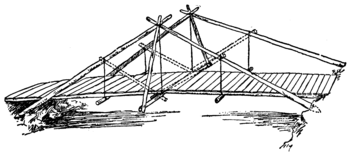
bridge. This we all voted to be the greatest of our achievements
on the island. To be sure, it was Uncle Ed’s design,
but I think we justly deserve credit for the masterful way in
which it was erected. In our search for types of bridges
before building the king post bridge, we came across a simple
cantilever bridge that didn’t look very difficult to construct.
To be sure, none of us knew a thing about stresses and
strains, and ingenious though we were, Bill realized that the
task of designing a cantilever bridge was far beyond him.
Nevertheless, we were sure we could build one if only we
had a good set of plans. A letter was therefore mailed to
Uncle Ed, asking him for the required details. The answer
came promptly from Western Australia, asking us to send
him the exact width of the water we wished to span, the
depth of the water, the distance from the top of one bank
to the top of the other, and the exact height of the banks
above water level. We decided we would build the bridge
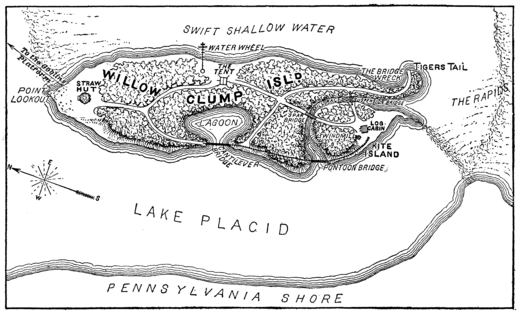
across the mouth of the lagoon. The distance here between
the two banks measured a little over 60 feet. The banks
293
were very precipitous, and rose 13-1/2 feet above the level of
the water. All these details, together with soundings of the
bottom, all the way across, were sent to Uncle Ed, and on
the day after our railway was completed quite a bulky package
was received in answer. It contained complete directions
for building the bridge of wooden frames, which were so designed
that they needed merely to be hooked together to
form the bridge, though to make the structure perfectly safe
Uncle Ed cautioned us to tie the frames together wherever
they met.
I am half afraid to tell my readers how to build this
bridge, as it required the utmost care, and had to be built just
so to avoid disaster. Bridge building is a serious business,
and I would not advise any one to attempt building this, of
all bridges, who does not propose to follow instructions implicitly.
Uncle Ed told us that if we built it properly, and
with sound timbers, we would find the bridge strong enough
to support a dozen boys, but he warned us not to crowd more
than that number on it.
Frames for the Cantilever Bridge.
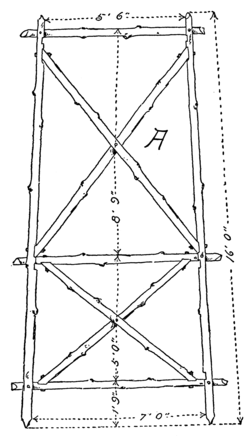
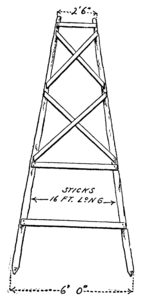
Fig. 305. A Frame (make four).
The frames with which the cantilever bridge was built
were made of saplings from 3 to 4 inches in diameter. We
procured them from Mr. Schreiner’s lands up the river. In
making the frames the sticks were fastened together with
1/2-inch bolts 6 inches long. It was quite a strain on our
pocketbooks to buy these bolts, but Uncle Ed had written
294
that nails or spikes would
be useless to stand the
strains of so large a
bridge, and that if we
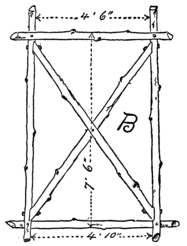
Fig. 306. B Frame (make four).
could not get any bolts
we had better give up the
idea of building a cantilever
bridge. To make
sure that we made no
mistakes, Uncle Ed had
made a drawing of each
different size of frame we
would need, designating
each with a different letter,
and then these same letters
were marked on a general
view of the bridge, so that
we would know exactly
where the frames belonged.
These drawings are reproduced
here in Figs. 305 to
316 and 318. We had to
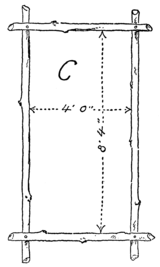
Fig. 307. C Frame (make four).
make four frames each, of
the A, B, C and E sizes,
two each of the F, G and L
295
sizes and one each of the H, I, J and K sizes. Of the D
frames two were made with the ends cut away on the outer
half, as illustrated in Fig. 308, and two were cut away at
the inner side, the reason for which will appear presently.
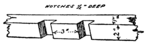
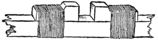
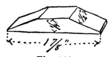
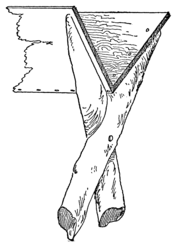
When fastening the timbers together
we cut notches in each
stick, as shown in Fig. 317.
The depth of each notch was
just one-quarter the diameter
of the stick; that is, the notch
was 3/4 of an inch deep in a
3-inch stick and 1 inch deep in a
4-inch stick. Care was taken not
to exceed this depth, for fear of
weakening the sticks. In the
case of frame D, the sticks were
not notched or mortised together.
It will be noticed that the measurements
are given to the inner
edges of the sticks in some cases,
and to the outer edges in others.
The reason for this, as Uncle Ed
explained it, was because the
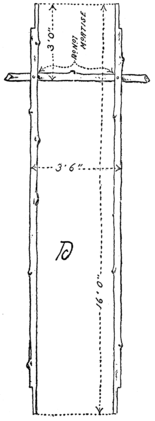
Fig. 308. D Frame (make four).
thickness of our sticks would
vary considerably, and it was
important that many of the measurements
be exact, otherwise the
frames would not fit into each
296
other as they should. Another
thing to which he
called our attention was the
fact that frames A, B, E, F,
H, K and L were stiffened
with cross braces, while the
rest were not. The braced
frames, he wrote, were
those which would be under
a compression strain, while
the others would be under
tension; that is, when any
weight was placed on the
bridge it would push against
the ends of the braced
frames, trying to crush
them, but would pull on the
unbraced frames, trying to
tear them apart. In fact,
the bridge would have been
just as strong had we used
heavy iron wire in place of
the unbraced frames, and
the only reason Uncle Ed
did not recommend our
doing so was because we
had no simple way of
stretching the wire taut.
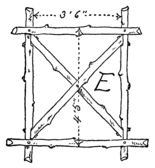
Fig. 309. E Frame (make four).
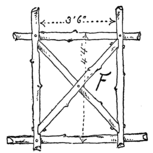
Fig. 310. F Frame (make two).
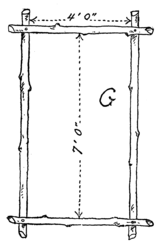
Fig. 311. G Frame (make two).
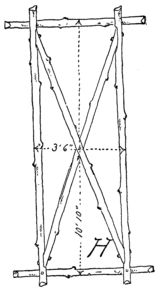
Fig. 312. H Frame (make one).
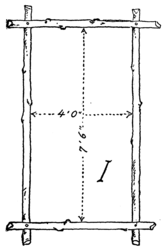
Fig. 313. I Frame (make one).
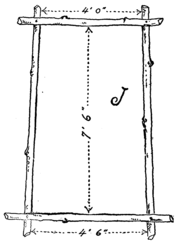
Fig. 314. J Frame (make one).
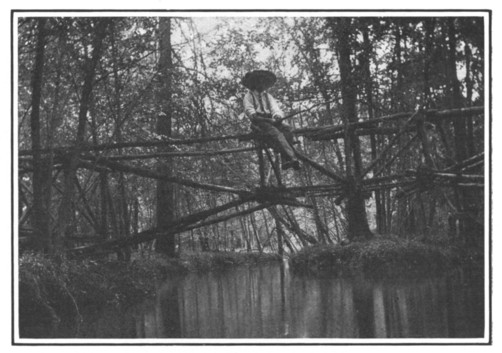
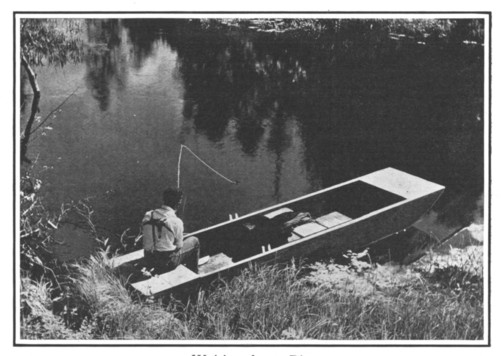
Fishing off the Cantilever Bridge.
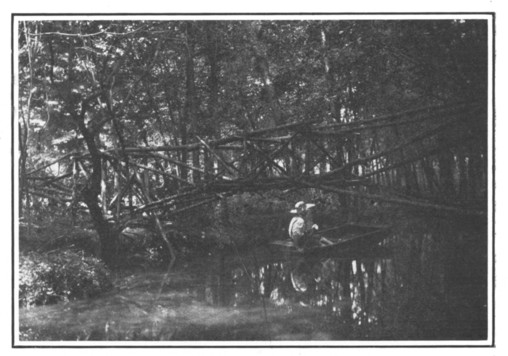
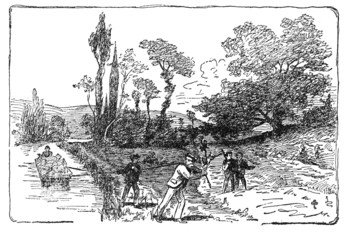
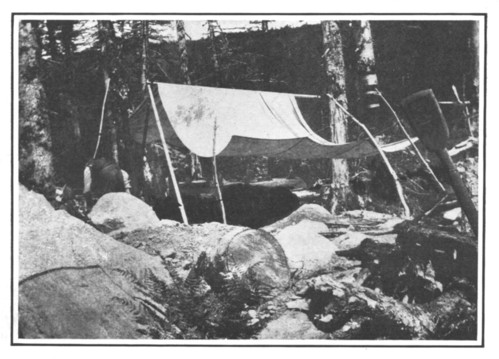
The Cantilever Bridge in Reddy’s Back Yard.
Erecting the Towers.
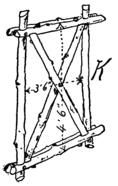
Fig. 315. K Frame (make one).
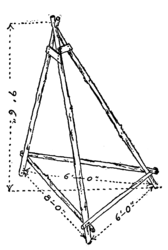
299We built the complete set of frames before attempting to
erect the bridge. Then we began by building the towers.
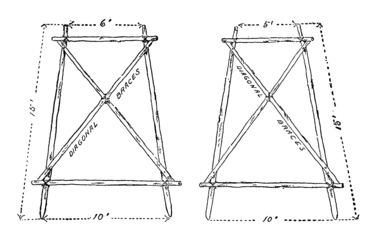
Two A frames were set on end and spaced 4 feet apart at the
top and 5 feet apart at the bottom, measuring not from the
inner but from the outer edges of the frames. In this position
they were connected by short spars, notched in place.
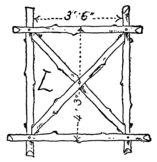
Fig. 316. L Frame (make two).
The notches for these connecting spars will be seen in Fig.
305 on the main or vertical timbers of frame A, just below
the upper and middle cross sticks and above the lower cross
sticks. The upper connecting spars were wedged tightly
under the cross sticks, and served as an additional support
for them. Diagonal braces were nailed from one frame to
the other, as illustrated in Fig. 318. The towers were built
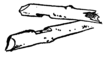
Fig. 317. Notching the Sticks Together.
300
on opposite banks, at the mouth of the lagoon, and when
completed we lowered them carefully down the banks into
the water. According to directions they were to be set just
30 feet apart, measuring from the center of one tower to
the center of the other. The water was quite shallow where
the towers rested, but the bottom was
pretty firm. Holes were dug in the
bottom for the legs of the tower to set
into, and then large stones were piled
around each leg to provide a firm
foundation for the towers.
Setting Up the Frames.
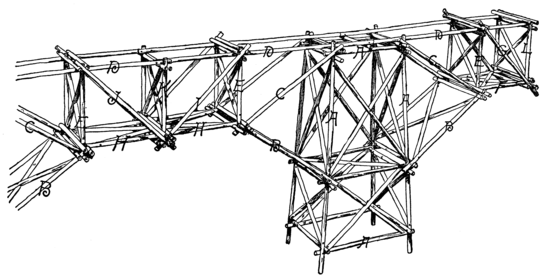
Fig. 318. View of Part of the Bridge, with Letters Indicating the Various Frames.
A B frame was now hauled out to one of the towers and
lifted by its narrower end, with fall and tackle, until its lower
tie piece rested on the projecting ends of the center crosspieces
of the tower. The upper end of the frame was held
against the top of the tower, while a C frame was hooked
over the upper ends of the tower legs; then frame B was
allowed to swing outward until its smaller end locked with
the outer end of frame C. It will be observed in Fig. 306
that the upper crosspiece or tie piece of frame B was fastened
to one side of the vertical sticks and the lower tie piece to
the other side. This was done purposely, so that when the
frame was set in position the bottom tie piece would be on
the lower side of the frame and the top piece would lie on
the upper side, as shown in Fig 318, or, better still, in
301
Fig. 319. The rest of the frames were all arranged to be set
in place with their tie pieces on the lower side, or facing the
towers, as will be clearly understood by examining the illustrations.
As soon as the B and C frames were set up on one
side of the tower, another pair of B and C frames was set
up on the other side of the same tower. A cantilever bridge
must always be built out on both sides of the tower at the
same time, otherwise it will be overbalanced on one side and
topple over. After the B and C frames were in place we
took two D frames, with oppositely cut ends, and rested their
tie sticks on the top of the tower, just under the ends of the
C frames. The ends of the two D frames overlapped at the
center of the tower, and, as one was cut away at the outer
side and the other at the inner side, they fitted neatly together
and were fastened with bolts. The D frames were
302
supported near their outer ends with E frames, which rested
on the B and C frames. Fig. 319 shows an E frame set in
position on the landward side of the tower, while two of the
boys are climbing out on the opposite B and C frames preparatory
to setting up the other E frame. A cross stick was
now bolted to each D frame, just beyond the upper ends of
the E sticks. This done, the frame F was hooked in between
the ends of B and C, at the shoreward side of the tower, and
its outer ends were supported by frame G, which was hooked
over frame D and the upper ends of frame E. The frame L
was then rested on the ends of frame F and G, and supported
the shore end of frame D. A stick nailed across frame D on
303
each side of the upper ends of frame L served to hold the
latter in place.
Binding and Anchoring the Structure.
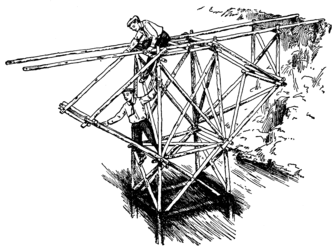
Fig. 319. Preparing to Put an E Frame in Place.
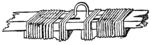
As the different frames were coupled together, we bound
the overlapping ends with soft iron wire. The place where
frames B, C, E and F came together was quite a vital point,
and we took pains to make the wire binding at this place
doubly strong. As soon as the L frame was in place we
anchored the bridge to shore by running wires from the
ends of the D frame and the ends of the G frame to stakes
driven into the banks. The frames on the second tower were
now similarly erected and anchored, after which we were
ready to put in the center panels of the bridge.
The Center Panels of the Bridge.
304First, the frame H was wedged into place and thoroughly
fastened by a liberal winding of wire. Next the frames I and
J were set in place, and in order to do this we had to remove
the upper tie pieces of these frames. Then one frame was
hooked in the other, and the two were carried out on the
scow under the center of the bridge. Ropes were tied to the
ends of the two frames, and they were lifted together, like a
wide V, to the position shown in Fig. 318, after which the tie
pieces were bolted on again, resting against the ends of the E
frames. As an additional security, two sticks were bolted to
the under side of the frame H, one at each side of the I and J
frames. The bridge was then completed by wedging the
frame K under the ends of the D frames, and also placing a
stick across each tower under the joints of the D frames.
We planned to run our gravity railway across this bridge,
moving our platform and trestle to the opposite bank; so
instead of flooring our bridge with slabs, we fastened ties
across at intervals of 15 or 18 inches. These ties were sticks
3 inches in diameter, which were secured to
305
the D frames.
A Serious Interruption.
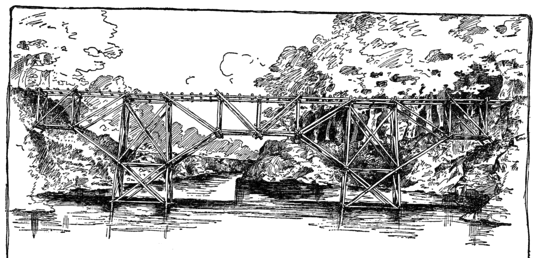
Fig. 320. A General View of our Cantilever Bridge.
We were just preparing to lay the tracks across the bridge
when we met with a serious interruption. Mr. Halliday had
told us that a few days before our arrival that summer Mr.
Smith, the owner of the island, and another man had paid
306
a visit to the place. Jim Halliday himself had rowed them
over, and learned from their conversation that Mr. Smith
was trying to sell the island, and that the stranger, a Mr.
Gill, was a prospective purchaser. All summer long we had
been dreading the return of this customer, though, as time
passed without his putting in an appearance, we almost forgot
the incident. But now, at the end of August, just as we
had about completed our cantilever bridge, who should
arrive but this very man Gill and three other men with a
large tent and camping outfit. It was a sorrowful crowd of
boys that watched the wagon with their belongings ford the
shallow water over to our island. We felt that the island
was ours by right of discovery and occupation, but we were
powerless to force our claims. And what if they did not
insist on our leaving the island? It would not be the same
place with strangers around to meddle with our things.
Dispossessed.
But the new owner of the island was even more of a boor
than we had anticipated. As soon as he landed he wanted
to know what we were doing on his property, and peremptorily
ordered us off. Bill answered that we were camping
there, and politely asked if we couldn’t stay out the summer.
But Gill would not listen to the idea. We must get off the
island that very day or he would see to it that we did.
I tell you it made us boil. We were just itching to give
the pompous little man the sound thrashing he deserved, but
307
knew that we would stand a very small show against his
three powerful companions. At any rate, we were determined
not to leave at once. Instead, we repaired to Kite Island,
taking our belongings with us. Then we cut away the suspension,
spar and pontoon bridges, so that we would not be
annoyed by any of the Gill crowd. We were resolved that
they should not benefit by any of the things we had built.
At the dead of night we paddled back to Willow Clump
Island, crept past the slumbering intruders and waded out
to the old water wheel. After a good deal of exertion we
managed to dislodge the smaller tower, letting the wheel
drop into the river and float away. Then we made for the
cantilever bridge. It didn’t take us very long to cut away the
wire bindings, unhook the frames and drop them into the
lagoon. But the task was quite a perilous one, as the night
was pitch black. Finally, nothing remained of the bridge
but the two towers, which were left as monuments to mark
the spot where our last piece of engineering on the island
was done.
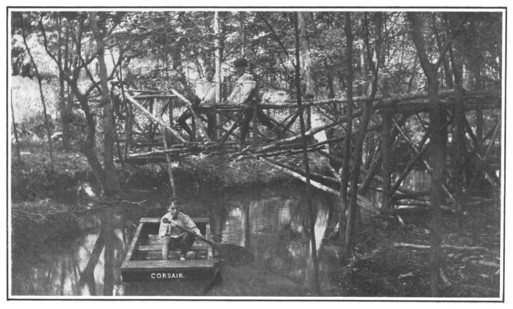
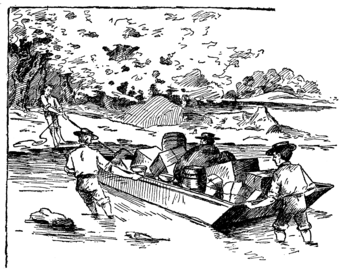
Building the Cantilever Bridge over Cedar Brook.
Farewell to Willow Clump Island.
We spent several days on Kite Island, knowing that we
were safe from intrusion, because the Gill crowd had but
one boat, and that was on the Jersey side of the island. We
felt confident that they would not take the trouble of wading
around Point Lookout with their boats, as we had done;
nevertheless, to prevent a surprise, we kept a sentry posted
on the Lake Placid side of the island and gathered a pile of
308
stones for ammunition. But our fun was spoiled, and we
finally decided to break camp and bid farewell forever to
Willow Clump Island and its vicinity. Our goods were
ferried over to Jim Halliday’s farm, where we were given
shelter. The windmill, as I have already stated, was sold
to a farmer at Lumberville, and we were kept busy for
several days carting it over and setting it up in place. When
everything had been done we stole back to Kite Island and
set fire to the log cabin. The next day Mr. Schreiner took
us home in a couple of his wagons. Thus ended our “investigation,
exploration and exploitation of Willow Clump
Island.” The work of two summers was practically all destroyed
in a few days.
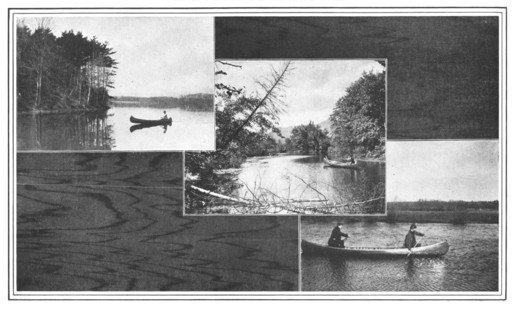
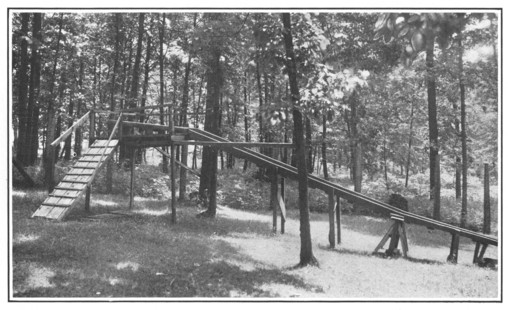
Reddy’s Cantilever Bridge.
I believe I have given a careful account of everything that
was recorded in the chronicles of the society. We were too
discouraged to undertake anything new in the two weeks before
school opened. I presume I might mention here Reddy’s
cantilever bridge, which, however, had really nothing to
do with the S. S. I. E. E. of W. C. I., because our society
was formally disbanded the day before Bill and I returned
to school. About a month after leaving home I received
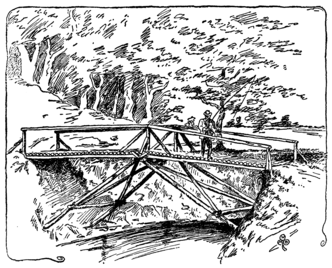
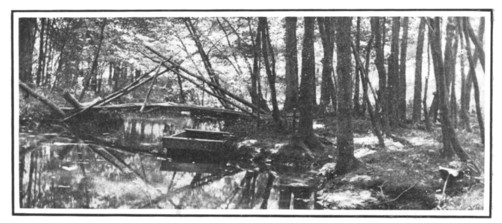
a letter from Reddy inclosing three interesting photographs,
which are reproduced herewith. Reddy certainly had the
bridge fever, because soon after we had left he started to
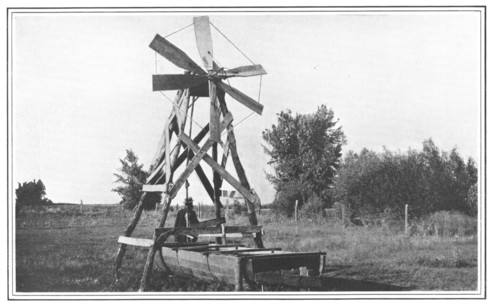
work, with the rest of the boys, on a cantilever bridge across
Cedar Brook. The brook was entirely unsuited to such a
309
structure, because the banks were very low; but he made the
towers quite short and built an inclined roadway leading up
to the top of them. The legs of the towers were driven
firmly into the bank, making them so solid that he thought
it would be perfectly safe to build the frames out over the
brook without building them at the same time on the shore
side. But he had made a miscalculation, for when a couple
of the boys had crawled out on the B and C frames to set up
an E frame the structure commenced to sag. The trouble
was remedied by propping up the tower with a stout stick
driven into the river bottom and wedged under the upper
tie piece of the tower. The towers were really too short to
make a well proportioned bridge, for the panels had to be
made very long and narrow, so as to reach across. But on
the whole it was a very creditable structure when completed,
though it had only half as long a span as our cantilever bridge
over the lagoon.
INDEX
A
“A” tent, 207
Abbreviations, wigwag, 146
Accident, railway, the first, 290
Ainu snow shoe, 41
Alarm clock, a unique, 63
Alphabet, wigwag, 145
Alpine stock, 198
Anchoring cantilever bridge, 303
Annex, the, 50
Arctic expedition, 193
Armchair, barrel, 227
Axles of railroad car, 285
B
Bags, sleeping, 203
Banquets, midnight, 179
Barrel armchair, 227
Barrel filter, 68
Barrel hoop snow shoe, 36
Barrel stave hammock, 226
Barrel stave snow shoe, 36
Bat’s wings, 33
Bed, a camp, 209
Bed in shower, 210
Belly band, elastic, 235
Bending wood, 39
Bicycle wheels, mounting frame on, 219
Big Bug Club, 177
“Bill,” 17
Bill’s cave, 224
Bill’s skate sail, 21
Binding cantilever bridge, 303
Blades of wind wheel, 278
Boat, ice, 159
Boat mooring, tramp-proof, 142
Boat, scow, 59
Box kite, diamond, 236
Box, the black walnut, 19
Brake for wind wheel, 278
Bridge building, 95
Bridge, cantilever, 292
Bridge, king post, 105
Bridge, king rod, 102
Bridge, pontoon, 101
Bridge, Reddy’s cantilever, 308
Bridge, spar, 95
Bridge, stiffening, 104
Bridge, suspension, 99
Bridge wreck, 66
Bucket, the canvas, 251
Buckets for water wheel, 246
Bunks, 270
C
Camp bed, 209
Camp bed in shower, 210
Camp, breaking, 158
Camp chair, a, 208
Camp fire, a costly, 200
Camp fire, kindling, 194
Canoe, Indian paddling, 121
Canoe lee boards, 119
Canoe rudder, 115
Canoe, the sailing, 111
Canoe sails, 117
Canoe, scooter, 190
Canoe, stretching on canvas, 114
Canoes, canvas, 109
Cantilever bridge, 292
Cantilever bridge, anchoring, 303
Cantilever bridge, binding frames, 303
Cantilever bridge, center panels, 304
Cantilever bridge, frames for, 293
Cantilever bridge, Reddy’s, 308
Cantilever bridge, setting up frames of, 300
Cantilever bridge towers, 299
Canvas bucket, 251
Canvas canoes, 109
Canvas, stretching on canoe, 114
Canvas tent, 46
Car axles, 285
Car for gravity railroad, 284
Car, mounting wheels on, 286
Carpenter’s miter box, 288
Cave, Bill’s, 224
Cave, covering the, 177
Cave, excavating for, 173
Cave, framing, 174
Cave-in, a, 171
Center panels of cantilever bridge, 304
Chain, surveyor’s, 77
Chair, a camp, 208
Chair seat snow shoe, 35
Cheek blocks, 162
Chinks in log cabin, stopping up, 272
Christmas vacation, 19
Clamp for crank shaft, 276
Clapboards, nailing on, 135
Cleat, a, 163
Climbing, mountain, 198
Clock, a unique alarm, 63
Club, the Big Bug, 177
Club pin, 180
Club, the Subterranean, 171
Code, International Telegraph, 155
Combination lock, 181
Council of war, 139
Crank shaft, the, 276
Creepers, ice, 170
Crossbow, 55
Crossbow trigger, 57
Cutting out disk, 78
D
Danish sail, 30
Derrick, the, 131
Diamond box kite, 236
Digging the well, 274
Disk, cutting out, 78
Disk, sighting, 79
Dispossessed, 306
Diving tree, 84
Door hinges, 269
Door latch, 269
Doors, sliding, 136
Double mirror heliograph, 156
Double surprise, 140
Drill, fire, 69
Drowned, how to restore, alone, 92
Drowned, restoring the, 89
E
Easter vacation, 224
Elastic belly band, 235
Expedition, Arctic, 193
Expedition, logging, 255
Expedition, preparing for, 53
Exploration, preliminary, 66
F
Farewell to Willow Clump Island, 307
Fastener, brass, 58
Filter, the barrel, 68
Filter barrel, cooling the, 250
Filter, the small, 67
Fire drill, 69
Fireplace of log cabin, 265
Fireplace, outdoor, 195
Fireplace, stone-paved, 196
Fissure, path up the, 129
Flanged wheels, 285
Fly, ridge pole, 54
Fly for tent, 54
Fly, umbrella with, 211
Focusing heliograph instrument, 153
Frame on bicycle wheels, 219
Frames for cantilever bridge, 293
Frames of cantilever bridge, setting up, 300
Friend in time of trouble, 201
G
Goblins’ Dancing Platform, 126
Grass hut, 124
Gravity railroad, 283
H
Halliday, Jim, 194
Hammock, barrel stave, 226
Harness, pack, 212
Heliograph, the, 147
Heliograph, double mirror, 156
Heliograph instrument, focusing, 153
Heliograph screen, 151
Heliograph sight rod, 150
Heliograph signaling, 154
Heliograph, single mirror, 148
Hinge for spars, 30
Hinges, door, 269
House building, 124
House, log, 254
House, the tree, 132
Hut, cold night in, 197
Hut, log, 254
Hut, straw, 124
I
Ice boat, the, 159
Ice boats, sledges and toboggans, 158
Ice, craft strikes the, 184
Ice creepers, 170
Indian paddling canoe, 121
Instrument, double mirror, 156
Instrument, single mirror, 148
Instrument, surveying, 73
International Telegraph Code, 155
Iroquois snow shoe, 39
Island, mapping the, 82
Island, off to the, 63
Island, trip to the, 64
J
Jacob’s Ladder, 129
Jaws of boom, 162
Jib-sail for ice boat, 164
Jib-sail for scooter scow, 187
Jim Halliday, 194
K
King post bridge, 105
King rod truss, 102
Kite, diamond box, 236
Kite Island, 83
Kite, Malay, 5-foot, 231
Kite, Malay, 8-foot, 233
Kites, putting to work, 235
Kites, tailless, 229
Klepalo, the, 70
L
Ladder, the Jacob’s, 129
Ladders, rope, 130
Lagoon, the, 83
Lake Placid, 83
Land yacht, 215
Land yacht, a sail on, 222
Lanteen sail for canoe, 117
Lanteen skate sail, 29
Latch, door, 269
Latch string, 270
Lee boards, canoe, 119
“Leg-of-mutton” sail, 220
Levels, spirit, 74
Lock combination, 181
Log cabin, 251
Log cabin, building the, 259
Log cabin door hinges, 269
Log cabin door latch, 269
Log cabin door and window frames, 263
Log cabin fireplace, 265
Log cabin, floor of, 267
Log cabin, foundation of, 254
Log cabin, roof of, 262
Log cabin, stopping up chinks, 272
Log cabin window sash, 270
Log raft, 256
Logging expedition, 255
M
Mainsail for canoe, 117
Mainsail for ice boat, 162
Malay kite, 5-foot, 231
Malay kite, 8-foot, 233
Mapping the island, 82
Mast of land yacht, stepping, 218
Mast step, ice boat, 161
Mast step, leather, 30
Mast step, wooden, 30
Megaphone, 57
Megaphone mouthpiece, 58
Midnight banquets, 179
Mill-race, the, 88
Mirror instrument, heliograph, 148
Miter box, carpenter’s, 288
Mizzen sail of canoe, 118
Mooring, tramp-proof boat, 142
Mountain climbing, 198
Mouthpiece of megaphone, 58
“Mummy case,” 204
N
Needle, weaving, 39
Night, cold, in the hut, 197
Nightmare, a, 211
Noria, 241
Norwegian ski, 42
Numerals, wigwag, 145
O
Oar, the, 61
Off to the island, 63
Organizing the society, 25
Outdoor fireplace, 195
Outfits, tramping, 203
P
Pack harness, 212
Paddling canoe, Indian, 121
Paddles for water wheel, 246
Panels, center, of cantilever bridge, 304
Path up the fissure, 129
Patient, how to work over, alone, 93
Pin, the club, 180
Plank, swimming on, 86
Platform, Goblins’ Dancing, 126
Point Lookout, 83
Pole, ridge, 48
Poncho, 210
Pontoon bridge, 101
Poor shelter, a, 199
Preparing for the expedition, 53
Protractor, the, 76
Provisions and supplies, 54
Pump, the, 279
Pump, action of, 281
Pump valves, the, 280
R
Raft, log, 256
Raft, sail-rigged, 258
Railroad car, 284
Railroad car axles, 285
Railroad flanged wheels, 285
Railroad, gravity, 283
Railway track, the, 287
Railway accident, the first, 290
Railway, rope, 97
Railway spikes, 50
Rapids, shooting the, 88
Receiving trough for water wheel, 247
Records of the S. S. I. E. E. of W. C. I., 19
Reddy’s cantilever bridge, 308
Rennwolf, the, 168
Restoring the drowned, 89
Ridge pole, 48
Ridge pole, fly, 54
Riveting, 213
Rod, heliograph sight, 150
Rod, surveyor’s, 78
Rope ladders, 130
Rope railway, 97
Rowlocks, sockets for, 60
Rudder, canoe, 115
Rudder shoe, ice boat, 160
Runner shoe, ice boat, 160
Runners of scooter canoe, 190
Runners of sledge, 165
Rustic table, 66
S
S. S. I. E. E. of W. C. I., records of, 19
Sail, jib, for scooter, 187
Sail, “leg-of-mutton,” 220
Sail, mizzen, of canoe, 118
Sail-rigged raft, 258
Sail, sprit, for scooter, 186
Sail stitch, 46
Sail through the country, 222
Sailing canoe, the, 111
Sailor’s stitch, 221
Sails, canoe, 117
Sails for ice boat, 162
Sandwiches, straw, 227
Schreiner, a visit from Mr., 110
Scooter canoe, 190
Scooter sailing, 188
Scooter scow, 185
Scooters, 183
Scow, the, 59
Scow, a sail in, 184
Scow, scooter, 185
Scow, stolen, 138
Screen, heliograph, 151
Seat, swing, 97
Shaft, the crank, 276
Shelter, a poor, 199
Shooting the rapids, 88
Sight rod, 150
Sighting blocks, 74
Sighting disk, 79
Signaling, heliograph, 154
Signals, wigwag, 144
Simple method of surveying, 79
Single mirror heliograph, 148
Sioux snow shoe, 37
Skate sail, bat’s wings, 33
Skate sail, Bill’s, 21
Skate sail, Danish, 30
Skate sail, double Swedish, 26
Skate sail, lanteen, 29
Skate sail, single Swedish, 28
Skate sails, 26
Ski, Norwegian, 42
Ski sticks, 43
Skids, 262
Slabs, 101
Sledge, the, 165
Sleeping bags, 203
Sliding doors, 136
Snotter, 187
Snow shoe, Ainu, 41
Snow shoe, barrel hoop, 36
Snow shoe, barrel stave, 36
Snow shoe, chair seat, 35
Snow shoe, Iroquois, 39
Snow shoe, Sioux, 37
Snow shoe, Swiss, 43
Snow shoes, 35
Society, meeting of, 189
Society, organizing the, 25
Spar bridge, 95
Spars, hinge for, 30
Spikes, railway, 50
Spiral spring, 153
Spirit levels, 74
Spring, spiral, 153
Sprit sail, 186
Stepping mast of land yacht, 218
Stitch, the sail, 46
Stitch, sailor’s, 221
Stick, ski, 43
Stiffening the bridge, 104
Stone-paved fireplace, 196
Stone wall, how to build, 266
Straw hut, 124
Straw sandwiches, 227
Subterranean Club, 171
Summer toboggan, 229
Supplies and provisions, 54
Surprise, a double, 140
Surveying, 73
Surveying, first lesson in, 79
Surveying instrument, 73
Surveying, a simple method of, 79
Surveying for water wheel, 241
Surveyor’s chain, 77
Surveyor’s rod, 78
Suspension bridge, 99
Swamp shoe, 43
Swedish sail, double, 26
Swedish sail, single, 28
Swimming, 84
Swimming on a plank, 86
Swing seat, 97
Swiss snow shoe, 43
T
Table, a rustic, 66
Tailless kites, 229
Telegraph Code, International, 155
Tent, the “A”, 207
Tent, annex, 50
Tent, canvas wall, 46
Tent fly, 54
Tent making, 44
Testing the track, 291
Thole pins, 61
Tie block, wood, 49
Tie, wire, 50
Tiger’s Tail, 83
Tiller, ice boat, 161
Tiller of land yacht, 219
Toboggan, the, 167
Toboggan, the summer, 229
Tower, the windmill, 275
Towers of the cantilever bridge, 299
Towers for water wheel, 243
Towers of water wheel, setting up, 248
Track, laying the, 289
Track, the railway, 287
Track, testing the, 291
Tramping outfits, 203
Tramp-proof boat mooring, 142
Tramps, trouble with, 138
Tree, diving, 84
Tree house, the, 132
Trigger for crossbow, 57
Trip to the island, 64
Tripod, the, 75
Trouble with tramps, 138
Trunk, the old, 18
Truss, king rod, 102
Turnbuckle, a simple, 216
U
Umbrella with fly, 211
Umbrella rib crossbow, 55
Uncle Ed, word from, 45
Uncle Ed’s departure, 109
V
Vacation, Christmas, 19
Vacation, Easter, 224
Valves, the pump, 280
Van Syckel, interview with, 189
Vengeance, 139
Visit from Mr. Schreiner, 110
W
Wall, how to build, 266
Wall tent, 46
Water wheel, 241
Water wheel buckets, 246
Water wheel, construction of, 245
Water wheel, Mr. Halliday’s, 252
Water wheel, mounting the, 249
Water wheel paddles, 246
Water wheel receiving trough, 247
Water wheel, surveying for, 241
Water wheel, towers for, 243
Water wheel towers, setting up, 248
War, council of, 139
Weaving needle, 39
Well, digging the, 274
Wheel, the wind, 276
Wheels for gravity railroad, 285
Wheels, mounting, on car, 286
Wheels, mounting frame on, 219
Wigwag abbreviations, 146
Wigwag alphabet, 145
Wigwag numerals, 145
Wigwag signals, 144
Wigwagging and heliographing, 144
Wigwagging at night, 147
Willow Clump Island, 23
Willow Clump Island, farewell to, 307
Willow Clump Island in winter, 194
Wind wheel, 276
Wind wheel blades, 278
Wind wheel brake, 278
Windmill, 273
Windmill tower, 275
Window hinge, 270
Window sash, log cabin, 270
Wings, bat’s, 33
Wire tie, 50
Wood, bending, 39
Wood tie block, 49
Word from Uncle Ed, 45
Y
Yacht, land, 215
Yacht, land, frame of, 216
The Most Popular Scientific Paper in the World
Established 1845
Weekly, $3.00 a Year; $1.50 Six Months
This unrivaled periodical is now in its sixtieth year, and,
owing to its ever-increasing popularity, it enjoys the
largest circulation ever attained by any scientific publication.
Every number contains sixteen large pages,
beautifully printed, handsomely illustrated; it presents
in popular style a descriptive record of the most novel, interesting
and important developments in Science, Arts and Manufactures.
It shows the progress of the World in respect to New
Discoveries and Improvements, embracing Machinery, Mechanical
Works, Engineering in all its branches, Chemistry, Metallurgy,
Electricity, Light, Heat, Architecture, Domestic Economy,
Agriculture, Natural History, etc. It abounds in fresh
and interesting subjects for discussion, thought or study. To
the inventor it is invaluable, as every number contains a complete
list of all patents and trade-marks issued weekly from the
Patent Office. It promotes Industry, Progress, Thrift and
Intelligence in every community where it circulates.
The Scientific American should have a place in every
Dwelling, Shop, Office, School, or Library. Workmen, Foremen,
Engineers, Superintendents, Directors, Presidents, Officials,
Merchants, Farmers, Teachers, Lawyers, Physicians, Clergymen–people
in every walk and profession in life–will derive satisfaction
and benefit from a regular reading of the Scientific
American.
If you want to know more about the paper send for “Fifteen
Reasons Why You Should Subscribe to the Scientific American,”
and for “Five Reasons Why Inventors Should Subscribe to the
Scientific American.” Fifty-two numbers make 832 large pages,
equal to 3,328 ordinary magazine pages, and 1,000 illustrations
are published each year. Can you and your friends afford to
be without this up-to-date periodical, which is read by every
class and profession? Remit $3.00 by postal order or check for
a year’s subscription, or $1.50 for six months.
MUNN & COMPANY, Publishers
No. 361 Broadway, New York City
JUST PUBLISHED
Home Mechanics
for Amateurs
By GEORGE M. HOPKINS
Author of “Experimental Science”
12mo, 375 Pages, 320 Illustrations. Price, $1.50, Postpaid
The book deals with wood-working, household
ornaments, metal-working, lathe work,
metal spinning, silver working; making
model engines, boilers and water motors;
making telescopes, microscopes and meteorological
instruments, electrical chimes, cabinets, bells, night
lights, dynamos and motors, electric light, and an
electrical furnace. It is a thoroughly practical
book by the most noted amateur experimenter in
America.
Every reader of “Experimental Science” should
possess a copy of this most helpful book. It appeals
to the boy as well as the more mature amateur.
Holidays and evenings can be profitably occupied by
making useful articles for the home or in building
small engines or motors or scientific instruments.
Table of contents sent on application.
MUNN & COMPANY
Publishers of the “Scientific American”
361 BROADWAY, NEW YORK
Scientific American
Reference Book
500 PAGES SIX COLORED PLATES PRICE $1.50
This book is intended to furnish the reader with information
not obtainable in any other work of reference.
It is not an encyclopedia, nor is it an annual,
but it contains a mass of information that should be within
the reach of every family. This work has been prepared in
response to the many thousands of inquiries received by the
Editor of the Scientific American on the widest possible
range of topics, and it is through these inquiries that the
Editors of the Reference Book have been enabled to determine
the scope of this work. It deals with the “Progress
of Discovery,” “Shipping and Yachts,” “The Navies of
the World,” “The Armies of the World,” “Railroads of
the World,” “Population,” “Education,” “Telegraphs,”
“Submarine Telegraphs,” “Wireless Telegraphy,”
“Patents,” “Trade-marks,” “Copyrights,” “Manufactures,”
“Iron and Steel,” “Departments of the Federal
Government,” “The Post-office,” “International Institutions
and Bureaus,” “Mines and Mining,” “Farms and
Food,” “Mechanical Movements,” “Chemistry,”
“Astronomy,” “Weights and Measures,” and a host of
other subjects, such as “Aerial Navigation,” “Radium,”
etc. This valuable compendium has been put at a very low
price, so that it may be within the reach of every one. It is
fully illustrated, and has colored plates showing the flags of
all nations, the funnels and house flags of lines in American
trade, and the International Signal Code.
DESCRIPTIVE CIRCULAR SENT UPON REQUEST
MUNN & COMPANY, Publishers
361 BROADWAY :: :: NEW YORK CITY