The Nature of Habit. We now turn from man’s inherited nature to his
acquired nature. Inherited tendencies to action we have called
instincts; acquired tendencies to action we shall call habits. We can
best form an idea of the nature of habit by considering some concrete
cases.
Let us take first the case of a man forming the habit of turning out the
basement light. It usually happens that when a man has an electric light
in the basement of his house, it is hard for him at first to think to
turn out the light at night when he retires, and as a consequence the
light often burns all night. This is expensive and unnecessary, so there
is a strong incentive for the man to find a plan which will insure the
regular turning-off of the light at bedtime. The plan usually hit upon
is the following: The electric switch that controls the basement light
is beside the basement stairway. The man learns to look at the switch as
he comes up the stairs, after preparing the furnace fire for the night,
and learns to take hold of the switch when he sees it and turn off the
light. Coming up the stairs means to look at the switch. Seeing the
switch means to turn it. Each step of the performance touches off the
next. The man sees that in order to make sure that the light will always
be turned off, the acts must all be made automatic, and each step must
touch off the next in the series. At first, the man leaves the light
burning about as often as he turns it off. After practicing for a time
on the scheme, the different acts become so well connected that he
seldom leaves the light burning. We say that he has formed the habit
of turning off the light.
For a second illustration, let us take the process of learning that nine
times nine equals eighty-one. At first, one does not say or write
“eighty-one” when one sees “nine times nine,” but one can acquire the
habit of doing so. It does not here concern us how the child learns what
the product of nine times nine is. He may learn it by counting, by being
told, or by reading it in a book. But however he first learns it, he
fixes it and makes it automatic and habitual by continuing to say or
to write, “nine times nine equals eighty-one.” The essential point is
that at first the child does not know what to say when he hears or sees
the expression “nine times nine,” but after long practice he comes to
give automatically and promptly the correct answer. For the definite
problem “nine times nine” there comes the definite response
“eighty-one.”
For a third illustration, let us take the case of a man tipping his hat
when he meets a lady. A young boy does not tip his hat when he meets a
lady until he has been taught to do so. After he learns this act of
courtesy he does it quite automatically without thinking of it. For the
definite situation, meeting a lady of his acquaintance, there comes to
be established the definite response, tipping the hat. A similar habit
is that of turning to the right when we meet a person. For the definite
situation, meeting a person on the road or street or sidewalk, there is
established the definite response, turning to the right. The response
becomes automatic, immediate, certain.
There is another type of habit that may properly be called an
intellectual habit, such as voting a certain party ticket, say the
Democratic. When one is a boy, one hears his father speak favorably of
the Democratic party. His father says, “Hurrah for Bryan,” so he comes
to say, “Hurrah for Bryan.” His father says, “I am a Democrat,” so he
says he is a Democrat. He takes the side that his father takes. In a
similar way we take on the same religious notions that our parents have.
It does not always happen this way, but this is the rule. But no matter
how we come to do it, we do adopt the creed of some party or some
church. We adopt a certain way of looking at public questions, and a
certain way of looking at religious questions. For certain rather
definite situations, we come to take definite stands. When we go to the
booth to vote, we look at the top of the ballot to find the column
marked “Democratic,” and the definite response is to check the
“Democrat” column. Of course, some of us form a different habit and
check the “Republican” column, but the psychology of the act is the
same. The point is that we form the Democratic habit or we form the
Republican habit; and the longer we practice the habit, the harder it is
to change it.
In the presidential campaign of 1912, Roosevelt “bolted” from the
Republican party. It was hard for the older Republicans to follow him.
While one occasionally found a follower of Roosevelt who was gray, one
usually found the old Republicans standing by the old party, the younger
ones joining the Progressive party. It is said that when Darwin
published “The Origin of Species,” very few old men accepted the
doctrine of evolution. The adherents of the new doctrine were nearly
all young men. So there is such a thing as an intellectual habit. One
comes to take a definite stand when facing certain definite intellectual
situations.
Similar to the type of habits which we have called intellectual is
another type which may be called “moral.” When we face the situation of
reporting an occurrence, we can tell the truth or we can lie. We can
build up the habit of meeting such situations by telling the truth on
all occasions. We can learn to follow the maxim “Tell the truth at all
times, at all hazards.” We can come to do this automatically, certainly,
and without thought of doing anything else.
Most moral situations are fairly definite and clear-cut, and for them we
can establish definite forms of response. We can form the habit of
helping a person in distress, of helping a sick neighbor, of speaking
well of a neighbor; we can form habits of industry, habits of
perseverance. These and other similar habits are the basis of morality.
The various kinds of habits which we have enumerated are alike in
certain fundamental particulars. In all of them there is a definite
situation followed by a definite response. One sees the switch and turns
off the light; he sees the expression “nine times nine” and says
“eighty-one”; he sees a lady he knows and tips his hat; in meeting a
carriage on the road, he turns to the right; when he has to vote, he
votes a certain ticket; when he has to report an occurrence, he tells it
as it happened. There is, in every case, a definite situation followed
by a definite response.
Another characteristic is common to all the cases mentioned above,
i.e. the response is acquired, it does not come at first. In every
instance we might have learned to act differently. We could form the
habit of always leaving the light burning; could just as easily say
“nine times nine equals forty”; we could turn to the left; we could vote
the Republican ticket. We can form bad moral habits as well as good
ones, perhaps more easily. The point is, however, that we acquire
definite ways of acting for the same situations, and these definite ways
of acting are called habits.
Habit and Nerve-Path. It has already been stated that a habit is a
tendency toward a certain type of action in a certain situation. The
basis of this tendency is in the nervous system. In order to understand
it we must consider what the nervous system is like. Nerves terminate at
one end in a sense organ and at the other end ultimately in a muscle.
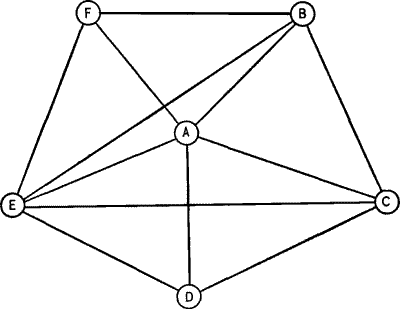
In Figure II, A is a sense organ, B a nerve going from the sense organ
to the brain C. D, E, F, G, and H are motor nerves going from the brain
to the muscles. Now, let us show from the diagram what organization
means and what tendency means. At first when the child sees the
expression “nine times nine,” he does not say “eighty-one.” The stimulus
brings about no definite action. It is as likely to go out through E or
F as through D. But suppose we can get the child to say “nine times nine
equals eighty-one.” We can write the expression on the blackboard and
have the child look at it and say “nine times nine equals eighty-one.”
Suppose the act of saying “eighty-one” is brought about by the
nerve-current going out through nerve-chain D. By repetition, we
establish a bond. A stimulus of a particular kind comes through A, goes
over B to C, and out over D, making muscles at M bring about a very
definite action in saying “eighty-one.”
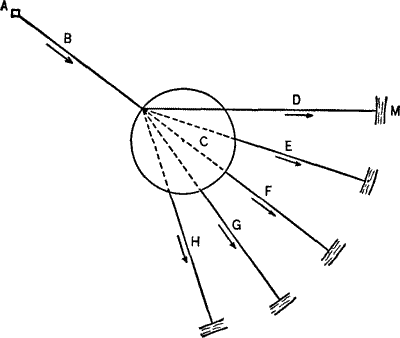
Figure II.—The Organization of Tendencies
From the point of view of physiology, the process of habit-formation
consists in securing a particular nerve coupling, establishing a
particular nerve path, so that a definite form of stimulation will bring
about a definite form of response. A nerve tendency is simply the
likelihood that a stimulus will take a certain course rather than any
other. This likelihood is brought about by getting the stimulus to take
the desired route through the nervous system to a group of muscles and
to continue following this route. The more times it passes the same way,
the greater is the probability that at any given time the stimulus will
take the accustomed route and bring about the usual response. At first
any sort of action is possible. A nerve stimulus can take any one of the
many routes to the different muscles. By chance or by conscious
direction, the stimulus takes a certain path, and by repetition we fix
and make permanent this particular route. This constitutes a nerve
tendency or habit.
Plasticity. Our discussion should have made it clear that habit is
acquired nature, while instinct is inherited nature. Habit is acquired
tendency while instinct is inherited tendency. The possibility of
acquiring habits is peculiarly a human characteristic. While inanimate
things have a definite nature, a definite way of reacting to forces
which act upon them, they have little, if any, possibility of varying
their way of acting. Water might be said to have habits. If one cools
water, it turns to ice. If we heat it, it turns to steam. But it
invariably does this. We cannot teach it any different way of acting.
Under the same conditions it always does the same thing.
Plants are very much like inanimate things. Plants have definite ways of
acting. A vine turns around a support. A leaf turns its upper surface to
the light. But one cannot teach plants different ways of acting. The
lower forms of animals are somewhat like plants and inanimate objects.
But to a very slight extent they are variable and can form habits. Among
the higher animals, such as dogs and other domestic animals, there is a
greater possibility of forming habits. In man there are the greatest
possibilities of habit-formation. In man the learned acts or habits are
many as compared to the unlearned acts or instincts; while among the
lower animals the opposite is the case—their instincts are many as
compared to their habits.
We may call this possibility of forming habits plasticity. Inanimate
objects such as iron, rocks, sulphur, oxygen, etc., have no plasticity.
Plants have very little possibility of forming habits. Lower animals
have somewhat more, and higher animals still more, while man has the
greatest possibility of forming habits. This great possibility of
forming habits is one of the main characteristics of man. Let us
illustrate the contrast between man and inanimate objects by an example.
If sulphur is put into a test tube and heated, it at first melts and
becomes quite thin like water. If it is heated still more, it becomes
thick and will not run out of the tube. It also becomes dark. Sulphur
always does this when so treated. It cannot be taught to act
differently. Now the action of sulphur when heated is like the action of
a man when he turns to the right upon meeting a person in the street.
But the man has to acquire this habit, while the sulphur does not have
to learn its way of acting. Sulphur always acted in this way, while man
did not perform his act at first, but had to learn it by slow
repetition.
Everything in the world has its own peculiar nature, but man is unique
in that his nature can be very much changed. To a large extent, a man is
made, his nature is acquired. After we become men and women, we have
hundreds and thousands of tendencies to action, definite forms of
action, that we did not have when young. Man’s nature might be said to
consist in his tendencies to action. Some of these tendencies he
inherits; these are his instincts. Some of these he acquires; these are
his habits.
What Habits Do for Us. We have found out what habits are like; let us
now see what they do for us. What good do they accomplish for us? How
are we different after forming a habit from what we were before? We can
best answer these questions by a consideration of concrete cases.
Typewriting will serve very well the purpose of illustration. We shall
give the result of an actual experiment in which ten university students
took part. During their first half hour of practice, they wrote an
average of 120 words. At the end of forty-five hours of practice, they
were writing an average of 680 words in a half hour. This was an
increase of speed of 560 per cent. An expert typist can write about
3000 words in a half hour. Such a speed requires much more than
forty-five hours practice, and is attained by the best operators only.
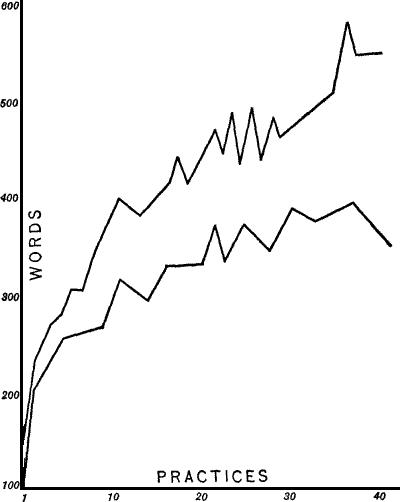
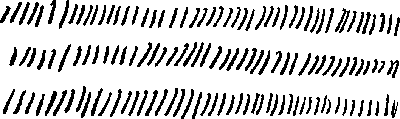
Figure III.—Learning Curves
The upper graph shows the improvement in speed of a group of students
working two half hours a day. The lower curve shows the improvement of a
group working ten half-hours a day.
In the foregoing experiment, the students improved in accuracy also. At
the beginning of the work, they made 115 errors in the half hour. At the
end of the practice, with much faster speed, they were making only
327 errors in a half hour. The actual number of errors had increased
280 per cent. The increase in errors was therefore exactly half as much
as the increase in speed. This, of course, was a considerable increase
in accuracy, for while the speed had increased to 5.6 times what it had
been at the beginning, the errors had increased only 2.8 times. The
subjects in this experiment paid much more attention to speed than they
did to accuracy. If they had emphasized accuracy, they would have been
doing almost perfect work at the end of the practice, and their speed
would have been somewhat less. Practice, then, not only develops speed
but also develops accuracy.
There are also other results. At the beginning of work with the
typewriter, there is much waste of energy and much fatigue. The waste of
energy comes from using unnecessary muscles, and the fatigue is partly
due to this waste of energy. But even apart from this waste of energy,
an habituated act is performed with less fatigue. The various muscles
concerned become better able to do their work. As a result of
habituation there is, then, greater speed, greater accuracy, less waste
of energy, and less fatigue.
If we look not at the changes in our work but at the changes in
ourselves, the changes in our minds due to the formation of habits, we
find still other results. At the beginning of practice with the
typewriter, the learner’s whole attention is occupied with the work.
When one is learning to do a new trick, the attention cannot be divided.
The whole mind must be devoted to the work. But after one has practiced
for several weeks, one can operate the typewriter while thinking about
something else. We say that the habituated act sinks to a lower level of
consciousness, meaning that as a habit becomes more and more fixed, less
and less attention is devoted to the acts concerned.
Increased skill gives us pleasure and also gives us confidence in our
ability to do the thing. Corresponding to this inner confidence is outer
certainty. There is greater objective certainty in our performance and a
corresponding inner confidence. By objective certainty, we mean that a
person watching our performance, becomes more and more sure of our
ability to perform, and we ourselves feel confidence in our power of
achievement.
Now that we have shown the results of habituation let us consider
additional illustrations. In piano playing, the stimuli are the notes as
written in the music. We see the notes occupying certain places on the
scale of the music. A note in a certain place means that we must strike
a certain key. At first the response is slow, we have to hunt out each
note on the keyboard. Moreover, we make many mistakes; we strike the
wrong keys just as we do in typewriting. We are awkward, making many
unnecessary movements, and the work is tiresome and fatiguing. After
long practice, the speed with which we can manipulate the keys in
playing the piano is wonderful. Our playing becomes accurate, perfect.
We do it with ease, with no unnecessary movements. We can play the
piano, after we become skilled, without paying attention to the actual
movements of our hands. We can play the piano while concentrating upon
the meaning of the music, or while carrying on a conversation, or while
thinking about something else. As a rule, pleasure and confidence come
with skill. Playing a difficult piece on the piano involves a skill
which is one of the most complicated that man achieves. It is possible
only through habituation of the piano-playing movements.
Nailing shingles on a roof illustrates well the various aspects of
habituation. The expert carpenter not only nails on many more shingles
in a day than does the amateur, but he does it better and with more
ease, and with much less fatigue. The carpenter knows exactly how much
he can do in a day, and each particular movement is certain and sure.
The carpenter has confidence in, and usually prides himself on, this
ability, thus getting pleasure out of his work.
The operations in arithmetic illustrate most of the results of
habituation. Practice in addition makes for speed and accuracy. In a few
weeks’ time we can very much increase our speed and accuracy in adding,
or in the other arithmetical operations.
The foregoing examples are sufficient, although they could be multiplied
indefinitely. Almost any habit one might name would show clearly most of
the results enumerated. The most important aspects of habituation may be
summed up in the one word efficiency. Habituation gives us speed and
accuracy. Speed and accuracy mean skill. Skill means efficiency.
How Habits Are Formed. It is clear from the foregoing discussion that
the essential thing in a habit is the definiteness of the connection
between the stimulus and the response, between the situation and the
reaction to the situation. Our question now is, how is this definiteness
of connection established? The answer is, through repetition. Let us
work the matter out from a concrete case, such as learning to play the
piano. In piano playing the stimulus comes from the music as printed on
the staff. A note having a certain position on the staff indicates that
a certain key is to be struck. We are told by our music teacher what
keys on the piano correspond to the various notes on the staff, or we
may learn these facts from the instruction book. It makes no difference
how we learn them; but after we know these facts, we must have practice
to give us skill. The mere knowledge will not make us piano players. In
order to be skillful, we must have much practice not only in striking
the keys indicated by the various note positions, but with the various
combinations of notes. For example, a note on the second space indicates
that the player must strike the key known as “A.” But “A” may occur with
any of the other notes, it may precede them or it may follow them. We
must therefore have practice in striking “A” in all these situations. To
have skill at the piano, we must mechanize many performances. We must be
able to read the notes with accuracy and ease. We must practice so much
that the instant we see a certain combination of notes on the staff, our
hands immediately execute the proper strokes. Not only must we learn
what keys on the piano correspond to the various notes of the music, but
the notes have a temporal value which we must learn. Some are to be
sounded for a short time, others for a longer time. We have eighth
notes, quarter notes, half notes, etc. Moreover, the signature of the
music as indicated by the sharps or flats changes the whole situation.
If the music is written in “A sharp” then when “A” is indicated on the
staff, we must not strike the white key known as “A,” but the black key
just above, known as “A sharp.”
Briefly, in piano playing, the stimulus comes from the characters
printed on the staff. The movements which these characters direct are
very complicated and require months and years of practice. We must
emphasize the fact that practice alone gives facility, years of
practice. But after these years of practice, one can play a piece of
music at sight; that is, the first stimulus sets off perfectly a very
complicated response. This sort of performance is one of the highest
feats of skill that man accomplishes.
To get skill, then, one must practice. But mere repetition is not
sufficient. For practice to be most effective, one must put his whole
mind on what he is doing. If he divides his attention between the acts
which he is practicing and something else, the effect of the practice in
fixing and perfecting the habit is slight. It seems that when we are
building up a new nerve-path which is to be the basis of a new habit,
the nervous energies should not be divided; that the whole available
nervous energy should be devoted to the acts which we are repeating.
This is only another way of saying that when we are practicing to
establish a habit, we should attend to what we are doing and to nothing
else. But after the habit-connection is once firmly established, we can
attend to other things while performing the habitual act. The habitual
action will go on of itself. We may say, then, that in order to be able
to do a thing with little or no attention, we must give much attention
to it at first.
Another important factor in habit-formation is pleasure. The act which
we are practicing must give us pleasure, either while we are doing it or
as a result. Pleasurable results hasten habit-formation. When we
practice an act in which we have no interest, we make slow progress or
none at all. Now the elements of interest are attention and pleasure. If
we voluntarily attend to a thing and its performance gives us pleasure,
or pleasure results from it, we say we are interested in it. The secret
of successful practice is interest. Repeatedly in laboratory experiments
it happens that a student loses interest in the performance and
subsequently makes little, if any, progress. One of the biggest problems
connected with habit-formation is that of maintaining interest.
A factor which prevents the formation of habits is that of exceptions.
If a stimulus, instead of going over to the appropriate response,
produces some other action, there is an interference in the formation of
the desired habit. The effect of an exception is greater than the mere
neglect of practice. The exception opens up another path and tends to
make future action uncertain. Particularly is this true in the case of
moral habits. Forming moral habits is usually uphill work anyway, in
that we have instincts to overcome. Allowing exceptions to enter, in the
moral sphere, usually means a slipping back into an old way of acting,
thereby weakening much the newly-made connection.
In any kind of practice, when we become fatigued we make errors. If we
continue to practice when fatigued, we form connections which we do not
wish to make and which interfere with the desired habits.
Economy of Practice. The principles which we have enumerated and
illustrated are fairly general and of universal validity. There are
certain other factors which we may discuss here under the head of
economical procedure. To form a habit, we must practice. But how long
should we practice at one time? This is an experimental problem and has
been definitely solved. It has been proved by experiment that we can
practice profitably for as long a time as we can maintain a high degree
of attention, which is usually till we become fatigued. This time is not
the same for all people. It varies with age, and in the case of the same
person it varies at different times. If ordinary college students work
at habit-formation at the highest point of concentration, they get the
best return for a period of about a half hour. It depends somewhat on
the amount of concentration required for the work and the stage of
fixation of the habit, i.e. whether one has just begun to form the
habit or whether it is pretty well fixed. For children, the period of
successful practice is usually much less than a half hour—five, ten,
fifteen, twenty minutes, depending upon the age of the child and the
kind of work.
The best interval between periods of practice is the day, twenty-four
hours. If one practices in the morning for a half hour, one can practice
again in the afternoon with nearly as much return as he would secure the
next day, but not quite. In general, practice is better, gives more
return, if spread out. To practice one day as long as one can work at a
high point of efficiency, and then to postpone further practice till the
next day, gives one the most return for the time put in. But if one is
in a hurry to form a habit, one can afford to practice more each day
even if the returns from the practice do diminish proportionately.
This matter has been tried out on the typewriter. If one practices for
ten half hours a day with half-hour rests between, one does not get so
much return for his time as he would if he should spread it out at the
rate of one or two half-hour practices a day. But by working ten half
hours a day, one gets much more efficiency in the same number of days
than if he should practice only one or two half hours a day. This point
must not be misunderstood. We do not mean that one must not work at
anything longer than a half hour a day. We mean that if one is forming a
habit, his time counts for more in forming the habit if spread out at
the rate of a half hour or an hour a day, than it does if put in at a
faster rate. Therefore if one is in no hurry and can afford to spread
out his time, he gets the best return by so doing, and the habit is more
firmly fixed than if formed hurriedly. But if one is in a hurry, and has
the time to devote to it, he can afford to concentrate his practice up
to five hours or possibly more in a day, provided that rest intervals
are interspersed between periods of practice.
There is one time in habit-formation when concentrated practice is most
efficient. That is at the beginning. In a process as complicated as
typewriting, so little impression is made at the beginning by a short
period of practice that progress is but slight. On the first day, one
should practice about four or five times to secure the best returns, a
half hour each time.
What the Teacher Can Do. Now, let us see how the teacher can be of
assistance to the pupil in habit-formation. The teacher should have a
clear idea of the nature of the habit to be formed and should
demonstrate the habit to the pupil. Suppose the habit is so simple a
thing as long division. The teacher should explain each step in the
process. She should go to the blackboard and actually solve a number of
problems in long division, so that the pupils can see just how to do it.
After this the pupils should go to the board and solve a problem
themselves. The reason for this procedure is that it is most economical.
If the children are left to get the method of doing long division from a
book, they will not be able to do it readily and will make mistakes. A
teacher can explain a process better than it can be explained in a book.
By giving a full explanation and demonstration and then by requiring the
children to work a few problems while she watches for mistakes,
correcting them at once, the teacher secures economy of effort and time.
The first step is to demonstrate the habit to the pupils; the second, to
have them do the act, whatever it is, correcting their mistakes; the
third, to require the pupils to practice till they have acquired skill.
The teacher must make provision for practice.
What Parents Can Do. Parents can be of very great assistance to children
who are forming habits.
(1) They can coöperate with the school, which is directing the child in
the systematic formation of a great system of habits. The teacher should
explain these habits to the parents so that they may know what the
teacher is trying to do. Quite often the home and the school are working
at cross purposes. The only way to prevent this is for them to work in
the closest coöperation, with the fullest understanding of what is being
undertaken for the child. Parents and teachers should often meet
together and talk over the work of training the children of the
community. Parents should have not merely a general understanding of the
work of the school, but they should know the details undertaken. The
school often assigns practice work to be done at home in reading,
writing, arithmetic. Parents should always know of these assignments and
should help the children get the necessary practice. They can do this by
reminding the child of the work, by preparing a suitable place where the
work may be done, and by securing quiet for the practice. Children like
play and it is easy for them to forget their necessary work. Parents can
be of the greatest service to childhood and youth by holding the
children to their responsibilities and duties.
Few parents take any thought of whether their children are doing all
possible for their school progress. Few of those who do, make definite
plans and arrangements for the children to accomplish the necessary
practice and study. This is the parent’s duty and responsibility.
Moreover, parents are likely to feel that children have no rights, and
think nothing of calling on them in the midst of their work to do some
errand. Now, children should work about the house and help their
parents, but there should be a time for this and a separate time for
study and practice on school work.
When a child sits down for serious practice on some work, his time
should be sacred and inviolable. Instead of interfering with the child,
the parents should do everything in their power to make this practice
possible and efficient. In their relations with their children perhaps
parents sin more in the matter of neglecting to plan for them than in
any other way. They plan for everything else, but they let their
children grow up, having taken no definite thought about helping them to
form their life habits and to establish these habits by practice. When a
child comes home from school, the mother should find out just what work
is to be done before the next day and should plan the child’s play and
work in such a way as to include all necessary practice. If all parents
would do this, the value to the work of the school and to the life of
the child would be incalculable.
(2) Just as one of the main purposes of the teacher is to help the child
gain initiative, so it is one of the greatest of the parents’ duties.
Parents must help the children to keep their purposes before them.
Children forget, even when they wish to remember. Often, they do not
want to remember. The parents’ duty is to get the child to want to
remember, and to help him to remember, whether he wants to or not. One
of the main differences between childhood and maturity is that the child
lives in the present, his purposes are all immediate ones. Habits always
look forward, they are for future good and use. Mature people have
learned to look forward and to plan for the future. They must,
therefore, perform this function for the children. They must look
forward and see what the child should learn to do, and then see that he
learns to do it.
(3) Parents must help children to plan their lives in general and in
detail; i.e. in the sense of determining the ideals and habits that
will be necessary for those lives. The parents must do this with the
help of the child. The child must not be a blind follower, but as the
child’s mind becomes mature enough, the parent must explain the matter
of forming life habits, and must show the child that life is a structure
that he himself is to build. Life will be what he makes it, and the time
for forming character is during early years. The parent must not only
tell the child this but must help him to realize the truth of it, must
help him continually, consistently.
(4) Of course it is hardly necessary to say that the parent can help
much, perhaps most, by example. The parent must not only tell the child
what to do but must show him how it should be done.
(5) Parents can help in the ways mentioned above, but they can also help
by coöperating among themselves in planning for the training of the
children of the community. One parent cannot train his children
independently of all the other people in the community. There must be a
certain unity of ideals and aims. Therefore, not only is there need for
coöperation between parents and teachers but among parents themselves.
Although they coöperate in everything else, they seldom do in the
training of their children. The people of a community should meet
together occasionally to plan for this common work.
Importance of Habit in Education and Life. A man is the sum of his
habits and ideals. He has language habits; he speaks German, or French,
or English. He has writing habits, spelling habits, reading habits,
arithmetic habits. He has political habits, religious habits. He has
various social habits, habitual attitudes which he takes toward his
fellows. He has moral habits—he is honest and truthful, or he is
dishonest and untruthful. He always looks on the bright side, or else on
the dark side of events. All these habits and many more, he has. They
are structures which he has built. One’s life, then, is the sum of his
tendencies, and these tendencies one establishes in early life.
This view gives an importance to the work of the school which is derived
from no other view. The school is not a place where we get this little
bit of information, or the other. It is the place where we are molded,
formed, and shaped into the beings we are to be. The school has not
risen to see the real importance of its work. Its aims have been low and
its achievements much lower than its aims. Teachers should rise to the
importance of their calling. Their work is that of gods. They are
creators. They do not make the child. They do not give it memory or
attention or imagination. But they are creators of tendencies,
prejudices, religions, politics, and other habits unnumbered. So that in
a very real sense, the school, with all the other educational
influences, makes the man. We do not give a child the capacity to learn,
but we can determine what he shall learn. We do not give him memory, but
we can select what he shall remember. We do not make the child as he is
at the beginning, but we can, in large measure, determine the world of
influences which complete the task of making.
In the early part of life every day and every hour of the day
establishes and strengthens tendencies. Every year these tendencies
become stronger. Every year after maturity, we resist change. By
twenty-five or thirty, “character has set like plaster.” The general
attitude and view of the world which we have at maturity, we are to hold
throughout life. Very few men fundamentally change after this. It takes
a tremendous influence and an unusual situation to break one up and make
him an essentially different man after maturity. Every year a “crank”
becomes “crankier.”
It is well that this is so. Everything in the world costs its price.
Rigidity is the price we pay for efficiency. In order to be efficient,
we must make habitual the necessary movements. After they are
habituated, they resist change. But habit makes for regularity and
order. We could not live in society unless there were regularity,
order, fixity. Habit makes for conservatism. But conservatism is
necessary for order. In a sense, habit works against progress. But
permanent improvement without habit would be impossible, for permanent
progress depends upon holding what we gain. It is well for society that
we are conservative. We could not live in the chaos that would exist
without habit. Public opinion resists change. People refuse to accept a
view that is different from the one they have held. We could get nowhere
if we continually changed, and it is well for us that we continue to do
the old way to which we have become accustomed, till a new and better
one is shown beyond doubt. Even then, it is probably better for an old
person to continue to use the accustomed methods of a lifetime. Although
better methods are developed, they will not be so good for the old
person as those modes of action that he is used to. The possibility of
progress is through new methods which come in with each succeeding
generation.
When we become old we are not willing to change, but the more reasonable
of us are willing that our children should be taught a better way.
Sometimes, of course, we find people who say that what was good enough
for them is good enough for their children. Most of us think better, and
wish to give our children a “better bringing up than ours has been.”
These considerations make clear the importance of habit in life. They
should also make clear a very important corollary. If habits are
important in life, then it is the duty of parents and teachers to make a
careful selection of the habits that are to be formed by the children.
The habits that will be necessary for the child to form in order to meet
the various situations of his future life, should be determined. There
should be no vagueness about it. Definite habits, social, moral,
religious, intellectual, professional, etc., will be necessary for
efficiency. We should know what these various habits are, and should
then set about the work of establishing them with system and
determination, just as we would the building of a house. Much school
work and much home training is vague, indefinite, uncertain, done
without a clear understanding of the needs or of the results. We
therefore waste time, years of the child’s life, and the results are
unsatisfactory.
Drill in School Subjects. In many school subjects, the main object is to
acquire skill in certain processes. As previously explained, we can
become skillful in an act only by repetition of the act. Therefore, in
those subjects in which the main object is the acquiring of skill, there
must be much repetition. This repetition is called drill. The matter of
economical procedure in drill has already been considered, but there are
certain problems connected with drill that must be further discussed.
Drill is usually the hardest part of school work. It becomes monotonous
and tiresome. Moreover, drill is always a means. It is the means by
which we become efficient. Take writing, for example. It is not an end
in itself; it is the means by which we convey thoughts. Reading is a
means by which we are able to get the thought of another. In acquiring a
foreign language, we have first to master the elementary tools that will
enable us to make the thought of the foreign language our own.
It seems that the hardest part of education always comes first, when we
are least able to do it. It used to be that nearly all the work of the
school was drill. There was little school work that was interesting in
itself. In revolt against this kind of school, many modern educators
have tried to plan a curriculum that would be interesting to the child.
In schools that follow this idea, there is little or no drill, pure and
simple. There is no work that is done for the sole purpose of acquiring
skill. The work is so planned that, in pursuing it, the child will of
necessity have to perform the necessary acts and will thereby gain
efficiency. In arithmetic, there is no adding, subtracting, multiplying,
or dividing, only as such things must be done in the performance of
something else that is interesting in itself. For example, the child
plays store and must add up the sales. The child plays bean bag and must
add up the score. Practice gained in this indirect way is known as
incidental drill. Direct drill consists in making a direct approach; we
wish to be efficient at adding, so we practice adding as such and not
merely as incidental to something else.
This plan of incidental drill is in harmony with the principle of
interest previously explained. There are several things, however, that
must be considered. The proper procedure would seem to be to look
forward and find out in what directions the child will need to acquire
skill and then to help him acquire it in the most economical way and at
the proper time. Nature has so made us that we like to do a new trick.
When we have taught a child how to add and subtract, he likes to perform
these operations because the operations themselves give pleasure.
Therefore much repetition can be allowed and much skill acquired by a
direct approach to the practice. When interest drags, incidental drill
can be fallen back upon to help out the interest. Children should be
taught that certain things must be done, certain skill must be acquired.
They should accept some things on the authority of elders. They should
be taught to apply themselves and to give their whole attention to a
thing that must be done. A desire for efficiency can be developed in
them. The spirit of competition can sometimes be effectively used to add
interest to drill. Of course, interest and attention there must be, and
if it cannot be secured in one way, it must be in another.
Experiments have abundantly shown the value of formal drill, that is to
say, drill for drill’s sake. If an arithmetic class is divided, one half
being given a few minutes’ drill on the fundamental operations each day
but otherwise doing exactly the same work as the other half of the
class, the half receiving the drill acquires much more skill in the
fundamental operations and, besides, is better at reasoning out problems
than the half that had no drill. The explanation of the latter fact is
doubtless that the pupils receiving the drill acquire such efficiency in
the fundamental operations that these cause no trouble, leaving all the
energies of the pupils for reasoning out the problems.
It has been shown experimentally that a direct method of teaching
spelling is more efficient than an indirect method. It is not to be
wondered at that such turns out to be the case. For in a direct
approach, the act that we are trying to habituate is brought more
directly before consciousness, receiving that focal attention which is
necessary for the most efficient practice in habit-formation. If one
wishes to be a good ball pitcher, one begins to pitch balls, and
continues pitching balls day after day, morning, noon, and night. One
does not go about it indirectly. If one wishes to be a good shot with a
rifle, one gets a rifle and goes to shooting. Similarly, if one wishes
to be a good adder, the way to do is to begin adding, not to begin doing
something else. Of course any method that will induce a child to realize
that he ought to acquire a certain habit, is right and proper. We must
do all we can to give a child a desire, an interest in the thing that he
is trying to do. But there is no reason why the thing should not be
faced directly.
Rules for Habit Formation. In the light of the various principles which
we have discussed, what rules can be given to one forming habits? The
evident answer is, to proceed in accordance with established principles.
We may, however, bring the most important of these principles together
in the form of rules which can serve as a guide and help to one forming
habits.
(1) Get initiative. By this is meant that a person forming a habit
should have some sustaining reason for doing it, some end that is being
sought. This principle will be of very little use to young children,
only to those old enough to appreciate reasons and ends. In arithmetic,
for example, a child should be shown what can be accomplished if he
possesses certain skill in addition, subtraction, and multiplication. It
is not always possible for a young person to see why a certain habit
should be formed. For the youngest children, the practice must be in the
form of play. But when a child is old enough to think, to have ideals
and purposes, reasons and explanations should be worked out.
(2) Get practice. If you are to have skill, you must practice.
Practice regularly, practice hard while you are doing it. Throw your
whole life into it, as if what you are doing is the most important
thing in the world. Practice under good conditions. Do not think that
just any kind of practice will do. Try to make conditions such that they
will enable you to do your best work. Such conditions will not happen by
chance. You must make them happen. You must make conditions favorable.
You must seek opportunities to practice. You must realize that your life
is in the making, that you are making it, that it is to a large extent
composed of habits. These habits you are building. They are built only
by practice. Get practice. When practicing, fulfill the psychological
conditions. Work under the most favorable circumstances as to length of
periods, intervals, etc.
(3) Allow no exceptions. You should fully realize the great influence
of exceptions. When you start in to form a habit, allow nothing to turn
you from your course. Whether the habit is some fundamental moral habit
or the multiplication table, be consistent, do not vacillate. Nothing is
so strong as consistent action, nothing so weak as doubtful, wavering,
uncertain action. Have the persistence of a bull dog and the regularity
of planetary motion.
Transfer of Training. Our problem now is to find out whether forming one
habit helps one to form another. In some cases it does. The results of a
recent experiment performed in the laboratory of educational psychology
in the University of Missouri, will show what is meant. It was found
that if a person practiced distributing cards into pigeon holes till
great proficiency was attained, and then the numbering of the boxes or
pigeon holes was changed, the person could learn the new numbering and
gain proficiency in distributing the cards in the new way more quickly
than was the case at first. Similarly, if one learns to run a
typewriter with a certain form of keyboard, one can learn to operate a
different keyboard much more quickly than was the case in learning the
first keyboard.
It is probable that the explanation of this apparent transfer is that
there are common elements in the two cases. Certain bonds established in
the first habit are available in the second. In the case of distributing
the cards, many such common elements can be made out. One gains facility
in reading the numbering of the cards. The actual movement of the hand
in getting to a particular box is the same whatever the number of the
box. One acquires schemes of associating and locating the boxes, schemes
that will work in both cases. But suppose that one spends fifteen days
in distributing cards according to one scheme of numbering, and then
changes the numbering and practices for fifteen days with the new
numbering, at the end of the second fifteen days one has more skill than
at the close of the first fifteen days. In fact, in five days one has as
much skill in the new method as was acquired in fifteen days in the
first method. However, and this is an important point, the speed in the
new way is not so great as the speed acquired in thirty days using one
method or one scheme all the time. Direct practice on the specific habit
involved is always most efficient.
One should probably never learn one thing just because it will help
him in learning something else, for that something else could be more
economically learned by direct practice. Learning one language probably
helps in learning another. A year spent in learning German will probably
help in learning French. But two years spent in learning French will
give more efficiency in French than will be acquired by spending one
year on German and then one year on French. If the only reason for a
study is that it helps in learning something else, then this study
should be left out of the curriculum. If the only reason for studying
Latin, for example, is that it helps in studying English, or French, or
helps in grammar, or gives one a larger vocabulary in English on account
of a knowledge of the Latin roots, then the study of the language cannot
be justified; for all of these results could be much more economically
and better attained by a direct approach. Of course, if Latin has a
justification in itself, then these by-products are not to be despised.
The truth seems to be that habits are very specific things. A definite
stimulus goes over to a definite response. We must decide what habits we
need to have established, and then by direct and economical practice
establish these habits. It is true that in pursuing some studies, we
acquire habits that are of much greater applicability in the affairs of
life than can be obtained from other studies. When one has acquired the
various adding habits, he has kinds of skill that will be of use in
almost everything that is undertaken later. So also speaking habits,
writing habits, spelling habits, moral habits, etc., are of universal
applicability. Whenever one undertakes to do a thing that involves some
habit already formed, that thing is more easily done by virtue of that
habit. One could not very well learn to multiply one number by another,
such as 8,675,489 by 439,857, without first learning to add.
This seems to be all there is to the idea of the transfer of training.
One gets an act, or an idea, or an attitude, or a point of view that is
available in a new thing, thereby making the new thing easier. The
methods one would acquire in the study of zoölogy would be, many of
them, directly applicable in the study of botany. But, just as truly,
one can acquire habits in doing one thing that will be a direct
hindrance in learning another thing. Knocking a baseball unfits one for
knocking a tennis ball. The study of literature and philosophy probably
unfits one for the study of an experimental science because the methods
are so dissimilar, in some measure antagonistic.
Habit and Moral Training. By moral training, we mean that training which
prepares one to live among his fellows. It is a training that prepares
us to act in our relations with our fellow men in such a way as to bring
happiness to our neighbors as well as to ourselves. Specifically, it is
a training in honesty, truthfulness, sympathy, and industry. There are
other factors of morality but these are the most important. It is
evident at once that moral training is the most important of all
training. This is, at any rate, the view taken by society; for if a man
falls short in his relations with his fellows, he is punished. If the
extent of his falling is very great, his liberty is entirely taken away
from him. In some cases, he is put to death. Moral training, in addition
to being the most important, is also the most difficult. What the public
schools can do in this field is quite limited. The training which the
child gets on the streets and at home almost overshadows it.
Nature of Moral Training. A good person is one who does the right social
thing at the right time. The more completely and consistently one does
this, the better one is. What kind of training can one receive that will
give assurance of appropriate moral action? Two things can be done to
give a child this assurance. The child can be led to form proper ideals
of action and proper habits of action. By ideal of action, we mean that
the child should know what the right action is, and have a desire to do
it. Habits of action are acquired only through action. As has been
pointed out in the preceding pages, continued action of a definite kind
develops a tendency to this particular action. One’s character is the
sum of his tendencies to action. These tendencies can be developed only
through practice, through repetition. Moral training, therefore, has the
same basis as all other training, that is, in habits. The same procedure
that we use in teaching the child the multiplication table is the one to
use in developing honesty. In the case of the tables, we have the child
say “fifty-six” for “eight times seven.” We have him do this till he
does it instantly, automatically. Honesty and truthfulness and the other
moral virtues can be fixed in the same way.
Home and Moral Training. The home is the most important factor in moral
training. This is largely because of the importance of early habits and
attitudes. Obedience to parents and respect for authority, which in a
large measure underlie all other moral training, must be secured and
developed in the early years of childhood. The child does not start to
school till about six years old. At this age much of the foundation of
morality is laid. Unless the child learns strict obedience in the first
two or three years of life, it is doubtful whether he will ever learn it
aright. Without the habit of implicit obedience, it is difficult to
establish any other good habit.
Parents should understand that training in morality consists, in large
measure, in building up habits, and should go about it in a systematic
way. As various situations arise in the early life of a child, the
parents should obtain from him the appropriate responses. When the
situations recur, the right responses should be again secured. Parents
should continue to insist upon these responses till tendencies are
formed for the right response to follow when the situation arises. After
continued repetition, the response comes automatically. The good man or
woman is the one who does the right thing as the situation presents
itself, does it as a matter of course because it is his nature. He does
not even think of doing the wrong thing.
One of the main factors in child training is consistency. The parent
must inflexibly require the right action in the appropriate situation.
Good habits will not be formed if parents insist on proper action one
day but on the next day allow the child to do differently.
Parents must plan the habits which they wish their children to form and
execute these plans systematically, exercising constant care. Parents,
and children as well, would profit from reading the plan used by
Franklin. Farseeing and clear-headed, Franklin saw that character is a
structure which one builds, so he set about this building in a
systematic way. For a certain length of time he practiced on one virtue,
allowing no exceptions in this one virtue. When this aspect of his
character had acquired strength, he added another virtue and then tried
to keep perfect as to both.[4]
The School and Moral Training. In this, as in all other forms of
training, the school is supplementary to the home. The teacher should
have well in mind the habits and ideals that the home has been trying to
develop and should assist in strengthening the bonds. The school can do
much in developing habits of kindness and sympathy among the children.
It can develop civic and social ideals and habits. Just how it can best
do this is a question. Should moral ideals be impressed systematically
and should habits be formed at the time these ideals are impressed, or
should the different ideals be instilled and developed as occasion
demands? This is an experimental problem, and that method should be
followed which produces the best results. It is possible that one
teacher may use one method best while a different teacher will have
better success with another method.
More important than the question of a systematic or an incidental method
is the question of making the matter vital when it is taken up. Nothing
is more certain than that mere knowledge of right action will not insure
right action. In a few hours one can teach a child, as matters of mere
knowledge, what he should do in all the important situations of life;
but this will not insure that he will henceforth do the right things.
There are only two ways by which we can obtain any assurance that right
action will come. The first way is to secure right habits of response.
We must build up tendencies to action. Tendencies depend upon previous
action. The second way is to help the child to analyze moral situations
and see what results will follow upon the different kinds of action.
There can be developed in a child a desire to do that which will bring
joy and happiness to others, rather than pain and sorrow. But this
analysis of moral situations is not enough to insure right moral action;
there must be practice in doing the right thing. The situation must go
over to the right response to insure its going there the next time. The
first thing in moral training is to develop habits. Then, as soon as
the child is old enough he can strengthen his habits by a careful
analysis of the problem why one should act one way rather than another.
This adds motive; and motive gives strength and assurance.
Summary. Habits are acquired tendencies to specific actions in
definite situations. They are fixed through repetition. They give us
speed, accuracy, and certainty, they save energy and prevent
fatigue. They are performed with less attention and become
pleasurable. The main purpose of education is to form the
habits—moral, intellectual, vocational, cultural—necessary for
life. Habits and ideals are the basis of our mature life and
character. Moral training is essentially like other forms of
training, habit being the basis.
Practice on the formation of some habit until considerable skill is
acquired. Draw a learning curve similar to the one on page 95, showing
the increase in skill. A class experiment can be performed by the use of
a substitution test. Take letters to represent the nine digits, then
transcribe numbers into the letters as described on page 192. Keep a
record of successive five-minute periods of practice till all have
practiced an hour. This gives twelve practice periods for the
construction of a learning curve. The individual experiments should be
more difficult and cover a longer period. Suitable experiments for
individual practice are: learning to operate a typewriter, pitching
marbles into a hole, writing with the left hand, and mirror writing. The
latter is performed by standing a mirror vertically on the table,
placing the paper in front and writing in such a way that the letters
have the proper form and appearance when seen in the mirror. The subject
should not look at his hand but at its reflection in the mirror. A piece
of cardboard can be supported just over the hand so that only the image
of the hand in the mirror can be seen.
A study of the interference of habit can be made as follows: Take
eight small boxes and arrange them in a row. Number each box plainly. Do
not number them consecutively, but as follows, 5, 7, 1, 8, 2, 3, 6, 4.
Make eighty cards, ten of each number, and number them plainly. Practice
distributing the cards into the boxes. Note the time required for each
distribution. Continue to distribute them till considerable skill is
acquired. Then rearrange the order of the boxes and repeat the
experiment. What do the results show?
Does the above experiment show any transfer of training? Compare the
time for each distribution in the second part of the experiment, i.e.
after the rearrangement of the boxes, with the time for the
corresponding distribution in the first part of the experiment. The
question to be answered is: Are the results of the second part of the
experiment better than they would have been if the first part had not
been performed? State your results and conclusions and compare with the
statements in the text.
A study of the effects of spreading out learning periods can be made
as follows: Divide the class into two equal divisions. Let one division
practice on a substitution experiment as explained in Exercise 1, for
five ten-minute periods of practice in immediate succession. Let the
other division practice for five days, ten minutes a day. What do the
results indicate? The divisions should be of equal ability. If the first
ten-minute practice period shows the sections to be of unequal ability,
this fact should be taken into account in making the comparisons. Test
sheets can be prepared by the teacher, or they can be obtained from the
Extension Division of the University of Missouri.
An experiment similar to No. 4 can be performed by practicing adding
or any other school exercise. Care must be taken to control the
experiment and to eliminate disturbing factors.
Try the card-distributing experiment with people of different ages,
young children, old people, and various ages in between. What do you
learn? Is it as easy for an old person to form a habit as it is for a
young person? Why?
If an old person has no old habits to interfere, can he form a new
habit as readily as can a young person?
Cite evidence from your own experience to prove that it is hard for
an old person to break up old habits and form new ones which interfere
with the old ones.
Do you find that you are becoming “set in your ways?”
What do we mean by saying that we are “plastic in early years”?
Have you planned your life work? Are you establishing the habits
that will be necessary in it?
Is it an advantage or a disadvantage to choose one’s profession or
occupation early?
Attention often interferes with the performance of a habitual act.
Why is this?
If a man removes his vest in the daytime, he is almost sure to wind
his watch. On the other hand if he is up all night, he lets his watch
run down. Why?
Do you know of people who have radically changed their views late in
life?
Try to teach a dog or a cat a trick. What do you learn of importance
about habit-formation?
What branches taught in school involve the formation of habits that
are useful throughout life?
Make a list of the moral habits that should be formed in early
years.
Write an essay on Habit and Life.
Make a complete outline of the chapter.
- Colvin and Bagley: Human Behavior, Chapters XI and XVII.
- Pillsbury: Essentials of Psychology, pp. 48–59; also Chapter XV.
- Pyle: The Outlines of Educational Psychology, Chapters X, XI, and XII.
- Rowe: Habit Formation, Chapters V–XIII.
- Titchener: A Beginner’s Psychology, p. 169, par. 37.