EDINBURGH:
PRINTED BY BALLANTYNE AND COMPANY,
PAUL’S WORK.
THE
SCIENCE OF BEAUTY,
AS DEVELOPED IN NATURE AND
APPLIED IN ART.
BY
D. R. HAY, F.R.S.E.
“The irregular combinations of fanciful invention may delight awhile, by that
novelty of which the common satiety of life sends us all in quest; the pleasures
of sudden wonder are soon exhausted, and the mind can only repose on the stability
of truth.”
Dr Johnson.
WILLIAM BLACKWOOD AND SONS, EDINBURGH AND LONDON.
MDCCCLVI.
TO
JOHN GOODSIR, ESQ., F.R.S S. L. & E., PROFESSOR OF ANATOMY IN THE UNIVERSITY OF EDINBURGH,
AS AN EXPRESSION OF GRATITUDE FOR VALUABLE ASSISTANCE,
AS ALSO OF HIGH ESTEEM AND SINCERE REGARD,
THIS VOLUME IS DEDICATED,
BY THE AUTHOR.
PREFACE.
My theory of beauty in form and colour being now
admitted by the best authorities to be based on truth,
I have of late been often asked, by those who wished
to become acquainted with its nature, and the manner
of its being applied in art, which of my publications I
would recommend for their perusal. This question
I have always found difficulty in answering; for
although the law upon which my theory is based is
characterised by unity, yet the subjects in which it is
applied, and the modes of its application, are equally
characterised by variety, and consequently occupy
several volumes.
Under these circumstances, I consulted a highly
respected friend, whose mathematical talents and
good taste are well known, and to whom I have
been greatly indebted for much valuable assistance
during the course of my investigations. The advice
I received on this occasion, was to publish a résumé
of my former works, of such a character as not only
to explain the nature of my theory, but to exhibit to
the general reader, by the most simple modes of illustration
and description, how it is developed in nature,
and how it may be extensively and with ease applied
in those arts in which beauty forms an essential
element.
The following pages, with their illustrations, are
the results of an attempt to accomplish this object.
To those who are already acquainted, through
my former works, with the nature, scope, and tendency
of my theory, I have the satisfaction to intimate
that I have been enabled to include in this résumé
much original matter, with reference both to form
and colour.
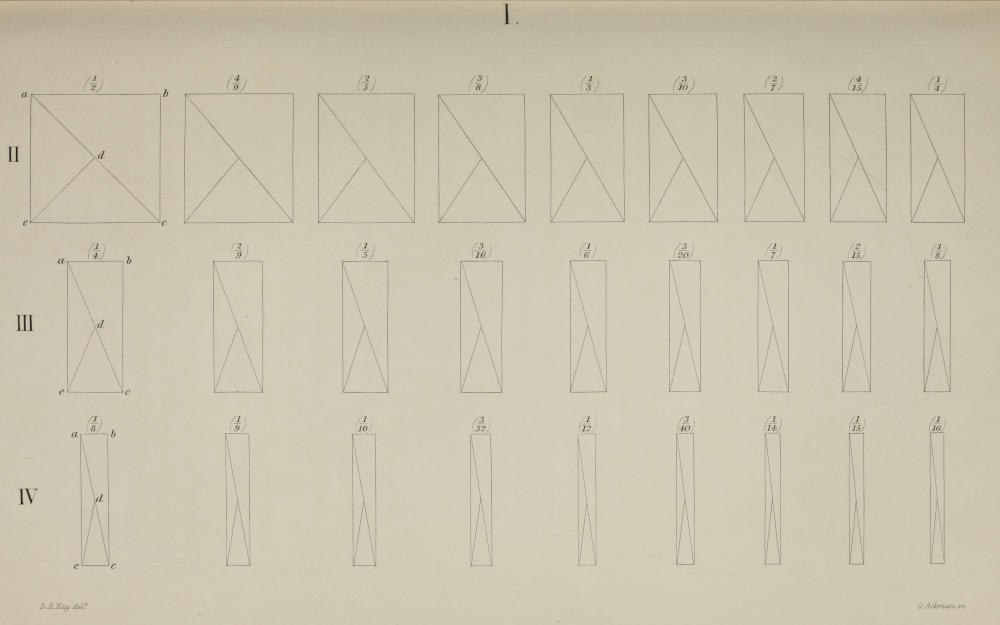
I. Three Scales of the
Elementary Rectilinear Figures, viz., the Scalene Triangle, the Isosceles
Triangle, and the Rectangle, comprising twenty-seven varieties of each,
according to the harmonic parts of the Right Angle from ¹⁄₂ to ¹⁄₁₆.
D. R. Hay delᵗ.G. Aikman sc.
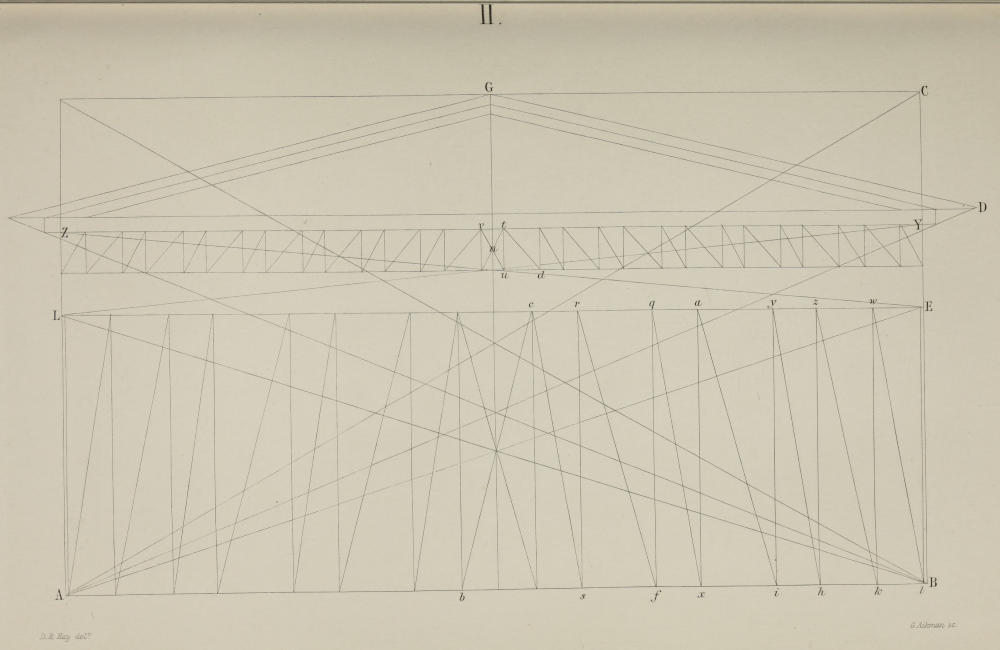
II. Diagram of the
Rectilinear Orthography of the Principal Front of the Parthenon of
Athens, in which its Proportions are determined by harmonic parts of
the Right Angle.
D. R. Hay delᵗ.G. Aikman sc.
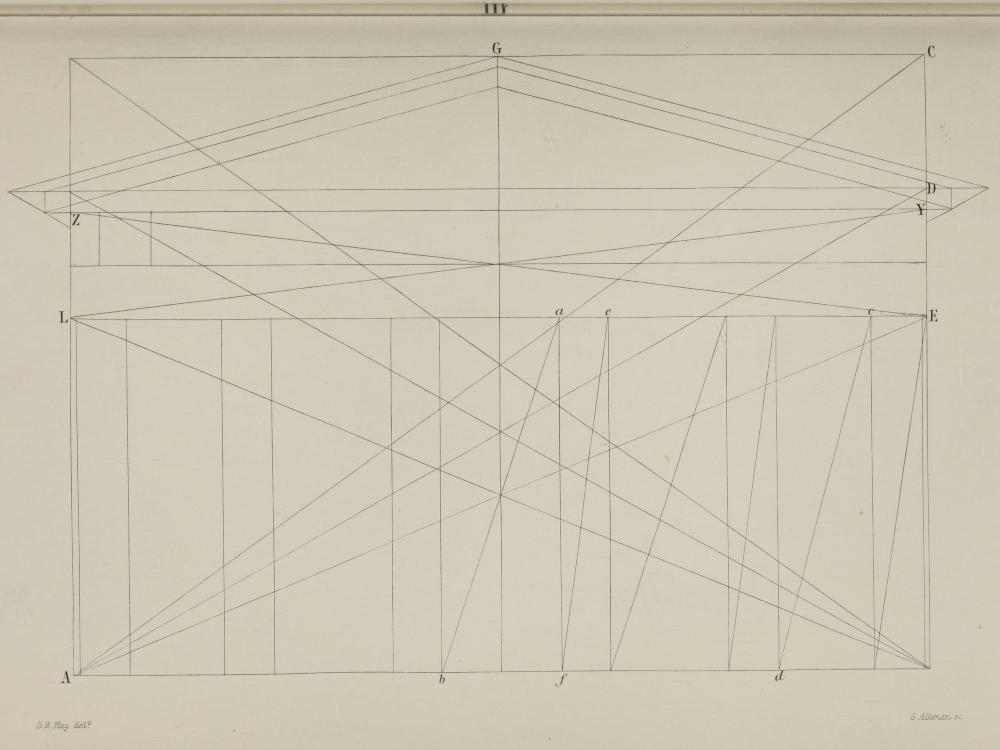
III. Diagram of the
Rectilinear Orthography of the Portico of the Temple of Theseus at Athens,
in which its Proportions are determined by harmonic parts of the Right Angle.
D. R. Hay delᵗ.G. Aikman sc.
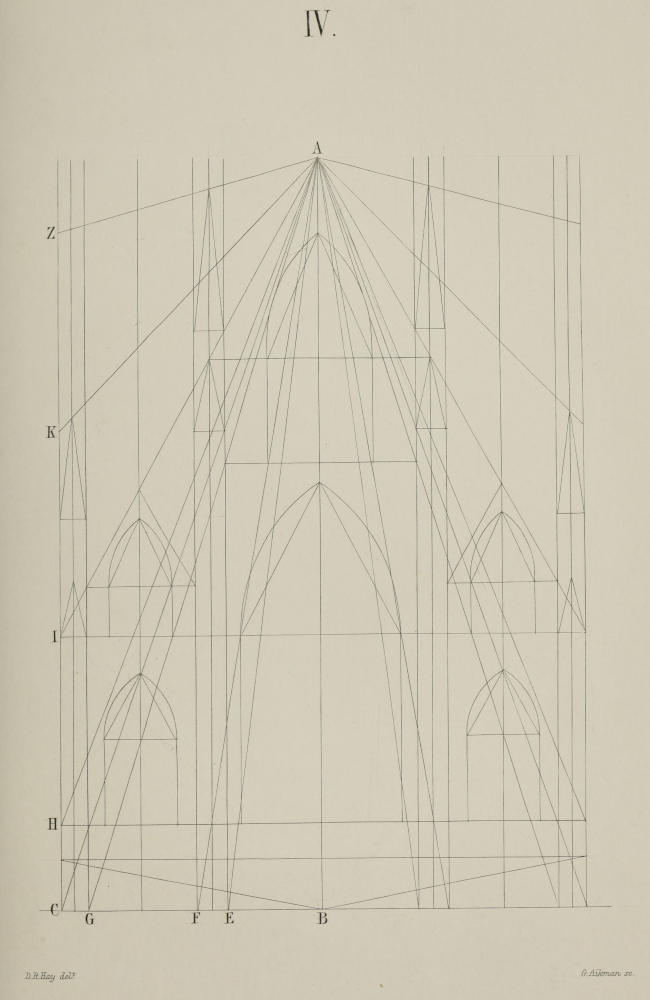
IV. Diagram of the
Rectilinear Orthography of the East End of Lincoln Cathedral, in which
its Proportions are determined by harmonic parts of the Right Angle.
D. R. Hay delᵗ.G. Aikman sc.
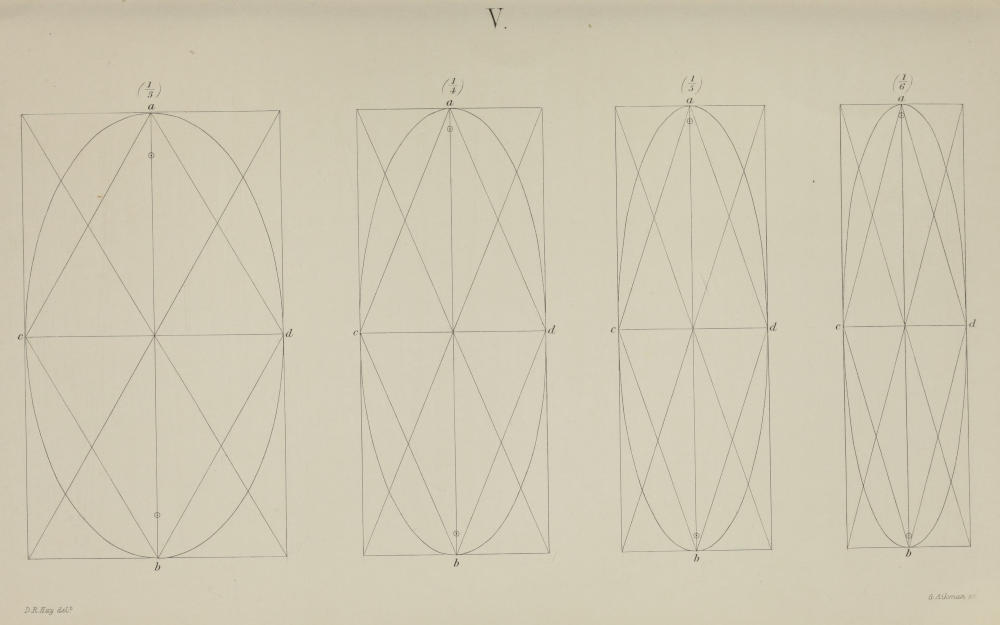
V. Four Ellipses described
from Foci, determined by harmonic parts of the Right Angle, shewing in each
the Scalene Triangle, the Isosceles Triangle, and the Rectangle to which
it belongs.
D. R. Hay delᵗ.G. Aikman sc.
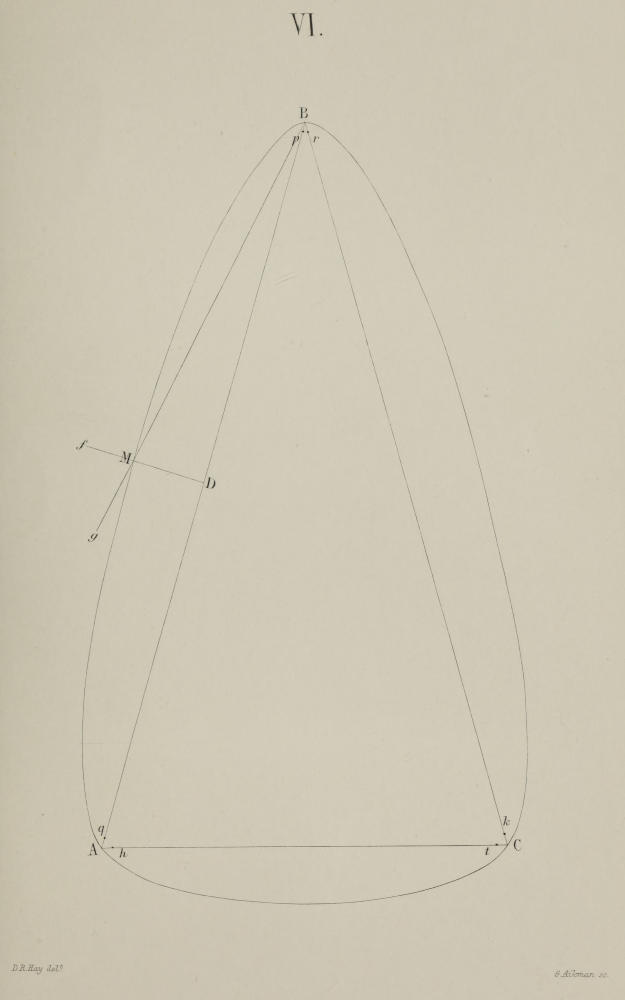
VI. The Composite Ellipse
of ¹⁄₆ and ¹⁄₈ of the Right Angle, shewing its greater and lesser Axis,
its various Foci, and the Isosceles Triangle in which they are placed.
D. R. Hay delᵗ.G. Aikman sc.
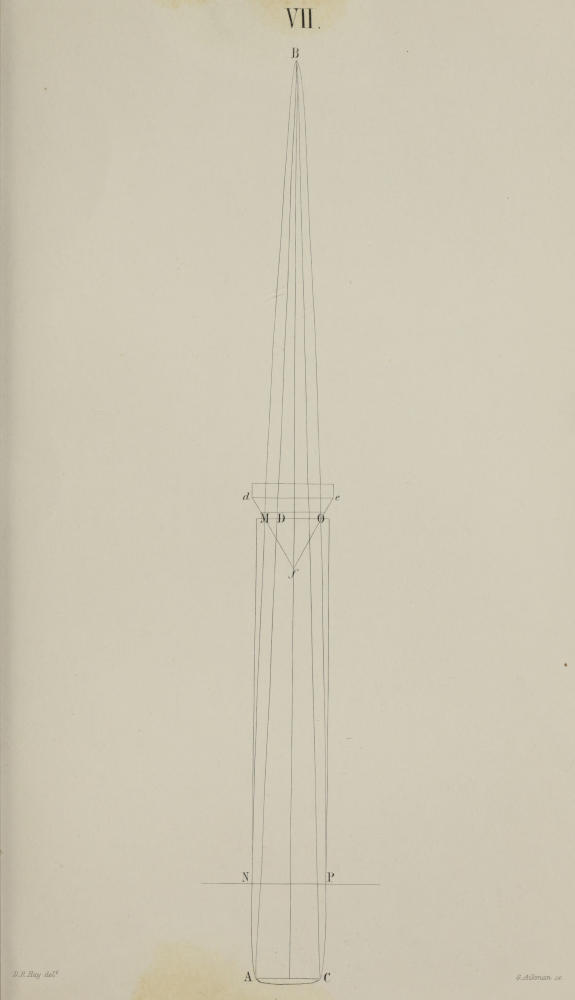
VII. The Composite Ellipse
of ¹⁄₄₈ and ¹⁄₆₄ of the Right Angle, shewing how it forms the Entasis of
the Columns of the Parthenon of Athens.
D. R. Hay delᵗ.G. Aikman sc.
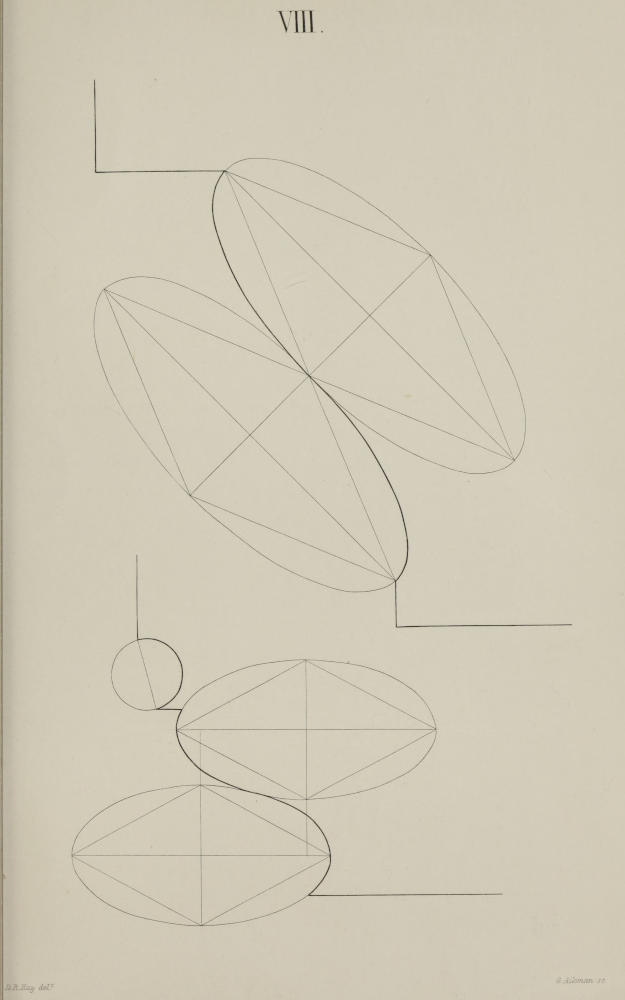
VIII. Sectional Outlines of
two Mouldings of the Parthenon of Athens, full size, shewing the harmonic
nature of their Curves, and the simple manner of their Construction.
D. R. Hay delᵗ.G. Aikman sc.
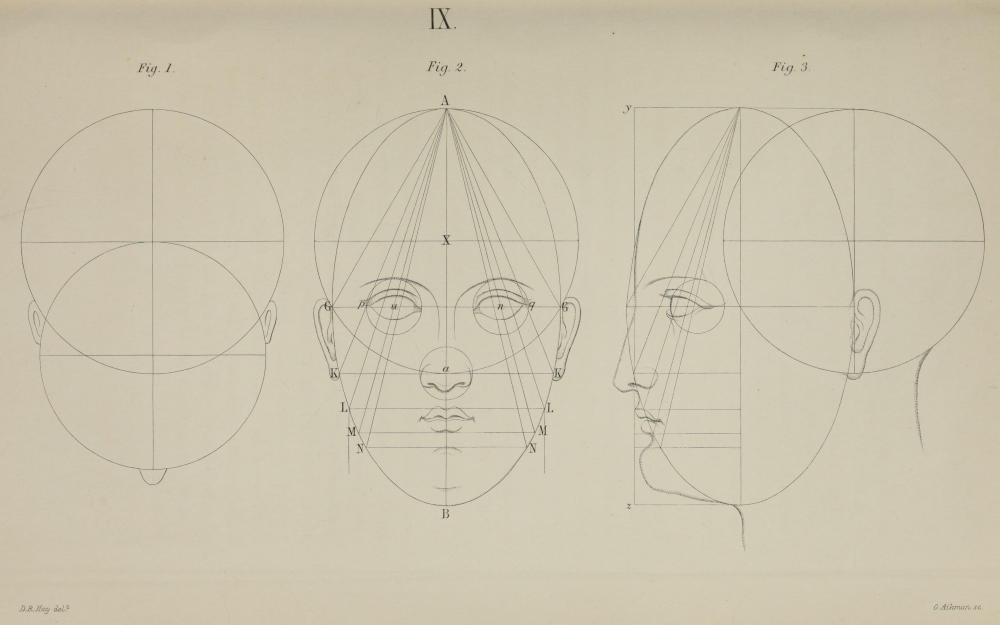
IX. Three Diagrams, giving
a Vertical, a Front, and a Side Aspect of the Geometrical Construction of
the Human Head and Countenance, in which the Proportions are determined
by harmonic parts of the Right Angle.
D. R. Hay delᵗ.G. Aikman sc.
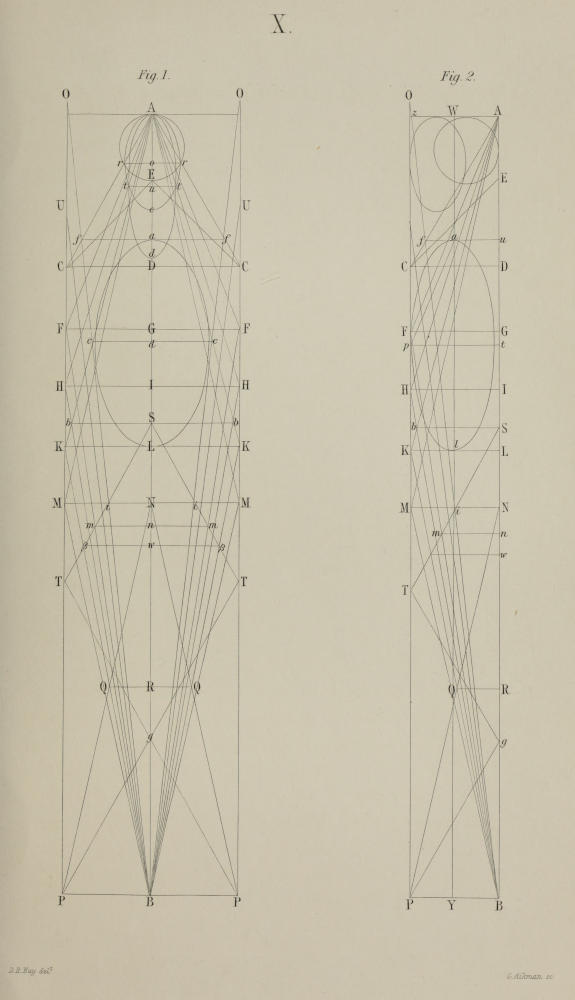
X. Diagram in which the
Symmetrical Proportions of the Human Figure are determined by harmonic
parts of the Right Angle.
D. R. Hay delᵗ.G. Aikman sc.
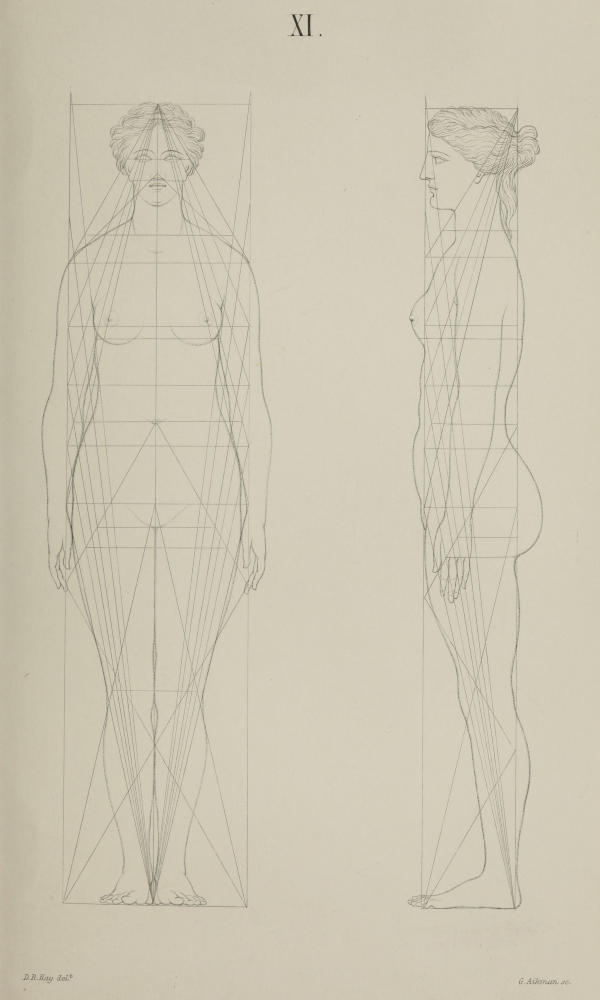
XI. The Contour of the
Human Figure as viewed in Front and in Profile, its Curves being determined
by Ellipses, whose Foci are determined by harmonic parts of the Right Angle.
D. R. Hay delᵗ.G. Aikman sc.
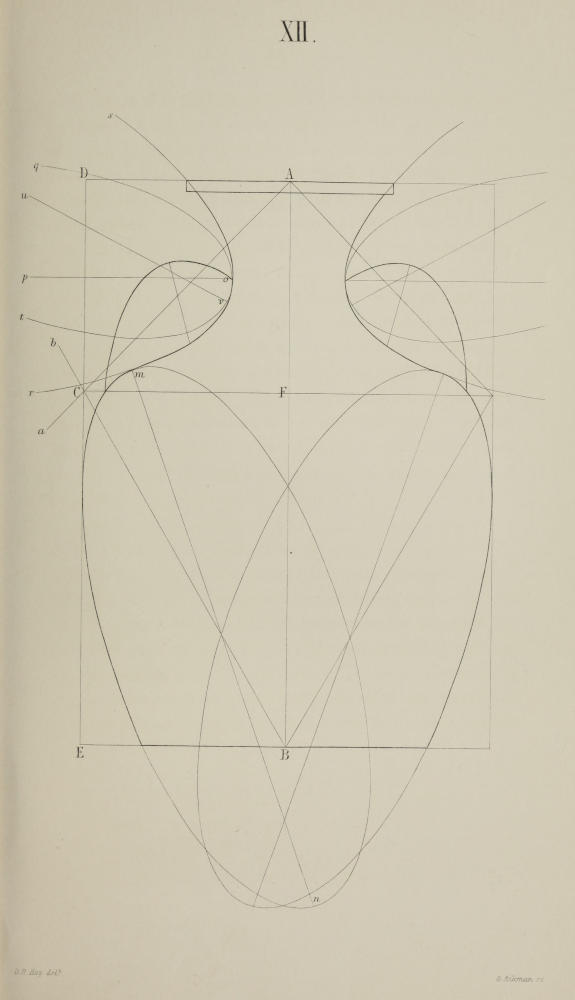
XII. Rectilinear Diagram,
shewing the Proportions of the Portland Vase, as determined by harmonic
parts of the Right Angle, and the outline of its form by an Elliptic Curve
harmonically described.
D. R. Hay delᵗ.G. Aikman sc.
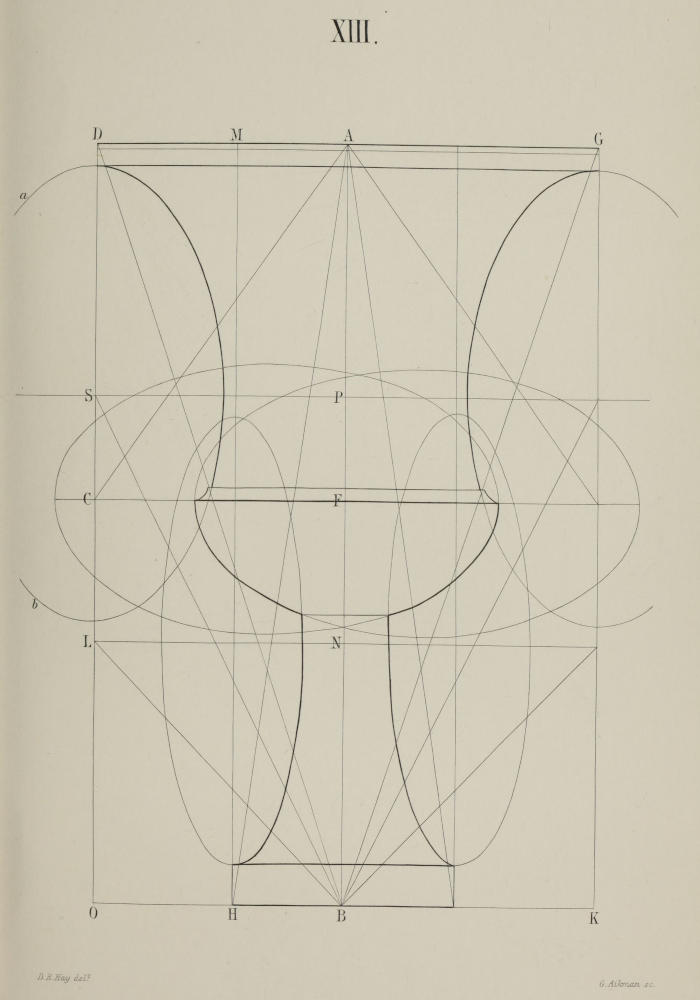
XIII. Rectilinear Diagram
of the Proportions and Curvilinear Outline of the form of an ancient
Grecian Vase, the proportions determined by harmonic parts of the Right
Angle, and the melody of the form by Curves of two Ellipses.
D. R. Hay delᵗ.G. Aikman sc.
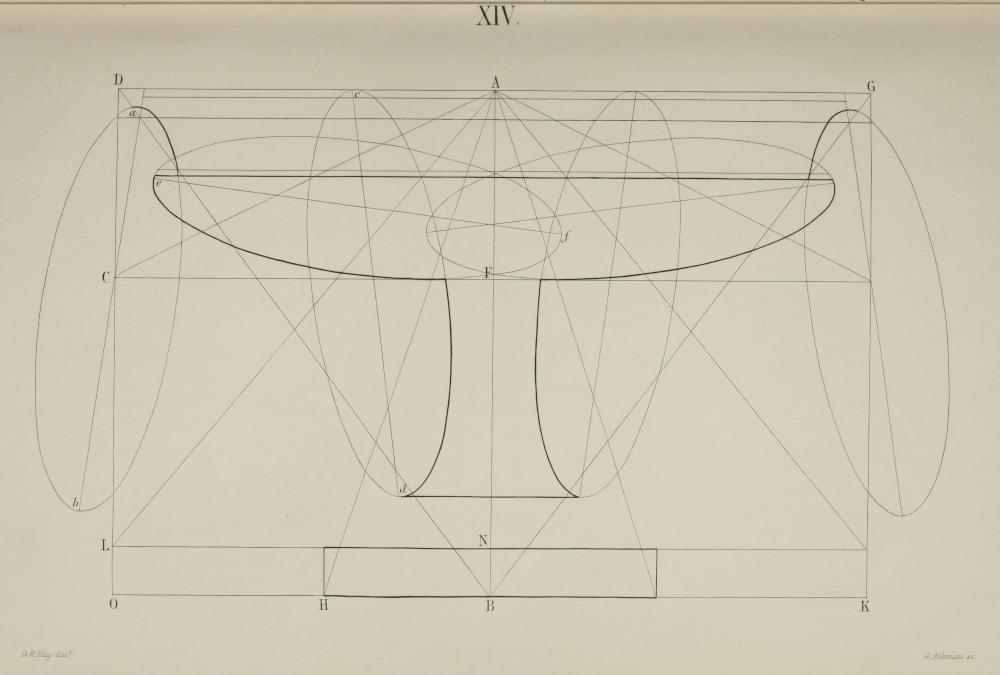
XIV. Rectilinear Diagram
of the Proportions and Curvilinear Outline of the form an ancient Grecian
Vase, the proportions determined by harmonic parts of the Right Angle,
and the melody of the form by an Elliptic Curve.
D. R. Hay delᵗ.G. Aikman sc.
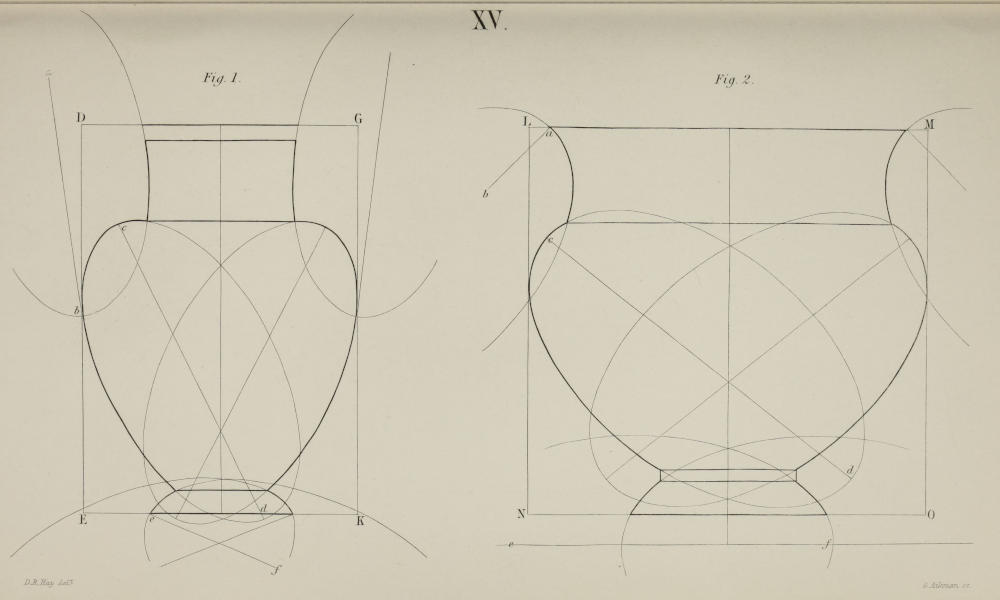
XV. Two Diagrams of Etruscan
Vases, the harmony of Proportions and melody of the Contour determined,
respectively, by parts of the Right Angle and an Elliptic Curve.
D. R. Hay delᵗ.G. Aikman sc.
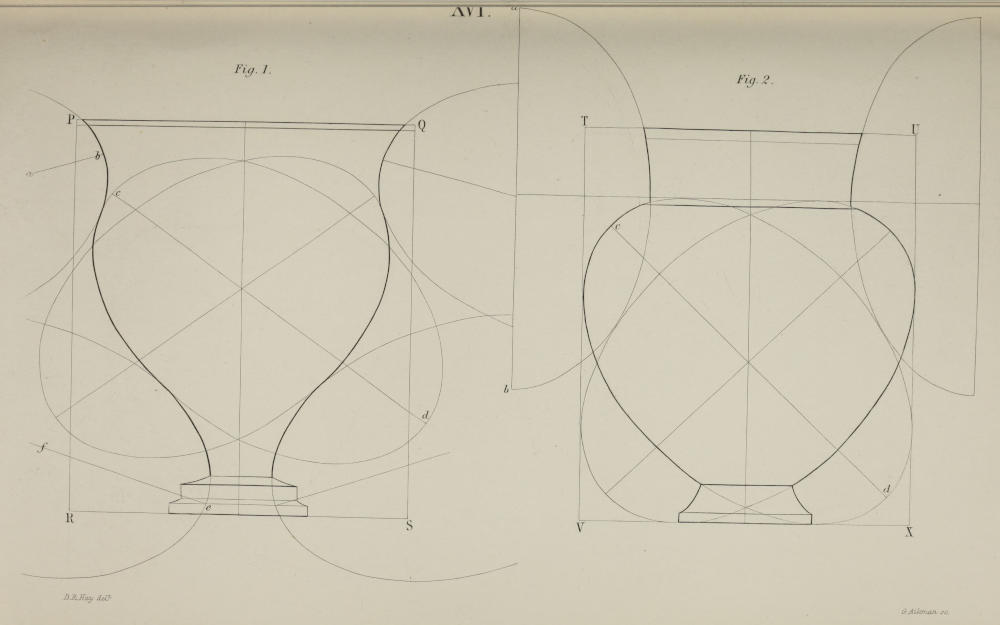
XVI. Two Diagrams of Etruscan
Vases, whose harmony of Proportion and melody of Contour are determined as
above.
D. R. Hay delᵗ.G. Aikman sc.
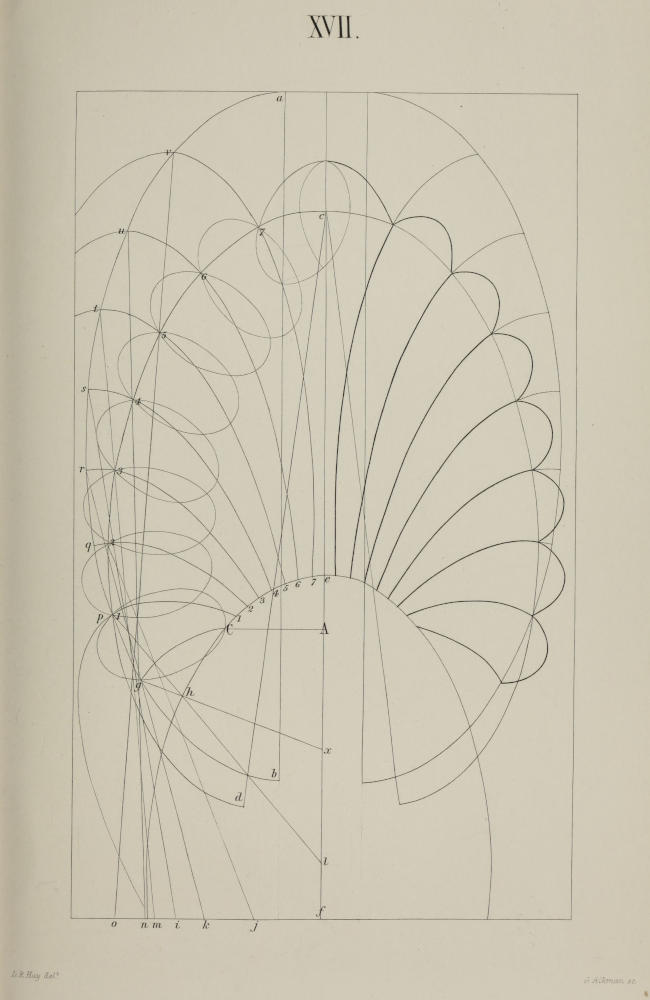
XVII. Diagram shewing the
Geometric Construction of an Ornament belonging to the Parthenon at Athens.
D. R. Hay delᵗ.G. Aikman sc.
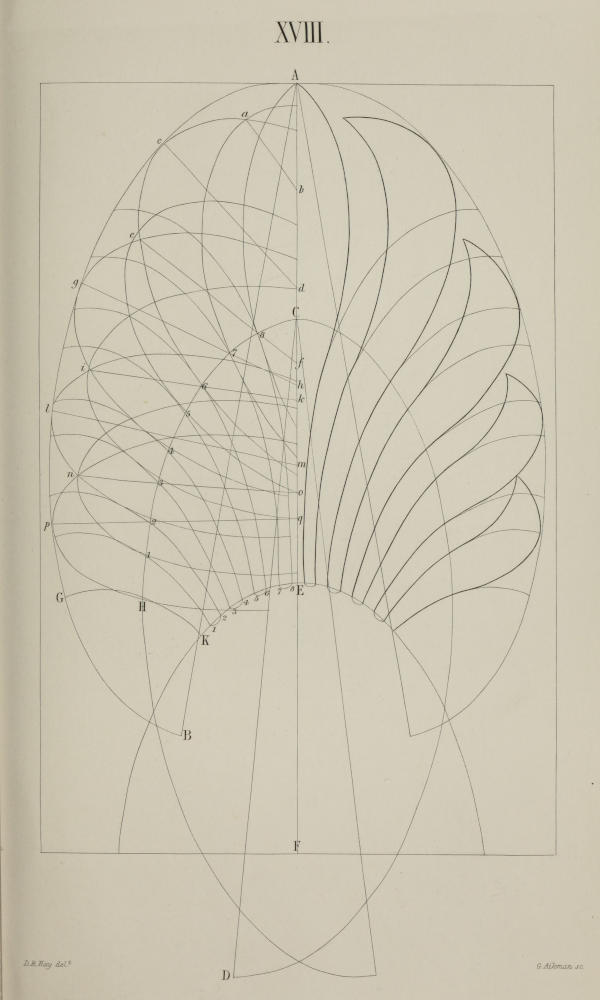
XVIII. Diagram of the
Geometrical Construction of the ancient Grecian Ornament called the
Honeysuckle.
D. R. Hay delᵗ.G. Aikman sc.
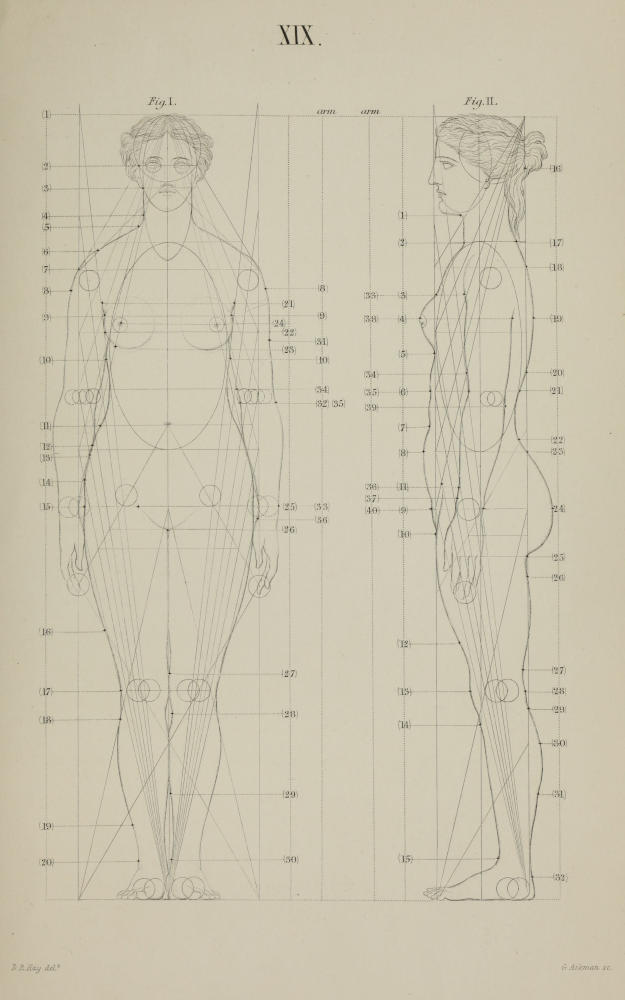
XIX. An additional Illustration
of the Contour of the Human Figure, as viewed in Front and in Profile.
D. R. Hay delᵗ.G. Aikman sc.
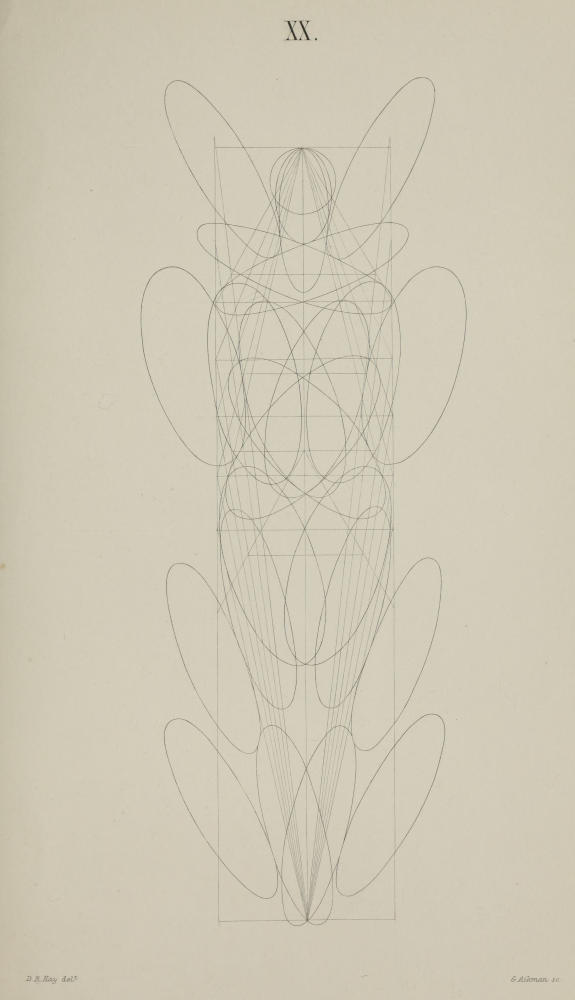
XX. Diagram shewing the manner
in which the Elliptic Curves are arranged in order to produce an Outline of
the Form of the Human Figure as viewed in Front.
D. R. Hay delᵗ.G. Aikman sc.
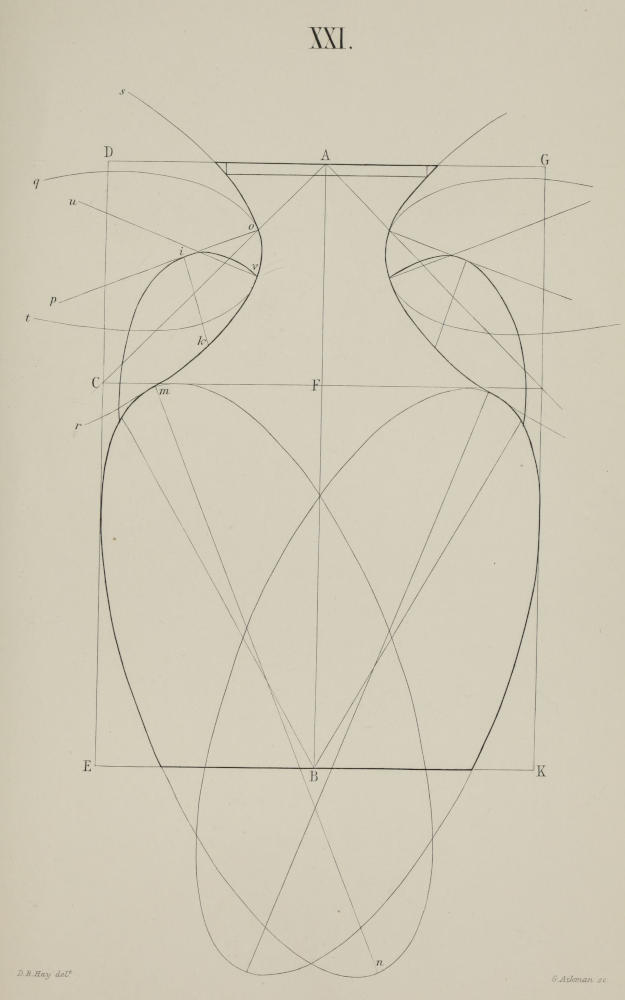
XXI. Diagram of a variation
on the Form of the Portland Vase.
D. R. Hay delᵗ.G. Aikman sc.
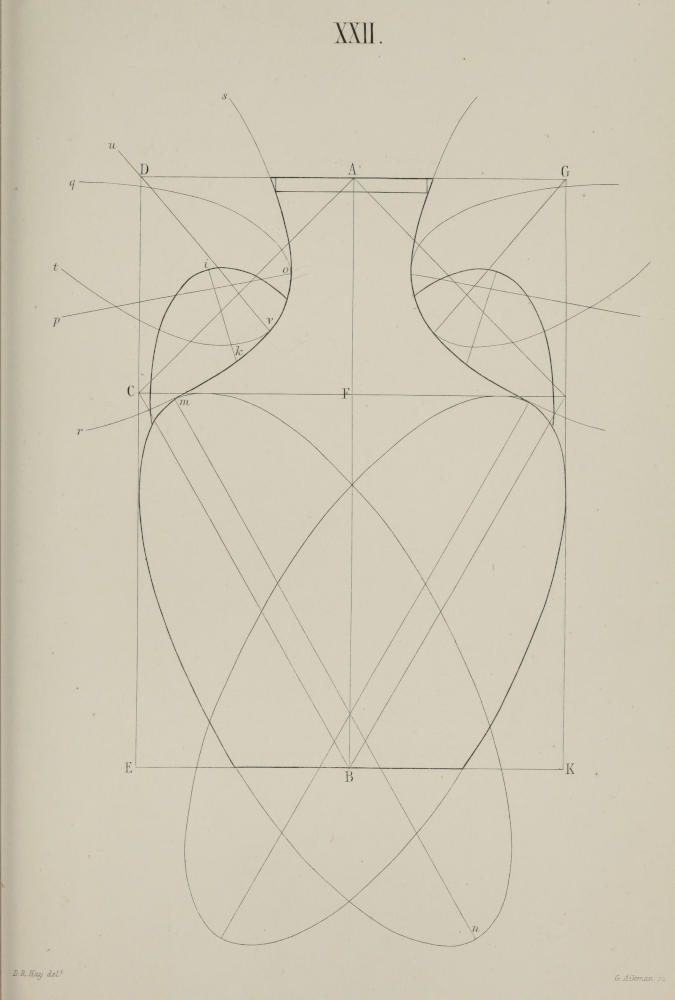
XXII. Diagram of a second
variation on the Form of the Portland Vase.
D. R. Hay delᵗ.G. Aikman sc.
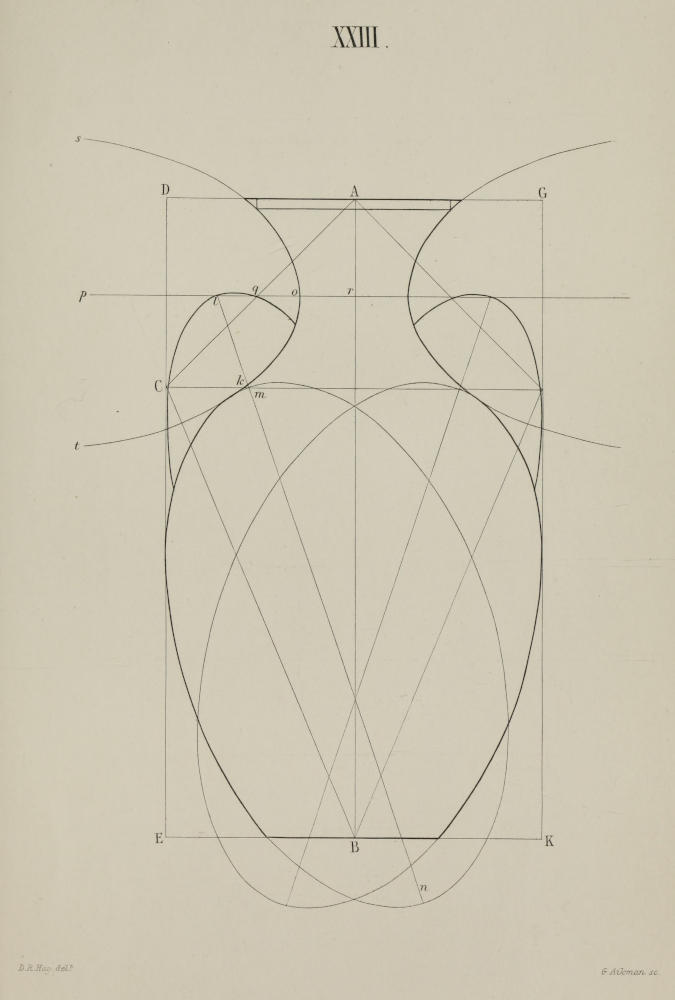
XXIII. Diagram of a third
variation on the Form of the Portland Vase.
D. R. Hay delᵗ.G. Aikman sc.
INTRODUCTION.
Twelve years ago, one of our most eminent philosophers,[1]
through the medium of the Edinburgh Review,[2] gave the
following account of what was then the state of the fine arts
as connected with science:—“The disposition to introduce
into the intellectual community the principles of free intercourse,
is by no means general; but we are confident that
Art will not sufficiently develop her powers, nor Science attain
her most commanding position, till the practical knowledge of
the one is taken in return for the sound deductions of the
other.... It is in the fine arts, principally, and in the
speculations with which they are associated, that the controlling
power of scientific truth has not exercised its legitimate
influence. In discussing the principles of painting, sculpture,
architecture, and landscape gardening, philosophers have renounced
science as a guide, and even as an auxiliary; and a
school has arisen whose speculations will brook no restraint,
and whose decisions stand in opposition to the strongest convictions
of our senses. That the external world, in its gay
colours and lovely forms, is exhibited to the mind only as a
tinted mass, neither within nor without the eye, neither touching
it nor distant from it—an ubiquitous chaos, which experience
only can analyse and transform into the realities which
compose it; that the beautiful and sublime in nature and in
art derive their power over the mind from association alone,
are among the philosophical doctrines of the present day,
which, if it be safe, it is scarcely prudent to question. Nor
are these opinions the emanations of poetical or ill-trained
minds, which ingenuity has elaborated, and which fashion sustains.
They are conclusions at which most of our distinguished
philosophers have arrived. They have been given to the
world with all the authority of demonstrated truth; and in
proportion to the hold which they have taken of the public
mind, have they operated as a check upon the progress of
knowledge.”
Such, then, was the state of art as connected with science
twelve years ago. But although the causes which then placed
science and the fine arts at variance have since been gradually
diminishing, yet they are still far from being removed. In
proof of this I may refer to what took place at the annual
distribution of the prizes to the students attending our Scottish
Metropolitan School of Design, in 1854, the pupils in which
amount to upwards of two hundred. The meeting on
that occasion included, besides the pupils, a numerous and
highly respectable assemblage of artists and men of science.
The chairman, a Professor in our University, and editor of
one of the most voluminous works on art, science, and
literature ever produced in this country, after extolling the
general progress of the pupils, so far as evinced by the drawings
exhibited on the occasion, drew the attention of the
meeting to a discovery made by the head master of the architectural
and ornamental department of the school, viz.—That
the ground-plan of the Parthenon at Athens had been constructed
by the application of the mysterious ovoid or Vesica
Piscis of the middle ages, subdivided by the mythic numbers 3
and 7, and their intermediate odd number 5. Now, it may be
remarked, that the figure thus referred to is not an ovoid, neither
is it in any way of a mysterious nature, being produced simply
by two equal circles cutting each other in their centres. Neither
can it be shewn that the numbers 3 and 7 are in any way more
mythic than other numbers. In fact, the terms mysterious
and mythic so applied, can only be regarded as a remnant of
an ancient terminology, calculated to obscure the simplicity of
scientific truth, and when used by those employed to teach—for
doubtless the chairman only gave the description he received—must
tend to retard the connexion of that truth with
the arts of design. I shall now give a specimen of the manner
in which a knowledge of the philosophy of the fine arts is at
present inculcated upon the public mind generally. In the same
metropolis there has likewise existed for upwards of ten years
a Philosophical Institution of great importance and utility,
whose members amount to nearly three thousand, embracing a
large proportion of the higher classes of society, both in respect
to talent and wealth. At the close of the session of this
Institution, in 1854, a learned and eloquent philologus, who
occasionally lectures upon beauty, was appointed to deliver
the closing address, and touching upon the subject of the
beautiful, he thus concluded—
“In the worship of the beautiful, and in that alone, we are
inferior to the Greeks. Let us therefore be glad to borrow
from them; not slavishly, but with a wise adaptation—not
exclusively, but with a cunning selection; in art, as in religion,
let us learn to prove all things, and hold fast that which is
good—not merely one thing which is good, but all good
things—Classicalism, Mediævalism, Modernism—let us have
and hold them all in one wide and lusty embrace. Why
should the world of art be more narrow, more monotonous,
than the world of nature? Did God make all the flowers of
one pattern, to please the devotees of the rose or the lily; and
did He make all the hills, with the green folds of their queenly
mantles, all at one slope, to suit the angleometer of the most
mathematical of decorators? I trow not. Let us go and do
likewise.”
I here take for granted, that what the lecturer meant by
“the worship of the beautiful,” is the production and appreciation
of works of art in which beauty should be a primary
element; and judging from the remains which we possess of
such works as were produced by the ancient Grecians, our inferiority
to them in these respects cannot certainly be denied.
But I must reiterate what I have often before asserted, that it
is not by borrowing from them, however cunning our selection,
or however wise our adaptations, that this inferiority is to be
removed, but by a re-discovery of the science which these
ancient artists must have employed in the production of that
symmetrical beauty and chaste elegance which pervaded all
their works for a period of nearly three hundred years. And
I hold, that as in religion, so in art, there is only one truth, a
grain of which is worth any amount of philological eloquence.
I also take for granted, that what is meant by Classicalism
in the above quotation, is the ancient Grecian style of art; by
Mediævalism, the semi-barbaric style of the middle ages; and
by Modernism, that chaotic jumble of all previous styles and
fashions of art, which is the peculiar characteristic of our present
school, and which is, doubtless, the result of a system of
education based upon plagiarism and mere imitation. Therefore
a recommendation to embrace with equal fervour “as
good things,” these very opposite articisms must be a doctrine
as mischievous in art as it would be in religion to recommend
as equally good things the various isms into which it has also
been split in modern times.
Now, “the world of nature” and “the world of art” have
not that equality of scope which this lecturer on beauty ascribes
to them, but differ very decidedly in that particular. Neither
will it be difficult to shew why “the world of art should be
more narrow than the world of nature”—that it should be
thereby rendered more monotonous does not follow.
It is well known, that the “world of nature” consists of
productions, including objects of every degree of beauty from
the very lowest to the highest, and calculated to suit not only
the tastes arising from various degrees of intellect, but those
arising from the natural instincts of the lower animals. On
the other hand, “the world of art,” being devoted to the
gratification and improvement of intelligent minds only, is
therefore narrowed in its scope by the exclusion from its productions
of the lower degrees of beauty—even mediocrity is
inadmissible; and we know that the science of the ancient
Greek artists enabled them to excel the highest individual
productions of nature in the perfection of symmetrical beauty.
Consequently, all objects in nature are not equally well adapted
for artistic study, and it therefore requires, on the part of the
artist, besides true genius, much experience and care to enable
him to choose proper subjects from nature; and it is in the
choice of such subjects, and not in plagiarism from the ancients,
that he should select with knowledge and adapt with wisdom.
Hence, all such latitudinarian doctrines as those I have
quoted must act as a check upon the progress of knowledge
in the scientific truth of art. I have observed in some of my
works, that in this country a course had been followed in our
search for the true science of beauty not differing from that
by which the alchymists of the middle ages conducted their
investigations; for our ideas of visible beauty are still undefined,
and our attempts to produce it in the various branches
of art are left dependant, in a great measure, upon chance.
Our schools are conducted without reference to any first principles
or definite laws of beauty, and from the drawing of a
simple architectural moulding to the intricate combinations of
form in the human figure, the pupils trust to their hands
and eyes alone, servilely and mechanically copying the works
of the ancients, instead of being instructed in the unerring
principles of science, upon which the beauty of those works
normally depends. The instruction they receive is imparted
without reference to the judgment or understanding, and they
are thereby led to imitate effects without investigating causes.
Doubtless, men of great genius sometimes arrive at excellence
in the arts of design without a knowledge of the principles
upon which beauty of form is based; but it should be kept
in mind, that true genius includes an intuitive perception of
those principles along with its creative power. It is, therefore,
to the generality of mankind that instruction in the definite
laws of beauty will be of most service, not only in improving
the practice of those who follow the arts professionally, but
in enabling all of us to distinguish the true from the false,
and to exercise a sound and discriminating taste in forming
our judgment upon artistic productions. Æsthetic culture
should consequently supersede servile copying, as the basis
of instruction in our schools of art. Many teachers of drawing,
however, still assert, that, by copying the great works
of the ancients, the mind of the pupil will become imbued
with ideas similar to theirs—that he will imbibe their feeling
for the beautiful, and thereby become inspired with their
genius, and think as they thought. To study carefully and
to investigate the principles which constitute the excellence
of the works of the ancients, is no doubt of much benefit
to the student; but it would be as unreasonable to suppose
that he should become inspired with artistic genius by merely
copying them, as it would be to imagine, that, in literature,
poetic inspiration could be created by making boys
transcribe or repeat the works of the ancient poets. Sir
Joshua Reynolds considered copying as a delusive kind of
industry, and has observed, that “Nature herself is not to be
too closely copied,” asserting that “there are excellences in
the art of painting beyond what is commonly called the
imitation of nature,” and that “a mere copier of nature can
never produce any thing great.” Proclus, an eminent philosopher
and mathematician of the later Platonist school (A.D.
485), says, that “he who takes for his model such forms as
nature produces, and confines himself to an exact imitation
of these, will never attain to what is perfectly beautiful. For
the works of nature are full of disproportion, and fall very
short of the true standard of beauty.”
It is remarked by Mr. J. C. Daniel, in the introduction
to his translation of M. Victor Cousin’s “Philosophy of the
Beautiful,” that “the English writers have advocated no
theory which allows the beautiful to be universal and absolute;
nor have they professedly founded their views on original
and ultimate principles. Thus the doctrine of the English
school has for the most part been, that beauty is mutable and
special, and the inference that has been drawn from this
teaching is, that all tastes are equally just, provided that each
man speaks of what he feels.” He then observes, that the
German, and some of the French writers, have thought far
differently; for with them the beautiful is “simple, immutable,
absolute, though its forms are manifold.”
So far back as the year 1725, the same truths advanced by
the modern German and French writers, and so eloquently
illustrated by M. Cousin, were given to the world by Hutchison
in his “Inquiry into the Original of our Ideas of Beauty
and Virtue.” This author says—“We, by absolute beauty,
understand only that beauty which we perceive in objects,
without comparison to any thing external, of which the object
is supposed an imitation or picture, such as the beauty perceived
from the works of nature, artificial forms, figures,
theorems. Comparative or relative beauty is that which we
perceive in objects commonly considered as imitations or
resemblances of something else.”
Dr. Reid also, in his “Intellectual Powers of Man,” says—“That
taste, which we may call rational, is that part of our
constitution by which we are made to receive pleasure from
the contemplation of what we conceive to be excellent in its
kind, the pleasure being annexed to this judgment, and regulated
by it. This taste may be true or false, according as it
is founded on a true or false judgment. And if it may be
true or false, it must have first principles.”
M. Victor Cousin’s opinion upon this subject is, however,
still more conclusive. He observes—“If the idea of the beautiful
is not absolute, like the idea of the true—if it is nothing
more than the expression of individual sentiment, the rebound
of a changing sensation, or the result of each person’s fancy—then
the discussions on the fine arts waver without support,
and will never end. For a theory of the fine arts to be possible,
there must be something absolute in beauty, just as there must
be something absolute in the idea of goodness, to render morals
a possible science.”
The basis of the science of beauty must thus be founded
upon fixed principles, and when these principles are evolved
with the same care which has characterised the labours of investigators
in natural science, and are applied in the fine arts
as the natural sciences have been in the useful arts, a solid
foundation will be laid, not only for correct practice, but also
for a just appreciation of productions in every branch of the
arts of design.
We know that the mind receives pleasure through the sense
of hearing, not only from the music of nature, but from the
euphony of prosaic composition, the rhythm of poetic measure,
the artistic composition of successive harmony in simple melody,
and the combined harmony of counterpoint in the more complex
works of that art. We know, also, that the mind is
similarly gratified through the sense of seeing, not only by the
visible beauties of nature, but by those of art, whether in symmetrical
or picturesque compositions of forms, or in harmonious
arrangements of gay or sombre colouring.
Now, in respect to the first of these modes of sensation, we
know, that from the time of Pythagoras, the fact has been
established, that in whatever manner nature or art may address
the ear, the degree of obedience paid to the fundamental law
of harmony will determine the presence and degree of that
beauty with which a perfect organ can impress a well-constituted
mind; and it is my object in this, as it has been in
former attempts, to prove it consistent with scientific truth,
that that beauty which is addressed to the mind by objects of
nature and art, through the eye, is similarly governed. In
short, to shew that, as in compositions of sounds, there can be
no true beauty in the absence of a strict obedience to this great
law of nature, neither can there exist, in compositions of forms
or colours, that principle of unity in variety which constitutes
beauty, unless such compositions are governed by the same law.
Although in the songs of birds, the gurgling of brooks, the
sighing of the gentle summer winds, and all the other beautiful
music of nature, no analysis might be able to detect the operation
of any precise system of harmony, yet the pleasure thus
afforded to the human mind we know to arise from its responding
to every development of an obedience to this law. When,
in like manner, we find even in those compositions of forms
and colours which constitute the wildest and most rugged of
Nature’s scenery, a species of picturesque grandeur and beauty
to which the mind as readily responds as to her more mild
and pleasing aspects, or to her sweetest music, we may rest
assured that this beauty is simply another development of,
and response to, the same harmonic law, although the precise
nature of its operation may be too subtle to be easily detected.
The résumé of the various works I have already published
upon the subject, along with the additional illustrations I am
about to lay before my readers, will, I trust, point out a system
of harmony, which, in formative art, as well as in that of
colouring, will rise superior to the idiosyncracies of different
artists, and bring back to one common type the sensations of
the eye and the ear, thereby improving that knowledge of
the laws of the universe which it is as much the business of
science to combine with the ornamental as with the useful arts.
In attempting this, however, I beg it may be understood,
that I do not believe any system, based even upon the laws of
nature, capable of forming a royal road to the perfection of
art, or of “mapping the mighty maze of a creative mind.”
At the same time, however, I must continue to reiterate the
fact, that the diffusion of a general knowledge of the science
of visible beauty will afford latent artistic genius just such
a vantage ground as that which the general knowledge of
philology diffused throughout this country affords its latent
literary genius. Although mere learning and true genius differ
as much in the practice of art as they do in the practice of
literature, yet a precise and systematic education in the true
science of beauty must certainly be as useful in promoting
the practice and appreciation of the one, as a precise and systematic
education in the science of philology is in promoting
the practice and appreciation of the other.
As all beauty is the result of harmony, it will be requisite
here to remark, that harmony is not a simple quality, but, as
Aristotle defines it, “the union of contrary principles having
a ratio to each other.” Harmony thus operates in the production
of all that is beautiful in nature, whether in the combinations,
in the motions, or in the affinities of the elements
of matter.
The contrary principles to which Aristotle alludes, are those
of uniformity and variety; for, according to the predominance
of the one or the other of these principles, every kind of beauty
is characterised. Hence the difference between symmetrical
and picturesque beauty:—the first allied to the principle of
uniformity, in being based upon precise laws that may be
taught so as to enable men of ordinary capacity to produce it
in their works—the second allied to the principle of variety
often to so great a degree that they yield an obedience to the
precise principles of harmony so subtilely, that they cannot be
detected in its constitution, but are only felt in the response
by which true genius acknowledges their presence. The
generality of mankind may be capable of perceiving this latter
kind of beauty, and of feeling its effects upon the mind, but
men of genius, only, can impart it to works of art, whether
addressed to the eye or the ear. Throughout the sounds,
forms, and colours of nature, these two kinds of beauty are
found not only in distinct developments, but in every degree
of amalgamation. We find in the songs of some birds, such
as those of the chaffinch, thrush, &c., a rhythmical division,
resembling in some measure the symmetrically precise arrangements
of parts which characterises all artistic musical composition;
while in the songs of other birds, and in the other
numerous melodies with which nature charms and soothes the
mind, there is no distinct regularity in the division of their
parts. In the forms of nature, too, we find amongst the
innumerable flowers with which the surface of the earth is so
profusely decorated, an almost endless variety of systematic
arrangements of beautiful figures, often so perfectly symmetrical
in their combination, that the most careful application
of the angleometer could scarcely detect the slightest deviation
from geometrical precision; while, amongst the masses of
foliage by which the forms of many trees are divided and subdivided
into parts, as also amongst the hills and valleys, the
mountains and ravines, which divide the earth’s surface, we
find in every possible variety of aspect the beauty produced
by that irregular species of symmetry which characterises the
picturesque.
In like manner, we find in wild as well as cultivated flowers
the most symmetrical distributions of colours accompanying
an equally precise species of harmony in their various kinds of
contrasts, often as mathematically regular as the geometric
diagrams by which writers upon colour sometimes illustrate
their works; while in the general colouring of the picturesque
beauties of nature, there is an endless variety in its distributions,
its blendings, and its modifications. In the forms and
colouring of animals, too, the same endless variety of regular
and irregular symmetry is to be found. But the highest
degree of beauty in nature is the result of an equal balance
of uniformity with variety. Of this the human figure is an
example; because, when it is of those proportions universally
acknowledged to be the most perfect, its uniformity bears to
its variety an apparently equal ratio. The harmony of combination
in the normal proportions of its parts, and the beautifully
simple harmony of succession in the normal melody of
its softly undulating outline, are the perfection of symmetrical
beauty, while the innumerable changes upon the contour which
arise from the actions and attitudes occasioned by the various
emotions of the mind, are calculated to produce every species
of picturesque beauty, from the softest and most pleasing to
the grandest and most sublime.
Amongst the purely picturesque objects of inanimate nature,
I may, as in a former work, instance an ancient oak tree, for
its beauty is enhanced by want of apparent symmetry. Thus,
the more fantastically crooked its branches, and the greater
the dissimilarity and variety it exhibits in its masses of foliage,
the more beautiful it appears to the artist and the amateur;
and, as in the human figure, any attempt to produce variety
in the proportions of its lateral halves would be destructive of
its symmetrical beauty, so in the oak tree any attempt to
produce palpable similarity between any of its opposite sides
would equally deteriorate its picturesque beauty. But picturesque
beauty is not the result of the total absence of
symmetry; for, as none of the irregularly constructed music
of nature could be pleasing to the ear unless there existed in
the arrangement of its notes an obedience, however subtle, to
the great harmonic law of Nature, so neither could any object
be picturesquely beautiful, unless the arrangement of its parts
yields, although it may be obscurely, an obedience to the
same law.
However symmetrically beautiful any architectural structure
may be, when in a complete and perfect state, it must, as it
proceeds towards ruin, blend the picturesque with the symmetrical;
but the type of its beauty will continue to be the
latter, so long as a sufficient portion of it remains to convey
an idea of its original perfection. It is the same with the
human form and countenance; for age does not destroy their
original beauty, but in both only lessens that which is symmetrical,
while it increases that which is picturesque.
In short, as a variety of simultaneously produced sounds,
which do not relate to each other agreeably to this law, can
only convey to the mind a feeling of mere noise; so a variety
of forms or colours simultaneously exposed to the eye under
similar circumstances, can only convey to the mind a feeling
of chaotic confusion, or what may be termed visible discord.
As, therefore, the two principles of uniformity and variety, or
similarity and dissimilarity, are in operation in every harmonious
combination of the elements of sound, of form, and of colour,
we must first have recourse to numbers in the abstract before
we can form a proper basis for a universal science of beauty.
THE SCIENCE OF BEAUTY EVOLVED FROM THE HARMONIC LAW OF NATURE, AGREEABLY TO THE PYTHAGOREAN SYSTEM OF NUMERICAL RATIO.
The scientific principles of beauty appear to have been well
known to the ancient Greeks; and it must have been by the
practical application of that knowledge to the arts of Design,
that that people continued for a period of upwards of three
hundred years to execute, in every department of these arts,
works surpassing in chaste beauty any that had ever before
appeared, and which have not been equalled during the two
thousand years which have since elapsed.
Æsthetic science, as the science of beauty is now termed, is
based upon that great harmonic law of nature which pervades
and governs the universe. It is in its nature neither absolutely
physical nor absolutely metaphysical, but of an intermediate
nature, assimilating in various degrees, more or less,
to one or other of those opposite kinds of science. It
specially embodies the inherent principles which govern impressions
made upon the mind through the senses of hearing
and seeing. Thus, the æsthetic pleasure derived from
listening to the beautiful in musical composition, and from
contemplating the beautiful in works of formative art, is in
both cases simply a response in the human mind to artistic
developments of the great harmonic law upon which the
science is based.
Although the eye and the ear are two different senses,
and, consequently, various in their modes of receiving impressions;
yet the sensorium is but one, and the mind by
which these impressions are perceived and appreciated is also
characterised by unity. There appears, likewise, a striking
analogy between the natural constitution of the two kinds of
beauty, which is this, that the more physically æsthetic
elements of the highest works of musical composition are
melody, harmony, and tone, whilst those of the highest works
of formative art are contour, proportion, and colour. The
melody or theme of a musical composition and its harmony
are respectively analogous,—1st, To the outline of an artistic
work of formative art; and 2d, To the proportion which
exists amongst its parts. To the careful investigator these
analogies become identities in their effect upon the mind, like
those of the more metaphysically æsthetic emotions produced
by expression in either of these arts.
Agreeably to the first analogy, the outline and contour of
an object, suppose that of a building in shade when viewed
against a light background, has a similar effect upon the mind
with that of the simple melody of a musical composition when
addressed to the ear unaccompanied by the combined harmony
of counterpoint. Agreeably to the second analogy, the
various parts into which the surface of the supposed elevation
is divided being simultaneously presented to the eye, will, if
arranged agreeably to the same great law, affect the mind
like that of an equally harmonious arrangement of musical
notes accompanying the supposed melody.
There is, however, a difference between the construction of
these two organs of sense, viz., that the ear must in a great
degree receive its impressions involuntarily; while the eye, on
the other hand, is provided by nature with the power of
either dwelling upon, or instantly shutting out or withdrawing
itself from an object. The impression of a sound, whether
simple or complex, when made upon the ear, is instantaneously
conveyed to the mind; but when the sound ceases,
the power of observation also ceases. But the eye can dwell
upon objects presented to it so long as they are allowed to
remain pictured on the retina; and the mind has thereby the
power of leisurely examining and comparing them. Hence
the ear guides more as a mere sense, at once and without
reflection; whilst the eye, receiving its impressions gradually,
and part by part, is more directly under the influence of
mental analysis, consequently producing a more metaphysically
æsthetic emotion. Hence, also, the acquired power of
the mind in appreciating impressions made upon it through
the organ of sight under circumstances, such as perspective,
&c., which to those who take a hasty view of the subject
appear impossible.
Dealing as this science therefore does, alike with the sources
and the resulting principles of beauty, it is scarcely less dependent
on the accuracy of the senses than on the power of
the understanding, inasmuch as the effect which it produces
is as essential a property of objects, as are its laws inherent in
the human mind. It necessarily comprehends a knowledge
of those first principles in art, by which certain combinations
of sounds, forms, and colours produce an effect upon the
mind, connected, in the first instance, with sensation, and in
the second with the reasoning faculty. It is, therefore, not
only the basis of all true practice in art, but of all sound
judgment on questions of artistic criticism, and necessarily
includes those laws whereon a correct taste must be based.
Doubtless many eloquent and ingenious treatises have been
written upon beauty and taste; but in nearly every case, with
no other effect than that of involving the subject in still
greater uncertainty. Even when restricted to the arts of
design, they have failed to exhibit any definite principles
whereby the true may be distinguished from the false, and
some natural and recognised laws of beauty reduced to
demonstration. This may be attributed, in a great degree,
to the neglect of a just discrimination between what is merely
agreeable, or capable of exciting pleasurable sensations, and
what is essentially beautiful; but still more to the confounding
of the operations of the understanding with those of the
imagination. Very slight reflection, however, will suffice to
shew how essentially distinct these two faculties of the mind
are; the former being regulated, in matters of taste, by irrefragable
principles existing in nature, and responded to by
an inherent principle existing in the human mind; while the
latter operates in the production of ideal combinations of its
own creation, altogether independent of any immediate impression
made upon the senses. The beauty of a flower, for
example, or of a dew-drop, depends on certain combinations
of form and colour, manifestly referable to definite and systematic,
though it may be unrecognised, laws; but when
Oberon, in “Midsummer Night’s Dream,” is made to exclaim—
“And that same dew, which sometimes on the buds
Was wont to swell, like round and orient pearls,
Stood now within the pretty floweret’s eyes,
Like tears that did their own disgrace bewail,”—
the poet introduces a new element of beauty equally legitimate,
yet altogether distinct from, although accompanying
that which constitutes the more precise science of æsthetics
as here defined. The composition of the rhythm is an operation
of the understanding, but the beauty of the poetic
fancy is an operation of the imagination.
Our physical and mental powers, æsthetically considered,
may therefore be classed under three heads, in their relation
to the fine arts, viz., the receptive, the perceptive, and the
conceptive.
The senses of hearing and seeing are respectively, in the
degree of their physical power, receptive of impressions made
upon them, and of these impressions the sensorium, in the
degree of its mental power, is perceptive. This perception
enables the mind to form a judgment whereby it appreciates
the nature and quality of the impression originally made on
the receptive organ. The mode of this operation is intuitive,
and the quickness and accuracy with which the nature and
quality of the impression is apprehended, will be in the degree
of the intellectual vigour of the mind by which it is perceived.
Thus we are, by the cultivation of these intuitive faculties,
enabled to decide with accuracy as to harmony or discord,
proportion or deformity, and assign sound reasons for our
judgment in matters of taste. But mental conception is the
intuitive power of constructing original ideas from these
materials; for after the receptive power has acted, the perception
operates in establishing facts, and then the judgment
is formed upon these operations by the reasoning
powers, which lead, in their turn, to the creations of the
imagination.
The power of forming these creations is the true characteristic
of genius, and determines the point at which art is
placed beyond all determinable canons,—at which, indeed,
æsthetics give place to metaphysics.
In the science of beauty, therefore, the human mind is the
subject, and the effect of external nature, as well as of works
of art, the object. The external world, and the individual
mind, with all that lies within the scope of its powers, may be
considered as two separate existences, having a distinct relation
to each other. The subject is affected by the object, through
that inherent faculty by which it is enabled to respond to every
development of the all-governing harmonic law of nature; and
the media of communication are the sensorium and its inlets—the
organs of sense.
This harmonic law of nature was either originally discovered
by that illustrious philosopher Pythagoras, upwards of five
hundred years before Christ, or a knowledge of it obtained by
him about that period, from the Egyptian or Chaldean priests.
For after having been initiated into all the Grecian and barbarian
sacred mysteries, he went to Egypt, where he remained
upwards of twenty years, studying in the colleges of its priests;
and from Egypt he went into the East, and visited the Persian
and Chaldean magi.[3]
By the generality of the biographers of Pythagoras, it is
said to be difficult to give a clear idea of his philosophy, as it
is almost certain he never committed it to writing, and that it
has been disfigured by the fantastic dreams and chimeras of
later Pythagoreans. Diogenes Laërtius, however, whose “Lives
of the Philosophers” was supposed to be written about the
end of the second century of our era, says “there are three
volumes extant written by Pythagoras. One on education,
one on politics, and one on natural philosophy.” And adds,
that there were several other books extant, attributed to
Pythagoras, but which were not written by him. Also, in his
“Life of Philolaus,” that Plato wrote to Dion to take care and
purchase the books of Pythagoras.[4] But whether this great
philosopher committed his discoveries to writing or not, his
doctrines regarding the philosophy of beauty are well-known
to be, that he considered numbers as the essence and the
principle of all things, and attributed to them a real and distinct
existence; so that, in his view, they were the elements
out of which the universe was constructed, and to which it
owed its beauty. Diogenes Laërtius gives the following account
of this law:—“That the monad was the beginning of
everything. From the monad proceeds an indefinite duad,
which is subordinate to the monad as to its cause. That from
the monad and indefinite duad proceeds numbers. That the
part of science to which Pythagoras applied himself above all
others, was arithmetic; and that he taught ‘that from numbers
proceed signs, and from these latter, lines, of which plane
figures consist; that from plane figures are derived solid
bodies; that of all plane figures the most beautiful was the
circle, and of all solid bodies the most beautiful was the
sphere.’ He discovered the numerical relations of sounds on
a single string; and taught that everything owes its existence
and consistency to harmony. In so far as I know, the most
condensed account of all that is known of the Pythagorian
system of numbers is the following:—‘The monad or unity is
that quantity, which, being deprived of all number, remains
fixed. It is the fountain of all number. The duad is imperfect
and passive, and the cause of increase and division.
The triad, composed of the monad and duad, partakes of
the nature of both. The tetrad, tetractys, or quaternion
number is most perfect. The decad, which is the sum of
the four former, comprehends all arithmetical and musical
proportions.’”[5]
These short quotations, I believe, comprise all that is known,
for certain, of the manner in which Pythagoras systematised
the law of numbers. Yet, from the teachings of this great
philosopher and his disciples, the harmonic law of nature, in
which the fundamental principles of beauty are embodied,
became so generally understood and universally applied in
practice throughout all Greece, that the fragments of their
works, which have reached us through a period of two thousand
years, are still held to be examples of the highest artistic
excellence ever attained by mankind. In the present state of
art, therefore, a knowledge of this law, and of the manner in
which it may again be applied in the production of beauty in
all works of form and colour, must be of singular advantage;
and the object of this work is to assist in the attainment of
such a knowledge.
It has been remarked, with equal comprehensiveness and
truth, by a writer[6] in the British and Foreign Medical Review,
that “there is harmony of numbers in all nature—in
the force of gravity—in the planetary movements—in the
laws of heat, light, electricity, and chemical affinity—in the
forms of animals and plants—in the perceptions of the mind.
The direction, indeed, of modern natural and physical science
is towards a generalization which shall express the fundamental
laws of all by one simple numerical ratio. And we
think modern science will soon shew that the mysticism of
Pythagoras was mystical only to the unlettered, and that it
was a system of philosophy founded on the then existing
mathematics, which latter seem to have comprised more of the
philosophy of numbers than our present.” Many years of
careful investigation have convinced me of the truth of this
remark, and of the great advantage derivable from an application
of the Pythagorean system in the arts of design. For so
simple is its nature, that any one of an ordinary capacity of
mind, and having a knowledge of the most simple rules of
arithmetic, may, in a very short period, easily comprehend its
nature, and be able to apply it in practice.
The elements of the Pythagorean system of harmonic
number, so far as can be gathered from the quotations I
have given above, seem to be simply the indivisible monad
(1); the duad (2), arising from the union of one monad with
another; the triad (3), arising from the union of the monad
with the duad; and the tetrad (4), arising from the union of
one duad with another, which tetrad is considered a perfect
number. From the union of these four elements arises the
decad (10), the number, which, agreeably to the Pythagorean
system, comprehends all arithmetical and harmonic proportions.
If, therefore, we take these elements and unite them
progressively in the following order, we shall find the series
of harmonic numbers (2), (3), (5), and (7), which, with their
multiples, are the complete numerical elements of all harmony,
thus:—
1
+
1
=
2
1
+
2
=
3
2
+
3
=
5
3
+
4
=
7
In order to render an extended series of harmonic numbers
useful, it must be divided into scales; and it is a rule in the
formation of these scales, that the first must begin with the
monad (1) and end with the duad (2), the second begin with
the duad (2) and end with the tetrad (4), and that the beginning
and end of all other scales must be continued in the same
arithmetical progression. These primary elements will then
form the foundation of a series of such scales.
I.
(1)
(2)
II.
(2)
(3)
(4)
III.
(4)
(5)
(6)
(7)
(8)
IV.
(8)
(9)
(10)
( )
(12)
( )
(14)
(15)
(16)
The first of these scales has in (1) and (2) a beginning and
an end; but the second has in (2), (3), and (4) the essential
requisites demanded by Aristotle in every composition, viz.,
“a beginning, a middle, and an end;” while the third has not
only these essential requisites, but two intermediate parts (5)
and (7), by which the beginning, the middle, and the end are
united. In the fourth scale, however, the arithmetical progression
is interrupted by the omission of numbers 11 and 13,
which, not being multiples of either (2), (3), (5), or (7), are
inadmissible.
Such is the nature of the harmonic law which governs the
progressive scales of numbers by the simple multiplication of
the monad.
I shall now use these numbers as divisors in the formation
of a series of four such scales of parts, which has for its
primary element, instead of the indivisible monad, a quantity
which may be indefinitely divided, but which cannot be added
to or multiplied. Like the monad, however, this quantity is
represented by (1). The following is this series of four scales
of harmonic parts:—
I.
(1)
(¹⁄₂)
II.
(¹⁄₂)
(¹⁄₃)
(¹⁄₄)
III.
(¹⁄₄)
(¹⁄₅)
(¹⁄₆)
(¹⁄₇)
(¹⁄₈)
IV.
(¹⁄₈)
(¹⁄₉)
(¹⁄₁₀)
( )
(¹⁄₁₂)
( )
(¹⁄₁₄)
(¹⁄₁₅)
(¹⁄₁₆)
The scales I., II., and III. may now be rendered as complete
as scale IV., simply by multiplying upwards by 2 from
(¹⁄₉), (¹⁄₅), (¹⁄₃), (¹⁄₇), and (¹⁄₁₅), thus:—
I.
(1)
(⁸⁄₉)
(⁴⁄₅)
(²⁄₃)
(⁴⁄₇)
(⁸⁄₁₅)
(¹⁄₂)
II.
(¹⁄₂)
(⁴⁄₉)
(²⁄₅)
(¹⁄₃)
(²⁄₇)
(⁴⁄₁₅)
(¹⁄₄)
III.
(¹⁄₄)
(²⁄₉)
(¹⁄₅)
(¹⁄₆)
(¹⁄₇)
(²⁄₁₅)
(¹⁄₈)
IV.
(¹⁄₈)
(¹⁄₉)
(¹⁄₁₀)
( )
(¹⁄₁₂)
( )
(¹⁄₁₄)
(¹⁄₁₅)
(¹⁄₁₆)
We now find between the beginning and the end of scale I.
the quantities (⁸⁄₉), (⁴⁄₅), (²⁄₃), (⁴⁄₇), and (⁸⁄₁₅).
The three first of these quantities we find to be the remainders
of the whole indefinite quantity contained in (1), after
subtracting from it the primary harmonic quantities (¹⁄₉), (¹⁄₅),
and (¹⁄₃); we, however, find also amongst these harmonic
quantities that of (¹⁄₄), which being subtracted from (1) leaves
(³⁄₄), a quantity the most suitable whereby to fill up the hiatus
between (⁴⁄₅) and (²⁄₃) in scale I., which arises from the omission
of (¹⁄₁₁) in scale IV. In like manner we find the two last of
these quantities, (⁴⁄₇) and (⁸⁄₁₅), are respectively the largest of the
two parts into which 7 and 15 are susceptible of being divided.
Finding the number 5 to be divisible into parts more unequal
than (2) to (3) and less unequal than (4) to (7), (³⁄₅) naturally
fills up the hiatus between these quantities in scale I., which
hiatus arises from the omission of (¹⁄₁₃) in scale IV. Thus:—
I.
(1)
(⁸⁄₉)
(⁴⁄₅)
(³⁄₄)
(²⁄₃)
(³⁄₅)
(⁴⁄₇)
(⁸⁄₁₅)
(¹⁄₂)
II.
(¹⁄₂)
(⁴⁄₉)
(²⁄₅)
( )
(¹⁄₃)
( )
(²⁄₇)
(⁴⁄₁₅)
(¹⁄₄)
III.
(¹⁄₄)
(²⁄₉)
(¹⁄₅)
( )
(¹⁄₆)
( )
(¹⁄₇)
(²⁄₁₅)
(¹⁄₈)
IV.
(¹⁄₈)
(¹⁄₉)
(¹⁄₁₀)
( )
(¹⁄₁₂)
( )
(¹⁄₁₄)
(¹⁄₁₅)
(¹⁄₁₆)
Scale I. being now complete, we have only to divide these
latter quantities by (2) downwards in order to complete the
other three. Thus:—
I.
(1)
(⁸⁄₉)
(⁴⁄₅)
(³⁄₄)
(²⁄₃)
(³⁄₅)
(⁴⁄₇)
(⁸⁄₁₅)
(¹⁄₂)
II.
(¹⁄₂)
(⁴⁄₉)
(²⁄₅)
(³⁄₈)
(¹⁄₃)
(³⁄₁₀)
(²⁄₇)
(⁴⁄₁₅)
(¹⁄₄)
III.
(¹⁄₄)
(²⁄₉)
(¹⁄₅)
(³⁄₁₆)
(¹⁄₆)
(³⁄₂₀)
(¹⁄₇)
(²⁄₁₅)
(¹⁄₈)
IV.
(¹⁄₈)
(¹⁄₉)
(¹⁄₁₀)
(³⁄₃₂)
(¹⁄₁₂)
(³⁄₄₀)
(¹⁄₁₄)
(¹⁄₁₅)
(¹⁄₁₆)
The harmony existing amongst these numbers or quantities
consists of the numerical relations which the parts bear to the
whole and to each other; and the more simple these relations
are, the more perfect is the harmony. The following are
the numerical harmonic ratios which the parts bear to the
whole:—
I.
(1:1)
(8:9)
(4:5)
(3:4)
(2:3)
(3:5)
(4:7)
(8:15)
(1:2)
II.
(1:2)
(4:9)
(2:5)
(3:8)
(1:3)
(3:10)
(2:7)
(4:15)
(1:4)
III.
(1:4)
(2:9)
(1:5)
(3:16)
(1:6)
(3:20)
(1:7)
(2:15)
(1:8)
IV.
(1:8)
(1:9)
(1:10)
(3:32)
(1:12)
(3:40)
(1:14)
(1:15)
(1:16)
The following are the principal numerical relations which
the parts in each scale bear to one another:—
(¹⁄₂):(⁴⁄₇)
=
(7:8)
(⁴⁄₅):(⁸⁄₉)
=
(9:10)
(²⁄₃):(⁴⁄₅)
=
(5:6)
(⁴⁄₇):(²⁄₃)
=
(6:7)
(⁸⁄₁₅):(⁴⁄₇)
=
(14:15)
(¹⁄₂):(⁸⁄₁₅)
=
(15:16)
Although these relations are exemplified by parts of scale I.,
the same ratios exist between the relative parts of scales II.,
III., and IV., and would exist between the parts of any other
scales that might be added to that series.
These are the simple elements of the science of that
harmony which pervades the universe, and by which the
various kinds of beauty æsthetically impressed upon the senses
of hearing and seeing are governed.
THE SCIENCE OF BEAUTY AS APPLIED TO SOUNDS.
It is well-known that all sounds arise from a peculiar action
of the air, and that this action may be excited by the concussion
resulting from the sudden displacement of a portion of
the atmosphere itself, or by the rapid motions of bodies, or of
confined columns of air; in all which cases, when the motions
are irregular, and the force great, the sound conveyed to the
sensorium is called a noise. But that musical sounds are the
result of equal and regular vibratory motions, either of an
elastic body, or of a column of air in a tube, exciting in the
surrounding atmosphere a regular and equal pulsation. The
ear is the medium of communication between those varieties
of atmospheric action and the seat of consciousness. To describe
fully the beautiful arrangement of the various parts of
this organ, and their adaptation to the purpose of collecting
and conveying these undulatory motions of the atmosphere, is
as much beyond the scope of my present attempt as it is beyond
my anatomical knowledge; but I may simply remark,
that within the ear, and most carefully protected in the construction
of that organ, there is a small cavity containing a
pellucid fluid, in which the minute extremities of the auditory
nerve float; and that this fluid is the last of the media
through which the action producing the sensation of sound is
conveyed to the nerve, and thence to the sensorium, where its
nature becomes perceptible to the mind.
The impulses which produce musical notes must arrive at a
certain frequency before the ear loses the intervals of silence
between them, and is impressed by only one continued sound;
and as they increase in frequency the sound becomes more
acute upon the ear. The pitch of a musical note is, therefore,
determined by the frequency of these impulses; but, on the
other hand, its intensity or loudness will depend upon the
violence and the quality of its tone on the material employed
in producing them. All such sounds, therefore, whatever be
their loudness or the quality of their tone in which the impulses
occur with the same frequency are in perfect unison,
having the same pitch. Upon this the whole doctrine of
harmonies is founded, and by this the laws of numerical ratio
are found to operate in the production of harmony, and the
theory of music rendered susceptible of exact reasoning.
The mechanical means by which such sounds can be produced
are extremely various; but, as it is my purpose simply
to shew the nature of harmony of sound as related to, or as
evolving numerical harmonic ratio, I shall confine myself to
the most simple mode of illustration—namely, that of the
monochord. This is an instrument consisting of a string of a
given length stretched between two bridges standing upon a
graduated scale. Suppose this string to be stretched until its
tension is such that, when drawn a little to a side and suddenly
let go, it would vibrate at the rate of 64 vibrations in a
second of time, producing to a certain distance in the surrounding
atmosphere a series of pulsations of the same frequency.
These pulsations will communicate through the ear a musical
note which would, therefore, be the fundamental note of such
a string. Now, the phenomenon said to be discovered by
Pythagoras is well known to those acquainted with the science
of acoustics, namely, that immediately after the string is thus
put into vibratory motion, it spontaneously divides itself, by
a node, into two equal parts, the vibrations of each of which
occur with a double frequency—namely, 128 in a second
of time, and, consequently, produce a note doubly acute in
pitch, although much weaker as to intensity or loudness;
that it then, while performing these two series of vibrations,
divides itself, by two nodes, into three parts, each of which
vibrates with a frequency triple that of the whole string;
that is, performs 192 vibrations in a second of time, and
produces a note corresponding in increase of acuteness, but
still less intense than the former, and that this continues to
take place in the arithmetical progression of 2, 3, 4, &c.
Simultaneous vibrations, agreeably to the same law of progression,
which, however, seem to admit of no other primes
than the numbers 2, 3, 5, and 7, are easily excited upon any
stringed instrument, even by the lightest possible touch of
any of its strings while in a state of vibratory motion, and the
notes thus produced are distinguished by the name of harmonics.
It follows, then, that one-half of a musical string,
when divided from the whole by the pressure of the finger, or
any other means, and put into vibratory motion, produces a
note doubly acute to that produced by the vibratory motion
of the whole string; the third part, similarly separated, a note
trebly acute; and the same with every part into which any
musical string may be divided. This is the fundamental principle
by which all stringed instruments are made to produce
harmony. It is the same with wind instruments, the sounds
of which are produced by the frequency of the pulsations
occasioned in the surrounding atmosphere by agitating a
column of air confined within a tube as in an organ, in which
the frequency of pulsation becomes greater in an inverse ratio
to the length of the pipes. But the following series of four
successive scales of musical notes will give the reader a more
comprehensive view of the manner in which they follow the
law of numerical ratio just explained than any more lengthened
exposition.
It is here requisite to mention, that in the construction of
these scales, I have not only adopted the old German or literal
mode of indicating the notes, but have included, as the Germans
do, the note termed by us B flat as B natural, and the
note we term B natural as H. Now, although this arrangement
differs from that followed in the construction of our
modern Diatonic scale, yet as the ratio of 4:7 is more closely
related to that of 1:2 than that of 8:15, and as it is offered
by nature in the spontaneous division of the monochord, I
considered it quite admissible. The figures give the parts of
the monochord which would produce the notes.
I.
{
(1)
(⁸⁄₉)
(⁴⁄₅)
(³⁄₄)
(²⁄₃)
(³⁄₅)
(⁴⁄₇)
(⁸⁄₁₅)
(¹⁄₂)*
{
C
D
E
F
G
A
B
H
c
II.
{
(¹⁄₂)*
(⁴⁄₉)
(²⁄₅)
(³⁄₈)
(¹⁄₃)*
(³⁄₁₀)
(²⁄₇)
(²⁄₁₅)
(¹⁄₄)*
{
c
d
e
f
g
a
b
h
c′
III.
{
(¹⁄₄)*
(²⁄₉)
(¹⁄₅)*
(³⁄₁₆)
(¹⁄₆)*
(³⁄₂₀)
(¹⁄₇)*
(²⁄₁₅)
(¹⁄₈)*
{
c′
d′
e′
f′
g′
a′
b′
h′
c′′
IV.
{
(¹⁄₈)*
(¹⁄₉)*
(¹⁄₁₀)*
(³⁄₃₂)
(¹⁄₁₂)*
(³⁄₄₀)
(¹⁄₁₄)*
(¹⁄₁₅)*
(¹⁄₁₆)*
{
c′′
d′′
e′′
f′′
g′′
a′′
b′′
h′′
c′′′
The notes marked (*) are the harmonics which naturally
arise from the division of the string by 2, 3, 5, and 7, and the
multiples of these primes.
Thus every musical sound is composed of a certain number
of parts called pulsations, and these parts must in every scale
relate harmonically to some fundamental number. When
these parts are multiples of the fundamental number by 2, 4,
8, &c., like the pulsations of the sounds indicated by c, c′, c′′, c′′′,
they are called tonic notes, being the most consonant; when
the pulsations are similar multiples by 3, 6, 12, &c., like those
of the sounds indicated by g, g′, g′′, they are called dominant
notes, being the next most consonant; and multiples by 5,
10, &c., like those of the sounds indicated by e, e′, e′′, they are
called mediant notes, from a similar cause. In harmonic combinations
of musical sounds, the æsthetic feeling produced by
their agreement depends upon the relations they bear to each
other with reference to the number of pulsations produced in
a given time by the fundamental note of the scale to which
they belong; and it will be observed, that the more simple
the numerical ratios are amongst the pulsations of any number
of notes simultaneously produced, the more perfect their agreement.
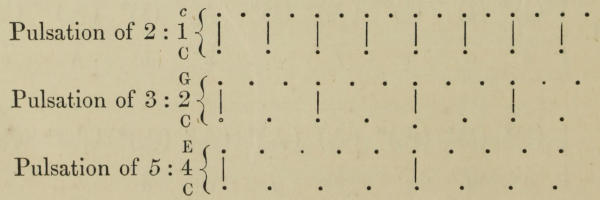
Hence the origin of the common chord or fundamental
concord in the united sounds of the tonic, the dominant, and
the mediant notes, the ratios and coincidences of whose pulsations
2:1, 3:2, 5:4, may thus be exemplified:—
In musical composition, the law of number also governs its
division into parts, in order to produce upon the ear, along
with the beauty of harmony, that of rhythm. Thus a piece of
music is divided into parts each of which contains a certain
number of other parts called bars, which may be divided
and subdivided into any number of notes, and the performance
of each bar is understood to occupy the same portion
of time, however numerous the notes it contains may be; so
that the music of art is regularly symmetrical in its structure;
while that of nature is in general as irregular and indefinite in
its rhythm as it is in its harmony.
Thus I have endeavoured briefly to explain the manner in
which the law of numerical ratio operates in that species of
beauty perceived through the ear.
The definite principles of the art of music founded upon
this law have been for ages so systematised that those who are
instructed in them advance steadily in proportion to their
natural endowments, while those who refuse this instruction
rarely attain to any excellence. In the sister arts of form
and colour, however, a system of tuition, founded upon this
law, is still a desideratum, and a knowledge of the scientific
principles by which these arts are governed is confined to a
very few, and scarcely acknowledged amongst those whose
professions most require their practical application.
THE SCIENCE OF BEAUTY AS APPLIED TO FORMS. — On the Rectilinear Forms and Proportions of Architecture. — On the Curvilinear Forms and Proportions of Architecture.
It is justly remarked, in the “Illustrated Record of the
New York Exhibition of 1853,” that “it is a question worthy
of consideration how far the mediocrity of the present day is
attributable to an overweening reliance on natural powers
and a neglect of the lights of science;” and there is expressed
a thorough conviction of the fact that, besides the evils of the
copying system, “much genius is now wasted in the acquirement
of rudimentary knowledge in the slow school of practical
experiment, and that the excellence of the ancient Greek school
of design arose from a thoroughly digested canon of form, and
the use of geometrical formulas, which make the works even
of the second and third-rate genius of that period the wonder
and admiration of the present day.”
That such a canon of form, and that the use of such geometrical
formula, entered into the education, and thereby facilitated
the practice of ancient Greek art, I have in a former
work expressed my firm belief, which is founded on the remarkable
fact, that for a period of nearly three centuries, and
throughout a whole country politically divided into states
often at war with each other, works of sculpture, architecture,
and ornamental design were executed, which surpass in symmetrical
beauty any works of the kind produced during the
two thousand years that have since elapsed. So decided is
this superiority, that the artistic remains of the extraordinary
period I alluded to are, in all civilised nations, still held to be
the most perfect specimens of formative art in the world; and
even when so fragmentary as to be denuded of everything
that can convey an idea of expression, they still excite admiration
and wonder by the purity of their geometric beauty.
And so universal was this excellence, that it seems to have
characterised every production of formative art, however
humble the use to which it was applied.
The common supposition, that this excellence was the result
of an extraordinary amount of genius existing among the
Greek people during that particular period, is not consistent
with what we know of the progress of mankind in any other
direction, and is, in the present state of art, calculated to
retard its progress, inasmuch as such an idea would suggest
that, instead of making any exertion to arrive at a like general
excellence, the world must wait for it until a similar supposed
psychological phenomenon shall occur.
But history tends to prove that the long period of universal
artistic excellence throughout Greece could only be the result
of an early inculcation of some well-digested system of correct
elementary principles, by which the ordinary amount of genius
allotted to mankind in every age was properly nurtured and
cultivated; and by which, also, a correct knowledge and appreciation
of art were disseminated amongst the people generally.
Indeed, Müller, in his “Ancient Art and its Remains,” shews
clearly that some certain fixed principles, constituting a science
of proportions, were known in Greece, and that they formed
the basis of all artists’ education and practice during the
period referred to; also, that art began to decline, and its
brightest period to close, as this science fell into disuse, and
the Greek artists, instead of working for an enlightened community,
who understood the nature of the principles which
guided them, were called upon to gratify the impatient whims
of pampered and tyrannical rulers.
By being instructed in this science of proportion, the Greek
artists were enabled to impart to their representations of the
human figure a mathematically correct species of symmetrical
beauty; whether accompanying the slender and delicately
undulated form of the Venus,—its opposite, the massive and
powerful mould of the Hercules,—or the characteristic representation
of any other deity in the heathen mythology. And
this seems to have been done with equal ease in the minute figure
cut on a precious gem, and in the most colossal statue. The
same instruction likewise enabled the architects of Greece to
institute those varieties of proportions in structure called the
Classical Orders of Architecture; which are so perfect that, since
the science which gave them birth has been buried in oblivion,
classical architecture has been little more than an imitative art;
for all who have since written upon the subject, from Vitruvius
downwards, have arrived at nothing, in so far as the great
elementary principles in question are concerned, beyond the
most vague and unsatisfactory conjectures. For a more clear
understanding of the nature of this application of the Pythagorean
law of number to the harmony of form, it will be requisite
to repeat the fact, that modern science has shewn that
the cause of the impression, produced by external nature upon
the sensorium, called light, may be traced to a molecular or
ethereal action. This action is excited naturally by the sun,
artificially by the combustion of various substances, and sometimes
physically within the eye. Like the atmospheric pulsations
which produce sound, the action which produces light is
capable, within a limited sphere, of being reflected from some
bodies and transmitted through others; and by this reflection
and transmission the visible nature of forms and figures is
communicated to the sensorium. The eye is the medium of
this communication; and its structural beauty, and perfect
adaptation to the purpose of conveying this action, must, like
those of the ear, be left to the anatomist fully to describe. It
is here only necessary to remark, that the optic nerve, like
the auditory nerve, ends in a carefully protected fluid, which
is the last of the media interposed between this peculiarly
subtle action and the nerve upon which it impresses the
presence of the object from which it is reflected or through
which it is transmitted, and the nature of such object made
perceptible to the mind. The eye and the ear are thus, in
one essential point, similar in their physiology, relatively to
the means provided for receiving impressions from external
nature; it is, therefore, but reasonable to believe that the eye
is capable of appreciating the exact subdivision of spaces, just
as the ear is capable of appreciating the exact subdivision of
intervals of time; so that the division of space into exact
numbers of equal parts will æsthetically affect the mind
through the medium of the eye.
We assume, therefore, that the standard of symmetry, so
estimated, is deduced from the simplest law that could have
been conceived—the law that the angles of direction must all
bear to some fixed angle the same simple relations which the
different notes in a chord of music bear to the fundamental
note; that is, relations expressed arithmetically by the smallest
natural numbers. Thus the eye, being guided in its estimate
by direction rather than by distance, just as the ear is guided
by number of vibrations rather than by magnitude, both it
and the ear convey simplicity and harmony to the mind without
effort, and the mind with equal facility receives and appreciates
them.
As we are accustomed in all cases to refer direction to the
horizontal and vertical lines, and as the meeting of these
lines makes the right angle, it naturally constitutes the
fundamental angle, by the harmonic division of which a
system of proportion may be established, and the theory of
symmetrical beauty, like that of music, rendered susceptible of
exact reasoning.
Let therefore the right angle be the fundamental angle,
and let it be divided upon the quadrant of a circle into the
harmonic parts already explained, thus:—
Right Angle.
Supertonic Angles.
Mediant Angles.
Subdominant Angles.
Dominant Angles.
Submediant Angles.
Subtonic Angles.
Semi-subtonic Angles.
Tonic Angles.
I.
(1)
(⁸⁄₉)
(⁴⁄₅)
(³⁄₄)
(²⁄₃)
(³⁄₅)
(⁴⁄₇)
(⁸⁄₁₅)
(¹⁄₂)
II.
(¹⁄₂)
(⁴⁄₉)
(²⁄₅)
(³⁄₈)
(¹⁄₃)
(³⁄₁₀)
(²⁄₇)
(⁴⁄₁₅)
(¹⁄₄)
III.
(¹⁄₄)
(²⁄₉)
(¹⁄₅)
(³⁄₁₆)
(¹⁄₆)
(³⁄₂₀)
(¹⁄₇)
(²⁄₁₅)
(¹⁄₈)
IV.
(¹⁄₈)
(¹⁄₉)
(¹⁄₁₀)
(³⁄₃₂)
(¹⁄₁₂)
(³⁄₄₀)
(¹⁄₁₄)
(¹⁄₁₅)
(¹⁄₁₆)
In order that the analogy may be kept in view, I have
given to the parts of each of these four scales the appropriate
nomenclature of the notes which form the diatonic scale in
music.
When a right angled triangle is constructed so that its
two smallest angles are equal, I term it simply the triangle
of (¹⁄₂), because the smaller angles are each one-half of the
right angle. But when the two angles are unequal, the
triangle may be named after the smallest. For instance, when
the smaller angle, which we shall here suppose to be one-third
of the right angle, is made with the vertical line, the triangle
may be called the vertical scalene triangle of (¹⁄₃); and when
made with the horizontal line, the horizontal scalene triangle
of (¹⁄₃). As every rectangle is made up of two of these right
angled triangles, the same terminology may also be applied to
these figures. Thus, the equilateral rectangle or perfect
square is simply the rectangle of (¹⁄₂), being composed of two
similar right angled triangles of (¹⁄₂); and when two vertical
scalene triangles of (¹⁄₃), and of similar dimensions, are united
by their hypothenuses, they form the vertical rectangle of (¹⁄₃),
and in like manner the horizontal triangles of (¹⁄₃) similarly
united would form the horizontal rectangle of (¹⁄₃). As the
isosceles triangle is in like manner composed of two right
angled scalene triangles joined by one of their sides, the same
terminology may be applied to every variety of that figure.
All the angles of the first of the above scales, except that
of (¹⁄₂), give rectangles whose longest sides are in the horizontal
line, while the other three give rectangles whose longest sides
are in the vertical line. I have illustrated in Plate I. the
manner in which this harmonic law acts upon these elementary
rectilinear figures by constructing a series agreeably to the
angles of scales II., III., IV. Throughout this series a b c is
the primary scalene triangle, of which the rectangle a b c e
is composed; d c e the vertical isosceles triangle; and when
the plate is turned, d e a the horizontal isosceles triangle, both
of which are composed of the same primary scalene triangle.
Thus the most simple elements of symmetry in rectilinear
forms are the three following figures:—
The equilateral rectangle or perfect square,
The oblong rectangle, and
The isosceles triangle.
It has been shewn that in harmonic combinations of
musical sounds, the æsthetic feeling produced by their agreement
depends upon the relation they bear to each other with
reference to the number of pulsations produced in a given
time by the fundamental note of the scale to which they
belong; and that the more simply they relate to each other
in this way the more perfect the harmony, as in the common
chord of the first scale, the relations of whose parts are in the
simple ratios of 2:1, 3:2, and 5:4. It is equally consistent
with this law, that when applied to form in the composition of
an assortment of figures of any kind, their respective proportions
should bear a very simple ratio to each other in order
that a definite and pleasing harmony may be produced
amongst the various parts. Now, this is as effectually done
by forming them upon the harmonic divisions of the right
angle as musical harmony is produced by sounds resulting
from harmonic divisions of a vibratory body.
Having in previous works[7] given the requisite illustrations of
this fact in full detail, I shall here confine myself to the most
simple kind, taking for my first example one of the finest
specimens of classical architecture in the world—the front
portico of the Parthenon of Athens.
The angles which govern the proportions of this beautiful
elevation are the following harmonic parts of the right angle—
In Plate II. I give a diagram of its rectilinear orthography,
which is simply constructed by lines drawn, either horizontally,
vertically, or obliquely, which latter make with either of the
former lines one or other of the harmonic angles in the above
series. For example, the horizontal line AB represents the
length of the base or surface of the upper step of the substructure
of the building. The line AE, which makes an
angle of (¹⁄₅) with the horizontal, determines the height of the
colonnade. The line AD, which makes an angle of (¹⁄₄) with
the horizontal, determines the height of the portico, exclusive
of the pediment. The line AC, which makes an angle of (¹⁄₃)
with the horizontal, determines the height of the portico, including
the pediment. The line GD, which makes an angle
of (¹⁄₇) with the horizontal, determines the form of the pediment.
The lines EZ and LY, which respectively make angles
of (¹⁄₁₆) and (¹⁄₁₈) with the horizontal, determine the breadth of
the architrave, frieze, and cornice. The line v n u, which makes
an angle of (¹⁄₃) with the vertical, determines the breadth of
the triglyphs. The line t d, which makes an angle of (¹⁄₂),
determines the breadth of the metops. The lines c b r f, and
a i, which make each an angle of (¹⁄₆) with the vertical, determine
the width of the five centre intercolumniations. The
line z k, which makes an angle of (¹⁄₈) with the vertical, determines
the width of the two remaining intercolumniations. The
lines c s, q x, and y h, each of which makes an angle of (¹⁄₁₀)
with the vertical, determine the diameters of the three columns
on each side of the centre. The line w l, which makes an
angle of (¹⁄₉) with the vertical, determines the diameter of
the two remaining or corner columns.
In all this, the length and breadth of the parts are determined
by horizontal and vertical lines, which are necessarily
at right angles with each other, and the position of which are
determined by one or other of the lines making the harmonic
angles above enumerated.
Now, the lengths and breadths thus so simply determined
by these few angles, have been proved to be correct by their
agreement with the most careful measurements which could
possibly be made of this exquisite specimen of formative art.
These measurements were obtained by the “Society of Dilettanti,”
London, who, expressly for that purpose, sent Mr
F. C. Penrose, a highly educated architect, to Athens, where
he remained for about five months, engaged in the execution
of this interesting commission, the results of which are now
published in a magnificent volume by the Society.[8] The
agreement was so striking, that Mr Penrose has been publicly
thanked by an eminent man of science for bearing testimony
to the truth of my theory, who in doing so observes, “The
dimensions which he (Mr Penrose) gives are to me the surest
verification of the theory I could have desired. The minute
discrepancies form that very element of practical incertitude,
both as to execution and direct measurement, which always
prevails in materialising a mathematical calculation made
under such conditions.”[9]
Although the measurements taken by Mr Penrose are
undeniably correct, as all who examine the great work
just referred to must acknowledge, and although they have
afforded me the best possible means of testing the accuracy of
my theory as applied to the Parthenon, yet the ideas of Mr
Penrose as to the principles they evolve are founded upon the
fallacious doctrine which has so long prevailed, and still prevails,
in the æsthetics of architecture, viz., that harmony may be
imparted by ratios between the lengths and breadths of parts.
I have taken for my second example an elevation which,
although of smaller dimensions, is no less celebrated for the
beauty of its proportions than the Parthenon itself, viz., the
front portico of the temple of Theseus, which has also been
measured by Mr Penrose.
The angles which govern the proportions of this elevation
are the following harmonic parts of the right angle:—
A diagram of the rectilinear orthography of this portico is
given in Plate III. Its construction is similar to that of
the Parthenon in respect to the harmonic parts of the right
angle, and I have therefore only to observe, that the line A E
makes an angle of (¹⁄₄); the line A D an angle of (¹⁄₃); the
line A C an angle of (²⁄₅); the line G D an angle of (¹⁄₆); and
the lines E Z and L Y angles of (¹⁄₁₂) with the horizontal.
As to the colonnade or vertical part, the line a b, which
determines the three middle intercolumniations, makes an
angle of (¹⁄₅); the line c d, which determines the two outer
intercolumniations, makes an angle of (¹⁄₆); and the line e f,
which determines the lesser diameter of the columns, makes an
angle of (¹⁄₁₂) with the vertical. I need give no further details
here, as my intention is to shew the simplicity of the method
by which this theory may be reduced to practice, and because I
have given in my other works ample details, in full illustration
of the orthography of these two structures, especially the first.[10]
The foregoing examples being both horizontal rectangular
compositions, the proportions of their principal parts have
necessarily been determined by lines drawn from the extremities
of the base, making angles with the horizontal line, and forming
thereby the diagonals of the various rectangles into which, in
their leading features, they are necessarily resolved. But the
example I am now about to give is of another character,
being a vertical pyramidal composition, and consequently the
proportions of its principal parts are determined by the angles
which the oblique lines make with the vertical line representing
the height of the elevation, and forming a series of isosceles
triangles; for the isosceles triangle is the type of all pyramidal
composition.
This third example is the east end of Lincoln Cathedral, a
Gothic structure, which is acknowledged to be one of the
finest specimens of that style of architecture existing in this
country.
The angles which govern the proportions of this elevation
are the following harmonic parts of the right angle:—
In Plate IV. I give a diagram of the vertical, horizontal, and
oblique lines, which compose the orthography of this beautiful
elevation.
The line A B represents the full height of this structure.
The line A C, which makes an angle of (²⁄₉) with the vertical,
determines the width of the design, the tops of the aisle windows,
and the bases of the pediments on the inner buttresses;
A G, (¹⁄₅) with the vertical, that of the outer buttress; A F,
(¹⁄₉) with the vertical, that of the space between the outer and
inner buttresses and the width of the great centre window;
and A E, (¹⁄₁₂) with vertical, that of both the inner buttresses
and the space between these. A H, which makes (¹⁄₄) with the
vertical, determines the form of the pediment of the centre,
and the full height of the base and surbase. A I, which makes
(¹⁄₃) with the vertical, determines the form of the pediment of
the smaller gables, the base of the pediment on the outer
buttress, the base of the ornamental recess between the outer
and inner buttresses, the spring of the arch of the centre
window, the tops of the pediments on the inner buttresses,
and the spring of the arch of the upper window. A K, which
makes (¹⁄₂), determines the height of the outer buttress; and
A Z, which makes (¹⁄₆) with the horizontal, determines that of
the inner buttresses. For the reasons already given, I need not
here go into further detail.[11] It is, however, worthy of remark
in this place, that notwithstanding the great difference which
exists between the style of composition in this Gothic design,
and in that of the east end of the Parthenon, the harmonic
elements upon which the orthographic beauty of the one
depends, are almost identical with those of the other.
Each regular rectilinear figure has a curvilinear figure that
exclusively belongs to it, and to which may be applied a corresponding
terminology. For instance, the circle belongs to
the equilateral rectangle; that is, the rectangle of (¹⁄₂), an
ellipse to every other rectangle, and a composite ellipse to
every isosceles triangle. Thus the most simple elements of
beauty in the curvilinear forms of architectural design are the
following three figures:—
The circle,
The ellipse, and
The composite ellipse.
I find it necessary in this place to go into some details
regarding the specific character of the two latter figures,
because the proper mode of describing these beautiful curves,
and their high value in the practice of the architectural
draughtsman and ornamental designer, seem as yet unknown.
In proof of this assertion, I must again refer to Mr Penrose’s
great work published by the “Society of Dilettanti.” At page
52 of that work it is observed, that “by whatever means an
ellipse is to be constructed mechanically, it is a work of time
(if not of absolute difficulty) so to arrange the foci, &c., as to
produce an ellipse of any exact length and breadth which may
be desired.” Now, this is far from being the case, for the
method of arranging the foci of an ellipse of any given length
and breadth is extremely simple, being as follows:—
Let A B C (figure 1) be the length, and D B E the breadth
of the desired ellipse.
Fig. 1.
Take A B upon the compasses, and place the point of one
leg upon E and the point of the other upon the line A B, it
will meet it at F, which is one focus: keeping the point of
the one leg upon E, remove the point of the other to the line
B C, and it will meet it at G, which is the other focus.
But, when the proportions of an ellipse are to be imparted
by means of one of the harmonic angles, suppose the angle
of (¹⁄₃), then the following is the process:—
Let A B C (figure 2) represent the length of the intended
ellipse. Through B draw B e indefinitely, at right angles with
A B C; through C draw the line C f indefinitely, making, with
B C, an angle of (¹⁄₃).
Take B C upon the compasses, and place the point of one
leg upon D where C f intersects B e, and the point of the
other upon the line A B, it will meet it at F, which is one
focus. Keeping the point of one leg still upon D, remove
the point of the other to the line B C, and it will meet it at
G, which is the other focus.
Fig. 2.
The foci being in either case thus simply ascertained, the
method of describing the curve on a small scale is equally
simple.
A pin is fixed into each of the two foci, and another into
the point D. Around these three pins a waxed thread,
flexible but not elastic, is tied, care being taken that the knot
be of a kind that will not slip. The pin at D is now removed,
and a hard black lead pencil introduced within the thread
band. The pencil is then moved around the pins fixed in the
foci, keeping the thread band at a full and equal tension;
thus simply the ellipse is described. When, however, the
governing angle is acute, say less than (¹⁄₆), it is requisite to
adopt a more accurate method of description,[12] as the architectural
examples which follow will shew. But architectural
draughtsmen and ornamental designers would do well to
supply themselves, for ordinary practice, with half a dozen
series of ellipses, varying in the proportions of their axes from
(⁴⁄₉) to (¹⁄₆) of the scale, and the length of their major axes
from 1 to 6 inches. These should be described by the above
simple process, upon very strong drawing paper, and carefully
cut out, the edge of the paper being kept smooth,
and each ellipse having its greater and lesser axes, its foci,
and the hypothenuse of its scalene triangle drawn upon
it. To exemplify this, I give Plate V., which exhibits the
ellipses of (¹⁄₃), (¹⁄₄), (¹⁄₅), and (¹⁄₆), inscribed in their rectangles,
on which a b and c d are respectively the greater and lesser
axes, o o the foci, and d b the angle of each. Such a series
of these beautiful figures would be found particularly useful
in drawing the mouldings of Grecian architecture; for, to
describe the curvilinear contour of such mouldings from
single points, as has been done with those which embellish
even our most pretending attempts at the restoration of
that classical style of architecture, is to give the resemblance
of an external form without the harmony which constitutes
its real beauty.
Mr Penrose, owing to the supposed difficulty regarding the
description of ellipses just alluded to, endeavours to shew
that the curves of all the mouldings throughout the Parthenon
were either parabolic or hyperbolic; but I believe such curves
can have no connexion with the elementary forms of architecture,
for they are curves which represent motion, and do
not, by continued production, form closed figures.
But I have shewn, in a former work,[13] that the contours of
these mouldings are composed of curves of the composite
ellipse,—a figure which I so name because it is composed simply
of arcs of various ellipses harmonically flowing into each
other. The composite ellipse, when drawn systematically upon
the isosceles triangle, resembles closely parabolic and hyperbolic
curves—only differing from these inasmuch as it possesses
the essential quality of circumscribing harmonically one of the
elementary rectilinear figures employed in architecture, while
those of the parabola and hyperbola, as I have just observed,
are merely curves of motion, and, consequently, never can harmonically
circumscribe or be resolved into any regular figure.
Let A B C (Plate VI.) be a vertical isosceles triangle of
(¹⁄₆), bisect A B in D, and through D draw indefinitely D f
perpendicular to A B, and through B draw indefinitely B g,
making the angle D B g (¹⁄₈), D f and B g intersecting each
other in M. Take B D and D M as semi-axes of an ellipse,
the foci of which will be at p and q, in each of these, and in
each of the foci h t and k r in the lines A C and B C, fix
a pin, and one also in the point M, tie a thread around these
pins, withdraw the pin from M, and trace the composite ellipse
in the manner already described with respect to the simple
ellipse.
In some of my earlier works I described this figure by taking
the angles of the isosceles triangle as foci; but the above
method is much more correct. As the elementary angle of
the triangle is (¹⁄₆), and that of the elliptic curve described
around it (¹⁄₈), I call it the composite ellipse of (¹⁄₆) and (¹⁄₈),
their harmonic ratio being 4:3; and so on of all others, according
to the difference that may thus exist between the elementary
angles.
The visible curves which soften and beautify the melody of
the outline of the front of the Parthenon, as given in Mr
Penrose’s great work, I have carefully analysed, and have
found them in as perfect agreement with this system, as its
rectilinear harmony has been shewn to be. This I demonstrated
in the work just referred to[14] by a series of twelve plates,
shewing that the entasis of the columns (a subject upon which
there has been much speculation) is simply an arc of an ellipse
of (¹⁄₄₈), whose greater axis makes with the vertical an angle of
(¹⁄₆₄); or simply, the form of one of these columns is the frustrum
of an elliptic-sided or prolate-spheroidal cone, whose
section is a composite ellipse of (¹⁄₄₈) and (¹⁄₆₄), the harmonic
ratio of these two angles being 4:3, the same as that of the
angles of the composite ellipse just exemplified.
In Plate VII. is represented the section of such a cone, of
which A B C is the isosceles triangle of (¹⁄₄₈), and B D and
D M the semi-axes of an ellipse of (¹⁄₆₄). M N and O P are
the entases of the column, and d e f the normal construction of
the capital. All these are fully illustrated in the work above
referred to,[15] in which I have also shewn that the curve of the
neck of the column is that of an ellipse of (¹⁄₆); the curve of
the capital or echinus, that of an ellipse of (¹⁄₁₄); the curve of
the moulding under the cymatium of the pediment, that of an
ellipse of (¹⁄₃); and the curve of the bed-moulding of the cornice
of the pediment, that of an ellipse of (¹⁄₃). The curve of the
cavetto of the soffit of the corona is composed of ellipses of (¹⁄₆)
and (¹⁄₁₄); the curve of the cymatium which surmounts the
corona, is that of an ellipse of (¹⁄₃); the curve of the moulding
of the capital of the antæ of the posticum, that of an
ellipse of (¹⁄₃); the curves of the lower moulding of the same
capital are composed of those of an ellipse of (¹⁄₃) and of the
circle (¹⁄₂); the curve of the moulding which is placed between
the two latter is that of an ellipse of (¹⁄₃); the curve of the upper
moulding of the band under the beams of the ceiling of the
peristyle, that of an ellipse of (¹⁄₃); the curve of the lower
moulding of the same band, that of an ellipse of (¹⁄₄); and the
curves of the moulding at the bottom of the small step or
podium between the columns, are those of the circle (¹⁄₂) and of
an ellipse of (¹⁄₃). I have also shewn the curve of the fluting
of the columns to be that of (¹⁄₁₄). The greater axis of each of
these ellipses, when not in the vertical or horizontal lines,
makes an harmonic angle with one or other of them. In
Plate VIII., sections of the two last-named mouldings are
represented full size, which will give the reader an idea of the
simple manner in which the ellipses are employed in the
production of those harmonic curves.
Thus we find that the system here adopted for applying
this law of nature to the production of beauty in the abstract
forms employed in architectural composition, so far from
involving us in anything complicated, is characterised by
extreme simplicity.
In concluding this part of my treatise, I may here repeat
what I have advanced in a late work,[16] viz., my conviction of
the probability that a system of applying this law of nature in
architectural construction was the only great practical secret
of the Freemasons, all their other secrets being connected, not
with their art, but with the social constitution of their society.
This valuable secret, however, seems to have been lost, as its
practical application fell into disuse; but, as that ancient
society consisted of speculative as well as practical masons,
the secrets connected with their social union have still been
preserved, along with the excellent laws by which the brotherhood
is governed. It can scarcely be doubted that there was
some such practically useful secret amongst the Freemasons
or early Gothic architects; for we find in all the venerable
remains of their art which exist in this country, symmetrical
elegance of form pervading the general design, harmonious proportion
amongst all the parts, beautiful geometrical arrangements
throughout all the tracery, as well as in the elegantly
symmetrised foliated decorations which belong to that style of
architecture. But it is at the same time worthy of remark,
that whenever they diverged from architecture to sculpture
and painting, and attempted to represent the human figure,
or even any of the lower animals, their productions are such
as to convince us that in this country these arts were in a
very degraded state of barbarism—the figures are often much
disproportioned in their parts and distorted in their attitudes,
while their representations of animals and chimeras are whimsically
absurd. It would, therefore, appear that architecture,
as a fine art, must have been preserved by some peculiar
influence from partaking of the barbarism so apparent in the
sister arts of that period. Although its practical secrets have
been long lost, the Freemasons of the present day trace the
original possession of them to Moses, who, they say, “modelled
masonry into a perfect system, and circumscribed its mysteries
by land-marks significant and unalterable.” Now, as Moses
received his education in Egypt, where Pythagoras is said to
have acquired his first knowledge of the harmonic law of
numbers, it is highly probable that this perfect system of the
great Jewish legislator was based upon the same law of nature
which constituted the foundation of the Pythagorean philosophy,
and ultimately led to that excellence in art which is
still the admiration of the world.
Pythagoras, it would appear, formed a system much more
perfect and comprehensive than that practised by the Freemasons
in the middle ages of Christianity; for it was as
applicable to sculpture, painting, and music, as it was to
architecture. This perfection in architecture is strikingly
exemplified in the Parthenon, as compared with the Gothic
structures of the middle ages; for it will be found that the
whole six elementary figures I have enumerated as belonging
to architecture, are required in completing the orthographic
beauty of that noble structure. And amongst these, none
conduce more to that beauty than the simple and composite
ellipses. Now, in the architecture of the best periods of
Gothic, or, indeed, in that of any after period (Roman architecture
included), these beautiful curves seem to have been
ignored, and that of the circle alone employed.
Be those matters as they may, however, the great law of
numerical harmonic ratio remains unalterable, and a proper
application of it in the science of art will never fail to be as
productive of effect, as its operation in nature is universal, certain,
and continual.
THE SCIENCE OF BEAUTY, AS DEVELOPED IN THE HUMAN HEAD AND COUNTENANCE.
The most remarkable characteristics of the human head and
countenance are the globular form of the cranium, united as
it is with the prolate spheroidal form produced by the parts
which constitute the face, and the approximation of the profile
to the vertical; for in none of the lower animals does the skull
present so near a resemblance to a combination of these
geometric forms, nor the plane of the face to this direction.
We also find that although these peculiar characteristics are
variously modified among the numerous races of mankind, yet
one law appears to govern the beauty of the whole. The
highest and most cultivated of these races, however, present
only an approximation to the perfect development of those
distinguishing marks of humanity; and therefore the beauty
of form and proportion which in nature characterises the human
head and countenance, exhibits only a partial development of
the harmonic law of visible beauty. On the other hand, we
find that, in their sculpture, the ancient Greeks surpassed
ordinary nature, and produced in their beau ideal a species of
beauty free from the imperfections and peculiarities that constitute
the individuality by which the countenances of men are
distinguished from each other. It may be requisite here to
remark, that this species of beauty is independent of the more
intellectual quality of expression. For as Sir Charles Bell has
said, “Beauty of countenance may be defined in words, as well
as demonstrated in art. A face may be beautiful in sleep, and
a statue without expression may be highly beautiful. But it
will be said there is expression in the sleeping figure or in the
statue. Is it not rather that we see in these the capacity for
expression?—that our minds are active in imagining what may
be the motions of these features when awake or animated?
Thus, we speak of an expressive face before we have seen a
movement grave or cheerful, or any indication in the features
of what prevails in the heart.”
This capacity for expression certainly enhances our admiration
of the human countenance; but it is more a concomitant
of the primary cause of its beauty than the cause itself. This
cause rests on that simple and secure basis—the harmonic law
of nature; for the nearer the countenance approximates to
an harmonious combination of the most perfect figures in
geometry, or rather the more its general form and the relation
of its individual parts are arranged in obedience to that law,
the higher its degree of beauty, and the greater its capacity
for the expression of the passions.
Various attempts have been made to define geometrically
the difference between the ordinary and the ideal beauty of the
human head and countenance, the most prominent of which is
that of Camper. He traced, upon a profile of the skull, a line
in a horizontal direction, passing through the foramen of the
ear and the exterior margin of the sockets of the front teeth of
the upper jaw, upon which he raised an oblique line, tangential
to the margin of these sockets, and to the most prominent part
of the forehead. Agreeably to the obliquity of this line, he
determined the relative proportion of the areas occupied by the
brain and by the face, and hence inferred the degree of intellect.
When he applied this measurement to the heads of the
antique statues, he found the angle much greater than in
ordinary nature; but that this simple fact afforded no rule for
the reproduction of the ideal beauty of ancient Greek art, is
very evident from the heads and countenances by which his
treatise is illustrated. Sir Charles Bell justly remarks, that
although, by Camper’s method, the forehead may be thrown
forward, yet, while the features of common nature are preserved,
we refuse to acknowledge a similarity to the beautiful forms of
the antique marbles. “It is true,” he says, “that, by advancing
the forehead, it is raised, the face is shortened, and the eye
brought to the centre of the head. But with all this, there is
much wanting—that which measurement, or a mere line, will
not shew us.”—“The truth is, that we are more moved by the
features than by the form of the whole head. Unless there be
a conformity in every feature to the general shape of the head,
throwing the forehead forward on the face produces deformity;
and the question returns with full force—How is it that we are
led to concede that the antique head of the Apollo, or of the
Jupiter, is beautiful when the facial line makes a hundred degrees
with the horizontal line? In other words—How do we
admit that to be beautiful which is not natural? Simply for
the same reason that, if we discover a broken portion of an
antique, a nose, or a chin of marble, we can say, without deliberation—This
must have belonged to a work of antiquity;
which proves that the character is distinguishable in every part—in
each feature, as well as in the whole head.”
Dr Oken says upon this subject:[17]—“The face is beautiful
whose nose is parallel to the spine. No human face has grown
into this estate; but every nose makes an acute angle with the
spine. The facial angle is, as is well known, 80°. What, as
yet, no man has remarked, and what is not to be remarked,
either, without our view of the cranial signification, the old
masters have felt through inspiration. They have not only
made the facial angle a right angle, but have even stepped
beyond this—the Romans going up to 96°, the Greeks even to
100°. Whence comes it that this unnatural face of the Grecian
works of art is still more beautiful than that of the Roman,
when the latter comes nearer to nature? The reason thereof
resides in the fact of the Grecian artistic face representing
nature’s design more than that of the Roman; for, in the
former, the nose is placed quite perpendicular, or parallel to
the spinal cord, and thus returns whither it has been derived.”
Other various and conflicting opinions upon this subject have
been given to the world; but we find that the principle from
which arose the ideal beauty of the head and countenance, as
represented in works of ancient Greek art, is still a matter of
dispute. When, however, we examine carefully a fine specimen,
we find its beauty and grandeur to depend more upon the
degree of harmony amongst its parts, as to their relative proportions
and mode of arrangement, than upon their excellence
taken individually. It is, therefore, clear that those (and they
are many) who attribute the beauty of ancient Greek sculpture
merely to a selection of parts from various models, must be in
error. No assemblage of parts from ordinary nature could
have produced its principal characteristic, the excess in the
angle of the facial line, much less could it have led to that
exquisite harmony of parts by which it is so eminently distinguished;
neither can we reasonably agree with Dr Oken
and others, who assert that it was produced by an exclusive
degree of the inspiration of genius amongst the Greek people
during a certain period.
That the inspiration of genius, combined with a careful
study of nature, were essential elements in the production of
the great works which have been handed down to us, no one
will deny; but these elements have existed in all ages, whilst
the ideal head belongs exclusively to the Greeks during the
period in which the schools of Pythagoras and Plato were
open. Is it not, therefore, reasonable to suppose, that, besides
genius and the study of nature, another element was employed
in the production of this excellence, and that this
element arose from the precise mathematical doctrines taught
in the schools of these philosophers?
An application of the great harmonic law seems to prove
that there is no object in nature in which the science of
beauty is more clearly developed than in the human head
and countenance, nor to the representations of which the
same science is more easily applied; and it is to the mode in
which this is done that the varieties of sex and character
may be imparted to works of art. Having gone into full
detail, and given ample illustrations in a former work,[18] it is
unnecessary for me to enter upon that part of the subject in
this résumé; but only to shew the typical structure of beauty
by which this noble work of creation is distinguished.
The angles which govern the form and proportions of the
human head and countenance are, with the right angle, a
series of seven, which, from the simplicity of their ratios to
each other, are calculated to produce the most perfect concord.
It consists of the right angle and its following parts—
Tonic.
Dominant.
Mediant.
Subtonic.
(¹⁄₂)
(¹⁄₃)
(¹⁄₅)
(¹⁄₇)
(¹⁄₄)
(¹⁄₆)
These angles, and the figures which belong to them, are
thus arranged:—
The vertical line A B (Plate IX. fig. 2) represents the
full length of the head and face. Taking this line as the
greater axis of an ellipse of (¹⁄₃), such an ellipse is described
around it. Through A the lines A G, A K, A L, A M, and
A N, are drawn on each side of the line A B, making, with
the vertical, respectively the angles of (¹⁄₃), (¹⁄₄), (¹⁄₅), (¹⁄₆), and
(¹⁄₇). Through the points G, K, L, M, and N, where these
straight lines meet the curved line of the ellipse, horizontal
lines are drawn by which the following isosceles triangles are
formed, A G G, A K K, A L L, A M M, and A N N. From
the centre X of the equilateral triangle A G G the curvilinear
figure of (¹⁄₂), viz., the circle, is described circumscribing that
triangle.
The curvilinear plane figures of (¹⁄₂) and (¹⁄₃), respectively,
represent the solid bodies of which they are sections, viz., a
sphere and a prolate spheroid. These bodies, from the manner
in which they are here placed, are partially amalgamated,
as shewn in figures 1 and 3 of the same plate, thus representing
the form of the human head and countenance, both in
their external appearance and osseous structure, more correctly
than they could be represented by any other geometrical
figures. Thus, the angles of (¹⁄₂) and (¹⁄₃) determine the
typical form.
From each of the points u and n, where A M cuts G G on
both sides of A B, a circle is described through the points p
and q, where A K cuts G G on both sides of A B, and with
the same radius a circle is described from the point a, where
K K cuts A B.
The circles u and n determine the position and size of the
eyeballs, and the circle a the width of the nose, as also the
horizontal width of the mouth.
The lines G G and K K also determine the length of the
joinings of the ear to the head. The lines L L and M M determine
the vertical width of the mouth and lips when at
perfect repose, and the line N N the superior edge of the chin.
Thus simply are the features arranged and proportioned on
the facial surface.
It must, however, be borne in mind, that in treating simply
of the æsthetic beauty of the human head and countenance,
we have only to do with the external appearance. In
this research, therefore, the system of Dr Camper, Dr Owen,
and others, whose investigations were more of a physiological
than an æsthetic character, can be of little service; because,
according to that system, the facial angle is determined by
drawing a line tangential to the exterior margin of the sockets
of the front teeth of the upper jaw, and the most prominent
part of the forehead. Now, as these sockets are, when the
skull is naturally clothed, and the features in repose, entirely
concealed by the upper lip, we must take the prominent part
of it, instead of the sockets under it, in order to determine
properly this distinguishing mark of humanity. And I believe
it will be found, that when the head is properly poised,
the nearer the angle which this line makes with the horizontal
approaches 90°, the more symmetrically beautiful will be the
general arrangement of the parts (see line y z, figure 3,
Plate IX.).
THE SCIENCE OF BEAUTY, AS DEVELOPED IN THE FORM OF THE HUMAN FIGURE.
The manner in which this science is developed in the symmetrical
proportions of the entire human figure, is as remarkable
for its simplicity as it has been shewn to be in those of the
head and countenance. Having gone into very full details,
and given ample illustration in two former works[19] upon this
subject, I may here confine myself to the illustration of one
description of figure, and to a reiteration of some facts stated
in these works. These facts are, 1st, That on a given line the
human figure is developed, as to its principal points, entirely
by lines drawn either from the extremities of this line, or
from some obvious or determined localities. 2d, That the
angles which these lines make with the given line, are all
simple sub-multiples of some given fundamental angle, or
bear to it a proportion expressible under the most simple relations,
such as those which constitute the scale of music.
3d, That the contour is resolved into a series of ellipses of
the same simple angles. And, 4th, That these ellipses, like
the lines, are inclined to the first given line by angles which
are simple sub-multiples of the given fundamental angle.
From which four facts, and agreeably to the hypothesis I
have adopted, it results as a natural consequence that the
only effort which the mind exercises through the eye, in
order to put itself in possession of the data for forming its
judgment, is this, that it compares the angles about a point,
and thereby appreciates the simplicity of their relations. In
selecting the prominent features of a figure, the eye is not
seeking to compare their relative distances—it is occupied
solely with their relative positions. In tracing the contour,
in like manner, it is not left in vague uncertainty as to what
is the curve which is presented to it; unconsciously it feels
the complete ellipse developed before it; and if that ellipse
and its position are both formed by angles of the same
simple relative value as those which aided its determination
of the positions of the prominent features, it is satisfied, and
finds the symmetry perfect.
Müller, and other investigators into the archæology of art,
refer to the great difficulty which exists in discovering the
principles which the ancients followed in regard to the proportions
of the human figure, from the different sexes and
characters to which they require to be applied. But in the
system thus founded upon the harmonic law of nature, no
such difficulty is felt, for it is as applicable to the massive
proportions which characterise the ancient representations of
the Hercules, as to the delicate and perfectly symmetrical
beauty of the Venus. This change is effected simply by an
increase in the fundamental angle. For instance, in the
construction of a figure of the exact proportions of the Venus,
the right angle is adopted. But in the construction of a
figure of the massive proportions of the Hercules, it is requisite
to adopt an angle which bears to the right angle the ratio
of 6:5. The adoption of this angle I have shewn in another
work[20] to produce in the Hercules those proportions which
are so characteristic of physical power. The ellipses which
govern the outline, being also formed upon the same larger
class of angles, give the contour of the muscles a more massive
character. In comparing the male and female forms thus
geometrically constructed, it will be found that that of the
female is more harmoniously symmetrical, because the right
angle is the fundamental angle for the trunk and the limbs
as well as for the head and countenance; while in that of the
male, the right angle is the fundamental angle for the head
only. It may also be observed, that, from the greater proportional
width of the pelvis of the female, the centres
of that motion which the heads of the thigh bones perform
in the cotyloid cavities, and the centres of that still
more extensive range of motion which the arm is capable
of performing at the shoulder joints, are nearly in the same
line which determines the central motion of the vertebral
column, while those of the male are not; consequently all
the motions of the female are more graceful than those of
the male.
This difference between the fundamental angles, which
impart to the human figure, on the one hand, the beauty of
feminine proportion and contour, and on the other, the grandeur
of masculine strength, being in the ratio of 5:6, allows
ample latitude for those intermediate classes of proportions
which the ancients imparted to their various other deities in
which these two qualities were blended. I therefore confine
myself to an illustration of the external contour of the form,
and the relative proportions of all the parts of a female figure,
such as those of the statues of the Venus of Melos and Venus
of Medici.
The angles which govern the form and proportions of such
a figure are, with the right angle, a series of twelve, as
follows:—
Tonic.
Dominant.
Mediant.
Subtonic.
Supertonic.
(¹⁄₂)
(¹⁄₃)
(¹⁄₅)
(¹⁄₇)
(¹⁄₉)
(¹⁄₄)
(¹⁄₆)
(¹⁄₁₀)
(¹⁄₁₄)
(¹⁄₈)
(¹⁄₁₂)
These angles are employed in the construction of a diagram,
which determines the proportions of the parts throughout the
whole figure. Thus:—
Let the line A B (fig. 1, plate X.) represent the height of
the figure to be constructed. At the point A, make the
angles of C A D (¹⁄₃), F A G (¹⁄₄), H A I (¹⁄₅), K A L (¹⁄₆), and
M A N (¹⁄₇). At the point B, make the angles K B L (¹⁄₈),
U B A (¹⁄₁₂), and O B A (¹⁄₁₄).
Through the point K, in which the lines A K and B K
intersect one another, draw P K O parallel to A B, and
through C F H and M, where this line meets A C, A F, A H,
and A M, draw C D, F G, H I, and M N, perpendicular to
A B; draw also K L perpendicular to A B; join B F and B H,
and through C draw C E, making with A B the angle (¹⁄₂),
which completes the arrangement of the eleven angles upon
A B; for F B G is very nearly (¹⁄₁₀), and H B I very
nearly (¹⁄₉).
At the point f, where A C intersects O B, draw f a
perpendicular to A B; and through the point i, where B O
intersects M N, draw S i T parallel to A C.
Through m, where S i T intersects F B, draw m n; through
β, where S i T intersects K B, draw β w; through T draw T g,
making an angle of (¹⁄₃) with O P. Join N P, M B, and g P,
and where N P intersects K B, draw Q R perpendicular to
A B.
On A E as a diameter, describe a circle cutting A C in r,
and draw r o perpendicular to A B.
With A o and o r as semi-axes, describe the ellipse A r e,
cutting A H in t; and draw t u perpendicular to A B.
With A u and t u, as semi-axes describe the ellipse A t d.
On a L, as major axis, describe the ellipse of (¹⁄₃).
For the side aspect or profile of the figure the diagram is
thus constructed—
On one side of a line A B (fig. 2, Plate X.) construct the
rectilinear portion of a diagram the same as fig. 1. Through i
draw W Y parallel to A B, and draw A z perpendicular to A B.
Make W a equal to A a (fig. 1), and on a l, as major axis,
describe the ellipse of (¹⁄₄). Through a draw a p parallel to
A F, and through p draw p t perpendicular to W Y. Through
a draw f a u perpendicular to W Y.
Upon a diameter equal to A E describe a circle whose
circumference shall touch A B and A z. With semi-axes
equal to A o and o r (fig. 1), describe an ellipse with its major
axis parallel to A B, and its circumference touching O P and
z A.
Thus simply are the diagrams of the general proportions of
the human figure, as viewed in front and in profile, constructed;
and Plate XI. gives the contour in both points of view, as
composed entirely of the curvilinear figures of (¹⁄₂), (¹⁄₃), (¹⁄₄),
(¹⁄₅), and (¹⁄₆).
Further detail here would be out of place, and I shall
therefore refer those who require it to the Appendix, or the
more elaborate works to which I have already referred.
The beauty derived from proportion, imparted by the
system here pointed out, and from a contour of curves derived
from the same harmonic angles, is not confined to the human
figure, but is found in various minor degrees of perfection in
all the organic forms of nature, whether animate or inanimate,
of which I have in other works given many examples.[21]
THE SCIENCE OF BEAUTY, AS DEVELOPED IN COLOURS. — First Series of Scales. — Second Series of Scales.
There is not amongst the various phenomena of nature one that
more readily excites our admiration, or makes on the mind a
more vivid impression of the order, variety, and harmonious
beauty of the creation, than that of colour. On the general
landscape this phenomenon is displayed in the production of
that species of harmony in which colours are so variously blended,
and in which they are by light, shade, and distance modified
in such an infinity of gradation and hue. Although genius
is continually struggling, with but partial success, to imitate
those effects, yet, through the Divine beneficence, all whose
organs of sight are in an ordinary degree of perfection can
appreciate and enjoy them. In winter this pleasure is often
to a certain extent withdrawn, when the colourless snow alone
clothes the surface of the earth. But this is only a pause in
the general harmony, which, as the spring returns, addresses
itself the more pleasingly to our perception in its vernal
melody, which, gradually resolving itself into the full rich hues
of luxuriant beauty exhibited in the foliage and flowers of
summer, subsequently rises into the more vivid and powerful
harmonies of autumn’s colouring. Thus the eye is prepared
again to enjoy that rest which such exciting causes may be
said to have rendered necessary.
When we pass from the general colouring of nature to that
of particular objects, we are again wrapt in wonder and admiration
by the beauty and harmony which so constantly, and in
such infinite variety, present themselves to our view, and
which are so often found combined in the most minute objects.
And the systematic order and uniformity perceptible amidst
this endless variety in the colouring of animate and inanimate
nature is thus another characteristic of beauty equally prevalent
throughout creation.
By this uniformity in colour, various species of animals are
often distinguished; and in each individual of most of these
species, how much is this beauty enhanced when the uniformity
prevails in the resemblance of their lateral halves! The
human countenance exemplifies this in a striking manner; the
slightest variety of colour between one and another of the
double parts is at once destructive of its symmetrical beauty.
Many of the lower animals, whether inhabitants of the earth,
the air, or the water, owe much of their beauty to this kind of
uniformity in the colour of the furs, feathers, scales, or shells,
with which they are clothed.
In the vegetable kingdom, we find a great degree of uniformity
of colour in the leaves, flowers, and fruit of the same
plant, combined with all the harmonious beauty of variety
which a little careful examination develops.
In the colours of minerals, too, the same may be observed.
In short, in the beauty of colouring, as in every other species
of beauty, uniformity and variety are found to combine.
An appreciation of colour depends, in the first place, as
much upon the physical powers of the eye in conveying a proper
impression to the mind, as that of music on those of the
ear. But an ear for music, or an eye for colour, are, in so far
as beauty is concerned, erroneous expressions; because they
are merely applicable to the impression made upon the senses,
and do not refer to the æsthetical principles of harmony, by
which beauty can alone be understood.
A good eye, combined with experience, may enable us to
form a correct idea as to the purity of an individual colour, or
of the relative difference existing between two separate hues;
but this sort of discrimination does not constitute that kind of
appreciation of the harmony of colour by which we admire
and enjoy its development in nature and art. The power of
perceiving and appreciating beauty of any kind, is a principle
inherent in the human mind, which may be improved by cultivation
in the degree of the perfection of the art senses.
Great pains have been bestowed on the education of the ear,
in assisting it to appreciate the melody and harmony of sound;
but still much remains to be done in regard to the cultivation
of the eye, in appreciating colour as well as form.
It is true, that there are individuals whose powers of vision
are perfect, in so far as regards the appreciation of light, shade,
and configuration, but who are totally incapable of perceiving
effects produced by the intermediate phenomenon of colour,
every object appearing to them either white, black, or neutral
gray; others, who are equally blind as to the effect of one of
the three primary colours, but see the other two perfectly, either
singly or combined; while there are many who, having the full
physical power of perceiving all the varieties of the phenomenon,
and who are even capable of making nice distinctions
amongst a variety of various colours, are yet incapable of appreciating
the æsthetic quality of harmony which exists in their
proper combination. It is the same with respect to the effects
of sounds upon the ear—some have organs so constituted, that
notes above or below a certain pitch are to them inaudible; while
others, with physical powers otherwise perfect, are incapable
of appreciating either melody or harmony in musical composition.
But perceptions so imperfectly constituted are, by the
goodness of the Creator, of very rare occurrence; therefore all
attempts at improvement in the science of æsthetics must be
suited to the capacities of the generality of mankind, amongst
whom the perception of colour exists in a variety as great as
that by which their countenances are distinguished. Artists
now and then appear who have this intuitive perception in
such perfection, that they are capable of transferring to their
works the most beautiful harmonies and most delicate gradations
of colours, in a manner that no acquired knowledge
could have enabled them to impart. To those who possess
such a gift, as well as to those to whom the ordinary powers
of perception are denied, it would be equally useless to offer
an explanation of the various modes in which the harmony of
colour develops itself, or to attempt a definition of the
many various colours, hues, tints, and shades, arising out of
the simple elements of this phenomenon. But to those whose
powers lie between these extremes, being neither above nor
below cultivation, such an explanation and definition must
form a step towards the improvement of that inherent principle
which constitutes the basis of æsthetical science.
Although the variety and harmony of colour which nature
is continually presenting to our view, are apparent to all whose
visual organs are in a natural state, and thus to the generality
of mankind; yet a knowledge of the simplicity by which this
variety and beauty are produced, is, after ages of philosophic
research and experimental inquiry, only beginning to be properly
understood.
Light may be considered as an active, and darkness a
passive principle in the economy of Nature, and colour an
intermediate phenomenon arising from their joint influence;
and it is in the ratios in which these primary principles act
upon each other, by which I here intend to explain the science
of beauty as evolved in colour. It has been usual to consider
colour as an inherent quality in light, and to suppose that
coloured bodies absorb certain classes of its rays, and reflect or
transmit the remainder; but it appears to me that colour is
more probably the result of certain modes in which the opposite
principles of motion and rest, or force and resistance, operate
in the production, refraction, and reflection of light, and that
each colour is mutually related, although in different degrees,
to these active and passive principles.
White and black are the representatives of light and darkness,
or activity and rest, and are therefore calculated as
pigments to reduce colours and hues to tints and shades.
Having, however, fully illustrated the nature of tints and
shades in a former work,[22] I shall here confine myself to
colours in their full intensity—shewing the various modifications
which their union with each other produce, along with
the harmonic relations which these modifications bear to the
primaries, and to each other in respect to warmth and coolness
of tone, as well as to light and shade.
The primary colours are red, yellow, and blue. Of these,
yellow is most allied to light, and blue to shade, while red is
neutral in these respects, being equally allied to both. In
respect to tone, that of red is warm, and that of blue cool,
while the tone of yellow is neutral. The ratios of their relations
to each other in these respects will appear in the harmonic
scales to which, for the first time, I am about to subject colours,
and to systematise their various simple and compound relations,
which are as follow:—
From the binary union of the primary colours, the
secondary colours arise—
Orange colour, from the union of yellow and red.
Green, from the union of yellow and blue.
Purple, from the union of red and blue.
From the binary union of the secondary colours, the primary
hues arise—
Yellow-hue, from the union of orange and green.
Red-hue, from the union of orange and purple.
Blue-hue, from the union of purple and green.
From the binary union of the primary hues, the secondary
hues arise—
Orange-hue, from the union of yellow-hue and red-hue.
Green-hue, from the union of yellow-hue and blue-hue.
Purple-hue, from the union of red-hue and blue-hue.
Each hue owes its characteristic distinction to the proportionate
predominance or subordination of one or other of the
three primary colours in its composition.
It follows, that in every hue of red, yellow and blue are subordinate;
in every hue of yellow, red and blue are subordinate;
and in every hue of blue, red and yellow are subordinate. In
like manner, in every hue of green, red is subordinate; in
every hue of orange, blue is subordinate; and in every hue of
purple, yellow is subordinate.
By the union of two primary colours, in the production of
a secondary colour, the nature of both primaries is altered; and
as there are only three primary or simple colours in the scale,
the two that are united harmonically in a compound colour,
form the natural contrast to the remaining simple colour.
Notwithstanding all the variety that extends beyond the
six positive colours, it may be said that there are only three
proper contrasts of colour in nature, and that all others are
simply modifications of these.
Pure red is the most perfect contrast to pure green; because
it is characterised amongst the primary colours by warmth of
tone, while amongst the secondary colours green is distinguished
by coolness of tone, both being equally related to the
primary elements of light and shade.
Pure yellow is the most perfect contrast to pure purple;
because it is characterised amongst the primary colours as most
allied to light, whilst pure purple is characterised amongst
the secondaries as most allied to shade, both being equally
neutral as to tone.
Pure blue is the most perfect contrast to pure orange;
because it is characterised amongst the primary colours as
not only the most allied to shade, but as being the coolest in
tone, whilst pure orange is characterised amongst the secondaries
as being the most allied to light and the warmest in
tone. The same principle operates throughout all the modifications
of these primary and secondary colours.
Such is the simple nature of contrast upon which the beauty
of colouring mainly depends.
It being now established as a scientific fact, that the effect
of light upon the eye is the result of an ethereal action, similar
to the atmospheric action by which the effect of sound is
produced upon the ear; also, that the various colours which
light assumes are the effect of certain modifications in this
ethereal action;—just as the various sounds, which constitute
the scale of musical notes, are known to be the effect of certain
modifications in the atmospheric action by which sounds in
general are produced:
Therefore, as harmony may thus be impressed upon the
mind through either of these two art senses—hearing and
seeing—the principles which govern the modifications in the
ethereal action of light, so as to produce through the eye the
effect of harmony, cannot be supposed to differ from those
principles which we know govern the modifications of the
atmospheric action of sound, in producing through the ear a
like effect. I shall therefore endeavour to illustrate the
science of beauty as evolved in colours, by forming scales of
their various modifications agreeably to the same Pythagorean
system of numerical ratio from which the harmonic elements
of beauty in sounds were originally evolved, and by which
I have endeavoured in this, as in previous works, to systematise
the harmonic beauty of forms.
It will be observed, that with a view to avoid complexity
as much as possible, I have, in the arrangement of the above
series of scales, not only confined myself to the merely elementary
parts of the Pythagorean system, but have left out
the harmonic modifications upon (¹⁄₁₁) and (¹⁄₁₃), in order that
the arithmetical progression might not be interrupted.[23]
The above elementary process will, I trust, be found sufficient
to explain the progress, by harmonic union, of a primary
colour to a toned gray, and how the simple and compound
colours naturally arrange themselves into the elements of five
scales, the parts of which continue from primary to secondary
colour; from secondary colour to primary hue; from primary
hue to secondary hue; from secondary hue to primary-toned
gray; and from primary-toned gray to secondary-toned gray
in the simple ratio of 2:1; thereby producing a series of the
most beautiful and perfect contrasts.
The natural arrangement of the primary colours upon the
solar spectrum is red, yellow, blue, and I have therefore
adopted the same arrangement on the present occasion. Red
being, consequently, the first tonic, and blue the second, the
divisions express the numerical ratios which the colours bear
to one another, in respect to that colourific power for which
red is pre-eminent. Thus, yellow is to red, as 2:3; blue
to yellow, as 3:4; purple to orange, as 5:6; and green to
purple, as 6:7.
The following series of completed scales are arranged upon
the foregoing principle, with the natural connecting links of
red-orange, yellow-orange, yellow-green, and blue-green, introduced
in their proper places.
The appropriate terminology of musical notes has been
adopted, and the scales are composed as follows:—
Scale I. consists of primary and secondary colours;
Scale II. of secondary colours and primary hues;
Scale III. of primary and secondary hues;
Scale IV. of secondary hues and primary-toned grays; and
Scale V. of primary and secondary-toned grays;
All the parts in each of these scales, from the first tonic to
the second, relate to the same parts of the scale below them
in the simple ratio of 2:1; and serially to the first tonic in
the following ratios:—
8:9, 4:5, 3:4, 2:3, 3:5, 4:7, 8:15, 1:2.
Tonic.
Supertonic.
Mediant.
Subdominant.
Dominant.
Submediant.
Subtonic.
Semi-Subtonic.
Tonic.
I.
(¹⁄₂)
(⁴⁄₉)
(²⁄₅)
(³⁄₈)
(¹⁄₃)
(³⁄₁₀)
(²⁄₇)
(⁴⁄₁₅)
(¹⁄₄)
Red.
Red-orange.
Orange.
Yellow-orange.
Yellow.
Yellow-green.
Green.
Blue-green.
Blue.
II.
(¹⁄₄)
(²⁄₉)
(¹⁄₅)
(³⁄₁₆)
(¹⁄₆)
(³⁄₂₀)
(¹⁄₇)
(²⁄₁₅)
(¹⁄₈)
Green.
Blue-green hue.
Blue hue.
Blue-purple hue.
Purple hue.
Red-purple hue.
Red hue.
Red-orange hue.
Orange.
III.
(¹⁄₈)
(¹⁄₉)
(¹⁄₁₀)
(³⁄₃₂)
(¹⁄₁₂)
(³⁄₄₀)
(¹⁄₁₄)
(¹⁄₁₅)
(¹⁄₁₆)
Red hue.
Red-orange hue.
Orange hue.
Yellow-orange hue.
Yellow hue.
Yellow-green hue.
Green hue.
Blue-green hue.
Blue hue.
IV.
(¹⁄₁₆)
(¹⁄₁₈)
(¹⁄₂₀)
(³⁄₆₄)
(¹⁄₂₄)
(³⁄₈₀)
(¹⁄₂₈)
(¹⁄₃₀)
(¹⁄₃₂)
Green hue.
Blue-green-toned gray.
Blue-toned gray.
Blue-purple-toned gray.
Purple hue.
Red-purple-toned gray.
Red-toned gray.
Red-orange-toned gray.
Orange hue.
V.
(¹⁄₃₂)
(¹⁄₃₆)
(¹⁄₄₀)
(³⁄₁₂₈)
(¹⁄₄₈)
(³⁄₁₆₀)
(¹⁄₅₆)
(¹⁄₆₀)
(¹⁄₆₄)
Red-toned gray.
Red-orange-toned gray.
Orange-toned gray.
Yellow-orange-toned gray.
Yellow-toned gray.
Yellow-green-toned gray.
Green-toned gray.
Blue-green-toned gray.
Blue-toned gray.
To the scales of chromatic power I add another series of
scales, in which yellow, being the first tonic, and blue the
second, the numerical divisions express the ratios which the
colours in each scale bear to one another in respect to light
and shade. Thus red is to yellow, in respect to light, as 2:3;
blue to red, as 3:4; green to orange, as 5:6, and purple to
green, as 6:7.
These scales may therefore be termed scales for the colour-blind,
because, in comparing colours, those whose sight is thus
defective, naturally compare the ratios of the light and shade
of which different colours are primarily constituted.
The following is a series of five complete scales of the harmonic
parts into which the light and shade in colours may be
divided in each scale according to the above arrangement:—
Tonic.
Supertonic.
Mediant.
Subdominant.
Dominant.
Submediant.
Subtonic.
Semi-Subtonic.
Tonic.
I.
(¹⁄₂)
(⁴⁄₉)
(²⁄₅)
(³⁄₈)
(¹⁄₃)
(³⁄₁₀)
(²⁄₇)
(⁴⁄₁₅)
(¹⁄₄)
Yellow.
Yellow-orange.
Orange.
Red-orange.
Red.
Red-purple.
Purple.
Blue-purple.
Blue.
II.
(¹⁄₄)
(²⁄₉)
(¹⁄₅)
(³⁄₁₆)
(¹⁄₆)
(³⁄₂₀)
(¹⁄₇)
(²⁄₁₅)
(¹⁄₈)
Purple.
Blue-purple hue.
Blue hue.
Blue-green hue.
Green.
Yellow-green hue.
Yellow hue.
Yellow-orange hue.
Orange.
III.
(¹⁄₈)
(¹⁄₉)
(¹⁄₁₀)
(³⁄₃₂)
(¹⁄₁₂)
(³⁄₄₀)
(¹⁄₁₄)
(¹⁄₁₅)
(¹⁄₁₆)
Yellow hue.
Yellow-orange hue.
Orange hue.
Red-orange hue.
Red hue.
Red-purple hue.
Purple hue.
Blue-purple hue.
Blue hue.
IV.
(¹⁄₁₆)
(¹⁄₁₈)
(¹⁄₂₀)
(³⁄₆₄)
(¹⁄₂₄)
(³⁄₈₀)
(¹⁄₂₈)
(¹⁄₃₀)
(¹⁄₃₂)
Purple hue.
Blue-purple-toned gray.
Blue-toned gray.
Blue-green-toned gray.
Green hue.
Yellow-green-toned gray.
Yellow-toned gray.
Yellow-orange-toned gray.
Orange hue.
V.
(¹⁄₃₂)
(¹⁄₃₆)
(¹⁄₄₀)
(³⁄₁₂₈)
(¹⁄₄₈)
(³⁄₁₆₀)
(¹⁄₅₆)
(¹⁄₆₀)
(¹⁄₆₄)
Yellow-toned gray.
Yellow-orange-toned gray.
Orange-toned gray.
Red-orange-toned gray.
Red-toned gray.
Red-purple-toned gray.
Purple-toned gray.
Blue-green-toned gray.
Blue-toned gray.
Should I be correct in arranging colours upon scales identical
with those upon which musical notes have been arranged,
and in assuming that colours have the same ratios to
each other, in respect to their harmonic power upon the eye,
which musical notes have in respect to their harmonic power
upon the ear, the colourist may yet be enabled to impart
harmonic beauty to his works with as much certainty and
ease, as the musician imparts the same quality to his compositions:
for the colourist has no more right to trust exclusively
to his eye in the arrangement of colours, than the
musician has to trust exclusively to his ear in the arrangement
of sounds.
We find, in comparing the dominant parts in the first
and second scales of the second series, that they are equal
as to light and shade, so that their relative powers of contrast
depend entirely upon colour. Hence it is that red
and green are the two colours, the difference between which
the colour-blind are least able to appreciate. Professor
George Wilson, in his excellent work, “Researches on
Colour-Blindness,” mentions the case of an engraver, which
proves the power of the eye in being able to appreciate
these original constituents of colour, irrespective of the intermediate
phenomenon of tone. This engraver, instead of
expressing regret on account of his being colour-blind,
observed to the professor, “My defective vision is, to a certain
extent, a useful and valuable quality. Thus, an engraver has
two negatives to deal with, i.e., white and black. Now,
when I look at a picture, I see it only in white and black,
or light and shade, or, as artists term it, the effect. I find
at times many of my brother engravers in doubt how to
translate certain colours of pictures, which to me are matters
of decided certainty and ease. Thus to me it is valuable.”
The colour-blind are therefore as incapable of receiving
pleasure from the harmonious union of various colours, as
those who, to use a common term, have no ear for music, are
of being gratified by the “melody of sweet sounds.”
The generality of mankind are, however, capable of appreciating
the harmony of colour which, like that of both sound
and form, arises from the simultaneous exhibition of opposite
principles having a ratio to each other. These principles are in
continual operation throughout nature, and from them we
often derive pleasure without being conscious of the cause.
All who are not colour-blind must have felt themselves struck
with the harmonic beauty of a cloudless sky, although in it
there is no configuration, and at first sight apparently but one
colour. Now, as we know that there can be no more impression
of harmony made upon the mind by looking upon a
single colour, than there could be by listening to a single
continued musical note, however sweet its tone, we are apt
at first to imagine that the organ of vision has, in some
measure, conveyed a false impression to the mind. But it
has not done so; for light, when reflected from the atmosphere,
produces those cool tones of blue, gray, and purple,
which seem to clothe the distant mountains; but, when
transmitted through the same atmosphere, it produces those
numerous warm tints, the most intense of which give the
gorgeous effects which so often accompany the setting sun.
We have, therefore, in the upper part of a clear sky, where
the atmosphere may be said to be illuminated principally
by reflection from the surface of the earth, a comparatively
cool tone of blue, the result of reflection, which gradually
blends into the warm tints, the result of transmission through
the same atmosphere. Such a composition of harmonious
colouring is to the eye what the voice of the soft breath of
summer amongst the trees, the hum of insects on a sultry
day, or the simple harmony of the Æolian harp, is to the ear.
To such a composition of chromatic harmony must also be
referred the universal concurrence of mankind in appreciating
the peculiar beauty of white marble statuary. That the
principal constituent of beauty in such works ought to be
harmony of form, no one will deny; but this is not the only
element, as appears from the fact, that a cast in plaster of
Paris, of a fine white marble statue, although identical in
form, is far less beautiful than the original. Now this undoubtedly
must be the consequence of its having been changed
from a semi-translucent substance, which, like the atmosphere,
can transmit as well as reflect light, to an opaque substance,
which can only reflect it. Thus the opposite principles of
chromatic warmth and coolness are equally balanced in white
marble—the one being the natural result of the partial transmission
of light, and the other that of its reflection.
As a series of coloured illustrations would be beyond the
scope of this résumé, I may refer those who wish to prosecute
the inquiry, with the assistance of such a series, to my published
works upon the subject.[24]
THE SCIENCE OF BEAUTY, APPLIED TO THE FORMS AND PROPORTIONS OF ANCIENT GRECIAN VASES AND ORNAMENTS. — The Portland Vase. — An Ancient Grecian Marble Vase of a Vertical Composition. — An Ancient Grecian Vase of a Horizontal Composition. — Etruscan Vases. — Ancient Grecian Ornament.
In examining the remains of the ornamental works of the
ancient Greek artists, it appears highly probable that the harmony
of their proportions and melody of their contour are
equally the result of a systematised application of the same
harmonic law. This probability not being fully elucidated in
any of my former works, I will require to go into some detail
on the present occasion. I take for my first illustration an
unexceptionable example, viz.:—
Although this beautiful specimen of ancient art was found
about the middle of the sixteenth century, inclosed in a marble
sarcophagus within a sepulchral chamber under the Monte del
Grano, near Rome, and although the date of its production
is unknown, yet its being a work of ancient Grecian art is
undoubted; and the exquisite beauty of its form has been
universally acknowledged, both during the time it remained
in the palace of the Barberini family at Rome, and since it
was added to the treasures of the British Museum. The
forms and proportions of this gem of art appear to me to
yield an obedience to the great harmonic law of nature, similar
to that which I have instanced in the proportions and contour
of the best specimens of ancient Grecian architecture.
Let the line A B (Plate XII.) represent the full height
of the vase. Through A draw A a, and through B draw B b
indefinitely, A a making an angle of (¹⁄₂), and B b an angle of
(¹⁄₃), with the vertical. Through the point C, where A a and
B b intersect one another, draw D C E vertical. Through
A C and B respectively, draw A D, C F, and B E horizontal.
Draw similar lines on the other side of A B, and the rectilinear
portion of the diagram is complete.
The curvilinear contour may be thus added:—
Take a cut-out ellipse of (¹⁄₄), whose greater axis is equal
to the line A B, and
1st. Place it upon the diagram, so that its circumference
may be tangential to the lines C E and C F, and its greater
axis m n may make an angle of (¹⁄₅) with the vertical, and trace
its circumference.
2d. Place it with its circumference tangential to that of the
first at the point m, while its greater axis (of which o p is a
part) is in the horizontal, and trace the portion of its circumference
q o r.
3d. Place it with its circumference tangential to that of the
above at v, while its greater axis (of which u v is a part) makes
an angle of (³⁄₁₀) with the vertical, and trace the portion of its
circumference s v t.
Thus the curvilinear contour of the body and neck are
harmonically determined.
The curve of the handle may be determined by the same
ellipse placed so that its greater axis (of which i k is a part)
makes an angle of (¹⁄₆) with the vertical.
Make similar tracings on the other side of A B, and the
diagram is complete. The inscribing rectangle D G E K is
that of (²⁄₅).
The outline resulting from this diagram, not only is in perfect
agreement with my recollection of the form, but with
the measurements of the original given in the “Penny Cyclopædia;”
of the accuracy of which there can be no doubt.
They are stated thus:—“It is about ten inches in height, and
beautifully curved from the top downwards; the diameter at
the top being about three inches and a-half; at the neck or
smallest part, two inches; at the largest (mid-height), seven
inches; and at the bottom, five inches.”
The harmonic elements of this beautiful form, therefore,
appear to be the following parts of the right angle:—
Tonic.
Dominant.
Mediant.
Submediant.
(¹⁄₂)
(¹⁄₃)
(¹⁄₅)
(³⁄₁₀)
(¹⁄₄)
(¹⁄₆)
When we reflect upon the variety of harmonic ellipses that
may be described, and the innumerable positions in which
they may be harmonically placed with respect to the horizontal
and vertical lines, as well as upon the various modes in which
their circumferences may be combined, the variety which may
be introduced amongst such forms as the foregoing appears
almost endless. My second example is that of—
I shall now proceed to another class of the ancient Greek
vase, the form of which is of a more complex character. The
specimen I have chosen for the first example of this class is
one of those so correctly measured and beautifully delineated
by Tatham in his unequalled work.[25] This vase is a work of
ancient Grecian art in Parian marble, which he met with in
the collection at the Villa Albani, near Rome. Its height is
4 ft. 4¹⁄₂ in.
The following is the formula by which I endeavour to develop
its harmonic elements:—
Let A B (Plate XIII.) represent the full height of this vase.
Through B draw B D, making an angle of (¹⁄₅) with the vertical.
Through D draw D O vertical, through A draw A C,
making an angle of (²⁄₅); through B draw B L, making an
angle of (¹⁄₂), and B S, making an angle of (³⁄₁₀), each with the
vertical. Through A draw A D, through B draw B O, through
L draw L N, through C draw C F, and through S draw S P,
all horizontal. Through A draw A H, making an angle of
(¹⁄₁₀) with the vertical, and through H draw H M vertical.
Draw similar lines on the other side of A B, and the rectilinear
portion of the diagram is complete, and its inscribing
rectangle that of (³⁄₈).
The curvilinear portion may thus be added—
Take a cut-out ellipse of (¹⁄₃), whose greater axis is about
the length of the body of the intended vase, place it with its
lesser axis upon the line S P, and its greater axis upon the
line D O, and trace the part a b of its circumference upon the
diagram. Place the same ellipse with one of its foci upon C,
and its greater axis upon C F, and trace its circumference
upon the diagram. Take a cut-out ellipse of (¹⁄₅), whose
greater axis is nearly equal to that of the ellipse already used;
place it with its greater axis upon M H, and its lesser axis
upon L N, and trace its circumference upon the diagram.
Make similar tracings upon the other side of A B, and the
diagram is complete. In this, as in the other diagrams,
the strong portions of the lines give the contour of the vase.
The harmonic elements of this classical form, therefore, appear
to be the right angle and its following parts:—
Tonic.
Dominant.
Mediant.
Submediant.
(¹⁄₂)
(¹⁄₃)
(²⁄₅)
(³⁄₁₀)
(¹⁄₅)
(¹⁄₁₀)
My third example is that of—
This example belongs to the same class as the last, but it
is of a horizontal composition. It was carefully drawn from
the original in the museum of the Vatican by Tatham, in
whose etchings it will be found with its ornamental decorations.
The diagram of its harmonic elements may be constructed
as follows:—
Let A B (Plate XIV.) represent the full height of the vase.
Through B draw B D, making an angle of (²⁄₅) with the vertical.
Through A draw A H, A L, and A C, making respectively
the following angles, (¹⁄₅) with the vertical, (⁴⁄₉) with the
vertical, and (³⁄₁₀) with the horizontal. These angles determine
the horizontal lines H B, L N, and C F, which divide the vase
into its parts, and the inscribing rectangle D G K O is (³⁄₈).
This completes the rectilinear portion of the diagram. The
ellipse by which the curvilinear portion is added is one of (¹⁄₅),
the greater axis of which, at a b, as also at c d, makes an angle
of (¹⁄₁₂) with the vertical, and the same axis at e f an angle of
(¹⁄₁₂) with the horizontal.
The harmonic elements of this vase, therefore, appear to
be:—
Tonic.
Dominant.
Mediant.
Submediant.
Supertonic.
The Right Angle.
(¹⁄₁₂)
(²⁄₅)
(³⁄₁₀)
(⁴⁄₉)
(¹⁄₅)
My remaining examples are those of—
Of these vases I give four examples, by which the simplicity
of the method employed in applying the harmonic law
will be apparent.
The inscribing rectangle D G E K of fig. 1, Plate XV.,
is one of (³⁄₈), within which are arranged tracings from an
ellipse of (³⁄₁₀), whose greater axis at a b makes an angle of
(¹⁄₁₂), at c d an angle of (³⁄₁₀), and at e f an angle of (³⁄₄), with
the vertical. The harmonic elements of the contour of this
vase, therefore, appear to be:—
Tonic.
Dominant.
Subdominants.
Submediant.
The Right Angle.
(¹⁄₁₂)
(³⁄₄)
(³⁄₁₀)
(³⁄₈)
The inscribing rectangle L M N O of fig. 2 is that of (¹⁄₂),
within which are arranged tracings from an ellipse of (¹⁄₃),
whose greater axis, at a b and c d respectively, makes angles of
(¹⁄₂) and (⁴⁄₉) with the horizontal, while that at e f is in the
horizontal line. The harmonic elements of the contour of
this vase, therefore, appear to be:—
The inscribing rectangle P Q R S of fig. 1, Plate XVI.,
is one of (⁴⁄₉), within which are arranged tracings from an
ellipse of (³⁄₈), whose greater axis, at a b, c d, and e f, makes respectively
angles of (¹⁄₆) with the horizontal, (³⁄₅) and (⁴⁄₅) with
the vertical. Its harmonic elements, therefore, appear to be:—
Tonic.
Dominant.
Mediant.
Supertonic.
Subdominant.
Submediant.
The Right Angle.
(¹⁄₆)
(⁴⁄₅)
(⁴⁄₉)
(³⁄₈)
(³⁄₅)
The inscribing rectangle T U V X of fig. 2 is one of (⁴⁄₉),
within which are arranged tracings from an ellipse of (³⁄₈)
whose greater axis at a b is in the vertical line, and at c d
makes an angle of (¹⁄₂). The harmonic elements of the contour
of this vase, therefore, appear to be:—
Tonic.
Submediant.
Supertonic.
(¹⁄₂)
(³⁄₈)
(⁴⁄₉)
These four Etruscan vases, the contours of which are thus
reduced to the harmonic law of nature, are in the British
Museum, and engravings of them are to be found in the well-known
work of Mr Henry Moses, Plates 4, 6, 14, and 7, respectively,
where they are represented with their appropriate
decorations and colours.
To these, I add two examples of—
I have elsewhere shewn[26] that the elliptic curve pervades
the Parthenon from the entases of the column to the smallest
moulding, and we need not, therefore, be surprised to find it
employed in the construction of the only two ornaments
belonging to that great work.
In the diagram (Plate XVII.), I endeavour to exhibit the
geometric construction of the upper part of one of the ornamental
apices, termed antefixæ, which surmounted the cornice
of the Parthenon.
The first ellipse employed is that of (¹⁄₃), whose greater axis
a b is in the vertical line; the second is also that of (¹⁄₃), whose
greater axis c d makes, with the vertical, an angle of (¹⁄₁₂);
the third ellipse is the same with its major axis e f in the
vertical line. Through one of the foci of this ellipse at A the
line A C is drawn, and upon the part of the circumference C e,
the number of parts, 1, 2, 3, 4, 5, 6, 7, of which the surmounting
part of this ornament is to consist, are set off.
That part of the circumference of the ellipse whose larger axis
is c d is divided from g to c into a like number of parts. The
third ellipse employed is one of (¹⁄₄).
Take a cut-out ellipse of this kind, whose larger axis is
equal in length to the inscribing rectangle. Place it with its
vertex upon the same ellipse at g, so that its circumference
will pass through C, and trace it; remove its apix first to p,
then to q, and proceed in the same way to q, r, s,
t, u, and v,
so that its circumference will pass through the seven divisions
on c g and e C: v o, u n, t m,
s i, r k, q j, p l, and g x, are parts
of the larger axes of the ellipses from which the curves are
traced. The small ellipse of which the ends of the parts are
formed is that of (¹⁄₃).
In the diagram (Plate XVIII.), I endeavour to exhibit the
geometric construction of the ancient Grecian ornament, commonly
called the Honeysuckle, from its resemblance to the flower
of that name. The first part of the process is similar to that
just explained with reference to the antefixæ of the Parthenon,
although the angles in some parts differ. The contour is
determined by the circumference of an ellipse of (¹⁄₃), whose
major axis A B makes an angle of (¹⁄₉) with the vertical, and the
leaves or petals are arranged upon a portion of the perimeter
of a similar ellipse whose larger axis E F is in the vertical
line, and these parts are again arranged upon a similar ellipse
whose larger axis C D makes an angle of (¹⁄₁₂) with the vertical.
The first series of curved lines proceeding from 1, 2, 3, 4, 5,
6, 7, and 8, are between K E and H C, part of the circumference
of an ellipse of (¹⁄₃); and those between C H and A G
are parts of the circumference of four ellipses, each of (¹⁄₃), but
varying as to the lengths of their larger axes from 5 to 3 inches.
The change from the convex to the concave, which produces
the ogie forms of which this ornament is composed, takes
place upon the line C H, and the lines a b, c d,
e f, g h, i k, l m,
n o, and p q, are parts of the larger axis of the four ellipses
the circumference of which give the upper parts of the petals
or leaves.
This peculiar Grecian ornament is often, like the antefixæ
of the Parthenon, combined with the curve of the spiral scroll.
But the volute is so well understood that I have not rendered
my diagrams more complex by adding that figure. Many
varieties of this union are to be found in Tatham’s etchings,
already referred to. The antefixæ of the Parthenon, and its
only other ornament the honeysuckle, as represented on the
soffit of the cornice, are to be found in Stewart’s “Athens.”
APPENDIX. — No. I. — No. II. — No. III. — No. IV. — No. V. — No. VI.
In pages 34, 35, and
58, I have reiterated an opinion advanced in several
of my former works, viz., that, besides genius, and the study of nature, an
additional cause must be assigned for the general excellence which characterises
such works of Grecian art as were executed during a period commencing
about 500 B.C., and ending about 200 B.C. And that this cause
most probably was, that the artists of that period were instructed in a
system of fixed principles, based upon the doctrines of Pythagoras and
Plato. This opinion has not been objected to by the generality of those
critics who have reviewed my works; but has, however, met with an
opponent, whose recondite researches and learned observations are worthy
of particular attention. These are given in an essay by Mr C. Knight
Watson, “On the Classical Authorities for Ancient Art,” which appeared in
the Cambridge Journal of Classical and Sacred Philology in June 1854. As
this essay is not otherwise likely to meet the eyes of the generality of my
readers, and as the objections he raises to my opinion only occupy two out
of the sixteen ample paragraphs which constitute the first part of the essay,
I shall quote them fully:—
“The next name on our list is that of the famous Euphranor (B.C. 362).
For the fact that to the practice of sculpture and of painting he added an
exposition of the theory, we are indebted to Pliny, who says (xxxv. 11, 40),
‘Volumina quoque composuit de symmetria et coloribus.’ When we reflect
on the critical position occupied by Euphranor in the history of Greek art,
as a connecting link between the idealism of Pheidias and the naturalism
of Lysippus, we can scarcely overestimate the value of a treatise on art
proceeding from such a quarter. This is especially the case with the first of
the two works here assigned to Euphranor. The inquiries which of late
years have been instituted by Mr D. R. Hay of Edinburgh, on the proportions
of the human figure, and on the natural principles of beauty as illustrated
by works of Greek art, constitute an epoch in the study of æsthetics
and the philosophy of form. Now, in the presence of these inquiries, or of
such less solid results as Mr Hay’s predecessors in the same field have
elicited, it naturally becomes an object of considerable interest to ascertain
how far these laws of form and principles of beauty were consciously
developed in the mind, and by the chisel, of the sculptor: how far any
such system of curves and proportions as Mr Hay’s was used by the Greek
as a practical manual of his craft. Without in the least wishing to impugn
the accuracy of that gentleman’s results—a piece of presumption I should
do well to avoid—I must be permitted to doubt whether the ‘Symmetria’
of Euphranor contained anything analogous to them in kind, or indeed equal
in value. It must not be forgotten that the truth of Mr Hay’s theory is
perfectly compatible with the fact, that of such theory the Greek may have
been utterly ignorant. It is on this fact I insist: it is here that I join
issue with Mr Hay, and with his reviewer in a recent number of Blackwood’s
Magazine. Or, to speak more accurately,—while I am quite prepared to
find that the Elgin marbles will best of all stand the test which Mr Hay has
hitherto applied, I believe, to works of a later age, I am none the less convinced
that it is precisely that golden age of Hellenic art to which they
belong, precisely that first and chief of Hellenic artists by whom they were
executed, to which and to whom any such line of research on the laws of
form would have been pre-eminently alien. Pheidias, remember, by the
right of primogeniture, is the ruling spirit of idealism in art. Of spontaneity
was that idealism begotten and nurtured: by any such system as
Mr Hay’s, that spontaneity would be smothered and paralysed. Pheidias
copied an idea in his own mind—‘Ipsius in mente insidebat species pulchritudinis
eximia quædam’ (Cic.);—later ages copied him. He created: they
criticised. He was the author of Iliads: they the authors of Poetics. Doubtless,
if you unsphere the spirit of Mr Hay’s theories, you will find nothing
discordant with what I have here said. That is a sound view of Beauty
which makes it consist in that due subordination of the parts to the whole,
that due relation of the parts to each other, which Mendelssohn had in his
mind when he said that the essence of beauty was ‘unity in variety’—variety
beguiling the imagination, the perception of unity exercising the
thewes and sinews of the intellect. On such a view of beauty, Mr Hay’s
theory may, in spirit, be said to rest. But here, as in higher things, it is the
letter that killeth, while the spirit giveth life. And accordingly I must
enter a protest against any endeavour to foist upon the palmy days of
Hellenic art systems of geometrical proportions incompatible, as I believe,
with those higher and broader principles by which the progress of ancient
sculpture was ordered and governed—systems which will bear nothing of
that ‘felicity and chance by which’—and not by rule—‘Lord Bacon believed
that a painter may make a better face than ever was:’ systems which
take no account of that fundamental distinction between the schools of
Athens and of Argos, and their respective disciples and descendants, without
which you will make nonsense of the pages of Pliny, and—what is worse—sense
of the pages of his commentators;—systems, in short, which may have
their value as instruments for the education of the eye, and for instructions
in the arts of design, but must be cast aside as matters of learned trifling
and curious disputation, where they profess to be royal roads to art, and to
map the mighty maze of a creative mind. And even as regards the application
of such a system of proportions to those works of sculpture which are
posterior to the Pheidian age, only partial can have been the prevalence
which it or any other one system can have obtained. The discrepancies
of different artists in the treatment of what was called, technically called,
Symmetria (as in the title of Euphranor’s work) were, by the concurrent
testimony of all ancient writers, far too salient and important to warrant the
supposition of any uniform scale of proportions, as advocated by Mr Hay.
Even in Egypt, where one might surely have expected that such uniformity
would have been observed with far greater rigour than in Greece, the discoveries
of Dr Lepsius (Vorläufige Nachricht, Berlin, 1849) have elicited
three totally different κανόνες, one of which is identical with the system of
proportions of the human figure detailed in Diodorus. While we thus venture
to differ from Mr Hay on the historical data he has mixed up with his
inquiries, we feel bound to pay him a large and glad tribute of praise for
having devised a system of proportions which rises superior to the idiosyncracies
of different artists, which brings back to one common type the
sensations of eye and ear, and so makes a giant stride towards that codification,
if I may so speak, of the laws of the universe which it is the business
of the science to effect. I have no hesitation in saying, that, for scientific
precision of method and importance of results, Albert Durer, Da Vinci, and
Hogarth, not to mention less noteworthy writers, must all yield the palm
to Mr Hay.
“I am quite aware that in the digression I have here allowed myself, on
systems of proportions prevalent among ancient artists, and on the probable
contents of such treatises as that of Euphranor, De Symmetria, I have laid
myself open to the charge of treating an intricate question in a very perfunctory
way. At present the exigencies of the subject more immediately
in hand allow me only to urge in reply, that, as regards the point at issue—I
mean the ‘solidarité’ between theories such as Mr Hay’s and the practice
of Pheidias—the onus probandi rests with my adversaries.”
I am bound, in the first place, gratefully to acknowledge the kind and
complimentary notice which, notwithstanding our difference of opinion, this
author has been pleased to take of my works; and, in the second, to assure
him that if any of them profess to be “royal roads to art,” or to “map
the mighty maze of a creative mind,” they certainly profess to do more
than I ever meant they should; for I never entertained the idea that a
system of æsthetic culture, even when based upon a law of nature, was
capable of effecting any such object. But I doubt not that this too common
misapprehension of the scope and tendency of my works must arise from a
want of perspicuity in my style.
I have certainly, on one occasion,[27] gone the length of stating that
as poetic genius must yield obedience to the rules of rhythmical measure,
even in the highest flights of her inspirations; and musical genius must, in
like manner, be subject to the strictly defined laws of harmony in the most
delicate, as well as in the most powerfully grand of her compositions; so
must genius, in the formative arts, either consciously or unconsciously have
clothed her creations of ideal beauty with proportions strictly in accordance
with the laws which nature has set up as inflexible standards. If, therefore,
the laws of proportion, in their relation to the arts of design, constitute
the harmony of geometry, as definitely as those that are applicable to poetry
and music produce the harmony of acoustics; the former ought, certainly,
to hold the same relative position in those arts which are addressed to the
eye, that is accorded to the latter in those which are addressed to the ear.
Until so much science be brought to bear upon the arts of design, the
student must continue to copy from individual and imperfect objects in
nature, or from the few existing remains of ancient Greek art, in total ignorance
of the laws by which their proportions are produced, and, what is equally
detrimental to art, the accuracy of all criticism must continue to rest upon
the indefinite and variable basis of mere opinion.
It cannot be denied that men of great artistic genius are possessed of an
intuitive feeling of appreciation for what is beautiful, by means of which
they impart to their works the most perfect proportions, independently of
any knowledge of the definite laws which govern that species of beauty.
But they often do so at the expense of much labour, making many trials
before they can satisfy themselves in imparting to them the true proportions
which their minds can conceive, and which, along with those other qualities of
expression, action, or attitude, which belong more exclusively to the province
of genius. In such cases, an acquaintance with the rules which constitute
the science of proportion, instead of proving fetters to genius, would doubtless
afford her such a vantage ground as would promote the more free exercise of
her powers, and give confidence and precision in the embodiment of her
inspirations; qualities which, although quite compatible with genius, are not
always intuitively developed along with that gift.
It is also true that the operations of the conceptive faculty of the mind
are uncontrolled by definite laws, and that, therefore, there cannot exist any
rules by the inculcation of which an ordinary mind can be imbued with
genius sufficient to produce works of high art. Nevertheless, such a mind may
be improved in its perceptive faculty by instruction in the science of proportion,
so as to be enabled to exercise as correct and just an appreciation of
the conceptions of others, in works of plastic art, as that manifested by the
educated portion of mankind in respect to poetry and music. In short, it
appears that, in those arts which are addressed to the ear, men of genius
communicate the original conceptions of their minds under the control of
certain scientific laws, by means of which the educated easily distinguish the
true from the false, and by which the works of the poet and musical composer
may be placed above mere imitations of nature, or of the works of
others; while, in those arts that are addressed to the eye in their own peculiar
language, such as sculpture, architecture, painting, and ornamental
design, no such laws are as yet acknowledged.
Although I am, and ever have been, far from endeavouring “to foist upon
the palmy days of Hellenic art” any system incompatible with those higher
and more intellectual qualities which genius alone can impart; yet, from
what has been handed down to us by writers on the subject, meagre as it is,
I cannot help continuing to believe that, along with the physical and metaphysical
sciences, æsthetic science was taught in the early schools of Greece.
I shall here take the liberty to repeat the proofs I advanced in a former
work as the ground of this belief, and to which the author, from whose
essay I have quoted, undoubtedly refers. It is well known that, in the time
of Pythagoras, the treasures of science were veiled in mystery to all but the
properly initiated, and the results of its various branches only given to the
world in the works of those who had acquired this knowledge. So strictly
was this secresy maintained amongst the disciples and pupils of Pythagoras,
that any one divulging the sacred doctrines to the profane, was expelled the
community, and none of his former associates allowed to hold further intercourse
with him; it is even said, that one of his pupils incurred the displeasure
of the philosopher for having published the solution of a problem
in geometry.[28] The difficulty, therefore, which is expressed by writers,
shortly after the period in which Pythagoras lived, regarding a precise
knowledge of his theories, is not to be wondered at, more especially when it
is considered that he never committed them to writing. It would appear,
however, that he proceeded upon the principle, that the order and beauty so
apparent throughout the whole universe, must compel men to believe in,
and refer them to, an intelligible cause. Pythagoras and his disciples sought
for properties in the science of numbers, by the knowledge of which they
might attain to that of nature; and they conceived those properties to be
indicated in the phenomena of sonorous bodies. Observing that Nature
herself had thus irrevocably fixed the numerical value of the intervals of
musical tones, they justly concluded that, as she is always uniform in her
works, the same laws must regulate the general system of the universe.[29]
Pythagoras, therefore, considered numerical proportion as the great principle
inherent in all things, and traced the various forms and phenomena of the
world to numbers as their basis and essence.
How the principles of numbers were applied in the arts is not recorded, farther
than what transpires in the works of Plato, whose doctrines were from the
school of Pythagoras. In explaining the principle of beauty, as developed in
the elements of the material world, he commences in the following words:—“But
when the Artificer began to adorn the universe, he first of all figured
with forms and numbers, fire and earth, water and air—which possessed,
indeed, certain traces of the true elements, but were in every respect so constituted
as it becomes anything to be from which Deity is absent. But we
should always persevere in asserting that Divinity rendered them, as much
as possible, the most beautiful and the best, when they were in a state of
existence opposite to such a condition.” Plato goes on further to say, that
these elementary bodies must have forms; and as it is necessary that every
depth should comprehend the nature of a plane, and as of plane figures the
triangle is the most elementary, he adopts two triangles as the originals or
representatives of the isosceles and the scalene kinds. The first triangle of
Plato is that which forms the half of the square, and is regulated by the
number, 2; and the second, that which forms the half of the equilateral
triangle, which is regulated by the number, 3; from various combinations
of these, he formed the bodies of which he considered the elements to be
composed. To these elementary figures I have already referred.
Vitruvius, who studied architecture ages after the arts of Greece had been
buried in the oblivion which succeeded her conquest, gives the measurements
of various details of monuments of Greek art then existing. But he
seems to have had but a vague traditionary knowledge of the principle of
harmony and proportion from which these measurements resulted. He says—“The
several parts which constitute a temple ought to be subject to the
laws of symmetry; the principles of which should be familiar to all who
profess the science of architecture. Symmetry results from proportion,
which, in the Greek language, is termed analogy. Proportion is the commensuration
of the various constituent parts with the whole; in the
existence of which symmetry is found to consist. For no building can
possess the attributes of composition in which symmetry and proportion are
disregarded; nor unless there exist that perfect conformation of parts which
may be observed in a well-formed human being.” After going at some
length into details, he adds—“Since, therefore, the human figure appears to
have been formed with such propriety, that the several members are commensurate
with the whole, the artists of antiquity (meaning those of Greece
at the period of her highest refinement) must be allowed to have followed
the dictates of a judgment the most rational, when, transferring to works of
art principles derived from nature, every part was so regulated as to bear
a just proportion to the whole. Now, although the principles were universally
acted upon, yet they were more particularly attended to in the construction
of temples and sacred edifices, the beauties or defects of which
were destined to remain as a perpetual testimony of their skill or of their
inability.”
Vitruvius, however, gives no explanation of this ancient principle of proportion,
as derived from the human form; but plainly shews his uncertainty
upon the subject, by concluding this part of his essay in the following words:
“If it be true, therefore, that the decenary notation was suggested by the
members of man, and that the laws of proportion arose from the relative
measures existing between certain parts of each member and the whole body,
it will follow, that those are entitled to our commendation who, in building
temples to their deities, proportioned the edifices, so that the several parts
of them might be commensurate with the whole.”
It thus appears certain that the Grecians, at the period of their highest
excellence, had arrived at a knowledge of some definite mathematical law
of proportion, which formed a standard of perfectly symmetrical beauty,
not only in the representation of the human figure in sculpture and painting,
but in architectural design, and indeed in all works where beauty of
form and harmony of proportion constituted excellence. That this law was
not deduced from the proportions of the human figure, as supposed by
Vitruvius, but had its origin in mathematical science, seems equally certain;
for in no other way can we satisfactorily account for the proportions of the
beau ideal forms of the ancient Greek deities, or of those of their architectural
structures, such as the Parthenon, the temple of Theseus, &c., or for
the beauty that pervades all the other formative art of the period.
This system of geometrical harmony, founded, as I have shewn it to be,
upon numerical relations, must consequently have formed part of the Greek
philosophy of the period, by means of which the arts began to progress
towards that great excellence which they soon after attained. A little
further investigation will shew, that immediately after this period a theory
connected with art was acknowledged and taught, and also that there existed
a Science of Proportion.
Pamphilus, the celebrated painter, who flourished about four hundred
years before the Christian era, from whom Apelles received the rudiments
of his art, and whose school was distinguished for scientific cultivation,
artistic knowledge, and the greatest accuracy in drawing, would admit no
pupil unacquainted with geometry.[30] The terms upon which he engaged
with his students were, that each should pay him one talent (£225 sterling)
previous to receiving his instructions; for this he engaged “to give them,
for ten years, lessons founded on an excellent theory.”[31]
It was by the advice of Pamphilus that the magistrates of Sicyon ordained
that the study of drawing should constitute part of the education of the
citizens—“a law,” says the Abbé Barthélémie, “which rescued the fine arts
from servile hands.”
It is stated of Parrhasius, the rival of Zeuxis, who flourished about the
same period as Pamphilus, that he accelerated the progress of art by purity
and correctness of design; “for he was acquainted with the science of
Proportions. Those he gave his gods and heroes were so happy, that artists
did not hesitate to adopt them.” Parrhasius, it is also stated, was so
admired by his contemporaries, that they decreed him the name of Legislator.[32]
The whole history of the arts in Egypt and Greece concurs to prove
that they were based on geometric precision, and were perfected by a continued
application of the same science; while in all other countries we find
them originating in rude and misshapen imitations of nature.
In the earliest stages of Greek art, the gods—then the only statues—were
represented in a tranquil and fixed posture, with the features exhibiting
a stiff inflexible earnestness, their only claim to excellence being symmetrical
proportion; and this attention to geometric precision continued as art
advanced towards its culminating point, and was thereafter still exhibited
in the neatly and regularly folded drapery, and in the curiously braided and
symmetrically arranged hair.[33]
These researches, imperfect as they are, cannot fail to exhibit the great
contrast that exists between the system of elementary education in art practised
in ancient Greece, and that adopted in this country at the present
period. But it would be of very little service to point out this contrast,
were it not accompanied by some attempt to develop the principles which
seem to have formed the basis of this excellence amongst the Greeks.
But in making such an attempt, I cannot accuse myself of assuming anything
incompatible with the free exercise of that spontaneity of genius which
the learned essayist says is the parent and nurse of idealism. For it is in
no way more incompatible with the free exercise of artistic genius, that
those who are so gifted should have the advantage of an elementary education
in the science of æsthetics, than it is incompatible with the free exercise
of literary or poetic genius, that those who possess it should have the
advantage of such an elementary education in the science of philology as
our literary schools and colleges so amply afford.
The letter from which I have made a quotation at page 42, arose out of
the following circumstance:—In order that my theory, as applied to the
orthographic beauty of the Parthenon, might be brought before the highest
tribunal which this country afforded, I sent a paper upon the subject,
accompanied by ample illustrations, to the Royal Institute of British Architects,
and it was read at a meeting of that learned body on the 7th of
February 1853; at the conclusion of which, Mr Penrose kindly undertook
to examine my theoretical views, in connexion with the measurements he
had taken of that beautiful structure by order of the Dilettanti Society, and
report upon the subject to the Royal Institute. This report was published
by Mr Penrose, vol. xi., No. 539 of The Builder, and the letter from which
I have quoted appeared in No. 542 of the same journal. It was as
follows:—
“GEOMETRICAL RELATIONS IN ARCHITECTURE.
“Will you allow me, through the medium of your columns, to thank Mr
Penrose for his testimony to the truth of Mr Hay’s revival of Pythagoras?
The dimensions which he gives are to me the surest verification of the
theory that I could have desired. The minute discrepancies form that very
element of practical incertitude, both as to execution and direct measurement,
which always prevails in materialising a mathematical calculation under
such conditions.
“It is time that the scattered computations by which architecture has
been analysed—more than enough—be synthetised into those formulæ
which, as Mrs Somerville tells us, ‘are emblematic of omniscience.’ The
young architects of our day feel trembling beneath their feet the ground
whence men are about to evoke the great and slumbering corpse of art.
Sir, it is food of this kind a reviving poetry demands.
——‘Give us truths,
For we are weary of the surfaces,
And die of inanition.’
“I, for one, as I listen to such demonstrations, whose scope extends with
every research into them, feel as if listening to those words of Pythagoras,
which sowed in the mind of Greece the poetry whose manifestation in beauty
has enchained the world in worship ever since its birth. And I am sure
that in such a quarter, and in such thoughts, we must look for the first
shining of that lamp of art, which even now is prepared to burn.
“I know that this all sounds rhapsodical; but I know also that until the
architect becomes a poet, and not a tradesman, we may look in vain for
architecture: and I know that valuable as isolated and detailed investigations
are in their proper bearings, yet that such purposes and bearings are to
be found in the enunciation of principles sublime as the generalities of
‘mathematical beauty.’
“Autocthon.”
Of the work alluded to at page 58 I was favoured with two opinions—the
one referring to the theory it propounds, and the other to its anatomical
accuracy—both of which I have been kindly permitted to publish.
The first is from Sir William Hamilton, Bart., professor of logic and
metaphysics in the University of Edinburgh, and is as follows:—
“Your very elegant volume is to me extremely interesting, as affording
an able contribution to what is the ancient, and, I conceive, the true theory
of the Beautiful. But though your doctrine coincides with the one prevalent
through all antiquity, it appears to me quite independent and original
in you; and I esteem it the more, that it stands opposed to the hundred
one-sided and exclusive views prevalent in modern times.—16 Great King
Street, March 5, 1849.”
The second is from John Goodsir, Esq., professor of anatomy in the
University of Edinburgh, and is as follows:—
“I have examined the plates in your work on the proportions of the
human head and countenance, and find the head you have given as typical
of human beauty to be anatomically correct in its structure, only differing
from ordinary nature in its proportions being more mathematically precise,
and consequently more symmetrically beautiful.—College, Edinburgh, 17th
April 1849.”
I shall here shew, as I have done in a former work, how the curvilinear
outline of the figure is traced upon the rectilinear diagrams by portions of
the ellipse of (¹⁄₃), (¹⁄₄), (¹⁄₅), and (¹⁄₆).
The outline of the head and face, from points (1) to (3) (fig. 1, Plate XIX.),
takes the direction of the two first curves of the diagram. From point (3),
the outline of the sterno-mastoid muscle continues to (4), where, joining the
outline of the trapezius muscle, at first concave, it becomes convex after
passing through (5), reaches the point (6), where the convex outline of the
deltoid muscle commences, and, passing through (7), takes the outline of the
arm as far as (8). The outline of the muscles on the side, the latissimus
dorsi and serratus magnus, commences under the arm at the point (9), and
joins the outline of the oblique muscle of the abdomen by a concave curve
at (10), which, rising into convexity as it passes through the points (11) and
(12), ends at (13), where it joins the outline of the gluteus medius muscle.
The outline of this latter muscle passes convexly through the point (14), and
ends at (15), where the outline of the tensor vaginæ femoris and vastus
externus muscle of the thigh commences. This convex outline joins the
concave outline of the biceps of the thigh at (16), which ends in that of the
slight convexity of the condyles of the thigh-bone at (17). From this point,
the outline of the outer surface of the leg, which includes the biceps, peroneus
longus, and soleus muscles, after passing through the point (18), continues
convexly to (19), where the concave outline of the tendons of the peroneus
longus continues to (20), whence the outline of the outer ankle and foot
commences.
The outline of the mamma and fold of the arm-pit commences at (21),
and passes through the points (22) and (23). The circle at (24) is the outline
of the areola, in the centre of which the nipple is placed.
The outline of the pubes commences at (25), and ends at the point (26),
from which the outline of the inner surface of the thigh proceeds over the
gracilis, the sartorius, and vastus internus muscles, until it meets the internal
face of the knee-joint at (27), the outline of which ends at (28). The outline
of the inside of the leg commences by proceeding over the gastrocnemius
muscle as far as (29), where it meets that of the soleus muscle, and continues
over the tendons of the heel until it meets the outline of the inner
ankle and foot at (30).
The outline of the outer surface of the arm, as viewed in front, proceeds
from (8) over the remainder of the deltoid, in which there is here a slight
concavity, and, next, from (31) over the biceps muscle till (32), where it
takes the line of the long supinator, and passing concavely, and almost
imperceptibly, into the long and short radial extensor muscles, reaches the
wrist at (33). The outline of the inner surface of the arm from opposite
(9) commences by passing over the triceps extensor, which ends at (34),
then over the gentle convexity of the condyles of the bone of the arm at
(35), and, lastly, over the flexor sublimis which ends at the wrist-joint (36).
The outline of the front of the figure commences at the point (1), (fig. 2,
Plate II.), and, passing almost vertically over the platzsma-myoidis muscles,
reaches the point (2), where the neck ends by a concave curve. From (2)
the outline rises convexly over the ends of the clavicles, and continues so
over the pectoral muscle till it reaches (3), where the mamma swells out
convexly to (4), and returns convexly towards (5), where the curve becomes
concave. From (5) the outline follows the undulations of the rectus muscle
of the abdomen, concave at the points (6) and (7), and having its greatest
convexity at (8). This series of curves ends with a slight concavity at the
point (9), where the horizontal branch of the pubes is situated, over which
the outline is convex and ends at (10).
The outline of the thigh commences at the point (11) with a slight concave
curve, and then swells out convexly over the extensors of the leg, and,
reaching (12), becomes gently concave, and, passing over the patella at (13),
becomes again convex until it reaches the ligament of that bone, where it
becomes gently concave towards the point (14), whence it follows the slightly
convex curve of the shin-bone, and then, becoming as slightly concave, ends
with the muscles in front of the leg at (15).
The outline of the back commences at the point (16), and, following with
a concave curve the muscles of the neck as far as (17), swells into a convex
curve over the trapezius muscle towards the point (18); passing through
which point, it continues to swell outward until it reaches (19), half way
between (18) and (20); whence the convexity, becoming less and less, falls
into the concave curve of the muscles of the loins at (21), and passing
through the point (22), it rises into convexity. It then passes through the
point (23), follows the outline of the gluteus maximus, the convex curve of
which rises to the point (24), and then returns inwards to that of (25),
where it ends in the fold of the hip. From this point the outline follows
the curve of the hamstring muscles by a slight concavity as far as (26), and
then, becoming gently convex, it reaches (27); whence it becomes again
gently concave, with a slight indication of the condyle of the thigh-bone at
(28), and, reaching (29), follows the convex curve of the gastrocnemius
muscle through the point (30), and falling into the convex curve of the
tendo Achilles at (31), ends in the concavity over the heel at (32).
The outline of the front of the arm commences at the point (33), by a
gentle concavity at the arm-pit, and then swells out in a convex curve
over the biceps, reaching (34), where it becomes concave, and passing
through (35), again becomes convex in passing over the long supinator, and,
becoming gently concave as it passes the radial extensors, rises slightly at
(36), and ends at (37), where the outline of the wrist commences. The
outline of the back of the arm commences with a concave curve at (38),
which becomes convex as it passes from the deltoid to the long extensor
and ends at the elbow (39), from below which the outline follows the convex
curve of the extensor ulnaris, reaching the wrist at the point (40).
It will be seen that the various undulations of the outline are regulated
by points which are determined generally by the intersections and sometimes
by directions and extensions of the lines of the diagram, in the same
manner in which I shewed proportion to be imparted, in a late work, to the
osseous structure. The mode in which the curves of (¹⁄₂), (¹⁄₃), (¹⁄₄), (¹⁄₅), and
(¹⁄₆) are thus so harmoniously blended in the outline of the female figure,
only remains to be explained.
The curves which compose the outline of the female form are therefore
simply those of (¹⁄₂), (¹⁄₃), (¹⁄₄), (¹⁄₅), and (¹⁄₆).
Manner in which these curves are disposed in the lateral outline (figure 1,
Plate XIX.):—
Points.
Curves.
Head
from
1
to
2
(¹⁄₂)
Face
”
2
”
3
(¹⁄₃)
Neck
”
3
”
4
(¹⁄₅)
Shoulder
”
4
”
6
(¹⁄₆)
”
”
6
”
8
(¹⁄₄)
Trunk
”
9
”
15
(¹⁄₄)
”
”
21
”
24
(¹⁄₂)
Outer surface of thigh and leg
”
15
”
20
(¹⁄₆)
Inner surface of thigh and leg
”
25
”
30
(¹⁄₆)
Outer surface of the arm
”
8
”
33
(¹⁄₆)
Inner surface of the arm
”
9
”
36
(¹⁄₆)
Manner in which they are disposed in the outline (figure 2, Plate XIX.):—
In order to exemplify more clearly the manner in which these various
curves appear in the outline of the figure, I give in Plate XX. the whole
curvilinear figures, complete, to which these portions belong that form the
outline of the sides of the head, neck, and trunk, and of the outer surface of
the thighs and legs.
The various angles which the axes of these ellipses form with the vertical,
will be found amongst other details in the works I have just referred to.
At page 85 I have remarked upon the variety that may be introduced
into any particular form of vase; and, in order to give the reader an idea
of the ease with which this may be done without violating the harmonic
law, I shall here give three examples:—
The first of these (Plate XXI.) differs from the Portland vase, in the concave
curve of the neck flowing more gradually into the convex curve of the
body.
The second (Plate XXII.) differs from the same vase in the same change
of contour, as also in being of a smaller diameter at the top and at the
bottom.
The third (Plate XXIII.) is the most simple arrangement of the elliptic
curve by which this kind of form may be produced; and it differs from the
Portland vase in the relative proportions of height and diameter, and in
having a fuller curve of contour.
The following comparison of the angles employed in these examples, with
the angles employed in the original, will shew that the changes of contour
in these forms, arise more from the mode in which the angles are arranged
than in a change of the angles themselves:—
Line
Line
Line
Line
Line
Line
Plate VIII.
A C
(¹⁄₂)
B C
(¹⁄₃)
o p
(H)
v u
(³⁄₁₀)
m n
(¹⁄₃)
i k
(¹⁄₅)
ellipse
(¹⁄₄)
rectangle
(²⁄₅)
Plate XXI.
(¹⁄₂)
(¹⁄₃)
(²⁄₉)
(¹⁄₄)
(²⁄₉)
(¹⁄₅)
(¹⁄₄)
(²⁄₅)
Plate XXII.
(¹⁄₂)
(¹⁄₃)
(¹⁄₈)
(⁴⁄₉)
(¹⁄₃)
(¹⁄₅)
(¹⁄₄)
(²⁄₅)
Plate XXIII.
(¹⁄₂)
(¹⁄₄)
(H)
(-)
(¹⁄₅)
(¹⁄₅)
ellipses
{ (¹⁄₃) }
(¹⁄₃)
{ (¹⁄₄) }
The harmonic elements of each are therefore simply the following parts
of the right angle:—
Tonic.
Dominant.
Mediant.
Submediant.
Plate VIII.
(¹⁄₂)
(¹⁄₃)
(¹⁄₅)
(³⁄₁₀)
(¹⁄₄)
Tonic.
Dominant.
Mediant.
Supertonic.
Plate XXI.
(¹⁄₂)
(¹⁄₃)
(¹⁄₅)
(²⁄₉)
(¹⁄₄)
Tonic.
Dominant.
Mediant.
Supertonic.
Plate XXII.
(¹⁄₂)
(¹⁄₃)
(¹⁄₅)
(⁴⁄₉)
(¹⁄₄)
(¹⁄₈)
Tonic.
Dominant.
Mediant.
Plate XXIII.
(¹⁄₂)
(¹⁄₃)
(¹⁄₅)
(¹⁄₄)
So far as I know, there has been only one attempt in modern times,
besides my own, to establish a universal system of proportion, based
on a law of nature, and applicable to art. This attempt consists of a
work of 457 pages, with 166 engraved illustrations, by Dr Zeising, a professor
in Leipzic, where it was published in 1854.
One of the most learned and talented professors in our Edinburgh University
has reviewed that work as follows:—
“It has been rather cleverly said that the intellectual distinction between an
Englishman and a Scotchman is this—‘Give an Englishman two facts, and
he looks out for a third; give a Scotchman two facts, and he looks out for a
theory.’ Neither of these tests distinguishes the German; he is as likely to
seek for a third fact as for a theory, and as likely to build a theory on two facts
as to look abroad for further information. But once let him have a theory
in his mind, and he will ransack heaven and earth until he almost buries it
under the weight of accumulated facts. This remark applies with more than
common force to a treatise published last year by Dr Zeising, a professor in
Leipsic, ‘On a law of proportion which rules all nature.’ The ingenious
author, after proving from the writings of ancient and modern philosophers
that there always existed the belief (whence derived it is difficult to say), that
some law does bind into one formula all the visible works of God, proceeds
to criticise the opinions of individual writers respecting that connecting law.
It is not our purpose to follow him through his lengthy examination.
Suffice it to say that he believes he has found the lost treasure in the
Timæus of Plato, c. 31. The passage is confessedly an obscure one, and will
not bear a literal translation. The interpretation which Dr Zeising puts on
it is certainly a little strained, but we are disposed to admit that he does it
with considerable reason. Agreeably to him, the passage runs thus:—‘That
bond is the most beautiful which binds the things as much as possible
into one; and proportion effects this most perfectly when three things are
so united that the greater bears to the middle the same ratio that the middle
bears to the less.’
“We must do Dr Zeising the justice to say that he has not made more than
a legitimate use of the materials which were presented to him in the writings
of the ancients, in his endeavour to establish the fact of the existence of this
law amongst them. The canon of Polycletes, the tradition of Varro mentioned
by Pliny relative to that canon, the writings of Galen and others,
are all brought to bear on the same point with more or less force. The sum
of this portion of the argument is fairly this,—that the ancient sculptors had
some law of proportion—some authorised examplar to which they referred as
their work proceeded. That it was the law here attributed to Plato is by no
means made out; but, considering the incidental manner in which that law
is referred to, and the obscurity of the passages as they exist, it is, perhaps,
too much to expect more than this broad feature of coincidence—the
fact that some law was known and appealed to. Dr Zeising now proceeds to
examine modern theories, and it is fair to state that he appears generally to
take a very just view of them.
“Let us now turn to Dr Zeising’s own theory. It is this—that in every
beautiful form lines are divided in extreme and mean ratio; or, that any
line considered as a whole, bears to its larger part the same proportion that
the larger bears to the smaller—thus, a line of 5 inches will be divided into
parts which are very nearly 2 and 3 inches respectively (1·9 and 3·1 inches).
This is a well-known division of a line, and has been called the golden rule,
but when or why, it is not easy to ascertain. With this rule in his hand,
Dr Zeising proceeds to examine all nature and art; nay, he even ventures
beyond the threshold of nature to scan Deity. We will not follow him
so far. Let us turn over the pages of his carefully illustrated work, and
see how he applies his line. We meet first with the Apollo Belvidere—the
golden line divides him happily. We cannot say the same of the division
of a handsome face which occurs a little further on. Our preconceived
notions have made the face terminate with the chin, and not with the centre
of the throat. It is evident that, with such a rule as this, a little latitude
as to the extreme point of the object to be measured, relieves its inventor from
a world of perplexities. This remark is equally applicable to the arm which
follows, to which the rule appears to apply admirably, yet we have tried it
on sundry plates of arms, both fleshy and bony, without a shadow of success.
Whether the rule was made for the arm or the arm for the rule, we do not
pretend to decide. But let us pass hastily on to page 284, where the Venus
de Medicis and Raphael’s Eve are presented to us. They bear the application
of the line right well. It might, perhaps, be objected that it is remarkable
that the same rule applies so exactly to the existing position
of the figures, such as the Apollo and the Venus, the one of which is
upright, and the other crouching. But let that pass. We find Dr
Zeising next endeavouring to square his theory with the distances of the
planets, with wofully scanty success. Descending from his lofty position, he
spans the earth from corner to corner, at which occupation we will leave him
for a moment, whilst we offer a suggestion which is equally applicable to
poets, painters, novelists, and theorisers. Never err in excess—defect is the
safe side—it is seldom a fault, often a real merit. Leave something for the student
of your works to do—don’t chew the cud for him. Be assured he will not
omit to pay you for every little thing which you have enabled him to discover.
Poor Professor Zeising! he is far too German to leave any field of discovery
open for his readers. But let us return to him; we left him on his
back, lost for a time in a hopeless attempt to double Cape Horn. We
will be kind to him, as the child is to his man in the Noah’s ark, and
set him on his legs amongst his toys again. He is now in the vegetable
kingdom, amidst oak leaves and sections of the stems of divers plants.
He is in his element once more, and it were ungenerous not to admit
the merit of his endeavours, and the success which now and then attends
it. We will pass over his horses and their riders, together with that
portly personage, the Durham ox, for we have caught a glimpse of a form
familiar to our eyes, the ever-to-be-admired Parthenon. This is the true
test of a theory. Unlike the Durham ox just passed before us, the Parthenon
will stand still to be measured. It has so stood for twenty centuries,
and every one that has scanned its proportions has pronounced them exquisite.
Beauty is not an adaptation to the acquired taste of a single nation,
or the conventionality of a single generation. It emanates from a deep-rooted
principle in nature, and appeals to the verdict of our whole humanity.
We don’t find fault with the Durham ox—his proportions are probably
good, though they be the result of breeding and cross-breeding; still we are
not sure whether, in the march of agriculture, our grandchildren may not
think him a very wretched beast. But there is no mistake about the Parthenon;
as a type of proportion it stands, has stood, and shall stand. Well,
then, let us see how Dr Zeising succeeds with his rule here. Alas! not a
single point comes right. The Parthenon is condemned, or its condemnation
condemns the theory. Choose your part. We choose the
latter alternative; and now, our choice being made, we need proceed no
further. But a question or two have presented themselves as we went
along, which demand an answer. It may be asked—How do you account
for the esteem in which this law of the section in extreme and mean ratio
was held? We reply—That it was esteemed just in the same way that a tree
is esteemed for its fruit. To divide a right angle into two or three, four or
six, equal parts was easy enough. But to divide it into five or ten such
parts was a real difficulty. And how was the difficulty got over? It was
effected by means of this golden rule. This is its great, its ruling application;
and if we adopt the notion that the ancients were possessed with the idea of
the existence of angular symmetry, we shall have no difficulty in accounting
for their appreciation of this problem. Nay, we may even go further, and
admit, with Dr Zeising, the interpretation of the passage of Plato,—only
with this limitation, that Plato, as a geometer, was carried away by the
geometry of æsthetics from the thing itself. It may be asked again—Is it
not probable that some proportionality does exist amongst the parts of
natural objects? We reply—That, à priori, we expect some such system to
exist, but that it is inconsistent with the scheme of least effort, which pervades
and characterises all natural succession in space or in time, that that
system should be a complicated one. Whatever it is, its essence must be
simplicity. And no system of simple linear proportion is found in nature;
quite the contrary. We are, therefore, driven to another hypothesis, viz.—that
the simplicity is one of angles, not of lines; that the eye estimates by
search round a point, not by ascending and descending, going to the right
and to the left,—a theory which we conceive all nature conspires to prove.
Beauty was not created for the eye of man, but the eye of man and his
mental eye were created for the appreciation of beauty. Examine the forms
of animals and plants so minute that nothing short of the most recent
improvements in the microscope can succeed in detecting their symmetry;
or examine the forms of those little silicious creations which grew thousands
of years before Man was placed on the earth, and, with forms of marvellous
and varied beauty, they all point to its source in angular symmetry. This
is the keystone of formal beauty, alike in the minutest animalcule, and in
the noblest of God’s works, his own image—Man.”
[10] “The Orthographic Beauty of the Parthenon,” &c., and “The Harmonic Law
of Nature applied to Architectural Design.”
[11] For further details, see “Harmonic Law of Nature,” &c.
[12] By a very simple machine, which I have lately invented, an ellipse of any
given proportions, even to those of (¹⁄₆₄), which is the curve of the entases of the
columns of the Parthenon (see Plate VII.), and of any length, from half an inch
to fifty feet or upwards, may be easily and correctly described; the length and
angle of the required ellipse being all that need be given.
[13] “The Orthographic Beauty of the Parthenon,” &c.
[14] “The Orthographic Beauty of the Parthenon,” &c.
[16] “The Harmonic Law of Nature applied to Architectural Design.”
[17] “Physio-philosophy.” By Dr Oken. Translated by Talk; and published by
the Ray Society. London, 1848.
[18] “The Science of those Proportions by which the Human Head and Countenance,
as represented in Works of ancient Greek Art, are distinguished from those
of ordinary Nature.”
[19] “The Geometric Beauty of the Human Figure Defined,” &c., and “The
Natural Principles of Beauty Developed in the Human Figure.”
[20] “The Geometric Beauty of the Human Figure Defined,” &c.
[21] “Essay on Ornamental Design,” &c., and “The Geometric Beauty of the Human
Figure,” &c.
[22] “A Nomenclature of Colours, applicable to the Arts and Natural Sciences,”
&c., &c.
[24] “The Principles of Beauty in Colouring Systematised,” Fourteen Diagrams,
each containing Six Colours and Hues.
“A Nomenclature of Colours,” &c., Forty Diagrams, each containing Twelve
Examples of Colours, Hues, Tints, and Shades.
“The Laws of Harmonious Colouring,” &c., One Diagram, containing Eighteen
Colours and Hues.
[25] “Etchings Representing the Best Examples of Grecian and Roman Architectural
Ornament, drawn from the Originals,” &c. By Charles Heathcote Tatham,
Architect. London: Priestly and Weale. 1826.
[26] “The Orthographic Beauty of the Parthenon,” &c.
[28] Abbé Barthélémie’s “Travels of Anacharsis in Greece,” vol iv., pp. 193, 195.
[29] Abbé Barthélémie (vol. ii., pp. 168, 169), who cites as his authorities, Cicer. De Nat.
Deor., lib. i., cap. ii., t. 2, p. 405; Justin Mart., Ovat. ad Gent., p. 10; Aristot. Metaph.,
lib. i., cap. v., t. 2, p. 845.
[31] “Anacharsis’ Travels in Greece.” By the Abbé Barthélémie, vol. ii., p. 325.
[32] “Anacharsis’ Travels in Greece.” By the Abbé Barthélémie, vol. vi., p. 225. The
authorities the Abbé quotes are—Quintil., lib. xii., cap. x., p. 744; Plin., lib. xxxv., cap. ix.,
p. 691.
Works by the Same Author. — I. In royal 8vo, with Copperplate Illustrations, price 2s. 6d., THE HARMONIC LAW OF NATURE APPLIED TO ARCHITECTURAL DESIGN. — II. In royal 8vo, with Copperplate Illustrations, price 5s., THE NATURAL PRINCIPLES OF BEAUTY, AS DEVELOPED IN THE HUMAN FIGURE. — III. In royal 8vo, with Copperplate Illustrations, price 5s., THE ORTHOGRAPHIC BEAUTY OF THE PARTHENON REFERRED TO A LAW OF NATURE. — IV. In 8vo, 100 Plates, price 6s., FIRST PRINCIPLES OF SYMMETRICAL BEAUTY. — V. In 8vo, 14 Coloured Diagrams, Second Edition, price 15s., THE PRINCIPLES OF BEAUTY IN COLOURING SYSTEMATISED. — VI. In 8vo, 228 Examples of Colours, Hues, Tints, and Shades, price 63s., A NOMENCLATURE OF COLOURS, APPLICABLE TO THE ARTS AND NATURAL SCIENCES. — VII. In post 8vo, with a Coloured Diagram, Sixth Edition, price 7s. 6d., THE LAWS OF HARMONIOUS COLOURING ADAPTED TO INTERIOR DECORATIONS. — VIII. In 4to, 25 Plates, price 36s., ON THE SCIENCE OF THOSE PROPORTIONS BY WHICH THE HUMAN HEAD AND COUNTENANCE, AS REPRESENTED IN ANCIENT GREEK ART, ARE DISTINGUISHED FROM THOSE OF ORDINARY NATURE. — IX. In 4to, 16 Plates, price 30s., THE GEOMETRIC BEAUTY OF THE HUMAN FIGURE DEFINED. — X. In oblong folio, 57 Plates and numerous Woodcuts, price 42s., AN ESSAY ON ORNAMENTAL DESIGN, IN WHICH ITS TRUE PRINCIPLES ARE DEVELOPED AND ELUCIDATED, &c. — XI. In 4to, 17 Plates and 38 Woodcuts, price 25s., PROPORTION, OR THE GEOMETRIC PRINCIPLE OF BEAUTY ANALYSED. — XII. In 4to, 18 Plates and numerous Woodcuts, price 15s., THE NATURAL PRINCIPLES AND ANALOGY OF THE HARMONY OF FORM.
From the Athenæum.
The beauty of the theory is its universality, and its simplicity. In
nature, the Creator accomplished his purposes by the simplest means—the
harmony of nature is indestructible and self-restoring. Mr Hay’s book on
the “Parthenon,” on the “Natural Principles of Beauty as developed in the
Human Figure,” his “Principles of Symmetrical Beauty,” his “Principles of
Colouring, and Nomenclature of Colours,” his “Science of Proportion,” and
“Essay on Ornamental Design,” we have already noticed with praise as the
results of philosophical and original thought.
From the Daily News.
This essay is a new application to Lincoln cathedral in Gothic
architecture, and to the Temple of Theseus in Greek architecture, of the
principles of symmetrical beauty already so profusely illustrated and
demonstrated by Mr Hay. The theory which Mr Hay has propounded in so many
volumes is not only a splendid contribution towards a science of æsthetic
proportions, but, for the first time in the history of art, proves the
possibility, and lays the foundations of such a science. To those who are
not acquainted with the facts, these expressions will sound hyperbolical,
but they are most true.
From the Spectator.
We cannot refuse to entertain Mr Hay’s system as of singular intrinsic
excellence. The simplicity of his law and its generality impress
themselves more deeply on the conviction with each time of enforcement.
His theory proceeds from the idea, that in nature every thing is effected
by means more simple than any other that could have been conceived,—an
idea certainly consistent with whatever we can trace out or imagine of
the all-wise framing of the universe.
From the Sun.
By founding (if we may so phrase it) this noble theory, Mr Hay has
covered his name with distinction, and has laid the basis, we conceive,
of no ephemeral reputation. By illustrating it anew, through the
medium of this graceful treatise, he has conferred a real boon upon
the community, for he has afforded the public another opportunity of
following the golden rule of the poet—by looking through the holy and
awful mystery of creation to the holier and yet more awful mystery of
Omnipotence.
From the Cambridge Journal of Classical and Sacred Philology.
The inquiries which of late years have been instituted by Mr D. R. Hay
of Edinburgh, on the proportions of the human figure, and on the natural
principles of beauty, as illustrated by works of Greek art, constitute an
epoch in the study of æsthetics and the philosophy of form.
To which are prefixed, a few Observations on the Importance of Æsthetic
Science as an Element in Architectural Education.
From the Scottish Literary Gazette.
We think this work will satisfy every impartial mind that Mr Hay has
developed the true theory of the Parthenon—that he has, in fact, to
use a kindred phraseology, both parsed and scanned this
exquisitely beautiful piece of architectural composition, and that, in
doing so, he has provided the true key by which the treasures of Greek
art may be further unlocked, and rendered the means of correcting,
improving, and elevating modern practice.
From the Edinburgh Guardian.
Again and again the attempt has been made to detect harmonic ratios in
the measurement of Athenian architecture, but ever without reward. Mr Hay
has, however, made the discovery, and to an extent of which no one had
previously dreamt.
From the Spectator.
This is a grammar of pure form, in which the elements of symmetrical, as
distinguished from picturesque beauty, are demonstrated, by reducing the
outlines or planes of curvilinear and rectilinear forms to their origin
in the principles of geometrical proportion. In thus analysing symmetry
of outline in natural and artificial objects, Mr Hay determines the fixed
principles of beauty in positive shape, and shews how beautiful forms may
be reproduced and infinitely varied with mathematical precision. Hitherto
the originating and copying of beautiful forms have been alike empirical;
the production of a new design for a vase or a jug has been a matter of
chance between the eye and the hand; and the copying of a Greek moulding
or ornament, a merely mechanical process. By a series of problems, Mr
Hay places both the invention and imitation of beautiful forms on a sure
basis of science, giving to the fancy of original minds a clue to the
evolving of new and elegant shapes, in which the infinite resources of
nature are made subservient to the uses of art.
The volume is illustrated by one hundred diagrams beautifully executed,
that serve to explain the text, and suggest new ideas of beauty of
contour in common objects. To designers of pottery, hardware, and
architectural ornaments, this work is particularly valuable; but artists
of every kind, and workmen of intelligence, will find it of great utility.
From the Athenæum.
The volume before us is the seventh of Mr Hay’s works. It is the most
practical and systematic, and likely to be one of the most useful. It
is, in short, a grammar of form, or a spelling-book of beauty. This is
beginning at the right end of the matter; and the necessity for this kind
of knowledge will inevitably, though gradually, be felt. The work will,
therefore, be ultimately appreciated and adopted as an introduction to
the study of beautiful forms.
The third part of the work treats of the Greek oval or composite ellipse,
as Mr Hay calls it. It is an ellipse of three foci, and gives practical
forms for vases and architectural mouldings, which are curious to the
architect, and will be very useful both to the potter, the moulder,
and the pattern-drawer. A fourth part contains applications of this to
practice. Of the details worked out with so much judgment and ingenuity
by Mr Hay, we should in vain attempt to communicate just notions without
the engravings of which his book is full. We must, therefore, refer to
the work itself. The forms there given are full of beauty, and so far
tend to prove the system.
From the Spectator.
In this new analysis of the harmonies of colour, Mr Hay has performed the
useful service of tracing to the operation of certain fixed principles
the sources of beauty in particular combinations of hues and tints; so
that artists may, by the aid of this book, produce, with mathematical
certainty, the richest effects, hitherto attainable by genius alone. Mr
Hay has reduced this branch of art to a perfect system, and proved that
an offence against good taste in respect to combinations of colour is, in
effect, a violation of natural laws.
From the Daily News.
In this work Mr Hay has brought a larger amount of practical knowledge
to bear on the subject of colour than any other writer with whom we are
acquainted, and in proportion to this practical knowledge is, as might be
expected, the excellence of his treatise. There is much in this volume
which we would most earnestly recommend to the notice of artists, house
decorators, and, indeed, to all whose business or profession requires a
knowledge of the management of colour. The work is replete with hints
which they might turn to profitable account, and which they will find
nowhere else.
From the Athenæum.
We have formerly stated the high opinion we entertain of Mr Hay’s
previous exertions for the improvement of decorative art in this country.
We have already awarded him the merit of invention and creation of the
new and the beautiful in form. In his former treatises he furnished a
theory of definite proportions for the creation of the beautiful in form.
In the present work he proposes to supply a scale of definite proportions
for chromatic beauty. For this purpose he sets out very properly with a
precise nomenclature of colour. In this he has constructed a vocabulary
for the artist—an alphabet for the artizan. He has gone further—he
constructs words for three syllables. From this time, it will be possible
to write a letter in Edinburgh about a coloured composition, which shall
be read off in London, Paris, St Petersburg, or Pekin, and shall so
express its nature that it can be reproduced in perfect identity. This Mr
Hay has done, or at least so nearly, as to deserve our thanks on behalf
of art, and artists of all grades, even to the decorative artizan—not
one of whom, be he house-painter, china pattern-drawer, or calico
printer, should be without the simple manual of “words for colours.”
From the Atlas.
Every line of this useful book shews that the author has contrived to
intellectualise his subject in a very interesting manner. The principles
of harmony in colour as applied to decorative purposes, are explained and
enforced in a lucid and practical style, and the relations of the various
tints and shades to each other, so as to produce a harmonious result, are
descanted upon most satisfactorily and originally.
From the Edinburgh Review.
In so far as we know, Mr Hay is the first and only modern artist who
has entered upon the study of these subjects without the trammels of
prejudice and authority. Setting aside the ordinances of fashion, as
well as the dicta of speculation, he has sought the foundation of
his profession in the properties of light, and in the laws of visual
sensation, by which these properties are recognised and modified. The
truths to which he has appealed are fundamental and irrefragable.
From the Athenæum.
We have regarded, and do still regard, the production of Mr Hay’s works
as a remarkable psychological phenomenon—one which is instructive both
for the philosopher and the critic to study with care and interest, not
unmingled with respect. We see how his mind has been gradually guided
by Nature herself out of one track, and into another, and ever and anon
leading him to some vein of the beautiful and true, hitherto unworked.
(PRINTED BY PERMISSION.)
From a Letter to the Author by Sir William Hamilton, Bart., Professor
of Logic and Metaphysics in the Edinburgh University.
Your very elegant volume, “Science of those Proportions,” &c., is to me
extremely interesting, as affording an able contribution to what is the
ancient, and, I conceive, the true theory of the beautiful. But though
your doctrine coincides with the one prevalent through all antiquity, it
appears to me quite independent and original in you; and I esteem it the
more that it stands opposed to the hundred one-sided and exclusive views
prevalent in modern times.
From Chambers’s Edinburgh Journal.
We now come to another, and much more remarkable corroboration, which
calls upon us to introduce to our readers one of the most valuable and
original contributions that have ever been made to the Philosophy of Art,
viz., Mr Hay’s work “On the Science of those Proportions,” &c. Mr Hay’s
plan is simply to form a scale composed of the well-known vibrations of
the monochord, which are the alphabet of music, and then to draw upon
the quadrant of a circle angles answering to these vibrations.
With the series of triangles thus obtained he combines a circle and
an ellipse, the proportions of which are derived from the triangles
themselves; and thus he obtains an infallible rule for the composition of
the head of ideal beauty.
To which is prefixed, a SYSTEM of ÆSTHETIC PROPORTION applicable to
ARCHITECTURE and the other FORMATIVE ARTS.
From the Cambridge Journal of Classical and Sacred Philology.
We feel bound to pay Mr Hay a large and glad tribute of praise for
having devised a system of proportions which rises superior to the
idiosyncrasies of different artists, which brings back to one common
type the sensations of Eye and Ear, and so makes a giant stride towards
that codification of the laws of the universe which it is the
business of science to effect. We have no hesitation in saying that, for
scientific precision of method and importance of results, Albert Durer,
Da Vinci, and Hogarth—not to mention less noteworthy writers—must all
yield the palm to Mr Hay.
From the Athenæum.
In conclusion, Mr Hay’s book goes forth with our best wishes. It must be
good. It must be prolific of thought—stimulant of invention. It is to be
acknowledged as a benefit of an unusual character conferred on the arts
of ornamental design.
From the Spectator.
Mr Hay has studied the subject deeply and scientifically. In this
treatise on ornamental design, the student will find a clue to the
discovery of the source of an endless variety of beautiful forms and
combinations of lines, in the application of certain fixed laws of
harmonious proportion to the purposes of art. Mr Hay also exemplifies
the application of his theory of linear harmony to the production of
beautiful forms generally, testing its soundness by applying it to the
human figure, and the purest creations of Greek art.
From Fraser’s Magazine.
Each part of this work is enriched by diagrams of great beauty, direct
emanations of principle, and, consequently, presenting entirely new
combinations of form. Had our space permitted, we should have made some
extracts from this “Essay on Ornamental Design;” and we would have done
so, because of the discriminating taste by which it is pervaded, and the
forcible observations which it contains; but we cannot venture on the
indulgence.
From the Edinburgh Review.
Notwithstanding some trivial points of difference between Mr Hay’s views
and our own, we have derived the greatest pleasure from the perusal of
these works. They are all composed with accuracy and even elegance. His
opinions and views are distinctly brought before the reader, and stated
with that modesty which characterises genius, and that firmness which
indicates truth.
From Blackwood’s Magazine.
We have no doubt that when Mr Hay’s Art-discovery is duly developed and
taught, as it should be, in our schools, it will do more to improve the
general taste than anything which has yet been devised.