THE UNIVERSITY OF CHICAGO PRESS
CHICAGO · ILLINOIS
COPYRIGHT 1900 BY THE UNIVERSITY OF CHICAGO
COPYRIGHT 1900 AND 1915 BY JOHN DEWEY
ALL RIGHTS RESERVED. PUBLISHED NOVEMBER 1899
SECOND EDITION AUGUST 1915
FIFTEENTH IMPRESSION JULY 1942
COMPOSED AND PRINTED BY THE UNIVERSITY OF CHICAGO PRESS
CHICAGO, ILLINOIS, U.S.A.
TO
MRS. EMMONS BLAINE TO WHOSE INTEREST IN EDUCATIONAL
REFORM
THE APPEARANCE OF THIS BOOK
IS DUE
The first three chapters of this book were delivered
as lectures before an audience of parents
and others interested in the University Elementary
School, in the month of April of the year 1899.
Mr. Dewey revised them in part from a stenographic
report, and unimportant changes and the
slight adaptations necessary for the press have been
made in his absence. The lectures retain therefore
the unstudied character as well as the power of the
spoken word. As they imply more or less familiarity
with the work of the Elementary School, Mr.
Dewey’s supplementary statement of this has been
added.
AUTHOR’S NOTE
A second printing affords a grateful opportunity
for recalling that this little book is a sign of the
co-operating thoughts and sympathies of many
persons. Its indebtedness to Mrs. Emmons
Blaine is partly indicated in the dedication.
From my friends Mr. and Mrs. George Herbert
Mead came that interest, unflagging attention to
detail, and artistic taste which, in my absence,
remade colloquial remarks until they were fit to
print, and then saw the results through the press
with the present attractive result—a mode of
authorship made easy, which I recommend to
others fortunate enough to possess such friends.
It would be an extended paragraph which
should list all the friends whose timely and persisting
generosity has made possible the school
which inspired and defined the ideas of these
pages. These friends, I am sure, would be the
first to recognize the peculiar appropriateness of
especial mention of the names of Mrs. Charles R.
Crane and Mrs. William R. Linn.
And the school itself in its educational work is
a joint undertaking. Many have engaged in
shaping it. The clear and experienced intelligence
of my wife is wrought everywhere into its
texture. The wisdom, tact, and devotion of its
instructors have brought about a transformation
of its original amorphous plans into articulate
form and substance with life and movement of
their own. Whatever the issue of the ideas presented
in this book, the satisfaction coming from
the co-operation of the diverse thoughts and deeds
of many persons in undertaking to enlarge the
life of the child will abide.
AUTHOR’S NOTE TO SECOND EDITION
The present edition includes some slight verbal
revisions of the three lectures constituting the first
portion of the book. The latter portion is included
for the first time, containing material borrowed,
with some changes, from the author’s contributions
to the Elementary School Record, long out of print.
The writer may perhaps be permitted a word to
express his satisfaction that the educational point
of view presented in this book is not so novel as
it was fifteen years ago; and his desire to believe
that the educational experiment of which the book
is an outgrowth has not been without influence
in the change.
J. D.
New York City
July, 1915
THE SCHOOL AND SOCIAL PROGRESS
I THE SCHOOL AND SOCIAL PROGRESS
We are apt to look at the school from an individualistic
standpoint, as something between teacher
and pupil, or between teacher and parent. That
which interests us most is naturally the progress
made by the individual child of our acquaintance,
his normal physical development, his advance in
ability to read, write, and figure, his growth in
the knowledge of geography and history, improvement
in manners, habits of promptness,
order, and industry—it is from such standards as
these that we judge the work of the school. And
rightly so. Yet the range of the outlook needs
to be enlarged. What the best and wisest parent
wants for his own child, that must the community
want for all of its children. Any other ideal for
our schools is narrow and unlovely; acted upon,
it destroys our democracy. All that society has
accomplished for itself is put, through the agency
of the school, at the disposal of its future members.
All its better thoughts of itself it hopes to
realize through the new possibilities thus opened
to its future self. Here individualism and socialism
are at one. Only by being true to the full
growth of all the individuals who make it up, can
society by any chance be true to itself. And in
the self-direction thus given, nothing counts as
much as the school, for, as Horace Mann said,
“Where anything is growing, one former is worth
a thousand re-formers.”
Whenever we have in mind the discussion of
a new movement in education, it is especially
necessary to take the broader, or social, view.
Otherwise, changes in the school institution and
tradition will be looked at as the arbitrary inventions
of particular teachers; at the worst transitory
fads, and at the best merely improvements
in certain details—and this is the plane upon which
it is too customary to consider school changes.
It is as rational to conceive of the locomotive or
the telegraph as personal devices. The modification
going on in the method and curriculum of
education is as much a product of the changed
social situation, and as much an effort to meet
the needs of the new society that is forming, as
are changes in modes of industry and commerce.
It is to this, then, that I especially ask your
attention: the effort to conceive what roughly
may be termed the “New Education” in the light
of larger changes in society. Can we connect this
“New Education” with the general march of
events? If we can, it will lose its isolated character;
it will cease to be an affair which proceeds
only from the over-ingenious minds of pedagogues
dealing with particular pupils. It will appear
as part and parcel of the whole social evolution,
and, in its more general features at least, as inevitable.
Let us then ask after the main aspects
of the social movement; and afterward turn to
the school to find what witness it gives of effort
to put itself in line. And since it is quite impossible
to cover the whole ground, I shall for the
most part confine myself to one typical thing in
the modern school movement—that which passes
under the name of manual training—hoping if the
relation of that to changed social conditions appears,
we shall be ready to concede the point as
well regarding other educational innovations.
I make no apology for not dwelling at length
upon the social changes in question. Those I shall
mention are writ so large that he who runs may
read. The change that comes first to mind, the
one that overshadows and even controls all others,
is the industrial one—the application of science
resulting in the great inventions that have utilized
the forces of nature on a vast and inexpensive scale:
the growth of a world-wide market as the object
of production, of vast manufacturing centers to
supply this market, of cheap and rapid means of
communication and distribution between all its
parts. Even as to its feebler beginnings, this
change is not much more than a century old; in
many of its most important aspects it falls within
the short span of those now living. One can
hardly believe there has been a revolution in
all history so rapid, so extensive, so complete.
Through it the face of the earth is making over,
even as to its physical forms; political boundaries
are wiped out and moved about, as if they were
indeed only lines on a paper map; population is
hurriedly gathered into cities from the ends of the
earth; habits of living are altered with startling
abruptness and thoroughness; the search for the
truths of nature is infinitely stimulated and facilitated,
and their application to life made not only
practicable, but commercially necessary. Even
our moral and religious ideas and interests, the
most conservative because the deepest-lying things
in our nature, are profoundly affected. That this
revolution should not affect education in some other
than a formal and superficial fashion is inconceivable.
Back of the factory system lies the household
and neighborhood system. Those of us who are
here today need go back only one, two, or at most
three generations, to find a time when the household
was practically the center in which were
carried on, or about which were clustered, all the
typical forms of industrial occupation. The clothing
worn was for the most part made in the house;
the members of the household were usually familiar
also with the shearing of the sheep, the carding and
spinning of the wool, and the plying of the loom.
Instead of pressing a button and flooding the house
with electric light, the whole process of getting
illumination was followed in its toilsome length
from the killing of the animal and the trying of
fat to the making of wicks and dipping of candles.
The supply of flour, of lumber, of foods, of building
materials, of household furniture, even of metal
ware, of nails, hinges, hammers, etc., was produced
in the immediate neighborhood, in shops which
were constantly open to inspection and often
centers of neighborhood congregation. The entire
industrial process stood revealed, from the production
on the farm of the raw materials till the
finished article was actually put to use. Not only
this, but practically every member of the household
had his own share in the work. The children,
as they gained in strength and capacity, were
gradually initiated into the mysteries of the several
processes. It was a matter of immediate and
personal concern, even to the point of actual
participation.
We cannot overlook the factors of discipline
and of character-building involved in this kind of
life: training in habits of order and of industry,
and in the idea of responsibility, of obligation to do
something, to produce something, in the world.
There was always something which really needed
to be done, and a real necessity that each member
of the household should do his own part faithfully
and in co-operation with others. Personalities
which became effective in action were bred and
tested in the medium of action. Again, we cannot
overlook the importance for educational purposes
of the close and intimate acquaintance got with
nature at first hand, with real things and materials,
with the actual processes of their manipulation,
and the knowledge of their social necessities and
uses. In all this there was continual training of
observation, of ingenuity, constructive imagination,
of logical thought, and of the sense of reality
acquired through first-hand contact with actualities.
The educative forces of the domestic spinning
and weaving, of the sawmill, the gristmill,
the cooper shop, and the blacksmith forge, were
continuously operative.
No number of object-lessons, got up as object-lessons
for the sake of giving information, can
afford even the shadow of a substitute for acquaintance
with the plants and animals of the farm and
garden acquired through actual living among them
and caring for them. No training of sense-organs
in school, introduced for the sake of training, can
begin to compete with the alertness and fulness
of sense-life that comes through daily intimacy and
interest in familiar occupations. Verbal memory
can be trained in committing tasks, a certain discipline
of the reasoning powers can be acquired
through lessons in science and mathematics; but,
after all, this is somewhat remote and shadowy
compared with the training of attention and of
judgment that is acquired in having to do things
with a real motive behind and a real outcome ahead.
At present, concentration of industry and division
of labor have practically eliminated household and
neighborhood occupations—at least for educational
purposes. But it is useless to bemoan the
departure of the good old days of children’s modesty,
reverence, and implicit obedience, if we expect
merely by bemoaning and by exhortation to bring
them back. It is radical conditions which have
changed, and only an equally radical change in
education suffices. We must recognize our compensations—the
increase in toleration, in breadth
of social judgment, the larger acquaintance with
human nature, the sharpened alertness in reading
signs of character and interpreting social situations,
greater accuracy of adaptation to differing personalities,
contact with greater commercial activities.
These considerations mean much to the
city-bred child of today. Yet there is a real
problem: how shall we retain these advantages,
and yet introduce into the school something
representing the other side of life—occupations
which exact personal responsibilities and which
train the child in relation to the physical realities
of life?
When we turn to the school, we find that one
of the most striking tendencies at present is toward
the introduction of so-called manual training,
shopwork, and the household arts—sewing and
cooking.
This has not been done “on purpose,” with a
full consciousness that the school must now supply
that factor of training formerly taken care of in
the home, but rather by instinct, by experimenting
and finding that such work takes a vital hold
of pupils and gives them something which was not
to be got in any other way. Consciousness of its
real import is still so weak that the work is often
done in a half-hearted, confused, and unrelated
way. The reasons assigned to justify it are painfully
inadequate or sometimes even positively
wrong.
If we were to cross-examine even those who are
most favorably disposed to the introduction of
this work into our school system, we should, I
imagine, generally find the main reasons to be that
such work engages the full spontaneous interest
and attention of the children. It keeps them
alert and active, instead of passive and receptive;
it makes them more useful, more capable, and
hence more inclined to be helpful at home; it
prepares them to some extent for the practical
duties of later life—the girls to be more efficient
house managers, if not actually cooks and seamstresses;
the boys (were our educational system
only adequately rounded out into trade schools)
for their future vocations. I do not underestimate
the worth of these reasons. Of those indicated
by the changed attitude of the children I shall
indeed have something to say in my next talk,
when speaking directly of the relationship of the
school to the child. But the point of view is,
upon the whole, unnecessarily narrow. We must
conceive of work in wood and metal, of weaving,
sewing, and cooking, as methods of living and
learning, not as distinct studies.
We must conceive of them in their social significance,
as types of the processes by which society
keeps itself going, as agencies for bringing home to
the child some of the primal necessities of community
life, and as ways in which these needs have
been met by the growing insight and ingenuity of
man; in short, as instrumentalities through which
the school itself shall be made a genuine form of
active community life, instead of a place set apart
in which to learn lessons.
A society is a number of people held together
because they are working along common lines, in
a common spirit, and with reference to common
aims. The common needs and aims demand a
growing interchange of thought and growing unity
of sympathetic feeling. The radical reason that
the present school cannot organize itself as a
natural social unit is because just this element of
common and productive activity is absent. Upon
the playground, in game and sport, social organization
takes place spontaneously and inevitably.
There is something to do, some activity to be
carried on, requiring natural divisions of labor,
selection of leaders and followers, mutual co-operation
and emulation. In the schoolroom the
motive and the cement of social organization are
alike wanting. Upon the ethical side, the tragic
weakness of the present school is that it endeavors
to prepare future members of the social order in a
medium in which the conditions of the social spirit
are eminently wanting.
The difference that appears when occupations
are made the articulating centers of school life is
not easy to describe in words; it is a difference
in motive, of spirit and atmosphere. As one enters
a busy kitchen in which a group of children are
actively engaged in the preparation of food, the
psychological difference, the change from more or
less passive and inert recipiency and restraint to
one of buoyant outgoing energy, is so obvious as
fairly to strike one in the face. Indeed, to those
whose image of the school is rigidly set the change
is sure to give a shock. But the change in the
social attitude is equally marked. The mere
absorbing of facts and truths is so exclusively individual
an affair that it tends very naturally to
pass into selfishness. There is no obvious social
motive for the acquirement of mere learning, there
is no clear social gain in success thereat. Indeed,
almost the only measure for success is a competitive
one, in the bad sense of that term—a comparison
of results in the recitation or in the examination to
see which child has succeeded in getting ahead of
others in storing up, in accumulating, the maximum
of information. So thoroughly is this the prevailing
atmosphere that for one child to help another
in his task has become a school crime. Where the
school work consists in simply learning lessons,
mutual assistance, instead of being the most
natural form of co-operation and association, becomes
a clandestine effort to relieve one’s neighbor
of his proper duties. Where active work is going
on, all this is changed. Helping others, instead of
being a form of charity which impoverishes the
recipient, is simply an aid in setting free the powers
and furthering the impulse of the one helped. A
spirit of free communication, of interchange of
ideas, suggestions, results, both successes and
failures of previous experiences, becomes the
dominating note of the recitation. So far as emulation
enters in, it is in the comparison of individuals,
not with regard to the quantity of information
personally absorbed, but with reference to the
quality of work done—the genuine community
standard of value. In an informal but all the
more pervasive way, the school life organizes itself
on a social basis.
Within this organization is found the principle
of school discipline or order. Of course, order is
simply a thing which is relative to an end. If you
have the end in view of forty or fifty children learning
certain set lessons, to be recited to a teacher,
your discipline must be devoted to securing that
result. But if the end in view is the development
of a spirit of social co-operation and community
life, discipline must grow out of and be relative
to such an aim. There is little of one sort of order
where things are in process of construction; there
is a certain disorder in any busy workshop; there
is not silence; persons are not engaged in maintaining
certain fixed physical postures; their arms are
not folded; they are not holding their books thus
and so. They are doing a variety of things, and
there is the confusion, the bustle, that results from
activity. But out of the occupation, out of doing
things that are to produce results, and out of doing
these in a social and co-operative way, there is
born a discipline of its own kind and type. Our
whole conception of school discipline changes when
we get this point of view. In critical moments
we all realize that the only discipline that stands
by us, the only training that becomes intuition,
is that got through life itself. That we learn from
experience, and from books or the sayings of others
only as they are related to experience, are not mere
phrases. But the school has been so set apart, so
isolated from the ordinary conditions and motives
of life, that the place where children are sent for
discipline is the one place in the world where it is
most difficult to get experience—the mother of all
discipline worth the name. It is only when a narrow
and fixed image of traditional school discipline
dominates that one is in any danger of overlooking
that deeper and infinitely wider discipline that
comes from having a part to do in constructive
work, in contributing to a result which, social in
spirit, is none the less obvious and tangible in
form—and hence in a form with reference to which
responsibility may be exacted and accurate judgment
passed.
The great thing to keep in mind, then, regarding
the introduction into the school of various
forms of active occupation, is that through them
the entire spirit of the school is renewed. It has
a chance to affiliate itself with life, to become the
child’s habitat, where he learns through directed
living, instead of being only a place to learn lessons
having an abstract and remote reference to some
possible living to be done in the future. It gets a
chance to be a miniature community, an embryonic
society. This is the fundamental fact, and from
this arise continuous and orderly streams of instruction.
Under the industrial régime described, the
child, after all, shared in the work, not for the sake
of the sharing, but for the sake of the product.
The educational results secured were real, yet incidental
and dependent. But in the school the typical
occupations followed are freed from all economic
stress. The aim is not the economic value of the
products, but the development of social power and
insight. It is this liberation from narrow utilities,
this openness to the possibilities of the human
spirit, that makes these practical activities in the
school allies of art and centers of science and
history.
The unity of all the sciences is found in geography.
The significance of geography is that it
presents the earth as the enduring home of the
occupations of man. The world without its relationship
to human activity is less than a world.
Human industry and achievement, apart from their
roots in the earth, are not even a sentiment, hardly
a name. The earth is the final source of all man’s
food. It is his continual shelter and protection,
the raw material of all his activities, and the home
to whose humanizing and idealizing all his achievement
returns. It is the great field, the great mine,
the great source of the energies of heat, light, and
electricity; the great scene of ocean, stream,
mountain, and plain, of which all our agriculture
and mining and lumbering, all our manufacturing
and distributing agencies, are but the partial
elements and factors. It is through occupations
determined by this environment that mankind has
made its historical and political progress. It is
through these occupations that the intellectual
and emotional interpretation of nature has been
developed. It is through what we do in and with
the world that we read its meaning and measure
its value.
In educational terms, this means that these
occupations in the school shall not be mere practical
devices or modes of routine employment, the
gaining of better technical skill as cooks, seamstresses,
or carpenters, but active centers of scientific
insight into natural materials and processes,
points of departure whence children shall be led
out into a realization of the historic development
of man. The actual significance of this can be told
better through one illustration taken from actual
school work than by general discourse.
There is nothing which strikes more oddly upon
the average intelligent visitor than to see boys as
well as girls of ten, twelve, and thirteen years of
age engaged in sewing and weaving. If we look
at this from the standpoint of preparation of the
boys for sewing on buttons and making patches,
we get a narrow and utilitarian conception—a
basis that hardly justifies giving prominence to
this sort of work in the school. But if we look
at it from another side, we find that this work
gives the point of departure from which the child
can trace and follow the progress of mankind in
history, getting an insight also into the materials
used and the mechanical principles involved. In
connection with these occupations the historic development
of man is recapitulated. For example,
the children are first given the raw material—the
flax, the cotton plant, the wool as it comes from
the back of the sheep (if we could take them to the
place where the sheep are sheared, so much the
better). Then a study is made of these materials
from the standpoint of their adaptation to the uses
to which they may be put. For instance, a comparison
of the cotton fiber with wool fiber is made.
I did not know, until the children told me, that the
reason for the late development of the cotton industry
as compared with the woolen is that the cotton
fiber is so very difficult to free by hand from the
seeds. The children in one group worked thirty
minutes freeing cotton fibers from the boll and
seeds, and succeeded in getting out less than one
ounce. They could easily believe that one person
could gin only one pound a day by hand, and could
understand why their ancestors wore woolen
instead of cotton clothing. Among other things
discovered as affecting their relative utilities was
the shortness of the cotton fiber as compared with
that of wool, the former averaging, say, one-third
of an inch in length, while the latter run to three
inches in length; also that the fibers of cotton are
smooth and do not cling together, while the wool
has a certain roughness which makes the fibers
stick, thus assisting the spinning. The children
worked this out for themselves with the actual
material, aided by questions and suggestions from
the teacher.
They then followed the processes necessary for
working the fibers up into cloth. They reinvented
the first frame for carding the wool—a couple of
boards with sharp pins in them for scratching it
out. They redevised the simplest process for
spinning the wool—a pierced stone or some other
weight through which the wool is passed, and which
as it is twirled draws out the fiber; next the top,
which was spun on the floor, while the children
kept the wool in their hands until it was gradually
drawn out and wound upon it. Then the children
are introduced to the invention next in historic
order, working it out experimentally, thus seeing
its necessity, and tracing its effects, not only upon
that particular industry, but upon modes of social
life—in this way passing in review the entire process
up to the present complete loom, and all that goes
with the application of science in the use of our
present available powers. I need not speak of the
science involved in this—the study of the fibers,
of geographical features, the conditions under
which raw materials are grown, the great centers of
manufacture and distribution, the physics involved
in the machinery of production; nor, again, of the
historical side—the influence which these inventions
have had upon humanity. You can concentrate
the history of all mankind into the evolution
of the flax, cotton, and wool fibers into clothing.
I do not mean that this is the only, or the best,
center. But it is true that certain very real
and important avenues to the consideration of the
history of the race are thus opened—that the mind
is introduced to much more fundamental and
controlling influences than appear in the political
and chronological records that usually pass for
history.
Now, what is true of this one instance of fibers
used in fabrics (and, of course, I have only spoken
of one or two elementary phases of that) is true
in its measure of every material used in every occupation,
and of the processes employed. The occupation
supplies the child with a genuine motive;
it gives him experience at first hand; it brings him
into contact with realities. It does all this, but
in addition it is liberalized throughout by translation
into its historic and social values and scientific
equivalencies. With the growth of the child’s
mind in power and knowledge it ceases to be a
pleasant occupation merely and becomes more and
more a medium, an instrument, an organ of understanding—and
is thereby transformed.
This, in turn, has its bearing upon the teaching
of science. Under present conditions, all activity,
to be successful, has to be directed somewhere
and somehow by the scientific expert—it is a case
of applied science. This connection should determine
its place in education. It is not only that
the occupations, the so-called manual or industrial
work in the school, give the opportunity for the
introduction of science which illuminates them,
which makes them material, freighted with meaning,
instead of being mere devices of hand and eye;
but that the scientific insight thus gained becomes
an indispensable instrument of free and active
participation in modern social life. Plato somewhere
speaks of the slave as one who in his actions
does not express his own ideas, but those of some
other man. It is our social problem now, even
more urgent than in the time of Plato, that method,
purpose, understanding, shall exist in the consciousness
of the one who does the work, that his
activity shall have meaning to himself.
When occupations in the school are conceived
in this broad and generous way, I can only stand
lost in wonder at the objections so often heard,
that such occupations are out of place in the school
because they are materialistic, utilitarian, or even
menial in their tendency. It sometimes seems to
me that those who make these objections must
live in quite another world. The world in which
most of us live is a world in which everyone has a
calling and occupation, something to do. Some
are managers and others are subordinates. But
the great thing for one as for the other is that each
shall have had the education which enables him
to see within his daily work all there is in it of large
and human significance. How many of the employed
are today mere appendages to the machines
which they operate! This may be due in part to
the machine itself or the régime which lays so
much stress upon the products of the machine;
but it is certainly due in large part to the fact that
the worker has had no opportunity to develop
his imagination and his sympathetic insight as
to the social and scientific values found in his work.
At present, the impulses which lie at the basis of
the industrial system are either practically neglected
or positively distorted during the school
period. Until the instincts of construction and
production are systematically laid hold of in the
years of childhood and youth, until they are trained
in social directions, enriched by historical interpretation,
controlled and illuminated by scientific
methods, we certainly are in no position even to
locate the source of our economic evils, much less
to deal with them effectively.
If we go back a few centuries, we find a practical
monopoly of learning. The term possession of
learning is, indeed, a happy one. Learning was
a class matter. This was a necessary result of
social conditions. There were not in existence
any means by which the multitude could possibly
have access to intellectual resources. These were
stored up and hidden away in manuscripts. Of
these there were at best only a few, and it required
long and toilsome preparation to be able to do
anything with them. A high-priesthood of learning,
which guarded the treasury of truth and which
doled it out to the masses under severe restrictions,
was the inevitable expression of these conditions.
But, as a direct result of the industrial revolution
of which we have been speaking, this has been
changed. Printing was invented; it was made
commercial. Books, magazines, papers were multiplied
and cheapened. As a result of the locomotive
and telegraph, frequent, rapid, and cheap
intercommunication by mails and electricity was
called into being. Travel has been rendered easy;
freedom of movement, with its accompanying exchange
of ideas, indefinitely facilitated. The result
has been an intellectual revolution. Learning has
been put into circulation. While there still is, and
probably always will be, a particular class having
the special business of inquiry in hand, a distinctively
learned class is henceforth out of the question.
It is an anachronism. Knowledge is no longer
an immobile solid; it has been liquefied. It is
actively moving in all the currents of society itself.
It is easy to see that this revolution, as regards
the materials of knowledge, carries with it a marked
change in the attitude of the individual. Stimuli
of an intellectual sort pour in upon us in all kinds
of ways. The merely intellectual life, the life of
scholarship and of learning, thus gets a very altered
value. Academic and scholastic, instead of being
titles of honor, are becoming terms of reproach.
But all this means a necessary change in the
attitude of the school, one of which we are as yet
far from realizing the full force. Our school
methods, and to a very considerable extent our
curriculum, are inherited from the period when
learning and command of certain symbols, affording
as they did the only access to learning, were
all-important. The ideals of this period are still
largely in control, even where the outward methods
and studies have been changed. We sometimes
hear the introduction of manual training, art, and
science into the elementary, and even the secondary,
schools deprecated on the ground that they tend
toward the production of specialists—that they
detract from our present scheme of generous,
liberal culture. The point of this objection would
be ludicrous if it were not often so effective as to
make it tragic. It is our present education which
is highly specialized, one-sided, and narrow. It
is an education dominated almost entirely by the
mediaeval conception of learning. It is something
which appeals for the most part simply to the
intellectual aspect of our natures, our desire to
learn, to accumulate information, and to get control
of the symbols of learning; not to our impulses
and tendencies to make, to do, to create, to produce,
whether in the form of utility or of art. The
very fact that manual training, art, and science
are objected to as technical, as tending toward
mere specialism, is of itself as good testimony as
could be offered to the specialized aim which controls
current education. Unless education had
been virtually identified with the exclusively intellectual
pursuits, with learning as such, all these
materials and methods would be welcome, would
be greeted with the utmost hospitality.
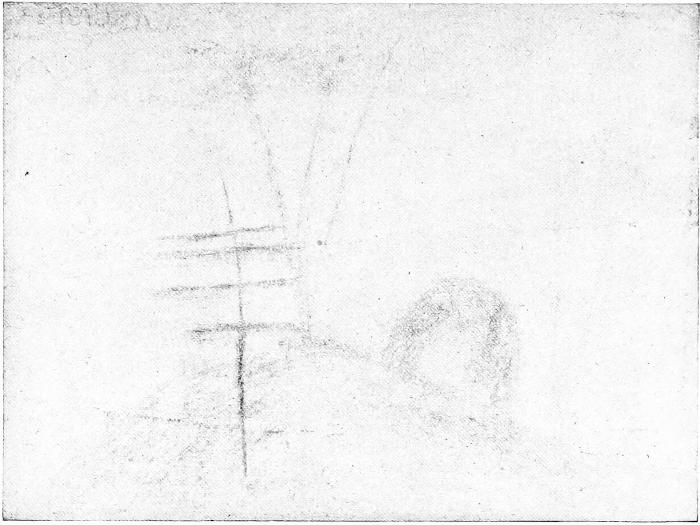
CHILD’S DRAWING OF A CAVE AND TREES
While training for the profession of learning
is regarded as the type of culture, or a liberal education,
the training of a mechanic, a musician, a
lawyer, a doctor, a farmer, a merchant, or a railroad
manager is regarded as purely technical and
professional. The result is that which we see about
us everywhere—the division into “cultured”
people and “workers,” the separation of theory and
practice. Hardly 1 per cent of the entire school
population ever attains to what we call higher
education; only 5 per cent to the grade of our high
school; while much more than half leave on or
before the completion of the fifth year of the elementary
grade. The simple facts of the case are
that in the great majority of human beings the
distinctively intellectual interest is not dominant.
They have the so-called practical impulse and disposition.
In many of those in whom by nature
intellectual interest is strong, social conditions
prevent its adequate realization. Consequently
by far the larger number of pupils leave school
as soon as they have acquired the rudiments of
learning, as soon as they have enough of the
symbols of reading, writing, and calculating to
be of practical use to them in getting a living.
While our educational leaders are talking of
culture, the development of personality, etc., as
the end and aim of education, the great majority
of those who pass under the tuition of the
school regard it only as a narrowly practical tool
with which to get bread and butter enough to eke
out a restricted life. If we were to conceive our
educational end and aim in a less exclusive way,
if we were to introduce into educational processes
the activities which appeal to those whose dominant
interest is to do and to make, we should
find the hold of the school upon its members to
be more vital, more prolonged, containing more of
culture.
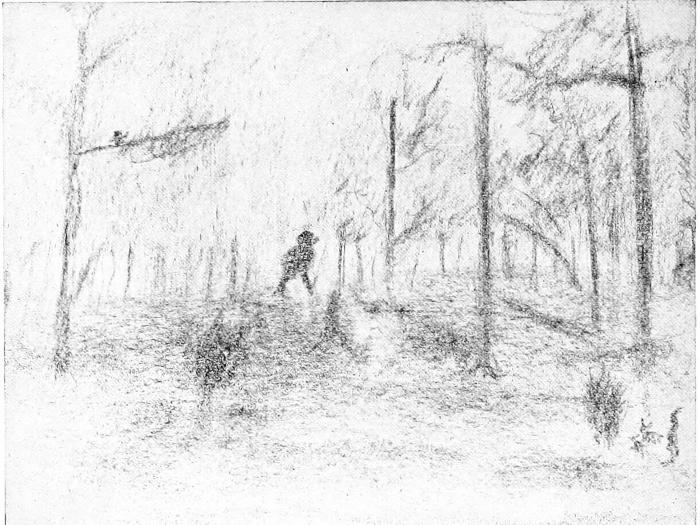
CHILD’S DRAWING OF A FOREST
But why should I make this labored presentation?
The obvious fact is that our social life has
undergone a thorough and radical change. If our
education is to have any meaning for life, it must
pass through an equally complete transformation.
This transformation is not something to appear
suddenly, to be executed in a day by conscious
purpose. It is already in progress. Those modifications
of our school system which often appear
(even to those most actively concerned with them,
to say nothing of their spectators) to be mere
changes of detail, mere improvement within the
school mechanism, are in reality signs and evidences
of evolution. The introduction of active occupations,
of nature-study, of elementary science, of art,
of history; the relegation of the merely symbolic
and formal to a secondary position; the change in
the moral school atmosphere, in the relation of
pupils and teachers—of discipline; the introduction
of more active, expressive, and self-directing
factors—all these are not mere accidents, they are
necessities of the larger social evolution. It remains
but to organize all these factors, to appreciate
them in their fulness of meaning, and to put
the ideas and ideals involved into complete, uncompromising
possession of our school system. To
do this means to make each one of our schools an
embryonic community life, active with types of
occupations that reflect the life of the larger
society and permeated throughout with the spirit
of art, history, and science. When the school
introduces and trains each child of society into
membership within such a little community, saturating
him with the spirit of service, and providing
him with the instruments of effective self-direction,
we shall have the deepest and best guaranty
of a larger society which is worthy, lovely, and
harmonious.
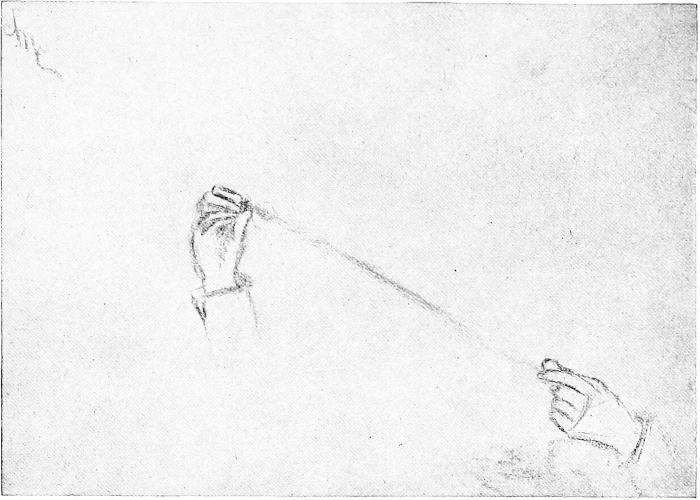
CHILD’S DRAWING OF HANDS SPINNING
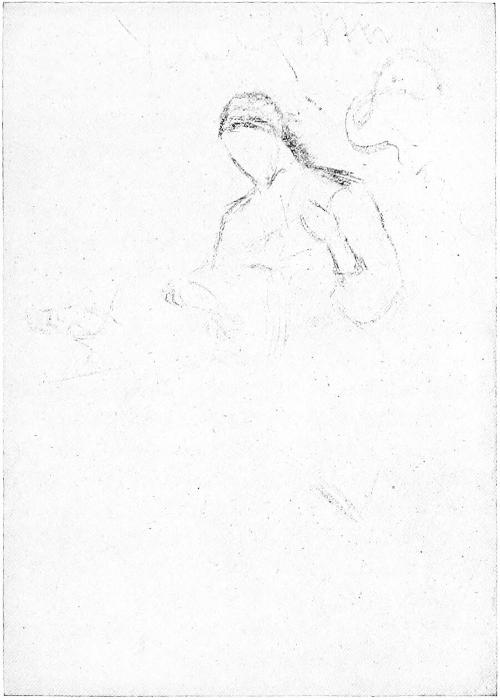
CHILD’S DRAWING OF A GIRL SPINNING
THE SCHOOL AND THE LIFE OF THE CHILD
II THE SCHOOL AND THE LIFE OF THE CHILD
Last week I tried to put before you the relationship
between the school and the larger life
of the community, and the necessity for certain
changes in the methods and materials of school
work, that it might be better adapted to present
social needs.
Today I wish to look at the matter from the
other side and consider the relationship of the
school to the life and development of the children
in the school. As it is difficult to connect
general principles with such thoroughly concrete
things as little children, I have taken the liberty
of introducing a great deal of illustrative matter
from the work of the University Elementary
School, that in some measure you may appreciate
the way in which the ideas presented work themselves
out in actual practice.
Some few years ago I was looking about the
school supply stores in the city, trying to find
desks and chairs which seemed thoroughly suitable
from all points of view—artistic, hygienic,
and educational—to the needs of the children.
We had a great deal of difficulty in finding what
we needed, and finally one dealer, more intelligent
than the rest, made this remark: “I am afraid
we have not what you want. You want something
at which the children may work; these are
all for listening.” That tells the story of the traditional
education. Just as the biologist can take
a bone or two and reconstruct the whole animal,
so, if we put before the mind’s eye the ordinary
schoolroom, with its rows of ugly desks placed in
geometrical order, crowded together so that there
shall be as little moving room as possible, desks
almost all of the same size, with just space enough
to hold books, pencils, and paper, and add a table,
some chairs, the bare walls, and possibly a few pictures,
we can reconstruct the only educational
activity that can possibly go on in such a place.
It is all made “for listening”—because simply
studying lessons out of a book is only another kind
of listening; it marks the dependency of one mind
upon another. The attitude of listening means,
comparatively speaking, passivity, absorption;
that there are certain ready-made materials which
are there, which have been prepared by the school
superintendent, the board, the teacher, and of
which the child is to take in as much as possible
in the least possible time.
There is very little place in the traditional
schoolroom for the child to work. The workshop,
the laboratory, the materials, the tools with which
the child may construct, create, and actively inquire,
and even the requisite space, have been for
the most part lacking. The things that have to
do with these processes have not even a definitely
recognized place in education. They are what the
educational authorities who write editorials in the
daily papers generally term “fads” and “frills.”
A lady told me yesterday that she had been
visiting different schools trying to find one where
activity on the part of the children preceded
the giving of information on the part of the
teacher, or where the children had some motive
for demanding the information. She visited,
she said, twenty-four different schools before she
found her first instance. I may add that that was
not in this city.
Another thing that is suggested by these schoolrooms,
with their set desks, is that everything is
arranged for handling as large numbers of children
as possible; for dealing with children en masse,
as an aggregate of units; involving, again, that
they be treated passively. The moment children
act they individualize themselves; they cease to
be a mass and become the intensely distinctive
beings that we are acquainted with out of school,
in the home, the family, on the playground, and
in the neighborhood.
On the same basis is explicable the uniformity
of method and curriculum. If everything is on
a “listening” basis, you can have uniformity of
material and method. The ear, and the book
which reflects the ear, constitute the medium
which is alike for all. There is next to no opportunity
for adjustment to varying capacities and
demands. There is a certain amount—a fixed
quantity—of ready-made results and accomplishments
to be acquired by all children alike in a
given time. It is in response to this demand
that the curriculum has been developed from the
elementary school up through the college. There
is just so much desirable knowledge, and there
are just so many needed technical accomplishments
in the world. Then comes the mathematical
problem of dividing this by the six,
twelve, or sixteen years of school life. Now
give the children every year just the proportionate
fraction of the total, and by the time they have
finished they will have mastered the whole. By
covering so much ground during this hour or day
or week or year, everything comes out with perfect
evenness at the end—provided the children
have not forgotten what they have previously
learned. The outcome of all this is Matthew
Arnold’s report of the statement, proudly made
to him by an educational authority in France, that
so many thousands of children were studying at a
given hour, say eleven o’clock, just such a lesson
in geography; and in one of our own western
cities this proud boast used to be repeated to
successive visitors by its superintendent.
I may have exaggerated somewhat in order to
make plain the typical points of the old education:
its passivity of attitude, its mechanical massing of
children, its uniformity of curriculum and method.
It may be summed up by stating that the center of
gravity is outside the child. It is in the teacher,
the textbook, anywhere and everywhere you
please except in the immediate instincts and activities
of the child himself. On that basis there
is not much to be said about the life of the child.
A good deal might be said about the studying of
the child, but the school is not the place where
the child lives. Now the change which is coming
into our education is the shifting of the center
of gravity. It is a change, a revolution, not
unlike that introduced by Copernicus when the
astronomical center shifted from the earth to
the sun. In this case the child becomes the sun
about which the appliances of education revolve;
he is the center about which they are organized.
If we take an example from an ideal home,
where the parent is intelligent enough to recognize
what is best for the child, and is able to supply
what is needed, we find the child learning
through the social converse and constitution of
the family. There are certain points of interest
and value to him in the conversation carried on:
statements are made, inquiries arise, topics are
discussed, and the child continually learns. He
states his experiences, his misconceptions are corrected.
Again the child participates in the household
occupations, and thereby gets habits of
industry, order, and regard for the rights and
ideas of others, and the fundamental habit of subordinating
his activities to the general interest of
the household. Participation in these household
tasks becomes an opportunity for gaining knowledge.
The ideal home would naturally have a
workshop where the child could work out his
constructive instincts. It would have a miniature
laboratory in which his inquiries could
be directed. The life of the child would extend
out of doors to the garden, surrounding fields,
and forests. He would have his excursions, his
walks and talks, in which the larger world out of
doors would open to him.
Now, if we organize and generalize all of this,
we have the ideal school. There is no mystery
about it, no wonderful discovery of pedagogy or
educational theory. It is simply a question of
doing systematically and in a large, intelligent,
and competent way what for various reasons can
be done in most households only in a comparatively
meager and haphazard manner. In the first place,
the ideal home has to be enlarged. The child
must be brought into contact with more grown
people and with more children in order that there
may be the freest and richest social life. Moreover,
the occupations and relationships of the
home environment are not specially selected for
the growth of the child; the main object is something
else, and what the child can get out of them
is incidental. Hence the need of a school. In
this school the life of the child becomes the all-controlling
aim. All the media necessary to further
the growth of the child center there. Learning?
certainly, but living primarily, and learning
through and in relation to this living. When we
take the life of the child centered and organized
in this way, we do not find that he is first of all a
listening being; quite the contrary.
The statement so frequently made that education
means “drawing out” is excellent, if we mean
simply to contrast it with the process of pouring
in. But, after all, it is difficult to connect the idea
of drawing out with the ordinary doings of the
child of three, four, seven, or eight years of age.
He is already running over, spilling over, with
activities of all kinds. He is not a purely latent
being whom the adult has to approach with great
caution and skill in order gradually to draw out
some hidden germ of activity. The child is already
intensely active, and the question of education is
the question of taking hold of his activities, of
giving them direction. Through direction, through
organized use, they tend toward valuable results,
instead of scattering or being left to merely impulsive
expression.
If we keep this before us, the difficulty I find
uppermost in the minds of many people regarding
what is termed the new education is not so
much solved as dissolved; it disappears. A question
often asked is: If you begin with the child’s
ideas, impulses, and interests, all so crude, so
random and scattering, so little refined or spiritualized,
how is he going to get the necessary discipline,
culture, and information? If there were no
way open to us except to excite and indulge these
impulses of the child, the question might well be
asked. We should either have to ignore and
repress the activities or else to humor them. But
if we have organization of equipment and of materials,
there is another path open to us. We can
direct the child’s activities, giving them exercise
along certain lines, and can thus lead up to the
goal which logically stands at the end of the paths
followed.
“If wishes were horses, beggars would ride.”
Since they are not, since really to satisfy an impulse
or interest means to work it out, and working it
out involves running up against obstacles, becoming
acquainted with materials, exercising ingenuity,
patience, persistence, alertness, it of necessity
involves discipline—ordering of power—and supplies
knowledge. Take the example of the little
child who wants to make a box. If he stops short
with the imagination or wish, he certainly will
not get discipline. But when he attempts to
realize his impulse, it is a question of making his
idea definite, making it into a plan, of taking the
right kind of wood, measuring the parts needed,
giving them the necessary proportions, etc. There
is involved the preparation of materials, the sawing,
planing, the sandpapering, making all the edges
and corners to fit. Knowledge of tools and processes
is inevitable. If the child realizes his
instinct and makes the box, there is plenty of
opportunity to gain discipline and perseverance,
to exercise effort in overcoming obstacles, and to
attain as well a great deal of information.
So undoubtedly the little child who thinks he
would like to cook has little idea of what it means
or costs, or what it requires. It is simply a desire
to “mess around,” perhaps to imitate the activities
of older people. And it is doubtless possible
to let ourselves down to that level and simply
humor that interest. But here, too, if the impulse
is exercised, utilized, it runs up against the actual
world of hard conditions, to which it must accommodate
itself; and there again come in the factors
of discipline and knowledge. One of the children
became impatient, recently, at having to work
things out by a long method of experimentation,
and said: “Why do we bother with this? Let’s
follow a recipe in a cook-book.” The teacher asked
the children where the recipe came from, and the
conversation showed that if they simply followed
this they would not understand the reasons for
what they were doing. They were then quite
willing to go on with the experimental work. To
follow that work will, indeed, give an illustration
of just the point in question. Their occupation
happened that day to be the cooking of eggs, as
making a transition from the cooking of vegetables
to that of meats. In order to get a basis of comparison
they first summarized the constituent food
elements in the vegetables and made a preliminary
comparison with those found in meat. Thus they
found that the woody fiber or cellulose in vegetables
corresponded to the connective tissue in meat,
giving the element of form and structure. They
found that starch and starchy products were characteristic
of the vegetables, that mineral salts were
found in both alike, and that there was fat in both—a
small quantity in vegetable food and a large
amount in animal. They were prepared then to
take up the study of albumen as the characteristic
feature of animal food, corresponding to starch in
the vegetables, and were ready to consider the conditions
requisite for the proper treatment of
albumen—the eggs serving as the material of
experiment.
They experimented first by taking water at
various temperatures, finding out when it was
scalding, simmering, and boiling hot, and ascertained
the effect of the various degrees of temperature
on the white of the egg. That worked out,
they were prepared, not simply to cook eggs, but
to understand the principle involved in the cooking
of eggs. I do not wish to lose sight of the universal
in the particular incident. For the child simply
to desire to cook an egg, and accordingly drop it in
water for three minutes, and take it out when he
is told, is not educative. But for the child to
realize his own impulse by recognizing the facts,
materials, and conditions involved, and then to
regulate his impulse through that recognition, is
educative. This is the difference, upon which I
wish to insist, between exciting or indulging an
interest and realizing it through its direction.
Another instinct of the child is the use of pencil
and paper. All children like to express themselves
through the medium of form and color. If you
simply indulge this interest by letting the child go
on indefinitely, there is no growth that is more
than accidental. But let the child first express his
impulse, and then through criticism, question, and
suggestion bring him to consciousness of what he
has done, and what he needs to do, and the result
is quite different. Here, for example, is the work
of a seven-year-old child. It is not average work,
it is the best work done among the little children,
but it illustrates the particular principle of which
I have been speaking. They had been talking
about the primitive conditions of social life when
people lived in caves. The child’s idea of that
found expression in this way: the cave is neatly
set up on the hillside in an impossible way. You
see the conventional tree of childhood—a vertical
line with horizontal branches on each side. If
the child had been allowed to go on repeating this
sort of thing day by day, he would be indulging
his instinct rather than exercising it. But the
child was now asked to look closely at trees, to
compare those seen with the one drawn, to examine
more closely and consciously into the conditions
of his work. Then he drew trees from observation.
Finally he drew again from combined observation,
memory, and imagination. He made again
a free illustration, expressing his own imaginative
thought, but controlled by detailed study of actual
trees. The result was a scene representing a bit
of forest; so far as it goes, it seems to me to have
as much poetic feeling as the work of an adult, while
at the same time its trees are, in their proportions,
possible ones, not mere symbols.
If we roughly classify the impulses which are
available in the school, we may group them under
four heads. There is the social instinct of the
children as shown in conversation, personal intercourse,
and communication. We all know how
self-centered the little child is at the age of four or
five. If any new subject is brought up, if he says
anything at all, it is: “I have seen that;” or, “My
papa or mamma told me about that.” His horizon
is not large; an experience must come immediately
home to him, if he is to be sufficiently interested to
relate it to others and seek theirs in return. And
yet the egoistic and limited interest of little children
is in this manner capable of infinite expansion.
The language instinct is the simplest form of the
social expression of the child. Hence it is a great,
perhaps the greatest of all educational resources.
Then there is the instinct of making—the constructive
impulse. The child’s impulse to do finds
expression first in play, in movement, gesture, and
make-believe, becomes more definite, and seeks
outlet in shaping materials into tangible forms and
permanent embodiment. The child has not much
instinct for abstract inquiry. The instinct of
investigation seems to grow out of the combination
of the constructive impulse with the conversational.
There is no distinction between experimental
science for little children and the work done in
the carpenter shop. Such work as they can do in
physics or chemistry is not for the purpose of
making technical generalizations or even arriving
at abstract truths. Children simply like to do
things and watch to see what will happen. But
this can be taken advantage of, can be directed into
ways where it gives results of value, as well as be
allowed to go on at random.
And so the expressive impulse of the children, the
art instinct, grows also out of the communicating
and constructive instincts. It is their refinement
and full manifestation. Make the construction
adequate, make it full, free, and flexible, give it
a social motive, something to tell, and you have a
work of art. Take one illustration of this in connection
with the textile work—sewing and weaving.
The children made a primitive loom in the
shop; here the constructive instinct was appealed
to. Then they wished to do something with this
loom, to make something. It was the type of
the Indian loom, and they were shown blankets
woven by the Indians. Each child made a design
kindred in idea to those of the Navajo blankets, and
the one which seemed best adapted to the work in
hand was selected. The technical resources were
limited, but the coloring and form were worked out
by the children. The example shown was made by
the twelve-year-old children. Examination shows
that it took patience, thoroughness, and perseverance
to do the work. It involved not merely discipline
and information of both a historical sort
and the elements of technical design, but also
something of the spirit of art in adequately conveying
an idea.
One more instance of the connection of the art
side with the constructive side: The children had
been studying primitive spinning and carding,
when one of them, twelve years of age, made a
picture of one of the older children spinning. Here
is another piece of work which is not quite average;
it is better than the average. It is an illustration
of two hands and the drawing out of the wool to
get it ready for spinning. This was done by a child
eleven years of age. But, upon the whole, with
the younger children especially, the art impulse
is connected mainly with the social instinct—the
desire to tell, to represent.
Now, keeping in mind these fourfold interests—the
interest in conversation, or communication; in
inquiry, or finding out things; in making things,
or construction; and in artistic expression—we may
say they are the natural resources, the uninvested
capital, upon the exercise of which depends the
active growth of the child. I wish to give one or
two illustrations, the first from the work of children
seven years of age. It illustrates in a way
the dominant desire of the children to talk, particularly
about folks and of things in relation to
folks. If you observe little children, you will find
they are interested in the world of things mainly in
its connection with people, as a background and
medium of human concerns. Many anthropologists
have told us there are certain identities in the
child interests with those of primitive life. There
is a sort of natural recurrence of the child mind to
the typical activities of primitive peoples; witness
the hut which the boy likes to build in the yard,
playing hunt, with bows, arrows, spears, and so on.
Again the question comes: What are we to do with
this interest—are we to ignore it, or just excite
and draw it out? Or shall we get hold of it and
direct it to something ahead, something better?
Some of the work that has been planned for our
seven-year-old children has the latter end in view—to
utilize this interest so that it shall become a
means of seeing the progress of the human race.
The children begin by imagining present conditions
taken away until they are in contact with nature
at first hand. That takes them back to a hunting
people, to a people living in caves or trees and
getting a precarious subsistence by hunting and
fishing. They imagine as far as possible the various
natural physical conditions adapted to that sort
of life; say, a hilly, woody slope, near mountains,
and a river where fish would be abundant. Then
they go on in imagination through the hunting to
the semi-agricultural stage, and through the
nomadic to the settled agricultural stage. The
point I wish to make is that there is abundant
opportunity thus given for actual study, for inquiry
which results in gaining information. So, while
the instinct primarily appeals to the social side, the
interest of the child in people and their doings is
carried on into the larger world of reality. For
example, the children had some idea of primitive
weapons, of the stone arrow-head, etc. That provided
occasion for the testing of materials as regards
their friability, their shape, texture, etc., resulting
in a lesson in mineralogy, as they examined the
different stones to find which was best suited to the
purpose. The discussion of the iron age supplied
a demand for the construction of a smelting oven
made out of clay and of considerable size. As the
children did not get their drafts right at first, the
mouth of the furnace not being in proper relation
to the vent as to size and position, instruction in
the principles of combustion, the nature of drafts
and of fuel, was required. Yet the instruction was
not given ready-made; it was first needed, and then
arrived at experimentally. Then the children
took some material, such as copper, and went
through a series of experiments, fusing it, working
it into objects; and the same experiments were
made with lead and other metals. This work
has been also a continuous course in geography,
since the children have had to imagine and work
out the various physical conditions necessary to
the different forms of social life implied. What
would be the physical conditions appropriate to
pastoral life? to the beginning of agriculture? to
fishing? What would be the natural method of
exchange between these peoples? Having worked
out such points in conversation, they have afterward
represented them in maps and sand-molding.
Thus they have gained ideas of the various forms
of the configuration of the earth, and at the same
time have seen them in their relation to human
activity, so that they are not simply external facts,
but are fused and welded with social conceptions
regarding the life and progress of humanity. The
result, to my mind, justifies completely the conviction
that children, in a year of such work (of
five hours a week altogether), get infinitely more
acquaintance with facts of science, geography, and
anthropology than they get where information is
the professed end and object, where they are
simply set to learning facts in fixed lessons. As
to discipline, they get more training of attention,
more power of interpretation, of drawing inferences,
of acute observation and continuous reflection,
than if they were put to working out arbitrary
problems simply for the sake of discipline.
I should like at this point to refer to the recitation.
We all know what it has been—a place where
the child shows off to the teacher and the other children
the amount of information he has succeeded
in assimilating from the textbook. From this other
standpoint the recitation becomes pre-eminently
a social meeting-place; it is to the school what the
spontaneous conversation is at home, excepting
that it is more organized, following definite lines.
The recitation becomes the social clearing-house,
where experiences and ideas are exchanged and subjected
to criticism, where misconceptions are corrected,
and new lines of thought and inquiry are
set up.
This change of the recitation, from an examination
of knowledge already acquired to the free play
of the children’s communicative instinct, affects
and modifies all the language work of the school.
Under the old régime it was unquestionably a
most serious problem to give the children a full
and free use of language. The reason was obvious.
The natural motive for language was seldom offered.
In the pedagogical textbooks language is defined as
the medium of expressing thought. It becomes
that, more or less, to adults with trained minds,
but it hardly needs to be said that language is
primarily a social thing, a means by which we give
our experiences to others and get theirs again in
return. When it is taken away from its natural
purpose, it is no wonder that it becomes a complex
and difficult problem to teach language. Think
of the absurdity of having to teach language as a
thing by itself. If there is anything the child will
do before he goes to school, it is to talk of the things
that interest him. But when there are no vital
interests appealed to in the school, when language
is used simply for the repetition of lessons, it is not
surprising that one of the chief difficulties of school
work has come to be instruction in the mother-tongue.
Since the language taught is unnatural,
not growing out of the real desire to communicate
vital impressions and convictions, the freedom of
children in its use gradually disappears, until
finally the high-school teacher has to invent all
kinds of devices to assist in getting any spontaneous
and full use of speech. Moreover, when the language
instinct is appealed to in a social way, there
is a continual contact with reality. The result is
that the child always has something in his mind
to talk about, he has something to say; he has a
thought to express, and a thought is not a thought
unless it is one’s own. On the traditional method,
the child must say something that he has merely
learned. There is all the difference in the world
between having something to say and having to
say something. The child who has a variety of
materials and facts wants to talk about them, and
his language becomes more refined and full, because
it is controlled and informed by realities. Reading
and writing, as well as the oral use of language,
may be taught on this basis. It can be done in a
related way, as the outgrowth of the child’s social
desire to recount his experiences and get in return
the experiences of others, directed always through
contact with the facts and forces which determine
the truth communicated.
I shall not have time to speak of the work of the
older children, where the original crude instincts
of construction and communication have been
developed into something like scientifically directed
inquiry, but I will give an illustration of the use of
language following upon this experimental work.
The work was on the basis of a simple experiment
of the commonest sort, gradually leading the children
out into geological and geographical study.
The sentences that I am going to read seem to me
poetic as well as “scientific.” “A long time ago
when the earth was new, when it was lava, there
was no water on the earth, and there was steam all
round the earth up in the air, as there were many
gases in the air. One of them was carbon dioxide.
The steam became clouds, because the earth began
to cool off, and after a while it began to rain, and
the water came down and dissolved the carbon
dioxide from the air.” There is a good deal more
science in that than probably would be apparent
at the outset. It represents some three months
of work on the part of the child. The children
kept daily and weekly records, but this is part of the
summing up of the quarter’s work. I call this
language poetic, because the child has a clear image
and has a personal feeling for the realities imaged.
I extract sentences from two other records to illustrate
further the vivid use of language when there
is a vivid experience back of it. “When the earth
was cold enough to condense, the water, with the
help of carbon dioxide, pulled the calcium out of the
rocks into a large body of water where the little
animals could get it.” The other reads as follows:
“When the earth cooled, calcium was in the rocks.
Then the carbon dioxide and water united and
formed a solution, and, as it ran, it tore out the
calcium and carried it on to the sea, where there
were little animals who took it out of solution.”
The use of such words as “pulled” and “tore”
in connection with the process of chemical combination
evidences a personal realization which compels
its own appropriate expression.
If I had not taken so much time in my other
illustrations, I should like to show how, beginning
with very simple material things, the children are
led on to larger fields of investigation and to the
intellectual discipline that is the accompaniment of
such research. I will simply mention the experiment
in which the work began. It consisted in
making precipitated chalk, used for polishing
metals. The children, with simple apparatus—a
tumbler, lime water, and a glass tube—precipitated
the calcium carbonate out of the water; and
from this beginning went on to a study of the
processes by which rocks of various sorts, igneous,
sedimentary, etc., had been formed on the surface
of the earth and the places they occupy; then to
points in the geography of the United States,
Hawaii, and Porto Rico; to the effects of these
various bodies of rock, in their various configurations,
upon the human occupations; so that this
geological record finally rounded itself out into the
life of man at the present time. The children saw
and felt the connection between these geologic
processes, taking place ages and ages ago, and
the physical conditions determining the industrial
occupations of today.
Of all the possibilities involved in the subject,
“The School and the Life of the Child,” I have
selected but one, because I have found that that
one gives people more difficulty, is more of a
stumbling-block, than any other. One may be
ready to admit that it would be most desirable for
the school to be a place in which the child should
really live, and get a life-experience in which he
should delight and find meaning for its own sake.
But then we hear this inquiry: How, upon this
basis, shall the child get the needed information;
how shall he undergo the required discipline? Yes,
it has come to this, that with many, if not most,
people the normal processes of life appear to be
incompatible with getting information and discipline.
So I have tried to indicate, in a highly
general and inadequate way (for only the school
itself, in its daily operation, could give a detailed
and worthy representation), how the problem works
itself out—how it is possible to lay hold upon the
rudimentary instincts of human nature, and, by
supplying a proper medium, so to control their
expression as not only to facilitate and enrich the
growth of the individual child, but also to supply
the same results, and far more, of technical information
and discipline that have been the ideals of
education in the past.
But although I have selected this especial way of
approach (as a concession to the question almost
universally raised), I am not willing to leave the
matter in this more or less negative and explanatory
condition. Life is the great thing after all; the
life of the child at its time and in its measure no
less than the life of the adult. Strange would it
be, indeed, if intelligent and serious attention to
what the child now needs and is capable of in the
way of a rich, valuable, and expanded life should
somehow conflict with the needs and possibilities
of later, adult life. “Let us live with our children”
certainly means, first of all, that our children shall
live—not that they shall be hampered and stunted
by being forced into all kinds of conditions, the
most remote consideration of which is relevancy to
the present life of the child. If we seek the kingdom
of heaven, educationally, all other things shall
be added unto us—which, being interpreted, is
that if we identify ourselves with the real instincts
and needs of childhood, and ask only after its fullest
assertion and growth, the discipline and information
and culture of adult life shall all come in their due
season.
Speaking of culture reminds me that in a way
I have been speaking only of the outside of the
child’s activity—only of the outward expression
of his impulses toward saying, making, finding
out, and creating. The real child, it hardly need
be said, lives in the world of imaginative values
and ideas which find only imperfect outward
embodiment. We hear much nowadays about
the cultivation of the child’s “imagination.”
Then we undo much of our own talk and work by a
belief that the imagination is some special part of
the child that finds its satisfaction in some one
particular direction—generally speaking, that of
the unreal and make-believe, of the myth and
made-up story. Why are we so hard of heart and
so slow to believe? The imagination is the medium
in which the child lives. To him there is everywhere
and in everything which occupies his mind
and activity at all a surplusage of value and significance.
The question of the relation of the school
to the child’s life is at bottom simply this: Shall
we ignore this native setting and tendency, dealing,
not with the living child at all, but with the dead
image we have erected, or shall we give it play and
satisfaction? If we once believe in life and in the
life of the child, then will all the occupations and
uses spoken of, then will all history and science,
become instruments of appeal and materials of
culture to his imagination, and through that to the
richness and the orderliness of his life. Where we
now see only the outward doing and the outward
product, there, behind all visible results, is the
readjustment of mental attitude, the enlarged and
sympathetic vision, the sense of growing power,
and the willing ability to identify both insight and
capacity with the interests of the world and man.
Unless culture be a superficial polish, a veneering
of mahogany over common wood, it surely is this—the
growth of the imagination in flexibility, in scope,
and in sympathy, till the life which the individual
lives is informed with the life of nature and of
society. When nature and society can live in the
schoolroom, when the forms and tools of learning
are subordinated to the substance of experience,
then shall there be an opportunity for this identification,
and culture shall be the democratic password.
WASTE IN EDUCATION
III WASTE IN EDUCATION
The subject announced for today was “Waste
in Education.” I should like first to state briefly
its relation to the two preceding lectures. The
first dealt with the school in its social aspects,
and the necessary readjustments that have to be
made to render it effective in present social conditions.
The second dealt with the school in
relation to the growth of individual children.
Now the third deals with the school as itself an
institution, in relation both to society and to its
own members—the children. It deals with the
question of organization, because all waste is the
result of the lack of it, the motive lying behind
organization being promotion of economy and
efficiency. This question is not one of the waste
of money or the waste of things. These matters
count; but the primary waste is that of human
life, the life of the children while they are at
school, and afterward because of inadequate and
perverted preparation.
So, when we speak of organization, we are not
to think simply of the externals; of that which
goes by the name “school system”—the school
board, the superintendent, and the building, the
engaging and promotion of teachers, etc. These
things enter in, but the fundamental organization
is that of the school itself as a community of individuals,
in its relations to other forms of social
life. All waste is due to isolation. Organization
is nothing but getting things into connection
with one another, so that they work easily, flexibly,
and fully. Therefore in speaking of this
question of waste in education I desire to call
your attention to the isolation of the various parts
of the school system, to the lack of unity in the
aims of education, to the lack of coherence in its
studies and methods.
I have made a chart (I) which, while I speak
of the isolations of the school system itself, may
perhaps appeal to the eye and save a little time
in verbal explanations. A paradoxical friend of
mine says there is nothing so obscure as an illustration,
and it is quite possible that my attempt
to illustrate my point will simply prove the truth
of his statement.
Chart I.
The blocks represent the various elements in
the school system and are intended to indicate
roughly the length of time given to each division,
and also the overlapping, both in time
and in subjects studied, of the individual parts
of the system. With each block is given the
historical conditions in which it arose and its
ruling ideal.
The school system, upon the whole, has grown
from the top down. During the Middle Ages it
was essentially a cluster of professional schools—especially
law and theology. Our present university
comes down to us from the Middle Ages.
I will not say that at present it is a mediaeval
institution, but it had its roots in the Middle Ages,
and it has not outlived all mediaeval traditions
regarding learning.
The kindergarten, rising with the present century,
was a union of the nursery and of the philosophy
of Schelling; a wedding of the plays and
games which the mother carried on with her
children to Schelling’s highly romantic and symbolic
philosophy. The elements that came from
the actual study of child life—the continuation
of the nursery—have remained a life-bringing
force in all education; the Schellingesque factors
made an obstruction between it and the rest of
the school system—brought about isolations.
The line drawn over the top indicates that
there is a certain interaction between the kindergarten
and the primary school; for, so far as the
primary school remained in spirit foreign to the
natural interests of child life, it was isolated from
the kindergarten, so that it is a problem, at present,
to introduce kindergarten methods into the
primary school; the problem of the so-called
connecting class. The difficulty is that the two
are not one from the start. To get a connection
the teacher has had to climb over the wall instead
of entering in at the gate.
On the side of aims, the ideal of the kindergarten
was the moral development of the children,
rather than instruction or discipline; an ideal
sometimes emphasized to the point of sentimentality.
The primary school grew practically out
of the popular movement of the sixteenth century,
when, along with the invention of printing and
the growth of commerce, it became a business
necessity to know how to read, write, and figure.
The aim was distinctly a practical one; it was
utility; getting command of these tools, the symbols
of learning, not for the sake of learning, but
because they gave access to careers in life otherwise
closed.
The division next to the primary school is the
grammar school. The term is not much used in
the West, but is common in the eastern states.
It goes back to the time of the revival of learning—a
little earlier perhaps than the conditions
out of which the primary school originated, and,
even when contemporaneous, having a different
ideal. It had to do with the study of language
in the higher sense; because, at the time of the
Renaissance, Latin and Greek connected people
with the culture of the past, with the Roman and
Greek world. The classic languages were the
only means of escape from the limitations of the
Middle Ages. Thus there sprang up the prototype
of the grammar school, more liberal than
the university (so largely professional in character),
for the purpose of putting into the hands of
the people the key to the old learning, that men
might see a world with a larger horizon. The
object was primarily culture, secondarily discipline.
It represented much more than the
present grammar school. It was the liberal element
in the college, which, extending downward,
grew into the academy and the high school. Thus
the secondary school is still in part just a lower
college (having an even higher curriculum than
the college of a few centuries ago) or a preparatory
department to a college, and in part a rounding
up of the utilities of the elementary school.
There appear then two products of the nineteenth
century, the technical and normal schools.
The schools of technology, engineering, etc., are,
of course, mainly the development of nineteenth-century
business conditions, as the primary school
was the development of business conditions of
the sixteenth century. The normal school arose
because of the necessity for training teachers,
with the idea partly of professional drill and
partly that of culture.
Without going more into detail, we have some
eight different parts of the school system as represented
on the chart, all of which arose historically
at different times, having different ideals in view,
and consequently different methods. I do not
wish to suggest that all of the isolation, all of the
separation, that has existed in the past between
the different parts of the school system still persists.
One must, however, recognize that they have
never yet been welded into one complete whole.
The great problem in education on the administrative
side is how to unite these different parts.
Consider the training schools for teachers—the
normal schools. These occupy at present a
somewhat anomalous position, intermediate between
the high school and the college, requiring
the high-school preparation, and covering a certain
amount of college work. They are isolated
from the higher subject-matter of scholarship,
since, upon the whole, their object has been to train
persons how to teach, rather than what to teach;
while, if we go to the college, we find the other half
of this isolation—learning what to teach, with
almost a contempt for methods of teaching. The
college is shut off from contact with children and
youth. Its members, to a great extent, away
from home and forgetting their own childhood,
become eventually teachers with a large amount of
subject-matter at command, and little knowledge
of how this is related to the minds of those to whom
it is to be taught. In this division between what
to teach and how to teach, each side suffers from
the separation.
It is interesting to follow out the interrelation
between primary, grammar, and high schools.
The elementary school has crowded up and taken
many subjects previously studied in the old New
England grammar school. The high school has
pushed its subjects down. Latin and algebra
have been put in the upper grades, so that the
seventh and eighth grades are, after all, about
all that is left of the old grammar school. They
are a sort of amorphous composite, being partly
a place where children go on learning what they
already have learned (to read, write, and figure),
and partly a place of preparation for the high
school. The name in some parts of New England
for these upper grades was “Intermediate School.”
The term was a happy one; the work was simply
intermediate between something that had been
and something that was going to be, having no
special meaning on its own account.
Just as the parts are separated, so do the ideals
differ—moral development, practical utility, general
culture, discipline, and professional training.
These aims are each especially represented in some
distinct part of the system of education; and, with
the growing interaction of the parts, each is supposed
to afford a certain amount of culture, discipline,
and utility. But the lack of fundamental
unity is witnessed in the fact that one study
is still considered good for discipline, and another
for culture; some parts of arithmetic, for example,
for discipline and others for use; literature
for culture; grammar for discipline; geography
partly for utility, partly for culture; and so on.
The unity of education is dissipated, and the
studies become centrifugal; so much of this study
to secure this end, so much of that to secure
another, until the whole becomes a sheer compromise
and patchwork between contending
aims and disparate studies. The great problem
in education on the administrative side is to secure
the unity of the whole, in the place of a sequence
of more or less unrelated and overlapping parts,
and thus to reduce the waste arising from friction,
reduplication, and transitions that are not properly
bridged.
Chart II.
In this second symbolic diagram (II) I wish to
suggest that really the only way to unite the parts
of the system is to unite each to life. We can get
only an artificial unity so long as we confine our
gaze to the school system itself. We must look
at it as part of the larger whole of social life. This
block (A) in the center represents the school system
as a whole. (1) At one side we have the
home, and the two arrows represent the free interplay
of influences, materials, and ideas between
the home life and that of the school. (2) Below
we have the relation to the natural environment,
the great field of geography in the widest sense.
The school building has about it a natural environment.
It ought to be in a garden, and the children
from the garden would be led on to surrounding
fields, and then into the wider country, with all
its facts and forces. (3) Above is represented
business life, and the necessity for free play between
the school and the needs and forces of industry.
(4) On the other side is the university proper, with
its various phases, its laboratories, its resources in
the way of libraries, museums, and professional
schools.
From the standpoint of the child, the great
waste in the school comes from his inability to
utilize the experiences he gets outside the school
in any complete and free way within the school
itself; while, on the other hand, he is unable to
apply in daily life what he is learning at school.
That is the isolation of the school—its isolation
from life. When the child gets into the schoolroom
he has to put out of his mind a large part of
the ideas, interests, and activities that predominate
in his home and neighborhood. So the school,
being unable to utilize this everyday experience,
sets painfully to work, on another tack and by a
variety of means, to arouse in the child an interest
in school studies. While I was visiting in the city
of Moline a few years ago, the superintendent told
me that they found many children every year
who were surprised to learn that the Mississippi
river in the textbook had anything to do with the
stream of water flowing past their homes. The
geography being simply a matter of the schoolroom,
it is more or less of an awakening to many
children to find that the whole thing is nothing
but a more formal and definite statement of the
facts which they see, feel, and touch every day.
When we think that we all live on the earth, that
we live in an atmosphere, that our lives are touched
at every point by the influences of the soil, flora,
and fauna, by considerations of light and heat,
and then think of what the school study of geography
has been, we have a typical idea of the gap
existing between the everyday experiences of the
child and the isolated material supplied in such
large measure in the school. This is but an
instance, and one upon which most of us may
reflect long before we take the present artificiality
of the school as other than a matter of course or
necessity.
Though there should be organic connection
between the school and business life, it is not
meant that the school is to prepare the child for
any particular business, but that there should be
a natural connection of the everyday life of the
child with the business environment about him,
and that it is the affair of the school to clarify
and liberalize this connection, to bring it to consciousness,
not by introducing special studies,
like commercial geography and arithmetic, but
by keeping alive the ordinary bonds of relation.
The subject of compound-business-partnership is
probably not in many of the arithmetics nowadays,
though it was there not a generation ago,
for the makers of textbooks said that if they left
out anything they could not sell their books.
This compound-business-partnership originated
as far back as the sixteenth century. The joint-stock
company had not been invented, and as
large commerce with the Indies and Americas
grew up, it was necessary to have an accumulation
of capital with which to handle it. One man
said, “I will put in this amount of money for six
months,” and another, “So much for two years,”
and so on. Thus by joining together they got
money enough to float their commercial enterprises.
Naturally, then, “compound partnership”
was taught in the schools. The joint-stock company
was invented; compound partnership disappeared,
but the problems relating to it stayed
in the arithmetics for two hundred years. They
were kept after they had ceased to have practical
utility, for the sake of mental discipline—they
were “such hard problems, you know.” A great
deal of what is now in the arithmetics under the
head of percentage is of the same nature.
Children of twelve and thirteen years of age go
through gain and loss calculations, and various
forms of bank discount so complicated that the
bankers long ago dispensed with them. And
when it is pointed out that business is not done
this way, we hear again of “mental discipline.”
And yet there are plenty of real connections
between the experience of children and business
conditions which need to be utilized and illuminated.
The child should study his commercial
arithmetic and geography, not as isolated things
by themselves, but in their reference to his social
environment. The youth needs to become acquainted
with the bank as a factor in modern
life, with what it does, and how it does it; and
then relevant arithmetical processes would have
some meaning—quite in contradistinction to the
time-absorbing and mind-killing examples in percentage,
partial payments, etc., found in all our
arithmetics.
The connection with the university, as indicated
in this chart, I need not dwell upon. I
simply wish to indicate that there ought to be
a free interaction between all the parts of the
school system. There is much of utter triviality
of subject-matter in elementary and secondary
education. When we investigate it, we find that
it is full of facts taught that are not facts, which
have to be unlearned later on. Now, this happens
because the “lower” parts of our system
are not, in vital connection with the “higher.”
The university or college, in its idea, is a place of
research, where investigation is going on: a place
of libraries and museums, where the best resources
of the past are gathered, maintained, and organized.
It is, however, as true in the school as in
the university that the spirit of inquiry can be
got only through and with the attitude of inquiry.
The pupil must learn what has meaning, what
enlarges his horizon, instead of mere trivialities.
He must become acquainted with truths, instead
of things that were regarded as such fifty years
ago or that are taken as interesting by the misunderstanding
of a partially educated teacher.
It is difficult to see how these ends can be reached
except as the most advanced part of the educational
system is in complete interaction with the
most rudimentary.
The next chart (III) is an enlargement of the
second. The school building has swelled out, so
to speak, the surrounding environment remaining
the same, the home, the garden and country, the
relation to business life and the university. The
object is to show what the school must become
to get out of its isolation and secure the organic
connection with social life of which we have been
speaking. It is not our architect’s plan for the
school building that we hope to have; but it is a
diagrammatic representation of the idea which
we want embodied in the school building. On
the lower side you see the dining-room and the
kitchen, at the top the wood and metal shops and
the textile room for sewing and weaving. The
center represents the manner in which all come
together in the library; that is to say, in a collection
of the intellectual resources of all kinds that
throw light upon the practical work, that give it
meaning and liberal value. If the four corners
represent practice, the interior represents the
theory of the practical activities. In other words,
the object of these forms of practice in the school
is not found chiefly in themselves, or in the technical
skill of cooks, seamstresses, carpenters, and
masons, but in their connection, on the social
side, with the life without; while on the individual
side they respond to the child’s need of action, of
expression, of desire to do something, to be constructive
and creative, instead of simply passive
and conforming. Their great significance is that
they keep the balance between the social and
individual sides—the chart symbolizing particularly
the connection with the social. Here on
one side is the home. How naturally the lines of
connection play back and forth between the home
and the kitchen and the textile room of the school!
The child can carry over what he learns in the
home and utilize it in the school; and the things
learned in the school he applies at home. These
are the two great things in breaking down isolation,
in getting connection—to have the child
come to school with all the experience he has got
outside the school, and to leave it with something
to be immediately used in his everyday life. The
child comes to the traditional school with a
healthy body and a more or less unwilling mind,
though, in fact, he does not bring both his body
and mind with him; he has to leave his mind
behind, because there is no way to use it in the
school. If he had a purely abstract mind, he
could bring it to school with him, but his is a
concrete one, interested in concrete things, and
unless these things get over into school life he
cannot take his mind with him. What we want
is to have the child come to school with a whole
mind and a whole body, and leave school with a
fuller mind and an even healthier body. And
speaking of the body suggests that, while there
is no gymnasium in these diagrams, the active
life carried on in its four corners brings with it
constant physical exercise, while our gymnasium
proper will deal with the particular weaknesses
of children and their correction, and will attempt
more consciously to build up the thoroughly
sound body as the abode of the sound mind.
Chart III.
That the dining-room and kitchen connect with
the country and its processes and products it is
hardly necessary to say. Cooking may be so
taught that it has no connection with country life
and with the sciences that find their unity in geography.
Perhaps it generally has been taught
without these connections being really made. But
all the materials that come into the kitchen have
their origin in the country; they come from the
soil, are nurtured through the influences of light
and water, and represent a great variety of local
environments. Through this connection, extending
from the garden into the larger world, the
child has his most natural introduction to the
study of the sciences. Where did these things
grow? What was necessary to their growth?
What their relation to the soil? What the effect
of different climatic conditions? and so on. We
all know what the old-fashioned botany was:
partly collecting flowers that were pretty, pressing
and mounting them; partly pulling these
flowers to pieces and giving technical names to
the different parts, finding all the different leaves,
naming all their different shapes and forms. It
was a study of plants without any reference to
the soil, to the country, or to growth. In contrast,
a real study of plants takes them in their natural
environment and in their uses as well, not simply
as food, but in all their adaptations to the social
life of man. Cooking becomes as well a most
natural introduction to the study of chemistry,
giving the child here also something which he can
at once bring to bear upon his daily experience.
I once heard a very intelligent woman say that she
could not understand how science could be taught
to little children, because she did not see how they
could understand atoms and molecules. In other
words, since she did not see how highly abstract
facts could be presented to the child independently
of daily experience, she could not understand how
science could be taught at all. Before we smile
at this remark, we need to ask ourselves if she is
alone in her assumption, or whether it simply
formulates the principle of almost all our school
practice.
The same relations with the outside world are
found in the carpentry and the textile shops.
They connect with the country, as the source of
their materials, with physics, as the science of
applying energy, with commerce and distribution,
with art in the development of architecture
and decoration. They have also an intimate connection
with the university on the side of its
technological and engineering schools; with the
laboratory and its scientific methods and results.
To go back to the square which is marked the
library (Chart III, A): if you imagine rooms half
in the four corners and half in the library, you will
get the idea of the recitation room. That is the
place where the children bring the experiences, the
problems, the questions, the particular facts which
they have found, and discuss them so that new
light may be thrown upon them, particularly new
light from the experience of others, the accumulated
wisdom of the world—symbolized in the
library. Here is the organic relation of theory and
practice; the child not simply doing things, but
getting also the idea of what he does; getting
from the start some intellectual conception that
enters into his practice and enriches it; while
every idea finds, directly or indirectly, some application
in experience and has some effect upon
life. This, I need hardly say, fixes the position of
the “book” or reading in education. Harmful
as a substitute for experience, it is all-important
in interpreting and expanding experience.
The other chart (IV) illustrates precisely the
same idea. It gives the symbolic upper story of
this ideal school. In the upper corners are the
laboratories; in the lower corners are the studios
for art work, both the graphic and auditory arts.
The questions, the chemical and physical problems,
arising in the kitchen and shop, are taken to the
laboratories to be worked out. For instance, this
past week one of the older groups of children doing
practical work in weaving, which involved the use
of the spinning wheel, worked out the diagrams
of the direction of forces concerned in treadle and
wheel, and the ratio of velocities between wheel
and spindle. In the same manner, the plants
with which the child has to do in cooking afford
the basis for a concrete interest in botany and may
be taken and studied by themselves. In a certain
school in Boston science work for months was
centered in the growth of the cotton plant, and yet
something new was brought in every day. We
hope to do similar work with all the types of plants
that furnish materials for sewing and weaving.
These examples will suggest, I hope, the relation
which the laboratories bear to the rest of the school.
Chart IV.
The drawing and music, or the graphic and
auditory arts, represent the culmination, the
idealization, the highest point of refinement of
all the work carried on. I think everybody who
has not a purely literary view of the subject recognizes
that genuine art grows out of the work of
the artisan. The art of the Renaissance was
great because it grew out of the manual arts of
life. It did not spring up in a separate atmosphere,
however ideal, but carried on to their
spiritual meaning processes found in homely and
everyday forms of life. The school should observe
this relationship. The merely artisan side is
narrow, but the mere art, taken by itself, and
grafted on from without, tends to become forced,
empty, sentimental. I do not mean, of course,
that all art work must be correlated in detail to
the other work of the school, but simply that a
spirit of union gives vitality to the art and depth
and richness to the other work. All art involves
physical organs—the eye and hand, the ear and
voice; and yet it is something more than the mere
technical skill required by the organs of expression.
It involves an idea, a thought, a spiritual rendering
of things; and yet it is other than any number of
ideas by themselves. It is a living union of
thought and the instrument of expression. This
union is symbolized by saying that in the ideal
school the art work might be considered to be that
of the shops, passed through the alembic of library
and museum into action again.
Take the textile room as an illustration of such
a synthesis. I am talking about a future school,
the one we hope, some time, to have. The basal
fact in that room is that it is a workshop, doing
actual things in sewing, spinning, and weaving.
The children come into immediate connection
with the materials, with various fabrics of silk,
cotton, linen, and wool. Information at once
appears in connection with these materials; their
origin, history, their adaptation to particular uses,
and the machines of various kinds by which the
raw materials are utilized. Discipline arises in
dealing with the problems involved, both theoretical
and practical. Whence does the culture
arise? Partly from seeing all these things reflected
through the medium of their scientific and historic
conditions and associations, whereby the child
learns to appreciate them as technical achievements,
as thoughts precipitated in action; and
partly because of the introduction of the art idea
into the room itself. In the ideal school there
would be something of this sort: first, a complete
industrial museum, giving samples of materials
in various stages of manufacture, and the implements,
from the simplest to the most complex
used in dealing with them; then a collection of
photographs and pictures illustrating the landscapes
and the scenes from which the materials
come, their native homes, and their places of
manufacture. Such a collection would be a vivid
and continual lesson in the synthesis of art, science,
and industry. There would be, also, samples of
the more perfect forms of textile work, as Italian,
French, Japanese, and Oriental. There would
be objects illustrating motives of design and
decoration which have entered into production.
Literature would contribute its part in its idealized
representation of the world-industries, as
the Penelope in the Odyssey—a classic in literature
because the character is an adequate embodiment
of a certain industrial phase of social life. So,
from Homer down to the present time, there is
a continuous procession of related facts which
have been translated into terms of art. Music
lends its share, from the Scotch song at the wheel
to the spinning song of Marguerite, or of Wagner’s
Senta. The shop becomes a pictured museum,
appealing to the eye. It would have not only
materials—beautiful woods and designs—but would
give a synopsis of the historical evolution of
architecture in its drawings and pictures.
Thus I have attempted to indicate how the
school may be connected with life so that the
experience gained by the child in a familiar,
commonplace way is carried over and made use of
there, and what the child learns in the school is
carried back and applied in everyday life, making
the school an organic whole, instead of a composite
of isolated parts. The isolation of studies
as well as of parts of the school system disappears.
Experience has its geographical aspect, its artistic
and its literary, its scientific and its historical sides.
All studies arise from aspects of the one earth and
the one life lived upon it. We do not have a series
of stratified earths, one of which is mathematical,
another physical, another historical, and so on.
We should not be able to live very long in any one
taken by itself. We live in a world where all sides
are bound together. All studies grow out of
relations in the one great common world. When
the child lives in varied but concrete and active
relationship to this common world, his studies
are naturally unified. It will no longer be a problem
to correlate studies. The teacher will not
have to resort to all sorts of devices to weave a
little arithmetic into the history lesson, and the like.
Relate the school to life, and all studies are of
necessity correlated.
Moreover, if the school is related as a whole to
life as a whole, its various aims and ideals—culture,
discipline, information, utility—cease to be
variants, for one of which we must select one
study and for another another. The growth of
the child in the direction of social capacity and
service, his larger and more vital union with life,
becomes the unifying aim; and discipline, culture,
and information fall into place as phases of this
growth.
I wish to say one word more about the relationship
of our particular school to the University.
The problem is to unify, to organize, education,
to bring all its various factors together, through
putting it as a whole into organic union with
everyday life. That which lies back of the pedagogical
school of the University is the necessity
of working out something to serve as a model for
such unification, extending from work beginning
with the four-year-old child up through the
graduate work of the University. Already we
have much help from the University in scientific
work planned, sometimes even in detail, by heads
of the departments. The graduate student comes
to us with his researches and methods, suggesting
ideas and problems. The library and museum
are at hand. We want to bring all things educational
together; to break down the barriers
that divide the education of the little child from
the instruction of the maturing youth; to identify
the lower and the higher education, so that it
shall be demonstrated to the eye that there is no
lower and higher, but simply education.
Speaking more especially with reference to the
pedagogical side of the work: I suppose the oldest
university chair of pedagogy in our country is
about twenty years old—that of the University
of Michigan, founded in the latter seventies.
But there are only one or two that have tried to
make a connection between theory and practice.
They teach for the most part by theory, by lectures,
by reference to books, rather than through the
actual work of teaching itself. At Columbia,
through the Teachers College, there is an extensive
and close connection between the University and
the training of teachers. Something has been
done in one or two other places along the same
line. We want an even more intimate union here,
so that the University shall put all its resources
at the disposition of the elementary school, contributing
to the evolution of valuable subject-matter
and right method, while the school in turn
will be a laboratory in which the student of education
sees theories and ideas demonstrated,
tested, criticized, enforced, and the evolution of
new truths. We want the school in its relation
to the University to be a working model of a
unified education.
A word as to the relation of the school to educational
interests generally. I heard once that
the adoption of a certain method in use in our
school was objected to by a teacher on this ground:
“You know that it is an experimental school.
They do not work under the same conditions that
we are subject to.” Now, the purpose of performing
an experiment is that other people need
not experiment; at least need not experiment so
much, may have something definite and positive
to go by. An experiment demands particularly
favorable conditions in order that results may be
reached both freely and securely. It has to work
unhampered, with all the needed resources at
command. Laboratories lie back of all the great
business enterprises of today, back of every great
factory, every railway and steamship system.
Yet the laboratory is not a business enterprise;
it does not aim to secure for itself the conditions
of business life, nor does the commercial undertaking
repeat the laboratory. There is a difference
between working out and testing a new truth, or
a new method, and applying it on a wide scale,
making it available for the mass of men, making
it commercial. But the first thing is to discover
the truth, to afford all necessary facilities, for this
is the most practical thing in the world in the long
run. We do not expect to have other schools
literally imitate what we do. A working model
is not something to be copied; it is to afford a
demonstration of the feasibility of the principle,
and of the methods which make it feasible. So
(to come back to our own point) we want here to
work out the problem of the unity, the organization
of the school system in itself, and to do this
by relating it so intimately to life as to demonstrate
the possibility and necessity of such organization
for all education.
THE PSYCHOLOGY OF ELEMENTARY EDUCATION
IV THE PSYCHOLOGY OF ELEMENTARY EDUCATION
Naturally, most of the public is interested in
what goes on day by day in a school in direct
relation to the children there. This is true of
parents who send their boys and girls for the sake
of the personal results they wish to secure, not for
the sake of contributing to educational theory.
In the main, it is true of visitors to a school who
recognize, in varying degrees, what is actually
done with the children before their eyes, but who
rarely have either the interest or the time to consider
the work in relation to underlying problems.
A school cannot lose sight of this aspect of its work,
since only by attending to it can the school retain
the confidence of its patrons and the presence of its
pupils.
Nevertheless a school conducted by a department
of a university must have another aspect.
From the university standpoint, the most important
part of its work is the scientific—the contribution
it makes to the progress of educational
thinking. The aim of educating a certain number
of children would hardly justify a university in
departing from the tradition which limits it to
those who have completed their secondary instruction.
Only the scientific aim, the conduct of a
laboratory, comparable to other scientific laboratories,
can furnish a reason for the maintenance by
a university of an elementary school. Such a
school is a laboratory of applied psychology. That
is, it has a place for the study of mind as manifested
and developed in the child, and for the search
after materials and agencies that seem most likely to
fulfil and further the conditions of normal growth.
It is not a normal school or a department for
the training of teachers. It is not a model school.
It is not intended to demonstrate any one special
idea or doctrine. Its task is the problem of viewing
the education of the child in the light of the
principles of mental activity and processes of
growth made known by modern psychology. The
problem by its nature is an infinite one. All that
any school can do is to make contributions here
and there, and to stand for the necessity of considering
education, both theoretically and practically,
in this light. This being the end, the
school conditions must, of course, agree. To
endeavor to study the process and laws of growth
under such artificial conditions as prevent many
of the chief facts of child life from showing themselves
is an obvious absurdity.
In its practical aspect, this laboratory problem
takes the form of the construction of a course of
study which harmonizes with the natural history
of the growth of the child in capacity and experience.
The question is the selection of the kind,
variety, and due proportion of subjects, answering
most definitely to the dominant needs and powers
of a given period of growth, and of those modes
of presentation that will cause the selected material
to enter vitally into growth. We cannot admit
too fully or too freely the limits of our knowledge
and the depths of our ignorance in these matters.
No one has a complete hold scientifically upon the
chief psychological facts of any one year of child
life. It would be sheer presumption to claim that
just the material best fitted to promote this growth
has as yet been discovered. The assumption of an
educational laboratory is rather that enough is
known of the conditions and modes of growth to
make intelligent inquiry possible; and that it is
only by acting upon what is already known that
more can be found out. The chief point is such
experimentation as will add to our reasonable convictions.
The demand is to secure arrangements
that will permit and encourage freedom of investigation;
that will give some assurance that important
facts will not be forced out of sight; conditions
that will enable the educational practice indicated
by the inquiry to be sincerely acted upon, without
the distortion and suppression arising from undue
dependence upon tradition and preconceived
notions. It is in this sense that the school would
be an experimental station in education.
What, then, are the chief working hypotheses
that have been adopted from psychology? What
educational counterparts have been hit upon as in
some degree in line with the adopted psychology?
The discussion of these questions may be
approached by pointing out a contrast between
contemporary psychology and the psychology of
former days. The contrast is a triple one. Earlier
psychology regarded mind as a purely individual
affair in direct and naked contact with an external
world. The only question asked was of the ways
in which the world and the mind acted upon each
other. The entire process recognized would have
been in theory exactly the same if there were one
mind living alone in the universe. At present the
tendency is to conceive individual mind as a function
of social life—as not capable of operating or
developing by itself, but as requiring continual
stimulus from social agencies, and finding its nutrition
in social supplies. The idea of heredity has
made familiar the notion that the equipment of the
individual, mental as well as physical, is an inheritance
from the race: a capital inherited by the
individual from the past and held in trust by him
for the future. The idea of evolution has made
familiar the notion that mind cannot be regarded
as an individual, monopolistic possession, but represents
the outworkings of the endeavor and thought
of humanity; that it is developed in an environment
which is social as well as physical, and that
social needs and aims have been most potent in
shaping it—and the chief difference between
savagery and civilization is not in the naked nature
which each faces, but the social heredity and social
medium.
Studies of childhood have made it equally apparent
that this socially acquired inheritance operates
in the individual only under present social stimuli.
Nature must indeed furnish its physical stimuli
of light, sound, heat, etc., but the significance
attaching to these, the interpretation made of
them, depends upon the ways in which the society
in which the child lives acts and reacts in reference
to them. The bare physical stimulus of light is
not the entire reality; the interpretation given to it
through social activities and thinking confers upon
it its wealth of meaning. It is through imitation,
suggestion, direct instruction, and even more indirect
unconscious tuition, that the child learns to
estimate and treat the bare physical stimuli. It is
through the social agencies that he recapitulates in
a few short years the progress which it has taken
the race slow centuries to work out.
Educational practice has exhibited an unconscious
adaptation to and harmony with the prevailing
psychology; both grew out of the same soil.
Just as mind was supposed to get its filling by direct
contact with the world, so all the needs of instruction
were thought to be met by bringing the child
mind into direct relation with various bodies of
external fact labeled geography, arithmetic, grammar,
etc. That these classified sets of facts were
simply selections from the social life of the past
was overlooked; equally so that they had been
generated out of social situations and represented
the answers found for social needs. No social
element was found in the subject-matter nor in the
intrinsic appeal which it made to the child; it was
located wholly outside in the teacher—in the
encouragements, admonitions, urgings, and devices
of the instructor in getting the child’s mind to work
upon a material which in itself was only accidentally
lighted up by any social gleam. It was forgotten
that the maximum appeal, and the full
meaning in the life of the child, could be secured
only when the studies were presented, not as bare
external studies, but from the standpoint of the
relation they bear to the life of society. It was
forgotten that to become integral parts of the
child’s conduct and character they must be assimilated,
not as mere items of information, but as
organic parts of his present needs and aims—which
in turn are social.
In the second place, the older psychology was a
psychology of knowledge, of intellect. Emotion
and endeavor occupied but an incidental and
derivative place. Much was said about sensations—next
to nothing about movements. There was
discussion of ideas and of whether they originated
in sensations or in some innate mental faculty;
but the possibility of their origin in and from the
needs of action was ignored. Their influence upon
conduct, upon behavior, was regarded as an
external attachment. Now we believe (to use the
words of Mr. James) that the intellect, the sphere
of sensations and ideas, is but a “middle department
which we sometimes take to be final, failing
to see, amidst the monstrous diversity of the
length and complications of the cogitations which
may fill it, that it can have but one essential
function—the function of defining the direction
which our activity, immediate or remote, shall
take.”
Here also was a pre-established harmony
between educational practice and psychological
theory. Knowledge in the schools was isolated
and made an end in itself. Facts, laws, information
have been the staple of the curriculum. The
controversy in educational theory and practice was
between those who relied more upon the sense
element in knowledge, upon contact with things,
upon object-lessons, etc., and those who emphasized
abstract ideas, generalizations, etc.—reason,
so called, but in reality other people’s ideas as
formulated in books. In neither case was there any
attempt to connect either the sense training or the
logical operations with the problems and interests
of the life of practice. Here again an educational
transformation is indicated if we are to suppose
that our psychological theories stand for any
truths of life.
The third point of contrast lies in the modern
conception of the mind as essentially a process—a
process of growth, not a fixed thing. According
to the older view mind was mind, and that was
the whole story. Mind was the same throughout,
because fitted out with the same assortment of
faculties whether in child or adult. If any difference
was made it was simply that some of these
ready-made faculties—such as memory—came into
play at an earlier time, while others, such as judging
and inferring, made their appearance only after
the child, through memorizing drills, had been
reduced to complete dependence upon the thought
of others. The only important difference that was
recognized was one of quantity, of amount. The
boy was a little man and his mind was a little
mind—in everything but the size the same as that
of the adult, having its own ready-furnished equipment
of faculties of attention, memory, etc. Now
we believe in the mind as a growing affair, and
hence as essentially changing, presenting distinctive
phases of capacity and interest at different
periods. These are all one and the same in the
sense of continuity of life, but all different, in that
each has its own distinctive claims and offices.
“First the blade, then the ear, and then the full
corn in the ear.”
It is hardly possible to overstate the agreement
of education and psychology at this point. The
course of study was thoroughly, even if unconsciously,
controlled by the assumption that since
mind and its faculties are the same throughout, the
subject-matter of the adult, logically arranged
facts and principles, is the natural “study” of the
child—simplified and made easier of course, since
the wind must be tempered to the shorn lamb.
The outcome was the traditional course of study in
which again child and adult minds are absolutely
identified, except as regards the mere matter of
amount or quantity of power. The entire range
of the universe is first subdivided into sections
called studies; then each one of these studies is
broken up into bits, and some one bit assigned to a
certain year of the course. No order of development
was recognized—it was enough that the
earlier parts were made easier than the later. To
use the pertinent illustration of Mr. W. S. Jackman
in stating the absurdity of this sort of curriculum:
“It must seem to geography teachers that Heaven
smiled on them when it ordained but four or five
continents, because starting in far enough along
the course it was so easy, that it really seemed to be
natural, to give one continent to each grade, and
then come out right in the eight years.”
If once more we are in earnest with the idea of
mind as growth, this growth carrying with it
typical features distinctive of its various stages, it
is clear that an educational transformation is again
indicated. It is clear that the selection and grading
of material in the course of study must be done
with reference to proper nutrition of the dominant
directions of activity in a given period, not with
reference to chopped-up sections of a ready-made
universe of knowledge.
It is, of course, comparatively easy to lay down
general propositions like the foregoing; easy to use
them to criticize existing school conditions; easy
by means of them to urge the necessity of something
different. But art is long. The difficulty
is in carrying such conceptions into effect—in seeing
just what materials and methods, in what proportion
and arrangement, are available and helpful
at a given time. Here again we must fall back
upon the idea of the laboratory. There is no
answer in advance to such questions as these.
Tradition does not give it because tradition is
founded upon a radically different psychology.
Mere reasoning cannot give it because it is a question
of fact. It is only by trying that such things
can be found out. To refuse to try, to stick
blindly to tradition, because the search for the
truth involves experimentation in the region of
the unknown, is to refuse the only step which can
introduce rational conviction into education.
Hence the following statement simply reports
various lines of inquiry started during the last five
years, with some of the results more recently indicated.
These results can, of course, make no
claim to be other than tentative, excepting in so far
as a more definite consciousness of what the problems
are, clearing the way for more intelligent
action in the future, is a definitive advance. It
should also be stated that practically it has not as
yet been possible, in many cases, to act adequately
upon the best ideas obtained, because of administrative
difficulties, due to lack of funds—difficulties
centering in the lack of a proper building and
appliances, and in inability to pay the amounts
necessary to secure the complete time of teachers
in some important lines. Indeed, with the growth
of the school in numbers, and in the age and maturity
of pupils, it is becoming a grave question how
long it is fair to the experiment to carry it on
without more adequate facilities.
In coming now to speak of the educational
answers which have been sought for the psychological
hypotheses, it is convenient to start from
the matter of the stages of growth. The first stage
(found in the child say of from four to eight years
of age) is characterized by directness of social
and personal interests, and by directness and
promptness of relationship between impressions,
ideas, and action. The demand for a motor outlet
for expression is urgent and immediate. Hence
the subject-matter for these years is selected from
phases of life entering into the child’s own social
surroundings, and, as far as may be, capable of
reproduction by him in something approaching
social form—in play, games, occupations, or miniature
industrial arts, stories, pictorial imagination,
and conversation. At first the material is such as
lies nearest the child himself, the family life and its
neighborhood setting; it then goes on to something
slightly more remote, social occupations (especially
those having to do with the interdependence of
city and country life), and then extends itself to
the historical evolution of typical occupations and
of the social forms connected with them. The
material is not presented as lessons, as something
to be learned, but rather as something to be taken
up into the child’s own experience, through his
own activities, in weaving, cooking, shopwork,
modeling, dramatic plays, conversation, discussion,
story-telling, etc. These in turn are direct agencies.
They are forms of motor or expressive
activity. They are emphasized so as to dominate
the school program, in order that the intimate
connection between knowing and doing, so characteristic
of this period of child life, may be maintained.
The aim, then, is not for the child to go to
school as a place apart, but rather in the school so
to recapitulate typical phases of his experience
outside of school, as to enlarge, enrich, and gradually
formulate it.
In the second period, extending from eight or
nine to eleven or twelve, the aim is to recognize and
respond to the change which comes into the child
from his growing sense of the possibility of more
permanent and objective results and of the necessity
for the control of agencies for the skill necessary
to reach these results. When the child recognizes
distinct and enduring ends which stand out and
demand attention on their own account, the previous
vague and fluid unity of life is broken up. The
mere play of activity no longer directly satisfies.
It must be felt to accomplish something—to lead
up to a definite and abiding outcome. Hence the
recognition of rules of action—that is, of regular
means appropriate to reaching permanent results—and
of the value of mastering special processes so
as to give skill in their use.
Hence, on the educational side, the problem is, as
regards the subject-matter, to differentiate the
vague unity of experience into characteristic
typical phases, selecting such as clearly illustrate
the importance to mankind of command over
specific agencies and methods of thought and
action in realizing its highest aims. The problem
on the side of method is an analogous one: to bring
the child to recognize the necessity of a similar
development within himself—the need of securing
for himself practical and intellectual control of
such methods of work and inquiry as will enable
him to realize results for himself.
On the more direct social side, American history
(especially that of the period of colonization) is
selected as furnishing a typical example of patience,
courage, ingenuity, and continual judgment in
adapting means to ends, even in the face of great
hazard and obstacle; while the material itself is
so definite, vivid, and human as to come directly
within the range of the child’s representative and
constructive imagination and thus becomes, vicariously
at least, a part of his own expanding consciousness.
Since the aim is not “covering the
ground,” but knowledge of social processes used
to secure social results, no attempt is made to go
over the entire history, in chronological order, of
America. Rather a series of types is taken up:
Chicago and the northwestern Mississippi valley;
Virginia, New York, and the Puritans and Pilgrims
in New England. The aim is to present a variety
of climatic and local conditions, to show the different
sorts of obstacles and helps that people found,
and a variety of historic traditions and customs
and purposes of different people.
The method involves presentation of a large
amount of detail, of minutiae of surroundings,
tools, clothing, household utensils, foods, modes
of living day by day, so that the child can reproduce
the material as life, not as mere historic information.
In this way, social processes and
results become realities. Moreover, to the personal
and dramatic identification of the child with the
social life studied, characteristic of the earlier
period, there now supervenes an intellectual identification—the
child puts himself at the standpoint
of the problems that have to be met and rediscovers,
so far as may be, ways of meeting them.
The general standpoint—the adaptation of
means to ends—controls also the work in science.
For purposes of convenience, this may be regarded
as now differentiated into two sides—the geographical
and the experimental. Since, as just stated,
the history work depends upon an appreciation of
the natural environment as affording resources
and presenting urgent problems, considerable
attention is paid to the physiography, mountains,
rivers, plains, and lines of natural travel and
exchange, flora and fauna of each of the colonies.
This is connected with field excursions in order
that the child may be able to supply from observation,
as far as possible, the data to be used by constructive
imagination, in reproducing more remote
environments.
The experimental side devotes itself to a study
of processes which yield typical results of value
to men. The activity of the child in the earlier
period is directly productive, rather than investigative.
His experiments are modes of active
doing—almost as much so as his play and games.
Later he tries to find out how various materials
or agencies are manipulated in order to give certain
results. It is thus clearly distinguished from
experimentation in the scientific sense—such as
is appropriate to the secondary period—where the
aim is the discovery of facts and verification of
principles. Since the practical interest predominates,
it is a study of applied science rather than of
pure science. For instance, processes are selected
found to have been of importance in colonial life—bleaching,
dyeing, soap and candle-making, manufacture
of pewter dishes, making of cider and vinegar,
leading to some study of chemical agencies,
of oils, fats, elementary metallurgy. “Physics”
is commenced from the same applied standpoint.
A study is made of the use and transfer of energy
in the spinning-wheel and looms; everyday uses
of mechanical principles are taken up—in locks,
scales, etc., going on later to electric appliances
and devices—bells, the telegraph, etc.
The relation of means to ends is emphasized also
in other lines of work. In art attention is given
to practical questions of perspective, of proportion
of spaces and masses, balance, effect of color
combinations and contrasts, etc. In cooking, the
principles of food-composition and of effects of
various agencies upon these elements are taken
up, so that the children may deduce, as far as
possible, their own rules. In sewing, methods of
cutting, fitting (as applied to dolls’ clothing)
come up, and later on the technical sequence of
stitches, etc.
It is clear that with the increasing differentiation
of lines of work and interest, leading to greater
individuality and independence in various studies,
great care must be taken to find the balance
between, on one side, undue separation and isolation,
and, on the other, a miscellaneous and casual
attention to a large number of topics, without
adequate emphasis and distinctiveness to any.
The first principle makes work mechanical and
formal, divorces it from the life-experience of the
child and from effective influence upon conduct.
The second makes it scrappy and vague and leaves
the child without definite command of his own
powers or clear consciousness of purposes. It is
perhaps only in the present year that the specific
principle of the conscious relation of means to ends
has emerged as the unifying principle of this period;
and it is hoped that emphasis of this in all lines of
work will have a decidedly cumulative and unifying
effect upon the child’s development.
Nothing has been said, as yet, of one of the most
important agencies or means in extending and
controlling experience—command of the social or
conventional symbols—symbols of language, including
those of quantity. The importance of
these instrumentalities is so great that the traditional
or three R’s curriculum is based upon them—from
60 to 80 per cent of the time program of the
first four or five years of elementary schools being
devoted to them, the smaller figure representing
selected rather than average schools.
These subjects are social in a double sense.
They represent the tools which society has evolved
in the past as the instruments of its intellectual
pursuits. They represent the keys which will
unlock to the child the wealth of social capital
which lies beyond the possible range of his limited
individual experience. While these two points of
view must always give these arts a highly important
place in education, they also make it necessary
that certain conditions should be observed in
their introduction and use. In a wholesale and
direct application of the studies no account is
taken of these conditions. The chief problem at
present relating to the three R’s is recognition of
these conditions and the adaptation of work to
them.
The conditions may be reduced to two: (1) The
need that the child shall have in his own personal
and vital experience a varied background of contact
and acquaintance with realities, social and
physical. This is necessary to prevent symbols
from becoming a purely second-hand and conventional
substitute for reality. (2) The need that
the more ordinary, direct, and personal experience
of the child shall furnish problems, motives, and
interests that necessitate recourse to books for their
solution, satisfaction, and pursuit. Otherwise, the
child approaches the book without intellectual
hunger, without alertness, without a questioning
attitude, and the result is the one so deplorably
common: such abject dependence upon books as
weakens and cripples vigor of thought and inquiry,
combined with reading for mere random stimulation
of fancy, emotional indulgence, and flight from
the world of reality into a make-belief land.
The problem here is then (1) to furnish the child
with a sufficiently large amount of personal activity
in occupations, expression, conversation, construction,
and experimentation, so that his individuality,
moral and intellectual, shall not be
swamped by a disproportionate amount of the
experience of others to which books introduce
him; and (2) so to conduct this more direct experience
as to make the child feel the need of resort to
and command of the traditional social tools—furnish
him with motives and make his recourse to
them intelligent, an addition to his powers, instead
of a servile dependency. When this problem shall
be solved, work in language, literature, and number
will not be a combination of mechanical drill,
formal analysis, and appeal, even if unconscious,
to sensational interests; and there will not be the
slightest reason to fear that books and all that
relates to them will not take the important place
to which they are entitled.
It is hardly necessary to say that the problem is
not yet solved. The common complaints that
children’s progress in these traditional school
studies is sacrificed to the newer subjects
that have come into the curriculum is sufficient
evidence that the exact balance is not yet
struck. The experience thus far in the school,
even if not demonstrative, indicates the following
probable results: (1) the more direct modes of
activity, constructive and occupation work, scientific
observation, experimentation, etc., present
plenty of opportunities and occasions for the
necessary use of reading, writing (and spelling),
and number work. These things may be introduced,
then, not as isolated studies, but as organic
outgrowths of the child’s experience. The problem
is, in a systematic and progressive way, to
take advantage of these occasions. (2) The
additional vitality and meaning which these
studies thus secure make possible a very considerable
reduction of the time ordinarily devoted
to them. (3) The final use of the symbols, whether
in reading, calculation, or composition, is more
intelligent, less mechanical; more active, less
passively receptive; more an increase of power,
less a mere mode of enjoyment.
On the other hand, increasing experience seems
to make clear the following points: (1) that it is
possible, in the early years, to appeal, in teaching
the recognition and use of symbols, to the child’s
power of production and creation; as much so in
principle as in other lines of work seemingly much
more direct, and that there is the advantage of a
limited and definite result by which the child may
measure his progress. (2) Failure sufficiently to
take account of this fact resulted in an undue
postponement of some phases of these lines of
work, with the effect that the child, having progressed
to a more advanced plane intellectually,
feels what earlier might have been a form of power
and creation to be an irksome task. (3) There is
a demand for periodic concentration and alternation
in the school program of the time devoted to
these studies—and of all studies where mastery of
technique or special method is advisable. That is to
say, instead of carrying all subjects simultaneously
and at an equal pace upon the program, at times
one must be brought to the foreground and others
relegated to the background, until the child is
brought to the point of recognizing that he has a
power or skill which he can now go ahead and use
independently.
The third period of elementary education is
upon the borderland of secondary. It comes when
the child has a sufficient acquaintance of a fairly
direct sort with various forms of reality and modes
of activity; and when he has sufficiently mastered
the methods, the tools of thought, inquiry, and
activity, appropriate to various phases of experience,
to be able profitably to specialize upon
distinctive studies and arts for technical and intellectual
aims. While the school has a number of
children who are in this period, the school has not,
of course, been in existence long enough so that
any typical inferences can be safely drawn. There
certainly seems to be reason to hope, however, that
with the consciousness of difficulties, needs, and
resources gained in the experience of the last five
years, children can be brought to and through this
period without sacrifice of thoroughness, mental
discipline, or command of technical tools of learning,
and with a positive enlargement of life, and a
wider, freer, and more open outlook upon it.
FROEBEL’S EDUCATIONAL PRINCIPLES
V FROEBEL’S EDUCATIONAL PRINCIPLES — AS REGARDS PLAY AND GAMES — SYMBOLISM — IMAGINATION AND PLAY — SUBJECT-MATTER — METHOD
One of the traditions of the Elementary School
of the University of Chicago is of a visitor who, in
its early days, called to see the kindergarten. On
being told that the school had not as yet established
one, she asked if there were not singing,
drawing, manual training, plays and dramatizations,
and attention to the children’s social relations.
When her questions were answered in the
affirmative, she remarked, both triumphantly and
indignantly, that that was what she understood
by a kindergarten, and that she did not know
what was meant by saying that the school had no
kindergarten. The remark was perhaps justified
in spirit, if not in letter. At all events, it suggests
that in a certain sense the school endeavors
throughout its whole course—now including children
between four and thirteen—to carry into effect
certain principles which Froebel was perhaps the
first consciously to set forth. Speaking still in
general, these principles are:
1. That the primary business of school is to
train children in co-operative and mutually
helpful living; to foster in them the consciousness
of mutual interdependence; and to help them
practically in making the adjustments that will
carry this spirit into overt deeds.
2. That the primary root of all educative activity
is in the instinctive, impulsive attitudes and
activities of the child, and not in the presentation
and application of external material, whether
through the ideas of others or through the senses;
and that, accordingly, numberless spontaneous
activities of children, plays, games, mimic efforts,
even the apparently meaningless motions of
infants—exhibitions previously ignored as trivial,
futile, or even condemned as positively evil—are
capable of educational use; nay, are the foundation-stones
of educational method.
3. That these individual tendencies and activities
are organized and directed through the uses
made of them in keeping up the co-operative living
already spoken of; taking advantage of them to
reproduce on the child’s plane the typical doings
and occupations of the larger, maturer society
into which he is finally to go forth; and that it is
through production and creative use that valuable
knowledge is secured and clinched.
So far as these statements correctly represent
Froebel’s educational philosophy, the School should
be regarded as its exponent. An attempt is making
to act upon them with as much faith and
sincerity in their application to children of twelve
as to children of four. This attempt, however, to
assume what might be called the kindergarten
attitude throughout the whole school makes necessary
certain modifications of the work done in
what is more technically known as the kindergarten
period—that is, with the children between
the ages of four and six. It is necessary only to
state reasons for believing that in spite of the
apparently radical character of some of them they
are true to the spirit of Froebel.
Play is not to be identified with anything which
the child externally does. It rather designates his
mental attitude in its entirety and in its unity.
It is the free play, the interplay, of all the child’s
powers, thoughts, and physical movements, in
embodying, in a satisfying form, his own images
and interests. Negatively, it is freedom—from
economic pressure—the necessities of getting a
living and supporting others—and from the fixed
responsibilities attaching to the special callings of
the adult. Positively, it means that the supreme
end of the child is fulness of growth—fulness of realization
of his budding powers, a realization which
continually carries him on from one plane to another.
This is a very general statement, and taken in
its generality, is so vague as to be innocent of practical
bearing. Its significance in detail, in application,
however, means the possibility, and in many
respects the necessity, of quite a radical change of
kindergarten procedure. To state it baldly, the
fact that “play” denotes the psychological attitude
of the child, not his outward performances, means
complete emancipation from the necessity of
following any given or prescribed system, or
sequence of gifts, plays, or occupations. The
judicious teacher will certainly look for suggestions
to the activities mentioned by Froebel (in his
Mother-Play and elsewhere), and to those set forth
in such minute detail by his disciples; but she will
also remember that the principle of play requires
her carefully to investigate and criticize these
things, and decide whether they are really activities
for her own children, or just things which may
have been vital in the past to children living in
different social conditions. So far as occupations,
games, etc., simply perpetuate those of Froebel and
his earlier disciples, it may fairly be said that in
many respects the presumption is against them—the
presumption is that in the worship of the
external doings discussed by Froebel we have
ceased to be loyal to his principle.
The teacher must be absolutely free to get
suggestions from any and from every source, asking
herself but these two questions: Will the proposed
mode of play appeal to the child as his own? Is it
something of which he has the instinctive roots in
himself, and which will mature the capacities
that are struggling for manifestation in him?
And again: Will the proposed activity give that
sort of expression to these impulses that will carry
the child on to a higher plane of consciousness and
action, instead of merely exciting him and then
leaving him just where he was before, plus a
certain amount of nervous exhaustion and appetite
for more excitation in the future?
There is every evidence that Froebel studied
carefully—inductively we might now say—the
children’s plays of his own time, and the games
which mothers played with their infants. He also
took great pains—as in his Mother-Play—to point
out that certain principles of large import were
involved. He had to bring his generation to
consciousness of the fact that these things were
not merely trivial and childish because done by
children, but were essential factors in their growth.
But I do not see the slightest evidence that he supposed
that just these plays, and only these plays,
had meaning, or that his philosophic explanation
had any motive beyond that just suggested. On
the contrary, I believe that he expected his followers
to exhibit their following by continuing
his own study of contemporary conditions and
activities, rather than by literally adhering to the
plays he had collected. Moreover, it is hardly
likely that Froebel himself would contend that in
his interpretation of these games he did more than
take advantage of the best psychological and
philosophical insight available to him at the time;
and we may suppose that he would have been the
first to welcome the growth of a better and more
extensive psychology (whether general, experimental,
or as child study), and would avail himself
of its results to reinterpret the activities, to discuss
them more critically, going from the new
standpoint into the reasons that make them educationally
valuable.
It must be remembered that much of Froebel’s
symbolism is the product of two peculiar conditions
of his own life and work. In the first place, on
account of inadequate knowledge at that time of the
physiological and psychological facts and principles
of child growth, he was often forced to resort to
strained and artificial explanations of the value
attaching to the plays, etc. To the impartial
observer it is obvious that many of his statements
are cumbrous and far-fetched, giving abstract
philosophical reasons for matters that may now
receive a simple, everyday formulation. In the
second place, the general political and social conditions
of Germany were such that it was impossible
to conceive continuity between the free, co-operative
social life of the kindergarten and that of
the world outside. Accordingly, he could not regard
the “occupations” of the schoolroom as literal
reproductions of the ethical principles involved in
community life—the latter were often too restricted
and authoritative to serve as worthy models.
Accordingly he was compelled to think of them
as symbolic of abstract ethical and philosophical
principles. There certainly is change enough and
progress enough in the social conditions of the
United States of today, as compared with those
of the Germany of his day, to justify making
kindergarten activities more natural, more direct,
and more real representations of current life than
Froebel’s disciples have done. Even as it is, the
disparity of Froebel’s philosophy with German
political ideals has made the authorities in Germany
suspicious of the kindergarten, and has been undoubtedly
one force operating in transforming its
social simplicity into an involved intellectual
technique.
An excessive emphasis on symbolism is sure to
influence the treatment of imagination. It is of
course true that a little child lives in a world of
imagination. In one sense, he can only “make
believe.” His activities represent or stand for the
life that he sees going on around him. Because
they are thus representative they may be termed
symbolic, but it should be remembered that this
make-believe or symbolism has reference to the
activities suggested. Unless they are, to the child,
as real and definite as the adult’s activities are to
him, the inevitable result is artificiality, nervous
strain, and either physical and emotional excitement
or else deadening of powers.
There has been a curious, almost unaccountable,
tendency in the kindergarten to assume that
because the value of the activity lies in what it
stands for to the child, therefore the materials used
must be as artificial as possible, and that one must
keep carefully away from real things and real acts
on the part of the child. Thus one hears of gardening
activities which are carried on by sprinkling
grains of sand for seeds; the child sweeps and dusts
a make-believe room with make-believe brooms and
cloths; he sets a table using only paper cut in the
flat (and even then cut with reference to geometric
design, rather then to dishes), instead of toy tea
things with which the child outside of the kindergarten
plays. Dolls, toy locomotives, and trains
or cars, etc., are tabooed as altogether too grossly
real—and hence not cultivating the child’s imagination.
All this is surely mere superstition. The imaginative
play of the child’s mind comes through the
cluster of suggestions, reminiscences, and anticipations
that gather about the things he uses.
The more natural and straightforward these are,
the more definite basis there is for calling up and
holding together all the allied suggestions which
make his imaginative play really representative.
The simple cooking, dishwashing, dusting, etc.,
which children do are no more prosaic or utilitarian
to them than would be, say, the game of the Five
Knights. To the children these occupations are
surcharged with a sense of the mysterious values
that attach to whatever their elders are concerned
with. The materials, then, must be as “real,”
as direct and straightforward, as opportunity
permits.
But the principle does not end here—the reality
symbolized must also lie within the capacities of
the child’s own appreciation. It is sometimes
thought the use of the imagination is profitable in
the degree it stands for very remote metaphysical
and spiritual principles. In the great majority of
such cases it is safe to say that the adult deceives
himself. He is conscious of both the reality and
the symbol, and hence of the relation between
them. But since the truth or reality represented
is far beyond the reach of the child, the supposed
symbol is not a symbol to him at all. It is simply
a positive thing on its own account. Practically
about all he gets out of it is its own physical and
sensational meaning, plus, very often, a glib facility
in phrases and attitudes that he learns are expected
of him by the teacher—without, however, any
mental counterpart. We often teach insincerity,
and instil sentimentalism, and foster sensationalism
when we think we are teaching spiritual truths by
means of symbols. The realities reproduced,
therefore, by the child should be of as familiar,
direct, and real a character as possible. It is
largely for this reason that in the kindergarten
of our School the work centers so much about the
reproduction of home and neighborhood life.
This brings us to the topic of
The home life in its setting of house, furniture,
utensils, etc., together with the occupations carried
on in the home, offers, accordingly, material which
is in a direct and real relationship to the child, and
which he naturally tends to reproduce in imaginative
form. It is also sufficiently full of ethical
relations and suggestive of moral duties to afford
plenty of food for the child on his moral side. The
program is comparatively unambitious compared
with that of many kindergartens, but it may be
questioned whether there are not certain positive
advantages in this limitation of the subject-matter.
When much ground is covered (the work going over,
say, industrial society, army, church, state, etc.),
there is a tendency for the work to become over-symbolic.
So much of this material lies beyond the
experience and capacities of the child of four and
five that practically all he gets out of it is the
physical and emotional reflex—he does not get any
real penetration into the material itself. Moreover,
there is danger, in these ambitious programs,
of an unfavorable reaction upon the child’s own
intellectual attitude. Having covered pretty
much the whole universe in a purely make-believe
fashion, he becomes blasé, loses his
natural hunger for the simple things of direct
experience, and approaches the material of the
first grades of the primary school with a feeling
that he has had all that already. The later years
of a child’s life have their own rights, and a superficial,
merely emotional anticipation is likely to do
the child serious injury.
Moreover, there is danger that a mental habit
of jumping rapidly from one topic to another be
induced. The little child has a good deal of
patience and endurance of a certain type. It is
true that he has a liking for novelty and variety;
that he soon wearies of an activity that does not
lead out into new fields and open up new paths for
exploration. My plea, however, is not for monotony.
There is sufficient variety in the activities,
furnishings, and instrumentalities of the
homes from which the children come to give continual
diversity. It touches the civic and the
industrial life at this and that point; these concerns
can be brought in, when desirable, without going
beyond the unity of the main topic. Thus there
is an opportunity to foster that sense which is
at the basis of attention and of all intellectual
growth—a sense of continuity.
This continuity is often interfered with by the
very methods that aim at securing it. From the
child’s standpoint unity lies in the subject-matter—in
the present case, in the fact that he is always
dealing with one thing: home life. Emphasis is
continually passing from one phase of this life
to another; one occupation after another, one
piece of furniture after another, one relation after
another, etc., receive attention; but they all fall
into building up one and the same mode of living,
although bringing now this feature, now that, into
prominence. The child is working all the time
within a unity, giving different phases of its clearness
and definiteness, and bringing them into
coherent connection with each other. When there
is a great diversity of subject-matter, continuity
is apt to be sought simply on the formal side; that
is, in schemes of sequence, “schools of work,” a
rigid program of development followed with every
topic, a “thought for the day” from which the
work is not supposed to stray. As a rule such
sequence is purely intellectual, hence is grasped only
by the teacher, quite passing over the head of the
child. Hence the program for the year, term,
month, week, etc., should be made out on the basis
of estimating how much of the common subject-matter
can be covered in that time, not on the
basis of intellectual or ethical principles. This
will give both definiteness and elasticity.
The peculiar problem of the early grades is, of
course, to get hold of the child’s natural impulses
and instincts, and to utilize them so that the child
is carried on to a higher plane of perception and
judgment, and equipped with more efficient habits;
so that he has an enlarged and deepened consciousness
and increased control of powers of action.
Wherever this result is not reached, play results in
mere amusement and not in educative growth.
Upon the whole, constructive or “built up”
work (with, of course, the proper alternation of
story, song, and game which may be connected,
so far as is desirable, with the ideas involved in the
construction) seems better fitted than anything
else to secure these two factors—initiation in the
child’s own impulse and termination upon a higher
plane. It brings the child in contact with a
great variety of material: wood, tin, leather, yarn,
etc.; it supplies a motive for using these materials
in real ways instead of going through exercises
having no meaning except a remote symbolic one;
it calls into play alertness of the senses and acuteness
of observation; it demands clear-cut imagery
of the ends to be accomplished, and requires ingenuity
and invention in planning; it makes
necessary concentrated attention and personal responsibility
in execution, while the results are in
such tangible form that the child may be led to
judge his own work and improve his standards.
A word should be said regarding the psychology
of imitation and suggestion in relation to kindergarten
work. There is no doubt that the little
child is highly imitative and open to suggestions;
there is no doubt that his crude powers and immature
consciousness need to be continually enriched
and directed through these channels. But on
this account it is imperative to discriminate between
a use of imitation and suggestion which is so
external as to be thoroughly non-psychological, and
a use which is justified through its organic relation
to the child’s own activities. As a general principle
no activity should be originated by imitation.
The start must come from the child; the model or
copy may then be supplied in order to assist the
child in imaging more definitely what it is that he
really wants—in bringing him to consciousness.
Its value is not as model to copy in action, but as
guide to clearness and adequacy of conception.
Unless the child can get away from it to his own
imagery when it comes to execution, he is rendered
servile and dependent, not developed. Imitation
comes in to reinforce and help out, not to initiate.
There is no ground for holding that the teacher
should not suggest anything to the child until he
has consciously expressed a want in that direction.
A sympathetic teacher is quite likely to know more
clearly than the child himself what his own instincts
are and mean. But the suggestion must fit in with
the dominant mode of growth in the child; it
must serve simply as stimulus to bring forth more
adequately what the child is already blindly striving
to do. Only by watching the child and seeing
the attitude that he assumes toward suggestions
can we tell whether they are operating as factors
in furthering the child’s growth, or whether they
are external, arbitrary impositions interfering with
normal growth.
The same principle applies even more strongly
to so-called dictation work. Nothing is more
absurd than to suppose that there is no middle
term between leaving a child to his own unguided
fancies and likes or controlling his activities by a
formal succession of dictated directions. As just
intimated, it is the teacher’s business to know
what powers are striving for utterance at a given
period in the child’s development, and what sorts
of activity will bring these to helpful expression, in
order then to supply the requisite stimuli and
needed materials. The suggestion, for instance, of
a playhouse, the suggestion that comes from seeing
objects that have already been made to furnish it,
from seeing other children at work, is quite sufficient
definitely to direct the activities of a normal
child of five. Imitation and suggestion come in
naturally and inevitably, but only as instruments to
help him carry out his own wishes and ideas. They
serve to make him realize, to bring to consciousness,
what he already is striving for in a vague,
confused, and therefore ineffective way. From
the psychological standpoint it may safely be said
that when a teacher has to rely upon a series of
dictated directions, it is just because the child has
no image of his own of what is to be done or why it
is to be done. Instead, therefore, of gaining power
of control by conforming to directions, he is really
losing it—made dependent upon an external source.
In conclusion, it may be pointed out that such
subject-matter and the method connect directly
with the work of the six-year-old children (corresponding
to the first grade of primary work).
The play reproduction of the home life passes
naturally on into a more extended and serious
study of the larger social occupations upon which
the home is dependent; while the continually
increasing demands made upon the child’s own
ability to plan and execute carry him over into
more controlled use of attention upon more distinctively
intellectual topics. It must not be forgotten
that the readjustment needed to secure
continuity between “kindergarten” and “first-grade”
work cannot be brought about wholly from
the side of the latter. The school change must be
as gradual and insensible as that in the growth of
the child. This is impossible unless the subprimary
work surrenders whatever isolates it, and hospitably
welcomes whatever materials and resources
will keep pace with the full development of the
child’s powers, and thus keep him always prepared,
ready, for the next work he has to do.
THE PSYCHOLOGY OF OCCUPATIONS
VI THE PSYCHOLOGY OF OCCUPATIONS
By occupation is not meant any kind of “busy
work” or exercises that may be given to a child
in order to keep him out of mischief or idleness
when seated at his desk. By occupation I mean
a mode of activity on the part of the child which
reproduces, or runs parallel to, some form of work
carried on in social life. In the University Elementary
School these occupations are represented
by the shopwork with wood and tools; by cooking,
sewing, and by the textile work herewith reported
upon.
The fundamental point in the psychology of an
occupation is that it maintains a balance between
the intellectual and the practical phases of experience.
As an occupation it is active or motor;
it finds expression through the physical organs—the
eyes, hands, etc. But it also involves continual
observation of materials, and continual
planning and reflection, in order that the practical
or executive side may be successfully carried on.
Occupation as thus conceived must, therefore, be
carefully distinguished from work which educates
primarily for a trade. It differs because its end
is in itself; in the growth that comes from the
continual interplay of ideas and their embodiment
in action, not in external utility.
It is possible to carry on this type of work in
other than trade schools, so that the entire emphasis
falls upon the manual or physical side. In such
cases the work is reduced to a mere routine or
custom, and its educational value is lost. This is
the inevitable tendency wherever, in manual
training for instance, the mastery of certain tools,
or the production of certain objects, is made the
primary end, and the child is not given, wherever
possible, intellectual responsibility for selecting
the materials and instruments that are most fit,
and given an opportunity to think out his own
model and plan of work, led to perceive his own
errors, and find out how to correct them—that is,
of course, within the range of his capacities. So
far as the external result is held in view, rather than
the mental and moral states and growth involved
in the process of reaching the result, the work may
be called manual, but cannot rightly be termed
an occupation. Of course the tendency of all
mere habit, routine, or custom is to result in what
is unconscious and mechanical. That of occupation
is to put the maximum of consciousness into
whatever is done.
This enables us to interpret the stress laid (a)
upon personal experimenting, planning, and reinventing
in connection with the textile work, and (b)
its parallelism with lines of historical development.
The first requires the child to be mentally quick
and alert at every point in order that he may do
the outward work properly. The second enriches
and deepens the work performed by saturating it
with values suggested from the social life which it
recapitulates.
Occupations, so considered, furnish the ideal
occasions for both sense-training and discipline in
thought. The weakness of ordinary lessons in
observation, calculated to train the senses, is that
they have no outlet beyond themselves, and hence
no necessary motive. Now, in the natural life
of the individual and the race there is always a
reason for sense-observation. There is always
some need, coming from an end to be reached, that
makes one look about to discover and discriminate
whatever will assist him. Normal sensations
operate as clues, as aids, as stimuli, in directing
activity in what has to be done; they are not ends
in themselves. Separated from real needs and
motives, sense-training becomes a mere gymnastic
and easily degenerates into acquiring what are
hardly more than mere knacks or tricks in
observation, or else mere excitement of the
sense organs.
The same principle applies in normal thinking.
It also does not occur for its own sake, nor end in
itself. It arises from the need of meeting some
difficulty, in reflecting upon the best way of overcoming
it, and thus leads to planning, to projecting
mentally the result to be reached, and deciding
upon the steps necessary and their serial order.
This concrete logic of action long precedes the logic
of pure speculation or abstract investigation, and
through the mental habits that it forms is the best
of preparations for the latter.
Another educational point upon which the psychology
of occupations throws helpful light is the
place of interest in school work. One of the objections
regularly brought against giving in school
work any large or positive place to the child’s
interest is the impossibility on such a basis of
proper selection. The child, it is said, has all kinds
of interests, good, bad, and indifferent. It is
necessary to decide between the interests that are
really important and those that are trivial; between
those that are helpful and those that are harmful;
between those that are transitory or mark immediate
excitement, and those which endure and are permanently
influential. It would seem as if we had
to go beyond interest to get any basis for using
interest.
Now, there can be no doubt that occupation
work possesses a strong interest for the child. A
glance into any school where such work is carried
on will give sufficient evidence of this fact. Outside
of the school, a large portion of the children’s
plays are simply more or less miniature and haphazard
attempts at reproducing social occupations.
There are certain reasons for believing that the
type of interest which springs up along with these
occupations is of a thoroughly healthy, permanent,
and really educative sort; and that by giving a
larger place to occupations we should secure an
excellent, perhaps the very best, way of making
an appeal to the child’s spontaneous interest, and
yet have, at the same time, some guaranty that
we are not dealing with what is merely pleasure-giving,
exciting, or transient.
In the first place, every interest grows out of
some instinct or some habit that in turn is finally
based upon an original instinct. It does not follow
that all instincts are of equal value, or that we do
not inherit many instincts which need transformation,
rather than satisfaction, in order to be useful
in life. But the instincts which find their conscious
outlet and expression in occupation are bound to be
of an exceedingly fundamental and permanent
type. The activities of life are of necessity directed
to bringing the materials and forces of nature
under the control of our purposes; of making them
tributary to ends of life. Men have had to work
in order to live. In and through their work they
have mastered nature, they have protected and
enriched the conditions of their own life, they have
been awakened to the sense of their own powers—have
been led to invent, to plan, and to rejoice
in the acquisition of skill. In a rough way, all
occupations may be classified as gathering about
man’s fundamental relations to the world in which
he lives through getting food to maintain life;
securing clothing and shelter to protect and
ornament it, and thus, finally, to provide a permanent
home in which all the higher and more spiritual
interests may center. It is hardly unreasonable
to suppose that interests which have such a history
behind them must be of the worthy sort.
However, these interests as they develop in the
child not only recapitulate past important activities
of the race, but reproduce those of the child’s
present environment. He continually sees his
elders engaged in such pursuits. He daily has to
do with things which are the results of just such
occupations. He comes in contact with facts that
have no meaning, except in reference to them.
Take these things out of the present social life and
see how little would remain—and this not only on
the material side, but as regards intellectual,
aesthetic, and moral activities, for these are largely
and necessarily bound up with occupations. The
child’s instinctive interests in this direction are,
therefore, constantly reinforced by what he sees,
feels, and hears going on around him. Suggestions
along this line are continually coming to him;
motives are awakened; his energies are stirred to
action. Again, it is not unreasonable to suppose
that interests which are touched so constantly, and
on so many sides, belong to the worthy and enduring
type.
In the third place, one of the objections made
against the principle of interest in education is that
it tends to disintegration of mental economy by
constantly stirring up the child in this way or that,
destroying continuity and thoroughness. But
an occupation (such as the textile one herewith
reported on) is of necessity a continuous thing.
It lasts, not only for days, but for months and
years. It represents, not a stirring of isolated
and superficial energies, but rather a steady,
continuous organization of power along certain
general lines. The same is true, of course, of any
other form of occupation, such as shopwork with
tools, or as cooking. The occupations articulate
a vast variety of impulses, otherwise separate and
spasmodic, into a consistent skeleton with a firm
backbone. It may well be doubted whether,
wholly apart from some such regular and progressive
modes of action, extending as cores throughout
the entire school, it would be permanently safe to
give the principle of “interest” any large place in
school work.
THE DEVELOPMENT OF ATTENTION
VII THE DEVELOPMENT OF ATTENTION
The subprimary or kindergarten department is
undertaking the pedagogical problems growing out
of an attempt to connect kindergarten work intimately
with primary, and to readapt traditional
materials and technique to meet present social conditions
and our present physiological and psychological
knowledge. A detailed statement of
the work will be published later.
Little children have their observations and
thoughts mainly directed toward people: what
they do, how they behave, what they are occupied
with, and what comes of it. Their interest is of a
personal rather than of an objective or intellectual
sort. Its intellectual counterpart is the story-form;
not the task, consciously defined end, or
problem—meaning by story-form something psychical,
the holding together of a variety of persons,
things, and incidents through a common idea that
enlists feeling; not an outward relation or tale.
Their minds seek wholes, varied through episode,
enlivened with action and defined in salient features—there
must be go, movement, the sense of
use and operation—inspection of things separated
from the idea by which they are carried. Analysis
of isolated detail of form and structure neither
appeals nor satisfies.
Material provided by existing social occupations
is calculated to meet and feed this attitude. In
previous years the children have been concerned
with the occupations of the home, and the contact
of homes with one another and with outside life.
Now they may take up typical occupations of society
at large—a step farther removed from the
child’s egoistic, self-absorbed interest, and yet dealing
with something personal and something which
touches him.
From the standpoint of educational theory, the
following features may be noted:
1. The study of natural objects, processes, and
relations is placed in a human setting. During the
year, a considerably detailed observation of seeds
and their growth, of plants, woods, stones, animals,
as to some phases of structure and habit, of geographical
conditions of landscape, climate, arrangement
of land and water, is undertaken. The
pedagogical problem is to direct the child’s power of
observation, to nurture his sympathetic interest in
characteristic traits of the world in which he lives,
to afford interpreting material for later more special
studies, and yet to supply a carrying medium for the
variety of facts and ideas through the dominant
spontaneous emotions and thoughts of the child.
Hence their association with human life. Absolutely
no separation is made between the “social”
side of the work, its concern with people’s activities
and their mutual dependencies, and the “science,”
regard for physical facts and forces—because the
conscious distinction between man and nature is
the result of later reflection and abstraction, and to
force it upon the child here is not only to fail to
engage his whole mental energy, but to confuse
and distract him. The environment is always
that in which life is situated and through which
it is circumstanced; and to isolate it, to make it
with little children an object of observation and
remark by itself, is to treat human nature inconsiderately.
At last, the original open and free
attitude of the mind to nature is destroyed;
nature has been reduced to a mass of meaningless
details.
In its emphasis upon the “concrete” and “individual,”
modern pedagogical theory often loses
sight of the fact that the existence and presentation
of an individual physical thing—a stone, an orange,
a cat—is no guaranty of concreteness; that this is a
psychological affair, whatever appeals to the mind
as a whole, as a self-sufficient center of interest
and attention. The reaction from this external
and somewhat dead standpoint often assumes,
however, that the needed clothing with human
significance can come only by direct personification,
and we have that continued symbolization of a
plant, cloud, or rain which makes only pseudo-science
possible; which, instead of generating love
for nature itself, switches interest to certain sensational
and emotional accompaniments, and leaves
it, at last, dissipated and burnt out. And even
the tendency to approach nature through the
medium of literature, the pine tree through the
fable of the discontented pine, etc., while recognizing
the need of the human association, fails to note
that there is a more straightforward road from
mind to the object—direct through connection
with life itself; and that the poem and story, the
literary statement, have their place as reinforcements
and idealizations, not as foundation stones.
What is wanted, in other words, is not to fix up a
connection of child mind and nature, but to give
free and effective play to the connection already
operating.
2. This suggests at once the practical questions
that are usually discussed under the name of
“correlation,” questions of such interaction of the
various matters studied and powers under acquisition
as will avoid waste and maintain unity of
mental growth. From the standpoint adopted
the problem is one of differentiation rather than
of correlation as ordinarily understood. The unity
of life, as it presents itself to the child, binds
together and carries along the different occupations,
the diversity of plants, animals, and geographic
conditions; drawing, modeling, games, constructive
work, numerical calculations are ways of carrying
certain features of it to mental and emotional
satisfaction and completeness. Not much attention
is paid in this year to reading and writing;
but it is obvious that if this were regarded as
desirable, the same principle would apply. It is
the community and continuity of the subject-matter
that organizes, that correlates; correlation
is not through devices of instruction which the
teacher employs in tying together things in themselves
disconnected.
3. Two recognized demands of primary education
are often, at present, not unified or are even
opposed. The need of the familiar, the already
experienced, as a basis for moving upon the unknown
and remote, is a commonplace. The
claims of the child’s imagination as a factor is at
least beginning to be recognized. The problem
is to work these two forces together, instead of
separately. The child is too often given drill upon
familiar objects and ideas under the sanction of
the first principle, while he is introduced with
equal directness to the weird, strange, and impossible
to satisfy the claims of the second. The
result, it is hardly too much to say, is a twofold
failure. There is no special connection between
the unreal, the myth, the fairy tale, and the play
of mental imagery. Imagination is not a matter
of an impossible subject-matter, but a constructive
way of dealing with any subject-matter under the
influence of a pervading idea. The point is not to
dwell with wearisome iteration upon the familiar
and under the guise of object-lessons to keep the
senses directed at material which they have already
made acquaintance with, but to enliven and
illumine the ordinary, commonplace, and homely
by using it to build up and appreciate situations
previously unrealized and alien. And this also is
culture of imagination. Some writers appear to
have the impression that the child’s imagination
has outlet only in myth and fairy tale of ancient
time and distant place or in weaving egregious
fabrications regarding sun, moon, and stars; and
have even pleaded for a mythical investiture of all
“science”—as a way of satisfying the dominating
imagination of the child. But fortunately these
things are exceptions, are intensifications, are
relaxations of the average child; not his pursuits.
The John and Jane that most of us know let their
imaginations play about the current and familiar
contacts and events of life—about father and
mother and friend, about steamboats and locomotives,
and sheep and cows, about the romance of
farm and forest, of seashore and mountain. What
is needed, in a word, is to afford occasion by which
the child is moved to educe and exchange with
others his store of experiences, his range of information,
to make new observations correcting and
extending them in order to keep his images moving,
in order to find mental rest and satisfaction in
definite and vivid realization of what is new and
enlarging.
With the development of reflective attention
come the need and the possibility of a change in the
mode of the child’s instruction. In the previous
paragraphs we have been concerned with the direct,
spontaneous attitude that marks the child till into
his seventh year—his demand for new experiences
and his desire to complete his partial experiences by
building up images and expressing them in play.
This attitude is typical of what writers call spontaneous
attention, or, as some say, non-voluntary
attention.
The child is simply absorbed in what he is doing;
the occupation in which he is engaged lays complete
hold upon him. He gives himself without reserve.
Hence, while there is much energy spent, there is
no conscious effort; while the child is intent to the
point of engrossment, there is no conscious intention.
With the development of a sense of more remote
ends, and of the need of directing acts so as to make
them means for these ends (a matter discussed
in the second number), we have the transition to
what is termed indirect, or, as some writers prefer
to say, voluntary, attention. A result is imaged,
and the child attends to what is before him or what
he is immediately doing because it helps to secure
the result. Taken by itself, the object or the act
might be indifferent or even repulsive. But
because it is felt to belong to something desirable
or valuable, it borrows the latter’s attracting and
holding power.
This is the transition to “voluntary” attention,
but only the transition. The latter comes fully
into being only when the child entertains results
in the form of problems or questions, the solution of
which he is to seek for himself. In the intervening
stage (in the child from eight to, say, eleven or
twelve), while the child directs a series of intervening
activities on the basis of some end he wishes
to reach, this end is something to be done or made,
or some tangible result to be reached; the problem
is a practical difficulty, rather than an intellectual
question. But with growing power the child can
conceive of the end as something to be found out,
discovered; and can control his acts and images
so as to help in the inquiry and solution. This is
reflective attention proper.
In history work there is change from the story
and biography form, from discussion of questions
that arise, to the formulation of questions. Points
about which difference of opinion is possible,
matters upon which experience, reflection, etc.,
can be brought to bear, are always coming up in
history. But to use the discussion to develop
this matter of doubt and difference into a definite
problem, to bring the child to feel just what the
difficulty is, and then throw him upon his own
resources in looking up material bearing upon the
point, and upon his judgment in bringing it to bear,
or getting a solution, is a marked intellectual
advance. So in the science there is a change from
the practical attitude of making and using cameras
to the consideration of the problems intellectually
involved in this—to principles of light, angular
measurements, etc., which give the theory or
explanation of the practice.
In general, this growth is a natural process. But
the proper recognition and use of it is perhaps the
most serious problem in instruction upon the intellectual
side. A person who has gained the power
of reflective attention, the power to hold problems,
questions, before the mind, is in so far, intellectually
speaking, educated. He has mental discipline—power
of the mind and for the mind. Without
this the mind remains at the mercy of custom and
external suggestions. Some of the difficulties may
be barely indicated by referring to an error that
almost dominates instruction of the usual type.
Too often it is assumed that attention can be given
directly to any subject-matter, if only the proper
will or disposition be at hand, failure being regarded
as a sign of unwillingness or indocility. Lessons in
arithmetic, geography, and grammar are put before
the child, and he is told to attend in order to learn.
But excepting as there is some question, some
doubt, present in the mind as a basis for this
attention, reflective attention is impossible. If
there is sufficient intrinsic interest in the material,
there will be direct or spontaneous attention, which
is excellent so far as it goes, but which merely of
itself does not give power of thought or internal
mental control. If there is not an inherent
attracting power in the material, then (according to
his temperament and training, and the precedents
and expectations of the school) the teacher will
either attempt to surround the material with
foreign attractiveness, making a bid or offering a
bribe for attention by “making the lesson interesting”;
or else will resort to counterirritants (low
marks, threats of non-promotion, staying after
school, personal disapprobation, expressed in a
great variety of ways, naggings, continuous calling
upon the child to “pay attention,” etc.); or,
probably, will use some of both means.
But (1) the attention thus gained is never more
than partial, or divided; and (2) it always remains
dependent upon something external—hence, when
the attraction ceases or the pressure lets up, there
is little or no gain in inner or intellectual control.
And (3) such attention is always for the sake of
“learning,” i.e., memorizing ready-made answers
to possible questions to be put by another. True,
reflective attention, on the other hand, always
involves judging, reasoning, deliberation; it means
that the child has a question of his own and is
actively engaged in seeking and selecting relevant
material with which to answer it, considering
the bearings and relations of this material—the
kind of solution it calls for. The problem is one’s
own; hence also the impetus, the stimulus to attention,
is one’s own; hence also the training secured
is one’s own—it is discipline, or gain in power of
control; that is, a habit of considering problems.
It is hardly too much to say that in the traditional
education so much stress has been laid upon
the presentation to the child of ready-made material
(books, object-lessons, teacher’s talks, etc.),
and the child has been so almost exclusively held
to bare responsibility for reciting upon this ready-made
material, that there has been only accidental
occasion and motive for developing reflective
attention. Next to no consideration has been
paid to the fundamental necessity—leading the
child to realize a problem as his own, so that he is
self-induced to attend in order to find out its
answer. So completely have the conditions for
securing this self-putting of problems been neglected
that the very idea of voluntary attention
has been radically perverted. It is regarded as
measured by unwilling effort—as activity called
out by foreign, and so repulsive, material under conditions
of strain, instead of as self-initiated effort.
“Voluntary” is treated as meaning the reluctant and
disagreeable instead of the free, the self-directed,
through personal interest, insight, and power.
THE AIM OF HISTORY IN ELEMENTARY EDUCATION
VIII THE AIM OF HISTORY IN ELEMENTARY EDUCATION
If history be regarded as just the record of the
past, it is hard to see any grounds for claiming
that it should play any large rôle in the curriculum
of elementary education. The past is the past,
and the dead may be safely left to bury its dead.
There are too many urgent demands in the present,
too many calls over the threshold of the future,
to permit the child to become deeply immersed
in what is forever gone by. Not so when history
is considered as an account of the forces and forms
of social life. Social life we have always with us;
the distinction of past and present is indifferent to
it. Whether it was lived just here or just there is a
matter of slight moment. It is life for all that;
it shows the motives which draw men together and
push them apart, and depicts what is desirable
and what is hurtful. Whatever history may be
for the scientific historian, for the educator it must
be an indirect sociology—a study of society which
lays bare its process of becoming and its modes
of organization. Existing society is both too complex
and too close to the child to be studied. He
finds no clues into its labyrinth of detail and can
mount no eminence whence to get a perspective
of arrangement.
If the aim of historical instruction is to enable
the child to appreciate the values of social life, to
see in imagination the forces which favor and let
men’s effective co-operation with one another, to
understand the sorts of character that help on and
that hold back, the essential thing in its presentation
is to make it moving, dynamic. History must be
presented, not as an accumulation of results or
effects, a mere statement of what happened, but
as a forceful, acting thing. The motives—that
is, the motors—must stand out. To study history
is not to amass information, but to use information
in constructing a vivid picture of how and why men
did thus and so; achieved their successes and came
to their failures.
When history is conceived as dynamic, as moving,
its economic and industrial aspects are emphasized.
These are but technical terms which express
the problem with which humanity is unceasingly
engaged; how to live, how to master and use nature
so as to make it tributary to the enrichment of
human life. The great advances in civilization
have come through those manifestations of intelligence
which have lifted man from his precarious
subjection to nature, and revealed to him how he
may make its forces co-operate with his own purposes.
The social world in which the child now
lives is so rich and full that it is not easy to see
how much it cost, how much effort and thought lie
back of it. Man has a tremendous equipment
ready at hand. The child may be led to translate
these ready-made resources into fluid terms; he
may be led to see man face to face with nature,
without inherited capital, without tools, without
manufactured materials. And, step by step, he
may follow the processes by which man recognized
the needs of his situation, thought out the weapons
and instruments that enable him to cope with them;
and may learn how these new resources opened
new horizons of growth and created new problems.
The industrial history of man is not a
materialistic or merely utilitarian affair. It is a
matter of intelligence. Its record is the record
of how man learned to think, to think to some
effect, to transform the conditions of life so that
life itself became a different thing. It is an
ethical record as well; the account of the conditions
which men have patiently wrought out
to serve their ends.
The question of how human beings live, indeed,
represents the dominant interest with which the
child approaches historic material. It is this
point of view which brings those who worked in
the past close to the beings with whom he is daily
associated, and confers upon him the gift of sympathetic
penetration.
The child who is interested in the way in which
men lived, the tools they had to do with, the new
inventions they made, the transformations of life
that arose from the power and leisure thus gained,
is eager to repeat like processes in his own action,
to remake utensils, to reproduce processes, to
rehandle materials. Since he understands their
problems and their successes only by seeing what
obstacles and what resources they had from nature,
the child is interested in field and forest, ocean and
mountain, plant and animal. By building up a
conception of the natural environment in which
lived the people he is studying, he gets his hold
upon their lives. This reproduction he cannot
make excepting as he gains acquaintance with the
natural forces and forms with which he is himself
surrounded. The interest in history gives a more
human coloring, a wider significance, to his own
study of nature. His knowledge of nature lends
point and accuracy to his study of history. This
is the natural “correlation” of history and science.
This same end, a deepening appreciation of social
life, decides the place of the biographic element in
historical instruction. That historical material
appeals to the child most completely and vividly
when presented in individual form, when summed
up in the lives and deeds of some heroic character,
there can be no doubt. Yet it is possible to use
biographies so that they become a collection of
mere stories, interesting, possibly, to the point of
sensationalism, but yet bringing the child no nearer
to comprehension of social life. This happens
when the individual who is the hero of the tale is
isolated from his social environment; when the
child is not brought to feel the social situations
which evoked his acts and the social progress to
which his deeds contributed. If biography is presented
as a dramatic summary of social needs and
achievements, if the child’s imagination pictures
the social defects and problems that clamored
for the man and the ways in which the individual
met the emergency, then the biography is an organ
of social study.
A consciousness of the social aim of history prevents
any tendency to swamp history in myth,
fairy story, and merely literary renderings. I
cannot avoid the feeling that much as the Herbartian
school has done to enrich the elementary
curriculum in the direction of history, it has often
inverted the true relationship existing between
history and literature. In a certain sense the
motif of American colonial history and of De Foe’s
Robinson Crusoe are the same. Both represent
man who has achieved civilization, who has
attained a certain maturity of thought, who has
developed ideals and means of action, but suddenly
thrown back upon his own resources, having to
cope with a raw and often hostile nature, and to
regain success by sheer intelligence, energy, and
persistence of character. But when Robinson
Crusoe supplies the material for the curriculum of
the third- or fourth-grade child, are we not putting
the cart before the horse? Why not give the child
the reality with its much larger sweep, its intenser
forces, its more vivid and lasting value for life, using
the Robinson Crusoe as an imaginative idealization
in a particular case of the same sort of problems
and activities? Again, whatever may be the worth
of the study of savage life in general, and of the
North American Indians in particular, why should
that be approached circuitously through the
medium of Hiawatha, instead of at first hand?
employing indeed the poem to furnish the idealized
and culminating touches to a series of conditions
and struggles which the child has previously realized
in more specific form. Either the life of the
Indian presents some permanent questions and
factors in social life, or it has next to no place in a
scheme of instruction. If it has such a value, this
should be made to stand out on its own account,
instead of being lost in the very refinement and
beauty of a purely literary presentation.
The same end, the understanding of character
and social relations in their natural dependence,
enables us, I think, to decide upon the importance
to be attached to chronological order in historical
instruction. Considerable stress has of late been
laid upon the supposed necessity of following the
development of civilization through the successive
steps in which it actually took place—beginning
with the valleys of the Euphrates and the Nile, and
coming on down through Greece, Rome, etc. The
point urged is that the present depends upon the
past and each phase of the past upon a prior past.
We are here introduced to a conflict between the
logical and psychological interpretation of history.
If the aim be an appreciation of what social life is
and how it goes on, then, certainly, the child
must deal with what is near in spirit, not with the
remote. The difficulty with the Babylonian or
Egyptian life is not so much its remoteness in time,
as its remoteness from the present interests and
aims of social life. It does not simplify enough
and does not generalize enough; or, at least, it
does not do so in the right way. It does it by
omission of what is significant now, rather than
by presenting these factors arranged on a lower
scale. Its salient features are hard to get at and
to understand, even by the specialist. It undoubtedly
presents factors which contributed to later
life, and which modified the course of events in the
stream of time. But the child has not arrived
at a point where he can appreciate abstract causes
and specialized contributions. What he needs is a
picture of typical relations, conditions, and activities.
In this respect, there is much of prehistoric
life which is much closer to him than the complicated
and artificial life of Babylon or of Egypt.
When a child is capable of appreciating institutions,
he is capable of seeing what special institutional
idea each historic nation stands for, and what
factor it has contributed to the present complex
of institutions. But this period arrives only
when the child is beginning to be capable of
abstracting causes in other realms as well; in
other words, when he is approaching the time of
secondary education.
In this general scheme three periods or phases
are recognized: first comes the generalized and
simplified history—history which is hardly history
at all in the local or chronological sense, but which
aims at giving the child insight into, and sympathy
with, a variety of social activities. This period
includes the work of the six-year-old children in
studying typical occupations of people in the
country and city at present; of the seven-year-old
children in working out the evolution of inventions
and their effects upon life, and of the eight-year-old
children in dealing with the great movements of
migration, exploration, and discovery which have
brought the whole round world into human ken.
The work of the first two years is evidently quite
independent of any particular people or any particular
person—that is, of historical data in the
strict sense of the term. At the same time, plenty
of scope is provided through dramatization for the
introduction of the individual factor. The account
of the great explorers and the discoverers serves
to make the transition to what is local and specific,
that which depends upon certain specified persons
who lived at certain specified places and times.
This introduces us to the second period where
local conditions and the definite activities of particular
bodies of people become prominent—corresponding
to the child’s growth in power of
dealing with limited and positive fact. Since
Chicago, since the United States, are localities
with which the child can, by the nature of the case,
most effectively deal, the material of the next
three years is derived directly and indirectly from
this source. Here, again, the third year is a
transitional year, taking up the connections of
American life with European. By this time the
child should be ready to deal, not with social life
in general, or even with the social life with which
he is most familiar, but with certain thoroughly
differentiated and, so to speak, peculiar types of
social life; with the special significance of each and
the particular contribution it has made to the whole
world-history. Accordingly, in the next period the
chronological order is followed, beginning with the
ancient world about the Mediterranean and coming
down again through European history to the peculiar
and differentiating factors of American history.
The program is not presented as the only one
meeting the problem, but as a contribution; the
outcome, not of thought, but of considerable experimenting
and shifting of subjects from year to
year, to the problem of giving material which
takes vital hold upon the child and at the same
time leads on, step by step, to more thorough and
accurate knowledge of both the principles and
facts of social life, and makes a preparation for
later specialized historic studies.