THE SAPPHIRE SIGNET

THE
SAPPHIRE SIGNET
BY
AUGUSTA HUIELL SEAMAN
Author of "The Boarded-Up House," etc.
ILLUSTRATED BY
C. M. RELYEA

NEW YORK
THE CENTURY CO.
1916
Copyright, 1915, 1916, by
The Century Co.
Published, September, 1916
Whole book · 23 sections
THE
SAPPHIRE SIGNET
BY
AUGUSTA HUIELL SEAMAN
Author of "The Boarded-Up House," etc.
ILLUSTRATED BY
C. M. RELYEA
NEW YORK
THE CENTURY CO.
1916
Copyright, 1915, 1916, by
The Century Co.
Published, September, 1916
| CHAPTER | PAGE | |
| I | The House in Charlton Street | 3 |
| II | Something Turns Up | 16 |
| III | The Discovery in the Attic | 32 |
| IV | A Key to the Mystery | 53 |
| V | "The Lass of Richmond Hill" | 65 |
| VI | A Surprise | 79 |
| VII | The Discoveries Corinne Made | 91 |
| VIII | Baffled! | 102 |
| IX | Introducing Alexander | 114 |
| X | Alexander Takes Hold | 126 |
| XI | Alexander Springs a Surprise | 135 |
| XII | The Mystery Unravels Further | 149 |
| XIII | Alexander Engages in Some Historical Research | 162 |
| XIV | A Belated Discovery and a Solemn Conclave | 179 |
| XV | Sarah Takes a Hand in the Game | 192 |
| XVI | The Sapphire Signet | 209 |
| XVII | In Which Sarah Changes Her Mind | 228 |
| XVIII | Two Surprises | 245 |
| XIX | The Missing Links | 255 |
| PAGE | |
| "I had the worst time puzzling this out!" she said | Frontispiece |
| "Corinne noticed that the bottom of the trunk seemed all wrong." |
37 |
| "He gazed hard at me as I stood on the lawn." | 71 |
| "Madame Mortier warned Alison that she wasn't to have any communication with the rebels." |
109 |
| "I poked around it, top, bottom, and sides." | 143 |
| "You must welcome the latest member of the Antiquarian Club, Miss President!" |
205 |
| He began to tap the inside of the trunk all over, carefully, with the handle of his penknife |
223 |
| "For a minute or two she didn't answer." | 265 |
THE SAPPHIRE SIGNET
THE SAPPHIRE SIGNET
OR
"THE LASS OF RICHMOND HILL"
It was five o'clock and a very dull, dark afternoon in Charlton Street. One by one lights had twinkled out in all the little two-story-and-dormer-windowed houses on the block,—in all but one. The parlor windows of this house were still unlit, but behind the flower-box in one of them a hand could be seen moving aside the white curtains at frequent intervals and a dim face peering anxiously into the dusk.
At ten minutes past five precisely, two trim girl-figures turned the corner of Varick Street, hurried down the block, raced up the steps of this same house, and waved frantically at the dark windows. An answering wave saluted them from between the parted curtains. At the same moment lights twinkled out from the windows, and a quick hand pulled down the shades with a jerk, shutting out the dim street for the night. But back of the drawn shades a small figure in an invalid-chair held out welcoming arms to the girls who had just entered.
"My! How long you were! I thought you'd never get here to-day. And it's been so dark and dismal all the afternoon, too!" The two girls, who were plainly twins, knelt down, one on each side of the invalid-chair.
"We were an age, I know, Margaret dear," began Bess, "but there was a good reason. It's quite exciting,—all about the new girl!"
"Yes, you can never guess what, either!" echoed Jess, winding one of Margaret's dark curls around her finger.
"Oh, tell me—quick!" The child's big, beautiful gray eyes fairly sparkled with eagerness, and a faint flush tinted her delicate face. "Is it that queer girl you told me about, who only came into the class a few days ago?"
"That's the one,—but let's get our things off first and see if Sarah made any cookies to-day. We're starving!"
A huge woman who had been moving about the room lighting gas-jets, pulling down shades, and straightening the furniture, now broke into the conversation: "Ye kin save yerselves the trouble! I ain't made no cookies this day—an' me wid all that wash! What d' ye think I be?"
"Go 'long, Sarah!" laughed Bess. "You know there's probably a whole jarful in the pantry, and we don't care whether you made them to-day or a week ago. They're always dandy!"
Sarah gave a chuckle that shook her huge frame, and tucked a light shawl lovingly about the knees of the girl in the chair.
"Ye'll have a hard time findin' any!" she warned, as the two ran off. "Won't they, Margie, macushla?"
In five minutes the twins were back, each with a massive chunk of chocolate layer-cake in her hand and a mouth full of the same.
"You told the truth, Sarah, for once! There weren't any cookies, but this is heaps better!"
"If ye get any crumbs on me floor," threatened Sarah, ominously, "ye'll have no more cake of any kind, the week out!" And she departed downstairs in great (pretended) displeasure.
"Now for it! Tell me right away," demanded Margaret. "I'm so impatient to hear!"
"Well," began Bess, in muffled tones, struggling to swallow a large mouthful of cake, "you remember we told you about that nice girl who came into our section three days ago, but who seemed so offish and queer and quiet. She's always staring out of the window, as if she were dreaming. And when she isn't studying, she's reading some book the whole time. And she hardly ever talks to a soul. Jess and I thought she must feel rather lonesome and strange. You know it is rather hard to come into the first year of High School more than a month after everything's started, and every one else has got acquainted, and try to pick up! I think one must feel so awfully out of it!
"So Jess and I decided we'd ask her to eat lunch with us to-day. She always eats by herself, and yesterday she didn't eat at all,—just read a book the whole time! I went up to her at lunch-period and said—"
"What's her name?" interrupted Margaret.
"Corinne Cameron,—isn't it a dandy name? Corinne! It has such a distinguished sound!—Well, she was reading, as usual, and looked up at me sort of dazed and far-away when I asked her if she'd care to eat with us. But she seemed very glad to do it and came right over. We had a very interesting talk, and she asked us right away to call her 'Corinne,' instead of 'Miss Cameron,' as they do in High School. She said it made her feel about a hundred miles away from every one to be called 'Miss.' So of course we asked her to call us 'Elisabeth' and 'Jessica.'"
"But why didn't you tell her just 'Bess' and 'Jess'?" interrupted Margaret again. "That's so much more natural."
"Well, you see, 'Corinne' sounds so sort of distinguished and—and dignified! And somehow our names don't. They just seem ordinary and—and so like small children. And at least 'Elisabeth' and 'Jessica' seem more—grown-up!"
"What does she look like?" questioned Margaret, going off on another tack.
"Oh, she's, well, sort of distinguished-looking, too—like her name. She's tall and slim and has very dark brown wavy hair, and big, dark eyes, almost black, and the prettiest straight nose,—not a little snub like ours (I don't mean yours, Margaret! That's all right!). But she always acts as though her thoughts were about a thousand miles away. She talked about books mostly, and asked us if we didn't just love to read. And when we said no, not so awfully, she seemed so astonished. I said we'd rather play basket-ball, and she laughed and said we couldn't play that all the time, and what did we do with our spare moments. I told her we didn't have many, because, at home here, we were always busy amusing you or helping Sarah, when we weren't studying.
"Then she asked about you, Margaret, and was so interested when we told her about your poor back, and how you couldn't move around much or go to school, but studied with us and knew just as much as we did—and more, because you read a great deal, too, even though you are only thirteen and we're fifteen. And she said:
"'That's perfectly fine!' Well, we were talking so hard that we scarcely noticed lunch-period was over, and we hadn't said half that we wanted to. She promised to eat with us every day.
"This afternoon we decided not to stay for basket-ball in the gym, because Jess's finger hurts so much where she cut it last night. So we left at half-past two (which we hardly ever do), and who should start to walk over our way but Corinne, and she was delighted that we could go part of the way together. She lives in the Ten Eyck, that swell new apartment in West Twelfth Street."
"The Ten Eyck!" exclaimed Margaret, in a tone of hushed awe. "Gracious! she must be very wealthy, then!"
"Wait till you hear!" murmured Jess, parenthetically, and Bess went on:
"She told us they'd just moved there because her father, who isn't in very good health, has to live near his business. He's in a big steamship company on West Street. And until now they've always lived in an apartment on Madison Avenue near Central Park. They just moved down here a week ago. Her mother is dead, and an aunt, her father's sister, lives with them.
"By this time we had reached the Ten Eyck, and what do you think!—she asked us to come in and chat awhile, because she was all alone. Her aunt was out at some club. Of course we went in, and my! but it was splendiferous, especially going up to the eighth floor in a big elevator! Their rooms are sort of built all around a central hall. It's different from any apartment we were ever in. Corinne took us to her room, which was about as large as this parlor, and had the cutest low bookcases all around the walls and lovely cushioned seats in the windows. And we sat there and talked a long time.
"But here's another queer thing about her. While we were talking about school and our studies, and how hard the geometry seemed, she suddenly showed us an old book that was lying on her table,—it was a very old, battered-up looking book with brown stains on the leaves, and one cover half hanging off, and the queerest old-fashioned pictures,—and, she asked us whether we'd like to look at it. She said it was her chief treasure just now. It was called 'Valentine's Manual, Volume II,' and seemed to be all about New York City in very early times. She said her father had picked it up at an auction-sale of some one's library, and had given it to her for her birthday.
"I didn't say much, for somehow I thought it was an awfully queer thing to get for your birthday—an old, dilapidated, uninteresting book like that! And then I guess she saw that we were surprised, for she said:
"'Don't you love old things?'
"I just had to laugh,—it all seemed so queer! And I said, no, I preferred them brand-new. And then she said:
"'Well, perhaps every one doesn't feel the same as I do; for Father says I'm a born antiquarian, just as he is!' We couldn't say a word, either of us, for actually, we don't know what 'antiquarian' means! She went out of the room just after that and brought back some lemonade and little sweet crackers. Then we had to leave, for it was getting late, and we knew you'd be watching for us." Here Bess ended her recital and Margaret instantly exclaimed:
"Get the dictionary—quick! I want to see what 'antiquarian' means!"
"That's just like you!" commented Jess, as she hauled a big Webster's Unabridged out of the bookcase. "You're a lot like Corinne, too. I think you two would get on beautifully together. Here it is:
"'Antiquarian,—one who is addicted to the study of antiquities; an admirer of antiquity.' And 'antiquities' are old things, of course. Well, what she sees to admire in 'em beats me! Anyhow, she's an awfully nice girl,—sort of unusual, you know,—and I'm glad we made her acquaintance. Bess and I were saying on the way home that it's kind of like an adventure to meet unusual people—" Jess broke off suddenly, at the sound of a latch-key in the front door, and they all exclaimed:
"There's Mother! Isn't she early to-night!"
A pleasant-voiced woman called out to them cheerily, and a moment later entered the room. Mrs. Bronson's face, which singularly resembled her youngest daughter's, had once been very pretty, but now showed many traces of anxious care. Her expression was of one who was constantly thinking over worrisome matters. But at the sight of the trio her face lit up, the lines smoothed away temporarily, and ten years seemed magically to drop from her as she sat down in the group, questioning them about the affairs of their day.
After a few moments the twins went off downstairs to help Sarah with the dinner, and Margaret was left to her coveted half-hour alone with her mother.
"Oh, Mummy," she sighed, snuggling her head on Mrs. Bronson's shoulder, "this is lovely! You don't often get home so early. But I appreciate it specially, because I feel sort of blue and no-'count to-night."
"Is that so, dear?" exclaimed her mother, some of the anxious lines returning to her face. "Is the pain worse? What has happened to-day?"
"No, it isn't my back," Margaret almost sobbed. "It's just that nothing has happened—to me—to-day; nothing ever does happen! I just sit here all day long, waiting for 'something to turn up,' like Dickens' Mr. Micawber, and nothing ever does turn up! The twins go out and meet nice people and have pleasant things happen, but there's nothing like that for me. Oh, I want some adventures—just one nice, big, beautiful adventure would do—some delightful, unexpected surprise! I'd be content if I could have just one!" It was very unusual for Margaret to make the slightest complaint, and it was well now that her head was on her mother's shoulder, and that she did not see the sudden pain in Mrs. Bronson's face.
"Dearie, I know!" her mother said. "It's dull enough for you, sitting here day after day. But we're all doing the best we can to make you happy. After all, you never can tell what's going to happen. Just keep on hoping for something interesting to 'turn up,' and I'm sure sometime it will. Things occasionally happen in the most unexpected way! Even Mr. Micawber had something pleasant 'turn up' after a while, if you remember."
Margaret snuggled her head closer. "You're a dear, Mummy! You do cheer me up so! I feel better already, and I'm going to hope harder than ever that something nice and interesting—some real adventure—will turn up sometime, perhaps soon!"
And the unexpected happened sooner, much sooner, than Margaret would even have dared to dream. Something did "turn up"! But like many adventures, it came clothed in the guise of quite an ordinary, every day affair, and there was little about its beginning to suggest the remotest idea of anything startling. To be exact, it was simply that about a week after the beginning of their acquaintance the twins came home one day with the announcement that their new friend, Corinne, had expressed a decided wish to call and make Margaret's acquaintance, and that they had invited her for the following day. At first Margaret had protested strongly:
"Oh, no, girls! I can't see her. You know I never see any strangers. It's awfully nice of her. But—but I wouldn't know what to say to any one I didn't know very well. Do thank her for me, but—"
"Nonsense!" cried Bess, decidedly. "It'll do you good to see some one beside just ourselves. Mother thinks so too. And you'll like her, I know. I couldn't tell her she mustn't come, anyway! It wouldn't be polite!" And that clinched the argument.
In reality, it had seemed quite wonderful to Margaret that this interesting new friend of her sisters could possibly care to become acquainted with her, and she felt grateful for the pleasant attention. But with the unconquerable shyness of a secluded invalid she shrank from the meeting, all her longing for something new and exciting to happen being temporarily forgotten. And then the day arrived.
"Ye'll be after havin' company, this afternoon, Margie mavourneen, so I suppose ye'll be wantin' a little snack about half-past four?" Sarah had just wheeled Margaret into the front parlor by the window, raised the shades a trifle, and tucked her idol securely and cozily into her chair.
"Oh, yes, Sarah! Do have hot chocolate and those lovely drop-cakes you made this morning!"
"Who's the gur-rl that's comin', anyway? Shure it's a strange thing for you to be seein' any one!" Sarah exclaimed jealously as she turned to leave the room.
"Oh, some one named Corinne Cameron. She's a nice girl. The twins like her," replied Margaret, with assumed indifference. Not for worlds would she have allowed Sarah to read her real feelings on the subject.
"Huh!" was Sarah's only reply as she handed Margaret her book and lumbered heavily downstairs to the kitchen, while the invalid settled herself to wait for the arrival of her twin sisters and their "queer" new friend. It was only two o'clock and she couldn't possibly expect them before three or a quarter past. The time loomed long and interminable before her. First she tried to read, but even the beloved "Little Women" failed to interest her. So she rested her elbow on the arm of her chair, and, chin in hand, stared out of the window across the street at a squat little dormer-windowed house directly opposite.
Would she really, she wondered, like the girl who was coming that day? The occasion was certainly an unusual one in her uneventful life, for she saw, as a rule, almost no one outside of her own family, except the doctor. From the time she was a small baby she had suffered with an affection of the spine, and the physicians could hold out no hope that she would ever be anything but an invalid. Ever since she had grown too large to be carried about, she had spent her waking hours in this invalid-chair.
Of the outside world she saw little save the view from the parlor windows, and what passed before her each sunny day during the short hour that Sarah pushed her in her chair up and down the block. But Margaret was singularly loving and sweet-tempered, and most of the time successfully hid the pain and weariness she suffered, both in body and mind. Few realized, except the faithful Sarah, what bodily misery she often endured; and none could appreciate the unconquerable shyness that kept her from all companionship with girls of her own age, excepting that of her sisters.
Margaret envied nothing more heartily than the ability to join in the athletic sports of the robust twins. She yearned above all things to play basket-ball and wield a tennis-racket. And because such things were to be forever impossible to her, she felt that she could be of no earthly interest to her sisters' equally athletic comrades, so she shyly refused to meet any of them. But this new girl was obviously "different." Margaret felt that perhaps she would understand, that they would find much of common interest to talk about. For Margaret, too, loved books,—loved them with the passionate delight that only confirmed invalids can feel for the printed magic that takes them out of themselves and makes them forget their bodily ills. She read voraciously everything that came her way. Beside that, she had long ago insisted on studying with the twins. She kept pace with them through all their school work and often outstripped them in the quickness of her comprehension. And the twins were immensely proud of her attainments.
The home life of the Bronsons was a pleasant one, but rather different in many ways from that of ordinary families. Their father had died when Margaret was a baby. Their mother was the busy, worried, overworked director of a large French dressmaking establishment on Fifth Avenue. By her earnings she supported her family in moderate comfort and maintained the little house in Charlton Street, which had always been their home. She went away to business early every morning, and often did not arrive home till late in the evening, especially in the "rush" seasons. Thus she saw little of her children except on Sundays, and then she was usually too tired to enjoy their company, though she loved them devotedly.
It was big, loyal Sarah McKinstry who really ran and directed the household. She had lived with the family ever since Mrs. Bronson had come to the Charlton Street house, a bride, and considered it her own. Little, frail, ailing Margaret she adored with a passionate and jealous devotion. Margaret never teased her, as did the twins, and many a weary night had she spent sitting up with the little sufferer when the pain was worse than usual. Her sharp tongue she used on the others unsparingly, but never on the delicate child in the invalid-chair. Nevertheless, as a matter of fact, she was really devoted to them all. And though they, perhaps, never expressed it in quite that way, they knew that the heart of Sarah McKinstry was as a precious jewel in a setting of cast-iron.
So on this sunny afternoon sat Margaret in her window, wondering much about the coming visit,—wondering for the hundredth time if she would really like this queer Corinne Cameron, and—which was even more important—would she be liked in return.
The clock on the mantel chimed three, and Margaret began to crane her neck in order to see as far down the street as possible. They would come from the Varick Street end of the block, she knew, because they always walked down that way, in preference to the shorter but not so pleasant route through Macdougal Street.
At three-fifteen precisely they swung into view. The twins, who looked very much alike, were walking one on each side of a tall girl, who topped them by almost a head. Margaret gave a little gasp and leaned far out of her chair. In one swift glance she scanned the new acquaintance, as the three came abreast of the house.
"Oh, I'm going to like her—surely!" she whispered, as she waved in answer to the triple salute. Then she drew back suddenly behind the curtains in a new access of shyness, now that the encounter was really so close.
But if Margaret had any lingering doubts on the subject, they were quickly dispelled in the first half-hour with the "queer" girl. Corinne broke the ice at once after her introduction to the little invalid.
"What a dear, fascinating house you live in!" she began, gazing about the parlor with her dreamy, far-away look. "That carved marble mantel is just fine, and so are the pillars between the rooms, and all this white paneling."
The twins stared at each other and then at Margaret.
"Mercy! Do you think so?" cried Bess. "Why, we've always thought it the horridest, old-fashioned place—"
"That's just what I mean," interrupted Corinne. "It is old-fashioned, and that's why it's so delightful!"
"Oh, we forgot that you like old things!" laughed Bess. "Well, this is just a little, old, shabby rookery, and not a single interesting thing about it. You don't know how we've longed to move into a lovely new apartment—like the one you live in, for instance,—and have all the up-to-date fixings and everything."
"Well, I'd give a lot to change with you!" replied Corinne. "I hate apartments! I've lived in one all my life, and I've always just dreamed of living in a dear old house like this that was built fifty or a hundred years ago. Think of all the things that must have happened in it, and all the history it's seen!—Nobody ever heard of anything historical about an apartment-house!"
Margaret, who hadn't said a word all this time, leaned forward now with shining eyes and demanded:
"But—Corinne—" (she hesitated just a little over the unaccustomed name) "what can you possibly see about this place that's interesting? We've always thought it just as ordinary as—as ordinary could be,—when we've thought about it at all!" And now Corinne was in her element.
"Why, think of it!" she exclaimed. "Think what stories there must be about this house—or any old house! Think what strange things may have happened in it! Think what history it's seen! Think what mysteries there may be about it—if we only knew them! Just imagine what scenes people may have looked at out of those darling little dormer-windows, or what famous generals may have leaned against this white-pillared mantel and talked of their battles, or what traitors may have sat in this parlor and laid plots, or what secret letters may be hidden behind the woodwork in that funny little cater-cornered closet over there, or—"
She stopped suddenly from sheer lack of breath. Her three listeners were staring at her spellbound. Even the less impressionable twins were devouring her words in wide-eyed wonder.
As for Margaret, she was tingling to her finger-tips with a strange excitement. A whole new vista of wonderful things had suddenly been opened to her. She looked about on what she had always considered her perfectly ordinary, commonplace home, and her very scalp prickled to think of the many-sided mysteries its walls might contain. She felt a sudden wild desire to get to the cater-cornered closet Corinne had mentioned (though she knew it contained nothing more exciting than Sarah's dusters and some dilapidated books), rip out its white woodwork and search frantically for hidden documents. Instead, she leaned back in her chair with a long sigh, and remarked:
"Well, you are a wonder, Corinne! You've given me something new to think of. From now on, this house will always be as interesting to me as a story!"
Corinne nodded, but only said, "I know!"
Suddenly Jess sat up with a start and exclaimed:
"Oh, by the way, Corinne, as you're so interested in old things, I wonder if you'd like to see the spinning-wheel we've got up in the attic. Mother says it belonged to her grandmother in New England more than a hundred years ago!"
"Have you actually an attic?" cried Corinne, joyfully. "Oh, do let me see it—that is, if it won't be inconvenient! Actually, girls, I've never been in a real attic in my life! And I'd love to see the spinning-wheel, too."
"Well, come right along with me," said Jess, "and we'll see it while the daylight lasts. I suppose it isn't the same kind of an attic you'd find in a big old farmhouse, but it's the open space over the top floor that we've always used as an attic and storeroom, except the back part, which is finished off into a room that Sarah uses. She's our maid,—or rather, our housekeeper, and we'd better not let her catch us up there, because she's awfully particular how she keeps the attic, and never allows us to go up and disturb things."
So Jess escorted the antique-loving Corinne to the exploration of the attic, while Bess remained downstairs to keep Margaret company.
"Well?" she questioned, turning to her younger sister as soon as the others were out of ear-shot. She knew that no further explanation of her question was necessary.
"Oh, she's simply wonderful!" exclaimed Margaret, in a half-whisper. "I rather expected I'd like her, but I never dreamed she'd be as interesting as this. And she thinks the same way I do about a lot of things."
"But isn't she queer!" marveled Bess. "Actually, on the way walking down here this afternoon, I thought we'd never be able to drag her past some of the old, rickety places on Varick Street. She'd stand in front of each one and rave about it till we really began to attract the notice of people passing. But she didn't care! You'd have thought we were sight-seeing in Europe! And she was worst of all in front of that ramshackle old place on the corner of Carmine Street, that has a whole piece of the side cut off, apparently, and the front door stuck in that funny angle. True as you live, she got out a blank-book and pencil and stood there sketching it! (You know, she draws beautifully.) Said she wanted to show it to her father! I didn't think or care anything about that kind of talk then; but do you know, what she's said here this afternoon actually makes me feel kind of interested in it all! I seem to see a lot in these old things that I didn't before."
Bess gazed about the parlor again with speculative eyes, and added: "Now, that old cupboard in the corner, for instance," when they were both startled by a loud crash from upstairs.
"Gracious!—what was that?" she exclaimed, and ran out to the foot of the stairs to listen. But as there were no further alarming noises, she soon came back.
"I guess it wasn't anything serious, but I hope nothing's broken or disturbed, or Sarah'll have a fit!"
Five minutes later, Corinne and Jess came tearing down the stairs, breathless and excited, the latter carrying something in her hand.
"Did you hear that bang?" cried Jess. "It was an accident—I'll tell you about it—but we made the most wonderful discovery—you can never guess what!" she was panting for breath and stopped short at this point.
"Tell me! Tell me quick!" begged Margaret, almost wriggling out of her chair in her excitement.
"Here it is!" Corinne, equally breathless, took up the tale. "We brought it down—" At this moment there came the sound of heavy, thumping steps on the basement stairs, and Jess, running to the bookcase, hastily thrust something far behind a row of books.
"Sarah's coming!" she warned. "I've hid it. She mustn't guess what we've been up to, or she'd spoil everything!" She laid a warning finger on her lips as Sarah tramped massively into the parlor bearing a daintily spread tray.
"I hur-rd a tur-rible bangin' jest now!" she remarked suspiciously as she set it down. Then turning her eyes on the twins: "What might the pair of ye have been up to?"
"Oh, nothing, Sarah!" Jess replied sweetly. "I went up to the attic for a moment, and something fell while I was pulling it out. But there wasn't any damage done," she hastened on reassuringly, "and I put it right back!"
"I've warned ye to keep out of that attic!" grumbled Sarah, arranging the chocolate-cups. "Something always happens when ye go there. From now on, I think I'll be lockin' it up!"
"My gracious!" thought Margaret, boiling inwardly with impatience. "I do believe this is an adventure, at last! Will Sarah ever get out of this room so that I can hear all about it!"
But Sarah continued to circulate around the little tea-table, clattering the cups, pouring the chocolate, and handing about the napkins and plates. And all the while she was scanning Margaret's new visitor with jealous and appraising eyes. Her ministrations seemed fairly interminable to the impatient four, and during the whole time that she was serving the refreshments not one of them uttered a word. So much of a contrast was this silence to their usual volubility, that she delivered this Parthian shot as she was at last taking her departure:
"Ye all seem mighty quiet, though ye were chatterin' hard enough when I come up! I'm thinkin' ye must have guilty consciences!"
When she had disappeared, Corinne spoke up:
"You girls all seem rather afraid of your maid, if you'll pardon my remarking it! But I think she seems very good-hearted."
"Why, it's this way," replied Bess. "You see, Sarah's more than just a maid or a servant. She runs the whole house, really, because Mother's away so much and just trusts her with everything. She's awfully good to us children and would do almost anything for us. But she's very, very particular about her work and her way of arranging things, and she won't be interfered with the least bit. Why, Mother herself wouldn't think of changing any of Sarah's arrangements, even if she didn't like them, because Sarah wouldn't stand for it, and we couldn't do without her. Jess and I tease her a lot, and she lets us have anything we want to eat; but we mustn't on any account interfere with her in other ways, or there'd be trouble!"
Bess did not enlighten Corinne, however, as to the real reason for their consideration of Sarah. It was because of an episode that had happened when she and her twin sister were several years younger. They had rebelled one fine day at what they considered Sarah's tyranny, and for twelve long hours had led her a life of excitement and angry remonstrance. And then that night, just as their mother arrived home, behold Sarah descending the stairs, dressed for departure, a huge carpetbag in each hand. A stormy and tearful scene ensued in which Sarah finally relented at the urgent importunities of the distracted Mrs. Bronson. But she promised to remain only on condition that the twins should obey her implicitly from that moment.
And in the privacy of their bedroom that night Mrs. Bronson had warned the nine-year-old rebels that, should such a scene ever occur again, she would give up their home, put Margaret in a sanatorium and the twins in the strictest boarding-school she could find, and herself find a place to live nearer to her business. The threat had its lasting effect, and nothing of the kind had ever happened since. But this was the true reason why the family lived in wholesome awe of Sarah. And, as the twins were anything but proud of the episode, they never referred to it.
"Sarah will probably do just as she threatened," added Jess, looking meaningly at Corinne, "and lock up the attic. She's awfully particular about that place! You'd think it was as important as the parlor!"
Suddenly Margaret, who could endure the suspense no longer, burst out:
"If some one doesn't tell me quick all about that mysterious thing you found in the attic, I'll—I'll go crazy!" Then she dropped back in her chair, overcome anew by shyness at having been so vehement before a comparative stranger.
"Oh, tell her, right away!" cried Corinne. "I know just how she feels!"
"Well, it happened this way," began Jess, between a sip of chocolate and a bite of drop-cake. "Corinne and I were looking at the spinning-wheel—"
"Yes, and it's a beauty, too!" interrupted Corinne. "You ought to have it down here."
"—and then we got to poking around, looking into some boxes and talking about the funny old hooded cradle that Mother brought from her home in Massachusetts. And all of a sudden Corinne spied that little old hair-trunk,—do you remember it, Bess?—and she said she'd never seen an old trunk like that before. I asked her if she'd like to look into it. I really didn't remember, myself, what the inside was like or what was kept in it. She said she would, so we started to haul it down. It's rather small, and Sarah had it piled way up on that high shelf.
"Well, I guess we gave it too hard a jerk, for all of a sudden, down it came—smash!—and flew open (you know it hasn't any lock now), and everything in it was scattered all over the floor. Sarah had all our winter flannels packed away in it, and you can imagine what a time we had picking them up and trying to fold and get them back so she wouldn't know what had happened!
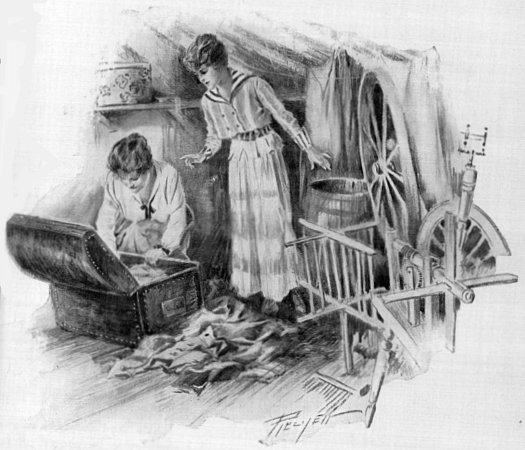
"But here's the queer part of it! Just after we'd collected all the things and folded them nicely and were going to put them back, Corinne noticed that the bottom of the trunk seemed all wrong. One corner of it was humped up as though it had been knocked through in falling. I tell you I was scared, for I thought Sarah'd just go wild when she found it out! But when we turned the trunk upside down,—lo and behold! the bottom of it was all right—just as tight as a trivet!
"If we weren't astonished! We just didn't know what to make of it! Then we turned it back, and I put my hand under the part that was poked up, gave it a pull, and—it came right out!—the whole bottom! And there, if you please, was the real bottom of the trunk, underneath! But between the two was lying hidden—this!" Jess ran to the bookcase, pulled out the mysterious object she had concealed there, and crossing the room laid it in Margaret's lap. They all crowded about the chair.
"Why!" exclaimed Bess, in a tone of great disappointment, before the others could speak, "it's only an old, dusty, disreputable account-book with the back torn off. I don't see anything so wonderful in that!"
"Wait till you've seen what's inside!" remarked Corinne, quietly. Margaret, meanwhile, was fingering the crumbly leather cover, wondering at its queer, mottled aspect. Then she opened it to the first page and suddenly gave a big gasp.
"Well, of all things!" she murmured. "What in the world can it mean? I never saw anything like it before!"
"Neither did I!" agreed Bess, now in a tone of real awe. The other two only smiled, with a rather "I-told-you-so!" expression. Well might they marvel over its strange contents. The pages were yellow with age and mottled with curious brown stains, and some of them were torn. But the writing was still visible, and this is what it looked like:—

with similar characters all down the first page. A glance through the rest of the long thin book revealed the same array of bewildering symbols to the very last leaf, where the back cover was missing.
The four sat for a moment in silent astonishment, trying to make some sense out of the riddle. Suddenly Margaret had an idea.
"I know! It's shorthand! I've read that that is writing with funny curves and dots and wiggly lines."
"No," Corinne gently corrected her, "I don't think it's shorthand, Margaret. I saw some shorthand that Father's stenographer wrote once, and it was quite different from this. Besides, this seems quite old, as if it were done many years ago, and shorthand's a comparatively modern invention, I think."
"Well, then, it must be Chinese or Syrian or Russian or something like that!" asserted Jess. "I've seen lots of signs over the stores of foreigners that don't look so very different from this. Or—oh, I know now! it's Greek!"
Corinne laughed. "No indeed, it isn't Greek!" she declared. "Father taught me the Greek alphabet when I was a tiny girl, and made me learn to know the letters. I'm going to study it when I go to college. This is entirely different. I don't believe they're letters of any other language, either."
She sat in frowning thought over the strange page for several minutes, while the others watched her in breathless interest. They, having no further solutions to offer, threw themselves unreservedly on her greater resourcefulness. Jess, meanwhile, refilled the chocolate-cups, and Bess passed the cake, while Margaret reveled in such excitement as she had never before experienced. Corinne still remained thoughtfully turning the pages. Suddenly she exclaimed:
"I have it!—at least, I think so!"
"What? what? oh, quick!" they begged.
"I think some one has written all this in what they call a—a 'cipher.' I've heard of such things. Father told me people often send messages over the telegraph or cable in cipher—"
"But what is that? How?" demanded Margaret.
"Why, they have certain words or expressions which stand for other words or even whole sentences. And you can't understand the message unless you have the 'code' or explanation. For instance, a man may cable just the words 'Pay Smith' to his broker, and that may mean 'Buy me five thousand bushels of wheat to-day.'"
"Yes, but that isn't a bit like what's here," argued Margaret.
"No, but it's the same idea," Corinne declared. "I think in this case some one has taken certain signs to represent the different letters of the alphabet. First I thought that perhaps each sign might stand for a different word. But that could hardly be, because there are so many words, one could hardly find signs enough to go round. And besides, I notice in looking through the book that there are comparatively few signs, and they are constantly repeated." She fell to gazing silently at the book again, while the others watched, still more fascinated by the discoveries she was making. Presently she looked up again.
"I've found out something else, I think. Do you see that sign of the triangle? Well, if you notice, that occurs more frequently than any of the others. In the first five lines there are more than fourteen of them, and no other sign happens as frequently as that. Now, if these signs stand for letters, that couldn't be a letter, even if it were one of the commonest, like 'a' or 'i' or 'e'—"
"What can it be then?" whispered Margaret, in a voice so tense that they all laughed.
"I think it means the space between the words!" vouchsafed Corinne. "You see, there'd have to be something to indicate spaces. You couldn't have the words all jumbled up together. It wouldn't make sense!"
"Well, you are wonderful!" sighed Jess, sitting back on her heels. "I never would have thought of it in a century!"
"Oh, no!" laughed Corinne. "There's nothing wonderful about that. It's only common sense and puzzling it out like a riddle. Now see! If we take it for granted that the triangle means a space between the words, this sign of the dot between two triangles must be either the letter 'a,' 'I' or 'O,' for those are the only words of just one letter. But you can't tell which it is till you've puzzled out some more. And—after all, this idea may be all wrong. It may be something quite different, for all we know!"
"But what can it all be about?" began Jess, going off on another tack. "And how under the sun did the thing get hidden away in our old trunk under a false bottom. It's awfully mysterious!"
"Tell you what I think," volunteered Corinne. "Whatever it is, it's been in that trunk for years and years—hidden there, perhaps, when the trunk belonged to some one else. Do you know where it came from—the trunk, I mean?"
"No, I don't even know whether it was Father's or Mother's," answered Jess. "But I can ask Mother. Maybe she'd know."
"I'd like to puzzle this thing out!" mused Corinne. "Who knows! Perhaps we'd find it was something awfully interesting. It's simply full of mystery and—and possibilities!" At this point, Margaret, who during all the latter conversation had been fidgeting with impatience, began:
"Now, girls, look here! I've just had the most delightful idea! We've made the discovery of something awfully interesting, probably, if we could only find out what it's all about. Why not let's form ourselves into a secret society—just we four—with the purpose of finding out all about this mystery? We won't let another soul into the secret—not even Mother. Oh, it'll be such fun! Do, please!"
She looked imploringly at the twins, and for once they did not appear to object—even looked a trifle interested. For it was the ambition of Margaret's pitiful, limited little life to be the member of a "secret society." She had read much of school fraternities and clubs, and the fascinating idea had taken a firm root in her mind. Of course for her—poor helpless little invalid that she was—there could be no such thing as membership or participation in the real organizations. In place of this, she was forever begging her sisters to form a tiny society of their own, just the three, and have meetings and secrets and all the paraphernalia of the big school "frats."
But the idea had never appealed to the twins. They had no interest in any of the school clubs except the basket-ball and tennis teams. And to have a make-believe one at home with no earthly or apparent object was something they had never yet brought themselves to consider, much as they loved their invalid sister. But here was something a trifle different! Margaret, quick to see her advantage, hastened on:
"Oh, yes! Do let's have one! Wouldn't it be a good idea, Corinne? Think of the fun we'd have, meeting and puzzling out this queer old book! Perhaps it might lead to something important, too. And I've even thought of a name for it,—we could call it the Antiquarian Club!"
The latter idea captured Corinne. "That's a dandy name for it,—'Antiquarian Club'! I like that! And besides, it's true, too, for if this isn't an antiquity, I'd like to know what is! Yes, let's have the club!" Corinne was moved to accept the idea by two impulses. The notion really did appeal to her, but even if it hadn't, she would have pretended it did for the sake of the pathetic little figure in the invalid-chair, who was rapidly taking a firm hold of her heart.
"Oh, goody! And you do like the idea, too, don't you, girls?" exclaimed Margaret. The twins capitulated unreservedly.
"Yes, we do," said Bess. "I've always detested such societies because they seemed so useless. But this thing is really worth having a club for!"
Margaret, however, had something else on her mind. "Oh, just one thing more," she added, a little shyly. "Could I—could I be—president? All clubs have to have a president. I would so love to be!"
"Indeed you shall!" spoke up Corinne before either of the others had a chance. "We elect you at once—unanimously—don't we, girls? And now, Miss President, you can appoint the rest of us to other offices!"
Margaret flushed with pleasure. "I appoint you, Corinne, to be secretary. There always has to be one of those. And there usually is a treasurer, if there is any money to handle. But there won't be here, for we won't have any dues. So I don't know what to call the others."
"Let's just be plain members, for the present," suggested Bess. "And now, what are we going to do about this book, Miss President?"
"I think we ought to let Corinne take it home and see if she can puzzle out any more of it before next meeting," decided Margaret. "That would be all right, wouldn't it?" They all agreed.
"I'd like to show it to Father and ask him what he thinks—" began Corinne, but Margaret hastily interrupted:
"Oh, no! You mustn't do that! You know it's a secret society, and we aren't going to tell any one about anything in it. And besides—"
"Yes, and besides," put in Jess, "if we tell any one about this book, it might somehow leak out and get back to Sarah what we'd done in breaking the trunk, and then there might be trouble!" She looked meaningly at Bess.
"Oh, no!" assented the latter hastily. "We mustn't tell a soul!" Plainly the twins still lived in dread of the awful threat made so many years ago. They knew that Sarah was even yet fully capable of putting it into execution—under sufficient provocation!
"All right," agreed Corinne. "I won't breathe a word of this, then, and I'll see what I can do to make head or tail of the thing. But, mercy!" glancing at her watch, "it's nearly six o'clock, and I ought to have been home long ago. I'll take the car at the corner, I guess." She hurried into her wraps, gathered up the precious "find" with her school-books, and bade the girls good-by.
"It's been a remarkable afternoon for me!" she declared as she kissed Margaret. "I feel like a real antiquarian now. Hurrah for the Antiquarian Club! Let's have another meeting as soon as I've made some progress with this!" She tapped the old account-book significantly and hurried away.
"Oh!" sighed Margaret, blissfully, settling back in her chair, "this is positively the most wonderful day I ever spent in my life! Can I ever wait for the next meeting?" The twins stood by her chair, looking thoughtful. They too were strangely stirred out of their usual unimaginative selves.
"Well, I confess, I never dreamed of anything so queer happening in this old ranch!" marveled Bess. "It's all Corinne's doings."
That night Mrs. Bronson came home very late from business, but she went in, as was her invariable custom, to peep at her little invalid daughter before she herself retired. To her surprise, she found Margaret still awake.
"Dear, you're not ill, are you?" she inquired anxiously. "You're usually asleep at this time."
But Margaret only laughed a happy little laugh. "No, Mummy, I'm all right,—only just too interested to sleep! Do you remember what you once said about an adventure turning up? Well, it has,—the loveliest kind of a one! But I can't tell you about it, because it's a secret. You won't mind, will you?"
Mrs. Bronson smiled. "No indeed, I won't mind! Just as long as you're happy and contented, I don't mind a thing! Did the twins' new friend come to see you to-day? And did you like her?"
At this, Margaret entered on such a vivid and enthusiastic account of Corinne, that Mrs. Bronson heaved a sigh of thankfulness for the new interest in her little girl's empty life.
An hour later Margaret fell asleep to dream, the night through, of strange, hieroglyphic symbols, and all the weird things they might stand for. But not a thing she dreamed of was as curious as the reality that Corinne was soon to disclose!
The next few days passed in a fever of impatience for Margaret. Each afternoon she besieged the twins for news of Corinne and her progress with the "cipher." And every day their report was about the same:
"She thinks she's on the right track, but she can't tell surely yet. It's pretty difficult, you know, and Corinne has to study and do other things, too, besides puzzling over that."
"But has she found out any of the letters?" Margaret would demand.
"She thinks so, but she can't be sure till she's made them all out definitely." And Bess would add, "Now, do be reasonable, Miss President! Your secretary is doing her very best. But if you don't think she's a success, you might take the job away from her and give it to me!" At which Margaret would chuckle derisively.
Truth to tell, the twins were almost as anxious as she for a solution of the mystery. The sudden introduction of this new element into their hitherto wholly athletic and unimaginative existences, they found, to their surprise, even more diverting than the most exciting tennis-match or basket-ball struggle. About a week after Corinne's first visit, all three burst in breathlessly upon Margaret, one cold afternoon, and transported her to the seventh heaven of delight with this exciting news: "Corinne's got it, at last! Haven't you, Corinne!
"Yes," she admitted, giving Margaret a big hug of greeting, "I think I've puzzled out most of the letters now, and I've even worked out a few of the first sentences—"
"Yes, and she says they're awfully strange!" interrupted the twins, in chorus. "And she wouldn't tell us a word, though we begged her hard!"
"Well, Miss President," laughed Corinne, "it seemed to me that this was a thing to be revealed only in a solemn meeting of the club and in your presence. Was I right?"
"Indeed you were!" declared Margaret. "Don't you ever tell them a thing before you've told me, will you?"
"I won't!" promised Corinne. "It shall be the first rule of our society,—no discoveries told to ordinary members before the president hears them! And now let's get to business!" They all drew up before the cozy open fire.
"Oh, isn't this lovely!" sighed Corinne. She opened the old account-book and placed beside it a paper on which she had written the letters of the alphabet, and next to each the sign that appeared to stand for it.
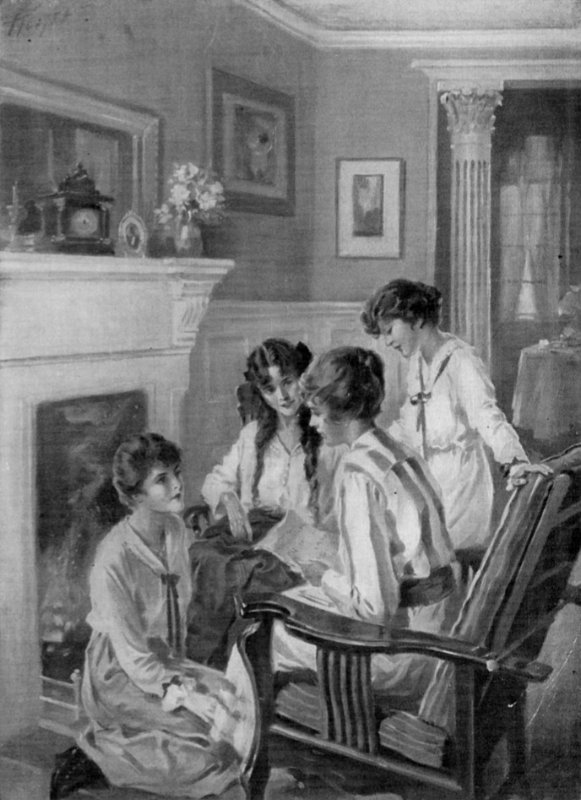
"I had the worst time puzzling this out!" she said. "I worked and worked over it and changed them all around nearly forty times before I struck anything that seemed just right. But now I guess we've got it, at last! I'm sure 'a' is this perpendicular straight line, 'b' the rectangle with the bottom missing, 'c' the horizontal parallels—and so on. Now, as I've said, I've made out the first few sentences and they seem awfully strange! Here they are." She turned the paper over and read:
"'This is a house of mystery, and strange, unaccountable dread. I feel daily that something menaces me—that my life is not safe.'" A delicious shudder ran through the listening group.
"Oh, isn't this gorgeous!" half whispered Margaret. "It fills me with—with thrills!" Corinne went on:
"'Therefore I am keeping this little journal from time to time. Should aught evil befall me in this strange land and among these unfriendly people, at least I will leave some record whereby my own kin may trace my fate, perchance, at some future day. I dare not write this out in good English lest it be discovered by those who hate me. So I have invented this secret code, whereof none save myself knows the key. This book I found in the library unused and I have taken it. I trust it will be counted no act of thievery. I keep it hidden in the false bottom of my trunk. The key of the code I have put in another spot. As soon as my memory has mastered it, I will destroy it. 'Tis safer.'—And that's as far as I got!" ended Corinne.
For a moment they all sat dumb with amazement.
"What do you make of it?" exclaimed Bess. "Who is it,—a man or a woman? When was it written, and where? Why, I'm just wild to find out all about it!"
"I confess," admitted Corinne, "that I don't know what to make of it. I've puzzled and puzzled over it all day—"
"But, good gracious!" interrupted the impatient Margaret, "of course we can't make anything out of it till we've worked out some more! Come ahead! Right now! We're only wasting time talking about it!"
"That's so!" laughed Corinne. "And when we can find out right away, by getting to work! Here, Margaret! You write, while I spell the thing out!" She thrust the paper and pencil into Margaret's hands, while the twins hung over her as she slowly deciphered the sentences:
"'Would—that—I—had—never—left—my—peaceful—Bermuda—'" Corinne dropped the book suddenly.
"Bermuda!—I've been there! Oh, this is fine!"
"Have you been to Bermuda?" exclaimed Margaret and the twins, with awe. "When?"
"Last winter, with Father. He was ill, and we stayed six weeks. It was heavenly!"
"You lucky girl!" sighed Margaret. "But, go on! We must find out more, right away!"
Corinne took up the book and began anew: "'But since I did wilfully abandon my home—aye!—and Grandfather, too, even though he does not love me—'"
"'Grandfather'?" interrupted Bess. "He can't be very old, if he has a grandfather living!"
"Doesn't seem likely," murmured Corinne, spelling out another word under her breath, then continuing:
"'—and did in venturesome manner contribute my aid to the plot against my country, I must pay the price, I fear. I am watched constantly. I take no walk abroad, even in the grounds, but I feel that I am spied upon. The affection of Madame M. has changed to dislike. She, too, suspects me. 'Tis hard for a lass of but sixteen—'"
"A lass!" shouted all four. "And only sixteen!"
"Oh, girls!" cried Corinne, rocking back and forth in her excitement. "She's just like ourselves—only a year older than I am! What can be the trouble—or rather, what could have been the trouble with the poor little thing?"
"Go on! go on!" ordered Margaret, with glistening eyes. "Let's find out!"
Corinne snatched up the book again: "'to be alone and friendless in a strange land and to feel so constantly in danger. But I must not complain. I brought it on myself. As I have said, Madame M. no longer appears to care for me. She was so cordial and affectionate at first, partly for Aunt's sake, no doubt, and partly because she really seemed to like me. But since the day when I spoke to Lady ——, at the time her coach broke down, Madame M. has regarded me only with suspicion.'"
"I wish I knew who 'Madame M.' was, and 'Lady Blank,'" put in Margaret. "How mysterious she is—never writing out their full names!"
"Perhaps she didn't dare," said Corinne. "You see, she says she's in danger. But, oh!—listen to what she says next!—'There is something which weighs right heavily on my conscience. 'Tis the matter of the sapphire signet. But of that I will speak later.'"
"The sapphire signet!" breathed the twins in a tone of hushed awe. "Doesn't it sound rich and gorgeous and—and mysterious! What's a 'signet,' anyway?"
"I think," explained Corinne, "that it's another name for a seal—something with a monogram or crest or coat-of-arms, used to stamp on sealing-wax. Father has one set in a ring—not a sapphire though—just some ordinary stone with his monogram on. He never uses it, but he told me once that in former times they were used a great deal when letters were only sealed with wax. Oh! what do you suppose this matter of the sapphire signet is all about! Isn't it wildly exciting? But, goodness!" glancing at her watch, "it's awfully late again, and I must get home. The time goes so fast, and it takes so long to puzzle all this out!"
"I have an idea!" began Margaret, hesitatingly. "Suppose I do the puzzling out and write it down, now that Corinne has discovered the way. I have so much time that I don't know what to do with, and this would be so interesting! Then, when we meet again in a couple of days, I could read it right off to you without any trouble. We could get on so much faster!"
"I think that's splendid!" agreed Corinne. "And much as I'm crazy to find out right away what happens, I'd rather wait and hear a lot of it read at once. Wouldn't you all?"
"Yes, that's a good scheme," admitted Bess, "except for one thing. How about Sarah? You'd have a hard time hiding this from her, Margaret, and you know she simply mustn't find out!" For a moment they all looked "stumped." The obstacle seemed almost insuperable, when Jess had a brilliant idea.
"Tell you what! We'll hide the thing in the bookcase, way back here behind these old encyclopedias,—the account-book, the paper, and a brand-new fat blank-book that I'll give you to do all the copying in. You can tell Sarah to wheel you over to the bookcase because you want to read. Then, when she's out of the way, you can work to your heart's content. But do hide everything whenever you hear her coming!"
"Oh, good! Just the thing! Sarah'll never suspect in the world!" laughed Margaret. "And there's no difficulty about hearing her coming—she weighs two hundred and fifty pounds!"
"Well, that's settled then," said Corinne, "and I'll have to go. But I'm coming day after to-morrow, if I can manage to wait. It's better than the loveliest book I ever read! Good-by!"
When she had gone, the three sisters sat and looked at one another with an expression of sheer wonder on their faces. In one week, through the agency of this same "queer," quiet girl, their absolutely uninteresting and commonplace lives had been transformed into an unbelievable round of mystery and discovery and romance. And the strange part of it was that this same mystery had been lying here—right under their noses, so to speak—all these years, and they had never even suspected it, while she had been in the house scarcely half an hour and had run it straight to earth! Some such thought was in Margaret's mind when she presently exclaimed:
"Isn't she just wonderful! I think she's the most interesting person I ever met in my life!"
"So do I!" echoed Jess.
"Oh, I shall just dream of this all night!" whispered Margaret. "It's the most thrilling thing I ever heard of—this puzzle-story—and the best of it is, it's all our own. We discovered it! To-morrow you may envy me, girls, for I'll be finding out—all about the sapphire signet, and what happened next!"
Two afternoons later, the three active members of the Antiquarian Club rushed up the stoop of the Charlton Street house in a breathless scurry. And Margaret awaited them in the parlor in a fever of no less eager excitement.
"Hurry, girls!" she cried when the first greetings were over. "I've just got heaps to read to you! And some of it'll make you 'sit up and take notice,' as Alexander says!"
"Who's Alexander?" queried Corinne, curiously.
"Oh, he's a boy-cousin who lives with us," Bess enlightened her. "He was Mother's sister's child, and his parents are both dead now, so Mother had him come here a year or two ago. He's twelve years old and a perfect nuisance! He hates girls, so he generally keeps out of our way. That's why you've never seen him. But, come on! I'm wild to hear what's coming next! Margaret wouldn't tell us a single thing she's found out."
"Wait a minute before we begin," spoke up Corinne, "and let's just run over what we've already discovered. It'll keep us from getting mixed up. A young girl of sixteen has run away from her home in Bermuda, and is in some place where she thinks her life is in danger. Before she ran away, she did something to assist in some plot against her country (which must be Bermuda), and probably that's one reason why she is in danger. Maybe something's been discovered about it. She's staying with a Madame M., and it seems to be a house of mystery.
"One thing I have pretty well guessed, and probably so have you all—that this must have happened a long time ago. Her language isn't very—well, modern—sounds to me like stories I've read about old England, and America too in former times. I think it's likely she's in one of those two countries when she writes—probably England, because she speaks of 'Madame M.' and 'Lady Blank,' and those titles don't somehow go with America. Then there's something strange about a sapphire signet. But go on now, Margaret! Maybe you've discovered something new!"
Margaret smiled mysteriously. "Perhaps just a few things!" she admitted. "Here's where we left off. I've copied it all from the beginning. You remember where she tells about explaining the signet later? Now I'll go on:
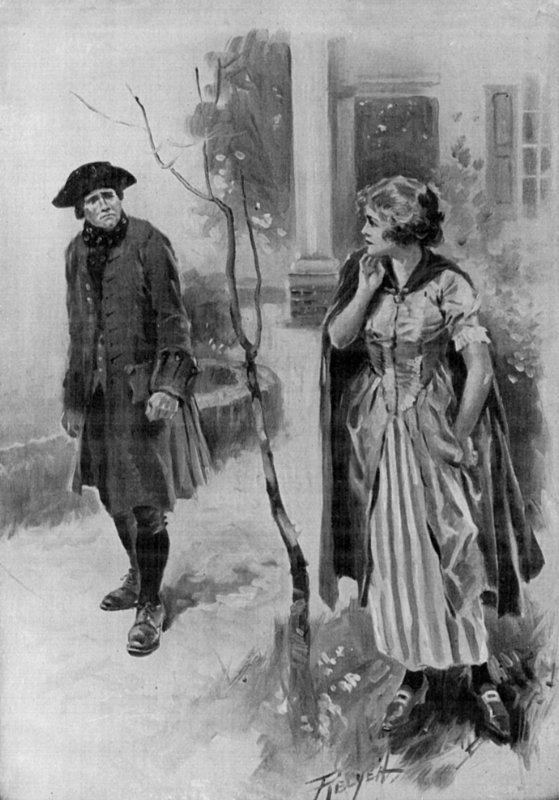
"There is something strange and evil about this house. I can trust no one. Especially do I mistrust the steward. He hath a sleek smile and ingratiating manners, but he is wicked to the heart of him. He associates much with one Corbie, who keeps the tavern down the road hard by the woods. Corbie has been to this house, and once was closeted long with the steward. When he came forth to go, he gazed hard at me as I stood on the lawn. It made me shudder for an hour afterward."
"That's the first name she has mentioned—'Corbie,'" interrupted Corinne. "Let's remember it. Who knows but it may help us?"
"There's another coming right away," added Margaret, "though I don't know whether it will be of any help or not.
"But one thing has happened lately to cheer me. Two nights ago I went to my room, which does not look toward the river, but toward the back of the house. I was minded to retire early, having naught to occupy me through the long evening. Madame M. retires at nine, but I never see her after the evening meal. She is usually in conference with the steward, who has chief charge of the affairs of this great house. She appears to place much confidence in him. But that is not to the point.
"I had opened my window and was leaning out a moment when I heard a softly whistled tune, and knew that H. was there. For the tune he ever whistles is 'The Lass of Richmond Hill,' which he declared, when first he brought me here, was right appropriate to me now."
"I wonder why?" queried Jess.
"I can't imagine," answered Corinne; "'lass' she certainly is, but what has 'Richmond Hill' to do with it? What is 'Richmond Hill,' and where?"
"Mother has a friend who lives in Richmond Hill, Long Island," ventured Bess.
"Oh, that can't be it!" declared Corinne, scornfully. "That's only a little new suburb that's hardly been in existence thirty years! It has nothing whatever to do with this! And I wonder who 'H.' is, too. Well, go on, Margaret."
Margaret obediently continued:
"At hearing him, my heart did beat gladly, for he is the one person I have seen who reminds me of home. I leaned far out and called to him softly, and presently he threw into my window a letter weighted with a stone. It said he and his uncle had not been back to Bermuda, nor would they dare to go for many a long day. One of their traitorous sailors had divulged the plot, and the authorities were wild only to lay hands on them. This they had learned in roundabout fashion. They had been cruising along the coast lately, and had had not a few adventures. They were sailing at midnight for parts unknown. He did but come up hastily to see how I fared, before they left.
"In a moment I threw down an answering missive, telling of my present plight, and begging that he and his uncle would take me back to Bermuda should they ever be sailing there again. That was all I had time for, since he knew he dared not linger. He went away silently into the night. 'Twas brave of him to come, since he knows it would be ill for him to be seen hereabout, now that so much seems to have been discovered."
Margaret paused here and half whispered: "Hold your breath now, girls! We're coming to the sapphire signet!" Then she went on with the reading:
"I must now explain about the sapphire signet. Night after night I lie awake and ask myself why I ever took it—why I was ever tempted to add this mistake to the rest of my misdoings. At the time it seemed no wrong,—nay, it seemed entirely right that I should take with me what Grandfather has so often said was mine, though he deemed it safer not to allow me to have it in my keeping till I should come of age.
"'Tis such a pretty bauble—this wonderful blue stone larger than my thumb-nail, with our family crest graved on it and set all round the edge with tiny, sparkling diamonds. Grandfather told me that the sapphire was once in a great ring, and from generation to generation had been handed down to the eldest son of the family. He said, moreover, that it ever should have remained a ring; that 'twas a crime it should have been changed. But 'twas my mother's whim that it should be taken from the ring, set round with diamonds, and made into an ornament for her neck. He said that once, when they were in London not long after their marriage, she wheedled my father into having it changed, and came home to Bermuda with the jewel hanging from a slender chain about her white throat. And Grandfather was filled with wrath at her and never forgave her. Had I been a boy, he says, he would have had the stone reset in a ring. But since the only heir to it is a girl, he has allowed it to remain thus, and once scornfully told me that 'twas 'as useless now as I was,' and might as well so remain.
"On rare occasions, Grandfather has let me wear it—once to a grand tea-drinking at St. George's, where 'twas much admired. But mainly he has kept it in his great strong box. It seemed no harm that day for me to take it. The box stood invitingly open. The jewel was really mine, and I possessed no other ornament. Even then I realized that I might never see my home or Grandfather again. So I took it—Heaven forgive me!—thinking it no wrong. But I have come to feel differently since. In these long, lonely months, when I have had so much time to think and to regret, I can see how this act of mine must appear to Grandfather and to all who know me. Even though it was in effect my own, it was still in his keeping, and I should never have taken it without his consent. I dare not even wonder what he must think of me, and I live only for the opportunity to return home and place the signet in his hands.
"From the very first I have never dared openly to wear the beautiful thing; and since my conscience began to trouble me, I have never wished to. Long since, I removed it from its velvet riband and concealed it. Nor must I, even here, disclose where it is hidden. To do so would be neither safe nor wise. Suffice it that I will never more wear the bauble till I have restored it to its rightful keeper, my grandfather."
Margaret paused again, and there was a blissful sigh from all her assembled listeners.
"Isn't it the most fascinating thing—this sapphire signet business?" exclaimed Corinne, at last. "I can just imagine how the poor girl felt. She hadn't meant any harm in taking it—it had seemed perfectly right. And then her conscience got to troubling her till she hadn't a peaceful minute! But where in the world could she have hidden it? Does it tell later on, Margaret?"
"Not that I've discovered as yet, but there are a lot of other interesting things—"
"Go on, go on then!" chorused the waiting three, impatient of anything that broke the thread of the story.
"Well, the next seems to be written some time later, but I can't tell how much. This is something like a diary, only she doesn't put down any dates. She just seems to leave spaces between the different entries. It's kind of confusing. Now she says:
"A strange thing happened last night. At midnight I awoke. I heard confused sounds on the road without. Carts creaking by, men shouting and calling, women crying, and children screaming as with fright. The sounds continued till near morning. An endless procession of carts and coaches. 'Twould seem as though the whole city were in flight. 'Twas odd to hear so much racket in this quiet region.
"To-day the whole household is in agitation. Fear seems to have seized on all. The servants are in a panic. Only the steward seems undisturbed. Madame M. is calm in manner, but I can see that she is much perturbed inwardly."
"What in the world could have been happening?" demanded Bess. "She speaks of the 'city.' I wonder what city, and what was the matter? Why should every one be leaving it?"
"I've been thinking all along that she was somewhere in England," suggested Corinne, "though I can't imagine what part. Anyway—"
"Wait!" cried Margaret. "Why don't you let me go on?"
"That's so!" agreed Corinne. "It's foolish not to see what's coming before we try to make sense of it. Go on!"
Margaret continued. "Next she says:
"Some of the servants left yesterday. I now know the cause. The rebels are threatening to take possession of the city. Ships filled with soldiers stand in the waters near by. 'Tis feared there will be a great battle soon. Madame M. is very ill. She has taken to her bed. I think great fear has made her so—and great anger. She is being cared for by the housekeeper, Mistress Phœbe. I have come to like Mistress Phœbe. She is the one soul who treats me with kindness unfailing. She, too, hates the steward. She told me so. She and the steward and one other servant are all that are left here now. The rest have fled. Would that the steward had fled also! He seems to have some urgent reason for remaining. He has had another interview with Corbie, in this house."
"Wait a minute!" interrupted Corinne, once more. "I have an idea. I am going to put down on a paper every name she mentions, no matter how insignificant, and see if they will lead us to any sort of a clue. Names are about the only clues for finding out things, when you come to think of it!" She hunted in her bag for a pencil and notebook. Then she continued:
"Now, there's 'Bermuda'—that was the first, and the only real definite thing we've discovered yet—and 'London.' Then there's 'Madame M.,' which doesn't help much. And 'Lady Blank' is no good at all, nor is 'H.' 'Corbie' may be useful, but I don't think Mistress Phœbe' will—and that's all, I guess."
"No, it isn't," contradicted Margaret. "You forgot the 'Lass of Richmond Hill'!"
"True enough! Of course that's only the name of a song, but I'll put it down. Who knows but what it may be the most important of all! I have a book of old songs at home, and I have just a faint idea that there's one of that name in it. I'll hunt it up to-night. But as usual, it's late, and I must be hurrying along. Haven't you read about all you've puzzled out, Margaret?"
"I've done another entry," replied Margaret, slowly and mysteriously, "and perhaps you'd better hear it. It may be worth your while!"
"Oh, what is it?" cried Corinne, pausing in the act of adjusting her hat. "Quick!"
"Here it is:
"Madame M. sent for me to-day. 'Tis the first time since she took to her bed. She did so to give me this strange warning. These be her very words: 'It is rumored that this house may soon be taken possession of by rebels. If so, I wish you to have no communication with any of them, Mistress Alison."
There was an instant's silence. Then Corinne threw her hat on a chair and exclaimed:
"Hurrah! At last we have this mysterious lassie's name! It's Alison! That's the biggest discovery yet. Is there any more?"
"Yes, one thing," answered Margaret, "the strangest of all. It's a later entry and is only three words long—the first word twice underlined:
"He has come!"
The girls got together again on the following afternoon, for they could not possibly have stretched their patience to the limit of another day! Margaret had promised to work like a Trojan till they arrived and to have much to read to them. It was with breathless interest that they drew their chairs around her.
"My! I couldn't study a thing, or keep my mind off this a single minute to-day in school!" sighed Jess. "I guess I failed in every blessed recitation."
"Me too!" echoed Bess. "If this suspense doesn't come to an end soon, I'll be a failure for the term!"
"Same here!" agreed Corinne. "I do envy Margaret, for she at least can be working at it all day and satisfying her curiosity. Have you discovered much more, honey?" Margaret smiled her slow, mysterious smile. She was certainly enjoying herself, in a brand-new fashion these days. And between meetings she guarded her secrets like a veritable sphinx.
"Something's happening right along!" she answered enigmatically. "But I've rather a surprise for you to-day."
"What is it?" they demanded in one voice.
"I sha'n't tell you till we come to it!" was her maddening reply. "Shall I go on now?"
"Just a minute," said Corinne. "I want to say that I looked up that old song last night. In this collection I have, there is given a little history of each song. Now, 'The Lass of Richmond Hill' was written about a young girl, a Miss Janson, who lived on Richmond Hill, which is near the little town of Leybourne, in England. It was written way back about 1770, and the song was said to be a favorite of King George the Third. It was quite popular at the time. That's absolutely all about it. Of course, it's possible that place may be the one where Alison was, but somehow I don't feel very sure of it. I rather think that what she says about 'Richmond Hill' must have some other connection. Now go on, Margaret!"
"Very well," began Margaret. "We left off with the words, 'He has come!' He seems to be a very mysterious person, and some one of great importance evidently. She goes on to say:
"The house has been put at his disposal. Not, however, by Madame M., for she would gladly slam the door in his face were she able, but she is still in bed, ill. He is very considerate, and does naught to disturb or annoy her. His servants and men are all about, but they do not molest any of the household. Phœbe remains the housekeeper and caters for him. She adores him, as does her father, so she tells me.
"I have exchanged no words with him. I have only seen him as he sits in the library or walks about the grounds. He is absent much—away in the city, Phœbe says. He is handsome and grave and stern, but I think he is kind and gentle. I long to speak with him, but I dare not. I am too carefully watched.
"The steward is still here, and frequents much Corbie's tavern. He asked me yesterday a few questions about Bermuda. I did not care to have speech with him so I cut him short. He gave me an ugly look as he walked away."
Margaret stopped here to say, "Now comes something exciting!"
The listening three sighed ecstatically.
"There have been strange doings in this house. I have now turned spy myself. Last night at a late hour, when all the household was asleep, I heard stealthy footsteps passing my door. The sound was most unusual, for he was away in the city, and there was consequently no guard. When the footsteps were past, I rose, opened my door, and peeped out. I saw the steward. He was tiptoeing softly down the hall toward the stairs, a candle in his hand. A sudden resolve seized me. I would follow him in the dark, and see what he did. I felt sure he planned some evil. I seized a dark-colored shawl, drew it round me, and, in the shadow, crept after the light of his candle.
"Down the stairs he went, and I felt sure he would pause on the lower floor and perchance enter his room to rifle it. I crouched on the stair and held my breath, but he passed on and opened a door which gives on the stone steps leading to the wine-cellar. Once he glanced back suspiciously, then the door closed behind him. As soon as I dared, I followed. Opening the door with the greatest caution, I peered down. His back was toward me, and he was drinking from an upturned bottle. In a moment he put the bottle back on its shelf and stood long in thought.
"I was about to conclude that this was all he had come for and that my fears were for naught, when he turned aside, took a knife from his pocket, and went toward the far end of the cellar, leaving the stairway in heavy shadow. Taking advantage of this, I crept down the steps and watched him from the shelter of one of the pillars that supported the floor above. In a moment he stopped, raised his hand, and felt along the great beam above his head. I noted 'twas the second beam from the end. At a distance of about ten feet from the wall he pushed his knife-blade into the timber, and, behold! something like a small door fell open!
"Into the aperture thus left he thrust his two hands, and drew forth a small iron box. This he placed on the ground near the candle, and pressing a spring, threw back the lid. It seemed to be filled with papers, and with something else that shone in the candle-light. The latter, I soon learned, was a mass of golden coins, for he plunged in his hand, took out a fistful, and put them in a small leather bag he carried. Then he closed the box, put it back in the hollow space, and shut the door of the secret opening in the beam. I stayed to see no more, but fled hastily to my room. 'Tis all most strange. What hides he in this secret place? Whose gold is that? What evil does he plot?
"Isn't that the most exciting thing you ever heard?" demanded Margaret, breaking off.
"Frightfully exciting!" agreed every one.
"It's like an adventure in a book—only better!" added Corinne. "But, Margaret, is that the surprise you had for us?"
"No, it isn't! That's coming just a little later. The next entry says:
"She has come! He seems most glad to have his lady with him once more. I have not yet spoken with her. She has only passed me, bowing with stately courtesy. I think she has forgotten how I once spoke with her. No wonder. Her mind is filled with anxious care. Madame M. is still confined to her bed, and knows not that she is here. I think Madame M. is truly right ill."
"She must be his wife, I suppose," interrupted Bess. "I do wish Alison would call 'em by their names! This is so confusing!"
Margaret only stopped long enough to say: "Now, the surprise is coming. This is the next entry:
"He passed me in the hall to-day and wished me a good morning in his grave, courtly fashion. Then he inquired after the health of Madame M., and offered to send her up some fruit that he had just received for his table. I knew not what to say. I was right embarrassed. For Madame M. will accept naught from him, and—"
Margaret stopped short.
"Go on, go on!" they chorused.
"I can't!" she answered.
"Why not?" they inquired in wonder.
"Because that's all there is!" she replied quietly. "We've come to the end. That's the surprise I had for you!"
"Well, I never!" ejaculated Bess in disgust, picking up the old account-book and examining it curiously. The back cover was missing, and it was not difficult to conjecture that many pages might also be lacking.
"That's the queerest!" mused Corinne. "Of course, the book is rather thin, but I hadn't imagined that we'd finish it so soon. Those characters are large, and take up more room than plain writing, I suppose. But, my gracious!" She got up and began pacing around the room impatiently. "This is perfectly maddening! To have it leave off in such a place, without a sign of explanation of it all! Where's the other part of that book? Could it possibly be in the old trunk where we found this? Let's go up and see!"
"No use in doing that," said Jess, "because Sarah's done exactly what she threatened to—locked the attic door and hid the key. But anyhow, I remember distinctly that there wasn't a sign of anything else under that false bottom. It was absolutely empty after this fell out. Wherever the rest is, it isn't there!"
"Well," exclaimed Corinne, coming to an abrupt pause in her impatient tramping, "there's one thing I'm firmly determined upon! I sha'n't rest day or night till I've found some sort of an explanation for all this! Do the rest of you agree with me? It's the most fascinating mystery I ever came across, outside of a story-book, and I'm bound I'm not going to be stumped by any obstacles!"
"We surely do agree with you!" echoed Margaret. "We're just as crazy as you are to unravel it all. And what's an antiquarian club good for, I'd like to know, if not for something just like this! That's our business from now on!"
"The motion's carried!" agreed Bess. "But how in the world are we going to go about it? Somehow it seems as if we'd reached a stone wall a mile high—no getting around it or over it!"
"Then we'll tunnel under it!" laughed Corinne. "But first of all, there's a question I'd like to settle. Where did that old hair-trunk come from? How did it get in this house? Who owned it before you did?"
"I can answer that," replied Margaret, "for I asked Mother about it the other night. I did it in a roundabout sort of way, so she wouldn't suspect why I wanted to know or think it queer that I asked. She said it belonged to Father. He told her once that a friend of his, a sea-captain, had given it to him years ago. The captain said it was an heirloom that had been in the family many years. An ancestor of his had found it in a vessel that had been wrecked, and had been floating around for several months—a 'derelict,' Mother called it. This old captain said it was so handy and substantial that he had carried it with him on all his voyages. But as he wasn't going to sail any more, and hadn't any children to leave it to, he gave it to Father."
"Well, at least it explains one thing—how this strange book came to be in your house," mused Corinne. "But it doesn't help a bit about unraveling the rest of the mystery, after all. Now, the next thing is to go over all this writing carefully, and see if we can find anything we've overlooked that might be a clue. Oh, girls, I wish you'd let me show this to Father! He'd be so interested, and perhaps he could help us with it, too!"
"Well, as far is I'm concerned, you're welcome to," answered Bess, and Jess nodded her head vigorously in assent. But Margaret cried out pleadingly:
"Oh, no, no, Corinne! Don't do that yet! It would spoil all our lovely secret society to have grown folks know about it. Let's wait awhile and see what we can do ourselves. And then if we find we can't make any headway, I'll consent to telling Corinne's father."
She was so earnest and so pathetic in her appeal, that not one of the others had the heart to deny her request, knowing, as they did, what the little club and its absorbingly interesting secret meant to her shut-in, circumscribed life.
"Very well, honey! We will do just as you say!" agreed Corinne, giving her a hug. "Now let's read this whole thing over, and see if we can unearth a clue."
They started once more at the beginning, reading slowly and thoughtfully through the strange record till they came again to the allusion "The Lass of Richmond Hill." Suddenly Margaret interrupted:
"I've thought of something! I lay awake a good part of last night, because my back was hurting me, and I had a chance to think of things rather hard. And then, some things we unearthed to-day and what Corinne found out about that old song made this idea pop into my head just now. You remember she said the song was written about 1770 and was a favorite of George the Third? That made me think of the Revolution. And then I suddenly remembered what Alison had said about 'rebels.' Girls, you can take my word for it—all this thing happened right here in America, and during the Revolutionary War! Can't you see it?"
Corinne sat up very straight for a moment. Then she burst out:
"We're a pack of lunatics—all but Margaret. She's the only one that's got a grain of common sense! Of course it was during the Revolution—every other word Alison says points to it! And that being the case, the rest is easy! Good-by! I'm going straight home to look up Revolutionary history!"
And flinging on her hat and coat, without further ceremony of farewell, she was off, leaving the three staring speechlessly after her!
Corinne did not reappear for nearly a week. During all that time the twins, who only saw her in school, reported that she would have nothing to say to them outside of this statement:
"Let me alone, girls, just for a while. I'm working hard at it. When I've run to earth something worth while, I'll tell you, and we'll have another meeting!" And that was absolutely all they could get from her.
Meanwhile, Margaret was passing the slow days in a fever of impatience and baffled expectation. Now that she no longer had her mind occupied by puzzling out the curious old journal and could only sit and wait for the results of Corinne's work, she grew terribly restless. So much so, indeed, that the lynx-eyed Sarah, who watched her beloved charge like a cat, made up her mind that Margaret was beginning to have symptoms of a real fever. She prepared, therefore, a huge bowl of boneset tea to be taken in instalments.
Now, if there was any one thing under the sun that Margaret hated more than another, it was boneset tea! And, moreover, in this case she knew that there was absolutely no need of the remedy. But this she dared not confide to Sarah lest she awaken fresh suspicion in that handmaiden's already too suspicious mind. So she swallowed her bitter doses uncomplainingly, and longed for Corinne's coming for more reasons than one!
And then at last, six days later, Corinne came flying home with the twins one afternoon, and all three burst in unexpectedly on the delighted Margaret. Corinne was armed with a load of volumes that were plainly not school-books, and these she planked down on the floor beside the invalid-chair with just one brief remark:
"I've got it!"
Questions and inquiries were hurled at her thick and fast, but not one of them would she answer till all were seated about Margaret's chair in the usual half-circle by the open fire. Then she began quietly, but with much suppressed excitement in her voice:
"Yes, girls, I've got it—at last! I'm going to tell you all about it, and you're going to have the surprise of your lives! It took me a long while before I struck just the right clue. I've spent about every afternoon reading at the library near us. I even went up to the big one at Forty-second Street yesterday. And every evening at home has found me still digging at it. I've neglected my school work completely, and have failed in everything this week; but I don't care!
"Margaret's a trump! She put us all on the right track in the first place by sensibly suggesting the Revolution. That was fine! But, of course, the subject was a big one and concerned the whole thirteen original colonies. In thinking it over, I decided that since Alison came from Bermuda, the 'city' she keeps speaking of would most likely be the nearest one to Bermuda. On looking it up, I found the nearest was Charleston, South Carolina. So I started in and hunted up every bit of Revolutionary history I could find about Charleston, but never a thing did I strike that helped a bit.
"Then I gave that up and tried another city. As there didn't seem to be any very likely places south of Charleston, I turned north and tried Richmond, Baltimore and Philadelphia. Not a single thing in any one of them that threw a ray of light on our troubles! Finally, I began on New York—and hit it right away!" Her listeners gave a little jump. "Yes, right here in old New York. And come to think of it, that was the most likely place, after all, and I might have saved myself all that other bother, if only I'd used a little common sense!"
"But how did you know right away that it was New York?" demanded Margaret.
"Why, the simplest thing in the world! Almost the first thing I came across, in reading up about New York during the Revolution, was about a place called—Richmond Hill!"
"What? Where?" they all cried in one breath.
"Yes, Richmond Hill! It was the name of a big mansion and estate outside of the city, and was a very famous place in its time."
"But how did you know it had anything to do with Alison?" they demanded incredulously.
"Well, just about twenty things pointed to it without a doubt. I'll tell you all about it. In the first place, I read that this mansion was built in 1760 by the paymaster-general of the British army, and his name was—Abraham Mortier!"
She stopped significantly, but no one seemed to catch her meaning till Margaret suddenly cried:
"Madame M.!"
"Precisely!" said Corinne. "I wondered if you'd catch it. 'Madame M.' must have been Madame Mortier, his wife, of course!"
"But Alison didn't say anything about Abraham Mortier," objected Bess.
"That's just it,—she didn't, because Madame Mortier was then a widow. Her husband died quite suddenly, just at the outbreak of the war. So that's accounted for. And don't you remember that Alison said Madame M. allowed the steward to transact all the business of the household. She wouldn't be doing that if her husband were alive! Well, except for that, I couldn't find out another thing about the Mortiers. History doesn't mention them again. But it tells a lot about other things we're interested in. To begin with, after the siege of Boston, Washington came to New York, and was there several months. Now then, while he was in the city, he made his headquarters at—Richmond Hill! What does that suggest to you?"
Again they all looked blank for a moment, and once more Margaret was first to catch the idea.
"I've got it! Washington is the 'he' that Alison says so much about but never names!"
"Right!" cried Corinne.
"How do you know?" clamored the less astute twins.
"This way," explained Corinne, "Everything that Alison says about 'him' tallies with the descriptions of Washington—'grave, courteous, stately, kindly, thoughtful.' There isn't a shadow of doubt! She speaks of his servants and men and guards. Only a commander-in-chief would be likely to have all that retinue."
Suddenly Jess, who had been deep in thought, interrupted: "But, see here! If it was Washington, why did Madame M. act so hateful about him? Alison said if she hadn't been sick, she'd have gladly slammed the door in his face. I don't understand it!"
"Oh, that's easy! Madame Mortier was, without doubt, a Tory! You know, New York was full of Tories at the time, and they hated Washington and all the rebels like—like poison!"
"But I still don't understand," insisted Jess, "how, if Madame Mortier was a Tory and hated Washington so, he should come to be using her house for his headquarters. I don't wonder she was furious!"
"I thought of that too," said Corinne, "and it seemed strange to me; but, from what I've read, I think it was this way: he had to have his headquarters somewhere while he was in New York, and just at first he had them way down in the lower part of the city, in the Kennedy house. But later he wanted to get outside of the city for some reason; perhaps it was on account of one of those plagues of smallpox or yellow fever that were always breaking out there. Then, of course, there were so few houses outside that he had to take anything he could find that was suitable. So he chose Richmond Hill, and Lady Washington followed him there later."
"How do you know?" again demanded the ever-skeptical listeners.
"Well, didn't Alison say, just toward the last, that 'his lady' had come?"
"True enough!" assented Jess. "And that makes me think of something else. Was that the 'Lady Blank' she spoke of first, do you think?"
"Without doubt, for she even says, 'I do not think she remembers me.' But where or how she met her before, I haven't had time to work out. Anyhow, it explains why Madame Mortier began to be suspicious of Alison. Of course she would be if she was such a staunch Tory and found Alison talking to the wife of her worst enemy!
"But here's something very important, and it's the real proof of the whole thing. The rest was just rather easy guesswork. Do you know, while Washington was at Richmond Hill, that summer of 1776, the Tories in the city got up a big plot to kill him, blow up his fortifications, massacre all his soldiers, and spoil everything for the Americans? And—it very nearly was accomplished, only some one discovered it and gave the whole thing away. That's the plot, evidently, which was brewing when Alison felt that something strange and mysterious was going on. And here's my positive proof: one of the chief conspirators in the plot was a man who kept a tavern near the edge of the woods close to Washington's headquarters, and his name was—Corbie!"
"Didn't we say that name would be of great help?" cried Margaret, excitedly. "Why, all this seems like a fairy story coming true! Is there anything else, Corinne?"
"Yes, there's one other thing. But before I tell you, I'm curious to know why you haven't asked one question."
"What?"
"Why, the exact location of Richmond Hill. You haven't exhibited the least curiosity about that!"
"But you said it was outside of the city somewhere," put in Bess, "and I suppose it was up around Fordham or West Farms, or even White Plains. It must have been pretty far out."
Corinne laughed. "Do you realize that the 'city' only extended to about City Hall Park in those days? And all beyond that was out in the country! No, Richmond Hill was right here in Greenwich Village!"
They all stared at her in such frank amazement that she broke into a giggle.
"Perhaps you think that's rather astonishing, but I've something to say that's even more so. I told you I'd give you the surprise of your lives, and here it is: the exact spot where the Richmond Hill mansion stood was—just about where this house stands now!"
If Corinne thought to create a sensation by her last disclosure, she was gratified beyond her wildest expectations. It was not, however, what they all said (for they were rendered literally speechless by surprise), but the way they looked that caused her to go almost into hysterics of laughter. If she had informed them that there was a lighted bomb about to go off in the cellar, they could not have assumed more open-mouthed, startled expressions!
"Oh, don't look so stunned!" she panted, at length, weak with laughter. "It won't hurt you!"
"But—b-but—" stammered Margaret, and at last brought out the eternal question, "how—how do you know?"
"The way I know is this, and in order to explain it, I might as well tell you the whole history of the place. It won't take long, and it will make you understand better. We know how Richmond Hill began, so I won't go over that. After the battle of Long Island and Washington's retreat from New York, we don't hear a thing about it till the end of the war. About that time it was the headquarters of the British general, Sir Guy Carleton. After the war, when Washington became President and New York the capital, Richmond Hill was taken by Vice-President John Adams as his residence till the capital was removed to Washington.
"Then Aaron Burr took it, lived there a number of years, improved the place a lot, and made the grounds very beautiful. I must tell you right now that the place was a hill at that time, about a hundred feet high, and had a fine view over the Hudson. The river was nearer too, just a few feet beyond Greenwich Street. That hardly seems possible, for it's blocks farther off now. But in later years they filled it in and made a lot more space to build on, and that has moved the river banks farther away. Well, Burr lived here with his wife and a lovely little daughter, Theodosia, till after he killed Hamilton in the duel. Then he had to give the place up, and it was sold.
"After that, a number of different people lived there till 1817. Then the city began to reach up this way, and they decided to put regular streets through here and make city blocks. Of course they couldn't leave a high hill like that standing, so they leveled it and lowered the house gradually to the street, and it stood somewhere right about here. I can't make out the very spot, for some books say it was on the north side of Charlton Street, and others, on the south side. And one even said it faced on Varick Street. But anyway, right near this spot it stood; and as no one seemed to want such a big place for a residence any more, it became a sort of hotel or tavern.
"Then, some one else bought it and turned it into a theater, and for several years it was called the Richmond Hill Theater. But it wasn't very successful, so after a while it was sold again, and this time became a menagerie and circus. Later it was turned into a tavern again. But at last, in 1849, it was so old and rickety that they tore it down and put up these nice little houses over the place where it stood. That's all there is about it. Now are you convinced that I wasn't crazy?"
"It seems too wonderful to be true!" sighed Margaret. "To think we're living right on the spot where all these strange things happened to Alison! I can scarcely believe I'm not asleep and dreaming all this. But, oh, there are so many questions I want to ask! For instance, I can't yet understand how it was that if Madame Mortier was a Tory, Washington could have his headquarters at her house. Couldn't she have forbidden it?"
"Why, it seems to be this way," answered Corinne. "In war time then, as well as now, the army that was occupying a city could do about as it pleased—used all the houses and food and so forth that it felt inclined to, whether the things belonged to the enemy or not. Sometimes they would pay the people for them, and sometimes they didn't—just took them. I suppose Washington had to have headquarters out of town for some reason, and the only available place was Richmond Hill. He was probably sorry enough to cause Madame Mortier any inconvenience, and no doubt he offered her all reasonable compensation. For I read in one book that Washington made it a rule that this should be done whenever it was necessary to use any one's house or goods. If she didn't like it, he couldn't help that. Matters were too serious for him to quibble about such things.
"That's my only explanation of your question, Margaret. But what puzzles me even more is how did Alison come to be there at all? Who was she? Why did she leave Bermuda, and what did she do before she left it that caused her to be under suspicion?"
As no one could throw any light on these mysteries, they all remained silent a moment. Suddenly Jess, who had been turning the pages of the blank-book in which Margaret had copied the journal, broke out with this demand:
"What I'd like to know is the explanation of this: 'A strange thing happened last night. At midnight I awoke. I heard confused sounds on the road without—carts creaking by, men shouting, women crying, and babies screaming.' Now what do you suppose it was all about?"
"I think I can explain that," answered Corinne, who seemed literally saturated with historical information since her recent researches. "In February of 1776, while Washington was still besieging the British at Boston, he sent General Lee down to New York to begin fortifying it. Lee and his forces arrived in the city on the very day that Sir Henry Clinton, the British commander, sailed into the harbor with a fleet of vessels. Well, the city just about went into a panic, for every one was certain there would be a big battle right off! And the histories say just what Alison did—that they all began to pack up and move out of the way as quick as they could, and all night the roads were filled with carts, and coaches, and crying women and children. Every one was scared to death! It proved to be a false alarm, for Clinton sailed right off again, and Lee only tended to the business of fortifying.
"But, you notice, Alison says that was when all the servants ran away but two, and Madame Mortier got sick and went to bed. She must have been sick a long time, for Washington didn't get there till April or May, and she was still in bed then. Perhaps she was quite an old lady and had had a severe shock. Maybe she was delicate anyway. And she evidently must have heard that her house was to be made use of, because she sent for Alison and warned her about it, and that she wasn't to have any communication with the rebels. Madame Mortier must have been a Tartar!"
"But tell us more about the plot!" cried Margaret. "That's the main thing, after all. How did they intend to kill Washington?"
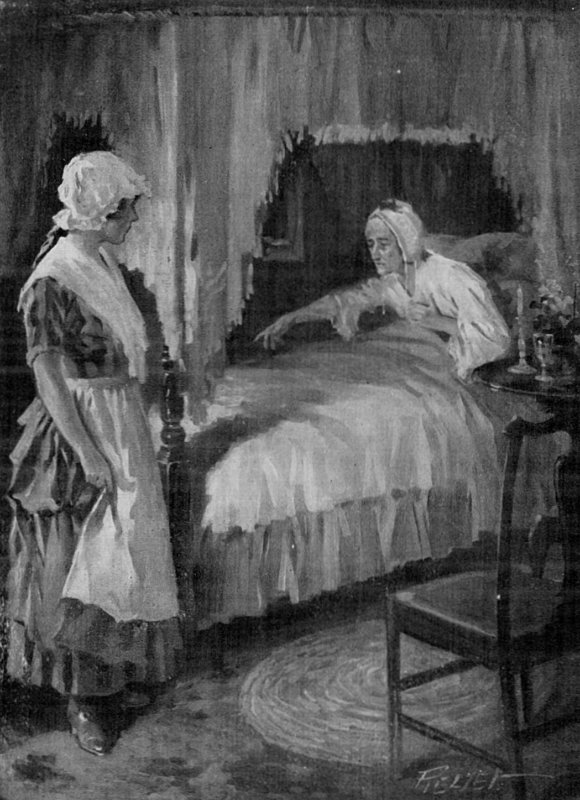
"Why, I read in one book that some one was to put poison in a dish of peas, but somehow Washington was warned about it ahead of time and didn't eat them, of course. But he learned all about the plot, and he had a lot of the conspirators arrested. One of them was courtmartialed and hanged, as a proof that such performances didn't pay. I'm glad somebody was punished for trying to do such an abominable thing, anyway!"
"Well, one thing I'm convinced of!" declared Bess. "That wicked old steward had a lot to do with the scheme. Don't you think so?"
"He certainly must have," agreed Corinne. "But what do you suppose he was doing down there in the cellar when Alison saw him that night, and why did he hide things in that place in the beam? And what part did Alison take in the plot, anyway? Isn't it simply distracting that her journal is torn off right there! And where can the rest of it be, and why was it torn at all? And why was this part saved so carefully? And what became of the sapphire signet? Seems to me as though I'd go crazy with all these unanswered questions pounding away in my brain!"
Nobody having any solutions to offer, again they all sat quietly for a while, till Margaret's eye happened to light on the pile of books that Corinne had laid on the floor.
"What are those, Corinne?"
"Oh, they are some books on New York City history that I got out of the library to read up. Each one has something about Richmond Hill in it. And this one even has a picture of the house. See! here it is."
They all crowded around her to look. "What a fine-looking place!" was the general comment. And Bess added:
"Does it seem possible that this shabby old neighborhood ever looked like that delightful country-place!"
"It was the most beautiful residence anywhere around New York for a long while," said Corinne. "The grounds were fine too, and the big gateway to the estate was right where the corner of Spring and Macdougal streets is now. I thought you might like to read these books, Margaret, so I brought them for you. But oh, girls!" she ended; "right here and now I take the solemn determination that I will clear up this mystery if it takes me the rest of my life! I'll never be content till I know the explanation of it all. And, Margaret, I want you, if you will, to make a copy of the journal for me—not the cipher, but the plain English—so that I can refer to it whenever I want. Will you?"
"Indeed I will!" agreed Margaret. "We'll all help you in every way we can. And here's something else I've decided on. I'm going to change your office in this Antiquarian Club, Corinne, from just plain secretary to Chief Investigator!"
The Antiquarian Club continued to meet two or three times a week, but for some time the meetings were not enlivened with any further discoveries. Corinne grew quieter and more uncommunicative, Margaret restless and discontented. And as for the twins, now that the excitement had subsided and nothing further on that order appeared to be forthcoming, they became frankly bored with the proceedings of their society and were claimed once more by their basket-ball and tennis-playing companions.
Several afternoons Corinne went alone to the Charlton Street house and sat long with Margaret, going over and over the old account-book story. For neither of them did interest in the matter ever wane. And even though they appeared to have reached an insurmountable barrier, it did not utterly discourage them. The mystery was always there, and the unsolved riddle proved a constant lure.
Then one day Corinne came in, accompanied by the twins, and all seemed in rather high spirits.
"What's the news?" demanded Margaret at once. "Have you discovered something, Corinne?"
"Yes, I have. And while it may not be of any great help, at least it's another link in the chain."
The twins, once more condescending to interest themselves in the affair, exclaimed: "Do tell us about it! We cut a basket-ball match to come home this afternoon!"
"Well, as I said, it isn't much, but it's something. Yesterday I was up at the Forty-second Street Library, browsing around among the old reference-books on New York City history, when I suddenly came across this. You remember, several times Alison spoke about the housekeeper, 'Mistress Phœbe'? Well, I've found out who she is!"
"You have!" they chorused.
"Yes, and I guess it's positive, for two books mention it. She was Phœbe Fraunces, the daughter of Sam Fraunces who kept the famous 'Fraunces' Tavern.' The building, by the way, is still in existence down on Pearl and Broad Streets. It has been restored to look just the way it used to, and is the headquarters of the Sons of the Revolution. Sam Fraunces was a fine man and a great admirer of Washington—"
"Yes, Alison said so!" interposed Margaret, half under breath.
"—and he was afterward the household steward for Washington when he lived in New York as President. One book says Phœbe played quite a part in the plot—preventing it, that is! That's all I found out, but it's interesting."
"It certainly is!" assented Bess, after a moment's thought, "and it's just one more proof that we're on the right track. But still I don't see that it helps very much in finding out what became of Alison, or anything about her!"
"No, it doesn't!" agreed Corinne ruefully. "And that's just where it's so disappointing. But there's this about it. In a puzzle like this, every little bit helps along. Sometimes, what really doesn't seem to amount to anything at all, leads at last to the most important discovery. For instance, that song—'The Lass of Richmond Hill.' That didn't impress us so much when we came across it, yet it really led to all the discoveries we've made. I propose that this afternoon we go over the whole thing again, just as carefully as we can, and see if there isn't some little clue that we may have constantly overlooked. Of course, I've done that by myself dozens of times, and so has Margaret. But four heads are better than one! Who knows but this time we may light on the very thing?"
She was so hopeful and enthusiastic about it that they all settled down to the work, reading over the old diary very slowly and discussing every point that seemed to offer the least suggestion of a clue. They had reached the entry which announced Washington's arrival, and were hotly debating the question whether or not Madame Mortier could be concerned in the plot against him, when suddenly they were electrified by hearing the loud crow of a rooster, coming apparently from the darkness at the far end of the room. (They had been talking and reading by the light of the open fire only.) Every one jumped, and Margaret caught her hand to her heart. But Bess instantly recovered herself, darted across the room, dived behind the curtains, and returned dragging into the circle a grinning, giggling small boy.
"It's Alexander, of course!" was her brief remark. Her captive was certainly an extraordinary-looking youngster! Wiry, and undersized for his age (he was thirteen), he possessed a snub-nose, a shock of brilliant red hair, and a quantity of freckles that literally "snowed under" his grinning countenance. His appearance was rendered all the more remarkable by the fact that he had cut a series of holes in an old, round, soft hat, and his brilliant hair stuck straight up through these in astonishing red bunches. Not one whit did he seem to resent the publicity into which his recent exploit had brought him! Rather did he appear to glory in the situation.
"Aren't you ashamed to be eavesdropping behind the curtains?" demanded Bess, shaking him by his collar, of which she still retained her hold.
Alexander straightened himself and made this cryptic reply:
"I don't get yer! But if yer mean piking off this chinning contest,—no, I ain't!"
At the foregoing remarkable explosion of slang, Corinne suddenly went off into a peal of laughter.
"Oh, Alexander, you're rich!" she exclaimed. "I'm glad to make your acquaintance. Teach me some of that, will you!"
The boy turned to her with an appreciative and understanding twinkle in his eye: "Sure thing! I'll put you wise, any old time!"
But Jess suddenly broke into this exchange of amenities. "Do you girls realize what has happened? Alexander Corwin has been listening to all the proceedings of our secret society, and now he knows just as much as we do! Oh, I could scalp you!" she ended, making a sudden dart at her cousin, who, though still in the grasp of Bess, ducked and evaded her. There had been unceasing warfare between Alexander and the twins ever since he came to reside with them. He teased them unmercifully, and they sought frantically, and always in vain, to retaliate. There seemed nothing they could devise that affected him in the slightest. This, the most recent outrage, constituted to them, therefore, the last straw! Suddenly Margaret intervened:
"Wait a minute! Maybe Alec wasn't really trying to overhear what we said. Perhaps he only meant to give us a scare. How about it, Alec?"
"You got the right dope!" affirmed the young rascal. "D'ye think I'd waste my valuable time listening to the chatter of a lot of Sadies? Nix on that! I just crept in there to give the glad whoop and raise you out of your chairs!"
Alexander never teased Margaret. Her pathetic confinement to her invalid-chair appealed to his rowdy little soul, and between them there had always been an unspoken compact of peace.
"But how much did you hear?" reiterated Jess.
"Well, I couldn't help getting wise to some!" admitted Alexander wickedly, conscious that this same admission was gall and wormwood to the souls of the twins. "Heard a lot of stuff about finding a book in our attic, and George Washington, and a swell guy called Madame something-or-other and some kind of a dinky sapphire thing, and a kid called Alison. Say! she must have been some girl! But, gosh!—you needn't think I wanted to hear it! I was only waiting for the chance to give you the merry ha-ha!"
Dismay fell once more on the circle. Bess had now released him, and he stood upright, jammed his hands in his pockets, and grinned on them with a curious mixture of triumph, defiance, and pure impishness. It was Corinne who became suddenly inspired with a brilliant idea.
"Look here, girls! I vote that we make Alexander a member of the club! What do you say?"
"Gee! I don't want to be!" exclaimed the boy in a panic, making a sudden dive to escape.
"Oh, yes you would, if you knew all about it! Wouldn't he, Margaret? It's just the kind of thing a boy would go crazy about. There's so much adventure in it!"
At the word "adventure," Alexander pricked up his ears.
"What's a lot of girls got to do with adventures?" he inquired skeptically.
"Just wait till you hear!" declared Corinne, and Margaret seconded her with:
"Oh, dear, Alec, you'll just go wild over this! And it ought to have a boy in it, too! Oughtn't it, girls?" But the twins remained obdurate. To allow their declared enemy to share their most cherished secret seemed to them the height of madness. But while Margaret was reasoning with Alexander, Corinne whispered to them:
"You'd better do it, I tell you! He knows too much already, and you don't know but what he might give the whole thing away to Sarah sometime!" And this final argument brought them speedily round to her point of view.
"All right!" they agreed. "Alexander, you can become a member of our secret society if you want to, and Corinne will tell you all about it."
And Alexander, his curiosity now thoroughly aroused, offered no further objection to the honor thus thrust upon him.
Corinne undertook to explain the whole matter to him, showed him their discovery, explained how they had deciphered the code, and then proceeded to read him the translation. His pat, slangy comments on it often moved her to laughter, and when it came to the mention of the song, he immediately wanted to hear it, for—it was Alexander's chief merit—he loved music with the appreciation of a born musician. It happened that among the books Corinne had brought Margaret was the collection of old songs, containing the one in question. She hunted this up now, and, going to the piano, played it over for him, while he stood at her side whistling the air.
"Say, I like that!" he commented when she had finished. "That's a great old tune! The words are a back-number of course, but they go with it fine!" He hummed it over again.
"Isn't it queer!" exclaimed Corinne. "Alexander is the only one who has exhibited the least interest in learning or even hearing that song!"
After this intermission, the story proceeded, the boy growing more and more absorbed with every word. But when it came to the disclosure that Richmond Hill had stood just about where they were now sitting, he leaped to his feet with a whoop.
"Say! Wouldn't that jolt you! Gee! I didn't have any hunch that you girls had a thing like this up your sleeve!" Then, with snapping eyes, he settled down to hear the remainder of the tale. When Corinne had finished, he sat cross-legged before the fire for several minutes, chewing meditatively the cap he had riddled with air-holes.
So long was he silent, that Margaret exclaimed, finally: "Well?" Then he got up, stretched his legs, and inquired: "When you going to have the next meeting of this joint?"
"The day after to-morrow," answered Margaret, who was disappointed that after all he did not seem to have any interested comments to make. "Why?"
"Because," he answered in his remarkable jargon of slang, "you can ring me in on the fest, and—I may have a new piece of dope!"
When the meaning of this remark had dawned on them, they all demanded eagerly: "What? What? Can't you tell us, Alec?"
"Nothing doing—till the day after to-morrow!" he called back as he made a hasty exit down the hall.
And after his departure they all agreed that they had possibly done a rather good day's work in admitting the rowdy Alexander to the Antiquarian Club!
Two afternoons later all the girls were gathered in the parlor promptly at three, but Alexander had not yet put in an appearance. He attended the public school, which did not dismiss as early as high school, and he would probably be at least three quarters of an hour late, as he was usually kept in for misbehavior. During his absence, the girls discussed him eagerly.
"Do you know," vouchsafed Corinne, "I think he is the cleverest little rascal, and so comical that I want to laugh whenever I look at him! How is it I've never seen him before?"
"Why, the explanation is," answered Bess, "that he never stays in the house afternoons if he can possibly help it. He's always out running the streets or playing baseball in the vacant lots. But the other day it was cold and damp, and Sarah discovered that he had a bad sore throat and insisted that he stay indoors. He's rather afraid of Sarah, though he does tease her frightfully. That's why he was around trying hard to annoy us—he hadn't anything else to do!"
"Well, he's a little trump, anyway!" insisted Corinne. "And did you ever hear such a glorious collection of slang!"
"Isn't it awful!" sighed Margaret. "Mother is terribly worried about him and the way he talks. And yet she can't help laughing, herself, sometimes, at the funny things he says. Really, he often seems to be speaking in some foreign language that I can't understand a word of!"
"What does he mean by 'dope,' anyway?" mused Corinne. "I can't imagine, unless it's 'news' or 'information.' You just have to construe his remarks, as you do the Latin! I think we'll have to get a dictionary of slang if he keeps on like this!"
"But, oh, what do you suppose he is finding out!" exclaimed Margaret. "What can he possibly know that can have anything to do with our secret?"
"You never can tell!" said Bess. "He goes snooping around this neighborhood in all sorts of places, and talks with all sorts of people. Perhaps he has stumbled on something, though I have my doubts. But here he comes now!"
Alexander entered the house, slamming the basement door and singing at the top of his high sweet voice:
After a preliminary scuffle and dispute with Sarah in the kitchen, probably over the question of cake, he came galloping upstairs, and burst in upon them with a military salute and:
"Hullo, pals! Do I have to give the high sign and the grand salaam?"
"Never mind that!" laughed Corinne. "Hurry up and tell us about this wonderful thing you know. We're crazy to hear!"
Alexander was visibly flattered, and drew a chair to the group by the fire, with an air of great importance.
"Well, it's this way," he began. "It hit me all of a sudden the other day, that I had the dope on something that might be right in your line o' goods. But I wasn't sure, and I wanted to nail it. Now I have nailed it—and it's O.K.!"
"Tell us, quick! Quick!" cried Margaret.
"Hey! put on the brakes a minute, kid!" he commented. "If you go so fast, you'll bust your speedometer! Do you know where McCorkle's stable is?"
All but Corinne nodded. For her enlightenment, he explained: "It's around on Varick Street between Charlton and Van Dam, on this side of the way."
"It's a funny old place, isn't it!" interrupted Margaret. "Sarah sometimes wheels me past it. The building looks awfully ramshackly. But what about it? Surely it can't have anything to do with our affair!"
"Just you douse your sparker and save gasoline!" chuckled Alexander. "Shows how much you know about things! You needed a man on this job! As I was going to say, I know Tim Garrity pretty well—he has charge of the horses. We're pretty good pals, and he gives me a whole lot of interesting dope, off and on. Last summer he told me something that stuck in my crop, but I didn't think of it again till the other day. Then I thought I'd go and nail it for certain, before I told you kids, and I got him to reel it off again yesterday. It's the dope, all right! I saw it myself!"
"For gracious sake, Alexander, don't keep us in suspense another minute!" implored Corinne. "Tell us quick!"
"All right! Now I'm going to shoot! You remember telling me about the theater that old house was turned into? Well, Tim once told me that the stable was built right over where an old theater had stood,—on the very foundations,—and in the back, where the stalls are, you could see a part of the old stage, the paintings on the beams, and frescoes—he called 'em! He was quite proud of it!"
The listening four were now sitting up straight and tense. He went on:
"I didn't pay much 'tention to it at the time. Didn't interest me! Rather be talking about baseball! But the other day, after all you told me, I fell for it again. Yesterday I went round and made him tell me all over again and show it to me, too. I guess we've hit the trail, kids! It was there, all right! Funny old gilt do-dabs, and you could just make out the shape of the stage, curved, the way they have 'em in the theaters now."
He stopped, and every one drew a long breath.
"Alexander, you are certainly a trump!" sighed Corinne. "This is the best discovery yet. But I'm surprised that the site of the house should be on Varick Street. Most books said it faced on Charlton."
And Bess added her say:
"This is certainly awfully interesting, but I'm blest if I can see how it's going to be of the slightest help!"
"Say, you're what us baseball fans call a bonehead," and Alexander chuckled derisively. "I'll bet Corinne's fallen for it already, without being told!"
"I confess, I don't see just how it helps," admitted Corinne, "unless—unless—there's some part of the old, original house left."
"That's the line o' talk!" shouted the boy, triumphantly. "I knew you'd hit the bull's-eye if any one did! There sure is something of the old house left, and that is—the beams that supported the cellar ceiling! They make the foundation of the stage!"
This time Alexander certainly scored a sensation.
"The beams—the beams!" cried Margaret.
"Then there must be the one that had the secret hiding-place in it!"
"Now you're talking!" remarked Alexander.
"But did you see it? Can you get at it?" demanded Corinne.
"There's where Central cuts you off! I examined the thing carefully, and got Tim to tell me all he knew. But we found that the stable only went part of the way through the old cellar of the house; the two ends are cut off and underground—or at least they're behind the side walls of the stable. Can you beat it?"
"Then we can't get at it after all!" wailed Margaret, disappointed all the more keenly for the high hope that had been raised.
"Nope! We just can't get at it—as things stand now!"
"Isn't there any way you can think of, Alexander?" demanded Corinne. "Think what we might find in that secret nook—gold, jewels, papers of great value,—oh! this is exasperating! Can't you think of some way?"
Alexander, however, only appeared to lapse into deep reverie.
"I haven't showed you my whole line o' goods yet!" he confessed, after submitting them to an interval of soul-satisfying suspense.
"You haven't—what?" echoed Corinne uncertainly.
"Told you—all—I know!" he translated obligingly.
"Well, for goodness' sake, go on! How you do tease!"
"Here it is: in a few weeks they're goin' to begin to widen Varick Street and put a subway through."
They only gazed at him, after this statement, in uncomprehending bewilderment.
"You don't get me yet?" he went on. "Well, that means they're going to do a good deal of altering."
Still they appeared unenlightened.
"Gee! but you four are thick!" he cried at last. "The only way they can widen it is by tearing down all the houses on one side. And that's just what they're going to do on this side! McCorkle's stable has got to go. Now are you on?"
"Then—then—" stuttered Corinne.
"Then we can get at the secret beam!" announced Alexander in triumph.
It was with impatience indescribable that the members of the Antiquarian Club awaited the demolition of McCorkle's stable. Now that Alexander had enlightened them as to the approaching changes in Varick Street, the girls watched with absorbing interest the slow, gradual approach of the house-wrecking throng which had sometime before invaded the upper portion of the street. For weeks they had been passing unheeded the frenzied scene of tearing down, digging up, and general destruction that had suddenly changed peaceful Varick Street into an unsightly heap of ruin and scaffolding. It had meant nothing to them, so absorbed were they in their own affairs. And now they found, quite to their amazement, that it was going to have a very direct bearing on these same affairs!
House by house, block by block, it drew nearer. Every day that was pleasant enough for Margaret to be out she commanded Sarah to wheel her past the work of demolition, much to Sarah's disgust, who infinitely preferred the quiet, sunny, unobstructed walks of peaceful Charlton Street. Then, before turning the corner homeward, Margaret would beg to be wheeled past McCorkle's stable, at which she would gaze hard and rapturously as long as it was in sight. This also deeply annoyed and bewildered Sarah.
"Bedad!" she would exclaim impatiently, "it does beat me what ye see in that dur-rty owld rookery! 'Tis fit only fur th' scrap-heap, and ye look at it as if it was hung wid diamonds! What's got into ye these days, Margie macushla! 'Tis that quare Corinne gur-rl that has bewitched ye!"
Margaret could easily see that Sarah was very, very jealous of her new friend, so she would say nothing, but only smile her slow, mysterious little smile. "That queer Corinne girl" had indeed bewitched her, and had brought into her pain-ridden, colorless existence something worth living for! But this, of course, she could not admit to Sarah.
At last, one cold, blustery afternoon, the twins burst in with the exciting information that the house-wrecking had actually commenced on their own block, up at the King Street corner. After that the interest became concentrated and intense. And by the time the little old dormer-windowed shanty on their own corner was leveled to the ground, they had reached the tiptoe of excitement.
Fully two weeks before this McCorkle's stable had been vacated and left ready for its destruction. And since then Alexander had spent much time crawling around its foundations and examining it in every nook and cranny.
When the little building next to it came down, and the day before the stable was to have its turn, the Antiquarian Club held an important meeting, called at the request of Alexander.
"This is going to be ticklish business!" he announced; "getting at that beam, I mean. And I ain't so sure it's going to pan out all right, either. Good thing to-morrow's Saturday, so I can be on the job all day. But I've been laying my pipes pretty slick! I've got on the soft side of a lot of those workmen, and the night-watchman loves me as if I was his little nephew Willie! It's the night-watchman I'm depending on most. He's agreed to let me in there to grub around any night I want—so long as I don't do any damage. But, see here, you kids! Don't be setting your hopes on me getting at anything to-morrow, 'cause more'n likely they won't touch the foundation before next week!"
The next day saw the demolition of McCorkle's stable. It being Saturday, the Antiquarian Club was able to be present in full force (on the opposite side of the street) to see it go. Margaret's chair was wheeled by the twins and Corinne in turn. But Alexander, across the street in the danger-zone, gyrated, imp-like, up and down the sidewalk and was twenty times ousted from imminent peril by the half-indignant, half-laughing workmen.
Piece by piece the boards and bricks fell, story by story the old building came down, till at last it was level with the very sidewalk, and carts began to remove the debris. Then was visible the strange thing that Alexander had long before told them about.
"See! see!" he cried, running across to them and pointing back excitedly. "There it is! Didn't I tell you so?" And looking toward the back, they could plainly discern the queer, curved outline of the old stage, with a few cracked and tarnished bits of gilt cornice still clinging to it.
"But when are they going to reach the beams underneath?" demanded Margaret, in an excited whisper.
"Not before Monday! At least, they can't get to uncovering the ones we want before then. The rest are almost bare now."
"Oh! how can we wait till Monday!" wailed Margaret.
"I gave you the tip we might have to!" admonished Alexander. "You're entirely too light and speedy! You ought to go into the house-wrecking business yourself—then you'd see!"
The interval between Saturday and Monday seemed simply interminable to every one of the five. On Sunday, Alexander spent much time haunting the ruins, Corinne was obliged to be in her own home, Mrs. Bronson was visiting a sick friend, and Margaret and the twins, left alone, whispered together most of the day about the impending event.
"What do you suppose we'll find in that beam?" Margaret would inquire for the hundredth time.
"Probably nothing!" Bess would reply, for she was always inclined to look on the dark side of things.
"Oh, that's not possible!" Margaret would retort. "I think it may be some important papers. I don't expect there'll be gold, or jewels, or anything of that kind. But just suppose it was the sapphire signet!"
"Do you know, dear," said Jess, once, "I'd be pretty well satisfied if we even found just the hole! That would show, at least, that Alison's account was correct, and we had worked things out right, so far."
"Yes, but it wouldn't help us out any with solving the mystery," objected Margaret. "When do you suppose it will be get-at-able, anyway?"
"Alexander says he's going to be there before school in the morning, and again at noon, and in the afternoon too. He says he's almost tempted to play hookey and be there all day! But I told him Sarah and Mother would have a fit if he did! The club is to be all together here in the afternoon, and he'll come right in and tell us the minute he discovers anything."
"Wouldn't it be simply awful," moaned Margaret, "if any one got in ahead of us and looted the place in the beam!"
"Alexander doesn't think that likely," declared Jess. "I asked him about that, too, but he says it's probably so well concealed that nobody would think of such a thing—unless the beam were to be chopped up, and that won't happen for a good while yet."
So they were all forced to possess their souls in patience till Monday afternoon. Then, with fast-beating hearts, the girls gathered in the Charlton Street parlor. Alexander, of course, was not with them, and they did not expect him for some time. But, to their utter amazement, he strolled in about three-thirty, hands in his pockets, whistling "The Lass of Richmond Hill" as unconcernedly as though this were not the day of days for the Antiquarian Club!
"Good gracious, Alexander, what's wrong?" demanded Corinne.
"Wrong? Nothing at all! Everything O. K., A., number one!" he replied airily.
"But why aren't you over at the stable as you said you'd be?"
"Oh, I didn't think it worth while!" he answered indifferently, ambling over to gaze out of the window.
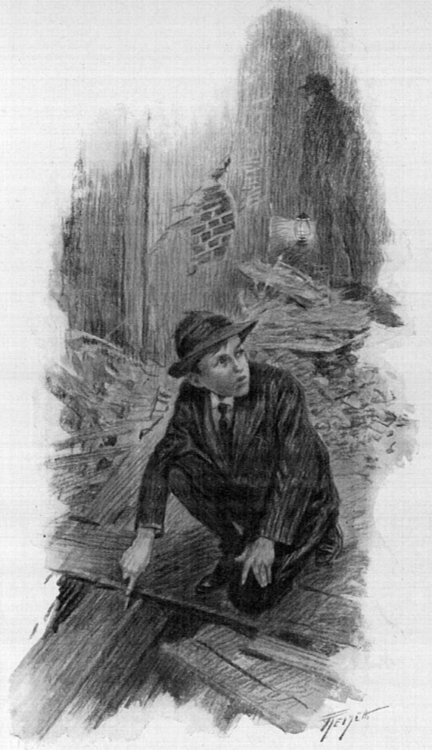
"But, Alec!" cried Margaret. "Have you gone back on us like this? And after all you said! And you seemed so interested, too! I just can't believe it of you!" Her great, beautiful gray eyes filled with sudden tears, and Alexander, turning from the window, observed it.
"Aw! turn off the weeps!" he exclaimed gruffly, but contritely. "Can't you all take a bit of kidding? It ain't worth while for me to be over there any more—because I've found the beam already—and explored it!"
At this astonishing revelation they sprang upon him literally in a body—all but Margaret.
"Oh, Alec! You didn't! When? Tell us all about it? What did you find? How did you do it?" The questions rained thick and fast.
"Well, just unhand me, and sit down, and I'll tell you all about it! Saturday night I was crawling round a bit after the work was all over, and only the night-watchman there. I found that the two beams on this north end were really pretty well uncovered, in spots, and what was left over them could be easily scraped off. It was mostly dirt and loose mortar. I didn't have time to do anything that night, but I gave the watchman the tip that I'd be back the next night and poke around a bit. He likes me, and he thinks I'm collecting wood to build an Indian wigwam in that vacant lot on Hudson Street. And us fellows are building one, too, so it's no lie!" Alexander, to do him justice, was scrupulously truthful.
"So I beat it out, last night, after borrowing the twins' door-key, so I wouldn't have to wake up that lallypaloozer, Sarah, when I came in. Of course I took a chance of not striking the right beam,—it might be the one at the south end, for all I knew. However, I doped out the one I thought it was, shoveled off the bricks and mortar softly, so's not to attract attention, and measured off ten feet from the west end with a tape-line. You know the kid, Alison, said the steward stood about ten feet from the wall of the house, along the beam.
"Then I opened my big-bladed pocket-knife and poked and poked and poked around it, top, bottom, and sides. But never a sign of an opening did I find. After I'd been at the job about an hour, I gave it up and scooted for the east end of the beam, and began the same thing all over. Nothing doing for about half an hour! Then all at once, my blade slipped into a crack! I gave a hard pull, and—jumping Jupiter!—there I was! The thing came open like a door on a rusty hinge, and there was a hole about a foot and a half long!
"You bet I didn't do a thing but shove my hand in and feel all around in the hole! I didn't dare even to light a match, for fear a cop might see me. Just then, all of a sudden, the watchman called out softly that the roundsman was coming and I'd better beat it while the going was good! I just had time to duck off that beam, crawl along the darkest side of the wall, and sneak out as the roundsman came along and stood talking to the watchman, as he always does, for about fifteen minutes. I got into the house all hunky,—and that's why it ain't any use for me to be there this afternoon!" he ended abruptly.
"But, Alec, what did you find? Did you find anything?" demanded the four in one breath.
Alexander nodded impressively. "Yep! I found something all right!" Then he suddenly took an object from under his coat and laid it carefully in Margaret's lap.
"I found this!"
It would be useless to attempt describing the mingled sensations with which the Antiquarian Club (all but Alexander) bent to examine the latest "find." The twins, however, drew back in a moment with a disappointed air and the disgusted query:
"Is that all! What in the world is it?"
It certainly was neither gold nor jewels, nor, apparently, important papers of any sort, and their interest waned at once. It was paper of some kind—dirty, mildewed, stained with time, and nibbled freely by mice. But it bore no resemblance to the state documents, laden perhaps with impressive seals, that the twins had vaguely expected to behold, if, indeed, the find took that shape at all. But Margaret and Corinne had been turning it over carefully. All of a sudden they uttered a simultaneous little cry:
"Oh, girls! Don't you know what it is?"
"No!" declared the twins.
"Why—the other half of the diary!"
Then indeed did the twins give way to belated exultation in which Alexander joined, for of course he had already discovered this.
"Yes, it certainly is!" reasserted Corinne, examining it more closely. "The book was evidently torn in two, and this half concealed in the beam,—but for what earthly reason I can't imagine! I wonder if Alison put it there herself?"
"D'ye see anything queer about the first page?" inquired Alexander, mysteriously. They bent again to examine it. The first page was the most worn and stained and torn and least decipherable of all, because it had been unprotected. There were the same characters of the cipher, only very dimly discernible. But written diagonally across it, evidently with something black and dull, possibly a piece of charcoal or charred wood, were a few words in English. They were so faint that they might have been taken merely for the traces of dark stains or smudges had not one examined them closely.
"Shall I put you wise to what they say?" suggested Alexander.
"Oh, do!" they all cried.
"Well, here it is: 'I am now assured you are a spy. This proves it. I can make naught of it, but will hide it securely. Later I will denounce you.' Wouldn't that jar you, now!"
"Who do you suppose wrote it?" demanded Corinne.
"Could it have been Alison?" suggested Margaret. "Maybe she meant it about the steward."
"That's my guess!" echoed Alexander.
"But why did she write it in English, and with this charcoal or whatever it is? And why did she hide it in that beam? And why was the diary torn in two?"
"You can search me!" Alexander remarked, shrugging his shoulders.
"Wouldn't it be a good idea to find out by translating the rest?" quietly suggested Bess, the practical. "No doubt she'll say something in it that will put us on the right track."
"Good business!" chuckled Alexander. "You've got some sense in that bean of yours, kid!"
"I don't understand you!" retorted Bess, coldly. She thoroughly disapproved of his slang, and was never amused by it as the rest often were.
"I should worry!" he responded unconcernedly, and turned to Margaret. "Couldn't you dope out a bit of it now, kiddie? You've got the goods to do it with."
"No," interrupted Corinne, looking at her watch; "it's getting late, and I must go. Let's give Margaret a couple of days to work it out, and then we'll have a grand old meeting and solve the whole riddle—I hope!"
Much as they longed to know the whole story at once, it was obvious that Corinne's suggestion was most sensible. But before they separated, they unanimously voted "Aye!" to another matter—that the discovery of the contents of the secret beam was the most satisfactory thing that had happened so far!
Two days later they gathered around Margaret, keen for the exciting revelations that they felt sure were awaiting them. Margaret had resumed her sphinxlike attitude of mystery and would reveal no clue to what she had discovered. When they were settled and quiet, Alexander remarked:
"Go ahead, kid! Shoot! Get it off your mind!" And smiling indulgently on him, Margaret began:
"You remember where we left off in the other half of the journal—a sentence just stopped in the middle. It was this:—'For Madame M. will accept naught from him and—' Now, on this first page, she completes it. And, by the way, I had the worst time puzzling out that first page! It was so stained and faded and torn. Sometimes I wasn't even sure I was getting it right. But I guess now I have it correct. She goes on to finish:
"—yet I scarce could tell him so. He must have guessed my predicament, for he only smiled and said it was of no moment. An she would not care for it, I might keep it for myself. 'Twas rarely kind in him. I long to tell him about myself, but I dare not—not yet.
"Then comes a break. Now she says:
"His lady did pass me to-day, walking in the garden; and since the high shrubbery screened us, I curtesied deeply to her. I scarce dare notice her when any of the household are by. She looked at me long, then spoke me fair, asking had she not met me before she came here. I answered, yes, the day her coach broke down on the road last year, and I helped to hold the frightened horses while 'twas mended. She did thank me anew, and asked me what it was I was about to tell her then, when Madame M. had dragged me suddenly away. I replied that I dared not repeat it there, but would seek some chance to speak with her alone when we did have more time and were not observed. Then I heard footsteps approaching, and I fled quickly away."
"Wonder what it could have been that she was trying so hard to tell Lady Washington!" sighed Corinne. "This doesn't grow any less mysterious, apparently! Go on, Margaret!"
"Another break, then she says:
"I have at last learned what is this wicked plot—"
"Good business!" ejaculated Alexander.
"'Tis through Mistress Phœbe I found it out. She has a lover who is one of his life-guard, and this lover she has had cause to suspect is not entirely loyal to him. Last night she did ply him with overmuch good malt brew, and in his befogged state she did get him to babble the secret. Oh, it is a vile scheme! They are planning to deliver the city out of his hands. But that is not the worst. They seek first of all to murder him, and in some underhand, cowardly fashion. The manner of it is not decided yet. Phœbe tells me her lover will remember no word of what he said to her last night in his cups. But she intends to watch him right closely. When she has learned the manner of the plotted murder, he must be warned."
"Isn't this exciting!" exclaimed Corinne.
"Bully! Hot stuff!" agreed Alexander.
Margaret continued: "Now, another entry.
"I have confided my story to Phœbe. She is well to be trusted, I feel. She has promised to help me in my need. I am becoming right fond of Phœbe. Corbie was here last night to see the steward. They are both in the plot, we feel sure. After Corbie left, the steward descended to the cellar. I did not dare to follow—I could only guess that he went to his secret hiding-place.
"Now another space. Then:
"Phœbe had news to-day. Last night she did again muddle her lover with much strong drink. And she did get him to confess that the plot is near completion; that if all goes well, 'twill be put in action four days from now. He also did acknowledge that they intended to put him out of the way by poisoning something he ate. But he knew nothing more definite. Phœbe says she dares not thus befuddle him again. It is too dangerous, as he has shown that he suspects he is babbling and has asked her since many searching questions, to which she pretends guileless ignorance. We must watch him. What if we should not be able to foil him and his vile conspirators!
"Madame M.'s health does not improve. Nay, she has dropped so low that 'tis feared she will not live. Her physician did bleed her yesterday, but 'twas of no avail. She recognizes me, but she will have naught to say to me. In fact she is too weak to utter a word. I am right sorry for her and grieve that she cannot forgive me, though I have done no real wrong. I have sometimes thought she must know of the plot, the vile plot that is to be enacted in this house. But Phœbe declares she is innocent of that. Deep as her hatred may be, she would never wink at such a crime."
"Well, that settles one question, anyhow!" interrupted Corinne. "Do you remember how we discussed that?"
"Yep! that was the day I butted in!" commented Alexander, in whimsical recollection. "Fire away, kid!"
Margaret continued:
"Phœbe and I do despair of discovering by what means they plan to carry out the plot. She dares no longer question her lover when he is under the influence of wine. Nor does she yet dare denounce him, lest the other conspirators escape unharmed. It would be premature to do so till we know the exact facts. I have told her of the steward and his secret hiding-place in the wine-cellar. If we can do naught else, we will rifle that some time when he is away. Perchance there may be information in it.
"Then, here's the next entry:
"It is midnight, and on the morrow the plot will be consummated. I write this in much fear. Perchance it will be the last I shall ever have opportunity to write. If such be the case, and my relations in Bermuda do ever find this trunk and the diary in its false bottom, and should they be able to decipher it, I want them to know that I, Alison Trenham,—"
"Trenham!" shouted the listening group. "Hurrah! at last we know her full name! That's dandy!" Margaret gave them little heed and went on:
"—do grievously repent my folly in ever leaving my peaceful home; that I beg Grandfather to forgive me if he can, and wish Aunt and Betty to know that I love them always. Also, that H. and his uncle were little to blame for their part in what happened before we left Bermuda, and that I do not regret giving my assistance, for it was a noble cause, even though our government did not approve.
"To-night, Phœbe and I did raid the steward's secret hiding-place. We waited till he had gone out, about ten o'clock, and from his actions we made sure that he would be away long, for he went straight to Corbie's tavern. But even so, we took a terrible risk. Once in the cellar, our work was not difficult. I pointed out the location of the spot, and we opened the beam as I had seen him do. But our amazement was great when we found naught in it. He must have removed every belonging, and that right recently. We were just about to turn away when Phœbe declared she would look once more, and she felt all about in it carefully. Her search was rewarded, for far back in a crevice was stuck a small folded note.
"We read it by the light of the candle, not at first daring to take it away. It was from the governor, and said that on the morrow a dose of poison should be put into a dish of peas prepared for him at his noonday meal. The poison would have no effect under an hour. In the meantime, word should go forth, and the fortifications would be seized. Everything was in readiness. That was all. The note had plainly been forgotten by the steward when he removed his other papers. We dared to keep it, on a second thought, since he would probably think he had lost it elsewhere, if he missed it at all. So we took it away with us.
"Our plans are all laid. Phœbe will herself be in the kitchen to-morrow at noon, and no doubt either her lover or the steward will place the poison in the dish. Then I am to pass through the kitchen at a certain moment, and Phœbe will request me to carry in the dish and lay it before him. As I do so, I can whisper him a warning not to eat of it, saying I will explain later. If Phœbe herself did this, she would be suspected at once, for she never goes into the dining-room to serve. But she will choose a moment when no retainer of his happens to be in the kitchen, and send me with it instead. God grant that the plans do not go wrong. He will suffer, and our own lives will be in great danger should we fail or be discovered.
"We have arranged that, when I go to him later to disclose what we know, I shall also tell him my own story and throw myself on the protection of him and his good lady. For I fear it will then be no longer safe for me to remain here as I am now. That is all. God has us in His hands. I await the morrow with untold trembling.
"Should it be thought strange that in writing this journal I have given few names and so made the identities hard to guess, I must explain that I have ever been in great fear of this being discovered—nay, even deciphered. I bethought me that the fewer names I used, the less incriminating this might be to myself and all concerned. As I read it over now, I feel that it was but a poor makeshift, at best. However that may be, I trust that it may some day get back to my dear ones in Bermuda, should aught evil befall me. They will understand.
"The hour grows late and I must retire, though I feel little able to sleep. But one thing more I must disclose ere I bring this journal to an end,—the hiding-place of the sapphire signet. Should it befall that I never return to my home nor see my relatives again, it would be only right that they be informed where the jewel may be found, and that I meant no evil in taking it from Grandfather. Also, I do earnestly beseech any soul who shall perchance sometime long in the future find and decipher this record, that he or she will search for the signet in the place that I have indicated. And should they find it still there hidden, I pray that they will make an effort to return it to any of my family or connections who may still exist.
"I have concealed the sapphire signet in—"
Margaret came to a dead stop. "Girls—and Alexander—that's absolutely all there is!"
So tense had been the interest that they could not believe their ears when Margaret made this announcement. Alexander was the first to recover his power of speech. Thumping the floor indignantly, he delivered himself thus:
"Suffering cats! Can you beat it!"
When the chorus of surprise and bewilderment and indignation had at last subsided, they fell to discussing in its every detail this new phase of the journal and its abrupt ending.
"I tell you," announced Alexander, thumping a sofa-cushion to emphasize his remark, "something happened to that kid just as she got to the last,—something happened, sure as wash-day! And it wasn't anything pleasant, either! Do you get me?"
"You must be right!" agreed Corinne. "When you think of what was going to happen the next day, and the danger she was in, and the fact that this journal is torn in two, and all that, I'm positive something terrible must have taken place just then. Poor little Alison! How are we ever going to know what it was, or whether she ever got out of it all right and got back home! If the end of the other half of the journal was maddening, this is about forty-five times worse! I feel as if I'd go absolutely crazy if this mystery isn't cleared up!"
"There's one thing you must remember," suggested the practical Bess. "History tells us that the poison plot was discovered in time and didn't do Washington any harm; and that Phœbe Fraunces gave him the warning, and he just cleared up the whole thing, and hanged the worst one of the conspirators,—whoever he might be! Now, if that's the case, don't you think we could take it for granted that Alison's affairs turned out all right, too?"
"Not necessarily!" retorted Corinne. "Remember, also, that Washington didn't know anything about her, and that that horrid steward had been watching her and plotting about her; and so had Corbie, too. Who knows but what they took her and carried her off before the thing was to take place, in order to have her out of the way!"
"And there's another thing," added Margaret. "Do you remember what I told you Mother said about that trunk of hers? It was found floating around in an old wreck. Now how did it get there? If there was a wreck and she was on it, she was probably drowned and never got back to Bermuda alive. But how did she come to be on a vessel with her trunk if she had been captured by the steward? Did he put her there?"
"Maybe she wasn't on that vessel at all!" was the contribution Jess made to the problem. "Somebody else may have taken possession of her trunk for all you can tell. A trunk is something anybody can use!"
"But did you ever hear of such a maddening thing as that journal breaking off just the minute she was going to tell where she'd hidden the signet!" exclaimed Corinne in thorough exasperation. "Why couldn't it have gone on just a second longer—at least till she'd had time for a tiny hint! And, see here! Do you realize that she was actually talking to us (though she didn't know it) when she begs the person who finds and deciphers this journal in the future to find the signet and return it to her people?"
"Why, that's so!" cried Margaret in a tone of hushed awe. "It didn't strike me at first. She's actually speaking to us—for we must be the first ones who have read this journal! Isn't it amazing!"
"You don't know whether we are or not," contradicted Bess, with her usual cold common sense. "Lots of people may have seen it before we did, and found the signet, too."
"I don't think it's likely," argued Corinne, coming to Margaret's defense. "And besides, how could they find the signet when she didn't even have a chance to tell where it was! No, I feel quite sure we're the first; but how are we ever going to know where she hid it? And even if we did know, would we be able to find it after the changes that have come in all these years?"
"Then too," put in Jess, "there's a chance that Alison got out of the trouble all right, anyhow, and took the signet back to her grandfather herself. How are you going to tell?"
"There's one thing you all seem to have forgotten," suggested Alexander. "And it's the biggest boost of the whole outfit! We are wise to her last name—Trenham. Now you, Corinne,—you've been down there to that little old joint, Bermuda. Did you ever hear of any one by the name of Trenham?"
"No, I didn't. Of course, I never inquired particularly, not knowing anything about this, then. But I never heard that name. There's a very common one on the island that's a good deal like it—Trimmingham—but that doesn't help much. It probably isn't the same, though the English do have the funniest way of shortening their names and pronouncing them in queer ways!"
"Wrong trail!" exclaimed Alexander, briefly. Then, suddenly turning to Margaret, he added:
"Here, kiddie! Hand me that journal-thing you've doped out. I want to give it the once-over!" He studied it thoughtfully for several minutes, tugging viciously the while at a long lock of red hair that always hung over his eyes. The rest all kept very quiet, watching him expectantly. Presently he issued his ultimatum:
"There's one other piece of business that you all seem to have pretty well given the cold shoulder—this song and dance about some plot in Bermuda that the Alison kid says she was mixed up in. Have you ever thought of doping that out?"
"No, we haven't," admitted Corinne. "I did think once of hunting it up, but the whole thing was so awfully vague that there didn't seem to be any use. What could you hunt up, anyway? You'd have to read up a lot of Bermuda history, and even then you probably wouldn't strike a thing that had any bearing on it!"
"You never can tell!" remarked the boy, wisely. "Me for this job, from now on! Where's that library joint you get all your books from, Corinne? Little Alexander's going to join the army of high-brows!"
"You can take my card and use it, Alexander, or I'll get you the books myself," Corinne kindly offered.
"Thanks awfully, but nothing doing!" he returned. "This kid gets right on the job himself when he strikes the trail. All I want to know is how you break into the place. If you put me wise to that, yours truly will do the rest!"
In the course of the next few days, Alexander became a duly enrolled member of the nearest public library, and his family was edified to behold him deeply immersed in the most unusual occupation of literary and historical research. As he ordinarily touched no volume of any nature except his school-books (and these only under severe compulsion!), the spectacle was all the more amazing. Baseball and other absorbing occupations of his street life were temporarily forgotten. He would lie for hours flat on his stomach on the couch, his heels in the air, pushing back his rebellious lock of hair, and mulling over the various odd volumes he had brought home from the library. At intervals he could be heard ejaculating: "Gee!" "Hot stuff!" and remarks of a similar nature.
But of his discoveries, if indeed he had made any, he would have nothing to say, conceding only that, when he had found anything of interest, a meeting of the Antiquarian Club should be called, and he would then make his disclosures in proper business form. This was absolutely all they could draw from him. The twins reported to Corinne at school that Alexander was certainly doing (for him!) a remarkable amount of reading; and it was not all about Bermuda, either, as they had discovered from the titles of his books. American history also figured in his list, and other volumes whose bearing on the subject they could not even guess. They also expressed their wonder at the curious change they had noticed in his manner toward them.
"Oh, Alexander's all right!" Corinne assured them. "You've always misjudged that little fellow, girls! He's got heaps of good in him! Of course, he's a little rough and slangy, and a terrible tease, but most boys are, at his age; and some are lots worse. He's a gentleman at heart, though. You can tell that by the way he treats Margaret. He's always just as gentle with her! But you've never taken him right. You get awfully annoyed when he teases you, and that's just exactly what he wants; it tickles him to pieces to see you get mad! If you'd only take him up good-naturedly and give him as good as he gives you, you'd find yourselves getting along heaps better!"
"That's exactly what you do, I guess!" remarked Bess, ruefully. "And I can see that he thinks you're fine. He said the other night that you were 'some good sport,' and that's praise—from him! I'm going to try and act differently toward him from now on. But, oh! his language is so dreadful and slangy! It irritates me to pieces, and I just can't help snapping at him when he talks that way!"
"Do you know," said Corinne, "I've noticed a queer thing about him. When he's very much in earnest and forgets himself completely, especially in this mystery business, he hardly uses any slang at all,—just talks like any one else! I believe he'll grow out of all that, later, when he's learned that it isn't the way the worth-while people talk. But he's bright—bright as a steel trap; and think where we should have been in this affair if it hadn't been for him!"
Meanwhile, all unconscious that he was a subject of such animated discussion, Alexander was pursuing his researches in grim earnest; and at length, in the course of a week or so, he announced that a meeting might be called and he would make his report. When they had gathered expectantly the following afternoon, he came in with an armful of books and settled down on the floor before the open fire.
"Now, don't go boosting your hopes sky-high!" he remarked, noting the tense expectancy of their attitudes. "I ain't doped out anything so very wonderful—"
"Oh, haven't you, Alexander?" exclaimed Margaret, disappointedly. "I thought you must have found something great, the way you've been grunting and chuckling and talking to yourself all this time when you read in the evenings!"
"Sorry to give you the cold shower, kiddie! I've done the best I could; and if I was chuckling and grunting, it was because I'd struck some ripping hot stuff in the way of adventures. Say! that Bermuda history is some little jig-time! I started to wade through it, thinking it'd be as dry as tinder, and you can knock me down with a plate of pancakes, but it was rich! Started right in with the greatest old shipwreck, when old Admiral Somers and his men got chucked off on this uninhabited island! Gee! it was as good as 'Robinson Crusoe,' that we're reading about in school. Then they had a rip-snorting old mutiny, and started in to build another ship, and all that sort of thing! And later on, after they'd gone home to England and come back and settled in a colony there, they started up some witchcraft, and ducked a lot of gabby dames and hung some more, and—"
"But, Alexander," interrupted the impatient Margaret, "you can tell us all about that some other time. What I want to know is, did you find out anything that seemed to be connected with our mystery?"
"That's right, kid! We'll get down to business, and do our spieling afterward. Well, I didn't strike a blooming thing that seemed to be even a forty-second cousin to our affairs till I got down to the year 1775; and then I hit the trail of a piker called Governor Bruère, who was the reigning high Mogul in Bermuda just then. He was some pill, too, you can take it from me! And everybody seemed to hate him like poison, he was such a grouch. Well, it was just about the time when the Revolution busted out in the U. S. Washington was up there around Boston, keeping the British on the jump. But he was scared stiff, because gunpowder was so short. There were only about nine rounds left for each American soldier. But they were chucking a good bluff, and of course the British weren't wise to it.
"Just about then, somebody put Washington on to the fact that down in Bermuda there was a whole mint of gunpowder concealed somewhere in the government grounds, and it wouldn't be so hard to get hold of it. At the same time, too, the Bermudians were pretty nearly starving, because they got all their food supplies from America, and since the war broke out, England had cut them off at the meter. So Washington doped it out that here was a good chance to make an exchange. He sent a couple of fellers to tell the Bermudians that, if they'd give him that powder, he'd send them a whole outfit of eats. And you'll admit that was square enough!
"But wouldn't this jar you! When they got there, they found the whole place up in the air and the governor sizzling around like a cannon-cracker, because some one had got in ahead of them, stole the powder, and carted it off to America! They just turned tail and beat it for home and mother as quick as they could, before the governor got wind of their business! So long as Washington got the powder, they should worry!
"But the how of it was like this: a fellow named Captain Ord,—or some say it was one called George Tucker, but most think it was Ord,—had it all fixed up with some Bermudian friends that he should get the powder on the q. t., load it on board his ship, and beat it while the going was good. The powder-magazine was in the government grounds at a dump called St. George's, and Governor Bruère always slept with the keys under his pillow. Well, some smooth guy managed to swipe those keys one dark night, and they rolled down no end of barrels to a place called Tobacco Rocks, loaded 'em on whale-boats, and rowed out with 'em to the ship that was anchored off Mangrove Bay, wherever that may be, and Captain Ord was off with it before morning. Well, you can take it from me that, when Bruère got wise to what had happened, he went up in the air! He was a hot sketch, and he made it warm for the Bermudians; but it didn't do any good, as nobody knew much about the business—or if they did, they wouldn't tell!
"Anyhow, Washington got his powder, and it's on record that afterward he sent a heap of swell eats down to pay for it! Gee! wouldn't I like to have been in on that fun though—the night they swiped the loot!"
"But, Alexander, I don't see what all this has got to do with Alison!" cried Margaret. "There's nothing in it about a girl, or the least thing that concerns her!"
"That's just where I knew you'd throw me down!" remarked Alexander. "I told you to begin with that I hadn't found anything positive about it, didn't I? Well, this is the only thing that even passed it on the other side of the gangway! That Alison kid keeps talking about a plot in Bermuda and something that happened that the government didn't cotton to, and there isn't another blooming hook to hang your hat on but that, unless it's something that isn't spoken of or known about in history. Then there's one other reason. She speaks of some one called H., and his uncle, and his uncle's ship, and how they were afraid to go back to Bermuda because one of the sailors had turned piker and given way on them. Of course, it's all guesswork! And what in thunder a kid like Alison could have to do with such a piece of work, beats me! But there you are! I'm done!"
There was considerable disappointment in the Antiquarian Club, when Alexander had ceased, that nothing more definite had been unearthed by him. It seemed highly unlikely to them all that this strange little historical incident could have any bearing on the affairs of the mysterious "lass" whose secret they had stumbled upon. None but himself appeared to put any faith in the connection between the two, and they discussed it for a time hotly. At last Corinne, perceiving that Alexander was becoming piqued that his efforts were not more appreciated, declared:
"I think you've done splendidly, Alec, in discovering anything at all, among such a lot of uncertain stuff; and perhaps we'll come across something later that will make us sure. But you seem to have been reading quite a pile of books. Are they all about Bermuda?"
"Nope! Not on your tintype! There are precious few about Bermuda alone, anyway. So after I'd chewed up what there was, I took to doping out American history, and I came across some hot stuff there, too! The main guy over there in the library advised me to read Washington Irving's 'Life of George Washington' when I told her I was tracking down American history. And say, that's going some, too—in spots! I fell over something last night that'll make you all put on the glad smile—I found out the name of the feller that was soft on Phœbe!"
"Oh, what is it?" they shouted in a satisfying chorus.
"Thomas Hickey!" announced Alexander, proudly.
"But how do you know?"
"'Cause that's the name of the feller Washington hung! It was a member of his life-guard who was one of the conspirators!"
"Alexander, you're some trump!" declared Corinne. "In all my browsing, I never came across that!"
During the month following Alexander's researches into history, no further progress was made in solving the mystery that absorbed the Antiquarian Club. The Christmas holidays came and went, and the severer winter weather held the city in such a grip that often, for days on a stretch, Margaret could not be wheeled out in her chair. Under the combined strain of confinement to the house and lack of any further stimulating excitement, she grew very restless and just a wee bit unhappy. The girls and Alexander were very busy with their midwinter examinations, and could not give much time to other interests, even such absorbing ones as the long-ago Alison and her fate.
But, with the beginning of February, matters improved. The weather moderated, to begin with, the sun shone daily, and Margaret could again enjoy her outing of an hour in the sunny part of each early afternoon. The others also, released from the grind of much study and "cramming for exams," had leisure at last to give to the club-meetings, which they now held regularly three times a week. Alexander was not always with them, for the claims of hockey and skating and coasting often proved too much for his boyish soul to resist. But, for the most part, he managed to be on hand at least once a week, for his interest in the mystery was still very great.
They grew into the habit of reporting, at these meetings, any even slight discoveries they had happened to make, in their reading or in any other manner, that had the slightest bearing on the subject. Thus, Corinne contributed the following, that she had gleaned in looking over a history of New York City: in referring to Abraham Mortier, some one had once remarked that the expression "Laugh and grow fat!" did not apply to him, since, although he was very jolly, he was so thin that the wind could blow him away!
"That's interesting, but of course it doesn't help us much!" Corinne added apologetically. "But I thought anything about the Mortiers would be well to know. I'll warrant Madame Mortier was just the opposite—very fat and solemn!"
Alexander contributed the information that Thomas Hickey was hanged at a spot about where the corner of Grand Street and the Bowery is now. And so deep was his interest in this gruesome affair that he even made an excursion across the city one afternoon to visit the site!
Margaret found a description of Richmond Hill, written by Mrs. John Adams during her residence there, in which she described at much length the beauty and attractiveness of the spot. Only the twins, who read but little, made no additions to the stock of information. This they apologized for by saying that they were no hand at such things, and about everything had been discovered already, anyhow!
Then Corinne invented another form of entertainment. This was that each member of the Antiquarian Club should, after due thought and consideration, invent an explanation of his or her own for the curious break in Alison's journal and her probable fate. The game proved an exceedingly diverting one, and every member took a separate meeting and expounded the particular solution that appealed to his or her imagination.
Corinne herself wove a romantic tale about Alison's having been captured that very night by the steward and Corbie while she was writing, how they carried her off, journal and all, and later fought over her book and tore it in two; how Alison was rescued by the mysterious "H." just in the nick of time, and was taken away to Bermuda to marry him and live happily ever after! But the mystery of the two halves of the journal and their strange hiding-places and the whereabouts of the sapphire signet she admitted she couldn't explain and didn't try to!
Alexander invented a lurid tale of Thomas Hickey discovering Alison in the act of writing her journal, tearing it in two in snatching it from her, and retaining the latter half. Phœbe then helped Alison to escape with her trunk and the other half and embark on some vessel that was later overhauled by pirates and scuttled, and Alison was made to "walk the plank"! This horrible ending so affected Margaret that she cried herself almost sick over it. And Alexander thereat was so conscience-stricken that he determined henceforth to keep his inventive powers under better control.
Margaret herself advanced the theory that, for some reason, Alison and Phœbe suddenly determined to tear the journal in two and each keep half of it as evidence in case anything should go amiss. That Phœbe hid her half in the beam, and Alison put hers in the trunk. Then they went and denounced the plot to Washington, and he was so grateful that he sent Alison right home to Bermuda, where she lived happily, having taken the signet with her, and giving away the trunk to some relative and forgetting all about the journal in the bottom. It was the relative who was shipwrecked and abandoned the trunk!
Again the twins, who had no gift of imagination, refused to offer any solution, though they were highly interested in the tales of the others. They both declared that they could think of absolutely no explanation, so what was the use of their trying? And on these grounds the others excused them. So the month passed, and then one day Margaret announced that she herself had made a discovery, and proceeded to tell of it.
"It all came about through Sarah wanting to wheel me over through Macdougal Street to-day and down Spring Street, because she had an important errand there. You know we never go through Macdougal Street, because it's so narrow and not nearly as nice and clean and sunny as our own and Varick Street. I actually don't think I've been over that way for three or four years! Well, just as we were passing a house between this block and Van Dam, I looked up at it, and what do you think I saw?—the brass sign near the front door—"Richmond Hill House"! I couldn't imagine for a moment what it meant. But I asked Sarah if she knew what the place was, and she said it was a settlement-house, with a day-nursery and clubs for the children and things like that in it.
"I asked why it was called that name, and she said she didn't know—thought it was a silly one and didn't mean anything. But I knew—though I didn't say so! Somebody who knows about history has called it that because it stands almost on the grounds where Richmond Hill used to be. But oh, girls! think how much trouble and wondering and hunting it would have saved us, if we'd only known about that house at first! It would have suggested the thing to us right away!"
"Huh!" remarked Alexander, disgustedly. "I knew about that old joint right along—ever since I lived here! I could have told you a thing or two, if you'd only consulted yours truly sooner!"
"Well, never mind!" said Corinne, soothingly. "Maybe we did get at things in a roundabout, clumsy fashion; but we got there, just the same, and we had a good time doing it, too! But now I've something brand-new to say, and I want you all to listen very attentively. This is a matter that needs a lot of careful consideration. We've about come to the end of our rope, as far as making any further progress with this mystery is concerned. We've been having a lot of fun and entertainment out of it, of course, with these stories of our own, and all that sort of thing. But we're not 'getting any forrarder,' as Dickens says; and do you know, I'm beginning to think that perhaps we're not doing just right in keeping this all to ourselves!"
Here Margaret started and gave her a reproachful look. Corinne put an arm over the invalid girl's shoulder and continued:
"Honey dear, I know you think I'm playing the traitor, and trying to spoil our delightful secret society, but I'm really not; and if you'll hear me to the end, I believe you'll feel the same as I do. I've been doing a lot of hard thinking about this matter lately. Perhaps you haven't realized it, but I am certain that this old journal we've found is really a very valuable thing—not only valuable in the way of money (for many people would pay a great deal for a genuine old document like this), but also in the way of historical information. We're keeping to ourselves something that might really throw light on the past history of our city.
"Now, of course, I'm not certain about this, but I'd like to have the opinion of some grown person who really knows. And I've thought of a plan by which we could do this, and at the same time keep our secret society almost the same as it is now. It's this: I would like you all—and especially Margaret—to consent to my telling my father all about this, and, if he is willing (and I'm certain he will be), we can let him become a member of our Antiquarian Club. In that way, you see, we won't be breaking up our society—we will just be adding another member!"
"But he's a grown person!" objected Margaret, trying hard to keep the tears from rising. "And he wouldn't care a bit about a thing like this! And we'd feel so strange and—and awkward to have an older person in it!"
"Oh, but you don't know my father!" laughed Corinne. "To be sure, he's a grown person, but I never met any one who was more like a boy in his manner and interests and sympathies! Why, he's actually more boyish than lots of the young fellows in high school. He is deeply interested in young folks and their affairs; and if he weren't such an awfully busy man, he'd spend most of his time being with them. He and I are such chums! You ought to see us together when he's away on a vacation! He romps around with me as though he were only sixteen, and everything that interests me just absorbs him too. I believe you've thought, because I said he loved books and history and old things, that he's a regular old fogey that goes around stoop-shouldered and spectacled! He isn't a bit like that!"
"I got you, Steve!" ejaculated Alexander. "He must be some good sport! I vote we ring him in on this!"
Margaret, however, still looked only half convinced.
"But, if he's so busy," she ventured, "I don't see how he's ever going to find time to attend these meetings—even if he wanted to!"
"Of course," Corinne responded, "it would be impossible for him to get to our meetings, as a rule, but I know that he would be glad to hear all about them from me, and sometimes, on holidays, he'd be delighted to just get together with us all. And, what's more, I know he'd always have some interesting thing that he'd propose doing—something probably that we've never thought of!"
Margaret had, by this time, almost completely melted, but she had one further objection to offer:
"But, Corinne, he doesn't know us—not a thing about us, and he'd feel awfully strange and queer too, getting acquainted with a lot of brand-new young folks he's never even heard of before!"
And again Corinne had her answer, even for this.
"Wrong again, Honey!" she laughed. "Talk about his not knowing anything about you! Well, do you suppose for one wild minute that I've never told him about these loveliest friends I ever had? Why, every evening he and I talk for at least a couple of hours about every blessed thing that interests us. I've given him your whole history, described you all in every detail, told him how much I come here, and that we had an important secret society. The only thing I haven't told him is the secret! But I've done something else that I hope you won't mind—I've let him know that I was very anxious to have him admitted as a member, and that the secret was something he'd probably find very interesting. And, do you know, he's just crazy to be allowed in it, and is only waiting for the time when I'll come home some day bringing him the high permission of its dear president!"
Then, at last, did Margaret capitulate. How, indeed, could she hold out after having been presented with such an alluring picture of the latest member-to-be! Truth to tell, the desire was awakened in her heart to meet this delightful father, who was so young in spirit that his daughter considered him a "chum"! She gave her full consent that he was to be told everything that night, and Corinne departed in high feather. When she had gone, Margaret turned to the rest.
"It must be lovely," she sighed, "to have a father like that!"
Corinne came rushing home with the girls next day. Margaret, who rather expected her, had been waiting in considerable impatience, and not a little secret dread, for her arrival.
"Girls," she panted, throwing aside her wraps, "it's all right! I had the loveliest time telling Father all about it last night! You've no idea how perfectly absorbed he was in the story! He was like a boy listening to a pirate yarn! I read him all the translation of the journal that Margaret made me, and he was just about wild when it came to the end so abruptly. He thought, with me, that it was best not to take the original from here, because you never can tell what accident might happen to it, carrying it around, but he says he ought to see it at once.
"And, do you know, he said we'd done very clever work indeed, in puzzling out what we had of this mystery all by ourselves! I was so proud! And he said, also, that Alexander deserves special credit for the work he did in finding the secret beam. It isn't every boy who would have had such a good idea. He says Alexander is going to make a bright man, and a prosperous one, too, some day! Where is that youngster, by the way? I want to tell him!"
"Oh, he hasn't come in yet!" exclaimed Margaret, hastily returning to the main subject. "But tell us, Corinne, what else did your father say?"
"Well, I haven't half told you yet! To begin with, he says that we have really stumbled on something very valuable indeed—just as I told you! This journal ought to make one of the most interesting additions to the curiosities of history that have come to light in many a long day. And he says he shouldn't wonder but what it would be very valuable from the money side, too. There are people and institutions that will pay hundreds and hundreds of dollars for rare manuscripts like that, if they're genuine! And there's no doubt but that this is genuine, all right! And he says we may be able to think out where the signet was hidden, too.
"But, first of all, he wants very much to see the journal, and, of course, he must come here for that. He wanted to come and call on your mother some afternoon very soon. But I told him that was not possible, because your mother is away at business all day, and anyway, your mother wasn't a member of the club, and perhaps you wouldn't want to explain the whole thing to her just yet. So he said he would telephone to her to ask if he might stop in here with me some afternoon; and he called her up this morning about it. She said she would be very glad to have her girls meet the father of such a dear friend of theirs. Wasn't that lovely of her? If you all are agreeable, he's coming day after to-morrow, because he happens to have that afternoon free. He will meet the twins and myself at high school, walk down with us, and be initiated into the Antiquarian Club. He says that being shown that wonderful journal ought to constitute a sufficient initiation ceremony, and I agreed with him! Now, what do you say?"
Margaret agreed unhesitatingly, yet in her secret soul she was filled with just the same consternation that she always felt in being called upon to meet a stranger. But she tried to school herself to the ordeal by reminding herself how easy it had been to make the acquaintance of Corinne. The father of so lovely and wonderful a girl ought surely to be no more difficult to meet. Corinne had brought light and pleasure and manifold interest into her drab little existence. Might not the father do the same? Thus she argued with herself as the time slipped by, till at length the day itself dawned that was to bring a new factor into her life.
"Wheel my chair over to the bookcase, please, Sarah!" she commanded that afternoon, when she had been made ready to receive company in the parlor. "I'll read, I guess, till the girls come. Corinne may bring her father to-day, so could you have something kind of nice to eat, Sarah dear?" The woman gave her an odd look.
"Always that Corinne!" she grunted jealously. "Ye be fair daffy over that gur-rl, I do believe! An' now her father's comin' wid her! Why is she bringin' him? I ain't got refreshments fur the likes of them!" She muttered and growled herself out of the parlor, but her remarks gave Margaret no uneasiness. Too well she knew that, though Sarah might fuss and fume over some imagined imposition, she would ascend later with the daintiest of trays and serve the same maligned company with food fit for the gods! So Margaret contentedly settled herself to wait and pass the time by giving the curious old journal one further inspection.
Meanwhile, the day's session at high school came to an end, and, at the gate, Corinne and the twins found Mr. Cameron awaiting them. Whatever mental picture the twins may have had of Corinne's father, they found it very little like the reality. At once they were captivated by his twinkling blue eyes, his crisply curling, slightly gray hair, his friendly smile, and the thoroughly charming way he had of crinkling up his eyes when he laughed. They liked, too, his big, deep voice, his fine, tall, athletic-looking frame (and they wondered how he could be ill so often, when he looked so robust), and the jolly way he had of laughing at his own or other people's remarks. No longer did they wonder at his being such a chum of his daughter's, for before they had gone three blocks, he had become as interested in their accounts of basket-ball as though that game were the chief occupation of his existence.
But it was when he came to talking of their wonderful mystery that he showed to his best advantage, in their eyes. Alexander himself could not have exhibited a more thrilling interest in the whole affair than did Mr. Cameron. And as they proceeded down Varick Street, he branched off into talking of other historical associations connected with the neighborhood; told the most fascinating little anecdotes, pointed out hitherto unnoticed nooks and corners of odd shape and architecture, and explained the probable reasons for their existence. So enthralling was his conversation that they reached their own corner almost before they noticed it. Just as they turned down the street, however, they encountered Alexander. After the renewed introduction, Mr. Cameron voted that they all have a look at the former site of McCorkle's stable, and that Alexander should point out the exact location of the secret beam, long since removed to give place to iron subway-girders.
This naturally captured the heart of Alexander, and before they returned to the house, he was fairly ready to worship, in his boyish manner, this remarkable specimen of a grown man who seemed equally interested in baseball, Indian wigwam-building, hockey, skating, and boy affairs of all descriptions. But Alexander would sooner have been torn limb from limb than confess this worship to the girls!
At last they all approached the house, went up the stoop, and waited while Bess opened the door with her latch-key. The girls thought it rather strange that Margaret was not sitting in the window, waiting to wave to them as she always did, but they concluded that she must have had a fit of shyness, because of the new visitor, and had remained behind the curtains. In the hall they called gaily to her, and were again a little surprised to hear no response. Then they all entered the parlor.
To their utter astonishment they beheld Margaret, huddled in her chair by the bookcase, her eyes wide and frightened, her face bearing plainly the marks of recent tears.
"What is it, Honey?" cried Corinne, the first to spring forward. "Are you feeling ill?"
"No," murmured Margaret, almost inaudibly.
"Well, here's father!" went on Corinne. "You must welcome the latest member of the Antiquarian Club, Miss President! And don't be afraid of him, for he knows you very well!" Corinne said this in a tone of forced gaiety, thinking that perhaps Margaret was really frightened at the prospect of meeting a stranger. Her father shook the little outstretched hand cordially, said some pleasant things of a general nature, and then plunged at once into the important subject of the day.
"Now you must initiate me, Miss Margaret! Show me this wonderful thing you clever people have unearthed! I want to see it so badly that I could hardly sleep last night with expectation, and that's no exaggeration! It's the real truth!"
To the utter astonishment of every one, Margaret burst suddenly into wild tears.
"It's gone! It's gone!" she sobbed. "It isn't there any more!"
"What do you mean, Honey?" cried Corinne, rushing to her and trying vainly to hush the child's hysterical weeping. "It can't be gone! What's happened to it?"
At this the sobbing came with renewed violence, and it was several minutes before Margaret was able to whisper the one word:
"Sarah!"
"What about her? Do you want her to come up?" inquired Bess. Margaret frantically shook her head.
"Childie," said Corinne at last, very gently, "try to calm yourself and tell us what has happened. You'll be ill if you keep on like this!"
After a moment, Margaret straightened herself, with a great effort stopped the sobbing, and spoke:
"I know I'm a silly to act like this, but a terrible thing has happened. The journal is gone! I looked for it in its usual place this afternoon, and—it wasn't there! I hadn't taken it out for several days, and I knew the rest of you hadn't either. I couldn't imagine what had become of it, and I didn't like to ask directly, of course. So I called Sarah up and asked her if she'd been cleaning the bookcase, because I missed something. She gave me just one queer look. Then she said no, she hadn't been cleaning, but if I was looking for that old rubbish I kept back there, I needn't look any more, because she'd taken it all out and—burned it up!" Margaret sobbed afresh at the memory.
"Burned it up!" shouted every one in a chorus of consternation.
"But why under the sun should she do such a thing?" demanded Corinne, indignantly. "Even if it weren't valuable, it seems to me simply cruel in her to destroy anything she knew you were interested in and prized! I can't understand it!"
"Did she say anything else?" asked Bess.
"No," added Margaret, "She just stalked out of the room and downstairs. She seemed awfully mad about something. And I was so stunned I couldn't say a thing. But I just sat and cried and cried till you all came in."
"This all seems very extraordinary!" began Mr. Cameron. "And it is the more so to me, because I have always understood Corinne to say that Sarah was devoted to all of you, especially to Miss Margaret. As Corinne suggests, it would appear simply wanton cruelty in her to deliberately destroy anything she knew her favorite prized. Maybe there is something we haven't understood. Perhaps the woman hasn't really burned the thing up—is only trying to tease you. Would there be any objection to our seeing her, and perhaps putting a few questions?"
"None at all!" declared Bess, though she secretly felt that there might be many. And with some very uncomfortable qualms, she rang the bell that Margaret always kept by her side. In two minutes they heard the heavy footsteps of Sarah on the basement stairs, and in two more she had opened the parlor door and stood before them.
"Is anything the matter?" she inquired as her hostile glance swept the room and its occupants. But they all noticed that her manner lacked its usual assurance, and that she was decidedly ill at ease.
"We were wondering if you could explain what became of Miss Margaret's papers and blank-books," began Mr. Cameron, constituting himself spokesman. "She tells me you have removed them. They are rather interesting, and I had come to-day on purpose to see them."
At this Sarah uncorked the vials of her wrath.
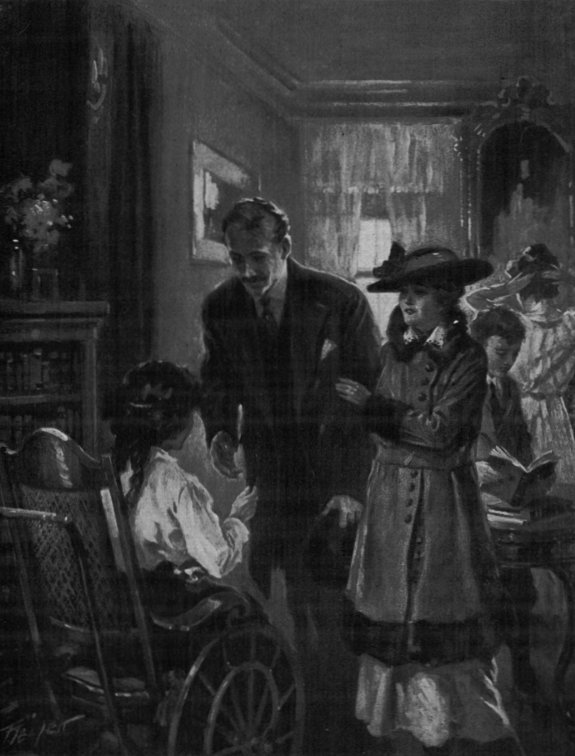
"Ye do well to be askin' afther them dur-rty owld bits of paper filled so full wid ger-rms they was probably fightin' to hang on! I told her I'd bur-rned them up, an' I told the truth. If she don't get the typhoid-new-mon-i-ay, it won't be fur want of hangin' over them mouldy rags day afther day! I been watchin' her, an' don't ye fergit it! She ain't been well this month past—ever fur her. I guess she ain't told ye I'm up wid her the better part of every night wid the pain in her back! Even the docther don't know what's the matter wid her, she's ailin' so much worse lately. I ain't watched her all her life fur nuthin', an' I been watchin' her closer than ever lately, though she didn't guess it. I usually come up them stairs like a rhinoceros-horse—I know that! But I can come up pretty soft when I choose—an' take the time! I seen her draggin' these things out from behind the books, an' shovin' 'em back if she thought any one was comin', an' breakin' her poor back bendin' over 'em, studyin' 'em's though they wus made of gold! An' I says to meself, this has got to stop! So I jest took 'em out the other day an' burned up the whole clamjamfray of 'em. An' ye kin say what ye like about their bein' interestin',—I don't believe it! The dur-rty, disgustin' owld rubbish!" And with this final shot, Sarah turned and tramped heavily out of the room, leaving an astonished and speechless group behind her.
The remaining time that Corinne and her father were there was spent in comforting Margaret. There was no denying that Sarah had finally, definitely, and fatally ruined every hope they had cherished of disclosing to the world a new and startling historical discovery. And Mr. Cameron was more bitterly disappointed than he dared to show. But he tried to cheer Margaret as best he could, and when he came to go, he left her with this pleasant consolation:
"Never mind about the original journal now. That's gone, and no good ever did come of crying over spilt milk! Remember that the mystery remains, just as good as ever it was, and it is still the business of the Antiquarian Club to solve it! I, the latest member, am just as interested as the rest of you. Some day—mark my words!—we're going to fit the pieces of this puzzle together!"
Margaret was far from well, even for her. For two weeks she had been ailing, and appeared weak and listless. Corinne was not very much surprised on coming in one afternoon to find her no longer in her wheel-chair by the parlor window, but upstairs in bed in her room on the second floor. This had never happened before since the day that Corinne had first visited the little house in Charlton Street, and her heart misgave her as she climbed the stairs with the twins. But she entered the room, assuming a cheerfulness she was far from feeling.
"Taking a vacation in bed, Honey? Well, I don't blame you, in such wretched weather! It was sleeting and freezing as I came in, and the walking is simply abominable. How cozy you are here with another open fire! You seem to have one in every room. I wish we did!"
Margaret greeted her with something of her old animation, but presently relapsed into listlessness again. Corinne chatted on for a time, as though nothing out of the ordinary were the matter:
"I've got some news from the latest member of the Antiquarian Club! He has a proposition to make. He says that when the first nice spring weather comes, he's going to invite the club to a series of 'antiquarian outings.' They're to take place every pleasant Saturday afternoon. He will have a big, comfy automobile come here, and we're all to pile in,—Margaret in the comfiest place of all,—and we're going to 'do' old New York—the real, historic parts, I mean. One day we'll take a run up to Van Cortlandt Manor, and see that place, which was Washington's headquarters at one time. Then another day we'll do the lower part of the city, and have lunch at Fraunces' Tavern. And, oh! he's planned a lot of things like that. It's going to be great fun, I tell you!"
But Margaret failed to be roused to any extent even by this delightful prospect, though the twins were thoroughly enthusiastic. At last, when Bess and Jess had gone downstairs to investigate the refreshment proposition, Corinne determined to fathom, if possible, the curious apathy that seemed so new to Margaret.
"Honey, dear," she crooned, sitting on the bed-side and putting her face down by Margaret, "something's bothering you, and I want you to tell me what it is! Something's troubling your mind. Can't you tell me about it, dear, even if you haven't any one else?"
Margaret raised herself on her elbow and faced Corinne. "Yes, something is bothering me," she acknowledged, "and no one but you has seemed to notice it. But I'm going to tell you, Corinne, because I love you, and I haven't any secrets from you. I'm just worried sick because that journal was destroyed! It was my fault. I'm responsible for it all! It might have been very valuable, and been sold for a good deal of money. And that would have helped Mother a lot, because we're not very well off, and she has to work awfully hard!"
"But, Margaret," exclaimed Corinne, "this is all nonsense! Of course, it's unfortunate that the thing happened, but you can't even blame Sarah, for she didn't know it was anything of value, and she thought she was acting for the best, and saving you from getting sick. Nobody's to blame! It's just one of those unlucky things that happen sometimes. It isn't as if you or any one else had been careless about it!"
"But you don't understand me!" insisted Margaret. "It was my fault, because I kept insisting that this thing should be a secret, and nobody else was to be told. It was terribly foolish—I can see that plainly now! And I never should have kept such a valuable thing in such an insecure place. We ought to have shown it at once to your father and let him keep it. Oh, I'll never forgive myself—never, never!" She turned her face into the pillows and lay a long time silent,—not crying, but just in an apathy of self-reproach.
Corinne, meanwhile, argued and pleaded and consoled—in vain. Margaret would neither look up nor respond. And at last, in despair, she exclaimed:
"Margaret, I want to tell you something Father said last night. It may make you feel better about this very thing. He said that even though the original journal was destroyed, that didn't alter the fact that we youngsters had made a most remarkable 'find,' and had discovered a mystery that was well worth tracking to its finish. He says he's proud to be a member of the Antiquarian Club, and hopes you haven't let any one else into the secret. He wants it kept quiet till we've fathomed the riddle, if we ever do! You haven't told any one yet, have you?"
Margaret raised her head, at this, with a faint spark of interest. "No, I haven't even told Mother," she said, "because I hated to have her know how near we'd been to finding something valuable, and then disappointing her by saying it was lost. Of course, we've told her all about your father's visit, and she thought he was so kind to take such an interest in us. She said she supposed it was for your sake. Sarah has never said another word, even to me, about the things she burned up. I think she's half ashamed of it, and yet feels that she really did right in taking away something that she supposed was hurting me. She's awfully worried because I don't seem so well, and she's almost killing herself taking care of me and doing all her other work, too. But, Corinne, did your father say he'd really like this all kept a secret still? That's awfully nice of him, and makes what I did seem not quite so foolish! I believe I'll feel a little better about it from now on!"
Margaret certainly appeared to improve in spirits after this interview, but still her bodily strength did not return, and day after day she remained confined to her bed. Her mother and Sarah grew almost ill themselves with anxiety about her. The doctor said it was the drain of the winter on her frail system, and prescribed a strong tonic, but even this did not seem to have the desired effect. But Corinne came in one day with news that actually brought a tint of pale pink to the little invalid's white cheeks.
"Father's been doing some tall thinking lately," she announced, "and this is the result. He wants me to submit the matter to the Antiquarian Club for due consideration, and would like every member present when I do so. Where are the others?"
The twins and Alexander were promptly gathered into Margaret's room, and Corinne continued:
"This is what Father's been puzzling over. He says that sapphire signet must have been a very valuable thing, and it ought to be found, if there's the slightest possibility of finding it. He knows a lot about precious stones and their history, and he says that a sapphire signet, especially an old one, is a very rare thing. The reason is that sapphires are so hard that it's very difficult to engrave them, and so signets were not very often made of them. So, if this signet were found, it would probably be worth a great deal of money. But, more than that, he thinks we owe it as a duty to the memory of little Alison to make some effort, at least, to find it and restore it to her descendants or family, if she has any left."
"That's what I've always thought, too!" murmured Margaret, parenthetically.
"Well, he says he's been doing some 'Sherlock Holmes' thinking, and trying to imagine where she could possibly have concealed that trinket. He doesn't think she kept it hidden about herself anywhere. She would probably have thought that too dangerous, for she might have been searched. And he can't bring himself to think that she concealed it anywhere about the house or in the grounds,—there would have been such slight chance, in such a case, of it ever getting back to Bermuda, or her relatives ever having a chance to find it. But he did wonder whether it might have been hidden in the secret beam with the other half of the journal. You would surely have found it, then, wouldn't you, Alexander?"
"Bet your life!" replied that youngster, promptly. "If that dinky little do-dab had been in there, yours truly would have cabbaged it all right! I knew well enough it was my last chance at that old dump, and I clawed over every square inch of it a dozen times before I rung off. No sirree! it wasn't there, and you can take your Uncle Dudley's word for it!"
"Then we'll count that out," went on Corinne. "Father didn't think there was much likelihood of it—only a remote possibility. Then there remain only two other possibilities, and he thinks the most likely one was—the old leather covers of the journal!"
"Oh, why did we never think of it ourselves!" cried Margaret excitedly. Then, a moment later, with the droop of disappointment to her mouth: "But if that's so, then it's gone forever—thanks to Sarah! She had a red-hot fire that day, I know, and the thing would have dropped in the ashes and never been found in the world!"
"But how could the signet have been hidden in the cover?" queried Bess, skeptically. "It must have been rather bulky, and we never saw any evidence of such a thing!"
"No," corrected Corinne, "Father says the signet was probably rather flat, and if Alison was at all clever, she could easily have slid it under the lining of one of the covers (which were very thick, if you remember) and pasted it up so it would never be noticed. He says he's known of stranger things than that being done. Anyhow, he thinks that is the place in which she would have been most likely to hide it. And if she did, of course, we have no hope of ever finding it now. But there's one other possibility—and that's our 'last chance'!"
"Oh, what is it?" they all demanded, as she came to a provoking pause.
"The little hair-trunk!"
Margaret raised herself in bed and shouted feebly, "Hurrah!" and then added, "But how in the world are we ever to get at it?"
"That's just the point!" added Corinne. "He says we must devise a way of getting at that trunk, somehow, and since you all are better acquainted with Sarah and her vagaries than he is, he leaves it to you to concoct some plan. If you can't think of any other way, we'd better tell your mother, and have her order Sarah to unlock the attic. But of course that would spoil our secret society, and we won't try that except as a last resort."
"I have an idea!" cried Margaret, suddenly. "I'll ask Mother to-night about the trunk, and beg her to let me have it to keep some of my books and things in, because I've taken a fancy to it. I'm sure she won't refuse me. And if she orders Sarah to let me have the trunk, Sarah'll just have to do it!"
They all agreed that the plan looked exceedingly hopeful, and Corinne left for home with the assurance that the trunk would soon be theirs to search from end to end.
But when Margaret came to talk it over with her mother that night, she met with an unexpected objection.
"Dear heart," said Mrs. Bronson, "you know that I'd do everything in my power to grant you any reasonable wish, but don't you see that your request is a rather inconvenient one at present? You know that you haven't been really well for some time, and Sarah has been working very, very hard taking care of you days—and nights too, often. She's very tired now and has been rather ill-humored lately. Now, I don't know just what she keeps in that little trunk, but I'm perfectly sure that, if I ask her to empty it and change things about in the attic, she won't take it very pleasantly and may make an awful fuss! And we can't afford to have her get upset and leave just now, can we, dear?"
Margaret ruefully agreed, and had to be satisfied with her mother's assurance that perhaps, when she got better, and household matters had smoothed out, Sarah might be approached on the subject.
But this arrangement did not at all suit the rest of the Antiquarian Club when they held a solemn council next day.
"Suffering Simpson!" exploded Alexander. "If we wait for that hunk o' misery, Sarah, to get in a good humor, we'll wait until horse-radish tastes good on your ice-cream! Nix on that!"
"Well, What are we going to do, then?" demanded the others, despairingly.
"Just you leave it to yours truly!" announced Alexander. "I've got a little scheme!"
"Quick! Tell us what it is!"
Alexander gave an impudent wink, and remarked casually: "I'm going to nose out where Sarah keeps the key to the attic!"
"Splendid!" cried Corinne. "And what then?"
"Then—" he finished dramatically, "we're going to have a grand old meeting of the club some day when she's out, and rip the stuffing out of that trunk!"
It had seemed a simple thing, when Alexander announced his plan, and every one supposed it would soon be accomplished. But it turned out to be a harder task than even he had anticipated. With infinite caution he searched Sarah's room and all her belongings when he knew she was safe in the kitchen, and the twins aided him by keeping guard on the stairs. But the key was not there. Next, one night when all the household was abed, he crept down and inspected every shelf and cubbyhole and possible or impossible receptacle in the kitchen and pantry. Neither was it there. Margaret declared that she knew Sarah did not carry it in her pocket, nor did she appear to have anything hanging round her neck.
"Then that lallypaloozer must have swallowed it!" affirmed Alexander, angrily. "But I'll make one more grand hunt in her room this afternoon, if the twins will help me out by watching the stairs. Maybe I overlooked something!"
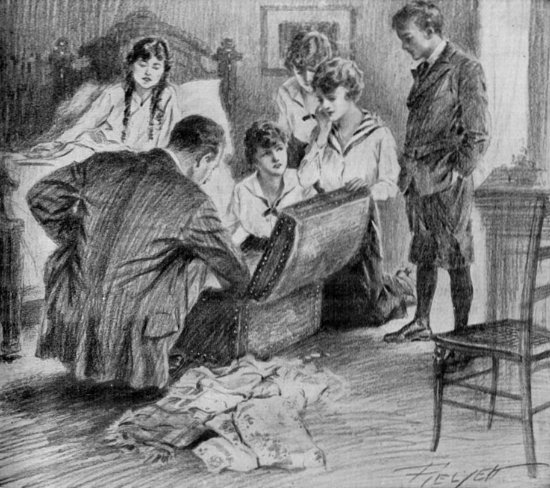
Half an hour later he burst into Margaret's room with a whoop. "Call a meeting of the whole club for next Thursday afternoon—it's Sarah's day out!" he whispered jubilantly. "I found it!"
"Oh, where, where?" demanded Margaret, scarcely believing it could be true.
"In the toe of one of her old shoes!"
On the last Thursday afternoon of each month it was Sarah's custom to go out by herself for three or four hours, leaving the house and Margaret in charge of the twins. This was the only outing she ever took. On the day in question it was understood that Corinne and her father (who insisted on being present at this important meeting) should arrive at three-thirty—after Sarah had gone, or she might, on seeing them, change her mind and stay home! Alexander was then to filch the key from her shoe, open the attic, and, with the help of the twins, carry the trunk down to Margaret's room.
Everything worked smoothly. Sarah departed as usual, Mr. Cameron and Corinne arrived, tingling with excitement, Alexander opened the attic, and the wonderful old trunk was at last deposited in triumph before Margaret's bed. They turned out the family's summer flannels carefully, that no spot or wrinkle on them might in the future disturb the equilibrium of the uncertain Sarah, and examined the false bottom with an actual thrill to think that here, in this very spot, poor frightened little Alison was wont to conceal the telltale journal.
But when the false bottom was removed, there appeared no trace of a jewel (as they had all secretly hoped there might be) nor any crack or crevice where it might be concealed. The old-fashioned lining was absolutely intact. Margaret gave a little sigh of disappointment, but Mr. Cameron remarked:
"Don't be discouraged! We haven't finished yet!" And he began to tap the inside of the trunk all over, carefully, with the handle of his penknife. Then, suddenly, they beheld him open the knife and skilfully slip up the figured lining far in one corner. In another second he had inserted his fingers in the opening and was feeling about eagerly. The next moment he laid something in Margaret's lap, with just this quiet remark:
"At last, Miss President! The sapphire signet!"
There was an instant of amazed silence. Then, at an indistinct sound from downstairs, Bess uttered a horrified cry:
"Merciful goodness! Sarah's come back already! What shall we do!"
It was indeed Sarah! The sound of her latch-key in the basement door was unmistakable. What could have induced her to return when she had been away scarcely more than an hour, they could not imagine, unless it was her anxiety on Margaret's account. At any rate, there she was, and a panic of consternation seized them all. Even the wonderful signet was forgotten in the stress of the moment. Strangely enough, it was Margaret who first regained her poise and grasped the situation.
"Quick!" she whispered. "Corinne and Jess, get those things back in the trunk—any old way! Bess, you go out and call down to ask her what's the matter. Maybe she isn't coming up just yet!"
They got to work in frantic haste, and Bess went out in the hall to make her inquiries of Sarah.
"What's the trouble, Sarah? You're back very early!" they heard her ask. And an answering voice from the basement stairs responded:
"Sure 'tis rare unhealthy weather fur this time of year! 'Twas so war-rm I nearly roasted in me heavy coat—and we not out of winter yet! I come back fur me lighter cape. 'Tis hangin' in the attic!"
"We're lost!" muttered Mr. Cameron as Bess rushed in, despair written all over her face. "Can't any one think of something to keep her downstairs for five minutes?"
And this time it was Alexander who came to the rescue.
"Just watch your Uncle Dudley!" he whispered, as he ambled with apparent unconcern out of the room. "If you hear me call her down, give that trunk the boost to the attic as soon as you can, and put the key back in her shoe."
They heard him leisurely descending the stairs, and Sarah's massive tread approaching nearer and nearer. At one point there came sounds as of a slight scuffle, and muttered remarks of "Spalpeen!" and "I'll fix you yet, young man!" Then Alexander passed on, whistling derisively, and Sarah's heavy feet began the ascent of the second-story flight. Up and up she came, and still nothing happened. Hope died out in the listening group, for they were sure now that, whatever Alexander might do, it would be too late to avert the catastrophe. Sarah had, indeed, just planted a broad foot on the top step when they heard Alexander's shrill voice calling from the basement:
"Oh, Sarah! Sarah! Come quick! There's something afire in the kitchen!"
"Saints save us!" They heard her exclaim, and she turned to descend with a speed of which they had never dreamed her capable.
"Do you think it's anything serious?" whispered Jess to Mr. Cameron. "Oughtn't we go down, too?"
"No indeed!" he laughed. "I guess we can trust Alexander. Fortunately, the trunk is very light, so you girls can get it upstairs while I listen in the hall to see if they need help below."
In five minutes the three girls had the trunk safely back in its place, and the key restored, and were back in Margaret's room, panting from exertion and breathless excitement. But it was at least a quarter of an hour before Alexander came up again, chuckling and smoke-blackened.
"Well, this is one time when we put it all over the lallypaloozer!" he exclaimed jubilantly. "I got that pail of glue I keep in the yard to paste kites with, and put it on the gas-stove as if I was going to heat it. Then I accidentally-on-purpose dropped a lighted match into that big tin thing where Sarah keeps the waste paper and scraps. It made a big blaze, but I knew it couldn't hurt anything, 'cause it's tin all around it. But I raised a hullabaloo like you'd thought the Woolworth Building was going up in blue smoke! It fetched her down, all right, and I figure it'll keep her there a good spell! The gas-stove's all smoky, and she's cleaning it up and growling like a bear, so I beat it up here!"
Then at last, with their minds relieved, did they have their first opportunity to consider their wonderful "find," and they all crowded around Margaret, in whose little white palm it lay. The gold setting at the back was tarnished quite black, but the jewel itself was apparently unchanged. They gave an involuntary gasp as they examined it, for it was even more beautiful than they had imagined. The flat sapphire itself was as large as a big Lima bean, flawless, and curiously engraved with the old-English letter "T," and a crest above it, looking like two eagles holding a sword. The surrounding diamonds were tiny, but finely cut and still brilliant.
"Isn't it almost unbelievable," half whispered Margaret, at last, "to think that right here in my hand I hold the very jewel that cost poor Alison so much pain and trouble! And, oh! to think, besides, that it never got back to Bermuda, after all, and probably she didn't either. It makes me, feel just—sad—somehow!"
"But what are we going to do with it?" demanded Corinne.
Mr. Cameron had been examining the jewel with all the ardor of a genuine lover of antiques. He now spoke very quietly:
"There's only one thing to do, and it's a solemn duty imposed on us by the writer of that poor little journal you found. We must make every effort to discover whether the Trenhams in Bermuda have any descendants or relatives existing to-day. No matter how distant they may be, the signet must be returned to them, for it was Alison's wish. If we should find none, that is another matter. I believe the jewel would then be rightly counted the property of—the Bronsons of Charlton Street!"
The Bronson contingent there present gasped in chorus!
"But how shall we go about hunting up the descendants of the Trenhams?" questioned Corinne. "That'll be a big piece of work, won't it?"
"It probably will, and perhaps a very complicated one, besides," agreed Mr. Cameron. "We had better start our investigations with the Bermuda records, and I'll write down there to the authorities asking how I can get hold of data about the family history. The matter must be dealt with very carefully, because it is really no light affair. I am convinced, even in this hasty examination, that the signet is very rare and of very considerable value, not only because of the stone itself, but of its antiquity. It must not be lightly given away. Its ownership must be proved beyond a doubt. I expect to be extremely busy for the next three or four weeks, and may have little time to give to this matter. But after that, when business slackens, I can give this the attention it deserves. Meantime, I think perhaps it had better be kept in my safe-deposit box at the bank, where it will be absolutely safe. We won't trust this, at least, to Sarah's tender mercies!"
Suddenly Corinne cried out in perplexity: "But this makes our mystery deeper than ever! Do you realize it, folks? What became of poor little Alison, after all? And why were her trunk and her jewel and half her journal found floating about in a wrecked vessel?"
"I tell you, she had to 'walk the plank'!" reiterated Alexander. "I said so before, and now I believe it! It'd make a gorgeous old pirate yarn!"
"She didn't! She didn't!" wailed Margaret. "I won't believe such a thing!"
"Never mind what happened—just yet!" interrupted Mr. Cameron, soothingly. "The Antiquarian Club's going to find out the truth some time—I'm convinced of that!"
It was two weeks later, about the middle of March, when Corinne came in to see Margaret one afternoon with considerable suppressed excitement in her manner. Margaret was still confined to her bed, and, though scarcely so listless as she had seemed at first, she was undoubtedly weaker. Corinne's visits were now her mainstay of pleasure and interest, and she welcomed the girl with a glad little cry.
"I've got news for you, Honey!" said Corinne, laying her usual offering of flowers and fresh fruit on the bed.
"What?" cried Margaret, eagerly.
"Well, you mustn't be surprised, but Father hasn't been a bit well again, lately. The weather's awfully hard on him, and his business has rushed him, too, and he's all run down. So in a couple of weeks he's going to take a vacation and go down to Bermuda again. It did him a lot of good last time. He'll stay at least a month, and longer if he feels like it."
"Isn't that nice!" cried Margaret, with great interest. "I'm awfully sorry he doesn't feel well, but I'm glad he can go to such a lovely place and get better. You'll miss him though, won't you, Corinne, because you seem to be with him such a lot,—more than most girls are with their fathers!"
"No," said Corinne, slowly, "I won't miss him, because—I'm going with him!"
Margaret stared at her a moment wide-eyed, and her chin quivered—just a mere trifle. But she braced up with a visible effort and exclaimed:
"Oh, Corinne! how lovely! You certainly are a lucky girl!" Then the chin began to quiver harder, and all at once poor little Margaret completely lost control of herself, and buried her head in the pillow, sobbing:
"Oh, I am glad! I really am glad for you, Corinne! Don't mind this! Only it just seemed as though I couldn't live without you for so long!"
Corinne gathered the sobbing form in her arms and crooned to her: "You won't have to, dearie, for—you're going along, too!"
Margaret sprang back from her embrace, pushed the tangled curls from her eyes, and gazed at Corinne as though her friend had suddenly gone crazy.
"What?" was the only word she could utter.
"Now, just you let me explain it all," began Corinne, soothingly, settling down on the bed beside her. "And don't you get so excited, because it isn't good for you. I'll tell you the whole story. It was like this. After Father found it was best to go to Bermuda, he made up his mind that Aunt Katharine and I might as well go, too, because he hates to go alone. And, of course, I was crazy to go, but just one thing kept me from being entirely delighted, and that was—you! I hated to leave you, because I love you, and also because you are not at all well just now. Father and I have both been very anxious about you. So we got to talking it over, and suddenly he said: 'Why not invite Margaret to come along with you as your guest! The trip might do her a great deal of good, and I know you two are growing as inseparable as a pair of Siamese twins!'
"Well, you can just warrant I was delighted, for I knew Father'd never make such a suggestion unless he really wanted you, too! He said he would call on your mother at her place of business, and see if she would consent, and also on your doctor, to see if he thought the trip would be advisable. I begged him to make them keep it a secret, so that, if everything went well, I could surprise you with the news when it was all settled. I hated to have you disappointed in case the doctor thought it wasn't wise, or your mother felt that she couldn't consent to your going.
"Your mother was awfully surprised, of course, and for a while she almost refused, because she felt it to be too much for Father to do. But when she found that it was going to do you so much good, and how terribly I wanted you, she gave in. And you needn't worry about being taken care of and having everything done for you that Sarah does. I'm going to do that! It's to be my job, being your lady's maid, and won't I enjoy it! Aunt Katharine will help too, when necessary. She's lovely and kind and gentle, and you're going to like her a lot!
"Honey, we sail a week from next Wednesday, and I can hardly wait for the time to come!"
There was surprise and rejoicing in the Charlton Street house that night when Mrs. Bronson arrived and the great secret became public property. Mrs. Bronson admitted that she had known about it for several days, and was having a pretty outfit of traveling clothes made for Margaret. The twins were frankly delighted, for they had been themselves experiencing much secret anxiety on account of Margaret's precarious health, as indeed had all the household. Alexander gave an Indian war-whoop that was ear-splitting and performed the acrobatic feat of standing on his head in the middle of the parlor floor for three minutes unassisted! The extraordinary racket brought an indignant Sarah up from the kitchen to investigate.
But it was when Sarah heard the news that consternation fell upon the happy household. She placed both hands on her massive hips, threw back her head, squared her shoulders, and announced:
"If Margie puts one fut aboard that rampagin' ship, I go out of this house, never to retur-rn!"
Now, when the autocratic Sarah made a statement of this nature, it was time for the family to tremble! Mrs. Bronson argued, pleaded, commanded—in vain. Sarah could no more be budged from her position than the Rock of Gibraltar. Urged to state her reasons, she would offer but two. And these were that, about forty years ago, she herself had come over from Ireland in a truly "rampagin'" ship, and never again would she trust herself or any one she held dear to the mercies of the ocean. Arguments that ship-building had made some progress and traveling was safer since those days had absolutely no effect on her—in fact, she refused to believe them!
Her second reason was that Margaret had been in her care ever since she was born, and no one else knew so well what to do for the delicate child. She was firmly convinced that it would be the death of her beloved charge to be removed from her oversight. At last the distracted Mrs. Bronson laid the matter aside for the night, the girls retired to bed in tears and indignation, and Alexander dared to shake his fist at the broad back of Sarah departing to the kitchen. Only Margaret remained in ignorance of the impending disaster, and fell asleep happy beyond words.
The next day Mrs. Bronson sent a request to Mr. Cameron to call that evening, for she felt that the situation must be explained to him. It would be a serious matter if Sarah kept her word—as she doubtless had every intention of doing. It also was important, for the sake of Margaret's health, that she should get away and have this wonderful change. Mrs. Bronson was a sorely troubled woman as she explained the circumstances to her visitor. Mr. Cameron sat in deep thought for a few moments. Then he said:
"Could you have your housekeeper come up here for a few minutes and allow me to see her alone?"
Mrs. Bronson declared that it was entirely possible, summoned Sarah, who arrived full of hostile intent, introduced her to the visitor, and went upstairs, leaving them together for a while. Margaret had by this time learned of the trouble, and was nervous and anxious and feverish. Corinne, who had come with her father, was sitting with her, trying to assure her that she need not worry. But the assurance rang hollow in her own ears. She, too, knew Sarah!
Presently they were surprised to hear her heavy footsteps coming upstairs. They passed the door and entered Mrs. Bronson's room. Then, in a moment, they returned, halted, and a singularly changed Sarah stood in the doorway.
"Yer father's goin' now, Miss Corinne, and he wants ye," she announced in a strangely meek, quiet voice. "I'll be back in two minutes to fix me child for the night. We got to get her in good shape before she takes that rampagin' ship for Bermudy!"
That was all, but she actually smiled—a weak, apologetic little smile—before she vanished from the doorway!
The girls stared at each other in complete bewilderment. Never had they witnessed a change more astonishing.
"Well, doesn't that beat everything!" exclaimed Margaret. "What could have happened to Sarah?"
"I don't know," answered Corinne, "except that Father's had a talk with her. He told me, coming over, that your mother had called him up to-day on the telephone, explained some of the trouble, and asked him to call to-night. He said he himself was going to have an interview with Sarah, and I told him it probably wouldn't do any good. But he said he had something that he thought would convince her ladyship pretty speedily. But he also said I was not to ask him what it was! Some time he might tell me, but not at present. Isn't that mysterious! I really didn't think he'd succeed. He evidently has! Hurrah!"
"But what can he have said to Sarah that would make her change around so!" marveled Margaret.
"I'm sure I can't imagine!" cried Corinne. "But never you mind, honey dear! A week from next Friday we step off on the island that was Alison's home! And nothing else matters!"
"It seems awfully queer to me," remarked Bess, sitting in the Charlton Street parlor one afternoon in May, reading a recently received letter with a foreign postmark, "that Margaret says absolutely nothing at all, lately, about whether they've done any work in hunting up clues to the sapphire signet mystery!"
"Neither does Corinne," added Jess, looking over a similarly marked letter that she held. "They've neither one mentioned the subject since they sent up that snap-shot of the Tobacco Rocks some weeks ago. Corinne said then that they'd driven to see them one day, and she had 'snapped' them for our special benefit, because Alexander had discovered that it was from there the stolen gunpowder was shipped. I don't think they had much, if anything, to do with our affair, so I wasn't so much interested in them. I never felt at all convinced that those two happenings had any connection whatever."
"Nor I, either!" agreed Bess. "I wonder whether they have looked up anything about Alison, or whether they've been having such a good time that they've forgotten it completely! My! but I envy them! Here we are in this mussy, foggy, chilly, wretched city,—grubbing along at high, without even time to have a game of basket-ball, lately! And listen to what Margaret says of their surroundings:
"'You never saw such blue, blue water in your life! And the weather's so warm that Corinne and her father have been in bathing several times! I never saw any one swim before! Corinne swims beautifully! It is so lovely in this place that I'm sure Heaven couldn't be any more beautiful. I begin to feel so much stronger! I'm out every day and all of the day! Isn't that wonderful—for me! Mr. Cameron says he feels like a new being, too. We are going to stay two weeks longer, because it's doing us all so much good.'"
"Bless her heart!" cried Jess. "I'm just the gladdest girl that ever was because she could go and is getting on so well. Do you know, I believe she'd have died pretty soon if she'd kept on as she was the last of the winter! I felt perfectly certain then, that she wasn't going to live, though I never told a soul! I was absolutely in despair about her!"
"Same here!" echoed Bess. "I was going through some mental tortures, too, but I wasn't bothering any one else with them! Corinne and her father just saved Margaret's life, I believe. But here's something queer in her letter! I just came to it. She ends by saying:
"'We have two surprises for you, but you are not to know a thing about them till we get home! Oh, I can just see you wiggling with impatience to know what they are! But it's useless for you to beg; not a word will we whisper till we land in America!'
"Now what do you make of that?" demanded the bewildered Bess.
The day came at last, when the travelers were expected to land once more on their native shores. To the twins it had seemed an interminable age—the more so since the intended absence of a month had lengthened itself to ten long weeks. It had taken longer to restore Mr. Cameron's health than he had imagined, and, besides, Margaret had improved so perceptibly that they decided to stretch the time of the trip to the limit.
They had sailed away on a stormy day in March. They were expected back on the rarest kind of a day in June, and the entire Charlton Street household was assembled at the pier to meet the incoming steamer. This had been the request of Mr. Cameron himself, who had written to Mrs. Bronson that, for a sufficient reason, he wished every one of them to be there, including Sarah.
It was four o'clock on a golden afternoon when the Bermudian came steaming slowly up the river, picking her stately course among the heavy ferry-boats and darting tugs that blocked the way. Alexander, from a perilous perch on one end of the pier, announced its coming with a whooping and a waving of his cap, at which Sarah muttered awful remarks, sounding like "Let him drown if he falls over—the young spalpeen!" With beating hearts they scanned the decks as the vessel drew close to the side, and the twins quickly picked out Corinne and her father waving from the side. But of Margaret they could discern not a sign, and an awful dread seized them that she must be too ill to be with the others.
By a special permit, obtained through Mr. Cameron, they had been admitted within the custom-house lines to the very gangway entrance itself. After maddening delays the vessel was at last made fast, the gangways adjusted, and the throngs began to come ashore. It was toward the last that the ones they were waiting for so anxiously appeared at the top, and then it was only Corinne and her father and aunt who came down.
"But, oh! where is Margaret?" cried Bess, as Corinne rushed to embrace her. "Why isn't she with you?"
"Oh, she'll be along in a minute!" announced Corinne, unconcernedly. Then suddenly she turned, and said quietly:
"Look!"
They turned at her command, and glanced upward expecting to see their sister in her usual wheel-chair. Instead, there at the top of the gangway—stood Margaret, rosy, plump, and browned by the sun! And under her arms were a pair of crutches! When she saw her own family below, she blew them a kiss, adjusted her crutches, and proceeded down the gangway alone, haltingly, it is true, but refusing the assistance of the anxious steward who hovered behind her!
To the members of her family, who never in all their lives had beheld her on her feet, the sight was almost overwhelming. The twins and their mother were actually too stunned to speak, and Alexander relieved himself only by a low-muttered, "Can you beat it!"—his favorite expression of surprise. But it was Sarah who did the most astonishing thing. She tore up the gangway, snatched Margaret when she was but half-way down, and bore her back, crutches and all, to the group below, crying:
"Me little darlint! It's true! It's true! I didn't believe it!"
The Charlton Street house was a scene that night of such festivity and rejoicing as it had probably never known before in all its history. Corinne and her father and aunt had accompanied the Bronsons home, and stayed to a feast that Sarah had evolved in some sudden and mysterious manner, for she had been away from the house all of the afternoon. But Sarah was an adept at such bits of necromancy. Then, when the older folks were still talking hard and fast, the five young people drew apart by themselves, and Jess said:
"Now, for goodness' sake, explain the whole business again! My brain is so bewildered I can't seem to understand it all yet!"
It was Corinne who tried to straighten out the tangle. She told how, before they started on their trip, her father had suddenly become possessed with the idea that perhaps something could be done to help Margaret's trouble if only the right physician could be found. It happened that he was personally acquainted with a doctor famous for his success in this very kind of case and who also usually spent a few weeks at that season of the year in Bermuda. If Margaret could be helped by any one in the world, Mr. Cameron felt sure it would be by this surgeon. So he privately made up his mind that the famous specialist should be consulted as soon as they got there. But of this he said not a word to any one, lest it should only be a cause of disappointment in case no good was accomplished.
Corinne laughed, however, when she said there was one exception to this. On the night when Sarah had issued her awful ultimatum, Mr. Cameron made up his mind that the only way to influence her was to tell her, privately, his hopes for Margaret. This he did, and it had the remarkable effect that had so bewildered them. This, also, was the reason why Sarah seemed the least surprised and had said such strange things that day at the pier.
The doctor had been consulted soon after they reached Bermuda and when Margaret had grown a little stronger. His verdict was that with a certain kind of treatment there was a slight hope that she might some day recover the use of her limbs. This treatment she had had during the whole of their stay, with the wonderful result that, two weeks before their return, Margaret took her first steps with the crutches. The specialist himself was returning to New York shortly and would continue his work with her. He was now almost positive that she might, in the course of time, even discard her crutches and walk alone, on her two feet, unassisted, like the rest of ordinary humanity. It was a treat to watch the beaming happiness on Margaret's face while Corinne rehearsed this tale. It spoke more eloquently than any words she could have uttered.
"Well, that's your big surprise!" sighed Bess, contentedly. "And it certainly is a monster one! Now what's the other? You know you wrote that there were two!"
"The other's almost as big!" exclaimed Margaret, her eyes snapping with eagerness. "We've found out the whole history of Alison, and solved every bit of the mystery!"
"No!" cried three of the listeners in astonishment. "Honestly? Tell us—right away! We thought you'd forgotten all about it!"
"No," said Margaret, "I'm not going to tell you just now. To-morrow we'll have a big old meeting of the Antiquarian Club, and we'll give the entire account then! Not a minute before!"
"But did you find the owner of the sapphire signet?" they clamored.
And to this, also, the provoking Margaret would only lay her finger on her lips, and smile, and murmur, "To-morrow!"
"So you thought that because we were having such a good time in Bermuda, we had forgotten all about the mystery!" laughed Margaret, the next afternoon, at the grand assembly of the Antiquarian Club. They were all gathered in the Charlton Street parlor—all but Mr. Cameron. He had, indeed, fully expected to be present, not intending to go to his office till the following day. But unexpected business had called him there, after all, so he could only send his hearty regrets to the meeting of the club. It seemed like old times for the young folks to be together again in this familiar room. The only wonderful difference was in Margaret. No longer was she ensconced in her accustomed wheel-chair, but in a big "comfy" armchair, with her cherished crutches leaning against its arm. No longer did she seem a wan, frail, delicate little invalid, but a brown, rosy, plump, and increasingly energetic young person. But the sweetness of her smile and the shy, trusting expression of her big gray eyes had not changed.
"Yes, I know you all must have thought we'd forgotten it," she went on; "but we hadn't—not for a minute! Only, for several weeks, we didn't seem to make any progress with it at all. We used to inquire of every native Bermudian we met if he or she had ever heard of any one living there by the name of Trenham; but no one seemed to have any ideas at all about it. They'd say they hadn't heard of the name themselves, but would always refer you to some one else, who would turn out to know as little as they did! It was awfully discouraging! Finally, Mr. Cameron suggested that the only way would probably be to go around to all the different parish churches and consult the old parish registers for the lists of births and marriages and deaths. He thought the name had probably died out long ago, and perhaps no relatives or descendants remained, or were even remembered.
"Well, this seemed a big piece of work, of course, and none of us felt quite like attempting it just then, for Mr. Cameron wasn't yet a bit well himself, and I was having treatments every day with the big doctor in Hamilton. So we decided to put it off for a while. And then—meantime—a very unexpected thing happened!
"You know, we were staying at a big hotel about four miles from Hamilton, near Harrington Sound. Mr. Cameron likes it there because it's out of the city, well away from everything distracting, like the things going on in Hamilton. Part of this hotel is big and new, but another section, where the dining-room is, has been standing for over two hundred years. You can see how old it is by its very looks, and we heard that it was really the old homestead of the proprietor's ancestors.
"The housekeeper is a dear, kindly lady, and we got rather well acquainted with her, because often we had to ask her for different and rather unusual things for me. She was just lovely to me, always, and after a while we had some long, interesting talks with her about Bermuda and the different families living there. And once she took us up to her own apartments, in the old part of the house, and showed us a collection of the most wonderful old furniture and antiques that had been in her own and her husband's families since way, way back. Corinne and her father went just wild over them, for you know how they love antiques!
"Well, one day we thought we'd ask her if she'd ever heard of any one on the island by the name of Trenham. She said no, she hadn't, but, if we were interested to find out, she'd take us over to the South Shore to see a very old lady there who knew lots and lots about Bermuda history and former people. She said she was driving to Hamilton that morning on some business, but would first take us over to the Jewell Farm, introduce us to old Mrs. Jewell, go on to Hamilton, and come back to get us later. She declared that the old lady would be delighted to have us come, because she was blind now and had very little to entertain her, and she loved to talk to people.
"This seemed too good a chance to lose, and Corinne and I accepted at once. Mr. Cameron had gone off on a fishing-trip, so he couldn't be included. We piled into the big, comfy carriage, and you ought to see that great, strapping driver lift me in and out and carry me around! Well, we got to the Jewell Farm over on the South Shore, and, oh, folks! how I wish you could all see that place! It's simply the most charming old house—two hundred and fifty years old!—set high on a hill overlooking that marvelous blue ocean, with a garden all around it that is like the things you dream about! We took some pictures of the house and garden which I'll show you later, but they don't do it anything like justice. You can only get a faint idea of its real beauty!
"And the whole house, inside, was filled with the dearest old-time furniture! It nearly set Corinne crazy! But never mind about all that now—we must come to the best part! The driver carried me in, and we were introduced to the sweetest old lady you ever saw! She was nearly ninety-five, with snow-white hair; and a dainty lace cap over it. Her eyes were pretty and blue, and you'd hardly guess, to look at her, that she couldn't see a thing. If she'd known us all her life, she couldn't have received us more cordially, or seemed less surprised to have complete strangers landed on her without any warning. She made us feel at home and acquainted right away, and after a few moments the housekeeper left us alone with her and went on to Hamilton.
"We didn't like to introduce the subject we were most interested in right away, so we chatted with her about her lovely old home, and the furniture in it, and its history. After a while, though, when we could bring it in naturally, we asked her if she had ever known any one by the name of Trenham in Bermuda. She gave the most curious little start, but only said very quietly:
"'I would like to know why you ask? Whom do you know of that name?' Well, Corinne and I looked at each other and I saw we were agreed that it was time to make a bold move, so I said right out that we were very much interested in some one who lived in Bermuda a long while ago and whose name was Alison Trenham.
"Folks, if I live to be a hundred, I'll never forget the strange expression that came over that old lady's face when I spoke that name! For a minute or two she didn't answer—just sat quietly thinking. Then at last she said, still very quietly:
"'Yes, I know the name! I have heard of only one Alison Trenham in my life, and that was—my grandmother!'"
There was a gasp and a start from her listeners, and Margaret laughed as she continued:
"You'd just better believe we jumped, too! And I thought Corinne's eyes would pop out of her head—she looked so startled! I just couldn't help smiling to myself at her expression, though I was so deep in other things. Then I said:
"'Well, Mrs. Jewell, since you do know an Alison Trenham, and she was your own grandmother, I guess we'd just better tell you our whole story. For the two Alisons may turn out to be the same!' Then, as quickly as I could, I told her all about finding the trunk and the journal, and our Antiquarian Club, and all the discoveries we made afterward, and how we'd come to a snag and could get no further. I even told her how Sarah had burned the original journal. But I didn't say a word about the sapphire signet—just then. I wish you could have seen the expression on her face all the time I was talking! It was as though she were listening to a story so strange that she couldn't believe a word of it! I ended by begging her, please, if she could throw the least light on our mystery, to oblige us by doing so, as it was the chief aim of our Antiquarian Club to find the key to the riddle!
"She was silent a long time after I had finished—so long that we were beginning to think she must have fallen asleep, for she had covered her eyes with her hand, and was leaning her elbow on the arm of the chair. But suddenly she spoke, saying very low:
"'All this seems like a dream to me! You children have stumbled upon a secret that I supposed no mortal would ever discover in this world! The ways of chance are very mysterious! Yes, it is the same Alison; and since you know so much, I am going to tell you the rest of the story, though she made me solemnly promise, when I was a young girl, that I would never tell a soul. That is why I was hesitating. But I feel certain that, were she to know these circumstances, she would have no real objection to your knowing the whole story. It can harm no one now—least of all herself!
"'As I told you, she was my grandmother. I was born in 1820, and she was then a woman sixty years old. My own mother and father died in my infancy, and left me to her care. This was her home, this same old farm, and I came here to live with her. We are a long-lived race, here in Bermuda, and she lived on to be almost ninety-five, as I myself am doing! A few years before she died she told me that she had something on her conscience that she would like to tell me, because she felt that she would die happier, knowing that she had not kept the secret unconfessed to the end. She made me promise I would never disclose it, as some of it had once been of political consequence, and she had always feared its discovery.'
"And now, folks, I'm going to tell you the story of Alison in my own words, because I can't remember all of hers!" ended Margaret. Then she re-settled herself in her big chair and began anew, very much flattered by the breathless attention of her auditors.
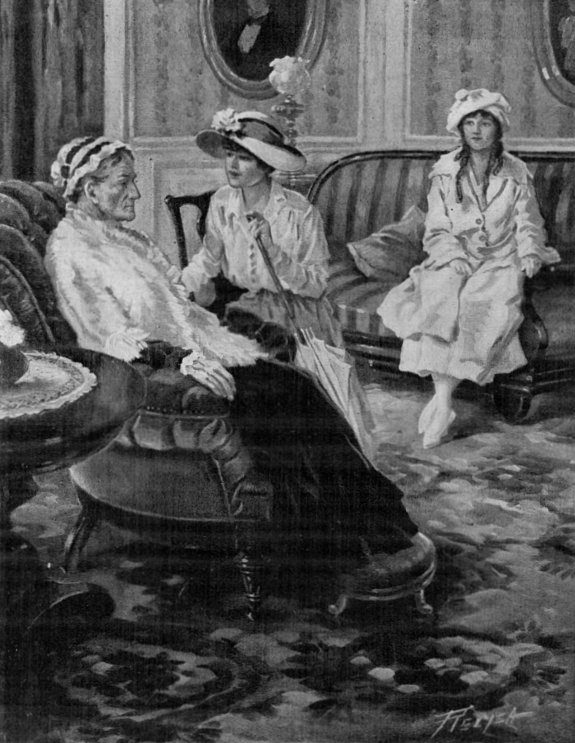
"Alison Trenham lived on this same old farm with her grandfather, Archibald Trenham. Her parents had both been lost at sea when she was little, and that's why she was living with him. He was a queer, crabby sort of an old man, and had never loved Alison because he was so disappointed she hadn't been a boy. She was a big, beautiful-looking, athletic girl, and he had had her taught to ride, and swim, and sail a boat, and do most of the things boys generally do, besides learning to read and write and some Latin and French. It was his whim that she should be educated like a boy, even if she wasn't one.
"But she was restless and discontented and headstrong, and hated her life there with her grandfather, and wanted the worst way to go away from Bermuda altogether and see some of the world. She had an aunt, a Madame Pennington, living down at Flatts (that's right where our hotel was), and a cousin Betty, and she was very fond of them both. The aunt was like a mother to her, and spoiled her a lot. Well, Alison confided to her aunt that she wanted to go away from Bermuda, but that her grandfather wouldn't hear of it. And she said she was so crazy to go that sometime she was going to run away!
"The aunt was very much shocked, but finally Alison begged her so hard that she consented to write to a friend of hers in New York, a Madame Mortier, and get her to invite Alison up there for a long visit. Madame Mortier wrote back that she would be delighted to have Alison come, especially as her husband had just lately died and she was very lonely. So that much was arranged, and Alison was delighted. But the difficulty was to get away from Bermuda without her grandfather knowing, for he would never have consented. Alison discovered a way out of this herself, and here comes the exciting part! Alexander, you were right, after all, as you'll see in a moment!"
"Oh, your Uncle Dudley's right sometimes," grumbled that irrepressible youngster, trying to conceal his satisfaction.
"Now, to go on. One day Alison happened to meet, quite unexpectedly, a neighbor of theirs, a young fellow named Harrington Ord—"
"'H'!" shouted the listening ones, simultaneously.
"Yes, you're right! that was 'H'! He had been away on a cruise with his uncle, George Ord, in his uncle's ship, the Lady. Harrington said they had only touched at St. George's for a day or so to take on a cargo of salt, and would then be off again for America. Then Alison saw her chance. She begged Harrington to ask his uncle if she might be taken aboard to go with them without letting her grandfather know. She knew the uncle and her grandfather had some standing quarrel between them, and that George Ord would not be sorry to do anything to get the best of the old man. Harrington hesitated about it, then finally confided to her the news that his uncle was engaged in a strange plot—"
"The gunpowder!" exclaimed the audience.
"Yes, the very thing! Alexander was exactly right in his guess! George Ord was planning to steal the gunpowder the very next night, and all the details were arranged except one thing, and that was puzzling them all dreadfully. It was this: the governor slept with the keys of the magazine under his pillow, and how to get at them without disturbing him, nobody could think. Some one had suggested putting a heavy sleeping-powder in his food, but that was all but impossible, as no one knew any of his servants or could get into his kitchen. Harrington had the powder in his pocket, and, at his wits' end, he showed it to Alison. She had an idea right away. She told him to give it to her, and she would see that it got to its proper destination all right, if, in return, his uncle would take her secretly to America.
"He declared that his uncle would be only too delighted to reward her in that way, and everything was arranged. She was to go next day to her aunt's as if for a week's visit. That same afternoon she would take a little cat-boat and sail by herself up to St. George's, and be taken aboard the Lady at sundown, as she was setting sail, and when no one was observing. But first she intended to stop at the governor's mansion and make a call on his niece, whom she knew rather well.
"Everything went off like clockwork! Her grandfather suspected nothing. She got to her aunt's and bade her good-by, sailed up to St. George's in her little dinghy, called on the governor's niece, and, before she left, went down to the kitchen to see the colored cook Dinah, who was a sister of her grandfather's cook and was rather fond of Alison. She found, just as she had expected, that Dinah was preparing the governor's little afternoon snack of cake and a glass of wine. When Dinah wasn't looking, she quietly dropped the powder in the wine, and the game was won! Later, as she went out, she saw him drinking it.
"Well, the governor slept like a log that night, and you all know how successful the rest of the scheme was! Captain Ord was so grateful to Alison that he couldn't do enough for her. He landed in New York, and Harrington escorted her to Richmond Hill, the home of Madame Mortier. The old song, 'The Lass of Richmond Hill,' was very popular just then, and Harrington kept teasing Alison by whistling and singing it constantly, and saying she was now that 'lass'!
"Madame Mortier was lovely to her at first, and seemed delighted to have her there. But Alison didn't have a very lively time, because Madame Mortier lived a very secluded and quiet life, and her house was way off from the city, and she never went anywhere. And Alison found out, too, that she was a strict Tory, and hated Washington and the rebels, and felt very bitter about the war that was just commencing. Now, Alison had heard a lot about Washington from Captain Ord and Harrington, who both admired him terrifically, and she herself had begun to feel a great respect for the rebel leader. But when she spoke in praise of him, one day, Madame Mortier just 'jumped on her,' as Alexander would say, and almost went crazy denouncing him.
"Well, by and by Alison began to feel dreadfully lonely and homesick, and just longed to go back to Bermuda, and wished she'd never come away! But getting back was more difficult than coming to New York. She didn't like to tell Madame Mortier she was tired of her and wanted to leave, for she had been invited to stay a year, at least, as a companion to the old lady. Then something happened that changed the whole face of affairs for her—two things, in fact!
"A sailor from Captain Ord's ship turned traitor some months after the gunpowder affair, and in Corbie's tavern let it all out and told how Alison had been mixed up in the plot,—or at least, that he suspected she was, for he didn't actually know about her drugging the governor. This got round to the steward, whom we all know about, and finally was hinted at by him to Madame Mortier. She began to treat poor Alison very coldly and suspiciously, without, however, telling her the real reason. She evidently thought Alison was some kind of a spy! And Alison never guessed the reason till Harrington gave her the hint that night under her window.
"Anyhow, that was when she first began to feel uneasy, and as if things had changed in the house and she was not altogether safe there. But the climax came when one stormy winter day she and Madame Mortier were driving home along Greenwich road and saw ahead of them a coach whose wheel had come off and whose horses were snorting and kicking with fright. The driver could seem to do nothing with them. Alison got out, rushed to the horses, and held them steady till they quieted down. She knew horses well and just how to treat them. Then, while the wheel was being adjusted, she spoke to the occupant of the coach, who proved to be none other than Lady Washington!
"She was traveling through the city on her way from Virginia to her husband's camp outside Boston when the accident happened. She congratulated Alison on her skill with horses, and asked her about herself. Alison was just beginning to tell her about Bermuda and how she longed to go back, when Madame Mortier, who had just learned about the occupant of the broken coach, rushed up and dragged her bodily away! And then things got worse and worse!
"Now, there's no need of telling you all that happened after that because we know it; so I'll skip at once to the night of that last entry in the journal, and explain how it came to be so mysteriously broken off. While Alison was sitting there writing, she suddenly heard again the mysterious footsteps, just as she had that time before. She was horribly nervous, but she suspected something wrong and crept to the door and opened it to peep out. And there, sure enough, was the steward, come back from Corbie's tavern, and evidently going down to the cellar again! Alison was scared to death, but, almost unconsciously, she found herself creeping after him, her journal still in her hand.
"Suddenly on the stairs something made him turn—and he saw her! Before she could cry out he made one leap and clapped his hand over her mouth. Then with the other he tried to get hold of the journal. She began to struggle and twist, and try to keep it away from him, and he whispered that if she made a sound he would kill her right there! Still she kept struggling, but at last he got hold of it and gave it a wrench. Of course it came in half, and at the same moment she got free from him and ran like mad to her own room and locked herself in.
"She hid the half of the journal she had kept hold of in the bottom of her trunk, and stayed for hours shivering with fright and listening at the door. Then, at last, not hearing anything more, she crept out, and rushed to Phœbe's room, and told her all about it. They decided that it was best to wait no longer, but tell the whole thing to Washington at early dawn, and let him take matters into his own hands. They had the interview, and Washington acted on the matter at once. He got his life-guard, Thomas Hickey, made him confess the whole thing, and then sent out and had every one of the conspirators arrested. Strangely enough, the steward was nowhere to be found. He had disappeared completely, and was never seen or heard of again. He had probably thought it wise to take flight in the night. Alison always thought, too, that he was intending to run away when he did, anyhow, without warning any one, because he had appropriated a lot of the gold and money that was to be used in paying the conspirators. That was what he had kept hidden in the beam, and he had removed it all that very night, preparatory to making off with it.
"Early that morning, Washington sent Phœbe back to the city to stay with her father, as she would be safer there. And as he thought the house no longer a safe place for his wife, either, he arranged to despatch her at once with a strong escort to Philadelphia. Alison had told him her own story, explained how she aided in the gunpowder plot, and begged him to send her back to Bermuda if he could. He was so grateful to her for the assistance which she had twice given that he told her he would send her to Philadelphia with Lady Washington, and there would arrange that she should sail for her home as soon as was possible.
"So Alison packed her little trunk, and without even bidding Madame Mortier good-by (for of course she didn't dare see her) she left that morning with Lady Washington, and never again in all her life looked upon Richmond Hill. In Philadelphia she was fortunate enough to catch a vessel sailing at once for Bermuda, but before she got to her home one other accident was to happen to her. The ship ran into a terrific storm and was completely dismasted. It almost foundered, but, after drifting around helplessly for more than a week, the passengers and crew were at last rescued by another vessel, leaving all their belongings behind on the wreck, and finally were landed in Bermuda.
"She went straight to her aunt first, for she did not dare go to her grandfather, thinking he had never forgiven her for running away. But her aunt told her that her grandfather, though terribly angry with her at first, was now very, very ill, and kept constantly calling for her. So she returned to him and was forgiven, and nursed him tenderly till he died, leaving her the fine old farm. A few years later she married Harrington Ord, for he had always admired and loved her. He died, in later years, by falling from the mast of the vessel of which he was captain, and Alison was left alone with one daughter, who also married, after a time, and it was her daughter, old Mrs. Jewell, who told us the story. Alison lived all her life in secret terror lest her part in the gunpowder plot should ever be discovered by the Bermudians, for she felt that she had been disloyal to her country in the part she played. Yet she never wholly regretted it, because of the intense admiration she always felt for Washington, and her gratitude to him for his timely rescue of her. Madame Mortier died soon after her departure, and never knew about the defeat of her beloved Tories.
"So that is the end of the story, folks, and I guess I've explained everything!"
"No, you haven't!" said Alexander promptly. "What about that half of the diary that we found in the beam! Put us wise to that!"
"Well, of course, that's one of the things we can't be absolutely certain about, but can only guess at. The steward had gone off with that half, and Alison never saw it again. She always wondered what became of it. We think, though, that the steward must have come back that night looking for the slip of paper that he had forgotten or lost. He evidently thought it might be left in his hiding-place, and was on the way to hunt it up. Then he had the encounter with Alison, and got hold of that half of her diary. He must have taken it to the cellar, examined it hurriedly, written on it that mysterious sentence, and thrown it into the opening where he hid his things. Probably he looked for his paper, and, not finding it, thought he'd dropped it elsewhere. We think likely he didn't suspect that any one had discovered the place in the beam. That's the only explanation that seems possible."
"Yes," objected Alexander, still unconvinced, "but how came it to remain there all that time untouched? Didn't they go and search the beam afterward? Didn't any one else ever know about it?"
"No, it seems that Phœbe and Alison, in their hurry that morning, did not think to tell Washington where they had found the paper. They didn't have time—everything had to be done so quickly. They just gave it to him and told who the conspirators were. Then Phœbe was sent right off, and Alison went away, too, and, of course, nobody else ever knew about it or suspected it. So it lay through all the years till Alexander unearthed it! Isn't it too wonderful!"
"Then that gink of a steward must have beat it out for keeps!" commented Alexander. "Guess he didn't think it'd be healthy for him to shine about those parts again, after he'd got away with all the swag! He was some pippin, he was!"
"Well," ended Margaret, "now you know all the mystery and the history of Alison Trenham, and I hope you're satisfied!"
"Satisfied!" ejaculated Bess, sitting up very straight. "When you haven't said one word about the sapphire signet—the most important thing of all? I guess not!"
"I was wondering when you'd begin to be curious about that," commented Margaret, with her tantalizing smile. "Since you seem a little anxious on the subject, I'll go on with the second half of the story. Well, as I've hinted, we didn't say a word about the signet to the old lady, and she didn't mention it in her account either. But when she had finished, Corinne asked her if there was anything else she knew of that had troubled Alison's mind—whether she'd ever heard her grandmother speak of something she'd lost. And at that Mrs. Jewell looked awfully surprised, and said no, her grandmother had never spoken of anything else, and what did we mean?
"Then we told her all about the signet, and how we'd found it, and how valuable it was, and how we wanted above everything to return it to Alison's descendant, and were so glad we'd found her at last. Well, if you'll believe me, Mrs. Jewell looked simply stunned for a while, as if she couldn't trust her senses! And we had the hardest time convincing her that the signet was really hers and she must take it. She insisted it ought to be ours, since we had found it. But finally we managed to convince her that she was its rightful owner, and told her that Mr. Cameron would get it from the safe at the hotel and bring it over to her the next day."
"But why do you suppose Alison never told her about it?" interrupted Jess.
"That's just what we all couldn't fathom for a while, till at last Mrs. Jewell explained it in this way. Of course, when Alison was shipwrecked and rescued, she naturally supposed her trunk went down to the bottom of the ocean with the wreck. She told her grandmother that they had had to cling to the decks for several days, and never dared to go down to the cabins, for most of them were full of water. So she couldn't get at her trunk to take out anything. We think that when she realized that the signet was lost forever, and after her grandfather had forgiven her for everything (including that, no doubt), she just forgot all about the matter and either didn't think of it again, or else didn't want to. What troubled her most was the fear that the second half of her journal would sometime be discovered and deciphered, and she, perhaps, be considered a traitor for twice giving aid to Washington.
"But now listen to the best part of the story, which comes last! We had asked Mrs. Jewell to say nothing just yet about what we'd told her, and when the housekeeper came back for us, the old lady bade us good-by as calmly as though we hadn't just given her the surprise of her life. But on the drive to the hotel we asked a few questions about her and found out, to our astonishment, that old Mrs. Jewell was really in very straitened circumstances. For years she had supported herself by doing the most beautiful lacework, and had earned enough to live on. But since her blindness came, her money had gradually disappeared, and she had had to borrow on the farm and the lovely old furniture. The housekeeper said she was afraid it wouldn't be long before she would lose everything. Every one was so sorry for her and wanted to help, but she was very proud and would accept nothing from them. No one could imagine what she would do when she was homeless.
"It set us thinking hard, of course, and we told Mr. Cameron about it that night. He only said we must leave it to him, and he'd think out a scheme. Next day we three drove over there with the signet, and placed it in old Mrs. Jewell's hands. And right then and there Mr. Cameron told her that, if she cared to sell it to him, he'd be only too delighted to buy it. And he offered her enough to keep her living comfortably for the rest of her days.
"You should have seen that poor old lady's face! She begged and protested that he should not give so much, that she could not accept it. But he assured her that he knew positively it was the real value of the signet, and to prove it, read her a letter he'd received from some authority in such things. She gave in at last, and we left her with that big, fat check in her hands—the happiest woman in all Bermuda!"
"But what has become of the sapphire signet?" demanded her listeners, as Margaret paused.
"Here it is!" said Corinne, quietly, and she pulled from under the neck of her dress a thin golden chain. There on the end dangled the wonderful sapphire signet, more beautiful than ever since it had been cleaned and polished.
"Father has given it to me, and I'm going to keep it always, in memory of the long-ago Alison and the strange way we stumbled on her mystery. I shall not wear it all the time, for it's too rare and valuable to run the risk of losing. But I put it on to-day in honor of the most satisfactory meeting the Antiquarian Club ever held!"
It was about noon of a day a week or two later that Corinne and Margaret stood together at the open window of the Charlton Street parlor. A light breeze flapped the awnings to and fro, a warm midday sun shone on the pavements outside, and the droning sound of busy Varick Street came distantly to them as they stood looking out. The twins were still at high school, but Corinne had not returned there, as she was expecting to study up during the summer and in the autumn pass the examinations she was now missing. So, during these idle days, she spent the greater part of her time with Margaret. Since their long Bermuda weeks together, they had grown into even closer intimacy, and sisters could not have loved each other with deeper devotion.
Leaning on her crutches, Margaret idly plucked the dead leaves from a geranium in the window-box, and Corinne stood twisting one of the younger girl's dark curls around her finger. Presently she said:
"Father had a letter from old Mrs. Jewell this morning. She says words would be impossible to describe how happy she is. She thinks it just marvelous that we girls were led to do what we did, for she was in desperate straits when we first came. She declares she would never have accepted it as a charity, but it was really help from her own dead kindred sent through us. She considers it an absolute miracle!"
"Isn't it strange!" began Margaret. "That's the exact word Mother used last night when we were talking it over. She said it all seemed like a miracle to her—the way you came into our lives, and walked straight to the heart of the mystery that very first day; the way we worked it all out and restored what was her own to Alison's granddaughter just in the nick of time; and best of all, what's happened to me!"
"Well, I wasn't left out in the miracle way, either," laughed Corinne; "for I've had the loveliest adventure imaginable, and made the very dearest friend of all my life!" She squeezed Margaret's hand, and the two girls looked for one long, understanding moment into each other's eyes. After a quiet interval Corinne spoke again:
"Margaret, there's something I never told you! No one but Father knows it. But I'm going to tell you now. Do you know what I plan to be when I am older?"
Margaret looked up at her in quick interest, and said: "No! Tell me!"
"Well, it's my ambition to be a writer. Father says I have some gift in that direction, and I am constantly practising at it. But, after I've learned how and can really write what people might like to read, the first story I'm going to tell is the one about Alison Trenham and the wonderful way she helped to rescue Washington at the time he was in such danger!"
"Oh, that's perfectly splendid!" cried Margaret. "I wish I could do something like that, but I'm afraid it isn't in me. Shall I tell you my chief ambition, Corinne? I want to get so strong that I can join a basket-ball team—and beat the twins at it!"
"Bless your heart, Honey!" exclaimed Corinne, "you're going to be the captain of that team, I'll be willing to wager!"
Just at that moment Alexander came swinging down the street on his way home to luncheon, whistling the tune that had come to be such a momentous one in their lives. Margaret smiled as she heard it, and suddenly turned to her friend:
"Corinne, I want you to promise me something! When you come to write the story of Alison, I want you to call it 'The Lass of Richmond Hill'! I think that would be the most appropriate title for it. Will you?"
Corinne thought it over a moment, then she said, slowly: "Yes, I think you 're right! I promise to call it—'The Lass of Richmond Hill'!"
THE END
Apparent typographical errors have been repaired.