 THE PLANCHETTE
This little gyrating tripod is proving itself
to be something more than a nine
days’ wonder. It is finding its way into
thousands of families in all parts of the land.
Lawyers, physicians, politicians, philosophers,
and even clergymen, have watched eagerly its
strange antics, and listened with rapt attention to
its mystic oracles. Mrs. Jones demands of it
where Jones spends his evenings; the inquisitive of both sexes are soliciting
it to “tell their fortunes;” speculators are invoking its aid in making
sharp bargains, and it is said that even sagacious brokers in Wall Street
are often found listening to its vaticinations as to the price of stocks on
a given future day. To all kinds of inquiries answers are given, intelligible
at least, if not always true. A wonderful jumble of mental and
moral possibilities is this little piece of dead matter, now giving utterance
to childish drivel, now bandying jokes and badinage, now stirring
the conscience by unexceptionably Christian admonitions, and now uttering
the baldest infidelity or the most shocking profanity; and often
discoursing gravely on science, philosophy, or theology. It is true that
Planchette seldom assumes this variety of theme and diction under the
hands of the same individual, but, in general, manifests a peculiar facility
of adapting its discourse to the character of its associates. Reader,
with your sanction, we will seek a little further acquaintance with this
new wonder.
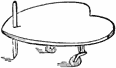
The word “Planchette” is French, and simply signifies a little board.
It is usually made in the shape of a heart, about seven inches long and
six inches wide at the widest part, but we suppose that any other shape
and convenient size would answer as well. Under the two corners
of the widest end are fixed two little castors or pantograph wheels, admitting
of easy motion in all horizontal directions; and in a hole, pierced
through the narrow end, is fixed, upright, a lead pencil, which forms the
third foot of the tripod. If this little instrument be placed upon a sheet
of printing paper, and the fingers of one or more persons be laid lightly
upon it, after quietly waiting a short time for the connection or rapport
to become established, the board, if conditions are favorable, will begin
to move, carrying the fingers with it. It will move for about one person
in every three or four; and sometimes it will move with the hands of
two or three persons in contact with it, when it will not move for either
one of the persons singly. At the first trial, from a few seconds to
twenty minutes may be required to establish the motion; but at subsequent
trials it will move almost immediately. The first movements are
usually indefinite or in circles but as soon as some control of the motion
is established, it will begin to write—at first, perhaps, in mere monosyllables,
“Yes,” and “No,” in answer to leading questions, but afterward
freely writing whole sentences, and even pages.
For me alone, the instrument will not move; for myself and wife
it moves slightly, but its writing is mostly in monosyllables. With my
daughter’s hands upon it, it writes more freely, frequently giving, correctly,
the names of persons present whom she may not know, and also
the names of their friends, living or dead, with other and similar tests.
Its conversations with her are grave or gay, much according to the
state of her own mind at the time; and when frivolous questions are
asked, it almost always returns answers either frivolous or, I am
sorry to say it, a trifle wicked. For example, she on one occasion
said to it: “Planchette, where did you get your education?” To her
horror, it instantly wrote: “In h—l,” without, however, being so fastidious
as to omit the letters of the word here left out. On another occasion,
after receiving from it responses to some trival questions, she
said to it: “Planchette, now write something of your own accord without
our prompting.” But instead of writing words and sentences as was
expected, it immediately traced out the rude figure of a man, such as
school children sometimes make upon their slates. After finishing the
outlines—face, neck, arms, legs, etc., it swung around and brought the
point of the pencil to the proper position for the eye, which it carefully
marked in, and then proceeded to pencil out the hair. On finishing this
operation, it wrote under the figure the name of a young man concerning
whom my daughter’s companions are in the habit of teasing her.
My wife once said to it: “Planchette, write the name of the article I
am thinking of.” She was thinking of a finger ring, on which her eye
had rested a moment before. The operator, of course, knew nothing of
this, and my wife expected either that the experiment would fail, or else
that the letters R-i-n-g would be traced. But instead of that, the instrument
moved, very slowly, and, as it were, deliberately, and traced an apparently
exact circle on the paper, of about the size of the finger ring she
had in her mind. “Will you try that over again?” said she, when a similar
circle was traced, in a similar manner, but more promptly. During
this experiment, one of my wife’s hands, in addition to my daughter’s,
was resting lightly upon the board; but if the moving force had been
supplied by her, either consciously or unconsciously, the motion would
evidently have taken the direction of her thought, which was that of
writing the letters of the word, instead of a direction unthought of.
While Planchette, in her intercourse with me, has failed to distinguish
herself either as a preacher or a philosopher, I regret to say that
she has not proved herself a much more successful prophet. While the
recent contest for the United States Senatorship from the State of New
York was pending, I said to my little oracular friend: “Planchette, will
you give me a test?” “Yes.” “Do you know who will be the next U. S.
Senator from this State?” “Yes.” “Please write the name of the person
who will be chosen.” “Mr. Sutton,” was written. Said I, “I have
not the pleasure of knowing that gentleman; please tell me where he resides.”
Ans. “In Washington.”
I do not relate this to disturb the happy dreams of the Hon. Reuben
E. Fenton by suggesting any dire contingencies that may yet happen
to mar the prospect before him. In justice to my little friend, however,
I must not omit to state that in respect to questions as to the kind
of weather we shall have on the morrow? will such person go, or such
a one come? or shall I see, or do this, that, or the other thing? its responses
have been generally correct.
To rush to a conclusion respecting the rationale of so mysterious a
phenomenon, under the sole guidance of an experience which has been
so limited as my own, would betray an amount of egoism and heedlessness
with which I am unwilling to be chargeable; and my readers will
now be introduced to some experiences of others.
A friend of mine, Mr. C., residing in Jersey City, with whom I have
almost daily intercourse, and whose testimony is entirely trustworthy,
relates the following:
Some five or six months ago he purchased a Planchette, brought it
home, and placed it in the hands of Mrs. B., a widow, who was then
visiting his family. Mrs. B. had never tried or witnessed any experiments
with Planchette, and was incredulous as to her power to evoke
any movements from it. She, however, placed her hands upon it, as directed,
and to her surprise it soon began to move, and wrote for its first
words: “Take care!” “Of what must I take care?” she inquired.
“Of your money.” “Where?” “In Kentucky.”
My friend states that Mrs. B.’s husband had died in Albany about two
years previous, bequeathing to her ten thousand dollars, which sum she
had loaned to a gentleman in Louisville, Ky., to invest in the drug
business, on condition that she and he were to share the profits; and
up to this time the thought had not occurred to her that her money
was not perfectly safe. At this point she inquired: “Who is this that
is giving this caution?” “B—— W——.” (The name of a friend of hers
who had died at Cairo, Ill., some six years before.) Mrs. B. “Why! is
my money in jeopardy?” Planchette. “Yes, and needs prompt attention.”
My friend C. here asked: “Ought she to go to Kentucky and attend
to the matter?” “Yes.”
So strange and unexpected was this whole communication, and so
independent of the suggestions of her own mind, that she was not a little
impressed by it, and thought it would at least be safe for her to make
a journey to Louisville and ascertain if the facts were as represented. But
she had at the time no ready money to pay her traveling expenses, and
not knowing how she could get the money, she asked: “When shall I
be able to go?” “In two weeks from to-day,” was the reply.
She thought over the matter, and the next day applied to a friend
of hers, a Mr. W., in Nassau Street, who promised to lend her the money
by the next Tuesday or Wednesday. (It was on Thursday that the interview
with Planchette occurred.) She came home and remarked to my
friend: “Well, Planchette has told one lie, anyhow; it said I would
start for Louisville two weeks from that day. Mr. W. is going to lend
me the money, and I shall start by next Thursday, only one week from
that time.”
But on the next Tuesday morning she received a note from Mr. W.
expressing regret that circumstances had occurred which would render
it impossible for him to let her have the money. She immediately sought,
and soon found, another person by whom she was promised the money
still in time to enable her to start a couple of days before the expiration
of the two weeks—thus still, as she supposed, enabling her to prove
Planchette to be wrong in at least that particular. But from circumstances
unnecessary to detail, the money did not come until Wednesday, the day
before the expiration of the two weeks. She then prepared herself to
start the next morning; but through a blunder of the expressman in carrying
her trunk to the wrong depot, she was detained till the five o’clock
P.M. train, when she started, just two weeks, to the hour, from the time
the prediction was given.
Arriving in Louisville, she learned that her friend had become involved
in consequence of having made a number of bad sales for large
amounts, and had actually gone into bankruptcy—reserving, however,
for the security of her debt, a number of lots of ground, which his creditors
were trying to get hold of. She thus arrived not a moment too soon
to save herself, which she will probably do, in good part, at least, if
not wholly—though the affair is still unsettled.
Since this article was commenced, the following fact has been furnished
me from a reliable source. It is offered not only for the test which it involves,
but also to illustrate the remarkable faculty which Planchette
sometimes manifests, of calling things by their right names. A lady well
known to the community, but whose name I have not permission to disclose,
recently received from Planchette, writing under her own hands,
a communication so remarkable that she was induced to ask for the name
of the intelligence that wrote it. In answer to her request, the name of
the late Col. Baker, who gallantly fell at Ball’s Bluff, was given, in a perfect
fac-simile of his handwriting. She said to him: “For a further test,
will you be kind enough to tell me where I last saw you?” She expected
him to mention the place and occasion of their last interview when
she had invited him to her house to tea; but Planchette wrote: “In the
hall of thieves.” “In the hall of thieves,” said the lady; “what on earth
can be the meaning of that? O! I remember that after he was killed, his
body was brought on here and laid in the City Hall, and there I saw him.”
In Planchette, public journalists and pamphleteers seem to have caught
the “What is it?” in a new shape, and great has been the expenditure
of printer’s ink in the way of narratives, queries, and speculations upon
the subject. There are now lying before me the following publications
and articles, in which the Planchette phenomena are noticed and discussed,—from
which we propose to cull and condense such statements
of fact as appear to possess most intrinsic interest, and promise most aid
in the solution of the mysteries. Afterward we shall discuss the different
theories of these writers, and also some other theories that have been
propounded.
“Planchette’s Diary,” edited by Kate Field, is an entertaining
pamphlet, consisting of details in the author’s experience, with little or
no speculation as to the origin or laws of the phenomena. The author
herself was the principal medium of the communications, but she occasionally
introduces experiences of others. The pamphlet serves to put
one on familiar and companionable terms with the invisible source of
intelligence, whatever that may be, illustrating the leading peculiarities
of the phenomena, giving some tests of an outside directing influence
more or less striking, and candidly recording the failures of test answers
which were mixed up with the successes. We extract two or three
specimens:
“May 26th—Evening. Our trio was reinforced by Mr. B., a clever
young lawyer, who regarded Planchette with no favorable eye—had
no faith whatever in ‘Spiritualism,’ and maintained that for his part he
thought it quite as sensible, if not more so, to attribute unknown phenomena
to white rabbits as to spirits.... Planchette addressed herself
to Mr. B. thus:
‘You do not think that I am a spirit. I tell you that I am. If I am
not an intelligence, in the name of common sense what am I? If you
fancy I am white rabbits, then all I have to say is, that white rabbits are
a deal cleverer than they have the credit of being among natural historians.’
Later, doubt was thrown upon the possibility of getting mental questions
answered, and Planchette retorted:
‘Do you fancy for one moment that I don’t know the workings of
your brain? That is not the difficulty. It is the impossibility—almost—of
making two diametrically opposed magnetisms unite.’
After this rebuke, Mr. B. asked a mental question, and received the
following answer:
‘I am impelled to say that if you will persevere in these investigations,
you may be placed en rapport with your wife, who would undoubtedly
communicate with you. If you have any faith in the immortality of the
soul, you can have no doubt of the possibility of spiritual influences
being brought to bear upon mortals. It is no new thing. Ever since
the world began, this power has been exerted in one way or another;
and if you pretend to put any faith in the Bible, you surely must credit
the possibility of establishing this subtile connection between man and
so-called angels.’
This communication was glibly written until within eleven words of
the conclusion, when Planchette stopped, and I asked if she had finished.
‘No,’ she replied.
‘Then why don’t you go on?’ I continued. ‘I can write faster than
this.’
Planchette grew exceeding wroth at this, and dashed off an answer:
‘Because, my good gracious! you are not obliged to express yourself
through another’s brain.’
I took it for granted that Planchette had shot very wide of the mark
in the supposed response to Mr. B.’s mental query, and hence was not
prepared to be told that it was satisfactory, in proof of which Mr. B. wrote
beneath it:
‘Appropriate answer to my mental question, Will my deceased wife
communicate with me?—I. A. B.’”
“May 28th. At the breakfast-table Mr. G. expressed a great desire to
see Planchette perform, and she was brought from her box. Miss W. was
also present. After several communications, Miss W. asked a mental
question, and Planchette immediately wrote:
‘Miss W., that is hardly possible in the present state of the money
market; but later, I dare say you will accomplish what you desire to
undertake.’
Miss W. ‘Planchette is entirely off the track. My question was, Can
you tell me anything about my nephew?’
Mr. G. ‘Well, it is certainly very queer. I asked a mental question
to which this is to a certain extent an answer.’
Mr. G. was seated beside me, thoroughly intent upon Planchette. Miss
W. was at a distance, and not in any way en rapport with me. If this
phenomenon of answering mental questions be clairvoyance, the situation
of these two persons may account for the mixed nature of the answer,
beginning with Miss W. and finishing with Mr. G.”
Putnam’s Monthly Magazine for December, 1868, contains an interesting
article entitled “Planchette in a New Character.” What the “new
character” is in which it appears, may be learned from the introductory
paragraph, as follows:
“We, too, have a Planchette, and a Planchette with this signal merit:
it disclaims all pretensions to supermundane inspirations; it operates
freely—indeed, with extraordinary freedom; it goes at the tap of the
drum. The first touch of the operators, no matter under what circumstances
it is brought out to reveal its knowledge, sets it in motion. But
it brings no communications from any celestial or spiritual sources. Its
chirography is generally good, and frequently excellent. Its remarks
evince an intelligence often above that of the operators, and its talent
at answering or evading difficult questions is admirable. We have no
theories about it.”
It seems, from other passages in the article, that this Planchette disclaims
the ability to tell anything that is not contained in the minds of the
persons present, although it frequently gives theories in direct contradiction
to the opinions of all present, and argues them with great persistence
until driven up into a corner. It simply assumes the name of
“Planchet,” leaving off the feminine termination of the word; and “on
being remonstrated with for illiteracy, it defended itself by saying, ‘I
always was a bad speler,’—an orthographical blunder,” says the writer,
“that no one in the room was capable of making.”
Although the writer in the paragraph above quoted disclaims all theories
on the subject, he does propound a theory, such as it is; but of this
we defer our notice until we come to put the several theories that have
been offered into the hopper and grind them up together; at which time
we will take some further notice of the amusing peculiarities of this
writer’s Planchette.
The Ladies’ Repository of November, 1868, contains an article, written
by Rev. A. D. Field, entitled “Planchette; or, Spirit-Rapping
Made Easy.” This writer mentions a number of test questions asked
by him of Planchette, the answers to which were all false. Yet he
acknowledges that “the mysterious little creature called Planchette is
no humbug; that some mysterious will-power causes it to answer questions,
and that it is useless to ignore these things, or to laugh at them.”
The writer submits a theory by which he thinks these mysteries may be
explained, in a measure, if not wholly, but this, with others, will be reserved
for notice hereafter.
Harper’s Monthly Magazine for December, 1868, contains an article
entitled “The Confessions of a Reformed Planchettist.” In this article,
the writer, no doubt drawing wholly or in part from his imagination,
details a series of tricks which he had successfully practiced upon the
credulity of others, and concludes by propounding a very sage and charitable
theory to account for all Planchette phenomena, on which theory
we shall yet have a word to offer.
Hours at Home, of February, 1869, contains an article, by J. T. Headley,
entitled “Planchette at the Confessional.” In this article, the writer
cogently argues the claims of these new phenomena upon the attention
of scientific men. He says: “That it [the Planchette] writes things
never dreamed of by the operators, is proved by their own testimony
and the testimony of others, beyond all contradiction;” and goes so far
as to assert that to whatever cause these phenomena may be attributed,
“they will seriously affect the whole science of mental philosophy.”
He relates a number of facts, more or less striking, and propounds a
theory in their explanation, to which, with others, we will recur by-and-by.
The foregoing are a few of the most noted, among the many less important,
lucubrations that have fallen under our notice concerning this
interesting subject—enough, however, to indicate the intense public interest
which the performances of this little board are exciting. We will
now proceed to notice some of the theories that have been advanced for
the solution of the mystery.
It is supposed that this movement is made either by design or unconsciously,
and that the answers are either the result of adroit guessing, or
the expressions of some appropriate thoughts or memories which had
been previously slumbering in the minds of the operators, and happen
to be awakened at the moment.
After detailing his exploits (whether real or imaginary he has left us
in doubt) in a successful and sustained course of deception, the writer in
Harper’s reaches this startling conclusion of the whole matter:
“It would only write when I moved it, and then it wrote precisely
what I dictated. That persons write ‘unconsciously,’ I do not believe.
As well tell me a man might pick pockets without knowing it. Nor am
I at all prepared to believe the assertions of those who declare that they
do not move the board. I know what operators will do in such cases;
I know the distortion, the disregard of truth which association with this
immoral board superinduces.”
This writer has somewhat the advantage of me. I confess I have no
means of coming to the knowledge of the truth but those of careful
thought, patient observation, and collection of facts, and deduction from
them. But here is a mind that can with one bold dive reach the inner
mysteries of the sensible and supersensible world, penetrate the motives
and impulses that govern the specific moral acts of men, and disclose at
once to us the horrible secret of a conspiracy which, without preconcert,
has been entered into by thousands of men, women, and children in all
parts of the land, to cheat the rest of the human race—a conspiracy,
too, in which certain members of innumerable private families have
banded together to play tricks upon their fathers, mothers, brothers, and
sisters! I feel awed by the overshadowing presence of such a mind—in
fact, I do not feel quite at home with him, and therefore most respectfully
bow myself out of his presence without further ceremony.
As to the hypothesis that the person or persons whose hands are on the
board move it unconsciously, this is met by the fact that the persons are
perfectly awake and in their senses, and are just as conscious of what
they are doing or not doing as at any other time. Or if it be morally possible
to suppose that they all, invariably, and with one accord, lie when
they assert that the board moves without their volition, how is it that
the answers which they give to questions, some of them mentally, are
in so large a proportion of cases, appropriate answers? How is it, for example,
that Planchette, under the hands of my own daughter, has, in
numerous cases, given correctly the names of persons whom she had
never seen or heard of before, giving also the names of their absent relatives,
the places of their residence, etc., all of which were absolutely
unknown by every person present except the questioner?
A theory propounded by the Rev. Dr. Patton, of Chicago, in an article
published in The Advance, some time since, may be noticed under
this head. He says:
“How, then, shall we account for the writing which is performed
without any direct volition? Our method refers it to an automatic
power of mind separate from conscious volition. * * * Very common
is the experience of an automatic power in the pen, by which it
finishes a word, or two or three words, after the thoughts have consciously
gone on to what is to follow. We infer, then, from ordinary
facts known to the habitual penman, that if a fixed idea is in the mind
at the time when the nervous and volitional powers are exercised with
a pen, it will often express itself spontaneously through the pen, when
the mental faculties are at work otherwise. We suppose, then, that
Planchette is simply an arrangement by which, through the outstretched
arms and fingers, the mind comes into such relation with the delicate
movements of the pencil, that its automatic power finds play, and the
ideas present in the mind are transferred unconsciously to paper.” (Italics
our own.)
That may all be, Doctor, and no marvel about it. That the “fixed
idea”—“the ideas present in the mind,” should be “transferred unconsciously
to paper,” by means of Planchette, is no more wonderful than
that the same thing should be done by the pen, and without the intervention
of that little board. But for the benefit of a sorely mystified
world, be good enough to tell us how ideas that are not present, and that
never were present, in the mind, can be transferred to paper by this automatic
power of the mind. Grant that the mind possesses an automatic
power to work in grooves, as it were, or in a manner in which it
has been previously trained to work, as is illustrated by the delicate fingerings
of the piano, all correct and skillful to the nicest shade, while
the mind of the performer may for the moment be occupied in conversation;
but not since the world began has there been an instance in
which the mind, acting solely from itself, by “automatic powers” or
otherwise, has been able to body forth any idea which was not previously
within itself. That Planchette does sometimes write things of
which the person or persons under whose hands it moves never had the
slightest knowledge or even conception, it would be useless to deny.
That electricity, or magnetism (a form of the same thing), is the agent
of the production of these phenomena, is a theory which, perhaps, has
more advocates among the masses than any other. It is the theory urged
by Mr. Headley with a great amount of confidence in his article already
referred to; and with his arguments, as those of an able and, in some
sense, representative writer on this subject, we shall be principally occupied
for a few paragraphs.
When this theory is offered in seriousness as a final solution of the
mystery in question, we are tempted to ask, Who is electricity? what is
his mental and moral status? and how and where did he get his education?
Or if by “electricity” is here simply meant the subtile, imponderable,
and impersonal fluid commonly known by that name, then let us
ask, Who is at the other end of the wire?—for there must evidently be a
who as well as a what in the case. But when the advocates of the electrical
theory are brought to their strict definitions, they are compelled to
admit that this agent is nothing more than a medium of the power and
intelligence that are manifested. Now a medium, which signifies simply
a middle, distinctly implies two opposite ends or extremes, and as applied
in this case, one of those ends or extremes must be the source, and the
other the recipient of the power or influence that is transmitted through
the medium or middle; and it is an axiom of common sense that no medium
can be a perfect medium which has anything to do with the origination
or qualification of that which is intended simply to flow through
it, or which is not absolutely free from action except as it is acted upon.
That there are so-called mediums which refract, pervert, falsify, or totally
obliterate the characteristics of that which was intended to be transmitted
through them, is not to be denied; but these are by no means perfect or
reliable mediums, either in physical or psychic matters.
If the little instrument in question, therefore, is, through the medium
of electricity or any other agency, brought under perfect control and then
driven to write a communication, the force that drives and the intelligence
that directs it can not be attributed to the medium itself, but to
something behind and beyond it which must embrace in itself all the active
powers and qualifications to produce the effect. Now let us see
where Mr. Headley gets the active powers and qualifications to produce
the phenomena manifested by his Planchette. He shall speak for himself:
“That a spirit, good or bad, has anything to do with this piece of board
and the tips of children’s fingers, is too absurd a supposition to be entertained
for a moment. We are driven, therefore, to the conclusion that
what is written (by honest operators) has its origin either in the minds of
those whose hands are on the instrument, or else it results from communication
with other minds through another channel than the outward
senses. At all events, on this hypothesis I have been able to explain
most of the phenomena I have witnessed. I had, with others, laughed
at the stories told about Planchette, when a lady visiting my family from
the city brought, as the latest novelty, one for my daughter. Experiments
were of course made with it, with very little success, till a young
lady came to visit us from the West, whose efforts with those of my son
wrought a marvelous change. She was modest and retiring, with a rich
brown complexion, large swimming eyes, dark as midnight, and a dreamy
expression of countenance, and altogether a temperament that is usually
found to possess great magnetic power. My son, on the contrary, is fair,
full of animal life, and enjoying everything with the keenest relish. In
short, they were as opposite in all respects as two beings could well be.
As the phenomena produced by electricity are well known to arise from
opposite poles, or differently charged bodies, they would naturally be
adapted to the trial of Planchette.”
Mr. H. now finds the mysterious agency, “electricity,” completely unchained,
and under the hands of this couple Planchette becomes “very
active.” Indifferent to its performances at first, he was induced to give it
more serious attention by the correct answers given to a couple of questions
asked in a joking manner by his wife, concerning some love affairs
of his before they were married, and which were known to none present
except himself and wife. Of course these answers, being in his wife’s
mind when she asked the question, were supposed to be “communicated
through the agency of electricity or magnetism to the two operators,”
and the mystery was thus summarily disposed of. But an interest being
thus for the first time aroused in Mr. H.’s mind, he proceeds to inquire a
little further into the peculiarities of this new phenomenon, and proceeds
as follows:
“Seeing that Planchette was so familiarly acquainted with my lady
friends, I asked it point blank: ‘Where is Mary C——?’ This was a
friend of my early youth and later manhood, who had always seemed to
me rather a relative than an acquaintance. To my surprise it answered,
‘Nobody knows.’
I supposed I knew, because for twenty years she had lived on the
Hudson River in summer, and in New York in the winter.
‘Is she happy?’ I asked. ‘Better be dead,’ was the reply.
‘Why?’ ‘Unhappy’ was written out at once.
‘What makes her unhappy?’ ‘Won’t tell.’
‘Is she in fault, or others?’ ‘Partly herself.’
I now pushed questions in all shapes, but they were evaded. At last
I asked, ‘How many brothers has she?’
‘One,’ was the response. ‘That,’ said I, ‘is false;’ but not having
heard from the family for several years, I asked again, ‘How many did
she have?’ ‘Three.’ ‘Where are the other two?’ I continued. ‘Dead.’
‘What is the name of the living one?’ ‘John.’ I could not recollect
that either of them bore this name, but afterward remembered it was
that of the eldest. Now I had no means of ascertaining whether this
was all true, but convinced it was not, I began to ask ridiculous and vexatious
questions, when the answers showed excessive irritation, and finally
it wrote ‘Devil.’ I then said: ‘Who are you?’ ‘Brother of the Devil.’
‘What is your occupation?’ ‘Tending fires.’
‘What are you going to do with me?’ ‘Broil you.’
‘What for?’ ‘Wicked.’
Now while I was excessively amused at all this, I noticed that the
two young operators were greatly agitated, and begged me to stop. I
saw at a glance that the very superstitious feeling that I was endeavoring
to ridicule away, was creeping over them, and I desisted.... Another
day I asked where a certain gentleman was who failed years ago,
taking in his fall a considerable amount of my own funds. I said ‘Where
is Mr. Green?’ ‘In Brazil.’
‘Will he ever pay me anything?’ ‘Yes.’
‘When?’ ‘Next year.’
‘How much.’ ‘Ten thousand dollars.’
Neither of the operators knew anything about this affair, and the answer,
‘Brazil,’ was so out of the way and unexpected, that all were surprised.
Whether the man was there or not, I could not tell, nor did I
know if he ever had been there—indeed, the last time I heard from him
he was in New York.”
Now, observing that no conscious or intelligent agency in shaping
these answers is assigned to the young persons whose hands were upon
the board, and who, it appears, did not know anything of the persons
concerning whom the inquiries were made, it would, perhaps, as we desire
nothing but a true philosophy on this matter, be worth while to look
a little critically at the answers and statements that were given, and the
further explanations propounded by Mr. H. For convenience, they may
be classified as follows:
1. Answers that were substantially in the interrogator’s own mind
when he asked the questions. Such were the answers to the questions:
“How many brothers did she [Mary C——] have?” “Where did she
formerly live?” He tells us that “the pencil slowly wrote out in reply:
‘Catkill,’ leaving out the s;” and adds: “of course, this place was in my
mind, though neither of the young people knew anything about the lady
or her residence.”
2. Answers which he does not know were in his mind, but supposes
they must have been. Thus, in his own language, while commenting on
the answers to questions respecting Mary C—— and her brothers: “Nor
can I account for the answer ‘Unhappy,’ unless unconsciously to myself
there passed through my mind that vague fear so common to us all when
we inquire about friends of whom we have not heard for years. The
death of the two brothers baffled all conjecture unless I remembered that
during the war I saw the death of a young man of the same name, and
I wondered at the time if it was one of these brothers—whether they had
joined the army.” (The Italics our own.) So also of Planchette’s
answers to the questions respecting Mr. Green, locating him in Brazil,
and saying that he intended to pay him (Mr. H.) ten thousand dollars
next year, while Mr. G. had last been reported to Mr. H. as being in
New York, and the latter did not know that he had ever been in Brazil.
But Mr. H., after thinking over a certain conversation which he had previously
had with Mr. Green respecting a business journey he had made
to “South America,” remarks: “Brazil doubtless often occurred to me—in
fact, I was conscious on reflection that I had more frequently located
him in that country than in any other. So when the question was put,
it would involuntarily flash over me without my being conscious of it, ‘I
wonder if he has gone back to South America, and if his venture is in
Brazil?’ Magnetism caught up the flashing thought and put it on paper.”
(Italics our own.) Such is his hypothesis to explain an hypothesis!
3. Answers which he not only knows he had not in his mind when the
questions were asked, but which were directly contrary to his mind or
opinion. Such were answers to several of the questions occurring in the
conversation about Mary C——, as, “better be dead;” “unhappy;” fault
“partly herself;” has “one” brother; which latter statement was so directly
contrary to his mind that he even pronounced it “false,” until he
thought to inquire, “How many did she have?”
4. Answers which were not only not in his mind, but which he directly
pronounces “false” and thus dismisses them. Such, for instance, is the
answer “Nobody knows,” to the question “Where is Mary C——?”
“That this,” says he, “was false, is evident on the very face of it.”
With this analysis of the leading phenomena cited by Mr. H. before us,
lot us look at the wonderful things which “electricity and magnetism”
are made to accomplish.
I do not dispute that there is such a power of the human mind as that
known as clairvoyance. I have had too many proofs of this to doubt it.
But I have had equally positive proofs that the development of its phenomena
is dependent upon certain necessary conditions, among which are,
that the agent of them, in order to be able to reveal the secret thoughts
of another, must possess by nature peculiar nervous susceptibilities, enabling
his psychic emanations, so to speak, to sympathetically coalesce
with those of the person whose thoughts and internal mental states are
to be the subject of investigation. But this sympathetic coalescence can
not take place where there is the slightest psychic repulsion or antagonism
to the clairvoyant on the part of the interrogating party. Moreover,
even when all these conditions are present, nothing can be correctly read
from the mind of the questioner unless there is on his mind a clear and
distinct definition of the matters of which he seeks to be told.
But even in class No. 1 of the above series we find that “electricity,”
hitherto believed to be only an imponderable and impersonal fluid, has,
upon Mr. H.’s theory, been able to accomplish the revealment of secret
thoughts entirely independent of all these conditions. It is distinctly
stated that those young persons whose hands were on the Planchette
knew nothing whatever of the matters which formed the several subjects
of inquiry; and for aught that is stated to the contrary, they appear to
have been perfectly awake and in their normal state. In addition to
this, it is to be observed that Mr. Headley here appears in the assumed
character of a captious, contentious, and somewhat irritating questioner,
which, whether he intended it or not, was entirely the opposite of that
harmonious and sympathetic interflow of mental states known in other
cases to be necessary to a successful clairvoyant diagnosis of inward
thoughts. And yet “electricity” overleaps all these obstacles, seizes facts
that occurred many years previous, some of which were known only to
Mr. H. and wife, others only to Mr. H. himself, and instantly flashes forth
the appropriate answer! Here is science! If there were no other phenomena
connected with Planchette, this alone might well challenge the
attention of philosophers!
But if this is wonderful, what shall we think of the achievements of
this same “electricity” and “magnetism” in revealing facts of the second
class—facts which the questioner himself did not and does not now know
were in his mind, but only supposes they must have been? Think of a diffused
element of nature, which, from the dawn of creation had been blind
and dead, and only passively obedient to certain laws of equilibrium,
suddenly assuming intelligence and volition, burrowing into a man’s
brains, rummaging among ten thousand thoughts, emotions, and experiences
stored up in the archives of his memory, and finally coming to the
mere fossil of a (supposed) experience from which the last vestige of memory-life
had departed, and seizing this incident, it moves the little board
with an intelligent volition, and lo, the fact stands revealed.
And again, what of that spicy colloquy in which Planchette writes the
words “devil,” “devil’s brother,” “stir fires,” “broil you,” etc.? Oh, Mr.
H. tells us, “That was owing to the irritation of the mediums, their horror
and fright, their superstition, and their repugnance to the questions
that were being asked.” Curious, is it not? to see “electricity” seizing
hold of this irritation, that horror, the other fright, and such and such a
superstition, repugnance, and disgust, and, carefully arranging these mental
emotions, building them up by a mysterious mason-work into a distinctly
defined and sharply pronounced individuality, with a peculiar
moral and intellectual character of its own, differing more from each and
all of the parties present in the flesh than any one of the latter differed
from another! And this individuality, too, putting forth a volition which
was not their volition, moving the Planchette which they did not move,
making and arranging letters which they did not make and arrange, writing
intelligent words and sentences which they did not write, and then
causing this creation to assume the name and character of a regularly
built “devil”—a character which appears to have been so far from these
young persons’ minds that they were unwilling to look it in the face, and
were sorely afraid of it! Surely, if “electricity” can do all this, then
“electricity” itself is the “devil,” and the less mankind have to do with
it the better.
But more wonderful still. It appears that “electricity” can give answers,
of which not even the slightest elements previously existed in the
mind of the questioner or any of the company, and which were even diametrically
contrary to his mind; as in the answers of class No. 3. Here
“electricity” swings loose, and, becoming completely independent, commences
business on its “own hook.” Not only so, but it even goes so
far beyond the sphere of Mr. H.’s mind as to fib a little, giving at least
two answers which this writer pronounced “false,” as noted in class No.
4—thus giving a still more signal display of its independent powers of
invention—naughty invention though it was.
Seriously, had not friend Headley better employ his fine talents in giving
us another clever book or two about “Washington and his Generals,”
and leave Mr. Planchette, and that more wonderful personage, Mr. Electricity,
to take care of themselves? We are obliged here to part company
with Mr. H., and pass on for the purpose of having a few words
under this same head with the reverend author of “Planchette, or
Spirit-Rapping Made Easy,” in the Ladies’ Repository.
I find it difficult to get at the idea of this writer, if indeed he himself
has any definite idea on the subject. By the title of his article, however,
and several expressions that occur in the body of it, he seems to associate
the performances of the Planchette with a somewhat extensive class of
phenomena, in which spirit-rappings, table-tippings, etc., are included.
He says:
“Twelve years ago I took pains to study the matter, and at that time
I came to conclusions that are every day being proved to be true. I was
soon satisfied that as regarded ‘trance mediums,’ the cause was due to
one-third trickery, one-third partial insanity or monomania, and the remainder
animal magnetism. I have since learned that opium and hashish
(Indian hemp) played an important part. It was proved that young
ladies purchased written speeches which they delivered under the influence
of hashish.”
He then goes on to speak of galvanism, magnetism, electricity, animal
magnetism, and the odylic force; but, so far as we can see, without proving
any necessary connection between these forces or either of them, and
the subject which he aims to elucidate. Quoting a former article of his,
he continues:
“The magnetizer of whom I spoke [an exposer of rappings] threw himself
into magnetic connection with the table, and willed it to move hither
and thither. The will in this case seemed to be a powerful battery, putting
its subject into life. Now I suggest that this power be applied to
machinery. We will get us a large propelling wheel, to which we will
connect our machinery. We will then engage a company of mediums
who shall get into rapport with one wheel, and stand willing the wheel
on in its evolutions.... If a table may be made to spin around
the room, why may not a wheel be made to turn as well?”
The writer certainly deserves credit for this sage suggestion, and a patent
for his machine; but whether he will succeed in making it operate
satisfactorily without calling into requisition the “monomania,” the
“hashish,” and the “opium,” remains to be seen. He then goes on to
describe Planchette, and afterward continues:
“The mysterious little creature is called Planchette, and is no humbug.
And it conforms to all the customs of the old-time tipping-tables. The
operator magnetizes Planchette, and by a mysterious will-power causes
it to answer questions. Before giving illustrations, we may as well state
the laws that seem to govern it. First. It will always answer correctly,
if the operator knows the answer. Second. While it will answer other
questions, in all the experiments I have ever engaged in, it has never
answered correctly. Third. If a person standing by, who has strong
magnetic powers, asks a question, Planchette will answer. But in all
cases, in our experiments, some ruling mind must have knowledge of
what the answer should be, if a correct answer is returned.”
In reply to the above, we assert, First. That the “operator” does not
“magnetize” the board at all, nor does he exercise any “will power”
over it, causing it to answer questions; and if he did thus cause it to
answer only those questions whose answers are already in his mind,
what marvel is there in it, more than there is in my pen being caused by
my will-power to trace these words and sentences? Secondly. If by his
second and third specifications of the supposed “laws” which govern
Planchette, he means to imply that it will not tell, often tell, and tell
with remarkable correctness, things that were never known or dreamed
of by the operator, the questioner, or any one present in visible form,
then he simply mistakes, as can be testified by thousands, in the most
positive manner. But the great essential question is, not so much
whether answers given under such and such circumstances can be
correct, as whether answers and communications can be given at all,
which have no origin in the minds of the persons engaged in the experiment,
and which must hence be referred to some outside intelligence?
The writer under review, after all, acknowledges his incompetency to
unravel this subject, by saying:
“There are mysteries in Planchette. No one is ready to explain the
mysterious connection between the mind and the little machine, but
there can no longer be any doubt that these curious phenomena, table-tipping
and all, are produced by magnetism and electricity.... It
is useless to ignore these things, or to laugh at them. It were better to
account for them, and subject the influence to the power of man....
When some scientific man will condescend to toy with Planchette, we
shall have the curtain drawn aside behind which the spirits have operated
these years, and this calamitous spirit-rapping mania will destroy no
longer.”
One might almost regret that this latter thought did not occur to the
writer before he commenced his article, in which case, by a little patient
waiting for this ideal and very condescending “scientific man,” we
might have been spared this diatribe of jumbled electricity, magnetism,
will-power, opium, hashish, monomania, and driving wheels.
From much and varied observation and experiment in reference to the
performances of Planchette, and of kindred phenomena, now extending
over a period of about twenty years, I here record my denial, in the
most emphatic manner, that electricity or magnetism, properly so called,
has anything to do with the mystery at all, and call for the proof that it
has. That a certain psycho-dynamic agency closely allied to, and in
some of its modifications perhaps identical with, Reichenbach’s “Od,”
or odylic force, may have some mediatorial part to play in the affair, I
do not dispute, nor yet, for the present, do I affirm. But though this
agency has sometimes been identified with what, for the want of a
better term, has been called “animal magnetism,” it has yet to be
proved, I believe, that there are any of the properties of the magnet,
or of magnetism, about it, even so much as would suffice to attract
the most comminuted iron filings. It is remarkable that the assertion or
hypothesis that electricity or magnetism is concerned in the production
of the phenomena in question, has never yet had an origin in any high
scientific authority. This is accounted for by the fact that those who are
properly acquainted with this agency, and who have the proper apparatus
at their command, can demonstrate the truth or falsity of such a
hypothesis with the greatest ease. For an experiment, place your Planchette
upon a plate of glass, or some other non-conducting substance.
Attach to it a common pith-ball electrometer, and then let your medium
place his hands upon the board. If electricity equal to the force even of
a small fraction of a grain passes from the medium to the board, the
pith ball, to that extent, will be deflected from its position. By means
of the Torsion Balance electrometer, invented by Coulomb, the presence
of almost the smallest conceivable fraction of a grain of electrical force
in your Planchette or your table might be detected; and with these
delicate tests within reach, tell us not that the movements in question
are caused by electricity till you have proved it positively and beyond
all dispute.
In the discussion of this electrical theory we have occupied more
space than we originally intended, but we have thought it might be for
the interest of true science to exhibit, once for all, this ridiculous and yet
very popular fallacy, in its true light.
This theory, which appears to have many advocates, is well set forth
in the following excerpts from an article published in the Philadelphia
Universe, a Catholic organ:
“Neither the sight of the eye, nor the touch of the hand, can discover
the spring by which Planchette moves. Therefore it is not, in its movements,
a toy. It moves—undoubtedly it moves. And how? Intelligently!
It answers questions of any kind put to it in any language required.
It does this. This can not be done but by intelligence. Well,
by what description of intelligence? It can not be supposed that the
Divine intelligence is the motive; for how can God be conceived to
make such a manifestation of himself as Planchette exhibits?
“A corresponding reason cuts off the idea that it is presided over by
an angelic intelligence; and it is evident to all that a human mind does
not control it. There is but one more character of intelligence—that of
evil spirits. Therefore Planchette is moved by the agents of hell....
But why should the devil connect himself with Planchette?... We
suppose that the experienced scoundrel is ready to do anything human
wickedness may ask him when souls are the price of the condescension.
But his reasons for particular manifestations are of small importance
here. Facts are facts, and the point is, that Planchette is not a toy, that
it is moved by an intelligence, and that the intelligence that moves it is
necessarily evil. We would therefore advise all who have a Planchette
to build for it a special fire of pitch and brimstone.... No one has a
right to consult the enemy of God. They who do so are in danger of
becoming worshipers of the devil, and of dwelling with him for ever.”
This theory has at least the merit of being clear, definite, and easy to
be understood, if it is not in all respects convincing. But here we have
an exemplification of the old paradox of an irresistible force coming in
contact with an immovable body. The Catholic priest tells us that
Planchette is not a toy; that it moves by an intelligence and volition
that is not human; that its moving and directing power is of the devil.
The Rev. Dr. Patton, in his article in the Advance (heretofore referred
to), tells us that “It is a philanthropic toy, which may be used to bring
to light hidden connections of mind and body, and to refute the assumptions
of spiritism;” and the Rev. A. D. Field, in his article in the Ladies’
Repository, backs up Dr. Patton by saying, that it is “a mere toy,” “is
no humbug,” is of “some use;”—and, concerning the devil theory of the
general power which moves it and other physical bodies, he says: there
is “too often the spirit of gentleness to make the theory acceptable.”
The “immovable body” here, is the authority of the Catholic priest; the
“irresistible force” is the authority of our clerical brethren representing
Protestantism; and after this fair impingement of the latter upon the
former, we shall, perhaps, have to adopt a compromise solution of the
problem, by saying that the “immovable body” has been moved a little,
and that the “irresistible force” has been resisted some.
But this devil theory, if what the Bible teaches us concerning that personage
is true, is encumbered with other difficulties; and the first of
these is, that the devil, however wicked, is not a fool. If he should set a
trap for human souls, he would not be so stupid as to tell them there is
a trap there. When approaching human beings, he assumes, as the good
book tells us, the garb of an angel of light; but it is not likely that he
would ever say he is the devil, as Planchette sometimes does—at least
until he felt quite sure of his prey. And again, when, in a case slightly
parallel with cases sometimes involved in the question in hand, the captious
Pharisees accused the Saviour of men of casting out devils by
Beelzebub the prince of devils, he reminded them that a house or a kingdom
divided against itself can not stand. Now Planchette, I admit, is
not always a saint—in fact, she sometimes talks and acts very naughtily
as well as foolishly; yet at other times, when a better spirit takes possession
of her, she is gentle, loving, well disposed, and does certainly give
most excellent advice,—advice which could not be heeded without detriment
to the devil’s kingdom, and which, if universally followed, would
work its overthrow entirely. It is inconceivable that Satan would thus
tear down with one hand what he builds up with another. But just at
this point I wish to say, I think there is need of great caution in consulting
Planchette on matters of a weighty or serious nature, lest one
should extort from her mere confirmations of his own errors, either in
doctrine or practice; and that nothing should in any case be accepted
from it that is repugnant to the established principles of the Christian religion.
But we are after the science of the thing now, and for the present
that is our only question—a question, however, which the devil theory,
as will appear from the foregoing, does not seem fully to answer.
It is supposed by those who hold this theory, or rather hypothesis,
that the assumed floating, ambient mentality is an aggregate emanation
from the minds of those present in the circle; that this mentality
is clothed, by some mysterious process, with a force analogous to what
it possesses in the living organism, by which force it is enabled, under
certain conditions, to move physical bodies and write or otherwise
express its thoughts; and that in its expression of the combined intelligence
of the circle, it generally follows the strongest mind, or the mind
that is otherwise best qualified or conditioned to give current to the
thought. Although the writer of the interesting article, entitled “Planchette
in a New Character,” in Putnam’s Monthly for December, 1868,
disclaims, at the commencement of his lucubration, all theories on the
subject, yet, after collating his facts, he shows a decided leaning to the
foregoing theory as the nearest approach to a satisfactory explanation.
“Floating, combined intelligence brought to bear upon an inanimate object,”
“active intellectual principle afloat in the circumambient air,”
are the expressions he uses as probably affording some light on the subject.
This is a thought on which, as concerns its main features, many
others have rested, not only in this country but in Europe, especially in
England, as I am told by a friend who recently visited several sections of
Great Britain where forms of these mysterious phenomena prevail.
The first difficulty that stands in the way of this hypothesis is that it
supposes a thing which, if true, is quite as mysterious and inexplicable
as the mystery which it purports to explain. How is it that an “intellectual
principle” can detach itself from an intellectual being, of whose
personality it formed the chief ingredient, and become an outside, objective,
“floating,” and “circumambient” entity, with a capability of thinking,
willing, acting, and expressing thought, in which the original
possessor of the emanated principle often has no conscious participation?
And after you have told us this, then tell us how the “intellectual principle,”
not only of one, but of several persons can emanate from them,
become “floating” and “ambient,” and then, losing separate identity,
conjoin and form one active communicating agent with the powers aforesaid?
And after you have removed from these mere assumptions the
aspect of physical and moral impossibility, you will have another task to
perform, and that is to show us how this emanated, “combined,” “floating,”
“circumambient” intelligence can sometimes assume an individual
and seemingly personal character of its own, totally distinct from, and, in
some features, even antagonistic to, all the characters in the circle in
which the “emanation” is supposed to have its origin?
It is not denied now that the answers and communications of Planchette
(and of the influence acting through other channels) often do exhibit
a controlling influence of the mind of the medium or of other
persons in the circle. But no theory should ever be considered as explaining
a mystery unless it covers the whole ground of that mystery.
Even, therefore, should we consider the theory of the “floating intelligence”
of the circle reproducing itself in expression, as explaining that
part of the phenomenon which identifies itself with the minds of the
circle (which it does not), what shall be said of those cases in which the
phenomena exhibit characteristics which are sui generis, and can not possibly
have been derived from the minds of the circle?
That phenomena of the latter class are sometimes exhibited is not only
proved by many other facts that might be cited, but is clearly exemplified
by this same writer in Putnam’s Magazine. The intelligence whose performances
and communications he relates seems to stand out with a
character and individuality as strongly marked and as distinct from any
and all in the circle as any one of them was distinct from another. This
individuality was first shown by giving its own pet names to the different
persons composing the circle—“Flirt,” “Clarkey,” “Hon. Clarke,”
“The Angel,” and “Sassiness.” The young lady designated by the last
sobriquet, after it had been several times repeated, petitioned to be indicated
thereafter “only by the initial ‘S,’” which the impertinent scribbler
accorded only so far as omitting all the letters except the five S’s, so
that she was afterward recognized as “S.S.S.S.S.”
The writer further says:
“It is always respectful to ‘Hon. Clarke,’ and when pressed to state
what it thought of him, answered that he was ‘a good skipper,’ a reputation
fairly earned by his capacity for managing a fleet of small boats.
But we were not contented with so vague an answer, and our urgent demand
for an analysis of his character produced the reply: ‘A native
crab apple, but spicy and sweet when ripe.’ * * * When asked to go
on, it wrote: ‘Ask me Hon. Clarke’s character again, and I will flee to
the realms of imperishable woe; or, as Tabitha is here, say I’ll pull your
nose;’ and on being taunted with its incapacity to fulfill the threat, it
wrote: ‘Metaphorically speaking, of course.’ Not satisfied with this
rebuff, on another occasion the subject was again pursued, and the
answer elicited as follows: ‘Yes, but you can’t fool me. I said nay
once, and when I says nay I means nay.’ [A mind of its own, then.]
More than once it has lapsed into the same misuse of the verb, as: ‘I
not only believes it, but I knows it;’ and again: ‘You asks and I
answers, because I am here.’ * * *
“Again, on being remonstrated with for illiteracy, it defended itself by
saying: ‘I always was a bad speler’ (sic); an orthographical blunder that
no one in the room was capable of making. But on the whole, our
Planchette is a scientific and cultivated intelligence, of more than average
order, though it may be, at times, slightly inaccurate in orthography,
and occasionally quote incorrectly; I must even confess that
there are moments when its usual elegance of diction lapses into slang
terms and abrupt contradictions. But, after all, though we flatter ourselves
that as a family we contain rather more than ordinary intelligence,
still it is more than a match for us.”
Who can fail to perceive, from these quotations and admissions, the
marked and distinctive individuality of the intelligence that was here
manifested, as being of itself totally fatal to the idea of derivation from
the circle?
But not only was this intelligence distinctive, but in several instances
even antagonistic to that existing in the circle, as in the case reported
as follows:
“Some one desiring to pose this ready writer, asked for its theory of
the Gulf Stream; which it announced without hesitation to be ‘Turmoil
in the water produced by conglomeration of icebergs.’ Objection was
made that the warmth of the waters of the natural phenomenon rather
contradicted this original view of the subject; to which Planchette
tritely responded: ‘Friction produces heat.’ ‘But how does friction
produce heat in this case?’ pursued the questioner. ‘Light a match,’
was the inconsequent answer—Planchette evidently believing that the
pupil was ignorant of first principles. ‘But the Gulf Stream flows north;
how, then, can the icebergs accumulate at its source?’ was the next interrogation;
which elicited the contemptuous reply: ‘There is as much ice
and snow at the south pole as at the north, ignorant Clarkey.’ ‘But it
flows from the Gulf of Mexico?’ pursued the undismayed. ‘You’ve got
me there, unless it flows underground,’ was the cool and unexpected retort;
and it wound up by declaring, sensibly, that, after all, ‘it is a meeting
of the north and south Atlantic currents, which collide, and the eddie
(sic) runs northward.’ [At another time,] on being twice interrogated in
regard to a subject, it replied tartly: ‘I hate to be asked if I am sure of
a fact.’”
Now, what could have been this intelligence which thus insisted upon
preserving and asserting its individuality so distinctly as to forbid all
reasonable hypothesis of a compounded derivation from the minds of
the circle, even were such a thing possible? A fairy, perhaps, snugly
cuddled up under the board so as to elude observation. Friend
“Clarkey,” try again, for surely this time you are a little befogged, or else
the present writer is more so.
There was published, several years ago, by Gould & Lincoln, Boston,
a little work entitled: “To Daimonion, or the Spiritual Medium.
Its nature illustrated by the history of its uniform mysterious manifestations
when unduly excited. By Traverse Oldfield.” This author deals
largely in quotations from ancient writers in illustration of his subject;
and as an attempt to explain the mysteries of clairvoyance, trance, second-sight,
“spirit-knockings,” intelligent movements of physical bodies without
hands, etc., his work has claims to our attention which do not
usually pertain to the class of works to which it belongs. “To Daimonion”
(the demon), or the “spiritual medium,” he supposes to be the spiritus
mundi, or the spirit of the universe, which formed so large an element
in the cosmological theories of many ancient philosophers; and this,
“when unduly excited” (whatever that may mean), he supposes to be the
medium, not only of many psychic and apparently preternatural phenomena
described in the writings of all previous ages, but also of the similar
phenomena of modern times, of which it is now admitted that
Planchettism is only one of the more recently developed phases. For
some reason, which seemed satisfactory to him, but which we fear he has
not made clear or convincing to the mass of his readers, this writer assumes
it as more than probable that this spiritus mundi—a living essence
which surrounds and pervades the world, and even the whole universe—is
identical with the “nervous principle” which connects the soul with
the body,—in all this unconsciously reaffirming nearly the exact theory
first propounded by Mesmer, in explanation of the phenomena of
“animal magnetism,” so called. Quotations are given from Herodotus,
Xenophon, Cicero, Pliny, Galen, and many others, referring to phenomena
well known in the times in which these several writers lived, and which
he supposes can be explained only on the general hypothesis here set
forth; and in the same category of marvels, to be explained in the same
way, he places the performances of the snake-charmers, clairvoyants,
thought-readers, etc., of modern Egypt and India.
This spiritus mundi, or “nervous principle,” to which he supposes the
ancients referred when they spoke of “the demon,” is, according to his
theory, the medium, or menstruum, by which, under certain conditions
of “excitement,” the thoughts and potencies of one mind, with its affections,
emotions, volitions, etc., flow into another, giving rise to reflex
expressions, which, to persons ignorant of this principle, have seemed
possible only as the utterances of outside and supermundane intelligences.
And as this same spiritus mundi, or demon, pervades and connects the
mind equally with all physical bodies, in certain other states of “excitement”
it moves those physical bodies, or makes sounds upon them, expressing
intelligence—that intelligence always being a reflex of the mind
of the person who, consciously or unconsciously, served as the exciting
agent.
Whatever elements of truth this theory, in a different mode of application,
might be found to possess, in the form in which it is here presented
it is encumbered by two or three difficulties which altogether seem fatal.
In the first place, it wears upon its face the appearance of a thing “fixed
up” to meet an emergency, and which would never have been thought
of except by a mind pressed almost to a state of desperation by the want
of a theory to account for a class of facts. Look at it: “The spirit of the
world identical with the nervous principle”!—the same, “when unduly
excited,” the medium by which a mind may unconsciously move other
minds and organisms, or even dead matter, in the expression of its own
thoughts! Where is the shadow of proof? Is it anything more than the
sheerest assumption?
Then again: even if this mere assumption were admitted for truth, it
would not account for that large class of facts referred to in the course of
our remarks on the “Electrical theory,” unless this spiritus mundi, demon,
nervous principle, or spiritual medium, is made at once not only the
“medium,” but the intelligent and designing source of the communication;
for, as we have said before, it would be perfectly useless to deny
that thoughts are sometimes communicated through the Planchette and
similar channels, which positively never had any existence in the minds
of any of the persons visibly present.
And then, too, in relation to the nature of the demon, or demons:
the theory of the ancients, from whose representative minds this writer
has quoted, was notoriously quite different from that which he has given.
The ancients recognized good demons and evil demons. The demon of
Socrates was regarded by him as an invisible, individual intelligence. A
legion of demons were in one instance cast out by Christ from the body
of a man whom they had infested; we can hardly suppose that these
were simply a legion of “nervous principles” or “souls of the world.”
What those demons were really understood to be in those days, may be
learned from a passage in the address of Titus to his army, when encamped
before Jerusalem, in which, in order to remove from their minds
the fear of death in battle, he says:
“For what man of virtue is there who does not know that those souls
which are severed from their fleshy bodies in battles by the sword, are
received by the ether, that purest of elements, and joined to that company
which are placed among the stars; that they become good demons
and propitious heroes, and show themselves as such to their posterity
afterward?”—Josephus, Wars of the Jews, B. VI., chap. 1, sec. 5.
Hesiod and many others might be quoted to the same purpose; but let
this suffice as to the character and origin of these demons; and it may
suffice also for the theory of To Daimonion, as to the particular mystery
here to be explained.
If there is any wisdom in this theory, it is so profound that we “don’t
see it.” It looks very much to us as though this amounted only to the
saying that “all we know about the mystery is, that it is unknown; all
the explanation that we can give of it is, that it is inexplicable; and that
the only theory of it is, that it has no theory.” Thus it leaves the matter
just where it was before, and we should not have deemed this saying
worthy of the slightest notice had we not heard and read so much grave
discussion on the subject, criticising almost every other theory, and then
concluding with the complacent announcement of the writer’s or
speaker’s theory as superior to all others, that “it is some principle or
force of nature as yet unknown!”
This theory apparently has both merits and difficulties, which at
present we can only briefly notice. Among the strong points in its
favor, the first and most conspicuous one is, that it accords with what
this mysterious intelligence, in all its numerous forms of manifestation,
has steadily, against all opposition, persisted in claiming for itself, from
its first appearance, over twenty years ago, till this day. And singularly
enough, it appears as a fact which, perhaps, should be stated as a portion
of the history of these phenomena, that years before public attention and
investigation were challenged by the first physical manifestation that
claimed a spiritual origin, an approaching and general revisitation of departed
human spirits was, in several instances, the burden of remarkable
predictions. I have in my possession a little book, or bound pamphlet,
entitled, “A Return of Departed Spirits,” and bearing the imprint,
“Philadelphia: Published by J. R. Colon, 203½ Chestnut Street, 1843,” in
which is contained an account of strange phenomena which occurred
among the Shakers at New Lebanon, N. Y., during the early part of that
year. In the language of the author: “Disembodied spirits began to
take possession of the bodies of the brethren and sisters; and thus, by
using them as instruments, made themselves known by speaking through
the individuals whom they had got into.” The writer then goes on to
describe what purported to be the visitations of hundreds in that way,
from different nations and tribes that had lived on earth in different ages—the
consistency of the phenomena being maintained throughout. I
have conversed with leading men among the Shakers of the United
States concerning this affair, and they tell me that the visitation was not
confined to New Lebanon, but extended, more or less, to all the Shaker
communities in the United States—not spreading from one to another,
but appearing nearly simultaneously in all. They also tell me that the
phenomena ceased about as suddenly as they appeared; and that when
the brethren were assembled, by previous appointment, to take leave of
their spirit-guests, they were exhorted by the latter to treasure up these
things in their hearts; to say nothing about them to the world’s people,
but to wait patiently, and soon they (the spirits) would return, and make
their presence known to the world generally.
During the interval between the autumn of 1845 and the spring of
1847, a book, wonderful for its inculcations both of truth and error, was
dictated in the mesmeric state by an uneducated boy—A. J. Davis—in
which the following similar prediction occurs:
“It is a truth that spirits commune with one another while one is in
the body and the other in the higher spheres—and this, too, when the
person in the body is unconscious of the influx, and hence can not be
convinced of the fact; and this truth will ere long present itself in the
form of a living demonstration. And the world will hail with delight
the ushering in of that era when the interiors of men will be opened, and
the spiritual communion will be established, such as is now being enjoyed
by the inhabitants of Mars, Jupiter, and Saturn.”—Nat. Div. Rev., pp. 675,
676.
Eight months after the book containing this passage was published,
and more than a year after the words here quoted were dictated and
written, strange rapping sounds were heard in an obscure family in an
obscure village in the western part of New York. On investigation,
those sounds were found to be connected with intelligence, which, rapping
at certain letters of the alphabet as it was called over, spelled sentences,
and claimed to be a spirit. The phenomena increased, assumed
many other forms, extended to other mediums, and rapidly spread, not
only all over this country, but over the civilized world. And wherever
this intelligence has been interrogated under conditions which itself prescribes
for proper answers, its great leading and persistent response to
the question, “What are you?” has been, “We are spirits!” Candor
also compels us to admit that this claim has been perseveringly maintained
against the combined opposition of the great mass of intelligent
and scientific minds to whom the world has looked for its guidance; and
so successfully has it been maintained, that its converts are now numbered
by millions, gathered, not from the ranks of the ignorant and
superstitious, but consisting mostly of the intelligent and thinking middle
classes, and of many persons occupying the highest positions in civil and
social life.
At first its opponents met it with expressions of utter contempt and
cries of “humbug.” Many ingenious and scientific persons volunteered
their efforts to expose the “trick;” and if they seemed, in some instances,
to meet with momentary success in solving the mystery, the next day
would bring with it some new form of the phenomenon to which none of
their theories would apply. Being finally discouraged by repeated failures
to explain the hidden cause of these wonders, they withdrew from
the field, and for many years allowed the matter to go by default; and
only within the last twelvemonth has investigation of the subject been
re-aroused by the introduction into this country of the little instrument
called “the Planchette”—an instrument which, to our certain knowledge,
was used at least ten years ago in France, and that, too, as a supposed
means of communicating with departed spirits.
This little board has been welcomed as a “toy” or a “game” into thousands
of families, without suspicion of its having the remotest connection
with so-called “Spiritualism.” The cry has been raised,
“Quidquid id est, timeo Danaos et dona ferentes,”
but too late! The Trojan walls are everywhere down; the wooden
horse is already dragged into the city with all the armed heroes concealed
in its bowels; the battle has commenced, and must be fought out
to the bitter end, as best it may be; and in the numerous magazine and
newspaper articles that have lately appeared on the subject, we have
probably only the beginning of a clash of arms which must terminate one
way or another.
Should our grave and learned philosophers find themselves overcome
by this little three-legged spider, it will be mortifying; but in order to
avoid that result, we fear they will have to do better than they have done
yet.
On the other hand, before the Spiritualists can be allowed to claim the
final victory in this contest, they should, it seems to me, be required to
answer the following questions in a manner satisfactory to the highest
intelligence and the better moral and religious sense of the community:
Why is it that “spirits” communicating through your mediums, by
Planchette or otherwise, can not relate, plainly and circumstantially, any
required incident of their lives, as a man would relate his history to a
friend, instead of dealing so much in vague and ambiguous generalities,
as they almost always do, and that, too, often in the bad grammar or
bad spelling of the medium? Or, as a question allied to this, why is it
that what purports to be the same spirit, generally, if not always, fails,
when trial is made, to identify himself in the same manner through any
two different mediums? Or, as another question still allied to the above,
why is it that your Websters, Clays, Calhouns, and others, speaking
through mediums, so universally give the idea that they have deteriorated
in intellect since they passed into the spirit-world? And why is it that
so little discourse or writing that possesses real merit, and so much that
is mere drivel, has come through your mediums, if spirits are the authors?
And why does it so often happen that the spirits—if they are spirits—can
not communicate anything except what is already in the mind of the
medium, or at least of some other person present? It does not quite
answer these questions to say that the medium is “undeveloped” unless
you explain to us precisely on what principle the undevelopment affects
the case. A speaking-trumpet may be “undeveloped”—cracked or
wanting in some of its parts, so as to deteriorate the sound made through
it; but we should at least expect that a man speaking through it would
speak his own thoughts, and not the thoughts of the trumpet.
And then, looking at this subject in its moral and social aspects,
the question should be answered: Why, on the supposition that these
communications really come from immortal spirits, have they made so
little progress, during the twenty years that they have been with us, in
elevating the moral and social standard of human nature, in making
better husbands and wives, parents and children, citizens and philanthropists,
in drawing mankind together in harmony and charity, and
founding and endowing great institutions for the elevation of the race?
Rather may we not ask, in all kindness, why is it that the Spiritualist
community has been little more than a Babel from the beginning to the
present moment?
Or, ascending to the class of themes that come under the head of
Religion: Why is it that prayer is so generally ignored, and the worship
of God regarded as an unworthy superstition? Why is it that in the
diatribes, dissertations, and speeches of those who profess to act under
the sanction of the “spirits,” we have a reproduction of so much of the
slang and ribaldry of the infidels of the last century, and of the German
Rationalism of the present, which is now being rejected by the Germans
themselves? And why is it that in their references to the great lights of
the world, we so often have Confucius, Jesus Christ, and William
Shakspeare jumbled up into indistinguishability?
I do not say that all these questions may not be answered consistently
with the claims of the spiritual hypothesis, but I do say that before our
Spiritualist friends can have a right to expect the better portion of mankind
to drink down this draft of philosophy which they have mixed, they
must at least satisfy them that there is no poison in it.
Having thus exhibited these several theories, and, to an extent, discussed
them pro et contra, it is but fair that we should now ask Planchette—using
that name in a liberal sense—what is her theory of the whole
matter? Perhaps it may be said that after raising this world of curiosity
and doubt in the public mind as to its own origin and true nature, we
have some semblance of a right to hold this mysterious intelligence responsible
for a solution of the difficulty it has created; and perhaps if
we are a little skillful in putting our questions, and occasionally call in
the aid of Planchette’s brothers and sisters, and other members of this
mysterious family, we may obtain some satisfactory results.
Planchette is intelligent; she can answer questions, and often answer
them correctly, too. On what class of subjects, then, might she be expected
to give answers more generally correct than those which relate
to herself, especially if the questions be asked in a proper spirit, and under
such conditions as are claimed to be requisite for correct responses?
Following the suggestion of this thought, the original plan of this essay
has been somewhat modified, and a careful consultation instituted, of
which I here submit the results:
Inquirer. Planchette, excuse me if I now treat you as one on whom a
little responsibility is supposed to rest. An exciter of curiosity, if as intelligent
as you appear to be, should be able to satisfy curiosity; and a creator
of doubts may be presumed to have some ability to solve doubts.
May I not, then, expect from you a solution of the mysteries which have
thus far enveloped you?
Planchette. That will depend much upon the spirit in which you may
interrogate me, the pertinence of your questions, and your capacity to
interpret the answers. If you propose a serious and careful consultation
for really useful purposes, there is another thing which you should understand
in the commencement. It is that, owing to conditions and laws
which may yet be explained to you, I shall be compelled to use your own
mind as a scaffolding, so to speak, on which to stand to pass you down
the truths you may seek, and which are above the reach of your own
mind alone. Keep your mind unperturbed, then, as well as intent upon
your object, or I can do but little for you.
I. The question which stands as basic to all others which I wish to
ask is, What is the nature of this power, intelligence, and will that communicates
with us in this mysterious manner?
P. It is the reduplication of your own mental state; it is a spirit; it is
the whole spiritual world; it is God—one or all, according to your condition
and the form and aspect in which you are able to receive the
communication.
I. That is covering rather too much ground for a beginning. For definiteness,
suppose we take one of those points at a time. In saying, “It
is a spirit,” do you mean that you yourself, the immediate communicating
agent, are an intelligence outside of, and separate from, myself, and that
that intelligence is the spirit or soul of a man who once occupied a physical
body, as I now do?
P. That is what I assert—only in reaffirmation of what the world, in
explanation of similar phenomena, has been told a thousand times before.
I. Excuse me if I should question you a little closely on this point.
There are grave difficulties in the way of an acceptance of this theory.
The first of these is the prima facie absurdity of the idea.
P. Absurdity! How so?
I. It is so contrary to our ordinary course of thought; contrary, I may
say, to our instincts; contrary to what the human faculties would naturally
expect; contrary to the general experience of the world up to this
time. In fact, the more highly educated minds of the world have long
agreed in classing the idea as among the grossest of superstitions.
P. If you would, in place of each one of these assertions, affirm directly
the contrary, you would come much nearer the truth. It is certain that
the highest minds, as well as the lowest, of all ages and nations, with
only such exceptions as prove rather than disprove the rule, have confidently
believed in the occasional interposition of spirits in mundane affairs.
True, there are in this age many of the class which you call the “more
highly educated minds,” who, spoiled by reasonings merely sensual, and
hence necessarily sophistical, do not admit such an idea; but do not even
these generally admit that there is an invisible world of spirits?
I. Most of them do; all professing Christians do. I do, certainly.
P. Let me test their consistency, and yours, then, by asking, Do they
and you hold that one and the same God made all worlds, both natural
and spiritual, and all things in them?
I. Of course they do; how otherwise?
P. Then, seeing that you acknowledge the unity of the Cause of all
worlds and all things in them, you must acknowledge a certain union of
all these in one universal system as the offspring of that one Cause, must
you not?
I. Yes; I suppose the totality of things, natural and spiritual, must be
acknowledged as forming, in some sense, one united system, of diverse
but mutually correlated parts.
P. Please tell me, then, how there can be any united system in which
the component parts, divisions, and subdivisions, down even to the most
minute, are not each, necessarily and always, in communication with all
the others, either immediately or mediately?
I. I see the point, and acknowledge it is ingeniously made; but do
you not see that the argument fails to meet the whole difficulty?
P. What I do see is, that in admitting a connection of any kind,
whether mediate or immediate, between the natural and spiritual worlds,
you admit that a communication between the two worlds—hence between
all things of one and all things of the other; hence between the
intelligent inhabitants of one and those of the other—is logically not only
possible but probable, not to say certain; and in this admission you yield
the point under immediate discussion, and virtually concede that the
idea of spirit-communication is not only not absurd, but is, indeed, among
the most reasonable of things, to which ignorance and materialistic prejudice
alone have given the aspect of absurdity.
I. Well, there is something in that which looks like argument, I must
admit.
P. Can you not go a little farther and admit for established fact,
proved by the testimony of the Book from which you derive your religious
faith, that communications between spirits and mortals have sometimes
taken place?
I. True, but the Bible calls the spirits thus communicating, “familiar
spirits,” and those who have dealings with them, “witches” and “wizards,”
and forbids the practice under severe penalties. How does that
sound to you, my ingenious friend?
P. The way you put it, it sounds as though you did not quite understand
the full scope of my question; but no matter, since it is at once a
proof and an acknowledgment on your part that spirits have communicated
with mortals—the essential point in dispute, which when once admitted
will render further reasonings more plain. Let me ask you, however,
was not the practice of consulting familiar spirits that is forbidden
in the Bible, a practice that was common among the heathen nations of
those times?
I. It was, and is spoken of as such in several passages.
P. Did not the heathens consult familiar spirits as petty divinities, or
gods, and as such, follow their sayings and commands implicitly? and
would not the Israelites to whom the Old Testament was addressed have
violated the first command in the decalogue by adopting this practice?
and was not that the reason, and the only reason, why the practice was
forbidden?
I. To each of those questions I answer, Yes, certainly.
P. Do the Old or New Testament writings anywhere command us to
abstain from all intercourse with spirits?—or from any intercourse which
would not be a violation of the command, “Thou shalt have no other
Gods before me?”
I. Really I do not know that the Bible contains any such command.
P. Do you not know, on the contrary, that spirits other than those
called “familiar spirits,” often did communicate, and with apparently
good and legitimate purposes, too, with men whose names are mentioned
in the Bible?
I. Well, I must in candor say that there were some cases of that kind.
P. May you not, then, from all this learn a rule which will always be
a safe guide to you in respect to the matters under discussion? I submit
for your consideration, that that rule is, “Be not forgetful to entertain
strangers, for thereby some have entertained angels unawares.” But
even if the “strangers” that may come to you, either of your own world
or the spirit-world, should prove to be “angels,” do not follow them implicitly,
or in an unreasoning manner, nor worship them as gods, for in
so doing you would render yourself amenable to the law against having
dealings with “familiar spirits.”
I. I must admit that your remarks throw a somewhat new light on
the subject, and I do not know that I can dispute what you say. But
even admitting all your strong points thus far, the spirit-theory of Planchettism
and other and kindred modern wonders remains encumbered
with a mass of difficulties which it seems to me must be removed before
it can be considered as having much claim to the credence of good and
rational minds. On some of these points I propose now to question you
somewhat closely, and shall hope that you will bear with me in the same
patience and candor which you have thus far manifested.
P. Ask your questions, and I shall answer them to the best of my
ability.
I. The difficulties, as they appear to me, are of a threefold character—Rational,
Moral, and Religious. I begin with the first, the Rational Difficulty.
And for a point to start from, let me ask, Is it true, as generally
held, that when a man becomes disencumbered of the clogs and hinderances
of the flesh, and passes into the spirit-world—especially into the
realms of the just—his intellect becomes more clear and comprehensive?
P. That is true, as a general rule.
I. How is it, then, that in returning to communicate with us mortals,
the alleged spirits of men who were great and wise while living on the
earth, almost uniformly appear to have degenerated as to their mental
faculties, being seldom, if ever, able to produce anything above mediocrity?
And why is it that the speaking and writing purporting to come
from spirits, are so generally in the bad grammar, bad spelling, and other
distinctive peculiarities of the style of the medium, and so often express
precisely what the medium knows, imagines, or surmises, and nothing
more?
P. That your questions have a certain degree of pertinence, I must
admit; but in making this estimate of the intelligence purporting to
come from the spiritual world, have you not ignored some things which
candor should have compelled you to take into the account? Think for
a moment.
I. Well, perhaps I ought to have made an exception in your own
favor. Your communication with me thus far has, I must admit, been
characterized by a remarkable breadth and depth of intelligence, as well
as ingenuity of argument.
P. And what, too, of the style and merits of the communications purporting
to come from spirits to other persons and through other channels—are
they not, as an almost universal rule, decidedly superior to anything
the medium could produce, unaided by the influence, whatever it
may be, which acts upon him?
I. Perhaps they are; indeed, I must admit I have known many
instances of alleged spirit-communications which, though evidently
stamped with some of the characteristics of the medium, were quite
above the normal capacity of the latter; yet in themselves considered,
they were generally beneath the capacity of the living man from whose
disembodied spirit they purported to come.
P. By just so much, then, as the production given through a medium
is elevated above the medium’s normal capacity, is the influence which
acts upon him to be credited with the character of that production.
Please make a note of this point gained. And now for the question why
these communications should be tinctured with the characteristics of the
medium at all; and why spirits can not, as a general rule, communicate
to mortals their own normal intelligence, freely and without obstruction,
as man communicates with man, or spirit with spirit. But that we may
be enabled to make this mystery more clear, we had better attend first to
another question which I see you have in your mind—the question as to
the potential agent used by spirits in making communications.
I. That is what we are anxious to understand; electricity, magnetism,
odylic force, or whatever you may know or believe it to be—give us all
the light you can on the subject.
P. Properly speaking, neither of these, or neither without important
qualifications. Preparatory to the true explanation, I will lay the foundation
of a new thought in your mind by asking, Do you know of any
body or organism in nature—unless, indeed, it be a dead body—which
has not something answering to an atmosphere?
I. It has been said by some astronomers that the moon has no atmosphere;
though others, again, have expressed the opinion that she has,
indeed, an atmosphere, but a very rare one.
P. Precisely so; and as might have been expected from the rarity of
her atmosphere, she has the smallest amount of cosmic life of any planetary
body in the solar system—only enough to admit of the smallest
development of vegetable and animal forms. Still, every sun, planet, or
other cosmic body in space is generally, and every regularly constituted
form connected with that body is specifically, surrounded, and also pervaded,
by its own peculiar and characteristic atmosphere; and to this
universal rule, minerals, plants, animals, man, and in their own degree
even the disembodied men whom you call “spirits,” form no exception.
I. Do you mean to say that man and spirits, and also the lower living
forms, are surrounded by a sphere of air or wind like the atmosphere of
the earth, but yet no part of that atmosphere?
P. The atmospheres of other bodies than planets are not air or wind,
but in their substances are so different from what you know as the atmospheres
of planets as not to have anything specifically in common with
them. The specific atmospheres of flowers, and when excited by friction,
those also of some metals, and even of stone crystals, are often perceptible
to the sense of smell, and are in that way distinguishable not
only from the atmosphere of the earth, but also from the atmospheres of
each other. But properly speaking, the psychic aura surrounding man
and spirits should no longer be called an atmosphere, that is, an atom-sphere
or sphere of atoms, but simply a “sphere;” for it is not atomic, that is,
material, in its constitution, but is a spiritual substance, and as such extends
indefinitely into space, or rather has only an indirect relation to
space at all. Nor is the atmosphere, as popularly understood, the only
enveloping sphere of the earth, for beyond and pervading it, and pervading
also even all solid bodies, is a sublime interplanetary substance called
“ether,” the vehicle of light, and next approach to spiritual substance;
while all bodies, solid, liquid, and gaseous, are also pervaded by electricity.
I. All that is interesting, but the subject is new to me, and I would like
to have some farther illustration. Can you cite me some familiar fact
to prove that man is actually surrounded and pervaded by a sphere such
as you describe?
P. I can only say that you are at times conscious of the fact yourself,
as all persons are who are possessed of an ordinary degree of psychic sensitiveness.
Does not even the silent presence of certain persons, though
entire strangers, affect you with an uncomfortable sense of repulsion, perhaps
embarrassing your thoughts and speech, while in the presence of
others you at once feel perfectly free, easy, at home, and experience even
a marked and mysterious sense of congeniality?
I. That is so; I have often noticed it, but never could account for it.
P. Farther than this, have you not at times when free from external
disturbances, with the mind in a revery of loose thoughts, noticed the
abrupt intrusion of the thought of a person altogether out of the line
of your previous meditations, and then observed that the same person
would come bodily into your presence very shortly afterward?
I. I have, frequently; the same phenomenon appears to have been
noticed by others, and is so common an occurrence as to have given rise
to the well-known slang proverb, “Speak of the devil and he will always
appear.”
P. Just so; but still further: Have you not personally known of instances,
or been credibly informed of them, in which mutually sympathizing
friends of highly sensitive organizations were mysteriously and
correctly impressed with each other’s general conditions, even when long
distances apart, and without any external communication?
I. I have heard and read of many such cases, but could have scarcely
believed them had I not had some experience of the kind myself.
P. There must, then, be here some medium of communication; that
medium is evidently not anything cognizable to either of the five outer
senses. What, then, can it be but the co-related spheres of the two persons,
which I have already told you are not atomic—not material but
spiritual, and as such have little relation to space?
I. That idea, if true, looks to me to be of some importance, and I
would like you, if you can, to show me clearly what relation these
“spheres,” as you call them, have to the spiritual nature of man.
P. Consider, then, the primal meaning of the word “spirit:” It is
derived from the Latin spiritus, the basic meaning of which is breath,
wind, air—nearly the same idea that you attach to the word “atmosphere.”
So the Greek word pneuma, also translated “spirit,” means precisely the
same thing. The same meaning is likewise attached to the Hebrew
word ruach, also sometimes translated “spirit.” Now, carrying out this
use of terms, the wind, air, or atmosphere of the earth (including the
ether, electricity, and other imponderable elements) is the spirit of the
earth;[2] the atmosphere of any other body, great or small, is the spirit of
that body; the atmosphere, or rather sphere, being now without atoms,
of a man, considered as an intellectual and moral being, is the spirit of
that man; the sphere of a disembodied man or soul is the spirit of that
man or soul; and so the Infinite and Eternal Sphere of the Deity which
pervades and controls all creations both in the spiritual and natural universe,
is the Spirit of the Deity, which in the Bible is called the Holy
Spirit.
I. Well, those ideas seem singularly consistent with themselves, to say
the least, however novel they may appear. But now another point: You
have said that atmospheres or spheres surround and pervade all bodies,
unless, indeed, they be dead bodies—attributing, as I understand you, a
kind of cosmic life to plants, and a mineral life to minerals, as well as a
vegetable and animal life respectively to vegetables and animals; do you
mean by that to intimate that the sphere is the effect or the cause of the
living body?
P. Of each living material form, the sphere, or at least some sphere,
was the cause. Matter, considered simply by itself, is dead, and can only
live by the influx of a surrounding sphere or spirit. It may be said at
the last synthesis, that the general sphere even of each microscopic monad
that is in process of becoming vitalized, as well as of the great nebulous
mass that is to form a universe, is the Spirit of the Infinite Deity,
which is present with atoms in the degree of atoms, as well as with worlds
in the degree of worlds. This Spirit, as it embodies itself in matter, becomes
segregated, finited, and individualized, and forms a specific soul,
spirit, or sphere by itself, now no longer deific, but always of a nature
necessarily corresponding to the peculiar form and condition of the matter
in which it becomes embodied. Life, therefore, is not the result of
organization, but organization is the result of life, which latter is eternal,
never having had a beginning, and never to have an end. Some of your
scientific men have recently discovered what they have been pleased to
term “the physical basis of life,” in a microscopic and faintly vital substance
called protoplasm, which forms the material foundation of all
organic structures, both in the vegetable and animal kingdoms. They
have not yet, however, discovered the source from which the life found
in this substance comes—which would be plain to them if they understood
the doctrine of spheres and influx as I have here given it.
I. I thank you for this profoundly suggestive thought, even should it
prove to be no more than a thought. But please now show us what bearing
all this has upon the question more particularly before us—the question
as to the medium and process through which this little board is
moved, the tables are tipped, people are entranced and made to speak
and write, and all these modern wonders are produced—also how and
why it is that the alleged spirit-communications are commonly tinctured,
more or less, with the peculiar characteristics of the human agents
through whom they are given?
P. You now have some idea of the doctrine of spheres; you will, however,
understand that the spheres of created beings, owing to a unity of
origin, are universally co-related, and, under proper conditions, can act
and react upon each other. You have before had some true notion of
the laws of rapport, which means relation or correspondence. You will
understand, further, that there can be no action between any two things
or beings in any department of creation except as they are in rapport or
correspondence with each other, and that the action can go no farther
than the rapport or correspondence extends. Now, two spirits can always,
when it is in divine order, readily communicate with each other, because
they can always bring themselves into direct rapport at some one or more
points. Though matter is widely discreted from spirit, in that the one is
dead and the other is alive, yet there is a certain correspondence between
the two, and between the degrees of one and the degrees of the other;
and according to this correspondence, relation, or rapport, spirit may act
upon matter. Thus your spirit, in all its degrees and faculties, is in the
closest rapport with all the degrees of matter composing your body, and
for this reason alone it is able to move it as it does, which it will no longer
be able to do when that rapport is destroyed by what you call death.
Through your body it is en rapport with, and is able to act upon, surrounding
matter. If, then, you are in a susceptible condition, a spirit
can not only get into rapport with your spirit, and through it with your
body, and control its motions, or even suspend your own proper action
and external consciousness by entrancement, but if you are at the same
time en rapport with this little board, it can, through contact of your
hands, get into rapport with that, and move it without any conscious
or volitional agency on your part. Furthermore, under certain favorable
conditions, a spirit may, through your sphere and body combined,
come into rapport even with the spheres of the ultimate particles of material
bodies near you, and thence with the particles and the whole bodies
themselves, and may thus, even without contact of your hands, move
them or make sounds upon them, as has often been witnessed. Its
action, however, as before said, ceases where the rapport ceases; and if
communications from really intelligent spirits have sometimes been
defective as to the quality of the intelligence manifested, it is because
there has been found nothing in the medium which could be brought
into rapport or correspondence with the more elevated ideas of the
spirit. The spirit, too, in frequent instances, is unable to prevent its
energizing influences from being diverted by the reactive power of the
medium, into the channels of the imperfect types of thought and expression
that are established in his mind, and it is for this simple reason that
the communication is, as you say, often tinctured with the peculiarities
of the medium, and even sometimes is nothing more than a reproduction
of the mental states of the latter, perhaps greatly intensified.
I. If this theory, so far seemingly very plausible, is really the correct
one, it ought to go one step farther, and explain the many disorderly
unintelligible rappings, thumpings, throwing of stones, hurling of furniture,
etc., which often have occurred in the presence of particular persons,
or at particular places.[3]
P. Those are manifestations which, when not the designed work of
evil spirits, have their proximate source in the dream-region which lies
between the natural and spiritual worlds.
I. Pray tell us what you mean by the dream-region that lies between
the two worlds?
P. There are sometimes conditions in which the body is profoundly
asleep, with no perturbations of the nervous system caused by previous
mental and physical exercise. In this state the mind may still be perfectly
awake, and independently, consciously, and even intensely active.
When thus conditioned, it may be, and often is, among spirits in the
spiritual world, though from the nature of the case it is seldom able to
bring back into the bodily state any reminiscences of the scenes of that
world. The dream state, properly speaking, is not this, but a state intermediate
between this and the normal, wakeful state of the bodily senses,
and is a state of broken, confused, irrational, inconsistent, and irresponsible
thoughts, emotions, and apparent actions—the whole arising from
confusedly intermixed bodily and spiritual states and influences. The
potential spheres of spirits who desire to make manifestations to the
natural world sometimes become commingled, designedly or otherwise,
with the spheres of persons in the body who, in consequence of certain
nervous or psychic disorders, are more or less in this dream-region even
when the body is so far awake as to be en rapport with external things;
and in such cases, whatever manifestations may arise from the spiritual
potencies with which such persons are surcharged, will of necessity be
beyond the control, or possibly even beyond the cognizance, of any
governing spirit, and will be irrational, inconsistent, and sometimes very
annoying, or even destructive, according to the types of the dreamy
mentality of the medium. If you will think for a moment, you will
remember that the kind of manifestations referred to are never known
to occur except in the presence of persons in a semi-somnambulic or
highly hysterical state, or laboring under some analogous nervous disorders;
and the persons are often of a low organization, and very ignorant.
I. I am constrained to say, my mysterious friend, that the novelty and
ingenuity of your ideas surprise me greatly, and I do, in all candor,
acknowledge that you have skillfully disposed of my objections to the
spiritual theory of these phenomena on rational grounds, and explained
the philosophy of this thing, in a manner which I am at present unable
to gainsay. I must still hesitate, however, to enroll myself among the
converts to the spiritual theory unless you can remove another serious
objection, which rests on moral and religious grounds. From so important
and startling a development as general open communications from
spirits, it seems to me that we would have a right to expect some conspicuous
good to mankind; yet, although this thing has been before the
world now over twenty years, I am unable to see the evidence that it
has wrought any improvement in the moral and social condition of the
converts to its claims. Pray, how do you account for that fact?
P. My friend, that question should be addressed to the Spiritualists,
not to me. I will say, however, that this whole subject, long as it has
been before the world, is still in a chaotic state, its laws have been very
little understood, and even its essential objects and uses have been very
much misconceived. I may add that, from its very nature, its real practical
fruits as well as its true philosophy must necessarily be the growth
of a considerable period of time.
I. I will not, then, press the objection in that form. When we look,
however, at the Religious tendencies of the thing, I do not think we find
much promise of the “practical fruits” which you here intimate may yet
come of it. I lay it down as a proposition which all history proves, that
Infidelity, in all its forms, is an enemy to the human race, and that it
never has done or can do anybody any good, but always has done and
must do harm. But it is notorious that the spirits, if they be such, with
their mediums and disciples, have generally (though not universally, I
grant) assumed an attitude at least of apparent hostility to almost every
thing peculiar to the Christian religion, and most essential to it, and are
constantly reiterating the almost identical ribaldry and sophistry of the
infidels of the last century. How shall a good and Christian person who
knows and has felt the truth of the vital principles of Christianity become
a Spiritualist while Spiritualism thus denies and scoffs at doctrines which
he feels and knows to be true?
P. The point you thus make is apparently a very strong one. But let
me ask, Can you not conceive that there may be a difference between the
mere word-teaching of Spiritualists and even spirits themselves, and the
real teaching of Spiritualism as such? that is to say, between mere verbal
utterances and phenomenal demonstrations? For illustration, suppose
a man asserts at noonday that there is no sun, does he teach you there is
no sun? or does he teach you that he is blind?
I. That he is blind, of course.
P. So, then, when a spirit comes to you and asserts that there is no
God—it is seldom that they assert that, but we will take an extreme case—does
he teach you that there is no God, or does he teach you that he
himself is a fool?
I. Well, I should say he would teach the latter; but what use would
the knowledge that he is such a fool be to us?
P. It is one of the important providential designs of these manifestations
to teach mankind that spirits in general maintain the characters
that they formed to themselves during their earthly life—that, indeed,
they are the identical persons they were while dwelling in the flesh—hence,
that while there are just, truthful, wise, and Christian spirits, there
are also spirits addicted to lying, profanity, obscenity, mischief, and violence,
and spirits who deny God and religion, just as they did while in
your world. It has become very necessary for mankind to know all this;
it certainly could in no other way be so effectually made known as by
an actual manifestation of it; and it is just as necessary that you should
see the dark side as the bright side of the picture.
I. Yet a person already adopting, or predisposed to adopt, any false
doctrine asserted by a spirit, would, it seems to me, be in danger of receiving
the spirit-assertion as verbally true.
P. That is to say, a person already in, or inclined to adopt, the same
error that a spirit is in, would be in danger of being confirmed, for the
time being, in that error, by listening to the spirit’s asseveration. This, I
admit, is just the effect produced for a time by the infidel word-teaching
of some spirits upon those already embracing, or inclined to embrace, infidel
sentiments. But if you will look beyond this superficial aspect of
the subject at its great phenomenal and rational teachings, I think you
will see that its deeper, stronger, and more permanent tendency is, not to
promote infidelity, but ultimately to destroy it for ever. I have said before,
that the real object of this development has been very much misconceived;
I tell you now that the great object is to purge the Church
itself of its latent infidelity; to renovate the Christian faith; and to bring
theology and religion up to that high standard which will be equal to
the wants of this age, as it certainly now is not.
I. Planchette, you are now touching upon a delicate subject. You
should know that we are inclined to be somewhat tenacious of our theological
and religious sentiments, and not to look with favor on any innovations.
Nevertheless, I am curious to know how you justify yourself
in this disparaging remark on the theology and religion of the
day?
P. I do not mean to be understood that there is not much that is true
and good in it. There is; and I would not by a single harsh word wound
the loving hearts of those who have a spark of real religious life in them.
I would bind up the bruised reed, rather than break it; I would fan the
smoking flax into a flame, rather than quench it. This is the sentiment
of all good spirits, of whom I trust I am one. But let me say most emphatically,
that you want a public religion that will tower high above all other
influences whatsoever; that will predominate over all, and ask favors of
none; that will unite mankind in charity and brotherly love, and not
divide them into hostile sects, and that will infuse its spirit into, and thus
give direction to, all social and political movements. Such a religion the
world must have, or from this hour degenerate.
I. Why might not the religion of the existing churches accomplish
these results, provided its professors would manifest the requisite zeal
and energy?
P. It is doing much good, and might, on the conditions you specify, do
much more. Yet the public religion has become negative to other influences,
instead of positive, as it should be, from which false position it can
not be reclaimed without such great and vital improvements as would
almost seem to amount to a renewal ab ovo.
I. On what ground do you assert that the religion of the day stands in
a position “negative” to other influences?
P. I will answer by asking: Is it not patent to you and all other intelligent
persons, that for the last hundred years the Christian Church and theology
have been standing mainly on the defensive against the assaults of
materialism and the encroachments of science? Has it not, without
adequate examination, poured contempt on Mesmerism, denounced Phrenology,
endeavored to explain away the facts of Geology and some of the
higher branches of Astronomy? Has it not looked with a jealous eye
upon the progress of science generally? and has it not been at infinite
labor in merely defending the history of the life, miracles, death, and resurrection
of Christ, against the negations of materialists, which labor
might, in a great measure, have been saved if an adequate proof could
have been given of the power and omnipotent working of a present
Christ? And what is the course it has taken with reference to the present
spiritual manifestations, the claims of which it can no more overthrow
than it can drag the sun from the firmament? Now a true
church—a church to which is given the power to cast out devils, and
take up serpents, or drink any deadly thing, without being harmed—will
always be able to stand on the aggressive against its real spiritual foes
more than on the mere defensive, and in no case will it ever turn its back
to a fact in science. Its power will be the power of the Holy Spirit, and
not the power of worldly wealth and fashion. When it reasons of
righteousness, temperance, and judgment, Felix will tremble, but it will
never tremble before Felix, lest he withdraw his patronage from it.
I. I admit that the facts you state about the Church’s warfare in these
latter days have not the most favorable aspect; but how the needed elements
of theology and religion are to be supplied by demonstrations
afforded by these latter-day phenomena, I do not yet quite see.
P. If religious teachers will but study these facts, simply as facts,
in all the different aspects which they have presented, from their first
appearance up to this time—study them in the same spirit in which the
chemist studies affinities, equivalents, and isomeric compounds—in the
same spirit in which the astronomer observes planets, suns, and nebulæ—in
the same spirit in which the microscopist studies monads, blood-discs,
and protoplasm—always hospitable to a new fact, always willing to give
up an old error for the sake of a new truth; never receiving the mere
dicta either of spirits or men as absolute authority, but always trusting
the guidance of right reason wherever she may lead—if, I say, they will
but study these great latter-day signs, providential warnings and monitions,
in this spirit, I promise them that they shall soon find a rational
and scientific ground on which to rest every real Christian doctrine, from
the Incarnation to the crown of glory—miracles, the regeneration, the
resurrection, and all, with the great advantage of having the doctrine of
immortality taken out of the sphere of faith and made a fixed fact. Furthermore,
I promise them, on those conditions, that they shall hereafter
be able to lead science rather than be dragged along unwillingly in its
trail; and then science will be forever enrolled in the service of God’s
religion, and no longer in that of the world’s materialism and infidelity.
I. Planchette, your communication has, upon the whole, been of a
most startling character; tell me, I pray you, what do you call all this
thing, and what is to come of it?
P. Can you, then, bear an announcement still more startling than any
I have yet made?
I. I really know not; I will try; let us have it.
P. Well, then, I call it a Fourth Great Divine Epiphany or Manifestation;
or what you will perhaps better understand as one of the developments
characterizing the beginning of a Fourth Great Divine Dispensation.
What is to come of it, you will be able to judge as well as I when
you understand its nature.
I. What! so great an event heralded by so questionable an instrumentality
as the rapping and table tipping spirits?
P. Be calm, and at the same time be humble. Remember that it is
not unusual for God to employ the foolish things of this world to confound
the wise, and that when He comes to visit His people, He almost
always comes in disguises, and sometimes even “as a thief in the night.”
Besides the spirits of which you speak are only the rough but very useful
pioneers to open a highway through which the King is coming with
innumerable hosts of angels, who, indeed, are already near you, though
you see them not. It is, indeed, an hour of temptation that has come
upon all the world; but be watchful and true, prayerful and faithful, and
fear not.
I. Please tell us then, if you can, something of the nature and objects
of this new Divine Epiphany which you announce; and as you say it is
a Fourth, please tell us, in brief, what were the preceding Three, the times
of their occurrence, and how they are all distinguished from each other.
P. The First appealed only to the affections and the inner sense of the
soul, and was the Dispensation of the most ancient Church, when God
walked with man in the midst of the garden of his own interior delights,
and when “Enoch walked with God and was not, for God took him.”
But as this sense of the indwelling presence of God was little more than
a mere emotion, for which, in that period of humanity’s childhood, there
was no adequate, rational, and directive intelligence, men, in process of
time, began to mistake every delight as being divine and holy; thus they
justified themselves in their evil delights, or in the gratification of their
lusts and passions, considering even these as all divine. [The “sons of
God” marrying the “daughters of men.”—Gen. vi. 2-4.] And as they
possessed no adequate reasoning faculty to which appeals might be made
for the correction of these tendencies, and thus no ground of reformation,
the race gradually grew to such a towering height of wickedness that
it had to be almost entirely destroyed. The Second age or Dispensation,
commencing with Noah, was distinctively characterized by the more
special manifestation of God in outward types and shadows, in the adyta
of temples and other consecrated places and things, from which, as
representative seats of the Divine Presence, and through inspired men,
were issued laws to which terrible penalties were annexed, as is exemplified
by the law issued from Mount Sinai. The evil passions of men were
thus put under restraint, and a rational faculty of discriminating between
right and wrong—that is to say, a Conscience—was at the same time developed.
But the sophistical use of these types and shadows (of which
all ancient mythology is an outgrowth), and the accompanying perversion
of the general conscience of mankind, gradually generated Idolatry
and Magic with all their complicated evils, against which the Jewish
Church, though belonging to the same general Dispensation, was specially
instituted to react. Furthermore, as the mere restraints of penal law
necessarily imply the existence in man of latent evils upon which the
restraint is imposed, it is manifest that such a dispensation alone could
not bring human nature to a state of perfection; and so a Third was instituted,
in which God was manifested in the flesh. That is to say, He
became incarnate in one man who was so constituted as to embody in
himself the qualitative totality of Human Nature, that through this one
Man as the Head of the Body of which other men were the subordinate
organs, He might become united with all others—so that by the spontaneous
movings of the living Christ within, and thus in perfect freedom,
they might live the divine life in their very fleshly nature, previously the
source of all sinful lusts, but now, together with the inner man, wholly
regenerated and made anew. Here, then, is a Trinity of Divine manifestations,
to the corresponding triune degrees of the nature of man—the
inner or affectional degree, the intermediate, rational, or conscience degree,
and the external, or sensuous degree.
But while this was all that was necessary as a ground for the perfect
union of man with God, in the graduated triune degrees here mentioned,
and thus all that was necessary for his personal salvation in a sphere of
being beyond and above the earthy, it was not all that was necessary
to perfect his relations to the great and mysterious realm of forms,
materials, and forces which constitute the theater of his earthly struggles;
nor was it quite all that was necessary to project and carry into execution
the plan of that true and divine structure, order and government of
human society which might be appropriately termed “the kingdom of
heaven upon earth; wherefore you have now, according to a divine
promise frequently repeated in the New Testament, a Fourth Great
Divine Manifestation, which proves to be a manifestation of God in universal
science.
I. But that “Fourth Manifestation” (or “second coming,” as we are in
the habit of calling it), which was promised in the New Testament, was
to be attended with imposing phenomena, of which we have as yet seen
nothing. It was to be a coming of Christ “in the clouds of heaven, with
power and great glory,” and the resurrection of the dead, the final judgment,
etc., were to occur at the same time?
P. Certainly; but you would not, of course, insist upon putting a
strictly literal interpretation upon this language, and thus turning it into
utter and senseless absurdity. The real “heaven” is not that boundary
of your vision in upper space which you call the sky, but the interior and
living reality of things. The “clouds” that are meant are not those
sheets of condensed aqueous vapor which float above your head, but the
material coatings which have hitherto obscured interior realities, and
through which the Divine Logos, the “Sun of Righteousness,” is now
breaking with a “power” which moves dead matter without visible
hands, and with a “great glory,” or light, which reveals a spiritual world
within the natural. The “Resurrection” is not the opening of the literal
graves, and re-assembling of the identical flesh, blood, and bones of dead
men and nations which, during hundreds and even thousands of years,
have been combining and re-combining with the universal elements; but
it is the re-establishment of the long-suspended relations of spirits with
the earthly sphere of being, by which they are enabled to freely manifest
themselves again to their friends in the earthly life, and often to receive
great benefits in return; and if you do not yet see, as accompanying and
growing out of all this, the beginning of an ordeal that is to try souls,
institutions, creeds, churches, and nations, as by fire, you had better wait
awhile for a more full exposition of the “last judgment.” People should
learn that the kingdom of God comes not to outward but to inward
observation, and that as for the prophetic words which have been spoken
on this subject, “they are spirit, and they are life.”
I. And what of the changed aspects of science that is to grow out of
this alleged peculiar Divine manifestation?
P. To answer that question fully would require volumes. Be content,
then, for the present, with the following brief words: Hitherto science
has been almost wholly materialistic in its tendencies, having nothing to
do with spiritual things, but ignoring and casting doubts upon them;
while spiritual matters, on the other hand, have been regarded by the
Church wholly as matters of faith with which science has nothing to do.
But through these modern manifestations, God is providentially furnishing
to the world all the elements of a spiritual science which, when
established and recognized, will be the stand-point from which all physical
science will be viewed. It will then be more distinctly known that
all external and visible forms and motions originate from invisible, spiritual,
and ultimately divine causes; that between cause and effect there
is always a necessary and intimate correspondence; and hence that the
whole outer universe is but the symbol and sure index of an invisible
and vastly more real universe within. From this unitary basis of thought
the different sciences as now correctly understood may be co-related in
harmonic order as One Grand Science, the known of which, by the rule
of correspondence, will lead by easy clews to the unknown. The true
structure and government of human society will be clearly hinted by
the structure and laws of the universe, and especially by that microcosm,
or little universe, the human organization. All the great stirring questions
of the day, including the questions of suffrage, woman’s rights, the
relations between labor and capital, and the questions of general political
reform, will be put into the way of an easy and speedy solution; and
mankind will be ushered into the light of a brighter day, socially, politically,
and religiously, than has ever yet dawned upon the world.
I. My invisible friend, the wonderful nature of your communication
excites my curiosity to know your name ere we part. Will you have the
kindness to gratify me in this particular?
P. That I may not do. My name is of no consequence in any respect.
Besides, if I should give it, you might, unconsciously to yourself, be influenced
to attach to it the weight of a personal authority, which is specially
to be avoided in communications of this kind. There is nothing
to prevent deceiving spirits from assuming great names, and you have
no way of holding them responsible for their statements. With thinkers—minds
that are developed to a vigorous maturity—the truth itself should
be its only and sufficient authority. If what I have told you appears
intrinsically rational, logical, scientific, in harmony with known facts,
and appeals to your convictions with the force of truth, accept it; if not,
reject it; but I advise you not to reject it before giving it a candid and
careful examination. I may tell you more at some future time, but for
the present, farewell.
Here the interview ended. It was a part of my original plan, after
reviewing various theories on this mysterious subject, to propound one
of my own; but this interview with Planchette has changed my mind.
I confess I am amazed and confounded, and have nothing to say. The
commendable motive which the invisible intelligence, whatever it may
be, assigned in the last paragraph for refusing to give its name, also
prompts me to withhold my own name from this publication for the present,
and likewise to abstain from the explanation I intended to give of
certain particulars as to the manner and circumstances of this communication.
On its own intrinsic merits alone it should be permitted to rest;
and as I certainly feel that my own conceptions have been greatly enlarged,
not to say that I have been greatly instructed, I give it forth in
the hope that it may have the same effect upon my readers.
We have received letters from different persons who have tried Planchette,
but failed to make her work. Our correspondents wish to know
the reason of the failure, and what conditions must be complied with
on their part to remedy the difficulty. We reply by the insertion of the
following rules, which should be read in connection with the descriptive
paragraph near the commencement of this pamphlet:
RULES TO BE OBSERVED IN USING PLANCHETTE.
For some persons (strong magnetizers), “Planchette” moves at once, and for one
such person it moves rapidly and writes distinctly. With such a person it is not necessary
for another to put their hands on; it will operate alone for them, and better than
with two persons.
It has been noticed that one pair of male and one pair of female hands form a more
perfect Battery to work “Planchette” than two males or two females would do.
It has also been noticed that one light and one dark complexioned person are better
than two light or two dark persons would be together; also, that two females, with
their hands on together, are better than the hands of two males would be.
If, after observing these rules, “Planchette” should refuse to write, or move, different
persons must try until the necessary Battery is formed to make it operate. (It is
here remarked that the average number of persons able to work “Planchette” is about
five to eight; but it is still possible, but improbable, to have an assemblage of eight
persons and not any be able to make “Planchette” go.) After it is ascertained who
are the proper persons to move “Planchette,” no end of fun, amusement, and possibly
instruction, will be afforded.
According to the experience of the present writer, the proportional
number of those for whom Planchette will work promptly, and from
the first, is not quite so great as here given. But by perseverance
through repeated trials, under the right mental and physical conditions,
most persons may at length obtain responsive movements, more or less
satisfactory. Planchette, however (or the intelligence which moves
her), likes to be treated with a decent respect, and has a repugnance
to confusion. Ask her, therefore, none but respectful questions, and
only one of these at a time; and when there are several persons in the
company anxious to obtain responses, while one is consulting let all the
others keep perfectly quiet, and each patiently await his turn. A non-compliance
with these conditions generally spoils the experiment.